
The payment protection insurance compensation lottery
|
|
|
- Clement Clarke
- 10 years ago
- Views:
Transcription
1 WORKING PAPER, 27 July 2015 The payment protection insurance compensation lottery Jonquil Lowe, Lecturer in Personal Finance, The Open University Abstract Payment protection insurance (PPI) is designed to cover repayments on credit agreements in the event that the borrower is unable to work because of accident, sickness or unemployment. However, since 1990, many policies have been mis-sold and, after resistance from PPI providers, a large-scale process for compensating consumers finally got under way in Around a third of PPI policies were sold alongside credit cards, an inherently complex product. Despite guidance from the financial regulator and the Financial Ombudsman Service, providers have so far been allowed to adopt widely different approaches to the calculation of redress for consumers who were mis-sold credit-card-related PPI. This has created a lottery where consumers with the same circumstances would receive different amounts of compensation depending on the provider with whom they happen to have their credit card. Analysis presented here tracks the cause of the discrepancies and shows that the difference in redress can potentially amount to many thousands of pounds. The complexity of the calculating PPI related to credit cards means it is near impossible for consumers to check whether any redress they have been offered is fair. This underlines the need for regulatory leadership on a consistent methodology and precise guidance on any circumstances in which an alternative approach might be acceptable and fair to consumers. Background Payment protection insurance (PPI) is typically provided by intermediaries (in this paper called providers ), such as banks and credit card companies, in conjunction with loans and other credit they offer. PPI is designed to cover repayments on these credit agreements in the event that the borrower is unable to work because of accident, sickness or unemployment. Between 1990 and 2010, some 45 million payment protection insurance (PPI) policies were sold to the UK public, and of these some 36 per cent were policies attached to credit cards (Financial Conduct Authority, 2014). In theory, PPI is a useful product, particularly where it covers repayments on debts that would have serious consequences if payments were missed, for example, mortgages where payment default could result in the loss of the borrower s home. However, in practice, PPI policies often contain exclusions that prevent claims being met for example, no cover for health conditions that are preexisting at the time the policy is taken out, restricted cover for certain types of work, such as temporary contracts or self-employment and vaguely worded exclusions relating to the policyholder s awareness that their job could be at risk of redundancy. Often these exclusions have not been brought adequately to the attention of customers or, where the sale is advised, the suitability of the policy has not been adequately checked (Financial Ombudsman Service, 2013 and 2015). Investigating the PPI industry, the Competition Commission (2009) found that the claims ratio (amount paid out as a percentage of premium income net of Insurance Premium Tax) for nonmortgage PPI was exceptionally low, averaging around 14 per cent in 2006, compared with, say 54 1 P a g e

2 per cent for property insurances, 65 per cent for accident and health insurances and 78 per cent for motor insurance. The claims ratio for mortgage PPI was better but still poor at 28 per cent. Even where exclusions would not apply, consumers were often strongly urged to take out PPI with inadequate reference to their needs and, in some cases, were wrongly given the impression that taking out PPI was a condition of getting the loan or credit for which they were applying (Financial Ombudsman Service, 2015 and 2013). Prior to 2005, PPI, as a type of general insurance, was subject to a system of industry self-regulation by the General Insurance Standards Council. In January 2005, more stringent regulation came into effect under the aegis of the Financial Services Authority (FSA). The FSA was already aware of concerns over PPI mis-selling and set about implementing several reviews of the industry and levying fines where it found consumers had been treated unfairly. Meanwhile, the Competition Commission was asked to investigate the market. Regulatory action reached a head in 2009 when the Competition Commission and the FSA banned the sale alongside loans of some types of PPI (those paid for by a single premium). The FSA (2010) then went further and brought in measures to direct how the industry should assess claims of PPI mis-selling and calculate fair redress. The industry response was to seek a judicial review of the FSA s measures, claiming that it was imposing new standards retrospectively. The legal action was finally resolved in 2011 in favour of the FSA (R (on the application of British Bankers Association) v Financial Services Authority and another [2011] EWHC 999), at which point PPI compensation moved forward in earnest. The FSA s successor, the Financial Conduct Authority (FCA), has since suggested that the FSA fines were ineffectual and the industry resistance to change so strong because of the huge amounts of profit involved (FCA, 2014). For example, the Competition Commission (2009) revealed that, in 2007 alone, UK customers paid 3.8 billion in PPI premiums, of which 50 to 80 per cent went immediately to the intermediaries distributing PPI, with further commission earnings if claims fell short of the amounts set aside for that purpose. The scale of mis-selling and the amount of compensation paid out are equally huge. Since 2007, PPI providers have received over 13 million claims from customers alleging mi-s-selling, with around 70 per cent behind upheld (FCA, 2014), 1.25 million PPI complaints have been referred to the Financial Ombudsman Service (BBC, 2015a) and, between January 2011 and March 2015, 20 billion of compensation had been paid out (Financial Conduct Authority, 2015). It might seem that, by 2015, PPI mis-selling issues should all have been resolved, but this is not the case. For example, in , there was a marked fall in mis-selling claims being upheld. The regulator intervened and, as a result 2.5 million cases, had to be reopened and reassessed (FCA, 2014). During 2015, some banks have continued to incur fines for mis-handling PPI claims (FCA, 2015b and 2015c) and the BBC (2014a, 2014b) has published more than one exposé on continuing problems in the way compensation is being calculated. The calculation of compensation is particularly contentious in the case of PPI mis-sold in relation to credit cards because of the complexity inherent in credit-card accounting. This paper details research that was commissioned by the BBC to inform a recent investigation into credit-card-related PPI redress (BBC, 2015b). It explains the compensation process involved and highlights the grey areas that make credit-card PPI compensation a lottery for the consumer. It concludes that, in situations like these, more robust guidance is needed from the regulator. 2 P a g e

3 The main features of credit cards and credit-card PPI Working paper/ PPI compensation lottery/ Jonquil Lowe/ 28 July 2015 Credit cards are an example of running-account credit (Consumer Credit Act 1974, s10(1)(a)). The credit card consumer borrows by purchasing goods and services from third parties with the price billed to the credit card. The balance on the card may not exceed a pre-set credit limit and the consumer is required to make at least minimum repayments each month. If the credit limit is exceeded or less than the minimum paid, the card provider normally charges a fee which is added to the outstanding balance. The consumer has complete flexibility to make repayments in excess of the minimum and may choose to clear the balance in full each month. Where a balance remains owing on the card, interest is added. With some cards, paying off the balance in full will result in no interest being charged; with others, if new transactions have been made during the month, there is still some residual interest to be paid until the balance has been fully paid off for at least two successive months (UK Cards Association, no date). Credit card PPI is a regular premium policy providing accident, sickness and unemployment insurance and sometimes life cover too. Premiums are charged as a proportion of the card balance at each monthly statement date and typically expressed as so many pence per 100 of the outstanding balance for example, if the cost is 0.69 per 100, the PPI premium for a month when the statement balance was 3,000 would be 3,000/100 x 0.69 = The PPI premiums are normally treated in the same way as transactions and so attract interest at the card s normal purchase rate. However, since premiums are normally added at the end of a statement cycle, the first interest on the premiums appears in the next time period. Any fees are typically the final item added to the monthly balance and so they too attract interest only from the following month onwards. A key point to note is that any amount debited to a credit card (be it new purchases, PPI premiums or fees) becomes part of the outstanding balance and so incurs interest in future months until the balance is cleared. Moreover, this is on a compound basis so that card interest previously charged and added to the account itself attracts further interest. This means that the total cost of any one debit cannot be assessed by looking only at the month it was incurred but requires examination of its impact in the following months as well. The regulations relating to credit-card-related PPI redress Where it has been established that PPI has been mis-sold and redress is due, the FCA Handbook (FCA, ) sets out a general approach to calculating redress which is that: Where the firm is not using other appropriate redress (see DISP App 3.8), the firm should, as far as practicable, put the complainant in the position he would have been if he had not bought any payment protections contract. 3 P a g e

4 In such cases, the firm should pay the complainant a sum equal to the total amount paid by the complainant in respect of the payment protection contract including historic interest where relevant (plus simple interest on that amount) The remedies in DISP App 3.7 are not exhaustive. (FCA, 2013, DISP App and 3.7.3) Note: Historic interest is interest at the card rate; simple interest is 8% pa awarded for loss of use of overpaid amounts. When applying a remedy other than those set out in DISP App 3.7, the firm should satisfy itself that the remedy is appropriate to the matter complained of and is appropriate and fair in the individual circumstances. (FCA, 2013, DISP App and 3.8.2) Put simply, the general principle is that the consumer should be put back into the position they would have been had they never taken out the PPI insurance, which involves reconstructing the card account without the PPI premiums. In addition, if the customers card repayments would have been less, they should also get some compensation (at a rate of 8 per cent) for the loss of use of that money. The above sections of the Handbook have the status of rules when applied to PPI sales made on or after 14 January 2005 (the date on which the FSA took over the regulation of general insurance, including PPI), but only guidance when applied to sales before then (FCA, 2013, DISP App and ). In addition, with the status of guidance regardless of date of the sale, the Handbook states that providers should consider paying redress for any consequential costs, such as penalty fees if they would not have been incurred in the absence of the PPI: firms should consider whether there are any further losses that flow from its breach or failing that were reasonably foreseeable for example arrears charges, default interest, penal interest rates or other penalties levied by the lender. (FCA, 2013, App 3.9.2) There is no further guidance in the FCA Handbook on the method of calculating redress in relation to PPI sold alongside credit cards. However, the rules were first set out in a policy paper published by the FCA s predecessor, the FSA, and this included an example of how it expected DISP App could be applied (FSA, 2010, Example 6). The example is described as guidance provided to supplement the text in Chapter 3 of the Policy Statement. It should be considered alongside DISP App 3.7 (FSA, 2010, Appendix 2, p.1), which suggests that firms should pay serious attention to the suggested methodology. However Example 6 in the FCA policy statement is very simplistic. There are a number of anomalies that mean it provides only a partial template for constructing redress calculations in real-life situations. In particular, Example 6: Calculates the cost of PPI as a proportion of the carried-forward balance plus new transactions less the customer repayment. This is not how PPI normally works. Usually it is a proportion of the balance before the customer repayment. (The FSA example would result in 4 P a g e

5 a situation of there being no PPI premium at all in months when the card is paid off in full, which is not the case in practice.) Treats the PPI premium as if it is paid at the start of each month when typically it will be paid at the end of each month (and so interest on PPI starts in the following month). Gives card interest redress as 9.97 on p.11 of the Policy Statement while p.12 gives The discrepancy arises from an error in months where the card balance is paid off in full. In those months, the running total of overpayments on which interest is charged needs to reset to zero. However, the running total of overpaid interest to be refunded prior to the card being paid off in full still needs to be carried forward as part of the redress package. The latter figure ( 4.14) results from failing to carry forward that earlier overpaid interest as part of the redress. The former figure ( 9.97) correctly includes the carried forward overpaid interest. Cross-checking against an alternative method of reconstructing the credit card account without PPI confirms that 9.97 is the appropriate figure. Despite these simplifications, the FSA s Example 6 gives a broad outline of the expected method for calculating redress. This is reinforced by technical guidance published by the Financial Ombudsman Service (FOS) describing - but without worked examples - how it normally calculates redress when considering PPI complaints (FOS, 2014). Since a consumer who is dissatisfied with the response from a firm can then take his or her complaint to FOS, it makes sense for firms to follow the FOS guidance unless there are valid reasons not to do so. The FOS (2014) guidance accords with the approach set out in the FCA Handbook (2013). In the case of credit cards, the firm is required to reconstruct the consumer s card account as it would have been if PPI had not been taken out. As the FSA Policy Statement explains, this is the typical approach in law (which we understand also to be the FOS s general approach) (FSA, 2010, p.44). Reconstructing an account excluding PPI for a loan with fixed monthly repayments would be fairly simply. However, with credit cards, a difficulty inherent in making the reconstruction is that it is not usually possible to know if the consumer would have made the same card repayments in the notional (ex-ppi) situation as they actually did. The guidance from FOS is that: what the consumer actually did provides a good indication of what they would have done if things had been slightly different. We think this is the fairest approach in most circumstances. We find that a lot of consumers pay what they can afford to pay off their credit card each month and this would still have been the case if their credit card balance had been slightly lower. So, when a business calculates compensation for PPI policy that was mis-sold alongside a credit card, we will usually say it is reasonable for the business to assume that the consumer would have paid the same payments to their account without PPI as they paid to their account with PPI. (FOS, 2014, p.21) However, FOS highlights two types of case when it makes sense to diverge from the general assumption set out above. These are: 5 P a g e

6 Working paper/ PPI compensation lottery/ Jonquil Lowe/ 28 July 2015 consumers who clear their credit card balance in full each month (FOS, 2014, p.21) consumers who consistently make the minimum payment each month (FOS, 2014, p.22) Where the card is paid off in full each month, it is logical to assume that the lower bill that would result in the absence of PPI would have resulted in lower payments by the consumer. FOS (2014) describes the loss to the customer, and so the redress to be paid, as the amount overpaid each month plus interest (at a rate of 8% pa simple) reflecting the loss of use of that money. In this situation, there would have been no card interest incurred and so no card interest to refund and no possibility of PPI-triggered fees. Where a customer makes only the minimum repayments each month, again it is sensible to assume that the amount paid would have been lower in the absence of PPI. In this situation, FOS (2014, p.23) indicates that it would calculate redress as the amount of the PPI premiums plus associated interest at the card rate and, in addition, a refund of the overpayments plus interest (at 8% pa simple) reflecting the loss of use of that money. It seems that FOS would embed the lower assumed payments into the reconstruction of the account when it suggests that accompanying text might say: the payments you have paid have been slightly higher than the payments we have assumed in our calculation (FOS, 2014, p.23). This means that the lower assumed payments impact on the calculation of card interest in the reconstructed account associated with the PPI premiums and any related fees. In both situations, it is important to note that FOS is not suggesting that each payment in full or each minimum payment in isolation would be adjusted in this way. The FOS guidance specifically applies these methods to consumers who clear their balance in full each month and consumers who consistently make just the minimum repayment. (FOS, 2014, pp21 and 22) The assumed FCA/FOS method of calculating redress Apart from the FSA Example 6 (FSA, 2010) described above, neither the regulator nor the Financial Ombudsman Service provide worked examples to help providers calculate redress or consumers to check the redress they are offered. Nonetheless, the verbal guidance outlined above is sufficient to enable the FCA/FOS method to be constructed and applied to real data. As noted above, unless the account balance is paid off in full, the impact of PPI premiums being added monthly to an account cannot be considered for any month in isolation but must be calculated on a cumulative basis. Table 1 takes a very simple example covering just a few time periods in order to illustrate this cumulative basis. The PPI premium in month 1 becomes part of the opening balance in month 2 and so attracts interest in that period. It would have continued to attract interest in subsequent time periods except that the balance is paid off in full in month 2. This means the interest-accumulation period resets so that the PPI premium paid in month 3 attracts interest from month 4 onwards; the PPI premium paid in month 4 attracts interest from month 5 onwards, and so on until the balance is again paid off in full. Table 1: Simplified example of the operation of a credit card account with PPI 6 P a g e

7 Assumptions PPI premium per 100 of statement balance 0.50; Interest on statement balance +PPI unless paid off in full 12% pa; Fees if pay less than minimum 30; Minimum payment as percentage of statement balance plus interest 1%; FOS interest 8% pa. Month Opening balance Fees incurred at end of previous month Transactions Statement balance before PPI PPI premium Interest unless statement balance and PPI paid off in full Customer payment Closing balance F M Source: author s calculations. Pay off in full (F) or minimum (M) Payment less than M The FCA/FOS method for calculating redress essentially rests on recreating the card account as it would have been in the absence of any PPI and normally assuming no change to the consumer s actual monthly payments. The difference between the actual card balance and the resulting notional card balance is the backbone of the redress. In basic cases, redress will contain these elements: A refund of the difference between the reconstructed notional balance and the actual balance. In the most basic case, this comprises: o The cumulative total of PPI premiums paid. These are refunded to the consumer. o The cumulative total of interest on the premiums at the card rate. The PPI-related interest in a given month is the card rate charged on the cumulative total of past premiums plus the sum of the past interest on those premiums. However, if the card balance is paid off in full, the cumulative total on which interest is charged resets to zero. The effect is that a new accumulation period starts. The overpaid interest from each accumulation period is added together to find the total of overpaid interest that forms the second element of the redress. Compensation for loss of use of overpaid sums. If, following reconstruction, the notional card balance is positive in any month, this indicates that the consumer has made an overpayment that almost certainly would not have been made in the absence of the PPI. So an additional element of redress is interest (at 8% pa simple) on any positive monthly balance as compensation for loss of use of these funds. Table 2 demonstrates these elements of redress for the simplified example introduced in Table 1, following the method described in the published FCA (2013) and FOS (2014) guidance. The card account is reconstructed with the PPI premiums now set to zero. Over the four months shown, selected column totals are compared with Table 1 (the actual account): The difference between the notional and actual balances is This comprises: o The total of the PPI premiums to be refunded of o A refund equal to the fall in total card interest over the four periods of 19p (rounded) associated with the PPI premiums. 7 P a g e

8 The reconstructed balance now shows an in-credit amount at the end of time period 2 and so the consumer is compensated for the loss of use of that money at the FOS interest rate of 8 per cent a year. This comes to 5p. In this example, total redress is = Table 2: Simplified example of redress for mis-sold PPI excluding fees redress Assumptions PPI premium per 100 of statement balance 0.50; Interest on statement balance +PPI unless paid off in full 12% pa; Fees if pay less than minimum 30; Minimum payment as percentage of statement balance plus interest 1%; FOS interest 8% pa. Month Opening balance Fees incurred at end of previous month Transactions Statement balance Interest PPI premium unless statement balance and PPI paid off in full Customer payment Closing balance Redress for loss of use where balance in credit Redress calculated as difference between column totals in this table and Table 1 Refund of difference between notional and actual accounts * Of which PPI premium redress Card interest redress FOS interest redress 0.05 Source: author s calculations. There are a variety of further adjustments that may be required to arrive at a just amount of redress, in particular any fees that would not have been incurred in the absence of PPI and, if applicable, overpayments associated with minimum and in-full monthly repayments. In some situations, the consumer may have incurred fees that would not have become payable in the absence of the PPI. For example, the account balance may have exceeded the credit limit. If the account balance would not have exceeded the limit in the absence of the PPI, then redress is due in regard of the fees. It is also possible that fees for missed or late payments should also be refunded in a similar way. The refund of such a fee will apply in situations where: The consumer had made a small actual payment that was less than the actual minimum required, but due to a lower reconstructed balance does now equal or exceed the reconstructed minimum payment. The consumer had made no payment at all but the reconstructed balance now equals or exceeds zero. 8 P a g e

9 The FOS guidance states that the redress should be calculated by taking the fees out during the reconstruction of the account, which has the effect of also stripping away the card interest associated with the fees: A hypothetical reconstruction of the credit card account to find out what the current balance would be if the consumer had paid the same monthly payments but the PPI had not been added to it. This will involve the business removing the PPI premiums, any interest charged on the premiums and any charges (and interest on those charges) that would not have applied if the PPI had not been added to the account. FOS (2014, p.16) Table 3 shows, for the simplified example introduced in Table 1, the impact of including redress for fees that would not have been incurred in the absence of the PPI contract. Again, the reconstruction aims to follow the FCA/FOS method as assumed from the published FCA (2013) and FOS (2014) guidance. As before, selected columns are summed over the four months to find the redress due: The difference between the notional and actual balances of This comprises: o Refund of the PPI premiums is, as before, o Previously in month 1 the customer payment had been lower than the minimum payment required and this had triggered a late-payment fee that increased the balance from month 2 onwards. With the PPI premiums stripped out, the minimum payment is reduced and the customer payment is now sufficient. This means the fee, 30, is refunded as part of the redress. o Stripping out the refunded fee as well as PPI premiums further reduces the card interest in the reconstructed account. In this example, the interest associated with the fee increases the card interest refund from 19p to 79p (rounded). Stripping out the refunded fee increases the credit balance on the card at the end of period 2 and so the FOS interest increases from 5p to 25p. In this example, the total redress is now: = (rounded). 9 P a g e
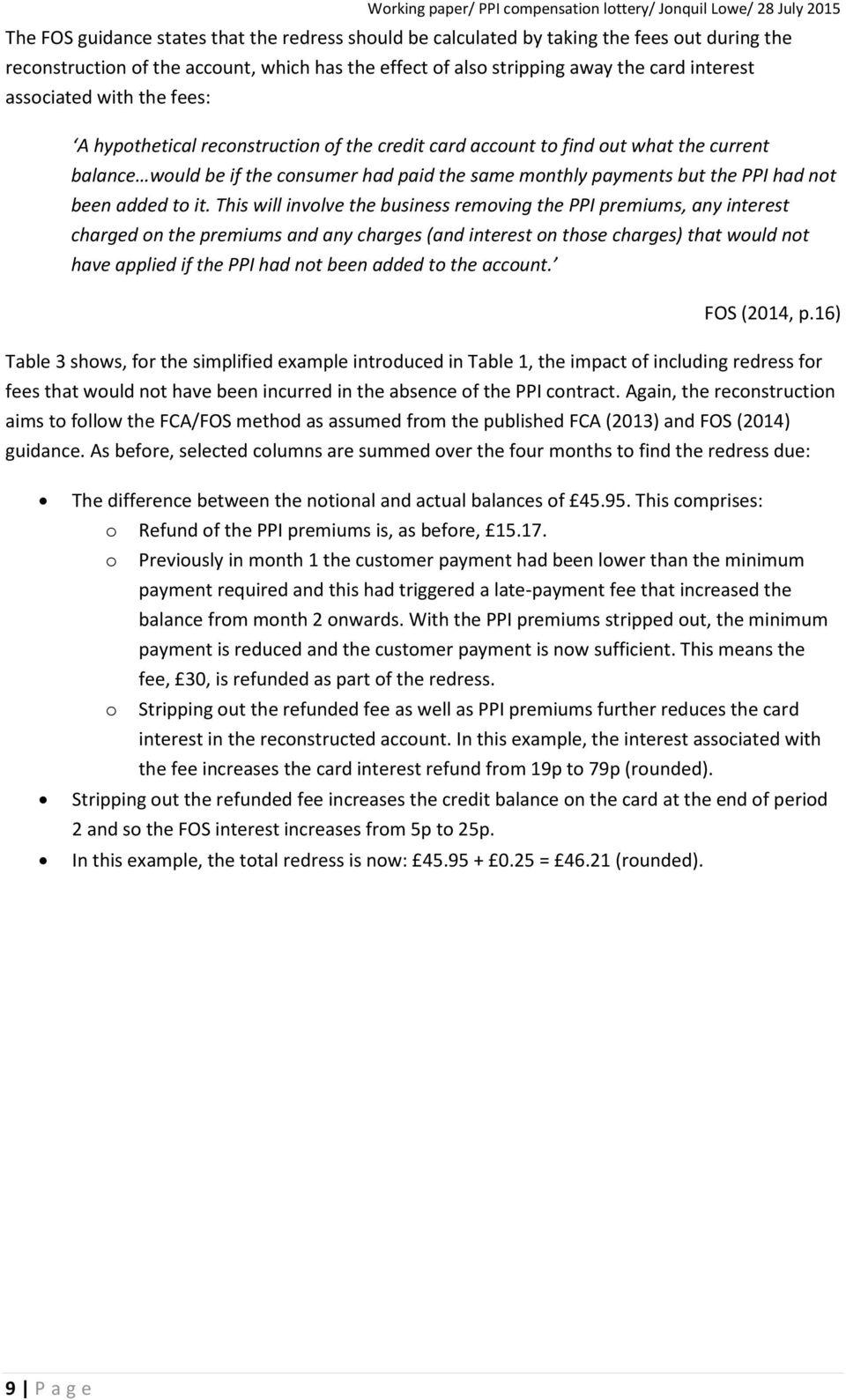
10 Table 3: Simplified example of redress for mis-sold PPI including fees redress Assumptions PPI premium per 100 of statement balance 0.50; Interest on statement balance +PPI unless paid off in full 12% pa; Fees if pay less than minimum 30; Minimum payment as percentage of statement balance plus interest 1%; FOS interest 8% pa. Month Opening balance Fees incurred at end of previous month Transactions Statement balance PPI premium Interest unless statement balance and PPI paid off in full Customer payment Closing balance Redress for loss of use where balance in credit Redress calculated as difference between column totals in this table and Table 1 Refund of difference between notional and actual accounts * Of which Fees redress PPI premium redress Card interest redress FOS interest redress 0.25 Source: author s calculations. Finally, there may be a case for altering the customer payments used in the reconstructed account. If the consumer has paid off their card in full each month, it can be assumed that in the absence of PPI their actual payments would have been lower. In this situation, the notional card balance should be constructed using the lower payment, but the point is academic under the assumed FCA/FOS approach to redress because paying off the card in full each month means that no card interest is ever incurred (and so no calculation and refund of card interest is required). Redress will be made up of a refund of the overpayments plus interest (at 8% pa simple) for loss of use of the money. However, the interest at 8% pa is already automatically captured by the payment of interest on any positive notional balance, as illustrated in the Example below. Example of paying of card in full each month Redress calculation 1: No adjustment to customer payment. A customer pays off their card in full each month. In month X, they have a statement balance of 1,010 including a PPI premium of 10. The customer makes a payment of 1,010. In the reconstructed account, the balance is reduced to 1,000 and the customer s same payment of 1,010 means the account has a credit balance of 10, which is refunded plus interest at 8% pa. Redress calculation 2: Customer payment adjusted. Alternatively, since the customer pays off the balance each month, it may be assumed in the reconstructed balance that in month X the customer would have paid only 1,000. This means that the actual 10 P a g e

11 payment included an excess amount of 10 which is refunded plus interest on the 10 at 8% pa. If the consumer consistently makes minimum payments, it can be assumed that in the absence of PPI their actual payments would have been slightly lower. The notional account is then constructed using these lower payments (FOS, 2014, p. 23). A further element of the redress will be a refund of these small overpayments plus interest (at 8% pa simple) for loss of use of the money. In most cases, the difference between the actual and reconstructed payments will be small and will not cause the reconstructed balance to move into surplus, so the FOS interest due will not automatically be captured by the general approach but must be calculated separately. Tables 4, 5 and 6 demonstrate how this may work for a second simplified example. Table 4 provides the baseline showing the actual account including PPI, while Table 5 shows the reconstructed account and redress using the assumed FOS approach but with no change to the customer s payments. Table 6 shows the reconstruction again, this time with the customers payments set to the reduced minimum consistent with the new balances in the reconstruction. Table 4: Simplified example with minimum payments each month: baseline (actual account) Assumptions PPI premium per 100 of statement balance 0.50; Interest on statement balance +PPI unless paid off in full 12% pa; Fees if pay less than minimum 30; Minimum payment as percentage of statement balance plus interest 1%; FOS interest 8% pa. Interest Month Opening balance Fees incurred at end of previous month Transactions Statement balance PPI premium unless statement balance and PPI paid off in full Customer payment Closing balance M M M M Source: author s calculations. Pay off in full (F) or minimum (M) 11 P a g e

12 Table 5: Simplified example with minimum payments each month: redress with unchanged customer payments Month Opening balance Fees incurred at end of previous month Transactions Statement balance PPI premium Interest unless statement balance and PPI paid off in full Customer payment Closing balance Redress for loss of use where balance in credit Redress calculated as difference between column totals in this table and Table 4 Refund of difference between notional and actual accounts * Of which PPI premium redress Card interest redress FOS interest redress 0.00 Source: author s calculations. Table 6: Simplified example with minimum payments each month: redress with adjusted customer payments Month Opening balance Fees incurred at end of previous month Transactions Statement balance PPI premium Interest unless statement balance and PPI paid off in full Customer payment Closing balance Redress for loss of use where balance in credit Redress for loss of use on cumulative overpayments 12 P a g e Redress calculated as difference between column totals in this table and Table 4 Refund of difference between notional and actual accounts * Of which PPI premium redress Card interest redress Less impact of adjusted payments (overpayment offset) 2.21 FOS interest redress Refunded overpayments 2.21 Source: author s calculations.

13 Comparing Tables 4, 5 and 6, points to note are: When the customer payments are adjusted to the lower minimum, the card interest redress is reduced from 1.24 to 1.21 (rounded) in this example. This is because the amount by which the stripped-out PPI premiums reduce the card balance is now offset slightly by the reduction in the customer repayments. The result is that the reconstructed balance is slightly higher in Table 6 than in Table 5 and so less card interest is to be refunded. The removal of PPI, fees and interest associated with them are the factors that create the difference between the notional and actual balances. However, when the payments are restructured, this offsets those factors (reducing the difference between the notional and actual accounts) called the overpayment offset in the tables above. The FOS guidance is clear that, in addition to the difference between the balances, the amount of the overpayments ( 2.21 in this example) should also be added to the redress: Based on examples of good practice we have seen, the example below shows how a business might set out its calculated compensation we ve looked at your credit card account and worked out what the balance would have been without the cost of PPI and any interest and charges you paid as a result of PPI being included on your account; and the payments you have paid have been slightly higher than the payments we have assumed in our calculation we will pay to you the difference between your credit card balance today and what your credit card balance would have been without the PPI policy In addition we will refund to you the extra monthly payments you paid and add interest at 8% a year. FOS (2014, p23) Finally, although some redress at the card interest rate has been lost because of the overpayment offset, this is replaced with interest at the FOS rate to compensate for loss of use of the cumulative amounts overpaid. In this example, the overpayments are very low and the span of the example (four months) very short, so the amount of the FOS interest is too low to register in the first two months and just 1p in months 3 and 4. As a general point, in real-life scenarios, the FOS interest rate (8% pa simple) will nearly always be lower than the card interest rate, so that reconstructing the customer s minimum payments will reduce the amount of redress represented by total interest. In this example, the card interest plus FOS interest due in Table 5 (actual customer payments used) of 1.23 is reduced to 0.03 in Table 6 (reconstructed payments used). Although reconstructing the payments has reduced the total interest element of the redress, this is to a varying extent offset by the refund of the overpayments. In this example, the total redress increases from in Table 5 to in Table 6. A general procedural rule to note when reconstructing card accounts to determine redress is that, where PPI has been cancelled some time before the date on which redress is due, the redress is nonetheless still calculated by reference to the account balance with and without PPI up to the date of redress. (FOS, 2014, p.20) 13 P a g e

14 The impact of different ways of calculating redress Not all PPI providers calculate redress according to the assumed FCA/FOS method described above and, worryingly, the alternative methods they use often lack transparency so that it is hard to ascertain whether the remedy is appropriate to the matter complained of and is appropriate and fair in the individual circumstances. (FCA, 2013, DISP App 3.8.2). To investigate one such alternative approach and compare its outcomes with the assumed FCA/FOS method, the BBC (2015c, 2015d) supplied a case study typical of the method being applied by the credit-card company, MBNA. A brief outline of the case study is as follows: the customer had an MBNA card account from October 1997 until February The customer rarely paid off the card balance in full (only eight times in the total 197-month term of the account). During the 197 months, the customer made minimum payments 96 times, which were infrequent in the early years of the account but occurred more often in the later years. Based on a detailed examination of the case study, Table 7 describes how the MBNA method of calculating redress diverges from the assumed FCA/FOS method. Table 7: MBNA approach to redress compared with assumed FOS method Aspect of redress calculation FOS MBNA Reconstruct account without PPI premiums Yes. Premiums refunded with associated card interest Yes. Premiums refunded with associated card interest Fees Embed any refund of fees in reconstructed account. Refund No refunds of fees or associated interest fees with associated card interest Adjust for minimum payments Only if consumer consistently Every time a minimum payment pays the minimum is made Redress for minimum payments Embed in reconstructed Embed in reconstructed account. Refund overpayments account. Refund overpayments plus interest at 8% pa plus interest at 8% pa, but card interest penalty Adjust for payments-in-full Only if made each month Every time payment in full Redress for in-full payments Interest at 8% pa. (Premiums which are the only overpayment - refunded as above.) Embed in reconstructed account. Refund overpayments plus interest at 8% pa, but card interest penalty The impact of the differences in the MBNA approach were analysed using case study and a sequence of methods: MBNA approach: a reconstruction as far as possible of the MBNA redress calculation. This was achieved with only very minor discrepancies ( 0.31) compared with the actual MBNA calculation. FCA/FOS approach: The basic assumed FCA/FOS method, in the first instance with no redress for fees and no changes to the customer s payments 14 P a g e

15 Working paper/ PPI compensation lottery/ Jonquil Lowe/ 28 July 2015 FCA/FOS with fees: The assumed FCA/FOS method but, this time, with redress for fees triggered by the PPI but still no changes to the customer s payments. The fees considered were those where the inclusion of PPI seems to be responsible for taking the statement balance above the card limit. This was investigated by: o assuming that when the actual balance exceeded the credit limit, a charge was included in that month s transactions; o checking month by month whether the balance would have been over the credit limit in the absence of PPI o where a fee was indicated for the actual balance but not the notional balance, subtracting the fee from transactions in the reconstruction o a partial check for late-payment fee refunds on the basis that if the reconstructed account balance was in credit, a late-payment fee would not have been triggered. FCA/FOS with fees & min: As above for FOS with fees except, under given assumptions, reconstructed payments were used in the creation of the notional account and surplus minimum repayments were refunded with interest at 8% pa. The given assumptions were that the consumer had been consistently making minimum repayments for at least the last six months. This method was investigated because, while the FOS guidance refers to consumers who consistently make the minimum payment each month (FOS, 2014, p.22), there is no elaboration on how consistently has been defined and whether the test applies to the whole term of the account or could apply merely to some part of it. A dictionary definition of consistently does not help to settle the matter, for example: uniformly, with persistent uniformity (OUP, 2015). Table 8 compares the actual offer made by MBNA with the redress outcomes for each of the methods described above. 15 P a g e

16 Table 8: Case study: redress calculated by different methods Working paper/ PPI compensation lottery/ Jonquil Lowe/ 28 July 2015 REDRESS MBNA actual MBNA approach FCA/FOS ex fees FCA/FOS with fees FCA/FOS fees & min Difference between notional and actual balances x Of which PPI premiums Fees refunded Card interest on premiums & fees Impact of payment Adjustments (overpayment offset) Minimum payment refunds FOS interest TOTAL REDRESS (rounded up) Source: author s calculations using actual data for case study N/A N/A N/A N/A N/A N/A N/A N/A N/A The analysis in Table 8 suggests that MBNA offered the customer redress that was around 8,000 less than would have been payable using the FCA/FOS approach. Drawing on the range of results in Table 8, it is possible to analyse the impact of each aspect of the MBNA divergence from the FCA/FOS approach. First comparing MBNA actual with FCA/FOS with fees, the MBNA case study suffers the following loss of redress: Total loss of redress: The total difference is redress in 14, , = 8, Loss of fees redress: Of this, represents fees that would not have been incurred in the absence of PPI and which have not been refunded. Loss of card interest associated with fees that should be refunded: This comes to 7, , = and occurs because, even though fees are the last element to be added to a card balance in any month, if the card balance is not paid off in full, the fees start to accumulate interest on a compound basis from the following month onwards. This continues until the account balance is cleared. Loss of FOS interest associated with fees that should have been refunded: This comes to 3, , = This occurs because, once the fees are stripped out and without reconstructed payments, the notional card balance is more often in credit and by larger amounts. With reconstruction, the account is seldom in credit and only by small amounts resulting in a loss of FOS interest (at 8 per cent a year simple) in respect of these fees. 16 P a g e

17 Working paper/ PPI compensation lottery/ Jonquil Lowe/ 28 July 2015 Loss of redress due to impact of MBNA reconstructing minimum payments and in-full payments: The remaining difference of 8, ( ) = 6, is due to the way MBNA has reconstructed the customer s payments. This has several aspects: o Surplus repayments are created every time the consumer makes a minimum payment or pays off the card balance in full, even when there is no regularity or consistency in this behaviour. o Adjusting payments in this way simultaneously reduces the difference between the notional and actual balances and creates a cumulative total of overpayments. In effect, it is cancelling the card interest associated with these overpayments and replacing it with the lower FOS interest. The result is often a difference between the notional and actual balances that is less than the cumulative total of PPI premiums. In this situation the overpayment offset exceeds the card interest associated with the PPI premiums. This has the effect that, although the overpayments are arithmetically refunded, it is at a price of eating away the card interest redress and even causing the card interest redress to effectively become a negative amount. As Tables 10 Examples 1 to 3 below show, the FOS rule that payments in full each month and consistent minimum payments may be reconstructed is not designed to cope with MBNA-style ad hoc reconstructions which produce perverse results. o Compensation for loss of use of the surplus payments is given by awarding FOS interest (at 8 per cent a year simple) on the cumulative total of the surplus payments. On the face of it, this should increase the FOS interest in the MBNA calculation compared with the assumed FCA/FOS approach. In fact, MBNA pays less in FOS interest. Of this difference, is the interest associated with the refunded fees as discussed above, leaving due to the adjustments to the customer s payments. This reduction in FOS interest comes about because the interest on MBNA s surplus redress is more than offset by the loss of FOS interest which in the assumed FCA/FOS approach is paid when the notional card balance is in credit. Under the assumed FCA/FOS approach using the customer s actual payments, the reconstructed notional balance is often in credit especially in the later years. If the customer paid off the card in full each month, the FOS interest on incredit notional balances would simply equal the FOS interest on overpayments once the customer payments were adjusted downwards; if the customer consistently made minimum payments, it would not generally be possible for the notional card balance to be in credit, in which case FOS interest would be zero under the assumed FOS approach. Because this customer has an inconsistent pattern of payments, neither of these extremes holds, making it possible for the FOS interest to be higher rather than lower under the FOS approach as compared with MBNA s method. There can be little doubt that this case study did not make payments in full each month which calls into question the validity of adjusting the in-full payments when the account is restructured. However, during some periods, the customer in this case study did fall into a habit of making minimum repayments for example, the longest stretch was an unbroken period of 22 months. With a lack of FOS guidance on how consistently should be interpreted, perhaps it would be reasonable to re-run the comparison assuming that at least some minimum payments should be 17 P a g e

18 restructured. This has been explored by comparing the MBNA results with FCA/FOS with fees and min. The analysis becomes: Total loss of redress: The total difference in redress is slightly lower at 14, , = 8, Loss of fees redress and interest associated with fees: This is unchanged at in fees, in associated card interest and in FOS interest. Loss of card interest through the overpayment offset: Under the FOS approach with a sixmonth consistency test, very few minimum payments are adjusted. This means there is some overpayment offset but not a great deal. Thus the card interest redress is a bit lower than it would have been slightly reducing the loss vis-à-vis the MBNA approach to 6, Loss of FOS interest: There is a also a reduced loss to the MBNA customer of FOS interest not associated with fees of This is slightly lower than in the FCA/FOS scenario without payment adjustments because, once payments are adjusted, the reconstructed account is less likely to produce credit balances, reducing this part of the redress. Table 9 summarises the loss to this particular MBNA customer as a result of the method of calculating redress adopted by MBNA compared with the assumed FCA/FOS approach. Table 9 Summary of MBNA customer s loss of redress Element of loss Relative to FCA/FOS Approach with fees Relative to FCA/FOS approach with fees and min Fees refund Card interest associated with fees FOS interest associated with fees Card interest lost due to 6, , reconstructed payments (overpayment offset) FOS interest associated with reconstructed payments Refund of surplus payments N/A TOTAL REDRESS LOST 8, , Source: author s calculations using actual data for case study. Using a range of stylised examples in a spreadsheet that replicates the MBNA approach and the assumed FCA/FOS approach (with and without fee redress and with and without adjusted repayments), it is possible to explore the nature of the redress calculations further. Tables 10(a) to (c) reproduce three key examples: A customer who pays off card in full each month A customer who makes minimum payments each month 18 P a g e

19 A customer who has an inconsistent pattern of payments. Working paper/ PPI compensation lottery/ Jonquil Lowe/ 28 July 2015 The examples use fixed assumptions about interest rates and fee payments. They also cover a period of only 12 months. This enables a closer examination of the impact of changing the payment behaviour than is possible looking at real customers who have had accounts for many years. However, focusing on such a short time period means that differences in redress by method are inevitably small. It should be borne in mind that the differences become potentially very large when extended over long time periods. Notes to each example in Tables 10(a) to (c) highlight the impact of the different methods given the different customer payment profiles. Tables 10 Comparison of redress under the different methods for selected stylised examples Assumptions Card interest % pa 20% Cost of PPI /p per 100 balance 0.69 FOS interest (opportunity cost) % pa simple 8% Credit limit 6,000 Over limit fee 25 Minimum payment rule Minimum payment rule 1% of balance or 25 or actual balance if less Source for all tables in these examples: author s calculations. 19 P a g e

20 Table 10(a) Example 1: Card paid off in full each month Working paper/ PPI compensation lottery/ Jonquil Lowe/ 28 July 2015 MONTHLY DATA FOR ACTUAL ACCOUNT Month number INTERMEDIATE OUTPUTS (TO INFORM SETTING INPUTS) Pay off Minimum Customer actual payment Fees Transactions payment balance in on actual included in Minus /p Plus /p full account transactions REDRESS MBNA approach FCA/FOS ex fees FCA/FOS with fees redress FCA/FOS with fees & minimum payment adjustment FCA/FOS with NO fees but minimum payment adjustment FCA/FOS with NO fees but ALL M & F adjustment PPI premiums Fees refunded N/A N/A Card interest on premiums & fees 1.74 [1] [2] Minimum payment refunds N/A N/A N/A [2] FOS interest TOTAL REDRESS (rounded up) Notes to Example 1 [1] This is the perverse effect of a curious MBNA adjustment that ignores the difference between the notional and actual balances where the card balance has been paid off in full the previous month, instead replacing the difference with the PPI premium for that month. [2] If all in-full payments are adjusted, the minimum payment refund equals the PPI premiums (there can be no card interest in this scenario). Arithmetically the overpayment offset exactly equals the minimum payment refund (subject to rounding differences), cancelling them to zero, leaving the correct redress of PPI premiums plus FOS interest for loss of use of the overpayments. 20 P a g e

21 Table 10(b) Example 2: Minimum payments consistently every month Working paper/ PPI compensation lottery/ Jonquil Lowe/ 28 July 2015 MONTHLY DATA FOR ACTUAL ACCOUNT Month number Transactions Minus /p Customer payment Plus /p INTERMEDIATE OUTPUTS (TO INFORM SETTING INPUTS) Pay off Minimum actual payment Fees balance in on actual included in full account transactions REDRESS MBNA approach FCA/FOS ex fees FCA/FOS with fees redress FCA/FOS with fees & minimum payment adjustment FCA/FOS with NO fees but minimum payment adjustment FCA/FOS with NO fees but ALL M & F adjustment PPI premiums Fees refunded N/A N/A Card interest on premiums & fees [1][3] [2] [2] [3] [3] [1][3] Minimum payment refunds N/A N/A N/A [1] FOS interest 0.63 [3] 0.00 [2] 0.00 [2] 0.04 [3] 0.03 [3] 0.63 [3] TOTAL REDRESS (rounded up) Notes to Example 2 [1] In the MBNA approach, the card interest figure combines the repayment of the overpayments and the card interest associated with the PPI premiums. The arrangement of the arithmetic is more obscure than the FOS guidance recommends, but the answer is the same. [2] With no adjustment to the payments, card interest redress is higher; there is no FOS interest because the notional account is never in credit. [3] The impact of adjusting the minimum payments is to lose some card interest (relative to FCA/FOS with unchanged customer payments) and replace it with the lower FOS interest. 21 P a g e
22 Table 10(c) Example 3: Inconsistent pattern of payments Working paper/ PPI compensation lottery/ Jonquil Lowe/ 28 July 2015 MONTHLY DATA FOR ACTUAL ACCOUNT INTERMEDIATE OUTPUTS (TO INFORM Month number Transactions Customer SETTING Pay off INPUTS) Minimum Fees included in 1 Minus /p payment 25 actual payment transactions Plus /p balance in on actual full account REDRESS MBNA approach FOS ex fees FOS with fees redress FOS with fees & minimum payment adjustment [3] FOS with NO fees but min payment adjustment [3] FOS with NO fees but ALL M & F adjustment PPI premiums Fees refunded N/A N/A Card interest on premiums & fees 4.13 [1] [1] [2] Minimum payment refunds N/A N/A N/A [1] FOS interest TOTAL REDRESS (rounded up) Notes to Example 3 [1] As in Example 2, in the MBNA approach, the card interest figure combines the repayment of the overpayments and the card interest associated with the PPI premiums. The arrangement of the arithmetic is more obscure than the FOS guidance recommends, but the answer for these elements of the redress is the same. [2] The overpayment offset is so large that it completely eradicates the card interest associated with the PPI premiums and any fees and, in fact, becomes an element of negative redress. This demonstrates the inappropriateness of adjusting minimum and in-full payments where they are made on an ad hoc basis. [3] No payment adjustments have in fact been made in these approaches because the requirement for minimum payments to have been made for an unbroken period of at least six months has not been met. 22 P a g e
23 Conclusions Working paper/ PPI compensation lottery/ Jonquil Lowe/ 28 July 2015 The FCA Handbook (2013), FSA policy statement (2010) and FOS guidance (2014) provide a framework for the calculation of PPI redress. The underlying principle is to put the consumer back into the situation they would have been had they never taken out the PPI cover. However, in the case of credit-card-related PPI, this exercise cannot be carried out purely objectively. An important consideration when reconstructing the card account without PPI is whether the consumer s monthly repayments would have been different in the absence of the PPI. No-one can know what the consumer would have paid in this notional situation, which introduces a subjective element into the redress calculation. The FOS guidance suggests that the fairest approach is to assume that the consumer s repayment would have been the same, except in the extreme cases where a consumer pays off the card in full each month or consistently makes only the minimum payments. However, the FCA Handbook permits alternative methods of redress, provided the remedy is appropriate to the matter complained of and is appropriate and fair in the individual circumstances. (FCA, 2013, DISP App 3.8.2) Therefore, it is not necessarily incorrect for MBNA to use an alternative approach to calculating redress. The key question is whether its alternative approach produces redress that can be considered appropriate and fair. The MBNA approach to calculating redress diverges significantly from the FCA/FOS approach: The failure to identify and refund fees that would not have been incurred in the absence of PPI, plus associated interest, contravenes the FOS guidance. The treatment of every incidence of a minimum payment or payment in full as an opportunity to create surplus payments is at odds with the FOS guidance which suggests this treatment is appropriate only where minimum payments are made consistently or in-full payments made each month. The main impact is a substantial reduction in the card-interest element of the redress which can even become negative, cancelling compensation of the card interest associated with PPI premiums and fees triggered by PPI. Moreover, the impact of this approach lacks transparency in MBNA s statements of redress by rolling up the refund of overpayments with the card interest redress. MBNA s approach to calculating and communicating its redress has been criticised for several years. In response, MBNA issued the following statement: Statement on MBNA s PPI redress Customers may have seen or heard media reports into PPI redress payments made by MBNA and other lenders. MBNA has issued the following statement for customers clarification: We are confident that our PPI redress is correct; we have considered our methodology carefully and in detail. Our confidence is reinforced through external independent reviews and advice which has supported the way we approach default fees. Fees of this nature are required to be refunded when they are caused by the missale of PPI. Not all credit card fees and charges are the same between issuers and there are aspects 23 P a g e
24 of MBNA s fees and charges and the way they are charged (or not charged) which are highly relevant to whether MBNA might be liable to refund them. For example, our system operates so that the cost of PPI is only applied after the customer has gone over limit and after the over limit fee has been applied. As such, PPI could never cause our customers to be over limit or cause the fee to be applied. MBNA has always worked to ensure that its PPI redress calculations and the payments it makes to customers follow guidance issued by the Financial Conduct Authority (FCA) and are informed by the decisions of the Financial Ombudsman Service (FOS). Nothing has changed in relation to the way MBNA reviews, calculates and pays its redress on PPI complaints, so customers do not need to do anything following these reports. MBNA is not unique in the PPI challenge; however, it is committed to dealing with legacy problems like this in the right way and as quickly as it can. MBNA (2014) The statement is misleading when it states that, since PPI is added to a card account as the last item each month, it cannot trigger fees. This holds true only if the customer pays off their card in full every month. In any other scenario, any one PPI premium cannot trigger fees in the same month as the premium is incurred but from the following month the PPI premium and compound interest on it become embedded in the account balance and can indeed trigger fees in subsequent months. The only way to investigate this is to carry out a reconstruction of the account excluding the PPI premiums. It is not possible to investigate simply by looking at each month in isolation. The statement also claims that it follows the FCA/FOS guidance. If it is referring to the published guidance, this is not the case. Apart from the issue of fees, MBNA diverges very significantly by reconstructing every ad hoc minimum payment or payment in full. This conflicts with the FOS guidance that this should be done only where payments in full are made every month or minimum payments are consistently made. The exploration in Tables 10(a) to (c) above demonstrates that adjusting payments where there is no consistent pattern is inappropriate and results in a significant cancellation of card interest that would otherwise have been payable. Based on the case study supplied and further investigation of stylised examples, the impact of the divergences in the MBNA method from the FCA/FOS approach could be substantial, running to many thousands of pounds. The size of the lost redress when the MBNA method is used will tend to be larger: The more often the customer makes ad hoc minimum repayments and/or ad hoc payments in full, since in the MBNA approach this triggers reconstructed payments with a loss of card interest redress through what this paper calls the overpayment offset The more often monthly repayments which fall short of full repayment are nonetheless fairly high relative to the balance so that stripping out PPI premiums and fees puts the account balance in credit or removes the trigger for fees incurred in the actual balance The more often the features above hold and the account has been in place for a long period since the card interest associated with refunded PPI premiums and fees accumulates on a compound basis. 24 P a g e
25 Taking these points together, and assuming that the case study is representative of the general method used by MBNA to calculate PPI redress, the MBNA method seems neither appropriate nor fair, diverging from FCA and FOS guidance in ways that do not seem justified, and causing loss of redress to potentially many customers. While the FCA does not constrain providers to a particular methodology when calculating redress, the underpinning principle should be to return the customer to the situation they would have been in had they never taken out the PPI cover. The investigation of the MBNA and FOS methodologies set out in this report makes clear that the MBNA approach fails to deliver on this principle. At present, the FCA and FOS leave it up to consumers to challenge a redress offer if they feel it is incorrect or unfair. However, as this paper demonstrates, the calculation of credit-card-related PPI redress is particularly complex. Consumers are unlikely to be able to check and challenge a redress offer, not simply because of the calculations involved but also because they are unlikely to be provided with sufficient information to enable them to reconstruct the calculations on which the redress offer is based. In situations like these, it is particularly important that the regulator should provide clear guidance on the redress methods that it considers to be acceptable and fair and the specific circumstances that justify alternative approaches. Without a regulatory steer, consumers are simply taking part in a compensation lottery. References BBC (2015a) Years before PPI scandal is over, says, Financial Ombudsman [online] (Accessed 27 July 2015). BBC (2015b) PPI is becoming a bit of a lottery [online] (Accessed 17 July 2015). BBC (2015c) PPI Redress Calculation Results [unpublished confidential document]. BBC (2015d) Spreadsheet of selected account data for case study [unpublished confidential document]. BBC (2014a) PPI compensation payouts could have 1 billion shortfall [online] (Accessed 27 July 2015). BBC (2014b) Lloyds accused of short-changing PPI claimants [online] (Accessed 2 April 2015). Financial Conduct Authority ( ) Financial Conduct Authority Handbook [online] (Accessed 4 April 2015). Financial Conduct Authority (2015) Monthly PPI refunds and compensation [online] (Accessed 14 July 2015). 25 P a g e
26 Financial Conduct Authority (2014) Redress for payment protection insurance (PPI) mis-sales. Update on progress and looking ahead, TR14/14 [online] (Accessed 14 July 2015). Financial Conduct Authority (FCA) (2013) Handling Payment Protection Insurance complaints (DISP App 3) in FCA Handbook [online] (Accessed 4 April 2015.) Financial Ombudsman Service (2015) Payment protection insurance (PPI) case studies [online] (Accessed 27 July 2017). Financial Ombudsman Services (FOS) (2014) How does the ombudsman approach redress where a PPI policy has been mis-sold? [online] (Accessed 4 April 2015). Financial Ombudsman Service (2013) Payment protection insurance (PPI) in Ombudsman News, Issue 104 [online] (Accessed 27 July 2015). Financial Services Authority (FSA) (2010) The assessment and redress of Payment Protection Insurance complaints PS10/12 [online] (Accessed 4 April 2015). MBNA (2014) Statement on MBNA s PPI redress [online] (Accessed 17 May 2015). Oxford University Press (OUP) (2015) Consistently adv in Oxford English Dictionary [online] (Accessed 17 May 2015). R (on the application of British Bankers Association) v Financial Services Authority and another [2011] EWHC 999 [online] (Accessed 27 July 2015). UK Cards Association (no date) How your interest is worked out [online] (Accessed 2 April 2015). 26 P a g e
27 Appendix A: Methodology and key findings Working paper/ PPI compensation lottery/ Jonquil Lowe/ 28 July 2015 A.1 The analysis comprised the following stages: Construct a spreadsheet to replicate the assumed FSA/FOS redress methodology. Create a spreadsheet to reconstruct the MBNA case study account, reconstructed account and redress calculations. Apply the assumed FOS methodology to the MBNA case study. Create a generalised spreadsheet comparing the MBNA and assumed FOS methodology to enable testing the logic and investigation of stylised examples. Apply any corrections to logic from the generalised spreadsheet to the case study spreadsheet. MBNA case study A.2 The following monthly account data for the MBNA case study were available (BBC, 2015c): net PPI premium, net interest, customer s actual payments, transactions (including fees), balance, reconstructed payment type (M or F), reconstructed customer payment, surplus (difference between customer s actual payment and reconstructed payment). Fees charged were available from a separate document (BBC, 2015d). The following redress data were available (BBC, 2015c): associated card interest, premium, card redress, cumulative surplus redress, interest at 8%, reconstructed balance, summary of the redress (before and after tax on the 8% interest element. A.2 The data were used to reconstruct case study actual account and the MBNA methodology for the reconstructed account and redress calculation. Key findings were: Every incidence of a minimum payment or payment in full triggers a reconstructed customer payment. For each span of periods up to the balance being repaid in full, the difference between the actual and notional account comprises three elements: o Cumulative PPI premiums (increases difference between notional and actual balance) o Cumulative associated card interest(increases difference between notional and actual balance) o Cumulative surplus redress (decreases difference between notional and actual balance). The cumulative surplus redress offsets the card interest associated with PPI premiums and can even exceed the card interest which in effect becomes a reduction in redress. Interest at 8% is paid on the cumulative redress. There is no investigation of fees or repayment of fees. FOS approach 27 P a g e
28 A.3 The assumed FOS approach was reconstructed based on an FSA (2010) example, corrected for practical and mathematical discrepancies, and FOS (2014) written guidance on how it calculates redress. A.4 The FOS approach was applied to the MBNA case study data. Key findings were: Minimum payments and payments in full would normally trigger a reconstruction only if they were habitual behaviour by the customer, in other words applying each month (payments in full) or consistently (minimum payments). The difference between the actual and notional accounts normally comprises: o Cumulative PPI premiums o Cumulative fees refunded o Cumulative card interest associated with PPI premiums and fees. Redress comprises: o Cumulative PPI premiums o Cumulative fees refunded o Cumulative card interest associated with PPI premiums, fees and overpayments o Interest at 8% pa simple on any credit balance in the reconstructed account o Cumulative overpayments (but only where minimum payments or payments in full consistently made) o Cumulative interest at 8% pa simple on the overpayments (but only where minimum payments or payments in full consistently made). A.5 In a variation to the main method described above and in recognition that consistently is open to interpretation, calculations were also run allowing minimum payments to be reconstructed if they had been consistently made over a span of at least six months. 28 P a g e
29 Appendix B: Formulae for assumed FOS with fees redress (but no payment adjustments) Constants B5 Month compensation awarded C6 Card interest % per month B7 Cost of PPI /p per 100 balance C8 FOS interest (opportunity cost) % per month simple B9 Credit limit D9 Over limit fee / Late payment fee C10 Minimum payment percentage E10 Minimum payment de minimis Formulae (using Excel columns as variable names, t = time period; debits negative, credits positive) Highlight indicates components that sum to make the redress payable (before tax on the FOS interest) Variable Description Formula for row t Actual account B C D E F G H I J K Month Card balance at start of month Col K for t-1 Transactions INPUT Starting balance + new transactions Col C + D Interest Col E*C6 where debit balance PPI premium Col E/100*B7 where debit balance Starting balance + new transactions + interest + PPI premium Col E+F+G Minimum payment Based on H and Min payment rule Customer's chosen repayment INPUT Actual card balance at end of month Col H + J Kt-1 INPUT Ct+Dt IF(Jt>=Et*-1,0,MIN(0,Et*$C$6)) MIN(0,Et/100*$B$7) ROUND( Et+Ft+Gt,2) ROUND(IF(Ht>0,0,MAX(Ht,MIN(Ht*$C$10,$E$10*-1))),2) INPUT ROUND(Ht+Jt,2) Fees analysis actual account 29 P a g e
30 Variable Description Formula for row t Working paper/ PPI compensation lottery/ Jonquil Lowe/ 28 July 2015 L M N O Actual account - was credit limit exceeded this period? Col H*-1>B9 Fee for over limit in previous period included in transactions If L for t-1 is "OL" then D9 Payment on actual account was late (or less than minimum) this period? Col J < Col I*-1 Fee for late payment in previous period included in transactions If N for t-1 is "LP" then D9 IF(Ht*-1>$B$9,"OL","") IF(Lt-1="OL",$D$9*-1,0) IF(Jt<It*-1,"LP","") IF(Nt-1="LP",$D$9*-1,0) Notional (reconstructed) account excluding PPI and refunded fees P Q R S T U V Notional card balance at start of month Col W for t-1 Transactions less fees refunded INPUT less Z less AA Starting balance + new transactions Col P + Q Interest Col R*C6 where debit balance Note: pay off in full check v Col V Balance before monthly repayment Col R + S Minimum payment Based on T and Min payment rule Customer's chosen repayment INPUT Wt-1 INPUT (written as Dt) AAt - ABt Pt+Qt IF(Vt>=Rt*-1,0,MIN(0,Rt*$C$6)) ROUND(Rt+St,2) ROUND(IF(Tt>0,0,MAX(Tt,MIN(Tt *$C$10,$E$10*-1))),2) INPUT (written as Jt) W Notional card balance excluding PPI and fees refunded Col T + V Fees analysis notional account ROUND(Tt+Vt,2) X Y Z Notional account - is credit limit exceeded this period? Test for no over-limit refund T*-1>B9 Is customer payment less than minimum? Col J<U Amount of over limit fee to be refunded If X not "OL" then refund amount from M IF(Tt*-1>$B$9,"OL","") IF(Jt<Ut*-1,"LP","") IF(Xt="OL",0,M15) AA Amount of over late payment fee to be refunded IF N is "LP" and ZY is not, refund amount from O PPI redress Part 1: PPI, refunded fees and associated card interest IF(AND(Nt="LP",Yt=""),Ot,0) 30 P a g e
31 Variable Description Formula for row t Working paper/ PPI compensation lottery/ Jonquil Lowe/ 28 July 2015 AB AC AD AE AF Difference in actual and notional end balances due to PPI & fee refunds Col K - W Monthly cost of PPI Col G ie INPUT Cumulative cost of premiums before interest Sum of Col AC Cumulative fees refunded Sum of Col Z + Aa Cumulative card interest on PPI, fees & overpayments Col AB AD - AE But cannot be positive Kt - Wt Gt ADt-1 + ACt AEt-1 +Zt+AAt MIN(0,ABt-ADt-AEt) AG Associated interest this month Change in AF time t against t-1 Part 2: FOS interest (opportunity cost redress) MIN(0,AFt-Aft-1) AH AI AJ PPI & fees etc redress balance Col AD + AE + AF Notional card balance excluding PPI & fees Col K - AH Same as Col W FOS interest on 'overpayment' If AI is in credit, AI*8% monthly equiv rate ADt + AEt + AFt Kt - AHt ROUND(IF(AIt>=0,AIt*$C$8,0),2) AK Cumulative FOS interest on positive notional balance Sum of Col AJ AKt-1 +AJt K8 Total redress From month (B5-1): (AD + AE + AF)*-1 + AK 31 P a g e
Guidance with forms. How to make a Do-it-Yourself Claim for mis-sold Personal Protection Insurance
 Guidance with forms How to make a Do-it-Yourself Claim for mis-sold Personal Protection Insurance This is an excerpt from Lawpack s PPI Claim Pack. To find out more about making a DIY PPI claim and getting
www.yourmoneyclaim.co.uk tel: 01254 822880 Fighting Your Corner
 www.yourmoneyclaim.co.uk tel: 01254 822880 Fighting Your Corner BILLIONS set aside in compensation for mis-sold PPI & bank accounts Welcome MILLIONS to Your are Money entitled Claim, to compensation The
All intellectual property rights and copyright in the material on this website belongs to The Entitlements Agency, unless otherwise stated.
 Terms & Conditions Using our Services The Entitlements Agency has designed this website with the idea of offering you a source of information. Whilst we endeavour to maintain the site and keep the information
PPI ADVICE LTD PRE CONTRACT GUIDE - PAYMENT PROTECTION INSURANCE
 PPI ADVICE LTD PRE CONTRACT GUIDE - PAYMENT PROTECTION INSURANCE It is important to us that you make the right decision. We therefore provide guidance about what we do, how we work and our fee. PPI Advice
How Do You Get Your Money? Simply fill in the enclosed claim pack and send it back to us in the pre-paid envelope provided.
 For no-hassle Payment Protection Insurance (PPI) Claims 2 The Old Stables, Mitton Road, Whalley, Clitheroe, BB7 9PA telephone 01254 822880 email: [email protected] Welcome to Your Money Claim,
Guide to Reclaiming Mis-sold Payment Protection Insurance. Debt Advisory Services (Scotland) Limited Telephone 08000112322 www.scottishdebthelp.co.
 Guide to Reclaiming Mis-sold Payment Protection Insurance Debt Advisory Services (Scotland) Limited Telephone 08000112322 www.scottishdebthelp.co.uk Contents 1. Introduction 2. What is Payment Protection
Payment Protection Insurance. Agent Training Guide
 Payment Protection Insurance Agent Training Guide Introduction Genistar has joined forces with Highbridge to provide expert advice to your clients on their PPI claims. Highbridge is an international legal
The dispute is about the sale of a payment protection insurance (PPI) policy in connection with a credit card account with the firm in April 2007.
 FINAL DECISION complaint by: Mr E complaint about: the firm complaint reference: date of decision: April 2009 This final decision is issued by me, Robert Short, an ombudsman with the Financial Ombudsman
Claim Forms. Please print, complete and return to (no stamp needed):
 Claim Forms Please print, complete and return to (no stamp needed): Claims Thru Us Freepost RRZK-YTRL-UEXT 1 Farnsworth Court West Parkside LONDON SE10 0QF Please enclose a copy of your loan/credit agreement
Please complete the Account Details page of our pack and ONE Letter of Authority for each company you want to claim against.
 Please complete the Account Details page of our pack and ONE Letter of Authority for each company you want to claim against. Q. I don t have any account numbers or documentation, can I still claim? A.
Re. The Payment Protection Insurance on your Loan/Credit Cards
 Re. The Payment Protection Insurance on your Loan/Credit Cards Dear Sir/Madam Thank you for choosing JSK Claims to help you get back your hard earned money back from your bank. We will battle hard to fight
Adviceguide Advice that makes a difference
 Payment Protection Insurance What is Payment Protection Insurance When you take out a loan, credit or store card, you're often asked to take out an insurance policy at the same time. The policy is meant
LEGALLY ENTITLED PPI CLAIM PACK
 PPI CLAIM PACK INTERNAL USE ONLY COMPLAINTS HANDLING: OVERVIEW Complaints may be received directly from clients or from third party representatives. In the event of any complaint the matter must be immediately
Filling in the Form of Authority. Please ensure you have the lenders name in order to pursue the claim.
 Filling in the Form of Authority Please ensure you have the lenders name in order to pursue the claim. 1. Print a claim form for each lender and type of finance. 2. Do not use one claim form for multiple
Client Information and Checklist
 Gilham Capital Ltd, PO Box 362, North Ferriby, HU14 9AL Client Information and Checklist *Customer Name(s) *House Number / Name *Street Name Locality *City County *Post Code *Home Telephone Number *Mobile
Re: Your Mis-selling Claim Against PPI
 Online Pack Re: Your Mis-selling Claim Against PPI Thank you for asking Refresh My Credit to handle your Payment Protection Insurance (PPI) complaint. We are committed to helping you achieve what is owed
broader context the creation and growth of the claims management market
 broader context the creation and growth of the claims management market The current circumstances need to be set in the broader context of the development of claims companies and of the issues around the
PPI - Time for Action
 PPI - Time for Action PPI - Time for Action The recent announcements by the banks and the British Bankers Association (BBA) that they will not appeal against the High Court judgement on the Payment Protection
PPI Claim Form. Easy steps to claim back your money. 1. Fill in all the required details and questionnaire.
 PPI Claim Form Easy steps to claim back your money. 1. Fill in all the required details and questionnaire. 2. Sign and date the Terms of Service and Letter of Authority where you see the Joint policies
Are caravan dealers riskier than insurance brokers? Insuring the insurers: are caravan dealers riskier than insurance brokers?
 Agenda Advancing economics in business Are caravan dealers riskier than insurance brokers? Insuring the insurers: are caravan dealers riskier than insurance brokers? A recent consultation by the UK Financial
Financial services mis-selling: regulation and redress
 Report by the Comptroller and Auditor General Financial Conduct Authority and Financial Ombudsman Service Financial services mis-selling: regulation and redress HC 851 SESSION 2015-16 24 FEBRUARY 2016
payment protection insurance: consumer questionnaire
 our ref: payment protection insurance: consumer questionnaire WHAT IS THIS QUESTIONNAIRE FOR? This questionnaire is for consumers to register a complaint about the sale of payment protection insurance.
Association of Finance Brokers response to CP10/6 - The assessment and redress of payment protection insurance complaints
 Association of Finance Brokers response to CP10/6 - The assessment and redress of payment protection insurance complaints The Association of Finance Brokers (AFB) is the trade association that represents
MORTGAGE ADVICE YOU CAN DEPEND ON
 MORTGAGE ADVICE YOU CAN DEPEND ON INTRODUCTION Whether you re buying your first home, remortgaging, or purchasing an investment property, there are lots of processes to go through, issues to tackle and
Case Study: If we had the chance to do it all again, would we?
 Case Study: If we had the chance to do it all again, would we? Lessons from the great British PPI truth and reconciliation scandal Teresa Perchard, Director of Policy & Advocacy, Citizens Advice Summary
Payment Protection Insurance Consumer Questionnaire
 Payment Protection Insurance Consumer Questionnaire WHAT IS THIS QUESTIONNAIRE FOR? This questionnaire is for consumers to register a complaint about the sale of payment protection insurance. The questionnaire
True Bearing Chartered Financial Planners Terms of Business
 True Bearing Chartered Financial Planners Terms of Business The Financial Conduct Authority (FCA) is the independent watchdog that regulates financial services. This document has been designed to be given
Protect. Policy Summary. Long Term and Short Term. ...the feeling s mutual
 Protect Long Term and Short Term Policy Summary If you want to know you re getting good value, fair and reliable Income Protection that does what it says on the tin...the feeling s mutual This document
Claims Management Regulation. The PPI Claims market: Dealing with malpractice
 Claims Management Regulation The PPI Claims market: Dealing with malpractice February 2013 CLAIMS MANAGEMENT REGULATION - THE PPI CLAIMS MARKET: DEALING WITH MALPRACTICE 3 Introduction It is generally
1 Title. 2 Full Name (Please include names of all policy holders) 3 Address. 4 Phone. 5 Mobile number. 6 Email
 1 Title 2 Full Name (Please include names of all policy holders) 3 Address 4 Phone 5 Mobile number 6 Email 7 Date(s) of birth 1st Applicant 2nd Applicant 8 Have you currently complained to the company
CLAIMLINE UK LTD GENUINE NO WIN NO FEE CLAIMS
 YOUR PERSONAL MISSELLING PPI CLAIMS PACK CLAIMLINE UK LTD GENUINE NO WIN NO FEE CLAIMS Regulated by the Ministry of Justice in respect of Claims Management Activities Ministry of Justice Authorisation
FSA Consultation CP13/7: High level proposals for an FCA regime for consumer credit
 FSA Consultation CP13/7: High level proposals for an FCA regime for consumer credit Response from the Consumer Finance Association Introduction The Consumer Finance Association (CFA) is the principal trade
Your Mortgage Guide. The Exchange. Property Services Mortgage Services Letting & Management Services Conveyancing Services
 The Exchange Property Services Mortgage Services Letting & Management Services Conveyancing Services Your Mortgage Guide Contents: Introduction... 3 The Financial Services Authority (FCA)... 3 What is
Complaints Handling Policy & Procedure
 1 V2 May 2015 1 Introduction The purpose of this policy is to document MEF's internal complaints handling procedures. MEF adopts a customer-focused, transparent approach, and is committed to resolving
Have you been mis-sold a Packaged Bank Account? We are dedicated to dealing with claims where you have been mis-sold a packaged bank account
 Have you been mis-sold a Packaged Bank Account? We are dedicated to dealing with claims where you have been mis-sold a packaged bank account Welcome to Your Money Claim, We all know about mis-sold PPI,
Further to our recent conversation, I am pleased to enclose our application forms for your perusal.
 Mis-Sold PPI Insurance Complaint Customer Ref: Clients Name(s): Account Number: Dear Further to our recent conversation, I am pleased to enclose our application forms for your perusal. I would like to
Mis-Sold Payment Protection Insurance (PPI) Claims Pack
 Mis-Sold Payment Protection Insurance (PPI) Claims Pack Debt Clear Solutions is delighted to enclose an information and application pack that will enable us to reclaim any mis-sold Payment Protection Insurance
The provider should tell you the cost of the loan and the separate cost of the PPI.
 A consumer guide to payment protection insurance Introduction We have produced this leaflet to help you understand: what payment protection insurance (PPI) is and where you can buy it; how you pay for
Is equity release the right choice for you? Protecting yourself If it isn t right for you, what are the alternatives?
 Buyer s Guide : Content Page 1: What is equity release? Page 2: Is equity release the right choice for you? Page 3: Protecting yourself If it isn t right for you, what are the alternatives? Page 4: Lifetime
Explaining Enterprise Finance Guarantee Loan Mis-selling
 Business Loan Claims Explaining Enterprise Finance Guarantee Loan Mis-selling All Square. All Fair. January 2015 1 Enterprise Finance Guarantee Loans were sold through the main UK high street banks and
Payment Protection Insurance (PPI) Refund. FREE complaints guide
 Payment Protection Insurance (PPI) Refund FREE complaints guide Thank you for requesting The Claims Connection PPI Complaint Guide. The Claims Connection website is owned and managed by Winston Solicitors
Claims Management Regulation - Consultation Cutting the costs for consumers Financial Claims
 s Management Regulation - Consultation Cutting the costs for consumers Financial s This consultation begins on 15 February 2016 This consultation ends on 11 April 2016 s Management Regulation - Consultation
Saffron Building Society Mortgages Savings Investments Insurance Loans. Residential mortgage conditions. www.saffronbs.co.
 Saffron Building Society Mortgages Savings Investments Insurance Loans Residential mortgage conditions www.saffronbs.co.uk 0800 072 1100 Saffron Building Society Residential Mortgage Conditions (England
Re: Your PPI Mis-selling Claim
 CLIENT NAME ADDRESS ADDRESS ADDRESS ADDRESS DATE Re: Your PPI Mis-selling Claim Thank you for asking Refresh My Credit to handle your Payment Protection Insurance (PPI) complaint. We are committed to helping
Payment Protection Insurance (PPI) Refund. FREE complaints guide
 Payment Protection Insurance (PPI) Refund FREE complaints guide Thank you for requesting the Claims Connection PPI Complaint Guide. The Claims Connection website is owned and managed by Winston Solicitors
Thank you for your invitation to provide a submission to this Inquiry, and to attend the roundtable public hearing on 10 August 2007.
 SUBMISSION 15 GPO Box 9827 in your Capital City 30 July 2007 Mr Andrew McGowan Inquiry Secretary House of Representatives Standing Committee on Economics, Finance and Public Administration by email to:
Information Form. No Win, No Fee. Personal Information. 2nd Applicant. 1st Applicant. Financial Status. Pension Comparison. Mis Sold Mortgages
 No Win, No Fee Information Form Personal Information 1st 2nd Mr/Mrs/Miss/Ms/Title Date of Birth Mr/Mrs/Miss/Ms/Title Date of Birth First Names First Names Surname Surname Address Address Telephone Number
FINAL NOTICE. Abbey Life Assurance Company Limited ( Abbey Life )
 FINAL NOTICE To: Of: Abbey Life Assurance Company Limited ( Abbey Life ) 100 Holdenhurst Road Bournemouth BH8 8L Date: 2 December 2002 TAKE NOTICE: The Financial Services Authority of 25 The North Colonnade,
A few minutes of your time could earn you thousands.
 A few minutes of your time could earn you thousands. Welcome to Maple Leaf Financial Ltd. We are pleased to follow up with your NO WIN, NO FEE Payment Protection Insurance dispute. The enclosed claim pack
Money Management Team Limited Limited Service & Fee Agreement
 Money Management Team Limited Limited Service & Fee Agreement These Terms of Business set out the agreement between you and us. Please ensure that you read them all carefully. If you do not understand
REPAYING YOUR LOAN EARLY. www.fla.org.uk
 REPAYING YOUR LOAN EARLY www.fla.org.uk REPAYING YOUR LOAN EARLY What this leaflet tells you Early repayment, or early settlement, is where you repay some or all of your loan before you were required to.
largeequityrelease.com EQUITY RELEASE GUIDE Speak to one of our specialists today on 020 3824 0904
 largeequityrelease.com EQUITY RELEASE GUIDE Speak to one of our specialists today on 020 3824 0904 CONTENTS What is equity release?... 3 How much money could I raise through an equity release?... 4 What
VERMONT DEPARTMENT OF BANKING AND INSURANCE REVISED REGULATION 77-2 VERMONT LIFE INSURANCE SOLICITATION REGULATION
 VERMONT DEPARTMENT OF BANKING AND INSURANCE REVISED REGULATION 77-2 VERMONT LIFE INSURANCE SOLICITATION REGULATION Section 1. AUTHORITY This rule is adopted and promulgated by the Commissioner of Banking
Key Rules for General Insurance Brokers
 Key Rules for General Insurance Brokers Contents 1. Introduction 3 2. Principles for businesses 6 3. Conduct of business rules 7 Financial promotion 7 Initial disclosure 9 Arranging and suitable advice
M O R T G A G E S E R V I C E S A borrower s guide
 M O R T G A G E S E R V I C E S A borrower s guide For most of us, house purchase is our largest financial transaction and the associated mortgage the biggest financial commitment. Repayment of the mortgage
How To Buy Insurance In The Uk
 Making Sense of GAP Insurance How To Mind Your GAP Customer Fact Sheet Guaranteed Asset Protection June 2012 MAKING SENSE OF GAP INSURANCE HOW TO MIND YOUR GAP 3 What is GAP insurance? If you re thinking
Residential mortgages general information
 Residential mortgages general information Residential mortgages general information 2 Contents Who we are and what we do 2 Forms of security 2 Representative Example 2 Indication of possible further costs
Flexi Loan Repayment Protection
 Flexi Loan Repayment Protection Product Disclosure Statement and policy wording 1 Effective 13 July 2015 Introducing Flexi Loan Repayment Protection. What is it? Flexi Loan Repayment Protection is insurance
Payment Protection Insurance
 Payment Protection Insurance A response from Citizens Advice Scotland Based on the evidence of Citizens Advice Bureaux clients across Scotland by Lindsay Isaacs Policy and Public Affairs Co-ordinator February
TERMS OF BUSINESS AGREEMENT - INSURANCE BROKING
 1. BROKER INFORMATION TERMS OF BUSINESS AGREEMENT - INSURANCE BROKING Stephenson s (2000) Ltd T/As Cooke & Mason, Manor House 3 Low Moor Road Lincoln LN6 3JY is an independent Chartered Insurance Broker.
about this issue of from the investment division Financial Ombudsman Service in this issue November 2001
 ombudsman news Financial Ombudsman Service from the investment division issue 2 August 2000 in this issue Aimed at financial firms and professional advisers and at consumer advice agencies we focus each
This document contains important details about the compensation scheme. Explanatory Statement
 This document contains important details about the compensation scheme Explanatory Statement This document contains further details about the compensation scheme mentioned in the letter enclosed with this
PPI Customer Information Handbook
 PPI Customer Information Handbook 1 Contents 1. Welcome - Page 3 2. What Happens Next - Page 4 3. Terms & Conditions - Pages 5-12 4. Complaints Handling Procedure - Page 13 5. Cancellation Procedure -
payment protection insurance: consumer questionnaire
 our ref: payment protection insurance: consumer questionnaire WHAT IS THIS QUESTIONNAIRE FOR? This questionnaire is for consumers to bring a complaint about the sale of payment protection insurance (PPI).
Information Form. Personal Information. 2nd Applicant. First Names. Surname. Address
 No Win, No Fee Information Form Personal Information 1st 2nd Mr/Mrs/Miss/Ms/Title Date of Birth Mr/Mrs/Miss/Ms/Title Date of Birth Telephone Number Telephone Number Mobile Mobile Best Contact Time Best
Greg Vaughan Financial Services
 Greg Vaughan Financial Services Telephone: 07788630037 Fax: 0151 236 5501 Email: [email protected] Web: www.greg-vaughan.co.uk 127 Imperial Court Exchange Street East Liverpool L2 3AB PAYMENT PROTECTION
Mortgage Payment Protection
 Prospectus and Summary of Cover Mortgage Payment Protection Underwritten and administered by Pinnacle Insurance plc Protecting your mortgage Now is the time to think about securing your home and the comfort
HSBC Life Cover (Level and Decreasing) Everything you need to know for: Personal Protection and Business Protection
 HSBC Life Cover (Level and Decreasing) Everything you need to know for: Personal Protection and Business Protection 2 Contents Section Page Policy Summary 3 Type of Insurance and Cover 3 Significant Features
Guidance Note on Payment Protection Insurance Mis-Selling Claims
 Guidance Note on Payment Protection Insurance Mis-Selling Claims 1. Background 1.1 Payment protection insurance ( PPI ) is intended to cover a borrower s unexpected loss of income as a result of redundancy,
Mortgages Guide. From http://limetreefs.co.uk 1
 Mortgages Guide Mortgages revealed... The explanations below are intended to give you an insight into some of the more common terms associated with the mortgage process. Repaying the Mortgage Whichever
Financial Services Authority. Guide to Client Money for General Insurance Intermediaries
 Financial Services Authority Guide to Client Money for General Insurance Intermediaries March 2007 Contents Introduction 3 Part 1 Making arrangements to hold client money 1.1 What is client money? 4 1.2
Mortgage advice you can depend on
 Our Mortgage advice you can depend on Whether buying your first home, buying to let, or remortgaging, this guide tackles the main considerations. If you want to learn more and receive advice tailored to
Paying off a debt. Ethan D. Bolker Maura B. Mast. December 4, 2007
 Paying off a debt Ethan D. Bolker Maura B. Mast December 4, 2007 Plan Lecture notes Can you afford a mortgage? There s a $250,000 condominium you want to buy. You ve managed to scrape together $50,000
Terms of Business and Important Information We Must Disclose to You
 1. Terms of Business ( Terms ) In these Terms references to we or us are to the firm whose details are set out in the covering letter that accompanies these Terms. We recommend that for your own benefit
MORTGAGE FACTSHEET -1-
 MORTGAGE FACTSHEET Choosing and obtaining a mortgage is not a simple task these days - whether you are a first time buyer, moving home, or remortgaging as you reach the end of your current incentive. This
Summary Report of the Payment Protection Insurance Review
 2014 Summary Report of the Payment Protection Insurance Review 1 Summary Report of the Payment Protection Insurance Review Contents Introduction 2 What is Payment Protection Insurance? 2 Why the Central
Unfair Credit Agreement & Mis-sold Payment Protection Insurance Claim Pack
 Unfair Credit Agreement & Mis-sold Payment Protection Insurance Claim Pack Contents: Client Disclaimer & Audit Confirmation About You Loan & Credit Card Questionnaire: fill out one form for each credit