
EAST MANCHESTER TOWNSHIP ZONING ORDINANCE
|
|
|
- Jocelyn Armstrong
- 10 years ago
- Views:
Transcription
1 EAST MANCHESTER TOWNSHIP ZONING ORDINANCE 2007 Comprehensive Update ORDINANCE NO December 13, 2007 Includes Amendments Dated December 27, 2006 November 13, 2007 December 11, 2007 Prepared For East Manchester Township Board of Supervisors By: C. S. DAVIDSON, INC. Consulting Engineers 38 North Duke Street York PA Phone: (717)

2

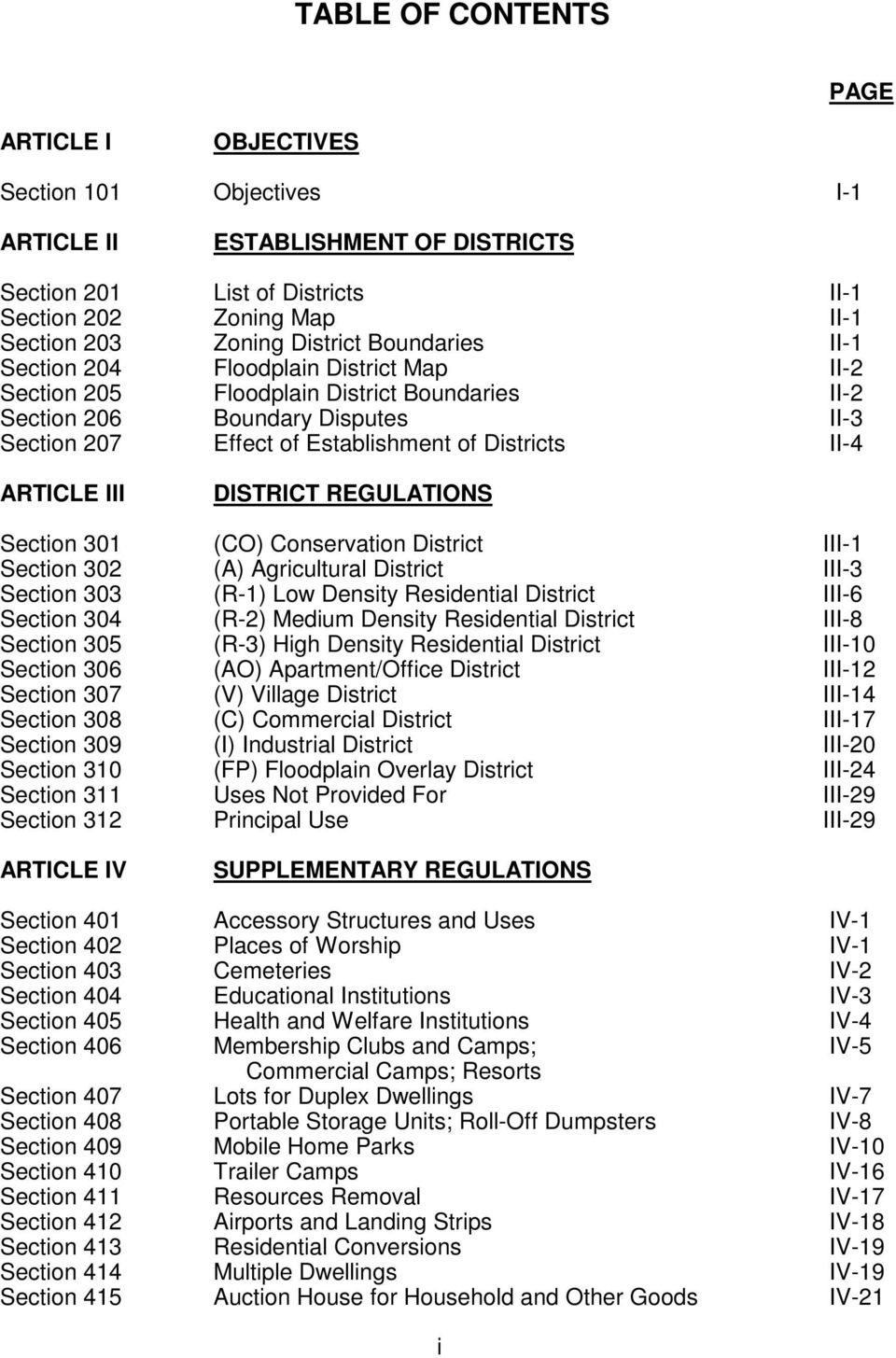
3 TABLE OF CONTENTS PAGE ARTICLE I OBJECTIVES Section 101 Objectives I-1 ARTICLE II ESTABLISHMENT OF DISTRICTS Section 201 List of Districts II-1 Section 202 Zoning Map II-1 Section 203 Zoning District Boundaries II-1 Section 204 Floodplain District Map II-2 Section 205 Floodplain District Boundaries II-2 Section 206 Boundary Disputes II-3 Section 207 Effect of Establishment of Districts II-4 ARTICLE III DISTRICT REGULATIONS Section 301 (CO) Conservation District III-1 Section 302 (A) Agricultural District III-3 Section 303 (R-1) Low Density Residential District III-6 Section 304 (R-2) Medium Density Residential District III-8 Section 305 (R-3) High Density Residential District III-10 Section 306 (AO) Apartment/Office District III-12 Section 307 (V) Village District III-14 Section 308 (C) Commercial District III-17 Section 309 (I) Industrial District III-20 Section 310 (FP) Floodplain Overlay District III-24 Section 311 Uses Not Provided For III-29 Section 312 Principal Use III-29 ARTICLE IV SUPPLEMENTARY REGULATIONS Section 401 Accessory Structures and Uses IV-1 Section 402 Places of Worship IV-1 Section 403 Cemeteries IV-2 Section 404 Educational Institutions IV-3 Section 405 Health and Welfare Institutions IV-4 Section 406 Membership Clubs and Camps; IV-5 Commercial Camps; Resorts Section 407 Lots for Duplex Dwellings IV-7 Section 408 Portable Storage Units; Roll-Off Dumpsters IV-8 Section 409 Mobile Home Parks IV-10 Section 410 Trailer Camps IV-16 Section 411 Resources Removal IV-17 Section 412 Airports and Landing Strips IV-18 Section 413 Residential Conversions IV-19 Section 414 Multiple Dwellings IV-19 Section 415 Auction House for Household and Other Goods IV-21 i
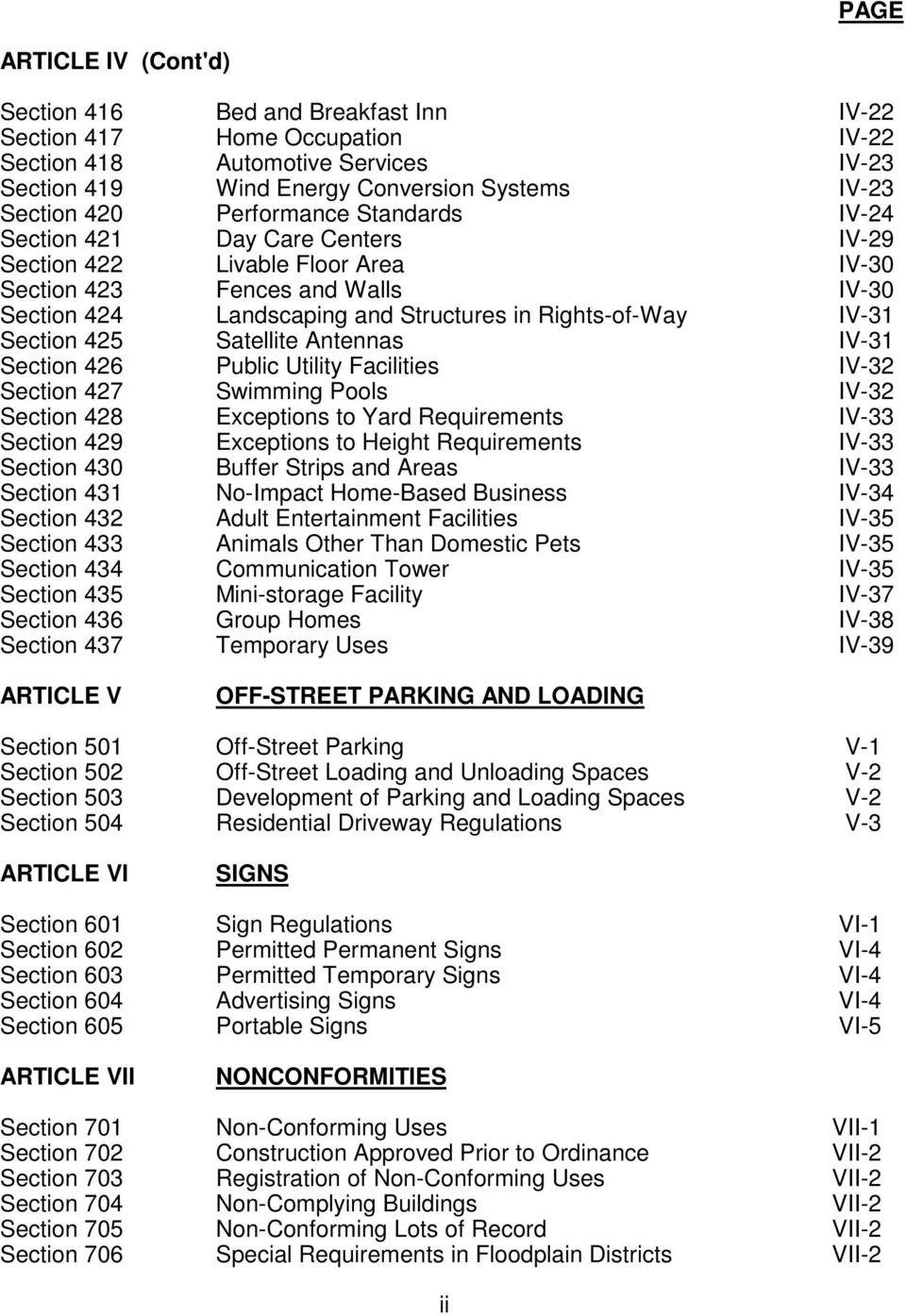
4 PAGE ARTICLE IV (Cont'd) Section 416 Bed and Breakfast Inn IV-22 Section 417 Home Occupation IV-22 Section 418 Automotive Services IV-23 Section 419 Wind Energy Conversion Systems IV-23 Section 420 Performance Standards IV-24 Section 421 Day Care Centers IV-29 Section 422 Livable Floor Area IV-30 Section 423 Fences and Walls IV-30 Section 424 Landscaping and Structures in Rights-of-Way IV-31 Section 425 Satellite Antennas IV-31 Section 426 Public Utility Facilities IV-32 Section 427 Swimming Pools IV-32 Section 428 Exceptions to Yard Requirements IV-33 Section 429 Exceptions to Height Requirements IV-33 Section 430 Buffer Strips and Areas IV-33 Section 431 No-Impact Home-Based Business IV-34 Section 432 Adult Entertainment Facilities IV-35 Section 433 Animals Other Than Domestic Pets IV-35 Section 434 Communication Tower IV-35 Section 435 Mini-storage Facility IV-37 Section 436 Group Homes IV-38 Section 437 Temporary Uses IV-39 ARTICLE V OFF-STREET PARKING AND LOADING Section 501 Off-Street Parking V-1 Section 502 Off-Street Loading and Unloading Spaces V-2 Section 503 Development of Parking and Loading Spaces V-2 Section 504 Residential Driveway Regulations V-3 ARTICLE VI SIGNS Section 601 Sign Regulations VI-1 Section 602 Permitted Permanent Signs VI-4 Section 603 Permitted Temporary Signs VI-4 Section 604 Advertising Signs VI-4 Section 605 Portable Signs VI-5 ARTICLE VII NONCONFORMITIES Section 701 Non-Conforming Uses VII-1 Section 702 Construction Approved Prior to Ordinance VII-2 Section 703 Registration of Non-Conforming Uses VII-2 Section 704 Non-Complying Buildings VII-2 Section 705 Non-Conforming Lots of Record VII-2 Section 706 Special Requirements in Floodplain Districts VII-2 ii
5 ARTICLE VIII ADMINISTRATION AND ENFORCEMENT Section 801 Appointment of Zoning Officer VIII-1 Section 802 Powers and Duties of Zoning Officer VIII-1 Section 803 Land Use Permits VIII-2 Section 804 Development in Floodplain Area VIII-3 Section 805 Certificate of Occupancy or Use VIII-4 Section 806 Fees and Penalties VIII-5 Section 807 Enforcement Remedies VIII-6 Section 808 Power of Amendment VIII-7 Section 809 Procedures for Amendment VIII-7 ARTICLE IX ZONING HEARING BOARD Section 901 Membership of Board IX-1 Section 902 Expenditures for Services IX-2 Section 903 Hearings IX-2 Section 904 Powers and Duties IX-4 Section 905 Term of Approval IX-8 ARTICLE X DEFINITIONS Section 1001 General Interpretation X-1 Section 1002 Rules of Interpretation X-1 Section 1003 Terms Defined X-2 ARTICLE XI LEGAL STATUS PROVISIONS Section 1101 Interpretation XI-1 Section 1102 Separability XI-1 Section 1103 Repealer XI-1 Section 1104 Effective Date and Enactment XI-1 CHART A Permitted Permanent Signs CHART B Permitted Temporary Signs TABLE OF USES ZONING MAP iii

6

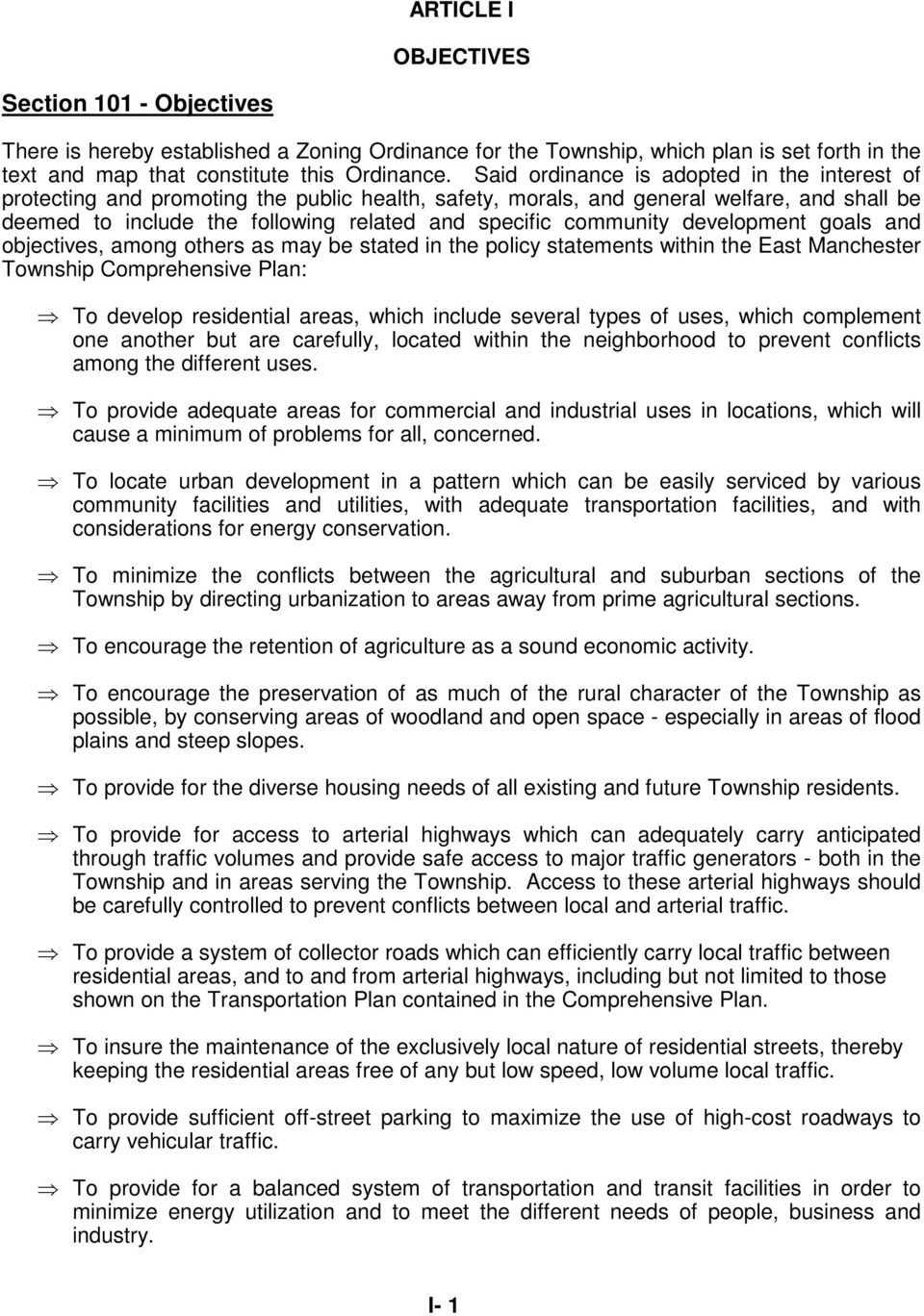
7 ARTICLE I OBJECTIVES Section Objectives There is hereby established a Zoning Ordinance for the Township, which plan is set forth in the text and map that constitute this Ordinance. Said ordinance is adopted in the interest of protecting and promoting the public health, safety, morals, and general welfare, and shall be deemed to include the following related and specific community development goals and objectives, among others as may be stated in the policy statements within the East Manchester Township Comprehensive Plan: To develop residential areas, which include several types of uses, which complement one another but are carefully, located within the neighborhood to prevent conflicts among the different uses. To provide adequate areas for commercial and industrial uses in locations, which will cause a minimum of problems for all, concerned. To locate urban development in a pattern which can be easily serviced by various community facilities and utilities, with adequate transportation facilities, and with considerations for energy conservation. To minimize the conflicts between the agricultural and suburban sections of the Township by directing urbanization to areas away from prime agricultural sections. To encourage the retention of agriculture as a sound economic activity. To encourage the preservation of as much of the rural character of the Township as possible, by conserving areas of woodland and open space - especially in areas of flood plains and steep slopes. To provide for the diverse housing needs of all existing and future Township residents. To provide for access to arterial highways which can adequately carry anticipated through traffic volumes and provide safe access to major traffic generators - both in the Township and in areas serving the Township. Access to these arterial highways should be carefully controlled to prevent conflicts between local and arterial traffic. To provide a system of collector roads which can efficiently carry local traffic between residential areas, and to and from arterial highways, including but not limited to those shown on the Transportation Plan contained in the Comprehensive Plan. To insure the maintenance of the exclusively local nature of residential streets, thereby keeping the residential areas free of any but low speed, low volume local traffic. To provide sufficient off-street parking to maximize the use of high-cost roadways to carry vehicular traffic. To provide for a balanced system of transportation and transit facilities in order to minimize energy utilization and to meet the different needs of people, business and industry. I- 1
8 To preserve adequate open space and recreation areas in the Township to serve the growing needs for leisure time activities, by encouraging partnerships with the School District and other facility owners. To provide adequate fire and police protection facilities and other community facilities and services to assure the welfare and safety of the residents in all parts of the Township. To provide adequate storm water management facilities for the protection and preservation of existing and future water supplies - both surface and subsurface - and the protection of private and public property. I- 2

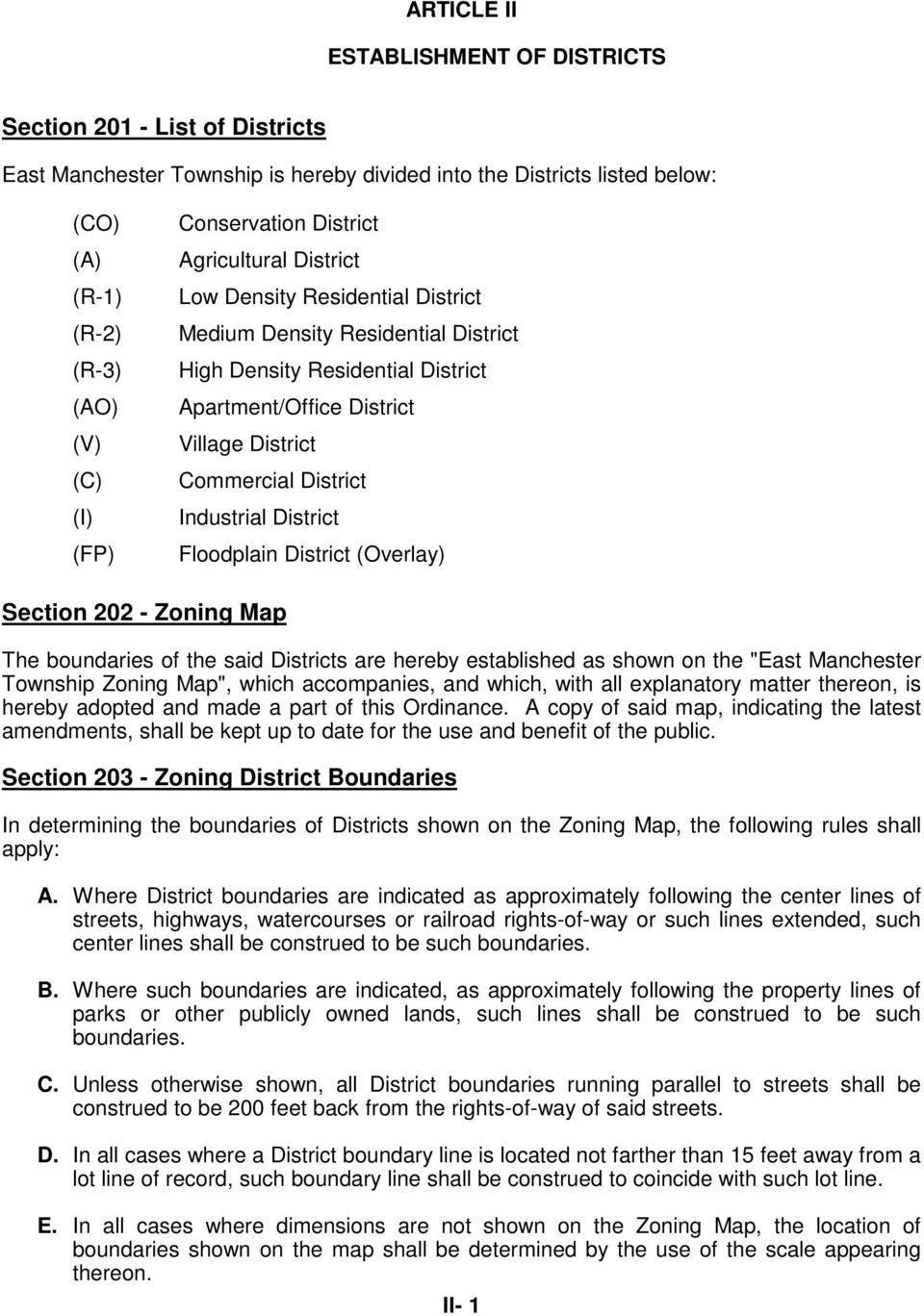
9 ARTICLE II ESTABLISHMENT OF DISTRICTS Section List of Districts East Manchester Township is hereby divided into the Districts listed below: (CO) (A) (R-1) (R-2) (R-3) (AO) (V) (C) (I) (FP) Conservation District Agricultural District Low Density Residential District Medium Density Residential District High Density Residential District Apartment/Office District Village District Commercial District Industrial District Floodplain District (Overlay) Section Zoning Map The boundaries of the said Districts are hereby established as shown on the "East Manchester Township Zoning Map", which accompanies, and which, with all explanatory matter thereon, is hereby adopted and made a part of this Ordinance. A copy of said map, indicating the latest amendments, shall be kept up to date for the use and benefit of the public. Section Zoning District Boundaries In determining the boundaries of Districts shown on the Zoning Map, the following rules shall apply: A. Where District boundaries are indicated as approximately following the center lines of streets, highways, watercourses or railroad rights-of-way or such lines extended, such center lines shall be construed to be such boundaries. B. Where such boundaries are indicated, as approximately following the property lines of parks or other publicly owned lands, such lines shall be construed to be such boundaries. C. Unless otherwise shown, all District boundaries running parallel to streets shall be construed to be 200 feet back from the rights-of-way of said streets. D. In all cases where a District boundary line is located not farther than 15 feet away from a lot line of record, such boundary line shall be construed to coincide with such lot line. E. In all cases where dimensions are not shown on the Zoning Map, the location of boundaries shown on the map shall be determined by the use of the scale appearing thereon. II- 1
10 Section Floodplain District Map The Floodplain District Map shall be deemed an overlay on any Zoning District now or hereafter applicable to any lot. Should the Floodplain District be declared inapplicable to any tract by reason of action of (i) the Board of Supervisors in amending this Ordinance; or (ii) the Zoning Hearing Board or any court of competent jurisdiction in interpreting the same; or (iii) the Zoning Hearing Board of any court of competent jurisdiction in determining the legal effect of the same; the zoning applicable to such lot shall be deemed to be the District in which it is located without consideration of Section 205 which follows. Section Floodplain District Boundaries A. Identification of Floodplain Areas 1) For the purpose of maintaining and keeping in full force and effect the Federal Emergency Management Agency, Federal Insurance Administration, Flood Insurance Program, the areas considered by this Ordinance to be within the (FP) Floodplain District of East Manchester Township shall be those areas identified as being subject to the one hundred (100) year flood in the Flood Insurance Study prepared for the Township of East Manchester, York County, Pennsylvania by the Federal Insurance Administration dated May 19, 1980, or the most recent revision thereof. 2) A map delineating the areas considered to be within the Township's floodplains for the purposes of this Ordinance is available for inspection at the East Manchester Township Municipal Building. Said map is hereby made a part of this Ordinance. For the purposes of this Ordinance, the following nomenclature is used in referring to the various areas within the Township's floodplains. a) FW (Floodway Area) The areas identified as "Floodway" in the Flood Insurance Study prepared by the FIA. The term shall also include floodway areas which have been identified in other available studies or sources of information for those floodplain areas where no floodway has been identified in the Flood Insurance Study. b) FF (Flood-Fringe Area) The areas identified as "Floodway Fringe" in the Flood Insurance Study prepared by the FIA. c) FA (General Floodplain Area) The areas identified as "Approximate 100' Year Floodplain" in the Flood Insurance Study prepared by the FIA. B. Determination of the 100-Year Flood Elevation on FA (General Floodplain) Areas 1) In his determination of the 100-year flood elevation for the general floodplain area, the Zoning Officer shall use the elevation at a given point in the boundary of the identified general floodplain area which is nearest the site in question. In making this determination, the Zoning Officer shall obtain, review and reasonably utilize the information cited in Subsection 205 C) of this Ordinance, available U.S. Corps of Engineers Floodplain Information Reports, U.S. Geological Survey Flood-Prone Quadrangles, known highwater marks from past floods, and data submitted with subdivision proposals and other proposed developments. In addition, information from other Federal, state, and other acceptable sources shall be used to determine a floodway area if possible. II- 2

11 2) Where the complete and definitive flood elevation information necessary to delineate the boundary of the Floodplain District is not available to the Zoning Officer in his consideration of an application for a permit, he shall require such on-site studies and/or surveys to be made as are necessary to fix the precise boundaries of the Floodplain District. Such studies and surveys shall be signed, sealed, and certified by a licensed professional registered by the Commonwealth of Pennsylvania to perform such studies and surveys. Such certification shall acknowledge the accuracy of the study or survey and the qualification of the individual to perform such study or survey. Copies of such studies and surveys shall be submitted by the Zoning Officer to the East Manchester Township Engineer, the United Stated Department of Agriculture's Soil Conservation Service, and the Pennsylvania Department of Community Affairs, who shall have 30 days to comment. Any property owner whose property is so studied and/or surveyed to justify an application for a permit shall pay all costs of these studies and surveys, including the cost of review by the Township Engineer. Section Boundary Disputes A. Zoning District Boundaries In case of uncertainty as to the true location of a Zoning District boundary line in a particular instance, the determination thereof shall be made by the Zoning Hearing Board, as provided in Article VII of this Ordinance. B. Floodplain District Boundaries Should a dispute concerning any boundary of the Floodplain Conservation District arise, the initial determination of the Zoning Officer may be appealed to the Zoning Hearing Board. The burden of proof in such an appeal shall be on the property owner and shall be based on a detailed engineering investigation report using one of the following commonly accepted methods of determining runoff: (1) The Log Pearson III Method (2) Twenty-four Hour Evaluation Hydrograph 1) The width of the (100) year flooding frequency, determined by computing water surface profiles, will be used in determining the revised Floodplain District boundaries. The Log Pearson Type III Method is recommended by the United States Water Resource Council and is currently used by the Department of Army, Corps of Engineers; United States Department of Agriculture, Soil Conservation Service, and the United States Department of Interior, Geological Survey. The United States Department of Agriculture, Soil Conservation Service uses the Twenty-Four Hour Evaluation Hydrograph when there is no available historic gauge data. 2) All changes to the boundaries of any floodplain area which result from a dispute and which affect areas identified in Subsection 205 A.2) of this Ordinance are subject to the review and approval of the Federal Insurance Administrator for compliance with the Rules and Regulations of the National Flood Insurance Program. C. Financial Responsibility II- 3
12 1) The property owner shall pay all costs associated with the hearing before the Zoning Hearing Board, including all costs for advertising public notice, for fees to Zoning Hearing Board members, for fees to the municipal solicitor, and for all stenographic records including the attendance of a stenographer and, when necessary, the transcription of the record. 2) The property owner shall pay all costs associated with any detailed engineering investigation including the cost of review by the Township Engineer. Section Effect of Establishment of Districts A. Zoning Districts Following the effective date of this Ordinance and except as hereinafter provided: 1) No yard or open space required in connection with any building or use shall be considered as providing a required open space for any other building on the same or any other lot. 2) No lot shall be formed from part of a lot already occupied by a building unless such building, all yards and open spaces connected herewith, and the remaining lot comply with all requirements prescribed by this Ordinance for the district in which said lot is located. No building permit shall be issued for the erection of a building on any new lot thus created unless such building and lot comply with all the provisions of this Ordinance. 3) Nothing contained in this Ordinance shall require any change in the plans, construction, or designated use of a building complying with local laws in force prior to this Ordinance, if the following is found to exist: a) A building permit shall have been duly issued prior to the date of first publication of notice of the public hearing on this Ordinance; b) The entire building shall have been constructed in accordance with such plans as have been filed with the Township and shall have been completed within one (1) year from the effective date of this Ordinance. 4) Any use not specifically allowed or prohibited elsewhere in this Ordinance shall be allowed by Special Exception in the zone or zones where, and to the extent that, similar uses are permitted or allowed by Special Exception, provided that such use meets the requirements for a Special Exception and does not constitute a public or private nuisance. 5) Any list of prohibited uses contained in any section of this Ordinance, shall not be deemed to be an exhaustive list but has been included for the purposes of clarity and emphasis, and to illustrate, by example, some of the uses frequently proposed that are deemed undesirable and incompatible and thus prohibited. 6) Except for agricultural operations, which shall be permitted in conjunction with other permitted uses, no more than one (1) principal use shall be permitted per lot. II- 4

13 B. Floodplain Districts The provisions of this Ordinance create an overlay district, which is applicable within floodplains in all other zoning districts established by this Ordinance. To the extent the provisions of the Floodplain District regulations in Article VII of this Ordinance are applicable and more restrictive, they shall supersede conflicting provisions within all other district regulations of this Ordinance and all other ordinances of East Manchester Township. However, all other provisions of all other district regulations of this Ordinance and all other ordinances of the Township shall remain in full force. II- 5

14 Section (CO) Conservation District A. Specific Intent ARTICLE III DISTRICT REGULATIONS In addition to the objectives established in Article I herein, it is the specific intent of these regulations to establish a Conservation District, which will: 1) Preserve environmentally sensitive areas and encourage the retention and proper use of such land. 2) Limit the use of land and activities to those uses and activities, which are related to conservation activity and open space. 3) Prevent the intrusion of development into environmentally sensitive areas. B. Permitted Uses In a Conservation District only the following uses and activities, limited to one (1) per lot, shall be permitted as uses by right: 1) Single family dwellings, limited to one (1) such use and one (1) principal building or structure per lot. 2) No-Impact Home-Based Business. (See Section 431) C. Uses By Special Exception The following uses and activities may be permitted by Special Exception upon approval of the Zoning Hearing Board limited to one (1) such use and one (1) principal building structure, except for subparagraphs 1), 2), and 5): 1) Public buildings and uses. 2) Agricultural operations. 3) Home Occupation. (See Section 417) 4) Communication Tower. (see Section 434) 5) Membership clubs and camps. (see Section 406) 6) Public utility facilities. III-1

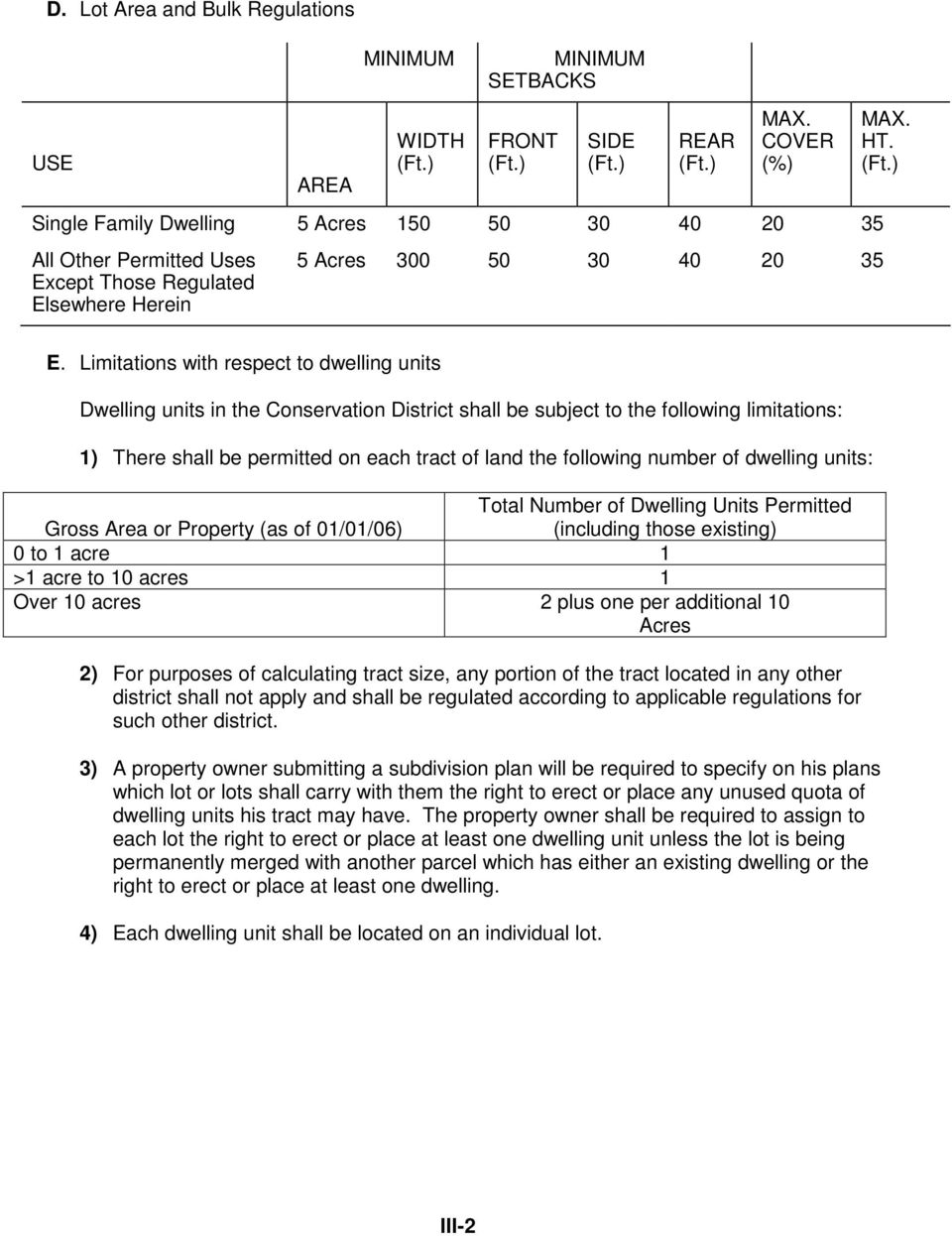
15 D. Lot Area and Bulk Regulations USE AREA MINIMUM WIDTH (Ft.) MINIMUM SETBACKS FRONT (Ft.) SIDE (Ft.) REAR (Ft.) MAX. COVER (%) Single Family Dwelling 5 Acres All Other Permitted Uses Except Those Regulated Elsewhere Herein 5 Acres MAX. HT. (Ft.) E. Limitations with respect to dwelling units Dwelling units in the Conservation District shall be subject to the following limitations: 1) There shall be permitted on each tract of land the following number of dwelling units: Total Number of Dwelling Units Permitted Gross Area or Property (as of 01/01/06) (including those existing) 0 to 1 acre 1 >1 acre to 10 acres 1 Over 10 acres 2 plus one per additional 10 Acres 2) For purposes of calculating tract size, any portion of the tract located in any other district shall not apply and shall be regulated according to applicable regulations for such other district. 3) A property owner submitting a subdivision plan will be required to specify on his plans which lot or lots shall carry with them the right to erect or place any unused quota of dwelling units his tract may have. The property owner shall be required to assign to each lot the right to erect or place at least one dwelling unit unless the lot is being permanently merged with another parcel which has either an existing dwelling or the right to erect or place at least one dwelling. 4) Each dwelling unit shall be located on an individual lot. III-2
16 Section (A) Agricultural District A. Specific Intent In addition to the objectives established in Article I herein, it is the specific intent of these regulations to establish an Agricultural District which will: 1) Preserve areas of prime agricultural capability and encourage the retention and proper use of such land. 2) Limit the use of land and activities to those uses and activities, which are related to agricultural activity. 3) Prevent the intrusion of intensive development into prime agricultural areas. B. Permitted Uses In an (A) Agricultural District only the following uses and activities, limited to one (1) per lot, except for subparagraphs 4) and 5), shall be permitted as uses by right: 1) Single family dwellings. 2) Public buildings and uses. 3) Livestock Auction. 4) Agricultural operations. 5) Kennel or stable. 6) No-Impact Home-Based Business. (See Section 431) C. Uses By Special Exception The following uses and activities shall be permitted by Special Exception upon approval of the Zoning Hearing Board limited to one (1) such use and one (1) principal building or structure per lot, except for subparagraphs 3), 4), 6), 7), 10), 15), and 19): 1) Places of worship. (See Section 402) 2) Cemeteries. (See Section 403) 3) Educational institutions. (See Section 404) 4) Health and Welfare institutions. (See Section 405) 5) Membership clubs; membership and commercial camps; and resorts. (See Section 406) 6) Trailer Camps. (See Section 410) 7) Resources Removal. (See Section 411) III-3
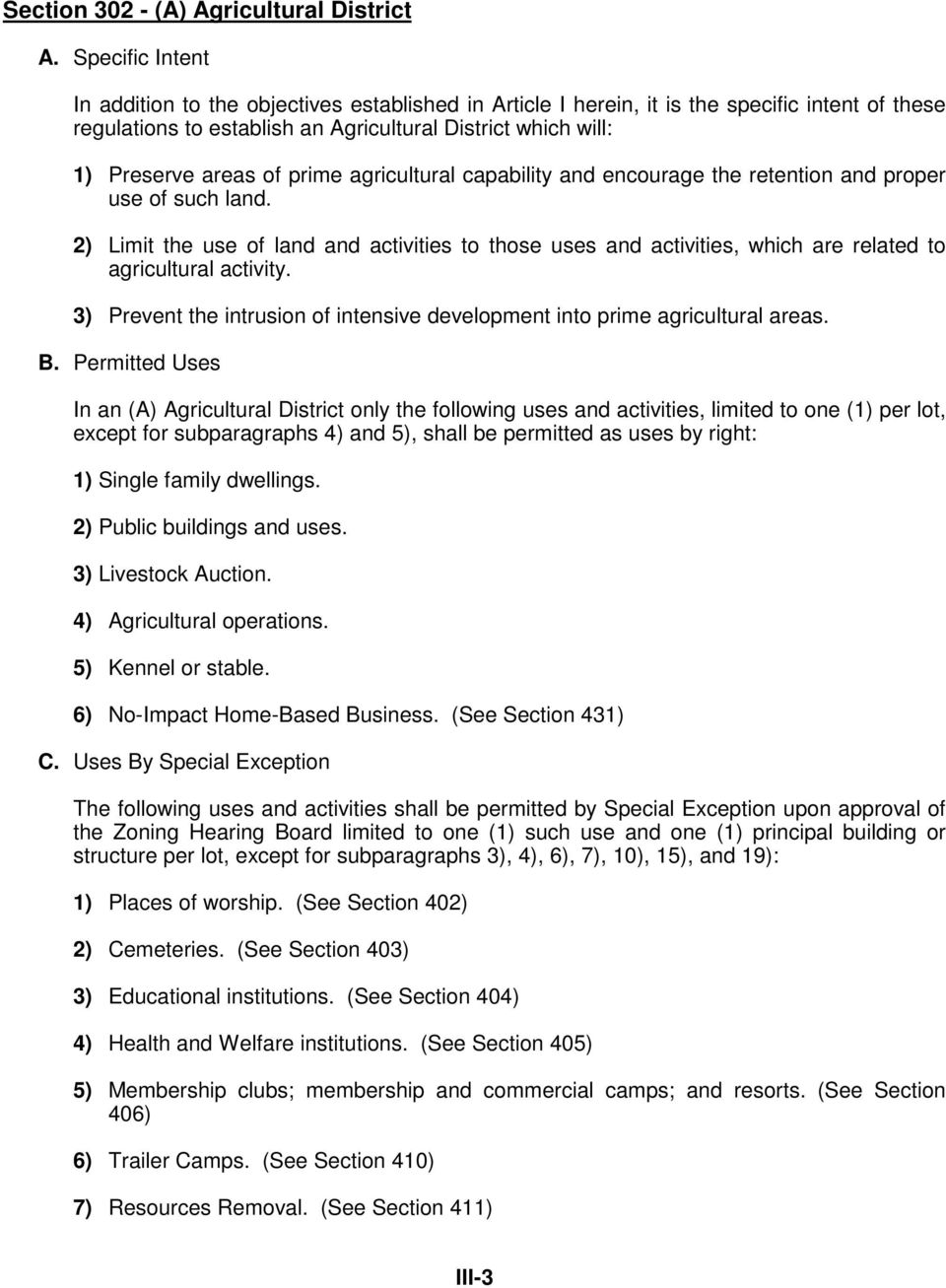
17 8) Airports and landing strips. (See Section 412) 9) Auction house for household and other goods. (See Section 415) 10) Farm equipment sales and service. 11) Lawn and garden equipment and supplies sales and service. 12) Bed and Breakfast Inn. (See Section 416) 13) Wind energy conversion systems. (See Section 419) 14) Commercial pools. (See Section 427) 15) Junk yards. 16) Home Occupation. (See Section 417) 17) Communication Towers. (See Section 434) 18) Public utility facilities 19) Group Home. (see Section 436) D. Lot Area and Bulk Regulations: MINIMUM MINIMUM SETBACKS USE AREA WIDTH (Ft.) FRONT (Ft.) SIDE (Ft.) REAR (Ft.) MAX. COVER (%) MAX. HT. (Ft.) Single Family Dwelling and Group Home with public water and public sewer 2 Acres 1 Acre Public Buildings And Uses 1 Acre All Other Permitted Uses Except Those Regulated Elsewhere Herein 5 Acres III-4
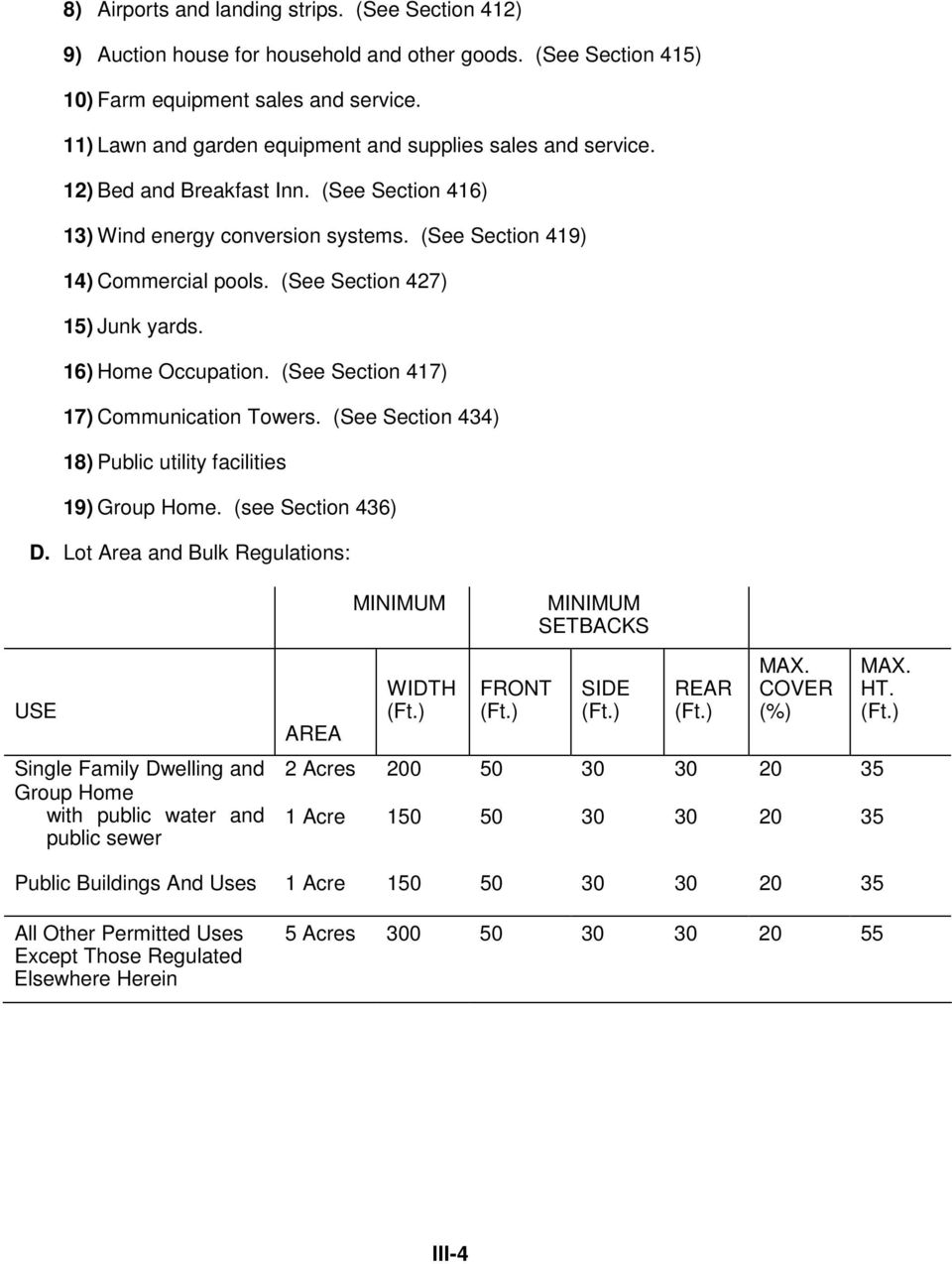
18 E. Limitations with respect to dwelling units Dwelling units in the Agricultural District shall be subject to the following limitations: 1) There shall be permitted on each tract of land the following number of dwelling units: Gross Area or Property (as of 01/01/06) Total Number of Dwelling Units Permitted (including those existing) 0 to 1 acre 1 >1 acre to 10 acres 1 Over 10 acres 2 plus one per additional 10 Acres 2) For purposes of calculating tract size, any portion of the tract located in any other district shall not apply and shall be regulated according to applicable regulations for such other district. 3) A property owner submitting a subdivision plan will be required to specify on his plans which lot or lots shall carry with them the right to erect or place any unused quota of dwelling units his tract may have. The property owner shall be required to assign to each lot the right to erect or place at least one dwelling unit unless the lot is being permanently merged with another parcel which has either an existing dwelling or the right to erect or place at least one dwelling. 4) Each dwelling unit shall be located on an individual lot. III-5

19 Section (R-1) Low Density Residential District A. Specific Intent In addition to the objectives established in Article I herein, it is the specific intent of these regulations to establish districts which will: 1) Encourage the retention of existing agricultural uses. 2) Provide areas for low-density residential uses in locations where on-lot utilities may be feasible or centralized utilities may be available. 3) Retain the rural characteristics of the area to the extent possible. B. Permitted Uses In an (R-1) Low Density Residential District only the following uses and activities, limited to one (1) such use and one (1) principal building or structure per lot except for subparagraph 4), shall be permitted as uses by right: 1) Single family dwellings. 2) Public buildings and uses. 3) Agricultural operations. 4) No-Impact Home-Based Business. (See Section 431) C. Uses By Special Exception The following uses and activities may be permitted by Special Exception upon approval of the Zoning Hearing Board limited to one (1) such use and one (1) principal building or structure per lot, except for subparagraphs 3), 4), 6), 7), 11), and 13): 1) Places of worship. (See Section 402) 2) Cemeteries. (See Section 403) 3) Educational institutions. (See Section 404) 4) Health and Welfare institutions for medical care. (See Section 405) 5) Membership clubs; membership and commercial camps; and resorts. (See Section 406) 6) Trailer Camps. (See Section 410) 7) Resources Removal. (See Section 411) 8) Auction house for household and other goods. (See Section 415) 9) Wind energy conversion systems. (See Section 419) 10) Kennel. III-6
20 11) Commercial pools. (See Section 427) 12) Home Occupation. (See Section 417) 13) Public utility facilities. D. Lot Area and Bulk Regulations: USE Single Family Dwelling With water or sewer With water and sewer All Other Permitted Uses Except Those Regulated Elsewhere Herein AREA 2 Acres 1 Acre 20,000 SF MINIMUM WIDTH (Ft.) FRONT (Ft.) MINIMUM SETBACKS SIDE (Ft.) REAR (Ft.) MAX. COVER (%) MAX. HT. (Ft.) Acres III-7

21 Section (R-2) Medium Density Residential District A. Specific Intent In addition to the objectives established in Article I herein, it is the specific intent of these regulations to establish districts which will: 1) Encourage medium density residential development in areas where centralized utilities are generally available. 2) Encourage planned and serviced residential subdivisions. 3) Provide residential environments which can create good living qualities and which will be in harmony with existing development and least detrimental to natural features and resources. B. Permitted Uses In an (R-2) Medium Density Residential District only the following uses and activities, limited to one (1) such use and one (1) principal building or structure per lot except for subparagraph 4), shall be permitted as uses by right: 1) Single family dwellings. 2) Duplex dwellings. (See Section 407) 3) Boarding or lodging house. 4) Agricultural operations. 5) Group home. (See Section 436) 6) No-Impact Home-Based Business. (See Section 431) 7) Public Buildings and Uses. C. Uses By Special Exception The following uses and activities may be permitted by Special Exception upon approval of the Zoning Hearing Board limited to one (1) such use and one (1) principal building or structure per lot, except for subparagraphs 3), 4), 6), 8), and 9): 1) Places of worship. (See Section 402) 2) Cemeteries. (See Section 403) 3) Educational institutions. (See Section 404) 4) Health and Welfare institutions for medical care. (See Section 405) 5) Membership clubs; membership and commercial camps; and resorts. (See Section 406) III-8
22 6) Bed and Breakfast Inn. (See Section 416) 7) Wind energy conversion systems. (See Section 419) 8) Residential conversion. (See Section 413) 9) Mobile Home parks. (See Section 409) 10) Commercial pools, as defined in Section ) Home Occupation. (See Section 417) 12) Public utility facilities. D. Lot Area and Bulk Regulations: USE MINIMUM Area Width (Ft.) MINIMUM SETBACKS Front (Ft.) Side (Ft.) Rear (Ft.) Max. Cover (%) Single Family Dwelling 1Acre With Water and Sewer 15,000 S.F Max. Ht. (Ft.) Duplex Dwelling 45,000 S.F With Water and Sewer 20,000 S.F Boarding or Lodging House 45,000 S.F With Water and Sewer 20,000 S.F Agricultural Operations 5 Acres 300 N/A N/A N/A 20 N/A Buildings Associated with Agricultural Uses All Other Permitted Uses Except those regulated elsewhere herein N/A N/A N/A 35 45,000 S.F III-9
23 Section (R-3) High Density Residential District A. Specific Intent In addition to the objectives established in Article I herein, it is the specific intent of these regulations to establish districts which will: 1) Encourage high-density residential development in areas where centralized utilities exist, or are to be provided in conjunction with the proposed use. 2) Encourage planned and serviced residential subdivisions. 3) Provide residential environments which can create good living qualities and which will be in harmony with existing development and least detrimental to natural features and resources. B. Permitted Uses In an (R-3) High Density Residential District only the following uses and activities, limited to one (1) such use and one (1) principal building or structure per lot except for subparagraphs 3),4), and 6), shall be permitted as uses by right: 1) Single family dwellings. 2) Duplex dwellings. (See Section 407) 3) Multiple dwelling structures. (See Section 414) 4) Group home. (See Section 436) 5) No-Impact Home-Based Business. (See Section 431) 6) Condominiums. (See Section 414) C. Uses By Special Exception The following uses and activities may be permitted by Special Exception upon approval of the Zoning Hearing Board limited to one (1) such use and one (1) principal structure per lot, except for subparagraphs 2) and 3); 1) Places of worship. (See Section 402) 2) Education institutions. (See Section 404) 3) Home Occupation. (See Section 417) 4) Membership clubs; membership and commercial camps; and resorts. (See Section 406) 5) Public utility facilities. 6) Residential conversion (See Section 413). III-10
24 D. Lot Area and Bulk Regulations: MINIMUM MINIMUM SETBACKS USE AREA WIDTH (Ft.) FRONT (Ft.) SIDE (Ft.) REAR (Ft.) MAX. COVER (%) MAX. HT. (Ft.) Single Family Dwelling 8,000 SF Duplex Dwelling 10,000 SF Multiple Dwelling Structures and Condominiums (See Section 414) All Other Permitted Uses Except Those Regulated Elsewhere Herein 20,000 SF E. Public Utilities All uses authorized by this Section whether permitted or by special exception shall be served by both public sewer and water provided by a public utility, and private septic, sewage disposal, or water or well systems shall be prohibited. III-11
25 Section (AO) Apartment/Office District A. Specific Intent In addition to the objectives established in Article I herein, it is the specific intent of these regulations to establish districts which will: 1) Encourage higher density multi-family townhouse and apartment residential development and planned office developments in areas where centralized utilities are available. 2) Encourage planned and serviced higher density residential subdivisions and mixed office space. 3) Provide residential and office environments which can create good living and working qualities and which will be in harmony with existing development and least detrimental to natural features and resources. B. Permitted Uses In an (AO) Apartment/Office District only the following uses and activities shall be permitted as uses by right; provided, however, that more than one permitted use will be permitted on a lot, if all of the permitted uses on that lot are contained within a single building, which is owned and managed as a total entity with shared customer and employee parking on the site as an integral part of the site plan. Each use permitted pursuant to this section shall be a use that, if standing alone, would be permitted in the zone in which it is proposed: 1) Single family dwellings. 2) Duplex dwellings. (See Section 407) 3) Public buildings and facilities. 4) Boarding or lodging houses. 5) Bed and Breakfast Inn. (See Section 416) 6) Residential conversion. (See Section 413) 7) Multiple dwelling structures (See Section 414) 8) Medical and dental offices. 9) Medical retail and accessory use. 10) Professional services. 11) Day Care Center. (See Section 421) 12) Group home. (See Section 436) 13) No-Impact Home-Based Business. (See Section 431) III-12
26 C. Uses By Special Exception The following uses and activities may be permitted by Special Exception upon approval of the Zoning Hearing Board limited to one (1) such use and one (1) principal structure per lot, except for subparagraphs 3); 4); 5) and 8). Provided, however, that more than one permitted use will be permitted on a lot if all of the permitted uses on that lot are contained within a single building, which is owned and managed as a total entity with shared customer and employee parking on the site as an integral part of the site plan. Each use permitted pursuant to this section shall be a use that, if standing alone, would be permitted in the zone in which it is proposed: 1) Public utility facilities. 2) Hotels, motels, and tourist homes. 3) Education institutions. (See Section 404) 4) Health and Welfare Institutions for medical care. (See Section 405) 5) Commercial pools, as defined in Section ) Home Occupation. (See Section 417) 7) Communication Tower. (See Section 434) 8) Membership clubs; membership and commercial camps; and resorts. (See Section 406) D. Lot Area and Bulk Regulations: MINIMUM MINIMUM SETBACKS USE AREA WIDTH (Ft.) FRONT (Ft.) SIDE (Ft.) REAR (Ft.) MAX. COVER (%) MAX. HT. (Ft.) Single Family Dwelling 8,000 SF Duplex Dwelling 10,000 SF Boarding or Lodging Houses Multiple Dwelling Structures 20,000 SF (See 100 Section ) All Other Permitted Uses Except Those Regulated Elsewhere Herein 20,000 SF III-13
27 Section (V) Village District A. Specific Intent In addition to the objectives established in Article I herein, it is the specific intent of these regulations to establish districts which will: 1) Encourage a mix of residential and commercial development in areas where centralized utilities are available. 2) Encourage planned and serviced mixed residential/commercial subdivisions. 3) Provide mixed residential and commercial environments which can create good living and working qualities and which will be in harmony with existing development and least detrimental to natural features and resources. B. Permitted Uses In a (V) Village District only the following uses and activities, limited to one (1) such use and one (1) principal building or structure per lot, shall be permitted as uses by right; provided, however, that more than one permitted use will be permitted on a lot, if all the permitted uses on that lot are contained within a single building, which is owned and managed as a total entity with shared customer and employee parking on the site as an integral part of the site plan. Each use permitted pursuant to this section shall be a use that, if standing alone, would be permitted in the zone in which it is proposed: 1) Single family dwellings. 2) Duplex dwellings. (See Section 407) 3) Public buildings and uses. 4) Boarding or lodging houses. 5) Retail business. 6) Business services. 7) Personal services. 8) Repair services. 9) Places of worship. 10) Bed and Breakfast Inn 11) Residential conversion. (See Section 413) 12) Multiple dwelling structures. (See Section 414) 13) Medical and dental offices. 14) Medical retail and accessory uses. III-14
28 15) Professional services. 16) Home occupation. 17) Group home. (See Section 436) 18) No-Impact Home-Based Business. (See Section 431) C. Uses By Special Exception The following uses and activities may be permitted by Special Exception upon approval of the Zoning Hearing Board limited to one (1) such use and one (1) principal building or structure per lot, except for subparagraphs 4) and 5); provided, however, that more than one permitted use will be permitted on a lot, if all of the permitted uses on that lot are contained within a single building, which is owned and managed as a total entity with shared customer and employee parking on the site as an integral part of the site plan. Each use permitted pursuant to this section shall be a use that, if standing alone, would be permitted in the zone in which it is proposed: 1) Public utility facilities. 2) Automotive services. (See Section 418) 3) Product processing. 4) Education institutions. (See Section 404) 5) Health and Welfare institutions for medical care. (See Section 405) 6) Day Care Center. (See Section 421) III-15
29 D. Lot Area and Bulk Regulations: MINIMUM MINIMUM SETBACKS USE AREA WIDTH (Ft.) FRONT (Ft.) SIDE (Ft.) REAR (Ft.) MAX. COVER (%) MAX. HT. (Ft.) Single Family Dwelling With Water and Sewer 1 Acre 8,000 SF Duplex Dwelling With Water and Sewer 45,000 SF 10,000 SF Multiple Dwelling Structures 45,000 SF (See 200 Section ) Boarding or Lodging House With Water and Sewer 37,500 SF 20,000 SF All Other Permitted Uses Except Those Regulated Elsewhere Herein 45,000 SF III-16
30 Section (C) Commercial District A. Specific Intent In addition to the objectives established in Article I herein, it is the specific intent of these regulations to establish districts which will: 1) Permit the logical development of land for business which is designed to meet the daily needs of surrounding residential areas. 2) Insure a business environment of sustained desirability. 3) Assure the suitable development of such business so that the surrounding residential development is protected. 4) Avoid increases in traffic volumes which would be in excess of the designed capacities of any access streets. B. Use Standards Uses permitted in the (C) Commercial District shall be subject to the following conditions: 1) All permitted uses and all storage accessories thereto, except for off-street parking and off-street loading, shall be conducted within completely enclosed buildings with the exception of display of products associated with a permanent structure and use. 2) Parking, loading, or service areas used by motor vehicles shall be physically separated from all streets by a suitable barrier (for example, concrete curbing) against unchanneled motor vehicle access or egress. The roads, driveways, parking areas and walks shall be paved and maintained in good condition with hard surface materials. 3) All access roads or driveways shall be located not less than forty (40) feet from the intersection of any street right-of-way lines, and shall be designed in a manner conducive to safe ingress and egress. 4) Buffers and buffer strips shall be required and controlled as set forth in Section ) Additional conditions and safeguards as the Township may impose in order to protect and promote the health and safety and general welfare of the community and the character of the neighborhood in which the proposed use is to be erected. C. Permitted Uses In a (C) Commercial District, no building or premises shall be used, and no building or part of a building shall be erected, which is arranged, intended or designed to be used, in whole or in part, for any purpose except as listed below, which are permitted uses, and all such uses shall be subject to those regulations specified elsewhere in this Ordinance and limited to one (1) such use and one (1) principal building or structure permitted by right per lot provided, however, that more than one permitted use will be permitted on a lot by Special Exception granted by the Zoning Hearing Board or if all of the permitted uses on that lot are contained within a single building, which is owned and managed as a total entity with shared customer and employee parking on the site as an integral part of the site plan. Each III-17
31 use permitted pursuant to this section shall be a use that, if standing alone, would be permitted in the zone in which it is proposed: 1) Public utility facilities. 2) Hotels, motels, and tourist homes. 3) Retail business. 4) Business services. 5) Personal services. 6) Repair services. 7) Automotive services. (See Section 418) 8) Product processing. 9) Places of worship. 10) Commercial recreation facilities. 11) Drive-in type establishments. 12) Service establishments. 13) Equipment sales and service. 14) Wholesaling and storage. 15) Newspaper and printing establishments. 16) Bus and truck terminals. 17) Mortuary and funeral homes. 18) Home occupation. 19) Automobile or truck auction. 20) Day Care Center. (See Section 421) 21) Shopping Center. 22) Restaurant, Food Preparation or Sales Facility. (Subject to Section 431) 23) Communication Tower. (See Section 434) 24) Public Buildings and Uses. 25) Mini-Storage Facility. (See Section 435) III-18
32 D. Prohibited Uses The following uses are expressly prohibited in the (C) Commercial District: 1) Dwellings. 2) All uses that do not meet the requirements of Section 420, entitled Performance Standards. E. Lot Area and Bulk Regulations: MINIMUM MINIMUM SETBACKS USE AREA WIDTH (Ft.) FRONT (Ft.) SIDE (Ft.) REAR (Ft.) MAX. COVER (%) MAX. HT. (Ft.) All Permitted Uses Except Those Regulated Elsewhere Herein 25,000 SF III-19
33 Section (I) Industrial District A. Specific Intent In addition to the objectives established in Article I herein, it is the specific intent of these regulations to establish industrial districts which will: 1) Consolidate the various locations of industrially related land uses which, because of their shipping, storage and other requirements, exert special demands on the Township. 2) Provide locations for industrial uses which are readily accessible to established transportation routes. 3) Reduce negative aesthetic impact on other land uses in the Township. 4) Insure that the land most suitable for industrial activities will be protected from intrusion of non-compatible uses. B. Use Standards Uses permitted in the (I) Industrial District shall be subject to the following conditions: 1) All access roads or driveways shall be located not less than two hundred (200) feet from the intersection of any street right-of-way lines, and shall be designed in a manner conducive to safe ingress and egress. 2) Parking, loading, or service areas used by motor vehicles shall be physically separated from all streets by a suitable barrier (for example concrete curbing) against unchanneled motor vehicle access or egress. The roads, driveways, parking areas and walks shall be paved and maintained in good condition. No parking area shall be located within 35 feet of the front lot line or within 20 feet of a side or rear lot line. 3) Illumination. When lot lines lie within 35 feet of a Residential District boundary or any lot in residential use, any illumination or floodlighting shall be arranged so there will be no glare of lights toward such lot or District boundary line. 4) All permitted uses, except parking and loading areas and public utility structures, shall be conducted within completely enclosed buildings. Outside storage shall be permitted if all of the following conditions are met: a) The items stored outside are not visible from a public street or road; b) All such storage shall be located in the rear yard as defined in this Ordinance (for purposes of this subsection, the definition of Rear Yard in this Ordinance shall be applied as though the building were a dwelling); c) The stored items shall be shielded from view by opaque (including slatted) fencing or other appropriate screening or landscaping as approved by the Board of Supervisors; d) No outside storage shall extend above the height of the fencing (see Section 423.E), and in no event shall such stored materials exceed ten (10) feet in height, or the height of the principal building, whichever is less; III-20
34 e) All outside storage shall be placed on an improved surface suitable to the Township, or as set forth in the East Manchester Township Construction and Material Specifications For Land Development Manual, if addressed therein, which shall include adequate provisions for drainage and capture of any residue from stored items; and f) Such outside storage shall be limited to items directly related to the principal use of the property or building with which the storage is associated. For purposes of this subsection 4), except to the extent that the principal use of the property or building is the processing of waste materials, no waste materials, trash, garbage or other junk as defined in this Zoning Ordinance or in the Code of the Township of East Manchester which are a byproduct of the principal use shall be permitted to be stored pursuant to this subsection 4). Nothing in this subsection 4) shall prevent the placement for collection of such waste materials, trash, garbage or other junk, so long as such items are collected and removed from the property within one (1) week after placement on the property. Any such materials shall remain within the enclosed fence area, shall be placed in containers or, if unable to be so stored, shall be kept neatly in one location within the fenced storage area, in the rear of the building, and shall comply with all of the other requirements of this subsection 4) until removed. 5) Buffers and buffer strips shall be required and controlled as set forth in Section ) Landscaping. The entire lot shall be suitably landscaped (except for those areas which are covered by buildings or surfaced as parking or service areas). All landscaping shall be properly maintained throughout the life of any use on any lot. Existing landscaping, retaining walls, or trees (with a diameter of 8" measured 4-1/2 feet above the base of the trunk) located within 20' of any street line, lot in residential use, or Residential District boundary line, shall not be removed except with the approval of the Township. 6) Parking. Parking and loading spaces may not be developed or constructed within 20 feet of any property line. 7) Sewer and Water. All uses shall be served by both public water and public sewer. C. Permitted Uses In an (I) Industrial District, no building or premises shall be used, and no building or part of a building shall be erected, which is arranged, intended or designed to be used, in whole or in part, for any purpose except those listed below, which are permitted uses, and all such uses shall be subject to those regulations specified elsewhere in this Ordinance and limited to one (1) such use and one (1) principal building or structure per lot provided, however, that more than one permitted use will be permitted on a lot, if all of the permitted uses on that lot are contained within a single building, which is owned and managed as a total entity with shared customer and employee parking on the site as an integral part of the site plan. Each use permitted pursuant to this section shall be a use that, if standing alone, would be permitted in the zone in which it is proposed: III-21
35 1) Resources removal. (See Section 411) 2) Wholesaling and storage. 3) Newspaper and printing establishments. 4) Bus and truck terminals. 5) Manufacturing use. 6) Research and development. 7) Railroad, public utility structures and right-of-way. 8) Retail business for sale of product manufactured or assembled on site. 9) Public Building & uses. 10) Mini-Storage facility. (See Section 435) 11) Public utility facilities. D. Uses By Special Exception The following uses and activities may be permitted by Special Exception upon approval of the Zoning Hearing Board limited to one (1) such use and one (1) principal building or structure per lot, except for subparagraph 2); provided, however, that more than one permitted use will be permitted on a lot, of all of the permitted uses on that lot are contained within a single building, which is owned and managed as a total entity with shared customer and employee parking on the site as an integral part of the site plan. Each use permitted pursuant to his section shall be a use that, if standing alone, would be permitted in the zone in which it is proposed: 1) Automotive services. (See Section 418) 2) Office buildings. 3) Adult Entertainment Facilities. 4) Communications Tower. (See Section 434) 5) Day Care Center. (See Section 421) 6) Home Occupation E. Prohibited Uses The following uses are expressly prohibited in the (I) Industrial District: 1) Dwellings. 2) All uses that do not meet the requirements of Section 420, entitled Performance Standards. III-22
36 F. Lot Area and Bulk Regulations: MINIMUM MINIMUM SETBACKS USE AREA WIDTH (Ft.) FRONT (Ft.) SIDE (Ft.) REAR (Ft.) MAX. COVER (%) MAX. HT. (Ft.) All Permitted Uses Except Those Regulated Elsewhere Herein: 2 Acres * For Lots within 35 feet of the R-l, R-2, R-3, AO, or V Districts, the minimum front, side, and rear setbacks are increased to l00 feet. III-23
37 Section (FP) Floodplain Overlay District A. Specific Intent In addition to the objectives established in Article I herein, it is the specific intent of these regulations to establish overlay districts which will: 1) Protect areas of floodplain subject to a necessary for floodwaters. 2) Protect and encourage the retention of open land uses which will be so located and designed as to constitute a harmonious and appropriate part of the physical development of the Township. 3) Combine with present zoning requirements, certain restrictions made necessary for the floodplains to promote the general health, welfare, and safety of the Township. 4) Prevent the erection of structures in areas unfit for human usage by reason of danger from flooding, unsanitary conditions or other hazard. 5) Minimize danger to public health by protecting the water supply and promoting safe and sanitary drainage. 6) Reduce the financial burdens imposed on the community, its governmental units and its individuals by frequent and periodic floods and overflow of lands. 7) Permit certain uses which can be appropriately located in the floodplain as herein defined and which will not impede the flow of flood waters, or otherwise cause danger to life and property, at or above or below their locations along the floodway. 8) Permit only those uses in the floodplain compatible to the preservation of natural conditions which are conducive to the maintenance of constant rates of water flow throughout the year by (a) withholding rapid water runoff contributing to downstream flooding and (b) providing area for ground water absorption for maintenance of the subsurface water supply. 9) To provide sufficient drainage courses to carry abnormal flows of storm water in periods of heavy precipitation. B. FW (Floodway Area) Within any floodway area, no construction or development shall be allowed that will cause any increase in the one-hundred (100) year flood elevation. 1) Permitted Uses Within any floodway area, the following uses and activities are permitted provided that they are in compliance with the provisions of the underlying district and are not prohibited by any other ordinance, and provided that they do not require structures, fill, or storage materials and equipment: a) Cultivation and harvesting of crops according to recognized soil conservation practices. III-24
38 b) Pasture, grazing land. c) Outdoor plant nursery; orchard. d) Recreation use, such as: park, day camp, picnic grove, golf course, hunting, fishing, boating. e) Forestry, lumbering and reforestation, excluding storage and mill structures. f) Harvesting of any wild crops such as marsh hay, ferns, moss, berries, or wild rice. g) Game farm, fish hatchery, hunting and fishing reserve. h) Wildlife sanctuary, woodland preserves, arboretum. i) Sealed public water supply wells. j) Utility transmission lines, sanitary sewers, sewage pumping stations, and sewage treatment plants. k) Residential front, side and/or rear yards and uses customarily incidental thereto, except that no structures shall be permitted. Inclusion of floodplain lands within the residential lots in order to meet minimum lot area or yard requirements is contingent upon complying with the objectives and standards set forth elsewhere in this Ordinance and with any other pertinent municipal regulations. If such compliance cannot be shown, the land area within the Floodplain District shall not be calculated for purpose of determining lot areas or yard requirements. l) Parking lots where required by the regulations for any other district. m) Front, side, and/or rear yards as required by the regulations for any non-residential district, except that an area so utilized shall not be inconsistent with the objectives and standards set farther elsewhere in this Ordinance and with any other pertinent regulations. 2) Uses Permitted by Special Exception The following uses and activities may be permitted by Special Exception provided that they are in compliance with the provisions of the underlying district, and the requirements of any other ordinance, code or regulation: a) Accessory structures relative to the uses and activities listed above in subsection 1), but not including manufactured homes or any structure intended for human habitation. No construction or development or any kind will be allowed that will cause any increase in the one hundred (100) year flood elevation, and no building permit shall be issued until a permit has been obtained from the Pennsylvania Department of Environmental Protection, or a letter form it stating that no permit is required from that Department. III-25
39 C. FF (Flood-Fringe) and FA (General Floodplain) Areas Within any FF or FA Area, all the uses and activities listed in B.1) and 2) above shall be allowed as permitted uses, provided that they are in compliance with the provisions of the underlying district and the requirements of any other applicable ordinance, code, or regulation. D. Prohibited Uses. The following uses and activities are prohibited anywhere within the Floodplain Overlay District: 1) All residential buildings, including manufactured homes for any purpose. 2) The placement of fill, except where needed to elevate a building, removal of topsoil or damming or relocation of any watercourse. 3) Sanitary landfill, dump, junkyard, outdoor storage of vehicles and/or materials. 4) Commercial and public overnight camping areas. 5) On-site sewage disposal system. 6) Hospitals (public or private). 7) Nursing homes (public or private). 8) Jails or prisons. 9) New manufactured or mobile home parks and manufactured or mobile home subdivisions and substantial improvements thereto. 10) Any new or substantially improved structure that will be used for the production or storage of any of the following materials and substances considered dangerous to human life, or which will be used for any activity requiring the maintenance of a supply (any amount of radioactive substances, or more than 550 gallons or other comparable volume) of any such materials or substances: a) Acetone b) Ammonia c) Benzene d) Calcium carbide e) Carbon disulfide f) Celluloid g) Chlorine h) Hydrochloric acid i) Hydrocyanic acid j) Magnesium k) Nitric acid and oxides of nitrogen l) Petroleum products (gasoline, fuel oil, etc.) m) Phosphorus n) Potassium o) Sodium III-26
40 p) Sulfur and sulfur products q) Pesticides (including insecticides, fungicides, and rodenticides) r) Radioactive substances, insofar as such substances are not otherwise regulated. E. Design and Construction Requirements Development allowed within any floodplain area shall comply with the following: 1) Elevation and Floodproofing Requirements a) Residential Structures - Substantial improvements to existing residential structures shall have the lowest floor (including basement) at least one and one-half (1½) feet above the one hundred (100) year flood elevation. b) Non-residential Structures - Any new construction or substantial improvement of a non-residential structure shall have the lowest floor (including basement) at least one and one-half (1½) feet above the one hundred (100) year flood elevation or be designed and constructed so that the space enclosed by such structure shall remain either completely or essentially dry during any flood up to that height. Any non-residential structure, or part thereof, having a lowest floor which is not elevated to at least one and one-half (1½) feet above the one hundred (100) year flood elevation, shall be floodproofed in a completely or essentially dry manner in accordance with the W1 or W2 space classification standards contained in the publication entitled "Flood-Proofing Regulations" published by the U.S. Army Corps of Engineers (June 1972, as amended March 1992) or with some other equivalent standard. All plans and specifications for such floodproofing shall be accompanied by a statement certified by a registered professional engineer or architect which states that the proposed design and methods of construction are in conformance with the above referenced standards. 2) Space below the lowest floor. a) Fully enclosed space below the lowest floor (including basement) is prohibited. b) Partially enclosed space below the lowest floor (including basement) which will be used solely for the parking of a vehicle, building access, or incidental storage in an area other than a basement, shall be designed and constructed to allow for the automatic entry and exit of floodwaters for the purpose of equalizing hydrostatic forces on exterior walls. The term "partially enclosed space" also includes crawl spaces. Designs for meeting this requirement must either be certified by a registered professional engineer or architect, or meet or exceed the following minimum criteria: i. A minimum of two permanent openings having a net total area of not less than one (1) square inch for every square foot of enclosed space. ii. The bottom of all openings shall be no higher than one (1) foot above grade. iii. Openings may be equipped with screens, louvers, or other coverings or devices, provided that they permit the automatic entry and exit of floodwaters. III-27
41 3) Accessory Structures Structures accessory to a principal building need not be elevated or floodproofed to remain dry, but shall comply, at a minimum, with the following requirements: a) The structure shall not be designed or used for human habitation, but shall be limited to the parking of vehicles, or to the storage of tools, material, and equipment, related to the principal use or activity. b) Floor area shall not exceed 600 square feet. c) The structure will have a low damage potential. d) The structure will be located on the site so as to cause the least obstruction to the flow of floodwaters. e) Power lines, wiring, and outlets will be at least one and one-half (1½) feet above the one-hundred (100) year flood elevation. f) Permanently affixed utility equipment and appliances including but not limited to furnaces, heaters, washers, dryers, are prohibited. g) Sanitary facilities are prohibited. h) The structure shall be adequately anchored to prevent flotation or movement and shall be designed to automatically provide for the entry and exit of floodwaters for the purpose of equalizing hydrostatic forces on the walls. Designs for meeting this requirement must either be certified by a registered professional engineer or architect, or meet or exceed the following minimum criteria: i. A minimum of two openings having a net total area of not less than one (1) square inch for every square foot of enclosed space. ii. The bottom of all openings shall be no higher than one (1) foot above grade. iii. Openings may be equipped with screens, louvers, or other coverings or devices, provided that they permit the automatic entry and exit of floodwaters. 4) Water and Sanitary Sewer Facilities and Systems a) All new or replacement public water and sanitary sewer facilities and systems shall be located, designed and constructed to minimize or eliminate flood damages and the infiltration of floodwaters. b) Sanitary sewer facilities and systems shall be designed to prevent the discharge of untreated sewage into floodwaters. c) No part of any on-site sewage system shall be located within any identified floodplain area except in strict compliance with all state and local regulations for such systems. If any such system is permitted, it shall be located so as to avoid impairment to it, or contamination from it, during a flood. III-28
42 5) Other Utilities All other utilities such as gas lines, electrical and telephone systems shall be located, elevated (where possible) and constructed to minimize the chance of impairment during a flood. 6) Placement of Buildings and Structures All buildings and structures shall be designed, located, and constructed so as to offer the minimum obstruction to the flow of water and shall be designed to have a minimum effect upon the flow and height of flood water. 7) Anchoring a) All buildings and structure shall be firmly anchored in accordance with accepted engineering practices to prevent flotation, collapse, or lateral movement. b) All air ducts, large pipes, storage tanks, and other similar objects or components located below the regulatory Flood Elevation shall be securely anchored or affixed to prevent flotation. F. Municipal Liability The granting of a building permit or approval of a subdivision plan in any floodplain district shall not constitute a representation, guarantee or warranty of any kind by East Manchester Township, or by any official or employee thereof, of the practicability or safety of any structure, use or other plan proposed, and shall create no liability upon, or a cause of action against, such public body, official or employee for any damage that may result pursuant thereto. G. Warning and Disclaimer of Liability 1) The degree of flood protection sought by the provisions of this Ordinance is considered reasonable for regulatory purposes and is based on acceptable engineering methods of study. Larger floods covering areas in excess of those mapped for this Ordinance may occur on rare occasions. Flood heights may be increased by man-made or natural causes, such as ice jams and bridge openings restricted by debris. This ordinance does not imply that areas outside any identified floodplain area, or that land uses permitted within such areas will be free from flooding or flood damages. Section Uses Not Provided For A. Any use not specifically allowed elsewhere in this Ordinance shall be allowed by special exception in the district or districts where, and to the extent that, similar uses are permitted or allowed by special exception provided that said use meets the requirements for a special exception and does not constitute a public or private nuisance. Section Principal Use A. Unless allowed otherwise herein or approved by a variance granted by the Zoning Hearing Board, there is allowed on each individually platted lot one principal use. III-29
43 ARTICLE IV SUPPLEMENTARY REGULATIONS Section Accessory Structures and Uses Accessory structures are permitted in all districts. Accessory structures may be "pre-fabricated" and/or "pre-built", except that the unit/structure shall not have been built and titled under the Pennsylvania Motor Code, Commonwealth of Pennsylvania. All accessory structures shall conform with the minimum yard regulations established in the zoning districts, except as permitted below. See Section 408 for additional provisions relating to portable storage units and roll-off dumpsters. A. Unattached Structures Accessory to Residential Buildings: Structures accessory to residential buildings which are not attached to a principal structure shall not be higher than fifteen feet or one and a half stories and may be erected within the required rear or side yard of a principal structure provided that they conform with the following: 1. Distance from Side Lot Line: Not less than ten (10) feet from the side lot line. 2. Distance from Rear Lot Line: Not less than ten (10) feet from the rear lot line. 3. Coverage of Rear Yard: Not more than 30 percent of the required rear yard. B. Unattached structures Accessory to Non-Residential Buildings: Such accessory structures shall comply with front and side yard requirements for the principal structure and shall have a minimum rear yard of at least twenty feet. C. Attached Structures Accessory To Residential Buildings: Un-enclosed structures accessory to residential buildings which are attached to a principal structure may project into required setbacks as follows: 1. Uncovered stairs and landings to the main floor, canopies, eaves, porches, decks, patios, awnings, or other architectural features not required for structural support, may project into the front setback by not more than four feet, and into the required side and rear setbacks up to fifteen feet, but in no event closer than ten feet to a side lot line or fifteen feet to a rear lot line. 2. Fire escapes and uncovered stairs and landings providing access to or from levels above or below the main level of a residential structure may project into the required side or rear setback not more than three feet, but shall not be permitted in the front yard. Section Places of Worship A. Permitted Uses 1) Places of worship including churches, synagogues, temples, chapels, and halls. 2) Religious education building but not parochial schools. 3) Recreation buildings when accessory to worship activity. IV- 1
44 4) Residences when related to worship activity, such as parish house, monastery, or convent. B. Area and Bulk Regulations 1) The minimum lot size shall be one (1) acre; however, if the sanctuary shall have space for more than 500 persons one (1) additional acre shall be required for each additional 100 persons or portion thereof. 2) The minimum front, side and rear yards shall be 50 feet. 3) The maximum lot coverage (principal and accessory buildings) shall be 20 percent. 4) The minimum open area shall be 30 percent. 5) The maximum building height shall be 3 stories, not to exceed 45 feet, except that steeples, towers, domes and similar architectural features may exceed this maximum by one foot in height for each two feet the building is set back from the street or front property line. C. Parking Requirements 1) Assembly halls and/or areas One (1) space per 200 sq. ft. of floor space or one (1) space per five (5) seats, whichever is greater. 2) Parish house and/or Two (2) spaces. similar place or residence 3) Convents and similar uses One (1) space for every two (2) residents. Section Cemeteries A. Permitted Uses 1) Cemeteries 2) Mausoleums 3) Crematories 4) Caretaker Residence 5) Chapels B. Area and Bulk Regulations All area and bulk regulations of the prevailing zoning district shall apply with the following exceptions: 1) The minimum size of a cemetery created after the effective date of this ordinance shall be (5) acres. 2) The minimum front, side and rear yards shall be 100 feet. IV- 2
45 3) The maximum lot coverage (building, driveways, parking areas and other paved surfaces) shall be 10 percent. C. Parking Requirements 1) Places of assembly One( 1) space per 200 sq. ft. of floor space or one (1) space per five (5) seats, whichever is greater. 2) Caretaker residence Two (2) spaces. 3) Employees One (1) space per employee. D. Additional Requirements 1) Landscaping shall be required and set in place according to a plan approved by the Planning Commission. 2) A suitably screened or landscaped buffer zone at least fifteen (15) feet wide, which buffer strips shall be set back fifteen (15) feet from the property line, shall be provided by the owner along all the property and street boundary lines separating the use from adjacent districts. Screen planting shall be such that will reasonably be expected to reach a height of five (5) feet in three (3) years and a minimum height of ten (10) feet in eight (8) years, and shall be planted in a pattern and proximity which shall block visibility, glare, noise, fumes, dust, and other harmful effects, within five (5) years. Said screen planting shall be properly maintained by the owner, including maintenance and trimming to avoid and prevent the blocking of visibility for traffic clear sights. 3) No grave markers shall be set above finished grade. 4) No parking area shall be located within the required front, side or rear yards. Section Educational Institutions A. Permitted Uses 1) Public Schools 2) Parochial Schools 3) Private Non-Profit Schools 4) Colleges and Universities B. Area and Bulk Regulations All area and bulk regulations of the prevailing zoning district shall apply with the following exceptions: 1) The minimum lot size shall be based upon the following standards for school sites: a) Elementary - 10 acres b) Junior High - 20 acres c) Senior High - 35 acres d) Colleges and Universities - 35 acres IV- 3
46 2) In addition to the above acreage, there shall be provided one acre of land for each 100 students. 3) The minimum front, side and rear setback line shall be 100 feet each. 4) The maximum lot coverage (principal and accessory buildings) shall be 20 percent. C. Parking Requirements 1) Elementary Schools Two (2) spaces per classroom plus one space for each five (5) seats in any auditorium or other place of assembly. 2) Junior High or Middle School Four (4) spaces per classroom plus one space for each five (5) seats in any auditorium or other place of assembly. 3) Senior High School, Eight (8) spaces per classroom plus one College and University (1) space for each five (5) seats in any auditorium or other place of assembly. D. Additional Requirements 1) Each site shall be landscaped in accordance with a plan approved by the Township. 2) A suitably screened or landscaped buffer zone at least fifteen (15) feet wide, which buffer strips shall be set back fifteen (15) feet from the property line, shall be provided by the owner along all the property and street boundary lines separating the use from adjacent districts. Screen planting shall be such that will reasonably be expected to reach a height of five (5) feet in three (3) years and a minimum height of ten (10) feet in eight (8) years, and shall be planted in a pattern and proximity which shall block visibility, glare, noise, fumes, dust, and other harmful effects, within five (5) years. Said screen planting shall be properly maintained by the owner, including maintenance and trimming to avoid and prevent the blocking of visibility for traffic clear sights. 3) No parking area shall be permitted within the required front, side or rear setbacks. 4) Each site shall be easily accessible from an improved street or highway with safe ingress and egress for both vehicular and pedestrian traffic. 5) Each site shall be economically accessible to essential public utilities. 6) All play areas contiguous to any developed lot shall be fenced. Section Health and Welfare Institutions A. Permitted Uses 1) Philanthropic, charitable or religious institutions. 2) Hospitals. 3) Nursing and convalescent homes. 4) Sanitarium for general medical care. 5) Assisted Living Facility. IV- 4
47 B. Area and Bulk Regulations All area and bulk regulations of the prevailing zoning district shall apply with the following exceptions: 1) The minimum lot area shall be 5 acres or 800 sq. ft. per patient bed, whichever is greater. 2) The minimum front, side and rear setback lines shall be 100 feet each. 3) The maximum lot coverage (principal and accessory buildings) shall be 20 percent. 4) The maximum building height shall be 3 stories, not to exceed 45 feet. C. Parking Requirements One (1) space per three (3) patient beds plus one (1) space for each employee. D. Additional Requirements 1) Each site shall be landscaped in accordance with a plan approved by the Planning Commission. 2) No parking area shall be located within the setback areas. 3) Sufficient exterior nighttime illumination of the parking area shall be required to provide convenience and safety. All such illumination shall be shielded from view of all surrounding streets and lots. 4) All buildings shall be of fire-proof construction. 5) All permitted uses shall be served by adequate water and sewer systems. Section Membership Clubs and Camps; Commercial Camps; Resorts A. Membership Clubs and Camps 1) The following uses shall be permitted: B. Commercial Camps a) Membership clubs and camps. b) Outdoor recreations facilities such as private playgrounds; golf clubs; swimming pools; tennis courts and similar facilities. c) A combination of the above, so long as all such uses are on a single tract of land or contiguous tracts of land held in the same ownership, and are managed as a single facility. 1) Commercial camps shall include and permit an office and a lobby, and may include a permit by way of example such accessory uses as restaurants, coffee shops, gift shops, news stands, conference and meeting rooms, cafeteria dining halls providing food and drink, amusement and recreation facilities such as a swimming pool, IV- 5
48 C. Resorts playground, tennis or other game sports, game or recreation rooms, and spas and related facilities. 1) Resorts shall include such accessory uses and may include and permit by way of example such accessory uses as conference and meeting rooms, restaurants, coffee and gift amusement and recreation facilities such as a swimming pool, playground, tennis or other game sports, game or recreation rooms, and spas and related facilities. D. Use, Area, and Bulk Regulations 1) The uses authorized subsections A. through C. of this Section shall be permitted in combination with each other, so long as they are all located on a tract of land or contiguous tracts of land held in the same ownership, and are managed as a single facility. 2) In no case shall the uses authorized herein be developed on prime agricultural soils. 3) All area and bulk regulations of the prevailing zoning district shall apply, with the following exceptions: a) The minimum lot area shall be ten (10) acres. b) The minimum front, side, and rear setback lines shall be 300 feet each. All buildings and impermeable structures (including, but not limited to, parking areas, tennis or basketball courts, concrete or macadam camping pads, driveways, and the like) shall cover a total of not more than thirty-five (35) percent of the site. E. Supplemental Regulations 1) The use of public address systems shall be limited so that the sound of the public address system shall not be audible to the human ear beyond the boundaries of the site. 2) Exterior lighting shall be shielded so that it does not shine beyond the 3) Buffer strips shall be provided as required in Section 430, except that buffer strips or areas can be waived at the discretion of the Zoning Hearing Board where, in the Zoning Hearing Board s judgment the proposed use immediately adjacent to its neighboring use is such that the proposed use itself will provide a natural buffer (for example, in certain instances, a golf course). F. Parking 1) Vehicular ingress and egress shall be limited to two (2) on any street. 2) For membership clubs, one (1) parking space shall be provided for every two (2) members or two (2) accommodations (such as lockers), whichever is greater, or, in IV- 6
49 the case of a membership golf course, four (4) spaces for each golf hole, whichever is greater. Additionally, one (1) space shall be provided for each employee. 3) For all other golf courses, four (4) spaces shall be provided for each golf hole. Additionally, one (1) space shall be provided for each employee. 4) For membership or commercial camps, two (2) parking spaces for every campsite or pad, at least one (1) of which shall be located on each campsite or pad, and one (1) parking space for each individual room, or one (1) parking space for each two dormitory beds, as well and one (1) space for each employee. 5) For resorts, one (1) parking space for each resort unit, located within 300 feet of the resort unit which it serves, as well as one (1) space for each employee. 6) For restaurants, coffee shops, or cafeterias, one (1) parking space for each 100 square feet of floor are devoted to patron use, as well as one (1) space for each employee. 7) For conference or meeting rooms, one (1) parking space for every fifty (50) square feet of floor area designated for conference or meeting rooms. 8) All parking required under this subsection shall conform to the requirements of Article V, except that, to the extent of a conflict between this subsection F, and Section 501.E., this section shall control. Additionally, all uses permitted in this section for which specific parking regulations have not been set forth in this subsection F, shall be controlled by Section 501.E. 9) All off-street parking areas shall be at least thirty (30) feet from all property lines. 10) When multiple uses are proposed, the proposed parking shall meet the combined minimum requirements for all proposed uses. 11) Before the issuance of any building permit by the Township, a detailed land development plan for the proposed development shall be submitted to, and approved by, the Township, as provided in East Manchester Township Subdivision and Land Development Ordinance. In addition to the requirements of that Ordinance, the plan shall identify the location and size of existing trees, all other landscaping proposed, detailed plans for any signs, as well as elevations, drawings or perspectives of the proposed structures. Section 407 Lots for Duplex Dwellings Where it is desired to have each dwelling unit of a duplex dwelling located on a separate lot, the following modifications shall apply: A. The area and width of each lot shall be equal to or greater than one-half (1/2) the minimum lot area and lot width requirements of the zone in which the duplex dwelling is to be located. B. Each lot shall be required to have one (1) side yard, with the exception of a corner lot which shall be considered two (2) front yards for the lot which borders both streets. The side yard shall meet the minimum setback requirements of the zone in which the duplex dwelling is to be located. IV- 7
50 Section 408 Portable Storage Unit, Roll-off Dumpsters A. It shall be a violation of this Section and Ordinance for any person, partnership, corporation, or any other entity to place or permit the placement of a portable storage unit or a roll-off dumpster on any property which he, she, it, or they own, rent, occupy, or control, or anyone acting as their agent or on their behalf to place or permit the placement of a portable storage unit or roll-off dumpster, without first obtaining a permit from the Zoning Officer. B. There shall be no more than one (1) portable storage unit or roll-off dumpster per lot. C. A portable storage unit or roll-off dumpster shall be no larger than eight feet (8 ) wide, sixteen feet (16 ) long and eight feet (8 ) high. D. No portable storage unit or roll-off dumpster shall remain on any lot for more than thirty (30) consecutive days, or more than sixty (60) days in any calendar year, subject to the provisions of subsections (E), (F), and (I) of this Section. E. Notwithstanding the provisions of subsection (D) of this Section, up to two (2) portable storage units or roll-off dumpsters shall be permitted during construction, reconstruction, alteration, renovation, or demolition of a structure and for an additional three (3) days before commencement and after completion of such activity. No use certificate as required by Ordinance, or occupancy permit as required by the East Manchester Township Building Code or any other Ordinances of the Township, shall be issued until all portable storage units and roll-off dumpsters have been removed from the premises. F. A portable storage unit (but not a roll-off dumpster) may be placed on a lot during an emergency situation when declared by the appropriate federal, state, county, or Township agency. In such event, the portable storage unit may be placed on the property without a permit, but a permit shall be obtained within seven (7) days after the placement of the unit. The portable storage unit shall be removed from the lot within seven (7) days after the end of the declaration of emergency. G. Portable storage units or roll-off dumpster shall be placed only within the yards of a principal structure provided they conform with the setback requirements for accessory structures contained in Section 401. The Zoning Officer may permit the placement of a portable storage unit or roll-off dumpster within the front yard or on the berm or shoulder of a public street only if he or she determines, in his or her sole judgment, that all of the following conditions exist: i) A portable storage unit or roll-off dumpster cannot reasonably or safely be placed in the side or rear yard of the lot off of the public street; ii) iii) Placement of the portable storage unit or roll-off dumpster will not impede the safe and uninterrupted flow of vehicular traffic on the public street; and Placement of the portable storage unit or roll-off dumpster will not cause damage to any portion of the public street, including the berm or IV- 8
51 shoulder, and/or that sufficient provisions are made to prevent such damage, or the owner or party placing it provides sufficient security to repair any damage caused by it. H. Application for a permit shall be made to the Zoning Officer on a form provided by the Township. The Zoning Officer shall determine the most appropriate location for the portable storage unit or roll-off dumpster on the lot, or, alternatively, within the front yard or on the public street pursuant to subsection (G). The permit shall be posted in plain view on the lot, and shall contain at a minimum the following information: i) The names, addresses, and telephone numbers of all owners of the lot; ii) iii) iv) The address of the property on which the personal storage unit or roll-off dumpster is to be placed; The name, address, and telephone number of the company placing the personal storage unit or roll-off dumpster; A drawing or diagram showing the authorized location of the portable storage unit or roll-off dumpster; and v) The date the permit was issued and the date it expires. I. The Zoning Officer is hereby authorized to extend any permit issued pursuant to this Section upon written request of the owner of the lot for one (1) additional term equal to the original permit, so long as, at the time of such extension, no violation of this Section or this Ordinance, or any other Ordinances of the Township, exists. J. All portable storage units or roll-off dumpsters shall be removed upon expiration of the permit, without exception. K. The Township shall establish fees for permits issued pursuant to this Section from time to time by Resolution. L. Notwithstanding the provisions of this Section, if the Commonwealth of Pennsylvania at any time has or places restrictions on state roads or highways over which it has jurisdiction which are more restrictive than the requirements of this Section, then the more restrictive regulations shall apply. Further, notwithstanding the issuance of a permit pursuant to this Section, if the Commonwealth of Pennsylvania notifies an owner of a lot that the owner is in violation of state standards, then such notification shall take precedence over and supersede any permits issued by the Zoning Officer, and such permits shall be considered automatically rescinded and void in the event of such notification. M. In addition to the remedies for violations set forth in this Ordinance, the Township shall have the right to pursue any and all other remedies available to it either at law or in equity. Further, in addition to the provisions of violations and penalties in this Ordinance, in the event that the Township determines that any violation of this Section creates an obstruction or nuisance to the public streets, or otherwise affects the health, safety, or welfare of the traveling or general public, the Township may take such actions as are authorized by the Second IV- 9
52 Class Township Code and the General Road Law, including the immediate removal of any obstructions or nuisances at the expense of the owners of the lot. Section Mobile Home Parks The Zoning Hearing Board may approve Mobile Home Parks by Special Exception in designated districts according to the procedures and requirements specified below. The purpose of such development is to provide flexibility in the design and development of land in such a way as to promote the most appropriate use of land to facilitate the adequate and economical qualities of open space, provided that such use will not create a traffic hazard or otherwise impair the value, health, welfare, or convenience of the surrounding neighborhood or prospective occupants. A. Procedure No person, firm or corporation shall construct, maintain, or operate a Mobile Home Park within the Township without obtaining a building permit and subsequently a certificate of occupancy. 1) Prior to the issuance of a building permit in a Mobile Home Park, a Land Development Plan shall be submitted to and approved by the Township, in accordance with the Township Subdivision and Land Development Ordinance and the following conditions: a) Said Land Development Plan shall include areas within which mobile homes may be located, the spacing of mobile homes, open spaces and their landscaping, off-street parking spaces, and streets, driveways, utilities, watercourses, and any other physical features relevant to the proposed plan, and b) Prior to final Land Development Plan approval, the developer shall file with the Township Supervisors a performance guarantee to insure the proper installation of all street, utility, and recreation improvements shown on the Site Plan, and may be required to file a maintenance guarantee to insure the proper maintenance of all such facilities. The amount and period of said guarantees shall be in accordance with Section 509 of the Municipalities Planning Code and the form, sufficiency, manner of execution, and surety shall be approved by the Township Supervisors. 2) The Township may inspect each Mobile Home Park prior to granting a Certificate for conformance with the provisions of this Ordinance and any other applicable regulations. a) It shall be incumbent upon the proprietor of a Mobile Home Park to keep a register and to report therein the name of the person or head of family occupying each said mobile home, showing date of entry on said land, license number of automobile, serial number, and make and size of trailer, the last permanent address of the person or head of family using said mobile home, and the names of all persons using or living in said mobile home. IV- 10
53 b) Said register and Mobile Home Park shall be subject to inspection periodically by the Township. 3) Nothing contained in this Ordinance shall relieve the owner or his agent, or the developer of a proposed Mobile Home Park from receiving Subdivision or Land Development Plan approval in accordance with the Township Subdivision and Land Development Ordinance. B. Park Site The park site shall be well drained and have such grades and soil as to make it suitable for the purpose intended. All such parks shall be planned as a unit and shall be located on a tract of land at least ten (10) acres in size. The area of said site shall be in single ownership or under unified control. C. Lot Requirements All lots in any Mobile Home Park shall be well drained and graded to a point where Mobile Homes may be parked so that the parking of the same shall result in safety to all concerned. In all instances as much natural vegetation as is reasonably possible shall be preserved by any Mobile Home Park developer. All lots shall conform to all minimum common regulations for single family residences in the District in which the Mobile Home Park is located. 1) Individual mobile home lots located in a Mobile Home Park shall contain at least 10,000 square feet of lot area and shall not be less than 80 feet wide at the building setback line exclusive of the easement. 2) The maximum number of mobile home lots that may be approved in a Mobile Home Park shall be computed by subtracting from the total gross area of the tract the total gross area utilized for streets and sidewalks and a fixed percentage of 15% of said area for usable open space and dividing the remaining area by 10,000 square feet. 3) In computing the maximum number of mobile home lots that may be created, lands which are located within a floodplain area, which are subject to either periodic flooding or occasional chronic wetness, which are occupied by public utility easements, or which have a slope in excess of 25% in such a manner as to limit their use or prevent their development shall not be considered part of the total gross area. 4) All mobile home lots shall be given street numbers and all park streets shall be given names. D. Yard and Setback Requirements 1) All mobile homes shall be located at least seventy-five (75) feet from any street right-of-way which abuts a Mobile Home Park boundary and at least one hundred (100) feet from any other park boundary line. IV- 11
54 2) There shall be a minimum distance of twenty-five (25) feet between an individual mobile home and adjoining pavement of a park street, or common parking area, or other common areas. 3) All mobile homes shall be separated from each other and from other buildings by at least twenty (20) feet. E. Park Street System 1) Park Access. Access to Mobile Home Parks shall be designed to minimize congestion and hazards at the entrance or exit and allow free movement of traffic on adjacent streets. Each Mobile Home Park shall be provided with at least two (2) points of ingress and/or egress and a distance of at least 200 feet shall be maintained between centerlines of access streets. 2) Lot Access. All Mobile Home Parks shall be provided with safe and convenient paved access streets to and from each and every mobile home lot. Alignment and gradient shall be properly adapted to topography. 3) Streets. All streets within any Mobile Home Park shall meet the minimum Township requirements as set forth in the Township's Subdivision and Land Development Ordinance and the Township's Construction and Material Specification for local access roads. Block length shall conform with the Township's Subdivision and Land Development Ordinance requirements. All streets shall have curbing which shall meet the requirements of the Township's Subdivision and Land Development Ordinance and the Township's Construction and Material Specifications. 4) Intersections. Not more than two (2) streets shall intersect at any one (1) point and a distance of at least 150 feet shall be maintained between centerlines of offset intersecting streets. F. Required Off-Street Parking Off-Street parking areas shall be provided in all Mobile Home Parks for the use of park occupants and guests. Such areas shall be furnished at the rate of at least two (2) vehicular parking spaces, each space containing at least 300 square feet, for each mobile home lot. All off-street parking areas required under this Section shall be located on the mobile home lot which they serve. G. Utility Improvements 1) Water Distribution. All Mobile Home Parks shall provide to each separate mobile home lot line a continuing supply of safe and potable water as approved by the Department of Environmental Resources. Such water supply system shall have sufficient storage and pressure to meet the specifications of the National Fire Protection Association for satisfactory fire protection, and fire hydrants shall be placed on said system at least every 600 linear feet. IV- 12
55 2) Sewage Disposal. Any Mobile Home Park within 1,000 feet of the sanitary sewer lines owned or operated by the Township, the Northeastern York County Sewer Authority or any other municipal authority, shall be connected to said line. The said hookup to the municipal authority's sanitary sewer system shall be at the expense of the Mobile Home Park owner, and said hookup shall comply with all the requirements, rules, regulations or ordinances in place, either federal, state, local or pursuant to the regulations or ordinances in place, either federal, state, local or pursuant to the grant of authority to said municipal authority. Each separate mobile home lot shall be connected to said municipal sanitary sewer system. In the event that a hookup to a municipal sanitary sewer system is not required herein, then each Mobile Home Park shall provide to each separate mobile home lot a connection to a centralized public or community sanitary sewage disposal system which shall be approved by the Department of Environmental Resources. 3) No building permit shall be issued until the sewage disposal and water distribution systems for the Mobile Home Park have been approved by the Department of Environmental Resources. 4) Electrical Distribution. All Mobile Home Parks shall have underground electrical distribution systems which shall be installed and maintained in accordance with the local electrical power company's specifications regulating such systems. 5) Natural Gas Systems a) Natural gas piping systems when installed in Mobile Home Parks shall be maintained in conformity with accepted engineering practices. b) Each mobile home lot provided with piped gas shall have and approved shutoff valve installed upstream of the gas outlet. The outlet shall be equipped with an approved cap to prevent accidental discharges of gas when the outlet is not in use. 6) Liquefied Petroleum Gas Systems a) Liquefied petroleum gas (LPG) systems provided for mobile homes, service buildings or other structures shall include the following: i. Systems shall be provided with safety devices to relieve excessive pressures and shall be arranged so that the discharge terminates at a safe location. ii. Systems shall have at least one accessible means for shutting off gas. Such means shall be located outside the mobile home and shall be maintained in effective operating condition. iii. All LPG piping outside of the mobile homes shall be well supported and protected against mechanical injury. Undiluted liquefied petroleum gas liquid form shall not be conveyed through piping equipment and systems in mobile homes. iv. Vessels of more than 12 and less than 60 U.S. gallons gross capacity may be securely but not permanently fastened to prevent accidental overturning. IV- 13
56 v. No LPG vessel shall be stored or located inside or beneath any storage cabinet, carport, mobile home or any other structure unless such installations are specially approved by the Commission. 7) Fuel Oil Supply System a) All fuel oil supply systems provided for mobile homes, service buildings, and other structures shall be installed and maintained in conformity with such rules and regulations as may be required by the Township. b) All piping from outside fuel storage tanks or cylinders to mobile homes shall be securely, but not permanently, fastened in place. c) All fuel oil supply systems provided for mobile homes, service buildings and other structures shall have shut-off valves located within five inches of storage tanks. d) All fuel storage tanks or cylinders shall be securely placed and shall not be less than five feet from any mobile home exit. e) Storage tanks located in areas subject to traffic shall be protected against physical damage. H. Usable Open Space All Mobile Home Parks shall provide not less than fifteen percent (15%) of the total land area for usable open space purposes. Usable open space shall be so located as to be free of traffic hazards and overhead impairments and hazards and should, where the topography permits, be centrally located and easily accessible to all park residents. 1) Exposed ground surfaces in all parts of every park shall be paved, or covered with stone screenings, other solid material, or protected with a vegetation growth that is capable of preventing soil erosion and the emanation of dust during dry weather. 2) Park grounds shall be maintained free of vegetation growth which is poisonous or which may harbor rodents, insects, or other pests harmful to man. I. Buffer Strips 1) A suitably screened or landscaped buffer zone at least fifteen (15) feet wide, which buffer strips shall be set back fifteen (15) feet from the property line, shall be provided by the owner along all the property and street boundary lines separating the park from adjacent uses. Screen planting shall be such that will reasonably be expected to reach a height of five (5) feet in three (3) years and a minimum height of ten (10) feet in eight (8) years, and shall be planted in a pattern and proximity which shall be properly maintained by the owner. J. Walkways IV- 14
57 1) General Requirements. There shall be park sidewalks between individual mobile home lots, along the park streets and to all community facilities provided for park residents. All Park sidewalks shall conform to the Township's Subdivision and Land Development Ordinance and the Township's Construction and Material Specifications for sidewalks, except as set forth in Section J.3) herein. 2) Common Walk System. A common walk system shall be provided and maintained between locations where pedestrian traffic is concentrated. Such common walks shall have a minimum width of four (4) feet. 3) Individual Walks. All mobile home lots shall be connected to common walks, to paved streets, or to paved driveways or parking spaces connecting to a paved street. Such individual walks shall have a minimum width of three (3) feet. K. Signs and Lighting 1) Signs shall be permitted in accordance with the regulations applicable to the District in which said Mobile Home Park is situated. 2) All means of ingress, egress, and streets shall be adequately lighted. At a minimum, each mobile home lot in a Mobile Home Park shall include a front yard post-type light of sufficient intensity to light the sidewalk from the mobile home to the street and shall be controlled by a light sensor to assure dusk to dawn illumination, unless an adequate alternative system shall be regularly maintained. L. Other Site Improvements 1) One fire alarm box or public telephone shall be provided. The Park Operator shall require that a UL Listed fire extinguisher shall be maintained in each mobile home and in all public service buildings under park control. 2) Provision shall be made by the Park Operator to have garbage collected at least once very week. Any refuse disposal sites proposed within the Mobile Home Park shall be subject to the approval of the State Department of Environmental Resources. No centralized waste collection station shall be located on the park site. 3) Each mobile home lot shall be provided with a four (4) inch concrete slab on a stable surface at least 10 feet by 18 feet in size for use as a terrace and so located so as to be adjoining and parallel to the mobile home. Such slab shall contain an electrical outlet to which the electrical system of the mobile home shall be connected. 4) There shall be provided in each Mobile Home Park such other improvements as the Commission may require whereby such requirements shall at all times be in the best interest of the Park residents. 5) An enclosure of compatible design and material shall be erected around the entire base of each mobile home. Such enclosures shall provide sufficient ventilation to inhibit decay and deterioration of the structure. 6) Television reception service shall be provided from a centralized antenna or cable service. IV- 15
58 M. Park Areas for Non-Residential Uses 1) No part of any Mobile Home Park shall be used for a nonresidential purpose, except such uses that are required for the direct servicing and well being of park residents and for the management and maintenance of the park. 2) Nothing contained in this section shall be deemed as prohibiting the sale of a mobile home located on an individual lot and connected to the pertinent utilities. N. Park Rules and Regulations 1) Each Mobile Home Park owner shall make as part of the application for special exception either proposed or existing Rules and Regulations for the operation and welfare of the Mobile Home Park. Any changes in such rules shall be submitted to the Township. Section Trailer Camps The Zoning Hearing Board may approve Trailer Camps by Special Exception in designated districts according to the procedures and requirements specified below: A. Tents, camping trailers, travel trailers, pick-up coaches, motor homes or any combination thereof shall be permitted to locate ONLY in an approved Trailer Camp. B. In no case may a Trailer Camp be developed on Prime Agricultural Soils. C. Trailer Camps shall be provided for the specific purpose of transient or vacationing occupants and shall be subject to and regulated by the provisions of Section 409 entitled Mobile Home Parks, except that: 1) The Zoning Hearing Board may adjust the requirements of Section 409-M. in order to avoid unreasonable requirements, but in no case shall the average density exceed ten (10) trailer camp sites per net acre nor shall the maximum density permitted within said Camp exceed fifteen (15) camp sites for any single net acre. Moreover, the minimum width of any trailer camp site shall not be less than thirty-five (35) feet wide at the building setback line. 2) The Zoning Hearing Board may adjust the requirements of Section 409 D.2), where appropriate, but in no case shall said minimum distance be less than fifteen (15) feet. 3) The Zoning Hearing Board may adjust the requirements of Section 409 G.1), where appropriate, but adequate sanitary sewage facilities must be provided for said Camp. D. Occupancy by each dwelling structure in the Trailer Camp shall be limited to no more than six (6) months in any 12-month period. E. A suitably screened or landscaped buffer zone at least fifteen (15) feet wide, which buffer strips shall be set back fifteen (15) feet from the property line, shall be provided IV- 16
59 by the owner along all the property and street boundary lines separating the use from adjacent districts. Screen planting shall be such that will reasonably be expected to reach a height of five (5) feet in three years and a minimum height of ten (10) feet in eight (8) years, and shall be planted in a pattern and proximity which shall block visibility, glare, noise, fumes, dust, and other harmful effects, within five (5) years. Said screen planting shall be properly maintained by the owner, including maintenance and trimming to avoid and prevent the blocking of visibility for traffic clear sights. Section Resources Removal A. Resources removal shall include the development and operation of sand pits, gravel pits, peat bogs, removal of topsoil and landfill, and the excavation, extraction, or removal of any natural resources from the land or ground, (excluding the removal of timber or crops, which shall be exempted from this section), subject to the requirement of this Section. B. Requirements When Permitted By Right. 1) A use certificate shall be issued prior to any removal of resources. 2) A land development plan shall be submitted to and approved by the Board of Supervisors prior to the issuance of a use certificate. 3) The applicant shall have all permits required by, and/or show compliance with, all federal, state and county requirements for resource removal, including reclamation and bonding requirements. 4) Wherever a vehicle involved in hauling resources removed from the site enters or leaves a township road or street, the applicant shall construct an access to aid road or street to such specifications as shall be established in the East Manchester Township Construction and Material Specification manual. 5) There shall be no operations of any kind on Sundays or New Year s Day, Memorial Day, July 4, Labor Day, Thanksgiving Day or Christmas Day. Within one thousand (1,000) feet of any residence, there shall be no operations between the hours of 7:00 p.m. and 7:00 a.m. 6) At all stages of operations, proper drainage shall be provided to prevent the collection and stagnation of water and to prevent harmful effects upon surrounding properties. 7) No building, including temporary structures and field offices, shall be erected or placed upon the property without compliance with the Township s Subdivision and Land Development Ordinance, and the issuance of a building permit. 8) A buffer shall be provided as required in Section 430. C. Requirements When Permitted By Special Exception. In addition to the general requirements for a special exception, the Zoning Hearing Board shall require the following: IV- 17
60 1) All requirements of subsections of A. and B. of this Section shall be met. 2) The proposed operation shall not adversely affect soil fertility, drainage, and the lateral support of abutting land or other properties, nor shall it contribute to soil erosion by water or wind. 3) Where any open excavation will have a depth of ten (10) feet or more and a slope of more than thirty (30) degrees, there shall be a substantial fence or other barrier, approved by the Zoning Hearing Board, with suitable gates where necessary, effectively blocking access to the area in which such excavation is located. Such screening as shall be deemed appropriate by the Zoning Hearing Board may be utilized to screen such operation from nearby residential uses. 4) Proper and reasonable measures, as determined by the Zoning Hearing Board, shall be taken to minimize the nuisance of noise and flying dust or rock. Such measures may include, when considered reasonable and appropriate, limitations upon the practice of stockpiling excavated materials upon the site, or the creation of suitable landscaped buffer strip completely around the site. Section Airports and Landing Strips A. Airports and landing strips shall be permitted by Special Exception in designated districts subject to the following conditions: 1) Any areas to be used by aircraft under its own power shall be provided with dustless surface. 2) No area to be used by aircraft under its own power on the ground shall be less than 300 feet from any lot or street line. 3) No residential building shall be permitted within 1,500 feet of the end of any runway or within any aircraft approach zone as the same may be established by either the State or the Federal Aviation Agency, whichever area is greater. 4) Evidence shall be presented to the Zoning Hearing Board that ample safeguards to minimize hazards and disturbance from noise of aircraft affecting residents and properties in the vicinity will be assured at all times of operation. 5) Access to areas used by aircraft in motion shall be controlled by fences and gates. 6) Vending machines; newsstands; governmental installations; airport, airline, and express offices, and aircraft repair facilities may be permitted within completely enclosed buildings. Storage and sale of aviation gasoline may also be permitted. 7) The hours of operation may be limited by the Zoning Hearing Board to prevent disturbance to nearby residences. 8) Additional conditions and safeguards as the Zoning Hearing Board may impose in order to protect and promote the health and safety and general welfare of the IV- 18
61 community and the character of the neighborhood in which the proposed use is to be erected. Section Residential Conversions A. Permitted Uses Conversions of an existing residential structure from a one-family dwelling to a two or more family dwelling. B. Area and Bulk Regulations All area and bulk regulations of the prevailing zoning district shall apply with the following exceptions: 1) The lot on which such structure is located shall contain at least 60% of the required minimum lot area for each dwelling unit so created. C. Parking Requirements One and one-half off-street parking spaces shall be provided on said lot for each dwelling unit. D. Supplemental Regulations 1) Such structure shall have contained, on the effective date of this Ordinance, 1,000 square feet of livable floor area for the first dwelling unit plus 600 square feet of livable floor area for each additional dwelling unit created. 2) Each apartment unit shall be provided with complete kitchen facilities, flush toilet and bathing facilities within the unit. 3) There shall be no evidence of change in the building except as required by building and/or housing codes. 4) Fire escapes where required shall be located at the rear or an interior side of the building. Section Multiple Dwellings A. Permitted Uses 1) Apartment Dwellings 2) Row or Attached Dwellings 3) Townhouse Dwellings 4) Condominiums B. Area and Bulk Regulations IV- 19
62 1) The minimum lot area shall be one (1) acre. 2) A minimum lot area per dwelling unit shall be provided as follows: Efficiency Units One Bedroom Units Two Bedroom Units Three or more Bedroom Units 2,000 sq. ft. 3,000 sq. ft. 4,000 sq. ft. 5,000 sq. ft. 3) The minimum lot width for apartment structures shall be 150 feet. 4) The minimum lot width for row or attached and townhouse dwellings shall be 20 feet except that end units shall have a lot width of 35 feet. 5) The minimum yard requirements shall be as follows: Front Side Rear Apartment Dwelling Row or Attached & Townhouse Dwellings End Units Other Units ) The maximum lot coverage permitted shall be 25 percent. C. Additional Regulations 1) Centralized water and sewer service shall be provided. 2) The maximum number of dwelling units per row or attached and townhouse buildings shall be six. 3) No building shall exceed 144 feet in length. 4) The minimum distance between principal buildings shall be equal to 2 times the height of the highest building and between a principal and an accessory building shall be at least 20 feet. 5) Any inner court shall have a minimum dimension of 60 feet, any outer court shall have a minimum of 20 feet and its depth shall not exceed its width. 6) There shall be provided on the same lot suitably equipped and landscaped play spaces and usable open space subject to approval by the Township Board of IV- 20
63 Supervisors, or, in the case of a special exception, by the Zoning Hearing Board, in accordance with the following schedule: Play Space (Sq. Ft.) Open Space (Sq. Ft.) Efficiency Unit One Bedroom Unit Two Bedroom Unit ) The maximum building height shall be 3 stories, but shall not exceed 35 feet. A land development plan shall be submitted to and approved by the Board of Supervisors for all newly constructed multiple dwellings or all conversions of existing buildings to multiple dwellings, which shall include a rendering of the external appearance of the buildings. Section Auction House for Household and Other Goods Auction Houses for Household and Other Goods shall be permitted by Special Exception in designated districts subject to the following conditions: A. An Auction House for Household and Other Goods shall be permitted as an accessory use or a principal use of the lot. B. Lot Area and Bulk Regulations All area and bulk regulations of the prevailing zoning district shall apply with the following exceptions: 1) The minimum lot area (principal and accessory uses) shall be 5 acres. 2) The building setback shall be at least 50 feet from any lot or street line. 3) The maximum lot coverage (principal and accessory buildings) shall be 20 percent. 4) The maximum building height for new structures shall be one (1) story. C. Parking Requirements 1) One (1) parking space per 100 sq. ft. of gross floor area shall be required. 2) One (1) off-street loading berth shall be required. D. Supplemental Regulations 1) No parking area shall be located within the required front, side or rear setback areas. IV- 21
64 2) The auction house site shall be easily accessible from an improved street or highway with safe ingress and egress for both vehicular and pedestrian traffic. 3) The use of outdoor public address systems for any purpose must be approved by the Board of Supervisors before use or installation. 4) Exterior lighting, other than that essential for the safety and convenience of the users of the premises, or security, shall be prohibited. All exterior lighting shall be shielded from the view of all surrounding streets and lots. 5) A sign identifying the auction house use shall be permitted in accordance with provisions for a customary home occupation (Section 417). 6) Temporary signs advertising a particular sale event shall be permitted in accordance with the provisions of Article VI. Such temporary sign shall be erected not more than 15 days prior to, and removed not more than one (1) day after the scheduled sale event. 7) Auctions shall not be held more frequently than once in a 7-day period. Section Bed and Breakfast Inn Bed and Breakfast Inns shall be permitted by Special Exception in designated districts subject to the following conditions: 1) The structure shall be of local, state, or Federal historic significance. It is the applicant's responsibility to show proof of historic significance. 2) The structure shall contain a minimum of 2,000 square feet of gross floor area. 3) All Bed and Breakfast units shall be contained within the principal structure. 4) There shall be not more than one Bed and Breakfast unit per 700 square feet of gross floor area in the principal structure. 5) All lot area and bulk regulations of the prevailing zoning district for single family dwellings shall apply. 6) In addition to the two (2) spaces required for the principal dwelling, there shall be one off-street parking space per Bed and Breakfast unit. 7) Dining and other facilities shall not be open to the public but shall be exclusively for the residents and registered Bed and Breakfast guests. 8) Signs shall conform to the standards for home occupations in residential districts (Article VI). Section Home Occupation A. Home Occupations shall be permitted in designated districts by Special Exception or otherwise subject to the following conditions: IV- 22
65 1) Home occupations shall be limited to the following: physician, dentist, barber, beautician, clergyman, lawyer, engineer, surveyor, accountant, architect, teacher, computer programmer, artist, photographer, licensed insurance or real estate agent, seamstress or similar service occupations and professions. The Zoning Hearing Board shall determine whether a home occupation is similar to those listed above. Any type of servicing or repair of vehicles or small engines shall not be permitted as home occupations. 2) No more than one person outside the family may be employed or engaged in the occupation 3) The character or external appearance of the dwelling unit or accessory structure must be that of a dwelling or its accessory structure. No display of products may be shown so as to be visible from outside the dwelling. A nameplate not larger than two (2) square feet in area may be permitted. It must be illuminated only by indirect lighting. 4) Not more than thirty percent (30%) of the Livable Floor Area of a dwelling unit may be devoted to a home occupation or profession which is located in that dwelling unit. 5) In addition to the required parking for the dwelling unit, additional off-street parking located on the property, or on a contiguous property if held in the same ownership is required as follows: one space for the home occupation and one space for each employee outside the immediate family; three additional spaces for a physician, dentist, barber or beauty shop. The Zoning Hearing Board may require additional parking if circumstances so warrant. 6) No more than one home occupation may be located in any dwelling unit. The granting of a special exception for a home occupation is personal to the applicant and cannot be utilized or transferred to any other person without a separate request to the Zoning Hearing Board. Section Automotive Services A. Automotive services shall be permitted in designated districts by Special Exception or otherwise subject to the following conditions: 1) The supplying of gasoline or oil to automobiles, trucks and similar motor vehicles is not permitted in the V Zone. 2) The proposed Automotive services shall meet all the requirements of Section 420 of this Ordinance. Section Wind Energy Conversion Systems A. The Zoning Hearing Board may approve Wind Energy Conversion Systems in the A, R- 1, and R-2 Districts by Special Exception according to the procedures and requirements specified below: 1) One windmill or windwheel shall be permitted per property. IV- 23
66 2) The structure supporting the wind rotor unit, including any required supporting cables, etc., shall not be connected to any occupied structure and shall be located a minimum distance of the wind rotor unit tower height, plus ten (10) feet, from any occupied dwelling. 3) The maximum height of the wind rotor and tower shall be determined as follows: Minimum Distance From Closest Property Line Maximum Tower Height 75 ft ft. 35 ft. 86 ft ft. 40 ft. 96 ft ft. 45 ft. More than 100 ft. 50 ft ft. The tower height may be increased from 50 feet up to a maximum of 75 feet, with the allowance of each one foot of setback over 100 feet from the closest property line. 4) All mechanical equipment and buildings associated with the operation shall be enclosed with a six (6) foot fence. The tower shall also be enclosed with a six (6) foot fence, unless the base of the tower is not climbable for a distance of twelve (12) feet. 5) When a building is required for storage cells or related mechanical equipment, the building may not exceed 150 square feet in area nor 8 feet in height, and must be located at least 75 feet from any property line. 6) All electric and other utility wires associated with the Wind Energy Conversion System shall be buried underground. 7) The applicant shall demonstrate that any noise emanating from the wind energy conversion system shall not exceed sixty (60) decibels measured at the nearest property line. 8) If the wind energy conversion unit is abandoned from use, the tower and related structures shall be dismantled and removed from the property within ninety (90) days. 9) The energy generated from the wind energy conversion system shall be used on the property on which it is located and shall not be operated as a commercial enterprise. Section Performance Standards No land or building in any Zoning District shall be used or occupied in any manner so as to create any dangerous, injurious, noxious, or otherwise objectionable fire, explosive, or other hazard; noise, or vibration; smoke, dust, odor or other form of air pollution; heat, cold, dampness, electromagnetic or other substance, condition or element in such manner or in such amount as to adversely affect the reasonable use of the surrounding area or adjoining premises (referred to herein as "dangerous or objectionable elements"); provided that any use permitted IV- 24
67 or not expressly prohibited by this Ordinance may be undertaken and maintained if it conforms to the regulations of this Section limiting dangerous and objectionable elements at the point of the determination of their existence. A. Enforcement Provisions Applicable to Other Uses Even though compliance with performance standards procedure in obtaining a building permit is not required for some particular uses, initial and continued compliance with the performance standards themselves is required of every use, and provisions for enforcement of continued compliance with performance standards shall be invoked by the Township against any use if there are reasonable grounds to believe that performance standards are being violated by such use. B. Performance Standard Regulations 1) Fire and Explosion Hazards. All activities involving, and all storage of, inflammable and explosive materials shall be provided at all times with adequate safety devices against the hazard of fire and explosion and adequate fire fighting and fire suppression equipment and devices standard in the industry. Burning of waste materials in open fires is prohibited at any point. The relevant provisions of State and local laws and regulations shall also apply. 2) Vibration. a) For all uses other than blasting associated with surface mining activities, no vibration shall be produced which is transmitted through the ground and is discernible without the aid of instruments at or beyond that lot line; nor shall any vibration produced exceed 0.002g peak at up to 50 cps frequency, measured at or beyond the lot line using either seismic or electronic vibration measuring equipment. Vibrations occurring at higher than 50 cps frequency or a periodic vibration shall not induce accelerations exceeding.001g. Single impulse aperiodic vibrations occurring at an average interval greater than 5 minutes shall not induce accelerations exceeding.01g. b) For blasting associated with surface mining activities, no such blasting shall produce vibrations exceeding the maximum particle velocities specified in this subsection and all such blasting shall conform to the requirements of this subsection. The maximum vibration as expressed in particle velocities may be measured with properly calibrated instrumentation approved and authorized by the Pennsylvania Department of Environmental Protection, or such other state or federal agencies as shall, from time to time, regulate surface mine blasting, or, if none, with instrumentation generally accepted within the surface mining industry. Particle velocity shall be measured for purposes of this Ordinance in the same manner and by the same methods as required by the Pennsylvania Department of Environmental Protection, or such other state or federal agencies as shall, from time to time, regulate surface mine blasting. Permissible maximum particle velocities in any direction, shall not exceed.60 inches per second in any district. c) The owner of land shall file blasting reports and seismic reports with the Township for each blast within fifteen (15) days after each blast. The blasting IV- 25
68 and seismic reports shall conform to those prepared for and pursuant to regulations of the Pennsylvania Department of Environmental Protection, or such other state or federal agencies as shall, from time to time, regulate surface mine blasting. All such records shall be available for public inspection at the offices of the Township. d) In addition to any penalties prescribed in this Ordinance, or in or through the Pennsylvania Municipalities Planning Code, any person, business, company, corporation, partnership or any other entity found to be in violation of any subsection of this section of this Ordinance shall be required to reimburse the Township or any other testing entity all costs of conducting any tests necessary to determine a violation of this section of this Ordinance. 3) Noise. The maximum sound pressure level radiated by any use or facility (other than transportation equipment) at any lot line shall not exceed the values in the designated octave bands given in Table I, after applying the corrections shown in Table II, below. The sound pressure level shall be measured with a Sound Level Meter and associated Octave Bank Analyzer conforming to standards prescribed by the American Standards Association. (American Standard Sound Level Meters for Measurement of Noise and Other Sounds Z , American Standards Association, Inc., New York, New York, and American Standard Specification for an Octave-Bank Filter Set for the Analysis of Noise and Other Sounds Z24, , American Standards Association, Inc., New York, New York shall be used.) Maximum permissible sound-pressure levels at the lot line for noise radiated continuously from a facility between the hours of 9:00 p.m. and a.m. TABLE I Frequency Band Cycles per Second Sound Pressure Level Decibels re dyne/cm , ,200-2, ,400-4, ,800-10, If the noise is not smooth and continuous and is not radiated between the hours of 9:00 p.m. and 7:00 a.m., one or more of the corrections in Table II shall be applied to the decibel levels given in Table I. TABLE II Type or Location of Operation or Character of Noise Correction in Decibels 1. Daytime operation only + 5 IV- 26
69 2. Noise source operates less than a. 20% of any one-hour period + 5* b. 5% of any one-hour period +10* c. 1% of any one-hour period +15* 3. Noise of impulsive character (hammering, etc.) Noise of periodic character (hum, screech, etc.) - 5 * Apply one of these corrections only. In addition to the standards set forth above, any user, possessor, owner, or occupier of land shall be subject to and shall comply with any and all ordinances of the Township relating to noise. To the extent that any user, possessor, owner, or occupier of land violates or is alleged to violate the terms of any such ordinances of the Township, and said violation or alleged violation results from or is related to the use of said land, then such violation or alleged violation may be brought or prosecuted pursuant to, in the discretion of the Township or its designated officer or representative, the provisions of the Zoning Ordinance or any ordinance of the Township relating to noise, either separately or together in the alternative. 4) Smoke. No emission shall be permitted at any point, from any chimney or otherwise, or visible grey smoke of a shade equal to or darker than No. 2 on the Power's Micro-Ringlemann Chart, published by McGraw-Hill Publishing Company, Inc. And copyright 1954 (being a direct facsimile reduction of the standard Ringlemann Chart as issued by the United States Bureau of Mines), except that visible grey smoke of a shade equal to No. 2 on said chart may be emitted for 4 minutes in any 30 minutes. These provisions applicable to visible grey smoke shall also apply to visible smoke of a different color but with an apparently equivalent opacity. 5) Odors. No emission shall be permitted of odorous gases or other odorous matter in such quantities as to be readily detectable when diluted in the ratio of one volume or odorous air emitted to four volumes of clean air. Any process which may involve the creation or emission of any odors shall be provided with a secondary safeguard system, so that control will be maintained if the primary safeguard system should fail. There is hereby established as a guide in determining such quantities of offensive odors Table III, "Odor Thresholds", in Chapter 5, "Air Pollution Abatement Manuals", copyright 1951 by Manufacturing Chemists' Association, Inc., Washington, D.C. and said manual, and/or table as subsequently amended. 6) Fly, Ash, Dust, Fumes, Vapors, Gases, Other Forms of Air Pollution. No emission shall be permitted which can cause any damage to health, to animals, vegetation, or other forms of property or which can cause any excessive soiling, at any point on the property of others, and in no event any emission, from any chimney or otherwise, of any solid or liquid particles in concentrations exceeding 0.3 grains IV- 27
70 per cubic foot of the conveying gas. For measurement of the amount of particles in gases resulting from combustion, standard corrections shall be applied to a stack temperature of 500 degrees Fahrenheit and fifty percent (50%) excess air. 7) Electromagnetic Radiation. It shall be unlawful to operate, or cause to be operated, any planned or intentional source of electromagnetic radiation for such purposes as communication, experimentation, entertainment, broadcasting, heating, navigation, therapy, vehicle velocity measurement, weather survey, aircraft detection, topographical survey, personal pleasure, for any other use directly or indirectly associated with these purposes which does not comply with the then current regulations of the Federal Communications Commission regarding such sources of electromagnetic radiation, except that for all governmental communications facilities, governmental agencies and government owned plants, the regulations of the Interdepartment Radio Advisory Committee shall take precedence over the regulations of the Federal Communications Commission, regarding such sources of electromagnetic radiation. Further, said operation in compliance with the Federal Communications Commission or the Interdepartment Radio Advisory Committee regulations shall be unlawful if such radiation causes an abnormal degradation in performance of other electromagnetic radiators or electromagnetic receptors of quality and proper design because of proximity, primary field, blanketing, spurious re-radiation, harmonic content, modulation or energy conducted by power or telephone lines. The determination of "abnormal degradation in performance: and "of quality and proper design" shall be made in accordance with good engineering practices as defined in the latest principles and standards of the American Institute of Electrical Engineers, the Institute of Radio Engineers, and the Electronic Industries Association. In case of any conflict between the latest standards and principles of the above groups, the following precedence in the interpretation of the standards and principles shall apply: (1) American Institute of Electrical Engineers, (2) Institute of Radio Engineers, and (3) Electronic Industries Association. 8) Radioactive Radiation. No activities shall be permitted which emit dangerous radioactivity at any point beyond the property line. The handling of radioactive materials, the discharge of such materials into air and water, and the disposal of radioactive wastes, shall be in conformance with the regulations of the Atomic Energy Commission as set forth in Title 10, Chapter One, Part 20 - Standards for Protection Against Radiation, as amended; and all applicable regulations of the State of Pennsylvania. 9) Heat. For the purpose of this Ordinance, heat is defined as thermal energy of a radioactive, conductive, or convective nature. Heat emitted at any or all points shall not at any time cause a temperature increase on any adjacent property in excess of 10 degrees; whether such change be in the air or in the ground, in a natural stream or lake, or in any structure on such adjacent property. 10) Glare. a) Direct Glare. Direct glare is defined for the purpose of this Ordinance as illumination beyond property lines caused by direct or specularly reflected rays IV- 28
71 from incandescent, fluorescent, or arc lighting, or from such high temperature process as welding or petroleum or metallurgical refining. No such direct glare shall be permitted with the exception that parking areas and walkways may be illuminated by luminaries so hooded or shielded that the maximum angle or the cone of direct illumination shall be 60 degrees drawn perpendicular to the ground, with the exception that such angle may be increased to 90 degrees if the luminary is less than 4 feet above the ground. Such luminaries shall be placed not more than feet above ground level and the maximum illumination at ground level shall not be in excess of three foot-candles. b) Indirect Glare. Indirect glare is defined for the purpose of this Ordinance as illumination beyond property lines caused by diffused reflection from a surface such as a wall or roof of a structure. Indirect glare shall not exceed that value which is produced by an illumination of the reflecting surface not to exceed:.3 foot-candles (Maximum).1 foot-candles (Average) Deliberately induced sky-reflected glare, as by casting a beam upward for advertising purposes, is specifically prohibited. 11) Liquid or Solid Wastes. No discharge shall be permitted at any point into any sewage disposal system, or watercourse, or lake, or into the ground, except in accord with standards approved by the Department of Environmental Protection or other regulating department or agency of any materials of such nature or temperature as can contaminate any water supply or otherwise cause the emission of dangerous or offensive elements. There shall be no accumulation of solid wastes conducive to the breeding of rodents or insects. Section 421 Day Care Centers A. All day care centers shall comply with all current Pennsylvania Department of Public Welfare (DPW) regulations, applicable thereto, including those standards governing adequate indoor space, accessible outdoor play space and any applicable state or local building and fire safety codes. A copy of the DPW license and any other license or certification must be provided to the Township prior to the issuance of any use or occupancy certificate by the Township, and such licenses must, at all times, be kept current. Any subsequent changes and/or recertifications shall also be provided to the Township. B. No portion of a day care center shall be located within three-hundred feet (300 ) of any potentially hazardous land use or activity which could pose a threat to the safety of the occupants of the facility. C. Outdoor activity areas shall be sufficiently fenced, screened and buffered to protect both children or adults served and the neighborhood at large from excessive noise and disturbance. Hours of outside play shall be limited to 8:00 am until sunset, as defined by the National Weather Service. IV- 29
72 D. A day care center for children shall provide an outdoor play area in compliance with DPW regulations. The outdoor play area shall not be located within the front yard. E. Public water and sewer service shall be provided to the facility. F. At least one (1) off-street parking space for each person employed, plus one (1) off-street parking space for each four (4) children or adults to be served by the facility shall be provided. An adequate off-street drop-off/pick-up area shall also be provided. G. When applying for a special exception, land development approval, or a use or occupancy permit where a special exception or land development approval is not necessary, the applicant shall submit a plan showing any existing or proposed outdoor play areas, outdoor play equipment, fencing, access drives, adjacent streets, adjacent hazardous land uses, on-site hazardous areas (as previously defined), merchandise delivery areas, parking spaces and drop-off/pick-up areas. Section Livable Floor Area A. The minimum livable floor area of a dwelling unit or any building or structure hereafter erected or used for living purposes, including but not limited to manufactured housing or mobile homes, shall be nine hundred (900) square feet. In case of apartment houses and conversions apartments, the minimum livable area shall be not less than four hundred (400) square feet per apartment, except those apartments designed for and occupied exclusively by one person, which apartment shall contain not less than three hundred (300) square feet of livable floor area. Section Fences and Walls A. Fences and walls (including retaining walls) may be erected, altered, and maintained within the side and/or rear yards provided that any such fence or wall shall not exceed six (6) feet in height, except for Public Utility Facilities (see Section 426) and Junk Yards, which shall be controlled by the East Manchester Township Junk Dealer and Junk Yard Ordinance. B. No wall, fence or other structure shall be erected or altered or permitted which may cause danger to traffic or a street or public road by obscuring the view. C. No fence, wall or other structure shall be erected or maintained within the right-of-way of any street, drainage or sewer right-of-way, or any other public easement. D. No fence or wall shall interfere with soil erosion and sedimentation control measures or stormwater drainage swales or facilities. E. Notwithstanding Subsection A, within the C and I Districts, a fence not exceeding ten (10) feet in height may be erected within the side and/or rear yard. IV- 30
73 Section Landscaping and Structures In Rights-of-Way A. No shrubs, trees or structures shall be planted or maintained within the right-ofway of any street, drainage or sewer right-of-way, clear sight triangle or any other public easement. Notwithstanding the foregoing, mailboxes and newspaper boxes shall be permitted to be installed and maintained in the public right-of-way, so long as the mailbox or newspaper box does not interfere with a clear sight triangle or result in a public hazard or nuisance. Section Satellite Antennas A. Satellite antennas are permitted accessory uses in all districts, subject to the following: 1) The diameter of the antenna shall not exceed 12 feet in the A, R-1, R-2, and R-3 Districts. When separately supported, the total height of the antenna shall not exceed fourteen (14) feet. 2) Antennas installed in the AO, C, and I Districts shall not exceed sixteen (16) feet in diameter. Where separately supported, the total height of the antenna shall not exceed twenty (20) feet. 3) No antennas shall project nearer to the street on which the principal building fronts than the principal building. The antennas may be located in the side or rear yard, but no portion of the antennas shall extend into the side yard setback, or closer than five (5) feet from the rear property line. 4) Roof-mounted antennas or building-attached antennas extending above the roof peak of the building shall be permitted provided that the total height of the antenna does not exceed twelve (12) feet above the roof peak. 5) No more than one (1) antenna shall be permitted on any lot or building. 6) A building permit must be obtained prior to the erection of any antenna. 7) Satellite antennas which are not larger than thirty-six (36) inches in diameter shall be exempted from these regulations. 8) No antenna may be erected in any District or any location within a District which is prohibited by regulations of the Federal Communications Commission or other regulatory agency having jurisdiction. 9) This Ordinance shall in no event be construed to permit as a permissible accessory use a antenna for satellite communication used or intended to be used for the propagation or transmission of radio or electromagnetic waves, it being the intent hereof that such antennas are prohibited. IV- 31
74 Section Public Utility Facilities A. Public Utility facilities shall be permitted in any district without regard to the use and area regulations; provided, however, that buildings or structures erected for these services shall be subject to the following regulations: 1) Where feasible, front, side and rear yards shall be provided in accordance with the regulations of the district in which the facility is located. At a minimum, a distance of five (5) feet must be maintained from any street line or property line. 2) Height shall be as required by the district regulations. 3) Unhoused equipment shall be enclosed with a chain link fence at least six (6) feet in height, up to the maximum permitted by Section ) Housed equipment - when the equipment is totally enclosed within a building, no fence or screen planting shall be required and the yard shall be maintained in conformity with the district in which the facility is located. 5) Screen planting in residential districts - the required fence for unhoused equipment shall be surrounded by an evergreen planting. 6) The exterior design(s) of any building(s) shall be in conformity with the existing or planned buildings in the Zoning district. 7) In Residential districts, the permitted public utility facilities shall not include the storage of vehicles or equipment used in the maintenance of any utility and no equipment causing excessive noise, vibration, smoke, odor or hazardous effect shall be installed. 8) Land development plans of the facility shall be submitted to the Township for review and approval, as provided in the East Manchester Township Zoning and Subdivision and Land Development Ordinances. 9) Improved access shall be provided to the site in accordance with the specific requirements of the Board of Supervisors. Access shall be by way of a portion of the lot which it serves, minimum 20 feet wide, and not by an easement or right of way. Section Swimming Pools A. Residential pools shall be permitted as: 1) An accessory use to single family dwellings, duplex, row or attached, or townhouse dwellings, limited to one per lot. 2) said residential pool shall be located within the rear of the dwelling, and shall meet the sideyard setback for the appropriate district. The setback from the rear property line shall be a minimum of ten (10) feet for all districts. The setback shall include the deck, pad, or apron around the pool. IV- 32
75 B. Commercial pools shall be permitted by special exception in designated districts subject to the conditions of this Section 427. C. Every outdoor swimming pool shall be completely surrounded by a fence or wall not less than four (4) feet in height, which shall be so constructed so as not to have any openings, holes, or gaps larger than four (4) inches in any dimension, and if a picket fence is erected or maintained, the horizontal or vertical dimension between pickets shall not exceed four (4) inches. A dwelling house or accessory building may be used as part of such enclosure. All gates or doors opening through such enclosure shall be equipped with a self-closing, self-latching and lockable device for keeping the gate or door securely closed at all times when not in actual use, or if a commercial swimming pool as defined herein, shall be monitored or limited to restrict and limit access to members or authorized persons only. The door of any dwelling which forms a part of the enclosure must be equipped with an audible alarm and a door which is self-closing, self-latching and lockable. 1) All above ground pools with a water depth of eighteen (18) inches or greater shall have a removable ladder. If a deck or steps are constructed, then the fencing requirements set forth above shall be met. 2) All swimming pools and attached structures shall meet the requirements of the International Building Code and/or International Residential Code, as applicable. Section Exceptions to Yard Requirements A. No proposed single family or duplex dwellings shall be required to have a setback greater than the average of the two existing dwellings with the greatest setbacks located within 200 feet on each side of the proposed dwelling, on the same side of the street, within the same block and within the same District. The burden of proving compliance with this Section shall be on the person seeking exemption hereunder. Section Exceptions to Height Requirements A. Towers, spires, chimneys, smokestacks, elevator penthouses, solar heat panels, and similar structures shall be exempt from the height regulations of the prevailing district provided that they do not occupy more than twenty (20%) percent of the roof area of the principal structure. Section Buffer Strips and Areas A. Buffer Strips. A suitably screened or landscaped buffer strip at least fifteen (15) feet wide, which shall be set back fifteen (15) feet from the property line, shall be provided by the owner or developer of any industrial or commercial use along all property lines and street boundary lines separating the use from adjacent residential districts, or, in the case of a commercial or industrial use which is located in a residential district, separating the use from adjacent residential uses. Screen planting shall be such that will reasonably be expected to reach a height of five (5) feet in three (3) years and a minimum height of ten (10) feet in eight (8) years, and shall be planted in a pattern and proximity which shall block visibility, glare, noise, fumes, dust, and other harmful effects within five (5) years. Such screen planting shall be properly maintained by the owner, IV- 33
76 including maintenance and trimming to avoid and prevent the blocking of visibility for traffic clear sights. B. Buffer Areas. In the (C) Commercial, and (I) Industrial Districts, a commercial or industrial use which is adjacent to a residential use which is located in the (C) Commercial or (I) Industrial District shall be screened by a fence or other opaque screening, but which need not meet the requirements of a buffer strip. Such opaque screening shall be at least six (6) feet in height, and shall extend along the entire boundary which the commercial or industrial use shares with the residential use. Such screen may be within three (3) feet of the property line. If any owner chooses to plant evergreen shrubs or trees as a buffer, the size and growth pattern shall be as established in subparagraph A., above, and such evergreen trees or shrubs shall be at least four (4) feet from the property line, but can be arranged in a straight line, so long as they will provide an opaque screen within the times as established in subsection A., above. Parking for the commercial or industrial use may be permitted adjacent to such screening. C. Setbacks. The setbacks required in this Section for buffer strips and buffer areas shall be instead of, and not in addition to, setbacks which would otherwise be required by this Ordinance. Section 431 No-Impact Home Based Business A. A No-Impact Home-Based Business shall be permitted in any structure in any zoning district which permits residential uses. B. The business or commercial activity must satisfy the following requirements: 1) The business activity shall be compatible with the residential use of the property and surrounding residential uses. 2) The business shall employ no employees other than family members residing in the dwelling. 3) There shall be no display or sale of retail goods and no stockpiling or inventory of a substantial nature. 4) There shall be no outside appearance of a business use, including but not limited to parking, signs or lights. 5) The business activity may not use any equipment or process which creates noise, vibration, glare, fumes, odors or electrical or electronic interference, including interference with radio or television reception, which is detectable in the neighborhood. 6) The business activity may not generate any solid waste or sewage discharge in volume or type which is not normally associated with residential use. 7) The business activity shall be conducted only within the dwelling unit and may not occupy more than 25% of the habitable floor area. IV- 34
77 8) The business may not involve any illegal activity. Section Adult Entertainment Facilities A. The use and occupancy of any land, building or structure as an adult entertainment facility shall be permitted only by special exception and subject to the following specific requirements in addition to those general requirements for special exception found in Section 904.K of this Zoning Ordinance. 1) Adult entertainment facilities shall be permitted only in the (I) Industrial District. 2) Adult Entertainment facilities shall not be permitted to be located within five hundred (500) feet of any public or private school, public park or playground, or any church or other house of worship. 3) No materials, merchandise, film, videotape, or any other item offered for sale, rent, lease, loan, or view upon the premises, or advertising same, shall be exhibited or displayed outside of the building or structure. 4) Any building or structure used or occupied as an adult entertainment facility shall be windowless or have an opaque covering over all windows or doors, or any area in which materials, merchandise, film, or persons could otherwise be visible from outside the building or structure. 5) No sign shall be erected or placed upon the premises depicting or giving a visual representation of the type of materials, merchandise, film, videotape, or entertainment offered therein. 6) Each entrance to the premises shall be posted with a notice specifying that persons under the age of eighteen (18) years are not permitted to enter therein, and warning all other persons that the building contains sexually explicit material. Section Animals Other Than Domestic Pets A. No animal other than a domestic pet shall be kept on a property in the R-1, R-2, CO or A Districts unless the property on which such animal is kept is at least five (5) acres in size. B. In the R-3, AO and V Districts, the keeping of such animals shall be permitted by special exception, provided that the property shall be a single lot and consist of at least five (5) acres. Section Communication Tower A. Communication towers are permitted in the permitted zones as a second use on a tract of land, and for purposes of placement on a tract of land that has another principal use, shall be considered an accessory use. B. The following regulations have been enacted to insure the development of an efficient telecommunications network that will serve both businesses and residents of the IV- 35
78 Township, with minimal disturbance to the community. Their purpose is to protect and preserve the rights of the residents to benefit from natural, scenic, and historic values of the environment, preserve agricultural land, and provide compatible land uses as set forth in the Township Comprehensive Plan. 1) In the CO and A Districts, no business office or storage yard or building shall be operated in connection with a communication tower. 2) Communication towers in the CO and A Districts shall be located on tracts held in single and separate lease or fee simple title of at least 0.5 acre (excluding the area of any access easement) to provide adequate screening of the structures to adjacent land uses; the residual (parent) tract shall conform to the lot area requirements required in the District. 3) Communication towers shall not be closer to a residential structure accessory to a residential use than the height of the tower plus an additional fifty percent (50%). 4) Reasonable and good-faith efforts must be made to co-locate antennae on existing towers and structures, before new towers are erected. 5) Unless placed on an existing structure, buffer strips and areas shall be in accordance with Section ) Communication towers shall only be equipped with such lights as may be required pursuant to FAA regulations. 7) Communications towers shall not have advertising, attached signs, or be painted colors other than standard factory-applied colors. 8) Communication towers shall be accessed from a public street or a twenty-foot wide easement to a public street, which easement shall be improved to a width at least ten feet with a dust-free all-weather surface for its entire length. 9) A land development plan shall be required for each proposed new tower, and a note will be made on that plan that neither the owner of the land nor the operator of the communication tower will prohibit or cause to prohibit the co-location of additional antennae on the tower. 10) Upon the termination of the use of the tower by the owner, the tower, associated structures and equipment, foundations within four feet of the surface, paving, gravel, fencing and access road or drive shall be removed within one year. A plan shall be prepared for replacement of topsoil and vegetation on the site, to match the surrounding area. Such plan shall be prepared by a licensed landscape architect. These removals and renovations are deemed to be improvements, and financial security for those improvements is required for all communications towers in accordance with the Township s Subdivision and Land Development Ordinance or any other Township Ordinances. 11) Communication towers in the A District shall be located on lands that cannot feasibly be farmed due to: IV- 36
79 a) existing features on the site such as rock outcroppings, or the fact that the area is heavily wooded; or, b) the fact that shape of the area suitable for farming is insufficient to permit efficient use of farm machinery. Where such location is not feasible, towers shall be located on the least agriculturally productive land feasible, and so as to minimize interference with agricultural production. 12) Communication towers shall not exceed one hundred fifty (150) feet in height, including antennae, in the CO, A, and I districts, and shall not exceed one hundred (100) feet in height including antennae in the C and AO District. Tower height may be increased an additional fifty (50) feet, provided that setbacks from adjoining lot lines, which shall not includes lines for any leased area for the communication tower, are increased by one foot for each one foot of height in excess of the height permitted by this subsection. In authorizing the height of a communication tower, the Township may require that the applicant demonstrate that the tower height is no greater than the minimum height required to function as satisfactorily. 13) Notwithstanding any other provisions of this Ordinance, all communications towers shall be enclosed by a chainlink or other similar security type fence at least six (6) feet high, but not to exceed ten (10) feet overall. This fence shall be in addition to any buffer strips and areas required by Subsection 5) of this Section, and shall be maintained and secured. Section Mini-Storage Facility A. Parking shall be provided by parking/driving lanes adjacent to the buildings. These lanes shall be at least twenty-four (24) feet wide when cubicles open onto one side of the lane only and at least thirty (30) feet wide when cubicles open onto both sides of the lane. Additionally, there shall be one off-street parking space for each two hundred fifty (250) square feet, or any part thereof, of office space, and two (2) additional spaces if resident manager quarters are provided. B. Required parking spaces may not be rented as, or used for, vehicular storage. However, additional external storage area may be provided for the storage of privatelyowned travel trailers and/or boats, so long as such external storage area is screened from adjoining residentially zoned or used land and adjoining roads, and is located behind the minimum front yard setback line. This provision shall not be interpreted to permit the storage of partially dismantled, wrecked, or inoperative vehicles. C. Except for subparagraph B., above, all storage shall be kept within an enclosed building. except the storage of flammable, highly combustible, explosive or hazardous chemicals, including, but not limited to, gasoline, diesel fuel, paint, paint remover, and other flammable materials ammunitions shall be prohibited. Any fuel tanks and/or machinery or other apparatus relying upon such fuel shall be stored only in an external area as described above. D. The repair, construction, or reconstruction of any boat, engine, motor vehicle, or furniture, or the use of the unit as a workshop is prohibited. IV- 37
80 E. Mini-storage units shall be used solely for the dead storage of property. The following are examples of uses which are expressly prohibited upon the site: 1) Auctions, commercial, wholesale, or retail sales including garage sales. This subsection shall not prohibit the owner or operator of the mini-storage facility from conducting or having conducted auctions for the sole purpose of selling property abandoned by lessees or recovered by the owner or operator from a lessee through legal process, or as the result of the death of a lessee. 2) The servicing, repair, or fabrication of any item. 3) The operating of power tools or spray painting equipment. 4) The establishment of a transfer business. 5) Any use that is in the judgment of the Township Enforcement Officer or the owner of the mini-storage facility noxious because of odors, dust, fumes, or vibrations. F. The owner or operator of the mini-storage facility shall require contracts from all unit users or lessees setting forth all of the above regulations and prohibitions. G. The minimum tract area shall be two (2) acres, notwithstanding any lesser requirements for the district in which the mini-storage facility is located. H. All lighting shall be shielded to direct light onto the use established and away from adjacent property and street rights-of-way. I. Landscaping and buffer strips and areas shall be in accordance with Section 430. J. The renting of vehicles on the premises shall be prohibited. K. No habitation will be permitted except for a resident manager. If resident manager quarters are provided, the owner shall submit to the Township plans for those quarters, and a separate use and occupancy permit shall be required for those quarters. L. Notwithstanding any other provisions of this Ordinance, all mini-storage areas, including those permitted by subsection B., shall be enclosed by a chainlink or other security fence at least six (6) feet high, but not to exceed ten (10) feet overall, and shall be maintained and secured. Section 436 Group Homes A. Any newly constructed or dimensionally expanded building designed, constructed, or expanded to be used as a group home must have the external appearance of the least restrictive residential dwelling permitted in that district, excluding condominiums. B. To ensure compliance with this section, any application for a building permit for a group home shall be accompanied by blueprints or a drawing showing the external appearance of the proposed structure. IV- 38
81 C. Any newly constructed group home in the R-3 or A-0 Districts which is designed or intended to house more than ten people not related by blood shall have the same requirements as a multiple dwelling unit in Section 414, excluding Section 414 A, B2), and C6). D. Before any Certificate of Occupancy or Use is issued as required by Section 805, the Township shall be provided with all required local, state or federal permits, licenses and approvals for operation of the group home. Section 437 Temporary Uses Temporary uses are permitted upon the issuance of a temporary land use permit and a temporary certificate of occupancy or use by the Zoning Officer, subject to the following criteria: A. Temporary uses shall be permitted in nonresidential districts and to support construction activities in residential districts. B. Temporary uses shall be consistent with the range of principal and accessory uses permitted in the respective zoning district. C. Proof of the provision for adequate sanitary facilities acceptable to the Township Sewage Enforcement Officer (SEO), parking and traffic control, security, trash, removal, stormwater controls, etc. related to the temporary use shall be provided at the time of application for a temporary land use permit. D. Proof of compliance with uniform construction codes and all other codes and ordinances of the Township. E. Temporary uses shall be permitted for period not to exceed one year, renewable up to two times for additional one year periods. Additional extensions may only be granted by special exception from the Zoning Hearing Board. F. Temporary structures for dwelling purposes require a special exception. IV- 39
82 ARTICLE V OFF-STREET PARKING AND LOADING Section Off-Street Parking A. In all Districts, off-street parking spaces shall be provided as set forth in the Supplementary Regulations, Article IV or, if none, the following table. All such spaces shall have an area of at least 200 square feet, with minimum dimensions of 10 x 20 feet, and shall have adequate and well-designed ingress and egress and shall be located on the same lot as the use to which they are accessory. Off-street parking area does not include the public right-of-way. B. By Special Exception, required parking may be located on another lot which is reasonably convenient and accessible to the principal use. C. Additional off-street parking shall be provided for all boats, travel trailers, and motor homes. D. In the event of a conflict in the number of required spaces between this Article and provisions of Article IV, Article IV shall prevail. E. Minimum regulations for off-street parking spaces: TYPE OF USE Offices, Retail Business and Service Establishments Restaurants, Taverns, Night Clubs Professional Offices or Clinics Motels and Hotels Theaters, Auditoriums Bowling Alleys Residential Dwellings Funeral Homes Rooming Houses and Dormitories Manufacturing Plants and V- 1 ONE SPACE FOR EACH: 200 sq. ft. of floor area 2.5 seats 0.2 professional persons unless the applicant can satisfactorily demonstrate a need for fewer spaces, but in no case less than 5 spaces Sleeping room and 1 for each employee 3.5 seats 0.3 alley 1/2 dwelling unit (see also Note 4 below) 5.0 seats based on maximum capacity 2.0 beds 1.0 employee
83 Laboratories Wholesale Establishments and Warehouses 1.0 employee F. Notes: 1) The table setting forth the regulations for off-street parking spaces applies only to new construction and to the enlarged sections to any additions. 2) There shall be a minimum of 1 parking space for each employee of the 2 largest shifts, but not less than 1 parking space for each one thousand (1,000) square feet of gross floor space, measured along the outside walls of the building, whichever is greater. 3) In no case shall the total parking area be less than twenty-four (24) percent of the floor area. 4) In the case of one-bedroom apartments only, the requirement may be decreased to 1-1/2 spaces per unit. Section Off-Street Loading and Unloading Spaces A. All commercial and industrial establishments shall provide loading and unloading and commercial vehicle storage space adequate for their needs. This required space will be provided in addition to established requirements for patron and employee parking. In no case where a building is erected, converted or enlarged for commercial, manufacturing, or business purposes shall the public right-of-way be used for loading or unloading of materials. B. The minimum size loading space shall be eighty (80) feet in depth, twelve feet in width, with an overhead clearance of fourteen feet. Section Development of Parking and Loading Spaces All off-street parking and loading spaces except those covered by Section 504, shall conform to the following: A. Off-street parking and loading spaces may be developed on any required side, front or rear yard, but not closer than 15 feet to any street pavement and not closer than two (2) feet from any property line unless a shared parking facility with an adjacent property. B. They shall be surfaced with a durable bituminous or concrete paving material and shall be properly graded and drained to dispose of all surface water. C. They shall be arranged and marked for the orderly and safe movement, loading, parking and storage of vehicles and shall be adequately illuminated if designed for use by more than three cars after dusk. D. All non-residential driveways shall conform to the requirements set forth in the East Manchester Township Subdivision and Land Development Ordinance, and the East V- 2
84 Manchester Township Construction and Material Specification manual as adopted or amended from time to time by the Township. E. All off-street parking areas which provide more than five (5) parking spaces shall be screened from any abutting property zoned or used for residential purposes subject to the provisions of Section 430. F. Any lighting used to illuminate any off-street parking shall be so arranged as to reflect the light away from adjoining premises and public rights-of-way. Section Residential Driveway Regulations All driveways for residential dwellings shall conform to the requirements set forth in the East Manchester Township Subdivision and Land Development Ordinance, and the East Manchester Township Construction and Material Specification Manual. V- 3
85 ARTICLE VI SIGNS Section Sign Regulations The purpose of this Section is to promote and protect the public health, welfare and safety by regulating existing and proposed outdoor advertising and outdoor signs of all types. It also protects property values; creates a more attractive, economic and business climate; enhances and protects the physical appearance of the community, preserves the scenic and natural beauty of designated areas and provides a more enjoyable and pleasing community. It is further intended hereby to reduce sign or advertising distractions and obstructions that may contribute to traffic accidents, reduce hazards that may be caused by signs overhanging or projecting over public rights-of-way, provide more open space, and curb the deterioration of natural beauty and community development. A. Existing Signs Any sign which lawfully existed and was maintained at the effective date of this Ordinance may be continued, provided such sign is constructed of durable materials and is kept in good condition and repair. B. General Regulations Applying to All Signs 1) Determination of Size: a) The size of the sign shall refer to the area of the sign facing, including any border framing or decorative attachments. In the case of open signs made up of letters, figures and designs, the space between such letters, figures and designs shall be included. When such sign consists only of letters, designs or figures engraved, painted, projected or in any manner affixed on a wall, the total area of which such sign consists shall be considered the area of said sign. b) Where a sign has two (2) or more faces, the area of all faces shall be included in determining the area of the sign, except that where two (2) such faces are placed back to back and at no point more than three (3) feet from one another, the area of the sign shall be taken as the area of one (1) face if the two (2) faces are of equal area, or as the area of the larger face if the two (2) faces are of unequal size. Structural members and supports required by Building Codes and not bearing advertising matter shall be excluded from the sign area. 2) Location/Projection of Signs: a) Signs must be located so that they do not interfere with any clear sight triangle as defined by this Ordinance. b) For all uses, an advertising sign and a business sign must be at least sixty (60) feet apart, and no sign exceeding thirty (30) square feet in area may be located within seventy-five (75) feet of a Residential Zone. c) No sign may project over a public sidewalk area or over a public highway or street unless specifically authorized by other Township or State regulations. VI- 4
86 d) Sidewalk signs shall be placed in such a manner so as not to extend more than three feet from the building line. In any event, a minimum four (4) foot pedestrian area must be maintained from the curb to the sign so as not to obstruct pedestrian traffic. 3) Illumination of Signs: a) Flashing, rotating, and intermittent lights are not permitted. b) Signs permitted in the Residential Zones shall be illuminated only by indirect lighting and shall not be illuminated between the hours of eleven (11) p.m. and six a.m. c) A sign may be illuminated only if the lighting is so screened that it is not directed or reflected toward any residence within one hundred (100) feet or so it does not obstruct the vision of motorists. d) Signs which are illuminated in the colors red, green, or amber, either by colored bulbs or tubing, or in high reflection by the use of special preparations such as fluorescent paint or glass, may not be located within a radius of two hundred (200) feet of a highway traffic light or similar safety device or from the center of any street intersection. 4) Advertising painted upon, or displayed upon, a barn or other building or structure shall be regarded as an advertising sign board and the regulations pertaining thereto shall apply. 5) Nothing in these regulations shall be construed as prohibiting signs intended for viewing principally from within a building or signs temporarily attached to the inside face of a display window, announcing a sale or similar feature. Such signs shall be permitted in addition to any of the specific sign types designated on the charts to follow. 6) Buntings and Pennants: Buntings and pennants are permitted only to announce the opening of a new business or industry, or in connection with a civic event, and must be removed after thirty (30) days. 7) Construction and Maintenance: Signs must be constructed of durable materials, maintained in good condition, and not allowed to become dilapidated. 8) Termination of Enterprise: Upon termination or abandonment of a commercial or industrial use, all signs pertaining to the enterprise must be removed. 9) Signs not provided for herein shall be permitted only by Special Exception and shall be in general conformance with the district regulation in which it is proposed. C. Permit Procedure 1) Application for Permit. Application for the permit shall be made to the Township in writing, upon forms prescribed and provided by the Township and shall contain the following information: VI- 5
87 a) Name, address, and telephone number of applicant. b) Location of building, structure, or land to which or upon which the sign is to be erected. c) A detailed drawing or blueprint showing a description of the construction details of the sign and showing the lettering and/or pictorial matter composing the sign; position of lighting or other extraneous devices; a location plan showing the position of the sign on any building or land, and its position in relation to nearby buildings or structures and to any private or public street or highway. d) Written consent of the owner of the building, structure or land to which or on which the sign is to be erected, in the event the applicant is not the owner thereof. e) Such other pertinent information as the Township may require to insure compliance with this Ordinance. 2) Fees. Fees for sign permits shall be as determined from time to time by resolution of the Township Supervisors. Such fees shall cover the cost of enforcing this section. 3) Permit Exceptions. The following operations shall not be considered as creating a sign and shall not require a sign permit: a) Replacing Copy. The changing of the advertising copy or message on an approved painted or printed sign or on a theater marquee and similar approved signs which are specifically designed for the use of replaceable copy. b) Maintenance. Painting, repainting, cleaning and other normal maintenance and repair of a sign or a sign structure unless a structural change is made. c) Window signs and signs exempt under the definition of signs in this Ordinance are also exempt from permit requirements. 4) Revocation of Permit. No sign, whether new or existing, shall hereafter be erected or altered, except in conformity with any provisions of this Ordinance. However, notwithstanding any provisions contained herein, the sign must be kept clean, neatly painted and free from all hazards, such as but not limited to, faulty wiring, loose fastenings, and must be maintained at all times in such safe condition so as not to be detrimental to the public health or safety. a) In the event of a violation of any of the foregoing provisions, the Township shall give written or personal notice specifying the violation, to the named owner of the sign and the named owner of the land on which the sign is erected, sent to the addresses as stated in the application for the sign permit, to conform or remove such signs. The sign shall thereupon be conformed by the owner of the sign and the owner of the land within thirty (30) days from the date of said notice. In the event such sign shall not be made to conform within thirty (30) days, the Township shall thereupon revoke the permit, and such sign shall be removed by the named owner of the sign and/or the named owner of the land. VI- 6
88 D. Violations Any sign erected on or after the effective date of this ordinance which does not comply with the applicable provisions of this section shall be removed by the owner of the premises upon which such sign is located after written notice in accordance with Section 805, Subsection C of this Ordinance. The township, upon determining that any such sign exists, shall notify the owner of the premises in writing to remove the sign within thirty (30) days from the date of such notice. Upon failure to comply with such notice within the prescribed time, the township may remove or cause removal of such sign, and shall assess all costs and expenses incurred in said removal against the land or building on which the sign is located. 1) If the Township shall find that any sign regulated by this Ordinance is unsafe or insecure, or is a menace to the public, written notice may be given to the named owner of the sign and the named owner of the land upon which the sign is erected, who shall remove or repair the said sign within thirty (30) days from the date of said notice. If the said sign is not removed or repaired within the time period, the Township shall revoke the permit issued for such sign, as herein provided, and may remove or repair said sign and shall assess all costs and expenses incurred in said removal or repair against the land or building on which such sign was located. 2) The Township may cause any sign which is a cause of immediate peril to persons or property to be removed summarily and without notice. Section Permitted Permanent Signs Only the types of permanent signs listed on Chart A, which follows, shall be permitted throughout the Township. Permanent signs must conform to the standards set forth in Chart A, as well as satisfy the general regulations of Subsection B of Section 601. Section Permitted Temporary Signs Only the types of temporary signs listed on Chart B, which follows, are permitted throughout the Township. Temporary signs must conform to the standards set forth in Chart B, as well as satisfy the general regulations of Subsection B of Section 601. Temporary signs not expressly permitted may be removed summarily by the Township without notice and the owner of the temporary sign or person placing the sign may be assessed the costs of removal Section Advertising Signs Advertising signs shall be permitted in the Industrial and Commercial Zones subject to the provisions of Subsection B of Section 601 and the following criteria: A. Only one (1) advertising sign per lot shall be permitted. B. No advertising sign shall exceed an overall size of seventy-five (75) square feet for a commercial use, or one hundred fifty (150) square feet for an industrial use, nor exceed thirty-five (35) feet in height. C. No advertising sign shall be located within three hundred (300) feet of another advertising sign. VI- 7
89 D. All advertising signs shall be a minimum of fifty (50) feet from all side and rear property lines. E. All advertising signs shall be set back a minimum of twenty-five (25) feet from any street right-of-way line. F. No advertising sign shall obstruct the vision of motorists or adjoining commercial or industrial uses which depend upon visibility for identification. Section Portable Signs Portable signs shall be permitted in the Commercial and Industrial Zones subject to the provisions of Subsection B of Section 601 and the following criteria: A. A sign permit must be obtained from the Township Zoning Officer. For charitable and nonprofit organizations the fee will be waived. B. No flashing lights are permitted. C. Only one portable sign shall be permitted per street frontage with a minimum set-back from the right-of-way of ten (10) feet or the building face. D. The placement of the sign shall not be located on the lot for more than thirty (30) consecutive days per event. In addition, the placement of the sign may not exceed two events per year. However, special event signs for charitable or non-profit organizations would be exempt from the requirement of only two placements per year. E. The maximum height allowed shall be ten (10) feet and the maximum projection from any building shall be twelve (12) inches. F. Removal shall occur within fifteen (15) days after the event. G. The maximum size permitted shall be thirty-two (32) square feet; such area shall not be included in the computation of maximum surface area for any other type of permitted sign. H. The placement of such sign shall not interfere with traffic or with sight distance at street intersections and accesses to the public right-of-way. VI- 8
90 Section Non-Conforming Uses ARTICLE VII NONCONFORMITIES A. A non-conforming use is any use, whether of a building or tract of land or both, existing on the effective date of this Ordinance which does not conform to the use regulations of the District in which it is located. B. The following provisions shall apply to all buildings and uses existing on the effective date of this Ordinance which do not conform to the requirements set forth in this Ordinance and to all buildings and uses that become non-conforming by reason of any subsequent amendment to this Ordinance. C. Any non-conforming use of buildings or open land, except those specified in Section 705 below, may be continued indefinitely, provided that any such use: 1) Shall not be enlarged, altered, extended, reconstructed, restored, or placed on a different portion of the lot or parcel of land occupied by such uses on the effective date of this Ordinance, without a Special Exception from the Zoning Hearing Board. a) Any modification shall take place only on the lot or contiguous lots held in the same ownership as that existing at the time the uses became non-conforming. b) Any modification shall conform with the area, building height, parking, sign and other requirements of the district in which said modification is located. 2) Shall not be moved to another location where such use would be non-conforming. 3) Shall not be changed to another non-conforming use without approval by the Zoning Hearing Board and then only to a use which, in the opinion of the Zoning Hearing Board is of the same or of a more restricted nature. 4) Shall not be re-established if such use has been discontinued for any reason for a continuous period of one (1) year or more, or has been changed to, or replaced by, a conforming use; provided, however, that in the event that the property on which the use has been discontinued is listed for sale during the one (l) year of discontinued use, then the period for reestablishment of such discontinued use shall be extended to a total continuous period of two (2) years or less. 5) Shall have the right, within one (1) year after damage to any structure from any cause, to be restored to its use prior to such damage, consistent with 704; if the restoration of such building is not completed within the said one year period, the non-conforming use of such building shall be deemed to have been discontinued, unless such non-conforming use is carried on without interruption in the undamaged portion of such building. 6) Notwithstanding any of the above regulations, nothing in this Article shall be deemed to prevent normal maintenance and repair or any use of building, or the carrying out upon the issuance of a building permit of major structural alterations or demolitions necessary in the interest of public safety. VII- 1
91 7) Nothing herein shall authorize or permit the continuation of a nonconformity which existed at the time of the passage of this Ordinance, and for which at that time proceedings had been begun by the Township for violation of any prior Zoning Ordinance of the Township. Section Construction Approved Prior to Ordinance A. Nothing herein contained shall require any change in plans, construction or designated use of a building for which a building permit has heretofore been issued and the construction of which shall have been diligently prosecuted within three (3) months of the date of said permit. Section Registration of Non-Conforming Uses A. All lawful uses existing at the effective date of this Ordinance which do not conform to the requirements set forth in this Ordinance or any amendments thereto, may be identified and recorded by the Township Zoning Officer within 90 days of the effective date of this Ordinance or pertinent amendments thereto. Section Non-Complying Buildings A. A non-complying building is any building which does contain a use permitted in the District in which it is located, but does not conform to the District regulations for: lot area, width or depth; front, side or rear yards; maximum height; lot coverage; or minimum livable floor area per dwelling unit. B. Nothing in this Article shall be deemed to prevent normal maintenance and repair, structural alteration in, moving, reconstruction, or enlargement of a non-complying building provided that such action does not increase the degree of or create any new non-conformity with regards to the regulations pertaining to such buildings. Section Non-Conforming Lots of Record A. In any district where dwellings are permitted, a single-family dwelling may be located on any lot or plot of official record as of the effective date of this Ordinance irrespective of its area or width or depth, sewage disposal and driveway connection to a public road. When the lot does not meet the minimum lot area, depth or width for the District in which it is located, the following modifications may be applied: 1) The sum of the side yard widths of any such lot or plot need not exceed thirty percent of the width of the lot, but in no case shall any one side yard be less than ten percent of the width of the lot. 2) The depth of the rear yard of any such lot need not exceed twenty percent of the depth of the lot, but in no case shall it be less than ten feet. Section Special Requirements in Floodplain Districts All uses or buildings which are deemed to be non-conforming under the provisions of this Ordinance and which are located in the (FP) Floodplain District may be continued, maintained, and floodproofed, except as provided hereafter: VII- 2
92 A. Non-conforming uses or structures which have been discontinued or vacated for one year shall be considered abandoned. Vacation of land or structures or the nonoperative status of the use normally carried on by the property shall be evidence of discontinuance. No abandoned use or structure may be re-established, repaired, or reoccupied. The Board of Supervisors may require the removal of any abandoned nonconforming use or structure upon proper notice to the owner of the property on which an abandoned nonconforming use or structure exists. If the owner has not completely removed the abandoned use or structure within a reasonable amount of time, not to exceed nine months, the Board of Supervisors shall have the authority to itself cause the removal to be accomplished, the costs of such removal to be paid by the property owner. B. A non-conforming use or structure may not be expanded or modified in any manner which would increase or aggravate flooding or flood hazards. Nothing shall be done which would otherwise violate any of the provisions of this Ordinance. C. Replacement and Rebuilding: 1) A non-conforming use or structure may be replaced, repaired, or rebuilt if it is damaged or destroyed by any means, including floods, to the extent of less than fifty percent of its fair market value at the time of its damage or destruction. In such a case, however, the non-conformity of the new use or structure with respect to requirements as expressed in provisions of this Ordinance shall not exceed that of the original use or structure which was damaged or destroyed. Nothing shall be done which would otherwise violate any of the provisions of this Section. 2) A non-conforming use or structure which has been damaged or destroyed by any means, including floods, to the extent of fifty percent or more of its fair market value at the time of its damage or destruction may not be replaced, restored, repaired, reconstructed, improved, or rebuilt in any way other than in complete conformity and full compliance with all provisions of this Ordinance, and all other ordinances of East Manchester Township. 3) The Zoning Officer shall have the initial responsibility of determining the percent of damage or destruction and the fair market value of the damaged or destroyed use or structure at the time of its damage or destruction, and may call on any experts or authorities he may deem necessary to assist him in arriving at a fair and impartial determination. Appeals of the decision of the Zoning Officer may be made to the Zoning Hearing Board. D. Structures and buildings existing in any identified floodplain area prior to the effective date of this Ordinance which are not in compliance with the provisions of this Ordinance, may continue to remain subject to the following: 1) Existing structures and buildings located in any "identified floodway" area shall not be expanded or enlarged, unless the effect of the proposed expansion or enlargement on flood heights is fully offset by accompanying improvements. 2) Any modifications, alteration, reconstruction or improvement of any kind to such existing structure or building, to an extent or amount of fifty percent (50%) or more of its market value, shall be undertaken only in full compliance with the provisions of this Ordinance. VII- 3
93 E. Special Requirements for Manufactured Homes in Floodplain Areas 1) Substantial improvements to existing manufactured homes, and any manufactured home which is being used to replace an existing manufactured home shall be: a) placed on a permanent foundation. b) elevated so that the lowest floor will be at least one and one-half (1½) feet above the one hundred (100) year flood elevation. c) anchored to resist flotation, collapse, or lateral movement. 2) No manufactured home park shall be expanded into any identified floodplain area, except that recreation areas may be added within such areas. However, no building or structures shall be permitted within any FW (Floodway) Area. 3) Any manufactured home located in a FW (Floodway) Area which is substantially damaged by flood or other cause, may not be replaced within any FW Area. VII- 4
94 ARTICLE VIII ADMINISTRATION AND ENFORCEMENT Section Appointment of Zoning Officer A. For the administration of this Ordinance, a Zoning Officer and any duly authorized assistant(s) (who shall be referred to collectively hereafter as "the Zoning Officer") who may not hold any elective office in the Township, shall be appointed by the Board of Supervisors. The Zoning Officer shall administer this Ordinance in accordance with its literal terms. The Zoning Officer shall issue all permits required by this Ordinance but he shall not have the power to permit any construction or any use or change of use which does not conform to this Ordinance and other applicable Township codes and ordinances. Section Powers and Duties of Zoning Officer A. It shall be the duty of the Zoning Officer to enforce the provisions of this Ordinance and all rules, conditions and requirements adopted or specified pursuant thereto. The Zoning Officer shall not issue a permit or certificate authorized or required under this Ordinance for work or a use which does not conform to the terms and conditions of this Ordinance. B. The Zoning Officer shall have the right to enter any building or enter upon any land at any reasonable hour as necessary in the execution of their duties, provided that: 1) The Zoning Officer shall have all powers conferred by this Ordinance, or by law, including, but not limited to, the right to inspect and enter buildings, premises, or land under terms and conditions as provided and permitted by law. In any event, the Zoning Officer shall have the right to enter upon any land at any reasonable hour as necessary in the execution of his or her duties, and shall have the right to enter any building upon reasonable notice to both the owner and occupier of said building or premises. 2) Notwithstanding the provisions or subparagraph 1, above, the Zoning Officer shall have the right to examine or cause to be examined, as a condition for the issuance of any permit or certificate of occupancy, all buildings, structures, signs, or land or portions thereof, for which an application has been filed for the issuance of a land use permit or certificate of occupancy before issuing any permit. Thereafter, the Zoning Officer may make such inspections prior to completion of the work for which the permit has been issued. Upon completion of the building, structure, sign, or change, and/or prior to the issuance of a certificate of occupancy, a final inspection shall be made, and all violations of approved plans or permit shall be noted, and shall be corrected prior to the issuance of a certificate of occupancy. 3) Inspections shall be commenced in the presence of the owner or his representative or tenant. C. The Zoning Officer shall maintain such files and records, open to the public, as shall be necessary for the performance of his or her duties, or as shall be required from time to time by the Board of Supervisors. VIII- 1
95 Section Land Use Permits A. No building or structure in any District shall be erected, installed, have an addition added to, reconstructed or restored, or structurally altered without a land use permit duly issued upon application to the Township. However, no such land use permit shall be required for building restoration costing less than $3, No land use permit shall be issued unless the proposed construction or use is in full conformity with all the provisions of this Ordinance. Any land use permit issued in violation of the provisions of this Ordinance shall be null and void and of no effect, without the necessity for any proceedings or revocations of nullification thereof; and any work undertaken or use established pursuant to any such permit shall be unlawful. B. Every application for a land use permit shall contain the following information and be accompanied by the required fee. 1) The actual shape, dimensions, radii, angles and area of the lot on which the building is proposed to be erected, or of the lot in which it is situated if an existing building; 2) The block and lot numbers as they appear on the latest tax records. 3) The exact size and location on the lot of the proposed building or buildings or alteration of an existing building and of other existing buildings on the same lot; 4) The dimensions of all yards in relation to the subject building and the distances between such building and any other existing buildings on the same lot. 5) The existing and intended use of all buildings, existing or proposed, the use of land, and the number of dwelling units the building is designed to accommodate; and 6) Such topographic or other information with regard to the building, the lot or neighboring lots as may be necessary to determine that the proposed construction will conform to the provisions of this Ordinance. C. No land use permit shall be issued for the construction or alteration of any building upon a lot without access to a street or highway. D. No land use permit shall be issued for any building where the Land Development Plan of such building is subject to approval by the Supervisors, except in the conformity with the plans approved by the Supervisors. E. No land use permit shall be issued for a building to be used for any use by Special Exception in any District where such use is allowed only by approval of the Zoning Hearing Board unless and until such approval has been duly granted by the Zoning Hearing Board. F. The land use permit application and all supporting documentation shall be made in duplicate. On the issuance of a land use permit, the Zoning Officer shall return one copy of all filed documents to the applicant. G. The Zoning Officer shall, within fifteen (15) business days after the filing of a complete and properly prepared application for a proposed single-family dwelling unit, VIII- 2
96 duplex dwelling unit or accessory use or structure, or within thirty (30) business days after the filing of a complete and properly prepared application for any other proposed use, building, structure or facility, either issue or deny a land use permit. If a land use permit is denied, the Zoning Officer shall state in writing to the applicant the reasons for such denial. H. Every land use permit shall expire if the work authorized has not commenced within six (6) months after the date of issuance, or has not been completed within twelve (12) months from such date for construction costing less than $1,000,000 and has not been completed within thirty-six (36) months from such date for construction costing in excess of such amount. If no zoning amendments or other codes or regulations affecting subject property have been enacted in the interim, the Zoning Officer may authorize in writing the extension of either above periods of an additional six (6) months, following which no further work is to be undertaken without a new land use permit. Section Development in Floodplain Areas A. A land use permit shall be required for any proposed construction or development to be located entirely or partially within any identified floodplain area. Applicants for land use permits shall provide all the necessary information in sufficient detail and clarity to enable the Zoning Officer to determine that: 1) All such proposals are consistent with the need to minimize flood damage and conform with the requirements of this and all other applicable codes and ordinances; 2) All utilities and facilities, such as sewer, gas, electrical and water systems are located and constructed to minimize or eliminate flood damage; and 3) Adequate drainage is provided so as to reduce exposure to flood hazards. B. In addition to the information required in Section 803, applicants shall provide the following information plus any other pertinent information as may be required by the Zoning Officer: 1) the proposed lowest floor elevation of any proposed building based upon National Geodetic Vertical Datum of 1929; 2) the elevation of the one hundred (100) year flood; 3) if available, information concerning flood depths, pressures, velocities, impact and uplift forces and other factors associated with a one hundred (100) year flood; and 4) detailed information concerning any proposed flood-proofing measures. 5) a document, certified by a registered professional engineer or architect, which states that the proposed construction or development has been adequately designed to withstand the pressures, velocities, impact and uplift forces associated with the one hundred (100) year flood. Such statement shall include a description of the type and extent of floodproofing measures which have been incorporated into the design of the structure and/or the development. VIII- 3
97 C. Prior to the issuance of any land use permit, the Zoning Officer shall review the application for the permit to determine if all other necessary government permits required by State and Federal laws have been obtained, such as those required by the Pennsylvania Sewage Facilities Act (Act , as amended); the Pennsylvania Dam Safety and Encroachments Act (Act , as amended; the Pennsylvania Clean Streams Act (Act , as amended); and the U.S. Clean Water Act, Section 404, 33 U.S.C No permit shall be issued until this determination has been made. D. No encroachment, alteration, or improvement of any kind shall be made to any watercourse until all adjacent municipalities which may be affected by such action have been notified by the Township until all required permits or approvals have been first obtained from the Department of Environmental Protection, Bureau of Dams, Waterways and Wetlands. In addition, the Federal Insurance Administrator and Pennsylvania Department of Community Affairs, Bureau of Community Planning, or successor agency, shall be notified by the Township prior to any alteration or relocation of any water course. Section Certificate of Occupancy Or Use A. The following shall be unlawful until a Certificate of Occupancy shall have been applied for and issued by the Zoning Officer: 1) Occupancy and use of a building erected, installed, reconstructed, restored, structurally altered, moved, or any change in use of existing building. 2) Certificates of Occupancy shall be required only for buildings or structures proposed for human use or habitation. 3) Certificates of Use shall be required for all other principal buildings. B. Application for a Certificate of Occupancy or Use shall be submitted on a form furnished by the Township and shall provide all information required therein. C. If the proposed use is in conformity with the provisions of this Ordinance, all other applicable codes and ordinances, and any requirements of any permits or approvals, a Certificate of Occupancy shall be issued by the Zoning Officer within 15 days after receipt of a properly completed application. If a Certificate of Occupancy is denied, the Zoning Officer shall state the reasons in writing to the applicant. D. A Certificate of Occupancy or Use shall be deemed to authorize, and is required for, both initial occupancy and the continuance of occupancy and use of the building or land to which it applies. E. Upon written request by the Owner, and upon fee payment, the Zoning Officer shall, after inspection, issue a Certificate of Occupancy or Use for any building or use thereof or of land existing at the time of adoption of this Ordinance, certifying such use and whether or not the same and the building conforms to the provisions of this Ordinance. VIII- 4
98 F. A record of all Certificates of Occupancy shall be kept by the Zoning Officer and copies shall be furnished on request, to any agency of the Township or to any persons having a proprietary or tenancy interest in the building of land affected. Section Fees and Penalties A. Fees The Board of Supervisors shall set fees, payable in advance, for all applications, permits, or appeals provided for by this Ordinance to defray the cost of advertising, processing, inspecting, mailing notices, charges of a stenographer for taking the notes of testimony, and copying applications, permits and occupancy certificates. Land Use Permit Fees shall not be required for any maintenance operations such as painting, roof repair, window replacement, installation of siding, replacement of defective structural members or similar maintenance measures. B. Zoning Hearing Board Hearings All costs related to any required public Zoning Hearing Board hearings are to be paid by the applicant. Fees for said hearings may include compensation for the secretary and members of the Zoning Hearing Board, notice and advertising costs and necessary administrative overhead connected with the hearing. The costs, however, shall not include legal expenses of the Zoning Hearing Board, expenses for engineering, architectural or other technical consultants or expert witness costs. An applicant by filing for a use by special exception shall be obligated to pay all costs hereinabove provided. Payment of such costs shall be promptly submitted to the Township by the applicant upon the submission of bills therefore from time to time. Payment shall be by check or money order made payable to the Township of East Manchester. No land use permit or other requisite permit shall be issued by the Township Zoning Officer until all such fees and costs have been paid in full by the applicant. C. Enforcement Notice 1) If it appears to the Township that a violation of this Ordinance has occurred, the Township shall initiate enforcement proceedings by sending an Enforcement Notice as provided by this subsection. 2) The Enforcement Notice shall be sent to the owner of record of the parcel on which the violation has occurred, to the occupant, tenant, or equitable owner, if known by the Township, to any person who has filed a written request to receive enforcement notices regarding that parcel, and to any other person requested in writing by the owner of record. 3) An Enforcement Notice shall state at least the following: a) The name of the owner of record and any other person against whom the Township intends to take action. b) The location of the property and violation. VIII- 5
99 c) The specific violation with a description of the requirements which have not been met, citing in each instance the applicable provisions of the Ordinance. d) The date before which the steps for compliance must be commenced and the date before which the steps must be completed. Compliance with sign regulations shall take place within thirty (30) days of the required notice. e) That the recipient of the Notice has the right to appeal to the Zoning Hearing Board within a prescribed period of time in accordance with procedures set forth in this Ordinance. f) That the failure to comply with the Notice within the time specified, unless extended by appeal to the Zoning Hearing Board, constitutes a violation, with possible sanctions clearly described. In the case of a sign violation, possible sanctions shall be as follows: The Township may remove or cause removal of such sign, and shall assess all costs and expenses incurred in said removal against the land or building on which the sign is located. D. Penalties for Violations Any person, partnership or corporation who or which has violated or permitted the violation of provisions of this Ordinance shall, upon being found liable therefore in a civil enforcement proceeding before a District Justice commenced by the Township, pay a judgment of not more than Five Hundred Dollars ($500) plus all court costs, including reasonable attorney fees incurred by the Township as a result thereof. No judgment shall commence or be imposed, levied or payable until the date of the determination of a violation by the District Judge. If the Defendant neither pays nor timely appeals the judgment, the Township may enforce the judgment pursuant to the applicable rules of civil procedure. Each day that a violation continues shall constitute a separate violation, unless the District Justice determining that there has been a violation further determines that there was a good faith basis for the person, partnership, or corporation violating the Ordinance to have believed that there was no such violation, in which event there shall be deemed to have been only one such violation until the fifth day following the date of determination of a violation by the District Justice and thereafter each day that a violation continues shall constitute a separate violation. All judgment costs and reasonable attorney fees collected for the violation of zoning ordinances shall be paid over to the Township. Section Enforcement Remedies A. In case any building, structure, landscaping or land is, or is proposed to be, erected, constructed, reconstructed, altered, converted, maintained or used in violation of any Township ordinance, the Board of Supervisors or, with the approval of the Board of Supervisors, an officer of the municipality, or any aggrieved owner or tenant of real property who shows that his property or person will be substantially affected by the alleged violation, in addition to other remedies, may institute any appropriate action or proceeding to prevent, restrain, correct or abate such building, structure, landscaping or land, or to prevent, in or about such premises, any act, conduct, business or use constituting a violation. When any such action is instituted by a landowner or tenant, notice of that action shall be served upon the Township at least 30 days prior to the time the action is begun by serving a copy of the complaint on the Board of Supervisors. No such action may be maintained until such notice has been given. VIII- 6
100 Section Power of Amendment The Board of Supervisors may, from time to time, amend, supplement, change, modify or repeal this Ordinance or any part of this Ordinance, including the Zoning Map. When doing so, the Board of Supervisors shall proceed in the manner prescribed in this Article. Section Procedures for Amendment Proposals for amendment of this Ordinance or any part hereof may be initiated by the Board of Supervisors on its own motion, by the Planning Commission, or by petition of one or more owners of property to be affected by the proposed amendment, subject to the following provisions: A. Submission Dates Proposals for amendment, to this Ordinance, including the Zoning Map, will be accepted for review and recommendation by the Board of Supervisors. The regularly scheduled meetings of the Board of Supervisors are hereby established as the meetings at which such aforementioned proposals shall be considered unless changed by the Board of Supervisors. All proposals for amendment, supplement, change or modification to this Ordinance shall be submitted to the Township Zoning Officer for referral to the Board of Supervisors not later than the last working day of the month preceding the meeting at which action will be requested prior to the regularly scheduled meeting of the Planning Commission, to which it shall be referred before coming before the Board of Supervisors. B. Proposals Originated by the Board of Supervisors Proposals for amendment, initiated by the Board of Supervisors on its own motion shall be referred to the Planning Commission in the manner prescribed in Section 809A. The Board of Supervisors shall submit each amendment to the Planning Commission at least thirty (30) days prior to the hearing on such proposed amendment, for its review and comment. C. Proposals Originated by the Planning Commission The Planning Commission may on its own motion prepare proposals for amendment of this Ordinance. Such proposals shall be prepared in accordance with the time schedule prescribed in Section 809A. D. Proposal Originated by Citizen Petition A landowner who desires to challenge, on substantive grounds, the validity of this Ordinance or map, or any provision hereof, which prohibits or restricts the use or development of land in which he has an interest, may submit a curative amendment to the Township in writing, seeking a hearing on his challenge and proposed amendment pursuant to the terms and requirements of this Section. Each petition by one or more owners of property to be affected by a proposal for amendment shall be submitted in writing for referral to the Planning Commission as prescribed in Section 809A. VIII- 7
101 1) A fee shall be paid at the same time to cover costs, and no part of such fee shall be returnable to a petitioner. Said fee shall be in accordance with a fee schedule adopted by resolution of the Board of Supervisors from time to time. 2) On receipt of said petition and the requisite fee, the Zoning Officer shall transmit a copy of the petition to the Planning Commission. E. Planning Commission Action Within thirty (30) days from the date a proposal by petition or otherwise, for amendment, is submitted to it, the Planning Commission shall make a report and recommendation to the Board of Supervisors. 1) The report shall set forth in detail reasons wherein public necessity, convenience, general welfare, and the objectives of the East Manchester Comprehensive Plan do or do not justify the proposed change, and may include any additions or modifications to the original proposal. 2) At its discretion, the Planning Commission may hold a public hearing before making such report and recommendation. F. Board of Supervisors Action Within sixty (60) days after submission hereunder, the Board of Supervisors shall either hold a public hearing or, in the case of a proposal originating from a petition which does not involve a substantive challenge to the validity of the zoning ordinance, notify the petitioner of its decision not to consider the proposal. G. Referral to County Planning Commission At least thirty (30) days prior to the public hearing on a proposal for amendment, supplement, change, modification, or repeal of this Ordinance, the Board of Supervisors shall submit the proposal to the York County Planning Commission for recommendation. The County Planning Commission shall report to the Board of Supervisors in writing its advisory opinion on said proposal within thirty (30) days. Failure of the County Planning Commission to report to the Supervisors within the prescribed time period shall constitute a favorable opinion on said proposal by the County. H. Notice of Meetings or Hearings No proposed zoning ordinance amendments, shall become effective unless notice of proposed enactment is given in the manner set forth in this section, and shall include the time and place of the meeting at which passage will be considered, a reference to a place within the Township where copies of the proposed ordinance action may be examined without charge or obtained for a charge not greater than the cost thereof. 1) The Board of Supervisors shall publish the proposed ordinance or amendment once in one newspaper of general circulation in the municipality not more than 60 days nor less than 7 days prior to passage. Publication of the proposed ordinance or amendment shall include either the full text thereof or the title and a brief summary, prepared by the Township solicitor and setting forth all the provisions in reasonable detail. If the full text is not included: VIII- 8
102 a) A copy thereof shall be supplied to a newspaper of general circulation in the Township at the time the public notice is published. b) An attested copy of the proposed ordinance shall be filed in the county law library, who may impose a fee no greater than that necessary to cover the actual costs of storing said ordinances. 2) In the case of an amendment to the Ordinance, or a challenge pursuant to Section 809D, before voting on the enactment, the Board of Supervisors shall hold a public hearing thereon, pursuant to public notice, as defined in Section 1003, once each week for two (2) successive weeks in a newspaper of general circulation in the Township, but not more than thirty (30) nor less than seven (7) days from the date of the hearing. When such hearing concerns a Zoning Map change, notice of the public hearing shall be conspicuously posted by the Township at points deemed sufficient by the Zoning Officer along the tract to notify potentially interested citizens, at least seven (7) days prior to the date of the hearing. In addition, notice of the public hearing shall be mailed by the municipality at least 30 days prior to the date of the hearing by first class mail to the addresses to which real estate tax bills are sent for all real property located within the area being rezoned, as evidenced by tax records within the possession of the Township. The notice shall include the location, date and time of the public hearing. A good faith effort and substantial compliance shall satisfy the requirements of this paragraph. This paragraph shall not apply when the rezoning constitutes a comprehensive rezoning. I. In the event substantial amendments are made in the proposed ordinance or amendment, or is revised to include land previously affected by it, before voting upon enactment, the Board of Supervisors shall, at least ten days prior to enactment, readvertise, in one newspaper of general circulation in the Township, a brief summary setting forth all the provisions in reasonable detail together with a summary of the amendments and shall hold another public hearing, pursuant to public notice. J. Board of Supervisors Approval The Board of Supervisors shall act to approve or disapprove any proposal to amend this Ordinance within forty-five (45) days after the date of the last public hearing. In the case of a landowner curative amendment, if the Board of Supervisors determines that a validity challenge has merit, it may either accept the landowner's curative amendment with or without revision, or may adopt an alternative amendment which will cure the challenged defects. VIII- 9
103 ARTICLE IX ZONING HEARING BOARD Pursuant to Article IX of the Pennsylvania Municipalities Planning Code, as amended, the East Manchester Township Board of Supervisors do hereby create a Zoning Hearing Board consisting of either three (3) or five (5) members as shall be established by resolution of the Supervisors from time to time, pursuant to Article IX of the Municipalities Planning Code (MPC), who shall be residents of the Township. Members of the Zoning Hearing Board shall hold no other office in the Township. Section Membership of Board A. Terms of Office The terms of office shall be established by Section 930 of the MPC and shall be so fixed that the term of office of one member shall expire each year. The Zoning Hearing Board shall promptly notify the Township Supervisors of any vacancies which occur. Appointments to fill vacancies shall be only for the unexpired portion of the term. B. Alternate Members The Board of Supervisors may appoint by resolution at least one but no more than three residents of the Township to serve as Alternate members of the Board. The term of office of an Alternate member shall be three years. When seated as provided herein, an Alternate shall be entitled to participate in all proceedings and discussions of the Zoning Hearing Board to the same and full extent as provided by law for Zoning Hearing Board members, including specifically the right to cast a vote as a voting member during the proceedings, and shall have all the powers and duties set forth in the MPC as amended and as otherwise provided by law. Alternates shall hold no other office in the Township. Any Alternate may participate in any proceeding or discussion of the Zoning Hearing Board but shall not be entitled to vote as a member of the Zoning Hearing Board nor be compensated unless designated as a voting Alternate member. C. Removal of Members Any member of the Zoning Hearing Board may be removed for malfeasance, misfeasance or nonfeasance in office or for other just cause by a majority vote of the Township Supervisors taken after the member has received fifteen days advance notice of the intent to take such a vote. A hearing shall be held in connection with the vote if the member shall request it in writing. D. Organization of the Zoning Hearing Board 1) The Zoning Hearing Board shall elect from its own membership its officers, who shall serve annual terms and as such may succeed themselves. For the conduct of any hearing and the taking of any action, a quorum shall not be less than a majority of the members of the Board, but the Board may appoint a hearing officer from its own membership to conduct any hearing on its behalf and the parties may waive further action of the Board as provided in Section 903B of this Ordinance. 2) If, by reason of absence or disqualification of a member, a quorum is not reached, the chairman of the Zoning Hearing Board shall designate as many Alternate members of the Zoning Hearing Board to sit on the Board as may be needed to IX- 1
104 provide a quorum. Any alternate member of the Board shall continue to serve on the Board in all proceedings involving the matter or case for which the Alternate was initially appointed until the Board has made a final determination of the matter or case. Designation of an Alternate pursuant to this section shall be made on a case-by-case basis in rotation according to declining seniority among all Alternates. 3) The Zoning Hearing Board may make, alter and rescind rules and forms for its procedure, consistent with ordinances of East Manchester Township and laws of the Commonwealth of Pennsylvania. The Zoning Hearing Board shall keep full public records of its business and shall submit a report of its activities to the Township Board of Supervisors once a year. Section Expenditures for Services Within the limits of funds appropriated by the Township Supervisors, the Zoning Hearing Board may employ or contract for secretaries, clerks, legal counsel, consultants and other technical and clerical services. Members of the Zoning Hearing Board and Alternates seated pursuant to Section 901 D.2. herein may receive compensation for the performance of their duties, as may be fixed by the Township Supervisors, but in no case shall it exceed the rate of compensation authorized to be paid to the members of the Township Supervisors. Section Hearings The Zoning Hearing Board shall conduct hearings and make decisions in accordance with the following requirements: A. Notice Public notice shall be given, and written notice shall be given to the applicant, the Township Zoning Officer, all landowners of property adjoining the subject property (including properties which would adjoin but for an intervening street or road), and to any person who has made a timely request for such notice. Written notices shall be in the form of a letter setting forth the time and date of the hearing, identifying the property which is the subject of the application and the nature of the relief sought, and advising the recipients of the notice of their right to appear at the hearing and present testimony or witnesses. Such notices shall be mailed at least ten (10) days prior to the scheduled date of the hearing by first class mail, postage prepaid. The Township Supervisors may establish reasonable fees, based on cost, to be paid by the applicant and by persons requesting a notice not required by Ordinance. In addition to the notice provided herein, notice of said hearings shall be conspicuously posted on the affected tract of land, at least seven (7) days prior to the date of the hearing. B. Conduct of Hearing The hearing shall be held within sixty (60) days from the date of the applicant's request, unless the applicant has agreed in writing to an extension of time. The hearings shall be conducted by the Zoning Hearing Board or the Zoning Hearing Board may appoint any member as a hearing officer. The decision or, where no decision is called for, the findings shall be made by the Zoning Hearing Board; but the parties may waive decision or findings by the Zoning Hearing Board and accept the decision or findings of the hearing officer as final. IX- 2
105 1) The parties to the hearing shall be the applicant, East Manchester Township, any person affected by the application who has made timely appearance of record before the Zoning Hearing Board, and any other person including civic or community organizations permitted to appear before the Board. The Zoning Hearing Board shall have the power to require that all persons who wish to be considered parties enter appearances in writing on forms provided by the Board for that purpose. 2) The chairman or acting chairman of the Zoning Hearing Board or the hearing officer presiding shall have power to administer oaths and issue subpoenas to compel the attendance of witnesses and the production of relevant documents and papers, including witnesses and documents requested by the parties. 3) The parties shall have the right to be represented by counsel and shall be afforded the opportunity to respond and present evidence and argument and cross-examine adverse witnesses on all relevant issues. 4) Formal rules of evidence shall not apply, but irrelevant, immaterial, or unduly repetitious evidence may be excluded. 5) The Zoning Hearing Board or the hearing officer, as the case may be, shall keep a stenographic record of the proceedings. The appearance fee for a stenographer shall be shared equally by the applicant and the Zoning Hearing Board. The cost of the original transcript shall be paid by the Zoning Hearing Board if the transcript is ordered by the Zoning Hearing Board or hearing officer or shall be paid by the person appealing from the decision of the Zoning Hearing Board if such appeal is made, and in either event, the cost of additional copies shall be paid by the person requesting such copy or copies. In other cases, the party requesting the original transcript shall bear the cost thereof. 6) The Zoning Hearing Board or hearing officer shall not communicate, directly or indirectly, with any party or his representatives in connection with any issue involved except upon notice and opportunity for all parties to participate, shall not take notice of any communication, reports, staff memoranda, or other materials except advice from their solicitor, unless the parties are afforded an opportunity to contest the material so noticed and shall not inspect the site or its surroundings after the commencement of hearings with any party of his representative unless all parties are given an opportunity to be present. Decision. The Zoning Hearing Board or the hearing officer, as the case may be, shall render a written decision or, when no decision is called for, make written findings on the application within forty-five (45) days after the last hearing before the Zoning Hearing Board or hearing officer. Where the application is contested or denied, each decision shall be accompanied by findings of fact and conclusions based thereon together with reasons therefor. Conclusions based on any provisions of this Ordinance or any Township ordinance, rule or regulation, or the MPC, shall contain a reference to the provision relied on and the reasons why the conclusion is deemed appropriate in the light of the facts found. If the hearing is conducted by a hearing officer, and there has been no stipulation that his decision or findings are final, the Zoning Hearing Board shall make his report and recommendations available to the parties and the parties shall be entitled to make written representations thereon to the Zoning Hearing Board prior to final decision or entry of findings, and the Board's decision shall be entered no later than thirty (30) days after the report of the hearing officer. Where the Zoning IX- 3
106 Hearing Board fails to render the decision within the period required by this subsection, or fails to hold the required hearing within sixty (60) days from the date of the applicant's request for a hearing, the decision shall be deemed to have been rendered in favor of the applicant unless the applicant has agreed in writing or on the record to an extension of time. When a decision has been rendered in favor of the applicant because of failure of the Zoning Hearing Board to meet or render a decision as hereinabove provided, the Zoning Hearing Board shall give public notice of said decision within ten (10) days from the last day it could have met to render a decision in the same manner as provided in Subsection 903 C1 of this Ordinance. If the Zoning Hearing Board shall fail to provide such notice, the applicant may do so. Nothing in this subsection shall prejudice the right of any party opposing the application to appeal the decision to a court of competent jurisdiction. 1) A copy of the final decision or, where no decision is called for, of the finding shall be delivered to the applicant personally or mailed to him not later than the day following its date. To all other persons who have filed their name and address with the Zoning Hearing Board not later than the last day of the hearing, the Zoning Hearing Board shall provide by mail or otherwise, brief notice of the decision or findings and a statement of the place at which the full decision or findings may be examined. Section Powers and Duties Nothing contained herein shall be construed to deny to the appellant the right to proceed directly in court, where appropriate, pursuant to Pa. R.C.P., Section 1091 relating to mandamus. The Zoning Hearing Board shall have exclusive jurisdiction to hear and render final adjudications in the following matters: Substantive challenges to the validity of any land use ordinance, except those brought before the governing body pursuant to Section (Landowner Curative Amendments) and 916.1(a)(2) (Ordinance Validity Challenge to Governing Body) of the Pennsylvania Municipalities Planning Code. Challenges to the validity of a land use ordinance raising procedural questions or alleged defects in the process of enactment or adoption which challenges shall be raised by an appeal taken within 30 days after the effective date of said ordinance. Appeals from the determination of the Zoning Officer, including, but not limited to, the granting or denial of any permit, or failure to act on the application therefore, the issuance of any cease and desist order or the registration or refusal to register any nonconforming use, structure or lot. Appeals from a determination by a Township engineer or the Zoning Officer with reference to the administration of flood plain or flood hazard provisions within this Zoning Ordinance. Applications for variances from the terms of the Zoning Ordinance and Flood Hazard Ordinance or such provisions of this Zoning Ordinance. Applications for special exceptions under this Zoning Ordinance or Flood Plain or Flood Hazard Provisions Ordinance. IX- 4
107 To hear and decide challenges to the validity of any land use ordinance, including challenges raising questions of defective enactment. Appeals from the Zoning Officer's preliminary opinion under Section of the Municipalities Planning Code. Appeals from the determination of the Zoning Officer or Township Engineer in the administration of this Ordinance or provisions herein with reference to sedimentation and erosion control and storm water management insofar as the same relate to development not involving Article V (Subdivision and Land Development) or Article VII (Planned Residential Development) applications. Variances. The Zoning Hearing Board shall hear requests for variances where it is alleged that the provisions of the Zoning Ordinance inflict unnecessary hardship upon the applicant. The Zoning Hearing Board may grant a variance provided the following findings are made where relevant in a given case: 1. That there are unique physical circumstances or conditions, including irregularity, narrowness, or shallowness of lot size or shape, or exceptional topographical or other physical conditions peculiar to the particular property, and that the unnecessary hardship is due to such conditions, and not the circumstances or conditions generally created by the provisions of the Zoning Ordinance in the neighborhood or district in which the property is located; 2. That because of such physical circumstances or conditions, the property cannot be reasonably developed in strict conformity with the provisions of the Zoning Ordinance and that the authorization of a variance is therefore necessary to enable the reasonable use of the property; 3. That such unnecessary hardship has not been created by the appellant; 4. That the variance, if authorized, will not alter the essential character of the neighborhood or district in which the property is located, nor substantially or permanently impair the appropriate use of development of adjacent property, nor be detrimental to the public welfare; and 5. That the variance, if authorized, will represent the minimum variance that will afford relief and will represent the least modification possible of the regulation in issue. 6. In granting any variance, the Zoning Hearing Board may attach such reasonable conditions and safeguards as it may deem necessary to implement the purposes of this act and the Zoning Ordinance. 7. The following provisions shall also apply for any variance granted for any proposed development located entirely or partially within any floodplain area: a) No variance shall be granted for any construction, development, use, or activity within any floodway area that would cause any increase in the one hundred (100) year flood elevation. b) Whenever a variance is granted, the Township shall notify the applicant in writing that: IX- 5
108 i) The granting of the variance may result in increased premium rates for flood insurance. ii) Such variances may increase the risks to life and property. c) That the granting of the variance will (i) neither result in an unacceptable or prohibited increase in flood heights, additional threats to public safety, or extraordinary public expense, (ii) nor create nuisances, cause fraud on, or victimize the public, or conflict with any other applicable state or local ordinances and regulations. d) A complete record of all variance requests and related actions shall be maintained by the Township. In addition, a report of all variances granted during the year shall be included in the annual report to the Federal Insurance Administration. K. Special Exceptions. It is the intent of this Article to provide special controls and regulations for particular uses which may, under certain conditions, be conducted within the various Zoning Districts established in this Ordinance. 1) The Zoning Hearing Board shall hear and decide requests for special exceptions in accordance with the standards and criteria set forth in Section 904L of this Ordinance. In granting a special exception, the Zoning Hearing Board may attach such reasonable conditions and safeguards, as it may deem necessary to implement the purpose of this Ordinance. 2) Nothing in this Article shall relieve the owner or his agent, the developer, or the applicant for a Special Exception Use Permit from receiving a Subdivision and Land Development Plan Approval in accordance with the East Manchester Township Subdivision and Land Development Ordinance. When an application for a special exception has been filed with the Zoning Hearing Board and the subject matter of such application would ultimately constitute either a land development or a subdivision, no change or amendment of the zoning, subdivision or other governing ordinance or plans shall affect the decision on such application adversely to the applicant and the applicant shall be entitled to a decision in accordance with the provisions of the governing ordinances or plans as they stood at the time the application was duly filed. Provided, further, should such an application be approved by the Zoning Hearing Board, the applicant shall be entitled to proceed with the submission of either land development or subdivision plans within a period of six months, or longer as may be approved by the Zoning Hearing Board, following the date of such approval in accordance with the provisions of the governing ordinances or plans as they stood at the time the application was duly filed before the Zoning Hearing Board. If either a land development or subdivision plan is so filed within said period, such plan shall be subject to the relevant provisions of Sections 508(1) through 508(4) of the Municipalities Planning Code, as amended. 3) Application Each application for a special exception use shall be accompanied by a proposed plan showing the size and location of the lot, the location of all buildings and proposed facilities including access drives, parking areas, and all streets within IX- 6
109 200 feet of the lot. The plan shall indicate the use of each building located within 200 feet of the lot. L. Standards for Special Exceptions. 1) The Zoning Hearing Board shall take into consideration the public health, safety, and welfare, the comfort and convenience of the public in general and of the residents of the immediate neighborhood in particular, and may recommend appropriate conditions and safeguards as may be required in order that the result of its action may, to the maximum extent possible, further the expressed intent of this Ordinance and the accomplishment of the following objectives in particular. 2) The applicant for a special exception shall demonstrate the following: a) That all proposed structures, equipment, or material shall be readily accessible for fire and police protection. b) That the proposed use shall be of such location, size and character that, in general, it will be in harmony with the appropriate and orderly development of the district in which it is proposed to be situated and will not be detrimental to the value or orderly development of adjacent properties in accordance with the zoning classification of such properties. c) That the grant of the special exception shall not materially increase traffic congestion in the roads and highways, nor cause nor encourage commercial or industrial traffic to use residential streets, nor be incompatible with the existing traffic conditions and adjacent uses. d) The location and height of buildings, the location, nature and height of walls and fences, and the nature and extent of landscaping on the site shall be such that the use will not hinder or discourage the appropriate development and use of adjacent land and buildings. i. That the proposed use conforms to any and all specific requirements for that use set forth in Article IV of this Ordinance. e) Adequate public facilities are available and existing to serve the proposed use (e.g. schools, fire, police and ambulance protection, sewer, water, and other utilities, parks, vehicular access, recreation, etc.). f) The proposed use will not impair the integrity of the Township s Comprehensive Plan. g) The use of the site complies with the requirements of any other public agency having jurisdiction over the proposed use. h) Operations in connection with a use shall not be more objectionable to nearby properties by reason of noise, odor, fumes, vibration, glare, smoke or other potential nuisance or safety hazard than would be the operations of the permitted use. 3) For development permitted by Special Exception in floodplain areas, the Zoning Hearing Board shall take the following factors into consideration: IX- 7
110 a) No Special Exception shall be approved for any construction, development, use, or activity within any floodway area that would cause any increase in the one hundred (100) year flood elevation. b) The danger to life and property due to increased flood heights or velocities caused by encroachments. c) The proposed water supply and sanitation systems and the ability of these systems to prevent the disease, contamination, and unsanitary conditions. d) The danger that materials may be swept on to other lands or downstream to the injury of others. e) The susceptibility of the proposed facility and its contents to flood damage and the effect of such damage on the individual owners. f) The importance of the services provided by the proposed facility to the community. g) The requirements of the facility for a waterfront location. h) The availability of alternative locations not subject to flooding for the proposed use. i) The compatibility of the proposed use with existing development1`aa and development anticipated in the foreseeable future. j) The relationship of the proposed use to the comprehensive plan and floodplain management program for the area. k) The safety of access of ordinary and emergency vehicles to the property in times of flood. l) The expected heights, velocity, duration, rate of rise, and sediment transport of the flood waters expected at the site m) Such other factors which are relevant to the purposes of this Ordinance. Section Term of Approval If, within six (6) month after approval of an application by the Board under this Article, the Applicant fails to either apply for the necessary permits from the Township, or, if required by this or the Subdivision and Land Development Ordinance, fails to file a subdivision and/or land development plan for tract pursuant to the decision of the Board, then the action of the Board granting the request of the Applicant shall be and become null and void. IX- 8
111 ARTICLE X DEFINITIONS Section General Interpretation For the purpose of this Ordinance, the terms and words listed in this Section shall have the meaning herein defined. Words not herein defined shall have the meanings given in Webster's Unabridged Dictionary. Section Rules of Interpretation For the purpose of this Ordinance, the following rules of interpretation shall apply: A. Words in the present tense include the future tense. B. Words in the singular case include the plural and words in the plural case include the singular, and words of one gender (e.g. he, his) shall include all genders. C. The words "used" and "occupied" shall be construed to include the words "or intended, arranged or designed to be used to be occupied, or offered for occupancy". D. The term "such as" shall be considered as introducing a typical, or illustrative, designation of items, and shall not be interpreted as constituting a complete list. E. The words "person" and "owner" include a corporation, unincorporated association and a partnership, or other legal entity, as well as an individual. F. The words "building" and "structure" shall be construed as if followed by the phrase "or part thereof". G. The word "lot" includes the words "plot" and "parcel". H. The word "watercourse" includes channel, creek, ditch, dry run, spring, stream and river. I. The word "erect" shall mean to build, construct, alter, repair, display, relocate, attach, hand, place, suspend, affix or maintain any structure or building and shall also include the painting of exterior wall signs. J. Sketch plans X.A. and X.B. are included herein for descriptive clarification of selected zoning terms. K. The phrases With water or sewer and With water and sewer as used in Sections 303.D, 304.D, and 307.D, and the phrase Centralized water or sewer and Centralized water & sewer in Section 309.F shall mean municipal sanitary sewer system or a privately owned sanitary sewer system approved by the Township which is designed and intended to provide sanitary sewer for a development or group of uses, or, as to water systems, shall mean a public or private water distribution system which is regulated by the PUC to provide water to multiple customers. Those phrases are not intended to include on-site sanitary sewer systems or wells which are designed, intended to or do provide those services for one dwelling, building, structure, or use only. X- 1
112 Section Terms Defined ACCESSORY USE OR STRUCTURE: A use or structure clearly incidental or subordinate to the principal use of a building on the same lot and serving a purpose customarily incidental to the use of the principal building or land use. ADDITION, ADDED TO: Any construction which increases the size of a building or adds to the building. ADULT ENTERTAINMENT FACILITIES: Any structure, building, or use which is open to the general public in which twenty (20) percent or more of the occupied sales or display area offers for the sale, for rent, lease, loan or for view upon the premises, pictures, photographs, drawings, prints, images, sculpture, still film, motion picture film, videotape, or similar visual representations distinguished or characterized by an emphasis on sexual content or sexually explicit nudity, or books, pamphlets, magazines, printed matter or sound recordings, containing explicit or detailed descriptions or narrative accounts distinguished or characterized by an emphasis on sexual content, or which offers for sale sexual devices. This definition shall also include a building, structure, or a portion thereof, or a use open to the general public, used for presenting motion picture film, videotape, live performances, or similar visual representation or materials distinguished or characterized by an emphasis on sexual conduct or sexually explicit nudity. ADVERTISEMENT: The outdoor display of any writing, printing, picture, painting, emblem, drawing, sign or similar device intended to invite or draw the attention of the public to any goods, merchandise, property, business, service, entertainment, amusement or industrial activity establishment. ADVERTISING STRUCTURE: Any rigid or semi-rigid material with or without advertisement displayed thereon situated upon or attached to or which is part of real property for the purpose of furnishing a background, base surface or support upon which an advertisement may be posted or displayed outdoors. AGRICULTURAL: The use of land for agricultural purposes, including farming, dairying, pasturage, agriculture, horticulture, floriculture, viticulture, fish culture, animal and poultry husbandry, and the necessary accessory uses for packing, treating or storing the produce including retail sales of products primarily raised or grown on the property; provided, that the operation of any such accessory uses shall be secondary to that of normal agricultural activities. ALTERATION: Construction which may change the structural parts, mechanical equipment or location of openings of a building but which does not increase the size of the building. APARTMENT: A living unit in a multiple dwelling structure. APPLICANT: A landowner or developer or his agent who has filed an application for any permit required by this Ordinance, use by special exception, variance, or appeal as allowed by this Ordinance including his heirs, successors and assigns. AUCTION HOUSE: A building used for the conduct of public auctions of goods by a licensed auctioneer or apprentice auctioneer. Three types of auction houses are defined: 1) Livestock Auction: A building used solely for the conduct of public auctions of livestock. X- 2
113 2) Automobile and Truck Auction: A building used solely for the conduct of public auctions of motor vehicles. 3) Auction House for Household and Other Goods: A building used solely for the conduct of public auctions of household and other goods, specifically excluding livestock and automobiles and trucks. BASE FLOOD The flood having a one (1) percent chance of being equaled or exceeded in any given year. BASEMENT: A story where the floor is more than twelve inches but not more than half of its story height below the average level of the adjoining ground (as distinguished from a "cellar" which is a story more than one-half below such level). BED AND BREAKFAST INN: An owner-occupied dwelling in which a room or rooms are rented on a nightly basis for periods of not more than thirty (30) days. Meals may or may not be provided. Bed and Breakfast Inns shall be considered the same as tourist homes in zoning districts listing tourist homes as permitted uses and shall comply with all conditions and standards applicable to said uses. BED AND BREAKFAST UNIT: A room or group of rooms forming a single habitable unit used or intended to be used for living and sleeping, but not cooking or eating purposes. BILLBOARDS: Any structure or part thereof or any device attached to a structure for the painting, posting or otherwise displaying of information for the purpose of bringing to the attention of the public any produce, business, service or cause not necessarily located on or related to the premises on which the sign is situated. BOARD: The East Manchester Township Zoning Hearing Board duly appointed by the Township Board of Supervisors. BOARD OF SUPERVISORS: The duly elected body of the Township of East Manchester. BOARDING HOUSE: A dwelling or part thereof where meals and lodgings are provided for compensation for at least two (2) but not more than six (6) persons not transients, and no public restaurant is maintained. BUFFER STRIP: A strip of land at least fifteen (15) feet in width which may be a part of the minimum setback distance, free of any principal or accessory building or required improvement other than screening. BUILDING: Any structure, either temporary or permanent, having walls and a roof or other covering, and designed or used for the shelter or enclosure of any person, animal, or property of any kind, including tents, awnings, or vehicles situated on private property and used for purposes stated above. BUILDING AREA: The horizontal area measured around the outside of the foundation walls plus the floors of roofed porches and roofed terraces, and including the area of accessory buildings if any. In the case of split-level dwellings, the "first floor area" shall be deemed to include floor areas on two non-overlapping levels, separated by a half story, or less, of height. BUILDING HEIGHT: The vertical distance from the average finished grade at the building line to the highest point of the coping of a flat roof or to the deck line of a mansard roof or to the mean height level between eaves and ridge for gable, hip and gambrel roofs. X- 3
114 BUILDING LINE (SETBACK LINE): A line established by law or agreement, usually parallel to the property line, beyond which a structure may not extend. This generally does not apply to uncovered entrance platforms, terraces, and steps. Front setback line: The line nearest the front of and across a lot establishing the minimum open space to be provided between the front line of buildings and structures and the front lot line unless the lot line is within a street right-of-way, in which case the set-back line shall be measured from the edge of the street right-of-way. Side setback line: The line nearest the side of and across a lot establishing the minimum open space to be provided between the side line of buildings and structures and the side lot line unless the lot line is within a street right-of-way, in which case the set-back line shall be measured from the edge of the street right-of-way. Rear setback line: The line nearest the rear of and across a lot establishing the minimum open space to be provided between the rear line of buildings and structures and the rear lot line unless the lot line is within a street right-of-way, in which case the set-back line shall be measured from the edge of the street right-of-way. BUSINESS: Any enterprise, occupation, trade or profession engaged in, either continuously or temporarily, for profit. The term "business" shall include the occupancy or use of a building or premises or any portion thereof for the transaction of business or the rendering or receiving of professional or personal service. CAMP: Any one or more of the following, other than a hospital, place of detention, school offering general instructions, or a trailer camp or trailer court. Type 1 Type 2 Type 3 Any area of land or water of a design or character suitable for seasonal, recreational or other similar temporary living purposes; or Any building or group of buildings of a movable, temporary or seasonal nature, such as cabins, tents, or shelters, which are located in a Type 1 camp area; or Any land and buildings thereon, used for any assembly of persons for what is commonly known as "day camp" purposes, whether or not conducted for profit and whether occupied by adults or by children, either as individuals, families, or groups. CAMPING GROUND: A parcel of land used by campers for seasonal, recreational or other similar temporary living purposes in buildings of a movable, temporary or seasonal nature, such as cabins, tents, or shelters, but not including a trailer camp or trailer court. CAMPING TRAILER: A canvas, folding structure, mounted on wheels and designed for travel, recreation and vacation use. CARTWAY: The portion of a street right-of-way intended for vehicular use. CELLAR: Any space in a building the structural ceiling level of which is less than four feet above the average finished grade where such grade abuts that exterior wall of such building which fronts on any street. A cellar shall not be considered in determining the permissible number of stories. X- 4
115 CENTRALIZED SEWAGE SYSTEM: A public or private utility system designed to collect, centrally treat, and dispose of sewage from customers, in compliance with Pennsylvania Department of Environmental Protection regulations or regulations of the Township, whichever may be more stringent. CENTRALIZED WATER SYSTEM: A public or private utility system designed to transmit potable water from a common source to customers, in compliance with Pennsylvania Department of Environmental Resources regulations or regulations of the Township, whichever may be more stringent. CLEAR SIGHT TRIANGLE: An area of unobstructed vision at street intersections defined by lines of sight between points at a given distance from the intersection of the street center line. COMMERCIAL ADVERTISING SIGN: See "Billboard". COMMERCIAL CAMP: A business offering dormitories, cottages, cabins or similar non-permanent accommodations, eating facilities, sanitary facilities and recreational and/or educational facilities to the public at large or any segment of the public. This definition does not include "Trailer Camp". COMMERCIAL KENNEL: A building used for the housing or boarding of domestic animals. COMMERCIAL RECREATION: A business such as theaters, bowling alleys, pool halls, golf driving ranges, swimming pools, skating rinks which offer recreational activities to the general public and which are operated for a profit. COMMERCIAL RESORTS: A business combining lodging, eating and recreational facilities as a single enterprise and offered to the public for profit. COMMERCIAL VEHICLE: Any automobile, van, panel truck, other type of truck, semi-tractor used for the delivery of goods whether or not such vehicle bears a business identification. COMMERCIAL VETERINARY KENNEL: A building used for the treatment, housing or boarding of domestic animals by a veterinarian. COMMISSION, PLANNING COMMISSION: The East Manchester Township Planning Commission duly appointed by the Township Board of Supervisors. COMMON OPEN SPACE: A parcel or parcels of land or an area of water, or a combination of land and water within a development site and designed and intended for the use or enjoyment of residents of a development, not including streets, off-street parking areas, and areas set aside for public facilities. COMPLETELY DRY SPACE: A space which will remain totally dry during flooding; the structure is designed and constructed to prevent the passage of water and water vapor. COMMUNICATION TOWER: A tower which carries wireless telephone exchange, radio or television broadcasting, micro-relay stations, & similar facilities, fifty (50) feet or more in height above the ground surface. These towers shall not be considered essential services such as requested by the PUC. CONDOMINIUM: A type of multi-family dwelling which has individual ownership of the single dwelling units and an undivided (common) interest or ownership of the common areas and X- 5
116 facilities serving the building, such as halls, elevators, lobbies, driveways, parking lots, stormwater facilities, recreation areas. COMPREHENSIVE PLAN: A comprehensive plan prepared by the Township Planning Commission pursuant to Article III of the Pennsylvania Municipalities Planning Code which indicates the general locations recommended for the various functional classes of public works, places and structures and for the general physical development of the Township, and includes any unit or part of such plan separately adopted and any amendment to such plan or part thereof. COUNTY: The County of York, Commonwealth of Pennsylvania. COUNTY PLANNING COMMISSION: professional staff. The York County Planning Commission and its COURT, INNER: An open space enclosed on all sides by exterior walls of a building. COURT, OUTER: An open space enclosed on three sides by exterior walls of a building. COVER: Those impervious surfaces that do not absorb precipitation. Areas including, but not limited to, parking areas, driveways, roads, sidewalks, patios and any similar areas of concrete, brick or asphalt shall be considered impervious surface. In addition, all buildings and structures shall be considered as impervious surfaces for computation of the amount of cover. In the Commercial District and the Industrial District, no more than fifty percent, and, for the designations "Boarding or Lodging Houses" and "All Other Permitted Uses Except Those Regulated Elsewhere Herein" in the Apartment/Office District, no more than forty percent, of the tract can be covered by building or building area as defined herein, with the balance of permitted cover in those districts to consist of other non-building impervious surfaces. DAY CARE CENTER: A state-licensed center providing supervision and facilities for children or adults during the day. DECIBEL: The unit of measurement for the relative loudness of sounds to each other, being approximately the smallest degree of difference detectable by the human ear. DEDICATION: The deliberate appropriation of land by its owner for any general and public, or limited public, use, reserving to himself no other rights than such as are compatible with the full exercise and enjoyment of the public use to which the property has been devoted. DENSITY: The average number of persons, families, or dwellings per unit of area (Acre, square mile, etc.). Net residential density: Density of the building site. Gross residential density: Density of the building site plus traversing streets, alleys and drives, open space and one-half of bounding streets. DEVELOPMENT: Any man-made change to improved or unimproved real estate, including but not limited to buildings or other structures, mining, dredging, filling, grading, paving, excavating, drilling operations, or the storage of materials and equipment. DRIVEWAY: A private drive providing access between a public or private street or access drive and a permitted use or structure. X- 6
117 DOMESTIC PET: Any animal which is normally and routinely bred to reside within a residential structure, including, as example, but not limited to: dogs, cats, hamsters, guinea pigs, non-predatory birds or the like. DWELLING: Any building or structure placed upon and anchored to a permanent foundation, and designed for living quarters for one or more families or housekeeping units, including manufactured or mobile homes or housing units, but not including tents, cabins, travel trailers, boarding homes, rooming houses, convalescent homes, motels, hotels or other accommodations used for transient occupancy. Detached: A dwelling which is completely surrounded by permanent open spaces. Semi-detached: A dwelling, one side of which is a party or lot-line wall. Row: A dwelling, the walls on two sides of which are party or lot-line walls. End-row: Same as semi-detached. DWELLING, MULTI-FAMILY: A detached building or group of attached and semi-detached buildings designed for or used exclusively for residence purposes by more than two families or housekeeping units. DWELLING, SINGLE-FAMILY: A detached building designed for or used exclusively for residence purposes by one family or housekeeping unit. DWELLING, DUPLEX: A detached building or two semi-detached buildings designed for or used exclusively for residence purposes by not more than a total of two families or housekeeping units. DWELLING UNIT: A structure or entirely self-contained portion thereof designed to be occupied for living quarters as a single housekeeping unit, including any domestic servants employed on the premises and having no enclosed space (other than vestibules, entrance or other hallways or porches) or cooking or sanitary facilities in common with any other "dwelling unit". A travel trailer, a boarding or rooming house, convalescent home, fraternity or sorority house, hotel, inn, lodging, nursing, or other similar home, or other similar structure shall not be deemed to constitute a dwelling unit. EASEMENT: The authorization by a property owner or authorized agency of a right-of-way granted, but not dedicated, for limited use of private land for a public or quasi-public purpose; and within which the owner of the property shall not erect any permanent structures, but shall have the right to make any other use of the land which is not inconsistent with the rights of the grantee. ESSENTIALLY DRY SPACE: A space which will remain dry during flooding, except for the passage of some water vapor or minor seepage; the structure is substantially impermeable to the passage of water. FAMILY: One or more persons occupying a dwelling unit as a single non-profit housekeeping unit. More than five persons, exclusive of domestic servants, not related by blood, marriage or adoption, shall not be considered to constitute a family. FILL: Material placed or deposited so as to form an embankment or raise the surface elevation of the land, including but not limited to levees, bulkheads, dikes, jetties, embankments, and causeways. X- 7
118 FLOOD, FLOODED, OR FLOODING: A partial or complete inundation of normally dry land areas from the overflow of a watercourse or other body of surface water, or from the unusual and rapid accumulation or runoff of surface waters from any source. FLOOD OF RECORD: The flood which has reached the highest flood elevation above mean sea level at a particular location. FLOODPLAIN: An area of land adjacent to the channel of a watercourse which has been or is likely to be flooded, or any area subject to the unusual and rapid accumulation or runoff of surface waters from any source. FLOODPROOF, FLOODPROOFED, OR FLOODPROOFING: Any combination of structural and/or nonstructural provisions, additions, changes, or adjustments to structures or contents which are designed or adapted primarily to reduce or eliminate flood damage to those structures or contents. FLOODWAY: The designated area of a floodplain required to carry and discharge flood waters of a given magnitude. For the purposes of this Ordinance, the floodway shall be capable of accommodating a flood of the one hundred (100) year magnitude. FLOOR AREA: The sum of the gross horizontal areas of the several floors of the building or buildings on a lot measured from the exterior faces of exterior walls or from the center line of party walls separating two buildings, excluding cellar and basement areas used only for storage and the operation and maintenance of the building. GARAGE, PRIVATE: An accessory garage maintained primarily for the convenience of the occupant or occupants of the main building and in which no business or other use is carried on and no service is rendered to the general public. GARAGE, PUBLIC: Any garage other than a private garage. A Public Garage may include, but not be limited to, servicing, repairs, washing or reconditioning of motor vehicles, and filling station facilities. GREEN AREA: The portion of a lot which may not be occupied or covered by buildings or paved areas. GROUP HOME: A residential structure or facility, other than a Boarding House, Single- Family, Multi-Family, or Duplex Dwelling, which is operated either for profit or not for profit, and which provides a residence for a group of individuals, whether related by blood or marriage or otherwise, for the purpose of providing care, rehabilitation, or a structured environment, and in which the residents will remain, or are reasonably expected to remain for reasonably identifiable specific periods of time and for specific purposes. HABITABLE ROOM: A "living room" within a dwelling unit, except that for the purpose of determining lot area requirements, a habitable room shall not include any of the following: 1) A kitchen 2) Foyers, bathrooms, toilets, public or private halls, corridors or passageways, and 3) Dining alcoves, dinettes or other dining spaces (without limit as to size) when not separated by walls, doors from other habitable rooms, or cooking spaces. (As a guide, an efficiency apartment contains 1 habitable room; a 1-bedroom apartment, 2 habitable rooms; a 2-bedroom apartment, 3 habitable rooms; and a 3-bedroom apartment, 4 habitable rooms. X- 8
119 HAZARDOUS MATERIAL: Materials which have the potential to damage health or impair safety. Hazardous materials include but are not limited to inorganic mineral acids or sulfur, fluorine, chlorine, nitrogen, chromium, phosphorus, selenium, and arsenic and their common salts; petroleum products; and radioactive material. Also included are floatable materials with the potential to cause physical damage, such as logs, storage tanks, and large containers. HIGHWAY: See "Street". HISTORIC STRUCTURE: Any structure that is: 1. Listed individually in the National Register of Historic Places (a listing maintained by the Department of Interior) or preliminarily determined by the Secretary of the Interior as meeting the requirements for individual listing on the National Register; 2. Certified or preliminarily determined by the Secretary of the Interior as contributing to the historical significance of a registered historic district or a district preliminarily determined by the Secretary to qualify as a registered historic district; 3. Individually listed on a state inventory of historic places in states with historic preservation programs which have been approved by the Secretary of the Interior; or 4. Individually listed on a local inventory of historic places in communities with historic preservation programs that have been certified either: a) By an approved state program as determined by the Secretary of the Interior; or b) Directly by the Secretary of the Interior in states without approved programs. HOME OCCUPATION: Any activity conducted entirely within a dwelling or accessory structure which is subordinate to the residential use of the building providing that the exterior appearance of the building is maintained and there is no exterior evidence of the secondary activity other than the sign permitted herein. HOME ASSOCIATION: An incorporated non-profit organization operating under recorded land agreements through which (a) each lot and/or home owner in a cluster development or other described land area is automatically a member, (b) each lot is automatically subject to a charge for a proportionate share of the expenses for the organization's activities, such as maintaining a common property, and (c) the charge if unpaid becomes a lien against the property. HOTEL: A building or part thereof which has a common entrance, common heating system, and general dining room, and which contains six (6) or more living and sleeping rooms designed to be occupied by individuals or groups of individuals for compensation. HOUSE TRAILER: See "Mobile Home". INTERIOR SIDE: The side of a building which does not face a street or rear lot line. JUNK YARD: Any area where waste, discarded or salvaged materials are bought, sold, exchanged, baled, parked, stored, disassembled or handled, including auto wrecking yards, house wrecking yards, used lumber yards and places or yards for storage or salvaged house wrecking and structural steel materials and equipment, but not including areas where such uses are conducted entirely within a completely enclosed building and not including pawnshops and establishments for the sale, purchase or storage of used furniture and X- 9
120 household equipment, used cars in operable condition, salvaged machinery and the processing of used, discharged or salvaged materials as part of the manufacturing operations. KENNEL: Any building or buildings and/or land used for the sheltering, boarding, breeding, or training of four (4) or more dogs, cats, fowl, or other small domestic animals at least four (4) months of age and kept for purposes of profit, but not to include riding academy or animals and fowl raised in agricultural operations. A Kennel may include accessory uses such as grooming. LANDOWNER: The legal or beneficial owner or owners of land including the holder of an option or contract to purchase (whether or not such option or contract is subject to any condition), a lessee if he is authorized under the lease to exercise the rights of the landowner, or other person having a proprietary interest in land, shall be deemed to be a landowner for the purposes of this Ordinance. LAND DEVELOPMENT: Any of the following activities: 1. The improvement of one lot or two or more contiguous lots, tracts or parcels of land for any purposing involving: a) a group of two or more residential or nonresidential buildings, whether proposed initially or cumulatively, or a single nonresidential building on a lot or lots regardless of the number of occupants or tenure; or b) the division or allocation of land or space, whether initially or cumulatively, between or among two or more existing or prospective occupants by means of, or for the purpose of streets, common areas, leaseholds, condominiums, building groups or other features. 2. A subdivision of land. Land Development does not include specifically the following: 1. The conversion of an existing single-family detached dwelling or single-family semi-detached dwelling into not more than three residential units, unless such units are intended to be a condominium; 2. The addition of an accessory building, including farm buildings, on a lot or lots subordinate to an existing principal building. LIVABLE FLOOR AREA: All spaces within the exterior walls of a dwelling unit exclusive of garages, breezeways, unheated porches, cellars, heater rooms, and basements having a window area of less than 10% of the square foot area of the room. Livable floor area shall include all spaces not otherwise excluded above such as: principal rooms, utility rooms, bathrooms, all closets and hallways opening directly into any rooms within the dwelling unit and all attic space having a clear height of six feet from finished floor level to pitch of roof rafter with a clear height of seven feet six inches from finished floor level to ceiling level over 50% of the area of such attic space. LODGING HOUSE: A private dwelling in which at least two but not more than six rooms are offered for rent, payable in money or other consideration, in which no transients are accommodated. LOT: A designated parcel, tract or area of land established by a plat or otherwise as permitted by law and to be used, developed or built upon as a unit. X- 10
121 Corner lot: Interior lot: A lot at the junction of and abutting on two or more intersecting streets where the interior angle of intersection does not exceed 135 degrees. The lot abutting a curved street shall be deemed a corner lot if the tangents to the curve at the points of intersection of the side lot lines with the street lines intersect at an interior angle of less than 135 degrees. Any lot other than a corner lot. Through lot: A lot extending between and having frontage on two generally parallel streets. LOT AREA: The area contained within the property lines of a lot (as shown on the Plat), excluding space within all streets and within all permanent drainage easements, but including the areas of all other easements. LOT COVERAGE: The percentage of the "lot area" that is occupied by the "building area". LOT DEPTH: The "lot depth" is the average horizontal distance between the front lot line and the rear lot line. LOT LINE: A legally defined line dividing one parcel of property from another. Front lot line: The line separating a lot from streets upon which it abuts. All lots must abut and meet the required lot width on a dedicated street. Rear lot line: Side lot line: The lot line opposite and most distant from the front lot line. Any lot line other than a front or rear lot line. LOT WIDTH: The lot width is the distance between the side lines measured at the front lot line. The lot width of approved cul-de-sac lots shall be measured at the minimum required front setback line. LOWEST FLOOR: The lowest floor of the lowest enclosed area (including basement). An unfinished or flood resistant enclosure, usable solely for parking of vehicles, building access or storage, in an area other than the basement area, is not considered a building's lowest floor, provided that such enclosure is not built so as to render the structure in violation of the applicable non-elevation design requirement of this Ordinance. MANUFACTURED HOME: A structure, transportable in one or more sections, which is built on a permanent chassis and is designed for use with or without a permanent foundation when connected to required utilities. For flood plain management purposes the term "manufactured home" includes mobile homes, park trailers, travel trailers, and other similar vehicles placed on a site for greater than 180 consecutive days. MANUFACTURED HOME PARK OR SUBDIVISION: A parcel, or contiguous parcels, of land divided into two or more manufactured home lots for rent or sale. MANUFACTURING: Any process whereby the nature, size, or shape of articles or raw materials are changed, or where articles are assembled or packaged. MEMBERSHIP CLUB AND CAMP: Buildings for lodging, eating, and sanitary facilities, and land owned, leased, or used principally by a private, fraternal, or social organization for social or recreational purposes. X- 11
122 MOBILE HOME: A transportable, single-family dwelling intended for permanent occupancy, contained in one unit, or in two or more units designed to be joined into one integral unit capable of again being separated for repeated towing, which arrives at a site complete and ready for occupancy except for minor and incidental unpacking and assembly operations, and constructed so that it may be used without a permanent foundation. MOBILEHOME LOT: A parcel of land in a mobilehome park, improved with the necessary utility connections and other appurtenances necessary for the erections thereon of a single mobilehome. MOBILEHOME PARK: A parcel or continuous parcels of land which has been so designated and improved that it contains two or more mobilehome lots for the placement thereon of mobilehomes. MOTEL: A building, or group of buildings, whether detached or in connected units, used as individual sleeping or living units with direct outside access, designed primarily for transient automobile travelers, and provided with accessory off-street parking facilities. The term Motel includes buildings designed as tourist courts, motor lodges, auto courts, and other similar appellations, but shall not be construed to include mobile homes or travel trailers. MOTOR HOME: A portable, temporary dwelling to be used for travel, recreation and vacation, constructed as an integral part of a self-propelled vehicle. MULTIPLE DWELLING STRUCTURE: A building housing three or more dwelling units. MUNICIPALITY: Any city of the second class A or third class, borough, incorporated town, township of the first or second class, county of the second class A through eighth class, or any similar general purpose unit of government which shall hereafter be created by the General Assembly of the Commonwealth of Pennsylvania. NEW CONSTRUCTION: Structures for which the start of construction commenced on or after October 20, 1980, including any subsequent improvements thereto. NO-IMPACT HOME-BASED BUSINESS: A business or commercial activity administered or conducted as an accessory use which is clearly secondary to the use as a residential dwelling and which involves no customer, client or patient traffic, whether vehicular or pedestrian, pickup, delivery or removal functions to or from the premises, in excess of those normally associated with residential use. NONCONFORMITY: A use, structure, lot or dimension in conflict with the regulations of this Ordinance, (l) existing on the effective date of this Ordinance, or (2) existing at any subsequent amendment of this Ordinance, or (3) created by variance. Specifically, the following types of nonconformities are distinguished: Nonconforming Lot: A lot the area or dimension of which was lawful prior to the adoption or amendment of this Ordinance, but which fails to conform to the requirements of the zoning district in which it is located by reasons of such adoption or amendment. Nonconforming Structure: A structure or part of a structure manifestly not designed to comply with the applicable use or extent of use provisions in this Ordinance or any amendment heretofore or hereafter enacted, where such structure lawfully existed prior to the enactment of this Ordinance or amendment or prior to the application of this Ordinance or amendment to its location by reason of annexation. Such nonconforming structures include, but are not limited to, nonconforming signs. X- 12
123 Nonconforming Use: A use, whether of land or of a structure, which does not comply with the applicable use or extent of use provisions in this Ordinance or any amendment heretofore or hereafter enacted, where such use was lawfully in existence prior to the enactment of this Ordinance or amendment, or prior to the application of this Ordinance or amendment to its location by reason of annexation. NONPROFIT: An educational, religious, or charitable use which qualifies as "nonprofit" under Section 501-c of the Internal Revenue Service Code. OPEN SPACE: That portion of land open to the sky and usually reserved in a natural state or for agricultural or outdoor recreational use. PARKING LOT: A permanently surfaced area of one or more parking spaces designed or used for the parking of motor vehicles and available to the public, whether for a fee or as an accommodation to clients or occupants. PARKING SPACE: A permanently surfaced area either within a structure or in the open, exclusive of driveways or access drives, which is arranged and intended for the parking of a motor vehicle. PENTHOUSE: A structure located on the roof of the main building for the purposes of living accommodations or mechanical equipment. When the are of the penthouse exceeds twenty (20) percent of the area of the roof or when the penthouse is to be occupied by persons, the penthouse shall be considered as another story. PERMANENT FOUNDATION: Walls of masonry or concrete construction, placed upon footers set to at least a depth of 36 inches below the surface of the ground and oriented to the perimeter of the dwelling to be placed thereon so as to provide a weather-tight joint on all sides of the dwelling. PORTABLE STORAGE UNIT: A container that is not affixed to the land that is designed for temporary, short-term storage. Also sometimes known or referred to as Portable On Demand Storage units, or PODS PRINCIPAL BUILDING: A building in which is conducted the main or principal use of the lot on which said building is located. PROFESSIONAL OFFICE AND STUDIO: The office of a member of a recognized profession, including the offices of doctors or physicians, dentist, optometrists, ministers, architects, landscape architects, professional engineers, lawyers, artists, authors, musicians, tutors and such other professional occupations which may be so designated within the District regulations of this Ordinance. The practice of such occupation shall in no way adversely affect the safe and comfortable enjoyment of property rights in any District to a greater extent than for the professional activities listed herein. The issuance of a state or local license for regulation of any gainful occupation need not be deemed indicative of professional standing. PROPERTY LINE: A recorded boundary of a plot. PUBLIC BUILDINGS AND USES: Buildings which are owned, operated or maintained by a municipality, a municipal authority, a political subdivision, or government or governmental agency at the Federal, State, County or Local level. PUBLIC NOTICE: A notice published once each week for two successive weeks in a newspaper of general circulation in the municipality. Such notice shall state the time and X- 13
124 place of the hearing and the particular nature of the matter to be considered at the hearing. The first publication shall not be more than 30 days and the second publication shall not be less than seven (7) days from the date of the hearing. PUBLIC PROPERTY: Includes land owned or leased by a sewer authority, municipal authority, water authority or company, or a privately owned public utility such as an electric company, natural gas transmission company under the jurisdiction of the Pennsylvania Public Utility Commission. PUBLIC UTILITY FACILITIES: A facility used and operated by a public or private utility, municipal or other government agency, or private corporation to generate, collect, create, or transmit gas, electricity, telephone, steam or water transmission or distribution, or solid waste collection treatment and disposal systems, fire houses, fire companies, ambulance services, and energy services. Such facilities shall include, but not be limited to, buildings, enclosures, wells, incinerators, waste disposal areas and facilities, and other similar equipment, accessories, and services connected with those purposes, reasonably necessary for the furnishing of adequate service by such providers. This definition does not include sanitary sewer pumping stations, or poles, wires, underground pipes, conduits, cables, fire alarm boxes, police call boxes, traffic light signals, hydrants, and other similar devices which are not principal or primary uses of a tract, or which are underground, and which are incidental to the providing of public utilities and services, which excluded items are permitted by right in every district. RADIOACTIVE MATERIAL: radiation spontaneously. Any natural or artificially produced substance which emits RESIDENTIAL CONVERSION: Creation of two or more dwelling units by conversion of an existing residential structure. RETAIL: Any sales or business which involves direct visitation by and sale to the general public which comes to the site whether limited to membership, such as buyers clubs and the like, or open to the general public. REGULATORY FLOOD ELEVATION: The 100-year flood elevation plus a freeboard safety factor of one and one-half (1.5) feet. RESORT: A facility the primary purpose of which is recreation or conference facilities, which consists of housing facilities to support the resort, which housing facilities can include a hotel, motel, motor lodge, cabins, or cottages. To qualify as a resort all of the recreational and housing facilities must be on a single tract of land under single ownership and unified control and management of one person, corporation, association, or group. A resort may combine multiple uses permitted in Section 406, and may include and be combined with residential uses such as a cluster development on a single lot, subject to the requirement of unified ownership, control and management in this definition. RESTAURANT, FOOD PREPARATION OR SALES FACILITY: Any facility on which food is prepared to be eaten on the premises, or which is prepared on the premises to be taken off the premises either by the operator of the facility or by customers of the facility. Such definition shall include sit-down service for meals or food, fast-food restaurants, facilities which prepare food to be taken off of the facility, including but not limited to pizza shops, hoagie or sub shops, delicatessens (other than those located in food stores), caterers who prepare food on the premises, whether for consumption on or off the premises, and other similar type facilities. X- 14
125 RIGHT-OF-WAY: The entire portion of a public street, road, highway, public or private use, which is dedicated for the particular use. As to the right-of-way for a public street, road, or highway, the right-of-way shall be the entire width of any land reserved or dedicated to the Township or the Commonwealth either by subdivision or land development plan or by statute, whichever is greater. ROADWAY: See "Cartway". ROLL-OFF DUMPSTER: A dumpster container which is delivered by, and rolled off the back of, a truck, the design and purpose of which is for temporary placement at construction, renovation, or demolition sites for containing and removing waste, trash, or debris. This term does not include dumpsters which are permanently placed for normal household trash, such as at commercial, agricultural, and industrial locations or apartment complexes. SATELLITE ANTENNA: A parabolic ground-based reflector, together with its pedestal and any other attachments and parts thereof, commonly referred to as a dish shaped antenna, used or intended to receive radio or electromagnetic waves from an overhead satellite or other sources. SERVICE STATION: Buildings and premises where gasoline, oil, grease, batteries, tires, and automobile accessories may be supplied and dispensed at retail. Uses permissible at a service station do not include major mechanical and body work, straightening of body parts, painting, welding, storage of automobiles not in operating condition, or other work involving noise, glare, fumes, smoke, or other characteristics to an extent greater than normally found in filling stations. A service station is not a repair garage nor a body shop. SETBACKS/SETBACK LINES: See "Building Lines". SHOPPING CENTER: A group of stores or commercial establishments planned, designed, constructed, or established and managed as a total entity with shared customer and employee parking on the site as an integral part of the site plan. SIGN: Any material, structure or device, or part thereof, composed of lettered or pictorial matter when used or located out of doors or outside or on the exterior of any building, including window display area, for display of an advertisement, announcement, notice, directional matter or name, and includes sign frames, billboards, sign boards, painted wall signs, hanging signs, illuminated signs, pennants, fluttering devices, string of lights, projecting signs or ground signs, and shall also include an announcement, declaration, demonstration, display, illustration or insignia used to advertise or promote the interests of any person or business when the same is placed in view of the general public. For the purpose of determining number of signs, a sign shall be considered to be a single display surface or display device containing elements organized, related and composed to form a unit. Where matter is displayed in a random manner without organized relationship or elements, or where there is reasonable doubt about the relationship of elements, each element shall be considered to be a single sign. ADVERTISING SIGN - A sign whose major purpose is for directing attention to a business commodity, service, or entertainment conducted, sold or offered elsewhere than upon the same lot, such as billboards. ATTACHED SIGN - A sign attached, painted or otherwise mounted parallel to the surface of that portion of the building or structure to which it is affixed. X- 15
126 BUSINESS SIGN - A sign directing attention to a business or profession conducted on the same lot or, as incidental to a business, to products sold upon the same lot. DIRECTIONAL SIGN - A sign which directs people to: a community; an event of public interest, public uses and buildings; uses and buildings of service and charitable organizations; and uses and buildings of a commercial nature provided that no advertising matter other than identifying name or symbol shall be contained on signs of this type. FREESTANDING SIGN - A sign supported by uprights or braces placed upon or in the ground and not attached to a building. PERMANENT SIGN - A sign permanently attached or applied to a building or structure or permanently anchored into the ground and which cannot easily be moved. Permanent signs may have either permanent or replaceable lettering. PORTABLE SIGN - A temporary sign, of any material, with or without changeable type lettering, illuminated or non-illuminated, mounted or transported on a vehicle, trailer or similar structure, with or without wheels, and not permanently attached to the ground, often referred to as a "mobile sign." PROJECTING SIGN - A sign which is attached to a building or other structure and which extends beyond the line of a building or structure or beyond the surface of that portion of the building or structure to which it is attached. SIDEWALK SIGN - Any "A" frame, inverted "V" shaped or similar structure resting on the ground with no permanent attachment and used for display as a temporary commercial business sign. TEMPORARY SIGN - A sign which is anchored to the ground or attached to a building or structure with weights, cables, pins, braces, or stakes and which can be easily moved. Temporary signs are displayed for a limited period of time. SOIL SURVEY: A scientific survey of soil conditions and characteristics, prepared by an engineer or soil scientist and approved or certified by the Soil Conservation Service in the County. START OF CONSTRUCTION: For flood plain management and flood insurance purposes only, the "Start of Construction" means either (1) the first placement of permanent construction of a structure on a site, such as the pouring of slab or footings, the installation of piles, the construction of columns, or any work beyond the stage of excavation; or (2) the placement of a manufactured home on a foundation. Permanent construction as used in this definition does not include land preparation, such as clearing, grading and filling; nor does it include the installation of streets and/or walkways; nor does it include excavation for a basement, footings, piers, or foundations or the erection of temporary forms; nor does it include the installation on the property of accessory buildings, such as garages or sheds not occupied as dwelling units or not part of the main structure. STORY: That part of any building, exclusive of cellars but inclusive of basements, comprised between the level of one finished floor and the level of the next higher finished floor, or, if there be no higher finished floor, then that part of the building comprised between the level of the highest finished floor and the top of the roof beams. STREET: Any street, avenue, boulevard, road, highway, freeway, parkway, lane, alley, viaduct, and any other ways used or intended for use by vehicular traffic or pedestrians X- 16
127 whether public or private. The word "street" includes the entire right-of-way and is not limited to the cartway area. STREET LINE OR STREET RIGHT-OF-WAY LINE: The dividing line between a lot and a street. STRUCTURE: Any man-made object having an ascertainable stationary location on or in land or water, whether or not affixed to the land (see UNENCLOSED STRUCTURE). STRUCTURE ALTERATION: Any change in the supporting members of a building, such as beams, columns, or girders. SUBDIVISION: The division or redivision of a lot, tract or parcel of land by any means into two (2) or more lots, tracts, parcels or other divisions of land including changes in existing lot lines for the purpose, whether immediate or future, of lease, partition by the court for distribution to heirs or devisees, transfer of ownership or building or lot development: provided, however, that the subdivision by lease of land for agricultural purposes into parcels of more than ten (l0) acres, not involving any new street or easement of access or any residential dwelling, shall be exempted. SUBSTANTIAL DAMAGE: Damage from any cause sustained by a structure where the cost of restoring the structure to its before-damaged condition would equal or exceed fifty (50) percent of the market value of the structure before the damage occurred. SUBSTANTIAL IMPROVEMENT: Any reconstruction, rehabilitation, addition, or other improvement of a structure, the cost of which equals or exceeds 50 percent of the market value of the structure before the start of construction of the improvement. This term includes structures which have incurred substantial damage, regardless of the actual repair work performed. The term does not, however include either: 1. Any project for improvement of a structure to correct existing violations of state or local health, sanitary, or safety code specifications which have been identified by the local code or zoning enforcement official and which are the minimum necessary to assure safe living conditions; or 2. Any alteration of an historic structure, provided that the alteration will not preclude the structure's continued designation as a historic structure. SUPERVISORS: The East Manchester Township Board of Supervisors. SWIMMING POOL: Any structure intended for swimming, recreation bathing, or wading that contains water over 24 inches deep. This includes, but is not limited to, in-ground, aboveground and on-ground pools; hot tubs; spas; and fixed-in-place wading pools. COMMERCIAL POOL Any pool, whether for profit or private membership not classified as a residential pool is considered a commercial pool. RESIDENTIAL POOL Any pool for use by not more than two families situated on the premises of a detached one- or two-family dwelling or a one-family townhouse not more than three stories in height. TENT: A collapsible shelter of canvas or other material. TOURIST HOME: A dwelling in which overnight accommodations are provided or offered for transient guests for compensation. X- 17
128 TOWNSHIP: Pennsylvania. The Township of East Manchester, York County, Commonwealth of TRAILER CAMP: Any lot, parcel, or tract of land upon which two or more tents, camping trailers, travel trailers, pick-up coaches, motor homes or any combination thereof are located or parked for occupancy. Such camp shall not rent or sell tents or trailers or permit the parking or storage of occupied or unoccupied mobile homes, nor shall it include any eating facilities other than an enclosed snack or lunch counter. This definition does not include camps of the types that are commonly known as "Summer Camps", or State and Federally operated facilities. TRAVEL TRAILER: A vehicular, portable structure built on a chassis, designed as a temporary dwelling for travel, recreation and vacation, having body width not exceeding 8 feet and body length not exceeding 32 feet. UNENCLOSED STRUCTURE: A structure which is open to the air on at least one full side, which shall be interpreted to mean that there is at all times unobstructed airflow along the full length. Screens shall be permitted, but no all-weather covering shall be permitted including, but not limited to, walls, windows, glass enclosures or sliding doors, or any other material which would prevent or restrict the free flow of air along that length. USE: The specific purpose for which land or a building is designed, arranged or intended or for which it is or may be occupied or maintained. Principal Use: The main or primary use of property or structures, measured in terms of net floor area or, where no net floor area exists, measured in terms of net land area. Temporary Use: A use established for a limited duration with the intent to discontinue such use upon the expiration of the time period. Temporary uses usually do not involve the construction or alteration of any permanent building or structure. VARIANCE: The permission, granted by the Zoning Hearing Board, following a public hearing that has been properly advertised, for a particular modification to some regulation or provision of the zoning provisions of this Ordinance which, if strictly adhered to, would result in an unnecessary hardship, and where the permission granted would not be contrary to the public interest and would maintain the spirit and intent of the Ordinance. WAREHOUSE: A building or group of buildings primarily used for the storage, transfer and distribution of products and materials, but not including mini-storage facilities. WHOLESALE: Any sale of goods or products which is not retail. WIND ENERGY CONVERSION SYSTEM: A device which converts wind energy to electrical of mechanical energy. WIND ROTOR: The blades and hub that are used to capture wind for purposes of energy conversion. The wind rotor is usually located on a tower and along with other generating and electrical storage equipment, forms the Wind Energy Conversion System. YARD: The portions of a lot not occupied by a dwelling. Front Yard: The open unoccupied space on the same lot with the dwelling extending the full width of the dwelling projected to the sidelines of the lot. The depth of the front yard shall be measured between the front line of the dwelling and the street line. For purposes of X- 18
129 defining a front yard, porches, uncovered stairs and landings to the main floor shall be considered as part of the dwelling. Rear Yard: The open unoccupied space on the same lot with the dwelling extending the full width of the dwelling projected to the sidelines of the lot. The depth of the rear yard shall be measured between the rear line of the dwelling and the rear lot line. This definition shall not include attached unenclosed structures as defined in this Ordinance. Side Yard: The open unoccupied space on the same lot with the dwelling, situated between the dwelling and the side lot line, and extending from the front yard to the rear yard. Any lot line not a front lot line or a rear lot line shall be deemed a side lot line. X- 19
130 ARTICLE XI LEGAL STATUS PROVISIONS Section Interpretation In their interpretation and application, the provisions of this Ordinance shall be held to be the minimum requirements adopted for the promotion of the public health, safety, comfort, convenience, and general welfare. Except where specifically provided to the contrary, it is not intended by this Ordinance to repeal, abrogate, annul or in any way to impair or interfere with any rules, regulations or permits previously adopted or issued or which shall be adopted or issued pursuant to law relating to the use of buildings, structures, shelter or premises; nor is it intended by this Ordinance, to interfere with or abrogate or annul any easements, covenants, or other agreements between parties; provided, however, that where this Ordinance imposes a greater restriction upon the use of a building or premises, or requires larger open spaces than are imposed or required by any other statute, ordinance, rule, regulation or permit, or by any easement, or agreement, the provisions of this Ordinance shall control. Section Separability If any Article, Section, or provision of this Ordinance or the location of any District boundary shown on the Zoning Map that forms a part hereof should be decided by the courts to be unconstitutional or invalid, such decision shall not affect the validity of this Ordinance or Zoning Map as a whole or any part thereof other than the part so decided to be unconstitutional or invalid. Section Repealer The Zoning Ordinance in existence at the time of the passage of this Ordinance, adopted December 13, 1992, and entitled the "East Manchester Township Zoning Ordinance", and all supplements and amendments thereto, are hereby repealed: PROVIDED, HOWEVER, if the present Ordinance is held to be ineffective or invalid by reason of some irregularity in or impediment to its passage, this repealer shall also be ineffective. In that event, the Zoning Ordinance of December 13, 1992, together with its supplements and amendments, shall necessarily remain in full force and effect. Section Effective Date and Enactment This Ordinance shall become effective on the 2 nd day of October, ORDAINED AND ENACTED the 27 th day of September, Attest: Board of Supervisors Terry R. Gingerich, Secretary Steven H. Gross, Jr., Chairman Barry E. Rudisill, Supervisor David L. Naylor, Supervisor XI- 1
131
132 CHART A PERMITTED PERMANENT SIGNS Sign Type P-1: All signs & signals owned & operated by the Township P-2: Identification and information for public & semipublic facilities such as schools, houses of worship, public utilities, clubs, hospitals, libraries, historical, etc. P-3: Nameplates identifying owner or resident of private property (excluding mailbox) P-4: Nameplates identifying owner of home occupation P-5: Names for Agricultural Operation P-6: Signs indicating the private nature of a road, driveway, or other premises and signs controlling the use of private property, such as prohibition of hunting, fishing, or trespassing P-7: On-site directional signs P-8: Off-site directional signs Maximum Number Permitted Maximum Area Permitted Minimum Setback from Right of Way Maximum Height Attached Maximum Height Freestand Maximum Projection from Bldg. (Att. Sign) No limit No limit No limit No limit No limit No limit All 1 freestanding and 1 attached 1 per dwelling unit 1 per dwelling unit 1 per dwelling unit No limit 2 per street frontage used as access 1 per lot 30 sq. ft. per lot (total) 2 sq. ft. per sign 2 sq. ft. per sign 20 sq. ft. per sign 2 sq. ft. per sign 4 sq. ft. per sign 4 sq. ft. per sign 10 ft. 5 ft. 5 ft. 5 ft. Height of building Height of building Height of building Height of building 10 ft. 12 in. 6 ft. 12 in. All 6 ft. 12 in. Zones Permitted Where use is permitted Where use is permitted 15 ft. 12 in. A, C, R-1, R-2 5 ft. No limit 6 ft. 12 in. All 2 ft. 2 ft. Height of building Height of building 6 ft. 12 in. All 3 ft. 12 in. All, with the permission of landowner on which sign is placed. Not on traffic or utility poles.
133 Sign Type P-9: Identification sign for a residential subdivision or multifamily development Maximum Number Permitted 1 per street entrance (max. of 2 per development) Maximum Area Permitted 20 sq. ft. 10 ft. Minimum Setback from Right of Way Maximum Height Attached Height of building Maximum Height Freestand Maximum Projection from Bldg. (Att. Sign) 10 ft. 12 in. Zones Permitted Where use is permitted. P-10: Business signs for the purpose of identification of a permitted use on the property on which the use exists (excludes complexes such as shopping centers, malls, multi-use buildings and industrial parks). 1sq. ft. per lineal ft. of lot 1 per street frontage; not frontage to exceed 10 ft. NA 25 ft. NA AO, V, C, I 200 sq. ft. P-10A: Freestanding business sign, excludes individual stores or businesses in a complex. P-10B: Attached business sign, excludes individual stores or businesses in a complex. 4 per street frontage + 4 on one nonfrontage wall when a building has only 1 street frontage 6 percent of the total wall area to which the sign is attached; not to exceed 200 sq. ft. per wall, for all signs NA Height of building P-11: Business signs for shopping centers, malls, multi-use buildings and industrial parks (complexes). P-11A: Freestanding business sign for complex. Note: Individual stores or businesses are prohibited from having individual freestanding signs, except in industrial parks, where freestanding business signs for individual businesses shall be permitted, pursuant to P-11D. 1 per street frontage 1 sq. ft. per lineal ft. of lot frontage; not to exceed 300 sq. ft. per sign NA 12 in. AO, V, C, I 10 ft. NA 35 ft. NA C, I
134 Sign Type P-11B: Attached business sign for complex P-11C: Attached business sign for individual stores or businesses within a complex. P-11D: Freestanding business sign for individual stores or businesses within an industrial park. P-12: Advertising Sign. (See Section 604 for additional regulations.) Maximum Number Permitted 1 per street frontage of attached principal structure 1 per outside wall 1 per street frontage 1 per lot Maximum Area Permitted ½ sq. ft. per lineal ft. of wall onto which sign is to be affixed, not to exceed 300 sq. ft. 4 sq. ft. per 1 lineal ft. of wall frontage, not to exceed 100 sq. ft. 4 sq. ft. per 1 lineal ft. of lot frontage, not to exceed 100 sq. ft. 75 sq. ft. (commercial use) 150 sq. ft. (industrial use) Minimum Setback from Right of Way NA NA Maximum Height Attached Height of building Height of building Maximum Height Freestand Maximum Projection from Bldg. (Att. Sign) NA 12 in. C, I NA 12 in. C, I 10 ft. NA 25 ft. NA I 25 ft. Height of building 35 ft. 12 in. C, I Zones Permitted
135 CHART B PERMITTED TEMPORARY SIGNS Sign Type T-1: Signs identifying architects, engineers, contractors, or others engaged in construction work on the premises where their work is proceeding. SIGN TO BE REMOVED WITHIN 15 DAYS OF COMPLETION OF WORK OR OCCUPANCY OF THE BUILDING WHICHEVER COMES FIRST. T-2: Real estate signs on individual properties that are for sale, rent or lease, or which have been sold, rented or leased. SIGNS TO BE REMOVED WITHIN 15 DAYS OF SALE, RENT OR LEASE AGREEMENT. T-3: Signs announcing proposed housing developments, apartment complexes, or commercial, industrial or other nonresidential development on the property being developed. SIGNS TO BE REMOVED UPON 75% COMPLETION OF DEVELOPMENT OR WITHIN TWO YEARS OF ERECTION OF THE SIGN WHICHEVER OCCURS FIRST. Maximum Number Permitted 1 per each separate firm involved in work on the site 1 per street frontage of the lot 1 per street frontage Maximum Area Permitted 12 sq. ft. per sign 6 sq. ft. per sign 32 sq. ft. per sign Minimum Setback from Right of Way 10 ft. 10 ft. or building face 25 ft. or building face Maximum Height Attached Height of building Height of building Height of building Maximum Height Freestand Maximum Projection from Bldg. (Att. Sign) 10 ft. 12 in. All 10 ft. 12 in. All 10 ft. 12 in. Zones Permitted Where use is permitted and development approved.
136 Sign Type T-4: Signs advertising the TEMPORARY sale of agricultural and horticultural products raised on property from which it is being sold. TO BE DISPLAYED ONLY WHEN PRODUCTS ARE ON SALE, NOT TO EXCEED 15 DAYS AFTER CESSATION OF SALES OPERATIONS. T-5: Temporary Directional Signs announcing events or residential developments within the Township. NOT TO EXCEED ONE WEEK OF PLACEMENT. T-6: Signs announcing grand openings, new ownership, change of use, special business promotional sales related to the business, etc., on the site of the permitted use. SIGNS SHALL BE REMOVED AFTER 7 DAYS. Maximum Number Permitted 1 per lot 1 per event or development (must be placed within ½ mile of site) 1 per lot (attached or freestanding) Maximum Area Permitted 12 sq. ft. per sign 2 sq. ft. per sign 20 sq. ft. per sign Minimum Setback from Right of Way 10 ft. or building face 3 ft. 30 ft. or building face Maximum Height Attached Height of building Height of building Height of building Maximum Height Freestand Maximum Projection from Bldg. (Att. Sign) 6 ft. 12 in. All 3 ft. 12 in. 10 ft. 12 in. Zones Permitted All, with permission of landowner on which sign is placed. Not on traffic utility poles. Where use is permitted
137 Sign Type T-7: Temporary signs announcing a special civic event not normally associated with a location or a location s use. (Does not include yard/garage sales or special business promotion sales) NOT TO EXCEED 30 DAYS AND SIGN SHALL BE REMOVED WITHIN 3 DAYS FOLLOWING THE CONCLUSION OF THE EVENT. T-8: Signs for a political election. SIGNS SHALL BE REMOVED BY THE POLITICAL PARTY OR CANDIDATE WITHIN 15 DAYS FOLLOWING THE PRIMARY OR GENERAL ELECTIN TO WHICH THEY REFER. T-9: Sidewalk sign for a commercial business. SHALL BE DISPLAYED ONLY DURING NORMAL BUSINESS HOURS. Maximum Number Permitted 1 per frontage No limit 1 per frontage Maximum Area Permitted 6 sq. ft. per sign 16 sq. ft. per sign 6 sq. ft. per sign Minimum Setback from Right of Way 10 ft. or building face 10 ft. or building face See Section 601.B.2(d) Maximum Height Attached Height of building Height of building Maximum Height Freestand Maximum Projection from Bldg. (Att. Sign) 10 ft. 12 in. 10 ft. 12 in. NA 4 ft. NA C Zones Permitted All, with the permission of landowner on which sign is placed. Not on traffic or utility poles. All, with the permission of landowner on which sign is placed. Not on traffic or utility poles.
BOROUGH COUNCIL BOROUGH OF SELLERSVILLE BUCKS COUNTY, PENNSYLVANIA ORDINANCE NO. 685
 BOROUGH COUNCIL BOROUGH OF SELLERSVILLE BUCKS COUNTY, ENNSYLVANIA ORDINANCE NO. 685 "MR-1 District Ordinance and Map Amendment" AN ORDINANCE AMENDING THE CODE OF THE BOROUGH OF SELLERSVILLE, CHATER 160
SACRAMENTO COUNTY SUMMARY OF ZONING CLASSIFICATIONS
 SACRAMENTO COUNTY SUMMARY OF ZONING CLASSIFICATIONS This document provides a brief overview of zoning designations only. Inaccuracies may be present. Please consult the Sacramento County Zoning Code for
City Code of ANN ARBOR, MICHIGAN Chapter 55 Zoning
 ARTICLE II. USE REGULATIONS 5:10.2. R1A, R1B, R1C, R1D single family dwelling district (1) Intent. (a) These single family residential districts are designed to provide an environment of predominantly
CHAPTER 5 - "R1" SINGLE-FAMILY RESIDENTIAL DISTRICT
 CHAPTER 5 - "R1" SINGLE-FAMILY RESIDENTIAL DISTRICT Section 5-1. Regulations: The regulations set forth in this chapter, or set forth elsewhere in this ordinance when referred to in this chapter, are the
A-2, RURAL ESTATE-AGRICULTURE DISTRICT
 CHAPTER 52 A-2, RURAL ESTATE-AGRICULTURE DISTRICT SECTION: 10-52-1: Purpose 10-52-2: Permitted Uses 10-52-3: Accessory Uses 10-52-4: Conditional Uses 10-52-5: Interim Uses 10-52-6: Lot Area, Density, and
Article 20. Nonconformities
 Article 20. Nonconformities 20.1 PURPOSE 20.2 GENERAL STANDARDS OF APPLICABILITY 20.3 NONCONFORMING USE 20.4 NONCONFORMING STRUCTURES 20.5 NONCONFORMING LOTS OF RECORD 20.6 NONCONFORMING SIGNS 20.1 PURPOSE
R-40 Single-Family Residential
 October 7, 2013 R-40 Single-Family Residential Description: This low-density district allows single-family structures on lots of at least 40,000 square feet (0.92 acres). Properties zoned R-40 are typically
1161.01 CONFORMITY WITH PLANS; DRAINAGE.
 CHAPTER 1161 Subdivision Requirements 1161.01 Conformity with plans; drainage 1161.07 Easements 1161.02 Trees 1161.08 Streets 1161.03 Subdivision name 1161.09 Blocks 1161.04 Street names 1161.10 Lots 1161.05
INTRODUCTION TO ZONING DISTRICT REGULATIONS
 INTRODUCTION TO ZONING DISTRICT REGULATIONS Classification of Zoning Districts Zoning districts in Dorchester County are categorized as Suburban Urban, Suburban Transition, or Rural. These districts are
CITY OF SURREY BY-LAW NO. 17707. A by-law to amend Surrey Zoning By-law, 1993, No. 12000, as amended
 CITY OF SURREY BY-LAW NO. 17707 A by-law to amend Surrey Zoning By-law, 1993, No. 12000, as amended THE CITY COUNCIL of the City of Surrey, in open meeting assembled, ENACTS AS FOLLOWS: 1. Surrey Zoning
EASTTOWN TOWNSHIP CHESTER COUNTY, PENNSYLVANIA APPLICATION FOR ZONING PERMIT
 09/15/2015 EASTTOWN TOWNSHIP CHESTER COUNTY, PENNSYLVANIA APPLICATION FOR ZONING PERMIT 566 Beaumont Road Devon, PA 19333 610-687-3000 610-687-9666 (Fax) PART I INSTRUCTIONS Review Chapter 274 Natural
BEACON AVENUE URBAN RENEWAL PROJECT
 BEACON AVENUE URBAN RENEWAL PROJECT City of Jersey City Adopted May, 1976 Block and Lot Updates August 6, 2012 Amended September 13, 2012 DIVISION OF CITY PLANNING Beacon Avenue Urban Renewal Project Table
City of Valdosta Land Development Regulations. Table of Contents
 TITLE 1 ADMINISTRATION Chapter 102 General Provisions 102-1 Title 102-2 Purpose 102-3 Authority 102-4 Jurisdiction 102-5 Application of Ordinance 102-6 Relationship to Existing Ordinances 102-7 Powers
CASS COUNTY COMMISSION POLICY MANUAL 38.07 ADOPTED DATE: FEBRUARY 2, 1998 PAGE 1 OF 9
 CASS COUNTY COMMISSION POLICY MANUAL 38.07 SUBJECT: ORDINANCE #1998-2 (FLOOD DAMAGE PREVENTION) ADOPTED DATE: FEBRUARY 2, 1998 PAGE 1 OF 9 NORTH DAKOTA COUNTY OF CASS ORDINANCE #1998-2 Be it ordained and
WESTFIELD-WASHINGTON ADVISORY PLAN COMMISSION December 7, 2015 1512-SPP-24 & 1512-ODP-24
 Petition Number: Subject Site Address: Petitioner: Request: East side of Oak Road, north of 151 st Street Langston Development Co. Primary Plat and Overall Development Plan amendment review for Mapleridge
The intent of this chapter in establishing the R-G Residential General District is as follows:
 Atlanta, Georgia, Code of Ordinances >> PART III - CODE OF ORDINANCES LAND DEVELOPMENT CODE >> Part 16 - ZONING >> CHAPTER 8. - R-G RESIDENTIAL GENERAL DISTRICT REGULATIONS >> CHAPTER 8. - R-G RESIDENTIAL
FRANKLIN TOWNSHIP Erie County, Pennsylvania
 FRANKLIN TOWNSHIP Erie County, Pennsylvania ORDINANCE NO. 1 of 1992 Adopted by the Board of Supervisors of the Township of Franklin on April 23, 1992. ASSEMBLIES. PUBLIC 1. Definitions 2. Permit required;
Division 51-4.400. Yard, Lot, and Space Regulations.
 Division 51-4.400. Yard, Lot, and Space Regulations. SEC. 51-4.401. MINIMUM FRONT YARD. (a) General provisions. (1) Required front yards must be open and unobstructed except for fences. Except as otherwise
TITLE XV: LAND USAGE 150. BUILDING CODE 151. FLOOD DAMAGE PREVENTION 153. SUBDIVISION REGULATIONS 154. ZONING CODE
 TITLE XV: LAND USAGE Chapter 150. BUILDING CODE 151. FLOOD DAMAGE PREVENTION 152. MOBILE HOMES AND TRAILER PARKS 153. SUBDIVISION REGULATIONS 154. ZONING CODE 2001 S-7 1 2 Middletown - Land Usage CHAPTER
Division S-37. PD Subdistrict 37.
 Division S-37. PD Subdistrict 37. SEC. S-37.101. LEGISLATIVE HISTORY. PD Subdistrict 37 was established by Ordinance No. 24204, passed by the Dallas City Council on March 8, 2000. Ordinance No. 24204 amended
FUTURE LAND USE ELEMENT
 GOALS, OBJECTIVES AND POLICIES FUTURE LAND USE ELEMENT GOAL A THE CITY OF FORT WALTON BEACH WILL PLAN FOR AND PROVIDE A HIGH QUALITY OF LIFE TO MEET THE NEEDS OF THE CURRENT AND FUTURE POPULATION, PROVIDING
ORDINANCE 2005-09 NOW, THEREFORE, BE IT ORDAINED BY THE CITY OF BRENTWOOD, TENNESSEE, AS FOLLOWS:
 ORDINANCE 2005-09 AN ORDINANCE OF THE CITY OF BRENTWOOD, TENNESSEE PROVIDING THAT THE CODE OF ORDINANCES OF THE CITY OF BRENTWOOD BE AMENDED BY REVISING SECTION 78-10, PROVIDING FOR MINIMUM STANDARDS FOR
County of San Diego, Planning & Development Services SECOND DWELLING UNIT
 County of San Diego, Planning & Development Services ZONING DIVISION The Zoning Ordinance, Section 6156.x, allows the addition of a second dwelling unit to those properties zoned to allow the Family Residential
A bill to be entitled
 A bill to be entitled Page 1 of 7 An act relating to the City of Tampa, Hillsborough County; amending chapter 29126 (1953), Laws of Florida, relating to Parkland Estates Subdivision; amending the preamble
ORDINANCE NO. 2013 -
 ORDINANCE NO. 2013 - AN ORDINANCE OF BREVARD COUNTY, FLORIDA AMENDING CHAPTER 62, LAND DEVELOPMENT REGULATIONS SECTION 62-2891, LOT DRAINAGE, AND CHAPTER 22 BUILDINGS AND BUILDING REGULATIONS, SECTION
rescue and relief efforts in the aftermath of flooding, (iii) repair of flood damaged public facilities and utilities, and
 1. Purpose (1) It is the purpose of this Ordinance to protect human life, health, and property from flood conditions, to preserve the ability of floodplains to carry and discharge a base flood, and to
City of Douglas Commercial Building Permit Site Application
 City of Douglas Commercial Building Permit Site Application *Complete the following information including a complete site plan and floor plan. *Incomplete information may result in delay and/or rejection
ARTICLE 252. PD 252.
 ARTICLE 252. PD 252. SEC. 51P-252.101. LEGISLATIVE HISTORY. PD 252 was established by Ordinance No. 19354, passed by the Dallas City Council on November 5, 1986. Ordinance No. 19354 amended Ordinance No.
SEC. 37-7.4. R-4 SINGLE FAMILY RESIDENCE DISTRICT
 SEC. 37-7.4. R-4 SINGLE FAMILY RESIDENCE DISTRICT The R-4 Single Family Residence District is established to preserve and maintain existing single family areas of the County and permit the continued development
d. Building permits may only be approved if consistent with the approved development plan and land division for all units with common walls.
 Section 20.920.060 Tier 2 Infill Standards. In addition to the Tier 1 standards and incentives, Tier 2 infill parcels and land divisions and the subsequent development on those Tier 2 infill parcels shall
Chapter 7 ZONING PLAN
 Chapter 7 ZONING PLAN Introduction This Chapter opens with a general description of a zoning plan. It is followed by a brief explanation of the relationship between this Growth Management Plan and the
ARTICLE 13 B-3 BUSINESS DISTRICT
 ARTICLE 13 B-3 BUSINESS DISTRICT PREAMBLE This district has been established to provide for commercial and recreational activities which primarily are conducted within an enclosed building SECTION 1301
WEST MISSION AVENUE SPECIFIC PLAN (Council Approved 11/5/03 - Resolution 2003-166-R)
 WEST MISSION AVENUE SPECIFIC PLAN (Council Approved 11/5/03 - Resolution 2003-166-R) Section 1. Purpose and Intent The goal of the West Mission Specific Plan is to facilitate the revitalization efforts
The Board of Zoning Appeals shall have the duty and power to:
 Section 21-09.03. (a) Establishment and Jurisdiction. The for the City of South Bend, Indiana, is hereby re-established in accordance with Indiana Code 36-7-4-900 et seq. The for the City of South Bend,
CITY OF KELOWNA BYLAW NO. 10515
 SUMMARY: The Development Cost Charge Bylaw sets out the charges imposed for roads, water, sanitary sewer, drainage and public park when subdividing or constructing, altering or extending a building, pursuant
TOWN BOARD OF THE TOWN OF NORTH SALEM WESTCHESTER COUNTY, NEW YORK LOCAL LAW # OF THE YEAR 2012
 TOWN BOARD OF THE TOWN OF NORTH SALEM WESTCHESTER COUNTY, NEW YORK LOCAL LAW # OF THE YEAR 2012 CHAPTER 250, ZONING ORDINANCE AMENDMENTS - PD-CCRC DISTRICT Section 1. Purpose: The purpose of this Local
Cellular Antenna Towers for Cellular Telecommunications Service or Personal Communications Services
 ARTICLE XV CELL TOWER REGULATIONS Cellular Antenna Towers for Cellular Telecommunications Service or Personal Communications Services Sect. 1500 Purpose The purposes of these regulations are: to provide
REGIONAL DISTRICT OF KITIMAT-STIKINE
 REGIONAL DISTRICT OF KITIMAT-STIKINE GREATER TERRACE ZONING BYLAW NO. 37 ADOPTED OCTOBER 22, 1976 This Consolidated version includes amendments to March 1, 2011 up to and including Bylaw No. 594, 2010
Title 13 PUBLIC SERVICES. Chapters: 13.04 Water Service System 13.08 Sewer Service System 13.12 Water Emergencies Chapter 13.04 WATER SERVICE SYSTEM
 Title 13 PUBLIC SERVICES Chapters: 13.04 Water Service System 13.08 Sewer Service System 13.12 Water Emergencies Chapter 13.04 WATER SERVICE SYSTEM Sections: 13.04.010 Mandatory connection and utilization
Neighborhood Planning Guide To Zoning
 City of Austin Neighborhood Planning Guide To Zoning City of Austin Planning & Development Review Department 505 Barton Springs Road One Texas Center Austin, TX 78704 June 2014 DISCLAIMER: This Guide is
ARTICLE IV. DRIVEWAYS
 ARTICLE IV. DRIVEWAYS 10-20-390 Definitions. For purposes of this article, the following definitions shall apply: Commercial driveway means any Class B driveway as specified in section 10-20- 420 of this
CHAPTER 150: BUILDING REGULATIONS. Adoption of Regulatory Codes by Reference
 CHAPTER 150: BUILDING REGULATIONS Section Adoption of Regulatory Codes by Reference 150.01 Scope 150.02 Commercial Construction Code 150.03 Commercial Plumbing Code 150.04 Heating, Air Conditioning, Refrigeration
NYE COUNTY, NV PAHRUMP REGIONAL PLANNING COMMISSION REGULAR MEETING JANUARY 15, 2014
 NYE COUNTY, NV PAHRUMP REGIONAL PLANNING COMMISSION REGULAR MEETING JANUARY 15, 2014 Staff Report Agenda Item No. 11 CASE DESCRIPTION(S): LOCATION: APPLICANT(S): For possible action - Bill No. 2014-01:
Borough of Glassboro, New Jersey May 2010. Redevelopment Plan for Rehabilitation In the Borough of Glassboro May 2010
 Borough of Glassboro, New Jersey May 2010 Redevelopment Plan for Rehabilitation In the Borough of Glassboro May 2010 Table of Contents Page Number I. Introduction 3 II. Designation of Area and Plan Development
CHAPTER 3 MANUFACTURED AND MOBILE HOMES
 16-3-1 HOT SPRINGS CODE 16-3-3 CHAPTER 3 16-3-1. Short title. This ordinance may be referred to as the Hot Springs Manufactured Home Ordinance. 16-3-2. Definitions. For the purpose of this ordinance, the
FILE NO.: Z-6915-C. Gamble Road Short-form PCD and Land Alteration Variance Request
 FILE NO.: Z-6915-C NAME: Gamble Road Short-form PCD and Land Alteration Variance Request LOCATION: Located on the Northwest corner of Chenal Parkway and Gamble Road DEVELOPER: Davis Properties P.O. Box
ARTICLE VIII SECTION 8.1 O-I OFFICE INSTITUTIONAL DISTRICT
 ARTICLE VIII SECTION 8.1 O-I OFFICE INSTITUTIONAL DISTRICT 8.1.1. O-I DISTRICT SCOPE AND INTENT. Regulations in this section are the O-I district regulations. Article XIX should be consulted to determine
SECTION 1.0 STATUTORY AUTHORIZATION AND PURPOSE
 A local law for Flood Damage Prevention as authorized by the New York State Constitution, Article IX, Section 2, and Environmental Conservation Law, Article 36 1.1 FINDINGS SECTION 1.0 STATUTORY AUTHORIZATION
Appendix N: Bicycle Parking Ordinance
 Appendix N: Bicycle Parking Ordinance ORDINANCE NO. #1-13. AN ORDINANCE AMENDING CHAPTER 40 OF THE MUNICIPAL CODE OF THE CITY OF DAVIS TO ADD ARTICLE 40.25A ESTABLISHING BICYCLE PARKING STANDARDS WHEREAS,
CHAPTER 23 Wireless Communication Facilities
 CHAPTER 23 Wireless Communication Facilities Section 23.1 Purpose It is the general purpose and intent of this Section to comply with the requirements of the Federal Telecommunications Act of 1996, as
BOROUGH OF OAKLAND COUNTY OF BERGEN STATE OF NEW JERSEY ORDINANCE 13-CODE-685
 BOROUGH OF OAKLAND COUNTY OF BERGEN STATE OF NEW JERSEY ORDINANCE 13-CODE-685 AN ORDINANCE TO AMEND, SUPPLEMENT AND REVISE THE CODE OF THE BOROUGH OF OAKLAND, LAND USE, CHAPTER 59 ENTITLED LAND USE AND
MOBILE HOME LAW. Revised November 2001
 MOBILE HOME LAW Revised November 2001 TABLE OF CONTENTS: SECTION 1: SECTION 2: SECTION 3: SECTION 4: SECTION 5: SECTION 6: SECTION 7: SECTION 8: SECTION 9: SECTION 10: SECTION 11: SECTION 12: INTENT DEFINITIONS
The Metropolitan Planning Commission. DATE: May 19, 2015
 TO: FROM: The Metropolitan Planning Commission MPC Staff DATE: May 19, 2015 SUBJECT: Petition of LLC, Owner Harold Yellin, Agent PIN: 2-0015-01-002 & 003 Lot Size:.85 Acres (approximately) Aldermanic District:
A. Permitted uses. The following uses are permitted by right in the C-2 zone, subject to the limitations specified:
 1 of 8 4/6/2015 1:11 PM Sacramento City Code Up Previous Next Main Collapse Search Print No Frames Title 17 PLANNING AND DEVELOPMENT CODE Division II ZONING DISTRICTS AND LAND USE REGULATIONS Chapter 17.216
PREVENTION. City of Orem FLOOD DAMAGE PREVENTION 10-1-1
 City of Orem FLOOD DAMAGE PREVENTION 10-1-1 CHAPTER 10. Article 10-1. Article 10-2. Article 10-3. Article 10-4. Article 10-5. FLOOD DAMAGE PREVENTION Purposes Definitions General Provisions Administration
Fence By-law. PS-6 Consolidated May 14, 2013. This by-law is printed under and by authority of the Council of the City of London, Ontario, Canada
 Fence By-law PS-6 Consolidated May 14, 2013 This by-law is printed under and by authority of the Council of the City of London, Ontario, Canada Disclaimer: The following consolidation is an electronic
BOARD OF ADJUSTMENT STAFF REPORT. BOA File No. 3786 1515 West Avenue- Multifamily Building
 MIAMI BEACH PLANNING DEPARTMENT FROM: DATE: RE: BOARD OF ADJUSTMENT STAFF REPORT Thomas R. Mooney, AIC~ Planning Director December 4, 2015 Meeting BOA File No. 3786 1515 West Avenue- Multifamily Building
City of Alva, Oklahoma Board of Adjustments Meeting Application. Property Address. Owner Address. Owner Name. Owner Phone Number
 City of Alva, Oklahoma Board of Adjustments Meeting Application (Note that this application must be completed to be considered) Property Address Owner Address Owner Name Owner Phone Number Legal Description
LAND USE CODE CHAPTER 18.68 GENERAL REGULATIONS
 CHAPTER 18.68 GENERAL REGULATIONS SECTIONS: 18.68.010 Fences. 18.68.020 Vision Clearance Area. 18.68.030 Access. 18.68.040 Yard Requirements. 18.68.050 Special Setback Requirements. 18.68.070 Land Surveys.
FLOOD DAMAGE PREVENTION ORDINANCE
 FLOOD DAMAGE PREVENTION ORDINANCE SECTION 1.0 STATUTORY AUTHORIZATION, FINDINGS FO FACT, PURPOSE, AND OBJECTIVES 1.1 STATUTORY AUTHORIZATION The Legislature of the State of Washington has in RCW delegated
AREA: 2.37 acres NUMBER OF LOTS: 1 FT. NEW STREET: 0 LF. Single-family, Non-conforming machine shop
 FILE NO.: Z-8958 NAME: Rock Structure Repair Short-form PID LOCATION: Located at 8024 Stanton Road DEVELOPER: Rock Structure Repair Attn. Rudy Gutierrez 3 Kipling Court Little Rock, AR 72209 ENGINEER:
Rezoning case no. RZ15-08: Adam Development Properties, LP
 PLANNING AND ZONING COMMISSION STAFF REPORT June 4, 2015 Rezoning case no. RZ15-08: Adam Development Properties, LP CASE DESCRIPTION: LOCATION: a request to amend the development plan of a previously-approved
ARTICLE V ADMINISTRATION AND ENFORCEMENT
 SECTION 1. Administration ARTICLE V ADMINISTRATION AND ENFORCEMENT It shall be the duty of the Town Council to enforce the provisions of this Ordinance and to refuse to issue any permit for any building,
Section 801 Driveway Access Onto Public Right-of-Ways
 Section 801:00 Section 801 Driveway Access Onto Public Right-of-Ways Section 801:00. Definitions. The following words and terms, when used in this Article, shall have the following meanings, unless the
ORDINANCE NO. THE PEOPLE OF THE CITY OF LOS ANGELES DO ORDAIN AS FOLLOWS:
 Page 1 4/15/16 ORDINANCE NO. An ordinance amending Sections 12.03, 12.22, 12.24, 19.01 and 21.7.2 of the Los Angeles Municipal Code; and amending Section 5.522 imposing regulations to permit sharing of
ZONING ORDINANCE OF THE TOWN OF ANDREWS, NORTH CAROLINA ARTICLE II AUTHORITY AND ENACTMENT...5 ARTICLE III JURISDICTION 5 ARTICLE IV DEFINITIONS...
 ZONING ORDINANCE OF THE TOWN OF ANDREWS, NORTH CAROLINA ARTICLE I TITLE.5 ARTICLE II AUTHORITY AND ENACTMENT...5 ARTICLE III JURISDICTION 5 ARTICLE IV DEFINITIONS...5 Section 400 Word interpretation..5
Sec. 44-615. Home occupation.
 Sec. 44-615. Home occupation. Purpose: A home occupation may be located in any residential district, recognizing that certain residential and nonresidential uses can co-exist in the same structure. It
TOWN OF PANTON 3176 Jersey Street, Panton, Vermont 05491
 TOWN OF PANTON 3176 Jersey Street, Panton, Vermont 05491 CIVIL ORDINANCE REGULATING OUTDOOR STORAGE OF JUNK AND JUNK VEHICLES ARTICLE I - AUTHORITY AND PURPOSE This ordinance is enacted pursuant to the
Administrative Procedures Regarding the Application of Flood Damage Prevention
 Administrative Procedures Regarding the Application of Flood Damage Prevention A floodplain development permit, conforming to the provisions of the Flood Damage Prevention Ordinance ( the Ordinance, shall
Churches and Schools Development Standards
 Uses Code Provisions Site Development Standards RS-4 Sec.24-44 RD Sec. 24-45 RM-23 Sec. 24-48 Residential Single Family Residential Two- Family (Duplex) Residential Mid- Rise Multifamily (High Density)
TOWN OF LOGY BAY-MIDDLE COVE-OUTER COVE SCHEDULE "C"
 TOWN OF LOGY BAY-MIDDLE COVE-OUTER COVE SCHEDULE "C" NOTE USE ZONE TABLES This schedule contains tables showing the use classes which may be permitted or which may be treated as discretionary use classes
TOWN OF BRENTWOOD 4300 39 TH PLACE BRENTWOOD, MD 20722 (301) 927-3344 FENCE PERMIT APPLICATION
 TOWN OF BRENTWOOD 4300 39 TH PLACE BRENTWOOD, MD 20722 (301) 927-3344 BEFORE YOU DIG ANY WHERE CALL MISS UTILITY 1-800-257-7777 It s the Law FENCE PERMIT APPLICATION (To be completed by applicant. Application
DEVLOPMENT APPLICATION PROCEDURES
 DEVLOPMENT APPLICATION PROCEDURES Bylaw No. 2444 and amendments thereto CONSOLIDATED FOR CONVENIENCE ONLY This is a consolidation of the bylaws listed below. The amending bylaws have been consolidated
FILE NO.: Z-8403. LOCATION: Located on the Northeast and Southeast corners of West 12 th Street and Dennison Street
 FILE NO.: Z-8403 NAME: Glason Short-form POD LOCATION: Located on the Northeast and Southeast corners of West 12 th Street and Dennison Street DEVELOPER: Dennis Glason c/o the Law Office of Simmons S.
Chapter 5. Code Enforcement
 Chapter 5 Code Enforcement Part 1 Uniform Construction Code 5-101. Purpose 5-102. Election to Administer and Enforce Construction Code Act 5-103. Adoption of Uniform Construction Code 5-104. Amendments
CHAPTER 1 GENERAL PROVISIONS
 CHAPTER 1 GENERAL PROVISIONS 12-1-010 Short Title. 12-1-020 Purpose. 12-1-030 Interpretation. 12-1-040 Definitions. 12-1-050 Considerations. 12-1-060 General Responsibilities. 12-1-070 Appeal of Planning
Mobile Restaurant Permit Application Checklist
 Checklist 1. The food truck business owner completes Sections I - III on Page 2 of this Mobile Restaurant Permit Application. 2. Complete Section IV and obtain copies of the necessary documents listed
18-1. 18.2.1 Retail or Wholesale In conformity with the provisions of sub-section 18.3. 18.2.2 Art Gallery, Museum or Library In conformity with the
 18-1 SECTION 18 - ZONE C-3: SETTLEMENT COMMERCIAL 18.1 Within a Zone C-3, no land shall be used and no building or structure shall be erected or used except for one or more of the listed in Column 1 below.
CITY OF WEST PALM BEACH ZONING BOARD OF APPEALS Meeting Date: February 6, 2014 Zoning Board of Appeals Case No. 3302
 CITY OF WEST PALM BEACH ZONING BOARD OF APPEALS Meeting Date: February 6, 2014 Zoning Board of Appeals Case No. 3302 1950 Golden Lakes Blvd. Class B Special Use Permit Location Aerial I. REQUEST Site is
COMMONWEALTH OF PENNSYLVANIA AGRICULTURAL SECURITY AREA HANDBOOK
 COMMONWEALTH OF PENNSYLVANIA AGRICULTURAL SECURITY AREA HANDBOOK Bureau of Farmland Preservation 2301 North Cameron Street Harrisburg, PA 17110 Phone: 717-783-3167 Fax: 717-772-8798 www.agriculture.state.pa.us
Industrial Suburban District Regulations City of St. Petersburg City Code Chapter 16, Land Development Regulations
 16.20.110 - Industrial Suburban District ( IS ) Figure REFERENCE Typical Buildings in the IS District Figure REFERENCE Site Plan of a typical development in the IS District Sections: 16.20.110.1 Composition
Model Subdivision and Land Development (SALDO) Subdivision/ Land Development Presentation Overview. Why Subdivision and Land Development Regulations?
 Model Subdivision and Land Development (SALDO) Subdivision/ Land Development Presentation Overview Purpose of Subdivision/ Land Development Ordinances (SALDO) Municipalities Planning Code Process Design
CITY OF RICHMOND, VIRGINIA CHAPTER 30, ZONING, OF THE CODE OF ORDINANCES OF THE CITY OF RICHMOND, VIRGINIA (ADOPTED NOVEMBER 9, 2015)
 ZONING ORDINANCE CITY OF RICHMOND, VIRGINIA CHAPTER 30, ZONING, OF THE CODE OF ORDINANCES OF THE CITY OF RICHMOND, VIRGINIA (ADOPTED NOVEMBER 9, 2015) -----------------------------------------------------------------------------------------------------------
BLOCK 400 PLANNED COMMUNITY DISTRICT
 BLOCK 400 PLANNED COMMUNITY DISTRICT Newport Center December 1983 Newport Beach, California Ordinance 88-119 Adopted December 12, 1988 Amendment No. 672 Resolution No. 95-115 Adopted October 9, 1995 Amendment
TOWN OF MONSON CERTIFICATIONS-SPECIAL TOWN MEETING MAY 11, 2015
 TOWN OF MONSON CERTIFICATIONS-SPECIAL TOWN MEETING MAY 11, 2015 ARTICLE 8: The Town voted by 2/3 vote to amend its Zoning Bylaws by deleting the current Section 6.14 Wireless Communications Facilities
Monroeville Water Works. Emergency Water Conservation Plan
 Monroeville Water Works Emergency Water Conservation Plan Section 100.00 Scope There is hereby established an Emergency Water Conservation Plan to be placed in effect fully, or any part thereof, when needed,
VILLAGE OF LUDLOW, VERMONT ORDINANCE REGULATING OUTDOOR STORAGE OF JUNK AND JUNK VEHICLES
 VILLAGE OF LUDLOW, VERMONT ORDINANCE REGULATING OUTDOOR STORAGE OF JUNK AND JUNK VEHICLES 1. Enabling Authority 2. Definitions 3. Requirements 4. Enforcement & Penalties 5. Severability 6. Publication
Sewer System Charges By-law
 Sewer System Charges By-law WM-15 Consolidated October 09, 2012 This by-law is printed under and by authority of the Council of the City of London, Ontario, Canada Disclaimer: The following consolidation
City of Mandeville. Guidelines for Construction and Development
 City of Mandeville Guidelines for Construction and Development 1 Application for Permitting Requirements The following items must accompany any application for a permit for the construction of single family
CHAPTER VIII. HARDSHIP RELIEF
 CHAPTER VIII. HARDSHIP RELIEF 8.00.00. PURPOSE A. The purpose of this Chapter is to provide for the regulation of legally nonconforming structures, lots of record, uses and signs and to specify those circumstances
JAN. 6, 2011 PL080354. Ontario Municipal Board Commission des affaires municipales de l Ontario
 ISSUE DATE: JAN. 6, 2011 PL080354 Ontario Municipal Board Commission des affaires municipales de l Ontario Orlando Corporation has appealed to the Ontario Municipal Board under subsection 34(11) of the
ARTICLE IV - RESIDENTIAL ZONE REGULATIONS
 ARTICLE IV - RESIDENTIAL ZONE REGULATIONS SECTION 400. R-2, R-1, R-1/2, R-1/3 and R-1/5 RESIDENTIAL ZONES 401. Background and Purposes These zones are intended to provide for single-family dwellings and
SECTION 6 COMMERCIAL ZONES
 Click here to access definitions SECTION 6 COMMERCIAL ZONES 6.1 CONVENIENCE COMMERCIAL (C.1) ZONE 18116 6.1.1 PERMITTED USES The following are permitted Uses within the C.1 Zone: Artisan Studio Convenience
B. Improve the appearance and character of areas surrounding new development.
 Chapter 4.3: Landscape Regulations Sections: 4.301 Purposes 4.302 Applicability 4.303 General Provisions 4.304 Landscape Maintenance 4.301 Purposes The purposes of these regulations are to: A. Promote
Chesterfield. virginia. Code Compliance. Can Contribute to Clean, Attractive and Safe Neighborhoods
 Chesterfield county virginia How Code Compliance Can Contribute to Clean, Attractive and Safe Neighborhoods Planning Department Code Compliance Office 804-748-1500 Code Compliance can improve neighborhoods
LAND USE ORDINANCE MADISON COUNTY, NORTH CAROLINA AN ORDINANCE PROVIDING FOR THE ZONING OF
 LAND USE ORDINANCE of MADISON COUNTY, NORTH CAROLINA AN ORDINANCE PROVIDING FOR THE ZONING OF MADISON COUNTY, NORTH CAROLINA ARTICLE I AUTHORITY AND ENACTMENT CLAUSE In pursuance of authority conferred
CHAPTER 13. ZONING TITLE, PURPOSE, SCOPE AND INTERPRETATION
 CHAPTER 13. ZONING SECTION 1300 TITLE, PURPOSE, SCOPE AND INTERPRETATION 1300.01 Title. This Chapter shall be known and may be referred to as the "Circle Pines Zoning Ordinance of 1988" and may also be