
Cinterion BGS5. AT Command Set. Version: DocId: BGS5_ATC_V M2M.GEMALTO.COM
|
|
|
- Frank Bond
- 10 years ago
- Views:
Transcription
1 Cinterion BGS5 AT Command Set Version: DocId: BGS5_ATC_V M2M.GEMALTO.COM
2 Cinterion BGS5 AT Command Set Page 2 of 437 Document Name: Cinterion BGS5 AT Command Set Version: Date: November 25, 2013 DocId: Status BGS5_ATC_V GENERAL NOTE THE USE OF THE PRODUCT INCLUDING THE SOFTWARE AND DOCUMENTATION (THE "PRODUCT") IS SUBJECT TO THE RELEASE NOTE PROVIDED TOGETHER WITH PRODUCT. IN ANY EVENT THE PROVI- SIONS OF THE RELEASE NOTE SHALL PREVAIL. THIS DOCUMENT CONTAINS INFORMATION ON GEMALTO M2M PRODUCTS. THE SPECIFICATIONS IN THIS DOCUMENT ARE SUBJECT TO CHANGE AT DISCRETION OF GEMALTO M2M. GEMALTO M2M GMBH GRANTS A NON-EXCLUSIVE RIGHT TO USE THE PRODUCT. THE RECIPIENT SHALL NOT TRANSFER, COPY, MODIFY, TRANSLATE, REVERSE ENGI- NEER, CREATE DERIVATIVE WORKS; DISASSEMBLE OR DECOMPILE THE PRODUCT OR OTHERWISE USE THE PRODUCT EXCEPT AS SPECIFICALLY AUTHORIZED. THE PRODUCT AND THIS DOCUMENT ARE PROVIDED ON AN "AS IS" BASIS ONLY AND MAY CONTAIN DEFICIENCIES OR INADEQUACIES. TO THE MAXIMUM EXTENT PERMITTED BY APPLICABLE LAW, GEMALTO M2M GMBH DISCLAIMS ALL WAR- RANTIES AND LIABILITIES. THE RECIPIENT UNDERTAKES FOR AN UNLIMITED PERIOD OF TIME TO OBSERVE SECRECY REGARDING ANY INFORMATION AND DATA PROVIDED TO HIM IN THE CONTEXT OF THE DELIVERY OF THE PRODUCT. THIS GENERAL NOTE SHALL BE GOVERNED AND CONSTRUED ACCORDING TO GERMAN LAW. Copyright Transmittal, reproduction, dissemination and/or editing of this document as well as utilization of its contents and communication thereof to others without express authorization are prohibited. Offenders will be held liable for payment of damages. All rights created by patent grant or registration of a utility model or design patent are reserved. Copyright 2013, Gemalto M2M GmbH, Gemalto Company Trademark Notice Gemalto, the Gemalto logo, are trademarks and service marks of Gemalto and are registered in certain countries. Microsoft and Windows are either registered trademarks or trademarks of Microsoft Corporation in the United States and/or other countries. All other registered trademarks or trademarks mentioned in this document are property of their respective owners. BGS5_ATC_V /11/25

3 Cinterion BGS5 AT Command Set Contents Page 3 of 437 Contents 1. Introduction Scope of the document Related documents Glossary of Terms Document Conventions Quick Reference Table Superscript notation for parameters and values AT Command Syntax Using Parameters Concatenating AT Commands Application Design Considerations Communication between Customer Application and BGS Supported character sets GSM alphabet tables and UCS2 character values UCS2 and GSM character coding and conversion Output of SIM data (ME to TE) Input of SIM data (TE to ME) Unsolicited Result Code Presentation Common URCs Errors and Messages Configuration Commands AT&F Reset AT Command Settings to Factory Default Values AT&V Display current configuration AT&V responses AT&W Store AT Command Settings to User Defined Profile ATQ Result Code Presentation Mode ATV Result code format mode Verbose and numeric result codes ATX CONNECT Result Code Format ATZ Restore AT Command Settings from User Defined Profile AT+CFUN Functionality Level AT^SMSO Switch Off BGS AT+CMEE Error Message Format CME/CMS Error Code Overview AT+CSCS Character Set AT^SCFG Extended Configuration Settings AT^SPOW Set UART Mode and SLEEP Mode on UART Status Control Commands AT+CEER Extended Error Report Release causes for L3 Call Control (CC) Internal failure causes Release causes for packet switched features SS network reject causes SS network error causes BGS5_ATC_V /11/25

4 Cinterion BGS5 AT Command Set Contents Page 4 of AT^SIND Extended Indicator Control AT+CPAS Activity Status Serial Interface Control Commands AT\Q Flow Control AT&C Set Data Carrier Detect (DCD) Line Mode AT&D Set Data Terminal Ready (DTR) Line Mode AT&S Set Data Set Ready (DSR) Line Mode ATE AT Command Echo AT+IPR Bit Rate Autobauding AT+CMUX Multiplex mode Identification Commands ATI Display product identification information AT+CGMI Request manufacturer identification AT+CGMM Request model identification AT+CGMR Request revision identification of software status AT+CGSN Request International Mobile Equipment Identity (IMEI) AT+GSN Request International Mobile Equipment Identity (IMEI) AT+CIMI Request International Mobile Subscriber Identity (IMSI) Security Commands AT+CPIN PIN Authentication AT+CPIN2 PIN2 Authentication AT+CLCK Facility lock AT+CPWD Change Password Call related Commands ATA Connect to Incoming Call ATD Mobile originated call to specified number ATD><mem><n> Mobile originated call using specific memory and index number ATD><n> Mobile originated call from active memory using index number ATD><str> Mobile originated call from active memory using corresponding field ATDL Redial last number used ATH Disconnect existing connection AT+CHUP Hang up call AT^SHUP Hang up call(s) indicating a specific 3GPP TS release cause ATS0 Set number of rings before automatically answering a call ATO Switch from command mode to data mode / PPP online mode Switch from data mode or PPP online mode to command mode AT+CBST Select Bearer Service Type AT+CSTA Select type of address AT+CRLP Configure RLP Parameters for Outgoing Non-Transparent Data Calls AT+CLCC List of current calls AT+CR Service reporting control AT+CRC Incoming Call Indication Format ATS6 Set pause before blind dialing ATS7 Set number of seconds to wait for connection completion ATS8 Comma Dial Pause Time ATS10 Set disconnect delay after indicating the absence of data carrier BGS5_ATC_V /11/25

5 Cinterion BGS5 AT Command Set Contents Page 5 of Network Service Commands AT+COPN Read operator names AT+COPS Operator Selection AT+CREG Network Registration Status AT+CSQ Signal quality AT+CPOL Preferred Operator List AT+CPLS Select Preferred Operator List AT+CTZR Time Zone Reporting AT+CTZU Automatic Time Zone Update AT^SMONP Display Neighbor Cell Information AT^SMONP (Enhanced) Responses AT^SMONI Display Server Cell Information AT^SMONI (Enhanced) Responses Service states AT^SNMON Network monitoring Supplementary Service Commands AT+CACM Accumulated call meter (ACM) reset or query AT+CAMM Accumulated call meter maximum (ACMmax) set or query AT+CAOC Advice of Charge Information AT+CCUG Closed User Group AT+CCFC Call forwarding number and conditions control AT+CCWA Call Waiting AT+CHLD Call Hold and Multiparty AT+CLIP Calling Line Identification Presentation AT+CLIR Calling Line Identification Restriction AT+COLP Connected Line Identification Presentation AT+CPUC Price per unit and currency table AT+CSSN Supplementary service notifications AT+CUSD Unstructured Supplementary Service Data Internet Service Commands AT^SICS Internet Connection Setup Profile Example: GPRS connection profile AT^SICI Internet Connection Information Checking Connection Profile Status AT^SIPS Internet Profile Storage AT^SISS Internet Service Setup Profile AT^SISI Internet Service Information AT^SISO Internet Service Open AT^SISC Internet Service Close AT^SISR Internet Service Read Data Example: Socket Host Reads Small Amounts of UDP Data Packets (URC Mode) AT^SISW Internet Service Write Data Usage of parameter <eodflag> AT^SIST Enter Transparent Access Mode AT^SISH Internet Listener Service Disconnect AT^SISX Internet Service Execution AT^SISE Internet Service Error Report Internet Service URC "^SIS" BGS5_ATC_V /11/25

6 Cinterion BGS5 AT Command Set Contents Page 6 of Information Elements Related to the Service Application Information Elements Related to FTP Service Information Elements Related to HTTP Service Information Elements Related to SMTP Service Examples of how to Configure and Use Internet Service Profiles Selecting URC Mode or Polling Mode Configuring Socket Listener Configuring Socket Client for Calling a Socket Listener on Another Host Accepting / Rejecting Socket Connect Request from Remote Client Autoanswering Socket Connect Request from Remote Client Socket Client Sends Data via TCP Connection (Polling Mode) Socket Client Sends Data via TCP Connection with URCs UDP Scenario Creating Transparent TCP Socket Client Opening and Closing Transparent TCP Service Transparent TCP Client Receives Data While in AT Command Mode Server Disconnects While Transparent TCP Service is in Transparent Access Mode Server Disconnects While Transparent TCP Service is in AT Command Mode and Data is Pending FTP Download to FFS (URC Mode) FTP Upload Single File (URC Mode) HTTP Download Using TLS HTTP Post SMTP Sending Mail with Attachment from FFS Ping Packet Domain Related Commands AT+CGACT PDP context activate or deactivate AT+CGANS Manual response to a network request for PDP context activation AT+CGATT GPRS attach or detach AT+CGAUTO Automatic response to a network request for PDP context activation AT+CGDATA Enter data state Automatic deactivation of PDP context during dial-up PPP AT+CGDCONT Define PDP Context AT+CGCMOD PDP Context Modify AT+CGEREP GPRS event reporting AT+CGPADDR Show PDP address AT+CGQMIN Quality of Service Profile (Minimum acceptable) AT+CGQREQ Quality of Service Profile (Requested) AT+CGREG Packet Domain Network Registration Status AT+CGSMS Select service for MO SMS messages ATA Manual acceptance of a network request for PDP context activation ATD*99# Request Packet Domain Service AT^SGAUTH Set Type of Authentication for PDP-IP Connections AT^SGCONF Configurable GPRS Multislot Class Short Message Service (SMS) Commands SMS Parameters AT+CMGC Send SMS Command AT+CMGD Delete short message BGS5_ATC_V /11/25

7 Cinterion BGS5 AT Command Set Contents Page 7 of AT+CMGF Select SMS message format AT+CMGL List SMS messages from preferred store AT+CMGR Read SMS messages AT+CMGS Send SMS AT+CMGW Write Short Messages to Memory AT+CMMS More Messages to Send AT+CMSS Send short messages from storage AT+CNMA New Message Acknowledgement to ME/TE AT+CNMI SMS Event Reporting Configuration AT+CPMS Preferred SMS message storage AT+CSCA SMS Service Center Address AT+CSCB Select Cell Broadcast Message Indication AT+CSDH Show SMS text mode parameters AT+CSMP Set SMS Text Mode Parameters AT+CSMS Select Message Service AT^SMGL List Short Messages from preferred store without setting status to REC READ AT^SMGR Read short message without setting status to REC READ SIM related Commands AT+CCID SIM Card Identification Number AT+CRSM Restricted SIM Access AT+CSIM Generic SIM Access SIM Application Toolkit (SAT) Commands AT^SSTA Remote-SAT Interface Activation AT+STKPRO SAT Proactive Command URCs AT+STKTR SAT Terminal Response Commands AT+STKENV SAT Envelope Command AT+STKCC SAT Call Control Notification AT+STKCNF SAT Proactive Session Status Examples of how to Configure and Use the SAT Phonebook Commands AT+CNUM Read own numbers AT+CPBR Read from Phonebook AT+CPBS Select phonebook memory storage AT+CPBW Write into Phonebook AT+CPBF Find phonebook entries AT+CSVM Set voice mail number Audio Commands AT+CMUT Mute control AT+VTD Tone duration AT+VTS DTMF and tone generation AT^SNFI Set microphone path parameters AT^SNFM Set microphone audio path and power supply AT^SNFO Set audio output (= loudspeaker path) parameter AT^SNFS Select audio hardware set AT^SRTC Ring tone configuration BGS5_ATC_V /11/25

8 Cinterion BGS5 AT Command Set Contents Page 8 of Java related Commands AT^SJAM Manage Java Application AT^SJDL Java Download AT^SJNET Set Dialup Network Access Parameters AT^SJOTAP Over The Air Application Provisioning AT^SJMSEC Java Midlet Security AT^SJRA Run Java Application Miscellaneous Commands A/ Repeat Previous Command Line ATS3 Command Line Termination ATS4 Response Formatting ATS5 Command Line Editing AT^SFDL Firmware Download AT^SFSA Flash File System Access Hardware related Commands AT+CCLK Real Time Clock AT+CALA Alarm Configuration AT^SCTM Critical Operating Temperature Monitoring AT^SLED LED Feature AT^SRADC Configure and Read ADC Measurement AT^SSPI Serial Protocol Interface Selecting SPI Mode Transmitting Data over AT Interface Structure of Messages on the I²C Bus Structure of Messages on the SPI Error Handling on the I²C Bus Example: Using I²C Bus Example: Transfer and Response Messages on SPI AT^SWDAC PWM Signal Configuration for DAC General Purpose I/O (GPIO) Pin related Commands AT^SCPIN Pin Configuration GPIO Configuration Table AT^SGIO Get IO state of a specified pin or port AT^SSIO Set IO state of a specified pin or port AT^SCPOL Polling Configuration AT^SSCNT Start and Stop Pulse Counter Using the Pulse Counter in Start-Stop Counter Mode AT^SCCNT Configure Pulse Counter Using the Pulse Counter in Limit Counter Mode AT^SPIO GPIO Driver Open/Close Appendix Restricted access to SIM data after SIM PIN authentication Star-Hash (*#) Network Commands Available AT Commands and Dependency on SIM PIN Availability of AT Commands Depending on Operating Mode of ME AT Command Settings storable with AT&W Factory Default Settings Restorable with AT&F BGS5_ATC_V /11/25

9 Cinterion BGS5 AT Command Set Contents Page 9 of Summary of Unsolicited Result Codes (URC) Alphabetical List of AT Commands BGS5_ATC_V /11/25
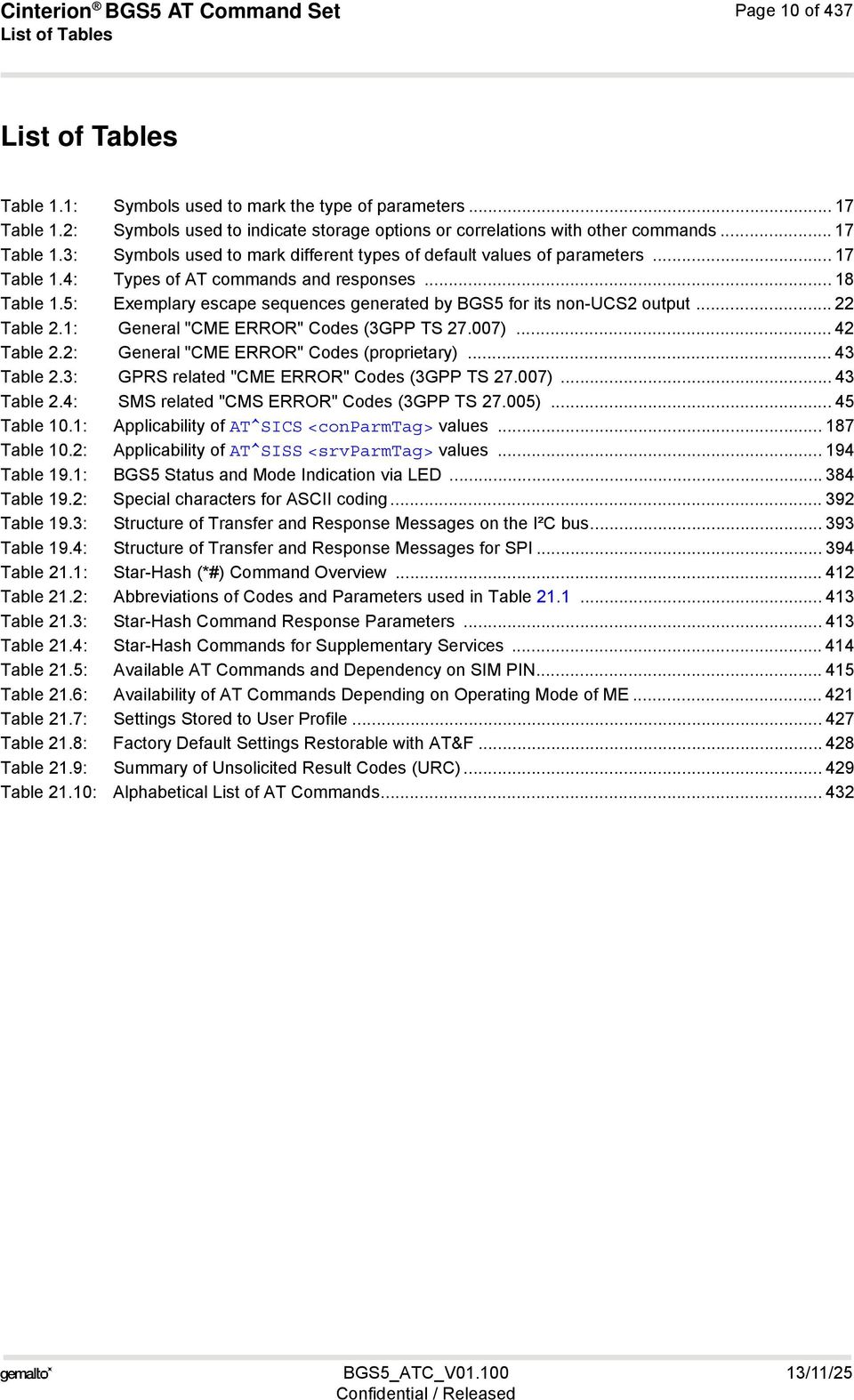
10 Cinterion BGS5 AT Command Set List of Tables Page 10 of 437 List of Tables Table 1.1: Symbols used to mark the type of parameters...17 Table 1.2: Symbols used to indicate storage options or correlations with other commands Table 1.3: Symbols used to mark different types of default values of parameters Table 1.4: Types of AT commands and responses Table 1.5: Exemplary escape sequences generated by BGS5 for its non-ucs2 output Table 2.1: General "CME " Codes (3GPP TS ) Table 2.2: General "CME " Codes (proprietary) Table 2.3: GPRS related "CME " Codes (3GPP TS ) Table 2.4: SMS related "CMS " Codes (3GPP TS ) Table 10.1: Applicability of AT^SICS <conparmtag> values Table 10.2: Applicability of AT^SISS <srvparmtag> values Table 19.1: BGS5 Status and Mode Indication via LED Table 19.2: Special characters for ASCII coding Table 19.3: Structure of Transfer and Response Messages on the I²C bus Table 19.4: Structure of Transfer and Response Messages for SPI Table 21.1: Star-Hash (*#) Command Overview Table 21.2: Abbreviations of Codes and Parameters used in Table Table 21.3: Star-Hash Command Response Parameters Table 21.4: Star-Hash Commands for Supplementary Services Table 21.5: Available AT Commands and Dependency on SIM PIN Table 21.6: Availability of AT Commands Depending on Operating Mode of ME Table 21.7: Settings Stored to User Profile Table 21.8: Factory Default Settings Restorable with AT&F Table 21.9: Summary of Unsolicited Result Codes (URC) Table 21.10: Alphabetical List of AT Commands BGS5_ATC_V /11/25
11 Cinterion BGS5 AT Command Set List of Figures Page 11 of 437 List of Figures Figure 1.1: Main character table of GSM 7 bit default alphabet Figure 1.2: Extension character table of GSM 7 bit default alphabet Figure 19.1: SPI modes selectable on SPI BGS5_ATC_V /11/25

12 Cinterion BGS5 AT Command Set 1. Introduction Page 12 of Introduction 1.1 Scope of the document This document presents the AT Command Set for BGS5 GSM Mobile Engine, Release Before using the BGS5 or upgrading to a new firmware version please read the latest product information provided in "BGS5 Release Notes, Version ". More information is available at DISCLAIMER: AT commands or parameters not documented in this document are subject to change and reserved for future use. Gemalto M2M GmbH reserves the right to modify or even eliminate these options in later releases. BGS5_ATC_V /11/25
13 Cinterion BGS5 AT Command Set 1.2 Related documents Page 13 of Related documents [1] BGS5 Release Notes, Version [2] BGS5 Hardware Interface Description, Version [3] Java User's Guide [4] Multiplexer User's Guide [5] 3GPP TS (descendant of 3GPP TS 07.10): Terminal Equipment to User Equipment (TE-UE) multiplexer protocol [6] Multiplex Driver Developer's Guide [7] Multiplex Driver Installation Guide [8] Application Note 02: Audio Interface Design [9] Application Note 16: Updating BGS5 Firmware [10] 3GPP TR (descendant of 3GPP TR 01.04): Vocabulary for 3GPP Specifications [11] International Organization for Standardization (ISO): ISO/IEC10646: Universal Multiple-Octet Coded Character Set (UCS) - Part 1: Architecture and Basic Multilingual Plane. This international standard is closely related to the Unicode Standard published by the Unicode Consortium [12] The Unicode Consortium: Mapping of ETSI GSM bit default alphabet characters into Unicode [.TXT!] [13] ITU-T V.24 List of definitions for interchange circuits between data terminal equipment (DTE) and data circuit-terminating equipment (DCE) [14] ITU-T V.250 Serial asynchronous automatic dialling and control [15] 3GPP TS 11.11: Specification of the Subscriber Identity Module - Mobile Equipment (SIM - ME) interface [16] 3GPP TS : UICC-terminal interface; Physical and logical characteristics [17] 3GPP TS : UICC-terminal interface; Physical and logical characteristics [18] 3GPP TS 11.14: Specification of the SIM Application Toolkit for the Subscriber Identity Module - Mobile Equipment (SIM - ME) interface [19] 3GPP TS : Universal Subscriber Identity Module (USIM) Application Toolkit (USAT) [20] ETSI TS : Smart Cards; Card Application Toolkit (CAT) [21] 3GPP TS (descendant of 3GPP TS 22.02): Circuit Bearer Services (BS) supported by a Public Land Mobile Network (PLMN) [22] 3GPP TS (descendant of 3GPP TS 02.04): General on supplementary services [23] 3GPP TS (descendant of 3GPP TS 02.30): Man-Machine Interface (MMI) of the Mobile Station (MS) [24] 3GPP TS (descendant of 3GPP TS 02.60): General Packet Radio Service (GPRS); Service description; Stage 1 [25] 3GPP TS (descendant of 3GPP TS 03.60): General Packet Radio Service (GPRS); Service description; Stage 2 [26] 3GPP TS (descendant of 3GPP TS 02.81): Line Identification Supplementary Services; Stage 1 [27] 3GPP TS (descendant of 3GPP TS 02.82): Call Forwarding (CF) Supplementary Services; Stage 1 [28] 3GPP TS (descendant of 3GPP TS 02.83): Call Waiting (CW) and Call Holding (HOLD); Supplementary Services; Stage 1 [29] 3GPP TS (descendant of 3GPP TS 02.85): Closed User Group (CUG) supplementary services; Stage 1 [30] 3GPP TS (descendant of 3GPP TS 02.88): Call Barring (CB) supplementary services; Stage 1 [31] 3GPP TS (descendant of 3GPP TS 02.90): Unstructured Supplementary Service Data (USSD); Stage 1 [32] 3GPP TS (descendant of 3GPP TS 03.38): Alphabets and language specific information [33] 3GPP TS (descendant of 3GPP TS 03.40): Technical realization of the Short Message Service (SMS) [34] 3GPP TS (descendant of 3GPP TS 03.41): Technical realization of Cell Broadcast Service (CBS) BGS5_ATC_V /11/25
![10): Terminal Equipment to User Equipment (TE-UE) multiplexer protocol [6] Multiplex Driver Developer's Guide [7] Multiplex Driver Installation Guide [8] Application Note 02: Audio Interface Design](/docs-images/53/10914162/images/page_13.jpg "[9] Application Note 16: Updating BGS5 Firmware [10] 3GPP TR 21.905 (descendant of 3GPP TR 01.")
14 Cinterion BGS5 AT Command Set 1.2 Related documents Page 14 of 437 [35] 3GPP TS : Quality of Service (QoS) concept and architecture [36] 3GPP TS (descendant of 3GPP TS 04.11): Point-to-Point (PP) Short Message Service (SMS) support on mobile radio interface [37] 3GPP TS (descendant of 3GPP TS 04.08): Mobile radio interface Layer 3 specification; Core network protocols; Stage 3 [38] 3GPP TS (descendant of 3GPP TS 04.80): Mobile radio interface layer 3 supplementary services specification; Formats and coding [39] 3GPP TS Radio Resource Control (RRC) [40] 3GPP TS (descendant of 3GPP TS 07.05): Use of Data Terminal Equipment - Data Circuit terminating Equipment (DTE - DCE) interface for Short Message Service (SMS) and Cell Broadcast Service (CBS) [41] 3GPP TS (descendant of 3GPP TS 07.07): AT command set for User Equipment (UE) [42] 3GPP TS (descendant of 3GPP TS 07.60): Mobile Station (MS) supporting Packet Switched Services [43] 3GPP TS (descendant of 3GPP TS and 3GPP TS 02.40): Service principles [44] Common PCN Handset Specification (CPHS) v4.2 [.ZIP!] [45] 3GPP TS (descendant of GSM 05.08): Radio subsystem link control [46] USB Language Identifiers (LANGIDs) [.PDF!]. BGS5_ATC_V /11/25
![08): Mobile radio interface Layer 3 specification; Core network protocols; Stage 3 [38] 3GPP TS 24.080 (descendant of 3GPP TS 04.](/docs-images/53/10914162/images/page_14.jpg "80): Mobile radio interface layer 3 supplementary services specification; Formats and coding [39] 3GPP TS 25.331 Radio Resource Control (RRC) [40] 3GPP TS 27.005 (descendant of 3GPP TS 07.")
15 Cinterion BGS5 AT Command Set 1.3 Glossary of Terms Page 15 of Glossary of Terms Acronym GSM PLMN Definition Global System for Mobile Communications... Public Land Mobile Network... BGS5_ATC_V /11/25

16 Cinterion BGS5 AT Command Set 1.4 Document Conventions Page 16 of Document Conventions Throughout this document BGS5 is also referred to as GSM Mobile Engine or short ME, MS (Mobile Station) or Mobile Terminal (MT). In related documents the equivalent terms DCE (Data Communication Equipment), facsimile DCE or FAX modem may be found. AT commands are used to control the BGS5. The controlling device is referred to as Customer Application or short TE. Related documents may use the equivalent term DTE (Data Terminal Equipment). All abbreviations and acronyms used throughout this document are based on GSM or 3GPP specifications. For definitions please refer to 3GPP TR [10] Quick Reference Table Each AT command description includes a table similar to the example shown below. The table is intended as a quick reference to indicate the following functions: PIN: Is the AT command PIN protected? + Yes - No ± Usage is dependent on conditions specified for the command, or not all command types are PIN protected (for example write command PIN protected, read command not). Note: The table provided in Section 21.3, Available AT Commands and Dependency on SIM PIN uses the same symbols. Is the AT command supported in AIRPLANE mode? + Yes - No ± In AIRPLANE mode, not all described functions are available. For example, the test or read command is usable, the write or execute command is not. Furthermore, only some of the listed parameters can be changed in AIRPLANE mode. A typical example is AT^SCFG that controls different features. Last: If commands are concatenated, this AT command must be the last one. + Yes - No Note: See also Section 1.5, AT Command Syntax for details on concatenated AT commands. Example: PIN Last BGS5_ATC_V /11/25

17 Cinterion BGS5 AT Command Set 1.4 Document Conventions Page 17 of Superscript notation for parameters and values Table 1.1: Symbols used to mark the type of parameters Parameter type <param> (num) <param> (str) <param> (text) <param> (u) Meaning Parameter value must be numeric type. Parameter value must be string type. Parameter value is a string according to selected character set. Not enclosed in double quotes Unspecified, i.e. parameter value may be numeric or string type. Table 1.2: Symbols used to indicate storage options or correlations with other commands Parameter option <param> (+CSCS) <param> (&W) <param> (NV) Meaning Parameter value has to be (is) coded according to current setting of <chset> (see AT+CSCS for details) Parameter value is stored to user profile in non-volatile memory after executing AT&W Parameter is stored in non-volatile memory. Table 1.3: Symbols used to mark different types of default values of parameters Value option [x] x (&F) x (P) x (D) Meaning Default value set if parameter is omitted. Factory value restored by AT&F Powerup value of a parameter not stored in non-volatile memory. Delivery value of a parameter which may be overridden from non-volatile setting (refer to symbol (NV) and symbol (&W) above). BGS5_ATC_V /11/25

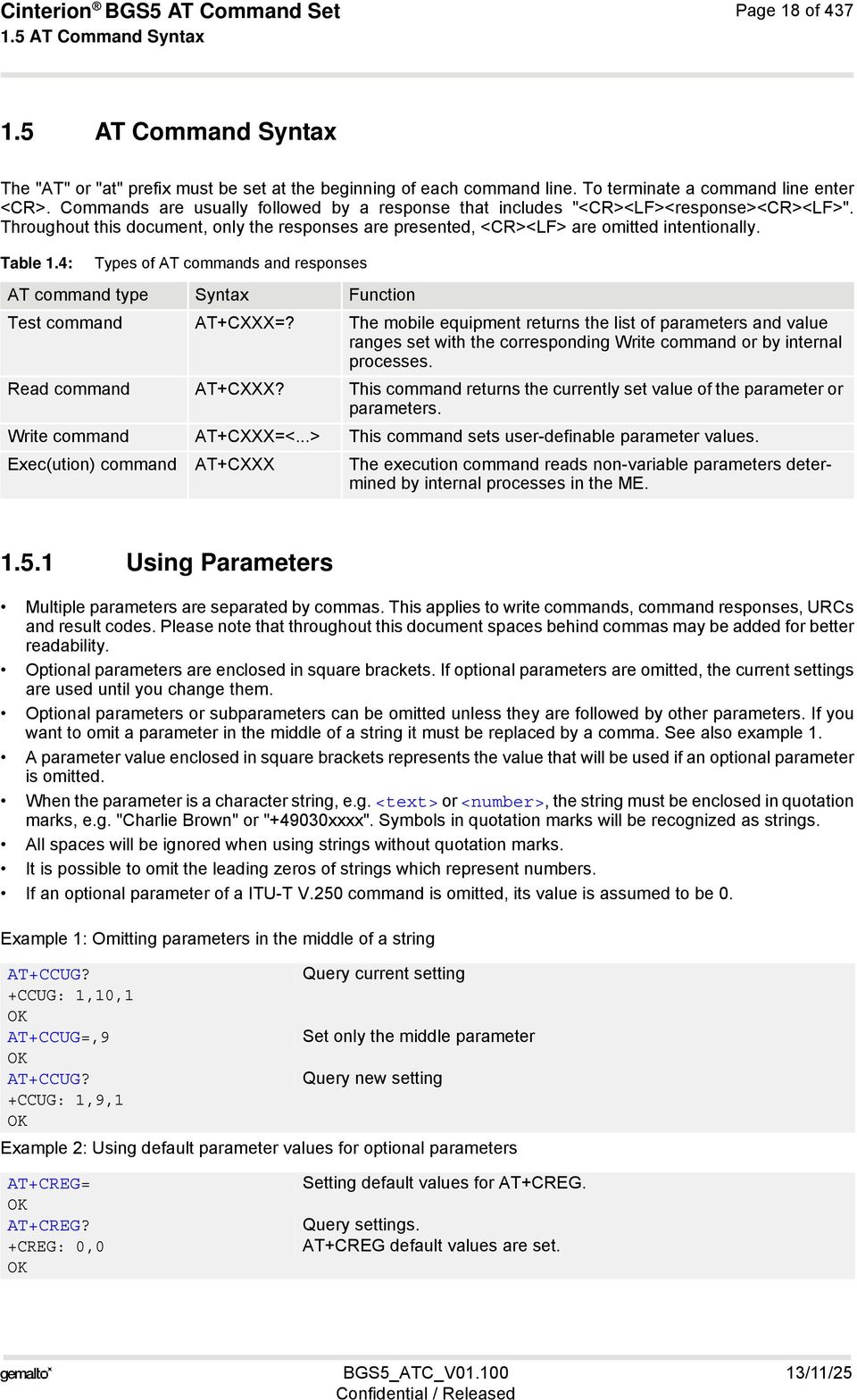
18 Cinterion BGS5 AT Command Set 1.5 AT Command Syntax Page 18 of AT Command Syntax The "AT" or "at" prefix must be set at the beginning of each command line. To terminate a command line enter <CR>. Commands are usually followed by a response that includes "<CR><LF><response><CR><LF>". Throughout this document, only the responses are presented, <CR><LF> are omitted intentionally. Table 1.4: Types of AT commands and responses AT command type Syntax Function Test command AT+CXXX=? The mobile equipment returns the list of parameters and value ranges set with the corresponding Write command or by internal processes. Read command AT+CXXX? This command returns the currently set value of the parameter or parameters. Write command AT+CXXX=<...> This command sets user-definable parameter values. Exec(ution) command AT+CXXX The execution command reads non-variable parameters determined by internal processes in the ME Using Parameters Multiple parameters are separated by commas. This applies to write commands, command responses, URCs and result codes. Please note that throughout this document spaces behind commas may be added for better readability. Optional parameters are enclosed in square brackets. If optional parameters are omitted, the current settings are used until you change them. Optional parameters or subparameters can be omitted unless they are followed by other parameters. If you want to omit a parameter in the middle of a string it must be replaced by a comma. See also example 1. A parameter value enclosed in square brackets represents the value that will be used if an optional parameter is omitted. When the parameter is a character string, e.g. <text> or <number>, the string must be enclosed in quotation marks, e.g. "Charlie Brown" or "+49030xxxx". Symbols in quotation marks will be recognized as strings. All spaces will be ignored when using strings without quotation marks. It is possible to omit the leading zeros of strings which represent numbers. If an optional parameter of a ITU-T V.250 command is omitted, its value is assumed to be 0. Example 1: Omitting parameters in the middle of a string AT+CCUG? +CCUG: 1,10,1 AT+CCUG=,9 AT+CCUG? +CCUG: 1,9,1 Query current setting Set only the middle parameter Query new setting Example 2: Using default parameter values for optional parameters AT+CREG= AT+CREG? +CREG: 0,0 Setting default values for AT+CREG. Query settings. AT+CREG default values are set. BGS5_ATC_V /11/25
19 Cinterion BGS5 AT Command Set 1.5 AT Command Syntax Page 19 of Concatenating AT Commands Concatenating AT commands on the same line is possible, though not recommended because of restrictions listed below (for more details see ITU-T V.250 [14]). When concatenating AT commands you need to enter the "AT" or "at" prefix only once at the beginning of a command line. Basic commands (i.e., ITU-T V.250 commands) are concatenated without delimiter. Extended commands (i.e., commands starting with AT+ or AT^) use a semicolon as delimiter. Disadvantages and restrictions: There is no way to control the minimum time to wait between finishing an AT command and sending the next one. Please refer to Section 1.6, Communication between Customer Application and BGS5 for details about timing. The sequence of processing the AT commands may be different from the sequential order of command input. Many AT commands cannot be concatenated (see list below). Concatenating these commands might end up with an error result code, or leads to an unexpected order of responses. AT command type 3GPP TS commands 3GPP TS commands (SMS) Commands starting with AT& AT+IPR Comment Cannot be concatenated with extended commands (prefix AT^S) To be used standalone To be used standalone To be used standalone Application Design Considerations When designing your application keep in mind that parameters given in AT command responses, result codes and unsolicited result codes are only separated by commas with no spaces in between. Please take care that your application ignores any additional spaces that may, nevertheless, be inserted in some AT command responses, result codes and unsolicited result codes provided by BGS5. BGS5_ATC_V /11/25

20 Cinterion BGS5 AT Command Set 1.6 Communication between Customer Application and BGS5 Page 20 of Communication between Customer Application and BGS5 After power-up or restart ensure that the ME is in ready state before trying to send any AT command or data. For detailed information on timing conditions, signal states and particularly the startup behavior of the BGS5's signal lines refer to the Hardware Interface Description [2]. Leaving hardware flow control unconsidered the Customer Application (TE) is coupled with the BGS5 (ME) via a receive and a transmit line. Since both lines are driven by independent devices collisions may (and will) happen. For example, if the TE issues an AT command and the BGS5 starts sending a URC. This will probably cause the TE to misinterpret the URC being part of the AT command's response. To avoid this conflict the following measures must be taken: If an AT command is finished (with "" or "") the TE shall always wait at least 100 ms before sending the next one. This applies to bit rates of 9600 bps or higher (see AT+IPR). At bit rates below 9600 bps the delay must be longer: 300 ms at 1200 bps, and 500 ms at 300 bps. The pause between two AT commands gives the BGS5 the opportunity to the transmission of pending URCs and get necessary service. The TE shall communicate with the BGS5 using activated echo (ATE1), i.e. the BGS5 echoes characters received from the TE. Hence, when the TE receives the echo of the first character "A" of the AT command just sent by itself it has control both over the receive and the transmit paths. Using Backspace at command line: As the standard GSM alphabet does not provide a backspace functionality the BGS5 is designed to use the character "08" (hex 0x08) as backspace for command line input. This allows the user to easily erase the last character when writing an AT command. On the other hand, this solution requires entering the escape sequence \08 for writing the "ò" character in GSM character string parameters. If command echo is enabled (ATE1) Backspace may cause (decimal) character sequence or no echo, depending on serial interface and speed of character input. BGS5_ATC_V /11/25
![For detailed information on timing conditions, signal states and particularly the startup behavior of the BGS5's signal lines refer to the Hardware Interface Description [2].](/docs-images/53/10914162/images/page_20.jpg "Leaving hardware flow control unconsidered the Customer Application (TE) is coupled with the BGS5 (ME) via a receive and a transmit line.")
21 Cinterion BGS5 AT Command Set 1.7 Supported character sets Page 21 of Supported character sets BGS5 supports two character sets: GSM 7 bit, also referred to as GSM alphabet or SMS alphabet (3GPP TS [32]) and UCS216 bit (ISO [11]). See AT+CSCS for information about selecting the character set. Character tables can be found below. Explanation of terms Escape Character There are two types of escape sequences which lead to an alternative interpretation on subsequent characters by the ME: - AT command interface Escape sequences starting with character value 0x5C are used for the ME's non-ucs2 input and output. - GSM 7 bit default alphabet The escape sequence used within a text coded in the GSM 7 bit default alphabet is starting with character value 0x1B and needs to be correctly interpreted by the TE, both for character input and output. To the BGS5, an escape sequence appears like any other byte received or sent. For SMS user data input after the prompt '>' in text mode (AT+CMGF)=1 and AT+CSCS="GSM" the character 0x1A is interpreted as 'CTRL-Z'. The character 0x1B (interpreted as 'ESC') as well as the escape character 0x5C (is interpreted as 'Ö'), therefore both escape mechanisms are not supported in this case. TE Character Set The character set currently used by the Customer Application is selected with AT+CSCS. It is recommended to select UCS2 setting. Data Coding Scheme (DCS) DCS is part of a short message and is saved on the SIM. When writing a short message to the SIM in text mode, the DCS stored with AT+CSMP is used and determines the coded character set. International Reference Alphabet (IRA) The International Reference Alphabet is equivalent to ASCII (American Standard Code for Information Interchange) and ISO 646, i.e. it defines a 7-bit coded character set. The mapping can be obtained from the character set tables below (UCS2 values 0x0000 to 0x007F). When you enter characters that are not valid characters of the supported alphabets the behavior is undefined. If GSM alphabet is selected, all characters sent over the serial line (between TE and ME) must be in the range from 0 to 127 (7 bit range). Note: If the ME is configured for GSM alphabet, but the Customer Application (TE) uses ASCII, bear in mind that some characters have different code values, such as the following: "@" character with GSM alphabet value 0 is not displayable by an ASCII terminal program, e.g. Microsoft Hyperterminal. "@" character with GSM alphabet value 0 will terminate any C string! This is because value 0 is defined as C string end tag. Therefore, the GSM Null character will cause problems on application level when using 'C'- functions, e.g. "strlen()". Using an escape sequence as shown in the table below solves the problem. By the way, this may be the reason why even network providers sometimes replace '@' with "@=*" in their SIM application. Some other characters of the GSM alphabet may be misinterpreted by an ASCII terminal program. For example, GSM "ö" (as in "Börse") is assumed to be " " in ASCII, thus resulting in "B rse". This is because in both alphabets there are different characters assigned to value 7C (hexadecimal). If the TE sends characters differently coded or undefined in ASCII or GSM (e.g. Ä, Ö, Ü) it is possible to use escape sequences. The ME's input parser translates the escape sequence to the corresponding GSM character value. Note: The ME also uses escape sequences for its non-ucs2 output: Quotation mark (") and the escape character itself (\, respectively Ö in GSM alphabet) are converted, as well as all characters with a value below 32 (hexadecimal 0x20). Hence, the input parser of the Customer Application needs to be able to translate escape sequences back to the corresponding character of the currently used alphabet. Unsupported characters are shown as a space (hexadecimal 0x20). BGS5_ATC_V /11/25
22 Cinterion BGS5 AT Command Set 1.7 Supported character sets Page 22 of 437 Table 1.5: Character Value Exemplary escape sequences generated by BGS5 for its non-ucs2 output ASCII Character GSM Character UCS2 Character Escape Sequence Numeric Escape Sequence 0x5C \ Ö 00D6 \5C 0x5C 0x35 0x43 0x22 " " 0022 \22 0x5C 0x32 0x32 0x00 n/a \00 0x5C 0x30 0x30 Usually terminal programs are not able to recognize escape sequences, and thus, handle them as normal characters. To prevent misinterpretation of control characters or special characters it is recommended to always use USC2 alphabet and PDU mode. BGS5_ATC_V /11/25
23 Cinterion BGS5 AT Command Set 1.7 Supported character sets Page 23 of GSM alphabet tables and UCS2 character values This section provides tables for the GSM default alphabet (3GPP TS [32]) supported by the BGS5. Below any GSM character find the corresponding two byte character value of the UCS2 alphabet. For details refer to "ETSI GSM mapping into Unicode" [12]. Figure 1.1: Main character table of GSM 7 bit default alphabet 1) This code is an escape to the following extension of the 7 bit default alphabet table. 2) This code is not a printable character and therefore not defined for the UCS2 alphabet. It shall be treated as the accompanying control character. 3) See Section 1.6 for further details on using backspace and "ò" character. BGS5_ATC_V /11/25
24 Cinterion BGS5 AT Command Set 1.7 Supported character sets Page 24 of 437 Figure 1.2: Extension character table of GSM 7 bit default alphabet 1) This code value is reserved for the extension to another extension table. On receipt of this code, a receiving entity shall display a space until another extension table is defined. 2) This code represents the EURO currency symbol. The code value is the one used for the character 'e'. Therefore a receiving entity which is incapable of displaying the EURO currency symbol will display the character 'e' instead. 3) This code is defined as a Page Break character and may be used for example in compressed CBS messages. Any mobile which does not understand the 7 bit default alphabet table extension mechanism will treat this character as Line Feed. BGS5_ATC_V /11/25
25 Cinterion BGS5 AT Command Set 1.7 Supported character sets Page 25 of 437 If the Customer Application receives a code where a symbol is not represented in Figure 1.2, Extension character table of GSM 7 bit default alphabet it shall display the character shown in the main GSM 7 bit default alphabet table (see Figure 1.1, Main character table of GSM 7 bit default alphabet) UCS2 and GSM character coding and conversion This section provides basic information on how to handle input and output character conversion, e.g. for SMS text mode, if the character representation of ME and Customer Application differ, i.e. if the Data Coding Scheme and the TE character set use different mappings Output of SIM data (ME to TE) Used character set DCS = 7 bit GSM Case 1 GSM (1:1) DCS = 8 bit Data Case 2 8 bit to IRA (1:2) DCS = 16 bit UCS2 Case 3 UCS2 to IRA (2:4) GSM UCS2 Case 4 GSM to IRA (1:4) Case 5 8 bit to IRA (1:4) Case 6 UCS2 to IRA (2:4) Note: The ratio of SIM bytes to output bytes is given in parentheses. Case 1 Every GSM character is sent to the TE as it is (8-bit value with highest bit set to zero). Example: 47'H, 53'H, 4D'H 47'H, 53'H, 4D'H, displayed as "GSM" Case 2 Every data byte is sent to the TE as 2 IRA characters each representing a halfbyte. Example: B8'H (184 decimal) 42'H, 38'H, displayed as "B8" Case 3 Every 16-bit UCS2 value is sent to the TE as 4 IRA characters. Example: C4xA7'H (50343 decimal) 43'H, 34'H, 41'H, 37'H, displayed as "C4A7" Problem: An odd number of bytes leads to an error because there are always two bytes needed for each USC2 character Case 4 Every GSM character is sent to the TE as 4 IRA characters to show UCS2 in text mode. Example: 41'H ("A") 30'H, 30'H, 34'H, 31'H, displayed as "0041" Case 5 Every data byte is sent to the TE as IRA representation of UCS2 (similar to case 4). Example: B2'H 30'H, 30'H, 42'H, 32'H, displayed as "00B2" Case 6 Every 16-bit value is sent to the TE as IRA representation of it. It is assumed that number of bytes is even. Example: C3x46'H 43'H, 33'H, 34'H, 36'H, displayed as "C346" BGS5_ATC_V /11/25
26 Cinterion BGS5 AT Command Set 1.7 Supported character sets Page 26 of Input of SIM data (TE to ME) Used character set DCS = 7 bit GSM Case 1 GSM (1:1) DCS = 8 bit Data Case 2 IRA to 8 bit (2:1) DCS = 16 bit UCS2 Case 3 IRA to 16 bit (4:2) GSM UCS2 Case 4 UCS2 to GSM (4:1) Case 5 UCS2 to 8 bit (4:1) Case 6 UCS2 to 16 bit (4:2) Note: The ratio between the number of input characters and bytes stored on the SIM is given in parentheses. Case 1 Every character is sent from TE to ME as GSM character (or ASCII with standard terminal emulation, e.g. Hyperterminal ). Character value must be in range from 0 to 127 because of 7-bit GSM alphabet. To reach maximum SMS text length of 160 characters in 140 bytes space characters will be compressed on SIM. This must be set using the parameter <dcs> of AT+CSMP (add 64). Example: "ABCDEFGH" typed is sent and stored uncompressed as 'H (stored compressed as 41E E91'H) Case 2 Every data byte is sent as 2 IRA characters. Maximum text length is 280 IRA characters which will be converted into 140 bytes SMS binary user data Example: "C8" typed is sent as 43'H, 38'H stored as C8'H Case 3 Every 16-bit value is sent as 4 IRA characters. Maximum text length is 280 IRA characters which will be converted into 70 UCS2 characters (16-bit each) Number of IRA characters must be a multiple of four because always 4 half bytes are needed for a 16-bit value Example: "D2C8" typed is sent as 44'H, 32'H, 43'H, 38'H stored as D2C8'H Case 4 Every GSM character is sent as 4 IRA characters representing one UCS2 character. Example: To store text "ABC" using UCS2 character set you have to type " ". This is sent as 30'H,30'H,34'H,31'H, 30'H,30'H,34'H,32'H, 30'H,30'H,34'H,33'H detected as IRA representation of 3 UCS2 characters, converted to GSM character set and stored as 41'H, 42'H, 43'H. Maximum input is 640 IRA characters representing 160 UCS2 characters when compression is active. These are converted to 160 GSM 7-bit characters. Without compression only 140 GSM characters can be stored which are put in as 560 IRA characters. Values of UCS2 characters must be smaller than 80'H (128 decimal) to be valid GSM characters. Number of IRA characters must be a multiple of four. Problems: "41" Error, there are four IRA characters (two bytes) needed "0000" Error, not an UCS2 character "4142" Error, value of UCS2 character > 7F'H "008B" Error, value of UCS2 character > 7F'H This affects the maximum input length of a string) Case 5 Every UCS2 character is sent as 4 IRA characters and is converted into two 8-bit values. This means that the first two characters have to be '00'. Example: UCS2 character 009F'H typed as "009F" is sent as 30'H,30'H,39'H,46'H converted into 8-bit value 9F'H. Maximum number of UCS2 characters is 140 which are represented by 560 IRA characters. Number of IRA characters must be a multiple of four. Case 6 Every UCS2 character is sent as 4 IRA characters each and is converted into a 16-bit value again. Example: UCS2 character 9F3A'H typed as "9F3A" is sent as 39'H,46'H,33'H,41'H converted into 9F3A'H. Maximum number of UCS2 characters is 70 which are represented by 280 IRA characters. Number of IRA characters must be a multiple of four. Invalid UCS2 values must be prevented. BGS5_ATC_V /11/25
27 Cinterion BGS5 AT Command Set 1.8 Unsolicited Result Code Presentation Page 27 of Unsolicited Result Code Presentation URC stands for Unsolicited Result Code and is a report message issued by the ME without being requested by the TE, i.e. a URC is issued automatically when a certain event occurs. Hence, a URC is not issued as part of the response related to an executed AT command. Typical events leading to URCs are incoming calls ("RING"), waiting calls, received short messages, changes in temperature, network registration etc. For most of these messages, the ME needs to be configured whether or not to send a URC. Descriptions of these URCs are provided with the associated AT command. URCs which are not user definable are described in Section 1.8.1, Common URCs. A summary of all URCs can be found in Section 21.7, Summary of Unsolicited Result Codes (URC). Important: If the interface used for URC output is reserved by an active data connection or a long running AT command, URCs are buffered internally and will be issued after the interface becomes idle again. A pending URC will be signaled on the URC output interface via RING line. This allows to systematically suspend any longer data connection (refer +++ and ATO) to check for pending URCs after being signaled! For detailed information regarding configuration of URC signaling refer to AT^SCFG, "URC/Ringline", <urcringlinecfg>. Parameter Description <info> (num) 200 URC will be send 40 seconds after syste-up when the JRC midlet was not tried to start (no autostart, no midlet at all, whatever). Used to see in logs, that midlet is not running, as example. 201 The JRC midlet was started, but did not succeed to full init itself within a (JRC midlet defined) timeout. 5 seconds after this URC, the module will restart. 202 The midlet was tried to start 5x, but was restarted (with ^SYSINFO: 201). Now, the JRC midlet start was cancelled. No JRC midlet is running. A shutdown timer of 10 minutes is started. After this timer, the module will be switched off Common URCs This section describes all URCs not associated to a certain AT command. They cannot be defined by the user and appear automatically when the conditions described below occur. URC 1 ^SYSLOADING Indicates that the ME is in the process of starting up. Do not enter AT commands until the "^SYSSTART" URC has shown up. URC 2 ^SYSSTART Indicates that the ME has been restarted to Normal mode or Airplane mode and is ready to operate. For Normal and Airplane mode see AT+CFUN. Note: Autobaud mode (see AT+IPR) requires an "AT" or "at" string be given after restarting the ME. This enables the ME to detect the bit rate set in the TE. After detecting the bit rate the ME will send the "^SYS- START" URC. BGS5_ATC_V /11/25
28 Cinterion BGS5 AT Command Set 1.8 Unsolicited Result Code Presentation Page 28 of 437 URC 3 +PBREADY After SIM PIN authentication has completed this URC indicates that the ME has completed reading data from the SIM and that phonebook and SMS functions are ready for read and write operation. Any attempt to use phonebook or SIM PIN dependent SMS AT commands before the ME has finished reading SIM data will be denied with error codes, such as "+CME : SIM busy" or "+CMS : SIM busy". URC 4 ^SYSINFO: <info> System information URC. BGS5_ATC_V /11/25
29 Cinterion BGS5 AT Command Set 1.9 Errors and Messages Page 29 of Errors and Messages The command result codes "+CME : <err>" and "+CMS : <err>" indicate errors related to mobile equipment or network functionality. The format of <err> can be either numeric or verbose and is selectable via AT+CMEE. A result error code terminates the execution of the command and prevents the execution of all remaining commands that may follow on the same command line. If so, neither "" nor "" result codes are returned for these commands. A 30 seconds timeout will deliver "" when the input of a command is not complete. Using the wrong command syntax may result in errors: For example, using the execute command syntax although the command has no execute format, causes "" to be returned. Likewise, using the write command syntax although the command has no write format causes "+CME : <err>" to be returned. See also: Section , CME/CMS Error Code Overview Section 2.5.1, Verbose and numeric result codes Section 3.1, AT+CEER BGS5_ATC_V /11/25
30 Cinterion BGS5 AT Command Set 2. Configuration Commands Page 30 of Configuration Commands The AT Commands described in this chapter allow the external application to determine the BGS5's behaviour under various conditions. 2.1 AT&F Reset AT Command Settings to Factory Default Values AT&F resets AT command settings to their factory default values. For a list of affected parameters refer to Section 21.6, Factory Default Settings Restorable with AT&F. Syntax Exec Command AT&F[<value>] Response(s) PIN Last Reference(s) V.250 Parameter Description <value> (num) [0] Reset parameters in Section 21.6, Factory Default Settings Restorable with AT&F to their factory default values. BGS5_ATC_V /11/25
31 Cinterion BGS5 AT Command Set 2.2 AT&V Page 31 of AT&V Display current configuration AT&V returns the current parameter setting. The configuration varies depending on whether or not PIN authentication has been done. Syntax Exec Command AT&V[<value>] Response(s) ACTIVE PROFILE:... (see Section 2.2.1, AT&V responses) PIN Last Reference(s) V.250 Parameter Description <value> (num) [0] Profile number Note The parameter of AT+CSDH will only be displayed in SMS Text mode, see AT+CMGF. BGS5_ATC_V /11/25
32 Cinterion BGS5 AT Command Set 2.2 AT&V Page 32 of AT&V responses The following tables show four different kinds of responses depending on whether or not the PIN is entered. PIN authentication done ACTIVE PROFILE: E1 Q0 V1 X4 &C1 &D2 &S0 \Q0 S0:000 S3:013 S4:010 S5:008 S6:000 S7:060 S8:000 S10:002 +CBST: 7,0,1 +CRLP: 61,61,78,6 +CR: 0 +CRC: 0 +CMGF: 1 +CSDH: 0 +CNMI: 0,0,0,0,1 +CMEE: 2 +CSMS: 0,1,1,1 +CREG: 0,1 +CLIP: 0,2 +COPS: 0,0,"operator",0 +CGSMS: 3 No PIN authentication ACTIVE PROFILE: E1 Q0 V1 X4 &C1 &D2 &S0 \Q0 S0:000 S3:013 S4:010 S5:008 S6:000 S7:060 S8:000 S10:002 +CBST: 7,0,1 +CRLP: 61,61,78,6 +CR: 0 BGS5_ATC_V /11/25
33 Cinterion BGS5 AT Command Set 2.3 AT&W Page 33 of AT&W Store AT Command Settings to User Defined Profile AT&W stores the current AT command settings to a user defined profile in non-volatile memory of BGS5. The AT command settings will automatically be restored from the user defined profile during power-up or if ATZ is used. AT&F restores AT command factory default settings. Hence, until first use of AT&W, ATZ works as AT&F. A list of parameters stored to the user profile can be found at Section 21.5, AT Command Settings storable with AT&W. Syntax Exec Command AT&W[<value>] Response(s) +CME : <err> PIN Last Reference(s) V.250 Parameter Description <value> (num) [0] User Profile Number BGS5_ATC_V /11/25
34 Cinterion BGS5 AT Command Set 2.4 ATQ Page 34 of ATQ Result Code Presentation Mode ATQ controls if the BGS5 transmits any result code to the TE. Other information text transmitted as response is not affected. Syntax Exec Command ATQ[<n>] Response(s) If <n>=0: If <n>=1: (none) PIN Last Reference(s) V.250 Parameter Description <n> (num)(&v)(&w) Result Code Presentation Mode. It is not recommended to change this value. [0] (&F)(D) ME transmits result code. 1 Result codes are suppressed and not transmitted. BGS5_ATC_V /11/25
35 Cinterion BGS5 AT Command Set 2.5 ATV Page 35 of ATV Result code format mode This command determines the contents of header and trailer transmitted with AT command result codes and information responses. Possible responses are described in Section 2.5.1, Verbose and numeric result codes. Syntax Exec Command ATV[<value>] Response(s) PIN Last Reference(s) ITU-T V.250 [14] Parameter Description <value> (num)(&v)(&w) [0] Information response: <text><cr><lf> Short result code format: <numeric code><cr> 1 (&F)(D) Information response: <CR><LF><text><CR><LF> Long result code format: <CR><LF><verbose code><cr><lf> Verbose and numeric result codes Verbose format Numeric format Meaning 0 command executed, no errors CONNECT 1 link established RING 2 ring detected NO CARRIER 3 link not established or disconnected 4 invalid command or command line too long NO DIALTONE 6 no dial tone, dialling impossible, wrong mode BUSY 7 remote station busy NO ANSWER 8 no answer CONNECT 2400/RLP 10 link with 2400 bps CONNECT 4800/RLP 11 link with 4800 bps CONNECT 9600/RLP 12 link with 9600 bps BGS5_ATC_V /11/25
36 Cinterion BGS5 AT Command Set 2.6 ATX Page 36 of ATX CONNECT Result Code Format ATX determines whether or not the BGS5 transmits particular result codes to the TE. It also controls whether or not the ME verifies the presence of a dial tone when it begins dialing, and if engaged tone (busy signal) detection is enabled. Syntax Exec Command ATX[<value>] Response(s) PIN Last Reference(s) V.250 Parameter Description <value> (num)(&v)(&w) [0] CONNECT result code only returned. Dial tone and busy detection are disabled. 1 CONNECT <text> result code only returned. Dial tone and busy detection are both disabled. 2 CONNECT <text> result code returned. Dial tone detection is enabled, busy detection is disabled. 3 CONNECT <text> result code returned. Dial tone detection is disabled, busy detection is enabled. 4 (&F) CONNECT <text> result code returned. Dial tone and busy detection are both enabled. BGS5_ATC_V /11/25
37 Cinterion BGS5 AT Command Set 2.7 ATZ Page 37 of ATZ Restore AT Command Settings from User Defined Profile ATZ is supported for compatibility with other products. The command command restores the user defined profile on user request. Syntax Exec Command ATZ[<value>] Response(s) PIN Last Reference(s) V.250 Parameter Description <value> (num) The stored profile will be restored with any valid number. BGS5_ATC_V /11/25
38 Cinterion BGS5 AT Command Set 2.8 AT+CFUN Page 38 of AT+CFUN Functionality Level AT+CFUN controls BGS5's functionality level. It can also be used to reset the ME. Syntax Test Command AT+CFUN=? Response(s) +CFUN: (list of supported <fun>s), (list of supported <rst>s) +CME : <err> Read Command AT+CFUN? Response(s) +CFUN: <power_mode>, <STK_mode> +CME : <err> Write Command AT+CFUN=<fun>[, <rst>] Response(s) +CME : <err> If <fun>= 0: ^SHUTDOWN If <rst>= 1: ^SYSSTART PIN Last Reference(s) GPP TS [41] Parameter Description <fun> (num) 0 Switch off ME. ME returns followed by "^SHUTDOWN" URC. See also AT^SMSO command. 1 (D) Full functionality level. 4 Airplane mode. Shut down TX and RX RF-circuits whereby BGS5 logs off from the network and switches to AT+COPS=2. All AT commands whose execution requires a radio connection will return an error response (such as "NO CARRIER" or "+CME : NO NETWORK SERVICE". A list of AT commands supported during Airplane mode can be found in Section 21.4, Availability of AT Commands Depending on Operating Mode of ME. After leaving Airplane mode by setting AT+CFUN=1 the AT+COPS write command shall be used to register to a network once again. BGS5_ATC_V /11/25
39 Cinterion BGS5 AT Command Set 2.8 AT+CFUN Page 39 of This mode was implemented in BGS5 Release 1 for activating the SAT interface. As of BGS5 Release 2 the mode is deprecated and no longer effective. SAT can now be used in Automatic or Explicit Response Mode depending on AT^SSTA settings. 7 Reserved for future use. 8 Reserved for future use. <rst> (num) Parameter <rst> applies only to <fun> 1 and 4. [0] ME switches to <fun> level without reset. 1 ME resets and restarts to full functionality level or Airplane mode, depending on given <fun> value. "^SYSSTART" URC indicates that the ME is ready to operate. Note: Autobaud mode (see AT+IPR) requires an "AT" or "at" string be given after restart. This enables the ME to detect the bit rate set in the TE. After detecting the bit rate the ME will send the "^SYSSTART" URC. <power_mode> (num) 1 ME is switched on 2 Invalid mode 4 Airplane mode <STK_mode> (num) 0 Deprecated. See above <fun> value 6. 6 Deprecated. See above <fun> value 6. 7 Reserved for future use. 8 Reserved for future use. BGS5_ATC_V /11/25
40 Cinterion BGS5 AT Command Set 2.9 AT^SMSO Page 40 of AT^SMSO Switch Off BGS5 AT^SMSO initiates BGS5's power-off procedure. Do not send any other AT command after this. Low level of the ME's V180 signal and the URC "^SHUTDOWN" notify that the procedure has completed and the ME has entered the POWER DOWN mode. Therefore, be sure not to disconnect the operating voltage until the V180 signal has gone low and until the URC "^SHUTDOWN" is displayed. Otherwise, you run the risk of losing data. For further details on how to turn off the ME refer to [2]. If a fast switch off (see parameter <fso> in AT^SCFG) is enabled, there is no reply like, or any "^SHUTDOWN" URC. Syntax Test Command AT^SMSO=? Response(s) Exec Command AT^SMSO Response(s) ^SMSO: MS OFF PIN Last Unsolicited Result Code ^SHUTDOWN Indicates that the power-off procedure is finished and the module will be switched off in less than 1 second. If <fso> is used to enable a fast ME switch off, there will be no "^SHUTDOWN" URC. Note If <fso> is used to enable a fast ME switch off, flash access cycles (writing/deleting) will be finalized, but there will no longer be any network deregistration, the current settings will not be saved and there will be no further output on the interfaces. All other jobs will be deleted and logical data consistance cannot be guaranteed. BGS5_ATC_V /11/25
41 Cinterion BGS5 AT Command Set 2.10 AT+CMEE Page 41 of AT+CMEE Error Message Format AT+CMEE controls the format of error result codes that indicates errors related to BGS5 functionality. Format can be selected between plain "" output, error numbers or verbose "+CME : <err>" and "+CMS : <err>" messages. Possible error result codes are listed in Table 2.1, General "CME " Codes (3GPP TS ), Table 2.2, General "CME " Codes (proprietary), Table 2.3, GPRS related "CME " Codes (3GPP TS ) and Table 2.4, SMS related "CMS " Codes (3GPP TS ). Syntax Test Command AT+CMEE=? Response(s) +CMEE: (list of supported<errmode>s) Read Command AT+CMEE? Response(s) +CMEE: <errmode> Write Command AT+CMEE=<errMode> Response(s) +CME : <err> PIN Last Reference(s) GPP TS [41], 3GPP TS [40] Parameter Description <errmode> (num)(&v)(&w) 0 (&F)(D) Disable result code, i.e. only "" will be displayed. 1 Enable error result code with numeric values. 2 Enable error result code with verbose (string) values. Example To obtain enhanced error messages it is recommended to choose <errmode>=2. AT+CMEE=2 BGS5_ATC_V /11/25
42 Cinterion BGS5 AT Command Set 2.10 AT+CMEE Page 42 of CME/CMS Error Code Overview Table 2.1: General "CME " Codes (3GPP TS ) +CME <err> Code Text (if AT+CMEE=2) 0 phone failure 1 no connection to phone 2 phone adapter link reserved 3 operation not allowed 4 operation not supported 5 PH-SIM PIN required 6 PH-FSIM PIN required 7 PH-FSIM PUK required 10 SIM not inserted 11 SIM PIN required 12 SIM PUK required 13 SIM failure 14 SIM busy 15 SIM wrong 16 incorrect password 17 SIM PIN2 required 18 SIM PUK2 required 20 memory full 21 invalid index 22 not found 23 memory failure 24 text string too long 25 invalid characters in text string 26 dial string too long 27 invalid characters in dial string 30 no network service 31 network timeout 32 network not allowed - emergency calls only 40 network personalization PIN required 41 network personalization PUK required 42 network subset personalization PIN required 43 network subset personalization PUK required 44 service provider personalization PIN required 45 service provider personalization PUK required 46 corporate personalization PIN required 47 corporate personalization PUK required 48 hidden key required (NOTE: This key is required when accessing hidden phonebook entries.) 49 EAP method not supported BGS5_ATC_V /11/25
43 Cinterion BGS5 AT Command Set 2.10 AT+CMEE Page 43 of 437 +CME <err> Code Text (if AT+CMEE=2) 50 Incorrect parameters 100 Unknown 256 operation temporary not allowed 257 call barred 261 SS not executed 500 CTS Handover on Progress 501 Cellular Protocol Stack Out of service state 502 CTS Unspecified Error Table 2.2: General "CME " Codes (proprietary) +CME <err> Code Text (if AT+CMEE=2) 615 network failure 616 network is down 639 service type not yet available 640 operation of service temporary not allowed 764 missing input value 765 invalid input value 767 operation failed Table 2.3: GPRS related "CME " Codes (3GPP TS ) +CME <err> Code Text (if AT+CMEE=2) 103 illegal MS 106 illegal ME 107 GPRS services not allowed 111 PLMN not allowed 112 location area not allowed 113 roaming not allowed in this location area 132 service option not supported 133 requested service option not subscribed 134 service option temporary out of order 148 unspecified GPRS error 149 PDP authentication failure 150 invalid mobile class 151 Unassigned (unallocated) number 152 No route to destination 153 Channel unacceptable 154 Operator determined barring 155 Normal call clearing 156 User busy 157 No user responding 158 User alerting, no answer 159 Call rejected BGS5_ATC_V /11/25
44 Cinterion BGS5 AT Command Set 2.10 AT+CMEE Page 44 of 437 +CME <err> Code Text (if AT+CMEE=2) 160 Number changed 161 Non selected user clearing 162 Destination out of order 163 Invalid number format (incomplete number) 164 Facility rejected 165 Response to STATUS ENQUIRY 166 Normal, unspecified 167 No circuit/channel available 168 Network out of order 169 Temporary failure 170 Switching equipment congestion 171 Access information discarded 172 requested circuit/channel not available 173 Resources unavailable, unspecified 174 Quality of service unavailable 175 Requested facility not subscribed 176 Incoming calls barred within the CUG 177 Bearer capability not authorized 178 Bearer capability not presently available 179 Service or option not available, unspecified 180 Bearer service not implemented 181 ACM equal to or greater than ACMmax 182 Requested facility not implemented 183 Only restr. digital information bearer capability 184 Service or option not implemented, unspecified 185 Invalid transaction identifier value 186 User not member of CUG 187 Incompatible destination 188 Invalid transit network selection 189 Semantically incorrect message 190 Invalid mandatory information 191 Message type non-existent or not implemented 192 Message type not compatible with protocol state 193 Information element non-existent or not implemented 194 Conditional IE error 195 Message not compatible with protocol state 196 Recovery on timer expiry 197 Protocol error, unspecified 198 Interworking, unspecified 199 Number not allowed 200 CCBS possible 596 GPRS - invalid CID value BGS5_ATC_V /11/25
45 Cinterion BGS5 AT Command Set 2.10 AT+CMEE Page 45 of 437 Table 2.4: SMS related "CMS " Codes (3GPP TS ) +CMS <err> Code Text (if AT+CMEE=2) 1 unassigned (unallocated) number 8 operator determined barring 10 call barred 13 SMS timer expired 14 SMS forwarding availability failed 17 Network failure 21 Short message transfer rejected 22 Memory capacity exceeded 27 Destination out of order (service) 28 unidentified subscriber 29 facility rejected 30 unknown subscriber 38 Network out of order (service) 41 temporary failure 42 congestion 47 Resource unavailable, unspecified 50 requested facility not subscribed 69 requested facility not implemented 81 invalid short message transfer reference value 95 Semantically invalid message, unspecified 96 invalid mandatory information 97 message type non-existent or not implemented 98 message not compatible with short message protocol state 99 information element non-existent or not implemented 111 protocol error, unspecified 127 interworking, unspecified 128 telematic interworking not supported 129 short message type 0 not supported 130 cannot replace short message 143 unspecified TP-PID error 144 data coding scheme (alphabet) not supported 145 message class not supported 159 unspecified TP-DCS error 160 command cannot be actioned 161 command unsupported 175 unspecified TP-command error 176 TPDU not supported 192 SC busy 193 no SC subscription 194 SC system failure 195 Invalid Short Message Entity(SME) address (MO) BGS5_ATC_V /11/25
46 Cinterion BGS5 AT Command Set 2.10 AT+CMEE Page 46 of 437 +CMS <err> Code Text (if AT+CMEE=2) 196 Destination SME barred (MO) 197 SM rejected duplicated SM (MO) 198 TP-VPF (validity period format) not supported (MO) 199 TP-VP (validity period) not supported (MO) 208 (U)SIM SMS storage full (MT) 209 no SMS storage capability in (U)SIM (MT) 210 Error in MS (MT) 211 Memory capacity exceeded (MT) 212 (U)SIM Application Toolkit busy 213 (U)SIM data download error 255 unspecified error cause 287 Network failure unspecified 290 Network no resource 300 ME failure 301 SMS service of ME reserved 302 operation not allowed 303 operation not supported 304 invalid PDU mode parameter 305 invalid text mode parameter 310 SIM not inserted 311 SIM PIN necessary 312 PH-SIM PIN necessary 313 SIM failure 314 SIM busy 315 SIM wrong 320 Memory failure 321 Invalid memory index 322 Memory full 330 SMSC address unknown 331 No network service 332 Network timeout 340 No CNMA acknowledgement expected 500 Unknown error 512 Relay path Acknowledgement 513 SMS timer expired 514 SMS forwarding availability failed 515 SMS forwarding availability aborted 516 Invalid TP-MESSAGE-Type Indicator 517 No TP-Status Report in Phase No TP-Reject-Duplicate in Phase No TP-Reply-Path in Phase No TP-User-Data-Header in Phase 1 BGS5_ATC_V /11/25
47 Cinterion BGS5 AT Command Set 2.10 AT+CMEE Page 47 of 437 +CMS <err> Code Text (if AT+CMEE=2) 521 Missing TP-Validity-Period 522 Invalid TP-Service-Centre-Time-Stamp 523 Missing TP-Destination-Address 524 Invalid TP-Destination-Address 525 Missing Service-Centre-Address 526 Invalid Service-Centre-Address 527 Invalid alphabet 528 Invalid TP-User-Data-Length 529 Missing TP-User-Data 530 TP-User-Data too long(large) 531 No command request in Phase Command Request Invalid TP-Destination Address 533 Command Request Invalid TP-User-Data Length 534 Command Request Invalid TP-User-Data 535 Command Request Invalid TP-Command-Type 536 MN MNR creation failed 538 MS Network connection lost 539 Pending MO SM transfer 540 MO SMS rejected by SIM MO SMS control 541 RP 542 RP no icon display 543 FDN check failed 544 Sending of SMS failed. Cause is Service Centre Address (SCA) FDN failed 545 Sending of SMS failed. Cause is Destination Address (DA) FDN failed. 546 BDN check failed 547 Unspecified SMS PP error 548 No Route To Destination 549 Channel Unacceptable 555 No Circuit/Channel Available 556 Access Information Discarded 557 Requested Circuit/Channel Not Available By Other Side 558 Quality Of Service Unavailable 560 Bearer Capability Not Authorized 561 Bearer Capability Not Presently Available 562 Service or Option Not Available, Unspecified 563 Bearer Service Not Implemented 564 ACM Equal to or Greater Than ACMmax 565 Only Restricted Digital Information Bearer Capability Is Available 566 Service or Option Not Implemented, Unspecified 567 User Not Member of CUG 568 Incompatible By Destination 569 Invalid Transit Network Selection BGS5_ATC_V /11/25
48 Cinterion BGS5 AT Command Set 2.10 AT+CMEE Page 48 of 437 +CMS <err> Code Text (if AT+CMEE=2) 571 Message Not Compatible With Protocol State 572 Recovery On Timer Expiry 576 Data Call Active 577 Speech Call Active 579 MOC Setup Rejected Due to Missing ACM Info 580 Temporary Forbidden Call Attempt 581 Called Party is Blacklisted 583 Temporary Forbidden Call Attempt No Service 584 Temporary Forbidden Call Attempt Limited Service 585 Client Temporary Barred 587 Atc Fclass Not Speech 590 Client Not Registrated 591 Active Client Gone 595 Rejected By Call Control 604 MM No Service (out of coverage) 605 MM Access Class Barred (RR_REL_IND During RR Conn. Establishment 606 ME Busy -CM Service Request Already Pending 608 Rejected Due To SUP Timer Expiry 609 Rejected Due To USSD Busy 610 Rejected Due To SS Busy 610 Rejected Due To SS Busy 612 SIM Toolkit Request Is Rejected, Because Another SIM Toolkit Request Is Pending 614 Rejected Because SIM Toolkit Request Is Not Yet Answered By The User 615 MN Setup SS Error 615 MN Setup SS Error 616 Call Controller Blocked (Other Call Command Pending) 618 Environment Parameter Not Set Correctly (Fclass/Cmod) 619 Other Blocking Call Present 620 Lower Layer Failure 621 The Authentication Proedure Failed 622 The Packet-Switched Registration Procedure Failed 623 CM Service Reject From The Network 624 The ABORT Message Was Received From The Network 625 Timer Expiry 626 IMSI Deatch Was Initiated 627 Normal RR Connection Release (2G) 628 Registration Failed 630 Failure Due To Handover 631 Link Establishment Failure 632 Random Access Failure 633 Radio Link Aborted BGS5_ATC_V /11/25
49 Cinterion BGS5 AT Command Set 2.10 AT+CMEE Page 49 of 437 +CMS <err> Code Text (if AT+CMEE=2) 634 Lower Layer Failure in Layer Immediate Assignment Reject 636 Failure Due To Paging 637 Abnormal Release Unspecified 638 Abnormal Release Channel Unacceptable 639 Abnormal Release Timer Expired 640 Abnormal Release No Act On Radio Path 641 Preemptive Release 642 UTRAN Configuration Unknown 643 Handover Impossible 644 Channel Mode Unacceptable 647 Lower Layer Failure From NW 649 Conditional IE Error 650 No Cell Allocation Available 653 Re Establishment Reject 654 Directed Sigconn Re Establishment 656 Release of RRC connection Witout Network Activity(3G) Lower Layer Failure Downlink 657 Lower Layer Failure Uplink 658 Cell Barred Due To Authentication Failure 659 Signalling Connection Release 660 CS Connection Release Triggered By MM 661 RRC Connection Establishment Failure 662 RRC Connection Establsihment Reject With Redirection 663 Resource Conflict 664 Layer Layer Failure in Layer L2 Cause T200 Expiry N200 Plus 1 Times 669 RR Connection Release Due to BAND Change (2G) 670 Release of the RRC Connection Due to Out of Service in Cell_Fach (3G)" 671 Release of the RRC Connection Due to Not Matching PLMN in Shared Networks(3G) 672 Error Happens While Call Is Already Disconnected / Late Error 674 SIM Toolkit Cannot Initiate A Call, Because MMI Is Not Registered 675 SIM Toolkit Call Setup Request Is Rejected Due User Did Not Accept 676 Proactive SIM Appl Terminated By User 677 SIM Toolkit Originated SIM Reset (Refresh Request) 680 Dial String/Number Incorrect BGS5_ATC_V /11/25
50 Cinterion BGS5 AT Command Set 2.11 AT+CSCS Page 50 of AT+CSCS Character Set AT+CSCS write command informs the BGS5 which character set is used by the TE. This enables the ME to convert character strings correctly between TE and ME character sets. Please also refer to Section 1.7, Supported character sets. Syntax Test Command AT+CSCS=? Response(s) +CSCS: (list of supported<chset>s) Read Command AT+CSCS? Response(s) +CSCS: <chset> Write Command AT+CSCS=<chset> Response(s) +CME : <err> PIN Last Reference(s) GPP TS [41] Parameter Description <chset> (str) GSM (&F)(P) GSM 7 bit default alphabet (3GPP TS [32], Subclause 6.2.1). UCS2 16-bit universal multiple-octet coded character set (ISO [11]). UCS2 character strings are converted to hexadecimal numbers in the range 0000 to FFFF; e.g. " " equates to three 16-bit characters with decimal values 65, 98 and 99. BGS5_ATC_V /11/25
51 Cinterion BGS5 AT Command Set 2.12 AT^SCFG Page 51 of AT^SCFG Extended Configuration Settings AT^SCFG can be used to query and configure various settings of the BGS5. AT^SCFG read command returns a list of all supported parameters and their current values. AT^SCFG write command queries a configuration parameter (if no value is entered) or sets its value(s). Input of parameter names is always coded in GSM character set, parameter values are expected to be given as specified via AT+CSCS. Syntax Test Command AT^SCFG=? Response(s) ^SCFG: "Call/ECC", (list of supported <ecc>s) ^SCFG: "GPIO/mode/ASC1", (list of supported <g_mode>s) ^SCFG: "GPIO/mode/DAI", (list of supported <g_mode>s) ^SCFG: "GPIO/mode/DCD0", (list of supported <g_mode>s) ^SCFG: "GPIO/mode/DSR0", (list of supported <g_mode>s) ^SCFG: "GPIO/mode/DTR0", (list of supported <g_mode>s) ^SCFG: "GPIO/mode/FSR", (list of supported <g_mode>s) ^SCFG: "GPIO/mode/PULSE", (list of supported <g_mode>s) ^SCFG: "GPIO/mode/PWM", (list of supported <g_mode>s) ^SCFG: "GPIO/mode/RING0", (list of supported <g_mode>s) ^SCFG: "GPIO/mode/SPI", (list of supported <g_mode>s) ^SCFG: "GPIO/mode/SYNC", (list of supported <g_mode>s) ^SCFG: "GPRS/AutoAttach", (list of supported <gaa>s) ^SCFG: "MEopMode/SoR", (list of supported <SoR mode>s) ^SCFG: "Ident/Manufacturer", (max. string length of <manufacturer>) ^SCFG: "Ident/Product", (max. string length of <product>) ^SCFG: "MEShutdown/Fso", (list of supported <fso>s) ^SCFG: "Radio/Band", (list of supported <rba>s), (list of supported <rbe>s) ^SCFG: "Radio/OutputPowerReduction", (list of supported <ropr>s) ^SCFG: "Serial/Interface/Allocation", (list of supported <curserialifcalloc>s), (list of supported <reqserialifcalloc>s) ^SCFG: "Serial/USB/DDD", (list of supported <devicedescr>s), (list of supported <descrindex>s), (max. string length of <langid>), (max. string length of <vendorid>), (max. string length of <productid>), (max. string length of <manufacturer>), (max. string length of <product>), (max. string length of <serialno>) ^SCFG: "Tcp/IRT", (list of supported <tcpirt>) ^SCFG: "Tcp/MR", (list of supported <tcpmr>) ^SCFG: "Tcp/OT", (list of supported <tcpot>) ^SCFG: "Tcp/WithURCs", (list of supported <tcpwithurc>) ^SCFG: "Trace/Syslog/OTAP", (list of supported <otaptracer>), (list of supported <uwdevice>), (list of supported <intvalue>), (max. string length of <filename>), (list of supported <logmode>), (list of supported <blockmode>) ^SCFG: "URC/Ringline", (list of supported <urcringlinecfg>s) ^SCFG: "URC/Ringline/ActiveTime", (list of supported <urcringlineduration>s) ^SCFG: "Userware/Autostart", (list of supported <ua>s) ^SCFG: "Userware/Autostart/Delay", (list of supported <uad>s) ^SCFG: "Userware/DebugMode", (list of supported <userwaremode>) ^SCFG: "Userware/Passwd", (max. string length of <upwd>) ^SCFG: "Userware/Stdout", (list of supported <uwdevice>), (list of supported <intvalue>), (max. string lengths of <filename>), (list of supported <logmode>), (list of supported <blockmode>) ^SCFG: "Userware/Watchdog", (list of supported <wd>) BGS5_ATC_V /11/25
52 Cinterion BGS5 AT Command Set 2.12 AT^SCFG Page 52 of 437 Read Command AT^SCFG? Response(s) ^SCFG: "Call/ECC", <ecc> ^SCFG: "GPIO/mode/ASC1", <g_mode> ^SCFG: "GPIO/mode/DAI", <g_mode> ^SCFG: "GPIO/mode/DCD0", <g_mode> ^SCFG: "GPIO/mode/DSR0", <g_mode> ^SCFG: "GPIO/mode/DTR0", <g_mode> ^SCFG: "GPIO/mode/FSR", <g_mode> ^SCFG: "GPIO/mode/PULSE", <g_mode> ^SCFG: "GPIO/mode/PWM", <g_mode> ^SCFG: "GPIO/mode/RING0", <g_mode> ^SCFG: "GPIO/mode/SPI", <g_mode> ^SCFG: "GPIO/mode/SYNC", <g_mode> ^SCFG: "GPRS/AutoAttach", <gaa> ^SCFG: "MEopMode/SoR", <SoR mode> ^SCFG: "Ident/Manufacturer", <manufacturer> ^SCFG: "Ident/Product", <product> ^SCFG: "MEShutdown/Fso", <fso> ^SCFG: "Radio/Band", <rba> ^SCFG: "Radio/OutputPowerReduction", <ropr> ^SCFG: "Serial/Interface/Allocation", <curserialifcalloc>, <reqserialifcalloc> ^SCFG: "Serial/USB/DDD", <devicedescr>, <descrindex>, <langid>, <vendorid>, <productid>, <manufacturer>, <product>, <serialno> ^SCFG: "Tcp/IRT", <tcpirt> ^SCFG: "Tcp/MR", <tcpmr> ^SCFG: "Tcp/OT", <tcpot> ^SCFG: "Tcp/WithURCs", <tcpwithurc> ^SCFG: "Trace/Syslog/OTAP", <otaptracer>[, <uwdevice>, <intvalue>, <filename>), <logmode>, <blockmode>] ^SCFG: "URC/Ringline", <urcringlinecfg> ^SCFG: "URC/Ringline/ActiveTime", <urcringlineduration> ^SCFG: "Userware/Autostart", <ua> ^SCFG: "Userware/Autostart/Delay", <uad> ^SCFG: "Userware/DebugMode", <userwaremode> ^SCFG: "Userware/Passwd" ^SCFG: "Userware/Stdout", <uwdevice>[, <intvalue>[, <filename>[, <logmode>]]], <blockmode> ^SCFG: "Userware/Watchdog", <wd> Write Command Query/Configure Emergency numbers for SIM without ECC field AT^SCFG="Call/ECC"[, <ecc>] Response(s) ^SCFG: "Call/ECC", <ecc> +CME : <err> BGS5_ATC_V /11/25
53 Cinterion BGS5 AT Command Set 2.12 AT^SCFG Page 53 of 437 Write Command Configure ASC1 interface lines RXD1, TXD1, RTS1, CTS1 shared with GPIO16 - GPIO19 lines and SPI lines MOSI, MISO, SPI_CLK and SPI_CS AT^SCFG="GPIO/mode/ASC1"[, <g_mode>] Response(s) ^SCFG: "GPIO/mode/ASC1", <g_mode> +CME : <err> Write Command Configure Digital Audio Interface lines TXDDAI, RXDDAI, TFSDAI, SCLK shared with GPIO20 - GPIO23 lines AT^SCFG="GPIO/mode/DAI"[, <g_mode>] Response(s) ^SCFG: "GPIO/mode/DAI", <g_mode> +CME : <err> Write Command Configure DCD0 line of ASC0 interface shared with GPIO2 AT^SCFG="GPIO/mode/DCD0"[, <g_mode>] Response(s) ^SCFG: "GPIO/mode/DCD0", <g_mode> +CME : <err> Write Command Configure DSR0 line of ASC0 interface shared with GPIO3 line AT^SCFG="GPIO/mode/DSR0"[, <g_mode>] Response(s) ^SCFG: "GPIO/mode/DSR0", <g_mode> +CME : <err> Write Command Configure DTR0 line of ASC0 interface shared with GPIO1 line AT^SCFG="GPIO/mode/DTR0"[, <g_mode>] Response(s) ^SCFG: "GPIO/mode/DTR0", <g_mode> +CME : <err> Write Command Configure Fast Shutdown line FST_SHDN shared with GPIO4 line AT^SCFG="GPIO/mode/FSR"[, <g_mode>] Response(s) ^SCFG: "GPIO/mode/FSR", <g_mode> +CME : <err> BGS5_ATC_V /11/25
54 Cinterion BGS5 AT Command Set 2.12 AT^SCFG Page 54 of 437 Write Command Configure Impulse Counter line (COUNTER) shared with GPIO8 line AT^SCFG="GPIO/mode/PULSE"[, <g_mode>] Response(s) ^SCFG: "GPIO/mode/PULSE", <g_mode> +CME : <err> Write Command Configure DAC Pulse-Width Modulation lines PWM2 and PWM1 shared with GPIO6 and GPIO7 lines AT^SCFG="GPIO/mode/PWM"[, <g_mode>] Response(s) ^SCFG: "GPIO/mode/PWM", <g_mode> +CME : <err> Write Command Configure RING0 line of ASC0 interface shared with GPIO24 line AT^SCFG="GPIO/mode/RING0"[, <g_mode>] Response(s) ^SCFG: "GPIO/mode/RING0", <g_mode> +CME : <err> Write Command Configure SPI lines MOSI, MISO, SPI_CLK and SPI_CS shared with ASC1 lines and GPIO16 - GPIO19 lines AT^SCFG="GPIO/mode/SPI"[, <g_mode>] Response(s) ^SCFG: "GPIO/mode/SPI", <g_mode> +CME : <err> Write Command Configure Status LED line shared with GPIO5 line AT^SCFG="GPIO/mode/SYNC"[, <g_mode>] Response(s) ^SCFG: "GPIO/mode/SYNC", <g_mode> +CME : <err> Write Command Automatic GPRS attach AT^SCFG="GPRS/AutoAttach"[, <gaa>] Response(s) ^SCFG: "GPRS/AutoAttach", <gaa> +CME : <err> BGS5_ATC_V /11/25
55 Cinterion BGS5 AT Command Set 2.12 AT^SCFG Page 55 of 437 Write Command Query/Configure steering of roaming AT^SCFG="MEopMode/SoR"[, <SoR mode>] Response(s) ^SCFG: "MEopMode/SoR", <SoR mode> +CME : <err> Write Command Configure manufacturer name. AT^SCFG="Ident/Manufacturer"[, <manufacturer>] Response(s) ^SCFG: "Ident/Manufacturer", <manufacturer> +CME : <err> Write Command Configure product name. AT^SCFG="Ident/Product"[, <product>] Response(s) ^SCFG: "Ident/Product", <product> +CME : <err> Write Command Enable/disable fast switch off. AT^SCFG="MEShutdown/Fso"[, <fso>] Response(s) ^SCFG: "MEShutdown/Fso", <fso> +CME : <err> Write Command Enable/Disable radio bands AT^SCFG="Radio/Band"[, <rba>[, <rbe>]] Response(s) ^SCFG: "Radio/Band", <rba> +CME : <err> Write Command Radio output power reduction AT^SCFG="Radio/OutputPowerReduction"[, <ropr>] Response(s) ^SCFG: "Radio/OutputPowerReduction", <ropr> +CME : <err> BGS5_ATC_V /11/25
56 Cinterion BGS5 AT Command Set 2.12 AT^SCFG Page 56 of 437 Write Command Configure allocation of serial interfaces: AT^SCFG="Serial/Interface/Allocation"[, <reqserialifcalloc>] Response(s) ^SCFG: "Serial/Interface/Allocation", <curserialifcalloc>, <reqserialifcalloc> +CME : <err> Write Command USB Device Descriptor: AT^SCFG="Serial/USB/DDD" [, <devicedescr>, [<descrindex>], [<langid>], <vendorid>, <productid>, [<manufacturer>], [<product>], [<serialno>]] Response(s) ^SCFG: "Serial/USB/DDD", <devicedescr>, <descrindex>, <langid>, <vendorid>, <productid>, <manufacturer>, <product>, <serialno> +CME : <err> Write Command Configuration of TCP parameter 'InitialRetransmissionTimeout': AT^SCFG="Tcp/IRT"[, <tcpirt>] Response(s) ^SCFG: "Tcp/IRT", <tcpirt> +CME : <err> Write Command Configuration of TCP parameter 'MaxRetransmissions': AT^SCFG="Tcp/MR"[, <tcpmr>] Response(s) ^SCFG: "Tcp/MR", <tcpmr> +CME : <err> Write Command Configuration of TCP parameter 'OverallTimeout': AT^SCFG="Tcp/OT"[, <tcpot>] Response(s) ^SCFG: "Tcp/OT", <tcpot> +CME : <err> Write Command Configuration of Internet Service URCs: AT^SCFG="Tcp/WithURCs"[, <tcpwithurc>] Response(s) ^SCFG: "Tcp/WithURCs", <tcpwithurc> BGS5_ATC_V /11/25
57 Cinterion BGS5 AT Command Set 2.12 AT^SCFG Page 57 of 437 Write Command (Continued) Configuration of Internet Service URCs: AT^SCFG="Tcp/WithURCs"[, <tcpwithurc>] Response(s) +CME : <err> Write Command Tracing: AT^SCFG="Trace/Syslog/OTAP"[, <otaptracer>][, <uwdevice>[, <intvalue>][, <filename>][, <logmode>]][, <blockmode>)] Response(s) ^SCFG: "Trace/Syslog/OTAP", <otaptracer>[, <uwdevice>[, <intvalue>][, <filename>][, <logmode>][, <blockmode>)]] SYSLOG ENABLED +CME : <err> Write Command Subcommand controls the behaviour of the RING line if it is selected for URC signalization. AT^SCFG="URC/Ringline"[, <urcringlinecfg>] Response(s) ^SCFG: "URC/Ringline", <urcringlinecfg> +CME : <err> Write Command Subcommand controls duration of active RING line if it is selected for URC signalization. AT^SCFG="URC/Ringline/ActiveTime"[, <urcringlineduration>] Response(s) ^SCFG: "URC/Ringline/ActiveTime", <urcringlineduration> +CME : <err> Write Command Userware autostart status: AT^SCFG="Userware/Autostart"[, <upwd>, <ua>] Response(s) ^SCFG: "Userware/Autostart"[, <ua>] +CME : <err> Write Command Userware autostart delay: AT^SCFG="Userware/Autostart/Delay"[, <upwd>, <uad>] Response(s) ^SCFG: "Userware/Autostart/Delay"[, <uad>] +CME : <err> BGS5_ATC_V /11/25
58 Cinterion BGS5 AT Command Set 2.12 AT^SCFG Page 58 of 437 Write Command AT^SCFG="Userware/DebugMode"[, <userwaremode>] Response(s) ^SCFG: "Userware/DebugMode"[, <userwaremode>] +CME : <err> Write Command Userware configuration password: AT^SCFG="Userware/Passwd"[, <upwd> old, <upwd> new, <upwd> new ] Response(s) ^SCFG: "Userware/Passwd" +CME : <err> Write Command Standard output of userware: AT^SCFG="Userware/Stdout"[, <uwdevice>[, <intvalue>][, <filename>][, <logmode>]][, <blockmode>)] Response(s) ^SCFG: "Userware/Stdout", <uwdevice>[, <intvalue>[, <filename>[, <logmode>]]], <blockmode> +CME : <err> Write Command Watchdog configuration and control: AT^SCFG="Userware/Watchdog"[, <wd>] Response(s) ^SCFG: "Watchdog", <wd> +CME : <err> PIN Last - ± - Parameter Description <ecc> (str)(+cscs) Emergency call numbers on non-ecc SIM This parameter specifies emergency call numbers on SIM without ECC field and with empty ECC field. The parameter has no influence on the commonly used emergency numbers 112 and 911 which are always supported. Please refer also to Section 7.2, ATD where you can find a list of emergency call numbers supported if no SIM is inserted. The value range of <ecc> is "0"..."255". To select or deselect an emergency number calculate the sum of the values of all desired numbers and use the resulting value. For example, for "08" (2) and "118" (8) please enter the value (10). Parameter is global for the ME, non-volatile and will not be reset by AT&F. 0 (D) No additional emergency numbers BGS5_ATC_V /11/25
59 Cinterion BGS5 AT Command Set 2.12 AT^SCFG Page 59 of Reserved 128 Reserved 255 All additional emergency call numbers are supported. <g_mode> (str)(+cscs)(nv) Mode of operation for signal lines This parameter can be used to configure shared signal lines of the BGS5 module. Depending on the connected devices the setting determines the specific function assigned to the related signal line(s). Keep in mind that the functions assigned to shared lines are mutually exclusive. When a line is reserved for one interface, then <g_mode> parameter is automatically set to 'rsv' for all other interfaces that use this line. For example, to enable the SPI interface select AT^SCFG="GPIO/mode/SPI","std". This will automatically set AT^SCFG="GPIO/mode/ASC1","rsv" for ASC1 (ASC1 lines used as SPI lines). At the same time this will lock the GPIO functionality of GPIO16-GPIO19. To enable the DAI interface select AT^SCFG="GPIO/mode/DAI","std". This will lock the GPIO functionality of GPIO20 - GPIO23. The changes will take effect after restart of the ME and are non-volatile. std Signal lines are assigned to this interface. gpio Signal lines are used as GPIO. Only applicable to lines configurable as GPIO. Therefore not selectable for AT^SCFG="GPIO/mode/ASC0". rsv Signal lines are reserved by other interface. This value cannot be set by the AT^SCFG write command. <gaa> (str)(+cscs)(nv) GPRS with AutoAttach This parameter can be used to control whether the ME will perform a GPRS attach immediately after power-up and registering to the network or not. If the setting is changed to "enabled" and the ME is not attached yet, it will not initiate an attach immediately but after the next power-up and registration to the network. Parameter is global for all interfaces, non-volatile and will not be reset by AT&F. disabled GPRS auto attach is disabled enabled (D) GPRS auto attach is enabled <manufacturer> (str)(nv) Manufacturer name Setting can be used to configure the name of the manufacturer which is displayed with the commands ATI and AT+CGMI. Maximal length of the Manufacturer name is 25 characters (or less if you use multibyte characters). Cinterion (D) <product> (str)(nv) Product name Setting can be used to configure the name of the product which is displayed with the commands ATI and AT+CGMM. Maximal length of the product name is 25 characters (or less if you use multibyte characters). BGS5 (D) BGS5_ATC_V /11/25
60 Cinterion BGS5 AT Command Set 2.12 AT^SCFG Page 60 of 437 <fso> (str)(+cscs) Enable/disable fast switch off This parameter configures a fast ME switch off, i.e., a shutdown without network deregistration. If enabled, the ME can be shut down without network deregistration by using either the AT command AT^SMSO or the hardware line FAST_SHTDWN. For further details please refer to [2]. Please take great care before changing the fast switch off mode. Factory setting is <fso>="0". Parameter <fso> is global for all interfaces, non-volatile and will not be reset by AT&F. 0 (D) Fast ME switch off is disabled. AT^SMSO performs an orderly ME shutdown and issues the "^SHUTDOWN" URC. Triggering the FAST_SHTDWN line has no effect. 1 Fast ME switch off enabled. AT^SMSO performs the fast switch off and does not issue any reply, e.g.,, or any "^SHUTDOWN" URC. Triggering the FAST_SHTDWN line will start the fast shutdown procedure. <SoR mode> (str)(+cscs)(nv) Steering of roaming: The parameter enables or disables the steering of roaming behaviour. Changes will be active with next start of the ME. off (D) Steering of roaming is disabled on Steering of roaming is enabled for BGS5. <rba> (str)(+cscs) Allowed radio band(s) Parameter determines frequency band usage of the ME. Please note that the band selection implementation of BGS5 is based on a single band group that includes all frequency bands it is capable to use. This enables the ME to easily find a suitable network in any country around the world, no matter which frequency bands or band combinations and access technologies are present in a particular area. Factory default of <rba> is the combination of all available bands meaning that all supported bands are allowed. If AT+COPS equals "0" (automatic mode) this solution allows the subscriber to take advantage of a full-featured automatic network selection when trying to register. Therefore, changes to the band configuration are recommended only if the subscriber wishes to restrict the allowed bands to a specific band or band combination, in particular to speed up the network search, and thus, to reduce the power consumption. In such case, <rba> may be one of the supported single values listed below or the sum of the values of all desired bands. For example, for GSM 900 MHz (1) and GSM 1800 MHz (2) please enter the value 3 (=1 + 2). When changing the <rba> value you can use the additional <rbe> parameter to make the changes take effect immediately without reboot being required (<rbe>="1") or after reboot only (<rbe>="0"). If you wish to configure a specific band or band configuration take care that the selected value complies with the <AcT> value selected with AT+COPS. Otherwise, if the settings of <rba> and <AcT> are incompatible all bands supported by BGS5 will be enabled after power-up. 1 GSM GSM GSM GSM 1900 <rbe> (str) Radio/Band: Set frequency band(s) immediately effective Parameter is not supported and kept for compatibility reasons only. 0 <rba> takes effect after next restart. 1 <rba> takes effect immediately and will also be effective after next restart. BGS5_ATC_V /11/25
61 Cinterion BGS5 AT Command Set 2.12 AT^SCFG Page 61 of 437 <ropr> (str)(+cscs)(nv) Radio Output Power Reduction For GPRS multislot scenarios, the module reduces its output power according to 3GPP section The amount of output power reduction (i.e. the used power profile) is controllable via AT command using "AT^SCFG=Radio/OutputPowerReduction". The configuration is stored non-volatile. The new power setting will be read after next power up. 0 No power reduction with GMSK 1 2 db power reduction with GMSK (with 4 Tx) 2 4 db power reduction with GMSK (with 4 Tx) 3 6 db power reduction with GMSK (with 4 Tx) 4 (D) Max. power reduction for GSMK <tcpirt> (str)(+cscs) Initial Retransmission Timeout (IRT) (D)...60 This parameter determines the time (in seconds) the TCP/IP stack will wait before starting the first retransmission of packets during the initial connection establishment phase. The TCP protocol ensures the retransmission of packets several times at increasing intervals until some upper limit is reached. This mechanism prevents packet loss and serious congestion problems. In addition, the parameters <tcpmr> and <tcpot> can be set to further optimize this mechanism for special conditions depending on the mobile network. Parameter is global for the ME and non-volatile. Use of default value is recommended. If changed the new value takes effect the next time you start an Internet service with AT^SISO. <tcpmr> (str)(+cscs) Maximum Number of Retransmissions (MR) (D)...30 This parameter determines the maximum number of times to retransmit TCP packets. The value set with <tcpmr> will be assumed as default for the <srvparm- Tag> "tcpmr" when a new service profile is created with AT^SISS. In each service profile, you can set another "tcpmr" value which has precedence over the global value set with AT^SCFG. Existing service profiles are not affected when you change the global value via AT^SCFG. Parameter is global for the ME and non-volatile. Use of default value is recommended. <tcpot> (str)(+cscs) Overall TCP Timer for outstanding connections (tcpot) (D) This parameter specifies the number of seconds to wait before closing a connection if TCP/IP packets are not acknowledged. Setting the maximum value is practically equivalent to deactivating the tcpot mechanism because the maximum time would never be reached by the TCP/ IP stack. The value set with <tcpot> will be assumed as default for the <srvparm- Tag> "tcpot" when a new service profile is created with AT^SISS. However, in each service profile, you can set another "tcpot" value which has precedence over the global value set with AT^SCFG. Existing service profiles are not affected when you change the global value via AT^SCFG. Parameter is non-volatile. Use of default value is recommended. BGS5_ATC_V /11/25
62 Cinterion BGS5 AT Command Set 2.12 AT^SCFG Page 62 of 437 <tcpwithurc> (str)(+cscs) URC mode or polling mode for Internet service commands This parameter enables or disables the presentation of the following URCs related to Internet service commands: "^SISR" URC, "^SISW" URC and "^SIS" URC for parameter <urccause>=0 (Internet service events). "^SIS" URCs with <urccause>=1 or 2 used to indicate incoming Socket connections are always enabled. Parameter is global for the ME and non-volatile. on (D) Enable URCs related to Internet service commands. Throughout the Chapter "Internet Service AT Commands" the mode is also referred to as URC mode. off Disable URCs related to Internet service commands. This requires the TE to employ polling techniques when using the Internet service AT commands: The TE is responsible to retrieve all status information needed to control an Internet session. The method is referred to as polling mode. <otaptracer> (str)(+cscs) OTAP tracer This parameter enables a trace output of the Over The Air procedure. The tracer is useful for obtaining additional information when setting up an OTAP scenario. The output is provided on the interface configured with <uwdevice> (given <uwdevice> has to differ from currently used one) or if omitted (for compatibility reason only) on the interface on which the command was entered. While the tracer is enabled the interface is used for trace output only, meaning that no AT commands can be entered. The tracer will be switched off only by a reset of the ME, e.g. after a completed OTAP procedure or if disabled by setting parameter to "0". 0 Disable OTAP tracer. 1 Enable OTAP tracer. <curserialifcalloc> (str)(+cscs)(nv) Current Serial Interface Allocation Parameter shows the current allocation of the serial interfaces. Configuration may be overwritten by the GPIO configuration done by the AT^SCFG parameters "GPIO/mode/...". 0 (D) AT commands are usable on ASC0 and USB0; BB-Trace is available on USB1. Please note that this configuration should be used for factory purposes only. Before productive usage you need to switch to another configuration. 1 AT commands are usable on ASC0, ASC1 and USB0; BB-Trace is available on USB1. 2 AT commands are usable on ASC0 and USB[01]; BB-Trace is available on ASC1. <reqserialifcalloc> (str)(+cscs) Requested Serial Interface Allocation Parameter allows to configure the allocation of the serial interfaces. On powerup the requested configuration is the same as the current configuration. If the requested configuration becomes different to the current configuration, then it becomes active after restart. 0 AT commands are usable on ASC0 and USB0; BB-Trace is available on USB1. Please note that this configuration should be used for factory purposes only. 1 AT commands are usable on ASC0, ASC1 and USB0; BB-Trace is available on USB1. 2 AT commands are usable on ASC0 and USB[01]; BB-Trace is available on ASC1. BGS5_ATC_V /11/25
63 Cinterion BGS5 AT Command Set 2.12 AT^SCFG Page 63 of 437 <devicedescr> (str)(+cscs) Device Descriptor This parameter determines whether to use the ME's standard USB Device Descriptor configuration (default) or a Device Descriptor configuration customized by the Customer Application manufacturer. Parameter is global, stored non-volatile in ME and not reset by AT&F. Setting takes effect after next USB interface enumeration. 0 (D) Standard USB Device Descriptor of the ME. If <devicedescr>=0 is set all other parameters related to "Serial/USB/DDD" cannot be changed. For use in a Windows environment, the "usbmodem.inf" file delivered with BGS5 shall be present. Note that whenever the BGS5 firmware is updated over the USB interface the ME's standard configuration must be present. Therefore, before starting a BGS5 firmware download be sure that <devicedescr>=0 is activated and, under Windows, the ME's "usbmodem.inf" file can be found. Remember to restart the ME after reverting to <devicedescr>=0 and before starting the firmware download. 1 Customer specific USB Device Descriptor. If <devicedescr>=1 is set all other parameters related to "Serial/USB/DDD" can be changed. Customizing the USB Device Descriptor configuration requires a unique Vendor ID obtained from the USB Implementers Forum. For information please refer to For use under Windows a customized INF file for the USB modem must be present. An easy way to create this file is copying the ME's "usbmodem.inf" file and overwriting the equivalent values changed with AT^SCFG, usually at least the Vendor ID, Product ID and, optionally, the manufacturer string. This is because the strings given for the customized "Serial/USB/DDD" parameters must be identical with those contained in the INF file. <descrindex> (str)(+cscs) Descriptor Index 0 (D) Not to be changed. Use always 0. <langid> (str)(+cscs) Language ID Please refer to USB.ORG [46] to find the language IDs currently defined for USB devices. If parameter <langid> is not specified, the default value of the ME's standard USB Device Descriptor configuration applies (US English). Parameter is global, stored non-volatile in ME and not reset by AT&F. Setting takes effect after next USB interface enumeration. Parameter shall be given in HEX format, maximum 4 characters. Please note that this parameter is effective only if the customized Device Descriptor <devicedescr>=1 is enabled. <vendorid> (str)(+cscs) Vendor ID This parameter represents the Vendor ID obtained from the USB Implementers Forum. The Vendor ID will, together with the Product ID, be transmitted to the host during USB enumeration. The given Vendor ID must be included in the INF file needed for Windows. Parameter is global, stored non-volatile in ME and not reset by AT&F. Setting takes effect after next USB interface enumeration. Parameter shall be given in HEX format, maximum 4 characters. Please note that this parameter is effective only if the customized Device Descriptor <devicedescr>=1 is enabled. BGS5_ATC_V /11/25
64 Cinterion BGS5 AT Command Set 2.12 AT^SCFG Page 64 of 437 <productid> (str)(+cscs) Product ID Product ID (PID) defined by the Customer Application manufacturer to identify the USB device. The Product ID will, together with the Vendor ID, be transmitted to the host during USB enumeration. The given Product ID must be included in the INF file needed for Windows. Parameter is global, stored non-volatile in ME and not reset by AT&F. Setting takes effect after next USB interface enumeration. Parameter shall be given in HEX format, maximum 4 characters. Please note that this parameter is effective only if the customized Device Descriptor <devicedescr>=1 is enabled. <manufacturer> (str)(+cscs) Manufacturer name Optional manufacturer string defined by the Customer Application manufacturer. If specified with <manufacturer> the same string shall be included in the INF file needed for Windows. Parameter is global, stored non-volatile in ME and not reset by AT&F. Setting takes effect after next USB interface enumeration. Parameter length: maximum 63 characters. Please note that this parameter is effective only if the customized Device Descriptor <devicedescr>=1 is enabled. <product> (str)(+cscs) Product string Optional product name defined by the Customer Application manufacturer. If specified with <product> it is recommended to include the same string into the INF file. Parameter is global, stored non-volatile in ME and not reset by AT&F. Setting takes effect after next USB interface enumeration. Parameter length: maximum 63 characters. Please note that this parameter is effective only if the customized Device Descriptor <devicedescr>=1 is enabled. <serialno> (str)(+cscs) Device's serial number Optional serial number. Empty string if not used, like in the case of the ME'S standard USB Device Descriptor configuration. A serial number has several advantages. For example, it enables the host to assign the same virtual COM port to same USB device even though the device is connected to another USB port. This eliminates the need for the host to load the driver again. Parameter is global, stored non-volatile in ME and not reset by AT&F. Setting takes effect after next USB interface enumeration. If parameter <serialno> is not specified, the default value of ME's standard USB Device Descriptor applies. Parameter length: maximum 4 characters. Please note that this parameter is effective only if the customized Device Descriptor <devicedescr>=1 is enabled. <urcringlinecfg> (str)(+cscs)(nv) Parameter specifies the ring line to be used for signaling URCs both for idle interface and while interface is reserved, i.e. while busy on AT command execution or data transmission. This functionality serves to fine-tune the conditions under which the ME signals service request to the TE. For details about URC presentation and related hardware signalization refer to Section 1.8, Unsolicited Result BGS5_ATC_V /11/25
65 Cinterion BGS5 AT Command Set 2.12 AT^SCFG Page 65 of 437 Code Presentation. For details on using the RING0 line to wake up the TE refer to "BGS5 Hardware Interface Description, Version ". Setting is local for every interface. off URCs are not indicated by a ring line. local (D) URCs are indicated by an activated ring line on the same interface where the URC appears. This is the RING0 line (active low) if the URC appears on ASC0 and a virtual ring line if the URC appears on a USB interface. asc0 URCs are indicated by activated RING0 line of the ASC0 interface (low active). <urcringlineduration> (str)(+cscs)(nv) Parameter determines how long the ring line is activated for URC signalization. The type of ring line depends on parameter <urcringlinecfg>. This functionality serves to fine-tune the conditions under which the ME signals service request to the TE. For details about URC presentation and related hardware signalization refer to Section 1.8, Unsolicited Result Code Presentation. Setting is global for all interfaces. 0 RING line will be activated for a time between 4.6 and 9.2 ms. 1 RING line will be activated for about 100ms. 2 (D) RING line will be activated for about 1s. <ua> (str)(+cscs) Userware Autostart Specifies if the userware is started automatically on power-up. If the Userware application starts, all current calls will be terminated. Parameter is global, stored non-volatile in ME and not reset by AT&F. 0 (D) Userware autostart disabled 1 Userware autostart enabled <uad> (str)(+cscs) Userware Autostart Delay 0 (D) Specifies the delay time (in 100ms) when the userware is started automatically after power-up. Parameter is global, stored non-volatile in ME and not reset by AT&F. <userwaremode> (str)(+cscs) Userware DebugMode Enable or disable the Userware Debug. Parameter is global, stored non-volatile in ME and not reset by AT&F. off (D) disable Debugging on enable debugging <upwd> (str)(+cscs) Userware Password Password used to change values of userware parameters. Parameter is global, stored non-volatile in ME and not reset by AT&F. The maximum length of a given password is 8 characters. It is allowed to have an empty password (this is the value on delivery of the ME). BGS5_ATC_V /11/25
66 Cinterion BGS5 AT Command Set 2.12 AT^SCFG Page 66 of 437 Parameter must be enclosed in quotation marks, regardless whether the password is given or empty. See example below. CAUTION: Be careful not to lose the password. There is no way to reset or recover a forgotten password or to obtain a new password from the manufacturer. <umode> (str)(+cscs) Userware Mode Parameter is global, volatile and not reset by AT&F. [ normal ] Userware is started by AT command or autostart option. debug Userware is started by debugger on host side. test Userware is loaded from test server. <uwdevice> (str)(+cscs)(nv) Userware output device Parameter specifies the device to be used for the userware's standard output System.out. The selected device must be supported by the hardware. NULL (D) Discard output data. ASC0 Output of "System.out" is routed to the first serial interface. The interface is shared between internal "CommConnection" and "System.out". The baud rate set for "CommConnection" applies also to "System.out". ASC1 Output of "System.out" is routed to the second serial interface. The interface is shared between internal "CommConnection" and "System.out". The baud rate set for "CommConnection" applies also to "System.out". USB Output of "System.out" is routed to the Universal Serial Bus interface. USB2 Output of "System.out" is routed to the Universal Serial Bus interface 2. UDP Output of "System.out" is routed to a UDP socket. The parameter requires that the port number be given with <intvalue>. "UDP" is intended only for use with the Userware IDE and will be set automatically each time you start the debugging emulator of the BGS5 (on-device debugging). Closing the debugger causes the ME to reboot and automatically resets the <uwdevice> value last selected. This eliminates any need for manually setting "UDP" with AT^SCFG, and, besides, allows you to select another "System.out" target to be used when not debugging. Due to this, the value "UDP" is volatile unlike all other <uwdevice> values, and switching to "UDP" is not supported while Userware is running. FILE Output of "System.out" is written into a file. Requires additional parameters <intvalue>, <filename> and <logmode>. Because excessive writing to the ME's flash file system decreases the life time of the flash memory, it is recommended to use the "FILE" device only during development phases. SYSTEM For internal use only. <intvalue> (str)(+cscs) This parameter is required only if parameter <uwdevice> for the Userware System.out is set to "UDP" or "FILE". Parameter is global, stored non-volatile in ME and not reset by AT&F If <uwdevice>= "UDP": UDP port number. It is recommended to use a number greater than If <uwdevice>= "FILE": Size of the log file in bytes, values less then 1024 are not supported. BGS5_ATC_V /11/25
67 Cinterion BGS5 AT Command Set 2.12 AT^SCFG Page 67 of 437 This parameter is required only if parameter <uwdevice> for the Userware System.out is set to "FILE". It specifies the absolute path and the file name of the log. The local Flash File system is identified by: "A:", directory separator is "/" (002Fh). The underline character "_" (005Fh) is not supported. The log is split into two concatenated files, each using half of the entire log size set with parameter <intvalue>. Each file name consists of the name specified with parameter <filename> and the numeric extension "0" or "1" automatically appended, for example "a:/java/log.txt.0" for the first part of the log and "a:/ java/log.txt.1" for the second part. When the first log file reaches half of the log size, the System.out is written to the second file. When the second file is used up, the ME starts to overwrite the first one. Parameter is global, stored non-volatile in ME and not reset by AT&F. Parameter length: maximum 125 characters. This parameter is required only if parameter <uwdevice> for the Userware System.out is set to "FILE". The parameter selects the mode of writing System.out data to file. Parameter is global, stored non-volatile in ME and not reset by AT&F. buffered (D) Uses a buffer and a timer and acts like a write cache. secure Writes all output data byte by byte to the file. The parameter defines, how the Stdout strings are truncated. Parameter is global, stored non-volatile in ME and not reset by AT&F. [ off ] (D) Stdout strings are truncated if output device handling reaches its transmission capability. on Stdout strings are never truncated. If output device buffer is full, the Java VM is waiting until memory becomes free again. This handling may slow down the VM when a lot of outputs are created, even a full stop of the VM is possible, if the used device is in flow control. Please use this option very carefully, and never in a production environment. Watchdog configuration and control This parameter is used to configure the watchdog behavior. The action triggered by the watchdog takes place without regard of network registration, file system operation and other ongoing actions (hard reset). Parameter is global for all interfaces, non-volatile and will not be reset by AT&F. 0 (D) Watchdog "do nothing". The watchdog has no effect. 1 Watchdog "re-start". The watchdog will reboot the system. 2 Watchdog "shutdown". The watchdog will switch off the system. <filename> (str)(+cscs)(nv) <logmode> (str)(+cscs) <blockmode> (str)(+cscs) <wd> (str)(+cscs) Examples EXAMPLE 1 Usage of "URC/Ringline" and "URC/Datamode/Ringline": AT+CSCS="GSM" AT^SCFG?... ^SCFG:"URC/Datamode/Ringline","off" Switch to GSM character set. Query all parameters. While the ME-TE link is reserved URCs will be indicated by BREAK. BGS5_ATC_V /11/25
68 Cinterion BGS5 AT Command Set 2.12 AT^SCFG Page 68 of 437 ^SCFG:"URC/Ringline","local"... AT^SCFG="URC/Datamode/Ringline","on" ^SCFG:"URC/Datamode/Ringline","on" AT^SCFG="URC/Ringline","asc0" ^SCFG:"URC/Ringline","asc0" AT^SCFG="URC/Datamode/Ringline","off" ^SCFG:"URC/Datamode/Ringline","off" AT^SCFG="URC/Ringline" ^SCFG:"URC/Ringline","off" URCs on this interface will be indicated by Ring line associated to the interface (e.g. RING0 for ASC0). While the ME-TE link is reserved URCs will be indicated by an activated "local" Ring line. URCs on this interface will be indicated by an activated RING0 no matter whether or not the ME-TE link is reserved. URCs on this interface will be indicated by an activated RING0 if the ME-TE link is not reserved and by BREAK if the ME-TE link is reserved. Disable any Ring line indication for URCs on this interface. EXAMPLE 2 Usage of parameter <upwd>: We assume that no password was configured so far (password is empty). AT^SCFG="Userware/Autostart","","1" Correct password specification ^SCFG: "Userware/Autostart","1" AT^SCFG="Userware/Autostart",,"1" Incorrect password specification +CME : invalid index BGS5_ATC_V /11/25
69 Cinterion BGS5 AT Command Set 2.13 AT^SPOW Page 69 of AT^SPOW Set UART Mode and SLEEP Mode on UART AT^SPOW enables or disables the ME's UART interfaces ASC0 and ASC1 and controls SLEEP mode on both interfaces. Parameter settings are non-volatile and common for all interfaces, but are not effective for USB. If SLEEP mode is enabled (<mode>=2), CTS0 and CTS1 are periodically activated for the time set with <awake> enabling the ME to listen to paging messages from the base station. The AT interface is enabled during the active periods of CTS0/CTS1. The inactive periods of CTS/CTS1 (when power saving is effective) depend on the paging cycle of the base station and may vary between seconds in GSM networks. This means that the TE should provide an equivalent timeout for trying to access the AT command interface. SLEEP mode requires CTS/RTS flow control set on the TE side. The ME has CTS/RTS flow control permanently enabled. If SLEEP mode is enabled on ASC0 and ASC1, keep in mind that the module's current consumption decreases only if USB is either disconnected at all, or in Suspend state with VUSB_IN line enabled. Please refer to "BGS5 Hardware Interface Description, Version " for more information on power saving. Syntax Test Command AT^SPOW=? Response(s) ^SPOW: (list of supported <mode>s), (time range of <timeout>), (time range of <awake>) +CME : <err> Read Command AT^SPOW? Response(s) ^SPOW: <mode>, <timeout>, <awake> +CME : <err> Write Command AT^SPOW=<mode>, <timeout>, <awake> Response(s) +CME : <err> PIN Last Parameter Description <mode> (num)(nv) 0 UART interfaces ASC0 and ASC1 are deactivated to reduce power consumption. UART interfaces can be activated again through a further <mode> change entered via a USB AT command instance. 1 UART interfaces ASC0 and ASC1 are activated. 2 (D) UART interfaces ASC0 and ASC1 are in a power saving mode, i.e., in SLEEP mode. BGS5_ATC_V /11/25
70 Cinterion BGS5 AT Command Set 2.13 AT^SPOW Page 70 of 437 <timeout> (num)(nv) 0 Value 0 applies only to <mode>=0 or 1. Note that the AT^SPOW? read command response value of <awake> is always equal 0 when power saving is off (D) In SLEEP mode (<mode>=2), time in milliseconds the ME remains awake after the last sent character. Minimum value: 3 ms, recommended 1000 ms. <timeout> values below 3 are denied with. <timeout> value cannot be lower than <awake> value. If <timeout> is set to lower value than <awake> it will be automatically set to be equal <awake>. <awake> (num)(nv) 0 Value 0 applies only to <mode>=0 or 1. Note that the AT^SPOW? read command response value of <awake> is always equal 0 when power saving is off. 3 (D) In SLEEP mode (<mode>=2), active period of CTS0/CTS1 in milliseconds when ME is listening to paging messages from the base station and the AT command interface is enabled. Minimum and recommended value: 3 ms. Lower <awake> values are denied with. Setting a higher value is recommended only when the TE flow control is too slow. BGS5_ATC_V /11/25
71 Cinterion BGS5 AT Command Set 3. Status Control Commands Page 71 of Status Control Commands The AT Commands described in this chapter allow the external application to obtain various status information from the BGS AT+CEER Extended Error Report AT+CEER returns an extended error report regarding the reason of the last call release failure to set up a call (both mobile originated or terminated) failure to modify a call by using Supplementary Services failed attempt to activate, register, query, deactivate or deregister a Supplementary Service unsuccessful Packet Domain attach or unsuccessful PDP context activation Packet Domain detach or PDP context deactivation The extended error report consists of 1 line showing categorized error causes. Abbreviations used for these categories: CC = Call Control, SM = Session Management, SS = Supplementary Services. Examples: +CEER: "No report available" +CEER: "CC setup error", 16, "Normal call clearing" +CEER: "CC setup error",1,"unassigned (unallocated) number" +CEER: "SM detach",0,"no cause information available" Syntax Test Command AT+CEER=? Response(s) +CME : <err> Exec Command AT+CEER Response(s) In case of CC and SM categories: +CEER: <category>[, <cause>, <description>] In case of SS category network error cause and network GSM cause: +CEER: <category>, <cause> In case of SS category network reject cause: +CEER: <category>, <tag>, <cause> +CME : <err> Write Command AT+CEER=<reset> Response(s) +CME BGS5_ATC_V /11/25
72 Cinterion BGS5 AT Command Set 3.1 AT+CEER Page 72 of 437 PIN Last Reference(s) GPP TS [41] 3GPP TS [37] Parameter Description <category> (str) Category given as one of the following strings: "No report available" "CC setup error" "CC modification error" "CC release" "SM attach error" "SM detach" "SM activation error" "SM deactivation" "SS network error cause" "SS network reject cause" "SS network GSM cause" <cause> (num) Cause for last call release or error as number code. Sent by network or internally. <description> (str) Verbose string containing the textual representation of the cause. <tag> (num) Numeric value indicating an SS Reject code. <reset> (num) 0 Reset the extended error report to initial value Release causes for L3 Call Control (CC) See also 3GPP TS [37], section "Cause". All values greater than 255 are internal values. <cause> <description> Normal class 1 Unassigned (unallocated) number 3 No route to destination 6 Channel unacceptable 8 Operator determined barring 16 Normal call clearing 17 User busy 18 No user responding 19 User alerting, no answer 21 Call rejected BGS5_ATC_V /11/25
73 Cinterion BGS5 AT Command Set 3.1 AT+CEER Page 73 of 437 <cause> <description> 22 Number changed 26 Non-selected user clearing 27 Destination out of order 28 Invalid number format (incomplete number) 29 Facility rejected 30 Response to STATUS ENQUIRY 31 Normal, unspecified Resource unavailable class 34 No circuit/channel available 38 Network out of order 41 Temporary failure 42 Switching equipment congestion 43 Access information discarded 44 Requested circuit/channel not available 47 Resource unavailable, unspecified Service or option not available class 49 Quality of service unavailable 50 Requested facility not subscribed 55 Incoming calls barred within the CUG 57 Bearer capability not authorized 58 Bearer capability not presently available 63 Service or option not available, unspecified Service or option not implemented 65 Bearer service not implemented 68 ACM equal or greater than ACM max 69 Requested facility not implemented 70 Only restricted digital information bearer capability is available 79 Service or option not implemented, unspecified Invalid message (e.g. parameter out of range) class 81 Invalid transaction identifier value 87 User not member of CUG 88 Incompatible destination 91 Invalid transit network selection 95 Semantically incorrect message Protocol error (e.g. unknown message) class 96 Invalid mandatory information 97 Message type non-existant or not implemented 98 Message type not comaptible with protocol state 99 Information element non-existent or not implemented 100 Conditional information element error 101 Message not compatible with protocol 102 Recovery on timer expiry BGS5_ATC_V /11/25
74 Cinterion BGS5 AT Command Set 3.1 AT+CEER Page 74 of 437 <cause> <description> 111 Protocol error, unspecified Interworking class 127 Interworking, unspecified 212 APN resriction Internal failure causes <cause> <description> 0 No cause information available 256 Internal, unspecified 257 Out of memory 258 Invalid parameters 259 Data call active 260 Speech call active 262 Missing ACM information 263 Temporary forbidden 264 Called party is blacklisted 265 Blacklist is full 266 No service 267 Limited service 268 Client conflict 269 Dual service call active 271 Unknown SIM error 274 Active Client is Gone 277 SIM status failure 278 Rejected by call control 279 FDN failed control 280 BDN failed control 283 CCBS possible 284 Invalid alternate service line 285 LND overflow 287 MM network failure unspecified 288 MM no service 289 MM access class barred 290 MM RR no resource 291 MM ME busy 292 MM unspecified 296 Dual SIM radio conflict 297 No service due to dual SIM radio conflict 301 MMI not registered 303 Rejected by user BGS5_ATC_V /11/25
75 Cinterion BGS5 AT Command Set 3.1 AT+CEER Page 75 of 437 <cause> <description> 304 Rejected due to time out 306 Disconnected due to SIM-Toolkit call setup 307 Pending SIM-Toolkit call setup 310 PSIM reset 340 MM sapi3 release 341 MM lower layer failure 342 MM authentification failure 343 MM PS reject 344 MM service rejected 345 MM abort by network 346 MM timeout 347 MM detach 348 MM RR connection release 349 MM not registered 350 MM reestablishment failure 351 Failure due to handover 352 Link establishment failure 353 Random access failure 354 Radio link aborted 355 Lower layer failure in Layer Immediate Assignment Reject 357 Failure due to paging 358 Abnormal release, unspecified 359 Abnormal release, channel unacceptable 360 Abnormal release, timer expired 361 Abnormal release, no act on radio path 362 Pre-emptive release 364 Handover impossible, timing advance out of range 365 Channel mode unacceptable 366 Frequency not implemented 367 Originator leaving call group area 368 Lower layer failure from network 369 Call already cleared 370 Semantically incorrect message 371 Invalid mandatory info 372 Message type existing 373 Message type incompatible in state 374 Conditional information element error 375 No cell allocation available 376 Protocol error unspecified 377 Normal event 378 Unspecified BGS5_ATC_V /11/25
76 Cinterion BGS5 AT Command Set 3.1 AT+CEER Page 76 of 437 <cause> <description> 379 Preemptive release 380 Congestion 381 RE establishment reject 382 Directed sig conn establishment 383 User inactivity 384 Lower layer failure downlink 385 Lower layer failure uplink 386 Cell barred due to authentication failure 387 signalling connection release 388 CS connection release triggered by MM 391 resource conflict 392 Layer 2 sequence error 393 Layer 2 T200 exp N200 plus 1 times 394 Layer 2 unsolicited DM resp MFES 395 Layer 2 contention resolution 396 Layer 2 normal cause 397 RR connection release due to BAND change (2G) 400 MM RR connection error while release 500 local user disconnect/normal call clearing 510 user or NW disconnect/normal call clearing,during any other call state than 511 Remote user/nw disconnected for call status is CALLPROCEEDING 512 Request rejected, BCM violation Release causes for packet switched features <cause> <description> 103 Illegal MS 106 Illegal ME 107 GPRS service not allowed 112 Location area not allowed 113 Roaming not allowed in this location area 124 MBMS bearer capabilities insufficient for the service 125 LLC or SNDCP failure 126 Insufficient resources 128 Unknown PDP address or PDP type 129 User authentication failed 130 Activation rejected by GGSN 131 Activation reject,unspecified 132 Service not supported 133 Service not subscribed 134 Service temporarily out of order BGS5_ATC_V /11/25
77 Cinterion BGS5 AT Command Set 3.1 AT+CEER Page 77 of 437 <cause> <description> 135 NSAPI already used 136 Regular PDP context deactivation 137 QoS not accepted 138 Network failure 139 Reactivation requested 140 Feature not supported 141 Semantic error in the TFT operation 142 Syntactical error in the TFT operation 143 Unknown PDP context 144 Semantic errors in packet filter(s) 145 Syntactical errors in packet filter(s) 146 PDP context without TFT already activated 148 Unspecified GPRS error 149 PDP authentication error SS network reject causes See also 3GPP TS [37], section 3.6.7, tables 3.13, 3.14, 3.15, <tag> <cause> Meaning General problem codes Unrecognized component Mistyped component Badly structured component Invoke problem codes Duplicate invoke ID Unrecognized operation Mistyped parameter Resource limitation Initiating release Unrecognized linked ID Linked response unexpected Unexpected linked operation Return result problem codes Unrecognize invoke ID Return result unexpected Mistyped parameter Return error problem codes Unrecognized invoke ID Return error unexpected Unrecognized error Unexpected error BGS5_ATC_V /11/25
78 Cinterion BGS5 AT Command Set 3.1 AT+CEER Page 78 of 437 <tag> <cause> Meaning Mistyped parameter Unknown SS network error causes See also 3GPP TS [37], section 4.5 except internal error 0 and 255. <cause> Meaning 0 MS_INT_SS_ 1 Unknown subscriber 9 Illegal subscriber 10 Bearer service not provisioned 11 Teleservice not provisioned 12 Illegal equipment 13 Call barred 16 Illegal SS operation 17 SS error status 18 SS not available 19 SS subscription violation 20 SS incompatibility 21 Facility not supported 27 Absent subscriber 29 Short term denial 30 Long term denial 34 System failure 35 Data missing 36 Unexpected data value 37 PW registration failure 38 Negative PW check 43 Number of PW attempts violation 54 POS method failure 71 Unknown alphabet 72 USSD busy 121 Rejected by user 122 Rejected by network 123 Deflection to server subscribed 124 Special service code 125 Invalid deflected number 126 Max number of MPTY participants exceeded 127 Resources not available 255 MS_INT_SS_TIME_OUT BGS5_ATC_V /11/25
79 Cinterion BGS5 AT Command Set 3.2 AT^SIND Page 79 of AT^SIND Extended Indicator Control AT^SIND controls the presentation of indicator event URCs. You can enable or disable URCs to be issued by the BGS5 each time the value of the related indicator changes, you can request the current status of all indicators, and you can also query the status of a single indicator. Syntax Test Command AT^SIND=? Response(s) ^SIND: (<inddescr>, list of supported <indvalue>s)[, (<inddescr>, list of supported <indvalue>s)[,...]], (list of supported <mode>s) Read Command AT^SIND? Response(s) ^SIND: <inddescr>, <mode>[, <indvalue>] [^SIND: <inddescr>, <mode>[, <indvalue>]]... In case of <inddescr>="eons" ^SIND: eons, <mode>, <indvalue>, <eonsoperator>, <servprovider> In case of <inddescr>="nitz" ^SIND: nitz, <mode>, <nitzut>, <nitztz>, <nitzdst> In case of <inddescr>="lsta" ^SIND: lsta, <mode>, <lstalevel> +CME : <err> Write Command AT^SIND=<indDescr>, <mode> Response(s) ^SIND: <inddescr>, <mode>[, <indvalue>] In case of: <inddescr>="eons" and <mode>=2 ^SIND: <inddescr>, <mode>, <indvalue>, <eonsoperator>, <servprovider> In case of: <inddescr>="nitz" and <mode>=2 ^SIND: <inddescr>, <mode>, <nitzut>, <nitztz>, <nitzdst> +CME : <err> Write Command AT^SIND="lsta", <mode>[, <lstalevel>] Response(s) ^SIND: lsta, <mode>, <lstalevel> +CME : <err> BGS5_ATC_V /11/25
80 Cinterion BGS5 AT Command Set 3.2 AT^SIND Page 80 of Unsolicited Result Codes URC 1 Format of the standard indicator: +CIEV: <inddescr>, <indvalue> Value of an indicator has changed. URC 2 Format of the "simdata" indicator: +CIEV: <inddescr> This URC is issued indicating that the content of one or more SIM Elementary Files has been changed. PIN Last URC 3 Format of the "eons" indicator: +CIEV: <inddescr>, <indvalue>, <eonsoperator>, <servprovider> One URC is issued for each new LAI (Location Area Information) broadcast by the network. URC 4 Format of the "nitz" indicator: +CIEV: <inddescr>, <nitzut>, <nitztz>, <nitzdst> URC 5 Format of the "lsta" indicator: In case <indvalue> equals "0". +CIEV: <inddescr>, <indvalue>, <lstaedv>, <lstarssi> The URC is issued for every radio link error. It provides the error downcounter value corresponding to number of consecutive errors on downlink and the RSSI of the serving cell. Error downcounter value of <lstalevel>-1 corresponds to first error occurred on downlink, 0 corresponds to last before cell loss. URC 6 In case <indvalue> equals "1". +CIEV: <inddescr>, <indvalue>, <lstano>, <lstamin>, <lstamax>, <lstamean>, <lstavar> After the error downcounter reaches the value 0 the URC provides some statistic parameters of signal strength distribution across the band. Weighing the probability of finding an appropriate cell during a complete network scan and a possible high power consumption, the module will not search the complete frequency range with every scan, but will instead alternately scan only cells that were recorded to have a good signal strength at the time of network registration. This algorithm is reflected in the below sample URCs: +CIEV:"lsta",1,40,63,63,63,0 (scan of complete frequency range) +CIEV:"lsta",1,1,63,63,63,0 (scan of previously recorded frequencies) +CIEV:"lsta",1,0,0,0,0,0 (scan of previously recorded frequencies) +CIEV:"lsta",1,40,63,63,63,0(scan of complete frequency range) BGS5_ATC_V /11/25
81 Cinterion BGS5 AT Command Set 3.2 AT^SIND Page 81 of 437 Parameter Description <inddescr> (str) This section describes <inddescr> values and their associated <indvalue> ranges. For command input on the AT^SIND write command line <inddescr> values are handled as string type. In responses and URCs <inddescr> values are output without quotation marks. service Service availability: 0 Not registered to any network. 1 Registered to home network or, if "roam"=1 then registered to another network. message call roam smsfull Unread short message at memory location <mem1>. Refer to AT+CPMS. 0 No unread message(s) available. 1 Unread message(s) available. Call in progress: 0 No call. 1 At least one MO or MT call is in state "active" (connection established). Roaming indicator: 0 Registered to home network or not registered. 1 Registered to other network. Capacity of storage for received short messages: 0 The short message memory location <mem3> is still free or has just become free again. Refer to AT+CPMS. 1 All memory locations of <mem3> are used up. rssi Received signal (field) strength: 0 Signal strength -112 dbm 1-4 Signal strength in 15 db steps 5 Signal strength -51 dbm 99 Signal strength not known or not detectable Received signal (field) strength can also be obtained with AT+CSQ. However, the signal strength is scaled to value range by this command. simdata SIM notifies of changed Elementary File data: All data provided by the SIM is stored in one of many of its so-called Elementary Files. Be aware that this Elementary File data can be changed at any time by the network provider or an application running on the SIM. Therefore, a "+CIEV: "simdata"" URC is issued if SIM sent a SAT REFRESH command indicating that the content of one or more Elementary Files has been changed. ciphcall Ciphering Status Change Indication: 0 Current call or SMS is not ciphered. 1 Current call or SMS is ciphered. As stated in GSM specifications and the ciphering indicator feature allows the BGS5 to detect that ciphering is not switched on and to indicate this to the user. When the ciphering status changes (during call or SMS) the URC message appears immediately. Read command returns valid ciphering status only if a call is in progress or active. URC with ciphering status change indication appears on this serial device on which URC indication was enabled using AT^SIND. eons Enhanced Operator Name String (EONS) Indication: The Enhanced Operator Name String indicator feature allows the BGS5 to output various operator names for different PLMN identities via URC. It also allows the output of a different operator name based on a subset of the registered network by using a range of Location Area Codes (LACs) or a single LAC. BGS5_ATC_V /11/25
82 Cinterion BGS5 AT Command Set 3.2 AT^SIND Page 82 of 437 The presentation of the "eons" indicator is determined by network activity. For example, the indicator appears every time a location update occurs or a NITZ information is sent, no matter whether or not the status of the EONS information has changed. This means that the same EONS information may be reported several times. The EONS tables are stored in the SIM and will be read at power-up. Following are the SIM Elementary Files that are affected by the introduction of EONS feature in the SIM: EF SST (SIM Service Table) - describes which features are active. If the Operator Name Source is CPHS Operator Name String long and short form, refer to <indvalue>, the following two SIM Elementary Files will be used: EF ONString (Operator Name String) - contains the name of the PLMN operator who issued the SIM. EF OPShort (Operator Name Short form) - contains a short form of the name of the PLMN operator who issued the SIM. nitz Network Identity and Time Zone indication: This indicator shows the time relevant information elements of an MM Information (MMI) or GMM Information (GMMI) message received from the network (see 3GPP TS [37], ch a and ). The network usually sends a NITZ indicator when the mobile attaches to the network, when it enters a location area with different time zone or when a daylight change occurs. A NITZ indicator may consist of the following parameters: Universal Time (UT), local Time Zone (TZ), Daylight Saving Time (DST). All information elements of MMI/GMMI are optional and therefore, the presentation of the parameters <nitzut>, <nitztz>, <nitzdst> varies with the network. For example, the network may send all three parameters UT, TZ, DST, or only UT and TZ or only TZ. UT is indicated in usual date/time format and represents the current world time (GMT) at the moment when sent. TZ is given as a positive (east) or negative (west) offset from UT in units of 15 minutes. DST shows the number of hours added to the local TZ because of daylight saving time (summertime) adjustment. Usually DST is 1 hour but it can be also 2 hours in certain locations. Example for time and time zone with DST: +CIEV: nitz,"04/07/23,13:39:20",-28,1 In this example TZ is -28, showing a time offset of -7 hours (west) to Universal Time/GMT (which never changes for DST). DST is 1 which indicates that one hour was added to TZ because of Daylight Saving Time. If a network does not send the DST parameter the TZ value would be -32 (8 hours west) as would be done in winter: +CIEV: nitz,"04/11/23,13:39:20",-32 Please be aware that although the last NITZ value can be looked up again via "AT^SIND=nitz,2" the returned values may be out of date. Especially the UT value is obsolete because there is no internal NITZ clock and therefore no continuation of UT. NITZ values are lost when the ME detaches from network. Also when a manual network selection fails and the ME automatically falls back to the previous network the NITZ values cannot be recalled. Nevertheless an indicated time zone is valid until a new MMI/GMMI will trigger another NITZ indication. psinfo Packet Switched Status Indication "psinfo" indicates the status of the ME related to packet switched data calls. 0 GPRS not available in currently used cell 1 GPRS available in currently used cell 2 GPRS attached BGS5_ATC_V /11/25
83 Cinterion BGS5 AT Command Set 3.2 AT^SIND Page 83 of 437 lsta pacsp simtray Link Stability Indication (for 2G only!) The Link Stability indicator feature allows the BGS5 to output radio link errors and statistic parameters of signal strength distribution across the band via URC. 0 Radio link error. 1 Radio link signal strength distribution. The presentation of the "lsta" indicator is determined by the radio link spectrum shape. For example, each time a radio link error appears the URC indicates an Error Downcounter value and the RSSI of the serving cell to provide some kind of warning. Every consecutive error decrements the Error Downcounter value and successful downlink signal reception increments it again. The factor on which Error Downcounter is decremented depends on network settings. Error Downcounter value 0 means that the ME has lost the cell and will start the cell reselection process. In this case the URC is enhanced and includes the following statistic parameters of signal strength distribution across the band. These are: - Number of reported channels, - Maximal signal strength value, - Minimal signal strength value, - Mean value of signal strength across frequency band and - Variance of signal strength across frequency band. To avoid that radio link error URCs are output too often, when radio conditions are bad, you can select a lower warning level with <lstalevel>. PLMN Mode Bit status Indication: "pacsp" indicates the parsed PLMN Mode Bit value of the SIM Elementary File EF CSP (Customer Service Profile) according to Common PCN Handset Specification (CPHS) [44]. 0 CSP PLMN mode bit off 1 CSP PLMN mode bit on 99 CSP PLMN mode bit not defined or SIM Elementary File EF CSP not accessible The contents of the SIM Elementary File EF CSP may be changed by the network in the background at any time via SIM Application Toolkit (SAT) procedure "Data download to SIM". For a detailed description please refer to 3GPP TS [18], 3GPP TS [19], ETSI TS [20]. Please note, that URC presentation <mode> for this indicator is stored non-volatile. Indication of SIM tray status as indicated by CCIN line. Result does not depend on whether the tray holds a SIM or not. Generating a URC on status change is not supported. 0 SIM tray empty. 1 SIM tray plugged in. <indvalue> (num) Integer type value in the range stated above for the corresponding <inddescr>. Notes specific to the EONS feature: If the indicator is "eons", the <indvalue> is a type associated to the operator name according to 3GPP TS [43]. This type depends on the source of the operator name. Priority of types associated to the operator names is defined as follows (the type listed first has the highest priority). If a type cannot be indicated the next one will be used. 0 Not registered. 1 EF OPL and EF PNN (alphanumeric format, can contain up to 24 characters.) 2 Operator Name String in long and short format according to Common PCN Handset Specification (CPHS) [44] (alphanumeric format, can contain up to 16 characters). BGS5_ATC_V /11/25
84 Cinterion BGS5 AT Command Set 3.2 AT^SIND Page 84 of Name information received by the NITZ service long and short form (alphanumeric format, can contain up to 16 characters). The short form will be displayed only if EF OPShort from CPHS is available. 4 Any operator name stored internal to the ME (alphanumeric format, can contain up to 16 characters). 5 Broadcast MCC-MNC (numeric format which consists of a 3-digit country code plus a 2- or 3-digit network code). If the type is 2, 4 or 5, AT+COPS with the appropriate <mode> displays the same operator name. <mode> (num) Set or query URC presentation mode of a specific indicator <inddescr>. 0 (P) Disables the presentation of a specific URC. 1 Enables the presentation of a specific URC. 2 Requests the presentation mode of the URC status and the current value of a single indicator type. <eonsoperator> (str)(+cscs) Operator in format which depends on the type associated to the operator name. Refer to <indvalue>. <servprovider> (str)(+cscs) Service Provider Name according to the status settings (SIM Service No. 17) in the SIM Service Table (SST) of the SIM. Service Provider Name (SPN) will be read from EF SPN. <nitzut> (str)(+cscs) Universal Time delivered as part of the "nitz" Indicator. Refer to <inddescr>. <nitztz> (num) Time Zone delivered as part of the "nitz" Indicator. Refer to <inddescr>. <nitzdst> (num) Adjustment for Daylight Saving Time as part of the "nitz" Indicator. Refer to <inddescr>. <lstalevel> (num) Warning Level 0-10 User value to limit the indication of radio link errors. Refer to <inddescr>. <lstaedv> (num) EDV (0-10) Error Downcounter value scaled. Refer to <inddescr>. <lstarssi> (num) (value-110) dbm Received signal strength indication value. Refer to <inddescr>. <lstano> (num) Number of reported channels. Refer to <inddescr>. BGS5_ATC_V /11/25
85 Cinterion BGS5 AT Command Set 3.2 AT^SIND Page 85 of 437 <lstamin> (num) (value-110) dbm Minimal received signal strength value. Refer to <inddescr>. <lstamax> (num) (value-110) dbm Maximal received signal strength value. Refer to <inddescr>. <lstamean> (num) (value-110) dbm Mean value of received signal strength across frequency. Refer to <inddescr>. <lstavar> (num) Variance of signal strength across frequency. Refer to <inddescr>. BGS5_ATC_V /11/25
86 Cinterion BGS5 AT Command Set 3.3 AT+CPAS Page 86 of AT+CPAS Activity Status AT+CPAS execute command queries BGS5's activity status. Syntax Test Command AT+CPAS=? Response(s) +CPAS: (list of supported<pas>s) Exec Command AT+CPAS Response(s) +CPAS: <pas> PIN Last Reference(s) GPP TS [41] Parameter Description <pas> (num) 0 Ready (ME allows commands from TE) 1 Unavailable (ME does not allow commands from TE) 2 Unknown(ME is not guaranteed to respond to instructions) 3 Ringing (ME is ready for commands from TE, but the ringer is active) 4 Call in progress, held, waiting (ME is ready for commands from TE) 5 Asleep (ME is unable to process commands from TE because it is in a low functionality state) BGS5_ATC_V /11/25
87 Cinterion BGS5 AT Command Set 4. Serial Interface Control Commands Page 87 of Serial Interface Control Commands The AT Commands described in this chapter allow the external application to determine various settings related to the BGS5's serial interface. 4.1 AT\Q Flow Control AT\Q configures flow control on the asynchronous serial interfaces ASC0 and ASC1 of the BGS5. Please note that the default setting is that RTS/CTS hardware flow control (AT\Q3) is permanently active and this cannot be changed. Therefore, it is strongly recommended that the TE also uses the RTS/CTS hardware flow control lines. For compatibility with other products, other values for the parameter <n> are also accepted and return, but have no effect. Syntax Exec Command AT\Q[<n>] Response(s) PIN Last Parameter Description <n> (num)(&v)(&w) 3 (P) RTS/CTS hardware flow control Note It is recommended that the TE uses hardware flow control, however the BGS5 does support TE communication when using only the RXD, TXD and GND lines. This is possible because the input lines for hardware flow control, RTS0 and RTS1, each have an internal pull down resistor inside the BGS5. For customer applications designed without RTS and CTS lines this means that the default setting of AT\Q3 can still be accepted even though hardware flow control is not actually used outside BGS5. Please keep in mind that the absence of flow control implies restrictions: 1) You run the risk of losing data if one of the two sides (ME or TE) is not ready to receive data. 2) You are required to permanently disable power saving on the UART interfaces ASC0 and ASC1 (see AT^SPOW). For details on how to connect the serial lines please refer to "BGS5 Hardware Interface Description, Version ". BGS5_ATC_V /11/25
88 Cinterion BGS5 AT Command Set 4.2 AT&C Page 88 of AT&C Set Data Carrier Detect (DCD) Line Mode The AT&C command controls the behavior of the ME's DCD line. Syntax Exec Command AT&C[<value>] Response(s) PIN Last Reference(s) V.250 Parameter Description <value> (num)(&v)(&w) [0] DCD line shall always be on. 1 (&F) DCD line shall be on only when data carrier signal is present. 2 DCD line shall be on when one or more Internet services defined on the related serial channel are in state "Connecting" or "Up" as described below. For details on the various service states refer to AT^SISI, parameter <srvstate> or AT^SISO, parameter <srvstate>. Transparent TCP or Transparent UDP client, SOCKET, HTTP, SMTP: DCD shall be on when <srvstate>="connnecting" or "Up" Transparent TCP Listener: DCD shall be on when <srvstate>="connected" FTP: DCD shall be on when data channel is connected, i.e. <srvstate>="up" BGS5_ATC_V /11/25
89 Cinterion BGS5 AT Command Set 4.3 AT&D Page 89 of AT&D Set Data Terminal Ready (DTR) Line Mode AT&D determines how the ME responds if the DTR line is changed from ON to OFF state during data connection (CSD or PPP or active Internet Services transparent access mode; refer to AT^SIST). AT&D offers full functionality only if the DTR0 line is enabled with AT^SCFG="GPIO/mode/DTR0","std". Otherwise AT&D will respond "+CME : operation not allowed". Syntax Exec Command AT&D[<value>] Response(s) PIN Last Reference(s) V.250 Parameter Description <value> (num)(&v)(&w) [0] ME ignores status of the DTR line. 1 ON->OFF on DTR: Change to command mode while retaining the data connection. 2 (&F) ON->OFF on DTR: Disconnect the data connection (only for CSD and PPP) and change to command mode. For Internet service the behaviour is like AT&D1. During OFF state of the DTR line the auto-answer function (see ATS0) is disabled. BGS5_ATC_V /11/25
90 Cinterion BGS5 AT Command Set 4.4 AT&S Page 90 of AT&S Set Data Set Ready (DSR) Line Mode AT&S determines how the ME sets the DSR line depending on its communication state. This command is nonconfigurable. Syntax Exec Command AT&S[<value>] Response(s) PIN Last Reference(s) ITU-T V.250 [14] Parameter Description <value> (num)(&v) [0] (P) DSR line is always ON 1 (&F) ME in command mode: DSR is OFF. ME in data mode: DSR is ON. Notes Command AT&S is non-configurable, and has no effect on module behavior. Exec command will return or. - when parameter <value> is in range, otherwise. Despite returned in case of any parameter from range, no changes will be made, and default parameter (<value>=0) will always be active. BGS5_ATC_V /11/25
91 Cinterion BGS5 AT Command Set 4.5 ATE Page 91 of ATE AT Command Echo ATE controls if the BGS5 echoes characters received from TE during AT command state. Syntax Exec Command ATE[<value>] Response(s) PIN Last Reference(s) V.250 Parameter Description <value> (num)(&v)(&w) [0] Echo mode off 1 (&F) Echo mode on Note If a Java application is running no AT command echo is available, existing settings are ignored and attempts to change the settings are disregarded. BGS5_ATC_V /11/25
92 Cinterion BGS5 AT Command Set 4.6 AT+IPR Page 92 of AT+IPR Bit Rate AT+IPR allows to query and set the bit rate of the BGS5's asynchronous serial interface (UART). The test command returns the values of supported automatically detectable bit rates and the values of the supported fixed bit rates. The read command returns the bit rate currently used on the interface. The write command specifies the bit rate to be used for the interface. If using a fixed bit rate, make sure that both BGS5 and TE are configured to the same rate. In case of Autobaud mode (AT+IPR=0) the detected TE bit rate will not be saved and, therefore, needs to be resynchronized after any restart of the ME (for details refer to Section 4.6.1, Autobauding). It is not recommended to set bit rates lower than 9600 bps in order to avoid timing problems (see Section 1.6, Communication between Customer Application and BGS5 for details about timing). Syntax Test Command AT+IPR=? Response(s) +IPR: (list of supported auto-detectable <rate>s), (list of supported fixed-only <rate>s) Read Command AT+IPR? Response(s) +IPR: <rate> Write Command AT+IPR=<rate> Response(s) +CME : <err> PIN Last Parameter Description <rate> (num)(&v)(nv) Bit rate per second (bps) 0 Autobauding See Section 4.6.1, Autobauding for further details (D) BGS5_ATC_V /11/25
93 Cinterion BGS5 AT Command Set 4.6 AT+IPR Page 93 of Note Generally, AT+IPR should be used as a standalone command as specified in in Section 1.5.2, Concatenating AT Commands. If nevertheless combinations with other commands on the same command line cannot be avoided, there are several constraints to be considered: - Avoid combinations with the AT commands listed in Section 1.5.2, Concatenating AT Commands. - Keep in mind that there shall be a minimum pause between two AT commands as specified in Section 1.6, Communication between Customer Application and BGS5. - If switching to the new bit rate takes effect while a response is being transmitted, the last bytes may be sent with the new bit rate and thus, not properly transmitted. The following commands will be correctly sent at the new bit rate. Please consider this effect especially when local echo is active (ATE1) Autobauding To take advantage of Autobaud mode specific attention must be paid to the following requirements: If Autobaud mode is set, ensure that the ME detects the bit rate set in the TE. To do so, enter an "AT" or "at" string each time after restarting the ME. (Note that other strings, such as "a", "At" or "at" will not be detected.) After detecting the bit rate the ME will send the "^SYSSTART" URC. Other URCs that may have been buffered before the bit rate was detected will be printed after the "^SYS- START" URC. For example, if SIM PIN1 password request is disabled (AT+CLCK="SC",0,"xxxx") the "+PBREADY" URC may follow after the "^SYSSTART" URC. After the successful synchronization between TE and ME the Autobaud mode mechanism of the ME is deactivated until next restart. So, while Autobaud mode is set you will need to restart the ME each time after changing the bit rate of the TE. There is no need to set Autobauding manually on USB port, the implementation method is different with Uart port. Autobaud mode cannot be used if the ME operates with Java. BGS5_ATC_V /11/25
94 Cinterion BGS5 AT Command Set 4.7 AT+CMUX Page 94 of AT+CMUX Multiplex mode Multiplex mode according to 3GPP TS [5] enables the use of virtual channels set up over one single serial interface. Every channel is used as an independent serial link. This way, up to three simultaneous AT command sessions can be handled at a time. For example, the first Mux channel can be used to send or receive data, while two Mux channels are available to control the module with AT commands or to establish a dedicated channel to receive Unsolicited Result Codes (URC), e.g. "+CIEV:" or "RING". The multiplex driver can be installed on the first serial interface ASC0 and all USB AT command instances. At a time Multiplex mode it can be started only on one of these interfaces. All remaining AT instances can be used in parallel. The second serial interface ASC1 is not recommended to be used for Multiplex mode. BGS5 incorporates an internal multiplexer and thus integrates all the functions needed to implement full-featured multiplex solutions. For the application on top, customers have the flexibility to create their own multiplex programs conforming to the multiplexer protocol. To help system integrators save the time and expense of designing multiplexer applications, Cinterion Wireless Modules GmbH offers WinMUX, a ready-to-use multiplex driver for Windows XP, Windows Vista and Windows 7. Another approach is to develop customized solutions based on the sources of the WinMUX driver. Refer to "Multiplexer User's Guide" [4] which provides a detailed description of the multiplex architecture and step-by-step instructions of how to install and configure the Multiplex mode. The WinMUX driver and its source files can be supplied on request. Please contact your local distributor to obtain the latest installation software and user's guide. AT+CMUX write command is used to enter Multiplex mode. Setup of the logical channels is initiated by the TE, i.e. the TE acts as initiator. This means that the TE shall ensure that logical channels are established before any further actions on the channels can be started. There is a timeout of five seconds, if the multiplexer protocol is enabled but no multiplexer control channel is established. Afterwards BGS5 returns to AT command mode. The parameter maximum frame size (N1) according to 3GPP TS [5] is implemented as 98 bytes by default. All other parameters are not available. Refer to "Multiplexer User's Guide" [4] for further details regarding frame size. Multiplex mode is not usable by Java applications. The mode cannot be started if the ME is Java controlled. If Java autostart is enabled with AT^SCFG, it is not possible to activate Multiplex mode on ASC0. Syntax Test Command AT+CMUX=? Response(s) +CMUX: (list of supported<mode>s) Read Command AT+CMUX? Response(s) +CMUX: <mode> +CME : <err> Write Command AT+CMUX=<mode> Response(s) +CME : <err> BGS5_ATC_V /11/25
95 Cinterion BGS5 AT Command Set 4.7 AT+CMUX Page 95 of 437 PIN Last Reference(s) GPP TS [41], 3GPP TS [5] Parameter Description <mode> (num) Enable Multiplex mode. 0 Basic option Note In Multiplex mode, the write command AT+IPR=<rate> is accepted and always returns "" but has no effect. BGS5_ATC_V /11/25
96 Cinterion BGS5 AT Command Set 5. Identification Commands Page 96 of Identification Commands The AT Commands described in this chapter allow the external application to obtain various identification information related to the BGS5 and linked entities. 5.1 ATI Display product identification information The ATI execute command delivers a product information text. The "Revision" information consists of the following parts: Version xx and variant yyy of software release. Syntax Exec Command ATI Response(s) Cinterion BGS5 REVISION xx.yyy Exec Command ATI0 Response(s) Cinterion BGS5 REVISION xx.yyy Exec Command ATI1 Response(s) Cinterion BGS5 REVISION xx.yyy A-REVISION aa.bbb.cc PIN Last Reference(s) ITU-T V.250 [14] Note "A-REVISION aa.bbb.cc" information consists of the following parts: Application Revision Number 'aa' as an indication of the supported application ('01'... no dedicated application is present, ATC is the default application). Default value is "00". Application Revision Version 'bbb' as an assignment to changes in customer application. Default value is "000". 'cc' as an additional number, e.g. defined by customer. Default value is "00". BGS5_ATC_V /11/25
97 Cinterion BGS5 AT Command Set 5.2 AT+CGMI Page 97 of AT+CGMI Request manufacturer identification AT+CGMI returns a manufacturer identification text. Syntax Test Command AT+CGMI=? Response(s) Exec Command AT+CGMI Response(s) Cinterion PIN Last Reference(s) GPP TS [41] BGS5_ATC_V /11/25
98 Cinterion BGS5 AT Command Set 5.3 AT+CGMM Page 98 of AT+CGMM Request model identification AT+CGMM returns a product model identification text. Syntax Test Command AT+CGMM=? Response(s) Exec Command AT+CGMM Response(s) BGS5 PIN Last Reference(s) GPP TS [41] BGS5_ATC_V /11/25
99 Cinterion BGS5 AT Command Set 5.4 AT+CGMR Page 99 of AT+CGMR Request revision identification of software status AT+CGMR delivers a product firmware version identification. Syntax Test Command AT+CGMR=? Response(s) Exec Command AT+CGMR Response(s) REVISION <number> PIN Last Reference(s) GPP TS [41] Parameter Description <number> (str) Version xx and variant yyy of software release. BGS5_ATC_V /11/25
100 Cinterion BGS5 AT Command Set 5.5 AT+CGSN Page 100 of AT+CGSN Request International Mobile Equipment Identity (IMEI) AT+CGSN delivers the International Mobile Equipment Identity (IMEI). Command is identical with: AT+GSN. Syntax Test Command AT+CGSN=? Response(s) Exec Command AT+CGSN Response(s) <sn> PIN Last Reference(s) GPP TS [41] Parameter Description <sn> (str) International Mobile Equipment Identity (IMEI) used to identify a GSM mobile equipment to the GSM network 5.6 AT+GSN Request International Mobile Equipment Identity (IMEI) AT+GSN delivers the International Mobile Equipment Identity (IMEI). Command is identical with AT+CGSN Syntax Test Command AT+GSN=? Response(s) Exec Command AT+GSN Response(s) <sn> PIN Last Reference(s) V.250 Parameter Description <sn> (str) International Mobile Equipment Identity (IMEI) used to identify a GSM mobile equipment to the GSM network. BGS5_ATC_V /11/25
101 Cinterion BGS5 AT Command Set 5.7 AT+CIMI Page 101 of AT+CIMI Request International Mobile Subscriber Identity (IMSI) AT+CIMI delivers the International Mobile Subscriber Identity (IMSI). The IMSI permits the TE to identify the individual SIM attached to the ME. Syntax Test Command AT+CIMI=? Response(s) Exec Command AT+CIMI Response(s) <imsi> +CME : <err> PIN Last Reference(s) GPP TS [41] Parameter Description <imsi> (str) International Mobile Subscriber Identity (string without quotes). BGS5_ATC_V /11/25
102 Cinterion BGS5 AT Command Set 6. Security Commands Page 102 of Security Commands The AT Commands described in this chapter allow the external application to determine various security related settings. 6.1 AT+CPIN PIN Authentication The AT+CPIN write command can be used to enter one of the passwords listed below. The read command can be used to check whether or not the ME is waiting for a password, or which type of password is required. This may be for example the SIM PIN1 to register to the GSM network, or the SIM PUK1 to replace a disabled SIM PIN1 with a new one, or the PH-SIM PIN if the client has taken precautions for preventing damage in the event of loss or theft etc. If requested by the ME AT+CPIN may also be used for the SIM PIN2 or SIM PUK2. If no PIN1 request is pending (for example if PIN1 authentication has been done and the same PIN1 is entered again) BGS5 responds "+CME : operation not allowed"; no further action is required. Syntax Test Command AT+CPIN=? Response(s) Read Command AT+CPIN? Response(s) +CPIN: <code> +CME : <err> Write Command AT+CPIN=<pin>[, <new pin>] Response(s) +CME : <err> PIN Last Reference(s) GPP TS [41] Parameter Description <pin> (str) Password (string type), usually SIM PIN1. If the requested password was a PUK, such as SIM PUK1 or PH-FSIM PUK or another password, then <pin> must be followed by <new pin>. <new pin> (str) If the requested code was a PUK: specify a new password or restore the former disabled password. BGS5_ATC_V /11/25
103 Cinterion BGS5 AT Command Set 6.1 AT+CPIN Page 103 of 437 <code> (text) SIM PIN authentication READY PIN has already been entered. No further entry needed. SIM PIN ME is waiting for SIM PIN1. SIM PUK ME is waiting for SIM PUK1 if PIN1 was disabled after three failed attempts to enter PIN1. SIM PIN2 ME is waiting for PIN2. This is only applicable when an attempt to access a PIN2 related feature was acknowledged with +CME : 17 ("SIM PIN2 required"), for example when the client attempts to edit the FD phonebook). In this case the read command AT+CPIN? also prompts for SIM PIN2. See also AT+CPIN2. SIM PUK2 ME is waiting for PUK2 to unblock a disabled PIN2. As above, this is only necessary when the preceding command was acknowledged with +CME : 18 ("SIM PUK2 required") and only if the read command AT+CPIN? also prompts for SIM PUK2. See also AT+CPIN2. Phone security locks set by client or factory PH-SIM PIN ME is waiting for phone-to-sim card password if "PS" lock is active and the client inserts other SIM card than the one used for the lock. ("PS" lock is also referred to as phone or antitheft lock). PH-NET PUK ME is waiting for network personalisation unblocking password PH-NETSUB PIN ME is waiting for network subset personalisation password PH-NETSUB PUK ME is waiting for network subset unblocking password PH-SP PIN ME is waiting for service provider personalisation password PH-SP PUK ME is waiting for service provider personalisation unblocking password PH-CORP PIN ME is waiting for corporate personalisation password PH-CORP PUK ME is waiting for corprorate personalisation un-blocking password Notes Successful PIN authentication only confirms that the entered PIN was recognized and correct. The output of the result code does not necessarily imply that the mobile is registered to the desired network. Typical example: PIN was entered and accepted with, but the ME fails to register to the network. This may be due to missing network coverage, denied network access with currently used SIM card, no valid roaming agreement between home network and currently available operators etc. BGS5 offers various options to verify the present status of network registration: For example, the AT+COPS command indicates the currently used network. With AT+CREG you can also check the current status and activate an unsolicited result code which appears whenever the status of the network registration changes (e.g. when the ME is powered up, or when the network cell changes). See AT+CPWD for information on passwords. See AT+CLCK for information on lock types. BGS5_ATC_V /11/25
104 Cinterion BGS5 AT Command Set 6.2 AT+CPIN2 Page 104 of AT+CPIN2 PIN2 Authentication AT+CPIN2 controls network authentication of the BGS5. The read command returns an alphanumeric string indicating whether or not network authentication is required. The write command allows the BGS5 to store the entered password. This may be for example the SIM PIN2 to benefit from the features listed below, or the SIM PUK2 to replace a disabled PIN2 with a new one. Note that PIN2 can only be entered if PIN1 authentication was done. If the BGS5 is requesting SIM PUK2, use <pin> to enter the PUK2, followed by <new pin> to specify the new PIN2. Syntax Test Command AT+CPIN2=? Response(s) Read Command AT+CPIN2? Response(s) +CPIN2: <code> +CME : <err> Write Command AT+CPIN2=<pin>[, <new pin>] Response(s) +CME : <err> PIN Last Parameter Description <pin> (str) Password (string type), usually SIM PIN2 or, if requested, SIM PUK2. <new pin> (str) If the requested code was SIM PUK2: new password (PIN2). <code> (text) READY SIM PIN2 SIM PUK2 ME is not pending for any password. ME is waiting for SIM PIN2. This <code> is returned only when PIN2 authentication has not yet been done or has failed ("+CME : 17"). ME is waiting for SIM PUK2. This <code> is returned only when PIN2 authentication has failed and ME is pending for SIM PUK2 (i.e. "+CME : 18"). BGS5_ATC_V /11/25
105 Cinterion BGS5 AT Command Set 6.2 AT+CPIN2 Page 105 of 437 Note Functions accessible only after PIN2 authentication: AT+CACM: Accumulated call meter (ACM) reset or query AT+CAMM: Accumulated call meter maximum (ACMmax) set or query AT+CLCK: Facility lock to "FD" (Fixed dialing phonebook) AT+CPWD: Change "P2"password AT+CPUC: Price per unit and currency table AT+CPIN2: Enter SIM PIN2 or SIM PUK2 if requested. For example, SIM PIN2 will be needed when you attempt to choose the "FD" phonebook and ME returns "+CME : 17". Once the required <pin> has been entered correctly, PIN2 authentication code changes to READY. Examples EXAMPLE 1 Change PIN2 AT+CPWD="P2","0000","8888" (where "0000" = old PIN2 and "8888" = new PIN2) EXAMPLE 2 Unblock a disabled PIN2 AT+CPIN2? +CPIN2: SIM PUK2 AT+CPIN2=" ","8888" PIN2 has been disabled, PUK2 must be entered to define a new PIN2 where " " is the PUK2, and "8888" the new PIN2. BGS5_ATC_V /11/25
106 Cinterion BGS5 AT Command Set 6.3 AT+CLCK Page 106 of AT+CLCK Facility lock AT+CLCK can be used to lock, unlock or interrogate a network or ME <facility>. The command can be aborted when network facilities are being set or interrogated. Syntax Test Command AT+CLCK=? Response(s) +CLCK:list of supported <facility>s Write Command AT+CLCK=<facility>, <mode>[, <password>][, <class>] Response(s) if <mode> is not equal 2 and command successful: if <mode>= 2 and command successful: +CLCK: <status>[, <class>] [+CLCK: <status>[, <class>]] [+CLCK:...] +CME : <err> PIN Last Reference(s) - ± - 3GPP TS [41], 3GPP TS [22], 3GPP TS [30], 3GPP TS , 3GPP TS Parameter Description <facility> (str) Phone security locks set by client or factory Primarily intended for the client to take safety precautions, "SC", "PS" and "FD" can be configured individually. "PS" may also be factory set. Parameter <class> is not applicable to security locks. See examples below for further details. SC SIM (lock SIM cards) SIM requests password upon ME power-up and when this lock command is issued. <password>: SIM PIN1. PS PH SIM (lock PHone to SIM card). ME requests password when other than current SIM card is inserted. <password>: PH-SIM PIN. FD SIM Fixed Dialing lock <password>: SIM PIN2. If "FD" lock is enabled numbers or public MMI *# codes can be used only if they start with matching numbers or characters stored in the "FD" phonebook. The capacity of the "FD" phonebook is depending on the SIM card. If "FD" lock is enabled the following applies: BGS5_ATC_V /11/25
107 Cinterion BGS5 AT Command Set 6.3 AT+CLCK Page 107 of 437 Handling of Supplementary Services: The "FD" lock is effective only for AT+CCFC <mode> 3 (registering the CF destination number). All other Supplementary Services and functions provided by AT+CCFC are not restricted by the "FD" lock. GPRS commands can be used only if the "FD" phonebook contains an entry with phone number ''*99#''. This single entry enables all GPRS commands, including AT commands and modem compatibility commands like ''ATD*99***1#'' or ''ATD*98***1#''. Indication is "+CME : call barred". Factory defined SIM locks: Typical examples of factory set SIM locks are prepaid phones or network locks, used to restrict the operation of a mobile to a specific provider or operator. The client should be aware that each of these lock types can only be unlocked if the associated password is available. The locks can only be set by the manufacturer and need to be agreed upon between the parties concerned, e.g. provider, operator, distributor etc. on the one side and the manufacturer on the other side. For details contact your local dealer or Gemalto M2M GmbH. Parameter <class> is not applicable to SIM locks. <password> and instructions for unlocking must be obtained from the network provider. PN Network Personalisation PU Network subset Personalisation PP Service Provider Personalisation PC Corporate Personalisation Supplementary Service Call Barring: Supplementary Service "Call Barring" allows to specify conditions under which calls will be disallowed by the network. The availability of the Supplementary Services varies with the network. To benefit from call barring the client will need to subscribe them, though a limited number of call barring types may be included in the basic tariff package. When you attempt to set a <facility> or <class> which is not provisioned, not yet subscribed to, or not supported by the module, the setting will not take effect regardless of the response returned. The responses in these cases vary with the network (for example "", "+CME : operation not allowed", "+CME : operation not supported" etc.). To make sure check the extended error response with AT+CEER and the lock status with <mode>=2. <password>: Network password supplied from the provider or operator. Usually there is one password which applies to all call barring options. For details contact your provider. AO BAOC (Bar All Outgoing Calls) OI BOIC (Bar Outgoing International Calls) OX BOIC-exHC (Bar Outgoing International Calls except to Home Country) AI BAIC (Bar All Incoming Calls) IR BIC-Roam (Bar Incoming Calls when Roaming outside the home country) AB All Barring services (applicable only for <mode>=0) AG All outgoing barring services (applicable only for <mode>=0) AC All incoming barring services (applicable only for <mode>=0) <mode> (num) 0 Unlock 1 Lock 2 Query status BGS5_ATC_V /11/25
108 Cinterion BGS5 AT Command Set 6.3 AT+CLCK Page 108 of 437 <status> (num) 0 Lock is inactive 1 Lock is active <password> (str) Password string used to lock and to unlock a <facility>. Length and authority for passwords depend on the <facility> in question and are therefore listed in the section on parameter <facility>. Passwords can be modified with AT+CPWD. <class> (num) Integer or sum of integers each representing a class of information, i.e. a bearer service, telecommunication service or bearer service group as defined in 3GPP TS [22]. 1 Voice 2 Class 2 ("data") comprises all those individual data classes between 16 and 128, that are supported both by the network and the MS. This means, a setting made for class 2 applies to all individual data classes (if supported). In addition, you can assign a different setting to a specific class. For example, you can activate Call Forwarding for all data classes, but deactivate it for data class 64, "dedicated packet access". 4 Fax 8 SMS 16 Data circuit sync 32 Data circuit async 64 Dedicated packet access 128 Dedicated PAD access 1...[7] Combination of some of the above classes. For example, the default setting 7 represents the sum of the integers 1, 2 and 4 (voice, data and fax). The value 255 covers all classes. If parameter "class" is omitted, the default value 7 is used. Note The AT+CLCK command offers the full range of <class> parameters according to the 3GPP Technical Specifications. However, when you attempt to use a service option which is not provisioned or not yet subscribed to, the setting will not take effect regardless of the response returned. The responses in these cases vary with the network (for example "", "Operation not allowed", "Operation not supported" etc.). To make sure check the extended error response with AT+CEER and the lock status with <mode>=2. Examples EXAMPLE 1 Lock SIM card (<facility>= "SC") AT+CLCK="SC",1,"9999" The "SC" parameter enables or disables the SIM PIN authentication (PIN 1) when you power up the ME. SIM card locked. As a result, SIM PIN 1 must be entered to enable ME to register to the network. BGS5_ATC_V /11/25
109 Cinterion BGS5 AT Command Set 6.3 AT+CLCK Page 109 of 437 AT+CLCK="SC",0,"9999" Unlocks SIM card. When powered up, ME registers to the network without requesting SIM PIN1. Note: Depending on the services offered by the provider, this feature is not supported by all SIM card types. If so, the command returns when you attempt to unlock the card. To query the status of the SIM card lock: AT+CLCK="SC",2 Query the status of SIM card lock. +CLCK: 1 SIM card is locked. SIM PIN1 must be entered to enable ME to register to the network. EXAMPLE 2 Phone lock (<facility>="ps") AT+CPIN? To lock the ME to the currently inserted SIM card, first specify a password for <facility> "PS": AT+CPWD="PS",,"1234" Optionally, if "PS" password was defined before, change existing password: Then, activate the Phone Lock: To operate the mobile with the SIM card for which "PS" lock was activated: To deactivate the Phone Lock: AT+CLCK="PS",0,"3333" Make sure that PIN1 authentication is valid. If "PS" lock has not been set before: enter new password. AT+CPWD="PS","1234","3333" To replace existing "PS" password: Enter old and new password. AT+CLCK="PS",1,"3333" AT+CPIN? +CPIN: SIM PIN AT+CPIN="9999" Locks the mobile to the current SIM card. No additional password is required for operation (SIM recognized by mobile). To operate the mobile with other SIM card than the one used for the "PS" lock: Enter SIM PIN of present card, followed by "PS" lock password. AT+CPIN? +CPIN: SIM PIN AT+CPIN="1111" PIN authentication accepted. AT+CPIN? +CPIN: PH-SIM PIN "PS" lock password is required. AT+CPIN="3333" "PS" Lock password has been accepted. ME is fully operational now. Phone Lock password has to be provided again. Now the mobile can be used with any SIM card, without the need of the phone lock password. BGS5_ATC_V /11/25
110 Cinterion BGS5 AT Command Set 6.4 AT+CPWD Page 110 of AT+CPWD Change Password AT+CPWD allows to define a new password for a password protected <facility> lock function. Each password is a string of digits, the length of which varies with the associated <facility>. The test command returns a list of pairs which represent the available facilities and the maximum length of the associated password. See AT+CLCK for more information on the various lock features. Specifically the command can be used to change PIN1 or PIN2, change the password supplied from your provider for the "call barring" supplementary service, set individual phone security passwords, To delete a password use the following syntax: AT+CPWD=<facility>,<old password>. Syntax Test Command AT+CPWD=? Response(s) +CPWD:list of supported (<facility>, <password length>) Write Command AT+CPWD=<facility>, <old password>[, <new password>] Response(s) New password has been registered for the facility lock function. If parameter <old password> was not correct: +CME : 16 (+CME : incorrect password) If the password for the selected <facility> has been invalidated due to too many failed attempts: +CME :... If error is related to ME functionality: +CME : <err> PIN Last Reference(s) + ± - 3GPP TS [41] Parameter Description <facility> (str) Phone security locks set by client or factory: Primarily intended for the client to take safety precautions, passwords "SC" (SIM PIN) and "P2" (SIM PIN2) are usually predefined, but can be configured individually. The password for lock facility "PS" may also be factory set. SC SIM PIN. SIM requests password upon ME power-up and when this lock command is issued. If incorrectly entered three times, the SIM PUK is required to perform authentication. Input of the SIM PUK password is possible only with AT command AT+CPIN or ATD. <password length>: 4 to 8 digits. BGS5_ATC_V /11/25
111 Cinterion BGS5 AT Command Set 6.4 AT+CPWD Page 111 of 437 PS P2 Phone locked to SIM card. ME requests password when other than current SIM card is inserted. "PS" lock is frequently referred to as "phone lock", or "device lock". SIM PIN 2, e.g. required for authentication with facility lock "FD" (cf. AT+CLCK). If incorrectly entered three times, the SIM PUK 2 is required to perform authentication. Input of the SIM PUK 2 password is possible only with AT command AT+CPIN2 or ATD. <password length>: 4 to 8 digits. Factory defined SIM locks: Typical examples of factory set SIM locks are prepaid phones or network locks, used to restrict the operation of a mobile to a specific provider or operator. The client should be aware that each of these lock types can only be unlocked if the associated password is available. The locks can only be set by the manufacturer and need to be agreed upon between the parties concerned, e.g. provider, operator, distributor etc. on the one side and the manufacturer on the other side. For details contact your local dealer or Gemalto M2M GmbH. PN Network Personalisation PU Network subset Personalisation PP Service Provider Personalisation PC Corporate Personalisation Supplementary Service Call Barring: Supplementary Service "Call Barring" allows to specify conditions under which calls will be disallowed by the network. The availability of the Supplementary Services varies with the network. To benefit from call barring the client will need to subscribe them, though a limited number of call barring types may be included in the basic tariff package. <password length>: The Network Password needs to be supplied from the network provider or network operator. Usually there is one 4 digit password which applies to all call barring options. For details contact your provider. AO BAOC (Bar All Outgoing Calls) OI BOIC (Bar Outgoing International Calls) OX BOIC-exHC (Bar Outgoing International Calls except to Home Country) AI BAIC (Bar All Incoming Calls) IR BIC-Roam (Bar Incoming Calls when Roaming outside the home country) AB All Barring services AG All outgoing barring services AC All incoming barring services <password length> (num) Length of password. The range of permitted length for a password depends on the associated <facility>. It is available from the test command response, or in the description of parameter <facility>. <old password> (str) Password specified for the facility. Parameter <old password> can be ignored if no old password was allocated to the facility. Take into account that a password may have already been set by factory, or that the service is subject to a password issued by the provider. See notes above or contact provider. <new password> (str) New password. Mandatory, if <old password> was an unblocking key (such as the Master Phone Code). BGS5_ATC_V /11/25
112 Cinterion BGS5 AT Command Set 6.4 AT+CPWD Page 112 of 437 Note When changing PIN2 (<facility>="p2") it is recommended to check the new state of PIN2 by using the AT+CPIN2 command. Examples EXAMPLE 1 To change PIN2 AT+CPWD="P2","0000","8888" (where "0000" = old PIN2 and "8888" = new PIN2) PIN2 Password has been changed to "8888" EXAMPLE 2 To set password used to enable or disable barring of all outgoing calls: AT+CPWD="AO","0000","3333" Requests the network to change the password for supplementary service "call barring". Usually this request will affect all barring services, even though the request is issued for Supplementary Service BAOC ("Barring of all outgoing calls") only. Refer to the respective network provider for detail. BGS5_ATC_V /11/25
113 Cinterion BGS5 AT Command Set 7. Call related Commands Page 113 of Call related Commands The AT Commands described in this chapter are related to Mobile Originated (MOC, i.e. outgoing) Calls and Mobile Terminated (MTC, i.e. incoming) Calls. 7.1 ATA Connect to Incoming Call ATA connects the BGS5 to an incoming voice or data call, which is indicated by a "RING" URC. AT+CRC allows to customize the format of the incoming call URC. Syntax Exec Command ATA Response(s) In case of incoming data call, if successfully connected (ME switches to data mode): CONNECT <text> In case of voice call, if successfully connected: When ME returns to command mode after call release: If incoming call is not available, i.e. already disconnected or hanged up: NO CARRIER PIN Last Reference(s) ITU-T V.250 [14] Parameter Description <text> (str) Connection speed Presented only if ATX parameter setting is greater 0. Possible connection speed values: Notes Additional AT commands on the same command line are ignored. ATA may be aborted if receiving a character during execution. It can't be aborted in some connection setup states, such as handshaking. BGS5_ATC_V /11/25
114 Cinterion BGS5 AT Command Set 7.2 ATD Page 114 of ATD Mobile originated call to specified number ATD can be used to set up outgoing voice and data calls. It can also be used to send *# codes for Supplementary Services and other functions. The termination character ";" shall be added when a voice call is originated. Using ATD during an active call: When a user originates a second voice call while there is already an active voice call, the first call will automatically be put on hold. Syntax Parameter Description String of dialing digits and optional V.250 modifiers: 0-9, *, #, +, A, B, C The following V.250 modifiers are ignored:,(comma), T,!, W,@ String of GSM modifiers: I Activates CLIR (disables presentation of own phone number to called party, if no *#31#-code is within the dial string) i Deactivates CLIR (enables presentation of own phone number to called party, if no *#31#-code is within the dial string) G Activate Closed User Group explicit invocation for this call only. g Deactivate Closed User Group explicit invocation for this call only. Exec Command ATD<n>[<mgsm>][;] Response(s) If successfully connected and non-voice call (ME switches to online data mode): CONNECT <text> If voice call and command input is completed: If no dialtone (parameter setting ATX3 or ATX4): NO DIALTONE If busy (parameter setting ATX3 or ATX4): BUSY If connection cannot be set up: NO CARRIER NO ANSWER +CME : <err> PIN Last Reference(s) ± - - ITU-T V.250 [14] <n> (text) <mgsm> (str) BGS5_ATC_V /11/25
115 Cinterion BGS5 AT Command Set 7.2 ATD Page 115 of 437 Notes <mgsm> is not supported for data calls. <n> is default for last number that can be dialed by ATDL. See also ATX for <text>. Parameter 'G' or 'g' will be ignored if Closed User Group was already activated, respectively deactivated with AT+CCUG command before. Call by call invocation of CUG uses the settings provisioned by the provider or, if available, the settings of the parameters <index> and <info> made with AT+CCUG. Dialing A, B, C as DTMF tone is not supported. BGS5_ATC_V /11/25
116 Cinterion BGS5 AT Command Set 7.3 ATD><mem><n> Page 116 of ATD><mem><n> Mobile originated call using specific memory and index number ATD><mem><n> can be used to set up an outgoing call to the specified number. The termination character ";" shall be added when a voice call is originated. Syntax Exec Command ATD><mem><n>[<mgsm>][;] Response(s) If successfully connected and non-voice call (ME switches to online data mode): CONNECT <text> If voice call and command input completed: If no dialtone (parameter setting ATX3 or ATX4): NO DIALTONE If busy (parameter setting ATX3 or ATX4): BUSY If connection cannot be set up: NO CARRIER NO ANSWER +CME : <err> PIN Last Reference(s) ITU-T V.250 [14] Parameter Description <mem> (text) Phonebook storage: For detailed description of storages see AT+CPBS. FD Fixed Dialing phonebook SM SIM phonebook LD Last number Dialed phonebook <n> (num) Integer type memory location in the range of locations available in the selected memory, i.e. the index number returned by AT+CPBR. <mgsm> (str) String of GSM modifiers: I Activates CLIR (disables presentation of own phone number to called party, if no *#31#-code is within the dial string) i Deactivates CLIR (enables presentation of own phone number to called party, if no *#31#-code is within the dial string) Examples EXAMPLE 1 To query the location number of the phonebook entry: BGS5_ATC_V /11/25
117 Cinterion BGS5 AT Command Set 7.3 ATD><mem><n> Page 117 of 437 AT+CPBR=1,xx TA returns the entries available in the active phonebook. EXAMPLE 2 To dial a number from the SIM phonebook, for example the number stored to location 15: ATD>SM15; EXAMPLE 3 To dial a phone number stored in the last dial memory on the SIM card: ATD>LD9; BGS5_ATC_V /11/25
118 Cinterion BGS5 AT Command Set 7.4 ATD><n> Page 118 of ATD><n> Mobile originated call from active memory using index number ATD><n> can be used to set up an outgoing call to the stored number. The termination character ";" shall be added when a voice call is originated. Syntax Exec Command ATD><n>[<mgsm>][;] Response(s) If successfully connected and non-voice call (ME switches to online data mode): CONNECT <text> If voice call and command input is completed: If no dialtone (parameter setting ATX3 or ATX4): NO DIALTONE If busy (parameter setting ATX3 or ATX4): BUSY If connection cannot be set up: NO CARRIER NO ANSWER +CME : <err> PIN Last Reference(s) ITU-T V.250 [14] Parameter Description <n> (num) Integer type memory location in the range of locations available in the selected memory, i.e. the index number returned by AT+CPBR. <mgsm> (str) String of GSM modifiers: I Activates CLIR (disables presentation of own phone number to called party) i Deactivates CLIR (enables presentation of own phone number to called party) Note Parameter <mgsm> only if no *# code is within the dialing string. BGS5_ATC_V /11/25
119 Cinterion BGS5 AT Command Set 7.5 ATD><str> Page 119 of ATD><str> Mobile originated call from active memory using corresponding field ATD><str> searches the active phonebook for a given string <str> and dials the assigned phone number. The termination character ";" shall be added when a voice call is originated. Syntax Exec Command ATD><str>[<mgsm>][;] Response(s) If successfully connected and non-voice call (ME switches to online data mode): CONNECT <text> If voice call and command input is completed: If no dialtone (parameter setting ATX3 or ATX4): NO DIALTONE If busy (parameter setting ATX3 or ATX4): BUSY If connection cannot be set up: NO ANSWER NO CARRIER +CME : <err> PIN Last Reference(s) ITU-T V.250 [14] Parameter Description <str> (str)(+cscs) String type value ("x") that should equal an alphanumeric field in at least one phonebook entry in the searched memories; used character set should be the one selected with AT+CSCS. <str> can contain escape sequences as described in chapter "Supported character sets". If AT+CSCS is set to "UCS2", with respect to the coding of UCS2-characters only phonebook entries that contain an alphanumeric string with a size less than the half of the parameter <tlength> from AT+CPBW can be dialed. <mgsm> (str) String of GSM modifiers: I Activates CLIR (disables presentation of own phone number to called party, if no *#31#-code is within the dial string) i Deactivates CLIR (enables presentation of own phone number to called party, if no *#31#-code is within the dial string) Note Parameter <mgsm> only if no *# code is within the dialing string. BGS5_ATC_V /11/25
120 Cinterion BGS5 AT Command Set 7.6 ATDL Page 120 of ATDL Redial last number used ATDL redials the last voice and data call number used in the ATD command. If terminated with semicolon ";" ATDL dials the last voice call number stored in the "LD" phonebook. Otherwise, ATDL dials the last data call number (not contained in the "LD" phonebook). Syntax Exec Command ATDL[;] Response(s) If successfully connected and non-voice call (ME switches to online data mode): CONNECT <text> If voice call and command input is completed: If no dialtone (parameter setting ATX3 or ATX4): NO DIALTONE If busy (parameter setting ATX3 or ATX4): BUSY If connection cannot be set up: NO CARRIER NO ANSWER +CME : <err> PIN Last Reference(s) ITU-T V.250 [14] BGS5_ATC_V /11/25
121 Cinterion BGS5 AT Command Set 7.7 ATH Page 121 of ATH Disconnect existing connection ATH releases all active calls and held calls, but not waiting calls. Syntax Exec Command ATH[<n>] Response(s) PIN Last Reference(s) ITU-T V.250 [14] Parameter Description <n> (num) [0] Disconnect from command line and terminate call Note ATH terminates every circuit switched call (voice, data), even if it is issued via another interface. This behavior is in accordance with ITU-T V.250; (07/97, "Hook control": "ATH is terminating any call in progress."). BGS5_ATC_V /11/25
122 Cinterion BGS5 AT Command Set 7.8 AT+CHUP Page 122 of AT+CHUP Hang up call AT+CHUP releases all active calls, but neither waiting nor held calls. Syntax Test Command AT+CHUP=? Response(s) +CME : <err> Exec Command AT+CHUP Response(s) +CME : <err> PIN Last Reference(s) GPP TS [41] BGS5_ATC_V /11/25
123 Cinterion BGS5 AT Command Set 7.9 AT^SHUP Page 123 of AT^SHUP Hang up call(s) indicating a specific 3GPP TS release cause The AT^SHUP write command terminates calls known to the ME and indicates a specific 3GPP TS [37] release cause specified by the user. The command can be used for voice and data calls. Calls will be terminated regardless of their current call status, which may be any of the states listed with AT+CLCC. Syntax Test Command AT^SHUP=? Response(s) Write Command AT^SHUP=<cause>[, <cn>] Response(s) PIN Last Parameter Description <cause> (num) Release cause 3GPP TS [37] release cause to be indicated to the network. The BGS5 will release the selected connection(s) with release cause indication "cause" and location "user" (0) in the "disconnect" protocol message to the network. It depends on the network whether or not the release cause will be forwarded to the remote party. 1 Send 3GPP TS [37] release cause "unassigned (unallocated) number" 16 Send 3GPP TS [37] release cause "normal call clearing " 17 Send 3GPP TS [37] release cause "user busy " 21 Send 3GPP TS [37] release cause "call rejected" 27 Send 3GPP TS [37] release cause "destination out of order " 31 Send 3GPP TS [37] release cause "normal, unspecified" <cn> (num) Call number The "call number" is an optional index used in the list of current calls indicated by AT+CLCC. The AT^SHUP command will terminate the call identified by the given call number. The default call number "0" is not assigned to any call, but signifies "all calls". As "0" is the default value, it may be omitted. [0] Terminate all known calls Terminate the specific call number <cn>. BGS5_ATC_V /11/25
124 Cinterion BGS5 AT Command Set 7.10 ATS0 Page 124 of ATS0 Set number of rings before automatically answering a call ATS0 controls the automatic answering feature for data calls. The setting is global for all interfaces, but an incoming call is answered only on the interface where the ATS0 write command was executed most recently. An exception is the second serial interface ASC1: Take care not to activate autoanswering on ASC1, because on this interface calls might be autoanswered regardless whether the connection can be handled. The write command is SIM PIN protected, the read command is not. Syntax Read Command ATS0? Response(s) <n> Write Command ATS0=<n> Response(s) PIN Last Reference(s) ± - - ITU-T V.250 [14] Parameter Description <n> (num)(&v)(&w) 000 (&F)(D) Automatic answer mode is disabled Enable automatic answering after specified number of rings. BGS5_ATC_V /11/25
125 Cinterion BGS5 AT Command Set 7.11 ATO Page 125 of ATO Switch from command mode to data mode / PPP online mode ATO is the corresponding command to the +++ escape sequence: If the ME is in command mode during a data connection ATO causes the ME to return to data mode. Syntax Exec Command ATO[<n>] Response(s) If connection is not successfully resumed: NO CARRIER or TA returns to data mode from command mode CONNECT <text> Note: <text> output only if ATX parameter setting with value > 0. PIN Last Reference(s) ITU-T V.250 [14] Parameter Description <n> (num) [0] Switch from command mode to data mode BGS5_ATC_V /11/25
126 Cinterion BGS5 AT Command Set Page 126 of Switch from data mode or PPP online mode to command mode +++ escape sequence is only available during a circuit switched data (CSD) call or a packet switched connection. The +++ character sequence causes the BGS5 to pause data mode and return to AT command mode. This allows to enter AT commands while maintaining the data connection to the remote device. By the way the same task can be performed by toggling the DTR line if AT&D is set to 1. ATO is used to resume data or PPP online mode. To prevent the +++ character sequence from being misinterpreted as data, it must be preceded and followed by a pause of at least 1000 ms. The +++ characters must be entered in quick succession, all within 1000 ms. Syntax Exec Command +++ Response(s) PIN Last Reference(s) ITU-T V.250 [14] Note To return from command mode to data or PPP online mode: Enter ATO. BGS5_ATC_V /11/25
127 Cinterion BGS5 AT Command Set 7.13 AT+CBST Page 127 of AT+CBST Select Bearer Service Type AT+CBST write command selects the bearer service <name>, the data rate <speed> and the connection element <ce> to be used when data calls are originated. The settings are global for all interfaces, and also apply to mobile terminated data calls. See 3GPP TS [21] for a list of allowed combinations of subparameters. Syntax Test Command AT+CBST=? Response(s) +CBST: (list of supported<speed>s), (list of supported<name>s), (list of supported<ce>s) Read Command AT+CBST? Response(s) +CBST: <speed>, <name>, <ce> Write Command AT+CBST=<speed>[, <name>[, <ce>]] Response(s) PIN Last Reference(s) GPP TS [41], 3GPP TS [21] Parameter Description <speed> (num)(&v)(&w) 0 Automatic Speed Selection bps (V.22bis) bps (V.32) 7 (&F) 9600 bps (V.32) bps (V.110) bps (V.110) 71 (P) 9600 bps (V.110) <name> (num)(&w) 0 (&F) Asynchronous modem (UDI or 3.1 khz modem) 1 Synchronous modem (UDI or 3.1 khz modem) 4 Asynchronous modem (RDI) 5 Synchronous modem (RDI) <ce> (num)(&w) 0 Transparent BGS5_ATC_V /11/25
128 Cinterion BGS5 AT Command Set 7.13 AT+CBST Page 128 of (&F) Non-transparent 2 Both, transparent preferred 3 Both, non-transparent preferred BGS5_ATC_V /11/25
129 Cinterion BGS5 AT Command Set 7.14 AT+CSTA Page 129 of AT+CSTA Select type of address Set command selects the type of number for further dialing commands ATD according to 3GPP Technical Specifications. Syntax Test Command AT+CSTA=? Response(s) +CSTA: (list of supported<type>s) Read Command AT+CSTA? Response(s) +CSTA: <type> Write Command AT+CSTA=<type> Response(s) PIN Last Reference(s) GPP TS [41] Parameter Description <type> (num) 145 When dialing string includes international access code character "+" 129 Otherwise BGS5_ATC_V /11/25
130 Cinterion BGS5 AT Command Set 7.15 AT+CRLP Page 130 of AT+CRLP Configure RLP Parameters for Outgoing Non-Transparent Data Calls The AT+CRLP write command sets radio link protocol (RLP) parameters used when non-transparent data calls are originated. The read command returns the current settings for the supported RLP version 0. Syntax Test Command AT+CRLP=? Response(s) +CRLP: (list of supported<iws>s), (list of supported<mws>s), (list of supported<t1>s), (list of supported<n2>s) Read Command AT+CRLP? Response(s) +CRLP: <iws>, <mws>, <T1>, <N2> Write Command AT+CRLP=[<iws>[, <mws>[, <T1>[, <N2>]]]] Response(s) +CME : <err> PIN Last Reference(s) GPP TS [41] Parameter Description <iws> (num)(&v)(&w) Interworking window size (IWF to MS) (&F) <mws> (num)(&v)(&w) Mobile window size (MS to IWF) (&F) <T1> (num)(&v)(&w) Acknowledgement timer (T1 in 10 ms units) 48...[78] (&F) <N2> (num)(&v)(&w) Re-transmission attempts N (&F) BGS5_ATC_V /11/25
131 Cinterion BGS5 AT Command Set 7.16 AT+CLCC Page 131 of AT+CLCC List of current calls The execute command lists all current calls. If the command is successful, but no calls are available, no information response is sent to TE. Syntax Test Command AT+CLCC=? Response(s) Exec Command AT+CLCC Response(s) [+CLCC: <idx>, <dir>, <stat>, <mode>, <mpty>[, <number>, <type>[, <alpha>]]] [+CLCC: <idx>, <dir>, <stat>, <mode>, <mpty>[, <number>, <type>[, <alpha>]]] [+CLCC:...] +CME : <err> PIN Last Reference(s) GPP TS [41] Parameter Description <idx> (num) Call identification number as described in subclause of 3GPP TS [23]. This number can be used in AT+CHLD command operations <dir> (num) 0 Mobile originated call (MOC) 1 Mobile terminated call (MTC) <stat> (num) State of the call 0 Active 1 Held 2 Dialing (MOC) 3 Alerting (MOC) 4 Incoming (MTC) 5 Waiting (MTC) <mode> (num) Bearer/teleservice 0 Voice 1 Data BGS5_ATC_V /11/25
132 Cinterion BGS5 AT Command Set 7.16 AT+CLCC Page 132 of Voice followed by data, voice mode 9 Unknown <mpty> (num) 0 Call is not one of multiparty (conference) call parties 1 Call is one of multiparty (conference) call parties <number> (str) Phone number in format specified by <type> <type> (num) Type of address octet as defined by 3GPP TS [37], subclause For possible values see the <type> parameters specified for phonebook related AT commands, for example AT+CPBR and AT+CPBW. 145 Dialing string <number> includes international access code character '+' 161 National number 128 Number is restricted 129 Otherwise <alpha> (str)(+cscs) Alphanumeric representation of <number> corresponding to the entry found in phonebook (see for example AT+CPBW, parameter <text>). Due to time constraints on the necessary evaluation of the phonebook, this parameter may show a default value in early call phases (e.g. for <stat>= ''dialing'', ''incoming'' or ''alerting''), even if a phonebook entry is present for the number concerned. BGS5_ATC_V /11/25
133 Cinterion BGS5 AT Command Set 7.17 AT+CR Page 133 of AT+CR Service reporting control AT+CR configures the TA whether or not to transmit an intermediate result code +CR: <serv> to the TE when a call is being set up. Setting the value of <mode> to 1 may lead to connection failure, if the TE waits for default result code/urc. Syntax Test Command AT+CR=? Response(s) +CR: (list of supported<mode>s) Read Command AT+CR? Response(s) +CR: <mode> Write Command AT+CR=<mode> Response(s) PIN Last Reference(s) GPP TS [41] Intermediate Result Code If enabled, an intermediate result code is transmitted during connect negotiation when the TA has determined the speed and quality of service to be used, before any error control or data compression reports are transmitted, and before any final result code (e.g. CONNECT) appears. +CR: <serv> Parameter Description <mode> (num)(&v)(&w) 0 (&F)(P) Disable 1 Enable <serv> (str) REL ASYNC GPRS [<L2P>] SYNC REL SYNC ASYNC Asynchronous non-transparent GPRS The optional [<L2P>] proposes a layer 2 protocol to use between ME and TE. It is defined by AT+CGDATA. Synchronous transparent Synchronous non-transparent Asynchronous transparent BGS5_ATC_V /11/25
134 Cinterion BGS5 AT Command Set 7.18 AT+CRC Page 134 of AT+CRC Incoming Call Indication Format AT+CRC controls the format of the incoming call indication. Syntax Test Command AT+CRC=? Response(s) +CRC: (list of supported<mode>s) Read Command AT+CRC? Response(s) +CRC: <mode> Write Command AT+CRC=[<mode>] Response(s) PIN Last Reference(s) GPP TS [41] Unsolicited Result Codes URC 1 RING Incoming call indication if <mode>=0. URC 2 +CRING: <type> Incoming call indication if <mode>=1. Parameter Description <mode> (num)(&v)(&w) [0] (&F)(P) Disable extended format. 1 Enable extended format. Using this mode may lead to connection failures, if the Customer Application expects URCs in a another format (e.g. set by default). <type> (str) REL ASYNC FAX Asynchronous non-transparent Facsimile BGS5_ATC_V /11/25
135 Cinterion BGS5 AT Command Set 7.18 AT+CRC Page 135 of 437 VOICE Voice GPRS <PDP_Type>,<PDP_addr>[,[<L2P>][,<APN>]] GPRS network request for PDP context activation with parameters <PDP_type>, <PDP_addr> [,[<L2P>][,<APN>]] BGS5_ATC_V /11/25
136 Cinterion BGS5 AT Command Set 7.19 ATS6 Page 136 of ATS6 Set pause before blind dialing ATS6 is implemented for compatibility reasons only, and has no effect. Syntax Read Command ATS6? Response(s) <n> Write Command ATS6=<n> Response(s) PIN Last Reference(s) ITU-T V.250 [14] Parameter Description <n> (num)(&v)(&w) 000 (P) Notes Command ATS6 is dummy, and has no effect on module behavior. Read command will return value written by user or default value n=0. Write command will return or. - when parameter <n> is in range, otherwise. Despite returned in case of any parameter from range, no changes will be made. Parameter is volatile. BGS5_ATC_V /11/25
137 Cinterion BGS5 AT Command Set 7.20 ATS7 Page 137 of ATS7 Set number of seconds to wait for connection completion ATS7 is implemented for compatibility reasons only, and has no effect. Syntax Read Command ATS7? Response(s) <n> Write Command ATS7=<n> Response(s) PIN Last Reference(s) ITU-T V.250 [14] Parameter Description <n> (num)(&v)(&w) (&F) Notes Command ATS7 is dummy, and has no effect on module behavior. Values greater than 60 (maximum 255) cause no error, but<n> will be restored to the maximum value of 60. Read command will return value written by user or default value n=60. Write command will return or. - when parameter <n> is in range, otherwise. Despite returned in case of any parameter from range, no changes will be made. Parameter is volatile. BGS5_ATC_V /11/25
138 Cinterion BGS5 AT Command Set 7.21 ATS8 Page 138 of ATS8 Comma Dial Pause Time ATS8 is implemented for compatibility reasons only, and has no effect. Syntax Read Command ATS8? Response(s) <n> Write Command ATS8=<n> Response(s) PIN Last Reference(s) ITU-T V.250 [14] Parameter Description <n> (num)(&v)(&w) 000 (&F) Notes Command ATS8 is dummy, and has no effect on module behavior. Read command will return value written by user or default value n=0. Write command will return or. - when parameter <n> is in range, otherwise. Despite returned in case of any parameter from range, no changes will be made. Parameter is volatile. BGS5_ATC_V /11/25
139 Cinterion BGS5 AT Command Set 7.22 ATS10 Page 139 of ATS10 Set disconnect delay after indicating the absence of data carrier ATS10 is implemented for compatibility reasons only, and has no effect. Syntax Read Command ATS10? Response(s) <n> Write Command ATS10=<n> Response(s) PIN Last Reference(s) ITU-T V.250 [14] Parameter Description <n> (num)(&v)(&w) (&F) Number of tenths of seconds to wait before disconnecting after ME has indicated the absence of received line signal Notes Command ATS10 is dummy, and has no effect on module behavior. Read command will return value written by user or default value n=2. Write command will return or. - when parameter <n> is in range, otherwise. Despite returned in case of any parameter from range, no changes will be made. Parameter is volatile. BGS5_ATC_V /11/25
140 Cinterion BGS5 AT Command Set 8. Network Service Commands Page 140 of Network Service Commands The AT Commands described in this chapter are related to various network services. More commands related to this area can be found in Chapter 9., Supplementary Service Commands. 8.1 AT+COPN Read operator names The AT+COPN command returns the list of operator names from the ME. Each operator code <numericn> that has an alphanumeric equivalent <alphan> in the ME memory is returned. Syntax Test Command AT+COPN=? Response(s) +CME : <err> Exec Command AT+COPN Response(s) +COPN: <numericn>, <alphan> [+COPN:...] +CME : <err> PIN Last Reference(s) GPP TS [41] Parameter Description <numericn> (str) Operator in numeric format <alphan> (str) Operator in long alphanumeric format; can contain up to 16 characters. BGS5_ATC_V /11/25
141 Cinterion BGS5 AT Command Set 8.2 AT+COPS Page 141 of AT+COPS Operator Selection AT+COPS queries the present status of the BGS5's network registration and allows to determine whether automatic or manual network selection shall be used. Three operator selection modes are available: Automatic BGS5 searches for the home operator automatically. If successful the BGS5 registers to the home network. If the home network is not found, BGS5 goes on searching. If a permitted operator is found, BGS5 registers to this operator. If no operator is found the BGS5 remains unregistered. Manual Desired operator can be determined using the AT+COPS write command. If the operator is found, BGS5 registers to it immediately. If the selected operator is forbidden, the BGS5 remains unregistered. Manual/automatic The ME first tries to find the operator determined via AT+COPS write command. If the ME fails to register to this operator, then it starts to select another (permitted) operator automatically. The AT+COPS test command consists of several parameter sets, each representing an operator present in the network. Each set contains the following information: an integer indicating the availability of the operator, long alphanumeric format of the operator's name, short alphanumeric format of the operator's name, numeric format representation of the operator. an integer indicating the acccess technology of the operator. The list of operators comes in the following order: Home network, networks referenced in SIM and other networks. The AT+COPS read command returns the current <mode> and the currently selected operator. If no operator is selected, <format> and <opname> are omitted. The AT+COPS write command forces an attempt to select and register to the network operator. If the selected operator is not available, no other operator will be selected (except <mode>=4). The selected operator name <format> will apply to further read commands, too. Command settings are effective over all serial interfaces of the BGS5. Syntax Test Command AT+COPS=? Response(s) +COPS: [list of supported (<opstatus>, long alphanumeric <opname>, short alphanumeric <opname>, numeric <opname>, <AcT>)s ] +CME :<err> Read Command AT+COPS? Response(s) +COPS:<mode>[, <format>[, <opname>][, <AcT>]] +CME :<err> BGS5_ATC_V /11/25
142 Cinterion BGS5 AT Command Set 8.2 AT+COPS Page 142 of 437 Write Command AT+COPS=<mode>[, <format>[, <opname>][, <AcT>]] Response(s) +CME :<err> PIN Last Reference(s) ± - - 3GPP TS [41] Parameter Description <opstatus> (num) Operator Status 0 Unknown operator 1 Operator available 2 Current operator (registered) 3 Operator forbidden <opname> (str)(&v) Operator Name If test command: Operator name in long and short alphanumeric format and numeric format. If read command: Operator name as per <format>. If write command: Operator name in numeric format. <mode> (num)(&v) 0 Automatic mode; <opname> field is ignored. Default after SIM PIN authentication has completed and "+PBREADY" URC has shown up. See also <mode>=2. 1 Manual operator selection Write command requires <opname> in numeric format, i.e. <format> shall be 2. Read command returns the current <mode> and the currently selected <opname>. If no operator is selected, <format> and <opname> are omitted. 2 (P) Manually deregister from network and remain unregistered until <mode>=0 or 1 or 4 is selected. Please keep in mind that the AT+COPS write command is SIM PIN protected. When SIM PIN is disabled or after SIM PIN authentication has completed and "+PBREADY" URC has shown up the powerup default <mode>=2 automatically changes to <mode>=0, causing the ME to select a network. 3 Set only <format> (for AT+COPS read command). 4 Automatic / manual selection; if manual selection fails, automatic mode (<mode>=0) is entered (<opname> field will be present). <format> (num)(&v)(&w) Parameter is global for all instances. 0 (&F)(D) Long alphanumeric format of <opname>. Allows up to 16 characters for <opname>. BGS5_ATC_V /11/25
143 Cinterion BGS5 AT Command Set 8.2 AT+COPS Page 143 of Short alphanumeric format of <opname>. Allows up to 8 characters for <opname>. 2 Numeric format of <opname>. This is the GSM Location Area Identification (LAI) number, which consists of the 3-digit Mobile Country Code (MCC) plus the 2- or 3-digit Mobile Network Code (MNC). <AcT> (num)(&v) Radio Access Technology Indicates the currently used radio access technology. See also AT+CREG for more detailed information on the used radio access technology. 0 GSM BGS5_ATC_V /11/25
144 Cinterion BGS5 AT Command Set 8.3 AT+CREG Page 144 of AT+CREG Network Registration Status AT+CREG serves to monitor the BGS5's network registration status. Information can be reported by the AT+CREG? read command and by +CREG: URCs. Syntax Test Command AT+CREG=? Response(s) +CREG: (list of supported<mode>s) Read Command AT+CREG? Response(s) +CREG: <Mode>, <regstatus>[, <netlac>, <netcellid>] +CME : <err> Write Command AT+CREG=[<Mode>] Response(s) +CME : <err> PIN Last Reference(s) GPP TS [41] Unsolicited Result Codes URC 1 If <Mode>=1 and there is a change in the ME's network registration status: +CREG: <regstatus> URC 2 If <Mode>=2 and there is a change of the ME's network registration status or at least one of the additional network information elements: +CREG: <regstatus>[, <netlac>, <netcellid>] Parameter Description <Mode> (num)(&v)(&w) [0] (&F)(D) Disables +CREG URC. Indication of network registration status +CREG: <regstatus> is possible by AT+CREG? read command. 1 Enables indication of network registration status +CREG: <regstatus> both by AT+CREG? read command and by +CREG URC. 2 Enables extended status information +CREG:<regStatus>[,<net- Lac>,<netCellId>], both by read command AT+CREG? and by +CREG URC. Parameters <regstatus>, <netlac>, <netcellid> are only returned when ME is registered to network. BGS5_ATC_V /11/25
145 Cinterion BGS5 AT Command Set 8.3 AT+CREG Page 145 of Not registered, ME is currently not searching for new operator 1 Registered to home network 2 Not registered, but ME is currently searching for a new operator. 3 Registration denied 4 Unknown (not used) 5 Registered, roaming ME is registered at a foreign network (national or international network) <regstatus> (num)(&v) <netlac> (str) Two byte location area code in hexadecimal format (e.g. "00C3" equals 195 in decimal). <netcellid> (str) Two byte cell ID in hexadecimal format (e.g. "0000A13F") Example AT+CREG=2 AT+COPS=0 +CREG: 2 +CREG: 1,"149B","00200EB4" AT+COPS? +COPS: 0,0,"Telekom.de",2 +CREG: 1,"149B","0020FC9C" Activate extended URC mode. Force ME to automatically search a network operator. URC reports that ME is currently searching. URC reports that operator in GSM network has been found. Check network registration with AT+COPS. URC appears again to report that the cellid has changed. BGS5_ATC_V /11/25
146 Cinterion BGS5 AT Command Set 8.4 AT+CSQ Page 146 of AT+CSQ Signal quality The AT+CSQ execute command indicates the received signal strength <rssi> and the channel bit error rate <ber>. Syntax Test Command AT+CSQ=? Response(s) +CSQ: (list of supported<rssi>s), (list of supported<ber>s) Exec Command AT+CSQ Response(s) +CSQ: <rssi>,<ber> PIN Last Reference(s) GPP TS [41] Parameter Description <rssi> (num) dbm or less dbm dbm dbm or greater 99 not known or not detectable <ber> (num) To check the bit error rate there must be a call in progress to obtain realistic values. If no call is set up, there is no BER to be determined. In this case the indicated value may be 0 or 99, depending on the SIM card as RXQUAL values in the table in 3GPP TS [45] section not known or not detectable BGS5_ATC_V /11/25
147 Cinterion BGS5 AT Command Set 8.5 AT+CPOL Page 147 of AT+CPOL Preferred Operator List AT+CPOL read command queries the list of the preferred operators. AT+CPOL write command allows to edit the list of the preferred operators. The response of AT+CPOL read command depends on the setting with AT+CPLS. If <index> is given but <operator> is left out, the entry is deleted. Syntax Test Command AT+CPOL=? Response(s) +CPOL:(list of supported <index>s), (list of supported <format>s) +CME : <err> Read Command AT+CPOL? Response(s) +CPOL: <index>, <format>, <operator> +CPOL:... +CME : <err> Write Command AT+CPOL=<index>[, <format>, <operator>] Response(s) +CME : <err> PIN Last Reference(s) GPP TS [41] Parameter Description <index> (num) The order number of the operator in the SIM preferred operator list. <format> (num) 0 Long alphanumeric format <operator> 1 Short alphanumeric format <operator> 2 Numeric format <operator> <operator> (str) The operator in the format specified in <format>. BGS5_ATC_V /11/25
148 Cinterion BGS5 AT Command Set 8.6 AT+CPLS Page 148 of AT+CPLS Select Preferred Operator List AT+CPLS is used to select a preferred PLMN list defined in Elementary Files of the SIM card or active application of the SIM. The setting takes effect for the AT+CPOL command. Syntax Test Command AT+CPLS=? Response(s) +CPLS:(list of SIM supported <plmn-selector>s) Read Command AT+CPLS? Response(s) +CPLS: <plmn-selector> +CME : <err> Write Command AT+CPLS=[<plmn-selector>] Response(s) +CME : <err> PIN Last Reference(s) GPP TS [41] Parameter Description <plmn-selector> (num) 0 (P) User controlled PLMN with EF PLMNwAcT /EF PLMNsel If <plmn-selector> is omitted from the write command, the default value 0 is used instead. 1 Operator controlled PLMN selector with EF OPLMNwAcT 2 HPLMN selector with EF HPLMNwAcT BGS5_ATC_V /11/25
149 Cinterion BGS5 AT Command Set 8.7 AT+CTZR Page 149 of AT+CTZR Time Zone Reporting The AT+CTZR command enables and disables event reporting for changes of time zone and daylight saving time. If reporting is enabled the BGS5 returns unsolicited result codes whenever the time zone changes. Syntax Test Command AT+CTZR=? Response(s) +CTZR:(list of supported <mode>s) Read Command AT+CTZR? Response(s) +CTZR: <mode> +CME : <err> Write Command AT+CTZR=<mode> Response(s) +CME : <err> PIN Last Reference(s) GPP TS [41] Unsolicited Result Codes URC 1 +CTZV: <timezone>, <time> The URC indicates that the time zone has changed. URC 2 +CTZV: <dst> The URC provides information on daylight saving time. URC 3 +NITZINFO: <timezone_variance>, <time> The URC provides information on daylight saving time. Parameter Description <mode> (num) 0 (P) Disable event reporting by URCs 1 Enable time event reporting by URCs <timezone> (num) Integer value indicating the time zone BGS5_ATC_V /11/25
150 Cinterion BGS5 AT Command Set 8.7 AT+CTZR Page 150 of 437 <time> (str) Time in format "yy/mm/dd,hh:mms", wherein characters indicates year, month, day, hour, minutes, seconds. <dst> (num) Parameter indicates daylight saving time as follows: 0 No adjustment for daylight daving time 1 +1 hour adjustment for daylight saving time 2 +2 hour adjustment for daylight saving time <timezone_variance> (str) Timezone variance Time in format "GMT+HH:MM" or "GMT-HH:MM", e.g. "GMT+5:30". BGS5_ATC_V /11/25
151 Cinterion BGS5 AT Command Set 8.8 AT+CTZU Page 151 of AT+CTZU Automatic Time Zone Update The AT+CTZU command enables and disables automatic time zone update via NITZ. In addition, AT+CTZR can be used to activate indicators reporting time zone information change. Syntax Test Command AT+CTZU=? Response(s) +CTZU:(list of supported <mode>s) Read Command AT+CTZU? Response(s) +CTZU: <mode> +CME : <err> Write Command AT+CTZU=<mode> Response(s) +CME : <err> PIN Last Reference(s) GPP TS [41] Parameter Description <mode> (num) 0 (P) Disable automatic time zone update via NITZ 1 Enable automatic time zone update via NITZ. BGS5_ATC_V /11/25
152 Cinterion BGS5 AT Command Set 8.9 AT^SMONP Page 152 of AT^SMONP Display Neighbor Cell Information The AT^SMONP command displays information on neighboring cells. Syntax Test Command AT^SMONP=? Response(s) Exec Command AT^SMONP Response(s) See: Section 8.9.1, AT^SMONP (Enhanced) Responses +CME : <err> Write Command AT^SMONP=255 Response(s) See: Section 8.9.1, AT^SMONP (Enhanced) Responses +CME : <err> PIN Last ± - - Note During a CS connection or in Airplane mode the response is empty and displayed as follows: "----,--,----,---,---,-,-,--,--,----,----" For other responses see Section 8.9.1, AT^SMONP (Enhanced) Responses AT^SMONP (Enhanced) Responses Responses of the AT^SMONP exec command. Possible enhanced responses (AT^SMONP=255) are given between <...>: Syntax: 2G: ARFCN 1,RSSI 1,Rxlev 1,MCC 1,MNC 1,NCC 1,BCC 1,C1 1,C2 1,LAC 1,CI 1 <,C31 1 ><,C32 1 > ARFCN 2,RSSI 2,Rxlev 2,MCC 2,MNC 2,NCC 2,BCC 2,C1 2,C2 2,LAC 2,CI 2 <,C31 2 ><,C32 2 >... ARFCN n,rssi n,rxlev n,mcc n,mnc n,ncc n,bcc n,c1 n,c2 n,lac n,ci n <,C31 n ><,C32 n > Example: 2G: 653,26,-84,262,07,3,0,22,22,0141,3B2F,0,0 660,20,-90,262,07,3,3,16,16,0143,83B9,0,0 BGS5_ATC_V /11/25
153 Cinterion BGS5 AT Command Set 8.9 AT^SMONP Page 153 of ,19,-91,262,07,3,1,15,15,0141,3B31,0,0 678,14,-95,262,07,3,3,10,10,0141,3B2F,0,0 671,14,-96,262,07,3,1,10,10,0141,8F67,0,0 643,10,-99,262,07,3,7,6,6,0141,83BB,0,0 Parameter description: Parameter ARFCN Description Absolute Radio Frequency Channel Number of the BCCH carrier in decimal RSSI Received Signal Strength Indicator = Rxlev +111 Rxlev MCC MNC NCC BCC C1 C2 LAC CI C31 C32 Receive signal level in dbm for the cell in decimal Mobile Country Code (first part of the PLMN code) in HEX Mobile Network Code (second part of the PLMN code) in HEX Network colour code in BSIC in HEX Base Station colour code in BSIC in HEX Cell selection criterion in decimal Cell reselection criterion in decimal Location area code in HEX Cell identifier in HEX Cell selection criterion for GPRS in HEX Cell reselection criterion for GPRS in HEX BGS5_ATC_V /11/25
154 Cinterion BGS5 AT Command Set 8.10 AT^SMONI Page 154 of AT^SMONI Display Server Cell Information The AT^SMONI command displays information of the serving cell. Syntax Test Command AT^SMONI=? Response(s) Exec Command AT^SMONI Response(s) See: Section , AT^SMONI (Enhanced) Responses +CME : <err> Write Command AT^SMONI=255 Response(s) See: Section , AT^SMONI (Enhanced) Responses +CME : <err> PIN Last Note During a PLMN search process or before camping on a cell the response is displayed as follow: "^SMONI: 2G,SEARCH,SEARCH" If the module is deregistered from the network, the command responds as follows: +CME : operation not allowed. For other responses see Section , AT^SMONI (Enhanced) Responses AT^SMONI (Enhanced) Responses Responses of the AT^SMONI exec command. Optional resp. enhanced parameters are given between <...>: Syntax: ^SMONI: 2G,BCCH,Rxlev,MCC,MNC,LAC,CI,C1,C2,NCC,BCC,GPRS STATUS<,PWR><,ACC MIN RXLev><,Hoping,TS,timAdv,rxlevfull,Qual,ChMod><,Service> Parameter description (2G) serving cell parameters: Parameter 2G BCCH Description Access Technology 2G ARFCN (Absolute Radio Frequency Channel Number) of the BCCH carrier in decimal BGS5_ATC_V /11/25
155 Cinterion BGS5 AT Command Set 8.10 AT^SMONI Page 155 of 437 Parameter Description Rxlev Receiving level of the BCCH carrier in dbm in decimal MCC Mobile Country Code (first part of the PLMN code) in HEX MNC Mobile Network Code (second part of the PLMN code) in HEX LAC Location Area Code in HEX CI Cell ID in HEX C1 Cell selection criterion in decimal C2 Cell reselection criterion in decimal NCC Network colour code in BSIC in HEX BCC Base Station colour code in BSIC in HEX GPRS GPRS status. Possible characters: "G" - GPRS support, "E" - EDGE support, "-" - GSM support PWR Maximal power level used on RACH channel in dbm ACC MIN RXLev Minimal receiving level (in dbm) to allow registration Service Parameter desription (2G) dedicated channel parameters: Parameter Hoping TS timadv rxlevfull See Section , Service states. Description Either "h" - hopping frequencies exist, "<number>" - ARFCN (Absolute Radio Frequency Channel Number) of the BCCH carrier or "----" - not a valid ARFCN Timeslot number Timing advance in bits Qual Receiving quality (0-7) ChMod Receiving level of the traffic channel carrier in dbm Channel mode (--: Signalling, "S_FR": GSM speech full rate version 1: GSM FR "S_EFR": GSM speech full rate version 2: GSM EFR "A_FR": GSM speech full rate version 3: FR AMR "A_HR": GSM speech half rate version 3: HR AMR "A_OFR_WB": GSM speech full rate version 4: OFR AMR-WB "A_FR_WB": GSM speech full rate version 5: FR AMR-WB "A_OFR": GSM speech full rate version 3: FR AMR "A_FR_WB": GSM speech full rate version 5: FR AMR-WB "A_OHR_WB": GSM speech half rate version 4: OHR AMR-WB "A_OHR": GSM speech half rate version 6: OHR AMR "DATA": data service type "--": control signal format "???":MODE_SPEECH_H_V Service states Depending on the service state, an additional textual output is generated (refer also to the response examples): 'SEARCH' (Searching) - The MS is searching, but could not (yet) find a suitable cell. This output appears after restart of the MS or after loss of coverage. 'NOCONN' (No connection) - The MS is camping on a cell and registered to the network. The service state is 'idle', i.e. there is no connection established or a dedicated channel in use. 'LIMSRV' (Limited Service) - The MS is camping on a cell but not registered to the network. Only emergency calls are allowed. The MS enters this state, for example, when - no SIM card is inserted, or PIN has not been given, BGS5_ATC_V /11/25
156 Cinterion BGS5 AT Command Set 8.10 AT^SMONI Page 156 of neither Home PLMN nor any other allowed PLMN are found, - registration request was not answered or denied by the network (use command AT+CREG to query the registration status), - authentication failed. BGS5_ATC_V /11/25
157 Cinterion BGS5 AT Command Set 8.11 AT^SNMON Page 157 of AT^SNMON Network monitoring The AT^SNMON command can be used to monitor various network information. Please note, that the write command only returns a line with the current parameter values, if <mode> is set to 2 (Query current values). Syntax Test Command AT^SNMON=? Response(s) ^SNMON: "INS", (list of supported <mode>s), (list of supported <rb>s) +CME : <err> Write Command Start informal network scan. AT^SNMON="INS", <mode>[, <rb>] Response(s) If <mode>= 0 or 1: +CME : <err> If <mode>= 2: In case of <rat>= 0: ^SNMON: "INS", <mode>, <rb>, <rat>, <cid>, <lac>, <plmn>, <arfcn>, <rssi>, <dbm> In case of no cell found for specific band then all values behind <rb> will be omitted: ^SNMON: "INS", <mode>, <rb> In case of <mode>= 0 or 1 only result code is presented +CME : <err> PIN Last Reference(s) GPP TS [45] Parameter Description <mode> (num) This parameter determines the action to be taken for the monitoring command. 0 (P) Disable ^SNMON URC 1 Enable ^SNMON URC (currently not supported) 2 Query current values <rb> (num) Radio Band In the response of the read command this parameter determines the radio band of the cell that was scanned. 1 GSM 900 BGS5_ATC_V /11/25
158 Cinterion BGS5 AT Command Set 8.11 AT^SNMON Page 158 of GSM GSM GSM 1900 <rat> (num) Radio Access Technology Parameter determines the radio access technology of the cell that was scanned. 0 GSM <cid> (str) Cell ID Parameter determines the two byte cell ID in hexadezimal format of the cell that was scanned. <lac> (str) Location Area Code Parameter determines the two byte location area code in hexadecimal format (e.g. "00C1" equals 193 in decimal) of the cell that was scanned. <plmn> (str) Parameter determines the PLMN code of the cell that was scanned. <arfcn> (num) Parameter determines the ARFCN of the cell that was scanned. <rssi> (num) Received signal level of the BCCH carrier. The indicated value is composed of the measured value in dbm plus an offset. This is in accordance with a formula specified in 3GPP TS [45] <dbm> (str) Signal Strength Parameter determines the receive signal strength in dbm of the cell that was scanned. Notes The AT^SNMON="INS" command can be used even if no SIM is present or no SIM-PIN was entered. The AT^SNMON="INS" command depends on the registration state. Network scan is only possible if the module is not registered. To perform a scan it is needed to deregister manually from the network. The AT^SNMON="INS" command may be aborted internally by any other network related activity that interferes with the network scan. BGS5_ATC_V /11/25
159 Cinterion BGS5 AT Command Set 9. Supplementary Service Commands Page 159 of Supplementary Service Commands The AT commands described in this chapter are related to Supplementary Services. 9.1 AT+CACM Accumulated call meter (ACM) reset or query The AT+CACM read command returns the current ACM value. The AT+CACM write command resets the Advice of Charge related to the accumulated call meter (ACM) value in SIM file EF(ACM). ACM contains the total number of home units for both the current and preceding calls. Syntax Test Command AT+CACM=? Response(s) Read Command AT+CACM? Response(s) +CACM: <acm> +CME : <err> Write Command AT+CACM=[<passwd>] Response(s) +CME : <err> PIN Last Reference(s) GPP TS [41] Parameter Description <acm> (str) Three bytes of the current ACM value in hexadecimal format (e.g. "00001E" indicates decimal value 30) FFFFFF. <passwd> (str) SIM PIN2 BGS5_ATC_V /11/25
160 Cinterion BGS5 AT Command Set 9.2 AT+CAMM Page 160 of AT+CAMM Accumulated call meter maximum (ACMmax) set or query The AT+CAMM read command returns the current ACMmax value. The AT+CAMM write command sets the Advice of Charge related to the accumulated call meter maximum value in SIM file EF (ACMmax). ACMmax contains the maximum number of home units allowed to be consumed by the subscriber. Syntax Test Command AT+CAMM=? Response(s) Read Command AT+CAMM? Response(s) +CAMM: <acmmax> +CME : <err> Write Command AT+CAMM=<acmmax>[, <passwd>] Response(s) +CME : <err> PIN Last Reference(s) GPP TS [41] Parameter Description <acmmax> (str) Three bytes of the max. ACM value in hexadecimal format (e.g. "00001E" indicates decimal value 30) disable ACMmax feature FFFFFF. <passwd> (str) SIM PIN2 BGS5_ATC_V /11/25
161 Cinterion BGS5 AT Command Set 9.3 AT+CAOC Page 161 of AT+CAOC Advice of Charge Information AT+CAOC controls the Advice of Charge supplementary service function mode. Syntax Test Command AT+CAOC=? Response(s) +CAOC: (list of supported<mode>s) Read Command AT+CAOC? Response(s) +CAOC: <Mode> Exec Command AT+CAOC Response(s) +CAOC: <ccmvalue> +CME : <err> Write Command AT+CAOC=[<Mode>] Response(s) If <Mode>=0, ME returns the current <ccmvalue> value: +CAOC: <ccmvalue> +CME : <err> PIN Last Reference(s) GPP TS [41] Unsolicited Result Code +CCCM: <ccmvalue> If activated a URC is sent everytime the CCM value changes Parameter Description <Mode> (num)(&v) 0 Query current <ccmvalue> value. 1 (P) Deactivate URC reporting of <ccmvalue> value. 2 Activate URC reporting of <ccmvalue> value. <ccmvalue> (str) Current value in hexadecimal format, e.g. "00001E" indicates decimal value 30). The three bytes are coded as ACM max value on the SIM; for details refer to 3GPP TS [15], 3GPP TS [16], 3GPP TS [17]. BGS5_ATC_V /11/25
162 Cinterion BGS5 AT Command Set 9.4 AT+CCUG Page 162 of AT+CCUG Closed User Group The AT+CCUG write command serves to activate or deactivate the explicit CUG invocation, to set the desired index, and to specify if Preferential Group or Outgoing Access shall be suppressed. The AT+CCUG read command returns if the Explicit CUG invocation is activated (in parameter <n>), which CUG <index> is chosen, and if Preferential Group or Outgoing Access is suppressed (in parameter <info>). Syntax Test Command AT+CCUG=? Response(s) list of supported <n>, range of supported <index>, range of supported <info> +CME : <err> Read Command AT+CCUG? Response(s) +CCUG:<n>, <index>, <info> +CME : <err> Write Command AT+CCUG=[[<n>][, <index>][, <info>]] Response(s) +CME : <err> PIN Last Reference(s) GPP TS [41], 3GPP TS [29], 3GPP TS Parameter Description <n> (num) Explicit CUG invocation options 0 (P) Deactivate explicit CUG invocation 1 Activate explicit CUG invocation <index> (num) 0 (P)...9 Explicit selection of CUG index 10 No index (preferred CUG taken from subscriber data) <info> (num) State of the call 0 (P) No information BGS5_ATC_V /11/25
163 Cinterion BGS5 AT Command Set 9.4 AT+CCUG Page 163 of Suppress outgoing access 2 Suppress preferential CUG 3 Suppress preferential CUG and Outgoing Access. Notes The active settings for omitted parameters are retained without changes. Explicit CUG invocation means that at each call setup, CUG information is added to the called number. When starting a call with ATD, Parameter 'G' or 'g' of command ATD will have no effect if the option selected for this single call is identical to the option already selected with AT+CCUG. Current settings are saved in the ME automatically. ATZ or AT&F do not influence the current settings. Some combinations of parameters may lead to rejection of CUG calls by the network. For more information, please consult 3GPP TS BGS5_ATC_V /11/25
164 Cinterion BGS5 AT Command Set 9.5 AT+CCFC Page 164 of AT+CCFC Call forwarding number and conditions control AT+CCFC controls the call forwarding supplementary service. Registration, erasure, activation, deactivation and status query are supported. Syntax Test Command AT+CCFC=? Response(s) +CCFC:(list/range of supported <reason>s) Write Command AT+CCFC=<reason>, <mode>[, <number>[, <type>[, <class>[, <time>]]]] Response(s) If <mode> is not equal 2 and command successful: If <mode>= 2, <reason> is not equal 2 and command successful: +CCFC: <status>, <class>[, <number>, <type>] If <mode>= 2, <reason>= 2 and command successful: +CCFC: <status>, <class>[, <number>, <type>[, <subaddress>, <satype>[, <time>]]] If error is related to ME functionality +CME : <err> PIN Last Reference(s) + ± - 3GPP TS [41], 3GPP TS [22], 3GPP TS [27], 3GPP TS Parameter Description <reason> (num) Reason for call forwarding 0 Unconditional 1 Mobile busy 2 No reply 3 Not reachable 4 All call forwarding (includes reasons 0, 1, 2 and 3) 5 all conditional call forwarding (includes reasons 1, 2 and 3) <mode> (num) Network operation to be performed for Supplementary service "call forwarding" 0 Disable call forwarding (disable service) 1 Enable call forwarding (enable service) 2 Query status of call forwarding (query service status) BGS5_ATC_V /11/25
165 Cinterion BGS5 AT Command Set 9.5 AT+CCFC Page 165 of Register <number> and activate Call forwarding (register service) 4 Erase <number> and deactivate call forwarding (erase service) <number> (str) String type phone number of forwarding address in format specified by <type>. If you select <mode>= 3, the phone <number> will be registered in the network. This allows you to disable / enable CF to the same destination without the need to enter the phone number once again. Depending on the services offered by the provider the registration may be mandatory before CF can be used. The number remains registered in the network until you register another number or erase it using <mode> = 4. <type> (num) Type of address octet 145 Dialing string <number> includes international access code character '+' 129 Otherwise <class> (num) Integer or sum of integers each representing a class of information, i.e. a bearer service, telecommunication service or bearer service group as defined in 3GPP TS [22] 1 Voice 2 Data <class> 2 (data) comprises all those <class> values between 16 and 128, that are supported both by the network and the MS. This means, a setting made for <class> 2 applies to all remaining data classes (if supported). In addition, you can assign a different setting to a specific class. For example, you can activate Call Forwarding for all data classes, but deactivate it for a specific data class. 4 Fax (only for compatibility reasons, not supported by BGS5) 8 SMS 16 Data circuit sync 32 Data circuit async 64 Dedicated packet access 128 Dedicated PAD access 1...[7] combination of some of the above classes. For example, the default setting 7 represents the sum of the integers 1, 2 and 4 for voice, data and fax (fax only for compatibilty reasons). The value 255 covers all classes. If the <class> parameter is omitted, the default value 7 is used. <subaddress> (str) Only for compatibility reasons, not supported by BGS5 <satype> (num) Only for compatibility reasons, not supported by BGS5 <time> (num) 5...[20]...30 Time to wait before call is forwarded, rounded to a multiple of 5 sec. (only for <reason>=no reply) <status> (num) 0 Call Forwarding not active 1 Call Forwarding active BGS5_ATC_V /11/25
166 Cinterion BGS5 AT Command Set 9.5 AT+CCFC Page 166 of 437 Notes You can register, disable, enable and erase <reason> 4 and 5 as described above. However, querying the status of <reason> 4 and 5 with AT+CCFC will result in an error ("+CME : operation not supported"). As an alternative, you may use the ATD command followed by *'# codes to check the status of these two reasons. See Star-Hash (*#) Network Commands for a complete list of *# GSM codes. Most networks will not permit registration of new parameters for conditional call forwarding (reasons 1,2,3,5) while unconditional call forwarding is enabled. The AT+CCFC command offers a broad range of call forwarding options according to the GSM specifications. However, when you attempt to set a call forwarding option which is not provisioned or not yet subscribed to, the setting will not take effect regardless of the response returned. The responses in these cases vary with the network (for example "", "Operation not allowed", "Operation not supported" etc.). To make sure check the call forwarding status with <mode>=2. Some networks may choose to have certain call forwarding condtions permanently enabled (e.g. forwarding to a mailbox if the mobile is not reachable). In this case, erasure or deactivation of call forwarding for these conditions will not be successful, even if the CCFC request is answered with response "". The command has been implemented with the full set of <class> parameters according to 3GPP TS [41]. For actual applicability of SS "call forwarding" to a specific service or service group (a specific <class> value) please consult table A.1 of 3GPP TS [22]. There is currently no release of 3GPP TS [22], in which the "Call Forwarding" Supplementary Service is defined as applicable to SMS services. BGS5_ATC_V /11/25
167 Cinterion BGS5 AT Command Set 9.6 AT+CCWA Page 167 of AT+CCWA Call Waiting The AT+CCWA write command controls the "Call Waiting" supplementary service according to 3GPP TS [28]. Activation, deactivation and status query are supported. The read command returns the current value of <n>. Syntax Test Command AT+CCWA=? Response(s) +CCWA:(list of supported <n>s) Read Command AT+CCWA? Response(s) +CCWA:<n> Write Command AT+CCWA=[[<n>][, <mode>][, <class>]] Response(s) If <mode> is not equal 2 and command successful: If <mode>= 2 and command successful: +CCWA: <status>, <class> [+CCWA: <status>, <class>] [+CCWA:...] If error is related to ME functionality +CME : <err> PIN Last Reference(s) GPP TS [41], 3GPP TS [22], 3GPP TS [28], 3GPP TS Unsolicited Result Code Indication of a call that is currently waiting and can be accepted. +CCWA: <calling number>, <type of number>, <class>,, <CLI validity> If <n>=1 and the call waiting supplementary service is enabled in the network, URC "+CCWA" indicates a waiting call to the TE. It appears while the waiting call is still ringing. Parameter Description <n> (num) 0 Disable display of "+CCWA" URC 1 Enable display of "+CCWA" URC BGS5_ATC_V /11/25
168 Cinterion BGS5 AT Command Set 9.6 AT+CCWA Page 168 of 437 <mode> (num) Network operation to be performed for Supplementary service call waiting 0 Disable call waiting (disable service) 1 Enable call waiting (enable service) 2 Query status of call waiting (query service status) <class> (num) Integer or sum of integers each representing a class of information, i.e. a bearer service, telecommunication service or bearer service group as defined in 3GPP TS [22]. In the write command, parameter <class> specifies the class of the active call during which an incoming call of any class is to be regarded as a waiting call. In URC "+CCWA: <calling number>, <type of number>, <class>,, <CLI validity>", parameter <class> specifies the class of the waiting call. 1 Voice 2 Data <class> 2 (data) comprises all those <class> values between 16 and 128, that are supported both by the network and the MS. This means, a setting made for <class> 2 applies to all remaining data classes (if supported). In addition, you can assign a different setting to a specific class. For example, you can activate call waiting for all data classes, but deactivate it for a specific data class. 4 Fax (only for compatibility reasons, not supported by BGS5) [7] Voice, data and fax (1+2+4) 8 SMS 16 Data circuit sync 32 Data circuit async 64 Dedicated packet access 128 Dedicated PAD access 1...[7] Combination of some of the above classes. For example, the default setting 7 represents the sum of the integers 1, 2 and 4 for voice, data and fax (fax only for compatibilty reasons). If parameter "class"is omitted, the default value 7 is used. <status> (num) 0 Call waiting service is not active 1 Call waiting service is active <calling number> (str) Phone number of waiting caller in the format specified by parameter <type of number>. <type of number> (num) Type of address octet in integer format (refer to 3GPP TS [37] subclause ) 145 <calling number> includes international access code character '+' 128 Number restricted 129 Otherwise <CLI validity> (num) 0 CLI valid BGS5_ATC_V /11/25
169 Cinterion BGS5 AT Command Set 9.6 AT+CCWA Page 169 of CLI has been withheld 2 CLI is not available Notes With the AT+CHLD command, it is possible to establish a multiparty call or to set the active voice call on hold and then accept a waiting voice call (not possible with fax and data call). See also AT+CHLD. Users should be aware that if call waiting is activated (<mode>=1), the presentation of URCs needs to be enabled, too (<n>=1). Otherwise, on the one hand, a waiting caller would be kept waiting due to lack of BUSY signals, while, on the other hand, the waiting call would not be indicated to the called party. The AT+CCWA command offers a broad range of options according to the GSM specifications. However, when you attempt to enable call waiting for a <class> for which the service is not provisioned or not supported, the setting will not take effect regardless of the response returned. The responses in these cases vary with the network (for example "", "Operation not allowed", "Operation not supported" etc.). To make sure check the current call waiting settings with <mode>=2. The AT+CCWA command has been implemented with the full set of <class> parameters according to 3GPP TS [41]. For actual applicability of SS call waiting to a specific service or service group (a specific <class> value) please consult table A.1 of 3GPP TS [22]. Despite the specifications stated in 3GPP TS [22] call waiting is not handled uniformly among all networks: 3GPP TS [22], Annex A, provides the following specification: "The applicability of call waiting refers to the telecommunication service of the active call and not of the waiting call. The incoming, waiting, call may be of any kind." Nevertheless, networks do differ on the actual implementation of the service. For example, the activation of call waiting for <class> 4, "fax", causes some networks to send a call waiting indication if a call "of any kind" comes in during an active fax call, but others may (with the same settings active) indicate a waiting fax call during any kind of active call. Thus, the only reliable way to receive or prevent a call waiting indication under any circumstances and in any network, is to activate or deactivate call waiting for all tele- and bearer services (<class> 255). Examples EXAMPLE 1 Parameter <n> at+ccwa=1 To enable the presentation of the URC EXAMPLE 2 Parameter <mode> at+ccwa=,1 at+ccwa=,2 at+ccwa=1,1 at+ccwa=1,2 at+ccwa=1,4 To activate the supplementary service in the network for voice, data, and fax calls (default classes). Note that parameter <n> is left out. In this case, the current value of <n> will be retained. To query the network status of call waiting for default classes Call Waiting is activated during voice calls. Call Waiting is activated during data calls. Call Waiting is activated during fax calls. EXAMPLE 3 Parameter <class> AT+CCWA=,0,1 To deactivate call waiting for voice calls. BGS5_ATC_V /11/25
170 Cinterion BGS5 AT Command Set 9.7 AT+CHLD Page 170 of AT+CHLD Call Hold and Multiparty The AT+CHLD command controls the Supplementary Services Call Hold and Multiparty. Calls can be put on hold, recovered, released and added to a conversation. Like for all Supplementary Services, the availability and detailed functionality of Call Hold and Multiparty services depends on the configuration of the network. The BGS5 can only request the service, but the network decides whether and how the request will be answered. Syntax Test Command AT+CHLD=? Response(s) +CHLD: (list of supported <n>s) Write Command AT+CHLD=[<n>] Response(s) +CME : <err> PIN Last Reference(s) GPP TS [41] Parameter Description <n> (num) 0 Release all held calls or set User Determined User Busy (UDUB) for a waiting call: If a call is waiting, release the waiting call. The calling party will receive a "BUSY" indication (Supplementary Service User Determined User Busy "UDUB") Otherwise, terminate all held calls (if any). 1 Terminate all active calls (if any) and accept "the other call" as the active call: If a call is waiting, the waiting call will be accepted. Otherwise, if a held call is present, the held call becomes active. 1X Terminate a specific call X. The call may be active, held or waiting. The remote party of the terminated call will receive a "NO CARRIER" indication. Parameter X is the call number <idx> in the list of current calls indicated by AT+CLCC. 2 Place all active calls on hold (if any) and accept "the other call" as the active call: If a call is waiting, the waiting call will be accepted. Otherwise, if a held call is present, the held call becomes active. 2X Place all active calls on hold except call X. Parameter X is the call number <idx> in the list of current calls indicated by AT+CLCC. 3 Add a held call to the active calls in order to set up a conference (multiparty) call. BGS5_ATC_V /11/25
171 Cinterion BGS5 AT Command Set 9.7 AT+CHLD Page 171 of Connect the two calls of a multiparty call and disconnects the subscriber from both calls (ECT). 6 Put an active call on hold or a held call to active, while another call is waiting. 7 Disconnect users in multiparty without accepting incoming call. 8 Release all calls. Notes The AT+CHLD command offers a broad range of options according to 3GPP Technical Specifications. However, if you attempt to invoke an option which is not provisioned by the network, or not subscribed to, invocation of this option will fail. The responses in these cases may vary with the network (for example "Operation not allowed", "Operation not supported" etc.). The handling of the supplementary service Call hold and Multiparty varies with the types of calls. This is because only voice calls can be put on hold, while data calls cannot. The following procedures apply: With AT+CHLD=2 the user can simultaneously place a voice call on hold and accept another waiting voice or data call. If the waiting call is a data call, it is also possible to put the voice call on hold. The user needs to wait for the RING signal and manually answer the data call with ATA. To switch back from the active data call to the held voice call the active call must be terminated with AT+CHLD=1. If all active and held calls are voice calls it is possible to switch back and forth with AT+CHLD=2. In conflict situations, e.g. when a waiting call comes while there are already held calls, the above procedures apply to the waiting call only. For example, <n>=0 rejects the waiting call, but does not affect the held calls. See also the AT+CCWA command for details on how to display waiting calls. Example ^SYSSTART at+cpin="9999" +CREG: 2 +CREG: 1,"0145","0016" at+ccwa=1,1,1 The mobile is now registered. You activate the indication of waiting calls during voice calls. atd" "; You make a voice call. +CCWA: " ",145,32,,0 You receive a URC indicating a waiting data call. at+chld=2 You put the voice call on hold. RING You now receive the RING of the data call. RING RING ATA You accept the data call. CONNECT 9600/RLP The data connection is set up. hello +++ With ''+++'' you go in command mode. at+clcc +CLCC: 1,0,1,0,0," ",129 +CLCC: 2,1,0,1,0," ",145 at+chld=1 at+clcc +CLCC: 1,0,0,0,0," ",129 You interrogate the status of all established calls. The active data call is terminated and the held voice call becomes active. BGS5_ATC_V /11/25
172 Cinterion BGS5 AT Command Set 9.8 AT+CLIP Page 172 of AT+CLIP Calling Line Identification Presentation AT+CLIP refers to the supplementary service CLIP (Calling Line Identification Presentation) that enables a called subscriber to get the calling line identity (CLI) of the calling party when receiving a mobile terminated call. The AT+CLIP write command enables or disables the presentation of the CLI at the TE. It has no effect on the execution of the supplementary service CLIP in the network. The AT+CLIP read command gives the status of <n>, and also triggers an interrogation of the provision status of the CLIP service according to 3GPP TS [26] (given in <m>). If no SIM card is available or the SIM-PIN is not entered, the command response is "". Syntax Test Command AT+CLIP=? Response(s) +CLIP: (list of supported<n>s) Read Command AT+CLIP? Response(s) +CLIP: <n>, <m> +CME : <err> Write Command AT+CLIP=<n> Response(s) +CME : <err> PIN Last Reference(s) ± - - 3GPP TS [41], 3GPP TS [26] Unsolicited Result Code +CLIP: <number>, <type>[,, [, [<alpha>][, <CLI validity>]]] Parameter Description <n> (num)(&v)(&w) [0] (&F) Suppress unsolicited result codes 1 Display unsolicited result codes <m> (num)(&v) 0 CLIP not provisioned 1 CLIP provisioned 2 Unknown BGS5_ATC_V /11/25
173 Cinterion BGS5 AT Command Set 9.8 AT+CLIP Page 173 of 437 <number> (str) String type phone number of calling address in format specified by <type>. <type> (num) Type of address octet as defined by 3GPP TS [37], subclause For possible values see the <type> parameters specified for phonebook related AT commands, for example AT+CPBR and AT+CPBW. 145 International access code 161 National number 128 Number is restricted 129 Otherwise <alpha> (str) String type alphanumeric representation of <number> corresponding to the entry found in phonebook; used character set is the one selected with AT+CSCS. <CLI validity> (num) 0 CLI valid 1 CLI has been withheld by the originator. 2 CLI is not available due to interworking problems or limitations of originating network. <number> shall be an empty string ("") and <type> value will not be significant. When CLI is not available ( <CLI validity>=2), <number> shall be an empty string ("") and <type> value will not be significant. Nevertheless, ME shall return the recommended value 128 for <type> (TON/NPI unknown in accordance with 3GPP TS [37], subclause ). When CLI has been withheld by the originator, (<CLI validity>=1) and the CLIP is provisioned with the "override category" option (refer 3GPP TS [26] and 3GPP TS ), <number> and <type> is provided. Otherwise, ME shall return the same setting for <number> and <type> as if the CLI was not available. BGS5_ATC_V /11/25
174 Cinterion BGS5 AT Command Set 9.9 AT+CLIR Page 174 of AT+CLIR Calling Line Identification Restriction The AT+CLIR command refers to the supplementary service CLIR (Calling Line Identification Restriction). Syntax Test Command AT+CLIR=? Response(s) +CLIR: (list of supported <n>s) Read Command AT+CLIR? Response(s) +CLIR<n>, <m> +CME : <err> Write Command AT+CLIR=<n> Response(s) +CME : <err> PIN Last Reference(s) GPP TS [41] Parameter Description <n> (num) Parameter shows the settings for outgoing calls: [0] (P) Presentation indicator is used according to the subscription of the CLIR service 1 CLIR invocation 2 CLIR suppression <m> (num) Parameter shows the subscriber CLIR service status in the network: 0 CLIR not provisioned 1 CLIR provisioned in permanent mode 2 Unknown (e.g. no network, etc.) 3 CLIR temporary mode presentation restricted 4 CLIR temporary mode presentation allowed Note The settings made with AT+CLIR=1 or AT+CLIR=2 are used for all outgoing calls until the ME is switched off or AT+CLIR=0 is used. BGS5_ATC_V /11/25
175 Cinterion BGS5 AT Command Set 9.10 AT+COLP Page 175 of AT+COLP Connected Line Identification Presentation AT+COLP refers to the supplementary service COLP (Connected Line Identification Presentation) that enables a calling subscriber to get the connected line identity (COL) of the called party after setting up a mobile originated call. The command enables or disables the presentation of the COL at the TE. It has no effect on the execution of the supplementary service COLR in the network. Syntax Test Command AT+COLP=? Response(s) +COLP:(list of supported <n>s) Read Command AT+COLP? Response(s) +COLP: <n>, <m> +CME : <err> Write Command AT+COLP=[<n>] Response(s) +CME : <err> PIN Last Reference(s) GPP TS [41] Unsolicited Result Code Call response format: +COLP: <number>, <type> Parameter Description <n> (num) 0 Disable - suppress unsolicited result codes 1 Enable - display unsolicited result codes <m> (num) 0 COLP not provisioned (no presentation) 1 COLP provisioned 2 Unknown <number> (str) String type phone number of connected address in format specified by <type> BGS5_ATC_V /11/25
176 Cinterion BGS5 AT Command Set 9.10 AT+COLP Page 176 of 437 <type> (num) Type of address octet in integer format; 145 when dialling string includes international access code character "+", otherwise 129. BGS5_ATC_V /11/25
177 Cinterion BGS5 AT Command Set 9.11 AT+CPUC Page 177 of AT+CPUC Price per unit and currency table The AT+CPUC read command returns the current parameters of PUC. The AT+CPUC write command sets the parameters of Advice of Charge related price per unit and currency table. SIM PIN2 is usually required to set the parameters. Syntax Test Command AT+CPUC=? Response(s) Read Command AT+CPUC? Response(s) +CPUC: <currency>, <ppu> +CME : <err> Write Command AT+CPUC=<currency>, <ppu>[, <passwd>] Response(s) +CME : <err> PIN Last Reference(s) GPP TS [41] Parameter Description <currency> (str)(+cscs) Three-character currency code (e.g. "GBP", "EUR"). If the currency name is longer than three characters, all characters will be cut off after the third position. Before they are written to the SIM Card, these characters are converted to the standard GSM alphabet. <ppu> (str) Price per unit; dot is used as a decimal separator (e.g. "2.66"). The length is limited to 20 characters. If the string length is exceeded, the command is terminated with an error. This string may only contain digits and a dot. Leading zeros are removed from the string. The minimum and maximum value are determined by the structure of the SIM-PUCT file. The maximum price per unit value is When successfully entered, this value is rounded to maximum accuracy. Note: Due to storage in mantisse (range ) and exponent (-7 to 7) it is possible that rounding errors occur. <passwd> (str) SIM PIN2. String parameter which can contain any combination of digits. The maximum string length is limited to 8 digits. If this value is exceeded, the command terminates with an error message. If the PIN2 is incorrect, a CME error (+CME : incorrect password) is output. Parameter may be ommitted only if SIM PIN2 was correctly entered before. BGS5_ATC_V /11/25
178 Cinterion BGS5 AT Command Set 9.11 AT+CPUC Page 178 of 437 Example To change currency and/or price per unit you have two ways: You can enter PIN2 along with the AT+CPUC command: AT+CPUC="EUR","0.10","8888" (where "8888" = PIN2) Alternatively, you can first use the AT+CPIN2 command to enter PIN2. AT+CPUC="EUR","0.10" AT+CPUC="EUR","0.10" +CME : SIM PIN2 required Successful Attempt not successful. PIN2 authentication has expired. BGS5_ATC_V /11/25
179 Cinterion BGS5 AT Command Set 9.12 AT+CSSN Page 179 of AT+CSSN Supplementary service notifications AT+CSSN enables or disables the presentation of URCs for supplementary services. Syntax Test Command AT+CSSN=? Response(s) +CSSN: (list of supported<n>s), (list of supported<m>s) Read Command AT+CSSN? Response(s) +CSSN: <n>, <m> Write Command AT+CSSN=<n>[, <m>] Response(s) +CME : <err> PIN Last Reference(s) GPP TS [41] Unsolicited Result Codes URC 1 +CSSI: <code 1> When <n>=1 and a supplementary service notification is received after a mobile originated call setup, intermediate result code "+CSSI: <code 1>" is sent to TE before any other MO call setup result codes URC 2 +CSSU: <code 2> When <m>=1 and a supplementary service notification is received during a mobile terminated call setup or during a call, unsolicited result code "+CSSU: <code 2>" is sent to TE. Parameter Description <n> (num) 0 (P) Suppress "+CSSI" URCs 1 Activate "+CSSI" URCs <m> (num) 0 (P) Suppress "+CSSU" URCs 1 Activate "+CSSU" URCs <code 1> (num) 0 Unconditional call forwarding is active BGS5_ATC_V /11/25
180 Cinterion BGS5 AT Command Set 9.12 AT+CSSN Page 180 of Some of the conditional call forwardings are active 2 Call has been forwarded 3 Waiting call is pending <code 2> (num) 0 The incoming call is a forwarded call. 5 Held call was terminated by other party 10 Additional incoming call forwarded Note URCs will be displayed only if the call concerned is a voice call, but some URCs will be displayed as well as for data calls (like "+CSSI"=0). BGS5_ATC_V /11/25
181 Cinterion BGS5 AT Command Set 9.13 AT+CUSD Page 181 of AT+CUSD Unstructured Supplementary Service Data AT+CUSD allows to control the handling of Unstructured Supplementary Service Data (USSD) according to 3GPP TS [31]. Both network and mobile initiated operations are supported. The interaction of this command with other AT commands based on other supplementary services is described in the related technical specifications. Parameter <ussdmode> is used to control the presentation of "+CUSD" URCs to the TE, which will be caused by a USSD response from the network or by different network or SAT initiated operations. Therefore, it is recommended to always have "+CUSD" URCs enabled. If parameter <ussdreq> is given, a mobile initiated USSD send request or a USSD response to a network or SAT initiated operation is sent to the network. A possible response USSD of the network is again presented by a subsequent "+CUSD" URC. Syntax Test Command AT+CUSD=? Response(s) +CUSD: (list of supported<ussdmode>s) Read Command AT+CUSD? Response(s) +CUSD: <ussdmode> Write Command AT+CUSD=<ussdMode>[, <ussdreq>[, <ussddcs>]] Response(s) +CME : <err> PIN Last Reference(s) GPP TS [41], 3GPP TS [31], 3GPP TS Unsolicited Result Code +CUSD: <ussdstatus>[, <ussdrsp>[, <ussddcs>]] "+CUSD" URC indicates a USSD response from the network, respectively caused by a network or SAT initiated operation. Parameter Description <ussdmode> (num) 0 Disable "+CUSD" URC presentation. 1 Enable "+CUSD" URC presentation. If a USSD send request is sent via ATD this setting is activated implicitly. 2 Cancel session (not applicable to read command response). BGS5_ATC_V /11/25
182 Cinterion BGS5 AT Command Set 9.13 AT+CUSD Page 182 of 437 <ussdreq> (str) Unstructured Supplementary Service Data (USSD) to be sent to the network. If <ussdreq> parameter is not given, network is not interrogated. AT+CUSD write command only supports setting <ussddcs>=15. <ussdrsp> (str)(+cscs) Unstructured Supplementary Service Data (USSD) received from the network. If <ussddcs> indicates that 3GPP TS [32] GSM 7 bit default alphabet is used, the ME converts GSM alphabet into current TE character set according to rules of 3GPP TS [40], Annex A. See also Section 1.7, Supported character sets. However, in case of invalid or omitted <ussddcs>, conversion of <ussdrsp> is not possible. <ussddcs> (num) 3GPP TS [32] Cell Broadcast Data Coding Scheme (default 0). In case of an incoming USSD with invalid or omitted data coding scheme information <ussddcs> will not be presented. <ussdstatus> (num) 0 No further user action required (network initiated USSD notification, or no further information needed after mobile initiated operation). 1 Further user action is required (network initiated USSD request, or further information is needed after mobile initiated operation). If <ussdstatus>=1 the URC ends with ">" to prompt the TE for the response data. The input action is terminated with <CTRL-Z> or aborted with <ESC>. 2 USSD exchange is terminated by network. 3 A (ME local) client has responded, i.e. the interface was not idle and a busy indication was sent to the network. 4 Operation not supported. 5 Network operation timeout. Note It is recommended to finalize or escape a pending USSD user interaction before further actions are done to prevent blocking situations. BGS5_ATC_V /11/25
183 Cinterion BGS5 AT Command Set 10. Internet Service Commands Page 183 of Internet Service Commands BGS5 has an embedded TCP/IP stack that is driven by AT commands and enables the host application to easily access the Internet. The advantage of this solution is that it eliminates the need for the application manufacturer to implement own TCP/IP and PPP stacks, thus minimizing cost and time to integrate Internet connectivity into a new or existing host application. This chapter is a reference guide to all the AT commands and responses defined for use with the TCP/IP stack. Access is provided to the following Internet Services: 1. Socket Services: - Non-Transparent or Transparent TCP Client - Non-Transparent or Transparent TCP Listener - Non-Transparent or Transparent UDP Client - Non-Transparent UDP Endpoint 2. FTP Client 3. HTTP Client 4. SMTP Client Two design strategies for using Internet Service AT commands - URC mode or polling mode: The BGS5 offers two modes of controlling an Internet session opened with AT^SISO. To select the mode that best suits the preferences of your application design use the AT^SCFG command, parameter "Tcp/WithURCs" (refer to <tcpwithurc>). URC mode (delivery default): The progress of an Internet session is URC driven. The URCs notify the host whether data can be sent or received, whether data transfer has completed, whether the service can be closed or whether an error has occurred. This mechanism eliminates the need to poll the service until the necessary progress information is received. To enable the URC mode select: AT^SCFG="Tcp/WithURCs",on. Polling mode: In polling mode, the presentation of URCs related to the Internet Services is disabled. The host is responsible to retrieve all the status information needed for controlling the Internet session. This is done by polling, where the host application keeps sending the commands AT^SISR, AT^SISW, AT^SISI. To enable the polling mode select: AT^SCFG="Tcp/WithURCs",off. The disabled URCs are the following: "^SISR" URC, "^SISW" URC and "^SIS" URC for parameter <urc- Cause>=0 (Internet service events), but not for <urccause>=1 or 2 (needed for Socket listener and always enabled). Step-by-step overview of how to configure and use TCP/IP communications with BGS5: Select URC mode or polling mode as described above. First of all, create a GPRS connection profile with AT^SICS. The connection profile is a set of basic parameters which determines the type of connection to use for an Internet service. The connection type is also referred to as bearer. Up to 6 connection profiles can be defined, each identified by the <conprofileid>. For each configured connection profile there must be a free PDP context in AT+CGDCONT. Secondly, use AT^SISS to create a service profile based on one of the connection profiles. Up to 10 service profiles can be defined, each identified by the <srvprofileid>. The service profile specifies the type of Internet service to use, e.g., Socket, FTP, HTTP, SMTP. To assign a connection profile to a service profile, the <conprofileid> of AT^SICS must be entered as "conid" value of the AT^SISS parameter <srvparmtag>. This offers great flexibility to combine connection profiles and service profiles. Once the connection profile and the service profile are created, an Internet session can be opened by entering the AT^SISO write command and the desired <srvprofileid>. In URC mode, the "^SISR" or "^SISW" URC indicates whether the service is ready to receive or send data. This means, that the AT^SISR or AT^SISW command shall be entered after the URC was received. If an error BGS5_ATC_V /11/25
184 Cinterion BGS5 AT Command Set Page 184 of 437 occurs the "^SIS" URC is delivered instead. In polling mode, you can enter the AT^SISR or AT^SISW command straight after AT^SISO though you may need to do so several times until the service confirms that data can be sent or received. The first parameter of the AT^SISR or AT^SISW commands is always the <srvprofileid>, the second parameter is the number of bytes which the host either wants to send to or is able to receive from the module. The way the module handles the data transfer follows the rules of the ordinary socket interface and is aware that a host may be limited by its input buffer size. The maximum data size supported by BGS5 is 1500 bytes in both directions (read or write). To send or receive more than 1500 bytes, the read or write action shall be repeated until the data transfer has completed. Each read or write action requires that the command response (of AT^SISR or AT^SISW) confirms that the service is ready to send or receive data. To end an upload data stream set the <eodflag> in the last AT^SISW command. For the Socket service in Transparent Mode, the AT command AT^SIST provides a specific mode of data exchange and accepts <srvprofileid> only. In that mode the service is connected to the interface in a transparent manner and exchanging data is not related to the AT^SISW and AT^SISR cycles. To resume AT command mode enter the +++ escape sequence or, if enabled by AT&D, toggle the DTR line. The AT^SISI command shall be used to monitor the progress of the session. The command reports the service state of the used service profile and indicates the number of bytes received, the number of bytes sent and, in the case of sending, the number of bytes acknowledged or unacknowledged at TCP layer. If an error occurs during a session you can enter the AT^SISE command and the <srvprofileid> to identify the reason. This is especially important in polling mode. The AT^SICI command can be used any time to query the current status of one or all connection profile(s). Finally, to end a session, enter the AT^SISC write command and the <srvprofileid>. Overview of the Transparent TCP Listener service: AT^SISW and AT^SISR are not supported for the Transparent TCP Listener service. The handling of connected clients is similiar to the Transparent TCP or UDP client (the specific transparent access mode, the handling of DCD and DTR line and the +++ handling. AT^SISS allows some specific options for the Transparent TCP Listener service to configure auto answering ("autoconnect"), connect timeout ("connecttimeout"), address filtering ("addrfilter"). The Transparent TCP Listener service supports the service states <srvstate> 2 (ALLOCATED - service is defined), 4 (Up - Listening for client connects), 7 (Alerting - a client tries to connect), 8 (Connected) and 9 (Released - client disconnected and unread data available). If the client connection is released locally (by AT^SISH), then the service directly switches from state Connected back to Listening (throwing away potentially unread received data). The Transparent TCP Listener service uses the socket states <socketstate> 1 (Not Assigned - in service state 2), 3 (Listener - in service states 4 and 7) and 4 (Server - in service states 8 and 9). After opening the Transparent TCP Listener service with AT^SISO no "^SISW" URC appears. The Transparent TCP Listener service is immediately after the "" response for the AT^SISO command waiting for incoming client connects (can be verified with AT^SISI which shows state '4'). An incoming client connect request is indicated by the URC "^SIS". This URC will show <urccause> "3" if autoconnect is enabled and <urccause> "1" if autoconnect is disabled. If autoconnect is enabled the client connect request will be accepted automatically and the transparent data mode is entered (indicated by an immediately following "CONNECT" URC). If autoconnect is disabled, then the client connect request can be rejected by using AT^SISC=<srvProfileId> or accepted by using AT^SISO=<srvProfileId> (wherw <srvprofileid>= <urcinfoid> given in "^SIS" URC). Accepting with AT^SISO opens a new Transparent TCP Listener service instance with a new dynamically assigned <srvprofileid>. For details see sections Section 10.14, Internet Service URC "^SIS" and Section , Accepting / Rejecting Socket Connect Request from Remote Client If the client connect request is not accepted within the configured 'connecttimeout', then the client connect request is rejected automatically and the URC "^SIS" is sent with <urccause> set to '4'. After a client connection was accepted any following client connect is rejected automatically without displaying the "^SIS" URC until the client connection is closed. There is a counter <rejcounter> in the response of the AT^SISO read command to indicate such hidden rejects. If the client closes the connection while transparent access mode is active, then the transparent mode will be left with the "NO CARRIER" result code. If the client closes the connection while transparent mode is suspended and command mode is active, then the URC "^SIS" is displayed with <urccause> set to '0'. So handling is the same as for Transparent TCP or UDP client service. BGS5_ATC_V /11/25
185 Cinterion BGS5 AT Command Set Page 185 of 437 If the client connection was closed but there are still received data which were not yet read via the transparent access mode, then service is in state RELEASED and those data can be read by AT^SIST or thrown away by using AT^SISH. To close a client connection use AT^SISH, toggle DTR line. Afterwards the service is listening again. Only 1 connected client is supported per interface even if 2 Transparent TCP Listener services are configured and running. If 2 Transparent TCP Listener services are open on the same interface and one is already connected with a client then it is not possible to connect a 2nd client to the other Transparent TCP Listener service. The client connect to the 2nd Transparent TCP Listener service is indicated by the "^SIS" URC but even if auto answering is configured it is not executed. Accepting the 2nd client connect using AT^SIST is also not possible. To accept the 2nd connect, the active connection to the 1st client needs to be terminated before. Afterwards accept the 2nd client connect using AT^SIST (auto answering for the 2nd alerting client remains disabled). Please note, that the 'connecttimeout' handling is still active for the 2nd client connect). To have 2 connected clients to Transparent TCP Listener services you need to execute the 2 Transparent TCP Listener services on different interfaces. Maximum number of profiles defined / used: Up to 6 connection profiles can be created (with AT^SICS). Up to 10 service profiles can be created (with AT^SISS). A connection profile can be created on one interface and then viewed or changed on all other interfaces. A service profile can be used only on one interface at a time: - Service profiles can only be opened on the interface where they have been defined with AT^SISS. - Accordingly, on each interface the read commands AT^SISO? and AT^SISI? deliver full status information for the service profiles configured / opened on this interface, while service profiles related to other interfaces are only listed by <srvprofileid> and service type name (= <srvparmtag> value "srv- Type") without any status parameters. - Changes to a service profile are allowed only on the same interface where it was created, trying to change it on another interface is denied with "+CME : invalid index". If queried with the read command AT^SISS? the entire profile is returned on the interface where the service profile was created, while on all other interfaces only the service type of the profile is stated. - To free a service profile for use on another interface, use the AT^SISS command and select service type = "none". This action deletes the entire profile and restores all parameters of the profile to their initial power-up state (all values are empty). For example, to remove the service profile 3, set AT^SISS=3,srv- Type,none. After this, a new profile 3 can be created on any other interface. Address notation Server addresses must be provided as IP addresses in standard dot-format (e.g. " ") or as server address names resolvable by a DNS server. Timeouts Timeouts are not part of the Internet AT command functionality implemented in BGS5 and, if desired, are the responsibility of the host application. It is recommended that the host application validates URCs and AT command responses and reacts adequately, for example by sending a close message or starting a timer. Socket service used with UDP protocol The significant differences between the TCP and UDP protocols imply that UDP sometimes requires particular procedures or even specific parameters. Details on how to handle UDP services can be found in extra notes or are included in the general parameter descriptions. The BGS5 offers two kinds of Socket service with UDP protocol. One is referred to as UDP client intended for connections to a given remote host. In this case the IP address and the UDP port of the remote host are set as a fixed parameter in the service profile. The other type is referred to as UDP endpoint where IP address and UDP port of the remote hosts are handled in each read (AT^SISR) and write (AT^SISW) request. This enables the host application to communicate with different remote hosts. Using the DCD line to detect the connection status of Internet services BGS5_ATC_V /11/25
186 Cinterion BGS5 AT Command Set Page 186 of 437 With AT&C you can configure the DCD line of the used serial interface to indicate whether an Internet service is active. For Socket, HTTP the states "Up" or "Connecting" are indicated, for FTP and transparent TCP only the state "Up", for the Transparent TCP Listener service the states "Up", "Alerting", "Connected" and "Released". Secure connection (TLS) All services support Transport Layer Security (TLS), except UDP client and Socket Listener. To set TLS simply add "s" to the address type, such as "sockettcps", ftps, https, smtps. For details see AT^SISS <srvparmtag> parameter "address". To create customized TLS certificates please refer to AT^SJMSEC and [3]. BGS5_ATC_V /11/25
187 Cinterion BGS5 AT Command Set 10.1 AT^SICS Page 187 of AT^SICS Internet Connection Setup Profile AT^SICS serves to create and edit Internet connection profiles. A connection profile can be assigned to one or more service profiles defined with AT^SISS, and thus, determines which type of connection is to be established when opening a service profile with AT^SISO. The AT^SICS read command requests the current settings of all Internet connection profiles. The AT^SICS write command specifies all parameters of a connection profile identified by <conprofileid>. To add or change the settings the write command needs to be executed for each single <conparmtag>. All profile parameters set with AT^SICS are volatile. To save profile settings in non-volatile memory please refer to AT^SIPS. BGS5 is designed to use PAP authentication (Password Authentication Protocol) when parameters "user" and "passwd" are given within the connection profile. If credentials are omitted, no authentication is performed. The list below shows which <conparmtag> parameters are mandatory (= m) or optional (= o). Table 10.1: Applicability of AT^SICS <conparmtag> values <conparmtag> "contype" "user" "passwd" "apn" "inactto" "dns1" <conparmvalue-contype> GPRS0 m o o m o o Syntax Test Command AT^SICS=? Response(s) Read Command AT^SICS? Response(s) ^SICS: <conprofileid>, <conparmtag>, <conparmvalue> Write Command AT^SICS=<conProfileId>, <conparmtag>, <conparmvalue> Response(s) +CME : <err> PIN Last BGS5_ATC_V /11/25
188 Cinterion BGS5 AT Command Set 10.1 AT^SICS Page 188 of 437 Parameter Description <conprofileid> (num) Internet connection profile identifier. The <conprofileid> identifies all parameters of a connection profile, and, when a service profile is created with AT^SISS the <conprofileid> needs to be set as "conid" value of the AT^SISS parameter <srvparmtag>. <conparmtag> (str) Internet connection parameter. contype user passwd apn inactto dns1 Type of Internet connection. For supported values of <conparmvalue> refer to <conparmvalue-con- Type>. User name string: maximum 31 characters (where "" is default). Password string: maximum 31 characters (where ***** is default). Access point name string value: maximum 99 characters (where "" is default). Inactivity timeout value in seconds: , default = 20 Number of seconds the bearer remains open although the service no longer needs the bearer connection. Setting the value to 0 does not deactivate the timer. If the value is set to 0, the bearer is closed immediately after the service no longer needs the connection. Short timeout may result in problems when using the <eodflag> (set in the last AT^SISW command to terminate an upload data stream). It is possible that the bearer will get closed before the flag will be transmitted. As result the server will not receive the flag. Considering this avoid setting the timeout value below 3 seconds when using the <eodflag>. Primary DNS server address (IP address in dotted-four-byte format). This value determines whether to use the DNS server addresses dynamically assigned by the network or a specific DNS server address given by the user. "dns1" = " " (default) means that the CSD or GPRS connection profile uses dynamic DNS assignment. Any other address means that the Primary DNS is manually set. The default value applies automatically if no other address is set. Note that the AT^SICS read command only returns a manually configured IP address, while the value " " is not indicated at all, no matter whether assumed by default or explicitly specified. See also note below. <conparmvalue> (str)(+cscs) Parameter value; type and supported content depend on related <conparmtag>. <conparmvalue-contype> (str) Supported connection type values in <conparmvalue> for <conparmtag> value "contype". GPRS0 Packet switched connection type. Settings of Packet Domain related commands are not used, e.g. AT+CGDCONT. However, for each configured connection profile there must be a free PDP context in AT+CGDCONT. After entering AT^SISO BGS5 automatically tries to attach to a Packet Domain. Yet, the only exception is AT+CGATT which can be used any time to detach from the Packet Domain and thus disconnect the bearer opened with AT^SISO. none Clears the connection profile. BGS5_ATC_V /11/25
189 Cinterion BGS5 AT Command Set 10.1 AT^SICS Page 189 of 437 Notes Before opening a service profile based on a connection profile recently used, check with AT^SICI that the previous connection was properly closed. If AT^SICI confirms that the connection profile is in <constate> 0 (Down) the connection profile may be used again. If a GPRS network does not support or is not correctly configured for automatic DNS address assignment the TCP/IP stack cannot resolve fully qualified domain names. In this case, a warning message will be returned when trying to open an Internet service configured for automatic DNS address assignment Example: GPRS connection profile at^sics=0,contype,gprs0 Select connection type GPRS0. AT^SICS=0,"inactTO", "20" Inactivity timeout = 20s. AT^SICS=0,dns1," " IP address of Primary DNS server. AT^SICS=0,passwd,t-d1 AT^SICS=0,apn,"internet.t-d1.de" Password for GPRS services provided by the German operator T-D1. APN to access the GPRS services provided by the German operator T-D1. BGS5_ATC_V /11/25
190 Cinterion BGS5 AT Command Set 10.2 AT^SICI Page 190 of AT^SICI Internet Connection Information The AT^SICI read command requests the current status of the Internet connection profiles currently defined with AT^SICS. The AT^SICI write command displays the status of the specified Internet connection profile. If the connection profile is not defined yet, the command returns a "+CME " response. Syntax Test Command AT^SICI=? Response(s) ^SICI:(list of supported <conprofileid>s) Read Command AT^SICI? Response(s) [^SICI: <conprofileid>, <constate>, <numservices>, <conaddr>] [^SICI:...] Write Command AT^SICI=<conProfileId> Response(s) ^SICI: <conprofileid>, <constate>, <numservices>, <conaddr> +CME : <err> PIN Last Parameter Description <conprofileid> (num) Internet connection profile. Internet connection profile identifier as defined by AT^SICS (<conprofileid>) <constate> (num) State of the Internet connection profile. 0 Down - Internet connection is defined but not connected. 1 Connecting - A service has been opened and so the Internet connection is initated. 2 Up - Internet connection is established and usable by one or more services. 3 Limited Up - Internet connection is established, but temporarily no network coverage. 4 Closing - Internet connection is terminating. BGS5_ATC_V /11/25
191 Cinterion BGS5 AT Command Set 10.2 AT^SICI Page 191 of 437 <numservices> (num) Number of services using this Internet connection profile <conaddr> (str) Local IP address of the Internet connection profile (" " if no address is associated yet). Notes Before opening a service profile based on a connection profile recently used, check with AT^SICI that the previous connection was properly closed. If AT^SICI confirms that the connection profile is in <constate> 0 (Down) the connection profile may be used again. If AT^SICI is used simultaneously on different instances only one request can be handled at a time. On the other instance(s) "+CME : operation temporary not allowed" will be displayed. If so, repeat the command on this instance. After closing the last service which uses this connection profile, parameter value <numservices> is decreased after the expiry of the inactivity timeout "inactto" of AT^SICS only Checking Connection Profile Status at^sici? ^SICI: 1,2,1," " Query the current status of the connection profile. One connection profile has been created at <con- ProfileId>=1, and one service is opened using this connection profile. The Internet connection is in <constate>=2 ("Up"). Assume the network connection is temporarily not available. (If URC presentation mode of network registration is enabled the state is shown by the URC "+CREG: 2"). at^sici? ^SICI: 1,3,1," " Query once again the current status of the connection profile. Parameter <constate> has changed to state "Limited up". The network connection is temporarily not available but the Internet connection is still established, so the host may decide to stop the data transfer to minimize the risk of losing data due to memory limitations. at^sici? ^SICI: 1,2,1," " Another service has been opened with AT^SISO: at^sici? ^SICI: 1,2,2," " After closing one service with AT^SISC: Query once again the current status of the connection profile. After re-establishing the network connection, <con- State> reverts to state "Up". Query once again the current status of the connection profile. After opening another service, parameter <numservices> has increased. BGS5_ATC_V /11/25
192 Cinterion BGS5 AT Command Set 10.2 AT^SICI Page 192 of 437 at^sici? ^SICI: 1,2,1," " After closing the last service with AT^SISC: at^sici? ^SICI: 1,2,1," " at^sici? ^SICI: 1,0,0," " Query once again the current status of the connection profile. Parameter <numservices> has decreased. Query once again the current status of the connection profile. The bearer is still open because of the inactivity timeout "inactto" of AT^SICS. Query the current status. The inactivity timeout "inactto" of AT^SICS has expired, therefore the bearer is closed now. Parameter <numservices> has decreased. BGS5_ATC_V /11/25
193 Cinterion BGS5 AT Command Set 10.3 AT^SIPS Page 193 of AT^SIPS Internet Profile Storage AT^SIPS saves and loads the settings of the Internet connection and service profiles in the non-volatile memory. AT^SIPS can also be used to reset the settings to their default values without saving. Syntax Test Command AT^SIPS=? Response(s) ^SIPS:(list of supported <type>s), (list of supported <action>s), (list of supported <ProfileId>s) Write Command AT^SIPS=<type>, <action>[, <ProfileId>] Response(s) +CME : <err> PIN Last Parameter Description <type> (str) Internet profile storage type parameter. connection Handle AT^SICS parameter set. service Handle AT^SISS parameter set. all Handle AT^SICS parameters AT^SISS parameters listed above. <action> (str) Internet profile storage action parameter reset Reset current profile(s) for given <type> to default settings without saving. If <ProfileId> is given only specific profile will be reset. save Stores current profile(s) for given <type>. If <ProfileId> is given only specific profile will be stored. load Loads current profile(s) for given <type>. If <ProfileId> is given only specific profile will be loaded. <ProfileId> (num) Internet connection or service profile storage identifier In case of connection profile, max = 5, please see <conprofileid>. In case of a service profile, max = 9, please see <srvprofileid>. If parameter is omitted, AT^SIPS applies to all possible profile identifiers of used <type>. BGS5_ATC_V /11/25
194 Cinterion BGS5 AT Command Set 10.4 AT^SISS Page 194 of AT^SISS Internet Service Setup Profile AT^SISS serves to set up the necessary parameters in the Internet service profiles. Any service profile can then be used to control a data link in conjunction with AT^SISI, AT^SISO, AT^SISC, AT^SISR, AT^SISW, AT^SIST, AT^SISH and AT^SISE. The AT^SISS read command requests the current settings of all Internet service profiles. One line is issued for every possible parameter of a given <srvparmtag> "srvtype" value. The AT^SISS write command specifies the parameters for a service profile identified by <srvprofileid>. At first the type of Internet service needs to be selected via <srvparmtag> value "srvtype". This determines the applicability of all other <srvparmtag> values related to this "srvtype" and sets their defaults. Changing the <srvparmtag> "srvtype" of an existing service profile will reset all <srvparmtag> default values to suit the new "srvtype". To change the settings the write command needs to be executed for each single <srvparmtag>. All profile parameters set with AT^SISS are volatile. To save profile settings in non-volatile memory please refer to AT^SIPS. The list below shows which <srvparmtag> parameters apply to each Internet service and which of them are mandatory (= m) or optional (= o). Table 10.2: Applicability of AT^SISS <srvparmtag> values <srvparmtag> Socket FTP HTTP SMTP SrvType m m m m conid m m m m address m m m m tcpmr o o o o tcpmr o o o o cmd m m m path o m files m m ftpath smfrom smrcpt smfrom smcc smsubj smmsg smauth hccontent hccontlen hcagent hcprop o user o o o passwd o o o o m o o m m m o m m m BGS5_ATC_V /11/25
195 Cinterion BGS5 AT Command Set 10.4 AT^SISS Page 195 of 437 Syntax Test Command AT^SISS=? Response(s) Read Command AT^SISS? Response(s) ^SISS: <srvprofileid>, <srvparmtag>, <srvparmvalue> +CME : <err> Write Command AT^SISS=<srvProfileId>, <srvparmtag>, <srvparmvalue> Response(s) +CME : <err> PIN Last Parameter Description <srvprofileid> (num) Internet service profile identifier. The <srvprofileid> is used to reference all parameters related to the same service profile. Furthermore, when using the AT commands AT^SISO, AT^SISR, AT^SISW, AT^SIST, AT^SISH and AT^SISC the <srvprofileid> is needed to select a specific service profile <srvparmtag> (u) Internet service profile parameter. srvtype Type of Internet service to be configured with consecutive usage of AT^SISS. For supported values of <srvparmvalue> refer to <srvparmvalue-srv- Type>. user User name string for FTP, HTTP, SMTP authentication. Parameter is optional: The user name can be set by <srvparmtag> parameter "user" or as part of "address" parameter. For HTTP only simple authentication is supported. Length: 32 octects passwd Password string for FTP, HTTP, SMTP authentication. Parameter is optional: The password can be set by <srvparmtag> parameter "password" or as part of "address" parameter. Length: 32 octects conid Internet connection profile to be used, for details refer AT^SICS. address String value containing the URL for the specific service: When GSM alphabet is enabled (see AT+CSCS) keep in mind that escape sequences are required for some special characters: For example, character "@" shall be escaped with \00, underscore "_" shall be escaped with \11. See also Section 1.7, Supported character sets for more information on character set and escape sequences. BGS5_ATC_V /11/25
196 Cinterion BGS5 AT Command Set 10.4 AT^SISS Page 196 of Non-transparent Socket - TCP client URL "socktcp[s]://<host>:<remoteport>[;keepidle=<value>][;keepcnt=<value>][;keepintvl=<value>]" - TCP server URL "socktcp://listener:<localport>[;keepidle=<value>][;keepcnt=<value>][;keepintvl=<value>]" - UDP endpoint URL "sockudp://:<localport>" - UDP client URL "sockudp://<host>:<remoteport>[;port=<localport>]" 2. Transparent Socket - Transparent TCP client "socktcp[s]://<host>:<remoteport>;etx[=<etx- Char>][;timer=<value>][;keepidle=<value>][;keepcnt=<value>][;keepintvl=<value>]" - Transparent UDP client "sockudp://<host>:<remoteport>;etx[=<etxchar>][;timer=<value>]" - Transparent TCP Listener "socktcp:// listener:<localport>;etx[=<etxchar>][;timer=<value>][;autoconnect='0 1 '][;connecttimeout=<value>][;keepidle=<value>][;keepcnt=<value>][;keepintvl=<value>][;addrfilter=<filter>]" Supported parameters for Socket services: - <host>: IP address in the standard dot format (e.g. " "). - <remoteport>: for the remote port number. - <localport>: for the local port number. - "port": Local port of UDP client: 0: Port number will be assigned from service (default) : defines the local port number for the UDP client. - "etx": Parameter is mandatory for Transparent Socket. Otherwise Socket service is non-transparent. - "<etxchar>": Specifies the character used to change from transparent access mode to AT command mode. range: , (16 is not allowed because it is used as DLE (0x10)) If parameter is not set no escaping is configured, thus requiring either +++ or DTR ON-OFF transition for changing to AT command mode. If value is set, the transmitted bytes are parsed for the DLE (0x10) character followed by the specified <etxchar> value. If both characters are found the service returns to AT command mode without transmitting these two bytes (same as +++). If you wish to send DLE characters as normal text string within your payload data the characters shall be doubled (DLE DLE). - "timer": The parameter configures the Nagle algorithm, which is used in transparent access mode. range: 20...[100] milliseconds in steps of 20 - "keepidle": specifies the TCP parameter TCP_KEEPIDLE (see RFC1122; not for Transparent UDP client) range: seconds, 0 disabled (default) - "keepcnt": specifies the TCP parameter TCP_KEEPCNT (see RFC1122; not for Transparent UDP client); ignored if option "keepidle" is not set range: 1...[9] BGS5_ATC_V /11/25
197 Cinterion BGS5 AT Command Set 10.4 AT^SISS Page 197 of "keepintvl": specifies the TCP parameter TCP_KEEPINTVL (see RFC1122; not for Transparent UDP client); ignored if option "keepidle" is not set range: 1...[75] seconds - "autoconnect" (for Transparent TCP Listener service only): 0... disabled (default) 1... automatically accept incoming client connects - "connecttimeout": specifies the time after which incoming client connects are rejected automatically (for Transparent TCP Listener service only) range: 1...[30] seconds - "addrfilter": This option allows to filter incoming client connects based on the IP address of the client (for Transparent TCP Listener service only). It is possible to specify a maximum of 3 filters separated by commas. Each filter is specified as 4 numbers separated by dots ("<n>.<n>.<n>.<n>"). Each number n can be in the range between 0 and 254. It is allowed to use the wildcard "*" instead of n which matches all. The IP address of any incoming client connect does not match any of the specified filters, then the connect is rejected automatically. If the option is not specified, then all client connects are allowed. Example: "addrfilter= *, " - allows connects from and but not from and FTP "ftp[s]://[<user>:<passwd>\00]<host>:<port>/<path>" "ftp://": The default TCP port 21 for ftp server is used. "ftps://": The default SSL port 990 for secure ftp server is used. <host>: element can be an IPv4 address or DNS FQDN string. <port>: element can be set optional and replace the default port. <user>: username for authentication, 32 octets. Can be set as part of "address" or separately by <srvparmtag> parameter "user". <passwd>: password for authentication, 32 octets. Can be set as part of "address" or separately by <srvparmtag> parameter "passwd". <path>: path of file or directory. \00: escape sequence character if GSM alphabet is enabled (see AT+CSCS). 4. HTTP HTTP client URL Length: "http[s]://[<user>:<passwd>\00]<server>:<port>/<path>" <server>: FQDN or IP-address <path>: path of file or directory <port>: If parameter is omitted the service connects to HTTP default port 80. <user>: username for authentication, 32 octets. <passwd>: password for authentication, 32 octets. " Used for SSL connection. Refer to "IETF-RFC 2616". \00: escape sequence character if GSM alphabet is enabled (see AT+CSCS). 5. SMTP "smtp[s]://[<user>:<passwd>\00]<host>:<port>" "smtp://": The default TCP port 25 for smtp server is used. "smtps://": The default SSL port 465 for secure smtp server is used. <host>: element can be an IPv4 address or DNS FQDN string. <port>: element can be set optional and replace the default port. <user>: username for authentication, 32 octets. Can be set as part of "address" or separately by <srvparmtag> parameter "user". <passwd> is for authentication, 32 octets. Can be set as part of "address" or separately by <srvparmtag> parameter "passwd". \00: escape sequence character if GSM alphabet is enabled (see BGS5_ATC_V /11/25
198 Cinterion BGS5 AT Command Set 10.4 AT^SISS Page 198 of 437 AT+CSCS). cmd 1. HTTP service - "0" or "get": Send HTTP GET request to server - "1" or "post": Send HTTP POST request to server - "2" or "head": Send HTTP HEAD request to server 2. FTP service - get [offset]: get a single file from FTP server. - put [offset]: create and write a single file to FTP server using AT^SISW. - dir: List the directory on the FTP server and show file size. - list: List the directory on the FTP server without showing file size. - fget: Get multiple files listed in <srvparmtag> parameter "files". - fput: Send one or multiple files listed in<srvparmtag> parameter "files". - size: Request the size of the file element on the FTP server. The size result is output as "^SIS" URC. - del: Delete a file on FTP server - append: Append data to existing file on FTP server - unique: Selects the FTP Store Unique command to create a file name unique to the current directory. If the file name is assigned by the server then the "^SIS" URC will appear, indicating <urcinfoid> 2100 and the file name. "offset" is an optional parameter for "get" and "put". It allows resuming a broken uplink or downlink transfer to resend data. The <OffsetString> value specifies the offset in number of octets to start the transfer from. Maximum length is 16 digits. For "get" the <OffsetString> value must be calculated from the <urcinfoid> 2100 of the "^SIS" URC requested before by using "size". 3. SMTP service - files: send multiple files listed in the <srvparmtag> parameter "files". Max. 5 files allowed. - at: send a single attachment to the server. path Path on the local FFS. Specifies drive prefix and pathname. Optional for FTP. Mandatory for SMTP. Default: AT^SISS=<srvProfileId>,"path","file:///a:". ftpath Specifies the path of the remote FTP server after login. If no path is set the default path will be used. files Specifies single or multiple files: Single file for upload to or download from servers in case of HTTP, FTP or SMTP. List of files located on the FFS when "cmd" parameter is given with parameters "fput", "fget" or "files". Maximum 5 files can be handled, separated by comma. hccontent Optional parameter for HTTP method "Post". Length: Can be used to transfer a small amount of data. The content of this string will only be sent if "hccontlen" = 0. To transmit a larger amount of data "hccontlen" must be set to a non-zero value. In this case the "hccontent" string will be ignored, and data transmission from the client to the server is done with AT^SISW. BGS5_ATC_V /11/25
199 Cinterion BGS5 AT Command Set 10.4 AT^SISS Page 199 of 437 hccontlen hcuseragent hcprop smfrom smrcpt smcc smsubj smauth smmsg Mandatory parameter if HTTP "post" is set with <srvparmtag> parameter "cmd". Length: The content length shall be set in the header of the HTTP "Post" request before the data part is transferred. If "hccontlen" = 0 then the data given in the "hccontent" string will be posted. If "hccontlen" > 0 then the AT^SISW command will be used to send data from the client to the server. In this case, "hccontlen" specifies the total amount of data to be sent. The data can be sent in one or several parts. For each part, the transmission is triggered by the URC "^SISW: x, 1", then the AT^SISW write command can be executed. Data trasmission must be terminated with end-ofdata flag: AT^SISW=x,0,1>. See <eodflag> for more information. The user agent string must be set by the application to identify the mobile. Usually operation system and software version info is set with this browser identifier. Length: Parameter for several HTTP settings. Length: The general format is 'key': <space> 'value' Multiple settings can be given separated by "\0d\0a" sequences within the string, do not put them at the end. Possible 'key' values are defined at HTTP/1.1 Standard RFC sender address, i.e. "MAIL FROM" address (string). Length: A valid address parameter consists of local part and domain name delimited by a '@' character, e.g. "[email protected]". character must be escaped with \00 if GSM alphabet is enabled (see AT+CSCS). Recipient address of the , i.e. "RCPT TO" address (string). Length: If multiple recipient addresses are to be supplied the comma character is used as delimiter to separate individual address values, e.g. "[email protected],[email protected]". Some mail servers do not accept recipient addresses without brackets <>. It is recommended to use the "RCPT TO" variable with brackets. CC recipient address of the (string). Length: If multiple CC recipient addresses are to be supplied the comma character is used as delimiter to separate individual address values, e.g. "[email protected],[email protected]". character must be escaped with \00 if GSM alphabet is enabled (see AT+CSCS). Subject content of the (string). Length: If no subject is supplied the will be sent with an empty subject. SMTP authentication control flag (numeric). If "smauth" = 0 (default): BGS5 performs action without SMTP authentication. If "smauth" = "0" or "plain": Authentication with PLAIN authentification If "smauth" = "1" or "login": Authentication with LOGIN authentification If "smauth" = "2" or "cram": Authentication with CRAM authentification If "smauth" = "3" or "none": No authentication (for test environment only, not applicable to real network) SMTP message body. If no attachment is defined this is only the content of the . BGS5_ATC_V /11/25
200 Cinterion BGS5 AT Command Set 10.4 AT^SISS Page 200 of 437 tcpmr tcpot Parameter can be used to overwrite the global AT^SCFG parameter "Tcp/ MaxRetransmissions" <tcpmr> for a specific Internet Service connection profile. If the parameter is not specified the value specified with AT^SCFG will be used. Supported values <srvparmvalue> for this parameter are the same as described for <tcpmr>. Setting is not relevant for Internet Service "Socket" with type "UDP". Parameter can be used to overwrite the global AT^SCFG parameter "Tcp/OverallTimeout" <tcpot> for a specific Internet Service connection profile. If the parameter is not specified the value specified with AT^SCFG will be used. Supported values <srvparmvalue> for this parameter are the same as described for <tcpot>. Setting is not relevant for Internet Service "Socket" with type "UDP". <srvparmvalue> (str)(+cscs) Parameter value; type and supported content depend on related <srvparmtag>. <srvparmvalue-srvtype> (str) Supported Internet service type values in <srvparmvalue> for <srvparmtag> value "srvtype". Before changing the "srvtype" of an existing service profile be sure that the profile is closed. To verify the connection state of the service profile enter the read command AT^SISI. Only when <srvstate>=2 is returned for this specific service profile you can change its service type. Socket BGS5 acting as client or server (listener) for TCP or UDP. "etx" subparameter in URL configures Transparent mode for Socket service. If BGS5 is TCP listener at least two service profiles are required. The first socket profile must be configured as listener. The second service profile will be dynamically assigned when a socket connection request from a remote client is incoming. For this purpose, one service profile must be left free (= not configured with AT^SISS). An incoming socket connection request will be indicated by the "^SIS" URC, with the next free <srvprofileid> shown inside the URC as parameter <urcinfoid>. The connection request can be accepted or rejected by using the commands AT^SISO or AT^SISC and the ID retrieved from the "^SIS". Ftp BGS5 acting as FTP client. Http BGS5 acting as HTTP client. Smtp BGS5 acting as SMTP client. none Reset Internet service profile settings. Operation is not allowed if profile is in use, i.e. it was activated via AT^SISO. <srvparmvalue-alphabet> (str) Parameter not supported Notes String parameters are truncated if greater than the maximum length specified above. If AT^SISS is used simultaneously on different instances only one request can be handled at a time. On the other instance(s) "+CME : operation temporary not allowed" will be displayed. If so, repeat the command on this instance. BGS5_ATC_V /11/25
201 Cinterion BGS5 AT Command Set 10.5 AT^SISI Page 201 of AT^SISI Internet Service Information AT^SISI serves to monitor the status of Internet service profiles defined with AT^SISS. The AT^SISI read command requests the current status of all defined Internet service profiles. The AT^SISI write command requests the status of the specified Internet service profile. If the specified service profile is not defined yet, "+CME " is returned. Syntax Test Command AT^SISI=? Response(s) [^SISI:(list of defined <srvprofileid>s)] Read Command AT^SISI? Response(s) If response is related to service profile(s) created / opened on this interface: [^SISI: <srvprofileid>, <srvstate>, <rxcount>, <txcount>, <ackdata>, <unackdata>] [^SISI:...] If response is related to service profile(s) created / opened on other interface(s): [^SISI: <srvprofileid>, <srvparmtag>value "srvtype"] [^SISI:...] Write Command AT^SISI=<srvProfileId> Response(s) ^SISI: <srvprofileid>, <srvstate>, <rxcount>, <txcount>, <ackdata>, <unackdata> +CME : <err> PIN Last BGS5_ATC_V /11/25
202 Cinterion BGS5 AT Command Set 10.5 AT^SISI Page 202 of 437 Parameter Description <srvprofileid> (num) Internet service profile identifier as defined by AT^SISS (<srvprofileid>) <srvstate> (num) Internet service state (for details see AT^SISO parameter <srvstate>). 2 Allocated 3 Connecting 4 Up/Listening 5 Closing 6 Down 7 Alerting 8 Connected 9 Released <rxcount> (num) Number of bytes received via AT^SISR or AT^SIST since last successful AT^SISO write command. This is the same value as displayed by the AT^SISO read command with the parameter <rxcount>. <txcount> (num) Number of bytes sent via AT^SISW or AT^SIST since last successful AT^SISO write command. This is the same value as displayed by the AT^SISO read command with the parameter <txcount>. <ackdata> (num) Number of data bytes already sent and acknowledged at TCP layer. Value 0 indicates that no sent data is acknowledged yet. Parameter is not applicable to HTTP, SMTP, Socket with UDP. For these services the counter is always set to 0. <unackdata> (num) Number of data bytes already sent but not yet acknowledged at TCP layer. A value 0 indicates that all sent data is already acknowledged. This is the same value as displayed in the response of the AT^SISW write command with the parameter <unackdata>. Parameter is not applicable to HTTP, SMTP, Socket with UDP. For these services the counter is always set to 0. Note If a service is in state "Down" or "Released" the responses for <rxcount>, <txcount>, <ackdata> and <unackdata> are the last known values for the service in the states "Connecting", "Up/Listening", "Connected" and "Closing". BGS5_ATC_V /11/25
203 Cinterion BGS5 AT Command Set 10.6 AT^SISO Page 203 of AT^SISO Internet Service Open The AT^SISO write command starts the Internet session configured by the service profile. All further steps needed to control the session depend on whether you are using URC mode or polling mode. The AT^SISO read command returns the current status of all Internet services. URC mode (not for the Transparent TCP Listener service): If the service opens successfully, the URCs "^SISW" and "^SISR" will trigger the action to follow, either writing data with AT^SISW or reading data with AT^SISR. To terminate an upload data stream set the <eodflag> within the last AT^SISW command. If the URCs notify that a data transfer has been successful ("^SISR: x, 2" or "^SISW: x, 2"), the service can be closed with AT^SISC. If a special event occurs, e.g. an error or a warning, after opening or while using a service then the URC type "^SIS" will be delivered. Polling mode: After opening the service, all progress information needed to control the session shall be explicitly requested by the host application. The particular sequence of AT commands varies depending on the service used. The following list summarizes, by way of an example, the steps normally involved in managing an upload or download job. Upload (Socket, FTP, HTTP,SMTP): - Enter the AT^SISO command, e.g. AT^SISO=9. - Enter AT^SISW, specify <reqwritelength>, e.g. AT^SISW=9,20. Check resulting response for <cnfwritelength>. Optionally, check error with AT^SISE, e.g. AT^SISE=9. If necessary, repeat the sequence several times. - Enter last AT^SISW command and enable <eodflag>, e.g. AT^SISW=9,0,1. If Socket service: Query available data with AT^SISR, e.g. AT^SISR=9, Check service state with AT^SISI, e.g. AT^SISI=9, if necessary several times until <srvstate>=6 ("Down"). - Check error with AT^SISE, e.g. AT^SISE=9. - Close service with AT^SISC, e.g. AT^SISC=9. Download (Socket, FTP, HTTP): - Enter the AT^SISO command, e.g. AT^SISO=9. - Enter AT^SISR, specify <reqreadlength>, e.g. AT^SISR=9,1000. Check resulting response for <cnfreadlength>. If necessary, repeat the sequence several times until <cnfreadlength>= -2 (end of data) or. - Check error with AT^SISE, e.g. AT^SISE=9. - Close service with AT^SISC, e.g. AT^SISC=9. Socket service (upload and download possible in one session): - Recommended: Set AT+CMEE=2 to enable extended error text. - Enter the AT^SISO command, e.g. AT^SISO=9. - Enter AT^SISR or AT^SISW, specifying <reqreadlength> or <reqwritelength>, e.g. AT^SISR=9,20 or AT^SISW=9,20. Check resulting response for <cnfreadlength> or <cnfwrite- Length>. If necessary, repeat the sequence several times. - Check error with AT^SISE, e.g. AT^SISE=9. - If write action: Enter last AT^SISW command and enable <eodflag>, e.g. AT^SISW=9,0,1. 1) If Socket service: Query available data with AT^SISR, e.g. AT^SISR=9, Close service with AT^SISC, e.g. AT^SISC=9. Transparent TCP client or Transparent UDP client: - Enter the AT^SISO command, e.g. AT^SISO=9. - Enter AT^SIST to enter transparent data mode. After communication has finished return to AT command mode via +++ escape sequence. - Check error with AT^SISE, e.g. AT^SISE=9. - Close service with AT^SISC, e.g. AT^SISC=9. BGS5_ATC_V /11/25
204 Cinterion BGS5 AT Command Set 10.6 AT^SISO Page 204 of 437 Transparent TCP Listener: - Enter the AT^SISO command, e.g. AT^SISO=9. - Wait for URC "^SIS" which indicates a client connect. - If auto answering is not enabled enter AT^SIST to enter transparent access mode. - Wait for "CONNECT" which indicates that transparent access mode is active. - After communication has finished terminate the client connection using DTR toggle or AT^SISH after leaving the transparent access mode. - Close service with AT^SISC, e.g. AT^SISC=9. Syntax Test Command AT^SISO=? Response(s) Read Command AT^SISO? Response(s) ^SISO: <srvprofileid>, <srvparmtag>value "srvtype" [, <srvstate>, <socketstate>, <rxcount>, <txcount>, <locaddr>, <remaddr>, <rejcounter>] [^SISO:...] Write Command AT^SISO=<srvProfileId>[, <optparam>] Response(s) +CME : <err> PIN Last ± - - Parameter Description <srvprofileid> (num) <srvprofileid> specified with AT^SISS. <srvstate> (num) Internet service state. Please note, that the state of an Internet service may influence the state of the serial DCD line. For details see description of value 2 for parameter <value> of command AT&C. 2 Allocated Service profile resources are allocated, i.e. at least the service type has been set (parameter <srvparmtag>, value "srvtype" of AT^SISS). The service is not opened, but ready for configuration. 3 Connecting State after opening a service with AT^SISO where the connection is being established. If connection setup is successful the service proceeds to the state "4" (Up) and one of the URCs "^SISW" and "^SISR" may follow. If connection setup is not successful, the "^SIS" URC may appear and the service enters <srvstate> 6 (Down). BGS5_ATC_V /11/25
205 Cinterion BGS5 AT Command Set 10.6 AT^SISO Page 205 of 437 In the case of FTP, <srvstate>=3 means that the command channel is being established. If the service profile is configured as Socket listener, then the listener always stays at <srvstate>=3 and <socketstate>=3 (LISTENER), while the <srvstate> and <socketstate> of the dynamically assigned service profile may change. See examples in Section and Section Up The service performs its purpose. The data transfer process is the major function at this state. FTP: Data channel is up. SMTP: The SMTP service will not enter <srvstate>=4 until the host has written the first data packet with AT^SISW. 5 Closing Internet Service is closing the network connection. FTP: Command channel is released. 6 Down This state is entered if - the service has successfully finished its session (see note on Socket), - the remote peer has reset the connection or - the IP connection has been closed because of an error (see note below on service or network errors). If a service in this state be sure to close it with AT^SISC before reopening it. 7 Alerting A client tries to connect to the Transparent TCP Listener service. 8 Connected A client is connected with the Transparent TCP Listener service. 9 Released The client has disconnected from the Transparent TCP Listener service but there are unread data. To go back into Up/Listening state read the pending data using AT^SIST or discard them by using AT^SISH. <socketstate> (num) Socket state identifier. 1 Socket not assigned, i.e. no TCP/UDP connection active. 2 Socket assigned as CLIENT. 3 Socket assigned as LISTENER or UDP Endpoint. 4 Socket assigned as SERVER. <rxcount> (num) Number of bytes received via AT^SISR or AT^SIST since last successful AT^SISO write command. <txcount> (num) Number of bytes sent via AT^SISW or AT^SIST since last successful AT^SISO write command. <locaddr> (str) Recently used local IP address in dotted-four-byte format and TCP port, separated by colon, e.g. " :80". <remaddr> (str) Remote IP address in dotted-four-byte format and TCP port, separated by colon, e.g. " :80". BGS5_ATC_V /11/25
206 Cinterion BGS5 AT Command Set 10.6 AT^SISO Page 206 of 437 <rejcounter> (num) Number of automatically rejected client connects to a Transparent TCP Listener service because the service is already connected with a client (only relevant for Transparent TCP Listener services). <optparam> (num) [0] Normal Operation like AT^SISO= <srvprofileid> 1 Show only service parameter of <srvprofileid> Notes If the bearer cannot be established and AT^SISO returns an error there might be a general GSM/GPRS problem. To identify the reason you can take advantage of the AT+CEER command. Using AT+CEER is especially recommended when the <infoid> parameter of the AT^SISE command equals 0. If a service or network error occurs during an IP session and the "^SIS" URC or the AT^SISE command display an error message, the service enters <srvstate>=5 and then 6, i.e. the IP connection is closed. In this case, the service still allows reading the data stored in the buffer, but writing data is denied. After reading, close the service and open it again. If an FTP connection is no longer available after network loss or server shutdown a 3-minute closing timeout for each of the two used sockets takes effect, adding up to 6 minutes. The timeout is effective if the AT^SISC is not sent. As in polling mode no error URCs are available you are advised to integrate the commands AT^SISI and AT^SISE into the command sequences for upload and download jobs. So, the AT^SISO command may be followed by AT^SISI to check that the service has entered the <srvstate>=4 before sending AT^SISR, AT^SISW or AT^SIST. This helps you to detect errors even though the "^SIS" URCs are disabled. A typical example is that the service fails to be opened because the service profile contains a wrong destination address. In such a case, after opening with AT^SISO and response, the service quickly enters the states <srvstate>=2, 4 and 6, with an error being returned no earlier than after sending the first AT^SISR or AT^SISW command. In URC mode, an error URC, such as "Host not found" would be received in this situation, but in polling mode the only way to detect the state is using AT^SISI or, alternatively, AT^SISO. BGS5_ATC_V /11/25
207 Cinterion BGS5 AT Command Set 10.7 AT^SISC Page 207 of AT^SISC Internet Service Close The AT^SISC write command closes the TCP/IP connection to the remote peer which was opened with AT^SISO. All resources are released, all status information parameters, e.g. <srvstate>, <unackdata>, <ackdata>, <rxcount> and <txcount> counters, are reset. Only the initial configuration settings are preserved. The service can be restarted any time, using the same configuration or a new one. Syntax Test Command AT^SISC=? Response(s) Write Command AT^SISC=<srvProfileId> Response(s) +CME : <err> PIN Last ± - - Parameter Description <srvprofileid> (num) <srvprofileid> specified with AT^SISS. BGS5_ATC_V /11/25
208 Cinterion BGS5 AT Command Set 10.8 AT^SISR Page 208 of AT^SISR Internet Service Read Data The AT^SISR command either triggers a read operation (download) or queries the number of bytes in the internal buffer. The "^SISR: x, 1" URC is also used to report status changes of the transparent TCP service while the client is in AT command mode. The AT^SISR write command may return the following errors: "+CME : operation temporary not allowed" e.g. if the service has not network resources allocated. "+CME : operation not allowed" e.g. if the service is not configured. Syntax Test Command AT^SISR=? Response(s) Write Command AT^SISR=<srvProfileId>, <reqreadlength> Response(s) ^SISR: <srvprofileid>, <cnfreadlength>[, <remainudppacketlength>[, <Udp_RemClient>]] Number of data bytes are sent as specified by <cnfreadlength>. If peek operator was used no data bytes are sent. +CME : <err> PIN Last Unsolicited Result Code ^SISR: <srvprofileid>, <urccauseid> Data availability status of the Internet service configured with AT^SISS has changed. The URC is issued when: data is available after opening an Internet service or less data was confirmed (in <cnfreadlength>) than requested (with <reqreadlength>) during the last "Read Data" operation and new data is available. The URC is disabled in polling mode. See AT^SCFG, parameter "Tcp/WithURCs", <tcpwithurc>. Parameter Description <srvprofileid> (num) <srvprofileid> specified with AT^SISS. Transparent TCP Listener services are not supported. <reqreadlength> (num) 0 Peek Operator: Query number of received bytes within internal buffers. The behaviour of the peek operator depends on the selected Internet service, i.e. it may not be supported by all IP Services. For "Socket" service configured for UDP the size of the next available UDP packet is returned Requested number of data bytes to be read via the Internet service specified in <srvprofileid>. BGS5_ATC_V /11/25
209 Cinterion BGS5 AT Command Set 10.8 AT^SISR Page 209 of 437 <cnfreadlength> (num) -2 Indicates end of data. Data transfer has been finished (all data have been read) and the service can be closed with AT^SISC. -1 Applies only to HTTP: Querying number of available bytes is not supported by the HTTP service. 0 Indicates that no further data is available at the moment. >0 Number of available data bytes. The range is determined by <reqread- Length>: If <reqreadlength> was greater than 0, then <cnfreadlength> may be less or equal to the value requested with <reqreadlength>. If <reqreadlength> equals 0 (peek operator) the value indicated by <cnfreadlength> may be greater than <urccauseid> (num) Indicates whether or not data is available for reading with AT^SISR and AT^SIST. 1 Meaning of value "1" for all services except Transparent TCP service: Data is available and can be read by sending the AT^SISR command. The URC appears when less data was confirmed (in <cnfreadlength>) than requested (with <reqreadlength>) during the last "Read Data" operation and new data is available. Meaning of value "1" for Transparent TCP service: If the Transparent TCP service is in AT command mode the "^SISR: x, 1" URC notifies the client that the server has sent new data. In this case the client shall enter the AT^SIST command to go to transparent access mode and read the data. 2 End of data. Data transfer has completed (all data read). The service can be closed with AT^SISC. <remainudppacketlength> (num) Optional third parameter of the AT^SISR write command response displayed only if the Socket service uses the UDP protocol. The reception of each datagram must be completed before the next datagram can be received. This may be a problem if the buffer of the host application is limited and not designed to handle the maximum packet size of 1500 bytes. To compensate this, the host is advised to request, via <reqreadlength>, an amount less or equal its maxmimum buffer capacity and wait for the resulting AT^SISR write command response with parameter <remainudppacketlength>. The benefit of this approach is that the host may properly receive all parts of a UDP datagram, as after each received data part the number of remaining bytes is synchronized, until reading the datagram is finished. If the currently read datagram is smaller than the number of bytes requested by the host the <remainudppacketlength> parameter is omitted. Further write attempts with AT^SISR are denied as long as the <remainudppacketlength> is unequal 0 or is not omitted. In this case the service returns "+CME : operation of service temporary not allowed". 0 Indicates that all bytes of the current UDP datagram are read. 1...(max. data size)-1 Indicates that the currently read UDP datagram is not yet complete. The displayed value is the remaining number of bytes. <remainudppacketlength> is unequal 0 until reading all parts of the current datagram is finished. <Udp_RemClient> (str) Service specific parameter of the AT^SISR write command response. If the Socket service is configured as UDP endpoint this parameter shows the IP address and the UDP port of the remote host that has sent the current UDP data. See example in Section , UDP Scenario. BGS5_ATC_V /11/25
210 Cinterion BGS5 AT Command Set 10.8 AT^SISR Page 210 of Example: Socket Host Reads Small Amounts of UDP Data Packets (URC Mode) This section applies only to the Socket service using the UDP protocol. The example shows how to read UDP packets if the buffer of the host application can handle only a few bytes. There are two datagrams available for reading. Buffer size: 6 bytes Datagram A = 18 bytes (content "THIS_IS_DATAGRAM_A") Datagram B = 3 bytes (content "NEW") ^SISR: 0,1 at^sisr=0,6 ^SISR: 0,6,12 THIS_I at^sisr=0,6 ^SISR: 0,6,6 S_DATA at^sisr=0,6 ^SISR: 0,6,0 GRAM_A at^sisr=0,6 ^SISR: 0,3 NEW Service profile 0 is configured for Socket service and UDP. The URC notifies host that data is available for reading. The host requests to read 6 bytes. The first 6 bytes of datagram A are confirmed and transmitted. Another 12 bytes are still available. The host requests to read the next part of 6 bytes. The next 6 bytes of datagram A are confirmed and transmitted. Another 6 bytes are still available. The host requests to read the next part of 6 bytes. Last part of datagram A was received, no remainder is left. Again, the host requests to read 6 bytes. This time, the request refers to datagram B which has only 3 bytes. As the read datagram is smaller than the size requested by the host, the response does not include the <remainudppacketlength>. 3 bytes are confirmed and transmitted. Datagram B was properly received. BGS5_ATC_V /11/25
211 Cinterion BGS5 AT Command Set 10.9 AT^SISW Page 211 of AT^SISW Internet Service Write Data AT^SISW triggers a write operation (upload) and queries the amount of data already sent, but not acknowledged at the TCP layer. AT^SISW write command may return the following errors: "+CME : operation temporary not allowed" e.g. if the service has not network resources allocated. "+CME : operation not allowed" e.g. if the service is not configured. Syntax Test Command AT^SISW=? Response(s) Write Command AT^SISW=<srvProfileId>, <reqwritelength>[, <eodflag>[, <Udp_RemClient>]] Response(s) ^SISW: <srvprofileid>, <cnfwritelength>, <unackdata> Number of data bytes as specified by <cnfwritelength>. +CME : <err> PIN Last ± - + Unsolicited Result Code ^SISW: <srvprofileid>, <urccauseid> Data availability status of the Internet service configured with AT^SISS has changed. The URC is issued when the service is ready to accept new user data. In this context the URC is also issued for the Transparent TCP or Transparent UDP client that supports data transfer via AT^SIST only. URC is not supported for Transparent TCP Listener services. The URC is disabled in polling mode. See AT^SCFG, parameter "Tcp/WithURCs", <tcpwithurc>. Parameter Description <srvprofileid> (num) <srvprofileid> specified with AT^SISS. Transparent TCP Listener services are not supported. <reqwritelength> (num) Specifies the number of bytes to be sent with AT^SISW or, if set to 0, requests the amount of data already sent with AT^SISW but not yet acknowledged: Parameter <reqwritelength> may be bytes to specify the amount of data to be sent with AT^SISW. If parameter <reqwritelength> equals 0, AT^SISW does not expect any data, but a normal query is performed. This allows the application to explictly request, in particular at the end of an upload job, the amount of unacknowledged data at the TCP layer indicated by <unackdata>. If Socket service is selected with UDP protocol - <reqwritelength>=0 can be used to send an empty UDP packet; BGS5_ATC_V /11/25
212 Cinterion BGS5 AT Command Set 10.9 AT^SISW Page 212 of it is recommended that the size of each data packet be limited to 1460 bytes. Otherwise, it is possible that the following URC occurs: "^SIS: <id>, 0, 9, The supplied buffer was too small / large". <eodflag> (num) End of data indication flag. See also Section [0] No end of data. Other data may follow to be transmitted via the Internet service. Note for UDP Endpoint service: Value 0 must be set before <Udp_RemClient> parameter although <eodflag> is not effective for UDP Endpoint. 1 End of data is signalled to the Internet Service. Further AT^SISW write commands return an error response. However, reading data may be possible. The <eodflag> is effective only if the <reqwritelength> equals <cnfwrite- Length>, in particular if the <reqwritelength> equals 0. End-of-data flag must be enabled for following actions: - FTP "cmd","put" (sending single file to FTP server) - SMTP "cmd","at" (sending attachment from AT command interface) - HTTP "cmd","post" if "hccontlen" is not equal zero (sending large amount of data) <Udp_RemClient> (str) Service specific parameter of the AT^SISW write command. If the Socket service is configured as UDP endpoint this parameter is mandatory and specifies the IP address (in dotted format) and the UDP port of the remote host. For each write request another IP address and UDP port may be given. See example in Section , UDP Scenario. <cnfwritelength> (num) Confirmed number of data bytes which can be transmitted via the Internet service configured in <srvprofileid>. This number may be less or equal to the value requested with <reqwritelength>. The application has to deliver exactly the number of bytes indicated by <cnfwritelength>. A 0 value means that no data can be written at this time, i.e. it serves as a flow control mechanism. <unackdata> (num) Number of data bytes already sent but not yet acknowledged at the TCP layer. The value is constantly changing until the entire upload job has completed. If the value equals 0 all data sent so far is acknowledged. <unackdata> includes the <cnfwritelength> value of the pending write operation. Therefore, the very first write operation of an upload job returns identical values for <cnfwritelength> and <unackdata>. This mechanism allows the host application to easily verify whether or not the remote host has successfully received the data. Parameter is not applicable to HTTP, SMTP, Socket with UDP protocol. For these services the counter is always set to 0. <urccauseid> (num) 1 The service is ready to accept new user data. 2 Data transfer has been finished successfully and Internet service may be closed without loss of data. Note Do not send any characters after AT^SISW command line termination (ATS3) until "^SISW" URC is received. This is necessary to avoid that any characters related to the AT command can be interpreted as being part of the data stream to be transferred. Also refer to Section 1.5, AT Command Syntax. BGS5_ATC_V /11/25
213 Cinterion BGS5 AT Command Set 10.9 AT^SISW Page 213 of Usage of parameter <eodflag> Service type Socket FTP SMTP HTTP Parameter is optional for Socket services. Not applicable to Socket with UDP protocol, i.e. value is ignored. After the service accepts the end-of-data flag the service state changes to "Closing". No further user data is accepted. After releasing the TCP link the service remains in state "Down". Parameter is mandatory for FTP "put" (sending single file to FTP server). After accepting the end-of-data flag the service state changes to "Closing" and starts to end the running FTP session. No further user data is accepted. After the FTP session is completed on FTP protocol level the service state switches to "Down". In case of successful completion the URC "^SISW: x,2" is generated. Parameter is mandatory for SMTP "cmd","at" (sending attachment from AT command interface. SMTP service sends some "closing" commands to the SMTP server which are necessary to mark the as successfully sent on the server. The service enters "Closing" state and remains in it until the final protocol exchange with the SMTP server has been completed. The "" response following AT^SISW indicates that the SMTP service has accepted the last data - IT DOES NOT indicate the successful completion of the SMTP service. Successful completion will be indicated either by the appropriate URC "^SISW:x,2" or due to the fact that the SMTP service state changes to "Down" state without any error. Parameter is mandatory for HTTP "cmd","post" if "hccontlen" is not equal zero (sending large amount of data). BGS5_ATC_V /11/25
214 Cinterion BGS5 AT Command Set AT^SIST Page 214 of AT^SIST Enter Transparent Access Mode AT^SIST applies to the Transparent TCP or Transparent UDP client service or to the Transparent TCP Listener service defined with AT^SISS. Transparent Client Service: AT^SIST can be used after the transparent client service has been opened with AT^SISO and is in "Up" state (<srvstate>=4). If the service is not "Up" trying to open it will be denied with "+CME : operation temporary not allowed". There are two ways to verify that the service is "Up": Each time after opening the service with AT^SISO wait for the "^SISW: x, 1" URC (if URC mode is enabled). In addition, or when using Polling mode, you can request the <srvstate> with AT^SISO or AT^SISI. Transparent TCP Listener service: AT^SIST can be used after the Transparent TCP Listener service has been opened with AT^SISO, is in "Alerting" state (<srvstate>=7), the URC with <urccause> set to '3' was displayed and auto answering is disabled. After entering the AT^SIST command, the CONNECT response notifies that the service has entered transparent access mode and is ready to transparently send and receive payload data over the serial interface. There are several ways to quit the transparent access mode and revert to AT command mode: +++ escape sequence DTR ON-OFF transitions (see AT&D for configuring DTR line) "etx" parameter set within the server address for transparent access mode (see AT^SISS, <srvparmtag> "address". Switching back and forth between both modes does not affect the underlying socket and has no influence on the service <srvstate>. If the service is in AT command mode the "^SISR: x, 1" URC appears once notifying the client that the server has sent new data. In this case, the client shall enter AT^SIST to go to transparent access mode and read out the new data. If the transparent service is released by the remote side the following applies: If the service is in transparent access mode (CONNECT mode): ME returns to AT command mode, issues the 2 bytes 0x10 (DLE) and 0x04 (EOT) before the final result code "NO CARRIER" and goes to <srvstate> 6 ("Down") for transparent client services and to 4 ("Up/Listening") for Transparent TCP Listener services. The presentation of the "NO CARRIER" result code depends on the ATV and ATQ settings. If the service is in AT command mode the "^SISR: x, 1" URC appears once notifying the client that the status of the transparent TCP service has changed. In this case, the client shall go to transparent access mode with AT^SIST in order to read remaining data (if any) and get the "NO CARRIER" result code. After this, the service changes to <srvstate> 6 ("Down"). Otherwise, if the client does not go to transparent access mode after receiving "^SISR: x, 1" URC the service remains in <srvstate> 4 ("Up") even though the remote server has shut down. In some cases, depending on the remote server and the network, it is possible that "^SIS" URCs may be reported, for example "^SIS" URCs with <urcinfoid> 15 ("Remote host has reset the connection") and 19 ("Socket has been shut down). See Section 10.14, Internet Service URC "^SIS" for a list of possible URCs. In all above scenarios, the Transparent service shall be closed with AT^SISC. Trying to return to transparent access mode with AT^SIST would only end up with "NO CARRIER" once again and is not recommended. Use AT^SISO and AT^SISI to check the <srvstate>. Syntax Test Command AT^SIST=? Response(s) BGS5_ATC_V /11/25
215 Cinterion BGS5 AT Command Set AT^SIST Page 215 of 437 Write Command AT^SIST=<srvProfileId> Response(s) CONNECT (indicates that ME has entered transparent access mode) +CME : <err> PIN Last ± - + Parameter Description <srvprofileid> (num) <srvprofileid> specified with AT^SISS. BGS5_ATC_V /11/25
216 Cinterion BGS5 AT Command Set AT^SISH Page 216 of AT^SISH Internet Listener Service Disconnect The AT^SISH write command can be used for a Transparent TCP Listener service. It allows to disconnect an established client connection from server side. Syntax Test Command AT^SISH=? Response(s) Write Command AT^SISH=<srvProfileId>[, <mode>] Response(s) +CME : <err> PIN Last Parameter Description <srvprofileid> (num) A Transparent TCP Listener service <srvprofileid> defined with AT^SISS. <mode> (num) Specifies disconnect mode. [0] Socket is closed with graceful option 1 Socket is closed without graceful option BGS5_ATC_V /11/25
217 Cinterion BGS5 AT Command Set AT^SISX Page 217 of AT^SISX Internet Service Execution The AT^SISX command can be used to send ICMP (Internet Control Message Protocol) Echo Requests to a target IP address or DNS host name (also referred to as Ping command). The AT^SISX write command can be used any time while a connection profile (bearer) is active. If used while no connection is active (no profile opened) then the AT^SISX "Ping" command tries to use the default APN (no APN name). If the AT^SISX write command is executed for Ping, then the command returns one row for every ICMP Echo Request. The last Ping response line is followed by two lines to report a statistic calculated from the Echo Request responses. After starting the ping command the AT channel is blocked until all ICMP requests are executed. To stop the periodic ping early, send any character (user break). Syntax Test Command AT^SISX=? Response(s) ^SISX:"Ping", (list of supported <conprofileid>s),, (range of supported <request>s), (range of supported <timelimit>s) Write Command AT^SISX=<service>, <conprofileid>, <address>[, <request>[, <timelimit>]] Response(s) In case of <pinginfotype>= 1: ICMP Echo Requests (1-30 rows) ^SISX:"Ping", <pinginfotype>, <conprofileid>, <ip-address>, <roundtriptime> [...] In case of <pinginfotype>= 2: Packet statistic (1 row) ^SISX:"Ping", <pinginfotype>, <conprofileid>, <sent>, <received>, <lost>, <lostpercent> In case of <pinginfotype>= 3: Time statistic (1 row) ^SISX:"Ping", <pinginfotype>, <conprofileid>, <minrtt>, <maxrtt>, <meanrtt> +CME : <err> PIN Last Parameter Description <service> (str) Ping Service type. <conprofileid> (num) The connection profile identifier as defined with AT^SICS for the connection to be used (see <conprofileid>). If the specified connection is not yet open, it will be opened implicitely. <address> (str) In case of "Ping" this is the target host as FQDN or IP address (i.e. " "), BGS5_ATC_V /11/25
218 Cinterion BGS5 AT Command Set AT^SISX Page 218 of 437 <ip-address> (str) The IP address of the host (i.e. " "). <request> (num) [1]...30 Number of "Ping" ICMP Echo Requests to be sent. <timelimit> (num) [5000] Amount of time, in milliseconds, to wait for an ICMP Echo Response message related to a previously sent Echo Request message. <pinginfotype> (num) Indicate the type and format of the information given in the command responses (see syntax of the AT^SISX write command above). 1 Ping status received for the ICMP Echo Request(s). Depending on parameter <request> 1-30 rows. Address and Round Trip Time are returned for each request. 2 one row packet statistic calculated from the ping response(s) received for <pinginfotype>=1. 3 one row time statistics calculated from the ping response(s) received for <pinginfotype>=1 (displayed only if at least one Echo response message was received). <roundtriptime> (num) Round Trip Time in milliseconds. If the Echo Response message is not received within the time specified by <timelimit> the value -1 is returned (e.g. when the bearer shuts down during command execution). <sent> (num) Number of sent packets. <received> (num) Number of received packets. <lost> (num) Number of lost packets. <lostpercent> (num) Lost packets in percent. <minrtt> (num) Minimum Round Trip Time in milliseconds. <maxrtt> (num) Maximum Round Trip Time in milliseconds. <meanrtt> (num) Average Round Trip Time in milliseconds. BGS5_ATC_V /11/25
219 Cinterion BGS5 AT Command Set AT^SISE Page 219 of AT^SISE Internet Service Error Report The AT^SISE write command returns the current error status of the specified Internet service profile. If the service profile is not defined or the value is invalid "+CME " response is returned. The error status is identical to the content of the "^SIS" URC last issued. If a service fails the commands AT^SISR, AT^SISW or AT^SIST will return an error response. However, if the AT^SISE command returns <infoid>=0 it is recommended to use the AT+CEER command because a general GSM/GPRS problem might be the reason. Syntax Test Command AT^SISE=? Response(s) Write Command AT^SISE=<srvProfileId> Response(s) ^SISE: <srvprofileid>, <infoid>[, <info>] +CME : <err> PIN Last Parameter Description <srvprofileid> (num) Internet service profile identifier as defined by AT^SISS <srvprofileid> <infoid> (num) Reason for Internet service error. This is a subset of the <urcinfoid>s which can be found in Section 10.14, Internet Service URC "^SIS". The value 0 indicates there is no special Internet service error. In this case the application may use AT+CEER to check for general GSM/GPRS problems. <info> (str) Information text related to <infoid>. This is a subset of the <urcinfotext>s which can be found in Section 10.14, Internet Service URC "^SIS". Note In particular cases, the AT^SISE command may deliver information and warnings. This applies the following services: FTP: Information 2100 SMTP: Warnings If an error occurs the information and warning messages are overwritten by error messages. BGS5_ATC_V /11/25
220 Cinterion BGS5 AT Command Set Internet Service URC "^SIS" Page 220 of Internet Service URC "^SIS" This section first describes the syntax and the parameters of the "^SIS" URC. The second part consists of tables listing the information elements delivered within the "^SIS" URC and the command response of AT^SISE. The presentation of the "^SIS" URC containing the parameter <urccause>=0 can be disabled or enabled depending on whether polling mode or URC mode is preferred. To do so, use the AT^SCFG command, parameter "Tcp/WithURCs" (refer to <tcpwithurc>). However, if related to <urccause>=1, 2, 3 or 4, the "^SIS" URC will always be delivered regardless of the setting made with AT^SCFG. Unsolicited Result Code Indicates an event, an error or an information element. The same information can be obtained via AT^SISE. ^SIS: <srvprofileid>, <urccause>[, [<urcinfoid>][, <urcinfotext>]] The URC may appear if an event or an error occurs, for example after opening an Internet service with AT^SISO or any time during operation. The URC also indicates a request for a mobile terminated Internet service client connection, or a failure if a mobile terminated request is rejected. Furthermore, the URC may deliver an information element resulting from a specific command given in the service profile. A list of possible causes can be found in the tables below. The tables contain the <urcinfoid> and, if applicable, a specific <urcinfotext>. If marked with *) the precise text related to a <urcinfoid> varies greatly depending on the scenario and the implementation of the remote server. In these cases, only a brief explanation of the scenario can be found in the table column "Description". Parameter Description <urccause> (num) URC cause identifier. 0 An event has occurred after opening or while using an Internet service. The event number is presented via <urcinfoid> and may be an error, a warning, an information element or a note. Optionally additional information may be supplied via <urcinfotext>. 1 Indicates that an opened Socket listener service is receiving a connection request from a remote client. The incoming socket connection is dynamically assigned to the next free Internet service profile. In this case, the parameter <urcinfoid> inside the "^SIS" URC equals the <srvprofileid> of the dynamically assigned service profile. This ID shall be used to accept the connection request with AT^SISO or to reject it with AT^SISC. The connection status may be requested by using the AT^SISI read or write command or the AT^SISO read command. Among other details, the response indicates the IP address of the remote client (parameter <remaddr>). This may be helpful to decide whether to accept or reject the request. 2 Incoming Socket service client connection has failed. The client request was rejected automatically because no free Internet service profile was available. 3 Indicates a incoming client connect for Transparent TCP Listener services. The parameter <urcinfoid> then indicates whether auto answering is active for the service (<urcinfoid>=1) or not. Parameter <urcinfotext> contains the remote IP address and the port of the connecting client. Example: "^SIS: 5,3,0," :1712" means that a client from host tries to connect from port 1712 to our listening Transparent TCP Listener with profile 5. Auto answering is disabled. 4 Indicates that a connecting client for a Transparent TCP Listener service, which is allowed based on the used address filter (see option "addrfilter" for AT^SISS), was internally rejected, e.g. because connect timeout has expired (see option "connecttimeout" for AT^SISS). The URC is not generated if the BGS5_ATC_V /11/25
221 Cinterion BGS5 AT Command Set Internet Service URC "^SIS" Page 221 of 437 connecting client is rejected because of the not matching address filter. If <urccause> equals "4", then <urcinfoid> always equals "0". This cause is also used if ME is not in the transparent acces mode and a connected client has closed the connection remotely. 5 For TCP listener and UDP endpoint only. The service is ready to use. <urcinfoid> (num) Information identifier related to <urccause>. See tables below for further detail. The <urcinfoid> number ranges indicate the type of information element: 0: Service is working properly : Error, service is aborted and enters <srvstate>=6 (Down). Value 1000 notifies that service profile contains invalid parameter(s) : Information related to progress of service : Warning, but no service abort : Notes Additional information for Socket service: As stated above, if a Socket connection request from a remote client is received (see <urccause>=1) the <urcinfoid> equals the <srvprofileid> of the dynamically assigned free service profile. If <urccause> is 3, then <urcinfoid> is used as auto answer indicator. If the value is 0, then auto answering is disabled, if the value is 1, then auto answering is enabled. <urcinfotext> (str) Information text related to <urccause>. See tables below for further detail. The maximum length of an information text is 255 bytes. Any longer messages will be truncated. If <urccause> is 3, then <urcinfotext> is used to indicate the IP address and port of the connecting client, e.g. " :1712" Information Elements Related to the Service Application The following table lists the informatiomation elements which may be returned by all supported services within the "^SIS" URC and the command response of AT^SISE. It should be noted that TCP/IP socket problems may occur in all Internet service connections (Socket, Transparent TCP or Transparent UDP, FTP,HTTP or SMTP). <urcinfoid> <urcinfotext> Description Information Elements Returned by the TCP/IP socket 2 Invalid socket descriptor Socket error 3 Bad address specified Socket error 4 Invalid operation Socket error 5 No free socket descriptors Socket error 6 The operation would block Socket error 7 A previous attempt at this operation is still ongoing Socket error 8 Socket is not bound Socket error 9 The supplied buffer is too small / large Socket error 10 Flags not supported Socket error 11 Operation not supported Socket error 12 The address is already in use Socket error 13 The network is unavailable Socket error 14 An established connection was aborted (transmission Socket error time-out or protocol error) BGS5_ATC_V /11/25
222 Cinterion BGS5 AT Command Set Internet Service URC "^SIS" Page 222 of 437 <urcinfoid> <urcinfotext> Description 15 Remote host has reset the connection Socket error 16 No buffer space available Socket error 17 The socket is already connected Socket error 18 For TCP/IP sockets, the socket is not connected Socket error 19 Socket has been shut down Socket error 20 Connection timed out Socket error 21 Remote host has rejected the connection Socket error 22 Remote host is unreachable Socket error 23 An unexpected error occurred Socket error 24 Host not found DNS error 25 An error occurred that may be transient; a further attempt DNS error may succeed. 26 An unrecoverable error occurred DNS error General Information Elements 46 Fatal: The service has detected an unknown error 47 *) Indicates that the remote service has closed the connection. The host shall close the service. 48 Remote peer has closed the connection Remote peer has closed the connection unexpectedly, and no data are available. The host shall close the service. Note that the "^SIS" URC only indicates the <urcinfoid>, but the AT^SISE command indicates both the <urcinfoid> and the <urcinfo- Text>. 49 Fatal: No memory is available for service action 50 Fatal: Service has detected an internal error 51 Application Task ID is not registered 52 Fatal: Entity not supported 53 No free Entity available 54 Index not supported 55 Service is not writeable 56 Syntax error in URL 57 Configuration Error 58 No more data available 59 Peek operation rejected 60 Service don't accept further data 61 Fatal: Service has no socket connection 80 Connection profile not defined. 84 PPP LCP FAILED PPP error 85 PAP Authentication failed PPP error 86 CHAP Authentication failed PPP error BGS5_ATC_V /11/25
223 Cinterion BGS5 AT Command Set Internet Service URC "^SIS" Page 223 of 437 <urcinfoid> <urcinfotext> Description 87 IPCP failed PPP error 89 PDP: can not obtain controling task 90 PDP: internal error 1 91 PDP: internal error 2 92 PDP: no authentication req 93 PDP: internal error 3 94 PDP: conection failed 95 PDP: internal error 4 96 PDP: no IP assigned 97 PDP: no network 98 PDP: network is not up 99 PDP: internal error PDP: no DNS received 120 DNS: no data 121 DNS: timeout 122 DNS: connection refused 123 DNS: terminated lookup 124 DNS: domain name is too long 125 DNS: invalid server 126 DNS: undefined error General Information Elements 1000 PARA-ERR: <Info> Notifies that service profile contains a wrong parameter. <Info> text indicates the service profile parameter that contains an error General progress information for connection setup. *) Text varies depending on scenario Information Elements Related to FTP Service <urcinfoid> <urcinfotext> Description 2100 <info> <info> text depends on FTP server implementation BGS5_ATC_V /11/25
224 Cinterion BGS5 AT Command Set Internet Service URC "^SIS" Page 224 of Information Elements Related to HTTP Service <urcinfoid> <urcinfotext> Description Error URCs 200 HTTP-ERR: Not connected - cannot send request HTTP-ERR: failed on sending request 201 <HTTP Response Str> Client error 202 <HTTP Response Str> HTTP-ERR: Service unavailable 203 HTTP-ERR: Redirect failed - too many redirects HTTP-ERR: Redirect failed - not allowed HTTP-ERR: Redirect failed - location missing Server error Max. number of allowed redirects: HTTP-ERR: auth failed - user name or password missing HTTP-ERR: auth failed - user name or password wrong HTTP-ERR: Authority required for this URL HTTP-ERR: No access to this URL allowed Info URCs 2200 HTTP Redirect to: <Host>:<Port> <Path> 2201 HTTP Response <Response code> Example: ^SIS: 2,3,2201, "HTTP Response: HTTP/ " Information Elements Related to SMTP Service <urcinfoid> <urcinfotext> Description Errors 400 ***) Indicates that the SMTP service could not be executed successfully. Warnings 4400 ***) SMTP specific warning ***) Text varies depending on scenario. BGS5_ATC_V /11/25
225 Cinterion BGS5 AT Command Set Examples of how to Configure and Use Internet Service Profiles Page 225 of Examples of how to Configure and Use Internet Service Profiles Below you can find selective examples of how to configure and use Internet service profiles. To visualize the difference between URC mode and polling mode the operation of services (after opening with AT^SISO) is explained in separate examples for either mode. For all examples it is assumed that a connection profile has been created as explained in Section When GSM alphabet is enabled (see AT+CSCS) keep in mind that escape sequences are required for some special characters: For example, character "@" shall be escaped with \00, underscore "_" shall be escaped with \11. See also Section 1.7, Supported character sets for more information on character set and escape sequences Selecting URC Mode or Polling Mode To enable or disable the presentation of URCs for the Internet services use the AT^SCFG command, type "TcpIp/ WithURCs" and select "on" or "off" for parameter <tcpwithurc>. at^scfg=tcp/withurcs ^SCFG: "Tcp/WithURCs","on" at^scfg=tcp/withurcs,off ^SCFG: "Tcp/WithURCs","off" Query the current setting. URC mode is enabled (delivery detault). Select polling mode (by switching off URC mode). Polling mode is accepted Configuring Socket Listener Keep in mind that if the host is configured as listener another service profile must be left free to be dynamically assigned as Server when the listener receives a connection request from a remote client. Configure the service profile 4 for use as Socket listener: AT^SISS=4,srvType,"Socket" Select service type Socket. AT^SISS=4,conId,0 Select connection profile 0. AT^SISS=4,address,"socktcp://listener:65534" The host specifies its local port to be used for the Socket listener service. The local IP address will be dynamically assigned when the service is opened with AT^SISO. Open the Socket service and query the IP address dynamically assigned to the Socket listener: AT^SISO=4 AT^SISO? ^SISO: 0,"" ^SISO: 1,"" Open the Socket service. ^SISO: 2,"" ^SISO: 3,"" ^SISO: 4,"Socket",3,3,0,0," :65534"," :0" ^SISO: 6,"" ^SISO: 7,"" ^SISO: 8,"" Query the current status of services. All service profiles are unused, except for service profile 4 which is running in listener mode, where <srvstate>=3 (listening) and <socketstate>=3 (LISTENER). The response also indicates the IP address dynamically assigned to the listener. BGS5_ATC_V /11/25
226 Cinterion BGS5 AT Command Set Examples of how to Configure and Use Internet Service Profiles Page 226 of 437 ^SISO: 9,"" Configuring Socket Client for Calling a Socket Listener on Another Host Configure the client's service profile 1 for calling a Socket listener on another host: AT^SISS=1,srvType,"Socket" Select service type Socket. AT^SISS=1,conId,0 Select connection profile 0. AT^SISS=1,address,"socktcp:// :65534" The service profile of the client contains the IP address and the TCP port of the remote host Accepting / Rejecting Socket Connect Request from Remote Client Configuring Transparent Socket Listener with Autoconnect disabled. AT^SISS=0,srvType,"Socket" Select Socket for service profile 0. AT^SISS=0,conId,0 Select connection profile 0. AT^SISS=0,"address","socktcp:// :2000" AT^SISS=0,"tcpMR","3" AT^SISS=0,"tcpOT","5555" AT^SISS=1,"srvType","Socket" Select Socket for service profile 1. AT^SISS=1,conId,0 Select connection profile 0. AT^SISS=1,"address","socktcp://listener:2000;etx=26;autoconnect=0" AT^SISS=1,"tcpMR","3" AT^SISS=1,"tcpOT","5555" Starting Transparent Socket Listener "etx" configures Transparent mode. Autoconnect disabled. AT^SISO=1 ^SIS: 1,5 Reject incoming connect request: ^SIS: 1,1,2," :4099" AT^SISC=2 Listener ready. URC indicates incoming connect request. Listener rejects connect request, where 2 is the dynamically assigned service profile. BGS5_ATC_V /11/25
227 Cinterion BGS5 AT Command Set Examples of how to Configure and Use Internet Service Profiles Page 227 of 437 Accept incoming connect request: ^SIS: 1,1,2," :4098" AT^SISO=2 ^SISW: 2,1 AT^SIST: 2 CONNECT Hello... URC indicates incoming connect request. Listener accepts connect request, where 2 is the dynamically assigned service profile. URC indicates that data transmission is possible. Open transparent access mode. Service enters transparent access mode. For further handling see examples below, e.g. Section , Opening and Closing Transparent TCP Service, Section , Transparent TCP Client Receives Data While in AT Command Mode Autoanswering Socket Connect Request from Remote Client Configuring Transparent Socket Listener with Autoconnect enabled. AT^SISS=0,srvType,"Socket" Select Socket for service profile 0. AT^SISS=0,conId,0 Select connection profile 0. AT^SISS=0,"address","socktcp:// :2000" AT^SISS=0,"tcpMR","3" AT^SISS=0,"tcpOT","5555" AT^SISS=1,"srvType","Socket" Select Socket for service profile 1 AT^SISS=1,conId,0 Select connection profile 0. AT^SISS=1,"address","socktcp://listener:2000;etx=26;autoconnect=1" AT^SISS=1,"tcpMR","3" AT^SISS=1,"tcpOT","5555" Starting Transparent Socket Listener "etx" configures Transparent mode. Autoconnect enabled. AT^SISO=1 ^SIS: 1,5 AT^SISO=1,1 ^SISO: 1,"Socket",3,3,0,0," :2000"," :0" ^SISW: 0,1 ^SISW: 1,1 ^SIS: 1,3,1," :4100" CONNECT Listener ready. URC indicates incoming connect request. Service enters transparent access mode. BGS5_ATC_V /11/25
228 Cinterion BGS5 AT Command Set Examples of how to Configure and Use Internet Service Profiles Page 228 of 437 Hello... AT^SISO=1,1 ^SISO: 1,"Socket",8,4,0,0," :2000"," :4100",0 For further handling see examples below, e.g. Section , Opening and Closing Transparent TCP Service, Section , Transparent TCP Client Receives Data While in AT Command Mode Type +++ to return to AT command mode (+++ not visible in example) Socket Client Sends Data via TCP Connection (Polling Mode) The example uses service profile 0 configured for Socket service and TCP. AT^SISO=0 The host opens service profile 0. Note: URC ^SISW:0,1 does not appear! The host must poll the service state by means of AT^SISI until the service is in <srvstate> "Up". AT^SISI=0 ^SISI: 0,3,0,0,0,0 The service is still in <srvstate> "Connecting". AT^SISI=0 ^SISI: 0,4,0,0,0,0 The service is now in <srvstate> "Up" and is ready to accept data. AT^SISW=0,10 ^SISW: 0,10, AT^SISW=0,10,1 ^SISW: 0,0,10 AT^SISW=0,10,1 ^SISW: 0,10, AT^SISW=0,0,0 The host requests to write 10 bytes. Response that 10 bytes can be sent and are unacknowledged. The host requests to write next 10 bytes and enables the <eodflag>. But the service refuses the request, even the end-ofdata flag remains without effect. Next try (polling). Response that the service accepts 10 bytes and this data and the previously sent data are unacknowledged. Polling to request unacknowledged data. ^SISW: 0,0,10 There are 10 bytes still unacknowledged. AT^SISI=0 Polling for <srvstate> change ("Closing" -> "Down"). ^SISI: 0,5,0,20,10,10 20 bytes are transfered via serial interface, 10 bytes are acknowledged by remote peer, 10 bytes are on the way. AT^SISI=0 Polling for <srvstate> change ("Closing" -> "Down"). ^SISI: 0,6,0,20,20,0 The Service is in state "Down" and all data is confirmed by the remote peer. BGS5_ATC_V /11/25
229 Cinterion BGS5 AT Command Set Examples of how to Configure and Use Internet Service Profiles Page 229 of 437 AT^SISC=0 Closing the Socket service Socket Client Sends Data via TCP Connection with URCs The example uses service profile 0 configured for Socket service and TCP. AT^SISO=0 The host opens service profile 0. ^SISW: 0,1 Socket service is ready for upload. AT^SISW=0,10 The host requests to write 10 bytes. ^SISW: 0,10, ^SISW: 0,1 AT^SISW=0,10,1 ^SISW: 0,10, Waiting for URC. ^SISW: 0,2 AT^SISC=0 Response that 10 bytes can be sent and are unacknowledged. The URC indicates that the Socket service is ready to transfer more data. Data of the last AT^SISW command are transferred to the remote host. The host requests to write next 10 bytes and enables the <eodflag> to notify that these are the last 10 bytes of the session. Response that the service accepts 10 bytes and this data and the previously sent data are unacknowledged. Data transfer has been finished. Closing the Socket service UDP Scenario The following example shows a communication between a UDP endpoint (host 1) and a UDP client (host 2). Part 1 of the example refers to the UDP endpoint and shows the configuration which allows the UDP endpoint to communicate with any UDP client. Part 2 shows the settings of a UDP client. Part 3 and 4 are running in parallel: Part 3 shows the procedures on the UDP endpoint side done when communicating with a UDP client. Part 4 shows the equivalent steps done by the UDP client when communicating with the UDP endpoint. Part 1 - host 1 is configured for use as UDP endpoint: AT^SISS=0,srvtype,socket Select service type Socket. AT^SISS=0,conid,1 Select connection profile 1. AT^SISS=0,address,"sockudp://:6666" Specify the local UDP port. Part 2 - host 2 is configured for use as UDP client: AT^SISS=1,srvtype,socket Select service type Socket. BGS5_ATC_V /11/25
230 Cinterion BGS5 AT Command Set Examples of how to Configure and Use Internet Service Profiles Page 230 of 437 AT^SISS=1,conid,1 Select connection profile 1. AT^SISS=1,address,"sockudp:// Specify the address of host :6666" Part 3 - host 1 opens the service and communicates with host 2: AT^SISO=0 ^SIS: 0,5 ^SISW: 0,1 AT^SISO=0,1 ^SISO: 0,"Socket",4,3,0,0," :6666"," :0" ^SISR: 0,1 AT^SISR=0,100 ^SISR: 0,22," :6561" Hello, I'm the client! Part 4 - host 2 opens the service and communicates with host 1: Open the service. URC indicates that host 1 is waiting (on UDP port 6666). URC indicates that host 1 is waiting (on UDP port 6666) and can send data to any UDP client. Request connection status. URC indicates that host 2 has opened the connection to host 1 and has sent some data. Host 1 requests to read 100 bytes. Host 1 is reading the text string received from host 2 (see part 4 of the example) and gets information about the remote client, i.e. the address of host 2. AT^SISW=0,25,0," :6561" Host 1 starts sending 25 bytes to host 2. ^SISW: 0,25,0 ^SISW: 0,1 AT^SISC=0 Host 1 is sending the message "Hi, I'm the UDP endpoint!" (25 bytes) to host 2. As a result, host 2 is receiving the URC "^SISR: 1,1" shown below in part 4 of the example. URC confirms that host 1 can send data again. Close the service. AT^SISO=1 ^SISW: 1,1 AT^SISO=1,1 ^SISO: 1,"Socket",4,2,0,0," :6561"," :6666" AT^SISW=1,22 ^SISW: 1,22,0 ^SISW: 1,1 ^SISR: 1,1 AT^SISR=1,100 ^SISR: 1,25 Hi, I'm the UDP endpoint! Open the service. URC indicates that host 2 can send data. Request connection status. Host 2 starts to write 22 bytes. Host 2 is writing the message "Hello, I'm the client!" (22 bytes). As a result, host 1 is receiving the URC "^SISR: 0,1" shown above in part 3 of this example. URC confirms that host 2 could send data. URC indicates that host 2 has received data from host 1. Host 2 requests to read 100 bytes. Response indicates that host 2 has received 25 characters from host 1. BGS5_ATC_V /11/25
231 Cinterion BGS5 AT Command Set Examples of how to Configure and Use Internet Service Profiles Page 231 of 437 AT^SISC=1 Close the service Creating Transparent TCP Socket Client AT^SISS=1,srvType,"Socket" Select service type "Socket". AT^SISS=1,conId,1 Select connection profile 1. AT^SISS=1,address,"socktcp:// :9996;etx;timer=200" Specify server address. Add "etx" parameter to set Transparent mode Opening and Closing Transparent TCP Service AT^SISO=1 ^SISW: 1,1 at^sist=1 CONNECT Open Transparent TCP service. URC indicates that Transparent TCP service is ready. Open transparent access mode. Service is ready to send or receive data. Client is sending data, e.g Good Morning (not visible in example). Client types +++ to return to AT command mode (+++ not visible in example). at^sisi=1 Check the service state of service profile 1. ^SISI: 1,4,0,16,16,0 Service is in state "Up" (4). 0 bytes received, 16 bytes sent and acknowledged. AT^SISO? Check the service state of service profile 1. ^SISO: 0,"" ^SISO: 1,"Socket",4,2,0,16," :1024"," :65532" ^SISO: 2,"" ^SISO: 3,"" ^SISO: 4,"" ^SISO: 5,"" ^SISO: 6,"" ^SISO: 7,"" ^SISO: 8,"" ^SISO: 9,"" at^sici? ^SICI: 0,2,1," " Service is in state "Up" (4). Socket is assigned. 0 bytes received, 16 bytes sent. Local and remote IP address are assigned. Check the state of the Internet connection profile. Internet connection profile is in state "Up". Local IP address is assigned. AT^SISC=1 Close the service. at^sisi=1 Check the service state of service profile 1. ^SISI: 1,2,0,0,0,0 Service profile 1 is in state "Allocated" (2). BGS5_ATC_V /11/25
232 Cinterion BGS5 AT Command Set Examples of how to Configure and Use Internet Service Profiles Page 232 of 437 AT^SISO? Check the service state of service profile 1. ^SISO: 0,"" ^SISO: Service is in state "Allocated" (2). Socket not 1,"Socket",2,1,0,0," :0"," :0" assigned. ^SISO: 2,"" ^SISO: 3,"" ^SISO: 4,"" ^SISO: 5,"" ^SISO: 6,"" ^SISO: 7,"" ^SISO: 8,"" ^SISO: 9,"" at^sici? Check the state of the Internet connection profile. ^SICI: 0,0,0," " No Internet connection profile currently used Transparent TCP Client Receives Data While in AT Command Mode AT^SISO=1 ^SISW: 1,1 at^sist=1 CONNECT Hello ^SISR: 1,1 at^sist=1 CONNECT Goodbye Open Transparent TCP service. URC indicates that Transparent TCP service is ready. Open transparent access mode. Service is ready to send or receive data. Client is reading received data. Client types +++ to return to AT command mode (+++ not visible in example). URC indicates that new data is available for the client. Return to transparent access mode. Service is ready to send or receive data. Client is reading received data. Client types +++ to return to AT command mode (not visible in example). at^sisi=1 Check the service state of service profile 1. ^SISI: 1,4,12,6,6,0 Service is in state "Up" (4). 12 bytes received, 6 bytes sent and acknowledged. AT^SISO? Check the service state of service profile 1. ^SISO: 0,"" ^SISO: 1,"Socket",4,2,12,6," :1025"," :65532" ^SISO: 2,"" ^SISO: 3,"" ^SISO: 4,"" ^SISO: 5,"" ^SISO: 6,"" ^SISO: 7,"" ^SISO: 8,"" ^SISO: 9,"" Service is in state "Up" (4). Socket is assigned. 12 bytes received, 6 bytes sent. Local and remote IP address are assigned. BGS5_ATC_V /11/25
233 Cinterion BGS5 AT Command Set Examples of how to Configure and Use Internet Service Profiles Page 233 of 437 at^sici? ^SICI: 0,2,1," " Check the state of the Internet connection profile. Internet connection profile is in state "Up". Local IP address is assigned. AT^SISC=1 Close the service. at^sisi=1 Check the service state of service profile 1. ^SISI: 1,2,0,0,0,0 Service profile 1 is in state "Allocated" (2). AT^SISO? Check the service state of service profile 1. ^SISO: 0,"" ^SISO: 1,"Socket",2,1,0,0," :0"," :0" ^SISO: 2,"" ^SISO: 3,"" ^SISO: 4,"" ^SISO: 5,"" ^SISO: 6,"" ^SISO: 7,"" ^SISO: 8,"" ^SISO: 9,"" at^sici? ^SICI: 0,0,0," " Service is in state "Allocated" (2). Socket not assigned. Check the state of the Internet connection profile. No Internet connection profile currently used Server Disconnects While Transparent TCP Service is in Transparent Access Mode AT^SISO=1 Open Transparent TCP service. ^SISW: 1,1 URC indicates that Transparent TCP service is ready. at^sist=1 Open transparent access mode. CONNECT Service is ready to send or receive data. Good Morning NO CARRIER Server has sent data and disconnected. Client reads data. Then client gets NO CARRIER in AT command mode. at^sisi=1 Check the service state of service profile 1. ^SISI: 1,6,12,0,0,0 Service is in state "Down" (6). 12 bytes received. AT^SISO? Check the service state of service profile 1. ^SISO: 0,"" ^SISO: 1,"Socket",6,2,12,0," :1026"," :65532" ^SISO: 2,"" ^SISO: 3,"" ^SISO: 4,"" ^SISO: 5,"" ^SISO: 6,"" ^SISO: 7,"" ^SISO: 8,"" ^SISO: 9,"" Service is in state "Down" (6). Socket is assigned. 6 bytes received. 12 bytes sent. Local and remote IP address are assigned. BGS5_ATC_V /11/25
234 Cinterion BGS5 AT Command Set Examples of how to Configure and Use Internet Service Profiles Page 234 of 437 at^sici? ^SICI: 0,2,1," " Check the state of the Internet connection profile. Internet connection profile is in state "Up". Local IP address is assigned. AT^SISC=1 Close the service. at^sisi=1 Check the service state of service profile 1. ^SISI: 1,2,0,0,0,0 Service profile 1 is in state "Allocated" (2) Server Disconnects While Transparent TCP Service is in AT Command Mode and Data is Pending AT^SISO=1 ^SISW: 1,1 at^sist=1 CONNECT Good Morning ^SISR: 1,1 Open Transparent TCP service. URC indicates that Transparent TCP service is ready. Open transparent access mode. Service is ready to send or receive data. Client is reading data. Client types +++ to return to AT command mode (not visible in example). Remote server has sent data and closed the connection (not visualized in this example). URC indicates that remaining data is available for reading. at^sisi=1 Check service state of service profile 1. ^SISI: 1,4,12,3,3,0 Service profile 1 is in state "Up" (4). 12 bytes received. 3 bytes sent and acknowledged. AT^SISO? Check the service state of service profile 1. ^SISO: 0,"" ^SISO: 1,"Socket",4,2,12,3," :1027"," :65532" ^SISO: 2,"" ^SISO: 3,"" ^SISO: 4,"" ^SISO: 5,"" ^SISO: 6,"" ^SISO: 7,"" ^SISO: 8,"" ^SISO: 9,"" at^sist=1 Service is in state "Up" (4). Socket is assigned. 12 bytes received. 3 bytes sent. Local and remote IP address are assigned. Return to transparent access mode. CONNECT Service is ready to send or receive data. Good bye Client reads remaining data. Then client gets NO NO CARRIER CARRIER in AT command mode. at^sisi? Check service state of service profile 1. ^SISI: 1,6,20,3,3,0 Service is in service "Down" state (6). 20 bytes received. 3 bytes sent and acknowledged. AT^SISO? Check the service state of service profile 1. BGS5_ATC_V /11/25
235 Cinterion BGS5 AT Command Set Examples of how to Configure and Use Internet Service Profiles Page 235 of 437 ^SISO: 0,"" ^SISO: 1,"Socket,20,3," :1027"," :65532" ^SISO: 2,"" ^SISO: 3,"" ^SISO: 4,"" ^SISO: 5,"" ^SISO: 6,"" ^SISO: 7,"" ^SISO: 8,"" ^SISO: 9,"" Service is in state "Down" (6). Socket is assigned. 20 bytes received. 3 bytes sent. Local and remote IP address are assigned. AT^SISC=1 Close the service. at^sisi=1 Check service state of service profile 1. ^SISI: 1,2,0,0,0,0 Service profile 1 is in state "Allocated" (2). AT^SISO? Check the service state of service profile 1. ^SISO: 0,"" ^SISO: 1,"Socket",2,1,0,0," :0"," :0" ^SISO: 2,"" ^SISO: 3,"" ^SISO: 4,"" ^SISO: 5,"" ^SISO: 6,"" ^SISO: 7,"" ^SISO: 8,"" ^SISO: 9,"" Service is in state "Allocated" (2). Socket is not assigned. Local and remote IP address not assigned FTP Download to FFS (URC Mode) Configure the service profile 1 for FTP: AT^SISS=1,srvType,"Ftp" Select service type FTP. AT^SISS=1,conId,"0" Select connection profile 0. AT^SISS=1,address,"ftp://ftp.heise.de/pub" Specify FTP address. AT^SISS=1,cmd,"fget" Select command type download. AT^SISS=1,user,"anonymous" AT^SISS=1,passwd,"tester\00google.com" AT^SISS=1,path,"file:///a:/data/" Specify target path on local FFS. AT^SISS=1,files,"INDEX" Specify file to be downloaded. Make an FTP connection: BGS5_ATC_V /11/25
236 Cinterion BGS5 AT Command Set Examples of how to Configure and Use Internet Service Profiles Page 236 of 437 AT^SISO=1 ^SIS: 1,0,2100,"Ftp open(ftp.heise.de:21)" ^SIS: 1,0,2100,"220 Hallo auf ftp.heise.de." ^SIS: 1,0,2100,"FTP Login " ^SIS: 1,0,2100,"fget INDEX" ^SIS: 1,0,2100,"FGET : INDEX 225 bytes" ^SISR: 1,2 AT^SISO? ^SISO: 1,"Ftp",4,1,225,0," :4113"," :21" AT^SISC=1 AT^SISO? ^SISO: 1,"Ftp",2,1,0,0," :0"," :0" Open the service. Bearer is established, service is getting started. "^SIS" URC with <urcinfoid> 2100 (FTP) indicates download status. Download complete. Request service state. Close the service. Request service state. Service is closed and reset FTP Upload Single File (URC Mode) Configure the service profile 2 for FTP: AT^SISS=2,"srvType","Ftp" Select service type FTP. AT^SISS=2,conId,"0" Select connection profile 0. AT^SISS=2,"address","ftp:// myname:mypasswd\00testnetwork/upload" AT^SISS=2,"cmd","put" AT^SISS=2,"files","newdata.txt" Make an FTP connection: Specify FTP address with individual user name and password. Select command type upload for single file. File "newdata.txt" shall be put on FFTP server. AT^SISO=2 Open the service. Bearer is established, service is getting started. ^SIS: 2,0,2100,"Ftp open(testnetwork:21)" "^SIS" URC with <urcinfoid> 2100 (FTP) status information from FTP server. ^SIS: 2,0,2100,"220 FTP server (Version 6.4/OpenBSD/Linux-ftpd-0.17) ready." ^SIS: 2,0,2100,"FTP Login " ^SIS: 2,0,2100,"put newdata.txt" ^SISW: 2,1 URC indicates that FTP service is ready for upload. AT^SISW=2,40 Client requests to send 40 bytes. ^SISW: 2,40,0 The write command response confirms that 40 bytes must be transferred now User data is transferred. ^SISW: 2,1 URC indicates that the FTP service is ready to transfer more data. AT^SISW=2,40 ^SISW: 2,40, User data is transferred. Client requests to send 40 bytes. The write command response confirms that 40 bytes must be transferred now. BGS5_ATC_V /11/25
237 Cinterion BGS5 AT Command Set Examples of how to Configure and Use Internet Service Profiles Page 237 of 437 ^SISW: 2,1 AT^SISW=2,0,1 ^SISW: 2,0,0 ^SIS: 2,0,2100,"226 Transfer complete." ^SISW: 2,2 AT^SISC=2 URC indicates that the FTP service is ready to transfer more data. No more data available. <eodflag> set. File "newdata.txt" shall be closed on FTP server. URC indicates that data transfer finished successfully. Connection to the FTP server closes. Close the FTP service HTTP Download Using TLS Configure the service profile 4 for HTTPS: AT^SISS=4,srvType,"Http" Select service type HTTP. AT^SISS=4,conId,"0" Select connection profile 0. AT^SISS=4,address," AT^SISS=4,cmd,"get" Opening connection: Specify access to Facebook website (always secured). Select command type download. AT^SISO=4 ^SISS: 4,0,2200,"Http Open the service. ^SISR: 4,1 URC indicates that the HTTP service is ready to read data. AT^SISR=4,1000 Read 1000 bytes. ^SISR: 4,1000 <?xml version="1.0" encoding="utf-8"?> <!DOCTYPE html PUBLIC "-//WAPFORUM//DTD XHTML Mobile 1.0//EN" " AT^SISR=4,1000 ^SISR: 4, ^SISR: 4,2 AT^SISC=4 Repeat reading data n times. URC indicates that data transfer finished successfully. Connection to the HTTP server closes. Close the HTTP service HTTP Post Configure the service profile 6 for HTTP: AT^SISS=6,srvType,"Http" Select service type HTTP. BGS5_ATC_V /11/25
238 Cinterion BGS5 AT Command Set Examples of how to Configure and Use Internet Service Profiles Page 238 of 437 AT^SISS=6,conId,"0" Select connection profile 0. AT^SISS=6,"address"," Specify URL. cgi/first.pl" AT^SISS=6,"user","myuser" Specify user name. AT^SISS=6,"passwd","mypasswd" Specify password. AT^SISS=6,cmd,"post" Select command type download. AT^SISS=6,"hcContent"," " Parameter is ignored. AT^SISS=6,"hcContLen","2" "hccontlen" greater than "0". Data wil be sent from AT command interface. Opening connection: AT^SISO=6 Open the service. ^SISS: 6,0,2200,"Http pegasus.testnetz.sw5:80" ^SISW: 6,1 AT^SISW=6,30 ^SISW: 6,30,0 ^SISW: 6,1 AT^SISW=6,30 ^SISW: 6,30,0 ^SISW: 6,1 AT^SISW=6,0,1 ^SISW: 6,0,0 ^SISW: 6,2 ^SIS: 6,0,2200,"HTTP POST: URC indicates that the HTTP service is ready to send data. Send 30 bytes. URC indicates that the HTTP service is ready to send data. Send 30 bytes. URC indicates that the HTTP service is ready to send data. Finish input by setting <eodflag> and start HTTP POST request. URC confirms: all data sent to server. 6,0,2200,"HTTP POST Response: 200" ^SISR: 6,1 ^SISR: 6,500 ^SISR: 6,197 Hello... Goodbye ^SISR: 6,1 AT^SISC=6 Read response from server. Read 500 bytes. Reading 197 bytes. All data read. Close the HTTP service SMTP Sending Mail with Attachment from FFS Configure the service profile 9 for FTP: BGS5_ATC_V /11/25
239 Cinterion BGS5 AT Command Set Examples of how to Configure and Use Internet Service Profiles Page 239 of 437 AT^SISS=9,srvType,"Smtp" Select service type SMTP. AT^SISS=9,conId,"1" Select connection profile 1. AT^SISS=9,address,"smtps://Username\00gmail.com:********\00smtp.gmail.com" AT^SISS=9,smSubj,"My Test Mail" AT^SISS=9,smFrom,"subscriber1\00gemalto.com " AT^SISS=9,smRcpt,"subscriber2\00gmail.com,s ubscriber3\00gemalto.com" AT^SISS=9,smAuth,"login" AT^SISS=9,smMsg,"This is the message for mail testing." AT^SISS=9,path,"file:///a:/data/" AT^SISS=9,cmd,"files" AT^SISS=9,files,"flower.jpg" Sending Mail: Specify SMTP server address, enter user name and password for SMTP authentication. Enter text for subject field. Sender's address. Recipients' addresses. Type of authentication: Sender name and password are used for SMTP authentication. Write message text. Specify path on local FFS. Send attachment located on FFS. AT^SISO=9 Open the service, i.e.start sending the mail. ^SISS: 9,0,4400,"Smtp open(smtp.gmail.com:465)" ^SISS: 9,4400,"SSL-Info: TLS, 3.3, TLS\11ECDHE\11RSA\11WITH\11RC4\11128\11SHA" ^SISS: 9,0,4400,"SSL-Cert: C=US;O=Google Inc;CN=Google Internet Authority" ^SISS: 9,0,4400,"220 mx.google.com ESMTP f49sm eec.7 - gsmtp" ^SISS: 9,0,4400,"250-mx.google.com at your service, \1b< \1b>" ^SISS: 9,0,4400,"Auth " ^SISS: 9,0,4400,"Mail send " ^SISW: 9,2 AT^SISC=2 URC confirms that data transfer finished successfully. Close SMTP service Ping The following example shows a Ping output: BGS5_ATC_V /11/25
240 Cinterion BGS5 AT Command Set Examples of how to Configure and Use Internet Service Profiles Page 240 of 437 AT^SICS=0,conType,GPRS0 AT^SICS=0,apn,"GPRS02.point.de" AT^SISX="Ping",0, ,4,2000 ^SISX: "Ping",1,0," ",1043 ^SISX: "Ping",1,0," ",586 ^SISX: "Ping",1,0," ",531 ^SISX: "Ping",1,0," ",415 Select connection type GPRS0. ^SISX: "Ping",2,1,4,4,0,0 ^SISX: "Ping",3,1,415,1043,643 BGS5_ATC_V /11/25
241 Cinterion BGS5 AT Command Set 11. Packet Domain Related Commands Page 241 of Packet Domain Related Commands The AT commands described in this chapter allow the Customer Application to control packet switched services AT+CGACT PDP context activate or deactivate The AT+CGACT write command is used to activate or deactivate the specified PDP context(s). After the command has completed, the MT remains in V.250 command state. If any PDP context is already in the requested state, the state for that context remains unchanged. If the MT is not PS attached when the activation form of the command is executed, the MT first performs a PS attach and then attempts to activate the specified contexts. The AT+CGACT read command returns the current activation states for all the defined PDP contexts. The AT+CGACT test command is used for requesting information on the supported PDP context activation states. Syntax Test Command AT+CGACT=? Response(s) +CGACT: (list of supported <state>s) Read Command AT+CGACT? Response(s) +CGACT: [<cid>, <state>] [+CGACT: <cid>, <state>]... Write Command AT+CGACT=<state>[, <cid>[, <cid>]] Response(s) +CGACT: [<cid>, <state>] [+CGACT: <cid>, <state>]... +CME : <err> PIN Last Reference(s) GPP TS [41] Parameter Description <state> (num) Indicates the state of PDP context activation. 0 Detached [1] Attached BGS5_ATC_V /11/25
242 Cinterion BGS5 AT Command Set 11.1 AT+CGACT Page 242 of 437 <cid> (num) Parameter specifies a particular PDP context definition (see AT+CGDCONT parameter <cid>). The parameter is used in other PDP context-related commands. Notes A maximum of 3 contexts can be activated at the same time, no matter on which interface. Note that, depending on the provider, the number of activated contexts may be further restricted. Remember that contexts may be activated implicitly by using other commands, e.g. AT+CGDATA or ATD*99#. If activation or deactivation of a context fails, then AT+CEER may provide further informations about the reason. BGS5_ATC_V /11/25
243 Cinterion BGS5 AT Command Set 11.2 AT+CGANS Page 243 of AT+CGANS Manual response to a network request for PDP context activation The AT+CGANS write command requests BGS5 to respond to a network request for Packet Domain PDP context activation which has been signaled to the TE by the "RING" or "+CRING: GPRS" URC. The <response> parameter allows the TE to accept or reject the request. This is not the same as if the MT issues a AT+CGDATA or AT+CGACT command after receiving a +CRING unsolicited result code. A AT+CGDATA or AT+CGACT does not command the MT to acknowledge the network request but rather to make a new request for context activation. The network request would be ignored. Syntax Test Command AT+CGANS=? Response(s) +CGANS: (list of supported <response>s), (list of supported <L2P>s) Write Command AT+CGANS=[<response>[, <L2P>[, <cid>]]] Response(s) CONNECT NO CARRIER +CME : <err> PIN Last Reference(s) GPP TS [41] Parameter Description <response> (num) [0] The request is rejected and BGS5 returns to the TE 1 Accept the request <L2P> (str) String parameter which indicates the layer 2 protocol to be used (see AT+CGDATA command) <cid> (num) Numeric parameter which specifies a particular PDP context definition (see AT+CGDCONT command). Note If <response> is 1, the following procedure is followed by BGS5: If the <L2P> parameter value is unacceptable to BGS5, then it will return an "" or "+CME : <err>" response. Otherwise, BGS5 issues the intermediate result code CONNECT and enters V.250 online data state. A <cid> may be specified for use in the context activation request. During the PDP startup procedure BGS5 has the PDP type and the PDP address provided by the network in the Request PDP context activation message. If this is in conflict with the information provided by a specified <cid>, the command will fail. There will be no conflict, if the PDP type matches exactly and the PDP address given by the context definition for <cid> is empty or matches exactly with the address specified with the network PDP context activation message. The context will be activated using the values for PDP type and address provided by the network, together BGS5_ATC_V /11/25
244 Cinterion BGS5 AT Command Set 11.2 AT+CGANS Page 244 of 437 with all other information found in the PDP context definition. If no <cid> is given or if there is no matching context definition, BGS5 will attempt to activate the context using the values for PDP type and address provided by the network. The other parameters will be set to their default values (see AT+CGDCONT). If activation is successful, data transfer will proceed. After data transfer is complete, and the layer 2 protocol termination procedure has completed successfully, the V.250 command state is reentered and BGS5 returns the final result code. In the event of an erroneous termination or a failure to start up, the V.250 command state is re-entered and BGS5 returns the final result code NO CARRIER, or if enabled, "+CME : <err>". Attach, activate and other errors may be reported. It is also an error to issue the AT+CGANS command when there is no pending network request. The command can be used in both normal and modem compatibility modes. BGS5_ATC_V /11/25
245 Cinterion BGS5 AT Command Set 11.3 AT+CGATT Page 245 of AT+CGATT GPRS attach or detach The AT+CGATT write command is used to attach the MT to, or detach the MT from the Packet Domain service. After the command has completed, the MT remains in V.250 command state. If the MT is already in the requested state, the command is ignored and the response is returned. Any active PDP contexts will be automatically deactivated when the attachment state changes to detached. The AT+CGATT read command returns the current Packet Domain service state. The AT+CGATT test command is used for requesting information on the supported Packet Domain service states. Syntax Test Command AT+CGATT=? Response(s) +CGATT: (list of supported <state>s) Read Command AT+CGATT? Response(s) +CGATT: <state> Write Command AT+CGATT=[<state>] Response(s) +CME : <err> PIN Last Reference(s) GPP TS [41] Parameter Description <state> (num) Indicates the state of Packet Domain attachment. The parameter is global for all interfaces. 0 (P) Detached [1] Attached BGS5_ATC_V /11/25
246 Cinterion BGS5 AT Command Set 11.4 AT+CGAUTO Page 246 of AT+CGAUTO Automatic response to a network request for PDP context activation The AT+CGAUTO write command disables or enables an automatic positive response (auto-answer) to the receipt of a Request PDP Context Activation message from the network. It also provides control over the use of the V.250 basic commands ATS0, ATA and ATH for handling network requests for PDP context activation. Syntax Test Command AT+CGAUTO=? Response(s) +CGAUTO: (list of supported <n>s) Read Command AT+CGAUTO? Response(s) +CGAUTO: <n> Write Command AT+CGAUTO=[<n>] Response(s) +CME : <err> PIN Last Reference(s) GPP TS [41] Parameter Description <n> (num) 0 Disable automatic response for network requests for PDP context activation. Packet Domanin network requests are manually accepted or rejected by the AT+CGANS command. 1 Enable automatic response for network requests for PDP context activation. Packet Domain requests are automatically accepted according to the description below. 2 Modem compatibility mode. Packet Domain only. 3 (P) Modem compatibility mode. The automatic acceptance of both Packet Domain and incoming circuit switched calls is controlled by the ATS0 command. Manual control uses the ATA and ATH commands, respectively, to accept or reject Packet Domain network requests or incoming circuit switched calls. 4 Turn on automatic negative response for Packet Domain only. Notes When the AT+CGAUTO=0 command is received, the MT will not perform a PS detach if it is attached. Subsequently, when the MT announces a network request for PDP context activation by issuing the URC RING or CRING, the TE may manually accept or reject the request by issuing the AT+CGANS command or may simply ignore the network request. BGS5_ATC_V /11/25
247 Cinterion BGS5 AT Command Set 11.4 AT+CGAUTO Page 247 of 437 When the AT+CGAUTO=1 command is received, the MT will attempt to perform a PS attach if it is not yet attached. Failure will result in or, if enabled +CME being returned to the TE. Subsequently, the MT announces a network request for PDP context activation by issuing the URC RING to the TE, followed by the intermediate result code CONNECT. The MT then enters V.250 online data state and follows the same procedure as it would after having received a +CGANS=1 with no <L2P> or <cid> values specified. If a PS attach will be initiated by this command and the MT is not able to attach for more than 385 seconds (timer T3310 expired), command returns with "" or "+CME : unknown", but MT is still trying to attach and the requested automatic mode <n> is in use. If a network request for PDP context activation is answered automatically and if another AT command is issued at the same time on the same interface, then this AT command is not executed. Any response belongs to the automatic context activation procedure. If the AT command which caused the collision was a circuit switched data call, the CONNECT response does not belong to this data call but to the PS. This can be detected if ATX is not set to 0. CS data call will issue CONNECT <text>, PS will issue CONNECT only. BGS5_ATC_V /11/25
248 Cinterion BGS5 AT Command Set 11.5 AT+CGDATA Page 248 of AT+CGDATA Enter data state The AT+CGDATA write command causes the MT to perform all actions which are necessary to establish communication between the TE and the network using one or more PDP types. This may include performing a PS attach and one or more PDP context activations. Commands following the AT+CGDATA command in the AT command line will not be processed by the MT. If no <cid> is given or if there is no matching context definition, the MT will attempt to activate the context with PDP type IP and all other context parameters set to their default values (see AT+CGDCONT, AT+CGQREQ, AT+CGQMIN). If the <L2P> parameter is omitted, the layer 2 protocol is unspecified and PPP will be used. If the write command is successful, the MT issues the intermediate result code CONNECT and enters V.250 online data state. After data transfer is complete, and the layer 2 protocol termination procedure has completed successfully, the command state is reentered and the MT returns the final result code. If the <L2P> parameter value is unacceptable to the MT, the MT returns or +CME. In the event of erroneous termination or a failure to start up, the command state is reentered and the MT returns NO CARRIER, or if enabled +CME. The AT+CGDATA test command is used for requesting information on the supported layer 2 protocols to be used between the TE and MT. Syntax Test Command AT+CGDATA=? Response(s) +CGDATA: (list of supported <L2P>s) Write Command AT+CGDATA=[<L2P>[, <cid>[, <cid>]]] Response(s) CONNECT NO CARRIER +CME : <err> PIN Last Reference(s) GPP TS [41] Parameter Description <L2P> (str) Layer 2 protocol to be used between the TE and MT. [ PPP ] Layer 2 protocol PPP <cid> (num) Parameter specifies a particular PDP context definition (see AT+CGDCONT parameter <cid>). The parameter is used in other PDP context-related commands. BGS5_ATC_V /11/25
249 Cinterion BGS5 AT Command Set 11.5 AT+CGDATA Page 249 of Automatic deactivation of PDP context during dial-up PPP When using the AT+CGDATA write command or ATD*99# the MT issues the intermediate result code CONNECT and enters V.250ter online data state. In V.250 online data state, first some LCP protocol exchange between MT and TE is performed to set up the PPP link. After successfully establishing the PPP link, the MT performs the PDP context activation procedure if the context is not already activated. As a result, the MT is in a "PDP context activated" state within the PLMN, the PPP link is established on the mobile side and the mobile is ready for IP data transfer. If the TE wants to close the LCP link the MT may perform an LCP termination request procedure on PPP level. After this LCP termination procedure the MT deactivates the PDP context automatically and the MT returns to V.250 command mode and issues the final result code NO CARRIER. During the implicit PDP context deactivation procedure after LCP termination the TE may change into V.250 command state (e.g. by using +++ or by toggling DTR if AT&D is set to 1) before the result NO CARRIER occurs. In this case the application should not try to deactivate the PDP context by using the commands AT+CGACT or ATH. If DTR is configured to disconnect data connections (AT&D2), then the application should not toggle DTR during the implicit PDP context deactivation and before "NO CARRIER" is received. BGS5_ATC_V /11/25
250 Cinterion BGS5 AT Command Set 11.6 AT+CGDCONT Page 250 of AT+CGDCONT Define PDP Context The AT+CGDCONT write command specifies the parameters for a PDP context identified by the context identifier <cid>. The number of contexts that may be in a defined state at the same time is given by the range indicated in the test command response. A special form of the write command (AT+CGDCONT=<cid>) causes the values for context <cid> to become undefined. The AT+CGDCONT read command returns the current settings for each defined PDP context. The AT+CGDCONT test command returns supported values as a compound value. Check of ACL (APN Control List): The ACL will be checked only if a USIM is inserted. Before performing of context definition it will be checked if the ACL-service is enabled and activated (3GPP TS version 9.3.0, sections and ). If yes all APNs from ACL of EFACL of USIM will be read out and compared with the requested APN. If the requested APN is listed in the ACL the context definition will be performed. If the requested APN is empty ("") and ACL contains "network provided APN" the context definition will also be requested. If the APN is not listed in the ACL the command returns CME : 4 or CME : Operation not supported. If the ACL-service is not enabled or not activated in the USIM or a GSM-SIM is inserted the context definition will be performed without any checks. Syntax Test Command AT+CGDCONT=? Response(s) +CGDCONT: (range of supported<cid>s), <PDP_type>,,, (list of supported <d_comp>s), (list of supported <h_comp>s) +CME : <err> Read Command AT+CGDCONT? Response(s) [+CGDCONT: <cid>, <PDP_type>, <APN>, <PDP_addr>, <d_comp>, <h_comp>] [+CGDCONT:...] +CME : <err> Write Command AT+CGDCONT=[<cid>[, <PDP_type>[, <APN>[, <PDP_addr>[, <d_comp>[, <h_comp>]]]]]] Response(s) +CME : <err> PIN Last Reference(s) GPP TS [41] BGS5_ATC_V /11/25
251 Cinterion BGS5 AT Command Set 11.6 AT+CGDCONT Page 251 of 437 Parameter Description <cid> (num)(nv) PDP Context Identifier Parameter specifies a particular PDP context definition. The parameter is used in other PDP context-related commands. The range of the permitted values for <cid> is given by the AT+CGDCONT test command. <PDP_type> (str)(nv) Packet Data Protocol type Specifies the type of the packet data protocol. IP Internet Protocol (IETF STD 5) <APN> (str)(nv) Access Point Name The logical name that is used to select the GGSN or the external packet data network. If the value is null or omitted, then the subscription value will be requested. <PDP_addr> (str)(nv) Packet Data Protocol address Identifies the MT in the address space applicable to PDP (e.g. IP V4 address for PDP type IP). If the value is null or omitted, then a value may be provided by the TE during the PDP startup procedure or, failing that, a dynamic address will be requested. The read command will continue to return the null string even if an address has been allocated during the PDP startup procedure. The allocated address may be read using AT+CGPADDR. <d_comp> (num)(nv) Data Compression Controls the PDP data compression (applicable for Subnetwork Dependent Convergence Protocol (SNDCP) only) 3GPP TS [0] off 1 on <h_comp> (num)(nv) Header Compression Controls the PDP header compression 3GPP TS , 3GPP TS [0] off 1 on 2 RFC RFC2507 Note The MT supports PDP type IP only. BGS5_ATC_V /11/25
252 Cinterion BGS5 AT Command Set 11.7 AT+CGCMOD Page 252 of AT+CGCMOD PDP Context Modify The AT+CGCMOD write command can be used to modify the specified PDP context(s) with respect to QoS profiles. If no <cid>s are specified then all active contexts will be modified. If modification of a context fails, then AT+CEER may provide further informations about the reason. The AT+CGCMOD test command returns a list of <cid>s associated with active contexts which could be modified. Syntax Test Command AT+CGCMOD=? Response(s) +CGCMOD: (list of <cid>s associated with active contexts) +CME : <err> Write Command AT+CGCMOD=[<cid>[, <cid>]] Response(s) +CME : <err> PIN Last Reference(s) GPP TS [41] Parameter Description <cid> (num) Parameter specifies a particular PDP context definition (see AT+CGDCONT parameter <cid>). BGS5_ATC_V /11/25
253 Cinterion BGS5 AT Command Set 11.8 AT+CGEREP Page 253 of AT+CGEREP GPRS event reporting The AT+CGEREP write command enables or disables sending of unsolicited result codes, "+CGEV" from MT to TE in the case of certain events occurring in the Packet Domain MT or the network. Parameter <mode> controls the processing of unsolicited result codes specified within this command. <bfr> controls the effect on buffered codes when <mode> 1 or 2 is entered. If a setting is not supported by the MT, or +CME : is returned. The AT+CGEREP read command returns the current <mode> and buffer settings. The AT+CGEREP test command returns the modes and buffer settings supported by the MT as compound values. Syntax Test Command AT+CGEREP=? Response(s) +CGEREP: (list of supported <mode>s), (list of supported <bfr>s) Read Command AT+CGEREP? Response(s) +CGEREP: <mode>, <bfr> Write Command AT+CGEREP=[<mode>[, <bfr>]] Response(s) +CME : <err> PIN Last Reference(s) GPP TS [41] Unsolicited Result Codes URC 1 +CGEV: NW DEACT <PDP_type>, <PDP_addr>, [<cid>] The network has forced a context deactivation. The <cid> that was used to activate the context is provided if known to the MT. URC 2 +CGEV: ME DEACT <PDP_type>, <PDP_addr>, [<cid>] The ME has forced a context deactivation. The <cid> that was used to activate the context is provided if known to the MT. URC 3 +CGEV: NW DETACH The network has forced a PS detach. This implies that all active contexts have been deactivated. These are not reported separately. BGS5_ATC_V /11/25
254 Cinterion BGS5 AT Command Set 11.8 AT+CGEREP Page 254 of 437 URC 4 +CGEV: ME DETACH The mobile equipment has forced a GPRS detach. This implies that all active contexts have been deactivated. These are not reported separately. URC 5 +CGEV: NW CLASS <class> The network has forced a change of MS class. The highest available class is reported. URC 6 +CGEV: ME CLASS <class> The ME has forced a change of MS class. The highest available class is reported. URC 7 +CGEV: ME PDN ACT <cid> The ME has activated a context. The context represents a Primary PDP context in GSM. The <cid> for this context is provided to the TE. This event is sent either in result of explicit context activation request (AT+CGACT), or in result of implicit context activation request associated to attach request (AT+CGATT=1). Parameter Description <mode> (num) 0 (P) Buffer unsolicited result codes in the MT. If MT result code buffer is full, the oldest ones will be discarded. No codes are forwarded to the TE. 1 Discard unsolicited result codes when MT TE link is reserved (e.g. in on line data mode); otherwise forward them directly to the TE. 2 Buffer unsolicited result codes in the MT when MT TE link is reserved (e.g. in on line data mode) and flush them to the TE when MT TE link becomes available; otherwise forward them directly to the TE. If MT result code buffer is full, the oldest URCs will be discarded. <bfr> (num) 0 MT buffer of unsolicited result codes defined within this command is cleared when <mode> 1 or 2 is entered 1 MT buffer of unsolicited result codes defined within this command is flushed to the TE when <mode> 1 or 2 is entered ( response will be given before flushing the codes). Buffer is empty afterwards. <class> (str) Parameter indicates the GPRS mobile class. B Class B CG Class C in GPRS mode CC Class C in circuit switched mode BGS5_ATC_V /11/25
255 Cinterion BGS5 AT Command Set 11.9 AT+CGPADDR Page 255 of AT+CGPADDR Show PDP address The AT+CGPADDR write command returns a list of PDP addresses for the specified context identifiers. If a context is not defined, then no output line is generated for it. If no <cid> is specified, the addresses for all defined contexts are returned. The AT+CGPADDR test command returns a list of defined <cid>s. Syntax Test Command AT+CGPADDR=? Response(s) [+CGPADDR: (list of defined <cid>s)] Write Command AT+CGPADDR=[<cid>[,<cid>]] Response(s) [+CGPADDR: <cid>, <PDP_address>] [+CGPADDR: <cid>, <PDP_address>] +CME : <err> PIN Last Reference(s) GPP TS [41] Parameter Description <cid> (num) A numeric parameter which specifies a particular PDP context definition (see AT+CGDCONT command). <PDP_address> (str) A string that identifies the MT in the address space applicable to the PDP. The address may be static or dynamic. For a static address, it will be the one set by AT+CGDCONT when the context was defined. For a dynamic address it will be the one assigned during the last PDP context activation that used the context definition referred to by <cid>. BGS5_ATC_V /11/25
256 Cinterion BGS5 AT Command Set AT+CGQMIN Page 256 of AT+CGQMIN Quality of Service Profile (Minimum acceptable) This AT+CGQMIN command allows the TE to specify a minimum acceptable profile which is checked by the MT against the negotiated profile returned in the Activate PDP Context Accept message. The AT+CGQMIN write command specifies a profile for the context identified by the (local) context identification parameter, <cid>. A special form of the write command, AT+CGQMIN= <cid> causes the minimum acceptable profile for context number <cid> to become undefined. In this case no check is made against the negotiated profile. The AT+CGQMIN test command returns values supported as a compound value. If the MT supports several PDP types, the parameter value ranges for each PDP type are returned on a separate line. The AT+CGQMIN read command returns the current settings for each defined context. If no minimum profile was explicitly specified for a context, simply will be returned, but default values will be used for that context. Syntax Test Command AT+CGQMIN=? Response(s) +CGQMIN: <PDP_type>, (list of supported <precedence>s), (list of supported <delay>s), (list of supported <reliability>s), (list of supported <peak>s), (list of supported <mean>s) +CME : <err> Read Command AT+CGQMIN? Response(s) [+CGQMIN: <cid>, <precedence>, <delay>, <reliability>, <peak>, <mean>] [+CGQMIN:...] +CME : <err> Write Command AT+CGQMIN=[<cid>[, <precedence>[, <delay>[, <reliability>[, <peak>[, <mean>]]]]]] Response(s) +CME : <err> PIN Last Reference(s) GPP TS [41] Parameter Description <cid> (num)(nv) Parameter specifies a particular PDP context definition (see AT+CGDCONT parameter <cid>). The parameter is used in other PDP context-related commands. <precedence> (num)(nv) Precedence class [0] network subscribed value BGS5_ATC_V /11/25
257 Cinterion BGS5 AT Command Set AT+CGQMIN Page 257 of High Priority Service commitments shall be maintained ahead of precedence classes 2 and 3 2 Normal priority Service commitments shall be maintained ahead of precedence class 3 3 Low priority Service commitments shall be maintained <delay> (num)(nv) Delay class The delay parameter defines the end-to-end transfer delay incurred in the transmission of SDUs through the GPRS network(s). [0] network subscribed value 1..4 SDU size: 128 octets: Delay Class Mean Transfer Delay 95 percentile 1 (Predictive) <0.5 <1.5 2 (Predictive) <5 <25 3 (Predictive) <50 <250 4 (Best Effort) Unspecified SDU size: 1024 octets: Delay Class Mean Transfer Delay 95 percentile 1 (Predictive) <0.5 <1.5 2 (Predictive) <5 <25 3 (Predictive) <50 <250 4 (Best Effort) Unspecified <reliability> (num)(nv) Reliability class [0] network subscribed value 1 Reliability class 1 was removed in 3GPP TS [35] v6.1.0, and is automatically mapped to reliability class 2. 2 Non real-time traffic, error-sensitive application that can cope with infrequent data loss 3 Non real-time traffic, error-sensitive application that can cope with data loss, GMM/SM, and SMS 4 Real-time traffic, error-sensitive application that can cope with data loss 5 Real-time traffic, error non-sensitive application that can cope with data loss <peak> (num)(nv) Peak throughput class (in octets per second). [0] network subscribed value 1 Up to (8 kbit/s). 2 Up to (16 kbit/s). 3 Up to (32 kbit/s). BGS5_ATC_V /11/25
258 Cinterion BGS5 AT Command Set AT+CGQMIN Page 258 of Up to (64 kbit/s). 5 Up to (128 kbit/s). 6 Up to (256 kbit/s). 7 Up to (512 kbit/s). 8 Up to (1024 kbit/s). 9 Up to (2048 kbit/s). <mean> (num)(nv) Mean throughput class(in octets per hour). [0] network subscribed value (~0.22 bit/s) (~0.44 bit/s) (~1.11 bit/s) (~2.2 bit/s) (~4.4 bit/s) (~11.1 bit/s) (~22 bit/s) (~44 bit/s) (~111 bit/s) (~0.22 kbit/s) (~0.44 kbit/s) (~1.11 kbit/s) (~2.2 kbit/s) (~4.4 kbit/s) (~11.1 kbit/s) (~22 kbit/s) (~44 kbit/s) (~111 kbit/s) 31 best effort <PDP_type> (str) Packet Data Protocol Type IP Notes If parameters are not defined, the parameter default values depend on the HLR-stored subscribed default values. Definitions of parameters can be found in 3GPP TS [24] and 3GPP TS [25] paragraph 15.2 "Quality of Service Profile". If some of the QoS parameters are omitted, they will keep their current value (or the default value if not specified so far). BGS5_ATC_V /11/25
259 Cinterion BGS5 AT Command Set AT+CGQREQ Page 259 of AT+CGQREQ Quality of Service Profile (Requested) The AT+CGQREQ command allows the TE to specify a Quality of Service Profile that is used when the MT sends an Activate PDP Context Request message to the network. The AT+CGQREQ write command specifies a profile for the context identified by the (local) context identification parameter, <cid>. A special form of the write command, +CGQREQ=<cid> causes the requested profile for context number <cid> to become undefined. The AT+CGQREQ test command returns values supported as a compound value. If the MT supports several PDP types, the parameter value ranges for each PDP type are returned on a separate line. The AT+CGQREQ read command returns the current settings for each defined context. If no requested profile was explicitly specified for a context, simply will be returned, but default values will be used for that context. Syntax Test Command AT+CGQREQ=? Response(s) +CGQREQ: <PDP_type>, (list of supported <precedence>s), (list of supported <delay>s), (list of supported <reliability>s), (list of supported <peak>s), (list of supported <mean>s) Read Command AT+CGQREQ? Response(s) [+CGQREQ: <cid>, <precedence>, <delay>, <reliability>, <peak>, <mean>] [+CGQREQ:...] Write Command AT+CGQREQ=[<cid>[, <precedence>[, <delay>[, <reliability>[, <peak>[, <mean>]]]]]] Response(s) +CME : <err> PIN Last Reference(s) GPP TS [41] Parameter Description <cid> (num)(nv) Parameter specifies a particular PDP context definition (see AT+CGDCONT parameter <cid>). The parameter is used in other PDP context-related commands. <precedence> (num)(nv) Precedence class [0] network subscribed value 1 High Priority Service commitments shall be maintained ahead of precedence classes 2 and 3 BGS5_ATC_V /11/25
260 Cinterion BGS5 AT Command Set AT+CGQREQ Page 260 of Normal priority Service commitments shall be maintained ahead of precedence class 3 3 Low priority Service commitments shall be maintained <delay> (num)(nv) Delay class This parameter defines the end-to-end transfer delay incurred in the transmission of SDUs through the GPRS network(s). [0] network subscribed value 1..4 with SDU size = 128 octets: Delay Class Mean Transfer Delay 95 percentile 1 (Predictive) <0.5 <1.5 2 (Predictive) <5 <25 3 (Predictive) <50 <250 4 (Best Effort) Unspecified - with SDU size = 1024 octets: Delay Class Mean Transfer Delay 95 percentile 1 (Predictive) <0.5 <1.5 2 (Predictive) <5 <25 3 (Predictive) <50 <250 4 (Best Effort) Unspecified - <reliability> (num)(nv) Reliability class [0] network subscribed value 1 Reliability class 1 was removed in 3GPP TS [35] v6.1.0, and is automatically mapped to reliability class 2. 2 Non real-time traffic, error-sensitive application that can cope with infrequent data loss 3 Non real-time traffic, error-sensitive application that can cope with data loss, GMM/SM, and SMS 4 Real-time traffic, error-sensitive application that can cope with data loss 5 Real-time traffic, error non-sensitive application that can cope with data loss <peak> (num)(nv) Peak throughput class in octets per second [0] network subscribed value 1 Up to (8 kbit/s) 2 Up to (16 kbit/s) 3 Up to (32 kbit/s) 4 Up to (64 kbit/s) 5 Up to (128 kbit/s) BGS5_ATC_V /11/25
261 Cinterion BGS5 AT Command Set AT+CGQREQ Page 261 of Up to (256 kbit/s) 7 Up to (512 kbit/s) 8 Up to (1024 kbit/s) 9 Up to (2048 kbit/s) <mean> (num)(nv) Mean throughput class in octets per hour [0] network subscribed value (~0.22 bit/s) (~0.44 bit/s) (~1.11 bit/s) (~2.2 bit/s) (~4.4 bit/s) (~11.1 bit/s) (~22 bit/s) (~44 bit/s) (~111 bit/s) (~0.22 kbit/s) (~0.44 kbit/s) (~1.11 kbit/s) (~2.2 kbit/s) (~4.4 kbit/s) (~11.1 kbit/s) (~22 kbit/s) (~44 kbit/s) (~111 kbit/s) 31 best effort <PDP_type> (str) Packet Data Protocol type IP Notes If parameters are not defined, the parameter default values depend on the HLR-stored subscribed default values. Definitions of parameters can be found in 3GPP TS [24] and 3GPP TS [25] paragraph 15.2 "Quality of Service Profile". If some of the QoS parameters are omitted, they will keep their current value (or the default value if not specified so far). BGS5_ATC_V /11/25
262 Cinterion BGS5 AT Command Set AT+CGREG Page 262 of AT+CGREG Packet Domain Network Registration Status AT+CGREG write command enables presentation of URC "+CGREG: <stat>" when <n>=1 and ME's Packet Domain network registration status changes, or URC "+CGREG: <stat>[, <lac>, <ci>]" when <n>=2 and the current network cell changes. AT+CGREG read command queries the current URC presentation status and <stat> which shows whether the network has currently indicated the registration of the ME. Location information elements <lac> and <ci> are returned only if <n>=2 and ME is registered to the network. Syntax Test Command AT+CGREG=? Response(s) +CGREG: (list of supported <n>s) Read Command AT+CGREG? Response(s) +CGREG: <n>, <stat>[, <lac>, <ci>] Write Command AT+CGREG=[<n>] Response(s) +CME : <err> PIN Last Reference(s) GPP TS [41] Unsolicited Result Codes URC 1 +CGREG: <stat> Indicates a change in the ME's Packet Domain network registration status. URC 2 +CGREG: <stat>[, <lac>, <ci>] Indicates a change in the ME's Packet Domain network registration status or a change of the network cell including location information. Parameter Description <n> (num) 0 (P) Disable network registration unsolicited result code 1 Enable network registration URC "+CGREG: <stat>" 2 Enable network registration URC "+CGREG: <stat>[, <lac>, <ci>]" BGS5_ATC_V /11/25
263 Cinterion BGS5 AT Command Set AT+CGREG Page 263 of 437 <stat> (num) 0 Not registered, ME is not currently searching an operator to register to. The ME is in GMM state GMM-NULL or GMM-DEREGISTERED-INITIATED. Packet Domain service is disabled, the ME is allowed to attach to GPRS if requested by the user. 1 Registered, home network. The ME is in GMM state GMM-REGISTERED or GMM-ROUTING-AREA-UPDATING-INITIATED INITIATED on the home PLMN 2 Not registered, but ME is currently trying to attach or searching an operator to register to. The ME is in GMM state GMM-DEREGISTERED or GMM-REGIS- TERED-INITIATED. The Packet Domain service is enabled, but an allowable PLMN is currently not available. The ME will start a Packet Domain attach as soon as an allowable PLMN is available. 3 Registration denied. The ME is in GMM state GMM-NULL. The Packet Domain service is disabled, the ME is not allowed to attach to Packet Domain if requested by the user. 4 Unknown 5 Registered, roaming. The ME is in GMM state GMM-REGISTERED or GMM- ROUTING-AREA-UPDATING-INITIATED on a visited PLMN. <lac> (str) Two byte location area code in hexadecimal format. <ci> (str) Four byte cell ID in hexadecimal format. BGS5_ATC_V /11/25
264 Cinterion BGS5 AT Command Set AT+CGSMS Page 264 of AT+CGSMS Select service for MO SMS messages AT+CGSMS specifies the service or service preference that the MT will use to send MO (mobile originated) short messages. If parameter <service> is not given, the current value remains unchanged. Syntax Test Command AT+CGSMS=? Response(s) +CGSMS: (list of supported <service>s) Read Command AT+CGSMS? Response(s) +CGSMS: <service> Write Command AT+CGSMS=[<service>] Response(s) +CME : <err> PIN Last Reference(s) GPP TS [41] Parameter Description <service> (num) A numeric parameter which indicates the service or service preference to be used. Parameter is global for all interfaces and volatile. 0 Packet Domain 1 (P) Circuit switched 2 Packet Domain preferred (use circuit switched SMS transfer if mobile is not PS attached) 3 Circuit switched preferred (use Packet Domain if circuit switched is not available) Note Sending SMS via Packet Domain is only possible when mobile is attached using AT+CGATT. BGS5_ATC_V /11/25
265 Cinterion BGS5 AT Command Set ATA Page 265 of ATA Manual acceptance of a network request for PDP context activation The V.250 ATA command may be used to accept a network request for a PDP context activation announced by the unsolicited result codes "RING" or "+CRING: GPRS". BGS5 responds with CONNECT, enters V.250 online data state and follows the same procedure as it would after having received a AT+CGANS=1 with no <L2P> or <cid> values specified. If you try to answer a request which is no longer present or which is already answered by another instance, NO CARRIER is returned. Syntax Exec Command ATA Response(s) CONNECT NO CARRIER PIN Last Reference(s) GPP TS [41] BGS5_ATC_V /11/25
266 Cinterion BGS5 AT Command Set ATD*99# Page 266 of ATD*99# Request Packet Domain Service ATD*99# causes the MT to perform whatever actions are necessary to establish a communication between the TE and the external PDN. The V.250 'D' (Dial) command causes the MT to enter the V.250 online data state and, with the TE, to start the specified layer 2 protocol. No further commands may follow on the AT command line. Packet Domain attachment and PDP context activation procedures may take place prior to or during the PDP startup if they have not already been performed using the AT+CGATT and AT+CGACT commands. If the context to be used is already activated, it will be deactivated first. This ensures that the right context parameters will be used (e.g. QoS changes since the last context activation or the called address specified by ATD*99#). To confirm acceptance of the command before entering the V.250 online data state command will respond with CONNECT. When the layer 2 protocol has terminated, either as a result of an orderly shutdown of the PDP or an error, the MT enters V.250 command state and returns NO CARRIER (for details refer to Section , Automatic deactivation of PDP context during dial-up PPP). ATD*99# is blocked when the Fixed Dialing lock is enabled and the number "*99#" is not present in the "FD" phonebook (see AT+CLCK SIM Fixed Dialing lock). In this case "+CME : call barred" is returned. Syntax Exec Command ATD*99[* [<called_address>][* [<L2P>][* [<cid>]]]]# Response(s) CONNECT NO CARRIER +CME : <err> PIN Last Reference(s) GPP TS [41] Parameter Description <called_address> (str) IP V4 address in the form w.x.y.z, which identifies the called party; if it is provided, the MT will automatically set up a virtual call to the specified address after the context has been activated. This parameter is currently not used and needs not to be specified. <L2P> (str) Layer 2 protocol to be used between the TE and MT. [ PPP ] Layer 2 protocol PPP 1 Layer 2 protocol PPP <cid> (num) Parameter specifies a particular PDP context definition (see AT+CGDCONT command). If no context is specified, an internal context with default properties is used (see AT+CGDCONT, AT+CGQREQ and AT+CGQMIN). Notes If BGS5 is in dedicated mode, command returns "+CME : phone busy". ATD is used as a standard V.250 AT command, too. BGS5_ATC_V /11/25
267 Cinterion BGS5 AT Command Set AT^SGAUTH Page 267 of AT^SGAUTH Set Type of Authentication for PDP-IP Connections The AT^SGAUTH write command allows to enter the type of authentication for the specified PDP context. The AT^SGAUTH read command returns the current settings for each defined PDP context. If no PDP context is defined the read command returns only result code. Syntax Test Command AT^SGAUTH=? Response(s) ^SGAUTH:(range of supported<cid>s), (list of supported <auth_type>s), (max. string length of <user>), (max. string length of <passwd>) Read Command AT^SGAUTH? Response(s) ^SGAUTH:<cid>, <auth_type>[, <user>] ^SGAUTH:<cid>, <auth_type>[, <user>]... +CME : <err> Write Command AT^SGAUTH=<cid>, <auth_type>, <user>, <passwd> Response(s) +CME : <err> PIN Last Parameter Description <cid> (num)(nv) Parameter specifies a particular PDP context definition (see AT+CGDCONT parameter <cid>). <auth_type> (num)(nv) Types of authentication to be used for the specified context. [0] none 1 PAP 2 CHAP <passwd> (str)(nv) Parameter specifies the password used for authentication. Parameter is mandatory even if not needed by network. If no password is available the parameter shall be given in the format "". This applies also when <auth_type> equals "0" (none). BGS5_ATC_V /11/25
268 Cinterion BGS5 AT Command Set AT^SGAUTH Page 268 of 437 <user> (str)(nv) Parameter specifies the user name used for authentication. Parameter is mandatory even if not needed by network. If no user name is available the parameter shall be given in the format "". This applies also when <auth_type> equals "0" (none). Note In case of PPP, password and username are unused. If any authentication is set, value 0 means authentication is not required. All other values are interpreted as authentication is required. PPP starts with CHAP first. If the AP client rejects CHAP, PPP processes PAP. BGS5_ATC_V /11/25
269 Cinterion BGS5 AT Command Set AT^SGCONF Page 269 of AT^SGCONF Configurable GPRS Multislot Class Syntax Test Command AT^SGCONF=? Response(s) ^SGCONF: (list of supported <multislot class>) Read Command AT^SGCONF? Response(s) ^SGCONF: <multislot class> Write Command AT^SGCONF=<multislot class> Response(s) +CME : <err> PIN Last ± + - Parameter Description <multislot class> (num) Configurable GPRS Multislot class 8 Multislot class 8 9 Multislot class 9 10 Multislot class Multislot class Multislot class 12 Note AT^SGCONF is applicable if the following conditions are met: - ME should camp on a cell (AT+COPS=0) - ME is not currently in a GPRS attach operation (AT+CGATT=0) BGS5_ATC_V /11/25
270 Cinterion BGS5 AT Command Set 12. Short Message Service (SMS) Commands Page 270 of Short Message Service (SMS) Commands The AT Commands described in this chapter allow an external application to use the Short Message Service with the BGS SMS Parameters Parameter Description <ackpdu> (num) Format is same for <pdu> in case of SMS, but without 3GPP TS [36] SC address field and parameter shall be bounded by double quote characters like a normal string type parameter <alpha> (str)(+cscs) String type alphanumeric representation of <da> or <oa> corresponding to the entry found in phonebook. This feature is not supported. <cdata> (num) Command Data 3GPP TS [33] TP-Command-Data in text mode responses; ME converts each 8-bit octet into two IRA character long hexadecimal numbers, e.g. octet with integer value 42 is represented as two characters "2A", IRA 50 and 65 (decimal). <ct> (num) Command Type 3GPP TS [33] TP-Command-Type in integer format <da> (str)(+cscs) Destination Address 3GPP TS [33] TP- Destination-Address Address-Value field in string format; BCD numbers (or GSM default alphabet characters) are converted into characters; type of address given by <toda> <data> (num)(+cscs) User Data In case of SMS: 3GPP TS [33] TP-User-Data in text mode responses; format: If <dcs> indicates that 3GPP TS [32] GSM 7 bit default alphabet is used and <fo> indicates that 3GPP TS [33] TP-User-Data-Header-Indication is not set: ME converts GSM alphabet into current TE character set according to rules covered in Annex A. If <dcs> indicates that 8-bit or UCS2 data coding scheme is used, or <fo> indicates that 3GPP TS [33] TP-User-Data-Header-Indication is set: ME converts each 8-bit octet into hexadecimal numbers con-taining two IRA characters, e.g. octet with integer value 42 is represented as two characters "2A", IRA 50 and 65 (decimal). In case of CBS: 3GPP TS [34] CBM Content of Message in text mode responses; format: If <dcs> indicates that 3GPP TS [32] GSM 7 bit default alphabet is used: ME converts GSM alphabet into current TE character set according to rules covered in Annex A. If <dcs> indicates that 8-bit or UCS2 data coding scheme is used: ME converts each 8-bit octet into hexadecimal numbers containing two IRA characters. BGS5_ATC_V /11/25
271 Cinterion BGS5 AT Command Set 12.1 SMS Parameters Page 271 of 437 <dt> (num) Discharge Time 3GPP TS [33] TP-Discharge-Time in time-string format: "yy/mm/dd,hh:mm:ss+zz", where characters indicate year (two last digits), month, day, hour, minutes, seconds and time zone. For example, 6th of May 1994, 22:10:00 GMT+2 hours equals "94/05/06,22:10:00+08" <index> (num) Integer type; value in the range of location numbers supported by the associated memory <length> (num) Message Length Integer type value indicating in the text mode (AT+CMGF=1) the length of the message body <data> (or <cdata>) in characters; or in PDU mode (AT+CMGF=0), the length of the actual TP data unit in octets (i.e. the RP layer SMSC address octets are not counted in the length) In text mode, the maximum length of an SMS depends on the used coding scheme: It is 160 characters if the 7 bit GSM coding scheme is used, and 140 characters according to the 8 bit GSM coding scheme. If the SMS message format is ''text mode'' (AT+CMGF=1) and the character set is set to ''UCS2'' with AT+CSCS and the SMS is also coded as "UCS2" (see <dcs> of AT+CSMP), then the length is in octets instead of characters. <mem1> (str) Memory to be used when listing, reading and deleting messages: BM Broadcast message storage ME Mobile Equipment message storage SM (P) SIM message storage SR Status report message storage <mem2> (str) Memory to be used when writing and sending messages: ME Mobile Equipment message storage SM (P) SIM message storage <mem3> (str) Received messages will be placed in this memory storage if routing to TE is not set. See command AT+CNMI with parameter <mt>=2. received CBMs are always stored in "BM" unless directly forwarded to TE. Received status reports are always stored in "SR" unless directly forwarded to TE. BM Broadcast message storage ME Mobile Equipment message storage SM (P) SIM message storage SR Status report message storage <mid> (num) Message Identifier 3GPP TS [34] CBM Message Identifier in integer format BGS5_ATC_V /11/25
272 Cinterion BGS5 AT Command Set 12.1 SMS Parameters Page 272 of 437 <mn> (num) Message Number 3GPP TS [33] TP-Message-Number in integer format <mr> (num) Message Reference 3GPP TS [33] TP-Message-Reference in integer format <oa> (str)(+cscs) Originating Address 3GPP TS [33] TP-Originating-Address Address-Value field in string format; BCD numbers (or GSM default alphabet characters) are converted into characters; type of address given by <tooa> <page> (num) Page Parameter 3GPP TS [34] CBM Page Parameter bits 4-7 in integer format <pages> (num) Page Parameter 3GPP TS [34] CBM Page Parameter bits 0-3 in integer format <pdu> (num) In the case of SMS: 3GPP TS [36] SC address followed by 3GPP TS [33] TPDU in hexadecimal format: ME converts each octet of TP data unit into hexadecimal numbers containing two IRA characters, e.g. octet with integer value 42 is represented as two characters "2A", IRA 50 and 65 (decimal). In the case of CBS: <ra> 3GPP TS [33] TP-Recipient-Address Ad-dress-Value field in string format; BCD numbers (or GSM default alphabet characters) are converted into characters; type of address given by <tora> <ra> (str)(+cscs) Recipient Address 3GPP TS [33] TP-Recipient-Address Address-Value field in string format; BCD numbers (or GSM default alphabet characters) are converted to characters of the currently selected TE character set (refer to command AT+CSCS.); type of address given by <tora> <sca> (str)(+cscs) Service Center Address 3GPP TS [36] RP SC address Address-Value field in string format; BCD numbers (or GSM default alphabet characters) are converted to characters of the currently selected TE character set (AT+CSCS); type of address given by <tosca> <scts> (num) Service Centre Time Stamp 3GPP TS [33] TP-Service-Centre-Time-Stamp in time-string format (refer <dt>) <sn> (num) Serial Number 3GPP TS [34] CBM Serial Number in integer format BGS5_ATC_V /11/25
273 Cinterion BGS5 AT Command Set 12.1 SMS Parameters Page 273 of 437 <st> (num) Status 3GPP TS [33] TP-Status in integer format <stat> (str) Message status 3GPP TS [40] Interface of SMS and CB. Indicates the status of message in memory. Description text mode (<mode>=1) PDU mode (<mode>=0) Default Received unread messages "REC UNREAD" 0 for SMS reading commands Received read messages "REC READ" 1 Stored unsent messages "STO UNSENT" 2 for SMS writing commands Stored sent messages "STO SENT" 3 All messages "ALL" 4 <toda> (num) Type of Destination Address 3GPP TS [36] TP-Destination-Address Type-of-Address octet in integer format (when first character of <da> is + (IRA 43) default is 145, otherwise default is 129) <tooa> (num) Type of Originating Address 3GPP TS [36] TP-Originating-Address Type-of-Address octet in integer format (default refer <toda>) <tora> (num) Type of Recipient Address 3GPP TS [36] TP-Recipient-Address Type-of-Address octet in integer format (default refer <toda>) <tosca> (num) Type of Service Center Address 3GPP TS [36] RP SC address Type-of-Address octet in integer format (default refer <toda>) BGS5_ATC_V /11/25
274 Cinterion BGS5 AT Command Set 12.2 AT+CMGC Page 274 of AT+CMGC Send SMS Command Syntax Test Command AT+CMGC=? Response(s) Write Command If text mode (see AT+CMGF=1) AT+CMGC=<fo>, <ct>[, <pid>[, <mn>[, <da>[, <toda>]]]]<cr> Text can be entered <CTRL-Z>/<ESC> Response(s) +CMGC: <mr>[, <scts>] If sending fails +CMS : <err> Write Command If PDU mode (see AT+CMGF=0) AT+CMGC=<length><CR> PDU can be entered <CTRL-Z>/<ESC> Response(s) +CMGC: <mr>[, <ackpdu>] If sending fails +CMS : <err> PIN Last Reference(s) GPP TS [40] Notes After invoking the commands AT+CMGW, AT+CMGS or AT+CMGC it is necessary to wait for the prompt ">" before entering text or PDU. In general but especially at baudrates below it is recommended to only use the command line termination character (ATS3) before starting text or PDU input. Use of line termination character followed by an additional response formatting character (ATS4) may cause the problem that the latter will become part of the input data. BGS5_ATC_V /11/25
275 Cinterion BGS5 AT Command Set 12.3 AT+CMGD Page 275 of AT+CMGD Delete short message The AT+CMGD write command deletes a short message from the preferred message storage <mem1> location <index>. If <delflag> is present and not set to 0 then the ME shall ignore <index> and follow the rules for <delflag> shown below. If deleting fails, final result code +CMS is returned. The AT+CMGD test command returns the valid <index> locations of the preferred <mem1> and the supported <delflag> values. Syntax Test Command AT+CMGD=? Response(s) +CMGD: (list of supported <index>s), (list of supported <delflag>es) Write Command AT+CMGD=<index>[, <delflag>] Response(s) +CMS : <err> PIN Last Reference(s) GPP TS [40] Parameter Description <index> (num) Integer type; value in the range of location numbers supported by the associated memory. See <index>. <delflag> (num) 0 (Or omitted) delete the message specified in <index>. 1 Delete all read messages from preferred message storage, leaving unread messages and stored mobile originated messages (whether sent or not) untouched. 2 Delete all read messages from preferred message storage and sent mobile originated messages, leaving unread messages and unsent mobile originated messages untouched. 3 Delete all read messages from preferred message storage, sent and unsent mobile originated messages leaving unread messages untouched. 4 Delete all messages from preferred message storage including unread messages. Note If there is no short message stored at the selected index, the response is too. BGS5_ATC_V /11/25
276 Cinterion BGS5 AT Command Set 12.4 AT+CMGF Page 276 of AT+CMGF Select SMS message format The AT+CMGF command specifies the input and output format of the short messages. Syntax Test Command AT+CMGF=? Response(s) +CMGF: (list of supported<mode>s) Read Command AT+CMGF? Response(s) +CMGF: <mode> +CMS : <err> Write Command AT+CMGF=[<mode>] Response(s) +CMS : <err> PIN Last Reference(s) GPP TS [40] Parameter Description <mode> (num)(&v)(&w) [0] (&F)(P) PDU mode (default when implemented) 1 Text mode BGS5_ATC_V /11/25
277 Cinterion BGS5 AT Command Set 12.5 AT+CMGL Page 277 of AT+CMGL List SMS messages from preferred store The write command returns messages with status value <stat> from message storage <mem1> to the TE. If the status of the message is 'received unread', the status in the storage changes to 'received read'. The execute command is the same as the write command with the given default for <stat>. Syntax Test Command AT+CMGL=? Response(s) +CMGL: (list of supported <stat>s) Exec Command AT+CMGL Response(s) +CMGL: (see write command for default of <stat>) Write Command AT+CMGL=<stat> Response(s) Output if text mode (AT+CMGF=1) and command successful: For SMS- SUBMITs and/or SMS-DELIVERs +CMGL: <index>, <stat>, <oa>/<da>, [<alpha>], [<scts>][, <tooa>/<toda>, <length>]<cr><lf><data><cr><lf> [... ] For SMS-STATUS-REPORTs +CMGL: <index>, <stat>, <fo>, <mr>, [<ra>], [<tora>], <scts>, <dt>, <st><cr><lf> [... ] For SMS-Commands +CMGL: <index>, <stat>, <fo>, <ct><cr><lf> [... ] Output if PDU mode AT+CMGF=0 and command successful: For SMS-SUBMITs and/or SMS-DELIVERs +CMGL: <index>, <stat>, [<alpha>], <length><cr><lf><pdu><cr><lf> [... ] If error is related to ME functionality +CMS : <err> PIN Last Reference(s) GPP TS [40] BGS5_ATC_V /11/25
278 Cinterion BGS5 AT Command Set 12.5 AT+CMGL Page 278 of 437 Notes The selected <mem1> can contain different types of SMs (e.g. SMS-DELIVERs, SMS-SUBMITs, SMS-STA- TUS-REPORTs and SMS-COMMANDs), the response may be a mix of the responses of different SM types. TE application can recognize the response format by examining the third response parameter. If the ME is Java controlled, take into account that the AT Command API can handle responses up to a length of 1024 bytes. To avoid any longer reponses it is recommended not to read the entire range of phonebook entries at a time. BGS5_ATC_V /11/25
279 Cinterion BGS5 AT Command Set 12.6 AT+CMGR Page 279 of AT+CMGR Read SMS messages The write command returns SMS message with location value <index> from message storage <mem1> to the TE. If status of the message is 'received unread', status in the storage changes to 'received read'. When using Text mode it is recommended to set AT+CSDH=1. In this case the AT+CMGR write command responses will include detailed header information. See AT+CSDH for details. Syntax Test Command AT+CMGR=? Response(s) Write Command AT+CMGR=<index> Response(s) Output if text mode (AT+CMGF=1) and command successful: For SMS-DELIVER +CMGR: <stat>, <oa>, [<alpha>], <scts>[, <tooa>, <fo>, <pid>, <dcs>, <sca>, <tosca>, <length>]<cr><lf><data> [... ] For SMS-SUBMIT +CMGR: <stat>, <da>, [<alpha>][, <toda>, <fo>, <pid>, <dcs>, [<vp>], <sca>, <tosca>, <length>]<cr><lf><data> [... ] For SMS-STATUS-REPORT +CMGR: <stat>, <fo>, <mr>, [<ra>], [<tora>], <scts>, <dt>, <st> <data> [... ] For SMS-Commands +CMGR: <stat>, <fo>, <ct>[, <pid>, [<mn>], [<da>], [<toda>], <length>]<cr><lf><data> [... ] Output if PDU mode (AT+CMGF=0) and command successful: For SMS-SUBMITs and/or SMS-DELIVERs +CMGR: <stat>, [<alpha>], <length><cr><lf><pdu> [... ] +CMS : <err> PIN Last Reference(s) GPP TS [40] BGS5_ATC_V /11/25
280 Cinterion BGS5 AT Command Set 12.6 AT+CMGR Page 280 of 437 Notes Response if AT+CMGR is used to read an empty record index: +CMGR: 0,,0 Response if AT+CMGR is used to read a non-existent record index: +CMS : invalid memory index BGS5_ATC_V /11/25
281 Cinterion BGS5 AT Command Set 12.7 AT+CMGS Page 281 of AT+CMGS Send SMS AT+CMGS write command transmits a short message to network (SMS-SUBMIT). After invoking the write command wait for the prompt ">" and then start to write the message. To send the message simply enter <CTRL-Z>. To abort sending use <ESC>. Abortion is acknowledged with "", though the message will not be sent. The message reference <mr> is returned by the ME on successful message delivery. The value can be used to identify the message in a delivery status report provided as an unsolicited result code. Syntax Test Command AT+CMGS=? Response(s) Write Command If text mode (see AT+CMGF=1) AT+CMGS=<da>[, <toda>]<cr> Text can be entered. <CTRL-Z>/<ESC> Response(s) +CMGS: <mr>[, <scts>] If sending fails see notes below. Write Command If PDU mode (see AT+CMGF=0) AT+CMGS=<length><CR> PDU can be entered. <CTRL-Z>/<ESC> Response(s) +CMGS: <mr>[, <ackpdu>] If sending fails see notes below. PIN Last Reference(s) GPP TS [40] Notes Note that some providers do not recognize symbol used in a short message. A widely used alternative is typing "*" as defined in 3GPP TS [33]. All characters entered behind the prompt ">" will be recognized as GSM characters. For example, "Backspace" (ASCII character 8) does not delete a character, but will be inserted into the short message as an additional physical character. As a result, the character you wanted to delete still appears in the text, plus the GSM code equivalent of the Backspace key. Message Length in Text Mode The maximum length of a short message depends on the used coding scheme: It is 160 characters if the 7 bit GSM coding scheme is used, and 140 characters according to the 8 bit GSM coding scheme. In case UCS2 character set selected it is highly recommended to set Data Coding Scheme (<dcs> of AT+CSMP) to 16-bit data, otherwise the length of sms user data is restricted to 88 octets. Even better for messages with UCS2 character set is the PDU Mode. In general but especially at baudrates below it is recommended to only use the command line termination character (ATS3) before starting text or PDU input. Use of line termination character followed by an additional response formatting character (ATS4) may cause the problem that the latter will become part of the input data. BGS5_ATC_V /11/25
282 Cinterion BGS5 AT Command Set 12.8 AT+CMGW Page 282 of AT+CMGW Write Short Messages to Memory AT+CMGW execute and write commands transmit a short message (either SMS-DELIVER or SMS-SUBMIT) from TE to memory storage <mem2>. Memory location <index> of the stored message is returned. Message status will be set to 'stored unsent' unless otherwise given in parameter <stat>. After invoking the execute or write command wait for the prompt ">" and then start to write the message. To save the message simply enter <CTRL-Z>. To abort writing use <ESC>. Abortion is acknowledged with "", though the message will not be saved. Message Length in Text Mode: The maximum length of a short message depends on the used coding scheme configured with <dcs> of AT+CSMP: 7 bit GSM coding scheme: 160 characters 8 bit GSM coding scheme: 140 characters 16 bit GSM coding scheme: 70 characters. The length of 8-bit data coded short messages has to be greater than 0. For more information on data coding schemes and character sets refer to 3GPP TS [32] and Section 1.7.1, GSM alphabet tables and UCS2 character values. Syntax Test Command AT+CMGW=? Response(s) Exec Command If text mode (see AT+CMGF=1): AT+CMGW Response(s) <CR> Text can be entered. <CTRL-Z>/<ESC> +CMGW: <index> If writing fails +CMS : <err> Write Command If text mode (see AT+CMGF=1): AT+CMGW=<oa>/<da>[, [<tooa>/<toda>][, <stat>]]<cr> Text can be entered. <CTRL-Z>/<ESC> Response(s) +CMGW: <index> If writing fails see notes below. Write Command If PDU mode (see AT+CMGF=0): AT+CMGW=<length>[, <stat>]<cr> PDU can be entered. <CTRL-Z>/<ESC> Response(s) +CMGW: <index> If writing fails see notes below. BGS5_ATC_V /11/25
283 Cinterion BGS5 AT Command Set 12.8 AT+CMGW Page 283 of 437 PIN Last Reference(s) GPP TS [40], 3GPP TS [32] Notes Note that some providers do not recognize symbol used in a short message. A widely used alternative is typing "*" as defined in 3GPP TS [33]. In general but especially at baudrates below it is recommended to only use the command line termination character (ATS3) before starting text or PDU input. Use of line termination character followed by an additional response formatting character (ATS4) may cause the problem that the latter will become part of the input data. SMS-COMMANDs and SMS-STATUS-REPORTs cannot be stored in text mode. All characters entered behind the ">" prompt will be recognized as GSM characters. For example, "Backspace" (ASCII character 8) does not delete a character, but will be inserted into the short message as an additional physical character. As a result, the character you wanted to delete still appears in the text, plus the GSM code equivalent of the Backspace key. BGS5_ATC_V /11/25
284 Cinterion BGS5 AT Command Set 12.9 AT+CMMS Page 284 of AT+CMMS More Messages to Send AT+CMMS controls the continuity of the SMS relay protocol link. If the feature is enabled (and supported by the currently used network) multiple messages can be sent faster as the link is kept open. Syntax Test Command AT+CMMS=? Response(s) +CMMS: (list of supported) <mode>s Read Command AT+CMMS? Response(s) +CMMS: <mode> Write Command AT+CMMS=<mode> Response(s) +CMS : <err> PIN Last Reference(s) GPP TS [40] Parameter Description <mode> (num) [0] (P) Feature disabled. 1 Keep link open until the time between the response of the latest message send command (AT+CMGS, AT+CMSS, etc.) and the next send command exceeds 1-5 seconds. Afterwards ME will close the link and automatically switches <mode> back to 0. 2 Keep link open until the time between the response of the latest messages send command (AT+CMGS, AT+CMSS, etc.) and the next send command exceeds 1-5 seconds. Afterwards ME will close the link, but will not reset <mode> to 0. BGS5_ATC_V /11/25
285 Cinterion BGS5 AT Command Set AT+CMSS Page 285 of AT+CMSS Send short messages from storage The write command sends message with location value <index> from message storage <mem2> to the network (SMS-SUBMIT or SMS-COMMAND). If new recipient address <da> is given for SMS-SUBMIT, it shall be used instead of the one stored with the message. Reference value <mr> is returned to the TE on successful message delivery. Value can be used to identify message upon unsolicited delivery status report result code. Syntax Test Command AT+CMSS=? Response(s) Write Command If text mode (AT+CMGF=1): AT+CMSS=<index>[, <da>[, <toda>]] Response(s) +CMSS: <mr>[, <scts>] If sending fails +CMS : <err> Write Command If PDU mode (AT+CMGF=0): AT+CMSS=<index>[, <da>[, <toda>]] Response(s) +CMSS: <mr>[, <ackpdu>] If sending fails +CMS : <err> PIN Last Reference(s) GPP TS [40] BGS5_ATC_V /11/25
286 Cinterion BGS5 AT Command Set AT+CNMA Page 286 of AT+CNMA New Message Acknowledgement to ME/TE In SMS text mode (AT+CMGF=1) execute command confirms reception of a new message (SMS-DELIVER or SMS-STATUS-REPORT) which is routed directly to the TE. In PDU mode (AT+CMGF=0) write command is used to send either positive (RP-ACK) or negative (RP-) acknowledgement to the network. Parameter <n> defines which one will be sent. BGS5 will not send another "+CMT" or "+CDS" URC to the TE until previous one is acknowledged with this command. If the ME does not receive acknowledgement within required time (network timeout), it sends an "RP- " message to the network. The ME will automatically disable routing to the TE by setting both <mt> and <ds> values of AT+CNMI to zero. Syntax Test Command AT+CNMA=? Response(s) +CNMA: (list of supported <n>s) Exec Command AT+CNMA Response(s) +CMS : <err> Write Command AT+CNMA=<n> Response(s) +CMS : <err> PIN Last Reference(s) GPP TS [40] Parameter Description <n> (num) Parameter required only for PDU mode. 0 Command operates similarly as in text mode. 1 Send positive (RP-ACK) acknowledgement to the network. Accepted only in PDU mode. 2 Send negative (RP-) acknowledgement to the network. Accepted only in PDU mode. Notes Execute and write command shall only be used if AT+CSMS parameter <service> equals 1 (= phase 2+). Execute command can be used no matter whether text mode or PDU mode is activated. Write command is designed for the PDU mode only. BGS5_ATC_V /11/25
287 Cinterion BGS5 AT Command Set AT+CNMI Page 287 of AT+CNMI SMS Event Reporting Configuration AT+CNMI selects the procedure how the receipt of a new SMS from the network is indicated to the TE when TE is active. Please also consider general rules for URC signaling explained in Section 1.8, Unsolicited Result Code Presentation and in Section 2.12, Extended Configuration Settings. Changing AT+CNMI parameters on one of the ME's interfaces will automatically restore AT+CNMI default settings on all other interfaces. This ensures that incoming short messages are always indicated on the interface from which the AT+CNMI command was most recently issued. The rules <mt>=2 and <mt>=3 for storing received messages are possible only if phase 2+ compatibility is activated with AT+CSMS=1. The parameter <ds>=1 is only available in phase 2+. Syntax Test Command AT+CNMI=? Response(s) +CNMI: (list of supported<mode>s), (list of supported <mt>s), (list of supported <bm>s), (list of supported <ds>s), (list of supported <bfr>s) Read Command AT+CNMI? Response(s) +CNMI: <mode>, <mt>, <bm>, <ds>, <bfr> Write Command AT+CNMI=<mode>[, <mt>[, <bm>[, <ds>[, <bfr>]]]] Response(s) +CMS : <err> PIN Last Reference(s) GPP TS [40] Unsolicited Result Codes URC 1 <mt>=1: +CMTI: <mem3>, <index> Indicates that new message has been received URC 2 <mt>=2 (PDU mode enabled): +CMT: [<alpha>], <length><cr><lf><pdu> Indicates that new message has been received URC 3 <mt>=2 (text mode enabled): +CMT: <oa>, [<alpha>], <scts>[, <tooa>, <fo>, <pid>, <dcs>, <sca>, <tosca>, <length>]<cr><lf><data> Indicates that new message has been received BGS5_ATC_V /11/25
288 Cinterion BGS5 AT Command Set AT+CNMI Page 288 of 437 URC 4 <bm>=2 (PDU mode enabled): +CBM: <length><cr><lf><pdu> Indicates that new cell broadcast message has been received URC 5 <bm>=2 (text mode enabled): +CBM: <sn>, <mid>, <dcs>, <page>, <pages><cr><lf><data> Indicates that new cell broadcast message has been received URC 6 <bm>=1 or 3: +CBMI: <mem3>, <index> Indicates memory location of newly received cell broadcast message URC 7 <ds>=1 (PDU mode enabled): +CDS: <length><cr><lf><pdu> Indicates that new SMS status report has been received URC 8 <ds>=1 (text mode enabled): +CDS: <fo>, <mr>[, <ra>][, <tora>], <scts>, <dt>, <st> Indicates that new SMS status report has been received URC 9 <ds>=2: +CDSI: <mem3>, <index> Indicates that new SMS status report has been received Parameter Description <mode> (num)(&v)(&w) [0] SMS related URCs are always buffered in the ME. If the buffer is full, the oldest indications are discarded and replaced with newly received indications. 1 (&F)(P) SMS related URCs are forwarded directly to the TE. However, if this is not possible because ME-TE link is reserved, e.g. during a data call, these URCs are discarded. 2 SMS related URCs are forwarded directly to the TE. However, if this is not possible because ME-TE link is reserved these URCs are buffered and flushed to the TE afterwards. <mt> (num)(&v)(&w) Rules for storing received short messages depend on the relevant data coding method (refer to 3GPP TS [32]), preferred memory storage (AT+CPMS) setting and this value. [0] (&F)(P) No SMS-DELIVER indications are routed to the TE. 1 Class 0 SMS-DELIVERs are routed directly to the TE via URC. For all other messages the following applies: If SMS-DELIVER is stored in UE, indication of the memory location is routed to the TE via URC. BGS5_ATC_V /11/25
289 Cinterion BGS5 AT Command Set AT+CNMI Page 289 of SMS-DELIVERs, except class 2 messages and messages in the message waiting indication group (store message) are routed directly to the TE via URC. 3 Class 0 and 3 SMS-DELIVERs are routed directly to the TE via URCs defined for <mt>=2. Messages of other data coding schemes result in indication as defined for <mt>=1. <bm> (num)(&v)(&w) Rules for storing received CBMs depend on the relevant data coding method (refer to 3GPP TS [32]), the setting of Select CBM Types (AT+CSCB) and this value: [0] (&F)(P) No CBM indications are routed to the TE. 1 If CBM is stored into ME, indication of the memory location is routed to the TE. 2 New CBMs are routed directly to the TE via URC. 3 Class 3 CBMs are routed directly to TE using URC. <ds> (num)(&v)(&w) [0] (&F)(P) No SMS-STATUS-REPORTs are routed to the TE. 1 SMS-STATUS-REPORTs are routed to the TE via URC. 2 If SMS-STATUS-REPORT is routed into ME, indication of the memory location is routed to the TE via URC. <bfr> (num)(&v)(&w) [0] (&F)(P) ME's buffer of SMS related URCs is flushed to the TE when <mode> changes from 0 to 1, 2 or 3. 1 ME's buffer of SMS related URCs is cleared when <mode> changes from 0 to 1, 2 or 3. <index> (num) Integer type; value in the range of location numbers supported by the associated memory Notes Parameters <mt>=2,3 and <ds>=1 are only available with GSM phase 2+ (see AT+CSMS=1). Incoming SMs or Status Reports have to be acknowledged with AT+CNMA=0 when using these phase 2+ parameters. Please note that parameters omitted in the write AT+CNMI command will be set to zero. If either a SM or a Status Report is not acknowledged, all AT+CNMI parameter in all channels will be set to zero. BGS5_ATC_V /11/25
290 Cinterion BGS5 AT Command Set AT+CPMS Page 290 of AT+CPMS Preferred SMS message storage The write command selects memory storages <mem1>,<mem2>, <mem3> to be used for reading, writing, etc. Syntax Test Command AT+CPMS=? Response(s) +CPMS: (list of supported <mem1>s), (list of supported <mem2>s), (list of supported <mem3>s) Read Command AT+CPMS? Response(s) +CPMS: <mem1>, <used1>, <total1>, <mem2>, <used2>, <total2>, <mem3>, <used3>, <total3> +CMS : <err> Write Command AT+CPMS=<mem1>[, <mem2>[, <mem3>]] Response(s) +CPMS: <used1>, <total1>, <used2>, <total2>, <used3>, <total3> +CMS : <err> PIN Last Reference(s) GPP TS [40] Parameter Description <used1> (num) Number of messages currently in <mem1> <used2> (num) Number of messages currently in <mem2> <used3> (num) Number of messages currently in <mem3> <total1> (num) Number of messages storable in <mem1> <total2> (num) Number of messages storable in <mem2> <total3> (num) Number of messages storable in <mem3> BGS5_ATC_V /11/25
291 Cinterion BGS5 AT Command Set AT+CPMS Page 291 of 437 Note The Mobile Equipment storage "ME" offers space for 4 short messages, see <mem1>. BGS5_ATC_V /11/25
292 Cinterion BGS5 AT Command Set AT+CSCA Page 292 of AT+CSCA SMS Service Center Address Write command updates the SMSC address, through which mobile originated SMs are transmitted. In text mode, setting is used by send and write commands. In PDU mode, setting is used by the same commands, but only when the length of the SMSC address coded into the <pdu> parameter equals zero. Syntax Test Command AT+CSCA=? Response(s) Read Command AT+CSCA? Response(s) +CSCA: <sca>, <tosca> Write Command AT+CSCA=<sca>[, <tosca>] Response(s) PIN Last Reference(s) GPP TS [40] Notes This command writes the service center address to non-volatile memory. The SMS service center address should be entered as specified by the service provider. BGS5_ATC_V /11/25
293 Cinterion BGS5 AT Command Set AT+CSCB Page 293 of AT+CSCB Select Cell Broadcast Message Indication The test command returns the supported modes as a compound value. The write command selects which types of CBMs are to be received by the ME. Syntax Test Command AT+CSCB=? Response(s) +CSCB: (list of supported <mode>s) Read Command AT+CSCB? Response(s) +CSCB: <mode>, <mids>, <dcss> Write Command AT+CSCB=<mode>[, <mids>[, <dcss>]] Response(s) PIN Last Reference(s) GPP TS [40] Parameter Description <mode> (num) Message mode 0 (P) Accept messages that are defined in <mids> and <dcss> 1 Forbid messages that are defined in <mids> and <dcss> <mids> (str) Cell Broadcast Message ID specification Range of CBM identifiers [ ] (P) Default value of this parameter is an empty string to indicate that no CBM identifiers are specified. All different possible combinations of CBM IDs (e.g. "0,1,5, ,922, "). In certain configurations, e.g. if using SIMs that contain data in Elementary File EF-CBMI (Cell Broadcast Message Identifier) less than six combinations may be available. To access a SIM's Elementary File data refer to command AT+CRSM. <dcss> (str) CBM data coding scheme specification [ ] (P) Default value of this parameter is empty string All different possible combinations of CBM data coding schemes (e.g. "0-3,5"). Using default empty string leads to get all CBMs independent of their dcss. A given <dcss> replaces any former value and is used for consecutive requests. BGS5_ATC_V /11/25
294 Cinterion BGS5 AT Command Set AT+CSDH Page 294 of AT+CSDH Show SMS text mode parameters The write command sets whether or not detailed header information is shown in text mode result codes. Syntax Test Command AT+CSDH=? Response(s) +CSDH: (list of supported <show>s) Read Command AT+CSDH? Response(s) +CSDH:<show> Write Command AT+CSDH=<show> Response(s) PIN Last Reference(s) GPP TS [40] Parameter Description <show> (num)(&w) [0] (&F)(D) Do not show header values defined in commands AT+CSCA and AT+CSMP (<sca>, <tosca>,<fo>,<vp>, <pid> and <dcs>) nor <length>, <toda> or <tooa> in "+CMT", AT+CMGL, AT+CMGR result codes for SMS-DELIVERs and SMS-SUBMITs in text mode; for SMS-COMMANDs in +CMGR result code, do not show <pid>,<mn>,<da>, <toda>, <length> or <cdata> 1 Show the values in result codes BGS5_ATC_V /11/25
295 Cinterion BGS5 AT Command Set AT+CSMP Page 295 of AT+CSMP Set SMS Text Mode Parameters AT+CSMP controls additional parameters needed when an SMS is sent to the network or placed in a storage if text format message mode is selected. It is possible to set the validity period starting from the time when the short message is received by the SMSC (<vp> is in the range ) or define an absolute time for validity period termination (<vp> is a string). The format of <vp> is given by <fo>. The enhanced validity period format is given as hexadecimal coded string (e.g. <pdu>) with quotes. Syntax Test Command AT+CSMP=? Response(s) Read Command AT+CSMP? Response(s) +CSMP:<fo>, <vp>/ <scts>, <pid>, <dcs> Write Command AT+CSMP=<fo>, <vp>/<scts>[, <pid>[, <dcs>]] Response(s) +CMS : <err> PIN Last Reference(s) GPP TS [40] Parameter Description <fo> (num) First Octet Depending on the command or result code: First octet of 3GPP TS [33] SMS-DELIVER, SMS-SUBMIT, SMS-STATUS-REPORT, or SMS-COMMAND in integer format (P) <vp> (num)(nv) Validity Period Depending on SMS-SUBMIT <fo> setting: 3GPP TS [33] TP-Validity-Period either in integer format or in time-string format (refer <dt>) (D) <pid> (num) Protocol Identifier 3GPP TS [33] TP-Protocol-Identifier in integer format. 0 (P) BGS5_ATC_V /11/25
296 Cinterion BGS5 AT Command Set AT+CSMP Page 296 of 437 <dcs> (num) Data Coding Scheme 3GPP TS [32] SMS Data Coding Scheme, or Cell Broadcast Data Coding Scheme in integer format. 0 (P) Note When storing a SMS DELIVER from the TE to the preferred memory storage in text mode (using the AT+CMGW write command), <vp> field can be used for <scts>. BGS5_ATC_V /11/25
297 Cinterion BGS5 AT Command Set AT+CSMS Page 297 of AT+CSMS Select Message Service Syntax Test Command AT+CSMS=? Response(s) +CSMS: (list of supported<service>s) Read Command AT+CSMS? Response(s) +CSMS: <service>, <mt>, <mo>, <bm> Write Command AT+CSMS=<service> Response(s) +CSMS: <mt>, <mo>, <bm> +CMS : <err> PIN Last Reference(s) GPP TS [40] Parameter Description <service> (num)(&v)(&w) 0 (&F)(D) 3GPP TS [33] and 3GPP TS [34] (the syntax of SMS AT commands is compatible with 3GPP TS [40] Phase 2 version 4.7.0; Phase 2+ features which do not require new command syntax may be supported, e.g. correct routing of messages with new Phase 2+ data coding schemes) 1 3GPP TS [33] and 3GPP TS [34] (the syntax of SMS AT commands is compatible with 3GPP TS [40] Phase 2+ version; the requirement of <service> setting 1 is mentioned under corresponding command descriptions). <mt> (num)(&v) Mobile Terminated Messages: 0 Type not supported 1 (P) Type supported <mo> (num)(&v) Mobile Originated Messages: 0 Type not supported 1 (P) Type supported BGS5_ATC_V /11/25
298 Cinterion BGS5 AT Command Set AT+CSMS Page 298 of 437 <bm> (num)(&v) Broadcast Type Messages: 0 Type not supported 1 (P) Type supported Notes If CSMS mode is switched from Phase 2+ to Phase 2 and one or more AT+CNMI Parameter are Phase 2+ specific a "+CMS : unknown error" will appear. It is recommended to switch the AT+CNMI Parameters to Phase 2 specific values before entering Phase 2. Phase 2+ (<service>=1) must be set before the following features can be used: - Configuring procedures for indicating received short messages with the AT+CNMI parameters <mt>=2 or <mt>=3 and <ds>=1. - Acknowledging incoming short messages with AT+CNMA. - Receiving Status Reports and acknowledging them with AT+CNMA. BGS5_ATC_V /11/25
299 Cinterion BGS5 AT Command Set AT^SMGL Page 299 of AT^SMGL List Short Messages from preferred store without setting status to REC READ The write command allows to select a status type and lists, from the message storage <mem1>, all messages that currently have the specified <stat>. The major difference over the standard command AT+CMGL is that the status of the listed messages remains u n c h a n g e d (unread remains unread). The execute command is the same as the write command, but uses the given default of <stat>. Syntax Test Command AT^SMGL=? Response(s) same as AT+CMGL Exec Command AT^SMGL Response(s) ^SMGL: (For default values of <stat>, see "Section 12.1, SMS Parameters.) Write Command AT^SMGL=<stat> Response(s) same as AT+CMGL PIN Last Notes The selected <mem1> can contain different types of SMs (e.g. SMS-DELIVERs, SMS-SUBMITs and SMS- COMMANDs), the response may be a mix of the responses of different SM types. TE application can recognize the response format by examining the third response parameter. Users should be aware that when using this AT command quickly after SIM PIN authentication the SIM data may not yet be accessible, resulting in an error or a short delay before the requested AT command response is returned. See Section 21.1, Restricted access to SIM data after SIM PIN authentication for further detail. If the ME is Java controlled, take into account that the AT Command API can handle responses up to a length of 1024 bytes. To avoid any longer re-sponses it is recommended not to read the entire range of short message entries at a time. BGS5_ATC_V /11/25
300 Cinterion BGS5 AT Command Set AT^SMGR Page 300 of AT^SMGR Read short message without setting status to REC READ The AT^SMGR command is a proprietary command which has the same syntax as AT+CMGR. The only functional difference is that the status "REC UNREAD" of a short message is not overwritten to "REC READ". Syntax Test Command AT^SMGR=? Response(s) Write Command AT^SMGR=<index> Response(s) see AT+CMGR PIN Last Note Users should be aware that when using this AT command quickly after SIM PIN authentication the SIM data may not yet be accessible, resulting in a short delay before the requested AT command response is returned. See Section 21.1, Restricted access to SIM data after SIM PIN authentication for further detail. BGS5_ATC_V /11/25
301 Cinterion BGS5 AT Command Set 13. SIM related Commands Page 301 of SIM related Commands AT commands described in this chapter are related to the Subscriber Identity Module (SIM) connected to the BGS AT+CCID SIM Card Identification Number AT+CCID serves to query the SIM card identification number. This information is retrieved from SIM elementary file EF ICCID ; for details refer to 3GPP TS [15], 3GPP TS [16], 3GPP TS [17]. Syntax Test Command AT+CCID=? Response(s) Read Command AT+CCID? Response(s) +CCID: <ICCID> +CME : <err> Exec Command AT+CCID Response(s) +CCID: <ICCID> +CME : <err> PIN Last Parameter Description <ICCID> (str) Integrated Circuit Card ID of the SIM BGS5_ATC_V /11/25
302 Cinterion BGS5 AT Command Set 13.2 AT+CRSM Page 302 of AT+CRSM Restricted SIM Access AT+CRSM offers easy access of the Elementary Files on the SIM. Access to the SIM database is restricted to the commands which are listed at <command>. All parameters of AT+CRSM are used as specified by 3GPP TS [15], 3GPP TS [16], 3GPP TS [17]. BGS5 handles internally all required SIM interface locking and file selection routines. As response to the command, the BGS5 sends the actual SIM information parameters and response data. Error result code "+CME " may be returned if the command cannot be passed to the SIM, e.g. if the SIM is not inserted. However, failure in the execution of the command in the SIM is reported in <sw1> and <sw2> parameters. Syntax Test Command AT+CRSM=? Response(s) Write Command AT+CRSM=<command>[, <fileid>[, <P1>, <P2>, <P3>[, <data>][, <pathid>]]] Response(s) +CRSM: <sw1>,<sw2>[,<response>] +CME : <err> PIN Last Reference(s) GPP TS [41], 3GPP TS [15], 3GPP TS [16], 3GPP TS [17] Parameter Description <command> (num) SIM command number. 176 READ BINARY 178 READ RECORD 192 GET RESPONSE 214 UPDATE BINARY 220 UPDATE RECORD 242 STATUS <fileid> (num) Identifier for an elementary data file on SIM, if used by <command>. <P1> (num) Parameter to be passed on by the BGS5 to the SIM BGS5_ATC_V /11/25
303 Cinterion BGS5 AT Command Set 13.2 AT+CRSM Page 303 of 437 <P2> (num) Parameter to be passed on by the BGS5 to the SIM <P3> (num) Parameter to be passed on by the BGS5 to the SIM <data> (str) Information which shall be written to the SIM (hexadecimal character format). <pathid> (str) Contains the directory path of an elementary file on the UICC in hexadecimal format (e.g. "7F105F50"). <sw1> (num) Status information from the SIM about the execution of the actual command. It is returned in both cases, on successful or failed execution of the command <sw2> (num) Status information from the SIM about the execution of the actual command. It is returned in both cases, on successful or failed execution of the command <response> (str) Response data in case of a successful completion of the previously issued command. "STATUS" and "GET RESPONSE" commands return data, which gives information about the currently selected elementary data field. This information includes the type of file and its size. After "READ BINARY" or "READ RECORD" commands the requested data will be returned. <response> is empty after "UPDATE BINARY" or "UPDATE RECORD" commands. BGS5_ATC_V /11/25
304 Cinterion BGS5 AT Command Set 13.3 AT+CSIM Page 304 of AT+CSIM Generic SIM Access AT+CSIM allows direct control of the SIM. Compared to Restricted SIM Access command AT+CRSM, the definition of AT+CSIM allows the ME to take more control over the SIM interface. For parameter and SIM result coding please refer to 3GPP TS [15], 3GPP TS [16], 3GPP TS [17]. However, only the following SIM commands are fully supported by AT+CSIM: SELECT, STATUS, READ BINARY, UPDATE BINARY, READ RECORD, UPDATE RECORD, SEEK, INCREASE and GET RESPONSE. Other SIM commands will work in conjunction with the SIM but the correct interaction of the SIM with the BGS5 is not guaranteed. Syntax Test Command AT+CSIM=? Response(s) Write Command AT+CSIM=<length>, <command> Response(s) +CSIM: <length>,<response> +CME : <err> PIN Last Reference(s) GPP TS [41], 3GPP TS [15], 3GPP TS [16], 3GPP TS [17] Parameter Description <length> (num) Number of characters of <command> or <response> string. <command> (str) Command passed on by the ME to the SIM. <response> (str) Response data of the command returned by the SIM. BGS5_ATC_V /11/25
305 Cinterion BGS5 AT Command Set 14. SIM Application Toolkit (SAT) Commands Page 305 of SIM Application Toolkit (SAT) Commands This chapter describes AT commands and responses related to the BGS5's SIM Application Toolkit (SAT) implementation. SAT is a technology that allows an application running on the SIM to control the GSM Mobile Engine (ME); it is specified in 3GPP TS [18], 3GPP TS [19], ETSI TS [20]. SAT provides a link between an application running on the SIM and the Customer Application (TE). The purpose of SAT is to allow the TE to send AT commands to the SAT interface and to display dedicated SAT activity on the user interface of the TE. Following types of data are exchanged between the BGS5 and the application running on the SIM: Proactive commands (PACs) are sent from the SIM application to the ME. Some PAC types are executed by the ME itself, comparable with AT commands. Other PAC types are immediately forwarded to the TE, e.g. "DISPLAY TEXT". Terminal Response is the ME's answer to the last PAC, sometimes to be provided by the TE. Envelope commands are sent from the ME or TE to the SIM Application, such as "MENU SELECTION" AT^SSTA Remote-SAT Interface Activation AT^SSTA write command can be used to determine the Remote-SAT activation mode <mode> and, if Explicit Response mode is enabled, to activate the Remote-SAT interface. Removing and inserting the SIM does not affect the activation status. SAT commands which are not using the AT interface (non-mmi related SAT commands, e.g. PROVIDE LOCAL INFORMATION) are executed without activating Remote-SAT. The read command can be used to request the current operating status and the used alphabet of the Remote- SAT interface. Syntax Test Command AT^SSTA=? Response(s) ^SSTA:(list of supported <state>s), (list of supported <Alphabet>s) Read Command AT^SSTA? Response(s) ^SSTA: <state>, <Alphabet>, <allowedinstance>, <SatProfile>, <usertout>, <AppType> Write Command AT^SSTA=<mode>[, <Alphabet>] Response(s) PIN Last BGS5_ATC_V /11/25
306 Cinterion BGS5 AT Command Set 14.1 AT^SSTA Page 306 of 437 Parameter Description <state> (num) ME Remote-SAT interface states 1 OFF 2 IDLE <Alphabet> (num)(nv) Setting becomes effective after restarting the ME. 0 (D) GSM character set Input of a character requests one byte, e.g. "Y". 1 UCS2 To display the 16 bit value of characters represented in UCS2 alphabet a 4 byte string is required, e.g. "0059" is coding the character "Y". For details please refer to ISO/IEC <allowedinstance> (num) Remote-SAT handling (i.e. AT+STKPRO URC and AT+STKTR sequence) is only usable via the channnel on which the Explicit Response (ER) mode was activated. To change the serial channel execute AT^SSTA=1 on the desired channel and perform a restart. 0 SAT is already used on another instance. 1 SAT may be started on this instance via the write version of this command. <SatProfile> (str) SAT Terminal Profile according to 3GPP TS [18], 3GPP TS [19], ETSI TS [20]. The profile tells the SIM Application which features (e.g. Proactive Commands) are supported by the SIM Application Toolkit implementation of the ME. <usertout> (num) PAC user timeout in seconds. This parameter is not applicable. <AppType> (num) SIM Application type. This parameter shows the type of SIM application currently running. 0 SIM not inserted 1 2G Application (SAT) <mode> (num)(nv) Select Remote-SAT activation mode. Setting becomes effective after restarting the ME. Removing and inserting the SIM does not affect the activation status. 0 (D) Automatic Response (AR) mode. All commands and responses are exchanged automatically between the ME and the SIM application. This eliminates the need to enter any Remote-SAT commands including the AT^SSTA command. If AR mode is enabled the ME enters the OFF state (<state>=1) after restart. BGS5_ATC_V /11/25
307 Cinterion BGS5 AT Command Set 14.1 AT^SSTA Page 307 of Explicit Response (ER) mode. This mode is intended for use with an MMI. If ER mode is enabled the MMI is required to handle, via ME's Remote-SAT interface, all commands and responses transmitted to or from the SIM or USIM. If ER mode is enabled the ME enters the IDLE state (<state>=2) after reboot. BGS5_ATC_V /11/25
308 Cinterion BGS5 AT Command Set 14.2 AT+STKPRO Page 308 of AT+STKPRO SAT Proactive Command URCs The AT+STKPRO test command returns the set of proactive commands supported. For each proactive command there is a URC provided. Syntax Test Command AT+STKPRO=? Response(s) +STKPRO:(list of supported <ProactCmd>s) PIN Last Unsolicited Result Codes URC 1 Refresh +STKPRO: 01, <CmdQualifier> URC 2 Set up event list +STKPRO: 05, <EventList> URC 3 Set up call +STKPRO: 16, <DialNumber>, <Subaddr>, <CmdQualifier>, <Alpha1>, <IconId1>, <Alpha2>, <IconId2> URC 4 Send SS +STKPRO: 17, <SsData>, <Alpha>, <IconId>, <RefNumber> URC 5 Send USSD +STKPRO: 18, <Dcs>, <HexString>, <Alpha>, <IconId>, <RefNumber> URC 6 Send SMS +STKPRO: 19, <Alpha>, <IconId>, <RefNumber> URC 7 Send DTMF +STKPRO: 20, <Alpha>, <IconId>, <DtmfStr> URC 8 Launch browser +STKPRO: 21, <Url>, <Alpha>, <IconId> BGS5_ATC_V /11/25
309 Cinterion BGS5 AT Command Set 14.2 AT+STKPRO Page 309 of 437 URC 9 Play tone +STKPRO: 32, <Tone>, <TimeUnit>, <Interval>, <Alpha>, <IconId> URC 10 Display text +STKPRO: 33, <CmdQualifier>, <Dcs>, <HexString>, <IconId> URC 11 Get inkey +STKPRO: 34, <CmdQualifier>, <Dcs>, <HexString>, <IconId> URC 12 Get input +STKPRO: 35, <CmdQualifier>, <Dcs>, <HexString>, <MaxRespLen>, <MinRespLen>, <DefaultText>, <IconId> URC 13 Select item +STKPRO: 36, <CmdQualifier>, <Alpha>, <ItemId>, <TotalItems>, <ItemText>, <NextAction>, <DefaultItem>, <IconId>, <IconIdListElem> URC 14 Set up menu +STKPRO: 37, <CmdQualifier>, <Alpha>, <ItemId>, <TotalItems>, <ItemText>, <NextAction>, <IconId>, <IconIdListElem> URC 15 Provide local information +STKPRO: 38, <CmdQualifier> URC 16 Set up idle mode text +STKPRO: 40, <Dcs>, <HexString>, <IconId> URC 17 Language notification +STKPRO: 53, <Lang> Parameter Description <ProactCmd> (num) Proactive command 01 Refresh 05 Set up event list 16 Set up call 17 Send SS 18 Send USSD 19 Send SMS 20 Send DTMF 21 Launch browser (currently not supported by BGS5) BGS5_ATC_V /11/25
310 Cinterion BGS5 AT Command Set 14.2 AT+STKPRO Page 310 of Play tone 33 Display text 34 Get inkey 35 Get input 36 Select item 37 Set up menu 38 Provide local information 40 Set up idle mode text 52 Run AT cmd info 53 Language notfication 64 Open channel (currently not supported by BGS5) <CmdQualifier> (num) Command qualifier. See 3GPP TS [18], 3GPP TS [19], ETSI TS [20]. <Lang> (num) 2 byte string indicating the language <EventList> (num) 04 User activity event 05 Idle screen available event 07 Language selection 08 Browser Termination event <DialNumber> (num) Called party number <Subaddr> (num) Called party subaddress <Alpha> (str) Text string <Alpha1> (str) Text string <Alpha2> (str) Text string <IconId> (num) Icon Identifier <IconId1> (num) Icon Identifier BGS5_ATC_V /11/25
311 Cinterion BGS5 AT Command Set 14.2 AT+STKPRO Page 311 of 437 <IconId2> (num) Icon Identifier <IconIdListElem> (num) Icon ID list element <SsData> (str) Data string <RefNumber> (num) Reference number <DtmfStr> (str) DTMF string <Tone> (num) 01 Dial tone 02 Call subscriber busy 03 Congestion 04 Radio path acknowledge 05 Radio path not available 06 Error / special information 07 Call waiting tone 08 Ringing tone 10 General beep 11 Positive acknowledgement tone 12 Negative acknowledgement or error tone <Interval> (num) Time duration in number of time units 0 Indicates a non-existing duration object Multiples of <TimeUnit> <TimeUnit> (num) 0 Minutes 1 Seconds 2 Tenth of seconds <IdleInterval> (num) Defines the duration when an idle connection is released automatically. If not present, the ME never shall release a connection automatically. 0 Indicates a non-existing duration object Multiples of <IdleUnit> BGS5_ATC_V /11/25
312 Cinterion BGS5 AT Command Set 14.2 AT+STKPRO Page 312 of 437 <IdleUnit> (num) 0 Minutes 1 Seconds 2 Tenth of seconds <ReconInterval> (num) A duration for reconnect tries. The interval specifies the time interval of the duration in multiples of the reconnect time unit used. 0 Indicates a non-existing duration object Multiples of <ReconTimeUnit> <ReconTimeUnit> (num) 0 Minutes 1 Seconds 2 Tenth of seconds <TotalItems> (num) Total items <ItemId> (num) Item identifier (see 3GPP TS [18], 3GPP TS [19], ETSI TS [20]) <ItemText> (num) Item text string <Url> (str) URL that shall be loaded <DefaultText> (str) Text string <DefaultItem> (str) Default item, see <ItemId> <Dcs> (str) Data coding scheme <HexString> (str) String containing data in hexadecimal format <MaxRespLen> (num) Maximum response length <MinRespLen> (num) Minimum response length BGS5_ATC_V /11/25
313 Cinterion BGS5 AT Command Set 14.2 AT+STKPRO Page 313 of 437 <NextAction> (num) Next action BGS5_ATC_V /11/25
314 Cinterion BGS5 AT Command Set 14.3 AT+STKTR Page 314 of AT+STKTR SAT Terminal Response Commands Each AT+STKTR write command allows entering the response to a SAT proactive command which was displayed by the URC +STKPRO. The AT+STKTR test command returns the list or proactive commands (see <ProactCmd> of AT+STKPRO. Note: Value 0 in some of the commands specified below stands for parameter "last command" which is obsolete, but not removed so far. For the general <Result>s 32, 33, 38, 52, 53, 55, 57 and 58, it is mandatory for the ME to provide a specific cause value by using the <AddResult> parameter (additional information). For others additional information will be ignored. Syntax Test Command AT+STKTR=? Response(s) +STKTR:(list of supported <ProactCmd>s) Write Command Refresh AT+STKTR=01,<Result>[, <AddResult>] Response(s) +CME : <err> Write Command Set up event list AT+STKTR=05,<Result> Response(s) +CME : <err> Write Command Set up call AT+STKTR=16,<Result>[, <AddResult>] Response(s) +CME : <err> Write Command Send SS AT+STKTR=17,<Result>[, <AddResult>] Response(s) +CME : <err> BGS5_ATC_V /11/25
315 Cinterion BGS5 AT Command Set 14.3 AT+STKTR Page 315 of 437 Write Command Send USSD AT+STKTR=18,<Result>[, <AddResult>, 0, <Dcs>, <HexString>] Response(s) +CME : <err> Write Command Send SMS AT+STKTR=19,<Result>[, <AddResult>] Response(s) +CME : <err> Write Command Send DTMF AT+STKTR=20,<Result>[, <AddResult>] Response(s) +CME : <err> Write Command Launch browser AT+STKTR=21,<Result> Response(s) +CME : <err> Write Command Play tone AT+STKTR=32,<Result>[, <AddResult>] Response(s) +CME : <err> Write Command Display text AT+STKTR=33,<Result>[, <AddResult>] Response(s) +CME : <err> Write Command Get inkey AT+STKTR=34,<Result>, <AddResult>, 0, <Dcs>, <HexString> Response(s) BGS5_ATC_V /11/25
316 Cinterion BGS5 AT Command Set 14.3 AT+STKTR Page 316 of 437 Write Command (Continued) Get inkey AT+STKTR=34,<Result>, <AddResult>, 0, <Dcs>, <HexString> Response(s) +CME : <err> Write Command Get input AT+STKTR=35,<Result>, <AddResult>, 0, <Dcs>, <HexString> Response(s) +CME : <err> Write Command Select item AT+STKTR=36,<Result>, <AddResult>, 0, <Dcs>, <HexString> Response(s) +CME : <err> Write Command Set up menu AT+STKTR=37,<Result>[, <AddResult>] Response(s) +CME : <err> Write Command Provide local information (generic) AT+STKTR=38,<Result>, <AddResult> Response(s) +CME : <err> Write Command Provide local information: Set language AT+STKTR=38,<Result>, <Lang> Response(s) +CME : <err> Write Command Set up idle mode text AT+STKTR=40,<Result>[, <AddResult>] Response(s) +CME : <err> BGS5_ATC_V /11/25
317 Cinterion BGS5 AT Command Set 14.3 AT+STKTR Page 317 of 437 Write Command Language notification AT+STKTR=53,<Result>, <Lang> Response(s) +CME : <err> PIN Last ± + - Parameter Description <ProactCmd> (num) Decimal code that specifies the proactive command. See AT+STKPRO. <Result> (num) Result indicated as decimal code 0 Command performed successfully 1 Command performed with partial comprehension 2 Command performed with missing information 3 REFRESH performed with additional Efs read 4 Command performed successfully, but requested icon could not be displayed 5 Command performed but modified by call control by SIM 6 Command performed successfully, limited service 7 Launch browser 16 Proactive SIM session terminated by the user 17 Backward move in the proactive SIM session requested by the user 18 No response from user 19 Help information required by the user 20 USSD or SS transaction terminated by the user 32 ME currently unable to process command 33 Network currently unable to process the command 34 User did not accept call set-up request 35 User cleared down call before connection or network release 36 Action in contradiction with the current timer state 37 Interaction with call control by SIM, temporary problem 38 Launch browser generic error code 48 Command beyond ME's capabilities 49 Command type not understood by ME 50 Command data not understood by ME 51 Command number not known by ME 52 SS return error 53 SMS RP- 54 Error, required values are missing BGS5_ATC_V /11/25
318 Cinterion BGS5 AT Command Set 14.3 AT+STKTR Page 318 of USSD return error 57 Interaction with call control by SIM or MO short message control by SIM, permanent problem <AddResult> (num) Additional result See 3GPP TS [18], 3GPP TS [19], ETSI TS [20]. <Dcs> (num) Data Coding scheme. See 3GPP TS [32]. <HexString> (str) String in hexadecimal format <Lang> (num) Language given as integer (e.g = English) BGS5_ATC_V /11/25
319 Cinterion BGS5 AT Command Set 14.4 AT+STKENV Page 319 of AT+STKENV SAT Envelope Command AT+STKENV allows to send an envelope command from the ME or TE to the SIM Application. Syntax Test Command AT+STKENV=? Response(s) +STKENV:(list of supported <EnvCmd>s) Write Command Menu Selection AT+STKENV=211,<ItemId>[, <Help>] Response(s) +CME : <err> Write Command Event download AT+STKENV=214,<Event>[, <Cause>] Response(s) +CME : <err> PIN Last ± + - Parameter Description <EnvCmd> (num) Decimal code that specifies the envelope command. 211 Menu selection 214 Event download <ItemId> (num) Item identifier <Cause> (num) Optional parameter for <Event>= 08 Browser termination 0 User termination 1 Error termination <Help> (num) Optional parameter for <EnvCmd> Help is requested 1 Help is not requested BGS5_ATC_V /11/25
320 Cinterion BGS5 AT Command Set 14.4 AT+STKENV Page 320 of 437 <Event> (num) 04 User activity event 05 Idle screen available event 07 Language selection 08 Browser termination event (currently not supported by BGS5) BGS5_ATC_V /11/25
321 Cinterion BGS5 AT Command Set 14.5 AT+STKCC Page 321 of AT+STKCC SAT Call Control Notification The +STKCC URC reports the status call control activities: Unsolicited Result Codes URC 1 Reported activity: Set up call +STKCC: 1, <ResVal>, <Alpha>, <PhoneNumber>, <NumberType> URC 2 Reported activity: Send Supplementary Service commmand +STKCC: 2, <ResVal>, <Alpha>, <SsCode> URC 3 Reported activity: Send USSD commmand +STKCC: 3, <ResVal>, <Alpha>, <UssdCode> URC 4 Reported activity: Send short message +STKCC: 4, <ResVal>, <Alpha>, <ToSca>, <Sca>, <ToRa>, <Ra> Parameter Description <ResVal> (num) Call control result value 0 Allowed 1 Not allowed 2 Allowed, with modification 254 SAT busy (status word SW=x9300) <Alpha> (num) Optional information provided by the SIM as text string <PhoneNumber> (str) Called party phone number <NumberType> (num) Type of number (ton) and numbering plan identifier (npi), e.g. 129 for national number, 145 for international number <SsCode> (str) Supplementary Service code <UssdCode> (str) USSD code BGS5_ATC_V /11/25
322 Cinterion BGS5 AT Command Set 14.5 AT+STKCC Page 322 of 437 <ToSca> (num) Type of number (ton) and numbering plan identifier (npi) of Service Center address, e.g. 129 for national number, 145 for international number <Sca> (num) Service Center Address <ToRa> (num) Type of number (ton) and numbering plan identifier (npi) of Recipient address, e.g. 129 for national number, 145 for international number <Ra> (str) Recipient Address BGS5_ATC_V /11/25
323 Cinterion BGS5 AT Command Set 14.6 AT+STKCNF Page 323 of AT+STKCNF SAT Proactive Session Status The status of the SAT proactive session is shown by unsolicited result code: Unsolicited Result Code +STKCNF: <ProactCmd>, <Result>, <AddResult>, <Sw1> Parameter Description <ProactCmd> (num) Decimal code that specifies the proactive command. Same as list provided by AT+STKPRO plus value Refresh 05 Set up event list 16 Set up call 17 Send SS 18 Send USSD 19 Send SMS 20 Send DTMF 21 Launch browser (currently not supported by BGS5) 32 Play tone 33 Display text 34 Get inkey 35 Get input 36 Select item 37 Set up menu 38 Provide local information 40 Set up idle mode text 52 Run AT cmd info 53 Language notfication 64 Open channel (currently not supported by BGS5) 129 End of proactive session <Result> (num) General result indicated as decimal code. See AT+STKTR <AddResult> (num) Additional result See 3GPP TS [18], 3GPP TS [19], ETSI TS [20]. <Sw1> (num) Status word indicated as decimal code. Provides information from the SIM about the execution of the last command. See 3GPP TS [15] for list and description of possible values Command to SIM was suppressed. BGS5_ATC_V /11/25
324 Cinterion BGS5 AT Command Set 14.6 AT+STKCNF Page 324 of Last command successfully executed and SAT cycle finished. No further PAC required. 144 = HEX 0x Last command successfully executed. SAT cycle not yet finished. Next PAC is required. 145 = HEX 0x91. BGS5_ATC_V /11/25
325 Cinterion BGS5 AT Command Set 14.7 Examples of how to Configure and Use the SAT Page 325 of Examples of how to Configure and Use the SAT Below you can find selective examples of how to configure and use the SAT Toolkit if Explicit Response (ER) mode is enabled with AT^SSTA. Examples EXAMPLE 1 AT^SSTA=1 AT^SMSO ^SMSO: MS OFF ^SHUTDOWN ^SYSLOADING ^SYSSTART AT+CPIN="1234" Set Explicit Response (ER) mode. Switch off and restart the ME to make the change take effect. Entering SIM PIN. EXAMPLE 2 SET UP MENU +STKPRO: 37,0,"Special",1,3,"News",0,0,0 +STKPRO URC displays menu structure. +STKPRO: 37,0,"Special",2,3," ",0,0,0 +STKPRO: 37,0,"Special",3,3,"Banking",0,0,0 AT+STKTR=37,0 Sending terminal response command for PAC 37. +STKCNF: 37,0,255,144 AT+STKENV=211,0,251 +STKCNF: 129, 0, 255, 144 +STKCNF URC confirms that command was successfully executed and SAT cycle has finished. No further PAC required. Sending envelope command "Select Menu". +STKCNF URC indicates end of proactive session, confirms that last command was successfully executed and SAT cycle has finished. No further PAC required. EXAMPLE 3 DISPLAY TEXT +STKPRO: 33,128,4,"546F6F6C6B ",0 +STKPRO URC indicates that PAC = 33 (Display text) is received. The sample text given in hexadecimal format means "Toolkit Test 1". AT+STKTR=33,0 Sending terminal response command for PAC 33. +STKCNF: 33,0,255,144 +STKCNF URC confirms that command was successfully executed and SAT cycle has finished. No further PAC required. EXAMPLE 4 GET INKEY +STKPRO: 34,0,4,"456E B22",0 AT+STKTR=34,0,0,0,4,"2B" +STKPRO URC indicates that PAC = 34 (Get inkey) is received. The text given in hexadecimal format means that "Enter +" is requested. Terminal response command for PAC 34 is sending "+" as HEX string "2B". BGS5_ATC_V /11/25
326 Cinterion BGS5 AT Command Set 14.7 Examples of how to Configure and Use the SAT Page 326 of 437 +STKCNF: 34,0,255,144 +STKCNF URC confirms that command was successfully executed and SAT cycle has finished. No further PAC required. EXAMPLE 5 GET INPUT +STKPRO: 35,0,4,"456E ",5,5,"",0 AT+STKTR=35,0,0,0,4," " +STKCNF: 34,0,255,144 +STKPRO URC indicates that PAC = 35 (Get input) is received. The text given in hexadecimal format means that "Enter 12345" is requested. Terminal response command for PAC 35 is sending "12345" as HEX string " ". +STKCNF URC confirms that command was successfully executed and SAT cycle has finished. No further PAC required. BGS5_ATC_V /11/25
327 Cinterion BGS5 AT Command Set 15. Phonebook Commands Page 327 of Phonebook Commands The AT commands described in this chapter allow the external application to access the phonebooks located in the BGS5's memory or on the attached Subscriber Identity Module (SIM) AT+CNUM Read own numbers AT+CNUM returns the subscribers own number(s) from the SIM. Syntax Test Command AT+CNUM=? Response(s) Exec Command AT+CNUM Response(s) [+CNUM: [<alpha>], <number>, <type>] [+CNUM:... ] +CME : <err> PIN Last Reference(s) GPP TS [41] Parameter Description <alpha> (str) Optional alphanumeric string associated with <number>. <number> (str) Phone number in format specified by <type>. <type> (str) Type of address octet, see also: AT+CPBR <type>. BGS5_ATC_V /11/25
328 Cinterion BGS5 AT Command Set 15.2 AT+CPBR Page 328 of AT+CPBR Read from Phonebook AT+CPBR serves to read one or more entries from the phonebook selected with AT command AT+CPBS. The AT+CPBR test command returns the location range supported by the current phonebook storage, the maximum length of <number> field and the maximum length of <text> field. Note: Length information may not be available while SIM storage is selected. If storage does not offer format information, the format list contains empty parenthesizes. The AT+CPBR write command determines the phonebook entry to be displayed with <location1> or a location range from <location1> to <location2>. Hence, if no <location2> is given only the entry at <location1> will be displayed. If no entries are found at the selected location "" will be returned. Syntax Test Command AT+CPBR=? Response(s) +CPBR: (1-<maxloc>), <nlength>, <tlength> +CME : <err> Write Command AT+CPBR=<location1>[, <location2>] Response(s) [+CPBR: <location1>, <number>, <type>, <text>] [+CPBR: <location2>, <number>, <type>, <text>] +CME : <err> PIN Last Reference(s) GPP TS [41], 3GPP TS [37], 3GPP TS [15], 3GPP TS [16], 3GPP TS [17] Parameter Description <location1> (num) The first (lowest) location number within phonebook memory where to start reading. The maximum range supported by the current phonebook is given in the test command response. If <location1> exceeds the upper bound <maxloc> (as indicated by the test command), command will respond with "+CME : invalid index". <location2> (num) The last (highest) location number within phonebook memory where to stop reading. The maximum range supported by the current phonebook is given in the test command response. If both <location1> and <location2> are in the range indicated by the test command parameter <maxloc>, the list of entries will be output and terminated with "". If <location2> exceeds the range indicated by the test command parameter <maxloc>, the list of entries will be output but terminated with "+CME : invalid index". BGS5_ATC_V /11/25
329 Cinterion BGS5 AT Command Set 15.2 AT+CPBR Page 329 of 437 Phone number in format specified by <type>, it may be an empty string. Type of address octet, which defines the used type of number (ton) and the numbering plan identification (npi). Please consider that for types other than 129 or 145 dialing from phonebook with ATD><mem><n> is, depending on the network, not always possible (refer to 3GPP TS [37] subclause for details). See also <type> of AT+CPBW. Possible values are: 145 Dialing string <number> includes international access code character '+' 161 National number. Network support of this type is optional. 209 Dialing string <number> has been saved as ASCII string and includes nondigit characters other than "*", "#" or "+". Note that phonebook entries saved with this type cannot be dialed. 255 Dialing string <number> is a command to control a Supplementary Service, i.e. "*", "#" codes are contained. Network support of this type is optional. 129 Otherwise Other values, refer to 3GPP TS [37], subclause for details. Text assigned to a phone number. The maximum length for this parameter is given with test command response parameter <tlength>. If using an ASCII terminal characters which are coded differently in ASCII and GSM have to be entered via escape sequences as described in Section 1.7, Supported character sets. Maximum location number for the currently selected storage. For phonebooks located on the SIM this value depends on the SIM card type. Maximum length of phone number for "normal" locations. Maximum length of <text> assigned to the telephone number. The value indicated by the test command is given in octets. If <text> is given as GSM characters each character corresponds to one octet. If the <text> string is given in UCS2, the maximum number of characters depends on the coding scheme used for the alpha field of the SIM according to 3GPP TS [15], 3GPP TS [16], 3GPP TS [17], Annex B. In the worst case the number of UCS2 characters is at least one less than half the number of GSM characters. <number> (str) <type> (num) <text> (str)(+cscs) <maxloc> (num) <nlength> (num) <tlength> (num) Example AT+CPBR=? +CPBR:(1-100),20,17 First run the AT+CPBR test command to find out the maximum range of entries stored in the active phonebook. BGS5 returns the supported values, where 100 is the supported range of location numbers, 20 is the length of the phone number and 17 is the maximum length of the associated text. BGS5_ATC_V /11/25
330 Cinterion BGS5 AT Command Set 15.2 AT+CPBR Page 330 of 437 AT+CPBR =1,3 +CPBR:1," ",145,"Charlie" +CPBR:2," ",145,"Bill" +CPBR:3," ",145,"Arthur" Then use the AT+CPBR write command to display the phonebook entries sorted by location numbers. BGS5_ATC_V /11/25
331 Cinterion BGS5 AT Command Set 15.3 AT+CPBS Page 331 of AT+CPBS Select phonebook memory storage AT+CPBS selects the active phonebook storage, i.e. the phonebook storage that all subsequent phonebook commands will be operating on. Availability and capacity of phonebooks located on the SIM may vary depending on the provider and operator. The read command returns the currently selected <storage>, the number of <used> entries and the <total> number of entries available for this storage. The test command returns all supported <storage>s as compound value. The "SM" phonebook may or may not be available when FD lock is activated (see AT+CLCK), depending on the SIM and its configuration. Syntax Test Command AT+CPBS=? Response(s) +CPBS: (list of supported <storage>s) +CME : <err> Read Command AT+CPBS? Response(s) +CPBS: <storage>, <used>, <total> +CME : <err> Write Command AT+CPBS=<storage>[, <password>] Response(s) +CME : <err> PIN Last Reference(s) GPP TS [41] Parameter Description <storage> (str) SM (P) FD SN LD ON SIM phonebook. SIM fixed dialing phonebook (EF_FDN). Requires PIN2 to be given using <password> or AT+CPIN2. SIM service dialing number phonebook (EF_SDN). Read only. SIM Last number Dialed phonebook. Stores all voice call numbers dialed with ATD, but no data call numbers. Read only. SIM MSISDN (Own Number) phonebook. BGS5_ATC_V /11/25
332 Cinterion BGS5 AT Command Set 15.3 AT+CPBS Page 332 of 437 EC BN SIM emergency call code phonebook. Read only. SIM barred dialing number phonebook (EF_BDN). Requires PIN2 to be given using <password> or AT+CPIN2. <used> (num) Value indicating the number of used locations in selected memory storage. <total> (num) Value indicating the maximum number of locations allowed in the selected memory storage. <password> (str) String type value representing the PIN2-code required when selecting PIN2-code locked <storage> above (e.g. "FD", "BN"). Not necessary if PIN2 was set using AT+CPIN2 before. BGS5_ATC_V /11/25
333 Cinterion BGS5 AT Command Set 15.4 AT+CPBW Page 333 of AT+CPBW Write into Phonebook The AT+CPBW write command can be used to create, edit and delete a phonebook entry at a <location> of the active storage selected with AT+CPBS. The AT+CPBW test command returns the location range supported by the current storage, the maximum length of the <number> field, the range of supported <type> values and the maximum length of the <text> field. Note: The maximum <number> length may differ depending on SIM card, nevertheless <nlength> always presents the maximum possible value. In case of exceeding available number length, "+CME : Memory full" message is returned and the phonebook entry is not stored. Syntax Test Command AT+CPBW=? Response(s) +CPBW: (1-<maxloc>), <nlength>, (list of supported <type>s), <tlength> +CME : <err> Write Command AT+CPBW=[<location>][, <number>[[, <type>][, <text>]]] Response(s) +CME : <err> PIN Last Reference(s) GPP TS [41], 3GPP TS [37], 3GPP TS [15], 3GPP TS [16], 3GPP TS [17] Parameter Description <location> (num) Location number within phonebook memory. The maximum range supported by each storage type is indicated in the test command response. If <location> is not given, the first free entry will be used. If <location> is given as the only parameter, the phonebook entry specified by <location> is deleted. <number> (str) Phone number in format specified by <type>. Parameter must be present, although it may be an empty string. Alphabetic characters are not permitted. The <number> may contain dialstring modifiers "*", "#" or "+". However please note that entries containing *# codes cannot be stored together with international access code. For example, a dial string such as *31# can be dialed only by using the ATD command. If other printable non-alphabetic characters are used the entry needs to be saved with <type>=209. Otherwise, if <type>=209 is not used any non-digit characters other than "*", "#" or "+" will be removed from the string and only accepted modifiers from the GSM alphabet will be saved. BGS5_ATC_V /11/25
334 Cinterion BGS5 AT Command Set 15.4 AT+CPBW Page 334 of 437 <type> (num) Type of address octet, which defines the used type of number (ton) and the numbering plan identification (npi). Please consider that for types other than 129 or 145 dialing from phonebook with ATD><mem><n> is, depending on the network, not always possible (refer to 3GPP TS [37] subclause for details). If <type> is not specified the unknown <type>=129 is used. If <number> contains a leading "+" <type>=145 (international) is used. Supported values are: 145 Dialing string <number> includes international access code character "+" 161 National number. The network support for this type is optional. 209 Dialing string <number> will be saved as ASCII string. This is the default value, if <type> is not specified explicitly and characters other than "*", "#" or "+" are included in <number>. Note that phonebook entries saved with this type cannot be dialed. 255 Dialing string <number> is a command to control a Supplementary Service, i.e. "*", "#" codes are contained. Network support of this type is optional. 129 Unknown number. If <type> is unknown and the <number> contains a leading "+", then this sign is removed Other values, refer to 3GPP TS [37], subclause for details. <text> (str)(+cscs) Text assigned to the phone number. The maximum length of this parameter is given in the test command response <tlength>. When using an ASCII terminal, characters which are coded differently in ASCII and GSM have to be entered via escape sequences as described in Section 1.7, Supported character sets. <maxloc> (num) Maximum number of locations supported by the currently selected storage. For phonebooks located on SIM, this value varies depending on the SIM card. See AT+CPBS for typical values. <nlength> (num) Maximum length of phone number for "normal" locations. ME allows to store numbers with <nlength> but memory size for storing numbers on SIM card is only 10 bytes for each. That gives maximum number length 10 for <type>=209 and 20 for other types. If the stored number is longer than this maximum value the rest of the number is saved to extended memory which is common for other records. Storing numbers which take more than 10 bytes, can lead to filling up extended memory on SIM card. As a result, "+CME : Memory full" will be indicated. Maximum length of <text> assigned to the telephone number. The value indicated by the test command is given in octets. If the <text> string is given in GSM characters, each character corresponds to one octet. If the <text> string is given in UCS2, the maximum number of characters depends on the coding scheme used for the alpha field of the SIM. <tlength> (num) Examples EXAMPLE 1 Make a new phonebook entry at the first free location AT+CPBW=," ",145,"international" EXAMPLE 2 Delete entry at location 1 AT+CPBW=1 BGS5_ATC_V /11/25
335 Cinterion BGS5 AT Command Set 15.5 AT+CPBF Page 335 of AT+CPBF Find phonebook entries The AT+CPBF write command searches the active phonebook (selected with AT+CPBS) for alphanumeric field entries starting with the given <findtext> string. The write command response returns all found entries sorted by their index number. Entry fields returned are <location> number, phone <number> stored there (of format <type>) and <text> associated with the number. The AT+CPBF test command returns the maximum lengths of <nlength> and <tlength> fields. Syntax Test Command AT+CPBF=? Response(s) +CPBF: <nlength>, <tlength> +CME : <err> Write Command AT+CPBF=<findtext> Response(s) +CPBF: <location>, <number>, <type>, <text> +CME : <err> PIN Last Parameter Description <location> (num) The location number in the range of location numbers of phonebook memory. <number> (str) Phone number in format specified by <type>, it may be an empty string. <type> (num) Type of address octet, which defines the used type of number (ton) and the numbering plan identification (npi). Please consider that for types other than 129 or 145 dialing from phonebook with ATD><mem><n> is, depending on the network, not always possible (refer to 3GPP TS [37], subclause for details). See also <type> of AT+CPBW. Possible values are: 128 Restricted <number> includes unknown type and format. 145 Dialing string <number> includes international access code character '+'. 161 National number <number>. Network support of this type is optional. 209 Dialing string <number> has been saved as ASCII string and includes nondigit characters other than "*", "#" or "+". Note that phonebook entries saved with this type cannot be dialed. BGS5_ATC_V /11/25
336 Cinterion BGS5 AT Command Set 15.5 AT+CPBF Page 336 of Dialing string <number> is a command to control a Supplementary Service, i.e. "*", "#" codes are contained. Network support of this type is optional. 129 Otherwise. Text assigned to a phone number. The maximum length for this parameter is given with test command response parameter <tlength>. If using an ASCII terminal characters which are coded differently in ASCII and GSM have to be entered via escape sequences as described in Section 1.7, Supported character sets. String for finding the <text> in the active phonebook. Maximum length of phone number for "normal" locations. Maximum length of <text> assigned to the telephone number. The value indicated by the test command is given in octets. If <text> is given as GSM characters each character corresponds to one octet. If the <text> string is given in UCS2, the maximum number of characters depends on the coding scheme used for the alpha field of the SIM according to 3GPP TS [15], 3GPP TS [16], 3GPP TS [17], Annex B. In the worst case the number of UCS2 characters is at least one less than half the number of GSM characters. <text> (str)(+cscs) <findtext> (str)(+cscs) <nlength> (num) <tlength> (num) Example AT+CPBF=? +CPBF: 40,16 AT+CPBF="cha" +CPBF:1," ",145,"Charlie" First run the AT+CPBF test command to find out the lengths of <nlength> and <tlength> in the active phonebook. BGS5 returns the supported values, where 40 is the maximum length of the phone number and 16 is the maximum length of the associated text. Then use the AT+CPBF write command to find any <text> string in the phonebook. BGS5_ATC_V /11/25
337 Cinterion BGS5 AT Command Set 15.6 AT+CSVM Page 337 of AT+CSVM Set voice mail number The number to the voice mail server is set by AT+CSVM command. The parameters <number> and <type> can be left out if the parameter <mode> is set to 0. The read command returns the status (enabled <mode>=1 or disabled <mode>=0), the currently selected voice mail <number> and the <type>. The test command returns supported <mode>s and <type>s. Syntax Test Command AT+CSVM=? Response(s) +CSVM: (list of supported <mode>s), (list of supported<type>s) +CME : <err> Read Command AT+CSVM? Response(s) +CSVM: <mode>, <number>, <type> +CME : <err> Write Command AT+CSVM=<mode>[, <number>[, <type>]] Response(s) +CME : <err> PIN Last Reference(s) GPP TS [41] Parameter Description <mode> (num) 0 Disable the voice mail number 1 Enable the voice mail number <number> (str)(nv) Phone number in format specified by <type>. Parameter must be present when setting (<mode>=1) the voice mail number. Alphabetic characters are not permitted. The <number> may contain dialstring modifiers "*", "#" or "+". <type> (num) Type of address octet, which defines the used type of number (ton) and the numbering plan identification (npi). If <type> is not specified the unknown <type>=129 is used. If <number> contains a leading "+" <type>=145 (international) is used. Supported values are: 128 Restricted <number> includes unknown type and format. BGS5_ATC_V /11/25
338 Cinterion BGS5 AT Command Set 15.6 AT+CSVM Page 338 of Dialing string <number> includes international access code character "+". 161 National number <number>. The network support for this type is optional. 129 National / international unknown Other values, refer to 3GPP TS [37], subclause for details. Examples EXAMPLE 1 Make a new voice mail number entry AT+CSVM=1," " The <type> is not specified therefore the unknown <type>=129 is used. The voice mail number is written to ME. EXAMPLE 2 Delete the voice mail number entry AT+CSVM=0 The parameters <number> and <type> are not necessary. The voice mail number is deleted on ME. EXAMPLE 3 Read an empty voice mail number entry AT+CSVM? +CSVM: 0,"",128 BGS5_ATC_V /11/25
339 Cinterion BGS5 AT Command Set 16. Audio Commands Page 339 of Audio Commands The AT Commands described in this chapter are related to the BGS5's audio interface. IMPORTANT: Audio commands offer full functionality only if the Digital Audio Interface is enabled with AT^SCFG="GPIO/mode/DAI","std". If DAI resources are not available (AT^SCFG="GPIO/mode/DAI" = "gpio" or "rsv") then the Test command format is usable for all DAI related audio commands, but Read / Write / Exec commands are blocked and will respond "+CME : operation not allowed". The two commands AT+VTD and AT+VTS are usable regardless of "GPIO/mode/DAI" settings AT+CMUT Mute control The AT+CMUT command mutes the microphone input. The command can be used in all audio modes during a voice call only. See AT^SNFS for more details on the various audio modes. As alternative, you can use the AT^SNFM command. During an active call, users should be aware that when they switch back and forth between different audio modes (for example handsfree on/off) the value of <mute> does not change, i.e. the microphone mode is retained until explicitly changed. Syntax Test Command AT+CMUT=? Response(s) +CMUT: (list of supported<mute>s) Read Command AT+CMUT? Response(s) +CMUT: <mute> +CME : <err> Write Command AT+CMUT=<mute> Response(s) +CME : <err> PIN Last Reference(s) ± + - 3GPP TS [41] Parameter Description <mute> (num) 0 (P) Mute off 1 Mute on BGS5_ATC_V /11/25
340 Cinterion BGS5 AT Command Set 16.2 AT+VTD Page 340 of AT+VTD Tone duration This command refers to an integer <duration> that defines the length of tones transmitted with the AT+VTS command. Syntax Test Command AT+VTD=? Response(s) +VTD: (list of supported<duration>s) Read Command AT+VTD? Response(s) <duration> +CME : <err> Write Command AT+VTD=<duration> Response(s) +CME : <err> PIN Last Reference(s) GPP TS [41] Parameter Description <duration> (num) Duration of the DTMF signal in 1/10 seconds with tolerance (P) BGS5_ATC_V /11/25
341 Cinterion BGS5 AT Command Set 16.3 AT+VTS Page 341 of AT+VTS DTMF and tone generation AT+VTS is intended to send ASCII characters which cause the Mobile Switching Center (MSC) to transmit DTMF tones to a remote subscriber. In GSM this operates only in voice mode. If the optional parameter <duration> is left out, the tone duration is determined by the setting of AT+VTD. Up to 50 single characters can be sent through a single AT+VTS write command. The AT+VTS write command sends a string which can be a combination of the following separated by comma. 1. <dtmf>: Single ASCII character (0...9,#,*, A, B, C, D). This is interpreted as a DTMF tone whose duration is set by AT+VTD. 2. {<dtmf>,<duration>}: This is interpreted as a DTMF tone whose duration is set by <duration>. The AT+VTS test command returns a list of supported ASCII characters and the range of <duration>. Syntax Test Command AT+VTS=? Response(s) +VTS: (list of supported <dtmf>s), (), (range of <duration>) Write Command AT+VTS=<dtmf>[, <dtmf>[, {<dtmf>, <duration>}]] Response(s) +CME : <err> PIN Last Reference(s) GPP TS [41] Parameter Description <dtmf> (u) Single ASCII character in the set 0...9,#,*, A, B, C, D. <duration> (num) Tone duration in multiples of 100ms. <duration> can be used only in combination with <dtmf>. Both parameters shall be enclosed in curly brackets and separated by comma. Examples EXAMPLE 1 ATD ; AT+CLCC +CLCC: 1,0,0,0,0,"",128 AT+VTS=1,2,3,4 Making a call. Call established. Sending DTMF tones whose duration is set by AT+VTD. BGS5_ATC_V /11/25
342 Cinterion BGS5 AT Command Set 16.3 AT+VTS Page 342 of 437 AT+VTS=A AT+VTS={1,200},{B,254} AT+VTS=1,2,3,4,5,{1,200},{B,254} Sending one DTMF tone whose duration is set by AT+VTD. Sending DTMF tones whose duration is set by <duration>. Combination of DTMF tones with duration set by AT+VTD and <duration>. EXAMPLE 2 For compatibility with earlier BGS5 releases the entire AT+VTS write command string can optionally be set in quotation marks: ATD ; AT+CLCC +CLCC: 1,0,0,0,0,"",128 AT+VTS="1,2,3,4" AT+VTS="A" AT+VTS="{1,200},{B,254}" AT+VTS="1,2,3,4,5,{1,200},{B,254}" Making a call. Call established. Sending DTMF tones whose duration is set by AT+VTD. Sending one DTMF tone whose duration is set by AT+VTD. Sending DTMF tones whose duration is set by <duration>. Combination of DTMF tones with duration set by AT+VTD and <duration>. BGS5_ATC_V /11/25
343 Cinterion BGS5 AT Command Set 16.4 AT^SNFI Page 343 of AT^SNFI Set microphone path parameters AT^SNFI controls the microphone path amplification. Read and write options of this command refer to the active audio mode. The write command works only in audio modes 2 to 10. Syntax Test Command AT^SNFI=? Response(s) ^SNFI: (list of supported <involstep>s) Read Command AT^SNFI? Response(s) ^SNFI: <involstep> +CME : <err> Write Command AT^SNFI=<inVolStep> Response(s) +CME : <err> PIN Last Parameter Description <involstep> (num) Microphone gain adjustment in steps. Each step is equal 0.5db starts from -43.5db to 60db (0=-96dB, 1=-43.5db... 99=5.5dB, 100=6.0dB) Notes The microphone mute status <MicSwitch> has no influence on value of <involstep> Attention! When you adjust audio parameters avoid exceeding the maximum allowed level. Bear in mind that exposure to excessive levels of noise can cause physical damage to users! BGS5_ATC_V /11/25
344 Cinterion BGS5 AT Command Set 16.5 AT^SNFM Page 344 of AT^SNFM Set microphone audio path and power supply The AT^SNFM read command returns the microphone mute status. The AT^SNFM write command can be used to switch the microphone's audio path (muted / not muted). The microphone can be muted or activated by changing <MicSwitch> in all audio modes (1 to 10), during a voice call only. As an alternative, you can use the AT+CMUT command to mute the microphone. Syntax Test Command AT^SNFM=? Response(s) ^SNFM: (list of supported <MicSwitch>s) Read Command AT^SNFM? Response(s) ^SNFM: <MicSwitch> +CME : <err> Write Command AT^SNFM=[<MicSwitch>] Response(s) +CME : <err> PIN Last Parameter Description <MicSwitch> (num) Microphone mute control parameter. Evaluated only during voice calls. Command does not depend on audio mode. 0 Mutes the microphone. 1 (P) Activates the microphone. BGS5_ATC_V /11/25
345 Cinterion BGS5 AT Command Set 16.6 AT^SNFO Page 345 of AT^SNFO Set audio output (= loudspeaker path) parameter AT^SNFO controls the earpiece path amplification. The read and write commands refer to the active audio mode. The write command works only in audio modes 2 to 10. Syntax Test Command AT^SNFO=? Response(s) ^SNFO: (list of supported <outvolstep>s), (list of supported <sidetonestep>s) Read Command AT^SNFO? Response(s) ^SNFO: <outvolstep>, <sidetonestep> +CME : <err> Write Command AT^SNFO=<outVolStep>, <sidetonestep> Response(s) +CME : <err> PIN Last Parameter Description <outvolstep> (num) Speaker gain adjustment in steps. Each step is equal 0.5db, starting from -43.5db to 60db (0=-96dB, 1=-43.5db... 99=5.5dB, 100=6.0dB) <sidetonestep> (num) Sidetone gain adjustment in steps. Each step is equal 0.5db, starting from -43.5db to 43.5db (0=-96dB, 1=- 43.5db =43.0dB, 175=43.5B) Note CAUTION! When you adjust audio parameters avoid exceeding the maximum allowed level. Bear in mind that exposure to excessive levels of noise can cause physical damage to users! BGS5_ATC_V /11/25
346 Cinterion BGS5 AT Command Set 16.7 AT^SNFS Page 346 of AT^SNFS Select audio hardware set The AT^SNFS write command serves to set the audio mode required for the connected equipment. Syntax Test Command AT^SNFS=? Response(s) ^SNFS: (list of supported <audmode>s) Read Command AT^SNFS? Response(s) ^SNFS: <audmode> +CME : <err> Write Command AT^SNFS=<audMode> Response(s) +CME : <err> PIN Last Parameter Description <audmode> (num) 1 Audio mode 1: Standard mode optimized reference handset that can be connected to the digital audio interface. Note: The default parameters are determined for type approval and are not adjustable with AT commands. 2 Audio mode 2: For a basic handsfree (speakerphone) device (Siemens Car Kit Portable). 3 Audio mode 3: For mono-headset. 4 Audio mode 4: For individual handset. 5 Audio mode 5: Customer specific mode. 6 Audio mode 6: Customer specific mode. 7 Audio mode 7: Customer specific mode. 8 Audio mode 8: Customer specific mode. 9 Audio mode 9: Customer specific mode. 10 (D) Audio mode 10: Transparent mode. BGS5_ATC_V /11/25
347 Cinterion BGS5 AT Command Set 16.7 AT^SNFS Page 347 of 437 Notes The write command can be used during a voice call to switch back and forth between different modes. This allows the user, for example, to switch handsfree operation (speakerphone) on and off. Audio modes from 5 to 9 are customer modes that can be prepared for specific customer requirements. The default audio mode is active each time the module is powered up. BGS5_ATC_V /11/25
348 Cinterion BGS5 AT Command Set 16.8 AT^SRTC Page 348 of AT^SRTC Ring tone configuration The AT^SRTC read command returns the current <type> and current <volume>. The read command can be used while test playback is off or on. In the latter case, see execute command for details. The AT^SRTC execute command is intended only for testing. It starts to play a melody from the audio output currently selected with AT^SNFS. To deactivate test playback use AT^SRTC again. During test playback, you can enter the write command to select another melody and adjust the volume. Also, you can enter the read command to check the type and volume of the current ring tone, and to view the status of playback (on / off). The AT^SRTC write command chooses the type and volume of ring tones. The selected <type> and <volume> are stored non-volatile. The only exception is <type>=0 which is not stored because it is intended only to quickly stop the tone currently played. So <type>=0 only stops immediately the audible ring tone, but does not terminate the RING URC. In this case the AT^SRTC write command returns only. Syntax Test Command AT^SRTC=? Response(s) ^SRTC:(list of supported) <type>s, (list of supported) <volume>s Read Command AT^SRTC? Response(s) ^SRTC: <type>, <volume>, <status> +CME : <err> Exec Command AT^SRTC Response(s) +CME : <err> Write Command AT^SRTC=<type>[, <volume>] Response(s) ^SRTC: <type>, <volume> +CME : <err> PIN Last BGS5_ATC_V /11/25
349 Cinterion BGS5 AT Command Set 16.8 AT^SRTC Page 349 of 437 Parameter Description <type> (num) Type of ring tone. You have a choice of 8 different ring tones and melodies. All will be played from the audio output selected with the AT^SNFS command. <type>=0 is only intended for stopping of current ringtone playback. 0 Stops the currently played tone immediately 1 Sequence 1 2 Sequence 2 3 (D) Sequence 3 4 Sequence 4 5 Sequence 5 6 Sequence 6 7 Sequence 7 8 Sequence 8 <volume> (num) Volume of ring tone, varies from low to high. 0 (D) Mute 1 Very low 2 Low 3 Middle 4 High <status> (num) Status of test ringing. Indicates whether or not a melody is currently being played back for testing. 0 Switched off 1 Switched on Note Before first using ring tones note that the following settings apply: We have chosen to let you decide your own preferences when you start using ring tones. Therefore, factory setting is ^SRTC: 3,0,0 (ring tones are muted). To activate ring tones for the very first time, first enter the write command and simply change the volume. After applying a firmware update the volume and type selected before the firmware update will be preserved. BGS5_ATC_V /11/25
350 Cinterion BGS5 AT Command Set 17. Java related Commands Page 350 of Java related Commands This chapter describes the AT commands related to Java applications processed by the BGS AT^SJAM Manage Java Application The AT^SJAM write command manages the Java applications. Syntax Test Command AT^SJAM=? Response(s) ^SJAM:(list of supported <action>s), (max. string length of <midlet-url>s), (max. string length of <upwd>s) Write Command AT^SJAM=<action>[, <midlet-url>, <upwd>] Response(s) For AT^SJAM=0 till 3 If not successful: +CME : <err> For AT^SJAM=4 [^SJAM:<midlet-url>, <midlet-name>, <midlet-vendor>, <midlet-version>, <midletautostart>, <midlet-suite-size>, <record-store-size>] [^SJAM:<midlet-url>, <midlet-name>, <midlet-vendor>, <midlet-version>, <midletautostart>, <midlet-suite-size>, <record-store-size>] [^SJAM:... ] For AT^SJAM=5 [^SJAM:<midlet-url>, <midlet-name>, <midlet-vendor>, <midlet-version>, <midletautostart>] [^SJAM:<midlet-url>, <midlet-name>, <midlet-vendor>, <midlet-version>, <midletautostart>] [^SJAM:... ] If not successful: +CME : <err> PIN Last Reference(s) Cinterion BGS5_ATC_V /11/25
351 Cinterion BGS5 AT Command Set 17.1 AT^SJAM Page 351 of 437 Parameter Description <action> (num) The parameter controls the use of the Java Midlet 0 Install Midlet given by <midlet-url> 1 Start Midlet given by <midlet-url> 2 Stop Midlet given by <midlet-url> 3 Remove Midlet given by <midlet-url> 4 List installed Midlet(s) 5 List running Midlet(s) <midlet-url> (str) URL of the Java application The application name must be given as a fully qualified pathname (a:/.../...) to the jad or jar file containing the desired application. The local flash file system is identified by: A:. Directory separator is ''/'' (002Fh). Examples: AT^SJAM=1,"a:/java/jam/HelloUniverse.jad","sms_pw" AT^SJAM=1,"a:/HelloUniverse.jad","" Midlet name Midlet vendor Version of the Java Midlet size of the Java Midlet Suite Size in bytes occupied by the midlet in FFS size of all records stores of Java Midlet Size in bytes occupied by all record stores of the midlet in FFS Autostart property of the Java Midlet as defined in the jad or jar file. Detailed explanations can be found in [3]. The autostart capability set in the Java Midlet(s) also depends on the global command AT^SCFG "Userware/ Autostart". If AT^SCFG "Userware/Autostart" is enabled then all Java Midlets with active <midlet-autostart> property will start automatically when the ME is powered up. 0 Autostart is not active for the specific <midlet-url> 1 Autostart is active for specific <midlet-url> <midlet-name> (str) <midlet-vendor> (str) <midlet-version> (str) <midlet-suite-size> (num) <record-store-size> (num) <midlet-autostart> (num) BGS5_ATC_V /11/25
352 Cinterion BGS5 AT Command Set 17.1 AT^SJAM Page 352 of 437 Notes The parameters <midlet-url> and <upwd> are mandatory, if the status of a Java Midlet is changed (install, start, stop, remove). See aso AT^SCFG "Userware/Passwd", <upwd>, for details on how to handle passwords. Only one instance of each Java Midlet can run at the same time. The string parameters are in IRA format The autostart property status informs if the autostart property exists in the.jad file of the midlet. In that case the midlet can be autostarted ( see <ua>). As signatures are defined in jad files it is recommended to use only jad files for installing signed Java applications. When installing jar files keep in mind that the installed application would be unsigned. BGS5_ATC_V /11/25
353 Cinterion BGS5 AT Command Set 17.2 AT^SJDL Page 353 of AT^SJDL Java Download AT^SJDL allows download a file into the ME Flash File System by starting the download process binary mode. After entering the download mode by AT^SJDL write command the ME sends the start pattern "CONNECT" to indicate its ready state. Next, the terminal tool shall start to send the file. The ME verifies the file. If the validation check and the download is successful the ME will send the response "JDL CRC32 <crc>" and return to command mode to finish the download process. Please note that binary data mode cannot be aborted if invoked without sending data. In this case the ME must be restarted. Syntax Test Command AT^SJDL=? Response(s) Read Command AT^SJDL? Response(s) ^SJDL: <size> +CME : <err> Write Command Java Download AT^SJDL=<mode>, <filelength>, <filename> Response(s) CONNECT Indicates that ME has entered binary data mode. Data can be transferred. When Java file data are updated the ME responses with possible answers: JDL TIMEOUT JDL CRC32 <crc> +CME : <err> PIN Last Parameter Description <size> (num) Available size in ME Flash File System. BGS5_ATC_V /11/25
354 Cinterion BGS5 AT Command Set 17.2 AT^SJDL Page 354 of 437 Parameter is used to control the download mode. 1 Start Java download to ME Flash File System. 2 Remove file from ME Flash File System. Length assigned to the file. The maximum length of this parameter is given in the read command response <size>. This parameter is unused if <mode>=2. Text assigned to the file relative to path A:/ in Flash File System. The maximum length of this parameter 128 bytes. <mode> (num) <filelength> (num) <filename> (str) <crc> (num) CRC32 value from <filename>. Examples EXAMPLE 1 The following example is provided to illustrate the Java download of a file. AT^SJDL=1,10,"test.txt" CONNECT JDL CRC32 0x73d30c0a Start Java download mode. ME has entered binary data mode. Terminal tool shall start to send the file. Download is successful. EXAMPLE 2 The following example is provided to illustrate the deletion of a file. AT^SJDL=2,10,"test.txt" Remove file. BGS5_ATC_V /11/25
355 Cinterion BGS5 AT Command Set 17.3 AT^SJNET Page 355 of AT^SJNET Set Dialup Network Access Parameters The AT^SJNET write command allows to create a profile which contains all parameters needed for automated network access through a dialup connection. Syntax Test Command AT^SJNET=? Response(s) ^SJNET:("gprs"), ("string length range of <entry point>"), ("string length range of <login>"), ("string length range of <password>"), ("string length range of <dns>"), ( ) Read Command AT^SJNET? Response(s) ^SJNET: <bearer service>, <entry point>, <login>, <password>, <dns>, <timeout> +CME : <err> Write Command AT^SJNET=<bearer service>, <entry point>, <login>, <password>[, <dns>][, <timeout>] Response(s) ^SJNET: <bearer service>, <entry point>, <login>, <password>, <dns>, <timeout> +CME : <err> PIN Last Parameter Description <bearer service> (str)(+cscs) (P) No bearer specified gprs Dialup access via GPRS <entry point> (str)(+cscs) (P) If <bearer service> is "gprs", then parameter specifies the GPRS access point name. <login> (str)(+cscs) (P) Specifies the login name for access to the dialup network. Parameter is global for all interfaces, volatile and will not be reset by AT&F. <password> (str)(+cscs) (P) Specifies the password for access to the dialup network. Parameter is global for all interfaces, volatile and will not be reset by AT&F. BGS5_ATC_V /11/25
356 Cinterion BGS5 AT Command Set 17.3 AT^SJNET Page 356 of 437 <dns> (str)(+cscs) (P) Specifies the Primary DNS server (Nameserver) for the dialup network. The server address has to be specified in dotted IP address format (e.g ). If the parameter is omitted, the DNS assigned by the network is used. It is recommended to set manual DNS server addresses rather than using automatic DNS assignment. This avoids problems in case the network is unable to properly handle the automatic DNS service. Parameter is global for all interfaces, volatile and will not be reset by AT&F. <timeout> (num) Idle Timeout in seconds 0...[30] (P) Specifies the Java network idle timeout, which is the number of seconds to wait before the network connection is terminated automatically after having closed the last socket on this connection The value 0 means no timeout at all (you have to terminate a GPRS connection using AT+CGATT=0). We recommend to use values greater than 10 seconds because otherwise you may get unintentional timeouts for slow network connections. Parameter is global for all interfaces, volatile and will not be reset by AT&F. BGS5_ATC_V /11/25
357 Cinterion BGS5 AT Command Set 17.4 AT^SJOTAP Page 357 of AT^SJOTAP Over The Air Application Provisioning The AT^SJOTAP command serves to control and start OTAP operations for installing and updating Java applications over the air. Detailed explanations can be found in [3]. The AT^SJOTAP write command sets the password and all parameters required to install / delete a Java Application. The AT^SJOTAP execute command starts the OTAP install process. Syntax Test Command AT^SJOTAP=? Response(s) ^SJOTAP:(max. string length of <SMS_pwd>), (max. string length of <Jad_URL>), (max. string length of <Appl_Dir>), (max. string length of <HTTP_User>), (max. string length of <HTTP_Pwd>), (list of supported <BS>), (max. string length of <Dest>), (max. string length of <Net_user>), (max. string length of <Net_pwd>), (max. string length of <DNS>), (max. string length of <NotifyURL>), (list of supported <Ignore_Sms_PID>), (list of supported <Hide_HTTP_auth_params>) Read Command AT^SJOTAP? Response(s) ^SJOTAP: <SMS_pwd>, <Jad_URL>, <Appl_Dir>, <HTTP_User>, <HTTP_Pwd>, <BS>, <Dest>, <Net_user>, <Net_pwd>, <DNS>, <NotifyURL>, <Ignore_Sms_PID>, <Hide_HTTP_auth_params> +CME : <err> Exec Command AT^SJOTAP Response(s) +CME : <err> Write Command AT^SJOTAP=[<SMS_pwd>][, <Jad_URL>][, <Appl_Dir>][, <HTTP_User>][, <HTTP_Pwd>][, <BS>][, <Dest>][, <Net_user>][, <Net_pwd>][, <DNS>][, <NotifyURL>][, <Ignore_Sms_PID>][, <Hide_HTTP_auth_params>] Response(s) +CME : <err> PIN Last Parameter Description <SMS_pwd> (str) Password for OTAP SMS authentification <Jad_URL> (str) URL of update file BGS5_ATC_V /11/25
358 Cinterion BGS5 AT Command Set 17.4 AT^SJOTAP Page 358 of 437 <Appl_Dir> (str) Directory of Java application Parameter is not supported <HTTP_User> (str) HTTP user name <HTTP_Pwd> (str) HTTP password <BS> (str) Bearer Service gprs Use Bearer service "GPRS". <Dest> (str) Destination Access point name (APN) if <BS>="gprs". <Net_user> (str) User name for accessing the network <Net_pwd> (str) Password for accessing the network <DNS> (str) Domain Name Server <NotifyURL> (str) URL to which result codes are posted <Ignore_Sms_PID> (str) Ignore SMS PID on [ off ] Set ignore SMS PID "on". Set ignore SMS PID "off". <Hide_HTTP_auth_params> (str) Hide HTTP authentication parameters on Set hide HTTP authentication parameters "on". [ off ] Set hide HTTP authentication parameters "off". BGS5_ATC_V /11/25
359 Cinterion BGS5 AT Command Set 17.4 AT^SJOTAP Page 359 of 437 Notes The authentication mode for GPRS is always PAP. All parameters (except <Ignore_Sms_PID> and <Hide_HTTP_auth_params>) which are left out in the write command are set to "not configured", while parameters which are entered as "" will be stored as an empty string. Parameters <Ignore_Sms_PID> and <Hide_HTTP_auth_params> which are entered as "" will be stored as "off". Parameters that have not been configured via AT command, can be configured via SMS (see [3]). Parameters that have been configured via AT command cannot be reconfigured / overwritten via SMS. The parameter <Jad_URL> set by SMS will be appended to the end of the <Jad_URL> set by this command. If the execute command ends up with an error, one or more mandatory parameters have not been specified (see [3]). The string parameters are in IRA format When the Java application starts, all current calls will be terminated. BGS5_ATC_V /11/25
360 Cinterion BGS5 AT Command Set 17.5 AT^SJMSEC Page 360 of AT^SJMSEC Java Midlet Security AT^SJMSEC configures the Java Midlet security. A detailed description of how to create the binary files and configure the Java security environment can be found in [3]. AT^SJMSEC can be operated in two modes. Direct command mode: The subsequent <CmdData> parameter contains the Java security commands, such as: Del Customer Keystore Switch on/off Certificate Verification for HTTPS Connections Switch on/off OBEX Functionality Del Certificate Del all Certificates Del Https Client Certificate Indirect command mode: Java security commands are contained in files stored in the FFS, such as the following: Set Customer Keystore Add Certificate Add HTTPS Client Certificate IMPORTANT: After each Java security command the ME must be reset. Syntax Test Command AT^SJMSEC=? Response(s) ^SJMSEC:(list of supported <CmdMode>s), (max. string length of <CmdData>) Read Command AT^SJMSEC? Response(s) ^SJMSEC: <keystore_state>, <HTTPS_state>, <OBEX_state>, <HTTPS_cl_cert> +CME : <err> Write Command AT^SJMSEC=<CmdMode>, <CmdData> Response(s) If not successful: ^SJMSEC:<error_code>, <str> +CME : <err> PIN Last BGS5_ATC_V /11/25
361 Cinterion BGS5 AT Command Set 17.5 AT^SJMSEC Page 361 of 437 Parameter Description <CmdMode> (str) Command mode cmd file Direct command mode The subsequent <CmdData> parameter contains the Java security commands. Indirect command mode The subsequent <CmdData> parameter specifies the filename, in which the Java security command is stored. Each file shall be copied into the root directory of the module's flash file system. To copy the files the MES shall be used. <CmdData> (str) Command data If <CmdMode>= "cmd": ASCII coded hex data of the Java security command. If <CmdMode>= "file": Name of the file which contains the Java security command (binary format). <keystore_state> (str) Keystore usage 0 No keystore installed. Internal mode dedicated for manufacturer. 1 (D) No keystore installed. Unsigned midlets can still be installed. 2 Keystore installed. Only signed midlets can be installed. <HTTPS_state> (str) Security check 0 (D) HTTPS connection or Secure Connection without check against the certificate store. 1 HTTPS connection or Secure Connection with check against the certificate store. <OBEX_state> (str) 0 Start of Module Exchange Suite is not permitted. 1 (D) Start of Module Exchange Suite is permitted. <HTTPS_cl_cert> (str) HTTPS client certificate 0 (D) Client certificate not installed. 1 Client certificate installed. <error_code> (str) Error_codes 1 wrong command format 2 wrong command parameter format 3 parameter unknown 4 command unknown 5 parameter IMEI is missing BGS5_ATC_V /11/25
362 Cinterion BGS5 AT Command Set 17.5 AT^SJMSEC Page 362 of parameter signature is missing 7 keystore error 8 certificate file exits 9 cannot create certificate file 10 certificate file does not exists 11 jsec.cfg error 12 cannot delete certificate file 13 certificate store does not exists 14 cannot read command file 15 IMEI is wrong 16 cannot create key file 17 unknown error <str> (str) Error string contains the Java exception message. BGS5_ATC_V /11/25
363 Cinterion BGS5 AT Command Set 17.6 AT^SJRA Page 363 of AT^SJRA Run Java Application The AT^SJRA write command launches the Java application. The command is deprecated for ME and only provided for reasons of compatibility. Keep in mind that AT^SJRA command performs automatic deinstallation of the application. That means that if the application was installed via the AT^SJAM command and then run via the AT^SJRA then, at the end, the application will be automatically removed. Therefore the two commands AT^SJAM and AT^SJRA are mutually exclusive. Syntax Test Command AT^SJRA=? Response(s) ("IMlet path") Write Command AT^SJRA=<appName> Response(s) If not successful: +CME : <err> PIN Last Parameter Description <appname> (str) Path of the Java application The application name must be given as a fully qualified pathname (a:/.../...) to the jad file containing the desired application. The local flash file system is identified by: A:. Directory separator is ''/'' (002Fh). Example: A:/java/jam/example/helloworld/helloworld.jad Notes When the Java application starts, all current calls will be terminated. If the module was powered off before the MIDlet exits normally, the MIDlet will not be automatically deinstalled. BGS5_ATC_V /11/25
364 Cinterion BGS5 AT Command Set 18. Miscellaneous Commands Page 364 of Miscellaneous Commands The AT Commands described in this chapter are related to various areas A/ Repeat Previous Command Line Repeat previous AT command line. In general, after beginning a command line with character "a" or "A" a second character "t", "T" or "/" has to follow. "/" acts as line terminating character. In case of using a wrong second character, it is necessary to start again with character "a" or "A". Syntax Exec Command A/ Response(s) PIN Last Reference(s) V.250 BGS5_ATC_V /11/25
365 Cinterion BGS5 AT Command Set 18.2 ATS3 Page 365 of ATS3 Command Line Termination ATS3 is implemented for compatibility reasons only, and has no effect. Syntax Read Command ATS3? Response(s) <n> Write Command ATS3=<n> Response(s) PIN Last Reference(s) ITU-T V.250 [14] Parameter Description <n> (num)(&v)(&w) (&F) Notes Command ATS3 is dummy, and has no effect on module behavior. Read command will return value written by user or default value n=13. Write command will return or. - when parameter <n> is in range, otherwise. Despite returned in case of any parameter from range, no changes will be made. Parameter is volatile. If changing this setting the new value has no effect for "^SHUTDOWN" URC. BGS5_ATC_V /11/25
366 Cinterion BGS5 AT Command Set 18.3 ATS4 Page 366 of ATS4 Response Formatting ATS4 is implemented for compatibility reasons only, and has no effect. Syntax Read Command ATS4? Response(s) <n> Write Command ATS4=<n> Response(s) PIN Last Reference(s) ITU-T V.250 [14] Parameter Description <n> (num)(&v)(&w) (&F) Notes Command ATS4 is dummy, and has no effect on module behavior. Read command will return value written by user or default value n=10. Write command will return or. - when parameter <n> is in range, otherwise. Despite returned in case of any parameter from range, no changes will be made. Parameter is volatile. BGS5_ATC_V /11/25
367 Cinterion BGS5 AT Command Set 18.4 ATS5 Page 367 of ATS5 Command Line Editing ATS5 is implemented for compatibility reasons only, and has no effect. Syntax Read Command ATS5? Response(s) <n> Write Command ATS5=<n> Response(s) PIN Last Reference(s) ITU-T V.250 [14] Parameter Description <n> (num)(&v)(&w) (&F) Notes Command ATS5 is dummy, and has no effect on module behavior. Read command will return value written by user or default value n=8. Write command will return or. - when parameter <n> is in range, otherwise. Despite returned in case of any parameter from range, no changes will be made. Parameter is volatile. BGS5_ATC_V /11/25
368 Cinterion BGS5 AT Command Set 18.5 AT^SFDL Page 368 of AT^SFDL Firmware Download AT^SFDL allows the application manufacturer to download BGS5 firmware into the ME by starting the download process on a customer-designed update tool. For this purpose the BGS5 firmware update file must be available in *.USF format. This file is part of each product specific firmware package supplied by Gemalto M2M GmbH. The firmware file consists of records to be transferred one by one from the update tool to the ME. This manual only describes the syntax of the AT^SFDL command. Details on technical requirements and steps to prepare the host application for this download solution can be found in "Application Note 16: Updating BGS5 Firmware" [9]. An example for developing an appropriate update tool is included. The command causes the ME to reset and enter the firmware download mode (this may take some milliseconds). After entering the download mode the ME sends the start pattern HEX 0x01 ("ANSWER_") to the update tool to indicate its ready state. Next, the update tool shall start to send the records of the firmware file. Each record received by the ME is acknowledged to the update tool. Once all records are successfully received, the ME shuts down automatically. If a valid firmware is still installed, but the AT^SFDL command is issued without sending any firmware afterwards the ME will stay in ready state. In this case it must be switched off. Syntax Exec Command AT^SFDL Response(s) 0x01 Write Command AT^SFDL=<mode> Response(s) +CME : <err> PIN Last Parameter Description <mode> (num) 2 Launches firmware update mode to replace the BGS5's existing firmware with a new firmware provided on the internal flash file system. The firmware file has to be located in the root directory of the file system and has to be named "SAM_2130M_FOTA.usf". BGS5_ATC_V /11/25
369 Cinterion BGS5 AT Command Set 18.6 AT^SFSA Page 369 of AT^SFSA Flash File System Access AT^SFSA provides access to the Flash File System. The following functionality is supported: Reading global status information, available storage and max. storage size Creating and deleting files and directories Reading file status information, e.g. file size, optional date Renaming files and directories Copying files Listing directory contents Computation and displaying CRC of a given file Reading and writing an arbitrary amount of data per call (max bytes per single call) Providing random access to the file data and a seek function Flash File System Requirements: AT^SFSA="gstat" shows the maximum memory space of the FFS (see <storage size>) and the free memory space (see <free space>). As the file system is block structured the <free space> value will decrease only in full block multiples. Keep in mind that the entire memory space comprises both user data and internal resources for the file system infrastructure. As a result, the free memory space depends on the file size, the number of files and the number of created directories. In short, the more files / folders you create, and the more internal data is used from the system, the less memory will be available for user data. If the limit is reached, the error code ^SFSA: 28 will be returned. Please consider the following rules for an efficient FFS management: The maximum number of file system objects (files and paths) shall not be greater than 100. Note: It is not possible to use this maximum number of file system entries, because it includes the files internally used by the Java system, e.g. for installed midlets. Note: Ensure not to fill up the file system to its limits, otherwise the Java system may run into trouble. The subdirectory depth shall not be greater than 5. Allowed characters for path and file names: - Path and file names are alphanumeric. Allowed characters: A - Z, a - z, digits, underscore. - Character "/" is a separator for directories and files, e.g. /directory/my_sub_dir/my_file.txt. - Both "." and ".." are illegal for directory names, "." as part of a file name is allowed. - File and directory names are case-sensitive. - Path names start with drive prefix "a:/" or "A:/". Length of files and paths (incl. drive prefix "a:/"): The effective maximum length is 126 characters. Syntax Test Command AT^SFSA=? Response(s) ^SFSA: "close", (range of <fh>) ^SFSA: "copy", (max. string length of <path>), (max. string length of <destination path>) ^SFSA: "crc", (max. string length of <path>) ^SFSA: "gstat", (list of supported <drive>) ^SFSA: "ls", (max. string length of <path>) ^SFSA: "mkdir", (max. string length of <path>) ^SFSA: "open", (max. string length of <path>), (range of <flags>) ^SFSA: "read", (range of <fh>), (max. value of <size>) ^SFSA: "remove", (max. string length of <path>) ^SFSA: "rename", (max. string length of <path>), (max. string length of <name>) ^SFSA: "rmdir", (max. string length of <path>) BGS5_ATC_V /11/25
370 Cinterion BGS5 AT Command Set 18.6 AT^SFSA Page 370 of 437 Test Command (Continued) AT^SFSA=? Response(s) ^SFSA: "seek", (range of <fh>), (range of <offset>), (list of supported <seek flags>) ^SFSA: "stat", (max. string length of <path>) ^SFSA: "write", (range of <fh>), (max. value of <size>) Write Command Close a file. The file has to be successfully opened before. AT^SFSA="close", <fh> Response(s) In case of success: ^SFSA: <result> In case of error: ^SFSA: <result> +CME : <err> Write Command Copy a file given by the <path> parameter to the file given by the<destination path>. AT^SFSA="copy", <path>, <destination path> Response(s) In case of success: ^SFSA: <result> In case of error: ^SFSA: <result> +CME : <err> Write Command Compute CRC of a file. AT^SFSA="crc", <path> Response(s) In case of success: ^SFSA: <crc>, <result> In case of error: ^SFSA: <result> +CME : <err> Write Command Read global status of the FFS. AT^SFSA="gstat"[, <drive>] Response(s) In case of success: ^SFSA: <storage size> ^SFSA: <free space> ^SFSA: <result> In case of error: ^SFSA: <result> BGS5_ATC_V /11/25
371 Cinterion BGS5 AT Command Set 18.6 AT^SFSA Page 371 of 437 Write Command (Continued) Read global status of the FFS. AT^SFSA="gstat"[, <drive>] Response(s) +CME : <err> Write Command List content of a directory. AT^SFSA="ls", <path> Response(s) In case of success: [^SFSA: <name>] [... ] ^SFSA: <result> In case of error: ^SFSA: <result> +CME : <err> Write Command Create a directory. The directory in which the new directory should be created must already exist, i.e. the creation of intermediate sub-directories is not supported. AT^SFSA="mkdir", <path> Response(s) In case of success: ^SFSA: <result> In case of error: ^SFSA: <result> +CME : <err> Write Command Open a file. AT^SFSA="open", <path>, <flags> Response(s) In case of success: ^SFSA: <fh>, <result> In case of error: ^SFSA: <result> +CME : <err> Write Command Read from a file. The file has to be opened for reading before. The command returns <nbytes> bytes of binary data read from the file. The number of bytes actually read can be equal or smaller than the requested number of bytes given by the <size> parameter. AT^SFSA="read", <fh>, <size> Response(s) In case of success: <CR><LF>^SFSA: <nbytes>, <result><cr><lf> BGS5_ATC_V /11/25
372 Cinterion BGS5 AT Command Set 18.6 AT^SFSA Page 372 of 437 Write Command (Continued) Read from a file. The file has to be opened for reading before. The command returns <nbytes> bytes of binary data read from the file. The number of bytes actually read can be equal or smaller than the requested number of bytes given by the <size> parameter. AT^SFSA="read", <fh>, <size> Response(s) [Binary data of <nbytes> bytes] In case of error: ^SFSA: <result> +CME : <err> Write Command Remove a file. The file has to be closed. AT^SFSA="remove", <path> Response(s) In case of success: ^SFSA: <result> In case of error: ^SFSA: <result> +CME : <err> Write Command Rename a file or directory. AT^SFSA="rename", <path>, <name> Response(s) In case of success: ^SFSA: <result> In case of error: ^SFSA: <result> +CME : <err> Write Command Remove a directory. The directory has to be empty. AT^SFSA="rmdir", <path> Response(s) In case of success: ^SFSA: <result> In case of error: ^SFSA: <result> +CME : <err> BGS5_ATC_V /11/25
373 Cinterion BGS5 AT Command Set 18.6 AT^SFSA Page 373 of 437 Write Command Move the pointer of the current position in a file. AT^SFSA="seek", <fh>, <offset>[, <seek flags>] Response(s) In case of success: ^SFSA: <new offset>, <result> In case of error: ^SFSA: <result> +CME : <err> Write Command Read file or directory status. AT^SFSA="stat", <path> Response(s) In case of success: ^SFSA: <file size> ^SFSA: <date last access> ^SFSA: <date last modification> ^SFSA: <date last file stat change> ^SFSA: <stat attributes> ^SFSA: <result> In case of error: ^SFSA: <result> +CME : <err> Write Command Write to a file. The file has to be opened for writing before. After entering the command, the ME enters data entry mode and is ready to receive binary data over the serial interface. The ME awaits certain number of<size> bytes to write. There are two ways to quit the data entry mode and revert to AT command mode: - the exact number of bytes has been received by the ME (see the <size> parameter) - timeout has expired. The timeout value for reception of each character is 30 seconds. After invoking the command it is necessary to wait for the prompt "CONNECT" before entering data. After the prompt a timer will be started to guard the input period. In case of timeout, the command ends with <result> 214. No data is written to the file in case of an error. AT^SFSA="write", <fh>, <size> Response(s) In case of success: CONNECT [<size> bytes of binary data] ^SFSA: <result> In case of error: ^SFSA: <result> +CME : <err> PIN Last BGS5_ATC_V /11/25
374 Cinterion BGS5 AT Command Set 18.6 AT^SFSA Page 374 of 437 Parameter Description <fh> (num) File handle The file handle is returned by the system in the open command. It has then to be used in the following requests, e.g. read, write, close, seek. The number of opened files is limited to <path> (str)(+cscs) Path to a file or a directory For naming restrictions please see above rules for efficient FFS management. <destination path> (str)(+cscs) Path to a destination file For naming restrictions please see above rules for efficient FFS management. <name> (str)(+cscs) Name of a file or a directory For naming restrictions please see above rules for efficient FFS management. <flags> (num) File access flags All available flags are divided into two groups: primary and optional. To select the desired flag combination, calculate the sum of the values and use the resulting value. Any combination of the flags may be used. Writing data to file can take up to 180 seconds due to internal flash file system data processing. Primary group: Those file access flags are not supported. However, any flag value setting is possible for compatibility reasons, but it is ignored. Hence, there is always full access to all files. Optional group: 4 Append. Set the current position in the file to the end of the file. 8 Create. Create the file if it does not exist. Otherwise the existing file will be opened. 16 Truncate. Truncate the file to the size 0. Has effect only when used with the write or read/write flag. Otherwise the usage is erroneous. Depending on the file size, truncating may take a couple of seconds. <seek flags> (num) Determines how the new position is calculated. [0] Offset from the beginning of the file. The new position in the file equals <offset>. The offset has to be positive or zero. 1 Offset from the current file position. The new position in the file equals the current position + <offset>. The <offset> can be positive or negative. In case the resulting new position exceeds the allowed range for the <offset> parameter, the behaviosr of the seek operation is undefined. 2 Offset from the end of the file. The new position in the file equals the file size + <offset>. The offset has to be negative or zero. BGS5_ATC_V /11/25
375 Cinterion BGS5 AT Command Set 18.6 AT^SFSA Page 375 of 437 <result> (num) Result code The result of the operation. The codes below 200 are proprietary file system error codes. 0 success 2 file not found 9 invalid file descriptor 13 invalid access 17 file already exists 22 seek to negative file pointer attempted 24 no more file descriptors available 28 no free space available 30 sharing violation 100 invalid drive 101 invalid path 102 invalid file name 103 generic internal error 104 path too long 201 command not recognized 202 incorrect parameter 203 incorrect number of input parameters 204 input parameter out of range 205 copy error: cannot open source file for reading 206 copy error: cannot open destination file for writing 207 copy error: cannot read from source file 208 copy error: cannot write to destination file 209 copy error: cannot close source file 210 copy error: cannot close destination file 211 crc error: cannot open file for reading 212 crc error: cannot read from file 213 crc error: cannot close file 214 data transfer error: timeout expired 215 data transfer error: internal error 216 directory listing error: no such directory 217 busy 218 internal error 219 unknown error <stat attributes> (num) Status information attributes Attributes of files or directories. Bitmask is composed of sum of the following values: 0 regular file BGS5_ATC_V /11/25
376 Cinterion BGS5 AT Command Set 18.6 AT^SFSA Page 376 of volume 16 directory <size> (num) The number of bytes to read or write <file size> (num) The size of the file. 32-bit value <storage size> (num) The size of storage. <free space> (num) The free space on storage. <offset> (num) The current position in a file. 32-bit signed value <new offset> (num) The new position in a file. 32-bit signed value <crc> (num) CRC check-sum computed on a file. 16-bit value. The check-sum is calculated using the initial value (hex 0xFFFF). The polynomial generator is x 16 + x 12 + x and the final XOR value equals (hex 0xFFFF). The low-bit order is used for the whole calculation (the least-significant bit at the leftmost position in a byte) <nbytes> (num) Number of bytes The number of bytes read <content> (str)(+cscs) The content of the directory. <drive> (str)(+cscs) Default "A:/". <date last access> (str) Date of last file access. Identical with <date last modification>. Format is "yy/mm/dd,hh:mm:ss", where the characters indicate the two last digits of the year, followed by month, day, hour, minutes, seconds; for example 6th of July 2005, 22:10:00 hours equals to "05/07/06,22:10:00" BGS5_ATC_V /11/25
377 Cinterion BGS5 AT Command Set 18.6 AT^SFSA Page 377 of 437 <date last modification> (str) Date of last file modification Format is "yy/mm/dd,hh:mm:ss", where the characters indicate the two last digits of the year, followed by month, day, hour, minutes, seconds; for example 6th of July 2005, 22:10:00 hours equals to "05/07/06,22:10:00" <date last file stat change> (str) Date of last file status change. Identical with <date last modification>. Format is "yy/mm/dd,hh:mm:ss", where the characters indicate the two last digits of the year, followed by month, day, hour, minutes, seconds; for example 6th of July 2005, 22:10:00 hours equals to "05/07/06,22:10:00" BGS5_ATC_V /11/25
378 Cinterion BGS5 AT Command Set 19. Hardware related Commands Page 378 of Hardware related Commands All AT commands described in this chapter are related to the hardware interface of the BGS5. Further information regarding this interface is available in the "BGS5 Hardware Interface Description" [2] AT+CCLK Real Time Clock The AT+CCLK write command sets the Real Time Clock in the ME. The AT+CCLK read command shows the time. Syntax Test Command AT+CCLK=? Response(s) Read Command AT+CCLK? Response(s) +CCLK: <time> Write Command AT+CCLK=<time> Response(s) +CME : <err> PIN Last Reference(s) GPP TS [41] Parameter Description <time> (str) Format is "yy/mm/dd,hh:mm:ss", where the characters indicate the two last digits of the year, followed by month, day, hour, minutes, seconds; for example 6th of March 2013, 22:10:00 hours equals to "13/03/06,22:10:00" Factory default is "04/01/01,00:00:00" Note <time> is retained if the device enters the Power Down mode via AT^SMSO. BGS5_ATC_V /11/25
379 Cinterion BGS5 AT Command Set 19.2 AT+CALA Page 379 of AT+CALA Alarm Configuration AT+CALA allows to set an alarm time for the BGS5. When the alarm time is reached and the alarm is executed the ME returns an Unsolicited Result Code (URC) and the alarm time is reset to "00/01/01,00:00:00". The alarm can adopt two functions, depending on whether or not you switch the GSM engine off after setting the alarm: Reminder message: You can use the alarm function to generate reminder messages. For this purpose, set the alarm as described below and do not switch off or power down the ME. When executed the message comes as "+CALA" URC which optionally may include a user defined <text>. Alarm mode: You can use the alarm function to restart the ME when powered down. For this purpose, set the alarm as described below. Then power down the ME via AT^SMSO. When the alarm time is reached the ME will wake up in functionality level (AT+CFUN) which was valid before power down. Wake up is notified by the "^SYSSTART" URC and, if configured, by an additional "+CALA" URC with a user defined <text>. AT+CALA test command returns the supported array index values <n>, the supported alarm types <type> and the maximum length of the text <tlength>. AT+CALA read command returns the current alarm settings. Syntax Test Command AT+CALA=? Response(s) +CALA: (list of supported<n>s), (list of supported<type>s), (list of supported<tlength>s) +CME : <err> Read Command AT+CALA? Response(s) +CALA: <time>, <n>, <type>, <text> +CALA:... +CME : <err> Write Command AT+CALA=<time>, <n>[, <type>[, <text>]] Response(s) +CME : <err> PIN Last Reference(s) GPP TS [41] Unsolicited Result Code +CALA: [<text>] Indicates reminder message. BGS5_ATC_V /11/25
380 Cinterion BGS5 AT Command Set 19.2 AT+CALA Page 380 of 437 Parameter Description <time> (str) Format is "yy/mm/dd,hh:mm:ss". For example, 6th of July 2005, 22:10:00 equals to "05/07/06,22:10:00". See also AT+CCLK. If you attempt to set <time> to a date and time which is older than the ME's current time, one "+CALA" URC will be returned, and no alarm timer will be set. To clear a given alarm before its scheduled time simply enter an empty string for parameter <time>. <n> (num) Integer type value indicating the array index of the alarm <type> (num) Integer type value indicating the type of the alarm. 0 Alarm indication: text message via serial interface <text> (str) String type value indicating the text to be displayed when alarm time is reached; maximum length is <tlength>. By factory default, <text> is undefined. Note: <text> will be stored to the non-volatile flash memory when the device enters the Power Down mode via AT^SMSO. Once saved, it will be available upon next power-up, until you overwrite it by typing another text. This eliminates the need to enter the full string when setting a fresh alarm. <text> should not contain characters which are coded differently in ASCII and GSM (e.g. umlauts), see also "Supported character sets" and "GSM alphabet tables". <tlength> (num) Integer type value indicating the maximum length of <text>. The maximum length is 16. Notes After the alarm was executed the parameter <time> of AT+CALA will be reset to "00/01/01,00:00:00", but <text> will be preserved as described above. If ME is totally disconnected from power supply the most recently saved configuration of +CALA: <time>,<n> [,<type>[,<text>]] will be presented when ME is powered up. When an alarm is set on a given ASC interface only this interface will be allowed for further AT+CALA read/ write operations. Using the read/write AT+CALA command on another interface will result an until the last alarm timer was executed or deleted. Examples EXAMPLE 1 You may want to configure a reminder message for July 31, 2005, at 9.30h, including the message "Good Morning". AT+CALA="05/07/31,09:30:00",0,0,"Good Morning" Do not switch off the GSM engine.when the alarm occurs the ME returns the following URC: +CALA: Good Morning EXAMPLE 2 To set a fresh alarm using the same message as in Example 1, simply enter date, time and alarm index. <type>, <text>, <tlength> can be omitted: AT+CALA="05/07/31,08:50:00",0 BGS5_ATC_V /11/25
381 Cinterion BGS5 AT Command Set 19.2 AT+CALA Page 381 of 437 When the alarm is executed the URC comes with the same message: +CALA: Good Morning EXAMPLE 3 To enable the ME to wake up into Alarm mode, e.g. on July 20, 2005, at 8.30h, enter AT+CALA="05/07/20,08:30:00",0 Next, power down the ME: AT^SMSO ^SMSO: MS OFF ^SHUTDOWN When the alarm is executed the ME wakes up to functionality level (AT+CFUN) which was valid before power down and displays a URC. If available, this line is followed by the individual <text> most recently saved. If no individual message was saved only the first line appears. ^SYSSTART +CALA: Good Morning BGS5_ATC_V /11/25
382 Cinterion BGS5 AT Command Set 19.3 AT^SCTM Page 382 of AT^SCTM Critical Operating Temperature Monitoring AT^SCTM allows to monitor the operating temperature range of the BGS5 device. Refer to "BGS5 Hardware Interface Description" [2] for specifications on critical temperature ranges. To avoid damage the module will shut down once the critical temperature is exceeded. The procedure is equivalent to the power-down initiated with AT^SMSO. The AT^SCTM write command controls the presentation of URCs to report critical operating temperature limits. Use parameter <UrcMode> to enable (1) and disable (0) URC presentation. Each time after the BGS5 was switched on there is a guard period of 120 seconds. Until expiry of the guard timer, automatic thermal shutdown will be deferred and the presentation of all ^SCTM URC types is enabled even though <UrcMode> equals "0". URCs indicating alert levels "1" or "-1" are intended to enable the user to take precautions, such as protect the BGS5 from exposure to extreme conditions, or save or back up data etc. Except during the initial guard period after startup, the presentation of level "1", "-1" or "0" URCs depends on <UrcMode>. Level "2" or "-2" URCs are followed by immediate shutdown except during the initial guard period. The presentation of these URCs is always enabled, i.e. they will be output even though <UrcMode> equals "0". AT^SCTM read command returns: The URC presentation mode. Information about the current temperature range of the BGS5 device. The board temperature (in degree Celsius) if parameter <tempctrl>=1. Syntax Test Command AT^SCTM=? Response(s) ^SCTM:(list of supported <UrcMode>s)[, (list of supported <tempctrl>s)] Read Command AT^SCTM? Response(s) ^SCTM: <UrcMode>, <UrcCause>[, <temp>] +CME : <err> Write Command AT^SCTM=<UrcMode>[, <tempctrl>] Response(s) +CME : <err> PIN Last BGS5_ATC_V /11/25
383 Cinterion BGS5 AT Command Set 19.3 AT^SCTM Page 383 of 437 Unsolicited Result Codes URC 1 URCs will be sent to the TE when the temperature reaches or exceeds the critical level, or when it is back to normal. ^SCTM_B: <UrcCause> URC 2 URC indicated after "^SCTM_B" URC with <UrcCause> value 2 or -2 before the ME switches off. ^SHUTDOWN Parameter Description <UrcMode> (num) URC presentation mode 0 (P) Disable URC presentation (except for <UrcCause> equal to -2 or +2). 1 Enable URC presentation. <UrcCause> (num) -2 Below lowest temperature limit (causes immediate switch-off) -1 Below low temperature alert limit 0 Normal operating temperature 1 Above upper temperature alert limit 2 Above uppermost temperature limit (causes immediate switch-off) <tempctrl> (num) 0 (P) Suppress output of <temp> in read command. 1 Output <temp> in read command. <temp> (num) Board temperature in Celsius. Is comprised between the lowest temperature warning level and the uppermost temperature warning level. Examples EXAMPLE 1 URCs issued when the operating temperature is out of range: ^SCTM_B: 1 ^SCTM_B: 2 ^SCTM_B: -1 ^SCTM_B: -2 Caution: Module close to overtemperature limit. Alert: Module is above overtemperature limit and switches off. Caution: Module close to undertemperature limit. Alert: Module is below undertemperature limit and switches off. EXAMPLE 2 URCs issued when the temperature is back to normal (URC is output once): ^SCTM_B: 0 Module back to normal temperature. BGS5_ATC_V /11/25
384 Cinterion BGS5 AT Command Set 19.4 AT^SLED Page 384 of AT^SLED LED Feature AT^SLED controls the LED function provided by the BGS5's STATUS pin, which acts as an output and can be used to control a connected LED. The AT^SLED command is functional only if LED functionality is enabled with AT^SCFG="Gpio/mode/SYNC" set to "std". The electrical specifications of the status pin and advice on how to connect the LED circuit can be found in [2]. The LED indicates the operating states listed below: Table 19.1: BGS5 Status and Mode Indication via LED BGS5 Status <mode>=1 <mode>=2 <flash>= default - GSM CS data call in progress or established - GSM voice call in progress or established Permanently on 10 ms on / 990 ms off - GSM PS data transfer Permanently on 10 ms on / 1990 ms off ME registered to a network. No call, no data transfer Limited Network Service (e.g. because no SIM/ USIM, no PIN or during network search) Permanently on 500ms on / 500 ms off 10 ms on / 3990 ms off 500ms on / 500 ms off <mode>=2 <flash>= user defined <flash> ms on / 990 ms off <flash> ms on / 1990 ms off <flash> ms on / 3990 ms off 500ms on / 500 ms off Syntax Test Command AT^SLED=? Response(s) ^SLED: (list of supported <mode>s), (range of supported <flash>s) Read Command AT^SLED? Response(s) ^SLED: <mode>[, <flash>] Write Command AT^SLED=<mode>[, <flash>] Response(s) +CME : <err> PIN Last Parameter Description <mode> (num) LED operating mode 0 (P) LED feature is disabled. BGS5_ATC_V /11/25
385 Cinterion BGS5 AT Command Set 19.4 AT^SLED Page 385 of LED lights steadily when the ME is registered to the network and either awake or in power saving state. 2 LED is flashing when the ME is in Limited Service or registered with a network and either awake or in power saving state. The duration of flashing can be configured using the parameter <flash>. <flash> (num) LED flash period (P)...50 LED flash period (in milliseconds) if <mode>=2. LED off-time between flashing is approximately 4 seconds and is not configurable. BGS5_ATC_V /11/25
386 Cinterion BGS5 AT Command Set 19.5 AT^SRADC Page 386 of AT^SRADC Configure and Read ADC Measurement The AT^SRADC command controls the module's Analog-to-Digital Converter. The ADC can be used to measure the voltage of external devices connected to the ADC input. AT^SRADC configures the parameters required for ADC measurement and returns the measurement result(s). The value(s) can be delivered once on request by using the single measurement mode, or periodically by specifying the measurement interval. Syntax Test Command AT^SRADC=? Response(s) ^SRADC:(list of supported <op>s), (list of supported <it>s) Read Command AT^SRADC? Response(s) ^SRADC: <op>, <it> +CME : <err> Write Command Single measurement. Requires <op>=1, implies no interval (<it>=0). AT^SRADC=<op> Response(s) ^SRADC: <count>, <value> +CME : <err> Write Command Periodic measurement. Requires <op>=1 and <it>=100ms ms AT^SRADC=<op>, <it> Response(s) +CME : <err> PIN Last Unsolicited Result Code ADC measurement URC (only used in periodic measurement mode). ^SRADC: <count>, <value>[, <value>[, <value>[, <value>[, <value>[, <value>[, <value>[, <value>[, <value>[, <value>[, <value>]]]]]]]]]] BGS5_ATC_V /11/25
387 Cinterion BGS5 AT Command Set 19.5 AT^SRADC Page 387 of 437 Parameter Description <op> (num) Operation Open or close ADC channel for measurement. 0 Close ADC channel (value of parameter <it> is ignored). 1 Open ADC channel <it> (num) Measurement interval Parameter is used only if operation <op> is 1 (Open). [0] Single measurement mode ,000 Output interval in ms in periodic measurement mode. <value> (num) Measurement value Measured raw value of the actual voltage applied at the ADC_IN input pin in mv. <count> (num) Number of measured samples In single measurement mode: <count> is always 1. In periodic measurement mode: <count> is number of <value>s indicated by each URC "^SRADC". The higher the sample rate set with <it>, the more measured values are reported within the URC "^SRADC". Notes If power saving is enabled (see AT^SPOW and [2]), take into account that the periodic mode lets the ME consume current each time the measurement is performed. This reduces the effect of power saving and thus decreases the operation time. If an AT command is input on the same interface where the periodic measurement mode is on, up to 100 "^SRADC" URCs are queued up and sent after AT command completion. If more than 100 URCs occur before the AT command is completed their measurement values are lost. Examples EXAMPLE 1 Single measurement AT^SRADC=1 ^SRADC: 1,78 Open ADC channel for single measurement. EXAMPLE 2 Periodic measurement at low sample rate (5s): AT^SRADC=1,5000 ^SRADC: 1,76 ^SRADC: 1,78 ^SRADC: 1,76 ^SRADC: 1,76 AT^SRADC=0 Start periodic measurement mode on the ADC channel. Samples are taken every 5s. Every 5s the URC "^SRADC" appears to report the measured voltages. The first parameter represents the number of measured samples, in this case only one. Stop the periodic measurement BGS5_ATC_V /11/25
388 Cinterion BGS5 AT Command Set 19.5 AT^SRADC Page 388 of 437 EXAMPLE 3 Periodic measurement at high sample rate (250ms): AT^SRADC=1,250 ^SRADC: 5,76,76,77,76,76 ^SRADC: 5,76,76,75,76,76 ^SRADC: 5,77,77,76,76,76 ^SRADC: 5,76,76,75,76,76 AT^SRADC=0 Start periodic measurement on the ADC channel. Samples are taken every 250ms. Every second a URC "^SRADC" appears to report the measured voltage. The number of samples is 5. Stop the periodic measurement EXAMPLE 4 Handling of "^SRADC" URCs and AT command execution on the same interface: AT^SRADC=1,250 ^SRADC: 5,76,76,77,76,76 ^SRADC: 5,76,76,75,76,76 ^SRADC: 5,77,77,76,76,76 ^SRADC: 5,76,76,75,76,76 AT^SRADC? ^SRADC: 1,250 ^SRADC: 5,75,75,75,75,75 ^SRADC: 5,76,76,77,76,76 ^SRADC: 5,76,76,75,76,76 ^SRADC: 5,77,77,76,76,76 ^SRADC: 5,76,76,75,76,76 ^SRADC: 5,77,77,76,76,76 ^SRADC: 5,76,76,77,76,77 ^SRADC: 5,76,76,75,76,76 Start periodic measurement mode on the ADC channel. Samples are taken every 250ms. Input of AT command and <CR> takes some seconds. Some URCs were buffered during command input and sent after completion. BGS5_ATC_V /11/25
389 Cinterion BGS5 AT Command Set 19.6 AT^SSPI Page 389 of AT^SSPI Serial Protocol Interface The AT^SSPI command enables the module to be connected to external I²C or SPI devices. SPI lines are shared with GPIO lines or with the ASC0 line DSR0 and with ASC1 lines. Therefore, a connected SPI device is only accessible if AT^SCFG="Gpio/mode/SPI" is set to "std". Keep in mind that in this case the commands AT^SCFG="Gpio/mode/DSR0" and AT^SCFG="Gpio/mode/ASC1" automatically switch to "rsv". The I²C/SPI datastream is mapped through an internal I²C/SPI driver to and from an ASCII hex protocol which can be exchanged with an internal application (JAVA) or an external application via V24. The AT^SSPI write command configures and activates the I²C/SPI interface and changes from command mode into data mode. All values must be given in hexadecimal format (0-9, A - F) without "0x". For details on data mode please refer to Section , Transmitting Data over AT Interface. Caution: If I²C or SPI are opened from a Java application be sure to close the I²C or SPI channels before Java terminates. Syntax Test Command AT^SSPI=? Response(s) ^SSPI:(list of supported <basicconfiguration>s), (list of supported <wordlength>s), (list of supported <extendedspiconfiguration>s) Read Command AT^SSPI? Response(s) ^SSPI: <connectionstate>, <basicconfiguration>, <wordlength>, <extendedspiconfiguration> +CME : <err> Write Command AT^SSPI=[<basicConfiguration>[, <wordlength>[, <extendedspiconfiguration>]]] Response(s) CONNECT (indicates that ME has entered data mode) +CME : <err> PIN Last BGS5_ATC_V /11/25
390 Cinterion BGS5 AT Command Set 19.6 AT^SSPI Page 390 of 437 Parameter Description <connectionstate> (num) Parameter returned by the AT^SSPI? read command. Indicates whether or not the I²C or SPI channel is used. When the channel is open and the ME is in data mode, the read command can only be used if one of the remaining interfaces is available. [0] Not connected (channel closed). All following parameters are the factory settings ^SSPI: 0,0010,0000, Connected (channel open, ME in data mode). All following parameters are the values currently used, for example ^SSPI: 1,0010,0000,0000. <basicconfiguration> (num) Parameter <basicconfiguration> is a 16 bit word which contains four subparameters to control the following functions: Subparameter Bit Hexadecimal Selected function Interface type D15 - D For SPI only: 0000 Length of SPI word = 8 bits I²C bus (default) SPI device Port D11 - D8 0 Internal port Data transfer rate D7 - D I²C at 100 kbps I²C at 400 kbps (default) SPI at 100 kbps SPI at 250 kbps SPI at 500 kbps SPI at Mbps SPI at 3.25 Mbps SPI at 6.5 Mbps Protocol D3 - D0 0 ASCII (hex coding) <wordlength> (num) <extendedspiconfiguration> (num) For SPI only: Parameter <extendedspiconfiguration> is a 16 bit word which contains four subparameters to control the following functions: Subparameter Bit Hexadecimal Selected function SPI mode D15 - D Four different SPI modes. Phase and polarity of all SPI modes are illustrated in Section , Selecting SPI Mode. Chip Select (CS) mode D11 - D8 0 One Chip Select per Transfer Frame. Arrangement of bytes D7 - D4 0 Big endian Bit sequence D3 - D0 0 MSB first (arrangement of bits on the SPI) BGS5_ATC_V /11/25
391 Cinterion BGS5 AT Command Set 19.6 AT^SSPI Page 391 of Selecting SPI Mode The figure shows the four types of SPI mode selectable by setting the appropriate hexadecimal value within the parameter <extendedspiconfiguration>. Figure 19.1: SPI modes selectable on SPI BGS5_ATC_V /11/25
392 Cinterion BGS5 AT Command Set 19.6 AT^SSPI Page 392 of Transmitting Data over AT Interface This section provides information on the protocol used for data transmission to or from I²C /SPI devices and explains the data mode. It is assumed that you are familiar with the I²C specification. Throughout this section the following document conventions are used to mark the direction of send and receive: Transfer Message: AT I²C or SPI device driver Response Message: AT I²C or SPI device driver Channel Open / Close: To change from command mode to data mode use the AT^SSPI write command. To close down the channel and return to command mode send the ASCII code # (0x23). ASCII Protocol for I²C or SPI communication over AT interface: The protocol allows using a Terminal program for the communication between the module and the I²C slave device/spi device. To visualize transferred characters and response data it is recommended to run the Terminal program in chat mode or to switch on local echo. For transfer and response, special characters are defined, such as Start and Stop to mark a single message and Close to disconnect the data channel. All valid special characters are listed below: Table 19.2: Special characters for ASCII coding Direction AT - Driver Function in protocol Special character Hex value Description Start Transfer Message < 0x3C Special character sent to the I²C/SPI driver to start sending. Stop Transfer Message > 0x3E Special character sent to the I²C/SPI driver to stop sending. Channel Close # 0x23 For signalling. Channel Close can be sent any time inside or outside a transmit or receive message. Causes the transfer to be aborted and takes the ME back to AT command mode. Start Response Message { 0x7B Special character sent to the I²C/SPI driver to mark the beginning of a Response Message. Stop Response Message } 0x7D Special character sent to the I²C/SPI driver to mark the end of a Response Message. Protocol error! 0x21 For signalling. Reports to the AT interface that the Transfer Frame does not comply with the protocol definition (syntax error). Transmission (in I²C protocol referred to as ACK) On I²C bus only: Transmission error (in I²C protocol referred to as NAK) + 0x2B Notifies the AT interface that data were successfully transmitted or, on the I²C bus, the I²C Slave Address was recognized. - 0x2D Notifies the AT interface that data transmission failed or the I²C Slave Address was not recognized. On the I²C bus, the faulty data byte (16 bit byte counter) is identified as well. BGS5_ATC_V /11/25
393 Cinterion BGS5 AT Command Set 19.6 AT^SSPI Page 393 of 437 Message syntax: Each Message consists of a Start and Stop character, a Message-ID, further protocol data and user data. The notation of all elements is explained below: Notation of Message-ID: All ASCII characters between 0x00...0x7F. It is recommended to use only the characters 0...9, A...Z, a...z. Length of the Message-ID: only one character Notation of protocol data (except Message-ID) and user data: Hex (0...9, a...f, A...F) Without "0x" (0x01 01) Each hex value consists of 2 characters (1 01) Without delimiters such as comma, semicolon, space etc. (0xAE 0x01 0xA5 AE01A5) In a Transfer Message, the number of all characters after the Message ID shall be even. If it is odd, a protocol error will be reported. On the I²C bus, this applies to the I²C Slave Address and all subsequent written user data. On the SPI this applies to the Read Offset Byte and the Read Length and, if available, all written user data. (Keep in mind that the number of all characters transmitted between Start "<" and Stop ">" of the Transfer Frame shall always be odd because the ID is one character only.) Length of I²C Slave Address and user data: 2048 bytes The first element of each message is the Start character ("<" for Transfer, "{" for the Response). Accordingly, the last character of a message is the Stop character (">" for Transfer, "}" for the Response). The second element of each message is the Message ID (1 character). The Message ID serves the user to distinguish between different messages. It is only relevant on protocol level (between AT interface and I²C device driver), i.e. it is not sent to the I²C slave device. Each transfer to the device is followed by a Response Message sent from the driver to the AT interface. The response includes the Message ID and either ("+") or error characters ("-" or "!"). A successful response to a Read Message contains the character and the read data. If an error occurs on the I²C bus, the response consists of an error character followed by a 16 bit code specifying the faulty byte. After each Transfer Message, wait for the Response Message before sending the next Transfer Message. All characters entered outside a valid message (i.e. not input between Start character "<" and Stop character ">") are ignored Structure of Messages on the I²C Bus Table 19.3: Structure of Transfer and Response Messages on the I²C bus Frame Format Write Transfer Message < ID SlaveAddress Data > Maximum length: 2048 bytes for I²C Slave Address and written data. LSB of I²C Slave Address = "0". Read Transfer Message < ID SlaveAddress ReadLength > Read Length 2048 bytes. LSB I²C of Slave Address = "1". Response Message Write Read of x bytes NAK for x th byte if Read or Write Protocol error in x th byte {ID + } {ID + Data } {ID - xxxx } {ID! xxxx } On the I²C bus, read and write data are handled in two separate frames transmitted one after the other. This is because the I²C bus has only two bus lines, I2CDAT for the serial data and I2CCLK for the serial clock. Write data are packed into a Transfer Frame. Read data are packed into a Response Frame. The Transfer Frame con- BGS5_ATC_V /11/25
394 Cinterion BGS5 AT Command Set 19.6 AT^SSPI Page 394 of 437 tains a Receive or Transmit Request (R/W Request) for the I²C master. In a Transfer Message (Read or Write), the third element is the 7-bit I²C Slave Address (2 characters) that identifies each single device connected to the bus. The 8 th bit of this byte is the LSB that determines the direction of the message. If the LSB is "0" the master will write information to the selected slave. If the LSB is "1" the master will read information sent from the slave. In a Read Transfer Message on the I²C bus, the size of the expected data must be specified explicitly. This is an element of 4 characters stating the number of bytes to be read. It must be placed after the I²C Slave Address Structure of Messages on the SPI Table 19.4: Structure of Transfer and Response Messages for SPI Message Transfer Message Response Message Write Reading x bytes was Protocol error in x th byte Format Read data:<id ReadOffset ReadLength> Write data: <ID Data> Read and write data: <ID ReadOffset ReadLength Data> Read Offset = 8 bits Read Length = 16 bits Max. length of data: 2048 bytes {ID +} {ID + Data } {ID! xxxx } The SPI has two serial data lines, MOSI for sending data from the master to the slave, and MISO for receiving data sent from the slave to the master. Both data lines are controlled by one serial clock line SPI_CLK. BGS5 acts as master providing the clock. Write and read data are handled in the same Transfer Messages and Response Messages. In a Transfer Message, the next two elements after the ID are the Read Offset and the Read Length, both required to enable reading data from the slave. The Read Offset specifies where to start reading, i.e. which byte is the first to start reading from. If the Read Offset is zero then reading starts from the first byte. The Read Length specifies the number of expected bytes. If the Read Offset is zero and the Read Length does not equal zero, the master reads the specified number of bytes, starting from the first byte. If the Read Length is zero, the Read Offset is ignored, meaning that the master will not read data from the slave. To transmit data from the master to the slave all data can be entered after the Read Length. In a Response Message the ID is followed by a special character to indicate the result of reading. If successful, "+" is given, followed by the read data. If reading fails only "!" is received Error Handling on the I²C Bus Protocol error: If a protocol error is detected the ASCII value "!" is sent to the AT interface. Also, a Stop Condition is sent to the I²C device. A protocol error occurs if any data / address characters do not equal 0...9, a...f and A...F the length of a read word is smaller or greater than 16 bits the number of ASCII data is odd (e.g. "af1" instead of "af01") the Read or Write request is greater than 2 KB (0x0800). Acknowledge: Once a transmission has completed successfully (Write or Read), the special character "+" (ACK) is included in the Response sent to the AT interface. During a Write Transfer, the I²C driver acknowledges each transferred byte, but the Response contains only one BGS5_ATC_V /11/25
395 Cinterion BGS5 AT Command Set 19.6 AT^SSPI Page 395 of 437 ACK which is transmitted only if all bytes are successfully transferred. During a Read Transfer, an ACK is sent when the I²C slave device notifies that it has recognized the I²C Slave Address. Not Acknowledge: During a Transmit Transfer, a NAK is given when the I²C Slave Device notifies a failure to receive either the I²C Slave Address or a data byte. In this case, a Stop Condition is sent to the I²C device. During a Receive Transfer, a NAK is transmitted only when the I²C does not receive any reponse for the I²C Slave Address. The I²C device never acknowledges the validity of the received data (by sending an ACK the master acknowledges each received byte to the slave). BGS5_ATC_V /11/25
396 Cinterion BGS5 AT Command Set 19.6 AT^SSPI Page 396 of Example: Using I²C Bus As stated above, it is recommended to run the Terminal program in chat mode or to use the local echo. First, activate the I²C interface: AT^SSPI=0010,0000,0000 CONNECT The module is in data mode now. This allows you to send a Write Transfer Message: <aae a0b0c0d0e0f> {a+} <baf0010> {b a0b0c0d0e0f} To quit data mode and return to command mode enter the Close character "#": # The first group of characters forms the <basicconfiguration>, where the first "0" sets I²C, the second "0" is the internal port, the digit "1" sets 400 kbps bit rate on the I²C bus, and the next "0" selects ASCII coding. Note: If omitted all above parameters are assumed by default. Therefore, instead of AT^SSPI=0010,0000,0000 it is sufficient to enter only AT^SSPI= Write Transfer Frame, where a = ID, AE = Slave Address and write request. Write Response Message, where a = ID. Read Transfer Message, where b = ID, AF = Slave Address and read request, 0010 = number of expected bytes. Read Response Message, where b = ID. If the ME is in command mode, the response to the read command contains the factory settings. AT^SSPI? ^SSPI: 0,0010 The response confirms that the ME is back to command mode and ready to accept any AT commands. The read command returns the connection state "not connected" (Channel closed) and the factory settings for I²C. If the ME is in data mode, the response to the read command contains the current settings. AT^SSPI? ^SSPI: 1,0010,0000,0000 The read command returns the connection state "connected" (Channel open) and the current settings for I²C. BGS5_ATC_V /11/25
397 Cinterion BGS5 AT Command Set 19.6 AT^SSPI Page 397 of Example: Transfer and Response Messages on SPI The following examples shall illustrate the message structure and write/read procedures explained in Section , Structure of Messages on the SPI. Blanks are inserted only to better visualize frame elements. In practice no blanks are allowed. < > Transfer Message: The master writes 3 bytes. {0 +} Response Message: Transmission successful. < > Transfer Message: The master requests to read 16 bytes from the slave. Read Offset is zero, therefore, reading starts from the first byte. { FF 00} Response Message: Reading data successful. < > Transfer Message: The master requests to read 8 bytes from the slave. Read Offset is 3, therefore, reading starts from the fourth byte. { AA BB} Response Message: Reading data successful. < > Transfer Message: The master writes 6 bytes and requests to read 4 bytes from the slave. Read Offset is 3, therefore, reading starts from the fourth byte. {3 + AA BB CC DD} Response Message: Reading and writing data successful. BGS5_ATC_V /11/25
398 Cinterion BGS5 AT Command Set 19.7 AT^SWDAC Page 398 of AT^SWDAC PWM Signal Configuration for DAC AT^SWDAC controls the PWM (Pulse Width Modulation) signals generated by means of the GPIO7/PWM1 line or GPIO6/PWM2 line of the BGS5 module. Settings will be stored non-volatile and take effect immediately. After power-up stored PWM settings will be loaded and take effect immediately without any further user interaction. Before execution of AT^SWDAC write command take care that PWM functionality is enabled with AT^SCFG="Gpio/mode/PWM" with parameter "std". Syntax Test Command AT^SWDAC=? Response(s) ^SWDAC:(list of supported <ch>s), (list of supported <dc>s), (list of supported <oc>s), (list of supported <fq>s) Read Command AT^SWDAC? Response(s) Current settings of first and second PWM channel: ^SWDAC: <ch>, <dc>, <oc>, <fq> ^SWDAC: <ch>, <dc>, <oc>, <fq> +CME : <err> Write Command AT^SWDAC=<ch>, <dc>[, <oc>[, <fq>]] Response(s) +CME : <err> PIN Last Parameter Description <ch> (num) Select PWM channel 0 First PWM channel (GPIO7 at BGS5 module) 1 Second PWM channel (GPIO6 at BGS5 module) <dc> (num) Duty cycle in percentage steps BGS5_ATC_V /11/25
399 Cinterion BGS5 AT Command Set 19.7 AT^SWDAC Page 399 of 437 <oc> (num) Open or close DAC 0 Close DAC 1 Open DAC <fq> (num) PWM frequency Hz (accuracy of 1 percentage step) Hz (accuracy of 3 percentage steps) 2 8,125 Hz (accuracy of 1 percentage step) 3 16,250 Hz (accuracy of 1 percentage step) 4 32,500 Hz (accuracy of 1 percentage step) 5 65,000 Hz (accuracy of 2 percentage steps) Example This example shows how to open the GPIO7/PWM1 output and change the duty cycle while using the same frequency. AT^SWDAC=0,50,1,2 Initial opening of GPIO7/PWM1, while setting PWM signal to 8,125 Hz at 50% duty cycle. AT^SWDAC=0,75 Change duty cycle of the open GPIO7/PWM1 output. AT^SWDAC=0,80 Change duty cycle of the open GPIO7/PWM1 output. AT^SWDAC=0,0,0 Close GPIO7/PWM1 output. BGS5_ATC_V /11/25
400 Cinterion BGS5 AT Command Set 20. General Purpose I/O (GPIO) Pin related Commands Page 400 of General Purpose I/O (GPIO) Pin related Commands This chapter describes the AT commands used to access and configure the GPIO pins of BGS5. Please also refer to [2] for electrical specifications of the GPIO pins AT^SCPIN Pin Configuration The AT^SCPIN write command serves to add (or remove) and configure GPIO lines. Keep in mind that some GPIO lines share functions with other interfaces. For details see AT^SCFG "GPIO/mode/xxx" settings, Section , GPIO Configuration Table and following AT commands: AT^SLED, AT^SCCNT, AT^SWDAC, AT^SSPI, AT^SCFG "MEShutdown/Fso". Syntax Test Command AT^SCPIN=? Response(s) ^SCPIN:(list of supported <mode>s), (list of supported <pin_id>s), (list of supported <direction>s), (list of supported <startvalue>s) Write Command AT^SCPIN=<mode>, <pin_id>, <direction>[, <startvalue>] Response(s) +CME : <err> PIN Last Parameter Description <mode> (num) 0 Close GPIO line 1 Open GPIO line <pin_id> (num) Pin identifier 0 GPIO1 1 GPIO2 2 GPIO3 3 GPIO4 4 GPIO5 5 GPIO6 6 GPIO7 7 GPIO8 BGS5_ATC_V /11/25
401 Cinterion BGS5 AT Command Set 20.1 AT^SCPIN Page 401 of GPIO16 16 GPIO17 17 GPIO18 18 GPIO19 19 GPIO20 20 GPIO21 21 GPIO22 22 GPIO23 23 GPIO24 <direction> (num) Parameter <direction> is mandatory when opening a GPIO line, but can be omitted when closing a GPIO line. 0 Input 1 Output <startvalue> (num) Can be set only for outputs. [0] Low 1 High Notes For closing a GPIO line with the write command (<mode>=0), the parameter <direction> is not needed. Before changing the configuration of a GPIO line be sure to close the GPIO line GPIO Configuration Table Some GPIO lines are shared with other interfaces, such as ASC1, DAI (Digital Audio Interface), Fast Shutdown line, Pulse Counter, SPI (Serial Peripheral Interface), PWM (Pulse Width Modulation) interfaces and a status LED. The following table shows the configuration variants. All variants are mutually exclusive, i.e. a line configured for GPIO usage is locked for alternative use and vice versa. GPIO Pin GPIO Handler Status LED PWM Pulse Counter ASC0 ASC1 DAI Fast Shutdown GPIO1 yes no no no yes no no no no GPIO2 yes no no no yes no no no no GPIO3 yes no no no yes no no no yes GPIO4 yes no no no no no no yes no GPIO5 yes yes no no no no no no no GPIO6 yes no yes no no no no no no GPIO7 yes no yes no no no no no no GPIO8 yes no no yes no no no no no GPIO16 yes no no no no yes no no yes GPIO17 yes no no no no yes no no yes SPI BGS5_ATC_V /11/25
402 Cinterion BGS5 AT Command Set 20.1 AT^SCPIN Page 402 of 437 GPIO Pin GPIO Handler Status LED PWM Pulse Counter ASC0 ASC1 DAI Fast Shutdown GPIO18 yes no no no no yes no no no GPIO19 yes no no no no yes no no yes GPIO20 yes no no no no no yes no no GPIO21 yes no no no no no yes no no GPIO22 yes no no no no no yes no no GPIO23 yes no no no no no yes no no GPIO24 yes no no no yes no no no no SPI BGS5_ATC_V /11/25
403 Cinterion BGS5 AT Command Set 20.2 AT^SGIO Page 403 of AT^SGIO Get IO state of a specified pin or port Syntax Test Command AT^SGIO=? Response(s) ^SGIO:(list of supported <io_id>s) Write Command AT^SGIO=<io_id> Response(s) ^SGIO: <value> +CME : <err> PIN Last Parameter Description <io_id> (num) This is an already configured <pin_id>. <value> (num) State read on this <io_id>. 0 Low for <pin_id> 1 High for <pin_id> BGS5_ATC_V /11/25
404 Cinterion BGS5 AT Command Set 20.3 AT^SSIO Page 404 of AT^SSIO Set IO state of a specified pin or port Syntax Test Command AT^SSIO=? Response(s) ^SSIO:(list of supported <io_id>s), (list of supported <value>s) Write Command AT^SSIO=<io_id>, <value> Response(s) +CME : <err> PIN Last Parameter Description <io_id> (num) This is an already configured <pin_id>. <value> (num) State to be set for this <io_id>. 0 Low for <pin_id> 1 High for <pin_id> BGS5_ATC_V /11/25
405 Cinterion BGS5 AT Command Set 20.4 AT^SCPOL Page 405 of AT^SCPOL Polling Configuration The AT^SCPOL write command serves to start and stop polling a pin specified with <io_id>. The pin must already be configured via AT^SCPIN. Polling is only applicable to input pins. After polling has been activated on a specified pin or port, all new values related to this pin or port will be reported via the "^SCPOL" URC. Syntax Test Command AT^SCPOL=? Response(s) ^SCPOL:(list of supported <mode>s), (list of supported <io_id>s) Write Command AT^SCPOL=<mode>, <io_id> Response(s) +CME : <err> PIN Last Unsolicited Result Code ^SCPOL: <io_id>, <value> Parameter Description <mode> (num) 0 Suppress polling 1 Activate polling <io_id> (num) This is an already configured <pin_id>. <value> (num) New value on this <io_id>. 0 Low for <pin_id> 1 High for <pin_id> BGS5_ATC_V /11/25
406 Cinterion BGS5 AT Command Set 20.5 AT^SSCNT Page 406 of AT^SSCNT Start and Stop Pulse Counter The AT^SSCNT write command serves to read, start, restart and stop the pulse counter. Syntax Test Command AT^SSCNT=? Response(s) ^SSCNT:(list of supported <action>s) Read Command AT^SSCNT? Response(s) ^SSCNT: <action> If an error occurs: +CME : <err> Write Command AT^SSCNT=<action> Response(s) If <action>=0 or 1: If <action>=2 or 3: "^SSCNT" URC with parameter <pulse> If an error occurs: +CME : <err> PIN Last Unsolicited Result Code ^SSCNT: <pulse> The URC applies only to the Start-Stop mode set with AT^SCCNT, parameter <mode>=0. It is delivered once the pulse counter result was requested with <action>=2 or the pulse counter was stopped with <action>=3. The URC indicates the number of pulses counted. Parameter Description <action> (num) This parameter can only be used after configuring the pulse counter with AT^SCCNT. The <action> types 0, 1 and 2 apply only to the Start-Stop counter mode set with AT^SCCNT. 0 Reset and start pulse counter from 0. 1 Restart pulse counter and continue counting from the <pulse> value of the last run. 2 Read out current <pulse> value. BGS5_ATC_V /11/25
407 Cinterion BGS5 AT Command Set 20.5 AT^SSCNT Page 407 of The effect of value 3 depends on the selected counter mode: If AT^SCCNT, parameter <mode>= 0 (Start-Stop counter mode), then <action> type 3 stops the pulse counter and displays, as "^SSCNT" URC, the number of pulses counted until this time. If AT^SCCNT, parameter <mode>= 1 (Limit counter mode), then <action> type 3 immediately stops the pulse counter without indicating the "^SCCNT" URC. This action has the same effect as the command AT^SCCNT=0,0. <pulse> (num) Measurement result of the pulse counter in Start-Stop mode, indicated within the "^SSCNT" URC, if AT^SCCNT, parameter <action>=2 or 3. The value range of <pulse> is 32 bits (2 31-1) Number of pulses counted. Note Measurement accuracy: In Start-Stop mode, take care that pulse transmission begins after the start command (AT^SSCNT=0 or 1) has returned and ends before the stop command (AT^SSCNT=3) is issued. Nevertheless, up to 4 pulses (depending on pulse frequency) may be lost when <action>=2 (read) or 3 (stop) is sent within less than 15ms after the last pulse occurred Using the Pulse Counter in Start-Stop Counter Mode at^sccnt=1,0 Open pulse counter and enable Start-Stop counter mode. at^sscnt=0 Reset and start pulse counter from 0. at^sscnt=2 Request value. ^SSCNT: 3254 "^SSCNT" URC indicates number of pulses counted. at^sscnt=2 Request value. ^SSCNT: "^SSCNT" URC indicates number of pulses counted. at^sscnt=2 Request value. ^SSCNT: "^SSCNT" URC indicates number of pulses counted. at^sscnt=3 Request value and stop pulse counter. ^SSCNT: "^SSCNT" URC indicates number of pulses counted until this time. at^sscnt=2 Request value. ^SSCNT: "^SSCNT" URC still indicates the count of the last run. at^sscnt=1 Restart pulse counter at the value of the last run. at^sscnt=2 Request value. ^SSCNT: "^SSCNT" URC indicates number of pulses incremented from the last run. BGS5_ATC_V /11/25
408 Cinterion BGS5 AT Command Set 20.6 AT^SCCNT Page 408 of AT^SCCNT Configure Pulse Counter The AT^SCCNT write command serves to configure the GPIO8 pin as pulse counter. The pulse counter is designed to measure signals from 0 to 1000 pulses per second. The measurement starts within <50ms after the result code has been sent. If the pulse counter is controlled from Java this delay may, in rare cases and depending on the system load, be longer. Before execution of the AT^SCCNT write command take care that Pulse Counter functionality is enabled with AT^SCFG="Gpio/mode/PULSE" set to "std". Remember that if the GPIO8 line is configured as GPIO (see AT^SCPIN) any attempt to activate the pulse counter will be rejected. Vice versa, if the pulse counter is opened the GPIO8 line cannot be configured as GPIO. See also [2] for further detail on the pulse counter. Syntax Test Command AT^SCCNT=? Response(s) ^SCCNT:(list of supported <action>s), (list of supported <mode>s), (list of supported <limit>s) Read Command AT^SCCNT? Response(s) ^SCCNT: <action>, <mode>[, <limit>] +CME : <err> Write Command AT^SCCNT=<action>, <mode>[, <limit>] Response(s) +CME : <err> PIN Last Unsolicited Result Code ^SCCNT: <time> The URC applies only to the Limit counter mode set with parameter <mode>=1. It is delivered once the pulse counter has completed counting the number of pulses requested with parameter <limit>. Parameter Description <action> (num) 0 Close pulse counter 1 Open pulse counter BGS5_ATC_V /11/25
409 Cinterion BGS5 AT Command Set 20.6 AT^SCCNT Page 409 of 437 <mode> (num) 0 Activates the Start-Stop counter mode. After setting this mode, use AT^SSCNT and the <action> parameter to start or stop the pulse counter or to read out the measured pulses. 1 Activates the Limit counter mode and immediately starts the pulse counter. Parameter <limit> is mandatory for this mode. <limit> (num) Number of pulses to be counted. Parameter <limit> applies only to the Limit counter mode and is mandatory for this mode. Once the given number of pulses is reached, the ME sends one single URC "^SCCNT" which indicates the parameter <time>. <time> (num) Time (in milliseconds) taken to count the number of pulses specified with <limit>. Measurement accuracy: The parameter <time> implies an inaccuracy <5ms which needs to be taken into account in addition to the measurement start-up time mentioned above Using the Pulse Counter in Limit Counter Mode This example assumes that a 1 khz frequency is applied at the GPIO8 pin. Limit counter mode is enabled to request the time the pulse counter needs to count a specified number of pulses. at^sccnt=1,1,1000 ^SCCNT: 1047 at^sccnt=1,1,2000 ^SCCNT: 2040 at^sccnt=1,1,10000 ^SCCNT: at^sccnt=1,1,20000 ^SCCNT: Open pulse counter, enable Limit counter mode, request the time needed to count 1000 pulses. "^SCCNT" URC indicates the time taken to count 1000 pulses. Open pulse counter, enable Limit counter mode, request the time needed to count 2000 pulses. "^SCCNT" URC indicates the time taken to count 2000 pulses. Open pulse counter, enable Limit counter mode, request the time needed to count pulses. "^SCCNT" URC indicates the time taken to count pulses. Open pulse counter, enable Limit counter mode, request the time needed to count pulses. "^SCCNT" URC indicates the time taken to count pulses. This example shows how to stop the Limit counter mode and close the pulse counter without waiting for the "^SCCNT" URC. at^sccnt=0,0 Stop and close the pulse counter immediately, without "^SCCNT" URC being indicated. BGS5_ATC_V /11/25
410 Cinterion BGS5 AT Command Set 20.7 AT^SPIO Page 410 of AT^SPIO GPIO Driver Open/Close AT^SPIO is implemented for compatibility reasons only, and has no effect. Syntax Test Command AT^SPIO=? Response(s) ^SPIO:(list of supported <mode>s) Write Command AT^SPIO=<mode> Response(s) +CME : <err> PIN Last Parameter Description <mode> (num) 0 Close General purpose I/O driver 1 Open General purpose I/O driver BGS5_ATC_V /11/25
411 Cinterion BGS5 AT Command Set 21. Appendix Page 411 of Appendix 21.1 Restricted access to SIM data after SIM PIN authentication The following commands can be used only after data from the SIM have been read successfully for the first time. Reading starts after successful SIM authentication has been performed, and may take up to 30 seconds depending on the SIM used. While the read process is in progress, an attempt to use any of the following commands will result in "+CME Error: 14" (SIM busy). ø... AT Command not available -... AT command accessible immediately after PIN entry has returned +... AT command fully accessible after SIM PIN authentication has been completed AT Command Exec Test Read Write AT+CMGL + - ø + AT^SMGL + - ø + AT+CMGR ø - ø + AT^SMGR ø - ø + AT+CSCA ø AT+CPBR ø + ø + AT+CPBW ø + ø + AT+CPBS ø ATD><mem><n> + ø ø ø BGS5_ATC_V /11/25
412 Cinterion BGS5 AT Command Set 21.2 Star-Hash (*#) Network Commands Page 412 of Star-Hash (*#) Network Commands The following command strings can be sent by using ATD. The command strings are defined with 3GPP TS [23]. Table 21.1: Star-Hash (*#) Command Overview Star-Hash Code Functionality Response, also refer to Table 21.3 Phone Security *#06# Query IMEI <IMEI> **04[2]*oldPin[2]*newPin[2]*new- Pin[2]# Change SIM pwd +CME : <err> / **05[2]*unblKey[2]*newPin[2]*new- Pin[2]# Change/Unblocking SIM pwd *[*]03*[ZZ]*oldPw*newPw*newPw# Registration of net password Phone number presentation *#30# Check status of CLIP (Calling Line Identification Presentation) *#31# Check status of CLIR (Calling Line Identification Restriction) +CME : <err> / +CME : <err> / +CLIP : <n>,<m> (see AT+CLIP) +CLIR : <n>,<m> (see AT+CLIR) *31#<Phonenumber>[;] Suppress CLIR (see AT+CLIR) #31#<Phonenumber>[;] Activate CLIR (see AT+CLIR) *#76# Check status of COLP (Connected Line Identification Presentation) +COLP : <n>,<m> (see: AT+COLP) Call forwarding (choice of *,#,*#,**,##)21*DN*BS# Act/deact/int/reg/eras CFU ^SCCFC : <reason>, <status>, <class> [,...] like +CCFC *) (see: AT+CCFC) (choice of *,#,*#,**,##)67*DN*BS# Act/deact/int/reg/eras CF busy see above (choice of Act/deact/int/reg/eras CF no reply see above *,#,*#,**,##)61*DN*BS*T# (choice of *,#,*#,**,##)62*DN*BS# Act/deact/int/reg/eras CF no reach see above (choice of Act/deact/int/reg/eras CF all see above *,#,*#,**,##)002*DN*BS*T# (choice of Act/deact/int/reg/eras CF all cond. see above *,#,*#,**,##)004*DN*BS*T# Call waiting (choice of *,#,*#)43*BS# Activation/deactivation/int WAIT +CCWA : <status>, <class> [,...] like +CCWA (see AT+CCWA) Call barring (choice of *,#,*#)33*Pw*BS# Act/deact/int BAOC ^SCLCK : <fac>, <status>, <class> [,...] like +CLCK *) (Refer to AT+CLCK) (choice of *,#,*#)331*Pw*BS# Act/deact/int BAOIC see above (choice of *,#,*#)332*Pw*BS# Act/deact/int BAOIC exc.home see above BGS5_ATC_V /11/25
413 Cinterion BGS5 AT Command Set 21.2 Star-Hash (*#) Network Commands Page 413 of 437 Star-Hash Code Functionality Response, also refer to Table 21.3 (choice of *,#,*#)35*Pw*BS# Act/deact/int. BAIC see above (choice of *,#,*#)351*Pw*BS# Act/deact/int BAIC roaming see above #330*Pw*BS# Deact. All Barring Services see above #333*Pw*BS# Deact. All Outg.Barring Services see above #353*Pw*BS# Deact. All Inc.Barring Services see above Call Hold / Multiparty C[C] in call Call hold and multiparty +CME : <err> / USSD messages [C]...[C]# Send USSD message +CME : <err> / C[C] (excluded 1[C]) Send USSD message +CME : <err> / *) Notes on ^SCCFC, +CCWA, ^SCLCK: The output depends on the affected basic service of the Star-Hash code. One line will be output for every tele- or bearer service coded in basic service code BS. ^SCCFC and ^SCLCK are modified by giving an additional <reason> or <fac> in front of the regular output string generated by the standard commands +CCFC and +CLCK. Table 21.2: Abbreviations of Codes and Parameters used in Table 21.1 Abbreviation Meaning Value ZZ Type of supplementary services: Barring services All services Table 21.3: Star-Hash Command Response Parameters 330 Not specified DN Dialing number String of digits 0-9 BS Basic service equivalent to parameter class: Voice FAX SMS SMS+FAX Data circuit asynchron Data circuit synchron dedicated PAD access dedicated Packet access Data circuit asynchron+pad Data circuit synchron+packet Data circuit asynchron+synchron+packet+pad All Services T Time in seconds In contrast to AT+CCFC, parameter T has no default value. If T is not specified, an operator defined default or the last known value may be used, depending on the network operator. PW Password -- C Character of TE character set (e.g. asterisk, hash or digit in case of USSD, or digits in case of held calls or multiparty calls) -- Parameter <m> <n> Meaning Mode: 0 = not active, 1 = active Unsolicited result code: 0 = presentation disabled, 1 = presentation enabled BGS5_ATC_V /11/25
414 Cinterion BGS5 AT Command Set 21.2 Star-Hash (*#) Network Commands Page 414 of 437 Parameter <status> <class> <fac> Meaning Status: 0 = not active, 1 = active Represents BS = basic service, refer to AT+CCFC, AT+CLCK Facility lock, refer to AT+CLCK <reason> Call forwarding reason For exact specification of format and parameters for Star-Hash commands refer to Table 3.2 of 3GPP TS [22], and Annex C of of 3GPP TS [23]. Table 21.4: Star-Hash Commands for Supplementary Services Star-Hash Code Abbreviations in Table 21.1 Functionality * act Activate (except for CLIR, see list above) ** reg Register and activate *# int Check status (interrogate) # deact Deactivate (except for CLIR, see list above) ## eras Unregister and deactivate BGS5_ATC_V /11/25
415 Cinterion BGS5 AT Command Set 21.3 Available AT Commands and Dependency on SIM PIN Page 415 of Available AT Commands and Dependency on SIM PIN ø... Command not available -... Command does not require PIN Command requires PIN1 ±... Command sometimes requires PIN1 Table 21.5: Available AT Commands and Dependency on SIM PIN AT Command Exec Test Read Write Configuration Commands AT&F - ø ø ø AT&V - ø ø ø AT&W - ø ø ø ATQ - ø ø ø ATV - ø ø ø ATX - ø ø ø ATZ - ø ø ø AT+CFUN ø AT^SMSO - - ø ø AT+CMEE ø AT+CSCS ø AT^SCFG ø AT^SPOW ø Status Control Commands AT+CEER - - ø - AT^SIND ø AT+CPAS - - ø ø Serial Interface Control Commands AT\Q - ø ø ø AT&C - ø ø ø AT&D - ø ø ø AT&S - ø ø ø ATE - ø ø ø AT+IPR ø AT+CMUX ø Identification Commands ATI - ø ø ø AT+CGMI - - ø ø AT+CGMM - - ø ø AT+CGMR - - ø ø AT+CGSN - - ø ø BGS5_ATC_V /11/25
416 Cinterion BGS5 AT Command Set 21.3 Available AT Commands and Dependency on SIM PIN Page 416 of 437 AT Command Exec Test Read Write AT+GSN - - ø ø AT+CIMI + + ø ø Security Commands AT+CPIN ø AT+CPIN2 ø AT+CLCK ø - ø - AT+CPWD ø + ø + Call related Commands ATA + ø ø ø ATD ± ø ø ø ATD><mem><n> + ø ø ø ATD><n> + ø ø ø ATD><str> + ø ø ø ATDL + ø ø ø ATH - ø ø ø AT+CHUP + + ø ø AT^SHUP ø + ø + ATS0 ø ø - + ATO - ø ø ø ø ø ø AT+CBST ø AT+CSTA ø AT+CRLP ø AT+CLCC + + ø ø AT+CR ø AT+CRC ø ATS6 ø ø - - ATS7 ø ø - - ATS8 ø ø - - ATS10 ø ø - - Network Service Commands AT+COPN + + ø ø AT+COPS ø ± ± ± AT+CREG ø AT+CSQ - - ø ø AT+CPOL ø AT+CPLS ø AT+CTZR ø AT+CTZU ø AT^SMONP ± ± ø ± BGS5_ATC_V /11/25
417 Cinterion BGS5 AT Command Set 21.3 Available AT Commands and Dependency on SIM PIN Page 417 of 437 AT Command Exec Test Read Write AT^SMONI + + ø + AT^SNMON ø - ø - Supplementary Service Commands AT+CACM ø AT+CAMM ø AT+CAOC AT+CCUG ø AT+CCFC ø + ø + AT+CCWA ø AT+CHLD ø + ø + AT+CLIP ø AT+CLIR ø AT+COLP ø AT+CPUC ø AT+CSSN ø AT+CUSD ø Internet Service Commands AT^SICS ø AT^SICI ø AT^SIPS ø - ø - AT^SISS ø AT^SISI ø AT^SISO ø AT^SISC ø - ø + AT^SISR ø - ø + AT^SISW ø - ø + AT^SIST ø ± ø ± AT^SISH ø - ø - AT^SISX ø + ø + AT^SISE ø - ø - Packet Domain Related Commands AT+CGACT ø AT+CGANS ø + ø + AT+CGATT ø AT+CGAUTO ø AT+CGDATA ø + ø + AT+CGDCONT ø AT+CGCMOD ø + ø + AT+CGEREP ø AT+CGPADDR ø + ø + BGS5_ATC_V /11/25
418 Cinterion BGS5 AT Command Set 21.3 Available AT Commands and Dependency on SIM PIN Page 418 of 437 AT Command Exec Test Read Write AT+CGQMIN ø AT+CGQREQ ø AT+CGREG ø AT+CGSMS ø ATA + ø ø ø ATD*99# + ø ø ø AT^SGAUTH ø AT^SGCONF ø ± ± ± Short Message Service (SMS) Commands AT+CMGC ø + ø + AT+CMGD ø + ø + AT+CMGF ø AT+CMGL + + ø + AT+CMGR ø + ø + AT+CMGS ø + ø + AT+CMGW + + ø + AT+CMMS ø AT+CMSS ø + ø + AT+CNMA + + ø + AT+CNMI ø AT+CPMS ø AT+CSCA ø AT+CSCB ø AT+CSDH ø AT+CSMP ø AT+CSMS ø AT^SMGL + + ø + AT^SMGR ø + ø + SIM related Commands AT+CCID ø AT+CRSM ø - ø - AT+CSIM ø - ø - SIM Application Toolkit (SAT) Commands AT^SSTA ø AT+STKPRO ø - ø ø AT+STKTR ø ± ø ± AT+STKENV ø ± ø ± AT+STKCC ø ø ø ø AT+STKCNF ø ø ø ø BGS5_ATC_V /11/25
419 Cinterion BGS5 AT Command Set 21.3 Available AT Commands and Dependency on SIM PIN Page 419 of 437 AT Command Exec Test Read Write Phonebook Commands AT+CNUM + + ø ø AT+CPBR ø + ø + AT+CPBS ø AT+CPBW ø + ø + AT+CPBF ø + ø + AT+CSVM ø Audio Commands AT+CMUT ø ± ± ± AT+VTD ø AT+VTS ø - ø - AT^SNFI ø AT^SNFM ø AT^SNFO ø AT^SNFS ø AT^SRTC Java related Commands AT^SJAM ø - ø - AT^SJDL ø AT^SJNET ø AT^SJOTAP AT^SJMSEC ø AT^SJRA ø - ø - Miscellaneous Commands A/ - ø ø ø ATS3 ø ø - - ATS4 ø ø - - ATS5 ø ø - - AT^SFDL - ø ø - AT^SFSA ø - ø - Hardware related Commands AT+CCLK ø AT+CALA ø AT^SCTM ø AT^SLED ø AT^SRADC ø AT^SSPI ø AT^SWDAC ø BGS5_ATC_V /11/25
420 Cinterion BGS5 AT Command Set 21.3 Available AT Commands and Dependency on SIM PIN Page 420 of 437 AT Command Exec Test Read Write General Purpose I/O (GPIO) Pin related Commands AT^SCPIN ø - ø - AT^SGIO ø - ø - AT^SSIO ø - ø - AT^SCPOL ø - ø - AT^SSCNT ø AT^SCCNT ø AT^SPIO ø - ø - BGS5_ATC_V /11/25
421 Cinterion BGS5 AT Command Set 21.4 Availability of AT Commands Depending on Operating Mode of ME Page 421 of Availability of AT Commands Depending on Operating Mode of ME -... AT command not supported +... AT command supported ±... AT command partially supported See description of AT command for details. Table 21.6: Availability of AT Commands Depending on Operating Mode of ME AT Command Normal Mode Configuration Commands AT&F + + AT&V + + AT&W + + ATQ + + ATV + + ATX + + ATZ + + AT+CFUN + + AT^SMSO + + AT+CMEE + + AT+CSCS + + AT^SCFG + ± AT^SPOW + + Status Control Commands AT+CEER + + AT^SIND + + AT+CPAS + + Serial Interface Control Commands AT\Q + + AT&C + + AT&D + + AT&S + + ATE + + AT+IPR + + AT+CMUX + + Identification Commands ATI + + AT+CGMI + + AT+CGMM + + AT+CGMR + + AT+CGSN + + BGS5_ATC_V /11/25
422 Cinterion BGS5 AT Command Set 21.4 Availability of AT Commands Depending on Operating Mode of ME Page 422 of 437 AT Command Normal Mode AT+GSN + + AT+CIMI + + Security Commands AT+CPIN + + AT+CPIN2 + + AT+CLCK + ± AT+CPWD + ± Call related Commands ATA + - ATD + - ATD><mem><n> + - ATD><n> + - ATD><str> + - ATDL + - ATH + - AT+CHUP + - AT^SHUP + - ATS0 + - ATO AT+CBST + + AT+CSTA + + AT+CRLP + + AT+CLCC + - AT+CR + + AT+CRC + + ATS6 + + ATS7 + + ATS8 + + ATS Network Service Commands AT+COPN + + AT+COPS + - AT+CREG + + AT+CSQ + + AT+CPOL + + AT+CPLS + - AT+CTZR + + AT+CTZU + + BGS5_ATC_V /11/25
423 Cinterion BGS5 AT Command Set 21.4 Availability of AT Commands Depending on Operating Mode of ME Page 423 of 437 AT Command Normal Mode AT^SMONP + - AT^SMONI + - AT^SNMON + - Supplementary Service Commands AT+CACM + + AT+CAMM + + AT+CAOC + + AT+CCUG + + AT+CCFC + ± AT+CCWA + - AT+CHLD + - AT+CLIP + - AT+CLIR + - AT+COLP + - AT+CPUC + + AT+CSSN + - AT+CUSD + - Internet Service Commands AT^SICS + + AT^SICI + - AT^SIPS + + AT^SISS + + AT^SISI + + AT^SISO + - AT^SISC + - AT^SISR + - AT^SISW + - AT^SIST + - AT^SISH + - AT^SISX + - AT^SISE + - Packet Domain Related Commands AT+CGACT + + AT+CGANS + - AT+CGATT + - AT+CGAUTO + - AT+CGDATA + - AT+CGDCONT + + AT+CGCMOD + - BGS5_ATC_V /11/25
424 Cinterion BGS5 AT Command Set 21.4 Availability of AT Commands Depending on Operating Mode of ME Page 424 of 437 AT Command Normal Mode AT+CGEREP + + AT+CGPADDR + + AT+CGQMIN + + AT+CGQREQ + + AT+CGREG + + AT+CGSMS + + ATA + - ATD*99# + - AT^SGAUTH + + AT^SGCONF + + Short Message Service (SMS) Commands AT+CMGC + - AT+CMGD + + AT+CMGF + + AT+CMGL + + AT+CMGR + + AT+CMGS + - AT+CMGW + + AT+CMMS + + AT+CMSS + - AT+CNMA + - AT+CNMI + + AT+CPMS + + AT+CSCA + + AT+CSCB + + AT+CSDH + + AT+CSMP + + AT+CSMS + + AT^SMGL + + AT^SMGR + + SIM related Commands AT+CCID + + AT+CRSM + + AT+CSIM + + SIM Application Toolkit (SAT) Commands AT^SSTA + + AT+STKPRO + + AT+STKTR + + AT+STKENV + + BGS5_ATC_V /11/25
425 Cinterion BGS5 AT Command Set 21.4 Availability of AT Commands Depending on Operating Mode of ME Page 425 of 437 AT Command Normal Mode AT+STKCC + + AT+STKCNF + + Phonebook Commands AT+CNUM + + AT+CPBR + + AT+CPBS + + AT+CPBW + + AT+CPBF + + AT+CSVM + + Audio Commands AT+CMUT + + AT+VTD + - AT+VTS + - AT^SNFI + + AT^SNFM + + AT^SNFO + + AT^SNFS + + AT^SRTC + + Java related Commands AT^SJAM + + AT^SJDL + + AT^SJNET + + AT^SJOTAP + - AT^SJMSEC + + AT^SJRA + + Miscellaneous Commands A/ + + ATS3 + + ATS4 + + ATS5 + + AT^SFDL + + AT^SFSA + + Hardware related Commands AT+CCLK + + AT+CALA + + AT^SCTM + + AT^SLED + + AT^SRADC + + BGS5_ATC_V /11/25
426 Cinterion BGS5 AT Command Set 21.4 Availability of AT Commands Depending on Operating Mode of ME Page 426 of 437 AT Command Normal Mode AT^SSPI + + AT^SWDAC + + General Purpose I/O (GPIO) Pin related Commands AT^SCPIN + + AT^SGIO + + AT^SSIO + + AT^SCPOL + + AT^SSCNT + + AT^SCCNT + + AT^SPIO + + BGS5_ATC_V /11/25
427 Cinterion BGS5 AT Command Set 21.5 AT Command Settings storable with AT&W Page 427 of AT Command Settings storable with AT&W Table 21.7: Settings Stored to User Profile AT Command Configuration Commands ATQ ATV ATX AT+CMEE Serial Interface Control Commands AT\Q AT&C AT&D ATE Call related Commands ATS0 AT+CBST AT+CRLP AT+CR AT+CRC ATS6 ATS7 ATS8 ATS10 Network Service Commands AT+COPS AT+CREG Supplementary Service Commands AT+CLIP Short Message Service (SMS) Commands AT+CMGF AT+CNMI AT+CSDH AT+CSMS Miscellaneous Commands ATS3 ATS4 ATS5 Stored Parameters <n> <value> <value> <errmode> <n> <value> <value> <value> <n> <speed>, <name>, <ce> <iws>, <mws>, <T1>, <N2> <mode> <mode> <n> <n> <n> <n> <format> <Mode> <n> <mode> <mode>, <mt>, <bm>, <ds>, <bfr> <show> <service> <n> <n> <n> BGS5_ATC_V /11/25
428 Cinterion BGS5 AT Command Set 21.6 Factory Default Settings Restorable with AT&F Page 428 of Factory Default Settings Restorable with AT&F Table 21.8: Factory Default Settings Restorable with AT&F AT Command Configuration Commands ATQ ATV ATX AT+CMEE AT+CSCS Serial Interface Control Commands AT&C AT&D AT&S ATE Call related Commands ATS0 AT+CBST AT+CRLP AT+CR AT+CRC ATS7 ATS8 ATS10 Network Service Commands AT+COPS AT+CREG Supplementary Service Commands AT+CLIP Factory Defaults <n>=0 <value>=1 <value>=4 <errmode>=0 <chset>="gsm" <value>=1 <value>=2 <value>=1 <value>=1 <n>=000 <speed>=7, <name>=0, <ce>=1 <iws>=61, <mws>=61, <T1>=78, <N2>=6 <mode>=0 <mode>=0 <n>=060 <n>=000 <n>=002 <format>=0 <Mode>=0 <n>=0 Short Message Service (SMS) Commands AT+CMGF <mode>=0 AT+CNMI AT+CSDH AT+CSMS Miscellaneous Commands ATS3 ATS4 ATS5 <mode>=1, <mt>=0, <bm>=0, <ds>=0, <bfr>=0 <show>=0 <service>=0 <n>=013 <n>=010 <n>=008 BGS5_ATC_V /11/25
429 Cinterion BGS5 AT Command Set 21.7 Summary of Unsolicited Result Codes (URC) Page 429 of Summary of Unsolicited Result Codes (URC) Table 21.9: Summary of Unsolicited Result Codes (URC) AT Command URC Unsolicited Result Code Presentation ^SYSLOADING ^SYSSTART +PBREADY ^SYSINFO: <info> Configuration Commands AT^SMSO ^SHUTDOWN Status Control Commands AT^SIND +CIEV: <inddescr>, <indvalue> AT^SIND AT^SIND AT^SIND AT^SIND AT^SIND AT+CRC AT+CRC +CIEV: <inddescr> +CIEV: <inddescr>, <indvalue>, <eonsoperator>, <servprovider> +CIEV: <inddescr>, <nitzut>, <nitztz>, <nitzdst> +CIEV: <inddescr>, <indvalue>, <lstaedv>, <lstarssi> +CIEV: <inddescr>, <indvalue>, <lstano>, <lstamin>, <lstamax>, <lsta- Mean>, <lstavar> RING +CRING: <type> Network Service Commands AT+CREG +CREG: <regstatus> AT+CREG AT+CTZR AT+CTZR AT+CTZR +CREG: <regstatus>[, <netlac>, <netcellid>] +CTZV: <timezone>, <time> +CTZV: <dst> Supplementary Service Commands AT+CAOC +CCCM: <ccmvalue> AT+CCWA AT+CLIP AT+COLP +NITZINFO: <timezone_variance>, <time> +CCWA: <calling number>, <type of number>, <class>,, <CLI validity> +CLIP: <number>, <type>[,, [, [<alpha>][, <CLI validity>]]] +COLP: <number>, <type> AT+CSSN +CSSI: <code 1> AT+CSSN +CSSU: <code 2> AT+CUSD +CUSD: <ussdstatus>[, <ussdrsp>[, <ussddcs>]] Internet Service Commands AT^SISR ^SISR: <srvprofileid>, <urccauseid> AT^SISW ^SISW: <srvprofileid>, <urccauseid> BGS5_ATC_V /11/25
430 Cinterion BGS5 AT Command Set 21.7 Summary of Unsolicited Result Codes (URC) Page 430 of 437 AT Command Internet Service URC "^SIS" Packet Domain Related Commands AT+CGEREP AT+CGEREP AT+CGEREP AT+CGEREP AT+CGEREP AT+CGEREP AT+CGEREP AT+CGREG AT+CGREG URC ^SIS: <srvprofileid>, <urccause>[, [<urcinfoid>][, <urcinfotext>]] +CGEV: NW DEACT <PDP_type>, <PDP_addr>, [<cid>] +CGEV: ME DEACT <PDP_type>, <PDP_addr>, [<cid>] +CGEV: NW DETACH +CGEV: ME DETACH +CGEV: NW CLASS <class> +CGEV: ME CLASS <class> +CGEV: ME PDN ACT <cid> +CGREG: <stat> +CGREG: <stat>[, <lac>, <ci>] Short Message Service (SMS) Commands AT+CNMI +CMTI: <mem3>, <index> AT+CNMI AT+CNMI AT+CNMI AT+CNMI AT+CNMI AT+CNMI AT+CNMI AT+CNMI +CMT: [<alpha>], <length><cr><lf><pdu> +CMT: <oa>, [<alpha>], <scts>[, <tooa>, <fo>, <pid>, <dcs>, <sca>, <tosca>, <length>]<cr><lf><data> +CBM: <length><cr><lf><pdu> +CBM: <sn>, <mid>, <dcs>, <page>, <pages><cr><lf><data> +CBMI: <mem3>, <index> +CDS: <length><cr><lf><pdu> +CDS: <fo>, <mr>[, <ra>][, <tora>], <scts>, <dt>, <st> +CDSI: <mem3>, <index> SIM Application Toolkit (SAT) Commands AT+STKPRO +STKPRO: 01, <CmdQualifier> AT+STKPRO AT+STKPRO AT+STKPRO AT+STKPRO AT+STKPRO AT+STKPRO AT+STKPRO AT+STKPRO AT+STKPRO AT+STKPRO AT+STKPRO AT+STKPRO +STKPRO: 05, <EventList> +STKPRO: 16, <DialNumber>, <Subaddr>, <CmdQualifier>, <Alpha1>, <IconId1>, <Alpha2>, <IconId2> +STKPRO: 17, <SsData>, <Alpha>, <IconId>, <RefNumber> +STKPRO: 18, <Dcs>, <HexString>, <Alpha>, <IconId>, <RefNumber> +STKPRO: 19, <Alpha>, <IconId>, <RefNumber> +STKPRO: 20, <Alpha>, <IconId>, <DtmfStr> +STKPRO: 21, <Url>, <Alpha>, <IconId> +STKPRO: 32, <Tone>, <TimeUnit>, <Interval>, <Alpha>, <IconId> +STKPRO: 33, <CmdQualifier>, <Dcs>, <HexString>, <IconId> +STKPRO: 34, <CmdQualifier>, <Dcs>, <HexString>, <IconId> +STKPRO: 35, <CmdQualifier>, <Dcs>, <HexString>, <MaxRespLen>, <MinRespLen>, <DefaultText>, <IconId> +STKPRO: 36, <CmdQualifier>, <Alpha>, <ItemId>, <TotalItems>, <Item- Text>, <NextAction>, <DefaultItem>, <IconId>, <IconIdListElem> BGS5_ATC_V /11/25
431 Cinterion BGS5 AT Command Set 21.7 Summary of Unsolicited Result Codes (URC) Page 431 of 437 AT Command AT+STKPRO AT+STKPRO AT+STKPRO AT+STKPRO AT+STKCC AT+STKCC AT+STKCC AT+STKCC AT+STKCNF URC +STKPRO: 37, <CmdQualifier>, <Alpha>, <ItemId>, <TotalItems>, <Item- Text>, <NextAction>, <IconId>, <IconIdListElem> +STKPRO: 38, <CmdQualifier> +STKPRO: 40, <Dcs>, <HexString>, <IconId> +STKPRO: 53, <Lang> Hardware related Commands AT+CALA +CALA: [<text>] AT^SCTM AT^SCTM AT^SRADC +STKCC: 1, <ResVal>, <Alpha>, <PhoneNumber>, <NumberType> +STKCC: 2, <ResVal>, <Alpha>, <SsCode> +STKCC: 3, <ResVal>, <Alpha>, <UssdCode> +STKCC: 4, <ResVal>, <Alpha>, <ToSca>, <Sca>, <ToRa>, <Ra> +STKCNF: <ProactCmd>, <Result>, <AddResult>, <Sw1> ^SCTM_B: <UrcCause> ^SHUTDOWN ^SRADC: <count>, <value>[, <value>[, <value>[, <value>[, <value>[, <value>[, <value>[, <value>[, <value>[, <value>[, <value>]]]]]]]]]] General Purpose I/O (GPIO) Pin related Commands AT^SCPOL ^SCPOL: <io_id>, <value> AT^SSCNT AT^SCCNT ^SSCNT: <pulse> ^SCCNT: <time> BGS5_ATC_V /11/25
432 Cinterion BGS5 AT Command Set 21.8 Alphabetical List of AT Commands Page 432 of Alphabetical List of AT Commands Table 21.10: Alphabetical List of AT Commands AT Command Description Section and Page +++ Switch from data mode or PPP online mode to command Section 7.12, page 126 mode A/ Repeat Previous Command Line Section 18.1, page 364 AT&C Set Data Carrier Detect (DCD) Line Mode Section 4.2, page 88 AT&D Set Data Terminal Ready (DTR) Line Mode Section 4.3, page 89 AT&F Reset AT Command Settings to Factory Default Values Section 2.1, page 30 AT&S Set Data Set Ready (DSR) Line Mode Section 4.4, page 90 AT&V Display current configuration Section 2.2, page 31 AT&W Store AT Command Settings to User Defined Profile Section 2.3, page 33 AT+CACM Accumulated call meter (ACM) reset or query Section 9.1, page 159 AT+CALA Alarm Configuration Section 19.2, page 379 AT+CAMM Accumulated call meter maximum (ACMmax) set or query Section 9.2, page 160 AT+CAOC Advice of Charge Information Section 9.3, page 161 AT+CBST Select Bearer Service Type Section 7.13, page 127 AT+CCFC Call forwarding number and conditions control Section 9.5, page 164 AT+CCID SIM Card Identification Number Section 13.1, page 301 AT+CCLK Real Time Clock Section 19.1, page 378 AT+CCUG Closed User Group Section 9.4, page 162 AT+CCWA Call Waiting Section 9.6, page 167 AT+CEER Extended Error Report Section 3.1, page 71 AT+CFUN Functionality Level Section 2.8, page 38 AT+CGACT PDP context activate or deactivate Section 11.1, page 241 AT+CGANS Manual response to a network request for PDP context Section 11.2, page 243 activation AT+CGATT GPRS attach or detach Section 11.3, page 245 AT+CGAUTO Automatic response to a network request for PDP context Section 11.4, page 246 activation AT+CGCMOD PDP Context Modify Section 11.7, page 252 AT+CGDATA Enter data state Section 11.5, page 248 AT+CGDCONT Define PDP Context Section 11.6, page 250 AT+CGEREP GPRS event reporting Section 11.8, page 253 AT+CGMI Request manufacturer identification Section 5.2, page 97 AT+CGMM Request model identification Section 5.3, page 98 AT+CGMR Request revision identification of software status Section 5.4, page 99 AT+CGPADDR Show PDP address Section 11.9, page 255 AT+CGQMIN Quality of Service Profile (Minimum acceptable) Section 11.10, page 256 AT+CGQREQ Quality of Service Profile (Requested) Section 11.11, page 259 AT+CGREG Packet Domain Network Registration Status Section 11.12, page 262 AT+CGSMS Select service for MO SMS messages Section 11.13, page 264 AT+CGSN Request International Mobile Equipment Identity (IMEI) Section 5.5, page 100 BGS5_ATC_V /11/25
433 Cinterion BGS5 AT Command Set 21.8 Alphabetical List of AT Commands Page 433 of 437 AT Command Description Section and Page AT+CHLD Call Hold and Multiparty Section 9.7, page 170 AT+CHUP Hang up call Section 7.8, page 122 AT+CIMI Request International Mobile Subscriber Identity (IMSI) Section 5.7, page 101 AT+CLCC List of current calls Section 7.16, page 131 AT+CLCK Facility lock Section 6.3, page 106 AT+CLIP Calling Line Identification Presentation Section 9.8, page 172 AT+CLIR Calling Line Identification Restriction Section 9.9, page 174 AT+CMEE Error Message Format Section 2.10, page 41 AT+CMGC Send SMS Command Section 12.2, page 274 AT+CMGD Delete short message Section 12.3, page 275 AT+CMGF Select SMS message format Section 12.4, page 276 AT+CMGL List SMS messages from preferred store Section 12.5, page 277 AT+CMGR Read SMS messages Section 12.6, page 279 AT+CMGS Send SMS Section 12.7, page 281 AT+CMGW Write Short Messages to Memory Section 12.8, page 282 AT+CMMS More Messages to Send Section 12.9, page 284 AT+CMSS Send short messages from storage Section 12.10, page 285 AT+CMUT Mute control Section 16.1, page 339 AT+CMUX Multiplex mode Section 4.7, page 94 AT+CNMA New Message Acknowledgement to ME/TE Section 12.11, page 286 AT+CNMI SMS Event Reporting Configuration Section 12.12, page 287 AT+CNUM Read own numbers Section 15.1, page 327 AT+COLP Connected Line Identification Presentation Section 9.10, page 175 AT+COPN Read operator names Section 8.1, page 140 AT+COPS Operator Selection Section 8.2, page 141 AT+CPAS Activity Status Section 3.3, page 86 AT+CPBF Find phonebook entries Section 15.5, page 335 AT+CPBR Read from Phonebook Section 15.2, page 328 AT+CPBS Select phonebook memory storage Section 15.3, page 331 AT+CPBW Write into Phonebook Section 15.4, page 333 AT+CPIN PIN Authentication Section 6.1, page 102 AT+CPIN2 PIN2 Authentication Section 6.2, page 104 AT+CPLS Select Preferred Operator List Section 8.6, page 148 AT+CPMS Preferred SMS message storage Section 12.13, page 290 AT+CPOL Preferred Operator List Section 8.5, page 147 AT+CPUC Price per unit and currency table Section 9.11, page 177 AT+CPWD Change Password Section 6.4, page 110 AT+CR Service reporting control Section 7.17, page 133 AT+CRC Incoming Call Indication Format Section 7.18, page 134 AT+CREG Network Registration Status Section 8.3, page 144 AT+CRLP Configure RLP Parameters for Outgoing Non-Transparent Section 7.15, page 130 Data Calls BGS5_ATC_V /11/25
434 Cinterion BGS5 AT Command Set 21.8 Alphabetical List of AT Commands Page 434 of 437 AT Command Description Section and Page AT+CRSM Restricted SIM Access Section 13.2, page 302 AT+CSCA SMS Service Center Address Section 12.14, page 292 AT+CSCB Select Cell Broadcast Message Indication Section 12.15, page 293 AT+CSCS Character Set Section 2.11, page 50 AT+CSDH Show SMS text mode parameters Section 12.16, page 294 AT+CSIM Generic SIM Access Section 13.3, page 304 AT+CSMP Set SMS Text Mode Parameters Section 12.17, page 295 AT+CSMS Select Message Service Section 12.18, page 297 AT+CSQ Signal quality Section 8.4, page 146 AT+CSSN Supplementary service notifications Section 9.12, page 179 AT+CSTA Select type of address Section 7.14, page 129 AT+CSVM Set voice mail number Section 15.6, page 337 AT+CTZR Time Zone Reporting Section 8.7, page 149 AT+CTZU Automatic Time Zone Update Section 8.8, page 151 AT+CUSD Unstructured Supplementary Service Data Section 9.13, page 181 AT+GSN Request International Mobile Equipment Identity (IMEI) Section 5.6, page 100 AT+IPR Bit Rate Section 4.6, page 92 AT+STKCC SAT Call Control Notification Section 14.5, page 321 AT+STKCNF SAT Proactive Session Status Section 14.6, page 323 AT+STKENV SAT Envelope Command Section 14.4, page 319 AT+STKPRO SAT Proactive Command URCs Section 14.2, page 308 AT+STKTR SAT Terminal Response Commands Section 14.3, page 314 AT+VTD Tone duration Section 16.2, page 340 AT+VTS DTMF and tone generation Section 16.3, page 341 AT\Q Flow Control Section 4.1, page 87 AT^SCCNT Configure Pulse Counter Section 20.6, page 408 AT^SCFG Extended Configuration Settings Section 2.12, page 51 AT^SCPIN Pin Configuration Section 20.1, page 400 AT^SCPOL Polling Configuration Section 20.4, page 405 AT^SCTM Critical Operating Temperature Monitoring Section 19.3, page 382 AT^SFDL Firmware Download Section 18.5, page 368 AT^SFSA Flash File System Access Section 18.6, page 369 AT^SGAUTH Set Type of Authentication for PDP-IP Connections Section 11.16, page 267 AT^SGCONF Configurable GPRS Multislot Class Section 11.17, page 269 AT^SGIO Get IO state of a specified pin or port Section 20.2, page 403 AT^SHUP Hang up call(s) indicating a specific 3GPP TS Section 7.9, page 123 release cause AT^SICI Internet Connection Information Section 10.2, page 190 AT^SICS Internet Connection Setup Profile Section 10.1, page 187 AT^SIND Extended Indicator Control Section 3.2, page 79 AT^SIPS Internet Profile Storage Section 10.3, page 193 AT^SISC Internet Service Close Section 10.7, page 207 BGS5_ATC_V /11/25
435 Cinterion BGS5 AT Command Set 21.8 Alphabetical List of AT Commands Page 435 of 437 AT Command Description Section and Page AT^SISE Internet Service Error Report Section 10.13, page 219 AT^SISH Internet Listener Service Disconnect Section 10.11, page 216 AT^SISI Internet Service Information Section 10.5, page 201 AT^SISO Internet Service Open Section 10.6, page 203 AT^SISR Internet Service Read Data Section 10.8, page 208 AT^SISS Internet Service Setup Profile Section 10.4, page 194 AT^SIST Enter Transparent Access Mode Section 10.10, page 214 AT^SISW Internet Service Write Data Section 10.9, page 211 AT^SISX Internet Service Execution Section 10.12, page 217 AT^SJAM Manage Java Application Section 17.1, page 350 AT^SJDL Java Download Section 17.2, page 353 AT^SJMSEC Java Midlet Security Section 17.5, page 360 AT^SJNET Set Dialup Network Access Parameters Section 17.3, page 355 AT^SJOTAP Over The Air Application Provisioning Section 17.4, page 357 AT^SJRA Run Java Application Section 17.6, page 363 AT^SLED LED Feature Section 19.4, page 384 AT^SMGL List Short Messages from preferred store without setting Section 12.19, page 299 status to REC READ AT^SMGR Read short message without setting status to REC READ Section 12.20, page 300 AT^SMONI Display Server Cell Information Section 8.10, page 154 AT^SMONP Display Neighbor Cell Information Section 8.9, page 152 AT^SMSO Switch Off BGS5 Section 2.9, page 40 AT^SNFI Set microphone path parameters Section 16.4, page 343 AT^SNFM Set microphone audio path and power supply Section 16.5, page 344 AT^SNFO Set audio output (= loudspeaker path) parameter Section 16.6, page 345 AT^SNFS Select audio hardware set Section 16.7, page 346 AT^SNMON Network monitoring Section 8.11, page 157 AT^SPIO GPIO Driver Open/Close Section 20.7, page 410 AT^SPOW Set UART Mode and SLEEP Mode on UART Section 2.13, page 69 AT^SRADC Configure and Read ADC Measurement Section 19.5, page 386 AT^SRTC Ring tone configuration Section 16.8, page 348 AT^SSCNT Start and Stop Pulse Counter Section 20.5, page 406 AT^SSIO Set IO state of a specified pin or port Section 20.3, page 404 AT^SSPI Serial Protocol Interface Section 19.6, page 389 AT^SSTA Remote-SAT Interface Activation Section 14.1, page 305 AT^SWDAC PWM Signal Configuration for DAC Section 19.7, page 398 ATA Connect to Incoming Call Section 7.1, page 113 ATA Manual acceptance of a network request for PDP context Section 11.14, page 265 activation ATD Mobile originated call to specified number Section 7.2, page 114 ATD*99# Request Packet Domain Service Section 11.15, page 266 ATD><mem><n> Mobile originated call using specific memory and index Section 7.3, page 116 number BGS5_ATC_V /11/25
436 Cinterion BGS5 AT Command Set 21.8 Alphabetical List of AT Commands Page 436 of 437 AT Command Description Section and Page ATD><n> Mobile originated call from active memory using index Section 7.4, page 118 number ATD><str> Mobile originated call from active memory using corresponding field Section 7.5, page 119 ATDL Redial last number used Section 7.6, page 120 ATE AT Command Echo Section 4.5, page 91 ATH Disconnect existing connection Section 7.7, page 121 ATI Display product identification information Section 5.1, page 96 ATO Switch from command mode to data mode / PPP online Section 7.11, page 125 mode ATQ Result Code Presentation Mode Section 2.4, page 34 ATS0 Set number of rings before automatically answering a call Section 7.10, page 124 ATS10 Set disconnect delay after indicating the absence of data Section 7.22, page 139 carrier ATS3 Command Line Termination Section 18.2, page 365 ATS4 Response Formatting Section 18.3, page 366 ATS5 Command Line Editing Section 18.4, page 367 ATS6 Set pause before blind dialing Section 7.19, page 136 ATS7 Set number of seconds to wait for connection completion Section 7.20, page 137 ATS8 Comma Dial Pause Time Section 7.21, page 138 ATV Result code format mode Section 2.5, page 35 ATX CONNECT Result Code Format Section 2.6, page 36 ATZ Restore AT Command Settings from User Defined Profile Section 2.7, page 37 BGS5_ATC_V /11/25
OnCell G2111/G2151I AT Command Set
 First Edition, October 2011 www.moxa.com/product 2011 Moxa Inc. All rights reserved. The software described in this manual is furnished under a license agreement and may be used only in accordance with
M10. Quectel Cellular Engine. AT Commands Manual. M10_AT_Commands_Manual_V3.2
 M10 Cellular Engine AT Commands Manual M10_AT_Commands_Manual_V3.2 Document Title M10 AT Commands Manual Version 3.2 Date 2012-05-31 Status Document Control ID Released M10_AT_Commands_Manual_V3.2 General
Quectel Cellular Engine
 Cellular Engine GSM AT Commands Application Notes GSM_ATC_AN_V1.00 Document Title GSM AT Commands Application Notes Version 1.00 Date 2009-12-15 Status Document Control ID Release GSM_ATC_AN_V1.00 General
SIM900 AT Commands Manual_V1.11
 SIM900 AT Commands Manual_V1.11 Document Title: SIM900 AT Commands Manual Version: 1.11 Date: 2015-01-12 Status: Document Control ID: Release SIM900_AT Command Manual_V1.11 General s SIMCom offers this
SIM908 AT Command Manual_V1.01
 SIM908 AT Command Manual_V1.01 Document Title: SIM908 AT Command Manual Version: 1.01 Date: 2011-07-07 Status: Document Control ID: Release SIM908_AT Command Manual_V1.01 General s SIMCom offers this information
SIM900_AT Command Manual_ V1.03
 SIM900_AT Manual_ V1.03 Command Document Title: SIM900 AT Command Manual Version: 1.03 Date: 2010-12-24 Status: Document Control ID: Release SIM900_AT Command Manual_V1.03 General s SIMCom offers this
Siemens Cellular Engines. TC35 Module TC37 Module TC35 Terminal. Version: 04.00 DocID: TC3X_ATC_01_V04.00
 Siemens Cellular Engines TC35 Module TC37 Module TC35 Terminal Version: 04.00 DocID: TC3X_ATC_01_V04.00 Document Name: AT Command Set Siemens Cellular Engines Version: 04.00 Date: May 29, 2002 Doc Id:
M72. Quectel Cellular Engine. AT Commands Set M72_ATC_V1.0
 M72 Cellular Engine AT Commands Set Document Title: M72 AT Commands Set Revision: 1.0 Date: 2011-01-05 Status: Document Control ID: Release General Notes offers this information as a service to its customers,
M95 AT Commands Manual
 M95 AT Commands Manual GSM/GPRS Module Series Rev. M95_AT_Commands_Manual_V3.1 Date: 2014-09-16 www.quectel.com Our aim is to provide customers with timely and comprehensive service. For any assistance,
Quectel Cellular Engine
 Cellular Engine GSM UART Port Application Notes GSM_UART_AN_V1.01 Document Title GSM UART Port Application Notes Version 1.01 Date 2009-11-16 Status Document Control ID Release GSM_UART_AN_V1.01 General
How To Use An Adh8012 Gsm Gprs Module With A Gsm 2.2.2 (Gsm) Gpros (Gsp) Gpls (Geo) Gsp (Gpl) Gs
 ADH Technology Co. Ltd. ADH8012 GSM GPRS Modem User s Manual www.adh-tech.com.tw [email protected] Page 1 Content ADH8012 GSM GPRS Modem User s Manual... 1 1. Introduction... 3 2. Product concept...
Low Speed Modems for Dial and Leased Circuits 2400E-2 (Stand Alone) 2400R-2 (Rack Mount) 2400E-4 (Stand Alone) 2400R-4 (Rack Mount)
 Low Speed Modems for Dial and Leased Circuits 2400E-2 (Stand Alone) 2400R-2 (Rack Mount) 2400E-4 (Stand Alone) 2400R-4 (Rack Mount) QUALITY COMMUNICATIONS PRODUCTS Made in the U.S.A. 11-1010-002 INTRODUCTION
SMS Application Note. SIM5360_SMS_Application_Note_V0.01
 SMS Application Note 0 Document Title: SIM5360 SMS Application Note Version: 0.01 Date: 2014-02-21 Status: Document ID: Developing General Notes Simcom offers this information as a service to its customers,
LOW COST GSM MODEM. Description. Part Number
 Dual Band 900 / 1800 MHz Fax, SMS and Data Integral SIM Card holder Siemens TC-35i GSM Engine Rugged Extruded Aluminium Enclosure Compact Form Factor 86 x 54 x 25mm RS232 Interface with Auto baud rate
GSM. Quectel Cellular Engine. GSM TCPIP Application Notes GSM_TCPIP_AN_V1.1
 GSM Cellular Engine GSM TCPIP Application Notes GSM_TCPIP_AN_V1.1 Document Title GSM TCPIP Application Notes Version 1.1 Date 2011-09-22 Status Document Control ID Release GSM_TCPIP_AN_V1.1 General Notes
Quectel Cellular Engine
 Cellular Engine GPRS Startup User Guide GPRS_Startup_UGD_V1.01 Document Title GPRS Startup User Guide Version 1.01 Date 2009-11-16 Status Document Control ID Release GPRS_Startup_UGD_V1.01 General Notes
SIM800 Series_AT Command Manual_V1.03
 SIM800 Series_AT Command Manual_V1.03 Document Title: SIM800 Series AT Commands Manual Version: 1.03 Date: 20140328 Status: Document Control ID: Release SIM800 Series_AT Command Manual_V1.03 General s
Telit Modules Software User Guide. 1vv0300784 rev.6 2011-03-10
 Telit Modules Software User Guide 1vv0300784 rev.6 2011-03-10 This document is related to the following Telit Modules: PRODUCT GT863-PY GT864-QUAD GT864-PY GM862-GPS GC864-QUAD GC864-DUAL GC864-QUAD V2
Quectel Cellular Engine
 Cellular Engine GSM FTP AT Commands GSM_FTP_ATC_V1.1 Document Title GSM FTP AT Commands Version 1.1 Date 2010-12-28 Status Document Control ID Release GSM_FTP_ATC_V1.1 General Notes offers this information
Application Note 010. GSM AT Command Set
 Application Note 010 GSM AT Set GSM AT Set Technical specifications and claims may be subject to variation without prior notice. UbiNetics has endeavoured to ensure that the information in this document
SIM800 Series_AT Command Manual_V1.02
 SIM800 Series_AT Command Manual_V1.02 Document Title: SIM800 Series AT Commands Manual Version: 1.02 Date: 20131023 Status: Document Control ID: Release SIM800 Series_AT Command Manual_V1.02 General s
U10. Quectel Cellular Engine. Video Call Application Notes. U10_ Video_Call_AN_V1.0
 U10 Cellular Engine Video Call Application Notes U10_ Video_Call_AN_V1.0 Document Title Video Call Application Notes Version 1.0 Date 2012-05-22 Status Document Control ID Released U10_Video_Call_AN_V1.0
AT COMMAND SET FOR BG2-PIC32-232 APPLICATION KIT
 VIETNAM NATIONAL UNIVERSITY HOCHIMINH CITY THE INTERNATIONAL UNIVERSITY SCHOOL OF ELECTRICAL ENGINEERING Internship Report: AT COMMAND SET FOR BG2-PIC32-232 APPLICATION KIT By Thieu Quang Minh Ho Chi Minh
AT Commands GSM Reference Guide
 AT s GSM Reference Guide Wireless Modem Family Interface Guide AT s Interface User Guide GSM AT s Reference Guide Products: Wireless Modem Family, including MTCBA-G-F1/F2, MTMMC-G-F1/F2, and MTSMC-G-F1/F2
ETM9350-1/9400-1 Quick Start Guide
 GSM/GPRS Terminal ETM9350-1 HSDPA/UMTS/GSM/GPRS Terminal ETM9400-1 Cinterion EU3-P Inside ETM9400-1 TC63i Inside ETM9350-1 ETM9350-1/9400-1 Quick Start Guide Features: 3G (HSDPA/UMTS) Connectivity ETM9400-1
RTU-COM with GSM. User Notes and Short Form AT Commond Survey
 1 RTU-COM with GSM User Notes and Short Form AT Commond Survey V. 1.00 / Feb 2006 / Doc 40143 2 1. Introduction This document is a guide for using GSM communication and GSM data accounts, and changing
SIM800 Series_SSL_Application Note_V1.01
 SIM800 Series_SSL_Application Note_V1.01 Document Title: SIM800 Series_SSL_Application Note Version: 1.01 Date: 2014-06-30 Status: Document Control ID: Release SIM800 Series_SSL_ Application Note_V1.01
AT Commands Examples. Examples for u-blox GSM/GPRS modules. Application Note. locate, communicate, accelerate. Abstract
 locate, communicate, accelerate AT Commands Examples Examples for u-blox GSM/GPRS modules Application Note Abstract This document provides detailed examples of how to use AT commands with u-blox GSM/GPRS
Connected Device Design Guidelines and Common AT Commands
 Connected Device Design Guidelines and Common AT Commands Tech Notes by Curtis Govan April 2010 About this paper: This paper was written by Curtis Govan, a mobile industry expert with 10 years of experience
Firmware version: 1.10 Issue: 7 AUTODIALER GD30.2. Instruction Manual
 Firmware version: 1.10 Issue: 7 AUTODIALER GD30.2 Instruction Manual Firmware version: 2.0.1 Issue: 0.6 Version of the GPRS transmitters configurator: 1.3.6.3 Date of issue: 07.03.2012 TABLE OF CONTENTS
User Manual. About US. History. TM2Q GSM/GPRS Module. Company was established on 15th of April 1998. Main residence is based in Vilnius.
 User Manual TM2Q GSM/GPRS Module History About US Company was established on 15th of April 1998. Main residence is based in Vilnius. ompany started with production of telecommunication devices. In 2001
GSM. Quectel Cellular Engine. HTTP Service AT Commands GSM_HTTP_ATC_V1.2
 GSM Cellular Engine HTTP Service AT Commands GSM_HTTP_ATC_V1.2 Document Title HTTP Service AT Commands Version 1.2 Date 2015-04-13 Status Document Control ID Release GSM_HTTP_ATC_V1.2 General Notes offers
WA Manager Alarming System Management Software Windows 98, NT, XP, 2000 User Guide
 WA Manager Alarming System Management Software Windows 98, NT, XP, 2000 User Guide Version 2.1, 4/2010 Disclaimer While every effort has been made to ensure that the information in this guide is accurate
5.1 Overview of Wireless Card Activation and Configuration
 encor! enetworks TM Version A.5, January 2013 2013 Encore Networks, Inc. All rights reserved. Activating a Wireless Card in a Cellular Carrier Network Wireless connections use radiofrequencies (RF) through
System Requirements. Hiro H50113
 1 Hiro H50113 System Requirements Hiro H50113 Computer with Pentium 200 MMX or higher processor. Windows 2000, Windows XP Home / Professional, XP Professional x64 Edition, Vista 32 / 64 Families, Windows
! encor e networks TM
 ! encor e networks TM Version A.1, March 2008 Copyright 2008 Encore Networks, Inc. All rights reserved. Activating a Wireless Card in a Carrier Network Wireless connections use radiofrequencies (RF) through
Dial-Up / Leased-Line Modem. User Manual. AGM Electronics, Inc Dial-Up / Leased-Line Modem, Series ( ) 5019-1 Manual Rev A + - DLM CTS RTS DTR DSR
 AGM Electronics, Inc Dial-Up / Leased-Line Modem, Series ( ) 5019-1 Manual Rev A User Manual + - CD CTS RTS DTR. DSR RI RX TX PHONE LINE DLM Dial-Up / Leased-Line Modem Dial-Up / Leased-Line Modem CONTENTS
NEC Express5800 Series NEC ESMPRO AlertManager User's Guide
 NEC Express5800 Series NEC ESMPRO AlertManager User's Guide 7-2006 ONL-4152aN-COMMON-128-99-0606 PROPRIETARY NOTICE AND LIABILITY DISCLAIMER The information disclosed in this document, including all designs
Revision: 002 Date: September 2006. Porting Guide From EdSoft V3.10 to WIPSoft V2.00
 Revision: 002 Date: September 2006 Porting Guide From EdSoft V3.10 to WIPSoft V2.00 PORTING GUIDE FROM EDSOFT V3.10 TO WIP SOFT V2.00 Reference: WM_DEV_OAT_UGD_027 Revision : 002 Date: 26th September 2006
3GPP TS 23.011 V5.0.0 (2002-06)
 TS 23.011 V5.0.0 (2002-06) Technical Specification 3rd Generation Partnership Project; Technical Specification Group Core Network; Technical realization of Supplementary Services (Release 5) GLOBAL SYSTEM
Application Note 2. Using the TCPDIAL & TCPPERM Commands to Connect Two TransPort router Serial Interfaces Over TCP/IP.
 Application Note 2 Using the TCPDIAL & TCPPERM Commands to Connect Two TransPort router Serial Interfaces Over TCP/IP. Reverse Telnet or Serial Terminal Server MultiTX feature UK Support March 2014 1 Contents
Installation & Configuration Manuel. Socket Server. OpenAT application
 Installation & Configuration Manuel Socket Server OpenAT application 2009 / 05 / 29 2 ! CAUTION! ELECTRIC SHOCK HAZARD IF COVER REMOVED SERVICE BY QUALIFIED PERSONEL ONLY Document History Date Version
AT Commands For GSM/GPRS Wireless Modems. Reference Guide
 Tu Sitio de Automatización! AT s For GSM/GPRS Wireless Modems Reference Guide [email protected] www.logicbus.com.mx a, Alcalde Jal. Mexico #1822 Col. Miraflores C.P. 44270 Guadalajara, Jal. Mexico MX
M2M 3350 GSM/GPRS Modem User s Manual & Reference Guide Revision 1 June 2007
 M2M 3350 GSM/GPRS Modem User s Manual & Reference Guide Revision 1 June 2007 1999-2007 by Laipac Technology, Inc. All rights reserved The Specifications and information regarding the products in this manual
Iridium Extreme TM Satellite Phone. Data Services Manual
 Iridium Extreme TM Satellite Phone Data Services Manual Table of Contents 1 OVERVIEW... 1 2 HOW IT WORKS... 1 3 BEFORE INSTALLING... 2 4 USB DRIVER INSTALLATION... 3 5 MODEM INSTALLATION AND CONFIGURATION...
GSM Interfacing Board
 Campus Component Pvt. Ltd. DISCLAIMER Information furnished is believed to be accurate and reliable at the time of publication. However, Campus Component Pvt. Ltd. assumes no responsibility arising from
Manual Reference. AT Command Set (GSM 07.07, GSM 07.05, Siemens specific commands) S35i,C35i, M35i
 Manual Reference AT Command Set (GSM 07.07, GSM 07.05, Siemens specific commands) for the SIEMENS Mobile Phones S35i,C35i, M35i page 1 of 52 The command descriptions or example sequences in this document
WCDMA&GSM Module_Extra_Function_for_Network
 WCDMA&GSM Module_Extra_Function_for_Network Document Title: Ve rsion : Date: Status: Document Control ID: General Notes SIMCom offers this information as a service to its customers, to support application
User s Manual TCP/IP TO RS-232/422/485 CONVERTER. 1.1 Introduction. 1.2 Main features. Dynamic DNS
 MODEL ATC-2000 TCP/IP TO RS-232/422/485 CONVERTER User s Manual 1.1 Introduction The ATC-2000 is a RS232/RS485 to TCP/IP converter integrated with a robust system and network management features designed
M72. Quectel Cellular Engine. EVB User Guide M72_EVB_UGD_V1.0
 M72 Quectel Cellular Engine EVB User Guide M72_EVB_UGD_V1.0 Document Title EVB User Guide Version 1.0 Date 2011-05-18 Status Document Control ID Release M72_EVB_UGD_V1.0 General Notes Quectel offers this
GX64 APPLICATION NOTE GSM 27.010 Multiplexer Feature. Reference: WI_DEV_Gx64_APN_006 Revision: 001 Date: 2007/01/30
 GX64 APPLICATION NOTE GSM 27.010 Multiplexer Feature Reference: WI_DEV_Gx64_APN_006 Revision: 001 Date: 2007/01/30 Trademarks, WAVECOM, WISMO, Open AT, Wireless CPU, Wireless Microprocessor and certain
ADH8060/8066 GSM/GPRS Module
 ADH8060/8066 GSM/GPRS Module Enhanced AT Reference Manual ADH Technology Co.,LTD Subject to changes in technology, design and availability www.adh-tech.com.tw Revision History No. Date Notes V1.6
Using AT commands to control TCP/IP stack on SM5100B-D modules
 Using AT commands to control TCP/IP stack on SM5100B-D modules Revision history Version Date Author Update description 1.0 20080620 Steven Create Shao 1.1 20080920 Steven Shao Added AT+SDATATSEND/SDATATREAD
Chapter 46 Terminal Server
 Chapter 46 Terminal Server Introduction... 46-2 TTY Devices... 46-2 Multiple Sessions... 46-4 Accessing Telnet Hosts... 46-5 Command Reference... 46-7 connect... 46-7 disable telnet server... 46-7 disconnect...
Installation and setup guide V 1.0
 V o I P G S M G A T E BlueGate SIP 1 Installation and setup guide V 1.0 1. General description 1.1 Technical parametres Dimensions 100 x 130 x 37 mm Weight 850 g Operating position various Operating condition
Software User Guide UG-461
 Software User Guide UG-461 One Technology Way P.O. Box 9106 Norwood, MA 02062-9106, U.S.A. Tel: 781.329.4700 Fax: 781.461.3113 www.analog.com ezlinx icoupler Isolated Interface Development Environment
ELT-865 Terminal User Manual
 ELT-865 Terminal User Manual Date: 20 Jun 2013 Powered by 1 Contents 1 Overview... 4 2 References... 4 3 Trademarks... 5 4 Package... 6 4.1 Box... 6 4.2 Complete package contents... 7 5 General presentation...
Date Rev. Details Author
 Jtech engineering ltd J - Te c h E n g i n e e ring, L t d. 11080 Bond Boulevard Delta BC V4E 1M7 Canada Tel: 604 543 6272 Fax: 604 543 6476 http://www.jtecheng.com AUTODIALER USER S MANUAL REVISION HISTORY
! encor e networks TM
 ! encor e networks TM Revision B, March 2008 Document Part Number 15953.0001 Copyright 2008 Encore Networks, Inc. All rights reserved. BANDIT Products Wireless Access Guide For BANDIT, BANDIT IP, BANDIT
1. Make sure that no client accounts are open. 2. Click on Setup, then click Modem. The Modem Setup window will appear.
 SECURITY SYSTEM MANAGEMENT SOFTWARE FOR WINDOWS WINLOAD MODEM SETUP The modem setup is a very important step in the connection process. If the modem setup is not properly completed communication between
Nokia and Nokia Connecting People are registered trademarks of Nokia Corporation
 Nokia and Nokia Connecting People are registered trademarks of Nokia Corporation Nokia E70 Configuring connection settings Nokia E70 Configuring connection settings Legal Notice Copyright Nokia 2006. All
Maestro Heritage. GSM GPRS Modem 850 / 900 / 1800 / 1900 USER MANUAL Rev. 03
 Maestro Heritage GSM GPRS Modem 850 / 900 / 1800 / 1900 USER MANUAL Rev. 03 www.maestro-wireless.com Email: [email protected] Tel: 852 2869 0688 Fax: 852 2525 4701 Address: Room 3603-3609, 36/F,
2014 GSM SHIELD COMPATIBLE WITH ARDUINO GSM SHIELD USING SIMCOMM (SIM900A)
 2014 GSM SHIELD COMPATIBLE WITH ARDUINO GSM SHIELD USING SIMCOMM (SIM900A) Contents 1 Description... 3 1.1 SIM900... 5 1.2 Features... 6 1.3 Specifications for Fax... 6 1.4 Specifications for SMS via GSM/GPRS...
Quectel Cellular Engine
 Cellular Engine HTTP Service AT Commands GSM_HTTP_ATC_V1.00 Document Title HTTP Service AT Commands Version 1.00 Date 2009-07-06 Status Document Control ID Release GSM_HTTP_ATC_V1.00 General Notes offers
OnCell G2150I AT Command Set
 OnCell G2150I AT Set Third Edition, June 2008 www.moxa.com/product 2008 Moxa Inc., all rights reserved. Reproduction without permission is prohibited. OnCell 2150I AT Set The software described in this
Link Gate SIP. (Firmware version 1.20)
 Link Gate SIP (Firmware version 1.20) User guide v1.0 1 Content 2 1. Technical parameters - Dimensions 133 x 233 x 60 mm - Weight 850 g - Operating position various - Operating condition temperature: +5
ipecs Communicator Installation and Operation Guide Please read this manual carefully before operating your set. Retain it for future reference.
 ipecs Communicator Installation and Operation Guide ipecs is an Ericsson-LG Brand Please read this manual carefully before operating your set. Retain it for future reference. Revision History Issue Date
Data sheet Wireless UART firmware version 4.02
 Data sheet Wireless UART firmware version 4.02 BLUETOOTH is a trademark owned by Bluetooth SIG, Inc., U.S.A. and licensed to Free2move Rev: 22 December 2008 Table of contents 1 GENERAL INFORMATION...4
3.1 RS-232/422/485 Pinout:PORT1-4(RJ-45) RJ-45 RS-232 RS-422 RS-485 PIN1 TXD PIN2 RXD PIN3 GND PIN4 PIN5 T+ 485+ PIN6 T- 485- PIN7 R+ PIN8 R-
 MODEL ATC-2004 TCP/IP TO RS-232/422/485 CONVERTER User s Manual 1.1 Introduction The ATC-2004 is a 4 Port RS232/RS485 to TCP/IP converter integrated with a robust system and network management features
Possum HC2006 SERO! Telephone. Firmware Upgrade and Software Manual firmware version 2.00+
 Possum HC2006 SERO! Telephone Firmware Upgrade and Software Manual firmware version 2.00+ POSSUM LIMITED, 2009 8 FARMBROUGH CLOSE STOCKLAKE PARK INDUSTRIAL ESTATE AYLESBURY BUCKS HP20 1DQ TELEPHONE (from
COMSPHERE 6700 SERIES NETWORK MANAGEMENT SYSTEM
 COMSPHERE 6700 SERIES NETWORK MANAGEMENT SYSTEM SECURITY MANAGER FEATURE SUPPLEMENT Document No. 6700-A2-GB41-30 February 1998 Copyright 1998 Paradyne Corporation. All rights reserved. Printed in U.S.A.
HOW TO USE YOUR INTELE-MODEM
 HOW TO USE YOUR INTELE-MODEM 305-008800 Ultratec, Inc. 450 Science Drive Madison, WI 53711 (608) 238-5400 (Voice/TTY) Fax: (608) 238-3008 Email: [email protected] www.ultratec.com First Edition October
P160S SIP Phone Quick User Guide
 P160S SIP Phone Quick User Guide Version 2.2 TABLE OF CONTENTS 1.0 INTRODUCTION... 1 2.0 PACKAGE CONTENT... 1 3.0 LIST OF FIGURES... 2 4.0 SUMMARY OF KEY FUNCTIONS... 3 5.0 CONNECTING THE IP PHONE... 4
Global Monitoring + Support
 Use HyperTerminal to access your Global Monitoring Units View and edit configuration settings View live data Download recorded data for use in Excel and other applications HyperTerminal is one of many
User Guide. BlackBerry Storm 9530 Smartphone. Version: 4.7
 BlackBerry Storm 9530 Smartphone Version: 4.7 SWD-490426-0909090640-001 Contents Shortcuts... 9 BlackBerry basics shortcuts... 9 Phone shortcuts... 9 Camera shortcuts... 9 Media shortcuts... 9 Typing shortcuts...
MCB3101 (Class I) WiRobot Serial Bluetooth Wireless Module User Manual
 MCB3101 (Class I) WiRobot Serial Bluetooth Wireless Module User Manual Version: 1.0.1 Dec. 2005 Table of Contents I. Introduction 2 II. Operations 2 II.1. Theory of Operation 2 II.2. Configuration (PC-PC
GSM Click - Cross-Platform Development Quick Start Guide
 GSM Click - Cross-Platform Development Quick Start Guide Overview This document explains how to use the MikroElektronika GSM Click board as an accessory to the following host development platforms (microcontrollers):
Display Message on Notice Board using GSM
 Advance in Electronic and Electric Engineering. ISSN 2231-1297, Volume 3, Number 7 (2013), pp. 827-832 Research India Publications http://www.ripublication.com/aeee.htm Display Message on Notice Board
SIM800 Series_IP_Application Note_V1.02
 SIM800 Series_IP_Application Note_V1.02 Document Title SIM800 Series_IP_Application Note Version 1.02 Date Status Document Control ID Release SIM800 Series_IP_ Application Note_V1.02 General Notes SIMCom
9236245 Issue 2EN. Nokia and Nokia Connecting People are registered trademarks of Nokia Corporation
 9236245 Issue 2EN Nokia and Nokia Connecting People are registered trademarks of Nokia Corporation Nokia 9300 Configuring connection settings Legal Notice Copyright Nokia 2005. All rights reserved. Reproduction,
APPLICABILITY TABLE. AT Ref. Guide
 APPLICABILITY TABLE Table Legend: command is supported; command is not supported; factory setting Software Version AT Ref. Guide Standards #SELINT=0 #SELINT=1 #SELINT=2 GC Family ( Compact ) GC864-QUAD
NetComm V90 VoIP Phone Quick Start Guide Draft Release 0.1
 NetComm V90 VoIP Phone Quick Start Guide Draft Release 0.1 Copyright NetComm Ltd Overview NetComm V90 SIP VoIP Phone User Guide Table of Contents Overview... 3 V90 VoIP Phone Specification...4 Shipping
DPH-140S SIP Phone Quick User Guide
 DPH-140S SIP Phone Quick User Guide Version 1.0 TABLE OF CONTENTS 1.0 INTRODUCTION... 1 2.0 PACKAGE CONTENT... 1 3.0 LIST OF FIGURES... 2 4.0 SUMMARY OF KEY FUNCTIONS... 3 5.0 CONNECTING THE IP PHONE...
GSM Desktop phone DPH101. User manual v1.00
 GSM Desktop phone DPH101 User manual v1.00 LEGAL NOTICE Copyright 2011 TELTONIKA Ltd. All rights reserved. Reproduction, transfer, distribution or storage of part or all of the contents in this document
IP Office Essential Edition IP Office Essential Edition - Quick Version Phone Based Administration
 - Quick Version Phone Based Administration - Issue 3d - (31 May 2011) 2011 AVAYA All Rights Reserved. Notices While reasonable efforts have been made to ensure that the information in this document is
Nokia E61i Configuring connection settings
 Nokia E61i Configuring connection settings Nokia E61i Configuring connection settings Legal Notice Copyright Nokia 2007. All rights reserved. Reproduction, transfer, distribution or storage of part or
Configuring connection settings
 Configuring connection settings Nokia E90 Communicator Configuring connection settings Nokia E90 Communicator Configuring connection settings Legal Notice Nokia, Nokia Connecting People, Eseries and E90
How To Write A Command Line On An At Command Prompt On A Microsoft Dce (Dce) (Aldo) (Dte) (I.O.A.A) (Toshiba) (For A Microt
 AT Commands Examples Examples for u-blox cellular modules Application Note Abstract This document provides detailed examples of how to use AT commands with u-blox cellular modules. www.u-blox.com UBX-13001820
Table of Contents GETTING STARTED... 3. Enter Password Dialog...3 Using Online Help...3 System Configuration Menu...4
 Table of Contents DV2000 Configuration - Service Release 3.0 GETTING STARTED... 3 Enter Password Dialog...3 Using Online Help...3 System Configuration Menu...4 SYSTEM CONFIGURATION OVERVIEW... 5 Using
Deployment Guide for Maximum Security Environments Polycom HDX Systems, Version 3.0.5
 Polycom HDX Systems, Version 3.0.5 A warning about operating in a maximum security environment The maximum security profile is designed to lock down communications to the most stringent requirements of
SIM800 Series_SSL_Application Note_V1.00
 SIM800 Series_SSL_Application Note_V1.00 Document Title: SIM800 Series_SSL_Application Note Version: 1.00 Date: 2013-09-18 Status: Document Control ID: Release SIM800 Series_SSL_ Application Note_V1.00
Talk2M ewon Internet Connection How To
 AUG: 003 Rev.: 1.0 How To GPRS Contents: This guide will explain how to set up the Internet connection of your ewon for the Talk2M connection. Table of Contents 1. Hardware and software requirements...
Empowered by Innovation. Setting Up and Using Fax Mail. P/N 1770087 July 2006 Printed in U.S.A.
 Empowered by Innovation Setting Up and Using Fax Mail P/N 1770087 July 2006 Printed in U.S.A. This manual has been developed by NEC Unified Solutions, Inc. It is intended for the use of its customers and
Argent Terminal Adaptor - User Guide. Version 1.1. Telstra Corporation Limited Page 1/29 ACN 051 775 556
 Version 1.3 Page 1/29 ACN 051 775 556 The information contained in this document was correct at the time of printing. However, in order to improve its products, Telstra reserves the right to modify the
Note: these functions are available if service provider supports them.
 Key Feature New Feature Remote Maintenance: phone can be diagnosed and configured by remote. Zero Config: automated provisioning and software upgrading even through firewall/nat. Centralized Management:
GoIP Series. SIM Card for GSM Voice Gateway. User Manual
 GoIP Series SIM Card for GSM Voice Gateway User Manual Content Content... 1 1 Overview... 4 1.1 Introduction... 4 1.2 Protocols... 5 1.3 Hardware Feature... 5 1.4 Software Feature... 5 1.5 Product Package
This chapter discusses Synchronous Data Link Control (SDLC) protocols that you can configure on a BANDIT device s ports. See the following sections:
 encor! enetworks TM Version A, September 2010 2010 Encore Networks, Inc. All rights reserved. SDLC Protocol Configuration This chapter discusses Synchronous Data Link Control (SDLC) protocols that you
Command Line Reference. for the FriendlyNET Dual 56K
 Command Line Reference for the FriendlyNET Dual 56K Table of Contents Local Connection 2 Windows Computers 2 Macintosh Computers 2 Setting Up a Terminal Connection 3 Command Structure 4 4 Commands 5 Show
VOIP-211RS/210RS/220RS/440S. SIP VoIP Router. User s Guide
 VOIP-211RS/210RS/220RS/440S SIP VoIP Router User s Guide Trademarks Contents are subject to revise without prior notice. All trademarks belong to their respective owners. FCC Warning This equipment has