
MODULE 27 Describe how to open a checking account, balance a checkbook, and apply for a loan.
|
|
|
- Todd Merritt
- 10 years ago
- Views:
Transcription
1 Student name: Date: MODULE 27 Describe how to open a checking account, balance a checkbook, and apply for a loan. Objectives: A. Describe how to open a checking account. B. Demonstrate how to balance a checkbook. C. Practice filling out an application to apply for a loan. MODULE 27: INFORMATION SHEET TO THE STUDENT: Read and study this information sheet, completing the student activities throughout this module. TO THE TEACHER AND STUDENT: This module is just an example. To make the module more practical, obtain materials from a local bank in your area. Students may work with a bank and actually open an account. With electronic and Internet banking now available and services such as MAC cards, Debit cards, credit cards and PayPal, the most important message is learning to handle money responsibly. Keeping track of what you spend is the core of all those services The Professional Personnel Development Center, Penn State University 1
2 Handling your own checking account Parts of a check: Many of you are familiar with each of the parts of a check. This exercise is meant to serve as a brief review. 1. Consecutive number: Usually these numbers will be printed on your checks. It provides a good way to keep track of how many checks have been written. 2. Date line: The date the check is written. 3. Payee line: The name of the person or business to whom the check is written. 4. Amount of check: This should be written in figures. 5. Amount of check: This should be written in words. 6. Bank logo/titleplate: This identifies the financial institution where your checking account is located. 7. Signature line: This should be the legal signature of the person writing the check. 8. Bank code: Every financial institution in the Federal Reserve system is assigned an identification number. This number ensures that the check will be directed back to your own bank. 9. Customer account number: This is the number that identifies each separate checking account at the bank. Both the bank code and customer account number are printed using magnetic ink so that they may be read by highspeed electronic sorters. 10. Memo line: This is a space for the check writer to record why the check is written The Professional Personnel Development Center, Penn State University 2

3 How to write a check 1. Using a pen or typewriter, date the check the day you write it. Checks are sorted electronically so post-dating a check has no effect on when it will be subtracted from your account. 2. Write CLEARLY the name of the person or firm to whom payment is to be made. 3. Write the amount of the check in figures. Begin writing as closely to the dollar sign as possible to prevent anyone from adding a digit in front of what you've written. For example: $15.50/100 $ _15.50/100 Correct Incorrect 4. Write in words the dollars and show the cents as fractions of 100. Draw a wavy line in the remaining space. For example: [Note: If the figures in #3 and the words in #4 do not match, some banks use the figures on the check. Ask your bank whether they use the figures or the words in case of a conflict.] 5. Sign your name EXACTLY as it is printed on your checks. DO NOT SIGN a check until it is ready to be used. When you sign a check, you become responsible for paying the amount indicated on the check. 6. The memo line is to record why the check is written The Professional Personnel Development Center, Penn State University 3

4 Activity 1: 1. Today, you have a bill of $ for auto repairs at Auto Re-New, Inc. Fill out the sample check below to reflect this payment. 2. Today, you need to pick up some groceries on your way home from work. You stop at the Super-Buy Store and write a check for $10.57 to pay for the groceries. Fill out the sample check below to reflect this payment The Professional Personnel Development Center, Penn State University 4

5 How to keep your check register As you write checks, it is necessary for you to have a means of keeping track of how much money you have spent as well as the amount remaining in your account. If you don't keep track of this amount, you may write a check for more money than you have in your account. To save embarrassment and any charges for checks returned because of insufficient funds, keep your register up-to-date. The check register you receive when your account is opened allows you to do this. A check register will be included with your checks. Here is an example: Parts of a check register The columns on a check register are headed as follows: 1. Number - Write in the number that appears in the upper right corner of the check. 2. Date - Write in today's date. 3. Description of Transaction - Write the same information as was written on the payee line. Write in the sources of a deposit. 4. Payment/Debit - Write in the amount of the check in numbers. 5. Check Mark - Use this column to record which canceled checks you have received with your monthly statement. 6. Fee - Some financial institutions charge a small fee for each check written. If yours does, write that amount in this column. 7. Deposit/Credit - Write in the amount of the deposit in numbers The Professional Personnel Development Center, Penn State University 5

6 8. Balance - This is the approximate amount you have in your checking account. Because of the time lapse between writing a check and having the amount subtracted from your account or the time it takes for a deposit to be added to your account, the balance might not exactly agree with the actual amount in your account at any given time. The checks may have a stub attached at either the top or the left side. Top stub (if available) Parts of a check stub (For top stub or end stub registers): Balance Forwarded - Copy the balance from the preceding stub into this space. Deposit/Credit - Write the amount of the deposit in this space. Total - Write the sum of the preceding lines in this space. This Payment - Write the amount of the check in this space. Other Transactions - Write the amount of any deductions, such as service charges, or automatic payments, in this space. Balance For'd.(Forward) - The amount remaining after subtracting the preceding two columns from the total. Each of these methods for recording transactions works essentially the same way The Professional Personnel Development Center, Penn State University 6

7 Writing Checks Enter your check in the register BEFORE writing it. This will ensure that you remember to record the check and to subtract the amount. Record: Check number, date, payee, purpose of check, amount of check. Subtract: Amount of check from previous balance. Entering Deposits Record: Date, source of deposit, amount of deposit. Add: Amount of deposit to previous balance. To avoid error, remember to keep your register up-to-date. Subtract check amounts as you write them. Add deposits as soon as they are made. If your register is not up-to-date, you have a greater chance of overdrawing your account by writing checks for which you have no money. An up-to-date register is also easier to reconcile with your monthly statement. Keeping an accurate check register will also be a great help at tax time The Professional Personnel Development Center, Penn State University 7

8 Look at the example You have $50 in your checking account. For Christmas, you receive a check for $100 from your generous Aunt Carol. You deposit it on December 26 so you can pay for a membership to the All-American Health Club on December 28. These transactions would be recorded in the following manner: The Professional Personnel Development Center, Penn State University 8

9 Activity 2: #1 1. You have a balance of $ Record the check you wrote to Auto Re- New, Inc. in Activity 1 on page 4 in the register most like the one you would normally use The Professional Personnel Development Center, Penn State University 9

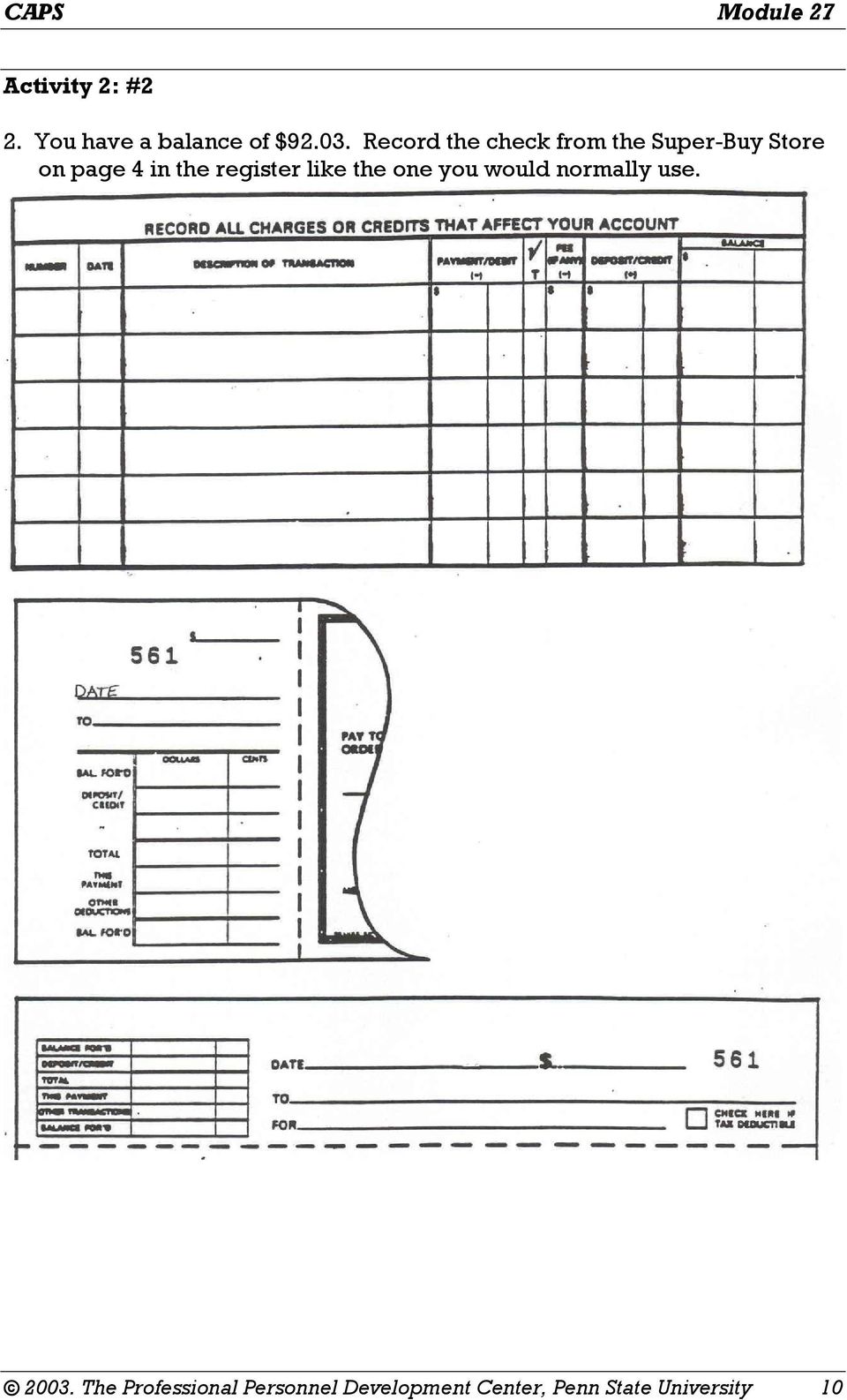
10 Activity 2: #2 2. You have a balance of $ Record the check from the Super-Buy Store on page 4 in the register like the one you would normally use The Professional Personnel Development Center, Penn State University 10
11 How to make a deposit To put your checks and cash into your account, fill out a DEPOSIT TICKET. Deposit tickets are printed in many styles and come bound behind your checks. They are printed with a front or face side and a reverse side. Your deposit tickets are printed with the same code line that is on your checks. When deposits are read by an automatic sorter, the amount of the deposit is added to your account. When the deposit ticket is returned with your monthly statement, you have a permanent record of checks and cash you have deposited The Professional Personnel Development Center, Penn State University 11

12 Look at the example James C. Morrison wants to take out $20.00 in cash. He will deduct that amount in the "Less Cash Received" column (6). Instead of holding out one check for cash, James deposits ALL checks in order to have a permanent record of checks deposited. The deposit ticket for each bank may vary slightly; however, each type will require that you give: 1. Your name and address. 2. Today's date. 3. Total coin and currency deposit The Professional Personnel Development Center, Penn State University 12

13 4. A listing of checks deposited. Identify checks by writing either the name of the person or association writing the check (see example below). 5. Total from reverse side. If all checks cannot be listed on the front side of the ticket, use the reverse side and bring the total to the front side. 6. If appropriate, total the amount of cash you wish to receive. This feature is not included on all deposit tickets. 7. If you receive cask, you need to sign the deposit slip. 8. Write in your net deposit. This will be the total of the currency, coin, and check listings on both face and reverse sides of the slip The Professional Personnel Development Center, Penn State University 13

14 Activity 3: #1 1. On September 1, you have $1.65 in coins and four checks to deposit: Billings Realty, $162.12; John Keller, $14.00; Mary Blake, $25.00; and an IRS refund check for $ You would also like $50.00 cash back. Complete the deposit ticket below The Professional Personnel Development Center, Penn State University 14

15 Activity 3: #2 2. On March 31, you have $2.12 in coins from your piggy bank and four checks to deposit: Carol Sims, $5.00; Norelco, Inc., $2.50; State Tax refund check, $35.00; and Jack Paulson, $8.50. Complete the deposit ticket below The Professional Personnel Development Center, Penn State University 15

16 How to endorse a check Before you can cash a check, you must endorse it. Endorsing means that you sign your official signature on the back of the check (turn check over so that you'll be signing your name over the "Pay to the order of" end of the check). Following are common kinds of endorsements. Each has a distinct purpose and, in a sense, gives direction as to the conditions under which the financial institution shall pay the check. 1. Endorsement in Blank You sign only your name on the endorsing end of the check. When you sign an endorsement in blank, you have transferred the check to the financial institution. If you lose the check, it can be cashed by anyone. Use this kind of endorsement only at the exact time you cash it. 2. Endorsement in Full If a check is made out to you and you, in turn, want to give it to someone else, use this kind of endorsement. You write"pay to the order of (insert name of person to receive check)" and then sign your name underneath. The person receiving the check must also sign before the check can be cashed. This check can now only be cashed by the specified person. 3. Restrictive Endorsement This kind of endorsement tells precisely what will happen to the check. It means that the check cannot be further negotiated. It is usually seen on checks sent by mail or by messenger for deposit. In these cases, the words "For Deposit Only" are written first, with the signature below. The check can only be cashed under the conditions you have specified The Professional Personnel Development Center, Penn State University 16

17 Some hints regarding endorsements 1. Do not endorse a check until it is to be cashed, deposited in a financial institution, turned over to a person, business or firm, or organization, or sent in the mail for deposit. 2. Endorse in ink only with a rubber stamp endorsement giving your name and special number furnished by the financial institution. This will prevent someone from erasing and reendorsing the check. 3. If, on the face of the check, your name is misspelled or is not complete, endorse the check in the way your name appears. Then, below this, endorse by using your official signature. This will establish your identity as the person for whom the check is meant. 4. Cash or deposit a check as soon as possible. After six months, a check is considered "stale-dated" and a financial institution may refuse to cash it. If a check is over six years old, it cannot be cashed. Exceptions to this are U.S. Government checks and some Cashier's checks. If you have a "stale-dated" check, ask that a current check be issued in its place. 5. A financial institution or a department store fee (or other places that cash checks) may charge a small fee to cash a check drawn on a financial institution outside your community. This fee is used to help cover costs of clerical work involved. How to balance your statement Once every month, your financial institution will send your canceled checks to you with a statement that will tell you the amount in your account at the time that statement was prepared. This is sent to you so that you can compare the amount presently in your checking account with the amount you've written in your check register. It is your responsibility to keep your records in order. If you do, you will have a much better idea of how much money you have left in your account. Be sure to subtract from your balance the amount of any checks that you write or any service charges you may incur. Also, add any amount that you deposit to your account. 1. Sort canceled checks into numerical order. Sort deposit tickets into numerical order The Professional Personnel Development Center, Penn State University 17

18 2. Compare each canceled check and deposit ticket with your check register and check it off. Any checks which are not checked off haven't been paid by your financial institution. They are called "outstanding checks." 3. Subtract any charges for checks, services or automatic withdrawals, such as car payments, from your checkbook balance. This is your correct checkbook balance. Sometimes your statement balance will not be the same as your checkbook balance. When this happens, you will need to reconcile your account. To do this, you need to: 1. Insert the last balance shown on your statement. 2. Add any deposits not yet added to your account. 3. Subtract any checks written and not yet charged to your account. 4. This is your adjusted balance that should agree with your checkbook balance. Balance shown on your statement (1) $ Add + (2) $ (Deposits not yet added to your account) Total $ Subtract (3) $ (Checks that have not yet been paid) ADJUSTED STATEMENT BALANCE (4) $ What to do if your adjusted balance does not agree with your checkbook register: 1. Recheck the addition, subtraction and corrections made in your checkbook register and on your reconciliation form. 2. Verify the carryover balance from page to page in your checkbook register. 3. Be sure you have deducted any service charge made by the financial institution from your checkbook register The Professional Personnel Development Center, Penn State University 18

19 4. Verify the magnetically printed amount of the canceled check located on the bottom right hand corner with the amount listed in your checkbook register. Because of the cost, some financial institutions do not return canceled checks to customers. Instead, the statement simply lists the checks. If your financial institution follows this procedure, you most likely use checks that have carbon copies. Use the copies of the checks you have written to ensure that all checks have been listed on your statement The Professional Personnel Development Center, Penn State University 19

20 Sample Statement The Professional Personnel Development Center, Penn State University 20

21 Activity 4 Your statement shows a balance of $ One deposit for $15.75 has not yet been added to your account. Check #1501 for $65.00 has not yet cleared the bank. Your checkbook shows a balance of $ Using this statement, how would you balance your account? The Professional Personnel Development Center, Penn State University 21
22 Applying for a loan Activity 5 When applying for a loan, you will have to fill out a form that tells the lender about yourself and your financial circumstances. Forms vary from company to company, but the basic information you must supply will be essentially the same. For an application, you will have to see the loan officer in your bank. Fill out the form on the next two pages using the following information: You want to buy a $5,200 car and will finance it through your bank with a down payment of $800. You have not borrowed previously from the Capital Bank, but you maintain a savings and a checking account there. Your birth date is 1/1/64 and you have been an agent in your city for Bentford Insurance Company, 5 Main Street, for three years. Your net income is $12,000 per year. It is your first job. Your spouse has been the office manager for the same company for two years, has a net salary of $11,040 per year and was born 3/17/65. Your spouse will be a co-borrower on the loan. You are renting an apartment from Town Homes, Inc., and have lived there two years. Your rent is $350 per month. You previously lived with your parents. You presently own a three year-old Ford Taurus automobile which you bought through Home Town National Bank. Your debts include $300 to Appliances Outlets (original amount was $520), $250 to Doctors Hospital (original amount $870). You make monthly payments of $40 to each of these creditors. This type of credit transaction is referred to as a Closed-End Credit Account. It will begin and end at specific times The Professional Personnel Development Center, Penn State University 22
23 2003. The Professional Personnel Development Center, Penn State University 23
24 2003. The Professional Personnel Development Center, Penn State University 24
25 MODULE 27: STANDARDS ADDRESSED IN THIS MODULE Pennsylvania s Academic Standards for Career Education and Work Career Retention (Keeping a Job) D. Compare and contrast gross and net pay. From Analyze personal budgets. Expenses Income Investing Needs Savings Taxes Wants Pennsylvania s Academic Standards for Reading, Writing, Speaking and Listening (RWSL) Learning to Read Independently E. Establish a reading vocabulary by identifying and correctly using new words acquired through the study of their relationships to other words. Use a dictionary or related reference. Secretary s Commission on Achieving Necessary Skills (SCANS) COMPETENCIES Resources: Identifies, organizes, plans, and allocates resources, including time and personal money The Professional Personnel Development Center, Penn State University 25
Learning about. Checking. Accounts WHAT YOU NEED TO KNOW. 2010 Deluxe Corp. All Right Reserved.
 Learning about Checking Accounts WHAT YOU NEED TO KNOW 2010 Deluxe Corp. All Right Reserved. Contents Learn About Checking Accounts................................3 Write a Check....................................................4
Learn about. How to deposit money. How to make withdrawals and write checks. How to keep track of your money
 Cumberland Security Bank s Checking School Learn about How to deposit money How to make withdrawals and write checks How to keep track of your money Depositing Money You can deposit cash and/or checks
Participant Guide Building: Knowledge, Security, Confidence FDIC Financial Education Curriculum
 Check It Out Building: Knowledge, Security, Confidence FDIC Financial Education Curriculum TABLE OF CONTENTS Page Determining Your Checking Account Needs 1 Checking Account Fees 2 Practice Exercise: Choosing
Savings and Bank Accounts
 LESSON 2 Savings Savings and Bank Accounts Quick Write Suppose a relative gives you a generous gift of $1,000 for your sixteenth birthday. Your parent or guardian says that you can spend $50 on things
Write Checks the Right Way
 Write Checks the Right Way Guide G-220 Revised by Fahzy Abdul-Rahman 1 Cooperative Extension Service College of Agricultural, Consumer and Environmental Sciences CHECKS VS. OTHER PAYMENT METHODS Checks
Unit 2 The Basic Accounting Cycle
 Unit 2 The Basic Accounting Cycle Chapter 3 Chapter 4 Chapter 5 Chapter 6 Chapter 7 Chapter 8 Chapter 9 Business Transactions and the Accounting Equation Transactions That Affect Assets, Liabilities, and
Banking Guide for International Students usbank.com/northwestern
 Banking Guide for International Students usbank.com/northwestern Member FDIC Opening a U.S. Bank Checking Account Q. What form of identification will I need to open a U.S. Bank checking account? A. International
Checking Accounts. Open, Manage, and Reconcile
 Checking Accounts Open, Manage, and Reconcile 1. What is a checking account? A checking account is opened at a bank or other financial institution. Banks offer several different types of checking accounts.
AV Equipment: Overhead projector with overheads of a blank check register and a bank reconciliation form.
 Section 2 Financial Basics Title of Lesson/Subject: Manage Your Checking Account Prepared by: LaRee Misek Contact : E-mail address: [email protected] Time Allotment: 2 weeks Grade: 8, 9 or 10
Table of Contents... 1. Money Smart... 2. Check It Out... 3. Determine Your Checking Account Needs... 4. Checking Account Fees...
 $ Table of Contents Table of Contents... 1 Money Smart... 2 Check It Out... 3 Determine Your Checking Account Needs... 4 Checking Account Fees... 5 Types of Checking Accounts... 7 Choosing a Checking Account...
Name: Date : Period:
 Checking Account Vocabulary Check An order to pay money from your checking account to a person or company. Deposit Deposit Slip Putting money into a bank account A paper that you fill out which tells you
Your Checking Account
 Your Checking Account What You Need to Know Getting Started Staying in Balance Practice Examples Provided by Farmers & Merchants Union Bank Contents Learn About Checking Accounts 1 How to Write a Check
Standard 4: The student will demonstrate the ability to balance a checkbook and reconcile financial accounts. Standard 4.
 STUDENT MODULE 4.1 MANAGING A BANK ACCOUNT PAGE 1 Standard 4: The student will demonstrate the ability to balance a checkbook and reconcile financial accounts. Standard 4. Tracking Your Money Alexis stops
Purpose of a Checking Account- Money is deposited into an account and checks or drafts can be written to withdraw money from the account.
 CHAPTER 9 CHECKING ACCOUNTS AND BANKING SERVICES Purpose of a Checking Account- Money is deposited into an account and checks or drafts can be written to withdraw money from the account. Demand Deposit-
Standard 4: The student will demonstrate the ability to balance a checkbook and reconcile financial accounts. Standard 4.
 TEACHER GUIDE 4.1 MANAGING A BANK ACCOUNT PAGE 1 Standard 4: The student will demonstrate the ability to balance a checkbook and reconcile financial accounts. Standard 4. Tracking Your Money Priority Academic
Getting and Keeping A Checking Account
 Getting and Keeping A Checking Account You've decided to get a checking account. That's a good idea. Your money will be safe and you'll have a record of what you've paid for. You'll know how much you have
Checking Account. Money Smarts for Kids. Money Skills for Life. Member FDIC. Welcome! What Is a Checking Account? Why Is a Checking Account So Great?
 Checking Account Welcome! Welcome to Young Americans Bank, the only bank in the world designed specifically for young people! Mr. Bill Daniels started Young Americans Bank in 1987 because he thought it
Banking Basics 101. How to Manage Your Finances and Still Have Money Left Over For Pizza. Course objectives learn about:
 Banking Basics 101 Course objectives learn about: Using a checking account Various types of payment vehicles Benefits of a savings account How to Manage Your Finances and Still Have Money Left Over For
lesson six using banking services teacher s guide
 lesson six using banking services teacher s guide using banking services web sites web sites for banking services The Internet is probably the most extensive and dynamic source of information in our society.
Banking Procedures. Online Resources CHAPTER 5
 CHAPTER 5 Banking Procedures Getty Images/PhotoDisc C hapter 5 discusses banking activities for consumers and banking in the United States. Many benefits and services for consumers are available from financial
Tips on Managing Your Checking Account
 Tips on Managing Your Checking Account How to Successfully Manage Your Checking Account By Liberty Check Printers Credit Union members have access to one of the most powerful checking account management
Checking Account & Debit Card Simulation and Student Worksheet. Understanding Checking Accounts and Debit Card Transactions
 Checking Account & Debit Card Simulation and Student Worksheet Understanding Checking Accounts and Debit Card Transactions What is a Checking Account? Common financial service used by many consumers Funds
MBTeam Banking. Personal Banking Checking Basics
 MBTeam Banking Personal Banking Checking Basics What is a Checking Account? A checking account allows you to write checks or use a debit card to pay bills and buy goods. Benefits of a Checking Account
Learn to Manage Your Checking Account and Protect Your Money
 Managing Your Checking Account Learn to Manage Your Checking Account and Protect Your Money Benefits of Your Checking Account Maintaining your TFCU share draft (checking) account responsibly and accurately
How to manage manage your your checking checking account. account.
 How How to manage to manage your your checking checking account. account. Introduction Welcome to Desert Schools Federal Credit Union. Congratulations on your first checking account! It s the perfect time
What is a Checking Account? Checking Account & Debit Card Simulation. What is a Check? Bouncing a Check. Other Checking Components
 Checking Account & Debit Card Simulation Understanding Checking Accounts and Debit Card Transactions What is a Checking Account? Common financial service used by many consumers Funds are easily accessed
4-H MARYLAND 4-H CLUB TREASURER S GUIDEBOOK 4-H 95 4-H CLUB COUNTY/CITY CLUB EIN NUMBER. By Mary Ellen Waltemire and Dr. Judith Williamson 10/98
 4-H 4-H 95 MARYLAND 4-H CLUB TREASURER S GUIDEBOOK 4-H CLUB COUNTY/CITY CLUB EIN NUMBER By Mary Ellen Waltemire and Dr. Judith Williamson 10/98 RESPONSIBILITIES OF THE 4-H CLUB TREASURER Congratulations!
Presentation Slides. Lesson Six. Banking Services 04/09
 Presentation Slides $ Lesson Six Banking Services 04/09 beware of these high-cost financial services pawn shops charge very high interest for loans based on the value of tangible assets (such as jewelry
Colorado 4-H Club Treasurer Book
 Colorado 4-H Club Treasurer Book 90509A Club Treasurer Club Leader Year County This complete 4-H Treasurer Book and all the supplemental forms are available on the web at: www.colorado4h.org USDA requires
Checking 101. Property of Penn State Federal Credit Union
 Checking 101 Checking 101 Checking Account Basics A check is a written order that represents cash Credit Union checking accounts are also called SHARE DRAFT accounts A share draft is equivalent to a check,
Accounting. Chapter 6
 Accounting Chapter 6 Lesson 6-1 Money is referred to as cash in accounting Check Checking account When open a checking account sign a signature card for all people who are allowed to sign checks Deposit
Agenda. Lecture Chapter 9 Quiz Chapter 8 Exercises & Problem Chapter 8. Objective. Cash Receipts. Cash Receipts, Payments, & Banking Procedures
 Cash Receipts, Payments, & Banking Procedures Agenda Lecture Chapter 9 Quiz Chapter 8 Exercises & Problem Chapter 8 Cash Receipts, Payments, & Banking Procedures Objective Cash Receipts 1.cash receipts
Checking Account and Debit Card Simulation
 Checking Account and Debit Card Simulation Student Instructions and Worksheets Introductory Level Take Charge Today May 2006 Checking Account & Debit Card Simulation Page 1 Checking Account Student Instructions
lesson six banking services overheads
 lesson six banking services overheads beware of these high-cost financial services pawn shops charge very high interest for loans based on the value of tangible assets (such as jewelry or other valuable
Checking Account and Debit Card Simulation
 Checking Account and Debit Card Simulation Student Instructions and Worksheets Get Ready to Take Charge of Your Finances Family Economics & Financial Education May 2006 Get Ready to Take Charge of Your
Anytime Adviser Checking Account Coach
 Anytime Adviser Checking Account Coach Welcome. This interactive guide coaches you in managing your checking account. You may move from chapter to chapter by selecting headings from the left. Click on
Checking Account & Debit Card Simulation. Understanding Checking Accounts and Debit Card Transactions
 Checking Account & Debit Card Simulation Understanding Checking Accounts and Debit Card Transactions What is a Checking Account? Common financial service used by many consumers Funds are easily accessed
Checking 101. Checking Out Checking Accounts
 Checking 101 Checking Out Checking Accounts Checking Account Basics A check is a written order that represents cash Credit Union checking accounts are also called SHARE DRAFT accounts A share draft is
Chapter 9. Checking Accounts and Other Banking Services
 Chapter 9 Checking Accounts and Other Banking Services Checking Account Basics Checking Account - An account that allows depositors to write checks to make payments. Check - A written order to a bank to
Student Take Home Guide. Money Smart. Check It Out
 Student Take Home Guide Money Smart Check It Out Table of Contents Table of Contents...1 Money Smart...2 Check It Out...3 Determine Your Checking Account Needs...4 Checking Account Fees...5 Types of Checking
Part I: Checks and Checking Concepts
 Part I: Checks and Checking Concepts Managing a checking account is an easy, step-by-step process that anyone can learn. In spite of the rise of ATM, debit and credit cards, direct deposit, automatic bill
Banking Test - MoneyPower
 Banking Test - MoneyPower Multiple Choice Identify the choice that best completes the statement or answers the question. 1. If a person makes a deposit of $10,000 or more into a bank account, the bank
FDIC Money Smart Financial Education Program
 Check it Out Use this tip sheet to help you in the process of selecting, opening, and maintaining a checking account. This tip sheet covers the following topics: Determining your checking account needs
Accounting for Cash. College Accounting. Heintz & Parry CASH INTERNAL CONTROL OPENING A CHECKING ACCOUNT
 Heintz & Parry 0 th Edition Chapter 0 th Edition College Accounting Accounting for Cash CASH INTERNAL CONTROL Includes: Currency, coins, and checking accounts Checks received from customers Money orders
Introductions. Student Introductions. Purpose. Objectives (Continued) Objectives
 Introductions Instructor and student introductions Module overview 1 2 Your name Student Introductions Your expectations, questions, and concerns about checking accounts Purpose will teach you how to use
4-H Treasurer s Record Book
 4-H-453-04 4-H Treasurer s Record Book Name of 4-H Club/Unit 4-H Year: October 1, 20, to September 30, 20 4-H Club/Unit Treasurer Signature 4-H Club/Unit Organizational Leader Signature 4-H Programs Sources
lesson six banking services overheads
 lesson six banking services overheads beware of these high-cost financial services pawn shops charge very high interest for loans based on the value of tangible assets (such as jewellery or other valuable
Checking and Savings Accounts Pretest
 Checking and Savings Accounts Pretest 1. It does not matter which kind of checking account you open. Just get the one with the lowest service charge. 2. Some checking accounts pay interest but the interest
Share Draft/Checking Account Basics
 Goals Share Draft/Checking Account Basics By the end of this session, students will be able to explain and understand: How and why checks are used What factors to compare when shopping for an account How
lesson six banking services supplemental materials 04/09
 lesson six banking services supplemental materials 04/09 banking terms account Money deposited with a financial institution for investment and/or safekeeping purposes. assets Items of monetary value (e.g.,
Checking Account Simulations
 Checking Account Simulations ADVANTAGES AND DISADVANTAGES OF A CHECKING ACCOUNT Even though you have already opened an account, you need to be aware of the advantages and the disadvantages of using a checking
Unit on Checking. Activity Points Possible Points Received Pre- test 10
 Unit on Checking CHECKLIST Listed below are the activities that will be graded in each area and the amount of points each activity is worth. There is also a grading scale at the bottom of the page, which
New Direction. Within Your Reach! A Financial Literacy Training Presentation for our Members by:
 New Direction Within Your Reach! A Financial Literacy Training Presentation for our Members by: Maintaining a Checking Account Keeping track of Deposits and Withdrawals Why Should I Keep a Check Register?
Checking and Banking
 Chapter 5 Checking and Banking 5.1 Checking Accounts 5.2 Banking Services and Fees Lesson 5.1 Checking Accounts Learning Objectives LO 1-1 Describe the purpose of a checking account and the forms associated
OPENING A CHECKING ACCOUNT
 2 OPENING A CHECKING ACCOUNT SKILL 1 SKILL 2 SKILL 3 SKILL 4 SKILL 5 SKILL 6 SKILL 7 How to Compare Banking Services How to Open a Checking Account How to Keep Accurate Records How to Write a Check How
Account a service provided by a bank allowing a customer s money to be handled and tracks money coming in and going out of the account.
 Account a service provided by a bank allowing a customer s money to be handled and tracks money coming in and going out of the account. Account fee the amount charged by a financial institution for the
Using Banking Services
 Teacher's Guide $ Lesson Six Using Banking Services 04/09 using banking services websites websites for banking services The internet is probably the most extensive and dynamic source of information in
Checking Account and Debit Card Simulation
 Checking Account and Debit Card Simulation Student Assessment Answer Key Introductory Level Directions Step One: View s monthly transactions described below and complete all necessary transactions using
Checking Account Management
 Checking Account Management 595 Market Street, 16th Floor San Francisco, CA 94105 888.456.2227 www.balancepro.net Whether you have a history of overdraft or nonsufficient funds charges or you just want
Why should I have a bank account and how do I use one?
 Take it to the Bank! 2 Money Matters The BIG Idea Why should I have a bank account and how do I use one? AGENDA Approx. 45 minutes I. Warm Up: Why a Bank? (5 minutes) II. Checking Accounts: Putting Your
Elkhorn Federal Credit Union
 Accounts 101 Elkhorn Federal Credit Union First and foremost the number one principle to managing your checking account is to make sure there is enough money in your account to cover the transactions that
CHECKING BASICS101. 701.255.0042 www.capcu.org
 CHECKING BASICS101 701.255.0042 www.capcu.org This book is intended as a general guide to the topics discussed, and it does not deliver accounting, personal finance, or legal advice. It is not intended,
Controlling and Reporting Cash
 Controlling and Reporting Cash Essential Principles for Safeguarding Cash and Reporting It On Financial Statements Gregory Mostyn, CPA Worthy and James Publishing www.worthyjames.com Controlling and Reporting
Checking Account FINANCIAL INSTITUTION WITHDRAWAL. Should I Be Banking? Checking Account. Taking Charge of Your Own. And More!
 TEEN GUIDE moneytalks4teens.org Checking Account Crossword Puzzle Should I Be Banking? Taking Charge of Your Own Checking Account Choosing Your FINANCIAL INSTITUTION Opening Your Checking Account Making
Current/Cheque/Savings Account and Fixed Deposit Terms
 Current/Cheque/Savings Account and Fixed Deposit Terms www.sc.com/sl Copyright 2015 Standard Chartered Bank Version 1.0-2015 Contents 1 Choosing the account that is right for you 1 2 Savings accounts 1
How To Write A Check Online
 BANKING & CHECKWRITING PACKET CHAPTER 7 Use your textbook and the information discussed in class to answer the following questions: Define the following terms: 1. Direct deposit: 2. Debit card: 3. Commercial
4-H Youth Development. So you re the club treasurer... S S S S SSS S S S. 4H 71D Revised November 2008
 S S S SSS S S S S S S SSS SS 4-H Youth Development So you re the club treasurer... 4H 71D Revised November 2008 Y. ou, and all 4-H officers, are representatives You represent not only the local group,
Instructor Guide Building: Knowledge, Security, Confidence FDIC Financial Education Curriculum
 Check It Out Building: Knowledge, Security, Confidence FDIC Financial Education Curriculum TABLE OF CONTENTS Page Module Overview 1 Purpose 1 Objectives 1 Time 1 Materials and Equipment Needed to Present
Welcome. 1. Agenda. 2. Ground Rules. 3. Introductions. Check It Out 2
 Check It Out Welcome 1. Agenda 2. Ground Rules 3. Introductions Check It Out 2 Objectives: Part 1 State the benefits of using a checking account Determine which checking account is best for you Identify
Option 1 Teacher Information Page 1 Teacher Information
 Option 1 Teacher Information Page 1 Teacher Information FINANCIAL INSTITUTIONS 1. Ask students where they keep their money. Discuss with them the three most common financial institutions in which the majority
Personal Financial Literacy: Checking
 Personal Financial Literacy: Checking Overview In this lesson, students will learn the benefits of checking accounts, as well as precautions one must take with these accounts. They will practice using
Teacher's Guide. Lesson Six. Banking Services 04/09
 Teacher's Guide $ Lesson Six Banking Services 04/09 banking services websites Students will make wise choices about their banking services once they understand such fundamentals as: selecting and managing
CASH RECONCILIATION & INTERNAL CONTROLS
 CASH RECONCILIATION & INTERNAL CONTROLS Montana Clerks, Treasurers & Finance Officers Institute ~ May 2011 Presented by: Brenda Schneider, Superior; Doris Pinkerton, Forsyth & Darla Erickson, Local Government
Current/Cheque/Savings Account and Fixed Deposit Terms
 Current/Cheque/Savings Account and Fixed Deposit Terms www.sc.com/zw Copyright 2015 Standard Chartered Bank Zimbabwe Limited V1_2015 Contents 1 Choosing the account that is right for you 1 2 Savings accounts
Checking Account Unit FINANCIAL LITERACY
 Checking Account Unit FINANCIAL LITERACY Kentucky Core Content Financial Management practices (e.g. maintaining bank accounts, budgeting, saving, using credit cards wisely, financing large purchases) are
Controlling and Reporting Cash
 Controlling and Reporting Cash Essential Principles for Safeguarding Cash and Reporting It On Financial Statements Gregory Mostyn, CPA Worthy and James Publishing www.worthyjames.com Controlling and Reporting
CHECKING ACCOUNTS and ATM TRANSACTIONS
 Grades 6-8 Lesson 1 CHECKING ACCOUNTS and ATM TRANSACTIONS Key concepts: Checking accounts, ATMs, debit cards, credit cards, bank fees and regulation, safeguarding personal information Summary: This lesson
Basic Banking. 2) Money that a bank allows you to borrow and pay back with interest
 Basic Banking When choosing a bank, you should look for a bank that offers the type of accounts and services you are looking for. You might look for convenience of branch locations, great customer service,
Current/Cheque/Savings Account and Fixed Deposit Terms www.sc.com/gh
 Current/Cheque/Savings Account and Fixed Deposit Terms www.sc.com/gh Copyright 2015 Standard Chartered Bank Version 01/2015 Contents 1 Choosing the account that is right for you 1 2 Savings accounts 1
Current/ Cheque/ Savings Account and Fixed Deposit Terms
 Current/ Cheque/ Savings Account and Fixed Deposit Terms www.sc.com/zm Copyright 015 Standard Chartered Bank Version 01-015 Contents 1 Choosing the account that is right for you Savings accounts Fixed
How to Use a Financial Institution
 How to Use a Financial Institution Latino Community Credit Union & Latino Community Development Center HOW TO USE A FINANCIAL INSTITUTION LATINO COMMUNITY CREDIT UNION & LATINO COMMUNITY DEVELOPMENT CENTER
FINANCIAL/BANKING LITERACY ASSISTANCE FOR LATINO AMERICANS
 FINANCIAL/BANKING LITERACY ASSISTANCE FOR LATINO AMERICANS REASONS WHY YOU SHOULD OPEN A BANK ACCOUNT Safety Carrying cash on payday or keeping large amounts of money at home or in your wallet can make
Current/Cheque/Savings Account and Fixed Deposit Terms
 Current/Cheque/Savings Account and Fixed Deposit Terms sc.com/gm Copyright 2015 Standard Chartered Bank version 1.0 Contents 1 Choosing the account that is right for you 1 2 Savings accounts 1 3 Fixed
SKILLS COMPETENCY ASSESSMENT Answering Incoming Calls
 Answering Incoming Calls To answer telephone calls professionally, acquiring all necessary information from the caller, documenting it correctly, and properly acting on it. The student demonstrates the
Cash Receipts, Cash Payments, and Banking Procedures
 9-1 McGraw-Hill 2009 The McGraw-Hill Companies, Inc. All rights reserved. Cash Receipts, Cash Payments, and Banking Procedures Section 1: Cash Receipts Section Objectives 1. Record cash receipts in a cash
Checking Account and Debit Card Simulation
 Checking Account and Debit Card Simulation Student Assessment Get Ready to Take Charge of Your Finances Family Economics & Financial Education April 2006 Get Ready to Take Charge of Your Finances Checking
Welcome! You ve made a wise choice opening a savings account. There s a lot to learn, so let s get going!
 Savings Account Welcome! Welcome to Young Americans Bank, the only bank in the world designed specifically for young people! Mr. Bill Daniels started Young Americans Bank in 1987 because he thought it
Checking Account Workbook. By:
 Checking Account Workbook By: Opening a checking account: One of the safest and easiest ways to manage your money is through a checking account. When you open a checking account make sure you have the
4-H Club Treasurer s Book
 4-H Club Treasurer s Book Name of Club: GO Team: Year: Printed 2010 Manitoba Agriculture, Foods, and Rural Initiatives www.gov.mb.ca/agriculture 1 Name of Club Year President Vice-President Secretary Treasurer
This APR may be applied to your account if you: apply?:
 Interest Rates and Interest Charges Annual Percentage Rate (APR) for Purchases APR for Balance Transfers APR for Cash Advances 6.49%a, 7.49%b, 8.49%c, 9.49%d 6.49%a, 7.49%b, 8.49%c, 9.49%d 6.49%a, 7.49%b,
DimeOnLine BillPay Frequently Asked Questions
 DimeOnLine BillPay Frequently Asked Questions The Dime Bank has made banking easier by providing access to your accounts 24 hours a day, 7 days a week. Now you can view up-to-the-minute deposit account
Ohio 4-H Treasurer s Handbook
 Ohio 4-H Treasurer s Handbook Name of Treasurer Year Age as of January 1 County Name of Club 4-H Advisor Signature Make it a Project (optional activity) Your efforts in this officer position can be turned
WHAT YOU SHOULD KNOW ABOUT YOUR CHAPTER 13 BANKRUPTCY. Your Trustee is: Locke D. Barkley 601-355-6661. www.barkley13.com. Your Case Number is:
 WHAT YOU SHOULD KNOW ABOUT YOUR CHAPTER 13 BANKRUPTCY This booklet contains some basic, general information about your Chapter 13 bankruptcy. Read this pamphlet completely to understand your obligations
3. How to Use Credit
 3. How to Use Credit Building a Better Future 103 104 Building a Better Future UNIT 3: HOW TO USE CREDIT Lesson 1: What is Credit? Lesson Objectives: Students will understand why credit is important Students
How To Understand How To Get A Bank Account
 Opening a Bank Account Section Objectives A basic component in establishing financial independence is Opening a Bank Account. Banking services are essential tools for managing personal finances and building