
GT-S5750E. user manual
|
|
|
- Harry McGee
- 10 years ago
- Views:
Transcription
1 GT-S5750E user manual

2 Using this manual Thank you for purchasing this Samsung mobile device. This device will provide you with high quality mobile communication and entertainment based on Samsung s exceptional technology and high standards. This user manual has been specially designed to guide you through the functions and features of your device. Read me first Please read all safety precautions and this manual carefully before using your device to ensure safe and proper use. The descriptions in this manual are based on the default settings of your device. Images and screenshots used in this user manual may differ in appearance from the actual product. Content in this user manual may differ from the product, or from software provided by service providers or carriers, and is subject to change without prior notice. Refer to for the latest version of the user manual. Available features and additional services may vary by device, software, or service provider. Formatting and delivery of this user manual is based on Bada operating systems and may vary depending on the user s operating system. Applications and their functions may vary by country, region, or hardware specifications. Samsung is not liable for performance issues caused by third-party applications. 2 Using this manual

3 Samsung is not liable for performance issues or incompatibilities caused by user editing of registry settings. You may upgrade your mobile device s software by accessing Sound sources, wallpapers, and images provided in this device are licenced for limited use between Samsung and their respective owners. Extracting and using these materials for commercial or other purposes is an infringement of copyright laws. Samsung is not liable for such copyright infringement by the user. This product includes certain free/open source software The exact terms of the licenses, disclaimers, acknowledgements and notices are available on the Samsung's website Please keep this manual for future reference. Instructional icons Before you start, familiarise yourself with the icons you will see in this manual: Warning situations that could cause injury to yourself or others Caution situations that could cause damage to your device or other equipment Note notes, usage tips, or additional information Using this manual 3

4 Refer to pages with related information; for example: p.12 (represents see page 12 ) Followed by the order of options or menus you must select to perform a step; for example: In Idle mode, select Messages Compose (represents Messages, followed by Compose) [ ] Square brackets device keys; for example: [ ] (represents the End key) Copyright Copyright 2010 Samsung Electronics This user manual is protected under international copyright laws. No part of this user manual may be reproduced, distributed, translated, or transmitted in any form or by any means, electronic or mechanical, including photocopying, recording, or storing in any information storage and retrieval system, without the prior written permission of Samsung Electronics. Trademarks SAMSUNG and the SAMSUNG logo are registered trademarks of Samsung Electronics. Bluetooth is a registered trademark of the Bluetooth SIG, Inc. worldwide. 4 Using this manual
![[ ] Square brackets device keys; for example: [ ] (represents the End key) Copyright Copyright 2010 Samsung Electronics This user manual is protected under international copyright laws.](/docs-images/53/10840855/images/page_4.jpg "No part of this user manual may be reproduced, distributed, translated, or transmitted in any form or by any means, electronic or mechanical, including photocopying, recording, or storing in any")
5 Oracle and Java are registered trademarks of Oracle and/ or its affiliates. Other names may be trademarks of their respective owners. Windows Media Player is a registered trademark of Microsoft Corporation. Wi-Fi, the Wi-Fi CERTIFIED logo, and the Wi-Fi logo are registered trademarks of the Wi-Fi Alliance. and are trademarks of SRS Labs, Inc. CS Headphone and WOW HD technologies are incorporated under licence from SRS Labs, Inc. All other trademarks and copyrights are the property of their respective owners. Using this manual 5
6 Contents Assembling Unpack Install the SIM or USIM card and battery Charge the battery Insert a memory card (optional) Attach a hand strap (optional) Getting started Turn your device on and off Get to know your device Use the touch screen Lock or unlock the touch screen and keys.. 23 Access menus Launch and manage applications Use widgets Customise your device Enter text Communication Calling Logs Contents

7 Messages IM Social Hub Entertainment Camera Video player Music FM radio Games Personal information Contacts Calendar Task Memo Voice recorder Web Internet Samsung Apps Community websites YouTube Navigation Contents 7

8 Connectivity Bluetooth Wi-Fi Mobile AP GPS PC connections Tools Clock Calculator My accounts My files Smart search Settings Access the Settings menu Flight mode Connectivity Sound profiles Tones Display and light General Date and time Menu and widgets Applications Security Contents

9 Memory Reset About phone SIM applications Overview of menu functions Troubleshooting Safety precautions Contents 9

10 Assembling Unpack Check your product box for the following items: Mobile device Battery Travel adapter (charger) User manual Use only Samsung-approved software. Pirated or illegal software may cause damage or malfunctions that are not covered by your manufacturer's warranty. 10 Assembling The items supplied with your device may vary depending on the software and accessories available in your region or offered by your service provider. You can obtain additional accessories from your local Samsung dealer. The supplied accessories perform best for your device. Accessories other than the supplied ones may not be compatible with your device. Install the SIM or USIM card and battery When you subscribe to a cellular service, you will receive a Subscriber Identity Module (SIM) card, with subscription details, such as your personal identification number (PIN) and optional services. To use UMTS or HSDPA services, you can purchase a Universal Subscriber Identity Module (USIM) card.
11 To install the SIM or USIM card and battery, 1 If the device is on, press and hold [ ] and select Yes to turn it off. 2 Remove the back cover. 3 Insert the SIM or USIM card. Be careful not to damage your fingernails when you remove the back cover. Place the SIM or USIM card into the device with the gold-coloured contacts facing up. If you do not insert a SIM or USIM card, you can only use your device s non-network services and some menus. Do not insert a memory card into the SIM or USIM card slot. Assembling 11

12 4 5 Insert the battery. Replace the back cover. Charge the battery Before using the device for the first time, you must charge the battery. You can charge the device with the provided travel adapter or by connecting the device to a PC with a PC data cable. Use only Samsung-approved chargers and cables. Unauthorised chargers or cables can cause batteries to explode or damage your device. When your battery is low, the device will emit a warning tone and display a low battery message. The battery icon will also be empty and blinking. If the battery level becomes too low, the device will automatically power off. Recharge your battery to continue using your device. Charge with the travel adapter 1 Open the cover to the multifunction jack on the top of the device. 12 Assembling

13 Plug the small end of the travel adapter into the 2 multifunction jack. Improperly connecting the travel adapter can cause serious damage to the device. Any damage caused by misuse is not covered by the warranty. Plug the large end of the travel adapter into a power 3 outlet. You can use the device while it is charging, but it may take longer to fully charge the battery. While the device is charging, the touch screen may not function due to an unstable power supply. If this happens, unplug the travel adapter from the device. While charging, the device may heat up. This is normal and should not affect your device s lifespan or performance. If your device is not charging properly, bring your device and the charger to a Samsung Service Centre. Assembling 13

14 4 When the battery is fully charged (the battery icon is no longer moving), unplug the travel adapter from the device and then from the power outlet. Do not remove the battery while connected to the travel adapter. Doing this may cause damage to the device. To ensure peak performance of your battery, fully charge and discharge (use until empty) the battery the first two or three times. When you charge the battery for the first time, charging your battery completely may take about 4 hours. Because the battery is a consumable part, the battery will gradually wear out and the charging time will be reduced. The initial charging capacity of your battery is about 1200 mah. Charge with the PC data cable Before charging, ensure that your PC is turned on. 1 Open the cover to the multifunction jack on the top of the device. 2 Plug one end (micro-usb) of the PC data cable into the multifunction jack. 3 Plug the other end of the PC data cable into a USB port on a PC. Depending on the type of PC data cable you are using, it may take some time before charging begins. 4 When the battery is fully charged (the battery icon is no longer moving), unplug the PC data cable from the device and then from the PC. 14 Assembling
15 Insert a memory card (optional) To store additional multimedia files, you must insert a memory card. Your device accepts microsd or microsdhc memory cards with maximum capacities of 16 GB (depending on memory card manufacturer and type). Samsung uses approved industry standards for memory cards, but some brands may not be fully compatible with your device. Using an incompatible memory card may damage your device or the memory card and can corrupt data stored on the card. Your device supports only the FAT file structure for memory cards. If you insert a card formatted with a different file structure, your device will ask you to reformat the memory card. Frequent writing and erasing of data will shorten the lifespan of memory cards. 1 Remove the back cover. 2 Insert a memory card with the gold-coloured contacts facing up. Push the memory card in the memory card slot until it 3 locks in place. 4 Replace the back cover. Remove the memory card 1 Ensure that the device is not currently using the memory card. Assembling 15
16 2 Remove the back cover. 3 Push the memory card gently until it disengages from the device. 4 Pull the memory card out of the memory card slot. 5 Replace the back cover. Do not remove a memory card while the device is transferring or accessing information, as this could result in loss of data or damage to the memory card or device. Format the memory card Formatting your memory card on a PC may cause incompatibilities with your device. Format the memory card only on the device. In Menu mode, select Settings Memory Memory card details Format Yes. Before formatting the memory card, remember to make backup copies of all important data stored on your device. The manufacturer s warranty does not cover loss of data resulting from user actions. Attach a hand strap (optional) 1 Remove the back cover. 2 Slide a hand strap through the hand strap hole and hook it over the small projection. 3 Replace the back cover. 16 Assembling

17 Getting started Turn your device on and off To turn on your device, 1 Press and hold [ ]. 2 Enter your PIN and select Done (if necessary). 3 Select a language you want and select Next. 4 Select keyboard languages and select Next. 5 Select your home time zone and select Next. 6 Set the time and date and select Save. To turn off your device, press and hold [ ] and select Yes. Follow all posted warnings and directions from official personnel when in areas where the use of wireless devices is restricted, such as aeroplanes and hospitals. To use your device's non-network services only, switch to the flight mode. In Menu mode, select Settings Flight mode. Getting started 17
![6 Set the time and date and select Save. To turn off your device, press and hold [ ] and select Yes.](/docs-images/53/10840855/images/page_17.jpg "Follow all posted warnings and directions from official personnel when in areas where the use of wireless devices is restricted, such as aeroplanes and hospitals.")
18 Get to know your device Device layout Earpiece Multifunction jack Camera lens Power/Lock key Headset jack (3.5 mm) Volume key Touch screen Back cover Menu key Dial key End key Camera key Internal antenna Speaker Mouthpiece 18 Getting started
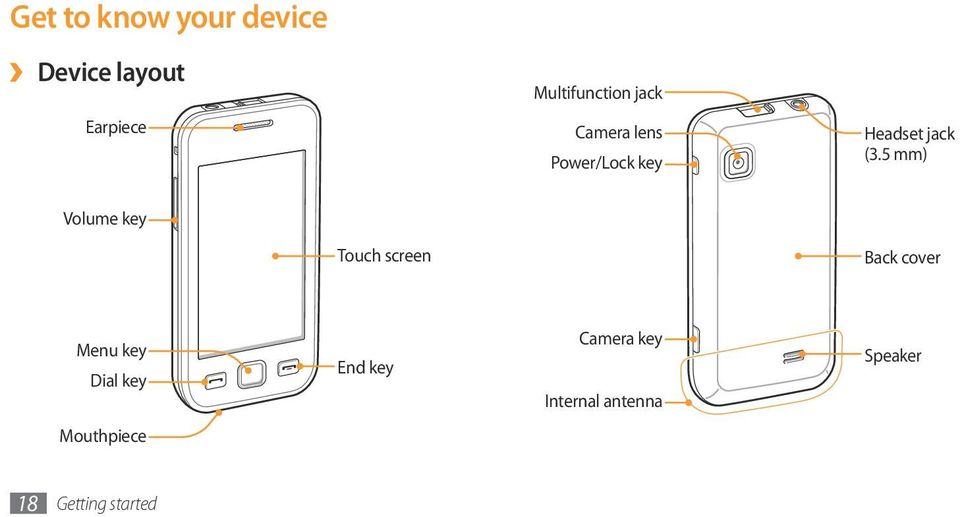
19 Keys Key Power/ Lock Dial Menu End Volume Function Turn the device on or off (press and hold); Lock or unlock the touch screen and keys. Make or answer a call; In Idle mode, retrieve logs of your calls and messages. Access Menu mode; Launch the task manager to view all active applications (press and hold); Access Smart search (press twice). End a call; In Menu mode, return to Idle mode. Adjust the device s volume. Key Camera Function In Idle mode, turn on the camera; In Camera mode, take a photo or record a video. Idle screen When the device is in Idle mode, you will see the idle screen. From the idle screen, you can view your device s status and access applications. The idle screen has multiple panels, and you can add new panels to the idle screen. p. 27 Scroll left or right to a panel of the idle screen. You can also select a dot on the top of the screen to move to the corresponding panel of the idle screen directly. Getting started 19

20 Indicator icons Icons shown on the display may vary depending on your region or service provider. Icon 20 Definition No SIM or USIM card No signal Signal strength Flight mode activated Network searching GPRS network connected EDGE network connected UMTS network connected HSDPA network connected Getting started Icon Definition WLAN connected Call missed Synchronised with a web server Bluetooth activated Bluetooth hands-free car kit or headset connected Voice call in progress Video call in progress Call diverting activated Synchronising with PC Memory card inserted Connected to secured web page
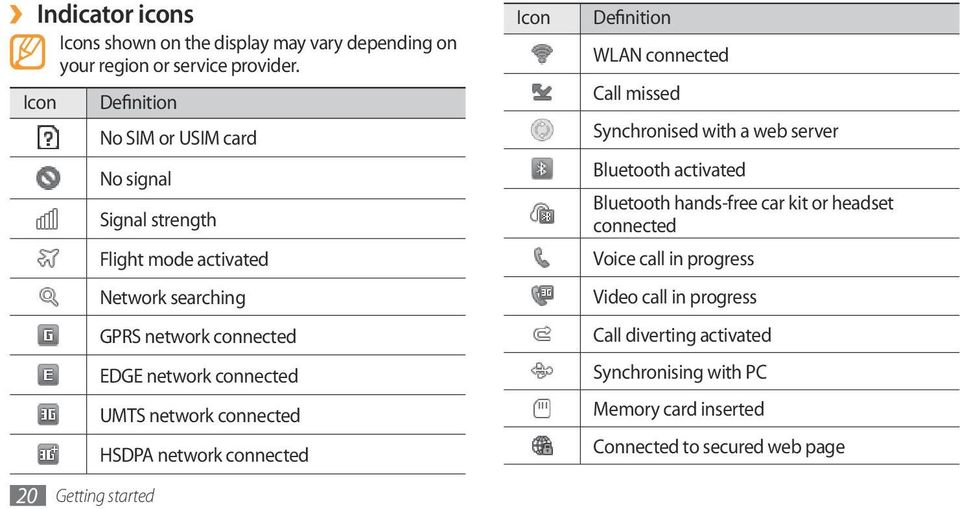
21 Icon Definition New text or multimedia message New message New voice mail message Alarm activated Roaming (outside of normal service area) Normal profile activated Silent profile activated Current time Battery power level Shortcuts panel In Idle mode or while using an application, select in the indicator icons area to open the shortcuts panel. Select icons to activate or deactivate the WLAN and Bluetooth features. You can also turn on or off the device's volume and check new messages and alerts. Use the touch screen Your device s touch screen lets you easily select items or perform functions. Learn basic actions to use the touch screen. Getting started 21
22 To avoid scratching the touch screen, do not use sharp tools. Do not allow the touch screen to come into contact with other electrical devices. Electrostatic discharges can cause the touch screen to malfunction. Do not allow the touch screen to come into contact with water. The touch screen may malfunction in humid conditions or when exposed to water. For optimal use of the touch screen, remove the screen protection film before using your device. Your touch screen has a layer that detects small electrical charges emitted by the human body. For best performance, tap the touch screen with your fingertip. The touch screen will not react to touches of sharp tools, such as a stylus or pen. Control your touch screen with the following actions: Tap: Touch once with your finger to select or launch a menu, option, or application. Tap and hold: Tap an item and hold it for more than 2 seconds to open a pop-up option list. Double-tap: Tap twice quickly with your finger to zoom in or out while viewing photos or web pages. Panning: Tap and drag with your finger to select items. Drag and drop: Tap and hold your finger on an item, and then drag your finger to move the item. Flick: Flick the screen quickly to activate an application. Area zoom: Place two fingers on the screen and pull them apart to zoom in or squeeze them together to zoom out. 22 Getting started
23 Your device turns off the touch screen when you do not use the device for a specified period. To turn on the screen, press [ ] or the Menu key. You can also adjust the backlight time. In Menu mode, select Settings Display and light Backlight time. Some lists have an index along the right side. Tap a letter to jump to items starting with that letter. Drag your finger along the index to quickly scroll through the list. Lock or unlock the touch screen and keys You can lock the touch screen and keys to prevent any unwanted device operations. To lock, press [ ]. To unlock, press [ ] or the Menu key and drag the grey window with your finger in any direction. Access menus To access your device s menus, 1 In Idle mode, press the Menu key to access Menu mode. 2 Scroll left or right to a main menu screen. You can also select a dot on the top of the screen to move to the corresponding main menu screen directly. 3 Select a menu or application. 4 Press [ ] to return to Idle mode. Getting started 23
24 Your device has a built-in motion sensor that detects its orientation. If you rotate the device while using some features, the interface will automatically switch to landscape view. To set the interface to keep the orientation when you rotate the device, select Settings General Gestures Orientation Change orientation. While using the device, you can capture an image of a screen by pressing [ ] and the Menu key simultaneously. The image will be saved in My files Images. Organise applications in Menu mode You can reorganise the applications in Menu mode by changing their order or grouping them into categories to suit your preferences and needs. 1 In Idle mode, press the Menu key to access Menu mode. 2 Select Edit at the top left of the screen. 3 Drag an application to the location you want. You can move an application icon to another main menu screen. You can also change most-used applications at the bottom line. Move an application at the bottom line to a main menu screen, and move an application you want to use in Idle mode directly to the bottom line. 4 Select Done at the top left of the screen. Add new main menu screens 1 In Idle mode, press the Menu key to access Menu mode. 2 Select Edit at the top left of the screen. Rotate the device to landscape view Getting started
25 4 Select to add a new main menu screen. You can have up to 10 screens. 5 Select to remove a screen from the main menu. Rotate the device to portrait view. 6 Select Done at the top left of the screen. Launch and manage applications Launch multiple applications Your device allows you to multi-task by running multiple applications at the same time. To launch multiple applications, press the Menu key to return to the main menu and select an application to launch. Use the task manager You can manage multiple applications with the task manager. To launch the task manager, 1 Press and hold the Menu key. The icons of active applications appear. 2 Control active applications as follows: To switch between applications, select one from the icons of active applications. To close an application, select. To close all active applications, select End all applications. Use widgets Widgets are small applications that provide convenient functions and information on your idle screen. Getting started 25
26 Some of your widgets connect to web services. Using a web-based widget may incur additional charges. Available widgets may vary depending on your region or service provider. Open the widget toolbar To open the widget toolbar and access widgets, 1 In Idle mode, select Widget at the top left of the screen to open the widget toolbar. 2 Read the widget disclaimer and select Accept (if necessary). 3 Scroll left or right to a panel of the idle screen. 4 Scroll left or right on the widget toolbar to find the widget you want to use. 5 Drag the widget to the idle screen. 6 Select Done at the top left of the screen to close the widget toolbar. 7 To move the widget back to the widget toolbar, tap and hold the widget until the yellow frame appears and drag it to the widget toolbar. Manage web-based widgets You can select a widget profile to connect to web services and view downloaded widgets. In Menu mode, select Settings Menu and widgets Widget. Customise your device Get more from your device by customising it to match your preferences. 26 Getting started
27 Add new panels to the idle screen You can add new panels to the idle screen to organise widgets according to your preferences and needs. 1 In Idle mode, select Widget at the top left of the screen. 2 Rotate the device to landscape view. 3 Select to add new panels to the idle screen. You can have up to 10 panels. 4 Select to remove a panel from the idle screen. Rotate the device to portrait view. 5 Select Done at the top left of the screen. Set the current time and date 1 In Menu mode, select Settings Date and time. 2 Select the time zone option and a time zone. 3 Enter the current time and date, and set the time and date format. 4 Select Back. Adjust the volume of the key tones 1 In Idle mode, press the Volume key up or down. 2 Adjust the key tone volume by pressing the Volume key or dragging the slider. Switch to the silent profile To mute or unmute your device, do one of the followings: In Idle mode, select Keypad, and then tap and hold. Open the shortcuts panel from the top of the screen and select Silent. Getting started 27
28 Set up a sound profile You can change your device's sounds by customising the current sound profile or switching to another sound profile. To set up a profile, 1 In Menu mode, select Settings Sound profiles. 2 Select the profile you are using. 3 Customise the sound options for incoming calls, incoming messages, and other device sounds. p. 103 Available sound options vary depending on the selected profile. 4 Select Set. To switch to another profile, select the check box next to the profile and then Set. 28 Getting started Select a wallpaper for the idle screen 1 In Menu mode, select Settings Display and light Wallpaper. 2 Select an image. To select an image from the image folder, select the folder. 3 Select Set Set. Samsung is not responsible for any use of default images or wallpapers provided on your device. Adjust the brightness of the display 1 In Menu mode, select Settings Display and light. 2 Drag the slider under Brightness to adjust the level of brightness. 3 Select Set. The brightness level of the display will affect how quickly the device consumes battery power.
29 Lock your device You can lock your device by activating the device password. 1 In Menu mode, select Settings Security. 2 Select Phone lock. 3 Enter a new 4- to 8-digit password and select Done. 4 Enter the new password again and select Done. The first time you access a menu that requires a password, you will be prompted to create and confirm a password. Once the device lock is enabled, you must enter the password each time you turn on the device. If you forget your password, bring your device to a Samsung Service Centre to unlock it. Samsung is not responsible for any loss of passwords or private information or other damages caused by illegal software. Lock your SIM or USIM card You can lock your device by activating the PIN supplied with your SIM or USIM card. 1 In Menu mode, select Settings Security. 2 Select PIN lock. 3 Enter the PIN of your SIM or USIM card and select Done. Once the PIN lock is enabled, you must enter the PIN each time you turn on the device. If you enter an incorrect PIN too many times, your SIM or USIM card will be blocked. You must enter a PIN unlock key (PUK) to unblock the SIM or USIM card. If you block your SIM or USIM card by entering an incorrect PUK, bring the card to your service provider to unblock it. Getting started 29
30 Activate the mobile tracker When someone inserts a new SIM or USIM card in your device, the mobile tracker feature will automatically send the contact number to specified recipients to help you locate and recover your device. To use this feature, you need a Samsung account for controlling the device from the web remotely. 1 In Menu mode, select Settings Security. 2 Select Mobile tracker. 3 Enter your password and select Done. 4 Select OK to continue. 5 Enter your address and password for your Samsung account and select Sign in. To create a Samsung account, select. 6 Select Recipients to open the recipient list. Enter a phone number including a country code 7 (with +). 8 When you are finished setting the recipients, select OK. 9 Select the sender input field and enter a sender's name. 10 Select Save. You can control the lost device via the web. Visit to see the detailed information for this feature. Enter text You can enter text by selecting characters on the virtual keypad or by inputting handwriting on the screen. 30 Getting started
31 Change the text input method When you tap the text input field, the input panel with the QWERTY keyboard appears by default. Number Function 1 Change case Switch between Symbol/Number mode and ABC mode. Insert a space; Insert a period and space (double-tap); Show frequently used symbols (tap and hold). 4 Clear your input. Number Function 5 Start a new line. 6 Change the input language; Access the keyboard settings (tap and hold). To change the text input method, tap and hold select a text input method. Option Keypad Qwerty keyboard Writing full screen Writing box Function Select characters on the keypad. Select characters on the QWERTY keyboard. Write anywhere on the screen. Write in the input box. and Getting started 31
32 Enter text using different input methods 1 Change the text input method. 2 Change the text input mode. 3 Select the appropriate virtual keys or write on the screen to enter your text. When entering text with the keypad, you can use the following modes: Mode PY (Pinyin) Function 1. Select the appropriate virtual keys to enter pinyins. 2. Select a pinyin. 3. To enter phrases, select Div and enter more pinyins. 4. Select a character. Mode TSTR ABC Function 1. Select the appropriate virtual keys to enter strokes. 2. Select a stroke. If the correct word does not display, select and an alternative word from the list that appears. 3. To enter phrases, select Div and enter more strokes. 4. Select a character. Select an appropriate virtual key until the character you want appears on the display. 32 Getting started
33 Mode T9 (Predictive text) Function 1. In ABC mode, tap and hold and select Predictive text. 2. Select the appropriate virtual keys to enter an entire word. 3. When the word displays correctly, select to insert a space. If the correct word does not display, select and an alternative word from the list that appears. Adding words to the T9 dictionary If you cannot find a word in the alternative word list, you can add the word to the T9 dictionary. Select Add word at the bottom of the alternative word list. Mode Number Symbol Function Select an appropriate virtual key to enter a number. You can enter numbers by tapping and holding a virtual key in ABC or T9 mode. 1. Select or to scroll to a symbol set you want. 2. Select an appropriate virtual key to enter a symbol. When entering text, rotate the device to display the wider QWERTY keyboard. Getting started 33
34 Copy and paste text While you are entering text, you can use the copy and paste feature to use text in other applications. 1 Place the cursor where you want to start. 2 Tap and hold the text input field until appears. 3 Select Select from the option list. 4 Drag your finger across the text to select. You can also double-tap the word you want to highlight. 5 Select Copy or Cut to copy and paste, or cut and paste the text onto the clipboard. 6 In another application, tap and hold the text input field until appears. Select 7 Paste to insert the text from the clipboard into the text input field. 34 Getting started
35 Communication Calling Learn to use calling functions, such as making and answering calls, using options available during a call or customising and using call-related features. Make and answer a call You can use the buttons or the touch screen when you make, accept, end, or reject calls. Make a call 1 In Idle mode, select Keypad and enter an area code and a phone number. 2 Press [ ] or select to make a voice call. For a video call, select. 3 To end the call, press [ ]. Use the phonebook to save numbers you dial frequently. p. 70 To quickly access the call log to redial numbers you dialled recently, press [ ] Call. Answer a call 1 When a call comes in, press [ ]. When the device is ringing, press the Volume key to adjust the volume, or press and hold the Volume key down to mute the ringtone. 2 For a video call, select Camera on to allow the caller to see an image via the camera lens. 3 To end the call, press [ ]. Communication 35
36 Reject a call When a call comes in, press [ ]. The caller will hear a busy tone. You can set up a list of numbers to reject incoming calls automatically. p. 38 You can send a message when you reject incoming calls. To set messages, in Menu mode, select Settings Applications Call All calls Reject call with message. Call an international number 1 In Idle mode, select Keypad and tap and hold 0 to insert the + character. 2 Enter the complete number you want to dial (country code, area code and phone number), and then press [ ] or select to dial the number. Use the headset By plugging the supplied headset into the device, you can make and answer calls: To redial the last call, press and hold the headset button. To answer a call, press the headset button. To end a call, press the headset button. The supplied headset is designed only for your device and may not be compatible with other phones and MP3 players. Use options during a voice call You can use the following options while a voice call is in progress: To adjust the voice volume, press the Volume key up or down. To place a call on hold, select Hold. To retrieve a held call, select Unhold. 36 Communication
37 To activate the speakerphone feature, select Speaker. In noisy environments, you may have difficulty hearing some calls while using the speakerphone feature. For better audio performance, use the normal device mode. To turn off the microphone so that the other party cannot hear you, select Mute. To listen and talk to the other party via the headset, select Headset. To switch the current call to a video call, select Switch to video call. To dial a second call, place the first call on hold and then dial a new number. To answer a second call, select Accept when a call waiting tone sounds. The first call is automatically placed on hold. You must subscribe to the call waiting service to use this feature. To switch between the two calls, select Swap. To end the call on hold, select Swap End call. To make a multiparty call (conference call), make or answer a second call and select Join when connected to the second party. Repeat to add more parties. You must subscribe to the multiparty call service to use this feature. To connect the current party to the party placed on hold, select Transfer. You will be disconnected. Use options during a video call You can use the following options while a video call is in progress: To activate the speakerphone, select Speaker. To turn off the microphone so that the other party cannot hear you, select Mute. To hide your image from the other party, select Camera off. To select an alternative image to be shown to the other party, select Outgoing image. Communication 37
38 Tap and hold the other party s image to access the following options: Capture image: Capture the other party s image. Record video call: Record videos of the other party s image. To open the dialling keypad, select Keypad. To listen and talk to the other party via the headset, select Switch to headset. To customise the video call settings, select Settings. View and dial missed calls Your device will display the missed call icon ( have missed calls. 38 Communication ) when you Open the shortcuts panel and select a missed call. Select the call from the call log and press [ ] to dial. Use additional features You can use various other call-related features, such as auto rejection, Fixed Dialling Number (FDN) mode, or call diverting or barring. Set auto rejection Use auto rejection to reject calls from certain numbers automatically. To activate auto rejection and set up the reject list, 1 In Menu mode, select Settings Applications Call All calls Auto reject. 2 Select Create. 3 Select an option under Match criteria (if necessary). 4 Select the number input field and enter a number to reject, and select Save. 5 6 To add more numbers, repeat steps 2-4. Select the check boxes next to the numbers.
39 Make a fake call You can simulate incoming calls when you want to get out of meetings or unwanted conversations. To activate the hot key to make fake calls, in Menu mode, select Settings Applications Call Fake call Fake call hot key Save. To make a fake call, press and hold the Volume key down in Idle mode. A fake call comes in after a specified length of time. You can change the delay time before fake calls. In Menu mode, select Settings Applications Call Fake call Fake call timer. You can make fake calls appear more realistic by playing back a recorded voice. To record a voice, 1 In Menu mode, select Settings Applications Call Fake call. 2 Select Use fake call voice Record voice. 3 Select to start recording. 4 Speak into the microphone. During recording, select to pause and select to resume. 5 When you are finished, select or Save. 6 Select Save. You can also make fake calls appear more realistic by showing a caller ID image and caller's name or number. 1 In Menu mode, select Settings Applications Call Fake call. 2 Select Name or Number. 3 Enter a name or number. 4 Select Fake caller image. 5 Select the image field an option. 6 Add an image by selecting one from the image folder or capturing a new one and select Back. Communication 39
40 7 Select Save. Use Fixed Dialling Number (FDN) mode In FDN mode, your device will restrict outgoing calls, except for the numbers stored in the FDN list on your SIM or USIM card. You must first set up your FDN list in the phonebook to use FDN mode. To activate FDN mode, 1 In Menu mode, select Settings Security Fixed dialling mode. 2 Enter the PIN2 supplied with your SIM or USIM card and select Done. Set call diverting Call diverting is a network feature to send incoming calls to another number that you specify. You can set this feature separately for several conditions when you are not able to answer calls, such as when you are already on the phone or when you are outside of the service area. 1 In Menu mode, select Settings Applications Call Voice call or Video call Call diverting. 2 Select a condition. 3 Select Divert to Contacts to add a contact or To another number to enter a number to which calls will be forwarded. 4 Select Activate. Your setting will be sent to the network. Set call barring Call barring is a network feature to restrict certain types of calling or to prevent others from making calls with your device. 1 In Menu mode, select Settings Applications Call Voice call or Video call Call barring. Select a call type to restrict Communication
41 3 Select Activate. 4 Enter a call barring password and select Done. Your setting will be sent to the network. Set call waiting Call waiting is a network feature to alert you of an incoming call while you are on a previous call. This feature is available only for voice calls. 1 In Menu mode, select Settings Applications Call Voice call Call waiting. 2 Select Activate. Your setting will be sent to the network. Logs Learn to view and manage logs of calls you have dialled, received, or missed and messages you have sent, or received. View call and message logs You can view logs of your calls and messages filtered by their types. 1 In Menu mode, select Logs. 2 Scroll left or right to select a log type at the top of the screen. From the call and message logs, you can make a call or send a message directly to a contact by quickly flicking the contact to the left or right. 3 Select a log to view its details. From the detail view, you can dial the number, send a message to the number, or add the number to the phonebook or reject list. Communication 41
42 View the log manager From the log manager, you can check the amount of data or number of messages sent or received and duration of your calls. 1 In Menu mode, select Logs Log manager. Select an option you want. 2 Option Call duration Message counter counter Function View time data for your calls, such as the duration of the last call and the total duration of all calls. View the number of messages you have sent or received. View the number of s you have sent or received. Option Call costs Function View cost records for your calls, such as the cost of the last call and the total cost of all calls. You can also set the currency and price per unit, or cost limit to restrict calls according to your calling plan; The cost counter may be unavailable depending on your SIM or USIM card. You can reset the records in the log manager. From each screen, select Reset. Messages Learn to create and send text (SMS) or multimedia (MMS) messages, and view or manage messages you have sent or received. 42 Communication
43 You may incur additional charges for sending or receiving messages while outside your home service area. For details, contact your service provider. Send a text message 1 In Idle mode, select Messages Compose. 2 Select Contacts. You can enter a number manually or select one from the logs or contact groups by selecting another option. 3 Select the check boxes next to contacts and select Add. 4 Select the text input field and enter your message text. 5 Select Send to send the message. If you decide not to send a message immediately, you can save it to the draft folder for future use. If an error occurs while you are sending a message, it will be saved in the outbox so you can try to resend it later. When a message is sent successfully, it will be saved in the sentbox. Set up an MMS profile To send and receive multimedia messages, you must activate a connection profile for connecting to the MMS server. In addition to profiles that are preset by your service provider, you can add your own connection profile. 1 In Menu mode, select Settings Connectivity Network Connections Yes. 2 Select Create. Communication 43
44 3 44 Customise the parameters for the connection profile. Option Set name Access name Auth type User ID Password Protocol Home URL Proxy address Linger Time (Sec.) Advanced settings Communication Function Enter the name for the profile. Enter the access point name. Select an authentication type. Enter your user name. Enter your password. Select a network protocol. Enter the MMS server address. Enter the address of the proxy server. Enter how long the device will wait for responses from the network. Customise IP and DNS addresses and traffic class. 4 When you are finished, select Save. 5 In Idle mode, select Messages Settings Multimedia messages Multimedia message profiles. 6 Select a connection profile Set. Send a multimedia message 1 In Idle mode, select Messages Compose. 2 Select Contacts. You can enter a number or address manually or select one from the logs or groups by selecting another option. 3 Select the check boxes next to contacts and select Add. When you enter an address, the device will ask if you want to send a multimedia message. Select OK to confirm.
45 4 Select the text input field and enter your message text. 5 Select and attach a file. You can select a file from the file list or capture a photo, video, or sound clip. 6 Select Send to send the message. View a text or multimedia message Messages you have received, sent or saved are sorted automatically into the following message folders. Inbox: Received messages Sentbox: Sent messages Outbox: Messages that are currently sending or waiting to be sent Drafts: Messages that you have saved for future use 1 In Idle mode, select Messages and select a contact. By default, your messages are grouped by contact as a message thread. To change the view mode, select Folder view. 2 Select a text or multimedia message. From the message list, use the following options: To view the messages on the conversation view, select Conversation view. To delete the messages, select Delete. To search for a message you want, select Search. To move the message to a created folder, select Move to My folders. To view message templates or access the folders you have created, select My folders. To view broadcast messages from networks, select Broadcast messages. To view spam messages, select Spambox. To sort messages as desired, select List by. To adjust the message settings, select Settings. Communication 45
46 Listen to voice mail messages If you have set missed calls to be diverted to the voice mail server, callers may leave voice messages when you do not answer incoming calls. To access your voice mail inbox and listen to voice mail messages, 1 In Idle mode, select Keypad, and then tap and hold 1. 2 Follow the instructions from the voice mail server. You must save the voice mail server number before accessing the server. Your service provider can give you the number. Use message templates Learn to create and use text and multimedia templates to quickly and easily create new messages. Create a text template 1 In Idle mode, select Messages. 2 Select My folders Templates Create. 3 Enter your text and select Save. You can now insert a text template in the text field while creating a text, multimedia, or message by using the inserting option. Create a multimedia template 1 In Idle mode, select Messages. 2 Select My folders MMS cards Create. 3 Create a multimedia message, with a subject and desired attachments, to use as your template. p Select Save. You can now use a multimedia template to create a new multimedia message. From the MMS card list, tap and hold a template and select Send. Your template will open as a new multimedia message. 46 Communication
47 Create a folder to manage messages Learn to create folders to manage your messages according to your preferences and needs. 1 In Idle mode, select Messages. 2 Select My folders Create. 3 Enter a new folder name and select Done. You can now move your important messages from the inbox or sentbox to a custom folder for easier management or to protect them from accidental deletion. Learn to create and send messages, and view or manage messages you have sent or received. Set up an account and profile In addition to the account predefined by your service provider, you can add your personal accounts. Also, you can add your own connection profile for using services. Set up an account 1 In Menu mode, select Others. To set up an account for a specific service, select the service name. 2 Customise the settings for the account by following the screens: Option Account name address Function Enter a name for the account. This option is available only when setting up a new account. Enter your address. Communication 47
48 Option User name Password SMTP server SMTP port Secure connection Incoming server type POP3 server/ IMAP4 server Function Enter your user name for the account. Enter your password for the account. Enter the address of the SMTP server (outgoing server). Enter the port number of the SMTP server. Select a security protocol for the SMTP server. Select the type of the incoming server (POP3 or IMAP4). Enter the address of the incoming server. Option POP3 port/ IMAP4 port Secure connection Function Enter the port number of the incoming server. Select a security protocol for the incoming server. Select an profile 1 In Menu mode, select Settings Connectivity Network Connections Yes. 2 Select Create. 3 Customize the network settings. "Set up an MMS profile" (p. 43) 4 In Menu mode, select Settings profiles. 5 Select a connection profile Set. 48 Communication
49 Send an message 1 In Menu mode, select an account Compose. You can select Account list to view other accounts. 2 Select Contacts. You can enter an address manually or select one from the logs or groups by selecting another option. 3 Select the check boxes next to contacts and select Add. 4 Select the Cc/Bcc field and add more recipients. 5 Select the subject field and enter a subject. 6 Select the text input field and enter your text. 7 Select Attach items and attach a file. You can select a file from the file list or capture a photo, video, or sound clip. 8 Select Send to send the message. View an message 1 In Menu mode, select an account. 2 Scroll to the inbox. 3 Select Download. 4 Select an or a header. 5 If you selected a header, select Retrieve to view the body of the . Synchronise s with the Exchange server After configuring sync settings, you can synchronise your s with the Exchange server. To configure the Exchange server, 1 In Menu mode, select Settings accounts New Exchange ActiveSync. Communication 49
50 Customise the settings for the Exchange server by 2 following screens: Option address User name Password Domain Server URL Use SSL Function Enter your address for the Exchange server. Enter your user name for the Exchange server. Enter your password for the Exchange server. Enter the domain of your address. Enter the URL of the Exchange server. Set to use the SSL (Secure Sockets Layer) protocol to increase security. 3 After customising the server settings, select the dot next to data types to synchronise. For synchronising s and calendar events, you can set the sync interval. 4 When you are finished, select Done. To synchronise your s, 1 In Menu mode, select the Exchange server account. 2 Select Download. IM Learn to chat with friends and family from any of the universal instant messengers, such as Palringo and Yahoo Messenger. 1 In Menu mode, select IM. 50 Communication
51 2 3 4 Select a messenger. Enter your user name and password to sign in. Chat with friends and family instantly. This feature may be provided depending on your region or service provider. Social Hub Learn to access Social Hub TM, the integrated communication application for , messages, instant messages, contacts or calendar information. Visit for more details. 1 In Menu mode, select Social Hub. Check and use contents delivered from Social Hub. 2 Communication 51
52 Entertainment Camera Learn how to capture and view photos and videos. You can take photos at resolutions up to 2048 x 1536 pixels (3.2 megapixels) and videos at resolutions up to 320 x 240 pixels. Photos are saved in jpg format and videos are saved in mp4 format. Capture a photo 1 In Idle mode, press [ ] to turn on the camera. 2 Rotate the device anti-clockwise to landscape view. The camera interface appears only in the landscape orientation. The camera automatically turns off when you do not use it for a specified period. The memory capacity may differ depending on the shooting scene or shooting conditions. 3 Aim the lens at the subject and make any necessary adjustments Entertainment
53 Number 1 Function Check the camera status and settings. : Resolution : Exposure metering : Number of photos you can take (according to available memory) : Default storage location 2 Switch to the camcorder. 3 Change the shooting mode. 4 Change the scene mode. 5 Change the camera settings. 6 Hide or display icons in the viewfinder. 7 8 Adjust the colour balance according to lighting conditions. Select the length of the delay before the camera takes a photo. 4 Number 9 10 Function Adjust the brightness; Select + to increase or to decrease. View the photo or video you captured last. Press the Volume key to zoom in or out. 5 Press [ ] to take a photo. The photo is saved automatically. After taking photos, select to view the captured photos. To view more photos, scroll left or right or tilt the device left or right. To zoom in or out, double-tap the screen. You can also place two fingers on the screen and spread them apart (move your fingers closer together to zoom out). To exit the zoom mode, select Real size or double-tap the screen again. Entertainment 53
54 To start a slideshow with photos and videos, select. Tap the screen to stop the slideshow. To view photo details, select. To delete a photo, select Delete Yes. To use additional features using the photo, select and one of the following options: Send via: Send the photo to others via multimedia message, , or the Bluetooth wireless feature. Upload: Post the photo to a community website or blog. Set as: Set the photo as wallpaper or a caller ID image for a contact. Edit: Edit the photo. p. 100 Print via: Print the photo using USB connection or the Bluetooth wireless feature. Capture a photo by using preset options for various scenes Your camera provides you with predefined settings for various scenes. You can simply select the proper mode for your shooting condition and subjects. For example, when you take photos at night, select the night mode that uses an extended exposure. 1 In Idle mode, press [ ] to turn on the camera. 2 Rotate the device anti-clockwise to landscape view. 3 Select a scene. 4 Make any necessary adjustments. 5 Press [ ] to take a photo. 54 Entertainment
55 Capture a photo in Smile shot mode Your camera can recognise people s faces and help you take photos of their smiling faces. 1 In Idle mode, press [ ] to turn on the camera. 2 Rotate the device anti-clockwise to landscape view. 3 Select Smile shot. 4 Make any necessary adjustments. 5 Press [ ]. 6 Aim the camera lens at your subject. Your device recognises people in an image and detects their smiles. When the subject smiles, the device automatically takes a photo. Capture a panoramic photo You can take wide panoramic photos using Panorama shooting mode. This mode is convenient for photographing landscapes. 1 In Idle mode, press [ ] to turn on the camera. 2 Rotate the device anti-clockwise to landscape view. 3 Select Panorama. Select a direction. 4 5 Make any necessary adjustments. 6 Press [ ] to take the first photo. 7 Slowly move the device in the direction you selected and align the green frame with the viewfinder. When you have aligned the green frame and viewfinder, the camera will automatically take the next photo. Entertainment 55
56 8 Repeat step 7 to complete the panoramic photo. 9 Select to save the panoramic photo. Customise camera settings Before taking a photo, select to access the following options: Option Resolution Exposure metering Image quality 56 Entertainment Function Change the resolution option. Select a type of exposure metre. Set the quality level for your photos. Before taking a photo, select to access the following settings: Setting Guidelines Function Display the guidelines on the preview screen. Setting Review GPS connections Shutter sound Storage Reset settings Function Set the camera to display the captured image. Set the camera to include location information for your photos. To improve GPS signals, avoid shooting in locations where the signal may be obstructed, such as between buildings or in low-lying areas, or in poor weather conditions. Alternately, customise the GPS connection settings to improve GPS reception. p. 102 Set the camera shutter to make a sound when capturing a photo. Select a memory location for storing captured photos. Reset menus and shooting options.
57 Record a video 1 In Idle mode, press [ ] to turn on the camera. 2 Rotate the device anti-clockwise to landscape view. 3 Select to switch to the camcorder. 4 Aim the lens at the subject and make any necessary adjustments Number 1 Function Check the camcorder status and settings. : Resolution : Length of video that can be recorded (according to available memory) : Default storage location 2 Switch to the camera. 3 Change the recording mode (for attaching to a multimedia message or for saving normally). 4 Change the camcorder settings. 5 Hide or display icons in the viewfinder. 6 Adjust the colour balance according to lighting conditions. Entertainment 57
58 5 Number Function Select the length of the delay before the camera starts recording a video. Adjust the brightness; Select + to increase or to decrease. View the photo or video you captured last. Press the Volume key to zoom in or out. 6 Press [ ] to start recording. 7 Select or press [ ] to stop recording. The video is saved automatically. The camcorder may not be able to properly record videos to a memory card with a slow transfer speed. After recording videos, select to view the recorded videos. To view more videos, scroll left or right or tilt the device left or right. To play the video, select at the centre of the screen. To start a slideshow with photos and videos, select. Tap the screen to stop the slideshow. To view video details, select. To delete a video, select Delete Yes. To use additional features, select and select one of the following options: Send via: Send the video to others via multimedia message, , or the Bluetooth wireless feature. Upload: Post the video to a community website or blog. 58 Entertainment
59 Customise camcorder settings Before recording a video, select to access the following options: Option Resolution Video quality Function Change the resolution option. Set the quality level for your videos. Before recording a video, select to access the following settings: Setting Guidelines Storage Reset settings Function Display the guidelines on the preview screen. Select a memory location for storing recorded videos. Reset menus and recording options. Video player Learn to use the video player to play various kinds of videos. The video player supports the following file formats: mp4, 3gp. Some file formats are not supported depending on the software of the device. If the file size exceeds the available memory, an error can occur when you open files. Play a video 1 In Menu mode, select Video player. Select a video to play. 2 3 Control playback with the following keys: Entertainment 59
60 Number Function 5 6 Activate the 5.1 channel surround sound system when a headset is connected. Move to a point in the file by dragging or tapping the bar. 3 Scan backward in a file. 7 Number Function 4 Change a ratio of the video screen. 5 Adjust the volume. 6 Pause playback; Select playback. 7 Scan forward in a file. to resume Customise video player settings During video playback, select following settings: Option Brightness Mosaic search Function to access the Adjust the brightness of the video. Divide the video into segments to start playback from each segment. 60 Entertainment
61 Option Send via Upload to Web Details Function Send the video to others via multimedia message, , or the Bluetooth wireless feature. Post the video to a community website or blog. View the details of the video. Music Learn to listen to your favourite music while on the go with the music player. The music player supports the following file formats: mp3, aac, wma, 3gp, m4a. Some file formats are not supported depending on the software of the device. If the file size exceeds the available memory, an error can occur when you open files. Add music files to your device Start by transferring files to your device or memory card: Download from the wireless web. p. 77 Download from a PC with the optional Samsung Kies. p. 91 Receive via Bluetooth. p. 85 Copy to your memory card. p. 92 Synchronise with Windows Media Player 11. p. 91 Samsung is not responsible for any use of default music files provided on your device. Play music After transferring music files to your device or memory card, 1 In Menu mode, select Music. 2 Scroll left or right to a music category. Select a music file. 3 Entertainment 61
62 4 Control playback with the following keys: 1 5 Number Function 8 9 Activate the 5.1 channel surround sound system when a headset is connected. 1 2 View the details of the music file. 6 7 Number 3 4 Function Move to a point in the file by dragging or tapping the bar. Restart playback; Skip backward (press within 3 seconds); Scan backward in a file (tap and hold). 1 5 Activate Shuffle mode. 6 Change the repeat mode (off, repeating one file, or repeating all files). 7 Adjust the volume Skip forward; Scan forward in a file (tap and hold). Pause playback; Select to resume playback. 1. These icons are shown when you tap the player screen. 62 Entertainment
63 SRS CS Headphone delivers a 5.1 surround sound experience over standard headphones or earbuds when listening to multichannel content, such as DVD movies. WOW HD significantly improves the playback quality of audio, delivering a dynamic 3D entertainment experience with deep, rich bass and high frequency clarity for crisp detail. Create a playlist 1 In Menu mode, select Music. 2 Select Playlists Create. 3 Enter a title for your new playlist and select Done. 4 Select the created playlist. 5 Select Add. 6 Select the files you want to include and select Add. Add a song to the quick list 1 During playback, select Add to quick list to store your favourite songs to the quick list. 2 To view other songs on the list, select Go to quick list. 3 To save the quick list as your playlist, select Save as playlist. Find music information Learn to access an online music service to get information about a song. This service is not available from some service providers. The database may not include information for all songs. 1 In Menu mode, select Music Music recognition. Entertainment 63
64 2 Select to record a part of a song. After 10 seconds, the recording will stop automatically. 3 Follow the on-screen instructions to get the music information from the server. Add music information to the wish list 1 From the list of music recognition results or similar music files, select a music file Add to Wish list to store the music file to the wish list. 2 To view other songs on the wish list, select Music Wish list. Customise music player settings 1 In Menu mode, select Music. 2 Select Settings. Adjust the following settings to customise your music 3 player: Option Equaliser Effect Music menu Visualisation Function Select a default equaliser type. Select a sound effect. Select music categories to display on the music library screen. Select an animated visualisation to display during playback. FM radio Learn to listen to music and news on the FM radio. To listen to the FM radio, you must connect the supplied headset, which serves as the radio antenna. 64 Entertainment
65 Listen to the FM radio 1 Plug the supplied headset into the device. 2 In Menu mode, select FM radio. 3 Select Yes to start automatic tuning. The FM radio scans and saves available stations automatically. The first time you turn on the FM radio, you will be prompted to start automatic tuning. Automatic tuning will only locate stations with an adequate signal. 4 Control the FM radio with the following keys: 1 6 Number Function Set the FM radio to automatically retune frequencies for stations when the current signal is weak. Turn off the FM radio; Select to turn on the FM radio. 3 Search for an available radio station. Entertainment 65
66 Number Function 4 Change the frequency by 0.1 MHz Add the current radio station to the favourites list. Change the sound output (headset or device's speaker). Change the frequency by scrolling left or right on the scale bar. 8 Adjust the volume. Record a song from the FM radio 1 Plug the supplied headset into the device. 2 In Menu mode, select FM radio. 3 Select to turn on the FM radio. Scroll to the radio station you want. 4 5 Select Record to start recording. 6 When you are finished recording, select Save. The recorded file will be saved in Sounds (in Menu mode, select My files Sounds). To listen to a recorded file, select Go to Sounds a file. Save radio stations automatically 1 Plug the supplied headset into the device. 2 In Menu mode, select FM radio. 3 Select Scan. 4 Select whether to remove favourite stations (if necessary). The FM radio scans and saves available stations automatically. 66 Entertainment
67 Add a radio station to the favourites list 1 Plug the supplied headset into the device. 2 In Menu mode, select FM radio. 3 Select to turn on the FM radio. 4 Scroll to the radio station you want. 5 Select to add to the favourites list. To remove or rename a favourite radio station, tap and hold the radio station. Customise FM radio settings 1 In Menu mode, select FM radio. 2 Select Settings. Adjust the following settings to customise your FM 3 radio: Option Function Set whether or not the FM Alternative radio attempts to retune a radio frequency station when the current signal is weak. Set the FM radio to FM radio auto off automatically turn off after a specified length of time. Set a memory location for Record location storing FM radio clips. Default name of Set a default prefix for FM radio recording files clips. Entertainment 67
68 Games Learn to use games and applications powered by awardwinning Java technology. The download of Java games or applications may not be supported depending on the software of the device. Play games or launch applications 1 In Menu mode, select Games. 2 Select a game or application from the list and follow the on-screen instructions. Available games or applications may vary depending on your region or service provider. Controls and options of games or applications may vary. Select Protection to protect your games or applications from accidental deletion. Download games and applications 1 In Menu mode, select Games More games. Your device connects to the website preset by your service provider. 2 Search for a game or application and download it to the device. 68 Entertainment
69 Personal information Contacts Learn to create and manage a list of your personal or business contacts stored on the device s memory or a SIM or USIM card. You can save names, phone numbers, addresses, and more for your contacts. Create a contact 1 In Idle mode, select Contacts Create. 2 Enter contact information. 3 Select Done to add the contact to memory. You can also create a contact from the dialling screen. 1 In Idle mode, select Keypad and enter a phone number. 2 Select Add to Contacts Create contact. 3 Enter contact information. If you are saving the contact on a SIM or USIM card, you can save only the contact s name and a phone number. 4 Select Done to add the contact to memory. Find a contact 1 In Idle mode, select Contacts. 2 Select Search and enter the first letters of the name you want. Select the contact s name from the contact list. 3 Personal information 69
70 Once you find a contact, you can: Call the contact by selecting a number or pressing [ ]. Make a video call by selecting. Send a text or multimedia message by selecting. Send an message by selecting an address. Set the contact as your favourites by selecting. Edit the contact information by selecting Edit. Use additional features by selecting. Delete: Delete the contact. Mark as default: Select a default number for the contact. Save in My files: Save the contact in My files. Send namecard via: Share the contact information with others. Copy to SIM/Copy to phone: Copy contact cards from your device's memory to a SIM or USIM card or from a SIM or USIM card to your device's memory. Set a favourite number 1 In Idle mode, select Contacts Favourites Add. 2 Select the check box next to the contact and Add. The contact is saved to the favourite number list. You can also set a favourite number by selecting from the contact view. The favourite numbers will be assigned to the buddy list on the widget toolbar. Create your namecard 1 In Idle mode, select Contacts My profile. 2 Enter your own personal details. 3 Select Done. You can send your namecard by attaching it to a message or or transferring it via the Bluetooth wireless feature. 70 Personal information
71 Retrieve contacts from your community accounts You can view the list of community website accounts and select an account to add a contact from the website to your device contacts. 1 In Idle mode, select Contacts Get friends. The list of the accounts you added will appear. Select an account. 2 Create a group of contacts By creating groups of contacts, you can manage multiple contacts and send messages or to an entire group. Start by creating a group. 1 In Idle mode, select Contacts Groups Create. 2 Select a memory location to save a group. 3 Enter a name and select a ringtone for the group (if necessary). 4 Select Save. Copy contacts 1 In Idle mode, select Contacts Copy contacts. 2 Select a copy option (from the device to the SIM or USIM card, or from the SIM or USIM card to the device). 3 Select contacts to copy. 4 When you are finished selecting contacts, select Copy. 5 For copying the contact to the SIM or USIM card, select Yes. Personal information 71
72 Calendar Learn to create and manage daily or monthly events, and set alarms to remind yourself of important events. Create an event 1 In Menu mode, select Calendar. 2 Select Create. 3 Enter the details of the event. 4 Select Save. View events To change the calendar view, 1 In Menu mode, select Calendar. Select a view mode from the top line of the calendar. 2 3 Select an event to view its details. To view events of a specific date, 1 In Menu mode, select Calendar. 2 Select a date on the calendar. In month view, days with scheduled events are indicated by a small triangle. To move to a specific day by entering a date manually, select Go to, enter the date, and select Go to. 3 Select an event to view its details. You can send the event to others by selecting Send via an option. You can print the event via Bluetooth by selecting Print via Bluetooth. You can synchronise your calendar with an Exchange server after configuring sync settings. p Personal information
73 Stop an event alarm If you set an alarm for a calendar event, the alarm will sound at the specified time. To stop the alarm, tap and hold Stop. Task Learn to create a virtual task list and set alarms to remind yourself of important tasks or set priority. Create a task 1 In Menu mode, select Task. 2 Select Create. 3 Enter the details of the task. 4 Select Save. View tasks 1 In Menu mode, select Task. 2 Select List by and select a category to sort the tasks. 3 Select a task to view its details. For completed tasks with an expired deadline, you can set their status to completed by selecting a task and the check box from the top line. You will not be reminded of those tasks any longer. You can send the task to others by selecting Send via an option. You can print the task via Bluetooth by selecting Print via Bluetooth. You can synchronise your tasks with an Exchange server after configuring sync settings. p. 49 Personal information 73
74 Stop a task alarm If you set an alarm for a task, the alarm will sound at the specified time. To stop the alarm, tap and hold Stop. Memo Learn to record important information to save and view at a later date. Create a memo 1 In Menu mode, select Memo. 2 Select Create. 3 Enter your memo text. 4 Select Back to hide the keypad. 5 Select a colour to change a background colour. 6 Select Save. View memos 1 In Menu mode, select Memo. 2 Select a memo to view its details. To view all details of memos from the memo list, select Maximise or select. To delete the memo, select. You can send the memo to others by selecting Send via an option. 74 Personal information
75 Voice recorder Learn to operate your device s voice recorder. Record a voice memo 1 In Menu mode, select Voice recorder. 2 Select to start recording. 3 Speak into the microphone. 4 When you are finished, select or Save. To record more voice memos, repeat steps Play a voice memo 1 In Menu mode, select Voice recorder. 2 Select to access the voice memo list. Select a voice memo to play. 3 4 Control playback with the following keys: Number Function Move to a point of the file by dragging or tapping the bar. Pause playback; Select to resume playback. 3 Adjust the volume. You can send the voice memo to others by selecting Send via an option. Personal information
76 Web Internet Learn to access and bookmark your favourite web pages. You may incur additional charges for accessing the web and downloading media. For details, contact your service provider. The web browser menu may be labelled differently depending on your service provider. Available icons may vary depending on your region or service provider. Set up an internet profile To access the network and connect to the internet, you must activate a connection profile. In addition to profiles that are preset by your service provider, you can add your own connection profile. 1 In Menu mode, select Settings Connectivity Network Connections Yes. 2 Select Create. 3 Customise the network settings. "Set up an MMS profile" (p. 43) 4 In Menu mode, select Internet Internet settings Internet profiles. 5 Select a connection profile Set. 76 Web
77 Browse web pages 1 In Menu mode, select Internet to launch a specified homepage. To access a specific web page, select the URL input field, enter the web address (URL) of the web page, and select Go. 2 Navigate web pages with the following keys: Number Function 1 Bookmark the current web page. 1 2 Change the view mode. 3 Move backward or forward to web pages in history. 4 Access a list of web browser options. 5 Refresh the current web page. 1 6 End the internet connection. Open a web page in a new window or 7 switch between the currently opened windows. Open a list of saved bookmarks, 8 frequently visited pages, RSS feeds, and recent internet history. 1. These icons are shown when you tap the screen. Web 77
78 While browsing the web page, use the following options: To zoom in or out, double-tap the screen. You can also place two fingers on the screen and spread them apart (move your fingers closer together to zoom out). To translate a word, tap and hold the word you want to translate and select Translate. Bookmark your favourite web pages You can bookmark web pages you frequently visit for quick access. While navigating the web, select to bookmark the current web page. If you know the web address of the web page, you can manually add a bookmark. To add a bookmark, 1 In Menu mode, select Internet. 2 Select Add. 78 Web 3 Enter a page title and a web address (URL). 4 Select Save. Use the RSS reader Learn to use the RSS reader to receive the latest news and information from your favourite websites. Add an RSS feed address 1 In Menu mode, select Internet RSS feeds. 2 Select Add. 3 Enter the title and web address of an RSS feed and select Save. Update and read RSS feeds 1 In Menu mode, select Internet RSS feeds. 2 Select Update feeds Update Yes. Select an updated feed. 3
79 Customise browser settings 1 In Menu mode, select Internet Internet settings. 2 Adjust the following settings to customise your web browser: Option Homepage View mode Auto save password Internet profiles Cookie options Function Enter the web address of the website to use as your homepage. Select the normal screen or full screen mode. Set to automatically save your password. Select a connection profile to use for web connections. Set whether or not to save cookies; Cookies are pieces of personal information sent to a web server while navigating the web. Option RSS update Server certificates Preferences About Internet Function Set the web browser to automatically update subscribed RSS feeds at regular intervals. Activating the auto update feature increases the amount of data downloaded and may incur additional charges. View the details of certificates. Change display and sound settings for the web browser. You can also select a memory location for saving downloaded files. Access version and copyright information about the web browser. Web 79
80 Option Auto delete browsing data Clear cache Delete cookies Delete saved ID/password Delete database Function Set to automatically delete your ID and password or delete data stored while browsing, such as the history, cache, cookies, IDs, and passwords. Clear the cache; The cache is a temporary memory location that saves information from recently accessed web pages. Delete cookies saved in the device. Delete all saved IDs and passwords. Delete all saved web database. Samsung Apps Samsung Apps allows you to simply and easily download an abundance of useful applications to your device. Featuring a wealth of games, news, reference, social networking, widgets, health related applications and more, Samsung Apps gives you instant access to a huge choice in mobile experience. Your device gets smarter with fully optimised applications from Samsung Apps. Explore amazing applications and make your mobile life even better. 1 In Menu mode, select Samsung Apps. 2 Search for and download applications or widgets as desired. 80 Web
81 To use Samsung Apps, your device must be connected to the internet using a cellular connection or WLAN. You may incur additional charges for accessing the internet and downloading applications. If the widget toolbar is full, downloaded widgets will not be automatically added to the widget toolbar. You must remove some widgets from the toolbar and add the new widgets manually. For details, please visit Or, refer to the Samsung Apps leaflet. This service may be unavailable depending on your region or service provider. Community websites Learn to get connected with others via comminity websites, such as Facebook or Twitter. 1 In Menu mode, select Facebook or Twitter. 2 Enter your user name and password and sign in. 3 Share photos, videos, or messages with friends and family. YouTube YouTube is a free online video streaming service. Learn to view videos via YouTube. This feature may be unavailable depending on your region or service provider. 1 In Menu mode, select YouTube. 2 Select a video from the list of the featured videos. 3 Control playback with the on-screen keys. p. 59 Web 81
82 Navigation Learn about the Samsung mobile navigator that gives you road guides and information about your location and trip distance. This feature may be unavailable depending on your region or service provider. To use the Samsung mobile navigator, 1 Insert a memory card into the device. 2 In Menu mode, select Navigation. For details, refer to the quick start guide of the Samsung mobile navigator. Visit for details. If your device is non-navigation package, you can use one-month free trial of the Samsung mobile navigator. If your device is non-navigation package, the quick start guide of the Samsung mobile navigator is not provided. 82 Web
83 Connectivity Bluetooth Bluetooth is a short-range wireless communications technology capable of exchanging information over a distance of about 10 m without requiring a physical connection. You do not need to line up the devices to beam information with Bluetooth. If the devices are within range of one another, you can exchange information between them even if they are located in different rooms. Samsung is not responsible for the loss, interception, or misuse of data sent or received via the Bluetooth wireless feature. Always ensure that you share and receive data with devices that are trusted and properly secured. If there are obstacles between the devices, the operating distance may be reduced. Some devices, especially those that are not tested or approved by Bluetooth SIG, may be incompatible with your device. Turn on the Bluetooth wireless feature 1 In Menu mode, select Settings Connectivity Bluetooth. 2 Select the dot on the top right of the screen to turn on the Bluetooth wireless feature. Connectivity 83
84 3 To allow other devices to locate your device, select Settings My phone's visibility Always on Save. If you selected Custom, enter duration that your device is visible and select Done. Once the Bluetooth wireless feature is active, select and use the following options: To change your device's name, select Settings My phone's name. To set limits on browsing your files to others, select Settings Secure mode. To check Bluetooth services available on your device and information about the services, select Bluetooth services. Find and pair with other Bluetoothenabled devices 1 In Menu mode, select Settings Connectivity Bluetooth Search. 2 Select a device. 3 Enter a PIN for the Bluetooth wireless feature or the other device s Bluetooth PIN, if it has one, and select Done. Alternatively, select Yes to match the PIN between your device and the device. When the owner of the other device enters the same PIN or accepts the connection, pairing is complete. If the pairing is successful, the device will automatically search for available services. Some devices, especially headsets or hands-free car kits, may have a fixed Bluetooth PIN, such as If the other device has a PIN, you must enter it. 84 Connectivity
85 Select a paired device and use the following options: To browse files on the paired device, select Browse files. To view the service list of the paired device, select Service list. To change the paired device name, select Rename. To allow the paired device to access and browse your files, select Authorise device. To send your files to the paired device, select Send My files. To end the connection and delete the paired device, select Delete. Send data using the Bluetooth wireless feature 1 Select a file or item, such as a contact, calendar event, memo, task, or media file, from an appropriate application or My files. 2 Select an option for sending via Bluetooth. Search for and pair with a Bluetooth-enabled device. 3 Receive data using the Bluetooth wireless feature 1 Enter the PIN for the Bluetooth wireless feature and select Done (if necessary). 2 Select Yes to confirm that you are willing to receive data from the device (if necessary). Received data is saved to an appropriate application or folder according to its type. For example, a music or sound clip is saved to the sound folder and a contact to the phonebook. Connectivity 85
86 Print data using the Bluetooth wireless feature 1 Select a file or item, such as a message, calendar event, tasks or image, from an appropriate application or My files. 2 Select Print via Bluetooth, or select Print via Bluetooth. 3 Search for and pair with a Bluetooth-enabled printer. 4 When connected to the printer, customise print options and print the data. Use Remote SIM mode In Remote SIM mode, you can make or answer calls only with a connected Bluetooth hands-free car kit via the SIM or USIM card on your device. To activate Remote SIM mode, 1 In Menu mode, select Settings Connectivity Bluetooth. 86 Connectivity 2 Select Settings Remote SIM mode. To use Remote SIM mode, start the Bluetooth connection from a Bluetooth hands-free car kit. You must authorise the Bluetooth hands-free car kit. Wi-Fi Learn to use your device s wireless networking capabilities to activate and connect to any wireless local area network (WLAN) compatible with the IEEE b/g/n standards. You can connect to the internet or other network devices anywhere an access point or wireless hotspot is available. Your device uses non-harmonised frequency and is intended for use in all European countries. The WLAN can be operated in the EU without restriction indoors, but cannot be operated outdoors in France.
87 Activate the WLAN feature In Menu mode, select Settings Connectivity Wi-Fi. You can also open the shortcuts panel and select Wi-Fi. An active WLAN running in the background will consume battery power. To preserve battery power, activate the WLAN only when needed. Find and connect to a WLAN 1 In Menu mode, select Settings Connectivity Wi-Fi. The device will automatically search for available WLANs. 2 Select the check box next to a network. 3 Enter a password for the network and select Done (if necessary). Customise the connection profile 1 In Menu mode, select Settings Connectivity Wi-Fi. 2 Select the discovered WLAN AP. The current connection profile for the network appears. 3 Customise the connection profile of the selected WLAN: Option Name Security type IP address IP address type Function View the name of the profile. View the security type of the WLAN AP. View your IP address of the WLAN AP. Customise IP and DNS addresses. Connectivity 87
88 88 Option Proxy address and port AP MAC Connectivity Function Enter the address and port number of the proxy server. View the MAC address of the WLAN AP. 4 When you are finished, select Back. To delete all details of the connection profile, select Forget. Connect to a WLAN using a Wi-Fi Protected Setup (WPS) 1 In Menu mode, select Settings Connectivity Wi-Fi. 2 Select WPS PBC or WPS PIN depending on the AP device type. 3 Press a WPS button on the AP device within 2 minutes. Or, enter a PIN on the AP device and select Start within 2 minutes. Mobile AP Learn about the Mobile AP feature, which sets your device as an wireless AP (Access Point) to connect to the internet on other network devices. 1 In Menu mode, select Settings Connectivity Mobile AP. 2 Select Mobile AP on the top to activate the Mobile AP feature. 3 Select Settings to customise the Mobile AP feature: Option Name Function View and edit the device name that will be shown to external devices.
89 Option Password Hide my device Tethering Function 4 When you are finished, select Back. View or edit the network key to prevent unauthorised access to the network. Block other devices from locating your device. Activate the tethering function to use your mobile device as a wireless modem for another device. Deactivate the tethering function to preserve battery power and allow only direct connections with other devices. From another device, locate your device's name in the 5 available connection list and connect to the network by entering the appropriate password in the WPA field. GPS Your device is equipped with a global positioning system (GPS) receiver. Learn to activate the GPS feature and customise the GPS settings. This feature may be unavailable depending on your region or service provider. To receive better GPS signals, avoid using your device in the following conditions: between buildings, in tunnels or underground passages, or inside buildings in poor weather around high voltage or electromagnetic fields Do not touch the internal antenna area or cover this area with your hands or other objects while using the GPS functions. Connectivity 89
90 Activate location services 1 In Menu mode, select Settings Connectivity Location. 2 Select Enable location services OK. 3 Select Profiles and a connection profile to use mobile network connections for location services. Enhance the GPS functionality Learn to enhance the GPS functionality by downloading GPS data files. You can improve the speed and accuracy of your device's positioning capability. You may incur additional charges for downloading GPS data files. 1 In Menu mode, select Settings Connectivity Location. 2 Select Enable advanced GPS. 3 Read the disclaimer and select Accept. 90 Connectivity Use wireless networks for location services Learn to use WLAN and/or mobile networks for finding your location. 1 In Menu mode, select Settings Connectivity Location. 2 Select Enable network position Yes. Find your location Learn to determine the latitude, longitude, and altitude of your current position using the GPS. In Menu mode, select Settings Connectivity Location My position.
91 PC connections Learn to connect your device to a PC with an optional PC data cable in various USB connection modes. By connecting the device to a PC, you can synchronise files with Windows Media Player, transfer data to and from your device directly, use the Samsung Kies program, and use your device as a wireless modem for a PC. To find and remove bugs to prevent future errors, in Menu mode, select Settings Connectivity USB USB debugging. Connect with Samsung Kies Ensure that Samsung Kies is installed on your PC. You can download the program from the Samsung website ( 1 In Menu mode, select Settings Connectivity USB Samsung Kies Set. 2 Press [ ] to return to Idle mode. 3 Using an optional PC data cable, connect the multifunction jack on your device to a PC. 4 Run Samsung Kies and use wireless connections or copy data and files. Refer to the Samsung Kies help for more information. Synchronise with Windows Media Player Ensure that Windows Media Player is installed on your PC. 1 In Menu mode, select Settings Connectivity USB Media player Set. 2 Press [ ] to return to Idle mode. 3 Using an optional PC data cable, connect the multifunction jack on your device to a PC with Windows Media Player installed. When connected, a pop-up window will appear on the PC. Connectivity 91
92 4 Open Windows Media Player to synchronise music files. 5 Edit or enter your device s name in the pop-up window (if necessary). 6 Select and drag the music files you want to the sync list. 7 Start synchronisation. Connect as a mass storage device If you insert a memory card in the device, you can access the file directory of the memory card by using the device as a memory card reader. 1 Insert a memory card into the device. 2 In Menu mode, select Settings Connectivity USB Mass storage Set. 3 Press [ ] to return to Idle mode. 4 Using an optional PC data cable, connect the multifunction jack on your device to a PC. When connected, a pop-up window will appear on the PC. 5 Open the folder to view files. 6 Copy files from the PC to the memory card. To disconnect the device from the PC, click the USB device icon on the Windows task bar and click the option to safely remove the mass storage device. Then remove the PC data cable from the PC. Otherwise, you may lose data stored on the memory card or damage the memory card. Use your device as a wireless modem You can use your device as a modem for a PC to access the internet via your mobile network service. 1 In Menu mode, select Settings Connectivity USB Internet sharing Set. 92 Connectivity
93 2 Using an optional PC data cable, connect the multifunction jack on your device to a PC. 3 Create a modem connection on your PC. How you create a modem connection may differ depending on the operating system of the PC. 4 Select the created modem connection and enter an ID and password provided by your service provider. Connectivity 93
94 Tools Clock Learn to set and control alarms, and world clocks. You can also use the stopwatch and count-down timer. Set a new alarm 1 In Menu mode, select Clock. 2 Select Create. 3 Set alarm details. 4 When you are finished, select Save. Select Auto power-up setting to turn on the auto power-up feature. The auto power-up feature sets the device to automatically turn on and sound the alarm at the designated time when the device is turned off. 94 Tools Stop an alarm When the alarm sounds, Tap and hold Stop to stop the alarm. Tap and hold Snooze to silence the alarm for the snooze period. Delete an alarm 1 In Menu mode, select Clock. 2 Select Delete. 3 Select the alarm you want to delete and select Delete. Create a world clock 1 In Menu mode, select Clock. 2 Select Add.
95 3 Enter the few letters of a city name. To select a city in the world map view, select Map view. Select or to zoom in or out. 4 5 Use the stopwatch Select the city name you want. To add more world clocks, repeat steps In Menu mode, select Clock. 2 Select Start to begin the stopwatch. 3 Select Lap to record lap times. 4 When you are finished, select Stop. 5 Select Reset to clear recorded times. Use the count-down timer 1 In Menu mode, select Clock. 2 Set the length of time to count down. 3 Select Start to begin the countdown. You can now use other functions with the timer counting down in the background. Press the Menu key and access another application. 4 When the timer expires, tap and hold Stop to stop the alert. Calculator Learn to perform mathematical calculations directly on your device like a typical hand-held or desktop calculator. 1 In Menu mode, select Calculator. Tools 95
96 2 Use the keys that correspond to the calculator display to perform basic mathematical operations. 3 Rotate the device to landscape view to use the scientific calculator. My accounts Learn to manage your web accounts to use online data sync or community services. You can create a new account and change the interval for automatic synchronisation. Create a web account 1 In Menu mode, select My accounts. 2 Select Add account an account type. Samsung account is a user account to access Samsung's smartphone services, such as Samsung Apps and Samsung Dive. You can sign up Samsung account easily in My accounts. 3 Enter your account information and select Next. 4 Enter the account details. Set up an account (p.47) 5 When you are finished, select Set. If you have created more than two accounts, you can change the order of accounts in the list. Select Account priority. Delete or edit my accounts 1 In Menu mode, select My accounts. 2 Select an account to delete or edit. To edit an account, select the account and change the details and select Save. To delete an account, select Delete Yes. 96 Tools
97 Change the auto sync schedule 1 In Menu mode, select My accounts. 2 Select. 3 Select an interval to synchronise data with your accounts and select Set. My files Learn to quickly and easily access all of your images, videos, music, sound clips, and other types of files stored on the device or a memory card. Supported file formats Your device supports the following file formats: Type Image Supported format bmp, jpg, gif, png, tif, wbmp Type Video Music Sound Themes Others Supported format mp4, 3gp mp3, aac, m4a, wma wav, mmf, imy, midi, amr smt doc, docx, pdf, ppt, pptx, txt, xls, xlsx, htm, html, vbm, vcf, vcs, vnt, jad, jar, crt, der Some file formats are not supported depending on the software of the device. If the file size exceeds the available memory, an error can occur when you open files. View a file 1 In Menu mode, select My files a file type. Folders or files on the memory card are indicated by a memory card icon. Tools 97
98 2 Select a folder a file. In Images, you can view photos you have captured and images you have downloaded or received from other sources. In Videos, you can play videos you have recorded and videos you have downloaded or received from other sources. In Sounds, you can play all ringtones, music files, and sound clips you have recorded, including voice memos and FM radio clips. In Themes, you can view themes you have downloaded or received from other sources. In Others, you can view documents and data files including unsupported files. In a folder, select to use the following options: To search for files stored on your device, select Search. To copy or move files to another file folder, select Copy or Move. To delete files, select Delete. To change the name of a file, select Rename. To view files on the thumbnail view, select Thumbnail view. To sort files as desired, select List by. To send a file via Bluetooth, select Send via Bluetooth. To set Bluetooth visibility for files, select Bluetooth visibility. To protect files from accidental deletion, select Protection. To restore a backup message to an appropriate message folder, select Restore. 98 Tools
99 Print an image You can print your jpg images with a USB connection or the Bluetooth wireless feature. Print an image using a USB connection 1 Connect your device to a PictBridge-enabled printer with a PC data cable. 2 In Menu mode, select My files Images an image. 3 Select Print via USB. Set print options and print the image. 4 Print an image using the Bluetooth wireless feature 1 In Menu mode, select My files Images an image. 2 Select Print via Bluetooth. Select a Bluetooth-enabled printer and pair with the 3 printer. p Set print options and print the image. Set an image as your wallpaper You can set your photos or images as a background image for the idle screen. 1 In Menu mode, select My files Images an image. 2 Select Set as Wallpaper. Set a sound clip as your ringtone You can set any music or sound clips in the sound folder as ringtones for incoming calls, message or alarm tones. 1 In Menu mode, select My files Sounds a file. 2 During playback, select Set as an option. Tools 99
100 Edit an image Edit images and apply fun effects. Adjust an image 1 In Menu mode, select My files Images an image. 2 Select Edit. 3 Rotate the device anti-clockwise to landscape view. This feature appears only in the landscape orientation. 4 Select Adjust an adjustment option (brightness and contrast or colour). To adjust the image automatically, select Auto level. 5 Adjust the image as desired and select Apply. 6 When you are finished, select Save. 7 Select a memory location (if necessary). 8 Enter a new file name for the image and select Done. 100 Tools Apply effects to images 1 Open an image to edit. 2 Select Effects an effect option (filter, style, warp, or partial blur). 3 Select a variation of the effect to apply and select Apply. To apply a blur effect to a specific area of an image, select Partial blur, move or resize the rectangle and select Apply. 4 Save the edited image with a new file name. Transform an image 1 Open an image to edit. 2 Select Transform a transforming option.
101 3 4 Transform the image as you desired. To resize the image, move the scroll bar to a size and select Save. To rotate the image, select an orientation Apply. To crop the image, move or resize the rectangle over the area to crop and select Apply. Save the edited image with a new file name. Insert a visual feature 1 Open an image to edit. 2 Select Insert a visual feature type (text or clip art). 3 Enter text and select Done or select a visual feature. 4 Move or resize the visual feature or text and select Apply. Save the edited image with a new file name. 5 Upload images or videos to the web 1 In Menu mode, select My files Images or Videos a file. 2 While viewing an image or video, select Upload or Upload to Web. Smart search Learn to search for data stored on your device. 1 In Menu mode, select Smart search. 2 Enter a keyword and select Search. To narrow the range of your search, select Change categories a data type. 3 Select the data you want to access. Tools 101
102 Settings Access the Settings menu 1 In Menu mode, select Settings. 2 Select a setting category and select an option. 3 Customise the setting and select Set. Flight mode Disable all wireless functions on your device. You can use only non-network services. Connectivity Bluetooth: Activate the Bluetooth feature to exchange information over a distance. p. 83 Wi-Fi: Activate the WLAN feature to connect to the internet or other network devices. p. 87 Mobile AP: Activate the mobile AP feature to use your device as an AP (Access Point). p. 88 Location: Customise the settings related with GPS connections. p. 90 Enable location services: Activate this feature to locate your position via GPS. Enable advanced GPS: Set to improve your GPS reception. Enable network position: Set to use WLAN and/or mobile networks for finding your location. My position: View your current position using the latitude, longitude, and altitude. Profiles: Select a connection profile to use for GPS. 102 Settings
103 Network: Access and alter the following settings to control how your device selects and connects to networks. Select network: Set the network selection method to automatic or manual. Network mode: Select a network band. Connections: Set up connection profiles to use for network features. Certificates: View certificates required for network services. Data roaming: Set to use data services when you are roaming. Use packet data: Set to allow packet switched data networks for network services. Packet data counter: View the amount of data you have sent or received. USB: Set a USB mode to be activated when you connect the device to a PC. p. 92 Sound profiles Select a sound profile to use or customise sound options in profiles as desired. To customise a profile, select a profile and customise the following sound options: Call: Alert type: Select how the device will alert you to incoming calls. Ringtone: Select a ringtone to use if you set the device to alert you to incoming calls by playing a melody. Using the slider at the bottom, adjust the volume level for the call ringtone. Message and Message alert type: Select how the device will alert you to incoming messages. Message alert tone: Select a ringtone to use if you set the device to alert you to incoming messages by playing a melody. Settings 103
104 alert type: Select how the device will alert you to incoming messages. alert tone: Select a ringtone to use if you set the device to alert you to incoming messages by playing a melody. Using the slider at the bottom, adjust the volume level for the message ringtone. System: Adjust the volume level for system sounds. Tones Customise the sound options for the current profile. p. 103 Display and light Access and alter the following settings to control the display and usage of the light on your device: Wallpaper: Select a background image for the idle screen. Theme: Select a theme for the menu screen. Brightness: Set the brightness of the display. Backlight time: Set the length of time the device waits before turning off the display's backlight. General Access and alter the following settings to control general settings for your device: Display language: Select a display language for all menus and applications. Keyboard language: Select input languages to use with the keypad. 104 Settings
105 Gestures: Access and alter the following settings to control motion recognition of your device: Double tapping (Shortcuts): Select an application to launch by tapping the device twice quickly when it is in Idle mode. Orientation: Activate an application by rotating or tilting the device. Change orientation: Set whether or not to rotate the interface automatically when the device is rotated. Flow items in tilt direction: Set whether or not to scroll through items by tilting the device in a particular direction. Overturning (Etiquette pause): Activate the etiquette pause feature that allows you to mute all device sounds by placing the device face down. Licence: Customise the settings related with licence keys, such as tracking, alert for expiry, or downloading in foreign networks. Events notifications: Set to receive notifications for events on your device, such as new messages. You can also set to display incoming message contents. Date and time Access and alter the following settings to control how time and date are displayed on your device: If the battery is removed for more than a few minutes, the time and date will be reset. Time zone: Select a time zone. Date and time: Set the current date and time manually. Time format: Select a time format. Date format: Select a date format. Automatic time update: Set to update the time automatically when you move across time zones. Settings 105
106 Menu and widgets Change the settings for using menus and widgets. Adaptive menu order: Automatically sort applications by frequency of use (most recent application first). Widget: Widget profiles: Select a connection profile to use for widgets. Downloaded widgets: View the downloaded widgets. Disclaimer: View the widget disclaimer. Applications Access and alter the following settings to control your device s applications: 106 Settings Call Customise the settings for calling features. All calls: Show my number: Show your mobile phone number to recipients. Auto reject: Specify a list of callers to automatically reject. Prefix dialling: Activate prefix dialling and set a prefix dialling number. Reject call with message: Edit a message to be sent to a caller when you reject a call. Answering mode: Set how to answer calls either by pressing [ ] or by pressing any key or set the device to answer automatically after a specified period (available only when a headset is connected). Call status tones: Activate or deactivate the call connect, minute minder, or call disconnect tone. Alerts on call: Activate or deactivate an alert during a call.
107 Voice call: Call diverting: Divert incoming calls to another number. Call barring: Block incoming or outgoing calls. Call waiting: Activate call waiting to receive an incoming call when you are already on a call. Auto redial: Set whether or not to automatically redial a call that was not connected. Video call: Preset image: Select an image to be shown to the other party. Use call fail options: Select whether or not to retry a voice call when a video call fails to connect. Main display: Select an image to be displayed on the main display. Main display size: Set the size of the main display. Call diverting: Divert incoming calls to another number. Call barring: Block calls from specified numbers. Auto redial: Set whether or not to automatically redial a call that was not connected. Fake call: Customise the settings for fake calls. p. 39 Messages Customise the settings for messaging features. General settings: Keep a copy: Set whether or not to save a copy of messages. Delete by folder: Select a message folder to delete. Auto delete: Set whether or not to delete messages automatically. Block messages: Block messages from specified addresses and messages that contain specified subjects. Alert tone: Set how often the device will alert you of new messages. Settings 107
108 Text messages: Reply path: Allow recipients to reply to you through your text message server. Request delivery report: Set the network to inform you when your messages are delivered. Service centre: Enter the centre address for the text messages. Save to: Select where to save new text messages. Multimedia messages: Sending options: Priority: Set the priority level of your messages. Expiration: Set how long your messages are stored in the multimedia message server. Delivery time: Set a time delay before your messages are sent. Request delivery report: Send a request for a delivery report along with your message to be informed when your messages are delivered. Request read report: Send a request for a read report along with your messages to be informed when your messages are read. Add my namecard: Set whether or not to add your namecard to your outgoing messages. Receiving options: Download Type: Set how to download new multimedia messages. Send delivery report: Set the network to inform you when your messages are delivered. Send read report: Set the network to inform senders when you read messages. Allow anonymous: Set whether or not to receive messages from unknown senders. Allow advertisement: Set whether or not to accept advertisement messages. Multimedia message profiles: Select a connection profile to use for sending or receiving messages. 108 Settings
109 Message size: Select a maximum size allowed for messages. Available message size may vary depending on your region. Auto resize image: Set whether or not to resize an image to add to a multimedia message. Creation mode: Select a mode for creating multimedia messages. You can select to create messages with any type of content and of any size or to receive alert messages about content type or size. Default style: Set the default message attributes, such as font style, size, colour, and background colour. Push messages: Receiving options: Set whether or not to receive messages pushed from web servers. Service loading: Set whether or not to access the linked service web page when you open a push message. Broadcast messages: Activation: Activate or deactivate the broadcast message feature. Receiving channels: Set whether to receive messages from all channels or my channels. My channels: Select your favourite channels. Language: Select languages of broadcast messages. Voice mail number: Enter the name and centre address for the voice mail. accounts: View, set up, or delete accounts. Sending options: Default account: Select a default account. This option appears only when you have two or more accounts. Settings 109
110 Exchange ActiveSync: Customise sending options for Exchange ActiveSync accounts. Priority: Set the priority level of your messages. Always Cc myself: Set whether or not to include your address to all your outgoing messages. Add signature: Set whether or not to add your signature to your outgoing messages. Signature: Enter your signature. Web accounts: Customise sending options for web accounts. From: Enter your address as the sender's address. Priority: Set the priority level of your messages. Keep a copy: Set whether or not to save a copy of sent messages in the server. Reply with body: Set whether or not to include an original message when you reply to a message. Forward with files: Set whether or not to include attachments when you forward a message. Get read report: Send a read-reply request along with your messages to be informed when your messages are read. Get delivery report: Send a request for a delivery report along with your messages to be informed when your messages are delivered. Add my namecard: Set whether or not to add your namecard to your outgoing messages. Always Cc myself: Set whether or not to include your address to all your outgoing messages. Add signature: Set whether or not to add your signature to your outgoing messages. Signature: Enter your signature. Receiving options: Exchange ActiveSync: Customise receiving options for Exchange ActiveSync accounts. size: Select a maximum size allowed for messages. Notification: Set to notify new messages. 110 Settings
111 Load remote images: Set to load images included in the body. Default download format: Select an format. Web accounts: Customise receiving options for other web accounts. size: Select a maximum size allowed for messages. Send read report: Set the network to inform senders when you read messages. Load remote images: Set to load images included in the body. Deleting options: Select whether to delete messages from your device or from both the device and server. Block s: Block s from specified addresses and subjects. profiles: Select a connection profile to use for sending or receiving messages. Contacts Memory in use: View contacts on: Select a memory location for displaying contacts. Save new contacts to: Select a memory location for saving new contacts. Own numbers: Store and manage your own numbers. Service numbers: Call your service provider to get the information you need. Calendar Customise the settings for the calendar. Calendars: Select a default calendar. Calendar sync: Synchronise a web calendar with your device's calendar. View by: Set the default calendar view (month or day). Starting day: Set which day should begin the week (Sunday or Monday). Settings 111
112 Internet Customise the settings for the web browser. p. 79 Media player Customise the settings for the music player and video player. Music player settings: Set the music player options. p. 64 VOD settings: Select a network connection profile to use for playing Video-On-Demand (VOD) content. Samsung Apps Update notification: Select a network connection (Wi-Fi or packet switched data network) to get application update notification from Samsung Apps. Network profiles: Select a network connection profile preset by your service provider to use Samsung Apps or download applications from Samsung Apps. If a connection profile is not preset, contact your service provider for detailed settings. Photo upload settings Blog lists: Update the list of websites or blogs. Upload details: View details of your last upload. Photo upload profiles: Select a connection profile to use for uploading the photos. Disclaimer: View the general disclaimer. Social network profiles Select a connection profile to use for accessing community websites. 112 Settings
113 Installation settings Select the default memory location to install new applications. Security Access and alter the following settings to secure your device and data: Phone lock: Activate or deactivate the device lock feature to require a device password before using the device. Privacy lock: Make various types of data private; To access private data, you must enter your device password. Mobile tracker: Activate or deactivate the mobile tracker feature which helps you locate your device when it is lost or stolen. p. 30 Change password: Change the device password. SIM lock: Activate or deactivate the SIM lock feature to require the SIM password when you change the SIM or USIM card. PIN lock: Activate or deactivate the PIN lock feature to require the PIN before using the device. Change PIN: Change the PIN used to access SIM or USIM data. Fixed dialling mode: Activate or deactivate FDN mode to restrict calls to phone numbers in the FDN list. Change PIN2: Change the PIN2, which is used to protect the primary PIN. Settings 113
114 Memory Access and alter the following settings to control your device s memory use: Memory card details: When a memory card is inserted, access details about your memory card. You can also format the memory card or change the memory card s name. Formatting a memory card will permanently erase all data from the card. Default memory: Select the default memory location to use for saving files. Memory status: View the used and available memory for various types of files. Clear phone memory: Erase the selected data from your device s memory. Reset Reset various settings to the factory default values. Select which settings to reset. You must enter your device password to reset the settings. About phone System info: Check the available amount of the battery power, CPU usage and storage memory. You can also check the model number of your phone, and MAC addresses of Bluetooth and WLAN. Open source licences: Check the open source licences of downloaded programs. SIM applications Use a variety of additional services offered by your service provider. Depending on your SIM or USIM card, this menu may be available but labeled differently. 114 Settings
115 Overview of menu functions The following table shows available menus in Menu mode. The order of menus may differ depending on the software of the phone and you are able to change the order. Available menus may differ depending on your service provider or SIM or USIM card. Logs 41 Samsung Apps 80 YouTube 81 FM radio 64 Social Hub 41 Smart search 80 Memo 74 Voice recorder 75 Music 61 Clock 73 Task 73 Video player 59 Internet 76 Camera 52 IM 73 Games Settings 97 My accounts 73 My files 97 Facebook 81 Calculator 95 Calendar 72 Twitter 81 Navigation 73 Overview of menu functions 115
116 Troubleshooting When you turn on your device or while you are using the device, it prompts you to enter one of the following codes: Code Password PIN Try this to solve the problem: When the device lock feature is enabled, you must enter the password you set for the device. When using the device for the first time or when the PIN requirement is enabled, you must enter the PIN supplied with the SIM or USIM card. You can disable this feature by using the PIN lock menu. Code PUK PIN2 Try this to solve the problem: Your SIM or USIM card is blocked, usually as a result of entering your PIN incorrectly several times. You must enter the PUK supplied by your service provider. When you access a menu requiring the PIN2, you must enter the PIN2 supplied with the SIM or USIM card. For details, contact your service provider. Your device displays "Service unavailable" or "Network error" When you are in areas with weak signals or poor reception, you may lose reception. Move to another area and try again. You cannot access some options without a subscription. Contact your service provider for more details. 116 Troubleshooting
117 The touch screen responds slowly or improperly If your device has a touch screen and the touch screen is not responding properly, try the following: Remove any protective covers from the touch screen. Protective covers may prevent the device from recognising your inputs and are not recommended for touch screen devices. Ensure that your hands are clean and dry when tapping the touch screen. Restart your device to clear any temporary software bugs. Ensure that your device software is upgraded to the latest version. If the touch screen is scratched or damaged, take it to your local Samsung Service Centre. Calls are being dropped When you are in areas with weak signals or poor reception, you may lose your connection to the network. Move to another area and try again. Outgoing calls are not connected Ensure that you have pressed the Dial key. Ensure that you have accessed the right cellular network. Ensure that you have not set call barring for the phone number you are dialling. Incoming calls are not connected Ensure that your device is turned on. Ensure that you have accessed the right cellular network. Ensure that you have not set call barring for the incoming phone number. Troubleshooting 117
118 Others cannot hear you speaking on a call Ensure that you are not covering the built-in microphone. Ensure that the microphone is close to your mouth. If using a headset, ensure that it is properly connected. Audio quality is poor Ensure that you are not blocking the device's internal antenna. When you are in areas with weak signals or poor reception, you may lose reception. Move to another area and try again. When dialling from contacts, the call is not connected Ensure that the correct number is stored in the contact list. Re-enter and save the number, if necessary. Ensure that you have not set call barring for the contact's phone number. The device beeps and the battery icon flashes Your battery is low. Recharge or replace the battery to continue using the device. The battery does not charge properly or the device turns off The battery terminals may be dirty. Wipe both goldcoloured contacts with a clean, soft cloth and try charging the battery again. If the battery will no longer charge completely, dispose of the old battery properly and replace it with a new battery (refer to your local ordinances for proper disposal instructions). 118 Troubleshooting
119 Your device is hot to the touch When you use applications that require more power or use applications on your device for an extended period of time, your device may feel hot to the touch. This is normal and should not affect your device's lifespan or performance. Error messages appear when launching the camera Your Samsung mobile device must have sufficient available memory and battery power to operate the camera application. If you receive error messages when launching the camera, try the following: Charge the battery or replace it with a battery that is fully charged. Free some memory by transferring files to a PC or deleting files from your device. Restart the device. If you are still having trouble with the camera application after trying these tips, contact a Samsung Service Centre. Error messages appear when launching the FM radio The FM radio application on your Samsung mobile device uses the headset cable as an antenna. Without a headset connected, the FM radio will be unable to receive radio stations. To use the FM radio, first ensure that the headset is properly connected. Next, scan for and save the available radio stations. If you still cannot use the FM radio after performing these steps, try accessing your desired station with another radio receiver. If you can hear the station with another receiver, your device may require service. Contact a Samsung Service Centre. Troubleshooting 119
120 Error messages appear when opening music files Some music files may not play on your Samsung mobile device for a variety of reasons. If you receive error messages when opening music files on your device, try the following: Free some memory by transferring files to a PC or deleting files from your device. Ensure that the music file is not Digital Rights Management (DRM)-protected. If the file is DRMprotected, ensure that you have the appropriate licence or key to play the file. Ensure that your device supports the file type. Another Bluetooth device is not located Ensure that the Bluetooth wireless feature is activated on your device. Ensure that the Bluetooth wireless feature is activated on the device you wish to connect to, if necessary. Ensure that your device and the other Bluetooth device are within the maximum Bluetooth range (10 m). If the tips above do not solve the problem, contact a Samsung Service Centre. A connection is not established when you connect the device to a PC Ensure that the PC data cable you are using is compatible with your device. Ensure that you have the proper drivers installed and updated on your PC. Your device freezes or has fatal errors If your device freezes or hangs, you may need to close programs or reset the device to regain functionality. If your device is still responsive but a program is frozen, close the program using the task manager. If your device is frozen and unresponsive, remove the battery, insert the battery again,and turn on the device. 120 Troubleshooting
121 Safety precautions To prevent injury to yourself and others or damage to your device, read all of the following information before using your device. Warning: Prevent electric shock, fire, and explosion Do not use damaged power cords or plugs, or loose electrical sockets Do not touch the power cord with wet hands, or disconnect the charger by pulling on the cord Do not bend or damage the power cord Do not use your device while charging or touch your device with wet hands Do not short-circuit the charger or the battery Do not drop or cause an impact to the charger or the battery Do not charge the battery with chargers that are not approved by the manufacturer Do not use your device during a thunderstorm Your device may malfunction and your risk of electric shock is increased. Do not handle a damaged or leaking Lithium Ion (Li-Ion) battery For safe disposal of your Li-Ion batteries, contact your nearest authorised service centre. Handle and dispose of batteries and chargers with care Use only Samsung-approved batteries and chargers specifically designed for your device. Incompatible batteries and chargers can cause serious injuries or damage to your device. Never dispose of batteries or devices in a fire. Follow all local regulations when disposing of used batteries or devices. Never place batteries or devices on or in heating devices, such as microwave ovens, stoves, or radiators. Batteries may explode when overheated. Never crush or puncture the battery. Avoid exposing the battery to high external pressure, which can lead to an internal short circuit and overheating. Safety precautions 121
122 Protect the device, batteries, and chargers from damage Avoid exposing your device and batteries to very cold or very hot temperatures. Extreme temperatures can cause the deformation of the device and reduce the charging capacity and life of your device and batteries. Prevent batteries from contacting metal objects, as this can create a connection between the + and terminals of your batteries and lead to temporary or permanent battery damage. Never use a damaged charger or battery. Caution: Follow all safety warnings and regulations when using your device in restricted areas Turn off your device where prohibited Comply with all regulations that restrict the use of a mobile device in a particular area. Do not use your device near other electronic devices Most electronic devices use radio frequency signals. Your device may interfere with other electronic devices. 122 Safety precautions Do not use your device near a pacemaker Avoid using your device within a 15 cm range of a pacemaker if possible, as your device can interfere with the pacemaker. If you must use your device, keep at least 15 cm away from the pacemaker. To minimise the possible interference with a pacemaker, use your device on the opposite side of your body from the pacemaker. Do not use your device in a hospital or near medical equipment that can be interfered with by radio frequency If you personally use any medical equipment, contact the manufacturer of the equipment to ensure the safety of your equipment from radio frequency. If you are using a hearing aid, contact the manufacturer for information about radio interference Some hearing aids may be interfered with by the radio frequency of your device. Contact the manufacturer to ensure the safety of your hearing aid. Turn off the device in potentially explosive environments Turn off your device in potentially explosive environments instead of removing the battery. Always comply with regulations, instructions and signs in potentially explosive environments.
123 Do not use your device at refuelling points (service stations), near fuels or chemicals, and at blasting areas. Do not store or carry flammable liquids, gases, or explosive materials in the same compartment as the device, its parts, or accessories. Turn off your device when in an aircraft Using your device in an aircraft is illegal. Your device may interfere with the electronic navigation instruments of the aircraft. Electronic devices in a motor vehicle may malfunction due to the radio frequency of your device Electronic devices in your car may malfunction due to radio frequency of your device. Contact the manufacturer for more information. Comply with all safety warnings and regulations regarding mobile device usage while operating a vehicle While driving, safely operating the vehicle is your first responsibility. Never use your mobile device while driving, if it is prohibited by law. For your safety and the safety of others, practice good common sense and remember the following tips: Use a hands-free device. Get to know your device and its convenience features, such as speed dial and redial. These features help you reduce the time needed to place or receive calls on your mobile device. Position your device within easy reach. Be able to access your wireless device without removing your eyes from the road. If you receive an incoming call at an inconvenient time, let your voice mail answer it for you. Let the person you are speaking with know you are driving. Suspend calls in heavy traffic or hazardous weather conditions. Rain, sleet, snow, ice, and heavy traffic can be hazardous. Do not take notes or look up phone numbers. Jotting down a to do list or flipping through your address book takes attention away from your primary responsibility of driving safely. Dial sensibly and assess the traffic. Place calls when you are not moving or before pulling into traffic. Try to plan calls when your car will be stationary. If you need to make a call, dial only a few numbers, check the road and your mirrors, then continue. Do not engage in stressful or emotional conversations that may be distracting. Make people you are talking with aware you are driving and suspend conversations that have the potential to divert your attention from the road. Safety precautions 123
124 Use your device to call for help. Dial a local emergency number in the case of fire, traffic accident, or medical emergencies. Use your device to help others in emergencies. If you see an auto accident, a crime in progress, or a serious emergency where lives are in danger, call a local emergency number. Call roadside assistance or a special, non-emergency assistance number when necessary. If you see a broken-down vehicle posing no serious hazard, a broken traffic signal, a minor traffic accident where no one appears injured, or a vehicle you know to be stolen, call roadside assistance or another special, non-emergency number. Proper care and use of your mobile device Keep your device dry Humidity and all types of liquids may damage device parts or electronic circuits. When wet, remove the battery without turning on your device. Dry your device with a towel and take it to a service centre. Liquids will change the colour of the label that indicates water damage inside the device. Water damage to your device can void your manufacturer s warranty. Do not use or store your device in dusty, dirty areas Dust can cause your device to malfunction. Do not store your device on slopes If your device falls, it can be damaged. Do not store your device in hot or cold areas. Use your device at -20 C to 50 C Your device can explode if left inside a closed vehicle, as the inside temperature can reach up to 80 C. Do not expose your device to direct sunlight for extended periods of time (such as on the dashboard of a car). Store the battery at 0 C to 40 C. Do not store your device with such metal objects as coins, keys and necklaces Your device may become deformed or malfunction. If the battery terminals are in contact with metal objects, it may cause a fire. Do not store your device near magnetic fields Your device may malfunction or the battery may discharge from exposure to magnetic fields. 124 Safety precautions
125 Magnetic stripe cards, including credit cards, phone cards, passbooks, and boarding passes, may be damaged by magnetic fields. Do not use carrying cases or accessories with magnetic closures or allow your device to come in contact with magnetic fields for extended periods of time. Do not store your device near or in heaters, microwaves, hot cooking equipment, or high pressure containers The battery may leak. Your device may overheat and cause a fire. Do not drop your device or cause impacts to your device The screen of your device may be damaged. If bent or deformed, your device may be damaged or parts may malfunction. Ensure maximum battery and charger life Avoid charging batteries for more than a week, as overcharging may shorten battery life. Over time, unused batteries will discharge and must be recharged before use. Disconnect chargers from power sources when not in use. Use batteries only for their intended purposes. Use manufacturer-approved batteries, chargers, accessories and supplies Using generic batteries or chargers may shorten the life of your device or cause the device to malfunction. Samsung cannot be responsible for the user s safety when using accessories or supplies that are not approved by Samsung. Do not bite or suck on the device or the battery Doing so may damage the device or cause explosion. If children use the device, make sure that they use the device properly. When speaking on the device: Hold the device upright, as you would with a traditional phone. Speak directly into the mouthpiece. Avoid contact with your device s internal antenna. Touching the antenna may reduce the call quality or cause the device to transmit more radio frequency than necessary. Hold the device with a relaxed grip, press the keys lightly, use special features that reduce the number of keys you have to press (such as templates and predictive text), and take frequent breaks. Safety precautions 125
126 Protect your hearing Excessive exposure to loud sounds can cause hearing damage. Exposure to loud sounds while driving may distract your attention and cause an accident. Always turn the volume down before plugging the earphones into an audio source and use only the minimum volume setting necessary to hear your conversation or music. Use caution when using the device while walking or moving Always be aware of your surroundings to avoid injury to yourself or others. Do not carry your device in your back pockets or around your waist You can be injured or damage the device if you fall. 126 Safety precautions Do not disassemble, modify, or repair your device Any changes or modifications to your device can void your manufacturer s warranty. For service, take your device to a Samsung Service Centre. Do not disassemble or puncture the battery, as this can cause explosion or fire. Do not paint or put stickers on your device Paint and stickers can clog moving parts and prevent proper operation. If you are allergic to paint or metal parts of the product, you may experience itching, eczema, or swelling of the skin. When this happens, stop using the product and consult your physician. When cleaning your device: Wipe your device or charger with a towel or a rubber. Clean the terminals of the battery with a cotton ball or a towel. Do not use chemicals or detergents. Do not use the device if the screen is cracked or broken Broken glass or acrylic could cause injury to your hands and face. Take the device to a Samsung Service Centre to have it repaired. Do not use the device for anything other than its intended use
127 Avoid disturbing others when using the device in public Do not allow children to use your device Your device is not a toy. Do not allow children to play with it as they could hurt themselves and others, damage the device, or make calls that increase your charges. Install mobile devices and equipment with caution Ensure that any mobile devices or related equipment installed in your vehicle are securely mounted. Avoid placing your device and accessories near or in an air bag deployment area. Improperly installed wireless equipment can cause serious injury when air bags inflate rapidly. Allow only qualified personnel to service your device Allowing unqualified personnel to service your device may result in damage to your device and will void your manufacturer s warranty. Handle SIM cards or memory cards with care Do not remove a card while the device is transferring or accessing information, as this could result in loss of data and/or damage to the card or device. Protect cards from strong shocks, static electricity, and electrical noise from other devices. Do not touch gold-coloured contacts or terminals with your fingers or metal objects. If dirty, wipe the card with a soft cloth. Ensure access to emergency services Emergency calls from your device may not be possible in some areas or circumstances. Before travelling in remote or undeveloped areas, plan an alternate method of contacting emergency services personnel. Be sure to back up important data Samsung is not responsible for data loss. Specific Absorption Rate (SAR) certification information Your device conforms to European Union (EU) standards that limit human exposure to radio frequency (RF) energy emitted by radio and telecommunications equipment. These standards prevent the sale of mobile devices that exceed a maximum exposure level (known as the Specific Absorption Rate, or SAR) of 2.0 W/kg. Safety precautions 127
128 Disclaimer Some content and services accessible through this device belong to third parties and are protected by copyright, patent, trademark and/or other intellectual property laws. Such content and services are provided solely for your personal noncommercial use. You may not use any content or services in a manner that has not been authorised by the content owner or service provider. Without limiting the foregoing, unless expressly authorised by the applicable content owner or service provider, you may not modify, copy, republish, upload, post, transmit, translate, sell, create derivative works, exploit, or distribute in any manner or medium any content or services displayed through this device. THIRD PARTY CONTENT AND SERVICES ARE PROVIDED AS IS. SAMSUNG DOES NOT WARRANT CONTENT OR SERVICES SO PROVIDED, EITHER EXPRESSLY OR IMPLIEDLY, FOR ANY PURPOSE. SAMSUNG EXPRESSLY DISCLAIMS ANY IMPLIED WARRANTIES, INCLUDING BUT NOT LIMITED TO, WARRANTIES OF MERCHANTABILITY OR FITNESS FOR A PARTICULAR PURPOSE. SAMSUNG DOES NOT GUARANTEE THE ACCURACY, VALIDITY, TIMELINESS, LEGALITY, OR COMPLETENESS OF ANY CONTENT OR SERVICE MADE AVAILABLE THROUGH THIS DEVICE AND UNDER NO CIRCUMSTANCES, INCLUDING NEGLIGENCE, SHALL SAMSUNG BE LIABLE, WHETHER IN CONTRACT OR TORT, FOR ANY DIRECT, INDIRECT, INCIDENTAL, SPECIAL OR CONSEQUENTIAL DAMAGES, ATTORNEY FEES, EXPENSES, OR ANY OTHER DAMAGES ARISING OUT OF, OR IN CONNECTION WITH, ANY INFORMATION CONTAINED IN, OR AS A RESULT OF THE USE OF ANY CONTENT OR SERVICE BY YOU OR ANY THIRD PARTY, EVEN IF ADVISED OF THE POSSIBILITY OF SUCH DAMAGES. Third party services may be terminated or interrupted at any time, and Samsung makes no representation or warranty that any content or service will remain available for any period of time. Content and services are transmitted by third parties by means of networks and transmission facilities over which Samsung has no control. Without limiting the generality of this disclaimer, Samsung expressly disclaims any responsibility or liability for any interruption or suspension of any content or service made available through this device. Samsung is neither responsible nor liable for customer service related to the content and services. Any question or request for service relating to the content or services should be made directly to the respective content and service providers. 128 Safety precautions
129 Some of the contents in this manual may differ from your device depending on the software of the device or your service provider. To install Kies (PC Sync) 1. Download the latest version of Kies from the Samsung website ( and install it on your PC. 2. In Menu mode, select Settings Connectivity USB Samsung Kies Set. 3. Using a PC data cable, connect your device to your PC. Refer to the Kies help for more information. Printed in Korea Code No.:GH A English (HK). 11/2010. Rev. 1.0
GT-B7722. user manual
 GT-B7722 user manual Using this manual Thank you for purchasing this Samsung mobile phone. This phone will provide you with high quality mobile communication and entertainment based on Samsung s exceptional
How To Use A Bluetooth Phone On A Iphone Or Ipad (Samsung)
 Some of the contents in this manual may differ from your phone depending on the software of the phone or your service provider. www.samsungmobile.com Printed in Korea Code No.:GH68-28298A English (EU).
GT-B2710. user manual
 GT-B2710 user manual Using this manual Thank you for purchasing this Samsung mobile phone. This phone will provide you with high quality mobile communication and entertainment based on Samsung s exceptional
To install Kies (PC Sync)
 Some of the contents in this manual may differ from your device depending on the software of the device or your service provider. To install Kies (PC Sync) 1. Download the latest version of Kies from the
GT-S5302. user manual
 GT-S5302 user manual Using this manual Thank you for choosing this Samsung mobile device. This device will provide you with high-quality mobile communication and entertainment based on Samsung s exceptional
GT-S6802. user manual
 GT-S6802 user manual Using this manual Thank you for purchasing this Samsung mobile device. This device will provide you with high quality mobile communication and entertainment based on Samsung s exceptional
GT-B5330. user manual
 GT-B5330 user manual Using this manual Thank you for choosing this Samsung mobile device. This device will provide you with high-quality mobile communication and entertainment based on Samsung s exceptional
GT-S7560. user manual
 GT-S7560 user manual Using this manual Thank you for choosing this Samsung mobile device. This device will provide you with high-quality mobile communication and entertainment based on Samsung s exceptional
GT-P6200. user manual
 GT-P6200 user manual Using this manual Congratulations on your purchase of the Samsung mobile device. This powerful, go anywhere device, puts the best of the web and mobile computing at your fingertips
GT-S5360. user manual
 GT-S5360 user manual Using this manual Thank you for purchasing this Samsung mobile device. This device will provide you with high quality mobile communication and entertainment based on Samsung s exceptional
GT-P5100. user manual
 GT-P5100 user manual Using this manual Thank you for choosing this Samsung mobile device. This device will provide you with high-quality mobile communication and entertainment based on Samsung s exceptional
Otium Gear S Smart Watch User Guide Please read the manual before use. * For further information, please visit www.otiumobile.com
 Otium Gear S Smart Watch User Guide Please read the manual before use. * For further information, please visit www.otiumobile.com 1 About this manual You can use this Gear S as a companion device to some
SM-G130HN. User Manual. English (EU). 07/2014. Rev.1.0. www.samsung.com
 SM-G130HN User Manual English (EU). 07/2014. Rev.1.0 www.samsung.com Table of Contents Read me first Getting started 7 Package contents 8 Device layout 10 Using the SIM or USIM card and battery 15 Using
SM-E500H/DS SM-E500H SM-E500HQ SM-E500F/DS SM-E500F. User Manual. English. 01/2015. Rev.1.0. www.samsung.com
 SM-E500F/DS SM-E500F SM-E500H/DS SM-E500H SM-E500HQ User Manual English. 01/2015. Rev.1.0 www.samsung.com Table of Contents Read me first Getting started 7 Package contents 8 Device layout 10 Using the
SM-A700FD SM-A700F SM-A700H. User Manual. English. 01/2015. Rev.1.3. www.samsung.com
 SM-A700FD SM-A700F SM-A700H User Manual English. 01/2015. Rev.1.3 www.samsung.com Table of Contents Read me first Getting started 7 Package contents 8 Device layout 10 Using the SIM or USIM card and battery
User Guide. BlackBerry Storm 9530 Smartphone. Version: 4.7
 BlackBerry Storm 9530 Smartphone Version: 4.7 SWD-490426-0909090640-001 Contents Shortcuts... 9 BlackBerry basics shortcuts... 9 Phone shortcuts... 9 Camera shortcuts... 9 Media shortcuts... 9 Typing shortcuts...
SM-G318H/DS SM-G318H. User Manual. English (EU). 05/2015. Rev.1.0. www.samsung.com
 SM-G318H/DS SM-G318H User Manual English (EU). 05/2015. Rev.1.0 www.samsung.com Table of Contents Read me first Getting started 6 Package contents 7 Device layout 9 Using the SIM or USIM card and battery
TABLE OF CONTENTS YOUR PHONE 3
 TABLE OF CONTENTS 3 Front View Features 3 Bottom View 4 Side by Side View 5 Cool Apps 6 SIM Card 7 Memory Card 11 Battery 13 Power 15 Making a Call 16 Sending a Message 16 Home Screen 18 Ringtone 24 Volume
Nokia 603 User Guide. Issue 3.0
 Nokia 603 User Guide Issue 3.0 2 Contents Contents Safety 5 Get started 6 Keys and parts 6 Insert the SIM card 6 Insert a memory card 8 Charge your phone 10 Switch the phone on or off 11 Lock the keys
MOTO. Quick Start Guide
 MOTO 9h Quick Start Guide welcome Technology promised to make things easier... but then it gave you more to do phone calls, e-mails, music, photos, videos, the Internet, and more. It s time to take back
GT-I9300. user manual
 GT-I9300 user manual Using this manual Thank you for choosing this Samsung mobile device. This device will provide you with high-quality mobile communication and entertainment based on Samsung s exceptional
Some of the contents in this manual may differ from your phone depending on the software of the phone or your service provider.
 Some of the contents in this manual may differ from your phone depending on the software of the phone or your service provider. World Wide Web http://www.samsungmobile.com Printed in Korea Code No.:GH68-22158A
Nokia N8-00 User Guide
 Nokia N8-00 User Guide Issue 3.2 2 Contents Contents Safety 5 Get started 6 Keys and parts 6 Change the volume of a call, song, or video 8 Lock or unlock the keys and screen 8 Insert or remove the SIM
Using this manual. Read me first
 YP-GI1 user manual www.sar-tick.com This product meets applicable national SAR limits of 2.0 W/kg. The specific maximum SAR values can be found in the SAR information section of this manual. When carrying
BLU Vivo 4.3 User Manual
 BLU Vivo 4.3 User Manual 1 Table of Contents Phone Safety Information... 3 Appearance and Key Functions... 4 Installation and Charging... 5 Phone Operation... 7 Communication... 10 Camera... 11 Gallery...
User guide. Xperia M 1904/C1905
 User guide Xperia M 1904/C1905 Contents Getting started...6 Android what and why?...6 Overview...6 Assembly...7 Turning the device on and off...9 Locking and unlocking the screen...9 Setup guide...10 Accounts
Get started. Issue 1
 Get started Issue 1 2008 Nokia. All rights reserved. Nokia, Nokia Connecting People, Nseries, N85, Navi, and Nokia Care are trademarks or registered trademarks of Nokia Corporation. Other product and company
User Guide. Welcome to HUAWEI
 User Guide Welcome to HUAWEI Contents Introduction.................................... 1 Installation..................................... 2 Keys and Functions.................................. 2 Installation..........................................
Samsung B2100. user manual
 Samsung B2100 user manual using this manual This user manual has been specially designed to guide you through the functions and features of your mobile phone. To get started quickly, refer to introducing
SW10. User Guide. Smart Watch. Please read the manual before use.
 SW10 Smart Watch User Guide www. ScinexUSA.com Please read the manual before use. 1 About this manual You can use this Watch as a companion device to most Android and IOS mobile devices. This user manual
User Manual. Vogue2.8-D6
 User Manual Vogue2.8-D6 S L E E C Index 1. iball Vogue2.8-D6...1 1.1 Phone Overview...1 1.2 Functions of Keys...2 2. Getting Started...3 2.1 Installing the SIM Cards and the Battery...3 2.2 Installing
Back, start, and search key... 3. Lock the keys and screen... 6. Unlock the keys and screen... 7. Set the keys and screen to lock automatically...
 Userguide Nokia Lumia 620 Table of Contents Keys and parts... 3 Back, start, and search key... 3 How to Insert a SIM card... 4 First start-up... 6 Switching Phone ON and OFF... 6 Switch the phone on...
About this Guide. Before you start, familarise yourself with the following instructional icons:
 Serenata Guide 2 About this Guide This Guide has been specially designed to guide you through the functions and features of your phone. Before you start, familarise yourself with the following instructional
GT-I9192. User Manual. www.samsung.com
 GT-I9192 User Manual www.samsung.com About this manual This device provides high quality mobile communication and entertainment using Samsung s high standards and technological expertise. This user manual
SGH-S275. User Manual Please read this manual before operating your phone and keep it for future reference.
 SGH-S275 M O B I L E P H O N E User Manual Please read this manual before operating your phone and keep it for future reference. Intellectual Property All Intellectual Property, as defined below, owned
SM-J100FN SM-J100H SM-J100H/DS SM-J100Y SM-J100F SM-J100G SM-J100H/DD SM-J100ML/DS. User Manual. English (EU). 02/2015. Rev.1.2. www.samsung.
 SM-J100F SM-J100G SM-J100H/DD SM-J100ML/DS SM-J100FN SM-J100H SM-J100H/DS SM-J100Y User Manual English (EU). 02/2015. Rev.1.2 www.samsung.com Table of Contents Read me first Getting started 6 Package contents
User guide. Xperia E1
 User guide Xperia E1 D2004/D2005 Contents Getting started...6 Overview...6 Assembly...7 Starting your device for the first time...8 Why do I need a Google account?...9 Charging your device...9 Learning
Android Mobile Phone User Manual
 Android Mobile Phone User Manual The manual is applicable for the Grand X mobile phone. Contents Let s get started... 1 Getting to know your phone... 2 Screen control... 2 Open and switch applications...
Contents. New features. Getting started. Entertainment. Transferring data. Managing your phone. Tools
 User Guide Contents New features 1 Read before use 1 Unlocking with fingerprint 3 Safe 3 All focus mode 4 Taking photos from the timeline album screen 5 Scanning a QR code 6 Protecting your privacy Getting
SM-G925F SM-G925FQ SM-G925I. User Manual. English. 04/2015. Rev.1.1. www.samsung.com
 SM-G925F SM-G925FQ SM-G925I User Manual English. 04/2015. Rev.1.1 www.samsung.com Table of Contents Basics 4 Read me first 5 Package contents 6 Device layout 8 SIM or USIM card 10 Battery 15 Turning the
GT-S5230. user manual
 GT-S5230 user manual using this manual This user manual has been specially designed to guide you through the functions and features of your mobile phone. To get started quickly, refer to introducing your
Your HTC HD mini Quick start guide
 Your HTC HD mini Quick start guide Quick start guide Before you do anything else, please read this Charge the battery The battery in your phone hasn t been charged yet. While your phone is charging, it
Doro PhoneEasy 607. English
 Doro PhoneEasy 607 English 1 13 2 3 4 5 12 11 14 15 16 17 18 19 20 6 10 7 9 8 1. Earpiece 2. Microphone 3. Arrow buttons 4. Left selection button 5. Call button 6. Speed dial 7. Voice mail 8. Silent /
Pocket PC Phone Quick Start Guide. Read this guide before operating your Pocket PC Phone.
 Pocket PC Phone Quick Start Guide Read this guide before operating your Pocket PC Phone. 1 Feature Maps Front Panel Components 4. 5. 2. 3. 6. 7. 1. 12. 11. 9. 8. 10. 1 Volume. Press to adjust the volume
Your Phone This section introduces you to the hardware of the device.
 Your Phone This section introduces you to the hardware of the device. No. Items Functions 1 Earphone jack 2 Strap hole 3 LED / Speaker Use a headset for hands-free conversation or listening to music. It
INQ CLOUD TOUCH USER GUIDE
 INQ CLOUD TOUCH USER GUIDE OVERVIEW THE BASICS The Basics overview Your phone Remove the back cover Insert SIM, microsd & battery Charge the battery Power on/off First-time setup Lock & unlock your screen
User Guide. Orion Pro X500. www.poshmobile.com
 User Guide Orion Pro X500 www.poshmobile.com 1 Introduction... 3 2 Safety & Notice... 4 3 Start to use... 5 3.1 Touch & type... 5 3.2 Assemble & charge... 5 3.2.1 Switch On and Off... 6 3.2.2 Unlock SIM
Doro PhoneEasy 612. English
 Doro PhoneEasy 612 English 17 18 19 1. Earpiece 2. Camera shortcut 3. Left selection button 4. Call button 5. Speed dial 6. Voice mail 7. Silent/Input method 8. Microphone 9. SMS shortcut 10. Arrow buttons
Vodafone Smart ultra 6. User Manual
 User manual VF-995N Vodafone Smart ultra 6 User Manual 1 1. Getting started 7 1.1 Getting to know your phone... 7 1.2 Knowing the keys... 8 1.3 Installing your nano-sim card... 9 1.4 Installing an optional
Doro PhoneEasy 612. English
 Doro PhoneEasy 612 English 17 18 19 1. Earpiece 2. Camera shortcut 3. Left selection button 4. Call button 5. Speed dial 6. Voice mail 7. Silent/Input method 8. Microphone 9. SMS shortcut 10. Arrow buttons
Samba W - Table of Contents
 Samba W - Table of Contents 1.Getting Started... 3 1.1 Installing the SIM Card, SD Card and Battery... 3 2. Input Type... 4 3. Menu Guide... 6 1.2 Messaging... 6 1.3 Call History... 6 1.4 Calculator...
User guide. Xperia L C2105/C2104
 User guide Xperia L C2105/C2104 Contents Xperia L User guide...6 Getting started...7 About this User guide...7 What is Android?...7 Phone overview...7 Assembly...8 Turning the device on and off...9 Screen
HTC Hotline Support: 1866-449-8358 7 days a week 8am EST to 1am EST. Your HTC Desire 601 User guide
 HTC Hotline Support: 1866-449-8358 7 days a week 8am EST to 1am EST Your HTC Desire 601 User guide 21 Phone setup and transfer Home screen Your Home screen is where you make HTC Desire 601 your own. After
KYOCERA Kona. User Guide
 KYOCERA Kona User Guide Table of Contents Phone Basics... 1 Battery... 1 Install the Battery... 1 Charge the Battery... 2 Turn Your Phone On and Off... 2 Turn Your Phone On... 2 Turn Your Phone Off...
Device Information This section introduces you to the hardware of the device.
 Device Information This section introduces you to the hardware of the device. No. Items Functions 1 Touch Screen Display screen. Use stylus to select items on screen. 2 3 Windows Flag Key Phone Settings
Nokia 300 User Guide. Issue 1.2
 Nokia 300 User Guide Issue 1.2 2 Contents Contents Safety 4 Get started 5 Keys and parts 5 Insert the SIM card and battery 5 Insert a memory card 7 Charge the battery 8 Charge the battery over USB 9 Antenna
SGH-S150G. User Manual Please read this manual before operating your phone and keep it for future reference. GH68_37909A Printed in China
 SGH-S150G M O B I L E P H O N E User Manual Please read this manual before operating your phone and keep it for future reference. GH68_37909A Printed in China Intellectual Property All Intellectual Property,
User s Guide 9357246 Issue 5
 Electronic user's guide released subject to "Nokia User's Guides Terms and Conditions, 7th June, 1998" User s Guide 9357246 Issue 5 DECLARATION OF CONFORMITY We, NOKIA CORPORATION declare under our sole
Some of the contents in this manual may differ from your phone depending on the software of the phone or your service provider.
 Some of the contents in this manual may differ from your phone depending on the software of the phone or your service provider. www.samsungmobile.com Printed in Korea Code No.:GH68-29190A English (MEA).
User guide. Xperia E C1505/C1504
 User guide Xperia E C1505/C1504 Contents Important information...6 Android what and why?...7 Getting started...8 Assembly...8 Turning the phone on and off...10 Setup guide...10 Screen lock...11 Accounts
USER MANUAL Z660G. www.zteusa.com
 USER MANUAL Z660G www.zteusa.com Table of Contents Copyright 2013 ZTE CORPORATION. All rights reserved. No part of this publication may be excerpted, reproduced, translated or utilized in any form or by
Z222 Mobile Phone User guide
 Z222 Mobile Phone User guide LEGAL INFORMATION Copyright 2013 ZTE CORPORATION. All rights reserved. No part of this publication may be excerpted, reproduced, translated or utilized in any form or by any
Point of View ProTab 3XXL IPS - Android 4.0 Tablet PC. Contents... 1 General notices for use... 2 Disclaimer... 2 Box Contents...
 Point of View ProTab 3XXL IPS - Android 4.0 Tablet PC English Contents Contents... 1 General notices for use... 2 Disclaimer... 2 Box Contents... 2 1.0 Product basics... 3 1.1 Buttons and connections...
10 Magni Tablet User Guide
 10 Magni Tablet User Guide MODEL NUMBER: Wireless Mobile Internet Tablet Powered by SYTAB10ST Top View Front View Bottom View Side View SYTAB10ST Getting to Know Your New Tablet: MINI Micro SD Micro SD
Your HTC Inspire 4G. User guide
 Your HTC Inspire 4G User guide 2 Conventions used in this guide In this user guide, we use the following symbols to indicate useful and important information: This is a note. A note often gives additional
Pocket PC phone SGH-i780 User s Guide
 Pocket PC phone SGH-i780 User s Guide Table of contents CHAPTER 1 Getting started What s in the box?............................. 8 Getting to know your phone...................... 10 Installing the SIM
Nokia X3-02 User Guide
 Nokia X3-02 User Guide Issue 3.0 2 Contents Contents Safety 4 Get started 5 Keys and parts 5 Insert the SIM card and battery 6 Insert or remove a memory card 7 Charge the battery 8 Charge the battery over
[Sprint UG template version 14a] VMU_SPH-L710T_Eng_UG_NE5_TE_061714_F3. User Guide
![[Sprint UG template version 14a] VMU_SPH-L710T_Eng_UG_NE5_TE_061714_F3. User Guide](/thumbs/31/15204424.jpg "[Sprint UG template version 14a] VMU_SPH-L710T_Eng_UG_NE5_TE_061714_F3. User Guide") [Sprint UG template version 14a] VMU_SPH-L710T_Eng_UG_NE5_TE_061714_F3 User Guide Table of Contents Get Started... 1 Your Phone at a Glance... 1 Set Up Your Phone... 1 Install the battery... 1 Charge the
[Sprint UG template version 14a] VMU_SPH-L710T_Eng_UG_NE5_TE_061714_F3 User Guide Table of Contents Get Started... 1 Your Phone at a Glance... 1 Set Up Your Phone... 1 Install the battery... 1 Charge the
Nokia 6303 classic User Guide
 Nokia 6303 classic User Guide 9214002 Issue 3 2 Contents Contents Safety 4 Start up 5 Keys and parts 5 Install SIM card and battery 5 Insert and remove the memory card 6 Charge the battery 6 Antenna 7
Nokia N8 00 User Guide
 Nokia N8 00 User Guide Issue 2.1 2 Contents Contents Safety 5 Get started 6 Keys and parts 6 Change the volume of a call, song, or video 8 Lock or unlock the keys and screen 8 Insert or remove the SIM
Nokia 6700 classic User Guide
 Nokia 6700 classic User Guide Issue 5.2 2 Contents Contents Safety 4 General information 5 About your device 5 Network services 5 Access codes 5 Configuration setting service 6 My Nokia 6 Download content
SGH-F480. user manual
 SGH-F480 user manual using this manual This user manual has been specially designed to guide you through the functions and features of your mobile phone. To get started quickly, refer to introducing your
Unimax MAXBravo User Manual
 Unimax MAXBravo User Manual U670C Accessories available at www.unimaxmobile.com U670CUG Conventions used in this guide In this user guide, we use the following symbols to indicate useful and important
ZTE Blade III WCDMA/GSM Mobile Phone User Manual
 ZTE Blade III WCDMA/GSM Mobile Phone User Manual 1 LEGAL INFORMATION Copyright 2012 ZTE CORPORATION. All rights reserved. No part of this publication may be quoted, reproduced, translated or used in any
Get started All you need to know to get going.
 Get started All you need to know to get going. Welcome! Sprint is committed to developing technologies that give you the ability to get what you want when you want it, faster than ever before. This booklet
WiFi Phone WP589 User Guide
 WiFi Phone WP589 User Guide 001.001.024 2010/06/22 1 n CONTENTS For your safety...5 Getting Started...6 Phone Overview...6 To insert the battery...6 Charging the battery...7 Turn on and turn off the phone...7
Your HTC Desire S User guide
 Your HTC Desire S User guide 2 Contents Contents Getting started Inside the box 8 Your phone 8 Bottom cover 10 Battery compartment door 12 SIM card 13 Storage card 14 Battery 15 Switching your phone on
Your HTC Amaze 4G User guide
 Your HTC Amaze 4G User guide 2 Contents Contents Getting started Inside the box 8 HTC Amaze 4G 8 Back cover 10 SIM card 12 Storage card 13 Battery 14 Switching the power on or off 16 Setting up HTC Amaze
KYOCERA Rise User Guide
 KYOCERA Rise User Guide 2012 Kyocera Corporation. All rights reserved. The Virgin name and the Virgin signature logo are registered trademarks of Virgin Enterprises Limited and are used under license.
USER MANUAL Z665C. www.zteusa.com
 USER MANUAL Z665C www.zteusa.com About This Manual Thank you for choosing this ZTE mobile device. In order to keep your device in its best condition, please read this manual and keep it for future reference.
PRIV. Version: 5.1. User Guide
 PRIV Version: 5.1 User Guide Published: 2015-11-17 SWD-20151117142111283 Contents Setup and basics... 5 Your device at a glance...5 Insert the SIM card...6 Insert a media card... 7 Move between home screens...
Sprint WeGo User Guide
 Sprint WeGo User Guide [UG template version 14a] [Sprint_OEM_S155_ug_en_140305_d1] i Table of Contents Get Started... 4 Your Phone at a Glance... 4 Set Up Your Phone... 5 Activate Your Phone... 8 Sprint
Nokia 700 User Guide. Issue 1.1
 Nokia 700 User Guide Issue 1.1 2 Contents Contents Safety 5 Get started 7 Keys and parts 7 Insert the SIM card 7 Insert a memory card 9 Charge the battery 11 Charge the battery over USB 12 Change the volume
V660. Quick Start Guide. Dual-Mode Phone. Version 1.00 04/2007 Edition 1. Copyright 2007. All rights reserved
 V660 Dual-Mode Phone Quick Start Guide Version 1.00 04/2007 Edition 1 Copyright 2007. All rights reserved 1 Overview Your V660 provides standard cellphone functions, and adds WiFi connectivity. In the
WE VoIP User Guide For OfficeServ 7000 Series
 WE VoIP User Guide For OfficeServ 7000 Series WE-VoIP Client V3.5.0.3 WE VoIP User Guide for OfficeServ November 2013 1 Disclaimer Every effort has been made to eliminate errors and ambiguities in the
ZTE Blade C2+ DUAL SIM. Mobile Phone User Manual
 ZTE Blade C2+ DUAL SIM Mobile Phone User Manual 1 LEGAL INFORMATION Copyright 2014 ZTE CORPORATION. All rights reserved. No part of this publication may be quoted, reproduced, translated or used in any
Your HTC Velocity 4G User guide
 Your HTC Velocity 4G User guide 2 Contents Contents Getting started Inside the box 8 HTC Velocity 4G 8 Back cover 10 SIM card 12 Storage card 13 Battery 14 Switching the power on or off 16 Entering your
User s Guide for Nokia 3530
 User s Guide for Nokia 3530 List of menu functions 1. Phone book 1. Search 2. Add name 3. Edit name 4. Delete 5. Copy 6. Add number 7. Settings 1. Memory in use 2. Phone book view 3. Memory status 8. Speed
Contents Getting started Personalizing Knowing the basics
 User Guide Some of the contents in this manual may differ from your phone depending on the software of the phone. Actual color may vary. Your phone is designed to make it easy for you to access a wide
Optional. The Rugged Phone RUGGED MOBILE PHONE. Language. Type of product
 The Rugged Phone RUGGED MOBILE PHONE Language Type of product WELCOME Thank you for choosing the WORKZONE mobile phone. The phone is shockproof, waterproof and dustproof. Please take some time to read
Doro PhoneEasy 626. English (US)
 Doro PhoneEasy 626 English (US) 1 2 3 4 5 6 7 8 14 13 12 11 10 9 15 20 19 18 17 16 25 24 23 22 21 Note! All illustrations are for illustrative purposes only and may not accurately depict the actual device.
KYOCERA Hydro User Guide
 KYOCERA Hydro User Guide 2012 Kyocera Corporation. All Rights Reserved. Boost, the Logo, Re-Boost and Boost Mobile are trademarks of Boost Worldwide, Inc. Other marks are the property of their respective
ZTE N850 User Manual
 ZTE N850 User Manual 1 LEGAL INFORMATION Copyright 2013 ZTE CORPORATION. All rights reserved. No part of this publication may be quoted, reproduced, translated or used in any form or by any means, electronic