
Defined Contribution / 401(k) Fee Study
|
|
|
- Jessica Hood
- 10 years ago
- Views:
Transcription
1 Defined Contribution / 401(k) Fee Study Inside the Structure of Defined Contribution / 401(k) Plan Fees: A Study Assessing the Mechanics of What Drives the 'All-In' Fee Conducted by Deloitte for the Investment Company Institute Spring updated June 2009

2 Table of Contents I. Background 3 Report Disclosure 4 II. Executive Summary 5 Many Fee Arrangements Exist 5 A Means to Compare: The 'All-In' Fee 6 Apparent 'All-In' Fee Drivers Primary and Secondary 7 Summary 8 III. Survey Respondents 9 Plan Sponsor Demographics 9 Retirement Service Providers 10 Retirement Service Provider / Plan Sponsor Relationships 11 Participant Accounts 12 Plan Design Features 13 Investment Options 14 IV. The Mechanics of Plan Fees 15 V. The 'All-In' Fee 16 Composition of the 'All-In' Fee 16 Payer of Fees 17 Summary 'All-In' Fee Results 18 VI. 'All-In' Fee Drivers 19 Primary 'All-In' Fee Drivers 19 Secondary 'All-In' Fee Drivers 22 VII. Summary 31 Appendix: Glossary of Terms 32 2

3 I. Background Because reliance on defined contribution plans as a retirement savings vehicle in the United States has grown, these plans have come under greater scrutiny to ensure that they will help provide a secure retirement for the millions of working Americans who have access to them. Recently, both regulators and members of Congress have been looking closely at how service providers disclose fees and the Department of Labor has proposed fee disclosure regulations to help plan sponsors and participants better understand what their plans cost. Across the marketplace, heightened attention to plan costs has increased interest in how fee structures work and the key variables that drive fees. Increasing understanding of the mechanics of plan fees is a top priority within the retirement marketplace. As part of an ongoing comprehensive research program, the Investment Company Institute (ICI) engaged Deloitte to conduct a Survey of defined contribution plan sponsors and create this report to shed light on how fee structures work within the defined contribution plan market. Specifically, this report addresses: The mechanics of plan fee structures; Components of plan fees; and Primary and secondary factors that impact fees ("fee drivers"). Approach To accomplish the objectives of the Study, Deloitte and ICI supplemented their collective industry experience with a confidential, no-cost, web-based Survey conducted by Deloitte in late The purpose of the Survey was to collect market data to explore and understand how fees work within the defined contribution plan market. In total, 130 plans participated in the Survey providing detailed information regarding plan characteristics, design, demographics, products, services and their associated fees. Over 1,000 data elements were gathered from each plan, covering plan design, investment options and plan, participant and investment fee information. Subsequent to the completion of the web-based Survey, Deloitte assessed the information for completeness and apparent accuracy. In addition, Deloitte conducted post-survey conversations with the majority of plan sponsors to clarify responses. Six retirement service providers were also interviewed to gain an institutional perspective on the results. Comments and feedback received from these retirement service provider were considered and addressed throughout this report. However, a formal survey of retirement service providers was not conducted as part of the Survey. In some instances, results of the Survey were compared to other 401(k) industry studies to assess findings and interpret results. As used in this document, Deloitte means Deloitte Consulting LLP, a subsidiary of Deloitte LLP. Please see for a detailed description of the legal structure of Deloitte LLP and its subsidiaries. Defined Contribution / 401(k) Fee Study 3

4 Report Disclosure While the Survey is not intended to be a statistical representation of the defined contribution / 401(k) marketplace, the demographics of the plans participating in the Survey appear to be similar to the broader defined contribution plan market (e.g., average account balance, number of investment options, average participant contribution rate, asset allocation, plan design). Although Deloitte and ICI believe the Survey results are representative, they cannot be projected to the entire population of U.S. 401(k) plans. 1 The Survey results were prepared utilizing primary data obtained from sources deemed to be reliable, including individuals at the participating plan sponsor and retirement service provider organizations. It is important to note that some plan sponsors did not respond to every question. Deloitte and ICI make no representation or warranty regarding the accuracy of data provided. In several instances, the report includes observations and interpretations of the Survey results based on the collective research and marketplace experience of both Deloitte and ICI. The Survey report is designed to maintain plan respondent confidentiality. Participating plan sponsor and provider data will not be disclosed or used in any way outside of this Study. The Survey does not evaluate quality or value of services provided both of which can impact fees. Quality of service varies with respect to the range of planning and guidance tools available to the plan sponsor and participants; educational materials; employee meetings; and other components of customer service. Qualitative differences in services may affect fees but are not easily quantified and are not addressed in this report. No part of this report may be reproduced in any form or by any means without the written permission of Deloitte. The Investment Company Institute (ICI) is the national association of U.S. investment companies. Please see for more information on ICI. *** This report was originally posted in April 2009, however, correction of two minor errors on pages 24 and 30 resulted in re-posting in June Page 24: Based on the analysis performed, a 10 percentage point higher asset allocation to equities (e.g., equity assets rise from 40% to 50% of plan assets) resulted in 0.4 basis point or 0.004% higher 'all-in' fee. The corrected amount is resulted in a 3.9 basis point or percentage point higher all-in fee. Page 30: Despite the relatively large difference in 'all-in' fees between plans with and without auto-enrollment that is displayed across smaller plan sizes, the results of the regression analysis suggest a smaller impact of 16 basis points or 0.16 percentage points. The corrected amount is 14 basis points or 0.14 percentage points. For the complete regression analysis, see the appendix. 1 Department of Labor Form 5500 data for plan-year 2006 indicate that the micro plan segment (plans with less than $1 million in assets ) represent 62% of all 401(k) plans, 4% of all 401(k) plan assets, and 10% of active 401(k) plan participants. The small plan segment (plans with $1 million to less than $10 million in assets) account for 30% of plans, 14% of assets, and 20% of active participants. Mid-sized plans (those with $10 million to less than $100 million in assets) are 4% of plans, 16% of assets, and 23% of active participants. Larger plans (those with $100 million or more in assets) were only 1% of plans, but included 66% of all 401(k) plan assets, and 46% of all active 401(k) participants. (Form 5500 data indicate 3% of plans covering 0.4% of active participants did not report assets.) See U. S. Department of Labor, Employee Benefits Security Administration, Private Pension Plan Bulletin: Abstract of 2006 Form 5500 Annual Reports (Dec. 2008), available at 4

5 II. Executive Summary Defined contribution plans are an important component of Americans' retirement savings. Their importance in households' saving for retirement has led to increased scrutiny of defined contribution plans at the regulatory and legislative level with a focus on more transparency in fee disclosure. The ripple effect of this scrutiny in the marketplace has been an increased need for plan sponsors to more fully understand the fee structures and key fee drivers in defined contribution plans. As part of ongoing research programs, ICI and Deloitte combined efforts to conduct research into fee structures within the defined contribution plan market. The data and observations in this report are based on the Survey responses of 130 plans. The Survey was conducted online and through plan sponsor interviews between November 1 and December 31, Many Fee Arrangements Exist On the surface, a Survey on defined contribution / 401(k) fees might seem straight-forward considering the services required by a plan are relatively consistent across the market. For example, defined contribution plans generally require compliance (to make sure the plan is administered properly), audit, Form 5500, and trustee services. In addition, recordkeeping, which maintains participants accounts and processes participants transactions, often also includes educational services, materials and communications. However, the Study found there to be variation on how fees are charged for defined contribution plan services. Recordkeeping and administrative services can be charged directly to the plan or participant or can be assessed as an asset-based fee. Also, a portion of the expense ratio of an investment option can be used to cover some of the recordkeeping and administrative costs. Asset-based investment-related fees represent about three-quarters (74%) of defined contribution / 401(k) plan fees and expenses for the plans in the Survey. Assetbased investment expenses generally include three basic components: (1) investment management fees, which Per Participant Charges Defined Contribution Total All-in Fees Per Plan Charges Recordkeeping Plan and Participant Servicing Compliance Legal Audit Form 5500 Trustee Company Stock Communications Education Asset-Based Fees are paid to the investment's portfolio managers (often referred to as investment advisers); (2) distribution and/ or service fees (in the case of mutual funds, these include 12b-1 fees); and (3) other fees of the investment option, including fees to cover custodial, legal, transfer agent (in the case of mutual funds), recordkeeping, and other operating expenses. Portions of the distribution and/or service fees and other fees may be used to compensate the financial professional (e.g. individual broker or investment management firm) for the services provided to the plan and its participants and to offset recordkeeping and administration costs. All of the different services and associated fees can be combined together in a variety of different ways based on the requirements of the plan sponsor. As plan sponsors negotiate with retirement service providers to obtain services for their plans, a range of scenarios or arrangements is generally considered (e.g., number and types of investment options, proprietary versus non-proprietary funds, range of participant communications and educational services that will be provided). Plan sponsors generally are not presented a single fee quote, but rather a range of options from each service provider competing for the plan sponsor's business. Asset-Based Investment Expenses Investment Managers Other Investment Consultant Financial Advice Exhibit 1 1 Defined Contribution / 401(k) Fee Study 5

6 A Means to Compare: The 'All-in' Fee Due to the variety of fee and service structures that exist in the defined contribution / 401(k) market, this Study created a basis of comparison which normalized the fee structure variation. The Study created an analytical tool that represents the bottom-line in terms of all administrative and investment-related fees in defined contribution / 401(k) plans. Through the data collected and analyzed in this Survey, an 'all-in' fee was calculated for each plan. The 'all-in' fee incorporates all administration, recordkeeping and investment fees whether assessed at a plan level, participant level or as an asset-based fee, across all multiple parties providing services to the plan. 'All-in' Fee: % of Assets (All Plans) 2.00% 1.80% 1.60% 1.40% 1.20% 0.93% 0.80% 0.72% 0.60% 0.40% 0.35% 1.72% The 'all-in' fee excludes participant activity-related fees that only apply to particular participants engaged in the activity (e.g., loan fees). Totaling all administration, recordkeeping and investment fees, the median all-in fee for the plans in the Survey was 0.72% of assets or approximately $350 per participant for a participant with an account balance of $48,522 (the median participant average account balance among plans in this Survey). The data show 10% of plans in the Study had an 'all-in' fee of 0.35% of assets or less, while 10% of plans had an 'all-in' fee of 1.72% of assets or more. 0.20% Mean Median 10th Percentile 90th Percentile Exhibit 2 6

7 Apparent 'All-In' Fee Drivers Primary and Secondary The 'all-in' fee varied widely due to a number of planrelated variables. However, total plan assets appeared to be the most significant driver of fees. With that said, further analysis shows that a more meaningful way to view plan asset size is through two independent factors: Number of participants; and Average account balance. The number of participants and the average account balance are both negatively correlated with the 'all-in' fee. More participants and higher average account balances both tended to be associated with lower fees as a percentage of assets. Including both measures of the plan size in the statistical regression analysis more accurately predicts the differences in the 'all-in' fee of plans across the Survey population. Within any 401(k) plan, there are fixed costs required to start up and run the plan, much of which is driven by legal and regulatory requirements. For example, there are regulations requiring nondiscrimination testing, that monies are credited to accounts in a timely matter, plan audits, creating summary plan descriptions, and annual Form 5500 filing, among others. The Survey results appear to indicate economies are gained as a plan grows in size, because these fixed costs can be spread over more participants and/or a larger asset base. In addition to plan size, a number of other factors help explain the variability in plan fees. Using a linear regression analysis, the Study identified these variables and they are considered secondary drivers in this Study. These secondary drivers can help explain why plans of similar asset or participant size may have different overall costs. One or more of the following characteristics appears to be related to lower 'all-in' fees: Higher participant and employer contribution rates; Lower allocation of assets in equity-oriented asset classes; Use of auto-enrollment; Fewer plan sponsor business locations reducing the servicing complexity; Other plan sponsor business relationships with the service provider (e.g., defined benefit plan or health and welfare plan). When combining the primary and secondary drivers in a regression analysis, the results showed a relatively high correlation with the 'all-in' fee (R 2 of ) when treating the 'all-in' fee (measured as a percentage of assets) as the dependent variable. Combining plan size 2 with the secondary driver variables, a predictive chart can be created that displays an 'all-in' fee by plan size that is consistent with the Survey results. Predicted Fees as a Percent of Assets by Average Account Size and Number of Participants (All Other Explanatory Variables = Means) Fees as a Percent of Assets 2.0% 1.8% 1.6% 1.4% 1.2% 1.0% 0.8% 0.6% 0.4% 0.2% 0.0% $10,000 $30,000 $50,000 $70,000 $90,000 $110,000 $130,000 $150,000 Average Account Balance 10 Participants ,000 10,000 50,000 Exhibit Exhibit 3 2 Plan Size entered the regression equation as two variables: LN(average account balance) and LN(number of participants). Defined Contribution / 401(k) Fee Study 7

8 Summary This report was developed to provide marketplace Survey data that can help explain the mechanics, components and drivers of defined contribution / 401(k) plan fees. This Study created an analytical bottom-line measure an 'all-in' fee to compare total plan costs across the varied pricing practices (per-plan fees, per-participant fees, assetbased fees) used in defined contribution / 401(k) plans. To facilitate a more direct comparison of plan fees, an 'all-in' fee was created based on the Survey responses. The results showed that the 'all-in' fee varies across plans of different plan size market segments. The Survey found that asset-based investment-related fees represent about three-quarters (74%) of defined contribution / 401(k) plan fees and expenses. In many plans, a portion of these fees is used to pay for some or all of the administrative and recordkeeping services of the plans, in addition to investment management. The primary drivers of fees are average account balance and number of participants, which combined, represent plan size. Fees, measured as a percentage of assets, tend to decline as account balances and number of participants increase. Defined contribution / 401(k) plans have fixed administrative costs necessary to run a plan that tend to cause smaller plans to have higher relative fees as a percentage of assets or per participant. As a plan grows in size, economies are gained which spread the fixed costs over more participants and a larger asset base. A number of other variables were tested and appear not to be direct drivers of the 'all-in' fee. The number of payrolls, which might have increased complexity, was not found to be a driver of fees. The type of service provider (mutual fund company, life insurance company, bank, third party administrator) and tenure with the service provider also were not found to be significant factors. In addition, the percentage of assets invested in the investment products of the service provider (proprietary investments) did not appear to have a significant impact on fees. The remainder of this report discusses the range of plan sponsors and retirement service providers represented by the Survey; the construction and analysis of the total fees in defined contribution / 401(k) plans; and the factors that influence fees, referred to as drivers. Section III describes the characteristics of the plan sponsors that participated in the Survey. Section IV explains the mechanics of how fees are charged and the services that the plans and their participants receive for the fees. Section V introduces the concept of the comprehensive bottom-line or 'all-in' fee, and how this measure facilitates comparisons across plans. Section VI identifies the key drivers that explain fee differences among plans. Section VII summarizes the Study s findings. Additional influencers of fees that were found to appear to further help explain variances in the 'all-in' fee include participant and employer contribution rates, a plan's asset allocation, complexity, additional plan sponsor relationships with the service provider, and plan design (auto enrollment). 8

9 III. Survey Respondents This section highlights the characteristics of the plan sponsors that participated in the Survey including their demographics, provider relationships, size and plan design features. The purpose is to provide context when assessing plan fees as to the Survey participants. Plan Sponsor Demographics A total of 117 employers representing 130 defined contribution plans participated in the Defined Contribution / 401(k) Fee Study in For purposes of this Study, the demographic information on the following pages was used to help understand what specific characteristics, if any, drive plan fees. Plan sponsor respondents represented multiple geographic regions, industries and plan sizes as measured by assets and number of participants. To allow for a detailed view into variation of fees by market size segment, plan sponsor responses were grouped and analyzed across five plan size segments as measured by plan assets. Plans by Asset Size Segment # of Plans % of Plans Micro <$1 M 15 12% Small $1M <$10 M 11 8% Mid $10M <$100 M 41 32% Large $100M $500 M 37 28% Mega >$500M 26 20% Plans by Participant Size Segment # of Plans Exhibit 4 % of Plans < % % % 1,000 4, % 5,000 9, % 10, % Note: Based on total participants with a balance (active and terminated). Exhibit 5 Geographical Location by Percent of Plans 21% 19% Count of Plans in Survey by Industry % 22% Midwest South West Northeast Exhibit Exhibit 7 Exhibit 7 Defined Contribution / 401(k) Fee Study 9

10 Retirement Service Providers The employer, or plan sponsor, offers the defined contribution plan to its employees as part of its employee benefit and compensation package. The plan sponsor then engages service providers that see to the functional operation of the plan. The Survey considered the firm hired to handle the plan recordkeeping to be the retirement service provider to the plan. Recordkeeping services are performed by a variety of service providers, including mutual fund companies, insurance companies, banks or third party administrators (TPAs). Type of Retirement Service Provider by Percent of Plans 11% 19% 53% Recordkeeping services include posting payroll contributions, plan payments, earnings and adjustments; plan and participant servicing and communications; compliance testing and other regulatory requirements; and educational materials and services. With respect to some activities, plan sponsors may select varying degrees of recordkeeping service options. For example, among Survey respondents 75% held group employee meetings, 22% offered individual employee meetings, and 19% offered both. More than one-third (36%) of responding plans had financial advice/guidance through third-party software available for their participants. While nearly all (91% of plans) procured enrollment kits through their retirement service provider, about two-thirds (69% of plans) arranged for participant newsletters and/or videos. Recordkeeping services for plans were delivered by 31 different retirement service providers. The providers represented 18 of the top 25 recordkeepers as measured by defined contribution plan assets (Plan Sponsor, America s Top Recordkeepers / June 2008). At least six different providers were represented within each plan asset segment analyzed. 18% Mutual Fund Co. Insurance Co. Banks TPAs Note: Retirement service providers were categorized by primary line of business. Exhibit 9 More than half (53%) of plan sponsors in the Survey utilized mutual fund companies as their recordkeeper. Number of Retirement Service Providers Represented in Survey by Plan Asset Segment Plan Asset Segment Total Providers Mutual Fund Companies Insurance Companies Micro <$1M Small $1M <$10M Mid $10M <$100M Large $100M $500M Mega >$500M Banks TPAs Exhibit 8 10

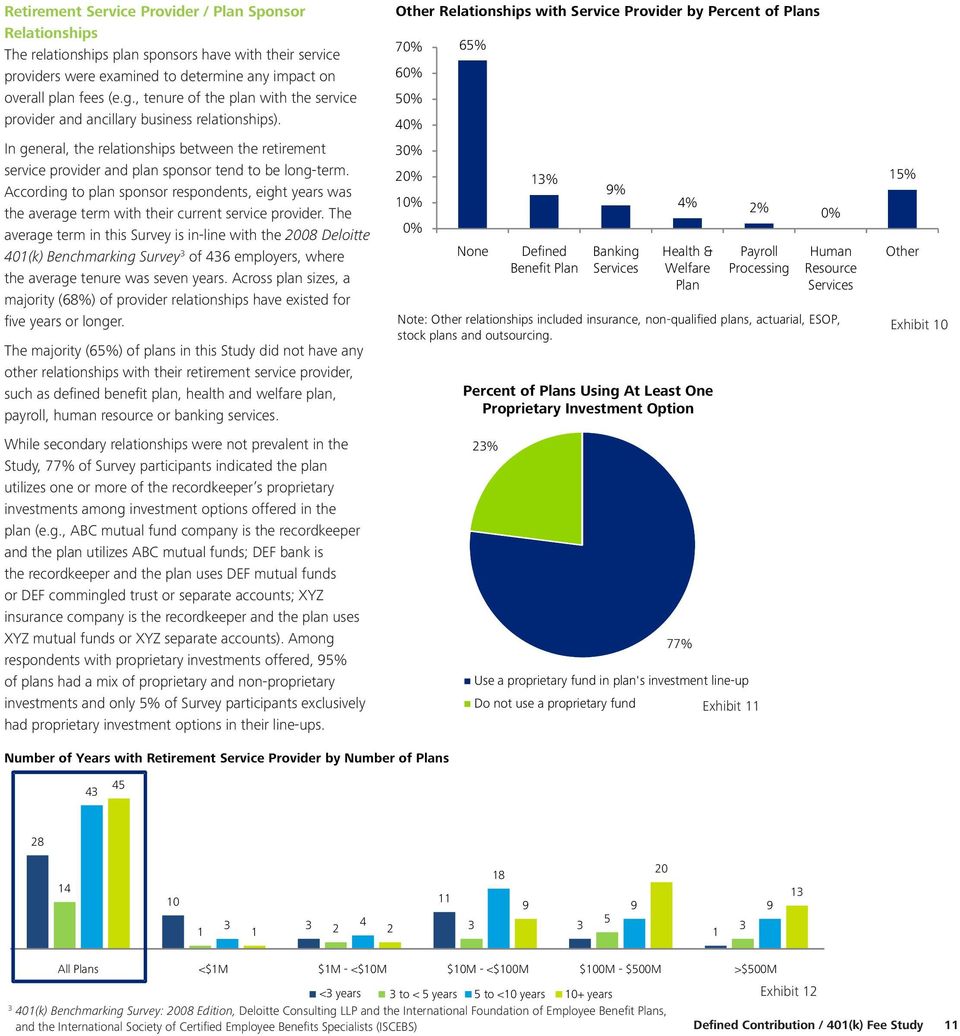
11 Retirement Service Provider / Plan Sponsor Relationships The relationships plan sponsors have with their service providers were examined to determine any impact on overall plan fees (e.g., tenure of the plan with the service provider and ancillary business relationships). In general, the relationships between the retirement service provider and plan sponsor tend to be long-term. According to plan sponsor respondents, eight years was the average term with their current service provider. The average term in this Survey is in-line with the 2008 Deloitte 401(k) Benchmarking Survey 3 of 436 employers, where the average tenure was seven years. Across plan sizes, a majority (68%) of provider relationships have existed for five years or longer. The majority (65%) of plans in this Study did not have any other relationships with their retirement service provider, such as defined benefit plan, health and welfare plan, payroll, human resource or banking services. While secondary relationships were not prevalent in the Study, 77% of Survey participants indicated the plan utilizes one or more of the recordkeeper s proprietary investments among investment options offered in the plan (e.g., ABC mutual fund company is the recordkeeper and the plan utilizes ABC mutual funds; DEF bank is the recordkeeper and the plan uses DEF mutual funds or DEF commingled trust or separate accounts; XYZ insurance company is the recordkeeper and the plan uses XYZ mutual funds or XYZ separate accounts). Among respondents with proprietary investments offered, 95% of plans had a mix of proprietary and non-proprietary investments and only 5% of Survey participants exclusively had proprietary investment options in their line-ups. Other Relationships with Service Provider by Percent of Plans 70% 60% 50% 40% 30% 20% 10% 0% 65% None 13% Defined Benefit Plan 9% Banking Services 4% 2% 0% Health & Welfare Plan Payroll Processing Human Resource Services Note: Other relationships included insurance, non-qualified plans, actuarial, ESOP, stock plans and outsourcing. Percent of Plans Using At Least One Proprietary Investment Option 23% 77% Use a proprietary fund in plan's investment line-up Do not use a proprietary fund Exhibit 11 15% Other Exhibit 10 Number of Years with Retirement Service Provider by Number of Plans All Plans <$1M $1M - <$10M $10M - <$100M $100M - $500M >$500M <3 years 3 to < 5 years 5 to <10 years 10+ years 3 401(k) Benchmarking Survey: 2008 Edition, Deloitte Consulting LLP and the International Foundation of Employee Benefit Plans, and the International Society of Certified Employee Benefits Specialists (ISCEBS) Exhibit 12 Exhibit 12 Defined Contribution / 401(k) Fee Study 11
12 Participant Average Account Balances Plan Level Averages $120,000 $107,941 $100,000 $80,000 $60,000 $56,874 $48,522 $40,000 $20,000 $15,386 $0 Mean Median 10th Percentile 90th Percentile Exhibit 13 Median of Plan-Level Participant Average Account Balances by Asset Segment $80,000 $75,432 $70,000 $60,000 $58,534 $50,000 $48,522 $40,000 $34,607 $31,079 $30,000 $24,410 $20,000 $10,000 Participant Accounts The Survey captured a wide range of average participant account balances, providing an opportunity to gain insight into the economics of defined contribution plans. Average participant account balances varied widely across plan sponsor respondents and plan size segments. For example, across all plan sponsor respondents, the 10th percentile plan had an average participant account balance of $15,386, while the 90th percentile plan had an average participant account balance seven-fold higher ($107,941). Similar to other defined contribution plan reports, 4 the Survey found an average participant account balance of $56,874 (2008 reported data). In terms of participant contributions, the average rate was 6.4%; more than half (53%) of plans reported average participant contribution rates between 6% and 10%. Plan sponsors also reported a range of employer contribution activity. Among respondent plans, 92% had employer contributions, typically in the form of a match formula. Many (34% of plans) matched at least 100% up to at least 3% of pay, often then matching at 100% or a lower rate additional employee contributions. Another 18% of plans matched 50 cents on the dollar (i.e., 50%) up to 6% of pay. Average Participant Contribution Rate Per Plan by Percent of Plans 9% 7% 31% $0 All Plans <$1M $1M - < - $10M $10M - < $100M $100M - $500M >$500M Exhibit 14 53% <3% 3% to <6% 6% to <10% 10%+ Exhibit Exhibit For example the EBRI/ICI 401(k) database, reporting on 21.8 million 401(k) participants in 56,232 plans holding $1.4 trillion in assets, has an average participant account balance of $65,454 at year-end For more information on the EBRI/ICI Database, see Holden, VanDerhei, Alonso, and Copeland, "401(k) Plan Asset Allocation, Account Balances, and Loan Activity in 2007", ICI Perspective, vol. 14, no. 3, and EBRI Issue Brief, Investment Company Institute and Employee Benefit Research Institute (Dec. 2008), available at 12

13 Plan Design Features The Survey examined a number of plan design features including automatic enrollment, automatic increases in contributions (also called auto step-up), managed accounts and company stock. Number of Business Locations by Number of Plans The most common plan design feature was autoenrollment with 45% of plans offering this component (similar to the 42% reported in the Deloitte 2008 Annual 401(k) Benchmarking Survey). Of those plans with auto-enrollment, 71% default to a lifecycle target date investment option with an average default contribution rate of 3%. Automatic step-up or increase is a less utilized plan design feature; 25% of all plans in the Survey had automatic step-up or increase. The Survey found that most (82%) plan sponsors do not offer managed accounts. About one-third (34%) of respondents have company stock within their plan. Although not technically part of plan design, additional plan characteristics were analyzed (number of locations, number of payrolls and method of submitting payrolls), to gain insight as to whether business complexity impacted plan fees Exhibit 17 Number of Payrolls by Percent of Plans 49% 32% In terms of complexity, 42% of plans indicated they have more than 20 business locations while 24% reported one. The Survey also found that 49% of plan sponsors process only one payroll and of those, 95% submit their payroll electronically. The impact of such business complexity on fees will be discussed later in this report. 19% or more Exhibit 18 Plan Design Feature Utilization by Number of Plans % 32 25% 24 18% 44 34% Auto-Enrollment Auto Step-Up Managed Accounts Company Stock Yes No Exhibit 16 Exhibit 16 Defined Contribution / 401(k) Fee Study 13

14 Investment Options The number of investment options offered varied widely from three investment options to approximately 100 different choices. The average number of investment options offered per plan was 15 (similar to the average of 17 investment options reported in the Deloitte 2008 Annual 401(k) Benchmarking Survey). 5 With 91% of plans offering them, mutual funds were the most common investment vehicle used by plans. However, when reviewing investment vehicle use by plan size, the Study showed a greater utilization of separate and commingled accounts by larger plans. Equity (99% of plans) and fixed income (92% of plans) investment options represented the most common asset class types offered among plans within the Survey. The next most common asset class types offered were target date investment options (72% of plans) and guaranteed investment contracts (GICs) and other stable value funds (70% of plans). The number of plan investment options varied around an average of 15. Investment Vehicle Use Percent of Total Assets in Survey Percent of Plans Utilizing Mutual Fund 41% 91% Separate Account 25% 37% Commingled Trust 25% 56% Other* 9% 36% * Other primarily included Company Stock Asset Class Use Percent of Total Assets in Survey Exhibit 19 Percent of Plans Utilizing Equity 39% 99% Target Date 12% 72% Stable Value/ GICs 12% 70% Fixed Income 11% 92% Company Stock 8% 34% Balanced 6% 49% Money Market 5% 45% Lifestyle 2% 27% Other* 6% 21% Exhibit 20 * Other included loans, self-directed brokerage balances 5 Counts a suite of target date investment options as one investment option. 14

15 IV. The Mechanics of Plan Fees Understanding the mechanics of how fees are charged is important when assessing plan fees and drivers. Defined contribution / 401(k) fees can be divided into two basic parts: investment fees and administrative fees. At their core, defined contribution / 401(k) plans are a tax-advantaged savings vehicle in which individuals typically select the asset allocation of their accounts given the range of investment options offered by their plans. A key component of a 401(k) plan is the asset management services that the investment manager provides. These asset-based fees are reported as an expense ratio of the mutual fund, separate account, commingled account, or other investment product in the plan. Unlike a retail investment account, defined contribution / 401(k) plans must comply with certain regulations to ensure that they are equitable in their coverage of workers. These regulations create additional administrative needs beyond what one might require in a retail investment account. Administrative support services of the plan are provided to the employer and participant in the form of recordkeeping, consulting, legal, regulatory, compliance, communication and education services. Payment for these administrative services can be handled in a number of ways. The plan sponsor will determine who pays the fee (employer or participant) and how it is assessed. Payment for administrative services is generally handled through one or more of the following methods: Dollar per participant fees that are paid for by the employer, participant or both; Dollar per plan fees that are paid by the employer, participant or both; Asset-based fees (based on a percentage of plan or investment assets) that are paid for by the employer, participant or both; and Specialized participant activity related fees, most often paid for by participants engaging in the activity (e.g. loans). Within defined contribution / 401(k) plans, the manager of an investment option may agree to pay a portion of its investment fee to a service provider (in the case of 401(k) plans, generally the recordkeeper). The amount (often referred to as revenue sharing) is used to help offset the cost of the administrative services which would otherwise be charged directly to the plans and/or participants. The investment providers' payment to the recordkeeper helps cover the costs of recordkeeping multiple accounts, while the investment provider services one large account. These fees present themselves in a variety of ways including 12b-1 fees, sub-transfer agency fees, and shareholder servicing fees. Additionally, they are sometimes negotiated between the investment manager and the retirement service provider (recordkeeper). When plans use proprietary investment options that is the investment provider is affiliated with the plan s recordkeeper some of those asset-based investment fees can be used to cover administrative services. Direct Fees: $ Per Participant; % Asset Based; Transactional Fees Defined Contribution / 401(k) Plan Fee Mechanics Employer / Plan Participants Direct Fees: $ Per Participant; % Asset Based; Transactional Fees Recordkeeping & Administration Plan Service and Consulting Legal, Compliance and Regulatory Participant Service, Education, Advice and Communication Asset Management Expense Ratio (% of assets) Services Provided Fee Payment / Form of Fee Payment Recordkeeper / Retirement Service Provider Recordkeeping; Distribution Investment Manager Recordkeeping / administrative payment (% of assets) Exhibit 22 Exhibit 22 Defined Contribution / 401(k) Fee Study 15

16 V. The 'All-In' Fee To clearly understand the total fees of each plan, this Study calculated an 'all-in' fee to allow for a more direct comparison of fees being paid by the plans participating in the Survey. Viewing fees from an 'all-in' fee perspective addresses the range of varying structures and arrangements for service payments due to 1) different service delivery mechanisms and associated fees and 2) per plan, per participant and asset-based fee types. By rolling all services and fee types into an 'all-in' fee, the data can be analyzed more consistently across plans and within segments to compare and discern different fee levels. Composition of the 'All-In' Fee For the purpose of this Study, the 'all-in' fee was based on four primary service elements: 1. Investment management; 2. Administration, recordkeeping, communication and education; 3. Financial advice to participants; and 4. Plan sponsor investment consulting. Asset-based charges on investments make up the majority of the 'all-in' fee. 'All-in' Fee Service and Fee Components Service Fee Component 1. Investment management Asset-based charges to the mutual fund, commingled or separate account used to pay for managing the investment. 2. Administration, recordkeeping, communication and education Per participant, per plan, or asset-based fees used to pay for recordkeeping, plan and participant servicing, communications, education, compliance testing, Form 5500, plan audit, legal and trustee services. 3. Financial advice to participants Asset-based or per participant fees associated with providing participants with financial advice and guidance (often provided through a third party's software model). 4. Plan sponsor investment consulting Fees paid to an outside consultant hired by the plan sponsor to assist with plan set-up, investment design, search and selection of investment managers and other plan advisory services. Transactions and Other Items Not Included Loan initiation and maintenance, qualified domestic relations order, distributions, self-directed brokerage, managed accounts and other transactions driven by participant elections and typically paid for by the individual participant engaged in the specialized activity. Exhibit 23 The total fee elements were dominated by the fees and expenses of investments (74%) and separately charged recordkeeping/administrative (23%) fees. Additional highlights of the 'all-in' fee composition include: Plan sponsor investment advisor fees external to the recordkeeper were reported by 21% of plans; and Separately charged plan fees for independent financial advice for participants existed in 8% of plans. 16

17 Payer of Fees With regard to plan fees, participants bear the majority of 401(k) costs. Similar to any other employee benefit (e.g., health insurance), the employer determines whether the employee, employer, or both will pay for the benefit. According to Survey respondents, plan participants pay 83% of the total plan fees while employers cover 13% and the plans cover 4%.* Of the participant fees, a majority is derived from the investment holdings and the asset-based charges primarily associated within investment expense ratios (some of which may be used to cover recordkeeping and administration). assets paid about one-third of their plans 'all-in' fees; plan sponsors with larger plan assets, on average, paid about 10% of the 'all-in' fees. This break in behavior across plan size may reflect plan sponsors covering the fixed costs of running the plan in the small plan space, where there are fewer participants and assets over which to spread the costs. Payer of Fees - All Plans 13% 4% Participants pay the majority of plan fees in the form of investment expense ratios. Employers that sponsor plans with less than $10 million in assets, on average, carried a larger share of plan fees than employers sponsoring plans of $10 million or greater in assets. Plan sponsors of plans with less than $10 million in Payer of 'All-In' Fees - By Percent of Plans in Asset Segment 83% Participant Employer Plan* Exhibit 25 83% 83% 90% 86% 66% 66% 31% 34% 13% 4% 3% 0% 11% 5% 6% 3% 13% 1% All Plans <$1M $1M - <$10M $10M - <$100M $100M - $500M >$500M Participant Employer Plan* * Other Survey results suggest this is generally achieved through forfeited employer contributions. Exhibit 24 Defined Contribution / 401(k) Fee Study 17

18 Summary 'All-In' Fee Results For this Survey, the 'all-in' fee was analyzed in two ways, as a percentage of plan assets and as an annual per-participant dollar amount. 'All-in' Fee: % of Assets (All Plans) 2.00% 1.80% 1.72% The median 'all-in' fee which includes the recordkeeping, administrative and investment fees across all plans in the Study was: Percentage of plan assets 0.72%; or Annual per-participant dollar amount $346. Fees of 401(k) plans vary greatly due to unique plan characteristics, plan / investment design, range and quality of services provided, and pricing strategies employed by retirement providers. As such, there are a large number of variables impacting the fees that plans and participants pay. The remaining sections of this report explore what appear to be possible drivers of this variation at a macro level (all plans) and within individual segments (micro, small, mid, large and mega-plan size markets). 1.60% 1.40% 1.20% 0.93% 0.80% 0.72% 0.60% 0.40% 0.35% 0.20% Mean Median 10th Percentile 90th Percentile Exhibit 'All-in' Fee: Annual Plan-Level Dollar Per Participant (All Plans) $900 $842 $800 $700 $600 $500 $400 $300 $397 $346 $200 $100 $0 $103 Mean Median 10th Percentile 90th Percentile Exhibit 27 18

19 VI. 'All-In' Fee Drivers In response to the Survey, plan sponsors supplied data for a variety of plan related, service provider related, and plan design variables. Deloitte looked to identify what appeared to be the primary drivers of fees across all plans (macro view) and apparent secondary drivers of fees within similar sized plans (micro view). The analysis included assessing the impact and correlation of multiple independent variables on the dependent variable the 'all-in' fee. The dependent variable (fees) was assessed in two different methods or calculations of the 'all-in' fee: 1) the 'all-in' fee as a percentage of assets, and 2) annual dollar per-participant fee. Primary 'All-In' Fee Drivers Primary drivers include the key variable(s) impacting fees across plans in the Survey. The results of the statistical regression analysis pointed to the size of the plan as a primary driver of plan fees. More specifically, the number of participants and average account balance were significant and had independent effects: as the average account balance and number of participants rise, fees as a percentage of assets tend to fall. Variables Plan asset size Number of participants Average account balance Plan Related Service Provider Related Plan Design Plan sponsor industry Geographic location Number of locations Number of payrolls Participant contribution rates Investment allocation Company stock Years with current provider Provider industry type Provider size Provider relationship Employer contribution Number of investment options Investment vehicles Proprietary / non-proprietary Influencer of Fees Median All-In Fee by Plan Asset Segment (% of Assets) 2.00% 1.80% 1.60% 1.40% 1.20% 0.80% 0.60% 0.40% 0.20% 1.89% 1.27% <$1M $1M - <$10M 0.78% $10M -- <$100M 0.61% $100M - $500M 0.41% >$500M Auto-enrollment / step-up Potential Drivers Exhibit 28 Exhibit 28 Defined Contribution / 401(k) Fee Study 19

20 Plan Asset Size At the macro level, the primary driver of fees appears to be plan asset size, with the number of participants and average account balance contributing significantly and independently to the fee levels. Key points about the primary driver of fees: As plan size increases in assets and participants, the 'all-in' fee (measured as a percentage of assets) decreases. On average, the median 'all-in' fee within an asset segment was 20% less for plans with average account balances over $100,000. While the median plan's 'all-in' fee was 0.72% of assets, median fees among plans with less than $1 million in assets were 1.89% of plan assets and for plans with more than $500 million in assets, the median 'all-in' fee was less than 0.50%. The Survey data indicate that once a plan reaches $10 million in total assets, or 1,000 participants, the median fee drops to less than 1% of assets - suggesting that a level of economies of scale is obtained. Plans with smaller total assets tend to have smaller average account balances compared to larger plans, which also contributes to the higher relative costs as a percentage of assets of smaller plans. Economies of scale appear to be gained as a plan grows in size, lowering its 'all-in' fee. 'All-In' Fee by Participant Count (% of Assets) 2.50% 2.03% 2.00% 1.50% 1.77% 0.89% 0.84% 0.65% 0.48% 0.50% 0.81% 0.73% 0.58% 0.49% < ,000-4,999 5,000-9,999 10,000+ Median Average Median: All Plans Exhibit 29 'All-In' Fee by Asset Segment (% of Assets) 2.50% 2.37% 2.00% 1.50% 1.89% 1.18% 0.89% 1.27% 0.69% 0.42% 0.50% 0.78% 0.61% 0.41% <$1M $1M - <$10M $10M - <$100M $100M - $500M >$500M Median Average Median: All Plans Exhibit 30 Median 'All-In' Fee vs. Average Account Balance by Asset Segment (% of Assets) 2.50% 2.20% 2.00% 1.77% 1.50% 1.36% 1.36% 0.50% 1.10% 0.66% 0.46% 0.61% 0.99% 0.73% 0.75% 0.77% 0.63% 0.53% 0.50% 0.44% 0.35% 20 All Plans <$1M $1M - <$10M $10M - <$100M $100M - $500M >$500M <$25k <$25,000 $25,000 $25k-$100k - $100,000 >$100,000 >$100k Exhibit 31 31

21 Fixed vs. Variable Costs of Plans Whether required by law or deemed necessary to run a plan, there are fixed costs for operating any plan. These costs include plan accounting and audit, legal advice (such as plan document services), plan compliance testing and basic set-up costs. While there are some variable components to these costs as the plans become larger and more complicated, these necessary/fixed aspects are required for all plans. As with any fixed costs, the more assets over which these costs can be spread, the lower the level of costs per dollar of assets. Hence, plans that have fewer assets to spread these costs over tend to have on average higher fees when measured as a percentage of assets. Also, as the cost is spread over more participants, the fixed costs of a plan decline per participant. a higher percentage of the 'all-in' fee, suggesting a change in pricing structure in which the largest plans use investment options that do not subsidize recordkeeping and then pay for recordkeeping separately. Recordkeeping Fees Recordkeeping fee findings include: The micro market (plan assets less than $1million in assets) on average bears the highest recordkeeping fees (measured as a percentage of plan assets) believed to be due to fixed recordkeeping costs associated with a plan. Plans and associated recordkeeping fees appear to fall as fixed costs become a lower percentage of assets as plan assets grow larger in size. Investment Fees Investment fee findings include: Asset-based fees on investments represent 74% of the total 'all-in' fees. As plan size grows, the declining fixed costs as a percentage of assets allows plans to move to lower expense ratio investment options such as institutional share class mutual funds and commingled trusts. This phenomenon was seen in the Study particularly in plans with more than $250 million in assets. The Study found that plans larger than $500 million in assets had direct recordkeeping charges representing Defined Contribution / 401(k) Fee Study 21
22 Secondary 'All-In' Fee Drivers Regression analysis was used to identify secondary drivers that help explain variability of fees in similar plans. Variability in fees exists both across and within similarly sized segments of the plan market. The data within the Survey that appeared to help explain these variances are summarized on the following pages. Secondary drivers from the Survey results appear to include: Participant and employer contribution rates: Plans with higher participant contribution rates had lower fees. Plan asset allocation: The percentage of assets invested in equity-related asset classes was positively correlated with the 'all-in' fee. Complexity: The number of employer locations impacted the fees in select market segments. Retirement service provider relationship: Broader benefit relationships with a provider impacted costs in select market segments. Plan design: Plans with auto enrollment appeared to have a lower 'all-in' fee level. 'All-In' Fee Range (% of Assets) - 10th and 90th Percentile of Plans 3.00% 2.30% 2.00% 1.72% 1.62% 1.30% 1.09% 1.42% 0.87% 0.61% 0.35% 0.35% All Plans <$1M $1M $1M - $10M - $10M $10M - $100M - $100M - <$10M <$100M $500M 0.61% 0.14% >$500M Exhibit Exhibit
23 Participant and Employer Contribution Rates From the retirement service provider s perspective, plans with high levels of participant or employer contributions, which may lead to plan growth, are generally viewed as more attractive than those with lower expected asset growth. As such, expected plan asset growth may be a key element for service providers to consider when determining fees. Plans with higher participant or employer contribution rates tended to have slightly lower 'all-in' fees. Providers can plan for higher expected investment revenue from these plans over longer-term periods, and as such, may offer pricing (and bear the risk) aligned with those expectations. The statistical regression analysis found that both participant contribution rates and the employer contribution formula or amount (as a percentage of participant pay) were negatively related to 'all-in' fees. Focusing on participant contribution rates, across all plan sizes in the Survey, there is a median 'all-in' fee of 1.45% among plans with average participant contribution rates of Median 'All-In' Fee vs. Plan-Level Average Participant Contribution Rate (% of Assets) 1.60% 1.40% 1.20% 0.80% 0.60% 0.40% 0.20% 1.46% 0.91% 0.65% 0.60% <3% 3% to <6% 6% to <10% 10%+ less than 3% of pay, compared with a median 'all-in' fee of 0.64% among plans with average participant contribution rates of 6% or more. When plans are grouped by plan size segment, the average participant contribution rate appears to slightly impact the 'all-in' fee; however, this effect does not appear consistently across all market size segments. In particular, results of the 'all-in' fee analysis show that the mega plan size market does not appear to be influenced by participant contribution rates. Exhibit 33 Median 'All-In' Fee vs. Plan-Level Average Participant Contribution Rate by Asset Segment (% of Assets) 2.50% 2.00% 2.14% 2.00% 1.85% 1.50% 0.50% 1.45% 0.91% 0.64% 1.20% 1.49% 1.14% 1.03% 0.99% 0.72% 1.47% 0.74% 0.58% 0.44% 0.31% 0.04% All Plans <$1M $1M - $10M $10M - $100M $100M - $500M >$500M <3% 3% to - 6% < 6% 6%+ Exhibit 34 Defined Contribution / 401(k) Fee Study 23
24 Plan Asset Allocation As described earlier in this Study, a significant share of the 'all-in' fee was attributable to asset-based investmentrelated fees. Analyzing the investment costs can help explain the variances in fees within plans similar in size. Plans with higher allocation of assets in equities tend to have higher investment fees. Equity investment options are more costly to manage than non-equity or fixed-income investments. As expected, the Survey data displayed higher average asset-based fees for equity oriented investments versus others. As plan allocation to equity investments increases, the total investment cost will correspondingly typically increase. Based on the analysis performed, a 10 percentage point higher asset allocation to equities (e.g., equity assets rise from 40% to 50% of plan assets) resulted in a 3.9 basis point or percentage point higher 'all-in' fee. Conversely, as plan allocation to cash or fixed-income style options increases total investment fees tend to decrease. When compared to the median average expense ratio of equities (0.77%), the Survey showed, median investment fees for: Target date investment options, which hold a mix of equities and fixed-income investments, were 12% lower (with a median plan-level average expense ratio of 0.68%). Fixed-income investment options were 43% lower (with a median expense ratio of 0.44%), and Money market investment options were 45% lower (with a median expense ratio of 0.42%). Median of Plan-Level Average Expense Ratio by Asset Class 0.90% 0.80% 0.70% 0.60% 0.50% 0.40% 0.30% 0.20% 0.10% 0.77% 0.44% 0.42% Equity Fixed-Income Money Market 0.34% 0.68% Money market investment options and stable value funds perform similar functions as capital presentation vehicles in investment line-ups in plans. In the Study, stable value funds are more frequently used by larger plans, which tend, in general, to have lower 'all-in' fees and lower investment expenses. In addition, stable value funds, which are not registered under the Investment Company Act of 1940, are not subject to the standardized reporting of expenses that mutual funds provide in fund prospectuses. The fee for managing a stable value fund s portfolio holdings, which include GICs and similar instruments, is often reported as a trustee fee or similar fee. (Nevertheless, a few Survey respondents reported no expenses for their stable value fund, and these were excluded in calculating the median fee reported in Exhibit 35). 0.60% 0.57% GICs and Target Date Balanced Lifestyle Other Stable Value Exhibit
25 Complexity According to the Survey, the number of plan sponsor locations increases both the complexity of servicing the plan and the fees charged (presumably for the added administrative cost). More locations requiring service appears to increase fees in the small market segment. The fees for the large and mega plan size market (more than $100 million in assets) are the exception as they do not appear to be impacted by a sponsor's number of locations. Additionally, the Survey found another traditional measure of complexity number of payrolls not to be an indicator of total plan fees. Plans with higher numbers of payrolls were not found to have higher recordkeeping costs. The electronic nature of accepting payrolls and providers requiring information in standard formats appear to have created greater efficiencies that help offset the potential increased complexity. As the number of locations increases, typically so do the administrative fees, specifically those related to onsite services (e.g., enrollment meetings, group or individual employee meetings). This factor accounts for some variation in fees for plans of similar size within the smalland medium-sized segments. For example, fee differences are most pronounced in those plans with $1 million to less than $10 million in assets. Median 'All-In' Fee vs. Number of Locations 1.80% 1.60% 1.40% 1.20% 1.44% 1.60% 0.80% 0.60% 0.40% 0.94% 0.88% 0.78% 0.81% 0.71% 0.58% 0.66% 0.42% 0.34% 0.42% 0.20% $1M - <$10M $10M - <$100M $100M - $500M >$500M Exhibit 36 Exhibit 36 Defined Contribution / 401(k) Fee Study 25
26 Retirement Service Provider Relationship Some aspects of the provider relationship appear to play a factor in the fees paid by a plan sponsor based on the results of the Survey. As discussed earlier, the quality of a provider s product and service offering was not contemplated as part of this Study. However, the data captured within the Study help clarify some elements of the relationship that may or may not impact fees. The analysis explored the potential impact of retirement service provider tenure, retirement service provider type and broader plan relationships. Retirement Service Provider Tenure There is no clear connection between how long a plan has been with a service provider and the total fees of a plan. This could be a result of more frequent competitive reviews and/or competitively adjusting plan pricing in the marketplace during the course of the relationship (note: the Survey did not ask the frequency of reviewing plan fees). Large plans appear to have longer tenure with their current provider than smaller plans. The average tenure A plan s tenure with its current service provider does not appear to be an indicator of fee levels. of plans under $1million in assets was four years, while the average tenure of plans over $500 million was 13 years. Changing providers involves conversion cost and a disruption to participants. Based on experience in the marketplace, plans may elect to stay with their current vendor (assuming fees and services are otherwise competitive) to avoid the burden and complexity of changing providers. Median All-In Fee vs. Years with Retirement Service Provider (% of Assets) 2.50% 2.00% 1.98% 1.50% 0.50% 1.26% 0.72% 0.70% 0.59% 1.51% 1.35% 1.41% 1.31% 1.14% 1.07% 0.95% 0.83% 0.72% 0.69% 0.70% 0.72% 0.61% 0.59% 0.42% 0.45% 0.35% All Plans <$1M $1M - <$10M $10M -- <$100M $100M - $500M >$500M 0.04% <3 years 3+ years and to <5< 5 years 5+ years and to <10 years 10+ years Exhibit 37 26
27 Retirement Service Provider Type The 'all-in' fee by provider type (mutual fund company, insurance company, bank or TPA) was not an identified driver based on the results of the Survey. The size of the provider was not an indicator of total fees by market segment. When measured in terms of participants on the recordkeeping system, the Survey data did not consistently find evidence of smaller fees for the largest providers. A provider's market focus can be a driver of fee levels. Based on the results of the Survey, a provider s focus and specialization in a particular market (e.g., small or large) is a better indicator of fee levels than solely those providers with the largest number of participants on their recordkeeping system. This may be a result of: A provider s pricing strategy for winning in particular markets. Operating/business models built for serving a particular segment (e.g., the highly customized mega plan market). Possible difficulty in moving down market for the largest providers and up market for the smaller plan service providers. Possible unique service offerings of providers. Brand strength or quality of a particular provider may justify higher fees. Median 'All-In' Fee (% of Assets) by Retirement Service Provider Type 2.50% 2.03% 2.00% 1.89% 1.62% 1.51% 1.50% 1.20% 1.12% 1.13% 1.06% 0.80% 0.76% 0.81% 0.75% 0.66% 0.62% 0.52% 0.46% 0.50% 0.29% 0.26% 0.23% <$1M $1M - - <$10M $10M - - <$100M $100M - $500M >$500M Bank Insurance Mutual Fund TPA Exhibit 38 Median 'All-In' Fee (% of Assets) by Retirement Service Provider Tier 2.50% 2.03% 2.00% 1.87% 1.60% 1.50% 1.36% 1.39% 1.14% 1.04% 0.97% 0.91% 0.68% 0.72% 0.59% 0.66% 0.47% 0.50% 0.50% 0.39% 0.34% Exhibit 38 Segmenting service providers into tiers based on the number of participants on their recordkeeping systems provides a concise snapshot to compare volume with median 'all-in' plan fees by the provider tier. This analysis does not attempt to describe the range of services provided and does not factor in the range or quality of services provided: All Plans <$1M $1M - <$10M $10M - <$100M $100M - $500M >$500M Tier 1 Tier 2 Tier 3 Exhibit Tier 1: greater than 3,000,000 participants Tier 2: between 1,000,000 and 3,000,000 participants Tier 3: less than 1,000,000 participants The type or size of the retirement service provider does not appear to be an indicator of the 'all-in' fee. Defined Contribution / 401(k) Fee Study 27
28 Broader Plan Relationships In general, plan sponsors that have multiple relationships with their service provider have lower percentage of assets defined contribution / 401(k) fees. This suggests that it may be advantageous from a pricing perspective for a plan sponsor to obtain retirement and other benefit offerings from an entity with which it has an existing business relationship. This could reduce start-up and ongoing costs (e.g., service provider works with payroll data for another purpose). Specifically, based on the data collected in the Survey and when holding all other variables constant, having a defined benefit or health and welfare plan relationship with the same service provider appears to lower the 'all-in' fee by 14 basis points or 0.14 percentage points. While it was not consistent in every plan size segment, plans with multiple defined contribution relationships with the same provider seem to have lower relative fees. Median 'All-In' Fee: Additional DB / H&W Provider Relationships 2.50% 1.89% 2.00% 1.38% 1.50% 0.80% 0.72% 0.87% 0.42% 0.50% 0.68% 0.60% 0.36% <$1M $1M -- <$10M $10M -- <$100M $100M - $500M >$500M Defined Benefit / Health & Welfare Relationship No Defined Benefit / Health & Welfare Relationship Exhibit 40 Median All-In Fee: Multiple DC Plans with Retirement Service Provider 2.00% 1.87% 1.50% 1.25% 1.27% 0.79% 0.68% 0.50% 0.70% 0.44% 0.46% 0.14% <$1M $1M - <$10M $10M -- <$100M $100M - $500M >$500M Multiple DC Plans One DC Plan Exhibit 41 28
29 Proprietary vs. Non-Proprietary Investment Options Within the retirement plan market, it is common for investment line-ups to have a combination of both proprietary and non-proprietary investment options. As stated earlier, the majority of plans in the Survey (77%) use at least one proprietary investment from their service provider. The prevalence of proprietary or non-proprietary options within a plan does not appear to be a significant driver of 'all-in' fees: Investment expenses appear to drive costs, regardless of whether or not they are proprietary or non-proprietary (e.g. large / mega plans generally have access to less expensive share classes of both proprietary and non-proprietary investment options). Median of Average Expense Ratio: Proprietary vs. Non-Proprietary Investments A higher allocation of assets to proprietary investment options did not appear to cause higher 'all-in' fees across plan size segments. The regression analysis did not identify proprietary or non-proprietary investment use as a significant driver of the 'all-in' fee. The Survey results indicate that proprietary and non-proprietary investment fees are not significantly different. 0.80% 0.60% 0.40% 0.20% 0.66% 0.63% 0.77% 0.82% 0.62% 0.43% The use of proprietary investment options does not appear to be a driver of the 'all-in' fee. All Investment Options Equity Investment Options Non-Equity Investment Options Proprietary Non-Proprietary Exhibit 43 Exhibit 43 Median 'All-In' Fee vs. Proprietary Investment Percentage (% of Assets) 2.50% 2.00% 2.03% 1.97% 1.87% 1.50% 1.32% 1.20% 0.50% 0.76% 0.61% 0.76% 0.87% 0.91% 0.78% 0.69% 0.66% 0.59% 0.62% 0.51% 0.42% 0.34% All Plans <$1M $1M - - <$10M $10M - <$100M $100M - $500M >$500M <25% 25% -to 75% <75% 75%+ Exhibit Defined Contribution / 401(k) Fee Study 29
30 Plan Design Auto-enrollment is designed to enroll participants in the plan at a set contribution rate. Another automatic design feature is the option to escalate the participant contribution percentage in the future. The passage of the Pension Protection Act of 2006 further accelerated the adoption of these features in the marketplace. The Survey data suggest that those plans with auto-enrollment have lower total fees (measured by percentage of assets) than those without the feature. Despite the relatively large difference in 'all-in' fees between plans with and without auto-enrollment that is displayed across smaller plan sizes, the results of the regression analysis suggest a smaller impact of 14 basis points or 0.14 percentage points. Although the auto-enrollment feature can have a positive impact on increasing assets in the plan, it also typically increases the number of participants with low balances and therefore increases the administrative cost of running the plan. As a result of the combination of these two impacts, auto-enrollment may not be in and of itself driving the 'all-in' fee lower, but may rather be reflecting some other factors such as the age of the plan, the length of the time over which auto-enrollment has been in place, or other plan features that were not captured in the Survey. The use of auto-enrollment is a characteristic of plans with lower 'all-in' fees. Additionally, providers may anticipate that auto-enrollment will lead to more advantages (increased assets under management) than disadvantages (cost of small balance participants). Similarly plans with auto step-up, which increases the contributions over time, also tended to have lower 'all-in' fees. Median 'All-In' Fee by Auto-Enrollment Use 2.00% 1.89% 1.80% 1.60% 1.36% 1.40% 1.20% 1.34% 0.99% 0.80% 0.64% 0.60% 0.73% 0.42% 0.40% 0.59% 0.20% 0.38% <$1M $1M -- <$10M $10M - <$100M $100M - $500M >$500M Plans with Auto-Enrollment No Auto-Enrollment Exhibit 44 Median 'All-In' Fee by Auto Step-Up Use 2.00% 1.89% 1.80% 1.60% 1.40% 1.32% 1.20% 1.14% 0.91% 0.80% 0.63% 0.60% 0.72% 0.39% 0.40% 0.52% 0.20% 0.42% <$1M $1M - - <$10M $10M -- <$100M $100M - $500M >$500M Plans with Auto Step-Up No Auto Step-Up Exhibit 45 30
31 VII. Summary Range of Fee Arrangements Defined Contribution/401(k) fees are charged in a variety of ways for the services provided. Typical fee structures include asset-based investment fees, per-participant recordkeeping fees, per-plan recordkeeping and administration fees, and per-plan advisory fees. As plan sponsors work with retirement service providers to set up or administer their plans, a range of scenarios or arrangements is generally considered. This report does not aim to assess those ranges, but to calculate an ex-post comprehensive plan fee. To compare fees across plans, this bottom-line or 'all-in' fee was calculated combining all administration, recordkeeping, and asset-based investment fees. At the end of the day, whether a plan sponsor is adding up component fees or looking at a more comprehensive package, the 'all-in' fee allows for a more direct comparison across plans. The 'All-In' Fee The 'all-in' fee which includes recordkeeping, administration, and investment management, was evaluated in two ways: (1) percentage of total plan assets, and (2) annual dollar per participant amount. Across all plans in the Survey: The 'all-in' fee varied from 0.35% of assets (10th percentile) to 1.72% of assets (90th percentile). The median plan's 'all-in' fee was 0.72% of plan assets. The median plan's annual dollar per participant fee was $346. Plan Size Appears to be Primary Driver of 'All-In' Fee The 'all-in' fee varied due to a number of plan-related variables. Statistical regression analysis found that plan size appeared to be the most significant driver of fees. More specifically, further analysis showed that a more meaningful way to view plan asset size was through two independent factors: Both number of participants and the average account balance were negatively correlated with the 'all-in' fee. Within any defined contribution / 401(k) plan, there are fixed costs required to start up and run the plan, many of which are driven by legal and regulatory requirements (e.g., compliance testing, audit, Form 5500). The Survey results appear to indicate economies are gained as a plan grows in size, because these fixed costs can be spread over more participants and/or a larger asset base. Other Factors Are Secondary Drivers of Fees In addition to plan size, a number of other factors appeared to help explain the variability in plan fees. Linear regression analysis found that lower 'all-in' fees appear to be related to: Higher participant and employer contribution rates; Lower allocation of assets in equities-oriented asset classes; Use of automatic enrollment; Fewer plan sponsor business locations, which reduces servicing complexity; and Other plan sponsor business relationships with the service provider. On the other hand, number of payrolls, which might have increased complexity, was not found to be a driver of fees. The type of retirement service provider (mutual fund company, life insurance company, bank, third party administrator) and tenure with the retirement service provider also did not appear to be significant factors. In addition, the percentage of assets invested in the investment products of the service provider (proprietary investments) did not seem to have a separate impact on fees. Number of participants; and Average account balance. Defined Contribution / 401(k) Fee Study 31
32 Appendix: Glossary of Terms Terms Active Plan Participants Auto-Enrollment Auto Increase / Step-Up Communication / Education Services Company Stock Services Compliance Testing Custom Services Education Materials Eligible Plan Participants Employee Meetings Employer Contribution Expense ratio Financial Advice / Guidance Form 5500 Reporting Guaranteed Investment Contract (GICs) Investment Related Charges Legal Services Managed Accounts Nondiscrimination Testing Participant Contribution Rate Plan Assets Plan Audit Plan Document Services Plan Sponsor Investment Advisor Qualified Domestic Relations Order (QDRO) Trustee Services Definition Individual currently participating in an employer-sponsored retirement plan. The practice of enrolling eligible employees in a plan and initiating participant deferrals without requiring the employees to submit a request to participate. A provision found in some 401(k) plans that allows an eligible employee to increase their contribution rate at a pre-established point-in-time. Participant communication and education services relating to providing print, video, software and/or live instruction to educate employees about how the plan works, the plan investment funds, and asset allocation strategies. Services needed for the recordkeeping and administration of company stock. Plans engaged in testing required by the IRS to ensure the 401(k) plan is fair to both highly compensated and non-highly compensated employees. Additional or enhanced non-standard services (e.g., website, call center, branding, etc.) selected by the plan sponsor. These materials are provided to plan participants to help educate around the need for retirement, investment options, how to properly plan for retirement, how to calculate retirement savings, etc. Any employee who is eligible to participate in and receive benefits from a plan. These meetings with employees explain the benefits of participating in the plan, answer questions about saving and the plan, and provide an understanding of the plan specifications. A contribution made by the company to the account of the participant (often times in the form of a company match based in ratio to contributions made by the participant). An investment option s total annual operating expenses, including for investment management and administration of the investment, expressed as a percentage of assets. For mutual funds, this is calculated pursuant to SEC rules for fund prospectuses; other investment options may provide plans a similar number expressing the investment option s fees. Advice or guidance provided to participants in the plan by a third party. This annual plan financial reporting form is required by IRS/DOL/PBGC. These accounts with an insurance company guarantee a fixed rate of interest over the length of the contract. Asset-based fees for investment management and other related services generally are assessed as a percentage of assets invested; paid in the form of an indirect charge against the participant s account or the plan because they are deducted directly from investment returns. Legal support services provided to the plan. An account for which the holder gives a third party the authority to manage the investing of assets. Regulations may require this annual testing to assure that the amount of contributions made by and on behalf of non-highly compensated employees is proportional to contributions made by and on behalf of highly compensated employees. The amount (typically expressed as a percentage of the contribution base) that an employee contributes to the plan. The total assets held among all participants within the plan. An independent audit required by federal law for all plans with more than 100 participants. Development, maintenance and consulting related to the plan documents of a plan. Third party consultant hired by the plan sponsor to assist with plan design, investment design, search and selection process and other plan advisory services. A judgment, decree or order that creates or recognizes an alternate payee's (such as former spouse, child, etc.) right to receive all or a portion of a participant's retirement plan benefits. Services typically provided by the bank or trust company having fiduciary responsibility for holding plan assets. 32
33 About Deloitte Deloitte refers to one or more of Deloitte Touche Tohmatsu, a Swiss Verein, and its network of member firms, each of which is a legally separate and independent entity. Please see for a detailed description of the legal structure of Deloitte Touche Tohmatsu and its member firms. Please see for a detailed description of the legal structure of Deloitte LLP and its subsidiaries. For more information, please contact: Daniel Rosshirt Principal Deloitte Consulting LLP Tel [email protected] Scott Parker Senior Manager Deloitte Consulting LLP Tel [email protected] About the Investment Company Institute The Investment Company Institute (ICI) is the national association of U.S. investment companies, including mutual funds, closed-end funds, exchange-traded funds (ETFs), and unit investment trusts (UITs). ICI seeks to encourage adherence to high ethical standards, promote public understanding, and otherwise advance the interests of funds, their shareholders, directors, and advisers. Members of ICI manage total assets of $10.18 trillion and serve over 93 million shareholders. For additional information about ICI and its research, please see This publication contains general information only and is based on the experiences and research of Deloitte practitioners. Deloitte is not, by means of this publication, rendering business, financial, investment, or other professional advice or services. This publication is not a substitute for such professional advice or services, nor should it be used as a basis for any decision or action that may affect your business. Before making any decision or taking any action that may affect your business, you should consult a qualified professional advisor. Deloitte, its affiliates, and related entities shall not be responsible for any loss sustained by any person who relies on this publication Deloitte Development LLC. Member of Deloitte Touche Tohmatsu
Inside the Structure of Defined Contribution/401(k) Plan Fees, 2013: A study assessing the mechanics of the all-in fee
 Conducted by Deloitte Consulting LLP for the Investment Company Institute August 2014 Inside the Structure of Defined Contribution/401(k) Plan Fees, 2013: A study assessing the mechanics of the all-in
The BrightScope/ICI Defined Contribution Plan Profile: A Close Look at 401(k) Plans
 The BrightScope/ICI Defined Contribution Plan Profile: A Close Look at 401(k) Plans DECEMBER 2014 The BrightScope/ICI Defined Contribution Plan Profile: A Close Look at 401(k) Plans 1 THE BRIGHTSCOPE/ICI
The BrightScope/ICI Defined Contribution Plan Profile: A Close Look at 401(k) Plans
 The BrightScope/ICI Defined Contribution Plan Profile: A Close Look at 401(k) Plans DECEMBER 2014 The BrightScope/ICI Defined Contribution Plan Profile: A Close Look at 401(k) Plans 1 THE BRIGHTSCOPE/ICI
INVESTMENT COMPANY INSTITUTE
 INVESTMENT COMPANY INSTITUTE PERSPECTIVE Vol. 6 / No. 1 January 2000 Perspective is a series of occasional papers published by the Investment Company Institute, the national association of the American
A GUIDE TO RETIREMENT PLAN FEES & EXPENSES
 A GUIDE TO RETIREMENT PLAN FEES & EXPENSES WHITE PAPER DECEMBER 2013 Brian A. Montanez, AIF, CPC PRINCIPAL, MULTNOMAH GROUP Ronald J. Triche, Esq., APM* ASSISTANT GENERAL COUNSEL & DIRECTOR OF GOVERNMENT
Fee disclosure Q&A: Answering plan sponsor questions about Department of Labor regulations
 Fee disclosure Q&A: Answering plan sponsor questions about Department of Labor regulations Spring 2012 U.S. Department of Labor (DOL) regulations outlining obligations of plan sponsors and service providers
ICI ReseaRCh Perspective
 ICI ReseaRCh Perspective 1401 H Street, NW, Suite 1200 WashINgton, DC 20005 202-326-5800 www.ici.org july 2014 vol. 20, no. 3 WHAT S INSIDE 2 Why Employers Offer 401(k) Plans 2 Paying for 401(k) Plan Services
Plan Sponsor s Guide to. Retirement Plan Fees. R e t i r e m e n t p l a n s
 Plan Sponsor s Guide to Retirement Plan Fees R e t i r e m e n t p l a n s 2007 StanCorp Equities, Inc. StanCorp Equities, Inc., member NASD/SIPC, distributes group variable annuity and group annuity contracts
Service Provider Fee Disclosure Rules Now Final: Next Steps for Retirement Plan Fiduciaries. March 2012
 Service Provider Fee Disclosure Rules Now Final: Next Steps for Retirement Plan Fiduciaries March 2012 Table of Contents Service Provider Fee Disclosure Final Rules 2 Background 2 Significant Clarifications
Understanding fiduciary responsibilities
 INSIGHTS SERIES Perspectives and viewpoints on investing in today s market Understanding fiduciary responsibilities A guide for retirement plan sponsors Offering a retirement savings opportunity in the
Financial Advisor Fee and Services Communication Template
 Financial Advisor Fee and Services Communication Template A Summary of the Value We Deliver to [Company] Client Name: Financial Advisor Team: Date: Ann Schleck and Co. is not affiliated with MFS. The information
Investment Company Institute and the Securities Industry Association. Equity Ownership
 Investment Company Institute and the Securities Industry Association Equity Ownership in America, 2005 Investment Company Institute and the Securities Industry Association Equity Ownership in America,
Using ERISA Accounts to Help Manage Fee-Related Fiduciary Responsibilities
 Defined Contribution Plans Fiduciary Focus Series Using ERISA Accounts to Help Manage Fee-Related Fiduciary Responsibilities Contents 1 Employer Fee Responsibilities 2 Revenue Sharing 3 DOL s View of ERISA
Custom Target Date Options: A Higher Hurdle
 INSIGHTS Custom Target Date Options: A Higher Hurdle April 2015 203.621.1700 2015, Rocaton Investment Advisors, LLC Given the high utilization of target date options in defined contribution plans, target
Mutual Fund Expenses and Fees
 CHAPTER FIVE Mutual Fund Expenses and Fees Mutual funds provide investors with many investment-related services, and for those services investors incur two primary types of expenses and fees: ongoing expenses
Help in Defined Contribution Plans:
 May 2014 Help in Defined Contribution Plans: 2006 through 2012 Table of Contents Introduction Executive Summary 3 About This Report 8 Data Sample Information 10 Defining Help 11 Results Participants Using
Understanding Plan Fees and Expenses
 Understanding Plan Fees and Expenses Susan M. Wright, CPA, APM Executive Director, Consulting Topics of Discussion Fiduciary Responsibilities Settlor vs. Non-settlor Expenses Revenue Holding Accounts Questions
Mutual Funds and Institutional Accounts: A Comparison
 Mutual Funds and Institutional Accounts: A Comparison 1. Introduction The SEC recently directed mutual funds to provide additional disclosure about factors that fund boards consider during advisory contract
Important Information on Your Investment Options, Fees, and Other Expenses for the JPMorgan Chase 401(k) Savings Plan: Fee Disclosure Notice
 November 2014 Important Information on Your Investment Options, Fees, and Other Expenses for the JPMorgan Chase 401(k) Savings Plan: Fee Disclosure Notice Important: This notice refers to the 401(k) Savings
Understanding the Report of Indirect Compensation
 Understanding the Report of Indirect Compensation Frequently Asked Questions On an annual basis, T. Rowe Price Retirement Plan Services, Inc. (RPS), distributes the Report of Indirect Compensation to assist
Determining reasonableness of retirement plan fees
 Determining reasonableness of retirement plan fees Vanguard commentary September 2011 Fees paid for retirement plan investments and services have always been an important consideration for ERISA fiduciaries.
New Regulations Under ERISA Refine and Develop Fiduciary Duties Regarding the Investment of Plan Assets
 New Regulations Under ERISA Refine and Develop Fiduciary Duties Regarding the Investment of Plan Assets Maine Employee Benefits Council December 4, 2008 Eric D. Altholz Verrill Dana, LLP Background There
Retirement Services. Perspectives 2015: Defined contribution retirement plan benchmarks
 Retirement Services Perspectives 2015: Defined contribution retirement plan benchmarks Perspectives 2015: Defined contribution retirement plan benchmarks An employer-sponsored retirement plan is often
Considerations for Plan Sponsors: CUSTOM TARGET DATE STRATEGIES
 PRICE PERSPECTIVE April 2015 Considerations for Plan Sponsors: CUSTOM TARGET DATE STRATEGIES In-depth analysis and insights to inform your decision making. EXECUTIVE SUMMARY Defined contribution plan sponsors
Fiduciary toolkit for financial professionals
 Fiduciary toolkit for financial professionals For financial advisor use only. Not for distribution to retail investors. Vanguard is your partner to help guide you and your clients in addressing fiduciary
Lincoln Alliance Program Fee disclosures
 Lincoln Alliance Program Fee disclosures Lincoln Financial Group is the marketing name for Lincoln National Corporation and its affiliates. Affiliates are separately responsible for their own financial
Are You in the Wrong Target-Date Fund?
 Insights August 2014 Are You in the Wrong Target-Date Fund? Now Is a Good Time to Reevaluate TDFs may have different investment strategies, glide paths, and investment-related fees. Because these differences
Trends in 401(k) Plans and Retirement Rewards. research. A Report by WorldatWork and the American Benefits Institute March 2013
 and Retirement Rewards research A Report by WorldatWork and the American Benefits Institute March 2013 Contact: WorldatWork Customer Relations 14040 N. Northsight Blvd. Scottsdale, Arizona USA 85260-3601
Trends in. Paid Time Off and. 401(k) Plans. PTO Banks: research. A Survey of WorldatWork Members and American Benefits Council Members March 2009
 8 06 Trends in Paid Time Off and 401(k) Plans PTO Banks: research A Survey of WorldatWork Members and American Benefits Council Members March 2009 Introduction and Methodology This report summarizes the
Exposing the hidden cost of Payroll and HR Administration A total cost of ownership study
 www.pwc.com/ca Exposing the hidden cost of Payroll and HR Administration A total cost of ownership study A PwC/ADP study March 2012 Executive overview Do you know how much your organization is really
A Better Approach to Target Date Strategies
 February 2011 A Better Approach to Target Date Strategies Executive Summary In 2007, Folio Investing undertook an analysis of Target Date Funds to determine how these investments might be improved. As
Effective Monitoring of Outsourced Plan Recordkeeping and Reporting Functions
 PLAN ADVISORY Effective Monitoring of Outsourced Plan Recordkeeping and Reporting Functions PLAN ADVISORY Table of Contents Introduction 3 Selecting and Monitoring Third-Party Service Providers 4 Quality
Collective. Prepared by the Coalition of Collective. Investment Trusts
 Collective Investment Trusts Prepared by the Coalition of Collective Investment Trusts Table of Contents Overview... 2 Collective Investment Trusts Defined... 3 Two Broad Types of Collective Trusts...
2011 Health Insurance Trend Driver Survey
 Consulting Health & Benefits 2011 Health Insurance Trend Driver Survey 2011 Health Insurance Trend Driver Survey Contents 2 Introduction Comparison to Other Surveys About the Survey 6 9 Trend and Premium
Sample Client FIDUCIARY INVESTMENT REVIEW. January 15, 2010
 Sample Client FIDUCIARY INVESTMENT REVIEW January 5, 2 FIDUCIARY INVESTMENT REVIEW Sample Client presented by: Michael E. Morris Director Institutional Consulting Ross, Sinclaire & Associates 7 Walnut
AN OPEN ARCHITECTURE MULTIPLE EMPLOYER PLAN. Retirement Plan Solution. Powered By
 A Risk Reduction Retirement Plan Solution - Fewer Fees, More Services, Professional Money Managers, and Fiduciary Protection AN OPEN ARCHITECTURE MULTIPLE EMPLOYER PLAN Retirement Plan Solution Powered
Trends and Experience in 401(k) Plans
 Research Highlights Trends and Experience in 401(k) Plans The 2009 Trends and Experience in 401(k) Plans survey results reveal emerging trends in 401(k) plan design and administration. Hewitt Associates
THE WAGNER LAW GROUP A PROFESSIONAL CORPORATION DEFAULT INVESTMENTS AND INVESTMENT ADVICE UNDER PPA
 DEFAULT INVESTMENTS AND INVESTMENT ADVICE UNDER PPA I. Default Investments. Fiduciary Relief. Plan sponsors are not responsible for the specific investment decisions made by participants if the plan complies
DEFINED CONTRIBUTION ADMINISTRATIVE, RECORDKEEPING, EDUCATION, ENROLLMENT AND INVESTMENT MANAGEMENT SERVICES FOR. Charter Township of Grand Blanc
 REQUEST FOR PROPOSAL DEFINED CONTRIBUTION ADMINISTRATIVE, RECORDKEEPING, EDUCATION, ENROLLMENT AND INVESTMENT MANAGEMENT SERVICES FOR Charter Township of Grand Blanc Issued By: Charter Township of Grand
Retirement Plan Fee Disclosure:
 Retirement Plan Fee Disclosure: Preparing for Participant Questions The time clock for fee disclosure is ticking. Starting in 2012, the U.S. Department of Labor (DOL) is requiring retirement plan administrators
RETIREMENT INSIGHTS. Understanding your fiduciary role. A plan sponsor fiduciary guide
 RETIREMENT INSIGHTS Understanding your fiduciary role A plan sponsor fiduciary guide ABOUT Perhaps no one topic in the employee benefits arena has drawn more attention and scrutiny over the last several
Models of Advisor Fiduciary Responsibility: What Advisors Need to Know
 Models of Advisor Fiduciary Responsibility: What Advisors Need to Know Ashish Shrestha Regional Director This information is provided for registered investment advisors and institutional investors and
U.S. Department of Labor Employee Benefits Security Administration
 U.S. Department of Labor Employee Benefits Security Administration This publication has been developed by the U.S. Department of Labor, Employee Benefits Security Administration. To view this and other
Elevate your skills to help grow your business. Essential resources for today s retirement plan advisor.
 Elevate your skills to help grow your business. Essential resources for today s retirement plan advisor. Guiding today s retirement plan advisor toward success The role of today s retirement plan advisor
Do you know if your 401k plan fees are reasonable?
 Presents Do you know if your 401k plan fees are reasonable? Securities offered through Raymond James Financial Services, Inc. Member FINRA/SIPC Wealth Management - Retirement Plan Consulting - Investments
Department of Labor Participant Disclosure Requirements Applicable to Participant-Directed Individual Account Plans
 Applicable to Participant-Directed Individual Account Plans Background Sections 404(a)(1)(A) and (B) of the Employee Retirement Income Security Act of 1974 (ERISA) require plan fiduciaries to act prudently
ERISA Compliance for Investment Advisers: A Q&A Guide To DOL s 408(b)(2) Disclosure Regulation
 Vol. 20, No. 7 July 2013 ERISA Compliance for Investment Advisers: A Q&A Guide To DOL s 408(b)(2) Disclosure Regulation By Michael L. Hadley and Joshua R. Landsman O n February 2, 2012, the Department
DeAWM Trust Company and its affiliates may provide services to your plan and to your participants, which are not fiduciary services.
 DeAWM Distributors, Inc. 222 South Riverside Plaza Chicago, IL 60606-5808 (800) 621-1148 deutschefunds.com December 2014 Subject: DeAWM Trust Company Service Provider Disclosure Dear Plan Sponsor, Under
INVENTEC 401(K) RETIREMENT SAVINGS PLAN The Vanguard Group, Inc. Disclosure of Services and Fees November 14, 2015
 INVENTEC 401(K) RETIREMENT SAVINGS PLAN The Vanguard Group, Inc. Disclosure of Services and s November 14, 2015 The information in this document is designed to help you understand the services available
Defined Contribution Plan Participants Activities, 2014
 ICI RESEARCH REPORT Defined Contribution Plan Participants Activities, 2014 APRIL 2015 Copyright 2015 by the Investment Company Institute. All rights reserved. The Investment Company Institute (ICI) is
The Expanding Legal Requirements for Rollover IRAs
 The Expanding Legal Requirements for Rollover IRAs By Fred Reish Partner, Drinker Biddle & Reath LLP PlanAdvisorTools.com Provided compliments of RidgeWorth Investments The Expanding Legal Requirements
Getting The Most Out Of Your 401K/Corporate Retirement Plan-
 Getting The Most Out Of Your 401K/Corporate Retirement Plan- How to Leverage Your Provider's Time and Resources So That You Can Easily Manage Your Responsibilities as a Plan Sponsor/Administrator Kevin
J.H. ELLWOOD & ASSOCIATES, INC. 33 West Monroe, Suite 1850 Chicago, IL 60603 (312) 782-5432 www.ellwoodassociates.com.
 J.H. ELLWOOD & ASSOCIATES, INC. 33 West Monroe, Suite 1850 Chicago, IL 60603 (312) 782-5432 www.ellwoodassociates.com March 31, 2015 This brochure provides information about the qualifications and business
DC Fee Management Mitigating Fiduciary Risk and Maximizing Plan Performance. A Mercer US Point of View
 DC Fee Management Mitigating Fiduciary Risk and Maximizing Plan Performance A Mercer US Point of View Participants in defined contribution (DC) plans rely heavily on plan sponsors and fiduciaries to design
Vanguard research August 2015
 The buck value stops of managed here: Vanguard account advice money market funds Vanguard research August 2015 Cynthia A. Pagliaro and Stephen P. Utkus Most participants adopting managed account advice
Limited Scope Audits Of Employee Benefit Plans
 Limited Scope Audits Of Employee Benefit Plans May 2009 Topix Primer Series Introduction The AICPA Employee Benefit Plan Audit Quality Center has developed this primer to provide a general understanding
The Five Pillars of a Retirement Plan
 The Five Pillars of a Retirement Plan An employee retirement plan can help: Recruit and retain valuable employees Bridge the gap between Social Security and retirement income needs, which are estimated
INVESTMENT TERM GLOSSARY
 A Accrued Interest - Interest that has been earned but not yet credited to a bond or other fixed-income investment, such as a certificate of deposit. Active Management The use of professional investment
Clients per professional. Over $1B 45 $750MM $1B 48 $500MM $750MM 45 $250MM $500MM 47. Over $1B 38 $750MM $1B 38 $500MM $750MM 35
 The power of the independent advice business $123 $750MM $1B $91 model AUM per (millions) $500MM $750MM $75 Clients per 45 $750MM $1B 48 $500MM $750MM 45 $250MM $500MM $72 $250MM $500MM 47 More than one-third
9 Questions Every ETF Investor Should Ask Before Investing
 9 Questions Every ETF Investor Should Ask Before Investing 1. What is an ETF? 2. What kinds of ETFs are available? 3. How do ETFs differ from other investment products like mutual funds, closed-end funds,
Fiscal Fitness, LLC. A State of Wisconsin Registered Investment Adviser. Form ADV Part 2. April 29, 2014
 Fiscal Fitness, LLC A State of Wisconsin Registered Investment Adviser Form ADV Part 2 April 29, 2014 211 E. Verona Ave. #4 Verona, WI 53593 608-848-1133 www.fiscalfitnessmadison.com This brochure provides
U.S. Bank 401(k) Savings Plan Annual Fee Disclosure Notice
 U.S. Bank 401(k) Savings Plan Annual Fee Disclosure Notice The U.S. Bank 401(k) Savings Plan can assist you in saving on a tax-deferred basis for your future. Through the U.S. Bank 401(k) Savings Plan
Understanding mutual fund share classes, fees and certain risk considerations
 Disclosure Understanding mutual fund share classes, fees and certain risk considerations Highlights Mutual funds may offer different share classes most commonly in retail brokerage accounts, Class A, B
Log. Present by RPAG Member:
 Log Present by RPAG Member: Robert Greulich Managing Member The Pinnacle Planning Group, LLC (630)684-8562 [email protected] @ 2013 Retirement Plan Advisory Group. All rights
For Institutional Use Only Not for Use with Retail Investors RETIREMENT FIDUCIARY FOCUS
 AN ADVISOR S GUIDE TO UNDERSTANDING FIDUCIARY RESPONSIBILITIES IN A 401(k) PLAN For Institutional Use Only Not for Use with Retail Investors RETIREMENT FIDUCIARY FOCUS TABLE OF CONTENTS 1 Introduction
PLAN FEES: FEESResource Guide. what you need to know in today s environment. COMPONENTS of retirement plan expenses
 RETIREMENT PLAN FEESResource Guide 2nd Edition PLAN FEES: what you need to know in today s environment COMPONENTS of retirement plan expenses How Dollars Flow between investment managers, plan providers,