
IBM SPSS Modeler Server 16 Administration and Performance Guide
|
|
|
- Dylan Adrian Wiggins
- 10 years ago
- Views:
Transcription
1 IBM SPSS Modeler Server 16 Administration and Performance Guide

2 Note Before using this information and the product it supports, read the information in Notices on page 67. Product Information This edition applies to version 16, release 0, modification 0 of IBM(r) SPSS(r) Modeler and to all subsequent releases and modifications until otherwise indicated in new editions.

3 Contents Preface v Chapter 1. About IBM SPSS Modeler.. 1 IBM SPSS Modeler Products IBM SPSS Modeler IBM SPSS Modeler Server IBM SPSS Modeler Administration Console... 2 IBM SPSS Modeler Batch IBM SPSS Modeler Solution Publisher IBM SPSS Modeler Server Adapters for IBM SPSS Collaboration and Deployment Services IBM SPSS Modeler Editions IBM SPSS Modeler Documentation SPSS Modeler Professional Documentation... 3 SPSS Modeler Premium Documentation Application Examples Demos Folder Chapter 2. Architecture and Hardware Recommendations IBM SPSS Modeler Architecture Architecture Description Hardware Recommendations Temporary Disk Space and RAM Requirements.. 7 Data Access Referencing Data Files Importing IBM SPSS Statistics Data Files Installation Instructions Chapter 3. IBM SPSS Modeler Support 11 Connecting to IBM SPSS Modeler Server Configuring Single Sign-On Adding and Editing the IBM SPSS Modeler Server Connection Searching for Servers in IBM SPSS Collaboration and Deployment Services Data and File Systems User Authentication Permissions File Creation Differences in Results Chapter 4. IBM SPSS Modeler Server Administration Starting and Stopping IBM SPSS Modeler Server.. 17 To Start, Stop, and Check Status on Windows.. 17 To Start, Stop, and Check Status on UNIX Handling Unresponsive Server Processes (UNIX Systems) Administration Using IBM SPSS Modeler Administration Console 19 Starting Modeler Administration Console Configuring Access with Modeler Administration Console SPSS Modeler Server Connections SPSS Modeler Server Configuration SPSS Modeler Server Monitoring Using the options.cfg File Closing Unused Database Connections Using SSL to secure data transfer How SSL works Securing client/server and server-server communications with SSL Server Log Chapter 5. Performance Overview Server Performance and Optimization Settings.. 31 Client Performance and Optimization Settings Database Usage and Optimization SQL Optimization Chapter 6. SQL Optimization How SQL Generation Works SQL Generation Example Configuring SQL Optimization Previewing Generated SQL Viewing SQL for Model Nuggets Tips for Maximizing SQL Generation Nodes Supporting SQL Generation CLEM Expressions and Operators Supporting SQL Generation Using SQL Functions in CLEM Expressions Writing SQL Queries Appendix A. Configuring Oracle for UNIX Platforms Configuring Oracle for SQL Optimization Appendix B. Configuring UNIX Startup Scripts Introduction Scripts Automatically Starting and Stopping IBM SPSS Modeler Server Manually Starting and Stopping IBM SPSS Modeler Server Editing Scripts Controlling Permissions on File Creation IBM SPSS Modeler Server and the Data Access Pack 52 Troubleshooting ODBC Configuration Library Paths Configuring a Driver for the Enterprise View Node 57 Appendix C. Configuring and Running SPSS Modeler Server as a Non-Root Process on UNIX Introduction iii
4 Configuring as non-root without a private password database Configuring as non-root using a private password database Running SPSS Modeler Server as a non-root user.. 61 Troubleshooting user authentication failures Appendix D. Configuring and Running SPSS Modeler Server with a private password file on Windows Introduction Configuring using a private password database.. 63 Appendix E. Load Balancing with Server Clusters Notices Trademarks Index iv IBM SPSS Modeler Server 16 Administration and Performance Guide

5 Preface IBM SPSS Modeler is the IBM Corp. enterprise-strength data mining workbench. SPSS Modeler helps organizations to improve customer and citizen relationships through an in-depth understanding of data. Organizations use the insight gained from SPSS Modeler to retain profitable customers, identify cross-selling opportunities, attract new customers, detect fraud, reduce risk, and improve government service delivery. SPSS Modeler's visual interface invites users to apply their specific business expertise, which leads to more powerful predictive models and shortens time-to-solution. SPSS Modeler offers many modeling techniques, such as prediction, classification, segmentation, and association detection algorithms. Once models are created, IBM SPSS Modeler Solution Publisher enables their delivery enterprise-wide to decision makers or to a database. About IBM Business Analytics IBM Business Analytics software delivers complete, consistent and accurate information that decision-makers trust to improve business performance. A comprehensive portfolio of business intelligence, predictive analytics, financial performance and strategy management, and analytic applications provides clear, immediate and actionable insights into current performance and the ability to predict future outcomes. Combined with rich industry solutions, proven practices and professional services, organizations of every size can drive the highest productivity, confidently automate decisions and deliver better results. As part of this portfolio, IBM SPSS Predictive Analytics software helps organizations predict future events and proactively act upon that insight to drive better business outcomes. Commercial, government and academic customers worldwide rely on IBM SPSS technology as a competitive advantage in attracting, retaining and growing customers, while reducing fraud and mitigating risk. By incorporationg IBM SPSS software into their daily operations, organizations become predictive enterprises - able to direct and automate decisions to meet business goals and achieve measurable competitive advantage. For further information or to reach a representative visit Technical support Technical support is available to maintenance customers. Customers may contact Technical Support for assistance in using IBM Corp. products or for installation help for one of the supported hardware environments. To reach Technical Support, see the IBM Corp. website at Be prepared to identify yourself, your organization, and your support agreement when requesting assistance. v
6 vi IBM SPSS Modeler Server 16 Administration and Performance Guide

7 Chapter 1. About IBM SPSS Modeler IBM SPSS Modeler is a set of data mining tools that enable you to quickly develop predictive models using business expertise and deploy them into business operations to improve decision making. Designed around the industry-standard CRISP-DM model, IBM SPSS Modeler supports the entire data mining process, from data to better business results. IBM SPSS Modeler offers a variety of modeling methods taken from machine learning, artificial intelligence, and statistics. The methods available on the Modeling palette allow you to derive new information from your data and to develop predictive models. Each method has certain strengths and is best suited for particular types of problems. SPSS Modeler can be purchased as a standalone product, or used as a client in combination with SPSS Modeler Server. A number of additional options are also available, as summarized in the following sections. For more information, see IBM SPSS Modeler Products The IBM SPSS Modeler family of products and associated software comprises the following. v IBM SPSS Modeler v IBM SPSS Modeler Server v IBM SPSS Modeler Administration Console v IBM SPSS Modeler Batch v IBM SPSS Modeler Solution Publisher v IBM SPSS Modeler Server adapters for IBM SPSS Collaboration and Deployment Services IBM SPSS Modeler SPSS Modeler is a functionally complete version of the product that you install and run on your personal computer. You can run SPSS Modeler in local mode as a standalone product, or use it in distributed mode along with IBM SPSS Modeler Server for improved performance on large data sets. With SPSS Modeler, you can build accurate predictive models quickly and intuitively, without programming. Using the unique visual interface, you can easily visualize the data mining process. With the support of the advanced analytics embedded in the product, you can discover previously hidden patterns and trends in your data. You can model outcomes and understand the factors that influence them, enabling you to take advantage of business opportunities and mitigate risks. SPSS Modeler is available in two editions: SPSS Modeler Professional and SPSS Modeler Premium. See the topic IBM SPSS Modeler Editions on page 2 for more information. IBM SPSS Modeler Server SPSS Modeler uses a client/server architecture to distribute requests for resource-intensive operations to powerful server software, resulting in faster performance on larger data sets. SPSS Modeler Server is a separately-licensed product that runs continually in distributed analysis mode on a server host in conjunction with one or more IBM SPSS Modeler installations. In this way, SPSS Modeler Server provides superior performance on large data sets because memory-intensive operations can be done on the server without downloading data to the client computer. IBM SPSS Modeler Server also provides support for SQL optimization and in-database modeling capabilities, delivering further benefits in performance and automation. Copyright IBM Corporation 1994,

8 IBM SPSS Modeler Administration Console The Modeler Administration Console is a graphical application for managing many of the SPSS Modeler Server configuration options, which are also configurable by means of an options file. The application provides a console user interface to monitor and configure your SPSS Modeler Server installations, and is available free-of-charge to current SPSS Modeler Server customers. The application can be installed only on Windows computers; however, it can administer a server installed on any supported platform. IBM SPSS Modeler Batch While data mining is usually an interactive process, it is also possible to run SPSS Modeler from a command line, without the need for the graphical user interface. For example, you might have long-running or repetitive tasks that you want to perform with no user intervention. SPSS Modeler Batch is a special version of the product that provides support for the complete analytical capabilities of SPSS Modeler without access to the regular user interface. SPSS Modeler Server is required to use SPSS Modeler Batch. IBM SPSS Modeler Solution Publisher SPSS Modeler Solution Publisher is a tool that enables you to create a packaged version of an SPSS Modeler stream that can be run by an external runtime engine or embedded in an external application. In this way, you can publish and deploy complete SPSS Modeler streams for use in environments that do not have SPSS Modeler installed. SPSS Modeler Solution Publisher is distributed as part of the IBM SPSS Collaboration and Deployment Services - Scoring service, for which a separate license is required. With this license, you receive SPSS Modeler Solution Publisher Runtime, which enables you to execute the published streams. IBM SPSS Modeler Server Adapters for IBM SPSS Collaboration and Deployment Services A number of adapters for IBM SPSS Collaboration and Deployment Services are available that enable SPSS Modeler and SPSS Modeler Server to interact with an IBM SPSS Collaboration and Deployment Services repository. In this way, an SPSS Modeler stream deployed to the repository can be shared by multiple users, or accessed from the thin-client application IBM SPSS Modeler Advantage. You install the adapter on the system that hosts the repository. IBM SPSS Modeler Editions SPSS Modeler is available in the following editions. SPSS Modeler Professional SPSS Modeler Professional provides all the tools you need to work with most types of structured data, such as behaviors and interactions tracked in CRM systems, demographics, purchasing behavior and sales data. SPSS Modeler Premium SPSS Modeler Premium is a separately-licensed product that extends SPSS Modeler Professional to work with specialized data such as that used for entity analytics or social networking, and with unstructured text data. SPSS Modeler Premium comprises the following components. IBM SPSS Modeler Entity Analytics adds an extra dimension to IBM SPSS Modeler predictive analytics. Whereas predictive analytics attempts to predict future behavior from past data, entity analytics focuses on improving the coherence and consistency of current data by resolving identity conflicts within the records themselves. An identity can be that of an individual, an organization, an object, or any other 2 IBM SPSS Modeler Server 16 Administration and Performance Guide

9 entity for which ambiguity might exist. Identity resolution can be vital in a number of fields, including customer relationship management, fraud detection, anti-money laundering, and national and international security. IBM SPSS Modeler Social Network Analysis transforms information about relationships into fields that characterize the social behavior of individuals and groups. Using data describing the relationships underlying social networks, IBM SPSS Modeler Social Network Analysis identifies social leaders who influence the behavior of others in the network. In addition, you can determine which people are most affected by other network participants. By combining these results with other measures, you can create comprehensive profiles of individuals on which to base your predictive models. Models that include this social information will perform better than models that do not. IBM SPSS Modeler Text Analytics uses advanced linguistic technologies and Natural Language Processing (NLP) to rapidly process a large variety of unstructured text data, extract and organize the key concepts, and group these concepts into categories. Extracted concepts and categories can be combined with existing structured data, such as demographics, and applied to modeling using the full suite of IBM SPSS Modeler data mining tools to yield better and more focused decisions. IBM SPSS Modeler Documentation Documentation in online help format is available from the Help menu of SPSS Modeler. This includes documentation for SPSS Modeler, SPSS Modeler Server, and SPSS Modeler Solution Publisher, as well as the Applications Guide and other supporting materials. Complete documentation for each product (including installation instructions) is available in PDF format under the \Documentation folder on each product DVD. Installation documents can also be downloaded from the web at Documentation in both formats is also available from the SPSS Modeler Information Center at SPSS Modeler Professional Documentation The SPSS Modeler Professional documentation suite (excluding installation instructions) is as follows. v v v v v v v IBM SPSS Modeler User's Guide. General introduction to using SPSS Modeler, including how to build data streams, handle missing values, build CLEM expressions, work with projects and reports, and package streams for deployment to IBM SPSS Collaboration and Deployment Services, Predictive Applications, or IBM SPSS Modeler Advantage. IBM SPSS Modeler Source, Process, and Output Nodes. Descriptions of all the nodes used to read, process, and output data in different formats. Effectively this means all nodes other than modeling nodes. IBM SPSS Modeler Modeling Nodes. Descriptions of all the nodes used to create data mining models. IBM SPSS Modeler offers a variety of modeling methods taken from machine learning, artificial intelligence, and statistics. IBM SPSS Modeler Algorithms Guide. Descriptions of the mathematical foundations of the modeling methods used in IBM SPSS Modeler. This guide is available in PDF format only. IBM SPSS Modeler Applications Guide. The examples in this guide provide brief, targeted introductions to specific modeling methods and techniques. An online version of this guide is also available from the Help menu. See the topic Application Examples on page 4 for more information. IBM SPSS Modeler Python Scripting and Automation. Information on automating the system through Python scripting, including the properties that can be used to manipulate nodes and streams. IBM SPSS Modeler Deployment Guide. Information on running IBM SPSS Modeler streams and scenarios as steps in processing jobs under IBM SPSS Collaboration and Deployment Services Deployment Manager. Chapter 1. About IBM SPSS Modeler 3

10 v v v v v v IBM SPSS Modeler CLEF Developer's Guide. CLEF provides the ability to integrate third-party programs such as data processing routines or modeling algorithms as nodes in IBM SPSS Modeler. IBM SPSS Modeler In-Database Mining Guide. Information on how to use the power of your database to improve performance and extend the range of analytical capabilities through third-party algorithms. IBM SPSS Modeler Server Administration and Performance Guide. Information on how to configure and administer IBM SPSS Modeler Server. IBM SPSS Modeler Administration Console User Guide. Information on installing and using the console user interface for monitoring and configuring IBM SPSS Modeler Server. The console is implemented as a plug-in to the Deployment Manager application. IBM SPSS Modeler CRISP-DM Guide. Step-by-step guide to using the CRISP-DM methodology for data mining with SPSS Modeler. IBM SPSS Modeler Batch User's Guide. Complete guide to using IBM SPSS Modeler in batch mode, including details of batch mode execution and command-line arguments. This guide is available in PDF format only. SPSS Modeler Premium Documentation The SPSS Modeler Premium documentation suite (excluding installation instructions) is as follows. v v v IBM SPSS Modeler Entity Analytics User Guide. Information on using entity analytics with SPSS Modeler, covering repository installation and configuration, entity analytics nodes, and administrative tasks. IBM SPSS Modeler Social Network Analysis User Guide. A guide to performing social network analysis with SPSS Modeler, including group analysis and diffusion analysis. SPSS Modeler Text Analytics User's Guide. Information on using text analytics with SPSS Modeler, covering the text mining nodes, interactive workbench, templates, and other resources. Application Examples While the data mining tools in SPSS Modeler can help solve a wide variety of business and organizational problems, the application examples provide brief, targeted introductions to specific modeling methods and techniques. The data sets used here are much smaller than the enormous data stores managed by some data miners, but the concepts and methods involved should be scalable to real-world applications. You can access the examples by clicking Application Examples on the Help menu in SPSS Modeler. The data files and sample streams are installed in the Demos folder under the product installation directory. See the topic Demos Folder for more information. Database modeling examples. See the examples in the IBM SPSS Modeler In-Database Mining Guide. Scripting examples. See the examples in the IBM SPSS Modeler Scripting and Automation Guide. Demos Folder The data files and sample streams used with the application examples are installed in the Demos folder under the product installation directory. This folder can also be accessed from the IBM SPSS Modeler program group on the Windows Start menu, or by clicking Demos on the list of recent directories in the File Open dialog box. 4 IBM SPSS Modeler Server 16 Administration and Performance Guide

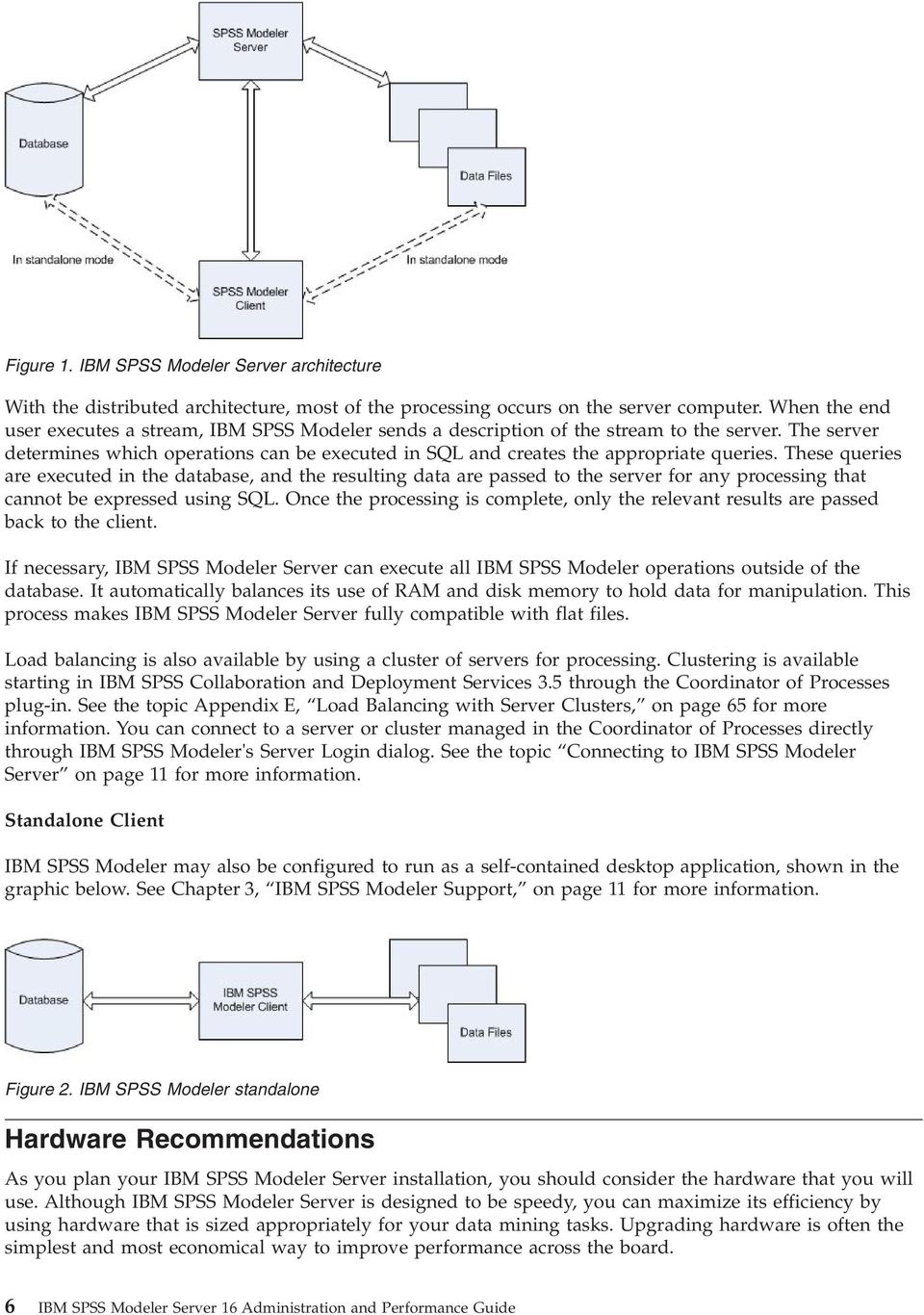
11 Chapter 2. Architecture and Hardware Recommendations IBM SPSS Modeler Architecture This section describes the architecture of IBM SPSS Modeler Server, including the server software, the client software, and the database. It includes information about how IBM SPSS Modeler Server is designed for optimal performance and provides recommendations for maximizing this performance by choosing appropriately sized hardware. It concludes with a section on data access, which describes where to set up the necessary ODBC drivers. Architecture Description IBM SPSS Modeler Server uses a three-tier, distributed architecture. Software operations are shared between the client and the server computers. The advantages of installing and using IBM SPSS Modeler Server (versus the standalone IBM SPSS Modeler), especially when dealing with large data sets, are numerous: v IBM SPSS Modeler Server can run on UNIX, in addition to Windows, allowing more flexibility in deciding where to install it. On any platform, you can dedicate a faster, larger server computer to data mining processes. v IBM SPSS Modeler Server is optimized for fast performance. When operations cannot be pushed into the database, IBM SPSS Modeler Server stores the intermediate results as temporary files on disk rather than in RAM. Because servers usually have significant disk space available, IBM SPSS Modeler Server can perform sort, merge, and aggregation operations on very large data sets. v Using the client-server architecture, you can centralize data-mining processes in your organization. Centralization can help to formalize the role of data mining in your business processes. v Using administrator tools like the IBM SPSS Modeler Administration Console (included with IBM SPSS Modeler Server) and IBM SPSS Collaboration and Deployment Services (sold separately), you can monitor data mining processes, ensuring that adequate computing resources are available. With IBM SPSS Collaboration and Deployment Services you can automate certain data mining tasks, manage access to data models, and share results across your organization. The components of IBM SPSS Modeler's distributed architecture are shown in the "IBM SPSS Modeler Server Architecture" graphic. v v v IBM SPSS Modeler. The client software is installed on the end user's computer. It provides the user interface and displays the data mining results. The client is a complete installation of IBM SPSS Modeler software, but when it is connected to IBM SPSS Modeler Server for distributed analysis, its execution engine is inactive. The IBM SPSS Modeler runs on Windows operating systems only. IBM SPSS Modeler Server. The server software installed on a server computer, with network connectivity to both the IBM SPSS Modeler(s) and the database. IBM SPSS Modeler Server runs as a service (on Windows) or a daemon process (on UNIX), waiting for clients to connect. It handles the execution of streams and scripts created using the IBM SPSS Modeler. Database server. The database server could be a live data warehouse (for example, Oracle on a large UNIX server) or, to reduce impact on other operational systems, a data mart on a local/departmental server (for example, SQL Server on Windows). IBM SPSS Modeler Server Architecture Copyright IBM Corporation 1994,


12 Figure 1. IBM SPSS Modeler Server architecture With the distributed architecture, most of the processing occurs on the server computer. When the end user executes a stream, IBM SPSS Modeler sends a description of the stream to the server. The server determines which operations can be executed in SQL and creates the appropriate queries. These queries are executed in the database, and the resulting data are passed to the server for any processing that cannot be expressed using SQL. Once the processing is complete, only the relevant results are passed back to the client. If necessary, IBM SPSS Modeler Server can execute all IBM SPSS Modeler operations outside of the database. It automatically balances its use of RAM and disk memory to hold data for manipulation. This process makes IBM SPSS Modeler Server fully compatible with flat files. Load balancing is also available by using a cluster of servers for processing. Clustering is available starting in IBM SPSS Collaboration and Deployment Services 3.5 through the Coordinator of Processes plug-in. See the topic Appendix E, Load Balancing with Server Clusters, on page 65 for more information. You can connect to a server or cluster managed in the Coordinator of Processes directly through IBM SPSS Modeler's Server Login dialog. See the topic Connecting to IBM SPSS Modeler Server on page 11 for more information. Standalone Client IBM SPSS Modeler may also be configured to run as a self-contained desktop application, shown in the graphic below. See Chapter 3, IBM SPSS Modeler Support, on page 11 for more information. Figure 2. IBM SPSS Modeler standalone Hardware Recommendations As you plan your IBM SPSS Modeler Server installation, you should consider the hardware that you will use. Although IBM SPSS Modeler Server is designed to be speedy, you can maximize its efficiency by using hardware that is sized appropriately for your data mining tasks. Upgrading hardware is often the simplest and most economical way to improve performance across the board. 6 IBM SPSS Modeler Server 16 Administration and Performance Guide
13 Dedicated server. Install IBM SPSS Modeler Server on a dedicated server machine where it will not compete for resources with other applications, including any databases to which IBM SPSS Modeler Server may be connecting. Model-building operations in particular are resource-intensive and perform much better when not in competition with other applications. Note: Although installing IBM SPSS Modeler Server on the same computer as the database can reduce data-transfer time between the database and the server by avoiding network overhead, in most cases the best configuration is to have the server and database on separate machines to avoid competition for resources. Provide a fast connection between the two to minimize the cost of data transfer. Processors. The number of processors on the machine should be no less than the number of concurrent tasks (simultaneously executing streams) you expect to run on a regular basis. In general, the more processors, the better. v A single instance of IBM SPSS Modeler Server will accept connections from multiple clients (users), and each client connection can initiate multiple stream executions. One server can therefore have several execution tasks in progress at any one time. v As a rule of thumb, allow one processor for one or two users, two processors for up to four users, and four processors for up to eight users. Add one additional processor for every two to four users beyond that, depending on the mix of work. v To the extent that some processing may be pushed back to the database through SQL optimization, it may be possible to share a CPU between two or more users with minimal loss in performance. v Multithreading capabilities make it possible for a single task to take advantage of multiple processors, so adding processors can improve performance even in cases where only one task is running at a time. Generally, multithreading is used for C5.0 model building and certain data preparation operations (sort, aggregate, and merge). 64-bit platforms. If you plan to process or build models on very large volumes of data, use 64-bit Solaris, Windows, or Linux as your IBM SPSS Modeler Server platform, and maximize the amount of RAM for the machine. For larger data sets, the server can quickly exhaust the per-process memory limits imposed by 32-bit platforms, forcing data to be spilled to disk and significantly increasing the running time. 64-bit server implementations can take advantage of additional RAM; a minimum of 8 gigabytes (GB) is recommended. 64-bit support is available for Solaris, Windows, and Linux platforms. Future needs. Whenever feasible, make sure that server hardware is expandable in terms of memory and CPUs, both to accommodate increases in usage (for example, increased numbers of simultaneous users or increases in the existing users processing requirements) and increased multithreading capabilities of IBM SPSS Modeler Server in the future. Temporary Disk Space and RAM Requirements IBM SPSS Modeler Server uses temporary disk space to process large volumes of data. The amount of temporary space that you need depends on the volume and type of data that you process and the type of operations you perform. The data volume is proportional to both the number of rows and the number of columns. The more rows and columns that you process, the more disk space you need. This section describes the conditions under which temporary disk space and extra RAM are required, and how to estimate the amount required. Note that this section does not discuss the temporary disk space requirements for processes that occur in a database, since these requirements are specific to each database. Conditions That Require Temporary Disk Space IBM SPSS Modeler Server's powerful SQL optimization feature allows processing to occur in the database (rather than on the server) whenever possible. However, when any of the following conditions are true, SQL optimization cannot be used: v The data to be processed are held in a flat file rather than in a database. Chapter 2. Architecture and Hardware Recommendations 7
14 v SQL optimization is turned off. v The processing operation cannot be optimized using SQL. When SQL optimization cannot be used, the following data manipulation nodes and CLEM functions create temporary disk copies of some or all of the data. If the streams used at your site contain these processing commands or functions, you may need to set aside additional disk space on your server. v Aggregate node v Distinct node v Binning node v Merge node when using the merge-by-key option v Any modeling node v Sort node v Table output node functions in which the lookup condition v function, in which the offset parameter is calculated. Calculating the Amount of Temporary Disk Space In general, IBM SPSS Modeler Server needs to be able to write a temporary file that is at least three times as large as the original data set. For example, if the data file is 2GB and SQL generation is not used, IBM SPSS Modeler Server will require 6GB of disk space to process the data. Because each concurrent user account creates its own temporary files, you will need to increase the disk space accordingly for each concurrent user. If you find that your site frequently uses large temporary files, consider using a separate file system for IBM SPSS Modeler s temporary files, created on a separate disk. For best results, a RAID 0 or striped data set that spans multiple physical disks can be used to speed up disk operations, ideally with each disk in the striped file system on a separate disk controller. RAM Requirements For most processing that cannot be performed in the database, IBM SPSS Modeler Server stores the intermediate results as temporary files on disk rather than in memory (RAM). However, for modeling nodes, RAM is used if possible. The Neural Net, Kohonen, and K-Means nodes require large amounts of RAM. If these nodes are frequently used at your site, consider installing more RAM on the server. In general, the number of bytes of RAM needed can be estimated by (number_of_records * number_of_cells_per_record) * number_of_bytes_per_cell where number_of_cells_per_record can become very large when there are nominal fields. Refer to the system requirements section of the server installation guide for current RAM recommendations. For four or more simultaneous users, even more RAM is recommended. Memory must be shared between concurrent tasks, so scale up accordingly. In general, adding memory is likely to be one of the most cost-effective ways to improve performance across the board. Data Access To read or write to a database, you must have an ODBC data source installed and configured for the relevant database, with read or write permissions as needed. The IBM SPSS Data Access Pack includes a set of ODBC drivers that can be used for this purpose, and these drivers are available on the IBM SPSS Data Access Pack DVD or from the download site. If you have questions about creating or setting permissions for ODBC data sources, contact your database administrator. Supported ODBC Drivers 8 IBM SPSS Modeler Server 16 Administration and Performance Guide

15 For the latest information on which databases and ODBC drivers are supported and tested for use with IBM SPSS Modeler 16, see the product compatibility matrices on the corporate Support site ( Where to Install Drivers Note that ODBC drivers must be installed and configured on each computer where processing may occur. v If you are running IBM SPSS Modeler in local (standalone) mode, the drivers must be installed on the local computer. v If you are running IBM SPSS Modeler in distributed mode against a remote IBM SPSS Modeler Server, the ODBC drivers need to be installed on the computer where IBM SPSS Modeler Server is installed. For IBM SPSS Modeler Server on UNIX systems, see also "Configuring ODBC drivers on UNIX systems" later in this section. v If you need to access the same data sources from both IBM SPSS Modeler and IBM SPSS Modeler Server, the ODBC drivers must be installed on both computers. v If you are running IBM SPSS Modeler over Terminal Services, the ODBC drivers need to be installed on the Terminal Services server on which you have IBM SPSS Modeler installed. Configuring ODBC drivers on UNIX systems By default, the DataDirect Driver Manager is not configured for IBM SPSS Modeler Server on UNIX systems. To configure UNIX to load the DataDirect Driver Manager, enter the following commands: cd modeler_server_install_directory/bin rm -f libspssodbc.so ln -s libspssodbc_datadirect.so libspssodbc.so Doing so removes the default link and creates a link to the DataDirect Driver Manager. Note: The above rules apply specifically to accessing data in a database. Other types of file operations, such as opening and saving streams, projects, models, nodes, PMML, output, and script files, are always done on the client and are always specified in terms of the file system of the client computer. In addition, the Set Directory command in IBM SPSS Modeler sets the working directory for local client objects (for example, streams) but does not affect the server's working directory. UNIX. For information about how to configure IBM SPSS Modeler Server on UNIX to work with the IBM SPSS Statistics data access technology, see Appendix B, Configuring UNIX Startup Scripts, on page 51. Referencing Data Files Windows. If you store data on the same computer as IBM SPSS Modeler Server, we recommend that you give the path to the data from the perspective of the server computer (for example, C:\ServerData\Sales 1998.csv). Performance is faster when the network is not used to locate the file. If the data is stored on a different host, we recommend using UNC file references (for example, \\mydataserver\serverdata\sales 1998.csv). Note that UNC names work only when the path contains the name of a shared network resource. The referencing computer must have permission to read the specified file. If you switch frequently from distributed to local analysis mode, use UNC file references because they work regardless of the mode. UNIX. To reference data files that reside on a UNIX server, use the full file specification and forward slashes (for example, /public/data/serverdata/sales 1998.csv). Avoid using the backslash character in the UNIX directory and in filenames for data used with IBM SPSS Modeler Server. It does not matter whether a text file uses UNIX or DOS format both are handled automatically. Chapter 2. Architecture and Hardware Recommendations 9

16 Importing IBM SPSS Statistics Data Files If you are also running IBM SPSS Statistics Server at your site, users may want to import or export IBM SPSS Statistics data while in distributed mode. Recall that when the IBM SPSS Modeler runs in distributed mode, it presents the server's file system. The IBM SPSS Statistics client works in the same way. For importing and exporting to take place between the two applications, both clients must be operating in the same mode. If they are not, their views of the file systems will be different and they will not be able to share files. IBM SPSS Modeler's IBM SPSS Statistics nodes can automatically start the IBM SPSS Statistics client, but users must first ensure that the IBM SPSS Statistics client is operating in the same mode as IBM SPSS Modeler. Installation Instructions For information on installing IBM SPSS Modeler Server, see the instructions in the \documentation\ installation\ folder on the Server CD. Separate documents are available for Windows and UNIX. For complete information on installing and using the IBM SPSS Modeler, see the client CD. 10 IBM SPSS Modeler Server 16 Administration and Performance Guide
17 Chapter 3. IBM SPSS Modeler Support This section is intended for administrators and help-desk personnel who support users of IBM SPSS Modeler. It covers the following topics: v How to log on to IBM SPSS Modeler Server (or run standalone by disconnecting from a Server) v Data and file systems that users may need v User accounts and file permissions pertaining to IBM SPSS Modeler Server v Differences in results that users may see when switching between IBM SPSS Modeler Server and IBM SPSS Modeler Connecting to IBM SPSS Modeler Server IBM SPSS Modeler can be run as a standalone application, or as a client connected to IBM SPSS Modeler Server directly or to an IBM SPSS Modeler Server or server cluster through the Coordinator of Processes plug-in from IBM SPSS Collaboration and Deployment Services. The current connection status is displayed at the bottom left of the IBM SPSS Modeler window. Whenever you want to connect to a server, you can manually enter the server name to which you want to connect or select a name that you have previously defined. However, if you have IBM SPSS Collaboration and Deployment Services, you can search through a list of servers or server clusters from the Server Login dialog box. The ability to browse through the Statistics services running on a network is made available through the Coordinator of Processes. To Connect to a Server 1. On the Tools menu, click Server Login. The Server Login dialog box opens. Alternatively, double-click the connection status area of the IBM SPSS Modeler window. 2. Using the dialog box, specify options to connect to the local server computer or select a connection from the table. v Click Add or Edit to add or edit a connection. See the topic Adding and Editing the IBM SPSS Modeler Server Connection on page 13 for more information. v Click Search to access a server or server cluster in the Coordinator of Processes. See the topic Searching for Servers in IBM SPSS Collaboration and Deployment Services on page 14 for more information. Server table. This table contains the set of defined server connections. The table displays the default connection, server name, description, and port number. You can manually add a new connection, as well as select or search for an existing connection. To set a particular server as the default connection, select the check box in the Default column in the table for the connection. Default data path. Specify a path used for data on the server computer. Click the ellipsis button (...) to browse to the required location. Set Credentials. Leave this box unchecked to enable the single sign-on feature, which attempts to log you in to the server using your local computer username and password details. If single sign-on is not possible, or if you check this box to disable single sign-on (for example, to log in to an administrator account), the following fields are enabled for you to enter your credentials. User ID. Enter the user name with which to log on to the server. Password. Enter the password associated with the specified user name. Domain. Specify the domain used to log on to the server. A domain name is required only when the server computer is in a different Windows domain than the client computer. 3. Click OK to complete the connection. Copyright IBM Corporation 1994,

18 To Disconnect from a Server 1. On the Tools menu, click Server Login. The Server Login dialog box opens. Alternatively, double-click the connection status area of the IBM SPSS Modeler window. 2. In the dialog box, select the Local Server and click OK. Configuring Single Sign-On You can connect to an IBM SPSS Modeler Server that is running on any supported platform using Single Sign-On. To connect using Single Sign-On, you must first configure your IBM SPSS Modeler server and client machines. If you are using Single Sign-On to connect to both IBM SPSS Modeler Server and IBM SPSS Collaboration and Deployment Services, you must connect to IBM SPSS Collaboration and Deployment Services before you connect to IBM SPSS Modeler. Note: Before you configure your IBM SPSS Modeler server and client machines for Single Sign-On, you must make sure that the machines have access to the domain controller server. Configuring Single Sign-On on Windows To Configure IBM SPSS Modeler Server 1. Ensure that the Windows server machine is a member of the Active Directory (AD) domain. 2. In the IBM SPSS Modeler Server installation location, locate the folder called config. 3. In the config folder, create a subfolder called sso. 4. In the sso folder, create a krb5.conf file. Instructions for how to create the krb5.conf file can be found at An example of a krb5.conf file is given below: [libdefaults] default_realm = MODELERSSO.COM dns_lookup_kdc = true dns_lookup_realm = true [realms] MODELERSSO.COM = { kdc = modelersso.com:88 admin_server = modelersso.com:749 default_domain = MODELERSSO.COM } [domain_realm].modelersso.com = MODELERSSO.COM To Configure IBM SPSS Modeler Client 1. Ensure that the local Windows machine that is running IBM SPSS Modeler is a member of the AD domain. 2. Add the domain user as an administrator on the local machine. 3. Enable Windows to access the TGT session key: a. From the Start menu, click Run. b. Enter regedit and click OK to open the Registry Editor. c. Navigate to the registry location appropriate to the operating system of the local machine: v On Windows XP: My Computer\HKEY_LOCAL_MACHINE\System\CurrentControlSet\Control\Lsa\ Kerberos v On Windows Vista, or Windows 7: My Computer\HKEY_LOCAL_MACHINE\System\ CurrentControlSet\Control\Lsa\Kerberos\Parameters d. Right click the folder and select New > DWORD. The name of the new value should be allowtgtsessionkey. 12 IBM SPSS Modeler Server 16 Administration and Performance Guide
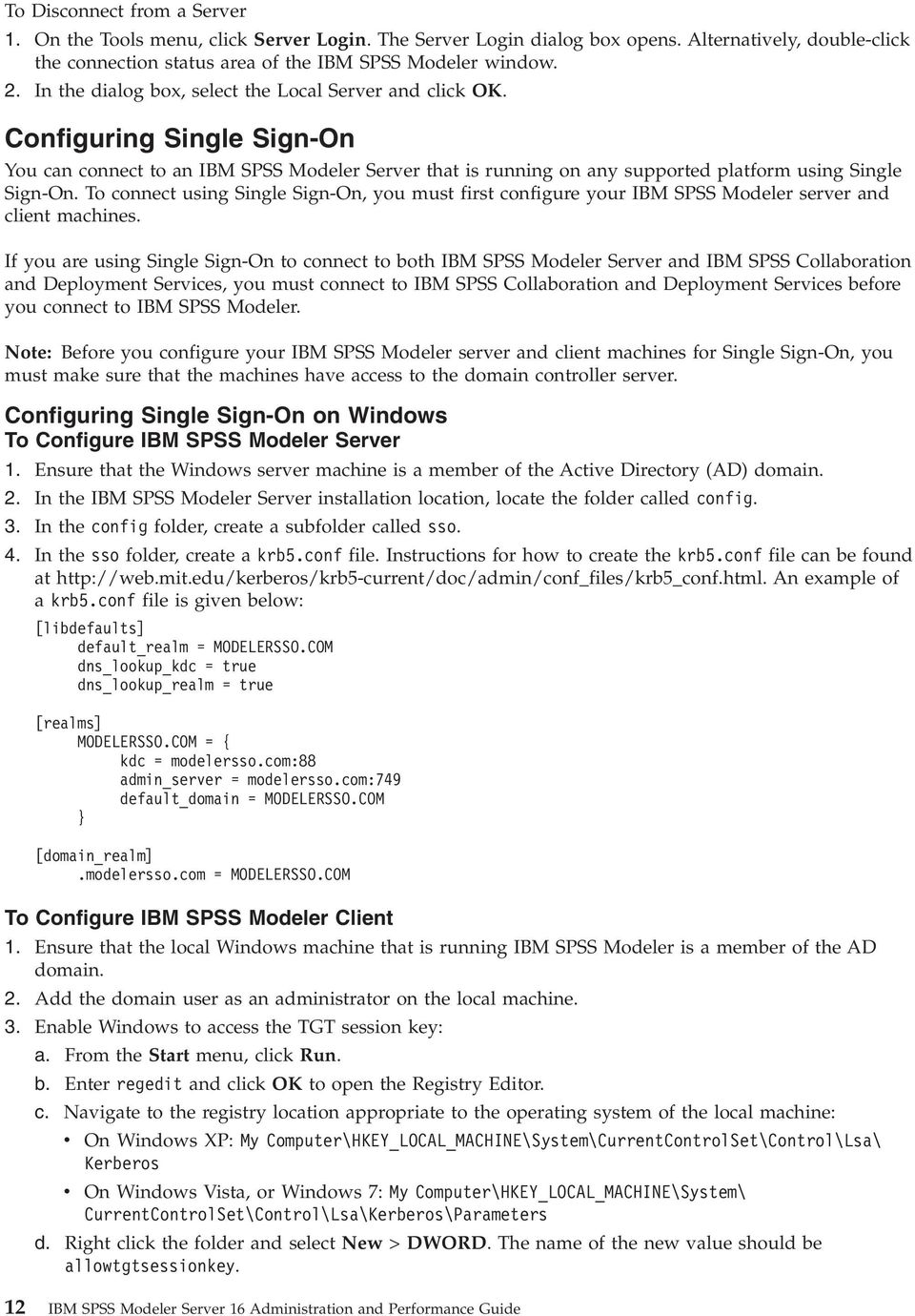
19 e. Set the value of allowtgtsessionkey to a hexadecimal value of 1, that is 0x f. Close the Registry Editor. g. If the operating system of the local machine is Windows Vista or Windows 7, you must run kinit.exe, which can be found in <IBM SPSS Modeler installation location>\jre\bin. 4. In the config folder of the IBM SPSS Modeler installation location, create a folder called sso. 5. Copy the krb5.conf file from the server in to the sso folder. 6. Restart the local machine and the server machine. Configuring Single Sign-On on UNIX To configure Single Sign-On for UNIX server machines, you can add the UNIX machine to the Windows AD domain, then follow the instructions for configuring Single Sign-On on Windows. See the topic Configuring Single Sign-On on Windows on page 12 for more information. Alternatively, you can perform the following steps: 1. Create a domain user account for the UNIX machine. 2. Change the host name. If you are using RedHat Linux, open the /etc/sysconfig/network file and modify HOSTNAME to the form <name>.<realm>. This enables the AD to find the server credentials. 3. To enable the DNS server to find the UNIX machine, take one of the following steps: v Open the %windows%/system32/drivers/etc/hosts file and add the IP/host mapping, for example: test.modelersso.com test Or v Add a new reverse lookup zone entry. This will add an IP/host mapping on the DNS server. If the DNS entry for the UNIX machine is not correct, you can manually add the reverse lookup entry on the DNS server. 4. Follow the instructions for configuring IBM SPSS Modeler Client, which can be found in the topic Configuring Single Sign-On on Windows on page 12. Single Sign-On for Data Sources You can connect to databases from IBM SPSS Modeler using single sign-on. If you want to create a database connection using single sign-on, you must first use your ODBC management software to properly configure a data source and single sign-on token. Then when connecting to a database in IBM SPSS Modeler, IBM SPSS Modeler will use that same single sign-on token and the user will not be prompted to log on to the data source. However, if the data source was not configured properly for single sign-on, IBM SPSS Modeler will prompt the user to log on to the data source. The user will still be able to access the data source after providing valid credentials. For complete details about configuring ODBC data sources on your system with single sign-on enabled, see your database vendor documentation. Following is an example of the general steps that may be involved: 1. Configure your database so it can support Kerberos single sign-on. 2. On the IBM SPSS Modeler Server machine, create an ODBC data source and test it. The DSN connection should not require a user ID and password. 3. Connect to IBM SPSS Modeler Server using single sign-on and begin using the ODBC data source created and validate in step 2. Adding and Editing the IBM SPSS Modeler Server Connection You can manually edit or add a server connection in the Server Login dialog box. By clicking Add, you can access an empty Add/Edit Server dialog box in which you can enter server connection details. By selecting an existing connection and clicking Edit in the Server Login dialog box, the Add/Edit Server dialog box opens with the details for that connection so that you can make any changes. Chapter 3. IBM SPSS Modeler Support 13

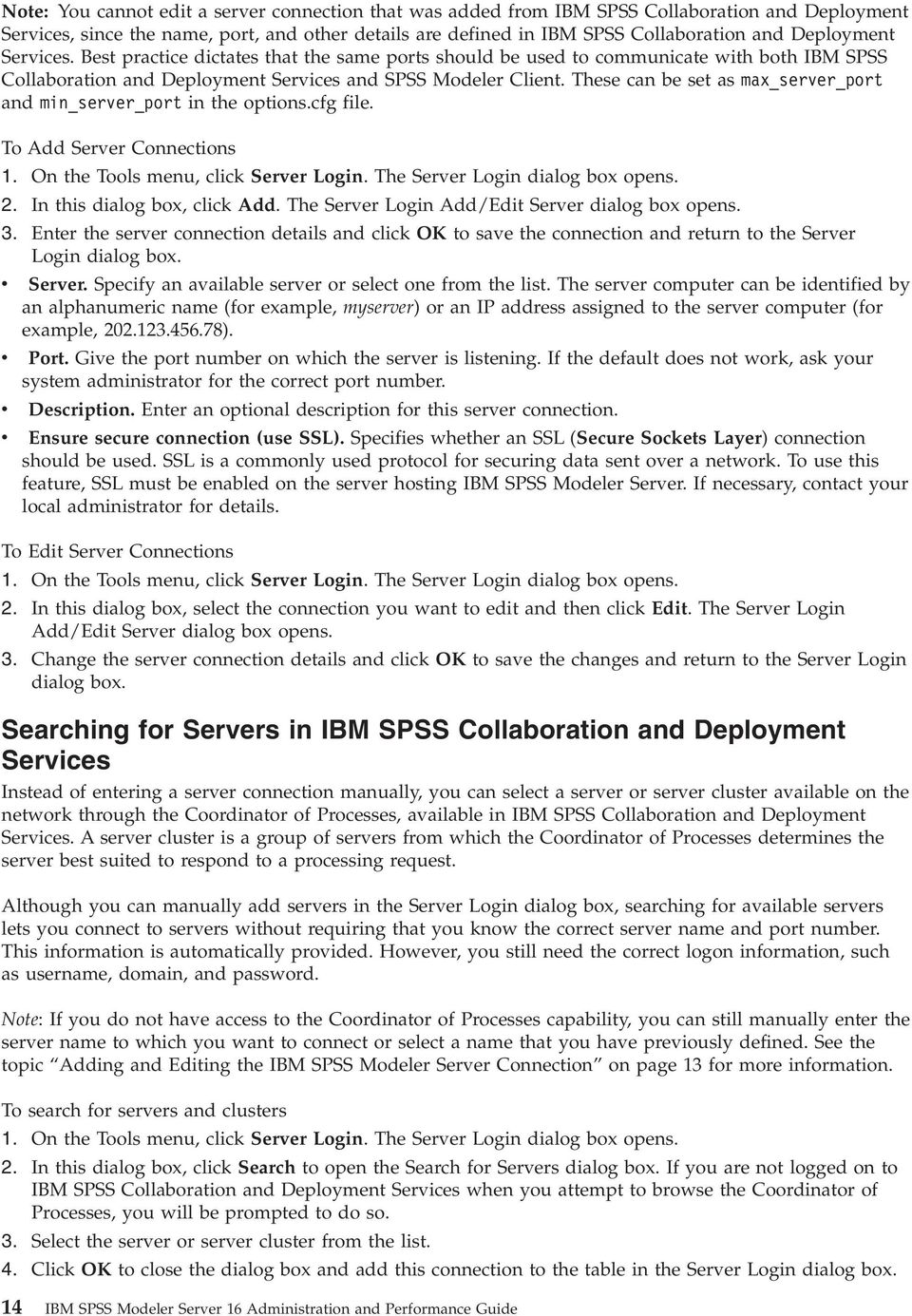
20 Note: You cannot edit a server connection that was added from IBM SPSS Collaboration and Deployment Services, since the name, port, and other details are defined in IBM SPSS Collaboration and Deployment Services. Best practice dictates that the same ports should be used to communicate with both IBM SPSS Collaboration and Deployment Services and SPSS Modeler Client. These can be set as max_server_port and min_server_port in the options.cfg file. To Add Server Connections 1. On the Tools menu, click Server Login. The Server Login dialog box opens. 2. In this dialog box, click Add. The Server Login Add/Edit Server dialog box opens. 3. Enter the server connection details and click OK to save the connection and return to the Server Login dialog box. v Server. Specify an available server or select one from the list. The server computer can be identified by an alphanumeric name (for example, myserver) or an IP address assigned to the server computer (for example, ). v Port. Give the port number on which the server is listening. If the default does not work, ask your system administrator for the correct port number. v Description. Enter an optional description for this server connection. v Ensure secure connection (use SSL). Specifies whether an SSL (Secure Sockets Layer) connection should be used. SSL is a commonly used protocol for securing data sent over a network. To use this feature, SSL must be enabled on the server hosting IBM SPSS Modeler Server. If necessary, contact your local administrator for details. To Edit Server Connections 1. On the Tools menu, click Server Login. The Server Login dialog box opens. 2. In this dialog box, select the connection you want to edit and then click Edit. The Server Login Add/Edit Server dialog box opens. 3. Change the server connection details and click OK to save the changes and return to the Server Login dialog box. Searching for Servers in IBM SPSS Collaboration and Deployment Services Instead of entering a server connection manually, you can select a server or server cluster available on the network through the Coordinator of Processes, available in IBM SPSS Collaboration and Deployment Services. A server cluster is a group of servers from which the Coordinator of Processes determines the server best suited to respond to a processing request. Although you can manually add servers in the Server Login dialog box, searching for available servers lets you connect to servers without requiring that you know the correct server name and port number. This information is automatically provided. However, you still need the correct logon information, such as username, domain, and password. Note: If you do not have access to the Coordinator of Processes capability, you can still manually enter the server name to which you want to connect or select a name that you have previously defined. See the topic Adding and Editing the IBM SPSS Modeler Server Connection on page 13 for more information. To search for servers and clusters 1. On the Tools menu, click Server Login. The Server Login dialog box opens. 2. In this dialog box, click Search to open the Search for Servers dialog box. If you are not logged on to IBM SPSS Collaboration and Deployment Services when you attempt to browse the Coordinator of Processes, you will be prompted to do so. 3. Select the server or server cluster from the list. 4. Click OK to close the dialog box and add this connection to the table in the Server Login dialog box. 14 IBM SPSS Modeler Server 16 Administration and Performance Guide
21 Data and File Systems Users working with IBM SPSS Modeler Server will probably need to access data files and other data sources on the network, as well as save files on the network. They may need the following information, as applicable: v ODBC data source information. If users need access to ODBC data sources defined on the server computer, they will need the names, descriptions, and login information (including database login IDs and passwords) for the data sources. v Data file access. If users need to access data files on the server computer or elsewhere on the network, they will need the names and locations of the data files. v Location for saved files. When users save data while connected to IBM SPSS Modeler Server, they may attempt to save files on the server computer. However, this is often a write-protected location. If so, let users know where they should save data files. (Typically, the location is the user's home directory.) User Authentication IBM SPSS Modeler Server uses the operating system on the server machine to authenticate users who connect to the server. When a user connects to IBM SPSS Modeler Server, all operations performed on behalf of the user are performed in the user's security context. Access to database tables is subject to user and/or password privileges in the database itself. Windows. On Windows, any user with a valid account on the host network may log on. With the default authentication, users must have modify access rights to the <modeler_server_install>\tmp directory. Without these rights, users cannot log on to IBM SPSS Modeler Server from the client using the default authentication on Windows. UNIX. By default, IBM SPSS Modeler Server is assumed to run as root on UNIX. This allows any user with a valid account on the host network to log on and limits users' file access to their own files and directories. However, you can configure IBM SPSS Modeler Server to run without root privilege. In this case, you must create a private password database to be used for authentication, and all IBM SPSS Modeler users must share a single UNIX user account (and, consequently, share access to data files). See the topic Configuring as non-root using a private password database on page 60 for more information. On Solaris, Linux and AIX platforms, IBM SPSS Modeler Server uses PAM for authentication. You can use the service name modelerserver to configure the PAM modules for IBM SPSS Modeler Server if required. Permissions Windows. A user connecting to server software that is installed on an NTFS drive must login with an account that has the following permissions. v Read and execute permissions to the server s installation directory and its subdirectories v Read, execute, and write permissions to the directory location for temporary files. In Windows Server 2008 and later, you cannot assume that users have these permission. Be sure to explicitly set permissions as needed. If the server software is installed on a FAT drive, you do not need to set permissions because all files allow users to have full control. UNIX. If you are not using internal authentication, a user connecting to the server software must login with an account that has the following permissions: v Read and execute permissions to the server s installation directory and its subdirectories v Read, execute, and write permissions to the directory location for temporary files. Chapter 3. IBM SPSS Modeler Support 15
22 File Creation When IBM SPSS Modeler Server accesses and processes data, it often has to keep a temporary copy of that data on disk. The amount of disk space that will be used for temporary files depends on the size of the data file that the end user is analyzing and the type of analysis that he or she is performing. See the topic Temporary Disk Space and RAM Requirements on page 7 for more information. UNIX. The UNIX versions of IBM SPSS Modeler Server use the UNIX umask command to set file permissions for the temporary files. You can override the server's default permissions. See the topic Controlling Permissions on File Creation on page 52 for more information. Differences in Results Users who run analyses in both modes may see slight differences in the results between IBM SPSS Modeler and IBM SPSS Modeler Server. The discrepancy usually occurs because of record ordering or rounding differences. Record ordering. Unless a stream explicitly orders records by sorting them, the order in which records are presented may vary between streams executed locally and those executed on the server. There may also be differences in order between operations run within a database and those run in IBM SPSS Modeler Server. These differences are due to the different algorithms used by each system to implement functions that may reorder records, such as aggregation. Also, note that SQL does not specify the order in which records are returned from a database in cases where there is no explicit ordering operation. Rounding differences. IBM SPSS Modeler running in local mode uses a different internal format for storing floating point values than does IBM SPSS Modeler Server. Due to rounding differences, results might vary slightly between each version. 16 IBM SPSS Modeler Server 16 Administration and Performance Guide
23 Chapter 4. IBM SPSS Modeler Server Administration This chapter contains information about starting and stopping IBM SPSS Modeler Server, configuring various server options, and interpreting the log file. It describes how to use IBM SPSS Modeler Administration Console, an application that facilitates server configuration and monitoring. For installation instructions for this component, refer to the installation instructions for IBM SPSS Modeler Server, available with that product. Starting and Stopping IBM SPSS Modeler Server IBM SPSS Modeler Server runs as a service on Windows or as a daemon process on UNIX. Scheduling note: Stopping IBM SPSS Modeler Server disconnects end users and terminates their sessions, so try to schedule server restarts during periods of low usage. If this is not possible, be sure to notify users before stopping the server. To Start, Stop, and Check Status on Windows On Windows, you control IBM SPSS Modeler Server with the Services dialog box in the Windows Control Panel. 1. Windows XP. Open the Windows Start menu. Choose Settings and then Control Panel. Double-click Administrative Tools and then Services. Windows 2003 or Open the Windows Start menu. Choose Control Panel, then Administrative Tools, then Services. 2. Select the IBM SPSS Modeler Server <nn.n> service. You can now check its status, start or stop it, and edit startup parameters, as appropriate. By default, the service is configured for automatic startup, which means that if you stop it, it will restart automatically when the computer is rebooted. When started this way, the service runs unattended, and the server computer can be logged off without affecting it. To Start, Stop, and Check Status on UNIX On UNIX, you start or stop IBM SPSS Modeler Server by running the modelersrv.sh script in the IBM SPSS Modeler Server installation directory. 1. Change to the IBM SPSS Modeler Server installation directory. For example, at a UNIX command prompt, type cd /usr/modelersrv where modelersrv is the IBM SPSS Modeler Server installation directory. 2. To start the server, at the command prompt, type./modelersrv.sh start 3. To stop the server, at the command prompt, type./modelersrv.sh stop 4. To check the status of IBM SPSS Modeler Server, at a UNIX command prompt, type./modelersrv.sh list and look at the output, which is similar to what the UNIX ps command produces. The first process in the list is the IBM SPSS Modeler Server daemon process, and remaining processes are IBM SPSS Modeler sessions. Copyright IBM Corporation 1994,
24 The IBM SPSS Modeler Server installation program includes a script (auto.sh) that configures your system to start the server daemon automatically at boot time. If you have run that script and then stop the server, the server daemon will restart automatically when the computer is rebooted. See the topic Automatically Starting and Stopping IBM SPSS Modeler Server on page 51 for more information. UNIX kernel limits You must ensure that kernel limits on the system are sufficient for the operation of IBM SPSS Modeler Server. The data, memory, and file ulimits are particularly important and should be set to unlimited within the IBM SPSS Modeler Server environment. To do this: 1. Add the following commands to modelersrv.sh: ulimit d unlimited ulimit m unlimited ulimit f unlimited 2. Restart IBM SPSS Modeler Server. Handling Unresponsive Server Processes (UNIX Systems) IBM SPSS Modeler Server processes may become unresponsive for several reasons, including situations where they make a system call or ODBC driver call that becomes blocked (call never returns, or takes a very long time to return). When UNIX processes enter this state, they can be cleaned up using the UNIX kill command (interrupts initiated by IBM SPSS Modeler client, or the closing of IBM SPSS Modeler client, will have no effect). A kill command is provided as an alternative to the normal stop command, and enables an administrator to use modelersrv.sh to easily issue the appropriate kill command. On systems which are susceptible to the accumulation of unusable ( zombie ) server processes, we recommend that IBM SPSS Modeler Server is stopped and restarted at regular intervals, using the following sequence of commands: cd modeler_server_install_directory./modelersrv.sh stop./modelersrv.sh kill Those IBM SPSS Modeler processes that are ended using the modelersrv.sh kill command will leave behind temporary files (from the temporary directory) that will need to be removed manually. Temporary files may be left behind in some other situations too, including application crashes due to resource exhaustion, user interrupts, system crashes, or other reasons. Therefore we recommend that, as part of the process of restarting IBM SPSS Modeler Server at regular intervals, all remaining files are removed from the IBM SPSS Modeler temporary directory. Once all server processes have been closed and temporary files have been removed, IBM SPSS Modeler Server can be safely restarted. Administration IBM SPSS Modeler Server has a number of configurable options that control its behavior. You can set these options in two ways: v Use the IBM SPSS Modeler Administration Console application, which is available free of charge to current IBM SPSS Modeler customers. See the topic Using IBM SPSS Modeler Administration Console on page 19 for more information. v Use the options.cfg text file, located in the [server install path]/config directory. See the topic Using the options.cfg File on page 25 for more information. We recommend that you install and use IBM SPSS Modeler Administration Console as your administration tool, rather than editing the options.cfg file. Editing the file requires access to the IBM SPSS 18 IBM SPSS Modeler Server 16 Administration and Performance Guide
25 Modeler Server file system, but IBM SPSS Modeler Administration Console allows you to authorize anyone with a user account to adjust these options. Also, IBM SPSS Modeler Administration Console provides additional information about the server processes, allowing you to monitor usage and performance. Unlike when editing the configuration file, most configuration options can be changed without restarting IBM SPSS Modeler Server. More information about using IBM SPSS Modeler Administration Console and the options.cfg file is provided in the following sections. Using IBM SPSS Modeler Administration Console The Modeler Administration Console application provides a console user interface to monitor and configure your SPSS Modeler Server installations, and is available free-of-charge to current SPSS Modeler Server customers. The application can be installed only on Windows computers; however, it can administer a server installed on any supported platform. Many of the options available through Modeler Administration Console can also be specified in the options.cfg file, which is located in the SPSS Modeler Server installation directory under /config. However, the Modeler Administration Console application provides a shared graphical interface that allows you to connect, configure, and monitor multiple servers. Starting Modeler Administration Console From the Windows Start menu, choose [All] Programs, then IBM SPSS Collaboration and Deployment Services, then Deployment Manager, then IBM SPSS Modeler Administration Console <nn.n>. When you first run the application, you see empty Server Administration and Properties panes (unless you already have Deployment Manager installed with an IBM SPSS Collaboration and Deployment Services server connection already set up). After you configure Modeler Administration Console, the Server Administrator pane on the left displays a node for each SPSS Modeler Server that you want to administer. The right-hand pane shows the configuration options for the selected server. You must first set up a connection for each server that you want to administer. Configuring Access with Modeler Administration Console Administrator access to SPSS Modeler Server through Modeler Administration Console is controlled with the administrators line in the options.cfg file, located in the SPSS Modeler Server installation directory under /config. This line is commented out by default, so you must edit this line to allow access to specific people, or use * to allow access to all users, as shown in the following examples: administrators, "*" administrators, "jsmith,mjones,achavez" v The line must begin with administrators, and the entries must be contained in quotation marks. Entries are case sensitive. v Separate multiple user IDs with commas. v For Windows accounts, do not use domain names. v Use the asterisk with care. It allows anyone with a valid user account for IBM SPSS Modeler Server (which, in most cases, is anyone on the network) to log in and change the configuration options. Configuring Access with User Access Control To use the Modeler Administration Console to make updates to a SPSS Modeler Server configuration installed on a Windows machine that has User Access Control (UAC) enabled you must have read, write, and execute permissions defined on the config directory and on the options.cfg file. These (NTFS) permissions must be defined at the specific user level and not at group level, this is due to the way that UAC and NTFS permissions interact. Chapter 4. IBM SPSS Modeler Server Administration 19
26 SPSS Modeler Server Connections You must specify a connection to each SPSS Modeler Server on your network that you want to administer. You must then log in to each server. Although the server connection is remembered across Modeler Administration Console sessions, the login credentials are not. You must log in every time you start Modeler Administration Console. To Set Up a Server Connection 1. Ensure that the IBM SPSS Modeler Server service is started. 2. From the File menu, choose New and then Administered Server Connection. 3. On the first page of the wizard, enter a name for your server connection. The name is for your own use and should be something descriptive; for example, Production Server. Ensure that Type is set to Administered IBM SPSS Modeler Server, then click Next. 4. On the second page, enter the hostname or IP address of the server. If you have changed the port from the default, enter the port number. Click Finish. The new server connection is shown in the Server Administrator pane. To perform administration tasks, you must now log in. To Log in to the Server 1. In the Server Administrator pane, double-click to select the server to which you want to log in. 2. In the Login dialog box, enter your credentials. (Use your user account for the server host.) Click OK. If the login fails with the message Unable to obtain administrator rights on server, the most likely cause is that administrator access has not been configured correctly. See the topic Configuring Access with Modeler Administration Console on page 19 for more information. If the login fails with the message Failed to connect to server '<server>', make sure that the user ID and password are correct, then make sure that the IBM SPSS Modeler Server service is running. For example, under Windows, go to Control Panel > Administrative Tools > Services and check the entry for IBM SPSS Modeler Server. If the Status column does not show Started, select this line on the screen and click Start, then retry the login. Once you log in to your IBM SPSS Modeler Server, two options are shown below the server name, Configuration and Monitoring. Double-click one of these options. SPSS Modeler Server Configuration The Configuration pane shows configuration options for SPSS Modeler Server. Use this pane to change the options as desired. Click Save on the toolbar to save the changes. (Note that changing the port number requires a server restart in order to take effect.) The options are described in the following sections, with the corresponding line in options.cfg given in parentheses for each option. Options that are visible only in options.cfg are described at the end of this section. Connections/Sessions Maximum number of connections. (max_sessions) Maximum number of server sessions at one time. A value of 1 indicates no limit. Port number. (port_number) The port number for SPSS Modeler Server to listen on. Change if another application already uses the default. End users must know the port number in order to use SPSS Modeler Server. 20 IBM SPSS Modeler Server 16 Administration and Performance Guide
27 Analytic Server Connection Analytic Server URL. (as_url) The URL of the Analytic Server, including the IP address of the server, the port, and the tenant the SPSS Modeler Server installation is a member of. Prompt for Password. (as_prompt_for_password) Specify N if the SPSS Modeler Server is configured with the same authentication system for users and passwords as that used on Analytic Server; otherwise, Y. Data File Access Restrict access to only data file path. (data_files_restricted) When set to yes, this option restricts data files to the standard data directory and those listed in the Data File Path below. Data file path. (data_file_path) A list of additional directories to which clients are allowed to read and write data files. This option is ignored unless the Restrict Access to Only Data File Path option is turned on. Note that you should use forward slashes in all pathnames. On Windows, specify multiple directories using semicolons (for example, [server install path]/data;c:/data;c:/temp). On Linux and UNIX, use colons (:) instead of semicolons. Restrict access to only program files path. (program_files_restricted) When set to yes, this option restricts program file access to the standard bin directory and those listed in the Program Files Path below. Program files path. (program_file_path) A list of additional directories from which clients are allowed to execute programs. This option is ignored unless the Restrict Access to Only Program Files Path option is turned on. Note that you should use forward slashes in all pathnames. Specify multiple directories using semicolons. Maximum file size (MB). (max_file_size) Maximum size of temporary and exported data files created during stream execution (does not apply to SAS and SPSS Statistics data files). A value of 1 indicates no limit. Temporary directory. (temp_directory) The directory used to store temporary data files (cache files). Ideally, this directory should be on a separate high-speed drive or controller because speed of access to this directory may have a significant impact on performance. You may specify multiple temporary directories, separating each with a comma. These should be located on different disks; the first directory is used most often, and additional directories are used to store temporary work files when certain data preparation operations (such as sort) use parallelism during execution. Allowing each execution thread to use separate disks for temporary storage can improve performance. Use forward slashes in all path specifications. Note: Temporary files are generated in this directory during startup of SPSS Modeler Server. Ensure that you have the necessary access rights to this directory (for example, if the temporary directory is a shared network folder), otherwise SPSS Modeler Server startup will fail. Python Exe Path. (python_exe_path) Full path to the python executable including the executable name. Note that Restrict access to only program files path may need to be set to No depending on the location where python is installed. Performance/Optimization Stream rewriting. (stream_rewriting_enabled) Allows the server to optimize streams by rewriting them. For example, the server might push data reduction operations closer to the source node to minimize the size of the dataset as early as possible. Disabling this option is normally recommended only if the optimization causes an error or other unexpected results. This setting overrides the corresponding client optimization setting. If this setting is disabled in the server, then the client cannot enable it. But if it is enabled in the server, the client can choose to disable it. Parallelism. (max_parallelism) Describes the number of parallel worker threads that SPSS Modeler is allowed to use when running a stream. Setting this to 0 or any negative number causes IBM SPSS Modeler to match the number of threads to the number of available processors on the computer; the Chapter 4. IBM SPSS Modeler Server Administration 21
28 default value for this option is 1. To turn off parallel processing (for machines with multiple processors), set this option to 1. To allow limited parallel processing, set it to a number smaller than the number of processors on your machine. Note that a hyperthreaded or dual-core processor is treated as two processors. Buffer size (bytes). (io_buffer_size) Data files transferred from the server to the client are passed through a buffer of this number of bytes. Cache compression. (cache_compression) An integer value in the range 0 to 9 that controls the compression of cache and other files in the server s temporary directory. Compression reduces the amount of disk space used, which can be important when space is limited, and improves performance by reducing the amount of disk activity needed to create and read the cache. Compression increases processor time, but this is almost always made up by the reduction in disk access time. Note that only certain caches, those accessed sequentially, can be compressed. This option does not apply to random-access caches, such as those used by the network training algorithms. A value of 0 disables compression entirely. Values from 1 upward provide increasing degrees of compression but with a corresponding cost in access time. The default value is 1; higher values are rarely needed except where disk space is at a premium. Memory usage multiplier. (memory_usage) Controls the proportion of physical memory allocated for sorting and other in-memory caches. The default is 100, which corresponds to approximately 10% of physical memory. Increase this value to improve sort performance where free memory is available, but be careful of increasing it so high as to cause excessive paging. Modeling memory limit percentage. (modelling_memory_limit_percentage) Controls the proportion of physical memory allocated for training neural net, Kohonen, and k-means models. The default is 25%. Increase this value to improve training performance where free memory is available, but be careful of increasing it so high as to cause excessive paging when data spills onto the disk. Allow modeling memory override. (allow_modelling_memory_override) Enables or disables the Optimize for Speed option in certain modeling nodes. The default is enabled. This option allows the modeling algorithm to claim all available memory, bypassing the percentage limit option. You may want to disable this if you need to share memory resources on the server machine. Maximum and minimum server port. (max_server_port and min_server_port) Specifies the range of port numbers that can be used for the additional socket connections between client and server that are required for interactive models and stream execution. These require the server to listen on another port; not restricting the range could cause problems for users on systems with firewalls. Default value for both is 1, meaning "no restriction." Thus, for example, to set the server to listen on port 8000 or above, you would set min_server_port to 8000 and max_server_port to 1. Note that you must open additional ports over the main server port to open or execute a stream, and correspondingly more ports if you want to open or execute concurrent streams. This is required in order to capture feedback from the stream execution. By default, IBM SPSS Modeler will use any open port that is available; if it does not find one (for example, if they are all closed by a firewall), an error is displayed when you execute the stream. To configure the range of ports, IBM SPSS Modeler will need two open ports (in addition to the main server port) available per concurrent stream, plus an additional port for each connected client that has an ODBC connection. To execute more concurrent streams, you can widen the range of port numbers and open up more ports on the firewall accordingly. Note: Best practice dictates that the same ports should be used to communicate with both IBM SPSS Collaboration and Deployment Services and SPSS Modeler Client. These can be set as max_server_port and min_server_port. 22 IBM SPSS Modeler Server 16 Administration and Performance Guide
29 Note: If you change these parameters, you need to restart SPSS Modeler Server for the change to take effect. Array fetch optimization. (sql_row_array_size) Controls the way that SPSS Modeler Server fetches data from the ODBC datasource. The default value is 1, which fetches a single row at a time. Increasing this value causes the server to read the information in larger chunks, fetching the specified number of rows into an array. With some operating system/database combinations, this can result in improvements to the performance of SELECT statements. SQL Maximum SQL string length. (max_sql_string_length) For a string imported from the database with SQL, the maximum number of characters that are guaranteed to be passed successfully. Depending on the operating system, string values longer than this may be truncated on the right without warning. The valid range is between 1 and 65,535 characters. This property also applies to the Database export node. Note: The default value for this parameter is If the text you are analyzing is longer than 2048 characters (for example, this may occur if using the SPSS Modeler Text Analytics Web Feed node) we recommend increasing this value if working in native mode otherwise your results may be truncated. If you are using a database and user-defined functions (UDF), this restriction does not occur; this can account for differences in results between native and UDF modes. Automatic SQL generation. (sql_generation_enabled) Allows automatic SQL generation for streams, which may substantially improve performance. The default is enabled. Disabling this option is recommended only if the database is not able to support queries submitted by SPSS Modeler Server. Note that this setting overrides the corresponding client optimization setting; also note that for purposes of scoring, SQL generation must be enabled separately for each modeling node regardless of this setting. If this setting is disabled in the server, then the client cannot enable it. But if it is enabled in the server, the client can choose to disable it. Default SQL string length. (default_sql_string_length). Specifies the default width of string columns that will be created within database cache tables. String fields in database cache tables will be created with a default width of 255 if there is no upstream type information. If you have wider values than this in your data, either instantiate an upstream Type node with those values, or set this parameter to a value that is large enough to accommodate those string values. Support SQL type logging. (supported_sql_type_logging). For debug purposes only; do not modify unless instructed to do so by a technical-support representative. Enable Database UDF. (db_udf_enabled). If set to Y (default), causes the SQL generation option to generate user-defined function (UDF) SQL instead of pure SPSS Modeler SQL. UDF SQL usually outperforms pure SQL. SSL Enable SSL. (ssl_enabled) Enables SSL encryption for connections between SPSS Modeler and SPSS Modeler Server. Keystore. (ssl_keystore) The SSL key database file to be loaded when the server starts (either a full path or a relative path to the SPSS Modeler installation directory. Keystore stash file. (ssl_keystore_stash_file) The name of the key database password stash file to be loaded when the server starts up (either a full path or a relative path to the SPSS Modeler installation directory). Keystore label. (ssl_keystore_label) Label for the specified certificate. Chapter 4. IBM SPSS Modeler Server Administration 23
30 Note: To use the Administration Console with a server setup for SSL, you must import any certificates required by SPSS Modeler Server into the Deployment Manager trust store (under../jre/lib/security). Coordinator of Processes Configuration Host. (cop_host) The hostname or IP address of the Coordinator of Processes service. The default spsscop is a vanity name which administrators can choose to add as an alias for the IBM SPSS Collaboration and Deployment Services host in DNS. Port number. (cop_port_number) The port number of the Coordinator of Processes service. The default, 8080, is the IBM SPSS Collaboration and Deployment Services default. Context root. (cop_context_root) The URL of the Coordinator of Processes service. Login name. (cop_user_name) The user name for authentication to the Coordinator of Processes service. This is an IBM SPSS Collaboration and Deployment Services login name so may include a security-provider prefix (for example: ad/jsmith). Password. (cop_password) The password for authentication to the Coordinator of Processes service. Enabled. (cop_enabled) Determines whether the server should attempt to register with the Coordinator of Processes. The default is not to register because the administrator should choose which services are advertised through the Coordinator of Processes. Server name. (cop_service_name) The name of this SPSS Modeler Server instance; the default is the host name. Description. (cop_service_description) A description of this instance. Update interval (min). (cop_update_interval) The number of minutes between keep-alive messages; the default is 2. Weight. (cop_service_weight) The weight of this instance, specified as an integer between 1 and 10. A higher weight attracts more connections. The default is 1. Service host. (cop_service_host) The fully-qualified host name of the IBM SPSS Modeler Server host. The default of the host name is derived automatically; the administrator can override the default for multi-homed hosts. Options Visible in options.cfg administrators. Specify the usernames of those users to whom you want to grant administrator access. See the topic Configuring Access with Modeler Administration Console on page 19 for more information. allow_config_custom_overrides. Do not modify unless instructed to do so by a technical-support representative. fips_encryption. Enables FIPS compliant encryption; the default is N. max_transfer_size. For internal system use only; do not modify. shell. (UNIX servers only) Overrides the default setting for the UNIX shell, for example shell, "/usr/bin/ksh". By default, IBM SPSS Modeler uses the shell defined in the user profile of the user who is connecting to IBM SPSS Modeler Server. start_process_as_login_user. Set this to Y if you are running SPSS Modeler Server with a private password database. 24 IBM SPSS Modeler Server 16 Administration and Performance Guide
31 time_ecode_execution_log. Set this to Y if you want the message.log file (in the log folder of the SPSS Modeler Server installation) to include individual execution times for each node in the stream. use_bigint_for_count. When the number of the records to be counted is larger than a normal integer (2^32-1) can hold, set this option to Y. When this option is set to Y, and a stream is connected to either DB2 or SQL Server, COUNT_BIG() will be used where a record count is needed (for example, the Record_Count field generated by the Aggregate node). SPSS Modeler Server Monitoring The monitoring pane of Modeler Administration Console shows a snapshot of all processes running on the SPSS Modeler Server computer, similar to the Windows Task Manager. To activate the monitoring pane, double-click the Monitoring node beneath the desired server in the Server Administrator pane. This populates the pane with a current snapshot of data from the server. The data refreshes at the rate shown (one minute by default). To refresh the data manually, click the Refresh button. To show only SPSS Modeler Server processes in this list, click the Filter out non-spss Modeler processes button. Using the options.cfg File The options.cfg file is located in the [server install path]/config directory. Each setting is represented by a comma-separated name-value pair, where the name is the name of the option and the value is the value for the option. Pound (hash) signs (#) indicate comments. Note: Most configuration options can be changed using IBM SPSS Modeler Administration Console, rather than this configuration file, but there are a few exceptions. See the topic Options Visible in options.cfg on page 24 for more information. By using IBM SPSS Modeler Administration Console, you can avoid server restarts for all options except the server port. See the topic Using IBM SPSS Modeler Administration Console on page 19 for more information. Configuration Options That Can Be Added to the Default File By default, in-database caching is enabled with IBM SPSS Modeler Server. You can disable this feature by adding the following line to the options.cfg file: enable_database_caching, N Doing so causes temporary files to be created on the server and not in the database. To View or Change the IBM SPSS Modeler Server Configuration Options: 1. Open the options.cfg file with a text editor. 2. Locate the options of interest. For a full list of options, see SPSS Modeler Server Configuration on page Edit the values, as appropriate. Note that all pathname values must use a forward slash (/) rather than a backslash as the pathname separator. 4. Save the file. 5. Stop and restart IBM SPSS Modeler Server so that the changes will take effect. See the topic Starting and Stopping IBM SPSS Modeler Server on page 17 for more information. Closing Unused Database Connections By default, IBM SPSS Modeler caches at least one connection to a database once that connection has been accessed. The database session is held open even when streams requiring database access are not being executed. Chapter 4. IBM SPSS Modeler Server Administration 25
32 Caching database connections can improve execution times by removing the need for IBM SPSS Modeler to reconnect to the database each time a stream is executed. However, in some environments, it is important for applications to release database resources as quickly as possible. If too many IBM SPSS Modeler sessions maintain connections to the database that are no longer used, database resources may become exhausted. You can avoid this possibility by turning off the IBM SPSS Modeler option cache_connection in a custom database configuration file. Doing so can also make IBM SPSS Modeler more resilient to faults in the database connection (such as timeouts) that can occur when connections are used over a long period of time by an IBM SPSS Modeler session. To cause unused database connections to be closed: 1. Locate the [server install path]/config directory. 2. Add the following file (or open it, if it already exists): odbc-custom-properties.cfg 3. Add the following line to the file: cache_connection, N 4. Save and close the file. 5. Restart IBM SPSS Modeler Server to cause the changes to take effect. Using SSL to secure data transfer Secure Sockets Layer (SSL) is a protocol for encrypting data transferred between two computers. SSL ensures that communication between the computers is secure. SSL can encrypt the authentication of a username/password and the contents of an exchange between a server and client. How SSL works SSL relies on the server's public and private keys, in addition to a public key certificate that binds the server's identity to its public key. 1. When a client connects to a server, the client authenticates the server with the public key certificate. 2. The client then generates a random number, encrypts the number with the server's public key, and sends the encrypted message back to the server. 3. The server decrypts the random number with its private key. 4. From the random number, both the server and client create the session keys used for encrypting and decrypting subsequent information. The public key certificate is typically signed by a certificate authority. Certificate authorities, such as VeriSign and Thawte, are organizations that issue, authenticate, and manage security credentials contained in the public key certificates. Essentially, the certificate authority confirms the identity of the server. The certificate authority usually charges a monetary fee for a certificate, but self-signed certificates can also be generated. Securing client/server and server-server communications with SSL The main steps in securing client/server and server-server communications with SSL are: 1. Obtain and install the SSL certificate and keys. 2. Enable and configure SSL in the server administration application (IBM SPSS Collaboration and Deployment Services Deployment Manager). 3. If necessary, install unlimited strength encryption on the client computers. 4. Instruct users to enable SSL when connecting to the server. 26 IBM SPSS Modeler Server 16 Administration and Performance Guide
33 Note: Occasionally a server product acts as a client. An example is IBM SPSS Statistics Server connecting to the IBM SPSS Collaboration and Deployment Services Repository. In this case, IBM SPSS Statistics Server is the client. Obtaining and installing SSL certificate and keys The first steps you must follow to configure SSL support are: 1. Obtain an SSL certificate and key file. There are three ways you can do this: v Purchase them from a public certificate authority (such as VeriSign, Thawte, or Entrust). The public certificate authority (CA) signs the certificate to verify the server that uses it. v Generate the key and certificate files with a third-party certificate authority. If this approach is taken then the third-party CA's root certificate must be imported into the client and server keystore files. See the topic Importing a third-party root CA certificate on page 28 for more information. v Generate the key and certificate files with an internal self-signed certificate authority. The steps to do this are: a. Prepare a key database. See the topic Creating an SSL key database on page 28 for more information. b. Create the self-signed certificate. See the topic Creating a self-signed SSL certificate on page 28 for more information. 2. Copy the.kdb and.sth files created in step 1 into a directory to which the IBM SPSS Modeler Server has access and specify the path to that directory in the options.cfg file. Note: Use forward slashes as separators in the directory path. 3. Set the following parameters in the options.cfg file: v ssl_enabled, Y v ssl_keystore, "<filename>.kdb" where <filename> is the name of your key database. v ssl_keystore_stash_file, "<filename>.sth" where <filename> is the name of the key database password stash file. v ssl_keystore_label, <label> where <label> is the label of your certificate. 4. For self-signed or third-party certificates install the certificate on client systems. For purchased public CA certificates, this step is not required. Ensure that access permissions deny casual browsing of the directory that contains the certificate. See the topic Installing a self-signed SSL certificate on page 28 for more information. Configuring the environment to run GSKit: The GSKCapiCmd is a non-java-based command-line tool, and Java does not need to be installed on your system to use this tool; it is located in the <Modeler installation directory>/bin folder. The process to configure your environment to run IBM Global Security Kit (GSKit) varies depending on the platform in use. To configure for Linux/Unix, add the shared libraries directory <Modeler installation directory>/lib to your environment: $export <Shared library path environment variable>=<modeler_server_install_path>/lib $export PATH=$PATH:<modeler_server_install_path>/bin The shared library path variable name depends on your platform: v AIX uses the variable name: LIBPATH v HP-UX uses the variable name: SHLIB_PATH v Linux, Solaris use the variable name: LD_LIBRARY_PATH For example, to set the environment on Linux, use: $export LD_LIBRARY_PATH=/path/to/gskit/lib $export PATH=$PATH:/path/to/gskit/bin Chapter 4. IBM SPSS Modeler Server Administration 27
34 Creating an SSL key database: Use the GSKCapiCmd tool to create your key database. Before using the tool you must configure your environment; see the topic Configuring the environment to run GSKit on page 27 for more information To create the key database, run GSKit and enter the following command: gsk<ver>capicmd[_64] -keydb -create -populate -db <filename>.kdb -pw <password> -stash where <ver> is the GSKit version number, <filename> is the name you want to use for the key database file, and <password> is the password for the key database. The -stash option creates a stash file at the same path as the key database, with a file extension of.sth. GSKit uses the stash file to obtain the password to the key database so that it doesn't have to be entered on the command line each time. Note: You should use strong file system protection on the.sth file. Creating a self-signed SSL certificate: To generate a self-signed certificate and store it in the key database, use the following command: gsk<ver>capicmd[_64] -cert -create -db <filename>.kdb -stashed -dn "CN=myserver,OU=mynetwork,O=mycompany, C=mycountry" -expire <Number of days certificate is valid> -label <label> -default_cert yes where <ver> is the GSKit version number, <filename> is the name of the key database file, <Number of days certificate is valid> is the physical number of days that the certificate is valid, and <label> is a descriptive label to help you identify the file (for example, you could use a label such as: myselfsigned). Installing a self-signed SSL certificate: For the client machines that connect to your server using SSL, you must distribute the public part of the certificate to the clients so that it can be stored in their key databases. To do this: 1. Extract the public part to a file using the following command: gsk8capicmd -cert -extract -db <filename>.kdb -stashed -label <label> -format ascii -target mycert.arm 2. Distribute mycert.arm to the clients. It should be copied to their jre/bin directory. 3. Add the new certificate to the clients' key database using the following command: keytool -import -alias <label> -keystore cacerts -file mycert.arm If prompted for a password, use: changeit. The keytool is located in the <Modeler installation directory>\jre\bin directory. 4. Copy the newly generated cacerts files to the jre\lib\security directory to replace the existing version. Importing a third-party root CA certificate: Instead of purchasing a certificate from a well known certificate authority (CA) or creating a self-signed certificate, you can use a third-party certificate authority to sign your server certificates. The client and server must have access to the third-party CA's root certificate to verify the server certificates that are signed by the third-party CA. To do this: 1. Obtain the third-party CA root certificate. The process for this varies depending on the third-party CA's procedures. Third-party CAs often make their root certificates available for download. 2. Add the certificate to the servers' key database using the following command: gsk<ver>capicmd[_64} -cert -add -db <filename>.kdb -stashed -label <label> -file <ca_certificate>.crt -format binary -tr 3. Add the certificate to the clients' key database using the following command: C:> cd <Modeler Client installation path>\jre\bin C:> keytool -import -keystore..\lib\security\cacerts -file <ca_certificate>.crt -alias <label> If prompted for a password, use: changeit. The keytool is located in the <Modeler installation directory>\jre\bin directory. 4. Validate the server's key database with the root CA certificate using the following command: 28 IBM SPSS Modeler Server 16 Administration and Performance Guide
35 gsk<ver>capicmd[_64} -cert -validate -db <filename>.kdb -stashed -label <label> A successful validation is indicated by the returned message: OK. Note: The commands explained above use a third-party CA root certificate that is in a binary format. If the certificate is in an ASCII format, use the -format ascii option. The -db parameter specifies the name of the key database into which you import the third-party CA root certificate. The -label parameter specifies the label to use for the third-party CA root certificate inside the key database file. The label you use here can be anything because it does not have any relation to the labels used in the IBM SPSS Modeler options.cfg file. The -file parameter specifies the file that contains the third-party CA root certificate Enable and Configure SSL in the IBM SPSS Collaboration and Deployment Services Deployment Manager 1. If installing a self-signed SSL certificate, copy the cacerts file that you created to the <Deployment Manager installation directory>\jre\lib\security directory. See the topic Installing a self-signed SSL certificate on page 28 for more information. 2. Start the server administration application ( IBM SPSS Collaboration and Deployment Services Deployment Manager ) and connect to the server. 3. On the configuration page, set Secure Sockets Layer to Yes. 4. In SSL Public Key File, specify the full path to the public key file. 5. In SSL Private Key File, specify the full path to the private key file. Note: If the public and private keys are stored in one file, specify the same file in SSL Public Key File and SSL Private Key File. 6. From the menus choose: File > Save 7. Restart the server service or daemon. When you restart, you will be prompted for the SSL password. On Windows, you can select Remember this password to store the password securely. This option eliminates the need to enter the password every time the server is started. Installing unlimited strength encryption The Java Runtime Environment shipped with the product has US export-strength encryption enabled. For enhanced security of your data, upgrading to unlimited-strength encryption is recommended. IBM J9 1. Download the Java Cryptography Extension (JCE) Unlimited Strength Jurisdiction Policy Files for your version of the SDK from the IBM.com website. 2. Extract the unlimited jurisdiction policy files that are packaged in the compressed file. The compressed file contains a US_export_policy.jar file and a local_policy.jar file. In your WebSphere Application Server installation, go to the $JAVA_HOME/jre/lib/security directory and back up your US_export_policy.jar and local_policy.jar files. 3. Replace your US_export_policy.jar and local_policy.jar files with the two files that you downloaded. 4. Enable security in the WebSphere Application Server administration console. Make sure that all node agents within the cell are active beforehand. For more information, see WebSphere documentation. Note that you must select an available realm definition from the list in Security > Secure administration, applications, and infrastructure, and then click Set as current so that security is enabled upon a server restart. 5. Log off the administrative console. 6. Stop the server. Chapter 4. IBM SPSS Modeler Server Administration 29
36 7. Restart the server. Sun Java 1. Download the Java Cryptography Extension (JCE) Unlimited Strength Jurisdiction Policy Files for your version of the SDK from Sun Java website. 2. Extract the downloaded file. 3. Copy the two.jar files local_policy.jar and US_export_policy.jar into <installation folder>/jre/lib/security, where <installation folder> is the folder in which you installed the product. Instructing users to enable SSL When users connect to the server through a client product, they need to enable SSL in the dialog box for connecting to the server. Server Log IBM SPSS Modeler Server keeps a record of its important actions in a log file called server_logging.log. On UNIX this file is located in a log folder in the installation directory, on Windows this file is located in %ALLUSERSPROFILE%/IBM/SPSS/Modeler Server/<version>/log. When IBM SPSS Modeler Server is started, the log file is updated to indicate the time of the start and the port number it is listening on. From that point forward, the log file is updated with the result whenever a client attempts to connect to the server. The server writes the following events to the log file by default: v Server started v Server stopped v Connection accepted v Connection refused v Session started v Session stopped v System error v Login succeeded v Login failed v Database login succeeded v Database login failed v Database logout v File open/create v File close 30 IBM SPSS Modeler Server 16 Administration and Performance Guide
37 Chapter 5. Performance Overview Real performance in analyzing data is affected by a number of factors, from server and database configuration to the ordering of individual nodes within a stream. In general, you can obtain the best performance by doing the following: v Store your data in a DBMS, and use SQL generation and optimization whenever possible. v Use hardware that meets or exceeds the recommendations given in Chapter 2, Architecture and Hardware Recommendations, on page 5. v Ensure that the client and server performance and optimization settings are properly configured. Note that when SPSS Modeler is connected to an SPSS Modeler Server installation, the server performance and optimization settings override the client equivalents. v Design streams for maximum performance. More information about each of these performance factors is available in the following sections. Server Performance and Optimization Settings Certain IBM SPSS Modeler Server settings can be configured to optimize performance. You can adjust these settings using the IBM SPSS Modeler Administration Console application, which is included with IBM SPSS Modeler Server. See the topic Using IBM SPSS Modeler Administration Console on page 19 for more information. The settings are grouped under the heading Performance and Optimization in the IBM SPSS Modeler Administration Console configuration window. The settings are preconfigured for optimal performance for most installations. However, you may need to adjust them depending on your particular hardware, the size of your data sets, and the contents of your streams. See the topic Performance/Optimization on page 21 for more information. Client Performance and Optimization Settings The client performance and optimization settings are available from the Options tab of the Stream Properties dialog box. To display these options, choose the following from the client menu. Tools > Stream Properties > Options > Optimization You can use the Optimization settings to optimize stream performance. Note that the performance and optimization settings on IBM SPSS Modeler Server (if used) override any equivalent settings in the client. If these settings are disabled in the server, then the client cannot enable them. But if they are enabled in the server, the client can choose to disable them. Note: Database modeling and SQL optimization require that IBM SPSS Modeler Server connectivity be enabled on the IBM SPSS Modeler computer. With this setting enabled, you can access database algorithms, push back SQL directly from IBM SPSS Modeler, and access IBM SPSS Modeler Server. To verify the current license status, choose the following from the IBM SPSS Modeler menu. Help > About > Additional Details If connectivity is enabled, you see the option Server Enablement in the License Status tab. See the topic Connecting to IBM SPSS Modeler Server on page 11 for more information. 31
38 Note: Whether SQL pushback and optimization are supported depends on the type of database in use. For the latest information on which databases and ODBC drivers are supported and tested for use with IBM SPSS Modeler 16, see the corporate Support site at Enable stream rewriting. Select this option to enable stream rewriting in IBM SPSS Modeler. Four types of rewriting are available, and you can select one or more of them. Stream rewriting reorders the nodes in a stream behind the scenes for more efficient operation, without altering stream semantics. v v v v Optimize SQL generation. This option enables nodes to be reordered within the stream so that more operations can be pushed back using SQL generation for execution in the database. When it finds a node that cannot be rendered into SQL, the optimizer will look ahead to see if there are any downstream nodes that can be rendered into SQL and safely moved in front of the problem node without affecting the stream semantics. Not only can the database perform operations more efficiently than IBM SPSS Modeler, but such pushbacks act to reduce the size of the data set that is returned to IBM SPSS Modeler for processing. This, in turn, can reduce network traffic and speed stream operations. Note that the Generate SQL check box must be selected for SQL optimization to have any effect. Optimize CLEM expression. This option enables the optimizer to search for CLEM expressions that can be preprocessed before the stream is run, in order to increase the processing speed. As a simple example, if you have an expression such as log(salary), the optimizer would calculate the actual salary value and pass that on for processing. This can be used both to improve SQL pushback and IBM SPSS Modeler Server performance. Optimize syntax execution. This method of stream rewriting increases the efficiency of operations that incorporate more than one node containing IBM SPSS Statistics syntax. Optimization is achieved by combining the syntax commands into a single operation, instead of running each as a separate operation. Optimize other execution. This method of stream rewriting increases the efficiency of operations that cannot be delegated to the database. Optimization is achieved by reducing the amount of data in the stream as early as possible. While maintaining data integrity, the stream is rewritten to push operations closer to the data source, thus reducing data downstream for costly operations, such as joins. Enable parallel processing. When running on a computer with multiple processors, this option allows the system to balance the load across those processors, which may result in faster performance. Use of multiple nodes or use of the following individual nodes may benefit from parallel processing: C5.0, Merge (by key), Sort, Bin (rank and tile methods), and Aggregate (using one or more key fields). Generate SQL. Select this option to enable SQL generation, allowing stream operations to be pushed back to the database by using SQL code to generate execution processes, which may improve performance. To further improve performance, Optimize SQL generation can also be selected to maximize the number of operations pushed back to the database. When operations for a node have been pushed back to the database, the node will be highlighted in purple when the stream is run. v v Database caching. For streams that generate SQL to be executed in the database, data can be cached midstream to a temporary table in the database rather than to the file system. When combined with SQL optimization, this may result in significant gains in performance. For example, the output from a stream that merges multiple tables to create a data mining view may be cached and reused as needed. With database caching enabled, simply right-click any nonterminal node to cache data at that point, and the cache is automatically created directly in the database the next time the stream is run. This allows SQL to be generated for downstream nodes, further improving performance. Alternatively, this option can be disabled if needed, such as when policies or permissions preclude data being written to the database. If database caching or SQL optimization is not enabled, the cache will be written to the file system instead. Use relaxed conversion. This option enables the conversion of data from either strings to numbers, or numbers to strings, if stored in a suitable format. For example, if the data is kept in the database as a string, but actually contains a meaningful number, the data can be converted for use when the pushback occurs. 32 IBM SPSS Modeler Server 16 Administration and Performance Guide
39 Note: Due to minor differences in SQL implementation, streams run in a database may return slightly different results from those returned when run in IBM SPSS Modeler. For similar reasons, these differences may also vary depending on the database vendor. Database Usage and Optimization Database server. If possible, create a dedicated database instance for data mining so that the production server is not impacted by IBM SPSS Modeler queries. SQL statements generated by IBM SPSS Modeler can be demanding multiple tasks on the IBM SPSS Modeler Server machine can be executing SQL in the same database. In-database mining. Many database vendors provide data mining extensions for their products. These extensions allow data mining activities (such as model-building or scoring) to run within the database server, or within a separate dedicated server. IBM SPSS Modeler s in-database mining features complement and extend its SQL generation capability, providing a way to drive the vendor-specific database extensions. In some cases, taking this approach avoids the potentially expensive overhead of data transfer between IBM SPSS Modeler and the database. Database caching can further increase the benefits. For more information, see the file DatabaseMiningGuide.pdf, available under the \Documentation folder on the IBM SPSS Modeler installation disk. SQL Optimization For best performance, you should always try to maximize the amount of SQL generated to exploit the performance and scalability of the database. Only the parts of the stream that cannot be compiled to SQL should be executed within IBM SPSS Modeler Server. For more information, see Chapter 6, SQL Optimization, on page 35. Uploading File-Based Data Data that is not stored in a database cannot benefit from SQL optimization. If the data you want to analyze is not already in a database, you can upload it using a Database Output node. You can also use this node to store intermediate data sets from data preparation and the results of deployment. IBM SPSS Modeler can interface with the external loaders for many common database systems. Several scripts are included with the software and are available (with documentation) in the /scripts subdirectory under your IBM SPSS Modeler installation folder. The following table shows the potential performance benefit of bulk-loading. The figures show the elapsed time to export 250,000 records and 21 fields to an Oracle database. The external loader was Oracle s sqlldr utility. Table 1. Performance benefit of bulk-loading Export option Time (in seconds) Default (ODBC) 409 Bulk-load via ODBC 52 Bulk-load via external loader 33 Chapter 5. Performance Overview 33
40 34 IBM SPSS Modeler Server 16 Administration and Performance Guide
41 Chapter 6. SQL Optimization One of the most powerful capabilities of IBM SPSS Modeler is the ability to perform many data preparation and mining operations directly in the database. By generating SQL code that can be pushed back to the database for execution, many operations, such as sampling, sorting, deriving new fields, and certain types of graphing, can be performed in the database rather than on the IBM SPSS Modeler or IBM SPSS Modeler Server computer. When you are working with large datasets, these pushbacks can dramatically enhance performance in several ways: v By reducing the size of the result set to be transferred from the DBMS to IBM SPSS Modeler. When large result sets are read through an ODBC driver, network I/O or driver inefficiencies may result. For this reason, the operations that benefit most from SQL optimization are row and column selection and aggregation (Select, Sample, Aggregate nodes), which typically reduce the size of the dataset to be transferred. Data can also be cached to a temporary table in the database at critical points in the stream (after a Merge or Select node, for example) to further improve performance. v By making use of the performance and scalability of the database. Efficiency is increased because a DBMS can often take advantage of parallel processing, more powerful hardware, more sophisticated management of disk storage, and the presence of indexes. Given these advantages, IBM SPSS Modeler is designed to maximize the amount of SQL generated by each stream so that only those operations that cannot be compiled to SQL are executed by IBM SPSS Modeler Server. Because of limitations in what can be expressed in standard SQL (SQL-92), however, certain operations may not be supported. See the topic Tips for Maximizing SQL Generation on page 39 for more information. Note: Because of minor differences in SQL implementation, streams executed in a database may return slightly different results when executed in IBM SPSS Modeler. These differences may also vary depending on the database vendor, for similar reasons. For example, depending on the database configuration for case sensitivity in string comparison and string collation, IBM SPSS Modeler streams executed using SQL pushback may produce different results from those executed without SQL pushback. Contact your database administrator for advice on configuring your database. To maximize compatibility with IBM SPSS Modeler, database string comparisons should be case sensitive. Note: Database modeling and SQL optimization require that IBM SPSS Modeler Server connectivity be enabled on the IBM SPSS Modeler computer. With this setting enabled, you can access database algorithms, push back SQL directly from IBM SPSS Modeler, and access IBM SPSS Modeler Server. To verify the current license status, choose the following from the IBM SPSS Modeler menu. Help > About > Additional Details If connectivity is enabled, you see the option Server Enablement in the License Status tab. See the topic Connecting to IBM SPSS Modeler Server on page 11 for more information. Note: When streams are executed in a Netezza database, date and time details are taken from that database. This may differ from your local or IBM SPSS Modeler Server date and time if, for example, the database is on a machine that is located in a different country or time zone. Database requirements For the latest information on which databases and ODBC drivers are supported and tested for use with IBM SPSS Modeler, see the product compatibility matrices on the corporate Support site at 35
42 Note that you may gain additional performance improvements by using database modeling. ODBC driver setup To ensure that time details (such as HH:MM:SS) are processed correctly when using SQL 2012 on Windows 8 32bit systems, when setting up your ODBC SQL Server Wire Protocol Driver, you should select both the Enable Quoted Identifiers and Fetch TWFS as Time options. How SQL Generation Works The initial fragments of a stream leading from the database source nodes are the main targets for SQL generation. When a node is encountered that cannot be compiled to SQL, the data are extracted from the database and subsequent processing is performed by IBM SPSS Modeler Server. During stream preparation and prior to execution, the SQL generation process happens as follows: v The server reorders streams to move downstream nodes into the SQL zone where it can be proven safe to do so. (This feature can be disabled on the server.) v Working from the source nodes toward the terminal nodes, SQL expressions are constructed incrementally. This phase stops when a node is encountered that cannot be converted to SQL or when the terminal node (for example, Table node or Graph node) is converted to SQL. At the end of this phase, each node is labeled with an SQL statement if the node and its predecessors have an SQL equivalent. v Working from the nodes with the most complicated SQL equivalents back toward the source nodes, the SQL is checked for validity. The SQL that was successfully validated is chosen for execution. v Nodes for which all operations have generated SQL are highlighted in purple on the stream canvas. Based on the results, you may want to further reorganize your stream where appropriate to take full advantage of database execution. See the topic Tips for Maximizing SQL Generation on page 39 for more information. Where Improvements Occur SQL optimization improves performance in a number of data operations: v Joins (merge by key). Join operations can increase optimization within databases. v Aggregation. The Aggregate, Distribution, and Web nodes all use aggregation to produce their results. Summarized data uses considerably less bandwidth than the original data. v Selection. Choosing records based on certain criteria reduces the quantity of records. v Sorting. Sorting records is a resource-intensive activity that is performed more efficiently in a database. v Field derivation. New fields are generated more efficiently in a database. v Field projection. IBM SPSS Modeler Server extracts only fields that are required for subsequent processing from the database, which minimizes bandwidth and memory requirements. The same is also true for superfluous fields in flat files: although the server must read the superfluous fields, it does not allocate any storage for them. v Scoring. SQL can be generated from decision trees, rulesets, linear regression, and factor-generated models. SQL Generation Example The following stream joins three database tables by key operations and then performs an aggregation and sort. 36 IBM SPSS Modeler Server 16 Administration and Performance Guide
43 Figure 3. Optimized stream with purple nodes indicating SQL pushbacks (operations performed in database) Generated SQL The generated SQL for this stream is as follows: SELECT T2. au_lname AS C0, T2. au_fname AS C1, SUM({fn CONVERT(T0. ytd_sales,sql_bigint)}) AS C2 FROM dbo. titles T0, dbo. titleauthor T1, dbo. authors T2 WHERE (T0. title_id = T1. title_id ) AND (T1. au_id = T2. au_id ) GROUP BY T2. au_lname,t2. au_fname ORDER BY 3 DESC Executing the Stream When the stream is terminated with a database export node, it is possible for the whole stream to be executed in the database. Chapter 6. SQL Optimization 37
44 Figure 4. Entire stream executed in database Configuring SQL Optimization 1. Install an ODBC driver and configure a data source for the database you want to use. See the topic Data Access on page 8 for more information. 2. Create a stream that uses a source node to pull data from that database. 3. Check to be sure that SQL generation is enabled on the client and server, if applicable. It is enabled by default for both. To Enable SQL Optimization on the Client 1. From the Tools menu, choose Stream Properties > Options. 2. Click the Optimization tab. Select Generate SQL to enable SQL optimization. Optionally, you can select other settings to improve performance. See the topic Client Performance and Optimization Settings on page 31 for more information. To Enable SQL Optimization on the Server Because server settings override any specifications made on the client, the server configuration settings Stream Rewriting and Automatic SQL Generation must both be turned on. For more information about how to change IBM SPSS Modeler Server settings, see the section Performance/Optimization on page 21. Note that if these settings are disabled in the server, then the client cannot enable them. But if they are enabled in the server, the client can choose to disable them. To Enable Optimization When Scoring Models For purposes of scoring, SQL generation must be enabled separately for each modeling node, regardless of any server or client-level settings. This is done because some models generate extremely complex SQL expressions that may not be evaluated effectively within the database. The database may report errors when trying to execute the generated SQL, due to the size or complexity of the SQL. A certain amount of trial-and-error may be needed to determine whether SQL generation improves performance for a given model. This is done on the Settings tab after adding a generated model to a stream. 38 IBM SPSS Modeler Server 16 Administration and Performance Guide
45 Previewing Generated SQL You can preview generated SQL in the message log before executing it in the database. This may be useful for debugging purposes, and it allows you to export the generated SQL to edit or run in the database at a future date. It also indicates which nodes will be pushed back to the database, which may help you determine whether the stream can be reordered to improve performance. 1. Make sure that Display SQL in the messages log during stream execution and Display SQL generation details in the messages log during stream preparation are selected in the User Options dialog box. See the topic Client Performance and Optimization Settings on page 31 for more information. 2. On the stream canvas, select the node or stream that you want to preview. 3. Click the Preview SQL button on the toolbar. All nodes for which SQL is generated (and that will be pushed back to the database when the stream is executed) are colored purple on the stream canvas. 4. To preview the generated SQL, from the menus choose: Tools > Stream Properties > Messages... Viewing SQL for Model Nuggets For some models, SQL for the model nugget can be generated, pushing back the model scoring stage to the database. The main use of this feature is not to improve performance, but to allow streams containing these nuggets to have their full SQL pushed back. See the topic Nodes Supporting SQL Generation on page 40 for more information. To view the SQL for a model nugget that supports SQL generation: 1. Select the Settings tab on the model nugget. 2. Choose one of the options Generate with (no) missing value support or Generate SQL for this model, as appropriate. 3. In the model nugget menu, choose: File > Export SQL 4. Save the file. 5. Open the file to view the SQL. Tips for Maximizing SQL Generation To get the best performance boost from SQL optimization, pay attention to the following items. Stream order. SQL generation may be halted when the function of the node has no semantic equivalent in SQL because IBM SPSS Modeler s data-mining functionality is richer than the traditional data-processing operations supported by standard SQL. When this happens, SQL generation is also suppressed for any downstream nodes. Therefore, you may be able to significantly improve performance by reordering nodes to put operations that halt SQL as far downstream as possible. The SQL optimizer can do a certain amount of reordering automatically (just make sure stream rewriting is enabled), but further improvements may be possible. A good candidate for this is the Select node, which can often be brought forward. See the topic Nodes Supporting SQL Generation on page 40 for more information. CLEM expressions. If a stream cannot be reordered, you may be able to change node options or CLEM expressions or otherwise recast the way the operation is performed, so that it no longer inhibits SQL generation. Derive, Select, and similar nodes can commonly be rendered into SQL, provided that all of the CLEM expression operators have SQL equivalents. Most operators can be rendered, but there are a number of operators that inhibit SQL generation (in particular, the sequence functions functions ]). Chapter 6. SQL Optimization 39
46 Sometimes generation is halted because the generated query has become too complex for the database to handle. See the topic CLEM Expressions and Operators Supporting SQL Generation on page 44 for more information. Multiple source nodes. Where a stream has multiple database source nodes, SQL generation is applied to each input branch independently. If generation is halted on one branch, it can continue on another. Where two branches merge (and both branches can be expressed in SQL up to the merge), the merge itself can often be replaced with a database join, and generation can be continued downstream. Database algorithms. Model estimation is always performed on IBM SPSS Modeler Server rather than the database, except when using database-native algorithms from Microsoft, IBM, or Oracle. Scoring models. In-database scoring is supported for some models by rendering the generated model into SQL. However, some models generate extremely complex SQL expressions that aren t always evaluated effectively within the database. For this reason, SQL generation must be enabled separately for each model node. If you find that a model node is inhibiting SQL generation, go to the Settings tab on the node dialog box and select Generate SQL for this model (with some models, you may have additional options controlling generation). Run tests to confirm that the option is beneficial for your application. See the topic Nodes Supporting SQL Generation for more information. When testing modeling nodes to see if SQL generation for models works effectively, we recommend first saving all streams from IBM SPSS Modeler. Some database systems may hang while trying to process the (potentially complex) generated SQL, requiring IBM SPSS Modeler to be closed from the Windows task manager. Database caching. If you are using a node cache to save data at critical points in the stream (for example, following a Merge or Aggregate node), make sure that database caching is enabled along with SQL optimization. This will allow data to be cached to a temporary table in the database (rather than the file system) in most cases. See the topic Configuring SQL Optimization on page 38 for more information. Vendor-specific SQL. Most of the generated SQL is standards-conforming (SQL-92), but some nonstandard, vendor-specific features are exploited where practical. The degree of SQL optimization can vary, depending on the database source. Nodes Supporting SQL Generation The following tables show nodes representing data-mining operations that support SQL generation. With the exception of the database modeling nodes, if a node does not appear in these tables, it does not support SQL generation. You can preview the SQL that is generated before executing it. See the topic Previewing Generated SQL on page 39 for more information. Table 2. Sources Node supporting SQL generation Database Notes This node is used to specify tables and views to be used for further analysis. This node enables entry of SQL queries. Avoid results sets with duplicate column names. See the topic Writing SQL Queries on page 46 for more information. 40 IBM SPSS Modeler Server 16 Administration and Performance Guide
47 Table 3. Record operations Node supporting SQL generation Select Sample Aggregate RFM Aggregate Sort Merge Notes Supports generation only if SQL generation for the select expression itself is supported (see expressions below). If any fields have nulls, SQL generation does not give the same results for discard as are given in native IBM SPSS Modeler. Simple sampling supports SQL generation to varying degrees depending on the database. See Table 4. SQL generation support for aggregation depends on the data storage type. See Table 5 on page 42. Supports generation except if saving the date of the second or third most recent transactions, or if only including recent transactions. However, including recent transactions does work if the datetime_date(year,month,day) function is pushed back. No SQL generated for merge by order. Merge by key with full or partial outer join is only supported if the database/driver supports it. Non-matching input fields can be renamed by means of a Filter node, or the Filter tab of a source node. Supports SQL generation for merge by condition. Append Distinct For all types of merge, SQL_SP_EXISTS is not supported if inputs originate in different databases. Supports generation if inputs are unsorted. Table 4. SQL generation support in the Sample node for simple sampling. Mode Sample Max size Seed DB2 for z/os DB2 for OS/400 DB2 for Netezza Oracle SQL Windows/UNIX Server Include First n/a Y Y Y Y Y Y Y 1-in-n off Y Y Y Y Y Y max Y Y Y Y Y Y Random off off Y Y Y Y % on Y Y max off Y Y Y Y on Y Y Discard First off Y Y max Y Y 1-in-n off Y Y Y Y Y Y max Y Y Y Y Y Y Random off off Y Y Y Y % on Y Y max off Y Y Y Y on Y Y Teradata Chapter 6. SQL Optimization 41
48 Table 5. SQL generation support in the Aggregate node. Storage Sum Mean Min Max SDev Median Count Variance Percentile Integer Y Y Y Y Y Y Y Real Y Y Y Y Y Y Y Date Y Y Y Time Y Y Y Timestamp Y Y Y String Y Y Y Table 6. Field operations Node supporting SQL generation Type Filter Derive Ensemble Filler Anonymize Reclassify Binning RFM Analysis Partition SetToFlag Restructure Notes Supports SQL generation if the Type node is instantiated and no ABORT or WARN type checking is specified. Supports SQL generation if SQL generated for the derive expression is supported (see expressions below). Supports SQL generation for Continuous targets. For other targets, supports generation only if the "Highest confidence wins" ensemble method is used. Supports SQL generation if the SQL generated for the derive expression is supported (see expressions below). Supports SQL generation for Continuous targets, and partial SQL generation for Nominal and Flag targets. Supports SQL generation if the "Tiles (equal count)" binning method is used and the "Read from Bin Values tab if available" option is selected. Supports SQL generation if the "Read from Bin Values tab if available" option is selected, but downstream nodes will not support it. Supports SQL generation to assign records to partitions. Table 7. Graphs Node supporting SQL generation Graphboard Distribution Web Evaluation Notes SQL generation is supported for the following graph types: Area, 3-D Area, Bar, 3-D Bar, Bar of Counts, Heat map, Pie, 3-D Pie, Pie of Counts. For Histograms, SQL generation is supported for categorical data only. For some models, SQL for the model nugget can be generated, pushing back the model scoring stage to the database. The main use of this feature is not to improve performance, but to allow streams containing these nuggets to have their full SQL pushed back. See the topic Viewing SQL for Model Nuggets on page 39 for more information. 42 IBM SPSS Modeler Server 16 Administration and Performance Guide
49 Table 8. Model nuggets Model nugget supporting SQL generation C&R Tree QUEST CHAID C5.0 Decision List Linear Neural Net PCA/Factor Logistic Generated Rulesets Auto Classifier Auto Numeric Notes Supports SQL generation for the single tree option, but not for the boosting, bagging or large dataset options. Supports SQL generation for the standard model option, but not for the boosting, bagging or large dataset options. Supports SQL generation for the standard model option (Multilayer Perceptron only), but not for the boosting, bagging or large dataset options. Supports SQL generation for Multinomial procedure but not Binomial. For Multinomial, generation is not supported when confidences are selected, unless the target type is Flag. If a User Defined Function (UDF) scoring adapter is enabled, these nuggets support SQL pushback. In addition, If either SQL generation for Continuous targets, or the "Highest confidence wins" ensemble method are used, these nuggets support further pushback downstream. Table 9. Output Node supporting SQL generation Table Matrix Analysis Transform Statistics Report Set Globals Notes Supports generation if SQL generation is supported for highlight expression (see expressions below). Supports generation except if "All numerics" is selected for the Fields option. Supports generation, depending on the options selected. Supports generation if the Correlate option is not used. Table 10. Export Node supporting SQL generation Database Publisher Notes The published stream will contain generated SQL. Chapter 6. SQL Optimization 43
50 CLEM Expressions and Operators Supporting SQL Generation The following tables show the mathematical operations and expressions that support SQL generation and are often used during data mining. Operations absent from these tables do not support SQL generation in the current release. Table 11. Operators Operation supporting SQL Notes generation + - / * >< Used to concatenate strings. Table 12. Relational operators Operation supporting SQL Notes generation = /= Used to specify not equal. > >= < <= Table 13. Functions Operation supporting SQL generation abs allbutfirst allbutlast and arccos arcsin arctan arctanh cos div exp fracof hasstartstring hassubstring integer intof isaplhacode Notes 44 IBM SPSS Modeler Server 16 Administration and Performance Guide
51 Table 13. Functions (continued) Operation supporting SQL generation islowercode isnumbercode isstartstring issubstring isuppercode last length locchar log log10 lowertoupper max member min negate not number or pi real rem round sign sin sqrt string strmember subscrs substring substring_between uppertolower to_string Notes Table 14. Special functions Operation supporting @GLOBAL_SUM Notes The special global functions are used to retrieve global values computed by the Set Globals node. Chapter 6. SQL Optimization 45
52 Table 14. Special functions (continued) Operation supporting SQL Table 15. Aggregate functions Operation supporting SQL generation Notes Sum Mean Min Max Count SDev Using SQL Functions in CLEM Expressions function can be used to add named SQL functions within CLEM expressions, for purposes of database execution only. This can be useful in special cases where proprietary SQL or other vendor-specific customizations are required. Use of this function is not covered by the standard IBM SPSS Modeler support agreement, since execution relies on external database components beyond the control of IBM Corp., but may be deployed in special cases, typically as part of a Services engagement. Contact analytics/spss/services/ for more information if necessary. Writing SQL Queries When using the Database node, you should pay special attention to any SQL queries that result in a dataset with duplicate column names. These duplicate names often prevent SQL optimization for any downstream nodes. IBM SPSS Modeler uses nested SELECT statements to push back SQL for streams that use an SQL query in the Database source node. In other words, the stream nests the query specified in the Database source node inside of one or more SELECT statements generated during the optimization of downstream nodes. Therefore, if the result set of a query contains duplicate column names, the statement cannot be nested by the RDBMS. Nesting difficulties occur most often during a table join where a column with the same name is selected in more than one of the joined tables. For example, consider this query in the source node: SELECT e.id, e.last_name, d.* FROM EMP e RIGHT OUTER JOIN DEPT d ON e.id = d.id; The query will prevent subsequent SQL optimization, since this SELECT statement would result in a dataset with two columns called ID. In order to allow full SQL optimization, you should be more explicit when writing SQL queries and specify column aliases when a situation with duplicate column names arises. The statement below illustrates a more explicit query: 46 IBM SPSS Modeler Server 16 Administration and Performance Guide
53 SELECT e.id AS ID1, e.last_name, d.* FROM EMP e RIGHT OUTER JOIN DEPT d ON e.id = d.id; Chapter 6. SQL Optimization 47
54 48 IBM SPSS Modeler Server 16 Administration and Performance Guide
55 Appendix A. Configuring Oracle for UNIX Platforms Configuring Oracle for SQL Optimization When running IBM SPSS Modeler Server on UNIX platforms and reading from an Oracle database, consider the following tips to ensure that generated SQL is being fully optimized within the database. Proper Locale Specification When running IBM SPSS Modeler Server in a locale other than that shipped with the Connect ODBC drivers, you should reconfigure the machine to enhance SQL optimization. Connect ODBC drivers ship only with the en_us locale files. Consequently, if the IBM SPSS Modeler Server machine is running in a different locale or if the shell in which IBM SPSS Modeler Server was started did not have the locale fully defined, generated SQL may not be fully optimized within Oracle. The reasons are as follows: v IBM SPSS Modeler Server uses the ODBC locale files corresponding to the locale in which it is running to translate the codes returned from the database into text strings. It then uses these text strings to determine which database it is actually connecting to. v If the locale (as returned to IBM SPSS Modeler Server by the system $LANG query) is not en_us, IBM SPSS Modeler cannot translate the codes it receives from the ODBC driver into text. In other words, an untranslated code, rather than the string Oracle, is returned to IBM SPSS Modeler Server at the start of a database connection. This means that IBM SPSS Modeler is unable to optimize streams for Oracle. To check and reset locale specifications: 1. In a UNIX shell, run: #locale This will return the locale information for the shell. For example: $ locale LANG=en_US.ISO LC_CTYPE="en_US.ISO " LC_NUMERIC="en_US.ISO " LC_TIME="en_US.ISO " LC_COLLATE="en_US.ISO " LC_MONETARY="en_US.ISO " LC_MESSAGES="en_US.ISO " LC_ALL=en_US.ISO Change to your Connect ODBC/locale directory. (Here you will see a single directory, en_us.) 3. Create a soft link to this en_us directory, specifying the name of the locale setup in the shell. An example is as follows: #ln -s en_us en_us.iso For a non-english locale, such as fr_fr.iso8859-1, you should create the soft link as follows: #ln -s en_us fr_fr.iso Once you have created the link, restart IBM SPSS Modeler Server from this same shell. (IBM SPSS Modeler Server receives its locale information from the shell from which it is started.) Notes When optimizing a UNIX machine for SQL pushbacks to Oracle, consider the following tips: v The full locale must be specified. In the above example, you must create the link in the form language_territory.code-page. The existing en_us locale directory is not sufficient. 49
56 v To fully optimize in-database mining, both LANG and LC_ALL must be defined in the shell used to start IBM SPSS Modeler Server. LANG may be defined in the shell as you would any other environment variable before restarting IBM SPSS Modeler Server. For example, see the following definition: #LANG=en_US.ISO ; export LANG v Each time you start IBM SPSS Modeler Server you will need to check that the shell locale information is fully specified and that the appropriate soft link exists in the ODBC/locale directory. 50 IBM SPSS Modeler Server 16 Administration and Performance Guide
57 Appendix B. Configuring UNIX Startup Scripts Introduction This appendix describes some of the scripts that ship with the UNIX versions of IBM SPSS Modeler Server, and it explains how to configure the scripts. Scripts are used to: v Configure IBM SPSS Modeler Server to start automatically when the server computer is restarted. v Manually stop and restart IBM SPSS Modeler Server. v Change permissions on files created by IBM SPSS Modeler Server. v Configure IBM SPSS Modeler Server to work with the ODBC Connect drivers provided with IBM SPSS Modeler Server. See the topic IBM SPSS Modeler Server and the Data Access Pack on page 52 for more information. v Configure IBM SPSS Modeler Server to use the IBM SPSS Collaboration and Deployment Services Enterprise View Driver when reading data with an Enterprise View node. See the topic Configuring a Driver for the Enterprise View Node on page 57 for more information. Scripts IBM SPSS Modeler Server uses several scripts, including: v modelersrv.sh. The manual startup script for IBM SPSS Modeler Server is located in the IBM SPSS Modeler Server installation directory. It configures the environment for the server when the server daemon process is manually started. Run it when you want to manually start and stop the server. Edit it when you need to change the configuration for manual startup. v auto.sh. This is a script that configures your system to start the server daemon process automatically at boot time. Run it once to configure your system for automatic startup. You do not need to edit it. The script is located in the IBM SPSS Modeler Server installation directory. v rc.modeler. When you run auto.sh, this script is created in a location that depends on your server's operating system. It configures the environment for the server when it is automatically started. Edit it when you need to change the configuration for automatic startup. Table 16. Location of rc.modeler by operating system. Operating system AIX Solaris Location /etc/rc.modeler /etc/init.d/rc.modeler Automatically Starting and Stopping IBM SPSS Modeler Server IBM SPSS Modeler Server must be started as a daemon process. The installation program includes a script (auto.sh) that you can run to configure your system to automatically stop and restart IBM SPSS Modeler Server. To configure the system for automatic startup and shutdown 1. Log on as root. 2. Change to the IBM SPSS Modeler Server installation directory. 3. Run the script. At the UNIX prompt, type:./auto.sh 51
58 An automatic startup script, rc.modeler, is created in the location shown in the table above. The operating system will use rc.modeler to start the IBM SPSS Modeler Server daemon process whenever the server computer is rebooted. The operating system will also use rc.modeler to stop the daemon whenever the system is shut down. Manually Starting and Stopping IBM SPSS Modeler Server You can manually start and stop IBM SPSS Modeler Server by running the modelersrv.sh script. To manually start and stop IBM SPSS Modeler Server 1. Change to the IBM SPSS Modeler Server installation directory. 2. To start the server, at the UNIX command prompt, type:./modelersrv.sh start 3. To stop the server, at the UNIX command prompt type:./modelersrv.sh stop Editing Scripts If you use both manual and automatic startup, make parallel changes in both modelersrv.sh and rc.modeler. If you use only manual startup, make changes in modelersrv.sh. If you use only automatic startup, make changes in rc.modeler. To edit the scripts 1. Stop IBM SPSS Modeler Server. (See the topic Manually Starting and Stopping IBM SPSS Modeler Server for more information. ) 2. Locate the appropriate script. (See the topic Scripts on page 51 for more information. ) 3. Open the script in a text editor, make changes, and save the file. 4. Start IBM SPSS Modeler Server, either automatically (by restarting the server computer) or manually. Controlling Permissions on File Creation IBM SPSS Modeler Server creates temporary files with read, write, and execute permissions for everyone. You can override this default by editing the UMASK setting in the startup script, either in modelersrv.sh, rc.modeler, or in both. (For more information, see Editing Scripts above.) We recommend 077 as the most restrictive UMASK setting to use. Settings that are more restrictive could cause permissions problems for IBM SPSS Modeler Server. IBM SPSS Modeler Server and the Data Access Pack If you want to use the ODBC drivers with IBM SPSS Modeler Server, the ODBC environment must be configured by odbc.sh when the IBM SPSS Modeler Server process starts. You do this by editing the appropriate IBM SPSS Modeler startup script, either in modelersrv.sh, rc.modeler, or in both. (See the topic Editing Scripts for more information. ) For more information, see the Technical Support web site at If you have questions about creating or setting permissions for ODBC data sources, contact your database administrator. To configure ODBC to start with IBM SPSS Modeler Server 1. Stop the IBM SPSS Modeler Server host if it is running. 52 IBM SPSS Modeler Server 16 Administration and Performance Guide
59 2. Download the relevant compressed tar archive for the platform on which you have IBM SPSS Modeler Server installed. Make sure you download the drivers for the correct version of IBM SPSS Modeler Server that you have installed. Copy the file to the location where you want to install the ODBC drivers (for example, /usr/spss/odbc). 3. Extract the archive. 4. Run the setodbcpath.sh script that is extracted from the archive. 5. Edit the script odbc.sh to add the definition of ODBCINI to the bottom of this script and export it, for example: ODBCINI=/usr/spss/odbc/odbc.ini; export ODBCINI ODBCINI must point to the full pathname of the odbc.ini file that you want IBM SPSS Modeler to read to get a list of the ODBC datasources that you define (a default odbc.ini is installed with the drivers). 6. Save odbc.sh. 7. (64-bit IBM SPSS Modeler Server installations only; for other installations, continue from the next step) Define and export LD_LIBRARY_PATH_64 in odbc.sh: if [ "$LD_LIBRARY_PATH_64" = "" ]; then LD_LIBRARY_PATH_64=<library_path> else LD_LIBRARY_PATH_64=<library_path>:$LD_LIBRARY_PATH_64 fi export LD_LIBRARY_PATH_64 where library_path is the same as for the LD_LIBRARY_PATH definition already in the script that has been initialized with your installation path (for example, /usr/spss/odbc/lib). The easiest way to do this is to copy the if and export statements for LD_LIBRARY_PATH in your odbc.sh file, append them to the end of the file, and then replace the "LD_LIBRARY_PATH" strings in the newly appended if and export statements with "LD_LIBRARY_PATH_64". Thus your final odbc.sh file on a 64-bit IBM SPSS Modeler Server installation might look like this: if [ "$LD_LIBRARY_PATH" = "" ]; then LD_LIBRARY_PATH=/usr/spss/odbc/lib else LD_LIBRARY_PATH=/usr/spss/odbc/lib:$LD_LIBRARY_PATH fi export LD_LIBRARY_PATH if [ "$LD_LIBRARY_PATH_64" = "" ]; then LD_LIBRARY_PATH_64=/usr/spss/odbc/lib else LD_LIBRARY_PATH_64=/usr/spss/odbc/lib:$LD_LIBRARY_PATH_64 fi export LD_LIBRARY_PATH_64 ODBCINI=/usr/spss/odbc/odbc.ini; export ODBCINI Remember to export LD_LIBRARY_PATH_64, as well as defining it with the if loop. 8. Edit the odbc.ini file that you defined earlier using $ODBCINI. Define the data source names that you require (these depend on the database that you are accessing). 9. Save the odbc.ini file. 10. Configure IBM SPSS Modeler Server to use these drivers. To do so, edit modelersrv.sh and add the following line immediately below the line that defines SCLEMDNAME:. <odbc.sh_path> where odbc.sh_path is the full path to the odbc.sh file that you edited near the beginning of this procedure, for example:. /usr/spss/odbc/odbc.sh Note: The syntax is important here; be sure to leave a space between the first period and the path to the file. Appendix B. Configuring UNIX Startup Scripts 53
60 11. Save modelersrv.sh. To test the connection 1. Restart IBM SPSS Modeler Server. 2. Connect to IBM SPSS Modeler Server from a client. 3. On the client, add a Database source node to the canvas. 4. Open the node and verify that you can see the data source names that you defined in the odbc.ini file earlier in the configuration procedure. If you do not see what you expect here, or you get errors when you try to connect to a data source that you have defined, follow the Troubleshooting procedure. See the topic Troubleshooting ODBC Configuration for more information. To configure ODBC to start with IBM SPSS Modeler Solution Publisher Runtime When you can successfully connect to the database from IBM SPSS Modeler Server, you can configure a IBM SPSS Modeler Solution Publisher Runtime installation on the same server by referencing the same odbc.sh script from the startup script of IBM SPSS Modeler Solution Publisher Runtime. 1. Edit the modelerrun script in IBM SPSS Modeler Solution Publisher Runtime to add the following line immediately above the last line of the script:. <odbc.sh_path> where odbc.sh_path is the full path to the odbc.sh file that you edited near the beginning of this procedure, for example:. /usr/spss/odbc/odbc.sh Note: The syntax is important here; be sure to leave a space between the first period and the path to the file. 2. Save the modelerrun script file. To configure ODBC to start with IBM SPSS Modeler Batch No configuration of the IBM SPSS Modeler Batch script is necessary for ODBC. This is because you connect to IBM SPSS Modeler Server from IBM SPSS Modeler Batch in order to run streams. Ensure that the IBM SPSS Modeler Server ODBC configuration has been made and is working correctly, as described earlier in this section. To add or edit a data source name 1. Edit the odbc.ini file to include the new or changed name. 2. Test the connection as described earlier in this section. When the connection with IBM SPSS Modeler Server is working correctly, the new or changed data source should also work correctly with IBM SPSS Modeler Solution Publisher Runtime and IBM SPSS Modeler Batch. Troubleshooting ODBC Configuration No data sources listed, or random text displayed If you open a Database source node and the list of available data sources is empty or contains unexpected entries, it may be due to a problem with the startup script. 1. Check that $ODBCINI is defined within modelersrv.sh, either explicitly in the script itself, or in the odbc.sh script that is referenced in modelersrv.sh. 2. In the latter case, ensure that ODBCINI points to the full path to the odbc.ini file that you have used to define your ODBC data sources. 54 IBM SPSS Modeler Server 16 Administration and Performance Guide
61 3. If the path specification in ODBCINI is correct, check the value of $ODBCINI that is being used in the IBM SPSS Modeler Server environment by echoing the variable from within modelersrv.sh. Todoso, add the following line to modelersrv.sh after the point where you define ODBCINI: echo $ODBCINI 4. Save and then execute modelersrv.sh. The value of $ODBCINI that is being set in the IBM SPSS Modeler Server environment is written to stdout for verification. 5. If no value at all is returned to stdout, and you are defining $ODBCINI in the odbc.sh script that you are referencing from modelersrv.sh, check that the referencing syntax is correct. It should be:. <odbc.sh_path> where odbc.sh_path is the full path to the odbc.sh file that you edited near the beginning of this procedure, for example:. /usr/spss/odbc/odbc.sh Note: The syntax is important here; be sure to leave a space between the first period and the path to the file. When the correct value is echoed to stdout on running modelersrv.sh, you should be able to see the data source names in the Database source node when you restart IBM SPSS Modeler Server and connect to it from the client. IBM SPSS Modeler client hangs on clicking Connect in Database Connections dialog box This behavior can be caused by your library path not being correctly set to include the path to the ODBC libraries. The library path is defined by $LD_LIBRARY_PATH (and $LD_LIBRARY_PATH_64 on 64-bit versions). To see the value of the library path in the IBM SPSS Modeler Server daemon environment, echo the value of the appropriate environment variable from within modelersrv.sh, after the line where you are appending the ODBC library path to the library path, and execute the script. The library path value will be echoed to the terminal when you next execute the script. If you are referencing odbc.sh from modelersrv.sh to set up your IBM SPSS Modeler Server ODBC environment, echo your library path value from the line after the one where you reference the odbc.sh script. To echo the value, add the following line to the script, then save and execute the script file: echo $<library_path_variable> where <library_path_variable> is the appropriate library path variable for your server operating system. The returned value of your library path must include the path to the lib subdirectory of your ODBC installation. If it does not, append this location to the file. If you are running the 64-bit version of IBM SPSS Modeler Server, $LD_LIBRARY_PATH_64 will override $LD_LIBRARY_PATH if it is set. If you are having this problem on one of these 64-bit platforms, echo LD_LIBRARY_PATH_64 as well as $LD_LIBRARY_PATH from modelersrv.sh and, if required, set $LD_LIBRARY_PATH_64 so that it includes the lib subdirectory of your ODBC installation, and export the definition. Data source name not found and no default driver specified If you see this error on clicking Connect in the Database Connections dialog box, it usually indicates that your odbc.ini file is incorrectly defined. Check that the data source name (DSN) as defined within the [ODBC Data Sources] section at the top of the file matches the string specified between the square brackets further down in odbc.ini to define the DSN. If these are different in any way, you will see this error when you try to connect using the DSN from within IBM SPSS Modeler. Following is an example of an incorrect specification: Appendix B. Configuring UNIX Startup Scripts 55
62 [ODBC Data Sources] Oracle=Oracle Wire Protocol [Oracle Driver] Driver=/usr/ODBC/lib/XEora22.so Description=SPSS 5.2 Oracle Wire Protocol AlternateServers=... You need to change one of the two strings in bold so that they match exactly. Doing so should resolve the error. Specified driver could not be loaded This error also indicates that the odbc.ini file is incorrectly defined. One possibility is that the Driver parameter within the driver stanza is incorrectly set, for example: [ODBC Data Sources] Oracle=Oracle Wire Protocol [Oracle] Driver=/nosuchpath/ODBC/lib/XEora22.so Description=SPSS 5.2 Oracle Wire Protocol AlternateServers= 1. Check that the shared object specified by the Driver parameter exists. 2. Correct the path to the shared object if it is incorrect. 3. If the Driver parameter is specified in this format: Driver=ODBCHOME/lib/XEora22.so this indicates that you have not initialized your ODBC-related scripts. Run the setodbcpath.sh script that is installed with the drivers. See the topic IBM SPSS Modeler Server and the Data Access Pack on page 52 for more information. When you have run this script, you should see that the string "ODBCHOME" has been substituted with the path to your ODBC installation. This should resolve the issue. Another cause may be a problem with the driver's library. Use the ivtestlib tool provided with ODBC to confirm that the driver can't be loaded. For Connect64, use the ddtestlib tool. Correct the problem by setting the library path variable in the startup script. For example, if the Oracle driver cannot be loaded for a 32-bit installation, follow these steps: 1. Use ivtestlib to confirm that the driver cannot be loaded. For example, at the UNIX prompt, type: sh cd ODBCDIR. odbc.sh./bin/ivtestlib MFor815 where ODBCDIR is replaced by the path to your ODBC installation directory. 2. Read the message to see if there is an error. For example, the message: Load of MFor815.so failed: ld.so.1: bin/ivtestlib: fatal: libclntsh.so: open failed: No such file or directory indicates that the Oracle client library, libclntsh.so, is missing or that it is not on the library path (for example, not on LD_LIBRARY_PATH on Solaris). 56 IBM SPSS Modeler Server 16 Administration and Performance Guide
63 3. Confirm that the library exists. If it doesn't, reinstall the Oracle client. If the library is there, type the following sequence of commands from the UNIX command prompt: LD_LIBRARY_PATH=$LD_LIBRARY_PATH:/bigdisk/oracle/product/8.1.6/lib export LD_LIBRARY_PATH./bin/ivtestlib Mfor815 where /bigdisk/oracle/product/8.1.6/lib is replaced by the path to libclntsh.so and LD_LIBRARY_PATH is the library path variable for your operating system. Note that if you are running IBM SPSS Modeler 64-bit on Linux or Solaris, the library path variable contains the suffix _64. Therefore, the first two lines in the previous example would become: LD_LIBRARY_PATH_64=$LD_LIBRARY_PATH_64:/bigdisk/oracle/product/8.1.6/lib export LD_LIBRARY_PATH_64 4. Read the message to confirm that the driver can now be loaded. For example, the message: Load of MFor815.so successful, qehandle is 0xFF3A1BE4 indicates that the Oracle client library can be loaded. 5. Correct the library path in the IBM SPSS Modeler startup script. 6. Restart the IBM SPSS Modeler Server with the startup script that you edited (modelersrv.sh or rc.modeler). Library Paths The name of the library path variable varies depending on your operating system. The following table is included as a guide to help you make appropriate substitutions when you are configuring or troubleshooting on your system. Table 17. Library path by operating system. Operating system AIX Solaris or Linux 64-bit Library path variable name LIBPATH LD_LIBRARY_PATH_64 Configuring a Driver for the Enterprise View Node The Enterprise View node enables you to create and maintain a connection between an IBM SPSS Modeler session and an IBM SPSS Collaboration and Deployment Services Enterprise View in a shared IBM SPSS Collaboration and Deployment Services Repository. To use the Enterprise View node with IBM SPSS Modeler Server, an IBM SPSS Collaboration and Deployment Services Enterprise View Driver must be installed and configured. For details on installing the driver, contact your local administrator. After installation, a reference to pev.sh must be added in the startup script either in modelersrv.sh, rc.modeler, or in both following the format:./usr/odbc/pev.sh Appendix B. Configuring UNIX Startup Scripts 57
64 58 IBM SPSS Modeler Server 16 Administration and Performance Guide
65 Appendix C. Configuring and Running SPSS Modeler Server as a Non-Root Process on UNIX Introduction These instructions provide information on running IBM SPSS Modeler Server as a non-root process on UNIX systems. Running as root. The default installation of IBM SPSS Modeler Server assumes that the server daemon process will run as root. Running as root allows IBM SPSS Modeler to authenticate reliably each user login and start each user session on the corresponding UNIX user account. This ensures that users have access only to their own files and directories. Running as non-root. Running IBM SPSS Modeler Server as a non-root process means having the real and effective user IDs of the server daemon process set to an account of your choice. All user sessions started by SPSS Modeler Server will use the same UNIX account and this means that any file data read or written by SPSS Modeler is shared by all SPSS Modeler users. Access to database data is not affected because users have to authenticate themselves independently to each of the database data sources they use. Without root privilege, IBM SPSS Modeler operates in one of two ways: v v Without a private password database. With this method, SPSS Modeler uses the existing UNIX password database, NIS, or LDAP server that is normally used for user authentication on the UNIX system. See the topic Configuring as non-root without a private password database for more information. With a private password database. With this method, SPSS Modeler authenticates users against a private password database, distinct from the UNIX password database, NIS, or LDAP server that is normally used for authentication on UNIX. See the topic Configuring as non-root using a private password database on page 60 for more information. Configuring as non-root without a private password database To configure IBM SPSS Modeler Server to run on a non-root account without the need for a private password database, follow these steps: 1. Open the SPSS Modeler Server options.cfg file for editing. 2. Set the option start_process_as_login_user to Y. 3. Save and close the options.cfg file. By default, SPSS Modeler Server tries each authentication method until it finds one that works. However, if desired you can use the authentication_methods option in options.cfg to configure the server to try only one specific authentication method. Possible values for the option are pasw_modeler, gss, pam, sspi, unix, or windows. Note that running as non-root is likely to require configuration updates. See the topic Troubleshooting user authentication failures on page 61 for more information. Caution: Do not enable the start_process_as_login_user setting and then start up IBM SPSS Modeler Server as root. Doing so would mean that, for all users that are connected to the server, their server processes would run as root; this is a security risk. 59
66 Configuring as non-root using a private password database If you choose to authenticate users by means of a private password database, all user sessions are started on the same non-root user account. To configure IBM SPSS Modeler Server to run on a non-root account in this way, follow these steps: 1. Create a group to contain all of your users. You can name this group whatever you'd like, but for this example, let's call it modelerusers. 2. Create the user account on which to run IBM SPSS Modeler Server. This account is for the sole use of the IBM SPSS Modeler Server daemon process. For this example, let's call it modelerserv. When creating the account, note that: v The primary group should be the <modelerusers> group created previously. v The home directory can be the IBM SPSS Modeler installation directory or any other convenient default (consider using something other than the installation directory if you need the account to survive upgrades). 3. Next, configure the startup scripts to start IBM SPSS Modeler Server using the newly created account. Locate the appropriate startup script and open it in a text editor. See the topic Scripts on page 51 for more information. a. Change the umask setting to allow at least group read access on created files: umask Edit the server options file, config/options.cfg, to specify authentication against the private password database by appending the line: authentication_methods, "pasw_modeler" 5. Set the option start_process_as_login_user to Y. 6. Next, you'll need to create a private password database stored in the file config/passwords.cfg. The password file defines the user name/password combinations that are allowed to login to IBM SPSS Modeler. Note: These are private to IBM SPSS Modeler and have no connection with the user names and passwords used to login to UNIX. You can use the same user names for convenience, but you cannot use the same passwords. To create the password file, you will need to use the password utility program, pwutil, located in the bin directory of the IBM SPSS Modeler Server installation. The synopsis of this program is: pwutil [ username [ password ] ] The program takes a user name and plain-text password and writes the user name and encrypted password to the standard output in a format suitable for inclusion in the password file. For example, to define a user modeler with the password data mining you would type: bin/pwutil modeler "data mining" > config/passwords.cfg Defining a single user name is sufficient in most cases, where all users log in with the same name and password. However additional users can be created by using the >> operator to append each to the file, for example: bin/pwutil modeler "data miner2" >> config/passwords.cfg Note: If a single > is used, the contents of passwords.cfg will be overwritten each time, replacing any users set previously. Remember that all users share the same UNIX user account regardless. Note: If you add new users to the private passwords database while SPSS Modeler Server is running, you will need to restart SPSS Modeler Server so that it can recognize the newly defined users. Until you do so, logins will fail for any new users added via pwutil since the last restart of SPSS Modeler Server. 7. Recursively change the ownership of the IBM SPSS Modeler installation directory and its contents to be user <modelerserv> and group <modelerusers> where the names referenced are those you created earlier. For example: chown -R -h modelerserv:modelerusers. 60 IBM SPSS Modeler Server 16 Administration and Performance Guide
67 8. Consider creating subdirectories in the data directory for your IBM SPSS Modeler users so that they have somewhere to store working data without interference. These directories should be group-owned by the <modelerusers> group and have group read, write, and search permissions. For example, to create a working directory for user bob: mkdir data/bob chown bob:modelerusers data/bob chmod ug=rwx,o= data/bob Additionally, you can set the set-group-id bit on the directory so that any data files copied into the directory will be automatically group-owned by <modelerusers>: chmod g+s data/bob Running SPSS Modeler Server as a non-root user To run SPSS Modeler Server as a non-root user, follow these steps: 1. Log in using the non-root user account created earlier. 2. If you are running with the configuration file option start_process_as_login_user enabled, you can start, stop, and check the status of SPSS Modeler Server. See the topic To Start, Stop, and Check Status on UNIX on page 17 for more information. End users connect to SPSS Modeler Server by logging in from the client software. You must give end users the information that they need to connect, including the IP address or host name of the server machine. Running IBM SPSS Modeler Server as a non-root user on AIX When starting IBM SPSS Modeler Server as a non-root user on AIX, there is the chance that the error lsattr not found will be output to the console. This is caused because lsattr is located in the /usr/sbin directory, but when IBM SPSS Modeler Server logs in a new user (to run as non-root) it resets the path to include just /usr/bin and /bin. If this error occurs, the solution is to make the following link under /usr/bin: su cd /usr/bin ln -s /usr/sbin/lsattr lsattr After making the link, restart IBM SPSS Modeler Server. Troubleshooting user authentication failures Depending on how the operating system is configured to perform authentication, you may experience failures to log on to SPSS Modeler Server when running in a non-root configuration. For example, this may occur if your operating system is configured (using the /etc/nsswitch.conf file or similar) to check the local shadow password file, rather than use NIS or LDAP. This occurs because SPSS Modeler Server requires read access to the files used to perform authentication, including the /etc/shadow file or its equivalent (for example, /etc/security/passwd on AIX), which stores secure user account information. However, the operating system file permissions are generally set so that /etc/shadow is accessible only by the root user. Under these circumstances a non-root process cannot read /etc/shadow to validate user passwords, resulting in an authentication error. There are several ways to resolve this issue: v Ask your system administrator to configure the operating system to use NIS or LDAP for authentication. v Change the file permissions on the protected files, for example by granting read access to the /etc/shadow file so that the local user account used to run SPSS Modeler Server can access the file. While Appendix C. Configuring and Running SPSS Modeler Server as a Non-Root Process on UNIX 61
68 this workaround might be deemed unsuitable in production environments, it could be temporarily applied to a test environment to verify whether the authorization failure is linked to the operating system configuration. v Specify an access control list (ACL) for the /etc/shadow file (see the example later in this section). v Run SPSS Modeler Server as root, to enable the server processes to read the /etc/shadow file. Caution: In this case, ensure that the options.cfg file for SPSS Modeler Server contains the option start_process_as_login_user, N to avoid the security issue explained earlier. Example of an access control list (ACL) On Solaris operating systems, you can use the setfacl command to create an access control list (check with your administrator to ensure that this command is available on your system). The following example shows how to create such an ACL for the user modserv: # vi /tmp/shadow.ac1 user::r-- user:modserv:r-- group::-- mask:r-- other:-- # setfac1 -f /tmp/shadow.ac1 /etc/shadow # getfac1 /etc/shadow # file: /etc/shadow # owner: root # group: sys user::r-- user:modserv:r-- group::--- mask:r-- other:--- #effective:r-- #effective: IBM SPSS Modeler Server 16 Administration and Performance Guide
69 Appendix D. Configuring and Running SPSS Modeler Server with a private password file on Windows Introduction These instructions provide information on running IBM SPSS Modeler Server using a private password file on Windows systems. With this method, IBM SPSS Modeler authenticates users against a private password database, distinct from the system authentication on Windows. Configuring using a private password database If you choose to authenticate users by means of a private password database, all user sessions are started on the same user account. To configure IBM SPSS Modeler Server in this way, follow these steps: 1. Create the user account on which to run IBM SPSS Modeler Server. This account is for the sole use of the IBM SPSS Modeler Server daemon process. For this example, let's call it modelerserv. 2. Edit the server options file, config/options.cfg, to set the option start_process_as_login_user to Yand to specify authentication against the private password database by appending the line: authentication_methods, "pasw_modeler" 3. Next, you'll need to create a private password database stored in the file config/passwords.cfg. The password file defines the user name/password combinations that are allowed to login to IBM SPSS Modeler. Note: These are private to IBM SPSS Modeler and have no connection with the user names and passwords used to login to Windows. You can use the same user names for convenience, but you cannot use the same passwords. To create the password file, you will need to use the password utility program, pwutil, located in the bin directory of the IBM SPSS Modeler Server installation. The synopsis of this program is: pwutil [ username [ password ] ] The program takes a user name and plain-text password and writes the user name and encrypted password to the standard output in a format suitable for inclusion in the password file. For example, to define a user modeler with the password data mining you would type: bin/pwutil modeler "data mining" > config/passwords.cfg Defining a single user name is sufficient in most cases, where all users log in with the same name and password. However additional users can be created by using the >> operator to append each to the file, for example: bin/pwutil modeler "data miner2" >> config/passwords.cfg Note: If a single > is used, the contents of passwords.cfg will be overwritten each time, replacing any users set previously. Remember that all users share the same UNIX user account regardless. Note: If you add new users to the private passwords database while SPSS Modeler Server is running, you will need to restart SPSS Modeler Server so that it can recognize the newly defined users. Until you do so, logins will fail for any new users added via pwutil since the last restart of SPSS Modeler Server. 4. Give the user created in step 1 full control over the server options file: config/options.cfg and the %ALLUSERSPROFILE%\IBM\SPSS directory. 5. In the system services, stop the IBM SPSS Modeler Server service and change the Log on from the Local System Account to the user account created in step 1 and restart the service. 63
70 64 IBM SPSS Modeler Server 16 Administration and Performance Guide
71 Appendix E. Load Balancing with Server Clusters With IBM SPSS Collaboration and Deployment Services, a plug-in called the Coordinator of Processes can be used to manage services on the network. The Coordinator of Processes provides server management capabilities designed to optimize client-server communication and processing. Services to be managed, such as IBM SPSS Statistics Server or IBM SPSS Modeler Server, register with the Coordinator of Processes upon starting and periodically send updated status messages. Services can also store any necessary configuration files in the IBM SPSS Collaboration and Deployment Services Repository and retrieve them when initializing. Figure 5. Coordinator of Processes Architecture Executing your IBM SPSS Modeler streams on a server can increase performance. In some cases, you may have only the choice of one or two servers. In other cases, you might be offered a larger choice of servers because there is a substantive difference between each server, such as owner, access rights, server data, test versus production servers, and so on. In addition, if you have the Coordinator of Processes on your network, you might be offered a server cluster. A server cluster is a group of servers that are interchangeable in terms of configuration and resources. The Coordinator of Processes determines which server is best suited to respond to a processing request, using an algorithm that will balance the load according to several criteria, including the server weights, 65
72 user priorities, and current processing loads. For more information, see the Coordinator of Processes Service Developer s Guide available in the IBM SPSS Collaboration and Deployment Services documentation suite. Whenever you connect to a server or server cluster in IBM SPSS Modeler, you can enter a server manually or search for a server or cluster using the Coordinator of Processes. See the topic Connecting to IBM SPSS Modeler Server on page 11 for more information. 66 IBM SPSS Modeler Server 16 Administration and Performance Guide
73 Notices This information was developed for products and services offered worldwide. IBM may not offer the products, services, or features discussed in this document in other countries. Consult your local IBM representative for information on the products and services currently available in your area. Any reference to an IBM product, program, or service is not intended to state or imply that only that IBM product, program, or service may be used. Any functionally equivalent product, program, or service that does not infringe any IBM intellectual property right may be used instead. However, it is the user's responsibility to evaluate and verify the operation of any non-ibm product, program, or service. IBM may have patents or pending patent applications covering subject matter described in this document. The furnishing of this document does not grant you any license to these patents. You can send license inquiries, in writing, to: IBM Director of Licensing IBM Corporation North Castle Drive Armonk, NY U.S.A. For license inquiries regarding double-byte (DBCS) information, contact the IBM Intellectual Property Department in your country or send inquiries, in writing, to: Intellectual Property Licensing Legal and Intellectual Property Law IBM Japan Ltd , Shimotsuruma, Yamato-shi Kanagawa Japan The following paragraph does not apply to the United Kingdom or any other country where such provisions are inconsistent with local law: INTERNATIONAL BUSINESS MACHINES CORPORATION PROVIDES THIS PUBLICATION "AS IS" WITHOUT WARRANTY OF ANY KIND, EITHER EXPRESS OR IMPLIED, INCLUDING, BUT NOT LIMITED TO, THE IMPLIED WARRANTIES OF NON-INFRINGEMENT, MERCHANTABILITY OR FITNESS FOR A PARTICULAR PURPOSE. Some states do not allow disclaimer of express or implied warranties in certain transactions, therefore, this statement may not apply to you. This information could include technical inaccuracies or typographical errors. Changes are periodically made to the information herein; these changes will be incorporated in new editions of the publication. IBM may make improvements and/or changes in the product(s) and/or the program(s) described in this publication at any time without notice. Any references in this information to non-ibm Web sites are provided for convenience only and do not in any manner serve as an endorsement of those Web sites. The materials at those Web sites are not part of the materials for this IBM product and use of those Web sites is at your own risk. IBM may use or distribute any of the information you supply in any way it believes appropriate without incurring any obligation to you. 67
74 Licensees of this program who wish to have information about it for the purpose of enabling: (i) the exchange of information between independently created programs and other programs (including this one) and (ii) the mutual use of the information which has been exchanged, should contact: IBM Software Group ATTN: Licensing 200 W. Madison St. Chicago, IL; U.S.A. Such information may be available, subject to appropriate terms and conditions, including in some cases, payment of a fee. The licensed program described in this document and all licensed material available for it are provided by IBM under terms of the IBM Customer Agreement, IBM International Program License Agreement or any equivalent agreement between us. Any performance data contained herein was determined in a controlled environment. Therefore, the results obtained in other operating environments may vary significantly. Some measurements may have been made on development-level systems and there is no guarantee that these measurements will be the same on generally available systems. Furthermore, some measurements may have been estimated through extrapolation. Actual results may vary. Users of this document should verify the applicable data for their specific environment. Information concerning non-ibm products was obtained from the suppliers of those products, their published announcements or other publicly available sources. IBM has not tested those products and cannot confirm the accuracy of performance, compatibility or any other claims related to non-ibm products. Questions on the capabilities of non-ibm products should be addressed to the suppliers of those products. All statements regarding IBM's future direction or intent are subject to change or withdrawal without notice, and represent goals and objectives only. This information contains examples of data and reports used in daily business operations. To illustrate them as completely as possible, the examples include the names of individuals, companies, brands, and products. All of these names are fictitious and any similarity to the names and addresses used by an actual business enterprise is entirely coincidental. If you are viewing this information softcopy, the photographs and color illustrations may not appear. Trademarks IBM, the IBM logo, and ibm.com are trademarks or registered trademarks of International Business Machines Corp., registered in many jurisdictions worldwide. Other product and service names might be trademarks of IBM or other companies. A current list of IBM trademarks is available on the Web at Copyright and trademark information at Intel, Intel logo, Intel Inside, Intel Inside logo, Intel Centrino, Intel Centrino logo, Celeron, Intel Xeon, Intel SpeedStep, Itanium, and Pentium are trademarks or registered trademarks of Intel Corporation or its subsidiaries in the United States and other countries. Linux is a registered trademark of Linus Torvalds in the United States, other countries, or both. Microsoft, Windows, Windows NT, and the Windows logo are trademarks of Microsoft Corporation in the United States, other countries, or both. 68 IBM SPSS Modeler Server 16 Administration and Performance Guide
75 UNIX is a registered trademark of The Open Group in the United States and other countries. Java and all Java-based trademarks and logos are trademarks or registered trademarks of Oracle and/or its affiliates. Other product and service names might be trademarks of IBM or other companies. Notices 69
76 70 IBM SPSS Modeler Server 16 Administration and Performance Guide
77 Index Special function 46 Numerics 64-bit operating systems 6 A adding IBM SPSS Modeler Server connections 13, 14 administration of IBM SPSS Modeler Server 18 administrator access for IBM SPSS Modeler Server 19 with User Access Control (UAC) 19 allow_modelling_memory_override options.cfg file 21 application examples 3 architecture components 5 authentication 15 auto.sh (UNIX) location of 51 automatic server startup configuring on UNIX 51 C cache compression 21 cache_compression options.cfg file 21 cache_connection option 25 caching, in-database 25 chemsrv.sh (UNIX) location of 51 CLEM expressions SQL generation 44 configuration options automatic SQL generation 23 connections and sessions 20 coordinator of processes 24 COP 24 data file access 21 login attempts 20 memory management 21 of IBM SPSS Modeler Server 18 overview 20, 21 parallel processing 21 performance and optimization 21 port number 20 SQL string length 23 SSL data encryption 23 stream rewriting 21 temp directory 21 connections server cluster 14 to IBM SPSS Modeler Server 11, 13, 14 Coordinator of Processes 14 load balancing 65 server clusters 65 coordinator of processes configuration for IBM SPSS Modeler Server 24 COP 14 load balancing 65 server clusters 65 COP configuration for IBM SPSS Modeler Server 24 cop_enabled options.cfg file 24 cop_host options.cfg file 24 cop_password options.cfg file 24 cop_port_number options.cfg file 24 cop_service_description options.cfg file 24 cop_service_host options.cfg file 24 cop_service_name options.cfg file 24 cop_service_weight options.cfg file 24 cop_update_interval options.cfg file 24 cop_user_name options.cfg file 24 D data access 8 data access pack and UNIX library paths 57 configuring UNIX for 52 ODBC, configuring on UNIX 52 troubleshooting ODBC on UNIX 54 data files IBM SPSS Statistics 10 importing and exporting 10 data sources single sign-on 13 data_file_path options.cfg file 21 data_files_restricted options.cfg file 21 database caching controlling from options.cfg 25 SQL generation 39 database connections closing 25 database servers 33 databases accessing 8 DB2 SQL optimization 35, 36 disk space 7 calculating 8 documentation 3 domain name (Windows) IBM SPSS Modeler Server 11 E encryption FIPS 24 SSL 26 error on stream execution 21 examples Applications Guide 3 overview 4 F file permissions configuring on UNIX 52 on IBM SPSS Modeler Server 16 filenames UNIX 9 Windows 9 FIPS encryption 24 firewall settings options.cfg file 21 H hard drives 8 hardware recommendations for IBM SPSS Modeler Server 6 host name IBM SPSS Modeler Server 11, 13 I IBM SPSS Analytic Server configuration options 21 IBM SPSS Modeler 1 documentation 3 IBM SPSS Modeler Administration Console 19 administrator access 19 User Access Control access 19 IBM SPSS Modeler Server 1 administration of 19 administration options 18 administrator access 19 configuration options 20 coordinator of processes configuration 24 COP configuration 24 different results than client 16 domain name (Windows) 11 file creation 16 host name 11, 13 information for end users 15 monitoring usage 25 password 11 permissions 15 71
78 IBM SPSS Modeler Server (continued) port number 11, 13, 20 server processes 25 single sign-on 12, 13 single sign-on for data sources 13 temp directory 21 unresponsive processes 18 User Access Control access 19 user accounts 15 user authentication 15 user ID 11 IBM SPSS Statistics data access technology 8 IBM SPSS Statistics data files importing and exporting 10 in-database caching 25 in-database mining 33 io_buffer_size options.cfg file 21 K kernel limits on UNIX 17 L log files displaying generated SQL 39 for IBM SPSS Modeler Server 30 logging in to IBM SPSS Modeler Server 11 M max_file_size options.cfg file 21 max_login_attempts options.cfg file 20 max_parallelism options.cfg file 21 max_sessions options.cfg file 20 max_sql_string_length options.cfg file 23 memory 8 memory management administration options 21 memory_usage options.cfg file 21 messages displaying generated SQL 39 Microsoft SQL Server SQL optimization 35, 36 model nuggets viewing SQL for 39 modeling memory management 21 modelling_memory_limit_percentage options.cfg file 21 multiple stream execution 21 N node caching SQL generation 39 node caching (continued) writing to database 39 nodes that support SQL generation 40 O ODBC configuring on UNIX 52 ODBC data sources and UNIX 52 ODBC and UNIX scripts 52 ODBC driver setup 35 operating systems 64-bit 6 operators SQL generation 44 optimization SQL generation 35, 36, 38 options.cfg file 25 Oracle SQL optimization 35, 36, 49 P parallel processing controlling 21 password IBM SPSS Modeler Server 11 paths 9 performance of IBM SPSS Modeler Server 31 permissions 15 port number IBM SPSS Modeler Server 11, 13, 20 port settings options.cfg file 21 port_number options.cfg file 20 preview SQL generation 39 processes, unresponsive 18 processors 6 multiple 21 program_file_path options.cfg file 21 program_files_restricted options.cfg file 21 purple nodes SQL optimization 36 pushbacks 35, 36, 38, 40 CLEM expressions 44 R RAM 8 rc.modeler (UNIX) location of 51 results differences between Client and Server 16 record order 16 rounding of 16 S searching COP for connections 14 Secure Sockets Layer 26 security configuring file creation on UNIX 52 file creation 16 SSL 26 server adding connections 13 logging in 11 searching COP for servers 14 single sign-on 12, 13 server port settings options.cfg file 21 server_logging.log file 30 single sign-on 11 SQL duplicate column names 46 optimizing Oracle 49 previewing generated 39 queries 46 viewing for model nuggets 39 SQL generation 35, 36, 40 CLEM expressions 39, 44 enabling 38 enabling for IBM SPSS Modeler Server 23 logging 39 previewing 39 stream rewriting 39 tips 39 viewing for model nuggets 39 SQL pushback. See also SQL generation 35 SQL Server SQL optimization 35, 36 sql_generation_enabled options.cfg file 23 SSL 26 overview 26 securing communications 26 SSL data encryption enabling for IBM SPSS Modeler Server 23 ssl_certificate_file options.cfg file 23 ssl_enabled options.cfg file 23 ssl_private_key_file options.cfg file 23 ssl_private_key_password options.cfg file 23 starting IBM SPSS Modeler Server on UNIX 17 on Windows 17 status of IBM SPSS Modeler Server on UNIX 17 of IBM SPSS Modeler Server on Windows 17 stopping IBM SPSS Modeler Server on UNIX 17 on Windows 17 stream rewriting 39 stream_rewriting_enabled options.cfg file IBM SPSS Modeler Server 16 Administration and Performance Guide
79 T temp directory for IBM SPSS Modeler Server 21 temp_directory options.cfg file 21 temporary files 7 permissions for (IBM SPSS Modeler Server) 16 U UNC filenames 9 UNIX configuring file permissions 52 library paths 57 permissions 15 single sign-on 13 user authentication 15 UNIX kernel limits 17 UNIX scripts auto.sh 51 editing 52 modelersrv.sh 51 rc.modeler 51 user accounts IBM SPSS Modeler Server 15 permissions 15 user authentication 15 user ID IBM SPSS Modeler Server 11 Z zombie processes, IBM SPSS Modeler Server 18 Index 73
80 74 IBM SPSS Modeler Server 16 Administration and Performance Guide
81
82 Printed in USA
IBM SPSS Modeler 15 In-Database Mining Guide
 IBM SPSS Modeler 15 In-Database Mining Guide Note: Before using this information and the product it supports, read the general information under Notices on p. 217. This edition applies to IBM SPSS Modeler
IBM SPSS Modeler 14.2 In-Database Mining Guide
 IBM SPSS Modeler 14.2 In-Database Mining Guide Note: Before using this information and the product it supports, read the general information under Notices on p. 197. This edition applies to IBM SPSS Modeler
Virtual CD v10. Network Management Server Manual. H+H Software GmbH
 Virtual CD v10 Network Management Server Manual H+H Software GmbH Table of Contents Table of Contents Introduction 1 Legal Notices... 2 What Virtual CD NMS can do for you... 3 New Features in Virtual
IBM WebSphere Application Server Version 7.0
 IBM WebSphere Application Server Version 7.0 Centralized Installation Manager for IBM WebSphere Application Server Network Deployment Version 7.0 Note: Before using this information, be sure to read the
OneStop Reporting 3.7 Installation Guide. Updated: 2013-01-31
 OneStop Reporting 3.7 Installation Guide Updated: 2013-01-31 Copyright OneStop Reporting AS www.onestopreporting.com Table of Contents System Requirements... 1 Obtaining the Software... 2 Obtaining Your
Sage ERP MAS 90 Sage ERP MAS 200 Sage ERP MAS 200 SQL. Installation and System Administrator's Guide 4MASIN450-08
 Sage ERP MAS 90 Sage ERP MAS 200 Sage ERP MAS 200 SQL Installation and System Administrator's Guide 4MASIN450-08 2011 Sage Software, Inc. All rights reserved. Sage, the Sage logos and the Sage product
FileMaker Server 7. Administrator s Guide. For Windows and Mac OS
 FileMaker Server 7 Administrator s Guide For Windows and Mac OS 1994-2004, FileMaker, Inc. All Rights Reserved. FileMaker, Inc. 5201 Patrick Henry Drive Santa Clara, California 95054 FileMaker is a trademark
User Guide. Version 3.2. Copyright 2002-2009 Snow Software AB. All rights reserved.
 Version 3.2 User Guide Copyright 2002-2009 Snow Software AB. All rights reserved. This manual and computer program is protected by copyright law and international treaties. Unauthorized reproduction or
Installation Instruction STATISTICA Enterprise Server
 Installation Instruction STATISTICA Enterprise Server Notes: ❶ The installation of STATISTICA Enterprise Server entails two parts: a) a server installation, and b) workstation installations on each of
Novell ZENworks Asset Management 7.5
 Novell ZENworks Asset Management 7.5 w w w. n o v e l l. c o m October 2006 INSTALLATION GUIDE Table Of Contents 1. Installation Overview... 1 If you are upgrading... 1 Installation Choices... 1 ZENworks
Quick Start Guide for Parallels Virtuozzo
 PROPALMS VDI Version 2.1 Quick Start Guide for Parallels Virtuozzo Rev. 1.1 Published: JULY-2011 1999-2011 Propalms Ltd. All rights reserved. The information contained in this document represents the current
HYPERION SYSTEM 9 N-TIER INSTALLATION GUIDE MASTER DATA MANAGEMENT RELEASE 9.2
 HYPERION SYSTEM 9 MASTER DATA MANAGEMENT RELEASE 9.2 N-TIER INSTALLATION GUIDE P/N: DM90192000 Copyright 2005-2006 Hyperion Solutions Corporation. All rights reserved. Hyperion, the Hyperion logo, and
Tivoli Access Manager Agent for Windows Installation Guide
 IBM Tivoli Identity Manager Tivoli Access Manager Agent for Windows Installation Guide Version 4.5.0 SC32-1165-03 IBM Tivoli Identity Manager Tivoli Access Manager Agent for Windows Installation Guide
Pcounter Web Report 3.x Installation Guide - v2014-11-30. Pcounter Web Report Installation Guide Version 3.4
 Pcounter Web Report 3.x Installation Guide - v2014-11-30 Pcounter Web Report Installation Guide Version 3.4 Table of Contents Table of Contents... 2 Installation Overview... 3 Installation Prerequisites
WhatsUp Gold v16.3 Installation and Configuration Guide
 WhatsUp Gold v16.3 Installation and Configuration Guide Contents Installing and Configuring WhatsUp Gold using WhatsUp Setup Installation Overview... 1 Overview... 1 Security considerations... 2 Standard
http://docs.trendmicro.com
 Trend Micro Incorporated reserves the right to make changes to this document and to the products described herein without notice. Before installing and using the product, please review the readme files,
How To Install An Aneka Cloud On A Windows 7 Computer (For Free)
 MANJRASOFT PTY LTD Aneka 3.0 Manjrasoft 5/13/2013 This document describes in detail the steps involved in installing and configuring an Aneka Cloud. It covers the prerequisites for the installation, the
VERITAS Backup Exec TM 10.0 for Windows Servers
 VERITAS Backup Exec TM 10.0 for Windows Servers Quick Installation Guide N134418 July 2004 Disclaimer The information contained in this publication is subject to change without notice. VERITAS Software
How To Manage Storage With Novell Storage Manager 3.X For Active Directory
 www.novell.com/documentation Installation Guide Novell Storage Manager 4.1 for Active Directory September 10, 2015 Legal Notices Condrey Corporation makes no representations or warranties with respect
System Administration Training Guide. S100 Installation and Site Management
 System Administration Training Guide S100 Installation and Site Management Table of contents System Requirements for Acumatica ERP 4.2... 5 Learning Objects:... 5 Web Browser... 5 Server Software... 5
Quick Start Guide for VMware and Windows 7
 PROPALMS VDI Version 2.1 Quick Start Guide for VMware and Windows 7 Rev. 1.1 Published: JULY-2011 1999-2011 Propalms Ltd. All rights reserved. The information contained in this document represents the
Getting Started with ESXi Embedded
 ESXi 4.1 Embedded vcenter Server 4.1 This document supports the version of each product listed and supports all subsequent versions until the document is replaced by a new edition. To check for more recent
Enterprise Remote Control 5.6 Manual
 Enterprise Remote Control 5.6 Manual Solutions for Network Administrators Copyright 2015, IntelliAdmin, LLC Revision 3/26/2015 http://www.intelliadmin.com Page 1 Table of Contents What is Enterprise Remote
INSTALL AND CONFIGURATION GUIDE. Atlas 5.1 for Microsoft Dynamics AX
 INSTALL AND CONFIGURATION GUIDE Atlas 5.1 for Microsoft Dynamics AX COPYRIGHT NOTICE Copyright 2012, Globe Software Pty Ltd, All rights reserved. Trademarks Dynamics AX, IntelliMorph, and X++ have been
Sage Intelligence Financial Reporting for Sage ERP X3 Version 6.5 Installation Guide
 Sage Intelligence Financial Reporting for Sage ERP X3 Version 6.5 Installation Guide Table of Contents TABLE OF CONTENTS... 3 1.0 INTRODUCTION... 1 1.1 HOW TO USE THIS GUIDE... 1 1.2 TOPIC SUMMARY...
Plug-In for Informatica Guide
 HP Vertica Analytic Database Software Version: 7.0.x Document Release Date: 2/20/2015 Legal Notices Warranty The only warranties for HP products and services are set forth in the express warranty statements
Installation Instruction STATISTICA Enterprise Small Business
 Installation Instruction STATISTICA Enterprise Small Business Notes: ❶ The installation of STATISTICA Enterprise Small Business entails two parts: a) a server installation, and b) workstation installations
NSi Mobile Installation Guide. Version 6.2
 NSi Mobile Installation Guide Version 6.2 Revision History Version Date 1.0 October 2, 2012 2.0 September 18, 2013 2 CONTENTS TABLE OF CONTENTS PREFACE... 5 Purpose of this Document... 5 Version Compatibility...
Table of Contents. Introduction...9. Installation...17. Program Tour...31. The Program Components...10 Main Program Features...11
 2011 AdRem Software, Inc. This document is written by AdRem Software and represents the views and opinions of AdRem Software regarding its content, as of the date the document was issued. The information
Metalogix SharePoint Backup. Advanced Installation Guide. Publication Date: August 24, 2015
 Metalogix SharePoint Backup Publication Date: August 24, 2015 All Rights Reserved. This software is protected by copyright law and international treaties. Unauthorized reproduction or distribution of this
Vector Asset Management User Manual
 Vector Asset Management User Manual This manual describes how to set up Vector Asset Management 6.0. It describes how to use the: Vector AM Console Vector AM Client Hardware Inventory Software Inventory
Installation Guide for Pulse on Windows Server 2012
 MadCap Software Installation Guide for Pulse on Windows Server 2012 Pulse Copyright 2014 MadCap Software. All rights reserved. Information in this document is subject to change without notice. The software
StreamServe Persuasion SP4
 StreamServe Persuasion SP4 Installation Guide Rev B StreamServe Persuasion SP4 Installation Guide Rev B 2001-2009 STREAMSERVE, INC. ALL RIGHTS RESERVED United States patent #7,127,520 No part of this document
Installation Guide for Pulse on Windows Server 2008R2
 MadCap Software Installation Guide for Pulse on Windows Server 2008R2 Pulse Copyright 2014 MadCap Software. All rights reserved. Information in this document is subject to change without notice. The software
Copyright. Copyright. Arbutus Software Inc. 270-6450 Roberts Street Burnaby, British Columbia Canada V5G 4E1
 i Copyright Copyright 2015 Arbutus Software Inc. All rights reserved. This manual may contain dated information. Use of these materials is based on the understanding that this manual may not contain all
STATISTICA VERSION 12 STATISTICA ENTERPRISE SMALL BUSINESS INSTALLATION INSTRUCTIONS
 STATISTICA VERSION 12 STATISTICA ENTERPRISE SMALL BUSINESS INSTALLATION INSTRUCTIONS Notes 1. The installation of STATISTICA Enterprise Small Business entails two parts: a) a server installation, and b)
Installing and Configuring vcenter Multi-Hypervisor Manager
 Installing and Configuring vcenter Multi-Hypervisor Manager vcenter Server 5.1 vcenter Multi-Hypervisor Manager 1.1 This document supports the version of each product listed and supports all subsequent
AVG 8.5 Anti-Virus Network Edition
 AVG 8.5 Anti-Virus Network Edition User Manual Document revision 85.2 (23. 4. 2009) Copyright AVG Technologies CZ, s.r.o. All rights reserved. All other trademarks are the property of their respective
Portions of this product were created using LEADTOOLS 1991-2009 LEAD Technologies, Inc. ALL RIGHTS RESERVED.
 Installation Guide Lenel OnGuard 2009 Installation Guide, product version 6.3. This guide is item number DOC-110, revision 1.038, May 2009 Copyright 1992-2009 Lenel Systems International, Inc. Information
High Availability Setup Guide
 High Availability Setup Guide Version: 9.0 Released: March 2015 Companion Guides: The UniPrint Infinity Administrator s Guide, Cluster Guide and Mobile Setup Guide can be found online for your convenience
DameWare Server. Administrator Guide
 DameWare Server Administrator Guide About DameWare Contact Information Team Contact Information Sales 1.866.270.1449 General Support Technical Support Customer Service User Forums http://www.dameware.com/customers.aspx
Data Mining. SPSS Clementine 12.0. 1. Clementine Overview. Spring 2010 Instructor: Dr. Masoud Yaghini. Clementine
 Data Mining SPSS 12.0 1. Overview Spring 2010 Instructor: Dr. Masoud Yaghini Introduction Types of Models Interface Projects References Outline Introduction Introduction Three of the common data mining
PC-Duo Web Console Installation Guide
 PC-Duo Web Console Installation Guide Release 12.1 August 2012 Vector Networks, Inc. 541 Tenth Street, Unit 123 Atlanta, GA 30318 (800) 330-5035 http://www.vector-networks.com Copyright 2012 Vector Networks
FileMaker 12. ODBC and JDBC Guide
 FileMaker 12 ODBC and JDBC Guide 2004 2012 FileMaker, Inc. All Rights Reserved. FileMaker, Inc. 5201 Patrick Henry Drive Santa Clara, California 95054 FileMaker and Bento are trademarks of FileMaker, Inc.
BillQuick Web i Time and Expense User Guide
 BillQuick Web i Time and Expense User Guide BQE Software Inc. 1852 Lomita Boulevard Lomita, California 90717 USA http://www.bqe.com Table of Contents INTRODUCTION TO BILLQUICK... 3 INTRODUCTION TO BILLQUICK
CYCLOPE let s talk productivity
 Cyclope 6 Installation Guide CYCLOPE let s talk productivity Cyclope Employee Surveillance Solution is provided by Cyclope Series 2003-2014 1 P age Table of Contents 1. Cyclope Employee Surveillance Solution
Sage 100 ERP. Installation and System Administrator s Guide
 Sage 100 ERP Installation and System Administrator s Guide This is a publication of Sage Software, Inc. Version 2014 Copyright 2013 Sage Software, Inc. All rights reserved. Sage, the Sage logos, and the
SEER Enterprise Shared Database Administrator s Guide
 SEER Enterprise Shared Database Administrator s Guide SEER for Software Release 8.2 SEER for IT Release 2.2 SEER for Hardware Release 7.3 March 2016 Galorath Incorporated Proprietary 1. INTRODUCTION...
Change Manager 5.0 Installation Guide
 Change Manager 5.0 Installation Guide Copyright 1994-2008 Embarcadero Technologies, Inc. Embarcadero Technologies, Inc. 100 California Street, 12th Floor San Francisco, CA 94111 U.S.A. All rights reserved.
Core Protection for Virtual Machines 1
 Core Protection for Virtual Machines 1 Comprehensive Threat Protection for Virtual Environments. Installation Guide e Endpoint Security Trend Micro Incorporated reserves the right to make changes to this
Setting Up ALERE with Client/Server Data
 Setting Up ALERE with Client/Server Data TIW Technology, Inc. November 2014 ALERE is a registered trademark of TIW Technology, Inc. The following are registered trademarks or trademarks: FoxPro, SQL Server,
Business Intelligence Tutorial
 IBM DB2 Universal Database Business Intelligence Tutorial Version 7 IBM DB2 Universal Database Business Intelligence Tutorial Version 7 Before using this information and the product it supports, be sure
http://docs.trendmicro.com
 Trend Micro Incorporated reserves the right to make changes to this document and to the products described herein without notice. Before installing and using the product, please review the readme files,
GP REPORTS VIEWER USER GUIDE
 GP Reports Viewer Dynamics GP Reporting Made Easy GP REPORTS VIEWER USER GUIDE For Dynamics GP Version 2015 (Build 5) Dynamics GP Version 2013 (Build 14) Dynamics GP Version 2010 (Build 65) Last updated
Kaseya Server Instal ation User Guide June 6, 2008
 Kaseya Server Installation User Guide June 6, 2008 About Kaseya Kaseya is a global provider of IT automation software for IT Solution Providers and Public and Private Sector IT organizations. Kaseya's
User Manual. Onsight Management Suite Version 5.1. Another Innovation by Librestream
 User Manual Onsight Management Suite Version 5.1 Another Innovation by Librestream Doc #: 400075-06 May 2012 Information in this document is subject to change without notice. Reproduction in any manner
BlackBerry Enterprise Server Resource Kit
 BlackBerry Enterprise Server Resource Kit Version: 5.0 Service Pack: 3 Installation Guide Published: 2011-06-20 SWD-1701641-0620052345-001 Contents 1 Overview... 3 Options for downloading the BlackBerry
Simba XMLA Provider for Oracle OLAP 2.0. Linux Administration Guide. Simba Technologies Inc. April 23, 2013
 Simba XMLA Provider for Oracle OLAP 2.0 April 23, 2013 Simba Technologies Inc. Copyright 2013 Simba Technologies Inc. All Rights Reserved. Information in this document is subject to change without notice.
SMART Sync 2011. Windows operating systems. System administrator s guide
 SMART Sync 2011 Windows operating systems System administrator s guide Trademark notice SMART Sync, smarttech and the SMART logo are trademarks or registered trademarks of SMART Technologies ULC in the
MicrosoftDynam ics GP 2015. TenantServices Installation and Adm inistration Guide
 MicrosoftDynam ics GP 2015 TenantServices Installation and Adm inistration Guide Copyright Copyright 2014 Microsoft Corporation. All rights reserved. Limitation of liability This document is provided as-is.
Installing OneStop Reporting Products
 Installing OneStop Reporting Products Contents 1 Introduction 2 Product Overview 3 System Requirements 4 Deployment 5 Installation 6 Appendix 2010 OneStop Reporting http://www.onestopreporting.com [email protected]
RSA Authentication Manager 7.1 Basic Exercises
 RSA Authentication Manager 7.1 Basic Exercises Contact Information Go to the RSA corporate web site for regional Customer Support telephone and fax numbers: www.rsa.com Trademarks RSA and the RSA logo
Synchronizer Installation
 Synchronizer Installation Synchronizer Installation Synchronizer Installation This document provides instructions for installing Synchronizer. Synchronizer performs all the administrative tasks for XenClient
FileNet System Manager Dashboard Help
 FileNet System Manager Dashboard Help Release 3.5.0 June 2005 FileNet is a registered trademark of FileNet Corporation. All other products and brand names are trademarks or registered trademarks of their
Sysax Multi Server User manual
 Sysax Multi Server User manual Table of Contents 1. Introduction to Sysax Multi Server... 1 1.1. Introduction to Sysax Multi Server... 2 2. Minimum System Requirements... 4 2.1. System Requirements...
DS License Server V6R2013x
 DS License Server V6R2013x DS License Server V6R2013x Installation and Configuration Guide Contains JAVA SE RUNTIME ENVIRONMENT (JRE) VERSION 7 Contains IBM(R) 64-bit SDK for AIX(TM), Java(TM) Technology
NETWRIX EVENT LOG MANAGER
 NETWRIX EVENT LOG MANAGER QUICK-START GUIDE FOR THE ENTERPRISE EDITION Product Version: 4.0 July/2012. Legal Notice The information in this publication is furnished for information use only, and does not
F9 Integration Manager
 F9 Integration Manager User Guide for use with QuickBooks This guide outlines the integration steps and processes supported for the purposes of financial reporting with F9 Professional and F9 Integration
XenClient Enterprise Synchronizer Installation Guide
 XenClient Enterprise Synchronizer Installation Guide Version 5.1.0 March 26, 2014 Table of Contents About this Guide...3 Hardware, Software and Browser Requirements...3 BIOS Settings...4 Adding Hyper-V
Enabling Kerberos SSO in IBM Cognos Express on Windows Server 2008
 Enabling Kerberos SSO in IBM Cognos Express on Windows Server 2008 Nature of Document: Guideline Product(s): IBM Cognos Express Area of Interest: Infrastructure 2 Copyright and Trademarks Licensed Materials
VMware Mirage Web Manager Guide
 Mirage 5.1 This document supports the version of each product listed and supports all subsequent versions until the document is replaced by a new edition. To check for more recent editions of this document,
Installation and Configuration Guide
 Installation and Configuration Guide BlackBerry Resource Kit for BlackBerry Enterprise Service 10 Version 10.2 Published: 2015-11-12 SWD-20151112124827386 Contents Overview: BlackBerry Enterprise Service
Using SQL Reporting Services with Amicus
 Using SQL Reporting Services with Amicus Applies to: Amicus Attorney Premium Edition 2011 SP1 Amicus Premium Billing 2011 Contents About SQL Server Reporting Services...2 What you need 2 Setting up SQL
EVALUATION ONLY. WA2088 WebSphere Application Server 8.5 Administration on Windows. Student Labs. Web Age Solutions Inc.
 WA2088 WebSphere Application Server 8.5 Administration on Windows Student Labs Web Age Solutions Inc. Copyright 2013 Web Age Solutions Inc. 1 Table of Contents Directory Paths Used in Labs...3 Lab Notes...4
DESLock+ Basic Setup Guide Version 1.20, rev: June 9th 2014
 DESLock+ Basic Setup Guide Version 1.20, rev: June 9th 2014 Contents Overview... 2 System requirements:... 2 Before installing... 3 Download and installation... 3 Configure DESLock+ Enterprise Server...
SMART Classroom Suite 2011
 SMART Classroom Suite 2011 Windows operating systems System administrator s guide Trademark notice SMART Board, SMART Classroom Suite, SMART Notebook, SMART Response, SMART Sync, SMART Document Camera,
Application Servers - BEA WebLogic. Installing the Application Server
 Proven Practice Application Servers - BEA WebLogic. Installing the Application Server Product(s): IBM Cognos 8.4, BEA WebLogic Server Area of Interest: Infrastructure DOC ID: AS01 Version 8.4.0.0 Application
SysPatrol - Server Security Monitor
 SysPatrol Server Security Monitor User Manual Version 2.2 Sep 2013 www.flexense.com www.syspatrol.com 1 Product Overview SysPatrol is a server security monitoring solution allowing one to monitor one or
Installing and Configuring WhatsUp Gold
 Installing and Configuring WhatsUp Gold This guide provides information about installing and configuring WhatsUp Gold v14.2, including instructions on how to run the WhatsUp web interface through an Internet
FileMaker 11. ODBC and JDBC Guide
 FileMaker 11 ODBC and JDBC Guide 2004 2010 FileMaker, Inc. All Rights Reserved. FileMaker, Inc. 5201 Patrick Henry Drive Santa Clara, California 95054 FileMaker is a trademark of FileMaker, Inc. registered
Nexio Connectus with Nexio G-Scribe
 Nexio Connectus with Nexio G-Scribe 2.1.2 3/20/2014 Edition: A 2.1.2 Publication Information 2014 Imagine Communications. Proprietary and Confidential. Imagine Communications considers this document and
Understanding the Benefits of IBM SPSS Statistics Server
 IBM SPSS Statistics Server Understanding the Benefits of IBM SPSS Statistics Server Contents: 1 Introduction 2 Performance 101: Understanding the drivers of better performance 3 Why performance is faster
ThinPoint Quick Start Guide
 ThinPoint Quick Start Guide 2 ThinPoint Quick Start Guide Table of Contents Part 1 Introduction 3 Part 2 ThinPoint Windows Host Installation 3 1 Compatibility... list 3 2 Pre-requisites... 3 3 Installation...
SQL Server Business Intelligence
 SQL Server Business Intelligence Setup and Configuration Guide Himanshu Gupta Technology Solutions Professional Data Platform Contents 1. OVERVIEW... 3 2. OBJECTIVES... 3 3. ASSUMPTIONS... 4 4. CONFIGURE
IBM SPSS Statistics Version 22. Concurrent License Administrator s Guide
 IBM SPSS Statistics Version 22 Concurrent License Administrator s Guide Contents Administrator's guide......... 1 Before you start............. 1 Ghosting............... 1 Citrix and Terminal Services........
Copyright 2012 Trend Micro Incorporated. All rights reserved.
 Trend Micro Incorporated reserves the right to make changes to this document and to the products described herein without notice. Before installing and using the software, please review the readme files,
WhatsUp Gold v16.2 Database Migration and Management Guide
 WhatsUp Gold v16.2 Database Migration and Management Guide Contents CHAPTER 1 How to use this guide CHAPTER 2 Migrating the WhatsUp Gold Microsoft SQL Server 2008 R2 Express Edition database to Microsoft
FileMaker Server 10. Getting Started Guide
 FileMaker Server 10 Getting Started Guide 2007-2009 FileMaker, Inc. All rights reserved. FileMaker, Inc. 5201 Patrick Henry Drive Santa Clara, California 95054 FileMaker, the file folder logo, Bento and
RSA Authentication Manager 8.1 Virtual Appliance Getting Started
 RSA Authentication Manager 8.1 Virtual Appliance Getting Started Thank you for purchasing RSA Authentication Manager 8.1, the world s leading two-factor authentication solution. This document provides
Sage Accpac Extended Enterprise Edition 5.6A. Installation and System Administrator's Guide
 Sage Accpac Extended Enterprise Edition 5.6A Installation and System Administrator's Guide 2009 Sage Software, Inc. All rights reserved. Sage, the Sage logos, and all Sage Accpac product and service names
NETWRIX FILE SERVER CHANGE REPORTER
 NETWRIX FILE SERVER CHANGE REPORTER ADMINISTRATOR S GUIDE Product Version: 3.3 April/2012. Legal Notice The information in this publication is furnished for information use only, and does not constitute
Education Software Installer 2011
 Education Software Installer 2011 Windows operating systems System administrator s guide Trademark notice SMART Notebook, SMART Document Camera, SMART Response, SMART Sync, SMART Classroom Suite, Senteo,
STATISTICA VERSION 9 STATISTICA ENTERPRISE INSTALLATION INSTRUCTIONS FOR USE WITH TERMINAL SERVER
 Notes: STATISTICA VERSION 9 STATISTICA ENTERPRISE INSTALLATION INSTRUCTIONS FOR USE WITH TERMINAL SERVER 1. These instructions focus on installation on Windows Terminal Server (WTS), but are applicable
VERITAS Backup Exec 9.1 for Windows Servers Quick Installation Guide
 VERITAS Backup Exec 9.1 for Windows Servers Quick Installation Guide N109548 Disclaimer The information contained in this publication is subject to change without notice. VERITAS Software Corporation makes
Sage ERP Accpac 6.0A. SageCRM 7.0 I Integration Guide
 Sage ERP Accpac 6.0A SageCRM 7.0 I Integration Guide 2010 Sage Software, Inc. All rights reserved. Sage, the Sage logos, and all Sage ERP Accpac product and service names mentioned herein are registered
Embarcadero Performance Center 2.7 Installation Guide
 Embarcadero Performance Center 2.7 Installation Guide Copyright 1994-2009 Embarcadero Technologies, Inc. Embarcadero Technologies, Inc. 100 California Street, 12th Floor San Francisco, CA 94111 U.S.A.
FileMaker Server 11. Getting Started Guide
 FileMaker Server 11 Getting Started Guide 2004 2010 FileMaker, Inc. All Rights Reserved. FileMaker, Inc. 5201 Patrick Henry Drive Santa Clara, California 95054 FileMaker and Bento are trademarks of FileMaker,
User's Guide - Beta 1 Draft
 IBM Tivoli Composite Application Manager for Microsoft Applications: Microsoft Hyper-V Server Agent vnext User's Guide - Beta 1 Draft SC27-2319-05 IBM Tivoli Composite Application Manager for Microsoft
StrikeRisk v6.0 IEC/EN 62305-2 Risk Management Software Getting Started
 StrikeRisk v6.0 IEC/EN 62305-2 Risk Management Software Getting Started Contents StrikeRisk v6.0 Introduction 1/1 1 Installing StrikeRisk System requirements Installing StrikeRisk Installation troubleshooting