
NEW JERSEY SMALL BUSINESS ENVIRONMENTAL ASSISTANCE PROGRAM. Dry Cleaner Compliance Calendar 2012
|
|
|
- Arabella Mason
- 10 years ago
- Views:
Transcription
1 NEW JERSEY SMALL BUSINESS ENVIRONMENTAL ASSISTANCE PROGRAM Dry Cleaner Compliance Calendar 2012

2 Welcome The New Jersey Small Business Environmental Assistance Program developed this guidance document to help dry cleaners comply with regulatory requirements. We hope that you find this compliance calendar to be a helpful tool for your weekly, monthly and annual record keeping obligations. Please feel free to contact us with any questions or comments regarding this compliance calendar. NJDEP Announces Grants for the Removal of PERC Machines The NJDEP announces PERC machine replacement grants and if you switch to a wet cleaning system, your grant will be increased by $15, For more information on the NJDEP grant go to: For more information on wet cleaning go to: New Jersey Small Business Environmental Assistance Program New Jersey Department of Environmental Protection PO Box 402 Trenton, NJ Phone (877) or (609) Fax (609)

3

4 Table of Contents FACILITY INFORMATION:... 1 INSTRUCTIONS FOR USE... 1 GOOD HOUSE KEEPING PRACTICES... 2 POLLUTION PREVENTION PAYS... 2 AIR PERMITTING REQUIREMENTS FOR DRY CLEANERS... 3 All dry cleaning machines require an air permit with the exception of CO 2 and Wet Cleaning machines Transferring Ownership of a Dry Cleaning Facility... 3 AIR PERMITTING REQUIREMENTS FOR DRY CLEANERS... 4 Perchloroethylene Dry Cleaning Requirements... 4 Non-HAP VOC Dry Cleaning Requirements... 5 Siloxane (GreenEarth TM ) Dry Cleaning Requirements... 5 Wet Cleaning or CO 2 Dry Cleaning Requirements... 5 OTHER ENVIRONMENTAL REQUIREMENTS... 6 Hazardous Waste Requirements... 6 RECORD SOLVENT PURCHASES AND CHECK FOR LEAKS WEEKLY FOR ALL DRY CLEANING MACHINES... 7 PERCHLOROETHYLENE MACHINES ONLY WEEKLY PRESSURE MONITORING INSTRUCTIONS: OR... 8 WEEKLY CONDENSER TEMPERATURE MONITORING INSTRUCTIONS... 8 WEEKLY PCE CONCENTRATION MONITORING INSTRUCTIONS:... 9 MONTHLY LEAK DETECTION MONITORING INSTRUCTIONS:... 9 NON-PERCHLOROETHYLENE MACHINES ONLY WASH LOAD 12-MONTH TOTAL INSTRUCTIONS: MONTH SOLVENT MILEAGE CALCULATION: DRY CLEANER CONTACT INFORMATION COMMUNITY RIGHT TO KNOW SURVEYS GO ELECTRONIC PERC DRY CLEANING NOTIFICATION TO EPA & NJDEP... 41

5 Facility Information: Company Name: Facility ID# L Facility Address: Dry Cleaning Machine Installation : Name of Solvent Being Used: Instructions for Use This compliance calendar has been developed to help dry cleaners comply with record keeping required by New Jersey Air Permits and Part 63 Subpart M - National Perchloroethylene Air Emission Standards for Dry Cleaning Facilities. Please review your facility s air permit compliance plan for all conditions, requirements and submissions. If you change dry cleaning equipment at your facility you must obtain new air permits. This document does not replace or supercede N.J.A.C. 7:27-8 et seq., N.J.A.C. 7:27-16 et seq., N.J.A.C. 7:27-17 et seq., GP-012, GP- 012A, GP-013. If there are any discrepancies between this compliance calendar and your existing permit requirements, other New Jersey or Federal regulations, the permits and regulations take precedence. For more information on general permits and air regulations please visit Additionally, dry cleaners that use hazardous solvents must comply with hazardous waste regulations. This compliance calendar provides limited guidance on handling hazardous waste, but it is not intended as a compliance assistance tool for all hazardous waste regulations. Inspections and record keeping for Small Quantity Generators and Large Quantity Generators are not components of this compliance calendar. For more information on hazardous waste regulations please visit: Please report any errors or inconsistencies in this compliance calendar to the Small Business Assistance Program at (609)

6 Good House Keeping Practices Good house keeping practices should be followed. Store all solvent and waste materials in containers, which are not affected by perc and are not chemically reactive to perc. These must be kept closed and marked as HAZARDOUS WASTE. Close and secure machine doors except during loading and unloading. Drain cartridge filters in their housings for at least a 24-hour period. Maintain the solvent-to-carbon ratio and steam pressure for carbon beds in accordance with the manufacturer s specifications. All containers holding perc wastes should be kept with the lid on. This includes any cartridge filters or condensate wastes. All dry cleaning equipment should be operated and maintained according to the manufacturer s instructions found in the operation and maintenance manuals. Pollution Prevention Pays Follow these pollution prevention tips to run your operation more smoothly: Regularly inspect equipment for leaks from gaskets, hose couplings, flanges, and pumps. Recover solvents from filter cartridges by draining the filters (24 hours) and heating/striping cartridges to vaporize and capture additional solvent. Tightly seal bungs and lids on containers of raw materials and wastes to stop evaporation. Size loads (neither under or over loading) to maximize solvent efficiency. Regularly replace gaskets/seals on dryer dampers, deodorizers, and aeration valves. Consider new dry cleaning technologies. For more information on wet cleaning, visit Replace faulty or worn gaskets on button trap and around cleaning machine door. Check air vents for dripping, relief valves for closure, and repair holes in air and exhaust ducts. Train your employees on proper equipment operation, maintenance, and record keeping procedures. Recycle any waste solvent using pumps or funnels when transferring to storage containers. After replacing filter gaskets and seals, check for tightness. Clean lint screens regularly to avoid clogging fans and condensers.

7 Air Permitting Requirements for Dry Cleaners All dry cleaning machines require an air permit with the exception of CO 2 and Wet Cleaning machines. If you change dry cleaning equipment at your facility you must obtain new air permits. 4 th generation perc machines can obtain a general permit (GP-012A) which has perc limit range from 76 to 152 gallons. Dry cleaning facilities must meet specific applicability requirements in order to obtain GP-012A. cost: $ th generation perc machines can also obtain a Pre-Construction Permit (PCP), if the facility wants a higher perc limit or has a combination of 3 rd & 4 th generation perc machines, or if facility is ineligible for GP-012A. cost: $1755 for 1st piece of equipment + $410 for each additional piece + $1755 Risk Assessment fee + $1755 MACT Determination fee (PCP applications must be submitted on RADIUS software, go to to download RADIUS) 3 rd generation perc machines require a Pre-Construction Permit (PCP), these permits require individual review. cost: $1755 for 1st piece of equipment + $410 for each additional piece + $1755 Risk Assessment fee + $1755 MACT Determination fee (PCP applications must be submitted on RADIUS software, go to to download RADIUS) Non-HAP VOC machines can obtain a general permit (GP-013) which has a 1000-gallon solvent limit. (i.e., Hydrocarbon, Propylene Glycol Ethers, n-propyl Bromide and any other non-hazardous VOC is eligible for GP-013) cost: $410 Siloxane (Green Earth) machines require a Pre-Construction Permit (PCP), these permits require individual review. cost: $1755 for 1st piece of equipment + $410 for each additional piece. (PCP applications must be submitted on RADIUS software, go to to download RADIUS) Transferring Ownership of a Dry Cleaning Facility Within 120 days after the sale of a dry cleaning facility a Non-Technical Amendment must be submitted to the NJDEP to transfer the ownership of any air permits. cost: $120 (the form can be downloaded at: After 120 days of the sale of a dry cleaning facility, all air permits are no longer valid and the facility must obtain new air permits. Must obtain a new Facility Identification Number by filing an AIMS-099 Part A form. cost: $0 (the form can be downloaded at: cost of new permits: see above.

8 Perchloroethylene Dry Cleaning Requirements Air Permitting Requirements for Dry Cleaners All dry cleaning machines have a perc purchase limit, which is specified in the facility s air permit. Weekly leak inspections of dry cleaning machine (see compliance calendar for specific locations that must be inspected). Weekly high-pressure & low-pressure readings to determine if the refrigeration system is in the range of the manufacture s specifications. OR Weekly Temperature Condenser Readings of the refrigerated condenser system must achieve a temperature of 7.2 o C (45 o F) or below. GP-012A requires weekly monitoring and record keeping for PCE concentration in the washing drum. Check your air permit for details on this requirement. 4th generation machines must meet a standard of 300 ppm PCE concentration in the washing drum for machines manufactured on or after January 1, 2002 and 500 ppm for machines manufactured before January 1, 2002, immediately upon opening the door at the end of the entire dry cleaning cycle. Monthly Perc Purchase Calculations: The sum of solvent purchases for the previous 12 months must be calculated on the 1st day of the month. Monthly leak inspections with leak detection equipment (halogenated hydrocarbon detector or PCE gas analyzer), see compliance calendar for specific locations that must be inspected. No new installations of 3rd generation machines. New installations must have a refrigerated condenser and a carbon adsorber as the primary and secondary control device respectively. No new installations of Perc dry cleaning machines in buildings with residences after July 13, For Perc installations between 12/21/05 and 7/13/06 at buildings with residences, Perc dry cleaning machines must have removed by 7/27/09. Remove all Perc Dry Cleaning Machines from buildings with residences by December 21, Keep Perc Purchase receipts for 5 years. File the Perc Dry Cleaning Notification (located in the back of this calendar) with the EPA & NJDEP by July 28, 2008, or at time of installation. Keep yourself informed, the NJDEP may propose new Perc rules for dry cleaners, which may affect the requirements noted above.

9 Non-HAP VOC Dry Cleaning Requirements Air Permitting Requirements for Dry Cleaners Hydrocarbon, Propylene Glycol Ethers, n-propyl Bromide and any other non-hazardous VOC based solvents can apply for the General Permit for Non-HAP Drycleaning Equipment (GP-013) GP-013 has a 1000-gallon limit per 12-month period for dry cleaning machines using a non-hazardous VOC cleaning solvent. Weekly leak inspections of dry cleaning machine (see compliance calendar for specific locations that must be inspected). Monthly Solvent Purchase Calculations: The sum of solvent purchases for the previous 12 months must be calculated on the 1st day of the month. Monthly Solvent Mileage Calculations: The ratio of solvent purchased to dry weight of articles cleaned for the previous 12 months must be calculated on the 1st day of the month. Keep Solvent Purchase receipts for 5 years. Siloxane (GreenEarth TM ) Dry Cleaning Requirements Siloxane based solvents must apply for Pre-Construction Permits (PCP). Check your permit for solvent purchase limits. Solvent limits are determined for each application individually based on the size of the dry cleaning machine, solvent recovery efficiency, and hours of operation of the equipment. Weekly leak inspections of dry cleaning machine (see compliance calendar for specific locations that must be inspected). Monthly Solvent Purchase Calculations: The sum of solvent purchases for the previous 12 months must be calculated on the 1st day of the month. Monthly Solvent Mileage Calculations: The ratio of solvent purchased to dry weight of articles cleaned for the previous 12 months must be calculated on the 1st day of the month. Keep Solvent Purchase receipts for 5 years. Wet Cleaning or CO 2 Dry Cleaning Requirements CO 2 dry cleaning is exempt from air permitting requirements: N.J.A.C. 7:27-8.2(d)14. Wet Cleaning does not meet the definition of Dry Cleaning Equipment since water is the cleaning agent and therefore exempt from air permitting requirements. For more information on wet cleaning, visit

10 Other Environmental Requirements Hazardous Waste Requirements Waste Category determination: It is important to determine you generator category; most dry cleaners are CESQG. Each generator category has its own regulatory requirements, for more information go to: CESQG: Conditionally Exempt Small Quantity Generator generates less than or equal to 220 lbs. or of hazardous waste per month. SQG: Small Quantity Generator generates between 220 lbs. and 2200 lbs. of hazardous waste per month. LQG: Large Quantity Generator generates over 2200 lbs. of hazardous waste per month Labeling Containers: Hazardous waste containers must be labeled as hazardous waste with the facility s name and address. Dating Containers: Place the date on a hazardous waste container when it becomes full. Container Handling: Hazardous waste containers must be closed at all times unless it is actively being filled or emptied. Satellite Areas are locations near the point of hazardous waste generation, where hazardous waste can be accumulated up to 55 gallons. Storage Areas: Hazardous waste should be stored in a secure area, container labels should be clearly marked and visible. Manifesting Waste is the method by which a hazardous waste generator can track their waste disposal. SQG & LQG facilities must manifest their hazardous waste disposal. EPA ID numbers: An EPA ID number is required for SQG & LQG facilities to track their manifested waste. NJX Numbers: The NJX program is a voluntary program that allows CESQG facilities to track waste through the New Jersey Hazardous Waste Manifest System. Keep Waste Records for 3 years. For more information on hazardous waste compliance please visit the following NJDEP web site:

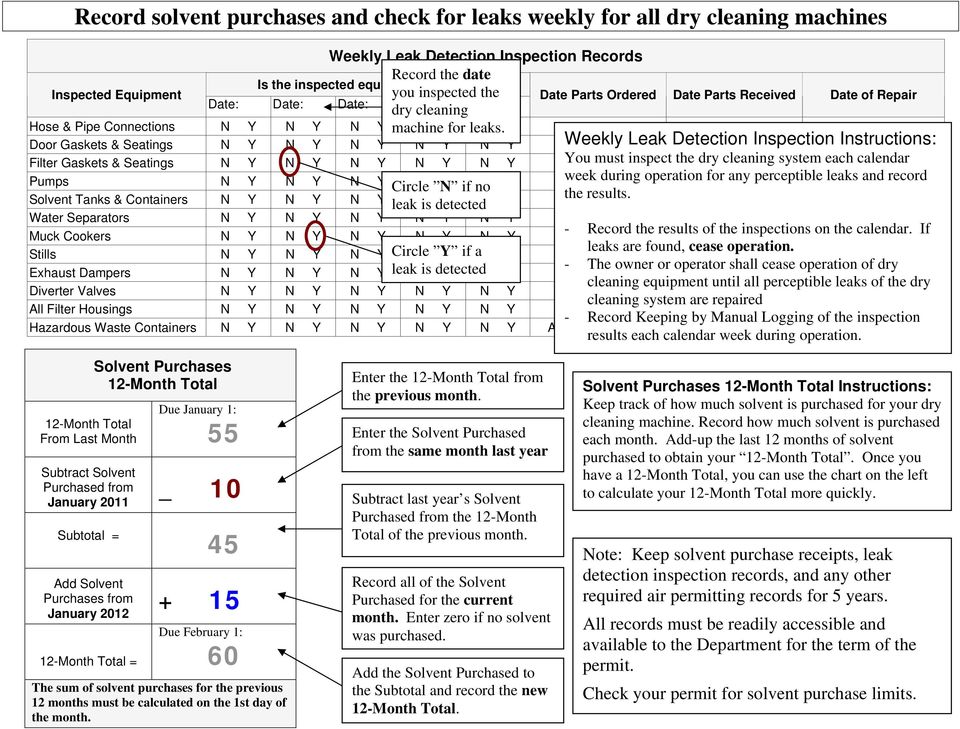
11 Record solvent purchases and check for leaks weekly for all dry cleaning machines Weekly Leak Detection Inspection Records Inspected Equipment Record the date Is the inspected equipment leaking? you inspected the : : : dry : cleaning : Parts Ordered Parts Received of Repair Hose & Pipe Connections machine for leaks. Door Gaskets & Seatings Filter Gaskets & Seatings Weekly Leak Detection Inspection Instructions: You must inspect the dry cleaning system each calendar week during operation for any perceptible leaks and record the results. Pumps Circle N N Y if no Solvent Tanks & Containers leak N is detected Y Water Separators - Record the results of the inspections on the calendar. If Muck Cookers Stills Circle N Y Y if a leaks are found, cease operation. Exhaust Dampers leak N is detected - The owner or operator shall cease operation of dry Y cleaning equipment until all perceptible leaks of the dry Diverter Valves cleaning system are repaired All Filter Housings - Record Keeping by Manual Logging of the inspection Hazardous Waste Containers Are hazardous waste containers labeled & dated properly? results each calendar week during operation. Solvent Purchases Due January 1: 55 Subtract Solvent Purchased from January Add Solvent Purchases from January = Due February 1: 60 The sum of solvent purchases for the previous 12 months must be calculated on the 1st day of the month. Enter the from the previous month. Enter the Solvent Purchased from the same month last year Subtract last year s Solvent Purchased from the 12-Month Total of the previous month. Record all of the Solvent Purchased for the current month. Enter zero if no solvent was purchased. Add the Solvent Purchased to the Subtotal and record the new. Solvent Purchases Instructions: Keep track of how much solvent is purchased for your dry cleaning machine. Record how much solvent is purchased each month. Add-up the last 12 months of solvent purchased to obtain your. Once you have a, you can use the chart on the left to calculate your more quickly. Note: Keep solvent purchase receipts, leak detection inspection records, and any other required air permitting records for 5 years. All records must be readily accessible and available to the Department for the term of the permit. Check your permit for solvent purchase limits.
12 Weekly Pressure Monitoring Instructions: Or Perchloroethylene Machines Only. Weekly Condenser Temperature Monitoring Instructions. Checking the high & low pressure of the refrigeration system is the best way to determine if your dry cleaning machine s solvent recovery is working properly. The manufacturer of each dry cleaning machine has specified an operating range for the high & low pressure of the refrigerated condenser. During the drying phase determine if the high & low pressure of the refrigeration system is in the range of the manufacturer s specifications. Almost all NJ Air Permits require weekly record keeping of the refrigerated condenser temperature. Additionally, if your dry cleaning machine does not have pressure gauges for the refrigeration system, then you must check the refrigerated condenser temperature to ensure a temperature of 7.2 o C (45 o F) or below is achieved before the end of the cool-down or drying cycle. You can obtain these pressure ranges from the owner s manual or by contacting the manufacturer of your dry cleaning machine. Weekly Pressure Monitoring Log * Measuring the Pressure of the Refrigeration System Manufacturer Specification High Pressure: Low Pressure: High Pressure Low Pressure * During the drying phase determine if the high & low pressure of the refrigeration system is in the range of the manufacturer s specifications. Enter the numbers for the high-pressure range specified by the manufacturer of the dry cleaning machine. Enter the numbers for the low-pressure range specified by the manufacturer of the dry cleaning machine. Record the date you checked the pressure of the refrigeration system. Record the high pressure of the refrigeration system. Record the low pressure of the refrigeration system. Or Weekly Condenser Temperature Log * Temperature Before the end of the cool-down or drying cycle a temperature of 7.2 o C (45 o F) or below must be achieved. * Check your permit compliance plan for applicable requirements. Record the date you checked the refrigerated condenser temperature. Record the temperature of the refrigerated condenser before the end of the cool-down or drying cycle. Note: If the refrigeration system of the dry cleaning machine is not operating within pressure or temperature requirements, the dry cleaning machine must be shut down until repaired.

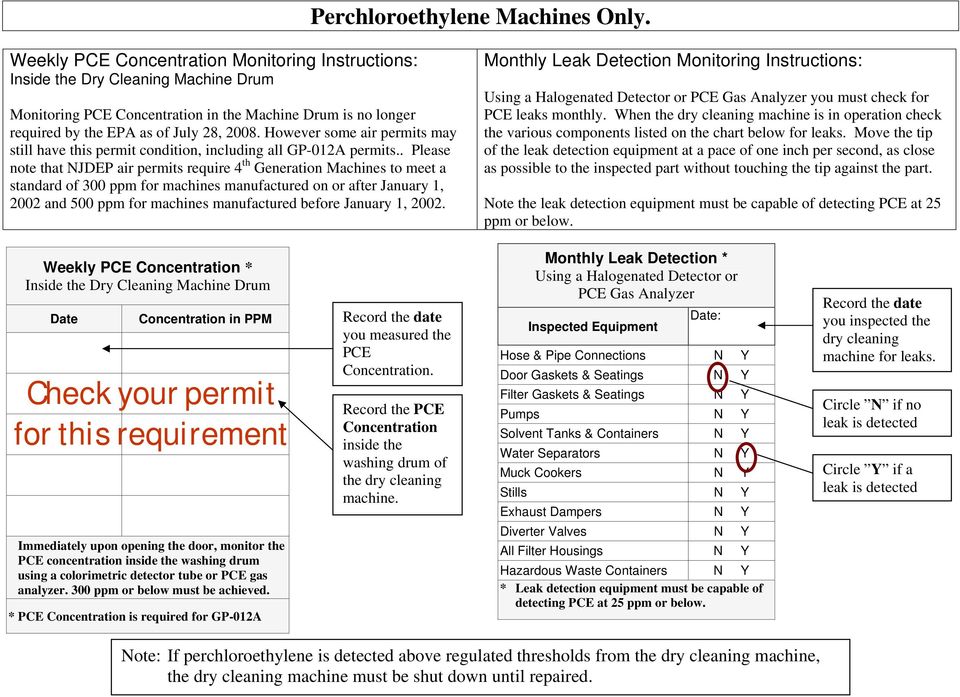
13 Perchloroethylene Machines Only. Weekly PCE Concentration Monitoring Instructions: Inside the Dry Cleaning Machine Drum Monitoring PCE Concentration in the Machine Drum is no longer required by the EPA as of July 28, However some air permits may still have this permit condition, including all GP-012A permits.. Please note that NJDEP air permits require 4 th Generation Machines to meet a standard of 300 ppm for machines manufactured on or after January 1, 2002 and 500 ppm for machines manufactured before January 1, Monthly Leak Detection Monitoring Instructions: Using a Halogenated Detector or PCE Gas Analyzer you must check for PCE leaks monthly. When the dry cleaning machine is in operation check the various components listed on the chart below for leaks. Move the tip of the leak detection equipment at a pace of one inch per second, as close as possible to the inspected part without touching the tip against the part. Note the leak detection equipment must be capable of detecting PCE at 25 ppm or below. Weekly PCE Concentration * Inside the Dry Cleaning Machine Drum Concentration in PPM Check your permit for this requirement Immediately upon opening the door, monitor the PCE concentration inside the washing drum using a colorimetric detector tube or PCE gas analyzer. 300 ppm or below must be achieved. * PCE Concentration is required for GP-012A Record the date you measured the PCE Concentration. Record the PCE Concentration inside the washing drum of the dry cleaning machine. Monthly Leak Detection * Using a Halogenated Detector or PCE Gas Analyzer Inspected Equipment Hose & Pipe Connections Door Gaskets & Seatings Filter Gaskets & Seatings Pumps Solvent Tanks & Containers Water Separators Muck Cookers Stills Exhaust Dampers Diverter Valves All Filter Housings : Hazardous Waste Containers * Leak detection equipment must be capable of detecting PCE at 25 ppm or below. Record the date you inspected the dry cleaning machine for leaks. Circle N if no leak is detected Circle Y if a leak is detected Note: If perchloroethylene is detected above regulated thresholds from the dry cleaning machine, the dry cleaning machine must be shut down until repaired.
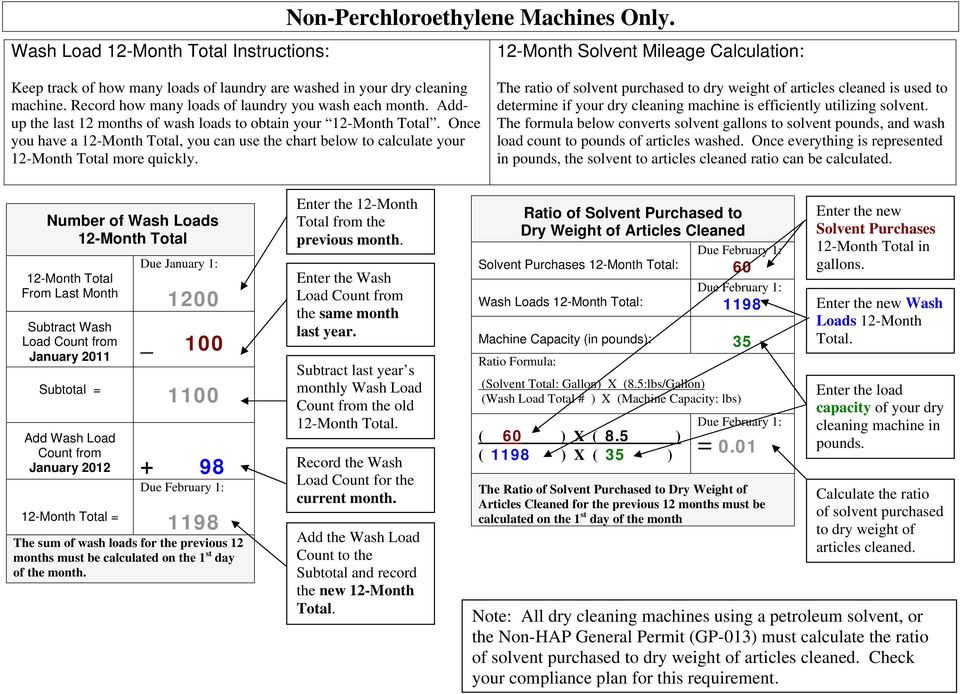
14 Wash Load Instructions: Non-Perchloroethylene Machines Only. 12-Month Solvent Mileage Calculation: Keep track of how many loads of laundry are washed in your dry cleaning machine. Record how many loads of laundry you wash each month. Addup the last 12 months of wash loads to obtain your. Once you have a, you can use the chart below to calculate your more quickly. The ratio of solvent purchased to dry weight of articles cleaned is used to determine if your dry cleaning machine is efficiently utilizing solvent. The formula below converts solvent gallons to solvent pounds, and wash load count to pounds of articles washed. Once everything is represented in pounds, the solvent to articles cleaned ratio can be calculated. Number of Wash Loads Subtract Wash Load Count from January 2011 Add Wash Load Count from Due January 1: January = Due February 1: 1198 The sum of wash loads for the previous 12 months must be calculated on the 1 st day of the month. Enter the 12-Month Total from the previous month. Enter the Wash Load Count from the same month last year. Subtract last year s monthly Wash Load Count from the old. Record the Wash Load Count for the current month. Add the Wash Load Count to the Subtotal and record the new 12-Month Total. Ratio of Solvent Purchased to Dry Weight of Articles Cleaned Due February 1: Solvent Purchases : 60 Due February 1: Wash Loads : 1198 Machine Capacity (in pounds): 35 Ratio Formula: (Solvent Total: Gallon) X (8.5:lbs/Gallon) (Wash Load Total # ) X (Machine Capacity: lbs) ( 60 ) X ( 8.5 ) ( 1198 ) X ( 35 ) Due February 1: = 0.01 The Ratio of Solvent Purchased to Dry Weight of Articles Cleaned for the previous 12 months must be calculated on the 1 st day of the month Enter the new Solvent Purchases in gallons. Enter the new Wash Loads 12-Month Total. Enter the load capacity of your dry cleaning machine in pounds. Calculate the ratio of solvent purchased to dry weight of articles cleaned. Note: All dry cleaning machines using a petroleum solvent, or the Non-HAP General Permit (GP-013) must calculate the ratio of solvent purchased to dry weight of articles cleaned. Check your compliance plan for this requirement.
15 Weekly Leak Detection Inspection Records Is the inspected equipment leaking? Inspected Equipment : : : : : Parts Ordered Parts Received of Repair Hose & Pipe Connections Door Gaskets & Seatings Filter Gaskets & Seatings Pumps Solvent Tanks & Containers Water Separators Muck Cookers Stills Exhaust Dampers Diverter Valves All Filter Housings Hazardous Waste Containers Are hazardous waste containers labeled & dated properly? Weekly Pressure Monitoring Log * Measuring the Pressure of the Refrigeration System Manufacturer Specification High Pressure: Low Pressure: High Pressure Low Pressure Or Weekly Condenser Temperature Log * Temperature Weekly PCE Concentration * Inside the Dry Cleaning Machine Drum Concentration in PPM * During the drying phase determine if the high & low pressure of the refrigeration system is in the range of the manufacturer s specifications. Before the end of the cool-down or drying cycle a temperature of 7.2 o C (45 o F) or below must be achieved. * Check your permit compliance plan for applicable requirements. 4 th Generation Machines must meet a standard of 300 ppm for machines manufactured on or after January 1, 2002 and 500 ppm for machines manufactured before January 1, PCE Concentration is required for GP-012A

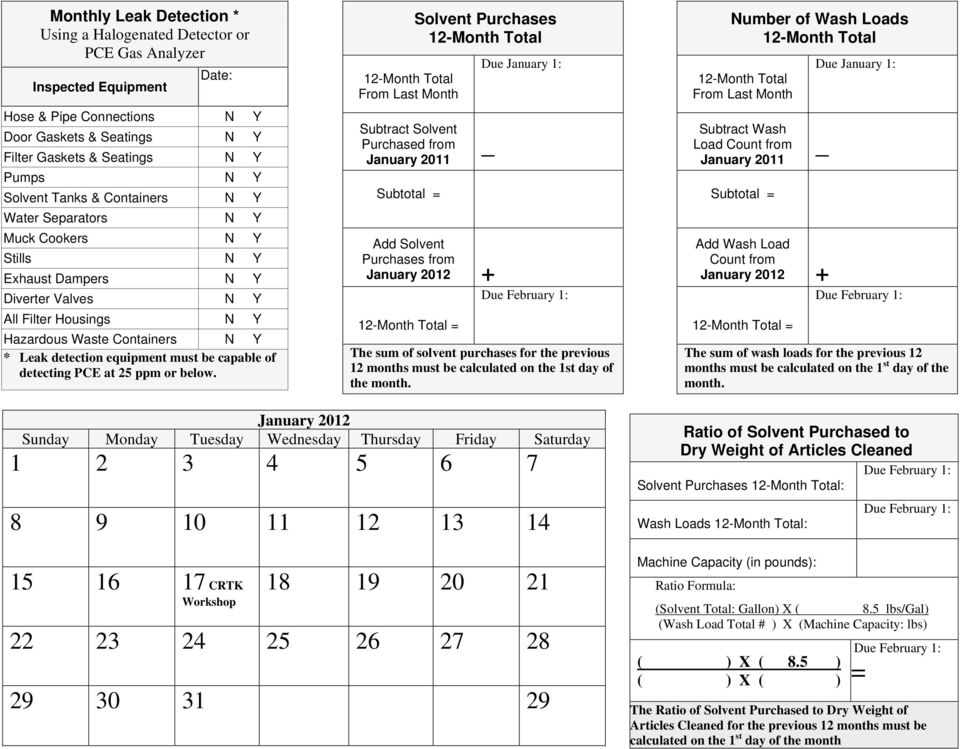
16 Monthly Leak Detection * Using a Halogenated Detector or PCE Gas Analyzer Inspected Equipment Hose & Pipe Connections Door Gaskets & Seatings Filter Gaskets & Seatings Pumps Solvent Tanks & Containers Water Separators Muck Cookers Stills Exhaust Dampers Diverter Valves All Filter Housings : Hazardous Waste Containers * Leak detection equipment must be capable of detecting PCE at 25 ppm or below. Subtract Solvent Purchased from January 2011 Solvent Purchases Due January 1: Add Solvent Purchases from January Due February 1: = The sum of solvent purchases for the previous 12 months must be calculated on the 1st day of the month. Number of Wash Loads Subtract Wash Load Count from January 2011 Due January 1: Add Wash Load Count from January Due February 1: = The sum of wash loads for the previous 12 months must be calculated on the 1 st day of the month. January 2012 Sunday Monday Tuesday Wednesday Thursday Friday Saturday CRTK Workshop Ratio of Solvent Purchased to Dry Weight of Articles Cleaned Due February 1: Solvent Purchases : Wash Loads : Machine Capacity (in pounds): Due February 1: Ratio Formula: (Solvent Total: Gallon) X ( 8.5 lbs/gal) (Wash Load Total # ) X (Machine Capacity: lbs) ( ) X ( 8.5 ) ( ) X ( ) Due February 1: = The Ratio of Solvent Purchased to Dry Weight of Articles Cleaned for the previous 12 months must be calculated on the 1 st day of the month
17 Weekly Leak Detection Inspection Records Is the inspected equipment leaking? Inspected Equipment : : : : : Parts Ordered Parts Received of Repair Hose & Pipe Connections Door Gaskets & Seatings Filter Gaskets & Seatings Pumps Solvent Tanks & Containers Water Separators Muck Cookers Stills Exhaust Dampers Diverter Valves All Filter Housings Hazardous Waste Containers Are hazardous waste containers labeled & dated properly? Weekly Pressure Monitoring Log * Measuring the Pressure of the Refrigeration System Manufacturer Specification High Pressure: Low Pressure: High Pressure Low Pressure Or Weekly Condenser Temperature Log * Temperature Weekly PCE Concentration * Inside the Dry Cleaning Machine Drum Concentration in PPM * During the drying phase determine if the high & low pressure of the refrigeration system is in the range of the manufacturer s specifications. Before the end of the cool-down or drying cycle a temperature of 7.2 o C (45 o F) or below must be achieved. * Check your permit compliance plan for applicable requirements. 4 th Generation Machines must meet a standard of 300 ppm for machines manufactured on or after January 1, 2002 and 500 ppm for machines manufactured before January 1, PCE Concentration is required for GP-012A

18 Monthly Leak Detection * Using a Halogenated Detector or PCE Gas Analyzer Inspected Equipment Hose & Pipe Connections Door Gaskets & Seatings Filter Gaskets & Seatings Pumps Solvent Tanks & Containers Water Separators Muck Cookers Stills Exhaust Dampers Diverter Valves All Filter Housings : Hazardous Waste Containers * Leak detection equipment must be capable of detecting PCE at 25 ppm or below. Subtract Solvent Purchased from February 2011 Solvent Purchases Due February 1: Add Solvent Purchases from February Due March 1: = The sum of solvent purchases for the previous 12 months must be calculated on the 1st day of the month. Number of Wash Loads Subtract Wash Load Count from February 2011 Due February 1: Add Wash Load Count from February Due March 1: = The sum of wash loads for the previous 12 months must be calculated on the 1 st day of the month. February 2012 Sunday Monday Tuesday Wednesday Thursday Friday Saturday CRTK Workshop Ratio of Solvent Purchased to Dry Weight of Articles Cleaned Due March 1: Solvent Purchases : Wash Loads : Machine Capacity (in pounds): Due March 1: Ratio Formula: (Solvent Total: Gallon) X ( 8.5 lbs/gal) (Wash Load Total # ) X (Machine Capacity: lbs) ( ) X ( 8.5 ) ( ) X ( ) Due March 1: = The Ratio of Solvent Purchased to Dry Weight of Articles Cleaned for the previous 12 months must be calculated on the 1 st day of the month
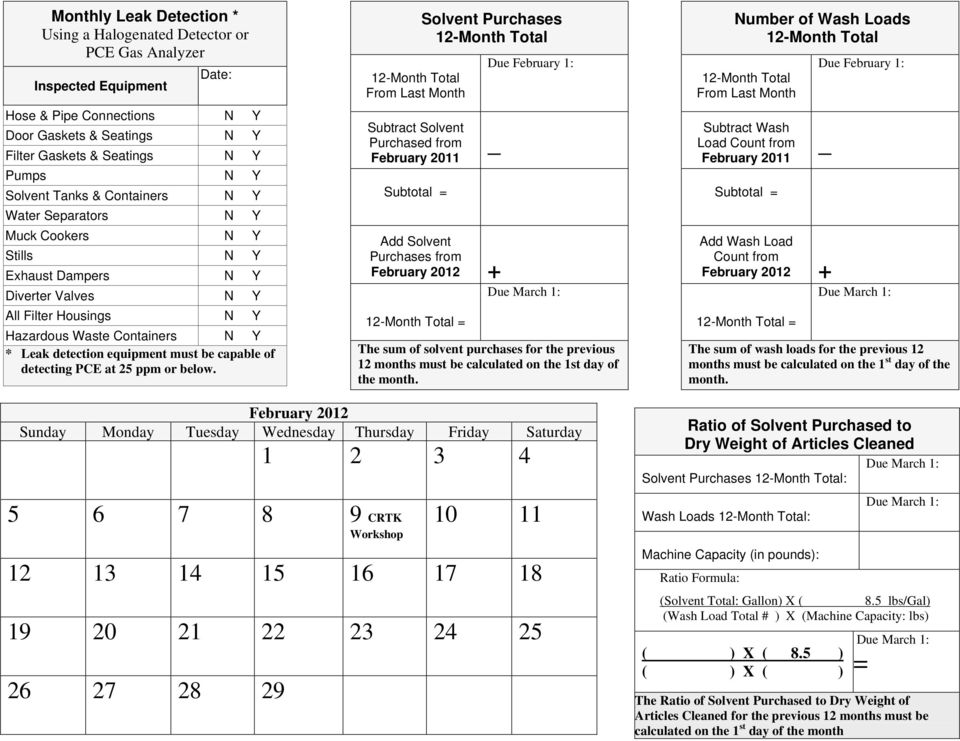
19 Weekly Leak Detection Inspection Records Is the inspected equipment leaking? Inspected Equipment : : : : : Parts Ordered Parts Received of Repair Hose & Pipe Connections Door Gaskets & Seatings Filter Gaskets & Seatings Pumps Solvent Tanks & Containers Water Separators Muck Cookers Stills Exhaust Dampers Diverter Valves All Filter Housings Hazardous Waste Containers Are hazardous waste containers labeled & dated properly? Weekly Pressure Monitoring Log * Measuring the Pressure of the Refrigeration System Manufacturer Specification High Pressure: Low Pressure: High Pressure Low Pressure Or Weekly Condenser Temperature Log * Temperature Weekly PCE Concentration * Inside the Dry Cleaning Machine Drum Concentration in PPM * During the drying phase determine if the high & low pressure of the refrigeration system is in the range of the manufacturer s specifications. Before the end of the cool-down or drying cycle a temperature of 7.2 o C (45 o F) or below must be achieved. * Check your permit compliance plan for applicable requirements. 4 th Generation Machines must meet a standard of 300 ppm for machines manufactured on or after January 1, 2002 and 500 ppm for machines manufactured before January 1, PCE Concentration is required for GP-012A

20 Monthly Leak Detection * Using a Halogenated Detector or PCE Gas Analyzer Inspected Equipment Hose & Pipe Connections Door Gaskets & Seatings Filter Gaskets & Seatings Pumps Solvent Tanks & Containers Water Separators Muck Cookers Stills Exhaust Dampers Diverter Valves All Filter Housings : Hazardous Waste Containers * Leak detection equipment must be capable of detecting PCE at 25 ppm or below. Subtract Solvent Purchased from March 2011 Solvent Purchases Due March 1: Add Solvent Purchases from March Due April 1: = The sum of solvent purchases for the previous 12 months must be calculated on the 1st day of the month. Number of Wash Loads Subtract Wash Load Count from March 2011 Due March 1: Add Wash Load Count from March Due April 1: = The sum of wash loads for the previous 12 months must be calculated on the 1 st day of the month. March 2012 Sunday Monday Tuesday Wednesday Thursday Friday Saturday 1 CRTK Survey Due Ratio of Solvent Purchased to Dry Weight of Articles Cleaned Due April 1: Solvent Purchases : Wash Loads : Machine Capacity (in pounds): Due April 1: Ratio Formula: (Solvent Total: Gallon) X ( 8.5 lbs/gal) (Wash Load Total # ) X (Machine Capacity: lbs) ( ) X ( 8.5 ) ( ) X ( ) Due April 1: = The Ratio of Solvent Purchased to Dry Weight of Articles Cleaned for the previous 12 months must be calculated on the 1 st day of the month

21 Weekly Leak Detection Inspection Records Is the inspected equipment leaking? Inspected Equipment : : : : : Parts Ordered Parts Received of Repair Hose & Pipe Connections Door Gaskets & Seatings Filter Gaskets & Seatings Pumps Solvent Tanks & Containers Water Separators Muck Cookers Stills Exhaust Dampers Diverter Valves All Filter Housings Hazardous Waste Containers Are hazardous waste containers labeled & dated properly? Weekly Pressure Monitoring Log * Measuring the Pressure of the Refrigeration System Manufacturer Specification High Pressure: Low Pressure: High Pressure Low Pressure Or Weekly Condenser Temperature Log * Temperature Weekly PCE Concentration * Inside the Dry Cleaning Machine Drum Concentration in PPM * During the drying phase determine if the high & low pressure of the refrigeration system is in the range of the manufacturer s specifications. Before the end of the cool-down or drying cycle a temperature of 7.2 o C (45 o F) or below must be achieved. * Check your permit compliance plan for applicable requirements. 4 th Generation Machines must meet a standard of 300 ppm for machines manufactured on or after January 1, 2002 and 500 ppm for machines manufactured before January 1, PCE Concentration is required for GP-012A
22 Monthly Leak Detection * Using a Halogenated Detector or PCE Gas Analyzer Inspected Equipment Hose & Pipe Connections Door Gaskets & Seatings Filter Gaskets & Seatings Pumps Solvent Tanks & Containers Water Separators Muck Cookers Stills Exhaust Dampers Diverter Valves All Filter Housings : Hazardous Waste Containers * Leak detection equipment must be capable of detecting PCE at 25 ppm or below. Subtract Solvent Purchased from April 2011 Solvent Purchases Due April 1: Add Solvent Purchases from April Due May 1: = The sum of solvent purchases for the previous 12 months must be calculated on the 1st day of the month. Number of Wash Loads Subtract Wash Load Count from April 2011 Due April 1: Add Wash Load Count from April Due May 1: = The sum of wash loads for the previous 12 months must be calculated on the 1 st day of the month. April 2012 Sunday Monday Tuesday Wednesday Thursday Friday Saturday Ratio of Solvent Purchased to Dry Weight of Articles Cleaned Due May 1: Solvent Purchases : Wash Loads : Machine Capacity (in pounds): Due May 1: Ratio Formula: (Solvent Total: Gallon) X ( 8.5 lbs/gal) (Wash Load Total # ) X (Machine Capacity: lbs) ( ) X ( 8.5 ) ( ) X ( ) Due May 1: = The Ratio of Solvent Purchased to Dry Weight of Articles Cleaned for the previous 12 months must be calculated on the 1 st day of the month
23 Weekly Leak Detection Inspection Records Is the inspected equipment leaking? Inspected Equipment : : : : : Parts Ordered Parts Received of Repair Hose & Pipe Connections Door Gaskets & Seatings Filter Gaskets & Seatings Pumps Solvent Tanks & Containers Water Separators Muck Cookers Stills Exhaust Dampers Diverter Valves All Filter Housings Hazardous Waste Containers Are hazardous waste containers labeled & dated properly? Weekly Pressure Monitoring Log * Measuring the Pressure of the Refrigeration System Manufacturer Specification High Pressure: Low Pressure: High Pressure Low Pressure Or Weekly Condenser Temperature Log * Temperature Weekly PCE Concentration * Inside the Dry Cleaning Machine Drum Concentration in PPM * During the drying phase determine if the high & low pressure of the refrigeration system is in the range of the manufacturer s specifications. Before the end of the cool-down or drying cycle a temperature of 7.2 o C (45 o F) or below must be achieved. * Check your permit compliance plan for applicable requirements. 4 th Generation Machines must meet a standard of 300 ppm for machines manufactured on or after January 1, 2002 and 500 ppm for machines manufactured before January 1, PCE Concentration is required for GP-012A
24 Monthly Leak Detection * Using a Halogenated Detector or PCE Gas Analyzer Inspected Equipment Hose & Pipe Connections Door Gaskets & Seatings Filter Gaskets & Seatings Pumps Solvent Tanks & Containers Water Separators Muck Cookers Stills Exhaust Dampers Diverter Valves All Filter Housings : Hazardous Waste Containers * Leak detection equipment must be capable of detecting PCE at 25 ppm or below. Subtract Solvent Purchased from May 2011 Solvent Purchases Due May 1: Add Solvent Purchases from May Due June 1: = The sum of solvent purchases for the previous 12 months must be calculated on the 1st day of the month. Number of Wash Loads Subtract Wash Load Count from May 2011 Due May 1: Add Wash Load Count from May Due June 1: = The sum of wash loads for the previous 12 months must be calculated on the 1 st day of the month. May 2012 Sunday Monday Tuesday Wednesday Thursday Friday Saturday Ratio of Solvent Purchased to Dry Weight of Articles Cleaned Due June 1: Solvent Purchases : Wash Loads : Machine Capacity (in pounds): Due June 1: Ratio Formula: (Solvent Total: Gallon) X ( 8.5 lbs/gal) (Wash Load Total # ) X (Machine Capacity: lbs) ( ) X ( 8.5 ) ( ) X ( ) Due June 1: = The Ratio of Solvent Purchased to Dry Weight of Articles Cleaned for the previous 12 months must be calculated on the 1 st day of the month
25 Weekly Leak Detection Inspection Records Is the inspected equipment leaking? Inspected Equipment : : : : : Parts Ordered Parts Received of Repair Hose & Pipe Connections Door Gaskets & Seatings Filter Gaskets & Seatings Pumps Solvent Tanks & Containers Water Separators Muck Cookers Stills Exhaust Dampers Diverter Valves All Filter Housings Hazardous Waste Containers Are hazardous waste containers labeled & dated properly? Weekly Pressure Monitoring Log * Measuring the Pressure of the Refrigeration System Manufacturer Specification High Pressure: Low Pressure: High Pressure Low Pressure Or Weekly Condenser Temperature Log * Temperature Weekly PCE Concentration * Inside the Dry Cleaning Machine Drum Concentration in PPM * During the drying phase determine if the high & low pressure of the refrigeration system is in the range of the manufacturer s specifications. Before the end of the cool-down or drying cycle a temperature of 7.2 o C (45 o F) or below must be achieved. * Check your permit compliance plan for applicable requirements. 4 th Generation Machines must meet a standard of 300 ppm for machines manufactured on or after January 1, 2002 and 500 ppm for machines manufactured before January 1, PCE Concentration is required for GP-012A
26 Monthly Leak Detection * Using a Halogenated Detector or PCE Gas Analyzer Inspected Equipment Hose & Pipe Connections Door Gaskets & Seatings Filter Gaskets & Seatings Pumps Solvent Tanks & Containers Water Separators Muck Cookers Stills Exhaust Dampers Diverter Valves All Filter Housings : Hazardous Waste Containers * Leak detection equipment must be capable of detecting PCE at 25 ppm or below. Subtract Solvent Purchased from June 2011 Solvent Purchases Due June 1: Add Solvent Purchases from June Due July 1: = The sum of solvent purchases for the previous 12 months must be calculated on the 1st day of the month. Number of Wash Loads Subtract Wash Load Count from June 2011 Due June 1: Add Wash Load Count from June Due July 1: = The sum of wash loads for the previous 12 months must be calculated on the 1 st day of the month. June 2012 Sunday Monday Tuesday Wednesday Thursday Friday Saturday Ratio of Solvent Purchased to Dry Weight of Articles Cleaned Due July 1: Solvent Purchases : Wash Loads : Machine Capacity (in pounds): Due July 1: Ratio Formula: (Solvent Total: Gallon) X ( 8.5 lbs/gal) (Wash Load Total # ) X (Machine Capacity: lbs) ( ) X ( 8.5 ) ( ) X ( ) Due July 1: = The Ratio of Solvent Purchased to Dry Weight of Articles Cleaned for the previous 12 months must be calculated on the 1 st day of the month
27 Weekly Leak Detection Inspection Records Is the inspected equipment leaking? Inspected Equipment : : : : : Parts Ordered Parts Received of Repair Hose & Pipe Connections Door Gaskets & Seatings Filter Gaskets & Seatings Pumps Solvent Tanks & Containers Water Separators Muck Cookers Stills Exhaust Dampers Diverter Valves All Filter Housings Hazardous Waste Containers Are hazardous waste containers labeled & dated properly? Weekly Pressure Monitoring Log * Measuring the Pressure of the Refrigeration System Manufacturer Specification High Pressure: Low Pressure: High Pressure Low Pressure Or Weekly Condenser Temperature Log * Temperature Weekly PCE Concentration * Inside the Dry Cleaning Machine Drum Concentration in PPM * During the drying phase determine if the high & low pressure of the refrigeration system is in the range of the manufacturer s specifications. Before the end of the cool-down or drying cycle a temperature of 7.2 o C (45 o F) or below must be achieved. * Check your permit compliance plan for applicable requirements. 4 th Generation Machines must meet a standard of 300 ppm for machines manufactured on or after January 1, 2002 and 500 ppm for machines manufactured before January 1, PCE Concentration is required for GP-012A
28 Monthly Leak Detection * Using a Halogenated Detector or PCE Gas Analyzer Inspected Equipment Hose & Pipe Connections Door Gaskets & Seatings Filter Gaskets & Seatings Pumps Solvent Tanks & Containers Water Separators Muck Cookers Stills Exhaust Dampers Diverter Valves All Filter Housings : Hazardous Waste Containers * Leak detection equipment must be capable of detecting PCE at 25 ppm or below. Subtract Solvent Purchased from July 2011 Solvent Purchases Due July 1: Add Solvent Purchases from July Due August 1: = The sum of solvent purchases for the previous 12 months must be calculated on the 1st day of the month. Number of Wash Loads Subtract Wash Load Count from July 2011 Due July 1: Add Wash Load Count from July Due August 1: = The sum of wash loads for the previous 12 months must be calculated on the 1 st day of the month. July 2012 Sunday Monday Tuesday Wednesday Thursday Friday Saturday Ratio of Solvent Purchased to Dry Weight of Articles Cleaned Due August 1: Solvent Purchases : Wash Loads : Machine Capacity (in pounds): Due August 1: Ratio Formula: (Solvent Total: Gallon) X ( 8.5 lbs/gal) (Wash Load Total # ) X (Machine Capacity: lbs) ( ) X ( 8.5 ) ( ) X ( ) Due August 1: = The Ratio of Solvent Purchased to Dry Weight of Articles Cleaned for the previous 12 months must be calculated on the 1 st day of the month
29 Weekly Leak Detection Inspection Records Is the inspected equipment leaking? Inspected Equipment : : : : : Parts Ordered Parts Received of Repair Hose & Pipe Connections Door Gaskets & Seatings Filter Gaskets & Seatings Pumps Solvent Tanks & Containers Water Separators Muck Cookers Stills Exhaust Dampers Diverter Valves All Filter Housings Hazardous Waste Containers Are hazardous waste containers labeled & dated properly? Weekly Pressure Monitoring Log * Measuring the Pressure of the Refrigeration System Manufacturer Specification High Pressure: Low Pressure: High Pressure Low Pressure Or Weekly Condenser Temperature Log * Temperature Weekly PCE Concentration * Inside the Dry Cleaning Machine Drum Concentration in PPM * During the drying phase determine if the high & low pressure of the refrigeration system is in the range of the manufacturer s specifications. Before the end of the cool-down or drying cycle a temperature of 7.2 o C (45 o F) or below must be achieved. * Check your permit compliance plan for applicable requirements. 4 th Generation Machines must meet a standard of 300 ppm for machines manufactured on or after January 1, 2002 and 500 ppm for machines manufactured before January 1, PCE Concentration is required for GP-012A
30 Monthly Leak Detection * Using a Halogenated Detector or PCE Gas Analyzer Inspected Equipment Hose & Pipe Connections Door Gaskets & Seatings Filter Gaskets & Seatings Pumps Solvent Tanks & Containers Water Separators Muck Cookers Stills Exhaust Dampers Diverter Valves All Filter Housings : Hazardous Waste Containers * Leak detection equipment must be capable of detecting PCE at 25 ppm or below. Subtract Solvent Purchased from August 2011 Solvent Purchases Due August 1: Add Solvent Purchases from August Due September 1: = The sum of solvent purchases for the previous 12 months must be calculated on the 1st day of the month. Number of Wash Loads Subtract Wash Load Count from August 2011 Due August 1: Add Wash Load Count from August Due September 1: = The sum of wash loads for the previous 12 months must be calculated on the 1 st day of the month. August 2012 Sunday Monday Tuesday Wednesday Thursday Friday Saturday Ratio of Solvent Purchased to Dry Weight of Articles Cleaned Due Sept. 1: Solvent Purchases : Wash Loads : Machine Capacity (in pounds): Due Sept. 1: Ratio Formula: (Solvent Total: Gallon) X ( 8.5 lbs/gal) (Wash Load Total # ) X (Machine Capacity: lbs) ( ) X ( 8.5 ) ( ) X ( ) Due Sept. 1: = The Ratio of Solvent Purchased to Dry Weight of Articles Cleaned for the previous 12 months must be calculated on the 1 st day of the month
31 Weekly Leak Detection Inspection Records Is the inspected equipment leaking? Inspected Equipment : : : : : Parts Ordered Parts Received of Repair Hose & Pipe Connections Door Gaskets & Seatings Filter Gaskets & Seatings Pumps Solvent Tanks & Containers Water Separators Muck Cookers Stills Exhaust Dampers Diverter Valves All Filter Housings Hazardous Waste Containers Are hazardous waste containers labeled & dated properly? Weekly Pressure Monitoring Log * Measuring the Pressure of the Refrigeration System Manufacturer Specification High Pressure: Low Pressure: High Pressure Low Pressure Or Weekly Condenser Temperature Log * Temperature Weekly PCE Concentration * Inside the Dry Cleaning Machine Drum Concentration in PPM * During the drying phase determine if the high & low pressure of the refrigeration system is in the range of the manufacturer s specifications. Before the end of the cool-down or drying cycle a temperature of 7.2 o C (45 o F) or below must be achieved. * Check your permit compliance plan for applicable requirements. 4 th Generation Machines must meet a standard of 300 ppm for machines manufactured on or after January 1, 2002 and 500 ppm for machines manufactured before January 1, PCE Concentration is required for GP-012A
32 Monthly Leak Detection * Using a Halogenated Detector or PCE Gas Analyzer Inspected Equipment Hose & Pipe Connections Door Gaskets & Seatings Filter Gaskets & Seatings Pumps Solvent Tanks & Containers Water Separators Muck Cookers Stills Exhaust Dampers Diverter Valves All Filter Housings : Hazardous Waste Containers * Leak detection equipment must be capable of detecting PCE at 25 ppm or below. Subtract Solvent Purchased from September 2011 Solvent Purchases Due September 1: Add Solvent Purchases from September Due October 1: = The sum of solvent purchases for the previous 12 months must be calculated on the 1st day of the month. Number of Wash Loads Subtract Wash Load Count from September 2011 Due September 1: Add Wash Load Count from September Due October 1: = The sum of wash loads for the previous 12 months must be calculated on the 1 st day of the month. September 2012 Sunday Monday Tuesday Wednesday Thursday Friday Saturday Ratio of Solvent Purchased to Dry Weight of Articles Cleaned Due Oct. 1: Solvent Purchases : Wash Loads : Machine Capacity (in pounds): Due Oct. 1: Ratio Formula: (Solvent Total: Gallon) X ( 8.5 lbs/gal) (Wash Load Total # ) X (Machine Capacity: lbs) ( ) X ( 8.5 ) ( ) X ( ) Due Oct. 1: = The Ratio of Solvent Purchased to Dry Weight of Articles Cleaned for the previous 12 months must be calculated on the 1 st day of the month
33 Weekly Leak Detection Inspection Records Is the inspected equipment leaking? Inspected Equipment : : : : : Parts Ordered Parts Received of Repair Hose & Pipe Connections Door Gaskets & Seatings Filter Gaskets & Seatings Pumps Solvent Tanks & Containers Water Separators Muck Cookers Stills Exhaust Dampers Diverter Valves All Filter Housings Hazardous Waste Containers Are hazardous waste containers labeled & dated properly? Weekly Pressure Monitoring Log * Measuring the Pressure of the Refrigeration System Manufacturer Specification High Pressure: Low Pressure: High Pressure Low Pressure Or Weekly Condenser Temperature Log * Temperature Weekly PCE Concentration * Inside the Dry Cleaning Machine Drum Concentration in PPM * During the drying phase determine if the high & low pressure of the refrigeration system is in the range of the manufacturer s specifications. Before the end of the cool-down or drying cycle a temperature of 7.2 o C (45 o F) or below must be achieved. * Check your permit compliance plan for applicable requirements. 4 th Generation Machines must meet a standard of 300 ppm for machines manufactured on or after January 1, 2002 and 500 ppm for machines manufactured before January 1, PCE Concentration is required for GP-012A
34 Monthly Leak Detection * Using a Halogenated Detector or PCE Gas Analyzer Inspected Equipment Hose & Pipe Connections Door Gaskets & Seatings Filter Gaskets & Seatings Pumps Solvent Tanks & Containers Water Separators Muck Cookers Stills Exhaust Dampers Diverter Valves All Filter Housings : Hazardous Waste Containers * Leak detection equipment must be capable of detecting PCE at 25 ppm or below. Subtract Solvent Purchased from October 2011 Solvent Purchases Due October 1: Add Solvent Purchases from October Due November 1: = The sum of solvent purchases for the previous 12 months must be calculated on the 1st day of the month. Number of Wash Loads Subtract Wash Load Count from October 2011 Due October 1: Add Wash Load Count from October Due November 1: = The sum of wash loads for the previous 12 months must be calculated on the 1 st day of the month. October 2012 Sunday Monday Tuesday Wednesday Thursday Friday Saturday Ratio of Solvent Purchased to Dry Weight of Articles Cleaned Due Nov. 1: Solvent Purchases : Wash Loads : Machine Capacity (in pounds): Due Nov. 1: Ratio Formula: (Solvent Total: Gallon) X ( 8.5 lbs/gal) (Wash Load Total # ) X (Machine Capacity: lbs) ( ) X ( 8.5 ) ( ) X ( ) Due Nov. 1: = The Ratio of Solvent Purchased to Dry Weight of Articles Cleaned for the previous 12 months must be calculated on the 1 st day of the month
35 Weekly Leak Detection Inspection Records Is the inspected equipment leaking? Inspected Equipment : : : : : Parts Ordered Parts Received of Repair Hose & Pipe Connections Door Gaskets & Seatings Filter Gaskets & Seatings Pumps Solvent Tanks & Containers Water Separators Muck Cookers Stills Exhaust Dampers Diverter Valves All Filter Housings Hazardous Waste Containers Are hazardous waste containers labeled & dated properly? Weekly Pressure Monitoring Log * Measuring the Pressure of the Refrigeration System Manufacturer Specification High Pressure: Low Pressure: High Pressure Low Pressure Or Weekly Condenser Temperature Log * Temperature Weekly PCE Concentration * Inside the Dry Cleaning Machine Drum Concentration in PPM * During the drying phase determine if the high & low pressure of the refrigeration system is in the range of the manufacturer s specifications. Before the end of the cool-down or drying cycle a temperature of 7.2 o C (45 o F) or below must be achieved. * Check your permit compliance plan for applicable requirements. 4 th Generation Machines must meet a standard of 300 ppm for machines manufactured on or after January 1, 2002 and 500 ppm for machines manufactured before January 1, PCE Concentration is required for GP-012A
36 Monthly Leak Detection * Using a Halogenated Detector or PCE Gas Analyzer Inspected Equipment Hose & Pipe Connections Door Gaskets & Seatings Filter Gaskets & Seatings Pumps Solvent Tanks & Containers Water Separators Muck Cookers Stills Exhaust Dampers Diverter Valves All Filter Housings : Hazardous Waste Containers * Leak detection equipment must be capable of detecting PCE at 25 ppm or below. Subtract Solvent Purchased from November 2011 Solvent Purchases Due November 1: Add Solvent Purchases from November Due December 1: = The sum of solvent purchases for the previous 12 months must be calculated on the 1st day of the month. Number of Wash Loads Subtract Wash Load Count from November 2011 Due November 1: Add Wash Load Count from November Due December 1: = The sum of wash loads for the previous 12 months must be calculated on the 1 st day of the month. November 2012 Sunday Monday Tuesday Wednesday Thursday Friday Saturday Ratio of Solvent Purchased to Dry Weight of Articles Cleaned Due Dec. 1: Solvent Purchases : Wash Loads : Machine Capacity (in pounds): Due Dec. 1: Ratio Formula: (Solvent Total: Gallon) X ( 8.5 lbs/gal) (Wash Load Total # ) X (Machine Capacity: lbs) ( ) X ( 8.5 ) ( ) X ( ) Due Dec. 1: = The Ratio of Solvent Purchased to Dry Weight of Articles Cleaned for the previous 12 months must be calculated on the 1 st day of the month
37 Weekly Leak Detection Inspection Records Is the inspected equipment leaking? Inspected Equipment : : : : : Parts Ordered Parts Received of Repair Hose & Pipe Connections Door Gaskets & Seatings Filter Gaskets & Seatings Pumps Solvent Tanks & Containers Water Separators Muck Cookers Stills Exhaust Dampers Diverter Valves All Filter Housings Hazardous Waste Containers Are hazardous waste containers labeled & dated properly? Weekly Pressure Monitoring Log * Measuring the Pressure of the Refrigeration System Manufacturer Specification High Pressure: Low Pressure: High Pressure Low Pressure Or Weekly Condenser Temperature Log * Temperature Weekly PCE Concentration * Inside the Dry Cleaning Machine Drum Concentration in PPM * During the drying phase determine if the high & low pressure of the refrigeration system is in the range of the manufacturer s specifications. Before the end of the cool-down or drying cycle a temperature of 7.2 o C (45 o F) or below must be achieved. * Check your permit compliance plan for applicable requirements. 4 th Generation Machines must meet a standard of 300 ppm for machines manufactured on or after January 1, 2002 and 500 ppm for machines manufactured before January 1, PCE Concentration is required for GP-012A
38 Monthly Leak Detection * Using a Halogenated Detector or PCE Gas Analyzer Inspected Equipment Hose & Pipe Connections Door Gaskets & Seatings Filter Gaskets & Seatings Pumps Solvent Tanks & Containers Water Separators Muck Cookers Stills Exhaust Dampers Diverter Valves All Filter Housings : Hazardous Waste Containers * Leak detection equipment must be capable of detecting PCE at 25 ppm or below. Subtract Solvent Purchased from December 2011 Solvent Purchases Due December 1: Add Solvent Purchases from December Due January 1: = The sum of solvent purchases for the previous 12 months must be calculated on the 1st day of the month. Number of Wash Loads Subtract Wash Load Count from December 2011 Due December 1: Add Wash Load Count from December Due January 1: = The sum of wash loads for the previous 12 months must be calculated on the 1 st day of the month. December 2012 Sunday Monday Tuesday Wednesday Thursday Friday Saturday Ratio of Solvent Purchased to Dry Weight of Articles Cleaned Due January 1: Solvent Purchases : Wash Loads : Machine Capacity (in pounds): Due January 1: Ratio Formula: (Solvent Total: Gallon) X ( 8.5 lbs/gal) (Wash Load Total # ) X (Machine Capacity: lbs) ( ) X ( 8.5 ) ( ) X ( ) Due January 1: = The Ratio of Solvent Purchased to Dry Weight of Articles Cleaned for the previous 12 months must be calculated on the 1 st day of the month
39 Weekly Leak Detection Inspection Records Is the inspected equipment leaking? Inspected Equipment : : : : : Parts Ordered Parts Received of Repair Hose & Pipe Connections Door Gaskets & Seatings Filter Gaskets & Seatings Pumps Solvent Tanks & Containers Water Separators Muck Cookers Stills Exhaust Dampers Diverter Valves All Filter Housings Hazardous Waste Containers Are hazardous waste containers labeled & dated properly? Weekly Pressure Monitoring Log * Measuring the Pressure of the Refrigeration System Manufacturer Specification High Pressure: Low Pressure: High Pressure Low Pressure Or Weekly Condenser Temperature Log * Temperature Weekly PCE Concentration * Inside the Dry Cleaning Machine Drum Concentration in PPM * During the drying phase determine if the high & low pressure of the refrigeration system is in the range of the manufacturer s specifications. Before the end of the cool-down or drying cycle a temperature of 7.2 o C (45 o F) or below must be achieved. * Check your permit compliance plan for applicable requirements. 4 th Generation Machines must meet a standard of 300 ppm for machines manufactured on or after January 1, 2002 and 500 ppm for machines manufactured before January 1, PCE Concentration is required for GP-012A
40 Monthly Leak Detection * Using a Halogenated Detector or PCE Gas Analyzer Inspected Equipment Hose & Pipe Connections Door Gaskets & Seatings Filter Gaskets & Seatings Pumps Solvent Tanks & Containers Water Separators Muck Cookers Stills Exhaust Dampers Diverter Valves All Filter Housings : Hazardous Waste Containers * Leak detection equipment must be capable of detecting PCE at 25 ppm or below. Subtract Solvent Purchased from January 2012 Solvent Purchases Due January 1: Add Solvent Purchases from January Due February 1: = The sum of solvent purchases for the previous 12 months must be calculated on the 1st day of the month. Number of Wash Loads Subtract Wash Load Count from January 2012 Due January 1: Add Wash Load Count from January Due February 1: = The sum of wash loads for the previous 12 months must be calculated on the 1 st day of the month. January 2013 Sunday Monday Tuesday Wednesday Thursday Friday Saturday Ratio of Solvent Purchased to Dry Weight of Articles Cleaned Due February 1: Solvent Purchases : Wash Loads : Machine Capacity (in pounds): Due February 1: Ratio Formula: (Solvent Total: Gallon) X ( 8.5 lbs/gal) (Wash Load Total # ) X (Machine Capacity: lbs) ( ) X ( 8.5 ) ( ) X ( ) Due February 1: = The Ratio of Solvent Purchased to Dry Weight of Articles Cleaned for the previous 12 months must be calculated on the 1 st day of the month
41 Dry Cleaner Contact Information NJ Air Permits Bureau of Preconstruction Permitting NJDEP P.O. Box 027 Trenton, NJ (800) within NJ (609) NJ Air Permits Required for: Dry Cleaning Equipment If you change dry cleaning equipment at your facility you must obtain new air permits. Boilers using commercial fuel with maximum heat input rate of 1 million BTUs per hour or greater to the burning chamber (note: for boilers of less than 10 million BTUs per hour there is a general permit available). Federal MACT (AIR) Requirements USEPA Region II Compliance Assistance Program (212) Hazardous Waste EPA RCRA ID #- call (212) NJX ID#- call (609) Wastewater Contact your local sewer authority. Septic systems contact your local health department or NJDEP at (609) Underground Storage Tanks Bureau of Underground Storage Tanks at (609) Boiler Operators NJ Dept. Of Labor Bureau of Boiler and Pressure Vessel Compliance P. O. BOX 392 Trenton, NJ (609) Trade Associations Korean-American Cleaners Association of New Jersey (732) National Cleaners Association (800) Dry Cleaning & Laundry Institute (800) Other Sources of Help Minor Source Compliance Investigations NJDEP at (609) Small Business Assistance Program NJDEP at (609) or (877) Small Business Ombudsman NJ Department of State Business Action Center at (800) Pollution Prevention and Right-to-Know NJDEP at (609)
42 Community Right to Know Surveys Go Electronic The New Jersey Department of Environmental Protection (NJDEP), Community Right to Know (CRTK) program is instituting Mandatory Electronic Submittal of CRTK Surveys effective reporting year 2011 (CRTK Surveys due March 1, 2012). Therefore, you will no longer be receiving a paper copy of the Survey to complete. STEP 1: Requesting Access (New Users are users who do not already have a NJDEP Online account or ID) 1. Go to and select the button labeled NEW USERS Request Access to NJDEP Online. This will open a new screen entitled Request Access to NJDEP Online. 2. Fill in all fields. 3. Click on the Request button. STEP 2: Link Your NJDEP Online Services to Your mynewjersey Account Fill out Section B with your desired Log On ID, Password, Security Question, and Security Answer and click Create this new mynewjersey Account and Link NJDEP Online To It. (Remember to write down this information!) STEP 3: Use NJDEP Online 1. Enter your contact information. Click on Add Contact Number and add at least one contact number and click Continue. 2. The next screen is the Request your Certification PIN. You do not need a Certification PIN to complete the Right to Know Survey. Click on Complete Setup. You are now ready to complete and submit your Community Right to Know Survey for reporting year The Community Right to Know submittal function for Reporting Year 2011 will be available the first week of January Note: After completing these steps, you will be able to access NJDEP Online by visiting and clicking Log in to NJDEP Online within the blue box at the top right of the screen. If you need further assistance, please contact us at the link labeled Address your comments and suggestions to us located at the bottom of Information or assistance is available by calling (609) or (609) from 8:00a.m.-5:00p.m. You can also visit our website at The following pages are online examples of the Company Information screen and the Submittal List screen:
43 These 11 digits are your CRTK Facility ID Number which is assigned to you Name of Dry Cleaner If you are 1. PERC Dry Cleaners with more than 500lbs(36.76 gallons) of PERC in your facility on any given day, check yes to #1 and #2. And must fill out Part 2 2. PERC Dry Cleaners with Less than 500lbs of PERC in your facility on any given day, check yes to #1, No to #2 This information is provided by the system. Facilities without PERC Dry Cleaning Machines, check No to #1 and #2 Please specify, 1. PERC Dry Cleaning, 2. Hydro-Carbon Dry Cleaning 3. CO2 Dry Cleaning 4. Green Earth Dry Cleaning 5. Rynex Dry Cleaning 6. Dry Solv Dry Cleaning 7. Wet Cleaning 8. Drop Store PERC Dry Cleaning
44 Reminder : Tetrachloroethylene is another name for PERC Reminder : Non-Hazardous Dry Cleaning Solvents are not reported on the CRTK Survey. Check off No to questions 1 & 2 in Box B on the previous page and then submit the CRTK back to the NJDEP. (Non-Hazardous Dry Cleaning Solvents are: Hydro-Carbon; Rynex; GreenEarth; Dry Solv; CO2 and Wet Cleaning.) to 999 pounds to 999 pounds
45 Perc Dry Cleaning Notification to EPA & NJDEP Each owner or operator of a Perc dry cleaning facility shall submit to the EPA and NJDEP by registered mail on or before July 28, 2008 a notification of compliance status providing the following information and signed by a responsible official who shall certify its accuracy: NJDEP Air Permit Facility ID Number: L The name and address of the owner or operator; Is the Perc dry cleaning machine located in a building with a residence(s), even if the residence is vacant at the time of this notification? Check one: No Yes Name of the owner or operator of the dry cleaning facility Mailing address of the owner or operator of the dry cleaning facility Is the Perc dry cleaning machine located in a building with other tenants, other leased space, or other owner occupants? Check one: No Yes Mailing address line 2 City State Zip Code The address (that is, physical location) of the dry cleaning facility; Name of the dry cleaning facility Address of the dry cleaning facility (physical location) Address line 2 City State Zip Code By Registered Mail Send to: USEPA Region 2 And to: Air Division Attention: Venkata Rao (21 st floor) 290 Broadway NY, NY Is the Perc dry cleaning operation a major or area source? Major Source: over 2100 gallons/year of Perc consumption Area Source: below 2100 gallons/year of Perc consumption The yearly Perc solvent consumption : gallons (How much Perc will you buy in one year?) Is the Perc dry cleaning operation in compliance with each applicable requirement of the Federal Standard of 40 CFR ? Check one: No Yes All information contained in this statement is accurate and true. Signature of the Responsible Official for the dry cleaning facility New Jersey Department of Environmental Protection Bureau of Air Quality Evaluation Attention: Bureau Chief P.O. Box 027 Trenton, NJ
46
2016 Dry Cleaning Compliance Calendar
 Missouri Department of Natural Resources Division of Environmental Quality 20 Dry Cleaning Compliance Calendar Recycled Paper 12/2015 PUB001310 LEGEND OF TERMS APCP - Air Pollution Control Program EIQ
RULE 1102. DRY CLEANERS USING SOLVENT OTHER THAN PERCHLOROETHYLENE
 (Adopted January 6, 1978)(Amended August 3, 1979)(Amended July 11, 1980) (Amended August 3, 1990)(Amended December 7, 1990) (Amended November 17, 2000) RULE 1102. DRY CLEANERS USING SOLVENT OTHER THAN
Michigan Dry Cleaning Environmental Compliance Workbook
 Michigan Dry Cleaning Environmental Compliance Workbook Michigan Department of Environmental Quality Environmental Science and Services Division Clean Air Assistance Program Jennifer M. Granholm, Governor
NEW JERSEY SMALL BUSINESS ENVIRONMENTAL ASSISTANCE PROGRAM. New Jersey Fuel Dispensing Facilities Compliance Calendar
 NEW JERSEY SMALL BUSINESS ENVIRONMENTAL ASSISTANCE PROGRAM New Jersey Fuel Dispensing Facilities Compliance Calendar 2016 Welcome The New Jersey Small Business Environmental Assistance Program developed
Container Management for Hazardous Waste Generators Technical Guidance Document HW-2005-G1
 Kansas Department of Health and Environment Bureau of Waste Management 1000 SW Jackson, Suite 320, Topeka, Kansas 66612-1366 Container Management for Hazardous Waste Generators Technical Guidance Document
4.1 Dry Cleaning. 4.1.1 General 1,2
 4.1 Dry Cleaning 4.1.1 General 1,2 Dry cleaning involves the cleaning of fabrics with nonaqueous organic solvents. The dry cleaning process requires 3 steps: (1) washing the fabric in solvent, (2) spinning
Plain English Guide for the Dry Cleaners Step By Step Approach to Understanding Federal Environmental Regulations
 LOCAL DRY CLEANING SHOP Plain English Guide for the Dry Cleaners Step By Step Approach to Understanding Federal Environmental Regulations LOCAL DRY CLEANING SHOP Table of Contents I. Part I: Summary of
Dry Cleaners Environmental Certification Workbook. For use with MassDEP s Environmental Results Program
 Dry Cleaners Environmental Certification Workbook For use with MassDEP s Environmental Results Program Revised 2015 Important otice This workbook is a public domain document, and it is not copyrighted.
Dry Cleaning Operations
 POLLUTION PREVENTION Dry Cleaning Operations Waste Reduction Assistance Provided by: Pinellas County Department of Environmental Management Pollution Prevention and Resource Recovery Program 512 S. Fort
AIR TOXICS - TITLE III CAA NESHAP. (National Emission Standards For Hazardous Air Pollutants)
 AIR TOXICS - TITLE III CAA PERC DRY CLEANING NESHAP (National Emission Standards For Hazardous Air Pollutants) Office of Air Quality Planning and Standards Office of Air and Radiation August 1993 1 PWC
Permit Number: 7.0/048904/JT
 POLLUTION PREVENTION AND CONTROL ACT 1999 ENVIRONMENTAL PERMITTING (ENGLAND & WALES) REGULATIONS 2010 (as amended) Permit Number: 7.0/048904/JT Installation Address: St Michaels Dry Cleaners 54 St Michaels
Pollution Prevention And Best Management Practices For Dry Cleaners Operating In Broward County
 FORWARD In 1991, the Broward County Environmental Protection and Growth Management Department, who was then known as the Department of Natural Resource Protection (DNRP), initiated the development of Pollution
APPLICATION FOR DRY CLEANERS PROGRAM (THIS APPLICATION IS FOR A CLAIMS MADE POLICY)
 APPLICATION FOR DRY CLEANERS PROGRAM (THIS APPLICATION IS FOR A CLAIMS MADE POLICY) INSTRUCTIONS 1. If space is not sufficient to fully answer the questions, please attach additional pages. 2. This form
Standard rules SR3 (2016) Dry cleaning
 Standard rules SR3 (2016) Dry cleaning Introductory note This introductory note does not form part of these standard rules. When referred to in a permit, these rules will allow the operator to operate
INFOCUS 1EPA DRY CLEANING REGULATORY REVIEW REDUCING WASTE POLLUTION RESOURCES FOR DRY CLEANERS AND PREVENTING
 INFOCUS DRY CLEANING REGULATORY REVIEW REDUCING WASTE AND PREVENTING POLLUTION RESOURCES FOR DRY CLEANERS 1EPA United States Environmental Protection Agency Solid Waste and Emergency Response (5305W) EPA530-K-99-005
Generator Requirements Summary Chart
 guidance Generator Requirements Summary Chart This chart is designed to give inspectors a fairly detailed comparison of the requirements as they apply to Large Quantity Generators (LQGs), Small Quantity
Lids, Leaks, Labels and Location All About Satellite Accumulation Martin E. Sánchez Principal Environmental Specialist
 Lids, Leaks, Labels and Location All About Satellite Accumulation Martin E. Sánchez Principal Environmental Specialist New Jersey Department of Environmental Protection Hazardous Waste Compliance & Enforcement
Emissions Estimation Technique Manual
 1DWLRQDO3ROOXWDQW,QYHQWRU\ Emissions Estimation Technique Manual for Dry Cleaning First Published in March 1999 EMISSIONS ESTIMATION TECHNIQUES FOR DRY CLEANING TABLE OF CONTENTS 1.0 INTRODUCTION...1 2.0
Here are some hazardous wastes commonly generated by the marina industry:
 Important Note: The following text is excerpted directly from the New York State Department of Environmental Conservation s publication, Environmental Compliance, Pollution Prevention, and Self Assessment
Hazardous Waste Determination and Management Plan
 Hazardous Waste Determination and Management Plan Prepared By: Triumvirate Environmental Developed: November 2014 Updated: Program Approval Associate Vice President of Public Safety & Administrative Services
CHAPTER 62-740 PETROLEUM CONTACT WATER
 CHAPTER 62-740 PETROLEUM CONTACT WATER 62-740.010 Declaration of Intent (Repealed) 62-740.020 Applicability 62-740.030 Definitions 62-740.040 General 62-740.100 Management Practices for Producers of PCW
RULE 8-8 - ORGANIC COMPOUNDS - WASTEWATER COLLECTION AND SEPARATION SYSTEMS
 BAY AREA AIR QUALITY MANAGEMENT DISTRICT RULE 8-8 - ORGANIC COMPOUNDS - WASTEWATER COLLECTION AND SEPARATION SYSTEMS (ADOPTED: January 17, 1979) (AMENDED: November 1, 1989; October 6, 1993; June 15, 1994;
1. What is the ERP Compliance Certification?
 Charles D. Baker Governor Karyn E. Polito Lieutenant Governor Matthew A. Beaton Secretary Martin Suuberg Commissioner 1. What is the ERP Compliance Certification? Commercial dry cleaners who use perchloroethylene
Syston Dry Cleaners and Laundry Schedule 1 CHARNWOOD BOROUGH COUNCIL POLLUTION PREVENTION AND CONTROL ACT 1999
 CHARNWOOD BOROUGH COUNCIL POLLUTION PREVENTION AND CONTROL ACT 1999 ENVIRONMENTAL PERMITTING (ENGLAND AND WALES) REGULATIONS 2010 (As Amended) PERMIT REF. NO. 123 Charnwood Borough Council hereby permits,
Chemical Waste Disposal
 Chemical Waste Disposal Summary/Purpose: The Chemical Waste Disposal Policy details the minimum requirements and procedures to dispose of Chemicals and Hazardous Waste. Disposal Information and Procedures
Rutgers Environmental Health and Safety
 Rutgers Environmental Health and Safety PCB Self-Audit (TSCA Program) Facility Name: Rutgers University, Facility Address: Facility EPA Identification Number: Date of Self-Audit Inspection: Campus/Farm/Field
PLP - TERMS AND CONDITIONS
 PLP - TERMS AND CONDITIONS 2014-2015 Philadelphia Gas Works Residential Parts & Labor Plan Contract This Residential Parts & Labor Plan Contract (this Plan ) is available to customers of the Philadelphia
Green Seal Best Practices Guide for Fleet Vehicle Maintenance Operations
 Green Seal Best Practices Guide for Fleet Vehicle Maintenance Operations June 4, 1996 Green Seal, Inc. 1001 Connecticut Ave. NW, Ste 872 Washington, DC USA 20036-5525 (202) 872-6400 FAX (202) 872-4324
A SELF-EVALUATION CHECKLIST of BEST PRACTICES for AUTO REFINISH SHOPS and SCHOOLS
 A of BEST PRACTICES for AUTO REFINISH SHOPS and SCHOOLS www.epa.gov/dfe/pubs/projects/auto/ WHAT IS THE DESIGN FOR THE ENVIRONMENT (DFE) AUTO REFINISH PROJECT? The DfE Program has been working with the
Subpart 1. Installation. All plumbing systems must be. installed and tested according to this chapter and chapter 4715,
 4658.4500 PLUMBING SYSTEMS; NEW CONSTRUCTION. Subpart 1. Installation. All plumbing systems must be installed and tested according to this chapter and chapter 4715, the Minnesota Plumbing Code. Subp. 2.
Environmental Protection Agency. Best Practice Guidelines for. Dry Cleaning
 Environmental Protection Agency Best Practice Guidelines for Dry Cleaning Best Practice Guidelines for Dry Cleaning Overall Summary of the Guidelines Requirements To find out if the guidelines are relevant
DRY CLEANING SYNOPSIS SHEET
 1 DRY CLEANING SYNOPSIS SHEET Prepared in the framework of EGTEI 2 1. ACTIVITY DESCRIPTION AND EGTEI CONTRIBUTION - SUMMARY... 3 2. EUROPEAN REGULATION... 4 3. METHODOLOGY DEVELOPED WITHIN EGTEI TO REPRESENT
NON-TOXIC DRY CLEANING INCENTIVE PROGRAM GRANT GUIDELINES FOR THE CALIFORNIA DRY CLEANING INDUSTRY
 NON-TOXIC DRY CLEANING INCENTIVE PROGRAM GRANT GUIDELINES FOR THE CALIFORNIA DRY CLEANING INDUSTRY STATIONARY SOURCE DIVISION EMISSION ASSESSMENT BRANCH State of California AIR RESOURCES BOARD NON-TOXIC
Spill Control Prevention Plan (SCPP)
 Spill Control Prevention Plan (SCPP) FACILITY INFORMATION PLEASE PRINT Facility Name: Mailing Address: Physical address if different: Owner Name: Owner Address: Primary Contact Name: Work Phone Number:
Stormwater BMPs: Secondary Containment and Spill Control. September 2012
 Stormwater BMPs: Secondary Containment and Spill Control September 2012 Secondary Containment Secondary Containment Helps to minimize the potential for pollution by: Keeping spills in a confined area Preventing
NEW JERSEY SMALL BUSINESS ENVIRONMENTAL ASSISTANCE PROGRAM
 NEW JERSEY SMALL BUSINESS ENVIRONMENTAL ASSISTANCE PROGRAM Helping New Jersey s small businesses understand the complex world of environmental regulation Pollution Prevention Practical Solutions Practical
Extraction Oil and Gas, LLC. Diamond Valley Central Oil Terminal Waste Management Plan
 Extraction Oil and Gas, LLC. Diamond Valley Central Oil Terminal Waste Management Plan Scope: This Extraction Oil and Gas Waste Management Plan has been prepared to provide operations personnel at the
Compliance Bulletin Hazardous Waste Lighting Waste reviewed/revised March 2012
 Lamp Wastes Many commonly used lamps contain small amounts of mercury and other metals. Such lamps include fluorescent, compact fluorescent, high-pressure sodium, mercury vapor and metal halide lamps.
Comparison of Electricity and Natural Gas Use of Five Garment Care Technologies
 Design & Engineering Services Comparison of Electricity and Natural Gas Use of Five Garment Care Technologies ET 05.01 Final Report Prepared by: Peter Sinsheimer Pollution Prevention Center Urban and Environmental
BEST PRACTICE MANUAL FOR DRY-CLEANERS MANAGING DRY-CLEANING WASTE
 BEST PRACTICE MANUAL FOR DRY-CLEANERS MANAGING DRY-CLEANING WASTE Disclaimer This Manual has been developed to assist businesses understand the main Victorian Government regulations that apply to management
BP WIND ENERGY POLICIES AND PROCEDURES
 BP WIND ENERGY POLICIES AND PROCEDURES Document Control Details 1.0 Purpose/Scope 1.1 This procedure provides the minimum requirements to be followed for the storage of flammable or combustible materials
USC CFC Leak Repair and Recordkeeping Procedures
 USC CFC Leak Repair and Recordkeeping Procedures I. Introduction Chlorofluorocarbons (CFCs) released into the atmosphere can damage the ozone layer that protects the earth from the penetration of harmful
Depending on your facility and the equipment contained within, all or part of the checklists/logs can be printed for use.
 Large Facility Fire Safety Checklists and Logs This package contains checklists to ensure that all fire and life safety equipment are properly inspected. There are also logs on which to record the inspections
Inventory Control for Underground Storage Tanks
 Inventory Control for Underground Storage Tanks Tanks/Underground #3-20 September 2008 M innesota law requires Underground Storage Tank (UST) systems to have leak detection. Inspections conducted nationwide
FLORIDA HAZARDOUS WASTE MANAGEMENT REGULATIONS THAT DIFFER FROM FEDERAL REQUIREMENTS
 FLORIDA HAZARDOUS WASTE MANAGEMENT REGULATIONS THAT DIFFER FROM FEDERAL REQUIREMENTS Chapter 1: Introduction General Notes Lead Agency: Florida Department of Environmental Protection (DEP) Division of
National Competency Based Skill Training Refrigeration and Air-conditioning Mechanic Logbook
 National Competency Based Skill Training Refrigeration and Air-conditioning Mechanic Logbook Trainee:... Training Provider:... Year:... Trainee Contact no:... Competency Based Skill Training Logbook Introduction
Sample Customer 123 Conservation Way TAMPA FL 33626 Tracking Number: 000675309
 Thank you for completing the Online Home Energy Audit. Based on the answers that you provided in the questionnaire, the following is a complete analysis of your household's energy consumption. We have
Elements Elements describe the essential outcomes.
 AURETU005 Application Competency Field Unit Sector Elements Elements describe the essential outcomes. Retrofit and modify air conditioning and HVAC systems This unit describes the performance outcomes
A Guide to Hazardous Substance Storage Capacity
 New Jersey Department of Environmental Protection Bureau of Release Prevention A Guide to Hazardous Substance Storage Capacity August 7, 2014 Introduction The Spill Compensation and Control Act (the Spill
Hazardous Waste Generator Regulations. A User-Friendly Reference Document
 Hazardous Waste Generator Regulations A User-Friendly Reference Document Version 6: August 2012 1 Table of Contents General Hazardous Waste Generator Resources... 10 CESQG Requirements... 11 Applicability...
NOTIFICATION OF PERFORMANCE TESTING FOR GASOLINE DISPENSING FACILITIES (GDFs) NESHAP 40 CFR, Part 63, Subpart CCCCCC (Sections 63.11110 63.
 MICHIGAN DEPARTMENT OF ENVIRONMENTAL QUALITY (DEQ), OFFICE OF ENVIRONMENTAL ASSISTANCE NOTIFICATION OF PERFORMANCE TESTING FOR GASOLINE DISPENSING FACILITIES (GDFs) NESHAP 40 CFR, Part 63, Subpart CCCCCC
ABC CIRCUITS 10 Circuit Drive Circuit Town, IN 12345 SLUG CONTROL PLAN
 ABC CIRCUITS 10 Circuit Drive Circuit Town, IN 12345 SLUG CONTROL PLAN The purpose of this plan is to provide detailed instructions for slug prevention and control. A complete copy of this plan is maintained
UDOT SPILL PREVENTION and RESPONSE PLAN for CONSTRUCTION SITES
 UDOT SPILL PREVENTION and RESPONSE PLAN for CONSTRUCTION SITES February 2014 The plan contained in the following pages was developed in part from UDOT Construction Division s Safety and Health Manual,
Hazardous Waste Accumulation, Storage, & Labeling
 Nadine Deak, Kalamazoo District Office 269-567-3592 or [email protected] Jenny Bennett, Gaylord District Office 989-705-2421 or [email protected] Hazardous Waste Accumulation, Storage, & Labeling
SPILL PREVENTION AND RESPONSE PLAN TEMPLATE FOR BUSINESSES IN DAYTON S SOURCE WATER PROTECTION AREA
 SPILL PREVENTION AND RESPONSE PLAN TEMPLATE FOR BUSINESSES IN DAYTON S SOURCE WATER PROTECTION AREA Regulated Substance Management: All Regulated Substances, including chemical wastes, are to be managed
Frequently Asked Questions about Hazardous Waste Lamps (e.g., fluorescent or other lights containing mercury)
 Frequently Asked Questions about Hazardous Waste Lamps (e.g., fluorescent or other lights containing mercury) I. Current Regulatory Status of Fluorescent Lamps in NC What is the current regulatory status
Air Conditioner Water Heater - A Product of HotSpot Energy LLC
 Air Conditioner Water Heater - A Product of HotSpot Energy LLC PLEASE READ THIS BEFORE YOU INSTALL THE UNIT 1. This air conditioner must be installed and/or repaired by a qualified technician. If you perform
GUIDANCE FOR DEVELOPMENT OF SPILL AND SLUG PREVENTION CONTROL PLANS AND FACILITIES FOR THE CITY OF ATTLEBORO SEWER USERS
 Company Name: Address: The City of Attleboro s Rules and Regulations for the use of Wastewater Facilities require each user to provide protection from accidental discharge of prohibited materials and substances
Regulated Waste Storage
 Regulated Waste Storage Storage of both hazardous and non-hazardous waste is subject to federal and state regulations. Additionally, improper storage of wastes has the potential to contaminate soil, surface
SunMaxx Solar Filling Station Operating Instructions
 SunMaxx Solar Filling Operating Instructions Content 1. Declaration of conformity... 2 2. Introduction... 2 3. Transportation and unpacking... 4 4. Mounting and commissioning... 5 5. End of operation...
Preventive Maintenance. State Energy Assessment Workshop By: DTE Energy Partnership & Services
 Preventive Maintenance State Energy Assessment Workshop By: DTE Energy Partnership & Services Do you know? World wide research has shown that one of the reasons causing 80% of the accidents is deficient
Grease Trap Maintenance, Procedures and Cleaning Logs
 SAWS Grease Reduction Program Grease Trap Maintenance, Procedures and Cleaning Logs Don t Feed the Grease Monster Best Management Practices for Commercial Food and Restaurant Facilities Train kitchen staff
APPENDIX O. Spill Prevention and Emergency Response Plan. G3 Terminal Vancouver Port Metro Vancouver Project Permit Application APPENDIX O
 APPENDIX O Spill Prevention and Emergency Response Plan APPENDIX O G3 Terminal Vancouver Port Metro Vancouver Project Permit Application G3 TERMINAL VANCOUVER: PORT METRO VANCOUVER SPILL PREVENTION AND
Good Housekeeping Practices for DPW/Fleet Maintenance Facilities
 Good Housekeeping Practices for DPW/Fleet Maintenance Facilities Kevin P. Walker C&S Engineers, Inc. Best Management Practices Best Management Practices (BMPs) are measures and/or controls used to prevent
CHAPTER 5 STANDARDS FOR MANAGEMENT
 Railroad Commission of Texas CHAPTER 5 STANDARDS FOR MANAGEMENT OF HAZARDOUS OIL AND GAS WASTE INTRODUCTION The management standards of Rule 98 parallel those in the federal regulations. Rule 98 adopts
Home Maintenance Checklist
 Regular maintenance keeps your home functioning efficiently and safely and helps protect its value. We're happy to offer this checklist of ongoing and seasonal maintenance steps to help you safeguard your
The potential to adversely affect human
 Purpose and Applicability of Regulations The potential to adversely affect human health and the environment is always present when using, storing, and transporting regulated materials. Consequently, numerous
610-6-MURPHY 610-461-6502 PRIORITY SERVICE AGREEMENTS. 610-461-6502 PLUMBING HEATING COOLING DUCT CLEANING BATHS TILE Thank You. Richard G.
 Contractor License PA#022799 PA#022799 PLUMBING, HEATING & AIR CONDITIONING 610-6-MURPHY OR 610-461-6502 PRIORITY SERVICE AGREEMENTS A staff of professionals waiting to serve you 24 hours a day 365 days
Elements Elements describe the essential outcomes. 1. Prepare to diagnose and repair air conditioning and HVAC system
 AURETU004 Application Competency Field Unit Sector Elements Elements describe the essential outcomes. 1. Prepare to diagnose and repair air conditioning and HVAC system 2. Diagnose air conditioning and
IAC 7/2/08 Agriculture and Land Stewardship[21] Ch 44, p.1
![IAC 7/2/08 Agriculture and Land Stewardship[21] Ch 44, p.1](/thumbs/39/20233896.jpg "IAC 7/2/08 Agriculture and Land Stewardship[21] Ch 44, p.1") IAC 7/2/08 Agriculture and Land Stewardship[21] Ch 44, p.1 CHAPTER 44 ON-SITE CONTAINMENT OF PESTICIDES, FERTILIZERS AND SOIL CONDITIONERS [Prior to 7/27/88, see 21 Ch 9] PESTICIDES 21 44.1(206) Definitions.
IAC 7/2/08 Agriculture and Land Stewardship[21] Ch 44, p.1 CHAPTER 44 ON-SITE CONTAINMENT OF PESTICIDES, FERTILIZERS AND SOIL CONDITIONERS [Prior to 7/27/88, see 21 Ch 9] PESTICIDES 21 44.1(206) Definitions.
BEST MANAGEMENT PRACTICES FOR LEAK AND SPILL CONTROL
 BEST MANAGEMENT PRACTICES FOR LEAK AND SPILL CONTROL Summary Keeping a facility clean helps improve productivity and employee morale. In addition, it presents a positive image to customers, stakeholders
Description of Thermal Oxidizers
 Description of Thermal Oxidizers NESTEC, Inc. is a full service equipment supplier specializing in solutions for plant emission problems. The benefit in working with NESTEC, Inc. is we bring 25+ years
Leak free means a system where no gasoline is leaked while the system is
 TABLE OF CONTENTS CHAPTER 500 RECOVERY OF GASOLINE VAPORS PART 501 PURPOSE; APPLICABILITY 501.01 Purpose 501.02 Applicability 501.03 Cargo Trucks at Bulk Facilities PART 502 DEFINITIONS 502.01 2 Point
Troubleshooting Your Refrigerator
 Troubleshooting Your Refrigerator With conscientious care, a refrigerator will perform for years with little or no repairs. Refrigerators are categorized according to the way frost is removed from them.
COMPREHENSIVE PROPERTY INSPECTIONS
 COMPREHENSIVE PROPERTY INSPECTIONS Thank you for selecting CPI for your Deficiency Observation. A full home inspection was not performed on this property at the buyers request. This inspection is a limited
WINTERIZING YOUR HOME PLUMBING AT BLUE RIDGE SHORES
 WINTERIZING YOUR HOME PLUMBING AT BLUE RIDGE SHORES The following are suggestions to help you winterize your home plumbing. They are for homes where the heat is not left on during the winter months. There
presents Cooking With Fire Fixed Fire Suppression & Exhaust Systems for Cooking Environments Monday, 17 June, 13
 presents Cooking With Fire Fixed Fire Suppression & Exhaust Systems for Cooking Environments Who is the AFSA? Safe and Secure Alberta Fire Safety Association Fire industry members working together to improve
Tips from the Help Desk
 Tips from the Help Desk Questions & Answers from the Source Registration (SR) Help Desk for some common problems and unusual situations Contents CTRL+Click the questions below to go to the answers. Tips
Energy Efficient Operations and Maintenance Strategies for Boilers
 Energy Efficient Operations and Maintenance Strategies for Boilers Large, complex and widely used, industrial boilers are major consumers of fuel. Proper operations and maintenance (O&M) procedures must
Consortiwm Awdurdodau Lleol Cymru Consortium Local Authorities Wales
 Consortiwm Awdurdodau Lleol Cymru Consortium Local Authorities Wales SPECIFICATION FOR LAUNDRY EQUIPMENT MAINTENANCE Maintenance Module 32 March 2011 issue This document has been compiled by the Engineering