
Defense Nuclear Facilities Safety Board. 25 th Annual Report to Congress March 2015
|
|
|
- Justin Griffith
- 10 years ago
- Views:
Transcription
1 Defense Nuclear Facilities Safety Board 25 th Annual Report to Congress March 2015 Required by Section 2286e(a) of the Atomic Energy Act of 1954, as amended The mission of the Board shall be to provide independent analysis, advice, and recommendations to the Secretary of Energy to inform the Secretary, in the role of the Secretary as operator and regulator of the defense nuclear facilities of the Department of Energy, in providing adequate protection of public health and safety at such defense nuclear facilities. 42 U.S.C. 2286a(a)

2

3 (Intentionally blank)

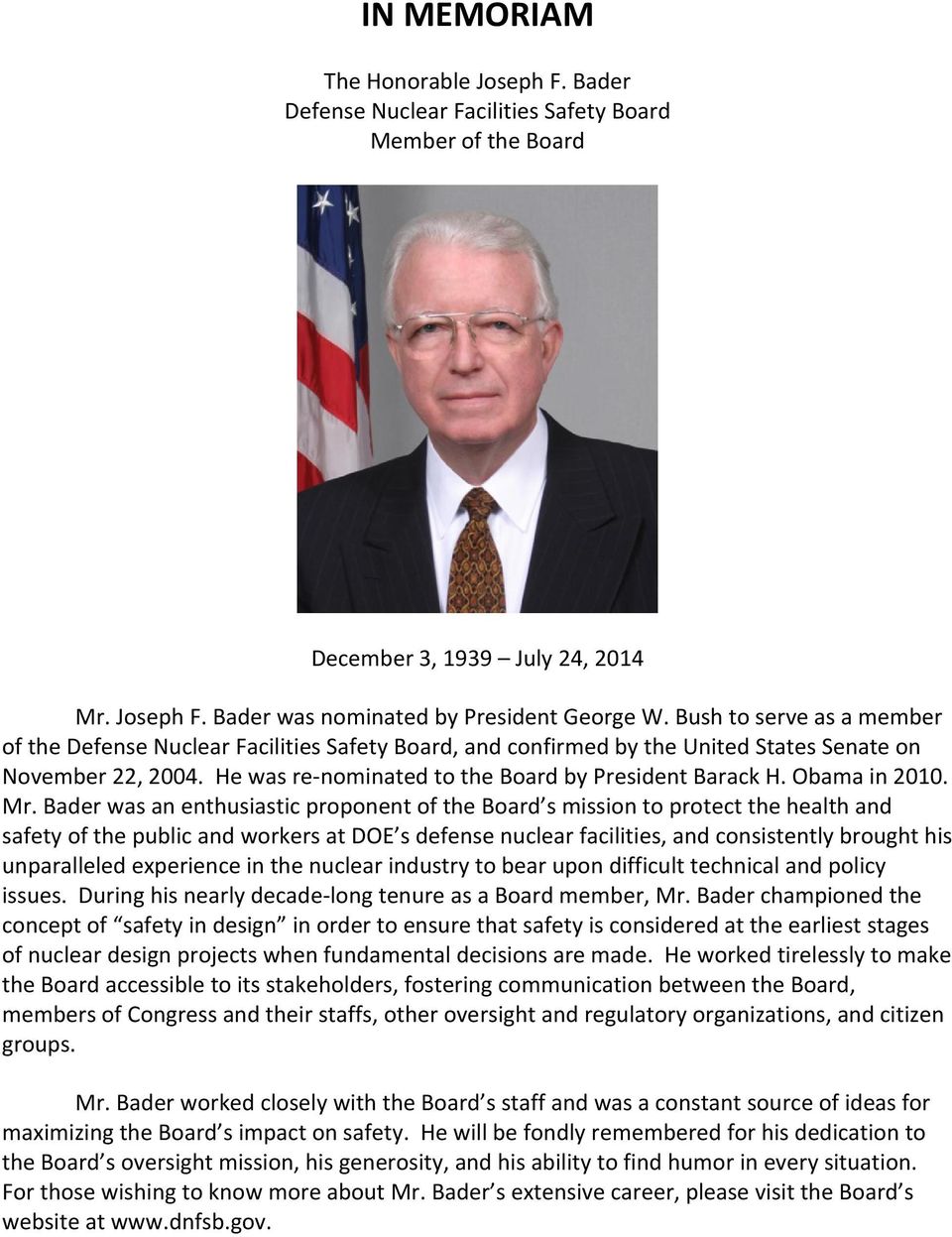
4 IN MEMORIAM The Honorable Joseph F. Bader Defense Nuclear Facilities Safety Board Member of the Board December 3, 1939 July 24, 2014 Mr. Joseph F. Bader was nominated by President George W. Bush to serve as a member of the Defense Nuclear Facilities Safety Board, and confirmed by the United States Senate on November 22, He was re nominated to the Board by President Barack H. Obama in Mr. Bader was an enthusiastic proponent of the Board s mission to protect the health and safety of the public and workers at DOE s defense nuclear facilities, and consistently brought his unparalleled experience in the nuclear industry to bear upon difficult technical and policy issues. During his nearly decade long tenure as a Board member, Mr. Bader championed the concept of safety in design in order to ensure that safety is considered at the earliest stages of nuclear design projects when fundamental decisions are made. He worked tirelessly to make the Board accessible to its stakeholders, fostering communication between the Board, members of Congress and their staffs, other oversight and regulatory organizations, and citizen groups. Mr. Bader worked closely with the Board s staff and was a constant source of ideas for maximizing the Board s impact on safety. He will be fondly remembered for his dedication to the Board s oversight mission, his generosity, and his ability to find humor in every situation. For those wishing to know more about Mr. Bader s extensive career, please visit the Board s website at
5 (Intentionally blank)

6 Table of Contents I. The Board s Statutory Mission...1 II. Highest Priority Safety Problems...4 III. Recommendations Issued to the Secretary in IV. Recommendations Open in V. Nuclear Weapons Operations...14 VI. Design and Construction...19 VII. Hazardous Materials...26 VIII. Safety Standards and Programs...33 IX. Informing the Public...35 X. Funding and Human Resources...41 Appendix A: Reporting Requirements in Appendix B: Significant Board Correspondence in Appendix C: Status of Significant Unresolved Issues with DOE s Design and Construction Projects...51 Appendix D: Summary of Significant Safety Related Aging Infrastructure Issues at Defense Nuclear Facilities...66 Index Safety Meeting at Savannah River Site, April 1952

7 (Intentionally blank)

8 I. The Board s Statutory Mission Mission, Jurisdiction, and Powers The Board was established in as an independent federal agency within the executive branch of government, answerable to the President and subject to congressional oversight and direction. Five Board members, appointed by the President subject to confirmation by the Senate, are required by law to be respected experts in the field of nuclear safety with a demonstrated competence and knowledge relevant to the independent investigative and oversight functions of the Board. The Board is a collegial agency, meaning that its actions are determined by the Board as a whole. The Board s chairman is the chief executive officer, subject to such policies as the Board may establish. 2 The Board s essential mission is to provide independent analysis, advice, and recommendations to the Secretary of Energy (Secretary) to inform the Secretary, in his role as operator and regulator of U.S. Department of Energy (DOE) defense nuclear facilities, in providing adequate protection of public health and safety. Advice may be offered in a variety of ways, from informal exchanges between technical professionals to formal recommendations made on the public record to the Secretary. Safety measures may pertain to specific DOE facilities and activities or may be directed at the safety requirements and guides employed to regulate nuclear activities. As noted above, the Board s jurisdiction covers DOE defense nuclear facilities a term defined in the Atomic Energy Act of The statute s definition is somewhat complex, but it can be understood in plain language. The Board is only concerned with facilities operated by DOE that are (1) covered by the Atomic Energy Act and (2) have a function related to national 1 The 1970s and 1980s were turbulent decades for the nuclear industry worldwide. In 1975, a serious fire at the Browns Ferry nuclear power station nearly led to a core melt accident. Such an accident did take place four years later at the Three Mile Island power reactor site in Pennsylvania. These two watershed events caused the Nuclear Regulatory Commission (NRC) to spend much of the 1980s seeking to impose new safety requirements on both operating reactors and reactors under construction. By 1986, much progress had been made, and the nuclear industry was settling down. In April of that year, however, the Soviet built Chernobyl nuclear reactor in Ukraine exploded, causing the largest accidental release of radioactive material in history. Studies of DOE s defense reactors revealed that safety improvements lagged far behind those being made in the commercial nuclear industry. Congress was also concerned about the slow pace of cleaning up the waste generated by decades of nuclear weapons production. Beginning in 1987, Congress began to consider legislation imposing some kind of external oversight or regulation of DOE s nuclear operations. Following two years of work by House and Senate committees, a compromise bill emerged based largely on Senator John Glenn s original bill, S. 1085, Nuclear Protections and Safety Act of On September 28, 1988, President Reagan signed a modified bill into law as part of the National Defense Authorization Act for Fiscal Year The Board currently has three sitting members and two vacancies, including the chairman. The vice chairman is currently the acting chairman. 1

9 defense. The phrase defense nuclear facilities thus excludes two major classes of government regulated nuclear facilities: DOE s nuclear projects that are civilian in purpose, and commercial nuclear facilities regulated by the NRC. The Board s oversight jurisdiction does not extend to the U.S. Navy s nuclear propulsion program or to environmental hazards regulated by other federal and state agencies. (The table on the next page lists the major sites that the Board oversees). The Board s oversight mission covers all phases in the life of a defense nuclear facility: design, construction, operation, and decommissioning. During the Board s more than two decades of work, some major sites have closed (such as Rocky Flats in Colorado), while other major facilities have been or are being built (such as the Waste Treatment and Immobilization Plant at Hanford in Washington State). To carry out the mission outlined above, Congress granted the Board an effective suite of statutory tools. Principal among these is the formal Board recommendation issued to the Secretary. The statute requires the Secretary to either accept or reject the Board s recommendation, and in the case of an acceptance, to write and execute an implementation plan. This process all takes place on the public record. In cases involving an imminent or severe threat to the public health and safety, the statute requires the Board to also send its recommendation to the President, who makes the final decision on actions to be taken. In addition to recommendations, the Board is empowered to hold public hearings (and subpoena witnesses if necessary), conduct investigations, demand information and documents needed for the Board s work from DOE and its contractors, and review and comment on DOE requirements and standards affecting safety at defense nuclear facilities. DOE is required by law to grant the Board ready access to such facilities, personnel, and information as the Board considers necessary to carry out its responsibilities. Finally, the statute authorizes the Board to seek assistance from other federal agencies (such as the NRC) and from organizations outside the government (such as the National Academy of Sciences). 2

10 Major Sites Subject to the Board s Jurisdiction Site Location Operations DOE Website Hanford Site Richland, Washington Management and treatment of radioactive wastes; facility decommissioning Idaho National Laboratory Lawrence Livermore National Laboratory Los Alamos National Laboratory Nevada National Security Site Oak Ridge National Laboratory 45 miles west of Idaho Falls, Idaho Livermore, California Los Alamos, New Mexico Northwest of Las Vegas, Nevada Oak Ridge, Tennessee Storage and processing of radioactive waste Research to support the nuclear weapons arsenal Research to support the nuclear weapons arsenal; manufacturing of nuclear weapon components Disposition of damaged nuclear weapons; nuclear fission and subcritical experiments; waste management Energy research; treatment and disposal of radioactive wastes Pantex Plant Near Amarillo, Texas Maintenance of the U.S. nuclear stockpile Sandia National Laboratories Albuquerque, New Mexico Nuclear research; support for weapons stockpile maintenance program Savannah River Site Aiken, South Carolina Tritium extraction, recycling and storage; management and treatment of radioactive wastes; nuclear materials storage and disposition; research and development Waste Isolation Pilot Plant Y 12 National Security Complex 26 miles east of Carlsbad, New Mexico Oak Ridge, Tennessee Safe disposal of transuranic waste in underground repository Manufacturing and surveillance of nuclear weapons components; processing of weapons grade uranium

11 II. Highest Priority Safety Problems Criticality Safety at the Los Alamos Plutonium Facility Since 2005, the National Nuclear Security Administration (NNSA) has recognized that the Los Alamos National Laboratory s criticality safety program does not fully comply with applicable requirements. In 2013, a severe staffing shortage in the Laboratory s criticality safety group inhibited progress in correcting the deficiencies in this program. The Board s 24 th Annual Report to Congress, dated March 2014, summarizes the Board s role in identifying new deficiencies and bringing the state of the Laboratory s criticality safety program to the attention of Laboratory management and the Secretary of Energy. On June 27, 2013, the Laboratory Director paused all programmatic activities at PF 4. During the first few months of 2014, NNSA resumed operations in PF 4 that pose a lower criticality safety risk; many others remained under the Laboratory Director s operational pause while Laboratory personnel continued to execute corrective actions. The Board s staff closely monitored implementation of these corrective actions and, on May 16, 2014, the Board sent a letter to NNSA expressing concern that the Laboratory contractor intended to resume high risk operations without first developing criticality safety evaluations compliant with DOE directives and industry consensus standards. Laboratory managers subsequently expressed their intent to develop modern, compliant criticality safety evaluations for most operations prior to conducting readiness assessments for their resumption, although this commitment has not been formalized with NNSA. Due to the length of time that has elapsed since the Laboratory last performed many higher risk operations, DOE directives require federal readiness assessments prior to resuming the operations. NNSA plans to perform several of the readiness assessments in The Board s staff will closely monitor these readiness assessments to ensure that the Laboratory s corrective actions have effectively addressed all deficiencies in criticality safety and conduct of operations. Seismic Vulnerability at Los Alamos National Laboratory The risk posed by an earthquake at the Los Alamos National Laboratory remains among the Board s greatest safety concerns. A 2007 reanalysis of potential earthquakes at Los Alamos indicated a greater than fourfold increase in the predicted earthquake ground motion over the original design requirements for PF 4. PF 4 was designed and constructed in the 1970s, and its structure lacks the ductility and redundancy required by today s building codes and standards. PF 4 contains significant amounts of plutonium, much of it in dispersible forms. The facility s safety documentation, approved by NNSA in December 2008, indicated that the radiation dose consequence to the public following an earthquake and resulting fire could exceed DOE s allowed levels by several orders of magnitude. Since 2007, much has been done to strengthen the structure of the building and to reduce the likelihood and severity of a post seismic fire, and further improvements are planned. Notwithstanding those improvements, additional analyses have raised further 4

12 questions regarding the possibility of severe damage to the facility, including a potential facility collapse, following a design basis earthquake. In Progress and Complete Structural Reinforcements in PF 4 In September 2012, the Deputy Secretary of Energy directed NNSA to evaluate the seismic vulnerability of PF 4 using a new modeling approach. This alternate analysis is currently being performed by an independent engineering firm. The Board is awaiting the results of the alternate analysis before making further conclusions regarding PF 4 s ability to provide confinement following a major earthquake. NNSA originally informed the Board that it expected the alternate analysis to be completed in early 2014; this timeline has continued to slip. The engineering firm conducting the alternate analysis completed the first phase and issued three peer reviewed reports in September and October The Board s staff placed a high priority on evaluating these results during 2014, and determined that the analysis is based on a more representative model of the facility and uses an advanced procedure that incorporates the dynamic inelastic response of the structure. The next phase of the alternate analysis will allow NNSA to defensibly determine the likelihood of facility collapse and the extent of upgrades needed. However, NNSA has not yet issued a contract for the next phase of the analysis. Instead, NNSA chartered an expert panel to assess the results of the analysis completed thus far. As a result, the Board issued a reporting requirement to the Secretary on December 17, 2014, asking for an updated plan and schedule for completing the alternate analysis. NNSA Nuclear Explosive Safety Program The primary mission of the Pantex Plant is to assemble, disassemble, examine, and dismantle nuclear weapons. The highest level of safety oversight is warranted to preclude an 5

13 accident involving a nuclear detonation or violent reaction of high explosives. Personnel in NNSA s nuclear explosive safety program are responsible for ensuring all operations meet the required standard of safety for these high hazard operations. NNSA utilizes non federal senior technical advisors (STAs) during its reviews of nuclear explosive operations. Since 2011, the Board has urged NNSA to improve the manner by which NNSA tracks and closes findings of its nuclear explosive safety review teams, including comments from STAs. On August 28, 2014, the STAs briefed the Board on their perception of NNSA followthrough on STA comments. The STAs told the Board that NNSA was not taking sufficient action on their concerns and that NNSA did not provide feedback on its reasoning when addressing STA comments. The Board followed up with NNSA during a public hearing on October 7, NNSA will hold a meeting with the STAs in early 2015 to further investigate how best to address STA concerns. Meanwhile, throughout 2014, NNSA worked to revise its nuclear explosive safety directives, including two revised DOE Orders (nearly issued) and a new NNSA Supplemental Directive (issued). The revised directives are designed to improve how STA comments and findings are addressed. Early Integration of Safety in Design During 2014, DOE made progress in resolving certain safety issues affecting complex design and construction projects. Examples include the Sludge Treatment Project at the Hanford Site, where Board safety issues identified in earlier stages of design with safety instrumented systems were addressed by DOE prior to the final design stage, and the Waste Treatment and Immobilization Plant (WTP) at the Hanford Site, where DOE adopted a key design standard that effectively addressed some open Board issues. On other issues, however, DOE encountered problems with integration of safety into the design process. For example, DOE continued to struggle with many open safety issues at the WTP project. In 2012, DOE slowed the construction of two of the plant s key facilities Pretreatment and High Level Waste to resolve safety issues and to reevaluate the project s design. In 2014, DOE authorized the WTP contractor to resume engineering work to finalize the design of the High Level Waste Facility. The Board reviewed the revised safety documentation for these facilities and identified new safety issues concerning volcanic ashfall events and unanalyzed melter accidents. DOE s progress in addressing the Board s remaining safety issues with the WTP project continues to be slow. Some safety issues have been outstanding for years. The Board supports DOE s efforts to integrate safety concepts at an early stage in design and construction projects. To this end, the Board uses project letters to provide timely notification of safety issues to DOE at major project milestones (known as Critical Decisions ) to ensure that DOE is aware of unresolved safety issues and to assist DOE in evaluating a project s readiness to move forward. During 2014, the Board completed two project letters. The Board concluded that no significant safety issues remained for the Hanford Site s Sludge Treatment Project at the completion of final design and documented that conclusion by letter 6

14 to DOE on May 2, In an August 7, 2014 letter to DOE, the Board reiterated outstanding issues at the completion of final design of the Transuranic Waste Facility project at Los Alamos National Laboratory. The letter also identified new issues with worker safety controls for that facility. During the Board s October 7, 2014, public hearing on safety culture in DOE, the Secretary of Energy testified that DOE was in the process of revising its fundamental project management structures to improve the execution of projects. The Secretary announced the changes on December 1, 2014, in a memorandum titled Improving the Department s Management of Projects. Important changes include strengthening the Energy Systems Acquisition Advisory Board, establishing a project management risk committee, and directing the Under Secretaries to develop plans to clarify lines of responsibility and improve the peer review process. The Secretary s memorandum also directed all programs to ensure their projects comply with DOE Orders and directed the establishment of a project leadership institute to create and sustain a culture of project delivery excellence. Integrated Safety Management at the Activity Level Safe accomplishment of work requires thorough planning, the development of effective procedures, and the ability of workers to follow those procedures as written. DOE s safety directives require a paradigm referred to as Integrated Safety Management (ISM) consisting of five core functions: (a) defining the scope of work, (b) analyzing the hazards, (c) developing and implementing hazard controls, (d) performing work within those controls, and (e) providing feedback and continuous improvement. In 2012, the Board concluded that DOE had not achieved sustained improvement in implementing ISM at the activity level. In 2014, DOE completed a new DOE directive providing comprehensive guidance for contractors and revised its directive on federal oversight to explicitly address work planning and control. The Board s staff closely followed these efforts, providing comments to assist and enhance the resulting products. In April 2014, DOE issued a new DOE Handbook , Activity level Work Planning and Control Implementation, and had revised DOE Guide A, Federal Line Management Oversight of Department of Energy Nuclear Facilities. In 2014, the Board s staff assessed work planning and control at the Y 12 National Security Complex, the Hanford Plutonium Finishing Plant, the Savannah River Site, and the Los Alamos National Laboratory. The Board s staff also observed the two DOE assessments of work planning and control at the Idaho Advanced Mixed Waste Treatment Project and at Sandia National Laboratories. The Board s staff noted improvement in the implementation and oversight of work planning and control during these assessments. Implementation of the new directives should enable DOE and its contractors to achieve and sustain further improvements and better ensure worker safety at defense nuclear facilities. 7

15 Recovery Actions at the Waste Isolation Pilot Plant The Waste Isolation Pilot Plant (WIPP) suspended operations on February 5, 2014, following a fire involving an underground vehicle. Nine days later, on February 14, 2014, a release of radioactive material occurred underground, contaminating a portion of the mine and releasing a small amount of radioactive contamination into the environment. DOE suspended disposal of transuranic waste at WIPP while it investigates the accidents and develops corrective actions. DOE completed its fire investigation, but its investigation into the cause of the radioactive material release was still ongoing at the end of The potential for an additional release of radioactive material will continue to be of concern until DOE completes its investigation and seals off the waste in the WIPP underground. Elimination of the hazards posed by shallow burial and surface storage of transuranic waste at DOE s other defense nuclear facilities has been delayed by the suspension of operations at WIPP. The Board deployed members of its staff to WIPP to closely monitor DOE s response and recovery actions for the accidents, and sent three letters to the Secretary of Energy in 2014 regarding establishing and maintaining safe conditions at WIPP. Emergency Preparedness and Response In 2014, the Board continued to provide oversight of emergency preparedness and response at defense nuclear facilities. Over the past several years, the Board has become increasingly concerned about deficiencies in DOE s emergency preparedness. The Board devoted additional staff resources in 2014 to the review and assessment of emergency preparedness issues. The increased oversight revealed a number of significant issues that warranted near term resolution. As a result, on September 3, 2014, the Board issued Recommendation , Emergency Preparedness and Response. Section III of this report discusses the details of the Board s Recommendation. 8

16 III. Recommendations Issued to the Secretary in 2014 Recommendation , Emergency Preparedness and Response On September 3, 2014, the Board issued Recommendation , Emergency Preparedness and Response, to the Secretary of Energy. This Recommendation identified problems with DOE s oversight of emergency preparedness and response at defense nuclear facilities. The full text of the Recommendation may be found on the Board s public website at activities/recommendations. During the past several years, the Board examined issues associated with the emergency preparedness and response capabilities at DOE sites at several public hearings. Members of the Board s staff reviewed the emergency management programs at several defense nuclear facilities, and the Board s Site Representatives made numerous observations of the state of emergency preparedness at their respective sites. In addition, the Board communicated to the Secretary of Energy its concerns regarding shortcomings in the responses to two events (a truck fire and radioactive material release) at WIPP in two letters issued in March The Board attributed observed problems to the absence of sound emergency preparedness and response programs at sites with defense nuclear facilities. As a result, the Board issued Recommendation to the Secretary of Energy on September 3, 2014, recommending that DOE make specific improvements in its emergency management directive and strengthen the implementation of its emergency management requirements to ensure the continued protection of workers and the public. On November 7, 2014, the Secretary accepted the Recommendation. DOE is in the process of developing an implementation plan to accomplish the improvements specified in the Recommendation. The Board s staff will continue to review the effectiveness of emergency management programs at defense nuclear facilities. Reviews will include observation of emergency response drills and exercises and targeted reviews of site emergency management program elements, as well as continued oversight by the Board s Site Representatives. 9

17 IV. Recommendations Open in 2014 Recommendation , Oversight of Complex, High Hazard Nuclear Operations The Board closed this Recommendation on May 1, The Board issued Recommendation in May 2004 to address concerns with DOE s organizational structure and safety practices. The Recommendation covered delegation of authority for nuclear safety matters, technical capability of federal officials with safety responsibilities, Central Technical Authorities for decisions affecting safety, nuclear safety research, application of lessons learned from significant accidents, and application of the principles of Integrated Safety Management. By the end of 2013, DOE had met most of the commitments in its implementation plan. In early 2014, DOE completed commitments concerning nuclear safety research and guidance on safety oversight. The Board reviewed the status of DOE s implementation, noting the remaining commitment to verify federal safety assurance capabilities. In May 2014, the Board closed the Recommendation, but requested that DOE report on its federal safety oversight capability and its criteria for periodically evaluating the effectiveness of federal safety oversight. Recommendation , Active Confinement Systems The Board closed this Recommendation on July 15, The Board issued Recommendation in December 2004 to address concerns with the confinement of hazardous materials at DOE defense nuclear facilities. In 2014, DOE completed all its commitments in accordance with the associated implementation plan. This included evaluating confinement systems for all pertinent defense nuclear facilities, revising DOE directives to codify the preference of active over passive confinement systems, submitting a schedule for and funding the completion of upgrades and modifications to several defense nuclear facilities, and issuing a final report to document the progress and achievements made as a result of this Recommendation. Recommendation , Nuclear Material Packaging The Board closed this Recommendation on March 31, 2014, in a letter to the Secretary of Energy that imposed several reporting requirements related to completing and sustaining improvements in the safe storage of nuclear materials at DOE s defense nuclear facilities. The Board issued Recommendation in March 2005 to improve protection for workers involved in the storage and handling of nuclear materials. During 2014, DOE made significant progress toward its objective of having all nuclear material packaged in accordance 10

18 with DOE Manual , Nuclear Material Packaging Manual. On April 16, 2014, the NNSA Los Alamos Field Office approved the SAVY 4000 series of storage containers as meeting the requirements of DOE M for use at Los Alamos National Laboratory. The Laboratory has repackaged nuclear material into hundreds of SAVY 4000 containers. Several other sites plan to use SAVY 4000 containers for packaging nuclear material. Progress toward implementation at some sites has been limited and is behind DOE s September 16, 2009, schedule. In particular, the repackaging effort at the Savannah River Site is still under development, and its contractors have not yet implemented DOE Manual Savannah River Site personnel are developing a path forward for future repackaging work and are assessing which containers out of approximately 160 at the site require repackaging per DOE Manual On July SAVY 4000 Container 30, 2014, the Secretary of Energy responded to the Board s closure letter by providing an updated schedule for implementing DOE Manual and repackaging nuclear materials into containers that meet the requirements of the Manual. Recommendation , Los Alamos National Laboratory, PF 4 Seismic Safety As discussed in detail in Section II of this report, the Board remains concerned regarding the seismic vulnerability of PF 4 at Los Alamos National Laboratory. PF 4 was designed and constructed in the 1970s and lacks the structural ductility and redundancy required by today s building codes and standards. Knowledge of the Los Alamos site seismic hazard gained within the past decade reveals a potential for facility collapse caused by design basis seismic activity. A collapse could potentially result in a significant release of radioactive material and unacceptable radiological dose consequences to the public. The Board worked closely with NNSA on the issue over the past several years; during 2014 NNSA made further progress implementing upgrades to the facility structure and safety systems to improve the seismic performance of PF 4 and reduce the consequences of a large seismic event. Simultaneously, NNSA pursued an alternate seismic analysis to better characterize the facility s structural weaknesses and the potential of collapse. NNSA s contractor completed the first phase of this analysis during The Board is awaiting results of a second phase before reaching final conclusions on whether additional compensatory measures may be needed. 11

19 Recommendation , Safety Analysis Requirements for Defining Adequate Protection for the Public and the Workers Recommendation identified the need for DOE to strengthen its regulatory framework by developing a clear and unambiguous set of nuclear safety requirements to ensure adequate protection of the public, workers, and environment. In November 2014, DOE reached an important milestone in implementing the Recommendation by issuing a major revision to DOE Standard 3009, Preparation of Nonreactor Nuclear Facility Documented Safety Analysis. This Standard, which serves as a centerpiece of DOE s nuclear safety regulatory framework, includes significant new requirements and clarifies expectations for protecting the public and workers from nuclear facility hazards. In a letter dated October 18, 2014, the Secretary of Energy informed the Board that DOE intends to require implementation of the revised Standard 3009 for only a subset of existing defense nuclear facilities, but plans to evaluate the rest of its existing defense nuclear facilities to identify where these facilities do not comply with the revised Standard s requirements. The Recommendation remains open as the Board monitors DOE s use and evaluation of the new Standard 3009 for new and existing defense nuclear facilities. The Board will continue to perform oversight of DOE s efforts to revise several other key directives within its nuclear safety regulatory framework. Recommendation , Safety Culture at the Waste Treatment and Immobilization Plant The Board issued Recommendation following an investigation into the safety culture of the WTP project at the Hanford Site. In early 2014, DOE site offices and contractors completed self assessments of the safety conscious work environment across the complex that had been initiated in DOE began the development of safety culture sustainment plans based on the results of these assessments, and is currently reviewing those plans for approval and implementation. Members of the Board s staff continue to review DOE s plans as they develop. In addition, the Board held three public hearings in 2014 regarding Recommendation In the first two hearings, the Board received testimony regarding safety culture from recognized experts from outside of the DOE complex, including discussions on how safety culture concerns can be identified and assessed, how the attributes of a good safety culture can be instilled in an organization, and how the involvement and example of the organization s senior leadership is key to development and sustainment of a robust culture of safety. In the third public hearing, the Secretary of Energy and senior leaders from NNSA and the DOE Office of Environmental Management testified regarding their vision and plans for the future. 12

20 Recommendation , Savannah River Site Building 235 F Safety In May 2012, the Board issued Recommendation , which identified the need for DOE to remove or immobilize residual plutonium 238 contamination located within Building 235 F and thereby mitigate the respirable plutonium 238 hazard in a potential loss of confinement event. This Recommendation also identified the need for near term actions and compensatory measures to improve the safety posture of Building 235 F while cleanout work is being planned. Actions completed in 2014 included removing combustible materials, disconnecting unnecessary electrical circuits, and installing a new fire detection and alarm system. DOE also conducted an emergency exercise aimed at preparing for a loss of confinement event at Building 235 F, and initiated preparations for executing a readiness review for cleanout operations in the building. The Secretary of Energy originally committed to a completion date of December 31, 2018; however, on November 28, 2014, the Secretary notified the Board of schedule changes that extend completion to May 31, Building 235 F Cell Mock Up for Deactivation Containment Work Recommendation , Hanford Tank Farms Flammable Gas Safety Strategy Recommendation identified the need for safety related ventilation systems to aid in preventing and mitigating flammable gas events for the double shell tanks at the Hanford Tank Farms. The Recommendation also identified the need to upgrade a number of other systems that are necessary to provide accurate and reliable indications of abnormal conditions associated with flammable gas events. DOE is treating the ventilation systems as a safety significant control and is developing a plan to upgrade the systems to meet requirements for safety related systems. Additionally, DOE began designing instrumentation to continuously monitor ventilation flow rates. 13

21 V. Nuclear Weapons Operations Lawrence Livermore National Laboratory Nuclear Safety In 2014, the Board continued to conduct oversight of the nuclear safety basis, safety system performance, and operations at Lawrence Livermore National Laboratory. The staff conducted a number of oversight visits to monitor the safety of ongoing operations as well as corrective actions related to the Board s August 2012 letter identifying safety basis deficiencies at the Laboratory. The Board s staff observed vital safety system reviews and developed independent observations of safety system performance at the Laboratory s plutonium facility. The staff also evaluated DOE reviews of the implementation of radiological controls at the Laboratory. As a separate effort, the Board s began a review of safety software quality assurance associated with the analysis of nuclear weapons response by the laboratory. This effort parallels an ongoing NNSA headquarters assessment of code use at all three nuclear weapons laboratories. Probabilistic Seismic Hazard Analysis The Board s staff evaluated the development of an updated probabilistic seismic hazard analysis for the Laboratory. The previous analysis was completed in DOE is conducting an update that includes reviewing the seismic source characterization, ground motion prediction equations, site characterization, and final hazard calculations. Lawrence Livermore National Laboratory 14
22 Los Alamos National Laboratory Nuclear Facility Safety Analysis The Los Alamos National Laboratory contractor uses the Radioassay and Nondestructive Testing (RANT) Shipping Facility to load transuranic waste into shipping containers. NNSA plans to continue using RANT, in conjunction with the Transuranic Waste Facility Project, to support the enduring TRU waste mission at Los Alamos after Area G is closed. In support of this longterm mission, the Laboratory contractor developed a documented safety analysis to replace an older Basis for Interim Operation that had served as the safety basis for RANT operations. The Los Alamos Field Office approved the documented safety analysis in July 2014 with two conditions of approval and two directed actions. On December 9, 2014, the Board sent a letter to NNSA identifying significant weaknesses in the RANT Shipping Facility hazard analysis, accident analysis, and safety controls. The Board s letter included a staff report that detailed the inadequate identification and implementation of safety controls, including the facility structure and vehicle impact barriers, to protect the public and worker. The Board is awaiting NNSA s formal response, but the Board s staff continues to work with Field Office and contractor personnel to resolve these issues. By the end of 2014, Laboratory personnel identified additional deficiencies and formally declared a potential inadequacy in the safety analysis. The Board s staff also reviewed the Area G Basis for Interim Operation, focusing on the resolution of issues raised by the Board in The staff concluded that the issues identified in 2012 are either resolved or have an adequate path to closure, and identified one additional issue. Specifically, the staff found that the Laboratory contractor implemented a non conservative methodology to calculate the source term for accident scenarios involving transuranic waste drums with combustible material at risk. As a result of staff interaction, Laboratory personnel declared a potential inadequacy in the safety analysis and implemented compensatory measures while evaluating the safety of the situation. The Board s staff is tracking efforts to fully address this safety issue. Nuclear Operations In October 2014, the Board s staff reviewed activity level work planning and control (WP&C) at Los Alamos. The staff evaluated the actions taken by the Laboratory contractor and Field Office over the last several years to improve WP&C for hazardous nuclear operations following the issuance of DNFSB/TECH 37, Integrated Safety Management at the Activity Level: Work Planning and Control. The Board s staff concluded that the Laboratory s WP&C processes have generally improved but identified a number of areas that require further improvement. The Laboratory contractor is executing a strategic improvement plan for work management; the Board s staff will assess whether its implementation is effective in sustaining long term improvements across the site. 15
23 Waste Disposition DOE s investigation of the February 2014 radiological release event at WIPP found a breached drum within Room 7 of Panel 7 of the underground facility. This drum contains nitrate salt bearing transuranic waste that originated from Los Alamos National Laboratory. As such, the Los Alamos contractor and other national laboratories performed extensive experimentation and modeling during 2014 to discern the role this drum may have played in the release. The Board s staff continues to prioritize oversight efforts to ensure adequate protection of the public and workers at Area G, as well as WIPP, until the underlying issues are resolved. Pantex Plant Contract Transition Members of the Board s staff provided increased field oversight at the Pantex Plant during the transition period (March 1 through June 30, 2014), when Consolidated Nuclear Security (CNS), LLC, became the management and operating contractor for the Y 12 National Security Complex and the Pantex Plant. Hazard Analyses for Nuclear Explosive Operations The Board in 2011 expressed concern that NNSA design agencies were not adequately documenting the analyses used to develop safety controls for nuclear explosive operations at Pantex, as required by DOE NA STD 3016, Hazard Analysis Reports for Nuclear Explosive Operations. NNSA undertook a review of the effectiveness of the design agencies processes for implementing DOE NA STD 3016, but this review remains incomplete. The Board s staff performed evaluations during 2014 and determined that NNSA does not have a complete technical basis for accident consequences for several weapon programs. In some instances place holder values are used because testing has not been completed to confirm the actual behavior of energetic materials. Senior NNSA leaders briefed the Board on plans to complete all the required technical bases and strengthen the requirements in DOE NA STD 3016, though this effort will take several years. NNSA tasked the design agencies to complete a selfassessment of the implementation of DOE NA STD The Board s staff will review the results. During 2014, the Board s staff also evaluated NNSA assessments of quality assurance (QA) for weapon response development software at the design agencies. NNSA identified significant findings that will need to be addressed in order to properly implement DOE s software QA requirements. 16
24 Safety Controls for Falling Man Scenarios In a letter dated June 2, 2014, the Board identified a concern that NNSA has not demonstrated that special tooling used in nuclear explosive operations at Pantex adequately protects the public and workers from the potential consequences of a worker falling onto the tooling or nuclear explosive during operations. Recent academic studies sponsored by NNSA indicate that the methodology used by NNSA may underestimate the loads and energy imparted by a falling worker. On July 11, 2014, the Board received a written response from NNSA, with a subsequent briefing from NNSA senior management on August 20, NNSA representatives described an expanded effort, including more academic studies of the energy imparted by a falling worker, development of a new methodology to characterize the impact of a falling worker, and an independent review of the falling worker methodology. NNSA additionally informed the Board in October 2014 that the Pantex contractor was taking actions to further mitigate falling worker scenarios. The contractor conducted computer based training to heighten worker awareness of potential hazards and techniques for minimizing the possibility of falling on a nuclear explosive. The contractor also began to evaluate operational improvements such as revised bay layouts, process changes, and reduction of tripping hazards. On December 2, 2014, NNSA s independent review team presented its findings and published its final report, Pantex Falling Man Independent Review Falling Man Academic Study Panel Report. The independent review concluded that the falling man methodology is an adequate baseline for safe tool design, but provided significant recommendations for its improvement. The independent review team s concerns included the need for addressing the potential energy of the falling man, utilizing dynamic loads in addition to static loads, developing a systematic approach to determine all load paths, and performing a sensitivity analysis of input parameters. In general, the team found that the methodology leaves something to be desired and recommended a continuous improvement effort. The team also suggested that NNSA identify the most risky tools and perform a sensitivity analysis using the current methodology with bounding parameters. A number of these repeated issues that were identified in the Board s letters of July 6, 2010, and June 2, 2014, and in past NNSA Nuclear Explosive Safety evaluation reports. 17
25 Sandia National Laboratories Conduct of Operations and Maintenance On May 12, 2014, the Board sent a letter and report to NNSA regarding deficiencies found in the conduct of operations and maintenance at the defense nuclear facilities in Technical Area V at the Sandia National Laboratories. None of the issues were individually severe, but the number and type of issues indicated the need for general improvement in conduct of operations and maintenance. The Board sent the letter with the intent that NNSA could use it as input for a planned Sandia initiative to improve in these areas. Technical Area V management and the NNSA Sandia Field Office subsequently developed action plans to address the issues raised by the Board. The Laboratory contractor addressed the Board s specific observations, including housekeeping and labeling issues, and tentatively scheduled conduct of operations assessments through 2017 to address each of the specific requirements in DOE Order 422.1, Conduct of Operations. Additionally, the Laboratory contractor is developing comprehensive conduct of operations training for Technical Area V personnel, updating its conduct of operations implementing documents, and revising its strategy for performing various types of maintenance. Y 12 National Security Complex Conduct of Operations and Maintenance In 2011, the Board identified implementation issues in the conduct of operations and maintenance at the Y 12 National Security Complex. NNSA and the Y 12 contractor implemented corrective measures to improve performance in these areas, and the Board s staff performed reassessments in In addition, members of the Board s staff provided increased field oversight during the transition period (March 1 through June 30, 2014) when a new contractor took over management and operation of the Y 12 National Security Complex and the Pantex Plant. The staff found improvements compared to 2011, but additional opportunities for improvement remain. The Board received briefings on NNSA and contractor plans to improve performance in operations and maintenance during its July 2014 visit to the site. Aging Infrastructure Since 2005, the Board has been monitoring DOE s efforts to address the known vulnerabilities of aging defense nuclear facilities at Y 12. Of particular concern is the vulnerability of certain enriched uranium production facilities to damage in an earthquake. In July 2014, DOE fulfilled an annual reporting requirement on the safety of continued operations and briefed the Board regarding the condition of Building E, the 9212 Complex, and the 9215 Complex. Members of the Board s staff conducted reviews in 2014 to evaluate the structural performance of Building E and the 9215 Complex. The review provided insight 18
26 into known structural deficiencies. The staff discussed its observations with NNSA and CNS personnel to aid NNSA s efforts to ensure continued safe operations of these facilities. VI. Design and Construction New Facilities The Atomic Energy Act of 1954, as amended, requires that the Board review the design and construction of new defense nuclear facilities to ensure the adequate protection of the public health and safety during eventual operation. The Board uses a variety of methods to carry out this function, including detailed reviews by the Board s technical staff, public hearings, requests for information, and visits by Board members to construction sites. Currently, the Board is actively overseeing the design and construction of over a dozen new defense nuclear facilities with a projected total cost exceeding $25 billion. The Board is waiting to see what action DOE takes on several other projects that are on hold or have been deferred. The table below lists DOE s design and construction projects, the status of each project, and the status of the Board s review. Design and Construction Projects Under Review in 2014 Project Name Waste Treatment and Immobilization Plant K Basin Closure Sludge Treatment Project Low Activity Waste Pretreatment System 3 Idaho Calcine Disposition Project Integrated Waste Treatment Unit Location Hanford Site, Richland, WA Hanford Site, Richland, WA Hanford Site, Richland, WA Idaho National Laboratory, ID Idaho National Laboratory, ID Projected Cost $12.3 billion $308 million $375 million Not Available $571 million Status of Project Concurrent design and construction Phase 1: Construction Phase 2: Conceptual design Conceptual design Conceptual design Construction complete, conducting perf. testing Status of Board Review Multiple open safety issues Ongoing no current safety issues Ongoing no current safety issues Ongoing no current safety issues Ongoing no current safety issues 3 The Low Activity Waste Pretreatment System has a budget line item separate from WTP but upon completion is intended to function as part of WTP. 19
27 Design and Construction Projects Under Review in 2014 (cont.) Project Name Chemistry and Metallurgy Research Replacement Project Nuclear Facility Transuranic Waste Facility Project Transuranic Waste Processing Center Sludge Processing Facility Buildouts Project K Area Complex Purification Area Vault Project Saltstone Disposal Unit #6 Salt Waste Processing Facility Waste Solidification Building Underground Ventilation System Uranium Processing Facility Location Los Alamos National Laboratory, NM Los Alamos National Laboratory, NM Oak Ridge National Laboratory, TN Savannah River Site, Aiken, SC Savannah River Site, Aiken, SC Savannah River Site, Aiken, SC Savannah River Site, Aiken, SC Waste Isolation Pilot Plant, Carlsbad, NM Y 12 National Security Complex, Oak Ridge, TN Projected Status of Status of Project Cost Board Review Not Available Final design Nuclear Facility cancelled in August $107 million Construction $ million $27 million Preliminary design Construction complete $143 million Construction $2.32 billion Construction $414 million $309 million $ billion Construction complete Conceptual design Conceptual design Multiple open safety issues Ongoing no current safety issues Ongoing no current safety issues Ongoing no current safety issues Ongoing no current safety issues Ongoing no current safety issues Ongoing no current safety issues Ongoing no current safety issues 4 The Chemistry and Metallurgy Research Replacement (CMRR) Project Nuclear Facility was cancelled in August 2014, but two new subprojects of the CMRR Project have been initiated to install equipment in the CMRR Radiological Laboratory and Utility Office Building and in the Los Alamos Plutonium Facility to provide some of the capabilities previously planned for the CMRR Nuclear Facility. 20
28 Design and Construction Projects Under Review in 2014 (cont.) Project Name Location Projected Cost Status of Project Status of Board Review Metal Purification Process Y 12 National Security Complex, Oak Ridge, TN Not Available Conceptual design Ongoing no current safety issues Since 2007, the Board has provided periodic reports to Congress on the status of significant unresolved safety issues concerning the design and construction of DOE s defense nuclear facilities. Beginning with this annual report, the Board will include the periodic report as an appendix to the Board s Annual Report to Congress (see Appendix C). The Board will no longer issue separate periodic reports to Congress on DOE s design and construction projects. Hanford Site, Waste Treatment and Immobilization Plant WTP is a $12 billion radiochemical processing facility. DOE began work on this project in the late 1990s. Its purpose is to treat 56 million gallons of radioactive and toxic waste stored in 177 underground tanks at the Hanford Site near Richland, Washington. As currently designed, the Plant will chemically separate waste retrieved from the tanks into two streams of differing radioactive hazard low activity waste and high level waste and solidify them into glass in stainless steel cylinders. DOE will dispose of the low radioactivity glass onsite and will ship the high level waste glass offsite for permanent disposal once a repository is available. The Plant will use three primary nuclear facilities known as the Pretreatment, Low Activity Waste, and High Level Waste Facilities to meet these objectives. 5 For more than a decade, the Board has devoted time and resources to oversight of this facility with two main safety objectives. First, operation of the plant must not expose the public or workers to undue risk. Second, the plant must achieve its design objectives to eliminate the safety risks posed by continued storage of waste in aging underground tanks. Although this is a one of a kind project with novel technology requiring significant research and development, design is proceeding concurrently with construction. As a result, timely identification and resolution of technical and safety issues are paramount to meeting the objectives of the Hanford cleanup effort. In 2012, DOE restricted engineering, procurement, and construction work on the Pretreatment and High Level Waste Facilities because of unresolved technical, safety, and 5 In addition, DOE has reached Critical Decision 0 (Approve Mission Need) on a separate but related project, the Low Activity Waste Pretreatment System (LAWPS). LAWPS is intended to allow low activity waste processing to begin sooner than otherwise achievable should all waste pretreatment occur in the Pretreatment Facility as originally envisioned. 21
29 programmatic issues and because of misalignment between the design basis and the nuclear safety basis. DOE directed its contractor to address open issues before DOE would authorize resuming engineering, procurement, and construction work for these facilities. DOE decided that the High Level Waste Facility would take priority over the Pretreatment Facility, and on August 19, 2014, authorized the contractor to resume engineering work to finalize the design of the High Level Waste Facility. Waste Treatment and Immobilization Plant, Hanford Site During 2014, the Board s staff closely followed the project s efforts to obtain authorization to resume engineering, procurement, and construction work for the High Level Waste Facility, including the development of the nuclear safety design strategy and resolution of technical and safety issues for this facility. The Board s staff focused its reviews on ensuring that important safety systems can meet the functional and performance requirements established in the project s safety basis documents. The facility continues to undergo significant design changes, although it is more than fifty percent constructed. The Board s staff conducted reviews of: The nuclear safety control strategy for the High Level Waste Facility, including the control strategy to address the volcanic ashfall hazard; The technical approach for establishing an aerosol entrainment coefficient for the design of the plant s confinement ventilation system; Modifications to the waste acceptance criteria for the plant; and The structural integrity of the High Level Waste Facility process vessels. 22
30 As a result of these reviews, the Board identified new safety issues regarding the volcanic ashfall hazard and potential melter accidents in the High Level Waste Facility. The Board communicated these safety issues to DOE in letters dated October 23, 2014, and December 5, 2014, respectively. The Board continues to work closely with DOE to resolve 11 previously identified safety issues: Criticality in process vessels; Generation and accumulation of hydrogen in process vessels; Pulse jet mixer control; The ability to obtain representative samples; Controls for hydrogen gas; Modelling of spray leak accidents; Heat transfer analyses for process vessels; Safety controls for ammonia hazards; Erosion and corrosion of process systems; Design and construction of the electrical distribution system; and The potential for sliding beds of solids that erode process piping. In 2014, DOE resolved one safety issue concerning the design of the instrumentation and control system, but otherwise made little progress in addressing outstanding safety issues. Additional information on these safety issues can be found in the Board s report to Congress on the status of significant unresolved issues with DOE design and construction projects, included as Appendix C of this report. Y 12 National Security Complex, Uranium Processing Facility Enriched uranium processing and fabrication are vital to maintaining the nation s nuclear weapons stockpile and supplying fuel for the United States Navy s nuclear powered warships. Original plans for the Uranium Processing Facility (UPF) would have replaced the aging 9212 and 9215 Complexes and Building E with a single modern building. However, rising project costs led NNSA in January 2014 to form an external review team (the Red Team ) to evaluate alternatives to the UPF project as it was then designed. After receiving the Red Team s recommendations in April, NNSA developed a new strategy to replace the capabilities of the 9212 Complex by Rather than a single building, these capabilities will be installed in multiple facilities segregated by hazard and security requirements. The capabilities of the 9215 Complex and Building E are no longer within the scope of UPF. NNSA has since commenced conceptual design activities consistent with its new strategy. During the past year, the Board adjusted its oversight of the UPF project to align with NNSA s revised approach and ongoing conceptual design activities. In an April 21, 2014, letter to NNSA, the Board closed the two open issues with the then existing UPF design. Closure of 23
31 the first was based on positive steps taken by NNSA to develop a process to systematically validate structural modeling assumptions. This process can support the new strategy UPF design. The Board s second open issue was related to the integration of safety into the prior UPF design. The Board closed this issue because it is unclear to what extent the Board s concerns with the previous design will apply to the new approach. Artist's Rendering of the Uranium Processing Facility In September 2014, NNSA approved the contractor s revised Safety Design Strategy, which captures key design decisions and describes the function of each building that will make up the new facility. The Main Process Building and the Salvage and Accountability Building will house nuclear operations, while other buildings will contain various support capabilities. The Board s staff conducted a review of the Safety Design Strategy in November 2014, and will review the conceptual design and Conceptual Safety Design Report when they become available in Los Alamos National Laboratory, Transuranic Waste Facility Facilities at Los Alamos National Laboratory s Area G are used to store, process, characterize, and ship transuranic waste to WIPP for disposal. DOE committed to the State of New Mexico to close Area G by December In order to support enduring missions at 24
32 Los Alamos, NNSA is constructing a new Transuranic Waste Facility to replace the waste storage and characterization functions currently carried out in Area G. The new facility will be capable of staging and storing up to 1,240 drums of transuranic waste. Its characterization function will be capable of certifying that waste containers meet the acceptance requirements for shipment to and disposal at WIPP. The new facility will be a Hazard Category 2 nuclear facility due to the quantity of radioactive waste planned to be stored there. Based on the hazards associated with the facility, the Board is monitoring the development and implementation of safety controls that ensure the safety of the public and workers. Layout of the Transuranic Waste Facility The facility design is complete, and DOE approved Critical Decision 3, Approve Start of Construction, in July The Board reviewed the approved Preliminary Documented Safety Analysis and communicated to DOE safety issues concerning the effectiveness of the facility s safety controls in a project letter dated August 7, Members of the Board s staff are working with the project to develop closure paths for these issues prior to the completion of construction. In addition, the Board will monitor the facility s construction to ensure the adequate implementation of its credited safety features. Hanford Site, Sludge Treatment Project DOE is pursuing the K Basin Closure Sludge Treatment Project to remove radioactive sludge from the K West Basin at the Hanford Site. The sludge was generated by spent nuclear 25
33 fuel that deteriorated during decades of storage. In a letter to DOE dated July 31, 2012, the Board identified that the Phase I preliminary design did not include design requirements or performance criteria for certain key attributes of safety instrumented systems, such as overall system reliability or independence from non safety systems, as required by DOE s directives and standards. Members of the Board s staff reviewed the Preliminary Documented Safety Analysis approved by DOE on February 3, 2014, and noted that it included appropriate design criteria for safety instrumented systems. The Board subsequently closed the issue in a letter to DOE dated April 23, The Board indicated in a project letter to DOE dated May 2, 2014, that no significant safety concerns remain with the final design and safety basis for Phase I of the Sludge Treatment Project. However, the Board also noted that the project s contractor was pursuing several nuclear safety initiatives likely to result in design and safety basis changes that will require further review by the Board and its staff. The Board s staff is presently reviewing these proposed design changes. VII. Hazardous Materials The Board is responsible for ensuring that DOE safely processes, stabilizes, and disposes of hazardous nuclear materials. The Board s safety oversight focuses on DOE s management of defense related high level waste, processing of nuclear materials into stable forms for safe long term storage or disposal, and deactivation and decommissioning of defense nuclear facilities that are no longer needed. High Level Waste Management DOE manages high level defense waste at the Hanford Site, Savannah River Site, and Idaho National Laboratory. The Board focused operational oversight on the large tank farms at the Hanford and Savannah River Sites, and on radioactive materials extracted from high level waste and stored at Hanford s Waste Encapsulation and Storage Facility. The Board s staff conducted reviews of the startup of the Integrated Waste Treatment Unit at the Idaho National Laboratory. The primary safety issues evaluated by the Board during 2014 are summarized below. Hanford Site Flammable Gas in Tanks with Deep Solids Layers. In 2014, the Tank Farms contractor completed an experimental test program to verify gas retention and release behavior in deep sludge layers. The test program demonstrated that the amount of hydrogen gas retained in deep sludge layers is not expected to be high due to the formation of interconnected pathways, and that significant spontaneous releases of hydrogen are not expected in Hanford tanks with deep sludge layers. The Tank Farms contractor revised the Documented Safety Analysis to incorporate the test results. The Board s staff concluded that concerns associated with the potential for unsafe gas release events in Hanford tanks containing deep sludge have been 26
34 adequately resolved and that the Tank Farms contractor now has an adequate technical basis for safe storage of deep layers of sludge. Waste Encapsulation and Storage Facility. The Waste Encapsulation and Storage Facility stores 1,936 cesium 137 and strontium 90 capsules in water filled pool cells. In 2014, the Board s staff performed a targeted review of safety structures, systems, and components to evaluate their ability to perform credited safety functions. Based on review of a contractor analysis of radiation induced degradation of the concrete pool cells, the staff communicated to the site several concerns related to the assumed threshold dose for radiation induced degradation, the evaluation of the seismic hazard, and the analysis of available concrete strength. Site personnel are evaluating these issues. 242 A Evaporator. The Board s staff reviewed the newly revised safety basis for the 242 A Evaporator Facility. In June 2014, the Board issued a letter to DOE providing the results of the staff review, identifying a number of deficiencies with newly installed engineered safety systems, as well as new administrative safety controls. DOE took a variety of actions to correct the deficiencies, such as replacement or improvement of the safety controls or the adoption of interim compensatory measures while improvements are made. Idaho National Laboratory Integrated Waste Treatment Unit. The Integrated Waste Treatment Unit was built to solidify 900,000 gallons of radioactive liquid waste stored in underground tanks as part of DOE s Idaho Cleanup Project. An over pressurization event occurred during non radioactive testing of the facility s process systems in June As part of the preparations to resume startup of the facility following this event, DOE conducted a Readiness Assessment in March Members of the Board s staff observed this Readiness Assessment and noted that the assessment was conducted without the safety significant off gas system operating. As a result, the Board sent a letter to the Secretary of Energy on May 23, This letter requested that DOE provide the Board with a report that evaluated the need for additional independent assessment at the completion of startup testing and prior to the commencement of radioactive waste processing operations. 27
35 Integrated Waste Treatment Unit In response to the Board s letter, the DOE Idaho Operations Office chartered an independent review team to conduct an integrated system operations review during the conduct of the Integrated Waste Treatment Unit s startup testing. Members of the Board s staff observed this review in December 2014 and found it to be satisfactory. Shortly after the review, the project entered a shutdown maintenance period to verify plant material status prior to the introduction of radioactive waste. Savannah River Site Defense Waste Processing Facility Safety Basis. The Board s staff conducted a detailed review of the safety basis for the Defense Waste Processing Facility (DWPF), including multiple onsite reviews to resolve issues and concerns. As a result of the staff s questions, DWPF management declared two Potential Inadequacies of the Safety Analysis in November 2014 and determined in December that they both represented Unreviewed Safety Questions. The first issue concerned a key technical assumption associated with the limits on the feed rate for the highlevel waste melter. DOE implemented compensatory measures to limit the melter feed rate to ensure operations can continue safely while this issue is being resolved. The second issue concerned the potential for flammable gases to be generated and retained in sludge during periods when process vessels were not being agitated. DOE developed compensatory measures to place the facility in a safe condition while new controls are being developed. The Board s staff continues to evaluate corrective actions for these issues. 28
36 Nuclear Materials Stabilization and Storage Savannah River Site Savannah River Site H Canyon and HB Line HB Line Facility. The Board s staff performed extensive oversight of the resumption of plutonium processing in HB Line. In addition, the contractor wrote a revision to the facility s safety basis to address a safety concern identified by the Board s staff. The revision upgrades the standby diesel generator to safety significant to provide more reliable backup power for systems that prevent the accumulation of flammable gas in the tanks and dissolvers in the facility. This addresses the safety vulnerability that both the normal purge air system and the emergency alternate purge method would become inoperable if normal power were lost and the general service (i.e., non safety) backup power failed to function. Site Safety Infrastructure. DOE continued to pursue safety infrastructure upgrades at the Savannah River Site in response to past Board communications. DOE completed several ventilation upgrades at Savannah River National Laboratory to address gaps identified during reviews performed as part of the implementation plan for Board Recommendation , Active Confinement Systems. DOE continued to address deficiencies identified during backfit analysis of the fire protection system, including resolution of 60 sprinkler and four fire water supply deficiencies at the Laboratory. A contractor project team has also been established to pursue significant upgrades to the fire water supply system to resolve issues identified in a Board letter dated March 27, This team is developing the design requirements and performing an alternatives evaluation for the water supply tank design. In K Area, DOE completed installation and startup testing of two new fire water pumps and placed them in service to resolve issues with the K Area fire protection system. 29
37 Work Performance. The Board issued a letter to DOE on May 16, 2014, identifying shortcomings in the safe performance of work across the site. The letter identified particular concerns with the implementation of worker and facility safety controls, the conduct of maintenance, increased downtime at processing facilities due to equipment issues, multiple errors in engineering and nuclear safety documents, and weaknesses in the training program. The Board s letter did note from a positive standpoint that many of these issues were identified by DOE s facility representatives and engineers. In July, DOE and contractor personnel briefed the Board on actions being implemented to improve and monitor the safe performance of work. The Board s staff continues to monitor DOE s actions and the performance of work at the Site. In June 2014, a team from the Board s staff reviewed activity level work planning and control at SRS including work scope identification, hazard analysis, work package development, feedback and improvement, and oversight. The staff team observed that the SRS procedural framework is mostly consistent with DOE guidance and provided specific concerns and observations to DOE and contractor management to guide further improvement. Maintenance of Safety Systems. The Board s May 16, 2014, letter identified persistently high backlogs of corrective maintenance at the Savannah River Site and equipment issues at the site s processing facilities. The Board s staff conducted three reviews during 2014 examining the overall maintenance programs, the conduct of maintenance work in the field, and the maintenance and operation of more than 40 safety systems across the site. As a result of this increased attention, DOE increased maintenance funding and hired additional maintenance workers. This helped slow down, and in some cases reverse, the growth in corrective maintenance backlogs and dramatically reduced deferred preventive maintenance for safety systems. Training and Qualification. The Board s staff conducted an onsite review of the SRS training and qualification program. The staff concluded that the site s contractors will comply with DOE requirements following approval and implementation of a revised site training manual; however, significant opportunities exist for the improvement and maturation of the training and qualification programs. Site personnel identified that budget constraints, along with the limited number of new workers needing training, resulted in training courses and materials not being updated in several years. In many cases, worker task lists and task to training matrices are not available for courses. Without this material, training personnel have difficulty updating training and determining if the training is adequate to support safe execution of worker responsibilities. The site now has ongoing, significant training needs including training for new shift workers at HB Line, consolidated Tank Farm operators, and other new workers. The staff review team urged site management to use effectiveness evaluations to identify potential knowledge and skill weaknesses for recently trained workers. 30
38 Oak Ridge Uranium 233 Disposition Project. Members of the Board s staff reviewed the Safety Design Strategy for a project planned for Oak Ridge National Laboratory s Building Building 2026 is an existing facility that will be modified to support a processing campaign to dispose of a portion of Building 3019 s uranium 233 inventory. Based upon questions raised by the staff, project personnel agreed to conduct further evaluation of specific potential accident scenarios. Transuranic Waste Remediation and Disposal Impact of WIPP s Unavailability to Receive Waste. DOE transported most of the legacy transuranic waste stored at the Idaho National Laboratory, Savannah River Site, and the Oak Ridge National Laboratory to WIPP. The wastes remaining at these sites include some of the more challenging waste forms. The suspension of waste receipts at WIPP led the various storage and generator sites to find safe temporary storage (both onsite and offsite) for wastes that have been processed and characterized for shipment to WIPP. As of the end of 2014, this situation had not led to any safety problems. Transuranic Waste Shipment on the Road The Transuranic Waste Processing Center (TWPC) at Oak Ridge is continuing to prepare transuranic waste for disposal at WIPP. TWPC is storing waste packages ready for shipment to WIPP in its own limited storage space and in legacy storage facilities at Oak Ridge National Laboratory. The TWPC contractor initiated the preliminary design process for concrete overpacks to allow increased storage of remote handled transuranic waste, so that TWPC can also continue to prepare remote handled transuranic waste packages for shipment to WIPP. 31
39 The Idaho Cleanup Project plans to continue to process transuranic waste, certify it for disposal at WIPP, and store it in existing facilities through the end of calendar year After that time, the project plans to construct new waste storage facilities so that waste processing and certification can continue. More than 400 shipments of contact handled TRU waste at Idaho are currently available to be shipped to WIPP. Deactivation and Decommissioning Hanford Plutonium Finishing Plant. In 2014, the Board s staff focused attention on deactivation and decommissioning of the Plutonium Finishing Plant at Hanford. Operations at the Plutonium Finishing Plant began in 1949 and included the production of plutonium metal for defense purposes. In 1991, the mission changed to stabilization of plutonium bearing materials, deactivation and decommissioning, and environmental restoration. Glovebox Removal at the Hanford Plutonium Finishing Plant In April 2014, the Board s staff reviewed activity level work planning and control at the Plutonium Finishing Plant. The review covered contractor processes for work planning and control, work package development, feedback and improvement, and oversight. The staff also observed the execution of work packages. Overall, the staff observed that the contractor s procedural framework is consistent with DOE guidance, but identified several areas for improvement. The areas for improvement included the overuse of generic hazards and controls in the job hazard analysis process and the omission of task specific criticality safety limits and controls in work instruction. The Board s staff continues to monitor work planning and execution at the Plutonium Finishing Plant and provide feedback to site management when appropriate. 32
40 In November 2014, the Board s staff reviewed the facility s confinement ventilation system, how it is credited in the safety analysis, and how the age/condition of the system impacts its reliability. The staff identified concerns related to the evaluation and acceptance of risk by DOE and the contractor, particularly regarding high consequence accident scenarios for which controls have not been identified to achieve site risk reduction goals. The staff also questioned the control and classification of systems that support credited safety systems and whether DOE and the contractor had analyzed the risk of an unfiltered release during certain accident conditions when deciding to operate the ventilation system below DOE performance guidelines. DOE and the contractor informed the staff that they intend to take corrective actions for some of the issues identified. VIII. Safety Standards and Programs Department of Energy Directives The Atomic Energy Act requires the Board to evaluate the content and implementation of standards relating to the design, construction, operation, and decommissioning of DOE s defense nuclear facilities. Standards in this context includes DOE orders, regulations, and guidance documents. In 2014, the Board s staff completed its review and comments on DOE Standard 3009, Criteria and Guidance for Preparation of U.S. Department of Energy Nonreactor Nuclear Facility Documented Safety Analyses, and DOE Standard 1104, Review and Approval of Nuclear Facility Safety Basis and Safety Design Basis Documents. The Board s staff conducted 31 formal reviews of DOE directives in 2014, including four Orders: DOE Order 420.1C, Facility Safety; DOE Order 452.1E, Nuclear Explosive and Weapon Surety Program; DOE Order 452.2E, Nuclear Explosive Safety; and DOE Order 251.1D, Departmental Directives Program. These directives govern vital elements of safety in design, operations, and oversight of DOE s defense nuclear facilities. It is essential to keep them updated to reflect operating experience, lessons learned, and other advancements in understanding. Throughout 2014, NNSA has been working to update its four nuclear explosive safety directives. Most recently, NNSA approved Supplemental Directive 452.2, Nuclear Explosive Safety Evaluation Process, which replaces DOE Manual Implementation of the Supplemental Directive will result in changes to NNSA s nuclear explosive safety process, many in response to concerns raised by the Board s staff. These include changes to the process for defining and categorizing findings from nuclear explosive safety studies and related reviews, changes in the process for disposition of findings, changes in the handling of comments from NNSA s senior technical advisors, and changes in the frequencies of nuclear explosive safety evaluations. The Board s staff continues to work with DOE in updating the remaining nuclear explosive safety directives. 33
41 Although DOE has made progress in updating safety standards, many standards of interest to the Board are overdue for revision or recertification. The Board expects to continue to review a number of DOE technical standards during 2015, including a revision to DOE Standard , Integration of Safety into the Design Process. Review of Nuclear Safety Programs In conducting oversight of DOE s nuclear safety programs, the Board applies a complexwide perspective that builds on data collected at the field level, integrating the results to identify opportunities for broad safety program improvements. The Board dedicates significant resources to reviewing (a) safety analyses and controls at defense nuclear facilities; (b) key supporting programs such as quality assurance, nuclear criticality safety, and training and qualification of personnel; (c) the technical competence of DOE s federal workforce; (d) DOE s safety oversight of its contractors; and (e) other attributes important to nuclear safety. These efforts led to significant improvements in nuclear safety at defense nuclear facilities. Highlights not already discussed in previous sections of this report are summarized below. Quality Assurance In 2014, members of the Board s staff continued to conduct assessments of quality assurance (QA) programs at defense nuclear facilities. These assessments focused mainly on improving QA at construction projects and software QA (SQA) for safety software across the complex. The Board s staff conducted QA assessments at the Savannah River Site Salt Waste Processing Facility and SQA reviews at DOE headquarters, other defense nuclear facilities, and various DOE contracting organizations. The Board s staff identified weaknesses and communicated those findings to DOE including instances of inadequate flow down of QA/SQA requirements to some of its contractors as well as inadequate DOE oversight of SQA requirements for safety software. Members of the Board s staff continue to monitor the safe implementation and effectiveness of the QA programs. Conduct of Maintenance and Operations In 2014, members of the Board s staff continued to perform assessments of the conduct of maintenance and operations at DOE s defense nuclear facilities. The staff conducted maintenance assessments at Sandia National Laboratories, the Y 12 National Security Complex, and the Savannah River Site. The Board s staff also assessed the effects of aging and degradation on facility safety and support structures, systems, and components during these reviews. The Board s staff identified weaknesses in the implementation of numerous elements of DOE Order 433.1B, Maintenance Management Program for DOE Nuclear Facilities. Members of the Board s staff assessed the conduct of operations at Sandia and the Hanford Tank Farms, identifying issues with the implementation of the requirements of DOE Order 422.1, Conduct of Operations. The Board sent a letter to the NNSA Administrator highlighting several areas of concern related to the Sandia conduct of operations and 34
42 maintenance programs. The Board s staff provided direct feedback and suggestions for operational and maintenance program improvements to personnel at the other sites. Members of the Board s staff will continue to monitor the safe implementation and effectiveness of DOE s operations and maintenance programs. IX. Informing the Public Public Hearings The Board s enabling legislation grants it a comprehensive suite of statutory tools, including the power to hold public hearings. Public hearings play an essential role in the Board s mission of ensuring adequate protection because they assist the Board in obtaining vital safety information from DOE, NNSA, expert sources, and the public at large. In 2014, the Board held a series of three hearings addressing safety culture at DOE defense nuclear facilities and the Board s Recommendation , Safety Culture at the Waste Treatment and Immobilization Plant. The Federal Register notice and agenda for each hearing were posted on the Board s website. The Board received testimony from the public during one hearing, and such testimony was included in the public record of that hearing. Transcripts of all three hearings may be reviewed on the Board s public website, and a DVD copy may be obtained free of charge upon request. Safety Culture & Recommendation Part 1. The Board s first public hearing of 2014 convened on May 28 th at the Board s Washington, DC, headquarters. The Board received testimony from a recognized industry expert in the field of safety culture, which focused on the tools used for assessing safety culture, the approaches for interpreting the assessment results, and how the results can be used for improving safety culture. The Board next heard testimony from safety culture representatives from the federal government, including senior staff of the NRC and the National Aeronautics and Space Administration (NASA). NRC staff discussed the NRC s approach to identifying safety culture concerns at licensee facilities and how the NRC expects those concerns to be evaluated and corrected. The hearing concluded with a discussion with NASA staff concerning NASA s Policy for Safety and Mission Success, tactics the agency uses to improve safety culture, and NASA s experience in improving and sustaining a robust safety culture. The Board offered a live webcast stream of this hearing on its website for which there were 154 total viewers. Safety Culture & Recommendation Part 2. This hearing, held on August 27, 2014, in Washington, DC, was a follow up from the May 2014 hearing and occurred in two sessions. In the first session, the Board questioned the current Commander of the Naval Safety Center and the former Chief Engineer and Deputy Commander for Naval Systems Engineering on the safety practices and tools that the Navy uses to improve and sustain a robust culture of safety, both in operations and in the design and construction of nuclear submarines. During this session, the Board also explored the applicability of the Navy s safety practices and tools to other organizations such as NASA and DOE. In the second session, the Board received testimony from a panel of government and academic subject matter experts 35
43 concerning the role of organizational leaders in establishing and maintaining an effective safety culture within organizations conducting complex and high hazard operations. The afternoon panel was comprised of a member of the Chemical Safety and Hazard Investigation Board, and two experts in human organizational factors and management of high reliability organizations. One public citizen testified on the record before the hearing concluded. The Board also offered a live webcast stream of this hearing on its website. There were 160 total viewers of the live broadcast. Safety Culture & Recommendation Part 3. The final hearing in the series on safety culture at DOE defense nuclear facilities and Recommendation was convened on October 7 th in Washington, DC. Whereas the goal of the first two hearings was to learn more about how safety culture can be measured and improved, and how leaders influence it, the goal of the final hearing was to discuss with DOE senior officials their views on the current status of their organizations safety culture and how to improve that culture. Final Culture Hearing in Washington, DC The hearing was held in a single session with three panels. The first panel was most notable, as it represented the first time in approximately 20 years that the Secretary of Energy testified before the Board. Secretary of Energy Ernest Moniz provided remarks concerning his vision for establishing a strong safety culture at DOE. Secretary Moniz commented specifically on the unique safety culture challenges across the nuclear weapons complex, as well as DOE s ongoing efforts to implement Recommendation and improve the safety conscious work environment enterprise wide. In the second panel, the Board received remarks from the Honorable Madelyn Creedon, Principal Deputy Administrator at NNSA. Ms. Creedon discussed the various concerns identified in NNSA safety culture assessments and presented her plans to address those concerns. She also offered her perspective on the safety culture of NNSA contractor organizations, her expectations for safety culture, and her approaches to address any identified safety culture concerns. In the third and final panel, the Board received remarks from Mr. Mark Whitney, DOE s Acting Assistant Secretary for Environmental Management. Mr. Whitney discussed the concerns identified in safety culture assessments of Environmental Management (EM) organizations and his approaches to address those concerns. He also 36
44 discussed his perspective on the safety culture of EM contractor organizations, his expectations for safety culture, and his approaches to address any identified safety culture concerns. This hearing was webcast live on the Board s website, and with a total of 248 viewers, was the Board s most watched hearing of Public Meeting In addition to the three public hearings noted above, the Board held a public business meeting on October 30, 2014, at its Washington, DC, headquarters. The meeting was conducted pursuant to the Government in the Sunshine Act, as well as the Board s implementing regulations for the Government in the Sunshine Act. Like the public hearings, the Federal Register notice and agenda for the meeting were posted on the Board s website. Public Business Meeting The Board convened the public business meeting for the purpose of deliberating on the draft FY 2015 Work Plans for each of the three Board offices, as well as the Board s draft FY 2015 Staffing Plan. To facilitate informed discussion amongst the Board members, the Board s Technical Director, Acting General Counsel, and General Manager provided detailed presentations on their respective draft FY 2015 Work Plans. The Board s five technical staff group leaders also provided supplementary testimony to the Board on the Office of the Technical Director s (OTD) draft FY 2015 Work Plan. The five groups within OTD include: (1) the Nuclear Weapons Program group, (2) the Nuclear Materials Processing and Stabilization group, (3) the Nuclear Facility Design and Infrastructure group, (4) the Nuclear Programs and Analysis group, and (5) the Performance Assurance group. Finally, the General Manager reported to the Board on the Board s draft FY 2015 Staffing Plan. Following each Office Director s presentation, 37
45 the Board members questioned each presenter on his proposed Work Plan and the Staffing Plan. After the meeting, the Board used notational voting to consider amendments to the draft Work Plans and the Staffing Plan. The results of these votes, along with a transcript and video recording of the meeting, are available to the public on the Board s website. Response to FOIA Requests The Board received 27 formal requests for Board records filed under the Freedom of Information Act (FOIA) in The average response time was working days, as compared with the statutory requirement of 20 working days. The table below outlines how the Board responded to each request. Board Response to 2014 FOIA Requests Board Response No. of Requests Denial Based on Exemption Partial Grant Full Grant No Records Located Other In 2014, the Board began creating a Processing Checklist and a Case Notes file for each FOIA request it received. The Board anticipates that this new business practice will enable the agency s FOIA Officer to better assure the Board s compliance with FOIA and the Board s corresponding FOIA regulations. Inspector General Activities The National Defense Authorization Act (NDAA) for FY 2013 (Pub. L ) directed the Board to enter into an agreement with another federal agency to procure the services of the Inspector General (IG) of such agency no later than October 1, The NDAA for FY 2013 further required that such IG possess expertise relating to the mission of the Board. After extensive outreach efforts, the Board entered into a Memorandum of Agreement (MOA) for IG services with the United States Postal Service s Office of Inspector General on December 16, However, this MOA was later invalidated by the FY 2014 Omnibus, which contained a provision stating: Notwithstanding any other provision of law, the Inspector General of the Nuclear Regulatory Commission [NRC OIG] is authorized in this and subsequent years to exercise the same authorities with respect to the Board, as determined by the [NRC OIG], as the Inspector General exercises under the Inspector General Act of 1978 with respect to the Nuclear Regulatory Commission. To accomplish this objective, the Consolidated and Further Continuing Appropriations Act of 2014 provided a direct appropriation of $850,000 to the NRC OIG. The NDAA for FY 2015 solidified the NRC OIG s assignment as the Board s IG by amending the Board s statute with express language to that effect. The Consolidated and 38
46 Further Continuing Appropriations Act of 2015 funded this amendment by again appropriating $850,000 to the NRC OIG. The NRC OIG began its work at the Board on April 15, To date, the NRC OIG has completed four audits of various Board programs. First, the NRC OIG audited the Board s Purchase Card Program to determine whether internal controls are in place and operating effectively to maintain compliance with applicable purchase card laws, regulations, and Board policies. The NRC OIG found that the Board appeared to use its purchase cards appropriately during the period under review and identified no instances of fraud, waste, or abuse. However, the NRC OIG made several recommendations to improve and clarify the Board s purchase card internal controls. On December 3, 2014, the NRC OIG notified the Board that it had successfully resolved all five recommendations. The Board anticipates completing each recommendation by March 31, The NRC OIG next audited the Board s FOIA process. The audit concluded that while the Board generally meets FOIA timeliness requirements, opportunities exist to enhance program efficiency and compliance with federal and internal guidance by improving internal controls, training, and FOIA document management. As of December 9, 2014, the Board had resolved all of the NRC OIG s recommendations in the FOIA audit, and hopes to close said recommendations by the end of FY The NRC OIG s third audit was an evaluation of the Board s implementation of the Federal Information Security Management Act (FISMA) for FY This audit found that although the Board has issued two documents for implementing its information systems security program (ISSP), a number of weaknesses exist in the Board s ISSP. Accordingly, the NRC OIG made nine recommendations to improve the Board s ISSP and its implementation of FISMA. On December 18, 2014, the NRC OIG notified the Board that it had successfully resolved all nine recommendations. The Board anticipates completing each recommendation by the end of FY The NRC OIG s final audit of 2014 was of the Board s FY 2013 and FY 2014 financial statements. Both sets of financial statements, as well as the Board s internal controls over financial reporting, received an unmodified opinion from the NRC OIG (the Board s ninth consecutive clean opinion on its financial statements). With that said, the NRC OIG made one recommendation to strengthen the Board s internal control over undelivered orders, and another recommendation to create a more robust internal control assessment process and related procedures. The Board is currently developing and implementing corrective actions to address these two recommendations. The NRC OIG anticipates conducting nine additional audits in FY Government Accountability Office Activities On August 27, 2013, the Government Accountability Office (GAO) notified the Board that the Chairman of the House Armed Services Strategic Forces Subcommittee had requested an audit of the Board. The preliminary objectives of the audit were to review: (1) the extent to which the Board has policies and procedures governing its oversight of DOE facilities; (2) the extent to which the Board has policies and procedures governing its internal operations, 39
47 including addressing employees or others concerns; and (3) the actions which the Board has taken to obtain independent oversight of its internal operations, and the result of those actions. On October 31, 2013, GAO conducted its Entrance Conference at the Board s Washington, DC, headquarters. During this Conference, the Board s chairman gave a presentation to GAO on the Board s mission, organizational structure, and the daily activities of on site Board staff. Members of the Board s staff also provided presentations on various Board activities, such as the Board s Strategic Plan and its Internal Controls program. GAO then provided a basic overview of the audit process, and articulated its expectations from the Board during the audit. On October 2, 2014, GAO provided the Board with its Statement of Facts i.e., the critical facts and key information used to formulate GAO s analyses and findings in its audit of the Board. The Board reviewed the Statement of Facts for accuracy and completeness, and on November 21, 2014, GAO transmitted its draft audit report to the Board. The Board provided its written comments on the draft report to GAO on December 18, GAO issued its report on February 19, Information Technology Activities In 2014, the Board continued to improve its information technology (IT) infrastructure to enhance staff productivity. While there were no large scale changes to the Board s IT system this year, the addition of new content and increased utilization of existing services has provided increased transparency of Board operations for the Board s own staff, Congress and other stakeholders, and the public. For example, the Board began posting its notational voting records on the Board s public website at the end of Doing so promotes public openness by disclosing the type of matters considered by the Board, as well as the individual voting record and any concurring or dissenting comments of each Board member. Correspondingly, the Board also began publishing an updated Correspondence Log of all Board actions that were voted upon in FY In furtherance of the Board s public transparency goal, the Board s website now features an Inspector General section, which (1) notifies site visitors of the NRC OIG s statutory assignment as the Board s IG, and (2) directs site visitors to the NRC OIG s website. The Board also began participating in the General Service Administration s Digital Analytics Program (DAP). Being part of the DAP provides detailed information about visitors to the Board s public website, and allows management to observe trends in traffic that may indicate which Board actions generate the greatest interest. The DAP also allows the Board s IT staff to compare traffic patterns from the Board s public website to those from other similarly situated federal agencies. Moreover, the Board s participation in the DAP provides the Administration with a more complete picture of Internet usage across the federal government, thereby enhancing government wide transparency. As a result of its involvement in the DAP, 40
48 the Board s IT staff found that members of the public often access the Board s website via a mobile device. This finding highlighted the importance of making all content on the Board s public website mobile friendly, and prompted the Board to use additional streaming media protocols when broadcasting public meetings and hearings to ensure the broadcasts can be viewed on mobile devices. In the past year, the Board also increased its utilization of existing technologies and services. A primary example is the continued leveraging of SharePoint for new mission related activities, such as improving the workflow for the approval and posting of content on the Board s public website and visualization of metrics associated with tracking internal performance goals. X. Funding and Human Resources Budget Levels and Staffing The Board began calendar year 2014 under a continuing resolution that provided funding for the Board at a prorated level of $26.8 million through January 15, On January 17, 2014, Congress passed the Consolidated and Further Continuing Appropriations Act of 2014, which appropriated $28 million for the Board s salaries and expenses through September 30, The Board entered FY 2015 under another continuing resolution, which funded the Board at its FY 2014 rate through December 11, On December 13, 2014, Congress enacted the Consolidated and Further Continuing Appropriations Act of 2015 ( Cromnibus ), to provide FY 2015 funding through September 30, The Cromnibus appropriated $28.5 million for the Board s salaries and expenses. For most of 2014, the Board operated with only three of its statutory five members due to illness and vacancies. Mr. Daniel Santos of Vienna, Virginia, confirmed by Congress on December 16, 2014, for a term expiring October 18, 2017, assumed the term previously held by the late Mr. Joseph Bader. By the end of calendar year 2014, the Board had 76 engineers on board. Total federal employee strength at the end of 2014 was 106 employees. The NDAA for FY 2015 amended the Board s enabling act to lower the Board s personnel ceiling from 150 FTEs to 130 FTEs. Consistent with that amendment and the Board s FY 2016 Budget Request, the Board hopes to increase its workforce to 120 personnel by the end of FY To fulfill a requirement of the NDAA for FY 2004 that federal agencies conduct annual employee surveys, the Board participated in the Office of Personnel Management s 2014 Federal Employee Viewpoint Survey (FEVS). In response to the Board s 2013 FEVS scores, the Board s chairman created an Employee Committee with representation across the organization to thoroughly analyze the survey results. Based on its findings, the Committee recommended that the Board contract with an outside expert to analyze the Board s organizational culture. The Board implemented that recommendation in late 2014 by hiring a 41
49 government consulting company to conduct an independent workforce assessment. The company s final report can be reviewed on the Board s public website. The Board plans to use the consultant s final report to develop an action plan for improving the Board s organizational culture in the areas of communication, leadership and management, accountability, recognition, and professional development. Prioritization of Work The Board s safety oversight activities are prioritized predominantly on the basis of risk to the public and workers, types and quantities of nuclear and hazardous material at hand, and hazards of the operations involved. The Board considers the following main factors: Quantity, chemical composition, physical form, and radiological characteristics of the nuclear material stored or handled in the facility; Potential for accidents involving energetic release of materials (e.g., earthquakes, tornados, runaway chemical reactions, fires, or explosions), criticality accidents, or nuclear detonations; Complexity of safety controls and the degree of reliance on active safety systems or administrative controls instead of passive design features; Novelty of materials, facilities, or operations; The significance of changes in facility configuration, facility conditions (e.g., degradation of aging systems and structures), operations, or personnel (e.g., transition to a new operating contractor); and Proximity to collocated workers and the offsite public. The Board obtains the information needed for this risk based prioritization through multiple avenues. Continuous in field observations by the Board s site representatives provide real time information regarding safety issues and potential risks to the workers and the public at five major DOE defense nuclear facilities. The site representatives provide weekly activity reports to the Board and are in constant communication with the Board s headquarters staff. This information is invaluable in allowing the Board to assess the priority of work and assign resources appropriately. Similarly, the Board s headquarters staff interacts frequently with DOE s headquarters and field offices to inform the Board of the status and future plans for facilities and activities at defense nuclear sites. The Board s staff also monitors DOE s various reporting mechanisms for off normal events (e.g., the Occurrence Reporting and Processing System) to identify individual occurrences or trends that indicate a need for safety oversight. 42
50 The Board members directly obtain information needed to prioritize oversight through a variety of other means. For example, Board members as a group visit principal DOE defense nuclear facilities each year to review activities and safety issues. Individual Board members visit sites to obtain a deeper understanding of specific issues. Board members are briefed regularly by senior DOE officials on the status of activities and safety initiatives. Finally, Board members interact informally with personnel at DOE s headquarters and field offices to gather information pertinent to safety oversight. times: Based on this prioritization of work, four types of safety oversight are underway at all Evaluation of DOE s organizational policies and processes. These reviews evaluate topics such as technical competence of DOE and contractor personnel, adequacy of safety requirements and guidance, and the presence of a strong safety culture. Evaluation of actual hazardous activities and facilities in the field. These reviews focus on identifying the hazards and evaluating controls put in place to mitigate those hazards. Expert level reviews of the safety implications of DOE s actions, decisions, and analyses. Identification of new safety issues otherwise unknown in the DOE complex. Since, by definition, these safety issues would not have been addressed but for the Board s efforts, this may be the area in which the Board has the largest impact on the safety of DOE s highly hazardous operations. To ensure safety is integrated in the design of new defense nuclear facilities, the Board tracks every project and schedules its reviews to match each project s design maturity. The Board prioritizes these reviews based on the following considerations: Nuclear and chemical hazards in the facility and potential for energetic release of such materials; Maturity of safety documentation at key points in the project s life, e.g., prior to DOE s approval of the conceptual safety design report, preliminary safety design report, preliminary documented safety analysis, and the final documented safety analysis; Importance of safety controls at the facility level and process level controls for higher hazard and more likely accidents are reviewed in greater detail; and Oversight capability of the DOE project management organization. 43
51 The Board uses its Strategic Plan, Annual Performance Plan, and annual staff work plans to ensure that its resources remain focused on the most significant safety challenges. This approach gives the Board confidence that its staff and budget are dedicated to the highest risk activities under the Board s jurisdiction. 44
52 Appendix A: Reporting Requirements in 2014 Date Addressee Topic Mar. 28 Mar. 31 Apr. 4 May 1 May 16 May 16 May 23 Jun. 2 Jun. 18 Aug. 7 Sept. 24 Oct. 23 Dec. 5 Dec. 5 Dec. 9 Dec. 17 Secretary of Energy Secretary of Energy Secretary of Energy Secretary of Energy Administrator, NNSA Acting Assistant Secretary For Environmental Management (EM) Secretary of Energy Administrator, NNSA Acting Assistant Secretary For EM Administrator, NNSA Secretary of Energy Acting Assistant Secretary For EM Acting Assistant Secretary For EM Manager, Office of River Protection Administrator, NNSA Secretary of Energy DOE and Waste Isolation Pilot Plant contractor emergency preparedness and response capabilities DOE Manual , Nuclear Material Packaging Manual Process to revise and improve DOE directives and technical standards of interest to the Board Criteria for evaluating the effectiveness of federal safety oversight of high hazard nuclear operations at DOE's defense nuclear facilities Nuclear criticality safety at Los Alamos National Laboratory Performance and assurance programs at Savannah River Site Independent assessment after startup testing at the Idaho National Laboratory Integrated Waste Treatment Unit Falling man experiments, compensatory measures, actions and timeline associated with revising the falling man analysis Concerns pertaining to the Safety Basis for the 242 A Evaporator Facility at the Hanford Site Safety issues at the Transuranic Waste Facility project at Los Alamos National Laboratory Potential release of ammonia at the Waste Treatment and Immobilization Plant DOE's intent and plan to include the updated volcanic ashfall hazard assessment into the WTP design and safety basis Safety basis for the High Level Waste Facility at the Waste Treatment and Immobilization Plant Safety strategy for upgrading the double shell tank ventilation Resolution of safety basis issues at the Radioassay and Nondestructive Testing Shipping Facility at Los Alamos National Laboratory Alternate seismic analysis of the Los Alamos National Laboratory Plutonium Facility 45
53 (Intentionally blank) 46
54 Appendix B: Significant Board Correspondence in 2014 (letters available on the Board s website at Hanford January 28, 2014, Board letter closing Recommendation , Pulse Jet Mixing at the Waste Treatment and Immobilization Plant. April 23, 2014, Board letter indicating the Board s closure of the preliminary design and safety basis issue for Phase 1 of the Sludge Treatment Project. May 2, 2014, Board project letter summarizing the Sludge Treatment Project s final design and safety basis. June 18, 2014, Board letter establishing a 90 day reporting requirement that addresses concerns pertaining to the Safety Basis for the 242 A Evaporator Facility at the Hanford Site. September 24, 2014, Board letter establishing a 60 day reporting requirement for an updated plan and schedule for addressing concerns with potential releases of ammonia at the Waste Treatment and Immobilization Plant. October 23, 2014, Board letter establishing a 90 day reporting requirement regarding the plan to include the updated volcanic ashfall hazard assessment into the Waste Treatment and Immobilization Plant design and safety basis. December 5, 2014, Board letter establishing a 90 day reporting requirement for a plan to address all design basis melter accident scenarios to support development of a safety basis for the High Level Waste Facility at the Waste Treatment and Immobilization Plant. December 5, 2014, Board letter establishing a reporting requirement for an update on the safety strategy for upgrading the double shell tank ventilation system that is consistent with Recommendation , Hanford Tank Farms Flammable Gas Safety Strategy. December 9, 2014, Board letter closing issues regarding the design of instrumentation and control systems at the Waste Treatment and Immobilization Plant. Idaho National Laboratory May 23, 2014, Board letter establishing a 30 day reporting requirement for a report and briefing on the need for an independent assessment after the completion of startup testing at the Idaho National Laboratory Integrated Waste Treatment Unit. Los Alamos National Laboratory May 16, 2014, Board letter establishing a 14 day reporting requirement for a briefing on how NNSA will ensure that adequate controls will be identified as the Los Alamos National Laboratory resumes higher risk operations at PF 4. 47
55 May 20, 2014, Board letter recognizing Mr. Christopher D. Fischahs of the Los Alamos Field Office as the winner of the 2013 Department of Energy Annual Safety System Oversight Award. August 7, 2014, Board letter establishing a 60 day reporting requirement for a briefing on actions taken or planned by NNSA to resolve safety issues for the Transuranic Waste Facility project at Los Alamos National Laboratory. December 9, 2014, Board letter establishing a 90 day reporting requirement for NNSA s path forward for resolution of safety basis issues at the Radioassay and Nondestructive Testing Shipping Facility at Los Alamos National Laboratory. December 17, 2014, Board letter establishing a 30 day reporting requirement for an updated plan and schedule for completing the alternate seismic analysis of the Los Alamos National Laboratory Plutonium Facility. Pantex Plant April 30, 2014, Board letter highlighting specific areas that would benefit from increased management attention during the Management and Operating contract transition period at the Pantex Plant and Y 12 National Security Complex. June 2, 2014, Board letter establishing a 45 day reporting requirement for a report and briefing by NNSA that details the results of all applicable falling man experiments, any immediate compensatory measures necessitated by those results, and the actions and timeline associated with revising the falling man analysis and reevaluating special tooling based on these results. Sandia National Laboratories May 12, 2014, Board letter concerning the conduct of operations and maintenance programs at Sandia National Laboratories' Technical Area V. Savannah River Site May 16, 2014, Board letter concerning the shortcomings in the safe performance of work across the Savannah River Site and requesting a briefing to identify the actions taken by the Department of Energy and its contractors to improve performance at SRS and identify how DOE and the contractors assurance programs will evaluate the effectiveness of these actions. May 20, 2014, Board letter recognizing Mr. Robert D. Yates of the Savannah River Operations Office as the 2013 Department of Energy Facility Representative of the Year. Waste Isolation Pilot Plant March 12, 2014, Board letter advising the Secretary to evaluate the safety controls and contingency plans necessary to maintain confinement following the unanticipated release of radioactive material at the Waste Isolation Pilot Plant. 48
56 March 21, 2014, Board letter transmitting the Board s response to Senator Udall and Senator Heinrich regarding two recent events at the Waste Isolation Pilot Plant. March 28, 2014, Board letter establishing a 7 day reporting requirement for a briefing to identify resources needed to augment the Waste Isolation Pilot Plant s response capabilities, and identify specific preconditions and contingency plans being implemented to ensure protection of the public and workers in case of another radiological release event during reentry activities. Y 12 National Security Complex April 21, 2014, Board letter indicating the Board s closure of issues related to the integration of safety into the Uranium Processing Facility design. Other Correspondence January 28, 2014, Board letter closing Recommendation , Risk Assessment Methodologies at Defense Nuclear Facilities. March 6, 2014, transmitting the Board s twenty fourth Annual Report to Congress. March 31, 2014, Board letter closing Recommendation , Nuclear Material Packaging, and establishing a 120 day reporting requirement for an updated schedule regarding the Department of Energy Manual April 4, 2014, Board letter establishing a 90 day reporting requirement for a briefing on the actions identified to improve and revise the Department of Energy s directives and technical standards of interest. May 1, 2014, Board letter closing Recommendation , Oversight of Complex, High Hazard Nuclear Operations, and establishing a 6 month reporting requirement regarding federal safety oversight capability. May 16, 2014, Report to Congress on the status of significant unresolved issues with the Department of Energy s Design and Construction Projects. July 15, 2014, Board letter closing Recommendation , Active Confinement Systems. August 7, 2014, Board letter providing a summary of the current challenges NNSA faces in the area of safety at NNSA s defense nuclear facilities. September 3, 2014, Board letter forwarding Recommendation , Emergency Preparedness and Response. September 19, 2014, Report to Congress on the status of significant unresolved issues with the Department of Energy s Design and Construction Projects. November 21, 2014, transmitting the Board s FY 2014 Performance and Accountability Report to Congress. 49
57 (Intentionally blank) 50
58 Appendix C: Status of Significant Unresolved Issues with DOE s Design and Construction Projects Since 2007, the Defense Nuclear Facilities Safety Board (Board) has provided periodic reports to Congress presenting the status of significant unresolved safety issues concerning the design and construction of the Department of Energy s (DOE) defense nuclear facilities. Henceforth, the report will be included as an appendix to the Board s Annual Report to Congress. This appendix builds on the Board s report dated September 19, 2014, and also draws from earlier reports to summarize the status of significant unresolved safety issues through December 31, The phrase unresolved safety issue does not mean the Board and DOE disagree on resolution. Some of the issues noted in these reports await final resolution through further development of the facility design. The significant unresolved safety issues discussed herein have been formally communicated to DOE. Lesser issues that can be easily resolved and that have an agreed upon path forward are excluded from this periodic report. The Board will follow these items as part of its normal design review process. The Board may identify additional issues during future design reviews. For this reporting period, two new issues were identified, one issue was resolved, four new projects have been listed, and one project s status has been updated. Enclosure C 1 of this report identifies significant unresolved safety issues for current design and construction projects. Enclosure C 2 of this report summarizes significant unresolved safety issues that have been resolved by DOE on current design and construction projects. PROJECTS WITH THE MOST SIGNIFICANT UNRESOLVED SAFETY ISSUES The following projects have the most significant unresolved safety issues: Los Alamos National Laboratory s Plutonium Facility (PF 4) seismic evaluation and upgrades. Hanford Site s Waste Treatment and Immobilization Plant (WTP). Los Alamos National Laboratory, PF 4 Seismic Safety. Since 2009, the Board has continued to work with DOE on seismic safety issues that challenge whether adequate protection is being provided for the public and workers at the Los Alamos National Laboratory PF 4. Inadequate Seismic Safety Posture PF 4 was designed and constructed in the 1970s and lacks the structural ductility and redundancy required by today s building codes and standards. Facility collapse could result in a significant release of radioactive material and unacceptable radiological dose consequences to the public. In a letter dated July 18, 2012, the Board stated that it does not agree that the methodology used by the Los Alamos contractor for 51
59 the seismic analysis of the facility is adequate. Consequently, the Board does not agree with NNSA s conclusion that the results of the analysis demonstrate compliance with DOE standards for confinement integrity following a design basis earthquake. During this reporting period, National Nuclear Security Administration (NNSA) made progress towards implementing upgrades to the facility structure and safety systems to improve the seismic performance of PF 4 and reduce the risk posed by a large seismic event. In particular, the Los Alamos contractor continued preparations to strengthen interior roof girder shear spans and made additional fire suppression system upgrades. In parallel, NNSA partially completed an alternate seismic analysis that will better characterize the facility weaknesses and likelihood of collapse. After a detailed peer review process, NNSA s contractor issued three reports documenting the completion of the first of two phases of the analysis. In a letter to the Secretary of Energy on December 17, 2014, the Board expressed concern that the portion of the alternate analysis that would evaluate the probabilistic aspects of the facility performance was not progressing. This portion of the analysis is essential for NNSA to make sound technical determinations regarding the necessity for any additional structural modifications or compensatory measures. NNSA has yet to respond to the December 17, 2014, letter as of the end of January Hanford Site, Waste Treatment and Immobilization Plant. Since 2002, the Board has identified a number of significant safety issues with the design of WTP. As of the last report, twelve of those issues remained open. As indicated below, eleven of them remain open. Additionally, the Board recently identified two new issues. During this reporting period, DOE authorized the WTP contractor to resume all engineering work necessary to finalize the design and begin limited procurement and construction for the High Level Waste (HLW) Facility. Also, DOE initiated efforts to develop new safety strategies and paths forward for resolution of open safety issues with the Pretreatment (PT) Facility. Many of the unresolved safety issues apply to multiple facilities at WTP, with the majority of the issues associated with the PT and HLW facilities. Considerable work remains for the WTP project to close open safety issues for both the PT and HLW Facilities. During this reporting period, the Board identified a new WTP project wide safety issue associated with the volcanic ashfall hazard and a new safety issue associated with melter accidents at the HLW Facility. Also, DOE adequately addressed issues concerning the design of the instrumentation and control system at the Low Activity Waste Facility. A description of the new issues and the closure of the past issue can be found in the following sections. In a January 28, 2014, letter to the Secretary of Energy, the Board closed Recommendation , Pulse Jet Mixing at the Waste Treatment and Immobilization Plant, and expressed concern that the underlying safety issues remain unresolved. The status of the Board s unresolved safety issues related to the inadequate performance of mixing systems is summarized below. 52
60 Criticality in Process Vessels Inadequate pulse jet mixing could lead to accumulation of fissile material at the bottom of WTP process vessels, potentially leading to criticality. Particles of fissile material could separate from neutron absorbers and reach a critical mass in WTP process vessels. The WTP contractor initiated engineering studies and hazards assessments to evaluate criticality safety hazards and potential controls for the HLW Facility and for the vessels with high solids content in the PT Facility. Generation and Accumulation of Hydrogen in Process Vessels Inadequate pulse jet mixing can lead to the accumulation of solids in process vessels, resulting in generation and accumulation of hydrogen and potentially leading to explosions. DOE is developing a new hydrogen control strategy and associated mixing requirements. Additionally, DOE is developing a new standard vessel design that will be used for all vessels with high solids content in the PT Facility. DOE initiated testing to support the new vessel design and the technical basis for the hydrogen control strategy. Pulse Jet Mixer Control Accumulation of solids may interfere with the pulse jet mixer control system, causing frequent overblows (i.e., discharge of air from the pulse jet mixer) that may lead to equipment damage. DOE began testing prototypic pulse jet mixers to confirm the control system design and ensure the control system can adequately perform its safety functions. Ability to Obtain Representative Samples Obtaining representative samples is a prerequisite for waste entering WTP from the Hanford Tank Farms to ensure that the safetyrelated aspects of the WTP Waste Acceptance Criteria (WAC) are met. Waste entering WTP that does not meet the WAC could lead to several safety concerns, including the potential for criticality and hydrogen explosions. Also, waste that does not meet the WAC could produce unacceptable radiation hazards for the public and workers during potential accident scenarios. The Tank Farms contractor performed additional testing of the proposed sampling system to verify its performance and is evaluating the test data and the path forward. The status of the Board s remaining unresolved safety issues with WTP (i.e., concerns other than mixing system concerns) is summarized below. Hydrogen Gas Control Flammable gases generated by the wastes treated in WTP will accumulate in process piping whenever flow is interrupted or in regions that do not experience flow, such as piping dead legs. The WTP project refers to this hazard as hydrogen in pipes and ancillary vessels. This hazard, if not properly addressed, may result in explosions and releases of radioactive material within the facility. The WTP contractor initiated work on structural analyses to support resolution of hydrogen issues at the PT and HLW facilities. Inadequacies in the Spray Leak Methodology In an April 5, 2011, letter to DOE, the Board identified safety issues related to DOE s model for estimating radiological consequences to the public from spray leak accidents in the PT and HLW facilities. DOE previously completed 53
61 a two phase spray leak testing program at Pacific Northwest National Laboratory and is currently incorporating the test results into accident analyses for WTP. Heat Transfer Analysis for Process Vessels In an August 3, 2011, letter to DOE, the Board identified safety issues related to the heat transfer calculations used to establish postaccident hydrogen mixing requirements. These requirements are necessary to prevent explosions in the PT Facility process vessels with waste that develops distinct sludge and supernatant layers if not agitated. Due to challenges associated with pulse jet mixing, DOE is developing a new standard vessel design, a new hydrogen control strategy, and associated mixing requirements. Resolution of the heat transfer safety issue is dependent on the completion of these efforts. Ammonia Controls In a September 13, 2011, letter to DOE, the Board communicated a concern that the design and safety related controls for potential releases of large quantities of ammonia at WTP did not adequately protect workers and facilities. In its response, DOE stated that the project team would perform three new hazard analyses to address the Board s concerns. In a September 24, 2014, letter, the Board requested DOE s updated plan and schedule to resolve this issue. DOE provided a plan and schedule in a letter dated November 24, Erosion and Corrosion of Piping, Vessels, and Pulse Jet Mixer Nozzles In a January 20, 2012, letter to DOE, the Board communicated a concern that design information for WTP does not provide confidence that wear allowances are adequate to ensure that piping, vessels, and components located in black cells are capable of confining radioactive waste over the 40 year design life of the facility. The WTP contractor finalized localized corrosion design limits for WTP vessels and piping and is continuing to perform erosion corrosion testing to address the concern. Design and Construction of the Electrical Distribution System In an April 13, 2012, letter to DOE, the Board identified several issues related to the operability and safety of the electrical distribution system for WTP. Inadequacies in the design and construction of the electrical distribution system would lead to the inability of safety systems to perform their functions to protect the public and the worker. DOE s response to the letter included a plan to address these issues, but it will take several years to complete. Formation of Sliding Beds in Process Piping In an August 8, 2012, letter to DOE, the Board communicated a concern that the design of the WTP slurry pipeline system is susceptible to formation of sliding beds of solids that can increase wear from erosion and the likelihood of pipeline plugging. Also, prolonged operation of a centrifugal pump with a plugged process line could cause the pump to fail catastrophically, resulting in the loss of primary confinement of radioactive waste and damage to adjacent structures, systems, and components. DOE plans to address this issue through systematic evaluation of hazards, reassessing the pipeline design strategy, performing additional erosion testing, and establishing appropriate WAC. 54
62 NEW BOARD SAFETY ISSUES IDENTIFIED SINCE THE LAST PERIODIC REPORT TO CONGRESS 1. Project: Hanford Site, Waste Treatment and Immobilization Plant All Facilities New Issue Volcanic Ashfall Hazard. In an October 23, 2014, letter to DOE, the Board communicated a concern that the design of WTP continues to progress without an adequate control strategy to address the volcanic ashfall hazard at the Hanford Site. The current design and safety basis do not include the most recent hazard assessment that predicts a significant increase in ashfall parameters over previous estimates. Proceeding with design activities, as DOE currently is, without an ashfall control strategy based on the latest hazard assessment may result in significant new designs, design revisions, or retrofits to already constructed systems. In the letter, the Board requested a written response within 90 days documenting DOE s intent and plan to incorporate the updated ashfall hazard assessment into the WTP design and safety basis. 2. Project: Hanford Site, Waste Treatment and Immobilization Plant High Level Waste Facility New Issue Unanalyzed Melter Accidents. In a December 5, 2014, letter to DOE, the Board communicated a concern that implementation of the nuclear safety control strategy in the Safety Design Strategy (SDS) for the melter and associated support systems could produce a design that is insufficient to ensure adequate protection of the public and the workers. The SDS does not analyze certain melter accident scenarios or identify nuclear safety controls for these accidents. An incomplete SDS can lead to an inadequate safety basis. The unanalyzed accidents are a melter steam explosion initiated by a molten salt and water interaction, a simultaneous spill of molten glass and water, a simultaneous spill of molten glass and nitric acid, and a loss of melter cooling. The Board requested a written response from DOE within 90 days. BOARD SAFETY ISSUES RESOLVED SINCE THE LAST PERIODIC REPORT TO CONGRESS 1. Project: Waste Treatment and Immobilization Plant Low Activity Waste Facility, Analytical Laboratory, and Balance of Facilities Issue Instrumentation and Control System Design. Instrumented controls were not independent of initiating events for certain hazards. As a result, the controls would not be effective in performing their required functions during some accident scenarios. In addition, the safety basis failed to account for the existence or performance of structures, systems, and components used to support design assumptions for other safety significant instrumentation and control systems. Resolution The WTP contractor plans to apply revised hazard analysis and control selection processes to the design of instrumentation and controls for the Low Activity 55
63 Waste Facility. In addition, DOE recently directed the contractor to implement DOE Standard , Design of Safety Significant Safety Instrumented Systems Used at DOE Non Reactor Nuclear Facilities, for the Low Activity Waste Facility, Balance of Facilities, and Analytical Laboratory. These actions adequately address the concern. This issue is therefore closed, as noted in the Board s December 9, 2014, letter to DOE. NEWLY LISTED PROJECTS 1. Project: Waste Isolation Pilot Plant, Underground Ventilation System Description Following a radiological release event on February 14, 2014, DOE created a project to upgrade the ventilation system in the underground mine. The new Underground Ventilation System will include a safety significant confinement ventilation system and newly mined exhaust shaft. The new system will be the first line of defense in the event of a waste handling accident. It will provide a single pass direct flow of air through the underground facility to a series of high efficiency particulate air filtration units. The new system will connect to and augment the existing underground ventilation system. DOE will conduct an analysis of alternatives to determine the optimal configuration of the system. Status of Facility DOE approved Critical Decision (CD) 0, Approve Mission Need, for this project on October 22, Status of Significant Issues The Board s staff initiated its review of this project and has identified no issues at this time. 2. Project: Savannah River Site, Saltstone Disposal Unit #6 Description Saltstone Disposal Unit #6 is a cylindrical reinforced concrete tank designed to contain a minimum of 30 million gallons of low activity saltstone grout. The Saltstone Disposal Units are required to provide the primary containment of saltstone grout with sufficient capacity to support site closure goals and salt waste projections identified in the Liquid Waste System Plan. The scope of the project also includes the infrastructure necessary to connect and operate with the Saltstone Production Facility; these systems include the saltstone delivery line, drain water return line, electrical power, ventilation, and instrumentation. Status of Facility DOE approved CD 3, Approve Start of Construction, for the project on July 16, Status of Significant Issues The Board s staff initiated its review of this project and has identified no issues at this time. 56
64 3. Project: Savannah River Site, Purification Area Vault Description The Purification Area Vault project, also known as the Final Storage Vault, is an expansion of the current K Area Materials Storage Area into an adjacent vault type room. The expansion will provide additional storage capacity for special nuclear material. The additional inventory will not change the facility s hazard categorization nor does DOE anticipate changes to previously specified controls. DOE approved the updated Documented Safety Analysis and Technical Safety Requirements. Status of Facility DOE approved CD 4, Approve Start of Operations, for the Purification Area Vault on December 9, Status of Significant Issues The Board s staff has initiated its review of this project and has identified no issues at this time. 4. Project: Y 12 National Security Complex, Metal Purification Process Description The Metal Purification Process project combines direct electrolytic reduction and electrorefining to produce purified uranium metal. The first phase of the Metal Purification Process project is the installation of the electrorefining process. The electrorefining process will apply an electrical current through impure uranium metal that is submerged in molten salt. The current will cause pure uranium to migrate through the salt so that it can be collected and consolidated to form a uranium metal button for use in casting operations. Direct Electrolytic Reduction will be implemented in a later phase of the project. The Metal Purification Process will partially replace the more hazardous enriched uranium recovery operations currently conducted at the Y 12 National Security Complex. Status of Facility DOE approved CD 0, Approve Mission Need, for electrorefining in September The Y 12 National Security Complex contractor prepared documents to support CD 1, Approve Alternative Selection and Cost Range, and CD 3A, Approve Long Lead Procurement, for electrorefining. The contractor submitted the documents for DOE approval in November DOE has not yet approved CD 0 for direct electrolytic reduction. Status of Significant Issues The Board s staff initiated its review of this project and has identified no issues at this time. 57
65 ENCLOSURE C 1 DECEMBER 2014 REPORT SUMMARY OF SIGNIFICANT UNRESOLVED ISSUES WITH NEW DEFENSE NUCLEAR FACILITIES SITE Hanford Site FACILITY Waste Treatment and Immobilization Plant (WTP) a. WTP Pretreatment Facility b. WTP High-Level Waste Facility c. WTP Low-Activity Waste Facility d. WTP Analytical Laboratory Critical Decision (CD) Approved ISSUES CD-3 CD-3 CD-3 CD-3 1. Hydrogen gas control (Jun. 09) 2. Criticality in Process Vessels (Apr. 10) 3. Generation and Accumulation of Hydrogen in Process Vessels (Apr. 10) 4. Pulse Jet Mixer Control (Apr. 10) 5. Ability to Obtain Representative Samples (Apr. 10) 6. Inadequacies in the spray leak methodology (Jun. 11) 7. Heat transfer analysis for process vessels (Sept. 11) 8. Ammonia controls (Mar. 12) 9. Erosion and corrosion (Jun. 12) 10. Design and construction of electrical distribution system (Jun. 12) 11. Formation of sliding beds in process piping (Dec. 12) 12. Volcanic ashfall hazard (Dec. 14) 1. Hydrogen gas control (Jun. 09) 2. Pulse Jet Mixer Control (Apr. 10) 3. Inadequacies in the spray leak methodology (Jun. 11) 4. Ammonia controls (Mar. 12) 5. Erosion and corrosion (Jun. 12) 6. Design and construction of electrical distribution system (Jun. 12) 7. Formation of sliding beds in process piping (Dec. 12) 8. Volcanic ashfall hazard (Oct. 14) 9. Unanalyzed melter accidents (Dec. 14) 1. Ammonia controls (Mar. 12) 2. Erosion and corrosion (Jun. 12) 3. Design and construction of electrical distribution system (Jun. 12) 4. Volcanic ashfall hazard (Oct. 14) 1. Ammonia controls (Mar. 12) 2. Design and construction of electrical distribution system (Jun. 12) 3. Volcanic ashfall hazard (Oct. 14) 6 Dates in parentheses indicate the periodic report in which an issue was first identified. The number assigned to each issue indicates the order in which the issue was identified. Issues not listed have been resolved by DOE and are summarized in Enclosure D-2. 58
66 DECEMBER 2014 REPORT SUMMARY OF SIGNIFICANT UNRESOLVED ISSUES WITH NEW DEFENSE NUCLEAR FACILITIES SITE Hanford Site (continued) Idaho National Laboratory Los Alamos National Laboratory 7 FACILITY e. WTP Balance of Facilities K-Basin Closure Sludge Treatment Project Waste Feed Delivery System Low Activity Waste Pretreatment System Integrated Waste Treatment Unit Calcine Disposition Project Plutonium Facility (PF-4) Seismic Upgrades Radioactive Liquid Waste Treatment Facility Upgrade Project Transuranic Liquid Waste Facility Transuranic Waste Facility Critical Decision (CD) Approved ISSUES 6 CD-3 Phase 1: CD-3 Phase 2: CD-0 Not formally implementing CD process CD-0 CD-4 CD-0 Not formally implementing CD process CD-1 Phase A: CD-4 Phase B: CD-3 1. Ammonia controls (Mar. 12) 2. Design and construction of electrical distribution system (Jun. 12) 3. Volcanic ashfall hazard (Oct. 14) No open issues remain. No open issues remain. No issues identified. No open issues remain. No issues identified. 1. Inadequate seismic safety posture (Jun. 12) No open issues remain. 1. Deficiencies in the Preliminary Documented Safety Analysis (Aug. 14) Oak Ridge National Laboratory Transuranic Waste Processing Center Sludge Project CD-1 No issues identified. Savannah River Site Salt Waste Processing Facility CD-3 No open issues remain. 7 Issues with two new subprojects of the Chemistry and Metallurgy Research Replacement (CMRR) Project replacing the cancelled CMRR Nuclear Facility subproject are not tracked in this report. The new subprojects will install analytical equipment in two existing facilities at Los Alamos National Laboratory. 59
67 DECEMBER 2014 REPORT SUMMARY OF SIGNIFICANT UNRESOLVED ISSUES WITH NEW DEFENSE NUCLEAR FACILITIES SITE Savannah River Site (continued) Waste Isolation Pilot Plant Y-12 National Security Complex Multiple Sites FACILITY Waste Solidification Building K-Area Purification Area Vault Saltstone Disposal Unit #6 Underground Ventilation System Uranium Processing Facility Metal Purification Process Multiple Sites Critical Decision (CD) Approved ISSUES 6 CD-2/3 CD-4 CD-3 CD-0 CD-1 Electrorefining: CD-0 N/A No open issues remain. No issues identified. No issues identified. No issues identified. No issues identified for revised project approach. No issues identified. 1. Deficiencies with the System for the Analysis of Soil- Structure Interaction (SASSI) computer software (Jun. 11) 60
68 ENCLOSURE C 2 DECEMBER 2014 REPORT SUMMARY OF RESOLVED ISSUES WITH NEW DEFENSE NUCLEAR FACILITIES SITE FACILITY RESOLVED ISSUES 8 Hanford Site a. Waste Treatment and Immobilization Plant (WTP) Pretreatment Facility b. WTP High- Level Waste Facility 1. Seismic ground motion resolved Feb. 08. The initial ground motion for the design basis earthquake was not technically defensible. Geologic work was completed in early The resulting data were used to develop final seismic ground motion criteria. 2. Structural engineering resolved Dec. 09. The Board found weaknesses in the structural design, including the modeling, the lack of a clear load transfer capability in the structure, and an inadequate finite element analysis. DOE revised the analyses and prepared summary structural reports showing that the reinforced concrete sections of the facility met structural design requirements. 3. Chemical process safety resolved Oct. 07. The Board was concerned about hydrogen accumulation in plant equipment. In response, DOE developed a conservative design criterion. This issue was reopened in the June 22, 2009, periodic report to Congress as hydrogen gas control when DOE changed the design approach. 4. Fire safety design for ventilation systems resolved Dec. 09. The Board was concerned about the means of protecting the final exhaust high-efficiency particulate air (HEPA) filters of the confinement ventilation system from fires. DOE developed and approved design changes to provide adequate protection of the filters from fires. 5. Structural steel analysis and design resolved Dec. 10. The Board identified issues related to the adequacy of the structural steel design. The project team subsequently incorporated more realistic composite construction modeling and demonstrated that the design margin was adequate to compensate for the inadequacies of the finite-element model. 6. Deposition velocity resolved Mar. 12. The Board was concerned that a decision by the WTP project team to change the value for deposition velocity from 0 cm/sec to 1 cm/sec was not technically justified. The project team subsequently changed the deposition velocity to an acceptable value. 7. Use of Low-Order Accumulation Model resolved Mar. 12. The Board was concerned about DOE s use of the Low-Order Accumulation Model for design work on the WTP project because the model under-predicted solids accumulation and had no physical basis. DOE subsequently abandoned use of the model for design work on the project. 8. Selection of validation set for computational fluid dynamics model resolved July 13. The Board was concerned that DOE s plans to validate a computational fluid dynamics model to confirm the performance of pulse jet mixing systems were inadequate. The Secretary of Energy subsequently changed the design verification strategy for pulse jet mixing to a full-scale testing program. 1. Seismic ground motion resolved Feb. 08. See Item 1 for the Pretreatment Facility. 2. Structural engineering resolved Dec. 09. See Item 2 for the Pretreatment Facility. 3. Fire protection resolved Jun. 09. The Board was concerned that DOE lacked an adequate technical basis for not providing fireproof coatings on structural steel members. The project developed a new fire protection strategy. The Board reviewed this strategy 8 Dates in bold indicate the periodic report in which an issue was reported as resolved. The number assigned to each issue indicates the order in which the issue was identified. Issues not listed are unresolved and are summarized in Enclosure 1. 61
69 DECEMBER 2014 REPORT SUMMARY OF RESOLVED ISSUES WITH NEW DEFENSE NUCLEAR FACILITIES SITE FACILITY RESOLVED ISSUES 8 and found it to be acceptable. 4. Fire safety design for ventilation systems resolved Dec. 09. See Item 4 for the Pretreatment Facility. 5. Structural steel analysis and design resolved Dec. 10. See Item 5 for the Pretreatment Facility. Hanford Site (continued) b. WTP High- Level Waste Facility (continued) c. WTP Low- Activity Waste Facility d. WTP Analytical Laboratory e. WTP Balance of Facilities K-Basin Closure Sludge Treatment Project 6. Deposition velocity resolved Mar. 12. See Item 6 for the Pretreatment Facility. 7. Selection of validation set for computational fluid dynamics model resolved July 13. See Item 8 for the Pretreatment Facility. 1. Fire protection resolved Jun. 09. See Item 3 for the High-Level Waste Facility. 2. Structural steel analysis and design resolved Dec. 10. See Item 5 for the Pretreatment Facility. 3. Instrumentation and control systems design resolved Dec. 14. The Board was concerned that instrumented controls as documented in the safety basis were not adequately controlled. DOE has directed the implementation of DOE Standard , which addresses the Board s concern. 1. Fire protection resolved Jun 09. See Item 3 for the High-Level Waste Facility. 2. Instrumentation and control systems design resolved Dec. 14. See Item 3 for the Low- Activity Waste Facility. 1. Instrumentation and control systems design resolved Dec. 14. See Item 3 for the Low- Activity Waste Facility. 1. Completeness of Preliminary Documented Safety Analysis resolved Oct. 07. The Preliminary Documented Safety Analysis was not based on the project design. DOE subsequently re-established the project at the conceptual design stage, with plans to develop a new safety analysis. This action eliminated the issue. 2. Adequacy of project management and engineering resolved Sept. 10. Persistent technical and project management problems delayed the project and resulted in a design that could not meet project requirements. DOE subsequently implemented a formal project management approach in accordance with departmental directives, which led to an acceptable conceptual design. 3. Inadequacies in integration of safety into the design resolved Jun. 12. Design documentation did not contain sufficient information with which to verify the ability of safety systems to perform their safety functions. Through application of a tailoring strategy for project acquisition, the project team had eliminated key safety-in-design deliverables. DOE and the project team subsequently developed the appropriate safety-indesign documents and provided sufficient design detail to verify the adequacy of safety systems. 4. Inadequacies in safety basis development resolved Jun. 12. Safety basis information lacked adequate rigor and conservatism to ensure that DOE had selected the appropriate type and level of controls to protect the public, workers, and the environment from potential hazards. DOE subsequently revised the safety basis using more defensible parameters and identified additional safety controls in the design and operation of the facility to provide the required protection. 5. Non-bounding spray leak consequence analyses resolved Nov. 13. The unmitigated 62
70 DECEMBER 2014 REPORT SUMMARY OF RESOLVED ISSUES WITH NEW DEFENSE NUCLEAR FACILITIES SITE FACILITY RESOLVED ISSUES 8 Hanford Site (continued) Idaho National Laboratory Los Alamos National Laboratory Savannah River Site Waste Feed Delivery System Integrated Waste Treatment Unit Project Radioactive Liquid Waste Treatment Facility Upgrade Project Transuranic Waste Facility Salt Waste Processing Facility (SWPF) spray leak accident analysis lacked conservatism and improperly relied on active engineered controls and operator actions. The project subsequently revised the accident analysis to produce bounding spray leak accident consequences and no longer credits active engineered controls or operator actions in the unmitigated analysis. 6. Safety instrumented systems resolved Apr. 14. The safety basis for the preliminary design credited instrumented systems with performing safety-significant safety functions but did not include design requirements or performance criteria for certain key attributes of safety instrumented systems. DOE approved a revised safety basis and final design, which included design criteria for all key attributes of safety instrumented systems. 1. Design pressure rating of waste transfer system resolved Oct. 07. The analysis performed to determine the pressure rating of the waste transfer system was inadequate. DOE performed additional analyses and conducted sufficient testing and modeling to determine the minimum design pressure accurately. 1. Pilot plant testing resolved Feb. 09. During pilot plant testing, an over-temperature condition developed in the charcoal adsorber bed. DOE investigated the cause of the over-temperature condition and proposed adequate controls to prevent/mitigate such an occurrence in the full-scale facility. 2. Waste characterization resolved Feb. 09. Characterization of the waste to be processed was necessary to ensure that the process would be operated within the bounds of its safety basis. Additional sampling data were compiled and analyzed to show that the control strategy for the facility was adequate. 3. Distributed Control System design resolved Feb. 09. DOE had not demonstrated that the safety-related Distributed Control System was capable of placing the process in a safe configuration, if necessary. DOE changed the design of the control system and added new design requirements to ensure the operational reliability of the safety-related control system. 1. Weak project management and federal project oversight resolved Sept. 10. The federal Integrated Project Team was not well established or providing effective oversight of the design process. NNSA assigned additional personnel to the team and increased the team s involvement in project oversight. 2. Weak integration of safety into the design process resolved Sept. 10. The integration of the safety and design processes for the project was weak. The project team subsequently developed and implemented appropriate tools for tracking and managing key assumptions and design requirements, developed an adequate technical basis for material selection, identified appropriate seismic criteria, and implemented appropriate hazard analysis techniques. 1. Inadequate integration of safety into the design process resolved Sept. 10. The project team had not developed adequate information and design specificity for its safety systems to demonstrate the integration of safety into the design. NNSA changed the scope of the project such that the Board no longer considered this issue relevant. 1. Geotechnical investigation resolved Feb. 08. The geotechnical reports required to support the design of the project were incomplete, precluding the ability to make a final determination of the design basis earthquake and design settlement. The project team completed the reports and finalized the design basis earthquake and design settlement. 63
71 DECEMBER 2014 REPORT SUMMARY OF RESOLVED ISSUES WITH NEW DEFENSE NUCLEAR FACILITIES SITE FACILITY RESOLVED ISSUES 8 Savannah River Site (continued) SWPF (continued) 2. Structural evaluation resolved Dec. 09. Initial reviews of the structural design documentation for the main processing facility revealed several significant errors and deficiencies in the structural analysis. DOE brought appropriate structural design expertise and oversight to bear on the project, and issued summary structural reports showing that the facility meets the structural design requirements. 3. Quality assurance resolved Jun. 07. Quality assurance requirements were not implemented, as evidenced by inadequate calculations and the project team s failure to report unrealistic predictions by software and use of unapproved software. DOE completed a corrective action program to address these quality assurance issues. 4. Hydrogen generation rate resolved Jun. 09. The SWPF project team failed to adequately consider or quantify in the project safety control strategy the hydrogen generation rate from thermolysis, which can occur when organic solvent material is heated in the presence of radiation. Idaho National Laboratory performed testing that demonstrated the adequacy of the hydrogen generation rate used in the design. 5. Flammable gas control resolved July 13. The SWPF project team did not have a defensible strategy for controlling flammable gases generated in piping and vessels. The SWPF strategy was inadequate because it (1) failed to consider heat input from air pulse agitators in determining flammable gas generation rates, (2) failed to include deflagrationto-detonation transitions and reflections due to piping configuration and obstructions when modeling explosions, and (3) allowed plastic deformation of piping in the event of explosions. In response to these issues, DOE (1) accounted for air pulse agitator heat input in determining flammable gas generation rates, (2) included deflagration-todetonation transition and reflection in the evaluation of flammable gas hazards, and (3) prohibited plastic deformation of piping in the event of an explosion. 6. Fire protection for final HEPA filters resolved Sept. 10. The design of the confinement ventilation system failed to implement all features required by DOE directives to protect the final HEPA filter stage from potential fires or to demonstrate the equivalency of the design to the requirements in DOE directives. The project team implemented design changes and documented the equivalency of the design to the requirements in DOE directives. 7. Operator actions following a seismic event resolved Jun. 12. The design of the facility failed to ensure that all operator actions required to prevent explosions following a seismic event could be accomplished. DOE performed an additional analysis and implemented a number of design changes to ensure that the required actions could be completed. Examples included incorporating seismically qualified interlocks and switches for process pumps into the design and adding a seismically qualified connection for a portable air compressor to the air dilution and ventilation systems to maintain operability after a seismic event. 8. Mixing system controls and operational parameters resolved Dec. 12. The SWPF project team s selection of controls and operational parameters for the air pulse agitators did not account for the limitations of mixing tests and modeling. DOE performed additional tests to demonstrate acceptable mixing performance and committed to implementing appropriate process controls during facility operations. 64
72 DECEMBER 2014 REPORT SUMMARY OF RESOLVED ISSUES WITH NEW DEFENSE NUCLEAR FACILITIES SITE FACILITY RESOLVED ISSUES 8 Y-12 National Security Complex Waste Solidification Building Uranium Processing Facility (UPF) 1. Structural design resolved Jun. 09. The analysis for the structural design of the roof and the design of the facility with respect to withstanding potential settlement was inadequate. NNSA directed the project team to alter the design of the roof and correct the settlement analysis. The revised settlement analysis identified the need for design changes to structural members; these changes were subsequently incorporated into the facility design. 2. Deficiencies in Preliminary Documented Safety Analysis resolved Feb. 09. The Preliminary Documented Safety Analysis did not include an appropriate analysis of hydrogen explosion scenarios to ensure confinement of material, nor did it include an adequate demonstration of compliance with DOE Standard 1189 with respect to chemical hazards. NNSA directed the project team to revise its hydrogen explosion calculations to ensure confinement and to demonstrate compliance with the standard for chemical hazards. Resolved issues with the previous UPF project approach are summarized in the Board s September 2014 report. 65
73 Appendix D: Summary of Significant Safety Related Aging Infrastructure Issues at Defense Nuclear Facilities This is the Defense Nuclear Facilities Safety Board (Board) fifth annual report on safety issues associated with aging infrastructure at the Department of Energy s (DOE) defense nuclear facilities. DOE relies on several facilities that are at or near the end of their projected design life, but still must carry out national security and legacy waste cleanup missions. During the past year, DOE continued work that mitigates risk posed by aging nuclear facilities. The narrative below provides a summary of the Board s concerns and also highlights several facilities that have been added to the report this year. The table in Enclosure D provides more details regarding the specific issues associated with each facility, actions taken to address them, and citations to references that may be useful. Two important National Nuclear Security Administration (NNSA) facilities that continue to pose concerns due primarily to their seismic fragility are the Chemistry and Metallurgy Research (CMR) Facility at Los Alamos National Laboratory (LANL) and the 9212 Complex at the Y 12 National Security Complex. Both facilities have been in operation for more than 60 years. While NNSA identified targeted dates for terminating programmatic operations in these facilities, 2019 and 2025 respectively, it encountered challenges and delays in constructing the replacement facilities. Nonetheless, the Board is encouraged by NNSA s measures for risk reduction, primarily through reducing material at risk. The Board also understands that NNSA is pursuing strategies to utilize existing, less vulnerable facilities to maintain the capabilities currently housed in CMR and the 9212 Complex, and ultimately meet planned shutdown dates. The Board also remains concerned regarding the Plutonium Facility (PF 4) at LANL. PF 4 was designed and constructed in the 1970s and lacks the structural ductility and redundancy required by today s building seismic codes and standards. The Board does not believe the methodology used by the LANL contractor for the seismic analysis of the facility is adequate. Consequently, the Board does not agree with NNSA s conclusion that these modeling results demonstrate compliance with DOE standards for confinement integrity following a design basis earthquake. A facility collapse could result in a significant release of radioactive material and unacceptable radiological dose consequences to the public. The Board worked closely with NNSA on the issue over the past several years, and NNSA is in the process of implementing upgrades to the facility structure and safety systems to improve the seismic performance of PF 4 and reduce the risk posed by a large seismic event. Simultaneously, NNSA is pursuing an alternate seismic analysis to better characterize the facility weaknesses and the likelihood of collapse. The Board is awaiting these results before reaching final conclusions on any additional compensatory measures that may be needed and the urgency of corrective actions at PF 4. Past annual reports focused only on operating defense nuclear facilities. This report also considers facilities that no longer have an operating mission because they are shut down in standby or are being deactivated and decommissioned. These facilities primarily serve to 66
74 confine radiological materials and will be added to this report if it is determined that agerelated degradation impacts their ability to perform this function. Building 235 F at the Savannah River Site was thus added to this fifth annual report. Although Building 235 F it is not operational, the facility still has significant residual plutonium 238 contamination, and age related degradation of the facility and safety systems could lead to a significant release of radioactive material and unacceptable radiological dose consequences to the public and to workers. In 2012, the Board issued Recommendation , Savannah River Site Building 235 F Safety, to identify the need to reduce the hazards associated with residual contamination. As a result of Recommendation , DOE completed actions to reduce the likelihood of a facility fire and improve emergency response capability. Actions to immobilize and/or remove residual plutonium 238 contamination have been delayed and are currently scheduled to begin in Additionally, two operational facilities, the Waste Isolation Pilot Plant (WIPP) and the Waste Encapsulation and Storage Facility (WESF) at Hanford, were added to this fifth annual report. WIPP is a disposal facility for DOE defense related transuranic waste. In February 2014, WIPP experienced both a facility fire and a release of radioactive material. The Board deployed personnel to observe and provide oversight as recovery actions proceeded and as DOE placed WIPP in a safe and stable configuration. The facility fire and radioactive release events highlighted weaknesses in facility maintenance programs and infrastructure. Thus the Board advised DOE to thoroughly evaluate safety controls in place to maintain confinement and ensure adequate protection of the workers and public. WESF currently stores capsules containing strontium 90 and cesium 137 salts that were separated from Hanford tank wastes beginning in the 1970s. The facility is nearly 40 years old and is past its design life. Performance gaps related to its ventilation system high efficiency particulate air filters were identified in response to the Board s Recommendation , Active Confinement Systems. DOE committed in 2014 to activities that will stabilize legacy facility contamination and upgrade key portions of the aged ventilation system. It is currently targeting completion of work by the end of fiscal year Other facilities meriting continued attention are the Device Assembly Facility at the Nevada National Security Site, high level radioactive waste tank farms at the Hanford Site and the Savannah River Site, H Canyon at the Savannah River Site, and T Plant at the Hanford Site. Note that the Board did not include the Radioactive Liquid Waste Treatment Facility (RLWTF) at LANL in this report even though it was included in past reports. The documented safety analysis for RLWTF states that the facility is beyond its design life and does not meet current standards for seismic and other natural phenomena hazards. The Board will continue to follow NNSA s efforts to replace this facility as part of the LANL Transuranic Liquid Waste subproject. 67
75 ENCLOSURE D: SUMMARY OF SIGNIFICANT SAFETY-RELATED AGING INFRASTRUCTURE ISSUES AT OPERATING DEFENSE NUCLEAR FACILITIES NATIONAL NUCLEAR SECURITY ADMINISTRATION (NNSA) SITES SITE FACILITY BEGAN SERVICE REMAINING SERVICE IDENTIFIED CONCERN OR SAFETY ISSUES AND REFERENCES ASSOCIATED NNSA ACTIONS NNSA ACTIONS SINCE LAST REPORT Los Alamos National Laboratory (LANL) Plutonium Facility (PF 4) 1978 TBD The potential for facility collapse and loss of confinement could result in a high radiological dose to the workers and public following certain seismic events. Key facility level safety systems (fire suppression system and active confinement ventilation system) are not qualified to survive certain seismic accident scenarios. The Board does not agree with the methodology used by the LANL contractor for the seismic analysis of the facility. Consequently, the Board does not agree with NNSA s conclusion that these modeling results demonstrate compliance with DOE standards for confinement integrity following a design basis earthquake. NNSA plans to implement upgrades to the facility structure and safety systems to improve seismic performance. Additionally, NNSA is conducting an alternate seismic analysis to better characterize the likelihood of facility collapse and identify/prioritize structural upgrades. The LANL contractor continued progress in upgrading facility structural members to address known seismic vulnerabilities. The contractor also continued progress in upgrading the seismic performance for portions of facility safety systems, including the fire suppression system and the active confinement ventilation system. NNSA contracted for and completed the first of two phases of the planned alternate seismic analysis. NNSA is in the process of evaluating results prior to proceeding to perform the second phase. References: Recommendation , Los Alamos National Laboratory Plutonium Facility Seismic Safety. Board letters to NNSA dated July 18, 2012, and July 17, Board letter to the Secretary of Energy dated December 17, Deputy Secretary of Energy letter to the Board dated September 28,
76 NATIONAL NUCLEAR SECURITY ADMINISTRATION (NNSA) SITES SITE FACILITY BEGAN SERVICE REMAINING SERVICE IDENTIFIED CONCERN OR SAFETY ISSUES AND REFERENCES ASSOCIATED NNSA ACTIONS NNSA ACTIONS SINCE LAST REPORT LANL (continued) Chemistry and Metallurgy Research (CMR) Facility 1952 Capabilities are being transitioned through the CMR Replacement Project. NNSA currently plans to terminate programmatic operations by The facility is vulnerable to collapse and loss of confinement, resulting in a high radiological dose to the workers and public following certain seismic events. References: Board letters to NNSA dated October 23, 2007, and December 7, NNSA is limiting material at risk in the facility to reduce the public dose consequence following an earthquake to a value below the Evaluation Guideline. Additionally, NNSA is developing alternate strategies to transfer CMR capabilities into existing LANL facilities. NNSA approved a revised Mission Need Statement and Program Requirements document covering new subprojects to repurpose existing space in the Plutonium Facility and the Radiological Laboratory Utility Office Building. Nevada National Security Site Device Assembly Facility (DAF) 1996 TBD The fire protection system water tank is degrading and lead in lines are corroding. Reference: Board letter dated January 18, In 2009, NNSA completed a reliability assessment of the DAF fire protection system. In 2012, NNSA approved a comprehensive project plan that should address the full scope of deficiencies in the DAF fire protection system by In 2014, NNSA bypassed one of the three leaking lead in lines and is beginning to replace the first set of lead in lines. Pantex Plant Site Wide Fire Protection Systems 1950s TBD Fire protection lead ins to numerous facilities and the fire water system s underground piping that have not been replaced exhibit corrosion related failures. Aging fire detection system components continue to fail and are no longer being manufactured. References: Board letters dated September 23, 2002, and February 25, NNSA upgraded fire protection systems and associated components (e.g., sprinkler lead ins, deluge valves, fire water mains, and fire detection systems) based on available funding. At present funding levels ($20M $30M/year), NNSA projects that this effort will continue for 7 10 years. NNSA continues to replace fire protection lead ins and underground piping. NNSA made progress on the design and testing of a replacement fire detection system. NNSA also completed the startup of a new diesel fire pump and water storage tank. 69
77 NATIONAL NUCLEAR SECURITY ADMINISTRATION (NNSA) SITES SITE FACILITY BEGAN SERVICE REMAINING SERVICE IDENTIFIED CONCERN OR SAFETY ISSUES AND REFERENCES ASSOCIATED NNSA ACTIONS NNSA ACTIONS SINCE LAST REPORT Y 12 National Security Complex 9212 Complex (Building 9212 and thirteen collocated buildings) 1951 Capabilities will be relocated or replaced by the Uranium Processing Facility (UPF). Full replacement of 9212 Complex enriched uranium operations is expected in The facility is vulnerable to collapse and loss of confinement resulting in high consequences for facility workers following certain seismic and high wind events. The 9212 Complex has reached its end of life. Continued deterioration of systems and components further increases operational safety risk. References: Board letters dated April 20, 2005, November 28, 2005, and March 13, NNSA performed Facility Risk Reviews (FRR) in 2006 and 2011 to identify infrastructure investment opportunities and executed the Nuclear Facility Risk Reduction (NFRR) capital project to reduce safety and operational risk. Additionally, NNSA established the Continued Safe Operability Oversight Team to maintain awareness of facility conditions and monitor progress toward implementing FRR recommendations. The latest charter (FY2013) for this team includes the 9212 Complex and Buildings 9215 and E. NNSA continued execution of FRR recommendations and NFRR scope. Additionally, NNSA made significant changes to the UPF project. 70
78 ENVIRONMENTAL MANAGEMENT SITES SITE FACILITY BEGAN SERVICE REMAINING SERVICE IDENTIFIED CONCERNS OR SAFETY ISSUES AND REFERENCES ASSOCIATED DOE ACTIONS DOE ACTIONS SINCE LAST REPORT Hanford Site Single Shell and Double Shell Tank Farms TBD The single shell tanks are well beyond their design life, while the double shell tanks are approaching and will likely exceed their design life before operation of the Waste Treatment and Immobilization Plant. DOE retrieved waste from singleshell tanks to double shell tanks for storage because the Waste Treatment and Immobilization Plant is not yet commissioned. DOE also evaluated the integrity of the Hanford tanks. DOE continues to retrieve waste from single shell tanks. References: Board letters dated January 6, 2010, and June 20, T Plant 1944 TBD T Plant does not meet minimum building code requirements for structural concrete. While T Plant capacity is suitable for current approved missions (e.g., waste storage, treatment, and packaging operations), it may not be suitable for potential missions such as K Basin sludge treatment or remote handled transuranic waste processing. DOE has not committed to any sludge treatment or remote handled transuranic waste processing at T plant. No action was expected or required. Reference: Board letter dated April 4,
79 Hanford Site (continued) Waste Encapsulation and Storage Facility (WESF) 1974 TBD The WESF K 3 ventilation system includes high efficiency particulate air filters that are more than 22 years old and that have been previously wetted. Reference: Recommendation , Active Confinement Systems, and related correspondence. DOE committed to K 3 ventilation system modifications in a report summarizing actions related to the Recommendation s Implementation Plan. Funding has been allocated to support completion of modifications by the end of FY2016. This is the first year WESF has been included in this report. Savannah River Site (SRS) Building 235 F 1950s Storage and operation mission complete. Deactivation planned for Significant facility and safety system degradation, including seismic and fire vulnerabilities and hot cell elastomer seal degradation. The Board Recommendation identifies the need to execute actions that reduce the hazards associated with residual contamination. Reference: Recommendation , Savannah River Site Building 235 F Safety. DOE committed to immobilizing or removing Pu 238 contamination, making near term safety improvements, and improving facility emergency response. To date, DOE has made progress in these commitments by de energizing electrical circuits, removing unneeded equipment, and removing fixed and transient combustibles. DOE has also completed facility emergency response drills and exercises. This is the first year Building 235 F has been included in this report. 72
80 SRS (continued) H Canyon 1955 TBD Age related issues identified at the H Canyon facility have the potential to impact the safe disposition of spent nuclear fuel and other hazardous materials. Reference: Board letter dated April 29, DOE completed some repairs to address deficiencies and continues to evaluate and address agerelated issues including evaluation of the ventilation system. DOE completed a robotic crawler inspection of the process air exhaust tunnel to support an improved assessment of the tunnel structural integrity. Tank Farms TBD The SRS high level waste tanks and associated safety equipment have experienced agerelated degradation that requires ongoing DOE monitoring and actions, including evaluation of tank integrity. DOE made progress in removing and processing high level waste from older, degraded tanks. DOE continues to monitor and address tank and safety system issues. DOE continues actions to remove and process high level waste. Reference: Board letter dated January 6, A Area Fire Protection Water Supply Systems 1950s TBD The pumps and water supply that support fire protection systems in A Area, including the Savannah River National Laboratory, are degraded and no longer codecompliant. DOE is pursuing actions to upgrade the fire pumps and water supply in A Area. DOE is developing design specifications for replacement pumps and water supply. Reference: Board letter dated March 27,
81 Waste Isolation Pilot Plant (WIPP) WIPP Surface Structures, Shafts, and Underground Structures 1999 Waste disposal operations will continue until at least Several issues have been identified related to the WIPP maintenance program. Structures, systems and components (SSCs), such as the confinement ventilation system, may not be adequate to ensure protection of the workers and the public. References: Board letters dated June 27, 2012, March 12, 2014, and March 21, The vehicle fire and radiological release that occurred in February 2014 prompted DOE to suspend disposal operations. A recently released recovery plan includes upgrades to key SSCs and targets resumption of waste emplacement activities by the first quarter of calendar year This is the first year WIPP has been included in this report. 74
82 Index Ammonia, 23, 45, 47, 54, 58, 59 Atomic Energy Act of 1954, 1, 19, 33 Board Correspondence, 47, 48, 49 Board's Statutory Mission, 1 Conduct of Maintenance and Operations, 34 Design and Construction, 6, 19, 20, 21, 23, 35, 49, 51, 54, 58, 59 DOE Directives, 4, 7, 10, 26, 33, 45, 64 DOE Standards, 2, 33, 52, 66, 68 Emergency Preparedness, 8, 9, 45, 49 Fire Protection, 29, 61, 62, 64, 69, 73 FOIA Requests, 38 Funding and Human Resources, 41, 42,43, 44 GAO Audit, 39, 40 Hanford 242 A Evaporator, 27, 45, 49 Board Correspondence, 47 Board Jurisdiction, 3 Deactivation and Decommissioning, 32 Design and Construction, 19, 21, 25 Design Changes, 21, 25 Flammable Gas, 26 High Level Waste Management, 21, 22, 23, 45, 47, 52, 55, 58, 61, 62 Integration of Safety in Design, 6, 7 Plutonium Finishing Plant, 32 Reporting Requirements, 45 Sludge Treatment Project, 25, 49 Waste Encapsulation and Storage Facility, 27 Waste Treatment and Immobilization Plant, 2, 6, 12, 19, 21, 22, 35, 45, 47, 51, 52, 55, 58, 61, 71 Hazardous Materials, 26 Idaho National Laboratory Board Correspondence, 47 Board Jurisdiction, 3 Design and Construction, 19 High Level Waste Management, 27 Integrated Waste Treatment Unit, 19, 26, 27, 28, 45, 47, 59, 63 Reporting Requirements, 45 Transuranic Waste, 31 Informing the Public, 35, 36, 37, 38, 39, 40, 41 Inspector General Activities, 38, 39 Instrumentation and Control, 23, 47, 52, 53, 55, 62 Integrated Safety Management, 7, 10, 15 Lawrence Livermore National Laboratory, 3, 14 Los Alamos National Laboratory Board Correspondence, 47, 48 Board Jurisdiction, 3 Chemistry and Metallurgy Research Replacement, 20, 66 Design and Construction, 20, 21 Highest Priority Safety Problems, 4 Nuclear Criticality Safety, 45 Nuclear Facility Safety Analysis, 15 Nuclear Operations, 14 Plutonium Facility, 4, 5, 45, 48, 51, 59, 68 Reporting Requirements, 45 Seismic Vulnerability, 4, 5 Transuranic Waste Facility, 24, 25, 63 Waste Disposition, 16 Nevada National Security Site, 3 New Safety Issues Identified, 55 NNSA Nuclear Explosive Safety Program, 5 Oak Ridge National Laboratory, 3, 20, 21, 31, 59 Pantex Plant Board Correspondence, 48 Board Jurisdiction, 3 Conduct of Operations & Maintenance, 18 Contract Transition, 16 Falling Man, 17 Fire Protection, 69 Hazard Analyses, 16 NNSA Nuclear Explosive Safety Program, 5 Reporting Requirements, 45 Public Hearings and Meetings, 35, 36, 37 Quality Assurance, 14, 16, 34, 64 Recommendations , 10, , 10, 29, 49, 67, , 10, , , 11, , , 47, , 12, 35, , 13, 67, , 13, , 8, 9, 49 Reporting Requirements, 45 75
83 Rocky Flats, 2 Safety Standards and Programs, 33 Sandia National Laboratories Board Correspondence, 48 Board Jurisidiction, 3 Conduct of Maintenance and Operations, 18, 34 Integrated Safety Management, 7 Savannah River Site Board Correspondence, 48 Board Jurisdiction, 3 Building 235 F, 13, 67, 72 Conduct of Maintenance and Operations, 34 Defense Waste Processing Facility Safety Basis, 28 Design and Construction, 20 HB Line, 29, 30 H Canyon, 29 High Level Waste Management, 26 Integrated Safety Management, 7 Maintenance of Safety Systems, 30 Purification Area Vault project, 57, 60 Quality Assurance, 34 Reporting Requirements, 45 Saltstone Disposal Unit #6, 56, 60 Transuranic Waste, 31 Status of Significant Unresolved Issues with DOE s Design and Construction Projects, 51, 52, 53, 54 Summary of Resolved Issues, 61, 62, 63, 64, 65 Summary of Significant Unresolved Issues, 58, 59, 60 Summary of Significant Safety Related Aging Infrastruture Issues, 66, 67, 68, 69, 70, 71, 72, 73, 74 Waste Isolation Pilot Plant Board Correspondence, 48, 49 Board Jurisidiction, 3 Design and Construction, 20 Recovery Actions, 7 Reporting Requirements, 45 Underground Ventilation System, 56, 60, 74 Waste Solidification Building, 20, 60, 65 Y 12 National Security Complex Aging Infrastructure, 18, 66, 70 Board Correspondence, 49 Board Jurisdiction, 3 Conduct of Operations and Maintenance, 18, 34 Contract Transition, 16 Design and Construction, 20, 23 Integrated Safety Management, 7 Metal Purification Process project, 57 Reporting Requirements, 45 Safety Controls, 65 Uranium Processing Facility, 20, 23, 24, 49, 60, 65, 70 76
TOOLS FOR CLOSURE PROJECT AND CONTRACT MANAGEMENT: DEVELOPMENT OF THE ROCKY FLATS INTEGRATED CLOSURE PROJECT BASELINE
 TOOLS FOR CLOSURE PROJECT AND CONTRACT MANAGEMENT: DEVELOPMENT OF THE ROCKY FLATS INTEGRATED CLOSURE PROJECT BASELINE C.M. Gelles, F.R. Sheppard United States Department of Energy Office of Environmental
HIGHLY ENRICHED URANIUM INVENTORY
 U NITE D DEPARTMENT OF ENERGY STATES OF A M ERICA HIGHLY ENRICHED URANIUM INVENTORY AMOUNTS OF HIGHLY ENRICHED URANIUM IN THE UNITED STATES U.S. DEPARTMENT OF ENERGY OFFICE OF SECURITY AND SAFETY PERFORMANCE
Audit Report. The National Nuclear Security Administration's Weapons Dismantlement and Disposition Program
 U.S. Department of Energy Office of Inspector General Office of Audits and Inspections Audit Report The National Nuclear Security Administration's Weapons Dismantlement and Disposition Program OAS-L-13-06
Audit Report. The Radioactive Liquid Waste Treatment Facility Replacement Project at Los Alamos National Laboratory
 U.S. Department of Energy Office of Inspector General Office of Audits and Inspections Audit Report The Radioactive Liquid Waste Treatment Facility Replacement Project at Los Alamos National Laboratory
NATIONAL NUCLEAR SECURITY ADMINISTRATION. Actions Needed to Clarify Use of Contractor Assurance Systems for Oversight and Performance Evaluation
 United States Government Accountability Office Report to Congressional Committees May 2015 NATIONAL NUCLEAR SECURITY ADMINISTRATION Actions Needed to Clarify Use of Contractor Assurance Systems for Oversight
AUDIT REPORT FACILITIES INFORMATION MANAGEMENT SYSTEM DOE/IG-0468 APRIL 2000
 DOE/IG-0468 AUDIT REPORT FACILITIES INFORMATION MANAGEMENT SYSTEM APRIL 2000 U.S. DEPARTMENT OF ENERGY OFFICE OF INSPECTOR GENERAL OFFICE OF AUDIT SERVICES April 26, 2000 MEMORANDUM FOR THE SECRETARY FROM:
NRC s Program for Remediating Polluted Sites J.T. Greeves, D.A. Orlando, J.T. Buckley, G.N. Gnugnoli, R.L. Johnson US Nuclear Regulatory Commission
 NRC s Program for Remediating Polluted Sites J.T. Greeves, D.A. Orlando, J.T. Buckley, G.N. Gnugnoli, R.L. Johnson US Nuclear Regulatory Commission Background The U.S. Nuclear Regulatory Commission (NRC)
AUDIT REPORT. Follow-up on the Department of Energy's Acquisition and Maintenance of Software Licenses
 U.S. Department of Energy Office of Inspector General Office of Audits and Inspections AUDIT REPORT Follow-up on the Department of Energy's Acquisition and Maintenance of Software Licenses DOE/IG-0920
NATIONAL NUCLEAR SECURITY ADMINISTRATION
 United States Government Accountability Office Report to Congressional Committees March 2015 NATIONAL NUCLEAR SECURITY ADMINISTRATION Reports on the Benefits and Costs of Competing Management and Operating
GAO. Testimony Before the Subcommittee on Energy and Water Development, Committee on Appropriations, House of Representatives
 GAO For Release on Delivery Expected at 2:00 p.m. EST Wednesday, March 4, 2009 United States Government Accountability Office Testimony Before the Subcommittee on Energy and Water Development, Committee
March 21, 2012. Environmental Management Program Strategies: A National Responsibility
 Written Statement of David Huizenga Senior Advisor for Environmental Management United States Department of Energy Before the Subcommittee on Energy and Water Development Committee on Appropriations United
NATIONAL NUCLEAR SECURITY ADMINISTRATION
 NATIONAL NUCLEAR SECURITY ADMINISTRATION (Discretionary dollars in thousands) FY 2013 FY 2014 FY 2015 FY 2015 vs. FY 2014 Current Enacted Request $ % National Nuclear Security Administration Weapons Activities
AUDIT REPORT. Materials System Inventory Management Practices at Washington River Protection Solutions
 U.S. Department of Energy Office of Inspector General Office of Audits and Inspections AUDIT REPORT Materials System Inventory Management Practices at Washington River Protection Solutions OAS-M-15-01
RC-17. Alejandro V. Nader National Regulatory Authority Montevideo - Uruguay
 RC-17 Radiation Protection in Waste Management and Disposal Implementing the Joint Convention on the Safety of Spent Fuel Management and on the Safety of Radioactive Waste Management Alejandro V. Nader
U.S. Department of Energy Office of Inspector General Office of Audits and Inspections
 U.S. Department of Energy Office of Inspector General Office of Audits and Inspections Audit Report The Department of Energy's Management and Use of Mobile Computing Devices and Services DOE/IG-0908 April
Audit Report. Implementation of the Recovery Act at the Savannah River Site
 U.S. Department of Energy Office of Inspector General Office of Audits and Inspections Audit Report Implementation of the Recovery Act at the Savannah River Site OAS-RA-L-11-12 September 2011 Department
AUDIT REPORT. The Department of Energy's Implementation of Voice over Internet Protocol Telecommunications Networks
 U.S. Department of Energy Office of Inspector General Office of Audits and Inspections AUDIT REPORT The Department of Energy's Implementation of Voice over Internet Protocol Telecommunications Networks
SAVANNAH RIVER SITE S MACROENCAPSULATION PROCESSING OF LESS THAN 3700 BQ/GM1 TRU ISOTOPIC MIXED WASTE FOR DISPOSAL AT THE NEVADA TEST SITE
 SAVANNAH RIVER SITE S MACROENCAPSULATION PROCESSING OF LESS THAN 3700 BQ/GM1 TRU ISOTOPIC MIXED WASTE FOR DISPOSAL AT THE NEVADA TEST SITE ABSTRACT Glenn W. Siry, Luke T. Reid Washington Savannah River
SPECIAL REPORT. Incurred Cost Audit Coverage of Non- Management and Operating Contractors
 U.S. Department of Energy Office of Inspector General Office of Audits and Inspections SPECIAL REPORT Incurred Cost Audit Coverage of Non- Management and Operating Contractors DOE/IG-0934 February 2015
Executive Director for Operations AUDIT OF NRC S CYBER SECURITY INSPECTION PROGRAM FOR NUCLEAR POWER PLANTS (OIG-14-A-15)
 UNITED STATES NUCLEAR REGULATORY COMMISSION WASHINGTON, D.C. 20555-0001 OFFICE OF THE INSPECTOR GENERAL May 7, 2014 MEMORANDUM TO: Mark A. Satorius Executive Director for Operations FROM: Stephen D. Dingbaum
SPECIAL REPORT. Management Challenges at the Department of Energy Fiscal Year 2015
 U.S. Department of Energy Office of Inspector General Office of Audits and Inspections SPECIAL REPORT Management Challenges at the Department of Energy Fiscal Year 2015 DOE/IG-0924 October 2014 Department
U.S. Nuclear Regulatory Commission
 U.S. Nuclear Regulatory Commission 2011 Data Center Consolidation Plan and Progress Report Version 2.0 September 30, 2011 Enclosure Contents 1 Introduction... 2 2 Agency Goals for Data Center Consolidation...
Multi-Site Project Management A Program for Reducing the Cost of Technology Deployment at Department of Energy Sites - 9480
 Multi-Site Project Management A Program for Reducing the Cost of Technology Deployment at Department of Energy Sites - 9480 N. R. Davis, E. R. Selden, D. B. Little, M. C. Coleman, J. T. Bennett Washington
SUMMARY: Pursuant to 42 U.S.C. 2286a(b)(5), the Defense Nuclear Facilities Safety Board
 This document is scheduled to be published in the Federal Register on 12/03/2015 and available online at http://federalregister.gov/a/2015-30562, and on FDsys.gov 3670-01 DEFENSE NUCLEAR FACILITIES SAFETY
REAL PROPERTY ASSET MANAGEMENT (DOE O 430.1B) REQUIREMENTS CHECKLIST
 DOE O 430.1B Requirements The management of real property assets must take a corporate, holistic, and performance-based approach to real property life-cycle asset management that links real property asset
AUDIT REPORT. Cybersecurity Controls Over a Major National Nuclear Security Administration Information System
 U.S. Department of Energy Office of Inspector General Office of Audits and Inspections AUDIT REPORT Cybersecurity Controls Over a Major National Nuclear Security Administration Information System DOE/IG-0938
TITLE I GENERAL PROVISIONS
 Public Law 101-576 November 15, 1990 Chief Financial Officers Act of 1990 One Hundred First Congress of the United States of America AT THE SECOND SESSION Begun and held at the City of Washington on Tuesday,
U.S. Nuclear Regulation after Three Mile Island
 U.S. Nuclear Regulation after Three Mile Island Mark Holt Specialist in Energy Policy October 23, 2015 Agenda Setting the scene: Before TMI Three Mile Island accident and aftermath ors, 1957-2015 Presidential
U.S. DEPARTMENT OF ENERGY CONTRACT AND PROJECT MANAGEMENT IMPROVEMENT. Closure Report
 U.S. DEPARTMENT OF ENERGY CONTRACT AND PROJECT MANAGEMENT IMPROVEMENT Closure Report April 2012 Executive Summary The Department of Energy (DOE) is committed to making continuous improvements in contract
Guidance for the Quality Assurance of Fire Protection Systems
 Guidance for the Quality Assurance of Fire Protection Systems Prepared for: Office of Energy Research Office of Environment, Safety and Health Technical Support Prepared by: Roy F. Weston, Inc. October
AUDIT REPORT. The Department of Energy's Management of Cloud Computing Activities
 U.S. Department of Energy Office of Inspector General Office of Audits and Inspections AUDIT REPORT The Department of Energy's Management of Cloud Computing Activities DOE/IG-0918 September 2014 Department
Analysis of ISM Activity-level Work Planning and Control Within DOE. Stephen L. Domotor Office of Analysis Office of Health, Safety and Security
 Analysis of ISM Activity-level Work Planning and Control Within DOE Stephen L. Domotor Office of Analysis Office of Health, Safety and Security May 15, 2013 Overview Background Purpose and Objectives Analysis
How To Write A Defense Science And Technology Policy Report
 United States Government Accountability Office Report to Congressional Committees March 2015 DEFENSE SCIENCE AND TECHNOLOGY Further DOD and DOE Actions Needed to Provide Timely Conference Decisions and
Backgrounder Office of Public Affairs Telephone: 301/415-8200 E-mail: [email protected]
 Backgrounder Office of Public Affairs Telephone: 301/415-8200 E-mail: [email protected] Nuclear Security Background While security of the nuclear facilities and materials the NRC regulates has always been a
APPENDIX CC NUCLEAR WASTE STORAGE
 APPENDIX CC NUCLEAR WASTE STORAGE APPENDIX CC NUCLEAR WASTE STORAGE MICHIEL P.H. BRONGERS 1 SUMMARY Nuclear wastes are generated from spent nuclear fuel, dismantled weapons, and products such as radio
Brookhaven Site Office Environment, Safety & Health Management Plan. January 2013
 Brookhaven Site Office Environment, Safety & Health Management Plan January 2013 Brookhaven Site Office (BHSO) Environment, Safety & Health Management Plan January 2013 Prepared by: Signature and Date
INFORMATION MANAGEMENT
 United States Government Accountability Office Report to the Committee on Homeland Security and Governmental Affairs, U.S. Senate May 2015 INFORMATION MANAGEMENT Additional Actions Are Needed to Meet Requirements
NUCLEAR FORENSICS UNDERGRADUATE SCHOLARSHIP PROGRAM
 U.S. DEPARTMENT OF HOMELAND SECURITY DOMESTIC NUCLEAR DETECTION OFFICE NUCLEAR FORENSICS UNDERGRADUATE SCHOLARSHIP PROGRAM Student Application Deadline February 1, 2013 Awards Announced March 2013 ACADEMIC
Five-Year Strategic Plan
 U.S. Department of Education Office of Inspector General Five-Year Strategic Plan Fiscal Years 2014 2018 Promoting the efficiency, effectiveness, and integrity of the Department s programs and operations
Project Dashboard - November 2015 Post CD-2 Active Projects
 Office of Project Management Oversight and s 1 EM Bechtel National 01-D-416 Waste Treatment and Immobilization Plant (WTP) $ 5,781,000,000 $ 12,263,000,000 R 2 EM Parsons Government Services 05-D-405 Salt
MAINTENANCE MANAGEMENT PROGRAM FOR DOE NUCLEAR FACILITIES
 ORDER DOE O 433.1B Approved: 4-21-2010 MAINTENANCE MANAGEMENT PROGRAM FOR DOE NUCLEAR FACILITIES U.S. DEPARTMENT OF ENERGY Office of Health, Safety and Security DOE O 433.1B 1 4-21-2010 MAINTENANCE MANAGEMENT
Licensing Process for New Nuclear Power Plants in Canada. INFO-0756 (Revision 1)
 Licensing Process for New Nuclear Power Plants in Canada INFO-0756 (Revision 1) May 2008 Licensing Process for New Nuclear Power Plants in Canada Minister of Public Works and Government Services Canada
DEFENSE NUCLEAR FACILITIES SAFETY BOARD
 Jessie H. Roberson, Vice Chairman Sean Sulli van Daniel J. Santos DEFENSE NUCLEAR FACILITIES SAFETY BOARD Washington, DC 20004-290 I March 16, 2015 Mr. David M. Klaus Deputy Under Secretary for Management
Hazard Classification of the Remote Handled Low Level Waste Disposal Facility
 1 Hazard Classification of the Remote Handled Low Level Waste Disposal Facility Abstract Boyd D. Christensen Battelle Energy Alliance, Idaho National Laboratory P.O. Box 1625 Idaho Falls, Idaho 83415 208
SAFETY SOFTWARE QUALITY ASSURANCE FUNCTIONAL AREA QUALIFICATION STANDARD. DOE Defense Nuclear Facilities Technical Personnel
 DOE STANDARD NOT MEASUREMENT SENSITIVE DOE STD 1172-2003 December 2003 SAFETY SOFTWARE QUALITY ASSURANCE FUNCTIONAL AREA QUALIFICATION STANDARD DOE Defense Nuclear Facilities Technical Personnel U.S. Department
abstract NRC Headquarters United States Nuclear Regulatory Commission
 abstract The Strategic Plan Fiscal Years 2008-2013 describes the U.S. Nuclear Regulatory Commission s mission and defines the strategic goals and outcomes the agency intends to pursue. NRC Headquarters
Final. North Carolina Procurement Transformation. Governance Model March 11, 2011
 North Carolina Procurement Transformation Governance Model March 11, 2011 Executive Summary Design Approach Process Governance Model Overview Recommended Governance Structure Recommended Governance Processes
Contract No: Disclaimer:
 Contract No: This document was prepared in conjunction with work accomplished under Contract No. DE-AC09-09SR22505 with the U.S. Department of Energy (DOE) National Nuclear Security Administration (NA).
Creating a Business Continuity Plan for your Health Center
 Creating a Business Continuity Plan for your Health Center 1 Page Left Intentionally Blank 2 About This Manual This tool is the result of collaboration between the Primary Care Development Corporation
STATEMENT OF JOHN E. MCCOY II DEPUTY ASSISTANT INSPECTOR GENERAL FOR AUDITS U.S. DEPARTMENT OF HOMELAND SECURITY BEFORE THE
 STATEMENT OF JOHN E. MCCOY II DEPUTY ASSISTANT INSPECTOR GENERAL FOR AUDITS U.S. DEPARTMENT OF HOMELAND SECURITY BEFORE THE COMMITTEE ON OVERSIGHT AND GOVERNMENT REFORM SUBCOMMITTEE ON GOVERNMENT ORGANIZATION,
Audit Report. Management of Naval Reactors' Cyber Security Program
 U.S. Department of Energy Office of Inspector General Office of Audits and Inspections Audit Report Management of Naval Reactors' Cyber Security Program DOE/IG-0884 April 2013 Department of Energy Washington,
Nuclear Safety Council Instruction number IS-19, of October 22 nd 2008, on the requirements of the nuclear facilities management system
 Nuclear Safety Council Instruction number IS-19, of October 22 nd 2008, on the requirements of the nuclear facilities management system Published in the Official State Gazette (BOE) number 270 of November
Project Dashboard - February 2013
 EERE Alliance for Sustainable Energy, 08-EE-01 Energy System Integration Facility (ESIF) $ 135,000,000 $ 135,000,000 G 1.00 1.00 EERE University of Tennessee-Battelle 10-EE-05001 Carbon Fiber Technology
Major IT Projects: Continue Expanding Oversight and Strengthen Accountability
 Secretary of State Audit Report Jeanne P. Atkins, Secretary of State Gary Blackmer, Director, Audits Division Major IT Projects: Continue Expanding Oversight and Strengthen Accountability Summary Information
ROOT CAUSE ANALYSIS CONTRACT AND PROJECT MANAGEMENT APRIL 2008
 ROOT CAUSE ANALYSIS CONTRACT AND PROJECT MANAGEMENT APRIL 2008 Root Cause Analysis: Contract and Project Management APRIL 2008 Executive Summary The U.S. Department of Energy (hereafter referred to as
DEVELOPMENT OF PROCESS TEMPLATES AS A PROJECT MANAGEMENT TOOL FOR THE PLUTONIUM FINISHING PLANT
 DEVELOPMENT OF PROCESS TEMPLATES AS A PROJECT MANAGEMENT TOOL FOR THE PLUTONIUM FINISHING PLANT ABSTRACT William G. Jasen, Project Enhancement Corporation Thomas W. Halverson, Fluor Hanford, Inc. Steven
INTEGRATED SAFETY MANAGEMENT SYSTEM GUIDE
 3-1-01 Volume 1 of 2 INTEGRATED SAFETY MANAGEMENT SYSTEM GUIDE for use with SAFETY MANAGEMENT SYSTEM POLICIES (DOE P 450.4, DOE P 450.5, AND DOE P 450.6); THE FUNCTIONS, RESPONSIBILITIES, AND AUTHORITIES
AP1000 European 18. Human Factors Engineering Design Control Document
 18.2 Human Factors Engineering Program Management The purpose of this section is to describe the goals of the AP1000 human factors engineering program, the technical program to accomplish these goals,
Notification and Federal Employee Antidiscrimination and Retaliation Act Report. Fiscal Years 2004-2006. United States Nuclear Regulatory Commission
 Notification and Federal Employee Antidiscrimination and Retaliation Act Report Fiscal Years 2004-2006 United States Nuclear Regulatory Commission March 2007 -2- TABLE OF CONTENTS I. Executive Summary...
4.00 Student means a Student registered, enrolled or participating in any course or program offered by the university.
 ENVIRONMENTAL HEALTH AND SAFETY POLICY University Policy No: SS9200 Classification: Safety and Security Approving authority: Board of Governors Effective date: March, 2012 Supersedes: May, 1999 Last Editorial
GAO MAJOR AUTOMATED INFORMATION SYSTEMS. Selected Defense Programs Need to Implement Key Acquisition Practices
 GAO United States Government Accountability Office Report to Congressional Addressees March 2013 MAJOR AUTOMATED INFORMATION SYSTEMS Selected Defense Programs Need to Implement Key Acquisition Practices
OSWER OSWER OSWER DIRECTIVE DIRECTIVE DIRECTIVE
 United States Environmental Protection Agency Office of Solid Waste and Emergency Response DIRECTIVE NUMBER: 9650.12 TITLE: Suggested Procedures For Review Of State UST Applications DATE: May 1992 ORIGINATING
PROCUREMENT. Actions Needed to Enhance Training and Certification Requirements for Contracting Officer Representatives OIG-12-3
 PROCUREMENT Actions Needed to Enhance Training and Certification Requirements for Contracting Officer Representatives OIG-12-3 Office of Inspector General U.S. Government Accountability Office Report Highlights
During the Clinton administration, the
 8 UNIVERSITIES COUNCIL ON WATER RESOURCES ISSUE 129, PAGES 8-12, OCTOBER 2004 Assessing the Vulnerabilities of U.S. Drinking Water Systems Jeffrey J. Danneels and Ray E. Finley Sandia National Laboratories
UNITED STATES DEPARTMENT OF EDUCATION OFFICE OF INSPECTOR GENERAL 400 MARYLAND AVENUE, S.W. WASHINGTON, DC 20202-1500.
 UNITED STATES DEPARTMENT OF EDUCATION OFFICE OF INSPECTOR GENERAL 400 MARYLAND AVENUE, S.W. WASHINGTON, DC 20202-1500 February 1, 2006 Michell Clark, Designee Assistant Secretary for Management and Acting
Proposal to Consolidate Post-Fukushima Rulemaking Activities
 Proposal to Consolidate Post-Fukushima Rulemaking Activities On January 28, 2014, the U.S. Nuclear Regulatory Commission s (NRC s) Fukushima Steering Committee endorsed an NRC staff proposal for integrating
INSPECTION REPORT. Alleged Nuclear Material Control and Accountability Weaknesses at the Department of Energy's Portsmouth Project
 U.S. Department of Energy Office of Inspector General Office of Audits and Inspections INSPECTION REPORT Alleged Nuclear Material Control and Accountability Weaknesses at the Department of Energy's Portsmouth
DEFENSE ACQUISITION WORKFORCE
 United States Government Accountability Office Report to Congressional Committees December 2015 DEFENSE ACQUISITION WORKFORCE Actions Needed to Guide Planning Efforts and Improve Workforce Capability GAO-16-80
Recertification CARD No. 22 Quality Assurance
 Recertification CARD No. 22 Quality Assurance BACKGROUND Quality Assurance (QA) provides for preliminary assessments of the quality/reliability of items and activities that are important to the long-term
Security Requirements for Spent Fuel Storage Systems 9264
 Security Requirements for Spent Fuel Storage Systems 9264 P. G. Brochman, S. R. Helton, E. A. Thompson US Nuclear Regulatory Commission 11555 Rockville Pike, M/S: T4-F25M, Rockville, MD 20852-2738 ABSTRACT