
FIDELIS CARE'S BEHAVIORAL HEALTH DEPARTMENT
|
|
|
- Aleesha Harvey
- 10 years ago
- Views:
Transcription
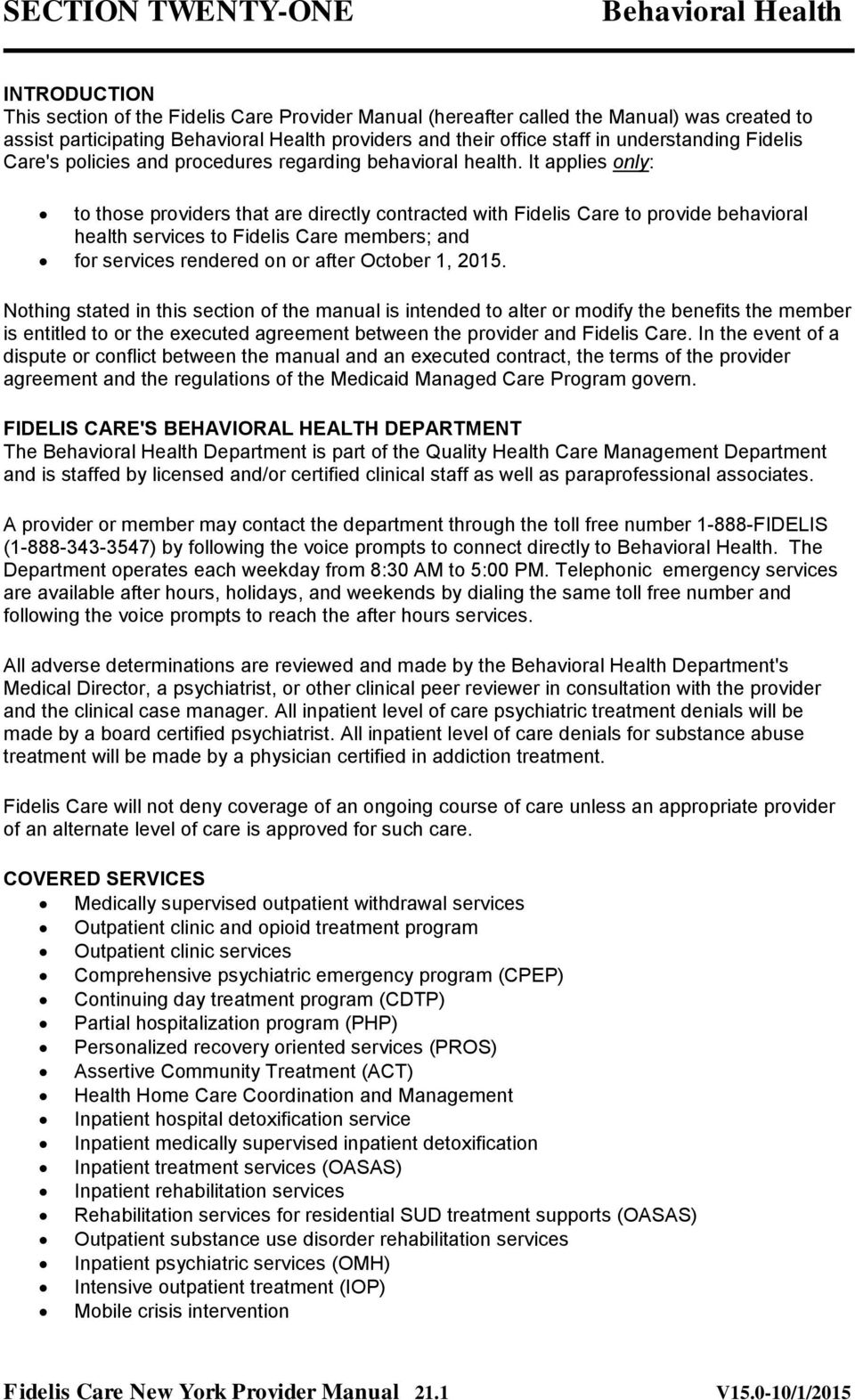
1 INTRODUCTION This section of the Fidelis Care Provider Manual (hereafter called the Manual) was created to assist participating providers and their office staff in understanding Fidelis Care's policies and procedures regarding behavioral health. It applies only: to those providers that are directly contracted with Fidelis Care to provide behavioral health services to Fidelis Care members; and for services rendered on or after October 1, Nothing stated in this section of the manual is intended to alter or modify the benefits the member is entitled to or the executed agreement between the provider and Fidelis Care. In the event of a dispute or conflict between the manual and an executed contract, the terms of the provider agreement and the regulations of the Medicaid Managed Care Program govern. FIDELIS CARE'S BEHAVIORAL HEALTH DEPARTMENT The Department is part of the Quality Health Care Management Department and is staffed by licensed and/or certified clinical staff as well as paraprofessional associates. A provider or member may contact the department through the toll free number FIDELIS ( ) by following the voice prompts to connect directly to. The Department operates each weekday from 8:30 AM to 5:00 PM. Telephonic emergency services are available after hours, holidays, and weekends by dialing the same toll free number and following the voice prompts to reach the after hours services. All adverse determinations are reviewed and made by the Department's Medical Director, a psychiatrist, or other clinical peer reviewer in consultation with the provider and the clinical case manager. All inpatient level of care psychiatric treatment denials will be made by a board certified psychiatrist. All inpatient level of care denials for substance abuse treatment will be made by a physician certified in addiction treatment. Fidelis Care will not deny coverage of an ongoing course of care unless an appropriate provider of an alternate level of care is approved for such care. COVERED SERVICES Medically supervised outpatient withdrawal services Outpatient clinic and opioid treatment program Outpatient clinic services Comprehensive psychiatric emergency program (CPEP) Continuing day treatment program (CDTP) Partial hospitalization program (PHP) Personalized recovery oriented services (PROS) Assertive Community Treatment (ACT) Health Home Care Coordination and Management Inpatient hospital detoxification service Inpatient medically supervised inpatient detoxification Inpatient treatment services (OASAS) Inpatient rehabilitation services Rehabilitation services for residential SUD treatment supports (OASAS) Outpatient substance use disorder rehabilitation services Inpatient psychiatric services (OMH) Intensive outpatient treatment (IOP) Mobile crisis intervention Fidelis Care New York Provider Manual 21.1
2 Intensive psychiatric rehabilitation treatment (IPRT) The Fidelis Care Quality Management Committee will meet monthly to review quality of care measures, accessibility to care and other issues of concern. Membership and attendance will be documented and include, at a minimum, the MCO Medical Director and Clinical Director, Director of Quality Improvement and peer, provider, family or member representation. Fidelis will submit to OMH and OASAS a quarterly report of any deficiencies in performance and corrective action taken with respect to OMH and OASAS licensed, certified or designated providers. Fidelis Care will report any serious or significant health and safety concerns to OMH and OASAS immediately upon discovery. I. BEHAVIORAL HEALTH REFERRALS A. Who may refer? 1. Member Self Referral (Medicaid only): a. Medicaid members may self refer to a participating Fidelis Care Behavioral Health (BH) provider without limitation for mental health and substance abuse assessments (except for ACT, inpatient psychiatric hospitalization, partial hospitalization, and Home and Community Based services). At enrollment, all Medicaid members are informed of their self-referral benefit and provided with information about participating BH providers. b. Providers should note that except in the case of an emergency or a valid selfreferral by a Medicaid member, all inpatient and most non routine outpatient services require prior authorization by the Department. Routine outpatient services do not require prior authorization. 2. Provider or Member Calls/Referrals to the Department: (Applies to Medicaid and Child Health Plus) a. Members may call Fidelis Care directly to receive a referral(s) from staff in the Department. b. providers should contact the BH department to register, and obtain authorization for elective (or non-emergent) member care for those services as described below under 1B. c. Emergency services DO NOT require prior authorization. This includes emergency admissions, emergency room visits, and CPEP For emergency situations, the provider should treat the member and notify the BH Department as soon as is practical, but no later than forty-eight (48) hours, or the next business day, after evaluation/treatment of the member and stabilization of acute symptoms. d. Behavioral health crisis calls: During business hours: An employee who is not on the line with the caller will contact the Behavioral Health Call Center. The Associate will immediately notify the designated BH clinician (on a rotating schedule) who will immediately connect directly with the caller without transfer or hold being required. Fidelis Care New York Provider Manual 21.2

3 The clinician has the discretion to triage the call and redirect the intervention as needed. The clinician will follow up to assure that an appropriate immediate disposition has been achieved, and will notify their supervisor so that any further clinical follow up necessary can be assigned and completed. In any situations in which a clinician was not readily available to assist with the call, after the immediate crisis has been handled, the department that received the crisis call will notify a clinical supervisor so that appropriate clinical follow up can be assigned and completed. After Business Hours: Fidelis Care s contracted after hours member line vendor will immediately respond to after hours crisis calls, assuring warm transfer access to a clinician for triage and appropriate immediate disposition. Emergency services will be engaged whenever necessary. Fidelis Care s clinical staff will review calls received by the after-hours vendor as a first priority on the next business day. A clinician will, as a first priority that day, follow up on all crisis calls received to determine member s status and assure ongoing required services are in place. Fidelis Care collaborates with the Health Homes and network PCPs to establish consistent BH screening for all members with particular focus on those with highrisk medical conditions including, but not limited to tobacco use disorder, stroke, myocardial infarction, cancer, HIV, and chronic pain. Fidelis Care screening activities will especially screen for depression, anxiety, and substance use disorders. Health Homes and PCPs will screen all individuals including those with the above high-risk medical conditions using screening tools such as the PHQ-9 for depression, CAGE and SBIRT model for substance use, the GAD 7 for anxiety and the Life Event Checklist for trauma or similar state approved instruments. Adoption and deployment of these screening tools will be done in collaboration with the Health Homes in support of their efforts toward integration of behavioral health and primary care. B. Services That Require Preauthorization: ALL COVERED NON-EMERGENT INPATIENT, RESIDENTIAL, AND MOST NON ROUTINE AMBULATORY SERVICES (EXCEPT THE MEMBER SELF REFERRAL OUTLINED ABOVE) REQUIRE AUTHORIZATION BEFORE THEY OCCUR INCLUDING: 1. Initial evaluation and treatment; 2. Medically necessary continued treatment; 3. Services or visits beyond those already authorized; 4. Any change in level of care; 5. Referral for psychological or neuropsychological testing; 6. Referral for Electro-convulsive therapy (ECT). Fidelis Care New York Provider Manual 21.3

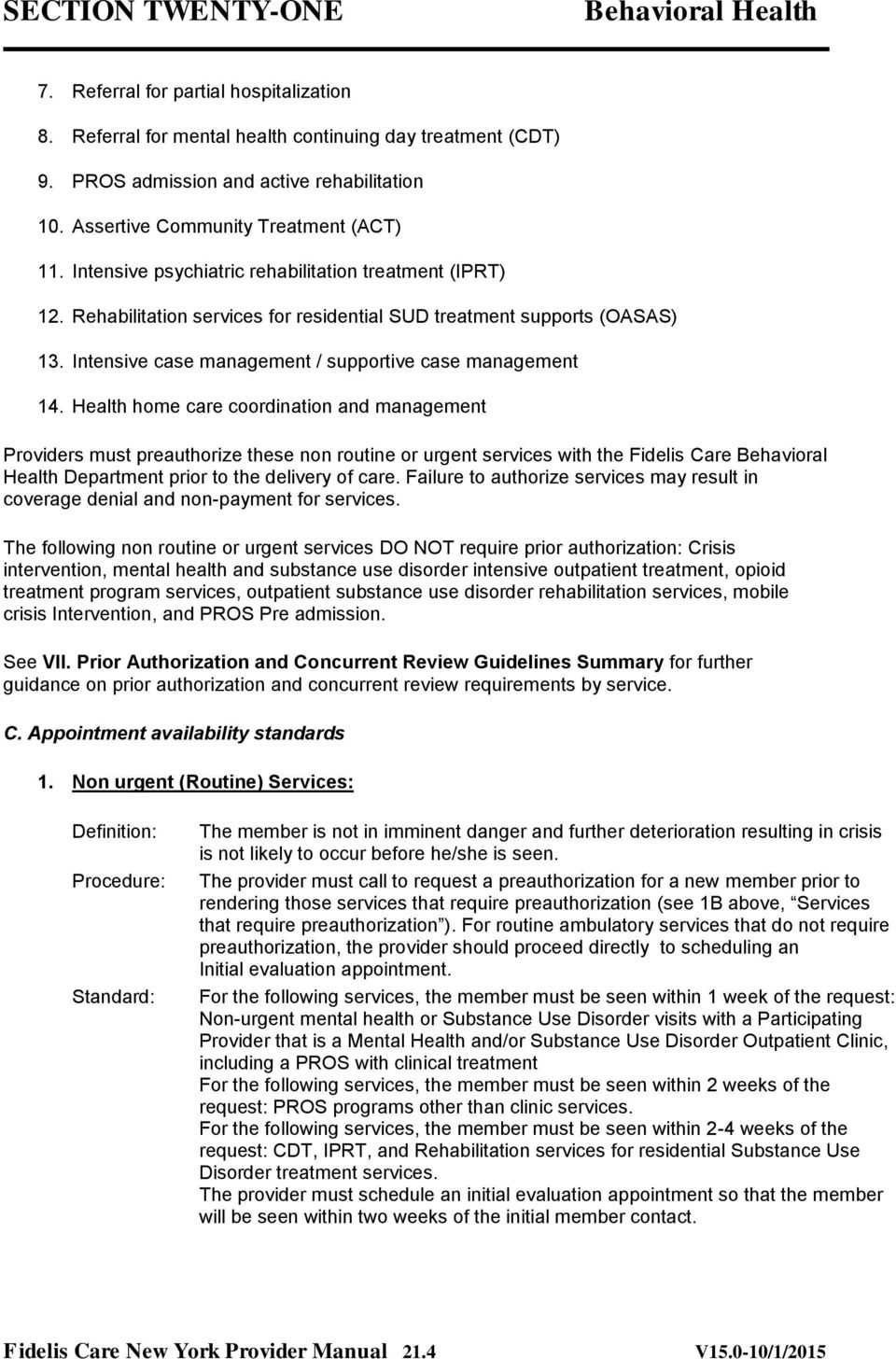
4 7. Referral for partial hospitalization 8. Referral for mental health continuing day treatment (CDT) 9. PROS admission and active rehabilitation 10. Assertive Community Treatment (ACT) 11. Intensive psychiatric rehabilitation treatment (IPRT) 12. Rehabilitation services for residential SUD treatment supports (OASAS) 13. Intensive case management / supportive case management 14. Health home care coordination and management Providers must preauthorize these non routine or urgent services with the Fidelis Care Behavioral Health Department prior to the delivery of care. Failure to authorize services may result in coverage denial and non-payment for services. The following non routine or urgent services DO NOT require prior authorization: Crisis intervention, mental health and substance use disorder intensive outpatient treatment, opioid treatment program services, outpatient substance use disorder rehabilitation services, mobile crisis Intervention, and PROS Pre admission. See VII. Prior Authorization and Concurrent Review Guidelines Summary for further guidance on prior authorization and concurrent review requirements by service. C. Appointment availability standards 1. Non urgent (Routine) Services: Definition: Procedure: Standard: The member is not in imminent danger and further deterioration resulting in crisis is not likely to occur before he/she is seen. The provider must call to request a preauthorization for a new member prior to rendering those services that require preauthorization (see 1B above, Services that require preauthorization ). For routine ambulatory services that do not require preauthorization, the provider should proceed directly to scheduling an Initial evaluation appointment. For the following services, the member must be seen within 1 week of the request: Non-urgent mental health or Substance Use Disorder visits with a Participating Provider that is a Mental Health and/or Substance Use Disorder Outpatient Clinic, including a PROS with clinical treatment For the following services, the member must be seen within 2 weeks of the request: PROS programs other than clinic services. For the following services, the member must be seen within 2-4 weeks of the request: CDT, IPRT, and Rehabilitation services for residential Substance Use Disorder treatment services. The provider must schedule an initial evaluation appointment so that the member will be seen within two weeks of the initial member contact. Fidelis Care New York Provider Manual 21.4
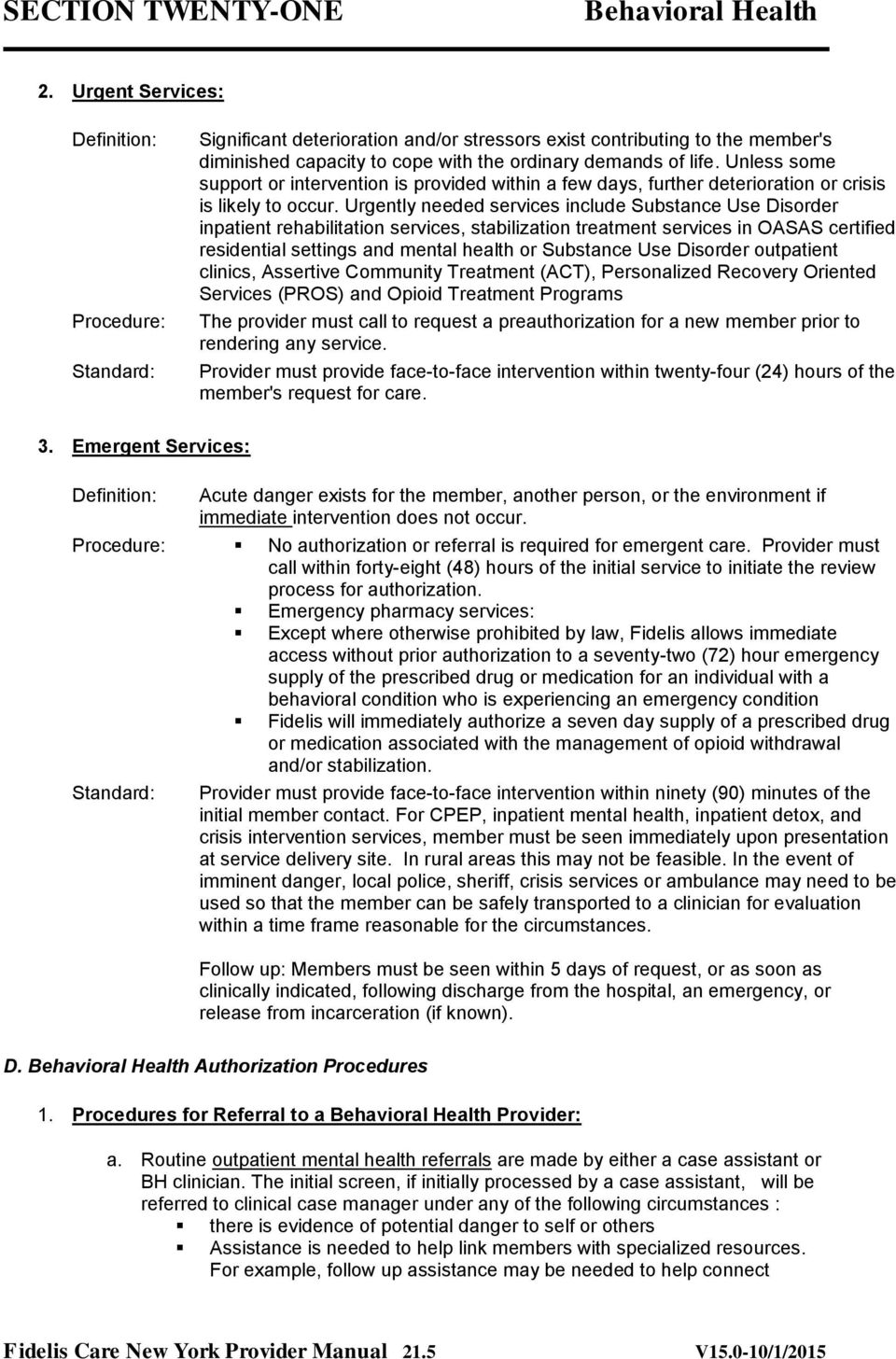
5 2. Urgent Services: Definition: Procedure: Standard: Significant deterioration and/or stressors exist contributing to the member's diminished capacity to cope with the ordinary demands of life. Unless some support or intervention is provided within a few days, further deterioration or crisis is likely to occur. Urgently needed services include Substance Use Disorder inpatient rehabilitation services, stabilization treatment services in OASAS certified residential settings and mental health or Substance Use Disorder outpatient clinics, Assertive Community Treatment (ACT), Personalized Recovery Oriented Services (PROS) and Opioid Treatment Programs The provider must call to request a preauthorization for a new member prior to rendering any service. Provider must provide face-to-face intervention within twenty-four (24) hours of the member's request for care. 3. Emergent Services: Definition: Acute danger exists for the member, another person, or the environment if immediate intervention does not occur. Procedure: No authorization or referral is required for emergent care. Provider must call within forty-eight (48) hours of the initial service to initiate the review process for authorization. Emergency pharmacy services: Except where otherwise prohibited by law, Fidelis allows immediate access without prior authorization to a seventy-two (72) hour emergency supply of the prescribed drug or medication for an individual with a behavioral condition who is experiencing an emergency condition Fidelis will immediately authorize a seven day supply of a prescribed drug or medication associated with the management of opioid withdrawal and/or stabilization. Standard: Provider must provide face-to-face intervention within ninety (90) minutes of the initial member contact. For CPEP, inpatient mental health, inpatient detox, and crisis intervention services, member must be seen immediately upon presentation at service delivery site. In rural areas this may not be feasible. In the event of imminent danger, local police, sheriff, crisis services or ambulance may need to be used so that the member can be safely transported to a clinician for evaluation within a time frame reasonable for the circumstances. Follow up: Members must be seen within 5 days of request, or as soon as clinically indicated, following discharge from the hospital, an emergency, or release from incarceration (if known). D. Authorization Procedures 1. Procedures for Referral to a Provider: a. Routine outpatient mental health referrals are made by either a case assistant or BH clinician. The initial screen, if initially processed by a case assistant, will be referred to clinical case manager under any of the following circumstances : there is evidence of potential danger to self or others Assistance is needed to help link members with specialized resources. For example, follow up assistance may be needed to help connect Fidelis Care New York Provider Manual 21.5
6 members and / or their families / significant others with appropriate resources in cases of suspected child abuse or neglect (such as child advocacy centers, child clinics, or domestic violence shelters). However, all health professionals who learn of suspected abuse are mandated by law to report it directly. There is a potential need for complex care coordination (e.g., a need for treatment of co-morbid physical and behavioral health conditions) The clinical case manager receiving the request will perform an initial assessment to determine the most appropriate, course of action, or referral for the provision of necessary care. b. Psychological and/or neuropsychological testing requires the submission of a preauthorization request specifically for testing and a clinical review by a BH clinician. c. To obtain additional visits, the provider contacts the BH call center for clinical review prior to the expiration of the visits and / or time frame that was initially authorized. d. Clinical case managers will review the clinical information supplied by the provider and will determine continued authorization of care based on: Medical necessity; Treatment progress; and/or Change in the treatment plan due to lack of progress. e. The member and provider will be notified telephonically and by mail of the authorization decision. In the event that there is some concern regarding the treatment plan, the provider will receive a phone call from the case manager to discuss the case and resolve the issue of concern. In the event an agreement is not reached between the case manager and the provider, the case manager will refer the case to the Fidelis Care physician advisor for review. f. Providers shall have policies and procedures addressing enrollees who present for unscheduled non-urgent care with aim of promoting enrollee access to appropriate care in the most appropriate setting in order to meet the recovery needs of the person seeking care. 2. Information Necessary for All Behavioral Authorizations: The following information is essential for the Department to initiate an appropriate referral and authorization: a. Member name and Fidelis Care ID number; b. Current address and phone number of the member. If the member is a child, the parent or guardian's name(s) and phone number(s); c. Initial date of service (and time of admission as indicated); d. Requested length of stay/treatment; e. Requested frequency of treatment (as applicable); Fidelis Care New York Provider Manual 21.6

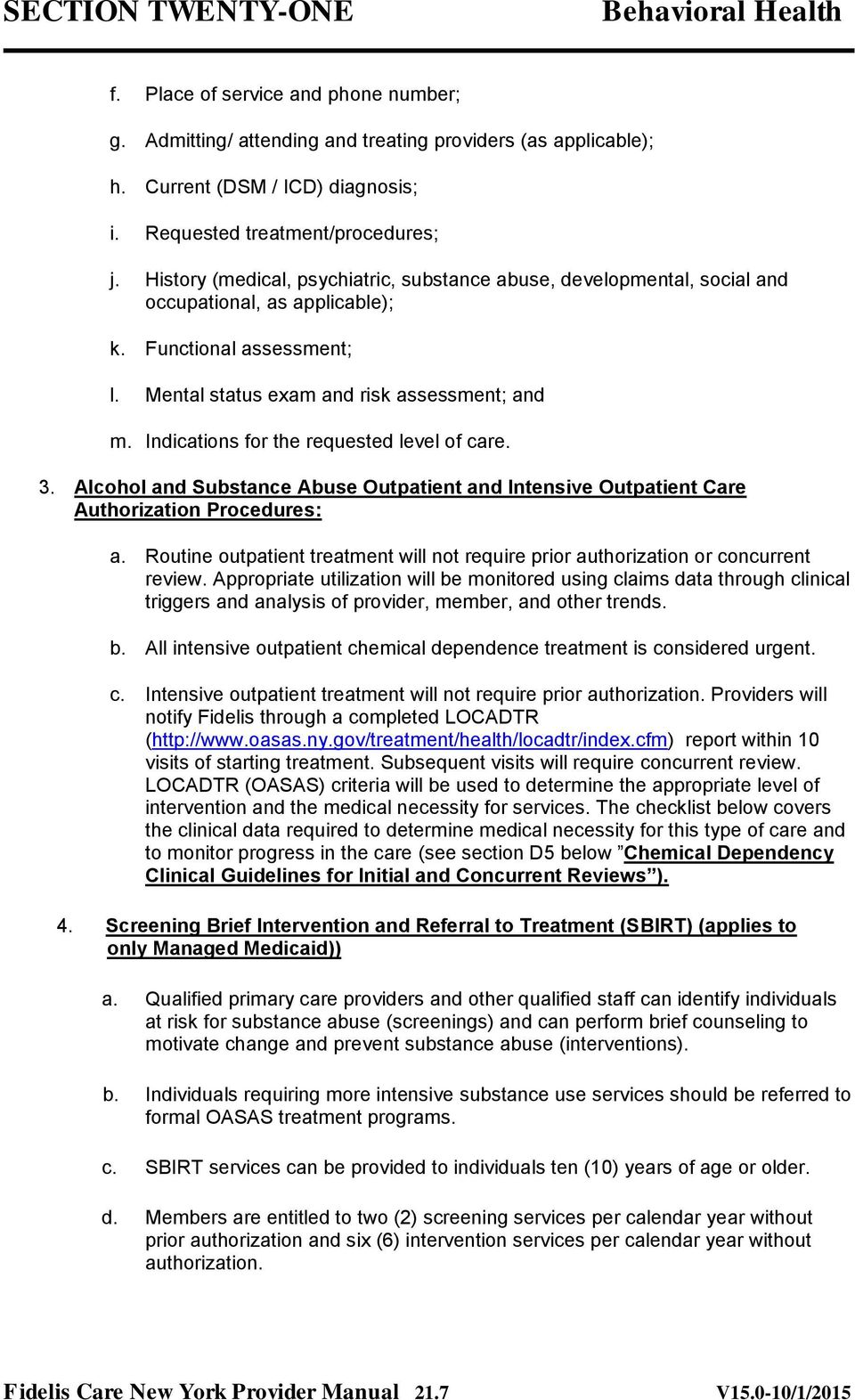
7 f. Place of service and phone number; g. Admitting/ attending and treating providers (as applicable); h. Current (DSM / ICD) diagnosis; i. Requested treatment/procedures; j. History (medical, psychiatric, substance abuse, developmental, social and occupational, as applicable); k. Functional assessment; l. Mental status exam and risk assessment; and m. Indications for the requested level of care. 3. Alcohol and Substance Abuse Outpatient and Intensive Outpatient Care Authorization Procedures: a. Routine outpatient treatment will not require prior authorization or concurrent review. Appropriate utilization will be monitored using claims data through clinical triggers and analysis of provider, member, and other trends. b. All intensive outpatient chemical dependence treatment is considered urgent. c. Intensive outpatient treatment will not require prior authorization. Providers will notify Fidelis through a completed LOCADTR ( report within 10 visits of starting treatment. Subsequent visits will require concurrent review. LOCADTR (OASAS) criteria will be used to determine the appropriate level of intervention and the medical necessity for services. The checklist below covers the clinical data required to determine medical necessity for this type of care and to monitor progress in the care (see section D5 below Chemical Dependency Clinical Guidelines for Initial and Concurrent Reviews ). 4. Screening Brief Intervention and Referral to Treatment (SBIRT) (applies to only Managed Medicaid)) a. Qualified primary care providers and other qualified staff can identify individuals at risk for substance abuse (screenings) and can perform brief counseling to motivate change and prevent substance abuse (interventions). b. Individuals requiring more intensive substance use services should be referred to formal OASAS treatment programs. c. SBIRT services can be provided to individuals ten (10) years of age or older. d. Members are entitled to two (2) screening services per calendar year without prior authorization and six (6) intervention services per calendar year without authorization. Fidelis Care New York Provider Manual 21.7
8 f. Authorization is required for services beyond two (2) screenings and six (6) interventions per calendar year. g. Members must receive an intervention service in the same visit as a positive screening. f. Claims for SBIRT services should be submitted as follows: Screening services must be submitted with HCPCS code H0049 and diagnosis V82.9 Brief intervention services must be submitted with HCPCS code H0050 and diagnosis V65.42 NYSDOH has stipulated that SBIRT services can only be provided by certified providers using screening tools advocated or approved by OASAS. In addition, the provider must have a current referral agreement with an accessible OASAS-certified treatment provider. Claims may be submitted by a certified Fidelis Care provider or a certified staff member submitted under the name of the Fidelis Care contracted provider. This service is included in the capitation rate for capitated providers. Fidelis Care will randomly audit the certification status of providers who render SBIRT-related services and the quality of the screenings and interventions provided. 5. Chemical Dependency Clinical Guidelines for Initial and Concurrent Reviews: The following information is essential for the Department to conduct an initial or concurrent review for chemical dependency (CD): a. DSM IV: Axis 1-5; b. Reason for seeking treatment at this time: job jeopardy, legal problems, marital ultimatum, specific physical consequences, etc.; c. Substance of choice, amounts, frequency, age at onset, route, last use, consequences of use/dependence; d. Prior treatment history: CD inpatient and outpatient history (where treated, how long, longest period sober/clean after treatment, etc.) and mental health treatment history; e. Current medications: type, dosage, term of use; f. Current medical problems or history: history of seizures, DTs, or complications from CD; d. Legal issues: Was probation involved? Was treatment mandated? Did the provider receive permission from the member to collaborate with probation and/or court officials? If not, how will this be addressed in the care?; e. Recent employment issues related to CD: Is job jeopardy an issue? Is a third party involved in monitoring the care? Has permission to collaborate with these Fidelis Care New York Provider Manual 21.8
9 systems been gained by the provider? If not, how will this be addressed in the care plan?; f. Family and social supports: Does the member live with other users? Are there sober supports for the member? Are there family issues that can explain CD?; g. Self Help involvement: Attendance, sponsor, home group, appropriate service, current and in the past; and h. Treatment plan: modality, frequency, self-help attendance, urine screening, and third party/family involvement, medication monitoring when appropriate. E. Guidelines for Other Levels of Care 1. Inpatient/Partial Hospitalization Discharge Procedures: a. An aftercare plan should begin when a member is admitted to an acute care hospital, residential facility or partial hospitalization program. The admitting provider should relay information regarding expected length of stay and disposition to facility staff at the time of admission. A Fidelis Care BH Case Manager will assist in coordination of aftercare plans. b. First Episode Psychosis (FEP): The provider, in collaboration with Fidelis and the Health Home (when involved), will utilize available data to identify members with FEP. Appropriate resources, such as those available through OnTrack NY (through the Center for Practice Innovations) will be engaged to assure comprehensive and integrated aftercare planning designed to facilitate prompt, extended follow up of these members to identify and address barriers to successful community tenure and avoidance of readmission. c. Once the member is ready for transition to the next level of care, the attending physician (and/or a designated professional member of the treatment team) will: 1. Provide a written aftercare plan with a copy for the member; 2. Inform the member of any post-discharge aftercare appointments; 3. Collaborate with the aftercare treatment providers as indicated; 4. Forward a copy of the discharge summary to the post-discharge provider; and 5. Give the member specific information for appropriate self-help groups such as AA/NA/CA (e.g. meeting times, locations, contact, if possible). 2. Post-Inpatient/Partial Hospitalization/Emergency Psychiatric/Post-incarceration Discharge Standards: In accordance with regulations put forth by the New York State Office of Mental Health, Fidelis Care Department requires that the discharged member be given a follow-up appointment within five (5) days post-discharge from the inpatient treatment setting. This is a "quality indicator of care" measure that will be monitored by Fidelis Care for purposes of reporting to the New York State Department of Health. As part of the oversight procedure, BH case managers or case assistants will be making Fidelis Care New York Provider Manual 21.9

10 aftercare calls to the appropriate provider to determine if the member has actually attended their post-discharge appointments. a. For those members who do not keep their aftercare appointments, the BH aftercare case manager will intervene and attempt to shore up the discharge plan, offering support and encouragement to the member to follow up with the necessary aftercare to prevent regression and relapse. II. CASE MANAGEMENT AND COORDINATION ACTIVITIES A. Confidentiality 1. For guidelines, refer to the section on Member/Provider Confidentiality in Section 2 of this manual. 2. Collaboration of care with the PCP or other specialist can occur only with the member's expressed permission, except in clinical situations that threaten the life of the member or someone else. When this degree of danger exists, providers can contact the PCP directly without member authorization. It is recommended in all other circumstances that the provider have on-file a signed release of information to the PCP or other specialist. B. Collaboration/Coordination of Care 1. Effective working relationships between providers and other treatment partners and service sites is an evidence-based practice, and thus will result in improved member health outcomes, improved continuity and coordination of care, increased quality, efficiency and effectiveness of services, and increased member satisfaction. All collaboration efforts should be documented in the medical record. 2. Why Collaboration with Primary Care Physicians (PCPs) is Necessary: Persons with mental illness die on average 25 years sooner than the average population. Members may remain untreated or under-treated if PCPs do not recognize members at risk for or with active mental or addictive disorders. Physical symptoms or general medical co-morbidity complicates most behavioral conditions. Psychotropic medications may interact adversely with other medications or cause physical side effects. Medical laboratory or physical examinations may be necessary for members on psychotropic medications. The PCP may prescribe psychotropic medications themselves. 3. In addition to mitigating the physical health risks associated with mental illness, promoting healthy behaviors also requires close collaboration and coordination with PCPs and other health professionals for member safety and optimal quality of care. 4. Behavioral healthcare providers should communicate with the member's PCP: a. For the exchange of clinical information, when necessary, that may aid in diagnosis and/or treatment; b. When the PCP's support for a treatment plan would enhance member satisfaction and/or compliance; c. When there are possible medical co-morbidities and/or medication interactions that need to be considered; and d. When PCP has requested immediate feedback. Fidelis Care New York Provider Manual 21.10
11 5. If the member is using behavioral health services in a clinic that also provides primary care services, enrollee may select lead behavioral health provider to function as their PCP. 6. Fidelis Care staff conducts annual site visits to selected providers' offices to provide education and performs a chart review to verify that collaboration of care is occurring and clinical documentation is meeting industry standards. C. High Risk Case Management Overview 1. Case Management is a collaborative process that assesses, plans, implements, coordinates, monitors, and tailors services to meet an individual member's needs. When there is a high potential for recurrence or exacerbation of the member's symptoms, and/or the high potential for rapid re-hospitalization, such high-risk members may benefit from more intensive case management activities. 2. Providers can assist Services in identifying members who may benefit from high-risk case management using the following screening criteria: a. All members who have been hospitalized three or more times for inpatient BH psychiatric treatment within the last 12 months; b. Anyone who has received chemical dependency treatment who has a serious psychiatric condition and/or history of a serious medical condition; and c. Anyone presenting in an emergency room with behavioral health symptoms but not admitted three or more times within the last 12 months. 3. Members who meet above high risk criteria will be reviewed for referral to a Health Home, if not already assigned. The Fidelis Case Manager will coordinate closely with the Health Home Care Manager and involved providers in assuring the member s needs are comprehensively assessed, and that the resulting individualized care plan includes the full range of required behavioral, medical, pharmacy, and other home and community services. 4. If a member is identified as high risk, the member has the right to agree or not agree to participate in the case management process. If the member agrees to participate, the Case Manager (in consultation with the provider) will conduct a member assessment and work with the member and provider to develop a care plan that will include, but not be limited to, mutually agreed upon goals, measurable objectives, and action steps toward goal achievement. 5. For members who have received inpatient care in the recent past, the plan for high risk follow-up should optimally be presented to the member during the current hospital admission process and again prior to the member's discharge from the inpatient facility. The goal of the inpatient treatment team should be to gain the member's understanding and engagement in working with the team to not only prevent further hospitalizations, but also to design and coordinate aftercare services and supports that supports the Member s recovery goals.. 6. Care plan implementation includes referring the member to appropriate providers or facilities, monitoring the services to ensure that those being provided are addressing the member's specific behavioral health care needs, and ensuring adherence to with the treatment plan by measuring progress against defined short-term and long-term goals. Fidelis Care New York Provider Manual 21.11
12 This may include follow-up with the member and providers by calling and/or visiting, monitoring claims activity, coordinating with the Health Home care manager and / or downstream providers, documenting progress in the treatment plan, and re-evaluating and revising the treatment plan as necessary. 7. The Case Manager will work with the provider to provide the member and family information to make empowered decisions regarding: a. The disease process; b. Available benefits; and c. Available community resources. III. ADMINISTRATIVE POLICIES/PROCEDURES A. Coverage by another Provider 1. Independent Providers: a. Services are only to be rendered by the provider named in the authorization process. Only participating Fidelis Care providers will be approved by the Fidelis Care Department to render routine or urgent services. b. Providers should not schedule routine services to be rendered by another provider (e.g., vacation, time off) unless approved in advance by the Fidelis Care Department. In the event a member requires treatment and the approved provider is not available, the Fidelis Care Department must be contacted to arrange for covering treatment by another participating provider. c. If a covering provider submits a claim for routine or urgent services without authorization, the claim will be denied. Authorization expectations should be clearly explained to the covering provider and arrangements made for reimbursement directly between the provider of record and the covering provider in the event an authorization is not obtained. 2. Agency Providers: If a behavioral health agency is under contract with Fidelis Care and has met all credentialing standards, authorized services may be provided by any of the agency's participating facilities or staff providers. Prior notification to Fidelis Care is not required as long as the facility or staff provider serving the Fidelis Care member has met all professional credentialing standards. Credentialing criteria for OMH-licensed and OASAS certified behavioral health providers When credentialing OMH-licensed, OMH-operated and OASAS-certified providers, plans will accept OMH and OASAS licenses and certifications in place of any credentialing process for individual employees, subcontractors or agents of such providers. The Contract shall collect and will accept program integrity related information as part of the licensing and certification process. Credentialing criteria for designated HCBS providers (subject to final HCBS credentialing issues) Fidelis Care will accept State-issued HCBS designation in place of plan credentialing process for HCBS providers and any individual employees, subcontractors or agents. Fidelis Care New York Provider Manual 21.12

13 Fidelis Care will collect and accept program integrity related information as part of the licensing and certification process. Fidelis Care requires that such providers not employ or contract with any employee, subcontractor or agent who has been debarred or suspended by the federal or state government, or otherwise excluded from participation in the Medicare or Medicaid program. B. Member/Provider Confidentiality: Release of Information to Other Health Care Providers Based on State and Federal mandates, confidentiality of members must be protected by providers. Providers are encouraged to have members sign a release of information form for all parties involved in collaboration efforts including but not limited to: Primary Care Physicians, other medical providers, and other behavioral health providers. A sample release of information form can be found in the Fidelis Care Provider Manual. Each healthcare provider shall develop policies and procedures to assure confidentiality of Mental Health/Substance Use related information. These policies and procedures must include: (a) initial and annual in-service education of staff, contractors (b) identification of staff allowed access and limits of access (c) procedure to limit access to trained staff (including contractors) (d) protocol for secure storage (including electronic storage) (e) procedures for handling requests for Mental Health/Substance Use information and protocols to protect persons with behavioral health and/or substance use disorder from discrimination C. Provider training including cultural competency. Fidelis Care will make available to all providers training on the levels of care available to its members to make effective and efficient use of these non-traditional models of care. Training will also be made available on Person Centered Care, Trauma Informed Care and Cultural Competency at least annually. IV. BEHAVIORAL HEALTH CLINICAL POLICIES AND PROCEDURES A. Fidelis Care Medical /Clinical Necessity Review Criteria The Fidelis Care Quality Management and Peer Review Committee reviews all protocols, criteria, guidelines, and procedures utilized in the Medical Management Program at a minimum of once yearly. These pre-established criteria are used for decision-making related to the clinical or medical appropriateness of care, least restrictive yet acceptable safety level of care, appropriate setting of care, and appropriate provider of care. Updated criteria are obtained from the following sources as they become available and incorporated into Fidelis Care's Policies and Procedures Manual and the Medical Management Program Description. Criteria as described in the clinical section of this manual include: Fidelis Care uses the most current version of OASAS Level of Care for Alcohol and Drug Treatment Referral (LOCADTR) to determine medical necessity for all levels of substance abuse rehabilitation and other outpatient levels of chemical dependency treatment2 Fidelis Care utilizes the most current version of the MCG Care Guidelines (Milliman criteria) to determine medical necessity for all required mental health services for which guidelines have been developed. These services include: Inpatient psychiatric services Fidelis Care New York Provider Manual 21.13
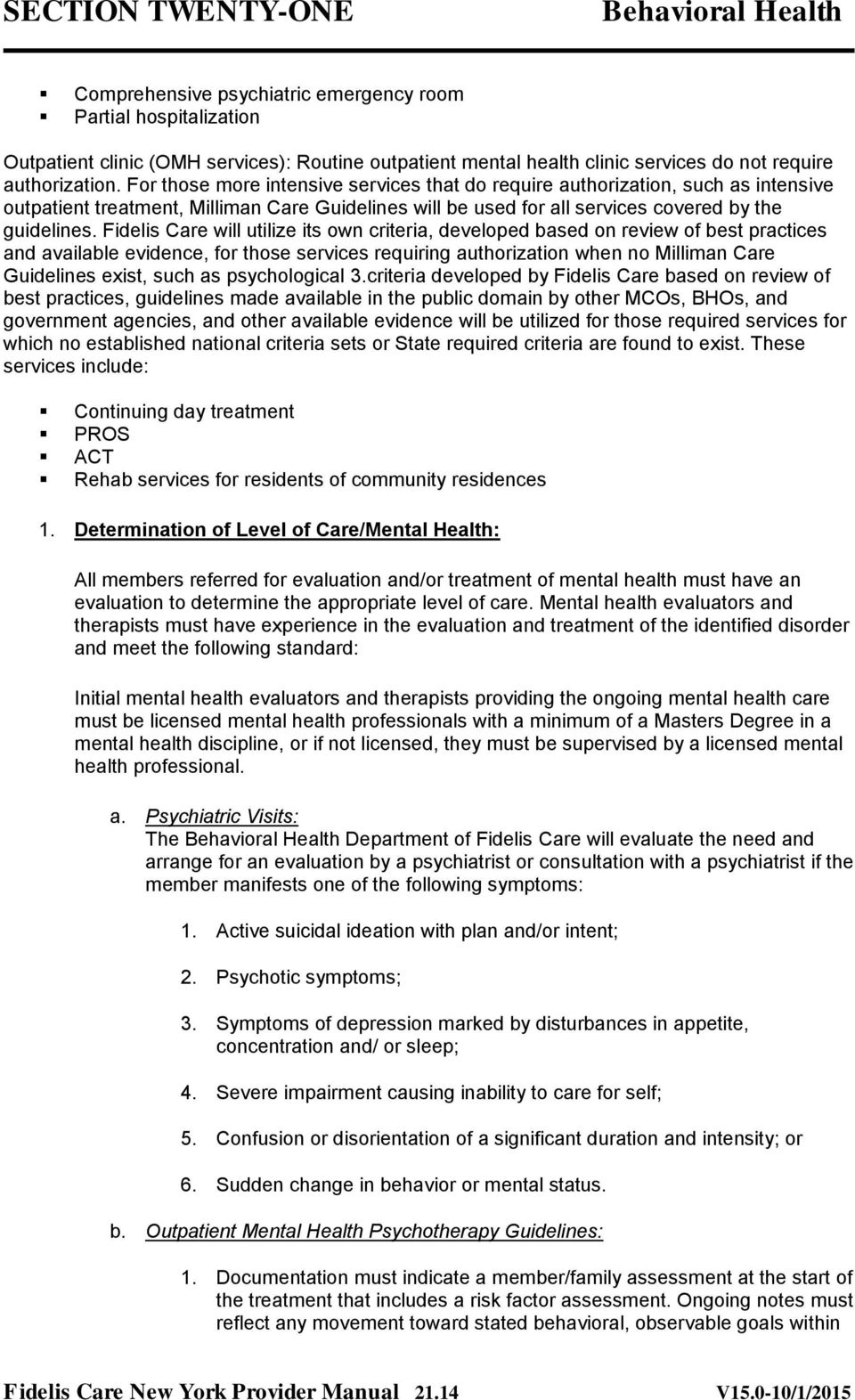
14 Comprehensive psychiatric emergency room Partial hospitalization Outpatient clinic (OMH services): Routine outpatient mental health clinic services do not require authorization. For those more intensive services that do require authorization, such as intensive outpatient treatment, Milliman Care Guidelines will be used for all services covered by the guidelines. Fidelis Care will utilize its own criteria, developed based on review of best practices and available evidence, for those services requiring authorization when no Milliman Care Guidelines exist, such as psychological 3.criteria developed by Fidelis Care based on review of best practices, guidelines made available in the public domain by other MCOs, BHOs, and government agencies, and other available evidence will be utilized for those required services for which no established national criteria sets or State required criteria are found to exist. These services include: Continuing day treatment PROS ACT Rehab services for residents of community residences 1. Determination of Level of Care/Mental Health: All members referred for evaluation and/or treatment of mental health must have an evaluation to determine the appropriate level of care. Mental health evaluators and therapists must have experience in the evaluation and treatment of the identified disorder and meet the following standard: Initial mental health evaluators and therapists providing the ongoing mental health care must be licensed mental health professionals with a minimum of a Masters Degree in a mental health discipline, or if not licensed, they must be supervised by a licensed mental health professional. a. Psychiatric Visits: The Department of Fidelis Care will evaluate the need and arrange for an evaluation by a psychiatrist or consultation with a psychiatrist if the member manifests one of the following symptoms: 1. Active suicidal ideation with plan and/or intent; 2. Psychotic symptoms; 3. Symptoms of depression marked by disturbances in appetite, concentration and/ or sleep; 4. Severe impairment causing inability to care for self; 5. Confusion or disorientation of a significant duration and intensity; or 6. Sudden change in behavior or mental status. b. Outpatient Mental Health Psychotherapy Guidelines: 1. Documentation must indicate a member/family assessment at the start of the treatment that includes a risk factor assessment. Ongoing notes must reflect any movement toward stated behavioral, observable goals within Fidelis Care New York Provider Manual 21.14
15 a stated time frame. Changes in diagnosis or treatment plan must be documented. 2. A plan for termination and discharge plan must be made during the assessment period. The only exception to this will be therapeutic stabilization and medication management for chronic conditions. 3. Referral for medication assessment must be made in a timely manner for diagnoses such as panic disorder and depression. There must be collaboration between the medicating physician and the psychotherapist. 4. Standard of care for individual sessions is at least thirty (30) minutes. Medication management sessions can be of shorter duration. The standard of care for group sessions is sixty (60) to ninety (90) minutes. 5. Only one provider will be authorized to provide individual psychotherapy to the member. 6. Psychotherapy should not occur within twenty-four (24) hours following an ECT treatment or while the member is significantly cognitively impaired. 7. Psychodynamic Psychotherapy is not indicated for a member who is actively using drugs or alcohol and cannot reliably contract for abstinence while attending the treatment. Focus of intervention with the member should be assessing for the Member s current readiness for change, and transitioning the member into substance abuse treatment within a defined number of sessions accordingly 2. Determination of Level of Care/Chemical Dependency All members referred for evaluation and/or treatment of chemical dependency must have an evaluation completed to determine the appropriate level of care. Authorization of services is not required for routine outpatient services, but is required for more intensive services (as described above) that are covered by the plan according to the benefit package. Levels of Care for Chemical Dependency: a. Outpatient Services: 1. Treatment provided by professional staff; 2. Supplemented by self-help groups; 3. One (1) to three (3) hours/day for up to three (3) days/week; 4. Uses a multidisciplinary team to provide individualized physical, psychiatric and addiction treatment (It is preferable that all services are provided in the context of a chemical dependency environment.); and 5. Primary treatment modality is group. (Family and individual counseling sessions should be based on an individualized treatment plan. Individual Fidelis Care New York Provider Manual 21.15

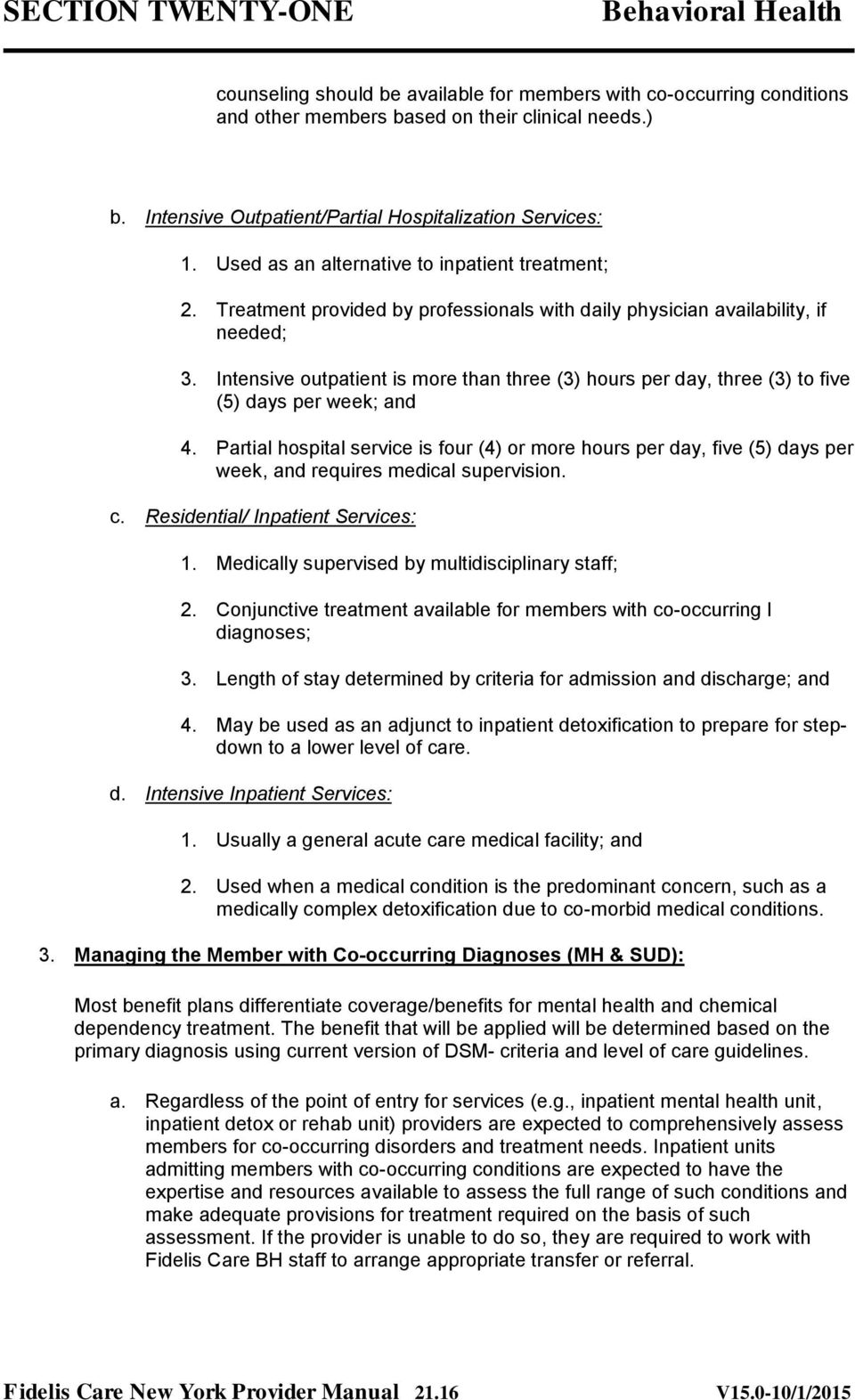
16 counseling should be available for members with co-occurring conditions and other members based on their clinical needs.) b. Intensive Outpatient/Partial Hospitalization Services: 1. Used as an alternative to inpatient treatment; 2. Treatment provided by professionals with daily physician availability, if needed; 3. Intensive outpatient is more than three (3) hours per day, three (3) to five (5) days per week; and 4. Partial hospital service is four (4) or more hours per day, five (5) days per week, and requires medical supervision. c. Residential/ Inpatient Services: 1. Medically supervised by multidisciplinary staff; 2. Conjunctive treatment available for members with co-occurring l diagnoses; 3. Length of stay determined by criteria for admission and discharge; and 4. May be used as an adjunct to inpatient detoxification to prepare for stepdown to a lower level of care. d. Intensive Inpatient Services: 1. Usually a general acute care medical facility; and 2. Used when a medical condition is the predominant concern, such as a medically complex detoxification due to co-morbid medical conditions. 3. Managing the Member with Co-occurring Diagnoses (MH & SUD): Most benefit plans differentiate coverage/benefits for mental health and chemical dependency treatment. The benefit that will be applied will be determined based on the primary diagnosis using current version of DSM- criteria and level of care guidelines. a. Regardless of the point of entry for services (e.g., inpatient mental health unit, inpatient detox or rehab unit) providers are expected to comprehensively assess members for co-occurring disorders and treatment needs. Inpatient units admitting members with co-occurring conditions are expected to have the expertise and resources available to assess the full range of such conditions and make adequate provisions for treatment required on the basis of such assessment. If the provider is unable to do so, they are required to work with Fidelis Care BH staff to arrange appropriate transfer or referral. Fidelis Care New York Provider Manual 21.16
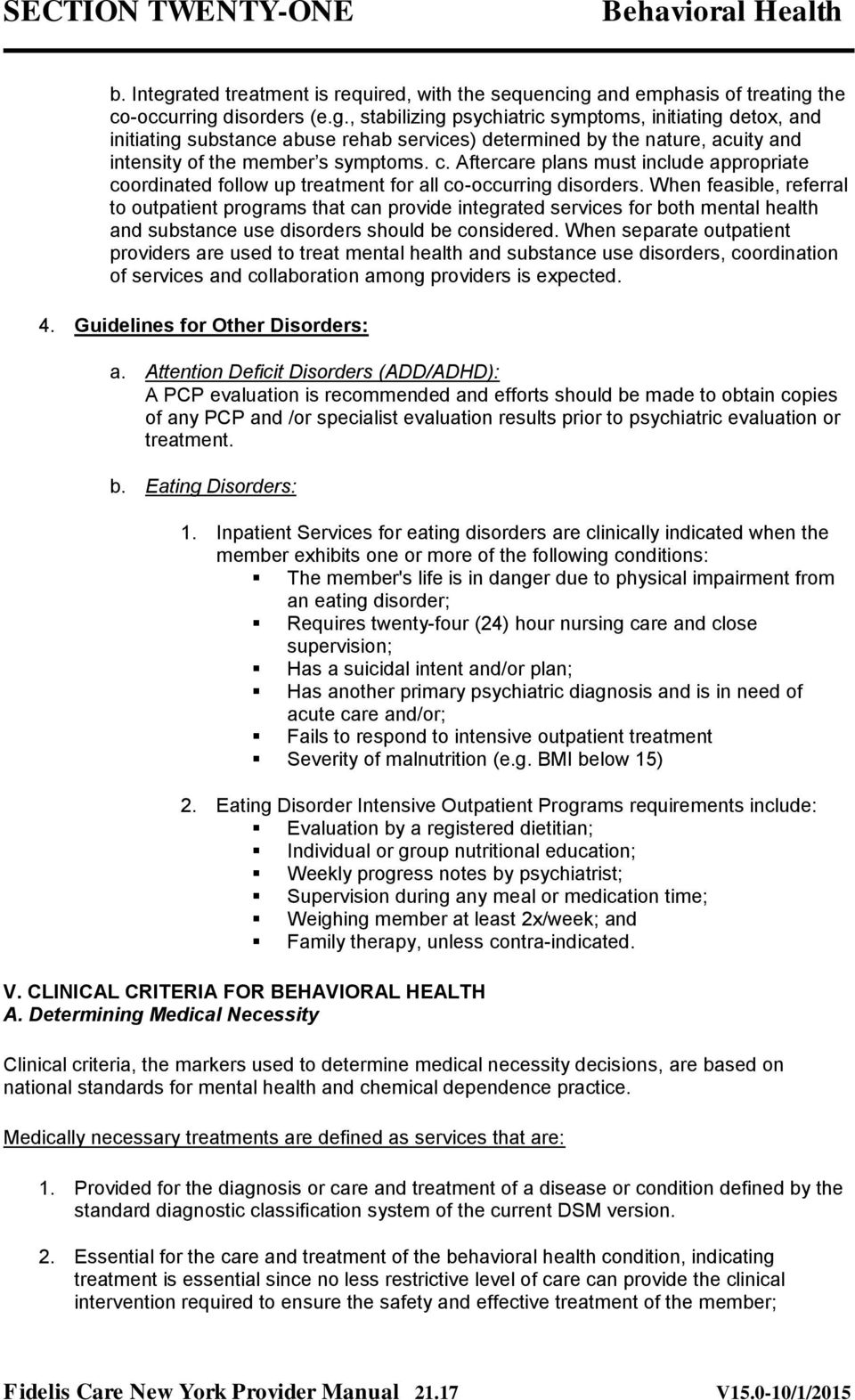
17 b. Integrated treatment is required, with the sequencing and emphasis of treating the co-occurring disorders (e.g., stabilizing psychiatric symptoms, initiating detox, and initiating substance abuse rehab services) determined by the nature, acuity and intensity of the member s symptoms. c. Aftercare plans must include appropriate coordinated follow up treatment for all co-occurring disorders. When feasible, referral to outpatient programs that can provide integrated services for both mental health and substance use disorders should be considered. When separate outpatient providers are used to treat mental health and substance use disorders, coordination of services and collaboration among providers is expected. 4. Guidelines for Other Disorders: a. Attention Deficit Disorders (ADD/ADHD): A PCP evaluation is recommended and efforts should be made to obtain copies of any PCP and /or specialist evaluation results prior to psychiatric evaluation or treatment. b. Eating Disorders: 1. Inpatient Services for eating disorders are clinically indicated when the member exhibits one or more of the following conditions: The member's life is in danger due to physical impairment from an eating disorder; Requires twenty-four (24) hour nursing care and close supervision; Has a suicidal intent and/or plan; Has another primary psychiatric diagnosis and is in need of acute care and/or; Fails to respond to intensive outpatient treatment Severity of malnutrition (e.g. BMI below 15) 2. Eating Disorder Intensive Outpatient Programs requirements include: Evaluation by a registered dietitian; Individual or group nutritional education; Weekly progress notes by psychiatrist; Supervision during any meal or medication time; Weighing member at least 2x/week; and Family therapy, unless contra-indicated. V. CLINICAL CRITERIA FOR BEHAVIORAL HEALTH A. Determining Medical Necessity Clinical criteria, the markers used to determine medical necessity decisions, are based on national standards for mental health and chemical dependence practice. Medically necessary treatments are defined as services that are: 1. Provided for the diagnosis or care and treatment of a disease or condition defined by the standard diagnostic classification system of the current DSM version. 2. Essential for the care and treatment of the behavioral health condition, indicating treatment is essential since no less restrictive level of care can provide the clinical intervention required to ensure the safety and effective treatment of the member; Fidelis Care New York Provider Manual 21.17
18 3. Adequate for the care and treatment of the behavioral health condition indicating treatment is considered adequate if the assessment and treatment plan are clinically appropriate, comprehensive, and active, with timely monitoring and revision; 4. Considered generally acceptable medical practice based on national standards of clinical practice and current clinical research; and 5. Have a reasonable expectation of being successful in alleviating symptoms and/or improving member functioning. B. General Criteria for Clinical Review Inpatient Care The following conditions substantiate the necessity of inpatient admission for clinical care of a behavioral health condition: 1. Serious psychiatric symptoms indicating the inability of the member to care for him/herself or that are potentially life threatening if not treated at this level of care; 2. Actual or high probability of being a danger to self, others or property, with serious current display of these symptoms and behaviors; 3. Identified psychosocial stressors occurring immediately prior to admission that may be precipitants of the escalation of severe symptoms and may have significant impact on the safety of the member and diminish the capacity of the member to comply with lesser level of care treatment; and 4. An inability of the member to engage in management at a lesser level of care due to acute symptoms that result in one or more of the following: a. not keeping outpatient appointments; b. high risk or runaway behavior; c. profound decrease in social and/or occupational functioning from baseline; d. not taking medications as prescribed; or e. worsening of significant symptoms despite stepped up outpatient treatment as member's symptoms increased. The following are required to support medical necessity and the adequacy of the inpatient treatment plan: 1. A comprehensive assessment of previous behavioral health treatment plans; 2. Evaluation of the outcome of the prior treatments; 3. Documentation that the proposed treatment plan for the current level of care addresses the specific clinical presentation of the member and is not a repetition of a previously unsuccessful plan of treatment (unless the circumstances and/or member s condition has Fidelis Care New York Provider Manual 21.18

19 changed such that specific indications are now evident to suggest the member would benefit from the same treatment plan to a greater extent than previously); and 4. Clear identification of the target symptoms, goals, and objectives of treatment include objective measures that can be assessed within a specified time frame. The following should be present to validate the medical necessity for continued inpatient care: 1. Progress in diminishing the target symptoms is evident and measurable; 2. Treatment is active and realistic in its goals and flexibly revised if the member's condition does not improve within an expected time frame; 3. Family and social supports have been assessed in a substantive manner with the member and family participating in the treatment program to the extent that they are capable and to the extent that the Member consents; and 4. Discharge planning is initiated during the assessment phase of treatment. The following should be present to validate the readiness of the member for discharge to a lower level of care: 1. The member's level of functioning has improved to the extent that clinical stability can be maintained in a less restrictive treatment setting and the member does not require twenty-four (24) hour supervision; and 2. Improvement in the following areas: a. Increased self control over the expression of thoughts and feelings and demonstrated appropriate behavior and increased self management; b. Identification, if not implementation, of appropriate coping strategies to deal with stressors; c. Member has verbalized and/or demonstrated a commitment to the aftercare planning process; d. Re-established relationships with significant others and activities that are necessary in order to maintain adequate social and/or occupational functioning; e. Understanding of and informed consent to the prescribed medication regime. Member is willing and able to collaborate with their community provider, independently or with the help of a significant other, to address any issues regarding their medication; f. The member has made a commitment to the aftercare plan for continued treatment at a lesser level of care. Fidelis Care New York Provider Manual 21.19

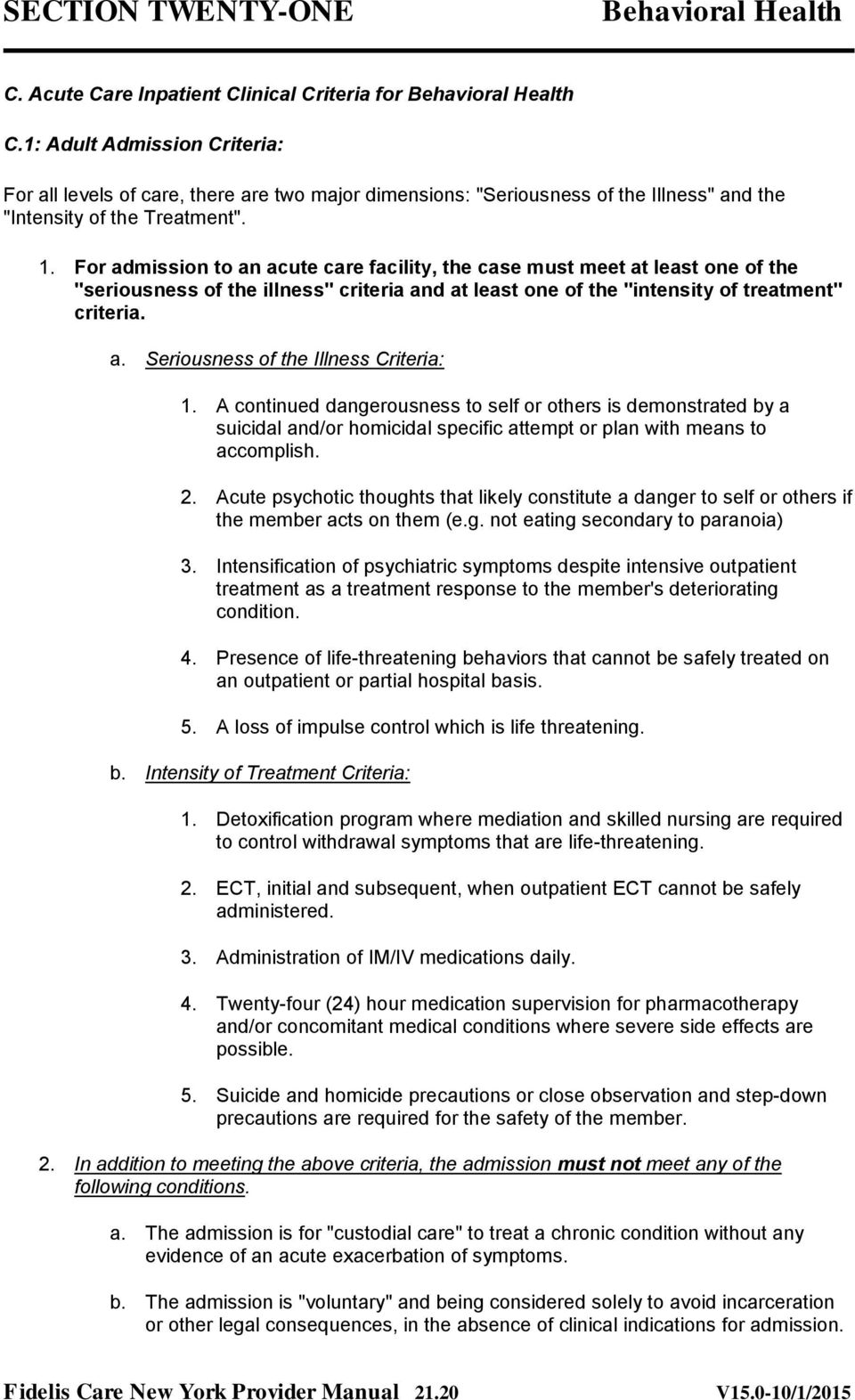
20 C. Acute Care Inpatient Clinical Criteria for C.1: Adult Admission Criteria: For all levels of care, there are two major dimensions: "Seriousness of the Illness" and the "Intensity of the Treatment". 1. For admission to an acute care facility, the case must meet at least one of the "seriousness of the illness" criteria and at least one of the "intensity of treatment" criteria. a. Seriousness of the Illness Criteria: 1. A continued dangerousness to self or others is demonstrated by a suicidal and/or homicidal specific attempt or plan with means to accomplish. 2. Acute psychotic thoughts that likely constitute a danger to self or others if the member acts on them (e.g. not eating secondary to paranoia) 3. Intensification of psychiatric symptoms despite intensive outpatient treatment as a treatment response to the member's deteriorating condition. 4. Presence of life-threatening behaviors that cannot be safely treated on an outpatient or partial hospital basis. 5. A loss of impulse control which is life threatening. b. Intensity of Treatment Criteria: 1. Detoxification program where mediation and skilled nursing are required to control withdrawal symptoms that are life-threatening. 2. ECT, initial and subsequent, when outpatient ECT cannot be safely administered. 3. Administration of IM/IV medications daily. 4. Twenty-four (24) hour medication supervision for pharmacotherapy and/or concomitant medical conditions where severe side effects are possible. 5. Suicide and homicide precautions or close observation and step-down precautions are required for the safety of the member. 2. In addition to meeting the above criteria, the admission must not meet any of the following conditions. a. The admission is for "custodial care" to treat a chronic condition without any evidence of an acute exacerbation of symptoms. b. The admission is "voluntary" and being considered solely to avoid incarceration or other legal consequences, in the absence of clinical indications for admission. Fidelis Care New York Provider Manual 21.20
21 c. The member s condition could be adequately managed at a less restrictive level of care d. Admission is solely for the need of an alternative living environment. C.2: Adult Continued Stay Inpatient Criteria 1. For continued stay at an acute care facility, at least one of the following "seriousness of the illness" criteria and at least one of the "intensity of treatment" criteria must apply. a. Seriousness of the Illness Criteria: 1. Chemical dependence with continued evidence of life-threatening withdrawal signs and symptoms. 2. Persistence of acute specific threat to self or others defined by a suicidal or homicidal attempt or a plan with means and intent. 3. Despite aggressive treatment interventions, continued evidence of severe symptoms or impairments such as: a. acute psychosis; b. acute disorientation; c. severe dysfunctional behavior such as psychomotor retardation or agitation; or d. catatonia, or e. inability to perform basic self-care and activities of daily living. b. Intensity of Treatment Criteria: 1. Inpatient detoxification protocol continues to be required to control lifethreatening withdrawal symptoms. 2. Monitoring or changing of drug regime with possible serious side effects. 3. Inpatient course of ECT is continuing where outpatient ECT is not clinically indicated. 4. Continuing daily administration of IM/IV medications. 5. Continuing close medical supervision for psycho-pharmacotherapy and/or concomitant medical conditions where severe side effects are possible. 6. Continuing need for the use of suicide and homicide precautions or close observation and step-down precautions are required for the safety of the member. 2. In addition to meeting the above criteria, the continued stay must not meet any of the following conditions: Fidelis Care New York Provider Manual 21.21
22 a. Member is non-responsive to the acute care treatment with no change in clinical status (or has exhibited additional serious symptoms) and there is no change in the treatment plan that indicates a clinical explanation for such stasis. b. Continued stay solely because there is no alternative placement or disposition available, unless member meets criteria and has been formally placed on alternate level of care status by the provider, with an adequate discharge & placement plan and active, frequent placement efforts demonstrated on a continued basis. c. Treatment and the length of stay are dictated solely by a research protocol or program design, not the needs of the member. d. Refusal of active treatment intervention by the member or family when treatment is medically advised. e. Therapeutic passes greater in length than twelve (12) hours when member shows the ability to function in a less structured environment. C.3 Child/Adolescent Admission and Continued Stay Inpatient Criteria 1. For admission and continued stay at an acute care facility, at least one of the following "seriousness of the illness" and one of the "intensity of treatment" criteria must apply: a. Seriousness of the Illness Criteria: 1. Current and persistent life-threatening danger to self or others is demonstrated by a specific suicidal and/or homicidal attempt or plan with means to accomplish this plan. 2. Current dangerous behavior such as self-mutilation and significant risktaking where lesser levels of care will not adequately contain the adolescent or child. 3. Acute psychotic thoughts that likely constitute a danger to self or others if the member acts on these thoughts. 4. Intensification of serious psychiatric symptoms that impede normal development, despite intensive outpatient treatment as a treatment response to the member's deteriorating condition. 5. Presence of life-threatening behaviors that are not safely treated on an outpatient or partial hospital basis. 6. Presence of other behaviors or symptoms to such a degree that nonacute residential services or partial hospitalization would be insufficient due to: a. Repeated running away from home (other than to an acquaintance or structured shelter or runaway program) that poses a clear risk to physical safety; b. Ritualistic/obsessive compulsive behavior; Fidelis Care New York Provider Manual 21.22
23 c. Verbal aggression coupled with a history of violence and severe aggression; or d. Explosive behavior without provocation, or serious loss of impulse control. b. Intensity of Treatment Criteria: 1. Detoxification program where medication and skilled nursing are required to control withdrawal symptoms which are life-threatening. 2. Administration of IM/IV medications daily hour medication supervision for pharmacotherapy and/or concomitant medical conditions where severe side effects are possible. 4. Suicide and homicide precautions or close observation and step-down precautions are required for the safety of the child/adolescent. 5. Rapid in-depth, assessment, and treatment of family dysfunction that has failed to improve with intensive outpatient attempts at remediation. 2. In addition to meeting the above criteria, the admission must not meet any of the following conditions: a. The admission is for "custodial care" to treat a chronic condition without any evidence of an acute exacerbation of symptoms. b. The member s condition could be adequately managed at a less restrictive level of care. c. The admission is "voluntary" and being considered solely to avoid incarceration or other legal consequences, in the absence of clinical indications for admission. d. Inability to function in a regular school environment is the sole reason for admission, with the goal being to attain a special school placement. e. Admission is solely for the need of an alternative living environment 3. Fidelis supports the following national standards for timely adolescent/child evaluation when admitted to an acute psychiatric care setting: a. Within twenty-four (24) hours of admission: 1. Contact with family to determine, at a minimum, the history of the presenting problem and what measures have been taken to address the problem. 2. History of the present illness and previous recent treatment, including a substance abuse history. Fidelis Care New York Provider Manual 21.23
24 b. For continuing care (Within three (3) days after admission): 1. Assessment of the following: substance abuse, eating disorders, physical/sexual abuse, school functioning. 2. Face to face family meeting. (The standard of care for family involvement in treatment is twice weekly family sessions.) 3. Assessment of developmental strengths and limitations of the child/adolescent. 4. Coordinate current care with any community provider who had been treating the child or adolescent prior to admission. 5. Initiate formal discharge plan. 4. Adolescent and child inpatient treatments offer specific challenges to providers and practitioners. The following is a list of common problem areas in the care of children and adolescents that are flags for review of medical necessity and appropriateness of care: a. Treatment of a child or adolescent without assessment of the family. b. Treatment of a child or adolescent far from home, making family involvement in the treatment very difficult. c. Use of hospitalization of a child or adolescent when the major issue is a disposition problem rather than an illness so severe as to meet medical necessity criteria for inpatient acute care. d. Acute treatment beyond a brief evaluation of conduct disorder and oppositional defiance disorder. e. Failure to assess chemical dependence in the child or adolescent. f. Failure to involve the family in active and timely treatment. g. Lack of intervention when sexual abuse, substance abuse, neglect or violence in the family endangers the health or safety of the child or adolescent. h. Failure of the provider to appropriately contact and do follow-up with protective services when reporting of child or adult abuse is indicated. i. Continued inpatient treatment of a child or adolescent when the family refuses to comply with an essential aspect of the treatment plan as ordered by the physician. j. Lack of active and dynamic discharge planning during the initial phase of admission and throughout the hospital course, particularly concerning whether the child or adolescent can return home when ready for discharge. D. Partial Hospital Care-Clinical Criteria for 1. Adult/Child/Adolescent Admission and Continued Stay Partial Hospital Criteria: Fidelis Care New York Provider Manual 21.24
25 The purposes of utilizing a Partial Hospitalization program include the following: a. Provide stabilization of acute severe mental illness b. Provide therapeutic diversion from inpatient care; or c. Minimize and /or stabilize the acute exacerbation of symptoms in a chronic illness. d. Provide supportive transitional services to members who have stepped down from acute care, require minimal supervision to avoid risk, and need transition services to restore family, school, or employment functioning; e. Provide stabilization of medication regime, monitoring for possible toxicity, or medication compliance problems; and f. The purpose of partial hospitalization does NOT include continuing care day treatment to provide long term custodial social rehabilitation for chronic behavioral health problems. 2. For admission to, and continued stay at, a partial hospital program, at least one of the following "seriousness of the illness" and at least one of the following "intensity of treatment" criteria must apply: a. Seriousness of the Illness Criteria: 1. Treatment for the disorder requires a structured psychiatric setting that can also treat a concomitant substance abuse disorder if indicated. 2. Suicidal ideation may be present but is without intent and the member can contract for safety within the partial program. 3. There is a recent history of self-mutilating, risk taking, or other selfdestructive behaviors but no current imminent risk. 4. Although there may be a history of assaultive behavior and threats to others, the member shows the ability to reliably attend the program and continue on medication; therefore risk to self and others is reduced and the member does not require twenty-four (24) hour supervision for containment and safety. 5. Daily psychiatric structure and supervision is required for a significant portion of the day due to: Disordered or bizarre behavior; Disorder of mood, or thought; or Psychomotor agitation or retardation, in order to monitor and effect improvements in the member's activity of daily living functions. b. Intensity of Treatment Criteria: 1. Routine daily medical observation and supervision are needed to effect regulation of psychotropic and other medication; Fidelis Care New York Provider Manual 21.25
26 2. To manage serious side effects of medication; 3. To coordinate management of the coexisting medical condition with the psychiatric medication regime; 4. Nursing observation and behavioral intervention are needed to increase present functioning and to continue to decrease the risk to self, others, and property; or 5. Step-down from inpatient care where a comprehensive multi-modal treatment plan requiring medical supervision and coordination was begun and the member can now function without continuous twenty-four (24) -hour observation, but is not stable enough for outpatient care. F. Behavioral "Home Care" Clinical Criteria and authorization requirements 1. Psychiatric home care fills an important gap in the mental health continuum of care. It can: provide members with an alternative level of care that complements partial hospitalization, outpatient psychotherapy, or medication management with a psychiatrist; and be used as a diversion from inpatient admission assist members in their aftercare transition from inpatient to community based care 2. The first three mental health aftercare home visits by a participating provider do not require authorization when provided by a licensed mental health practitioner on referral from Fidelis Care BH staff for the specific purpose of assisting the member with aftercare transition from inpatient to community based care, AND when rendered in accordance with the provider s contract. All other behavioral health home care services require prior authorization. Behavioral health home care visits require, the following "seriousness of the illness" criteria and "intensity of treatment" criteria to be met. a) Seriousness of Illness Criteria: 1. The service is provided, on referral from Fidelis Care BH staff, to assist the member in transitioning from inpatient to community based care following discharge; or, 2. Professional psychiatric home care services are an essential part of active treatment and there is an expectation that the member's condition will improve as a consequence of the monitoring; or, 3. This service is required to prevent deterioration of the member who would otherwise likely need to be hospitalized, or to prevent a rehospitalization after a member is discharged from inpatient care. Fidelis Care New York Provider Manual 21.26
27 b) Intensity of Treatment Criteria: G. Outpatient Mental Health Clinical Criteria 1. The service is provided by an RN who has psychiatric training and/or experience beyond the standard nursing curriculum in behavioral health (for example, a Masters in Psychiatric nursing or significant nursing experience in a mental health setting), a licensed psychiatric social worker, or other licensed behavioral health professional; and 2. The service is initiated on a timely basis (e.g., within seven (7) days of discharge if used to support aftercare transition); and 3. The service has a defined short-term focus, with careful monitoring to determine if the member needs to be stepped-up or down for continued care, or if the member needs further assistance to engage in aftercare follow up outpatient treatment. 1. Outpatient services require the following criteria to be met. a. Level of Functioning Criteria (All Must Apply): 1. Member has a behavioral health diagnosis based on the most current version of DSM being utilized. There is reasonable expectation that the member is capable of making changes as a result of the proposed treatment plan. 2. Functional Deficits. At least one of the following applies: b. Additional Criteria: a. Evidence of symptoms that clearly affect functioning such as: Impaired performance on job or at school, Impairments in marital or parenting functioning, Impairments in social and interpersonal relationships, or Impairments in caring for self; b. Potential for more serious illness in the absence of the current proposed treatment plan; c. Clear potential for de-compensation or life-threatening behaviors in the absence of the current proposed treatment plan; or d. Clear potential for loss of impulse control in the absence of the current proposed treatment plan. 1. All information--including mental status exam, current and prior mental health and chemical abuse history, and psychological and lab test results, if applicable-- must fit the documented diagnosis; 2. Impairment in functioning must correlate with the diagnosis; Fidelis Care New York Provider Manual 21.27
28 3. Co-occurring substance use disorders must be identified, assessed, and provisions made for adequate treatment by qualified providers. Any treatment for substance use disorders must be appropriately coordinated with the mental health treatment. The member must have been evaluated for medication, or this option must be discussed with the member, if the disorder has a biological component responsive to medication; 4. If the member is a child or adolescent, there must be evidence of parental involvement in the treatment plan to the extent that it is appropriate, given age, developmental level, clinical status, and dynamic issues of the member, and the functional capacity of the family to participate; and 5. Evidence that members receiving psychotropic medications are reevaluated periodically for continued maintenance and monitored for side effects. 2. In addition to meeting the above criteria, the treatment proposed must not include: a. More than one session per day with any one therapist (see exceptions below); b. More than one session per day per outpatient treatment modality (see exceptions below); or c. More than one therapist concurrently providing the same modality of treatment. 3. Exceptions to above rule: If the request for treatment is for a frequency of more than once a week, the proposed treatment must be a clinically appropriate response for the purpose of: a. Stabilizing a member in acute crisis; b. Crisis intervention; c. Preventing an inpatient admission; or d. Stepping-down the treatment modality from inpatient care to outpatient. H. Community Mental Health Clinical Continuing Care or Concurrent Review Criteria 1. Level of Functioning Criteria (All must apply): a. Member has a DSM Axis one (1) or Axis two (2) behavioral health diagnosis ; and b. There is reasonable expectation that the person is capable of making changes as a result of the proposed treatment plan. 2. Functional Deficits (At least one of the following must apply): a. Continued evidence of symptoms that clearly affect functioning, such as: 1. Impaired performance on the job or at school; Fidelis Care New York Provider Manual 21.28
29 2. Impairments in marital or parenting functioning; 3. Impairments in social and interpersonal relationships; or 4. Impairments in caring for self; b. Potential for more serious illness in the absence of the current proposed treatment plan; c. Clear potential for decompensation or life-threatening behaviors in the absence of the current proposed treatment plan; or d. Clear potential for loss of impulse control in the absence of the current proposed treatment plan. 3. In addition to the above criteria, all of the following conditions must be met: a. There is an adequate explanation of the lack of achievement of the psychotherapeutic and/or medication objectives. If there is not a change in the treatment plan, there must be a cogent, clinically driven explanation why a change in is not indicated; b. Updated clinical information, including current mental status exam, additional mental health and chemical abuse history, and psychological and lab test results, if applicable, must fit the documented diagnosis; c. Information regarding impairment in functioning must correlate with the diagnosis; d. Any treatment for co-occurring substance use disorders must be appropriately coordinated with the mental health treatment If the member is a child or adolescent, there must be ongoing evidence of the parental involvement in the treatment plan, to the extent that it is appropriate given the age, developmental level, clinical status, and dynamic issues of the member.; and e. Evidence that member receiving pharmacotherapy has been re-evaluated periodically for continued maintenance and evidence of side effects. 4. In addition to meeting the above criteria, the treatment proposed must not include: a. More than one (1) session per day with any one therapist (see exceptions below); b. More than one (1) session per day per outpatient treatment modality (see exceptions below); or c. More than one (1) therapist concurrently providing the same modality of treatment. 5. Exceptions to the above rule: If the request for treatment is for a frequency of more than once a week, the proposed treatment must be a clinically appropriate response for the purpose of: a. Stabilizing a member in acute crisis; Fidelis Care New York Provider Manual 21.29
30 b. Crisis intervention; c. Preventing an inpatient admission; or d. Stepping-down the treatment modality from inpatient care to outpatient. Assertive Community Treatment (ACT) Admission Criteria: In the State of New York, ACT serves persons who have a severe and persistent mental illness listed in the diagnostic nomenclature (current diagnosis per DSM IV) that seriously impairs their functioning in the community. Priority is given to people with schizophrenia, other psychotic disorders (e.g., schizo-affective disorder), bipolar disorder and/or major or chronic depression, because these illnesses more often cause long-term psychiatric disability. Priority is also given to individuals with continuous high service needs that are not being met in more traditional service settings. Individuals with a primary diagnosis of a personality disorder(s), substance abuse disorder or mental retardation are not appropriate for ACT. 1. Recipients with serious functional impairments demonstrate at least one of the following conditions: a. Inability to consistently perform practical daily living tasks required for basic adult functioning in the community without significant support or assistance from others such as friends, family or relatives. b. Inability to be consistently employed at a self-sustaining level or inability to consistently carry out the homemaker role. c. Inability to maintain a safe living situation (e.g., repeated evictions or loss of housing). 2. Recipients with continuous high service needs demonstrate one or more of the following conditions: a. Inability to participate or succeed in traditional, office-based services or case management. b. High use of acute psychiatric hospitals (two hospitalizations within one year, or one hospitalization of 60 days or more within one year). c. High use of psychiatric emergency or crisis services. d. Persistent severe major symptoms (e.g., affective, psychotic, suicidal or significant impulse control issues). e. Co-existing substance abuse disorder (duration greater than 6 months). f. Current high risk or recent history of criminal justice involvement. g. Court ordered pursuant to MHL 9.60 to participate in Assisted Outpatient Treatment. h. Inability to meet basic survival needs or homeless or at imminent risk of becoming homeless. i. Residing in an inpatient bed or in a supervised community residence, but clinically assessed to be able to live in a more independent setting if intensive community services are provided. Currently living independently but clinically assessed to be at immediate risk of requiring a more restrictive living situation (e.g., community residence or psychiatric hospital) without intensive community services. Concurrent Criteria: Continues to meet admission criteria; in collaboration with the ACT treatment team it is determined that progress is evident in acquiring functional skills, avoiding crises, and managing symptoms but remains unable to engage in traditional mental health services; Does not require a more intensive level of care, and no less intensive level of care would be adequate to meet member's needs. Fidelis Care New York Provider Manual 21.30
31 Transition Criteria: No longer meets admission criteria and/or is able to engage effectively in traditional mental health services and other necessary services independently or with the assistance of natural supports; or, requires a more intensive level of services Continuing day treatment Admission Criteria: Diagnosis of serious and persistent psychiatric disorder with symptoms that significantly impair functioning and cannot be adequately managed at a less intensive level of care; Can be reasonably expected to benefit from an organized program of multiple services within a structured treatment environment; does not require 24 hour supervision and management such as an inpatient or residential treatment program; has capability to improve home and community functioning through development of more complex personal and social skills; Voluntary consent to admission & treatment Concurrent Criteria: Continues to meet admission criteria; Actively engaging in an individualized treatment plan with specific, realistic, measurable goals & objectives at a level consistent with member's condition; Progress is clearly evident but member has not yet achieved treatment goals; more intensive care continues not to be required, and no less intensive level of care would be adequate to meet member's needs; Treatment includes family and / or other support systems available; Documented evidence of active discharge planning throughout the course of treatment. Transition Criteria: No longer meets admission criteria and/or demonstrates sufficient progress such that member can be safely and adequately managed at a less intensive level of service; or, requires a more intensive level of service; or, member is not progressing toward treatment goals and there is no reasonable expectation of progress despite sustained efforts to modify the treatment plan; or, withdraws consent to treatment Health Home Care Coordination & Management Admission Criteria: In accordance with the criteria set forth by the State of New York, at least two chronic conditions, including asthma, diabetes, heart disease, obesity, mental condition, and substance abuse disorder; one chronic condition and at risk for another; or one serious and persistent mental health condition. Concurrent Criteria: Continues to meet admission criteria; Services are based on a integrated care plan that: Derives from a comprehensive assessment of medical, behavioral, social, legal, housing, educational, employment, and financial history and status; includes coordination and management by an interdisciplinary team; includes person centered interventions developed with involvement of the member and family/caregiver(s); identifies all necessary referrals; identifies and addresses barriers to accessing and following through with care; includes crisis intervention services and addresses relapse prevention; Implementation of the care plan is monitored on a continued basis, including: Execution and follow up of all referrals; service gaps identified and how they are addressed; case management contact frequency and interventions; coordination among service providers; care transitions and how they are managed; There is evidence of progress toward care plan goals, or the care plan is adjusted accordingly. Transition Criteria: Withdraws consent to participate; No longer responds to assertive and sustained outreach efforts; Consistently declines services despite sustained and clinically appropriate efforts to modify the care plan and honor member's preferences; Opts for an alternative, person centered service plan capable of meeting member's needs; Relocates out of geographic area and is referred for appropriate services in their new location; No longer requires health home level of care coordination and management due to substantial and lasting improvements in: Symptom control, community tenure, self sufficiency, ability to function across multiple life domains, quality of life, and involvement in needed services, and has a continued service plan in place capable of providing the necessary level of ongoing support. Fidelis Care New York Provider Manual 21.31
32 Partial Hospitalization (PHP) Admission/Concurrent/Discharge Criteria: MCG 18th Edition BH Care Guidelines Comprehensive Psych Emergency Room (CPEP) Admission/Concurrent/Discharge Criteria: MCG 18th Edition BH Care Guidelines Peer Recovery Oriented Services (PROS) Admission Criteria: Adult with diagnosis of severe and persistent psychiatric disorder, a functional disability due to severity and duration of mental illness in one or more of the following areas: self-care; activities of daily living; interpersonal relations including family and social support networks; or adaptation to change or task performance in work or work-like settings; recommended for admission by licensed practitioner of the healing arts Concurrent Criteria: Continues to meet admission criteria; Services are based on an individualized recovery plan that includes: Person centered goals, objectives, and services that reflect the member's circumstances and preferences; a summary of all assessments; a relapse prevention plan; measureable, achievable objectives with target dates related to goals; identified services directly related to barriers; evidence of active member participation and approval (signature); All program components are identified and include the specific services to be provided, as well as the associated needs, goals, expected duration, and anticipated outcome for each service. Transition Criteria: No longer meets admission criteria and/or demonstrates sufficient progress such that member can be safely and adequately managed at a less intensive level of service; or, requires a more intensive level of service; or, no longer benefits from the program despite sustained efforts to modify the individualized recovery plan and array of program services to meet the member's needs Rehabilitation services for residents of community residences Admission Criteria: Diagnosis of severe and persistent psychiatric disorder; Requires an array of rehabilitative therapies and activities in order to reduce functional and adaptive behavior deficits so as to achieve greater stability and/or greater independence in housing arrangements and community functioning, including but not limited to: Daily living skills training, assertiveness / selfadvocacy training, socialization, family support training, medication management, symptom management, rehabilitation counseling, and substance abuse services; Written authorization by a physician following a face to face visit Concurrent Criteria: Continues to meet admission criteria; Services are based on an individual service plan developed with the member's involvement that includes specific goals, objectives, services needed, and staff responsible; Progress is clearly evident but has not yet achieved service plan goals or service plan has been modified to address lack of progress; Does not require a more intensive level of care; Services continue to be authorized by a physician Transition Criteria: No longer meets admission criteria and /or has demonstrated sufficient improvement in adaptive skills and functioning so as to be able to maintain a stable housing arrangement with natural supports and traditional services; or, withdraws consent or declines to participate in rehabilitative services; or, is unable to benefit from service plan despite sustained efforts to modify plan to better meet individual needs and preferences; or, requires a more intensive level of service Mobile Crisis Intervention Admissions/Eligibility Criteria: All adults with significant functional impairments meeting the need levels in the 1915(i)-like authority resulting from an identified mental health or co-occurring diagnosis receiving this service are experiencing or at imminent risk of experiencing a psychiatric Fidelis Care New York Provider Manual 21.32
33 crisis. Limitations/Exclusions: No Limits VI. Benefits under Medicaid and Child Health Plus Please note: There are no Co-payments or Deductibles Allowed for either the Medicaid or Child Health Plus Programs Benefit Medicaid Child Health Plus Community (Outpatient) Mental Health Unlimited benefit that is based on medical necessity. Routine visits do not require prior authorization. In addition, members are allowed one self-referred visit to an in-network Fidelis Care provider within a twelve (12) month period. As of November 1, 2009, Child Health Plus members have an unlimited benefit based on medical necessity. Routine visits do not require prior authorization Community (Outpatient) Substance Abuse Unlimited benefit that is based on medical necessity. Routine visits do not require prior authorization. In addition, members are allowed one self-referred visit to an in-network Fidelis Care provider within a twelve (12) month period Ambulatory detoxification is covered by the plan based on medical necessity. As of November 1, 2009, Child Health Plus members have an unlimited benefit based on medical necessity. Routine visits do not require prior authorization Inpatient Mental Health and Chemical Dependence (Substance Abuse) Combined Inpatient Detoxification Inpatient Chemical Dependency Rehabilitation All medically necessary inpatient days are covered. Covered for unlimited days in a general acute care hospital setting. Covered, based on medical necessity. All medically necessary inpatient days are covered. All medically necessary inpatient days are covered. All medically necessary inpatient days are covered. Transportation See provider transportation manual See provider transportation manual Fidelis Care New York Provider Manual 21.33
34 MENTAL HEALTH SERVICE Outpatient clinic services (OMH services) PRIOR AUTH CONCURRENT REVIEW MEDICAL/CLINICAL NECESSITY CRITERIA No No Milliman Care Guidelines, most recent edition Intensive Outpatient (OMH) No Yes Milliman Care Guidelines, most recent edition Mental Health Continuing Yes Yes Day Treatment (CDT) NYS guidelines Partial Hospitalization (PHP) Yes Yes Milliman Care Guidelines, most recent edition Personalized Recovery Oriented Services (PROS) Pre-Admission Personalized Recovery Oriented Services (PROS) Admission: Individualized Recovery Planning ADDITIONAL GUIDANCE Internal report of Outpatient visits to identify utilization that might indicate a need for additional supports and recovery services, quality issues, and/or changes in services. 7 service days, then concurrent No No NYS guidelines Begins with initial visit and ends when Initial Service Recommendation (ISR) is submitted to Plan. Providers bill the monthly Pre-Admission rate but add-ons are not allowed. Pre-Admission is open-ended with no time limit. Yes No NYS guidelines Admission begins when ISR is approved by Plan. Initial Individualized Recovery Plan (IRP) must be developed within 60 days of the admission date. Upon admission, providers may offer additional services and bill add-on rates accordingly for: Clinical Treatment; Intensive Rehabilitation (IR); or Ongoing Rehabilitation and Supports (ORS). Prior authorization will ensure that individuals are not receiving duplicate Fidelis Care New York Provider Manual 21.34
35 Personalized Recovery Oriented Services (PROS) Active rehabilitation Assertive Community Treatment (ACT) Intensive Psychiatric Rehabilitation Treatment (IPRT) services from other clinical or HCBS providers. Yes Yes NYS guidelines Begins when IRP is approved by Plan. Concurrent review and authorizations should occur at 3-month intervals for IR and ORS services and at 6-month intervals for Base/ Community Rehabilitation and Support (CRS) and Clinic Treatment services. Yes Yes NYS guidelines New ACT referrals must be made through local Single Point Of Access (SPOA) agencies. Plans will collaborate with SPOA agencies around determinations of eligibility and appropriateness consistent with ACT guidance Yes Yes NYS guidelines Comprehensive Psych Emergency Room (CPEP) No No Inpatient Psychiatric Services Yes Yes Milliman Care Guidelines, most recent edition Mobile Crisis Intervention No No Internal report of crisis visits to identify utilization that might indicate a need for additional supports and recovery services, quality issues, and/or the need for changes in services. Rehabilitation services for residents of community residences Yes Yes NYS guidelines Fidelis Care New York Provider Manual 21.35
36 SUBSTANCE USE SERVICE SUD Outpatient Clinic Services (non-intensive) OASAS Part 822 Outpatient Clinic Services, including offsite clinic Substance Use Disorder Intensive Outpatient OASAS Part 822 Outpatient Clinic Services, including offsite clinic Medically Supervised Outpatient Withdrawal Opioid Treatment Program Services OASAS Part 822 Outpatient Opioid Treatment Program (OTP) Services Outpatient Substance Use Disorder Rehabilitation Services OASAS Part 822 Outpatient Rehabilitation Inpatient Hospital Detoxification (OASAS service) Inpatient Medically Supervised Inpatient Detoxification (OASAS service) Inpatient Treatment (OASAS service) Rehabilitation Services for Residential SUD Treatment Supports (OASAS service) Inpatient Rehabilitation Services PRIOR AUTH CONCURRENT REVIEW MEDICAL/CLINICAL NECESSITY CRITERIA No No LOCADTR gov/treatment/health/l ocadtr/index.cfm No Yes LOCADTR gov/treatment/health/l ocadtr/index.cfm No No LOCADTR gov/treatment/health/l ocadtr/index.cfm No Yes LOCADTR gov/treatment/health/l ocadtr/index.cfm No Yes LOCADTR gov/treatment/health/l ocadtr/index.cfm Yes Yes LOCADTR gov/treatment/health/l ocadtr/index.cfm Yes Yes LOCADTR gov/treatment/health/l ocadtr/index.cfm Yes Yes LOCADTR gov/treatment/health/l ocadtr/index.cfm Yes Yes LOCADTR gov/treatment/health/l ocadtr/index.cfm Yes Yes LOCADTR gov/treatment/health/l ocadtr/index.cfm ADDITIONAL GUIDANCE Internal report of Outpatient visits to identify utilization that might indicate a need for additional supports and recovery services, quality issues, and/or the need for changes in services. 7 service days, then concurrent 30 service days, then concurrent 14 service days, then concurrent Fidelis Care New York Provider Manual 21.36
37 HOME & COMMUNITY BASED SERVICE Psychosocial Rehabilitation (PSR) Community Psychiatric Support and Treatment (CPST) PRIOR AUTH CONCURRENT REVIEW MEDICAL/CLINICAL NECESSITY CRITERIA Yes Yes NYS guidelines Yes Yes NYS guidelines Habilitation/Residential Yes Yes NYS guidelines Support Services Family Support and Training Yes Yes NYS guidelines ADDITIONAL GUIDANCE Short Term Crisis Respite No Yes NYS guidelines 3 service days, then concurrent. No HCBS Assessment Required Intensive Crisis Respite No Yes NYS guidelines 3 service days, then concurrent. No HCBS Assessment Required Education Support Services Yes Yes NYS guidelines Empowerment Services-Peer Supports Yes Yes NYS guidelines Non-Medical Transportation Yes Yes NYS guidelines Prevocational Services Yes Yes NYS guidelines Transitional Employment Yes Yes NYS guidelines Intensive Supported Employment (ISE) Ongoing Supported Employment Yes Yes NYS guidelines Yes Yes NYS guidelines Community Residential Yes Yes NYS guidelines Services Supportive Living Services Yes Yes NYS guidelines Fidelis Care New York Provider Manual 21.37
How To Know If You Can Get Help For An Addiction
 2014 FLORIDA SUBSTANCE ABUSE LEVEL OF CARE CLINICAL CRITERIA SUBSTANCE ABUSE LEVEL OF CARE CLINICAL CRITERIA Overview Psychcare strives to provide quality care in the least restrictive environment. An
Medical Necessity Criteria
 Medical Necessity Criteria 2015 Updated 03/04/2015 Appendix B Medical Necessity Criteria Purpose: In order to promote consistent utilization management decisions, all utilization and care management staff
Behavioral Health Medical Necessity Criteria
 Behavioral Health Medical Necessity Criteria Revised: 7/14/05 2 nd Revision: 9/14/06 3 rd Revision: 8/23/07 4 th Revision: 8/28/08; 11/20/08 5 th Revision: 8/27/09 Anthem Blue Cross and Blue Shield 2 Gannett
SECTION VII: Behavioral Health Services
 OVERVIEW Behavioral Health Services (mental health and/or substance abuse services) are covered for all members except those enrolled in family planning services only. Care1st manages the delivery of select
Performance Standards
 Performance Standards Outpatient Performance Standards are intended to provide a foundation and serve as a tool to promote continuous quality improvement and progression toward best practice performances,
Clinical Criteria 4.201 Inpatient Medical Withdrawal Management 4.201 Substance Use Inpatient Withdrawal Management (Adults and Adolescents)
 4.201 Inpatient Medical Withdrawal Management 4.201 Substance Use Inpatient Withdrawal Management (Adults and Adolescents) Description of Services: Inpatient withdrawal management is comprised of services
TREATMENT MODALITIES. May, 2013
 TREATMENT MODALITIES May, 2013 Treatment Modalities New York State Office of Alcoholism and Substance Abuse Services (NYS OASAS) regulates the addiction treatment modalities offered in New York State.
ADVANCED BEHAVIORAL HEALTH, INC. Clinical Level of Care Guidelines - 2015
 The Clinical Level of Care Guidelines contained on the following pages have been developed as a guide to assist care managers, physicians and providers in making medical necessity decisions about the least
Department of Mental Health and Addiction Services 17a-453a-1 2
 17a-453a-1 2 DEPARTMENT OF MENTAL HEALTH AND ADDICTION SERVICES General Assistance Behavioral Health Program The Regulations of Connecticut State Agencies are amended by adding sections 17a-453a-1 to 17a-453a-19,
Professional Treatment Services in Facility-Based Crisis Program Children and Adolescents
 Professional Treatment Services in Facility-Based Crisis Program Children and Adolescents Medicaid and North Carolina Health Choice (NCHC) Billable Service WORKING DRAFT Revision Date: September 11, 2014
Level of Care Criteria Psychiatric Criteria
 LEVEL OF CARE AND TREATMENT CRITERIA Level of Care Criteria Psychiatric Criteria Adult Half Day Partial Hospital Treatment Adult Psychiatric Home Care Child and Adolescent Half Day Partial Hospital Treatment
4.401 Substance Use Partial Hospitalization Program (Adults and Adolescents)
 4.40 STRUCTURED DAY TREATMENT SERVICES 4.401 Substance Use Partial Hospitalization Program (Adults and Adolescents) Description of Services: Substance use partial hospitalization is a nonresidential treatment
MEDICAL POLICY No. 91608-R1 MENTAL HEALTH RESIDENTIAL TREATMENT: ADULT
 MENTAL HEALTH RESIDENTIAL TREATMENT: ADULT Effective Date: June 4, 2015 Review Dates: 5/14, 5/15 Date Of Origin: May 12, 2014 Status: Current Summary of Changes Clarifications: Pg 4, Description, updated
Section 6. Medical Management Program
 Section 6. Medical Management Program Introduction Molina Healthcare maintains a medical management program to ensure patient safety as well as detect and prevent fraud, waste and abuse in its programs.
INPATIENT SERVICES. Inpatient Mental Health Services (Adult/Child/Adolescent)
 INPATIENT SERVICES Inpatient Mental Health Services (Adult/Child/Adolescent) Acute Inpatient Mental Health Services represent the most intensive level of psychiatric care and is delivered in a licensed
Intensive Outpatient Psychotherapy - Adult
 Intensive Outpatient Psychotherapy - Adult Definition Intensive Outpatient Psychotherapy services provide group based, non-residential, intensive, structured interventions consisting primarily of counseling
MEDICAL ASSOCIATES HEALTH PLANS HEALTH CARE SERVICES POLICY AND PROCEDURE MANUAL POLICY NUMBER: PP 27
 POLICY TITLE: RESIDENTIAL TREATMENT CRITERIA POLICY STATEMENT: Provide consistent criteria when determining coverage for Residential Mental Health and Substance Abuse Treatment. NOTE: This policy applies
Procedure/ Revenue Code. Billing NPI Required. Rendering NPI Required. Service/Revenue Code Description. Yes No No
 Procedure/ Revenue Code Service/Revenue Code Description Billing NPI Rendering NPI Attending/ Admitting NPI 0100 Inpatient Services Yes No Yes 0114 Room & Board - private psychiatric Yes No Yes 0124 Room
WORKERS COMPENSATION PROTOCOLS WHEN PRIMARY INJURY IS PSYCHIATRIC/PSYCHOLOGICAL
 WORKERS COMPENSATION PROTOCOLS WHEN PRIMARY INJURY IS PSYCHIATRIC/PSYCHOLOGICAL General Guidelines for Treatment of Compensable Injuries Patient must have a diagnosed mental illness as defined by DSM-5
PERFORMANCE STANDARDS DRUG AND ALCOHOL PARTIAL HOSPITALIZATION PROGRAM. Final Updated 04/17/03
 PERFORMANCE STANDARDS DRUG AND ALCOHOL PARTIAL HOSPITALIZATION PROGRAM Final Updated 04/17/03 Community Care is committed to developing performance standards for specific levels of care in an effort to
Optum By United Behavioral Health. 2015 Florida Medicaid Managed Medical Assistance (MMA) Level of Care Guidelines
 Optum By United Behavioral Health 2015 Florida Medicaid Managed Medical Assistance (MMA) Level of Care Guidelines Statewide Inpatient Psychiatric Program Services (SIPP) Statewide Inpatient Psychiatric
OUTPATIENT DAY SERVICES
 OUTPATIENT DAY SERVICES Intensive Outpatient Programs (IOP) Intensive Outpatient Programs (IOP) provide time limited, multidisciplinary, multimodal structured treatment in an outpatient setting. Such programs
How To Know If You Should Be Treated
 Comprehensive ehavioral Care, Inc. delivery system that does not include sufficient alternatives to a particular LOC and a particular patient. Therefore, CompCare considers at least the following factors
Behavioral Health Medical Necessity Criteria
 Behavioral Health Medical Necessity Criteria Effective January 1, 2013 Revised and approved on 8/09/2012 Anthem Blue Cross 21555 Oxnard St. Woodland Hills, CA 91365 Toll free: 1-800-274-7767 The Office
Day Treatment Mental Health Adult
 Day Treatment Mental Health Adult Definition Day Treatment provides a community based, coordinated set of individualized treatment services to individuals with psychiatric disorders who are not able to
Inpatient Behavioral Health and Inpatient Substance Abuse Treatment: Aligning Care Efficiencies with Effective Treatment
 Inpatient Behavioral Health and Inpatient Substance Abuse Treatment: Aligning Care Efficiencies with Effective Treatment BHM Healthcare Solutions 2013 1 Presentation Objectives Attendees will have a thorough
8.401 Eating Disorder Partial Hospitalization Program (Adult and Adolescent)
 8.40 STRUCTURED DAY TREATMENT SERVICES 8.401 Eating Disorder Partial Hospitalization Program (Adult and Adolescent) Description of Services: Eating Disorder partial hospitalization is a nonresidential
Behavioral Health Medical Necessity Criteria
 Behavioral Health Medical Necessity Criteria Effective January 1, 2011 Revised and approved on 8/19/2010 The Office of Medical Policy and Technological Assessment (OMPTA) has developed policies that serve
Title 10 DEPARTMENT OF HEALTH AND MENTAL HYGIENE
 Title 10 DEPARTMENT OF HEALTH AND MENTAL HYGIENE Subtitle 21 MENTAL HYGIENE REGULATIONS Chapter 26 Community Mental Health Programs Residential Crisis Services Authority: Health-General Article, 10-901
Quality Management. Substance Abuse Outpatient Care Services Service Delivery Model. Broward County/Fort Lauderdale Eligible Metropolitan Area (EMA)
 Quality Management Substance Abuse Outpatient Care Services Broward County/Fort Lauderdale Eligible Metropolitan Area (EMA) The creation of this public document is fully funded by a federal Ryan White
CIGNA MEDICAL NECESSITY CRITERIA
 CIGNA MEDICAL NECESSITY CRITERIA for Treatment of Behavioral Health and Substance Use Disorders 839233 a 11/12 Offered by: Connecticut General Life Insurance Company or Cigna Health and Life Insurance
Frequently Asked Questions (FAQs) from December 2013 Behavioral Health Utilization Management Webinars
 Frequently Asked Questions (FAQs) from December 2013 Behavioral Health Utilization Management Webinars 1. In the past we did precertifications for Residential Treatment Centers (RTC). Will this change
Performance Standards
 Performance Standards Co-Occurring Disorder Competency Performance Standards are intended to provide a foundation and serve as a tool to promote continuous quality improvement and progression toward best
ACUTE TREATMENT SERVICES (ATS) FOR SUBSTANCE USE DISORDERS LEVEL III.7
 ACUTE TREATMENT SERVICES (ATS) FOR SUBSTANCE USE DISORDERS LEVEL III.7 Providers contracted for this level of care or service are expected to comply with all requirements of these service-specific performance
Partial Hospitalization - MH - Adult (Managed Medicaid only Service)
 Partial Hospitalization - MH - Adult (Managed Medicaid only Service) Definition Partial hospitalization is a nonresidential treatment program that is hospital-based. The program provides diagnostic and
DEPARTMENT OF SERVICES FOR CHILDREN, YOUTH AND THEIR FAMILIES DIVISION OF CHILD MENTAL HEALTH SERVICES PROGRAM DESCRIPTIONS
 DEPARTMENT OF SERVICES FOR CHILDREN, YOUTH AND THEIR FAMILIES DIVISION OF CHILD MENTAL HEALTH SERVICES PROGRAM DESCRIPTIONS OVERVIEW The Division of Child Mental Health Services provides both mental health
907 KAR 9:005. Level I and II psychiatric residential treatment facility service and coverage policies.
 907 KAR 9:005. Level I and II psychiatric residential treatment facility service and coverage policies. RELATES TO: KRS 205.520, 216B.450, 216B.455, 216B.459 STATUTORY AUTHORITY: KRS 194A.030(2), 194A.050(1),
Optum By United Behavioral Health. 2015 New Jersey Managed Long-Term Services and Support (MLTSS) Medicaid Level of Care Guidelines
 Optum By United Behavioral Health 2015 New Jersey Managed Long-Term Services and Support (MLTSS) Medicaid Level of Care Guidelines (AMHR) AMHR provides services in/by a licensed community residence. Services
COMMUNITY SUPPORT PROGRAM
 COMMUNITY SUPPORT PROGRAM Providers contracted for this level of care or service will be expected to comply with all requirements of these service-specific performance specifications. Additionally, providers
OPERATING GUIDELINES FOR CHEMICAL DEPENDENCE SERVICES OPERATED BY THE NEW YORK STATE DEPARTMENT OF CORRECTIONS AND COMMUNITY SUPERVISION
 OPERATING GUIDELINES FOR CHEMICAL DEPENDENCE SERVICES OPERATED BY THE NEW YORK STATE DEPARTMENT OF CORRECTIONS AND COMMUNITY SUPERVISION BACKGROUND INFORMATION The New York State Department of Corrections
American Society of Addiction Medicine
 American Society of Addiction Medicine Public Policy Statement on Treatment for Alcohol and Other Drug Addiction 1 I. General Definitions of Addiction Treatment Addiction Treatment is the use of any planned,
TN No: 09-024 Supersedes Approval Date:01-27-10 Effective Date: 10/01/09 TN No: 08-011
 Page 15a.2 (iii) Community Support - (adults) (CS) North Carolina is revising the State Plan to facilitate phase out of the Community Support - Adults service, which will end effective July 1, 2010. Beginning
Psychiatric Rehabilitation Services
 DEFINITION Psychiatric or Psychosocial Rehabilitation Services provide skill building, peer support, and other supports and services to help adults with serious and persistent mental illness reduce symptoms,
LEVEL III.5 SA: SHORT TERM RESIDENTIAL - Adult (DUAL DIAGNOSIS CAPABLE)
 LEVEL III.5 SA: SHT TERM RESIDENTIAL - Adult (DUAL DIAGNOSIS CAPABLE) Definition The following is based on the Adult Criteria of the Patient Placement Criteria for the Treatment of Substance-Related Disorders
OUTPATIENT SERVICES. Components of Service
 OUTPATIENT SERVICES Providers contracted for this level of care or service are expected to comply with all requirements of these service-specific performance specifications. Additionally, providers contracted
Section 8 Behavioral Health Services
 Section 8 Behavioral Health Services Superior subcontracts with Cenpatico Behavioral Health Services, Inc. to manage behavioral health services (mental health and substance abuse) for Superior Members.
Florida Data as of July 2003. Mental Health and Substance Abuse Services in Medicaid and SCHIP in Florida
 Mental Health and Substance Abuse Services in Medicaid and SCHIP in Florida As of July 2003 2,441,266 people were covered under Florida's Medicaid and SCHIP programs. There were 2,113,820 enrolled in the
ASSERTIVE COMMUNITY TREATMENT TEAMS
 ARTICLE 11. ASSERTIVE COMMUNITY TREATMENT TEAMS Rule 1. Definitions 440 IAC 11-1-1 Applicability Sec. 1. The definitions in this rule apply throughout this article. (Division of Mental Health and Addiction;
Behavioral Health Services 14.0
 Behavioral Health Services 14.0 Kaiser Permanente s Behavioral Health Services operates within the multi-specialty Mid- Atlantic Permanente Medical Group (MAPMG). It is a regional service committed to
Optum By United Behavioral Health. 2015 Florida Medicaid Managed Medical Assistance (MMA) Level of Care Guidelines
 Optum By United Behavioral Health 2015 Florida Medicaid Managed Medical Assistance (MMA) Level of Care Guidelines Therapeutic group care services are community-based, psychiatric residential treatment
Program of Assertive Community Services (PACT)
 Program of Assertive Community Services (PACT) Service/Program Definition Program of Assertive Community Services (PACT) entails the provision of an array of services delivered by a community-based, mobile,
Subacute Inpatient MH - Adult
 Subacute Inpatient MH - Adult Definition Subacute Inpatient hospital psychiatric services are medically necessary short-term psychiatric services provided to a client with a primary psychiatric diagnosis
Psychiatric Residential Treatment Facility (PRTF): Aligning Care Efficiencies with Effective Treatment. BHM Healthcare Solutions 2013 1
 Psychiatric Residential Treatment Facility (PRTF): Aligning Care Efficiencies with Effective Treatment 1 Presentation Objectives Attendees will have a thorough understanding of Psychiatric Residential
How To Manage Health Care Needs
 HEALTH MANAGEMENT CUP recognizes the importance of promoting effective health management and preventive care for conditions that are relevant to our populations, thereby improving health care outcomes.
Appendix B NMMCP Covered Services and Exceptions
 Acute Inpatient Hospitalization MH - Adult Definition An Acute Inpatient program is designed to provide medically necessary, intensive assessment, psychiatric treatment and support to individuals with
Policy and Procedure Manual
 Policy and Procedure Manual Resident Assessment (RA) Table of Contents RA-01 RA-02 RA-03 RA-04 RA-05 RA-06 RA-07 RA-08 RA-09 RA-10 RA-11 RA-12 Physical Health Services Dental Services Initial Nursing Summary
UTAH DIVISION OF SUBSTANCE ABUSE AND MENTAL HEALTH SUBSTANCE USE DISORDER SERVICES MONITORING CHECKLIST (FY 2014) GENERAL PROGRAM REQUIREMENTS
 UTAH DIVISION OF SUBSTANCE ABUSE AND MENTAL HEALTH SUBSTANCE USE DISORDER SERVICES MONITORING CHECKLIST (FY 2014) Program Name Reviewer Name Date(s) of Review GENERAL PROGRAM REQUIREMENTS 2014 Division
8.201 Acute Inpatient Eating Disorder (Adult and Adolescent)
 8.20 INPATIENT SERVICES 8.201 Acute Inpatient Eating Disorder (Adult and Adolescent) Description of Services: Acute inpatient eating disorder treatment represents the most intensive level of psychiatric
Chapter 388-877B WAC CHEMICAL DEPENDENCY SERVICES. Section One--Chemical Dependency--Detoxification Services
 Chapter 388-877B WAC CHEMICAL DEPENDENCY SERVICES Section One--Chemical Dependency--Detoxification Services WAC 388-877B-0100 Chemical dependency detoxification services--general. The rules in WAC 388-877B-0100
Blue Choice PPO SM Behavioral Health Services (Mental Health & Chemical Dependency)
 SM (Mental Health & Chemical Dependency) In this Section The following topics are covered in this section: Topic Page Integrated Program I 2 Program Components I 2 Focused Outpatient Management Program
CHAPTER 7: UTILIZATION MANAGEMENT
 OVERVIEW The Plan s Utilization Management (UM) program is collaboration with providers to promote and document the appropriate use of health care resources. The program reflects the most current utilization
Chapter 18 Behavioral Health Services
 18 Behavioral Health Services INTRODUCTION The State of Arizona has contracted the administration of the AHCCCS mental health and substance abuse services program to the Arizona Department of Health Services
McLean Ambulatory Treatment Center Adult Partial Hospital and Residential Program for Alcohol and Drug Abuse 115 Mill Street Belmont, MA 02478-9106
 Program Description Staffed by highly experienced psychiatrists, psychologists, social workers, nurses and addiction specialists, we are committed to working collaboratively with referring providers. Program
Optum By United Behavioral Health. 2015 Mississippi Coordinated Access Network (CAN) Medicaid Level of Care Guidelines
 Optum By United Behavioral Health 2015 Mississippi Coordinated Access Network (CAN) Medicaid Level of Care Guidelines is a behavioral intervention program, provided in the context of a therapeutic milieu,
McLean Ambulatory Treatment Center Adult Partial Hospital and Residential Program for Alcohol and Drug Abuse 11 Mill Street Belmont, MA 02478-9106
 Program Description Staffed by highly experienced psychiatrists, psychologists, social workers, nurses and addiction specialists, we are committed to working collaboratively with referring providers. Program
POLICY #1571.00 SUBJECT: INPATIENT CERTIFICATION AND AUTHORIZATION
 Effective Date: 9/13/2007; 7/13/2005 Revised Date: 11/7/07 Review Date: North Sound Mental Health Administration Section 1500 Clinical: Inpatient Certification and Authorization Authorizing Source: WAC
Comprehensive Behavioral Care, Inc. Level of Care Guidelines Substance Abuse Children/Adolescents
 Medical Necessity In considering the appropriateness of any level of care, the four basic elements of Medical Necessity should be met: 1. A diagnosis as defined by standard diagnosis nomenclatures (DSM
Policy and Procedure Manual
 Policy and Procedure Manual Resident Assessment (RA) Table of Contents RA-01 RA-02 RA-03 RA-04 RA-05 RA-06 RA-07 RA-08 RA-09 RA-10 RA-11 RA-12 RA-13 Admission. History, Physicals and Routine Health Care
2015 OPIOID TREATMENT PROGRAM DESCRIPTIONS
 2015 OPIOID TREATMENT PROGRAM PROGRAM DESCRIPTIONS Contents Opioid T reatment Program Core Program Standards... 2 Court Treatment (CT)... 2 Detoxification... 2 Day Treatment... 3 Health Home (HH)... 3
Targeted Case Management Services
 Targeted Case Management Services 2013 Acronyms and Abbreviations AHCA Agency for Health Care Administration MMA Magellan Medicaid Administration CBC Community Based Care CBH Community Behavioral Health
THE OFFICE OF SUBSTANCE ABUSE SERVICES REQUIREMENTS FOR THE PROVISION OF RESIDENTIAL DETOXIFICATION SERVICES BY PROVIDERS FUNDED WITH DBHDS RESOURCES
 THE OFFICE OF SUBSTANCE ABUSE SERVICES REQUIREMENTS FOR THE PROVISION OF RESIDENTIAL DETOXIFICATION SERVICES BY PROVIDERS FUNDED WITH DBHDS RESOURCES PURPOSE: The goal of this document is to describe the
Psychiatric Rehabilitation Clinical Coverage Policy No: 8D-1 Treatment Facilities Revised Date: August 1, 2012. Table of Contents
 Table of Contents 1.0 Description of the Procedure, Product, or Service... 1 2.0 Eligible Recipients... 1 2.1 Provisions... 1 2.2 EPSDT Special Provision: Exception to Policy Limitations for Recipients
CHEMICAL DEPENDENCE INPATIENT REHABILITATION SERVICES. [Statutory Authority: Mental Hygiene Law Sections 19.07(e), 19.09(b), 19.40, 32.01, 32.
 PART 818 CHEMICAL DEPENDENCE INPATIENT REHABILITATION SERVICES [Statutory Authority: Mental Hygiene Law Sections 19.07(e), 19.09(b), 19.40, 32.01, 32.07(a)] Notice: The following regulations are provided
Appendix D. Behavioral Health Partnership. Adolescent/Adult Substance Abuse Guidelines
 Appendix D Behavioral Health Partnership Adolescent/Adult Substance Abuse Guidelines Handbook for Providers 92 ASAM CRITERIA The CT BHP utilizes the ASAM PPC-2R criteria for rendering decisions regarding
Treatment Facilities Amended Date: October 1, 2015. Table of Contents
 Table of Contents 1.0 Description of the Procedure, Product, or Service... 1 1.1 Definitions... 1 2.0 Eligibility Requirements... 1 2.1 Provisions... 1 2.1.1 General... 1 2.1.2 Specific... 1 2.2 Special
Psychiatric Residential Treatment Facility Referral
 Psychiatric Residential Treatment Facility Referral Date of referral: Psychiatric Residential Treatment Facility (PRTF) Referral Information Referral contact: Phone number: Referring facility/agency: Fax
LEVEL II.1 SA: INTENSIVE OUTPATIENT - Adult
 LEVEL II.1 SA: INTENSIVE OUTPATIENT - Adult Definition The following is based on the Adult Criteria of the Patient Placement Criteria for the Treatment of Substance- Related Disorders of the American Society
TIMEFRAME STANDARDS FOR UTILIZATION MANAGEMENT (UM) INITIAL DECISIONS
 ADMINISTRATIVE POLICY TIMEFRAME STANDARDS FOR UTILIZATION MANAGEMENT (UM) INITIAL DECISIONS Policy Number: ADMINISTRATIVE 088.15 T0 Effective Date: November 1, 2015 Table of Contents APPLICABLE LINES OF
Understanding Changes to Medicaid Behavioral Health Care in New York. Consumer/Recipient Education Forum
 Understanding Changes to Medicaid Behavioral Health Care in New York Consumer/Recipient Education Forum MARCH July 2015 2015 Presentation Overview What are the Goals for the Medicaid Changes? What is Medicaid
MENTAL HEALTH PARITY AND ADDICTION EQUITY ACT RESOURCE GUIDE
 MENTAL HEALTH PARITY AND ADDICTION EQUITY ACT RESOURCE GUIDE May 2014 THE UNIVERSITY OF MARYLAND CAREY SCHOOL OF LAW DRUG POLICY AND PUBLIC HEALTH STRATEGIES CLINIC 2 PARITY ACT RESOURCE GUIDE TABLE OF
Addiction Psychiatry Fellowship Rotation Goals & Objectives
 Addiction Psychiatry Fellowship Rotation Goals & Objectives Table of Contents University Neuropsychiatric Institute (UNI) Training Site 2 Inpatient addiction psychiatry rotation.....2 Outpatient addiction
MEDICAL POLICY No. 91607-R1 MENTAL HEALTH RESIDENTIAL TREATMENT: CHILD AND ADOLESCENT
 Summary of Changes MEDICAL POLICY MENTAL HEALTH RESIDENTIAL TREATMENT: CHILD ADOLESCENT Effective Date: June 4, 2015 Review Dates: 5/14, 5/15 Date Of Origin: May 14, 2014 Status: Current Clarifications:
Mental Health and Substance Abuse Reporting Requirements Section 425 of P.A. 154 of 2005
 Mental Health and Substance Abuse Reporting Requirements Section 425 of P.A. 154 of 2005 By April 1, 2006, the Department, in conjunction with the Department of Corrections, shall report the following
STRUCTURED OUTPATIENT ADDICTION PROGRAM (SOAP)
 STRUCTURED OUTPATIENT ADDICTION PROGRAM (SOAP) Providers contracted for this level of care or service will be expected to comply with all requirements of these service-specific performance specifications.
Ambulatory Patient Groups (APG) Policy and Medicaid Billing Guidance OASAS Certified Outpatient Chemical Dependence Programs
 Ambulatory Patient Groups (APG) Policy and Medicaid Billing Guidance OASAS Certified Outpatient Chemical Dependence Programs www.oasas.ny.gov TABLE OF CONTENTS SECTION: PAGE 1. Background and Introduction
ACCESSIBILITY OF SERVICES
 ACCESSIBILITY OF SERVICES ACCESSIBILITY TO CARE STANDARDS Molina Healthcare is committed to timely access to care for all members. The Access to Care Standards below are to be observed by all Providers/Practitioners.
Minnesota Co-occurring Mental Health & Substance Disorders Competencies:
 Minnesota Co-occurring Mental Health & Substance Disorders Competencies: This document was developed by the Minnesota Department of Human Services over the course of a series of public input meetings held
Great Bay Mental Health Associates, Inc. Notice to Clients and Consent to Mental Health Treatment Agreement Courtney A. Atherton, MA, LCMHC, MLADC
 Great Bay Mental Health Associates, Inc. Notice to Clients and Consent to Mental Health Treatment Agreement Courtney A. Atherton, MA, LCMHC, MLADC Patient Name (please print): Welcome to the therapy services
Chapter 4 Health Care Management Unit 1: Care Management
 Chapter 4 Health Care Unit 1: Care In This Unit Topic See Page Unit 1: Care Care 2 6 Emergency 7 4.1 Care Healthcare Healthcare (HMS), Highmark Blue Shield s medical management division, is responsible
To precertify inpatient admissions or transitional care services, call 1-866-688-3400 and select option #1.
 Security Health Plan provides coverage of various mental health/aoda (alcohol and other drug abuse) benefits to individual and employer group members. These benefits are managed by Security Health Plan.
Maryland Medicaid HealthChoice Substance Use Disorder Form Instructions
 Maryland Medicaid HealthChoice Substance Use Disorder Form Instructions Form Instructions for the following Community-Based Substance Use Disorder Services: Individual Outpatient Therapy, Group Outpatient
8.301 Residential Treatment Services (RTS) Eating Disorders (Adult and Adolescent)
 8.30 RESIDENTIAL TREATMENT CENTER SERVICES 8.301 Residential Treatment Services (RTS) Eating Disorders (Adult and Adolescent) Description of Services: Residential Treatment Services are provided to individuals
Approved: New Requirements for Residential and Outpatient Eating Disorders Programs
 Approved: New Requirements for Residential and Outpatient Eating Disorders Programs Effective July 1, 2016, for Behavioral Health Care Accreditation Program The Joint Commission added several new requirements
COMMUNITY CRISIS STABILIZATION (CCS)
 COMMUNITY CRISIS STABILIZATION (CCS) Providers contracted for this level of care or service are expected to comply with all requirements of these service-specific performance specifications. Additionally,
Intensive Customized Care Coordination Transaction
 Transaction Code Detail Code Mod 1 Mod 2 Mod 3 Mod 4 Rate Code Communitybased wraparound Community-based wrap-around services H2022 HK services, monthly Unit Value 1 month Maximum Daily Units Initial 12
How To Deliver A Substance Use Treatment
 DMHAS ASAM SERVICE DESCRIPTIONS Please carefully review the Service Descriptions that are included in the DMHAS FFS Initiatives in this Annex A1 contract section. Initial the boxes below to identify the