
Mothering and Substance Use: Approaches to Prevention, Harm Reduction, and Treatment
|
|
|
- Ella Bruce
- 10 years ago
- Views:
Transcription
1 Mothering and Substance Use: Approaches to Prevention, Harm Reduction, and Treatment In 2009 a national virtual Community of Practice (vcop) provided the opportunity for a virtual discussion of issues, research, and programming related to girls and women s substance use in Canada. The goal of the vcop was to serve as a mechanism for gendering the National Framework for Action to Reduce the Harms Associated with Alcohol and other Drugs and Substances in Canada. Participants included planners, decision-makers, direct service providers, educators, NGO leaders, policy analysts, researchers, and interested women. The project was sponsored by the British Columbia Centre of Excellence for Women s Health (BCCEWH) in partnership with the Canadian Centre on Substance Abuse (CCSA) and the Universities of Saskatchewan and South Australia. This discussion guide highlights one of the topics explored in the vcop. Its purpose is to stimulate further conversation on addressing the needs of pregnant women and mothers in substance use prevention, harm reduction, treatment, service system planning, and policy making.

2 Gendering the National Framework Background Mothers and pregnant women with substance use problems face multiple barriers in accessing support and treatment services. Fuelled by misinformation about women s substance use and addiction, and harsh media representations, stigma and judgement are ever-present in women s support networks, service delivery, and program policies. Although there are welcoming and mother-centred programs across Canada, there are vast gaps in the availability and accessibility of these services, depending on the required level of care, mothering status, and the severity of health and social problems. Due to fears of disclosure and limited data, it is difficult to quantify how many mothers and pregnant women have substance use problems. According to the 2001 Canadian Community Health Survey, 12% to 14% of women reported that they had used alcohol in their last pregnancy. [1] A recent American survey of pregnant women reported that 19% of women used alcohol in their first trimester, 7.8% in their second trimester, and 6.2% in their third trimester. [2] Further, of the women who used alcohol in their first trimester, 8% binge drank, 21.8% smoked cigarettes, and 4.6% used marijuana. [2] Particularly concerning was the rapid resumption in binge drinking from 1% in the third trimester to 10% within three months postpartum. [2] It is estimated that 18% of mothers engaged with the child welfare system have alcohol problems, and 14% have other substance use problems. [3] It is also documented that First Nations mothers in Canada lose custody of their children more than non-first Nations women; First Nations children are placed in care at a rate of 1 in 10, whereas non-aboriginal children are placed in care at a rate of 1 in 200. [4] Given the risks of heavy substance use to both women s and children s health, including the risk of Fetal Alcohol Spectrum Disorder, it is imperative that a continuum of gender-informed services be available to mothers and pregnant women with substance use problems. Participants in the virtual Community of Practice (vcop) discussed four topics related to mothers and pregnant women with substance use problems: 1) stigma and public discourse, 2) barriers to treatment, 3) a guiding framework for practice, and 4) examples of Canadian mother-centred programming. An overview of these four topics is presented here, followed by a list of discussion questions and a list of weblinks, both which emerged from this vcop. The discussion questions are designed to facilitate the application of a genderbased analysis to addictions prevention, harm reduction, and treatment programming and policy as they relate to pregnant women and mothers. Stigma and public discourse Stigma surrounding women who are pregnant or mothering and using substances is evident throughout our systems of care and in the public discourse. Historically, and presently, public discourse has been both blaming and unsympathetic towards mothers who use substances. [5] Further, mothers who use substances are deemed solely responsible for their circumstances, and undeserving of care. [6] Despite national efforts to shift this paradigm [7], media continue to misrepresent the needs and intentions of mothers with substance use problems, and propose punitive, over supportive, health- Page 2 Discussion Guide

3 oriented responses. [8, 9] Consequently, shame and fear of prejudicial treatment based on motherhood status are everpresent, and prevent women with substance use problems from accessing the care that they need and deserve. [10] Barriers Barriers for mothers and pregnant women with substance use problems are evident on three levels: systemic, program, and personal/social. [11] At a systems level, barriers are created in punitive mothering policies, fragmented services, and narrow service mandates. The needs of women and children are often polarized, and linked and combined support for the motherchild unit is overlooked. [5] Women repeatedly report that fear of losing their children is one of the most significant barriers to treatment. [10, 12] When women do access treatment, silos of services with narrow mandates can result in women being turned away due to the complexity of their situations; situations that intertwine, for example, substance use in combination with violence and trauma, mental ill health, physical health problems, and housing needs. At a program level, admission criteria and wait lists are common barriers. For example, some programs require a certain number of days abstinent before a woman is eligible for support. This may not be a realistic criteria given inadequate housing and challenges in meeting basic needs. Wait lists may make it difficult for mothers to retain custody of their children, and the timing of child welfare requirements and substance use treatment services are often out of sync. [13] Other program level barriers include service hours, location (urban vs. rural), and cultural appropriateness. On a personal level, women may not be supported by their family and peers, and they may be afraid to leave their children in the care of others. In some instances, pregnant women are living with violent partners who do not want them to make changes to their substance use. [14] Until treatment services understand many of the personal and social barriers faced by mothers, and take active steps to reflect this in their service delivery, women will continue to be faced with decisions such as choosing between treatment and caring for their families. Guiding framework for practice It is important that practice, programs, and policies be principle-based and firmly grounded in evidence. The guiding framework underlying effective treatment and support for mothers and pregnant women with substance use problems, which gained support in the ActNow BC Healthy Choices in Pregnancy initiative ( includes being mother/women-centred, harm reduction oriented, and taking a collaborative approach to treatment. [15, 16] Mother/Women-Centred Historically, society and health care services have taken a child- or fetus-centred approach in their response to substance exposure in pregnancy, with little regard to the health and well-being of birth mothers. [17] Women-centred care offers an alternative by focusing on the mother-child unit. Emphasis is placed on the woman s own health pre, during, and postpregnancy and internal motivation for change is supported. Within this framework, the negative social responses to women who are pregnant or mothering and have substance use problems are acknowledged, and service providers assist women in dealing with stigma, punishment, and blame. [18] Harm reduction oriented In the context of mothering and pregnancy, reducing the harm of substance use often means attending to women s basic needs such as nutrition and housing. Harm reduction approaches take a pragmatic and compassionate approach to care. Service providers are willing to discuss goals other than complete abstinence from all substances (in spite of the known risks), and consider all aspects of harm. [19] In this approach, there is recognition of the interconnectedness of many areas of women s lives, such as trauma, mental ill health, and substance use. [20, 21] Accordingly, engagement in treatment begins with what is most important and possible for the woman. Collaborative Collaboration is a key principle of both women-centred and harm reduction approaches. It is critical to successful relationships with women, and change and healing happen in supportive, non-judgemental, respectful relationships. [22-24] In collaborative approaches, women are viewed as the experts on their own lives and work collaboratively with service providers toward paced, achievable, change. Motivational interviewing (MI) is an evidence-based communication style that supports engagement and is noted to improve the health of women with substance use problems and related concerns, particularly in the childbearing years. [25-27] MI combines relational components with key skills and strategies [28], thereby guiding change while at the same time supporting collaboration, empowerment, and respect for autonomy Discussion Guide 3 Page 3
![deserve. [10] Barriers Barriers for mothers and pregnant women with substance use problems are evident on three levels: systemic, program, and personal/social.](/docs-images/44/1060070/images/page_3.jpg "[11] At a systems level, barriers are created in punitive mothering policies, fragmented services, and narrow service mandates.")
4 Gendering the National Framework Examples of Canadian Mother-Centred Programs While a generic range of treatment services are available to mothers, these services are not always visible or readily accessible. [29] The National Treatment Strategy offers recommendations to strengthen available substance use services and support through five tiers of support and treatment. The tiers are described as: Tier 5 - Intensive residential treatment Tier 4 - Structured and specialized outpatient services Tier 3 - Acute, proactive outreach and harm reduction services Tier 2 - Brief support and referral by a wide range of professionals Tier 1 - Community-based and outreach services (For a more detailed description of the tiers see: To successfully address the needs of mothers and pregnant women with substance use problems, we need gender-informed programming and practices that reflect the guiding framework in all 5 tiers of support and treatment. The following Canadian examples demonstrate the types of programming and practices needed at each tier of support and treatment. Tier 5 Residential treatment programs There are very few Canadian examples of residential treatment programs that accommodate mothers with their children. However, in an attempt to address this limitation of services, some jurisdictions are putting in place supportive housing options, with links to residential treatment, for pregnant women prior to delivery, and new mothers and their infants postpartum. Tier 4 Structured outpatient services Jean Tweed Centre, Pathways to Healthy Families and MK2, Toronto, ON ( The Pathways to Healthy Families project, initiated in 2002, addresses the need for building capacity within the system to better identify and serve women who use substances who are pregnant or mothering young children. It involves the placement of substance use counsellors in satellite sites across Toronto, including community health centres, resource centres for young parents, the shelter system, and Aboriginal services. These counsellors provide education and support services to women and their children, as well as to agencies. The focus of the support is to connect women with local resources, advocate on their behalf, and link them with parenting and medical care. [30] Page 4 Discussion Guide

5 Arising out of the Pathways to Healthy Families project, Mothers and Kids Too (MK2) is a specialized outpatient program that addresses the needs of mothers who are pregnant and/ or who have children under the age of six. MK2 is a seven week long, three day a week, format that provides both substance abuse counselling and parenting support. In this model, women do not have to choose between their family and treatment. Emphasis is placed on integrating programming for parents and children, ultimately supporting early childhood development and engagement of parents. Tier 3 Proactive outreach and harm reduction services Pregnancy Outreach Programs (Canada Prenatal Nutrition Program) ( Community-based pregnancy outreach programs (POP) funded across Canada through the Canada Prenatal Nutrition Program (CPNP) offer drop-in, multi-faceted, prenatal and postnatal programming to support the overall health of mothers and their children. Attending to basic needs such as nutrition, physical health, and safety, POPs work pragmatically to meet women where they are at and to reduce the harms of substance use. In many instances, women with substance use problems may feel safer accessing services through POPs than asking specifically for addiction treatment services and risk losing their children. There are approximately 350 CPNP projects serving over 2,000 communities across Canada, and over 550 CPNP projects in Inuit and on-reserve First Nation communities. Tier 2 Brief support and referral by a wide range of professionals Brief Intervention by Physicians Physicians play an important role in both recognizing and engaging mothers and pregnant women with substance use problems, and they play a pivotal role in the prevention of FASD. [31] Given the social stigma and misunderstanding of this health problem, it is critical that health care providers are able to ask about substance use in a supportive and nonjudgemental way. The PRIMA (Pregnancy-Related Issues in the Management of Addictions) project assists physicians in providing care for pregnant and postpartum women with substance use problems through continuing education initiatives and webbased resources on the effects of various substances and clinical considerations ( Physician education has been offered nationally through a continuing education course on Fetal Alcohol Spectrum Disorder created by MDcme.ca, a consortium of seventeen Canadian medical schools and the College of Family Physicians of Canada ( This curriculum is currently being updated. Several provinces have also undertaken educational initiatives with physicians: for example the ActNow BC Healthy Choices in Pregnancy initiative worked with physicians to implement provincial guidelines on screening and discussing alcohol with pregnant women ( and Ontario s Best Start has developed desk references and related tools for physicians ( Tier 1 Community-based and outreach services InSight: Mentor, Support, Empower, Manitoba ( The InSight Mentoring Program is a Manitoba-based example of one of a number of peer support mentoring programs evolving across Canada. It is a voluntary intensive case management program that provides service to women who are pregnant or recently gave birth, and have used alcohol and/or drugs heavily. Mentors provide intensive one-to-one support for women and their families for up to 3 years. The focus is on reducing barriers and building safe, collaborative relationships that empower women in making paced, achievable, changes Discussion Guide 3 Page 5

6 Gendering the National Framework Discussion questions The following questions are intended to support direct-service providers, program leaders, and system planners in reflection on their current practices, policies, and procedures. 1. What have you noticed about how mothers and pregnant women with substance use problems are treated within the health and social service system? What do you notice about your own reactions? 2. Consider your program, practice, and/or policies from the perspective of a mother with a substance use problem who needs help. How will you be welcomed? What sort of questions will you be asked? How will it feel talking with a service provider who potentially has the power to impact your ability to mother (i.e., remove custody of your children)? What would make this safer? 3. What can you do in your role to shift media and societal perceptions of mothers and pregnant women with substance use problems? 4. How is your program linking with other agencies in a position to support women s health and reduce harms related to substance use? How is your program supporting women to connect within their communities? 5. What can be done to improve the relationship with the child welfare system to best support the mother-child unit? 6. What steps are being taken to integrate childcare services with current programming? 7. What opportunities are there for staff education for learning practice skills such as motivational interviewing? How does your work environment support ongoing learning and sustainability? How are the outcomes being measured? 8. How are mothers and pregnant women with substance use problems involved in influencing program development specific to your service? Weblinks National Fetal Alcohol Spectrum Disorder (FASD) Prevention: Canadian Perspectives (Public Health Agency of Canada) This document describes a four-part model for approaching Fetal Alcohol Spectrum Disorder prevention from a women s health perspective. It is a practical resource that shares the wisdom of program providers across Canada and offers examples of promising practices in action. Motherisk Motherisk offers information and counselling to pregnant and breastfeeding women, their families, and service providers, on a number of topics, such as the impact of licit and illicit substance use in pregnancy. The website hosts a variety of written materials and lists toll-free helplines, including the Alcohol and Substance Use Helpline for information about the fetal effects of alcohol, nicotine, and drugs like marijuana, cocaine, and ecstasy ( ). Provincial Alberta Health Services, AADAC Effects Series This series is designed to give women specific information about the health effects of various drugs, with a special focus on how drug use may affect pregnancy, birth, and child development. The information is presented in a nonthreatening, women-centred way moving from the health of the mother to the health of the fetus. Best Start This Ontario-based resource centre has developed a variety of materials and tools to support service providers working on health promotion initiatives to improve the overall health of women and their children. Print resources are available for order on topics such as pre-conception health, alcohol and pregnancy, and post-partum depression. Coalescing on Women and Substance Use This website highlights online virtual discussions on six key topics related to women s substance use in Canada including mothering and substance use, and the prevention of Fetal Alcohol Spectrum Disorder. The site also offers a number of helpful information sheets highlighting key points and resources related to each of the six topics. Healthy Choices in Pregnancy This website hosts a number of resources to support service providers, researchers, and system planners in their work related to women and alcohol and related health issues. Recent publications, past presentations, webcast recordings, and resources for women around the health impacts of alcohol are all available on this site. Page 6 Discussion Guide

7 Summary This discussion guide was prepared to assist individuals and agencies working on the National Framework for Action to Reduce the Harms Associated with Alcohol and other Drugs and Substances with the application of gender-based analysis. Hopefully it will be a useful resource in the development of gender-informed prevention programming, harm reduction initiatives and treatment directed to mothers and pregnant women, by those working on the Framework, and by others interested in improving policy and practice related to substance use and addiction in Canada. References 1. Statistics Canada, Canadian Community Health Survey (CCHS): Cycle , Government of Canada: Ottawa, ON. 2. Substance Abuse and Mental Health Services Administration, The NSDUH Report: Substance Use among Women During Pregnancy and Following Childbirth. May 21, 2009: Rockville, MD. 3. Trocmé, N., et al., Canadian incidence study of reported child abuse and neglect: Final report. 2001, Health Canada: Ottawa, ON. 4. Assembly of First Nations, Leadership Action Plan on First Nations Child Welfare. No date, Assembly of First Nations: Ottawa, ON. 5. Coalescing on Women and Substance Use Virtual Community, Information sheet 2: Mothers with Substance Use Problems and the Child Welfare System. 2007, BC Centre of Excellence for Women s Health: Vancouver, BC. 6. Greaves, L., et al., A Motherhood Issue: Discourse on mothering under duress. 2002, Status of Women Canada: Ottawa, ON. 7. Poole, N., Fetal Alcohol Spectrum Disorder (FASD) Prevention: Canadian Perspectives. 2008, Public Health Agency of Canada: Ottawa, ON. 8. Gifford-Jones, W., A law to sterilize repeat FAS mothers? Harm to innocent fetus, society simply an inexcusable burden, in Winnipeg Free Press. February 12, 2010: Winnipeg, MB. 9. Moneo, S., Rescuing infants from the depths of Victoria s crystal-meth crisis, in The Globe and Mail. January 19, 2007: Toronto, ON. 10. Poole, N. and B. Isaac, Apprehensions: Barriers to Treatment for Substance Using Mothers. 2001, BC Centre of Excellence for Women s Health: Vancouver, BC. 11. Network Action Team on FASD Prevention, Information Sheet: Barriers to accessing support for pregnant women and mothers with substance use problems. 2008, BC Centre of Excellence for Women s Health: Vancouver, BC. 12. Tait, C., A Study of the Service Needs of Pregnant Addicted Women in Manitoba. 2000, Manitoba Health: Winnipeg. 13. Grella, C.E., Women in residential drug treatment: Differences by program type and pregnancy. Journal of Health Care for the Poor and Underserved, (2): p Astley, S.J., et al., Fetal Alcohol Syndrome (FAS) Primary Prevention through FASD Diagnosis II: A comprehensive profile of 80 birth mothers of children with FAS. Alcohol and Alcoholism, (5): p Parkes, T., et al., Double Exposure: A Better Practices Review on Alcohol Interventions During Pregnancy September 2008, British Columbia Centre of Excellence for Women s Health: Vancouver, BC. 16. Watkins, M. and D. Chovanec, Women working toward their goals through AADAC Enhanced Services for Women. March 2006, AADAC: Edmonton, AB. 17. Greaves, L., et al., Expecting to Quit: A Best Practices Review of Smoking Cessation Interventions for Pregnant and Postpartum Girls and Women. 2003, British Columbia Centre of Excellence for Women s Health: Vancouver, BC. 18. Poole, N., Mother and Child Reunion: Preventing Fetal Alcohol Spectrum Disorder by Promoting Women s Health. 2003, British Columbia Centre of Excellence for Women s Health: Vancouver, BC. 19. Government of British Columbia, Harm reduction: A British Columbia commuity guide. 2005, Ministry of Health: Victoria, BC. 20. Silverman, J.G., et al., Dating Violence Against Adolescent Girls and Associated Substance Use, Unhealthy Weight Control, Sexual Risk Behavior, Pregnancy, and Suicidality. American Medical Association, (5): p Greaves, L., et al., Substance Use Among Women in Shelters for Abused Women and Children. Canadian Journal of Public Health, (5): p Rollnick, S., W.R. Miller, and C.C. Butler, Motivational Interviewing in Health Care: Helping Patients Change Behavior. 2008, New York, NY: The Guildford Press. 23. Elliot, D.E., et al., Trauma-informed or trauma-denied: principles and implementation of trauma-informed services for women. Journal of Community Psychology, (4): p Motz, M., et al., Breaking the Cycle: Measures of Progress Journal of FAS International, Special Supplement, (e22). 25. Yahne, C.E., et al., Magdalena pilot project: Motivational outreach to substance abusing women street sex workers. Journal of Substance Abuse Treatment, : p Floyd, R.L., et al., Preventing Alcohol Exposed Pregnancies: A Randomized Control Trial. American Journal of Preventive Medicine, (1): p Wenzel, S.L., et al., A Pilot of a Tripartite Prevention Program for Homeless Young Women in the Transition to Adulthood. Women s Health Issues, (3): p Miller, W.R. and G.S. Rose, Toward a theory of Motivational Interviewing. American Psychologist, (6): p Coalescing on Women and Substance Use Virtual Community, Information sheet 3: Mothers and the Substance Use Treatment System. 2007, BC Centre of Excellence for Women s Health: Vancouver, BC. 30. Hume, L. and N. Bradley, Reaching Mothers and Children Affected by Substance Use, in Highs and Lows: Canadian Perspectives on Women and Substance Use, N. Poole and L. Greaves, Editors. 2007, Centre for Addiction and Mental Health: Toronto, ON. p Institute of Health Economics. Consensus Statement on Fetal Alcohol Spectrum Disorder (FASD) Across the Lifespan in The IHE Consensus Development Conference on Fetal Alcohol Spectrum Disorder Across the Lifespan Edmonton, AB. Suggested citation for this discussion guide: Poole, N., & Urquhart, C. (2010). Mothering and Substance Use: Approaches to Prevention, Harm Reduction and Treatment, Gendering the National Framework Series (Vol. 3). Vancouver, BC: British Columbia Centre of Excellence for Women s Health Discussion Guide 3 Page 7

8 British Columbia Centre of Excellence for Women s Health E Oak Street, Box 48 Vancouver, British Columbia V6H 3N1 Canada [email protected] Download this document at: The British Columbia Centre of Excellence for Women s Health and its activities and products have been made possible through a financial contribution from Health Canada. The views expressed herein do not necessarily represent the views of Health Canada.

Alcohol-Related Birth Effects and Aboriginal Peoples: Prevention, Identification and Intervention Services
 Caroline L. Tait National Network for Aboriginal Mental Health Research Alcohol-Related Birth Effects and Aboriginal Peoples: Prevention, Identification and Intervention Services This presentation examines
What Health Professionals Know and Do About Alcohol and Other Drug Use During Pregnancy
 What Health Professionals Know and Do About Alcohol and Other Drug Use During Pregnancy Trecia Wouldes, PhD Department of Psychological Medicine A Research Report in Collaboration with Executive Summary
Substance Abuse Treatment and Child Welfare
 Substance Abuse Treatment and Child Welfare Robert Morrison, Executive Director of the National Association of State Alcohol and Drug Abuse Directors (NASADAD) NASADAD Members Every state and territory
VENTURA COUNTY ALCOHOL & DRUG PROGRAMS
 VENTURA COUNTY ALCOHOL & DRUG PROGRAMS women s services Helping women recover (805) 981-9200 1911 Williams Drive, Oxnard, CA 93036 www.venturacountylimits.org recovery VCBH ALCOHOL & DRUG PROGRAMS WOMEN
Mental Health and Alcohol and Drug Misuse Services. Framework for Service Delivery
 Mental Health and Alcohol and Drug Misuse Services Framework for Service Delivery Acknowledgements The Ministry would like to acknowledge the Adult, and Child and Youth Provincial Standing Committees,
Trauma-Informed Approaches in Addictions Treatment
 Trauma-Informed Approaches in Addictions Treatment In 2009 a national virtual Community of Practice (vcop) provided the opportunity for a virtual discussion of issues, research and programming related
Substance-Exposed Newborns
 Substance-Exposed Newborns State of Oklahoma 2013 Substance-Exposed Newborns State of Oklahoma 2013 Legal Background Federal guidelines in the Child Abuse Prevention and Treatment Act (CAPTA) require states
OUT OF CARE AND HOMELESS IN MANITOBA. Kelly Holmes, Executive Director Resource Assistance for Youth, Inc.
 OUT OF CARE AND HOMELESS IN MANITOBA Kelly Holmes, Executive Director Resource Assistance for Youth, Inc. Outline 1. Background: CFS in Manitoba 2. CFS Youth at RaY 3. RaY s Responses and Outcomes Background:
HOPE Helping Opiate- Addicted Pregnant women Evolve
 HOPE Helping Opiate- Addicted Pregnant women Evolve Medical Director: Michael P. Marcotte, MD TriHealth-Good Samaritan Hospital Cincinnati Ohio MHAS MOMs Grant 2014-2016 Ohio MHAS MOMs Grant 2014-2016
NC Perinatal & Maternal Substance Abuse Initiative
 NC Perinatal & Maternal Substance Abuse Initiative NC Division of MH/DD/SAS Community Policy Management Best Practice Team Starleen Scott Robbins, LCSW Illicit drug use among pregnant women in the U.S.
Trauma-informed Approaches in Addictions Treatment
 Trauma-informed Approaches in Addictions Treatment Virtual discussions In 2009 a national, virtual community of practice (VCoP) provided the opportunity for a virtual discussion of issues, research and
Alcohol Use in Pregnancy: Criminal Activity or Public Health Issue?
 Alcohol Use in Pregnancy: Criminal Activity or Public Health Issue? Susan Kendig, JD, MSN, WHNP-BC, FAANP Director of Policy, National Association for Nurse Practitioners in Women s Health (NPWH) This
How To Stop A Pregnant Addict From Getting A Jail Sentence For Drug Use
 Case: 3:14-cv-00870-jdp Document #: 14-9 Filed: 01/07/15 Page 1 of 6 APPENDIX 8 Case: 3:14-cv-00870-jdp Document #: 14-9 Filed: 01/07/15 Page 2 of 6 AMERICAN MEDICAL ASSOCIATION Pregnant women will be
Substance-Exposed Newborns
 Substance-Exposed Newborns Norma Finkelstein, Ph.D. Institute for Health and Recovery [email protected] Brandeis University Substance-Exposed Newborn Health Policy Forum September 27,
Statewide Risk Screening Program for Pregnant Women: SBIRT Program
 Statewide Risk Screening Program for Pregnant Women: SBIRT Program Louisiana Community/State Collaborative Michael Kudla,, M.D., FACOG Mary Craig, RN, MSN, MS February 22, 2007 Objectives Participants
Maternal Substance Use & Abuse
 Maternal Substance Use & Abuse A Charged and Complex Problem that Requires a Reasoned and Coordinated Response Across Agencies, Fund Sources & Systems The Scope of the Problem In the US: 9% of all children
Minnesota Organization on Fetal Alcohol Syndrome
 Minnesota Organization on Fetal Alcohol Understanding Fetal Alcohol Spectrum Disorders in the Treatment Setting Sierra Asamoa-Tutu Program Coordinator and Trainer [email protected] MINNESOTA ORGANIZATION
Fetal Alcohol Spectrum Disorders Distance Courses
 Fetal Alcohol Spectrum Disorders Distance Courses The Arctic FASD RTC is offers a series of three, intensive, one-credit courses during the spring semesters through distance delivery via the Department
3/31/2015. Objectives. Alcohol. Long term effects. Substance abuse increases the risk of: Substance Abuse in Pregnancy
 Objectives Substance Abuse in Pregnancy Basics of screening and counseling Minako Watabe, MD Obstetrics and Gynecology Ventura County Medical Center 1) Discuss the risks of alcohol, tobacco, and drug use
Populations With Lower Rates of Breastfeeding. Background Information
 Populations With Lower Rates of Breastfeeding Background Information Revised July 2014 Benefits of Breastfeeding Breastfeeding is the natural way to feed a baby, providing a wide range of benefits to the
Protection of the Rights of Children and Women Suffering from Drug Addiction in the Family and Society - Shelter Don Bosco, Mumbai, India -
 Protection of the Rights of Children and Women Suffering from Drug Addiction in the Family and Society - Shelter Don Bosco, Mumbai, India - Article 24 of the Convention on the Rights of the Child recognizes
OAHP Key Adolescent Health Issue. Behavioral Health. (Mental Health & Substance Abuse)
 OAHP Key Adolescent Health Issue Area 1 Behavioral Health (Mental Health & Substance Abuse) Introduction In Ohio, the promotion of positive mental health and the prevention of substance abuse and mental
Family Services Of Greater Vancouver. Serving a High Needs Population in a Harm Reduction model. Jennifer Hanrahan Senior Manager of Youth Services
 Family Services Of Greater Vancouver Serving a High Needs Population in a Harm Reduction model Jennifer Hanrahan Senior Manager of Youth Services Serving a High Needs Population in a Harm Reduction Model
Presentation to Senate Health and Human Services Committee: Prescription Drug Abuse in Texas
 Presentation to Senate Health and Human Services Committee: Prescription Drug Abuse in Texas David Lakey, MD Commissioner, Department of State Health Services Lauren Lacefield Lewis Assistant Commissioner,
AN ELECTRONIC PULBLICATION OF THE UNBC TASK FORCE ON SUBSTANCE ABUSE, THE CENTRE OF EXCELLENCE FOR CHLDREN AND ADOLESCENTS WITH SPECIAL NEEDS
 FEBRUARY, 2007 AN ELECTRONIC PULBLICATION OF THE UNBC TASK FORCE ON SUBSTANCE ABUSE, THE CENTRE OF EXCELLENCE FOR CHLDREN AND ADOLESCENTS WITH SPECIAL NEEDS. WINTER 2007, VOLUME 1, ISSUE 1 IN THIS ISSUE:
How To Know More About Fetal Alcohol Spectrum Disorder
 Fetal Alcohol Spectrum Disorder (FASD) What is Fetal Alcohol Spectrum Disorder (FASD)? There's a lot to know about Fetal Alcohol Spectrum Disorder, or FASD. Here are answers to some of the questions often
L Sedative - Hypnotic Protocols.
 gnidnats Orders etaipo Protocols REHTO MEDICAL MANAGEMENT ISUES,ycnangerP Adiction and Mental Health FO SUBSTANCES DURING PREGNANCY TABLE OF CONTENTS i",- PREFACE 1 INTRODUCTION NOISIMDA AND DISCHARGE
The Health Index: Tracking Public Health Trends in London & Middlesex County
 FETAL ALCOHOL SPECTRUM DISORDER (FASD): ALCOHOL CONSUMPTION DURING PREGNANCY, AWARENESS AND ATTITUDES IN LONDON AND MIDDLESEX COUNTY Issue 16, May 2005 KEY POINTS A recent amendment to the Liquor License
Fetal Alcohol Spectrum Disorder in New Zealand: Activating the. Awareness and Intervention Continuum
 Fetal Alcohol Spectrum Disorder in New Zealand: Activating the Awareness and Intervention Continuum Executive Summary April 2007 This Alcohol Healthwatch briefing paper contains information on: Fetal Alcohol
Substance Abuse During Pregnancy
 Substance Abuse During Pregnancy Time for Policy to Catch up with Research Barry M. Lester, Ph.D. Infant Development Center, Brown Medical School National Conference of State Legislators Audio Conference
Flagship Priority: Mental Health and Substance Abuse
 10 Colorado s winnable battles Flagship Priority: Mental Health and Substance Abuse ELEVATING HEALTH AND ENVIRONMENT Mental and emotional well-being is essential to shaping a state of health for Coloradans.
Healthy Children Iniative
 Healthy Children Iniative Introduction The Departments of Education, Culture and Employment and Health and Social Services are working together to achieve a vision where: Healthy children of healthy parents
Systems Approach Workbook A Systems Approach to Substance Use in Canada: Developing a Continuum of Services and Supports
 Systems Approach Workbook A Systems Approach to Substance Use in Canada: Developing a Continuum of Services and Supports OCTOBER 2012 Canadian Centre on Substance Abuse 75 Albert Street, Suite 500 Ottawa,
CECW. Special education and subsidized child care costs for Manitoba children affected by parental alcohol abuse 1
 2010 #79E Special education and subsidized child care costs for Manitoba children affected by parental alcohol abuse 1 Pamela Gough and Don Fuchs CECW The long-term societal cost of parental alcohol misuse
Alcoholism and Substance Abuse
 State of Illinois Department of Human Services Division of Alcoholism and Substance Abuse OVERVIEW The Illinois Department of Human Services, Division of Alcoholism and Substance Abuse (IDHS/DASA) is the
The MSACD Prevention Program serves as the state expert on Fetal Alcohol Syndrome (FAS) and other drug related birth defects.
 P R E V E N T I O N Examples of prevention activities conducted by the MSACD Prevention Program include: The MSACD Prevention Program serves as the state expert on Fetal Alcohol Syndrome (FAS) and other
Core Competencies for Addiction Medicine, Version 2
 Core Competencies for Addiction Medicine, Version 2 Core Competencies, Version 2, was approved by the Directors of the American Board of Addiction Medicine (ABAM) Foundation March 6, 2012 Core Competencies
Copyright Notice. This document is the property of Alberta Health Services (AHS).
 Copyright Notice This document is the property of Alberta Health Services (AHS). On April 1, 2009, AHS brought together 12 formerly separate health entities in the province: nine geographically based health
Substance Use Services for Youth
 A Guide for Parents & Youth Substance Use Services for Youth A Guide for Parents & Youth This brochure provides an overview of the continuum of youth substance use and abuse services in Manitoba. At one
GOING BEYOND FOSTER CARE
 GOING BEYOND FOSTER CARE Sharon W. Cooper, MD Developmental & Forensic Pediatrics, P.A. University of North Carolina Chapel Hill School of Medicine [email protected] OBJECTIVES Adverse childhood
Perinatal Substance Use: Promoting Healthy Outcomes
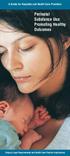 A Guide for Hospitals and Health Care Providers Perinatal Substance Use: Promoting Healthy Outcomes Virginia Legal Requirements and Health Care Practice Implications Perinatal Care To promote healthy maternal
Problem and Responsible Gambling Strategy
 Problem and Responsible Gambling Strategy Proposal for Enhancement to Address Increasing Problem Gambling Needs in Alberta 2005 2006 Approved April 2005 (AADAC and AGLC Board) PROPOSAL FOR FUNDING Problem
A Guide for Hospitals and Health Care Providers Perinatal Substance Use: Promoting Healthy Outcomes
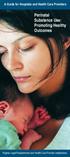 A Guide for Hospitals and Health Care Providers Perinatal Substance Use: Promoting Healthy Outcomes Virginia Legal Requirements and Health Care Practice Implications Perinatal Care To promote healthy maternal
Provider Training. Behavioral Health Screening, Referral, and Coding Requirements
 Provider Training Behavioral Health Screening, Referral, and Coding Requirements Training Outline I. Behavioral Health Screening Requirements and Referrals II. Healthy Behaviors Substance and Alcohol Abuse
CACREP STANDARDS: CLINICAL MENTAL HEALTH COUNSELING Students who are preparing to work as clinical mental health counselors will demonstrate the
 CACREP STANDARDS: CLINICAL MENTAL HEALTH COUNSELING Students who are preparing to work as clinical mental health counselors will demonstrate the professional knowledge, skills, and practices necessary
Children s Health and Nursing:
 Children s Health and Nursing: A Summary of the Issues What s the issue? The foundation for healthy growth and development in later years is established to a large degree in the first six years of life.
Health BUSINESS PLAN 2015 18 ACCOUNTABILITY STATEMENT THE MINISTRY LINK TO GOVERNMENT OF ALBERTA STRATEGIC DIRECTION STRATEGIC CONTEXT
 Health BUSINESS PLAN 2015 18 ACCOUNTABILITY STATEMENT This business plan was prepared under my direction, taking into consideration the government s policy decisions as of October 15, 2015. original signed
3.5 Guidelines, Monitoring and Surveillance of At Risk Groups
 3.5 Guidelines, Monitoring and Surveillance of At Risk Groups 3.5.6 Children of Parents who are Affected by Drug and Alcohol Misuse Background There is overwhelming evidence that the misuse of drugs and
Fetal Alcohol Spectrum Disorders 5-Minute Presentation for Classroom or Public Meeting or Committee Presentation
 The following notes can be printed and cut out to be used to guide your 5-minute speech. Fetal Alcohol Spectrum Disorders 5-Minute Presentation for Classroom or Public Meeting or Committee Presentation
How To Help Seniors With Alcohol Addiction
 A Cross Canada Look at Helping Seniors Who Are Experiencing Alcohol Problems Gerontology Research Centre, Simon Fraser University, Vancouver Canada, 2001 Introduction There are an estimated 138,000-220,000
Public Act No. 15-226
 Public Act No. 15-226 AN ACT CONCERNING HEALTH INSURANCE COVERAGE FOR MENTAL OR NERVOUS CONDITIONS. Be it enacted by the Senate and House of Representatives in General Assembly convened: Section 1. Section
Meena Abraham, DrPH, MPH Director of Epidemiology Services Baltimore City Health Department
 Meena Abraham, DrPH, MPH Director of Epidemiology Services Baltimore City Health Department 271 Neighborhood Statistical Areas 55 Community Statistical Areas 26 Zip Codes Characteristic Baltimore City
Issue Brief. Teen Pregnancy, Parenting, And Dating Violence. Links Between Teen Dating Violence and Teen Pregnancy
 Issue Brief N O. 8 J U L Y 2 0 0 9 Teen Pregnancy, Parenting, And Dating Violence D ating violence and teen pregnancy are intricately linked. Research indicates that teen girls who are in abusive relationships
Is there a baby in your future? Plan for it.
 Is there a baby in your future? Plan for it. You plan for school, work, holidays and even your retirement. What about your baby? Parenting begins long before your baby is conceived. Babies begin to develop
EARLY CHILDHOOD DEVELOPMENT ACTIVITIES AND EXPENDITURES EARLY LEARNING AND CHILD CARE ACTIVITIES AND EXPENDITURES
 EARLY CHILDHOOD DEVELOPMENT ACTIVITIES AND EXPENDITURES EARLY LEARNING AND CHILD CARE ACTIVITIES AND EXPENDITURES GOVERNMENT OF CANADA REPORTS 2003 2004 Sections I II Contents may not be reproduced for
Community and Social Services
 Developing a path to employment for New Yorkers with disabilities Community and Social Services Mental Health and Substance Abuse Social Workers... 1 Health Educators... 4 Substance Abuse and Behavioral
CHILDREN, FAMILIES & ALCOHOL USE
 CHILDREN, FAMILIES & ALCOHOL USE Essential Information for Social Workers A BASW Pocket Guide Supported by: Bedford and Luton Purpose of the guide This guide aims to support Social Workers in their practice
Promising Practices in Substance Abuse Treatment for Justice-Involved Youth with FASD
 Promising Practices in Substance Abuse Treatment for Justice-Involved Youth with FASD Executive Summary Kaitlyn McLachlan, Katherine Wyper, & Allison Pooley Fetal alcohol spectrum disorder (FASD) is an
Free Additional Resources
 Free Additional Resources Substance Abuse and Mental Health Services Administration Treatment Improvement Protocols The Substance Abuse and Mental Health Services Administration (SAMHSA) offers free Treatment
What is the AHS/AADAC Recovery Centre (ARC)? A voluntary detoxification program. 42 bed adult facility (14 female, 20 male, 6 acute beds)
 AHS/AADAC Recovery Centre (ARC): Detoxification Program April 9, 2009 Our Mission: Making a difference in people s lives by assisting to achieve freedom from the harmful effects of alcohol, other drugs,
Substance Abuse During Pregnancy: Moms on Meds. Jennifer Anderson Maddron, M.D LeConte Womens Healthcare Associates
 Substance Abuse During Pregnancy: Moms on Meds Jennifer Anderson Maddron, M.D LeConte Womens Healthcare Associates 2010 National Survey on Drug Use and Health An estimated 4.4% of pregnant women reported
A NEW WAY FOR ADDICTION TREATMENT SERVICES. A Compendium to Focusing the Effort
 A NEW WAY FOR ADDICTION TREATMENT SERVICES Association of Substance Abuse Programs of British Columbia 2007 A NEW WAY FOR ADDICTION TREATMENT SERVICES Association of Substance Abuse Programs of British
Collaborative Care for Pregnant Women with Substance Use Disorders
 Collaborative Care for Pregnant Women with Substance Use Disorders Alane O Connor DNP Maine Dartmouth Family Medicine Residency MaineGeneral Medical Center Dartmouth Medical School Vanderbilt University
The Heroin and Prescription Drug Abuse Prevention and Reduction Act Section by Section
 The Heroin and Prescription Drug Abuse Prevention and Reduction Act Section by Section TITLE I: PREVENTION SUBTITLE A- PRESCRIBER EDUCATION PRACTITIONER EDUCATION This subtitle requires practitioners who
Fetal Alcohol Spectrum Disorder: Building on Strengths
 Fetal Alcohol Spectrum Disorder: Building on Strengths A Provincial Plan for British Columbia 2008 2018 Message from the Minister of Children and Family Development I am pleased to present the 2008-2018
On behalf of the Association of Maternal and Child Health Programs (AMCHP), I am
 Christopher Kus, M.D., M.P.H. Association of Maternal and Child Health Programs, Public Witness Testimony House Labor, Health and Human Services and Education Appropriations Subcommittee March 13, 2013
A Homeless Prevention System for London Ontario
 A Homeless Prevention System for London Ontario A Three Year Implementation Plan A coordinated and integrated individual and family centred housing stability approach that is outcome focussed and designed
Maternal and Child Health Service. Program Standards
 Maternal and Child Health Service Maternal and Child Health Service Program Standards Contents Terms and definitions 3 1 Introduction 6 1.1 Maternal and Child Health Service: Vision, mission, goals and
Chapter 3 Maternal Child Health Subchapter 4. Home Visiting Rule
 Chapter 3 Maternal Child Health Subchapter 4 Home Visiting Rule 1.0 Authority This rule is adopted pursuant to Act No. 66 of the Acts of the 2013 Sess. (2013) (An act relating to home visiting standards.),
Family-Centered Treatment for Parents with Substance Use Disorders
 Family-Centered Treatment for Parents with Substance Use Disorders Presented By Sharon Amatetti, M.P.H. Senior Policy Analyst Center for Substance Abuse Treatment Substance Abuse and Mental Health Services
Interventions for Substance Exposed Children PROGRAMS FOR SUCCESS
 Interventions for Substance Exposed Children PROGRAMS FOR SUCCESS Presenter Kay M. Doughty, MA, CAP, CPP VP, Family and Community Services Workshop Content Overview Development of a Logic Model Comprehensive
Guide to Health and Social Services
 Guide to Health and Social Services Health Services If you have little or no insurance and need health services: You can visit one of the 159 county health departments across the state. The local health
Guide to Health Promotion and Disease Prevention
 Family Health Teams Advancing Primary Health Care Guide to Health Promotion and Disease Prevention January 16, 2006 Table of Contents 3 Introduction 3 Purpose 3 Background 4 Developing Health Promotion
Intimate Partner Violence among Pregnant and Parenting Women: Local Health Department Strategies for Assessment, Intervention, and Prevention
 ISSUE BRIEF June 2008 Intimate Partner Violence among Pregnant and Parenting Women: Local Health Department Strategies for Assessment, Intervention, and Prevention Introduction This issue brief illustrates
Treatment System 101
 Treatment System 101 A brief overview for courtroom decision-makers and people working in criminal justice sectors March 11, 2015 West Toronto Human Services & Justice Coordinating Cttee. Agenda Introduction
Institute for Health and Recovery Integrated Screening Tool
 Institute for Health and Recovery Integrated Screening Tool Women s health can be affected by emotional problems, alcohol, tobacco, other drug use, and domestic violence. Women s health is also affected
Substance Abuse and Child Maltreatment
 National Clearinghouse on Child Abuse and Neglect Information National Adoption Information Clearinghouse Gateways to Information: Protecting Children and Strengthening Families Substance Abuse and Child
A Comparison of First Nations and non- Aboriginal Children Investigated for Maltreatment in Canada in 2003 1
 A Comparison of First Nations and non- Aboriginal ren Investigated for Maltreatment in Canada in 2003 1 Bruce MacLaurin, Nico Trocmé, Barbara Fallon, Cindy Blackstock, Lisa Pitman, and Megan McCormack
Guidelines for comprehensive mental health services for older adults in Canada Executive Summary
 Guidelines for comprehensive mental health services for older adults in Canada Executive Summary Introduction Prepared by Penny MacCourt, PhD, MSW, University of Victoria Kimberley Wilson, PhD(c), MSW
YSAS Snapshot: YOUNG WOMEN IN YOUTH ALCOHOL AND OTHER DRUG SERVICES
 YSAS Snapshot: YOUNG WOMEN IN YOUTH ALCOHOL AND OTHER DRUG SERVICES November 2013 THE KEY FINDINGS AMONG WOMEN IN YOUTH AoD TREATMENT 1. 41% of women were separated from family; 46% of young women had