
CSRS Special Coverage Rules FERS Chapter 12
|
|
|
- Cornelius Lindsey
- 10 years ago
- Views:
Transcription
1 CSRS Special Coverage Rules FERS i Table of Contents Subchapter 12A CSRS and FERS Part 12A1 General Information Section 12A1.1-1 Overview... 1 A. Introduction... 1 B. Topics Covered... 1 C. Organization of Chapter... 2 D. Statement of Authority... 2 Part 12A2 More "Employees" for Retirement Purposes Section 12A2.1-1 Additional Individuals Who Are "Employees" for CSRS Purposes.. 3 A. General... 3 B. Additional Employees... 3 Section 12A2.1-2 Additional Individuals Who Are "Employees" for FERS Purposes.. 5 A. General... 5 B. Additional Employees... 5 Part 12A3 Continuation of Coverage Section 12A3.1-1 Continuation of Coverage When Serving in a Non-Federal Entity.. 7 A. General... 7 Section 12A3.1-2 Employees Serving in Employee Organizations... 8 A. General Rule... 8 B. Requirement of Written Election... 8 C. Requirement of Current Deposit of Retirement Contributions... 9 D. LWOP Prior to July 18, Section 12A3.1-3 Employees Assigned to State or Local Governments, Institutions of Higher Learning, or Other Nonprofit Organizations A. General B. Rule: Continuing Coverage While on LWOP C. Requirement of Written Election D. Requirement of Current Deposit of Retirement Contributions E. Agency Responsibility F. Duration of Assignment G. Detail Assignments H. Assignment of a State/Local Government Employee to the Federal Government CSRS and FERS Handbook April 1998

2 ii CSRS Special Coverage Rules FERS Section 12A3.1-4 Transfers and Details to International Organizations A. General Rule B. Requirement of Current Deposit of Retirement Contributions C. Service Before January 1, D. Service After December 31, E. When Employee Dies While Serving With an International Organization F. Reemployment After Service With an International Organization G. Details to International Organizations Section 12A3.1-5 Employees Who Transfer to Indian Tribal Organizations A. General Rules B. Conditions for Retention of Benefits C. Processing the Employee's Resignation from the Federal Agency and Employment with the Tribe/Tribal Organization D. Benefit Contributions for Former Federal Agency Employees Working for Tribe/Tribal Organizations E. Non-Retention of Benefits Section 12A3.1-6 Federal Aviation Administration (FAA) Employees Who Became Employees of the Metropolitan Washington Airports Authority A. General B. Rule: Continuing Coverage C. Employee Deductions D. Employer Contributions E. Sick Leave Section 12A3.1-7 Employees of the Alaska Railroad A. General Rule B. Employee Deductions and Agency Contributions Section 12A3.1-8 Miscellaneous A. Employees of Public Health Service Hospitals B. Employees Subject to Provisions of the Panama Canal Treaty C. Mike Mansfield Fellows D. U.S. Office of Thrift Supervision Employees E. The District of Columbia Financial Control Authority (The Authority) F. District of Columbia Courts G. U.S. Enrichment Corporation H. Civilian Marksmanship Corporation I. U.S. Holocaust Memorial Council and U.S. Holocaust Memorial Museum Part 12A4 Non-Federal Employees Covered by CSRS (Other Than by Continuation of Coverage) Section 12A4.1-1 Employees of the District of Columbia Government A. Introduction B. D.C. Employees Excluded from CSRS Offset and FERS Coverage C. First Employed by D.C. Government Before October 1, D. First Employed by D.C. Government On or After October 1, April 1998 CSRS and FERS Handbook

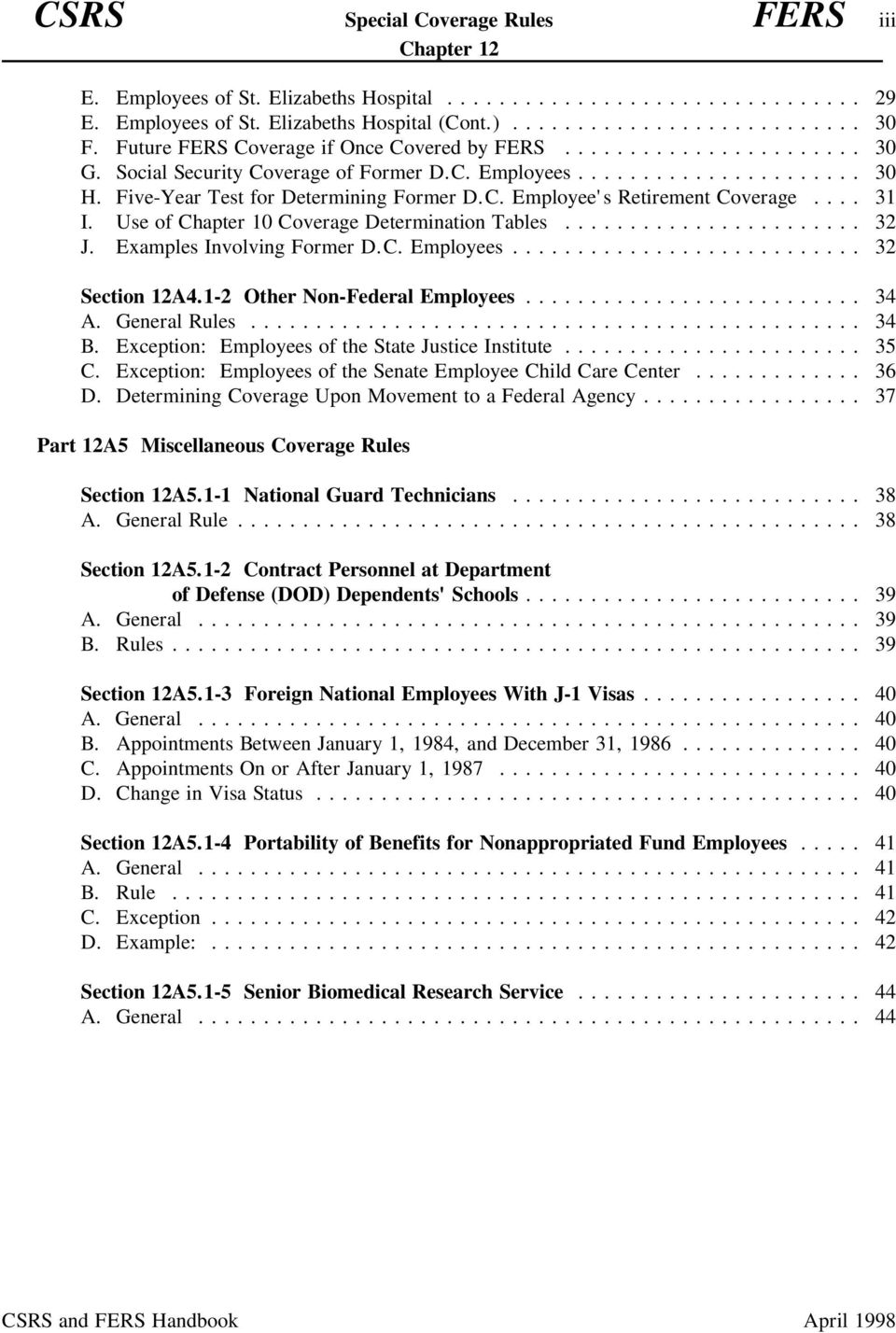
3 CSRS Special Coverage Rules FERS iii E. Employees of St. Elizabeths Hospital E. Employees of St. Elizabeths Hospital (Cont.) F. Future FERS Coverage if Once Covered by FERS G. Social Security Coverage of Former D.C. Employees H. Five-Year Test for Determining Former D.C. Employee's Retirement Coverage I. Use of Chapter 10 Coverage Determination Tables J. Examples Involving Former D.C. Employees Section 12A4.1-2 Other Non-Federal Employees A. General Rules B. Exception: Employees of the State Justice Institute C. Exception: Employees of the Senate Employee Child Care Center D. Determining Coverage Upon Movement to a Federal Agency Part 12A5 Miscellaneous Coverage Rules Section 12A5.1-1 National Guard Technicians A. General Rule Section 12A5.1-2 Contract Personnel at Department of Defense (DOD) Dependents' Schools A. General B. Rules Section 12A5.1-3 Foreign National Employees With J-1 Visas A. General B. Appointments Between January 1, 1984, and December 31, C. Appointments On or After January 1, D. Change in Visa Status Section 12A5.1-4 Portability of Benefits for Nonappropriated Fund Employees A. General B. Rule C. Exception D. Example: Section 12A5.1-5 Senior Biomedical Research Service A. General CSRS and FERS Handbook April 1998
4 iv CSRS Special Coverage Rules FERS Section 12A5.1-6 Employees With Service Under Other Retirement Systems A. General Rules for Determining Coverage B. Creditability of Service for the 5-Year Test C. Post-1988 Service D. Service Covered by the D.C. Police and Firefighters' System--Not Retired E. Retirees from the D.C. Police and Firefighters' System F. Examples Subchapter 12B Job Aids Section 12B1.1-1 Copies of Job Aids Job Aid #1 Documentation of and Advice for Federal Employees Serving in Non-Federal Organizations Job Aid #2 List of International Organizations Within the Meaning of the Federal Employees International Organization Service Act Section 12B1.1-2 Copy(ies) of Form(s) For Local Reproduction Retirement, Life Insurance, and Health Benefits under the Indian Self-Determination and Educational Assistance Act-Public Law , (formerly Standard Form 2816) April 1998 CSRS and FERS Handbook

5 CSRS Special Coverage Rules FERS 1 Subchapter 12A CSRS and FERS Part 12A1 General Information Section 12A1.1-1 Overview A. Introduction This chapter contains unique coverage rules that apply to specific groups of individuals and employment situations under CSRS and FERS. If not otherwise excluded by law or regulation, the persons described in this chapter are covered by CSRS or FERS. That is, retirement contributions are being deducted from their salaries or they are making current payments to the retirement fund in order to receive credit for their service. An extensive discussion of coverage is contained in Chapter 10, Coverage, of this Handbook. Other types of service that are creditable but not necessarily "covered" are discussed in Chapter 20, Creditable Service. If you have an inquiry about service that is not covered in one of the chapters referenced above, direct your questions through your agency employing office to the headquarters Retirement Counselor who may, as necessary, contact the Retirement and Insurance Service at OPM. B. Topics Covered This chapter covers: The definition of "employee" for CSRS in 5 U.S.C. 8331(1) and for FERS in 5 U.S.C. 8401(11); Situations that allow former employees to continue retirement coverage during a period of service with a non-federal entity; Rules that apply to non-federal employees who are covered by CSRS or FERS (other than by continuation of coverage); and Miscellaneous coverage rules. CSRS and FERS Handbook April 1998

6 2 CSRS Special Coverage Rules FERS Section 12A1.1-1 Overview (Cont.) C. Organization of This chapter has five parts. Chapter Part Name of Part Page 12A1 General Information 1 12A2 More "Employees" for Retirement Purposes 3 12A3 Continuation of Coverage 7 12A4 Non-Federal Employees Covered by CSRS (Other than Coverage) 26 12A5 Miscellaneous Coverage Rules 36 D. Statement of Various laws and regulations apply to the contents of this chapter. The Authority appropriate statutory and/or regulatory reference is noted in each section. April 1998 CSRS and FERS Handbook

7 CSRS Special Coverage Rules FERS 3 Part 12A2 More "Employees" for Retirement Purposes Section 12A2.1-1 Additional Individuals Who Are "Employees" for CSRS Purposes A. General The definition of "employee" for CSRS is given in 5 U.S.C. 8331(1). It includes individuals who are considered Federal employees because they meet the tests of Federal employment as described in Chapter 10, Coverage, and specifies several other classes of individuals who are considered "employees" for retirement purposes. B. Additional In addition to individuals who meet the definition of "employee" under Employees 5 U.S.C. 2105(a) (see Chapter 10, section 10A1.1-2, paragraph F), 5 U.S.C. 8331(1) lists: The Architect of the Capitol, an employee of the Architect of the Capitol, and an employee of the Botanic Garden; A Congressional employee as defined by 5 U.S.C. 2107, after such employee gives notice in writing to the official by whom he or she is paid of his or her desire to become subject to CSRS; A temporary Congressional employee appointed at an annual rate of pay, after such employee gives notice in writing to the official by whom he or she is paid of his or her desire to become subject to CSRS; A United States Commissioner whose total pay for services performed as a Commissioner is not less than $3,000 in each of the last 3 consecutive calendar years; An individual employed by a county committee established under 16 U.S.C. 590h(b); An individual first employed subject to CSRS by the government of the District of Columbia before October 1, 1987; An individual employed by Gallaudet University; An individual appointed to a position on the office staff of a former President under section 1(b) of the Act of August 25, 1958 (72 Stat. 838); CSRS and FERS Handbook April 1998

8 4 CSRS Special Coverage Rules FERS Section 12A2.1-1 Additional Individuals Who Are "Employees" for CSRS Purposes (Cont.) B. Additional An alien: "Employees" (Cont.) 1. Who was previously employed by the Government, 2. Who is employed full time by a foreign government for the purpose of protecting or furthering the interests of the United States during an interruption of diplomatic or consular relations, and 3. For whose services reimbursement is made to the foreign government by the United States; An individual appointed to a position on the office staff of a former President or a former Vice President under section 4 of the Presidential Transition Act of 1963, as amended (78 Stat. 153), who immediately before the date of such appointment was an employee as defined under any other provision of this paragraph; and An employee of a nonappropriated fund instrumentality under the jurisdiction of the armed services as described in 5 U.S.C. 2105(c) who has made an election to remain covered under CSRS. April 1998 CSRS and FERS Handbook

9 CSRS Special Coverage Rules FERS 5 Section 12A2.1-2 Additional Individuals Who Are "Employees" for FERS Purposes A. General The definition of "employee" for FERS is given in 5 U.S.C. 8401(11). It includes individuals who meet the test of Federal employment as described in Chapter 10 of this Handbook and specifies other classes of individuals who are considered "employees" for retirement purposes. B. Additional In addition to individuals defined as "employees" under 5 U.S.C. 2105(a) Employees (see Chapter 10, section 10A1.1-2, paragraph F), 5 U.S.C. 8401(11) lists: A United States Commissioner whose total pay for services performed as a Commissioner is not less than $3,000 in each of the last 3 consecutive calendar years; An individual employed by a county committee established under 16 U.S.C. 590h(b); An individual employed by Gallaudet University; An individual appointed to a position on the office staff of a former President under section 1(b) of the Act of August 25, 1958 (72 Stat. 838); An alien: 1. Who was previously employed by the Government, 2. Who is employed full time by a foreign government for the purpose of protecting or furthering the interests of the United States during an interruption of diplomatic or consular relations, and 3. For whose services reimbursement is made to the foreign government by the United States; and An individual appointed to a position on the office staff of a former President or Vice President under section 4 of the Presidential Transition Act of 1963, as amended (78 Stat. 153), who immediately before the date of such appointment was an employee as defined under any other provision of this paragraph; CSRS and FERS Handbook April 1998

10 6 CSRS Special Coverage Rules FERS Section 12A2.1-2 Additional Individuals Who Are "Employees" For FERS Purposes (Cont.) B. Additional A Congressional employee as defined in 5 U.S.C. 2107, including a Employees (Cont.) temporary Congressional employee and an employee of the Congressional Budget Office; and An employee of a nonappropriated fund instrumentality under the jurisdiction of the armed services as described in 5 U.S.C. 2105(c) who has made an election to remain covered under FERS. April 1998 CSRS and FERS Handbook

11 CSRS Special Coverage Rules FERS 7 Part 12A3 Continuation of Coverage Section 12A3.1-1 Continuation of Coverage When Serving in a Non-Federal Entity A. General This part identifies the circumstances where the law provides for continuation of retirement coverage when a person leaves his or her Federal position to serve in a non-federal entity. In some cases, the person's status as a Federal employee continues during the period of service with the non-federal entity. In other cases, retirement coverage continues even though the person's Federal employment has ended and the person is not considered a Federal employee during the service. CSRS and FERS Handbook April 1998

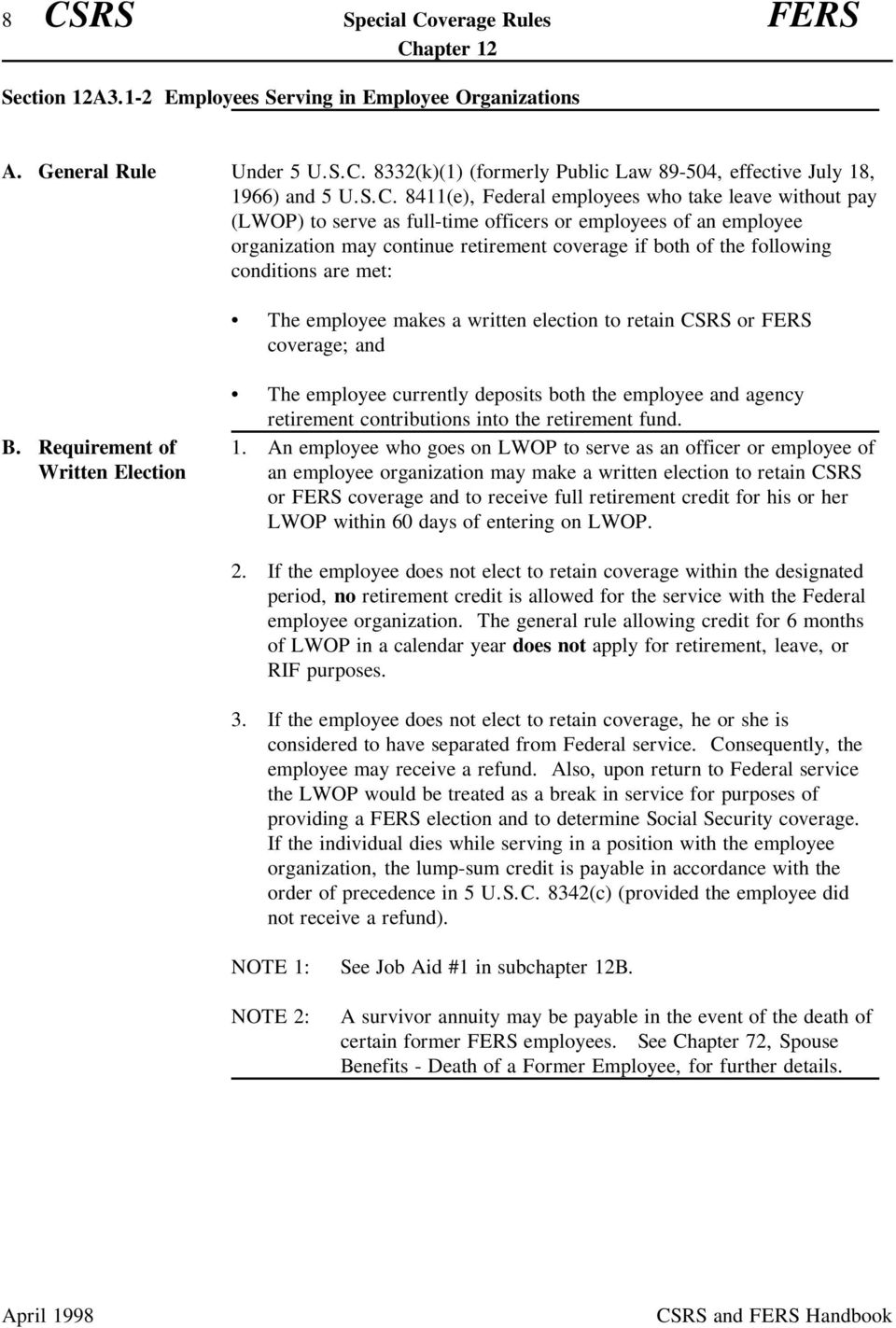
12 8 CSRS Special Coverage Rules FERS Section 12A3.1-2 Employees Serving in Employee Organizations A. General Rule Under 5 U.S.C. 8332(k)(1) (formerly Public Law , effective July 18, 1966) and 5 U.S.C. 8411(e), Federal employees who take leave without pay (LWOP) to serve as full-time officers or employees of an employee organization may continue retirement coverage if both of the following conditions are met: The employee makes a written election to retain CSRS or FERS coverage; and The employee currently deposits both the employee and agency retirement contributions into the retirement fund. B. Requirement of 1. An employee who goes on LWOP to serve as an officer or employee of Written Election an employee organization may make a written election to retain CSRS or FERS coverage and to receive full retirement credit for his or her LWOP within 60 days of entering on LWOP. 2. If the employee does not elect to retain coverage within the designated period, no retirement credit is allowed for the service with the Federal employee organization. The general rule allowing credit for 6 months of LWOP in a calendar year does not apply for retirement, leave, or RIF purposes. 3. If the employee does not elect to retain coverage, he or she is considered to have separated from Federal service. Consequently, the employee may receive a refund. Also, upon return to Federal service the LWOP would be treated as a break in service for purposes of providing a FERS election and to determine Social Security coverage. If the individual dies while serving in a position with the employee organization, the lump-sum credit is payable in accordance with the order of precedence in 5 U.S.C. 8342(c) (provided the employee did not receive a refund). NOTE 1: See Job Aid #1 in subchapter 12B. NOTE 2: A survivor annuity may be payable in the event of the death of certain former FERS employees. See Chapter 72, Spouse Benefits - Death of a Former Employee, for further details. April 1998 CSRS and FERS Handbook
13 CSRS Special Coverage Rules FERS 9 Section 12A3.1-2 Employees Serving in Employee Organizations (Cont.) C. Requirement of 1. Contributions are considered to be currently deposited if they are Current Deposit received by the Federal agency from which the employee is on leave no of Retirement later than 3 months after the end of the pay period covered. If the Contributions contributions are not currently deposited, the retirement coverage is terminated on the last day of the pay period for which the required contributions were currently deposited. If retirement coverage terminates, the agency must close out the individual's retirement record, Standard Form 2806 or 3100, showing the effective date of the termination of retirement coverage, and forward the form to OPM. (See Chapter 81, The Individual Retirement Records and Registers of Separations and Transfers.) 2. Contributions must be based on the salary the employee would have received had he or she remained in the position from which he or she is on leave. D. LWOP Prior to July 18, 1966 NOTE: The agency share of retirement contributions is paid by the employee. (Follow the regular rules in Chapter 80, Payroll Office Reporting of Deductions and Contributions, and Chapter 81, Individual Retirement Records and Registers of Separations and Transfers, for instructions on recording and submitting the employee deduction and agency contribution for these individuals.) Any employee covered by CSRS or FERS on or after July 18, 1966, has the option of depositing deductions with interest for period(s) of service before July 18, 1966, while on LWOP to perform duties as a full-time union officer. Such deposit makes the LWOP period(s) creditable for all retirement purposes. If a full deposit is not made, only the LWOP not exceeding 6 months in a calendar year may be credited for the service performed before July 18, CSRS and FERS Handbook April 1998

14 10 CSRS Special Coverage Rules FERS Section 12A3.1-3 Employees Assigned to State or Local Governments, Institutions of Higher Learning, or Other Nonprofit Organizations A. General The head of a Federal agency may arrange (either on a detail or leave-without-pay basis) for the assignment of an agency employee to a State or local government, institution of higher learning, or other nonprofit organization certified for participation by OPM. Conversely, the law also allows for a State or local government employee to be assigned to a Federal agency. B. Rule: Continuing Under CSRS and FERS (see 5 U.S.C et seq.), a Federal employee Coverage While on LWOP who is on LWOP during a temporary assignment by an agency head to serve with a State or local government, an institution of higher learning, or other nonprofit organization, may continue full retirement coverage under CSRS or FERS if all of the following conditions are met: The State or local government, institution of higher learning, or other nonprofit organization makes a written request for the employee's services and receives written consent from the employing Federal agency; The employee consents to the assignment, and agrees to serve in the Federal service upon completion of the assignment for a period equal to the length of the assignment; The employee makes a written election to retain retirement coverage; Both the employee and agency retirement contributions are currently deposited in the retirement fund; and The employee does not elect to receive any benefit from the State or local government's retirement system if OPM determines it is similar to CSRS or FERS. Agency headquarters retirement counselors should contact their OPM liaison for a determination. April 1998 CSRS and FERS Handbook

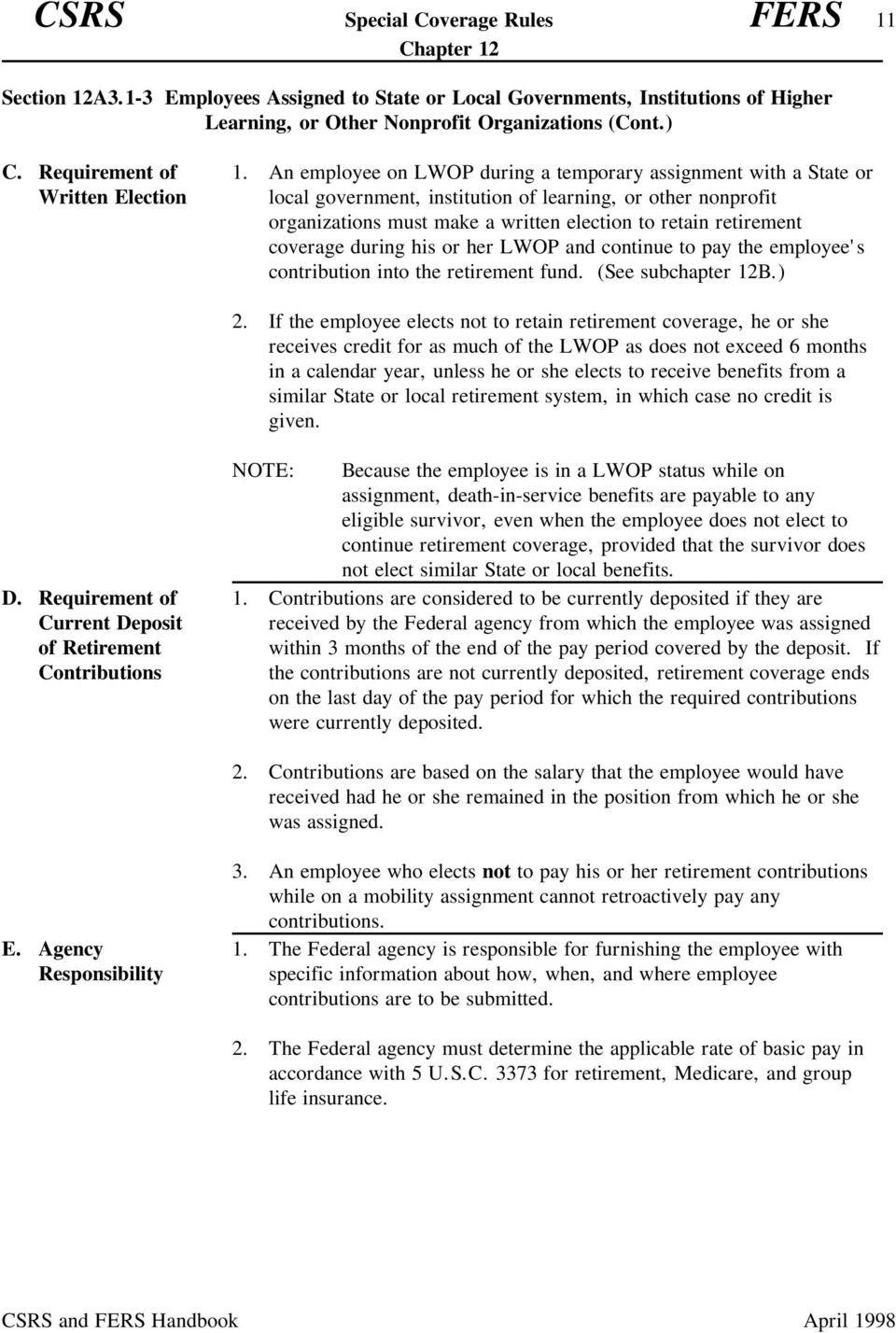
15 CSRS Special Coverage Rules FERS 11 Section 12A3.1-3 Employees Assigned to State or Local Governments, Institutions of Higher Learning, or Other Nonprofit Organizations (Cont.) C. Requirement of 1. An employee on LWOP during a temporary assignment with a State or Written Election local government, institution of learning, or other nonprofit organizations must make a written election to retain retirement coverage during his or her LWOP and continue to pay the employee's contribution into the retirement fund. (See subchapter 12B.) 2. If the employee elects not to retain retirement coverage, he or she receives credit for as much of the LWOP as does not exceed 6 months in a calendar year, unless he or she elects to receive benefits from a similar State or local retirement system, in which case no credit is given. NOTE: Because the employee is in a LWOP status while on assignment, death-in-service benefits are payable to any eligible survivor, even when the employee does not elect to continue retirement coverage, provided that the survivor does not elect similar State or local benefits. D. Requirement of 1. Contributions are considered to be currently deposited if they are Current Deposit received by the Federal agency from which the employee was assigned of Retirement Contributions within 3 months of the end of the pay period covered by the deposit. If the contributions are not currently deposited, retirement coverage ends on the last day of the pay period for which the required contributions were currently deposited. 2. Contributions are based on the salary that the employee would have received had he or she remained in the position from which he or she was assigned. 3. An employee who elects not to pay his or her retirement contributions while on a mobility assignment cannot retroactively pay any contributions. E. Agency 1. The Federal agency is responsible for furnishing the employee with Responsibility specific information about how, when, and where employee contributions are to be submitted. 2. The Federal agency must determine the applicable rate of basic pay in accordance with 5 U.S.C for retirement, Medicare, and group life insurance. CSRS and FERS Handbook April 1998
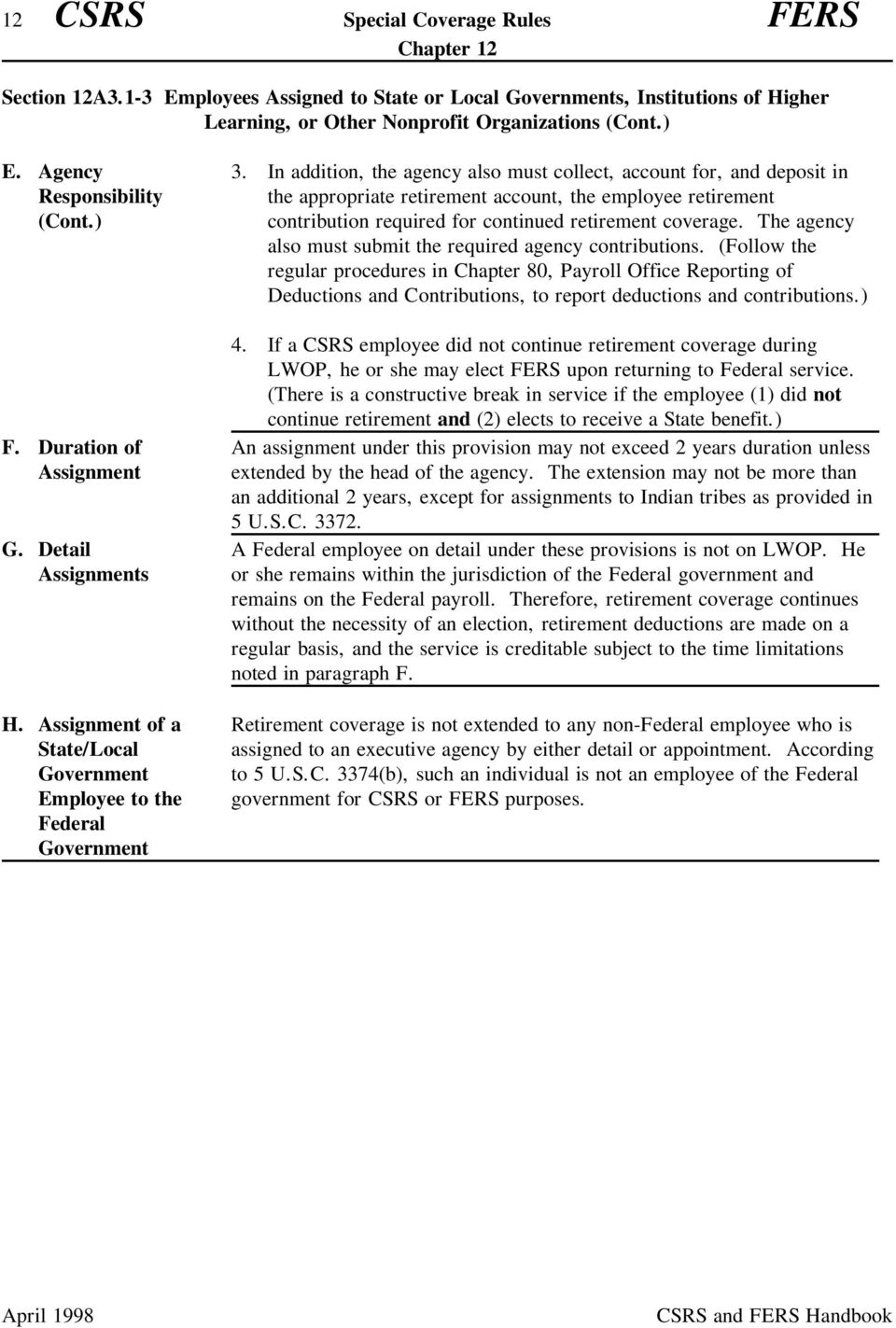
16 12 CSRS Special Coverage Rules FERS Section 12A3.1-3 Employees Assigned to State or Local Governments, Institutions of Higher Learning, or Other Nonprofit Organizations (Cont.) E. Agency 3. In addition, the agency also must collect, account for, and deposit in Responsibility the appropriate retirement account, the employee retirement (Cont.) contribution required for continued retirement coverage. The agency also must submit the required agency contributions. (Follow the regular procedures in Chapter 80, Payroll Office Reporting of Deductions and Contributions, to report deductions and contributions.) F. Duration of Assignment G. Detail Assignments 4. If a CSRS employee did not continue retirement coverage during LWOP, he or she may elect FERS upon returning to Federal service. (There is a constructive break in service if the employee (1) did not continue retirement and (2) elects to receive a State benefit.) An assignment under this provision may not exceed 2 years duration unless extended by the head of the agency. The extension may not be more than an additional 2 years, except for assignments to Indian tribes as provided in 5 U.S.C A Federal employee on detail under these provisions is not on LWOP. He or she remains within the jurisdiction of the Federal government and remains on the Federal payroll. Therefore, retirement coverage continues without the necessity of an election, retirement deductions are made on a regular basis, and the service is creditable subject to the time limitations noted in paragraph F. H. Assignment of a Retirement coverage is not extended to any non-federal employee who is State/Local assigned to an executive agency by either detail or appointment. According Government to 5 U.S.C. 3374(b), such an individual is not an employee of the Federal Employee to the government for CSRS or FERS purposes. Federal Government April 1998 CSRS and FERS Handbook
17 CSRS Special Coverage Rules FERS 13 Section 12A3.1-4 Transfers and Details to International Organizations A. General Rule Under 5 U.S.C et seq. (formerly Public Law (effective August 28, 1958) as amended by Public Law , effective December 30, 1969), and section of title 5, Code of Federal Regulations, an employee who transfers from a position covered by CSRS, CSRS Offset, or FERS to a public international organization may continue retirement coverage for up to 5 years of such service (or up to 8 years in the aggregate if authorized by the Secretary of State) if all of the following conditions are met: The international organization makes a written request for the employee's services and receives written consent from the employing Federal agency; The employee makes a written election to retain retirement coverage (see Job Aid #1, Documentation of and Advice for Federal Employees Serving in Non-Federal Organizations, in subchapter 12B); Both the employee and agency retirement contributions are currently deposited in the retirement fund; and The employee does not use the period of service as the basis for an annuity or pension under the retirement system of the international organization. NOTE 1: NOTE 2: Employees also must be given the opportunity to elect to continue health benefits and group life insurance under section of title 5, Code of Federal Regulations. The Federal Retirement Thrift Investment Board has determined that employees who transfer to international organizations are not eligible to participate in the Thrift Savings Plan. Any inquiries concerning the Federal Thrift Savings plan should be directed to the Federal Retirement Thrift Investment Board. CSRS and FERS Handbook April 1998

18 14 CSRS Special Coverage Rules FERS Section 12A3.1-4 Transfers and Details to International Organizations (Cont.) A. General Rule NOTE 3: See Chapter 20, Creditable Service, for information on the (Cont.) creditability of service with international organizations prior to the enactment of Public Law on August 28, (Also see 5 CFR Part 352, Reemployment Rights.) NOTE 4: Job Aid #2 in subchapter 12B contains a list of international organizations within the meaning of 5 U.S.C If an international organization is not on this list, the agency headquarters level Benefits Officer should contact the Agency Services Division in the Retirement and Insurance Service at OPM for assistance. NOTE 5: For information relating to transfers that occurred before January 1, 1995, see section 12A3.1-4, paragraphs C and D. B. Requirement of 1. Retirement contributions are considered to be currently deposited if Current Deposit they are received by the Federal agency from which the employee of Retirement Contributions transferred within 3 months after the end of the pay period covered by the deposit. If the contributions are not currently deposited, the retirement coverage terminates on the last day of the pay period for which the required contributions were currently deposited. 2. Contributions must be based on the salary that the employee would have received had he or she remained in the position from which he or she transferred. NOTE 1: NOTE 2: The agency share of retirement contributions must be paid by the Federal agency from which the employee transferred, as long as employee contributions are made by the employee. (See 5 U.S.C. 3582(d).) If retirement coverage terminates during the transfer, the agency must close out the individual's retirement record, Standard Form 2806 or 3100, showing the effective date of the termination of retirement coverage, and forward the form to OPM. (See Chapter 81, Individual Retirement Records and Registers of Separations and Transfers.) April 1998 CSRS and FERS Handbook

19 CSRS Special Coverage Rules FERS 15 Section 12A3.1-4 Transfers and Details to International Organizations (Cont.) C. Service Before January 1, 1995 Before January 1, 1995, the Internal Revenue Code did not allow Social Security coverage during employment with an international organization outside the United States. Employees who transferred to international organization positions within the United States were subject to Social Security self-employment tax. This meant that CSRS Interim, CSRS Offset, and FERS employees who transferred under section 3582 to positions in the United States could continue their retirement coverage with no changes (other than the Thrift Savings Plan) if the basic rules described in paragraph A were followed. CSRS Interim and CSRS Offset employees who elected to continue retirement coverage in positions outside the United States reverted to having only CSRS coverage. FERS employees who transferred to international organizations outside the United States before 1995 were not given the opportunity to retain FERS coverage during the transfer. However, OPM has reviewed the applicable provisions of law and determined that employees who were not allowed to continue FERS coverage on the basis of their lack of FICA coverage may elect to have FERS basic benefits coverage retroactively. The employing agency should provide any affected employee with an opportunity to make a retroactive election. D. Service After December 31, 1994 To obtain this coverage, the employee must make the statutorily-required deposit equal to the amount of the FERS basic benefits deductions that would have been withheld from pay had he or she remained employed in the Federal agency. The deposit is paid to the employing agency and recorded on Standard Form 3100, the FERS Individual Retirement Record. The appropriate employer share must be submitted to OPM by the employing agency under existing procedures. Effective January 1, 1995, section 319 of Public Law , the Social Security Independence and Program Improvements Act of 1994, requires that FERS and CSRS Offset employees who transfer to international organizations continue their FICA coverage (including the Old-Age, Survivors, and Disability Insurance (OASDI) and Medicare taxes), if both of the following conditions are met: 1. The transferring employee must have been employed at a Federal agency and subject to FICA immediately prior to the transfer; and 2. The employee must retain Federal reemployment rights under section CSRS and FERS Handbook April 1998

20 16 CSRS Special Coverage Rules FERS Section 12A3.1-4 Transfers and Details to International Organizations (Cont.) D. Service After December 31, 1994 (Cont.) Under these conditions, FICA coverage applies, regardless of where the service with the international organization is actually performed. FICA tax is required for these transferred employees even if they are not continuing CSRS Offset or FERS coverage during the transfer. While employed by an international organization, an employee's FICA tax, like retirement and life insurance contributions, is based on the amount of pay the employee would have received had he or she remained at the transferring agency. Effective January 1, 1995, the Social Security self-employment tax no longer applies to international organization service performed within the United States. The Federal agency from which the employee transfers is responsible for computing and billing owed FICA tax, both employee and employer shares, and for the payment of collected FICA tax. An agency must submit the employer share of FICA even when an employee fails to submit payment of the employee portion of FICA tax. As explained in paragraph A, employees transferring to an international organization must be given the opportunity to elect to continue retirement (other than the Thrift Savings Plan), health benefits, and group life insurance under section of title 5, Code of Federal Regulations. In addition, any employee who is now employed under a transfer to an international organization abroad and who has not been given the right to elect continuation of FERS should be given the opportunity to elect FERS. In the case of a CSRS Offset employee who continued CSRS coverage, the employee must revert to CSRS Offset coverage effective January 1, FERS employees who elect coverage will be responsible for retirement contribution payments retroactive to the transfer to the international organization. CSRS employees reverting to CSRS Offset must have their payroll records adjusted effective January 1, 1995, to reflect CSRS Offset contributions. April 1998 CSRS and FERS Handbook

21 CSRS Special Coverage Rules FERS 17 Section 12A3.1-4 Transfers and Details to International Organizations (Cont.) D. Service After December 31, 1994 (Cont.) E. When Employee Dies While Serving With an International Organization Under the conditions stated above, FICA tax is mandatory for all CSRS Offset and FERS employees on a section 3582 transfer to an international organization, effective January 1, Whether or not the employee elects retirement coverage, the employee is no longer exempt from FICA tax during international organization service. Since FICA tax is mandatory, employees who were eligible to retroactively continue FERS or CSRS Offset coverage (regardless of their election decisions) are subject to FICA tax retroactive to January 1, NOTE: The Federal Retirement Thrift Investment Board has determined that the amendments of Public Law do not change the status of these employees for the purpose of contributing to the Federal Thrift Savings Plan. The death benefits payable in the case of an employee who transfers to an international organization and dies before returning to Federal service depends on whether the individual's retirement coverage continued in effect at the time of death. The death is treated as a death in service if - 1. The employee dies in a period during which he or she retained retirement coverage while on transfer to the international organization, as provided above; or 2. The employee continued retirement coverage during the service with the international organization and dies after separating from the international organization but before his or her reemployment rights under 5 U.S.C. 3582(b) have expired. The death of an individual who did not continue coverage under the retirement system, or who remained with the international organization for more than the maximum term of 5 years (or, if authorized by the Secretary of State, 8 years in the aggregate), is not considered a death in service, and is treated the same as the death of a separated employee. CSRS and FERS Handbook April 1998
22 18 CSRS Special Coverage Rules FERS Section 12A3.1-4 Transfers and Details to International Organizations (Cont.) F. Reemployment If an employee was exempt from the OASDI portion of the Social Security After Service tax before being detailed or transferred to an international organization, the With an employee continues to be exempt upon returning to service, even if the International period with the international organization is over 1 year. If the employee is Organization not reemployed within 1 year after separating from the international organization in a Federal appointment exempt from the OASDI tax, the employee would not be exempt upon later Federal employment. If the employee is reinstated after a transfer, he or she will have a 6-month period in which to elect FERS coverage. G. Details to Title 5 U.S.C authorizes Federal agencies to detail employees to an International international organization requesting the employees' services. Organizations An employee on detail to an international organization remains an employee of his or her agency for all purposes. Therefore, an employee covered by CSRS or FERS when detailed retains coverage for the duration of the detail. NOTE: Prior to the effective date of Public Law on August 28, 1958, details were not permitted to any international organization except the United Nations Relief and Rehabilitation Administration (UNRRA) during the period November 9, 1943, through March 31, Covered employees who were detailed to UNRRA during that period were considered employees of the agency from which they were detailed and received full retirement credit for that service. (See Public Law 83-82, approved June 30, 1944.) April 1998 CSRS and FERS Handbook
23 CSRS Special Coverage Rules FERS 19 Section 12A3.1-5 Employees Who Transfer to Indian Tribal Organizations A. General Rules Section 105(e) of Public Law , the Indian Self-Determination Act and Education Assistance Act (codified as 25 U.S.C. 450i(e)), as amended, allows a Federal employee serving under an appointment not limited to 1 year or less who leaves Federal employment in order to accept employment with an Indian tribal organization or the cities or village corporations of St. Paul or St. George, Alaska, to continue coverage under CSRS or FERS. More specifically, this section provides that "an employee serving under an appointment not limited to 1 year or less, who leaves Federal employment to be employed by a tribal organization, in connection with governmental or other activities which are or have been performed by employees in or for Indian communities" is entitled to retain certain Federal benefits if there is a mutual agreement between the tribal organization and the employee. The employee may retain coverage rights and benefits under the: Civil Service Retirement System Federal Employees Retirement System Compensation for Work Injuries under the Office of Workers' Compensation Thrift Savings Plan Federal Employees' Group Life Insurance Federal Employees' Health Benefits The Federal agency has a responsibility to fully inform and counsel employees desiring to transfer to tribal employment of their rights and obligations under Public Law When a tribal government or tribal organization contracts with a Federal agency under authority of Public Law to assume a function previously performed by civil service employees, the function ceases to exist at the agency at that location. Therefore, the civil service positions are effectively abolished through implementation of the contract. The tribe/tribal organization may elect, under these circumstances, to offer employment to the incumbents of the civil service positions or to negotiate IPA assignments for the incumbents. However, there is no obligation for the tribe/tribal organization to do so, and failure to offer tribal employment or an IPA assignment is not appealable under Federal statute. Affected employees not offered tribal employment or an IPA assignment must be outplaced in other agency vacancies or separated through RIF. CSRS and FERS Handbook April 1998
24 20 CSRS Special Coverage Rules FERS Section 12A3.1-5 Employees Who Transfer to Indian Tribal Organizations (Cont.) B. Conditions for Retention of Benefits The tribe/tribal organization's agreement to continue benefits must be documented on RI prior to the effective date of termination of the employee's Federal employment. This form must be completed by both the employee and the tribal organization. The employee must be employed by the tribe/tribal organization with no break in service from his/her Federal employment. C. Processing the Employee's Resignation from the Federal Agency and Employment with the Tribe/Tribal Organization The necessary employee deductions and tribal employer contributions for the period of employment with the tribal organization must be deposited (paid into the appropriate civil service fund) for retirement, health benefits, and life insurance. When an individual makes it known to his/her immediate supervisor that he/she intends to resign in order to go to work for the tribe/tribal organization, the supervisor notifies the agency personnel office by sending an SF 52, Request for Personnel Action, through the appropriate agency channels. The SF 52 establishes the effective date of the resignation and must be signed by the employee. The SF 52 is accompanied by a transmittal memorandum from the employee requesting retention of Federal employment benefits and a completed RI in original and three copies. The "Kind of Action Requested" on the SF 52 will include the statement "Resignation - Under P. L " SF 52 remarks include: "Reason: to accept employment without a break in service under P.L with (name of tribe/tribal organization)," and "Retirement Retained: Sick Leave Balance (hours)" if applicable. April 1998 CSRS and FERS Handbook
25 CSRS Special Coverage Rules FERS 21 Section 12A3.1-5 Employees Who Transfer to Indian Tribal Organizations (Cont.) D. Benefit Contributions for Former Federal Agency Employees Working for Tribe/Tribal Organizations The tribal organization sends the employee and tribal contributions to the former agency payroll office, which will add them to its regular submissions to the U.S. Office of Personnel Management for retirement, health benefits, and life insurance. The tribal organization makes checks payable to the agency and includes the following identifying information: 1. The name and social security number of the employee to whom the payment should be credited; 2. The time period the payment covers; 3. Identification of the contribution being made (retirement, life insurance, or health benefits); and 4. The words "Indian Self-Determination Act Contribution." E. Non-Retention of Benefits NOTE: If the employee elects to continue coverage and dies while serving with the tribal organization, death-in-service benefits are payable to eligible survivors. Whenever a Public Law contract is written, the tribe/tribal organization has the option of offering current Federal employees employment without choosing to offer a continuation of their Federal benefits. An employee who resigns to accept tribal employment under these conditions has the same rights as any other employee separating from the Federal service--for example, to receive a refund of retirement deductions if not eligible for an immediate annuity. CSRS and FERS Handbook April 1998
26 22 CSRS Special Coverage Rules FERS Section 12A3.1-6 Federal Aviation Administration (FAA) Employees Who Became Employees of the Metropolitan Washington Airports Authority A. General Public Law , enacted October 18, 1986, gave the Secretary of Transportation authority to lease Washington National Airport and Dulles International Airport to the Metropolitan Washington Airports Authority (MWAA) for 50 years. As part of this legislation, certain FAA employees who became MWAA employees retained CSRS or FERS coverage as if they were still employed by the Federal government. B. Rule: Continuing All of the following conditions must have been met in order for an MWAA Coverage employee to continue retirement coverage under CSRS or FERS: The employee must have been a permanent FAA employee assigned to the Metropolitan Washington Airports Authority who elected to transfer to the MWAA; The employee must have been subject to CSRS or FERS coverage on the day before the date the lease took effect (the lease took effect June 6, 1987); and The employee must remain continually employed by the MWAA without a break in service. C. Employee MWAA employees who have continued CSRS or FERS coverage are Deductions deemed to consent to CSRS or FERS deductions from their basic pay. The amount deducted is the same as if they were employed by the Federal government. The MWAA pays the amounts deducted into the retirement fund. D. Employer The MWAA must pay into the retirement fund amounts equal to any agency Contributions contribution that would be required for employees covered by CSRS or FERS. E. Sick Leave An employee who retired (or died leaving a survivor entitled to an annuity) from the MWAA within the 5-year period beginning on June 7, 1987, received credit for unused sick leave in his or her annuity computation. An employee retiring after the 5-year period may receive credit for unused sick leave only if the employee is under the MWAA's formal leave system. April 1998 CSRS and FERS Handbook
27 CSRS Special Coverage Rules FERS 23 Section 12A3.1-7 Employees of the Alaska Railroad A. General Rule Public Law (enacted January 14, 1983) provided for the sale and transfer of the Alaska Railroad from the Federal government to non-federal ownership by the State of Alaska. As part of the transfer provisions, employees covered by CSRS on the day preceding the date of transfer (January 5, 1985) continued CSRS coverage as long as they were continuously employed by the railroad. Individuals hired by the Alaska Railroad after the date of transfer are not Federal employees but employees of the State of Alaska. NOTE: Since individuals who transferred to the Alaska Railroad on or after January 5, 1985, are no longer Federal employees, they were not eligible to elect FERS coverage. B. Employee The Alaska Railroad Corporation (ARC) pays agency contributions and Deductions and administrative expenses to the Civil Service Retirement and Disability Fund Agency on behalf of the employees who retained CSRS coverage. Contributions CSRS and FERS Handbook April 1998
28 24 CSRS Special Coverage Rules FERS Section 12A3.1-8 Miscellaneous A. Employees of Public Health Service Hospitals B. Employees Subject to Provisions of the Panama Canal Treaty Public Law terminated Federal appropriations for Public Health Service hospitals effective October 1, The law provided that the hospitals could be transferred to State and local government or private control, become self-sufficient, or close. Certain employees, whose hospital transferred to non-federal control and entered into an agreement with OPM, were eligible to continue CSRS coverage. If the agency has questions about whether an employee was covered under such an agreement, direct questions through the agency employing office to the headquarters retirement counselor who may, as necessary, contact the agency's liaison at OPM. Under Panama Canal Treaty and implementing agreements and legislation, the Panama Canal Act of 1979 (Public Law 96-70), the Panama Canal Company and the Canal Zone Government ceased to exist on September 30, 1979, and the Panama Canal Commission came into being on October 1, 1979, to operate and maintain the canal. Most other governmental activities were assumed by the Republic of Panama on that date. 1. Generally, both U.S. citizens and non-u.s. citizens who were working for the United States and covered by CSRS when the Treaty took effect on October 1, 1979, and then transferred without a break of 4 or more days to a position in the Commission, an Executive agency, or the Smithsonian Institution with a permanent duty station in the Republic of Panama, continued to be covered under CSRS. In addition, covered employees, including non-u.s. citizens appointed to a position in the Commission after a break in service but before April 1, 1980, were covered under CSRS. 2. Other non-u.s. citizens appointed to a position with the Panama Canal Commission or the Department of Defense in Panama are excluded from CSRS coverage and are covered by Panama's social security system. NOTE: Non-U.S. citizens in Panama (non-resident aliens) are not eligible for coverage under FERS because such individuals are not eligible for U.S. Social Security coverage. April 1998 CSRS and FERS Handbook
29 CSRS Special Coverage Rules FERS 25 Section 12A3.1-8 Miscellaneous (Cont.) C. Mike Mansfield Fellows D. U.S. Office of Thrift Supervision Employees Section 252 of Public Law , approved April 30, 1994, created the Mike Mansfield Fellowship Program. Under this program, not more than 10 Federal employees from any branch of government may be selected by the Mike Mansfield Center for Pacific Affairs as Mike Mansfield Fellows. Fellows may be either detailed from their Federal positions, or separated with reemployment rights. Detailed and separated employees have the same rights to continue their retirement, health insurance, and life insurance coverage as if they were serving with international organizations. See Section 12A They also have the same reemployment rights as if they were serving with international organizations. The Financial Institutions Reform, Recovery and Enforcement Act (FIRREA) of August 9, 1989, created the U.S. Office of Thrift Supervision (OTS) and provided for the transfer to OTS of Federal Home Loan Bank personnel who were performing functions or activities on behalf of the former Federal Home Loan Bank Board. This transfer was generally effected on October 8, Transferees were given the choice of retirement systems. They could choose to be covered by the Financial Institutions Retirement Fund (FIRA) or they could be covered by the Federal retirement system appropriate to their prior service history (CSRS, CSRS Offset, or FERS). Employees initially covered under CSRS or CSRS Offset were given a special extension of their six-month opportunity to elect to transfer to FERS coverage. An election of FERS could have been retroactive to October 22, 1989, at the employee's request. However, under this special extension, elections of FERS coverage by the transferees must have been filed no later than April 15, CSRS and FERS Handbook April 1998
30 26 CSRS Special Coverage Rules FERS Section 12A3.1-8 Miscellaneous (Cont.) E. The District of Columbia Financial Control Authority (The Authority) F. District of Columbia Courts G. U.S. Enrichment Corporation H. Civilian Marksmanship Corporation Federal employees separating from Federal service and other individuals employed by the Authority are allowed to elect to be deemed a Federal employee while employed with the Authority for the purposes of CSRS, FERS, FEHB, and FEGLI. Certain employees of the Authority are also eligible to participate in the Thrift Savings Plan. The basic rule established in law is that employees of the Authority must elect to be covered by Federal benefits or District of Columbia benefits. Beginning October 26, 1996, individuals appointed by the Authority to a position not excluded from CSRS or FERS coverage (such as service under a temporary or intermittent appointment) may elect to be deemed a Federal employee for CSRS or FERS purposes unless the employee elects to participate in a retirement, health, or life insurance program offered by the District of Columbia. However, a former Federal employee being appointed by the Authority on or after October 26, 1996, no more than 3 days (not counting District of Columbia holidays) after separation from Federal employment, cannot elect to be deemed a Federal employee for CSRS or FERS purposes unless the election was made before separation from Federal employment. Federal employees may be detailed to the Authority and they retain their status as Federal employees while on detail. As of October 1, 1997, nonjudicial employees of the District of Columbia courts are treated as employees of the Federal Government for CSRS, FERS, FEGLI, FEHB, and the Thrift Savings Plan. A Federal employee retains CSRS or FERS coverage, if he or she transfers, with a break in service of 3 days or less, to the DC Corrections Trustee or the DC Pretrial Services, Defense Services, Parole, Adult Probation and Offender Supervision Trustee as an employee. Federal employees detailed to the DC Courts retain their status as Federal employees and, therefore, retain Federal benefits coverage. Former Federal employees employed by the U.S. Enrichment Corporation immediately preceding privatization in 1996 could elect to retain their CSRS or FERS coverage. Federal employees of the Department of Defense, Civilian Marksmanship Program, as of September 30, 1996, who were employed by the Civilian Marksmanship Corporation (Corporation) as of October 1, 1996, could continue to be eligible, during continuous employment with the Corporation, for coverage under CSRS or FERS, FEHB, and similar benefits such as FEGLI. April 1998 CSRS and FERS Handbook
31 CSRS Special Coverage Rules FERS 27 Section 12A3.1-8 Miscellaneous (Cont.) I. U.S. Holocaust Prior to September 20, 1992, if an employee of the U.S. Holocaust Memorial Council Memorial Council (Council) was paid from Federal funds, he/she was and U.S. considered a Federal employee. If an employee of the Council was paid Holocaust from donated funds, he/she was not considered a Federal employee. From Memorial September 20, 1992, to April 3, 1993, all employees of the Council were Museum paid from donated funds and thus were not considered Federal employees. On April 4, 1993, all employees became employees of the U.S. Holocaust Memorial Museum and were paid from Federal funds. Thus, they are considered Federal employees. CSRS and FERS Handbook April 1998
32 28 CSRS Special Coverage Rules FERS Part 12A4 Non-Federal Employees Covered by CSRS (Other Than by Continuation of Coverage) Section 12A4.1-1 Employees of the District of Columbia Government A. Introduction This part addresses non-federal employees who have been given CSRS retirement coverage without the requirement of continuation of coverage from Federal employment. This first section describes the circumstances under which one such category of non-federal employees--district of Columbia (D.C.) Government employees--may be covered under CSRS. It also provides instructions for making retirement coverage determinations for Federal employees who are hired after a period of employment with the D.C. Government. B. D.C. Employees Excluded from CSRS Offset and FERS Coverage C. First Employed by D.C. Government Before October 1, 1987 Apart from the exceptions noted in Section D.C. Government employees are not eligible for CSRS Offset or FERS coverage. Prior to October 1, 1987, employees of the D.C. Government were eligible for coverage under CSRS. On October 1, 1987, CSRS became closed to D.C. Government employees unless they had been first employed by the D.C. Government in a position subject to CSRS prior to that date. NOTE 1: NOTE 2: In general, CSRS was closed to new participants effective January 1, However, any eligible D.C. Government employee first hired before October 1, 1987, was covered under CSRS. In contrast to Federal employees, D.C. Government employees first hired during the period from January 1, 1984, through September 30, 1987, were not covered by Social Security. Eligible employees had full CSRS coverage, not CSRS Interim or CSRS Offset coverage. April 1998 CSRS and FERS Handbook
33 CSRS Special Coverage Rules FERS 29 Section 12A4.1-1 Employees of the District of Columbia Government (Cont.) D. First Employed by D.C. Government On or After October 1, 1987 E. Employees of St. Elizabeths Hospital Employees first hired by the D.C. Government, or first employed by D.C. Government in positions eligible for retirement coverage, on or after October 1, 1987, are covered by the retirement system established by the D.C. Government for its employees (including Social Security). (See paragraph E below for the sole exception to this rule.) This means that Federal employees with CSRS coverage who separate from Federal service and become employed by the D.C. Government, are not allowed to continue their CSRS coverage as D.C. Government employees unless they had CSRS-covered D.C. Government service before October 1, It also means that a CSRS retiree who is hired for the first time by the D.C. Government on or after October 1, 1987, cannot be covered by CSRS and cannot earn a CSRS supplemental or redetermined annuity based on that service. Public Law , enacted November 8, 1984, transferred the responsibility of St. Elizabeths Hospital from Federal authority to the D.C. Government on October 1, Under the normally applicable coverage rule in paragraph D above, transferred employees would be excluded from CSRS coverage since they were first employed by the D.C. Government on October 1, 1987, not before October 1, However, Public Law , enacted January 8, 1988, specified that an employee of St. Elizabeths Hospital at the time of the transfer to D.C. Government employment on October 1, 1987, would be treated in the same way as an individual first employed by the D.C. Government before October 1, Therefore, these employees are eligible for CSRS coverage as D.C. Government employees if they meet the following conditions: The individual must have been employed by St. Elizabeths Hospital subject to CSRS or FERS on September 30, 1987; and The individual must have become an employee of the District of Columbia on October 1, 1987, because of the transfer of St. Elizabeths Hospital from Federal authority to the District of Columbia Government. CSRS and FERS Handbook April 1998
34 30 CSRS Special Coverage Rules FERS Section 12A4.1-1 Employees of the District of Columbia Government (Cont.) E. Employees of St. Elizabeths Hospital (Cont.) F. Future FERS Coverage if Once Covered by FERS G. Social Security Coverage of Former D.C. Employees NOTE: St. Elizabeths Hospital employees who were covered under FERS at the time of transfer could not continue FERS coverage. However, an employee of St. Elizabeths Hospital who had either CSRS or FERS coverage at the time of the transfer to District of Columbia employment on October 1, 1987, is eligible for CSRS coverage, beginning that date. Prior service subject to FERS may be credited in a CSRS annuity as service subject to another retirement system for Federal employees. (See Chapter 20, Creditable Service.) If an individual had FERS coverage, then CSRS coverage as a District of Columbia employee, and then returned to a Federal career appointment, the employee would resume FERS coverage in the Federal position. In other words, once an employee has become subject to FERS, he or she resumes FERS coverage in future employment unless excluded from it under FERS rules. Under the 365-day break-in-service test for determining an employee's Social Security coverage, an employee with a break in CSRS-covered Federal service ending after 1983 and exceeding 365 days is mandatorily covered by Social Security. D.C. Government employment is not Federal service. Therefore, a former D.C. Government employee who was employed by the Federal government after 1983 for the first time is a "first hire" and is mandatorily covered by Social Security. Likewise, if an employee who was previously under CSRS was rehired by the Federal government after 1983 following an intervening period of D.C. Government service exceeding 365 days, the employee is mandatorily covered by Social Security. NOTE: Either a break in Federal service or a break in CSRS coverage can create a break in CSRS-covered Federal service. See section 10A1.3-6 in Chapter 10, Coverage. April 1998 CSRS and FERS Handbook
35 CSRS Special Coverage Rules FERS 31 Section 12A4.1-1 Employees of the District of Columbia Government (Cont.) H. Five-Year Test for Determining Former D.C. Employee's Retirement Coverage If a former D.C. Government employee is hired by the Federal government after either as a first hire or a rehire--and is subject to mandatory Social Security coverage, the 5-year test will be used to determine whether FERS coverage is automatic. (See paragraph F of this section, for the exception concerning employees with prior FERS coverage.) D.C. Government service that is creditable under CSRS (see paragraph C) counts as service under the 5-year test. However, a move from D.C. Government employment to Federal employment is treated as a "break in service" for purposes of the 5-year test, regardless of the number of days between the two types of employment. Thus, if the employee has 5 years of creditable civilian service (including some CSRS covered service) at the time he or she moves from D.C. Government to a career Federal appointment, he or she is excluded from FERS and is covered under the CSRS Offset provisions. However, if the Federal appointment is excluded from CSRS coverage (such as a temporary appointment), the employee would have only Social Security coverage since the move is treated as if an actual break in service had occurred. NOTE 1: The 5-year test is described in detail in section 10A1.1-2I of Chapter 10. Normally, how the rule is applied depends on whether the employee had a break in service lasting more than 3 days ending after December 31, If there was such a break, the 5-year test is met if the employee had 5 years of civilian service as of December 31, 1986, or 5 years of service as of the date of the last separation from service and prior CSRS or Foreign Service Retirement System coverage. If there was no break, the 5-year test is applied as of December 31, In the case of former D.C. Government employees who are hired by the Federal government and mandatorily covered by Social Security, the 5-year test may be applied as of the date of separation from CSRS-covered D.C. Government employment, regardless of whether there was a break between D.C. Government and Federal employment exceeding 3 days. In recognition of the fact that this group of CSRS-covered employees must be placed under Social Security coverage without an actual break in CSRS-covered service, this rule ensures that former D.C. Government employees with less than 5 years of CSRS service as of December 31, 1986, but more than 5 years as of their separation from D.C. Government employment, are able to continue CSRS coverage (under the Offset provisions) upon becoming Federal employees, even if there is no 3-day break. CSRS and FERS Handbook April 1998
36 32 CSRS Special Coverage Rules FERS Section 12A4.1-1 Employees of the District of Columbia Government (Cont.) H. Five-Year Test for Determining Former D.C. Employee's Retirement Coverage (Cont.) I. Use of Chapter 10 Coverage Determination Tables J. Examples Involving Former D.C. Employees NOTE 2: If the employee is a Federal rehire and had FERS coverage during a previous period of Federal service (including St. Elizabeths Hospital service before October 1, 1987), the 5-year test does not apply. FERS coverage is automatic unless the appointment is excluded from coverage, in which case the employee would have FICA only. In using the coverage determination tables in Chapter 10, apply the 5-year test as described in paragraph H above. Use the "first hire" table for former D.C. Government employees with no prior Federal civilian service who are hired by the Federal government. Use the "rehire" table for former Federal employees who had an intervening period of D.C. Government employment. The "transfer or conversion" table is not used for employees moving directly from D.C. Government to the Federal government, even if the break is 3 days or less. Since D.C. Government employment is not Federal service, these employees can only be first hires or rehires. The fact that D.C. Government service is used in the 5-year test does not affect Social Security coverage or the characterization of an employee as a first hire, rehire, or transfer/conversion as those terms are used in Chapter 10. EXAMPLE 1: Former D.C. Employee Who is a First Hire Alex was employed by the D.C. Government on September 10, 1982, and held a position that conferred CSRS coverage. He remained in that position until he resigned on March 16, Alex was appointed to a covered position with the Federal government on March 17, At that time, he was mandatorily covered by Social Security because he was first employed by the Federal government after He was placed under CSRS Offset because he had at least 5 years of CSRS-covered service with the District of Columbia at the time he moved into Federal employment. April 1998 CSRS and FERS Handbook
37 CSRS Special Coverage Rules FERS 33 Section 12A4.1-1 Employees of the District of Columbia Government (Cont.) J. Examples EXAMPLE 2: Former D.C. Employee Who is a Rehire Involving Former D.C. Employees Bruce was appointed to a covered position in the Federal government on (Cont.) January 1, He remained in that position until he separated on December 31, Bruce subsequently took a position with District of Columbia Government on January 2, 1983, and stayed in that position until December 31, On January 2, 1991, Bruce is reemployed in the Federal government. Bruce is covered by Social Security because his break in Federal service exceeded 365 days. He is under CSRS Offset because he had at least 5 years of creditable service and prior CSRS coverage before his Federal employment on January 2, 1991 (3 years of Federal service plus 4 years of service with the District of Columbia). CSRS and FERS Handbook April 1998
38 34 CSRS Special Coverage Rules FERS Section 12A4.1-2 Other Non-Federal Employees A. General Rules 1. Other non-federal employees who have been given CSRS coverage include employees of the: Appalachian Regional Commission (Public Law 89-4, enacted March 9, 1965); Legal Services Corporation (Public Law , enacted July 25, 1974); State Justice Institute (Public Law , enacted November 8, 1984); American Institute in Taiwan (22 U.S.C. 3310); and Gallaudet University (5 U.S.C. 8331(1)). 2. Section 8347(o) of title 5, U.S. Code (enacted by Public Law ) provided that any provision of law outside the CSRS law (Subchapter III of chapter 83 of title 5, U.S. Code) that gave CSRS coverage to any individuals who (based on their being employed by an entity other than the Federal government, the District of Columbia Government, or Gallaudet University) would not otherwise be considered a Federal employee for retirement purposes would not apply to anyone appointed, transferred, or otherwise beginning that type of employment on or after October 1, This meant that, except for employees of Gallaudet University (who are specifically included in the definition of "employee" by the retirement law (5 U.S.C. 8331(1)), people first hired by the entities in (1) above on or after October 1, 1988, could not have CSRS coverage. However, further legislation covering the State Justice Institute again gave its employees retirement coverage. (See Paragraph B below.) 3. Public Law 89-4, enacted March 9, 1965, established the Appalachian Regional Commission to coordinate action between the Federal government and the States within the region to promote their economic development. Under the provisions of the Act, the Federal co-chairman, his or her alternate, and the staff are Federal employees for retirement purposes. Coverage is available on an elective basis to employees appointed to the Commission within 3 days after separation from Federal service. April 1998 CSRS and FERS Handbook
39 CSRS Special Coverage Rules FERS 35 Section 12A4.1-2 Other Non-Federal Employees (Cont.) A. General Rules 4. Except for employees who are continuing coverage during non (Cont.) Government service (see Part 12A3), employees of the State Justice Institute (see paragraph B), and employees of the Senate Employee Child Care Center (see paragraph C), Non-Federal employees do not have FERS coverage and cannot elect FERS, because they do not meet the definition of an employee under the FERS law (5 U.S.C. 8401(11)). B. Exception: 1. Employees of the State Justice Institute hired before October 1, 1988, Employees of the were covered by CSRS and remain so covered as long as their State Justice uninterrupted employment continues. Employees hired or rehired by Institute the State Justice Institute on or after October 1, 1988, are excluded from CSRS coverage. (See 5 U.S.C. 8347(o).) 2. Effective November 18, 1988, Public Law amended the State Justice Institute Act to provide that officers and employees of the Institute would be considered employees for retirement purposes under FERS. Thus, employees of the State Justice Institute who were hired by the State Justice Institute on or after November 18, 1988, are covered under FERS (or Social Security only if the appointment is temporary or intermittent). 3. Following the enactment of Public Law (effective November 18, 1988), employees of the State Justice Institute who were employed by the Institute before October 1, 1988, had a 6-month period in which to elect FERS coverage. CSRS and FERS Handbook April 1998
40 36 CSRS Special Coverage Rules FERS Section 12A4.1-2 Other Non-Federal Employees (Cont.) C. Exception: 1. Public Law (approved October 6, 1992) allows Senate Employees of the Employee Child Care Center employees (Center employees are not Senate Employee Federal employees) to elect FERS coverage. Center employees are not Child Care Center allowed to be covered by CSRS. Center employment is not creditable for any purpose unless the employee makes the FERS election and, for pre-election employment at the Center, the deposit described below. 2. To qualify to make a FERS election a Center employee must - Have been employed by the Center on October 6, 1992, and file the election with the Secretary of the Senate no later than 60 days thereafter; or Be hired by the Center after October 6, 1992, and file the election within 60 days after beginning Center employment. 3. Public Law provides that employees who make the election of FERS and who had service with the Center before enactment may make a FERS deposit for that service. Upon payment of the deposit this past Center employment will be treated as Congressional employee service for FERS purposes. The law requires OPM to accept the certification of the Secretary of the Senate concerning creditable service with the Center. April 1998 CSRS and FERS Handbook
41 CSRS Special Coverage Rules FERS 37 Section 12A4.1-2 Other Non-Federal Employees (Cont.) D. Determining Coverage Upon Movement to a Federal Agency Apply the rules outlined in 12A4.1-1, paragraphs F and G, to determine whether a person is subject to Social Security when hired into a Federal position after service in one of the non-federal entities listed in paragraph A, above. Like the D.C. Government, while service in these entities may provide Federal retirement benefits, they are not considered to be Federal for purposes of determining whether there has been a 366-day break in CSRS-covered Federal service. EXCEPTION: Even though the American Institute of Taiwan is not a Federal agency, service in the American Institute of Taiwan is not considered to be a break in service for purposes of the 365-day break rule to determine whether an individual is subject to Social Security coverage upon reemployment by the Federal government. The employee meets the 5-year test if he or she had 5 years or more of creditable civilian service as of December 31, 1986, or 5 years or more of creditable civilian service as of the date of the last separation from the non- Federal employment, and some previous CSRS or Foreign Service Retirement System coverage. The break-in-service version of the 5-year test is used even if there is no gap in service between the non-federal entities and Federal employment, just as it is in moves from D.C. Government to Federal employment. CSRS and FERS Handbook April 1998
42 38 CSRS Special Coverage Rules FERS Part 12A5 Miscellaneous Coverage Rules Section 12A5.1-1 National Guard Technicians A. General Rule Before January 1, 1969, National Guard technicians, except technicians of the District of Columbia, were usually considered State employees. Effective January 1, 1969, Public Law (approved August 13, 1968) authorized State Adjutants General to appoint National Guard technicians as employees of the United States Army or Air Force and to convert to Federal employee status all National Guard technicians employed as such on December 31, 1968, who did not irrevocably elect to remain covered by the State retirement system. NOTE: For technicians who elected to remain under the State retirement system, service after January 1, 1969, is neither "covered" nor creditable for CSRS or FERS purposes. However, Chapter 20 describes how individuals can obtain credit for technician service prior to January 1, Since January 1, 1969, all technicians appointed in a position not excluded from coverage to perform service under section 709 of title 32, U.S. Code, are considered Federal employees and are automatically covered by CSRS or FERS. (See Chapter 22, Creditable Military Service, for a discussion of National Guard service creditable as military service.) April 1998 CSRS and FERS Handbook
43 CSRS Special Coverage Rules FERS 39 Section 12A5.1-2 Contract Personnel at Department of Defense (DOD) Dependents' Schools A. General Individuals hired under a personal services contract before January 17, 1987, to teach or perform other services at Department of Defense Dependents' Schools were generally considered appointed to a Federal position. As a result, they were covered by either CSRS or FERS and the service was creditable for retirement purposes. However, the judicial interpretation of the definition of "employee" in Horner v. Acosta (a case involving personal service contracts generally) now requires a formal appointment to be made for CSRS/FERS coverage to continue. In the settlement of the case of Hess v. Marsh (involving DOD Dependents' Schools specifically), which was entered on January 16, 1987, DOD agreed to provide appointments for all of its current Dependents' Schools contract personnel. B. Rules 1. Individuals hired under a personal services contract on or after January 17, 1987, are not covered by either CSRS or FERS and do not receive retirement credit for the contract service unless they have a simultaneous appointment as a Federal employee. 2. If the Dependents' School employee was hired before January 17, 1987, and he or she was: Covered by CSRS or FERS on that date; and The personal services contract was converted to an "appointment" on an SF 50 or equivalent form per the settlement in Hess v. Marsh, the individual retains CSRS or FERS coverage and all prior contract service with the Dependents' Schools is creditable for retirement purposes. 3. The settlement in the case of Hess v. Marsh also provided that contract employees of Army Dependents' Schools who were covered by CSRS or FERS and who separated prior to settlement would receive credit for covered service without being "converted" by an SF 50. CSRS and FERS Handbook April 1998
44 40 CSRS Special Coverage Rules FERS Section 12A5.1-3 Foreign National Employees With J-1 Visas A. General Certain scientists, physicians, and other professionals from other countries are employed by Federal agencies under J-1 visas. J-1 visas are visas authorized for certain non-immigrant aliens. B. Appointments Between January 1, 1984, and December 31, 1986 Employees with J-1 visas are specifically excluded in Social Security law from Social Security coverage. However, if these individuals were employed prior to January 1, 1987, they were not excluded from CSRS coverage. Under Public Law , the Federal Employees' Retirement Contribution Temporary Adjustment Act of 1983 (enacted November 29, 1983), the CSRS contribution rate for Federal employees who were covered by Social Security was adjusted to 1.3 percent of pay. However, since this legislation affected the amount of the employee CSRS contribution, but not the CSRS coverage rules themselves, it had no effect on J-1 visa holders. They continued under CSRS-only coverage and paid 7 percent deductions. C. Appointments On 1. The FERS definition of employee in 5 U.S.C. 8401(11) requires that an or After individual have Social Security coverage. Since J-1 visa holders are January 1, 1987 excluded from Social Security, they are ineligible for FERS coverage. D. Change in Visa Status 2. When FERS came into being, the CSRS became a closed system that is not open to newly hired Federal employees. Therefore, J-1 visa holders who were first hired or converted to non-temporary appointments on or after January 1, 1987, are excluded from CSRS coverage. If the visa status of a J-1 visa holder changes (for example, to an immigrant visa) and the employee becomes covered by Social Security as a result, the employee is then converted to either CSRS Offset or FERS coverage under regular coverage rules if he or she has an appointment that conveys retirement coverage. If the employee becomes covered by CSRS Offset, he or she has a 6-month opportunity to join FERS. April 1998 CSRS and FERS Handbook
45 CSRS Special Coverage Rules FERS 41 Section 12A5.1-4 Portability of Benefits for Nonappropriated Fund Employees A. General Certain employees of the Department of Defense (DOD) and U.S. Coast Guard may retain their retirement coverage when they move from a position under a nonappropriated fund (NAF) retirement system to one under CSRS or FERS and vice versa. (The "Portability of Benefits for Nonappropriated Fund Employees Act of 1990," Section 7202 of Public Law ) B. Rule The first time after December 31, 1986, that an employee moves from a position covered by an NAF retirement plan to a position covered by CSRS or FERS and vice versa, the employee may make an irrevocable election to retain coverage under the applicable retirement plan provided the following conditions are met: If the employee is covered by an NAF retirement plan, he or she is a vested participant; or, if the employee is covered by CSRS or FERS, he or she performed 5 years of civilian service creditable under CSRS or FERS; and The employee moves from one position to another within DOD or from one position to another within the Coast Guard. (The election right does not apply to a move from DOD or Coast Guard to another agency nor does it apply to a move from DOD to the Coast Guard or vice versa.); and The employee makes the election within 30 days after the move. An employee who elects to retain NAF retirement keeps that coverage upon moving to another agency outside of DOD or Coast Guard. For example, if a DOD employee who previously elected to retain coverage under an NAF plan transfers to the Commerce Department, the official personnel folder of an employee who elects to retain NAF coverage will be specially marked and have an office to contact in DOD for information about the NAF plan. CSRS and FERS Handbook April 1998
46 42 CSRS Special Coverage Rules FERS Section 12A5.1-4 Portability of Benefits for Nonappropriated Fund Employees (Cont.) B. Rule (Cont.) Note: The information in this section has not been updated to reflect the changes in the portability rules with the passage of Public Law , the National Defense Authorization Act for Fiscal Year 1996, on February 10, Section 1043 of Public Law expands the authorities in current law and allows additional retirement credit opportunities under certain conditions for employees who moved between NAF and civil service positions after December 31, These provisions took effect on August 10, 1996, following the publication of interim regulations in the Federal Register to implement the provisions. See Benefits Administration Letter , dated August 20, 1996, for more information about these changes. You can download the regulations and letter from OPM's ONLINE computer bulletin board by following the instructions in Chapter 1. C. Exception There are two exceptions to the 30-day time limit for making an election: 1. The time limit for making an election is May 6, 1991, for employees whose election opportunity under the 30-day time limit would ordinarily expire before that date; and 2. Employees who exercise due diligence but are prevented by circumstances beyond their control from making a timely election may request an exception from their employing agency. DOD and Coast Guard will make the decision whether to allow the employee to make the election. D. Example: Barbara, a Coast Guard employee, has performed 5 years of creditable civilian service under FERS. She moves to a position with the Coast Guard that would normally be covered by the NAF retirement plan effective June 4, Barbara has a one-time opportunity to elect to retain coverage under FERS by July 5, (Since the 30th day falls on a holiday, the election must be made by the close of business on the next day that does not fall on a Saturday, Sunday, or legal holiday.) If Barbara makes a timely election to continue FERS coverage, she may never acquire service credit under a retirement system for NAF employees and she will not have another election right. All future service she performs in NAF or civil service positions that are not excluded from FERS coverage (such as service under temporary or intermittent appointments) will earn FERS credit. April 1998 CSRS and FERS Handbook
47 CSRS Special Coverage Rules FERS 43 Section 12A5.1-4 Portability of Benefits for Nonappropriated Fund Employees (Cont.) D. Example (Cont.) If Barbara does not elect to continue FERS coverage, she would begin coverage under the retirement system for NAF employees. She will not have another opportunity to elect to retain FERS coverage for periods of NAF employment. If she continues subject to the NAF retirement system long enough to become vested in that system, and thereafter moves to a civil service position with the Coast Guard, she will have a one-time opportunity to elect to remain under the retirement system for NAF employees. If Barbara elects to remain under the NAF retirement plan, all of her future service in NAF or civil service positions that are not excluded from retirement coverage will be subject to the NAF retirement plan. If, upon moving to the Coast Guard, Barbara does not elect to retain coverage under the NAF retirement plan, for all future service, she will be covered by the retirement system that normally covers her position as though the Portability of Benefits for Nonappropriated Fund Employees Act of 1990 had not been enacted. CSRS and FERS Handbook April 1998
48 44 CSRS Special Coverage Rules FERS Section 12A5.1-5 Senior Biomedical Research Service A. General Section 304 of Public Law (November 5, 1990) establishes a Senior Biomedical Research Service (SBRS) in the Public Health Service of the Department of Health and Human Services. An SBRS member who was employed by an institution of higher education immediately prior to the SBRS appointment and who retains the right to continue to make contributions to the retirement system of such institution, may request the Secretary of Health and Human Services to authorize agency contributions, not to exceed 10 percent of basic pay, to that institution's retirement system. If such a request is approved, the SBRS member will not be covered by CSRS or FERS, nor will he or she be eligible to have the service credited under CSRS or FERS under any circumstances. April 1998 CSRS and FERS Handbook
49 CSRS Special Coverage Rules FERS 45 Section 12A5.1-6 Employees With Service Under Other Retirement Systems A. General Rules for 1. As with other employees who transfer from one agency to another or Determining who are reemployed after a break in service, making coverage Coverage determinations for employees whose last service was under another retirement system for Federal employees requires the gaining agency to first determine whether the employee is excluded from automatic Social Security coverage by the Social Security law. If an employee is subject to automatic Social Security coverage, the 5-year test must be applied to determine the proper retirement coverage. (See Chapter 10.) 2. The Internal Revenue Service has advised OPM that a Federal employee without Social Security coverage who moves from another retirement system for Federal employees (such as the Foreign Service Retirement System) continues to be excluded from automatic Social Security coverage unless he or she has a 366-day break in service under a retirement system for Federal employees. This means that, by virtue of having been covered by a system like CSRS (without concurrent Social Security coverage), an employee who has no previous CSRS coverage may acquire CSRS coverage. 3. The Internal Revenue Service has also advised OPM that if a former Federal employee receiving an annuity under another retirement system for Federal employees becomes reemployed in a position subject to CSRS, the Social Security law continues to exempt the individual from automatic Social Security coverage. However, this exemption from Social Security coverage does not apply if the retiree was also subject to Social Security when he or she retired under that retirement system, or if the retiree is employed in a position excluded from CSRS coverage, such as a temporary, term, or intermittent. 4. See paragraphs D and E, below, for special rules that apply to service under the District of Columbia's Police and Firefighters' Retirement and Disability System. CSRS and FERS Handbook April 1998
50 46 CSRS Special Coverage Rules FERS Section 12A5.1-6 Employees With Service Under Other Retirement Systems (Cont.) B. Creditability of Service for the 5 Year Test Service performed under another retirement system for Federal employees is creditable under the 5-year test if it can be used to establish entitlement to a CSRS annuity. In counting service to determine if an employee meets the 5-year test, include service potentially creditable under CSRS rules. Service is potentially creditable if the employee can waive benefits under the other system--such as under the Foreign Service Retirement System, the Tennessee Valley Authority Retirement System, the Central Intelligence Agency Retirement and Disability System, and the Retirement System of the Board of Governors of the Federal Reserve Board--and make a deposit to the CSRS to obtain credit. (See Chapter 20, Creditable Service, and Chapter 21, Service Credit Payments for Civilian Service.) C. Post-1988 Service Service performed after 1988 under another retirement system for Federal employees is not creditable under FERS rules. The only exception is service creditable under the Foreign Service Pension System. D. Service Covered 1. Some Federal employees, such as certain Secret Service and U.S. Park by the D.C. Police Police employees, are covered by the District of Columbia's Police and and Firefighters' Firefighters' Retirement and Disability System. Therefore, if an System--Not Retired employee was covered by the D.C. System in his or her last appointment it is necessary to distinguish between Federal and municipal service to determine whether the employee is subject to Social Security coverage. 2. Service in a municipal capacity (for example, as a D.C. police officer) is not Federal service. Therefore, if an individual has had prior Federal service followed by municipal service, the municipal service is considered to be a break in service for purposes of the 365-day-break rule for determining Social Security coverage upon moving to a Federal agency. If the individual is now being rehired into a Federal position, he or she will be subject to Social Security unless he or she had Federal service excluded from Social Security coverage within 365 days before re-entering Federal service. If subject to Social Security, the 5-year test must be applied to determine whether CSRS Offset or FERS coverage is appropriate. (See EXAMPLE 3 in paragraph F.) April 1998 CSRS and FERS Handbook
51 CSRS Special Coverage Rules FERS 47 Section 12A5.1-6 Employees With Service Under Other Retirement Systems (Cont.) D. Service Covered 3. If a Federal employee, such as a member of the Uniformed Division of by the D.C. Police the Secret Service or U.S. Park Police, moves from the D.C. System and Firefighters' coverage, in which he or she is not subject to Social Security, to a System--Not position eligible for CSRS coverage, he or she continues to be exempt Retired (Cont.) from automatic Social Security coverage unless the break is more than 365 days. If exempt from Social Security, such an employee obtains CSRS coverage. If such an employee becomes subject to Social Security due to a 366-day break, or due to employment in a position not eligible for CSRS coverage, such as a temporary appointment, the 5-year test is applied. (See example 4 in paragraph F, below.) If the Federal employee was subject to combined Social Security and D.C. System coverage, he or she would not be exempt from Social Security coverage in later service for the Federal government. 4. Service under the D.C. System is potentially creditable under CSRS rules if the employee has not retired and if D.C. System benefits are waived and a deposit to the CSRS fund is made--regardless of whether the service was performed as a municipal or Federal employee. However, the D.C. System does not permit its retirees to terminate their entitlement to benefits so that the time can be counted toward a civil service retirement. Therefore, D.C. System service is potentially creditable service for purposes of the 5-year test only if the employee is not yet retired under the D.C. System. CSRS and FERS Handbook April 1998
52 48 CSRS Special Coverage Rules FERS Section 12A5.1-6 Employees With Service Under Other Retirement Systems (Cont.) E. Retirees from the 1. A Federal employee (such as certain Secret Service and U.S. Park D.C. Police and Police employees) who has retired under the District of Columbia's Firefighters' Police and Firefighters' Retirement and Disability System is considered System to be receiving an annuity under a retirement system for Federal employees. Therefore, except as provided below and in the next paragraph, these Federal retirees are excluded from Social Security coverage in later Federal employment subject to CSRS coverage. These retirees may acquire Social Security coverage by electing FERS. If appointed to a temporary or intermittent position, which is excluded from CSRS and FERS coverage, Social Security coverage is applicable and the employee is subject to FICA only. If such a retiree is appointed to a kind of appointment excluded from CSRS coverage, but not excluded from FERS coverage (such as a TAPER or term appointment), then the retiree will be covered by Social Security and the 5-year test must be applied to determine whether the employee is grandfathered out of automatic FERS coverage. Note, however, that the employee's service included in the D.C. System benefit is not potentially creditable for 5-year test purposes, because that benefit cannot be waived. 2. Some pre-1984 Federal employees covered by the D.C. System have combined coverage with Social Security because they became subject to Social Security under the general rules applicable to Federal employees, usually because of a 366-day break in service. When these Federal employees retire under the D.C. System, they receive benefits that are offset for Social Security benefits, like CSRS Offset retirees. If these employees return to Federal employment after retiring under the D.C. System, they will be subject to Social Security, despite their continuing receipt of the D.C. System benefit. If hired into a position subject to CSRS coverage, or excluded from CSRS coverage but eligible for FERS coverage, the 5-year test must be applied (again, excluding credit for service included in the D.C. System benefit). 3. D.C. municipal employees who retire under the D.C. System, and who then move to Federal employment are treated like other former D.C. employees who move into Federal employment, except that they cannot receive credit, potential or otherwise, for the service included in the D.C. System benefit. Receipt of the D.C. System benefit does not exclude them from Social Security, because, in relation to municipal employees, the D.C. System is a non-federal retirement system. April 1998 CSRS and FERS Handbook
53 CSRS Special Coverage Rules FERS 49 Section 12A5.1-6 Employees With Service Under Other Retirement Systems (Cont.) F. Examples EXAMPLE 1: Lisa was employed under the Federal Reserve's retirement plan for Federal employees from 1978 to March 15, During the entire period she was excluded from Social Security. On May 1, 1994, she received a career appointment with the Department of the Treasury. Lisa is covered by CSRS (even though she has no prior CSRS coverage) because she is excluded from Social Security, having been continuously (without a 366-day break) excluded from Social Security since before 1984 by virtue of her coverage under a retirement system for Federal employees. Lisa's service under the Federal Reserve System is potentially creditable service if she waives credit for it under the Federal Reserve System and makes a deposit to OPM. (If Lisa had not been reemployed until after a 366-day break, she would have acquired Social Security coverage upon reemployment. Because she had 5 years of potentially creditable civilian service as of December 31, 1986, meets the 5-year test and she would be placed under CSRS Offset.) EXAMPLE 2: John was employed by the Tennessee Valley Authority (TVA) from 1971 to 1994, when he transferred without a break in service to the Army Corps of Engineers. Since Social Security is a part of the TVA's retirement plan, John continues to be covered by Social Security. Since John had more than 5 years of potentially creditable civilian service as of December 31, 1986, he is covered by CSRS Offset and has a 6-month opportunity to elect FERS. EXAMPLE 3: Frank was a D.C. police officer who was covered by the D.C. Police and Firefighters' Retirement and Disability System from June 1, 1983, until June 30, 1988, when he resigned. On July 1, 1988, Frank was hired by the Securities and Exchange Commission (SEC). Frank is covered by FERS because he is subject to automatic Social Security coverage (in his first Federal appointment) and because he does not satisfy the 5-year test (having no prior service subject to CSRS or the Foreign Service Retirement System). Because Frank did not retire under the D.C. System, the service is potentially creditable under FERS if Frank waives credit under the D.C. System and makes a deposit to OPM. CSRS and FERS Handbook April 1998
54 50 CSRS Special Coverage Rules FERS Section 12A5.1-6 Employees With Service Under Other Retirement Systems (Cont.) F. Examples: (Cont.) EXAMPLE 4: Tracy retired in 1989 under the D.C. Police and Firefighters' Retirement and Disability System after 25 years with the Secret Service (that is, she was a Federal employee). Tracy was employed in a permanent position in 1990 by the Defense Logistics Agency. Tracy is covered by CSRS. She is excluded from Social Security because she is a Federal retiree under the D.C. System and the annuity is continuing during Federal employment in a position subject to CSRS coverage. If Tracy were hired at the Defense Logistics Agency in a position excluded from CSRS coverage, such as a temporary appointment, she would be covered by FICA only. If Tracy were hired under a term appointment (excluded from CSRS coverage, but not under FERS rules), she would be covered automatically by FERS, unless she had at least 5 years of creditable civilian service not included in the D.C. System benefit. April 1998 CSRS and FERS Handbook
55 CSRS Special Coverage Rules FERS 51 Subchapter 12B Job Aids Section 12B1.1-1 Copies of Job Aids Job Aids Descriptions Procedures for documenting The job aid includes procedures to be followed by continuation of retirement agencies in documenting an employee's right to coverage for individuals continue coverage for the duration of an assignment or transfer to a non-federal organization. List of International List of International Organizations Within the Meaning Organizations of the Federal Employees International Organization Service Act. CSRS and FERS Handbook April 1998
56 52 CSRS Special Coverage Rules FERS Section 12B1.1-1 Copies of Job Aids (Cont.) Job Aid #1 Documentation of and Advice for Federal Employees Serving in Non-Federal Organizations Procedures for Documenting Continuation of Retirement Coverage for Individuals - In a leave-without-pay status to serve in an employee organization; In a leave-without-pay status while assigned to a State or local government, institution of higher learning, or other nonprofit organization; or Transferred to an international organization with the consent of the employing agency. Employing agencies must - Advise the employee of his or her right to continue retirement coverage (and other benefits, as applicable) for the duration of the assignment or transfer; Explain, in writing, the conditions for continued coverage and the employee's obligations and responsibilities with regard to continued coverage; Give the employee two copies of the election notice and have him or her sign and return one copy to the agency; File the employee's election on the right hand side of the Official Personnel Folder (OPF); and Collect, deposit, and account for the applicable retirement payments to OPM. NOTE 1: Even if the employee does not sign and return the election, agencies should file a copy of the form in the employee's OPF with the dated notation that the employee did not return the form. April 1998 CSRS and FERS Handbook
57 CSRS Special Coverage Rules FERS 53 Section 12B1.1-1 Copies of Job Aids (Cont.) Job Aid #1 Documentation of and Advice for Federal Employees Serving in Non-Federal Organizations (Cont.) Procedures for Documenting Continuation of Retirement Coverage for Individuals (Cont.) - NOTE 2: NOTE 3: Payments are considered currently deposited if received by the agency within 3 months of the end of the pay period for which payments are due. Failure to deposit the payments currently will terminate full retirement credit, on the last day of the pay period for which payments were currently deposited. Unless OPM determines there was an administrative error or other circumstances beyond the control of the employee, once terminated, coverage will not begin again until the employee actually enters on duty in a pay status (begins actual work for which he or she is paid) in a Federal agency, in a position not excluded from coverage. OPM has prepared a form for continuation of coverage applicable to employees who wish to continue coverage during employment with an Indian tribal organization (see 12A3.1-5), RI , titled "Retirement, Life Insurance, and Health Benefits Under the Indian Self-Determination and Education Assistance Act--Public Law " (formerly Standard Form 2816). CSRS and FERS Handbook April 1998
58 54 CSRS Special Coverage Rules FERS Section 12B1.1-1 Copies of Job Aids (Cont.) Job Aid #2 List of International Organizations Within the Meaning of the Federal Employees International Organization Service Act United Nations and Organs, and Special Programs of the United States United Nations (UN) UN Capital Development Fund UN Center for Human Settlements (Habitat) UN Children's Fund (UNICEF) UN Development Program (UNDP) UN Development Fund for Women UN Environmental Program (UNEP) UN Fund for Drug Abuse Control (UNFDAC) UN High Commissioner for Refugees (UNHCR) UN Relief and Works Agency for Palestine Refugees in the Near East (UNRWA) UN Volunteers International Research and Training Institute for the Advancement of Women (INSTRAW) NOTE: Because the UN qualifies as an international organization in which the United States Government participates within the meaning of Public Law as amended, organs and special programs of the UN usually also qualify under the statute as well. The above list, therefore, is meant to be illustrative, not exhaustive. Questions as to whether other organs or special programs of the UN not on the above list qualify under the statute should be addressed to the Office of Personnel Management, which will make the necessary determination after consultation with the Department of State. Specialized Agencies of the United Nations Food and Agriculture Organizations (FAO) International Civil Aviation Organization (ICAO) International Fund for Agriculture Development (IFAD) International Labor Organization (ILO) International Maritime Organization (IMO) International Telecommunication Union (ITU) UN Industrial Development Organization (UNIDO) Universal Postal Union (UPU) World Health Organization (WHO) International Agency for Research in Cancer (IARC) World Intellectual Property Organization (WIPO) World Meteorological Organization (WMO) Inter-American Organizations Inter-American Center of Tax Administrators (CIAT) Inter-American Development Bank Inter-American Indian Institute Inter-American Institute for Cooperation in Agriculture (IICA) Inter-American Tropical Tuna Commission Organization of American States (OAS) Pan American Health Organization (PAHO) Pan American Institute of Geography and History Pan American Railway Congress Association Postal Union of the Americas and Spain Other Regional Organizations Colombo Plan Council for Technical Cooperation in South and Southeast Asia Great Lakes Fisheries Commission North Atlantic Assembly North Atlantic Treaty Organization (NATO) South Pacific Commission April 1998 CSRS and FERS Handbook
59 CSRS Special Coverage Rules FERS 55 Section 12B1.1-1 Copies of Job Aids (Cont.) Job Aid #2 List of International Organizations (Cont.) Other International Organizations African Development Bank Asian Development Bank Bank for International Settlements (BIS) The Center for International Forestry Research (CIFOR) Commission for the Conservation of Antarctic Marine Living Resources Convention on International Trade in Endangered Species of Wild Fauna and Flora (CITES) Customs Cooperation Council (CCC) European Bank of Reconstruction and Development (EBRD) Fund for the Protection of the World Cultural and Natural Heritage (World Heritage Fund) The Hague Conference on Private International Law Interim Commission of the International Trade Organization/General Agreement on Tariffs and Trade (ICITO/GATT) International Agreement on the Maintenance of Certain Lights in the Red Sea International Atomic Energy Agency (IAEA) International Bureau for the Permanent Court of Arbitration International Bureau for the Protection of Industrial Property International Bureau for the Publication of Custom Tariffs International Bureau of Weights and Measures International Center for Agricultural Research in the Dry Areas (ICARDA) International Center for the Study of the Preservation and Restoration of Cultural Property (ICCROM) International Coffee Organization International Cotton Advisory Committee International Council for the Exploration of the Sea (ICES) International Council of Scientific Unions and Associate Unions International Criminal Police Organization (INTERPOL) International Crops Research Institute for the Semiarid Tropics (ICRISAT) International Development Law Institute (IDLI) International Fertilizer Development Center International Hydrographic Bureau International Institute for Cotton International Institute for the Unification of Private Law International Monetary Fund (IMF) International North Pacific Fisheries Commission International Organization for Legal Metrology International Organization for Migration (IOM) International Organization of Supreme Audit Institutions International Rubber Study Group International Secretariat for Volunteer Service International Seed Testing Association International Service for National Agriculture Research (ISNAR) International Sugar Council International Tropical Timber Organization (ITTO) International Whaling Commission International Wheat Council Interparliamentary Union Iran-United States Claims Tribunal Multinational Force and Observers (MFO) Organization for Economic Cooperation and Development (OECD) Permanent International Association of Navigation Congresses World Bank Group International Bank for Reconstruction and Development (IBRD) International Finance Corporation (IFC) Multilateral Investment Guarantee Agency (MIGA) World Tourism Organization CSRS and FERS Handbook April 1998
60 56 CSRS Special Coverage Rules FERS Section 12B1.1-1 Copies of Job Aids (Cont.) Job Aid #2 List of International Organizations (Cont.) NOTES (1) The preceding list contains the names of a number of small and highly specialized international bodies which do not maintain normal secretariats and are not expected to require the full-time services of Federal personnel. They have been included on the list because they may request the short-term detail of a Federal employee and they do qualify as international organizations under Public Law (2) While the U.S. Government participates in other international organizations not listed here, the degree of participation may not be enough to meet the statutory standard. Therefore, if a detail or transfer is contemplated, the status of these organizations must be considered on a case-bycase basis. (3) This list does not include SEATO. Although it qualifies as an international organization, assignments of Federal personnel are coordinated by the Department of State and are made under statutory authority other than Public Law (4) Requests as to whether an organization not on the present list may qualify should be addressed to OPM, which will consult with the Department of State on that determination. Information from Reemployment Rights office, dated March April 1998 CSRS and FERS Handbook
61 CSRS Special Coverage Rules FERS 57 Section 12B1.1-2 Copy(ies) of Form(s) For Local Reproduction RI , Retirement, Life Insurance, and Health Benefits under the Indian Self-Determination and Educational Assistance Act-Public Law , (formerly Standard Form 2816) CSRS and FERS Handbook April 1998
62 58 CSRS Special Coverage Rules FERS Retirement, Life Insurance, and Health Benefits under the Indian Self-Determination and Educational Assistance Act-Public Law Instructions for completing form: Read the instructions on the back carefully before filling out form. Be sure ALL COPIES of the form are legible. Type or print in ink. Keep all four (4) copies of the form together. 2 Fill in the Identifying Information Below (Please print or type): Name (Last) (First) (Middle) Date of Birth (Mo.,Day,Yr.) Social Security No. Employing Department or Agency Agency Location (City, State, Zip Code, and Fax No.) Have you ever before filed this Form? Yes No If "Yes," do not file this form again, your last form remains in effect. 3 By law, a person who elects to leave Federal employment to be employed by a tribal organization in connection with governmental or other activities which are or have been performed by employees in or for Indian communities is entitled, if the employee and the tribal organization so elect, to retain certain benefits. IMPORTANT: Election of coverage must be made prior to employment by tribal organization and documented on this form prior to the effective date of the employee's resignation. Failure to file this form will result in the loss of retirement, life insurance, health benefits coverage, and continuation of the Thrift Savings Plan. Employee Elections -- Mark an "X" by the benefits you wish to retain: A. Retirement CSRS FERS B. Health Insurance C. Basic Life Insurance D. Option A--Standard Life Insurance E. Option B--Additional Life Insurance with the following multiples of pay: F. Option C--Family Life Insurance G. Thrift Savings Plan (must retain retirement coverage) H. No Benefits at All Tribal Organization -- Mark an "X" by the benefits for which you wish to make a contribution. I. Retirement CSRS FERS J. Health Insurance K. Life Insurance L. Thrift Savings Plan M. No Benefits at All 4 Employee must sign and date, and then have the tribal organization complete its sections. Return the entire set of four forms to the employing office along with a transmittal memorandum. Employee's Signature (Do not print) Signature of Authorized Tribal Official Date FOR USE OF FEDERAL AGENCY ONLY (Official Receiving Date Stamp) Title and Name of Organization Address Telephone Number (including area code) Date RI April 1998 CSRS and FERS Handbook
63 CSRS Special Coverage Rules FERS 59 (formerly SF 2816) CSRS and FERS Handbook April 1998
64 60 CSRS Special Coverage Rules FERS General Information The major provisions of this program are described in the Indian tribal organization so elect, to retain or not retain Office of Self-Determination and Educational Assistance Act of 1975, Public Personnel Management retirement, life insurance, and health Law benefits under the Indian Self-Determination and Educational Assistance Act. Who must file this form: an employee serving under an appointment not limited to one UNDER THE LAW, THE EMPLOYEE AND TRIBAL year or less who leaves Federal employment to be employed by a ORGANIZATION MUST BOTH ELECT TO HAVE THE tribal organization in connection with governmental or other BENEFITS CONTINUED IN ORDER FOR THE EMPLOYEE activities which are or have been performed by employees in or TO RETAIN THE BENEFITS. ONCE AN ELECTION IS for Indian communities is entitled, if the employee and the MADE NOT TO CONTINUE ONE OR MORE BENEFITS THE DECISION IS IRREVOCABLE. Instructions to Employing Agencies 1. Give the employee 4 copies of RI when he or she gives notification of employment by a tribal organization. Remind the employee that the 4 completed copies of RI must be returned before leaving federal employment. 2. If an employee does not promptly return the RI , urge that it be returned even if he or she does not elect to retain civil service benefits. If the RI is still not returned before employment with a tribal organization (or after becoming eligible) file one for the employee as of that date; mark box H, and note in the space provided for the employee's signature "employee contacted on (date)--failed to elect to retain benefits." 3. Review all copies of the RI to see that they are legible, complete, and correct. If employee marks box H, find out if it is by intention or by error. Instructions for Tribal Organizations Consult your liaison officer if you have any questions about what the employee is entitled to under the law and what your responsibilities are. Mark the appropriate boxes to show the coverage for which the tribal organization elects to make contributions. You should mark: Box I for the Civil Service Retirement system -- CSRS/FERS Box J for the Federal Employees Health Benefits Program Box K for the Federal Employees' Group Life Insurance Program (No contributions are made by the tribal organization for optional coverage.) Instructions for Transferring Employees If you have any questions about your rights under the law, consult your employing office prior to your employment by the tribal organizations. You can only retain those benefits you had at the time of your departure from Federal employment. Mark the appropriate boxes to show your choice of coverage. You should mark: Box A to retain Civil Service retirement coverage (CSRS/FE RS) Box B to retain Federal Employees Health Benefits coverage Box C to retain Basic Life insurance under the Federal Employees' Group Life Insurance Program (You must elect to retain the Basic Life insurance coverage before you can elect any optional coverage.) Box D to retain Option A--Standard insurance under the Federal Employees' Group Life Insurance Program Box E to retain Option B--Additional insurance under the 4. Stamp date of receipt by the employing office in the space provided on all copies. 5. Disposition of RI (1) File the original in the personnel folder; (2) Attach the first copy to the employee's SF 2806/SF 3100 (Individual Retirement Record) and forward both to the Office of Personnel Management, Retirement Operations Center, Post Office Box 45, Boyers, PA ; (3) Send the second copy to the tribal organization; (4) Send the third copy to the employee. 6. For instructions concerning the processing and maintenance of the employee's life and health insurance records, see the Federal Employees Group Life Insurance Handbook for Personnel and Payroll Offices and the Federal Employees Health Benefits Handbook for Personnel and Payroll Offices. Box L to continue Thrift Savings Plan Box M if you DO NOT want to contribute to any of the benefits. IT IS THE TRIBAL ORGANIZATION'S RESPONSIBILITY TO FILL IN THE APPROPRIATE SECTIONS OF THE FORM PRIOR TO THE EMPLOYMENT OF A FEDERAL EMPLOYEE. After completion, the form should be returned to the Federal employee or sent to his or her agency. That agency will mail a copy of the completed form, after it has been certified (as dated in the agency receipt block), to the tribal organization. Federal Employees' Group Life Insurance Program. Also mark the box showing the number of multiples of pay to be retained. Box F to retain Option C--Family insurance under the Federal Employees' Group Life Insurance Program Box G to continue TSP matching basic and contributions Box H if you DO NOT want to retain your benefits. You cannot continue these benefits unless you mark the appropriate boxes, have the tribal organization complete its portions, and either you or the tribal organization return the form to your current employing office. Your employing agency will mail a copy of the completed form to you and to the tribal organization. If you fail to file this form, you will forfeit your right to retain the benefits. IT IS YOUR RESPONSIBILITY TO HAVE THE TRIBAL ORGANIZATION FILL IN THE APPROPRIATE INFORMATION PRIOR TO EMPLOYMENT BY THAT TRIBAL ORGANIZATION. Privacy Act Statement Title 5, U.S. Code, Chapter 83, Retirement, authorizes solicitation of this information. The data you furnish will be used to determine your eligibility to retain your retirement, life insurance, and health benefits coverage. This information may be shared with national, state, local, or other charitable or social security administrative agencies to determine and issue benefits under their programs or with law enforcement agencies when they are investigating a violation or potential violation of the civil or criminal law. Provision of this information is voluntary; however, failure to supply all of the requested information may result in inability to determine if you are eligible to retain retirement, life insurance, and health benefits coverage. Reverse of RI April 1998 CSRS and FERS Handbook
CSRS Creditable Civilian Service FERS Chapter 20
 CSRS Creditable Civilian Service FERS i Table of Contents Subchapter 20A CSRS Part 20A1 General Information Subpart 20A1.1 Overview and Concept of Creditable Service Section 20A1.1-1 Overview... 1 A. Introduction...
Civil Service Retirement System. Retirement Facts 12. Information About Reemployment for Civil Service Retirement System Annuitants
 CSRS Civil Service Retirement System Retirement Facts 12 Information About Reemployment for Civil Service Retirement System Annuitants United States Office of Personnel Management Retirement and Insurance
CSRS Spouse Benefits - Death of an Employee FERS i Chapter 70
 CSRS Spouse Benefits - Death of an Employee FERS i Table of Contents Subchapter 70A CSRS Part 70A1 General Information Section 70A1.1-1 Overview... 1 A. Introduction... 1 B. Topics Covered... 1 C. Organization
EMPLOYEE HANDOUT MILITARY SERVICE AND RETIREMENT
 MILITARY SERVICE AND RETIREMENT Persons First Employed Under the Civil Service Retirement System BEFORE 10-1-82 If You Will Be: Your Choices: Effect on Your Annuity: Eligible for Social Security benefits
Important Notice. Lump Sum Benefits Chapter 75
 CSRS FERS Lump Sum Benefits Important Notice On June 26, 2013, the Supreme Court ruled that Section 3 of the Defense of Marriage Act (DOMA) is unconstitutional. As a result of the Supreme Court s decision,
U.S. ARMY NAF EMPLOYEE RETIREMENT PLAN
 U.S. ARMY NAF EMPLOYEE RETIREMENT PLAN March 2014 INTRODUCTION This booklet is published by the U.S. Army NAF Employee Benefits Office. It is intended to provide you with useful information about the U.S.
Retirement Facts 12. Information About Reemployment for CSRS Annuitants
 Retirement Facts 12 Information About Reemployment for CSRS Annuitants This is a non-technical summary of the laws and regulations on the subject. It should not be relied upon as a sole source of information.
3 FAM 6180 COMPUTATION OF BENEFITS UNDER FSRDS, FSRDS OFFSET AND FSPS
 3 FAM 6180 COMPUTATION OF BENEFITS UNDER FSRDS, FSRDS OFFSET AND FSPS (Office of Origin: HR/RET) 3 FAM 6181 HIGH-THREE AVERAGE SALARY An annuity under the Foreign Service Retirement and Disability System
for Work-Related Injuries and Disease Chapter 102 Table of Contents SUBCHAPTER 102A CSRS AND FERS... 1
 CSRS Relationship Between Retirement Annuity and Compensation FERS i Table of Contents SUBCHAPTER 102A CSRS AND FERS... 1 Part 102A1 General Information... 1 Section 100A1.1-1 Overview... 1 A. Introduction...
PORTABILITY OF BENEFITS FOR MOVES BETWEEN CIVIL SERVICE AND NONAPPROPRIATED FUND EMPLOYMENT SYSTEMS
 PORTABILITY OF BENEFITS FOR MOVES BETWEEN CIVIL SERVICE AND NONAPPROPRIATED FUND EMPLOYMENT SYSTEMS REFERENCE GUIDE July 2004 Department of Defense Civilian Personnel Management Service Nonappropriated
CIVIL SERVICE RETIREMENT SYSTEM
 CIVIL SERVICE RETIREMENT SYSTEM CSRS ELIGIBILITY TYPES OF RETIREMENT: AGE YEARS OF SERVICE OPTIONAL 55 30** 60 20 62 5 DISABILITY ANY 5 DEFERRED 62 5 EARLY OPTIONAL 50 20* (Agencies must have approval
Court-ordered Benefits for Former Spouses Under CSRS, FERS, FEHB, and FEGLI
 Court-ordered Benefits for Former Spouses Under CSRS, FERS, FEHB, and FEGLI The information in this publication is a non-technical summary of the relevant laws and regulations dealing with the subject.
Work-Related Injuries and Fatalities What You and Your Family Need to Know About Your Benefits
 Work-Related Injuries and Fatalities What You and Your Family Need to Know About Your Benefits RI 84-2 Revised December 2008 Previous editions are not usable. Additional retirement information and all
7/15/2015. Injured Workers Retirement Options. Objectives. Retirement System Overview
 Injured Workers Retirement Options NICOLE KELSCH WORKERS COMPENSATION PROGRAM MANAGER NORTH FLORIDA/SOUTH GEORGIA VETERANS HEALTH SYSTEM Objectives Identify retirement options to determine eligibility
CSRS Relationship Between Retirement Annuity and Compensation FERS i for Work-Related Injuries and Diseases Chapter 102
 CSRS Relationship Between Retirement Annuity and Compensation FERS i Table of Contents Subchapter 102A CSRS and FERS Part 102A1 General Information Section 102A1.1-1 Overview... 1 A. Introduction... 1
Court-Ordered Benefits for Former Spouses
 Court-Ordered Benefits for Former Spouses Civil Service Retirement System Federal Employees Retirement System Federal Employees Group Life Insurance Federal Employees Health Benefits RI 84-1 Revised July
Table of Contents. Change of Address for W-2 and Subsequent Mailings Regarding Your Employment and Benefits 3
 Table of Contents Change of Address for W-2 and Subsequent Mailings Regarding Your Employment and Benefits 3 Property of the U.S. House of Representatives 3 Accrued Leave For Separated Employees 4 Annual
Federal Payments That May be Available to Federal Employees and Their Families When Employees are Injured or Die on the Job
 Federal Payments That May be Available to Federal Employees and Their Families When Employees are Injured or Die on the Job Retirement & Insurance Service Theodore Roosevelt Building 1900 E Street, NW
FERS. Federal Employees Retirement System System. (An Overview of Your Benefits) (An Overview of Your Benefits) Insurance. Office of.
 FERS Federal Employees Retirement System System (An Overview of Your Benefits) (An Overview of Your Benefits) United States Office of Personnel Management Previous edition is usable. Retirement and Insurance
Attachment 1: DOE Phased Retirement Implementation Plan
 Attachment 1: DOE Phased Retirement Implementation Plan Purpose: Phased retirement is designed to assist agencies with knowledge management and continuity of operations in the short term. Although the
CSRS Alternative Annuity Elections FERS Chapter 53
 CSRS Alternative Annuity Elections FERS i Table of Contents Subchapter 53A CSRS... 1 Part 53A1 General Information... 1 Section 53A1.1-1 Overview... 1 A. Introduction... 1 B. Topics Covered... 1 C. Organization
CSRS Planning and Applying for Retirement FERS i Chapter 40
 CSRS Planning and Applying for Retirement FERS i Table of Contents Subchapter 40A CSRS and FERS Part 40A1 General Information Section 40A1.1-1 Overview... 1 A. Introduction... 1 B. Topics Covered... 2
Federal Employees Retirement System. FERS Facts 1. Information for Separating FERS Employees Who Are Not Eligible for an Immediate Annuity
 FERS Federal Employees Retirement System FERS Facts 1 Information for Separating FERS Employees Who Are Not Eligible for an Immediate Annuity United States Office of Personnel Management Retirement and
CSRS Creditable Military Service FERS Chapter 22
 CSRS Creditable Military Service FERS i Table of Contents Subchapter 22A CSRS Part 22A1 General Information Section 22A1.1-1 Overview... 1 A. Introduction... 1 B. Topics Covered... 1 C. Organization of
Use this update notice to find out about changes, which were published in the Postal Bulletin, that have occurred since the last printed version.
 Update Notice Handbook EL-502, CSRS Retirement Guide February 2005 Handbook EL-502, CSRS Retirement Guide, was last printed in February 2005. To inform you of changes since that time, we periodically update
Retirement Facts 1. Civil Service Retirement System
 CSRS Civil Service Retirement System Retirement Facts 1 Civil Service Retirement System United States Office of Personnel Management Retirement and Insurance Service March 1995 edition is usable RI 83-1
Life Events and Your Retirement and Insurance Benefits
 Life Events and Your Retirement and Insurance Benefits (For Employees) United States Retirement and Theodore Roosevelt Building Office of Insurance 1900 E Street, NW Personnel Service Washington, DC 20415-0001
TSA HRAccess -- Survivor Benefits for Employee Death-in-Service
 The table below provides an overview of the benefits that may be payable or available to beneficiaries when a TSA employee dies. The table is an outline and should be read in conjunction with applicable
Retirement Facts 7. Computing Retirement Benefits Under the Civil Service Retirement System
 Retirement Facts 7 Computing Retirement Benefits Under the Civil Service Retirement System This is a non-technical summary of the laws and regulations on the subject. It should not be relied upon as a
Civil Service Retirement System. Retirement Facts 10. Voluntary Contributions Under the Civil Service Retirement System
 CSRS Civil Service Retirement System Retirement Facts 10 Voluntary Contributions Under the Civil Service Retirement System United States Office of Personnel Management Retirement and Insurance Service
2015 Work-Related Injuries & Fatalities
 2015 Work-Related Injuries & Fatalities www.feddesk.com FREE Federal & Military Guides Since 2002 2015 Work-Related Injuries & Fatalities Published by Feddesk.com FREE Federal and Military Guides Since
INTRODUCTION TO FEDERAL GOVERNMENT BENEFITS
 INTRODUCTION TO FEDERAL GOVERNMENT BENEFITS By: Edward J. Barrett Overview According to the Office of Personnel Management (OPM), there are 1,831,719 federal employees in the United States, and the average
FERS Facts 1. Information for Separating FERS Employees Who Are Not Eligible for an Immediate Annuity
 FERS Facts 1 Information for Separating FERS Employees Who Are Not Eligible for an Immediate Annuity This is a non-technical summary of the laws and regulations on the subject. It should not be relied
VI The Defined Benefit Member (Tiers I and II)
 VI The Defined Benefit Member (Tiers I and II) Enrollment Members who first entered the TRS: Before July 1, 1990, are in Tier I; On or after July 1, 1990, are in Tier II. Tier status is established when
CRS Report for Congress
 CRS Report for Congress Received through the CRS Web Order Code RS20927 Federal Employees Retirement Benefits: Bills in the 108 th Congress Summary Patrick J. Purcell Specialist in Social Legislation Domestic
2014 Retirement Planning Checklists
 2014 Retirement Planning Checklists www.feddesk.com FREE Federal & Military Guides Since 2002 2014 Retirement Planning Checklists Published by Feddesk.com FREE Federal and Military Guides Since 2002 www.feddesk.com
Planning for Retirement
 Planning for Retirement We at the Army Benefits Center Civilian (ABC-C) understand that retirement is a very important topic and the information contained in this document should not negate your need to
VOLUME 13, CHAPTER 8: NONAPPRORIATED FUND PAYROLL SUMMARY OF MAJOR CHANGES. All changes are denoted by blue font.
 VOLUME 13, CHAPTER 8: NONAPPRORIATED FUND PAYROLL SUMMARY OF MAJOR CHANGES All changes are denoted by blue font. Substantive revisions are denoted by an * symbol preceding the section, paragraph, table,
Checklist for Employees Preparing to Retire
 Checklist for Employees Preparing to Retire Reference: CSRS and FERS Handbook, Section 40B1.1-2 at https://www.opm.gov/retirement-services/publications-forms/csrsfers-handbook/c040.pdf Employee Information
CSRS Computation of Annuity FERS Under the General Formula Chapter 50
 CSRS Computation of Annuity FERS i Table of Contents Subchapter 50A CSRS Part 50A General Information Section 50A1.1-1 Overview... 1 A. Introduction... 1 B. Topics Covered... 1 C. Organization of Subchapter...
Civil Service Retirement System. Retirement Facts 7. Computing Retirement Benefits Under the Civil Service Retirement System
 CSRS Civil Service Retirement System Retirement Facts 7 Computing Retirement Benefits Under the Civil Service Retirement System United States Office of Personnel Management Retirement and Insurance Service
3 FAM 7700 LOCALLY EMPLOYED STAFF BENEFITS DISCIPLINARY ACTIONS, SEPARATIONS, AND REEMPLOYMENT
 3 FAM 7700 LOCALLY EMPLOYED STAFF BENEFITS, DISCIPLINARY ACTIONS, SEPARATIONS, AND REEMPLOYMENT 3 FAM 7710 LOCALLY EMPLOYED STAFF BENEFITS UNDER U.S. LAW (Office of Origin: HR/OE) 3 FAM 7711 CIVIL SERVICE
Federal Government Benefit Overview Human Resources Divison 303-335-2494 LEAVE ACT
 Federal Government Benefit Overview Human Resources Divison 303-335-2494 LEAVE ACT Bi-weekly accrual of annual leave and sick leave based on accumulated years of federal service maintained within an electronic
NASA DESK GUIDE ON THE EMPLOYMENT OF NONCITIZENS
 NASA DESK GUIDE ON THE EMPLOYMENT OF NONCITIZENS Agency Workforce Management and Development Division Office of Human Capital Management NASA Headquarters DG-08 August 2006 Table of Contents Page Section
UNIFORMED SERVICES EMPLOYMENT AND REEMPLOYMENT RIGHTS ACT (USERRA) TRAINING. Report Tile UNITED STATES OFFICE OF PERSONNEL MANAGEMENT
 UNIFORMED SERVICES EMPLOYMENT AND REEMPLOYMENT RIGHTS ACT (USERRA) TRAINING Report Tile UNITED STATES OFFICE OF PERSONNEL MANAGEMENT Overview Uniformed Services Employment and Reemployment Rights Act (USERRA)
Congressional Salaries and Allowances: In Brief
 Congressional Salaries and Allowances: In Brief Ida A. Brudnick Specialist on the Congress December 30, 2014 Congressional Research Service 7-5700 www.crs.gov RL30064 Contents Compensation, Benefits, Allowances,
Civil Service Retirement System. Retirement Facts 5. Survivor Benefits Under the Civil Service Retirement System
 CSRS Civil Service Retirement System Retirement Facts 5 Survivor Benefits Under the Civil Service Retirement System United States Office of Personnel Management Retirement and Insurance Service The September
Federal Employees Retirement System. Information for. Disability Annuitants
 FERS Federal Employees Retirement System Information for Disability Annuitants This pamphlet provides information for disability retirees under the Federal Employees Retirement System. For a detailed description
Retirement Facts 14. Law Enforcement and Firefighter CSRS Retirement
 Retirement Facts 14 Law Enforcement and Firefighter CSRS Retirement The information in this publication is a non-technical summary of the relevant laws and regulations dealing with the subject. It should
DUAL EMPLOYMENT (More than 1 Job)
 DUAL EMPLOYMENT (More than 1 Job) FREE Federal Handbooks Every week, feddesk.com brings you the latest FREE handbooks published by the Federal Government. Written specifically for Federal Employees, these
. -,". ... -. 1 -.. Understanding Your Retirement Benefits. Making the Right Decisions. r ;.-.. r... - - - Civil Service Retirement System (CSRS) --.
 ..-;r...!!!!!!!!!!!!!!!!!!!!!!!!!!!!!!!!!!!!!!!!!!!!!!!!!!!!!!!!!!!!!!!!!!!!!!!!!!!!!!!!!!!!!!!!!!!!!!!!!!!!!!!!!!!!!!!!!!!!!!!!!!!!!!!!!!!!!!!!!!!!!!!!!!!!!!!!!!!!!!!!!!!!!!!!!!!!!!!!!!!!!!!!!!!!!!!!!!!!!!!!!!!!!!!!!!!!!!!!!!!!!!!!!!!!!!!!!!!!!!!!!!!!!!!!!!!!!!!!!!!!!!!!!!i
DIRECTIVE TRANSMITTAL
 U.S. NUCLEAR REGULATORY COMMISSION DIRECTIVE TRANSMITTAL TN: DT-99-10 To: Subject: Purpose: Office and Division of Origin: NRC Management Directives Custodians Transmittal of Management Directive 10.2,
Applying for Immediate Retirement Under the Federal Employees Retirement System
 Applying for Immediate Retirement Under the Federal Employees Retirement System Do not use this pamphlet, or form SF 3107, FERS Application for Immediate Retirement, if you are applying for a deferred
Prepared by: Benefits and Entitlements Team, September 16, 1997 Updated January 8, 2003 DISABILITY RETIREMENT. A Guide for Human Resources Specialists
 FAS REFERENCE GUIDE Fax-Back #215 216 Prepared by: Benefits and Entitlements Team, September 16, 1997 Updated January 8, 2003 For Additional Information: (703) 696-6301 or DSN 426-6301 Fax: (703) 696-4705
District of Columbia Teachers Retirement Plan
 District of Columbia Teachers Retirement Plan SUMMARY PLAN DESCRIPTION 2012 District of Columbia Teachers Retirement Plan Summary Plan Description This booklet is a Summary Plan Description (SPD) of the
AAFES Retirement Plan
 for Eligible Civilian Employees of the Army & Air Force Exchange Service i A027000 (March 2008) The information contained in this booklet explains and illustrates your Retirement Plan. The terms and conditions
Retirement Facts 10. Voluntary Contributions Under the Civil Service Retirement System
 Retirement Facts 10 Voluntary Under the Civil Service Retirement System This is a non-technical summary of the laws and regulations on the subject. It should not be relied upon as a sole source of information.
Retirement Benefits for Members of Congress
 Katelin P. Isaacs Analyst in Income Security July 31, 2015 Congressional Research Service 7-5700 www.crs.gov RL30631 Summary Prior to 1984, neither federal civil service employees nor Members of Congress
NASA Financial Management Requirements Volume 11, Chapter 7 Effective: September 2008 Expiration: September 2013
 CHAPTER 7. WITHHOLDING DEDUCTIONS FROM GROSS PAY TABLE OF CONTENTS 7.1 POLICY....7-1 7.2 AUTHORIZATION...7-1 7.3 TYPES OF DEDUCTIONS...7-1 7.4 ORDER OF WITHHOLDING PREFERENCE FOR DEDUCTIONS...7-2 7.5 OTHER
Your Pension Benefits from The City of Atlanta and The Atlanta Board of Education
 Rev. 12/05 Your Pension Benefits from The City of Atlanta and The Atlanta Board of Education Summary Plan Description for the General Employees Pension Plan Police Officer s Pension Plan Firefighter s
District of Columbia Judges. Retirement Plan
 District of Columbia Judges Retirement Plan Summary Plan Description 2008 JUDGES_COV_10-5-08.indd 1 10/6/08 7:27:13 AM Summary Plan Description 2008 This booklet is a Summary Plan Description of the benefits
Retirement and Survivor Annuities for Former Spouses of Federal Employees
 Order Code RS22856 April 3, 2008 Summary Retirement and Survivor Annuities for Former Spouses of Federal Employees Patrick Purcell Specialist in Income Security Domestic Social Policy Division A former
FREQUENTLY ASKED QUESTIONS REDEPOSIT SERVICE
 FREQUENTLY ASKED QUESTIONS REDEPOSIT SERVICE What Is Redeposit Service? As employees, we contribute to either the Civil Service Retirement System (CSRS) or the Federal Employees Retirement System (FERS)
Survivor Benefits for Families of Civilian Federal Employees and Retirees
 Order Code RS21029 Updated April 17, 2008 Survivor Benefits for Families of Civilian Federal Employees and Retirees Summary Patrick Purcell Specialist in Social Legislation Domestic Social Policy Division
MINNESOTA STATE RETIREMENT SYSTEM HEALTH CARE SAVINGS PLAN PLAN DOCUMENT. Adopted By: Minnesota State Retirement System Plan Sponsor
 MINNESOTA STATE RETIREMENT SYSTEM HEALTH CARE SAVINGS PLAN PLAN DOCUMENT Adopted By: Minnesota State Retirement System Plan Sponsor Health Care Savings Plan (HCSP) Name of Plan Effective Date 1 Table of
Summary of Benefits Checklist Upon the Death of a Federal Employee FEDERAL EMPLOYEES' GROUP LIFE INSURANCE (FEGLI)
 ATTACHMENT 2 Summary of Benefits Checklist Upon the Death of a Federal Employee The benefits based on the death of a Federal employee applicable to your claim are checked below. Only the items checked
Disability Retirement for Federal Employees
 Katelin P. Isaacs Analyst in Income Security September 30, 2010 Congressional Research Service CRS Report for Congress Prepared for Members and Committees of Congress 7-5700 www.crs.gov RS22838 Summary
Optional FERS Reemployed Annuitant General Summary
 Optional FERS Reemployed Annuitant General Summary SALARY As a reemployed annuitant, your salary is offset by your Federal Employees Retirement System (FERS) annuity payment. To compute salary, use the
TABLE OF CONTENTS. 1. Introduction 3. 2. Eligibility for Participation 3. 3. Retirement Options 3. 4. Alternate Form of Annuity 4
 FOR EMPLOYEES OF THE UNITED STATES AIR FORCE NONAPPROPRIATED FUND INSTRUMENTALITIES - 2002 TABLE OF CONTENTS Section Page 1. Introduction 3 2. Eligibility for Participation 3 3. Retirement Options 3 4.
Applying for Immediate Retirement Under the. Federal Employees. Retirement System
 FERS Federal Employees Retirement System Applying for Immediate Retirement Under the Federal Employees Retirement System This pamphlet is for you if you are currently a Federal employee covered by the
MINNESOTA STATE RETIREMENT SYSTEM HEALTH CARE SAVINGS PLAN PLAN DOCUMENT. Adopted By: Minnesota State Retirement System Plan Sponsor
 MINNESOTA STATE RETIREMENT SYSTEM HEALTH CARE SAVINGS PLAN PLAN DOCUMENT Adopted By: Minnesota State Retirement System Plan Sponsor Health Care Savings Plan (HCSP) Name of Plan Effective Date 1 Table of
Information About Disability Retirement (FERS)
 . Information About Disability Retirement (FERS) This pamphlet contains basic information concerning disability retirement benefits under the Federal Employees Retirement System (FERS). This is for use
FERS Retirement Benefits. Insurance Programs. Thrift Savings Plan. Social Security Benefits. CSRS / FERS Transfer Retirement Benefits
 Retirement Planning for FERS and FERS Transfer Employees FERS Retirement Benefits Insurance Programs Thrift Savings Plan Social Security Benefits CSRS / FERS Transfer Retirement Benefits Financial Planning
Office of Personnel Management
 United States Office of Personnel Management The Federal Government s Human Resources Agency Retirement and Insurance Service Payroll Office Letter Number: P-00-13 Date: July 13, 2000 SUBJECT: FEHB PREMIUM
Benefits Administration Letter
 United States Office of Personnel Management The Federal Government's Human Resources Agency Benefits Administration Letter Number: 04-108 Date: December 22, 2004 Subject: Making Eligibility Determinations
Frequently Asked Questions Regarding Deposit Service
 Frequently Asked Questions Regarding Deposit Service What Is Deposit Service? Although you may be covered under the Civil Service Retirement System (CSRS) or the Federal Employees' Retirement System (FERS)
VII. ERRONEOUS FERS COVERAGE EMPLOYEE BELONGS IN SOCIAL SECURITY: ELECTION BETWEEN FERS AND SOCIAL SECURITY
 VII. ERRONEOUS FERS COVERAGE EMPLOYEE BELONGS IN SOCIAL SECURITY: ELECTION BETWEEN FERS AND SOCIAL SECURITY This section is divided into subsections. The titles to the subsections are also the names of
WITHHOLDING OF DISTRICT OF COLUMBIA, STATE, CITY, AND COUNTY INCOME OR EMPLOYMENT TAXES (T/L 689)
 Chapter 5000 WITHHOLDING OF DISTRICT OF COLUMBIA, STATE, CITY, AND COUNTY INCOME OR EMPLOYMENT TAXES (T/L 689) This chapter provides instructions for withholding State, city, or county income taxes when
4 FAH-3 H-540 PAYROLL DEDUCTIONS AND CONTRIBUTIONS
 4 FAH-3 H-540 PAYROLL DEDUCTIONS AND CONTRIBUTIONS (CT:FMP-71; 04-23-2013) (Office of Origin: CGFS/FPRA/FP) 4 FAH-3 H-541 GENERAL This subchapter provides guidance related to mandatory and voluntary deductions
CSRS Cost-of-Living Adjustments FERS Chapter 2
 CSRS Cost-of-Living Adjustments FERS i Table of Contents Subchapter 2A CSRS Part 2A1 General Information Section 2A1.1-1 Overview... 1 A. Introduction... 1 B. Topics Covered... 1 C. Organization of Subchapter...
DEPARTMENTAL DIRECTIVE
 ADMINISTRATIVE COMMUNICATIONS SYSTEM U.S. DEPARTMENT OF EDUCATION DEPARTMENTAL DIRECTIVE OM:3-105 Page 1 of 18 (11/21/2006) Distribution: Approved by: /s/ All Department of Education Employees Michell
AGREEMENT ON SOCIAL SECURITY BETWEEN THE FEDERATIVE REPUBLIC OF BRAZIL AND THE UNITED STATES OF AMERICA
 AGREEMENT ON SOCIAL SECURITY BETWEEN THE FEDERATIVE REPUBLIC OF BRAZIL AND THE UNITED STATES OF AMERICA The Federative Republic of Brazil and The United States of America (hereinafter individually known
EMPLOYMENT CONTRACT Assistant Superintendent of Curriculum, Instruction and Technology
 EMPLOYMENT CONTRACT Assistant Superintendent of Curriculum, Instruction and Technology AGREEMENT made this 1st day of July, 2013, between the BOARD OF EDUCATION OF PRAIRIE-HILLS ELEMENTARY SCHOOL DISTRICT
SUMMARY OF MAJOR CHANGES TO CHAPTER 12 DOD 7000.14-R, VOLUME 7B MILITARY PAY POLICY AND PROCEDURES FOR RETIRED PAY
 SUMMARY OF MAJOR CHANGES TO CHAPTER 12 DOD 7000.14-R, VOLUME 7B MILITARY PAY POLICY AND PROCEDURES FOR RETIRED PAY New and revised instructions are indicated by a star placed immediately before the new
CRS Report for Congress
 Order Code RL30631 CRS Report for Congress Received through the CRS Web Retirement Benefits for Members of Congress Updated January 21, 2005 Patrick J. Purcell Specialist in Social Legislation Domestic
Employees Retirement System (ERS) Old Plan, New Plan, GSEPS Plan Guide E RSGA. Employees Retirement System of Georgia. Serving those who serve Georgia
 Employees Retirement System (ERS) Old Plan, New Plan, GSEPS Plan Guide Serving those who serve Georgia E RSGA Employees Retirement System of Georgia Updated 09/2013 Table of Contents Introduction... 3
District of Columbia Teachers Retirement Plan Summary Plan Description 2007
 District of Columbia Teachers Retirement Plan Summary Plan Description 2007 This booklet is a Summary Plan Description of the benefits provided to you under the District of Columbia Teachers Retirement
Applying for Death Benefits Under the Federal Employees Retirement System
 Applying for Death Benefits Under the Federal Employees Retirement System United States Office of Personnel Management Retirement & Insurance Service Theodore Roosevelt Building 1900 E Street, NW Washington,
TRADITIONAL PLAN MEMBER GUIDE S U R S STATE UNIVERSITIES RETIREMENT SYSTEM
 TRADITIONAL PLAN MEMBER GUIDE S U R S STATE UNIVERSITIES RETIREMENT SYSTEM SURS MISSION STATEMENT To secure and deliver the retirement benefits promised to our members. This booklet is intended to serve
FAQs About Your Federal Benefits
 Fs bout Your Federal Benefits NRFE White Paper Fs bout Your Federal Benefits The National ctive and Retired Federal Employees ssociation (NRFE) sponsors and supports legislation to protect the benefits
TABLE OF CONTENTS. Introduction... 1. Membership... 1. Defined Benefit Portion of the Hybrid... 2. Retirement Benefits for Public Safety Officer...
 TABLE OF CONTENTS Introduction... 1 Membership... 1 Defined Benefit Portion of the Hybrid... 2 Retirement Benefits... 4 Retirement Benefits for Public Safety Officer... 5 Cost-of-Living Adjustments after