
Fethullah Gülen & the Movement of Volunteers in the Media
|
|
|
- Giles Edgar Henry
- 10 years ago
- Views:
Transcription
1 Fethullah Gülen & the Movement of Volunteers in the Media Recent news and comments Compiled by Dialoog Academie (September 2010)

2 Contents Introducing Fethullah Gülen 1 A brief biography of Fethullah Gülen (Compiled by the Gülen Institute) 3 An Alternative to Fundamentalism (Neue Züricher Zeitung/Qantara.de, 23 August 2010) 10 Gülen s critics have no supporting evidence, says academic (Today s Zaman, 17 August 2010) 12 Gülen, the most important figure of tolerance and dialogue (Today s Zaman, 25 July 2010) 13 Gülen awarded honorary doctorate by Leeds Metropolitan University (Today s Zaman, 19 July 2010) 17 Gülen Movement raises a new renaissance generation (Today s Zaman, 4 July 2010) 18
3 An interview with Helen Rose Ebaugh (fethullah-gulen.org, July 2010) 22 The Gülen Movement a glocal approach to worldwide conflict (dialoogacademie.nl, 30 June 2010) 26 Der Vorbeter (Süddeutsche Zeitung 26./27. Juni 2010) 28 Turk who leads a movement has advocates and critics (New York Times, 11 June 2010) 32 Reclusive Turkish Imam Criticizes Gaza Flotilla (The Wall Street Journal, 4 June 2010) 35 Doğu Ergil answers 100 questions about Fethullah Gülen and his movement (Today s Zaman, 30 May 2010) 37 The Crisis in Turkey? (The Huffington Post, 2 May 2010) 40 Gulen Inspired Schools: Glocal Schools serving with Integrity and Sincerity (fethullah-gulen.org, 9 April 2010) 41 The protocols of the learned elders of Fethullah Gülen (Hürriyet Daily News, 16 March 2010) 44 What s Really Behind Foreign Policy s Coup Argument? (Today s Zaman, 4 March 2010) 46 A Response to Rachel Sharon-Krespin s Fethullah Gülen s Grand Ambition: Turkey s Islamist Danger (Today s Zaman, February 2009) 48
4 Introducing Fethullah Gülen Fethullah Gülen is an authoritative mainstream Turkish Muslim scholar, thinker, author, poet, opinion leader and educational activist who supports interfaith and intercultural dialogue, science, democracy and spirituality and opposes violence and turning religion into a political ideology. Fethullah Gülen promotes cooperation of civilizations toward a peaceful world, as opposed to a clash: Be so tolerant that your bosom becomes wide like the ocean. Become inspired with faith and love of human beings. Let there be no troubled souls to whom you do not offer a hand and about whom you remain unconcerned. (Fethullah Gülen, Criteria or Lights of the Way. London: Truestar.) We believe Mr. Fethullah Gülen and the civil society movement inspired by his views, which is known as the Fethullah Gülen movement, are significant and deserve attention for the following reasons: Fethullah Gülen s Authority and Impact: Mr. Fethullah Gülen is known and respected among Turkish Muslims as well as Muslims from around the world as an authoritative mainstream Muslim scholar of the Sunni tradition, to which 87 90% of the world s Muslim population belongs. He is also a thinker, a poet, a prolific author, an educational activist and an opinion leader. His readership in Turkey is estimated at several million. His influence outside Turkey is growing daily as his works are translated into many languages including English, Arabic, Russian, German, Spanish, Urdu, Bosnian, Albanian, Malay and Indonesian. In addition to printed publications, his ideas are accessible to an ever increasing world population through private radio and television networks sympathetic to his views. Public Stance against Violence, Terror and Suicide Attacks: Fethullah Gülen has been recognized for his consistent stance against the combination of violence and religious rhetoric. More specifically, He was the first Muslim scholar to publicly condemn the attacks of 9/11 (in an advertisement in the Washington Post). 1 He helped publish a scholarly book on the Islamic perspective on terror and suicide attacks, condemning such acts on humanitarian and religious grounds.

5 2 Introducing He did not express these views only to Western readers but voiced them in mosque sermons with congregations of thousands of Muslims. He unequivocally rejects suicide attacks. He has given interviews to Turkish, Japanese, Kenyan and American newspapers in which he categorically condemned the use of political, ideological and religious reasons to justify acts of terror. He has appeared on numerous national television shows publicly condemning such acts. Pioneer in Interfaith Dialogue: Fethullah Gülen has been actively promoting interfaith and intercultural dialogue for over a decade, starting long before the tragedy of 9/11. In Turkey, he has been credited with bringing about a positive atmosphere in relationships between the majority Muslim population and the various religious minorities such as Greek Orthodox, Armenian Orthodox, Catholic, and Jewish communities. Outside Turkey, his ideas on interfaith dialogue have inspired many to establish organizations engaging in dialogue with the same objectives of mutual understanding, empathetic acceptance, peaceful coexistence, and cooperation. His efforts for dialogue and tolerance were recognized by a personal audience with the late Pope John Paul II and an invitation from the chief Sephardic Rabbi of Israel, as well as meetings with the leaders of various Christian denominations. For Cooperation of Civilizations: Fethullah Gülen promotes the cooperation of civilizations as opposed to clash, through dialogue, mutual understanding and gathering around shared values. As a civil society opinion leader he supports Turkish efforts toward joining the European Union and says that this relationship will benefit both parties. Emphasis on the Spiritual Dimension of Faith: Owing in part to his early education in the spiritual discipline, Fethullah Gülen is known for his emphasis on Islamic spirituality (known in the West as Sufism), and the embracing attitude towards fellow human beings that this emphasis brings. Due to his representation of love, compassion and an open-hearted approach to all issues concerning humanity, he is known by some as a modern-day Rumi. He was asked by Şefik Can, a late Sufi master, a descendant of Rumi and author, to write the foreword for his book on Rumi s life and teachings. Fethullah Gülen s own two-volume book on Sufism is used as a textbook for university courses on the spiritual traditions of the world. Science and Faith in Harmony: Fethullah Gülen sees science and faith as not only compatible but complementary. He therefore encourages scientific research and technological advancement for the good of all humanity. Intellectual Dimension: He is well-versed in the leading thinkers of the Western tradition and can converse with them comfortably through his writings and addresses. Pro-Democracy: Fethullah Gülen recognizes democracy as the only viable political system of governance. He denounces turning religion into a political ideology, while encouraging all citizens to take an informed and responsible part in political life of their country. He stresses the flexibilities in the Islamic principles relating to governance and their compatibility with a true democracy. Solutions to Social Problems Working on the Ground: The most striking feature of Fethullah Gülen s life is the fact that his vision and ideas have not remained rhetorical but instead have been realized globally as civic projects. By some estimates, several hundred educational organizations such as K-12 schools, universities, and language schools have been established around the world inspired by Fethullah Gülen and sponsored by local entrepreneurs, altruistic educators and dedicated parents. Notable examples of such schools include those in southeast Turkey, Central Asia, several countries in Africa, the Far East and Eastern Europe Regardless of their location, these schools are symbols of harmonious interfaith and intercultural relationships, successful unification of faith and reason, and dedication to the service of humanity. Especially in conflictridden regions such as the Philippines, southeast Turkey and Afghanistan, these institutions help reduce poverty and increase educational opportunities, which in turn decrease the appeal of terrorist groups with exclusivist agendas operating in these countries. In addition to contributing to social harmony, these schools produce winners in international science and math competitions. Other Civil Society Projects: Other civic projects inspired by Fethullah Gülen s ideas and encouragement include relief organizations, sustainable development organizations, media organizations, professional associations, and medical institutions. Source:
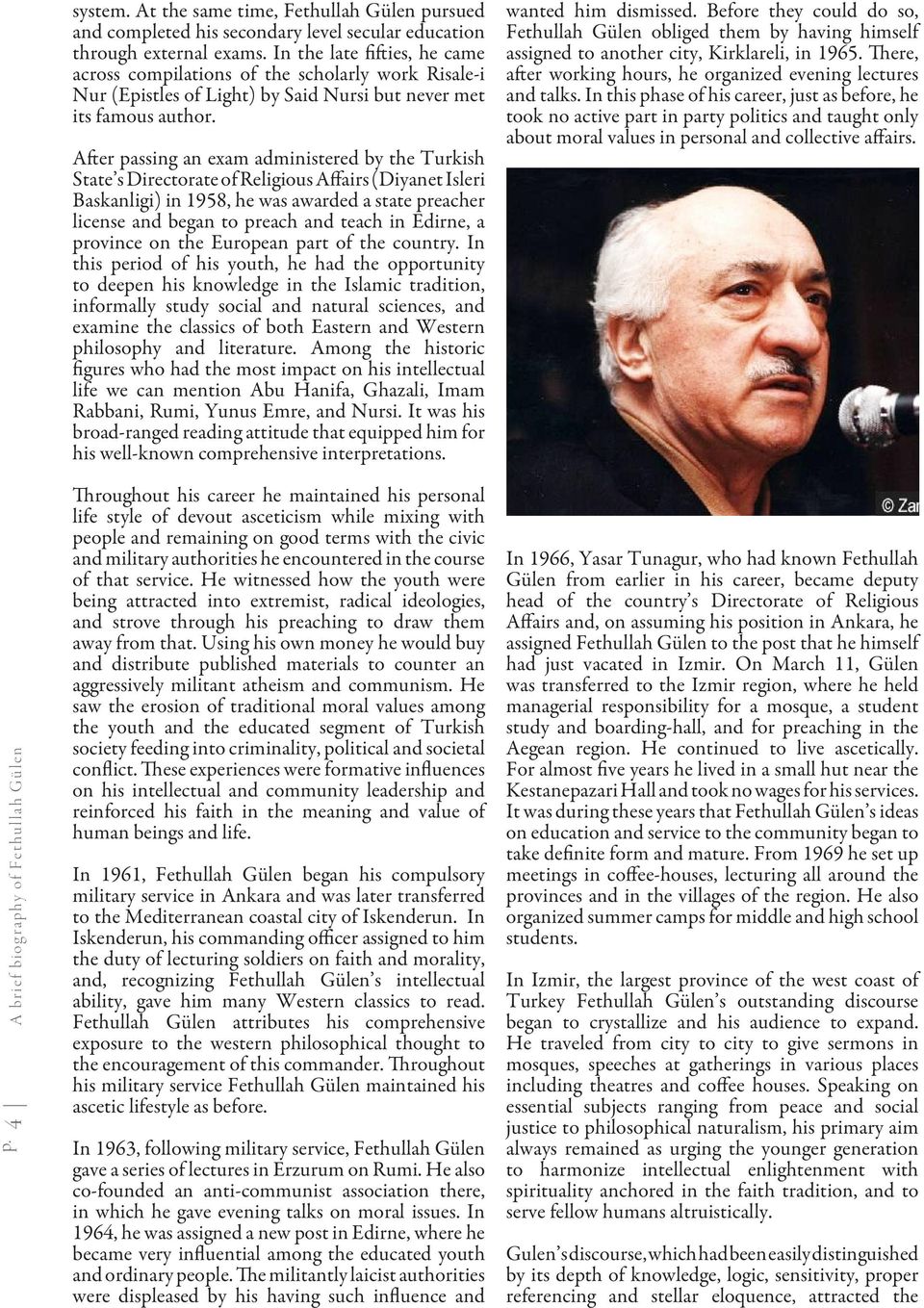
6 A brief biography of Fethullah Gülen (Compiled by the Gülen Institute) Fethullah Gülen is a Turkish Muslim scholar, thinker, author, poet, opinion leader, educational activist, and preacher emeritus. He is regarded as the initiator and inspirer of the worldwide social movement of human values known as the Hizmet (Service) Movement or the Gülen Movement. Focused on education where secular curricula are taught by teachers who aspire to represent high values of humanity, this social phenomenon defeats easy categorization. Volunteer participants in the movement, consisting of students, academicians, business owners, professionals, public officials, white-collar and blue-collar workers, farmers, men and women, young and old, contribute to multiple ways of service, which crystallize in tutoring centers, schools, colleges, hospitals, a major relief organization, publishing houses, and media institutions, both in Turkey and in more than a hundred countries of the world. Gulen s discourse cherishes and his life exemplifies values like empathic acceptance, altruistic service of one s community and humanity in general, complementary roles of the intellect and the heart, sincerity, holistic view of the human, deepening faith and love of the creation. He is noted for his pro-democracy, pro-science, pro-dialogue and nonviolence stances in critical junctures of the history of his society. In May 2008, Fethullah Gulen was listed among the top hundred public intellectuals in the world by Foreign Policy magazine. Despite the high regard millions hold for him, Gulen considers himself only one of the volunteers of the civil society movement he helped originate and denounces any attribution of leadershi He spends most of his time reading, writing, editing, worshiping, and receiving medical care. Sharing the suffering of humans in every corner of the world, he has always been known for his deep respect for and connection to all creation. Living to let others live ( yasatmak icin yasamak in Turkish) is the core principle of his understanding of service. His promotion of dialogue, empathic acceptance, and harmonious coexistence can best be reflected in a comparison with that of Rumi, the 13th Century Anatolian spiritual poet and one of Gulen s sources of inspiration. Fethullah Gülen was born into a humble family in Erzurum, Turkey, in 1941, and was raised in a spiritually enriching environment. He attended a public elementary school for three years but could not continue due to the appointment of his father to a village where there was no public school. He later obtained his diploma by self-studying and passing a comprehensive examination. His religious education consisted of studies in classical Islamic sciences such as Qur anic recitation and memorization, exegesis (tafseer), Arabic language, Prophetic Tradition (hadith) as well as the spiritual tradition of Islam (tasawwuf), which he studied under renown scholars and spiritual masters around his hometown such as Muhammed Lutfi Efendi of Alvar. During the 1950s Fethullah Gülen completed his religious education and training under various prominent scholars and Sufi masters leading to the traditional Islamic ijaza (license to teach). This education was provided almost entirely within an informal system, tacitly ignored and unsupported by the state and running parallel to its education 3

7 system. At the same time, Fethullah Gülen pursued and completed his secondary level secular education through external exams. In the late fifties, he came across compilations of the scholarly work Risale-i Nur (Epistles of Light) by Said Nursi but never met its famous author. After passing an exam administered by the Turkish State s Directorate of Religious Affairs (Diyanet Isleri Baskanligi) in 1958, he was awarded a state preacher license and began to preach and teach in Edirne, a province on the European part of the country. In this period of his youth, he had the opportunity to deepen his knowledge in the Islamic tradition, informally study social and natural sciences, and examine the classics of both Eastern and Western philosophy and literature. Among the historic figures who had the most impact on his intellectual life we can mention Abu Hanifa, Ghazali, Imam Rabbani, Rumi, Yunus Emre, and Nursi. It was his broad-ranged reading attitude that equipped him for his well-known comprehensive interpretations. wanted him dismissed. Before they could do so, Fethullah Gülen obliged them by having himself assigned to another city, Kirklareli, in There, after working hours, he organized evening lectures and talks. In this phase of his career, just as before, he took no active part in party politics and taught only about moral values in personal and collective affairs. 4 A brief biography of Fethullah Gülen Throughout his career he maintained his personal life style of devout asceticism while mixing with people and remaining on good terms with the civic and military authorities he encountered in the course of that service. He witnessed how the youth were being attracted into extremist, radical ideologies, and strove through his preaching to draw them away from that. Using his own money he would buy and distribute published materials to counter an aggressively militant atheism and communism. He saw the erosion of traditional moral values among the youth and the educated segment of Turkish society feeding into criminality, political and societal conflict. These experiences were formative influences on his intellectual and community leadership and reinforced his faith in the meaning and value of human beings and life. In 1961, Fethullah Gülen began his compulsory military service in Ankara and was later transferred to the Mediterranean coastal city of Iskenderun. In Iskenderun, his commanding officer assigned to him the duty of lecturing soldiers on faith and morality, and, recognizing Fethullah Gülen s intellectual ability, gave him many Western classics to read. Fethullah Gülen attributes his comprehensive exposure to the western philosophical thought to the encouragement of this commander. Throughout his military service Fethullah Gülen maintained his ascetic lifestyle as before. In 1963, following military service, Fethullah Gülen gave a series of lectures in Erzurum on Rumi. He also co-founded an anti-communist association there, in which he gave evening talks on moral issues. In 1964, he was assigned a new post in Edirne, where he became very influential among the educated youth and ordinary people. The militantly laicist authorities were displeased by his having such influence and In 1966, Yasar Tunagur, who had known Fethullah Gülen from earlier in his career, became deputy head of the country s Directorate of Religious Affairs and, on assuming his position in Ankara, he assigned Fethullah Gülen to the post that he himself had just vacated in Izmir. On March 11, Gülen was transferred to the Izmir region, where he held managerial responsibility for a mosque, a student study and boarding-hall, and for preaching in the Aegean region. He continued to live ascetically. For almost five years he lived in a small hut near the Kestanepazari Hall and took no wages for his services. It was during these years that Fethullah Gülen s ideas on education and service to the community began to take definite form and mature. From 1969 he set up meetings in coffee-houses, lecturing all around the provinces and in the villages of the region. He also organized summer camps for middle and high school students. In Izmir, the largest province of the west coast of Turkey Fethullah Gülen s outstanding discourse began to crystallize and his audience to expand. He traveled from city to city to give sermons in mosques, speeches at gatherings in various places including theatres and coffee houses. Speaking on essential subjects ranging from peace and social justice to philosophical naturalism, his primary aim always remained as urging the younger generation to harmonize intellectual enlightenment with spirituality anchored in the faith tradition, and to serve fellow humans altruistically. Gulen s discourse, which had been easily distinguished by its depth of knowledge, logic, sensitivity, proper referencing and stellar eloquence, attracted the
8 attention of the learned citizens including academic community and college students, as well as common people all around the country. His speeches were recorded on tape, distributed even in villages, and zealously embraced. As he frankly asserts, he simply thought to cultivate this public credit, though he never deserved it, by channeling good intentions and devotional energy towards a positive end. Fethullah Gulen describes this initially national and subsequently universal ideal as gathering around high human values by means of education and dialogue. Regarding this ideal, Fethullah Gülen has always named his function as an advisor or motivator at most. His audience in Izmir initially served as a seed to form a community of like-minded citizens from all walks of life and later expanded to citizens from very different backgrounds, including non-muslims who share the humanistic dimension of Gulen s vision if not its Islamic roots. to deny them further education and keep them at home. The hostels set up by Fethullah Gülen and his companions offered parents the chance to send their children to the big cities to continue their secular education, while protecting them from the hyper-politicized environment. To support these educational efforts, people who shared Fethullah Gülen s service-ethic now set up a system of bursaries for students. The funding for the hostels and bursaries came entirely from local communities among whom Fethullah Gülen s service-ethic idea (hizmet) was spreading steadily. With Fethullah Gülen s encouragement, around his discourse of positive action and responsibility, ordinary people were starting to mobilize to counteract the effects of violent ideologies and of the ensuing social and political disorder on their own children and on youth in general. Students in the hostels also began to play a part in spreading the discourse of service and positive action. Periodically, they returned to In 1970, as a result of the March 12 coup, a number of prominent Muslims in the region, who had supported Kestanepazari Hall and associated activities for the region s youth, were arrested. On May 1, Fethullah Gülen too was arrested and held for six months without charge until his release on November 9. Later, all the others arrested were also released, also without charge. When asked to explain these arrests, the authorities said that they had arrested so many leftists that they felt they needed to arrest some prominent Muslims in order to avoid being accused of unfairness. Interestingly, they released Fethullah Gülen on the condition that he gave no more public lectures. In 1971, Fethullah Gülen left his post and Kestanepazari Hall but retained his status as a stateauthorized preacher. He began setting up more student study and boarding-halls in the Aegean region: the funding for these came from local people. It is at this point that a particular group of about one hundred people began to be visible as a service group, that is, a group gathered around Fethullah Gülen s understanding of service to the community and positive action. Between 1972 and 1975, Fethullah Gülen held posts as a preacher in several cities in the Aegean and Marmara regions, where he continued to preach and to teach the ideas about education and the service ethic he had developed. He continued setting up hostels for high school and university students. At this time educational opportunities were still scarce for ordinary Anatolian people, and most student accommodation in the major cities, controlled or infiltrated by extreme leftists and rightists, seethed in a hyper-politicized atmosphere. Parents in provincial towns whose children had passed entrance examinations for universities or city high schools were caught in a dilemma to surrender their children s care to the ideologues or their home towns and visited surrounding towns and villages, and, talking of their experiences and the ideas they had encountered, consciously diffused the hizmet idea in the region. Also, from 1966 onward, Fethullah Gülen s talks and lectures had been recorded on audio cassettes and distributed throughout Turkey by third parties. Thus, through already existing networks of primary relations, this new type of community action, the students activities, and the new technology of communication, the hizmet discourse was becoming known nationwide. In 1974, the first university preparatory courses were established in Manisa, where Fethullah Gülen was posted at the time. Until then, it was largely the 5

9 6 A brief biography of Fethullah Gülen children of very wealthy and privileged families who had access to university education. The new courses in Manisa offered the hope that in future there might be better opportunities for children from ordinary Anatolian families. The idea took hold that, if properly supported, the children of ordinary families could take up and succeed in higher education. As word spread of these achievements, Fethullah Gülen was invited, the following year, to speak at a series of lectures all over Turkey. The service idea became widely recognized and firmly rooted in various cities and regions of the country. From this time on, the country-wide mobilization of people drawn to support education and non-political altruistic services can be called a movement the Gülen Movement. In 1976, the Religious Directorate posted Fethullah Gülen to Bornova, Izmir, the site of one of Turkey s major universities with a correspondingly large student population and a great deal of the militant activism typical of universities in the 1970s. It came to his attention that leftist groups were running protection rackets to extort money from small businessmen and shopkeepers in the city and deliberately disrupting the business and social life of the community. The racketeers had already murdered a number of their victims. In his sermons, Fethullah Gülen spoke out and urged those being threatened by the rackets neither to yield to threats and violence, nor to react with violence and exacerbate the situation. He urged them, instead, to report the crimes to the police and have the racketeers dealt with through the proper channels. This message led to threats being made against his life. At the same time, he challenged the students of left and right to come to the mosque and discuss their ideas with him and offered to answer any questions, whether secular or religious, which they put to him. A great many students took up this offer. So, in addition to his daily duties giving traditional religious instruction and preaching, Fethullah Gülen devoted every Sunday evening to these discussion sessions. In 1977, he traveled in northern Europe, visiting and preaching among Turkish communities to raise their consciousness about values and education and to encourage them in the same hizmet ethic of positive action and altruistic service. He encouraged them both to preserve their cultural and religious values and to integrate into their host societies. Now thirty-six, Fethullah Gülen had become one of the three most widely recognized and influential preachers in Turkey. For example, on one occasion in 1977 when the prime minister, other ministers and state dignitaries came to a Friday prayer in the Blue Mosque in Istanbul, a politically sensitive occasion in Turkey, Fethullah Gülen was invited to preach to them and the rest of the congregation. Fethullah Gülen encouraged participants in the Movement to go into publishing. Some of his articles and lectures were published as anthologies and a group of teachers inspired by his ideas established the Teachers Foundation to support education and students. In 1979, this Foundation started to publish its own monthly journal, Sizinti, which became the highest selling monthly in Turkey. In terms of genre, it was a pioneering venture, being a magazine of sciences, humanities, faith, and literature. Its publishing mission was to show that science and religion were not incompatible and that knowledge of both was necessary to be successful in this life. Each month since the journal was founded, Fethullah Gülen has written for it an editorial and a section about the spiritual or inner aspects of Islam, that is, Sufism, and the meaning of faith in modern life. In February 1980, a series of Fethullah Gülen s lectures, attended by thousands of people, in which he preached against violence, anarchy and terror, were made available on audiocassette. In 1980, on September 5, Fethullah Gülen spoke from the pulpit before taking leave of absence for the next twenty days because of illness. From March 20, 1981, he took indefinite leave of absence. By the third coup, the Turkish public appeared to have learnt a lesson. There was no visible public reaction. The faith communities, including the Fethullah Gülen Movement, continued with their lawful and peaceful activities without drawing any extra attention to themselves. Fethullah Gülen and the Movement avoided large public gatherings but continued to promote the service-ethic through publishing and small meetings. At this point, the Movement turned again to the use of technology and for the first time in Turkey a preacher s talks were recorded and distributed on videotape. Thus, in spite of the atmosphere of intimidation following the coup, the hizmet discourse, far from being suppressed, continued to spread in a way that, ironically, was possibly more effective. In the years immediately following the coup, the Movement continued to grow and act successfully. In 1982, Movement participants set up a private high school in Izmir, Yamanlar Koleji. In 1989, Fethullah Gülen was approached by the Directorate of Religious Affairs and requested to resume his duties. His license was reinstated to enable him to serve as an Emeritus Preacher with the right to preach in any mosque in Turkey. Between 1989 and 1991, he preached in Istanbul on Fridays and on
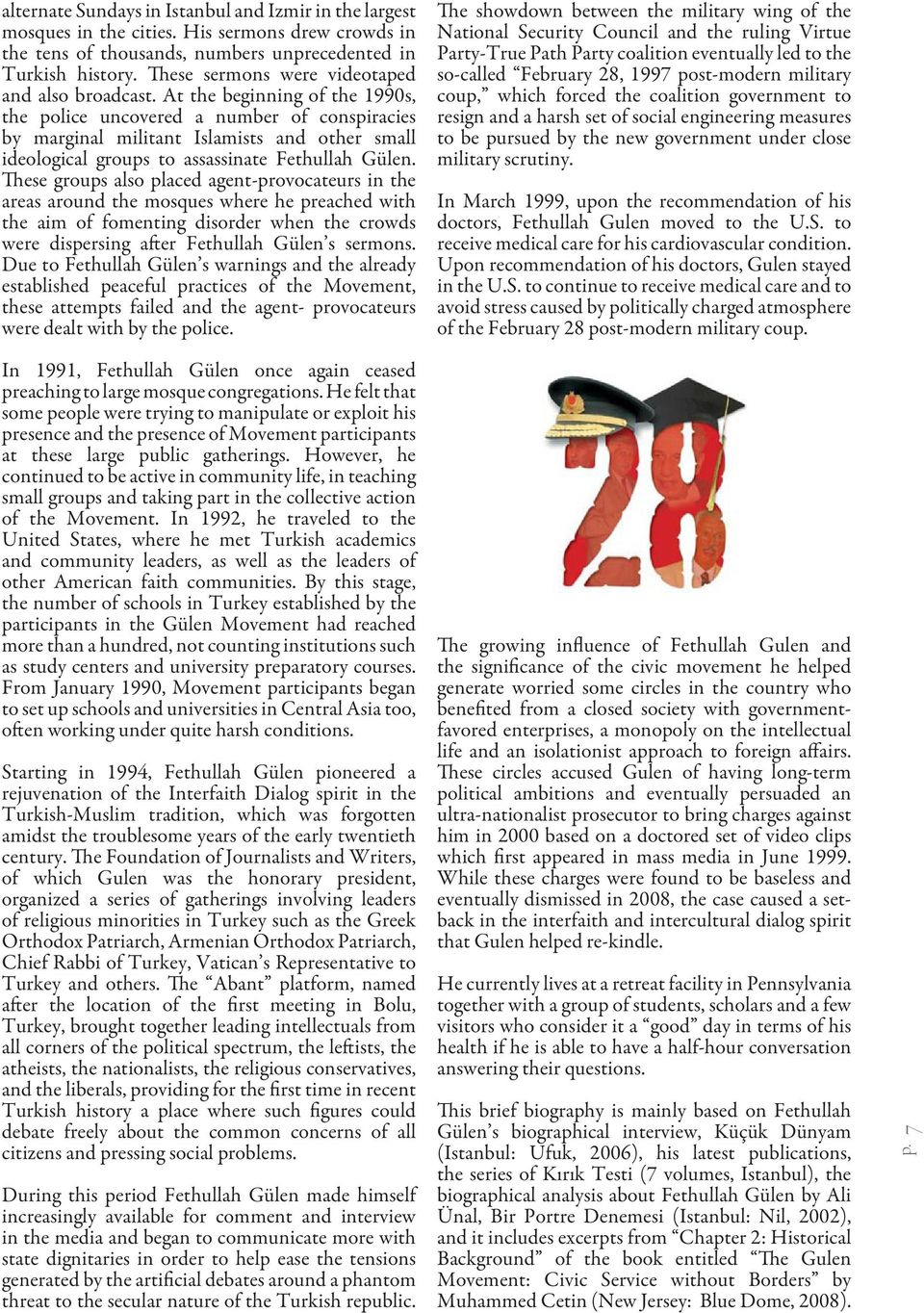
10 alternate Sundays in Istanbul and Izmir in the largest mosques in the cities. His sermons drew crowds in the tens of thousands, numbers unprecedented in Turkish history. These sermons were videotaped and also broadcast. At the beginning of the 1990s, the police uncovered a number of conspiracies by marginal militant Islamists and other small ideological groups to assassinate Fethullah Gülen. These groups also placed agent-provocateurs in the areas around the mosques where he preached with the aim of fomenting disorder when the crowds were dispersing after Fethullah Gülen s sermons. Due to Fethullah Gülen s warnings and the already established peaceful practices of the Movement, these attempts failed and the agent- provocateurs were dealt with by the police. The showdown between the military wing of the National Security Council and the ruling Virtue Party-True Path Party coalition eventually led to the so-called February 28, 1997 post-modern military coup, which forced the coalition government to resign and a harsh set of social engineering measures to be pursued by the new government under close military scrutiny. In March 1999, upon the recommendation of his doctors, Fethullah Gulen moved to the U.S. to receive medical care for his cardiovascular condition. Upon recommendation of his doctors, Gulen stayed in the U.S. to continue to receive medical care and to avoid stress caused by politically charged atmosphere of the February 28 post-modern military cou In 1991, Fethullah Gülen once again ceased preaching to large mosque congregations. He felt that some people were trying to manipulate or exploit his presence and the presence of Movement participants at these large public gatherings. However, he continued to be active in community life, in teaching small groups and taking part in the collective action of the Movement. In 1992, he traveled to the United States, where he met Turkish academics and community leaders, as well as the leaders of other American faith communities. By this stage, the number of schools in Turkey established by the participants in the Gülen Movement had reached more than a hundred, not counting institutions such as study centers and university preparatory courses. From January 1990, Movement participants began to set up schools and universities in Central Asia too, often working under quite harsh conditions. Starting in 1994, Fethullah Gülen pioneered a rejuvenation of the Interfaith Dialog spirit in the Turkish-Muslim tradition, which was forgotten amidst the troublesome years of the early twentieth century. The Foundation of Journalists and Writers, of which Gulen was the honorary president, organized a series of gatherings involving leaders of religious minorities in Turkey such as the Greek Orthodox Patriarch, Armenian Orthodox Patriarch, Chief Rabbi of Turkey, Vatican s Representative to Turkey and others. The Abant platform, named after the location of the first meeting in Bolu, Turkey, brought together leading intellectuals from all corners of the political spectrum, the leftists, the atheists, the nationalists, the religious conservatives, and the liberals, providing for the first time in recent Turkish history a place where such figures could debate freely about the common concerns of all citizens and pressing social problems. During this period Fethullah Gülen made himself increasingly available for comment and interview in the media and began to communicate more with state dignitaries in order to help ease the tensions generated by the artificial debates around a phantom threat to the secular nature of the Turkish republic. The growing influence of Fethullah Gulen and the significance of the civic movement he helped generate worried some circles in the country who benefited from a closed society with governmentfavored enterprises, a monopoly on the intellectual life and an isolationist approach to foreign affairs. These circles accused Gulen of having long-term political ambitions and eventually persuaded an ultra-nationalist prosecutor to bring charges against him in 2000 based on a doctored set of video clips which first appeared in mass media in June While these charges were found to be baseless and eventually dismissed in 2008, the case caused a setback in the interfaith and intercultural dialog spirit that Gulen helped re-kindle. He currently lives at a retreat facility in Pennsylvania together with a group of students, scholars and a few visitors who consider it a good day in terms of his health if he is able to have a half-hour conversation answering their questions. This brief biography is mainly based on Fethullah Gülen s biographical interview, Küçük Dünyam (Istanbul: Ufuk, 2006), his latest publications, the series of Kırık Testi (7 volumes, Istanbul), the biographical analysis about Fethullah Gülen by Ali Ünal, Bir Portre Denemesi (Istanbul: Nil, 2002), and it includes excerpts from Chapter 2: Historical Background of the book entitled The Gulen Movement: Civic Service without Borders by Muhammed Cetin (New Jersey: Blue Dome, 2008). 7
11 Selected Publications on Gülen in English 1. Esposito, J., and Yilmaz, I., 2010, Islam and Peacebuilding: Gulen Movement Initiatives, New Jersey: Blue Dome. 2. Ebaugh, Helen R., 2009, The Gülen Movement: A Sociological Analysis of a Civic Movement Rooted in Moderate Islam, New York: Springer. 3. Cetin, Muhammed, 2010, The Gulen Movement: Civic Service without Borders, New Jersey: Blue Dome. 4. Ergene, Enes, 2008, Tradition Witnessing Modern Age: An Analysis of the Gulen Movement, New Jersey: Tughra. 5. Carroll, Jill, 2007, A Dialogue of Civilizations: Gulen s Islamic Ideals and Humanistic Discourse, New Jersey: Tughra. 6. Hunt, Robert, and Aslandogan, Yuksel, eds Muslim Citizens of the Globalized World: Contributions of the Gülen Movement, New Jersey: The Light Inc. and IID Press. 7. Yavuz, Hakan, and Esposito, John L. eds Turkish Islam and the Secular State. Syracuse: Syracuse University Press. 8. Gündem, Mehmet Days with Fethullah Gülen: An Analysis of a Movement with Questions and Answers, Fifth Edition. Istanbul: Alfa; also available in English at 9. Saritoprak, Zeki An Islamic approach to peace and nonviolence: A Turkish experience. In Special Issue of The Muslim World 95(3): Blackwell. 10. Ünal, Ali, and Williams, Alphonse, eds Fethullah Gülen: Advocate of Dialogue. Fairfax: The Fountain. Representative Publications in English by Gülen 8 A brief biography of Fethullah Gülen 1. Gülen, M. Fethullah Pearls of Wisdom. Ali Ünal, trans. Fairfax: The Fountain. 2. Gülen, M. Fethullah Questions and Answers about Faith. Muhammed Selcuk, trans. Fairfax: The Fountain. 3. Gülen, M. Fethullah Criteria or Lights of the Way. London: Truestar. 4. Gülen, M. Fethullah In True Islam, Terror Does Not Exist. In Terror and Suicide Attacks: An Islamic Perspective. Ergün Çapan, ed. New Jersey: The Light Inc. 5. Gülen, M. Fethullah Key Concepts in the Practice of Sufism, vol. 1. New Jersey: The Light Inc. 6. Gülen, M. Fethullah Key Concepts in the Practice of Sufism, vol. 2. New Jersey: The Light Inc. 7. Gülen, M. Fethullah Love and the Essence of Being Human. Faruk Tuncer, ed. Mehmet Ünal and Nilüfer Korkmaz, trans. Istanbul: Journalist and Writers Foundation Publications. 8. Gülen, M. Fethullah Toward a Global Civilization of Love and Tolerance. New Jersey: The Light Inc. 9. Gülen, M. Fethullah The Messenger of God, Muhammad: An Analysis of the Prophet s Life. Ali Ünal, trans. New Jersey: The Light Inc. 10. Gülen, M. Fethullah The Statue of Our Souls: Revival in Islamic Thought and Activism. Muhammed Cetin, trans. New Jersey: The Light Inc.

12 Academic Events Focusing on Fethullah Gülen and the Gülen Movement 1. East and West Encounters: The Gulen Movement, University of Southern California, December 4-6, The Fifth International Conference on Islam in the Contemporary World: The Gulen Movement in Thought and Practice, Louisiana State University, Baton Rouge, LA, March 6-7, Islam in the Age of Global Challenges: Alternative Perspectives of the Gulen Movement, Georgetown University, Washington, D.C., November 14-15, International Conference on Muslim World in Transition: Contributions of the Gulen Movement, School of Oriental and African Studies, and London School of Economics, October 25-27, Third International Conference on Islam in the Contemporary World: Contributions of the Gulen Movement, University of Texas at San Antonio, November 3rd, International Conference on Islam in the Contemporary World: The Fethullah Gülen Movement in Thought and Practice, Rice University, Houston, Texas, November 12 13, 2005, co-sponsored by the Boniuk Center for the Study and Advancement of Religious Tolerance, Rice University, and A.D. Bruce Religious Center at University of Houston. 7. The Chicago Interfaith Gathering Towards Interreligious Dialogue in the New Millenium: Finding Common Ground, Special Session on the Gülen Movement, November 10 11, 2005, co-sponsored by the Loyola University of Chicago, The University of Chicago Divinity School, DePaul University Department of Religious Studies, Catholic Theological Union, Lutheran School of Theology at Chicago, Archdiocese of Chicago Ecumenical and Interreligious Affairs. 8. Second International Conference on Islam in the Contemporary World: The Fethullah Gülen Movement in Thought and Practice, Southern Methodist University, Dallas, Texas, March 3 5, 2006, co-sponsored by the Graduate School for Religious Studies, Southern Methodist University. 9. Second Annual Conference on Islam in the Contemporary World: The Fethullah Gülen Movement in Thought and Practice, University of Oklahoma, Norman, Oklahoma, November 3 5, 2006, co-sponsored by the Department of Religious Studies, Petree College of Arts and Sciences at Oklahoma City University. 10. The Muslim World in Transition: Contributions of the Gülen Movement, House of Lords, United Kingdom, October 25 27, 2007, co-sponsored by the University of Birmingham, UK, Hartford Seminary, USA, Leeds Metropolitan University, London Middle East Institute, and SOAS, University of London. 11. Peaceful Coexistence: Fethullah Gülen s initiatives for peace in the contemporary world, Rotterdam, The Netherlands, November 22 23, 2007, organized at Erasmus University Rotterdam, co-sponsored by Leeds Metropolitan University and Dialoog Academie. Source: 9
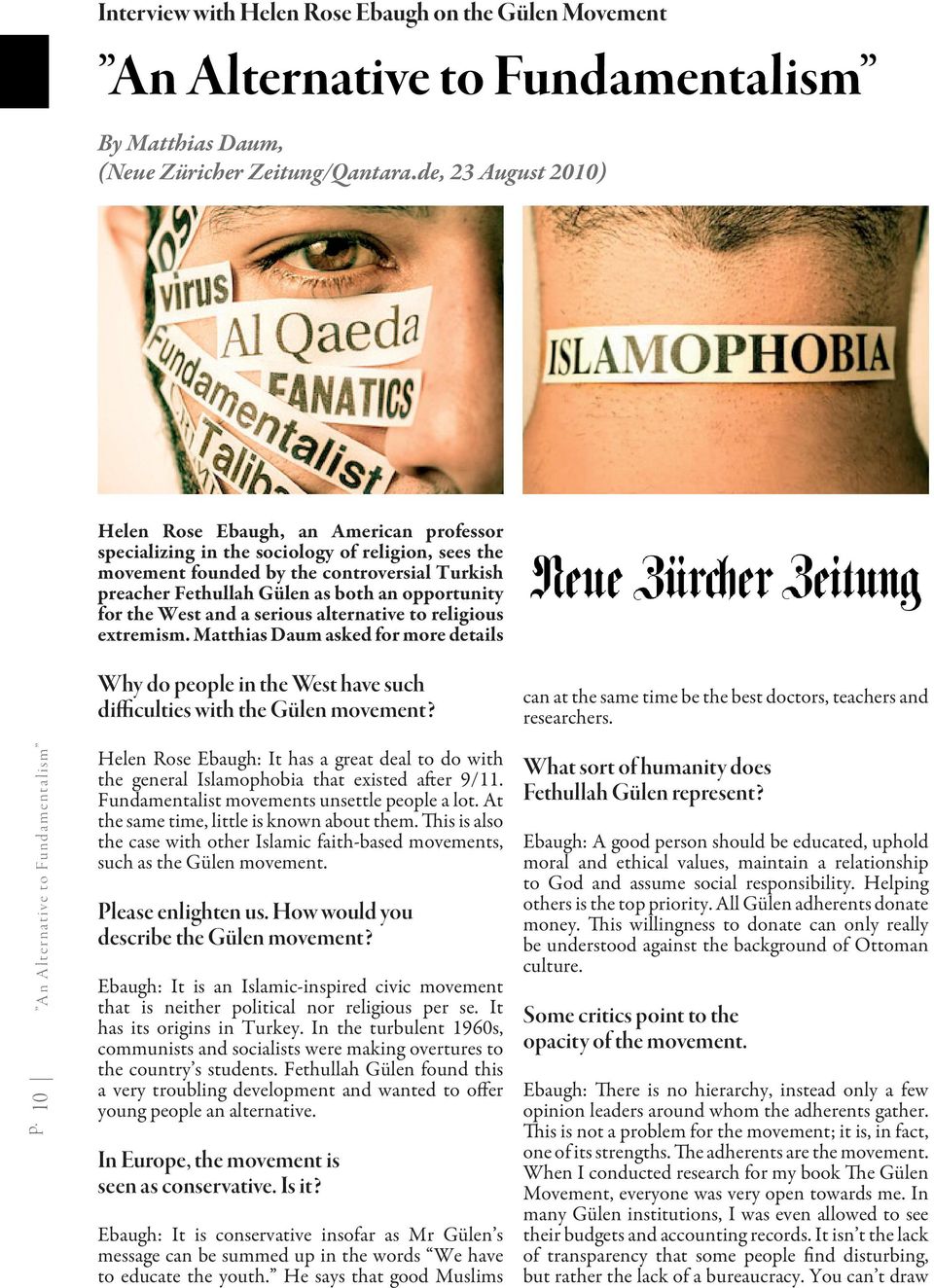
13 Interview with Helen Rose Ebaugh on the Gülen Movement An Alternative to Fundamentalism By Matthias Daum, (Neue Züricher Zeitung/Qantara.de, 23 August 2010) Helen Rose Ebaugh, an American professor specializing in the sociology of religion, sees the movement founded by the controversial Turkish preacher Fethullah Gülen as both an opportunity for the West and a serious alternative to religious extremism. Matthias Daum asked for more details Why do people in the West have such difficulties with the Gülen movement? can at the same time be the best doctors, teachers and researchers. 10 An Alternative to Fundamentalism Helen Rose Ebaugh: It has a great deal to do with the general Islamophobia that existed after 9/11. Fundamentalist movements unsettle people a lot. At the same time, little is known about them. This is also the case with other Islamic faith-based movements, such as the Gülen movement. Please enlighten us. How would you describe the Gülen movement? Ebaugh: It is an Islamic-inspired civic movement that is neither political nor religious per se. It has its origins in Turkey. In the turbulent 1960s, communists and socialists were making overtures to the country s students. Fethullah Gülen found this a very troubling development and wanted to offer young people an alternative. In Europe, the movement is seen as conservative. Is it? Ebaugh: It is conservative insofar as Mr Gülen s message can be summed up in the words We have to educate the youth. He says that good Muslims What sort of humanity does Fethullah Gülen represent? Ebaugh: A good person should be educated, uphold moral and ethical values, maintain a relationship to God and assume social responsibility. Helping others is the top priority. All Gülen adherents donate money. This willingness to donate can only really be understood against the background of Ottoman culture. Some critics point to the opacity of the movement. Ebaugh: There is no hierarchy, instead only a few opinion leaders around whom the adherents gather. This is not a problem for the movement; it is, in fact, one of its strengths. The adherents are the movement. When I conducted research for my book The Gülen Movement, everyone was very open towards me. In many Gülen institutions, I was even allowed to see their budgets and accounting records. It isn t the lack of transparency that some people find disturbing, but rather the lack of a bureaucracy. You can t draw
14 a flow chart of the movement. No one person is responsible, because everyone is responsible. So there are no official contacts? Ebaugh: Yes, but this very horizontal organisational structure also has advantages. The establishment of schools, for instance, is a strictly local affair. Bureaucracies only exist within the various institutions. These include the TV broadcaster Samanyolu and the newspaper Zaman, both of which are closely affiliated to the government of Recep Tayyip Erdogan, as well as the aid agency Kimse Yok Mu. What is the movement s position on dialogue with other religions? Ebaugh: It is one of the movements that strongly advocates dialogue between the three Abrahamic faiths. This is why Turks love to go to the USA. No one cares about the headscarf here. To be honest, I really don t know what all the fuss is about. To what extent is it prepared to make concessions, for instance on the issue of equal rights for women? Ebaugh: That is a problem. One doesn t see too many women in public positions within the movement. I believe, however, that this will change. On a similar note, the issue of the headscarf is a hotly debated issue in Europe. What stance does the Gülen movement take in this respect? Ebaugh: [laughs] This is why Turks love to go to the USA. No one cares about the headscarf here. To be honest, I really don t know what all the fuss is about. Nonetheless, it is the subject of debate. Ebaugh: Exactly. Other issues are more important to the Gülen movement, such as the separation of religion and state in Turkey. How do you think the West should react to the Gülen movement? Ebaugh: I find myself in agreement with the former US Secretaries of State James Baker and Madeleine Albright and the former CIA officer Graham Fuller. They say that we should support such movements, because they offer an alternative to fundamentalism. I recently saw statistics from the south of Turkey that showed that Gülen students are not attracted to the PKK; one of the reasons for this is that they have been given a good education. Fethullah Gülen is supposedly very ill. What will happen to his movement after his death? Ebaugh: Nothing. The movement is much too strong. This is how it differs from a sect or a commune. Helen Rose Ebaugh lectures on the sociology of religion at the University of Houston in Texas. She is the author of the book The Gülen Movement: A Sociological Analysis of a Civic Movement Rooted in Moderate Islam, Springer Verlag Niederlande, Houston Translated from the German by John Bergeron Prof. H. R. Ebaugh 11 Ebaugh: Mr Gülen himself says that if you have to choose between the headscarf and a good education, choose education. A very pragmatic stance. Editor: Aingeal Flanagan/Qantara.de Source: c=478&wc_id=1090

15 Gülen s critics have no supporting evidence, says academic By Emre Oğuz, (Today s Zaman, 17 August 2010) in Turkey, she said, however, the courts found no evidence of wrongdoing. In 2000, then-state Security Court (DGM) prosecutor Nuh Mete Yüksel launched a case against Gülen on charges of establishing an illegal organization. At the end of the eight-year case, he was acquitted. Upon appeal, the General Criminal Chamber of the Supreme Court of Appeals upheld the acquittal. 12 Gülen s critics have no supporting evidence, says academic American sociology professor Helen Rose Ebaugh, who has written a book analyzing the Gülen movement, has said those criticizing the movement have no documents to back up their criticisms. Ebaugh, the author of a book titled The Gülen Movement: A Sociological Analysis of a Civic Movement Rooted in Moderate Islam, was speaking at a conference organized by the Copenhagen-based Dialog Forum Foundation over the weekend. Stating that she received letters from some circles harshly criticizing Fethullah Gülen and the movement inspired by him after she began her research, Ebaugh said that when she called on them to prove their accusations they had failed to do so. She says they did not send her anything supporting their claims because such evidence does not exist. Gülen is a Turkish Islamic scholar well known for his teachings promoting mutual understanding and tolerance between cultures. Responding to questions by the participants at the conference, which was dominated by academics, the professor also provided information about her book. Noting that Americans knew little about Islam before the terrorist attacks on the World Trade Center on Sept. 11, 2001, she said radical Muslims immediately began appearing in the media after the attacks. Ebaugh, who still gives lectures on the sociology of religion at the University of Houston, said Gülen showed the other face of Islam when he condemned terror with statements he made at the time. Noting that like many other Americans, that was the first time she heard Gülen s name, and she said she had an opportunity to examine the Gülen movement after she began her research. Recalling that Gülen stood trial in a court case for many years Ebaugh underlined that the biggest contribution by the Gülen movement is the schools opened by the movement around the world. Noting that she met with several principals of these schools both in Turkey and the US, she said the young people who received an education at these schools are now serving at other such institutions across the world. She added that in time they will carry the thoughts of Gülen to more people. The professor also commented on recent remarks by Gülen calling on the Turkish people to vote yes in the upcoming Sept. 12 referendum in Turkey, when the nation will vote on a constitutional amendment package. Stating that she was first surprised to hear that he made a special statement on the issue, as Gülen is not engaged in politics, she says when she understood how vital the changes were for Turkey, she acknowledged him to be right. Stating that the fact that Gülen made a special statement on the issue although he distances himself from politics shows how important the amendments are for the country, she added that it would be harder for the European Union to deny Turkey s membership if the package is approved. On Sept. 12, the nation will vote on a number of constitutional changes approved by Parliament in May. Among other things, the reform package includes changes to the structure of the Constitutional Court and the Supreme Board of Judges and Prosecutors (HSYK). Furthermore, the package repeals Article 15 of the Turkish Constitution, which gives immunity to the generals responsible for the Sept. 12, 1980 cou Source:
16 13 Fethullah Gülen and Pope John Paul II Gülen, the most important figure of tolerance and dialogue By Orhan Akkurt, (Today s Zaman, 25 July 2010) Mr. Fethullah Gülen is the most influential representative of love, tolerance and dialogue in our world today. In the West, especially in the United States, an increasing number of scholars have discovered Gülen to be a man of love and tolerance and consider his teaching as a model of dialogue among religions, cultures and civilizations. These are the words of Dr. Heon C. Kim, a specialist in contemporary Islam. Highlighting the great need for dialogue in today s world, Dr. Kim praises Gülen s teachings of love, tolerance and dialogue, which have been practiced and spread worldwide by the Gülen movement, the fastest expanding Islamic movement around the globe. It is appropriate and reasonable, Dr. Kim states, that a recent survey, The 500 Most Influential Muslims, published by Georgetown University in 2009, placed Gülen as one of the top 50 influential Muslims today and introduced him as one who affects huge swathes of humanity and has gone on to become a global phenomenon. Dr. Kim completed his years of doctoral research on Gülen and the Gülen movement in 2008, and is currently teaching at Temple University, Philadelphia. One of the most pioneering and cutting-edge contributions of his dissertation is to make tangible the spiritual dimensions of Gülen s life and thought and the inner dynamic of the Gülen movement. His research shows in detail that the Islamic spirituality of love, tolerance and dialogue, which was once exemplified by the Prophet Muhammad and subsequently followed by great Sufi saints, is at the core of Gülen s thought and the activities of the Gülen movement. Base upon this finding, Dr. Kim agrees with those Western scholars who identify Gülen as a contemporary Rumi (Jalal al-din Rumi, a great Sufi saint in Islamic history and the best-known Muslim mystic in the West), and further considers Gülen s teaching of dialogue as an alternative to both the jihadist/fundamentalist movements and those in the West who adhere to the clash of civilizations paradigm. When and how did you first learn about Gülen? After I graduated from Arabic studies in South Korea I went to Egypt to further learn about Islam. While studying Islamic theology in a graduate program at Al-Azhar University, Cairo, I observed that many Muslim scholars hold an intolerant view of Islam when it comes to other religions and cultures, which was contrary to my conviction that Islam is a religion of submission and peace that is respectful of other religious traditions. After having this experience, I was fortunate to meet several Turkish students of Gülen in South Korea. Being initially impressed by their open-mindedness, I read some of Gülen s books, and his moderate Islamic thought

17 14 Gülen, the most important figure of tolerance and dialogue was intellectually and spiritually inspiring to me. In order to introduce his moderate and authentic form of Islam as a counter to the Wahhabi/literalist versions of Islam prevalent in our world today, I translated one of Gülen s books into Korean. It was published first in 1999 and subsequently reprinted in 2001 in the aftermath of Sept. 11. My growing interest in Gülen s thought led me to visit Gülen in Turkey in With his permission, I was able to participate in the daily class that he gave for his students. Although I could not readily follow his lectures at first since I was not fluent in Turkish at the time, I could still appreciate his gentle behavior and simple lifestyle. What did you do after meeting with Gülen? After spending three months participating in Gülen s daily class, I learned enough Turkish to be admitted into a graduate program in Islamic philosophy at Marmara University in İstanbul. The more I learned Turkish, the better I began to understand Gülen s teaching, especially his Islamic ideal of love, tolerance and dialogue. I ended up spending three years in Turkey in order to study at the university and better learn about Gülen s thought. During my stay I also traveled throughout the country and observed Islam in public life. Especially in Anatolia, central Turkey, I witnessed the beautiful characteristics of hospitality, peace, tolerance and self-sacrifice, all of which Gülen praised as Anadolu İnsanlarının Ruhu [the spirit of the Anatolian people]. Another characteristic that was strongly impressed upon my memory was the people s living embodiment of Gülen s teaching to give, give and give more for God s pleasure and hizmet [service for humanity]. My learning of Gülen s moderate Islamic thought did not end with his arrival to the US in After he left Turkey, I decided to pursue my doctorate in the US, a nation which actively promotes religious and cultural diversity and encourages academics to do their study and research free of political/religious restrictions. This is unfortunately not the case in many Islamic countries, Turkey included. Why did you choose Gülen and Sufism as your dissertation topic? First, what I had directly experienced in Egypt and Turkey was not Islam in literature but Islam in people. Islam in people was not literalistfundamentalist Islam, but Sufi Islam, a spiritual form of Islam that is deeply embedded in the lives of ordinary people and appears as a cultural reality. Literalist-fundamentalist Islam, also known as jihadist and Islamist, views non-muslims, especially from the Judeo-Christian world, as the other and adopts a somewhat antagonistic view towards them. Many Western academics have spent far too much time focusing on this form of Islam. In reality, however, this version of Islam is followed by less than 5 percent of Muslims in the world. What the vast majority of Muslims follow instead is what we academics call a popular Islam, and Sufism has played a major role in helping to define popular Islam with its millennium-long history. This reality of Sufism has not been fully understood in academic circles. Worse, Sufism has long been condemned by fundamentalist-jihadist Muslims as a non-islamic tradition and misunderstood by the Orientalist Western scholarship as a naïve personal mystical experience. Both approaches fail to accord with my own experiences and the reality of Sufism. An academic approach to Sufism phenomenological as it is is very much needed, and this was the principle motivation behind my dissertation research. Based on my own experiences in Turkey, I was confident that Turkey in general and Gülen in particular would provide the most remarkable case study for an in-depth analysis of Sufism. Since the Kemalist secularist ban on Sufi orders in 1925, Sufism was blamed as a reason for the nation s backwardness in comparison with the development that was occurring in the West. Consequently, Sufi orders were considered to be a threat to the foundation of the Republic of Turkey. Certain politicians, secularist intellectuals and army elites suspected Gülen as an Islamist Sufi leader who led a dangerous cult. Quite opposed to this suspicion, the Western view of Gülen and the Gülen movement, from academia to newspapers, recognized the significant contributions that Gülen has made in the world. I wanted to see what the true identity of Gülen and his movement is. Do you mean there is a strong connection between Gülen and Sufism? Yes, absolutely. What I have found is that Gülen can be considered a Sufi saint, but he has never

18 been an Islamist, as all of his life, works, his thought and his movement indicate moderate Islam that acknowledges other religions as partners of dialogue. Indeed, Gülen himself has met with Jewish and Christian leaders, including Pope John Paul II in Another important fact is that while Gülen can be considered a Sufi saint, he is not the leader of a Sufi order. He does not teach from the platform of a Sufi order but instead teaches that Sufism is to live an Islamic spiritual life as practiced by the Prophet Muhammad, his companions, Rumi, Yunus Emre, and Bediüzzaman Said Nursi, all of whom did not found any kind of Sufi order. To underline this understanding of Sufism, I refer to it as Sufism without Sufi orders. This Sufism without Sufi orders in Gülen s thought has the benefit of not creating boundaries, as often occurs amongst Sufi orders. Instead, it calls all Muslims to respect other Muslims and non-muslims as equal creations of God s Love. He encourages Muslims to engage in dialogue with others, remembering that they are all a reflection of the Divine Love. This dialogic Sufism that I call it offers an alternative to fundamentalist/ jihadist Islamist movements and creates a dialogical bridge between Islam and other religions. dialogue for peaceful coexistence. Mr. Gülen has been advocating love and tolerance-based dialogue for almost three decades now. He has always said we should engage in dialogue with everyone without any discrimination. To me, his teachings of dialogue are extremely important today since many people believe in the clash of civilizations. Could you explain more about Gülen s views on dialogue? In Gülen s thought, dialogue appears as a natural consequence of humanism. Mr. Gülen defines humanism as a doctrine of love and humanity. He warns against an unbalanced understanding of humanism, for instance one that misunderstands jihad and views non-muslims as the antagonistic others. Gülen s humanism opposes a fanatical jihadist approach to humanity, and instead intends to actualize love of all humanity. To Gülen, humanity is the most valuable being in the universe as the greatest mirror of God s names and attributes. Every human being is equally endowed with capacity to mirror divine nature and has the capability to be developed to an excellence greater than the universe. Thereby, first, all humans are equal as a mirror of God s attributes, irrespective of religion, race, wealth and social status. And second, since humans are created by the Creator s own love, love is the most essential element in humanity. These concepts of equality, love and humanity are the basis of Gülen s humanism, and serve as the founding principles of the Gülen movement. A foremost practical manifestation of Gülen s lovebased humanism is dialogue. To Gülen, dialogue is an activity of forming a bond between two or more people. To form such a bond means to position human beings at the axis of dialogue. Therefore, dialogue in a true sense is a sublimation and pragmatic extension of humanism, which can be only accomplished by mutual respect, tolerance and love. Nowadays, more and more people in the world realize the need of So you see dialogue and tolerance as the solution to the clash of civilizations? Yes. I consider them as an alternative and even the only solution to contemporary problems of humanity. In recent years, a great number of political social scientists have adopted Samuel Huntington s Clash of Civilizations theory. This theory suggests an intrinsic incompatible relationship between Western civilization and non-western civilizations and foresees inevitable civilizational clashes and wars. This view has spearheaded immense scholarly debate, producing a number of critical works. I myself have taken part in this debate by writing several papers and presenting some of them at a series of academic conferences in the US. In these papers I traced back the intellectual origin of Huntington s theory. His conviction of civilizational incompatibility and clashes essentially premises the dialectic tension or opposition of the antithetical relationship of the self and others, which evolves from Friedrich Hegel s and later the Hegelian concept of ideologically inferior others and Karl Marx s and later the Marxist notion of political-economically alienated others. Huntington adds to his predecessors by putting forward the concept of religious incompatibility as between Christianity and Islam. Though embracing different foci, the views of Hegel, Marx and Huntington are constant in identifying humanity as the opposing and conflicting relationship of the 15
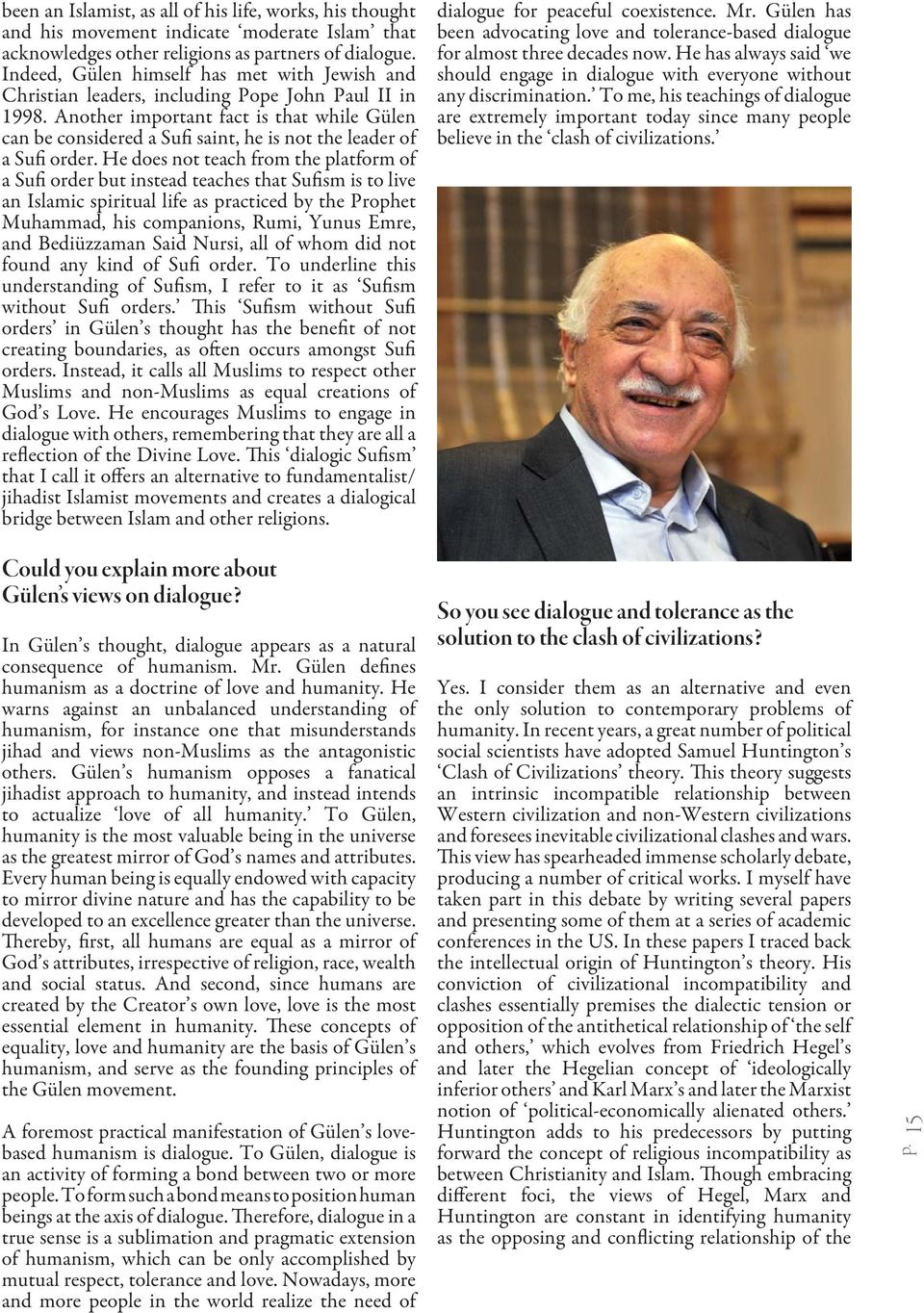
19 self and others, which can be called a dialectical approach to humanity. As a polar opposite to the dialectical approach to humanity, Gülen s understanding of humanity and humanism assumes the equality and compatibility of the self and others that leads to love, tolerance and dialogue. In fact, Gülen s humanism directly refuses to see others as a dialectical antithesis. Instead it asserts that the distinction between the self and the other can only exist as an object of dialogue in a way of protecting and empowering one s spirituality against his/her egoistic carnal self that gives rise to constant conflict with others. I term this humanism dialogic humanism, and define it as a system of thought and way of life that approaches humanity as a unit of self and others and as an object of love and dialogue. I specifically assign it as an alternative consideration to the dialectical approach to humanity. For this aspect alone, I think Gülen s teachings on humanism should be considered and valued. counts millions as members. My research has shown that hizmet has been the key factor in spreading the movement. While most studies on the movement focus on external factors like organizational structure as being the main reason for the movement s success, my findings are that the practice of hizmet is the primary reason, if not the only reason, for the success of the movement. Other than the practice of hizmet, it would be very difficult to explain why almost all members of the Gülen movement volunteer much You mentioned that Gülen s humanism and his approach to dialogue are the founding principles of the Gülen movement. 16 Gülen, the most important figure of tolerance and dialogue Yes, I did. I also mentioned hizmet, or service for humanity in English. My own research has demonstrated that Gülen s humanism is reflected in both the members individual lives and the group activities of the Gülen movement. Hizmet is the core working concept here. I further consider that hizmet is the most distinctive principle that characterizes Gülen s thought and the Gülen movement and differentiates it from other Islamic movements. Hizmet in Gülen s Islamic theology is an ultimate ideal to be pursued individually and communally for the service of humanity. Gülen teaches that the worldly life should be used in order to earn the afterlife and to please the One who has bestowed it. The way to do so is to seek to please Allah and, as an inseparable dimension of it, to serve immediate family members, society, country and all of humanity accordingly. This service [hizmet] is our right, and sharing it with others is our duty. Hizmet can be best actualized by a man of action and thought [aksiyon ve düşünce insanı], another well-known concept of Gülen s. Unlike a typical Sufi order that gives priority to individual mystical experience in remembrance of Allah in seclusion, Gülen emphasizes that any spiritual experience and exercise is completed by taking action in society. Unlike Islamist movements, he stresses that the action in society is vitalized by humanism of love and dialogue. of their money, time and effort. The spirit of giving is the real source behind the movement s activities over the world. Many outsiders who partaken in the movement s activities would agree with my conclusion. If properly presented, I believe the Islamic humanism of love, tolerance and dialogue that Gülen teaches is the perfect antidote to the dialectical approach to humanity, which leads to endless conflict by continually creating tensional gaps among civilizations, nations, social classes and humanity itself. Gülen initiated the Gülen movement as an instrument and living model of hizmet. With the principle of hizmet, the movement has spread Gülen s humanism over the world. His movement now reaches major cities in over 100 countries and Source:
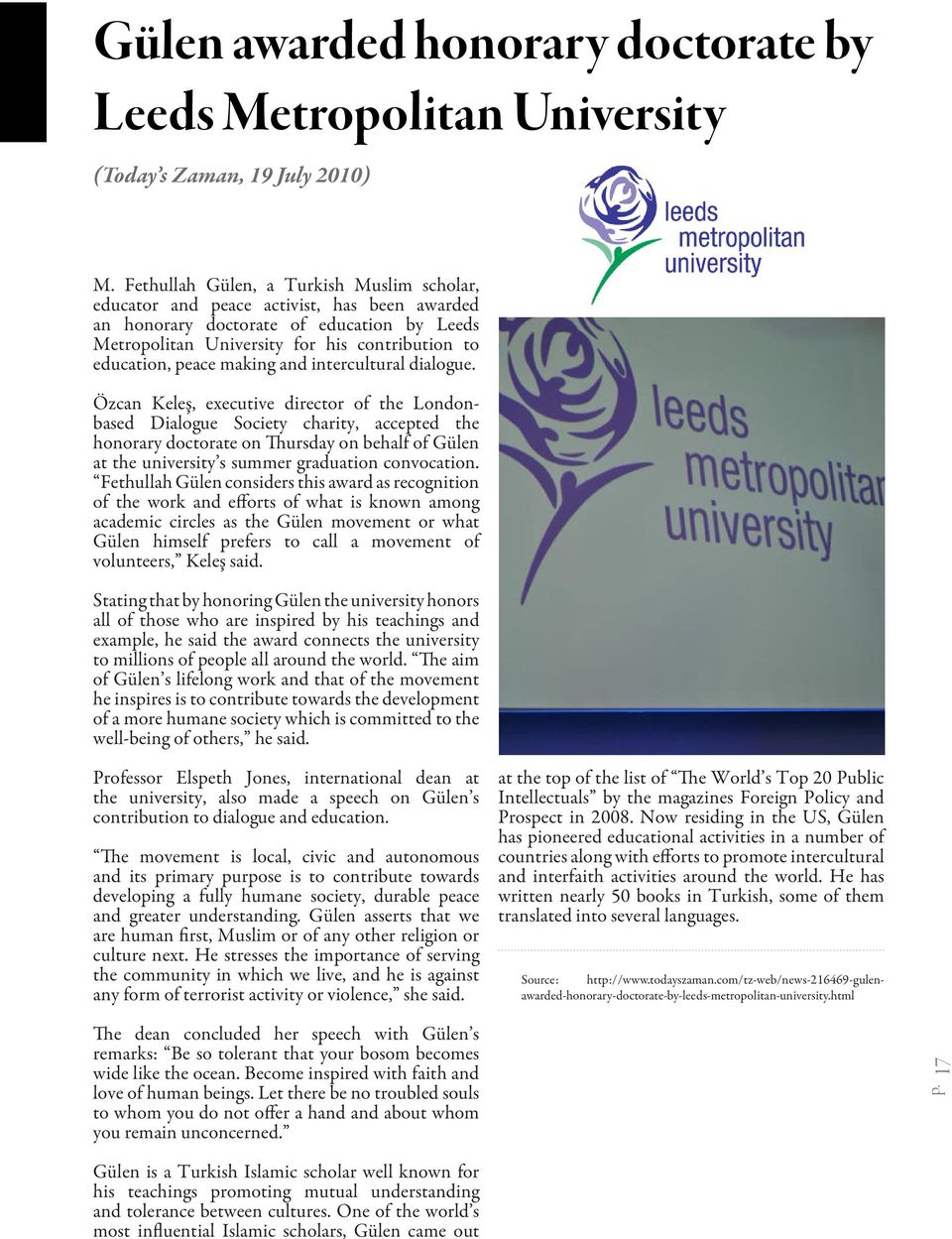
20 Gülen awarded honorary doctorate by Leeds Metropolitan University (Today s Zaman, 19 July 2010) M. Fethullah Gülen, a Turkish Muslim scholar, educator and peace activist, has been awarded an honorary doctorate of education by Leeds Metropolitan University for his contribution to education, peace making and intercultural dialogue. Özcan Keleş, executive director of the Londonbased Dialogue Society charity, accepted the honorary doctorate on Thursday on behalf of Gülen at the university s summer graduation convocation. Fethullah Gülen considers this award as recognition of the work and efforts of what is known among academic circles as the Gülen movement or what Gülen himself prefers to call a movement of volunteers, Keleş said. Stating that by honoring Gülen the university honors all of those who are inspired by his teachings and example, he said the award connects the university to millions of people all around the world. The aim of Gülen s lifelong work and that of the movement he inspires is to contribute towards the development of a more humane society which is committed to the well-being of others, he said. Professor Elspeth Jones, international dean at the university, also made a speech on Gülen s contribution to dialogue and education. The movement is local, civic and autonomous and its primary purpose is to contribute towards developing a fully humane society, durable peace and greater understanding. Gülen asserts that we are human first, Muslim or of any other religion or culture next. He stresses the importance of serving the community in which we live, and he is against any form of terrorist activity or violence, she said. at the top of the list of The World s Top 20 Public Intellectuals by the magazines Foreign Policy and Prospect in Now residing in the US, Gülen has pioneered educational activities in a number of countries along with efforts to promote intercultural and interfaith activities around the world. He has written nearly 50 books in Turkish, some of them translated into several languages. Source: The dean concluded her speech with Gülen s remarks: Be so tolerant that your bosom becomes wide like the ocean. Become inspired with faith and love of human beings. Let there be no troubled souls to whom you do not offer a hand and about whom you remain unconcerned. 17 Gülen is a Turkish Islamic scholar well known for his teachings promoting mutual understanding and tolerance between cultures. One of the world s most influential Islamic scholars, Gülen came out
21 Gülen Movement raises a new renaissance generation By Kerim Balcı and Zeynep Yılmaz, (Today s Zaman, 4 July 2010) without a textual dialogue between Gülen and an atheist. Jill Carroll has been the director of The Boniuk Center for the Study and Advancement of Religious Tolerance at Rice University, situated in Houston, Texas, for a long time. Carroll, who gives lectures on the history of thought at the university, has found in Gülen philosophies similar to those of some philosophers of ethics ranging from Plato and Confucius to Kant and Sartre. The inner consistency of the movement, the faith in love that is fundamental to the nature of human beings and the commitment to future-oriented action have enabled her to observe a version of an embodied utopia. Carroll s experience is a warning for those who have an internal view of the movement and it is also a guide for those with an external view of it. The first virtue that Carroll learnt from the Gülen movement was patience, and she patiently answered our long and successive questions. 18 Gülen Movement raises a new renaissance generation In Gülen, you do not just find a dialogue between Gülen and Plato or Gülen and Confucius. Gülen is an intellectual that has been able to attribute this dialogue to the Muslim context. There is a different dimension to Gülen that arouses excitement. Gülen s words are turned into action in the practical world by a community of action, says Dr. B. Jill Carroll. On a book-signing visit to Turkey for her new book about the Gülen movement titled, A Dialogue of Civilizations: Gülen s Islamic Ideals and Humanistic Discourse, Carroll is pleased with the interest that her short 120-page book has aroused. She regards her book as a continuation of the dialogue initiated by Gülen himself. While explaining that she establishes a dialogue between an atheist like Sartre and a believer like Gülen on the basis of a sense of responsibility, Carroll states that this is just a textbased effort aiming to establish a dialogue which needs to take place in this world. Carroll continues: We today have atheists and believers, and we re destined to share this planet together. How will atheists and believers live together? So, I didn t want to finish that book In what context did you encounter the Gülen movement and how did this context influence your understanding of it? I was directing a center for religious tolerance at Rice University at the time. I think that position is what put me on the radar of the community there in Houston, Texas. That explains why I was invited to come to Turkey in the first place. So, I guess the starting point is interfaith. That formed the glasses, if you will, or the frames through which I looked at the movement. The interfaith angle is what started me into it and continues to be the context in which I assess and experience the movement. I was interested to see how these Muslims, these Turkish Muslims, deal with people from other faiths. These are Muslims who are obviously committed, pious and observant. How do they interact with people from other faiths? So, I was observing this and just trying to see if their activity, their actions matched their words, and they did. Let us come back to your internal context: Your previous education and studies should have a say in how you perceived the movement. In fact, in your book you put Gülen in a dialogue with Confucius, Sartre and Plato. This relates to your internal context. For 20 years at the university I have mostly taught courses that are broadly historical, like the history
22 of intellectual thought. We call these classes in America from Plato to NATO. You develop a capacity to see broad themes across centuries, across cultures from China to Africa. When I first began to read the ideas of Mr. Gülen, I immediately sought connections. I sought points of connection between his ideas from a Muslim Turkish context and those of Confucius or those of Sartre on certain key issues. It is because of my own training and my teaching experience that I seek things in this way. I am a generalist; I am someone who easily sees the forest. Other people are oriented to see the trees and leaves and the tiny details. In Gülen you found somebody from a tradition that is not your own thinking in ways that do not belong to his own tradition. What does this mean to a generalist like you? It is very exciting because in someone like Gülen you not only find the thinker who is thinking the thoughts of Plato but within a Muslim context or saying the words of Confucius but as his own. There is that, but there is also this community of activism that is bringing these things to life in the practical world. It is one thing to be a philosopher; it is another thing to be an activist, and it was weird to find those two things in one man. You have already had the Platonic dialogue as a theory in your mind. What is different in the Gülen movement s dialogic activities? I think the dialogue that we see in the movement of people inspired by Gülen is more similar to not what Socrates or Plato did, but what Aristotle did. Aristotle in his school encouraged his students to dialogue with the world, to engage the world, to get outside of the comfortable environment and learn about others and educate themselves in that way. That comes close in spirit to what this community and Mr. Gülen is speaking about. I think the term dialogue is a very rich and very pregnant term in the way that Gülen speaks of it. The emphasis on education itself, it is a part of this dialogue. Education, by definition, means that you dialogue with ideas that you ve never heard of before. You engage with notions, concepts, theories and perspectives that are foreign to you, and you open yourself to them. You broaden yourself to receive them, and to learn from them. So, by definition, education is dialogue. The emphasis on the schools, the blending of the spiritual values with science and knowledge, is a kind of dialogue that takes it beyond what most people think of. There is another mode of dialogue that has to do with overall engagement with the world. This is important because it is coming from a spiritual tradition. With Mr. Gülen there is a kind of Sufism overlay. He is not a Sufi sheikh; there is not a brotherhood. But there is a Sufi overlay, and many religions have these traditions where the real spiritual leaders separate from the world. They go and live out by themselves in the forest, in a cave or in the desert. But Gülen says: OK, there is paradise and we must think eternally, but we do that best by engaging with the world. This is a dialogue with the world through business, through community, through service, through contribution and being in the world and improving it and contributing to it. So, all of these things, I think, play a role in this overall definition of dialogue. That s why I saw it as a very pregnant term. Do you foresee a future that this dialogue will lead to a new way of thinking, a new renaissance, maybe? Can this lead to a new generation of Aristotles being born? I think that it can. You already see Gülen articulating this new ideal person, this renaissance person. Sometimes you see Gülen say that I m writing this book or this message, but it is not for today s readers, it is for the readers 25 years from now. He s very future oriented, and the idea is that there is a kind of humanity that we re building. This is a new humanity of people that whatever their identity is, they also have this capacity to be global. This is going to be a renaissance person in a new way. This person is proficient in many different things, comfortable in multiple environments, not threatened by other people s identity, not threatened by other people s belief, comfortable, empowered, willing to work, able to work. That s the new humanity, and I think we see it in business, in education, in communication, we see it in many places. I think it can create a whole new way of living and being. People who built their identities on threat perception will be threatened by this movement. How do you observe their responses? I think it s true to say that in many instances we found our identity over other identities. I don t think it is the monopoly of the West. I think we see this throughout the world and throughout history. Strong identities have been created by identifying others as a threat and saying we must come together to fight them. I m thinking of the thought of the very famous Jewish philosopher Martin Buber, who speaks about the I-thou relationship acknowledging that there is difference, that we are different people and yet there is a quality of relationship that can be ahead. I think the failure of the West on this is not so much a failure of the Enlightenment values or liberal values. It s a failure to achieve them. Modernity is an achievement, and we have failed to achieve it. We have to acknowledge the failure to live up to these values and see why we ve failed. This is where I think Gülen is right: We sacrificed our understanding of 19
23 human beings on the altar of science and technology. There are plenty of resources from the multiple religious and philosophical traditions to rehabilitate this relationship between the I and the other. We just have to take advantage of them. 20 Gülen Movement raises a new renaissance generation Some people here didn t like your comparison between Sartre and Gülen. How do you see this criticism and the fact that you find similarities between Sartre and Gülen? I know that the term humanism is problematic. This is why I spent a few pages at the beginning of my book explaining my use of that term and putting this term in its proper historical context. The term secular humanism has a very short history, only a few hundred years. Humanism, on the other hand, has a history of 2,500 years. You have humanists who are non-theistic, but you also have pietistic humanists. Al-Gazzali was a humanist. Gülen, I argue, is a humanist. He s a pietistic humanist. He s saying because Allah/God has made us the way we re made, we must be God s deputies or vicegerents in the world. God has made us to take responsibility for the world. Sartre, as a secular humanist, says there is no God; whatever happens in the world is because we ve done it. Therefore, we must take responsibility. Coming from completely different perspectives, both of them end up in this moment of saying we, as human beings, must take responsibility for the world. The bottom line is this: Sartre was an atheist; Gülen is a believer. We today have atheists and believers, and we re destined to share this planet together. How will atheists and believers live together? So, I didn t want to finish that book without a textual dialogue between Gülen and an atheist. What is the message of Gülen s sense of responsibility to the pop culture generation? I think the message to this pop culture world has to be one of being awakened. Wake up! To wake up to your humanity and in pop culture, it involves becoming awake to how we re manipulated by advertising, by targeted marketing, by music, by art, by all these fashion trends; how we are reduced, especially in the West, to being consumers. We are walking wallets and we are manipulated and we don t realize that we are being manipulated. So, the message of Gülen is Be awake. In Gülen, we find a sense of responsibility that is actually surpassing the self. Don t you find this caring about the other to the extent of forgetting the self a utopian one? It can be utopian, but I don t see them in contradiction. I don t see a contradiction because Gülen is in the language of altruism, service, voluntary servicing and self-giving. There can be no self-giving if there is no self to give. The self to give must be a self worth giving, a self that when given, blesses the world. So there actually is a great deal of emphasis on self-cultivation in the spiritual community of Gülen. This is a kind of self-giving that can come on the basis of a very carefully cultivated self that is strong enough to give, to give it all and expect nothing in return. Well, it clearly contradicts the materialist culture. Living in this materialistic world didn t it come to you that this is too good to be true? Yes, yes, I kept thinking, I kept saying those exact words. This can t be true, this can t be real. There must be a catch. I was suspicious because I m cynical. We live in a world in which people take advantage of others and people can pretend to be one thing, but in that being something else, especially in religion. So, I was very suspicious. But by the time I had visited the community in over 40 cities in eight countries, I see it is consistent. Even though it is very decentralized, I see that it is very consistent. So, I believe it. I think it is real. What about a secret political agenda? There are those who claim that education and business activities will lead to political power in the end. By definition, being humanistic means being engaged in the world of humans. This is not a separatist, otherworldly movement focused on the eternal. It s
24 around Mardin. So you see the activities there are very consistent with the message. At the same time there is a kind of pride in Turkey. As an outsider I read Gülen and I see him holding up the sultans as ideals, as people we have to emulate. He is proud of his country. He loves his country. I see him as someone who is speaking from his context. He is Turkish, and he believes that the Turkish brand of Islam has retained its spiritual grounding in a way that the other interpretations have not. I think he is very conscious that he is from Turkey. And he has a responsibility for that. Turkey has a role to play and I think it is very right of him to come out and make these statements about the Freedom Flotilla, to make the statements about terrorism because his is a voice of wisdom. Turkey needs guidance right now because Turkey has a role to play. He is Turkish, but he has a global role, too. He is doing both. And Turkey is going to be a superpower. I really believe that. I am not a political scientist, but I believe this. Source: a movement focused on now, on building the world for now, for today. So, in that sense, yes it is a broadly humanistic vision which includes impact in the social political realm. That is not to say, though, that Gülen and the movement have some sort of sinister secret plan to overthrow. I don t see it as anything remotely like an ideology that wants to take over, that has the ambition to take over politically. Instead, it is a movement creating a certain kind of person who will be living and active in the world. You said that you think the term movement is a problematic term. Yes, I don t like it. Wouldn t school of thought work? I think it s creating a school of thought. I mean it is a way of being. It s a paradigm. It s a paradigm of thought and being, of thought and behavior. I d say it s a paradigm. How come a movement that organizes the International Turkish Language Olympiads also appeals to the Kurds? On the one hand the Kurdish people are just another group of people, and the message of tolerance appeals to them as it appeals to anyone. You see evidence of that; you see that the movement is active in Kurdish areas. It has schools there. In fact there was a case study about the movement s schools managing to marginalize the [Kurdistan Workers Party] PKK 21
25 An interview with Helen Rose Ebaugh By Taha Asim Yilmaz, ( fethullah-gulen.org, July 2010) 22 An interview with Helen Rose Ebaugh What is the story behind this book? How did you start to be interested in this movement? I teach the Sociology of World Religions at the University of Houston, Houston, Texas, and after the events of 9/11 (bombing of the World Trade Center and Pentagon) and the negative stereotypes that many Americans had of Islam and Muslims after that event, I began to look for the moderate voice of Islam and Muslims who would come forward to challenge the so-called terrorists. I saw Mr. Fethullah Gülen s full page ad in the New York Times condemning the bombings and wondered who he was. Then, several years later, two Turkish-Muslim graduate students entered our Sociology Dept and sought me out to take my course and work with me on theses related to the Gulen movement. As a result of my academic work in the area of interfaith dialog, I was also invited to be a keynote speaker at the 3rd. Harran conference in Gothenburg, Sweden, cosponsored by the Journalist and Writers Foundation. So gradually I began to learn more about the Gulen movement and realized that it promoted interfaith dialog, education, modernization and peaceful coexistence. Why do you think that the Gülen movement was worth-while to study? The Gülen movement is a civic initiative that is growing both in Turkey and worldwide. I visited a number of Gulen-inspired schools, hospitals and the relief agency (Kimse Yok Mu) in Turkey and was impressed with the quality of these institutions and the enthusiasm of students and patients associated with them. On an interfaith, intercultural trip to Turkey I met with a number of people who support the movement. My sociological background and training is in the areas of the sociology of religion, social movements and organizations. I focus especially on factors that promote commitment on the part of members to a movement. It struck me how motivated participants in the Gülen movement are and naturally raised questions about what factors lead to such commitment. In terms of my interfaith work, I was impressed with the efforts of the movement to promote interfaith dialog. Given the global nature of the world today and the diversity of cultures and religions that exist in most societies, it is imperative that peoples of all faiths and ethnicities learn to get along with one another in order to have a peaceful world order. I am also beginning to focus professionally on the global spread of religious movements. It became obvious to me that the Gülen movement is fast becoming a global movement and therefore very important to understand in terms of its global dimensions. You focus on one of the least studied and the most asked questions about the Gülen movement, financing of the Gülen movement. As you mentioned in your book the term water of the mill was often resorted in Turkish media to raise question and to express suspicion about the source of organizational incomes. There were even conspiracy theories about the funding of the institutions by foreign powers intended to harm Turkish society. After your three year research, can you illuminate us about the water of the mill of this movement? After interviewing well over 100 participants in the Gulen movement both in Turkey and in Houston, including people from all strata of society, I learned that contributing financially to the projects of the movement is an essential element of participation. From wealthy businessmen and professionals to circles of blue collar workers, I found that everyone, without exception, finds great value and satisfaction in being able to contribute what he/she can to promote the service projects associated with the movement. While a significant number of wealthy businessmen are committed to giving a third of their annual income (sometimes amounting to hundreds
26 of thousands of dollars to a million dollars, in some cases) to help movement projects, the average financial contribution is approximately 10% of one s income. In some instances, these amounts provide entire scholarships to needy students or to purchasing land for a school or building an entire school. In the case of less wealthy participants, it might mean 5-10 people pooling their contributions to provide a single scholarshi What seems important to people in the movement, across all social classes, is to share financially with others who are in need. These concepts of giving, sharing and caring for one s neighbor, I learned, are deeply embedded in Turkish- Islamic culture. Therefore, I devote Chapter 5 to a discussion of the Turkish-Islamic culture of giving that goes back to traditions related to generosity, hospitality and charity deeply rooted in central Asian civilizations from which Turks hail. We argue that one of the reasons for Turks acceptance of Islam in the 9th and 10th centuries are the many similarities between pre-islamic values and ethics and those of Islam which strengthened and added a spiritual dimension to the concepts. Mr. Gülen, as he began preaching the importance of helping the less advantaged to achieve a good education and opportunity in society, called upon these Islamic concepts to motivate his listeners. When a movement has millions of participants, many of them quite wealthy and successful financially, not only willing but often eager to share financial resources in a cause they believe in, it is possible for large amounts of money to accumulate and to finance the myriad projects that the movement supports. In your book you mentioned a wide array of financial contributors belonging to different segments of Turkish society, including industrialists, blue-collar workers, and graduate students. What make these contributors to contribute? In some sense, we know that there are thousands of NGOs and we know that raising funds is an important and difficult task for these organizations. What do Gülen institutions achieve that others can not in terms of fundraising? And a second question related to your findings is: how does the movement achieve to secure the support of people from so many backgrounds? See above with the following addition: As a comparison, in the United States, financial contributions to churches amounts to about 63% of all philanthropic giving Virginia Hodgkinson and Murray Weitzman, Giving and Volunteering in the United States, 1992). This amounts to over $50 billion dollars of which more than 80% comes from individual donations. Most religious organizations and NGOs rely on member contributions to survive, with most of the monies going to the good works of the organization. Whether organizations and movements rely on tithing, collection baskets, membership dues, etc., giving to religious organizations in one form or another is routine and expected in societies around the world. Why, then, are people so suspicious and curious about the large amounts of monies contributed to the works of the Gülen movement? I find the donations quite in line with contributions made to other religious and philanthropic groups around the world. In your book you underlined the Turkish culture of Philanthropy and explained basic aspects of this cultural issue. Why do you think Gülen was able to revive this tradition? Mr. Fethullah Gulen was very aware of and supportive of Anatolian culture, especially as it was manifested during the Ottoman era. He consistently advocates a return to many aspects of Ottoman culture, one of which is the hospitality shown by Turks not only to family and friends but also to the stranger and the unexpected guest. Mr. Gülen provided concrete ways in which those who listened to him could express the traditional values of sadaka, zekat, kurban, vakif, etc. During your research in Turkey and among Turkish Diaspora, you had a chance to visit and became familiar with different institutions, which you mentioned at length in your book. What is the main pattern of these organizations? And what makes these organizations so successful? I outline these patterns in Chapter 6 which include the following: 1. Each institution is permeated with the motivating ideas of Mr. Gülen which include his insistence that educating the youth is the answer to poverty and internal conflicts in Turkey, that education must include spirituality along with modern education, emphasizing Turkish nationalism, the importance of interfaith and intercultural dialog and the value of hospitality and serving one s fellow human beings. 2. Each institution is characterized by the strong commitment of personnel to the goals and vision of the institution. 3. A decentralized, local structure that focuses upon involvement of local people in determining their needs and supporting ways to meet them in terms of schools, hospitals, dormitories, etc. Participants feel a part of what is created and 23
27 24 An interview with Helen Rose Ebaugh have a hand in bringing it to fruition by planning, financial assistance, volunteer work, etc. 4. The Gülen-inspired institutions are known throughout Turkey as quality institutions, whether schools, hospitals, prep courses, etc. Being a part of something that is valued in terms of its quality creates motivation to continue to assure quality. In your book you also mentioned the critics of this movement and their arguments about the Gülen movement. According to your research, what do you think the bases of these fears and anxieties? And did you encounter any findings that support the arguments of these critics? For over 70 years the Republic of Turkey has been governed as a secularist state modeled after the system of laicization in which religion is relegated to the private sphere. Secularism is one of the six Kemalist principles based on the reforms introduced by Ataturk in the early decades of the twentieth century. Critics fear that the Gülen movement has, as one of its aims, to reverse the secular republic inspired by Ataturk in favor of a fundamentalist Islamic state. Having read hundreds of pages of Mr. Gülen s speeches and writings and having talked to over a hundred of his followers, I see no evidence that Mr. Gülen or the movement he inspires intends to take over the Turkish state and replace it with an Islamic one. In fact, both Mr. Gülen and his followers shy away from political discussions do not organize grassroots political action groups and are not focused on changing political structures. Rather than a political movement, the Gülen movement is a social movement that aims to change the hearts and minds of individuals toward greater tolerance and modernization in terms of educational and scientific advances. What do you think the major contributions of these institutions to their host societies? For example, you mentioned the activities of these groups in the United States as well. What is the main contribution of these groups in terms of intercultural and interfaith dialogue? I speak now of the two cases with which I am most familiar, the United States and Melbourne, Australia. In Houston, Texas, the Institute of interfaith Dialog has become, in the short span of a decade, one of the most visible and successful organizations to promote interfaith dialog in the city. By means of symposia, luncheon speakers, dinner programs and cultural events, IID brings together people from various faiths to dialog, visit with one another, share a meal together and exchange ideas. For example, each year IID sponsors a Ramadan dinner for about 300 people from the various faith traditions in Houston who sit with one another at the same table and talk over dinner. IID also sponsors the Abrahamic Dinner each year at which a different topic is discussed by speakers. This year three women, a Jewish rabbi, a Methodist bishop and an Islamic female doctor will discuss women in each of their traditions. Well over one hundred people sign up each year for this event. Perhaps most importantly, the Gülen group has made many personal contacts in the city and routinely has friends over to their homes for dinner and are invited by Houston folk from various traditions to dine in their homes. During Hurricane Ike last September, the Gülen group invited many people whose electricity was disrupted to stay at their center, The Turquoise Center, where they had power. A number of local people accepted their invitation and spent from days to a week as guests of IID. Getting to know Muslims on a one to one, personal basis is perhaps the most powerful contribution the Gülen movement is making to the city. In Melbourne, Australia, where I visited last December for the World Parliament of Religions, I visited a number of Gülen related institutions there and was a guest sponsored by the Gülen group at the dinner for 200 Muslims from around the world. The governor of the province of Victoria, Australia, was also a guest and gave a welcome in which he praised the work that the Gülen movement was doing in his province. Besides outstanding schools, he mentioned the many interfaith activities they sponsored as well as their work with local police forces to help reduce juvenile crime in the city. What can other NGOs and social groups learn from this movement? Since Rosabeth Kanter s pioneering work in the 1970s, social scientists have repeatedly demonstrated that giving and sacrifice on the part of members to the goals of a group increases their loyalty and commitment to the grou Belonging to a closely knit group whose members share goals and provide good works in society gives individuals a sense of meaning and identity. Rather than alienating members, asking much of members binds them to the group and makes them feel a part of something greater than themselves. NGOs need to learn how to motivate members to be contributing and active participants in the projects of the movement. In addition, participants in the Gülen movement have honed their skills in organizing in a grassroots fashion so that local members buy into the projects of the group and feel a vital part of making events and projects happen. Gülen folk do not just talk the talk when it comes to educational and interfaith dialog projects but they walk the walk in terms of successful organizing for goal achievement. They
28 have learned how to get things done, regardless of local context. They are able to move into an area, establish ties with local leaders, define the needs of a community and organize people to meet those needs. This explains why the movement is spreading rapidly to over 100 countries on 5 continents. This is a more academic question to help for those who want to research this movement after reading your book. You used resource mobilization approach as the main theoretical tool to understand working of the organization, what other approaches would you recommend for researchers to concentrate. And how do you think studying the Gülen movement contributes to the sociological analysis of social movements? able to see its social movement characteristics more and more clearly. A final question regarding the future of the Gülen movement. You gave a historical trajectory of the movement in your book, what would be your projection about the future of the movement? I predict that the movement will continue to be robust and to expand globally for several reasons: As Turkish people migrate beyond their borders, a number of them have experienced the movement within Turkey and seek out others in the diaspora who are also participants in the movement. Rapidly, a community of Gülen inspired folk grows in these areas. I consider the Gülen movement a good example of global religious movements throughout the world As people in the world become more and more aware of the global nature of the world, more people (influenced by the media) realize that diverse ethnic and religious groups must learn to dialog and interact with one another in order to have a peaceful world. The Gülen movement, wherever it is found, promotes interfaith and intercultural dialog and becomes a prime actor as an interfaith group wherever there are Gülen inspired people. Prof. H. R. Ebaugh today. There are a number of current projects that are focusing on the spread of religious movements, carried especially by the migration of immigrants from their home countries to a worldwide Diaspora. The Gülen movement has definitely become a global movement and provides the opportunity to study factors associated with the spread of such movements such as: ways in which movements adapt to social, economic and political factors in various locales; networks that exist among members worldwide; ways in which global movements are financed; variations in the reactions of local people to the movement. Comparative research on different religious movements is important to identify similarities and differences based on countries of origin, religious background and character of the movement as it impacts its spread, ease of adaptation to local environments, etc. As the Gülen movement is included in these comparative analyses, we will be Many youth educated in Gülen inspired schools and universities are now professional immigrants all over the world. These people tend, overall, to be grateful for the opportunities provided them in Turkey in these quality institutions and want to promote the movement wherever they are. Schools are being opened by Gülen inspired people all over the world and students are excelling academically and bringing attention to the quality education provided in these schools. I see this trend continuing. Even in the event that the Gülen movement is curtailed in Turkey because of political coups, persecution, etc., the movement is no longer a Turkish-bound initiative but has spread far beyond the borders of Turkey. As a global movement, it would be very difficult to curtail. Helen Rose Ebaugh, the writer of The Gulen Movement: A Sociological Analysis of a Civic Movement Rooted in Moderate Islam Source: html 25
29 The Gülen Movement a glocal approach to worldwide conflict Dr Marlies ter Borg, Dutch editor-philosopher (dialoogacademie.nl, 30 June 2010) principle in all the movement s activities. Thus when Gülen speaks on public issues, he does so only as a moral leader, not on behalf of the movement itself. The Gülen movement is not an ideologically driven organization. 26 The Gülen Movement a glocal approach to worldwide conflict In the complexity of today s world, social conflicts between people of different religious and cultural backgrounds are causing considerable turmoil and challenges to social cohesiveness. This pluralism is seen to harbor potential problems on the national and international scale. Radical or moderate Islam? Islam is often blamed for making things worse. But the radical movements that hit the headlines are not the only manifestation of Islam. There are also broad moderate or liberally minded movements which, through their peaceful activities, are unlikely to make it to the mass media. One example is the movement based on the teachings of M. Fethullah Gülen (b.1941), a contemporary Turkish Islamic scholar living in the USA. Gülen, son of the village s Qur an teacher, is a progressive and pious Muslim, whose ideas are rooted in the Qur an. One could even argue that Gülen and his moderate followers are closer to the essential message of Islam than extremists are. Indeed the ideal of following a moderate way is to be found in the Qur an itself. Gülen explicitly condemns the use of force, advocating peaceful coexistence and dialogue. Not political Dialoog Academie The Gülen movement is not a political organization. It is not directed towards political power or pressuring the powers that be. It has neither formal leadership, nor the internal power struggles such leadership often entails. There is no flow of commands from the centre to the lower levels. There are no formal rules or sanctions to those doing their own thing in their own way. Indeed voluntariness is a leading It might irritate outsiders that there is no list of members, no executive board with an office and formal address. This absence of the usual paraphernalia of power might generate in the minds of outsiders, a sense of secrecy. However the activities of Gülen followers are open for all to see, they have nothing to hide. They are invisible only respecting their official status of Gülen follower. There simply is no such official status. They do not wear uniforms or badges or any other outer sign of membershi In fact there are no members, no official organization; just a worldwide network of like-minded people, putting their ideas into practice in a variety of ways. The essence of this movement is its lack of imposed structure, and its emphasis on multiple initiative by volunteers. It is therefore called The Movement of Volunteers. Not anti-western Again the Gülen movement differs from radical Islam in that it is not anti-western. Islam and the Dr Marlies ter Borg
30 West are seen as complementary. Gülen argues that both Western and Islamic views are needed for the new Muslim generation. If the West stands for the mind of the human being, while the East represents his or her heart. The former is based on rationality and science, while the latter primarily refers to spirituality and internal personal values. I am not talking here about the ego centered personal development ideals of modern commerce (artificial) beauty, sexual desire, commercial success, but about values that transcend the ego, and lead to binding and bonding with other people rather than striving to beat them. Gülen brings the wisdom of the West and the East together in dialogue and education. He holds that formal education will enlighten people s minds, and dialogue will adorn their hearts with moral values, leading them to the observance of basic human rights. Tolerant and inclusive Gülen s conviction that establishing dialogue and building peace and security are part and parcel of the proper expression of an Islamic way of life. It is not surprising therefore that the movement s participants organize interfaith and intercultural dialogue with other faith communities and convictions in order to minimize religious and cultural conflicts. Dialogue is the key method used by this Volunteers movement to facilitate social cohesion and inclusiveness. The movement sees dialogue as the first major steppingstone to collaboration between the world s major religions. Here again it builds on the idea to be found in the Qur an that God created humankind in pluriformity so that we might know each other. The ultimate meaning of the cultural and spiritual differences between human beings is that they might build cooperative relationships, not raise themselves us up in pride and enmity. Education The Movement of Volunteers is spiritually inspired but also highly practical. Its activities are future oriented, directed especially to the new generation. Its participants have established thriving schools and even universities in a variety of countries. These include countries in which ethnic and religious conflict plays a distorting role, such as Albania, Kosovo, Macedonia, the Philippines, Banda Ache, Georgia, and Northern Iraq. in this decentralized educational effort that the movement has had its greatest success. It has also invested in the development of cultural centers, as well as the media, in Turkey, Africa, North and South America, the Caucasus and after the collapse of the Soviet Union in 1991 in the Central Asian regions. Openness and dialogue are central values. As a result of the movement s projects, a new generation is being raised with a good education, ethical values, empathic acceptance of others, well versed in several languages, and with prospects for good jobs and higher socioeconomic status. Finances One might wonder how all these efforts are financed. The answer is, from donations and investments by the members themselves. The offering of a part of one s money for social goals is a central obligation of Muslims, formulated many times in the Qur an as zakat. As a means of spiritual purification, it is considered as essential as the salat, the obligation to pray. Thus the Gülen movement offers modern Turkish citizens, some of whom are successful businessmen, an interesting opportunity to fulfill this central religious obligation. Turkish Muslims have been known for their generosity towards cultural and social goals, and the Gülen movement excels in this characteristic. Again, the finances are given in a decentralized way, and the projects they make possible are local in character. Glocal initiatives The idea behind these initiatives however surpasses the local level. Gülen s followers are more ambitious. With their locally financed and locally based projects they hope to contribute to development and world peace. They are educating a new generation in the art of accepting and respecting the other, listening to and learning from others in dialogue. Gülen argues that respecting differences is essential to avoid mutual destruction. Thus the Movement s activities serve as a contribution both to modernization and to social cohesiveness between Muslims and non- Muslims in a globalized and interdependent world. Source: 27 The schools initiated by the members of the movement are not religiously defined, but schools, serving people of all faiths and nationalities. It is
31 Der Vorbeter von Timofey Neshitov, (Süddeutsche Zeitung 26./27. Juni 2010) Gülen ein Hoffnungsträger, der die islamische Welt mit dem Rest der Welt versöhnen könnte. In den Augen seiner Kritiker dagegen ist Gülen ein reaktionärer Sektenführer mit politischen Ambitionen. Einer, der von seinem amerikanischen Exil aus die türkische Republik in einen Gottesstaat verwandeln will, wo junge Menschen nicht einmal mehr Händchen halten könnten. Einer, der mit seinen Schulen den Erdball islamisieren will. Ein Wolf im Schafspelz. Der islamische Prediger Fethullah Gülen spaltet die Türkei: Ist er ein Hoffnungsträger für eine moderne Gesellschaft? Oder ist er nur ein Demagoge, der die Türkei in einen Gottesstaat verwandeln will? Getroffen haben ihn bisher wenige, denn der Imam schirmt sich in seinem amerikanischen Exil vor der Öffentlichkeit ab. Unser Reporter durfte Gülen ausnahmsweise besuchen er hat selbst vor vielen Jahren eine Gülenschule besucht. 28 Der Vorbeter Mitten im grünen US-Bundesstaat Pennsylvania, zweieinhalb Autostunden von New York entfernt man fährt einen Highway entlang, über den Gleitschirme in Sternenbannerfarben schweben liegt der Ort Wind Ga Hier leben Väter, die ihre Kinder im Einkaufswagen vom Supermarkt zum Dodge 4x4 fahren und mit dem Dodge 4x4 zu Wendy s Old Fashioned Hamburgers. In der verschlafenen Nachbargemeinde Saylorsburg lebt Fethullah Gülen, einer der einflussreichsten Türken der Gegenwart. Gülen,71, ist ein charismatischer Prediger. Seine geschätzten fünf Millionen Anhänger Grundschullehrer, Wirtschaftsbosse, Studenten, Pistazienverkäufer nennen ihn Hocaefendi (Hodschá Eféndi), verehrter Lehrer. Er hat eine weltweite Bildungsbewegung initiiert, die in mehr als 120 Ländern Schulen, Universitäten und Kulturzentren unterhält, dazu ein mehrsprachiges Medienimperium, ein Hilfswerk und ein Dialogforum, dem schon mal Bill Clinton seine Videogrüße schickte. Für viele Türkei-Kenner ist Viele reden über Gülen auch in Deutschland aber bis auf seinen engsten Kreis kennt ihn keiner. Seit elf Jahren lebt er zurückgezogen in den USA und meidet die Presse. Anfang Juni, kurz nachdem israelische Spezialkommandos eine internationale Hilfsflotille für Gaza gestürmt hatten, meldete er sich zum ersten Mal seit Jahren zu Wort. Der bedeutendste Islamgelehrte der Türkei kritisierte im Wall Street Journal nein, nicht die Israelis, sondern die türkischen Organisatoren der gescheiterten Hilfsaktion: Die hätten sich mit der Regierung in Tel Aviv absprechen sollen, anstatt Israels Autorität herauszufordern. Dass nun der Autor dieser Zeilen Gülen besuchen, mehr noch: vier Tage an seiner Seite verbringen konnte, liegt vor allem an einer Tatsache: Ich bin selbst Absolvent einer Gülen-Schule, des Russisch- Türkischen Lyzeums zu Sankt Petersburg. Ich
32 bin befreundet mit einem von Gülens Neffen. Er ermöglichte den Termin und machte Fotos von dieser Begegnung. Er sagte: Hocaefendi hat negative Erfahrungen mit der Presse gemacht. Aber Sie kennen die Bewegung von innen. Ihnen vertraut er. Man kann das als problematisch empfinden: Da geht ein Gülen-Schüler, seine journalistische Integrität opfernd, seinem großen Meister auf den Leim. Ergebnis: ein PR-Text. Man kann es aber auch anders sehen: Da versucht einer, der sich im Alter von 13 Jahren auf das Experiment einließ, als Russe eine türkische Schule zu besuchen, seine eigene Kindheit einzuordnen. Warum gründet eine Handvoll bestausgebildeter Mittzwanziger vom Bosporus eine Schule in Sankt Petersburg? Und eine in Addis Abeba. Und eine in Bischkek. Und eine in Tokio. Wie löst ein Imam mit vier Klassen Grundschule eine weltweite Bildungsinitiative aus? Und dann schaffen es die Absolventen dieser Schulen nach Harvard. Kinder aus Tadschikistan, aus Mazedonien. Und der Autor, geboren in einer Leningrader Einzimmerwohnung mit kaputter Heizung, schreibt hier für die Süddeutsche Zeitung. Geht das mit Gottes Hilfe? Ich bin nach Saylorsburg aufgebrochen, weil ich den Verdacht hatte: Gülen ist ein großer Visionär, der zu oft missverstanden wurde. Der umstrittene Sufi-Meister lebt in einem zweistöckigen dunkelrot gestrichenen Holzhaus mit quietschenden Holztreppen, in dem täglich Dutzende, gefühlte Hunderte seiner Anhänger zirkulieren, um mit dem Hocaefendi zusammen zu beten und seinen Predigten zu lauschen. Junge Geschäftsleute und betagte Lehrer, Fußballnationalspieler mit gegeltem Haar und Fernsehserienstars in legeren Hemden, aus denen Brusthaare hervorlugen. Sie alle kommen, weil sie Gülens Vision bewundern und ein Teil davon sein wollen. Ich bin gekommen, um seine Vision zu verstehen. Gülen, einweißes Häkelkäppchen auf dem Kopf, streifende, aufmerksame Blicke, empfängt in einem geräumigen hellen Saal neben seinem Zimmer im zweiten Stock. Er hat einen beigen Talar an und weiche braune Lederschuhe. Wer ist der junge Mann? fragt sein Blick. Ihm werden jeden Tag viele junge Männer vorgestellt, und alte auch. Der Absolvent aus Petersburg, sagt Cevdet Bey, der hier Besucher filtriert und als Einziger im Haus seine Ehrfurcht vor dem Hocaefendi in protokollarischer Routine aufgehen lässt. Er schreibt für eine deutsche Zeitung. Die Reihenfolge bei der Vorstellung bestimmt den Verlauf der nächsten vier Tage. Gülen nimmt mich zuerst mehr als Absolventen wahr und weniger als Journalisten. Er fragt noch, wie groß die Auflage der SZ sei, und vergleicht sie mit der der Washington Post. Aber dann will er lieber selber zuhören und wissen, wie es damals war in Sankt Petersburg, einer Stadt, die er nie besucht hat. Und ich erzähle. Wie wir am 21. Juni 1999 unsere Abschlussfeier in einem barocken Palast am Newski-Prospekt hatten, russische Jugendliche und türkische Lehrer, die sich im Unterricht auf Englisch verständigten und einander in den Pausen ihre Muttersprachen beibrachten. Russland und die Türkei: zwei historische Erzfeinde, fünf Kriege, genetisch vererbte Vorurteile. Ich erzähle, wie wir an diesem Abend eine schlafwandlerische türkische Romanze sangen über die Liebe einer Istanbuler Dame zu ihrem Sekretär, und unsere Lehrer sangen Kalinka. Wie das Publikum lachte und weinte, und später ein Schiff die Festgesellschaft auf der Newa spazieren fuhr, durch die weiße Nacht und unter den hochgeklappten Brücken hindurch, und die Gäste erzählten sich in der Dämmerung Geschichten. Ostanatolische Politiker, deren Großväter einst gegen die Zarentruppen gekämpft und deren Väter Lebensmittelvorräte angelegt hatten für den Fall einer Sowjetinvasion, und russische Nuklearphysiker, die dachten, in der Türkei gäbe es, bis auf die Harems, nichts Schönes. Und wir Jungen dolmetschten. Gülen hört zu, seine Augen lächeln, seine Lippen bewegen sich nicht. Er nickt. Er sagt nichts. Aber ich weiß, woran er denkt, wenn ich ihm vom Juni 1999 erzähle. Drei Tage vor unserer Abschlussfeier hatte nämlich ein türkischer Privatsender eine Collage aus Gülens Predigten ausgestrahlt. Die Botschaft: Dieser Imam will unsere laizistische Republik unterwandern, das Erbe des Mustafa Kemal Atatürk. Ein Sakrileg. Innerhalbweniger Tage bliesen Zeitungen, die sich früher um ein Interview mit dem Hocaefendi gerissen hatten, den Popanz eines islamistischen Sektengurus auf. Egal, dass Ministerpräsident Bülent Ecevit eine Ikone des Laizismus anderer Meinung war. Gülen weilte damals seit Monaten in den USA, wegen gesundheitlicher Probleme. Sein Blutzucker spielte verrückt, sein Herz schwächelte; die Ärzte drängten auf eine Bypass-OP. Die Medienhysterie zu Hause bekam er trotzdem mit und entschied, in Amerika zu bleiben. Sie haben mich gejagt wie den Jean Valjean in,les Miserables. Gülens Hände greifen zu einem kleinen Ventilator auf dem Tischchen mit Pillen und Büchern. Es ist heiß, und durch das geschlossene Fenster dringt das Gekreische der benachbarten Kartbahn. Was ich erlebt habe, das reicht für 50 Leben. Der Sohn eines ostanatolischen Dorf-Imams. Kommt auf die Welt, als in der kemalistischen Türkei die religiöse Unterweisung von Kindern verboten ist. Die Mutter bringt ihm im Alter von vier Jahren das Lesen des Korans bei nachts, im Kuhstall. Mit 14 gibt er seine erste Predigt, mit 20 ist er selber Imam im Staatsdienst. Dann Izmir, Anfang der 1970er Jahre. An der Ägäis-Küste legt 29
33 Gülen die Grundlagen dessen, was heute die Gülen- Bewegung heißt selbst hat er diesen Ausdruck nie benutzt: Ich würde so eine Bewegung nicht einer einzigen Person zuschreiben. Vielleicht sollte man sie die Bewegung der Freiwilligen nennen. Gülen gründet Wohnheime für bedürftige Jugendliche, die sich gemeinsam auf Prüfungen vorbereiten und religiöse Texte lesen, finanziert von frommen Geschäftsleuten. Später entstehen daraus die erfolgreichsten Privatschulen des Landes. Dann wird Gülen plötzlich per Haftbefehl gesucht. Der Militärputsch 1980 ist an kaum jemandem in der Türkei spurlos vorbeigezogen. Gülen versteckt sich vier Stunden in einer Mauernische, kauernd, bis er seine Beine nicht mehr spürt. Er überquert nachts die türkisch-syrische Grenze, durch verminte Felder. Bis sechs Jahre später herauskommt: Gegen Gülen liegt nichts vor, ein Fehler der Putschbürokratie. Wenn Gülen über seine Vergangenheit redet, etwa mit seinen Anhängern beim abendlichen Gespräch über Gott und die Welt, bei dem Sahlep serviert wird, das süße, milchige Getränk, dann fasst er sich kurz. In seinen Predigten kann er druckreif sprechen lange, oszillierende Sätze, die meistens am richtigen Punkt zum Stehen kommen. Die Vergangenheit aber lässt Gülen nie an sich heran, er schwelgt nie in seinen Erinnerungen. Er erzählt, weil andere das hören wollen. Über seinen Aufstieg zum Hocaefendi und über seine Predigten in großen Istanbuler Moscheen spricht er nicht. Was er predigte, ist auf Band, im Internet. Er predigte Versöhnung zwischen rechts und links, zwischen Kurden und Türken, zwischen Wissenschaft und Religion. Seine Stiftung der Journalisten und Autoren brachte Intellektuelle zusammen, die sich sonst in den Haaren lagen. Ministerpräsidentin Tansu Ciller lud Gülen zweimal ein, um seine Meinung zu hören. eines Experten für reaktionäre Bewegungen gestützt, der aber daraufhin erklärte, Gülen sei eigentlich ein Verfechter der laizistischen Republik. Auch das Zitat aus der Predigtcollage, die im Juni 1999 Aufruhr in den Medien verursacht hatte Gülen wies darin seine Anhänger angeblich an, sich in Staatsinstitutionen einzuschleichen, bis ihr alle Machtzentren erreicht habt fand das Gericht nicht überzeugend. Gülen sagt, die Aufnahmen wurden manipuliert, um ihm zu schaden. Er habe seine Anhänger immer dazu aufgerufen, aktive Bürger zu sein und keine Eremiten. Unternehmen zu gründen, Militärdienst abzuleisten, in die Oper zu gehen und, ja, auch in die Politik. Was ist daran gesetzeswidrig? In Gülens Zimmer stehen Gläschen mit türkischer Erde und Modelle von F-16-Kampfjets der türkischen Luftwaffe, die man bei einem Fliegerschüler vermuten könnte. Er hat ein Faible für Kampfflugzeuge, sagt sein Neffe, der mir das knapp vierzig Quadratmeter große Zimmer zeigt, während Gülen sich im Saal mit einem UN- Beamten unterhält, einem hochrangigen Pakistaner ohne Krawatte. Für dieses Zimmer zahlt Gülen, der für seine Bildungsprojekte Millionen Menschen und Milliarden Dollar mobilisiert hat, pünktlich Miete. Der Raum ist mit einem Bücherregal in Schlafzimmer und Arbeitszimmer geteilt, auf dem Boden liegt eine Strohdecke. Die türkische Stiftung, der das Haus gehört, wäre glücklich, dem Hocaefendi die Miete zu erlassen. Aber Gülen sagt: Ich will niemandem etwas schulden. Auch in der Türkei besitzt er keine Wohnung. Ich will nichts besitzen auf Erden, was ich nicht mit ins Grab nehmen kann. Er hat mehr als 60 Bücher veröffentlicht, viele davon sind Sammlungen seiner populären Predigten. Die Autorentantiemen spendet er, nach Abzug der Mietkosten, an bedürftige Studenten. 30 Der Vorbeter 1995, als ich in Petersburg das türkische Alphabet paukte, ließ Gülen in Istanbul ein internationales Fußballspiel zugunsten bosnischer Kriegskinder ausrichten. Er verfolgte das Spiel Seite an Seite mit Maradona. Mit den Erlösen wurde im zerschossenen Sarajewo eine Schule gegründet, in der seitdem bosnische und serbische Kinder unter einem Dach unterrichtet werden traf Gülen als erster türkischer Geistlicher den Papst, um ein Signal für interreligiösen Dialog zu setzen. Ein Jahr später wurde er aus dem eigenen Land hinausgeekelt. Sie haben mich gejagt. Den Ventilator legt er nun zur Seite. Gejagt. Fethullah Gülen überlebte im Exil knapp einen Herzinfarkt. Vor zwei Jahren kam der Freispruch in einem Prozess, der in Abwesenheit geführt wurde. Der Staatsanwalt hatte seine Klage auf die Werke Ich würde gerne mit Gülen spazieren gehen. Das Haus steht auf einem beschaulichen Anwesen, Quadratmeter Fichten, Kastanien, Eichen, ein Bach plätschert in einen kleinen See, Eichhörnchen bleiben auf Laubengeländer sitzen. Aber er geht hier fast nie spazieren. Er zieht seinen schwarzen Anzug an und macht sich an die Arbeit, es warten noch Bücher auf Publikation. Nach vier Tagen prägen sich bei mir zwei Eindrücke ein. Erstens: Fethullah Gülen empfindet seine eigene Prominenz als lästig. Zweitens: Fethullah Gülen ist ein einsamer Mensch. Es gibt etwas, das seine Kritiker und seine Anhänger gemeinsam haben: Sie stellen Gülen auf ein Podest. Kritiker neigen dazu, ihn zu dämonisieren. Gülens Anhänger lassen sich dazu hinreißen, ihren Hocaefendi anzuhimmeln. Seine Worte werden nicht hinterfragt; spricht er zu leise, bittet ihn keiner, er möge bitte lauter reden. Viele Besucher in Pennsylvania versuchen vergeblich, seine Hand zu küssen, einige trinken,
34 machen, nach Ulan Bator aus und unterrichtet für 500 Dollarmongolische Kinder? Allah rizasi icin, sagt Gülen. Um das Wohlwollen Gottes zu erlangen. Als Gülen das einem amerikanischen Justizbeamten sagte, der ihn im Zusammenhang mit dem Prozess in der Türkei befragte, kam die Dolmetscherin an ihre Grenzen. Allah rizasi icin. Sieben Silben, eine weltweite Bewegung. wenn er den Raum verlässt, sein Zitronenwasser aus. Ein Unternehmer hat schicke Uhren mit seiner Signatur herstellen lassen. Fethullah Gülen kann das kaum gewollt haben: berühmt werden, wichtig sein. In seinen Predigten, die sich jede Woche Millionen Türken weltweit im Internet herunterladen, betont er die Tugend der Bescheidenheit. Man sollte in dem Bewusstsein leben, jede Sekunde von Allah gesehen zu werden. Vor Allah sind alle klein. Wer sich groß sieht, den wird Allah kleinmachen. Schnellt bei Gülens Hereinkommen jemand auf, zuckt sein glattrasiertes Gesicht in fast physischer Qual zusammen. Gülens Dilemma liegt wohl in der freiwilligen Natur der Bewegung. Seine Anhänger brauchen, um motiviert zu bleiben, eine charismatische Galionsfigur. Für seine Verehrer kann die Reise nach Pennsylvania bedeutender sein (nicht jeder bekommt einen Termin) als die Pilgerfahrt nach Mekka (geht immer). Die gesellschaftliche Dynamik, die Gülen ausgelöst hat, lässt ihm keinen Platz übrig außerhalb des Podestes. Auf Podesten kann es einsam werden. Gülens Einsamkeit ist die eines Menschen, der mehr verehrt wird als verstanden. Beziehungsweise, von seinen Kritikern, mehr verteufelt wird als verstanden. Am schwierigsten ist es für Außenstehende, Gülen zu begreifen. Auf den ersten Blick scheint klar zu sein, wofür er steht: für eine Bildung, die es nicht dabei belässt, junge Hirne und Ellenbogen für den Arbeitsmarkt fit zu machen. Es gehört eine Vision dazu, damit Absolventen der besten türkischen Universitäten, während die türkische Armee PKK-Stellungen in den Kandil-Bergen bombardiert, kurdischen Dorfkindern in der Osttürkei und Nordirak Englisch und Windows Vista beibringen. Nur: Wie macht Gülen das? Das Wohlwollen Gottes ist für die meisten Menschen keine Kategorie, die über den alltäglichen Altruismus hinausgeht. Vielleicht könnte man das so erklären: Gülen empfindet eine tiefe, persönliche Scham angesichts des heutigen Zustands der muslimischen Welt. Es tut Ihm weh, dass Islam mit Terror und Ignoranz assoziiert wird. Er glaubt, dass man Die Misere Bin Laden ist einer der Menschen, die ich am meisten hasse! am ehesten mit Bildung lösen kann. Gottes Wohlwollen heißt nicht Punkte sammeln fürs Paradies, sondern eine Aufgabe zu erledigen, welche die meisten Muslime gar nicht als ihre eigene empfinden. Gülen hebt etliche Scheinwidersprüche auf. Er ist gottesfürchtig, legt aber großen Wert auf die Naturwissenschaften: Wer Mathematik und Physik nicht versteht, versteht auch den Koran nicht. Mit der Evolutionstheorie kann er zwar persönlich nichts anfangen, aber Darwin steht auf dem Lehrplan vieler Gülen-Schulen. Er ist stark verwurzelt in der türkisch-osmanischen Kultur und handelt kosmopolitisch. Es gibt Leute unter Gülens fünf Millionen Anhängern, denen die ganzen geistigen Spagate zu viel sind. Menschen, die sich über die vielen Schwarzen am Flughafen von New York beschweren. Verehren ist eben nicht gleich verstehen. Beim letzten Gespräch in seinem Zimmer frage ich Gülen, wie lange er noch hier bleiben wird, in Saylorsburg, wo er mehr wohnt als lebt? Gülen sagt, die Türkei sei immer noch von Erbitterung zerrissen: Zorn zerstört das Gleichgewicht. Möglich ist, dass er bei seiner Ankunft in Istanbul von jubelnden Mengen empfangen wird, während ein Teil der Medien und der Justiz die Kanonen herausfährt. Möglich ist auch, dass die bittersten Feinde von Gülen bald selber auf der Anklagebank landen als Mitglieder des antidemokratischen Geheimbundes Ergenekon, dem gerade der Prozess gemacht wird. Möglich ist alles in der Türkei. Gülen sagt: Ich werde zurückkehren, sobald die Umstände günstig sind. 31 Warum spendet ein anatolischer Kleinunternehmer zehn bis dreißig Prozent seines Einkommens an eine türkische Schule in der thailändischen Pampa? Warum wandert ein Absolvent der Elite-Universität Bogazici, anstatt seinen Master in Boston zu Dann signiert er mir noch ein Buch. Ganz privat.
35 Turk who leads a movement has advocates and critics 32 Turk who leads a movement has advocates and critics By Brian Knowlton, (New York Times, 11 June 2010) Saylorsburg, Pennsylvania Here in northeastern Pennsylvania, where fertile farmlands yield suddenly to the hauntingly beautiful foothills of the Pocono Mountains, quietly resides one of the most influential men in Turkey. And one of the most controversial. Admirers describe Fethullah Gulen, 69, a softspoken Muslim preacher, author and teacher with a huge following, in reverential tones. John L. Esposito, a Georgetown University professor who has studied Mr. Gulen, said that if he were to compare Mr. Gulen to another public figure it would be the Dalai Lama. Mr. Gulen s talk is of peace and tolerance, the strength of U.S.-Turkish relations and the importance of a free-market economy. When he says things like There is no place for terror in true Islam, as he did in a rare and recent interview, Western officials take heart. Both former Secretary of State Madeleine K. Albright and one of her predecessors, James A. Baker III, have spoken at events sponsored by Gulen groups, praising his advocacy of democracy and dialogue. But his detractors have a darker view. They say that Mr. Gulen s deeply nationalistic followers in Turkey are moving into positions of power, perhaps with a secret agenda. As long-secular Turkey, now under an Islamicfriendly government, steps into a larger global role, positioning itself as a key actor in dealing with Israel, Iraq or Iran, more attention has focused on its simmering internal tensions over religion in the public sphere. Some see Mr. Gulen as part of a slow-motion but powerful backlash against the secularization of Turkey nearly a century ago under Kemal Ataturk, which Muslims saw as a wrenching blow to traditional values but which secularists deemed vital to modernization. Mr. Gulen s approach seeks, in some ways, to meld the traditional and the modern. He and perhaps a dozen supporters live in a rural haven, a 25-acre, or 10-hectare, retreat lushly dotted with ferns and blue spruce, with modern residences
36 for visitors, a meeting lodge and a sparkling pond full of orange car Mr. Gulen, in poor health, rarely leaves this bucolic spot. Speaking over a lunch of classic Turkish food, the insistently modest Mr. Gulen, the son of a smalltown imam, did not appear to be to be the type of man to wield the influence he does. institute in Washington, recently visited one of the more farflung schools, on the island of Zanzibar, and says more in Africa are likely. The schools are supported by wealthy Muslim businessmen. There are several such schools in the United States, even one in Burma. They impart Islamic values but, unlike madrasas, employ the official curriculum of whatever state they are in and emphasize modern science and technology. The quality of education is considered high, and competition for spots is keen. A Koran student from age 5 and preacher at 14, Mr. Gulen gradually built a vast following. He has inspired the founding of an international network of schools, hospitals and businesses. There is an Islamic bank, Asya, with billions in assets; newspapers including Zaman, Turkey s largest daily; and a television station, EBRU-TV, in Somerset, New Jersey. All these are part of what others call the Gulen movement but its self-effacing leader refers to as the Volunteer Movement. Mr. Gulen said it had brought him no personal gain, that his only belongings were a quilt, bedsheets and a few prized books. He said he did not know how many countries this movement is active in, nor do I know how many teachers and students there are. Asked at one point about the work of his followers, he replied, I believe that calling this movement the Fethullah Gulen movement is not right, and doing so is disrespectful to many people dedicated to carrying out its activities. My role in this movement is very limited, and there is no leadership, no center, no loyalty to a center, and no hierarchy. But others say that there are more than 1,000 schools in more than 110 countries, and perhaps five million members. Emre Celik, a Turkish-Australian who presides over the Rumi Forum, a Gulen-affiliated He s inspired a lot of people, said Mr. Celik, who is trained in computer science. People like myself, second-generation Australian Turks, the Turkish diaspora, we re moved by his ideas. But in the late 1990s, Mr. Gulen s movement collided with the former secular government of Turkey. Having come to the United States for medical treatment he suffers from diabetes and heart problems he stayed on after a Turkish prosecutor accused him of urging the overthrow of secular power. A taped sermon appeared to have Mr. Gulen telling supporters to creep silently into state institutions until you reach all the power centers. But he insists his words were manipulated, and the charges were ultimately dropped. Analysts say some officials in the current Muslimfriendly government are Gulen followers. So are many police officers, according to the authoritative Jane s Islamic Affairs, which said the influence extends to the police s powerful domestic intelligence wing. That is a highly sensitive issue at a time when Turks have been riveted by recent wire-tapping scandals. In Turkey, where the movement is strong, Mr. Gulen s supporters display a kind of cult-like devotion. A veil of secrecy surrounds the workings 33
37 34 Turk who leads a movement has advocates and critics and leadership hierarchy of the movement. His opponents allege that his followers in Turkey, having worked their way not only into the ranks of the police but the judiciary, are the driving force behind a sprawling court case against the Islamic-inspired government s most outspoken enemies. Supporters of Mr. Gulen deny the charge. This is not a type of Islam which wants to create protective spaces for the vulnerable and the marginalized, but rather to control, to be in power, like Opus Dei, said Hakan Yavuz, a political science professor at the University of Utah who has written about the movement. Opus Dei is an ultraconservative Catholic organization. But one longtime observer offered a more benign interpretation. The Police Academy is one of the best and most prestigious educational institutions in Turkey, said the Reverend Thomas Michel, a Jesuit priest and former top adviser on Islamic matters to the Vatican who now lives in Ankara. Because Gulen-school graduates frequently do well on entry exams, he said, a good number of their graduates are getting accepted. These people, he said, tend to be well-motivated, intelligent, enjoyable not at all fanatic, weird or cult-like. Mr. Gulen insists that his movement keeps equal distance from every Turkish government, seeking no office and also from foreign governments. But some analysts say American officials have at least tacitly supported the movement as a moderating presence in places like Turkic parts of Central Asia, where Mr. Gulen sent hundreds of volunteer teachers after the Soviet breaku These schools provide alternatives to youths so they don t have to join terrorist groups, said Helen Rose Ebaugh, a University of Houston sociologist who studied the movement. She said an administrator of the Gulen-linked Fatih University in Istanbul told her that Mr. Gulen had adamantly opposed the notion of accepting education funds offered by Saudi Arabia, because it ll be interpreted as support from the Saudi government. At a time when the Turkish government has bitterly denounced Israel over the violent clash with the aid flotilla headed for Gaza, Mr. Gulen instead found fault with flotilla organizers, saying that they should have sought advance Israeli approval instead of defying authority. (He said in an exchange that the worst state and the worst government are far better than statelessness and chaos. ) While he might at times support some positive actions by Turkish governments, he said, that does not mean we in any way make policy recommendations to them, nor do we ever act under their influence. Nonetheless, any governing party, religious or secular, cannot ignore the realities in Turkey, he said, in comments translated by an aide. There is a huge mass that practices Islam, and the mosques are filling up with people every day. At the same time, he said, any government has to take religious minorities whether Nestorian Christians, Protestants or Jews into account. Since 1999, Turkey s heated politics and his own poor health have kept Mr. Gulen restricted to his compound in Pennsylvania, which has a constantly manned gatehouse. He largely keeps to two or three rooms in a large chocolate-brown building. In a room lined with Turkish art and artifacts, Mr. Gulen reads extensively from Shakespeare to Kant to the Sufi poets. Health permitting, he emerges every few days to answer visitors questions in a large adjoining room. A loft, protected from view, allows women to listen without mixing with men. In the U.S., he said, I have hoped not being disturbed or harmed by those who carry radical ideologies from Turkey, Afghanistan, Pakistan or some other countries. I am America s guest. Correction: June 11, 2010 An earlier version of this article misstated the extent of the involvement of Fethullah Gulen, a Muslim preacher, in the founding of an international network of schools, hospitals and businesses. Mr. Gulen inspired their founding but was not directly involved in the creation of many of the institutions. The article also misspelled the name of a univerity in Istanbul. It is Fatih University, not Fathi. Source: ewanted=1&sq=fethullah&st=cse&scp=1
38 Reclusive Turkish Imam Criticizes Gaza Flotilla Joe Lauria, (The Wall Street Journal, 4 June 2010) Saylorsburg, Pa. Imam Fethullah Gülen, a controversial and reclusive U.S. resident who is considered Turkey s most influential religious leader, criticized a Turkish-led flotilla for trying to deliver aid without Israel s consent. Speaking in his first interview with a U.S. news organization, Mr. Gülen spoke of watching news coverage of Monday s deadly confrontation between Israeli commandos and Turkish aid group members as its flotilla approached Israel s sea blockade of Gaza. What I saw was not pretty, he said. It was ugly. Mr. Gülen said organizers failure to seek accord with Israel before attempting to deliver aid is a sign of defying authority, and will not lead to fruitful matters. Mr. Gülen s views and influence within Turkey are under growing scrutiny now, as factions within the country battle to remold a democracy that is a key U.S. ally in the Middle East. The struggle, as many observers characterize it, pits the country s oldguard secularist and military establishment against Islamist-leaning government workers and ruling politicians who say they seek a more democratic and religiously tolerant Turkey. Mr. Gülen inspires a swath of the latter camp, though the extent of his reach remains hotly disputed. His words of restraint come as many in Turkey gave flotilla members a hero s welcome after two days of detention in Israel. Prime Minister Recep Tayyip Erdogan of the ruling Justice and Development Party condemned Israel s moves as bullying and a historic mistake. Mr. Gülen said he had only recently heard of IHH, the Istanbul-based Islamic charity active in more than 100 countries that was a lead flotilla organizer. It is not easy to say if they are politicized or not, he said. He said that when a charity organization linked with his movement wanted to help Gazans, he insisted they get Israel s permission. He added that assigning blame in the matter is best left to the United Nations. Mr. Gülen has long cut a baffling figure, as critics and adherents have sparred over the nature of his influence in Turkey and the extent of his reach. Leading a visitor on Wednesday past his front corridor adorned with a map of Turkey, a verse from the Quran and a photograph of a Turkish F-16 jet over the Bosphorus he portrayed himself an apolitical teacher. I do not consider myself someone who has followers, he said. Born in eastern Turkey in 1941, Mr. Gülen became a state-licensed imam at 17, after three years of formal education and studies with Sufi masters. In a Turkey largely under the sway of a military-secularist establishment, he built a national organization of Islamic study and boarding halls, gaining support of 35
39 many wealthy Muslims but at times running afoul of the law. he says, viewing them as the only narrative to what Turkish politics is all about. 36 Reclusive Turkish Imam Criticizes Gaza Flotilla While in the U.S. in 1999 for medical treatment, he was charged in Turkey with attempting to create an Islamic state anathema under Turkey s secularist constitution. He stayed in Pennsylvania, where he now lives on a 25-acre estate in the Pocono Mountains. Over the years, he said, he has left the estate twice. Mr. Gülen preaches nonviolence, dialogue between Western and Muslim worlds, and an educational tradition that combines study of science and Islam. His newspaper columns, weekly Internet sermons and other messages have been collected into more than 60 books. His adherents number, by various estimates, three million to eight million. Followers have established hundreds of schools in more than 100 countries and run an insurance company and an Islamic bank, Asya, that its 2008 annual report said had $5.2 billion in assets. They own Turkey s largest daily newspaper, Zaman; the magazine Aktion; a wire service; publishing companies; a radio station and the television network STV, according to Helen Rose Ebaugh, a University of Houston sociologist and author of The Gülen Movement. She says followers donate up to onethird of their income to independent Gülen-linked foundations. Ms. Ebaugh said Mr. Gülen doesn t sit on the boards of Asha bank nor any foundation or editorial boards of Gülen-sympathetic magazines, newspapers or television stations. In the interview, the imam said he had no financial interest in any holdings. Mr. Gülen s detractors see him as a cult-like leader whose empire aims to train an Islamic elite who will one day rebuild the Turkish state. Soner Cagaptay, a Gülen critic who is a Turkey analyst at the Washington Institute for Near East Policy, estimates that 70% of the country s police force are Gülenists a counterbalance to Turkey s powerful military, a secularist bastion. Such a claim can only be substantiated by mind-reading, Mr. Gülen said in the interview. Furthermore, I am not a leader of a faction or someone who would cause some state officials to follow me despite their official duties. The U.S. has immense ambivalence about Mr. Gülen, said Graham Fuller, an ex-central Intelligence Agency officer who is a resident consultant at the Rand Cor in British Columbia. On the one hand they do perceive him as very moderate and doing many positive things, Mr. Fuller said. But Washington has long thrown its lot behind the secularist followers of Kamal Ataturk, The U.S. State Department declined to comment about Mr. Gülen for this article. In 2007, U.S. Homeland Security moved to deny Mr. Gülen permanent-resident status in the U.S., rejecting his claim of exceptional ability as an educator. The record contains overwhelming evidence that plaintiff is primarily the leader of a large and influential religious and political movement with immense commercial holdings, the government wrote. Mr. Gülen won on appeal after getting 29 letters of support, including one from Mr. Fuller. The imam disputed Homeland Security s characterization. He goes only so far as to provide guidance to those who ask, he said. The 2002 election of the Justice Development Party, or AKP, opened a new era for Mr. Gülen and those he inspires, given their common foe in the militarysecularist establishment. The AKP says it has no political ties to Mr. Gülen. The imam says critics have linked him, falsely, to Turkey s current and previous leaders. I do not have and have never had any relationship with a movement that has political aspirations, he said. I am just a Turkish citizen. Last month, Mr. Gülen last month opened the Assembly of Turkic American Federations in Washington, a lobbying and umbrella organization for some 180 local non-profit foundations around the U.S. involved in education and culture. An English-language Turkish newspaper reported that Mr. Gülen has told his followers they couldn t visit him on his Poconos estate if they didn t first donate to their local congressman. Mr. Gulen denies making the remark. Mr. Gülen said supporting local politicians is rooted in Islamic tradition, calling it both an Islamic and humanitarian duty. I hear that some people in the United States consider Turkey as sitting at the epicenter of radicalism, Mr. Gülen said. The new federation s lobbying would aim to reflect through sincere, pro-dialog and openminded people the true nature of Turkey s realities. Source: html#articleTabs%3Darticle
40 Doğu Ergil answers 100 questions about Fethullah Gülen and his movement By Murat Tokay, (Today s Zaman, 30 May 2010) İstanbul - Professor Doğu Ergil, a distinguished political scientist, has completed his two-and-ahalf-year study on the volunteer movement inspired by Fethullah Gülen, a preacher, prolific writer and advocate of interfaith and intercultural dialogue. Titled 100 Soruda Fethullah Gülen ve Hareketi (Fethullah Gülen and His Movement in 100 Questions) (Timaş Publishing House), Ergil s book dissects the movement from a social science perspective and based on the answers Gülen gave. willing to answer some of my questions about the movement he inspired if I started to work on the sort of 100 Questions book with which Turkish readers are familiar. Of course I will, he replied. So I prepared a list of 100 questions and presented it to him. Ergil met with Gülen twice while writing the book. The 100 questions Ergil asked consist of those the general public is curious about. Ergil s analysis accompanies Gülen s answers to these questions. Fethullah Gülen seeks a Turkish renaissance.... The Gülen movement is currently Turkey s most important export asset.... The key to the success of the Gülen movement is that they believe in their cause. These observations are Professor Ergil s. He has been studying the Gülen movement for about two-and-half years, and he has compiled the common questions about the community and his analysis of it in his book. Ergil is a lecturer at the faculty of political science at Ankara University, and he prepared the controversial Kurdish Report in Explaining what motivated him to study the volunteer movement inspired by the views and ideas of Gülen, Professor Ergil draws attention to the fact that the phenomenon of people s forming communities has gone international. So far this phenomenon has not been analyzed from a sociological perspective that goes beyond the daily political conflicts and worries or doubts that lay their groundwork. Someone, particularly from the secular camp, had to do something about it, he says. The idea of writing such a book occurred to him when he was visiting Gülen at his Pennsylvania residence three years ago. I asked him whether he would be You will also find assessments by Ergil at both the beginning and end of the book. In a chapter titled The religious leader phenomenon in modernizing Turkey: the case of Fethullah Gülen, Ergil says: What is the secret to the Gülen movement s success? You will find the answer to this question in this book that comprises a sociological analysis of Gülen s answers to these questions and his previously published statements. In the last section of the book, the movement is discussed from a historical perspective. It is in this section that Ergil draws parallels between Ahilik, or the tradition of trade guilds, and the movement. The book begins with the question, Who is Fethullah Gülen? Other questions include: Is the Gülen movement an extension of a previous movement? What are the tenets of the Gülen movement? What is the place of the state in the thought of Fethullah Gülen? Which individual and social needs does it satisfy to the extent that it has spread throughout the entire country, even spreading beyond the country s borders in a short time? Some argue that the Gülen movement is an organization that seeks to be an alternative to the state; is this really the case? Does Gülen have an ideal model of society in his mind? 37
41 38 Doğu Ergil answers 100 questions about Fethullah Gülen and his movement Who is the Gülen movement s target audience? What are the movement s financial resources? There is no success that goes unpunished in Turkey! As you were working on Gülen and the movement inspired by him, were there things that surprised you? Several. Observing how a civil society organization can grow so powerful and evolve into a global phenomenon. As people who tend to expect support from the state for every initiative, we have difficulty understanding how our own people can create a national, and then international, movement, all from their own resources. Then we find out that we do not like the weakness with which we imprison ourselves. We nurture doubts and worries about the people who combine their resources to create a strong movement. Actually, we are not blaming them but ourselves and our adopted helplessness. It is a contradiction for us to try to attribute the opposite to a movement which takes pains not to be in conflict with the state and which does not demand anything from it and which categorically refrains from taking part in politics. It is extraordinary that an imam from rural Anatolia has emerged to become an opinion leader who influences large social groups and leads them in their search for modernization, improving their quality of life and secularization. To interpret wealth as a reward from God to the people for their hard work and for being useful to others, something that paves the way for the accumulation of capital and encourages the businessmen to turn into investors. To ensure that religion and science go together and that science penetrates not only individual lives, but also social life. To create educational institutions on an international scale and take them everywhere. To understand that while many religious communities or clerics derive justifications for violence and hatred from the Quran and hadith, Gülen can spread peace, solidarity and all-inclusive common values, and he exerts great humane efforts to this end, accompanied by the impressive accomplishment of his followers to spread his efforts. and science, or life on Earth and the Hereafter, without separating or compartmentalizing them in their daily lives. This has happened without political choice or compulsion, but as a sociological and cultural process. What do you think about recent efforts to create an atmosphere of fear around Gülen? Well, it is easy to fear a movement which has achieved so many things and whose dynamism and influence are increasing. This is particularly so if you cannot create the capacity, skills or solidarity to neutralize its so-called harmful effects. As the saying goes, There is no success that goes unpunished in Turkey! The Gülen movement is Turkey s greatest export asset Why did you decide to write this book? What were the factors that drove you to action? There are three factors that urged me to write this book: First, we know so little about a person who is frequently referenced in many discussions, but who does not hold a defined position or an official capacity. The rumors circulating about him were not based on serious studies or the articles about him were mostly written from inside the community. Filling this gap was a real challenge for a social scientist. Second, it was the first time that we witnessed such a civil society organization in Turkish society, which is historically dominated by the state, and we had virtually no concrete knowledge about how it came into being and how it evolved. Finally, the Gülen movement has been Turkey s greatest export asset, and we have never seen a nongovernmental organization which could open itself to the world without any support from the state and which could ensure its sustainability. Instead of trying to find answers to the questions about how this happened, we were resorting to rumors. Someone, particularly from the secular camp, had to do something about it. Did you meet Gülen? Yes, twice, at his residence in northern Pennsylvania. To observe that the Gülen movement has achieved secularization from the bottom up, contrary to the previous efforts by state authorities to achieve it. To see that with an increase in their welfare, education and effectiveness, people can make more rational decisions and experience the coexistence of religion What were your criteria in selecting the 100 questions? These questions were all about the things society was curious about or about which we lack sufficient
42 knowledge. I wanted all the questions and doubts under the sun to be answered. How did you find the answers to these questions? What was the methodology you employed? I resorted to two main resources. The first one was Gülen directly. When I was visiting Gülen three years ago, I asked him whether he would be willing to answer some of my questions about the movement he inspired if I started to work on the sort of 100 Questions book with which Turkish readers are familiar. Of course I will, he replied. So I prepared a list of 100 questions and presented it to him. Also, I had a chance to have lengthy conversations during my three-day and two-day visits with him. Did Gülen reply verbally to your questions? He gave both verbal and written replies to my questions. An important part of the written replies consists of his writings and texts of the information he provided to other people. These texts are endorsed by Gülen. The rest is the outcome of our conversations. I was loyal to the texts given to me and I indicated the references. Still, the excerpts were shaped by my own understanding. How much time did you invest in this book? I started to work on it about two-and-half years ago. From the book... Said Nursi and the Risale-i Nur Collection, a 6,000-page commentary on the Quran, have had a significant impact on Gülen and the movement he inspired. This impact seems to be largely spiritual and inspirational. the sharing of the lessons he personally learned with other people. This perspective should never be overlooked in order to understand what he says and does. A call similar to that of Mevlana s is today being voiced by the Gülen movement. There is absolute consistency between what is preached and what is performed, and this creates an unshakable bond between the spiritual leader and his followers. Is there any other civil society organization that can represent Turkey s impact, culture and human relations to the outside world as comprehensively and effectively as this movement? No! Unfortunately, there are none. So how can the Gülen movement achieve this? With belief? In what? In their cause and by believing that they do service to God and God s servants in this way. The fact that it is defined not only as a community but also as a movement can only be explained by the Gülen movement s spatial and operational mobility that goes beyond typical communities local nature and subsidiarity. The movement was able to develop and grow -- in the face of pressure -- and this can be explained by the fact that the people from different groups see certain benefits in the proposals and suggestions of Gülen and they can experience the beneficial outcomes of them in their own livelike Ahilik, the Gülen movement is a movement of the periphery. Its efforts serve to ensure the joining of those groups peripheral to the center. This not only helps the groups which may potentially be against the center (the system) integrate with it, thereby transforming them to allow for greater pluralism, it also adds new dynamism to the system. Source: html 39 The Gülen movement has its unique praxis, which largely rests on today s conditions. Gülen has dedicated his life to the understanding and interpretation of the principles of religion and
43 The Crisis in Turkey? John L. Esposito, (The Huffington Post, 2 May 2010) In the past week, several alarmist pieces, including Soner Cagaptay s What s Really Behind Turkey s Coup Arrests? and Daniel Pipes Crisis in Turkey, have warned of a mortal crisis that threatens Turkey s future and its relationship with Europe and the US. Both are particularly exasperated by the continued arrest and indictment of senior military for conspiring to commit acts of terrorism in a plot to overthrow the government and what they see as an alliance between the ruling AK party and Fetullah Gulen s movement. As Pipes puts it at his most alarming hyperbolic best: The arrest and indictment of top military figures in Turkey last week precipitated potentially the most severe crisis since Atatürk founded the republic in The weeks ahead will probably indicate whether the country continues its slide toward Islamism or reverts to its traditional secularism. The denouement has major implications for Muslims everywhere. Not to be outdone, Soner Cagaptay warns: All signs point to Fethullah Gülen, whose shadowy Islamist movement is rapidly extending its tentacles into all aspects of Turkish political life. prominent media outlets and are a formidable force in the business community. The old political parties and secular elites have proven impotent, incapable of organizing a broadbased, effective opposition with a popular message that speaks to the political and economic challenges that Turkey faces. In contrast, AK has affirmed the secular nature of the Turkish state, the separation of religion and the state. But, in contrast to its predecessors hardline secular fundamentalism with its anti-religious bias, AK has insisted that secularism can include a public space for belief as well as nonbelief. It has introduced important political and economic reforms, advanced Turkey s cause for membership in the European Union, addressed human rights issues and struggled with resolving the Kurdish and the Armenian questions. The process has not been without its pitfalls and problems. Sounding like a mouthpiece for hardline secular elites and the military, Pipes asserts that Turkey s military has long been both the state s most trusted institution and the guarantor of Atatürk s legacy. So what does the record show? The military has intervened four times to save the Turkish secular state. What Pipes describes as intervened to repair a political process gone awry is a clear endorsement of military coups. Both Pipes and Cagaptay conveniently gloss over facts established by Turkish judges that at least 3-4 major coup attempts have been attempted by the military since the AK party came to power in The Crisis in Turkey? What of the two culprits: the ruling AK Party democratically elected two times and the Gulen Movement are denounced as the major culprits. Their influence, it is charged, signals the current titanic clash between secular and Islamist or religious forces. The legacy of Ataturk s secular state and society and its elites are under siege. What are the ominous signs that have brought Turkey to this precipice? Turkey s entrenched secular establishment, whose status, power and privilege have been challenged by a rising class of well-educated bumpkins from Anatolia, who have been democratically elected and dominate parliament. AK s founders are now prime minister and president. Members of AK and the Gulen movement, emerging alternative elites, have penetrated the military and police that, like many institutions of society, had excluded them. Moreover, the Gulen movement is now a significant presence through its impressive network of schools in Turkey and globally that emphasize modern scientific education and religion. They also run Yes, there has been a departure from the legacy of the past with major implications for Turkey and Muslims everywhere. Turkey has become more democratic, with a more open political and social system, a more broad-based electorate and leadership, and a greater emphasis on rule of law that includes the accountability of all institutions, including the military. What we are seeing is not a showdown between secularists and so-called Islamists or the demise of the secular state, but a process of normalization and the maturing of Turkey s democracy, institutions and the rule of law. John L. Esposito Professor of Religion and International Affairs at Georgetown University Source:
44 Gulen Inspired Schools: Glocal Schools serving with Integrity and Sincerity By Veli Keskin, ( fethullah-gulen.org, 9 April 2010) Some say they are the best schools around, and some say they can t be that good without support from global powers. Some say they serve for global peace, and some other say: Don t be naive they must have a hidden agenda. I will not get into questions like water of the mill as they have been addressed previously. The main question I am going after is, what are really Gulen Inspired Schools? What makes them standout? How can you distinguish a Gulen Inspired School from any other public or community school? As a parent and educator somewhat involved with several of such schools, unfortunately I do not have a short answer to the above questions. I wish I could summarize my thoughts in two sentences, as Jay Matthews of the Washington Post did for KIPP (Knowledge is Power Program) schools, and say Work Hard. Be Nice. I really worked hard, but I could not come up with a nice motto like that. Then I looked at the teaching methods or the curriculum at these schools in order to come up with a set of principles that constitute the design of Gulen Inspired Schools. That did not work out well either, as most schools implement the same curriculum or the standards based teaching methodologies used in the nearby public schools, and if you ask the people involved, they all have their own perspectives. Fortunately, my short analysis helped me to identify the following common three pillars or letters of Gulen Inspired Schools. By no means is it an exclusive list; you could come with your own three or increase them to five or seven, or even reduce it to one common basic principle, but I will summarize my findings on Gulen Inspired Schools in three letters: G-I-S. The first pillar or letter: G Well let s start with what G is not. First of all it does not stand for Gulen, as Fethullah Gulen himself denounces indentifying these schools with his name. There are two aspects of this disapproval: one his modesty about his inspiration and motivation of ordinary people for very high expectation and achievements, and second is, he is not directly involved with any of these schools except one or two he visited in Turkey. Fethullah Gulen does not know most of the people establishing schools related with his name, or have not met any of the administrators or teachers that are working at those schools. Considering the number of schools in over hundred different countries, it is practically impossible for Gulen to know the educators running these schools or the entrepreneurs that have established them. Fethullah Gulen is a Turkish scholar and preacher that have always emphasized the role of education in man s life. This fact does not only stand out in his writings, but also his actions and teachings as well. Gulen himself is an educator that has taught and researched the foundations Turkish Islamic faith and culture. In his writings Gulen provides his own interpretations that are innovative yet compatible with the classical and traditional methods of Quran and the life and teachings of the messenger Mohammad (PBUH). Most of Fethullah Gulen s work is about addressing the problems of the modern society, and looking for solutions from the well established and researched principles of the tradition. Gulen s ideas and even the movement he has inspired pursue the solutions to the three major problems of the society: Ignorance, Poverty and Disunity. Mr Thomas Michel, former Ecumenical Secretary at Asia Desk of the Vatican Pontifical Council for Interreligious Dialogue, categorizes the organizations related to Gulen movement according to the three problems they address : The schools are established to overcome the ignorance and illiteracy, 41
45 whereas charity organizations are set to reach out to needy people in the poor neighborhoods or disaster areas, and interfaith and intercultural centers are set to promote dialogue among people from different walks of life. One might argue that education, charity and dialogue are the basic principles of citizenship, hence every concerned citizen would contribute for such purposes. That is exactly the point why Gulen disapproves naming the institutions established for education, charity or dialogue as Gulen Institutions or Gulen Movement in its entirety. 42 Gulen Inspired Schools: Glocal Schools serving with Integrity and Sincerity So if G does not stand for Gulen, what does it represent? I would say Glocalization. In his approach to education, Fethullah Gulen integrates modern methods and fields to the traditional ways and areas of study. He equally emphasizes the teaching of moral values and modern sciences, and quotes Einstein in his various writings as Science without religion is lame, religion without science is blind. He actually extends this approach into a method of education addressing both the heart and mind at the same time. So when you look at a Gulen Inspired School you would immediately recognize a modern curriculum integrated with extracurricular activities focusing on global social skills and ethical values. The common language used in all schools is English, that is, almost all subject areas are taught in English. The educators do not only teach basic math, science and technology, but go the extra mile, and help students to attend international math-science fairs and competitions. Most students at Gulen Inspired Schools are decorated with medals from International Science and Technology Olympiads. If you dig a little further, you will also recognize that these students are well versed in their own culture, and they have managed to harmonize the global modern values with their local cultural traditions. The parents testify that their children attending a Gulen Inspired School did not only earn medal in international Olympiads but also became more engaged with their family and more respectful for their elders in the community. It does not end there: When these students graduate, they follow their teachers in traveling and switching homes to distant cities and countries, and teach the same values customized and adjusted to these new communities. Hence, the letter G for Glocalization. The second pillar or letter: I As G does not represent Gulen, I does not represent Islam or Inspiration either. Gulen Inspired Schools are not missionary schools. A quick analysis will show that these schools are neither Islamic Schools nor have any Islamic Sciences included in the curriculum. Of course conspiring minds will not get satisfied with this observation. Well then, they should dig more and look at the actual demographics of these schools. Because another quick analysis will show that, at any given school there are many students from various ethnoreligious groups, sometimes attending those schools despite the ethnical or religious conflicts in their neighborhoods. Gulen Inspired Schools are mostly defined as Peace Islands as they provide a safe harbor for children from all walks of life, and also following Gulen s example, the schools promote respect for other cultures and thoughts of life. Throughout their education students learn to appreciate other faiths and cultures as well as their own. Fethullah Gulen is also known as neo-rumi, as he promotes opening one s mind and heart to all beliefs and cultures and have a seat in their heart for any person no matter what the other s background is. Rumi is quoted as Come, come, whoever you are. Wanderer, worshiper, lover of leaving. It doesn t matter. Ours is not a caravan of despair. Come, even if you have broken your vows a thousand times. Come, yet again, come, come. Gulen goes beyond that and encourages everyone to reach out to the other, that is, even if they do not come to you, you take the first step, go to others and establish a medium of dialogue. Following the examples of Rumi and Gulen, Gulen Inspired Schools establish bridges or peace islands closing the gap among various nations and civilizations. Getting back to the I in G-I-S again, I believe, I stands for integrity, both in the meaning of moral soundness, and also an undivided or unbroken completeness or totality with nothing wanting. Being a holistic concept, Gulen Inspired Schools holistic approach to education, can be depicted best by integrity, as these schools do integrate the modern sciences and technology with the traditional wisdom. Educators at these schools utilize both the modern concepts and traditional methods together in order to educate the whole-child. The curriculum is designed around the state-of-the-art technology and sciences whereas the extracurricular activities expose the children to global ethical and moral
46 values. Moreover the students learn respecting the local culture and values of their own as well as the other cultures and faiths. In the long-term, they learn not to only coexist but also to co-work and collaborate together for the common good of entire humanity. Moreover, the students develop strong moral values by avoiding from bad habits and corruption with the help of guidance and character education provided at these schools. The students are exposed to high expectations from very early grades, so that by their graduation, they all do become exemplary citizens in their own communities. Hence the ultimate goal of every Gulen Inspired School and every student at each of these schools is integrity, that is, to overcome the challenges of ignorance and prejudice through a quality education integrating the best practices of the past and the present. The third pillar or letter: S 11th President of Turkey Abdullah Gül (center) I guess the most striking pillar in Gulen Inspired Schools is this third one: Sincerity. However one should not read this the other way around, that is, it does not mean other educators or other schools are insincere or pretentious. It is just that, sincerity stands out as the most distinguishing attribute of anyone involved Gulen Inspired schools. At first, the motivation of the entrepreneurs establishing these schools can best be articulated by the concept of sincerity, as they are not pursuing any missionary goals or any hidden agenda, but only actualizing the basic principles of charity and reaching out to others. In The Gulen Movement: A Sociological Analysis of a Civic Movement Rooted in Moderate Islam, Helen Rose Ebaugh, studies the Turkish-Islamic Culture of Giving, and concludes that the Gulen Movement is a revival of Turkish-Islamic Philanthropy. Most of the Gulen Inspired Schools are run by non-profit organizations supported by donations from decent, honest, hard working businessmen. They could invest their money in many other ways that could earn them much more profit in very short time, but they prefer to donate all that to these schools without any business or profit expectations. What would you call this, if not sincerity? Secondly, parents and children are choosing Gulen Inspired School despite the not-so-minimal tuitions and limited seats available per grades. The admission rates at some locations go below one in hundred due to the high demand. Almost all the schools require a higher level of engagement from parents than other public or community schools. Students are also aware of the work load and high expectation they will be held at these schools. It takes parents and children a much more extra effort and time to regularly commit to a Gulen Inspired school. Despite of all these challenges, they to choose these schools; a decision that requires significant sincerity on their side! Thirdly, the commitment of the teachers working at these schools can also be best articulated with the concept of sincerity, as you cannot explain such devotion in terms of any materialized measures. Most teachers travel to far distant countries and cities, some to places that they have never even heard of. Some work in very poor conditions on minimal wage. Some do have the appropriate facilities but not all. But they all do volunteer in after hours and help with extracurricular activities, and none give up due to any of the obstacles that come with this territory. Some have switched careers to education from engineering or social sciences, so they continue on learning new methods and ways to improve their teaching. Finally, they all enjoy going the extra mile for students, and visiting parents and families at their homes, providing one-on-one tutoring. Why do they do all this? For a few extra bucks they will never get? I seriously doubt it. Again the best term to articulate this is sincerity. Last but not least, when you objectively evaluate the facilities, the staff, the administration of these schools, you might find out that they might not be your favorite. I mean these schools could have average teachers or not-so-perfect administrators or facilities lacking labs and libraries. There is no specificallydesigned curriculum or agreed-on teaching methods described for Gulen Inspired Schools. But overall they all are successful, and most of the time, despite the lack of mentioned factors. All these different people with different backgrounds at different parts of the world, and there is still very high demand for these schools. What brings all this success? Once again, I know no other term than the sincerity of people involved in the common good. Source: 43
47 The protocols of the learned elders of Fethullah Gülen Mustafa Akyol, (Hürriyet Daily News, 16 March 2010) If you have the chance to talk to a staunchly secular Turk these days and want to hear something mindboggling, just ask him a simple question: What the hell is this Gülen movement? times that I am not a follower of Gülen, or anybody else, I routinely get aggressive comments, and even hate mail, from Kemalists who take it for granted that I am yet another Gülen lackey. 44 The protocols of the learned elders of Fethullah Gülen It is very likely that you will then listen to a chilling conspiracy theory about how this evil cadre of Islamists is taking over Turkey step by ste You will learn how they have infiltrated every state institution, from the police to the judiciary, and now are defusing the power of the military, the last bastion of secularism. You might even hear that the 69-year-old Mr. Fethullah Gülen, who has lived in the United States since 1999, is similar to Ayatollah Ruhollah Khomeini in the sense that he will soon come back to bless an Islamic revolution prepared by his disciples. The Imam in America But if you want to get your facts right, don t stop there. Ask the same Turkish ultra-secularist about the role of the U.S. in this evil scheme. It is very likely that he will tell you that Gülen is supported by the CIA. He will explain you how America wants to create moderate Islamic regimes in the Middle East, along with an independent Kurdistan and, of course, a Greater Israel and how Gülen perfectly fits into all these plots. Your friend will even quote a recent bestseller titled Amerika daki İmam (The Imam in America) by Ergün Poyraz, a staunch Kemalist, to prove all this. To me, however, all this rather sounds a bit like The Protocols of the Learned Elders of Zion, the notorious anti-semitic forgery. In both The Protocols and the conspiracy theories about Gülen, the theme is similar: There is a cunning enemy that is secretly, yet steadily achieving its plan for total domination. The enemy never sleeps, always schemes and works everywhere... behind every institution. I, as you can imagine, have a different explanation for the Gülen movement. In fact, Turkey s ultra-secularists have lately come to believe that anybody who is conservative, pro- Islamic or even just critical of the military must be a Gülenist. Recently, even a more refined Kemalist commentator defined the anti-militarist daily Taraf as a pro-gülen newspaper. One could rather define it as the Turkish paper with the highest number of atheists and agnostics among its editors and writers. The truth is that with a few million followers, and lots of schools, media outlets and business networks, the Gülen movement is certainly powerful, but not all-dominant in any part of society. Within the Islamic camp, they are just one of the many different communities. For the secularists, all of these people can be the same they all pray too often and their wives wear the hated headscarf. But there are actually various groups of Naqshbandis, Qadiris, Süleymancıs, Erbakancıs or Nurcus. The Gülenists are just one of the several offshoots of the latter tradition. But what do they aim for Turkey? While the secularist answer is, to dominate, stupid, I think they rather want to have a hospitable environment in which they can survive and grow. To see why, you should look at the group s origins. Islamic thinker Said Nursi ( ), who laid the foundations for Gülen s thinking, was a very apolitical figure who believed Islam can best be served in this age by an intellectual and spiritual struggle against atheism and moral decadence. Even this most moderate form of Islam was unacceptable for Kemalism, so, in the latter s heyday ( ), Nursi was repeatedly imprisoned for his books. He and his followers, whose stated goal was to save people s afterlife by preaching the truths of faith, only took a deep breath in 1950, when the centerright Democrat Party came to power. First, I believe that its extent and influence is exaggerated. I actually know this from personal experience: Despite the fact that I have stated many
48 A secret agenda? Since then, both the followers of Nursi, and of Gülen, who further modernized Nursi s thoughts and created a global movement out of them, have supported center-right governments. They, meanwhile, distanced themselves from the Islamist parties founded by Necmettin Erbakan, whom they saw as a radical troublemaker. The reason was that the Nursi-Gülen tradition doesn t envision an Islamic state. It rather seeks a liberal-democratic state that will be tolerant to its missionary work, which it carries out through publications, charity and education. The recent alliance between members of this tradition and the Justice and Development Party, or AKP, government should be understood within this context. Members of the Gülen movement supports the AKP because they know that the alternative (a military coup, or a military-orchestrated restoration government) will crack down on them severely, as happened in the late 1990s. This is a survival strategy, in other words, rather than a plot to dominate. Finally, if the group really has a secret agenda to turn Turkey into a Shariah state, then it is in deep trouble. For it now has schools in more than 100 countries, most of them non-muslim and any radical thing it does in Turkey would ruin its reputation and faith mission throughout the whole world. So, perhaps, the Gülen movement has to dominate the whole world first in order to take over Turkey! But, well, your secularist Turkish friends might say, isn t that what all learned elders conspire for? Source: 45
49 What s Really Behind Foreign Policy s Coup Argument? Emre Uslu, (Today s Zaman, 4 March 2010) confidential and sometimes embarrassing medical records of four-star generals, were published openly in Gülenist media. Although the chief of staff said the documents were doctored, they were recently used as evidence, with the support of anonymous witnesses, to arrest serving generals and admirals. 46 What s Really Behind Foreign Policy s Coup Argument? Foreign Policy (FP) is one of the few respected journals that covers political issues from around the world. On Feb. 25, FP published an argument on Turkey, What s Really Behind Turkey s Coup Arrests? by Soner Çağaptay that claims to unveil the truth behind Turkey s coup arrests. The argument s most striking and fearful claim is this: Illegal wiretaps and arbitrary arrests serve to intimidate the public, not prosecute criminals. Because of Ergenekon, Turks who oppose the AKP and the Gülen movement fear to speak their minds freely. If you have doubts, call a friend in Turkey and ask for an opinion of the case. Your friend will respond with details of the weather. In this analysis I have no intention of discrediting the name of FP just because of its editorial preference to publish such a problematic argument which does not provide convincing evidence to prove the claims, nor do I have any intention to denigrate the name of author, Soner Çağaptay, a friend of mine, once, for a short while. We worked together at the Washington Institute for Near East Policy. Rather, my intention is to shed light on, or at least providing an alternative perspective, to contribute to the argument on What s Really Behind Turkey s Coup Arrests? To begin with, I will examine the argument and the evidence that Çağaptay uses and show why I think it is a problematic argument to understand what is going on in Turkey then offer my argument to explain what s really behind Turkey s coup arrests. The main claim of the argument is outlined as, The military, which opposes the AKP and the Gülenists because it sees itself as the virtual guardian of Turkey s secular polity à la Atatürk s vision, serving as a bulwark against religion s domination over politics and government, has become the primary target of this round of politically motivated arrests. To prove this claim Mr. Çağaptay provides evidence : Illegally obtained documents, including From this very point, the article brilliantly twists the facts and presented them as evidence to prove the argument. In fact it is true that the military, which opposes the AKP and the Gülenists because it sees itself as the virtual guardian of Turkey s secular polity à la Atatürk s vision, serving as a bulwark against religion s domination over politics and government. Yet the facts are twisted from this point on and presented as if the military is targeted just because it opposes the AKP and the Gülenists. The reality is that because the military sees itself as the virtual guardian of Turkey s secular polity à la Atatürk s vision, serving as a bulwark against religion s domination over politics and government, it has targeted the AKP government and the Gülenists to eliminate them from power and the bureaucracy since the AKP came to power in In other words, the military is not the target of these two groups because of its stance but it has targeted the two groups in the name of defending Atatürk s vision. For the sake of the fight against the AKP and the Gülen movement, some generals in the military planned at least four coups but, thanks to the chiefs of general staff s firm stance against the generals, they failed toppled the government. Those coup plans were proved by various investigations and former Chief of General Staff Gen. Hilmi Özkök admitted that the generals who are now detained were in fact involved in such planning. Furthermore, former Chief of General Staff Yaşar Büyükanıt, who is a close friend of Mr. Çağaptay and was hosted by the author when he visited Washington, admitted in a TV interview that he is one of the victims of the Ergenekon criminal network. Criminalizing the Gülen movement As another piece of evidence for the argument that the military targeted the AKP government and Gülen movement was the document that was published by the liberal Taraf daily in June 2009 showing the outlines of detailed military plans on how to criminalize the Gülen movement by placing weapons at the schools that Gülen movement run
50 and presenting conspiratorial tactics to weaken the AKP government. This document, after a longlasting battle between the military and prosecutors, was finally authenticated by the three forensic authorities, forensic science experts at the Scientific and Technological Research Council of Turkey (TÜBITAK), the Council of Forensic Medicine (ATK) and the Gendarmerie General Command s Criminal Investigation Department. Even the TSK finally admitted that in fact the document is an authentic document prepared by a colonel. Moreover, the document seized as part of the Ergenekon investigation proved that military intelligence hired an author and provided him with documents to write books on Prime Minister Recep Tayyip Erdoğan and President Abdullah Gül to launch a smear campaign against them. The books to be published -- paid for by the military -- are full of anti-semitic language and propagate anti- Americanism in Turkey. In addition to hundreds of other piece of evidence, these three examples are enough to prove that the fight between the military and the AKP was not launched by the government and the military was not targeted. Rather, some generals in the military, with illegal plots and strategies, launched a campaign to target the AKP government and the Gülen movement. When it comes to the details how the author twisted the facts, the following examples are clear illustrations of his twisting of the facts. Unlike Mr. Çağaptay s claims, the documents were neither illegally obtained nor published by the Gülenist media. All of the documents (used in the indictments against Ergenekon suspects) that are discussed in the FP article were seized during the Ergenekon investigations led by public prosecutors. The documents related the Sledgehammer coup plan were leaked by a military officer. Furthermore, the documents were published by Taraf, a liberal daily, which has no connections to Gülenist groups. Mr. Çağaptay cannot provide a single piece of evidence to make such a connection. are enough to show how the author twists the facts on that front as well. The documents related to the Sledgehammer plot were authenticated by the top forensic science laboratories, police criminal laboratories and forensic experts at Turkey s top forensic investigation unit, TÜBITAK. More importantly, expert witnesses who are members of the military still on active duty, in their reports for the investigation conducted by a military court, reported that the Sledgehammer coup plan documents indicate that it was in fact an actual coup plan. Based on these reports, the prosecutors detained generals and questioned them on their involvement in the coup plan. Some of the retired generals who were questioned by the prosecutors even confessed to the prosecutors that they had crossed the line. Another claim Mr. Çağaptay made, once again twisting the facts on allegations connected to the Ergenekon case, was that the Ergenekon case has been a convoluted investigation that so far has produced nothing in the last three years but a record-setting 5,800-page indictment, hundreds of early-morning house raids and the detention of many prominent Turks. Here once again the author brilliantly hides the fact that during the investigation the police found weapons caches belonging to Ergenekon networks, including anti-tank weapons, C-4 explosives, hundreds of hand grenades, rocket launchers, rocket propelled grenade launchers (RPGs), AK-47s and many more weapons, enough to wipe out a mediumsized town. Furthermore, Mr. Çağaptay also hides the fact that a military court sentenced Ergenekon suspect Lt. Col. Mustafa Dönmez to four years in prison for his connections to the weapons and decided to discharge him from the army. The author, I know, is smart enough to see and understand above mentioned facts. I do not think that he has any political agenda leading him to write such a problematic argument, one which could bring his expertise into question. It appears that he has been misinformed. One wonders whether the Turkish military fellows at the Washington Institute are Mr. Çağaptay s source and have misled him. In addition, the published documents which were authenticated by the top forensic authorities, the police s and the military s forensic laboratory included, evidence to show that there were illegal activities and coup plans to topple the democratically elected government and the Gülen movement. In one of his claims Mr. Çağaptay is right. In fact the chief of general staff said the documents were doctored and they were recently used as evidence. Yet they were not used as evidence with the support of anonymous witnesses, they were only used after Turkey s top forensic laboratories, including the military s, proved that the documents are authentic and not doctored. Just two of the recent examples Source: centerwhats-really-behind-foreign-policys-coup-argument-bribyibremreuslucenter.html 47
51 A Response to Rachel Sharon- Krespin s Fethullah Gülen s Grand Ambition: Turkey s Islamist Danger Greg Barton, (Today s Zaman, February 2009) would be the first to be concerned if I thought that what Sharon-Krespin was arguing was indeed true. 48 A Response to Rachel Sharon-Krespin s Fethullah Gülen s Grand Ambition: Turkey s Islamist Danger Prof. G. Barton My heart sank as I read the recent article by Rachel Sharon-Krespin, Fethullah Gülen s Grand Ambition: Turkey s Islamist Danger (Middle East Quarterly, Winter 2009, p 55-66). If she is right, then we might as well abandon all reasonable hope of seeing progressive civil society organizations emerging in the Muslim world anytime soon. Judging from this piece by Sharon-Krespin and earlier works by her colleagues Michael Rubin and Daniel Pipes at the Middle East Quarterly, these commentators appear to have been uncritically swayed by the views and dark fears of secular ultranationalists when it comes to their assessment of Turkish affairs. Rubin and Pipes are smart guys, and I agree with much of what they write in other contexts. Nevertheless, I take a generally more optimistic position on contemporary Islamic movements than they do and am not at all persuaded that we are witnessing a clash of civilizations. I think that it is a mistake on every level to live in such fear of Islam that we see danger in every corner, even where it does not exist, and fail to see the good that plainly does exist. Even so, I see myself as a realist - I am no fan of Islamist politics and activism in any form - although I would argue that some forms are preferable to others - and I loathe the violence and hatred of the militant Islamist groups that have arisen out of the Muslim Brotherhood and regard jihadi terrorism as a real and continuing threat. I am not, however, convinced that the Justice and Development Party (AK Party) is in fact Islamist (I would see it being better understood as being post-islamist) in the manner of Necmettin Erbakan and the Milli Görüş movement that preceded it. But I would not claim to be an expert on Turkish politics and have not studied matters carefully enough to form a proper assessment of the AK Party. When it comes to the Gülen movement, however, I feel a good deal more confident in my reading of the movement s true character and intentions. And, frankly, I am simply not persuaded by the Sharon- Krespin line. She certainly writes sufficiently well that were I completely unfamiliar with the issues I might be inclined to believe her. The 58 footnotes accompanying her article give it an air of substance and credibility. But on closer examination the article appears to be little more than a pastiche of partisan and prejudiced assertions and the references don t offer the academic support that their sheer volume initially suggests. I have done a moderate amount of research on the Gülen movement over the past five years, in the context of spending 20 years studying similar Islamic movements in Asia, and feel, to my own satisfaction, that I have obtained a fairly good understanding of the movement. Like virtually everything of consequence in Turkish society, Fethullah Gülen and the movement associated with him attracts diverse responses from a nation still recovering from a turbulent history marked by deep polarization. The ultranationalist right, including elements of the military, views civil-sphere movements in general, and religion-based movements in particular, with deep suspicion. Moreover, the somewhat fractured and polarized nature of Turkish society, though considerably moderated now, manifests itself in reports in the newspapers and other organs of the various camps habitually identifying vast conspiracies and hidden agenda linked to rival camps.
52 It is not surprising then that Gülen continues to be viewed with suspicion by some within the Turkish establishment. But basing a scholarly article, even in part, on sensationalist stories run in staunchly secular newspapers like Cumhuriyet and ultranationalist tabloids like Milliyet and Hürriyet is misleading. For what it is worth, the following are my brief responses to some of the key assertions made by Sharon-Krespin, in the order in which they appear in her article: The Gülen movement has been comparatively well studied over the past decade and has become increasingly self-reflexive. I have found the movement to be remarkably open and have not found research access at all difficult, nor have I ever felt pressured to take a particular line in what I write or say about it. If the movement really was hiding dark secrets and conspiratorial ambitions then I think that I would have discovered at least a little about them by now. Just as importantly, there is nothing I have seen that would lead me to describe it as being an Islamist movement. It is clearly, in certain respects, the Muslim world, and parallels common Christian and Jewish practice. In my observation, the Gülen movement s commitment to dialogue and tolerance is profound and genuine. In fact, I know of no other large Islamic movement anywhere that is so consistently and convincingly committed to dialogue. After years of interaction with them, I can t believe that this is all merely part of some vast charade or a stalking-horse for political ambition. I would suspect that the vast majority of Gülen movement members are personally supportive of the AK Party (after all, Turkish citizens have to vote for one party or another and the AK Party is no doubt felt by many to be the best choice available) - but this is very different from saying that the movement, despite its frequent denials, is in fact party-political. I simply don t see any compelling evidence that the movement wants to become the government. The figures quoted of Turkey having 85,000 active mosques - one for every 350 citizens seems plausible, if a little on the high side, but it needs to be understood that Gülen himself has for 30 years encouraged his followers to use their charitable giving to build schools rather than mosques on the grounds that Turkey already has plenty of mosques but lacks as sufficient number of good schools. Moreover, conflating the position of Gülen and the Gülen movement with the policies and (alleged) intentions of the AK Party government, as this article does repeatedly, is neither fair nor reasonable. The dynamics here are altogether more complex than that, and speak as much to the relative robustness of democracy in Turkey today as they do to its weakness. a socially conservative and pietistic movement, but it nevertheless stands diametrically opposed to Islamism. The fact that Gülen was openly critical of Erbakan as prime minister, disagreeing with the (relatively soft) Islamist policies of the Virtue Party (FP) and the Milli Görüş (National Vision) movement associated with Erbakan is but one of many pieces of evidence pointing to his aversion to Islamist ideas. Translating hocaefendi as master lord, as is done in this article, is a bit misleading - teachers are regularly referred to as hoca in Turkish Islamic circles and effendi is used freely in conversation in much the same way as the word sir is in America. Certainly, Gülen is regarded with great respect and affection within the movement, but this is in keeping with the pattern of pious Muslim society in Turkey and across Importantly, more than ever, what is happening in Turkey gives us hope for the potential of Islam to support liberal democracy. It is not sufficient to merely assert, as Sharon-Krespin does, that it is not clear whether the Fethullahist cemaat [community] supports the AKP or is the ruling force behind the behind the AKP. Either way, however, the effect is the same. Similarly, it is all too easy to simply assert of Gülen that he is a financial heavyweight, controlling an unregulated and opaque budget estimated at $25 billion. The claim is followed by a footnoted reference to an academic paper that not only gives no evidence for the fantastic figure of $25 billion quoted but rather makes a nuanced and convincing argument about how that pattern of philanthropic giving within the Gülen movement conforms to the general patterns on social and religious philanthropy 49
53 50 A Response to Rachel Sharon-Krespin s Fethullah Gülen s Grand Ambition: Turkey s Islamist Danger in the West, as well as confirming with traditional Turkish Islamic conventions. It is deeply misleading and offensive to claim that Fethullah Gülen is an imam who considers himself a prophet. This is a very strong assertion but the evidence given in support of it does not go beyond hearsay and is certainly entirely out of keeping with the vast corpus of material published by and about Gülen. Were it to be true it would involve both a vast conspiracy of silence and profound doctrinal deviation on the part of the millions involved with the movement. This is frankly not plausible. It is also misleading to say that Gülen s formal education is limited to five years of elementary school. It is true that his early classroom education was cut short when his family moved to the village of Alvarli in the impoverished province of Erzurum. Conditions in Turkey s mountainous far east in the 1940s was difficult. But it is noteworthy that Gülen went on to complete the official imam hatip exams and graduate from secondary school. Gülen certainly benefited from his studies with well-established Islamic scholars, but he is also a voracious reader and autodidact. A prolific author accomplished at writing for both ordinary laypeople and for scholars his Quranic scholarship and studies of Said Nursi are highly regarded by academic experts. By any measure he is not just one Turkey s most significant contemporary intellectuals but also one of the world s leading modern Islamic intellectuals. It is, of course, reasonable to disagree with him, but it is foolish to dismiss him as a lightweight. Sharon-Krespin makes brief reference to Nursi. She is correct in associating Gülen with Nursi s legacy, but the way in which she discusses Nursi s views suggests either deep prejudice or deep ignorance. It is not clear where Sharon-Krespin gets the ideas that Gülen s followers even refrain from marrying until age fifty per his instructions. Her account suggests a dour and joyless community earnestly following their leader s instructions without thinking for themselves. As a scholar of religion, I fully acknowledge that such groups do exist (including within the world of Protestant Christianity with which I am associated), but in my observation the Gülen movement is not such a grou In my dealings with members of the movement, I am struck by their consistent good humor and occasionally even mischievous sense of fun. These are people who love life and enjoy each others company. Yes, they do tend to dress in a more conservative fashion - although not exclusively so - which is hardly surprising given the social origins of the movement and, like the vast majority of observant Muslims around the world, they do not drink alcohol. But to spend time in their company is to be reminded that one needs neither alcohol nor secular cool to enjoy laughter and good humor. Social conservatism is not necessarily a sign of fundamentalism. The Gülen movement s contributions to education are indeed impressive but seem more than a little exaggerated here. And presenting them as being part of an education jihad based on indoctrination is more than a little unfair as it grossly misrepresents the consistently secular content of what is taught in the classrooms and the overall ethos of the schools. Different scholars will, naturally enough, have different positions on this. My own position, having observed the movement over the past five years is that it represents precisely the sort of non-islamist, progressive, civil society movement that Muslim world needs at this point in history if it is to engage with democratic, secular, modernity. In my reading, the educational programs can be understood as broadly paralleling earlier examples of Christian and Jewish educational philanthropy in the West. Perhaps this makes me a non-credible observer as one of the many friends, ideological fellow-travellers, and co-opted journalists and academics. If that is the case, it would appear that I am in good company. Source:
54 Dialoog Academie Address: Rochussenstraat NT Rotterdam, The Netherlands Phone: +31 (10) Internet: Dialoog Academie
COMMITTEE ON CULTURE, SCIENCE AND EDUCATION
 Updated 24 June 2009 COMMITTEE ON CULTURE, SCIENCE AND EDUCATION Hearing on Islam, Islamism and Islamophobia in Europe Rapporteur: Mr Mogens Jensen, Denmark, Socialist Group Copenhagen, Tuesday, 8 September
Profile. Jerusalem University College
 Profile Jerusalem University College 6 Profile History Located on Mount Zion, adjacent to the southwest corner of the Old City wall, Jerusalem University College had its beginnings as the Institute of
A New Approach to Christian-Muslim Relations: Inter-Religious, International and Interdisciplinary Studies in Indonesia
 Asian Christian Review vol.2 no.2&3 (Summer/Winter 2008) 31 A New Approach to Christian-Muslim Relations: Inter-Religious, International and Interdisciplinary Studies in Indonesia Bernard Adeney-Risakotta
Muslims of Europe Charter
 Muslims of Europe Charter Since early 2000, the Federation of Islamic Organisations in Europe (FIOE) debated the establishment of a charter for the Muslims of Europe, setting out the general principles
TURKEY AT THE CROSSROADS:
 TURKEY AT THE CROSSROADS: POLITICS AND DEMOCRATIZATION IN AN EMERGING POWER IN THE MIDDLE EAST Marshall Student Center Room 3707 University of South Florida Thursday, March 24, 2011 Sponsored by the Department
Community Dialogue Participant s Guide. Lessons from Islamic Spain for Today s World
 Community Dialogue Participant s Guide Many Religions, One Community: Lessons from Islamic Spain for Today s World Many Religions, One Community Guidelines for Interfaith Dialogues Remember the goals of
GHANA 2014 INTERNATIONAL RELIGIOUS FREEDOM REPORT
 2014 INTERNATIONAL RELIGIOUS FREEDOM REPORT Executive Summary The constitution prohibits religious discrimination and stipulates individuals are free to profess and practice their religion. A community
Turning insult into opportunity: Anti-Shari ah sentiments in America and their implications for American Muslims Celene Ayat Lizzio
 Turning insult into opportunity: Anti-Shari ah sentiments in America and their implications for American Muslims Celene Ayat Lizzio By many measures, Muslims in the U.S. are thriving, satisfied, and optimistic,
In Turkey, Islamists and Democracy, Yildiz Atasoy seeks to analyze the growth
 Turkey, Islamists and Democracy: Transition and Globalization in a Muslim State, by Yildiz Atasoy. London, UK and New York: I. B. Tauris, 2005.190pages. References to p. 214. Index to p. 227. $ In Turkey,
OMAN 2014 INTERNATIONAL RELIGIOUS FREEDOM REPORT
 OMAN 2014 INTERNATIONAL RELIGIOUS FREEDOM REPORT Executive Summary The Basic Law prohibits discrimination based on religion and protects the right of individuals to practice religious rites on the condition
Forum for proximity of Islamic Schools of Thought
 Forum for proximity of Islamic Schools of Thought The World Forum for Proximity of Islamic Schools of Thought is the only and most welcomed Forum among Muslim Community in both Shia a and Sunni s. The
Chapter One: The Egyptian Educational System
 Chapter One: The Egyptian Educational System Egypt has a population of 68 million, which is rapidly growing. Most of it consists of large low-income families in rural areas where the rate of illiteracy
Table of Contents. Executive Summary 1
 Table of Contents Executive Summary 1 Part I: What the Survey Found 4 Introduction: American Identity & Values 10 Year after September 11 th 4 Racial, Ethnic, & Religious Minorities in the U.S. 5 Strong
About the Trust Frequently Asked Questions
 About the Trust Frequently Asked Questions Welcome A very warm welcome from the Tauheedul Education Trust. We are an academy trust based in Blackburn, Lancashire. We run Muslim faith based and non-faith
The Roman Catholic Bishops Conference of the Netherlands
 The Roman Catholic Bishops Conference of the Netherlands The Joy of Learning Dialogue between Catholics and Jews as Contribution to Society Letter from the Dutch Bishops on the 40th Anniversary of the
The Arab Awakening and Peace in the Middle East : Muslim and Christian Perspectives
 The Arab Awakening and Peace in the Middle East : Muslim and Christian Perspectives International Conference Istanbul, September 7-8, 2012 Address of Rev. Father Miguel Ángel Ayuso Guixot Secretary Pontifical
YAHUDİ KÜLTÜRÜNÜ TANITMA PROJESİ. frekans araştırma www.frekans.com.tr
 Research on Perception of frekans araştırma www.frekans.com.tr Different Identities and Jews 2009 Purpose of the Project The research is part of the Project Presenting Turkish Jewry and Jewish Culture
The Gospel & The Scholars. For most of us, our college days are a time in our lives centered around study, research,
 1 The Gospel & The Scholars William K. Lewis Fairmont Presbyterian Church College Ministry Team For most of us, our college days are a time in our lives centered around study, research, and learning. We
 Ecumenical Vision: Perspectives of Indonesian Seminaries Daniel Nuhamara 1 Introduction Historically the churches and seminaries in Indonesia have been very closely related, mutually benefiting from each
STUDY REGULATIONS IN MASTER OF SCIENCE IN COMMUNICATION SCIENCES, JOURNALISM PROFILE AND PUBLIC RELATIONS PROFILE AT HEI HËNA E PLOTË (BEDËR)
 BU-REG-023-AL 01.10.2012 0 0 1 / 22 CHAPTER 1 GENERAL PROVISIONS Section 1 Scope of Regulation Regulations of "Master of Science" study program in Communication Sciences, Journalism Profile and Public
B. H. Carroll Theological Institute 301 S. Center St., Ste 100, Arlington, TX 76010 (817) 274-4284 www.bhcti.org [email protected]
 B. H. Carroll Theological Institute 301 S. Center St., Ste 100, Arlington, TX 76010 (817) 274-4284 www.bhcti.org [email protected] Master of Divinity in Chaplain Ministry CORE Gateway 2 Old Testament* 4
A CHARTER OF EUROPEAN IDENTITY. Foreword
 A CHARTER OF EUROPEAN IDENTITY 28 October 1995 Foreword In a speech to the European Parliament on March 8th, 1994, the poet Václav Havel, President of the Czech Republic, indicated the need for a Charter
Naif Arab University for Security Sciences (NAUSS): Pursuing excellence in security science education and research
 Arab Journal of Forensic Sciences and Forensic Medicine 2014; Volume 1 Issue (0), 5-11 5 Naif Arab University for Security Sciences Arab Journal of Forensic Sciences and Forensic Medicine www.nauss.edu.sa
A Guide to the Human Rights Act
 A Guide to the Human Rights Act A booklet for People with Learning Disabilities Human Rights Human Rights Illustrations by CHANGE Picture Bank What s inside This booklet,..................................1
Berkeley The Episcopal Seminary atyale
 Berkeley The Episcopal Seminary atyale From the Dean As members also of Yale Divinity School, Berkeley students experience study as well as worship in an ecumenical context, with colleagues from most
CRIMINAL LAW & YOUR RIGHTS MARCH 2008
 CRIMINAL LAW & YOUR RIGHTS MARCH 2008 1 What are your rights? As a human being and as a citizen you automatically have certain rights. These rights are not a gift from anyone, including the state. In fact,
RIT: Its Future - Its Past by Dane R. Gordon Professor Emeritus of Philosophy
 RIT: Its Future - Its Past by Dane R. Gordon Professor Emeritus of Philosophy Every ten years the Institute publishes its Strategic Plan. Preparing for it is a lengthy process involving students, faculty,
Religious education. Programme of study (non-statutory) for key stage 3. (This is an extract from The National Curriculum 2007)
 Religious education Programme of study (non-statutory) for key stage 3 and attainment targets (This is an extract from The National Curriculum 2007) Crown copyright 2007 Qualifications and Curriculum Authority
Muslims want their own Shari ah Law over British rule
 Most terrorists are Muslims Actually out of a reported 294 terrorist attacks across Europe in 2009, only one was classified as an Islamic terrorist attack (Europol 2010). Although some politicians and
How accurate is it to say that the Black Power movements of the 1960s achieved nothing for Black Americans?
 How accurate is it to say that the Black Power movements of the 1960s achieved nothing for Black Americans? An answer given a mark in Level 5 of the published mark scheme In the 1960s different Black Power
The Plight of Christians in the Middle East. Supporting Religious Freedom, Pluralism, and Tolerance During a Time of Turmoil
 AP PHOTO/HUSSEIN MALLA The Plight of Christians in the Middle East Supporting Religious Freedom, Pluralism, and Tolerance During a Time of Turmoil By Brian Katulis, Rudy deleon, and John Craig March 2015
Manifesto for Education Empowering Educators and Schools
 Manifesto for Education Empowering Educators and Schools As the world faces new challenges with the growing threat of violent extremism, schools and educators are confronted with expressions and sentiments
KOREAN CANDIDATE FOR THE POST OF SECRETARY-GENERAL
 KOREAN CANDIDATE FOR THE POST OF SECRETARY-GENERAL Seung-soo Han Dr. Seung-soo Han was born on 28 December 1936 in Chuncheon, Gangwon Province, Korea where he received his secondary education. He received
Cornerstone Christian University School of Theology Orlando, FL. Doctor of Theology Program
 Cornerstone Christian University School of Theology Orlando, FL Doctor of Theology Program This is 48 credit hours of Theological Studies program. Completing this track will lead to a Doctor Degree in
The Secularization of the Modern American University
 The Secularization of the Modern American University BY J. A. APPLEYARD, S.J. IN CONVERSATIONS ON JESUIT HIGHER EDUCATION, 10 (1996): 31-33 Appleyard is a Professor of English literature and the Vice President
RESPONSE TO THE GOVERNMENT REVIEW OF THE MUSLIM BROTHERHOOD 22 DECEMBER 2015
 RESPONSE TO THE GOVERNMENT REVIEW OF THE MUSLIM BROTHERHOOD 22 DECEMBER 2015 PHOTO: ALLEGED MUSLIM BROTHERHOOD HEADQUARTERS IN LONDON CAMPAIGN AGAINST ANTISEMITISM PO Box 2647, London W1A 3RB Registered
COVENANT COLLEGE AND COVENANT THEOLOGICAL SEMINARY. By Robert G. Rayburn
 COVENANT COLLEGE AND COVENANT THEOLOGICAL SEMINARY By Robert G. Rayburn A very sympathetic expression was evident on the face of the Chancellor of the University of Missouri as he said to me, Dr. Rayburn,
Reality 2: God Pursues a Continuing Love Relationship with You that is Real and Personal
 Reality 2: God Pursues a Continuing Love Relationship with You that is Real and Personal Reality 2: God Pursues a Continuing Love Relationship with You that is Real and Personal Created for a Love Relationship
institute of pastoral studies
 loyola university chicago institute of pastoral studies faith in action The many faces of ministry each generation of christians, since the first, has preserved the memory of jesus and, as best they could,
The Covenant between Lyon College and the Synod of the Sun, Presbyterian Church (USA)
 The Covenant between Lyon College and the Synod of the Sun, Presbyterian Church (USA) This covenant is the basis for the commitment of the Synod of the Sun (hereafter, the Synod ) to Lyon College as a
Amnesty International What Is A Fair Trial?
 Amnesty International What Is A Trial? Introduction A fair trial is a right that all the people of the world are entitled to according to the Universal Declaration on Human Rights. But what makes a trial
Human Rights Council
 Human Rights Council Resolution 7/19. Combating defamation of religions The Human Rights Council, Recalling the 2005 World Summit Outcome adopted by the General Assembly in its resolution 60/1 of 24 October
Theological Reflections on possible Guidelines for International Standards. Dietrich Werner, ETE-WCC
 Theological Reflections on possible Guidelines for International Standards Dietrich Werner, ETE-WCC secular and state related national agencies for quality assurance in higher education have been established
Swami Sharanananda Resident Acharya, Chinmaya Mission Chicago
 Swami Sharanananda Resident Acharya, Chinmaya Mission Chicago Swami Sharanananda hails from Puri in Orissa, one of India s eastern states. Inspired by Pujya Swami Chinmayanandji, in 1986 he joined the
PASTORAL ASSOCIATE Position Description and Competencies
 PASTORAL ASSOCIATE Position Description and Competencies Archdiocese of Milwaukee Human Resources Department 3501 S. Lake Dr. - PO Box 070912 Milwaukee, WI 53207-0912 414-769-3329 or 1-800-769-9373, ext.
B y T o d d C. R e a m
 83 Teaching about Religion in Public Schools B y T o d d C. R e a m Teachers face the challenge of teaching about religion in a manner that respects the diverse religious identities of their students.
Scouting In The African Methodist Episcopal Church
 Background The African, A.M.E. for short, was the first church in the United States to be made up entirely of African Americans. o The church began in 1787 in Philadelphia when African Americans refused
SUGGESTED LEARNING CONTEXTS
 SUGGESTED LEARNING CONTEXTS Within the broad area of the place of religion in society teachers may choose from one or more o the suggested contexts (this list is not exhaustive): Religion in history e.g.
- CHECK AGAINST DELIVERY -
 Opening statement by Frans Timmermans, First Vice-President designate, in charge of Better Regulation, Inter-Institutional Relations, the Rule of Law and the Charter of Fundamental Rights 7 October 2014
Empowering Your Ministry
 Empowering Your Ministry 1 Ten Things That Will Empower Your Youth Ministry Programs 1. Have a clear vision. Spend time visioning for the highest quality program you can imagine and then create a plan
Religious education. Programme of study (non-statutory) for key stage 4. (This is an extract from The National Curriculum 2007)
 Religious education Programme of study (non-statutory) for key stage 4 and years 12 and 13 (This is an extract from The National Curriculum 2007) Crown copyright 2007 Qualifications and Curriculum Authority
Euro-Med Information and Training Seminars for Diplomats
 25 Euro-Med Information and Training Seminars for Diplomats 25 th Anniversary of Malta Seminars Malta 2008 Looking Ahead: Euro-Mediterranean Relations By Prof. Stephen Calleya, Director of Mediterranean
Key concepts: Authority: Right or power over others. It may be a person such as a priest, a set of laws, or the teachings from a sacred text.
 Is it fair? Is equality possible? Why do people treat others differently? What do we want? What do we need? What should our attitude be towards wealth? How should we treat others? How does the media influence
GREECE S FOREIGN POLICY IN THE 21 ST CENTURY By George A. Papandreou 1
 GREECE S FOREIGN POLICY IN THE 21 ST CENTURY By George A. Papandreou 1 Abstract Greece is committed to embracing all those nations who strive for democracy within their frontiers, and peaceful cooperation
UIL University for Integrative Learning A School of AIWP
 UIL University for Integrative Learning A School of AIWP Where learning is sacred and experience counts. Open to the experience of a university that deepens not dampens your dreams. Give yourself the opportunity
AFFIRMING DIVERSITY/MULTI-CULTURAL EDUCATION IN THE PUBLIC SCHOOLS Adopted by the 27 General Synod of the United Church of Christ June 30, 2009
 AFFIRMING DIVERSITY/MULTI-CULTURAL EDUCATION IN THE PUBLIC SCHOOLS Adopted by the 27 General Synod of the United Church of Christ June 30, 2009 Summary This proposed resolution seeks to create a progressive
12 Step Worksheet Questions
 12 Step Worksheet Questions STEP 1 We admitted we were powerless over alcohol that our lives had become unmanageable. The first time I took a drink I knew it wasn't for me. Every time I drank I got drunk
University of Mary is now in Tempe, AZ
 University of Mary is now in Tempe, AZ Faithfully Christian Joyfully Catholic Gratefully Benedictine In the Phoenix area alone, there are more than 14,000 students in Catholic schools. Those students and
Terence Halliday, Center on Law and Globalization co-director, addresses the Council on. Foreign Relations on China s Future
 A Partnership of the American Bar Foundation and the University of Illinois College of Law FOR IMMEDIATE RELEASE Contact: Lucinda Underwood E-mail: [email protected] Phone: 312.988.6573 Fax: 312.988.6579
My friends, I am honored to be here with you this morning. This Rotary Club is such a distinguished group, such a historic organization.
 Immigration and the Next America Most Reverend José H. Gomez Archbishop of Los Angeles Rotary Club of Los Angeles Los Angeles, California January 10, 2013 My friends, I am honored to be here with you this
Bethlehem 83 and George Brunk II
 Bethlehem 83 and George Brunk II (from the Ross T. Bender online seminar 2004, moderated by Ross L. Bender) I am enjoying your comments very much, especially your memories about Bethlehem 83 and the use
LIBYA. There were no reports of societal abuses or discrimination based on religious affiliation, belief, or practice.
 LIBYA The country does not have a constitution, and there is no explicit legal protection for religious freedom. Although the Great Green Charter on Human Rights of the Jamahiriya Era provides for some
A resource to accompany Chris Stedman s Faitheist
 A resource to accompany Chris Stedman s Faitheist In Faitheist, Chris Stedman talks about what it meant for him to build interfaith cooperation with his religious friends. But how do we do that when so
TAMER BALCI UTPA, Department of History and Philosophy, 1201 West University Drive, Edinburg, TX 78539, Email: [email protected], Tel: (956) 665-8785
 TAMER BALCI UTPA, Department of History and Philosophy, 1201 West University Drive, Edinburg, TX 78539, Email: [email protected], Tel: (956) 665-8785 EDUCATION Claremont Graduate University, Claremont, California
Study program International Communication (120 ЕCTS)
 Study program International Communication (120 ЕCTS) Faculty Cycle Languages, Cultures and Communications Postgraduate ECTS 120 Offered in Skopje Description of the program The International Communication
Strategic Prayer Guides Prayer for Our Church Family
 Prayer for Our Church Family prayer on the needs and issues facing our church family. Pray that marriages and family relationships throughout the congregation will be strengthened. Pray that strained or
The International Interfaith Investment Group. The definition of a good investment
 The International Interfaith Investment Group The definition of a good investment 1. What is the definition of a good investment? In the business world it tends to be a financial investment that makes
World Youth Day USA Krakow Kickoff July 7, 2015 Bishop Frank J Caggiano s Opening Remarks (Video Clip 1)
 World Youth Day USA Krakow Kickoff July 7, 2015 Bishop Frank J Caggiano s Opening Remarks (Video Clip 1) Thank you for coming here this afternoon to inaugurate the Pilgrim Year of Preparation for World
INDIAN LAW AND ORDER COMMISSION
 INDIAN LAW AND ORDER COMMISSION February 16, 2012 Palm Springs, California Testimony of Lyndon Ray Wood, Lieutenant Riverside County Sheriff s Department Tribal Liaison Unit 4095 Lemon Street Riverside,
a higher education presidential thought leadership series 2009/2010 SERIES: LEADERSHIP IN THE GREAT RECESSION TRANSFORMING
 a higher education presidential thought leadership series 2009/2010 SERIES: LEADERSHIP IN THE GREAT RECESSION CHAPTER THREE TRANSFORMING A COLLEGE INTO A UNIVERSITY PRESIDENTIAL 3.1 Transforming a College
A sermon preached by the Dean on Sunday 5 th January 2014 The Fest of the Epiphany at the Cathedral Eucharist.
 A sermon preached by the Dean on Sunday 5 th January 2014 The Fest of the Epiphany at the Cathedral Eucharist. The Christmas story mentions two groups of visitors to the holy family in Bethlehem. Each
International Republican Institute: Turkish Public Opinion Survey May 8 16, 2010. Harris Interactive
 International Republican Institute: Turkish Public Opinion Survey May 8 16, 2010 Harris Interactive 1 Methodology This report is a summary of data from a survey conducted May 8 16, 2010 by Infakto Research
What Is the Narcotics Anonymous Program?
 Who Is an Addict? Most of us do not have to think twice about this question. We know! Our whole life and thinking was centered in drugs in one form or another the getting and using and finding ways and
Gary, thank you for that kind introduction and for hosting this very important gathering.
 Remarks as delivered by Admiral Mike Mullen Western Pacific Naval Symposium Pearl Harbor, Hawaii 31 October 2006 It is nice to be back in Hawaii and very special. One of the ships that I had the fortune
Whereas I was Blind, Now I See. John 9: 1-11; 25
 Whereas I was Blind, Now I See John 9: 1-11; 25 We all know that great hymn well: Amazing grace, how sweet the sound, that saved a wretch like me; I once was lost, but now I m found; was blind, but now
Graduate Courses. 713 PERFORMANCE CRITICISM (3). Introduction to the critical analysis and interpretation of performance events.
 Graduate Courses 700 INTRODUCTION TO RESEARCH AND THEORY IN COMMUNICATION STUDIES I (3). Prerequisite, admission to graduate program or permission of the chair. Considers theory and philosophy in the study
FACULTY OF SOCIAL AND POLITICAL SCIENCES
 The Faculty of Social and Political Sciences is one of Indonesia s leading faculties in social subjects constituting of 7 Departments: Communication Studies, Criminology, International Relations, Political
CONTACT: Donald Lehr The Nolan/Lehr Group FOR IMMEDIATE RELEASE: (212) 967-8200 / [email protected] Wednesday, March 18, 2009
 CONTACT: Donald Lehr The Nolan/Lehr Group FOR IMMEDIATE RELEASE: (212) 967-8200 / [email protected] Wednesday, March 18, 2009 FIFTH ANNUAL TEMPLETON CAMBRIDGE FELLOWSHIPS AWARDED TO 10 NOTED JOURNALISTS NEW
Private Television in Poland & Slovakia
 Private Television in Poland & Slovakia, March 2003 Matúš Minárik CONCLUSION AND RECOMMENDATIONS The present policy paper and recommendations result from the policy research done in the framework of the
Fundamentalism and out-group hostility Muslim immigrants and Christian natives in Western Europe. Ruud Koopmans
 published in: WZB Mitteilungen, December 2013 Fundamentalism and out-group hostility Muslim immigrants and Christian natives in Western Europe Ruud Koopmans In the heated controversies over immigration
Bringing up Muslim Children
 Business Name Bringing up Muslim Children Summary of Cardiff University research project Authors Jonathan Scourfield, Sophie Gilliat-Ray, Asma Khan and Sameh Otri Bringing up Muslim Children How did we
Archdiocese of Santa Fe s Annual Red Mass By Archbishop Emeritus Joseph A. Fiorenza, Galveston-Houston, Homilist
 Archdiocese of Santa Fe s Annual Red Mass By Archbishop Emeritus Joseph A. Fiorenza, Galveston-Houston, Homilist The annual Red Mass takes place in almost every U.S. diocese as a significant tradition
Supporting Your Child s Heart, Soul, and Mind during the College Years TODD C. REAM, TIMOTHY W. HERRMANN, & C. SKIP TRUDEAU
 Supporting Your Child s Heart, Soul, and Mind during the College Years TODD C. REAM, TIMOTHY W. HERRMANN, & C. SKIP TRUDEAU by Stanton L. Jones Provost, Wheaton College f the glossy viewbooks generated
Pontifical Council for Interreligious Dialogue. World Council of Churches. World Evangelical Alliance
 Pontifical Council for Interreligious Dialogue World Council of Churches World Evangelical Alliance Mission belongs to the very being of the church. Proclaiming the word of God and witnessing to the world
MEDIA LITERACY, GENERAL SEMANTICS, AND K-12 EDUCATION
 24 MEDIA LITERACY, GENERAL SEMANTICS, AND K-12 EDUCATION RENEE HOBBS* HEN THE Norrback Avenue School in Worcester, Massachusetts, opened Wits doors in a new building in September of 1999, it had reinvented
Introducing the Student Ministry Program at Lipscomb University.
 Introducing the Student Ministry Program at Lipscomb University. Helping today s youth grow as individuals while exploring ideas, values and faith in God s Kingdom. A place where Christianity is anything
INTERVIEW WITH ANDERS FOGH RASMUSSEN *
 INTERVIEW WITH ANDERS FOGH RASMUSSEN * In this exclusive interview with TPQ, the Honorable Secretary General provides an overview of the major developments of the past two years in Turkey s neighborhood,
How can the press be subsidized by the state, and still be free? Norway is tied with Iceland for first
 Norwegian media: Free, but dependent How can the press be subsidized by the state, and still be free? Norway is tied with Iceland for first place on the 2007 Reporters Without Borders Press Freedom Index.
INTERNATIONAL CONFERENCE ON HISTORY, THEORY AND PRACTICE OF ISLAMIC ECONOMICS AND FINANCE:THE CASE OF TURKEY 11 November 2014, ISTANBUL
 INTERNATIONAL CONFERENCE ON HISTORY, THEORY AND PRACTICE OF ISLAMIC ECONOMICS AND FINANCE:THE CASE OF TURKEY 11 November 2014, ISTANBUL Assoc. Prof. Mehmet Saraç Islam, Science and Life: A Short History
War, Peace and International Relations in Contemporary Islam:
 The Jerusalem Institute for Israel Studies Established by the Charles H. Revson Foundation War, Peace and International Relations in Contemporary Islam: Muslim Scholars on Peace-Treaty with Israel Yitzhak
INSTITUT UNIVERSITAIRE DE DEVELOPPEMENT INTERNATIONAL B.P. 206 MOKOLO EXTREME NORD CAMEROUN Tel. + (237) 22 29 54 96 ; + 1626 377 0105
 INSTITUT UNIVERSITAIRE DE DEVELOPPEMENT INTERNATIONAL B.P. 206 MOKOLO EXTREME NORD CAMEROUN Tel. + (237) 22 29 54 96 ; + 1626 377 0105 Autorisation N 12/06235/N/MINSUP/DDES/ESUP/SAC/MNL/ebm du 28/12/12
THEME: God has a calling on the lives of every one of His children!
 Devotion NT298 CHILDREN S DEVOTIONS FOR THE WEEK OF: LESSON TITLE: Paul s First Missionary Journey THEME: God has a calling on the lives of every one of His children! SCRIPTURE: Acts 12:25 13:52 Dear Parents
UNDERSTANDING OTHER RELIGIONS Week 3: Islam 1. LEADER PREPARATION
 This includes: 1. Leader Preparation 2. Lesson Guide UNDERSTANDING OTHER RELIGIONS Week 3: Islam 1. LEADER PREPARATION LESSON OVERVIEW When you look at the major world religions, Islam is one of the youngest.
How to Engage Your Community in Recovery
 ENGAGING YOUR COMMUNITY INTRODUCTION Recovery from addiction to alcohol and other drugs benefits everyone families, friends, neighbors, and the person who gets into recovery. It is a reality for millions
How successful was the Civil Rights campaign in achieving its aims between 1950 and 1965? I have a dream...
 How successful was the Civil Rights campaign in achieving its aims between 1950 and 1965? I have a dream... Civil Rights Aims Desegregation Voting Rights Civil Rights End to Discrimination Methods Legal