
Edexcel BTEC level 3 Certificate, Subsidiary Diploma, Diploma and Extended Diploma (QCF);
|
|
|
- Zoe Warner
- 10 years ago
- Views:
Transcription
1 Edexcel BTEC level 3 Certificate, Subsidiary Diploma, Diploma and Extended Diploma (QCF); NPTC City & Guilds level 3 Certificate, Subsidiary Diploma, Diploma and Extended Diploma (QCF); OCR level 3 Certificate for Young Enterprise Geoff Ramshaw, Richard Skerrett and Richard Spencer August 2010

2 CONTENTS PAGE THE CONDUCT OF THE COMPARABILITY STUDY 4 SECTION 1: SUMMARY AND RECOMMENDATIONS 6 SECTION 2: RATIONALE 9 SECTION 3: OVERVIEW OF APPLICANT QUALIFICATIONS INTRODUCTION TO QUALIFICATIONS AND CREDIT FRAMEWORK (QCF) Size Credit Qualification level Titling conventions Units Overview of Edexcel BTEC qualifications (QCF) Aims and purpose of the qualification Size Assessment Grading Quality assurance Overview of NPTC Animal Management qualifications Aims and purpose Size Assessment Grading Quality assurance Overview of OCR level 3 Young Enterprise qualification Aims and purpose Size Assessment Grading Quality assurance 22 SECTION 4: Overview of benchmark qualification Edexcel (NQF) Aims and purpose Size Assessment Grading Quality assurance processes 26 SECTION 5: SUMMARY OF COMPARISONS AND CONSIDERATIONS Overview of processes undertaken 28 5A ANIMAL MANAGEMENT 30 5A.1 Comparison of aims 30 5A.2 Comparison of size 30 5A.3 Comparison of content and coverage 30 5A.4 Learning objectives and assessment criteria 32 Edexcel BTEC et al QCF Tariff report FINAL 2

3 5A.5 Assessment models 32 5A.6 Domain Scores 33 5A.7 Aligning grades 33 5A.8 Tariff points 35 5B ENTERPRISE 37 5B.1 Comparison of aims 37 5B.2 Comparison of size 37 5B.3 Content 38 5B.4 Learning objectives and assessment criteria 40 5B.5 Assessment models 41 5B.6 Comparison of Tariff domains 41 5B.7 Aligning grades 42 5B.8 Initial recommendations for awarding UCAS Tariff points 43 5C Hospitality 45 5C.1 Comparison of aims 45 5C.2 Comparison of size 45 5C.3 Comparison of content and coverage 46 5C.4 Learning objectives/assessment criteria 48 5C.5 Assessment models 49 5C.6 Comparison of Tariff domains 50 5C.7 Aligning grades 51 5C.8 Tariff recommendations 51 5D SPORT 53 5D.1 Comparison of aims 53 5D.2 Comparison of size 53 5D.3 Comparison of content 53 5D.4 Comparison of learning objective/ assessment criteria 55 5D.5 Assessment models and arrangements 56 5D.6 Comparison of Tariff domains 56 5D.7 Aligning grades 56 5D.8 Initial recommendations for awarding UCAS Tariff points 57 SECTION 6: UCAS DECISION MAKING PROCESS Summary of reviewers findings Summary of Tariff Advisory Group views UCAS Board decision 62 APPENDIX 1: BIOGRAPHIES OF THE EXPERT GROUP MEMBERS 63 APPENDIX 2: THE EVIDENCE CONSIDERED 70 APPENDIX 3: TARIFF DOMAINS 71 LIST OF TABLES 75 LIST OF FIGURES 76 Edexcel BTEC et al QCF Tariff report FINAL 3
4 THE CONDUCT OF THE COMPARABILITY STUDY Given the demands of conducting comparability studies, and the differences in the types of award likely to seek entrance to the UCAS Tariff, the set of procedures and processes to which we adhere are based on the premise that comparisons require collaborative input and judgement from members of an Expert Panel. Upon receipt of a proposal for Tariff consideration, UCAS staff undertake an initial review of the qualification to ascertain the level and complexity of work involved and a timed and costed work plan proposed to the awarding body or sponsor. An appropriate benchmark qualification is selected at this stage which attracts UCAS Tariff points and is in a related subject, or has a related skills base, to enable comparability. UCAS staff assemble all appropriate paperwork for the qualification seeking entry to the Tariff and their chosen benchmark. This documentation (see Appendix 2) is sent to Expert Panel reviewers along with detailed descriptions of the benchmark and qualification applying for Tariff entry, which are replicated in Sections 3 and 4. Reviewers for these qualifications are: Animal Management Margaret Hannigan (University of Liverpool) Paul Phillips (Royal Holloway, University of London) Matt Gregory (Edexcel) Steve Hewitt (NPTC) Enterprise Dr John Hunter (Brunel University) Dr Gideon Maas (Coventry University) Erica Drew (Petroc) Phil Myers (Edexcel) Terry Cook (OCR) Hospitality Alan Willis (New College Nottingham) John Deane (University of Gloucestershire) Simon Chatterton (University College Birmingham) Ana Abreu (Edexcel) Sport Jonathan Smith (Newman University College) Edexcel BTEC et al QCF Tariff report FINAL 4

5 Deborah Mitchell (Bangor University) Dominic Sutton (Edexcel) Brief biographies can be found at Appendix 1. The Expert Panel reviewers undertake a series of comparisons, based upon a detailed set of questions used to guide, rather than constrain, their comparability studies. In all the above instances those responsible for making these judgements provide cross references to the presence of evidence in the materials considered, or provide a justification for any judgements made. The outcomes are summarised at Section 5. UCAS staff compile comments into a single report, making comments upon the viewpoints and outcomes presented by the task workers, with particular reference to any gaps in evidence and issues which require further expert input. The Expert Panel reviewers make judgements presented as suggested allocations of UCAS Tariff points that first and foremost take account of the amount of utility or relevance of an award for use in progression to UK HE. A secondary consideration in determining an appropriate Tariff value will be the size of the award involved. The validity of the judgements to be undertaken is achieved through: detailed scrutiny of as wide a range of evidence as possible of the utility of an award seeking entry to the UCAS Tariff, and the actual use made of that award for entry to UK higher education institutions careful documentation and detailed reporting of the decision pathways taken in allocating points to an award quality assurance through peer review whereby the decisions made throughout the process of allocating UCAS Tariff points to qualifications are checked by HE admissions staff agreement of the UCAS Board to the Tariff points allocation. Edexcel BTEC et al QCF Tariff report FINAL 5

6 SECTION 1: SUMMARY AND RECOMMENDATIONS This report provides an overview of the considerations made in allocating UCAS Tariff points for the following qualifications: Edexcel BTEC level 3 Certificate, Subsidiary Diploma, Diploma and Extended Diploma (QCF) NPTC City & Guilds level 3 Certificate, Subsidiary Diploma, Diploma and Extended Diploma (land-based qualifications) (QCF) OCR level 3 certificate for Young Enterprise (QCF) Edexcel BTEC level 3 QCF qualifications Rather than undertake an analysis of all Excel qualifications, it was agreed that four subjects (animal management, enterprise, hospitality and sport) be considered as a representative sample of the new Qualifications and Credit Framework (QCF) BTEC qualifications. In all four Edexcel BTEC (QCF) qualification subjects considered, the general view of all reviewers was that the new QCF qualifications maintain the rigour of content and assessment of the predecessor NQF qualifications. The QCF qualifications have been developed using generic grade domains derived from the corresponding level of the QCF. The former Award, Certificate and Diploma have been replaced by the Subsidiary Diploma, Diploma and Extended Diploma respectively 1. The changes are not considered to be substantial and have been made to comply with the design principles of the QCF and to update content to ensure ongoing relevancy. A new Certificate has been developed which is half the size of the new Subsidiary Diploma; recommendations by the reviewers are based on this relationship. The reviewers identified strong similarities between the QCF and NQF qualifications in terms of: aims size content learning outcomes assessment methodologies domain scoring. The only major difference is the introduction of a D* grade to recognise the highest level of achievement across the qualification. The D* grade is not available at unit level. 1 The Enterprise qualifications have no direct BTEC predecessor and are available at Subsidiary Diploma and Diploma only. Edexcel BTEC et al QCF Tariff report FINAL 6

7 Achievement of a D* grade reflects achievement at more than ninety per cent. The qualification reviewers were keen to recognise these high performing learners in line with A* performance at GCE A level. As a result, the recommended Tariff points for all subjects within the suite of qualifications referred to as Edexcel BTEC Nationals (QCF) are: Extended Diploma Diploma Subsidiary Certificate Tariff points Diploma D*D*D* 420 D*D*D 400 D*DD 380 DDD 360 DDM 320 DMM D*D* 280 D*D 260 MMM DD 240 MMP DM 200 MPP MM 160 D* 140 PPP MP D 120 PP M 80 D* 70 D 60 P M 40 P 20 NPTC Animal Management QCF qualifications Edexcel worked in partnership with City & Guilds NPTC to develop common units for a range of new land-based QCF qualifications. Analyses by UCAS and land-based subject specialists from higher education confirmed the commonalities between the two awarding organisations qualifications in terms of: aims size content learning outcomes assessment methodologies domain scoring. However, a key difference was identified in terms of qualification grading. Whereas Edexcel records performance for its larger qualifications in terms of three grades (from PPP to D*D*D*), achievement in NPTC qualifications is graded as pass, merit or distinction. Following an analysis of grade alignments, the reviewers recommended the following allocation of Tariff points to the NPTC qualifications: Edexcel BTEC et al QCF Tariff report FINAL 7

8 Extended Diploma Diploma Subsidiary Diploma Certificate Tariff points D 360 M D 240 M 160 P D 120 P M 80 D 60 P M 40 OCR Level 3 Certificate for Young Enterprise The reviewers recognised that the OCR Certificate provided utility for progression to higher education, supported through their views that the qualification s aims, content, assessment and domain scoring are commensurate with those of the benchmark qualification. However, there is a clear difference between the sizes of the qualifications, with the OCR Certificate being approximately a third of the size of a QCF BTEC Subsidiary Diploma. This led to reviewers initially suggesting an allocation of Tariff points to the OCR Certificate at one third of those for the Subsidiary Diploma. However, taking assessment models and skills content into account, reviewers subsequently proposed uplifting Tariff points for a pass grade, although there was not enough information about merit and distinction grades to validate increments beyond ten Tariff points per grade. The recommended Tariff allocations for the OCR Certificate for Young Enterprise (YE) are as follows: Grade Tariff points Distinction 40 Merit 30 Pass 20 Edexcel BTEC et al QCF Tariff report FINAL 8

9 SECTION 2: RATIONALE Edexcel BTEC National Awards, National Certificates and National Diplomas currently attract UCAS Tariff points as shown in Table 1 below: Table 1: Tariff points for Edexcel NQF qualifications Grade Diploma Certificate Award Tariff points DDD 360 DDM 320 DMM 280 MMM DD 240 MMP DM 200 MPP MM 160 PPP MP D 120 PP M 80 P 40 These qualifications were accredited until 31 August 2010 and have been redeveloped to fit with the new QCF. UCAS was contacted by Edexcel during 2010 to undertake an analysis of the new QCF qualifications in order to allocate Tariff points. Rather than undertake an analysis of all subject areas, it was agreed that four subjects should be considered as a representative sample of the new QCF BTEC qualifications. There is a direct comparison between the former BTEC Nationals and the new QCF qualifications in terms of Guided Learning Hours (GLH), although it is clear from Table 2 that the level 3 Certificate has no predecessor. It is worth noting that the Enterprise and Entrepreneurship QCF qualifications are not available at Certificate and Extended Diploma level. Table 2: Edexcel qualification mapping Predecessor BTEC Nationals (NQF) QCF BTEC GLH GLH Credit Not applicable Edexcel BTEC Level 3 Certificate Edexcel Level 3 BTEC National Award 360 Edexcel BTEC Level 3 Subsidiary Diploma Edexcel Level 3 BTEC National Certificate Edexcel Level 3 BTEC National Diploma 1, Edexcel BTEC Level 3 Diploma Edexcel BTEC Level 3 Extended Diploma 1, In devising QCF qualifications, Edexcel worked in partnership with City & Guilds NPTC to develop common units for a range of new land-based QCF qualifications. UCAS was also contacted by NPTC to consider these land-based qualifications for Tariff points. Edexcel BTEC et al QCF Tariff report FINAL 9

10 In addition, UCAS received a separate approach from OCR to consider Tariff points for their new level 3 Certificate for Young Enterprise. As a result, the following qualifications are encompassed within the considerations of and recommendations from this report: Table 3: Qualifications being considered Subject Edexcel BTEC City & Guilds NPTC OCR Animal management Enterprise Hospitality EDEXCEL BTEC Level 3 Certificate, Subsidiary Diploma, Diploma and Extended Diploma in Animal Management (QCF) Edexcel BTEC level 3, Subsidiary Diploma and Diploma in Enterprise and Entrepreneurship (QCF) Edexcel BTEC Level 3 Certificate, Subsidiary Diploma, Diploma and Extended Diploma in Hospitality (QCF) City & Guilds NPTC Level 3 Certificate, Subsidiary Diploma, Diploma and Extended Diploma in Animal Management (QCF) OCR Level 3 Certificate for Young Enterprise (QCF) Benchmark qualification Edexcel Level 3 BTEC National Award, Certificate and Diploma in Animal Management (NQF) Edexcel Level 3 BTEC National Award, Certificate and Diploma in Business (NQF) Edexcel Level 3 BTEC National Award, Certificate and Diploma in Hospitality (NQF) Sport Edexcel BTEC Level 3 Certificate, Subsidiary Diploma, Diploma and Extended Diploma in Sport (Development, Coaching and Fitness) (QCF) Edexcel Level 3 BTEC National Award, Certificate and Diploma in Sport (NQF) Edexcel BTEC et al QCF Tariff report FINAL 10

11 SECTION 3: OVERVIEW OF APPLICANT QUALIFICATIONS 3.1 INTRODUCTION TO QUALIFICATIONS AND CREDIT FRAMEWORK (QCF) Size The QCF is a framework which awards credits for qualifications and units, with the aim of presenting qualifications in a way that is easy to understand and measure. It enables learners to gain qualifications at their own pace along flexible routes. There are three sizes of qualifications in the QCF: Awards (1 to 12 credits) Certificates (13 to 36 credits) Diplomas (37 credits and above) Credit Every unit and qualification in the framework has a credit value which specifies the number of credits that will be awarded to a learner who has achieved the learning outcomes of the unit. The credit value of a unit is based on one credit for those learning outcomes achievable in ten hours of learning. Learning time is defined as the time taken by learners at the level of the unit, on average, to complete the learning outcomes of the unit to the standard determined by the assessment criteria. Learning time addresses all learning (including assessment) relevant to the learning outcomes, regardless of where, when and how the learning has taken place. The credit value of the unit will remain constant in all contexts, regardless of the assessment method used for the qualification(s) to which it contributes Qualification level All units and qualifications within the QCF have a level assigned to them, which represents the level of achievement. There are nine levels of achievement, from entry level to level 8. The level of the unit has been informed by the QCF level descriptors and, where appropriate, the National Occupational Standards (NOS) and/or other sector/professional benchmarks Titling conventions Standardised titling conventions are intended to make it easier to understand and compare units and qualifications. The title of a QCF qualification indicates its level of difficulty, how long it will take the average learner to complete and its general content. Edexcel BTEC et al QCF Tariff report FINAL 11

12 3.1.5 Units Credit is awarded for completion of a unit (the smallest component of a qualification), with credits combined to make qualifications. The rules of combination then state the credits that can be combined to complete a qualification. All units use the same unit template, consisting of learning outcomes (what a learner needs to know, understand or do) and assessment criteria (which specify if the learner has met the outcomes to a defined level). Many units within the QCF unit databank are shared so that the unit template can be used by another awarding organisation. Awarding organisations then add their own unique features to the template, such as the method of assessment and customer support, etc. Under the QCF framework, qualifications are made up of a combination of mandatory and optional units. The credits and units required to complete a qualification are set out by the rules of combination which must be approved by the relevant Sector Skills Council (SSC) and Ofqual. Edexcel BTEC et al QCF Tariff report FINAL 12

13 3.2 OVERVIEW OF EDEXCEL BTEC QUALIFICATIONS (QCF) Aims and purpose of the qualification Edexcel s BTEC Nationals qualification suite has been redeveloped to fit with the new QCF. BTEC Nationals are QCF level 3 qualifications designed to provide highly specialist workrelated qualifications in a range of vocational sectors. They aim to give learners the knowledge, understanding and skills that they need to prepare for employment. The qualifications can also provide career development opportunities and through higher education, degree and professional development programmes provide progression opportunities within cognate or related areas of study within universities and other institutions. They provide much of the underpinning knowledge and understanding for the NOS for the sector, where these are appropriate. They are supported by the relevant SSCs and/or Standards Setting Bodies (SSBs). Certain BTEC Nationals form part of Apprenticeship Frameworks Size The Edexcel qualifications considered within this Tariff work follow the following size principles: Table 4: Sizes of Edexcel BTEC QCF qualifications Qualification GLH Credits Edexcel BTEC Level 3 Certificate Edexcel BTEC Level 3 Subsidiary Diploma Edexcel BTEC Level 3 Diploma Edexcel BTEC Level 3 Extended Diploma Edexcel s rules of combination require that at level 3, a minimum of seventy-five per cent of the credits must be achieved at, or above, the level of the qualification. Edexcel has set the following rules of combination for their qualifications: Table 5: Rules of combination for Edexcel BTEC QCF qualifications Qualification Minimum credit to be achieved at, or above, the level of the qualification Minimum qualification credit value Mandatory unit credit Optional unit credit BTEC Level 3 Certificate BTEC Level 3 Subsidiary Diploma BTEC Level 3 Diploma BTEC Level 3 Extended Diploma Assessment All BTEC units are internally assessed. All assessment is criterion referenced, based on the achievement of specified learning outcomes. Each unit within the qualification has specified Edexcel BTEC et al QCF Tariff report FINAL 13

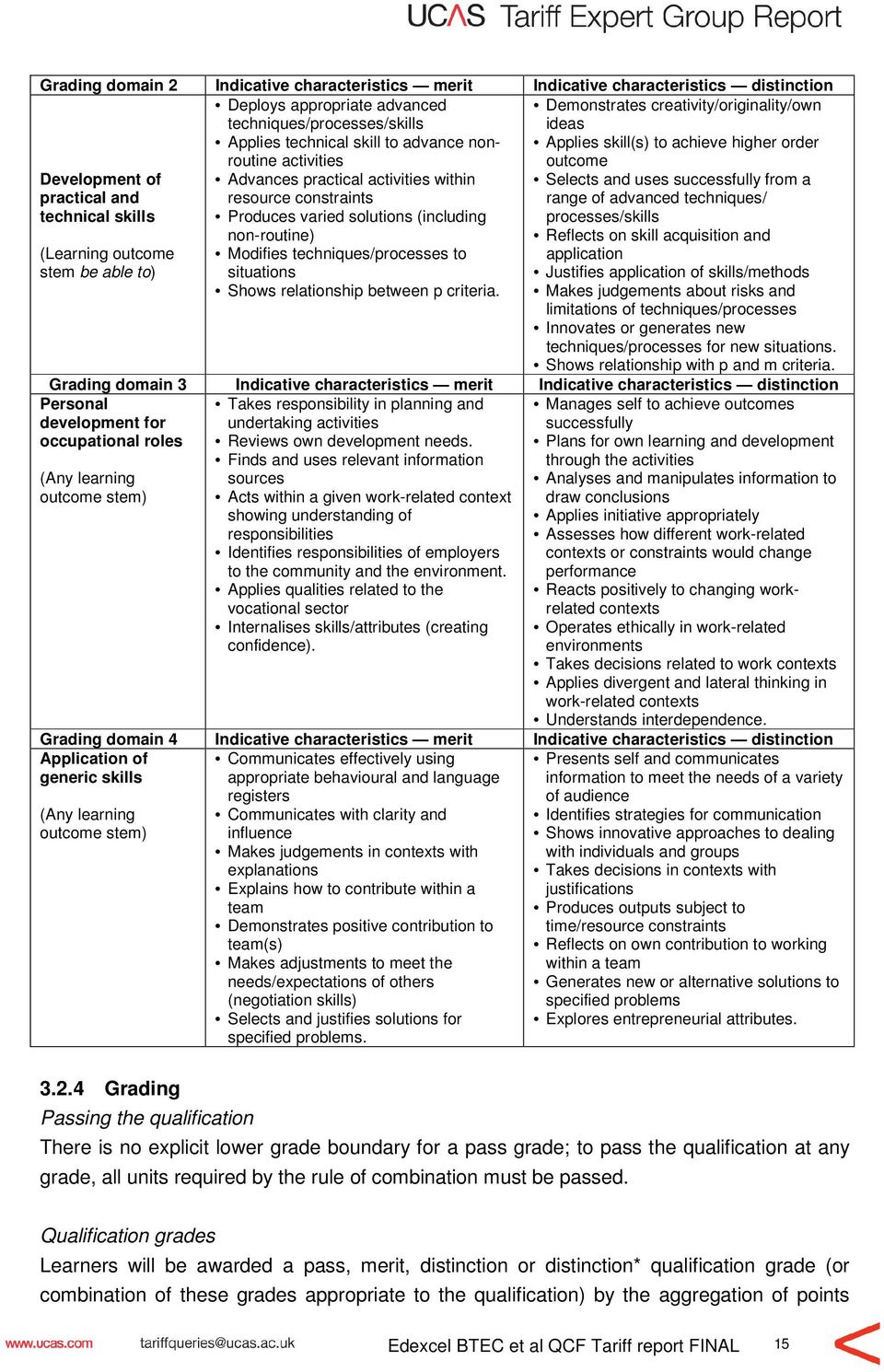
14 assessment and grading criteria which are to be used for grading purposes. A summative unit grade can be awarded at pass, merit or distinction: to achieve a pass a learner must have satisfied all the pass assessment criteria to achieve a merit a learner must additionally have satisfied all the merit grading criteria to achieve a distinction a learner must additionally have satisfied all the distinction grading criteria. Learners who complete the unit but who do not meet all the pass criteria are graded unclassified. Grading criteria are developed in relation to grading domains which are exemplified by a number of indicative characteristics at the level of the qualification. There are four BTEC National grading domains which apply across all QCF qualifications: application of knowledge and understanding development of practical and technical skills personal development for occupational roles application of generic skills. There is a relationship between the performance descriptors and the BTEC generic grading domains within each specification in terms of knowledge and understanding and skills development. As outlined in Table 5 above, to achieve a pass grade, a learner must have satisfied all the pass assessment criteria. These assessment criteria relate directly to the learning outcomes of that unit, but Table 6 shows indicative characteristics that learners would be expected to satisfy in order to obtain merit and distinction grades. Table 6: Edexcel BTEC QCF grading domains Grading domain 1 Indicative characteristics merit Indicative characteristics distinction Shows depth of knowledge and development of understanding in familiar and unfamiliar situations (for Synthesises knowledge and understanding across pass/merit criteria Evaluates complex concepts/ example explains why, makes ideas/actions and makes reasoned and Application of judgements based on analysis) confident judgements knowledge and Applies and/or selects concepts Uses analysis, research and evaluation understanding showing comprehension of often to make recommendations and influence complex theories proposals (Learning outcome Applies knowledge in often familiar and Analyses implications of application of stem understand or unfamiliar contexts knowledge/understanding know) Applies knowledge to non-routine Accesses and evaluates knowledge and contexts (e.g.assessor selection) Makes reasoned analytical judgements Shows relationships between pass criteria. understanding to advance complex activities/contexts Shows relationships with p/m criteria Responds positively to evaluation Edexcel BTEC et al QCF Tariff report FINAL 14

15 Grading domain 2 Indicative characteristics merit Indicative characteristics distinction Development of practical and technical skills (Learning outcome stem be able to) Deploys appropriate advanced techniques/processes/skills Applies technical skill to advance nonroutine activities Advances practical activities within resource constraints Produces varied solutions (including non-routine) Modifies techniques/processes to situations Shows relationship between p criteria. Demonstrates creativity/originality/own ideas Applies skill(s) to achieve higher order outcome Selects and uses successfully from a range of advanced techniques/ processes/skills Reflects on skill acquisition and application Justifies application of skills/methods Makes judgements about risks and limitations of techniques/processes Innovates or generates new techniques/processes for new situations. Shows relationship with p and m criteria. Grading domain 3 Indicative characteristics merit Indicative characteristics distinction Personal development for occupational roles (Any learning outcome stem) Takes responsibility in planning and undertaking activities Reviews own development needs. Finds and uses relevant information sources Acts within a given work-related context showing understanding of responsibilities Identifies responsibilities of employers to the community and the environment. Applies qualities related to the vocational sector Internalises skills/attributes (creating confidence). Manages self to achieve outcomes successfully Plans for own learning and development through the activities Analyses and manipulates information to draw conclusions Applies initiative appropriately Assesses how different work-related contexts or constraints would change performance Reacts positively to changing workrelated contexts Operates ethically in work-related environments Takes decisions related to work contexts Applies divergent and lateral thinking in work-related contexts Understands interdependence. Grading domain 4 Indicative characteristics merit Indicative characteristics distinction Application of generic skills (Any learning outcome stem) Communicates effectively using appropriate behavioural and language registers Communicates with clarity and influence Makes judgements in contexts with explanations Explains how to contribute within a team Demonstrates positive contribution to team(s) Makes adjustments to meet the needs/expectations of others (negotiation skills) Selects and justifies solutions for specified problems. Presents self and communicates information to meet the needs of a variety of audience Identifies strategies for communication Shows innovative approaches to dealing with individuals and groups Takes decisions in contexts with justifications Produces outputs subject to time/resource constraints Reflects on own contribution to working within a team Generates new or alternative solutions to specified problems Explores entrepreneurial attributes Grading Passing the qualification There is no explicit lower grade boundary for a pass grade; to pass the qualification at any grade, all units required by the rule of combination must be passed. Qualification grades Learners will be awarded a pass, merit, distinction or distinction* qualification grade (or combination of these grades appropriate to the qualification) by the aggregation of points Edexcel BTEC et al QCF Tariff report FINAL 15
16 gained through the successful achievement of individual units. The number of points available is dependent on the unit level and grade achieved, and the credit size of the unit (as shown in the points available for credits achieved at different QCF Levels and unit grades below). The number of points scored per credit at the unit level and grade are shown at Table 7. Table 7: Edexcel BTEC points per credit and unit grades Unit QCF level Pass Merit Distinction Level Level Level Learners who pass all the units and achieve the correct number of points within the ranges shown below will achieve the qualification at merit, distinction or distinction* grade (or combinations of these grades appropriate to the qualification). Table 8: Edexcel BTEC Level 3 Certificate grade boundaries Points range above pass grade Grade Merit M Distinction D 260 and above Distinction* D* Table 9: Edexcel BTEC Level 3 Subsidiary Diploma grade boundaries Points range above pass grade Grade M D 520 and above D* Table 10: Edexcel BTEC Level 3 Diploma grade boundaries Points range above pass grade Grade MP MM DM DD DD* 1060 and above D*D* Table 11: Edexcel BTEC Level 3 Extended Diploma grade boundaries Points range above pass grade Grade MPP MMP MMM DMM DDM DDD DDD* DD*D* 1590 and above D*D*D* It should be noted that the grades awarded in the tables above assume that the learner has passed all units. Edexcel BTEC et al QCF Tariff report FINAL 16

17 D* grade performance The method for determining an overall grade for BTECs is essentially the same as that used for GCE A levels. The overall grade is derived from the aggregate of the individual units achieved. For the highest performing learners Edexcel have developed a distinction* grade to recognise and reward consistently high levels of performance across all units. As with A* at GCE A levels, the D* grade is not available at unit level. Achievement of a D* grade comes from an exceptionally high points score overall, as shown in the tables above. Whilst the maximum points available for BTEC learners is dependent upon the number of credits gained at different levels, D* will reflect achievement at more than ninety per cent. This is higher than an A* at GCE A Level which is achieved if overall performance is eighty per cent plus an aggregate score for the A2 units of ninety per cent or higher Quality assurance The approach of quality assured assessment is made through a partnership between an approved centre and Edexcel. Edexcel is committed to ensuring that it follows best practice and employs appropriate technology to support quality assurance processes where practicable. Therefore, the specific arrangements for working with centres will vary. Edexcel seeks to ensure that the quality assurance processes that it uses do not place undue bureaucratic processes on centres and works to support centres in providing robust quality assurance processes. The key principles of BTEC quality assurance are that: A centre delivering the BTEC level 3 in Hospitality (QCF) programmes must be an approved centre and must have approval for programmes or groups of programmes that it is operating The centre agrees, as part of gaining approval, to abide by specific terms and conditions around the effective delivery and quality assurance of assessment; it must abide by these conditions throughout the period of delivery Edexcel makes available to approved centres a range of materials and opportunities intended to exemplify the processes required for effective assessment and examples of effective standards. Approved centres must use the materials and services to ensure that all staff delivering BTEC qualifications keep up to date with the guidance on assessment An approved centre must follow agreed protocols for standardisation of assessors and verifiers; planning, monitoring and recording of assessment processes; and for dealing with special circumstances, appeals and malpractice Edexcel BTEC et al QCF Tariff report FINAL 17

18 Edexcel monitors and supports centres in the effective operation of assessment and quality assurance. The methods which it uses to do this for BTEC First and National programmes accredited under the Qualifications and Credit Framework (QCF) include: o Ensuring that all centres have completed appropriate declarations at the time of approval, undertaking approval visits to centres where necessary o Requiring all centres to appoint a lead internal verifier for designated groups of programmes and to ensure that this person is trained and supported in carrying out that role. The lead internal verifier will undertake standardisation processes to ensure consistency and validity of assessment o Requiring that the lead internal verifier completes compulsory online standardisation related to assessment and verification decisions for the designated programme o Assessment sampling and verification, through requested samples of assessments, completed assessed learner work and associated documentation o Overarching review and assessment of a centre s strategy for assessing and quality assuring its BTEC programmes. In terms of the extent to which assessment differs in the demands made on a learner s knowledge, understanding and skills, the Edexcel representative asserted that assessment models for the NQF and QCF qualifications do not differ. These allow learners to undertake assessment at the most appropriate time according to the programme of learning and refer to sources of evidence such as real examples of customer care policies. Edexcel BTEC et al QCF Tariff report FINAL 18

19 3.3 OVERVIEW OF NPTC ANIMAL MANAGEMENT QUALIFICATIONS Aims and purpose NPTC s mission is:...to promote competence and professionalism in the workforce of the landbased and related industries by the encouragement of continuous learning and the recognition of skill The Animal Management QCF qualifications are designed to replace the NQF version of the NPTC Level 3 Advanced National Diploma in Animal Management. They are designed to provide the underpinning skills and knowledge which could enable the learner to progress into a work-based situation for employment or further training. NPTC worked in partnership with Edexcel to develop common units for a range of new land-based qualifications and Credit Framework (QCF) qualifications, including these Animal Management qualifications Size Table 12: Sizes of NPTC level 3 qualifications Qualification title Credits Guided Learning Hours (GLH) NPTC Level 3 Certificate in Animal Management NPTC Level 3 Subsidiary Diploma in Animal Management NPTC Level 3 Diploma in Animal Management NPTC Level 3 Extended Diploma in Animal Management Assessment Learners are required to complete one assignment for each unit. Assignments for each unit are provided by City & Guilds NPTC. Most assignments are awarded a pass, merit or distinction based on the calculation found in the NPTC assignment guide. Where assignments can only be achieved at pass grade, these are excluded from the calculation of the overall qualification grade Grading The mark that can be awarded for each overall assignment is: Pass 1 Merit 2 Distinction 3 To award an overall qualification grade, the number of marks given for each graded assignment are totalled and then divided by the number of graded assignments. This gives the average mark and then grade. Learners must achieve at least a pass for every assignment/unit to achieve the overall qualification. Edexcel BTEC et al QCF Tariff report FINAL 19

20 Table 13: NPTC level 3 qualification grade boundaries Quality assurance Average Grade 1 to 1.5 Pass 1.6 to 2.5 Merit 2.6 to 3 Distinction NPTC is part of the City & Guilds group of companies and benefits from the quality assurance procedures of City & Guilds. NPTC sets out quality assurance guidance within its specifications. Assessors and internal verifiers Assessor/verifier units are valued as qualifications for centre staff; they are not currently a requirement for the qualifications. Assessors should be occupationally competent, either qualified to level 4 or above in animal care and management or have sufficient and current experience of working in the industry, or a related industry, at this level. They should have had formal training in assessment, which may be A1, D32/33 or other training that allows the assessor to demonstrate competence in the practice of assessment. This training may be carried out in-house or with an external agency. It would be envisaged that the training would encompass, but not be limited to: assessment planning methods of assessment feedback recording of evidence. Internal verifiers/qualification coordinators must be occupationally competent or qualified to at least level 4 in animal care and management or have sufficient and current experience of working in the industry, or a related industry, at this level. They should have had formal training in assessment, as above, and have experience of internal verification of NVQs, or training in the quality assurance systems required by the awarding body. Edexcel BTEC et al QCF Tariff report FINAL 20

21 3.4 OVERVIEW OF OCR LEVEL 3 YOUNG ENTERPRISE QUALIFICATION Aims and purpose This single unit qualification aims to equip learners with the ability to identify the issues affecting the success of a YE company in relation to the way it is launched, monitored and wound up. Learners must evaluate the contribution of an individual role or job within a company and identify the relationship between this role or job and the business activities of the company. They are required to apply their knowledge of the business environment to address problems and issues in an enterprise context. The qualification has been developed in accordance with the NOS in business enterprise developed by SFEDI, the UK standards setting body for business support and business enterprise Size The qualification is accredited on the QCF as 18 credits (equating to 180 notional learning hours). This incorporates 93 GLH Assessment In order to achieve this single unit qualification, learners must take part in the Young Enterprise Team Programme. The emphasis is on learning by doing and additional time, over and above that incorporated within the specification, needs to be dedicated to the running of the company. The qualification is assessed by a written external examination of two and a half hours plus an additional ten minutes reading time. The examination consists of five sections that reflect five learning outcomes. Learners are required to apply their knowledge and understanding of enterprise activities to a case study within the examination and to draw on their practical experiences when addressing business situations. Centres are sent a copy of a fictitious case study of a YE company report (the case study) approximately six weeks before the date of the examination which is then distributed to learners. It is recommended that learners read through the case study carefully and use it as a basis for identifying issues and themes that can affect YE companies. Learners should also reflect upon the issues surrounding the launch, running and winding down of their own YE company. The marks available for each question are stated on the question paper. There are 100 marks available, divided as shown in Table 14. Edexcel BTEC et al QCF Tariff report FINAL 21
22 Table 14: OCR level 3 Certificate for Young Enterprise mark scheme Section Title Marks Section 1 Launching a Young Enterprise Company 22 Section 2 Monitoring the Performance of a Young Enterprise Company 22 Section 3 Winding up a Young Enterprise Company 20 Section 4 The contribution of individuals and teams within a Young Enterprise Company 22 Section 5 Young Enterprise and the wider environment 14 Total 100 Marks are allocated according to a standardised mark scheme for each question based on the level of explanations provided. The learning outcomes and assessment criteria for this single unit qualification are shown at Table 15. Table 15: OCR YE Certificate learning outcomes and assessment criteria Learning Outcomes Understand the issues affecting the successful launch of a company. Understand the issues affecting the successful performance of a company. Understand the issues affecting the successful winding up of a company. Understand the contribution of individuals within a company. Understand the effects of the wider business environment on an enterprise Grading Assessment Criteria Analyse the way in which a company is structured. Evaluate the factors that affect the potential success of products or services to be sold by a company. Analyse the planning processes used by a company. Analyse the issues affecting the day-to-day performance of a company. Analyse the financial arrangements of a company. Analyse the procedures for winding up a company. Evaluate the success of a company. Evaluate the contribution of an individual to a company. Analyse activities that promote team work. Analyse the ways in which the type of ownership can impact on a business. Analyse the ways in which the wider environment can impact on a business. Results will be graded pass, merit and distinction, with notional grade boundaries set as follows: Pass: Merit: Learners will be required to achieve a minimum of 50% of the marks available Learners will be required to achieve a minimum of 65% of the marks available Distinction: Learners will be required to achieve a minimum of 75% of the marks available Quality assurance All assessment material is revised prior to being evaluated by a committee at which the case study, question paper and mark scheme are checked against the specification requirements to ensure that the content is at the appropriate level of demand and address the specification. A standardisation meeting is attended by all examiners shortly after the examination date. Standardisation ensures that all examiners mark candidates work consistently and accurately. Standardisation establishes the standard of marking to be used throughout the marking period. Edexcel BTEC et al QCF Tariff report FINAL 22
23 Examiners marking will be sampled by a more senior assessor. Examiners are not authorised to continue to mark until they have received confirmation from their team leader that their marking is at the correct standard. Further sampling is carried out during the marking period. Grade boundaries are determined at an award meeting. Edexcel BTEC et al QCF Tariff report FINAL 23
24 SECTION 4: OVERVIEW OF BENCHMARK QUALIFICATION EDEXCEL (NQF) 4.1 Aims and purpose The old BTEC Nationals (NQF) were designed to provide specialist work-related qualifications in a range of sectors. They aim to give learners the knowledge, understanding and skills needed to prepare them for employment. The family of BTEC Nationals include Awards, Certificates and Diplomas, offering opportunities for nested provision and flexibility of delivery. BTEC Nationals were designed to relate to the NOS for the relevant sector, where appropriate, and are supported by the relevant Standards Setting Body (SSB) or SSC. 4.2 Size BTEC Nationals (NQF) qualifications are available in three sizes: National Award 6 units 360 GLH National Certificate 12 units 720 GLH National Diploma 18 units 1080 GLH BTEC National NQF qualifications consist of core units (which are mandatory) and specialist units. Specialist units are designed to provide a specific focus to the qualification. Required combinations of specialist units are set out clearly in relation to each qualification. In BTEC Nationals each unit has 30, 60, 90 or 120 GLH. The GLH include an estimate of time that might be allocated to direct teaching, instruction and assessment, together with other structured learning time such as directed assignments or supported individual study. It excludes learner-initiated private study. 4.3 Assessment In Edexcel BTEC Nationals, all units are internally assessed. Assignments constructed by centres should be reliable and fit for purpose, and should build on the application of the grading criteria. Centres should use a variety of assessment methods, including case studies, assignments and work-based assessments, along with projects, performance observation and time-constrained assessments. Centres are encouraged to emphasise the practical application of the grading criteria, providing a realistic scenario for learners to adopt, and making maximum use of practical activities and work experience. The creation of assignments that are fit for purpose is vital to learners achievement and their importance cannot be over-emphasised. All of the criteria listed in the grading grid for each unit must be covered by one assignment, or by a series of assignments. It is advisable that criteria are clearly indicated on each assignment to provide a clear focus for learners and to assist with internal verification and standardisation processes. This will also help to ensure that feedback is specific to the Edexcel BTEC et al QCF Tariff report FINAL 24
25 criteria. Tasks and activities should be designed to enable learners to produce evidence that relates directly to the specified criteria. The grading criteria are developed in relation to grading domains which provide for the assessment of the learning outcomes of the unit. There are four BTEC National grading domains which underpin the grading criteria: application of knowledge and understanding development of practical and technical skills personal development for occupational roles application of generic and key skills. The qualitative nature of the merit and distinction grading criteria is based on indicative characteristics of the evidence to fulfil the higher grades. A grading scale of pass, merit and distinction is applied to all units. All assessment for BTEC Nationals is criterion referenced, based on the achievement of specified learning outcomes. Each unit has specified criteria which are to be used for grading. A summative unit grade can be awarded at pass, merit or distinction: to achieve a pass a learner must have satisfied all the pass criteria to achieve a merit a learner must additionally have satisfied all the merit criteria to achieve a distinction a learner must additionally have satisfied all the distinction criteria. Table 16: NQF grading domains Grading domain 1 Indicative characteristics merit Indicative characteristics - distinction Application of knowledge and Understanding (Learning outcome stem understand or know) Shows depth of knowledge and development of understanding in familiar and unfamiliar situations (eg explain why, makes judgements based on analysis) Applies and/or selects concepts showing comprehension of often complex theories Applies knowledge in often familiar and unfamiliar contexts Applies knowledge to non-routine contexts (eg assessor selection) Makes reasoned analytical judgements. Shows relationships between p criteria. Synthesises knowledge and understanding across p/m criteria Evaluates complex concepts/ideas/actions and makes reasoned and confident judgements Uses analysis, research and evaluation to make recommendations and influence proposals Analyses implications of application of knowledge/understanding Accesses and evaluates knowledge and understanding to advance complex activities/contexts Shows relationships with p/m criteria. Responds positively to evaluation. Grading domain 2 Indicative characteristics merit Indicative characteristics - distinction Development of practical and technical skills (Learning outcome stem be able to) Deploys appropriate advanced techniques/ processes/skills Applies technical skill to advance nonroutine activities Advances practical activities within resource constraints Produces varied solutions (including non-routine) Modifies techniques/ processes to situations Shows relationship between p criteria. Demonstrates creativity/originality/own ideas Applies skill(s) to achieve higher order outcome Selects and uses successfully from a range of advanced techniques/processes/skills Reflects on skill acquisition and application Justifies application of skills/methods Makes judgements about risks and Edexcel BTEC et al QCF Tariff report FINAL 25
26 limitations of techniques/processes Innovates or generates new techniques/processes for new situations Shows relationship with p and m criteria. Grading domain 3 Indicative characteristics merit Indicative characteristics distinction Personal development for occupational roles (Any learning outcome stem) Takes responsibility in planning and undertaking activities Reviews own development needs Finds and uses relevant information sources Acts within a given work-related context showing understanding of responsibilities Identifies responsibilities of employers to the community and the environment Applies qualities related to the vocational sector Internalises skills/attributes (creating confidence). Manages self to achieve outcomes successfully Plans for own learning and development through the activities Analyses and manipulates information to draw conclusions Applies initiative appropriately Assesses how different work-related contexts or constraints would change performance Reacts positively to changing work related contexts Operates ethically in work-related environments Takes decisions related to work contexts Applies divergent and lateral thinking in work-related contexts Understands interdependence. 4.4 Grading The qualification grade is calculated through the aggregation of points through the successful achievement of individual units. The number of points available is dependent on the unit grade achieved and the size of the unit as determined by the stipulated guided learning hours. Table 17: Edexcel BTEC NQF unit points Size of unit (GLH) Pass grade Merit grade Distinction grade Quality assurance processes Edexcel s qualification specifications set out the standard to be achieved by each learner in order to be awarded the qualification. This is covered in the statement of learning outcomes and grading criteria in each unit. Edexcel operates an independent, external quality assurance process which is designed to ensure that these standards are maintained by all internal verifiers and external verifiers. It achieves this through the following activities: Risk assessment Edexcel has an approval process which creates a quality profile of each qualification programme in each centre and for the centre as a whole. This profile helps to determine how Edexcel BTEC et al QCF Tariff report FINAL 26
27 the programme is to be externally verified and is also used to initiate other quality control measures by Edexcel. Internal verification Centres are required to have processes in place that review each assessor s decisions. This ensures that they are correctly interpreting and applying the standards set out in the specifications. The system used to do this is a matter for individual centres and Edexcel fully supports the use of the centre s own quality assurance systems where they ensure robust internal standardisation. External verification Edexcel samples assessors decisions using sector-specialist external verifiers. For BTEC Nationals this process follows the National Standards Sampling (NSS) protocol. Learners work must be internally assessed. Additionally, at least fifty per cent of submitted work must be internally verified. Edexcel BTEC et al QCF Tariff report FINAL 27
28 SECTION 5: SUMMARY OF COMPARISONS AND CONSIDERATIONS 5.1 Overview of processes undertaken UCAS staff assembled a range of documentation for both the qualification seeking entry to the Tariff and the chosen benchmark qualification. Upon receipt of all the appropriate paperwork from the awarding bodies, UCAS prepared a detailed account of each qualification which was disseminated to the Expert Group reviewers to undertake a range of tasks and respond to the following set questions: Aims How do the aims of each qualification compare? (awarding bodies only) How appropriate are the aims of each qualification for preparing learners for higher education? (higher education representatives only) Size What are the relative sizes of each qualification? Content and coverage What commonality is there between the content of each qualification? Is the common content being treated in the same depth? For each qualification, how useful is the unique content for helping learners progress to HE? Assessment objectives/criteria How do the assessment objectives/criteria for each qualification differ? How are assessment objectives/criteria applied across the component parts of the qualification? To what extent would the differences in assessment objectives/criteria affect a learner s ability to study at HE level? Assessment models How do assessment models differ in terms of preparing learners for HE study? Assess the extent to which the assessment materials make demands in terms of complexity, resources, abstractedness and strategy To what extent does the level of support learners are given differ? Does each qualification have marking instructions? If so, how do marking instructions differ for each qualification? In what ways, and to what extent, does assessment differ in terms of the demands they make on a learner s knowledge, understanding and skills? Edexcel BTEC et al QCF Tariff report FINAL 28
29 Grade/performance descriptions How do grade/performance descriptions for each qualification differ? How would the knowledge, skills and experiences of learners achieving specific grades in one qualification differ from those achieving grades A and E in the benchmark A level? How do the grades for the two qualifications align against each other? Tariff domain scoring Considerations of the extent to which qualifications help prepare learners for HE is recorded by scoring against the following Tariff domains: knowledge development application of ideas analysis synthesis evaluation communication numeracy skills personal and social skills learning skills work-related skills and attitudes. Each domain contains three statements against which the reviewers score each qualification on a scale from 0 (no opportunity to develop the abilities and qualities described) to 5 (frequent and significant opportunities for a learner to develop and evidence the abilities/qualities associated with the strand in question). The full domain scoring framework is attached as Appendix 3. Strengths and weaknesses What do you consider to be the relative strengths and weaknesses of each qualification as preparation for HE study in your discipline? Given all the comparisons you have undertaken, please suggest how the incoming qualification may compare with the benchmark in terms of UCAS Tariff points. Those responsible for making these judgements will be required to provide cross references to presence of evidence in the materials considered, or provide a justification for a judgement. Throughout the process, UCAS may need recourse to further information, evidence or supporting statements from chief examiners on an ad hoc basis. Edexcel BTEC et al QCF Tariff report FINAL 29
30 5A ANIMAL MANAGEMENT 5A.1 Comparison of aims Edexcel and NPTC worked in partnership to develop common units for a range of new landbased QCF qualifications, including the Animal Management qualifications considered through the Tariff process. Each awarding organisation has used the same units to develop their qualifications, but the assessment methodology and grading for each qualification may differ. UCAS reviewers were asked to consider the impact any differences may have in providing utility for progression to HE, and ascertain whether these warrant different allocations of Tariff points for each awarding organisation s qualifications. Both the Edexcel BTEC and NPTC QCF qualifications were considered against the chosen benchmark qualification Edexcel BTEC Level 3 in Animal Management (NQF). There was broad agreement between the reviewers that the aims are appropriate for both QCF and NQF qualifications and are able to support progression to HE, although the reviewers felt that more overt reference to progression to HE would be beneficial. 5A.2 Comparison of size Reviewers recognised that five credit units required 30 GLH, whilst ten credit units took 60 GLH. One HE reviewer noticed a change regarding the time allocated to work experience between the NQF BTEC Diploma (a minimum of 250 hours related study/work) and the new QCF Extended Diploma (a minimum requirement of 300 hours of work experience). Edexcel responded by stating that the size of the work-related experience was determined by sectoral agreement between awarding organisations, a representative from the Landex Group of Colleges and the Sector Skills Council (LANTRA). The time allocated to work experience increased following advice from the college representatives who wanted a more natural relationship with term times. Edexcel feel that these changes do not materially affect the qualifications utility for progression to HE. 5A.3 Comparison of content and coverage The benchmark qualifications (NQF BTEC Nationals in Animal Management) comprise twenty-nine units which are available in accordance with rules of combination for the different qualification sizes and pathways. The new QCF specifications are made up of thirty-one units (Edexcel) and thirty-four units (NPTC). In order to compare content between the old and new qualifications, the reviewers considered a selection of units where content comparisons could be undertaken. These units are shown in Table 18. Table 18: Unit mapping of animal management qualifications Edexcel BTEC et al QCF Tariff report FINAL 30
31 QCF Edexcel NPTC NQF Edexcel Title Understand and Promote Animal Health Understand the Principles of Animal Biology Extended Diploma Diploma Subsidiary Diploma Certificate Extended Diploma Diploma Subsidiary Diploma Certificate Title Diploma Certificate Award O M M M O M M M Animal Health M M M O O M M O O M M Animal Biology O M M Understand Animal Anatomy and Physiology O O O M O O O M Animal Anatomy and Physiology O M M Undertake Animal Handling and Safe Working Plan and Monitor Animal Feeding Manage Animal Accommodation Undertake an Investigative Project in the Land-based sector Undertake and Review Work Related Experience in the Land-based sector O O M M O O M M O O M M O O M M O O M M O O M M O O M O O M O M M M M Practical Animal Handling and Husbandry Investigative Project in the Animal Management Sector Work Related Experience in the Animal Management Sector O M M O O M O O M Business Management in the Land O O O O O O Business Management for Land-based Industries O O O Understand the Principles of Animal Nutrition Undertake Retail Merchandising for the Landbased sector Understand and Interpret Animal Behaviour and Communication Understand the Principles and Carry Out the Practice of Biochemistry and Microbiology Understand and Undertake Wildlife Management and Rehabilitation Understand the Principles of Animal Breeding and Genetics Chemistry for Biology Technicians Understand the Principles of Inheritance and Genetic Manipulation Understand the Principles of Chemistry for Biological and Medical Science No direct match to old unit O O O O O O O O Animal Nutrition O O O O O O O O O Land-based Industries Customer Care and Retail Service O O O O O O O O O O O Animal Behaviour O O O O O O O O O Biochemistry and Microbiology in Animal Management O O O O O O O O O O O Principles of Ecology O O O O O O O O O O O Wildlife Rehabilitation O O O O O O O O O O O O O Chemistry for Biology Technicians Genetics and Genetic Engineering O O O O O No direct match to new unit KEY: M = mandatory units; O = optional units Animal Breeding and Genetics O O O O O O O O O Edexcel BTEC et al QCF Tariff report FINAL 31
32 While content and coverage were viewed as broadly comparable with the benchmark qualification, some reviewers saw benefits in some of the new content in the QCF qualifications. One HE reviewer considered that some QCF units require greater subject knowledge than NQF units and potentially provide a superior preparation for HE courses where an enhanced subject based knowledge is required. It was also noted that the topics of practical animal husbandry are covered in much greater depth within the QCF units. Another reviewer considered the Principles of Chemistry for Biological and Medical Science and Principles of Inheritance and Genetic Manipulation units to be particularly useful for HE progression. However, concern was expressed about the time allocated for practical investigations, as these require skills and underpinning knowledge that can be time consuming to acquire effectively. This could mean that those following a science-based route complete a more demanding path towards HE than others. 5A.4 Learning objectives and assessment criteria In general, there was agreement that learning objectives and assessment criteria are appropriate and appropriately weighted to meet qualification aims. One HE reviewer considered there to be a greater breakdown of practical knowledge and functional skills in the QCF awards, compared with the benchmark. However, another HE reviewer pointed out that some units are more technically challenging than others and could better prepare learners for progression to HE. The degree of assessment of higher level skills was considered to be dependent on the focus of the units chosen and, according to one HE representative, higher order academic skills may not be as fully developed as is possible with other pre-he qualifications. The lack of a compensatory mechanism in the QCF awards was highlighted by reviewers. Thus learners must achieve all learning objectives and assessment criteria for each unit to obtain unit credits, and achieve the minimum credit level to obtain the award; high achievement in one unit cannot compensate for underachievement in another. This is a requirement of the QCF, but one HE reviewer was concerned that this could disadvantage learners who may have satisfied or exceeded assessment criteria in some units, but have not obtained an overall pass grade due to not meeting the pass criteria in one or more units. 5A.5 Assessment models There is general agreement that the assessment models for the QCF qualifications provide an equivalent or greater utility for progression to HE when compared with the benchmark NQF qualification. In particular, reviewers referred to the range of higher level skills required for in-depth assessment work for most of the QCF units and suggested that there is greater clarity and much more breakdown of practical, knowledge and functional skills for the QCF qualifications. Edexcel BTEC et al QCF Tariff report FINAL 32
33 One reviewer considered that the lack of time-restrained and examination assessment, of external assessment and of a requirement for a synoptic overview could potentially reduce the suitability for progression to certain HE programmes. However, these aspects of the assessment model are shared by all the qualifications under review, including the benchmark qualification, so this consideration need not influence allocation of Tariff points against that benchmark. 5A.6 Domain Scores Most reviewers allocated identical domain scores to the two QCF qualifications and the benchmark NQF qualification, resulting in Figure 1. The domain scores are not sufficiently different to affect each qualification s ability to prepare learners for HE study. Figure 1: Tariff domain scoring for animal management qualifications 5A.7 Aligning grades There is significant difference in the way in which grades are expressed in the Edexcel and NPTC QCF qualifications. In the former case, points are allocated to credits at the unit level, depending on whether they are achieved at pass, merit or distinction, with seven, eight, or nine points per credit respectively. Points are accumulated to give an overall total. For the Subsidiary Diploma, a pass grade is equivalent to a points range of , merit equivalent to , distinction equivalent to , and distinction* equivalent to 520 and above. The Diploma and Extended Diploma allocate the same number of points per credit and, because they provide more credits, accumulate a larger number of points than the Subsidiary Diploma. Edexcel BTEC et al QCF Tariff report FINAL 33
34 This is expressed in the Edexcel case by multiple grade letters, as shown in Section above. In the case of the NPTC QCF qualifications, in order to award an overall qualification grade, the marks given for each graded assignment are totalled and then divided by the number of graded assignments (not all assignments are graded). This gives the average mark, which is then converted to a grade. Learners must achieve at least a pass for every assignment/unit to achieve the overall qualification. The relationship between average mark and grade is shown at Table 19. NPTC gives the following example for the level 2 Extended Certificate in Forestry and Arboriculture (note this is at level 2, but the same principle applies at level 3). Table 19: Example of NPTC grading system Unit Title: Grade Mark 203 Disposal of Wood Arisings and Residues from Work on Trees Not graded Identify and Select Trees and Shrubs M Undertake Tree Felling Operations P Undertake Tree Climbing and Pruning Operations D 3 Total 6 Overall Mark (6 divided by 3) 2 Overall Grade Merit Thus, the Edexcel grading system contains a greater number of smaller grading intervals and produces more possible final grades than the City & Guilds system. In addition, the former allows for three grades above distinction level (D*DD, D*D*D, D*D*D*), while the latter does not. The benchmark Edexcel level 3 BTEC (NQF) is graded in a similar way to the equivalent QCF qualification, but without the D* grade. It is necessary to understand the different grading systems compared above, in order to interpret the proposed Tariff scores, but reviewers do not in general ascribe much significance to this difference in terms of utility for progression to higher education. It is clear that the marking criteria for a pass grade in the NPTC and BTEC QCF qualifications are derived from the QCF assessment criteria. For higher grades, NPTC grading criteria are based upon qualitative statements depending on the task, whilst Edexcel BTEC merit and distinction criteria follow a model of graded achievement. The HE reviewers were keen to point out that there seemed to be clear alignment between the Edexcel BTEC level 3 Extended Diploma and the benchmark National Diploma at pass, merit and distinction levels, but that the NPTC system for calculating grades makes comparability with the benchmark above pass standard less certain. Edexcel BTEC et al QCF Tariff report FINAL 34
35 Following additional consideration, the reviewers agreed that the NPTC single grades aligned with the highest level of multiple grades in BTEC QCF qualifications, eg NPTC QCF Diploma grade D is equivalent to BTEC QCF Diploma grade DD. 5A.8 Tariff points Reviewers pointed to a range of strengths of the QCF qualifications, with a few weaknesses, when compared against the NQF benchmark in terms of enabling progression to HE. This is shown in Table 20. Table 20: Strengths and weaknesses of animal management qualifications Strengths Weaknesses QCF BTEC QCF NPTC Distinction* grade recognises high achievement Increased work experience requirement increases applied learning opportunities Excellent guidance is provided on assessment methodology and techniques Greater number of higher level skills required Range of assessment approaches required Greater depth of content in a number of units Merit and distinction criteria mainly show progression of learning skills (i.e. require more depth than volume) Opportunities for the development of theoretical underpinning and subject specific knowledge, especially through optional units Currently no distinction* grade (although NPTC subsequently referred to an upcoming grading review) Some reduction in animal health and animal biology unit content Loss of two NQF optional units that may be useful for progression Strong emphasis on occupational context of the sector may detract from research and critical analysis skills required in higher level programmes Lack of any exam style assessment to prepare learners for HE Reliance on internal assessment and a lack of time-constrained assessments The lack of synoptic assessment Two learners with the same overall grade could have a very different unit make up and performance Given that the vast majority of perceived weaknesses affect all the qualifications considered, this will not influence the allocation of Tariff points, although they may influence how the Tariff is used in HE offers. However, the lack of a grade above distinction in the case of the NPTC QCF qualifications clearly does have an implication for the range of Tariff points that these awards can cover. Despite slight differences noted between the qualifications, the reviewers considered them to be sufficiently similar in key respects to suggest an alignment of Tariff points at all pass, merit and distinction grades. Some concern was raised over the two awarding organisations using different grade structures for almost identical qualifications. However, the reviewers agreed that the NPTC single grades aligned with the highest level of multiple grades in BTEC QCF qualifications, e.g. NPTC QCF Diploma grade D is equivalent to BTEC QCF Diploma grade DD. Edexcel BTEC et al QCF Tariff report FINAL 35
36 An HE reviewer provided a rationale for the allocation of Tariff points to the D* grades, based on the necessary achievement at more than 90%. For example, the maximum available credit points score in the Edexcel Extended Diploma (QCF) is 1620 (180 credits at 9 points per credit); a DDD* grade requires 94% of this, and a D*D*D* grade, 98%. In his view, this allows for incremental Tariff points for D* grades to be allocated in line with those for A* at A level, i.e. an extra twenty Tariff points beyond A grade for each subject. By analogy, this produces an extra twenty Tariff points for each D*, above that for the D grade. The reviewers considered this suggestion to have merit, with the caveat that Edexcel/NPTC quality control this with rigour. Therefore, the reviewers recommended the allocation of Tariff points shown in Table 21. Table 21: Recommended Tariff allocations for animal management qualifications Extended Diploma Diploma Subsidiary Diploma Certificate Edexcel NPTC Edexcel NPTC Edexcel NPTC Edexcel NPTC UCAS Tariff points D*D*D* 420 D*D*D 400 D*DD 380 DDD D 360 DDM 320 DMM D*D* 280 D*D 260 MMM M DD D 240 MMP DM 200 MPP MM M 160 D* 140 PPP P MP D D 120 PP P M M 80 D* 70 D D 60 P P M M 40 P P 20 Edexcel BTEC et al QCF Tariff report FINAL 36
37 5B ENTERPRISE 5B.1 Comparison of aims The reviewers thought that the aims of the QCF BTEC in Enterprise and Entrepreneurship were articulated in a similar way to the aims of the NQF BTEC in Business. The BTECs in Enterprise and Entrepreneurship require learners to plan and operate a fully functioning business. Knowledge is developed by learners as they progress through the planning and business operation process. In the BTECs in Business, learning is separated into units with learners developing an understanding of underpinning business concepts. The OCR Certificate in Young Enterprise aims to equip learners with the ability to identify the issues affecting the success of a YE company in relation to the way it is launched, monitored and wound up. The emphasis is on learning by doing: a skills-based approach which the reviewers considered to be particularly appropriate to support progression to HE for a wide range of courses. The OCR programme and assessment requires learners to evaluate the contribution of an individual role or job within a company, identify the relationship between this role and the business activities of the company and apply their knowledge of the business environment to address problems and issues in an enterprise context. As such the programme and assessment requires individuals to be reflective learners: evaluating both their own and others performance. The aims of the three qualifications reviewed were seen to be articulated similarly. Within each qualification, underpinning knowledge and understanding of business concepts is developed and each is appropriate for supporting progression to HE. However, one HE representative stated that all qualifications would benefit from having mathematical and statistical techniques handled in a more sophisticated way. 5B.2 Comparison of size The size of each qualification being considered is shown in Table 22. Table 22: Size of enterprise qualifications GLH Notional LH Credit New qualifications being considered Edexcel BTEC Level 3 Subsidiary Diploma (QCF) Edexcel BTEC Level 3 Diploma (QCF) OCR level 3 Certificate in YE (QCF) Benchmark qualifications Edexcel Level 3 BTEC National Award (NQF) 360 n/a n/a Edexcel Level 3 BTEC National Certificate (NQF) 720 n/a n/a The BTEC Subsidiary Diploma and Diploma are directly comparable in terms of GLH to the NQF National Award and National Certificate respectively. Edexcel BTEC et al QCF Tariff report FINAL 37
38 Whilst the sizes of QCF qualifications are defined by credit, the Edexcel representative stated that a ten credit BTEC unit is equivalent to 60GLH a ratio that is reflected on the National Database of Accredited Qualifications. In both QCF and NQF specifications of the BTECs, guided learning hours are defined as all the times when a tutor, trainer or facilitator is present to give specific guidance towards the learning aim being studied on a programme. The OCR qualification is a considerably smaller single-unit qualification which in terms of GLH is roughly twenty-five per cent of the size (18 credits compared to 60 credits) of the Edexcel level 3 BTEC National Award (NQF). However, should notional learning time also be considered within the size of the OCR qualification, then a ratio of the breakdown approximately 1:4 (93:360 NLH) would be more appropriate. The notional learning hours comprise: curriculum time (contact time with teachers/advisers) = 90 hours doing the business (making product, providing service, taking orders etc.) = 30 hours writing up company report = 1 hour information retrieval in libraries = 30 hours expected private study and revision = 30 hours examination time = 2.5 hours. Reviewers were keen to recognise the total time spent on the qualification. In incorporating all notional learning time, reviewers agreed that the size ratio should therefore be 1:3 (18:60) rather than 1:4 (93:360). Some reviewers questioned whether doing the business could be completed in thirty hours, although Tariff considerations must be based on published criteria within specifications. All reviewers recognised that the relative sizes of the OCR and BTEC qualifications would have a fundamental effect on the Tariff allocations. 5B.3 Content The content in both Edexcel specifications covers the key areas of business and enterprise. The focus of each qualification differs in that the Enterprise qualifications enable learners to tackle the key aspects of knowledge whilst they plan and operate a small business. The benchmark qualification, Edexcel NQF BTEC in Business, separates the knowledge and implies a more general abstract appreciation. One HE representative stated that both new and old Edexcel qualifications allow learners to develop an understanding of business planning, cost accounting, finance especially for banking process and ratio analysis, management skills, some knowledge of the legal framework of business, marketing and some macro and microeconomic issues. The new QCF BTEC Enterprise and Entrepreneurship qualification incorporates a considerable Edexcel BTEC et al QCF Tariff report FINAL 38
39 vocational aspect with learners expected to run a private or social enterprise, which was not required in the legacy NQF BTEC Diploma in Business. However, it was believed that the QCF BTEC is less flexible than the NQF BTEC in Business which offers more options to specialise, for example in accountancy, finance and marketing. The Edexcel Diploma in Enterprise and Entrepreneurship involves 120 credits of which 8 units are compulsory. Of these compulsory units, roughly forty-five per cent of the 85 credits were considered by one HE representative to have little academic content. He considered this to be a highly vocational course which, whilst introducing activities requiring an understanding of accounting, economic and financial principles and some practical algebraic and statistical methods, are set in a practical rather than an academic framework. Optional units incorporate material that was considered by the HE representative to provide better support for academic development, with learners also expected to compute accounting, financial and statistical measures, but with the depth of understanding difficult to gauge. One HE representative stated that, at face value, the Diploma in Business has more content that is appropriate for HE study, with learners considering four specialist compulsory units from a selection including accountancy, e-business strategy, marketing and human resources, plus ten optional units. The reviewers estimated that more than ninety per cent of the material was common to both BTEC qualifications. The Edexcel representative recognised that, although common content is covered in the same depth in both Edexcel qualifications, the approach to learning differs. The BTEC in Enterprise and Entrepreneurship is more experiential in that learners set up and run a business, reflecting on outcomes. Whilst it was thought that the BTEC Diploma in Enterprise and Entrepreneurship contains the same amount of content and depth as the BTEC Certificate in Business, the Enterprise qualification organises the content differently by requiring learners to plan and implement a fully functioning business. One HE reviewer stated that units incorporating some business mathematics and statistics in the Edexcel BTEC Extended Diploma may provide better utility for progression to HE than other units. In particular, he cited the notion of maximising profits, project evaluation through net present value calculations and of using statistical methods to compute and evaluate business forecasts as allowing learners to make analytical considerations. The OCR Certificate was thought to have a more specific purpose in that the content is designed to enable learners to assess and evaluate a YE venture. The qualification is based on practical experiences and the demonstration of these in a real-life situation, with the assessment focusing on skills of analysis, reflection and evaluation of these experiences. Edexcel BTEC et al QCF Tariff report FINAL 39
40 Whilst the OCR certificate was thought to cover the vast majority of the aspects considered in the benchmark qualification, it was felt that time constraints limit the depth in which content is considered. One HE reviewer expressed concern that time constraints limit the extent to which concepts can be handled, absorbed and developed. Whilst the course outline provides information, understanding of the macro economy can only be superficial in the sense of considering simple cause and effect rather than an in-depth understanding of how a rise in nominal interest rates in line with inflation might lead to bankruptcy as a firm under pressure is unable to raise its prices. Reviewers agreed that learners completing the OCR certificate would need to augment their skills, knowledge and understanding with achievement in other level 3 qualifications to enable entry to HE. 5B.4 Learning objectives and assessment criteria The BTEC in Enterprise and Entrepreneurship and the BTEC in Business share similar assessment characteristics, with learning outcomes for each unit informed by the underpinning knowledge and understanding requirements of the related NOS. BTEC unit content provides the range of subject material for the programme of learning and specifies the skills, knowledge and understanding required for achievement of the pass, merit and distinction grading criteria. In each BTEC unit, each learning outcome is stated in full and then the key phrases or concepts related to that learning outcome are listed in italics followed by the subsequent range of related topics. The OCR YE qualification has five learning outcomes with up to three associated assessment criteria. These are weighted to enable learners to demonstrate their learning and understanding in order to achieve at pass, merit or distinction grades according to their ability. The reviewers agreed that the learning objectives for all qualifications are fit for purpose, have been appropriately and carefully devised and clearly relate to appropriate NOS. Whilst assessment criteria differ across units in the BTEC qualifications depending on the nature of the unit, the reviewers considered them to be handled in a consistent way across the whole qualification. Reviewers thought that the assessment criteria assess all the qualification content appropriately. Opportunities were identified in each qualification to develop higher level skills including independent research and analysis, evaluation and the exercise of critical judgement. What differs is the context in which these skills are developed. The BTEC in Enterprise and OCR YE qualifications both require learners to apply knowledge and skills through practical activities such as business planning and operation. The benchmark Edexcel BTEC et al QCF Tariff report FINAL 40
41 qualification, however, places greater emphasis on theoretical considerations and has more of an academic focus. 5B.5 Assessment models The assessment models for the QCF and NQF BTEC qualifications are the same, with centres allowed to design assessment instruments in a variety of ways to meet the needs of their learners. These internally set assessments are practically orientated and provide opportunities for extended writing in the form of case studies, projects and time-limited assessments. In many units, learners will have to demonstrate independence in research and task completion in order to achieve the higher grading criteria of merit and distinction. One reviewer expressed a strong preference for level 3 qualifications to contain some exambased assessment in order to help prepare leavers for HE study. However, given that the QCF qualification adopts the same assessment models as the benchmark, this opinion cannot be used to affect Tariff outcomes. The OCR YE qualification, on the other hand, is assessed through one written external examination of two and a half hours plus an additional ten minutes reading time. The examination consists of five sections that reflect the five learning outcomes. Learners are required to apply their knowledge and understanding of enterprise activities to a case study situation and to draw on and reflect upon their practical experiences when addressing business situations. A clean copy of the case study is given to each learner six weeks prior to the examination with centres able to provide guidance and advice during the time leading up to the examination. However, no support can be given during the examination. The examination questions offer scope for particular approaches to answering questions; for example, in the specimen paper, there is a two mark question which requires learners to describe, three mark questions which require a learner to assess or explain, an eight mark question which requires learners to evaluate and a twelve mark question where an analysis is required. The questions with eight or twelve marks give learners the opportunity for extended writing. As highlighted in Section 5B.1, both QCF qualifications require learners to engage in running an enterprise, yet only the OCR qualification is essentially marked via an exam. One HE representative asserted that examinations with essay work provide greater opportunity to assess recall ability. Whilst this suggests that the assessment model for the OCR YE qualification has particular merit in terms of recall ability, the reviewers believed that both qualifications are appropriate in the preparation of learners for HE. 5B.6 Comparison of Tariff domains The reviewers did not find any substantial differences between the three qualifications, as displayed in Figure 2. The QCF BTEC achieved higher scores in both personal and social skills and work related skills, but this is not sufficiently significant to affect Tariff allocations. It Edexcel BTEC et al QCF Tariff report FINAL 41
42 can therefore be surmised that all three qualifications provide similar utility for progression to higher education in proportion to their relative size. Figure 2: Tariff domain scoring for enterprise qualifications 5B.7 Aligning grades With reference to the BTECs, there is a relationship between the performance descriptors and the BTEC generic grading domains within each specification in terms of knowledge and understanding and skills development. Each qualification provides a detailed grading grid with grading criteria clearly relating to the standard required of the evidence submitted. For example, command words for a pass include describe, outline and identify. Under merit, command words include compare and explain, whilst for a distinction, command words include evaluate and assess. OCR grading, on the other hand, requires learners to evaluate at all levels, with marks awarded on the basis of the quality of the evaluation, eg level mark scheme. The Edexcel representative noted that the OCR YE qualification contains pass assessment criteria only. Qualification grading is awarded after examination and it is not clear what the grade descriptions that form the basis of awarding are and whether they are of comparable standard to the BTEC grade descriptions. However, the complexity of action verbs used in the pass criteria suggests that there is a broad equivalence between the assessments. Edexcel BTEC et al QCF Tariff report FINAL 42
43 5B.8 Initial recommendations for awarding UCAS Tariff points In considering recommendations for Tariff points, the reviewers considered the relative strengths and weaknesses of each qualification as preparation for HE study. Their responses are summarised in Table 23. Table 23: Strengths and weaknesses of enterprise qualifications Strengths Weaknesses QCF BTEC OCR YE NQF BTEC Links to YE programme. Hands on experience developed. External examination. Business skills developed in real world context. Potential assumption that business success is a prerequisite of success. No analytical mathematics. Too small to facilitate entry to HE without being augmented by other qualification achievement. No analytical mathematics. Little/no opportunity for statistical and economic analysis. Learning within units is independent. Could be too theoretical. No analytical mathematics. The reviewers based their Tariff recommendations for the new Edexcel BTEC level 3 in Enterprise and Entrepreneurship (QCF) on the perceived equivalence between the QCF Diploma and NQF National Certificate, with D* grades proposed to align with A* performance for GCE A level. Table 24: Recommended Tariff allocations for Edexcel BTEC Enterprise qualifications Diploma Subsidiary Diploma Tariff points D*D* 280 D*D 260 DD 240 DM 200 MM 160 D* 140 MP D 120 PP M 80 P 40 Whilst the content and domain scoring of the OCR YE qualification was considered to be of a similar level to the BTEC, the different sizes of each qualification must be taken in to account in recommending Tariff points. The reviewers agreed that, based on credit values, the OCR Certificate should be considered to be approximately a third of the size of a BTEC Subsidiary Diploma (18 credits compared to 60 credits). The domain scoring was approximately 1:1 between the OCR and BTEC qualifications. Based on these calculations, the Tariff points should be as per Table 25. Table 25: Initial Tariff suggestions for OCR Young Enterprise qualification (based on size) Grade Calculation Tariff points Distinction 120/3 40 Edexcel BTEC et al QCF Tariff report FINAL 43
44 Merit 80/3 27 Pass 40/3 13 However, taking assessment models and skills content into account, the reviewers all proposed uplift to this calculation. There was agreement to an allocation of twenty Tariff points for a pass grade, but discord over Tariff points for merit and distinction grades, with some reviewers suggesting ten point intervals between grades, with others proposing twenty point intervals. Following further discussion, it was agreed that the lack of clear grade descriptors for merit and distinction performance in the OCR Certificate made it difficult to validate increments beyond ten Tariff points per grade. Therefore, the recommended Tariff allocation for the OCR Certificate for YE is as follows: Table 26: Recommended Tariff allocations for OCR Young Enterprise qualification Grade Tariff points Distinction 40 Merit 30 Pass 20 Edexcel BTEC et al QCF Tariff report FINAL 44
45 5C HOSPITALITY 5C.1 Comparison of aims The Edexcel representative considered that the aims are articulated similarly in each qualification. She stated that both the QCF and NQF qualifications encourage the acquisition and development of skills from across the industry or to focus on particular areas. She considered that each qualification develops underpinning knowledge and understanding of hospitality concepts and is appropriate for supporting progression to HE. The HE reviewers were in agreement with this and felt that the needs of HE are well served by both sets of qualifications. One HE reviewer commented that in some units there is a very high level of learning outcomes which some would consider as being at HE level. The aim to prepare for HE is explicit along with the preparation of learners to progress to level 4 vocational qualifications. It was considered that both qualifications provide transferable skills and give learners the ability to develop academic, management and practical skills within HE. It was noted that the vocational approach of these qualifications particularly suits HEIs with a strong teaching and learning base and which serve the vocational needs of employers. 5C.2 Comparison of size As highlighted in Section 2, there is direct comparison between the former BTEC Nationals and new QCF qualifications in terms of GLH, although it is clear from Table 27 that the Level 3 Certificate has no predecessor. Table 27: Comparative sizes of BTEC qualifications Predecessor BTEC Nationals (NQF) QCF BTEC GLH GLH Credit Not applicable Edexcel BTEC Level 3 Certificate Edexcel Level 3 BTEC National Award 360 Edexcel BTEC Level 3 Subsidiary Diploma Edexcel Level 3 BTEC National Certificate 720 Edexcel BTEC Level 3 Diploma Edexcel Level 3 BTEC National Diploma 1,080 Edexcel BTEC Level 3 Extended Diploma 1, Therefore the two largest qualifications being used for purposes of comparison are identical in size as measured by GLH; Edexcel confirmed that there has been no change between NQF and QCF in terms of what types of activity are included in (and excluded from) the GLH. Comparing the largest qualifications, an HE reviewer identified that the main difference between the two awards is that the QCF qualification offers a greater range of optional modules for learners to choose from. The old award has more mandatory units than the QCF award. Another HE reviewer commented that the new suite of QCF qualifications gives Edexcel BTEC et al QCF Tariff report FINAL 45
46 a better range of sizes/credit value. It was noted that the NQF qualifications do not carry credits, but that the NQF units are equivalent in size to those in the QCF qualifications. The Edexcel representative noted that within the QCF suite of qualifications the 120-credit BTEC level 3 Diploma extends the specialist work-related focus from the 60-credit BTEC level 3 Subsidiary Diploma and covers the key knowledge and practical skills required in the appropriate vocational sector. 5C.3 Comparison of content and coverage The Edexcel examiner indicated that the overall content of the NQF and QCF qualifications is the same, as is the depth of the treatment. Both sets of qualifications have been developed using generic grading domains derived from the National Curriculum subject level descriptions. Both programmes provide the opportunity for learners to develop a capacity to improve and apply a critical perspective, integrating theory and practice through the grading criteria. Both the NQF and QCF specifications include twenty-six units which are available in accordance with rules of combination for the different qualification sizes. In order to compare content between the old and new qualifications, the reviewers have considered selected units from the selection of units shown in Table 28. Table 28: Hospitality unit mapping U Title Certificate Subsidiary Diploma Diploma Extended Diploma U Title Award Certificate Diploma 1 The Hospitality Industry M M M M 1 The Hospitality Industry M M M 2 3 Principles of Supervising Customer Service Performance in Hospitality, Leisure, travel and Tourism Providing Customer Service in Hospitality O M M M O M M M No match 3 4 Financial Control in Hospitality O O M M 4 5 Supervisory Skills in the Hospitality Industry 2 O O O O 5 6 Food and Drinks Service O O O O 6 7 Alcoholic Beverage Service O O O O 7 Customer Care in Hospitality Health, Safety and Security in the Hospitality Industry Hospitality Business Operations Hospitality Team Leadership and Supervision Food Service Operations Alcoholic Beverage Service Operations M M M M M M M M M O O O O Edexcel BTEC et al QCF Tariff report FINAL 46
47 8 The Principles of Food Safety Supervision for Catering O O O O 8 9 Food Service Organisation O O O O 9 14 Environment and Sustainability in Hospitality O O O O 16 Hospitality Business Enterprise O O O O E-business for hospitality O O O O 15 Kitchen Organisation and Food Safety Food Service Organisation Hospitality Business Enterprise E-business for Hospitality O O O O O O O O O O O O 18 Marketing for Hospitality O O O O 16 Marketing for Hospitality O O O 19 Personal Selling and Promotional Skills for Hospitality O O O O Human Resources in Hospitality O O O O Events Organisation in Hospitality O O O O Planning and Managing a Hospitality Event Accommodation Operations in Hospitality Personal and Professional Development in Hospitality Industry-related Project in Hospitality O O O O 21 O O O O 22 O O O O 24 O O O O 25 Personal Selling and Promotional Skills for Hospitality Human Resources in Hospitality Understanding Largescale events Planning and Managing a Hospitality Event Accommodation Operations Personal and Professional Development in Hospitality Work-related Project in Hospitality O O O O O O O O O O O O O O O O O O O The HE reviewers noted that all units in the old award have a comparator unit in the QCF award with the exception of a new unit in the QCF award of Environment and Sustainability in Hospitality. The mandatory units are broadly similar and the main difference between the old and new qualifications is that the QCF qualifications have fewer mandatory and more optional units which allow for some specialism in associated areas of the hospitality industry. The structure of the QCF qualifications allows for individual units to be assessed and for these to be built into a qualification, in line with QCF rules of combination. They considered that the depth of coverage of both NQF and QCF qualifications is similar. One HE reviewer considered that the QCF qualification makes a positive contribution to the development of learners as global citizens through the wider curriculum areas covered including spiritual, moral, ethical, social and cultural issues. This is also reflected in the additional module Environmental and Sustainability in Hospitality. He considered that these developments are also essential in allowing learners to enter HE as rounded individuals being aware of the global issues impacting upon their area of study. An HE reviewer commented that both NQF and QCF qualifications have a dual modality in providing career development for those in work and preparing learners for progression to HE. Therefore the unique content does both; it is not exclusively designed as a channel for progression to HE. The reviewers agreed that both NQF and QCF qualifications would equally satisfy the requirements for entry to HE. Edexcel BTEC et al QCF Tariff report FINAL 47
48 5C.4 Learning objectives/assessment criteria The learning outcomes for the NQF and QCF units both state exactly what a learner should know, understand or be able to do as a result of completing the unit, in line with the related NOS. One HE reviewer noted limited differences in the assessment objectives/criteria for each qualification. The NQF qualifications require learners to generate evidence to satisfy the requirements of the grading grid for each unit. Learners receive ongoing feedback on their progress throughout the course as they provide evidence towards the grading criteria. The QCF qualifications require learners to meet assessment and grading criteria as well as achieving the learning outcomes in each unit. He noted that the assessment criteria for QCF qualifications differ from those for the NQF in that they attempt to diversify the range of assessment, most noticeably with written examinations. Essentially though, the emphasis remains the same, with the key objective to allow feedback throughout the course and to meet the aim of the qualification by allowing for work-related or work-simulated assessment to take place. The reviewers addressed the extent to which any differences in the learning objectives and assessment criteria might affect a learner s ability to study at HE level. The Edexcel representative noted that, while some small changes may have been made to units to reflect the changes in the hospitality industry, the overall assessment objectives/criteria are the same. She suggested that HEIs place emphasis and importance on learners who have developed and enhanced their independent research and analytical skills through a variety of contexts, including research methods and practical performance. For BTEC qualifications, HEIs are likely to consider the learner s overall profile of unit achievement and grades required in individual units to match the degree to which they wish to progress to. The NQF and QCF qualifications both enable learners to develop comparable skills and techniques and provide opportunity for independent research and analysis, thus preparing learners for progression to HE or the world of work. The similarities between the assessment and grading criteria for both NQF and QCF qualifications led the reviewers to conclude that they provide comparable utility for learners to progress successfully to HE. In respect of the QCF award, the merit and distinction grading criteria enable learners to achieve higher levels of performance in the acquisition of knowledge, understanding and skills. One HE reviewer particularly noted that the merit and distinction grading criteria refer to a qualitative improvement in learners evidence and not a quantitative one. It was also suggested by an HE representative that in many respects the extended range of assessment within the QCF qualification mirrors the variety of assessment techniques used within HE. In particular, a wider variety of examination techniques used helps learners prepare for the rigour of examinations used within HE. Edexcel BTEC et al QCF Tariff report FINAL 48
49 5C.5 Assessment models The assessment of each unit is based on its aim and learning objectives with the range of assessment types varying across the units and can be specific to that unit. Learners are required to meet all the assessment objectives to pass the unit. There is no compensation for units as all the assessment criteria need satisfying (as per QCF design principles). If a learner does not successfully gain at least a pass grade in all units they are graded unclassified. The Edexcel representative explained that BTEC assessment methodology and associated pedagogy was designed to encourage the widest possible diversity of assessment methods and instruments appropriate to the learning outcomes and assessment criteria in the context of the hospitality sector. Centres are encouraged to develop learners experience and achievement in a range of assessment instruments and methods. Learning outcomes and grading criteria for pass, merit and distinction are set at unit level so learners know what is required to achieve that grade. The criteria were considered to be appropriate for level 3 and to take into account the vocational aspects of the qualification, with assessments requiring the appropriate levels of skills to allow progression to HE. In addition, investigative and presentation skills are developed to suitable levels. The reviewers judged that the assessment models for each qualification are broadly similar, with clear criteria for achieving the pass, merit or distinction grades. One reviewer considered the tutor guidance for each unit to be excellent, offering suitable suggestions for assessment methods which will ensure the learner can access all grades. In many units learners will have to demonstrate independence in research and task completion in order to achieve the higher grading criteria of merit and distinction. The opportunities for formative assessment, with consequent learner support and guidance, are standard in all units. However, learners are able to seek further guidance to improve a grade, which would be unlikely in HE. It was noted that some units within each qualification have been specifically designed for the learner to gain a greater depth of understanding for progression to HE whilst other units have a stronger vocational and work-related element. This creates differing assessment models, although the Edexcel representative stated that as examinations are no longer an absolute prerequisite for assessment in HE courses, the potential absence of formal, external examinations should not disadvantage learners hoping to progress to those courses. Learning outcomes in both qualifications are written to the same design specification and are equally demanding, with the learning outcomes updated in the QCF qualification to reflect the current issues facing the hospitality industry. There is a relationship between the Edexcel BTEC et al QCF Tariff report FINAL 49
50 performance descriptors and the BTEC generic grading domains within each specification in terms of knowledge and understanding and skills development. One HE reviewer considered the calculation of final grades for the qualifications to be a relatively complex procedure but judged it to be a valid system which provides a suitable indication of learners achievement, i.e. the value of merit and distinctions at unit level is reflected in the final qualification award. The centre-generated assessments mean that is it not possible for Edexcel to provide specific marking instructions in the specifications, but reviewers noted that the specifications provided clear guidance on the use of internal and external verification systems. The systems in place for quality assurance of both awards ensure that all marking is evidencebased and is explicitly linked to assessment and grading criteria. The view was also expressed that for both NQF and QCF qualifications the assessment is so centrally prescribed that it leaves little room for professional discretion. However, tutors do have the ability to determine grades along varying levels and assess the mark allocated through criteria ranging from explain (pass) to analyse (merit) to evaluate (distinction). 5C.6 Comparison of Tariff domains In every case the Edexcel representative and HE reviewers gave the NQF and QCF Hospitality qualifications identical scores, as portrayed in the qualification profiles shown in Figure 3. Figure 3: Tariff domain scores for hospitality qualifications Edexcel BTEC et al QCF Tariff report FINAL 50
51 5C.7 Aligning grades All members of the panel were in agreement that the grades for both the NQF and QCF qualifications are closely aligned to each other. 5C.8 Tariff recommendations In considering recommendations for Tariff points, the reviewers considered the relative strengths and weaknesses of each qualification as preparation for HE study. Their responses are summarised in Table 29. Table 29: Strengths and weaknesses of hospitality qualifications Strengths Weaknesses QCF BTEC Hospitality skills developed in a realistic work context, building experience in the hospitality environment and evaluating the outcomes The depth and breadth of content Focus on the development of subject specific and generic employability skills and knowledge The development of PLTS Wider curriculum areas covered including: spiritual, moral, ethical, social and cultural issues Range of optional units available to develop specialisms. Hospitality expertise could be perceived as a prerequisite of success Lack of examinations Multiple re-sit opportunities. NQF BTEC Learners develop their hospitality skills in a realistic work context, building experience in the hospitality environment and evaluating the outcomes The depth and breadth of content Focus on the development of subject specific and generic employability skills and knowledge Mandatory Hospitality Team Leadership and Supervision unit providing team working skills and experience. Five mandatory units cover more of the essential core knowledge and skills of the hospitality industry. Hospitality expertise could be perceived as a prerequisite of success Lack of examinations Multiple re-sit opportunities. The HE reviewers noted that both sets of qualifications have the same GLH, have similar aims and purposes and that the grades align. The domain scores for both qualifications are identical. There were thought to be no significant differences in terms of how the awards meet the needs of learners who want to progress to HE. The similarities between the two qualifications led to the recommendation that the new QCF qualifications should be allocated the same Tariff points as their equivalent NQF predecessors. Following electronic discussion, the panel agreed that D* grades should be extrapolated on a numerical basis as one grade higher in the incremental scale, e.g.in Subsidiary Diploma D* = 140, in Diploma D*D* = 280, D*D*D* = 420. Due to the lack of an NQF predecessor, the reviewers noted that QCF Level 3 Certificate is half the size of the BTEC National Award and suggested it should be given Tariff points accordingly. Edexcel BTEC et al QCF Tariff report FINAL 51
52 The Group therefore recommended Tariff scores as follows: Table 30: Recommended Tariff allocation for hospitality qualifications Extended Diploma Diploma Subsidiary Diploma Certificate Tariff points D*D*D* 420 D*D*D 400 D*DD 380 DDD 360 DDM 320 DMM D*D* 280 D*D 260 MMM DD 240 MMP DM 200 MPP MM 160 D* 140 PPP MP D 120 PP M 80 D* 70 D 60 P M 40 P 20 Edexcel BTEC et al QCF Tariff report FINAL 52
53 5D SPORT 5D.1 Comparison of aims The reviewers all recognised that the Edexcel BTEC level 3 Certificate, Subsidiary Diploma, Diploma and Extended Diploma in Sport (QCF) replace the Edexcel Level 3 BTEC National Awards, Certificates and Diplomas in Sport (NQF) respectively. They were found to have broadly similar aims which are conceptualised in similar ways. They both provide opportunities for learners to develop higher level skills such as evaluation, interpreting, presenting, solving problems and communication skills. One HE reviewer asserted the view that both the NQF qualifications and QCF replacements help learners develop the skills required for higher education vocational qualifications but are not necessarily ideal preparation for non-vocational higher education. Nevertheless, the reviewers felt that the aims are equally appropriate for supporting progression to HE. 5D.2 Comparison of size As highlighted in Table 31 there is direct comparison between the former BTEC Nationals and new QCF qualifications in terms of GLH. Table 31: Sport qualifications sizes QCF BTEC Predecessor BTEC Nationals (NQF) GLH Credit GLH Edexcel BTEC Level 3 Certificate Not applicable Edexcel BTEC Level 3 Subsidiary Diploma Edexcel Level 3 BTEC National Award 360 Edexcel BTEC Level 3 Diploma Edexcel Level 3 BTEC National Certificate 720 Edexcel BTEC Level 3 Extended Diploma 1, Edexcel Level 3 BTEC National Diploma 1,080 Whilst the sizes of QCF qualifications are defined by credit, the Edexcel representative stated that a ten credit BTEC unit is equivalent to 60 GLH a ratio that is reflected on the National Database of Accredited Qualifications. In both QCF and NQF specifications, GLH are defined as all the times when a tutor, trainer or facilitator is present to give specific guidance towards the learning aim being studied on a programme. 5D.3 Comparison of content The NQF BTEC Nationals in Sport comprise thirty-seven units which are available in accordance with rules of combination for the different qualification sizes and pathways. The new QCF specification is made up of forty-four units. In order to compare content between the old and new qualifications, the reviewers considered selected units from the Sport (Development, Coaching and Fitness) pathway. These units are shown in Table 32. Edexcel BTEC et al QCF Tariff report FINAL 53
54 Table 32: Units being considered QCF NQF U 1 Title Principles of Anatomy and Physiology in Sport Certificate Subsidiary Diploma Diploma Extended Diploma M M M M 2 The Physiology of Fitness M M M M U NQF Title Award Certificate 1 The Body in Action M M M 3 Assessing Risk in Sport M M M M 2 Health and Safety in Sport M M M 4 Fitness Training and Programming O M M 3 Training and Fitness for Sport Diploma M M M 5 Sports Coaching O M M 4 Sports Coaching O M M 6 Sports Development O M M 5 Sports Development O M M 7 Fitness Testing for Sport and Exercise O 8 Practical Team Sports O M S M M 6 M S M S Fitness Testing for Sport and Exercise O M M 7 Practical Team Sports O M M 11 Sports Nutrition O O O 10 Sports Nutrition O O 12 Current Issues in Sport O O O 11 Sport and Society O O O 13 Leadership in Sport O O O 12 Leadership in Sport O O O 14 Exercise, Health and Lifestyle O O O 13 Exercise, Health and Lifestyle O O O 17 Psychology for Sports Performance O O O 16 Psychology for Sports Performance O O 18 Sports Injuries O O 17 Sports Injuries O O 19 Analysis of Sports Performance O Talent Identification and Development in Sport Physical Education and the Care of Children and Young People O 19 O O O 23 Analysis of Sports Performance Talent Identification and Development in Sport Working with Children in Sport O O O O O O 25 Sport as a Business O O O 24 Sport as a Business O O Work-based Experience in 26 Work Experience in Sport O O O 25 Sport Key M = Mandatory unit; O = optional unit; MS= Mandatory specialist unit O O O In considering the level of commonality between the content of each qualification, the reviewers agreed that the majority of content is common to both qualifications. The content of the old Unit 1 is separated into two five-credit units (Units 1 and 2) but is still considered in the same level of detail. The mandatory units are common across both programmes. Apart from minor title changes, the optional units considered within the Sport (Development, Coaching and Fitness) pathway are common across both programmes. It is worth noting that the QCF qualification includes six new optional units, although these were not considered by the reviewers. Apart from minor stylistic and semantic differences, the level of detail is treated in the same manner, with the same time allocated to each unit. Edexcel BTEC et al QCF Tariff report FINAL 54
55 There is very little content that is unique to one or other programme. Where there is unique content, the depth of treatment and level of treatment is similar. Table 33: Summary of content differences in the sport qualifications New Old unit unit Change 1 1 Response to exercise now incorporated into new Unit Contains practical topics relating to LO1 LO5 of the old unit Contains a new topic: LO2 Be able to plan a fitness training session. Provides a different slant for the learner to examine the information with learners able to look at the micro level The new unit contains a new topic: LO2 Know how media and technology influence modern sport, at the expense of understanding the overall structure of the sport industry (scale, provision, and structure) The new unit contains new topics in line with the change in title and relevance to changes in provision of sport within schools and particularly within physical education: LO1 Know the structure of physical education within the curriculum. LO2 Understand the importance of physical education in society. LO3 Be able to structure a lesson of physical education. LO4 Know the responsibilities of those who work with children to safeguard and promote their welfare, and strategies for safeguarding children, young people and self. This inclusion is at the expense of understanding the impact of sport on the development of the child. The reviewers agreed that the changes do not impact on the relative suitability for progression to HE. 5D.4 Comparison of learning objective/ assessment criteria All the reviewers considered the assessment criteria for old and new qualifications to be comparable. Both require similar types of knowledge and requirements (e.g. describe, identify, compare, evaluate and analyse). They are both criterion referenced and based on the achievement of specified learning outcomes. For both qualifications, learners need to meet all pass criteria at the unit level in order to pass the unit (i.e. learners who complete the unit but who do not meet all the pass criteria are graded unclassified ). This was considered to be beneficial in ensuring the learners have a wide base of knowledge. Each unit requires all learning outcomes to be met (between four and eight depending upon the unit) in order to fulfil the pass criteria. Unit specifications provide suggested examples of assessments for each unit with clear links to intended learning outcomes. Assessment criteria are designed to meet the learning outcomes of each individual unit and were thought to assess the qualification content appropriately. The NQF qualification allows for compensation whereby it is possible for a successful learner to fail three units but compensate for those failed units by achieving high grades on other units. In the QCF this is not possible and all units must be passed. Edexcel BTEC et al QCF Tariff report FINAL 55
56 5D.5 Assessment models and arrangements The assessment models for both qualifications are the same. They are internally assessed with a range of assessment methods used. As highlighted above, all assessment is criterion referenced, based on the achievement of specified learning outcomes. Specifications for the old and new qualifications include guidance on the assessment model, including specified assessment and grading criteria. The grading domains which underpin both new and old qualifications (application of knowledge and understanding; development of practical and technical skills; personal development for occupational roles; application of generic and key skills) provide a framework to assess application, synthesis and evaluation, although it was felt that there is limited assessment of recall as there are no examinations. The assessment models for both qualifications are so similar that they both provide similar levels of utility for progression to HE. 5D.6 Comparison of Tariff domains The reviewers did not find any substantial differences between the two qualifications, as displayed in Figure 4. It can therefore be surmised that the old and new BTEC qualifications are equally helpful in preparing learners for higher education. Figure 4: Tariff domain scores for sport qualifications 5D.7 Aligning grades Apart from minor differences, the reviewers found few changes to the unit learning outcomes between the QCF and NQF qualifications. A greater emphasis on knowledge is perhaps Edexcel BTEC et al QCF Tariff report FINAL 56
57 identifiable in the QCF qualification (e.g. replacement of the word understand in the NQF qualification with the word know in the QCF qualification). The reviewers felt that learners achieving either qualification would have a wide range of underpinning knowledge and experience of some core thinking skills. There would be limited overall difference between learners achieving the qualifications. On this basis, it is very likely that the knowledge, skills and experience of learners achieving the different qualifications would compare favourably. Similarities between the old (NQF) qualifications and new (QCF) qualifications extend beyond the aims and learning outcomes of the units and into the assessment and grading criteria themselves, which are also broadly similar. The old and new qualifications are set at comparable standards, with the only difference being the introduction of a D* grade for the overall QCF qualification. 5D.8 Initial recommendations for awarding UCAS Tariff points Based on the information considered, the reviewers agreed that both the old and new BTEC Nationals in Sport provide the opportunity to develop knowledge of a range of topic areas which are relevant to HE study. It was felt that the qualifications also allow learners to develop a range of communicating, researching, and thinking skills which are relevant to them successfully completing an HE course. Neither QCF nor NQF versions have any form of externally set assignments, nor are learners assessed on their ability to communicate in an appropriate manner. One HE reviewer reported that as the programmes are vocational, they might benefit from the inclusion of a mandatory work placement unit. Given that the NQF and QCF qualifications are only marginally different; each reviewer suggested that they should be worth the same number of Tariff points. The D* grades should be given higher Tariff points than the D grades, although the group agreed that this should not be a straight line extension of the forty points gap between grades, but that the difference between each grade at the top end should be twenty points. The rationale given was that increasing the maximum points to 420 would continue the relationship with the highest level of performance in 3 GCE A levels (3 x 140 = 420 Tariff points). Edexcel BTEC et al QCF Tariff report FINAL 57
58 The resulting Tariff recommendations for the sport qualifications are shown in Table 34. Table 34: Recommended Tariff allocations for sport Extended Diploma Diploma Subsidiary Diploma Certificate Tariff points D*D*D* 420 D*D*D 400 D*DD 380 DDD 360 DDM 320 DMM D*D* 280 D*D 260 MMM DD 240 MMP DM 200 MPP MM 160 D* 140 PPP MP D 120 PP M 80 D* 70 D 60 P M 40 P 20 Edexcel BTEC et al QCF Tariff report FINAL 58
59 SECTION 6: UCAS DECISION MAKING PROCESS 6.1 Summary of reviewers findings QCF BTEC qualifications In all four subject considered, the general view of all reviewers is that the new QCF qualifications maintain the rigour of content and assessment of the predecessor NQF qualifications. The QCF qualifications have been developed using generic grade domains derived from the corresponding level of the QCF. The NQF qualifications are broadly equivalent, having been developed from the levels of the NQF. The former Award, Certificate and Diploma have been replaced by the Subsidiary Diploma, Diploma and Extended Diploma respectively 2. The changes are not considered to be substantial and have been made to comply with the design principles of the QCF and to update content to ensure ongoing relevancy. A new Certificate has been developed which is half the size of the new Subsidiary Diploma with recommendations by reviewers based on this relationship. The reviewers identified strong similarities between the QCF and NQF qualifications in terms of: aims size content learning outcomes assessment methodologies domain scoring. The only major difference is the introduction of D* grades to recognise the highest levels of achievement across the qualification. The D* grade is not available at unit level. Achievement of a D* grade reflects achievement at more than ninety per cent. The qualification reviewers were keen to recognise these high performing learners in line with A* performance at GCE A level. As a result, the recommended Tariff points for the new QCF BTEC qualifications are shown in 2 The Enterprise qualifications have no direct BTEC predecessor and are available at Subsidiary Diploma and Diploma only. Edexcel BTEC et al QCF Tariff report FINAL 59
60 Table 35 to Table 38: Edexcel BTEC et al QCF Tariff report FINAL 60
61 Table 35: Tariff recommendations for Edexcel BTEC Extended Diplomas Extended Diploma Tariff points D*D*D* 420 D*D*D 400 D*DD 380 DDD 360 DDM 320 DMM 280 MMM 240 MMP 200 MPP 160 PPP 120 Table 36: Tariff recommendations for Edexcel BTEC Diplomas Diploma Tariff points D*D* 280 D*D 260 DD 240 DM 200 MM 160 MP 120 PP 80 Table 37: Tariff recommendations for Edexcel BTEC Subsidiary Diplomas Subsidiary Diploma Tariff points D* 140 D 120 M 80 P 40 Table 38: Tariff recommendations for Edexcel BTEC Certificates Certificate Tariff points D* 70 D 60 M 40 P 20 It must be made clear that the four subjects chosen for in-depth consideration were considered to be a representative sample of all BTEC qualifications within the suite referred to by Edexcel as BTEC Nationals. Therefore, the recommended allocation of Tariff points should apply to all subjects within the suite of qualifications. QCF NPTC Animal Management qualifications As outlined in the rationale (Section 2), Edexcel worked in partnership with City & Guilds NPTC to develop common units for a range of new land-based Qualifications and Credit Framework (QCF) qualifications. Analyses by UCAS and land-based subject specialists from higher education confirmed the commonalities between the two awarding organisations qualifications in terms of: aims size content Edexcel BTEC et al QCF Tariff report FINAL 61
62 learning outcomes assessment methodologies domain scoring. However, a key difference was identified in terms of qualification grading. Whereas Edexcel record performance for their larger qualifications in terms of three grades (from PPP to D*D*D*), achievement in NPTC qualifications is graded as pass, merit or distinction. Following an analysis of grade alignments, the animal management reviewers recommended the following allocation of Tariff points to the NPTC qualifications: Table 39: Tariff recommendations for NPTC Extended Diplomas Extended Diploma UCAS Tariff points D 360 M 240 P 120 Table 40: Tariff recommendations for NPTC Diplomas Diploma UCAS Tariff points D 240 M 160 P 80 Table 41: Tariff recommendations for NPTC Subsidiary Diplomas Subsidiary Diploma UCAS Tariff points D 120 M 80 P 40 Table 42: Tariff recommendations for NPTC Certificates Certificate UCAS Tariff points D 60 M 40 P 20 OCR Level 3 Certificate for Young Enterprise The reviewers recognised that the OCR Certificate provided utility for progression to higher education, supported through their views that the qualification s aims, content, assessment and domain scoring were commensurate with those of the benchmark qualification. However, there is a clear difference between the sizes of the qualifications, with the OCR Certificate approximately a third of the size of a QCF BTEC Subsidiary Diploma. This led to reviewers initially suggesting an allocation of Tariff points to the OCR Certificate at one third those for the Subsidiary Diploma. However, taking assessment models and skills content into account, reviewers subsequently proposed uplifting Tariff points for a pass grade, although there was not enough information about merit and distinction grades to validate increments beyond ten Tariff points per grade. The recommended Tariff allocations for the OCR Certificate for Young Enterprise are as follows: Edexcel BTEC et al QCF Tariff report FINAL 62
63 Table 43: Tariff recommendations for OCR level 3 Certificate for Young Enterprise Grade Tariff points Distinction 40 Merit 30 Pass Summary of Tariff Advisory Group views xxx 5.4 UCAS Board decision xxx Edexcel BTEC et al QCF Tariff report FINAL 63
64 APPENDIX 1: BIOGRAPHIES OF THE EXPERT GROUP MEMBERS Name: Current Position: Organisation: Qualifications: Ana Abreu Qualification Development Leader Edexcel London Guildhall University BA (Hons) Communications and Audio Visual Production Studies ( ) Instituto Superior de Linguas e Administracao (ISLA) (Cert. HE) BA (Hons) Human REsources Management ( ) Brief Biography Responsible for projects which involve the development of a full range of productse.g.units, specifications, teacher and student support materials and training materials that relate to existing qualifications, customised programmes or specific requests for programmes of work related to the development of products. Responsible for the development of qualifications in the Hospitality industry, for example: Edexcel BTEC Level 2 in Hospitality Edexcel BTEC Level 3 in Hospitality Edexcel BTEC Level 4 HNC and Level 5 HND in Hospitality Management Edexcel Level 1, Level 2 and Level 3 NVQs in Hospitality Contribute technical, editorial and subject/sector knowledge and understanding to the development of products. Liaise with writers, internal departments and external agencies to ensure the delivery of high quality, cost-effective products according to agreed deadlines. Accountable for ensuring that all MIS data is up to date to enable the status of all projects to be reported accurately. Support other teams and departments within the division in providing a quality service to customer. Computing skills or qualifications Advanced Microsoft Word, Excel, PowerPoint, Internet Explorer, Outlook, Access, IQS, URSA Workflow. Any other relevant information Expert in Portuguese (reading and writing), Advanced in French (reading and writing) and Proficient in Spanish (reading and understanding). Edexcel BTEC et al QCF Tariff report FINAL 64
65 Name: Current Position: Organisation: Qualifications: Terry Cook Chief Coordinator Young Enterprise OCR BA Economics and Business MA Economics and Business PGCE Economics and Business in Secondary, FE and HE Advanced Diploma in Educational Management Brief Biography I was a full-time teacher/lecturer in Economics and Business from 1974 to I taught in a number of schools and colleges of further education during this time and have also lectured at De Montfort University, Coventry University and the Open University. I have worked as an examiner for the University of Cambridge since 1979, including working for OCR since its establishment in I am currently Chief Coordinator in Young Enterprise with OCR and Principal Examiner in Economics with Cambridge International Examinations. I have been involved with Young Enterprise as an examiner for over twenty years and have been a Team Leader for over ten years, prior to being appointed Chief Coordinator. I was also involved in Young Enterprise as a Link Teacher between 1987 and I have taken part in various research projects with OCR and CIE in the fields of Ecocomics, Business and Enterprise. I have been a co-author of two books on Economics, published by Cambridge University Press and Nelson Thornes, and am currently involved in the writing of a book on Business, to be published by Hodder next year. Name: Current Position: Organisation: Qualifications: John Deane Associate Dean University of Gloucestershire MBA Brief Biography MBA (Sport and Leisure) Loughborough University Academic Leadership Head of Department Sport and Exercise Sciences Membership of Professional Bodies Secretary UKHE Standing Conference for Leisure Recreation and Sport Higher Education Academy (HEA) British Association of Sport and Exercise Sciences (BASES) European Sports Management Association (EASM Research/Consultancy Leadership Foundation for Higher Education Leadership Fellowship for 2006 Higher Education Academy - Change Academy Project Leader 2007 Edexcel BTEC et al QCF Tariff report FINAL 65
66 Name: Current Position: Organisation: Qualifications: Matt Gregory Product Development Leader Edexcel BSc Social Sciences Brief Biography Matt Gregory studied Social Sciences at Thames Valley University and joined Edexcel's science Assessment Design and Standards department in In 2001 he began working in the development of Edexcel vocational and academic qualifications including land-based, geography and psychology. Since then he has co-ordinated and then led the development of land-based qualifications most notably the re-development of Levels 1, 2, 3, 4 and 5 BTECs in land-based subjects such as agriculture, animal care, arboriculture, blacksmithing, countryside and environment, fish and game, forestry, equine, horticulture and land-based engineering and the development of Edexcel's new Diploma in Environmental and Land-based Studies. In that time he has worked with Lantra Sector Skills Council, landbased centres, employers and interest groups. Name: Current Position: Organisation: Qualifications: Steve Hewitt Senior Manager Land Based Services City & Guilds BSc(Hons); Cert Ed; MInstLM Brief Biography Steve is the Senior Manager responsible for the Product Management Department of City & Guilds Land Based Services (formerly NPTC). This includes ensuring that the Land Based Services product team develop new qualifications with various industry bodies, and also maintain and update the existing qualifications with industry support. He is also responsible for working with industry representatives to set the standard of assessment and then ensuring that all of the City & Guilds Land Based Services assessors maintain and assess to this standard. Steve has been working for City & Guilds for 12 years now and previously came from a farming background; he also worked as a senior lecturer in agricultural colleges for 17 years. Edexcel BTEC et al QCF Tariff report FINAL 66
67 Name: Current Position: Organisation: Qualifications: John Hunter Director of Postgraduate Teaching Department of Economics and Fnance, Brunel University B.A. Economics, Warwick University; MSc Economics, Birkbeck College; PhD Econometrics, London School of Economics Brief Biography John Hunter has lectured in Applied Econometrics at Southampton University; Macroeconomics and Econometrics at Queen Mary College; Econometrics for BSc and MSc students at Surrey University and now lectures final year Financial Engineering and Econometrics, and MSc Modelling Financial Decisions at Brunel. He has sucessfully supervised Phd students in Econometrics, Finance and Macroeconomics. He was a member on the University Special Committee on Centralisation of Admissions, a representative on the University Admissions Committee, he is a member of Senate and Senate scrutineer of external examiners. He has been a consultant for HM Treasury, OFTEL, The OFT, Accenture and KPN Mobile. He has been external examiner for doctoral theses at Middlesex University and Nuffield College, Oxford; external lecturer of the Msc module for Statistical Methods at City University Business School, Applied Microeconomics at Cardiff University Business School and gave Masterclasses in Non-linear Modelling to the MBA at Norwich Business School. He is external examiner to David Game College, University Foundation Programme and wrote the David Game University Diploma Programme. He was a member of the UCAS comparability study for Cambridge Pre-U in His selected publications: With RP. Smith, Cross Arbitrage and Specification in Exchange Rate Models, Economics Letters 18, Cointegrating Exogeneity, Economics Letters, 34, With N. Isachenkova, Failure Risk: A Comparative Study of UK and Russian Firms, Journal of Policy Modeling, 23, , With A Serguieva, Fuzzy Interval Methods in Investment Risk Appraisal, Fuzzy Sets and Systems, 142, , With S.P.Burke, Modelling Non-Stationary Economic Time Series: A Multivariate Approach, Palgrave, Wth A Gregoriou and F Wu, "An empirical investigation of the relationship between the real economy and stock returns for the United States", Journal of Policy Modeling, 31, , Edexcel BTEC et al QCF Tariff report FINAL 67
68 Name: Current Position: Organisation: Qualifications: Deborah Mitchell Deputy Head of Admissions Bangor University MBA (Wales); PhD (Lancaster) - in progress; Member of the Chartered Management Institute Brief Biography Deborah Mitchell is currently Deputy Head of Admissions, based in the Academic Registry at Bangor University, with responsibility for undergraduate admissions. She assumed this role in Prior to this she worked as the School Manager in the Bangor Business School for five years. Earlier in her career she held an administrative post in the civil service (Natural Environment Research Council). From she was an active volunteer with the Samaritans at their base in North West Wales. Academically, her PhD (based at the Department of Educational Research, Lancaster University) is focussed on internationalisation and the socio-cultural impact of globalised higher education. Name: Current Position: Organisation: Qualifications: Phil Myers Senior Qualification Development Leader Edexcel MA Education, BA Hons History Brief Biography I have 7 years qualification and curriculum development experience at Edexcel. I manage a small team of qualification developers focusing on core and functional skills qualfiications in English and Maths. I developed the BTEC National Enterprise and Entrepreneurship qualification but have also developed vocational qualifications in counselling psychology, health and social care and workskills. My MA research focused on curriculum development and the relationship between curriculum and learning, I collected data from teachers and learners for this purpose. Prior to Edexcel I worked at a small vocational awarding body. I have a teaching qualification in EFL (CELTA) and relevant teaching experience. Edexcel BTEC et al QCF Tariff report FINAL 68
69 Name: Current Position: Organisation: Qualifications: Paul Phillips Head of Admissions and UK Recruitment Royal Holloway, University of London BSc (Hons) M.Ed PGCE Brief Biography Currently I am Head of Admissions and UK Recruitment at Royal Holloway, University of London, providing strategic leadership and knowledge expertise in the areas pertinent to the role. Formerly I was Director of the Thames Region Accrediting Consortium Open College Network where I worked with a range of education and training providers and employers to provide high quality, flexible and credit-based qualifications. Before working in Higher Education I qualified as a teacher and taught a range of qualifications and held several posts of responsibility in further education. I have been an A level examiner and moderator and an OCN and Access to HE moderator, and I am currently a member of the Southern Area Access Validating Agency Awards Committee. In 2008 I worked with the Qualifications and Curriculum Authority (QCA) to ensure the fitness of purpose of the principal learning elements of qualifications for two Diploma lines of learning. I am currently Chair of the West London Lifelong Learning Network, a member of QAA's Access Recognition and Licensing Committee, a member of the Access Quality & Development Committee of the OCN South East Region, and a member of a surrey Steering Group. Name: Current Position: Organisation: Qualifications: Jonathan Smith Senior Lecturer in Sport Studies Newman University College BSc; MSc Brief Biography Currently an external examiner for Hull College and programme leader of the MSc/MA in Physical Education and Sport Studies at Newman University College. Prior to moving to Newman University college I spent 7 years working at a further education institution as the Higher Education Co-ordinator and lecturer for students completing A-Levels, National Diplomas up to final year degree students within the sport discipline. A passionate interest of mine is physical activity, both in relation to elite sport where I work with a number of junior national and age group sport performers along with working with GP referral specialists and personal trainers to promote physical activity through using motivational interviewing. These interests also extend to my research of motivatonal climates and their impact on youth sport, examining the application of motivational interviewing, and finally stress and coping skills. Edexcel BTEC et al QCF Tariff report FINAL 69
70 Name: Current Position: Organisation: Qualifications: Dominic Sutton Senior Qualification Development Leader Edexcel BA Hons in Psychology and Applied Social Sciences Brief Biography I have been working at Edexcel since 2000 in the development and support of qualifications, for most of this time overseeing our range of qualifications in Sport, Recreation and Physical Education - including the BTEC Firsts, Nationals and Higher Nationals in Sport, GCSEs and GCEs in Physical Education and a wide range of vocational qualifications, such as NVQs. Edexcel BTEC et al QCF Tariff report FINAL 70
71 APPENDIX 2: THE EVIDENCE CONSIDERED Unit mapping documents Edexcel BTEC Level 3 qualifications (QCF) Specifications Unit details Summary of QCF qualifications NPCT Animal Management nested QCF qualifications Qualification handbook for centres Grading calculations OCR Level 3 Certificate for Young Enterprise (QCF) Specification Unit information Specimen case study Specimen mark scheme Edexcel Level 3 BTEC National qualifications (NQF) Specifications Tutor support materials Edexcel BTEC et al QCF Tariff report FINAL 71
72 APPENDIX 3: TARIFF DOMAINS 1. Knowledge development Retrieve, recognise and recall relevant knowledge from long-term memory; construct meaning from oral, written and graphic messages through interpreting, exemplifying, classifying, summarising, inferring, comparing and explaining Domain strand Recall, summarise and explain facts, terminology, principles and concepts. Select, organise and present relevant information clearly and logically, using specialist vocabulary where appropriate. Describe and interpret phenomena and effects using appropriate concepts. Explication and exemplification Higher scores for qualifications that require all four. Key words on papers will be state, outline, name, explain complete gaps in sentences. The word explain is used in a number of questions. The score and range of concepts that an explanation is required for determines the score. Includes bibliographic reference where appropriate. For example, learners are being asked to answer questions (orally or in writing) that require exemplification with appropriate terms. Describe is likely to appear in the question. Phrases such as Use the information to. 2. Application of ideas, knowledge and theory Carrying out or using a procedure through executing or implementing Domain strand Select and apply appropriate knowledge, understanding and skills to solve familiar problems. Select and apply appropriate knowledge, understanding and skills to solve unfamiliar problems. Develop and execute plans and apply to realise a project. Explication and exemplification Select, Complete the table, How should a procedure be altered and Explain how could be used here. Reading a value of a graph is a favourite here in a science context. Select the difference here is in the familiarity of the context. Interpret project widely. 3. Analysis Breaking material into constituent parts, determining how the parts relate to one another and to an overall structure or purpose through differentiating, organising and attributing Domain strand Analyse simple problems and issues understanding relationships between cause and effect. Analyse complex problems and issues and wider context of problems and projects. Review different options/plans using appropriate analytical tools, risk analysis and costings to produce justifiable recommendations. Explication and exemplification Problems are more likely to take the form of numerical calculations or other mathematical operations; issues more akin to global warming, cause of the French revolution.? Learners might be asked to compare and contrast, make comparisons, think of other ways of doing something or achieving an outcome. 4. Synthesis Putting elements together to form a coherent and functional whole; reorganising elements into a new pattern or structure through generating, planning or producing..1.2 Domain strand Draw together knowledge, principles and concepts to produce ideas, insights and artefacts. Generate simple arguments clearly and logically drawing on knowledge, principles and concepts from different areas of a subject. Explication and exemplification Idea =; insight indicates a higher order skill. This strand could also be evidenced by making something which requires the synthesis of ideas as in art and design. Mathematical proofs can be seen as arguments. This is unlikely to be signalled by a simple word in a question. Edexcel BTEC et al QCF Tariff report FINAL 72
73 .3 Generate complex arguments clearly and logically drawing on knowledge, principles and concepts from different areas of a subject Look for reference to more than one concept and a requirement to construct an argument to answer the question. 5. Evaluation Making judgements based on criteria and standards through checking and critiquing Domain strand Assess the validity of a range of information and arguments. Judge and appraise arguments and evidence to reach informed judgement. Use the results of analysis to formulate and defend independent opinions and judgements or make predictions. Explication and exemplification The extent of the range will determine the score. For example, using one or two pieces of information would score low, but having to make sense from five or six would generate a higher score. To what extent do you agree with Discuss The more the learner is required to make predictions the higher the score. Express your view questions where asked to adopt an ethical position. 6. Communication Developing and demonstrating speaking, reading, listening and writing skills Domain strand Produce written work using a form and style of writing appropriate to purpose and complex subject matter. Produce essays or other forms of extended writing with correct spelling, grammar and punctuation. Select and use appropriate forms of oral communication to convey information. Read or listen critically and comprehend longer arguments or examples of applications. Explication and exemplification Learners choose own form of response and structure of output. Explicit requirement for extended writing, for example, essay, Extended Project, report. Level of complexity will determine score. Specific requirement for oral presentation. Score will indicate amount or lack of specific direction, and scope/requirement for choice of medium. Case studies; listen to others with respect; learning outcomes may emphasise compliance and willingness to respond. 7. Numeracy skills Developing and using numerical and mathematical skills Domain strand Choose and use appropriate techniques to address simple numerical problems. Choose and use appropriate techniques to address complex numerical problems. Choose and use appropriate mathematical techniques. Explication and exemplification This would be rather simple one or two step procedures requiring the application of arithmetic, for example, calculating an average. Recall and use appropriately financial ratios. Here learners would be required to demonstrate the use of basic arithmetic to solve multi-step problems, for example calculating a chi-square statistic. Recall, use and assess impact of financial ratios. This would cover estimation, proportional reasoning, algebraic manipulation, and interpretation of graphs. 8. Personal and social skills Evidencing skills that have relevance for managing time, tasks and personal effectiveness in a range of contexts..1 Domain strand Plan, undertake and review work with others making an appropriate contribution and involving other participants. Explication and exemplification Planning, applying and seeking feedback in a variety of contexts. Specific requirement for a plan and selfreflection. Understanding of different roles; effective groups and teams; agree suitable working relationships and responsibilities; seek effective ways to: - keep yourself and others motivated. - anticipate the needs of others for information and support. - protect your own rights and those of others. - avoid actions that offend, harass or discriminate against others. Edexcel BTEC et al QCF Tariff report FINAL 73
74 .2.3 Carry out tasks to meet responsibilities, including agreeing personal targets and plans and how these will be met over an extended period of time, using support from appropriate people. Identify personal strengths and weaknesses and make recommendations for improvement. - resolve conflict. - contribute and get accurate information on progress towards achieving the agreed objectives, including the extent to which work is meeting deadlines and quality requirements. Quality, quantity and timeliness of the work, review progress and establish evidence of achievement. Be alert to any changes that need to be made to working arrangements, timescales and methods, and agree these with others. 9. Learning skills Evidencing skills and attitudes that demonstrate their potential for learning in higher education..1 Domain strand Demonstrate independence, self-direction and persistence in learning for example, looking for answers to questions rather than being spoon- fed..2 Demonstrate intellectual risk -taking..3 Research, obtain, select and cite appropriate information from a range of sources. Explication and exemplification Learners are required to take responsibility for their learning using plans, seeking feedback and support from relevant sources to meet targets. Open-ended questions (short answer questions would attract 0; data response a low score; project work could attract high score); requirement for analysis and evaluation in addition to recall; unfamiliar contexts; complex material; requirement for independent learning. e.g. opportunities for presentation of arguments using an approach which is more associated with a different context or level of learning Are learners required to use appropriate bibliographic skills? This could cover the use of experimental results in addition to text based sources. 10. Work-related skills and attitudes Evidencing..1.2 Domain strand Developing vocational knowledge and skills to nationally recognised standards Developing knowledge and experience of work.3 Developing relevant work-related attitudes Explication and exemplification Qualification relates to sector of work; knowledge may be developed in context but outside workplace. Generic and specific to particular sector; engaging in work experience (score will depend on scope and extent); demonstrating knowledge of practices and culture. Listening to others with respect; participating in group discussions with awareness of appropriate behaviour; sensitive towards individual and cultural differences; evidencing commitment to task and to people. Edexcel BTEC et al QCF Tariff report FINAL 74
75 Scores are given on a scale from 0 to 5 based on the following evidence descriptors: 0 There is no opportunity to develop the abilities and qualities described in the strand The qualification provides practically no opportunity for a learner to develop and evidence the abilities and qualities described in the strand, for example, a single assessment item requiring a learner to demonstrate the skill. The qualification provides little opportunity for a learner to develop and evidence the abilities and qualities associated with the strand in question, with only two or three assessment items requiring learners to demonstrate the quality or ability. The qualification provides reasonable opportunity for a learner to develop and evidence the abilities and qualities associated with the strand in question, for example, opportunities about half the material in a qualification with about half the assessment items requiring learners to demonstrate the ability or quality. The qualification provides a number of different opportunities for a learner to develop and evidence the abilities and qualities associated with the strand in question. The qualification provides frequent and significant opportunities for a learner to develop and evidence the abilities and qualities associated with the strand in question, for example opportunities across the whole of the specification and in practically all assessment items. Edexcel BTEC et al QCF Tariff report FINAL 75
76 LIST OF TABLES Page Table 1: Tariff points for Edexcel NQF qualifications 9 Table 2: Edexcel qualification mapping 9 Table 3: Qualifications being considered 10 Table 4: Sizes of Edexcel BTEC QCF qualifications 13 Table 5: Rules of combination for Edexcel BTEC QCF qualifications 13 Table 6: Edexcel BTEC QCF grading domains 14 Table 7: Edexcel BTEC points per credit and unit grades 16 Table 8: Edexcel BTEC Level 3 Certificate grade boundaries 16 Table 9: Edexcel BTEC Level 3 Subsidiary Diploma grade boundaries 16 Table 10: Edexcel BTEC Level 3 Diploma grade boundaries 16 Table 11: Edexcel BTEC Level 3 Extended Diploma grade boundaries 16 Table 12: Sizes of NPTC level 3 qualifications 19 Table 13: NPTC level 3 qualification grade boundaries 20 Table 14: OCR level 3 Certificate for Young Enterprise mark scheme 22 Table 15: OCR YE Certificate learning outcomes and assessment criteria 22 Table 16: NQF grading domains 25 Table 17: Edexcel BTEC NQF unit points 26 Table 18: Unit mapping of animal management qualifications 30 Table 19: Example of NPTC grading system 34 Table 20: Strengths and weaknesses of animal management qualifications 35 Table 21: Recommended Tariff allocations for animal management qualifications 36 Table 22: Size of enterprise qualifications 37 Table 23: Strengths and weaknesses of enterprise qualifications 43 Table 24: Recommended Tariff allocations for Edexcel BTEC Enterprise qualifications 43 Table 25: Initial Tariff suggestions for OCR Young Enterprise qualification (based on size) 44 Table 26: Recommended Tariff allocations for OCR Young Enterprise qualification 44 Table 27: Comparative sizes of BTEC qualifications 45 Table 28: Hospitality unit mapping 46 Table 29: Strengths and weaknesses of hospitality qualifications 51 Table 30: Recommended Tariff allocation for hospitality qualifications 52 Table 31: Sport qualifications sizes 53 Table 32: Units being considered 54 Table 33: Summary of content differences in the sport qualifications 55 Table 34: Recommended Tariff allocations for sport 58 Table 35: Tariff recommendations for Edexcel BTEC Extended Diplomas 60 Table 36: Tariff recommendations for Edexcel BTEC Diplomas 60 Table 37: Tariff recommendations for Edexcel BTEC Subsidiary Diplomas 60 Table 38: Tariff recommendations for Edexcel BTEC Certificates 60 Table 39: Tariff recommendations for NPTC Extended Diplomas 61 Table 40: Tariff recommendations for NPTC Diplomas 61 Table 41: Tariff recommendations for NPTC Subsidiary Diplomas 61 Edexcel BTEC et al QCF Tariff report FINAL 76
77 Table 42: Tariff recommendations for NPTC Certificates 61 Table 43: Tariff recommendations for OCR level 3 Certificate for Young Enterprise 62 LIST OF FIGURES Page Figure 1: Tariff domain scoring for animal management qualifications 33 Figure 2: Tariff domain scoring for enterprise qualifications 42 Figure 3: Tariff domain scores for hospitality qualifications 50 Figure 4: Tariff domain scores for sport qualifications 56 Edexcel BTEC et al QCF Tariff report FINAL 77
BTEC Level 3 Certificate, BTEC Level 3 Subsidiary Diploma, BTEC Level 3 90-credit Diploma, BTEC Level 3 Diploma and BTEC Level 3 Extended Diploma in
 BTEC Level 3 Certificate, BTEC Level 3 Subsidiary Diploma, BTEC Level 3 90-credit Diploma, BTEC Level 3 Diploma and BTEC Level 3 Extended Diploma in Issue 3 Pearson Education Ltd is one of the UK s largest
BTEC Level 3 Certificate, BTEC Level 3 Subsidiary Diploma, BTEC Level 3 90-credit Diploma, BTEC Level 3 Diploma and BTEC Level 3 Extended Diploma in
 BTEC Level 3 Certificate, BTEC Level 3 Subsidiary Diploma, BTEC Level 3 90-credit Diploma, BTEC Level 3 Diploma and BTEC Level 3 Extended Diploma in Issue 2 Pearson Education Ltd is one of the UK s largest
BTEC Level 3 Certificate, BTEC Level 3 Subsidiary Diploma, BTEC Level 3 90-credit Diploma, BTEC Level 3 Diploma and BTEC Level 3 Extended Diploma in
 BTEC Level 3 Certificate, BTEC Level 3 Subsidiary Diploma, BTEC Level 3 90-credit Diploma, BTEC Level 3 Diploma and BTEC Level 3 Extended Diploma in For first teaching September 2010 90-credit Diploma
Enterprise and Entrepreneurship
 Pearson BTEC Level 3 in Enterprise and Entrepreneurship Pearson BTEC Level 3 Subsidiary Diploma Pearson BTEC Level 3 90-credit Diploma Pearson BTEC Level 3 Diploma Pearson BTEC Level 3 Extended Diploma
3 Specification LEVEL. From September 2010. Accredited on the QCF
 Sport LEVEL 3 Specification From September 2010 Accredited on the QCF Edexcel BTEC Level 3 Certificate in Sport Edexcel BTEC Level 3 Subsidiary Diploma in Sport Edexcel BTEC Level 3 Diploma in Sport Edexcel
BTEC Level 3 Certificate, BTEC Level 3 Subsidiary Diploma, BTEC Level 3 90-credit Diploma, BTEC Level 3 Diploma and BTEC Level 3 Extended Diploma in
 BTEC Level 3 Certificate, BTEC Level 3 Subsidiary Diploma, BTEC Level 3 90-credit Diploma, BTEC Level 3 Diploma and BTEC Level 3 Extended Diploma in Issue 2 Pearson Education Ltd is one of the UK s largest
Specification. Edexcel BTEC Level 3 Diploma and BTEC Level 3 Extended Diploma in Electrical/Electronic Engineering (QCF) BTEC Nationals
 Specification BTEC Nationals Edexcel BTEC Level 3 Diploma and BTEC Level 3 Extended Diploma in Electrical/Electronic Engineering (QCF) For first teaching September 2010 February 2010 Edexcel, a Pearson
BTEC National Qualifications A Guide for Higher Education Admissions Staff
 A Guide for Higher Education Admissions Staff Enhancing Progression Opportunities for Vocational Learners September 2009 CONTENTS Introduction 1 Structure 2 Duration of Course 2 Entry Requirements 2 Assessment
BTEC Level 3 Certificate, BTEC Level 3 Subsidiary Diploma, BTEC Level 3 90-credit Diploma, BTEC Level 3 Diploma and BTEC Level 3 Extended Diploma in
 BTEC Level 3 Certificate, BTEC Level 3 Subsidiary Diploma, BTEC Level 3 90-credit Diploma, BTEC Level 3 Diploma and BTEC Level 3 Extended Diploma in For first teaching September 2010 90-credit Diploma
LEVEL QCF. Accredited
 LEVEL QCF Accredited Issue 8 February 2015 Edexcel, BTEC and LCCI qualifications Edexcel, BTEC and LCCI qualifications are awarded by Pearson, the UK s largest awarding body offering academic and vocational
Specification. Edexcel BTEC Level 3 Certificate and BTEC Level 3 Subsidiary Diploma in Personal and Business Finance (QCF) BTEC Nationals
 Specification BTEC Nationals Edexcel BTEC Level 3 Certificate and BTEC Level 3 Subsidiary Diploma in Personal and Business Finance (QCF) For first teaching September 2010 January 2010 Edexcel, a Pearson
LEVEL QCF. Accredited
 LEVEL QCF Accredited Issue 9 February 2015 Edexcel, BTEC and LCCI qualifications Edexcel, BTEC and LCCI qualifications are awarded by Pearson, the UK s largest awarding body offering academic and vocational
BTEC Level 3 Certificate, BTEC Level 3 Subsidiary Diploma, BTEC Level 3 90-credit Diploma, BTEC Level 3 Diploma and BTEC Level 3 Extended Diploma in
 BTEC Level 3 Certificate, BTEC Level 3 Subsidiary Diploma, BTEC Level 3 90-credit Diploma, BTEC Level 3 Diploma and BTEC Level 3 Extended Diploma in Issue 2 Pearson Education Ltd is one of the UK s largest
WHAT QUALIFICATIONS ARE INCLUDED IN THE TARIFF?
 WHAT QUALIFICATIONS ARE INCLUDED IN THE? The following qualifications are included in the UCAS Tariff. See the number on the qualification title to find the relevant section of the Tariff table. 1 AAT
OCR Level 3 Cambridge Technical Certificate and Diplomas in IT 1
 OCR Level 3 Cambridge Technical Certificate in IT 05347 OCR Level 3 Cambridge Technical Introductory Diploma in IT 05349 OCR Level 3 Cambridge Technical Subsidiary Diploma in IT 05352 OCR Level 3 Cambridge
Specification. Edexcel NVQ qualification. Edexcel Level 3 NVQ Certificate in Management (QCF)
 Specification Edexcel NVQ qualification Edexcel Level 3 NVQ Certificate in Management (QCF) For first registration August 2010 Edexcel, a Pearson company, is the UK s largest awarding organisation offering
Pearson Edexcel BTEC Level 7 Diploma in Strategic Management and Leadership
 Pearson Edexcel BTEC Level 7 Diploma in Strategic Management and Leadership at the London College of Business Programme Title Awarding Body Pearson Edexcel BTEC Level 7 Diploma in Strategic Management
EXAMINATION POINT SCORES USED IN THE 2014 SCHOOL AND COLLEGE PERFORMANCE TABLES
 1. Points are allocated to each of a pupil s exam results using the scoring systems set out in this document. This enables the calculation of average point scores for pupils at the end of key stage 4 and
BTEC Higher Nationals. Guidance and units. Edexcel Level 4 BTEC Higher Nationals in Graphic Design
 BTEC Higher Nationals Guidance and units Edexcel Level 4 BTEC Higher Nationals in Graphic Design May 2004 London Qualifications is one of the leading examining and awarding bodies in the UK and throughout
LEVEL QCF. Accredited
 LEVEL QCF Accredited Issue 5 March 2015 Edexcel, BTEC and LCCI qualifications Edexcel, BTEC and LCCI qualifications are awarded by Pearson, the UK s largest awarding body offering academic and vocational
CACHE LEVEL 3 AWARD/ CERTIFICATE/ DIPLOMA IN CHILD CARE AND EDUCATION
 CACHE LEVEL 3 AWARD/ CERTIFICATE/ DIPLOMA IN CHILD CARE AND EDUCATION Vikki Pickering and Dr Geoff Hayward April 2009 CONTENTS PAGE THE CONDUCT OF THE COMPARABILITY STUDY 4 SUMMARY AND RECOMMENDATIONS
Specification. Edexcel BTEC Level 2 Extended Certificate in Beauty Therapy Services and BTEC Level 2 Diploma in Beauty Therapy (QCF) BTEC Firsts
 Specification BTEC Firsts Edexcel BTEC Level 2 Extended Certificate in Beauty Therapy Services and BTEC Level 2 Diploma in Beauty Therapy (QCF) For first teaching September 2010 October 2010 Edexcel, a
BTEC. Edexcel Level 4 BTEC Higher Nationals in Business. Issue 2. September 2004. Edexcel Level 4 BTEC Higher Nationals. Guidance and units.
 BTEC Edexcel Level 4 BTEC Higher Nationals in Business Issue 2 September 2004 Guidance and units Edexcel Level 4 BTEC Higher Nationals Business London Qualifications is one of the leading examining and
BTEC. Edexcel Level 5 BTEC Higher Nationals in. Hospitality Management. July 2005. Guidance and units. Hospitality Management
 BTEC Edexcel Level 5 BTEC Higher Nationals in Hospitality Management July 2005 Guidance and units Edexcel Level 5 BTEC Higher Nationals in Hospitality Management Edexcel Limited is one of the leading examining
HND Business & Accounting. Programme Specification
 HND Business & Accounting Programme Specification Awarding Body: Teaching Institution: Final Award: Programme Title: Mode of Study: Language of Study: UCAS Code: Edexcel (BTEC) South and City College Birmingham
Higher Nationals LEVEL QCF. Accredited
 Higher Nationals LEVEL QCF Accredited Issue 4 July 2011 Edexcel, a Pearson company, is the UK s largest awarding body, offering academic and vocational qualifications and testing to more than 25,000 schools,
Pearson BTEC Level 3 National Diplomas in Fitness Services, Leisure Operations, Sports Performance and Excellence Specification
 Pearson BTEC Level 3 National Diplomas in Fitness Services, Leisure Operations, Sports Performance and Excellence Specification First teaching September 2016 Issue 1 Edexcel, BTEC and LCCI qualifications
WHAT QUALIFICATIONS ARE INCLUDED IN THE TARIFF?
 WHAT QUALIFICATIONS ARE INCLUDED IN THE? The following qualifications are included in the UCAS Tariff. See the number on the qualification title to find the relevant section of the Tariff table. 1 AAT
LEVEL QCF. Accredited
 LEVEL QCF Accredited Issue 5 March 2015 Edexcel, BTEC and LCCI qualifications Edexcel, BTEC and LCCI qualifications are awarded by Pearson, the UK s largest awarding body offering academic and vocational
Edexcel Level 3 Awards and Certificate in Assessing the Quality of Assessment (QCF)
 Edexcel Level 3 Awards and Certificate in Assessing the Quality of Assessment (QCF) Specification Edexcel specialist qualification First teaching September 2010 Issue 2 Pearson Education Ltd is one of
UK Business Support Framework Professionalising the Business Support Sector
 UK Business Support Framework Professionalising the Business Support Sector Introduction This document has been prepared by the Small Firms Enterprise Development Initiative (SFEDI), the Sector Skills
Registering as a Lead Internal Verifier... 5
 3: Lead Internal Verifiers Contents How to use this chapter... 2 3a: General guidance... 3 What is a Lead Internal Verifier?... 3 Which qualifications require a Lead Internal Verifier?... 4 Lead Internal
Level 2 Certificate in Preparing and Delivering a Sustainable Social Enterprise Activity (QCF)
 Level 2 Certificate in Preparing and Delivering a Sustainable Social Enterprise Activity (QCF) 601/0432/6 Qualification and Unit Specification 2013 SFEDI Awards Contents About SFEDI Awards... 3 Customer
HND Creative Media - Computer Game Design. Programme Specification
 HND Creative Media - Computer Game Design Programme Specification Programme Specification HND in Creative Media Production (Computer Game Design) Awarding Body: Teaching Institution: Final Award: Programme
Specification. BTEC Entry 3, Level 1
 Specification BTEC Entry 3, Level 1 Edexcel Entry Level BTEC Award in Caring for Children (Entry 3) (QCF) Edexcel Level 1 BTEC Award/Certificate/Diploma in Caring for Children (QCF) For first teaching
BTEC Level 1/Level 2 First Award in Business Specification
 BTEC Level 1/Level 2 First Award in Business Specification First teaching September 2012 Issue 2 Pearson Education Limited is one of the UK's largest awarding organisations, offering academic and vocational
Level 2 Certificate in Accounting (7437-02)
 Level 2 Certificate in Accounting (7437-02) Qualification handbook for centres 501/0004/X www.cityandguilds.com October 2010 Version 1.0 About City & Guilds City & Guilds is the UK s leading provider of
Specification. Edexcel BTEC Level 3 Certificate/Diploma in Skills and Activities for Sport and Active Leisure (Sports Science) (QCF)
 Specification BTEC Specialist qualifications Edexcel BTEC Level 3 Certificate/Diploma in Skills and Activities for Sport and Active Leisure (Sports Science) (QCF) Supplementary information For first teaching
Level 4 NVQ in Sales (6770)
 Level 4 NVQ in Sales (6770) Standards and assessment requirements V 0.3 Q500/1865/6 www.cityandguilds.com August 2007 Version 3.0 Level 2 NVQ in Sales (6770) 1 About City & Guilds City & Guilds is the
Edexcel BTEC Level 7 Award, Certificate, Diploma and Extended Diploma in Strategic Management and Leadership (QCF)
 Edexcel BTEC Level 7 Award, Certificate, Diploma and Extended Diploma in Strategic Management and Leadership (QCF) BTEC Professional qualifications Specification From August 2010 Issue 2 Pearson Education
EDI Level 3 Certificate in Customer Service
 Vocational Qualifications EDI Level 3 Certificate in Customer Service Specification Effective from: 1 August 2010 QCFS0110 Version 1 For further information contact us: Tel. +44 (0) 8707 202 909 Email.
BTEC Level 3 Extended Diploma in Business
 Heathcote School & Science College Business Studies Department BTEC Level 3 Extended Diploma in Business Student Course Handbook 2015-16 Name: Teacher/s: Course Introduction Welcome to the BTEC Level 3
MANAGEMENT AND LEADERSHIP
 Professional Developing the skills learners need for workplace progression BTEC Professional Qualifications in MANAGEMENT AND LEADERSHIP Specification From August 2010 Accredited on the QCF Edexcel BTEC
CANTERBURY CHRIST CHURCH UNIVERSITY FACULTY OF SOCIAL AND APPLIED SCIENCES. HNC Hospitality Management. In collaboration with East Kent College
 CANTERBURY CHRIST CHURCH UNIVERSITY FACULTY OF SOCIAL AND APPLIED SCIENCES HNC Hospitality Management In collaboration with East Kent College Final version following revalidation for the programme approved
Supporting Teaching and Learning in Schools
 QCF Supporting Teaching and Learning in Schools OCR Level 3 Certificate in Supporting Teaching and Learning in Schools Scheme code 04468 Scheme code 04469 Scheme code 04470 Centre Handbook OCR Level 3
QCF. Residential childcare. Centre Handbook
 QCF Residential childcare Centre Handbook OCR Level 3 Diploma for Residential Childcare (England) Entry code 10405 OCR Level 5 Diploma in Leadership and Management for Residential Childcare (England) Entry
BTEC International Quality Assurance Handbook 2015-16
 BTEC International Quality Assurance Handbook 2015-16 1. Introduction Contents How to use this handbook... 2 Introduction... 2 WHAT IS QUALITY ASSURANCE?... 2 WHICH QUALIFICATIONS DOES THIS HANDBOOK COVER?...
Criteria for the Diploma Qualifications in Business, Administration and Finance at Levels 1, 2 and 3
 Criteria for the Diploma Qualifications in Business, Administration and September 2011 Ofqual/11/5051 Contents The criteria... 4 Introduction... 4 Aims... 4 Themes... 5 Structure... 5 Foundation level...
Section 1: Programme Specification 1. Award - BA (Hons)
 Section 1: Programme Specification 1. Award - BA (Hons) 2. Route Marketing and Finance / Marketing and Finance (Professional Placement) 3. Awarding Institution/Body University of Chichester 4. Teaching
BTEC. Edexcel BTEC Professional Diploma in Business Information Technology (BIT) February 2006. Edexcel BTEC Professional Diploma in Business
 BTEC Edexcel BTEC Professional Diploma in Business Information Technology (BIT) February 2006 Guidance and units Edexcel BTEC Professional Diploma in Business Information Technology Edexcel Limited is
HNC ELECTRICAL & ELECTRONIC ENGINEERING. Programme Specification
 HNC ELECTRICAL & ELECTRONIC ENGINEERING Programme Specification Programme Specification Title of Programme: HNC ELECTRICAL & ELECTRONIC ENGINEERING This specification provides a concise summary of the
Specification. Enterprise and Entrepreneurship. Pearson BTEC Level 3 National Diploma in
 Pearson BTEC Level 3 National Diploma in Enterprise and Entrepreneurship Specification First teaching from September 2016 First certification from 2018 Issue 1 Pearson BTEC Level 3 National Diploma in
Level 5 Diploma in Managing the Supply Chain (QCF) Qualification Specification
 Level 5 Diploma in Managing the Supply Chain (QCF) Qualification Specification Created: May 2012 Version: 1.0 Accreditation Number: 600/5605/8 Qualification Start Date: 1 st June 2012 Qualification Last
Section 1: Programme Specification 1. Award - BA (Hons)
 Section 1: Programme Specification 1. Award - BA (Hons) 2. Route Business Studies and Human Resource Management / Business Studies and Human Resource Management (Professional Placement) 3. Awarding Institution/Body
Honours Degree (top-up) Computing Abbreviated Programme Specification Containing Both Core + Supplementary Information
 Honours Degree (top-up) Computing Abbreviated Programme Specification Containing Both Core + Supplementary Information 1 Awarding Institution / body: Lancaster University 2a Teaching institution: University
Welcome to your BTEC First 2012 specification
 Pearson Education Limited is one of the UK's largest awarding organisations, offering academic and vocational qualifications and testing to schools, colleges, employers and other places of learning, both
PROGRAMMME SPECIFICATION FOR MA in LEADERSHIP AND MANAGEMENT (HEALTH AND SOCIAL CARE SERVICES)
 PROGRAMMME SPECIFICATION FOR MA in LEADERSHIP AND MANAGEMENT (HEALTH AND SOCIAL CARE SERVICES) MA in LEADERSHIP AND MANAGEMENT (HEALTH AND SOCIAL CARE SERVICES) 1. Award 2. Route Management (Health and
Quality Assurance for next generation NQF BTEC
 Quality Assurance for Next Generation BTEC 65 Quality Assurance for next generation NQF BTEC Issue 2 November 2012 Contents Which qualifications does this chapter cover?... 67 How are the new NQF BTECs
Relationship Manager (Banking) Assessment Plan
 1. Introduction and Overview Relationship Manager (Banking) Assessment Plan The Relationship Manager (Banking) is an apprenticeship that takes 3-4 years to complete and is at a Level 6. It forms a key
Level 3 Junior Journalist Apprenticeship
 Level 3 Junior Journalist Apprenticeship 1. Overview of assessment procedures This apprenticeship is designed for the role of a junior journalist working in a number of different environments including
datasheet QCF Contact Centre Operations What is an NVQ?
 QCF Contact Centre Operations Contact Centre Operations Level 2 Certificate (10265) Contact Centre Operations Level 3 Diploma (10268) Contact Centre Operations Level 4 Diploma (10269) OCR s qualifications
Apprenticeship Standard for Paralegal (Level 3) Assessment Plan
 Apprenticeship Standard for Paralegal (Level 3) Assessment Plan INTRODUCTION This assessment plan has been designed by a range of law firms and legal departments with experience in employing paralegals.
Level 2 Certificate in Understanding the Safe Handling of Medicines (QCF)
 Skillsfirst Awards Handbook Level 2 Certificate in Understanding the Safe Handling of Medicines (QCF) SHMC2 Suite 215 Fort Dunlop Fort Parkway Birmingham B24 9FD www.skillsfirst.co.uk Contents Page Section
Honours Degree (top-up) Business Abbreviated Programme Specification Containing Both Core + Supplementary Information
 Honours Degree (top-up) Business Abbreviated Programme Specification Containing Both Core + Supplementary Information 1 Awarding Institution / body: Lancaster University 2a Teaching institution: University
Human Resource Management
 Course Specification Human Resource Management Association of Business Executives (ABE) July 2012 Prepared By Arun Chalise Course Specification 2012 Page 1 Course Specification Human Resource Management
Programme Duration Full-Time: 3 Years, Part-Time: 5 Years, Sandwich Thick: 4 Years. All LJMU programmes are delivered and assessed in English
 PROGRAMME SPECIFICATION Bachelor of Arts with Honours in Events Management Awarding institution Teaching institution UCAS Code JACS Code Liverpool John Moores University LIVERPOOL JOHN MOORES UNIVERSITY
Volunteer Managers National Occupational Standards
 Volunteer Managers National Occupational Standards Contents 00 Forward 00 Section 1 Introduction 00 Who are these standards for? 00 Why should you use them? 00 How can you use them? 00 What s in a Standard?
EDI Level 1-2 NVQ Award in Business and Administration. EDI Level 1-4 NVQ Certificate in Business and Administration
 Vocational Qualifications EDI Level 1-2 NVQ Award in Business and Administration EDI Level 1-4 NVQ Certificate in Business and Administration EDI Level 2-4 NVQ Diploma in Business and Administration Specification
Welcome to your BTEC First 2012 specification
 BTEC Level 1/Level 2 First Certificate in Information and Creative Technology BTEC Level 1/Level 2 First Extended Certificate in Information and Creative Technology Specification First teaching September
QUALITY ASSURANCE MODEL: GUIDANCE NOTES
 QUALITY ASSURANCE MODEL: GUIDANCE NOTES Quality assurance principles, criteria, application process and on-going quality assurance arrangements for becoming an SCQF Credit Rating Body scqf scotland s
LEVEL QCF. Accredited
 LEVEL QCF Accredited Issue 5 February 2015 Edexcel, BTEC and LCCI qualifications Edexcel, BTEC and LCCI qualifications are awarded by Pearson, the UK s largest awarding body offering academic and vocational
Who should be a Lead Internal Verifier? 4 What are the responsibilities of a Lead Internal Verifier? 4. Registering as a Lead Internal Verifier 5
 5: Lead Internal Verifiers Contents How to use this chapter 3 Section 5a: General guidance 3 What is a Lead Internal Verifier? 3 Which qualifications require a Lead Internal Verifier? 4 Who should be a
National Occupational Standards. Compliance
 National Occupational Standards Compliance NOTES ABOUT NATIONAL OCCUPATIONAL STANDARDS What are National Occupational Standards, and why should you use them? National Occupational Standards (NOS) are statements
CIM Professional Qualifications. CIM Level 4 Certificate in Professional Marketing
 CIM Professional Qualifications CIM Level 4 Certificate in Professional Marketing CIM Level 4 Certificate in Professional Marketing About CIM The Chartered Institute of Marketing (CIM) has been representing
HARPER ADAMS UNIVERSITY. Programme Specification
 HARPER ADAMS UNIVERSITY Programme Specification 1 Awarding Institution: Harper Adams University 2 Teaching Institution: Askham Bryan College 3 Course Accredited by: 4 Final Award and Level: Foundation
Business Management 2012
 Course Specification Business Association of Business Executives (ABE) July 2012 Prepared By Arun Chalise Course Specification 2012 Page 1 Course Specification Business Awarding Institution/Body. Association
BA (Hons) Contemporary Textiles (top up) BA (Hons) Contemporary Fashion (top up) BA (Hons) Contemporary Design for Interiors (top up)
 BA (Hons) Contemporary Textiles (top up) BA (Hons) Contemporary Fashion (top up) BA (Hons) Contemporary Design for Interiors (top up) Abbreviated Programme Specification Containing Both Core + Supplementary
UCAS Tariff tables. 7 March 2014 17.45 COVER INTRODUCING A NEW TARIFF PROPOSAL TECHNICAL BRIEFING DOCUMENT. Introducing a new Tariff - Proposal
 These will be used for applications submitted for the 2017 admissions cycle onwards (i.e. for students 7 March 2014 17.45 COVER INTRODUCING A NEW TARIFF PROPOSAL TECHNICAL BRIEFING DOCUMENT UCAS Tariff
IAM Level 5. Diploma in Business and Administrative Management. Qualification handbook. 2011 edition
 IAM Level 5 Diploma in Business and Administrative Management Qualification handbook 2011 edition Published by the IAM IAM 2011 Registered charity number 254807 Published 2011 All rights reserved. This
Level 2 Certificate in Warehousing and Storage Skills (QCF)
 Level 2 Certificate in Warehousing and Storage Skills (QCF) Qualification Handbook www.cityandguilds.com September 2010 Version 1.1 Level 2 Certificate 1016-02 QAN 501/1082/2 About City & Guilds City &
Criteria for Foundation, Higher and Advanced Diploma Qualifications
 Criteria for Foundation, Higher and Advanced Diploma Qualifications July 2011 Ofqual/11/4898 Contents Criteria for Foundation, Higher and Advanced Diploma Qualifications The criteria... 2 Introduction...
Social Media and Digital Marketing (England)
 Social Media and Digital Marketing (England) Latest framework version? Please use this link to see if this is the latest issued version of this framework: afo.sscalliance.org/frameworkslibrary/index.cfm?id=fr01743
Level 1 Award in ICT Systems Support (7276-11)
 Level 1 Award in ICT Systems Support (7276-11) Qualification handbook 501/1174/7 500/6805/2 www.cityandguilds.com September 2010 Version 1.0 About City & Guilds City & Guilds is the UK s leading provider
BTEC Centre Guide to Assessment (Entry Level to Level 3)
 BTEC Centre Guide to Assessment (Entry Level to Level 3) BTEC Centre Guide to Assessment: Entry Level to Level 3 Contents Which qualifications does this guide cover? 3 Important note: updated assessment
University Centre at Blackburn College. Abbreviated Programme Specification Containing Both Core + Supplementary Information
 Abbreviated Programme Specification Containing Both Core + Supplementary Information The Degree consistently involves both employers in all stages of the programme delivery including design, delivery,
Criteria for the Diploma qualifications in business, administration and finance at levels 1, 2 and 3
 Criteria for the Diploma qualifications in business, administration and finance at levels 1, 2 and 3 Version 2 July 2007 QCA/07/3319 Contents Purpose... 4 Aims... 5 Diversity and inclusion... 7 Structure...
Section 1: Programme Specification 1. Award - BA (Hons)
 Section 1: Programme Specification 1. Award - BA (Hons) 2. Route Business Studies and IT Management for Business / Business Studies and IT Management for Business (Professional Placement) 3. Awarding Institution/Body
Plus. St Benedict s Catholic High School Sixth Form. September 2016
 St Benedict s Catholic High School Sixth Form Plus BTEC Level 3 Diploma in Business BTEC Level 3 Diploma in Health & Social Care BTEC Level 3 Certificate in WorkSkills September 2016 St Benedict s Catholic
Level 2 NVQ Award/Certificate/Diploma in Business and Administration (4428-02/92)
 Level 2 NVQ Award/Certificate/Diploma in Business and Administration (4428-02/92) Qualification handbook for centres www.cityandguilds.com November 2012 Version 1.4 (Nov 2012) Level 2 NVQ Award in Business
Level 6 Certificate in Managing the Supply Chain
 Level 6 Certificate in Managing the Supply Chain Regulator Ofqual Qualification Reference Number 600/7830/3 Qualification Start Date 1 February 2013 Last Date for Registration 31 December 2017 Available
Specification. Specification HEALTH AND SOCIAL CARE HEALTH AND SOCIAL CARE BTEC FIRST. From September 2012. Issue 2. Issue 2.
 BTEC FIRST Issue 2 For more information on Edexcel and BTEC qualifications please visit our website: www.edexcel.com BTEC is a registered trademark of Pearson Education Limited Pearson Education Limited.
EDI Level 3 NVQ in Customer Service
 EDI Level 3 NVQ in Customer Service Candidate Pack Effective from: 1 August 2006 Accreditation Number: 100/6105/8 Subject code : N2263 ASNC1235 Vision Statement Our vision is to contribute to the achievements
Vocational qualifications for 16 to 19 year olds
 Vocational qualifications for 16 to 19 year olds 2017 and 2018 performance tables: technical guidance for awarding organisations Updated March 2015 (Annex F: 2018 Addendum added) Contents Summary 4 About
Applied health and safety
 Applied health and safety Outline qualifications specification NCRQ National Compliance & Risk Qualifications 2 Introduction Background to the qualifications National Compliance and Risk Qualifications
Pearson BTEC Level 3 Diploma for Residential Childcare (England) (QCF) Specification
 Pearson BTEC Level 3 Diploma for Residential Childcare (England) (QCF) Specification Combined (Competence and Knowledge) qualification First registration January 2015 Edexcel, BTEC and LCCI qualifications