
PeopleSoft CRM 9.2: Integrated FieldService
|
|
|
- Dayna Richardson
- 10 years ago
- Views:
Transcription
1 PeopleSoft CRM 9.2: Integrated FieldService June 2013

2 PeopleSoft CRM 9.2: Integrated FieldService CDSKU crm92pbr0 Copyright 2001, 2013, Oracle and/or its affiliates. All rights reserved. Trademark Notice Oracle and Java are registered trademarks of Oracle and/or its affiliates. Other names may be trademarks of their respective owners. Intel and Intel Xeon are trademarks or registered trademarks of Intel Corporation. All SPARC trademarks are used under license and are trademarks or registered trademarks of SPARC International, Inc. AMD, Opteron, the AMD logo, and the AMD Opteron logo are trademarks or registered trademarks of Advanced Micro Devices. UNIX is a registered trademark of The Open Group. License Restrictions Warranty/Consequential Damages Disclaimer This software and related documentation are provided under a license agreement containing restrictions on use and disclosure and are protected by intellectual property laws. Except as expressly permitted in your license agreement or allowed by law, you may not use, copy, reproduce, translate, broadcast, modify, license, transmit, distribute, exhibit, perform, publish, or display any part, in any form, or by any means. Reverse engineering, disassembly, or decompilation of this software, unless required by law for interoperability, is prohibited. Warranty Disclaimer The information contained herein is subject to change without notice and is not warranted to be error-free. If you find any errors, please report them to us in writing. Restricted Rights Notice If this is software or related documentation that is delivered to the U.S. Government or anyone licensing it on behalf of the U.S. Government, the following notice is applicable: U.S. GOVERNMENT END USERS: Oracle programs, including any operating system, integrated software, any programs installed on the hardware, and/or documentation, delivered to U.S. Government end users are "commercial computer software" pursuant to the applicable Federal Acquisition Regulation and agency-specific supplemental regulations. As such, use, duplication, disclosure, modification, and adaptation of the programs, including any operating system, integrated software, any programs installed on the hardware, and/or documentation, shall be subject to license terms and license restrictions applicable to the programs. No other rights are granted to the U.S. Government. Hazardous Applications Notice This software or hardware is developed for general use in a variety of information management applications. It is not developed or intended for use in any inherently dangerous applications, including applications that may create a risk of personal injury. If you use this software or hardware in dangerous applications, then you shall be responsible to take all appropriate fail-safe, backup, redundancy, and other measures to ensure its safe use. Oracle Corporation and its affiliates disclaim any liability for any damages caused by use of this software or hardware in dangerous applications.

3 Third Party Content, Products, and Services Disclaimer This software or hardware and documentation may provide access to or information on content, products, and services from third parties. Oracle Corporation and its affiliates are not responsible for and expressly disclaim all warranties of any kind with respect to third-party content, products, and services. Oracle Corporation and its affiliates will not be responsible for any loss, costs, or damages incurred due to your access to or use of third-party content, products, or services. Alpha and Beta Draft Documentation Notice If this document is in preproduction status: This documentation is in preproduction status and is intended for demonstration and preliminary use only. It may not be specific to the hardware on which you are using the software. Oracle Corporation and its affiliates are not responsible for and expressly disclaim all warranties of any kind with respect to this documentation and will not be responsible for any loss, costs, or damages incurred due to the use of this documentation.

4

5 Contents Preface...ix Understanding the PeopleSoft Online Help and PeopleBooks... ix PeopleSoft Hosted Documentation... ix Locally Installed Help...ix Downloadable PeopleBook PDF Files...ix Common Help Documentation...ix Field and Control Definitions... x Typographical Conventions...x ISO Country and Currency Codes...xi Region and Industry Identifiers... xi Access to Oracle Support...xii Documentation Accessibility...xii Using and Managing the PeopleSoft Online Help...xii PeopleSoft CRM Related Links... xii Contact Us... xiii Follow Us...xiii Chapter 1: Getting Started with PeopleSoft Integrated FieldService PeopleSoft Integrated FieldService Overview...15 PeopleSoft Integrated FieldService Business Processes...15 PeopleSoft FieldService Integrations...16 PeopleSoft Integrated FieldService Implementation Chapter 2: Navigating in PeopleSoft Integrated FieldService Navigating in PeopleSoft Integrated FieldService Pages Used to Navigate in PeopleSoft Integrated FieldService Chapter 3: Defining Business Units in PeopleSoft Integrated FieldService Understanding FieldService Business Units...21 Understanding Field Service Configuration Templates...23 Defining FieldService Business Units...24 Page Used to Define FieldService Business Units FieldService Definition Page...24 Billing Option Page...27 Defining Configuration Templates for Service Orders Page Used to Define Configuration Templates for Service Orders Service Order Configuration Page Chapter 4: Understanding Inventory Storage Locations for Technicians Truck Stock Storage Locations...33 Chapter 5: Setting Up Services Understanding the Service Data Model...35 Defining Service Types...37 Page Used to Define Service Types...37 Understanding Service Type Definitions Service Types Page...37 Defining Activities...39 Pages Used to Define Activities Activity Types Page Activity Code Page Defining Services...42 Copyright 2001, 2013, Oracle and/or its affiliates. All rights reserved. v

6 Contents Pages Used to Define Services Service - Service Page Service - Frequency of Service Page...47 Service - Entitlements Page Service - Service Details Page...50 Service Product - Frequency of Service Page Service - Service Activities Page...54 Service - Notes Page Service - Branch Script Page Chapter 6: Working with Scheduled Preventive Maintenance...61 Understanding Scheduled Preventive Maintenance...61 Common Elements Used for Scheduled Preventative Maintenance...61 Benefits of Scheduled Preventive Maintenance...61 Preventive Maintenance Process Flow...64 Setting Up Scheduled Preventive Maintenance...68 Managing Scheduled Preventive Maintenance...69 Pages Used to Manage Scheduled Preventive Maintenance...69 Installed Product - Preventive Maintenance Detail Page...70 Preventive Maintenance Details Page...73 Preventive Maintenance Page Chapter 7: Creating and Managing Service Orders...75 Understanding Service Orders The Service Order Data Model...75 Service Order Status Levels...78 Methods for Accessing Service Orders Service Order Toolbar Functions Setting Up Automatic Calculation of Dates and Times for Service Orders...85 Understanding Automatic Calculation of Dates and Times for Service Orders Setting Up the Automatic Calculation of Dates and Times for Service Orders...91 Setting Up Automatic Service Order Assignments...91 Understanding Automatic Service Order Assignments Enabling Automatic Service Order Assignment...93 Setting Up Service Order Assignment Notifications Understanding Service Order Assignment Notifications...94 Setting Up Assignment Notifications...95 Setting Up Service Order Escalation Notifications...95 Understanding Service Order Escalation Notifications Setting Up Escalation Notifications...97 Managing Service Orders Pages Used to Enter and Update Service Orders Understanding When Service Order Fields Cannot Be Modified Common Elements Used in This Section Service Order - Service Order Page Service Order - Activities Page Service Order - Required Material Page Service Order - Solutions Page Service Order - Time Material Expense Page Service Order - Notes Page Service Order - Billing Page Service Order - Interaction History Page Service Order - Related Objects Page vi Copyright 2001, 2013, Oracle and/or its affiliates. All rights reserved.

7 Contents Chapter 8: Ordering and Receiving Materials Setting Up the Order Materials Component Managing Materials Pages Used to Order Materials Understanding Material Management Transactions Order Materials Page Material - Ship to Address Page Setting Up, Viewing, and Recording Material Usage from the Service Order Pages Used to Set Up, View, and Record Material Usage and Removal on Service Orders Understanding Material Usage and Removal Failure Codes Page Service Order - Required Material Page Service Order - Time Material Expense Page Chapter 9: Working with My Service Orders Understanding the My Service Order Component Viewing and Updating Service Orders Page Used to View and Update Service Orders My Service Order Page Chapter 10: Using the Dispatch Board Understanding the Dispatch Board Defining Dispatch Board Configuration Settings Page Used to Define Dispatch Board Configuration Settings Dispatch Board Setup Page Working with the Dispatch Board Page Used to View and Manage Technician Availability and Service Orders Dispatch Board Page Chapter 11: PeopleSoft Integrated FieldService Interactive Reports Understanding PeopleSoft Integrated FieldService Interactive Reports Setting Up PeopleSoft Integrated FieldService Interactive Reports Pages Used to Set Up PeopleSoft Integrated FieldService Interactive Reports Service Order Aging Date Configuration Options Page Utilization Rate Setup Options Page Running PeopleSoft Integrated FieldService Interactive Reports Pages Used to Run PeopleSoft Integrated FieldService Interactive Reports Working with the Service Order Aging Interactive Report Working with the Utilization Rate Interactive Report Working with the Service Order Summary Interactive Report Chapter 12: Integrating with PeopleSoft Applications Integrating with PeopleSoft SCM Activating Application Message Enterprise Integration Points Setting Up Item Balance and Get Purchase Order Messages Defining Inventory Business Units Defining Storage Locations for FieldService Truck Stock Defining Items Defining Interunit Transfer Defaults Setting the Automatic Receiving Option for FieldService Business Units Defining Defaults and Procurement Options for Requisition Processing Understanding Requisition IDs Defining Valid Requisition Requester IDs Correcting Transaction Errors Setting Up Links to PeopleSoft Purchasing and PeopleSoft Inventory Copyright 2001, 2013, Oracle and/or its affiliates. All rights reserved. vii

8 Contents Integrating with PeopleSoft Financial Management Services Integrating with PeopleSoft Human Capital Management Activating Application Message EIPs Setting the Use Only Evaluation Type Option in PeopleSoft CRM Chapter 13: PeopleSoft Integrated FieldService Reports PeopleSoft Integrated FieldService Reports: A to Z viii Copyright 2001, 2013, Oracle and/or its affiliates. All rights reserved.

9 Preface Understanding the PeopleSoft Online Help and PeopleBooks The PeopleSoft Online Help is a website that enables you to view all help content for PeopleSoft Applications and PeopleTools. The help provides standard navigation and full-text searching, as well as context-sensitive online help for PeopleSoft users. PeopleSoft Hosted Documentation You access the PeopleSoft Online Help on Oracle s PeopleSoft Hosted Documentation website, which enables you to access the full help website and context-sensitive help directly from an Oracle hosted server. The hosted documentation is updated on a regular schedule, ensuring that you have access to the most current documentation. This reduces the need to view separate documentation posts for application maintenance on My Oracle Support, because that documentation is now incorporated into the hosted website content. The Hosted Documentation website is available in English only. Locally Installed Help If your organization has firewall restrictions that prevent you from using the Hosted Documentation website, you can install the PeopleSoft Online Help locally. If you install the help locally, you have more control over which documents users can access and you can include links to your organization s custom documentation on help pages. In addition, if you locally install the PeopleSoft Online Help, you can use any search engine for fulltext searching. Your installation documentation includes instructions about how to set up Oracle Secure Enterprise Search for full-text searching. See PeopleTools 8.53 Installation for your database platform, Installing PeopleSoft Online Help. If you do not use Secure Enterprise Search, see the documentation for your chosen search engine. Note: Before users can access the search engine on a locally installed help website, you must enable the Search portlet and link. Click the Help link on any page in the PeopleSoft Online Help for instructions. Downloadable PeopleBook PDF Files You can access downloadable PDF versions of the help content in the traditional PeopleBook format. The content in the PeopleBook PDFs is the same as the content in the PeopleSoft Online Help, but it has a different structure and it does not include the interactive navigation features that are available in the online help. Common Help Documentation Common help documentation contains information that applies to multiple applications. The two main types of common help are: Application Fundamentals Copyright 2001, 2013, Oracle and/or its affiliates. All rights reserved. ix

10 Preface Using PeopleSoft Applications Most product lines provide a set of application fundamentals help topics that discuss essential information about the setup and design of your system. This information applies to many or all applications in the PeopleSoft product line. Whether you are implementing a single application, some combination of applications within the product line, or the entire product line, you should be familiar with the contents of the appropriate application fundamentals help. They provide the starting points for fundamental implementation tasks. In addition, the PeopleTools: PeopleSoft Applications User's Guide introduces you to the various elements of the PeopleSoft Pure Internet Architecture. It also explains how to use the navigational hierarchy, components, and pages to perform basic functions as you navigate through the system. While your application or implementation may differ, the topics in this user s guide provide general information about using PeopleSoft Applications. Field and Control Definitions PeopleSoft documentation includes definitions for most fields and controls that appear on application pages. These definitions describe how to use a field or control, where populated values come from, the effects of selecting certain values, and so on. If a field or control is not defined, then it either requires no additional explanation or is documented in a common elements section earlier in the documentation. For example, the Date field rarely requires additional explanation and may not be defined in the documentation for some pages. Typographical Conventions The following table describes the typographical conventions that are used in the online help. Typographical Convention Bold Italics Description Highlights PeopleCode function names, business function names, event names, system function names, method names, language constructs, and PeopleCode reserved words that must be included literally in the function call. Highlights field values, emphasis, and PeopleSoft or other book-length publication titles. In PeopleCode syntax, italic items are placeholders for arguments that your program must supply. Italics also highlight references to words or letters, as in the following example: Enter the letter O. Key+Key Indicates a key combination action. For example, a plus sign ( +) between keys means that you must hold down the first key while you press the second key. For Alt+W, hold down the Alt key while you press the W key. Monospace font Highlights a PeopleCode program or other code example.... (ellipses) Indicate that the preceding item or series can be repeated any number of times in PeopleCode syntax. x Copyright 2001, 2013, Oracle and/or its affiliates. All rights reserved.

11 Preface Typographical Convention Description { } (curly braces) Indicate a choice between two options in PeopleCode syntax. Options are separated by a pipe ( ). [ ] (square brackets) Indicate optional items in PeopleCode syntax. & (ampersand) When placed before a parameter in PeopleCode syntax, an ampersand indicates that the parameter is an already instantiated object. Ampersands also precede all PeopleCode variables. This continuation character has been inserted at the end of a line of code that has been wrapped at the page margin. The code should be viewed or entered as a single, continuous line of code without the continuation character. ISO Country and Currency Codes PeopleSoft Online Help topics use International Organization for Standardization (ISO) country and currency codes to identify country-specific information and monetary amounts. ISO country codes may appear as country identifiers, and ISO currency codes may appear as currency identifiers in your PeopleSoft documentation. Reference to an ISO country code in your documentation does not imply that your application includes every ISO country code. The following example is a country-specific heading: "(FRA) Hiring an Employee." The PeopleSoft Currency Code table (CURRENCY_CD_TBL) contains sample currency code data. The Currency Code table is based on ISO Standard 4217, "Codes for the representation of currencies," and also relies on ISO country codes in the Country table (COUNTRY_TBL). The navigation to the pages where you maintain currency code and country information depends on which PeopleSoft applications you are using. To access the pages for maintaining the Currency Code and Country tables, consult the online help for your applications for more information. Region and Industry Identifiers Information that applies only to a specific region or industry is preceded by a standard identifier in parentheses. This identifier typically appears at the beginning of a section heading, but it may also appear at the beginning of a note or other text. Example of a region-specific heading: "(Latin America) Setting Up Depreciation" Region Identifiers Regions are identified by the region name. The following region identifiers may appear in the PeopleSoft Online Help: Asia Pacific Europe Latin America Copyright 2001, 2013, Oracle and/or its affiliates. All rights reserved. xi
12 Preface North America Industry Identifiers Industries are identified by the industry name or by an abbreviation for that industry. The following industry identifiers may appear in the PeopleSoft Online Help: USF (U.S. Federal) E&G (Education and Government) Access to Oracle Support Oracle customers have access to electronic support through My Oracle Support. For information, visit or visit lookup?ctx=acc&id=trs if you are hearing impaired. Documentation Accessibility For information about Oracle's commitment to accessibility, visit the Oracle Accessibility Program website at Using and Managing the PeopleSoft Online Help Click the Help link in the universal navigation header of any page in the PeopleSoft Online Help to see information on the following topics: What s new in the PeopleSoft Online Help. PeopleSoft Online Help acessibility. Accessing, navigating, and searching the PeopleSoft Online Help. Managing a locally installed PeopleSoft Online Help website. PeopleSoft CRM Related Links PeopleSoft Information Portal on Oracle.com My Oracle Support PeopleSoft Training from Oracle University PeopleSoft Video Feature Overviews on YouTube xii Copyright 2001, 2013, Oracle and/or its affiliates. All rights reserved.
13 Preface Contact Us Send us your suggestions Please include release numbers for the PeopleTools and applications that you are using. Follow Us Get the latest PeopleSoft updates on Facebook. Follow PeopleSoft on Copyright 2001, 2013, Oracle and/or its affiliates. All rights reserved. xiii

14

15 Chapter 1 Getting Started with PeopleSoft Integrated FieldService PeopleSoft Integrated FieldService Overview PeopleSoft Integrated FieldService ensures total life cycle management of service requests for customers and technicians. PeopleSoft Integrated FieldService is a flexible service order and dispatch management solution that provides complete management of agreements, parts, time, and expenses. It provides functionality to systematically manage preventive maintenance programs, generate reports, and automatically schedule preventive maintenance service orders. PeopleSoft Integrated FieldService Business Processes Using PeopleSoft Integrated FieldService, you can: Create service orders to help field service technicians track their progress on each customer's service request and manage material, time, and expenses spent on performing the work. Automatically create service orders for preventive maintenance services. Automatically assign technicians to newly created service orders based on skills and availability. Automatically calculate the contractual start and end dates and times for newly created service orders and their associated activities. Obtain troubleshooting tips through Solution Advisor. Select and review agreement and entitlement information for customers from service orders. Manage task assignment for technicians and resolve schedule conflicts using the Dispatch Board. Analyze and monitor your field operations using standard and interactive reports. Send billing information to the Transaction Billing Processor. Copyright 2001, 2013, Oracle and/or its affiliates. All rights reserved. 15

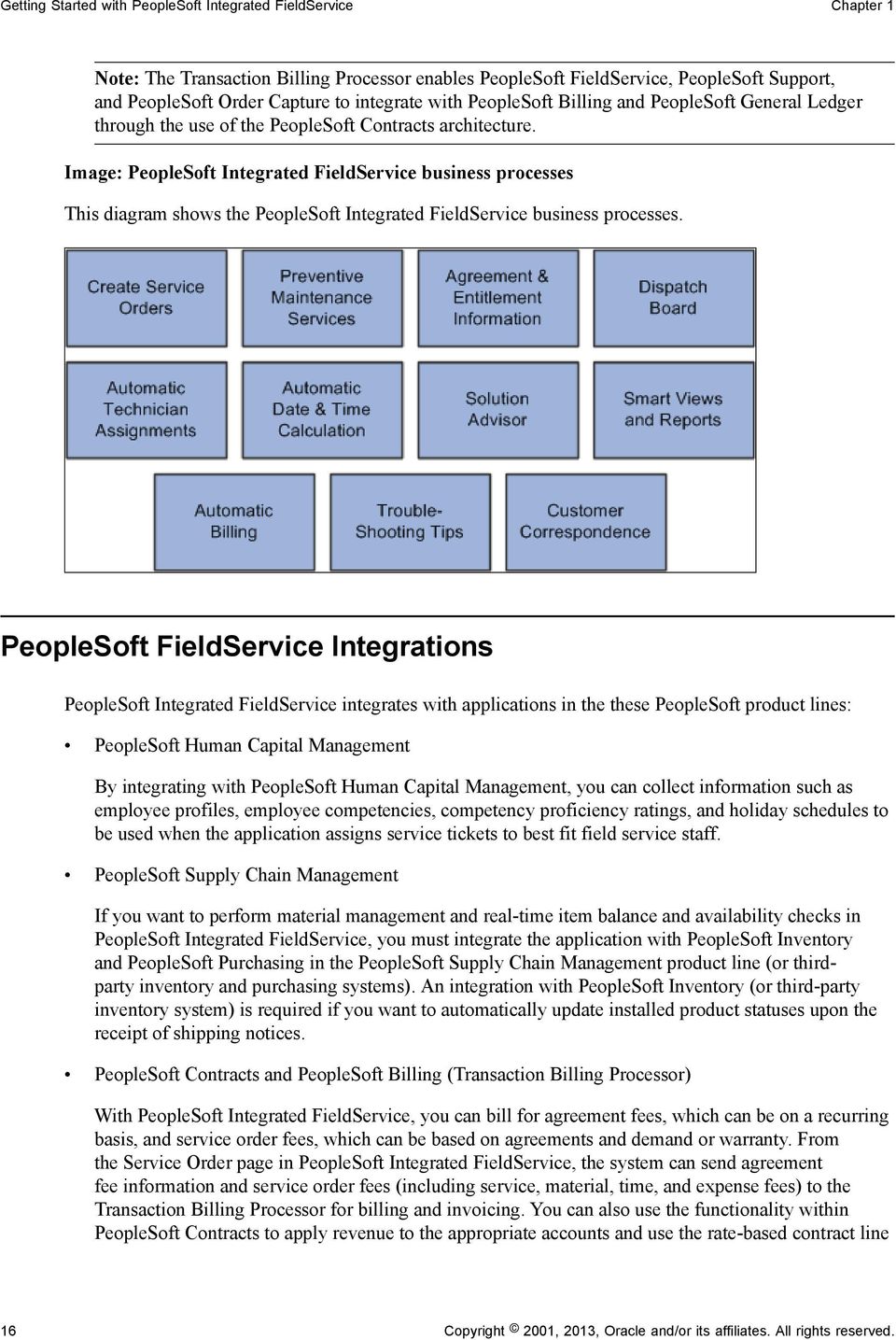
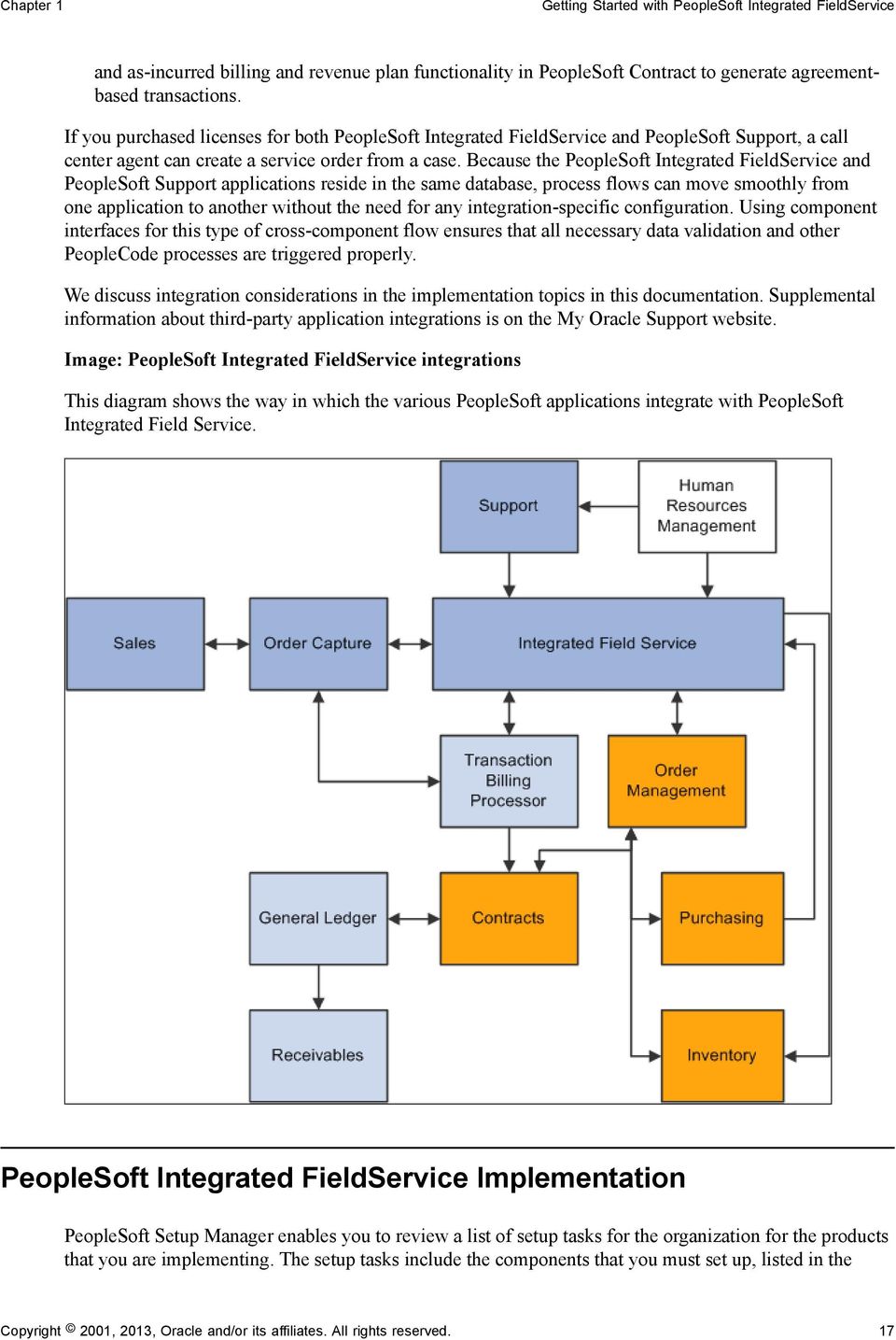
16 Getting Started with PeopleSoft Integrated FieldService Chapter 1 Note: The Transaction Billing Processor enables PeopleSoft FieldService, PeopleSoft Support, and PeopleSoft Order Capture to integrate with PeopleSoft Billing and PeopleSoft General Ledger through the use of the PeopleSoft Contracts architecture. Image: PeopleSoft Integrated FieldService business processes This diagram shows the PeopleSoft Integrated FieldService business processes. PeopleSoft FieldService Integrations PeopleSoft Integrated FieldService integrates with applications in the these PeopleSoft product lines: PeopleSoft Human Capital Management By integrating with PeopleSoft Human Capital Management, you can collect information such as employee profiles, employee competencies, competency proficiency ratings, and holiday schedules to be used when the application assigns service tickets to best fit field service staff. PeopleSoft Supply Chain Management If you want to perform material management and real-time item balance and availability checks in PeopleSoft Integrated FieldService, you must integrate the application with PeopleSoft Inventory and PeopleSoft Purchasing in the PeopleSoft Supply Chain Management product line (or thirdparty inventory and purchasing systems). An integration with PeopleSoft Inventory (or third-party inventory system) is required if you want to automatically update installed product statuses upon the receipt of shipping notices. PeopleSoft Contracts and PeopleSoft Billing (Transaction Billing Processor) With PeopleSoft Integrated FieldService, you can bill for agreement fees, which can be on a recurring basis, and service order fees, which can be based on agreements and demand or warranty. From the Service Order page in PeopleSoft Integrated FieldService, the system can send agreement fee information and service order fees (including service, material, time, and expense fees) to the Transaction Billing Processor for billing and invoicing. You can also use the functionality within PeopleSoft Contracts to apply revenue to the appropriate accounts and use the rate-based contract line 16 Copyright 2001, 2013, Oracle and/or its affiliates. All rights reserved.
17 Chapter 1 Getting Started with PeopleSoft Integrated FieldService and as-incurred billing and revenue plan functionality in PeopleSoft Contract to generate agreementbased transactions. If you purchased licenses for both PeopleSoft Integrated FieldService and PeopleSoft Support, a call center agent can create a service order from a case. Because the PeopleSoft Integrated FieldService and PeopleSoft Support applications reside in the same database, process flows can move smoothly from one application to another without the need for any integration-specific configuration. Using component interfaces for this type of cross-component flow ensures that all necessary data validation and other PeopleCode processes are triggered properly. We discuss integration considerations in the implementation topics in this documentation. Supplemental information about third-party application integrations is on the My Oracle Support website. Image: PeopleSoft Integrated FieldService integrations This diagram shows the way in which the various PeopleSoft applications integrate with PeopleSoft Integrated Field Service. PeopleSoft Integrated FieldService Implementation PeopleSoft Setup Manager enables you to review a list of setup tasks for the organization for the products that you are implementing. The setup tasks include the components that you must set up, listed in the Copyright 2001, 2013, Oracle and/or its affiliates. All rights reserved. 17
18 Getting Started with PeopleSoft Integrated FieldService Chapter 1 order in which you must enter data into the component tables, as well as links to the corresponding documentation. PeopleSoft Integrated FieldService also provides component interfaces to help you load data from your existing system into PeopleSoft Integrated FieldService tables. Use the Excel to Component Interface utility with the component interfaces to populate the tables. This table lists all of the components that have component interfaces: Component Component Interface Reference Service Type RF_SERVICE_TYPE RF_SERVICE_TYPE_SCI See Defining Service Types. Service Activity Type RF_SVC_ACT_TYPE RF_SVC_ACT_TYPE_SCI See Activity Types Page. Activity Code RF_ACT_CODE RF_ACT_CODE_SCI See Activity Code Page. Failure Code RF_FAILURE_CD RF_FAILURE_CD_SCI See Failure Codes Page. Provider Group RF_PROVIDER_GRP Provider Group Member RF_GRP_MEMBER Tax Parameters RF_TAX_PARAM RF_PROVIDER_GRP_SCI RF_GRP_MEMBER_SCI RF_TAX_PARAM See "Provider Groups Page (PeopleSoft CRM 9.1 Application Fundamentals PeopleBook)". See "Provider Group Member Page (PeopleSoft CRM 9.1 Application Fundamentals PeopleBook)". See "Setting Up Sales and Use Tax for Third-Party Tax Vendors (PeopleSoft CRM 9.2: Services Foundation)". Other Sources of Information In the implementation planning phase, take advantage of all PeopleSoft sources of information, including the installation guides, data models, business process maps, and troubleshooting guidelines. See also PeopleTools: PeopleSoft Setup Manager 18 Copyright 2001, 2013, Oracle and/or its affiliates. All rights reserved.

19 Chapter 2 Navigating in PeopleSoft Integrated FieldService Navigating in PeopleSoft Integrated FieldService PeopleSoft Integrated FieldService provides custom navigation center pages that contain groupings of folders that support a specific business process, task, or user role. Note: In addition to the PeopleSoft Integrated FieldService custom navigation center pages, PeopleSoft provides menu navigation, standard navigation pages, and PeopleSoft Navigator. Pages Used to Navigate in PeopleSoft Integrated FieldService This table lists the custom navigation pages that are used to navigate in PeopleSoft Integrated FieldService Note: The role that is associated with a user's ID and password determines the pages they have access to. As such not everyone will have access to all of the information described in this table. FieldService Center The FieldService Center custom navigation pages are geared to the person in the organization who is focused on managing service orders and service inventory. Page Name Navigation Usage FieldService Center Main Menu, FieldService Center Access primary service order and service inventory menu options and activities Customer Click Customer on the FieldService Center page Access the Consumer, Company, Agreements, and Installed Products pages. Items Click Items on the FieldService Center page Access the Review Item Definition and Item Warranties pages. My Calendar Click My Calendar on the FieldService Center page Access the My Monthly Calendar, My Daily Calendar, and My Worklist Items pages. Copyright 2001, 2013, Oracle and/or its affiliates. All rights reserved. 19

20 Navigating in PeopleSoft Integrated FieldService Chapter 2 Page Name Navigation Usage Reports Click Reports on the FieldService Center page Access the pages to run the utilizationrate analytics, service-order aging analytics, and these operational reports: Dispatch performance report Expense report by product Expense report by customer Mean time-to-repair report Service Inventory Click Service Inventory on the FieldService Center page Access the Service Inventory page. Service Order Click Service Order on the FieldService Center page Access the Dispatch Board, My Service Orders, Add Service Order, Update Service Orders, and Review Preventive Maintenance pages. Workforce Click Workforce on the FieldService Center page Access the Provider Groups and Provider Group Members pages. 20 Copyright 2001, 2013, Oracle and/or its affiliates. All rights reserved.

21 Chapter 3 Defining Business Units in PeopleSoft Integrated FieldService Understanding FieldService Business Units In PeopleSoft Customer Relationship Management (PeopleSoft CRM), field service business units track service orders that are created by each field service organization. To implement PeopleSoft Integrated FieldService, you must map the field service organization to field service business units. The field service business unit ID also serves as a reference key when integrating with PeopleSoft Purchasing and PeopleSoft Inventory. If you're integrating with PeopleSoft Purchasing to create requisitions for truck stock, you must define each field service business unit as a valid source of requisitions in PeopleSoft Supply Chain Management (PeopleSoft SCM). By using the Requisition Loader Defaults component in PeopleSoft SCM, you define each field service business unit as a loader business unit and establish processing defaults for requisitions that are staged by the field service business unit, including the purchasing business unit in PeopleSoft Purchasing that processes the requisitions. When defining procurement options in PeopleSoft SCM, you can associate the field service business unit with an appropriate distribution network on the Ship To Locations page. Sourcing processes in PeopleSoft Purchasing can be configured to check available quantity first in the distribution network before creating Copyright 2001, 2013, Oracle and/or its affiliates. All rights reserved. 21
22 Defining Business Units in PeopleSoft Integrated FieldService Chapter 3 a purchase order with an external vendor. If quantity exists in one of the inventory business units in the defined distribution network, an interunit transfer is created to fulfill the requisition. Image: Order flow from PeopleSoft Integrated FieldService to the inventory and purchasing system This diagram illustrates how a field service business unit is used in both PeopleSoft CRM and the inventory and purchasing system. For integration purposes, business unit definition records must be synchronized across all systems. Business unit definitions created in PeopleSoft CRM must be available in PeopleSoft Purchasing, and inventory business unit definitions must be available in PeopleSoft CRM. To synchronize business unit records across the organization, use the Business Unit enterprise integration point (EIP). 22 Copyright 2001, 2013, Oracle and/or its affiliates. All rights reserved.
23 Chapter 3 Defining Business Units in PeopleSoft Integrated FieldService Note: There is only a one-way synchronization from PeopleSoft Financials and Supply Chain Management (PeopleSoft FIN/SCM) to PeopleSoft CRM. The business units that you create within PeopleSoft CRM are not automatically synchronized and have to be entered manually in the PeopleSoft FIN/SCM database For more informaiton, see the documentation for PeopleSoft Purchasing and PeopleSoft Inventory. Related Links Integrating with PeopleSoft Financial Management Services Integrating with PeopleSoft SCM Understanding Field Service Configuration Templates Configuration templates provide PeopleSoft CRM administrators a simple way to configure core components to be used by industry solutions. Through the use of templates, you can easily manipulate the appearance and behavior of a component by enabling and disabling certain features that are available on the corresponding template. In PeopleSoft Integrated FieldService, the Service Order component is made configurable by using configuration templates. Note: Configuration templates are different from display templates, which are used by PeopleSoft Support. PeopleSoft FieldService does not use the display templates. Service Order Configuration by Using Configuration Templates Configuring service orders by using templates is a simple, two-step process. To configure service orders: 1. Define a configuration template. In the configuration template, you indicate which product-related information (if any) must appear and be prompted for in service orders. In addition, you can configure the Service Order component to hide entitlement and billing details and enable anonymous user and incident address usage for your industry-specific needs. You can also configure whether to display expenses and priority (at the activity level) and turn off approvals. 2. Associate the configuration template with a business unit. Specify, at the business unit level, the template that is used to control the appearance and behavior of service orders for the business unit. Note: Every field service business unit must be associated with one configuration template. If you have multiple business units in the organization with various service order requirements, create multiple configuration templates with different settings to accommodate all of your business needs. When you create or open a service order after the setup is completed, the system applies to the service order the configuration template that is selected for that service order's business unit. The service order appears according to what is in the configuration template. PeopleSoft Integrated FieldService delivers the CORE configuration template for the Service Order component. You can make changes to it as needed or create additional ones. Modifications that are made Copyright 2001, 2013, Oracle and/or its affiliates. All rights reserved. 23
24 Defining Business Units in PeopleSoft Integrated FieldService Chapter 3 to the service order appear as a result of the configuration template and are reflected in service orders that are accessed through the My Service Order component. Related Links "Configuration Tools (PeopleSoft CRM 9.2: Automation and Configuration Tools)" Defining FieldService Business Units To define FieldService business units, use the Field Service Business Unit (RF_BUS_UNIT) component. This section discusses how to Define FieldService business units. Define billing options. Page Used to Define FieldService Business Units Page Name Definition Name Navigation Usage FieldService Definition BUS_UNIT_RF1 Set Up CRM, Business Unit Related, FieldService Definition, Business Unit. Billing Options RF_BU_BILL_OPTIONS Set Up CRM, Business Unit Related, FieldService Definition, Billing Options. Define field service business units that correspond to field service organizations. Define billing options for a field service business unit. FieldService Definition Page Use the FieldService Definition page (BUS_UNIT_RF1) to define field service business units that correspond to field service organizations. 24 Copyright 2001, 2013, Oracle and/or its affiliates. All rights reserved.
25 Chapter 3 Defining Business Units in PeopleSoft Integrated FieldService Navigation Set Up CRM, Business Unit Related, FieldService Definition, Business Unit. Image: FieldService Definition page This example illustrates the fields and controls on the FieldService Definition page. Note: If you use more than one PeopleSoft application and define the same business units across applications, ensure that you use the same name for business units that are designed to share the same setid. For best performance, business unit IDs should be exactly five alphanumeric characters. Default SetID Template Enter the setid that determines the preliminary tableset sharing setup. The system displays this field when you create a business unit. The setid that you select here determines the setids that are assigned to each record group for the new business unit. The setid that is assigned to a record group determines the tableset that provides values for the business unit. If you enter an existing setid, the system copies the set control definition to the new business unit. Enter the configuration template to be used by this business unit. When creating or modifying service orders, the system displays or hides fields and buttons based on the configuration that is set up in the selected template. Copyright 2001, 2013, Oracle and/or its affiliates. All rights reserved. 25
26 Defining Business Units in PeopleSoft Integrated FieldService Chapter 3 Status Currency Create BU (create business unit) Rate Type Select whether the facility that is represented by the business unit is open or closed. No transactions can be processed for a closed business unit. By default, the status is set to Closed when adding a new business unit. Select the currency code that specifies the currency that you use for a monetary transaction with this business unit. Click to establish the setid controls for the field service business unit based on the default setid that you specified. This button is available only when you add a new business unit. You also must click this button to enable the check boxes that appear on the page. Select the exchange rate type that you want to use to calculate monetary transaction amounts for the currency. The system uses a default rate type of Current Rate when you create a new business unit. This field appears by default from the Exchange Rate Type field that you set on the General Options page in the Installation Options component. You can, however, override the setting by selecting another value. Note: You can change the value in this field only after you create the business unit by clicking the Create BU button. Service Level Select the service level that you want to use for the business unit. This is a required field that prompts on all service levels that have been defined for the setid. You can enter a service level only after clicking the Create BU button, which creates the business unit. Options Use this group box to control how PeopleSoft Integrated FieldService behaves by activating or deactivating the application features at the business unit level. Note: You can only enter information in this section after clicking the Create BU button. Allow Service Order Creation for Site without a Customer Calculate Date/Time Allow Preventive Maintenance Select to enable users to create service orders by entering site information without specifying a customer or contact. By default, this option is disabled. Select to enable the system to automatically calculate planned start and end dates and times for service order activities based on the entitlements that are associated with the agreement, warranty, or service that is selected on the service order. By default, this option is disabled. Select to enable the system to automatically generate service orders for installed products that are entitled to scheduled preventive maintenance. By default, this option is disabled. 26 Copyright 2001, 2013, Oracle and/or its affiliates. All rights reserved.
27 Chapter 3 Defining Business Units in PeopleSoft Integrated FieldService Automatic Receiving Indicates whether orders that are placed by using the Order Materials page can be received automatically when material usage is recorded or if technicians must record receipt of the order shipment before they can record material usage. This setting applies to all material requisitions that are created for the field service business unit. Service Order Assignment Use this group box to control how PeopleSoft Integrated FieldService assigns provider groups and technicians to service orders for the business unit Note: You can only enter information in this section after clicking the Create BU button. Automatic Assignment at Save Candidate must be available Select to enable the system to automatically assign best fit provider groups and technicians to service orders in this business unit. When the feature is enabled, the system doesn't perform automatic assignment if the service order already has a provider group and group member assigned to it at save time. If the assignment of provider groups or group members already exists (either populated from the selected service or agreement of the service order, or as a result of a manual assignment), selecting this option does not overwrite current values. Select if you want the assignment engine to consider only provider groups or group members that are available (during the time the service is performed) during automatic assignment. No automatic assignment is performed if this check box is selected and there are no provider groups or group members available. Clear this check box if provider groups and group members do not need to be available at the time that is requested on the service order to be considered for the automatic assignment. Note: Before selecting the Candidate must be available check box, you must select Automatic Assignment at save. Related Links Setting Up the Order Materials Component Understanding Scheduled Preventive Maintenance Setting Up Automatic Calculation of Dates and Times for Service Orders Setting Up Automatic Service Order Assignments Billing Option Page Use the Billing Options page (RF_BU_BILL_OPTIONS) to define billing options for a field service business unit. Copyright 2001, 2013, Oracle and/or its affiliates. All rights reserved. 27
28 Defining Business Units in PeopleSoft Integrated FieldService Chapter 3 Navigation Set Up CRM, Business Unit Related, FieldService Definition, Billing Options. Instructions on completing the Billing Options page are included in the PeopleSoft CRM 9.2: Services Foundation documentation. Note: This page is only available after clicking the Create BU button. Related Links "Billing Options Page (PeopleSoft CRM 9.2: Services Foundation)" Defining Configuration Templates for Service Orders To define configuration templates for service orders, use the Field Service Industry (RF_INDUSTRY) component. This section discusses how to define configuration templates for service orders. Page Used to Define Configuration Templates for Service Orders Page Name Definition Name Navigation Usage Service Order Configuration RF_INDUSTRY Set Up CRM, Product Related, FieldService, Service Order Configuration, Service Order Configuration Define configuration templates to dictate how service orders appear in the Service Order and My Service Order components. Service Order Configuration Page Use the Service Order Configuration page (RF_INDUSTRY) to define configuration templates to dictate how service orders appear in the Service Order and My Service Order components. 28 Copyright 2001, 2013, Oracle and/or its affiliates. All rights reserved.
29 Chapter 3 Defining Business Units in PeopleSoft Integrated FieldService Navigation Set Up CRM, Product Related, FieldService, Service Order Configuration, Service Order Configuration Image: Service Order Configuration page This example illustrates the fields and controls on the Service Order Configuration page. Note: If you have installed both PeopleSoft Support and FieldService, it is highly recommended that the product display options that you select here are consistent within each system. Options These check boxes are selected when you create a new configuration template. Show Agreement Information Show SIN (show site identification number) Clear to hide the agreement and entitlement information in the Service Order and My Service Order components. When this check box is cleared, the system hides the Select Agreement/ Warranty link on the Service Order and the Entitlement information in the Service Order and My Service Order components. Clear to hide the SIN field in the Customer Information group box on the Service Order page. The Show SIN check box is unavailable for editing if Show Agreement Information is disabled. The check box is automatically selected if Show Agreement Information is selected. Copyright 2001, 2013, Oracle and/or its affiliates. All rights reserved. 29
30 Defining Business Units in PeopleSoft Integrated FieldService Chapter 3 Show Billing Information Show Billable on My Service Order Allow Anonymous User Clear to hide the Billable check box and the Billing tab on the Service Order page. Clear to hide the Billable check box on the My Service Order page. Select to allow the use of an anonymous user and to display the Anonymous Caller check box on the Service Order page. The anonymous user feature was first introduced in PeopleSoft CRM for Government. You can designate a service order for an anonymous caller by selecting the Anonymous Caller check box in the Customer Information group box. The system then populates the Customer field with the value that the administrator has specified for an anonymous user. Allow Incident Address Allow Expenses Select to allow the use of an incident address and to display the Incident Address group box on the Service Order and My Service Order page. This feature originates from PeopleSoft CRM for Government; it enables you to enter an address (other than the customer address) that is specific to the incident that is reported in the service order and to enter location details as applicable. Select to display the Expense group box on both the Service Order and My Service Order pages. Allow Priority on Service Order Line Select to display the Priority field for each activity on both the Service Order page and the My Service Order pages. Product Display Options These values control the display of product-related information on the service order that is accessed from both the Service Order and My Service Order components. Prompt for Product Master, Show Installed Product Information Select to display all of these product-related fields and information: The Product ID field and lookup button, the Transfer to Product button, and the product description. The Serial Number field and lookup button and the Transfer to Installed Product button. The Installed check box. The View Hierarchy button on the toolbar. Note: If you select this option, the Product ID lookup button returns a list of all products. Prompt for Product Master, Hide Installed Product Information Select to display the Product ID field and lookup button, the Transfer to Product button, and the product description, while 30 Copyright 2001, 2013, Oracle and/or its affiliates. All rights reserved.
31 Chapter 3 Defining Business Units in PeopleSoft Integrated FieldService hiding the Serial Number field and lookup button, the Transfer to Installed Product button, and the View Hierarchy button. Note: If you select this option, the Product ID lookup button returns a list of all products. Prompt for Installed Product Select to display the Product ID field and lookup button, the Transfer to Product button, the product description, the Serial Number field and lookup button, the Transfer to Installed Product button, and the View Hierarchy button. Note: If you select this option, the Product ID lookup button returns only those products that are installed for the particular customer that is displayed on the page. Hide All Product Information Select to hide all product-related fields on the Service Order page, including the Product ID field and lookup button, the Transfer to Product button, the product description, the Serial Number field and lookup button, the Transfer to Installed Product button, and the Installed check box. The View Hierarchy button on the toolbar does not appear when this option is selected. Approvals These values control the display of approval options on the Service Order page for both the entire order and for each activity. Note: Approval information does not appear on the My Service Order page. The Status field at the activity level, however, indicates whether the activity needs approval. Enforce Service Order Approval Enforce Service Order Line Approvals Select to display the Approval Information group box on the Service Order page. Select to display the Approval Required and Approval Status fields on the Activity tab of the Service Order page. Copyright 2001, 2013, Oracle and/or its affiliates. All rights reserved. 31
32
33 Chapter 4 Understanding Inventory Storage Locations for Technicians Truck Stock Storage Locations In PeopleSoft Customer Relationship Management (PeopleSoft CRM), you associate field service technicians in the workforce with storage locations in your inventory system by using the Storage Locations page of the Worker component. You record the manual receipt of materials in Order Materials and record automatic receipts, usage, and removal of materials on the Time Material Expense page of the service order. PeopleSoft CRM publishes transaction messages to update the storage locations that are associated with the technician reporting material usage for the service order activity. From the Service Order component, you can view stock balances by item. To support this functionality, you must associate each technician in the workforce with two storage locations in your inventory system one location for good stock that can be used to complete work on a service order line and another location for defective stock that was removed from customer sites. The stock that is removed from a customer site may not necessarily be defective. Typically, however, stock that is removed from a customer site must undergo inspection processing before it can be included in the available stock stores. Before you can associate technicians with truck stock storage locations in PeopleSoft CRM, an inventory business unit and its material storage locations must be defined in PeopleSoft Inventory or a third-party inventory system. If you are integrating with PeopleSoft Inventory, define an inventory business unit to track only truck stock storage locations. The records of the business units in the inventory system that represent the field service trucks must also be available in PeopleSoft CRM. Activate the Business Unit enterprise integration point (EIP) to automatically insert business units that are defined in the inventory system in the BUSINESS_UNIT_FS table in PeopleSoft CRM. This enables you to reference the appropriate inventory business unit for the technician's storage locations on the Storage Location page. Copyright 2001, 2013, Oracle and/or its affiliates. All rights reserved. 33
34 Understanding Inventory Storage Locations for Technicians Chapter 4 Note: When PeopleSoft CRM is integrated with PeopleSoft Supply Chain Management, the BUSINESS_UNIT_FS table in PeopleSoft CRM contains all business units that are defined in PeopleSoft Supply Chain Management, including all inventory business units that are defined in PeopleSoft Inventory. On the Storage Location page, select the appropriate inventory business unit. Image: Defining truck storage locations for technicians in PeopleSoft CRM and Inventory (or another third-party inventory) systems This diagram shows how the good and defective storage locations are manually defined in two systems. In order for material movement transactions that are initiated from the Time Material Expense page within the service order to be successfully recorded in the inventory system, the truck stock storage location (good or defective) that is defined for any field service technician (including an inventory business unit, a storage area, and up to four storage levels) must correspond to a valid storage location that is defined for that specific inventory business unit in the inventory system. Your business processes dictate how to handle material in a technician's defective storage location. Typically, this stock is transferred to an inspection storage location within a distribution center, where a decision is made to scrap, recycle, repair, or restock the item in your inventory stores. For more information, refer to your PeopleSoft Inventory documentation. Related Links "Understanding Workers in CRM (PeopleSoft CRM 9.2: Business Object Management)" Managing Materials Integrating with PeopleSoft SCM 34 Copyright 2001, 2013, Oracle and/or its affiliates. All rights reserved.
35 Chapter 5 Setting Up Services Understanding the Service Data Model In PeopleSoft Integrated FieldService, you create a service record for each service that the company offers (for example, preventive maintenance on air conditioners or dish washer repair). After defining the details of a service, you can associate the service with prices, add the service to an agreement line, and enter service orders to track customer requests for the service. Image: Service data model This diagram illustrates the component records of a service definition in PeopleSoft Integrated FieldService. When you create a service in the PeopleSoft Customer Relationship Management (PeopleSoft CRM) system, you can define: Service activities Service activities define the tasks that are required to complete the service. When activities are defined and a service is requested on a service order, the system automatically creates service order activities for any activities that are defined for the service. Customer service representatives (CSRs) and technicians can modify or delete the service order activities. Copyright 2001, 2013, Oracle and/or its affiliates. All rights reserved. 35
36 Setting Up Services Chapter 5 Note: If you define service activities for a service, it is highly recommended that you also set up material and technician competency requirements for each activity. When you create a service order for a service that does not have any associated activity, the system populates the service order with material and competency information for the service. But when activities are defined for the service, the system populates the service order with material and competency information that is defined for the service activities. Therefore, if you don't specify the material and competency information at the service activity level, that information does not appear in service orders for that service. Products You can define products that are covered by the service. You can indicate that the service applies to all products in the system or you can define a subset of products for which the service is applicable. When you specify the service on an agreement line, the system verifies that only the products that are defined for the service can be listed as products under service on the agreement line. Similarly, when the service is requested on a service order, the system validates that only a product that is defined for a service can be specified on the service order. Materials You can define quantities of the items that are required to perform the service or the service activity. If you define service activities, the system uses the service activity material information to populate the required material list that is associated with the service order line on the Order Materials page. The system also populates the Required Material page on the Service Order page and the My Service Order page. If there are no service activities, the system uses the material information at the service level to populate the required material list that is associated with the service order activities. From the Order Materials page, you can add additional items and order required materials. Regions You can indicate that the service can be sold and deployed in all regions that are defined for the system, or you can define a subset of regions for which the service can be sold or deployed. When you specify the service on an agreement line, the system verifies that for agreements of scope Site, the system matches the region of each agreement line site with the regions listed for that service and that for agreements of scope Contact, the system matches the region of each agreement contact with the regions listed for the service (on each agreement line). Note: In both cases, you must select the saleable flag for that region. Similarly, when the service is requested on a service order, the system validates that only the region that is derived from the customer information on the service order is defined as a deployable region for the service. Competencies You can specify a list of competencies and associate a minimum proficiency level that technicians or provider groups must have to be qualified to perform the service. The system uses the information for assigning service order activities. You can specify the minimum competency at the service level or at the service activity level if activities are defined. When you click the Suggest Provider Group or Suggest Group Member link on the Service Order page, the system calculates a lower fit score for any 36 Copyright 2001, 2013, Oracle and/or its affiliates. All rights reserved.
37 Chapter 5 Setting Up Services provider group or technician who does not meet the competency level that is specified for the service activity or service. Related Links Managing Materials "Understanding Products in PeopleSoft CRM (PeopleSoft CRM 9.2: Product and Item Management)" "Understanding Item Definition in PeopleSoft CRM (PeopleSoft CRM 9.2: Product and Item Management)" "Setting Up Regions (PeopleSoft CRM 9.1 Application Fundamentals PeopleBook)" "Understanding Competencies in PeopleSoft CRM (PeopleSoft CRM 9.1 Application Fundamentals PeopleBook)" "Understanding Assignment Searches (PeopleSoft CRM 9.1 Application Fundamentals PeopleBook)" Defining Service Types To define service types, use the Service Type (RF_SERVICE_TYPE) component. To load data into the tables for this component, you can also use the RF_SERVICE_TYPE_SCI component interface. This section provides an overview of service type definitions and discusses how to define service types. Note: Service Types are required when creating new services. Page Used to Define Service Types Page Name Definition Name Navigation Usage Service Types RF_SERVICE_TYPE Set Up CRM, Product Related, FieldService, Service Types Establish codes that can be used to categorize services and indicate which service types are eligible for preventive maintenance. Understanding Service Type Definitions You can create service types to categorize, for example, delivery services, installation services, repair services, and so forth. Use the Service Types component to specify which groups of services are eligible for the preventive maintenance functionality. After defining a service type, you can categorize services by referencing the service type on services. You can also choose to develop custom reports based on service types. Service Types Page Use the Service Types page (RF_SERVICE_TYPE) to establish codes that can be used to categorize services and indicate which service types are eligible for preventive maintenance. Copyright 2001, 2013, Oracle and/or its affiliates. All rights reserved. 37
38 Setting Up Services Chapter 5 Navigation Set Up CRM, Product Related, FieldService, Service Types Image: Service Types page This example illustrates the fields and controls on the Service Types page. Service Types Lists the service types that are defined for the specified setid. Type Code Description and Short Description Preventive Maintenance Enter a code to identify the service in the system. You can use up to eight alphanumeric characters. Enter the long and short descriptions for the service type. When you reference a service type on a service, the value that is entered for short description appears on the Service page. Select to indicate that services that belong to this service type are eligible for preventive maintenance functionality in PeopleSoft Integrated FieldService. The system issues a warning if you clear the Preventive Maintenance check box for service types (namely to change service types back to a regular, non-preventive maintenance kind) under which services are already defined. You can then decide whether to let the system automatically delete all preventive maintenance-related information from the associated services or leave these service records intact for manual update in the future. VAT Defaults (value-added tax defaults) Click to access the VAT Defaults Setup page, which is a common page used to set up VAT defaulting for all PeopleSoft applications that process VAT transactions. On this page, you can define VAT defaults for service groups, per VAT registration country and state. The VAT defaults page is located in PeopleSoft Financials; click the links to transfer to this PeopleSoft Financials page. 38 Copyright 2001, 2013, Oracle and/or its affiliates. All rights reserved.
39 Chapter 5 Setting Up Services Note: The system displays VAT defaults and Service VAT Treatment defaults only when the integration to the Transaction Billing Processor is installed. In both cases, the saleable flag must be selected for that region in order to pass the test. Service VAT Treatment Defaults (service value-added tax treatment defaults) Click to access the Service VAT Treatment Drivers Setup page, which is a common page used to set up VAT services treatment for all PeopleSoft applications that process VAT transactions. If you are required to implement special handling for services, you can specify VAT service treatment defaults for service groups on this page for a supplier's (seller's) location country and state. The VAT Treatment Drivers setup page is located in PeopleSoft Financials. Note: The VAT Defaults Setup and Service VAT Treatment Drivers Setup pages are described in detail in the VAT topics in the PeopleSoft Global Options and Reports documentation. Related Links Setting Up Scheduled Preventive Maintenance Defining Activities To define activities, use the Service Activity Type (RF_SVC_ACT_TYPE) and Activity Code (RF_ACT_CODE) components. To load data into the tables for these components, you can also use the RF_SVC_ACT_TYPE_SCI and RF_ACT_CODE_SCI component interfaces. This section discusses how to define: Service activity types. Service activities. Pages Used to Define Activities Page Name Definition Name Navigation Usage Activity Types RF_SVC_ACT_TYPE Set Up CRM, Product Related, FieldService, Activity Types, Activity Types Activity Code RF_ACT_CODE Set Up CRM, Product Related, FieldService, Activity Codes, Activity Code Establish codes that can be used to categorize service activities. Define the activities that comprise the defined services. The values that you define on this page are used on the Service page of the service order. Copyright 2001, 2013, Oracle and/or its affiliates. All rights reserved. 39
40 Setting Up Services Chapter 5 Activity Types Page Use the Activity Types page (RF_SVC_ACT_TYPE) to establish codes that can be used to categorize service activities. Navigation Set Up CRM, Product Related, FieldService, Activity Types, Activity Types Image: Activity Types page This example illustrates the fields and controls on the Activity Types page. Similar to service type codes, service activity type codes reference the general category to which a service activity belongs. For example, an electric appliance company might define activity types such as refrigerator repair and refrigerator preventive maintenance for its refrigerator products. Type Code Enter a code to identify the activity type in the system. You can use up to eight alphanumeric characters. When an activity type is selected for an activity code, both the type code and short description appear on the Activity Code page. Activity Code Page Use the Activity Code page (RF_ACT_CODE) to define the activities that comprise the defined services. The values that you define on this page are used on the Service page of the service order. 40 Copyright 2001, 2013, Oracle and/or its affiliates. All rights reserved.
41 Chapter 5 Setting Up Services Navigation Set Up CRM, Product Related, FieldService, Activity Codes, Activity Code Image: Activity Code page This example illustrates the fields and controls on the Activity Code page. Defining services as a series of default activity steps enables you to manage technician competency and material requirements for each step of the service. It also enables the CSR or technician to tailor a service to the needs of the customer by adding or deleting activities for the service on the service order. In addition, you can attach activity codes to multiple service definitions, which reduces data entry requirements. Activity codes are keyed by setid. As you create a new activity code record, enter the setid under which it belongs and the activity code. Activity Code Status Description Displays the code that you entered in add mode for the service activity. You can use up to eight alphanumeric characters. Select either Active or Inactive to indicate the status of the activity code. Enter a description of up to 80 alphanumeric characters. Note: Service activity descriptions appear on system prompts when users select service activities on the Service and Service Order components. Enter a description that will be meaningful to the people who use these components. Activity Type Estimated Time Enter the category of activity that the service activity represents. Activity types are established on the Activity Types page. Click the Transfer to Activity Type button to access the Activity Types page. Enter the estimated time, in hours, that is required to perform the activity. This is the default value for the estimated duration on service order activities for this activity. This information is Copyright 2001, 2013, Oracle and/or its affiliates. All rights reserved. 41
42 Setting Up Services Chapter 5 also used in the auto-date calculation to calculate the planned dates and times. Number of Technicians Approval Required Enter the number of technicians that are required to perform the activity. This is the default value for the number of technicians on service order activities for this activity. This field is for informational purposes only and does not force you to assign a specific number of technicians to the activity. Select to indicate that when the activity is specified for a service order line, the service order line must be manually approved before time, expense, and material management transactions can be entered. If approval processing is not defined for the overall service, you can change the setting on the service order line to require approval processing. However, if approval processing is required for the service, it is also required on the service order line. You cannot change the approval setting on the service order line when the service specifies approval processing. Defining Services To define services, use the Service (RF_SERVICE) component. This section describes how to: Define service header information. Define service frequency. Define service entitlements. Enter service details. Define service frequency by product. Define service activities. Enter service notes. Associate branch scripts with services. Pages Used to Define Services Page Name Definition Name Navigation Usage Service - Service RF_SERVICE Set Up CRM, Product Related, FieldService, Services, Service Define service header information. 42 Copyright 2001, 2013, Oracle and/or its affiliates. All rights reserved.
43 Chapter 5 Setting Up Services Page Name Definition Name Navigation Usage Service - Frequency of Service RF_SERVICE_FREQ1 Click the Frequency of Service link on the Service - Service page. Define how often a service should be performed. The system uses the information that you enter here to schedule preventive maintenance service orders. Service - Entitlements RF_SERVICE_ENT Click the Select Entitlement link on the Service - Service page. Service - Service Details RF_SERVICE_ATTRIB Set Up CRM, Product Related, FieldService, Services, Service Details Define the entitlements for any on-demand services. When agreement and warranty entitlements are not available, the system uses the service entitlements instead to calculate required start and end dates and times for service orders. Define materials, regions, products, and competencies that are associated with a service. Service Product - Frequency of Service RF_SVC_PRD_FREQ Click the Frequency link in the Service Product Information group box on the Service - Service Details page. Define how often a service should be performed for a specific product. The system uses the information that you enter to schedule preventive maintenance service orders. Service - Service Activities RF_SERVICE_ACT Set Up CRM, Product Related, FieldService, Services, Service Activities Service - Notes RF_SERVICE_NOTE Set Up CRM, Product Related, FieldService, Services, Notes Service - Branch Script RF_SVC_BSCRIPT Set Up CRM, Product Related, FieldService, Services, Branch Script Define the activities that are required to perform the selected service. Add, view, and modify notes that are associated with the service or service activity definition. Add branch scripts to the service definition. Service - Service Page Use the Service - Service page (RF_SERVICE) to define service header information. Copyright 2001, 2013, Oracle and/or its affiliates. All rights reserved. 43
44 Setting Up Services Chapter 5 Navigation Set Up CRM, Product Related, FieldService, Services, Service Image: Service - Service page (1 of 2) This is the first of two examples illustrating the fields and controls on the Service - Service page. Image: Service - Service page (2 of 2) This is the second of two examples illustrating the fields and controls on the Service - Service page. The system displays on the toolbar the service-specific information, such as service number, type, and status. Click toolbar buttons to perform PeopleTools or application-specific actions. Service Information Description and Short Description Enter a service description of up to 80 alphanumeric characters. 44 Copyright 2001, 2013, Oracle and/or its affiliates. All rights reserved.
45 Chapter 5 Setting Up Services Note: The short description appears on system prompts when users select a service in the Agreement and Service Order components. Enter a description that will be meaningful to the people who use these components. Status Select a status: Active: Select to make the service available in the system during the time period that is specified by the start and end dates. Inactive: Select to make the service unavailable in the system, regardless of the offer start and end dates. An inactive service does not appear on system prompts for service orders or agreements. Service Type Estimated Duration Start Date and End Date Select a category of service. Service types are established on the Service Types page. Click the Transfer to Service Type button to access the Service Types page. Enter the estimated number of hours that is required to perform the service. When you save the service, the system issues an error if this value is less than the sum of the estimated times that are defined for the associated activities. Enter the first and last dates that the service can be offered on agreements and on-demand service orders. Warning! Be sure to enter an end date. If the end date is blank, the system assumes that the service is offered indefinitely. Replacement Number of Technicians Select a service that is scheduled to replace this service when this service is no longer offered. When a replacement service is specified, the system sets the status of the original service to Inactive, which prevents the service from being selected on agreements and service orders. Enter the number of technicians that is required to complete the service. The value can also be defined at the service activity level for service activities on the Activity Code page. When you define this value at the service level, the system populates the associated service activities with the same value as the default if the number of technicians is not yet defined for those service activities. When you create a service order for a service with activities, the system populates the corresponding service order line with the number of technicians that is defined for each service activity. Note: The system issues a warning if you begin technician assignment on a service order but the actual number of assignment is less than required when you save the record. Copyright 2001, 2013, Oracle and/or its affiliates. All rights reserved. 45
46 Setting Up Services Chapter 5 Approval Required Select to indicate that service orders that specify this service require approval by a designated person in your company. If approval is required at this level, no service order line can be approved until the service order is approved at the header level. Note: You can also require approval for individual activities on a service order. However, the Approval Required check box on the service order header and the Approval Required check box on the service order activity are not associated with each other operationally. Preventive Maintenance Use this group box to perform part of the setup that is required for the preventive maintenance functionality in PeopleSoft Integrated FieldService. Preventive Maintenance Field Service Unit Lead Time and Lead Time Interval Frequency of Service Indicates that preventive maintenance is available for the service. The system automatically selects this check box and makes it unavailable if the service type that is selected for this service is designated as the preventive maintenance type. Select a field service business unit under which service orders that are created for preventive maintenance are categorized. Enter the number (lead time) of days, weeks, months, or years (lead time interval) in advance when a preventive maintenance service order must be generated before the service actually occurs. Click to access the Service - Frequency of Service page, where you can define the frequency that is offered for this service. The system uses this information to schedule service orders for preventive maintenance. Classification Agreement On Demand Warranty Select to offer the service to customers on agreements. If this check box is cleared, the service does not appear on system prompts for agreements. You can also select this check box on the service order. If Agreement is selected, the system checks to ensure that the service that you select on the service order has this option selected. Select to offer the service to customers on demand. For a service order that is not covered by a warranty or an agreement, the system validates that the service is available on demand when the service order is saved. Select to provide the service under warranty. When you select a warranty and service on a service order, at save time the system ensures that a warranty has been selected 46 Copyright 2001, 2013, Oracle and/or its affiliates. All rights reserved.
47 Chapter 5 Setting Up Services if the check box for the service selected on the service order has also been selected. Off Hours Select Entitlement Select to provide the service outside standard hours of operation. This field is for informational purposes. Click to access the Service - Entitlements page, where you can define entitlements for the service. This link is applicable to on-demand services only; the system uses this information to calculate committed start and end dates and times for service orders when both agreement and warranty are not available. Default Assignment If a service order is not covered by an agreement, or if the selected agreement does not have a default provider group or group member assigned, the system uses the values that you enter in the Default Assignment group box to populate the service order activities. You can override the default values if necessary at the service order activity level. Provider Group Name Group Member Name Enter the default provider group that you want to perform the service. Click the Transfer to Provider Group button to access the Provider Groups page. Enter the default group member (of the defined provider group) for performing this service at the customer's site. Click the Transfer to Group Member button to access the Provider Group Member page. Related Links "Understanding Agreements and Warranties (PeopleSoft CRM 9.1 Application Fundamentals PeopleBook)" "Understanding Provider Groups and Group Members (PeopleSoft CRM 9.1 Application Fundamentals PeopleBook)" Setting Up Automatic Service Order Assignments Service - Frequency of Service Page Use the Service - Frequency of Service page (RF_SERVICE_FREQ1) to define how often a service should be performed. The system uses the information that you enter here to schedule preventive maintenance service orders. Copyright 2001, 2013, Oracle and/or its affiliates. All rights reserved. 47
48 Setting Up Services Chapter 5 Navigation Click the Frequency of Service link on the Service - Service page. Image: Service - Frequency of Service page This example illustrates the fields and controls on the Service - Frequency of Service page. You can define the service frequency at the service or service product level. Values that are entered at the service level apply to all products if the Applicable to All Products check box is selected on the service record; otherwise, values are populated as defaults on the Service Product - Frequency of Service page for each product that is covered by this service. At the service product level, you can define different frequency settings that are specific to products. Start Date End Date Start Time End Time Service Frequency Information Enter the beginning date of the period for which service frequency is defined. The default value is the offer start date that is defined on the Service - Service page. Enter the end date of the period for which service frequency is defined. A blank value indicates an unlimited frequency period. Enter the beginning time of the period for which service frequency is defined. The time zone that appears for this value represents the time zone of the database server. Enter the end time of the period for which service frequency is defined. The time zone that appears for this value represents the time zone of the database server. Values are: Days: Define the duration of this frequency in number of days. For example, enter 30 to have the service performed every 30 days. 48 Copyright 2001, 2013, Oracle and/or its affiliates. All rights reserved.
49 Chapter 5 Setting Up Services Weeks: Define the duration of this frequency in number of weeks and specify the day of the week on which to perform the service. For example, enter 2 and Wednesday to have the service performed every two weeks on Wednesday. Months: Define the duration of this frequency in number of months and specify the day of the month on which the service should be scheduled. For example, enter 3 and 3 to have the service performed every three months on the third day of the month. Yearly: Define the month and the day of the month to perform the service. For example, enter January and 1 to have the service performed on January 1 of every year. Service - Entitlements Page Use the Service - Entitlements page (RF_SERVICE_ENT) to define the entitlements for any on-demand services. When agreement and warranty entitlements are not available, the system uses the service entitlements instead to calculate required start and end dates and times for service orders. Navigation Click the Select Entitlement link on the Service - Service page. Image: Service - Entitlements page This example illustrates the fields and controls on the Service - Entitlements page. Entitlement Plan Name Select an entitlement plan to populate the Entitlements grid for the first time. Entitlement plans are defined on the Entitlement Plan Setup page. Note: Entitlement plans are optional. You can enter entitlements manually on the Entitlements page. Copyright 2001, 2013, Oracle and/or its affiliates. All rights reserved. 49
50 Setting Up Services Chapter 5 You can add new entitlement activities and modify and delete existing entitlement activities in the grid. The list of entitlements is used for calculating the service order's committed start and end dates and times if agreement or warranty entitlements are not available. Related Links "Defining Entitlements (PeopleSoft CRM 9.1 Application Fundamentals PeopleBook)" Service - Service Details Page Use the Service - Service Details page (RF_SERVICE_ATTRIB) to define materials, regions, products, and competencies that are associated with a service. 50 Copyright 2001, 2013, Oracle and/or its affiliates. All rights reserved.
51 Chapter 5 Setting Up Services Navigation Set Up CRM, Product Related, FieldService, Services, Service Details Image: Service - Service Details page (1 of 2) This is the first of two examples illustrating the fields and controls on the Service - Service Details page. Image: Service - Service Details page (2 of 2) This is the second of two examples illustrating the fields and controls on the Service - Service Details page. Copyright 2001, 2013, Oracle and/or its affiliates. All rights reserved. 51
52 Setting Up Services Chapter 5 Service Material Information If no activities are defined for a service and if a service order is created, the system uses the service material information to populate the material list that is associated with the service order. From the Order Materials component, you add additional items and order the required materials. Note: If you define service activities, define material information for the service activity on the Service - Service Activities page. Item ID Required Quantity UOM (unit of measure) Select the ID of the item that is used to perform the service. Before you can add an item to the service, you must first establish the item in the system tables by using the Item Master enterprise integration point (EIP) or the Item Definition component, and the item must be in active status. Click the Transfer to Item Definition button to access the Item Definition component. Enter the required amount of the item that the technician needs to perform the service. The system uses this value to populate the quantity that is required on the Order Materials component. Displays the standard unit of measure for the item quantity. Service Competency Information If no activities are defined for the service, the system uses service competency information to find the best technician to assign to the service order. Description Minimum Level Weight Select the description of the competency that is required to perform the service. Define competencies by accessing Set Up CRM, Common Definitions, Competencies, Competencies, Competencies. Select the minimum level of competency that the assigned technician must have to perform the service. The available options depend on the competency rating model that is defined for the selected competency. When searching for technicians to assign to service orders, the system calculates higher fit scores for those technicians who meet the minimum level of competency that is defined for the service. Enter the relative importance of this competency. Each activity competency can have a value from N/A (not applicable) to 5, where 5 represents the highest level of importance. A weight of N/A indicates that the competency is not applicable in the assignment search. Service Region Information Applicable to All Regions Select to perform the service for all regions. 52 Copyright 2001, 2013, Oracle and/or its affiliates. All rights reserved.
53 Chapter 5 Setting Up Services Applicable Regions Description Saleable Deployable Select if the service is limited to specific regions. You must enter region information in the Service Region Information grid if you chose this option. Select a region. Regions are established on the Region page. You can select active regions only. Select if the service is saleable in the region. When you select the service on an agreement, the system validates that the customer contact or customer sites listed on the agreement correspond to a saleable region. Select to provide the service in the region. When you select the service on a service order, the system validates that the customer or customer site corresponds to a deployable region. Service Product Information Applicable to All Products Applicable Products Product ID Item ID Frequency Select to perform the service for all products Select if the service is limited to specific products. You must enter product information in the Service Product Information grid if you select this option. Select the product to which the service applies. When you add a product to an agreement line or service order, the system validates that the product was defined for the service. Before you can add a product to the service, the product must first be established in the system tables by using the Product EIP or the Product Definition component. The product must have an active status, and the corresponding item must be defined as serviceable. Click the Transfer to Product button to access the Product Definition component. Displays the item ID that is associated with the product. Click to access the Service Product - Frequency of Service page, where you can view and modify the service frequency that is defined for the product. Related Links Managing Materials "Understanding Competencies in PeopleSoft CRM (PeopleSoft CRM 9.1 Application Fundamentals PeopleBook)" "Understanding Item Definition in PeopleSoft CRM (PeopleSoft CRM 9.2: Product and Item Management)" "Understanding Products in PeopleSoft CRM (PeopleSoft CRM 9.2: Product and Item Management)" "Setting Up Regions (PeopleSoft CRM 9.1 Application Fundamentals PeopleBook)" "Understanding Assignment Searches (PeopleSoft CRM 9.1 Application Fundamentals PeopleBook)" Copyright 2001, 2013, Oracle and/or its affiliates. All rights reserved. 53
54 Setting Up Services Chapter 5 Service Product - Frequency of Service Page Use the Service Product - Frequency of Service page (RF_SVC_PRD_FREQ) to define how often a service should be performed for a specific product. The system uses the information that you enter to schedule preventive maintenance service orders. Navigation Click the Frequency link in the Service Product Information group box on the Service - Service Details page. This page is almost identical to the Service - Frequency of Service page. The system populates the start date and time, end date and time, and frequency on this page with the service frequency information that is defined on the Service - Service page. The Service Product - Frequency of Service page also enables you to override the frequency for specific products. Related Links Service - Frequency of Service Page Service - Service Activities Page Use the Service - Service Activities page (RF_SERVICE_ACT) to define the activities that are required to perform the selected service. 54 Copyright 2001, 2013, Oracle and/or its affiliates. All rights reserved.
55 Chapter 5 Setting Up Services Navigation Set Up CRM, Product Related, FieldService, Services, Service Activities Image: Service - Service Activities page (1 of 2) This is the first of two examples illustrating the fields and controls on the Service - Service Activities page. Image: Service - Service Activities page (2 of 2) This is the second of two examples illustrating the fields and controls on the Service - Service Activities page. You can optionally describe a service as a series of activities. If you use activities, you can define product, competency, and other information by activity, instead of by service. Service Activity Information Activity Select an activity. Activity codes are defined on the Activity Code page. When you select an activity code, the system populates the service activity with the information that is defined for the activity code. Copyright 2001, 2013, Oracle and/or its affiliates. All rights reserved. 55
56 Setting Up Services Chapter 5 Step Number Enter a number to specify the order in which activities are performed for this service. If this is the second activity performed, for example, enter 2. Note: This step number is used in autocalc to determine how to stagger the planned dates and times. Activity Type Number of Technicians Estimated Duration Approval Required Displays the type of activity. Activity type codes are defined on the Activity Types page and are associated with activities on the Activity Code page. Displays the number of technicians that is required to complete the service activity. The value is populated from the Activity Code page or, if it is not available on the Activity Code page, from the Service page. Enter the number of hours that is required to perform the activity. The default value is defined on the Activity Code page. Select to indicate that when the activity is specified for a service order line, the service order activity must be manually approved before time, expense, and material management transactions can be entered on the service order line. The default value is defined on the Activity Code page. If approval processing is not defined for the service, you can change the approval setting on the service order activity to require approval processing. However, if approval processing is required for the overall service, it is also required on the service order line. You cannot change the approval setting on the service order line when the service specifies approval processing. Default Assignment Provider Group Name Group Member Name Enter a default provider group for service order activities that request this activity. Enter a default provider group member for service order activities that request this activity. Service Activity Material Information When a service order line is created for this service activity, the system populates the required materials for the service order with the activity material information that is defined in this group box. Use the Order Materials component to add additional items and to order the required materials. Item ID Select the ID of the item that is used to perform the service activity. The item must be established in the system by using the Item Master EIP or the Item Definition component, and the item must have an active status. 56 Copyright 2001, 2013, Oracle and/or its affiliates. All rights reserved.
57 Chapter 5 Setting Up Services Required Quantity UOM (unit of measure) Enter the amount of the item that the technician needs to perform the service activity. The system uses this value to populate the quantity that is required on the Order Materials page. Displays the standard unit of measure for the item quantity. Service Activity Competency Information The system uses this information to find the best technician to assign to the service order line. The system compares the group members' competencies with the competency at the activity level. Description Minimum Level Weight Enter the description of the competency that is required to perform the service activity. Define competencies by accessing Set Up CRM, Common Definitions, Competencies, Competencies, Competencies. Enter the minimum level of competency that the assigned technician must have to perform the service. The available options depend on the competency rating model that is defined for the selected competency. When searching for technicians to assign to service order activities, the system calculates higher fit scores for those technicians who meet or exceed the minimum level of competency that is defined for the activity. Enter the relative importance of this competency. Each activity competency can have a value from N/A to 5, where 5 represents the highest level of importance. A weight of N/A indicates that the competency is not applicable in the assignment search. Related Links Managing Materials "Understanding Item Definition in PeopleSoft CRM (PeopleSoft CRM 9.2: Product and Item Management)" "Understanding Competencies in PeopleSoft CRM (PeopleSoft CRM 9.1 Application Fundamentals PeopleBook)" "Understanding Assignment Searches (PeopleSoft CRM 9.1 Application Fundamentals PeopleBook)" Service - Notes Page Use the Service - Notes page (RF_SERVICE_NOTE) to add, view, and modify notes that are associated with the service or service activity definition. Copyright 2001, 2013, Oracle and/or its affiliates. All rights reserved. 57
58 Setting Up Services Chapter 5 Navigation Set Up CRM, Product Related, FieldService, Services, Notes Image: Service - Notes page This example illustrates the fields and controls on the Service - Notes page. If the page has at least one note, the summary view appears when you first access the Service - Notes page. Click the link in the Subject and Details column to see the detailed view of that note. Click the Add Note button to add a new note. If there are no notes entered for the service, enter the information that you want to add and then click the Apply Note button. To add a note that is specific to a service activity, specify the activity code of the service activity in the Associated Activity field of the note. Note: The start and end dates on the notes page are for informational purposes only and do not drive any processing. Activities are available only if they are tied to the service. Related Links "Understanding Notes and Attachments (PeopleSoft CRM 9.1 Application Fundamentals PeopleBook)" Service - Branch Script Page Use the Service - Branch Script page (RF_SVC_BSCRIPT) to add branch scripts to the service definition. 58 Copyright 2001, 2013, Oracle and/or its affiliates. All rights reserved.
59 Chapter 5 Setting Up Services Navigation Set Up CRM, Product Related, FieldService, Services, Branch Script Image: Service - Branch Script page This example illustrates the fields and controls on the Service - Branch Script page. Branch Script Information Script Name and Script Type Enter a branch script that you want to associate with the service. The system displays the script type after you make the selection. When you add a branch script to a service, the system populates service orders that are created for that service with the script. Copyright 2001, 2013, Oracle and/or its affiliates. All rights reserved. 59
60
61 Chapter 6 Working with Scheduled Preventive Maintenance Understanding Scheduled Preventive Maintenance This section lists common elements and discusses: Benefits of scheduled preventive maintenance. Preventive maintenance process flow. Common Elements Used for Scheduled Preventative Maintenance Start Date and Service Order Date The required start date of the preventive maintenance service order. The system calculates this value by adding the specified service frequency to the date on which the previous preventive maintenance service order was closed. The system also takes the service level into account. For example, if the customer offers service Monday through Friday only, the start date would not be on a Saturday or Sunday. Creation Date The service order creation date (when the preventive maintenance service order will be generated by the Application Engine process). Benefits of Scheduled Preventive Maintenance Scheduled preventive maintenance is a collection of services that are performed regularly on products to prevent unexpected product failure. These preplanned services, such as running performance checks and tune-ups or checking and replacing worn parts, help sustain the performance and extend the longevity of products. The result is a reduction in ownership costs to both service providers and customers. The preventive maintenance feature in PeopleSoft Integrated FieldService enables you to: Set up the system at the business unit level to automatically generate service orders for preventive maintenance services on installed products that are covered by an agreement. These preventive maintenance service orders are processed the same way as other service orders (from assigning a technician to processing service activities and completing the service order). Preview scheduled preventive maintenance services and make changes as necessary. Review the preventive maintenance history for installed products. Copyright 2001, 2013, Oracle and/or its affiliates. All rights reserved. 61
62 Working with Scheduled Preventive Maintenance Chapter 6 For any installed product that is eligible for a preventive maintenance service, the system creates a preventive maintenance entry. This entry tracks the preventive maintenance process life cycle of each installed product. The preventive maintenance entry updates each time that the status of the corresponding service order changes during the process. When the entry is marked as completed at the end of the cycle, the system reevaluates the associated installed product for another preventive maintenance cycle. If the installed product passes the evaluation, the system automatically generates another entry for it, which starts a new preventive maintenance cycle. Automatically generate service orders for preventive maintenance, calculate the service order start date and time based on agreement entitlements, and assign service orders to appropriate technicians. The system automatically assigns technicians only if you have auto assignment configured. Dispatchers and field service specialists can use the dispatch board to view these service orders and manage technician assignment schedules. These terms are used frequently in discussions of scheduled preventative maintenance: Term Valid agreement Preventive maintenance entry Definition An agreement is considered valid if the line status is set to Active, and the current system date is between the agreement line's start and end dates. A preventive maintenance entry is a row in the Preventive Maintenance History table (RF_INST_PROD_PM) for an installed product that passes the validation test and that is qualified for the preventive maintenance process. Preventive maintenance entries are used to track the statuses of preventive maintenance service orders. The system creates one preventive maintenance entry per installed product per service per agreement. An installed product can have more than one entry simultaneously if it is associated with multiple preventive maintenance services, or if it is associated with a service that is made available to more than one agreement line or agreement. 62 Copyright 2001, 2013, Oracle and/or its affiliates. All rights reserved.
63 Chapter 6 Working with Scheduled Preventive Maintenance Term Next preventive maintenance due date Definition This is the date when the next preventive maintenance service for an installed product is scheduled to start. When the system initially inserts a preventive maintenance entry for an installed product, the system uses this equation to calculate the date: (Next Preventive Maintenance Due Date) = (Installed Product Installation Date) + (Frequency) The system then verifies whether the calculated date falls between the start and end dates of the agreement line. If the calculated date is earlier than the agreement line start date, the system schedules the preventive maintenance so that the creation date is the system date. The service order date is the creation date plus the lead time. The system also takes into account the service level when making this calculation. For subsequent preventive maintenance entries that are created for this installed product, the system uses this equation to calculate the next preventive maintenance due date: (Next Preventive Maintenance Due Date) = (Service Order Completion Date) + (Frequency) Copyright 2001, 2013, Oracle and/or its affiliates. All rights reserved. 63
64 Working with Scheduled Preventive Maintenance Chapter 6 Preventive Maintenance Process Flow Preventive maintenance consits of several steps. Image: Preventive maintenance process flow This flowchart describes the preventive maintenance process. Each step of the process is discussed in the sections following the chart. Validation of Installed Products for Preventive Maintenance The preventive maintenance process begins when an installed product is added to an agreement line that is defined for a preventive maintenance service type and is saved. The installed product is then evaluated for preventive maintenance eligibility by using the these validation rules: The status of the installed product is set to Installed. An asset tag or serial number exists in the installed product. The installed product is covered by a valid agreement that is associated with a preventive maintenance service, and its next preventive maintenance due date (which is calculated by the system) falls between the start and end dates of the agreement line. The installed product does not already have a preventive maintenance entry with a status set to Pending for the same preventive maintenance service for which the system considers adding a new preventive maintenance entry. For every installed product that passes the evaluation, the system inserts a preventive maintenance entry with a status of Pending in the Preventive Maintenance History table. 64 Copyright 2001, 2013, Oracle and/or its affiliates. All rights reserved.
65 Chapter 6 Working with Scheduled Preventive Maintenance Creation of Preventive Maintenance Entries for Qualified Installed Products The system creates preventive maintenance entries for installed products that are eligible for preventive maintenance. It uses preventive maintenance entries to manage the life cycle of corresponding service orders throughout the process (from creation to completion). Based on the information in pending entries, service orders are generated through an Application Engine process. From this point on, the system tracks all preventive maintenance service orders by updating their associated preventive maintenance entries when statuses change in respective preventive maintenance service orders. A preventive maintenance entry, which appears on the Preventive Maintenance Detail page, is initially created with the these properties: A status set to Pending. A value in the Start Date field that is equivalent to the next preventive maintenance due date. If this preventive maintenance entry is the first one created for the installed product, the service order start date equals the installed product's installation date plus the frequency. If the calculated service order start date precedes the start date of the selected agreement line, the system schedules the preventive maintenance so that the creation date is the system date. The service order date is the creation date plus the lead time. For example, suppose that a product was installed on January 1, and this installed product was added to an agreement on February 21. With the frequency set to once per month, the service order start date of this preventive maintenance entry becomes February 21. In this case, the system increments the service order start date by the frequency to March 21 and verifies that this date is covered by the agreement. No preventive maintenance entries are created if this date goes beyond the agreement end date. Note: If you have enabled the automatic calculation of service order dates and times in the system, all preventive maintenance-related date calculations are based on the service level, response, and restore times of the associated agreement. This means that only contractually defined working days are considered in the calculation. Any calculated service order start date that falls on a nonworking day is automatically rescheduled to the next available working day. See Understanding Automatic Calculation of Dates and Times for Service Orders. A service order number appears when the Application Engine process creates a service order. Note: You can modify information (including the business unit, agreement details, service order start, and creation dates) in the preventive maintenance entry as long as that information has a status set to Pending. Validation of Preventive Maintenance Entries for Service Order Creation PeopleSoft Integrated FieldService uses an Application Engine process to identify installed products for which preventive maintenance service orders must be generated. When the process runs, it looks up all installed products that: Are set to a status of Installed. Are controlled by an asset tag or serial number. Are covered by a valid agreement. Copyright 2001, 2013, Oracle and/or its affiliates. All rights reserved. 65
66 Working with Scheduled Preventive Maintenance Chapter 6 Have a pending preventive maintenance entry. The process compares the current system date with the service order creation date (that is, the next preventive maintenance due date minus the lead time defined in the Service component) in each of these entries. If the system date is later than or equal to the service order creation date, a preventive maintenance service order is generated. If there are preventive maintenance entries in which the service order creation date is past due (which occurs if the process has not run as scheduled for some reason), the system pushes out the service order creation date for these preventive maintenance entries by one day (from the system date). This delay enables the entries to still be evaluated for service order creation. Once the service order is created, the system populates the Required Start Date field of the first service order line with the start date of the preventive maintenance service order. If you have enabled the automatic calculation of service order dates and times feature, the system takes the agreement entitlements (namely the specified service level, response, and restore times) into account when it calculates the required start date for the preventive maintenance service order. In addition, the system populates the service order number in the corresponding preventive maintenance entry and changes the entry status to Created. Change of Status in Preventive Maintenance Entries The status of a preventive maintenance entry changes as a result of a status update in its corresponding service order. For example, when a preventive maintenance service order is automatically created and its status is set to Open, the status of the associated preventive maintenance entry is set to Created. This table summarizes the conditions under which status changes in preventive maintenance entries occur: Condition Service Order Status Changes To Preventive Maintenance Entry Status Changes To Other Updates in the Preventive Maintenance Entry A preventive maintenance entry is created. Not applicable (NA) Pending NA A service order is generated. Open Created The service order number is populated on the preventive maintenance entry. A technician is at the customer site awaiting customer response or is on hold for parts. On Site, Hold - Customer, Hold - Part (service order line status) In Progress NA 66 Copyright 2001, 2013, Oracle and/or its affiliates. All rights reserved.
67 Chapter 6 Working with Scheduled Preventive Maintenance Condition Service Order Status Changes To Preventive Maintenance Entry Status Changes To Other Updates in the Preventive Maintenance Entry A service order is completed. Complete Completed The system updates the Date field in the Preventive Maintenance History group box on the Preventive Maintenance Detail page with the service order completion date. A new preventive maintenance entry (with a status set to Pending) is created if required validations are passed. A service order is canceled. Canceled Canceled NA Completion of the Preventive Maintenance Process Life Cycle The preventive maintenance process is approaching the end when the header status of the preventive maintenance service order changes to Completed. This status change takes place automatically when all associated service order activities have a status set to Completed, Canceled, or Closed. When that happens, the system verifies that the installed product that is selected for this service order has a status of Installed and is covered by a valid agreement that is associated with a preventive maintenance service (in which the Preventive Maintenance check box of the service type for this service is selected in the Service Type record). Next, the system locates the corresponding preventive maintenance entry, which has the number of this completed service order and has a status of Created or In Progress. The system updates the date with the service order completion date and changes the status to Completed. The ending of one preventive maintenance process may or may not mean the beginning of another one. The system uses the next preventive maintenance due date to decide whether the preventive maintenance process should continue for any installed product. As the status of a preventive maintenance entry is set to Completed, the system calculates the next preventive maintenance due date and verifies whether the date is covered by a valid agreement in which the corresponding preventive maintenance service is defined. If it is covered by the agreement, the system generates a new pending preventive maintenance entry in the Preventive Maintenance History table, and the next preventive maintenance due date is calculated by using the service order completion date plus the frequency. Additionally, the system looks for renewed agreements. The preventive maintenance process discontinues if the next preventive maintenance due date that is calculated goes beyond the agreement end date. The preventive maintenance entry status changes to Canceled if the associated preventive maintenance service order is canceled. In this case, a new pending preventive maintenance entry is generated with no service order number, and the next preventive maintenance due date is calculated as the service order cancellation date plus the frequency. However, if you cancel the preventive maintenance entry for the installed product, the preventive maintenance process cycle for the installed product stops. To Copyright 2001, 2013, Oracle and/or its affiliates. All rights reserved. 67
68 Working with Scheduled Preventive Maintenance Chapter 6 restart the process, you must use the Preventive Maintenance Detail page to manually enter a preventive maintenance entry for the installed product with a status of Pending. Setting Up Scheduled Preventive Maintenance To set up the preventive maintenance feature: 1. Select the Allow Preventive Maintenance check box (on the FieldService Definition page) for all business units on which you want to run preventive maintenance. 2. Define a preventive maintenance service type by using the Service Types component. Note that in PeopleSoft Integrated FieldService, preventive maintenance is available only to services that are defined under service types that are designated as preventive maintenance. In a given setid, you can specify multiple service types to be designated as preventive maintenance by selecting the Preventive Maintenance check boxes that are associated with them on the Service Types page. 3. Define the lead time and frequency for preventive maintenance services. The preventive maintenance feature applies to preventive maintenance services only. When you define a service and select a preventive maintenance service type on the service record, the Preventive Maintenance check box is automatically selected; you cannot modify it. Note: You cannot edit the Preventive Maintenance check box on the service records of any services that are defined with a preventive maintenance service type, unless the Preventive Maintenance check box of the associated service type is cleared. In addition, the system displays the Lead Time (required) and Lead Time Interval fields on the Service page, where you define how many days, weeks, months, or years in advance of the actual service to generate a service order for the preventive maintenance service. Another piece of information that you specify in the Service component is the frequency (how often the preventive maintenance process for a service repeats itself). The system uses the frequency to calculate the next preventive maintenance due date that is recorded in preventive maintenance entries. When you enter the start and end dates for the service frequency, the system ensures that both dates fall within the service offering time line and do not go beyond the service start and end dates. The system issues a warning if a frequency is not defined for preventive maintenance services; in this case, the preventive maintenance process doesn't start. Note that the system issues an error if the lead time is greater than the frequency. For example, suppose that you defined a service in which the lead time is set to two months and frequency is set to every one month. Today is June 1. The system must create a new preventive maintenance entry for this service because the current service order was finished this morning. According to the lead time and frequency values in the service record, the next preventive maintenance due date (the service order completion date plus the frequency) is scheduled for July 1, and the service order creation date (the next preventive maintenance due date minus the lead time) is May 1: a day that has already passed. To avoid this error, always set a lead time that is less than or equal to the frequency. 4. Select a field service business unit for preventive maintenance services. 68 Copyright 2001, 2013, Oracle and/or its affiliates. All rights reserved.
69 Chapter 6 Working with Scheduled Preventive Maintenance As you define a preventive maintenance service, select the field service business unit under which to assign the service orders that are created for this service. The Field Service Unit field is available only for preventive maintenance service records. You can overwrite the business unit that is specified for service orders on preventive maintenance entries as long as they have a status set to Pending. 5. Define agreement lines for installed products. Before inserting a preventive maintenance entry or creating a service order for a preventive maintenance service, the system verifies whether the corresponding installed product has a valid agreement. Make sure that you have added all installed products on which you want the preventive maintenance process to run to an available agreement that has not expired. 6. Run the Application Engine process for every business unit that uses the preventive maintenance feature. The process creates the service orders for the preventive maintenance services. Note: We recommend that you schedule the process to run nightly. Related Links Defining FieldService Business Units Defining Service Types Defining Services "Agreement - Agreement Line Page (PeopleSoft CRM 9.1 Application Fundamentals PeopleBook)" Managing Scheduled Preventive Maintenance This section discusses how to: Edit the pending preventive maintenance entry and review the preventive maintenance history summary. View preventive maintenance details. Create preventive maintenance service orders. Pages Used to Manage Scheduled Preventive Maintenance Page Name Definition Name Navigation Usage Installed Product - Preventive Maintenance Detail RF_INST_PROD_PM Installed Product and Service, Preventive Maintenance Detail View or update the pending preventive maintenance entry, and review the history of preventive maintenance entries that is created for the selected installed product. Copyright 2001, 2013, Oracle and/or its affiliates. All rights reserved. 69
70 Working with Scheduled Preventive Maintenance Chapter 6 Page Name Definition Name Navigation Usage Review Preventive Maintenance RF_IP_PM_INQUIRY FieldService, Review Preventive Maintenance, Review Preventive Maintenance View preventive maintenance entry details from the search page and view their information on the installed product and service order. Preventive Maintenance Details RF_IP_PM_SEC_INQ Click the installed product number link on the Review Preventive Maintenance page. View a summary of the installed product and service order information associated with the selected preventive maintenance entry. View customer, product, agreement, order capture, and service order information. Click various transfer buttons to access corresponding components. Preventive Maintenance RUN_CNTL_RFSOADD FieldService, Generate PM Service Orders, Preventive Maintenance Define run control parameters for the Preventive Maintenance process (RF_PM _SO_ADD). Installed Product - Preventive Maintenance Detail Page Use the Installed Product - Preventive Maintenance Detail page (RF_INST_PROD_PM) to view or update the pending preventive maintenance entry, and review the history of preventive maintenance entries that is created for the selected installed product. 70 Copyright 2001, 2013, Oracle and/or its affiliates. All rights reserved.
71 Chapter 6 Working with Scheduled Preventive Maintenance Navigation Installed Product and Service, Preventive Maintenance Detail Image: Installed Product - Preventive Maintenance Detail page This example illustrates the fields and controls on the Installed Product - Preventive Maintenance Detail page. Note: The Preventive Maintenance Detail page is accessible only to installed products that are controlled by asset IDs or serial numbers. Pending Preventive Maintenance Service Orders Displays information related to the pending preventive maintenance entry that is inserted into the Preventive Maintenance History table. You can modify the fields here as long as the entry has a status of Pending. (The fields are blank when there is no pending preventive maintenance entry.) Click the Add a new row button to manually create a new pending preventive maintenance entry for the installed product (for example, when the previous one has been canceled and you want to start the cycle again). Agreement Code Renewal Number Line Number Select the name of the agreement that is used to cover the selected service. Click the Transfer to Agreement button to access the Agreement component. Select the renewal version of the agreement. Select the agreement line number that covers the service and service product (that is, the selected installed product). If you have selected an agreement, clicking the Transfer to Agreement Line button takes you to the Agreement Line page. If no agreement is selected, the system takes you to the Agreements component where you can add a new agreement. Copyright 2001, 2013, Oracle and/or its affiliates. All rights reserved. 71
72 Working with Scheduled Preventive Maintenance Chapter 6 Service Business Unit Status Displays the service for this preventive maintenance entry. Click the Transfer to Service button to access the Service component. Select the business unit for this preventive maintenance entry. Service orders that are generated for this entry are categorized under the selected business unit. Select the status of the preventive maintenance entry: Pending: Indicates the default status of a new preventive maintenance entry. By default, the preventive maintenance process sets the entry status to Pending and updates the status according to the status change of the associated service order. Created: Indicates that a service order has been generated for the corresponding preventive maintenance service. In Progress: Indicates that the preventive maintenance service order has a service order line with one of the these statuses: Open - Hold Assignment, Open - Hold Part, or Open - On Site. Completed: Indicates that the preventive maintenance service order is complete. Canceled: Indicates that the preventive maintenance service order has been canceled. Comments Enter a note for the preventive maintenance record. Any message that was generated during the create preventive maintenance process is captured by the system in this field. Preventive Maintenance History This section displays a list of preventive maintenance entries that is generated for the selected installed product. Date Business Unit Service Order ID Status Displays the service order start date that is entered for the preventive maintenance entry. Displays the business unit to which the preventive maintenance entry belongs. Displays the ID of the service order that is created for the preventive maintenance service. Once the service order is generated through the preventive maintenance process, the system populates the Service Order ID field in the preventive maintenance entry and changes its status to Created. Click the Transfer to Service Order button to access the Service Order component. Displays the preventive maintenance entry status. 72 Copyright 2001, 2013, Oracle and/or its affiliates. All rights reserved.
73 Chapter 6 Working with Scheduled Preventive Maintenance Preventive Maintenance Details Page Use the Preventive Maintenance Details page (RF_IP_PM_SEC_INQ) to: View a summary of the installed product and service order information associated with the selected preventive maintenance entry. View customer, product, agreement, order capture, and service order information. \Click various transfer buttons to access corresponding components. Navigation FieldService, Review Preventive Maintenance, Review Preventive Maintenance Click the installed product number link on the Review Preventive Maintenance page. Image: Preventive Maintenance Details page This example illustrates the fields and controls on the Preventive Maintenance Details page. Order Capture Information The system displays this section only if there is an integration with PeopleSoft Order Management. Business Unit Displays the business unit that PeopleSoft Order Management (part of PeopleSoft Supply Chain Management) used when the order was created for the product. Copyright 2001, 2013, Oracle and/or its affiliates. All rights reserved. 73
74 Working with Scheduled Preventive Maintenance Chapter 6 Capture ID Order Number Line Displays the order number that PeopleSoft Order Capture used when the order was created. Displays the order number that PeopleSoft Supply Chain Management used if the order request was sent to the system from PeopleSoft Order Management. Displays the line number that PeopleSoft Supply Chain Management used if the order request was sent to the system from PeopleSoft Order Management. Service Order Details Unit Service Order Date Creation Date Comments Displays the field service business unit under which the service order is categorized. Displays the date when the service order starts. Displays the date when the service order was generated. Enter a note for the preventive maintenance record. Any message that was generated during the create preventive maintenance process is captured by the system in this field. Preventive Maintenance Page Use the Preventive Maintenance page (RUN_CNTL_RFSOADD) to define run control parameters for the Preventive Maintenance process (RF_PM_SO_ADD). Navigation FieldService, Generate PM Service Orders, Preventive Maintenance To create service orders for installed products that are eligible for preventive maintenance services, run the Preventive Maintenance process. It is recommended that you schedule this process to run nightly. 74 Copyright 2001, 2013, Oracle and/or its affiliates. All rights reserved.
75 Chapter 7 Creating and Managing Service Orders Understanding Service Orders This section discusses: The service order data model. Service order status levels. Methods for accessing service orders. Service order toolbar functions. Note: PeopleSoft Customer Relationship Management (PeopleSoft CRM) delivers an enterprise integration point (EIP) that you can use to integrate service orders with third-party voice recognition applications. The Service Order Data Model A service order records a request for a service provided by the company. You can assign a service order to the technicians who will perform the requested work, order materials that are required to perform the work, and track progress. You can also record expenses and labor time and material usage that are incurred while performing the requested work. In PeopleSoft CRM applications, call center agents and dispatchers can enter multiple service orders for a case in PeopleSoft Support or enter a service order directly in PeopleSoft Integrated FieldService. Service technicians can work with a streamlined view of the service orders that have been assigned to them through the My Service Order component. Each service order is composed of a header, which captures customer, service, and agreement information and at least one activity, which represents the work associated to the service requested by the customer. Copyright 2001, 2013, Oracle and/or its affiliates. All rights reserved. 75
76 Creating and Managing Service Orders Chapter 7 Each activity of a service order is associated with one or more technician assignment and material management records. Image: Service order data model This diagram illustrates the structure of a service order. 76 Copyright 2001, 2013, Oracle and/or its affiliates. All rights reserved.
77 Chapter 7 Creating and Managing Service Orders Image: Service order processing This illustration shows how the system processes information using the pages contained within the Service Order component to perform various actions throughout the service order management process. You can perform technician assignments manually on the Service Order activities page, or you can enable the system at the business unit level to automatically assign provider group and group members to new service orders. You can also default a provider group and technician from the service. In PeopleSoft Integrated FieldService, you can enable the system at the business unit level to automatically calculate the committed start and end dates and times for service orders. When you select an agreement, warranty, or on-demand service in the service order, the system performs the calculation based on the response and restore entitlements of the selected agreement or warranty and displays the associated entitlement information in the Entitlements group box on the Service Order page. Copyright 2001, 2013, Oracle and/or its affiliates. All rights reserved. 77
78 Creating and Managing Service Orders Chapter 7 Service entitlements are primarily used if both the agreement and warranty are not available for the service order. Note: If the service is being covered by a warranty, but the warranty does not have any restore and response entitlements, then these entitlements will come from the service definition. If the service is being covered by an agreement which has no restore and response entitlements, no calculation is done. Depending on your business needs, you can launch a business project or branch scripts from a service order. Use a business project to coordinate and track the work involved in performing a sequence of tasks, and use a branch script as a tool for technicians to troubleshoot service tasks. From the Service Order component, you can also view a list of interactions that were created for the service order and view or add notes and attachments to the service order at the header and activity levels. Related Links Understanding the My Service Order Component Service Order Status Levels The service order status reflects the current processing state of a service request. The processing status is tracked at two levels: the service order header and the service order activity. The header level reflects the general processing status of the entire service request, while activity-level status provides a more detailed view of each activity that is associated with the service request. Header Level Status At the header level, a service order can have one of four status values: Open Completed This is the initial status of a new service order. At the service order header level, the status remains open until all associated service order activities have a status of Completed, Canceled, or Closed. When all associated activities have a status of Completed, Canceled, or Closed, the system automatically changes the status at the service order header level to Completed. You can record time, expense, material usage, and billing information ( if the service order is billable) and view address information. However, you cannot order additional material for the service order or change any of the field values on the Service Order page except the status value. You can change the status from Completed to Closed or Canceled. Note: If required, the service order must be approved at the header level to attain the Completed status. Closed The service request has been finished and all time, expense, and material information has been entered. For billable service orders, set the service order status to Closed when all time, material, expense, and billing information has been recorded for a completed service order. Once the service order header status is changed to Closed, you cannot change the status again 78 Copyright 2001, 2013, Oracle and/or its affiliates. All rights reserved.
79 Chapter 7 Creating and Managing Service Orders or make any changes to the service order or to the associated time, material, and expense records or billing information. Note: The system automatically initiates the billing process if you have set up an integration to the Transaction Billing Processor when the status changes to closed. Canceled You can select this status at the level of the service order header only if all associated service activities have a status of Completed, Canceled, or Closed. Once the service order header is set to Canceled, you cannot change the status again nor modify any other fields on the Service Order page. However, you can continue to enter associated time and material records for associated completed or canceled service order activities that were previously recorded for the closed activities on the canceled service order. The system, however, does not record expenses against activities. Note: If you change the status to canceled at the service order level, the system will not initiate billing even if you have items marked as billable. Also, you cannot make any time changes. Activity Level Status Each service order activity on a service order can have one of the these status values: Accepted To accept an assignment, the technician or a representative for the technician manually changes the activity status to this value. Note: Once the status has been set to Accepted, it cannot be changed to Hold Assignment, Assigned, or Rejected. Assigned Canceled Closed When a technician is assigned to a service order activity, the system automatically changes the activity status to this value. Once the service order activity status is changed to Canceled, you cannot make any changes to the fields on the service order activity or order material for the activity. However, you can continue to capture associated time and material information for the activity until the status at the header level is changed to Closed. After you record all time, material, and billing information for a completed service order activity, select this status to indicate that billing processes can be initiated for the service order. Once the service order activity status is changed to Closed, you should not make any changes to the activity or to the time and material records that are associated with the activity. However, since time and expense don't have to be tied to an activity, you can still enter time and expense information until the service order status is set to Closed. Copyright 2001, 2013, Oracle and/or its affiliates. All rights reserved. 79
80 Creating and Managing Service Orders Chapter 7 Note: Billing is not initiated for individual lines when a user changes the status of an activity to Closed. The system does not initiate the billing process until a user changes the status of the entire service order to Closed. Completed When the service order activity reflects this status value, you can record time, expense, and material usage; however, you cannot order additional material for the service order or change any of the field values on the service order activity except the status value. You can change the status on the service order activity from Completed to Closed or Canceled. Note: If required, the activity must be approved before you change its status to Completed. En Route While the technician is on the way to the customer's site, the technician or a representative for the technician can manually change the activity status to this value. This status value is informational only and can be set manually for a service order activity in any of the open status values, except for Rejected. Note: The system returns an error if you change the service order activity status to En Route after it is set to Completed or Rejected. Hold Assignment A technician has not been assigned to the service order activity. When you first create a service order, the system sets the header status to Open and the activity status to Hold Assignment. The system automatically changes the activity status from Hold Assignment to Assigned if a technician has been assigned to the service order activity manually by a dispatcher or call center agent, through automatic assignment, or as a result of a default assignment. Hold Customer Hold Part On Site Work for the service order activity is on hold pending action from the customer. This status value is informational only and can be set manually for a service order activity in any of the Open status values. Work for the service order activity is on hold pending the receipt of ordered material. This status value is informational only and can be set manually for a service order activity in any of the Open status values. On arrival at the customer's site, the technician or a representative for the technician manually changes the activity status to this value. Note: Once the status has been set to On Site, you cannot change it to Hold Assignment, Assigned, or Rejected. 80 Copyright 2001, 2013, Oracle and/or its affiliates. All rights reserved.
81 Chapter 7 Creating and Managing Service Orders Rejected To reject an assignment, the technician or a representative for the technician manually changes the activity status to this value. Activities with this status can be manually changed to Hold Assignment, Hold Part, Hold Customer, or Assigned. Note: Changing the service order activity to Accepted or Rejected applies to all technicians assigned to the line. You cannot accept or deny specific technician assignments on a service order activity. Summary of Time, Expense, and Material Availability Based on Status For combinations of Open, Completed, Closed, and Canceled status values at the service order header, this table summarizes when the time, expense, and manage material transactions can be recorded: Header Status Open Canceled Completed Time, Expense, and Material Enabled Disabled Enabled Note: Cannot order materials. Closed Disabled Methods for Accessing Service Orders You can create or access service orders: From the system navigation. Select FieldService, Add Service Order from the left navigation menu to create new service orders Select FieldService, Search Service Orders from the left navigation menu to update service orders. Because service orders are keyed by business unit, you need to enter a business unit when you add or update service orders. From the Case component. You can create a service order from a PeopleSoft Support case. Access the Related Actions page of the case and create a service order. Enter the business unit (prepopulated with the case's business unit) and service for which the service order is created. The system populates the new service order with the case ID, customer, product, and service information from the case. You can also reselect an agreement or warranty that is specific to the service order. Also, the system defaults the problem description on the service order from the problem summary on the case Copyright 2001, 2013, Oracle and/or its affiliates. All rights reserved. 81
82 Creating and Managing Service Orders Chapter 7 From the 360-Degree View. You can create new service orders from the 360-Degree View of a contact or company by selecting Add Service Order from the Go To drop-down list box. The system populates the new service order with customer information from the 360-Degree View and the business unit that is defined for the user who is currently signed in from the User Preferences menu. If the business unit value is not specified, the user is asked to enter the business unit for the new service order. You can also view or update service orders that are associated with the given contact or company from the Activities group box. From the 360 Degree View page, you can also define an action to create a specific type of service order. In this case, you do not have to supply any additional information. Also, navigating to the newly created service order is optional. From PeopleSoft Order Capture. You can create service orders through PeopleSoft Order Capture if the customer is ordering a product that requires installation and a service order. Users can select the Installed Product tab on the Product component to see how this is set up. While service orders are usually created manually by using one of the these methods, some service orders are periodically generated by the system. These service orders, when you have enabled the preventive maintenance functionality in the system, are created by an Application Engine program for installed products that are covered by agreements and require scheduled preventive maintenance services. Related Links Managing Scheduled Preventive Maintenance Service Order Toolbar Functions The PeopleSoft CRM toolbar is delivered on the Service Order page and several PeopleSoft Integrated FieldService-related components, providing easy access to PeopleTools actions (such as saving pages), application-specific functions (such as sending notifications in service orders and cases), and useful summary information that is specific to the component that you are viewing. The configurable toolbar is available for most PeopleSoft Integrated FieldService-related components. These are the list of buttons and data elements that are used in toolbars for these components. Some of them are common across all PeopleSoft CRM applications, whereas some are specific to pages. Save Click the Save button to save the page on which you are currently working. Click the Search button to go back to the search page with the search results list, which is where you accessed the current page. Click the Add button to add a new service order. Click the Next button to go to the next record in the search results list. Click the Previous button to go to the previous record in the search results list. 82 Copyright 2001, 2013, Oracle and/or its affiliates. All rights reserved.
83 Chapter 7 Creating and Managing Service Orders Click the 360 Degree View button to access the 360-Degree View page, where you can view details of the company or contact that is listed on the current page and perform transactions. Click the Notification button to access the Outbound Notification page, where you can send an message or a worklist entry to a person or provider group. You can apply a delivered template or add attachments to the text message. The system transfers you to the same page if you click the button on the Notes page (summary view) or Solution page. The system prepopulates the subject line and message body with the corresponding service order ID. This functionality is available only to the Service Order and My Service Order components. This button is also used in the Service component to send or worklist notifications. See "Sending Manual Notifications From CRM Transactions (PeopleSoft CRM 9.2: Automation and Configuration Tools)". Click the Correspondence button to access the Create Correspondence page, where you can send text messages to prepopulated recipients through different channels ( or print). PeopleSoft Integrated FieldService delivers two templates that you can use when a correspondence is sent: Service Order Status, which is a thank you note with current service order status information for the customer and Service Order Status - Failure, which is a note stating that the status information cannot be retrieved because of an invalid service order ID. You can add attachments to the text message and schedule when it should be delivered. Once a correspondence is sent, the system automatically creates an interaction on the 360- Degree View for the associated contact. The interaction is also viewable from the Interaction History page of the associated service order. Note: Before creating a correspondence, make sure a contact is available on the service order. The system prepopulates the Recipients field of the correspondence request with the contact defined for the service order. If the contact is not available on the service order, the field is populated with the consumer name. This functionality is available only to the Service Order and My Service Order components. The system passes the business unit, service order ID, customer (either a company or a consumer), and contact name to the correspondence request. Click the Hierarchy button to view the installed products that meet the customer, site, product, and serial number available on this page. The system displays the parent, child, and sibling relationships for the selected installed products on the Installed Copyright 2001, 2013, Oracle and/or its affiliates. All rights reserved. 83
84 Creating and Managing Service Orders Chapter 7 Product Hierarchy page. The button is available only from the Service Order, My Service Order, and Installed Product components. Initially, the system displays only those installed products, services, assets, and agreements with a status of Installed/ Activated. To view products in other statuses, you must select All Statuses or a different status and click Refresh. Activate this functionality only if the user has enabled the Status filter on the tree configuration. Enable the status filter by selecting one or more of the Show Status check boxes on the tree setup. If the user has not selected any status filters, or if no tree configuration is loaded, then the tree displays products of all statuses in the initial view. Note: This button is hidden from the Service Order and My Service Order toolbar if you selected Prompt for Product Master, Hide Installed Product Information, or Hide All Product Information on the service order configuration template that is used by the business unit of this service order. See "Setting Up Trees for Installed Products (PeopleSoft CRM 9.2: Product and Item Management)". Personalize Time Zone Click to access the Personalize Toolbar page, where you can change the way buttons appear on the toolbar and hide them. Select to display dates and times at both service order header and activity levels based on the selected time zone. Options include: My Time Zone: Your local time zone, according to your user personalizations. Customer: The customer's time zone, based on the time zone selected for the address that is associated with the site, contact, or customer. Note: If you select the time zone of Customer, the PeopleSoft CRM system first checks for and uses the time zone that is associated with the site's primary address. If this information is unavailable, it looks for the time zone that is defined in the contact's primary address. If this information is also unavailable, the system uses the time zone that is associated with the customer's primary address. If none of these addresses includes time zone information, the date and time display remains the same regardless of what you select. Customer Value Displays the value of the customer derived from the Customer Data Model (CDM). This value is also available from the Company page. 84 Copyright 2001, 2013, Oracle and/or its affiliates. All rights reserved.
85 Chapter 7 Creating and Managing Service Orders Related Links "Understanding the Configurable Toolbar (PeopleSoft CRM 9.2: Automation and Configuration Tools)" "Understanding the 360-Degree View (PeopleSoft CRM 9.1 Application Fundamentals PeopleBook)" "Correspondence and Notifications (PeopleSoft CRM 9.2: Automation and Configuration Tools)" Understanding Field Service Configuration Templates Setting Up Automatic Calculation of Dates and Times for Service Orders This section provides an overview of the automatic calculation of dates and times for service orders and discusses how to set up the automatic calculation of dates and times for service orders. Understanding Automatic Calculation of Dates and Times for Service Orders For each service order activity, you enter planned dates and times that indicate when the assigned technician is planning to begin and finish the task based on customer's entitlements. These values are used in service order workflow processes that help you monitor service order statuses and send out notifications if any service order fails to begin at the committed start time or to finish at the committed end time. Note: The system uses only the dates at the header level (committed or customer preferred) for Active Analytic Framework (AAF) processing and notifications. In PeopleSoft Integrated FieldService, you can turn this manual calculation process into an automatic one by enabling the automatic calculation functionality at the business unit level in the PeopleSoft CRM system. When you create a service order and select an agreement, warranty, or on-demand service, the system automatically calculates the committed start and end dates and times for service order activities based on Copyright 2001, 2013, Oracle and/or its affiliates. All rights reserved. 85
86 Creating and Managing Service Orders Chapter 7 the entitlements that are associated with the selected agreement, warranty, or service. The system also populates the values in corresponding fields. Image: Process for automatic calculation of dates and times for service orders This diagram outlines the process flow for the automatic calculation of dates and times for service orders. As you click the Select Agreement or Warranty button on the service order to search for and select an applicable agreement line or warranty, the system calculates the committed start and end dates and times for the service order based on the entitlements that are associated with the selected agreement or warranty. The system also calculates the task duration of service activities that are linked to the service order. The calculation is done at two levels: once at the overall service order level where the service level, guaranteed response, and guaranteed restore times are used to calculate the committed start and end dates and times; and again at the service order activity level, where the service level, guaranteed response time, and task duration are used to calculate the planned start and end dates and times of the service order activity. The same calculation occurs when you select a new service for the service order with or without any preselected agreement or warranty. If an agreement or warranty already exists and the new service has multiple service activities, the system replaces old service order activities with new ones and recalculates the staggered dates and times for all service order activities based on the estimated task duration that is 86 Copyright 2001, 2013, Oracle and/or its affiliates. All rights reserved.
87 Chapter 7 Creating and Managing Service Orders derived from the new service activities. In the absence of an agreement or warranty, the system uses the service entitlements that are defined in the Service component in the calculation. Note: The agreement or warranty entitlements take precedence over the service entitlements. For example, if you select an agreement or warranty after a service has been specified on the service order, the system performs the automatic calculation of planned start and end dates and times for service order activities again by using entitlements of the selected agreement or warranty. Hours of Operation and Holiday Schedules Hours of operation (or service levels) are tied to entitlements, so a customer's entitled response and restore time will take hours of operation into consideration. The system uses the same logic for holiday schedules. If an agreement is entitled with regular hours of operation but the business is closed on public holidays, the entitlement needs to take the holiday schedule into account as well (for example, Labor Day). For a platinum customer, however, the agreement could entitle the customer to support 7 days a week, 24 hours a day, with no holiday consideration. In this case, a platinum customer calls in at 4 p.m. Thursday afternoon with a 24 hour response time. If the next day happens to be a public holiday, the customer is still entitled to a response by 4 p.m. Friday, regardless of the holiday. On the Service Level page, you can use the Holiday Schedule field to select the holiday schedule you want associated with the service level. The system defaults the holiday schedule to the agreement line when the service level is specified. See "Understanding Agreements and Warranties (PeopleSoft CRM 9.1 Application Fundamentals PeopleBook)". Calculating Overall Committed Start and End Dates and Times for Service Orders To calculate the overall committed start and end dates and times of a service order, the system uses these entitlements as calculation inputs: Guaranteed response time (the guaranteed amount of time within which a customer receives a response from the service provider regarding the reported issue). Guaranteed restore time (the guaranteed amount of time within which product functionality needs to be restored for customer). Service level (the service provider's days and hours of operation). Once these values are identified, the system calculates the planned start and end dates and times by using the these formulas: (Committed Start Date and Time) = (Current Date and Time) + (Guaranteed Response Time) + (Service Provider's Nonworking Hours) (Committed End Date and Time) = (Current Date and Time) + (Guaranteed Restore Time) + (Service Provider's Nonworking Hours) For example, a customer reports an issue and a service order is created on Friday, July 19, at 1 p.m. Suppose the customer has these entitlements: Guaranteed response time: 2 hours (120 minutes). Copyright 2001, 2013, Oracle and/or its affiliates. All rights reserved. 87
88 Creating and Managing Service Orders Chapter 7 Guaranteed restore time: 10 hours (600 minutes). Service level: 8 a.m. to 5 p.m., Monday through Friday. According to the service level, no service is provided after Friday at 5 p.m. until the next Monday at 8 a.m.; therefore, the end date needs to be extended to next Monday. The calculations are as follows: (Committed Start Date and Time) = (July 19 at 1 p.m.) + (2 hours) + (0 hour) = (July 19 at 3 p.m.) (Committed End Date and Time) = (July 19 at 1 p.m.) + (10 hours) + (63 hours from July 19 at 5 p.m. through July 22 at 8 a.m.) = (July 22 at 2 p.m.) The calculated committed start and end dates and times are Friday, July 19, at 3 p.m. and Monday, July 22, at 2 p.m., respectively. After the calculation is completed, the system displays the date and time values in the Entitlements Section in the Service Details group box on the Service Order page. Calculating Planned Start and End Dates and Times for Service Order Activities To calculate the planned start and end dates and times of a service order activity, the system uses these calculation inputs: Guaranteed response time (used by only the first service order activity) Guaranteed restore time (if no response time) Service level Task duration of the service order activity The system populates the planned start date and time of the first service order activity with the values that are calculated for the overall service order. It then calculates the planned end date and time of this service order activity by adding the activity's task duration (specified in the Duration field) to its planned start date and time. Note: The system will also go backwards to calculate planned start and end dates; so, if you have a restore time only, it starts with the last activity and goes backwards to compute the proper dates. If there are multiple service order activities in the service order, the planned start and end dates and times of other service order activities are calculated by using these formulas: (Planned Start Date and Time) = (Planned End Date and Time of Previous Line) + (1 minute) (Planned End Date and Time) = (Planned Start Date and Time) + (Task Duration) For service orders that include multiple service order activities, the planned start and end dates and times are staggered serially based on the estimated duration for each service activity. The planned start date and time of the next service order activity is calculated by adding one minute to the end date and time of the previous task. The calculation staggers the planned start and end dates and times for service order activities based on their step numbers. When service activities have the same step number (that is, parallel tasks), they will have identical planned start dates and times. Because the planned end date and time of parallel tasks are based on the estimated duration of tasks, their end dates and times are different if they have different task durations. The system uses the latest end date and time of the parallel tasks to calculate the planned start date and time of the next task. 88 Copyright 2001, 2013, Oracle and/or its affiliates. All rights reserved.
89 Chapter 7 Creating and Managing Service Orders From the previous example where the overall start and end dates and times are calculated, the service order is planned to start on Friday, July 19, at 3 p.m. Suppose this service order has four service order activities. Based upon the step number and estimated task duration for each service activity, the planned start and end dates and times of each service order activity are calculated: Service Order Activity Step Number Estimated Duration (Hours) Planned Start Date and Time Planned End Date and Time Diagnose Issue 10 3 Friday, July 19, 3 p.m. Monday, July 22, 9 a.m. Repair Refrigerator Monday, July 22, 9:01 a.m. Repair Compressor 20 2 Monday, July 22, 9:01 a.m. Monday, July 22, 11:01 a.m. Monday, July 22, 11:31 a.m. Preventative Maintenance on Refrigerators 30 1 Monday, July 22, 11:32 a.m. Monday, July 22, 12:32 p.m. The assigned technician begins working on the first service activity at 3 p.m. on Friday and finishes it at 9 a.m. next Monday. Because Saturday and Sunday are not defined as business days in the service level agreement, there are no activities on these two days. Note that the second and third service activities are parallel tasks (they have the same step number). The system does not perform staggering for parallel tasks; therefore, both service order activities have the same planned start date and time (that is, 9:01 a.m. on Monday). In this example the two parallel tasks have different estimated task duration, so each one has a different planned end date and time, and the system takes the later one plus one minute as the planned start date and time for the next task. At the end, the technician finishes the last service activity starting at 11:32 a.m. through 12:32 p.m. on Monday. If the total amount of estimated hours needed for all service activities exceeds the guaranteed restore time, which causes the planned end date and time of any activity to be later than the guaranteed restore date and time, the system issues a warning and sets the planned start and end dates and time of these activities to the committed end date and time. Situations in Which Automatic Calculation Is Unavailable This list summarizes the conditions under which the committed start and end dates and times are not populated on a service order: 1. The service level is not available in the customer's entitlements. 2. The guaranteed response and restore times are not available in the customer's or service entitlements. With no response and restore times, the system cannot do any calculation, even using the activity durations. Dates and times do not appear at the service order activity level if any of the preceding conditions occurs. Copyright 2001, 2013, Oracle and/or its affiliates. All rights reserved. 89
90 Creating and Managing Service Orders Chapter 7 Condition Example 1 Example 2 Example 3 Is the guaranteed response time available in entitlements? Yes Yes No Is the guaranteed restore time available in entitlements? Yes No Yes Is the service level available in entitlements? No Yes Yes Will the committed start date and time be calculated? No Yes No Will the committed end date and time be calculated? No No Yes Will the planned start date and time appear at the service order activity level? No Yes Yes Will the planned end date and time appear at the service order activity level? No Yes Yes Note: Dates and times are not automatically calculated or populated if the service level is not available in customer's entitlements and there is no default service level defined for the business unit. Notifications Based on the customer preferred and committed dates and times for the service order, the escalation process sends out notifications for the service order if it is not completed by the planned end date and time. Customer preferred dates and times are considered first; if these fields are blank, the committed dates are used. In the previous example on staggered service order activities, the service order is scheduled to be completed by 12:32 p.m. on Monday, July 22. If this service order is not completed on time, the system uses the policies invoked by the Active Analytics Framework system to send out a notification for the service order indicating a missed commitment. How Auto Calculation is Used to Reset Dates for Activities On the Service Order - Activities page you can use the Activity Actions group box to change the planned start and end dates, as well as times for all activities that are associated with the service. In this situation, the system uses the autocalculation functionality to reset the planned dates and times appropriately for each activity. If no service level can be determined for the service order, then autocalculation function uses the default service level for the business unit to reset the planned dates and times. The same is true for the new end dates, except the autocalculation function schedules the activities backwards based on the new end date and time. 90 Copyright 2001, 2013, Oracle and/or its affiliates. All rights reserved.
91 Chapter 7 Creating and Managing Service Orders Calculating Dates and Times for Preventive Maintenance Service Orders For service orders that are created through preventive maintenance, their committed start dates and times are processed by the automatic calculation functionality. As a preventive maintenance service order is generated, the service order start date and a default time of 12:00 a.m. are passed into the automatic calculation feature. Automatic calculation uses these two pieces of information, along with the associated service level, to calculate the committed start date and time of the service order. Should the service order start date fall outside the period in the service level, the system adjusts the committed start date and time to the next available day and time that is covered by the service level. For instance, if the start date of the service order is July 22, Monday, and the associated service level is 8 a.m. to 5 p.m., Monday through Friday, the calculated committed start date and time becomes July 22, Monday at 8 a.m. Similar to regular service orders, the calculation of committed end date and time for preventive maintenance service orders are based on the committed start date and time, guaranteed restore time and service level. Setting Up the Automatic Calculation of Dates and Times for Service Orders To set up automatic calculation of dates and times for service orders: Activate the automatic calculation functionality in the system. Make sure the Calculate Date/Time check box is selected at the business unit level for all business units in which the functionality will be used. Define service entitlements. Service entitlements are used in the automatic calculation process when agreement or warranty entitlements are not available. You can define service entitlements for on-demand services only; the Select Entitlement link is inaccessible if the On Demand check box for the service is cleared. Related Links Service - Entitlements Page Defining FieldService Business Units Setting Up Automatic Service Order Assignments This section provides an overview of automatic service order assignments and discusses how to enable automatic service order assignment. Understanding Automatic Service Order Assignments In PeopleSoft Integrated FieldService, each service order activity is associated with at least one provider group and at least one technician, who goes out to the customer's site and performs service requests. When you create a service order and select a service or agreement on the page, the system automatically populates the service order with the provider group and technician that are defined for the associated service or agreement (values from the agreement take precedence). Copyright 2001, 2013, Oracle and/or its affiliates. All rights reserved. 91
92 Creating and Managing Service Orders Chapter 7 But because these values are optional for services and agreements, the provider group and group member will not be prepopulated on the service order if they are not specified in the selected service or agreement. Alternatively, you can perform the assignment either by selecting the provider group and technician from the prompt lists, or as a more effective solution, by clicking the Suggest a Provider Group and Suggest Group Member buttons and letting the assignment engine determine the best recommendations for the tasks. These are, however, manual processes in which you need to click the buttons on the service order. Otherwise, no provider group or technician assignment is made when you save the page. The system enables you to turn service order assignment into an automated process. By activating the automatic service order assignment feature at the business unit level, the system performs automatic provider group and technician assignments whenever a new service order is saved. Note: Regardless of how assignments for the provider group and technician are made, you can modify the values in the Technician Assignment group box on the Activities page as long as the corresponding overall service order or service order activity status remains open. How Does Automatic Assignment Work Automatic assignment uses the same assignment engine that is used by the Suggest a Provider Group and Suggest Group Member buttons. When a service order is saved, the assignment engine identifies the best suited provider group and group member for the service order and populates the values in the Provider Group Name and Technician Name fields in the Technician Assignment group box for each activity. Automatic assignment is available only when the provider group name and technician name are left blank when the page is saved. In other words, automatic assignment will not be done for activities in which a provider group or technician already exist. For example, you may choose to assign the values manually in the service order, or the values were populated from the associated agreement or service. These values will not be altered by the automatic assignment functionality when you save the service order. Note: Auto assignment only assigns the activities on the service order. The activity actions available at the header level on the Service Order - Activities page are used only if you want to apply status changes, planned date actions, and technician assignments to all lines. It has nothing to do with auto assignment. Whether a technician assignment can be made successfully depends on several factors, such as the availability of technicians, the presence of an assigned provider group, and so on. The assignment engine observes the these rules when it automatically assigns service orders: No provider group is automatically assigned if the assignment engine returns no matches for provider group. No group member (technician) is automatically assigned if there is no assigned provider group at the same level. In the case when an assigned provider group is available, there is still no technician assignment if the assignment engine returns no matches for technician. Note: If the Candidate must be available check box is selected at the business unit level, the assignment engine considers only provider groups and group members that are available during the time the service is performed. Assignments are also based on work schedule. No automatic assignment is made if this check box is selected and no provider group or technician is available. In this case, you must uses the technician's calendar to determine availability. You can assign a technician to a service order, regardless of the committed start and end dates. 92 Copyright 2001, 2013, Oracle and/or its affiliates. All rights reserved.
93 Chapter 7 Creating and Managing Service Orders The service order, however, is written only to the technician's calendar when planned start and end times are specified. Also, if you configured the system to search for assignment candidates based on availability, the planned start and end dates and times must be specified to determine the availability of the provider groups and group members. For any service activity that requires multiple technicians, the same number of technicians with the highest fit scores in the search results are selected and assigned to the corresponding activity. However, if the service activity requires only one technician and more than one candidate is qualified for the assignment, the one with the best fit score is assigned to the activity. Also, if there are not enough qualified technicians, the service order activity is saved with fewer technicians than are required. If the number of technicians for the line's specific activity is zero, then no automatic assignment is made for that line. After a technician has been automatically assigned to a service order activity, the system changes its status to Assigned. Related Links "Understanding Assignment Searches (PeopleSoft CRM 9.1 Application Fundamentals PeopleBook)" Enabling Automatic Service Order Assignment To enable the automatic assignment of provider groups and group members on service orders: Activate the automatic assignment feature in the system. Make sure the Automatic Assignment at save check box is selected at the business unit level for all business units in which the functionality will be used. (Optional) Decide whether candidates need to be available for the task when the assignment engine suggests eligible candidates to assign to a service order. Select the Candidate must be available check box if you want the assignment engine to consider only provider groups and technicians that are available at the time requested on the service order. Related Links Defining FieldService Business Units "Understanding Holiday Schedules (PeopleSoft CRM 9.1 Application Fundamentals PeopleBook)" "Understanding Calendars (PeopleSoft CRM 9.1 Application Fundamentals PeopleBook)" Setting Up Service Order Assignment Notifications This section provides an overview of service order assignment notifications and discusses how to set up assignment notifications. Copyright 2001, 2013, Oracle and/or its affiliates. All rights reserved. 93
94 Creating and Managing Service Orders Chapter 7 Note: In addition to PeopleCode, PeopleSoft Integrated FieldService leverages Active Analytics Framework (AAF) to trigger workflow actions and send notifications. Use AAF to set up workflow processing, which includes setup contexts, terms, and policies. When the conditions that are defined in policies become true, associated workflow actions are triggered automatically, and corresponding notifications are sent to assigned recipients. Understanding Service Order Assignment Notifications You can enable workflow policies for service order assignment to notify affected provider groups and group members when a service order is assigned and when the service order assignment is changed. Notifications to the provider group and the assigned group member are triggered when you make a new assignment, when you reassign a previously assigned service order activity, and when you delete an assignment. If you select the Use Members to Broadcast check box on the Provider Group page, assignment notifications are also sent to all members of the provider group, which means that the assigned group members receive two notifications for each trigger event. When a service assignment is accepted or rejected or when a service order activity is canceled, assignment workflow policies also send notification messages to the person who created the service order that is, the person whose user ID is listed in the Entered By field on the service order. You can publish notifications as worklist entries, s, or both, depending on the user profile of the person receiving the notification and other system settings. notifications provide a link to the service order where the notification trigger event occurred. As delivered, the system offers these workflow policies for service order assignment notifications. All the policies are triggered by saving the service order after an assignment is made or after the status is changed to assigned. Notifications are triggered for each service order activity line that is affected. Service Order Assignment Workflow This workflow policy sends an and worklist entry to the affected provider groups and group members when the service order is assigned for the first time. Service Order Assignment Change Workflow This workflow policy sends an and worklist entry to the affected provider groups and group members when a service order activity assignment is changed from one technician to another. Service Order Activity Cancellation Workflow This workflow policy sends an and worklist entry to the assigned provider groups and group members on a service order activity when the line's status is changed to Canceled. Service Order Assignment Accepted Workflow This workflow policy sends an and worklist entry to the creator of the service order when any service order activity status values are changed to Accepted. Service Order Assignment Rejection Workflow This workflow policy sends an and worklist entry to the creator of the service order when any service order activity status values are changed to Rejected. 94 Copyright 2001, 2013, Oracle and/or its affiliates. All rights reserved.
95 Chapter 7 Creating and Managing Service Orders Related Links "Understanding Provider Groups and Group Members (PeopleSoft CRM 9.1 Application Fundamentals PeopleBook)" "Understanding PeopleSoft CRM Workflow (PeopleSoft CRM 9.2: Automation and Configuration Tools)" Setting Up Assignment Notifications To set up notification workflow for service order assignment: 1. Associate worklist groups with each provider group. When you make or modify a service order activity assignment, you can create a worklist entry for the worklist group that is established for the provider groups that were affected by the assignment or assignment change. Define worklist groups on the Worklist Groups page, and then associate them with a provider group on the Provider Group page. 2. Define an address for the provider group. The system can also send assignment notifications to an address representing the provider group. Enter an appropriate address for the provider group in the Address field on the Provider Group page. 3. Specify whether to send assignment notifications to each member of the provider group. You can send assignment notifications to each member of the provider group. Select the Use Members to Broadcast check box on the Provider Group page. Each member of the provider group will receive a notification when an assignment or an assignment change affects the provider group. The notification is published as a worklist entry, an , or both, depending on the routing preferences for the group member on the Workflow page of the User Profiles component. 4. Define valid addresses for the people who receive notifications. Define primary addresses for provider group members and service order creators. Note: Workers' person IDs are associated with user IDs on the User Profile page under Workforce, Worker or on the ID page under PeopleTools, Security, User Profiles. For workflow notifications to function properly, each person in the system should be linked to only one user ID. Related Links "Correspondence and Notifications (PeopleSoft CRM 9.2: Automation and Configuration Tools)" "Automated Communications (PeopleSoft CRM 9.2: Automation and Configuration Tools)" "Understanding Workers in CRM (PeopleSoft CRM 9.2: Business Object Management)" "Understanding Provider Groups and Group Members (PeopleSoft CRM 9.1 Application Fundamentals PeopleBook)" Setting Up Service Order Escalation Notifications This section provides an overview of service order escalation notifications and discusses how to set up escalation notifications. Copyright 2001, 2013, Oracle and/or its affiliates. All rights reserved. 95
96 Creating and Managing Service Orders Chapter 7 Related Links "Run Time Delay Page (PeopleSoft CRM 9.2: Automation and Configuration Tools)" Understanding Service Order Escalation Notifications Workflow rules for service order escalations notify the creator of the service order (the person whose user ID is listed in the Entered By field on the service order) when the service order has not been processed within a set period. Escalation messages are triggered when a specific condition is not met at a systemdefined point in the time period that is defined by the customer preferred start or end time on the service order, if available; otherwise, the system uses the committed start or end time on the service order. As delivered, the system offers the following workflow rules for service order escalation notifications. These rules are triggered automatically if the described conditions are met. Note: You can use the Run Time Delay setup page to send multiple notifications at intervals that are determined at run time. Service Order Not Started Workflow The system schedules a process to check the service order timelog at two time points equal to 100 percent and 120 percent of the required processing period, defined by the service order creation date and the customer preferred dates (if they are available) or the committed dates on the service order. If there is no timelog entry, the system sends a message to the service order creator. Using the Run Time Delay setup page, however, you can use terms to represent the number of minutes for which the system should delay a notification. The Select Term link takes you to a term search page. Selecting a term causes the AAF notification process to use the term instead of a record/field definition. The term contains a number, which represents the number of minutes for which the system should delay the notification. Note: Make sure that you select a numeric term that represents the delay minutes. The system makes all terms available for selection - strings, dates, an so on. Do not pick a non-numeric term. Also, there is no rescheduling functionality available in AAF. Service Order Not Assigned Workflow The system schedules a process to check the service order assignment at three time points equal to 20 percent, 50 percent, and 100 percent of the required processing period, defined by the service order creation date and the customer preferred dates, if they are available, or the committed dates on the service order. If no technician is assigned to the line, the system sends a message to the service order creator. Service Order Not Completed Workflow The system schedules a process to check the service order activity status at two time points equal to 80 percent and 100 percent of the required processing period, defined by the service order creation date and the customer preferred dates, if they are available, or the committed dates on the service order. If the service order status is not set to Completed, Closed, or Canceled at either point, the system sends a message to the service order creator. 96 Copyright 2001, 2013, Oracle and/or its affiliates. All rights reserved.
97 Chapter 7 Creating and Managing Service Orders Service Order Response Time Exceeded Workflow When the service order status is set to closed, the system compares the earliest date and time in the time log with the customer preferred time (if it exists); otherwise the system uses the committed time. If the earliest date and time found in the timelog is later than the committed (or customer preferred) start date and time, the system sends a message to the service order creator. Service Order Restore Time Exceeded Workflow This rule is identical to the Service Order Response Time Exceeded workflow definition, except that it uses the latest date and time in the timelog. Related Links "Understanding PeopleSoft CRM Workflow (PeopleSoft CRM 9.2: Automation and Configuration Tools)" "Understanding Business Projects (PeopleSoft CRM 9.2: Automation and Configuration Tools)" Setting Up Escalation Notifications To set up service order escalation workflow: 1. Activate the AAF Policy. Select Enterprise Components, Active Analytics Framework, Policies, Manage Policies. 2. Define notification routing preferences for the people who enter service orders. On the Workflow page under PeopleTools, Security, User Profiles, indicate whether the person is a worklist user, an user, or both. If you select both the Worklist User and User check boxes, two notices, an and a worklist entry, are sent each time a workflow process is triggered for that person. 3. Define valid addresses for the people who receive notifications. Note: Worker's person IDs are associated with user IDs on the User Profile page under Workforce, Worker or on the ID page under PeopleTools, Security, User Profiles. For workflow notifications to function properly, each person in the system should be linked to only one user ID. Related Links "Correspondence and Notifications (PeopleSoft CRM 9.2: Automation and Configuration Tools)" "Understanding Workers in CRM (PeopleSoft CRM 9.2: Business Object Management)" "Managing Contacts (PeopleSoft CRM 9.1 Application Fundamentals PeopleBook)" Managing Service Orders This section provides an overview of when service order fields cannot be modified, lists common elements, and discusses how to: Enter or modify service orders. Enter information related to specific activity lines. Copyright 2001, 2013, Oracle and/or its affiliates. All rights reserved. 97
98 Creating and Managing Service Orders Chapter 7 View required materials. Use solutions to resolve problems. Track time, material, and expenses associated with a service order. Add notes and attachments. Record billing information. View interaction history. Insert related objects. Pages Used to Enter and Update Service Orders Page Name Definition Name Navigation Usage Service Order - Service Order RF_SERVICE_ORDER FieldService, Add Service Order Create or review service orders. FieldService, Search Service Orders To add a service order to a PeopleSoft Support case, access the Related Actions page of the PeopleSoft Support Case component. Select an action of Create Service Order, and click the Go button. You may need to select a service and possibly reselect an agreement before clicking Go. When a service order is related to a PeopleSoft Support case, click the Details link for the service order on the Related Actions page. From the Customer 360 page, select an action of Add Service Order, and click thegobutton. Service Order - Activities RF_SO_ACTIVITY FieldService, Add Service Order, Activities Enter detailed information about a service order activity. 98 Copyright 2001, 2013, Oracle and/or its affiliates. All rights reserved.
99 Chapter 7 Creating and Managing Service Orders Page Name Definition Name Navigation Usage Service Order - Required Material RF_MAT_REQUIRED FieldService, Add Service Order, Required Material Lists all items and their quantities ordered and received for the service. You can also view item availability and balances. You can't view this page, however, until the service order is saved. Service Order - Solutions RF_SO_SOLN FieldService, Add Service Order, Solutions Locate information to troubleshoot problems as well as search for and suggest solutions that are associated with the service order. Service Order - Time Material Expense RF_SO_TIME_MAT_EXP FieldService, Add Service Order, Time Material Expense Record time, material, and expense information for the service order. You cannot log time, material, and expense entries against a service order until the service order has been saved and assigned. Service Order - Notes RF_SO_NOTE2 FieldService, Add Service Order, Notes Service Order - Billing RF_SO_BILL_DET FieldService, Add Service Order, Billing Add notes and attachments to the service order. Record, update, or view a customer's billing information for a service order. When the status of the service order at the header level is set to Closed, the information on this page is display-only. Service Order - Interaction History RF_INTERACT_HIST FieldService, Add Service Order, Interaction History View interactions associated with the service order. Service Order - Related Objects RF_ASSOCIATION FieldService, Add Service Order, Related Objects Add business object and branch scripts to the service order. Understanding When Service Order Fields Cannot Be Modified Your ability to edit fields on the service order header depends on whether the service order has been saved, how you access the Service Order component, and whether the service order is covered by an agreement or warranty. This table lists the conditions that prevent changes to specific fields on the service order: Condition You save a service order. Service Order Fields That Cannot be Updated Customer, Service ID, and Case ID. Copyright 2001, 2013, Oracle and/or its affiliates. All rights reserved. 99
100 Creating and Managing Service Orders Chapter 7 Condition You select an agreement in a service order. You select a warranty in a service order. You create a service order from a case. Service Order Fields That Cannot be Updated Site Name, SIN (site identification number), Product ID, and Serial Number. Product ID and Serial Number. Product ID, Site Name, Serial Number, and Case ID. Note: The Product ID and Serial Number fields are not editable if values are passed into them from the case. Common Elements Used in This Section Committed Start Date, Committed Start Time, Committed End Date, and Committed End Time Committed dates are generated by entitlements. Committed dates are never available for update. They are read-only. If the automatic service order date and time calculation feature is enabled for the business unit, the committed date and time fields are calculated and populated automatically in the Dates and Times of Service group box on the Service Order page, and the planned dates and times are populated at the activity line level on the Activity page. For service orders that have multiple activity lines, these values stagger at the activity line level based on the estimated duration of the associated service activities. Parallel tasks (activities with the same step number) have identical planned start dates and times; they have different planned end dates and times if their task durations are different. The system uses this date and time information to trigger workflow processes that enable you to monitor and escalate service orders for which work has not begun on time and to manage service orders for which the customer's guaranteed response time has been exceeded. Note: The system initiates workflow processes based on the dates on the service order header (committed and preferred) versus the activity level. Planned start and end dates and times are used to populate the assigned technician's availability calendar. You may assign a technician manually, but the system doesn't write the information to the calendar until a user enters the dates. Customer Preferred Start Date, Customer Preferred Start Time, Customer Preferred End Date, and Customer Preferred End Time Enter the dates and times when the work on the service order must begin and finish, based on the customer's request. Customer preferred dates are never automatically populated. They are always entered and are available only for update on the Service Order page, not on the My Service Order page. 100 Copyright 2001, 2013, Oracle and/or its affiliates. All rights reserved.
101 Chapter 7 Creating and Managing Service Orders Planned Start Date, Planned Start Time, Planned End Date, and Planned End Time Planned dates and times are populated at the activity line level on the Activity page if the automatic service order date and time calculation feature is enabled for the business unit. Service Order - Service Order Page Use the Service Order - Service Order page (RF_SERVICE_ORDER) to create or review service orders. Copyright 2001, 2013, Oracle and/or its affiliates. All rights reserved. 101
102 Creating and Managing Service Orders Chapter 7 Navigation FieldService, Add Service Order FieldService, Search Service Orders To add a service order to a PeopleSoft Support case, access the Related Actions page of the PeopleSoft Support Case component. Select an action of Create Service Order, and click the Go button. You may need to select a service and possibly reselect an agreement before clicking Go. When a service order is related to a PeopleSoft Support case, click the Details link for the service order on the Related Actions page. From the Customer 360 page, select an action of Add Service Order, and click thegobutton. Image: Service Order - Service Order page (1 of 2) This is the first of two examples illustrating the fields and controls on the Service Order - Service Order page. 102 Copyright 2001, 2013, Oracle and/or its affiliates. All rights reserved.
103 Chapter 7 Creating and Managing Service Orders Image: Service Order - Service Order page (2 of 2) This is the second of two examples illustrating the fields and controls on the Service Order - Service Order page. Access the toolbar and view the service order header information at the top of the Service Order page. When you create a service order, all sections on the Service Order page expand. Customer Information These fields provide header-level information for the service order. If you create a service order from the PeopleSoft Support Case component, the system automatically populates these fields by using the data that is entered for the case. Customer and Contact Click the Search button to access the Search for Sold To Customer page, where you can search for an existing company or consumer record in the system, or create a company, company with contact, consumer, or consumer with contact by using the Quick Create feature. You can also enter the name of the company or consumer requesting service and then click the Search button. On the search page, you can select both the name of the customer and a contact. Copyright 2001, 2013, Oracle and/or its affiliates. All rights reserved. 103
104 Creating and Managing Service Orders Chapter 7 Click the Customer link to access the record of the selected company or consumer. Anonymous Caller Select to use an anonymous user as the customer for the service order. The system populates the Customer field with the value that the administrator has specified for an anonymous user, and you cannot edit the Customer field until you clear this check box. No change regarding the use of an anonymous user is allowed after the service order is saved. This check box is invisible on the Service Order page if you clear the Allow Anonymous User check box on the service order configuration template that is used by this business unit. First Name and Last Name Enter the name of the person who placed the service request. If you enter the name of a contact first and click the Search button, the system automatically populates the customer, site name, and address information. Click the directory Search button to access the Search for Sold To Customers page, where you can search for an existing contact record in the system, or create a company's contact or consumer's contact by using the Quick Create feature. Phone Postal Alternate Phone Site Name Address Enter the phone number of the contact. Enter the postal code of the consumer or customer. Enter an alternate phone number of the consumer or customer. This field is for information only and is saved only with the transaction, not in the customer's record. Enter the site where the requested service will be performed. Multiple sites can be associated with each customer. To add a new site for a customer, click the Transfer to Site button to access the Site component. If you select a customer that is associated with a primary shipto address (specified in the Customer record), the system automatically populates this field with that address when you select the customer. Later, if you select a site and this site is also associated with a primary ship-to address (specified in the Site record), the system populates this field with that address and overwrites any current address. If there is no primary ship-to address associated with the customer or site that you select, the system uses the customer address. View Address Click this link to access the Address Information page, where you can view the address where the requested service will be performed. 104 Copyright 2001, 2013, Oracle and/or its affiliates. All rights reserved.
105 Chapter 7 Creating and Managing Service Orders SIN (site identification number) Enter the site identification number that is associated with the selected site. You assign a SIN to a valid site through the Agreement component. This field is not shown on the Service Order page if you clear the Show SIN check box on the service order configuration template that is used by this business unit. Incident Address Enter information about the location of the incident. The section does not appear if you clear the Allow Incident Address check box on the service order configuration template that is used by this business unit. Edit Address Additional Detail Click the link to access the Incident Address page and specify the location of the incident if it is different from the customer address. You can enter either a street address or the intersection for the incident. Click the Create Using Entered Address button on the Incident Address page to populate the address on the section. Enter additional information about the location by using freeform text. Service Details Problem Service ID Use this free-form field to enter any additional information about the service or problem. If the service order is created from a case, the system enters the problem from the case. This field is positioned before the service information because you may need to record additional information before the service can be determined. Select the requested service. Services must first be established in the system by using the Service component. The system automatically creates service order activities that have been defined on the service template. You can modify the service order activities and add additional lines for other service activities. Product ID Enter the product ID that requires service. Before you can specify a product ID, the product must be established in the system. If you enter a product ID that is associated with more than one installed product, the system displays the Installed Product List page, where you can select the applicable installed product. The Product ID field and its associated prompt and transfer buttons are invisible on the Service Order page if the Hide All Product Information product display option is selected on the Copyright 2001, 2013, Oracle and/or its affiliates. All rights reserved. 105
106 Creating and Managing Service Orders Chapter 7 service order configuration template that is used by this business unit. Serial Number Enter the serial number of the product that requires service. If you enter a serial number of an installed product that does not have a status of Uninstalled, the system automatically populates the service order with the information from that installed product, including the customer, product ID, and site name if they do not already exist in the service order. To add a new installed product, click the Transfer to Installed Product button to access the Installed Product and Service page. The Serial Number field and its associated prompt and transfer buttons are invisible on the Service Order page if either the Hide All Product Information or the Prompt for Product Master, Hide Install Product Information product display option is selected on the service order configuration template that is used by this business unit. Priority Select the current priority that is associated with the service order: Low, Normal, High, or Urgent. You can also design notification processes based on these priorities by using the workflow features in PeopleTools. By default, new service orders have a normal priority, and new service order activities reflect the priority of the service order header. Note: You can configure the dispatch board to display service orders or use AAF to initiate workflow processes by adding your own terms and policies that trigger actions based on service order priority. Installed Case ID Indicates that the selected product is also an installed product. This check box is visible on the Service Order page only if you select the Prompt for Product Master, Show Installed Product Information product display option on the service order configuration template that is used by this business unit. Enter the ID of a support case that you want to associate with the service order. When you create a service order and associate it with a case, the PeopleSoft CRM system records the service order creation on the Related Actions page of that case. If you create a service order from the Related Actions page of the case, this field is automatically populated with the associated case number. 106 Copyright 2001, 2013, Oracle and/or its affiliates. All rights reserved.
107 Chapter 7 Creating and Managing Service Orders Note: If you select a case ID in the service order in which a customer is not yet selected, the lookup prompt displays all cases where the call center business unit is identical to the service order's business unit. If a customer is selected in the service order, the case lookup prompt displays all cases (for that customer) where the Customers record group of their call center business unit is associated with the same setid as the Customers record group of the field service business unit. For example, business units US200 and US300 use the same set of customers that are defined for the CRM01 setid. If you create a service order under US200 and select ABC Inc as the customer, clicking the case lookup displays all cases under US200 and US300 that are opened for ABC Inc. Access the Record Group page to view the tableset control settings of business units. See "Defining Business Units and TableSet Controls (PeopleSoft CRM 9.1 Application Fundamentals PeopleBook)". Billable The system automatically selects this check. You can clear it, however, if you don't do billing. This check box controls the pricing of the service fee. Neither the Billable check box nor the Billing tab appear on the Service Order page if you clear the Show Billing Information check box on the service order configuration template that is used by the business unit. Select Agreement or Warranty Click to perform an entitlement search for the new service order. The system uses the information in the Customer Information group box to perform the search. If there is only one agreement or warranty found on the search, it's automatically populates the Entitlements section on the page. If more than one agreement line or warranty matches the search criteria, the Entitlement Match page appears, enabling you to select the applicable agreement line or warranty. When you click OK on the Entitlement Match page, the system populates the name of the selected agreement or warranty and its entitlement items in the Entitlements group box. In addition, the system populates the service order with the service from the agreement line. It also populates the committed start and end dates and times when the automatic service order date and time calculation feature is enabled at the business unit level and the entitlements that are needed for the calculation are available. The system also populates the planned dates and times of the activities if autocalculation is turned on. Once you save the service order, you cannot select another set of entitlements for the service order. You can, however, navigate to the actual agreement or warranty or view the entitlements right from the Service Order page. Copyright 2001, 2013, Oracle and/or its affiliates. All rights reserved. 107
108 Creating and Managing Service Orders Chapter 7 For entitlement searches that are performed from the service order, the system considers only agreements with a scope of site. Note: When creating a service order from a case, the agreement or warranty on the case is also the agreement or warranty specified on the newly created service order. The agreement from the case may, however, not be applicable to the service being performed. From the Related Actions drop-down list box on the Case page, select Service Order to access the Create Service Order page, and then select the appropriate agreement or warranty. Entitlements This section lists entitlements that are associated with the selected agreement, warranty, or service and their details as defined on the Entitlements page. This information does not appear if you clear the Show Agreement Information check box on the service order configuration template that is used by this business unit. Note: If entitlements are tied to the service, they still appear regardless of the configuration template. Dates and Times of Service There are two sets of dates and times that apply to the entire service order. They are the committed dates and times and the customer-preferred dates and times. The committed times are based on the service level for the entitlements that are defined for the agreement or warranty or service. The customer-preferred dates and times are not required and are not automatically populated. You may change these values if the customer wants to specify a date and a time that are different from the committed date and time. Note: The only entitlement defined at the business unit level is service level, which doesn't generate the committed dates and times. These values are display-only. Start Date, Start Time, End Date, and End Time If the customer prefers dates and times for the service that are different from the committed dates and times, enter them in these fields. The committed dates appear only and are based on the contractual agreement that you have with the customer. 108 Copyright 2001, 2013, Oracle and/or its affiliates. All rights reserved.
109 Chapter 7 Creating and Managing Service Orders Note: The system uses the committed dates and times to calculate a set of planned dates and times for the activities that are related to the service. The system automatically calculates dates and times for activities from the committed dates and times, not the customer preferred dates. You can change the planned dates on the Activities page using the date and time fields within the Activities Actions group box on the Activities page. If customer-preferred dates and times exist, the system does not send workflow if the committed dates and times are not met. Approval Information The system displays this information conditionally based on the service order configuration. Approval Required Approval Status Select to indicate that a service order must be manually approved before any of the service order activities can be approved. The default value for this setting is specified when the service is defined in the Service component. If the definition requires approval, approval status must be manually set to Approved on the service order. Select the current approval status of the service order. If the Approval Required check box is selected, you must manually change the value from Pending to Approved. When the approval status is changed to Approved, you cannot modify the field. Note: If the service order requires approval, the status of the service order header cannot be changed to Completed or Closed until the approval status is set to Approved. Approved By and Approval Date These fields are automatically populated based on who is logged in. They are display-only fields. Related Links Understanding the Dispatch Board Understanding the Service Data Model Managing Materials Service Order - Time Material Expense Page Truck Stock Storage Locations "Understanding Installed Products (PeopleSoft CRM 9.2: Product and Item Management)" "Understanding Products in PeopleSoft CRM (PeopleSoft CRM 9.2: Product and Item Management)" "Understanding Entitlement Searches (PeopleSoft CRM 9.1 Application Fundamentals PeopleBook)" "Understanding Assignment Searches (PeopleSoft CRM 9.1 Application Fundamentals PeopleBook)" "Understanding Provider Groups and Group Members (PeopleSoft CRM 9.1 Application Fundamentals PeopleBook)" Copyright 2001, 2013, Oracle and/or its affiliates. All rights reserved. 109
110 Creating and Managing Service Orders Chapter 7 Service Order - Activities Page Use the Service Order - Activities page (RF_SO_ACTIVITY) to enter detailed information about a service order activity. 110 Copyright 2001, 2013, Oracle and/or its affiliates. All rights reserved.
111 Chapter 7 Creating and Managing Service Orders Navigation FieldService, Add Service Order, Activities Image: Service Order - Activities page (1 of 3) This is the first of three examples illustrating the fields and controls on the Service Order - Activities page. Image: Service Order - Activities page (2 of 3) This is the second of three examples illustrating the fields and controls on the Service Order - Activities page. Copyright 2001, 2013, Oracle and/or its affiliates. All rights reserved. 111
112 Creating and Managing Service Orders Chapter 7 Image: Service Order - Activities page (3 of 3) This is the third of three examples illustrating the fields and controls on the Service Order - Activities page. Dates and Times of Service For reference purposes, the system displays the dates and times of service from the Service Order page. You can, however, enter new dates and times in the customer-preferred fields to update the dates and times on the service order. Activity Actions This section is collapsed upon entry to the page. It is used to apply changes to all activities at once. If there is only one activity on the service order, then this section does not appear. Change Status Planned Date Actions Select a value and then click the Apply Changes button to change the status for all activities. Use this section to update the dates and times on all activities. You may select only one of the five listed options. To specify a new planned start or end date and time, select either the Use New Start or Use New End option, enter the date and time, and then click the Apply Changes button. The automatic calculation functionality resets the planned dates and times for the activity appropriately. If no service level can be determined for this service order, then the automatic calculation uses the default service level for the business unit to reset the planned dates and times. The same is true for the Use New End Date option, except that the automatic calculation schedules the activities backwards based on this end date and time. 112 Copyright 2001, 2013, Oracle and/or its affiliates. All rights reserved.
113 Chapter 7 Creating and Managing Service Orders If you entered a customer-preferred date and time, you may update the planned dates and times by selecting either the Use Customer Preferred Start Date option or the Use Customer Preferred End Date option and clicking the Apply Changes button. The planned dates and times are calculated as described previously, except that the customer-preferred start or end values are used instead of the new planned values. Technician Assignment Use this section to change the assignment on all activities. By first selecting a provider group, you can use the assignment engine to choose multiple technicians or a provider group. You can also click the Add Technician button to manually add a new technician. If you run the assignment engine after specifying technicians, the new technicians are appended to the list of previously specified technicians. Click the Apply Changes button to add the technician to all activities. If there are no provider groups or technicians listed in the grid, then no changes are made to the activity assignments. Important! Note that when you reassign service orders, the system does not reassign any service order lines that have time, material or expense associated with those lines. Activities This group box lists the step numbers, planned start dates and times, planned end dates and times, and statuses for each activity that is part of the service. You can also use this section to add assignments and reassign technicians. The fields in this group box list the group members (and their corresponding provider group) that have been assigned to perform the work on the service order activity. You can assign multiple technicians to perform the work from the same or from different provider groups. Click the Expanded button to view additional information for the individual activity. Approval Information Search Provider Group If you are using approvals, the technician assigned to the line must be able to see if the activity has been approved before starting the activity. Therefore, if the activity has not been approved, the activity line has a status of Pending Approval, and the only fields that the technician can change are the planned start dates and times, end dates and times, and priority. This is true, however, for the My Service Orders page only. Click the Search Provider Group button to locate a provider group for the activity. This field is used when clicking the suggest group member button. Click the Suggest a Provider Group button to select from a subset of provider groups on the Provider Group Summary page that is derived from information on the service order. Copyright 2001, 2013, Oracle and/or its affiliates. All rights reserved. 113
114 Creating and Managing Service Orders Chapter 7 Click the Suggest Group Member button to select from a ranked listing of qualified, available technicians on the Candidate Summary page. You must select a provider group before you can generate a candidate list. Provider Group Name Enter the name of the provider group that will perform the requested service work. This field is initially populated with the default provider group that is defined in the selected agreement line (if available) or in the specified service. Provider groups must first be established on the Provider Groups page. Click the Lookup button to access the Provider Groups component. Technician Name Enter the name of the provider group member (technician) who will perform the requested service work. This field is initially populated with the default group member that is defined in the selected agreement line (if available) or in the specified service. Group members must first be defined on the Provider Groups or Provider Group Members page. Click the Lookup button to access the Provider Group Members component. Lead Technician Select to indicate that the group member in the Technician Name field of the row is the technician who is responsible for the service order activity. By default, the first technician associated with the line is the lead technician. Note: The system requires that you to have one lead technician. You cannot have more than one lead technician for an individual activity. Add Technician Click to add a new technician to the activity. Service Order - Required Material Page Use the Service Order - Required Material page (RF_MAT_REQUIRED) to lists all items and their quantities ordered and received for the service. You can also view item availability and balances. You can't view this page, however, until the service order is saved. 114 Copyright 2001, 2013, Oracle and/or its affiliates. All rights reserved.
115 Chapter 7 Creating and Managing Service Orders Navigation FieldService, Add Service Order, Required Material Image: Service Order - Required Material page This example illustrates the fields and controls on the Service Order - Required Material page. Based on the service definition for the service order, this page automatically populates all the items and their quantities ordered and received for the service. The quantity needed comes from the service order. However, the quantities ordered and received come from data entered in the Order Materials component or from the service order material usage for auto-receiving. Item ID Quantity Needed Displays the item that is required to perform the service activity. The system displays the description of the selected item next to this field. Items are established in the system tables by using the Item Definition page or the Item Master EIP. Displays the quantity from the service definition. If no activities are defined for the service, then the item information comes from the Service Details component. If activities are defined for the service, then the item information comes from the service activity. If one item is needed for more than one activity, then the total quantity for all the activities appears. Quantity in Truck Displays the quantity in the technician's good storage location. The quantity is from the good location of the lead technician on the service order. This information is stored in PeopleSoft Inventory. Therefore, if the integration to Inventory is disabled, then the information in this column does not appear. If the integration is enabled, the system populates the quantity in this column through an EIP with Inventory. Check Availability Click this link to access the Service Order - Item Information page and navigate to the item. From this page, you can transfer Copyright 2001, 2013, Oracle and/or its affiliates. All rights reserved. 115
116 Creating and Managing Service Orders Chapter 7 to the Item Definition or Item Substitutes page. Or, you can view item availability and balances. Item availability and balances information comes from PeopleSoft Inventory. Item definition and substitutes information is contained within the PeopleSoft CRM database. The system does not need to get information from PeopleSoft Supply Chain Management. Quantity Ordered Quantity Received UOM (unit of measure) Displays any previously ordered quantity for the item on this service order. If the item is on more than one activity, the system displays the sum of all the ordered quantities for the item. Displays any previously received quantity for the item on this service order. If the item is on more than one activity, then it is the sum of all the received quantities for the item. Displays the standard unit of measure for the item quantity. Related Links Understanding Material Management Transactions "Understanding Balance Inquiries (PeopleSoft CRM 9.2: Product and Item Management)" Service Order - Solutions Page Use the Service Order - Solutions page (RF_SO_SOLN) to locate information to troubleshoot problems as well as search for and suggest solutions that are associated with the service order. 116 Copyright 2001, 2013, Oracle and/or its affiliates. All rights reserved.
117 Chapter 7 Creating and Managing Service Orders Navigation FieldService, Add Service Order, Solutions Image: Service Order - Solutions page This example illustrates the fields and controls on the Service Order - Solutions page. Use the Solutions page to search for and suggest solutions that are associated with the service order. Related Links "Understanding Solutions (PeopleSoft CRM 9.2: Services Foundation)" Service Order - Time Material Expense Page Use the Service Order - Time Material Expense page (RF_SO_TIME_MAT_EXP) to record time, material, and expense information for the service order. Copyright 2001, 2013, Oracle and/or its affiliates. All rights reserved. 117
118 Creating and Managing Service Orders Chapter 7 Navigation FieldService, Add Service Order, Time Material Expense Image: Service Order - Time Material Expense page (1 of 2) This is the first of two examples illustrating the fields and controls on the Service Order - Time Material Expense page. Image: Service Order - Time Material Expense page (2 of 2) This is the second of two examples illustrating the fields and controls on the Service Order - Time Material Expense page. Note: You cannot log time, material, and expense entries against a service order until you save the service order and it has been assigned. Technician The system displays this field if more than one technician is assigned to the service order. The field contains all the names of the technicians who are assigned to this service order. If you 118 Copyright 2001, 2013, Oracle and/or its affiliates. All rights reserved.
119 Chapter 7 Creating and Managing Service Orders select a technician, the system displays only the time entries for the activities that are assigned to that technician. To view everything, choose All Technicians. Time Enter date and time details for activities that were performed to fulfill the requirements of the service order. Type Use this field to categorizes the time that you are entering. Values may include: Activity: Select to enter time that is spent on any one of the activities or on the entire service order. Break: Select to enter the time that the technician spent on break. Travel: Select to enter the time that it took the technician to travel to and from the site. Wait: Select to enter the time spent waiting for the customer or other technicians (when no work was being performed). Note: Time types are customer definable. The field values shown are examples. To define your own time types, select Set Up CRM, Product Related, FieldService, Time Type. You can then override the billable flag at the business unit level. There is a billable setting for each of these time types on the FieldService Definition - Billing Options page. If the time type billable flag is not selected, then the prepaid quantity on the agreement is not decremented. Activity Technician Billable Select the activity for which you want to record time. This field should contain all the activity names on this service order. If you are recording time for the entire service order, select All Activities. If there is only one activity and the activity name is blank, the system displays the name of the service. If you add a new activity to the service order, the system displays the new activity as well. Select the name of the technician for whom you are entering time. Select this check box if the time is billable to the customer. Note: The system may automatically select this check box if the Billable check box is selected for the time type at the business unit level. Copyright 2001, 2013, Oracle and/or its affiliates. All rights reserved. 119
120 Creating and Managing Service Orders Chapter 7 Duration Time Entry Tab Comments Copy Planned Times Displays the difference between the start and end of the time entry. The system displays a grand total at the bottom of the page. Select this tab to enter the start date and time and the end date and time for the activity. Enter any comments about the time that you are entering. Click to copy the existing activities and their planned times into the time log. Use this feature to reduce data entry if the actual time is the same as the planned time. If there are any variations in the planned and actual times, you can update or delete the entries and add new entries. Material Record any material that is used or removed for the service order. If you selected auto-receiving during installation, the system records materials that are not used, so that the entire receipt quantity can be recorded. Usage Details Receipt Details Tab Failure Code Tab Use the fields on this tab to record information about the materials that were used for the activities on the service order. After you select the activity and item, use the Action field to indicate if the item was removed, used, or not used. You can also record quantity, the item's serial ID, lot ID, and if the material usage is billable. Select this tab to view or enter the purchase order number, line number, interunit order ID, and interunit order line information for the item. Select this tab to choose a failure code for any part or item that is not operational. Note: Failure codes are not valid if you select Used as the action when you are recording material usage. Item Type Tab Technician Tab Select this tab to view whether the item is serviceable, returnable, or consumable. Select the name of the technician who performed the action. You can select any technician that is assigned to the service order. Expense Use the Expense group box to record expense information that is associated with performing the work for the service order. Summary Use this tab to enter expense information that was incurred by the technician, including the expense type, amount, and currency. 120 Copyright 2001, 2013, Oracle and/or its affiliates. All rights reserved.
121 Chapter 7 Creating and Managing Service Orders Note: Enter the total amount for mileage, not the amount per mile. Also, you must record expense information for the entire service order. You cannot record expense information for an individual activity. Description Select this tab to enter a description and a comment for each expense item. Service Order - Notes Page Use the Service Order - Notes page (RF_SO_NOTE2) to add notes and attachments to the service order. Navigation FieldService, Add Service Order, Notes To enter a note that is specific to a service order activity, select the corresponding activity from the Associated Activity drop-down list box. See "Understanding Notes and Attachments (PeopleSoft CRM 9.1 Application Fundamentals PeopleBook)". Service Order - Billing Page Use the Service Order - Billing page (RF_SO_BILL_DET) to record, update, or view a customer's billing information for a service order. When the status of the service order at the header level is set to Closed, the information on this page is display-only. Navigation FieldService, Add Service Order, Billing Copyright 2001, 2013, Oracle and/or its affiliates. All rights reserved. 121
122 Creating and Managing Service Orders Chapter 7 Image: Service Order - Billing page (1 of 2) This is the first of two examples illustrating the fields and controls on the Service Order - Billing page. Image: Service Order - Billing page (2 of 2) This is the second of two examples illustrating the fields and controls on the Service Order - Billing page. This page serves multiple purposes. It enables a user with a manager role to view billing information, purchase order numbers, and credit card authorization information for the service that is performed at the customer site. It also enables users to view subtotals for all fees, apply adjustments, recalculate totals, and view the billable amount in the customer or field service business unit currency. Billing Information If you selected an agreement for the service order, the system populates this group box with information from the bill to customer on the associated agreement. Bill to Customer Bill To Contact Bill To Address Select the customer that should be billed for the service. Select the contact that should be billed for the service. Select the customer address to which the bill should be sent. 122 Copyright 2001, 2013, Oracle and/or its affiliates. All rights reserved.
123 Chapter 7 Creating and Managing Service Orders Bill Currency Select the currency that the customer is using for the transaction. The currency name appears to the right of the field. When the information is sent to PeopleSoft Contracts, the system prints the name of the currency on the invoice. Payment Information Purchase Order Enter the customer-provided purchase order number. Note: This field does not have any integration to PeopleSoft Supply Chain Management (PeopleSoft SCM) and is not required. If you enter a purchase order number in this field, the system posts it to PeopleSoft Contracts. When PeopleSoft Contracts sends the information to PeopleSoft Billing for invoice generation, the system prints the purchase order number on the invoice. Invoice Payment Terms Credit Card Credit Card Information Select if the customer intends to pay for the service by invoice. If you selected the Invoice option, use this field to select the billing cycle for the invoice (for example, NET30 - Due in 30 days). The payment terms appear on the invoice that is sent to the customer. Select if the customer intends to pay for the service by credit card. The system displays the Credit Card Information link after you select this option. Click to access the Credit Card Details page, where you enter credit card authorization information, such as the card type, card number, expiration month, expiration year, and verification number. The system displays the authorization status, date, and code on the Transactions Results page after you click the Submit Transaction button on the Credit Card Details page. Note: You can integrate credit card information with Cybersource, a third-party card vendor. The Credit Card Details page is also used in the Case component to submit customers' credit card information for authorization purposes. See "Credit Card Information Page (PeopleSoft CRM 9.2: Call Center Applications)". See "Setting Up Credit Card Integration for Integration Broker (PeopleSoft 9.2: Integration Interfaces)" Tax Parameters Click this link to access the Tax Parameters page, where you indicate whether the customer is exempt from taxes. If the customer is tax-exempt, enter the exemption certificate number and tax code that the customer supplies to you. Copyright 2001, 2013, Oracle and/or its affiliates. All rights reserved. 123
124 Creating and Managing Service Orders Chapter 7 The system uses a default tax code based on the customer's address, but you can override it by choosing another value. Billing Details The system uses all billable fees for time, materials, and expenses that were entered on the Time Material Expense page. Managers can use this section to adjust the fees by increasing or decreasing a fee by a percent or by an amount. The system does not calculate the new total price using with the adjustments until a user clicks the Recalculate Totals button. The system then calculates the sum of all lines, including those that have changed, and provides the recalculated amount in the Total Amount field. Click the Expanded button to the left of the Fee column to view all billable amounts that were included in the price for a given fee. +/- Select the plus sign (+) to indicate a positive adjustment to the price or the minus sign (-) to indicate a negative adjustment to the price. Adjustment Type Reason Other Extended Price Recalculate Totals Clear Adjustments Enter either a dollar amount or a percentage value. Select Percent or Amount. Select the reason for the adjustment. These values are userdefinable. The PeopleSoft system delivers this feature without any values. If the predefined values for the Reason field do not describe the reason for the adjustment, click this link to access the Other Reason page, where you can enter a unique description of the reason. This value is calculated when you click the Recalculate Totals button. The system sums the total of the price, plus or minus any adjustments. Click this button any time there is a change to the Billing Details grid that impacts the price or the currency code. The system recalculates the total cost of the fees. Click this button to clear all adjustments that were made and return to the original total amounts. Service Order - Interaction History Page Use the Service Order - Interaction History page (RF_INTERACT_HIST) to view interactions associated with the service order. 124 Copyright 2001, 2013, Oracle and/or its affiliates. All rights reserved.
125 Chapter 7 Creating and Managing Service Orders Navigation FieldService, Add Service Order, Interaction History Image: Service Order - Interaction History page This example illustrates the fields and controls on the Service Order - Interaction History page. This page displays the summary information of all interactions that have been created for the service order. PeopleSoft Integrated FieldService supports ERMS ( Response Management System), the framework that is used in PeopleSoft CRM to receive, classify, route, answer, and respond to a customer's s in a timely and professional manner. PeopleSoft Integrated FieldService customers can send service order status inquiries in the form of structured (web form) and unstructured (free-form) s. Regardless of how these requests are answered, either through auto-response by the system for structured s or manual response by customer service representatives for unstructured s, the system creates interactions for inbound and outbound messages that are received and delivered during the process on the 360-Degree View. These interactions are also listed on the Interaction History page. Click the Go To Interaction Detail button to access the corresponding interaction, a correspondence (View Correspondence page), an outbound (Notification page), or an interaction (Interaction page). Related Links "Viewing Interactions (PeopleSoft CRM 9.1 Application Fundamentals PeopleBook)" Service Order - Related Objects Page Use the Service Order - Related Objects page (RF_ASSOCIATION) to add business object and branch scripts to the service order. Copyright 2001, 2013, Oracle and/or its affiliates. All rights reserved. 125
126 Creating and Managing Service Orders Chapter 7 Navigation FieldService, Add Service Order, Related Objects Image: Service Order - Related Objects page This example illustrates the fields and controls on the Service Order - Related Objects page. You can add multiple branch scripts, but only one business project, to a service order. Related Action Summary The system displays all objects that are associated with the service order in this grid. Click the Details button to open the corresponding object. Relate New Object Select an object, Business Project or Troubleshooting Guide Script, to associate with the service order. If you added a branch script to a service, the system automatically populates the script for service orders that are created for that service. Note: You can enter one business project per service order. Go Click to access the Use Troubleshooting Guide or Use Business Project page, where you select the business project or troubleshooting guide that you want to associate with the service order. 126 Copyright 2001, 2013, Oracle and/or its affiliates. All rights reserved.
127 Chapter 8 Ordering and Receiving Materials Setting Up the Order Materials Component Before you can use the Order Materials component, set up your PeopleSoft CRM system and your inventory and purchasing systems to support the order materials functionality. Image: Business process flow for ordering, receiving, and reporting material usage This diagram illustrates the business process flow for ordering, receiving, and reporting usage of materials used for service orders when auto receiving is turned on. If auto receiving is turned on, the receipts are derived from the sum of the used and non-used material reported. To implement the Order Materials component: 1. Define inventory and purchasing business units. Define business units in the inventory system to represent field service trucks and distribution warehouses. Define the purchasing business units that will process requisitions for materials that are required to complete service orders. Activate the Business Unit enterprise integration point (EIP) to automatically insert business units that are defined in your inventory system and purchasing system in the BUSINESS_UNIT_FS table in PeopleSoft CRM. This enables you to reference the appropriate inventory business unit in PeopleSoft CRM for material management transactions. 2. Synchronize item data between PeopleSoft CRM and the purchasing and inventory systems. Activate the Item Master EIP to populate item tables in PeopleSoft CRM with the master item data in your inventory and purchasing systems. Alternatively, you can manually enter item information in both PeopleSoft CRM and your inventory system. 3. Define truck storage locations in the inventory system. In the inventory system, first define inventory business units with storage locations that represent good and defective storage locations on the field service trucks. In PeopleSoft CRM, use the Storage Locations page of the Worker component (RD_WORKER_2) to associate one good truck stock location and one defective truck stock location with each member of your field service provider groups. 4. Define requisition processing defaults in your purchasing system. Copyright 2001, 2013, Oracle and/or its affiliates. All rights reserved. 127
128 Ordering and Receiving Materials Chapter 8 In your third-party systems, define how requisitions that are initiated from the Order Materials page are processed. If your system integrates with PeopleSoft Purchasing, you must define your field service business units as a valid source of requisitions in PeopleSoft Supply Chain Management (PeopleSoft SCM). By using the Requisition Loader Defaults component in PeopleSoft Supply Chain Management, you define each field service business unit as a loader business unit and establish processing defaults for requisitions that are staged by the field service business unit, including the purchasing business unit in PeopleSoft Purchasing that will process the requisitions. When defining procurement options in PeopleSoft Supply Chain Management, use the Ship To Locations page to associate the field service business unit with an appropriate distribution network. You can configure sourcing processes in PeopleSoft Purchasing to check the available quantity in the distribution network before creating a purchase order with an external vendor. If quantity exists in one of the inventory business units in the defined distribution network, you can create an interunit transfer to fulfill the requisition. Inventory business units representing field service trucks should not be included in distribution networks. 5. Define requesters in PeopleSoft CRM and the purchasing system. The requester ID represents a person or entity that initiates a requisition request. For requisitions that are initiated from the Order Materials page, the system populates the Requester field with the default requester ID defined on the User Preferences - Overall Preferences page. You can modify the requester ID. However, if your system integrates with PeopleSoft Purchasing, the requester ID that you select for the requisition in PeopleSoft CRM must be a valid user ID and requisition requester in PeopleSoft Purchasing. 6. Set receiving options for the field service business units. When defining a field service business unit on the FieldService Definition page, you can determine whether the material orders that are initiated from the Order Materials page can be automatically received. With automatic receiving, technicians enter only usage information on the service order (the quantity used and the quantity not used) from which the system automatically derives and posts the appropriate receiving transactions. Neither option offers significant data-entry advantages, and the material management transactions produced in both automatic and manual receiving environments are identical. 7. Activate the EIP messages that are associated with material management transactions. As appropriate for the specific material management transaction, activate these EIP messages in your PeopleSoft CRM, purchasing, and inventory systems: Business Unit EIP. Item Balance EIP. Get Purchase Order Interunit EIP. Purchase Order Requisition EIP. Inventory Adjustment EIP. Interunit Receiving EIP. 128 Copyright 2001, 2013, Oracle and/or its affiliates. All rights reserved.
129 Chapter 8 Ordering and Receiving Materials Purchase Order Receipt EIP. For more information, refer to the following documentation: PeopleSoft Application Fundamentals PeopleSoft Supply Chain Management Common Information PeopleSoft Purchasing Related Links Integrating with PeopleSoft SCM Understanding FieldService Business Units Truck Stock Storage Locations "Understanding Item Definition in PeopleSoft CRM (PeopleSoft CRM 9.2: Product and Item Management)" Managing Materials This section provides an overview on material management transactions discusses how to: Perform material order transactions. Modify ship to addresses. Pages Used to Order Materials Page Name Definition Name Navigation Usage Order Materials RF_MATERIAL_ORDERS FieldService, Order Materials, Order Materials Request materials that are required to perform a service order activity. There is a second Order Materials component with the same navigation and object name. This component is security-based in that it only retrieves service orders that are assigned to the user who signed into the system. It is similar to My Service Order. This page is the same as the regular Order Materials page, except it returns different search results. Copyright 2001, 2013, Oracle and/or its affiliates. All rights reserved. 129
130 Ordering and Receiving Materials Chapter 8 Page Name Definition Name Navigation Usage Material - Ship to Address RF_MANAGE_MAT_ADD Click the Ship To Location link on the Order Materials page. View and modify the address where the material that is ordered on the Order Materials page will be shipped. Understanding Material Management Transactions This section discusses: Item balances. Item availability. Material orders. Requisition status. Receipts of material. Item Balances Before ordering an item for a service order activity on the Order Materials page, you can check item balance information at two levels: Stock balances for the good truck stock storage locations that have been associated with each member of the provider group assigned to the service order line. The current quantity that is available and on-hand balances for the inventory business units that form the distribution network for your field service operations. With this information, you can determine whether a material order is necessary and, if so, set expectations about when material will be received based on whether the required quantity is stocked in one of your distribution centers or must be ordered from an external vendor. In PeopleSoft CRM, group members are associated with storage locations in your inventory system that represent their good and defective truck stock. You make these associations on the Storage Locations page of the Worker component. The PeopleSoft CRM system uses the Item Balance EIP to retrieve balance information for the good truck stock storage locations from PeopleSoft Inventory or your third-party 130 Copyright 2001, 2013, Oracle and/or its affiliates. All rights reserved.
131 Chapter 8 Ordering and Receiving Materials inventory system. The balance information appears on the Item Balance by Group Members page in PeopleSoft CRM. Image: Integration that supports balance checking for truck storage locations This diagram illustrates how the integration between PeopleSoft CRM and your inventory system supports storage location balance checking. You can also check on-hand balances for the inventory business units included in the distribution network defined for your field service operations. The PeopleSoft CRM system uses the Item Balance EIP to retrieve the quantity that is available and on-hand balance information from the appropriate inventory business units defined in PeopleSoft Inventory or your third-party inventory system. The balance information appears on the Item Balance by Business Units page in PeopleSoft CRM. Copyright 2001, 2013, Oracle and/or its affiliates. All rights reserved. 131
132 Ordering and Receiving Materials Chapter 8 Note: When integrating with PeopleSoft Purchasing and PeopleSoft Inventory, you define a distribution network of inventory business units for each business unit in PeopleSoft CRM that can request material for service orders or as replacements or exchanges for material returns. Image: Integration that supports checking the quantity that is available and on hand This diagram illustrates how the integration between the PeopleSoft CRM system and your inventory and purchasing systems supports on-hand balance checking. Item Availability If your PeopleSoft CRM system is integrated with PeopleSoft Inventory and you are accessing system pages through the portal by using the single sign-on feature, you can access the Item/Product Availability component in PeopleSoft Inventory from the Order Materials page. With the Item/Product Availability component, you can confirm the current quantity that is available for an item, check the cumulative available-to-promise (ATP) quantity for future dates, and view future supply and demand information for the item. This information enables you to set expectations about the expected receipt date for items that are being ordered to complete work on a service order line or to replace material that a customer is returning. This functionality is especially useful for items that are currently out of stock or for which demand often exceeds supply. Order Materials When you click the Order and Receive Items button on the Order Materials page after ordering material, the PeopleSoft CRM system stages a requisition for the order quantity in PeopleSoft Purchasing or your third-party system by using the Purchase Order Requisition EIP. If your implementation includes PeopleSoft Purchasing and PeopleSoft Inventory, sourcing processes in PeopleSoft Purchasing determine whether the order can be partially or completely fulfilled by an interunit transfer from the inventory business units in your distribution network or whether a purchase order must be placed with an external vendor. 132 Copyright 2001, 2013, Oracle and/or its affiliates. All rights reserved.
133 Chapter 8 Ordering and Receiving Materials The appropriate interunit transfer orders and purchase orders are created in the applicable systems, fulfilled by the inventory business unit or vendor, and shipped to the address specified for the material line in PeopleSoft CRM. Note: In PeopleSoft CRM, interunit transfers are stock transfers between inventory business units in the enterprise. One of the assumptions of the integration design that supports material orders for service order lines is that material is transferred from an inventory business unit to the inventory business unit in which the technician's good truck stock storage location is defined. For this reason, we recommend that you define an inventory business unit to track only truck stock storage locations. To prevent stock in the truck storage locations from being used to fulfill other material requests, the inventory business unit for trucks should not be included in any distribution networks defined in PeopleSoft Purchasing. Image: Integration that supports ordering required material This diagram illustrates how the integration between the PeopleSoft CRM system and your inventory and purchasing systems supports ordering the material that is required to complete work on a service order activity. Copyright 2001, 2013, Oracle and/or its affiliates. All rights reserved. 133
134 Ordering and Receiving Materials Chapter 8 Note: PeopleSoft Purchasing or your third-party purchasing system handles processing of the requisitions that are staged by the Purchase Order Requisition EIP. In your purchasing system, you must set processing defaults for the staged requisitions and perform any required actions to complete the ordering process. Requisition Status In implementations that include PeopleSoft Purchasing on the portal, you can transfer to the Requisition Workbench in PeopleSoft Purchasing to check the processing status of orders that are initiated from the Order Materials page. When an order is initiated from the Order Materials page, the system stages a requisition for the order in PeopleSoft Purchasing by using the Purchase Order Requisition EIP and displays the requisition ID that is assigned to the order on the material line. By using the requisition ID as search criteria for the Requisition Workbench, you can check the status of the requisition in PeopleSoft Purchasing. The Requisition Workbench also enables you to check the status of all requisitions by the requester that are listed on the material line. Note: In PeopleSoft CRM, you can define a default requester ID on the User Preferences - Overall Preferences page under Set Up CRM, Security, User Preferences. If your system integrates with PeopleSoft Purchasing, the requester ID on the requisition must be a valid user ID and requisition requester in PeopleSoft Purchasing. Receiving Material When defining a field service business unit on the FieldService Definition page, you can determine whether the material orders that are initiated from the Order Materials page can be automatically received. The item ID is populated with the ordered item ID. If a substitute item was received instead, the user must enter the substitute item ID. With automatic receiving, technicians enter usage information only in the service order component, not the order materials component, from which the system automatically derives and posts the appropriate receiving transactions. If automatic receiving is not enabled, technicians manually record receipt of ordered material in the Receipts grid on the Order Materials page. The PeopleSoft CRM system uses the Get PO IUT EIP to 134 Copyright 2001, 2013, Oracle and/or its affiliates. All rights reserved.
135 Chapter 8 Ordering and Receiving Materials retrieve expected receipt information for any purchase orders or interunit transfer orders that are created in your inventory and purchasing systems to fulfill the requested quantity on the item line. Image: Integration that supports retrieving expected receipt information This diagram illustrates how the integration between the PeopleSoft CRM system and your inventory and purchasing system supports retrieving expected receipt information. You can modify the expected receipt information to reflect the actual material shipment. When you click the Order and Receive Items button on the Order Materials page, the PeopleSoft CRM system stages the appropriate receipt transactions in your purchasing and inventory systems by using the PO Receipt EIP for purchase orders and the Interunit Receipt EIP for interunit transfers. Note: When you record the receipt of ordered materials, you can choose the receiving technician from a list of all technicians assigned to the service order. On the PeopleSoft SCM side, the system calculates receipts against either the interunit transfers or purchase order for the good storage location of the technician who received the materials. If automatic receiving is enabled, then the used and not used material transactions are used to calculate the receipt quantity. This calculation is made against the good storage location of the selected technician instead of the lead technician s good storage location. Both interunit and purchasing receipt transactions are staged to your inventory system so that the quantity in the storage location that is associated with the lead technician's good truck stock can be increased by the receipt quantity. If your system integrates with PeopleSoft Inventory, the system increases the quantity in the corresponding storage location when the Putaway process is run for the receipt. Copyright 2001, 2013, Oracle and/or its affiliates. All rights reserved. 135
136 Ordering and Receiving Materials Chapter 8 Important! When integrating with PeopleSoft Inventory, you must clear the Flag Items for Auto-Putaway check box to require a receipt transaction to be performed against all interunit receipts. When the Flag Items for Auto-Putaway check box is selected, the PeopleSoft Inventory system automatically sets the status of the interunit transfer to Received without requiring a receipt transaction. If the status of the receipt is set to Received, the PeopleSoft CRM system cannot retrieve the expected receipt information for the order on the Order Materials page. Image: Integration that supports recording the receipt of material shipments This diagram illustrates how the integration between the PeopleSoft CRM system and your inventory system supports recording the receipt of material shipments that are ordered to complete work on a service order line. For more information, refer to the following documentation: PeopleSoft Inventory PeopleSoft Purchasing Related Links Understanding FieldService Business Units Integrating with PeopleSoft SCM Truck Stock Storage Locations "Understanding Workers in CRM (PeopleSoft CRM 9.2: Business Object Management)" "Understanding Balance Inquiries (PeopleSoft CRM 9.2: Product and Item Management)" Order Materials Page Use the Order Materials page (RF_MATERIAL_ORDERS) to request materials that are required to perform a service order activity. 136 Copyright 2001, 2013, Oracle and/or its affiliates. All rights reserved.
137 Chapter 8 Ordering and Receiving Materials Navigation FieldService, Order Materials, Order Materials Image: Order Materials page This example illustrates the fields and controls on the Order Materials page. If the service is defined with service activities, the system populates the material orders record with the material that is defined for the service activities. If no activities are defined for the service, the system populates the manage material record with the material that is defined for the service. Each item defined for the service or service activity becomes a material line on the material orders record. Click the Add Needed Item button at the bottom of the page to insert additional material line rows. Note: Unless overridden by the requester, materials are shipped to the technician specified on the material line on the service order. This information appears for each item: Item Service Order Activity Quantity Needed Quantity in Truck Displays the item required to perform the service activity. The system displays the description of the selected item next to this field. Items are established in your system tables by using the Item Definition page or the Item Master EIP. Displays the service order number. Displays a description of the activity. Displays the amount of the item, in the item's standard unit of measure, that is required to perform the service or service activity as defined in the Service component. Displays the amount of the item that is in the technician's truck. Copyright 2001, 2013, Oracle and/or its affiliates. All rights reserved. 137
138 Ordering and Receiving Materials Chapter 8 This field is populated with the results of the Item Balance by Group Member EIP. Check Availability Click this link to access a transfer page with the these links: Item Definition: Click this link to access the Item Definition page, where your can view the item's definition in PeopleSoft CRM. Item Substitutes: Click this link to access the Substitutes page, where you can view any substitutions that are defined for the item in PeopleSoft CRM. Item Availability: Click this link to access the Item/Product Availability inquiry page in PeopleSoft Inventory, where you can check the current quantity that is available for an item or product, as well as the projected future availability. Item Balance by Group Members: Click this link to access the Item Balance by Group Members page, where you can view the item quantity balance in the good truck stock storage location that is associated with each member of the provider group assigned to the service order line. Item Balance by Business Units: Click this link to access the Item Balance by Business Units page, where you can view the available and on-hand quantities for each of the inventory business units in the distribution network defined for your field service operations. Quantity Ordered UOM (unit of measure) Displays the amount of the item that was ordered. Displays the standard unit of measure for the item quantity. Item Details Requester Enter the ID of the person or entity associated with the requisition request. The system populates this value with the default requester ID defined on the User Preferences - Overall Preferences page. If you have implemented PeopleSoft Purchasing, you can use the requester ID and the Requisition Workbench to check the status of all the requisitions that are entered by a specific person. Important! If your system integrates with PeopleSoft Purchasing, the requester ID must be a valid user ID and requisition requester in PeopleSoft Purchasing. Requesters are established under Structure Procurement Options, Requester Setup in PeopleSoft Supply Chain Management. Ordered By Select the name of the person who is ordering the item. 138 Copyright 2001, 2013, Oracle and/or its affiliates. All rights reserved.
139 Chapter 8 Ordering and Receiving Materials Lead Technician Ship To Location Displays the name of the lead technician for the service order activity. Click this link to access the Material - Ship to Address page, where you can view and modify the address where the ordered material will be shipped. By default, the PeopleSoft CRM system populates the ship to location with the address that is associated with the lead technician's location code, as selected on the Job Detail page of the Worker component. Locations are defined under Set Up CRM, Common Definitions, Location, Location. Note: After you click the Order and Receive Items button, you cannot modify the ship to address in your PeopleSoft CRM system. After the Purchase Order Requisition EIP has been published, you can change the ship to address only in your purchasing or inventory systems. Requisition Workbench If the implementation includes PeopleSoft Purchasing, you can click this link to check the requisition status by requester or requisition. Receipts Enter receiving information when automatic receiving is not selected at the business unit level. When automatic receiving is selected, the system hides this grid. Users can enter an amount in the Quantity Received field. To enter a substitute item, serial ID, and lot ID, select the Item tab. After entering receipt data, click the Order and Receive Items button at the bottom of the page to save the information. The system then runs the PO Receipt and Interunit Receipt EIPs. Order and Receive Items Click to save the page and create a requisition for the order quantity in PeopleSoft Purchasing or your third-party system. Note: The label on the Order and Receive button changes to Order when automatic receiving is enabled. Add Needed Items Click to add a new item to a service order. The system displays a new grid that you can use to add a new item to the order. Related Links Understanding Material Management Transactions "Understanding Item Definition in PeopleSoft CRM (PeopleSoft CRM 9.2: Product and Item Management)" "Understanding Installed Products (PeopleSoft CRM 9.2: Product and Item Management)" "Understanding Balance Inquiries (PeopleSoft CRM 9.2: Product and Item Management)" Service Order Toolbar Functions Copyright 2001, 2013, Oracle and/or its affiliates. All rights reserved. 139
140 Ordering and Receiving Materials Chapter 8 Material - Ship to Address Page Use the Material - Ship to Address page (RF_MANAGE_MAT_ADD) to view and modify the address where the material that is ordered on the Order Materials page will be shipped. Navigation Click the Ship To Location link on the Order Materials page. Image: Material - Ship to Address page This example illustrates the fields and controls on the Material - Ship to Address page. You can modify the ship to address information for each material line on the Order Materials page until the quantity is ordered for the line. After you enter an order quantity on the material line and click the Order and Receive Items button on the Order Materials page, the ship to address information can be viewed only, not updated. Setting Up, Viewing, and Recording Material Usage from the Service Order To define failure codes types, use the Failure Code (RF_FAILURE_CD) component. To load data into the tables for this component, you can also use the RF_FAILURE_CD_SCI component interface. This section provides an overview on material usage and discusses how to: Define failure codes. 140 Copyright 2001, 2013, Oracle and/or its affiliates. All rights reserved.
141 Chapter 8 Ordering and Receiving Materials View required materials. Track time, materials, and expenses associated with a service order. Pages Used to Set Up, View, and Record Material Usage and Removal on Service Orders Page Name Definition Name Navigation Usage Failure Codes RF_FAILURE_CD Set Up CRM, Product Related, FieldService, Failure Codes, Failure Codes Required Material RF_MAT_REQUIRED FieldService, Add Service Order, Required Material Define failure codes to be used for removed materials. Lists all items and their quantities needed for the service. You can also view item availability and balances. Time Material Expense RF_SO_TIME_MAT_EXP FieldService, Add Service Order, Time Material Expense Record time, material, and expense information. You cannot log time, material, and expense entries against a service order until the service order has been saved. See PeopleSoft Inventory Related Links Integrating with PeopleSoft SCM Understanding FieldService Business Units "Understanding Item Definition in PeopleSoft CRM (PeopleSoft CRM 9.2: Product and Item Management)" "Understanding Installed Products (PeopleSoft CRM 9.2: Product and Item Management)" Truck Stock Storage Locations "Understanding Agreements and Warranties (PeopleSoft CRM 9.1 Application Fundamentals PeopleBook)" Understanding Material Usage and Removal This section discusses: Material usage. Automatic receiving. Material removed from customer sites. Copyright 2001, 2013, Oracle and/or its affiliates. All rights reserved. 141
142 Ordering and Receiving Materials Chapter 8 Material Usage Technicians record the quantity of material used to perform the work for a service order activity on the Time Material Expense page for the service order. When an item ID and quantity is entered and saved, the PeopleSoft CRM system determines whether a corresponding installed product exists for the item. Depending on the rules governing creation and updates for installed products, an installed product may exist if an order for the material was placed using PeopleSoft Order Capture, Order Capture Self Service or if an automatic shipping notification (ASN) message for the item was sent to the PeopleSoft CRM system. If an installed product exists, the system updates the status of the record by using the rules that are established on the Installed Product page in the Product Definition component. The system publishes the Inventory Adjustment EIP to stage negative adjustment transactions in your inventory system. Your inventory system processes the staged adjustment transactions to decrease the quantity in the storage location that is associated with the selected technician's good truck stock by the usage quantity. If your system integrates with PeopleSoft Inventory, the system decreases the quantity in the technician's good truck stock storage location when the Inventory Adjustment process is run for the staged transaction. If required, the system also creates a new installed product for the item by using rules that are defined for the corresponding product on the Installed Product page in the Product Definition component. 142 Copyright 2001, 2013, Oracle and/or its affiliates. All rights reserved.
143 Chapter 8 Ordering and Receiving Materials Note: When you are recording material usage, you may choose a technician from those assigned to any service order activity. The system records the user ID of the person who entered the usage transaction. If the system cannot determine the user ID of the technician who entered the transaction, it uses the ID of the lead technician. On the PeopleSoft SCM side, the inventory adjustment (decrease) is made against the good storage location of the technician who used the materials. Image: Material usage transaction This diagram illustrates the material usage transaction process. Note: Because the order of positive and negative adjustment transactions to inventory storage locations cannot be predicted, set up your inventory system to allow transactions to drive inventory quantity balances to be negative. Copyright 2001, 2013, Oracle and/or its affiliates. All rights reserved. 143
144 Ordering and Receiving Materials Chapter 8 Automatic Receiving In field service business units that enable automatic receiving, technicians use the Time Material Expense page for the service order to record the portion of the material shipment that was not required to complete the work on the service order activity. The system automatically runs the expected receipts to prepopulate the Material grid on the page. The system adds the used and unused quantity to derive the receipt quantity and increases the selected technician's good storage location in PeopleSoft Inventory or your third-party inventory system. If automatic receiving is enabled, technicians enter usage information for a material shipment in the Material grid on the Time Material Expense page of the Service Order. When you save the Service Order, the PeopleSoft CRM system stages the appropriate receipt transactions in your purchasing or inventory systems by using the PO Receipt EIP for purchase orders and the Interunit Receipt EIP for interunit transfers. The system derives the receipt quantity by adding the used and not used quantities. Material Removed from Customer Sites Technicians record material that they remove from a customer's site by selecting Removed from the Action field on the Usage Details tab on the Time Material Expense page for the service order. Note: When you record material removed from a customer site, you may choose the technician from those assigned to the service order activity. The system records the user ID of the person who entered the removal transaction. If the system cannot determine the user ID of the technician who entered the transaction, it uses the ID of the lead technician. On the PeopleSoft SCM side, the inventory adjustment (increase) is made against the defective storage location of the technician who removed the materials. When an item quantity is entered in the Usage Details grid and the page is saved, the PeopleSoft CRM system publishes the Inventory Adjustment EIP to stage positive adjustment transactions in your inventory system. Your inventory system processes the staged adjustment transactions to increase the quantity in the storage location that is associated with the lead technician's defective truck stock by the removal quantity. If your system integrates with PeopleSoft Inventory, the system increases the quantity in the selected technician's defective truck stock storage location when the Inventory Adjustment process is run for the staged transaction. If the item that is associated with the product on the service order header and the serial number on the service order header are the same as the item and serial number on the Usage Details grid, saving the item quantity also triggers PeopleSoft CRM to check the installed products for the customer on the service order activity. The system sets the installed product for the removed item to Uninstalled. Before saving, if an item that is associated with an installable product is also listed on the Usage Details grid, the system inserts a new installed product for the replacement item and serial number with a status of Installed. Note: To set up statuses, use the Installed Product page of the Product component. While you can use the same default values across all products by applying the default values at the product level with a click of a button, you can also overwrite the default values for specific products. 144 Copyright 2001, 2013, Oracle and/or its affiliates. All rights reserved.
145 Chapter 8 Ordering and Receiving Materials If the system replaces the installed product, it also determines whether any of the customer's agreement lines reference the removed item as a product under service. If the removed item is referenced as a product under service, the system removes the obsolete line from the record for the product under service and inserts a new line representing the replacement item. If preventive maintenance is available to the installed product of the removed item, it is transferred and made available to the replacement installed product. If the removed item is defined as a consumable item on the Item Definition page, no adjustment transaction is triggered. It is expected that the consumable item is thrown away rather than returned to the truck. However, you should record removal of consumable items using the Usage Details tab on the Copyright 2001, 2013, Oracle and/or its affiliates. All rights reserved. 145
146 Ordering and Receiving Materials Chapter 8 Time Material Expense page so that the system can make appropriate changes to the customer's installed product and the products under service on the associated agreement line. Image: Integration that supports recording the removal of material from a customer site This diagram illustrates how the integration between the PeopleSoft CRM system and your inventory and purchasing system supports recording the removal of material from a customer site. Your business processes dictate how removed material in a technician's defective storage location should be handled. Typically, this stock is transferred to a distribution center's inspection storage location by using the inventory system. At the distribution center's inspection location, a decision is made to scrap, recycle, repair, or restock the item in available inventory stores. See PeopleSoft Inventory 146 Copyright 2001, 2013, Oracle and/or its affiliates. All rights reserved.
147 Chapter 8 Ordering and Receiving Materials Related Links Integrating with PeopleSoft SCM Understanding FieldService Business Units Truck Stock Storage Locations Failure Codes Page Use the Failure Codes page (RF_FAILURE_CD) to define failure codes to be used for removed materials. Copyright 2001, 2013, Oracle and/or its affiliates. All rights reserved. 147
148 Ordering and Receiving Materials Chapter 8 Navigation Set Up CRM, Product Related, FieldService, Failure Codes, Failure Codes Image: Failure Codes page (1 of 2) This is the first of two examples illustrating the fields and controls on the Failure Codes page. 148 Copyright 2001, 2013, Oracle and/or its affiliates. All rights reserved.
149 Chapter 8 Ordering and Receiving Materials Image: Failure Codes page (2 of 2) This is the second of two examples illustrating the fields and controls on the Failure Codes page. Failure Code Add Failure Code Enter a failure code that can be used when specifying removed items on the Time Material Expense page. Failure codes identify what went wrong with parts that caused them to be removed from customers' sites. You can enter up to 10 alphanumeric characters. Click to add a new failure code. Service Order - Required Material Page Use the Service Order - Required Material page (RF_MAT_REQUIRED) to lists all items and their quantities needed for the service. You can also view item availability and balances. Copyright 2001, 2013, Oracle and/or its affiliates. All rights reserved. 149
150 Ordering and Receiving Materials Chapter 8 Navigation FieldService, Add Service Order, Required Material Image: Service Order - Required Material page This example illustrates the fields and controls on the Service Order - Required Material page. Use this page to view the required materials for the service order. Related Links Service Order - Required Material Page Service Order - Time Material Expense Page Use the Service Order - Time Material Expense page (RF_SO_TIME_MAT_EXP) to record time, material, and expense information. 150 Copyright 2001, 2013, Oracle and/or its affiliates. All rights reserved.
151 Chapter 8 Ordering and Receiving Materials Navigation FieldService, Add Service Order, Time Material Expense Image: Service Order - Time Material Expense page (1 of 2) This is the first of two examples illustrating the fields and controls on the Service Order - Time Material Expense page. Image: Service Order - Time Material Expense page (2 of 2 This is the second of two examples illustrating the fields and controls on the Service Order - Time Material Expense page. Use this page to record time, material, and expense information. Related Links Service Order - Time Material Expense Page Copyright 2001, 2013, Oracle and/or its affiliates. All rights reserved. 151
152
153 Chapter 9 Working with My Service Orders Understanding the My Service Order Component Typically, a call center agent or dispatcher creates and assigns service orders on the Service Order page. Once a service order line is assigned, the assigned technician, using the My Service Order component, can update the status of the service order line, record time and expenses for the requested work, and report material usage. To order materials usage, the technician must use the Order Material component. The My Service Order component and the Service Order component provide two views of a customer's service order. You can modify the service order from either component, because both components are subject to the same edits. Because the My Service Order and Service Order components have similar functionality, they share features for service orders. For example, both components are enabled for Active Analytics Framework (AAF), which triggers workflow. In addition, you can control the visibility of certain fields and features in service orders through the use of configuration templates. See Defining Configuration Templates for Service Orders. There are, however, functional differences between the Service Order and My Service Order components. The My Service Order component does not provide: Time zone information. Customer entitlement searches. Entitlement details are provided through a link next to the agreement. Approval processing. The page, however, shows whether a service order or activity needs approval. In addition to page layout, AAF has been enabled for the My Service Order component to trigger workflow actions and send notifications. When the conditions that are defined in AAF policies become true, the system triggers associated workflow actions automatically and corresponding notifications are sent to assigned recipients. PeopleSoft delivers a set of AAF policies for the service order that use the workflow action. You can, however, create new policies and conditions to trigger workflow. Related Links Managing Service Orders Understanding Field Service Configuration Templates Copyright 2001, 2013, Oracle and/or its affiliates. All rights reserved. 153
154 Working with My Service Orders Chapter 9 Viewing and Updating Service Orders This section discusses how to view and update service orders. Page Used to View and Update Service Orders Page Name Definition Name Navigation Usage My Service Order RF_SO_TECH FieldService, My Service Orders, My Service Order View and update assigned service orders. You cannot access this page if no service orders have been assigned to you. My Service Order Page Use the My Service Order page (RF_SO_TECH) to view and update assigned service orders. 154 Copyright 2001, 2013, Oracle and/or its affiliates. All rights reserved.
155 Chapter 9 Working with My Service Orders Navigation FieldService, My Service Orders, My Service Order Image: My Service Order page (1 of 2) This is the first of two examples illustrating the fields and controls on the My Service Order page. Image: My Service Order page (2 of 2) This is the second of two examples illustrating the fields and controls on the My Service Order page. Most of the fields on this page are identical to fields on the service order page in the Service Order component. If you open service orders from the My Service Order component, you have access to almost all service order-specific information and actions that are available in the Service Order component. The only exception is that you cannot create new service orders, view time zone information, or select agreements and warranties in the My Service Order component. See Managing Service Orders. Copyright 2001, 2013, Oracle and/or its affiliates. All rights reserved. 155
156 Working with My Service Orders Chapter 9 Customer Information This section is almost identical to its equivalent section in the Service Order component. However, you cannot modify values in the Customer and Service fields. You can use the Alternative Phone field to connect a phone number with the service order, although this field is for informational purposes only. Agreement and Warranty Agreement and warranty information does not appear if it has not been specified in the associated service order records. A technician cannot change the agreement or warranty, but can use the More Detail link to view entitlements. The agreement name is not a link, because the technician should not be able to transfer to the agreement definition. Incident Address This group box is the same as the one for service orders. This group box appears if the Allow Incident Address check box is selected in the configuration template that is tied to the business unit to which the service order belongs. See Defining Configuration Templates for Service Orders. Service Details Both the Service Order and My Service Order pages display the service ID and the service description. You can enter the service ID in add mode only. Because the technician performing the work is usually first interested in what the service is and then in any additional supporting detail, the system displays the Problem field after the service information. Note: The information in the Problem field can come from the case if the service order was created from a case. You can access the service definition from both the Service Order and My Service Order components. The product ID and serial number prompts are based on the service order configuration. Priority values available for the service order are Low, Normal, High, or Urgent. The system displays the Case ID field on both the Service Order and My Service Order pages, but it is read only on the My Service Order page. Once the service order is saved, however, the field is read only on the Service Order page as well. Note: The Activity Actions section, which is available on the Service Order page is not available on the My Service Order page. Users do have the ability, however, to change the status for all activities by selecting a value from the Change Status for All My Activities drop-down list menu beneath the Activities grid and clicking the adjacent Update button. Activity Details This group box appears in a grid on the first page of the component. The grid contains three tabs: Activity Details, Planned Dates and Times, and Technicians Assigned. If the service order is assigned to only one technician, then the Technicians Assigned tab is not visible and Lead Technician is not visible on the Activity Details tab. Also, if the activity priority is not selected during service order configuration, the system hides the Priority column on the Activity Details tab. 156 Copyright 2001, 2013, Oracle and/or its affiliates. All rights reserved.
157 Chapter 9 Working with My Service Orders If Priority is hidden and there is only one technician assigned, the system does not display any tabs in this grid. The View drop-down list box appears only when more than one technician is assigned to the service order. The Activity Details grid provides a summary list of activities for the service order. Each activity in the grid contains information, such as step numbers, the associated service activity, the current status, the planned start date and time, the estimated duration, and the number of technicians that is required to finish the activity. Note: The system displays the Required Technicians field shown if the Technicians Assigned tab is visible. Required Material Access the Required Material page to view all items and their quantities needed for the service. You can also view item availability and balances, which are based on the service definition for the service order. The Required Material page appears in both the Service Order and My Service Order components and behaves similarly in both. Solutions Access the Solutions page to search for and suggest solutions that are associated with the service order. The Solutions page appears in both the Service Order and My Service Order components and behaves similarly in both. Time Material Expense Access the Time Material Expense page to record time, materials, and expenses for the activities on the service order. This page appears in both the Service Order and My Service Order components and behaves similarly in both. The default technician is the person who is signed in. Technicians can view and update only their own expenses. Time entries for all technicians appear, but the default technician can edit only their own entries. The appearance of the billable flag is based on the service order configuration. Notes Access the Notes page to add or view notes and attachments for the activities on the service order. The Notes page appears in both the Service Order and My Service Order components and behaves similarly in both. Interactions History Access the Interaction History page to view a list of interactions that are associated with the service order. The page displays a summary of all interactions for the service order. The Interactions History page appears in both the Service Order and My Service Order components and behaves similarly in both. Related Objects Access the Related Objects page to view business projects and troubleshooting scripts and to associate them with the service order. The Related Objects page appears in both the Service Order and My Service Order components and behaves similarly in both. Copyright 2001, 2013, Oracle and/or its affiliates. All rights reserved. 157
158 Working with My Service Orders Chapter 9 Related Links Service Order - Service Order Page Service Order - Activities Page Service Order - Required Material Page Service Order - Solutions Page Service Order - Time Material Expense Page Service Order - Notes Page Service Order - Interaction History Page Service Order - Related Objects Page 158 Copyright 2001, 2013, Oracle and/or its affiliates. All rights reserved.
159 Chapter 10 Using the Dispatch Board Understanding the Dispatch Board The dispatch board in PeopleSoft Integrated FieldService offers a graphical representation of the task assignments for technicians over a given period of time, together with a list of assigned and unassigned service orders in a business unit that have not been completed, closed, or canceled. With the dispatch board, dispatchers can manage the daily service order workload for field service business units, assign service orders to technicians, resolve scheduling conflicts, and escalate high-priority work. A dispatcher can select a technician and enter the priority, status, and start dates and times for a service order activity without leaving the Dispatch Board page. On the Dispatch Board page, you can view a bar graph that represents 24-hour work schedules and availability for a group of technicians, beginning with the date and start time that you enter on the page. On the bar graph header, click the Previous Day and Next Day links to scroll through days prior to or after the selected date. You can also view all open service order activities for a selected business unit. Links provide access to each technician's daily work schedule calendars, where you can view details of scheduled tasks and events that are unrelated to service order assignments. You can also change technician assignments, modify start and end times, and update current statuses directly from the Dispatch Board page through the grids. You can also access the Service Order page to complete these tasks as well as change technician assignments, modify start and end times, and update the current status for each assigned and unassigned service order activity in the business unit. Before using the dispatch board, define a dispatch board configuration for each field service business unit on the Dispatch Board Setup page. Dispatch board configuration settings control the pattern that the system uses to represent the service order activity status, the number of technicians that are listed on each Dispatch Board page, the default start time of the dispatch board display, and the smallest increment of time that a task bar on the dispatch board represents. Related Links Managing Service Orders Defining Dispatch Board Configuration Settings To define dispatch board configuration settings, use the Dispatch Board Setup (RF_DISP_SETUP) component. This section discusses how to define dispatch board configuration settings. Copyright 2001, 2013, Oracle and/or its affiliates. All rights reserved. 159
160 Using the Dispatch Board Chapter 10 Page Used to Define Dispatch Board Configuration Settings Page Name Definition Name Navigation Usage Dispatch Board Setup RF_DISP_SETUP Set Up CRM, Product Related, FieldService, Dispatch Board, Dispatch Board Setup Define dispatch board configuration settings for the display attributes of each field service business unit. Dispatch Board Setup Page Use the Dispatch Board Setup page (RF_DISP_SETUP) to define dispatch board configuration settings for the display attributes of each field service business unit. Navigation Set Up CRM, Product Related, FieldService, Dispatch Board, Dispatch Board Setup Image: Dispatch Board Setup page (1 of 2) This is the first of two examples illustrating the fields and controls on the Dispatch Board Setup page. Image: Dispatch Board Setup page (2 of 2) This is the second of two examples illustrating the fields and controls on the Dispatch Board Setup page. 160 Copyright 2001, 2013, Oracle and/or its affiliates. All rights reserved.
161 Chapter 10 Using the Dispatch Board Display Options 10 Minutes and 15 Minutes Select the smallest interval of time that a taskbar can represent on the dispatch board. If a task or the remaining part of a task is shorter than the selected time segment (for example, the task takes 8 minutes to complete and you select the 15-minute time segment), the taskbar covers the entire segment on the dispatch board. When you hover over the color-coded taskbar, the system displays the exact start and end times and other pertinent information for the task. Note: The 15-minute display option provides optimal performance for field service business units with high service order volumes or with large numbers of technicians within regions and provider groups. If you expect both service order and nonservice order tasks to last at least 15 minutes, select 15 Minutes. Display Start Hour Select the time when the 24-hour display begins on the dispatch board. By default, this value is 12:00 AM (midnight). When you access the dispatch board for the first time, the system populates the Start Time field on the Dispatch Board page with the value that you specify here. The next time that you access the Dispatch Board page, the system populates the Start Time field with the previous value that you used in the dispatch board. Number of Technicians Enter the maximum number of technicians to display per page of the dispatch board. Each row of the dispatch board represents a technician's work schedule and availability. The number of rows that the system returns equals the number of active group members who are associated with the specified region or provider group. You can use the Next 10 and Previous 10 navigation arrows to display additional technician schedules that the system returns. Note: For optimal performance, display more than 10 technicians per page of the dispatch board. Though initial loading time increases with the number of rows that appear, this reduces the need to navigate through multiple pages of the dispatch board. Legend Setup The system populates this grid with status values for available service order activities and the default color that is associated with each status. Status Select a status value for the service order activity. Copyright 2001, 2013, Oracle and/or its affiliates. All rights reserved. 161
162 Using the Dispatch Board Chapter 10 Note: If you do not define a service order activity status here, service order activities with that status do not appear on the dispatch board. The dispatch board does not display service order activities with a Complete, Closed, or Canceled status. Patterns Select the color and pattern that is associated with the service order activity status: Blue Block Blue Stripes Blue Yellow Stripe Blue-Green Block Bright Green Stripe Dark Green Stripe Gray Stripes Green Block Light Blue Stripes Olive Orange Stripes Olive Stripes Orange Block Pink Green Stripe Pink Yellow Stripes Purple Block Red Stripes Red-Yellow Stripes Red-Orange Block Thin Blue Stripes Yellow Block Yellow Prink Stripe Yellow-Green Block Yellow-Orange Block Display on Chart Select to have service order activities with the associated status value appear on the dispatch board. This check box is selected by default. 162 Copyright 2001, 2013, Oracle and/or its affiliates. All rights reserved.
163 Chapter 10 Using the Dispatch Board Working with the Dispatch Board Use the dispatch board to manage technician schedules and view and update service order statuses for a specified business unit. This section discusses how to view and manage technician availability and service orders. Page Used to View and Manage Technician Availability and Service Orders Page Name Definition Name Navigation Usage Dispatch Board RF_DISPATCH_BRD FieldService, Dispatch Board, Dispatch Board View and manage technician availability and service orders. Dispatch Board Page Use the Dispatch Board page (RF_DISPATCH_BRD) to view and manage technician availability and service orders. Copyright 2001, 2013, Oracle and/or its affiliates. All rights reserved. 163
164 Using the Dispatch Board Chapter 10 Navigation FieldService, Dispatch Board, Dispatch Board Image: Dispatch Board page (1 of 3) This is the first of three examples illustrating the fields and controls on the Dispatch Board page. Image: Dispatch Board page (2 of 3) This is the second of three examples illustrating the fields and controls on the Dispatch Board page. 164 Copyright 2001, 2013, Oracle and/or its affiliates. All rights reserved.
165 Chapter 10 Using the Dispatch Board Image: Dispatch Board page (3 of 3) This is the third of three examples illustrating the fields and controls on the Dispatch Board page. Dispatch Board Enter criteria for the service orders that you want to work with and click the Update Dispatch Board button. The system populates the page with the service order activities that match your criteria. To minimize data-entry effort, the system saves the unit, region ID, provider group, and start time every time that you click the Update Dispatch Board button during the session, and it populates these fields (except for the Unit field) on the page the next time that you access the dispatch board. The system populates the Unit field on the Dispatch Board page with what you define for the user on the User Preferences - Overall Preferences page. Note: If a service order task spans multiple days, or if it starts or finishes at a time that goes beyond the assigned technician's normal working hours, the system codes the entire task duration (from start time through end time) with the color that you select for the corresponding service order status as one block of time. The system treats any nonworking hours within this period of time as part of the task. Unit Region ID and Provider Group Date Enter the ID for the business unit that is associated with the service orders with which you want to work. The system returns all service order activities for the business unit that do not have a status of Completed, Closed, or Canceled. Enter a region ID or provider group. The system returns the work schedules of the active technicians in the provider group or region. By default, these fields contain the values, if any, that you entered in the last session. Enter the date of the assignment schedule. By default, the value is the current system date. Use the Previous Day and Next Day links to scroll through days before or after this date or enter the date manually. Display Start Hour Select the time when the dispatch board display begins. When you first access this page, the system populates this field with the display start time that you define on the Dispatch Board Setup page. The next time that you return to the page, the Copyright 2001, 2013, Oracle and/or its affiliates. All rights reserved. 165
166 Using the Dispatch Board Chapter 10 system populates this field with the value that you entered in the last session. Note: The system automatically refreshes the page after entering a valid start hour or date after you leave the field. Update Dispatch Board Click to refresh the assignment schedule after entering new search criteria for the unit, region ID or provider group, date, and time. Dispatch Board Assignment Grid At the top of the grid, the time zone of the database server appears. The left column of the grid lists, in alphabetical order, the name of each technician who is associated with the specified region or provider group. Use the navigation controls at the top of the Technician column to view additional pages. Click the Daily Calendar button next to the technician's name to access his or her work schedule. The colored bars on each row of the assignment grid represent service order activity assignments and periods of unavailability that are recorded on the associated technician's work schedule calendar for the 24-hour period that appears. Place the cursor on a bar to see what the bar represents. The system uses a white bar to display a technician's available hours that you define on the worker's schedule page. A gray bar represents a technician's unavailable hours; these are nonworking hours, or when the technician is working on tasks that are unrelated to service orders (for example, appointments, meetings, and so on). Click the Daily Calendar button next to the technician's name to access the associated technician's daily work schedule on the Daily Calendar page, where you can view details about the technician's nonservice order task or event. You cannot click gray bars that represent a technician's nonworking hours. Service order activity assignments for each technician appear in a color that indicates the status of the service order activity. The legend below the assignment grid explains each color. Click the Service Order ID link to access the Service Order page, where you can modify the status, priority, start and end dates and times, and technician assignment for service order activities. You can also modify this information for the service order activity without leaving the Dispatch Board page by clicking the Expanded button for the service order activity. Note: The Expanded button is used with the Assigned Service Orders and Unassigned Service Orders grid below the display graph. Urgent service order activities appear as a broken red stripe taskbar on the Dispatch Board. Conflicts in a technician's schedule appear as an orange stripe. Click the orange stripe to access the Service Order page, where you can resolve the schedule conflict. Schedule conflicts occur in the dispatch board when multiple service order activities from different service orders are assigned to a technician with overlapping times. If two service order activities belong to different service orders and are both assigned to the 10:00 to 10:15 time segment, then this segment's link will take the user to the first of the two service orders. Note: The system only displays conflicts if the actual start time of an activity overlaps with the end time of the previous activity. 166 Copyright 2001, 2013, Oracle and/or its affiliates. All rights reserved.
167 Chapter 10 Using the Dispatch Board Unassigned Service Orders and Assigned Service Orders These grids list the open service orders that match the search criteria that you enter at the top of the page. To populate the Unassigned Service Orders tab, the system bases its search on the business unit and provider group or region. To populate the Assigned Service Orders page, the system finds matches based on the business unit, date (or planned dates), and provider group or region. Service order activities with a Completed, Closed, or Canceled status do not appear. On both tabs, you can click the Service Order ID link or the Expanded button to access the service order information, where you can modify the status, priority, start and end dates and times, and technician assignments for the service order activities. Click this button to expand all the assigned or unassigned service order information on the page. Click this button to collapse all the assigned or unassigned service order information on the page. Save Click to update the individual service orders that were modified in the Assigned Service Orders and Unassigned Service Orders tabs. Clicking Save also refreshes the Dispatch Board page with the changes. Related Links "Understanding Provider Groups and Group Members (PeopleSoft CRM 9.1 Application Fundamentals PeopleBook)" "Understanding Calendars (PeopleSoft CRM 9.1 Application Fundamentals PeopleBook)" Managing Service Orders Copyright 2001, 2013, Oracle and/or its affiliates. All rights reserved. 167
168
169 Chapter 11 PeopleSoft Integrated FieldService Interactive Reports Understanding PeopleSoft Integrated FieldService Interactive Reports PeopleSoft CRM delivers these tools to help you manage your field service organization more effectively: Reports Interactive reports These tools offer important information about your business process performance, which assists you in managing and tuning your business processes. Reports PeopleSoft Integrated FieldService delivers four Crystal reports that are run using PeopleSoft Process Scheduler. These reports provide information on expenses, average time spent on service orders, and completed service orders within a predefined time period. Interactive Reports PeopleSoft Integrated FieldService interactive reports, which are dynamic and interactive analytic reports, are an implementation of PeopleTools Analytic Calculation Engine (ACE). Interactive reports enable the viewer to move data elements around on a report and to view the report data using different dimensions. Viewing reports using different dimensions enables the viewer to gather valuable information about your service business. Interactive reports also enable the viewer to perform what-if scenarios. What if capability is available in the Utilization Rate interactive report delivered with PeopleSoft Integrated FieldService. The user can modify the value of certain inputs of this report to represent a hypothetical situation. For example, modifying the hourly rate charged by a provider group to reflect a lower cost results in a corresponding decrease in the expense of unused value. By analyzing hypothetical situations, the user can make informed decisions about resource allocation. PeopleSoft Integrated FieldService delivers three interactive reports: Service Order Aging Analysis Utilization Rate Analysis Service Order Summary Copyright 2001, 2013, Oracle and/or its affiliates. All rights reserved. 169
170 PeopleSoft Integrated FieldService Interactive Reports Chapter 11 Related Links "Understanding Interactive Reports (PeopleSoft CRM 9.1 Application Fundamentals PeopleBook)" Setting Up PeopleSoft Integrated FieldService Interactive Reports To set up interactive reports for PeopleSoft Integrated FieldService, use the Date Configuration (RF_DATE_CONFIG) and Utility Setup (RF_UTIL_SETUP) components. This section discusses how to: Configure the Service Order Aging interactive report. Configure the Utilization Rate interactive report. Note: You do not need to set up the Service Order Summary interactive report. Pages Used to Set Up PeopleSoft Integrated FieldService Interactive Reports Page Name Definition Name Navigation Usage Service Order Aging Date Configuration Options RF_DATE_CONFIG Set Up CRM, Product Related, FieldService, Service Order Aging Report, Service Order Aging Date Configuration Options Configure the Service Order Aging interactive report. For each PeopleSoft Integrated FieldService business unit, define day ranges in which open service orders are categorized per business unit. Utilization Rate Setup Options RF_UTIL_SETUP Set Up CRM, Product Related, FieldService, Utilization Rate Report, Utilization Rate Setup Options Define configuration options, such as the period for day range validation, utilization goal, and cost category definitions for the Utilization Rate interactive report. Service Order Aging Date Configuration Options Page Use the Service Order Aging Date Configuration Options page (RF_DATE_CONFIG) to configure the Service Order Aging interactive report. For each PeopleSoft Integrated FieldService business unit, define day ranges in which open service orders are categorized per business unit. 170 Copyright 2001, 2013, Oracle and/or its affiliates. All rights reserved.
171 Chapter 11 PeopleSoft Integrated FieldService Interactive Reports Navigation Set Up CRM, Product Related, FieldService, Service Order Aging Report, Service Order Aging Date Configuration Options Image: Service Order Aging Date Configuration Options page This example illustrates the fields and controls on the Service Order Aging Date Configuration Options page. SeqNum (sequence number) Displays the order in which the day ranges appear on the interactive report as horizontal axis headings. From Day Enter the start number for the day range. For example, enter 0 for a 0-4 day range. To Day Day Range Enter the end number for the day range. For example, enter 4 for a 0-4 day range. Enter the day range description. Utilization Rate Setup Options Page Use the Utilization Rate Setup Options page (RF_UTIL_SETUP) to define configuration options, such as the period for day range validation, utilization goal, and cost category definitions for the Utilization Rate interactive report. Copyright 2001, 2013, Oracle and/or its affiliates. All rights reserved. 171
172 PeopleSoft Integrated FieldService Interactive Reports Chapter 11 Navigation Set Up CRM, Product Related, FieldService, Utilization Rate Report, Utilization Rate Setup Options Image: Utilization Rate Setup Options page This example illustrates the fields and controls on the Utilization Rate Setup Options page. Period for Range Validation Valid Range Enter the maximum duration (in days, weeks, months, or years) that a day range can be specified for the analysis. When you specify the start and end dates on the Utilization Rate page to run the interactive report, the system validates the dates with this period value to ensure that the duration of the day range does not go beyond the duration specified here. For example, you have set the period for range validation to three weeks. When you enter the start and end dates for the Utilization Rate interactive report, the system displays an error if the defined date range lasts more than three weeks. Utilization Goal Definition Utilization Goal Enter the number, in percentage, that represents how much of an hour technicians are expected to spend on work. The system populates this value on the Utilization Rate page. You can, however, override it. Cost Category Definition Cost Category Select the code of the cost category used to account for the labor time of members in the provider group by setid. Cost category codes are defined on the Cost Categories page. 172 Copyright 2001, 2013, Oracle and/or its affiliates. All rights reserved.
173 Chapter 11 PeopleSoft Integrated FieldService Interactive Reports Running PeopleSoft Integrated FieldService Interactive Reports This section discusses how to: Work with the Service Order Aging interactive report. Work with the Utilization Rate interactive report. Work with the Service Order Summary interactive report. Pages Used to Run PeopleSoft Integrated FieldService Interactive Reports Page Name Definition Name Navigation Usage Service Order Aging - Existing Run Control RF_SO_AGE_UPD FieldService, Interactive Reports, Service Order Aging, Existing Run Control Select an existing run control ID on the Existing Run Control page to run the Service Order Aging interactive report. You can also update any existing run control profiles, such as selecting a different business unit or customer before running the interactive report. Go to the Add New Run Control page (RF_SO_AGE_ ADD) to add new run control profiles. Utilization Rate - Existing Run Control RF_UTIL_ CONFIG_UPD FieldService, Interactive Reports, Utilization Rate, Existing Run Control Select an existing run control ID on the Existing Run Control page to run the Utilization Rate interactive report. You can also update any existing run control profiles, such as entering a different start or end date, utilization goal, or different provider group before running the interactive report. Go to the Add New Run Control page (RF_UTIL_CONFIG_ ADD) to add new run control profiles. Copyright 2001, 2013, Oracle and/or its affiliates. All rights reserved. 173
174 PeopleSoft Integrated FieldService Interactive Reports Chapter 11 Page Name Definition Name Navigation Usage Service Order Summary - Existing Run Control RF_MGMT_DASHBD_UPD FieldService, Interactive Reports, Service Order Summary, Existing Run Control Select an existing run control ID on the Existing Run Control page to run the Service Order Summary interactive report. You can also update any existing run control profiles, such as selecting a different provider group or customer before running the interactive report. Go to the Add New Run Control page (RF_MGMT_ DASHBD_ADD) to add new run control profiles. Working with the Service Order Aging Interactive Report This section discusses: The usage of the Service Order Aging interactive report. Available parameters to run the interactive report. Available dimensions within the interactive report. Usage The Service Order Aging Analysis interactive report shows, within the selected business unit, the age (in days) of all open service orders. The report provides field service managers, dispatchers, and other interested parties a summary of how long those service orders have remained opened since they were created. You can look at this report by customer or by product. The age of a service order is the result of the current system date minus the service order creation date. You can set up day ranges under which service orders are categorized depending on their ages. Day ranges are used as the horizontal axis headings of the interactive report. When you first run the interactive report on the Service Order Aging page, the system displays the Summary of Service Order report in the column chart view by default. Switch to the Summary of Service Order Aging report to view the report in the table view. Available Parameters Access the Service Order Aging page. You can refine the result of the Service Order Aging Analysis interactive report using the these parameters in the run control page: Unit The Service Order Aging Analysis interactive report is business-unit based. Customer View open service orders for all or only a particular customer in the business unit. 174 Copyright 2001, 2013, Oracle and/or its affiliates. All rights reserved.
175 Chapter 11 PeopleSoft Integrated FieldService Interactive Reports Available Dimensions Use these dimensions to rearrange data on the Service Order Aging Analysis interactive report: Customer Product Date range Working with the Utilization Rate Interactive Report This section discusses: The usage of the Utilization Rate interactive report. Available parameters to run the interactive report. Available dimensions within the interactive report. Usage The Technician Utilization Rate Analysis interactive report calculates and displays the percentage of available working time that a provider group or its group members spent on servicing customers in a given period. This report enables field service managers to see how much time technicians spent on site handling customer service requests. Based on inputs like provider group hourly rates, available working time, actual working time, and userdefined utilization goal, the report analyzes the amount of resources (in the currency value defined for the provider group cost category) wasted or needed within the selected time period in the operation. To gather more information on what must be done to optimize the business, the manager can run what-if scenarios on the report by varying input values in a test case scenario. For example, if the manager notices a significant amount of unused value in one of its provider groups, the manager can adjust values in the test case scenario (such as the utilization goal, provider group hourly rates, and technician working hours), examine the impact of these changes, and then decide where to adjust to yield the best business performance and revenue. When you run the interactive report on the Utilization Rate page, the system automatically displays the Summary Utilization View report in the table view. Use the Utilization Rate View report to view the utilization rate of all members in the selected provider groups in line chart view. Use the Utilization % at Provider Group Level report to view the utilization rates among provider groups in column chart view. Available Parameters Access the Utilization Rate page. You can refine the result of the Technician Utilization Rate Analysis interactive report using the these parameters in the run control page: Start and end dates Specify the start and end dates for the interactive report and make sure the defined duration does not exceed that specified in the Valid Range field. The value of both dates can be a past, current, or future date. Copyright 2001, 2013, Oracle and/or its affiliates. All rights reserved. 175
176 PeopleSoft Integrated FieldService Interactive Reports Chapter 11 Utilization goal This value appears by default from the Utilization Rate Setup Options page. You can, however, override it before running the interactive report. Provider group Run the interactive report for selected provider groups or for all provider groups. Available Dimensions Use these dimensions to rearrange data on the Technician Utilization Rate Analysis interactive report: Provider group Technician Scenario Select Base Case to analyze actual data. Select Test Case to analyze a what-if scenario. These data cubes are available in the interactive report: Hours available for technician The total amount of technician working hours within the period defined for the report. Technician working hours are specified using the Worker component. Hours on-site Compiled from all of the time logs created for the technician within the period defined for the report. Utilization % (utilization percentage) Hours on site divided by hours available for a technician. Utilization rate by group The average utilization rate of all members in the group. Universal utilization goal The utilization goal defined on the Utilization Rate page. Goal hours The utilization goal times the hours available for a technician. Variance The difference between goal hours and hours on site. Currency CD (currency code) The currency code. Rate 176 Copyright 2001, 2013, Oracle and/or its affiliates. All rights reserved.
177 Chapter 11 PeopleSoft Integrated FieldService Interactive Reports The hourly rate of the provider group, which applies to its group member. Unused value Variance times the hourly rate for the provider group. The hourly rate for the provider group is also used for its group members. This rate is defined using the Provider Groups component. Working with the Service Order Summary Interactive Report This section discusses: The usage of the Service Order Summary interactive report. The available parameters to run the interactive report. The available dimensions within the interactive report. Usage The Service Order Summary interactive report offers a representation of all open service order activities (these activities are associated with open service orders) that are assigned to all or selected provider groups or customers on the day the report is run. Also available in the report are the total number of service order activities with a priority of urgent, as well as service orders that have missed commitments. When you run the interactive report, the system automatically displays the report in the table view. This report provides a complete view of the analysis, which includes statistics on different service order activity statuses, urgent service order activities, and missed commitments. There are other views in the report that enable you to view specific data. Use the Urgent and Missed report to view statistics on urgent service order activities and missed commitments. Use the Status Comparison report to view the number of service order activities in each of these open activity statuses: accepted, hold customer, hold parts, and on site. Available Parameters Access the Service Order Summary page. You can refine the result of the interactive report using these parameters in the run control page: Provider group Customer Available Dimensions Use these dimensions to rearrange data on the interactive report: Provider group Technician Customer Business unit These data cubes are available in the interactive report: Copyright 2001, 2013, Oracle and/or its affiliates. All rights reserved. 177
178 PeopleSoft Integrated FieldService Interactive Reports Chapter 11 Open service orders Includes all service orders that are currently opened. Open service order activities. Includes all open service order activities (those not in the statuses of closed, completed, or canceled). Accepted service order activities Includes all service order activities in the accepted status. Hold customer service order activities Includes all service order activities in the hold customer status. Hold parts service order activities Includes all service order activities in the hold parts status. On site service order activities Includes all service order activities in the on site status. Urgent service order activities Includes all open service order activities with a priority of urgent. Missed commitment Includes all service order activities (which are not in the canceled status) that were unable to respond to customers or restore product functionality by the required response or restore time specified by the entitlement. A service order activity misses a response commitment if the least logged start date and time of the time log exceeds the customer preferred or committed start date and time. Similarly, a service order activity misses a restore commitment if the maximum of the logged end date and time in the time log exceeds the customer preferred or committed date and time. If a technician is unable to meet both the response and restore commitments in a service order activity, it is considered a single missed commitment incident and is reported under the name of the line's lead technician. 178 Copyright 2001, 2013, Oracle and/or its affiliates. All rights reserved.
179 Chapter 12 Integrating with PeopleSoft Applications Integrating with PeopleSoft SCM Material management functions and real-time item balance and availability checks in PeopleSoft Integrated FieldService require integration with inventory and purchasing systems. If you are integrating with PeopleSoft Inventory and PeopleSoft Purchasing in the PeopleSoft SCM product line, refer to the information in the following section. Related Links Managing Materials "Understanding Balance Inquiries (PeopleSoft CRM 9.2: Product and Item Management)" Activating Application Message Enterprise Integration Points Material management transactions require these application message enterprise integration points (EIPs): Business Unit EIP Item Master EIP. Customer EIP Product EIP Purchase Order Requisition EIP Inventory Adjustment EIP Interunit Receiving EIP Purchase Order Receipt EIP Item Balance EIP Get Purchase Order Interunit EIP Service Inventory EIP Advanced Shipping Notice EIP As delivered, PeopleSoft EIP application messages are inactive. In both PeopleSoft CRM and PeopleSoft SCM, you must activate the required application messages, set the queue statuses to run, activate service operations, associate logic to handlers (which are defined on service operations), and define the service operations for the transactions and relationships that you will be using. Copyright 2001, 2013, Oracle and/or its affiliates. All rights reserved. 179
180 Integrating with PeopleSoft Applications Chapter 12 Depending on the rules governing creation and updates for installed products, an installed product may exist if an order for the material was placed using PeopleSoft Order Capture, Order Capture Self Service or if an automatic shipping notification (ASN) message for the item was sent to the PeopleSoft CRM system. If an installed product exists, the system updates the status of the record by using the rules that are established on the Installed Product page of the Product Definition component. Also if a user creates an order in Order Management in PeopleSoft SCM, and the order undergoes the complete fulfillment cycle on the SCM side, then the advanced shipping notice, when received in CRM from Inventory, will directly create an installed product as per the configuration in the Product Definition component. See PeopleTools: PeopleSoft Integration Broker and PeopleTools: PeopleSoft Integration Broker Administration Note: If you are using older versions of PeopleTools for your Supply Chain Management (SCM) applications, refer to the PeopleTools documentation for those releases. Related Links Understanding Material Usage and Removal "Understanding Enterprise Integration Technology (PeopleSoft CRM 9.2: Business Object Management)" Setting Up Item Balance and Get Purchase Order Messages For the Item Balance EIP activate these request and response messages: ITEM_BALANCE_REQ ITEM_BALANCE_RSP For the Get PO IUT EIP activate these request and response messages: GET_POIUT_REQ GET_POIUT_RSP Defining Inventory Business Units Define business units in PeopleSoft Inventory for storage locations in your field service trucks. These truck inventory business units should be separate from the inventory business units that represent your distribution warehouses. As the integration is designed, stock requested on orders that are initiated from a field service truck and fulfilled from inventory stores is transferred to the truck with an interunit transfer. This integration design assumes that the truck stock storage location is in a different business unit than the stock used to fulfill the material order. If both the truck stock storage location and the fulfillment stock are in the same business unit, you must perform a bin-to-bin transfer within the inventory business unit to move the required material to the trucks. This material movement transaction within PeopleSoft Inventory would not provide warehouse staff with a pick list for the required move, nor would it support receiving transactions at the truck. 180 Copyright 2001, 2013, Oracle and/or its affiliates. All rights reserved.
181 Chapter 12 Integrating with PeopleSoft Applications For the inventory business units that represent field service trucks, turn off soft reservation processing and exclude the truck business units from distribution networks. Stock in truck storage locations should not be available to fulfill sales orders and material stock requests. Because the order of positive and negative adjustment transactions to inventory storage locations cannot be predicted, set up your inventory business units to enable transactions to drive inventory quantity balances negative. See PeopleSoft FSCM Inventory. Defining Storage Locations for FieldService Truck Stock After defining inventory business units representing field service trucks in PeopleSoft Inventory, define storage locations within the inventory business units that represent good and defective storage locations on your field service trucks. In PeopleSoft CRM, use the Storage Locations page in the Worker component to associate one good truck stock location and one defective truck stock location with each member of your provider groups. When defining storage areas in PeopleSoft Inventory, represent each field service truck as a storage area, with storage levels within the area representing the good and defective locations for the truck. This model facilitates searching and reporting on truck stock storage areas in PeopleSoft Inventory. Define the good truck storage locations as netable and the defective truck storage locations as non-netable in PeopleSoft Inventory. For implementations that include PeopleSoft Planning or PeopleSoft Production Planning, defining defective truck storage locations as non-netable prevents planning processes from counting the defective or returned stock in these locations as available. On the Storage Location page in the Worker component in PeopleSoft CRM, business units defined in PeopleSoft SCM are available for selection if the Business Unit EIP has been implemented. The business unit prompt includes all business units; the system does not filter by inventory business units. Additionally, there are no prompts for the storage location definition fields. Your data-entry staff must know the correct inventory business unit to select and the correct storage location information to enter. Carefully check the storage locations entered in PeopleSoft CRM for accuracy. For material movement transactions initiated from the Order Materials and Service Order component to be successfully recorded in PeopleSoft Inventory, the storage locations entered in PeopleSoft CRM must define a valid storage location for the inventory business unit referenced in the IN Unit (inventory unit) field on the Storage Location page. The good truck storage location is used on receipt and material usage transactions initiated from the Order Materials and Service Order component. The defective truck storage location is used for material removal transactions initiated from the Service Order component. When you perform an Item Balance By Group Member inquiry in PeopleSoft CRM, only item balances from good truck storage locations appear. See PeopleSoft FSCM Inventory. Related Links Truck Stock Storage Locations Copyright 2001, 2013, Oracle and/or its affiliates. All rights reserved. 181
182 Integrating with PeopleSoft Applications Chapter 12 Defining Items Item information in PeopleSoft CRM must be synchronized with item information in PeopleSoft SCM. Although you can manually enter item information in PeopleSoft CRM, it's better to use the Item Master EIP to populate item tables in PeopleSoft CRM with the master item data in PeopleSoft SCM. Once the Item Master EIP is activated, however, the pages of the Item Definition component in PeopleSoft CRM can be used only to view item information. You cannot add or update item definitions in PeopleSoft CRM. PeopleSoft CRM stores only a subset of the item attributes defined in PeopleSoft SCM (only the item attributes that are used in PeopleSoft CRM are synchronized). To view the complete item definition, use the item definition components in PeopleSoft SCM. Item definitions in PeopleSoft CRM are stored at the setid level only. Therefore, it is possible that a particular item may have a status of Active at the setid level but a status of Inactive in any of the business units in which it is defined. Related Links "Understanding Item Definition in PeopleSoft CRM (PeopleSoft CRM 9.2: Product and Item Management)" Defining Interunit Transfer Defaults When you define interunit transfer defaults for your inventory business units using the Interunit Transfer Setup component in PeopleSoft Supply Chain Management, clear the Flag Items for Auto-Putaway check box for destination business units that represent field service trucks. You must clear this check box to require a receipt transaction to be performed against all interunit receipts. When the Flag Items for Auto- Putaway check box is selected, PeopleSoft Inventory automatically sets the status of the interunit transfer to Received without requiring a receipt transaction. If the status of the receipt is Received, PeopleSoft CRM cannot retrieve the expected receipt information for the order on the Order Materials page. See PeopleSoft FSCM Inventory and PeopleSoft FSCM Cost Management. Related Links Managing Service Orders Setting the Automatic Receiving Option for FieldService Business Units When defining a field service business unit on the FieldService Definition page, you can determine whether the material orders initiated from the Service Order component can be automatically received. In environments without automatic receiving, technicians must enter receiving information for a material shipment before they can record usage of the material. With automatic receiving, technicians enter only usage information (the quantity used and the quantity not used) from which the system automatically derives and posts the appropriate receiving transactions. Select the automatic receiving option that best meets your business practices. Neither option offers significant data-entry advantages, and the material management transactions produced in both automatic and manual receiving environments are identical. 182 Copyright 2001, 2013, Oracle and/or its affiliates. All rights reserved.
183 Chapter 12 Integrating with PeopleSoft Applications With autoreceiving turned on, the receipt of materials comes into the system through the Service Order component. If you are not using autoreceiving, the receipt of materials comes into the system through the Order Materials component. Defining Defaults and Procurement Options for Requisition Processing Field service business units in PeopleSoft CRM must be defined as a valid source of requisitions in PeopleSoft SCM. Using the Requisition Loader Defaults component in PeopleSoft SCM, you define each field service business unit as a loader business unit and establish processing defaults for requisitions staged by the field service business unit, including the PeopleSoft Purchasing business unit that will process the requisitions. When defining procurement options in PeopleSoft SCM, you can use the Ship To Locations page to associate a field service business unit with an appropriate distribution network. Sourcing processes in PeopleSoft Purchasing can be configured to check available quantity in the distribution network before creating a purchase order with an external vendor. If quantity exists in one of the inventory business units in the defined distribution network, an interunit transfer is created to fulfill the requisition. Inventory business units representing field service trucks should not be included in distribution networks. Because it's a one-way sync from the PeopleSoft FIN/SCM database to the PeopleSoft CRM database, you must add PeopleSoft Integrated FieldService business units to the PeopleSoft FSCM database. For more information, refer to the following documentation: PeopleSoft FSCM Purchasing PeopleSoft FSCM Inventory PeopleSoft FSCM Application Fundamental Understanding Requisition IDs For requisitions initiated from the Order Materials component in PeopleSoft CRM, the system builds a requisition ID by combining the material header ID and the material line number. Material header IDs are created through automatic numbering and are a maximum of eight digits. The material line number is two digits. Related Links "Understanding PeopleSoft CRM General Options (PeopleSoft CRM 9.1 Application Fundamentals PeopleBook)" Defining Valid Requisition Requester IDs Every requisition generated in PeopleSoft CRM includes a requester ID, representing the person or entity that initiates a requisition request. For requisitions initiated from the Order Materials page, the system populates the Requester field with the default requester ID defined on the User Preferences - Overall Preferences page. You can enter an alternate requester ID as necessary; however, the requester ID on requisitions staged in PeopleSoft Purchasing must be defined as a valid requester ID in PeopleSoft SCM. Requesters are established on the Requester Setup page in PeopleSoft SCM under Structure Procurement Options. Copyright 2001, 2013, Oracle and/or its affiliates. All rights reserved. 183
184 Integrating with PeopleSoft Applications Chapter 12 You can set up requester IDs that are associated with multiple user IDs. In this case, a requester ID represents a specific group or region. Setting up requester IDs this way enables you to monitor requisitions staged by the associated group or region, rather than by a specific person. (Monitor requisitions using the Requisition Workbench in PeopleSoft Purchasing.) For more information, refer to the following documentation: PeopleSoft FSCM Application Fundamental PeopleSoft FSCM Purchasing Correcting Transaction Errors Correct errors in transactions staged to PeopleSoft SCM using the error correction pages in PeopleSoft SCM. For example, if a material management transaction is sent to PeopleSoft SCM using an invalid storage location, the transaction remains staged until the error is corrected in PeopleSoft SCM. After correction, you can reprocess the transaction. Setting Up Links to PeopleSoft Purchasing and PeopleSoft Inventory When using the Order Materials component within the portal, users can link to the Requisition Workbench component in PeopleSoft Purchasing and the Item/Product Availability component in PeopleSoft Inventory. Implementation of these links depends on where the portal is installed in your system. To correctly install the portal define content reference for PeopleSoft SCM in the ERP node under the portal content tab. See PeopleTools: Portal Technology. Integrating with PeopleSoft Financial Management Services You can integrate with PeopleSoft FMS to bill and book revenue for recurring and on demand services that are initiated in PeopleSoft CRM. For service order and case transactions, on demand services are always onetime charges. Agreement fees, however, can be recurring and also go through the Transaction Billing Processor. Once you establish the integration to the Transaction Billing Processor, users send agreement fees, service order fees (including service, material, time, and expense fees), and case fees to the Transaction Billing Processor from the Billing pages in PeopleSoft Integrated FieldService and PeopleSoft Call Center. PeopleSoft CRM sends only those transactions to the Transaction Billing Processor that are ready to be billed. For agreement fee transactions that can be recurring, the system sends the transactions for future fees from PeopleSoft CRM. The frequency and amount to be billed, is determined on PeopleSoft FSCM side. The Transaction Billing Processor does not modify PeopleSoft CRM transactions. It may, however, split the fees so that they can be billed periodically. The Transaction Billing Processor enables the ability to recognize revenue periodically as well. Once you establish the integration, all agreement-based and on-demand transactions are sent to PeopleSoft Contracts. Use the set up pages in PeopleSoft Billing, PeopleSoft Contracts, and PeopleSoft General Ledger to recognize revenue, initiate billing cycles, set up schedule details, and establish account rules for applying revenue to the general ledger. 184 Copyright 2001, 2013, Oracle and/or its affiliates. All rights reserved.
185 Chapter 12 Integrating with PeopleSoft Applications Information on setting up an integration to the Transaction Billing Processor for billing can be found in the following documentation. Related Links "Understanding PeopleSoft CRM Integration with the Transaction Billing Processor (PeopleSoft CRM 9.2: Services Foundation)" "Case Page (PeopleSoft CRM 9.2: Call Center Applications)" Service Order - Billing Page "Integrating with Billing Systems (PeopleSoft CRM 9.2: Order Capture Applications)" Integrating with PeopleSoft Human Capital Management You can integrate with PeopleSoft HCM to populate PeopleSoft CRM tables with workers and competency information associated with your workers. Related Links "Understanding Enterprise Integration Technology (PeopleSoft CRM 9.2: Business Object Management)" "Integration with PeopleSoft HCM, PeopleSoft Campus Solutions or Third-Party HR Data (PeopleSoft CRM 9.2: Business Object Management)" "Understanding Competencies in PeopleSoft CRM (PeopleSoft CRM 9.1 Application Fundamentals PeopleBook)" "Understanding Workers in CRM (PeopleSoft CRM 9.2: Business Object Management)" Activating Application Message EIPs In PeopleSoft CRM, you can enter competencies, competency proficiency ratings, and competency assignments online using components within PeopleSoft CRM. However, if you are integrating with PeopleSoft HCM, use the Person Competency EIP to synchronize your system tables with the competency information defined in PeopleSoft HCM. Similarly, you can maintain worker records in PeopleSoft HCM or a third-party human resources (HR) system and move the worker data to PeopleSoft CRM by implementing the Workforce Data EIP. See "Understanding Workers in CRM (PeopleSoft CRM 9.2: Business Object Management)". As delivered, PeopleSoft EIP application messages are inactive. In both PeopleSoft CRM and PeopleSoft HCM, you must activate the required application messages of the Person Competency EIP, set the queue statuses to run, activate service operations, associate logic to handlers (which are defined on service operations), and define the service operations for the transactions and relationships that you will be using. Note that PeopleSoft CRM is a subscriber to Person Competency EIP messages, not a publisher. Any changes made to competency definitions or ratings in PeopleSoft CRM are not published or synchronized with PeopleSoft HCM. All updates to competency records should be made in PeopleSoft HCM and published to PeopleSoft CRM. See PeopleTools: PeopleSoft Integration Broker and PeopleTools: PeopleSoft Integration Broker Administration Copyright 2001, 2013, Oracle and/or its affiliates. All rights reserved. 185
186 Integrating with PeopleSoft Applications Chapter 12 Setting the Use Only Evaluation Type Option in PeopleSoft CRM Before assigning competencies on the Competency Assignment page in PeopleSoft CRM, you must set the Use Only Evaluation Type field on the General Options page under Set Up CRM, Install, Installation Options. The Person Competency EIP loads competency data with all evaluation types in PeopleSoft CRM. Specifying an evaluation type at installation enables the system to limit the competency records that can be selected on CRM pages. Although the evaluation type does not appear in PeopleSoft CRM, the pages in PeopleSoft CRM display only the competency records that match the specified evaluation type. Related Links "Setting Up PeopleSoft CRM Application Installation Options (PeopleSoft CRM 9.1 Application Fundamentals PeopleBook)" 186 Copyright 2001, 2013, Oracle and/or its affiliates. All rights reserved.
187 Chapter 13 PeopleSoft Integrated FieldService Reports PeopleSoft Integrated FieldService Reports: A to Z This table lists the PeopleSoft Integrated FieldService reports, sorted by report ID. For more information about running these reports, refer to: The corresponding topic in this product documentation. PeopleTools: PeopleSoft Process Scheduler PeopleTools: BI Publisher for PeopleSoft PeopleTools: SQR Language Reference for PeopleSoft For samples of these reports, see the Report Samples that are published with the online documentation. Report ID and Report Name Description Navigation Run Control Page RFC5000 Dispatch Performance Shows, by customer, the percentage of service orders completed each month. On the run control page, select the business unit, customer ( optional), and date range for the report. FieldService, Reports, Dispatch Performance RUN_RFC5000 RFC5001 Expense Report by Product Shows, by region, monthly expenses for products that were serviced. On the run control page, select the business unit, currency code, region (optional), and date range for the report. FieldService, Reports, Expenses by Product RUN_RFC5001 RFC5001A Expenses by Customer Shows, by region and customer, monthly expenses for products that were serviced. On the run control page, select the business unit, currency code, region ( optional), customer (optional), and date range for the report. FieldService, Reports, Expenses By Customer RUN_RFC5001A Copyright 2001, 2013, Oracle and/or its affiliates. All rights reserved. 187
188 PeopleSoft Integrated FieldService Reports Chapter 13 Report ID and Report Name Description Navigation Run Control Page RFC5002 Mean Time to Repair Shows, by region and customer, the average time spent on service orders each month. On the run control page, select the business unit, region (optional), customer ( optional), and date range for the report. FieldService, Reports, Mean Time To Repair RUN_RFC5002 RFC5006 Service Order Estimate Provides an estimate of the cost that is planned to perform the service. Click the Estimate Report button on the toolbar from the Service Order page or the My Service Order page. Not Applicable RFC5005 Service Order Detail Lists the work that the technician has to perform to fulfill the requirements of the service order. Click the Detail Report button on the toolbar from the Service Order page or the My Service Order page. Not Applicable 188 Copyright 2001, 2013, Oracle and/or its affiliates. All rights reserved.
PeopleSoft HCM 9.2: Human Resources Manage Employee Reviews
 PeopleSoft HCM 9.2: Human Resources Manage Employee Reviews March 2013 PeopleSoft HCM 9.2: Human Resources Manage Employee Reviews CDSKU hcm92pbr0 Copyright 1988-2013, Oracle and/or its affiliates. All
PeopleSoft FSCM 9.2: Contracts for Government Contracting
 PeopleSoft FSCM 9.2: Contracts for Government Contracting March 2013 PeopleSoft FSCM 9.2: Contracts for Government Contracting CDSKU fscm92pbr0 Trademark Notice Oracle and Java are registered trademarks
PeopleSoft CRM 9.2: Services Foundation
 PeopleSoft CRM 9.2: Services Foundation June 2013 PeopleSoft CRM 9.2: Services Foundation CDSKU crm92pbr0 Copyright 2001, 2013, Oracle and/or its affiliates. All rights reserved. Trademark Notice Oracle
PeopleSoft FSCM 9.2: Supply Chain Management Common Information
 PeopleSoft FSCM 9.2: Supply Chain Management Common Information July 2013 PeopleSoft FSCM 9.2: Supply Chain Management Common Information CDSKU fscm92pbr1_r03_hosted-doc Trademark Notice Oracle and Java
PeopleSoft CRM 9.2: Business Object Management
 PeopleSoft CRM 9.2: Business Object Management June 2013 PeopleSoft CRM 9.2: Business Object Management CDSKU crm92pbr0 Copyright 2001, 2013, Oracle and/or its affiliates. All rights reserved. Trademark
PeopleSoft 9.2: Events and Notifications Framework
 PeopleSoft 9.2: Events and Notifications Framework March 2013 PeopleSoft 9.2: Events and Notifications Framework CDSKU elm92pbr0 Copyright 1992-2013, Oracle and/or its affiliates. All rights reserved.
PeopleSoft HCM 9.2: Human Resources Manage Professional Compliance
 PeopleSoft HCM 9.2: Human Resources Manage Professional Compliance March 2013 PeopleSoft HCM 9.2: Human Resources Manage Professional Compliance CDSKU hcm92pbr0 Copyright 1988-2013, Oracle and/or its affiliates.
PeopleSoft FSCM 9.2: Mobile Inventory Management
 PeopleSoft FSCM 9.2: Mobile Inventory Management July 2013 PeopleSoft FSCM 9.2: Mobile Inventory Management CDSKU fscm92pbr1_r03_hosted-doc Trademark Notice Oracle and Java are registered trademarks of
PeopleSoft FSCM 9.2: Asset Lifecycle Management Fundamentals
 PeopleSoft FSCM 9.2: Asset Lifecycle Management Fundamentals March 2013 PeopleSoft FSCM 9.2: Asset Lifecycle Management Fundamentals CDSKU fscm92pbr0 Copyright 1992-2013, Oracle and/or its affiliates.
PeopleSoft CRM 9.2: Event Management
 PeopleSoft CRM 9.2: Event Management June 2013 PeopleSoft CRM 9.2: Event Management CDSKU crm92pbr0 Copyright 2001, 2013, Oracle and/or its affiliates. All rights reserved. Trademark Notice Oracle and
PeopleSoft CRM 9.2: Sales
 PeopleSoft CRM 9.2: Sales June 2013 PeopleSoft CRM 9.2: Sales CDSKU crm92pbr0 Copyright 2001, 2013, Oracle and/or its affiliates. All rights reserved. Trademark Notice Oracle and Java are registered trademarks
PeopleSoft HCM 9.2: Human Resources Manage Positions
 PeopleSoft HCM 9.2: Human Resources Manage Positions March 2013 PeopleSoft HCM 9.2: Human Resources Manage Positions CDSKU hcm92pbr0 Copyright 1988-2013, Oracle and/or its affiliates. All rights reserved.
PeopleSoft HCM 9.2: Human Resources Manage Commitment Accounting
 PeopleSoft HCM 9.2: Human Resources Manage Commitment Accounting March 2013 PeopleSoft HCM 9.2: Human Resources Manage Commitment Accounting CDSKU hcm92pbr0 Trademark Notice Oracle and Java are registered
PeopleSoft HCM 9.2: Human Resources Manage Profiles
 PeopleSoft HCM 9.2: Human Resources Manage Profiles March 2013 PeopleSoft HCM 9.2: Human Resources Manage Profiles CDSKU hcm92pbr0 Trademark Notice Oracle and Java are registered trademarks of Oracle and/or
PeopleSoft FSCM 9.2: Real Estate Management
 PeopleSoft FSCM 9.2: Real Estate Management March 2013 PeopleSoft FSCM 9.2: Real Estate Management CDSKU fscm92pbr0 Copyright 1992-2013, Oracle and/or its affiliates. All rights reserved. Trademark Notice
PeopleSoft HCM 9.2: Payroll Interface
 PeopleSoft HCM 9.2: Payroll Interface March 2013 PeopleSoft HCM 9.2: Payroll Interface CDSKU hcm92pbr0 Copyright 1988-2013, Oracle and/or its affiliates. All rights reserved. Trademark Notice Oracle and
PeopleSoft HCM 9.2: Human Resources Track Global Assignments
 PeopleSoft HCM 9.2: Human Resources Track Global Assignments March 2013 PeopleSoft HCM 9.2: Human Resources Track Global Assignments CDSKU hcm92pbr0 Copyright 1988-2013, Oracle and/or its affiliates. All
PeopleSoft HCM 9.2: Stock Administration
 PeopleSoft HCM 9.2: Stock Administration March 2013 PeopleSoft HCM 9.2: Stock Administration CDSKU hcm92pbr0 Trademark Notice Oracle and Java are registered trademarks of Oracle and/or its affiliates.
PeopleSoft 9.2: Staffing Front Office
 PeopleSoft 9.2: Staffing Front Office March 2013 PeopleSoft 9.2: Staffing Front Office CDSKU fscm92pbr0 Copyright 1992-2013, Oracle and/or its affiliates. All rights reserved. Trademark Notice Oracle and
PeopleSoft HCM 9.2: Administer Company Cars
 PeopleSoft HCM 9.2: Administer Company Cars March 2013 PeopleSoft HCM 9.2: Administer Company Cars CDSKU hcm92pbr0 Copyright 1988-2013, Oracle and/or its affiliates. All rights reserved. Trademark Notice
PeopleSoft Enterprise Supply Chain Management 9.1 Common Information PeopleBook
 PeopleSoft Enterprise Supply Chain Management 9.1 Common Information PeopleBook November 2009 PeopleSoft Enterprise Supply Chain Management 9.1 Common Information PeopleBook SKU fscm91pbr0 Copyright 1992,
PeopleSoft Enterprise CRM 9.1 Marketing Applications PeopleBook
 PeopleSoft Enterprise CRM 9.1 Marketing Applications PeopleBook October 2009 PeopleSoft Enterprise CRM 9.1 Marketing Applications PeopleBook SKU crm91pbr0 Copyright 2001, 2009, Oracle and/or its affiliates.
PeopleSoft HCM 9.2: Human Resources Monitor Health and Safety
 PeopleSoft HCM 9.2: Human Resources Monitor Health and Safety March 2013 PeopleSoft HCM 9.2: Human Resources Monitor Health and Safety CDSKU hcm92pbr0 Trademark Notice Oracle and Java are registered trademarks
PeopleSoft HR 9.1 PeopleBook: Administer Compensation
 PeopleSoft HR 9.1 PeopleBook: Administer Compensation March 2012 PeopleSoft HR 9.1 PeopleBook: Administer Compensation SKU hcm91fp2hhac-b0312 Copyright 1988, 2012, Oracle and/or its affiliates. All rights
PeopleSoft Enterprise FSCM 9.1 Mobile Inventory Management Hardware and Software Requirements
 PeopleSoft Enterprise FSCM 9.1 Mobile Inventory Management Hardware and Software Requirements FEBRUARY 2011 PeopleSoft Enterprise FSCM 9.1 Mobile Inventory Hardware and Software Requirements SKU ifscm91hwsw_021011
PeopleSoft FSCM 9.2: Risk Management
 PeopleSoft FSCM 9.2: Risk Management July 2013 PeopleSoft FSCM 9.2: Risk Management CDSKU fscm92pbr1_r03_hosted-doc Copyright 1992, 2013, Oracle and/or its affiliates. All rights reserved. Trademark Notice
PeopleSoft FSCM 9.2: Cash Management
 PeopleSoft FSCM 9.2: Cash Management March 2013 PeopleSoft FSCM 9.2: Cash Management CDSKU fscm92pbr0 Copyright 1992-2013, Oracle and/or its affiliates. All rights reserved. Trademark Notice Oracle and
PeopleSoft FSCM 9.2: Supply Chain Management Integration
 PeopleSoft FSCM 9.2: Supply Chain Management Integration July 2013 PeopleSoft FSCM 9.2: Supply Chain Management Integration CDSKU fscm92pbr1_r03_hosted-doc Trademark Notice Oracle and Java are registered
PeopleSoft HCM 9.2: eperformance
 PeopleSoft HCM 9.2: eperformance March 2013 PeopleSoft HCM 9.2: eperformance CDSKU hcm92pbr0 Trademark Notice Oracle and Java are registered trademarks of Oracle and/or its affiliates. Other names may
How To Create Employee Review Documents In Peoplesoft
 PeopleSoft HR 9.1 PeopleBook: Manage Employee Reviews March 2012 PeopleSoft HR 9.1 PeopleBook: Manage Employee Reviews SKU hcm91fp2herv-b0312 Copyright 1988, 2012, Oracle and/or its affiliates. All rights
PeopleSoft FSCM 9.2: Financial Gateway
 PeopleSoft FSCM 9.2: Financial Gateway July 2013 PeopleSoft FSCM 9.2: Financial Gateway CDSKU fscm92pbr1_r03_hosted-doc Trademark Notice Oracle and Java are registered trademarks of Oracle and/or its affiliates.
PeopleSoft HCM 9.2: Human Resources Administer Training
 PeopleSoft HCM 9.2: Human Resources Administer Training March 2013 PeopleSoft HCM 9.2: Human Resources Administer Training CDSKU hcm92pbr0 Trademark Notice Oracle and Java are registered trademarks of
PeopleSoft Customer Relationship Management 9.1 Hardware and Software Requirements Guide
 PeopleSoft Customer Relationship Management 9.1 Hardware and Software Requirements Guide June 2012 PeopleSoft Customer Relationship Management 9.1 Hardware and Software Requirements Guide SKU crm91hwsw
PeopleSoft Candidate Gateway 9.1 PeopleBook
 PeopleSoft Candidate Gateway 9.1 PeopleBook March 2012 PeopleSoft Candidate Gateway 9.1 PeopleBook SKU hcm91fp2hert-b0312 Copyright 1988, 2012, Oracle and/or its affiliates. All rights reserved. Trademark
PeopleTools 8.55: Reporting Web Services
 PeopleTools 8.55: Reporting Web Services December 2015 PeopleTools 8.55: Reporting Web Services CDSKU pt855pbr0_r02 Copyright 1988, 2015, Oracle and/or its affiliates. All rights reserved. License Restrictions
PeopleSoft FSCM 9.2: Cash Management
 PeopleSoft FSCM 9.2: Cash Management July 2013 PeopleSoft FSCM 9.2: Cash Management CDSKU fscm92pbr1_r03_hosted-doc Trademark Notice Oracle and Java are registered trademarks of Oracle and/or its affiliates.
PeopleSoft CRM for Online Marketing 9.2
 PeopleSoft CRM for Online Marketing 9.2 June 2013 PeopleSoft CRM for Online Marketing 9.2 CDSKU crm92pbr0 Copyright 2001, 2013, Oracle and/or its affiliates. All rights reserved. Trademark Notice Oracle
PeopleSoft Enterprise Human Resources 9.1 PeopleBook: Administer Compensation
 PeopleSoft Enterprise Human Resources 9.1 PeopleBook: Administer Compensation November 2010 PeopleSoft Enterprise Human Resources 9.1 PeopleBook: Administer Compensation SKU hrms91hhac-b1110 Copyright
COPYRIGHT & TRADEMARKS
 COPYRIGHT & TRADEMARKS Copyright 1998, 2009, Oracle and/or its affiliates. All rights reserved. Oracle is a registered trademark of Oracle Corporation and/or its affiliates. Other names may be trademarks
PeopleSoft CRM 9.2: Product and Item Management
 PeopleSoft CRM 9.2: Product and Item Management June 2013 PeopleSoft CRM 9.2: Product and Item Management CDSKU crm92pbr0 Copyright 2001, 2013, Oracle and/or its affiliates. All rights reserved. Trademark
PeopleSoft CRM FieldService PeopleBook
 PeopleSoft CRM FieldService PeopleBook PeopleSoft CRM FieldService PeopleBook SKU CRMr8CFLD-B 0601 PeopleBooks Contributors: Teams from PeopleSoft Product Documentation and Development. Copyright 2001
Oracle Retail MICROS Stores2 Functional Document Tax Free - Manual Receipt Number Assignment Release 1.35. September 2015
 Oracle Retail MICROS Stores2 Functional Document Tax Free - Manual Receipt Number Assignment Release 1.35 September 2015 Oracle Retail MICROS Stores2 Functional Document Tax Free - Manual Receipt Number
Rental Management Implementation Guide Release 9.1
 [1]JD Edwards EnterpriseOne Applications Rental Management Implementation Guide Release 9.1 E55294-09 May 2016 Describes the Rental Management module, and discusses how to set up and use the module to
Oracle Cloud E37404-05
 Oracle Cloud Known Issues for Oracle Business Intelligence Cloud Service E37404-05 November 2015 Describes information about known software issues and their workarounds for this release of Oracle Business
Oracle Cloud. Creating a Business Intelligence Cloud Extract 11.1.1.10.1 E59934 01
 Oracle Cloud Creating a Business Intelligence Cloud Extract 11.1.1.10.1 E59934 01 June 2015 Oracle Cloud Creating a Business Intelligence Cloud Extract, 11.1.1.10.1 E59934 01 Copyright 2014, 2015, Oracle
Oracle Cloud E66330-01
 Oracle Cloud Known Issues for Oracle Data Visualization Cloud Service E66330-01 November 2015 Describes information about known software issues and their workarounds for this release of Oracle Data Visualization
PeopleSoft HR 9.1 PeopleBook: Manage Variable Compensation
 PeopleSoft HR 9.1 PeopleBook: Manage Variable Compensation March 2012 PeopleSoft HR 9.1 PeopleBook: Manage Variable Compensation SKU hcm91fp2hhvc-b0312 Copyright 1988, 2012, Oracle and/or its affiliates.
PeopleSoft FSCM 9.2: Cash Management
 PeopleSoft FSCM 9.2: Cash Management March 2014 PeopleSoft FSCM 9.2: Cash Management CDSKU fscm92pbr3 Copyright 1992, 2014, Oracle and/or its affiliates. All rights reserved. Trademark Notice Oracle and
Oracle Retail MICROS Stores2 Functional Document Sales - Reasons Release 1.34. September 2015
 Oracle Retail MICROS Stores2 Functional Document Sales - Reasons Release 1.34 September 2015 Oracle Retail MICROS Stores2 Functional Document, Sales - Reasons, Release 1.34 Copyright 2015, Oracle and/or
JD Edwards EnterpriseOne Applications
 JD Edwards EnterpriseOne Applications Customer Relationship Management Fundamentals Implementation Guide Release 9.1 E15092-03 November 2012 JD Edwards EnterpriseOne Applications Customer Relationship
JD Edwards EnterpriseOne Tools. 1 Understanding JD Edwards EnterpriseOne Business Intelligence Integration. 1.1 Oracle Business Intelligence
 JD Edwards EnterpriseOne Tools Embedded Business Intelligence for JD Edwards EnterpriseOne Release 8.98 Update 4 E21426-02 March 2011 This document provides instructions for using Form Design Aid to create
PeopleSoft 8.8 CRM Call Center Applications PeopleBook
 PeopleSoft 8.8 CRM Call Center Applications PeopleBook December 2002 PeopleSoft 8.8 CRM Call Center Applications PeopleBook SKU CRM88CAL-B 1202 PeopleBooks Contributors: Teams from PeopleSoft Product Documentation
Oracle Fusion Middleware. 1 Oracle Identity Management Templates
 Oracle Fusion Middleware Domain Reference for Oracle Identity and Access Management 11g Release 2 (11.1.2) E35961-01 July 2012 This chapter describes the WebLogic domain and extension templates that are
PeopleSoft Application Management Plug-in 12.1.0.1 for Oracle Enterprise Manager 12c Implementation Guide
 PeopleSoft Application Management Plug-in 12.1.0.1 for Oracle Enterprise Manager 12c Implementation Guide February 2013 PeopleSoft Application Management Plug-in 12.1.0.1 for Oracle Enterprise Manager
PeopleSoft Financials/Supply Chain Management 9.1 FP2 Hardware and Software Requirements
 PeopleSoft Financials/Supply Chain Management 9.1 FP2 Hardware and Software Requirements November 2013 PeopleSoft Financials/Supply Chain Management 9.1 FP2 Hardware and Software Requirements SKU fscm91hwsw_fp2_112013
Oracle Fusion Transactional Business Intelligence 11.1.1.8.0
 Oracle Fusion Transactional Business Intelligence 11.1.1.8.0 Payroll Payroll Run Results Real Time Subject Area November 2014 Contents Payroll Payroll Run Results Real Time... 3 Description... 3 This subject
PeopleSoft Enterprise Campus Solutions 9.0 Enrollment Web Services
 PeopleSoft Enterprise Campus Solutions 9.0 Enrollment Web Services DEVELOPER'S GUIDE July 2011 ORACLE PROPRIETARY AND C ONFIDENTIAL P AGE 1 OF 26 Enrollment Web Services Developer s Guide for PeopleSoft
Oracle Enterprise Manager
 Oracle Enterprise Manager System Monitoring Plug-in Installation Guide for Microsoft Active Directory Release 12.1.0.1.0 E28548-04 February 2014 Microsoft Active Directory, which is included with Microsoft
Oracle Virtual Desktop Client for ipad. User Guide for Version 1.0
 Oracle Virtual Desktop Client for ipad User Guide for Version 1.0 Oracle Virtual Desktop Client for ipad: User Guide for Version 1.0 Published June 2011 Abstract Part Number: E23350-01 This manual describes
Oracle Retail MICROS Stores2 Functional Document General - License Control Release 1.37.1. September 2015
 Oracle Retail MICROS Stores2 Functional Document General - License Control Release 1.37.1 September 2015 Oracle Retail MICROS Stores2 Functional Document General - License Control, Release 1.37.1 Copyright
PeopleSoft HR 9.1 PeopleBook: Administer Salary Packaging
 PeopleSoft HR 9.1 PeopleBook: Administer Salary Packaging March 2012 PeopleSoft HR 9.1 PeopleBook: Administer Salary Packaging SKU hcm91fp2hhsp-b0312 Copyright 1988, 2012, Oracle and/or its affiliates.
Oracle Field Service Cloud SmartCollaboration Administration Panel. Release 4.5
 Oracle Field Service Cloud SmartCollaboration Administration Panel Release 4.5 Copyright 2015 Oracle and/or its affiliates. All rights reserved. Part Number E62377-02. This software and related documentation
Oracle Utilities Work and Asset Management
 Oracle Utilities Work and Asset Management User Guide Release 2.1.0 E61870-01 May 2015 Oracle Utilities Work and Asset Management User Guide Release 2.1.0 E61870-01 May 2015 Documentation build: 4.30.2015
PeopleSoft FSCM 9.2: Electronic Data Interchange
 PeopleSoft FSCM 9.2: Electronic Data Interchange March 2013 PeopleSoft FSCM 9.2: Electronic Data Interchange CDSKU fscm92pbr0 Copyright 1992-2013, Oracle and/or its affiliates. All rights reserved. Trademark
PeopleSoft CRM for Higher Education 9.2
 PeopleSoft CRM for Higher Education 9.2 June 2013 PeopleSoft CRM for Higher Education 9.2 CDSKU crm92pbr0 Copyright 2001, 2013, Oracle and/or its affiliates. All rights reserved. Trademark Notice Oracle
Oracle Enterprise Manager
 Oracle Enterprise Manager System Monitoring Plug-in Installation Guide for Microsoft Internet Information Services Release 12.1.0.2.0 E28547-05 February 2014 This document provides a brief description
Oracle Fusion Middleware
 Oracle Fusion Middleware Getting Started with Oracle Business Intelligence Publisher 11g Release 1 (11.1.1) E28374-02 September 2013 Welcome to Getting Started with Oracle Business Intelligence Publisher.
StorageTek Library Attach for Window Servers
 StorageTek Library Attach for Window Servers Release Notes Version 1.4.3 Part Number: 316138001 May 2010, Revision AA Submit comments about this document by clicking the Feedback [+] link at: http://docs.sun.com
Reviewing Employee History
 COPYRIGHT & TRADEMARKS Copyright 1998, 2009, Oracle and/or its affiliates. All rights reserved. Oracle is a registered trademark of Oracle Corporation and/or its affiliates. Other names may be trademarks
IBM WebSphere Portal Reference Guide Release 9.2
 [1]JD Edwards EnterpriseOne IBM WebSphere Portal Reference Guide Release 9.2 E53620-03 March 2016 Describes how to use this guide to supplement the use of the IBM WebSphere Portal with Oracle JD Edwards
Review Employee Leave Balances
 COPYRIGHT & TRADEMARKS Copyright 1998, 2009, Oracle and/or its affiliates. All rights reserved. Oracle is a registered trademark of Oracle Corporation and/or its affiliates. Other names may be trademarks
Vendor Performance Summary Report
 COPYRIGHT & TRADEMARKS Copyright 1998, 2009, Oracle and/or its affiliates. All rights reserved. Oracle is a registered trademark of Oracle Corporation and/or its affiliates. Other names may be trademarks
Oracle Enterprise Manager Ops Center. Introduction. Tuning Monitoring Rules and Policies 12c Release 1 (12.1.1.0.0)
 Oracle Enterprise Manager Ops Center Tuning Monitoring Rules and Policies 12c Release 1 (12.1.1.0.0) E27340-01 August 2012 This guide provides an end-to-end example for how to use Oracle Enterprise Manager
Oracle Transactional Business Intelligence Enterprise for Human Capital Management Cloud Service 11.1.1.10
 Oracle Transactional Business Intelligence Enterprise for Human Capital Management Cloud Service 11.1.1.10 Human Resources Talent Profile Subject Area July 2015 Contents Human Resources Talent Profile
Oracle Virtual Desktop Client. Release Notes for Version 3.0
 Oracle Virtual Desktop Client Release s for Version 3.0 Oracle Virtual Desktop Client: Release s for Version 3.0 Published August 2011 Abstract Part Number: E23537-01 This manual provides information about
Oracle Virtual Desktop Client for Android. Release Notes for Release 1.2
 Oracle Virtual Desktop Client for Android Release Notes for Release 1.2 E35974-01 February 2013 Oracle Virtual Desktop Client for Android: Release Notes for Release 1.2 Copyright 2013, Oracle and/or its
Integrating Oracle Sales Cloud, Release 9 with JD Edwards EnterpriseOne release 9.1 Implementation Guide
 December 2014 Integrating Oracle Sales Cloud, Release 9 with JD Edwards EnterpriseOne release 9.1 Implementation Guide Doc version 1.0 Copyright 2005, 2014 Oracle and/or its affiliates. All rights reserved.
Reference Process Models User's Guide for Oracle Application Integration Architecture Foundation Pack 11g Release 1 (11.1.1.9.0)
 [1]Oracle Fusion Middleware Reference Process Models User's Guide for Oracle Application Integration Architecture Foundation Pack 11g Release 1 (11.1.1.9.0) E17368-09 December 2014 Describes the modeling
Introduction to Virtual Datacenter
 Oracle Enterprise Manager Ops Center Configuring a Virtual Datacenter 12c Release 1 (12.1.1.0.0) E27347-01 June 2012 This guide provides an end-to-end example for how to use Oracle Enterprise Manager Ops
NetFlow Collection and Processing Cartridge Pack User Guide Release 6.0
 [1]Oracle Communications Offline Mediation Controller NetFlow Collection and Processing Cartridge Pack User Guide Release 6.0 E39478-01 June 2015 Oracle Communications Offline Mediation Controller NetFlow
Version 15.5. Using Oracle Commerce Cloud Service Agent Console
 Version 15.5 Using Oracle Commerce Cloud Service Agent Console Using Oracle Commerce Cloud Service Agent Console Product version: 15.5 Release date: 10-28-15 Document identifier: UsingCCAgent1511110401
Oracle Transactional Business Intelligence Enterprise for Human Capital Management Cloud Service 11.1.1.10
 Oracle Transactional Business Intelligence Enterprise for Human Capital Management Cloud Service 11.1.1.10 Human Resources Workforce Learning Enrollment and Completion July 2015 Contents Human Resources
Oracle FLEXCUBE Direct Banking Release 12.0.1.0.0 Help Desk User Manual. Part No. E52306-01
 Oracle FLEXCUBE Direct Banking Release 12.0.1.0.0 Help Desk User Manual Part No. E52306-01 Help Desk User Manual Table of Contents 1. Transaction Host Integration Matrix... 3 2. Introduction... 4 3. Advance
Customer Relationship Management for Support Implementation Guide Release 9.2
 [1]JD Edwards EnterpriseOne Applications Customer Relationship Management for Support Implementation Guide Release 9.2 E63927-01 October 2015 Describes CRM Support module, and discusses how to capture
Oracle Sales Cloud Reporting and Analytics Overview. Release 13.2 Part Number E51666-02 January 2014
 Oracle Sales Cloud Reporting and Analytics Overview Release 13.2 Part Number E51666-02 January 2014 Copyright 2005, 2014 Oracle and/or its affiliates. All rights reserved. This software and related documentation
Agile Product Lifecycle Management for Process
 Document Reference Library User Guide Release 6.0.0.3.0 Part No. E18528-01 September 2010 Copyrights and Trademarks Agile Product Lifecycle Management for Process, Release 6.0.0.3.0 E18528-01 Copyright
Revenue/Expenses Balance by Fund
 COPYRIGHT & TRADEMARKS Copyright 1998, 2009, Oracle and/or its affiliates. All rights reserved. Oracle is a registered trademark of Oracle Corporation and/or its affiliates. Other names may be trademarks
PeopleTools 8.54: Workflow Technology
 PeopleTools 8.54: Workflow Technology July 2014 PeopleTools 8.54: Workflow Technology CDSKU pt854pbr0_r02 Trademark Notice Oracle and Java are registered trademarks of Oracle and/or its affiliates. Other
Customer Order Portal Created on 9/24/2009 12:45 PM
 Created on 9/24/2009 12:45 PM COPYRIGHT & TRADEMARKS Copyright 1998, 2009, Oracle and/or its affiliates. All rights reserved. Oracle is a registered trademark of Oracle Corporation and/or its affiliates.
JD Edwards World. Database Audit Manager Release A9.3 E21957-02
 JD Edwards World Database Audit Manager Release A9.3 E21957-02 April 2013 JD Edwards World Database Audit Manager, Release A9.3 E21957-02 Copyright 2013, Oracle and/or its affiliates. All rights reserved.
Oracle Hospitality Payment Gateway Services Release Notes Release 6.0.2 Part Number: E70291-01. January 2016
 Oracle Hospitality Payment Gateway Services Release Notes Release 6.0.2 Part Number: E70291-01 January 2016 Copyright 2006, 2016, Oracle and/or its affiliates. All rights reserved. This software and related
PeopleSoft Enterprise Program Management 9.1 PeopleBook
 PeopleSoft Enterprise Program Management 9.1 PeopleBook November 2009 PeopleSoft Enterprise Program Management 9.1 PeopleBook SKU fscm91pbr0 Copyright 1992, 2009, Oracle and/or its affiliates. All rights
Oracle Retail Customer Engagement Cloud Service (Relate) Release Notes Release 11.4. March 2015
 Oracle Retail Customer Engagement Cloud Service (Relate) Release Notes Release 11.4 March 2015 Oracle Retail Customer Engagement Cloud Service (Relate), Release Notes, Release 11.4 Copyright 2015, Oracle
Oracle. Human Capital Management Cloud Using Workforce Reputation Management. Release 11. This guide also applies to on-premise implementations
 Oracle Human Capital Management Cloud Using Workforce Reputation Management Release 11 This guide also applies to on-premise implementations Oracle Human Capital Management Cloud Part Number E67266-01
PeopleSoft HCM 9.2 Benefits Administration
 PeopleSoft HCM 9.2 Benefits Administration March 2013 PeopleSoft HCM 9.2 Benefits Administration CDSKU hcm92pbr0 Trademark Notice Oracle and Java are registered trademarks of Oracle and/or its affiliates.
Oracle Cloud E66791-05
 Oracle Cloud Using Oracle Managed File Transfer Cloud Service 16.2.5 E66791-05 June 2016 Oracle Managed File Transfer (MFT) is a standards-based, endto-end managed file gateway. Security is maintained
Oracle Banking Digital Experience
 Oracle Banking Digital Experience Dashboard Widgets Loans User Manual Release 15.1.0.0.0 Part No. E66313-01 October 2015 Dashboard Widgets Loans User Manual October 2015 Oracle Financial Services Software
JD Edwards EnterpriseOne Applications
 JD Edwards EnterpriseOne Applications Plant Manager's Dashboard Implementation Guide Release 9.1 E15098-01 March 2012 JD Edwards EnterpriseOne Applications Plant Manager's Dashboard Implementation Guide,
Siebel Application Deployment Manager Guide. Siebel Innovation Pack 2013 Version 8.1/8.2 September 2013
 Siebel Application Deployment Manager Guide Siebel Innovation Pack 2013 Version 8.1/8.2 September 2013 Copyright 2005, 2013 Oracle and/or its affiliates. All rights reserved. This software and related
Oracle Agile Product Lifecycle Management for Process
 Oracle Agile Product Lifecycle Management for Process Document Reference Library User Guide Release 6.1.0.1 E27854-01 March 2012 Oracle Agile Product Lifecycle Management for Process Document Reference