
The Canadian Association of Cardiac
|
|
|
- Mariah Greene
- 10 years ago
- Views:
Transcription
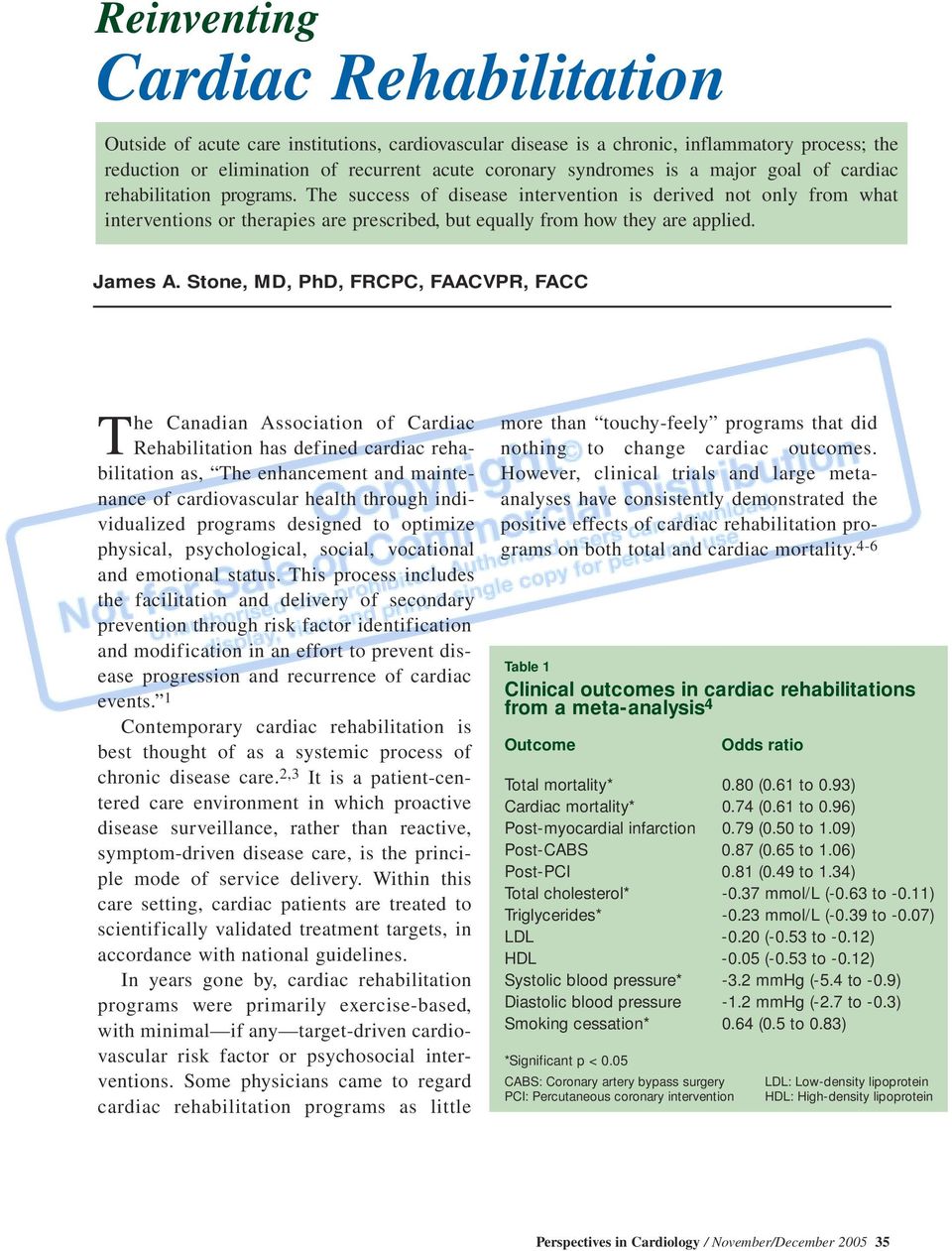
1 Reinventing Cardiac Rehabilitation Outside of acute care institutions, cardiovascular disease is a chronic, inflammatory process; the reduction or elimination of recurrent acute coronary syndromes is a major goal of cardiac rehabilitation programs. The success of disease intervention is derived not only from what interventions or therapies are prescribed, but equally from how they are applied. James A. Stone, MD, PhD, FRCPC, FAACVPR, FACC The Canadian Association of Cardiac Rehabilitation has defined cardiac rehabilitation as, The enhancement and maintenance of cardiovascular health through individualized programs designed to optimize physical, psychological, social, vocational and emotional status. This process includes the facilitation and delivery of secondary prevention through risk factor identification and modification in an effort to prevent disease progression and recurrence of cardiac events. 1 Contemporary cardiac rehabilitation is best thought of as a systemic process of chronic disease care. 2,3 It is a patient-centered care environment in which proactive disease surveillance, rather than reactive, symptom-driven disease care, is the principle mode of service delivery. Within this care setting, cardiac patients are treated to scientifically validated treatment targets, in accordance with national guidelines. In years gone by, cardiac rehabilitation programs were primarily exercise-based, with minimal if any target-driven cardiovascular risk factor or psychosocial interventions. Some physicians came to regard cardiac rehabilitation programs as little more than touchy-feely programs that did nothing to change cardiac outcomes. However, clinical trials and large metaanalyses have consistently demonstrated the positive effects of cardiac rehabilitation programs on both total and cardiac mortality. 4-6 Table 1 Clinical outcomes in cardiac rehabilitations from a meta-analysis 4 Outcome Odds ratio Total mortality* 0.80 (0.61 to 0.93) Cardiac mortality* 0.74 (0.61 to 0.96) Post-myocardial infarction 0.79 (0.50 to 1.09) Post-CABS 0.87 (0.65 to 1.06) Post-PCI 0.81 (0.49 to 1.34) Total cholesterol* mmol/l (-0.63 to -0.11) Triglycerides* mmol/l (-0.39 to -0.07) LDL (-0.53 to -0.12) HDL (-0.53 to -0.12) Systolic blood pressure* -3.2 mmhg (-5.4 to -0.9) Diastolic blood pressure -1.2 mmhg (-2.7 to -0.3) Smoking cessation* 0.64 (0.5 to 0.83) *Significant p < 0.05 CABS: Coronary artery bypass surgery PCI: Percutaneous coronary intervention LDL: Low-density lipoprotein HDL: High-density lipoprotein Perspectives in Cardiology / November/December
2 Table 2 Post-acute coronary syndrome interventions Parameter Physical activity and exercise Weight control Alcohol consumption Tobacco usage Diet and dietary supplements Stress management Psychosocial health Goals Accumulate 30 to 60 minutes of moderate to vigorous-intensity exercise on most preferably all days of the week. Daily caloric balance with the goal of maintaining a BMI of 18.5 kg/m 2 to 24.9 kg/m 2 and a waist circumference of less than 102 cm (40 ) in men and less than 88 cm (36 ) in women. Abstinence or a maximum intake of: Males: 14 standard drinks per week Females: Nine standard drinks per week None or immediate cessation of all forms of tobacco intake. Avoidance of second-hand tobacco smoke. As per Canada s Food Guide to Healthy Eating (Chapter 4), DASH diet ( Omega 3 fatty acid supplements should be considered in high-risk groups. Avoidance or control of depression, anger states, hostility, confrontation, psychosocial and vocational stress. Cardiovascular disease patients and high-risk clients should be evaluated for depression. BMI: Body mass index DASH: Dietary Approaches to Stop Hypertension The science of cardiac rehabilitation Through the use of interventions, such as exercise and risk factor reduction, cardiac rehabilitation programs and services can result in reduced vascular oxidative stress and inflammation, thereby reducing: cardiac mortality, the likelihood of recurrent hospitalizations and the need for repeat revascularization procedures. 3 The most recent meta-analysis of cardiac rehabilitation confirmed the results of clinical trials and four previous meta-analyses regarding the significant reductions in total and cardiac mortality, along with cardiovascular risk factors, realized through participation in cardiac rehabilitation programs (Table 1). In addition, the results of this meta-analysis could find 36 Perspectives in Cardiology / November/December 2005

3 no evidence that the increased use of secondary prevention strategies in more recent trials of cardiac rehabilitation (those published after 1995), such as anti-platelet agents, beta-blockers, statins and angiotensinconverting enzyme (ACE) inhibitors, has diminished or nullified the beneficial effects of exercise training in patients with cardiac disease. This observation suggests that the addition of exercise therapy to the multitude of standard pharmacologic interventions currently recommended and prescribed postacute coronary syndromes can still produce additional patient benefits (Table 2). Risk stratification Current Canadian guidelines recommend that all patients admitted to cardiac rehabilitation programs undergo a systematic admission process, including: a full medical history, a physical examination, a resting electrocardiogram and appropriate laboratory investigations. 3 Table 3 Core elements of cardiac rehabilitation programs 6 Patient referral process Patient assessment - Risk stratification - Exercise stress testing - Risk factor assessment Lifestyle and risk factor modification Nutritional counselling Risk factor assessment - Lipids - Hypertension - Smoking cessation - Diabetes - Psychosocial issues - Weight management, particularly abdominal obesity - Psychosocial management - Physical activity counselling and exercise training Patient education programs - Lifestyle adherence strategies - Medication adherence strategies Outcomes assessment programs - Health outcomes - Educational outcomes - Behavioural outcomes - Service outcomes Continuous quality improvement programs Continuous professional development programs Patients should also undergo formal risk stratification (Figure 1; only the female table is presented). The risk evaluation strategy combines a Framingham risk model 7 validated for cardiac patients in combination with a Duke treadmill score. 8 These two scores are then combined into a recurrent cardiac event risk score to provide an overall estimate of the patient s subsequent cardiac risk. In addition to prognostic information, the recurrent cardiac event risk score also allows for patients to be more cost-effectively assigned to either program supervised, facility-independent exercise, i.e., home exercise (low and some intermediate risk patients) or program supervised, facilitydependent exercise (high-risk patients). Cont d on page 38 About the author... Dr. Stone is a Clinical Associate Professor of Medicine, University of Calgary, Cardiac Wellness Institute of Calgary, Calgary, Alberta. Perspectives in Cardiology / November/December

4 Step 1 Calculation of progression of disease score (PDS) Women Total cholesterol level, mmol/l High-density lipoprotein cholesterol < > < Lipid score Systolic blood pressure (SBP), mmhg < SBP score Smoker No 0 Yes 3 Smoker Score Diabetes No 0 Yes 3 Diabetes score Women with documented cardiovascular disease (CVD) Risk factor Risk points Age group, year Age score Total risk points = Age score + lipid score + SBP score + smoker score + diabetes score Mean two-year risk score in women with CVD Total risk Two-year CVD Age (years) Probability points event (%) probability (%) PDS < < < PDS Low risk 2.5% per year Intermediate risk 5% per year High risk > 5 % per year Step 2 Calculation of disease prognosis score (DPS) risk of exercise-associated adverse events 1. Calculate the Duke treadmill score (DTS) DTS = exercise time - (5 x maximal ST depression) - (4 x angina index) 2. Determine the disease prognosis score (DPS) 9 Event risk Duke treadmill Disease prognosis score score Where: Exercise time = Minutes on the Bruce protocol ST depression = Maximal recorded ST depression Treadmill angina index. 0 = No angina 1 = Non-limiting angina 2 = Limiting angina Low risk % per year Intermediate risk + 4 to % per year High risk % per year Step 3 Integrate the DPS and the PDS to determine the recurrent cardiac event risk score Progression of disease score 1 Disease Low risk Intermediate High risk prognosis score risk Figure 1. Risk stratification for women. The recurrent cardiac event score can be used to determine the exercise training setting. Low-risk and intermediate-risk persons are appropriate for program-associated, facility-dependent exercise. High-risk persons should be assigned to programbased, facility-dependent exercise. High Intermediate risk High risk High risk Intermediate Low risk Intermediate risk High risk Low Low risk Low risk Intermediate risk Cont d on page 40

5 Program formats Unfortunately, only a minority of patients are referred for cardiac rehabilitation following hospitalization for acute coronary syndromes. 3 Programs with the best referral and patient attendance rates utilize practitioner independent referral processes, such as automatic referral. Following their initial assessment, medical consultation and risk stratification, patients are given their individualized exercise prescriptions and risk factor treatment programs and enrolled in exercise classes. Even if they are going to participate in program supervised, facility-independent exercise, most programs have patients attend a few exercise classes to ensure appropriate exercise knowledge. Programs are usually three to six months in Take-home message Cardiac rehabilitation programs reduce total and cardiac mortality compared to usual care. Cardiac rehabilitation programs provide an environment of proactive disease surveillance in order to minimize or eliminate recurrent cardiac events. Cardiac rehabilitation can assist busy primarycare and other physicians in the management of their cardiac patients by ensuring adherence to national guidelines in the treatment of cardiovascular risk factors. Most patients with established cardiac disease should be referred for cardiac rehabilitation either by their specialist, primary-care physician or nurse practitioner.

6 duration, with patients attending exercise classes one to three times per week. Contemporary programs provide an extensive array of patient-care services (Table 3) and will both manage and advise referring physicians regarding their patient s status. PCard References 1. Stone JA, Arthur HM, Austford L, et al: Canadian Guidelines for Cardiac Rehabilitation and Cardiovascular Disease Prevention. CACR, Winnipeg, p Stone JA: Current concepts in cardiac rehabilitation. Int Sport Med J 2002; 3(1): Stone JA, Arthur HM: Executive Summary: Canadian Guidelines for Cardiac Rehabilitation and Cardiovascular Disease Prevention. Can J Cardiol 2005: In Press. 4. Taylor RS, Brown A, Ebrahim S, et al: Exercise-based rehabilitation for patients with coronary heart disease: Systematic review and meta-analysis of randomized controlled trials. Am J Med 2004; 116(10): Sdringola S, Nakagawa K, Nakagawa R, et al: Combined intense lifestyle and pharmacologic lipid treatment further reduce coronary events and myocardial perfusion abnormalities compared with usual-care cholesterol-lowering drugs in coronary artery disease. J Am Coll Cardiol 2003; 41(2): Brown A, Taylor R, Noorani H, et al: Exercise-based cardiac rehabilitation programs for coronary artery disease: A systematic clinical and economic review. Canadian Coordinating Office for Health Technology Assessment Technology, Ottawa, Report no.34: p. iii. 7. Califf RM, Armstrong PW, Carver JR, et al: Task force 5: Stratification of patients into high, medium, and low risk groups for purposes of risk factor management. J Am Coll Cardiol 1996; 27(5): Villella M, Villella A, Santoro L, et al: Ergometric score systems after myocardial infarction: Prognostic performance of the Duke Treadmill Score, Veterans Administration Medical Center Score, and of a novel score system, GISSI-2 Index, in a cohort of survivors of acute myocardial infarction. Am Heart J 2003; 145(3): Mark DB, Shaw L, Harrel FE Jr, et al: Prognostic value of a treadmill exercise score in outpatients with suspected coronary artery disease. N Engl J Med 1991; 325(12):
KIH Cardiac Rehabilitation Program
 KIH Cardiac Rehabilitation Program For any further information Contact: +92-51-2870361-3, 2271154 [email protected] What is Cardiac Rehabilitation Cardiac rehabilitation describes all measures used to
DISCLOSURES RISK ASSESSMENT. Stroke and Heart Disease -Is there a Link Beyond Risk Factors? Daniel Lackland, MD
 STROKE AND HEART DISEASE IS THERE A LINK BEYOND RISK FACTORS? D AN IE L T. L AC K L AN D DISCLOSURES Member of NHLBI Risk Assessment Workgroup RISK ASSESSMENT Count major risk factors For patients with
Cardiac Rehabilitation The Best Medicine for Your CAD Patients. James A. Stone
 James A. Stone BPHE, BA, MSc, MD, PhD, FRCPC, FAACVPR, FACC Clinical Professor of Medicine, University of Calgary Total Cardiology, Calgary Acknowledgements and Disclosures Acknowledgements Jacques Genest
Cardiac Rehabilitation: An Under-utilized Resource Making Patients Live Longer, Feel Better
 Cardiac Rehabilitation: An Under-utilized Resource Making Patients Live Longer, Feel Better Marian Taylor, M.D. Medical University of South Carolina Director, Cardiac Rehabilitation I have no disclosures.
Listen to your heart: Good Cardiovascular Health for Life
 Listen to your heart: Good Cardiovascular Health for Life Luis R. Castellanos MD, MPH Assistant Clinical Professor of Medicine University of California San Diego School of Medicine Sulpizio Family Cardiovascular
AVAILABILITY AND ACCESSIBILITY OF CARDIAC REHABILITATION SERVICES IN LOW- AND MIDDLE-INCOME COUNTRIES QUESTIONNAIRE
 AVAILABILITY AND ACCESSIBILITY OF CARDIAC REHABILITATION SERVICES IN LOW- AND MIDDLE-INCOME COUNTRIES QUESTIONNAIRE To be completed by Staff Cardiologists at an adult cardiac institute/department. INSTRUCTIONS:
Cardiac Rehabilitation An Underutilized Class I Treatment for Cardiovascular Disease
 Cardiac Rehabilitation An Underutilized Class I Treatment for Cardiovascular Disease What is Cardiac Rehabilitation? Cardiac rehabilitation is a comprehensive exercise, education, and behavior modification
Summary Evaluation of the Medicare Lifestyle Modification Program Demonstration and the Medicare Cardiac Rehabilitation Benefit
 The Centers for Medicare & Medicaid Services' Office of Research, Development, and Information (ORDI) strives to make information available to all. Nevertheless, portions of our files including charts,
2013 ACO Quality Measures
 ACO 1-7 Patient Satisfaction Survey Consumer Assessment of HealthCare Providers Survey (CAHPS) 1. Getting Timely Care, Appointments, Information 2. How well Your Providers Communicate 3. Patient Rating
Cardiac Rehabilitation: Strategies Approaching 2020
 ACC Banff 2015 Cardiac Rehabilitation: Strategies Approaching 2020 James A. Stone BPHE, BA, MSc, MD, PhD, FRCPC, FAACVPR, FACC Clinical Professor of Medicine, University of Calgary Libin Cardiovascular
How To Treat Dyslipidemia
 An International Atherosclerosis Society Position Paper: Global Recommendations for the Management of Dyslipidemia Introduction Executive Summary The International Atherosclerosis Society (IAS) here updates
Absolute cardiovascular disease risk assessment
 Quick reference guide for health professionals Absolute cardiovascular disease risk assessment This quick reference guide is a summary of the key steps involved in assessing absolute cardiovascular risk
Protocol. Cardiac Rehabilitation in the Outpatient Setting
 Protocol Cardiac Rehabilitation in the Outpatient Setting (80308) Medical Benefit Effective Date: 07/01/14 Next Review Date: 09/15 Preauthorization No Review Dates: 07/07, 07/08, 05/09, 05/10, 05/11, 05/12,
Stroke: Major Public Health Burden. Stroke: Major Public Health Burden. Stroke: Major Public Health Burden 5/21/2012
 Faculty Prevention Sharon Ewer, RN, BSN, CNRN Stroke Program Coordinator Baptist Health Montgomery, Alabama Satellite Conference and Live Webcast Monday, May 21, 2012 2:00 4:00 p.m. Central Time Produced
3/2/2010 Post CABG R h e bili a i tat on Ahmed Elkerdany Professor o f oof C ardiac Cardiac Surgery Ain Shams University 1
 Post CABG Rehabilitation i Ahmed Elkerdany Professor of Cardiac Surgery Ain Shams University 1 Definition Cardiac rehabilitation services are comprehensive, long-term programs involving : medical evaluation.
Outpatient/Ambulatory Rehab. Dedicated Trans-disciplinary Team (defined within Annotated References)
 CARDIAC The delivery of Cardiac Rehab is unlike most other rehab populations. The vast majority of patients receive their rehab in outpatient or community settings and only a small subset requires an inpatient
Guidelines for the management of hypertension in patients with diabetes mellitus
 Guidelines for the management of hypertension in patients with diabetes mellitus Quick reference guide In the Eastern Mediterranean Region, there has been a rapid increase in the incidence of diabetes
Cardiac Rehabilitation (Outpatient Phase II) Corporate Medical Policy. Medical Policy
 Cardiac Rehabilitation (Outpatient Phase II) Corporate Medical Policy File name: Cardiac Rehabilitation (Outpatient Phase II) File code: UM.REHAB.04 Origination: 08/1994 Last Review: 08/2011 Next Review:
The ACC 50 th Annual Scientific Session
 Special Report The ACC 50 th Annual Scientific Session Part Two From March 18 to 21, 2001, physicians from around the world gathered to learn, to teach and to discuss at the American College of Cardiology
Strokes and High Blood Pressure
 Strokes and High Blood Pressure Quick Review from last Week: What is a Stroke Stroke: blood supply to the brain is severely limited or cut off With no blood to carry oxygen to them, brain cells will die
I. Current Cardiac Rehabilitation Requirements
 CLIENT ADVISORY July 24, 2009 CMS Proposes Changes to Cardiac Rehabilitation Program Design and Physician Supervision Requirements The Centers for Medicare and Medicaid Services (CMS) recently published
Primary Care Management of Women with Hyperlipidemia. Julie Marfell, DNP, BC, FNP, Chairperson, Department of Family Nursing
 Primary Care Management of Women with Hyperlipidemia Julie Marfell, DNP, BC, FNP, Chairperson, Department of Family Nursing Objectives: Define dyslipidemia in women Discuss the investigation process leading
Cardiovascular Disease Risk Factors
 Cardiovascular Disease Risk Factors Risk factors are traits and life-style habits that increase a person's chances of having coronary artery and vascular disease. Some risk factors cannot be changed or
Stress is linked to exaggerated cardiovascular reactivity. 1) Stress 2) Hostility 3) Social Support. Evidence of association between these
 Psychosocial Factors & CHD Health Psychology Psychosocial Factors 1) Stress 2) Hostility 3) Social Support Evidence of association between these psychosocial factors and CHD Physiological Mechanisms Stress
A Passage to India: Establishing a Cardiac Rehabilitation program in India s south-east
 A Passage to India: Establishing a Cardiac Rehabilitation program in India s south-east Kathryn Kelly Clinical Nurse Consultant, Cardiac Rehabilitation Coordinator The Royal Melbourne Hospital India 1,025,000,000
Barriers to Healthcare Services for People with Mental Disorders. Cardiovascular disorders and diabetes in people with severe mental illness
 Barriers to Healthcare Services for People with Mental Disorders Cardiovascular disorders and diabetes in people with severe mental illness Dr. med. J. Cordes LVR- Klinikum Düsseldorf Kliniken der Heinrich-Heine-Universität
CHAPTER V DISCUSSION. normal life provided they keep their diabetes under control. Life style modifications
 CHAPTER V DISCUSSION Background Diabetes mellitus is a chronic condition but people with diabetes can lead a normal life provided they keep their diabetes under control. Life style modifications (LSM)
Treating AF: The Newest Recommendations. CardioCase presentation. Ethel s Case. Wayne Warnica, MD, FACC, FACP, FRCPC
 Treating AF: The Newest Recommendations Wayne Warnica, MD, FACC, FACP, FRCPC CardioCase presentation Ethel s Case Ethel, 73, presents with rapid heart beating and mild chest discomfort. In the ED, ECG
SOUTH EAST WALES CARDIAC NETWORK INTEGRATED CARE PATHWAY CARDIAC REHABILITATION MAY 2005
 Name Address SOUTH EAST WALES CARDIAC NETWORK INTEGRATED CARE PATHWAY CARDIAC REHABILITATION MAY 2005 Ms / Miss / Mr / Mrs Addressograph Known as Telephone Number of Birth Hospital No. NHS No. Cardiac
Therapeutic Approach in Patients with Diabetes and Coronary Artery Disease
 Home SVCC Area: English - Español - Português Therapeutic Approach in Patients with Diabetes and Coronary Artery Disease Martial G. Bourassa, MD Research Center, Montreal Heart Institute, Montreal, Quebec,
High Blood Cholesterol
 National Cholesterol Education Program ATP III Guidelines At-A-Glance Quick Desk Reference 1 Step 1 2 Step 2 3 Step 3 Determine lipoprotein levels obtain complete lipoprotein profile after 9- to 12-hour
Main Effect of Screening for Coronary Artery Disease Using CT
 Main Effect of Screening for Coronary Artery Disease Using CT Angiography on Mortality and Cardiac Events in High risk Patients with Diabetes: The FACTOR-64 Randomized Clinical Trial Joseph B. Muhlestein,
YOUR GUIDE TO. Managing and Understanding Your Cholesterol Levels
 YOUR GUIDE TO Managing and Understanding Your Cholesterol Levels Our goal at the Mercy Health Heart Institute is to help you be well. Our experienced team includes cardiologists, cardiovascular surgeons,
MANAGEMENT OF LIPID DISORDERS: IMPLICATIONS OF THE NEW GUIDELINES
 MANAGEMENT OF LIPID DISORDERS: IMPLICATIONS OF THE NEW GUIDELINES Robert B. Baron MD MS Professor and Associate Dean UCSF School of Medicine Declaration of full disclosure: No conflict of interest EXPLAINING
Utilization Review Cardiac Rehabilitation Services: Underutilized
 Utilization Review Cardiac Rehabilitation Services: Underutilized William J. Gill, MD Krannert Institute of Cardiology Indiana University School of Medicine Indianapolis, Indiana What is Cardiac Rehab?
Cardiac Rehab and Primary Care: Avoiding Losses in Care Transitions. Neville Suskin Heart & Stroke Clinical Update 2012
 Cardiac Rehab and Primary Care: Avoiding Losses in Care Transitions Neville Suskin Heart & Stroke Clinical Update 2012 1 Disclosure Med. Director SJHC CR Co-principal of Lawson e-cr application LCVIS SJHC
Cardiovascular Risk in Diabetes
 Cardiovascular Risk in Diabetes Lipids Hypercholesterolaemia is an important reversible risk factor for cardiovascular disease and should be tackled aggressively in all diabetic patients. In Type 1 patients,
Coronary Heart Disease (CHD) Brief
 Coronary Heart Disease (CHD) Brief What is Coronary Heart Disease? Coronary Heart Disease (CHD), also called coronary artery disease 1, is the most common heart condition in the United States. It occurs
Absolute cardiovascular disease risk management
 Quick reference guide for health professionals Absolute cardiovascular disease risk management This quick reference guide is for use by health professionals for primary prevention of cardiovascular disease
Absolute cardiovascular disease risk
 Guidelines for the management of Absolute cardiovascular disease risk An initiative of the National Vascular Disease Prevention Alliance About the National Vascular Disease Prevention Alliance The National
Include Dietitian Services in Extended Health Care Plan
 Include Dietitian Services in Extended Health Care Plan It s cost-effective JUNE 2015 The Problem Your employees extended health care plan does not appear to include dietitian services as an option despite
PRESCRIBING GUIDELINES FOR LIPID LOWERING TREATMENTS for SECONDARY PREVENTION
 Hull & East Riding Prescribing Committee PRESCRIBING GUIDELINES FOR LIPID LOWERING TREATMENTS for SECONDARY PREVENTION For guidance on Primary Prevention please see NICE guidance http://www.nice.org.uk/guidance/cg181
Section 8: Clinical Exercise Testing. a maximal GXT?
 Section 8: Clinical Exercise Testing Maximal GXT ACSM Guidelines: Chapter 5 ACSM Manual: Chapter 8 HPHE 4450 Dr. Cheatham Outline What is the purpose of a maximal GXT? Who should have a maximal GXT (and
Appendix i. All-Wales Cardiac Rehabilitation Pathway. All-Wales Cardiac Rehabilitation Group 2009
 Appendix i All-Wales Cardiac Rehabilitation Pathway All-Wales Cardiac Rehabilitation Group 2009 Cardiac Rehabilitation Pathway Written by the All Wales Cardiac Rehabilitation Working Group 2010 Simplified
R.P. Zecchin*, J. Baihn, Y.Y. Chai, J. Hungerford, G. Lindsay, M. Owen, J. Thelander, D.L. Ross, C. Chow, A.R. Denniss. Westmead Hospital, Sydney,
 R.P. Zecchin*, J. Baihn, Y.Y. Chai, J. Hungerford, G. Lindsay, M. Owen, J. Thelander, D.L. Ross, C. Chow, A.R. Denniss. Westmead Hospital, Sydney, Australia Cardiac rehabilitation is an effective and safe
Medical Fitness. Annual Meeting December 2012. By: Deb Riggs, MEd, General Manager
 Exercise is Medicine Referral Process Utilizing an EMR Medical Fitness Association Annual Meeting December 2012 By: Deb Riggs, MEd, General Manager Faculty Disclosure Deb Riggs Deb Riggs has listed no
ACCOUNTABLE CARE ORGANIZATION QUICK-REFERENCE SETUP GUIDE
 ACCOUNTABLE CARE ORGANIZATION QUICK-REFERENCE SETUP GUIDE V 9.0 eclinicalworks, 2013. All rights reserved Contents CONTENTS ACO SETUP 3 Demographics 3 ACO 12 4 ACO 13 6 ACO 14 7 ACO 15 8 ACO 16 9 ACO 17
ADULT HYPERTENSION PROTOCOL STANFORD COORDINATED CARE
 I. PURPOSE To establish guidelines for the monitoring of antihypertensive therapy in adult patients and to define the roles and responsibilities of the collaborating clinical pharmacist and pharmacy resident.
What is a Heart Attack? 1,2,3
 S What is a Heart Attack? 1,2,3 Heart attacks, otherwise known as myocardial infarctions, are caused when the blood supply to a section of the heart is suddenly disrupted. Without the oxygen supplied by
AACVPR/ACC/AHA Performance Measures
 AACVPR/ACC/AHA Performance Measures AACVPR/ACC/AHA 2007 Performance Measures on Cardiac Rehabilitation for Referral to and Delivery of Cardiac Rehabilitation/Secondary Prevention Services Endorsed by the
Health risk assessment: a standardized framework
 Health risk assessment: a standardized framework February 1, 2011 Thomas R. Frieden, MD, MPH Director, Centers for Disease Control and Prevention Leading causes of death in the U.S. The 5 leading causes
Clinical Quality Measure Crosswalk: HEDIS, Meaningful Use, PQRS, PCMH, Beacon, 10 SOW
 Clinical Crosswalk: HEDIS, Meaningful Use, PQRS, PCMH, Beacon, 10 SOW NQF 0105 PQRS 9 NQF 0002 PQRS 66 Antidepressant Medication Management Appropriate Testing for Children with Pharyngitis (2-18 years)
MISSING DATA ANALYSIS AMONG PATIENTS IN THE PINNACLE REGISTRY
 MISSING DATA ANALYSIS AMONG PATIENTS IN THE PINNACLE REGISTRY In order to improve the efficiency of PINNACLE Registry data analytics, a missing data analysis has been conducted on PINNACLE Registry data
The Department of Vermont Health Access Medical Policy
 State of Vermont Department of Vermont Health Access 312 Hurricane Lane, Suite 201 [Phone] 802-879-5903 Williston, VT 05495-2807 [Fax] 802-879-5963 www.dvha.vermont.gov Agency of Human Services The Department
Osama Jarkas. in Chest Pain Patients. STUDENT NAME: Osama Jarkas DATE: August 10 th, 2015
 STUDENT NAME: Osama Jarkas DATE: August 10 th, 2015 PROJECT TITLE: Analysis of ECG Exercise Stress Testing and Framingham Risk Score in Chest Pain Patients PRIMARY SUPERVISOR NAME: Dr. Edward Tan DEPARTMENT:
CARDIAC REHABILITATION
 Paul Peacock Cardiac Rehabilitation Nurse Friday, 4 August 2006 1 The rehab Team Chris Murphy Kate O Reilly Paul Peacock Increased to 2 FTEs March 06 Wellington & Kapiti Coast MDT involvement Friday, 4
Demonstrating Meaningful Use Stage 1 Requirements for Eligible Providers Using Certified EMR Technology
 Demonstrating Meaningful Use Stage 1 Requirements for Eligible Providers Using Certified EMR Technology The chart below lists the measures (and specialty exclusions) that eligible providers must demonstrate
CARDIAC REHABILITATION Winnipeg Region Annual Report 2013-14
 CARDIAC REHABILITATION Winnipeg Region Annual Report 2013-14 PROGRAM OVERVIEW The Cardiac Rehabilitation Program (CRP) operates out of two medical fitness facilities in Winnipeg, the Reh- Fit Centre and
High Blood Cholesterol What you need to know
 National Cholesterol Education Program High Blood Cholesterol What you need to know Why Is Cholesterol Important? Your blood cholesterol level has a lot to do with your chances of getting heart disease.
Cardiovascular risk assessment: Audit findings from a nurse clinic a quality improvement initiative
 Cardiovascular risk assessment: Audit findings from a nurse clinic a quality improvement initiative Sarah Waldron RN, PG Dip (Adv Ng); Margaret Horsburgh RN, EdD, MA (Hons), Dip Ed, FCNA(NZ) School of
Cardiac Rehabilitation at AUBMC
 Cardiac Rehabilitation at AUBMC Clinical Protocols and The Role of The Advanced Practice Nurse Presentation by: Mohamad Issa, MSN, BSN, BC- RN, AUBMC CCU OUTLINE Background on cardiovascular diseases History
Risk estimation and the prevention of cardiovascular disease. A national clinical guideline
 SIGN Scottish Intercollegiate Guidelines Network Help us to improve SIGN guidelines - click here to complete our survey 97 Risk estimation and the prevention of cardiovascular disease A national clinical
Appendix: Description of the DIETRON model
 Appendix: Description of the DIETRON model Much of the description of the DIETRON model that appears in this appendix is taken from an earlier publication outlining the development of the model (Scarborough
Population Health Management Program
 Population Health Management Program Program (formerly Disease Management) is dedicated to improving our members health and quality of life. Our Population Health Management Programs aim to improve care
Cardiovascular disease is the leading cause of morbidity
 electronic health records Implementation of an Electronic Health Record with an Embedded Quality Improvement Program to Improve the Longitudinal Care of Outpatients with Coronary Artery Disease Allan G.
Your Results. For more information visit: www.sutton.gov.uk/healthchecks. Name: Date: In partnership with
 Your Results Name: Date: For more information visit: www.sutton.gov.uk/healthchecks In partnership with Introduction Everyone is at risk of developing diabetes, heart disease, kidney disease, stroke and
Performance Measurement for the Medicare and Medicaid Eligible (MME) Population in Connecticut Survey Analysis
 Performance Measurement for the Medicare and Medicaid Eligible (MME) Population in Connecticut Survey Analysis Methodology: 8 respondents The measures are incorporated into one of four sections: Highly
TASK FORCE SUPPLEMENT FOR FUNCTIONAL CAPACITY EVALUATION
 TASK FORCE SUPPLEMENT FOR FUNCTIONAL CAPACITY EVALUATION A. GENERAL PRINCIPLES Use of a Functional Capacity Evaluation (FCE) is to determine the ability of a patient to safely function within a work environment.
MY TYPE 2 DIABETES NUMBERS
 BLOOD SUGAR MANAGEMENT GUIDE MY TYPE 2 DIABETES NUMBERS Understanding and Tracking the ABCs of Type 2 Diabetes 1 BLOOD MY TYPE SUGAR 2 DIABETES MANAGEMENT ABC NUMBERS GUIDE When you have type 2 diabetes,
Metabolic Syndrome Overview: Easy Living, Bitter Harvest. Sabrina Gill MD MPH FRCPC Caroline Stigant MD FRCPC BC Nephrology Days, October 2007
 Metabolic Syndrome Overview: Easy Living, Bitter Harvest Sabrina Gill MD MPH FRCPC Caroline Stigant MD FRCPC BC Nephrology Days, October 2007 Evolution of Metabolic Syndrome 1923: Kylin describes clustering
chapter 1 Chapter 2 chapter 3
 SUMMARY summary Theaimofthisthesiswastodescribethedevelopmentandevaluationofanindividual basedlifestyleinterventionamongworkersintheconstructionindustrywithanelevated risk of cardiovascular disease (CVD).
Chapter Three Accountable Care Organizations
 Chapter Three Accountable Care Organizations One of the most talked-about changes in health care delivery in recent decades is Accountable Care Organizations, or ACOs. Having gained the attention of both
Body Composition & Longevity. Ohan Karatoprak, MD, AAFP Clinical Assistant Professor, UMDNJ
 Body Composition & Longevity Ohan Karatoprak, MD, AAFP Clinical Assistant Professor, UMDNJ LONGEVITY Genetic 25% Environmental Lifestyle Stress 75% BMI >30 OBESE 25-30 OVERWEIGHT 18-25 NORMAL WEIGHT 18
Remote Delivery of Cardiac Rehabilitation
 Remote Delivery of Cardiac Rehabilitation Bonnie Wakefield, RN, PhD Kariann Drwal, MS Melody Scherubel, RN Thomas Klobucar, PhD Skyler Johnson, MS Peter Kaboli, MD, MS VA Rural Health Resource Center Central
Radiology Business Management Association Technology Task Force. Sample Request for Proposal
 Technology Task Force Sample Request for Proposal This document has been created by the RBMA s Technology Task Force as a guideline for use by RBMA members working with potential suppliers of Electronic
GENERAL HEART DISEASE KNOW THE FACTS
 GENERAL HEART DISEASE KNOW THE FACTS WHAT IS Heart disease is a broad term meaning any disease affecting the heart. It is commonly used to refer to coronary heart disease (CHD), a more specific term to
ADVANCE: a factorial randomised trial of blood pressure lowering and intensive glucose control in 11,140 patients with type 2 diabetes
 ADVANCE: a factorial randomised trial of blood pressure lowering and intensive glucose control in 11,140 patients with type 2 diabetes Effects of a fixed combination of the ACE inhibitor, perindopril,
Journal Club: Niacin in Patients with Low HDL Cholesterol Levels Receiving Intensive Statin Therapy by the AIM-HIGH Investigators
 Journal Club: Niacin in Patients with Low HDL Cholesterol Levels Receiving Intensive Statin Therapy by the AIM-HIGH Investigators Shaikha Al Naimi Doctor of Pharmacy Student College of Pharmacy Qatar University
Multiple comorbidities: additive and predictive of cardiovascular risk. Peter M. Nilsson Lund University University Hospital Malmö, Sweden
 Multiple comorbidities: additive and predictive of cardiovascular risk Peter M. Nilsson Lund University University Hospital Malmö, Sweden Clinical outcomes: major complications of CVD Heart Attack/ACS
An Overview and Guide to Healthy Living with Type 2 Diabetes
 MEETING YOUR GOALS An Overview and Guide to Healthy Living with Type 2 Diabetes MEETING YOUR GOALS This brochure was designed to help you understand the health goals to live a healthy lifestyle with type
Marilyn Borkgren-Okonek, APN, CCNS, RN, MS Suburban Lung Associates, S.C. Elk Grove Village, IL
 Marilyn Borkgren-Okonek, APN, CCNS, RN, MS Suburban Lung Associates, S.C. Elk Grove Village, IL www.goldcopd.com GLOBAL INITIATIVE FOR CHRONIC OBSTRUCTIVE LUNG DISEASE GLOBAL STRATEGY FOR DIAGNOSIS, MANAGEMENT
2016 PQRS OPTIONS FOR INDIVIDUAL MEASURES: CLAIMS, REGISTRY
 Measure #317: Preventive Care and Screening: Screening for High Blood Pressure and Follow-Up Documented National Quality Strategy Domain: Community / Population Health 2016 PQRS OPTIONS F INDIVIDUAL MEASURES:
Treatment of High Blood Cholesterol in Adults (Adult Treatment Panel II).
 Complete Summary GUIDELINE TITLE (1)Third report of the National Cholesterol Education Program (NCEP) Expert Panel on Detection, Evaluation, and Treatment of High Blood Cholesterol in Adults (Adult Treatment
Technology Assessment
 Technology Assessment Lifestyle Interventions for Four Conditions: Type 2 Diabetes, Metabolic Syndrome, Breast Cancer, and Prostate Cancer Technology Assessment Program Prepared for: Agency for Healthcare
Cardiac Rehabilitation and Intensive Cardiac Rehabilitation JA6850
 Cardiac Rehabilitation and Intensive Cardiac Rehabilitation JA6850 Related CR Release Date: March 21, 2010 Revised Date Job Aid Revised: November 17, 2010 Effective Date: January 1, 2010 Implementation
PREOPERATIVE MANAGEMENT FOR BARIATRIC PATIENTS. Adrienne R. Gomez, MD Bariatric Physician St. Vincent Bariatric Center of Excellence
 PREOPERATIVE MANAGEMENT FOR BARIATRIC PATIENTS Adrienne R. Gomez, MD Bariatric Physician St. Vincent Bariatric Center of Excellence BARIATRIC SURGERY Over 200,000 bariatric surgical procedures are performed
Psoriasis Co-morbidities: Changing Clinical Practice. Theresa Schroeder Devere, MD Assistant Professor, OHSU Dermatology. Psoriatic Arthritis
 Psoriasis Co-morbidities: Changing Clinical Practice Theresa Schroeder Devere, MD Assistant Professor, OHSU Dermatology Psoriatic Arthritis Psoriatic Arthritis! 11-31% of patients with psoriasis have psoriatic
Intensive Cardiac Rehabilitation: Value Creation in Today's FFS World and Reducing Medical Spending in a Value Based Environment
 Intensive Cardiac Rehabilitation: Value Creation in Today's FFS World and Reducing Medical Spending in a Value Based Environment Terri Merritt-Worden, MS, FAACVPR Vice President- Partnership Operations
Best Practice Guidelines for Cardiac Rehabilitation and Secondary Prevention
 Best Practice Guidelines for Cardiac Rehabilitation and Secondary Prevention Human Services Victoria PRODUCED BY THE HEART RESEARCH CENTRE ON BEHALF OF DEPARTMENT OF HUMAN SERVICES VICTORIA Background