
FS Regulatory Brief. Basel III liquidity regime More practical but not yet workable. January Key LCR changes
|
|
|
- Rhoda Baker
- 10 years ago
- Views:
Transcription
1 Basel III liquidity regime More practical but not yet workable January 2013 On January 7 th, the Basel Committee on Banking Supervision ( BCBS ) issued a finalized standard ( Standard ) on the Liquidity Coverage Ratio ( LCR ), a shortterm liquidity measure that considers a 30- day period of liquidity stress. The LCR forms one of the key components of the Basel III reform package, which also includes: (i) Revised capital standards, which have been largely defined (further changes are expected to the trading book framework and the leverage ratio). (ii) The Net Stable Funding Ratio ( NSFR ), a longer-term liquidity measure designed to restrain the amount of wholesale borrowing and encourage stable funding over a one year time horizon. The recent BCBS action only covers the LCR. The NSFR (proposed with the LCR in December 2010) remains a work-in-progress, and the BCBS indicated it would be focusing on it for the next two years. However, given that it took over two years to finalize the LCR, achieving a two-year target date for the NSFR may be a challenge as the NSFR is more complicated and enjoys less global consensus than the LCR did. This FS Regulatory Brief summarizes the key changes to the LCR from the original BCBS proposal, and provides an early assessment of its US implementation and impact on financial institutions. Key LCR changes BCBS had proposed the LCR with the understanding that the LCR could change given its implications on global lending and economic growth. The recently released Standard delivers on that expectation, with the BCBS explicitly noting the importance of ongoing strains in some banking systems when setting the Standard a reference to continued financial market challenges in Europe. As a consequence, the Standard delays full implementation of the LCR until January 1, On the originally proposed start date of January 1, 2015, banks need only meet 60% of the Standard. They will need to meet 100% of the Standard by 2019 (rising in increments of 10 percentage points per year). The Standard provides an exemption to this timetable for countries receiving financial support for macroeconomic and structural reform. Such countries may choose a different implementation schedule, in recognition of the reality that their banking systems have not recovered sufficiently to comply. Aside from this timetable change, the Standard differs from the original proposal in the following two key ways: The types of High Quality Liquid Assets ( HQLA ) that can be held as part of the LCR (in the numerator) have been expanded. The assumed 30-day cash outflow and cash inflow rates that make up Net Cash Outflow (the denominator of the LCR) have been modified to essentially slow the assumed rate of Net Cash Outflow.

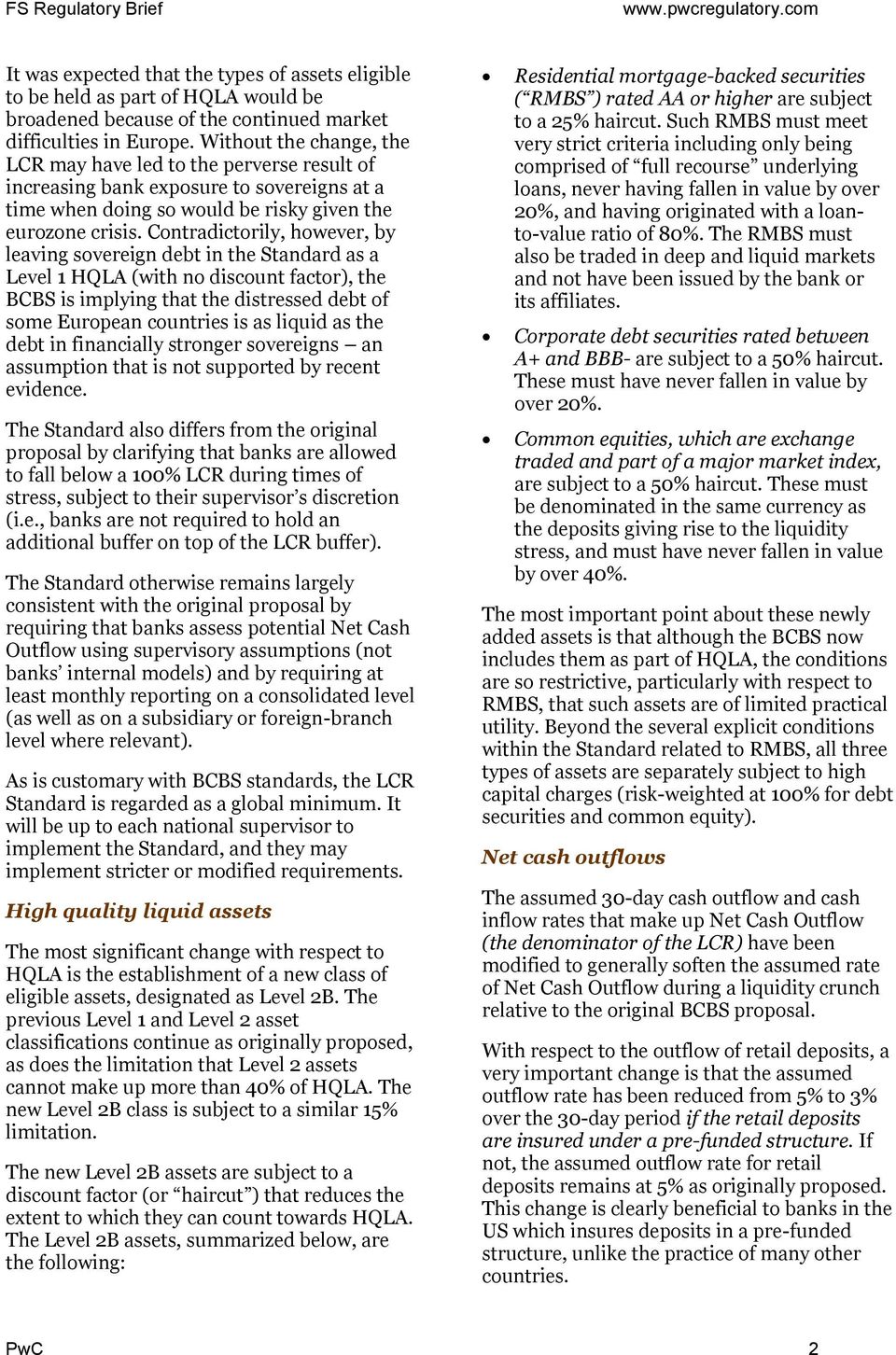
2 It was expected that the types of assets eligible to be held as part of HQLA would be broadened because of the continued market difficulties in Europe. Without the change, the LCR may have led to the perverse result of increasing bank exposure to sovereigns at a time when doing so would be risky given the eurozone crisis. Contradictorily, however, by leaving sovereign debt in the Standard as a Level 1 HQLA (with no discount factor), the BCBS is implying that the distressed debt of some European countries is as liquid as the debt in financially stronger sovereigns an assumption that is not supported by recent evidence. The Standard also differs from the original proposal by clarifying that banks are allowed to fall below a 100% LCR during times of stress, subject to their supervisor s discretion (i.e., banks are not required to hold an additional buffer on top of the LCR buffer). The Standard otherwise remains largely consistent with the original proposal by requiring that banks assess potential Net Cash Outflow using supervisory assumptions (not banks internal models) and by requiring at least monthly reporting on a consolidated level (as well as on a subsidiary or foreign-branch level where relevant). As is customary with BCBS standards, the LCR Standard is regarded as a global minimum. It will be up to each national supervisor to implement the Standard, and they may implement stricter or modified requirements. High quality liquid assets The most significant change with respect to HQLA is the establishment of a new class of eligible assets, designated as Level 2B. The previous Level 1 and Level 2 asset classifications continue as originally proposed, as does the limitation that Level 2 assets cannot make up more than 40% of HQLA. The new Level 2B class is subject to a similar 15% limitation. The new Level 2B assets are subject to a discount factor (or haircut ) that reduces the extent to which they can count towards HQLA. The Level 2B assets, summarized below, are the following: Residential mortgage-backed securities ( RMBS ) rated AA or higher are subject to a 25% haircut. Such RMBS must meet very strict criteria including only being comprised of full recourse underlying loans, never having fallen in value by over 20%, and having originated with a loanto-value ratio of 80%. The RMBS must also be traded in deep and liquid markets and not have been issued by the bank or its affiliates. Corporate debt securities rated between A+ and BBB- are subject to a 50% haircut. These must have never fallen in value by over 20%. Common equities, which are exchange traded and part of a major market index, are subject to a 50% haircut. These must be denominated in the same currency as the deposits giving rise to the liquidity stress, and must have never fallen in value by over 40%. The most important point about these newly added assets is that although the BCBS now includes them as part of HQLA, the conditions are so restrictive, particularly with respect to RMBS, that such assets are of limited practical utility. Beyond the several explicit conditions within the Standard related to RMBS, all three types of assets are separately subject to high capital charges (risk-weighted at 100% for debt securities and common equity). Net cash outflows The assumed 30-day cash outflow and cash inflow rates that make up Net Cash Outflow (the denominator of the LCR) have been modified to generally soften the assumed rate of Net Cash Outflow during a liquidity crunch relative to the original BCBS proposal. With respect to the outflow of retail deposits, a very important change is that the assumed outflow rate has been reduced from 5% to 3% over the 30-day period if the retail deposits are insured under a pre-funded structure. If not, the assumed outflow rate for retail deposits remains at 5% as originally proposed. This change is clearly beneficial to banks in the US which insures deposits in a pre-funded structure, unlike the practice of many other countries. PwC 2
3 Other changes with respect to cash outflows for various types of liabilities include the following and are listed in Appendix A. The assumed outflow rate for wholesale unsecured funding provided by nonfinancial corporations and sovereigns (including central banks and public sector entities) has been reduced from 75% to 40%, and can be as low as 20% if the deposits are covered by an effective deposit guarantee or public guarantee. The category of maturing secured funding transactions now includes those transactions backed by the new category of Level 2B assets. Specifically, the assumed outflow rate for transactions backed by RMBS is 25% and the rate when backed by other Level 2B assets is 50%. Secured funding transactions with central banks benefit from a run-off rate of 0%. The category of retail fixed term deposits has been removed and subsumed within the retail deposits category as stable or unstable ; however, the basic rule remains the same deposits which cannot be withdrawn within the 30-day period (or which would be subject to significant penalties if withdrawn) remain excluded from the LCR. The category of unsecured wholesale funding with operational relationships has been more strictly and explicitly defined and changed to operational deposits ; however, the 25% outflow assumption remains unchanged. The Standard also includes an Other category with respect to cash outflows, which includes items such as derivatives-related outflows. They include the following and are also listed in Appendix A. The assumed drawdown on committed credit and liquidity facilities to nonfinancial entities has been reduced from 100% to 30% over the 30-day period. The assumed drawdown on committed credit and liquidity facilities to financial institutions has been reduced from 100% to 40%. This definition originally only applied to facilities provided to banks subject to prudential supervision, but it has been broadened under the Standard to include other financial institutions (i.e., securities firms and insurance companies) and distinguishes between credit facilities (with an assumed drawdown rate of 40%) and liquidity facilities (with an assumed drawdown rate of 100%) to these other institutions. For derivatives, a new requirement was introduced for establishing the collateral outflow assumption for each particular derivatives asset. The requirement assumes collateral outflow to be the largest absolute net outflow over a 30-day period during the preceding 24 months. A 0% outflow is assumed for derivatives and commitments secured by HQLA. With respect to cash inflows, the constraints on offsetting inflows against outflows to derive Net Cash Outflow remain unchanged: inflows have to be contractual, default must not be expected, and inflows cannot exceed 75% of outflows. The assumed rollover rate of reverserepo and similar transactions are also broadly unchanged by the Standard, with the following exceptions: New inflow rates have been assumed for the newly added Level 2B category of HQLA assets: 25% inflow for eligible RMBS and 50% inflow for other Level 2B assets. The assumed inflow rate for margin lending backed by all other collateral has been defined as 50%. How will LCR be applied in the US? BCBS s revised LCR comes during a period of regulatory uncertainty in the US as banks continue to wait for final liquidity requirements by the Federal Reserve as part of a package of Enhanced Prudential Standards ( EPS ). These EPS proposals are currently open for public comment in the US and affect bank holding companies with over $50 billion in assets (proposed January 2012), nonbank financial companies designated as systemically important (proposed January 2012), and foreign banking organizations operating in the US (proposed December 2012). PwC 3

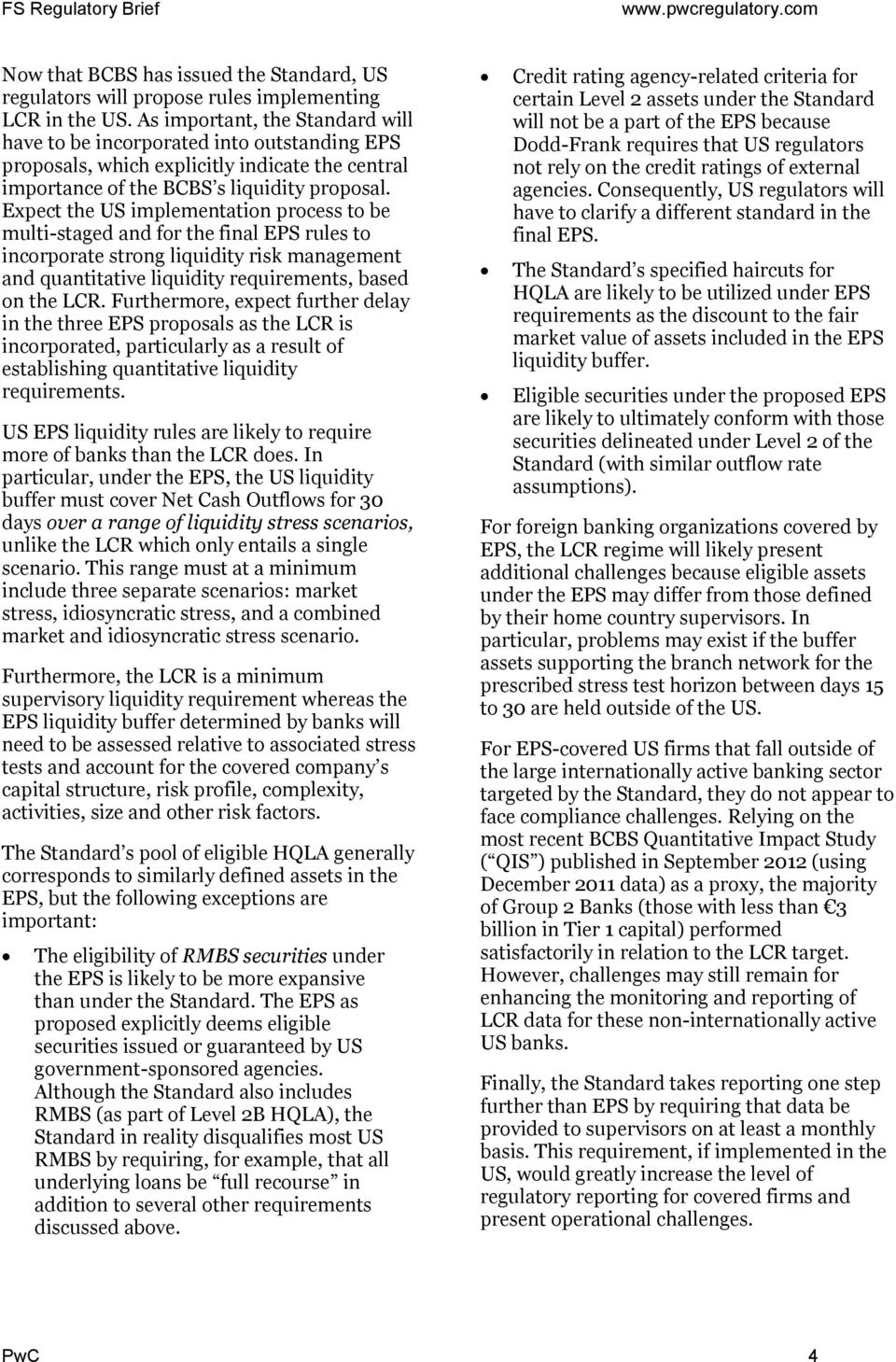
4 Now that BCBS has issued the Standard, US regulators will propose rules implementing LCR in the US. As important, the Standard will have to be incorporated into outstanding EPS proposals, which explicitly indicate the central importance of the BCBS s liquidity proposal. Expect the US implementation process to be multi-staged and for the final EPS rules to incorporate strong liquidity risk management and quantitative liquidity requirements, based on the LCR. Furthermore, expect further delay in the three EPS proposals as the LCR is incorporated, particularly as a result of establishing quantitative liquidity requirements. US EPS liquidity rules are likely to require more of banks than the LCR does. In particular, under the EPS, the US liquidity buffer must cover Net Cash Outflows for 30 days over a range of liquidity stress scenarios, unlike the LCR which only entails a single scenario. This range must at a minimum include three separate scenarios: market stress, idiosyncratic stress, and a combined market and idiosyncratic stress scenario. Furthermore, the LCR is a minimum supervisory liquidity requirement whereas the EPS liquidity buffer determined by banks will need to be assessed relative to associated stress tests and account for the covered company s capital structure, risk profile, complexity, activities, size and other risk factors. The Standard s pool of eligible HQLA generally corresponds to similarly defined assets in the EPS, but the following exceptions are important: The eligibility of RMBS securities under the EPS is likely to be more expansive than under the Standard. The EPS as proposed explicitly deems eligible securities issued or guaranteed by US government-sponsored agencies. Although the Standard also includes RMBS (as part of Level 2B HQLA), the Standard in reality disqualifies most US RMBS by requiring, for example, that all underlying loans be full recourse in addition to several other requirements discussed above. Credit rating agency-related criteria for certain Level 2 assets under the Standard will not be a part of the EPS because Dodd-Frank requires that US regulators not rely on the credit ratings of external agencies. Consequently, US regulators will have to clarify a different standard in the final EPS. The Standard s specified haircuts for HQLA are likely to be utilized under EPS requirements as the discount to the fair market value of assets included in the EPS liquidity buffer. Eligible securities under the proposed EPS are likely to ultimately conform with those securities delineated under Level 2 of the Standard (with similar outflow rate assumptions). For foreign banking organizations covered by EPS, the LCR regime will likely present additional challenges because eligible assets under the EPS may differ from those defined by their home country supervisors. In particular, problems may exist if the buffer assets supporting the branch network for the prescribed stress test horizon between days 15 to 30 are held outside of the US. For EPS-covered US firms that fall outside of the large internationally active banking sector targeted by the Standard, they do not appear to face compliance challenges. Relying on the most recent BCBS Quantitative Impact Study ( QIS ) published in September 2012 (using December 2011 data) as a proxy, the majority of Group 2 Banks (those with less than 3 billion in Tier 1 capital) performed satisfactorily in relation to the LCR target. However, challenges may still remain for enhancing the monitoring and reporting of LCR data for these non-internationally active US banks. Finally, the Standard takes reporting one step further than EPS by requiring that data be provided to supervisors on at least a monthly basis. This requirement, if implemented in the US, would greatly increase the level of regulatory reporting for covered firms and present operational challenges. PwC 4
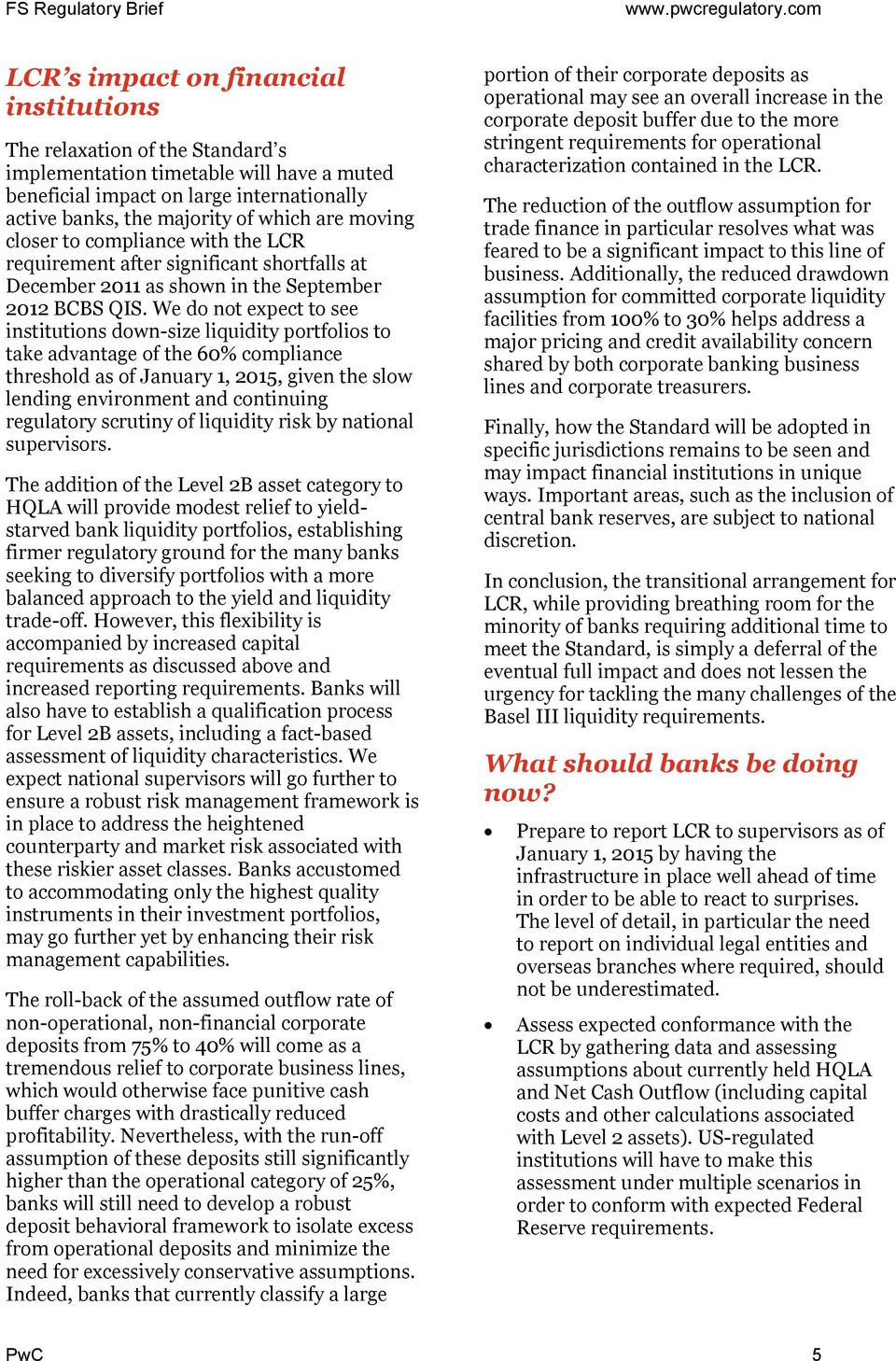
5 LCR s impact on financial institutions The relaxation of the Standard s implementation timetable will have a muted beneficial impact on large internationally active banks, the majority of which are moving closer to compliance with the LCR requirement after significant shortfalls at December 2011 as shown in the September 2012 BCBS QIS. We do not expect to see institutions down-size liquidity portfolios to take advantage of the 60% compliance threshold as of January 1, 2015, given the slow lending environment and continuing regulatory scrutiny of liquidity risk by national supervisors. The addition of the Level 2B asset category to HQLA will provide modest relief to yieldstarved bank liquidity portfolios, establishing firmer regulatory ground for the many banks seeking to diversify portfolios with a more balanced approach to the yield and liquidity trade-off. However, this flexibility is accompanied by increased capital requirements as discussed above and increased reporting requirements. Banks will also have to establish a qualification process for Level 2B assets, including a fact-based assessment of liquidity characteristics. We expect national supervisors will go further to ensure a robust risk management framework is in place to address the heightened counterparty and market risk associated with these riskier asset classes. Banks accustomed to accommodating only the highest quality instruments in their investment portfolios, may go further yet by enhancing their risk management capabilities. The roll-back of the assumed outflow rate of non-operational, non-financial corporate deposits from 75% to 40% will come as a tremendous relief to corporate business lines, which would otherwise face punitive cash buffer charges with drastically reduced profitability. Nevertheless, with the run-off assumption of these deposits still significantly higher than the operational category of 25%, banks will still need to develop a robust deposit behavioral framework to isolate excess from operational deposits and minimize the need for excessively conservative assumptions. Indeed, banks that currently classify a large portion of their corporate deposits as operational may see an overall increase in the corporate deposit buffer due to the more stringent requirements for operational characterization contained in the LCR. The reduction of the outflow assumption for trade finance in particular resolves what was feared to be a significant impact to this line of business. Additionally, the reduced drawdown assumption for committed corporate liquidity facilities from 100% to 30% helps address a major pricing and credit availability concern shared by both corporate banking business lines and corporate treasurers. Finally, how the Standard will be adopted in specific jurisdictions remains to be seen and may impact financial institutions in unique ways. Important areas, such as the inclusion of central bank reserves, are subject to national discretion. In conclusion, the transitional arrangement for LCR, while providing breathing room for the minority of banks requiring additional time to meet the Standard, is simply a deferral of the eventual full impact and does not lessen the urgency for tackling the many challenges of the Basel III liquidity requirements. What should banks be doing now? Prepare to report LCR to supervisors as of January 1, 2015 by having the infrastructure in place well ahead of time in order to be able to react to surprises. The level of detail, in particular the need to report on individual legal entities and overseas branches where required, should not be underestimated. Assess expected conformance with the LCR by gathering data and assessing assumptions about currently held HQLA and Net Cash Outflow (including capital costs and other calculations associated with Level 2 assets). US-regulated institutions will have to make this assessment under multiple scenarios in order to conform with expected Federal Reserve requirements. PwC 5
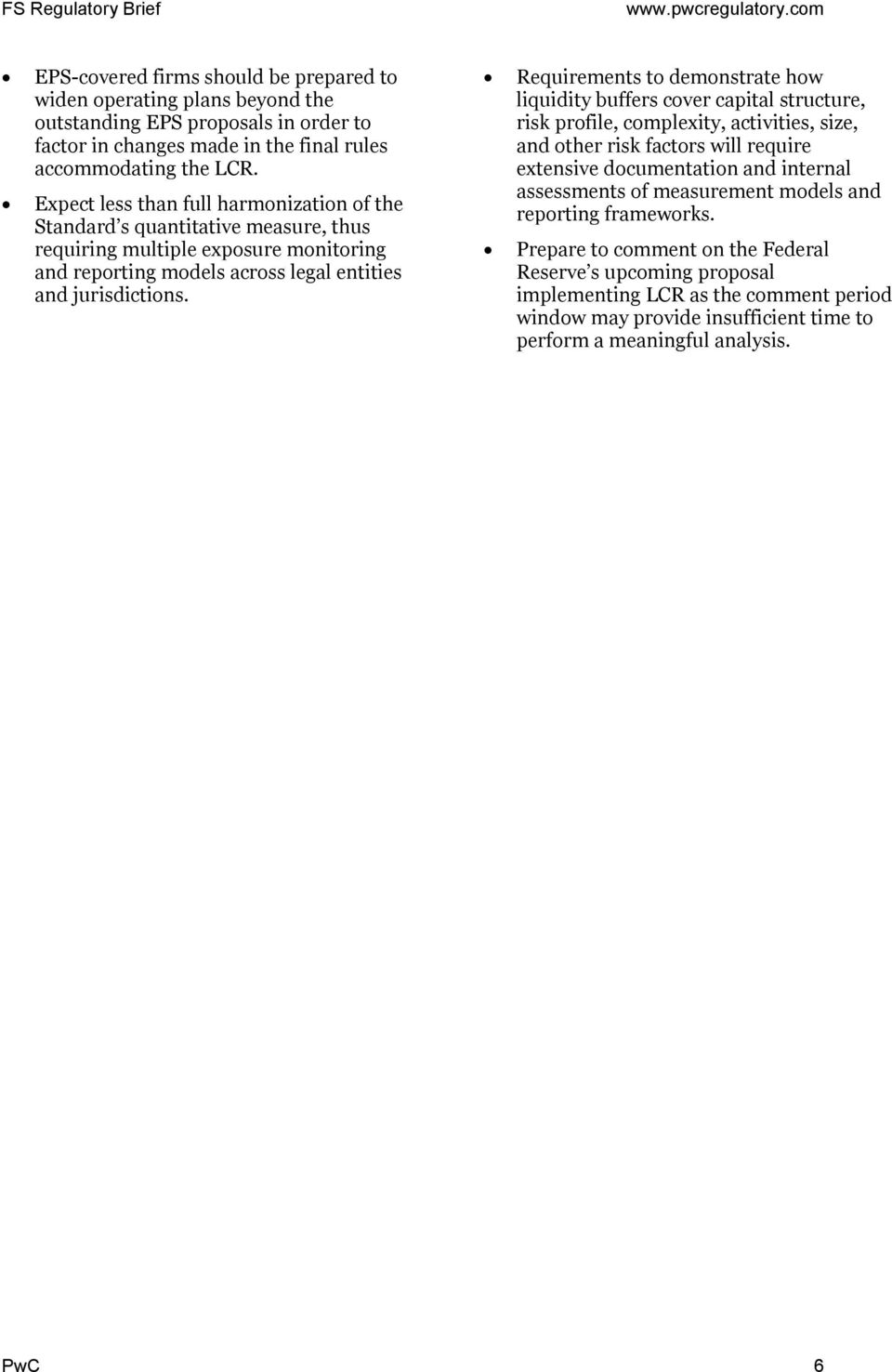
6 EPS-covered firms should be prepared to widen operating plans beyond the outstanding EPS proposals in order to factor in changes made in the final rules accommodating the LCR. Expect less than full harmonization of the Standard s quantitative measure, thus requiring multiple exposure monitoring and reporting models across legal entities and jurisdictions. Requirements to demonstrate how liquidity buffers cover capital structure, risk profile, complexity, activities, size, and other risk factors will require extensive documentation and internal assessments of measurement models and reporting frameworks. Prepare to comment on the Federal Reserve s upcoming proposal implementing LCR as the comment period window may provide insufficient time to perform a meaningful analysis. PwC 6
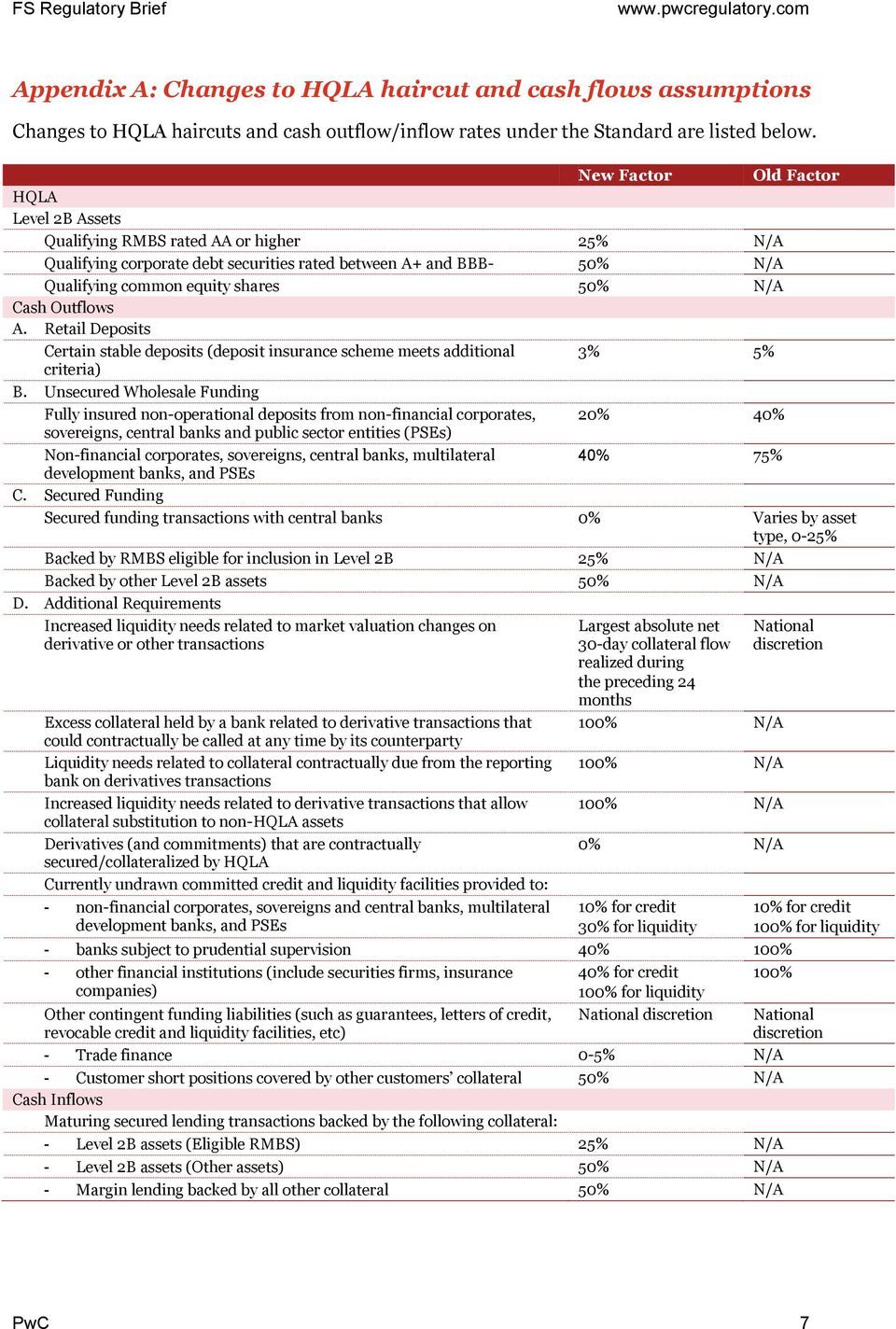
7 Appendix A: Changes to HQLA haircut and cash flows assumptions Changes to HQLA haircuts and cash outflow/inflow rates under the Standard are listed below. New Factor Old Factor HQLA Level 2B Assets Qualifying RMBS rated AA or higher 25% N/A Qualifying corporate debt securities rated between A+ and BBB- 50% N/A Qualifying common equity shares 50% N/A Cash Outflows A. Retail Deposits Certain stable deposits (deposit insurance scheme meets additional 3% 5% criteria) B. Unsecured Wholesale Funding Fully insured non-operational deposits from non-financial corporates, 20% 40% sovereigns, central banks and public sector entities (PSEs) Non-financial corporates, sovereigns, central banks, multilateral 40% 75% development banks, and PSEs C. Secured Funding Secured funding transactions with central banks 0% Varies by asset type, 0-25% Backed by RMBS eligible for inclusion in Level 2B 25% N/A Backed by other Level 2B assets 50% N/A D. Additional Requirements Increased liquidity needs related to market valuation changes on derivative or other transactions Excess collateral held by a bank related to derivative transactions that could contractually be called at any time by its counterparty Liquidity needs related to collateral contractually due from the reporting bank on derivatives transactions Increased liquidity needs related to derivative transactions that allow collateral substitution to non-hqla assets Derivatives (and commitments) that are contractually secured/collateralized by HQLA Currently undrawn committed credit and liquidity facilities provided to: - non-financial corporates, sovereigns and central banks, multilateral development banks, and PSEs Largest absolute net 30-day collateral flow realized during the preceding 24 months 100% N/A 100% N/A 100% N/A 0% N/A 10% for credit 30% for liquidity National discretion - banks subject to prudential supervision 40% 100% - other financial institutions (include securities firms, insurance 40% for credit 100% companies) 100% for liquidity Other contingent funding liabilities (such as guarantees, letters of credit, revocable credit and liquidity facilities, etc) National discretion - Trade finance 0-5% N/A - Customer short positions covered by other customers collateral 50% N/A Cash Inflows Maturing secured lending transactions backed by the following collateral: - Level 2B assets (Eligible RMBS) 25% N/A - Level 2B assets (Other assets) 50% N/A - Margin lending backed by all other collateral 50% N/A 10% for credit 100% for liquidity National discretion PwC 7
8 Additional information For additional information about PwC s Financial Services Regulatory Practice and how we can help you, please contact: Dan Ryan Financial Services Regulatory Practice Chairman [email protected] Alison Gilmore Financial Services Regulatory Practice Marketing Leader [email protected] Contributors: Stephen Baird, Kevin J. Clarke, Chi Lai, and Shyam Venkat. PwC 8
9 To learn more about financial services regulation from your ipad or iphone, click here to download PwC s new Regulatory Navigator App from the Apple App Store. Follow us on 2013 PricewaterhouseCoopers LLP, a Delaware limited liability partnership. All rights reserved. PwC refers to the US member firm, and may sometimes refer to the PwC network. Each member firm is a separate legal entity. Please see for further details. This content is for general information purposes only, and should not be used as a substitute for consultation with professional advisors. PwC US helps organizations and individuals create the value they re looking for. We re a member of the PwC network of firms in 158 countries with more than 180,000 people. We re committed to delivering quality in assurance, tax and advisory services. Tell us what matters to you and find out more by visiting us at

Regulatory Practice Letter November 2014 RPL 14-20
 Regulatory Practice Letter November 2014 RPL 14-20 BCBS Issues Final Net Stable Funding Ratio Standard Executive Summary The Basel Committee on Banking Supervision ( BCBS or Basel Committee ) issued its
Basel Committee on Banking Supervision. Frequently Asked Questions on Basel III s January 2013 Liquidity Coverage Ratio framework
 Basel Committee on Banking Supervision Frequently Asked Questions on Basel III s January 2013 Liquidity Coverage Ratio framework April 2014 This publication is available on the BIS website (www.bis.org).
Basel Committee on Banking Supervision. Consultative Document. Basel III: The Net Stable Funding Ratio. Issued for comment by 11 April 2014
 Basel Committee on Banking Supervision Consultative Document Basel III: The Net Stable Funding Ratio Issued for comment by 11 April 2014 January 2014 This publication is available on the BIS website (www.bis.org).
Risk & Capital Management under Basel III
 www.pwc.com Risk & Capital Management under Basel III London, 15 Draft Agenda Basel III changes to capital rules - Definition of capital - Minimum capital ratios - Leverage ratio - Buffer requirements
U.S. regulatory capital: Basel III liquidity coverage ratio final rule
 U.S. regulatory capital: Basel III liquidity coverage ratio final rule Overview and key highlights November 2014 DRAFT - For Discussion Purposes Only Contents U.S. Basel III Liquidity Coverage Ratio (LCR)
Basel Committee on Banking Supervision. Basel III: the net stable funding ratio
 Basel Committee on Banking Supervision Basel III: the net stable funding ratio October 2014 This publication is available on the BIS website (www.bis.org). Bank for International Settlements 2014. All
Prudential Standard APS 210 Liquidity
 Prudential Standard APS 210 Liquidity Objectives and key requirements of this Prudential Standard This Prudential Standard aims to ensure that an authorised deposit-taking institution adopts prudent practices
Basel Committee on Banking Supervision
 Basel Committee on Banking Supervision Liquidity coverage ratio disclosure standards January 2014 (rev. March 2014) This publication is available on the BIS website (www.bis.org). Bank for International
Securitization Perspectives: Final U.S. Liquidity Coverage Ratio. September 10, 2014
 Securitization Perspectives: Final U.S. Liquidity Coverage Ratio September 10, 2014 Introduction! On September 3rd, the Agencies adopted regulations implementing a liquidity coverage ratio (LCR) requirement
Net Stable Funding Ratio
 Net Stable Funding Ratio Aims to establish a minimum acceptable amount of stable funding based on the liquidity characteristics of an institution s assets and activities over a one year horizon. The amount
Liquidity Coverage Ratio
 Liquidity Coverage Ratio Aims to ensure banks maintain adequate levels of unencumbered high quality assets (numerator) against net cash outflows (denominator) over a 30 day significant stress period. High
The challenge of liquidity and collateral management in the new regulatory landscape
 The challenge of liquidity and collateral management in the new regulatory landscape ICMA Professional Repo and Collateral Management Course 2012 Agenda 1. Background: The repo product under pressure 2.
Impact assessment of the new liquidity rules on Luxembourg banks
 Impact assessment of the new liquidity rules on Luxembourg Abstract of the presentation held at the ABBL conference Basel III New Liquidity Rules: Which Impacts for Luxembourg? 1 Context A local Quantitative
Liquidity Coverage Ratio: A Quick Reference. February 2015
 Liquidity Coverage Ratio: A Quick Reference February 2015 2015 Morrison & Foerster LLP All Rights Reserved mofo.com The Liquidity Coverage Ratio (the LCR or the rule ) adopted by the Office of the Comptroller
Prudential Standard APS 210 Liquidity
 Prudential Standard APS 210 Liquidity Objectives and key requirements of this Prudential Standard This Prudential Standard requires an authorised deposit-taking institution to adopt prudent practices in
Ten key points from Basel s Fundamental Review of the Trading Book
 First January 19, 2016 take A publication of PwC s financial services regulatory practice Ten key points from Basel s Fundamental Review of the Trading Book On January 14 th, the Basel Committee on Banking
Information on Capital Structure, Liquidity and Leverage Ratios as per Basel III Framework. as at March 31, 2015 PUBLIC
 Information on Capital Structure, Liquidity and Leverage Ratios as per Basel III Framework as at Table of Contents Capital Structure Page Statement of Financial Position - Step 1 (Table 2(b)) 3 Statement
Risk governance: OCC codifies risk standards, paving the way for increased enforcement actions
 Regulatory February 2014 brief A publication of PwC s financial services regulatory practice Risk governance: OCC codifies risk standards, paving the way for increased enforcement actions The Office of
Impact of Basel III Liquidity Requirements on the Payments Industry
 Cards & Payments the way we see it Impact of Basel III Liquidity Requirements on the Payments Industry Liquidity management strategy for banks providing payment services Table of Contents 1. Summary 3
MINIMUM LIQUID ASSETS ( MLA ) AND LIQUIDITY COVERAGE RATIO ( LCR )
 MAS 649 NOTICE TO BANKS BANKING ACT, CAP 19 MINIMUM LIQUID ASSETS ( MLA ) AND LIQUIDITY COVERAGE RATIO ( LCR ) 1 This Notice is issued pursuant to sections 36 and 38 of the Banking Act (Cap. 19) ( the
Basel Committee on Banking Supervision. Consultative Document. Net Stable Funding Ratio disclosure standards. Issued for comment by 6 March 2015
 Basel Committee on Banking Supervision Consultative Document Net Stable Funding Ratio disclosure standards Issued for comment by 6 March 2015 December 2014 This publication is available on the BIS website
Consultation Paper on Liquidity Coverage Ratio Disclosure Requirements
 CONSULTATION PAPER P018-2015 Consultation Paper on Disclosure Requirements October 2015 i TABLE OF CONTENTS TABLE OF CONTENTS... ii 1 Preface... 1 2 Specific Areas for Comment... 3 2.1 Scope of Application...
PwC briefing note Basel III and beyond Revised Liquidity Coverage Ratio
 Introduction On 7 January 2013 the Basel Committee on Banking Supervision (BCBS) issued a finalised standard on the Liquidity Coverage Ratio (LCR). The LCR forms one of the key planks of the Basel III
Basel Committee on Banking Supervision. Basel III framework for liquidity - Frequently asked questions
 Basel Committee on Banking Supervision Basel III framework for liquidity - Frequently asked questions July 2011 Copies of publications are available from: Bank for International Settlements Communications
Basel Committee on Banking Supervision. Basel III: The Liquidity Coverage Ratio and liquidity risk monitoring tools
 Basel Committee on Banking Supervision Basel III: The Liquidity Coverage Ratio and liquidity risk monitoring tools January 2013 This publication is available on the BIS website (www.bis.org). Bank for
Basel leverage ratio: No cover for US banks
 Regulatory January 2014 brief A publication of PwC s financial services regulatory practice Basel leverage ratio: No cover for US banks Overview On January 12, 2014 the Basel Committee on Banking Supervision
Stress testing: Midterm results improved, but it s all about the final
 Regulatory September 2013 brief A publication of PwC s financial services regulatory practice Stress testing: Midterm results improved, but it s all about the final Overview Before the stress test results
Basel Committee on Banking Supervision. Net Stable Funding Ratio disclosure standards
 Basel Committee on Banking Supervision Net Stable Funding Ratio disclosure standards June 2015 This publication is available on the BIS website (www.bis.org). Bank for International Settlements 2015. All
Comments on the Basel Committee on Banking Supervision s Consultative Document: Supervisory framework for measuring and controlling large exposures
 June 28, 2013 Comments on the Basel Committee on Banking Supervision s Consultative Document: Supervisory framework for measuring and controlling large exposures Japanese Bankers Association We, the Japanese
Prof Kevin Davis Melbourne Centre for Financial Studies. Managing Liquidity Risks. Session 5.1. Training Program ~ 8 12 December 2008 SHANGHAI, CHINA
 Enhancing Risk Management and Governance in the Region s Banking System to Implement Basel II and to Meet Contemporary Risks and Challenges Arising from the Global Banking System Training Program ~ 8 12
NATIONAL BANK OF ROMANIA
 NATIONAL BANK OF ROMANIA Regulation No. 18/2009 on governance arrangements of the credit institutions, internal capital adequacy assessment process and the conditions for outsourcing their activities,
HSBC North America Holdings Inc. 2015 Comprehensive Capital Analysis and Review and Annual Company-Run Dodd-Frank Act Stress Test Results
 2015 Comprehensive Capital Analysis and Review and Annual Company-Run Dodd-Frank Act Stress Test Results Date: March 5, 2015 TABLE OF CONTENTS PAGE 1. Overview of the Comprehensive Capital Analysis and
Information on Capital Structure, Liquidity Coverage and Leverage Ratios as per Basel-III Framework as at March 31, 2016
 Information on Capital Structure, Liquidity Coverage and Leverage Ratios as per Basel-III Framework as at March 31, 2016 Table of Contents Capital Structure Statement of Financial Position - Step 1 ( Table
US Bank Regulators Propose Net Stable Funding Ratio Rule to Enhance Financial System Resiliency
 Legal Update May 5, 2016 US Bank Regulators Propose Net Stable Funding Ratio Rule to Enhance Financial System Resiliency The Federal Deposit Insurance Corporation (FDIC), Office of the Comptroller of the
Disclosure 17 OffV (Credit Risk Mitigation Techniques)
 Disclosure 17 OffV (Credit Risk Mitigation Techniques) The Austrian Financial Market Authority (FMA) and the Oesterreichsiche Nationalbank (OeNB) have assessed UniCredit Bank Austria AG for the use of
Client Update Basel Committee Adopts Net Stable Funding Ratio: How Much Liquidity Is Enough?
 Client update 1 Client Update Basel Committee Adopts Net Stable Funding Ratio: How Much Liquidity Is Enough? NEW YORK Gregory J. Lyons [email protected] Lee A. Schneider [email protected] Melissa
Basel 3: A new perspective on portfolio risk management. Tamar JOULIA-PARIS October 2011
 Basel 3: A new perspective on portfolio risk management Tamar JOULIA-PARIS October 2011 1 Content 1. Basel 3 A complex regulatory framework With possible unintended consequences 2. Consequences on Main
NOVEMBER 2010 (REVISED)
 CENTRAL BANK OF CYPRUS BANKING SUPERVISION AND REGULATION DIVISION DIRECTIVE TO BANKS ON THE COMPUTATION OF PRUDENTIAL LIQUIDITY IN ALL CURRENCIES NOVEMBER 2010 (REVISED) DIRECTIVE TO BANKS ON THE COMPUTATION
DG FISMA CONSULTATION PAPER ON FURTHER CONSIDERATIONS FOR THE IMPLEMENTATION OF THE NSFR IN THE EU
 EUROPEAN COMMISSION Directorate-General for Financial Stability, Financial Services and Capital Markets Union DG FISMA CONSULTATION PAPER ON FURTHER CONSIDERATIONS FOR THE IMPLEMENTATION OF THE NSFR IN
The Mortgage Market Review and Non-bank mortgage lenders is enhanced Prudential Supervision on the way?
 JULY 2010 The Mortgage Market Review and Non-bank mortgage lenders is enhanced Prudential Supervision on the way? Introduction Since the publication of the FSA's latest Mortgage Market Review consultation
First Quarter Report January 31, 2015
 First Quarter Report January 31, 2015 PWC CAPITAL INC. ANNOUNCES RESULTS FOR ITS FIRST QUARTER ENDED JANUARY 31, 2015 FIRST QUARTER SUMMARY (1) (compared to the same periods in the prior year unless otherwise
Basel Committee on Banking Supervision. Consultative Document. International framework for liquidity risk measurement, standards and monitoring
 Basel Committee on Banking Supervision Consultative Document International framework for liquidity risk measurement, standards and monitoring Issued for comment by 16 April 2010 December 2009 Requests
Basel III: Liquidity Rules
 February 2011 Basel III: Liquidity Rules 1 Introduction and timing On 16 December 2010 the Basel Committee on Banking Supervision (the Committee ) published the final form of a set of reforms to strengthen
Dataline A look at current financial reporting issues
 Dataline A look at current financial reporting issues No. 2013-28 December 17, 2013 What s inside: Overview... 1 The main details... 1 Existing guidance... 2 Factors to consider... 3 Suppliers impacted...
Solutions for Balance Sheet Management
 ENTERPRISE RISK SOLUTIONS Solutions for Balance Sheet Management Moody s Analytics offers a powerful combination of software and advisory services for essential balance sheet and liquidity risk management.
OneWest Bank N. A. Dodd-Frank Act Stress Test Disclosure
 OneWest Bank N. A. Dodd-Frank Act Stress Test Disclosure Capital Stress Testing Results Covering the Time Period October 1, through December 31, for OneWest Bank N.A. under a Hypothetical Severely Adverse
ACCELERATING THE TRANSFORMATION
 Paris, September 12, 2011 ACCELERATING THE TRANSFORMATION SOCIETE GENERALE: THE HARD FACTS GIIPS: we have a low, declining and manageable sovereign exposure of EUR 4.3 billion Legacy assets: we accelerated
State Farm Bank, F.S.B.
 State Farm Bank, F.S.B. 2015 Annual Stress Test Disclosure Dodd-Frank Act Company Run Stress Test Results Supervisory Severely Adverse Scenario June 25, 2015 1 Regulatory Requirement The 2015 Annual Stress
Basel II, Pillar 3 Disclosure for Sun Life Financial Trust Inc.
 Basel II, Pillar 3 Disclosure for Sun Life Financial Trust Inc. Introduction Basel II is an international framework on capital that applies to deposit taking institutions in many countries, including Canada.
Liquidity Cash Flow Planning and Stress Testing Model. User s Guide. Version 2.1
 Liquidity Cash Flow Planning and Stress Testing Model User s Guide Version 2.1 Table of Contents INTRODUCTION...1 MODEL STRUCTURE...2 BASE CASE ASSUMPTIONS...3 KEY LIQUIDITY VARIABLES...3 WORKSHEET MAINTENANCE...3
MORGAN STANLEY Financial Supplement - 4Q 2015 Table of Contents
 Page # MORGAN STANLEY Financial Supplement - 4Q 2015 Table of Contents 1. Quarterly Consolidated Financial Summary 2. Quarterly Consolidated Income Statement Information 3. Quarterly Consolidated Financial
Basel III Liquidity Standards: The Implications for Credit Union Investments
 www.davy.ie/creditunions Basel III Liquidity Standards: The Implications for Credit Union Investments MAY 2013 CONTENTS Section Title Page 1 Introduction & Background 1 2 Liquidity Ratios under Basel III
The Goldman Sachs Group, Inc. and Goldman Sachs Bank USA. 2015 Annual Dodd-Frank Act Stress Test Disclosure
 The Goldman Sachs Group, Inc. and Goldman Sachs Bank USA 2015 Annual Dodd-Frank Act Stress Test Disclosure March 2015 2015 Annual Dodd-Frank Act Stress Test Disclosure for The Goldman Sachs Group, Inc.
Charles Schwab Bank. 2015 Annual Dodd-Frank Act Stress Test Disclosure
 Charles Schwab Bank 2015 Annual Dodd-Frank Act Stress Test Disclosure June 2015 I. Dodd-Frank Act Stress Test Results A. About Charles Schwab Bank Charles Schwab Bank (the Bank) is a wholly-owned subsidiary
Key matters in examining Liquidity Risk Management at Large Complex Financial Groups
 Key matters in examining Liquidity Risk Management at Large Complex Financial Groups (1) Governance of liquidity risk management Senior management of a large complex financial group (hereinafter referred
CITIGROUP INC. BASEL II.5 MARKET RISK DISCLOSURES AS OF AND FOR THE PERIOD ENDED MARCH 31, 2013
 CITIGROUP INC. BASEL II.5 MARKET RISK DISCLOSURES AS OF AND FOR THE PERIOD ENDED MARCH 31, 2013 DATED AS OF MAY 15, 2013 Table of Contents Qualitative Disclosures Basis of Preparation and Review... 3 Risk
18,343 18,308 3 Accumulated other comprehensive income (and other reserves)
 The information in this report is prepared quarterly based on the ADI financial records. The financial records are not audited for the Quarters ended 30 September, 31 December and 31 March. The report
Basel III: The Net Stable Funding Ratio
 POSITION PAPER Our reference: 2014/00010 1 (10) 11/04/2014 Basel Committee on Banking Supervision Consultative Document Basel III: The Net Stable Funding Ratio Key suggestions to the current NSFR proposal
How To Write A Credit Union Loan Policy
 Federally insured credit unions have generally conducted business lending safely, and NCUA s supervision of business lending has largely been successful. Over the past ten years, business loan portfolios
Quarterly Financial Supplement - 1Q 2016
 Quarterly Financial Supplement - 1Q 2016 Page # Consolidated Financial Summary... 1 Consolidated Income Statement Information... 2 Consolidated Financial Information and Statistical Data... 3 Consolidated
Regulatory. brief A publication of PwC s financial services regulatory practice. Broker-dealers: New FOCUS on financial responsibility.
 Regulatory September 2013 brief A publication of PwC s financial services regulatory practice Broker-dealers: New FOCUS on financial responsibility Overview The Securities and Exchange Commission (SEC)
MODULE 1. Guidance to completing the Standardised Approach to Credit Risk module of BSL/2
 MODULE 1 Guidance to completing the Standardised Approach to Credit Risk module of BSL/2 1 Glossary The following abbreviations are used within the document: CIS - Collective Investment Scheme CRM - Credit
Economic Commentaries
 n Economic Commentaries In its Financial Stability Report 214:1, the Riksbank recommended that a requirement for the Liquidity Coverage Ratio (LCR) in Swedish kronor be introduced. The background to this
Summary of Key Proposed Changes to NCUA s Member Business Loan Rule
 Federally insured credit unions have generally conducted business lending safely, and NCUA s supervision of business lending has largely been successful. Over the past ten years, business loan portfolios
Liquidity Stress Testing
 Liquidity Stress Testing Scenario modelling in a globally operating bank APRA Liquidity Risk Management Conference Sydney, 3-4 May 2007 Andrew Martin Head of Funding & Liquidity Risk Management, Asia/Pacific
Capital Commitment Subscription Facilities and the Proposed Liquidity Coverage Ratio
 Legal Update December 20, 2013 Capital Commitment Subscription Facilities and the Proposed Liquidity Coverage Ratio On November 29, 2013, the Board of Governors of the Federal Reserve System (FRB), the
Financial Stability Oversight Council. Staff Guidance. Methodologies Relating to Stage 1 Thresholds. June 8, 2015
 Financial Stability Oversight Council Staff Guidance Methodologies Relating to Stage 1 Thresholds June 8, 2015 Stage 1 Overview Section 113 of the Dodd-Frank Wall Street Reform and Consumer Protection
FOREX Bank AB. Annual information about capital adequacy and risk management 1
 2011 Annual information about capital adequacy and risk management Annual information about capital adequacy and risk management 1 Introduction FOREX BANK AB, 516406-0104, is the parent company of the
REMARKS ON THE BASEL CAPITAL FRAMEWORK AND TRADE FINANCE, 27 FEBRUARY 2014 SESSION 4. Mr. Andrew CORNFORD Research Fellow Financial Markets Center
 REMARKS ON THE BASEL CAPITAL FRAMEWORK AND TRADE FINANCE, 27 FEBRUARY 2014 SESSION 4 Mr. Andrew CORNFORD Research Fellow Financial Markets Center 1 Webster2014.B3&TF Remarks on the Basel Capital Framework
Basel Committee on Banking Supervision. Frequently asked. monitoring
 Basel Committee on Banking Supervision Frequently asked questions on Basel III monitoring REVISED September 2012 Requests for copies of publications, or for additions/changes to the mailing list, should
Issued on: 30 September 2014. Liquidity Coverage Ratio Concept Paper
 Issued on: 30 September 2014 Liquidity Concept Paper PART A Overview... 3 1 Introduction... 3 2 Applicability... 3 3 Legal provisions... 4 4 Effective date... 4 5 Interpretation... 5 6 Related legal instruments
DNB Liquidity Pillar 2 Supervision. Seminar Das neue SREP Konzept der Aufsicht Clemens Bonner ([email protected])
 DNB Liquidity Pillar 2 Supervision Seminar Das neue SREP Konzept der Aufsicht Clemens Bonner ([email protected]) Legal framework Act on Financial Supervision (Wft) Decree on Prudential Rules pursuant to
NEED TO KNOW. IFRS 9 Financial Instruments Impairment of Financial Assets
 NEED TO KNOW IFRS 9 Financial Instruments Impairment of Financial Assets 2 IFRS 9 FINANCIAL INSTRUMENTS IMPAIRMENT OF FINANCIAL ASSETS IFRS 9 FINANCIAL INSTRUMENTS IMPAIRMENT OF FINANCIAL ASSETS 3 TABLE
2015 DFAST Annual Stress Test Disclosure For Synchrony Bank, a Wholly-Owned Subsidiary of Synchrony Financial. June 26, 2015
 2015 DFAST Annual Stress Test Disclosure For Synchrony Bank, a Wholly-Owned Subsidiary of Synchrony Financial June 26, 2015 Disclaimers Cautionary Statement Regarding Forward-Looking Statements This presentation
Capital Requirements Directive IV Framework Liquidity Requirements. Allen & Overy Client Briefing Paper 15 January 2014. www.allenovery.
 Capital Requirements Directive IV Framework Liquidity Requirements Allen & Overy Client Briefing Paper 15 January 2014 2 CRD IV Framework: Liquidity Requirements January 2014 CRD IV Framework: Liquidity
Risk Management Programme Guidelines
 Risk Management Programme Guidelines Submissions are invited on these draft Reserve Bank risk management programme guidelines for non-bank deposit takers. Submissions should be made by 29 June 2009 and
Interagency Guidance on Funds Transfer Pricing Related to Funding and Contingent Liquidity Risks. March 1, 2016
 Board of Governors of the Federal Reserve System Federal Deposit Insurance Corporation Office of the Comptroller of the Currency Interagency Guidance on Funds Transfer Pricing Related to Funding and Contingent
Financial Issue 2010-7 Instruments, Structured
 Financial Issue 2010-7 Instruments, Structured October 8, 2010 Products and Real Estate (FSR) Capital Markets Accounting Developments Advisory Issue 2010-8 December 13, 2010 Analysis of ASU 2010-20 Disclosures
Basel Committee on Banking Supervision. Working Paper on the IRB Treatment of Expected Losses and Future Margin Income
 Basel Committee on Banking Supervision Working Paper on the IRB Treatment of Expected Losses and Future Margin Income July 2001 Working Paper on the IRB Treatment of Expected Losses and Future Margin
The Ratio of Leverage. When you combine ignorance and leverage, you get some pretty interesting results. Warren Buffett
 The Ratio of Leverage When you combine ignorance and leverage, you get some pretty interesting results. Warren Buffett 1 What is leverage? definition of leverage: debt to equity ratio Basel Commitee: One
Consultation Paper. Draft regulatory technical standards
 EBA/CP/2013/39 22.10.2013 Consultation Paper Draft regulatory technical standards On derogations for currencies with constraints on the availability of liquid assets under Article 419(5) of Regulation
Operational risk capital: Nowhere to hide
 Regulatory November 2014 brief A publication of PwC s financial services regulatory practice Operational risk capital: Nowhere to hide Overview The Basel Committee on Banking Supervision (BCBS) last month
Definition of Capital
 Definition of Capital Capital serves as a buffer to absorb unexpected losses as well as to fund ongoing activities of the firm. A number of substantial changes have been made to the minimum level of capital
Identity Theft Regulation: Are you under the SEC/CFTC microscope?
 Regulatory September 2013 brief A publication of PwC s financial services regulatory practice Identity Theft Regulation: Are you under the SEC/CFTC microscope? Overview Easy access to information has made