
Artificial Intelligence MSc Vrije Universiteit Amsterdam - Faculteit der Exacte Wetenschappen - M Artificial Intelligence
|
|
|
- Coleen McDonald
- 10 years ago
- Views:
Transcription
1 Artificial Intelligence MSc Vrije Universiteit Amsterdam - - M Artificial Intelligence Vrije Universiteit Amsterdam - - M Artificial Intelligence I

2 Studiegids informatie voor de masteropleiding Artificial Intelligence. Klik op de onderstaande links om informatie over de vakken te bekijken. Of download de volledige studiegids als pdf met de knop Maak pdf van gehele opleiding. Vrije Universiteit Amsterdam - - M Artificial Intelligence II

3 Inhoudsopgave C-variant Artificial Intelligence and Communications 1 Communication Specialisation 1 Students can opt for an internship of 30 credits (EC), or for a combination of an internship of 21 credits and a thesis of 9 credits. Students can opt for a selection of modules from this group. The following modules are compulsary: - Research Methods (AM_470582) - Science and Communication (AM_470587) Individuele vakken 2 AI C-variant Artificial Intelligence and Communications Optional Courses 2 Artificial Intelligence and Communications Compulsory Courses AI-Part 3 Research variant Knowledge Technology and Intelligent Internet Applications 3 Individuele vakken 4 Recommended optional courses. 4 Compulsory Courses 5 Research variant Cognitive Science 5 Individuele vakken 5 Masterproject 5 Recommended Optional Courses 6 Compulsory Courses 6 Research Variant Computational Intelligence and Selforganisation 7 Individuele vakken 8 Recommended Optional Courses 8 Compulsory Courses 8 Research variant TAI 9 Individuele vakken 9 Compulsory Optional course (Software Engineering) 10 Recommended Optional Courses 10 Compulsory Courses 10 Research Variant Human Ambience 11 Individuele vakken 12 Keuzevakken 12 Optional courses Health 12 Compulsory Courses 12 Vak: Advanced Information Retrieval 13 Vak: Advanced Logic 13 Vak: Advanced Selforganisation 13 Vak: Advanced Statistics for Experimentation 14 Vak: Automated Reasoning in AI 15 Vak: Behavioral Methods 16 Vak: Behaviour Dynamics 16 Vak: Bioinformatics of Large Systems 17 Vak: Brain Imaging 18 Vak: Business Intelligence 18 Vak: Cluster and Grid Computing Vrije Universiteit Amsterdam - - M Artificial Intelligence III

4 Vak: Communication, Organization and Management 21 Vak: Computational Genomics and Proteomics 22 Vak: Data Mining Techniques 22 Vak: Design of Multi-Agent Systems 23 Vak: Design of Multi-Agent Systems Practical 24 Vak: Distributed Algorithms 25 Vak: Distributed Systems 25 Vak: E-Business Innovation 25 Vak: Evolutionaire genetica 26 Vak: Evolutionary Computing 27 Vak: FEW individueel vak intern 28 Vak: Game Theory [MC] 28 Vak: Health Promotion and Disease Prevention 28 Vak: Health Psychology 29 Vak: Human Ambience Innovation 30 Vak: Human Information Processing 31 Vak: Information Retrieval 31 Vak: Information Retrieval (UvA) 32 Vak: Intelligent Web Applications 32 Vak: Intelligent Web Applications 33 Vak: Interactive communication 33 Vak: Internet programming 34 Vak: Internship Communication Specialisation 35 Vak: Internship Communication Specialisation 35 Vak: Interpersonal Communication 35 Vak: Knowledge Management and Modeling 36 Vak: Literature Study 37 Vak: Master Project 38 Vak: Master Project AI for the C-variant 39 Vak: Master Thesis: Research Project Cognitive Science 39 Vak: Memory and Memory Disorders 40 Vak: Mini Master Project AI 40 Vak: Model-based Intelligent Environments 41 Vak: Multimedia Authoring 41 Vak: Multimedia Authoring 41 Vak: Neural Models of Cognitive Processes 42 Vak: Neurale Netwerken 43 Vak: Ontology Engineering 43 Vak: Perception 44 Vak: Prevention of Mental Health Problems 44 Vak: Protocol Validation 45 Vak: Qualitative and Quantitative Research Methods 45 Vak: Research methods 47 Vak: Review Paper 48 Vak: Science and Communication 49 Vrije Universiteit Amsterdam - - M Artificial Intelligence IV
![intern 28 Vak: Game Theory [MC] 28 Vak: Health Promotion and Disease Prevention 28 Vak: Health Psychology 29 Vak: Human Ambience Innovation 30 Vak: Human Information Processing 31 Vak: Information](/docs-images/41/1010359/images/page_4.jpg "Retrieval 31 Vak: Information Retrieval (UvA) 32 Vak: Intelligent Web Applications 32 Vak: Intelligent Web Applications 33 Vak: Interactive communication 33 Vak: Internet programming 34 Vak:")
5 Vak: Science Communication through Museums 50 Vak: Science in Dialogue 51 Vak: Science Journalism 52 Vak: Scientific Writing in 53 Vak: Seminar Attention 55 Vak: Seminar Cognitive Neuroscience 56 Vak: Service Oriented Design 57 Vak: Software Architecture 57 Vak: Software Mining 58 Vak: Special Topics Cognitive Science 59 Vak: Statistical Data Analysis 59 Vak: Thinking and Deciding 60 Vak: Voortgezette logica 61 Vrije Universiteit Amsterdam - - M Artificial Intelligence V

6 C-variant Artificial Intelligence and Communications This variant is intended for students in Artificial Intelligence who want to specialize in communication. The programme consists of two parts of 60 cp each, both including their own project with master thesis: one part is dedicated to training in Artificial Intelligence at the master level, the other part is dedicated to communication and is shared with students with other BSc degrees. It focuses on science communication theory and research as well as on science communication in practice. This includes science journalism as well as museology. the use of internet for science communication and health communication. Note: Every programme, including the choice of optional courses, has to be discussed and agreed upon with the master coordinator or a personal mentor and approved by the Examination Board. Opleidingsdelen: Communication Specialisation Individuele vakken AI C-variant Artificial Intelligence and Communications Optional Courses Artificial Intelligence and Communications Compulsory Courses AI-Part Communication Specialisation This specialisation is intended for students with a BSc degree in any of the Bèta-studies who want to specialise in communication. The programme focuses on science communication theory, research and practice. The programme of the communication (C) specialisation is 1 year (54-57 credits). The specialisation must be combined with a specialisation in biological or biomedical research and may not be combined with the Societal specialisation or the Educational specialisation. C-courses are shared with master students of the School of Earth and Environmental Sciences, and of the of Exact Sciences. The communication programme consists of credits. Two courses (12 credits), one research project (21 credits) and a thesis (9 credits) are compulsory. The rest of the program can be filled in with optional courses (1-15 credits). You can do an internship at the department of Science Communication, another research institute, or at a radio station, a newspaper, a museum or another public communication institute, according to your personal interest. Please note that the extent of the internship or research project is 21 credits, which differs from the regular credits for internships and research projects in the other specialisations within the Master's programme Biology. The thesis (9 credits) consists of a study of literature on an aspect of science communication. The thesis consists of a study of literature on an aspect of science communication. The course language is, but the courses Interpersonal Communication, Science Journalism and Science Communication through Museums are taught in Dutch. Programme components: - Internship Science Communication Vrije Universiteit Amsterdam - - M Artificial Intelligence Pagina 1 van 61
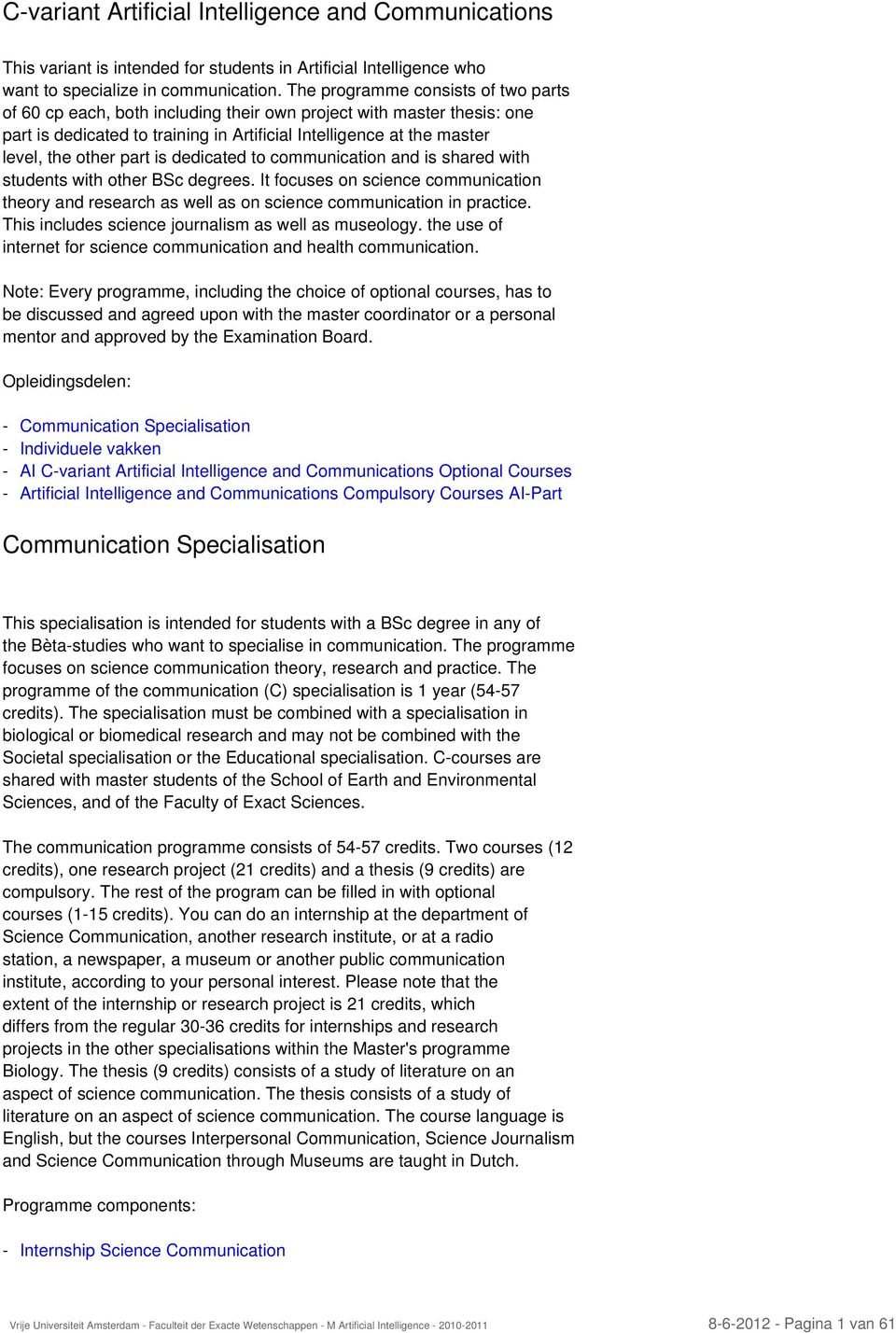
7 - Course modules Communication spec. Students can opt for an internship of 30 credits (EC), or for a combination of an internship of 21 credits and a thesis of 9 credits. Vakken: Naam Periode Credits Code Internship Communication Specialisation Internship Communication Specialisation 0.0 AM_471148nr Semester AM_ Students can opt for a selection of modules from this group. The following modules are compulsary: - Research Methods (AM_470582) - Science and Communication (AM_470587) Vakken: Naam Periode Credits Code Communication, Organization and Management Individuele vakken Period AM_ Interactive communication Period AM_ Interpersonal Communication Qualitative and Quantitative Research Methods Science and Communication Science Communication through Museums Period AM_ Period AM_ Period AM_ Period AM_ Science in Dialogue 6.0 AM_1002 Science Journalism Period AM_ Vakken: Naam Periode Credits Code FEW individueel vak intern 6.0 X_INDVAKI_09 AI C-variant Artificial Intelligence and Communications Optional Courses Vrije Universiteit Amsterdam - - M Artificial Intelligence Pagina 2 van 61
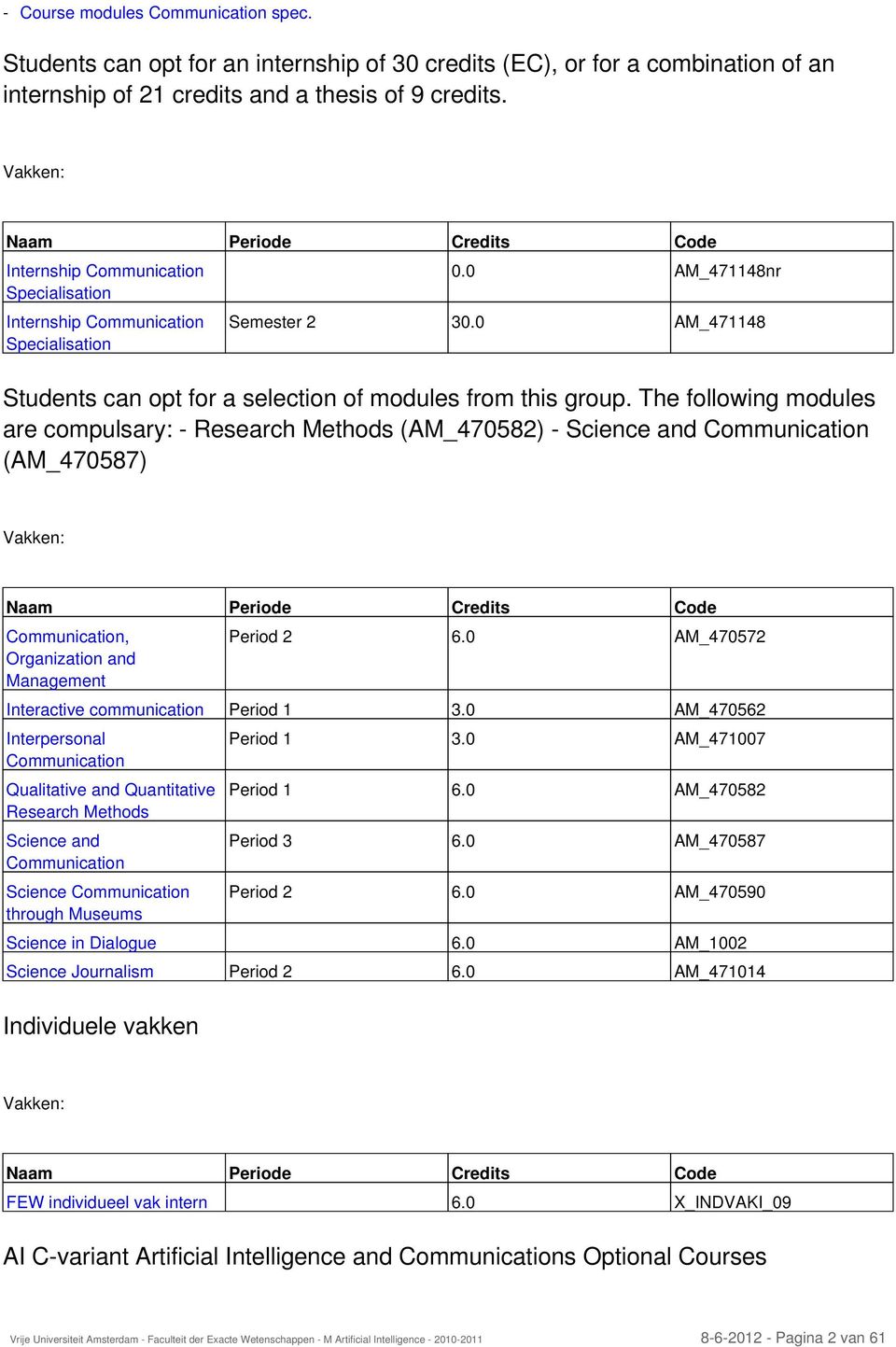
8 Optional courses to complete 60 cp. Vakken: Naam Periode Credits Code Advanced Logic Periode X_ Automated Reasoning in AI Period X_ Behaviour Dynamics Periode X_ Data Mining Techniques Period X_ Information Retrieval Period X_ Mini Master Project AI Ac. Year (September) 6.0 X_ Voortgezette logica 4.0 X_ Artificial Intelligence and Communications Compulsory Courses AI-Part Compulsory alongside the mentioned courses are optional courses for 39 Ec to complete 60 Ec. Note: Every programme, including the choice of optional courses, has to be discussed and agreed upon with the master coordinator or a personal mentor and approved by the Examination Board. Vakken: Naam Periode Credits Code Master Project AI for the C- variant Ac. Jaar (september) 21.0 X_ Research variant Knowledge Technology and Intelligent Internet Applications This programme contains elements so that the graduate student has a good overview of the contemporary literature regarding applications of intelligent web-sites and intelligent agents on the internet. Furthermore, the student learns techniques and methods from Artificial Intelligence that are used in internet applications. The master graduate student is a capable designer of intelligent web-sites, and applications based on intelligent agents. The student ensures that his/her designs respect the needs of the company for which the design is meant. An increasingly number of companies starts to document knowledge in the company with the use of knowledge acquisition and knowledge modeling techniques from AI. By doing this, the conduct of business is being simplified. Also with change processes in companies, automated knowledge intensive methods can be used, together with elements from economics and organisation psychology. For graduates, these is a multi-disciplinary field of labour. Via company internships and company funded research projects there is good contact with industry. Audience: students with an interest in analysing, modelling, simulating and experimenting with dynamics properties. The progamme consists of 120 credits - compulsory courses 69 credits (including a Master Project of 30 Vrije Universiteit Amsterdam - - M Artificial Intelligence Pagina 3 van 61
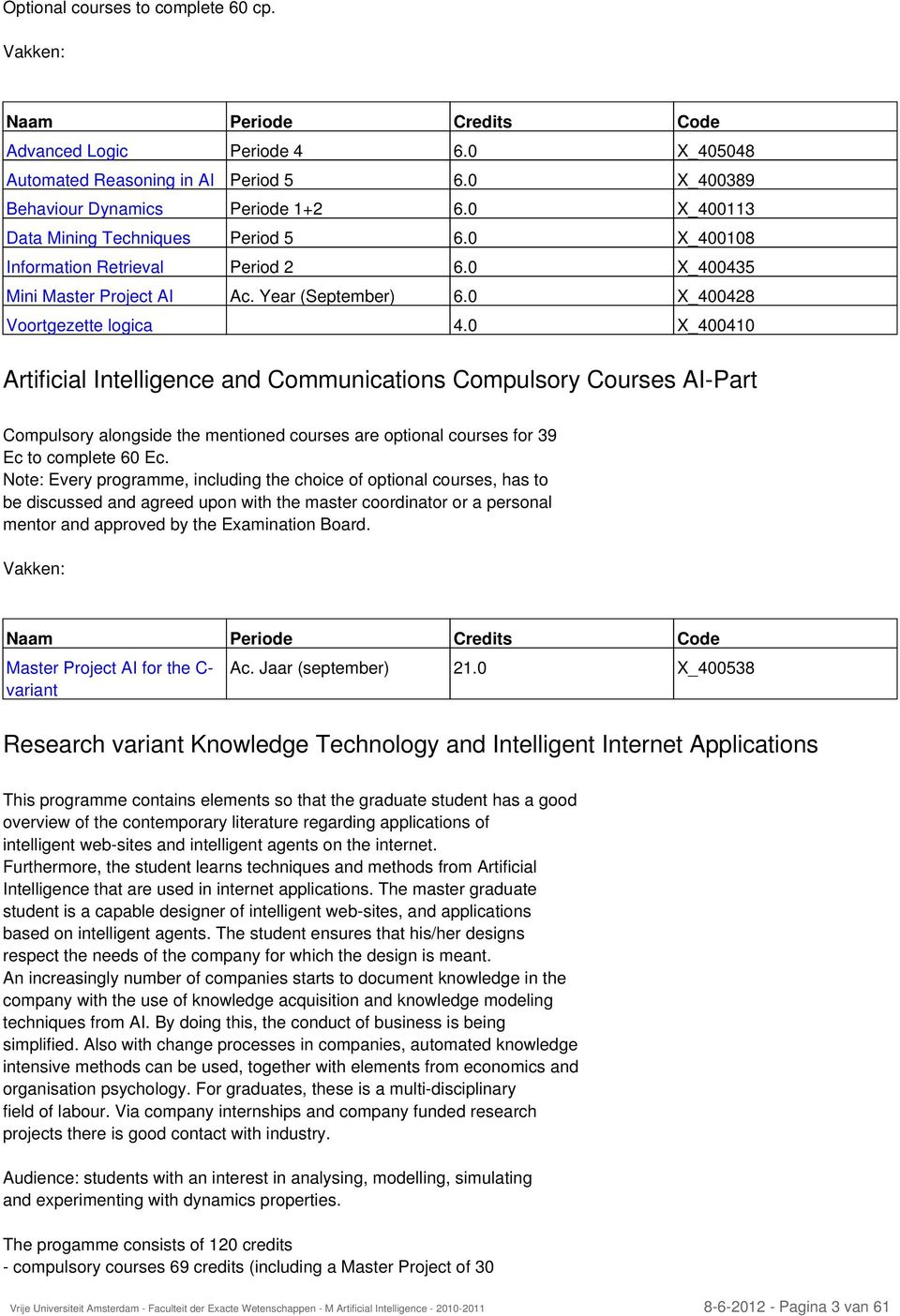
9 credits) - optional courses 51 credits Note: Every programme, including the choice of optional courses, has to be discussed and agreed upon with the master coordinator or a personal mentor and approved by the Examination Board. Master s: Dr. M. Hoogendoorn K room T-320a T +31 (0) E [email protected] Dr. S. Schlobach (International students) K room T-365 T +31 (0) E [email protected] Opleidingsdelen: Individuele vakken Recommended optional courses. Compulsory Courses Individuele vakken Vakken: Naam Periode Credits Code FEW individueel vak intern 6.0 X_INDVAKI_09 Recommended optional courses. Vakken: Naam Periode Credits Code Advanced Logic Periode X_ Automated Reasoning in AI Period X_ Data Mining Techniques Period X_ E-Business Innovation Periode X_ Game Theory [MC] Periode X_ Internet programming 6.0 X_ Mini Master Project AI Ac. Year (September) 6.0 X_ Multimedia Authoring Periode X_ Multimedia Authoring Periode X_ Protocol Validation 6.0 X_ Service Oriented Design Periode X_ Voortgezette logica 4.0 X_ Vrije Universiteit Amsterdam - - M Artificial Intelligence Pagina 4 van 61

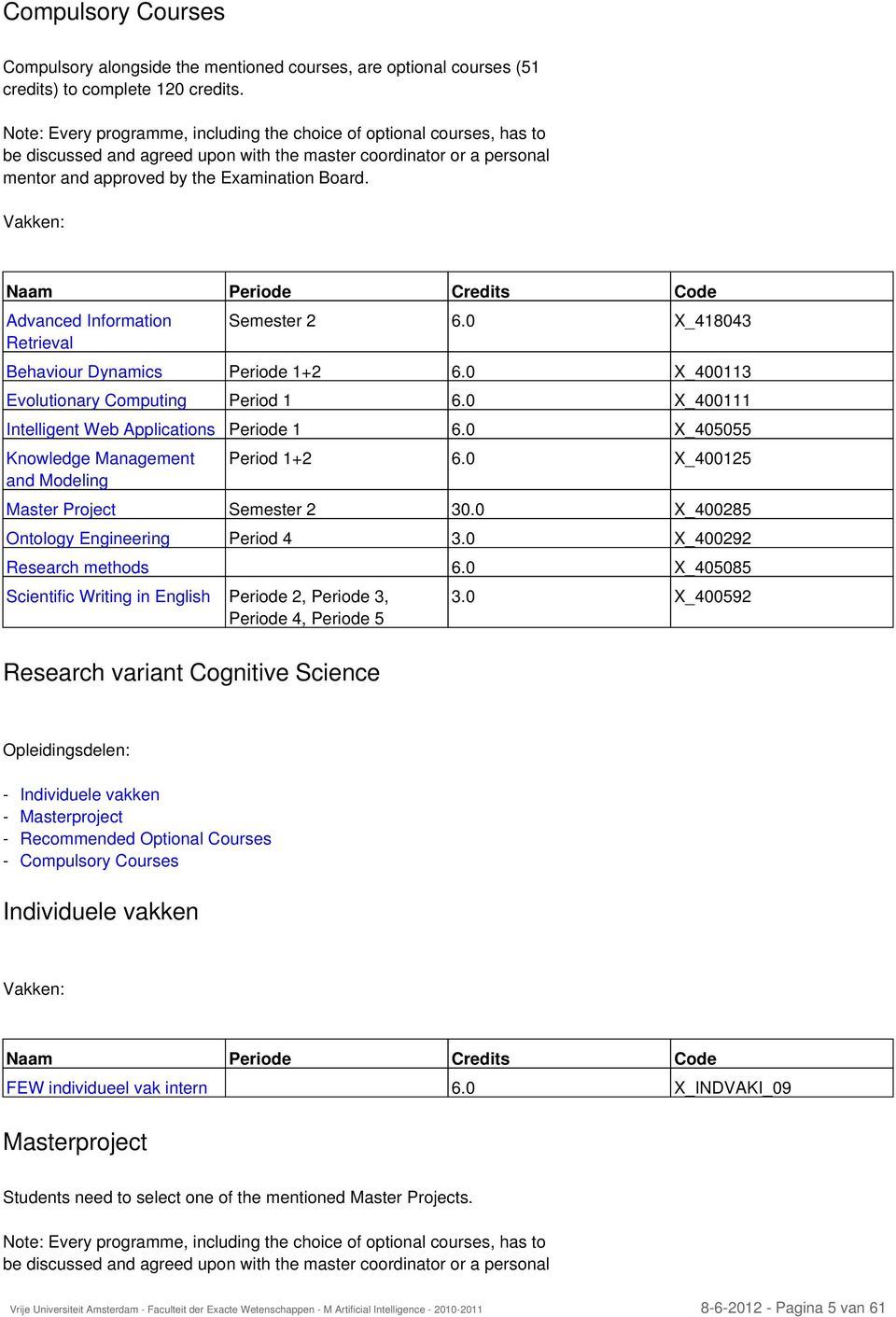
10 Compulsory Courses Compulsory alongside the mentioned courses, are optional courses (51 credits) to complete 120 credits. Note: Every programme, including the choice of optional courses, has to be discussed and agreed upon with the master coordinator or a personal mentor and approved by the Examination Board. Vakken: Naam Periode Credits Code Advanced Information Retrieval Research variant Cognitive Science Semester X_ Behaviour Dynamics Periode X_ Evolutionary Computing Period X_ Intelligent Web Applications Periode X_ Knowledge Management and Modeling Period X_ Master Project Semester X_ Ontology Engineering Period X_ Research methods 6.0 X_ Scientific Writing in Periode 2, Periode 3, Periode 4, Periode X_ Opleidingsdelen: Individuele vakken Masterproject Recommended Optional Courses Compulsory Courses Individuele vakken Vakken: Naam Periode Credits Code FEW individueel vak intern 6.0 X_INDVAKI_09 Masterproject Students need to select one of the mentioned Master Projects. Note: Every programme, including the choice of optional courses, has to be discussed and agreed upon with the master coordinator or a personal Vrije Universiteit Amsterdam - - M Artificial Intelligence Pagina 5 van 61
11 mentor and approved by the Examination Board. Vakken: Naam Periode Credits Code Master Project Semester X_ Master Thesis: Research Project Cognitive Science Recommended Optional Courses Semester P_MTHRCSC Vakken: Naam Periode Credits Code Advanced Selforganisation Period X_ Advanced Statistics for Experimentation Design of Multi-Agent Systems Compulsory Courses Period P_MADVSTA Periode X_ Internet programming 6.0 X_ Memory and Memory Disorders Period P_MMEMORY Mini Master Project AI Ac. Year (September) 6.0 X_ Perception Period P_MPERCEP Review Paper Period P_MREVPAP Compulsory alongside the mentioned courses, are optional courses (18 credits) to complete 120 credits. Note: Every programme, including the choice of optional courses, has to be discussed and agreed upon with the master coordinator or a personal mentor and approved by the Examination Board. Vakken: Naam Periode Credits Code Behavioral Methods Period P_MBEHMET Behaviour Dynamics Periode X_ Brain Imaging Period P_MBRIMAG Evolutionary Computing Period X_ Human Information Processing Knowledge Management and Modeling Period P_MHINFOP Period X_ Vrije Universiteit Amsterdam - - M Artificial Intelligence Pagina 6 van 61
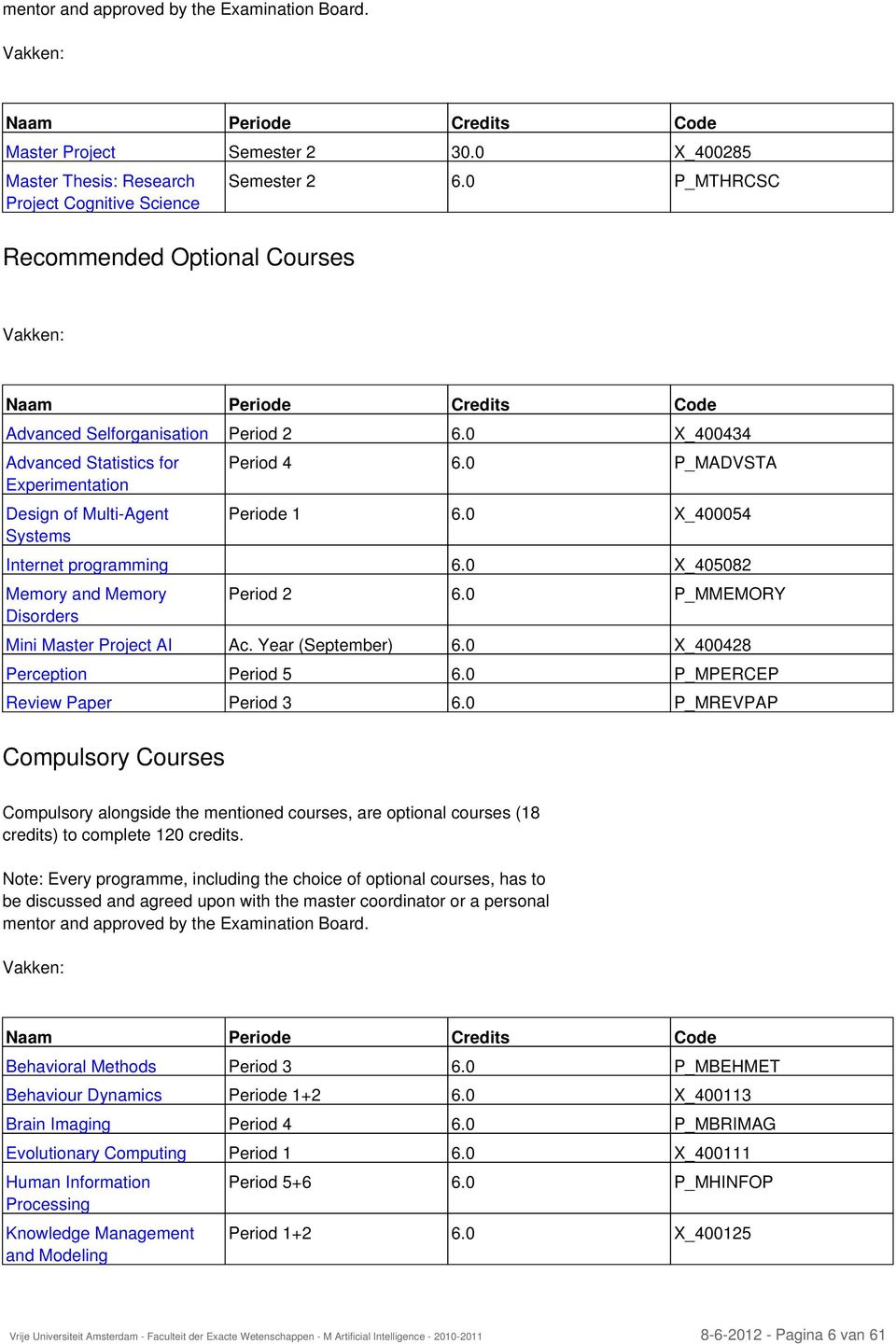
12 Neural Models of Cognitive Processes 6.0 P_MNEUMOD Research methods 6.0 X_ Scientific Writing in Periode 2, Periode 3, Periode 4, Periode X_ Seminar Attention Period P_MSEMATT Seminar Cognitive Neuroscience Special Topics Cognitive Science Period 1, Period P_MSEMCNS Ac. Year (September) 9.0 X_ Thinking and Deciding Period P_MTHIDEC Research Variant Computational Intelligence and Selforganisation After completion of this Master programme, the student - has an overview of the literature an practice in the area of organisation dynamics and self organisation - has mastered methods and techniques for modelling various types of organisations and their dynamics - is capable of constructing models of dynamic organisations with which can be simulated and experimented - is capable of conducting application-directed AI research in combination with other fields of research. Students of this programme can function in industry through a variety of different often management-related professions, within a diversity of institutions and companies, for example, in strategic management and organisation advising. Audience: Students with an interest in analysing, modelling, simulating and experimenting with dynamics properties. The progamme consists of 120 credits - compulsory courses 69 credits (including a Master Project of 30 credits) - optional courses 51 credits Note: Every programme, including the choice of optional courses, has to be discussed and agreed upon with the master coordinator or a personal mentor and approved by the Examination Board. Master s: Dr. M. Hoogendoorn K room T-320a T +31 (0) E [email protected] Dr. S. Schlobach (International students) K room T-365 T +31 (0) E [email protected] Opleidingsdelen: - Individuele vakken Vrije Universiteit Amsterdam - - M Artificial Intelligence Pagina 7 van 61

13 - - Recommended Optional Courses Compulsory Courses Individuele vakken Vakken: Naam Periode Credits Code FEW individueel vak intern 6.0 X_INDVAKI_09 Recommended Optional Courses Vakken: Naam Periode Credits Code Bioinformatics of Large Systems Compulsory Courses Periode X_ Business Intelligence Period E_BK3_BI Cluster and Grid Computing Period X_ Computational Genomics and Proteomics 6.0 X_ Distributed Algorithms Period X_ Distributed Systems Periode X_ Evolutionaire genetica Periode AB_ Game Theory [MC] Periode X_ Intelligent Web Applications 8.0 X_ Internet programming 6.0 X_ Mini Master Project AI Ac. Year (September) 6.0 X_ Ontology Engineering Period X_ Statistical Data Analysis Period X_ Compulsory alongside the mentioned courses, are optional courses (51 credits) to complete 120 credits. Note: Every programme, including the choice of optional courses, has to be discussed and agreed upon with the master coordinator or a personal mentor and approved by the Examination Board. Vakken: Naam Periode Credits Code Advanced Selforganisation Period X_ Behaviour Dynamics Periode X_ Vrije Universiteit Amsterdam - - M Artificial Intelligence Pagina 8 van 61
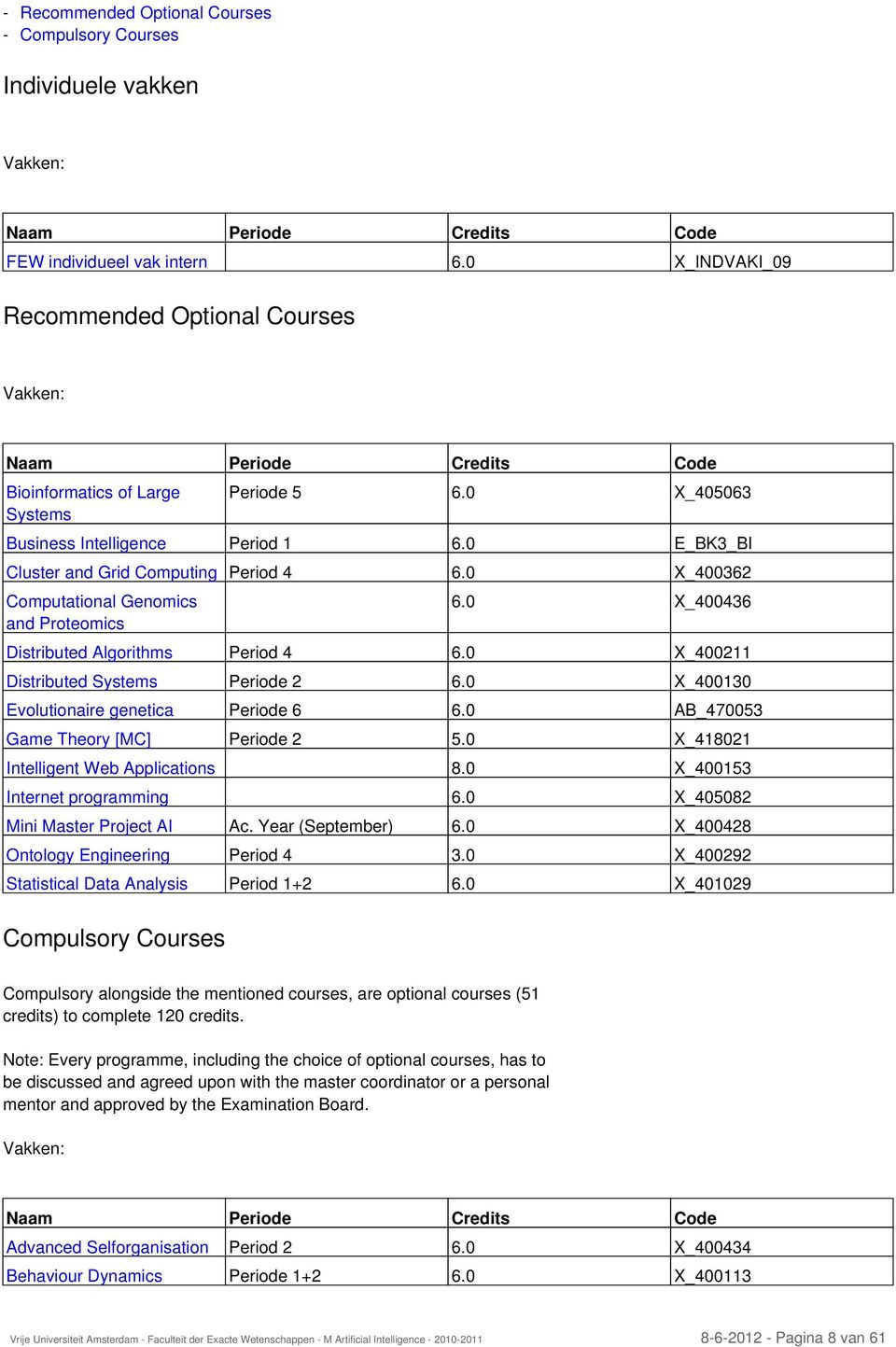
14 Data Mining Techniques Period X_ Evolutionary Computing Period X_ Knowledge Management and Modeling Research variant TAI Period X_ Master Project Semester X_ Research methods 6.0 X_ Scientific Writing in Periode 2, Periode 3, Periode 4, Periode X_ The graduate student of this Master programme is capable of applying techniques from Computer Science to problems of an Artificial Intelligence nature, e.g., designing knowledge-based systems or multiagent systems. This technically adapt graduate, furthermore, has learned proven AI techniques in the areas of machine learning, neural networks, knowledge representation, and evolutionary computing. Graduate students are well equiped for work in companies that create intelligent applications. Audience: the programme aims at students with a Bachelor in Computer Science, having an interest in Artificial Intelligence. The progamme consists of 120 credits - compulsory courses 78 credits (including a Master Project of 30 credits) - compulsory optional choice 6 credits - optional courses 36 credits Note: Every programme, including the choice of optional courses, has to be discussed and agreed upon with the master coordinator or a personal mentor and approved by the Examination Board. Master s: Dr. M. Hoogendoorn K room T-320a T +31 (0) E [email protected] Dr. S. Schlobach (International students) K room T-365 T +31 (0) E [email protected] Opleidingsdelen: Individuele vakken Compulsory Optional course (Software Engineering) Recommended Optional Courses Compulsory Courses Individuele vakken Vrije Universiteit Amsterdam - - M Artificial Intelligence Pagina 9 van 61

15 Vakken: Naam Periode Credits Code FEW individueel vak intern 6.0 X_INDVAKI_09 Compulsory Optional course (Software Engineering) Students need to select at least one out of the following courses. Note: Every programme, including the choice of optional courses, has to be discussed and agreed upon with the master coordinator or a personal mentor and approved by the Examination Board. Vakken: Naam Periode Credits Code Service Oriented Design Periode X_ Software Architecture Period X_ Software Mining Period X_ Recommended Optional Courses Vakken: Naam Periode Credits Code Advanced Logic Periode X_ Automated Reasoning in AI Period X_ Data Mining Techniques Period X_ Information Retrieval Period X_ Information Retrieval (UvA) 6.0 X_ Internet programming 6.0 X_ Mini Master Project AI Ac. Year (September) 6.0 X_ Voortgezette logica 4.0 X_ Compulsory Courses Compulsory alongside the mentioned courses, are optional courses (36 credits) to complete 120 credits. Note: Every programme, including the choice of optional courses, has to be discussed and agreed upon with the master coordinator or a personal mentor and approved by the Examination Board. Vakken: Vrije Universiteit Amsterdam - - M Artificial Intelligence Pagina 10 van 61

16 Naam Periode Credits Code Behaviour Dynamics Periode X_ Distributed Systems Periode X_ Evolutionary Computing Period X_ Intelligent Web Applications Periode X_ Knowledge Management and Modeling Research Variant Human Ambience Period X_ Literature Study Ac. Year (September) 6.0 X_ Master Project Semester X_ Neurale Netwerken Periode X_ Research methods 6.0 X_ Scientific Writing in Periode 2, Periode 3, Periode 4, Periode X_ In the Master variant Human Ambience you learn on a detailed level how to model both mental and physiological processes of human functioning. For instance, you can learn how to model the mental and physical states associated with depression. Such models are then used in applications that support humans in their daily lives in a dedicated manner, also to enable the developed support systems to understand humans better. In the specialization phase of the master you can study relevant courses with respect to an application area (e.g. support of people during exercising, or elderly care) or a relevant scientific discipline (e.g. psychology, sociology, movement sciences, biomedical sciences, criminology, etc.). During you final Master project you will then combine your domain knowledge with the knowledge of modeling such human processes. The progamme consists of 120 credits - compulsory courses 66 credits (including a Master Project of 30 credits) - optional courses 54 credits Note: Every programme, including the choice of optional courses, has to be discussed and agreed upon with the master coordinator or a personal mentor and approved by the Examination Board. Master s: Dr. M. Hoogendoorn K room T-320a T +31 (0) E [email protected] Dr. S. Schlobach (International students) K room T-365 T +31 (0) E [email protected] Opleidingsdelen: - - Individuele vakken Keuzevakken Vrije Universiteit Amsterdam - - M Artificial Intelligence Pagina 11 van 61
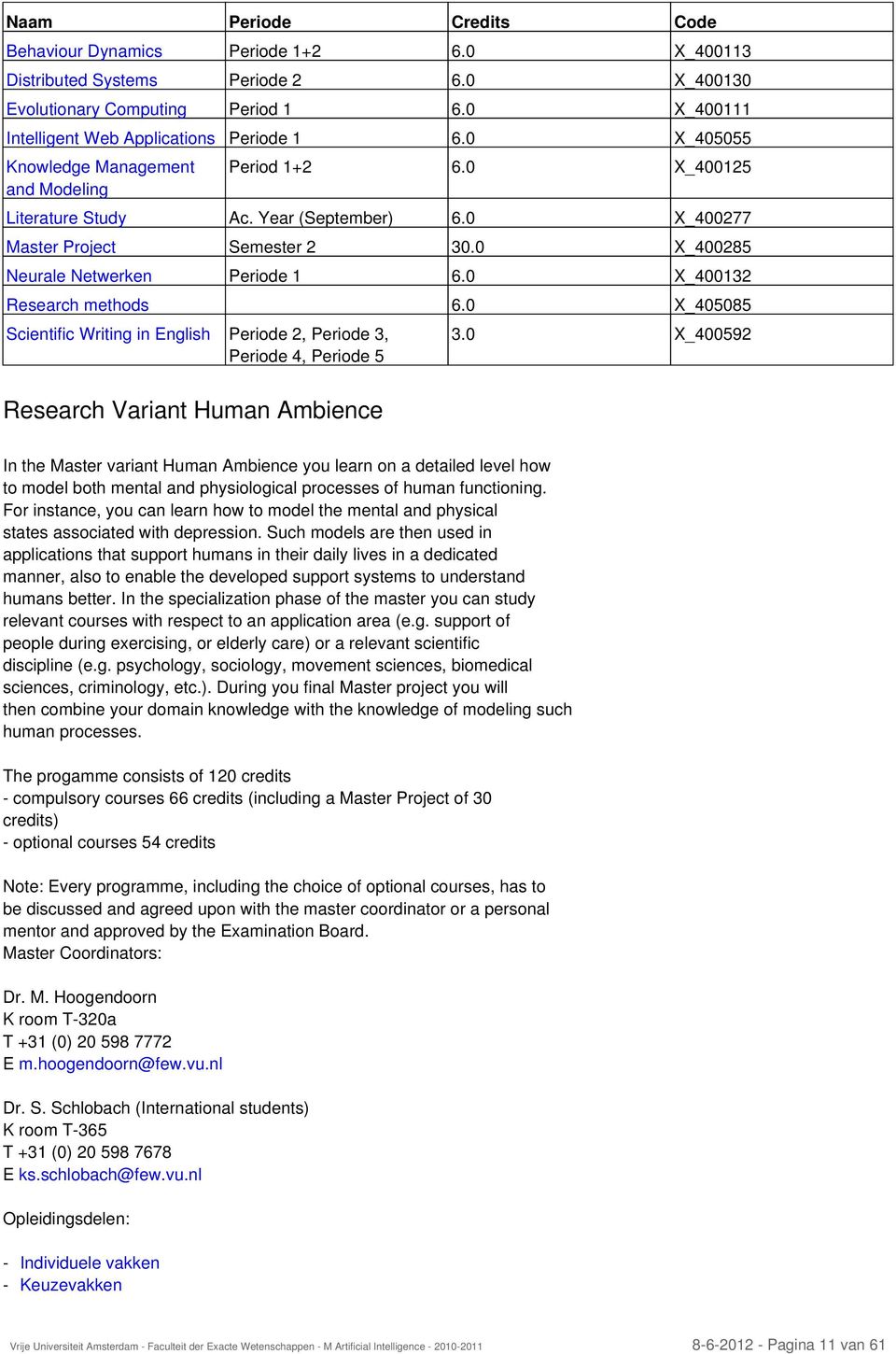
17 - - Optional courses Health Compulsory Courses Individuele vakken Vakken: Naam Periode Credits Code FEW individueel vak intern 6.0 X_INDVAKI_09 Keuzevakken N.B. Students can compose an individual programme by selecting all optional courses from one specific discipline, but also by combining courses from different disciplines, which have a common application. Vakken: Naam Periode Credits Code Advanced Selforganisation Period X_ Design of Multi-Agent Systems Practical Optional courses Health Period X_ Mini Master Project AI Ac. Year (September) 6.0 X_ Vakken: Naam Periode Credits Code Health Promotion and Disease Prevention Compulsory Courses Period AM_ Health Psychology Period AM_ Prevention of Mental Health Problems Period AM_ Compulsory alongside the mentioned courses, are optional courses (54 credits) to complete 120 credits. Note: Every programme, including the choice of optional courses, has to be discussed and agreed upon with the master coordinator or a personal mentor and approved by the Examination Board. Vakken: Vrije Universiteit Amsterdam - - M Artificial Intelligence Pagina 12 van 61

18 Naam Periode Credits Code Behaviour Dynamics Periode X_ Evolutionary Computing Period X_ Human Ambience Innovation Knowledge Management and Modeling Advanced Information Retrieval Periode X_ Period X_ Master Project Semester X_ Model-based Intelligent Environments 6.0 X_ Research methods 6.0 X_ Scientific Writing in Periode 2, Periode 3, Periode 4, Periode X_ Vakcode X_ (418043) Periode Semester 2 Voertaal Engels Faculteit Advanced Logic Vakcode X_ (405048) Periode Periode 4 Voertaal Engels Faculteit Coördinator dr. R.D.A. Hendriks Docent(en) dr. R.D.A. Hendriks Lesmethode(n) Hoorcollege, Werkcollege Doelgroep mai-ktiia, mai-tli, mai-c-var, mcs-fmsv Advanced Selforganisation Course code X_ (400434) Period Period 2 dr. M.C. Schut dr. M.C. Schut Lecture Vrije Universiteit Amsterdam - - M Artificial Intelligence Pagina 13 van 61

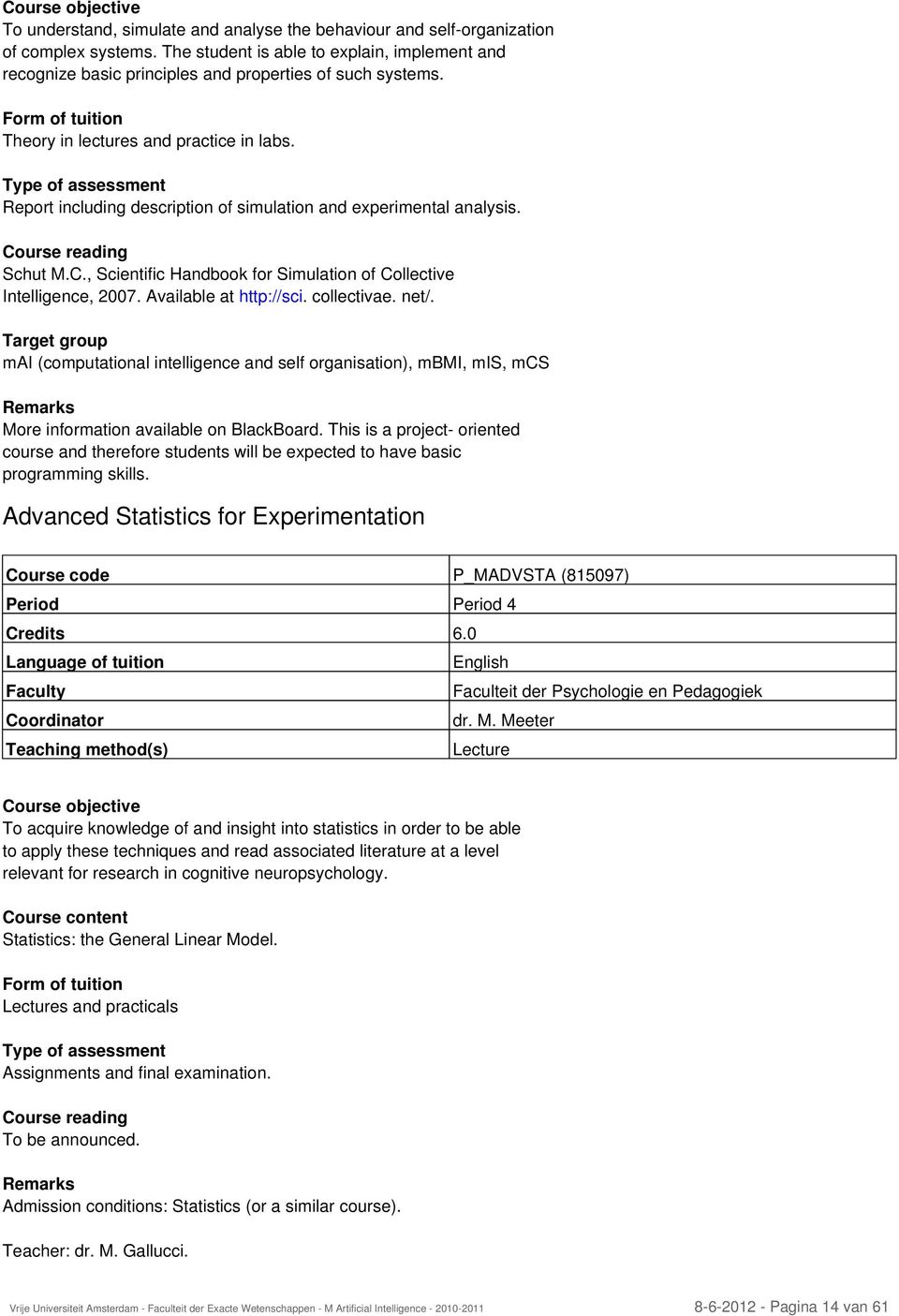
19 To understand, simulate and analyse the behaviour and self-organization of complex systems. The student is able to explain, implement and recognize basic principles and properties of such systems. Theory in lectures and practice in labs. Report including description of simulation and experimental analysis. Course reading Schut M.C., Scientific Handbook for Simulation of Collective Intelligence, Available at collectivae. net/. Target group mai (computational intelligence and self organisation), mbmi, mis, mcs Remarks More information available on BlackBoard. This is a project- oriented course and therefore students will be expected to have basic programming skills. Advanced Statistics for Experimentation Course code P_MADVSTA (815097) Period Period 4 Faculteit der Psychologie en Pedagogiek dr. M. Meeter Lecture To acquire knowledge of and insight into statistics in order to be able to apply these techniques and read associated literature at a level relevant for research in cognitive neuropsychology. Statistics: the General Linear Model. Lectures and practicals Assignments and final examination. Course reading To be announced. Remarks Admission conditions: Statistics (or a similar course). Teacher: dr. M. Gallucci. Vrije Universiteit Amsterdam - - M Artificial Intelligence Pagina 14 van 61
20 Automated Reasoning in AI Course code X_ (400389) Period Period 5 dr. K.S. Schlobach dr. A.C.M. ten Teije, dr. K.S. Schlobach Lecture, Seminar Since its early days Artificial Intelligence has employed logic as a mean to provide generic solutions for computationally and conceptually difficult practical problems. The aim of the course is to make the students familiar with a number of popular logic- based representation and reasoning mechanisms for Artificial Intelligence. Furthermore, students should have the capability to transfer the learned techniques to other problems and to other representation mechanisms. The course will be structured in three modules. In each of these modules a practical problem will be introduced, a logic- based representation proposed, and the basic techniques for automated reasoning in this language studied in a practical, hands on, way. In a nutshell, we plan to cover: - propositional Logic for scheduling, and satisfiability checking with Davis Putnam; - Allen's interval logic for Planning, with constraint propagation in Temporal Constraint Networks; - description logics for classification, with Tableau calculi for subsumption. In period 5 there will be lectures and practical sessions, plus significant time for self- study and practical work. In period 6 there will be regular meetings to support for the work on a larger project. 3 practical assignments Course reading Selected scientific papers. Entry requirements Basic knowledge in logic is an advantage, but not required, as is some familiarity with programming. Target group mai Remarks Vrije Universiteit Amsterdam - - M Artificial Intelligence Pagina 15 van 61

21 For further information see the AR in AI blackboard site. Behavioral Methods Course code P_MBEHMET (815096) Period Period 3 Faculteit der Psychologie en Pedagogiek dr. L.J.F.M. van Zoest dr. L.J.F.M. van Zoest, dr. A.V. Belopolskiy Lecture To provide students with in- depth knowledge of the strengths and weaknesses of the scientific method and behavioural methods commonly used in cognitive (neuro) psychology. This course reviews the basic principles that govern the development and evaluation of scientific theories (e. g. philosophy of science). Commonly used experimental methods and methods for data analysis are discussed and evaluated. The methods that are covered in detail include: method for discovering processing stages, signal detection theory, various psychophysical methods, and methods used in cognitive neuropsychology (e. g. double dissociations. Traditional; dataanalysis methods, such as general linear model and null- hypothesis significance testing are also discussed, as well as their alternatives. Lectures + assignments. open- ended written examination. Course reading A selection of articles and bookchapters. Behaviour Dynamics Vakcode X_ (400113) Periode Periode 1+2 Voertaal Engels Faculteit Coördinator dr. O. Sharpanskykh Docent(en) dr. O. Sharpanskykh Lesmethode(n) Hoorcollege Doel vak To learn how to identify, specify and predict different types of behaviour; to understand how externally observable behaviour emerges Vrije Universiteit Amsterdam - - M Artificial Intelligence Pagina 16 van 61
22 from internal mechanisms; to be able to construct computational behavioural models and to perform analysis based on these models using software tools Bioinformatics of Large Systems Vakcode X_ (405063) Periode Periode 5 Voertaal Engels Faculteit Doel vak A theoretical and practical bioinformatics course on computational methods in proteomics, genomics, gene regulation, signalling, microarray experiments, protein-protein interactions, and data-mining. Goals: - At the end of the course, students will be aware of the issues, methodology and available bioinformatics tools, so to become a creative bioinformatics problem solver and tools creator. - At the end of the course, students will have hands-on experience in handling large biological datasets. Inhoud vak Theory: - proteomics (mass spectrometry), genomics, gene regulation, signalling, microarray experiments, protein-protein interactions, and data-mining, next-generation sequencing, pattern recognition, ontologies, and GRID computing, Petri nets. Practical: - Assignment biological data clustering (in R) - Assignment Gene regulation / Signalling network modelling using Petri nets. - Assignment Pattern detection - Assignment PPI networks Onderwijsvorm 13 Lectures (4 two-hour lectures per week); 6 computer practicals (2 two-hour sessions per week). Toetsvorm Assignment results and oral or written exam (depending on number of course students). Literatuur Course material on bb.vu.nl Marketa Zvelebil and Jeremy O. Baum Understanding Bioinformatics Garland Science 2008 ISBN-10: Vereiste voorkennis Bachelor in any science discipline (including medicine), or third-year BSc students. Basic programming skills (R) and an interest in biological problems. Vrije Universiteit Amsterdam - - M Artificial Intelligence Pagina 17 van 61
23 Doelgroep mbio, mcs-hpdc Overige informatie Signing up via bb.vu.nl is mandatory. The course is taught in. Brain Imaging Course code P_MBRIMAG (815103) Period Period 4 Faculteit der Psychologie en Pedagogiek dr. D.J. Heslenfeld dr. D.J. Heslenfeld Lecture To learn how various brain imaging techniques are used in modern neurocognitive research. The course will treat physical principles, recording apparatus, and practical applications of the four major brain imaging techniques: EEG, MEG, MRI, PET, with an emphasis on EEG and MRI. These techniques will be discussed in detail and live demonstrated. We will visit the various labs, and students will perform a small research project of their own. This includes recording and analyzing; your own brain imaging data in; small supervised groups. Lectures and obligatory practicals. Written examination, oral presentation, contribution to practicals. Course reading - Luck, S (2005) An introduction to the Event -Related Potential Technique Cambridge, MA: MIT Press - Huettel, S et al (2009) Functional Magnetic Resonance Imaging; (2 nd. ed. ) Sunderland, MA: Sinauer; Entry requirements Cognitive Neuroscience and Neuropsychology. Remarks Language: tuition in MRI practicals will take place on Wednesdays in the afternoon/evening. Business Intelligence Course code E_BK3_BI ( ) Vrije Universiteit Amsterdam - - M Artificial Intelligence Pagina 18 van 61
24 Period Period 1 Dutch Fac. der Economische Wet. en Bedrijfsk. dr. J.F.M. Feldberg dr. J.F.M. Feldberg Lecture, Practical Students that have successfully accomplished this course will: - Have an academic attitude towards business intelligence (BI) and decision support systems theories and business issues. - Have the appropriate knowledge to sensibly think about decision support systems and BI solutions in an organizational context (design, development, implementation and evaluation). - Have the skills to work with a popular decision support tool (Cognos Powerplay). By means of 'learning by doing' elementary skills in the usage of decision support systems are acquired. - Be able to identify the (break through) opportunities of BI solutions in realizing sustainable competitive advantage. - Be able to participate in project teams that decide on the design, development, implementation, and use of BI solutions. - Be able to apply scientific theories on decision support systems in an organizational context. - Have the appropriate knowledge and skills to self- reliantly deepen their knowledge on BI solutions and decision support systems. Modern organizations, in particular the management of these organizations, tend to suffer more from an overload of data than from a lack of data. To a great extent this overload is caused by the overwhelming growth of information systems in organizations. Enterprise Systems (ERP), Customer Relationship Systems (CRM) as well as the growing number of Internet- based applications (e. g. e- commerce) are all important sources for the explosion of financial, production, marketing and other business data. The challenge for most organizations is to develop and build systems that support the transformation of the collected data into knowledge. To be successful in this transformation processes organizations have to develop the capability to aggregate, analyze and use data to make informed decisions. This course deals with the theory concerning business intelligence as well as with the application of business intelligence solutions. To be able to successfully implement business intelligence solutions, one has to have knowledge about their functioning and proficiency in using them, as well as knowledge about their field of application, e. g., how to select, transform, integrate, condense, store and analyze relevant data. This course uses the term 'business intelligence' in a broad sense. A narrow interpretation would only deal with software solutions ('data warehousing' and 'online analytical processing'). The broad interpretation - to be used in this course - also includes: theories concerning decision making, related decision support systems and their application for management, i. e., data warehousing, online analytical processing and data mining. Vrije Universiteit Amsterdam - - M Artificial Intelligence Pagina 19 van 61
25 lecture tutorial written interim examination (weekly) Business intelligence tutorial tests. All tests and exams will be administered through a digital test system. Course reading - To be announced. - Various papers. Recommended background knowledge - Basic course in Information Systems, f. e. on the level of Laudon & Laudon, Management Information Systems, Managing the Digital Firm. 9th edition. Prentice Hall, O'Brien, James A., Introduction to Information Systems. 12th edition. Mc Graw Hill, Cluster and Grid Computing Course code X_ (400362) Period Period 4 dr. ing. T. Kielmann dr. ing. T. Kielmann Lecture Students shall both explore the area of Cluster and Grid Computing and develop their skills in critical assessment of scientific literature. Both Cluster and Grid computing are areas of rapid technical developments. Many technical developments are still in flux. We investigate resource management and scheduling, remote data access, network and other performance issues, as well as software architecture and programming models for grids. Introductory lecture, followed by a seminar part and practical programming assignments. In the seminar part, students explore topic areas of Cluster and Grid Computing in small groups, present their findings in a presentation session and prepare a report. The practical programming assignments are to be addressed individually. Both parts contribute 50% to the grade: (i) seminar presentation and report (ii) programming assignments Vrije Universiteit Amsterdam - - M Artificial Intelligence Pagina 20 van 61
26 Course reading Various research articles as available online. Entry requirements Parallel Programming (code ) Target group mpdcs, mcs-hpdc Remarks Participation in the course is limited; priority is given to students of the M. Sc. programme in Parallel and Distributed Computer Systems, and to students following the HPDC specialization of; the Msc in Computer Science. Registration for the course is required before the first lecture by sending to the lecturer; first come first serve. Communication, Organization and Management Course code AM_ (450003) Period Period 2 Fac. der Aard- en Levenswetenschappen dr. M.B.M. Zweekhorst dr. H. Wels, J. Maas MSc, prof. dr. F. Scheele, dr. M.B.M. Zweekhorst Lecture, Study Group To get acquainted with theories on organisational behaviour To obtain a deeper understanding of communication from the perspective of sharing and influencing results To acquire knowledge on organisational structures and designs To get acquainted with important theories on organisational structures (e.g. Mintzberg) To acquire insight into different management practices in the health and life sciences sector; To obtain insight in methods for motivation and conflict management To gain insight in and to practice leadership To improve communication skills To practise team management Organisations in the health and life science sector are changing fast, a phenomenon driven by newly emerging technologies and increasing societal complexity. A growing number of students with a beta degree will hold professional and managerial functions in these organisations. During this course students will learn how to be effective performers within these environments, both individually and in teams. This requires an understanding of the macro aspects of organisational behaviour, including designing organisations, managerial skills and ways of strategic thinking. Several speakers conduct lecturers on aspects as motivation, managing interpersonal behaviour, leadership, communication and developing and changing organisations. The speakers Vrije Universiteit Amsterdam - - M Artificial Intelligence Pagina 21 van 61
27 explain theories from literature and relate them to their practical experiences. In addition, the students become project managers of a project team that has been given the assignment to write a policy advisory report. While being a project manager you are trained and coached by experts. With the other students you discuss your experiences and the coach helps you relate the experiences to theory. Lectures, self study, training workshops project assignment Written exam (50%;) and assessment of the functioning as a project manager (50%). Grades of both parts must at least be 6 or higher. Course reading Management and Organisational Behaviour, Wendy Bloisi (second European edition), McGraw-Hill Education, ISBN The 7 Habits of Highly Effective People, Stephen R. Covey, any edition Target group Compulsory course within the Master programme Management, Policy Analysis and Entrepreneurship for the Health and Life Sciences (MPA) and the Societal differentiation of Health, Life and Natural Sciences Masters programmes Remarks Attendance to training, workshops and project is compulsory Computational Genomics and Proteomics Vakcode X_ (400436) Voertaal Engels Faculteit Coördinator prof. dr. J. Heringa Data Mining Techniques Course code X_ (400108) Period Period 5 dr. Z. Szlavik dr. Z. Szlavik Lecture The aim of the course is that students acquire data mining knowledge and skills that they can apply in a business environment. How the aims are to be achieved: Students will acquire knowledge and skills mainly through the following: an overview of the most common Vrije Universiteit Amsterdam - - M Artificial Intelligence Pagina 22 van 61
28 data mining algorithms and techniques (in lectures), a survey of typical and interesting data mining applications, and practical assignments to gain "hands on" experience. The application of skills in a business environment will be simulated through various assignments of the course. The course will provide a survey of basic data mining techniques and their applications for solving real life problems. After a general introduction to Data Mining we will discuss some "classical" algorithms like Naive Bayes, Decision Trees, Association Rules, etc., and some recently discovered methods such as boosting, Support Vector Machines, and co-learning. A number of successful applications of data mining will also be discussed: marketing, fraud detection, text and Web mining, possibly bioinformatics. In addition to lectures, there will be an extensive practical part, where students will experiment with various data mining algorithms and data sets. The grade for the course will be based on these practical assignments (i.e., there will be no final examination). Lectures and compulsory practical work. Lectures are planned to be interactive: there will be small questions, one-minute discussions, following an algorithm on paper, looking for patterns in a dataset about you (!), filling in missing pieces in a table, coming up with a number of creative solutions to a small problem, etc. Practical assignments (i.e. there is no exam). There will be three assignments, some (parts) of these will be done individually, some in groups of two. There is a possibility to get a grade without doing these assignments: one (!) group can be selected (based on interviews conducted by the lecturer) to do a real research project instead (which - be warned - will most likely to involve more work, but it can also be more rewarding). Course reading Ian H. Witten, Eibe Frank, Data Mining: Practical Machine Learning Tools and Techniques, Morgan Kaufman, (Second Edition) Additionally, a collection of articles in electronic form (BB). Entry requirements Kansrekening en Statistiek of Algemene Statistiek (knowledge of statistics and probabilities) or equivalent. Recommended: Machine Learning. Target group mbmi, mcs, mai, mbio Design of Multi-Agent Systems Vakcode X_ (400054) Periode Periode 1 Voertaal Nederlands Faculteit Vrije Universiteit Amsterdam - - M Artificial Intelligence Pagina 23 van 61
29 Coördinator Docent(en) Lesmethode(n) dr. M. Hoogendoorn dr. M. Hoogendoorn Hoorcollege, Werkcollege Onderwijsvorm Combination of lectures and practical assignments. Toetsvorm On the basis of the homework assignments, practical assignments and a written exam. Literatuur Reader. Overige informatie More information can be found on Blackboard. Design of Multi-Agent Systems Practical Course code X_ (400543) Period Period 3 Dutch dr. M. Hoogendoorn After completing the practical course, the student has advanced skills in designing multi-agent systems. He/she has learned to use the most important concepts of agent technology such as beliefs, desires, intentions, goals in practice, and has experience in solving coordination and cooperation problems using agent technology. In two practical assignments the students work in teams to design multi-agent systems. The assignments differ per year, but always the problems of coordination and cooperation play a central role. Practical assignments in groups of 2-3 students under supervision of a project- leader. Assessment is made on the basis of the effectiveness and eloquence of the systems designed as well as on the written report of the design and the design process. Course reading Reader. Entry requirements The student has successfully attended the course Design of Multi-Agent Systems (400054). Vrije Universiteit Amsterdam - - M Artificial Intelligence Pagina 24 van 61
30 Target group 2LI, 3LI, 3I, mcs Remarks More information can be found on Blackboard. Distributed Algorithms Course code X_ (400211) Period Period 4 prof. dr. W.J. Fokkink prof. dr. W.J. Fokkink Lecture, Seminar To obtain a good understanding of concurrency concepts and a large range of distributed algorithms. Snapshots, graph traversal, termination detection, garbage collection, deadlock detection, routing, election, minimal spanning trees, anonymous networks, fault tolerance, failure detection, synchronization, consensus, mutual exclusion,self-stabilization, on-line scheduling. Written examen (plus a take-home exercise sheet that can provide up to 0,5 bonus point). Remarks The homepage of the course is at Distributed Systems Vakcode X_ (400130) Periode Periode 2 Voertaal Engels Faculteit Coördinator prof. dr. ir. M.R. van Steen Docent(en) prof. dr. ir. M.R. van Steen Lesmethode(n) Hoorcollege E-Business Innovation Vakcode X_ (405051) Periode Periode 1 Vrije Universiteit Amsterdam - - M Artificial Intelligence Pagina 25 van 61
31 Voertaal Engels Faculteit Coördinator dr. J. Gordijn Docent(en) dr. J. Gordijn Lesmethode(n) Hoorcollege Evolutionaire genetica Vakcode AB_ (450003) Periode Periode 6 Voertaal Engels Faculteit Fac. der Aard- en Levenswetenschappen Coördinator dr. J.M. Kooter Docent(en) dr. J.M. Kooter, dr. H. Schat, dr. ir. T.F.M. Roelofs Lesmethode(n) Hoorcollege, Werkgroep, Computerpracticum Doel vak Verwerven van kennis en inzicht in : dynamische karakter van genetisch materiaal oorzaken genetische variatie op nucleotide, gen, en chromosoom-niveau genoomevolutie bij pro- en eukaryoten, en organellen evolutionaire gevolgen van sex ecologische en moleculaire oorzaken van soortvorming horizontale DNA overdracht moleculaire evolutie van pathogenen (bacterien, virussen, protozoa) gebruik van genomische databanken bij evolutiestudies modellen van de moleculaire oorsprong van leven op aarde reconstructie van fylogenetische bomen verschillende vormen van selectie en theoretische onderbouwing manieren waarop genetische variatie wordt gebruikt om oorzaken van stochastische en deterministische processen af te leiden toepassing van wiskundige regels die bestaan voor het gedrag van allelen van één of twee loci in ideale populaties, en voor genen met een kwantitatief effect Niveau 2: verdieping Inhoud vak De cursus behandelt: - Genetische concepten die de basis vormen voor het begrijpen van de evolutietheorie, waaronder moleculaire evolutie, ontstaan van nieuwe genen en functies, genoom organisatie, vergelijkende genomics, soortvorming, evolutie humane genoom, relatie tussen ontwikkeling en evolutie (Evo- devo), en hypothesen over het ontstaan van `leven', - Theoretische principes van de populatie genetica, waaronder verschillende vormen van selectie, quantitatieve genetica, drift, en hun toepassingen bij het bestuderen van variatie en evolutie in natuurlijke populaties. - Fylogenetische reconstructies op basis van DNA sequenties met behulp van een cladistisch computerprogramma - Fylogeografie Vrije Universiteit Amsterdam - - M Artificial Intelligence Pagina 26 van 61
32 Onderwijsvorm - Hoor- en werkcolleges (60 uur) - Literatuurbespreking (verplicht, 9 uur) - Computerpracticum (verplicht, 9 uur) - Zelfstudie - Ondersteuning via Blackboard Toetsvorm Schriftelijk tentamen (0.8) en een literatuurbespreking (0.2). Beide moeten voldoende zijn. Literatuur Studieboek: 'Evolutionary Analysis', Scott Freeman and Jon C. Herron, Fourth Edition, 2007, Pearson, Prentice Hall Syllabus met Onderzoeks- en Reviewartikelen over onderwerpen die niet in het boek worden behandeld Aanbevolen voorkennis Kennis van Genetica en Moleculaire Biologie; sluit aan bij Evolutie van de mens of Evolutiebiologie uit het eerste jaar Doelgroep Keuzevak voor derdejaars BSc Biologie en Biomedische Wetenschappen. Overige informatie De cursus wordt gegeven door de afdelingen Genetica, Ecologie en Fysiologie van planten, en Dierecologie. Evolutionary Computing Course code X_ (400111) Period Period 1 prof. dr. A.E. Eiben prof. dr. A.E. Eiben Lecture To learn about computational methods based on Darwinian principles of evolution. To illustrate the usage of such methods as problem solvers and as simulation, respectively modelling tools.to gain hands-on experience in performing experiments. The course is treating various algorithms based on the Darwinian evolution theory. Driven by natural selection (survival of the fittest), an evolution process is being emulated and solutions for a given problem are being "bred". During this course all "dialects" within evolutionary computing are treated (genetic algorithms, evolutiestrategieën, evolutionary programming, genetic programming, and classifier systems). Applications in optimisation, constraint handling and machine learning are discussed. Specific subjects handled include: Vrije Universiteit Amsterdam - - M Artificial Intelligence Pagina 27 van 61
33 various genetic structures (representations), selection techniques, sexual and asexual genetic operators, (self-)adaptivity. If time permits, subjects in Artificial Life and Artificial Societies, and Evolutionary Art will be handled. Hands-on-experience is gained by a compulsory pogramming assignment. Oral lectures and compulsory pogramming assignment. Written exam and pogramming assignment (weighted average). Course reading Eiben, A.E., Smith, J.E., Introduction to Evolutionary Computing. Springer, 2003 ISBN Slides available from Target group mbmi, mai, mcs, mpdcs FEW individueel vak intern Vakcode X_INDVAKI_09 () Faculteit Game Theory [MC] Vakcode X_ (418021) Periode Periode 2 Credits 5.0 Voertaal Engels Faculteit Health Promotion and Disease Prevention Course code AM_ (450003) Period Period 1 Fac. der Aard- en Levenswetenschappen dr. M.C. Adriaanse dr. M.C. Adriaanse, dr. W. Kroeze Lecture, Study Group To provide a solid basis in understanding elementary aspects of the theory, research and practice in the field of health promotion & disease prevention. Vrije Universiteit Amsterdam - - M Artificial Intelligence Pagina 28 van 61
34 This course focusses on lifestyle, health behaviour, diseases and environmental differences of individuals and populations. Primary aim is to improve peoples' health status and quality of life by health promotion interventions. Some examples of the topics that will be addressed are: - Health promotion & disease prevention; concepts, definitions and history. - Theories of (changing) health behavior; illness perception, selfregulation. - Risk perception; perceived risk(s) or threat and their relation with health behaviour. - Health- related quality of life; the role of perceived mental and physical health status. - Intervention mapping; designing theory- and evidence-based health promotion programs. Core element in this course is writing a study protocol in, describing the design of a health promoting intervention trial. Lectures, guest speakers, assignment and self study. Grades will be based on the assignment and a written exam, including multiple choice and open-ended questions. Course reading Reader and additional course material provided on Blackboard. Entry requirements The following courses of the Bachelor health sciences are strongly recommended: 'Preventie' and 'Gezondheidscommunicatie'. Target group Students with a Bachelor degree in Health Sciences. Remarks Taught in Dutch, upon request. This course is a compulsory course within the Master specialization Prevention & public health Health Psychology Course code AM_ (450003) Period Period 2 Fac. der Aard- en Levenswetenschappen dr. I.H.M. Steenhuis dr. I.H.M. Steenhuis Lecture, Study Group To acquire knowledge and insight in health psychology issues Vrije Universiteit Amsterdam - - M Artificial Intelligence Pagina 29 van 61
35 Several central issues in health psychology will be discussed during the course. In terms of prevention, tertiary prevention will be the focus of this course. First, psycho-social aspects which are relevant in the treatment of disease will be discussed, such as patient-provider communication and compliance with a prescribed therapy or medical regiment. Next, psycho-social aspects of management of (chronic) diseases will be discussed. Besides issues of coping and self-management, the course will focus on stigmatization of ill people (e.g. patients with HIV) and the role of social support. Finally, the course will include some clinical psychology, and especially prevention issues in clinical psychology (e.g. prevention of depression). All subjects of the course will follow the same structure: to start with, relevant determinants/causes of a problem (such as non-compliance or bad coping skills) will be pointed out. After that, attention will be paid to interventions, for both adults and children. Lectures, guest lectures from patients (in Dutch), tutorials/discussion of study materials, presentations by students, self study Written exam; (75%) and oral presentation (25%). Both parts have to be passed. Course reading Reader and articles on Blackboard Target group MSc students Health Sciences Remarks Taught in Dutch, upon request. In that case, Notify at least two weeks beforehand, next to the regular registration. Tel , [email protected]. Human Ambience Innovation Vakcode X_ (405053) Periode Periode 2 Voertaal Engels Faculteit Coördinator dr. M.C.A. Klein Docent(en) dr. M.C.A. Klein Lesmethode(n) Hoorcollege Inhoud vak This course provides an overview of possible application domains for Human Ambience. During the lectures, a number of experts in various domains (e.g., criminology, health, mental health, movement, social functioning) will provide background knowledge about these domains. Based on the presentations, the student is required to write reports, in which (s)he explains in detail how Human Ambience techniques can be applied to support humans in different domains. Vrije Universiteit Amsterdam - - M Artificial Intelligence Pagina 30 van 61
36 Onderwijsvorm Lectures. Literatuur Various papers. Human Information Processing Course code P_MHINFOP (815048) Period Period 5+6 Faculteit der Psychologie en Pedagogiek dr. S.A. Los dr. S.A. Los Lecture Introduction to the major theories of human information processing and the experimental methods to test them. In this course you will be familiarized with the literature on human information processing, which aims at understanding the functional architecture of processes intervening stimulus and response. Major themes include: (1) serial versus parallel organization of mental processes (2) continuous versus discrete transmission of information between consecutive processes (3) the controversity of the central bottleneck (4) the role of preparation and executive control. These themes are studied from a functional perspective: The focus is on what these processes are supposed to be doing rather than on where in the brain these processes are implemented. The dominant method in this literature is mental chronometry, which aims at making interfences on the basis of latency measures, such as response times and the onset of event- related brain potentials. Lectures. Open- ended written examination. Course reading Journal articles to be specified on Blackboard. Information Retrieval Course code X_ (400435) Period Period 2 Vrije Universiteit Amsterdam - - M Artificial Intelligence Pagina 31 van 61
37 dr. W.R. van Hage dr. W.R. van Hage Lecture, Seminar The aim of this course is to introduce the basic concepts of Information Retrieval, and to give students the knowledge to adopt and apply existing Information Retrieval tools for practical applications. Information Retrieval is the discipline of providing access to information stored in textual documents within a large collection. In the course, we introduce the basic concepts of Information Retrieval, including representation of documents, retrieval models and algorithms for clustering and classification. 4 hours of lectures/tutorials per week; additional selfstudy and practical work. 3 practical assignments (in groups). Entry requirements Programming skills will be an advantage. Target group 3I, 3-IMM, 3LI Remarks Students are required to sign up for this course at least 2 weeks before the course starts. Information Retrieval (UvA) Course code X_ (418056) The course description is available on: Target group mai-tli Remarks Course registration is compulsory via before 2 August 2010 includes registration for the examination. Intelligent Web Applications Vakcode X_ (405055) Periode Periode 1 Vrije Universiteit Amsterdam - - M Artificial Intelligence Pagina 32 van 61
38 Voertaal Engels Faculteit Docent(en) R.J. Hoekstra Lesmethode(n) Hoorcollege Intelligent Web Applications Vakcode X_ (400153) Credits 8.0 Voertaal Engels Faculteit Coördinator dr. S. Kotoulas Interactive communication Course code AM_ (450003) Period Period 1 Credits 3.0 Fac. der Aard- en Levenswetenschappen drs. J.F.H. Kupper dr. B.J. Regeer, drs. J.F.H. Kupper Lecture, Study Group To acquire insight into the need for different ways of (professional) communication To understand the dilemmas and constraints, which have been identified for interactive communication To establish and put into practice a framework for analyzing interactive communication To practice skills in interactive communication Changes in society have resulted in a growing need for (more) interactive communication. Within this course we analyze the change from Public Relations as a one way stream (such as Postbus 51 commercials) to interactive communication (such as debates, conversations) at three levels. First of all, we assess the changes which have occurred within the societal context which reduced the success of the one- way stream. What does the transformation of the industrial society towards the network society mean for communication strategies? And, what limitations are faced by interactive communication at the macro- level (such as lock- in, resilience, institutional tradition). Secondly, what does this mean for communication instruments? For example, what is the difference between one- way and two- way communication? How do you recognize the difference between a genuine open dialogue and a debate between different points of view? Thirdly, what are the constraints of Vrije Universiteit Amsterdam - - M Artificial Intelligence Pagina 33 van 61
39 interactive communication at the individual level? How can you recognize these within conversations and debates? Assessment of the relations and connections between the different levels forms an essential part of the course. Students will gain insight into the relevant theoretical concepts underlying the need for interactive communication. Lecturers, self study, workshops, training workshops and individual assignments. Assessment is based on individual assignments, a group assignment and active participation. All assignments need to be passed. Course reading Reader Target group Optional course for Master students Management, Policy Analysis and Entrepreneurship in health and life sciences (MPA), Science communication and Societal differentiation of the Health, Life & Natural Sciences. Remarks Attendance of workshops and training workshops is compulsory. For information: frank. [email protected] Internet programming Vakcode X_ () Voertaal Engels Faculteit Coördinator dr. S. Voulgaris Docent(en) dr. S. Voulgaris Lesmethode(n) Hoorcollege Doel vak Guide the student through the design and development of Network and Web applications. Inhoud vak The course discusses the principles for understanding, designing, and developing Internet applications. This includes programming the network (sockets, threads, RPC, RMI), programming the web interface (servlets, PHP, Javascript, AJAX), and setting up secure communication channels. Throughout the course, as well as in the context of the lab assignments, attention is paid to practical issues of applying these concepts. Onderwijsvorm Lectures combined with lab assignments Toetsvorm Final exam plus lab assignments Vrije Universiteit Amsterdam - - M Artificial Intelligence Pagina 34 van 61
40 Literatuur Course slides Vereiste voorkennis Knowledge of C, Java Aanbevolen voorkennis Systems Programming (X_400377) preferred: Computer Networks, Distributed Systems Doelgroep mai-cis, mai-cs, mai-ktiia, mai-tai, mcs-fmsv, mcs-hpdc, mcs-iwt, mcs- MM, mcs-se, mcs-tai, mpdcs Internship Communication Specialisation Vakcode AM_471148nr (450003) Credits 0.0 Voertaal Engels Faculteit Fac. der Aard- en Levenswetenschappen Coördinator dr. R.J. van Belle-van den Berg Internship Communication Specialisation Vakcode AM_ (450003) Periode Semester 2 Credits 30.0 Voertaal Engels Faculteit Fac. der Aard- en Levenswetenschappen Coördinator dr. R.J. van Belle-van den Berg Interpersonal Communication Course code AM_ (450003) Period Period 1 Credits 3.0 Fac. der Aard- en Levenswetenschappen D.T.A. Wols D.T.A. Wols Seminar After this course a student can: analyse interaction patterns and communication processes in groups; reflect on his/her own patterns in communication and their influence on communication processes; formulate effective development aims to improve his/her personal communication skills, especially in leadership roles. Vrije Universiteit Amsterdam - - M Artificial Intelligence Pagina 35 van 61
41 This course is concerned with gaining insight in interaction patterns that take place in a group. Central focus: your own contribution to the communication, as a member of a group; your possibilities to fulfill a professional 'leader's role' when necessary. We work with the Interpersonal Teacher's Behaviour Model, which is used in the secondary teacher training program. This model is applicable in many other professional communication situations. Effects of the 'leader's behaviour' on that of group members are analyzed. Also, 'effective' behaviour will be trained. Seminars and workshops during which theory will be analysed with the help of video images and practice through active training; identifying interaction patterns; training/rehearsing of communication skills. On the basis of an assignment (e. g. via a video fragment), of which the results will be displayed in the portfolio. Course reading Reader Target group Optional course in the C- differentiations (Science Communication) of most of the twoyear Master programs of FALW and FEW Remarks Course is taught in Dutch. Maximum participants: 20 Knowledge Management and Modeling Course code X_ (400125) Period Period 1+2 dr. A.C.M. ten Teije dr. A.C.M. ten Teije Lecture Knowledge management is a relatively new discipline which has as its aim the efficiency improvement of the production factor "knowledge" and of the related business processes (knowledge creation, distribution, application and maintenance). The course "Knowledge Management and Modeling" is concerned with the organizational aspects of knowledge management, as well as the question how knowledge can be described with the support of modern information-modeling techniques. These knowledge models can be used to develop knowledge based systems. The notion of pattern-based knowledge modeling is a key issue in the knowledge management process. Students carry out a knowledge-management project in small project Vrije Universiteit Amsterdam - - M Artificial Intelligence Pagina 36 van 61
42 groups in a problem domain and organization of choice. Lectures, assignments, group project. Assignment, project reports. Course reading Schreiber, Akkermans, Anjewierden, de Hoog, Shadbolt, van de Velde, Wielinga: Knowledge Engineering & Management. The MIT Press, Cambridge MA, 2000, ISBN Target group mis, mai Literature Study Course code X_ (400277) Period Ac. Year (September) dr. B. Crispo As the title says the course consists of carrying out a literature study on a topic chose in agreement with your supervisor. Select a topic of your interest or a course that you particularly like. Contact the the person in charge of the research area/course you picked and discuss with him/her the possibility to carry out a literature study under his/her supervision. Once agreed on the topic the study is articulated in three phases: 1. You have, indipendently without help of your supervisor, to conduct a search of related bibliographic material (i.e. papers, reports, etc.) 2. Prepare a slide-show (using any technology and/or tool you feel more apropriate) that introduces the topic to an audience of computer scientist that are however not necessarily expert on the topic presented. Following the introduction the presentation should illustrate and explain the findings of your study. 3. Give a conference-style talk to present the content of your study supported by the slides you just prepared. The talk will be given to an audience of CS Master students and possibly scientific staff. The presentation will last 20 minutes with an additional time of 5-10 minutes for questions. 4. Write an essay (4/5 pages) reporting the findings of your study. You have to contact the teacher to arrange the schedule of your talk or for any further information about procedural matters. The presence of your supervisor at the talk is very welcome but not required. Presentation, essay and bibliography. Grading: You will be graded with respect to your presentation in term of both technical content and presentation skills, to the bibliography you selected and to the essay you wrote. Each of these aspects will Vrije Universiteit Amsterdam - - M Artificial Intelligence Pagina 37 van 61
43 account for 1/3 of the final grade. Target group mcs, mai-tli Remarks Period: Variable Master Project Course code X_ (400285) Period Semester 2 Credits 30.0 The Master programme in Artificial Intelligence is a scientific programme that aims to provide the student with the knowledge, experience and insights needed to autonomously carry out his/her professional duties. The programme is designed to prepare the student for further education as scientific researcher (Ph. D. studies) as well as to offer a solid basis for a career in business at an academic level. Moreover, the programme aims at educating the student as to acquire a practical understanding of the position of the field of Artificial Intelligence within a broad scientific, philosophic and social context. Each Master AI programme is finished with a master project AI. This; can be an individual project as well as a group project. Information; about projects (incl. internships) can be found on the Internet pages; of the AI divisions. Internships proposed by the student him/herself; need approval in advance from a member of staff, who will also be; involved with supervising the project. The size of the graduation projects is as such that with adequate; foreknowledge and complete study, the project can be finished within; 6 months. The student participates in the KIM (Kunstmatige Intelligentie; Meeting). See blackboard KIM. The Master Project has always to be supervised by a staff member, in the case of an internship in cooperation with a supervisor in the company. Internships proposed by the student him/herself need approval in advance from a member of staff, who will cooperate with supervising the project. The final grade will be based on the quality of the research, the written thesis, the KIM presentations and the participation in the KIM. Target group mai Vrije Universiteit Amsterdam - - M Artificial Intelligence Pagina 38 van 61
44 Remarks For all rules, assessment criteria, contact persons, and many practical tips for your master project, see the KIM blackboard page (inclusive the "Manual for the Master Project AI"). Master Project AI for the C-variant Vakcode X_ (400538) Periode Ac. Jaar (september) Credits 21.0 Voertaal Engels Faculteit Master Thesis: Research Project Cognitive Science Course code P_MTHRCSC (815067) Period Semester 2 Faculteit der Psychologie en Pedagogiek prof. dr. J.L. Theeuwes To learn how to perform research and report about it. Projects involve basic research, applied research, research concerning modeling, or a combination of these. Students participate in a research project concerning Cognitive Science. The Thesis can be done at the department of Cognitive Psychology (FPP), the department of Artificial Intelligence (FEW), an external research organization (for example TNO), a company, or another (foreign) university. Before starting, a written research plan should be submitted to the head of the department of Cognitive Psychology or the head of the department of Artificial Intelligence. Participation in a research project can only start after approval of the research plan. The research performed by the student forms the basis for the Thesis. The Master Thesis should be written in article style. Students will be supervised by a person from the academic staff of the department of Cognitive Psychology or the department of Artificial Intelligence. There will be at least one meeting a week between the student and the supervisor. The final grade for the Master Thesis will be based on the quality of both the research and the written thesis. Grading will be done by the direct supervisor and the head of the department. It is required that students present their research in the form of a talk during a research meeting. Students are also required to attend at least four research meetings at the department of Cognitive Psychology. It is finally required that students participate in the KIM meetings according to the Vrije Universiteit Amsterdam - - M Artificial Intelligence Pagina 39 van 61
45 rules as outlined on the web- site of the KIM meetings. Memory and Memory Disorders Course code P_MMEMORY (815102) Period Period 2 Faculteit der Psychologie en Pedagogiek dr. R.J. Godijn dr. R.J. Godijn Lecture The course aims to give students an overview of memory at the cognitive and neurophysiological level, and to give students the background to interpret memory disorders in patients with brain damage. The course focuses on various approaches in the study of human memory and memory disorders. We will discuss working memory, encodingretrieval interactions, interference and forgetting implicit memory, and the brain substrate of memory. We will also discuss clinical testing of memory, and memory loss after local brain damage, dementia, and other conditions. 12 two- hour lectures and workshops and oral presentations. Exam and presentation. Course reading To be announced. Mini Master Project AI Course code X_ (400428) Period Ac. Year (September) dr. M. Hoogendoorn Gaining deeper insight into a specific topic in AI. Individual project and written report. The end grade is based on both the project and the written report. Vrije Universiteit Amsterdam - - M Artificial Intelligence Pagina 40 van 61
46 Remarks Depending on the interest of the student, a specific topic is selected and an individual supervisor is assigned. Model-based Intelligent Environments Vakcode X_ (405056) Voertaal Engels Faculteit Coördinator dr. M.C.A. Klein Docent(en) dr. M.C.A. Klein Lesmethode(n) Hoorcollege Multimedia Authoring Vakcode X_ (400440) Periode Periode 1 Voertaal Nederlands Faculteit Coördinator prof. dr. A.P.W. Eliens Multimedia Authoring Vakcode X_ (405057) Periode Periode 1 Voertaal Engels Faculteit Coördinator prof. dr. A.P.W. Eliens Docent(en) prof. dr. A.P.W. Eliens Lesmethode(n) Hoorcollege Doel vak Het bekend raken met statistische begrippen en technieken die een rol spelen in de bioinformatica en fysica van leven, ten einde zelfstandig een correcte statistische analyse uit te voeren alsmede die van derden kritisch te beoordelen. Inhoud vak Verschillende statistische modellen en bijbehorende analysetechnieken worden behandeld, waaronder ANOVA, regressie en analyse van categorische data. Daarnaast komt het modelleren van processen waarbij toeval een rol speelt, aan de orde. Markov modellen, hidden Markov modellen en Markov chain Monte Carlo technieken zullen worden geïntroduceerd. Alle technieken worden Vrije Universiteit Amsterdam - - M Artificial Intelligence Pagina 41 van 61
47 geillustreerd mbv voorbeelden afkomstig uit de biologie. Onderwijsvorm Combinatie van hoorcollege, literatuurstudie en computerpracticum. Toetsvorm Huiswerkopdrachten en schriftelijk tentamen of eindopdracht. Literatuur Ronald N. Forthofer, Eun Sul Lee and Mike Hernandez, Biostatistics, Second Edition: A Guide to Design, Analysis and Discovery Aanbevolen voorkennis Kansrekening en statistiek I (A en B) voor MNW. Doelgroep mai-ktiia Overige informatie Voor dit vak geldt een aanmeldingsplicht. Neural Models of Cognitive Processes Course code P_MNEUMOD (815051) Faculteit der Psychologie en Pedagogiek dr. M. Meeter dr. M. Meeter Lecture Neural network models have become part of the fabric of cognitive science, and have been applied in many domains. In this course, we will concentrate on these applications, and on hands- on experience with the development of neural network models. The course will start with a general introduction, and a tutorial in a simulation environment. In the second part of the course, students will present published models, and be required to either extend a model or to do several exercises in the simulation environment. This work then has to be described in short papers. 22 hours lectures and discussion, 4 hours computer tutorial, one oral presentation, 30 hours group work, 10 hours activating work form. Grades are based on average of performance on a final exam, the oral presentation and the term paper. Course reading Syllabus, and a reader with recent papers. Vrije Universiteit Amsterdam - - M Artificial Intelligence Pagina 42 van 61
48 Remarks Period: 2 (in 2011/2012; NOT IN 2010/2011)! Neurale Netwerken Vakcode X_ (400132) Periode Periode 1 Voertaal Engels Faculteit Coördinator dr. W.J. Kowalczyk Docent(en) dr. W.J. Kowalczyk Lesmethode(n) Hoorcollege, Practicum Ontology Engineering Course code X_ (400292) Period Period 4 Credits 3.0 prof. dr. A.T. Schreiber prof. dr. A.T. Schreiber Lecture Ontologies are nowadays used in computer science as means to share common concepts between information systems, This course is focused on theory, methods, and tools for constructing and/or extending ontologies for this purpose. The topics of the lectures center around engineering principles, e. g. subtype hierarchies (backbone identification, viewpoints, dimensions, constraint specification), part- of structures (types of part- of relations, representation of part- of relations), and default knowledge. Also, the mapping and/or integration of different ontologies is discussed. The course contains examples of how ontologies are used in practice. The assignments focus on real- life examples of ontologies currently in use in web applications. Lectures, assignments. Assignments, paper. Course reading Semantic Web for the Working Ontologist: Effective Modeling in RDFS and OWL Dean Allemang and James Hendler Publisher: Morgan-Kaufmann Release date: May 2008 ISBN: Vrije Universiteit Amsterdam - - M Artificial Intelligence Pagina 43 van 61
49 Entry requirements Web- gebaseerde kennisrepresentatie (400083). Target group mis Remarks Registration on blackboard is compulsory for this course. Perception Course code P_MPERCEP (815047) Period Period 5 Faculteit der Psychologie en Pedagogiek dr. C.N.L. Olivers dr. C.N.L. Olivers Lecture Introduction to the fundamental principles of perception. Physiological, psychophysical and cognitive approaches to visual, auditory and tactile perception are treated. Is perception purely a registration of the outside world? Which processes and representations underlie conscious and unconscious perception? What methods can we use to find out? Lectures, literature study Written exam and in- class assignments. Course reading Goldstein, E.B. Sensation and Perception. 7th or 8th Edition. London: Wadsworth. As well as a selection of articles (to be announced in class). Entry requirements No specific requirements. Prevention of Mental Health Problems Course code AM_ (450003) Period Period 3 Fac. der Aard- en Levenswetenschappen dr. I.H.M. Steenhuis dr. I.H.M. Steenhuis Lecture, Study Group, Computer lab Vrije Universiteit Amsterdam - - M Artificial Intelligence Pagina 44 van 61
50 To obtain theoretical and practical knowledge about preventive mental health care Theoretical backgrounds of the prevention of mental health problems will be discussed, as well as currently used methods in preventive mental health care. Guest lecturers who work in the field of preventive mental health care will discuss current prevention programs. Also, the most important results of research conducted in the field of preventive mental health care will be presented. After following the course, students will be acquainted with the latest scientific insights as well as practice in the Netherlands regarding the prevention of mental health problems. Examples of topics are the prevention of depression and cognitive behavioral therapy. Lectures, guest lectures, tutorials/discussion of study materials, self study, writing a project plan Written exam (60%) and project plan (40%) Course reading Reader Target group MSc students Health Sciences, MSc students Clinical Psychology Remarks Taught in Dutch, upon request. Notify at least three weeks beforehand. Protocol Validation Course code X_ (400117) prof. dr. W.J. Fokkink prof. dr. W.J. Fokkink Lecture, Practical Learning to use formal techniques for specification and validation of communication protocols. Course reading Wan Fokkink, Modelling Distributed Systems, Springer Qualitative and Quantitative Research Methods Course code AM_ (450003) Vrije Universiteit Amsterdam - - M Artificial Intelligence Pagina 45 van 61
51 Period Period 1 Fac. der Aard- en Levenswetenschappen A. Roelofsen prof. dr. J.E.W. Broerse, A. Roelofsen, prof. dr. J.T. de Cock Buning, drs. J.F.H. Kupper, dr. M.B.M. Zweekhorst Lecture, Study Group, Computer lab Understanding the difference between beta- and gamma research To acquire insight and understanding of the transdisciplinary research process. This includes knowledge of the character of and need for transdisciplinary approaches, and their advantages and disadvantages To acquire insight into various quantitative and qualitative research methods and their underlying theoretical concepts To understand the relative strengths and weaknesses of the various research methods To know how to interpret quantitative and qualitative findings To acquire insight and understanding of the possibilities to integrate quantitative and qualitative research information To be able to make an adequate transdisciplinary research design for the investigation of a specific problem Contemporary societies increasingly face complex social problems related to science and technology, like climate change, HIV/ AIDS or the introduction of nanotechnology. These complex problems involve a variety of social actors: policy-makers, professionals, NGOs, industry, science and of course the public at large. Addressing such complex issues demands a transdisciplinary approach that investigates, analyzes and integrates the positions and knowledge of different actors. This course offers an advanced introduction to various research methods used in transdisciplinary research: questionnaires, surveys and epidemiological statistics, semi-structured in-depth interviews, as well as several interactive and participatory methods, such as focus group discussions, diagramming, mapping and other visualisation techniques. These methods are commonly used in transdisciplinary research into complex problem contexts, communication, and opportunities for intervention. Strengths and weaknesses of each research method and technique will be discussed, as well as its possibility to be applied in different societal contexts. Throughout the course, you will apply theoretical knowledge by conducting and presenting your own mini-study. In small groups, students: (1) design a research design, (2) fill in a questionnaire and analysing the results using SPSS, (3) conduct semi-structured interviews and analyse qualitative data (4) design a focus group discussion manual and practice focus groups techniques. Lectures, training workshops, self study Weekly individual assignment (40%), a group assignment (the mini study, 50%) and active participation in workgroups and training sessions (10%). All assignments need to be passed (6.0). Vrije Universiteit Amsterdam - - M Artificial Intelligence Pagina 46 van 61
52 Course reading Reader or book (details will be announced on Blackboard) Target group Compulsory course in the Master programme Management, Policy Analysis and Entrepreneurship for the Health and Life Sciences (MPA) and compulsory course within the Science communication- and Societal differentiations of Health, Life and Natural Sciences Masters programmes. Remarks Attendance of training workshops is compulsory. For further information please contact Research methods Vakcode X_ () Voertaal Engels Faculteit Coördinator prof. dr. J.M. Akkermans Doel vak This course helps students who want to embark on their Master research project and thesis. Inhoud vak The course provides an interdisciplinary overview of and hands-on work with different scientific research methods, with an emphasis on ICT/information systems and technologies in interaction with their human, social and organizational contexts. Topics are: - scientific research and its goals, the idea of scientific method; - developing and framing the research questions you want to answer; - making a research design and planning your research; - conceptualization, theory formation and validation/triangulation; - research methods and their assumptions, pros and cons (e.g. interview, observation, case study, field and action research, modelling and simulation, experiment, survey, statistical analysis); - how do you (and others) know that your research results are valid? - scientific argument, communication and research report writing. Onderwijsvorm In addition to lectures on various aspects of and issues in research methodology, students will get hands-on experience with different research methods. The setting of the practical work is that of a continuing research case investigation that emulates the different stages of a scientific research project. The research case question to be investigated is: What is it for systems to be considered "smart" or intelligent"? Vrije Universiteit Amsterdam - - M Artificial Intelligence Pagina 47 van 61
53 Toetsvorm Research project report, take-home written exam, active course participation (incl. self-report) Literatuur - Selection from Trochim s Social Research Methods Knowledge Base ( - Natasha Mack et al.: Qualitative Research Methods - A Data Collector's Field Guide - Andy Field: Discovering Statistics using SPSS - Digital resource of articles and excerpts on specific topics Vereiste voorkennis Basic knowledge of qualitative and quantitative research methods Doelgroep mai-cis, mai-cs, mai-ha, mai-ktiia, mai-tai, mis Intekenprocedure This course will be offered twice: in semester 1 at the FNWI and in semester 2 at the VU. Registration for courses at the FNWI is mandatory, but will be done by the Education Service Centre for the 1st year MSc students for courses of the first semester. See also and choose your master and then 'New procedure 'Registration for courses of Science'. Registration for this course in semester 2 at the VU is mandatory and must be done at the VU (Free University) Review Paper Course code P_MREVPAP (815104) Period Period 3 Faculteit der Psychologie en Pedagogiek dr. L.J.F.M. van Zoest dr. L.J.F.M. van Zoest Lecture To familiarize students with the literature concerning the topic of research of their Master Thesis. In addition, it is aimed that students learn to write a review paper under close supervision. Depends on the topic of research during the Master Thesis. Students will be individually monitored and instructed by their supervisor in writing a literature review. Vrije Universiteit Amsterdam - - M Artificial Intelligence Pagina 48 van 61
54 Paper. Course reading Depends on the topic of research during the Master Thesis. Science and Communication Course code AM_ (450003) Period Period 3 Fac. der Aard- en Levenswetenschappen prof. dr. J.E.W. Broerse prof. dr. J.E.W. Broerse, Prof. Dr. C.J. Hamelink, R.C. van Koten MSc Lecture, Study Group To put practical knowledge of science communication (e.g. journalism, museology) in the theoretical context of science communication research; To apply theoretical knowledge in describing current issues in Science Communication To gain theoretical insight in the dynamic relationship between science and society; To deepen knowledge of different models for science communication; To acquire knowledge the interaction between science and policy; To learn about the most recent developments in science communication and in communication sciences in general; To acquire skills in essay-writing In the context of the changing dynamics within and between science and society, it becomes increasingly important to understand the types of communication processes at the core of several interfaces; communication between scientists from different disciplines, between different sciences and their stakeholders, and between science and the public. This module starts with a reflection on science and knowledge from different perspectives: Questions that will be addressed include: What is science? What does it mean to develop scientific knowledge? and How does the development of that knowledge relate to other social and cultural processes? With this reflection in mind, the course will cover the current state-of-the-art in science communication research (e.g. models of science communication) and in communication science in general, which will be applied to real-life examples from science journalism, new media and museum exhibitions. In addition, top scientists from different scientific disciplines will give lectures about their views on and experiences with science communication. Lectures and seminars on theory and practice of science communication. Assessment based on an individual essay (40%), group assignment (20%) and written examination (40%). For all parts of the assessment a pass-grade needs to be obtained. Vrije Universiteit Amsterdam - - M Artificial Intelligence Pagina 49 van 61
55 Course reading To be announced Target group Compulsory course for Master students in the C-specialisation (Science Communication) of the Masters Biomedical Sciences, Biology and any of the natural sciences. Optional course for Master students Management, Policy Analysis and Entrepreneurship in Health and Life Sciences (MPA), M-specialisation of the Masters Biomedical Sciences, Biology, and any of the natural sciences. Remarks Students in Health, Life and Natural sciences who are not enrolled in the C-specialisation have preferably taken one or more courses in (practical aspects of) science communication. For information and application: Science Communication through Museums Course code AM_ (450003) Period Period 2 Fac. der Aard- en Levenswetenschappen R.C. van Koten MSc R.C. van Koten MSc Lecture Gain insight in the role of museum exhibits in the field of science communication Apply theoretical notions of science communication, science education and exhibit design to advise on adjustments and/or development of exhibitions Apply theoretical notions of science communication and science education to perform science communication research in museum settings Apply qualitative and quantitative research methods to design/perform/report on research project in museum settings This course consists of lectures on the role of science museums/centers, zoos and natural history museums in science communication. You will get familiar with theories of science communication and informal science education in museum setting, introducing different educational methods as well as styles of communication, different approaches to exhibit design and development and different methods of research and evaluation of exhibitions. Guest speakers give insight into their profession as science communicators in museums and science centers, as researchers in the field of museology and as professionals in developing informal science learning programs. Through several assignments you are encouraged to combine theory and practice. The assignments are developed in collaboration with museums and science centers, such as NEMO, Naturalis Vrije Universiteit Amsterdam - - M Artificial Intelligence Pagina 50 van 61
56 and Artis. Lectures, workgroups, assignments and home-study Assignments (40%), presentations (10%), written exam (50%) For all assignments, presentations and exam a pass-grade must be obtained. Course reading Reader, provided at start of course Entry requirements Bachelor in any of the Beta Sciences Target group Optional course in the C-differentiations (Science Communication) of most of the two year master programs of the FALW and FEW faculties Remarks Course is taught in Dutch (with the possible exception of foreign guest speakers). For information: [email protected] Science in Dialogue Course code AM_1002 (450003) Fac. der Aard- en Levenswetenschappen dr. J.F.H. Kupper To gain knowledge and insight into: - the basic concepts and issues in the understanding of sciencesociety interactions, both from a philosophical and communication science perspective - the nature and course of interpersonal and group communication processes relevant to the formal and informal dialogue between science and society - the nature and form of dialogical science communication, aimed at mutual understanding and learning To acquire or improve: - the individual student s skills for effective interpersonal communication - the individual student s skills for the design and facilitation of the science-society dialogue This course examines the public character of scientific controversy and focuses on the communicative aspects of a fruitful science-society dialogue. At the dawn of the 21st century, science, and particularly fields that combine science and engineering such as nanotechnology and synthetic biology, holds a great promise for the progress of our societies. At the same time, these developments are controversial. They Vrije Universiteit Amsterdam - - M Artificial Intelligence Pagina 51 van 61
57 lead to a variety of concerns related to risks, benefits and wider moral issues. Nanotechnology creates materials with novel characteristics that help us, but may also contain risks for health and environment. Synthetic biology develops new biological systems that may be very useful, but radically change the nature and meaning of life. Clearly, advances in science do not always match the needs, desires and expectations of society. On the other hand, parts of society might not always appreciate the nature and scope of scientific findings. For a fruitful relationship between science and society, a constructive science-society dialogue is necessary. This course offers advanced lectures on the basic concepts and issues of dialogical science communication: communication, learning, dialogue, understanding, controversy, democracy. A series of workshops and small group assignments presents communicative tools and spaces such as discussion games, science theatre and multimedia platforms that can be used to design and facilitate science-society interactions. Training workshops will focus on improving the students individual communication and facilitation skills. The students individual learning curve as a science communicator and facilitator is monitored by means of a personal development plan. The course is completed with an individual essay assignment about the sense and nonsense of the science-society dialogue. Guest lectures, Interactive lectures, Training workshops, Individual and Group Assignments, Personal Development Plan Essay assignment, Small Group Assignments, Personal Reflection Log Course reading Articles and chapters are made available on Blackboard Target group Optional course in the MSc specialization Science Communication Remarks Independence and a cooperative attitude is expected. Attendance to training workshops is indispensable. Science Journalism Course code AM_ (450003) Period Period 2 Fac. der Aard- en Levenswetenschappen dr. M.J.W. Bos dr. M.J.W. Bos Lecture, Study Group, Computer lab Gaining insight in popularization of the beta sciences in various media; Learning how to write popular science articles; Learning how to write specific genres like news, interviews, and Vrije Universiteit Amsterdam - - M Artificial Intelligence Pagina 52 van 61
58 background articles. This course consists of lectures about practical and theoretical aspects of science journalism. Topics are the role of science journalism in constructing relations between science and society, images of science in the press, ethical aspects of science journalism and communication barriers between scientists and journalists. Guest speakers give insight into their profession as science journalists (freelancers and editorial staff), working for newspapers (NRC), magazines (NWT), internet (Noorderlicht) or broadcasting (Hoe?Zo! Radio) media. Moreover, you receive training in all aspects of writing popular science articles, such as data collection (interviewing), writing techniques and targeting publics. Lectures and seminars on theory and practice of science journalism and writing skill training. Considerable time is set aside for writing popular science articles. The assignments are assessed by lecturers and fellow students (peer-review process). Assessment is primarily based on the last two assignments (additional bonus points can be obtained, based on assessments of two earlier assignments). The grade will be based on the completion of the first two assigments and the assessment of the second two assignments. Course reading Donkers, H. & Willems, J. (2002). Journalistiek schrijven. Bussum: Coutinho (2nd edition). Target group All Master students with a Beta-Bachelor degree. Students taking this course as part of their C-differentiation within FALW or FEW will have precedence over other students. Students from other faculties and or universities need to get formal consent from the course co-ordinator (Mark Bos) before enrolment. Remarks Course is taught in Dutch. For more information: mark bos@falw vu nl. Scientific Writing in Vakcode X_ (400592) Periode Periode 2, Periode 3, Periode 4, Periode 5 Credits 3.0 Voertaal Engels Faculteit Lesmethode(n) Hoorcollege Doel vak The aim of this course is to provide the writing student with the essential linguistic means for producing academic texts which are effective, idiomatically and stylistically appropriate and grammatically correct. Vrije Universiteit Amsterdam - - M Artificial Intelligence Pagina 53 van 61
59 Inhoud vak The initial focus in the course lies on the form of scientific texts in the Exact Sciences: Abstract (or summary) Introduction Methods Results Discussion General course outline Introducing the topics - Academic and technical writing in - The characteristics of different kinds of scientific texts - How scientific writing is judged and assessed - Where do you find your information and how do you present it? - How to avoid committing plagiarism Who am I writing for? What do I want to say? - Your readership - Key parts of an academic article: title, abstract, introduction, methods, results and discussion Writing the actual article - Paragraph and sentence construction: how do I link paragraphs together? - Writing simple and complex sentences. Active and passive sentences. - Argumentation : how do I put an argument? How do I frame my own opinion? Should I use I or we? Writing correct - Use of apostrophes and colons - Word order, verb tenses, time and tense - Avoiding mistakes typically made by Dutch writers - Common spelling mistakes You will be making considerable use of peer assessment: examining fellow students written work and giving them feedback. This method provides useful insights into how a text might be improved. The process of providing someone else with feedback on their text is something that you will find very instructive. Onderwijsvorm The course is focused on self-tuition. The plenary sessions concentrate on the process of writing and the product of writing. Homework is part of the course. With each topic, participants work through a phased series of exercises that usually conclude with the requirement to write a short piece of text. The instructor will append extensive written remarks to this text. Toetsvorm There will be no examination. However, students will receive their credits only when they have participated in all classes (presence is obligatory) and also when they have handed in the assignments satisfactorily. Students will receive a 'pass' when they have finished the course. Literatuur The reader `Writing a Scientific Article' can be obtained at the Taalcentrum-VU in the Metropolitan (4th floor). The costs are 20 euro. Vrije Universiteit Amsterdam - - M Artificial Intelligence Pagina 54 van 61
60 Vereiste voorkennis Bachelor Exact Sciences Doelgroep Compulsory for mai, mcs, mmns,mmath, mbmi & msfm. Optional for mis, mbio, mpdcs, mch, mdds, mphys. Seminar Attention Course code P_MSEMATT (815100) Period Period 5+6 Faculteit der Psychologie en Pedagogiek prof. dr. J.L. Theeuwes prof. dr. J.L. Theeuwes Lecture To learn how to interpret and analyze theories and findings on attention and eye- movements. Learn how to set up experiments. The format of the seminar will be a discussion of one or two target articles, and student presentations, each week. Target articles for each week will be "classic" articles representing early and/or important studies on a specific topic or recent new papers in attention and eye movements. For the presentations, each student has to present the main findings of the target article for that week and is required to find a recent paper on the topic covered by the target article. Students have to prepare a 20 minute oral presentation in Microsoft Powerpoint. The rest of the class will be spent discussing the target articles and their relationship to the presented papers. Each student will give two presentations. The presentation will determine 30% of the course grade for each student. The target papers will be available on the course website and accessible via blackboard. One week after the last class, each student will submit a final paper (up to 8 pages, 12 pt. font, double spaced) on one of the topics covered in class. The paper will consist of a brief review of (at least) 6 research papers (including those already covered on that topic in class) and a proposal for a new experiment. The paper will be worth 40%. Each class all students have to turn in a sheet of paper with a short question/ remark about one of the papers discussed during that class (30% of the grade). Lectures and practical assignments. Student presentation and writing a paper. Students are required to be present during all meetings. Attending the class is required. Vrije Universiteit Amsterdam - - M Artificial Intelligence Pagina 55 van 61
61 Course reading Articles. Remarks The requirement to participate is the completion of the basic Attention course (813091). Alternatively, students may study the required literature by self- study. You need to contact the professor of Seminar Atention beforehand. Before you can enter the Seminar, you will need to pass an oral exam with the professor. Note that it is your own responsibility to contact the professor, study the literature and make an appointment for the oral exam. Seminar Cognitive Neuroscience Course code P_MSEMCNS (815098) Period Period 1, Period 4 Faculteit der Psychologie en Pedagogiek dr. A.V. Belopolskiy dr. A.V. Belopolskiy Lecture To extend students' knowledge in the field of cognitive and clinical neuroscience. Over the last two decennia, scientific research in the field of cognitive neuroscience has led to fundamental new insights in the relation between brain function and behavior. Research is ongoing, and in many cases, the latest insights have not yet traversed their ways down into the regular textbooks. This seminar offers students the possibility to discuss state of the art research. The latest insights into topics such as working memory, multisensory perception, and the mirror neuron system will be covered. The seminar will also cover important questions regarding legal and ethical aspects of cognitive and clinical neuroscience research. Lectures, literature study, oral presentations and discussions. Oral presentation, contribution to discussion, and a review paper. Course reading Research papers to be announced. Entry requirements Cognitive Neuroscience and Neuropsychology Remarks The requirement to participate is the completion of the basic Cognitive Neuroscience and Neuropsychology course (813077). Alternatively, students may study the required literature by self- study. You need to Vrije Universiteit Amsterdam - - M Artificial Intelligence Pagina 56 van 61
62 contact the professor of Seminar Cognitive Neuroscience beforehand. Before you can enter the Seminar, you will need to pass an oral exam with the professor. Note that it is your own responsibility to contact the professor, study the literature and make an appointment for the oral exam. Service Oriented Design Vakcode X_ (405061) Periode Periode 1 Voertaal Engels Faculteit Coördinator dr. P. Lago Docent(en) dr. P. Lago Lesmethode(n) Hoorcollege Doel vak Learn advanced design techniques applicable to large service-oriented software systems. Be able to select among them and apply them for a specific system. Be able to reason about and assess the design decisions. Inhoud vak The lectures explain the concepts related to the emerging paradigm of software Service Orientation and Service Oriented Architecture (SOA). The lectures provide the students with knowledge about how to identify the requirements for a service-oriented software system, how to map them on business services and transform them into complex networks of software services. Special emphasis is given to the design reasoning techniques for crucial decision making, service identification, SOA design and migration. Each year experts from academia and industry are invited to give guest lectures. The students participate in small teams to piecemeal develop understanding of various service-oriented aspects, and work on and assigned SOA design project. Onderwijsvorm Lectures and group work. Toetsvorm Written reports of the assignments. Teamwork. Literatuur Material handed out by the lecturer and on Blackboard. Software Architecture Course code X_ (400170) Period Period 2 Vrije Universiteit Amsterdam - - M Artificial Intelligence Pagina 57 van 61
63 prof. dr. J.C. van Vliet prof. dr. J.C. van Vliet Lecture Get acquainted with the field of software and information architecture. Understand the drivers behind architectural decisions. Be able to develop and reason about an architecture of a non- trivial system. Students work in groups to develop an architecture for a fictitious system. They have to develop different representations (called views) of the architecture. These different representations emphasize different concerns of people that have a stake in the system. Each group will also be asked to assess ("test") the architecture of another group for certain quality attributes. Group work with a number of assignments Written reports of the assignments, presentation, exam. Course reading Len Bass et al, Software Architecture in Practice second edition. Addison-Wesley, Software Mining Course code X_ (405009) Period Period 5 dr. R. Premraj Lecture, Practical From this course, students to extract knowledge from large software engineering artifacts such as version archives and bug databases and use the knowledge to make software developers produce higher quality code, that too more efficiently. Software development results in a huge amount of data: changes are recorded in version archives, bugs are reported to issue tracking system, features are discussed in s and newsgroups. This course will cover methods and techniques to mine this data. Specifically, the course will present recent research on software evolution, bug detection and prediction, guiding software development, code reuse and search, as well as program analysis techniques such as impact analysis and feature location. The course will also give an introduction to empirical software engineering, showing how to conduct quantitative and qualitative studies. Vrije Universiteit Amsterdam - - M Artificial Intelligence Pagina 58 van 61
64 Lectures and practical work Written/oral exam (to be decided at start of the lecture). Course reading Relevant research papers will be indicated at the end of each lecture. Target group mis, mcs Special Topics Cognitive Science Course code X_ (400560) Period Ac. Year (September) Credits 9.0 dr. T. Bosse The aim of this course is to eliminate specific deficiencies in the areas of Artificial Intelligence and Cognitive Psychology. Each student will take part in an individually developed course consisting of a range of topics covering the basics of Artificial Intelligence, Cognitive Psychology, or both, depending on the specific deficiencies present. In order to determine the individual content of the course program, students are required to make an appointment with the course coordinator. The individually tailored course program will contain (a subset of) the following elements: principles of programming, propositional and predicate logic, knowledge- based systems, multiagent systems, cognitive neuroscience and neuropsychology, and principles of (experimental) research design. Although most of these elements address basic principles of Artificial Intelligence or Cognitive Psychology, the pace and the difficulty of the program will be at Master level. Lectures, self study, practical work Individual assignments Course reading Dependent on individual Target group mai (specialization Cognitive Science) Statistical Data Analysis Course code X_ (401029) Vrije Universiteit Amsterdam - - M Artificial Intelligence Pagina 59 van 61
65 Period Period 1+2 prof. dr. M.C.M. de Gunst prof. dr. M.C.M. de Gunst Lecture, Seminar To acquaint the students with the theory and application of several widely used statistical analysis techniques. Lectures, exercises with computer, discussion of exercises. Via weekly homework assignments and written exam. Course reading Lecture notes. Entry requirements Algemene Statistiek (400004) or Algemene Statistiek voor BWI (400218). Remarks : or Dutch (depending on audience) Thinking and Deciding Course code P_MTHIDEC (815049) Period Period 2 Faculteit der Psychologie en Pedagogiek L. Zwaan L. Zwaan Lecture Explaining and providing understanding of theories, research methods and practical aspects about human judgment, rational thinking, dilemmas and choices. Why do we make certain decisions? What is rational thinking, and what keeps us from it? How can we improve our thinking and decision processes? How do we reason and choose in uncertain (risk) situations? What is the influence of (moral) beliefs and emotions? Lectures, literature study, oral presentations and discussion. Vrije Universiteit Amsterdam - - M Artificial Intelligence Pagina 60 van 61
66 Oral presentation, contribution to discussion, and a review paper. Course reading A selection of articles and book chapters. Voortgezette logica Vakcode X_ (400410) Credits 4.0 Voertaal Engels Faculteit Vrije Universiteit Amsterdam - - M Artificial Intelligence Pagina 61 van 61
Computer Science MSc Vrije Universiteit Amsterdam - Faculteit der Exacte Wetenschappen - M Computer Science - 2010-2011
 Computer Science MSc Vrije Universiteit Amsterdam M Computer Science 20102011 Vrije Universiteit Amsterdam M Computer Science 20102011 I Studiegids informatie voor de masteropleiding Computer Science.
Parallel and Distributed Computer Systems MSc Vrije Universiteit Amsterdam - Faculteit der Exacte Wetenschappen - M Parallel and Distributed Computer
 Parallel and Distributed Computer Systems MSc Vrije Universiteit Amsterdam - - M Parallel and Distributed Computer Syst - 2011-2012 Vrije Universiteit Amsterdam - - M Parallel and Distributed Computer
Business Mathematics and Informatics MSc Vrije Universiteit Amsterdam - Faculteit der Exacte Wetenschappen - M Business Mathematics and Informatics -
 Business Mathematics and Informatics MSc Vrije Universiteit Amsterdam - - M Business Mathematics and Informatics - 2010-2011 Vrije Universiteit Amsterdam - - M Business Mathematics and Informatics - 2010-2011
Premaster Entrepreneurship Vrije Universiteit Amsterdam - Fac. der Economische Wet. en Bedrijfsk. - P Entrepreneurship - 2014-2015
 Premaster Entrepreneurship Vrije Universiteit Amsterdam - Fac. der Economische Wet. en Bedrijfsk. - P Entrepreneurship - 2014-2015 Vrije Universiteit Amsterdam - Fac. der Economische Wet. en Bedrijfsk.
Premaster Finance Vrije Universiteit Amsterdam - Fac. der Economische Wet. en Bedrijfsk. - P Finance - 2014-2015
 Premaster Finance Vrije Universiteit Amsterdam - Fac. der Economische Wet. en Bedrijfsk. - P Finance - 2014-2015 Vrije Universiteit Amsterdam - Fac. der Economische Wet. en Bedrijfsk. - P Finance - 2014-2015
Inhoudsopgave. Vak: Web Analysis 1 Vak: Web Information 1 Vak: Web Science 2 Vak: Web Society 3 Vak: Web Technology 4
 Minor Web Science I Inhoudsopgave Vak: Web Analysis 1 Vak: Web Information 1 Vak: Web Science 2 Vak: Web Society 3 Vak: Web Technology 4 II Web Analysis Vakcode X_401065 () dr. Z. Szlavik Docent(en) dr.
Social Psychology (MScRes) Vrije Universiteit Amsterdam - Faculteit der Psychologie en Pedagogiek - RM Social Psychology - 2011-2012
 Social Psychology (MScRes) Vrije Universiteit Amsterdam - - RM Social Psychology - 2011-2012 Vrije Universiteit Amsterdam - - RM Social Psychology - 2011-2012 I The Research Master program in Social Psychology
How To Pass A Corporate Finance Course At Vereteenuamsterdam University
 Accounting & Control (MSc) Vrije Universiteit Amsterdam - - M Accounting and Control - 2010-2011 Vrije Universiteit Amsterdam - - M Accounting and Control - 2010-2011 I The Master's programme in Accounting
Marketing (MSc) Vrije Universiteit Amsterdam - Fac. der Economische Wet. en Bedrijfsk. - M Marketing - 2010-2011
 Marketing (MSc) Vrije Universiteit Amsterdam - - M Marketing - 2010-2011 Vrije Universiteit Amsterdam - - M Marketing - 2010-2011 I The MSc programme in Marketing combines in-depth academic study with
Minor Organizational Culture Vrije Universiteit Amsterdam - Onderwijscentrum VU - Minoren - 2012-2013
 Minor Organizational Culture Vrije Universiteit Amsterdam - Onderwijscentrum VU - Minoren - 2012-2013 Vrije Universiteit Amsterdam - Onderwijscentrum VU - Minoren - 2012-2013 I Inhoudsopgave Vak: Business
Accounting & Control (MSc) Vrije Universiteit Amsterdam - Fac. der Economische Wet. en Bedrijfsk. - M Accounting and Control - 2014-2015
 Accounting & Control (MSc) Vrije Universiteit Amsterdam - - M Accounting and Control - 2014-2015 Vrije Universiteit Amsterdam - - M Accounting and Control - 2014-2015 I The Master's programme in Accounting
Management, Policy Analysis & Entrepreneurship in Health & Life Sciences MSc Vrije Universiteit Amsterdam - Fac. der Aard- en Levenswetenschappen - M
 Management, Policy Analysis & Entrepreneurship in Health & Life Sciences MSc Vrije Universiteit Amsterdam - - M Management, Policy Analysis and Entr. - 2011-2012 Vrije Universiteit Amsterdam - - M Management,
MASTER of Science in Psychology (120 ECTS)
 Master of Science in Psychology, University of Fribourg, Page 1 MASTER of Science in Psychology (120 ECTS) The Master of Science in Psychology is aimed at acquiring specialized and profound knowledge in
Culture, Organization and Management (MSc) Vrije Universiteit Amsterdam - Faculteit der Sociale Wetenschappen - M Culture, Organization and
 Culture, Organization and Management (MSc) Vrije Universiteit Amsterdam - Faculteit der Sociale Wetenschappen - M Culture, Organization and Management - 2010-2011 Vrije Universiteit Amsterdam - Faculteit
Dr V. J. Brown. Neuroscience (see Biomedical Sciences) History, Philosophy, Social Anthropology, Theological Studies.
 Psychology - pathways & 1000 Level modules School of Psychology Head of School Degree Programmes Single Honours Degree: Joint Honours Degrees: Dr V. J. Brown Psychology Neuroscience (see Biomedical Sciences)
Semester 2 Semester 1 Quartile 2A Quartile 2B Quartile 1A Quartile 1B 5EC 5EC 5EC. Master Thesis and (if applicable) Internship (35EC)
 Master s programme Psychology 2015-2016 The Master s programme in Psychology (60EC, 1 year) offers five (specialization) tracks in the field of psychology: Human Factors & Engineering Psychology (in English)
Masters in Human Computer Interaction
 Masters in Human Computer Interaction Programme Requirements Taught Element, and PG Diploma in Human Computer Interaction: 120 credits: IS5101 CS5001 CS5040 CS5041 CS5042 or CS5044 up to 30 credits from
Masters in Advanced Computer Science
 Masters in Advanced Computer Science Programme Requirements Taught Element, and PG Diploma in Advanced Computer Science: 120 credits: IS5101 CS5001 up to 30 credits from CS4100 - CS4450, subject to appropriate
Masters in Artificial Intelligence
 Masters in Artificial Intelligence Programme Requirements Taught Element, and PG Diploma in Artificial Intelligence: 120 credits: IS5101 CS5001 CS5010 CS5011 CS4402 or CS5012 in total, up to 30 credits
Masters in Information Technology
 Computer - Information Technology MSc & MPhil - 2015/6 - July 2015 Masters in Information Technology Programme Requirements Taught Element, and PG Diploma in Information Technology: 120 credits: IS5101
TEACHING AND EXAMINATION REGULATIONS PART B: programme specific section MASTER S PROGRAMME IN FORENSIC SCIENCE
 UNIVERSITY OF AMSTERDAM FACULTY OF SCIENCE TEACHING AND EXAMINATION REGULATIONS PART B: programme specific section Academic year 2015 2016 MASTER S PROGRAMME IN FORENSIC SCIENCE Chapter 1 Article 1.1 Article
Masters in Computing and Information Technology
 Masters in Computing and Information Technology Programme Requirements Taught Element, and PG Diploma in Computing and Information Technology: 120 credits: IS5101 CS5001 or CS5002 CS5003 up to 30 credits
Minor Brain and Mind Vrije Universiteit Amsterdam - Onderwijscentrum VU - Minoren - 2013-2014
 Minor Brain and Mind Vrije Universiteit Amsterdam - Onderwijscentrum VU - Minoren - 2013-2014 Vrije Universiteit Amsterdam - Onderwijscentrum VU - Minoren - 2013-2014 I Inhoudsopgave Vak: Brain in Trouble
Masters in Networks and Distributed Systems
 Masters in Networks and Distributed Systems Programme Requirements Taught Element, and PG Diploma in Networks and Distributed Systems: 120 credits: IS5101 CS5001 CS5021 CS4103 or CS5023 in total, up to
Political Science Vrije Universiteit Amsterdam - Faculteit der Sociale Wetenschappen - P Political Science - 2010-2011
 Political Science Vrije Universiteit Amsterdam - Faculteit der Sociale Wetenschappen - P Political Science - 2010-2011 Vrije Universiteit Amsterdam - Faculteit der Sociale Wetenschappen - P Political Science
Appendices master s degree programme Artificial Intelligence 2014-2015
 Appendices master s degree programme Artificial Intelligence 2014-2015 Appendix I Teaching outcomes of the degree programme (art. 1.3) 1. The master demonstrates knowledge, understanding and the ability
Culture, Organization and Management (MSc) Vrije Universiteit Amsterdam - Faculteit der Sociale Wetenschappen - M Culture, Organization and
 Culture, Organization and Management (MSc) Vrije Universiteit Amsterdam - - M Culture, Organization and Management - 2011-2012 Vrije Universiteit Amsterdam - - M Culture, Organization and Management -
PSYCHOLOGY COURSES IN ENGLISH (2013-2014)
 PSYCHOLOGY COURSES IN ENGLISH (2013-2014) Most of the study units possible to do in English are so called literature examinations or book exams (marked BE), which include independent reading and a written
Appendices master s degree programme Human Machine Communication 2014-2015
 Appendices master s degree programme Human Machine Communication 2014-2015 Appendix I Teaching outcomes of the degree programme (art. 1.3) 1. The master demonstrates knowledge, understanding and the ability
M.Sc. Health Economics and Health Care Management
 List of Courses M.Sc. Health Economics and Health Care Management METHODS... 2 QUANTITATIVE METHODS... 2 ADVANCED ECONOMETRICS... 3 MICROECONOMICS... 4 DECISION THEORY... 5 INTRODUCTION TO CSR: FUNDAMENTALS
Faculty of Science Course and Examination Regulations Master s Programmes
 Faculty of Science Course and Examination Regulations Master s Programmes valid from September 01, 2010 These course and examination regulations have been drawn up in accordance with Section 7.13 of the
Master of Science in Artificial Intelligence
 Master of Science in Artificial Intelligence Options: Engineering and Computer Science (ECS) Speech and Language Technology (SLT) Big Data Analytics (BDA) Faculty of Engineering Science Faculty of Science
Econometrics and Operations Research (MSc) Vrije Universiteit Amsterdam - Fac. der Economische Wet. en Bedrijfsk. - M Econometrics and Operations
 Econometrics and Operations Research (MSc) Vrije Universiteit Amsterdam - - M Econometrics and Operations Research - 2010-2011 Vrije Universiteit Amsterdam - - M Econometrics and Operations Research -
UNIVERSITY OF AMSTERDAM FACULTY OF SCIENCE. EDUCATION AND EXAMINATION REGULATIONS Academic Year 2012-2013 PART B THE MASTER S PROGRAMME IN LOGIC
 UNIVERSITY OF AMSTERDAM FACULTY OF SCIENCE EDUCATION AND EXAMINATION REGULATIONS Academic Year 2012-2013 PART B THE MASTER S PROGRAMME IN LOGIC September 1 st 2012 Chapter 1 Article 1.1 Article 1.2 Chapter
Curriculum Multimedia Designer
 Curriculum Multimedia Design and Communication programme Local part Curriculum Multimedia Designer Academy Profession Programme (AP) in Multimedia Design and Communication National Curriculum issued by
UNDERSTANDING MIND AND BRAIN RESEARCH MASTER S PROGRAMME IN COGNITIVE NEUROPSYCHOLOGY
 UNDERSTANDING MIND AND BRAIN RESEARCH MASTER S PROGRAMME IN COGNITIVE NEUROPSYCHOLOGY YOUR PROGRAMME IN A NUTSHELL The Research Master s in Cognitive Neuropsychology is about relating normal and abnormal
School of Computer Science
 School of Computer Science Computer Science - Honours Level - 2014/15 October 2014 General degree students wishing to enter 3000- level modules and non- graduating students wishing to enter 3000- level
Culture, Organization and Management Vrije Universiteit Amsterdam - Faculteit der Sociale Wetenschappen - P Culture Organization and Management -
 Culture, Organization and Management Vrije Universiteit Amsterdam - Faculteit der Sociale Wetenschappen - P Culture Organization and Management - 2010-2011 Vrije Universiteit Amsterdam - Faculteit der
School of Computer Science
 Computer Science Honours Level 2013/14 August 2013 School of Computer Science Computer Science (CS) Modules CS3051 Software Engineering SCOTCAT Credits: 15 SCQF Level 9 Semester: 1 This module gives a
REGULATIONS FOR THE DEGREE OF BACHELOR OF SCIENCE IN BIOINFORMATICS (BSc[BioInf])
![REGULATIONS FOR THE DEGREE OF BACHELOR OF SCIENCE IN BIOINFORMATICS (BSc[BioInf])](/thumbs/29/13177944.jpg "REGULATIONS FOR THE DEGREE OF BACHELOR OF SCIENCE IN BIOINFORMATICS (BSc[BioInf])") 820 REGULATIONS FOR THE DEGREE OF BACHELOR OF SCIENCE IN BIOINFORMATICS (BSc[BioInf]) (See also General Regulations) BMS1 Admission to the Degree To be eligible for admission to the degree of Bachelor
820 REGULATIONS FOR THE DEGREE OF BACHELOR OF SCIENCE IN BIOINFORMATICS (BSc[BioInf]) (See also General Regulations) BMS1 Admission to the Degree To be eligible for admission to the degree of Bachelor
Psychology. Academic Requirements. Academic Requirements. Career Opportunities. Minor. Major. Mount Mercy University 1
 Mount Mercy University 1 Psychology The psychology major presents a scientific approach to the study of individual behavior and experience. The goal of the major is to provide an empirical and theoretical
PROGRAMME SPECIFICATION UNDERGRADUATE PROGRAMMES KEY FACTS. School of Arts and Social Sciences Department or equivalent Department of Psychology
 PROGRAMME SPECIFICATION UNDERGRADUATE PROGRAMMES KEY FACTS Programme name Psychology Award BSc (Hons) School School of Arts and Social Sciences Department or equivalent Department of Psychology UCAS Code
EDUCATION AND EXAMINATION REGULATIONS PART B: programme-specific section MASTER S PROGRAMME IN INFORMATION STUDIES
 UNIVERSITY OF AMSTERDAM FACULTY OF SCIENCE EDUCATION AND EXAMINATION REGULATIONS PART B: programme-specific section Academic year 2014-2015 MASTER S PROGRAMME IN INFORMATION STUDIES Chapter 1 Article 1.1
Specialisation Psychology
 Specialisation Psychology Semester 1 Semester 2 An Introduction to Doing Research Politics, Power and Governance I Philosophy of the Social Sciences Economics, Markets and Organisations I Rhetoric Law,
REGULATIONS FOR THE DEGREE OF MASTER OF EDUCATION (MEd)
 215 REGULATIONS FOR THE DEGREE OF MASTER OF EDUCATION (MEd) (See also General Regulations) Any publication based on work approved for a higher degree should contain a reference to the effect that the work
Global Health MSc Vrije Universiteit Amsterdam - Fac. der Aard- en Levenswetenschappen - M Global Health (research) - 2014-2015
 Global Health MSc Vrije Universiteit Amsterdam - - M Global Health (research) - 2014-2015 Vrije Universiteit Amsterdam - - M Global Health (research) - 2014-2015 I In the Research Master s in Global Health,
Econometrics and Operations Research (MSc) Vrije Universiteit Amsterdam - Fac. der Economische Wet. en Bedrijfsk. - M Econometrics and Operations
 Econometrics and Operations Research (MSc) Vrije Universiteit Amsterdam - - M Econometrics and Operations Research - 2011-2012 Vrije Universiteit Amsterdam - - M Econometrics and Operations Research -
Professionsbachelor i Innovation og Entrepreneurship Bachelor of Innovation and Entrepreneurship
 Bachelor of Innovation and Entrepreneurship 2012-2014 Professionsbachelor i Innovation og Entrepreneurship Bachelor of Innovation and Entrepreneurship August 2012 Bachelor of Innovation and Entrepreneurship
LOUGHBOROUGH UNIVERSITY
 LOUGHBOROUGH UNIVERSITY Programme Specification Computer Science Please note: This specification provides a concise summary of the main features of the programme and the learning outcomes that a typical
Learning outcomes. Knowledge and understanding. Competence and skills
 Syllabus Master s Programme in Statistics and Data Mining 120 ECTS Credits Aim The rapid growth of databases provides scientists and business people with vast new resources. This programme meets the challenges
Master of Artificial Intelligence
 Faculty of Engineering Faculty of Science Master of Artificial Intelligence Options: Engineering and Computer Science (ECS) Speech and Language Technology (SLT) Cognitive Science (CS) K.U.Leuven Masters.
EDUCATION AND EXAMINATION REGULATIONS PART B: programme-specific section MASTER S PROGRAMME SYSTEM AND NETWORK ENGINEERING
 UNIVERSITY OF AMSTERDAM FACULTY OF SCIENCE EDUCATION AND EXAMINATION REGULATIONS PART B: programme-specific section Academic year 2014-2015 MASTER S PROGRAMME SYSTEM AND NETWORK ENGINEERING Chapter 1 Article
PROGRAMME SPECIFICATION UNDERGRADUATE PROGRAMMES KEY FACTS. School of Arts and Social Sciences Department or equivalent Department of Psychology
 PROGRAMME SPECIFICATION UNDERGRADUATE PROGRAMMES KEY FACTS Programme name Psychology Award BSc (Hons) School School of Arts and Social Sciences Department or equivalent Department of Psychology UCAS Code
School of Computer Science
 School of Computer Science Computer Science - Honours Level - 2015/6 - August 2015 General degree students wishing to enter 3000- level modules and non- graduating students wishing to enter 3000- level
Curriculum for Business Economics and Information Technology
 Curriculum for Business Economics and Information Technology Copenhagen School of Design and Technology August 2012 1 General regulations for all institutions providing the programme Curriculum Applicable
School of Computer Science
 School of Computer Science Head of School Professor S Linton Taught Programmes M.Sc. Advanced Computer Science Artificial Intelligence Computing and Information Technology Information Technology Human
Biomolecular Sciences MSc Vrije Universiteit Amsterdam - Fac. der Aard- en Levenswetenschappen - M Biomolecular Sciences - 2010-2011
 Biomolecular Sciences MSc Vrije Universiteit Amsterdam - - M Biomolecular Sciences - 2010-2011 Vrije Universiteit Amsterdam - - M Biomolecular Sciences - 2010-2011 I The aim of the Master programme Biomolecualr
College of Arts and Sciences. Psychology
 100 INTRODUCTION TO CHOLOGY. (4) An introduction to the study of behavior covering theories, methods and findings of research in major areas of psychology. Topics covered will include the biological foundations
TEACHING AND EXAMINATION REGULATIONS PART B: programme specific section MASTER S PROGRAMME SYSTEM AND NETWORK ENGINEERING
 UNIVERSITY OF AMSTERDAM FACULTY OF SCIENCE TEACHING AND EXAMINATION REGULATIONS PART B: programme specific section Academic year 2015 2016 MASTER S PROGRAMME SYSTEM AND NETWORK ENGINEERING Chapter 1 Article
Module compendium of the Master s degree course of Information Systems
 Module compendium of the Master s degree course of Information Systems Information Management: Managing IT in the Information Age Information Management: Theories and Architectures Process Management:
EDUCATION AND EXAMINATION REGULATIONS PART B: programme-specific section MASTER S PROGRAMME ARTIFICIAL INTELLIGENCE
 UNIVERSITY OF AMSTERDAM FACULTY OF SCIENCE EDUCATION AND EXAMINATION REGULATIONS PART B: programme-specific section Academic year 2014-2015 MASTER S PROGRAMME ARTIFICIAL INTELLIGENCE Chapter 1 Article
2014-2015. REGULATIONS FOR THE POSTGRADUATE CERTIFICATE IN PSYCHOLOGY (PCPsych) (See also General Regulations) Admissions requirements
 1 2014-2015 REGULATIONS FOR THE POSTGRADUATE CERTIFICATE IN PSYCHOLOGY (PCPsych) (See also General Regulations) Admissions requirements PS 1. To be eligible for admission to the courses leading to the
Department of Psychology
 Colorado State University 1 Department of Psychology Office in Behavioral Sciences Building, Room 201 (970) 491-3799 colostate.edu/depts/psychology (http://www.colostate.edu/depts/ Psychology) Professor
REGULATIONS AND CURRICULUM FOR THE MASTER S PROGRAMME IN INFORMATION ARCHITECTURE FACULTY OF HUMANITIES AALBORG UNIVERSITY
 REGULATIONS AND CURRICULUM FOR THE MASTER S PROGRAMME IN INFORMATION ARCHITECTURE FACULTY OF HUMANITIES AALBORG UNIVERSITY SEPTEMBER 2015 Indhold PART 1... 4 PRELIMINARY REGULATIONS... 4 Section 1 Legal
UNIVERSITY OF BELGRADE FACULTY OF PHILOSOPHY. Part two: INFORMATION ON DEGREE PROGRAMS
 Part two: INFORMATION ON DEGREE PROGRAMS Part two: Information on Degree Programs Philosophy Bachelor s Degree Philosophy Master s Degree Philosophy Doctoral Degree Sociology Bachelor s Degree Sociology
M.A. Programme in Mass Communication Improved Programme for 2007
 M.A. Programme in Mass Communication Improved Programme for 2007 1. Programme Title Master of Arts Programme in Mass Communication 2. Degree Full Title: Abbreviated Title: Master of Arts (Mass Communication)
Psychology. REQUIREMENTS FOR A MAJOR IN PSYCHOLOGY (B.A.): 12 courses (45-49 credits)
 Psychology MAJOR, MINOR PROFESSORS: Bonnie B., George W. (chair) ASSOCIATE PROFESSORS: Richard L. ASSISTANT PROFESSOR: Tiffany A. The core program in psychology emphasizes the learning of representative
Bachelor of Bachelor of Computer Science
 Bachelor of Bachelor of Computer Science Detailed Course Requirements The 2016 Monash University Handbook will be available from October 2015. This document contains interim 2016 course requirements information.
01219211 Software Development Training Camp 1 (0-3) Prerequisite : 01204214 Program development skill enhancement camp, at least 48 person-hours.
 (International Program) 01219141 Object-Oriented Modeling and Programming 3 (3-0) Object concepts, object-oriented design and analysis, object-oriented analysis relating to developing conceptual models
Guide to the Focus in Mind, Brain, Behavior For History and Science Concentrators Science and Society Track Honors Eligible 2015-2016
 Guide to the Focus in Mind, Brain, Behavior For History and Science Concentrators Science and Society Track Honors Eligible 2015-2016 Department of the History of Science Science Center 371 The Focus in
Course and Examination Regulations
 Course and Examination Regulations valid from September 1, 2013 Master s Programme International Relations and Diplomacy These course and examination regulations have been drawn up in accordance with Article