
grainger grainger trust plc annual report and accounts 2006
|
|
|
- Alaina Blankenship
- 10 years ago
- Views:
Transcription
1 grainger grainger trust plc annual report and accounts 2006

2 2 Strategy and operations 4 regulated tenancies 6 market tenancies 8 equity release 10 property and asset management development europe 16 Highlights Chairman s statement 20 Chief executive s review 30 Leadership and strategy group 31 Financial review 36 Corporate social responsibility 44 The board 46 Corporate governance report 52 Report of the remuneration committee and directors remuneration report 59 Directors report 62 Independent auditors report to the members of Grainger Trust plc 64 Consolidated financial statements 69 Notes to the consolidated financial statements 125 Independent auditors report to the members of Grainger Trust plc 127 Parent company financial statements 128 Notes to parent company financial statements 133 Five-year record 134 Shareholders information 135 Advisers 136 Glossary of terms 138 Corporate addresses
3 With over 12,000 homes, Grainger is the largest quoted residential property owner in the UK. While acquiring, managing and selling these properties is the mainstay of our business, we re increasingly active in other areas such as equity release, residential development, fund and asset management. We are also expanding into residential development and investment in Continental Europe. 1 PITMASTON COURT

4 2 Grainger Trust plc Annual report and accounts 2006 grainger strategy and operations Grainger s strategy is to provide its shareholders with sustained superior returns through its long term exposure to all aspects of the residential market. Our ambition is to use our residential skills to become one of Europe s leading co-investing fund managers. our six areas of operation regulated tenancies market tenancies equity release This mature business is low yielding but produces high reversionary returns. A key aspect of this portfolio is that it is extremely cash generative. With approximately 9% of the total properties falling vacant every year, it produces in excess of 100m cash per annum which is available for recycling either into other regulated assets or into other parts of the Grainger business. Our objective for this part of the business is to continue to invest as much as expected returns and availability allow. These assets are let at market rates on standard assured shorthold tenancy agreements. Not only do they produce a market rent but they also offer an element of reversionary potential through their discount to vacant possession value. We now operate these assets through our recently launched Fund, G:res 1, and our objectives are to raise further equity in this Fund and grow the assets under management. As well as sharing in the performance of our co-investment stake, we receive fees, enhancing our overall return. The assets in this business produce no rental income year-on-year, but a high margin on eventual sale. It therefore has similar return characteristics to the regulated portfolio despite its relative immaturity. We aim to build this activity both in size and scope; achieving a portfolio that will produce a large future stream of cash flow but also widening the types of retirement solution product that we can offer. PAGE 4 PAGE 6 PAGE 8

5 3 Our strategy is currently applied through: direct ownership of a high quality, reversionary portfolio of residential properties; our property and asset management skills which not only service our own portfolio but which produce income from third parties; and our development division which delivers returns from changes of use or density and from development. Within the business we use numerous benchmarks to measure operational performance and to assess the success of our strategy in creating long term shareholder value. Key amongst these are: Total shareholder return; Return on shareholder equity; and Return on capital employed. property and asset management development europe This represents the core skill of the Grainger business. It includes the ability to manage large-scale residential portfolios from the point of view of both an investor and a manager. Our objectives are to continue to provide a cost effective high quality service to our tenants and to generate additional fee income for the group by selling that service to third party owners. This ties very closely with our market-rented properties which are largely held in a fund in which we have secured third party investors. This division gives us valuable exposure to another side of the residential market, building on our residential expertise, funding capability and ability to work in partnership with a variety of other organisations such as housing associations, local councils, other developers and occupiers. Our objective is to produce a consistent stream of good quality returns by focusing on larger scale, mixed use developments. We aim to provide a similar mix of return profiles as our UK businesses. In Germany, our portfolio produces a net rental return after financing costs whilst also providing an opportunity for capital growth. Our objective is to successfully acquire sufficient assets to use as the basis of a third party fund and to recycle some of the capital released into new opportunities. PAGE 10 PAGE 12 PAGE 14
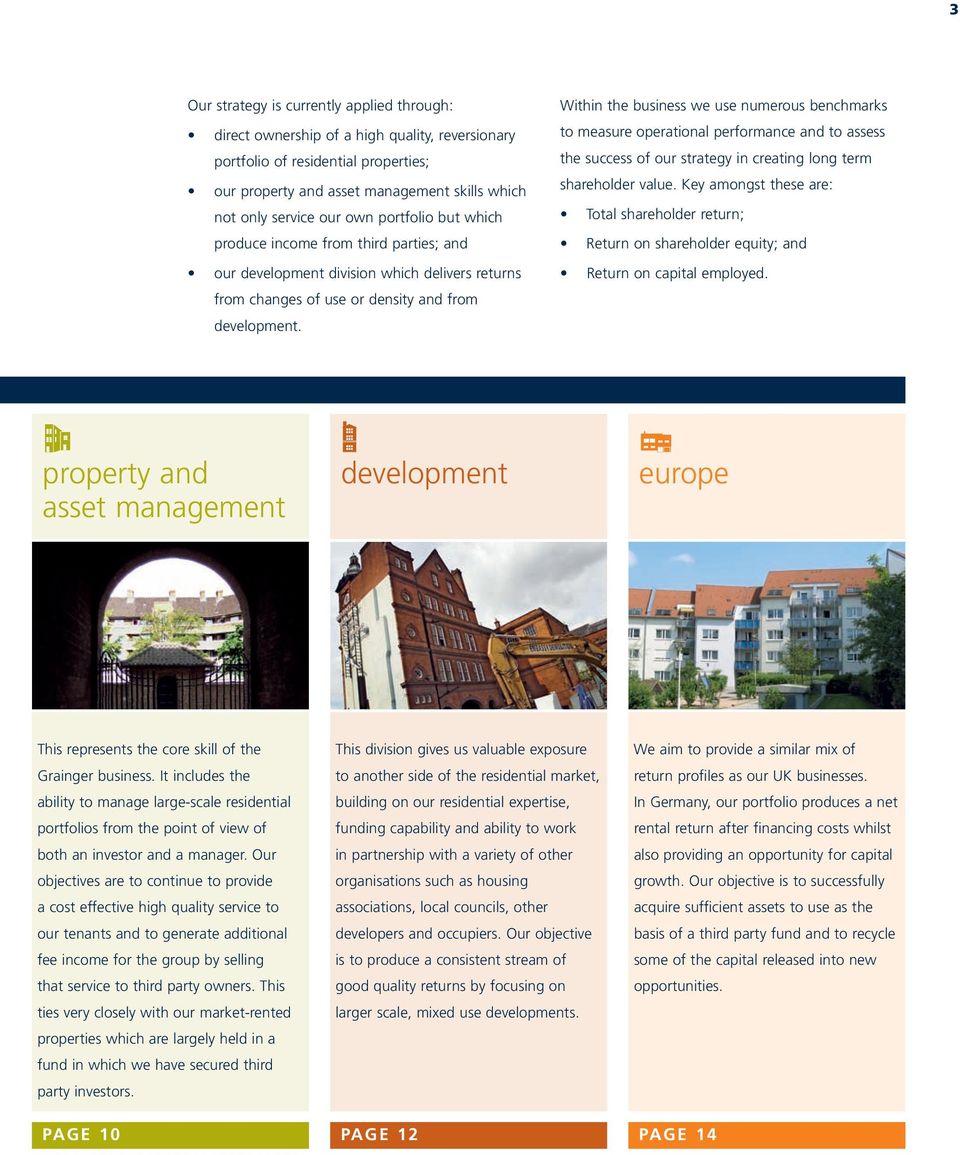
6 4 Grainger Trust plc Annual report and accounts 2006 graingerinvests Regulated tenancies Grainger own over 7,700 regulated residential properties, valued at over 1bn. Our tenants have security of tenure and pay a fair rent. This portfolio is core to our business and provides significant, predictable ongoing cash flows from rents and sales proceeds. Grainger s core business remains the ownership, management and trade of residential properties which are subject to regulated tenancies. Under this arrangement, the tenant can stay in the property for the rest of their life. The rent is set by an independent rent officer and is usually less than that which would be achieved if the property was let on the open market. We buy these properties at a discount to vacant possession value (the price achievable without a tenant in place) to reflect the low rent we receive and the fact that the tenant has lifetime rights of occupation. When the tenant leaves we sell the property into the owner-occupier market, realising the discount and any house price inflation from the date of purchase. 14% NORTH & SCOTLAND 261m 18% MIDLANDS/EAST 331m 20% These properties give us two sources of income rents and the profits made when they are sold. The size and geographic spread of the portfolio (some 7,700 units across the UK), combined with the fact that we buy and sell properties over long periods of time, help to protect us against some of the risks associated with residential investment in particular a short term or localised fall in house prices. OTHER SOUTH LONDON 363m 48% 864m Due to a change in the law, no new regulated tenancies have been created since January 1989 so the overall number in existence is falling from year to year. We make every effort to replace the regulated properties that fall vacant and are then sold but inevitably the portfolio will decline over time. The management and trading skills that we have developed over many years working with the regulated portfolio are now being applied to our other areas of residential ownership such as equity release and market let properties. WHOLE UK RESIDENTIAL PORTFOLIO BY GEOGRAPHY, INCLUDING SHARE OF JOINT VENTURES ( M) (INVESTMENT VALUE)

7 5 LOCK HOUSE was purchased at auction. This unique property in East London is occupied by a regulated tenant. ESSEX PORTFOLIO one of the 21 attractive, rural, regulated properties acquired in October GLOUCESTER ROAD, South Kensington, London was acquired in June Three of the six apartments are regulateds. WALBOTTLE HALL COTTAGE forms part of a mixed tenure portfolio of 84 properties, acquired in September 2006 from the Duke of Northumberland. The properties are predominantly located in attractive and desirable rural locations where excellent capital growth potential exists. the vacant possession value of our 7,715 regulated properties is 1,403m
8 6 Grainger Trust plc Annual report and accounts 2006 graingerlets Market tenancies are those properties let at market rates on assured shorthold tenancy agreements, typically six months or a year in length. The majority of these are now held in our recently launched co-investment Fund, G:res 1. Although Grainger s core tenanted residential business has been in regulated tenancies, we also built up a large high quality market-rented portfolio of properties, much of which came from our acquisition of City North Group plc in During the course of the year, in common with many other property companies, we transferred these assets (some 1,044 units worth approximately 200m) to a Jersey Property Unit Trust with a view to attracting third party equity investment into the fund. The successful first close was announced on 22 November 2006 with committed equity from a number of institutional investors. This, together with currently available bank finance of up to 125m, should enable this fund to grow to achieve significant assets under management. Such structures enable us to not only retain a geared exposure to the residential investment market through our retained ownership but also to provide us with a valuable source of both property and asset management fees, enhancing the overall return. There is also the potential to earn performance fees. In addition to providing management services to G:res 1, we also continue as property advisor and provide property management services to Schroder s ResPUT, a market let fund. We also own a 22% stake in this fund, which at the year end was valued at some 19m.

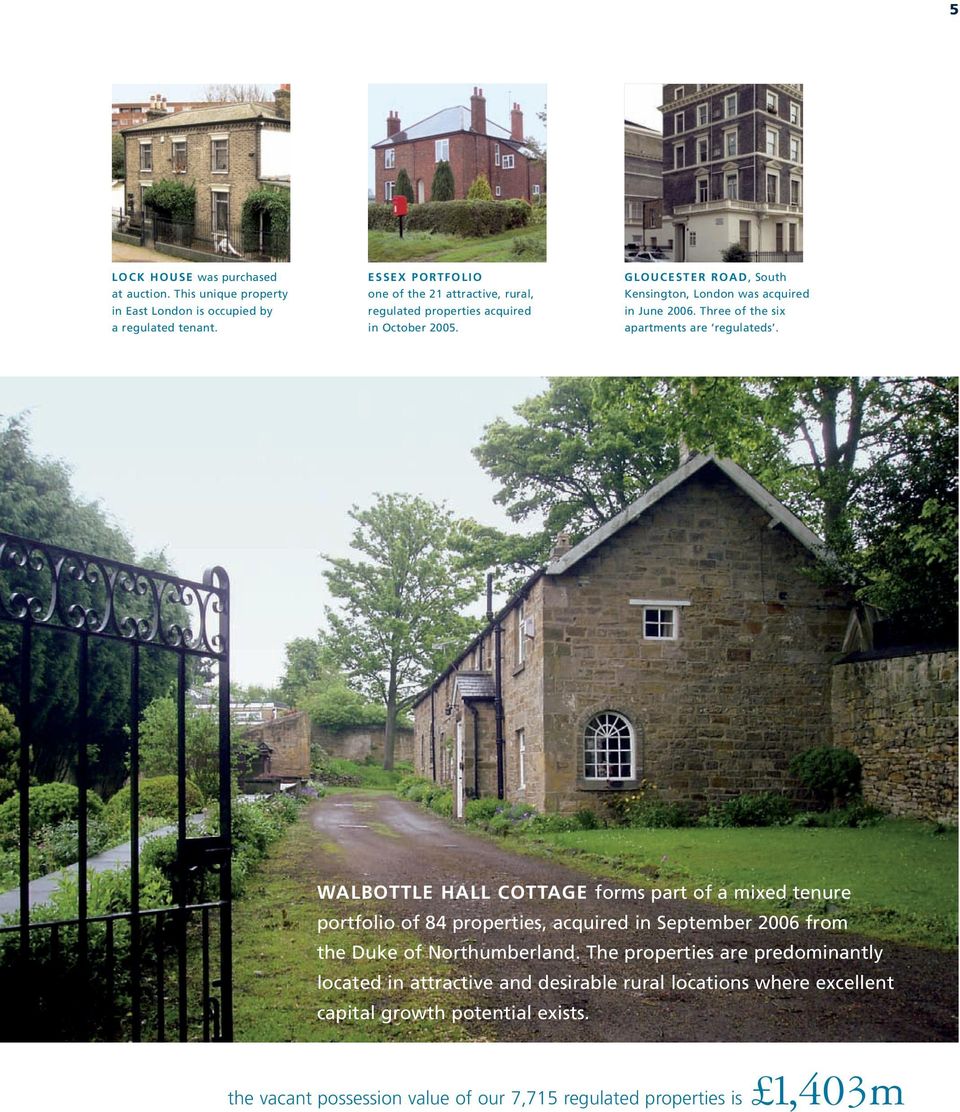
9 7 THE COURTYARD, KEMPSHOT PARK is a block of 25 apartments and two retail units specifically developed by Grainger in 2005 for the letting market. All of the apartments were let within one month following completion of the works. The building has a gross yield of approximately 6%. G:res 1 has property with a total value of 210m PITMASTON COURT, Birmingham, is a purpose-built 1930s art deco block comprising 65 recently refurbished flats. SHILLINGTON OLD SCHOOL, Clapham, formerly a Victorian school, now comprises 58 apartments and studios. BETHNAL GREEN is a mixed use estate in East London. There is a rolling programme of refurbishment and improvement.

10 8 Grainger Trust plc Annual report and accounts 2006 graingerinnovates Equity release offers home owners in or near retirement the opportunity to access some of the value of their home while continuing to live there for the rest of their lives. Grainger specialises in home reversions, which can provide customers with both certainty and access to more cash than a lifetime mortgage. Grainger constantly seeks innovative ways to maintain long term investment exposure to the housing market. One of our major initiatives over the last few years has been in the area of flexible retirement solutions and in particular, the sale of home reversion plans. These plans are part of the wider equity release market and enable home owners to raise cash from what is usually their most significant asset their home. Under a typical plan, we buy some or all of a home owner s property for a lump sum or series of payments which depend on the value of the property, the age of the owner(s) and the proportion they wish to sell. The owner can then stay in the property, rent free, for the rest of their life or until they decide to leave. At that point, Grainger is able to sell the property and realise its profit. The long term cash flows from this business provide a good strategic fit with the cash flows already being generated by the regulated tenancy business. We acquire home reversion assets from three main sources our own Bridgewater brand, through our distribution agreement with Norwich Union and through the direct acquisition of existing portfolios or home reversion plans from third parties. We expect the home reversions market to grow considerably in the next INVESTMENT VALUE m VACANT POSSESSION VALUE m few years as elderly people seek to release cash from their homes to supplement their pensions or to fund improvements in their lifestyles. We are also seeking opportunities to broaden the types of retirement products we can offer. INVESTMENT VALUE AND VACANT POSSESSION VALUE

11 9 Bridgewater Equity Release offers home owners aged 65 and over all the advantages of home reversions, with added flexibility. They choose how much equity in their home they want to release from a minimum of 25% and they can release further amounts at any time. 3,000 full or part-equity residential properties under home reversion plans A typical Grainger home reversion property is a 3 bedroom bungalow with a vacant possession value of some 200,000. The innovation award, won by Bridgewater in October Bridgewater won Best Provider Home Reversions in November 2006.

12 10 Grainger Trust plc Annual report and accounts 2006 graingerconnects Property and asset management We are proud of our skills as property and asset managers producing the required returns for our shareholders whilst ensuring that the needs of our customers are met. We also apply this added value owner s approach to the benefit of our increasing number of co-investment arrangements. One of Grainger s key strengths is our ability to manage property on a large-scale. Operating from seven UK offices and one in Germany, our property management teams look after almost 18,000 homes and are trained to understand all types of property and tenure. Residential property management is a demanding role requiring complex daily decisions. We fulfil our obligations as landlords and provide excellent service to our customers whilst protecting the value of our assets and enhancing the performance of our portfolio. Our property management professionals are skilled at balancing these demands. Further, our property management and sales and acquisitions teams work together to ensure that the correct strategy and targets for the portfolio are set at the outset and that the right blend of refurbishments, sales and acquisitions achieve the required performance. We believe that our combination of large-scale residential ownership and nationwide management capabilities provides us with a unique offer to third party partners. We currently provide such services to the Schroders ResPUT residential investment and to two partnerships set up between Grainger and the Genesis Housing Group. We also service G:res 1, our own residential fund which was launched in November This fund will act as a blueprint 13,226 13,567 15, for our ambitions to grow our business as a co-investing fund manager; a model which could be applied to all of our business sectors. NUMBER OF UK PROPERTIES MANAGED

13 11 BERKELEY PARK we successfully completed a project to create an additional 17 studio apartments and a new reception area at this serviced apartment development near Heathrow. WELLESLEY COURT, Twickenham, is a 1930s block of 24 apartments. We created five additional apartments in the roof space. DIBDIN HOUSE, MAIDA VALE was included within the first portfolio of three estates acquired from the Church Commissioners in a joint venture with Genesis Housing Group. The three estates will undergo a comprehensive refurbishment programme, increasing the value of our investment and also improving the environment for our tenants. CAVENDISH STREET is an off-market acquisition made on behalf of Schroders ResPUT. managing some 18,000 properties

14 12 Grainger Trust plc Annual report and accounts 2006 graingerdevelops Development Grainger s evolving development business is increasingly focused on large and complex mixed use projects. The recently strengthened management team is based in London, Newcastle and Oxford, thus ensuring good geographic coverage. Working as either principal or with joint venture partners, Grainger has a diverse portfolio of existing development opportunities. Grainger is keen to maintain its exposure to all sectors of the residential market. One way in which we do this is through our development division. Our interests range from strategic land holdings to large-scale mixed use developments, often in co-operation with a funding or development partner. Our development division produces added value through gaining planning permission with a change of use or density, or through physical development. One example of this is the acquisition of green or brownfield land sites and, over time, obtaining planning permission for residential or mixed use developments. We are increasingly involved in large mixed use developments where our residential expertise can be used to good effect with the skills of other development partners for example, during the year we announced a collaborative agreement with Development Securities plc. Since the year end we have entered into our first transaction under this agreement for the development of a 10 acre site in Birmingham.
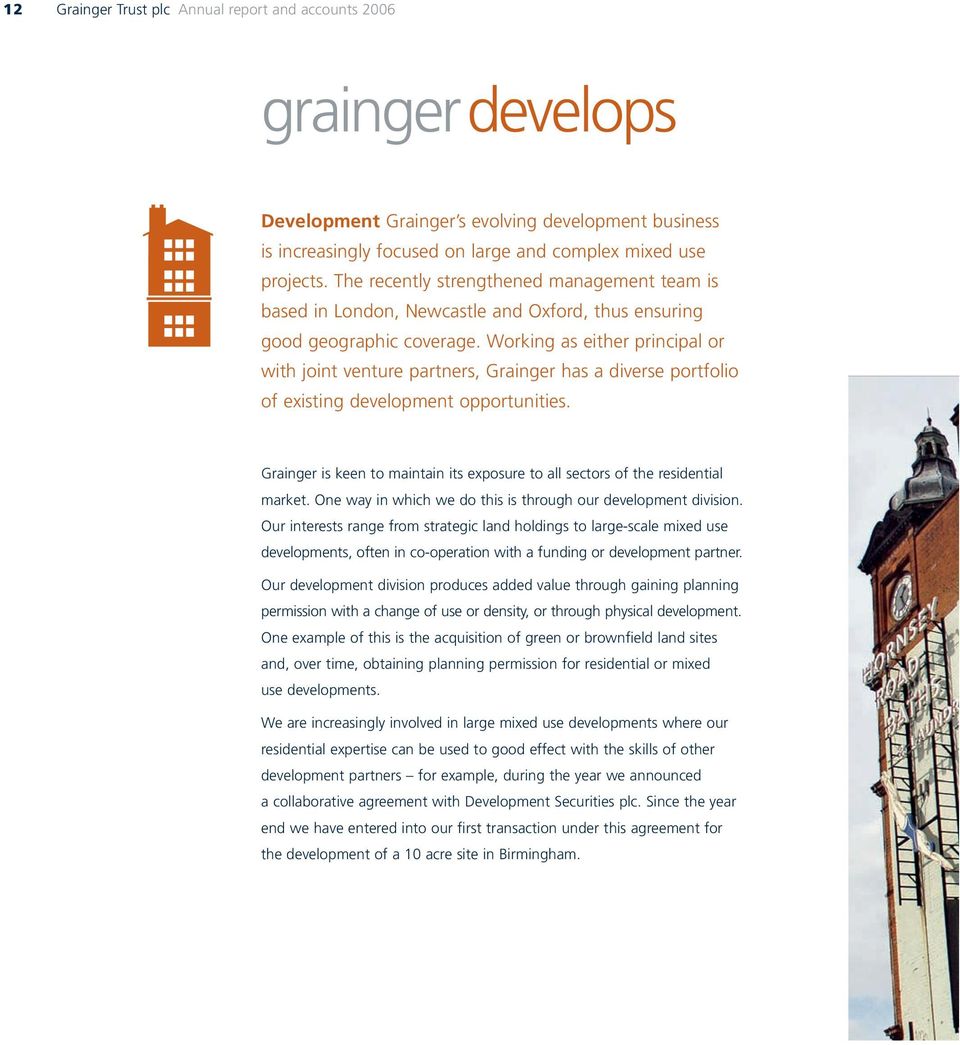
15 13 MACAULAY ROAD Detailed planning consent was obtained in 2006 for 94 residential units and a 26,000 sq. ft. office building. NEWLANDS, WATERLOOVILLE, will provide 1,550 residential units and one million sq. ft. of commercial space. HORNSEY ROAD will include 145 private residential units, 62 affordable units and a 40,000 sq. ft. office building. Demolition will be finished in early 2007 and completion is due during summer end value of our development portfolio 675m

16 14 Grainger Trust plc Annual report and accounts 2006 graingerexpands Europe represents an opportunity for Grainger to expand and use our skills and experience in new and less developed residential markets. As owner occupation increases, Grainger is well positioned to take advantage of this trend and build a profitable part of the business. Grainger is seeking to replicate some of the main characteristics of our UK activities in mainland Europe long term exposure to the tenanted residential market and residential development opportunities. Our main focus for residential investment is currently Germany where we have recently built up a portfolio of some 3,000 residential units. We see the German market as providing opportunities for an experienced professional landlord such as Grainger. The low price per unit relative to other European markets and the low level of home ownership (42% compared to an average of 59% in the rest of the European Union) augur well for future capital growth. The attractive financing environment also means that net rents can exceed financing costs, unlike the UK market where low residential net yields require an element of house price inflation to produce an acceptable total level of return. In the future our European tenanted residential assets could form the basis for us to act as a co-investing fund manager on a much larger scale the recent opening of our management office in Mannheim is the first step in this journey. 1,501 units 935 units 303 units On the development side we have two relatively small but exciting ventures with experienced local partners in Estonia (Tallinn) and the Czech Republic (Prague). We continue to look for other markets where we can utilise our skills to achieve appropriate returns. GERMANY Our investments in Germany are in 3 main regions Metro-Ruhr, Baden-Wurttemberg/Bavaria and Berlin

17 15 2,739 residential units exchanged in three regions of Germany GERMANY is in a different stage in the residential cycle to the UK and has had in aggregate, flat house prices for a decade. With economic growth returning, we think now is a good time to invest. A Grainger Property in Mannheim. A Grainger Property in Karlsruhe. A Grainger Property in Böblingen.

18 16 Grainger Trust plc Annual report and accounts 2006 highlights % Grainger NAV up to 595p +10% dividend increased to 5.62p per share 39.1% total shareholder return for the year +19% increase in market value of property assets to 1.9bn 314m total UK and European residential acquisitions in the year 1,294 1,438 1,597 1, GROSS PROPERTY ASSETS GROSS NAV PER SHARE (PENCE)* DIVIDENDS PER SHARE (PENCE)** * 03 and 04 are under UK GAAP, 05 and 06 are under IFRS, there are no material differences. ** Dividends per share relate to the total of the interim and final declared for the financial year.

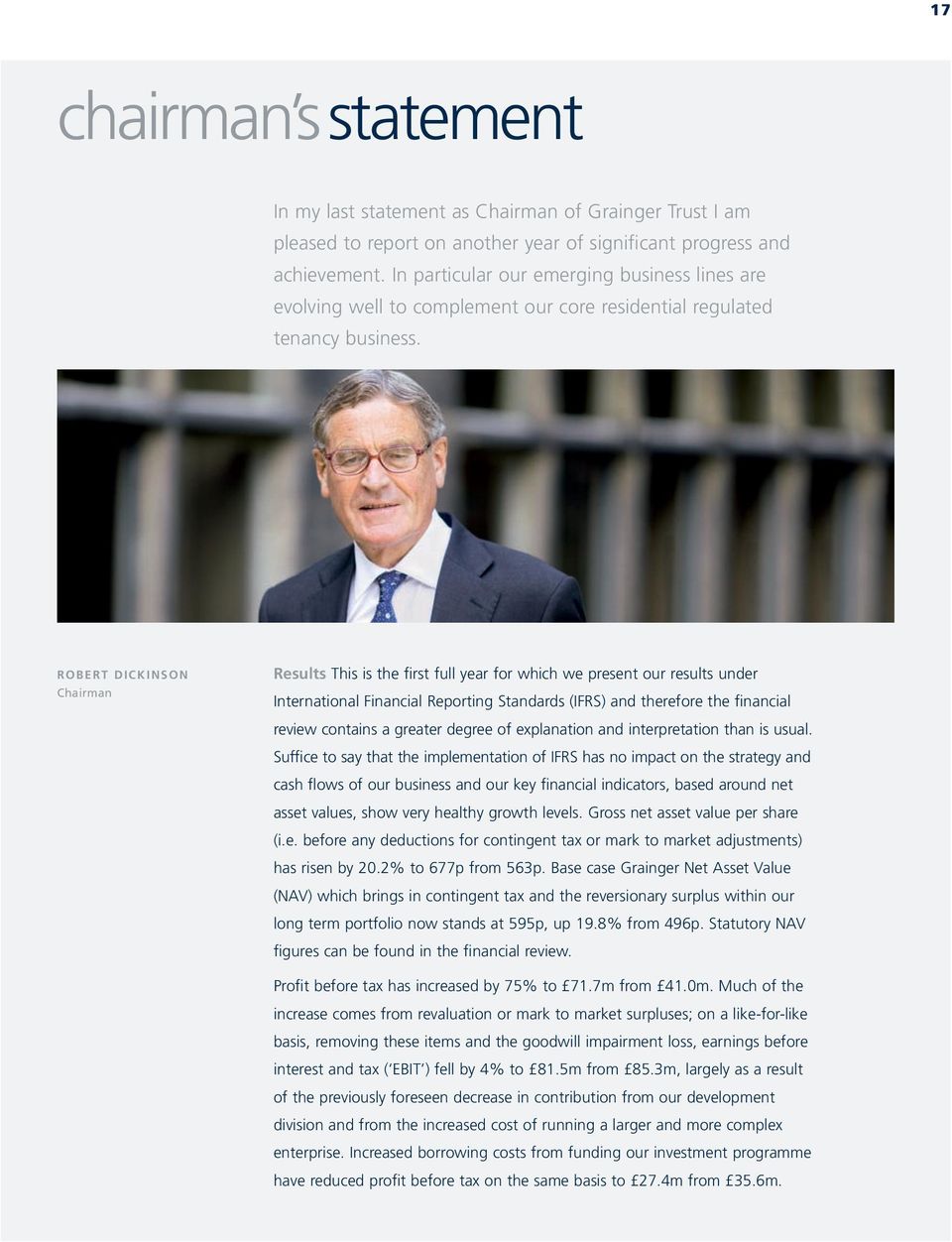
19 17 chairman sstatement In my last statement as Chairman of Grainger Trust I am pleased to report on another year of significant progress and achievement. In particular our emerging business lines are evolving well to complement our core residential regulated tenancy business. ROBERT DICKINSON Chairman Results This is the first full year for which we present our results under International Financial Reporting Standards (IFRS) and therefore the financial review contains a greater degree of explanation and interpretation than is usual. Suffice to say that the implementation of IFRS has no impact on the strategy and cash flows of our business and our key financial indicators, based around net asset values, show very healthy growth levels. Gross net asset value per share (i.e. before any deductions for contingent tax or mark to market adjustments) has risen by 20.2% to 677p from 563p. Base case Grainger Net Asset Value (NAV) which brings in contingent tax and the reversionary surplus within our long term portfolio now stands at 595p, up 19.8% from 496p. Statutory NAV figures can be found in the financial review. Profit before tax has increased by 75% to 71.7m from 41.0m. Much of the increase comes from revaluation or mark to market surpluses; on a like-for-like basis, removing these items and the goodwill impairment loss, earnings before interest and tax ( EBIT ) fell by 4% to 81.5m from 85.3m, largely as a result of the previously foreseen decrease in contribution from our development division and from the increased cost of running a larger and more complex enterprise. Increased borrowing costs from funding our investment programme have reduced profit before tax on the same basis to 27.4m from 35.6m.
20 18 Grainger Trust plc Annual report and accounts 2006 chairman s statement continued a final dividend of 3.75p per share total dividend for the year of 5.62p per share We are again increasing our dividend by 10% per annum and consequently the board are recommending a final dividend of 3.75p per share. If approved, this will be paid on 6 March 2007 to shareholders on the register on 16 February Together with the interim dividend of 1.87p per share paid in July this will produce a total dividend for the year of 5.62p per share (2005: 5.11p). Strategy and Outlook Grainger has been successful at delivering consistent shareholder value over a sustained period of time. Over the last ten years our average total shareholder return has been 28.4% per annum. By comparison, over the same period, the FTSE 250 has delivered average annual returns of 13.6% and the UK Real Estate Sector 15.9%. Our performance has largely been based on the trading profits and revaluation surpluses generated by our substantial residential portfolio. It is our aim to continue to deliver superior returns to shareholders. Whilst we believe that a major part of this will come from the core regulated portfolio we also acknowledge that Grainger must evolve over time to replace those returns as the overall stock of regulated assets declines. Grainger s key strengths come from a combination of its asset base, sound financial platform, reputation with key stakeholders and experience and expertise in the residential market. We have ambitious plans to leverage these to expand the range and depth of the Grainger business to ensure further growth in shareholder value. These include introducing third party capital (both debt and equity) to improve the efficiency of our capital structure and to achieve significant scale more quickly but without taking on disproportionate risk. This will also be achieved by working with joint venture and collaborative partners and using our management skills to produce fee income for the group at little or no incremental cost. We have already made significant progress with these plans, including the introduction of equity funding in our Jersey Property Unit Trust, G:res 1, by bringing in non-recourse debt to our European business and some equity release interests, by working with joint venture partners to acquire both residential and development assets and by acting as property and asset managers for a number of third parties. This evolution will continue and as our various portfolios mature and reach critical mass we can foresee a time when our returns will come from a more balanced combination of direct property ownership, co-investment in residential funds and fee income. In the long term, this will help us deliver sustainable

21 19 performance driven returns and thereby further enhance shareholder value. We see a real opportunity for Grainger ultimately to become the leading European co-investing fund manager in residential property. As shareholders will be aware, a consortium comprising Regis, Merrill Lynch and the William Pears Group announced in October that it was assessing the attractions of making a proposal regarding a possible cash offer for Grainger. Later that month, the consortium announced that it had no present intention of making an offer. I can confirm that their activity did not deflect the Board of Grainger or its executive management from the strategy outlined above. Prospects We have great belief in Grainger s ability to deliver attractive returns to shareholders: we have a unique and irreplaceable portfolio, unrivalled expertise and a very strong reputation amongst our stakeholders; the existing business model has substantial income and growth potential; we can create additional income and shareholder value by moving towards a co-investing fund management model; and our ability to work with co-investors and other partners has been illustrated by our joint venture relationships, our launch of G:res 1 and our agreement with Development Securities plc. These are exciting times for Grainger and I leave the board optimistic and confident about its future prospects. The group has considerably changed the way in which it operates over the last few years and to reflect those changes we consider it appropriate to move forward with a clearer identity one which is more in keeping with the reputation and image we intend to present in the future. Consequently, we will propose to our shareholders at our Annual General Meeting a change of name to Grainger plc. I would like to take this final opportunity to thank all of our staff for the commitment and expertise they have demonstrated not only during the year but also throughout my time as a director. Robert H. Dickinson 22 December 2006
22 20 Grainger Trust plc Annual report and accounts 2006 chiefexecutive sreview Our major business areas share a common theme: an ability to generate superior returns through our expertise in owning, managing, developing and trading residential property either directly or as co-investor. We are pleased with the progress made in these areas in the year and are excited by the opportunities we are creating. RUPERT DICKINSON Chief executive The Market The UK residential market has shown strong levels of growth in the 12-month period to the end of September both the Nationwide and the Halifax House Price Indices showed year-on-year growth of 8.2%. Healthy growth levels were recorded in most parts of the country with London and the South East showing particular increases in the latter part of the year. Our own portfolio, which has some 59% by value in London and the South East, showed an average increase of 9.1%. The increase in interest rates in August has done little to deter price growth and it is too early to say what impact the November movement will have, although it is likely that lenders will pass on a higher proportion of the increase to their customers than seems to have been the case to date. Since September, we have seen the annualised October Halifax Index rise to 8.7% and sales from our own portfolio have been achieving prices 3% above our September vacant possession values. This figure should, however, be treated with some caution because of the relatively low number of transactions involved.
23 21 The UK residential market has shown significant growth levels over extended periods of time: the average UK house price in 1986 was 41,000; in 2006 that has risen to 181,000, an annual compound growth rate of just under 8%. Much of this has come in the last five years where the equivalent rate has been 14%. Whilst the economic and interest rate outlook are likely to dampen these rates, we still remain confident of the long term potential of the residential market. We believe that our core portfolio is particularly well placed to withstand short term fluctuations. It has a broad geographical base but also a strong core in London and the South East where average annual values are expected to remain firm because of high demand. The average vacant possession value of the individual properties in our main reversionary portfolio, the regulated tenancies, is 182,000 and some 31% of the portfolio is within 20% of that figure. We have relatively few properties at the more volatile top end of the market and as the majority of our properties are unmodernised there is usually strong demand from first or second time buyers and property developers who wish to improve the property. Geographic distribution of UK residential portfolio (figures include our share of joint ventures) Investment % of value m value London % South East % South West 96 5% East 112 6% East Midlands 73 4% West Midlands 134 7% Wales 12 1% Yorkshire 68 4% North West 140 8% North East 39 2% Scotland 13 1% Northern Ireland 1 1, % AVERAGE VACANT POSSESSION VALUE OF GRAINGER S PROPERTIES REVERSIONARY SURPLUS m (the difference between vacant possession value and investment value) GRAINGER TRUST FTSE 350 REAL ESTATE FTSE 250 INDEX Source Datastream Grainger s share price was 628p at the year end, up 38% on last year s closing share price and up 315% on the share price five years ago.
24 22 Grainger Trust plc Annual report and accounts 2006 chief executive s review continued Our Business Core Portfolio Regulated Tenancies Our core portfolio consists primarily of regulated tenancies which account for 54% by value of our total property and investment interests. At 30 September 2006, we owned 7,715 regulated units valued at 1,090m (2005: 8,161 units at 984m). At the same date, the vacant possession value (the value at which we hope to sell them when vacant at today s prices) of the regulated portfolio amounted to 1,403m (2005: 1,349m). Including our share of regulated tenancies held within joint ventures, the vacant possession value becomes 1,474m (2005: 1,367m). The regulated portfolio is valued by deducting a discount from the vacant possession value. This discount takes account of the fact that the rental yield is generally below market rates and that it may be some years before we obtain vacant possession and can then sell the property. Over time, this discount has narrowed although for the last few years we have used a rate of 27.5%. Strong market and transaction activity has led us to believe that this discount is conservative and our valuers have now certified the valuation of these properties at 77.5% of vacant possession value a discount of 22.5%. This realignment has produced an increase in value at the year end of 67m. In addition to regulated tenancies, our core portfolio includes a further 652 units comprising vacants, assured tenancies short term lets, and other interests. These units have a value at 30 September 2006 of 141m (2005: 117m) and their vacant possession value is 160m (2005: 124m). Range of residential vacant possession values (excluding other interests and share of joint ventures) Vacant No. of possession properties value m > 500K K 500K 1, K 250K 3, K 175K 4, < 100K 2, ,420 2,340 NB: shows full vacant possession of equity release assets even if we own less than 100%. Sales in this division have remained constant at 126m and margins on normal sales (i.e. when a property is sold on vacancy as opposed to with a tenant in situ) amounted to 48.6% (2005: 48.5%). Including net rental and other income of 24m, the regulated
25 23 portfolio produced an operating contribution of 76m (2005: 74m). The 2005 figure includes market rented properties transferred to the Jersey Property Unit Trust (JPUT) as explained below. Analysis of residential sales in the year (from stock and fixed assets) Trading Sales profit/profit proceeds on disposal No. m m Regulated (including APT) Assured Vacant Equity release Other The highlight of the year was the acquisition of five London flat blocks for 196m from the Church Commissioners in the second 50:50 joint venture of this type with Genesis Housing Group. For a portfolio of this type it is essential that we recycle capital during the year, we acquired 325 units for a consideration of 44m. The highlight of the year, however, was the acquisition of five London apartment blocks for 196m from the Church Commissioners in the second 50:50 joint venture of this type with the Genesis Housing Group. This portfolio included 429 regulated units. Analysis of acquisitions in the year Vacant Cost possession No. m value m Regulated (including APT) Assured Vacant Equity release Other Equity Release The equity release business is a strong fit and a natural investment channel for the surplus cash generated by our regulated business. We are building up a highly reversionary portfolio which will provide us with the long term geared exposure to the residential market that we strategically seek. We have been building our portfolio through three primary routes our distribution agreement with Norwich Union, portfolio acquisitions and our Bridgewater brand.
26 24 Grainger Trust plc Annual report and accounts 2006 chief executive s review continued Industry figures from Safe Home Income Plans ( SHIP ) indicate that we are now providing 44% of all new home reversions in the UK. The market value of our 3,003 unit equity release portfolio at 30 September 2006 stood at 241m, with a vacant possession value of 421m (2005: 2,663 units with a market value of 196m, vacant possession value of 354m). During the year, we acquired 432 units for 29m and sold 110 units for 13m. The division produced an operating contribution of 3m (2005: 4m). Average vacant possession values in our three key portfolios are: 000 Regulated 182 Market rented 196 Equity release 203 Overall (excluding other interests) 188 This is a market in which critical mass, service integrity and product innovation and development are key. We were therefore delighted to receive the Award for Innovation at the Investment, Life and Pension Awards Critical mass will enable us to put in place more efficient forms of financing, while product development will help us to provide a greater selection of retirement solutions to potential customers. Since the year end we have announced an offer to acquire a portfolio of over 900 retirement properties, which are subject to lifetime leases, or are currently vacant. Market-Rented Properties Over the years, the group has acquired a number of market rented properties usually as a result of purchases of mixed tenure portfolios. This was bolstered by the acquisition of City North Group plc in 2005, and by the start of this financial year we owned 1,102 market rented properties with a value of 188m. We believe that we can maximise returns from such a portfolio by introducing third party equity and non-recourse debt, with Grainger retaining a substantial investment and obtaining the benefit of asset and property management fees. Consequently, during the year, we transferred the bulk of our market rented properties to a JPUT and then marketed the holding as G:res 1, an independent Jersey exempt company, to institutional investors. Although we still owned all of the units at 30 September 2006, we announced first closing on 22 November 2006 having raised third party equity commitments of 56m. We are expecting to secure further equity commitments of 69m in due course and see this as a model for other co-invested funds which we could establish.
27 25 In G:res 1 at the year end, we had 1,178 market rented properties with a market value of 210m and a vacant possession value of 238m, producing operating profit before valuation gains of 4.6m. Property and Asset Management One of Grainger s key strengths is its ability to provide property and asset management services to third parties with the specialist expertise derived from being a substantial owner in its own right. Almost uniquely we can provide these services across the UK through our seven managing offices and network of managing agents. We expanded this capability into mainland Europe in October when we opened an office in Mannheim to manage our growing German residential portfolio. shortly after the year end we closed G:res 1 our market rented fund with equity committments of 56m In total we employ 103 staff in our property and asset management division. As well as taking responsibility for our own UK portfolio of 12,420 residential units they also provide services for a total of 2,801 units for third party owners or for joint venture vehicles in which we are participants. This includes the Schroders ResPUT, in which we hold a 22.3% stake and the joint ventures with the Genesis Housing Group. Our property managers also support our own market rented fund, G:res 1, which was valued at 30 September 2006 at 210m; we anticipate that, before any performance related elements, this will generate annualised fee income for the group of approximately 2.2m. Our total recurring fee income will be approximately 4m per year. We see great potential for the fund management structure to be applied to other areas of our business, most obviously our European portfolio. Analysis of tenanted residential portfolio by tenure Vacant % of vacant No. of possession Investment possession properties value m value m value Regulated 7,715 1,403 1,090 78% Assured 1, % Vacant % Equity Release 3, % Hotel complex short term lettings % Other interests % Share of joint ventures % 30 September ,420 2,385 1,819 76% 30 September ,382 2,067 1,507 73%
28 26 Grainger Trust plc Annual report and accounts 2006 chief executive s review continued the value of our UK development portfolio stands at 97m (including share of joint ventures) Development Grainger Development is an important profit contributor to the group and provides us with entrepreneurial development skills which complement our other spheres of residential expertise. We have refined our focus in this division to concentrate on larger scale residential or residential-led mixed use opportunities, particularly in those areas where the longevity of the project, the need to work with partners or the nature of the development itself makes it unsuitable for housebuilders. At the year end, the value of our UK development portfolio stood at 90m (2005: 124m) and the division produced operating profits and profits on the sale of fixed assets totalling 7m (2005: 13m). Major gross contributions were 2.8m from The Glasshouse, Putney, 2.5m from sales of three properties in Slough and 2.3m from the ongoing sales of Grainger Homes sites. The decrease in returns compared to the prior year was foreseen and reflects the predictable but volatile nature of the profit stream in any development business. It is our ambition to enable this division to produce a more steady flow of returns but given that many of our current projects are at an early stage of development, this may be some time in the future. At 30 September, the completed development value of our sites is estimated at 675m, of which 178m has planning consent. Major development projects Estimated Income Project Description Status end value expected from West Waterlooville 520 acres of greenland Outline planning Land Phase 1 105m 2008 in Hampshire application submitted Phase 2 unknown Macaulay Road, 94 residential units Planning consent 48m 2008/09 Clapham. SW4 26,000 sq. ft. office obtained Barnsbury Complex, 140 residential units Detailed planning 44m 2009/10 Islington consent obtained Hornsey Road Baths, 200 residential units and Detailed planning 44m 2007/08 Islington community buildings consent obtained Wards Corner, 327 residential units, Cooperation agreement 102m 2008/09 Seven Sisters 53,000 sq. ft retail signed Newbury 331 units Preferred developer 73m 2008/09 47,000 sq. ft. retail status Gateshead College residential units Site under contract. 47m 2009/10 Planning application to be submitted in 2008
29 27 During the year, we outsourced project management and delivery responsibility for Grainger Homes to its then management. Although we retain ownership of the existing sites, representing a future bank of some 318 new houses and will receive profits as they are sold, it is not our intention to have future involvement in small-scale housebuilding activities where we are competing directly against national and/or local housebuilders. There has been significant progress in planning on our major sites in the year. At the Barnsbury Complex in Islington we have achieved detailed planning consent on a scheme comprising 140 private and affordable residential units. At Hornsey Road Baths, Islington, we have commenced demolition at the start of the development of new council offices, 200 private and affordable units and community buildings. We were also pleased to obtain planning consent for 94 residential units and a 26,000 sq. ft. office building at Macaulay Road, Clapham after many years of endeavour. We have also submitted an outline planning application for 1,550 residential units, 12 hectares of employment use and 14 hectares of mixed use at our site at West Waterlooville. Other major sites in our current portfolio include two large residential schemes in the North East of England which will deliver approximately 300 housing units. Further details on when these projects are expected to become income producing are shown in the Financial Review later in this report. The division s future pipeline includes a scheme above Seven Sisters underground station for 327 residential units and 53,000 sq. ft. of retail under a co-operation agreement with the London Borough of Haringey and appointment as preferred developer by Newbury Council to develop 331 units and 47,000 sq. ft of retail at Market Street in the town centre. Since the year end, we have been delighted to announce the first joint venture acquisition with Development Securities plc under the co-operation agreement we revealed previously. This is for the 10 acre Curzon Park site in Birmingham, with an end value in the region of 350m- 400m. It will provide a mixed use scheme of c. 1.4 million sq. ft. to include c. 800,000 sq. ft. of grade A office space, c. 400,000 sq. ft. of residential accommodation, a 180 bed hotel and c. 30,000 sq. ft. of retail space. We see our ability and willingness to work with partners (other developers, land owners, councils, housing associations) as being key to giving us access to the larger mixed use residential-led schemes on which we aim to focus. This enables us to achieve scale without taking on a disproportionate level of risk. We have invested heavily in the human capital of this division in the year and feel that we now have the team to deliver our vision.
30 28 Grainger Trust plc Annual report and accounts 2006 chief executive s review continued Europe At this stage last year we were looking forward to completing our first acquisition of 1,406 German residential properties. At 30 September 2006, the portfolio stood at 2,739 units and, as announced in October, we have acquired a further 308 units in Munich with anticipated completion early in Geographic analysis of German portfolio m 000 Gross m Average Residential annual Purchase Purchase Net price Location units rent price price psm yield per unit Metro Ruhr 1, % 50.6 Baden-Wuerttemberg , % 76.3 Berlin % , % 59.7 Whilst we are constantly examining other areas for potential residential investment, Germany still holds attraction for us. A combination of low levels of home ownership, an attractive financing environment enabling us to achieve a positive yield spread, low price levels relative to other European markets and potential for rental growth provides good opportunities for experienced professional landlords. At 30 September, our portfolio comprised 186,844 sq. metres of residential space at a cost of 117m (generally below replacement cost) and providing an annualised gross rent of 7.5m. The operating contribution of the division in the year was 2.0m. There has been considerable comment on the opportunities for residential investment in Germany and it is clear that competition for portfolios is fierce. However, we are constantly pursuing opportunities and our decision to open a small management office in Mannheim illustrates our commitment and enthusiasm for this sector. It is our ambition to grow the German portfolio to a size where it becomes an attractive proposition for third party investment and where we can apply our strategic model for co-investing fund management. In addition to our residential interests we also have an 81.6% stake in a company registered in the Czech Republic. This company owns a well positioned development site of 21 acres in Zizkov to the East of Prague City Centre. The site is designated as a mixed use development site and we are hopeful of receiving a detailed planning consent in 2008.
31 29 Robert Dickinson We would also like to take this opportunity to pay tribute to Robert Dickinson who retires as Chairman at the conclusion of our next Annual General Meeting. Robert was made a director of Grainger in 1961 and has been Chairman since Since 1961, Grainger has evolved from a small family company through initial listing on the then Unlisted Securities Market, full listing and is now the UK s largest listed residential property company. This tenure has seen a remarkable period of growth and return. A shareholder who had invested 10,000 in Grainger shares on flotation in March 1983 would, at 30 September, have had shares worth 438,124 and would have benefited from 30,210 in dividends, including the proposed 2006 final dividend. Further, if dividends had been reinvested on receipt, the shareholder would, at 30 September, have had shares worth 738,565*. In a long term business like Grainger it has proved invaluable to have someone who has been able to provide unrivalled experience and knowledge of the group and its market over such a long continuous period. We have been fortunate to have been the recipients of his wise and expert leadership. Rupert J. Dickinson 22 December 2006 *Source: Datastream
32 30 Grainger Trust plc Annual report and accounts 2006 graingerworks As the Grainger business grows in size and complexity, it is essential that we have an appropriate management structure in place to achieve our objectives LEADERSHIP AND STRATEGY GROUP 1 MARIE GLANVILLE Company secretary and financial operations 2 DEBRA YUDOLPH Residential asset and property management 3 RICHARD EXLEY Development 4 PETER COUCH Equity release 5 QUINTON HILL-LINES Corporate development and fund management 6 CAMERON SPRY Europe 7 RUPERT DICKINSON Chief executive 8 ANDREW CUNNINGHAM Deputy chief executive and finance director During the year, the senior executive team (pictured) have made significant progress, working with the board to formulate future strategy for each distinct operating division with the aim of delivering growth within the existing capital structure. Currently, Grainger is valued primarily on the basis of net assets. We believe that future outperformance will be achievable if we are able to leverage our day-to-day operational expertise in managing, trading and developing residential property, with strategic corporate and financial skills not widely used or accepted in the currently fragmented residential investment sector. We are therefore continuing to invest in our management and staff as their proficiency and retention are key to our ongoing success.
33 31 financialreview This is the first year in which the group s results have been presented under International Financial Reporting Standards (IFRS) as endorsed by the EU. Although this has resulted in some material restatements of the statutory figures, the change of accounting basis has had no effect on our underlying business performance, and little effect on our primary Key Performance Indicators of net asset value. ANDREW CUNNINGHAM Deputy chief executive and finance director operatinghighlights 39.1% total shareholder return 26.5% return on shareholder equity 15.3% return on capital employed
34 32 Grainger Trust plc Annual report and accounts 2006 Financial Review continued Financial Position General Most of our properties are held as trading stock and are therefore shown in the statutory balance sheet at cost. This does not reflect the true worth of Grainger s assets and so we set out below a summary of our net assets with the properties restated to market value. Market value Statutory deferred tax Gross NAV Triple NAV balance and derivatives balance Contingent balance sheet adjustment sheet tax Derivatives sheet m m m m m m Properties 1, ,901 1,901 Investments/other assets Goodwill 2 (2) Cash Total assets 1, ,049 2,049 Borrowings etc (1,100) 2 (1,098) (5) (1,103) Other net liabilities (65) (4) (69) (69) Provisions/deferred tax (92) 89 (3) (243) 2 (244) Total liabilities (1,257) 87 (1,170) (243) (3) (1,416) Net assets (243) (3) Net assets per share (pence) 193p 484p 677p (187)p (3)p 487p 2005 Net assets per share (pence) 159p 404p 563p (165)p (9)p 389p The European Public Real Estate Association (EPRA) Best Practices Committee has recommended the calculation and use of a diluted EPRA NAV and a diluted EPRA Net Net Asset Value (NNNAV). The definitions of these measures are consistent with Gross NAV and Triple NAV shown in the above table. Market value analysis of property assets Shown as Market value Fixed assets stock at cost adjustment Market value at value Total m m m m m Residential , ,800 Development Total September , ,901 Total September , ,597 Net Asset Value Measurements of net asset value are Key Performance Indicators for the group. We set out three measurements to better enable shareholders to compare our performance with our peers, while reflecting the somewhat unique nature of our business.
35 33 Gross Net Assets Per Share Up 20.2% to 677p from 563p. This measure gives the market value net assets per share before any deductions for deferred tax on revaluation gains. The chart below shows the major movements in NAV in the year m 728m 563p Gross NAV per share Sept m 96p Revaluation surpluses 65m 50p Narrowing of regulated valuation discount 45m Triple Net Assets Per Share NNNAV Up 25.0% to 487p from 389p. This is the gross net assets per share figure adjusted for deferred tax on revaluation gains and for mark to market adjustments such as those arising from the restatement of financial instruments. It should be noted that the deduction for deferred tax assumes that all of the tax on the revaluation gains in our portfolio is payable immediately. With our long term reversionary portfolios (regulated and equity release) the assets will only be sold when vacancy arises and this will be some time in the future. As we know the average age 34p Retained earnings (63)m (49)p Elimination of previously recognised surpluses (20)m (17)p Other 879m 677p Gross NAV per share Sept 06 of our tenants we can estimate the timing of the vacancy and therefore also the timing of the crystallisation of the tax liability. If we were to discount this liability at our weighted average cost of capital, the deferred tax deduction would reduce by 112m and so our NNNAV would increase by 86p per share. Grainger NAV Base case up 19.8% to 595p from 496p. Grainger s NAV brings in the reversionary value which resides in our long term regulated and equity release portfolios. It adjusts NNNAV for the taxed present value of the reversionary surpluses in these portfolios which will revert over the expected duration of our tenants occupation. The major variables in calculating the Grainger NAV are: anticipated house price inflation over the reversionary period; the discount rate used to calculate the present value; whether deferred taxation on the revaluation surpluses recognised in our market value balance sheet is discounted; and the average period it will take to obtain vacancy. The base case Grainger NAV takes a very prudent approach to these key assumptions as follows: house price inflation is taken as zero over the entire expected remaining period of occupation by the tenants; we have used a discount rate of 8.67% (our weighted average cost of capital plus 3%); deferred taxation on revaluation surpluses has not been discounted; and we have taken the period of reversion as being 12 years for our regulated tenants and 9.5 years for our equity release tenants. We update these figures each year. To illustrate the sensitivity of the Grainger NAV under different assumptions, we have prepared a financial model on our website where these figures can be flexed. Some illustrative examples are: No discount of deferred tax Discounting deferred tax Discount rate Discount rate Discount rate Discount rate House price inflation per annum WACC +3% WACC WACC +3% WACC 0% 595p 634p 708p 720p 4% 654p 715p 767p 801p 6% 693p 768p 806p 854p
36 34 Grainger Trust plc Annual report and accounts 2006 Financial Review continued Other Financial Performance Measures As well as NAV measures we use other key performance indicators to evaluate our financial performance: Total shareholder return for the year was 39.1%, an increase of 13.2 percentage points over Return on shareholder equity (measured as the growth in NNNAV plus dividends per share as a percentage of opening NNNAV) was 26.5%, compared to 6.0% in Return on capital employed (measured as profit before costs of financing together with all revaluation surpluses as a percentage of opening gross capital) was 15.3%, an increase of 9.1 percentage points over Financial Performance in the Year Operating profit before fair value movements fell from 85.3m to 81.5m in the year, the major changes as shown below: Our total administrative costs in the year of 32m have risen from 22m in The major increases have come from a series of one-off costs (City North and development division re-organisations, various transaction costs) and from the investments in high quality staff we are making in our emerging business lines (Europe, equity release and development). Many of our administrative overheads (property management, sales and acquisitions, and our development division s costs) are directly attributable to operating divisions and for statutory disclosure purposes are netted off those income streams. Overall, 12m has been added to property expenses, 6m has been added to sales costs and 4m has been added to the cost of development sales. Earnings Per Share Basic earnings per share has increased by 57% to 39.1p from 24.9p as shown below: m 7.1m (2.5)m (2.9)m (8.8)m 3.3m 81.5m m 11m 8.4p (5)m (4.1)p (11)m (9.0)p 50m m 2005 operating profit Increase in gross rents Increase in property expenses and overheads Decrease in residential trading profits Decrease in development trading profits Operating contribution from our residential businesses (net rents together with trading profits and profits on sale of fixed assets) increased by 6.5% to 83m from 78m. As predicted last year, operating contribution from our development and trading division fell by 6m to 7m. Other 2006 operating profit before fair value movements and goodwill impairment m 31m 24.9p 2005 EPS (10)m (7.9)p Fall in operating profit before fair value movements 26.8p Increase in gain on revaluation of investment properties Increase in fair value of derivatives and financial assets Increase in interest payable Increase in taxation and other 39.1p The gain in valuation of investment properties of 39.9m has arisen largely from the establishment of our Jersey Property Unit Trust for market rented properties. On transfer, these assets were classified as investment properties and the uplift in value from cost is shown as a revaluation surplus EPS
37 35 Not all of our financial instruments met the complex hedging requirements of IAS 39 during the year and so movements in their fair value have been taken to the income statement. These amount to 10.4m. The vast majority by value of these instruments are now compliant and so value movements will be taken through reserves in future and we should see less income statement volatility. Our net interest bill has increased by 5.3m to 54.5m, with interest payable increasing by 8.9m. This is primarily as a result of higher average debt levels arising from our significant investment programme in Europe, equity release and in joint venture acquisitions. The average of our monthly debt levels has been some 188m higher in 2006 than Our annual tax charge is at an effective rate of 29.59%, the major items affecting it being: m Group profit before tax 71.7 Tax at 30% 21.5 Adjustments: Goodwill impairment (not allowable) 1.9 Utilisation of capital losses (6.4) Since the year end we have entered into a non-recourse 150m facility which will be drawn down to fund our German acquisitions. Also since the year end we have reached agreement with our major lenders to revise the terms of our core 1.3bn facility, which will spread the loan maturity dates and extend the average maturity by two years and which will reduce the overall borrowing margin by 13 basis points. Together with a reduction in commitment fees on any un-drawn facility this will produce an annualised saving of some 1.7m. At the year end, our net borrowings were 1,051m (2005: 861m) and our average cost of borrowings was 5.8% (2005: 5.9%). To protect ourselves against interest rate risk the group s treasury policy is to maintain a floating rate exposure of no greater than 35% of expected borrowings. At the year end, we were 66% economically hedged (2005: 76%) and at current levels of borrowing we have protection in place to meet our policy requirement for the next 2.5 years and have at least 250m of hedging for the next six years. Our loan to value ratio at 30 September was 52% (2005: 53%). Other including prior period adjustments 4.2 (0.3) Actual tax charge 21.2 Financial Resources The business continues to be highly cash generative. Cash from operating activities and from sales of investment property, amounted to 208m (2005: 174m). Andrew R. Cunningham FCA 22 December 2006 Out of this cash flow we paid interest of 55m, and tax of 15m and we reinvested a total of 301m in acquiring properties, funding development and investing in joint ventures. We borrowed an additional 165m, and the headroom on our core facility at the year end stood at 307m. This headroom affords us enviable strength in bidding for significant acquisitions.
38 36 Grainger Trust plc Annual report and accounts 2006 graingertargets corporate social responsibility The following symbol has been used throughout this section to cross-reference detailed information on the company website at I am pleased to report that CSR is gathering momentum within Grainger, and this year we have worked hard to achieve our targets. Our corporate culture is very dynamic and go-getting which has enabled us to embrace some of the challenges of CSR with gusto and creativity. I believe this responsiveness to change will increasingly be necessary in rapidly changing global markets, and in the face of new business risks such as climate change % ACHIEVED 50% ACHIEVED 75% ACHIEVED 100% ACHIEVED In 2006, Grainger developed a corporate environmental policy and we now look forward to further formalising our environmental commitments across areas of significant impact. We have reviewed and extended our community investment practices, both through active employment programmes run in conjunction with BiTC, and through our charitable activities. During the year, we also developed our new Employee Charter and launched an award-winning Payroll Giving scheme that has already been a tremendous success. Following a comprehensive Health and Safety (H&S) review across all of our activities, we now have robust procedures in place to manage, measure, monitor and reduce H&S incidents across the entire business. We have also continued to improve our customer service quality through extensive training of property managers, and issued clear concise guidance to our tenants on a variety of issues, including facilitating grant applications for them to improve heating and insulation standards in their homes. These are just some of the areas that we have been working on in the past year. This report summarises our achievements against our 2006 CSR targets, structured under our seven longer-term CSR objectives (reviewed and updated The above chart indicates the progress that Grainger Trust made against its CSR targets in 2005/06. It is encouraging that, in our first year of official CSR target-setting, we fully achieved over 70% of our targets, with just one target unprogressed at year end. A detailed review of progress against individual targets, carried out by our CSR advisors. Upstream, is on our website. in 2005). It also includes a number of quantitative measures of our performance against each objective, and thereby further improves our transparency on social and environmental issues. Of course, we recognise that we still have more to learn, and we continue to have ideas to further improve our business performance and align it with the values underpinning CSR. We look forward to continuing our efforts over the coming year. Rupert J. Dickinson Chief executive
39 37 objective 1 Encourage staff to contribute to, and share in, the success of the company through their own ideas and ongoing professional development, whilst supporting them to maintain a healthy balance between home and work commitments. In Autumn 2005, Grainger Trust participated in the Times 100 Best Companies to work for Survey. Although not making the top 100, Grainger scored well across a broad range of areas, and the survey was helpful in confirming areas Grainger has identified as in need of improvement. The most important of these was internal communication and staff involvement, which we will be working on in the coming year. Grainger will participate in the survey again in 2006, and will hope to demonstrate real improvement in performance. key performance indicators as reported in 2005/06 KPI Number of employees undertaking professional education Average number of training days per employee 3 3 Investment in training per employee % of employees with five or more years service 30% 38.5% Proportion of all staff that are female 56% 56% % of women in senior management positions 23.5% 4%* % of women in technical or professional positions 16% 12.8% new in 2006 % of part-time employees 9.6% % of eligible employees participating in the sharesave scheme 50% % of eligible employees participating in share incentive plan 83% *Due to change in definitions. targets 2006/07 Develop and implement an action plan to encourage employees to lead a healthy and sustainable lifestyle. Conduct a survey of all staff to canvas opinions on the quality and effectiveness of internal communications within Grainger. Review and evaluate the effectiveness of current methods and opportunities for employee involvement. Develop our employee benefits package to offer greater flexibility, thereby enabling employees to better reflect their individual needs. Develop and launch a new Training & Development site on SOURCE, providing employees with easier access to training and personal development information and activities. For all our property managers, and 50% of property management assistants, to become Association of Residential Letting Agents qualified.
40 38 Grainger Trust plc Annual report and accounts 2006 Corporate Social Responsibility continued objective 2 Ensure that we treat our tenants and customers fairly, and that we are responsive to their needs. During the year, Grainger developed new Tenant Guide Packs for both our regulated and market let tenants. These packs provide clear information relating to the terms of the rental agreement, complaints procedures, and respective rights of both tenants and landlord. We have also published a Tenants Charter which clearly states our commitment to act in a professional and helpful manner to our tenants. Our website includes graingerlets, which includes details of our properties available to let and a tenant guide to renting, for prospective tenants. We began to centrally monitor all complaints received in March, and to date we have received a total of 27, which represents only 0.2% of our tenants by number. Throughout the year we also supported our tenants in accessing funding via Warm Front, the government s main grant-funded programme for tackling fuel poverty. 28% of the properties we inspected had insulation work carried out and many of our tenants successfully secured funding for central heating installation. Our property managers are the face of Grainger to our tenants. It is essential, therefore, that our property managers are equipped to manage the great range of demands made of them. With this in mind, Grainger launched The Balancing Act, an innovative and interactive e-learning programme for property managers. Consisting of four modules, the programme challenges staff to find ways to balance the often conflicting demands and expectations of property management. The programme has proved a great success, and all property managers have now completed modules one and two, with the remaining modules to be completed in early The Balancing Act has given us a new and innovative way of learning; many of our day-to-day issues do not have one specific solution we must apply our experience and knowledge of operational objectives to deal with a range of complex issues. DAVID HANCOCK, PROPERTY MANAGER, ALTRINCHAM key performance indicators new in properties surveyed to date under the Warm Front initiative, of which 28% had insulation work done. 98.7% of rent due has been collected. Rent loss due to voids as a percentage of Open Market Rental Value was 5.5% for the year against a target of 7%. 60% of exiting market rented tenants rated Grainger s Management Service as very good or excellent.
41 39 targets 2006/07 Become accredited under the local authority initiative Landlords Accreditation Scheme where this is implemented in areas in which we manage housing. Develop and issue a Tenant Satisfaction Questionnaire for regulated tenants. Develop and launch a web area for tenants providing easy access to information relevant to their tenancy, as well as guidance on other topical issues, such as the environment. Monitor our performance against the percentage of emergency repairs completed in 48 hours. Increase the proportion of our exiting market let tenants who rate our management service as either Very Good or Excellent to 65% (from 60%). objective 3 Reduce our direct adverse environmental impacts, and help and encourage our tenants and customers to do the same in respect of the properties they occupy. In 2006, we have formalised our commitment to the environment in a policy statement, with a particular focus on our development activities, where we feel we have the greatest ability to mitigate our impacts. The policy can be viewed on our website. In May 2006, we conducted a preliminary review against EcoHomes for our Hornsey Road development. This assessment included a cost benefit analysis of a variety of heating systems, and indicated that we are likely to achieve a Very Good EcoHomes rating. targets 2006/07 Undertake a baseline review of Grainger s environmental aspects and impacts with a view to formalising our management procedures around those that are most significant. All new Grainger developments to achieve a minimum EcoHomes rating of Very Good. Monitor the performance of all our development projects in relation to both waste management during construction and cost in use following completion. Carry out research to identify environmentally friendly materials/products with a view to listing these on our refurbishment site Property Design Solutions and actively encourage our contractors to use them.
42 40 Grainger Trust plc Annual report and accounts 2006 Corporate Social Responsibility continued objective 4 Seek to understand the needs of the communities within which we operate, and positively contribute to their well-being. During 2006, Grainger strengthened its commitment to act as a responsible corporate citizen, through the implementation of several initiatives and improved engagement with local communities. Community Consultation at Widdrington Station Grainger piloted a best practice community consultation technique at our proposed regeneration development at Widdrington Station. We commissioned local social regeneration consultants to carry out the consultation, including proactive communication with residents, and design workshops. The technique proved very successful and we have now committed to apply minimum community consultation standards at all future development projects. Business in the Community In 2006, Grainger became a member of Business in the Community. This has helped us identify opportunities to make a real difference in the communities in which we operate. As a result, we have committed to providing work placements to disadvantaged groups by operating a buddying scheme with our existing staff to assist long term unemployed in getting back into the workplace. Community consultation Widdrington Station Workplace Giving In 2006, we launched our employee payroll giving scheme in partnership with Workplace Giving and Shelter, which has proved to be very successful. Peter O Hara, Managing Director of Workplace Giving UK said It is great to see that smaller employers who embrace Payroll Giving are successful and we congratulate Grainger for their initial and ongoing commitment to the scheme which has already raised more than 13,000 for UK Charities. Grainger has already won two awards for its payroll giving scheme and been awarded the Gold Award under the new Payroll Giving Quality Mark. key performance indicators as reported in ,112 raised for Shelter, our charity of the year again in 2006 (Shelter in ,764). 220 staff involved in community activities (180 in 2005). 58,747 raised in total for charities ( 42,234 in 2005). 4, ,455 42,234 58, TOTAL RAISED FOR CHARITIES ( )
43 41 targets 2006/07 To provide four work placements to socially disadvantaged persons under Business in the Community s Business Action on Homelessness Programme. Review and redevelop a corporate-wide charity strategy which seeks to encourage staff participation in identifying local charities for support. Develop a community consultation procedure to include minimum standards to be implemented on all development projects, and guidance on the use of best practice techniques for appropriate projects. objective 5 Safeguard the health, safety and welfare of our employees, and where possible that of our tenants, contractors, visitors, clients and the general public. During 2006, Grainger carried out an extensive and detailed Health and Safety (H&S) review, which resulted in a detailed action plan being put in place. The majority of actions have now been completed, so we are developing a further plan for the coming year to ensure continuous improvement. All property managers and development division managers were required to attend a comprehensive H&S training course during The H&S manager also started a programme of e-learning display screen equipment training, which 110 members of staff have now completed. key performance indicators new in 2006 No RIDDOR* reportable accidents and incidents. No pollution incidents. targets 2006/07 Gather and present H&S data for major development projects to track H&S performance and identify any trends. Embed Grainger s Construction, Design and Management policy into the organisation and monitor KPIs. Undertake H&S audits of a sample of Managing Agents, in order that their H&S performance can be assessed. All Property Maintenance Contractors to be issued, and confirm compliance, with Grainger s Health and Safety Handbook. *Reporting of injuries, Diseases and Dangerous Occurrences Regulations 1995.
44 42 Grainger Trust plc Annual report and accounts 2006 Corporate Social Responsibility continued objective 6 Engage proactively with prioritised suppliers to ensure that they meet with our specified economic, social and environmental standards. During the year, Grainger developed the Black Book, a new electronic supplier management database. The system, which already includes H&S criteria, has been designed to accommodate more CSR related questions, and will allow for contractors to be graded accordingly. Scorecards are being used to measure the community and environmental practice of suppliers, and environmentally preferable office suppliers are being identified. key performance indicators as reported in 2005 Average payment term from invoice date remained at 30 days in targets 2006/07 objective 7 Develop relevant guidance for contractors on tenant care, considerate construction, and environmental good practice. Maintain high standards of business conduct, and secure long term sustainable returns for our investors. Investor Engagement We continue to keep our investors well informed of our strategy and success through regular meetings and presentations. In particular, during 2006, the group s chief executive and deputy chief executive/finance director have, between them, conducted almost 100 meetings with shareholders, potential investors and analysts (approximately 80 in 2005) in the UK, Europe and the US. Employee Charter During the year, we developed an Employee Charter setting out all the guiding principles by which we expect our growing number of staff to conduct business. In keeping with our people first culture, this Charter clarifies to employees the nature of their own, and Grainger's responsibilities. It refers employees to other more detailed policies including public interests disclosure (whistle blowing). targets 2006/07 Formally respond to requests for information sent by our major investors (owners of at least 3% shares) on CSR. Proactively undertake research into the public CSR commitments of our major stakeholders (including investors, peers, partners, and contractors) to shape our future strategy.
45 43 Advisor s Statement Upstream has assessed Grainger s achievement against these targets based on: Meetings and face-to-face interviews with the Grainger individuals responsible for specific CSR areas and for target delivery. Detailed review of documentation and information submitted as evidence against the targets. On this basis we can provide assurance that Grainger has fully achieved 15 out of its 21 targets (70%), with five substantially progressed, and only one target not met at all. This demonstrates a high level of achievement by a company that set CSR targets for the first time, suggesting a commendable sense of ownership and commitment to CSR. Grainger performed particularly well against its socio-economic targets, but has also demonstrated significant progress this year in developing its environmental policy statement and further addressing the management of its environmental impacts. The year s highlights are well documented in these pages of the Annual Report, and more detail is provided on the company website. The only target not to have been met was the inclusion of a set of CSR standards in major construction contracts. Although a number of environmental and H&S issues are covered as standard practice, the company is committed to further strengthening its requirements of contractors on specific issues such as waste management. Tighter management of environmental impacts also represents a considerable challenge to Grainger, given that it is not able to exert direct control over many of its properties due to the management/leasehold arrangements. However, the company is committed to identifying those areas where it does have influence, and to taking action in these areas as much as possible. At Upstream, we look forward to continuing to work with Grainger as it addresses current and future challenges, and continues to embed CSR into the core of its business. Julie Hirigoyen Director
46 44 Grainger Trust plc Annual report and accounts
47 45 theboard 1 ROBERT DICKINSON* C.B.E., D.L. Chairman, chairman of Nomination Committee Aged 72, Solicitor Appointed a director of the company in 1961, and chairman in Chairman of AON Minet Pension Trust. 2 RUPERT DICKINSON M.R.I.C.S. Chief executive Aged 47, Chartered Surveyor Joined the company in 1992 from Richard Ellis (now Insignia Richard Ellis). Appointed a director of the company in Appointed chief executive in October Joined Workspace Group plc as a non-executive director in August ANDREW CUNNINGHAM F.C.A. Deputy chief executive and finance director Aged 50, Chartered Accountant. Joined Deloitte Haskins and Sells in London in 1978 and worked in their Nairobi and Bristol offices before being made a partner in Newcastle in Appointed a director of the company in December Appointed deputy chief executive in December STEPHEN DICKINSON* F.C.A. Deputy chairman Aged 72, Chartered Accountant In practice in British Virgin Islands Appointed managing director of the company in Upon retiring as managing director in October 2002, became deputy chairman. British Virgin Islands representative on United Kingdom Overseas Territories Association Chairman of Deutsche Land plc since February JOHN BARNSLEY* F.C.A. Chairman of Audit Committee and member of Remuneration Committee Aged 58, Chartered Accountant. Appointed a director of the company in Non-executive director of Northern Investors Company plc, American Appraisal Associates LLP and Leo Capital plc. Chairman KCS plc Until December 2001 was a senior partner at PricewaterhouseCoopers. 7 ROBIN BROADHURST* C.B.E., F.R.I.C.S. Senior independent non-executive director and member of Nomination and Audit Committees Aged 60 Appointed a director of the company in February Previously European chairman of Jones Lang La Salle, trustee and non-executive director of Grosvenor, a senior advisor to Credit Suisse Group, property consultant to Sir Robert McAlpine Limited, member of the Prince s Council for the Duchy of Cornwall and non-executive director of the British Library and Invista plc. 8 BILL TUDOR JOHN* M.A. Chairman of Remuneration Committee, member of Audit Committee Aged 62 Appointed a director of the company in February Currently a managing director of Lehman Brothers, previously a partner at Allen & Overy LLP for 29 years, serving as senior partner for six years. Also deputy chairman of the Portman Building Society and deputy chairman of the Bank of England Financial Markets Law Committee. An Associate Fellow of Downing College, Cambridge. 5 ROBERT R S HISCOX* M.A., A.C.I.I. Member of Nomination and Remuneration Committees Aged 63 Appointed a director of the company in March Chairman of Hiscox plc. Deputy chairman of Lloyd s 1993 to * Non-executive directors.
48 46 Grainger Trust plc Annual report and accounts 2006 Corporate governance report The board of Grainger continue to believe that it is essential to maintain the highest standards of corporate governance. In their view, good corporate governance is achieved through the way that Grainger acts, and does not necessarily automatically follow from ticking boxes. As in prior years, where the group departs from the Combined Code 2003 ( the Code ), this has been an active decision taken by the board that the provision is not in the best interests of the group. As required by the Listing Rules, a statement of how the principles of the Code are applied is given below, along with our formal compliance statement and explanations where the Code has not been applied. The main part of this report should be read in conjunction with the additional statements made by the board committees which follow. Board Conduct The board meets regularly, four times each year, for the consideration of strategy and to monitor and evaluate the group s performance and prospects. This brings together a wealth and depth of experience ranging from the cautious to the entrepreneurial, suitable to the effective management of the group. The table below shows the attendance by each director at the ordinary board meetings held during the year. Biographical details are given on page 45. Dec Mar Jun Sep Robert Dickinson Stephen Dickinson Rupert Dickinson Andrew Cunningham Robin Broadhurst Robert R S Hiscox John Barnsley Bill Tudor John Further to the regular ordinary meetings, the board also meets, by teleconference where necessary, in order to consider major transactions as they arise. Full attendance at such meetings is almost always achieved, although due to the unpredictability of such transactions, cannot always be guaranteed. In these circumstances, the chairman speaks to the director who is unable to join the meeting in advance. In June each year, the board meets for two days to receive presentations from senior management and to discuss strategy at length. This ensures that non-executives fully understand and are able to impact the strategy of the group in bringing their respective experiences to bear. It also gives opportunities for the non-executive directors to meet with senior management to discuss their specific business areas. Further to the outcome of last year s board evaluation, the board have held strategy meetings on the evening prior to each of the four ordinary board meetings this year. Each meeting has been some two hours in length and has included presentations from the most senior management where appropriate to the topic for debate. Dinner follows each of the strategy meetings, allowing the directors more informal time together. There is a formal schedule of matters reserved for the board s attention which includes: setting the overall strategy; approving major transactions; setting loan to value limits and associated hedging strategy; and accounting policies The schedule is kept under review and updated as appropriate to ensure that the most important matters affecting the business are dealt with by the main board. Other tasks which require main board director attention are delegated to the board s committees or to the executives. Grainger therefore considers committee membership and chairmanship to be of the utmost importance to ensure each committee has the necessary skills to properly discharge its duties. Relevant financial and non-financial information is supplied to directors in a timely manner before each board/committee meeting. Any ad hoc request for information from a director is dealt with as a high priority, and every director
49 47 is able to table agenda items at a board meeting. The directors have direct access to the services of the company secretary, who reports to the chairman regarding matters of corporate governance. The appointment and removal of the company secretary is a matter for the board as a whole. Procedures also exist for directors to take independent professional advice as required, at the group s expense. The chairman met during the year with the non-executives, without the executive directors. Investment Committee During the year, Grainger has formed an investment committee. Its terms of reference include the objectives of approving strategic and/or material investments made by the group, to monitor routine investments to ensure they are made in line with the group s acquisition policies and business plan, and finally, to recommend major investment proposals to the main board. The committee comprises Rupert Dickinson, Andrew Cunningham, Richard Exley and Cameron Spry (see page 30). The formation of this committee has added a new depth and formality to the strategic decision-making of the group in line with its increasing size and complexity. Roles Grainger employs a relatively small board, which consisted throughout the year of the chairman, deputy chairman, two executive and four non-executive directors. Each non-executive is therefore required to participate in two committees of the board and Robin Broadhurst fulfilled the senior independent director role. The roles of chairman and chief executive are very distinct, and a written division of their respective responsibilities has been reviewed and approved by the board as a whole. In brief, the principal differentiating factors are: Chairman Reports to the board Chief executive Reports to the chairman All executive management report to him, directly or indirectly Responsible for running the business Responsible for implementing the board s decisions As announced at the interim on 13 June 2006, Robert Dickinson will be retiring from the board at the Annual General Meeting on 28 February He will be replaced as chairman by Robin Broadhurst, currently senior independent director. Bill Tudor John will replace Robin Broadhurst as senior independent director. A search is under way to find a new independent non-executive director. Following the appointment, committee membership will be reviewed to ensure the most appropriate composition for each committee depending upon the skills and experience of the directors. Independence The independence of the non-executive directors remains the principal potentially contentious corporate governance issue. The board does not consider that the criteria set out in section A.3.1 of the Combined Code should be taken as automatic failure of a director to be independent. It is their fundamental belief that directors should be assessed robustly as individuals, taking into account their own unique experiences, reputations and competencies along with their mindfulness and willingness to contribute to decisions of the board on the basis of those. However, the board has carefully made progress with this issue over the last few years, and after the retirement of the chairman in February 2007, would expect that all non-executive directors except for Stephen Dickinson and Robert Hiscox will be independent on the strict A.3.1 criteria. Only the CEO and company secretary report to him Responsible for running the board Guardian of the board s decision-making
50 48 Grainger Trust plc Annual report and accounts 2006 Corporate governance report continued The board itself is in the best position to assess independence, given their knowledge and experience of working with the individuals themselves as professionals. The board has therefore, after due diligence and careful consideration, assessed the independence of the non-executives as follows: Director Board s determination Explanatory notes Robert Dickinson Not independent close family ties (Chairman) more than nine years service Stephen Dickinson Not independent close family ties (Deputy Chairman) more than nine years service previously managing director part-time executive responsibilities participation in all-employee share scheme Robin Broadhurst Independent although previously European chairman at Jones Lang LaSalle, who have valued some of Grainger s German properties, there is no material business relationship under A.3.1 regarded as independent by search consultants used for his appointment Robert R S Hiscox Independent although a trustee for an Estate holding a material shareholding, the board is of the opinion that this position does not interfere with or influence his character or judgement in any way. As chairman of Hiscox plc, and past deputy chairman of Lloyds, Mr Hiscox brings extensive skills and experience in his own right, which can only be beneficial to Grainger s board the Estate has reduced its shareholding over the past two years, from 12.5m shares to 9.5m (10.1% to 7.3%) John Barnsley Independent John Barnsley was not connected with any service provided to Grainger, whilst a partner at PwC, the group s auditors. It is now almost five years since Mr Barnsley left PwC Bill Tudor John Independent no A.3.1 criteria relevant The board therefore concluded that it included four independent non-executive directors throughout the year under review. The independent directors therefore comprised one half of the board for the full year, and are greater in number than any other group of directors. Following the AGM in February 2007, and the expected appointment of a further independent non-executive, there will be five independent directors including the chairman. Retirement by Rotation and Re-election Although board members have been required to stand for re-election at intervals of no more than three years for several years now, the board believes it is important to maintain stability and continuity for longer periods. Principally, this is due to the long term nature of the group s core businesses. The process of purchasing land, negotiating planning and then subsequent development to sale can amount to many years diligent work, where continuity of leadership is a real asset. The board in fact
51 49 considers itself fortunate to have retained the services of several long-standing directors for extended periods. Along with those directors retiring by rotation, the deputy chairman will stand for re-election again this year, having passed the age of 70. As described above, whilst he is willing and able, the board considers itself fortunate to benefit from his continued services. Induction, Evaluation and Training During the year, there were no new appointments to the board, so no tailored induction has been undertaken. Upon appointment to the board, a director would expect to receive an introduction to the group via meetings with all senior management and also a bible, divided into digestible chapters, of policies and procedures of the board, committees and the operating business. The evaluation this year, built on the experience gained last year, was considered to have been very successful, with a number of outcomes being acted upon. Further to last year, the written questionnaire was extended to be two dimensional, asking all board members to rate how important they thought various characteristics were, as well as how good they thought that the board/ committees are at those things. The result was a matrix ensuring that the board acted upon any items considered essential, but where performance could be improved. This part of the process resulted in an effective self-assessment of the board as a whole and the committees. Given the upcoming handover of the chairmanship, the chairman and the chairman-elect together formally interviewed each director, with an agenda of items covering board, committee and individual director evaluation. Results of the individual meetings are held only by the chairman and company secretary so that directors are encouraged to be open and free with their views. Certain topics for discussion were particularly tabled due to their being of particular importance to Grainger currently or imminently. As the timing for the evaluation process is towards the end of the financial year, and the chairman s retirement had already been announced, it was felt that it was not necessary or appropriate to evaluate the chairman this year. Feedback from the process was discussed by the board as a whole at a meeting specifically held for the purpose. There were no comments regarding individuals required to be made, which would have been made directly by the chairman to the individual concerned. The board is provided with technical updates relating to the property industry and the listed company regime, as appropriate. In particular this year, the board has been regularly updated on the upcoming REIT regime. Should the need for any further training be identified, this would be provided to directors on appointment or thereafter. Relations with Shareholders and Potential Investors The chief executive and deputy chief executive/finance director meet regularly with institutional shareholders and analysts. In addition to the usual meetings after results announcements, ad hoc meetings are arranged to continue dialogue throughout the year. In particular, during the year under review, the group s chief executive and deputy chief executive/finance director have, between them, conducted almost 100 meetings with shareholders, potential investors and analysts. Further, the executives also presented at The Credit Suisse Annual Real Estate Conference held in New York, and gave one-to-one presentations at the Morgan Stanley 9th Annual European Property Conference. They also participated in roadshows in Amsterdam, Rotterdam, Paris, Munich and Frankfurt, as well as in the UK. Feedback gathered by the group s broker and financial PR agent following such meetings and presentations is always presented to the board as a whole and the board is briefed on the views of major shareholders. Further, non-executive directors are available for meetings with the same, although there have been no requests for such meetings in the year under review, or since the year end. The Annual General Meeting (AGM) is the primary route for communication with smaller/private shareholders, although the group s website also includes a specific Investor Relations section. All directors attend the AGM, and the chairmen of all committees are available to answer questions. The notice of meeting and annual report and accounts are sent out at least 20 working days before the meeting. Separate votes are held for each proposed resolution, including the approval of the remuneration
52 50 Grainger Trust plc Annual report and accounts 2006 Corporate governance report continued committee report, and a proxy count is given in each case after the voting on a show of hands. At the AGM in March 2006, Grainger included a vote withheld category for the second year, in line with best practice. Shareholders were also able to lodge their votes through the CREST system. Internal Control The group has a cyclical process for identifying, assessing and managing its significant risks, which has been in place for the full year under review. The process is designed to enable the board to be confident that such risks are mitigated, or controlled as far as possible. It should be noted, however, that no system can eliminate the risk of failure to achieve business objectives entirely and can only provide reasonable and not absolute assurance against material misstatement or loss. The audit committee is delegated the task of reviewing all identified risks, with the absolute key risks retained for full board review. Risks and controls are reviewed to ensure effective management of appropriate strategic, financial, operational and compliance issues. The audit committee also reviews the half year and full year financial statements and holds discussions with the group s auditors. In addition, the group has an internal audit function which performs relevant reviews as part of a programme approved by the audit committee. During the year, Grainger also employed KPMG to perform internal audit work on the German operations, ensuring that the work was done by suitably qualified individuals. The committee considers any issues or risks arising from internal audit in order that appropriate actions can be undertaken for their satisfactory resolution. The internal audit manager has a direct reporting line to the chairman of the audit committee. An annual budget is produced, together with longer-term projections, which are presented to the board for approval. At each meeting the board discusses progress against the budget and monitors any variances. Where applicable, revisions are made to expected outturn against which further progress can be monitored. The board also discusses in detail the projected financial impact of major proposed acquisitions and disposals, including their financing. All such proposed substantial investments are considered by all directors. Where meetings are required between board meetings and a full complement of directors cannot be achieved, an executive committee of directors considers the necessary formalities. The board is also responsible for the discussion and approval of the group s treasury strategy, including mitigation against changes in interest rates. Going Concern After making enquiries, including the review of future anticipated cash flows and banking covenants, the directors have a reasonable expectation that the group and company have adequate resources to continue in existence for the foreseeable future. For this reason they continue to adopt the going concern basis in preparing the accounts. Compliance Statement Independence of non-executive directors is explained in detail above. In the board s view it is their assessment of independence which determines compliance with the Code and therefore no non-compliance on grounds of independence has been recorded. Except as noted below, the board considers that it has complied with the Code throughout the year ended 30 September 2006: B.1.6 As explained in detail in the Directors Remuneration Report, Rupert Dickinson and Andrew Cunningham currently hold service contracts with notice periods in excess of one year. The notice periods are being reduced from two years to one year on a straightline basis over a period of five years from 1 October At the date of this report the notice period outstanding stood at approximately 14 months. Report of the Nomination Committee The nomination committee consists of the chairman and two non-executive directors. It met once formally during the year, and informally on other occasions. The attendance of individual directors, who all served throughout the year under review, are shown overleaf:
53 51 Robert Dickinson Chairman Robert R S Hiscox Member Robin Broadhurst Member Sep 06 Nov Feb May Sep John Barnsley Chairman Robin Broadhurst Member Bill Tudor John Member The terms of reference of the nomination committee are available on the group s website and principally relate to filling vacancies on the board, whether arising through resignation, retirement or desired expansion and also consideration of succession planning. During the year, the committee started to consider the appointment of an independent non-executive director, to follow the resignation of the chairman. The nomination committee first discussed with the board the desirable background and experience of a new non-executive, and then approached an agency with this information. The process is ongoing. The nomination committee is also responsible for reviewing the desirability of the continuation of service of directors required to retire by rotation. In this regard, each of the directors required to retire by rotation this year has continued to demonstrate full, capable and committed participation in setting and monitoring strategy for the group. Details of those directors standing for re-election at the February 2007 Annual General Meeting are given in the Notice of Meeting which accompanies this report, with biographies on page 45. Report of the Audit Committee The audit committee meets four times each year, ahead of each board meeting, reporting any relevant matters to the board where fit. Attendance of the individual directors, who all served on the committee throughout the year, is shown below. In the opinion of the directors, the audit committee comprised three independent non-executive directors throughout the period, and Mr Barnsley has the particular recent, relevant financial experience required by the Code. The audit committee adheres to particularly strict and detailed terms of reference, which are available for inspection on the group s website. In addition to the work described within the Internal Control section of the main report above, the audit committee is also responsible for reviewing the independence of the external auditor, which includes the approval of any non-audit service fees above a relatively nominal level. The audit committee is responsible for the appointment of the external auditor and for agreeing the audit fee. The deputy chief executive/finance director and external audit partner as well as other senior management are invited to attend meetings of the committee. Once each year the audit committee meet with management without the auditors present and also with the auditors without management present. By order of the board Marie Glanville ACA ACIS Company Secretary 22 December 2006
54 52 Grainger Trust plc Annual report and accounts 2006 Report of the Remuneration Committee and Directors Remuneration Report This report meets the disclosure requirements of the Companies Act and the Listing Rules and in accordance with usual practice will be put to shareholders for approval at the Annual General Meeting. PricewaterhouseCoopers LLP have audited certain parts of this report where indicated. The Remuneration Committee The composition and attendance of the individual directors at the three remuneration committee meetings held during the year were as follows: Dec Jun Sep Bill Tudor John Chairman Robert R S Hiscox Member John Barnsley Member In the opinion of the directors, the committee therefore comprised three independent non-executives throughout the year. Certain shareholder pressure groups raised concerns that Mr Hiscox, as trustee of an estate containing a material shareholding, should not be regarded as independent. The board maintains their view that Mr Hiscox is independent and a valued contributor to the remuneration committee. This year, the committee continued to receive advice from New Bridge Street Consultants LLP ( NBSC ). As well as providing information regarding the competitiveness of overall packages for the executive directors, NBSC also advised on the group s incentive schemes. In particular, specific guidance has been given on the changes to the long term incentive plan for senior executives, which is further described later in the report. The committee has also had access to advice from the group s HR Manager, who is invited to attend remuneration committee meetings when appropriate. The committee s terms of reference are available on the group s website. Remuneration Policy Grainger s remuneration policy is designed to attract, motivate and retain high calibre individuals to enable the group to operate strategically for the continued benefit of shareholders, over the long term. In order to operate this policy, the Remuneration Committee receives information on remuneration packages awarded to directors in the most comparable organisations and aims to ensure that the rewards paid by Grainger are competitive. The policy is also designed to align directors interests with those of shareholders. This is principally achieved through the use of share-based incentives and by encouraging executive directors to maintain a reasonable shareholding in the group. As a guideline, executive directors (and senior executives) are expected to hold the equivalent value of at least one year s salary in Grainger shares. Details of executive directors shareholdings are shown on page 59. Share awards are generally satisfied by the acquisition of shares in the market, so are not dilutive to shareholders. Share options are satisfied by the issue of new share capital. Remuneration packages balance both short and longterm rewards, as well as performance related pay and non-performance related. They include salary, bonus and defined contribution pension elements as well as longterm share incentive and option schemes. Usual benefits are also afforded. No executive director is involved in the determination of his own remuneration. Fees of the non-executive directors, which include increments where a committee chairmanship are held, are determined by the board as a whole. The salaries and bonuses of senior management are determined by the executive directors and reported to the remuneration committee. Senior management also participate in long term incentive scheme arrangements described below. Usual benefits are also afforded to these individuals. In this context, senior management are those employees who are members of the Leadership & Strategy Group, which was formed in the year (see page 30). In addition to this, specific bonus schemes were negotiated with certain key senior management during the year, based on their specific business areas, in order to drive performance.
55 53 The remuneration committee also reviews the total level of salaries and bonuses paid to the group as a whole. This includes reviewing the details of any employee earning over 50,000 or earning a bonus in excess of 5,000. Service Contracts As explained in prior years, Rupert Dickinson and Andrew Cunningham each hold service contracts with notice periods decreasing on a straight-line basis from two years to one year, over a period of five years which began on 1 October At the date of this report, therefore, the notice periods have been reduced to approximately 14 months. Contract dates and unexpired terms for the directors are as follows: Contract date Unexpired term* Notice period Rupert Dickinson 19 July 1996 No fixed term 14 months Andrew Cunningham 26 July 2000 No fixed term 14 months Robert Dickinson 17 July months** None Stephen Dickinson 28 February months None Robin Broadhurst 26 February months None John Barnsley 27 February months None Robert Hiscox 6 March months None Bill Tudor John 24 February months None *Calculated as at 30 September 2006 and rounded to the nearest whole month. **Note that as Robert Dickinson is retiring at the forthcoming AGM he will only serve five months from 30 September Apart from salary and benefits in relation to the notice period described above, there are no other terms in any of the contracts which would give rise to compensation payable for early termination, or any other liability of the company. Each non-executive director has specific terms of reference. Their letters of appointment state an initial one-year period, with a continuation subject to review at that time. The letters of appointment contain no entitlement to compensation for early termination. Other Directorships On 2 August 2006, Rupert Dickinson joined Workspace Group plc as a non-executive director. Grainger s board were satisfied that the appointment would be of mutual benefit, with Rupert gaining invaluable experience of another plc. The associated non-executive fees are payable to Grainger. Non-Performance Related Remuneration Basic Salaries and Benefits Basic salaries are reviewed by the remuneration committee annually. Uplifts are by reference to cost of living, responsibilities and market rates, as for all employees and are performed at the same time of year. Executive directors and the deputy chairman, Stephen Dickinson, who has part-time executive responsibilities, along with other senior members of staff, receive a fully expensed company car, or a car allowance. All members of staff, including the executive directors, benefit from health and life insurances. The chairman s and non-executive directors fees are reviewed on a biennial basis by the whole board. Pensions The group contributes 15% of basic salary to the money purchase pension schemes of Rupert Dickinson and Andrew Cunningham. No other elements of remuneration are pensionable.
56 54 Grainger Trust plc Annual report and accounts 2006 Report of the Remuneration Committee and Directors Remuneration Report continued Share Schemes open to all Employees Executive directors, and Stephen Dickinson, deputy chairman, are eligible to participate in two share schemes which are open to all employees with relevant service, subject to the rules of the schemes. The first is a Save as you Earn scheme (SAYE), and the second a Share Incentive Plan (SIP). Both are Inland Revenue approved and therefore subject to the limits prescribed. Amounts relating to directors participation in the SIP and share options under the SAYE scheme are shown on pages 56 and 57. Performance Related Remuneration As should be expected, a significant element of executive directors and senior management s potential remuneration is performance related. The combination of short and long term incentives attempt to align the interests of executives and senior management with the interests of shareholders, and to reward significant outperformance of budgeted expectations. Non-executive directors do not receive performance related remuneration. Annual Discretionary Bonus Each year, the remuneration committee considers the award of a bonus to the executive directors, which is at their ultimate discretion. The chief and deputy chief executive officers, Rupert Dickinson and Andrew Cunningham participate in an arrangement introduced in 2003 whereby the provisional bonus is calculated over a three-year period, by reference to the enhancement of the triple net asset value of Grainger, relative to a theoretical market comparator. The comparator movement is calculated with regard to the Nationwide and Halifax house price indices and also interest rates, using fiveyear swap rates. Bonuses remain capped at 150% of salary which would only be achieved under exceptional performance conditions. Subject always to the committee s discretion, one-third of the calculated amount is approved for payment and the provisional balance is taken into account over the next two years. The award payable for the year ended 30 September 2006 represents 90% of salary for that year (2005: 63%). Long Term Incentives Grainger s policy in relation to long term incentive schemes has evolved over time to more closely align the long term interests of executives and senior management with those of shareholders, to reward sustained performance over a number of financial years and to encourage these employees to grow their shareholdings. In order to maintain best practice and more closely align performance with reward, a proposal is being made to shareholders, to adopt a new Long Term Incentive Scheme (LTIS). A resolution will be put to shareholders at the AGM in February Proposed Long Term Incentive Scheme It has been recognised that the Grainger business is somewhat unique and as such it has become increasingly difficult to find a meaningful comparator group. For this principal reason, a new LTIS has been proposed, and major shareholders have been consulted on its proposed operation. The main elements of the proposal are as follows: Two-thirds of the award will be based upon the increase in NNNAV above WACC over a three-year period. The remaining third will be based upon the absolute increase in TSR, again over a three-year period. In each case, minimum thresholds must be achieved and a prorate award is made between that level and a preset top level, above which the entire conditional award would vest. The maximum award will, in normal circumstances, be made up to 150% of relevant salary, though may be made up to 200% in exceptional circumstances. Participants may also purchase or pledge existing shares worth up to 30% of their relevant salary and receive a matching award of an equivalent size, depending on the same performance criteria. The remuneration committee retain the ability to award up to 30,000 of approved share options to participants. Full details of the proposed LTIS are included in the Notice of Meeting which accompanies this report.
57 55 Existing Long Term Incentive Scheme In the year under review, awards were made to executive directors and senior management under the existing LTIS. In those schemes, participants are eligible to receive annual conditional awards of shares worth up to 50% of salary under the Long Term Incentive Scheme and of share options up to a maximum of 125% of salary under the Executive Share Option Scheme. The awards under both schemes become unconditional provided challenging performance criteria are satisfied over a single three-year performance period following grant. The criteria for all awards granted since March 2002 have been based on Total Shareholder Return (TSR) dependent upon where Grainger s TSR lies with respect to a predetermined comparator group as follows: Performance Vesting condition of option If Grainger s TSR is equal to or greater than the upper quartile TSR of the comparator companies 100% If Grainger s TSR is equal to the median TSR of the comparator companies 40% If Grainger s TSR is above the median but below the upper quartile TSR of the comparator companies Pro-rata vesting If Grainger s TSR is below the median TSR of the comparator companies 0% As shown in the table above, no award vests unless Grainger s TSR is at least equal to the median TSR of the comparator group. It should be noted that during its period of operation, it has been necessary to change the comparator group due to companies being taken over. The comparator group for the awards made in January 2006 comprised A & J Mucklow Group plc, Big Yellow Group plc, Brixton plc, Capital and Regional plc, CLS Holdings plc, Daejan Holdings plc, Derwent Valley Holdings plc, Freeport plc, Great Portland Estates plc, Helical Bar plc, London Merchant Securities plc, Mapeley Limited, Minerva plc, Quintain Estates and Development plc, Shaftesbury plc, St Mowden Properties plc, The Unite Group plc, Warner Estate Holdings plc and Workspace Group plc. Total shareholder return graph The graph below shows TSR (based upon share price growth with dividends reinvested) for Grainger, compared to the extended 2006 comparator group, the original comparator group, the FTSE 250 and the FTSE Real Estate Index. These comparators have been chosen on the basis that they are the markets within which Grainger operates GRAINGER TRUST COMPARATOR GROUP OLD 14 COMPARATOR GROUP NEW 21 Source Datastream FTSE 350 REAL ESTATE FTSE 250 INDEX
58 56 Grainger Trust plc Annual report and accounts 2006 Report of the Remuneration Committee and Directors Remuneration Report continued The auditors have audited the following parts of the Remuneration Report: Directors Remuneration Andrew Robert Stephen Rupert Cunning- Sean Chairman, deputy chairman Dickinson Dickinson Dickinson ham Slade Total and executive directors Non-performance related remuneration Salary and fees ,020 Taxable benefits Share incentive plan Total non-performance related remuneration ,088 Performance related remuneration Annual discretionary bonus Total performance related remuneration Total remuneration for the year ended 30 September ,783 Total remuneration for the year ended 30 September ,789 Pension contributions into money purchase schemes Year ended 30 September Year ended 30 September Bill Total all Robin John Robert Tudor Robin Nichola directors Non-executive directors Broadhurst Barnsley Hiscox John Herbert Pease Total Non-performance related remuneration Salary and fees ,164 Taxable benefits 50 Share incentive plan 18 Total non-performance related remuneration ,232 Performance related remuneration Annual discretionary bonus 695 Total performance related remuneration 695 Total remuneration for the year ended 30 September ,927 Total remuneration for the year ended 30 September ,943
59 57 Taxable benefits for Stephen Dickinson, Rupert Dickinson and Andrew Cunningham relate to car and fuel benefits and private medical insurance. Details of share awards and options exercised in the year are included below. On 24 February 2005, Bill Tudor John was appointed. This followed Robin Herbert s and Nichola Pease s resignations of the same date. Sean Slade resigned from the board on 12 November Directors Share Options Stephen Rupert Andrew Ordinary Shares (thousands) Dickinson Dickinson Cunningham Total Dates exercisable Exercise 30 Sep 30 Sep 30 Sep 30 Sep 30 Sep 30 Sep 30 Sep 30 Sep price Non-performance related (available to all staff) SAYE scheme 8 August 07 to 8 February September 08 to 1 March Performance related (conditional awards) Inland Revenue Approved Executive Share Option Scheme 23 December 99 to 23 December Long Term Incentive Scheme 9 July 00 to 9 July January 06 to 24 January January 07 to 12 January January 08 to 11 January January 09 to 12 January ,022 Under the company s Executive Share Option Scheme, Andrew Cunningham exercised 43,795 approved share options at on 26 June On the same date, he also exercised 37,075 unapproved share options under the LTIS at The mid-market closing price on that date was The total gain before tax was 357,780. On 24 January 2006, 65.9% of the share options in the scheme vested and were exercised by Andrew Cunningham and Rupert Dickinson. The share price at the previous night closing was The total number of options exercised by Rupert Dickinson was 128,844 and by Andrew Cunningham was 94,484 with gains before tax arising of 456,365 and 334,662 respectively. All remaining options lapsed. The closing market price of the company s shares at the end of the financial year was 6.28, and the range of the closing mid-market prices during the year was 4.29 to The current LTIS replaced an older scheme, however, some options granted under this scheme are still in existence and are disclosed above. Exercise is conditional upon a growth in earnings per share in excess of the retail price index over a period of three consecutive years during the period of the option.
60 58 Grainger Trust plc Annual report and accounts 2006 Report of the Remuneration Committee and Directors Remuneration Report continued Directors Share Awards Rupert Andrew Ordinary Shares of 5p each (thousands) Dickinson Cunningham Total Award Earliest 30 Sep 30 Sep 30 Sep 30 Sep 30 Sep 30 Sep date vesting date Performance related (conditional awards) Long Term Incentive Scheme 1999 scheme (matching awards) 5 Dec scheme 24 Jan Jan scheme 12 Jan Jan scheme 11 Jan Jan scheme (granted in the year) 12 Jan Jan On 12 December 2005, the matching awards under the 1999 scheme vested. The share price at the previous close was On 24 January 2006, when the previous closing share price was 5.46, 65.9% of the 2002 scheme awards vested in accordance with the performance conditions of that scheme. The remaining awards lapsed. Rupert Dickinson and Andrew Cunningham were awarded as follows: Rupert Andrew Dickinson Cunningham Number of matching awards 51,945 45,450 Value of matching shares ( ) 250, ,842 Number of LTIS awards (after performance criteria applied) 51,537 37,794 Value of LTIS shares ( ) 281, ,355 Deferred Bonus As reported fully in previous years, Rupert Dickinson and Andrew Cunningham participate in a one-off deferred bonus scheme as detailed below: Equivalent number of shares, based on First tranche Second tranche Original average share price vested 11 Dec 03 vested 12 Dec 05 monetary 1 Oct Sep 01 (mid-market (mid-market Gain before tax amount ( ) value 3.15) value 4.815) on second tranche Rupert Dickinson 600, , , ,325 1,012,715 Andrew Cunningham 300, , , , ,345 On behalf of the board Bill Tudor John Chairman of the Remuneration Committee 22 December 2006
61 59 Directors report The directors present their report and the audited financial statements for the year ended 30 September Principal Activities During the year the group has continued its activities of property trading and development. Review of Business Development and Prospects Development of the group s activities and its prospects are reviewed in the chairman s statement on pages 17 to 19 and the chief executive s statement on pages 20 to 29. Results for the Year The results of the group are set out in the consolidated income statement on page 64 which shows a profit for the financial year of 50.5m (2005: 31.1m). An interim dividend of 1.87p per share (2005: 1.70p) was paid on 28 July 2006 amounting to 2.4m (2005: 2.2m) and the directors recommend the payment of a final dividend of 3.75p per share (2005: 3.41p), to be paid on 6 March 2007, amounting to 4.9m (2005: 4.4m). Any shareholder wishing to participate in the Dividend Reinvestment Plan for the 2006 final dividend will need to ensure that their application form is returned to our registrars by 5 February Directors The directors of the company who served during the year are listed on page 45. Directors and other Interests The interests of the directors in the shares of the company at 30 September 2006 and 5 December 2006, with comparative figures as at 1 October 2005, are as follows: Ordinary Shares of 5p each (thousands) Beneficial Non-beneficial 1 Oct 30 Sep 5 Dec 1 Oct 30 Sep 5 Dec Robert Dickinson ,102 2,002 2,002 Stephen Dickinson 3,758 3,560 3,560 2,436 2,436 2,386 Rupert Dickinson 1,248 1,374 1, Robin Broadhurst 3 3 Andrew Cunningham John Barnsley Robert Hiscox ,227 9,500 9,500 Bill Tudor John 6,349 6,256 6,256 14,977 14,145 14,095 Details of directors share options are given on page 57.
62 60 Grainger Trust plc Annual report and accounts 2006 Directors report continued Save as disclosed in the previous table, as at 5 December 2006, the company is aware of the following interests amounting to 3% or more in the company s shares: Holding % 000 s Holding Schroder Investment Management Limited* 9, % Taube Hodson & Stonex Partners Ltd* 7, % Aberforth Partners* 6, % Majedie Asset Management* 4, % F+C Asset Management plc* 4, % * Shares held by funds managed or advised by the company indicated and/or its subsidiaries. The company is not aware of any other substantial interests amounting to 3% or more. Directors Interests in Significant Contracts No directors were materially interested in any contract of significance. Insurance of Directors The group maintains insurance for Grainger Trust plc s directors in respect of their duties as directors. Statement of Directors Responsibilities The directors are required by UK Company law to prepare financial statements for each financial year which give a true and fair view of the affairs of the company and the group as at the end of the financial year and of the profit or loss for that period and comply with the Companies Act The directors are responsible for ensuring that applicable accounting standards have been followed and that suitable accounting policies, consistently applied and supported by reasonable and prudent judgments and estimates, have been used in the preparation of the financial statements for the year ended 30 September The directors must also prepare the financial statements on the going concern basis unless it is inappropriate to presume that the company and the group will continue in business. The directors confirm that they have complied with the above requirements in preparing the financial statements. The directors are responsible for keeping proper accounting records that disclose with reasonable accuracy at any time the financial position of the company and the group. They are also responsible for safeguarding the assets of the company and of the group, and hence for taking reasonable steps for the prevention and detection of fraud and other irregularities. Creditor Payment Policy It is the group s policy to pay suppliers in accordance with their normal terms and conditions of trading. Payment in respect of the purchase of property is subject to and will comply with contractual terms. Trade creditors existing at 30 September 2006 relating to purchases of property stock generally complete 28 days after exchange of contracts. Trade creditor days relating to other trade creditors of the company and group were calculated as 30 days (2005: 30 days). Financial Risk Management Details of this are included in note 21 to the financial statements. Charitable Donations During the year the group made charitable donations amounting to 58,747 (2005: 42,234). Details are provided on page 40. Health and Safety The company seeks to achieve the highest standards in respect of health and safety of employees, and the safety of tenants. Consultants are employed to ensure that the company complies with health and safety regulations and each year the gas supply and appliances within all of the group s relevant residential properties are independently inspected under the Gas Safety (Installation and Use) Amended Regulations 1996 and certificates of compliance issued. The group employs a full-time health and safety manager.
63 61 Employment of Disabled Persons The company gives full and fair consideration to applications for employment made by disabled persons, having regard to their particular aptitudes and abilities. In the event of an employee becoming disabled every effort is made to ensure that their employment within the company continues and that appropriate training is arranged where necessary. It is the policy of the company that the training, career development and promotion of disabled persons should, as far as possible, be identical to that of other employees. Employee Involvement The group places considerable value on the involvement of its employees and has continued its practice of keeping them informed on matters affecting them as employees, for example, eligibility to join company share schemes, and on the various factors affecting the performance of the group. Communication is made using the intranet, The Source, and through regular meetings with, and presentations by senior management. Auditors So far as each director is aware, there is no relevant audit information of which the company s auditors are unaware. Each director has taken all steps that he ought to have taken as a director in order to make himself aware of any relevant audit information and to establish that the company s auditors are aware of that information. Post Balance Sheet Events Since the year end, Grainger has announced first closing of G:res 1, its market let fund, made an offer for a company containing some 900 retirement homes, signed a development agreement relating to a 10 acre site in Birmingham and made a 32m portfolio acquisition in Germany. We have also arranged a 150m facility with EuroHypo AG and restructured the group s core debt. See note 36 to the financial statements for further details. By order of the board Marie Glanville ACA ACIS Company Secretary 22 December 2006 PricewaterhouseCoopers LLP have expressed their willingness to continue in office as auditors to the company and group. A resolution to reappoint them as auditors to the company will be proposed at the next Annual General Meeting. Shares As disclosed in Note 28 to the financial statements, the company issued 551,088 5p Ordinary Shares for an aggregate consideration of 960,083 in the year under various employee share schemes. As at 30 September 2006, the directors had unexpired power to repurchase up to 19,411,990 shares.
64 62 Grainger Trust plc Annual report and accounts 2006 Independent auditors report to the members of Grainger Trust plc We have audited the group financial statements of Grainger Trust plc for the year ended 30 September 2006 which comprise the consolidated income statement, the consolidated statement of recognised income and expense, the consolidated balance sheet, the statement of consolidated cash flows and the related notes. These group financial statements have been prepared under the accounting policies set out therein. We have reported separately on the parent company financial statements of Grainger Trust plc for the year ended 30 September 2006 and on the information in the Report of the Remuneration Committee and Directors Remuneration Report that is described as having been audited. Respective Responsibilities of Directors and Auditors The directors responsibilities for preparing the Annual Report and the group financial statements in accordance with applicable law and International Financial Reporting Standards (IFRSs) as adopted by the European Union are set out in the Statement of Directors Responsibilities included within the Directors report. Our responsibility is to audit the group financial statements in accordance with relevant legal and regulatory requirements and International Standards on Auditing (UK and Ireland). This report, including the opinion, has been prepared for and only for the company s members as a body in accordance with Section 235 of the Companies Act 1985 and for no other purpose. We do not, in giving this opinion, accept or assume responsibility for any other purpose or to any other person to whom this report is shown or into whose hands it may come save where expressly agreed by our prior consent in writing. We report to you our opinion as to whether the group financial statements give a true and fair view and whether the group financial statements have been properly prepared in accordance with the Companies Act 1985 and Article 4 of the IAS Regulation. We also report to you whether in our opinion the information given in the Directors report is consistent with the group financial statements. In addition we report to you if, in our opinion, we have not received all the information and explanations we require for our audit, or if information specified by law regarding director s remuneration and other transactions is not disclosed. We review whether the Corporate governance report reflects the company s compliance with the nine provisions of the Combined Code (2003) specified for our review by the Listing Rules of the Financial Services Authority, and we report if it does not. We are not required to consider whether the board s statements on internal control cover all risks and controls, or form an opinion on the effectiveness of the group s corporate governance procedures or its risk and control procedures. We read other information contained in the Annual Report and consider whether it is consistent with the audited group financial statements. The other information comprises only the chairman s statement, the chief executive s review, the financial review, the Corporate governance report, the Directors report, the corporate social responsibility report and the unaudited part of the Report of the Remuneration Committee and Directors Remuneration Report. We consider the implications for our report if we become aware of any apparent misstatements or material inconsistencies with the group financial statements. Our responsibilities do not extend to any other information. The maintenance and integrity of the Grainger Trust plc website is the responsibility of the directors; the work carried out by the auditors does not involve consideration of these matters and, accordingly, the auditors accept no responsibility for any changes that may have occurred to the financial statements since they were initially presented on the website. Legislation in the United Kingdom governing the preparation and dissemination of financial statements may differ from legislation in other jurisdictions.
65 63 Basis of Audit Opinion We conducted our audit in accordance with International Standards on Auditing (UK and Ireland) issued by the Auditing Practices Board. An audit includes examination, on a test basis, of evidence relevant to the amounts and disclosures in the group financial statements. It also includes an assessment of the significant estimates and judgments made by the directors in the preparation of the group financial statements, and of whether the accounting policies are appropriate to the group s circumstances, consistently applied and adequately disclosed. We planned and performed our audit so as to obtain all the information and explanations which we considered necessary in order to provide us with sufficient evidence to give reasonable assurance that the group financial statements are free from material misstatement, whether caused by fraud or other irregularity or error. In forming our opinion we also evaluated the overall adequacy of the presentation of information in the group financial statements. Opinion In our opinion: the group financial statements give a true and fair view, in accordance with IFRSs as adopted by the European Union, of the state of the group s affairs as at 30 September 2006 and of its profit and cash flows for the year then ended; the group financial statements have been properly prepared in accordance with the Companies Act 1985 and Article 4 of the IAS Regulation; and the information given in the Directors report is consistent with the group financial statements. PricewaterhouseCoopers LLP Chartered accountants and registered auditors Newcastle upon Tyne 22 December 2006
66 64 Grainger Trust plc Annual report and accounts 2006 Consolidated income statement For the year ended 30 September 2006 notes m m Group revenue Net rental income Profit on disposal of trading properties Administrative expenses 7 (10.4) (5.4) Other income Goodwill impairment loss 22 (6.4) Net other (expenses)/income (4.3) 2.9 Profit on disposal of investment property Operating profit before net valuation gains on investment properties and changes in fair values Net valuation gains on investment properties Net gain in fair value of derivatives 10, Gain in fair value through profit or loss financial assets Operating profit Interest expense 10 (60.3) (51.6) Interest income Share of loss from associates after tax 16 (0.1) (0.2) Share of profit/(loss) from joint ventures after tax (0.3) Profit before tax 3, Taxation current (30.6) (17.9) Taxation deferred Tax charge for the year 11 (21.2) (9.9) Profit for the financial year Attributable to: Equity shareholders of the parent Minority interest Profit for the financial year Basic earnings per share p 24.9p Diluted earnings per share p 24.5p Included within profit for the financial year is a loss of 29,000 (2005: nil) attributable to minority interests. All of the above results relate to continuing operations.
67 65 Consolidated statement of recognised income and expense For the year ended 30 September 2006 notes m m Profit for the year Actuarial profit/(loss) on BPT Limited defined benefit pension scheme net of tax (0.5) Net exchange adjustments offset in reserves 0.1 Changes in fair value of cash flow hedges net of tax 17, 21 (0.8) Total recognised income and expense in the year Effect of adoption of IAS 32 and IAS 39 on 1 October 2005 net of tax 23 (5.4) The total recognised income and expense in the year is attributable to: Equity shareholders of the parent Minority interest
68 66 Grainger Trust plc Annual report and accounts 2006 Consolidated balance sheet At 30 September 2006 Notes m m ASSETS Non-current assets Investment property Property, plant and equipment Investments in associates Investments in joint ventures At fair value through profit or loss financial assets (2005: Investments) Goodwill Current assets Inventories trading properties Trade and other receivables Derivative financial instruments Cash and cash equivalents Assets held for sale , ,025.3 Total assets 1, ,289.2 LIABILITIES Non-current liabilities Interest bearing loans and borrowings 23 1, Trade and other payables Retirement benefits Provisions for other liabilities and charges Deferred tax liabilities , ,007.9 Current liabilities Interest bearing loans and borrowings Trade and other payables Current tax liabilities Derivative financial instruments Total liabilities 1, ,078.1 Net assets
69 67 Consolidated balance sheet continued At 30 September 2006 Notes m m EQUITY Capital and reserves attributable to the company s equity holders Issued share capital 28, Share premium Merger reserve Capital redemption reserve Cash flow hedge reserve 29 (0.8) Retained earnings Total shareholders equity Minority interest Total equity The financial statements on pages 64 to 124 were approved by the Board of Directors on 22 December 2006 and were signed on their behalf by: Rupert J. Dickinson Director Andrew R. Cunningham Director
70 68 Grainger Trust plc Annual report and accounts 2006 Statement of consolidated cash flows For the year ended 30 September 2006 notes m m Cash flow from operating activities Profit for the year Depreciation Impairment of goodwill Net valuation gains on investment properties 14 (39.9) (5.4) Net finance costs Share of (profit)/loss from associates and joint ventures 16, 17 (0.4) 0.5 Gain on disposal of investment properties and other investments 6 (5.6) (1.5) Equity settled share-based payment expenses Change in fair value of derivatives and fair value through profit or loss financial assets 10, 18 (10.8) Taxation Operating profit before changes in working capital and provisions Decrease in trade and other receivables Increase/(decrease) in trade and other payables 2.7 (24.2) Increase in trading properties (31.4) (42.6) Increase in provisions for liabilities and charges 0.6 Cash generated from operations Interest paid (55.0) (49.9) Taxation paid (15.4) (16.6) Net cash outflow from operating activities (18.5) (47.1) Cash flow from investing activities Proceeds from sale of investment property and property, plant and equipment Interest received Dividends received Acquisition of subsidiaries, net of cash acquired 37 (3.4) (41.6) Investment in associates and joint ventures (57.8) (11.1) Acquisition of investment property and property, plant and equipment (131.8) (18.8) Acquisition of at fair value through profit or loss financial assets (2005: Investments) 18 (0.4) (8.4) Net cash outflow from investing activities (142.6) (64.3) Cash flows from financing activities Proceeds from the issue of share capital Proceeds from new borrowings Purchase of own shares 29 (0.5) (0.1) Repayment of borrowings (12.0) (52.2) Dividends paid 12 (6.9) (6.9) Net cash inflow from financing activities Net decrease in cash and cash equivalents (14.3) (0.5) Cash and cash equivalents at beginning of year Cash and cash equivalents at end of year
71 69 Notes to the financial statements 1 Accounting Policies (a) Basis of preparation Grainger Trust plc is a company incorporated in the United Kingdom. The group financial statements consolidate those of the company and its subsidiaries, together referred to as the group, and equity account the group s interests in joint ventures and associates. The Parent Company financial statements present information about the company and not about its group. The group financial statements have been prepared and approved by the directors in accordance with International Financial Reporting Standards as adopted by the European Union (IFRS) and with those parts of the Companies Act 1985 applicable to companies reporting under IFRS. The company has elected to prepare its company financial statements in accordance with UK GAAP. These are presented on pages 127 to 132. The accounting policies set out below have, unless otherwise stated, been applied consistently to all periods presented in the group financial statements and in preparing an opening IFRS balance sheet as at 1 October 2004 for the purposes of transition to IFRS. The principal exception is that, as more fully explained in note (m) below, financial instruments are accounted for on different bases in the current year and the comparative year owing to the transitional provisions of IAS 32 Financial Instruments: Disclosure and Presentation and IAS 39 Financial Instruments: Recognition and Measurement. The consolidated financial statements have been prepared under the historical cost convention except for the following assets and liabilities which are stated at their fair value; investment property, derivative financial instruments and investments. The preparation of financial statements in conformity with IFRS requires management to make judgements, estimates and assumptions that affect the application of accounting policies and the reported amounts of assets and liabilities, income and expenses. Although these estimates are based on management s best knowledge of the events and amounts involved, actual results ultimately may differ from those estimates. Transition to IFRS The group is preparing its financial statements in accordance with IFRS for the first time and, consequently, has applied IFRS 1. An explanation of how the transition to IFRS has affected the reported financial position and the financial performance of the group is provided in note 38 to the financial statements. IFRS 1 contains certain exemptions, both mandatory and optional, to assist the transition to IFRS. The group has utilised these exemptions as follows: i) Business combinations exemption The group has applied the business combinations exemption in IFRS 1 allowing it not to restate business combinations that took place prior to the 1 October 2004 transition date. ii) Share-based payment transactions exemption The group has applied this exemption and has therefore applied IFRS 2 to all grants of shares and share options made after 7 November 2002 that had not vested by 1 January iii) Exemption from restatement of comparatives for IAS 32 and IAS 39 The group has applied this exemption thereby allowing it to present comparative information that does not comply with IAS 32 and IAS 39. Accordingly, the adjustments required for differences between UK GAAP and IAS 32 and IAS 39 are recognised in the opening balance sheet as at 1 October iv) Employee benefits In accordance with IFRS 1 the group has elected to recognise all actuarial gains and losses in full at the date of transition. Accordingly, the deficit in the BPT Retirement Benefits pension scheme as at 1 October 2004 has been taken through reserves. The group has applied the amendment to IAS 19 with effect from 1 October 2004 allowing it to report all actuarial gains or losses in full in the period in which they were incurred through the statement of recognised income and expense.
72 70 Grainger Trust plc Annual report and accounts 2006 Notes to the financial statements continued 1 Accounting Policies continued (b) Basis of consolidation i) Subsidiaries Subsidiaries are all entities (including special purposes entities) over which the group has the power to govern the financial and operating policies generally accompanying a shareholding of more than one half of the voting rights. The existence and effect of potential voting rights that are currently exercisable or convertible are considered when assessing whether the group controls another entity. Subsidiaries are fully consolidated from the date on which control is transferred to the group. They are de-consolidated from the date control ceases. ii) Goodwill and impairment The purchase method of accounting is used to account for the acquisition of subsidiaries by the group. The cost of the acquisition is measured as the fair value of the assets given, equity instruments issued plus the costs directly attributable to the acquisition. Identifiable assets acquired and liabilities and contingent liabilities assumed in a business combination are measured initially at their fair values at the date of acquisition. Goodwill represents the excess of the cost of an acquisition over the fair value of the group s share of net identifiable assets, including intangible assets of the acquired entity at the date of acquisition. If the cost of the acquisition is less than the fair value of the net assets of the subsidiary acquired, the difference is recognised directly in the income statement. Goodwill on acquisition of subsidiaries is included in intangible assets. Goodwill on acquisitions of joint ventures and associates is included in investments in joint ventures and associates. Goodwill is allocated to cash-generating units for the purpose of impairment testing and is tested annually for impairment and carried at cost less accumulated impairment losses. For details of the impairment review performed in 2006, see note 22. Gains and losses on the disposal of an entity include the carrying amount of goodwill relating to the entity sold. iii) Joint ventures and associates Joint ventures are those entities over whose activities the group has joint control, established by contractual agreement. Associates are all entities over which the group has significant influence but not control, generally accompanying a shareholding of between 20% and 50% of the voting rights. Investment in joint ventures and associates are accounted for by the equity method of accounting and are initially recognised at cost. The group s investment in joint ventures and associates includes goodwill (net of any accumulated impairment loss) identified on acquisition. The group s share of its joint ventures and associates post-acquisition profits or losses is recognised in the income statement, and its share of post-acquisition movements in reserves is recognised in reserves. The cumulative postacquisition movements are adjusted against the carrying amount of the investment.
73 71 1 Accounting Policies continued (c) Segmental reporting A business segment is a distinguishable group of assets and operations, reflected in the way that the group manages its business, that are subject to risks and returns that are different from those of other business segments. The group has identified six such segments as follows: UK Core portfolio Regulated tenancies UK Market-Rented Properties Equity Release UK Development European Tenanted Residential European Development. More detail is given relating to each of the above segments in the chief executive s review on pages 20 to 29 and in note 3. (d) Foreign currency translation i) Functional and presentation currency Items included in the financial statements of each of the group s entities are measured using the currency of the primary economic environment in which the entity operates ( the functional currency ). The consolidated financial statements are presented in pounds sterling, which is the company s functional and presentation currency. ii) Foreign currency transactions Foreign currency transactions are translated at the foreign exchange rates prevailing at the dates of the transactions. Monetary assets and liabilities denominated in foreign currencies at the balance sheet date are translated to sterling at the foreign exchange rate ruling at that date. Foreign exchange gains and losses resulting from the settlement of such transactions are recognised in the income statement. iii) Foreign operations The assets and liabilities of foreign operations, including goodwill and fair value adjustments arising on consolidation, are translated to sterling at foreign exchange rates ruling at the balance sheet date. Revenues and expenses of foreign operations are translated at average foreign exchange rates for the relevant period. Exchange differences arising from the translation of the net investment in foreign operations are taken to the translation reserve.
74 72 Grainger Trust plc Annual report and accounts 2006 Notes to the financial statements continued 1 Accounting Policies continued (e) Investment property Property that is held for long term rental yields or for capital appreciation or both, and that is not occupied by the companies in the consolidated group, is classified as investment property. Investment property is measured initially at its cost, including related transaction costs. After initial recognition, investment property is carried at fair value. Fair value is based on active market prices, adjusted, if necessary, for any difference in the nature, location or condition of the specified asset. If this information is not available, the group uses alternative valuation methods such as recent prices on less active markets or discounted cash flow projections. A structured sample of in-house valuations is reviewed annually by external valuers who have an appropriate recognised professional qualification and who have recent experience of the location and type of the property being valued. Subsequent expenditure is included in the carrying amount of the property when it is probable that future economic benefit associated with the item will flow to the group and the cost of the item can be measured reliably. All other repairs and maintenance costs are charged to the income statement during the financial period in which they are incurred. Gains or losses arising from changes in the fair value of the group s investment properties are included in the income statement of the period in which they arise. (f) Property, plant and equipment Property, plant and equipment is stated at historical cost less subsequent depreciation and impairment. Cost includes expenditure that is directly attributable to the acquisition of the items. Subsequent costs are included in the assets carrying amount or recognised as a separate asset, as appropriate, only when it is probable that the future economic benefits associated with the item will flow to the group and the cost of the item can be measured reliably. All other repairs and maintenance costs are charged to the income statement during the financial period in which they are incurred. Land is not depreciated. Depreciation on property, plant and equipment is calculated using the straight-line method to allocate their cost less residual values over their estimated useful lives, as follows: Land Fixtures, fittings and equipment Nil Five years The assets residual values and useful lives are reviewed, and adjusted if appropriate, at each balance sheet date.
75 73 1 Accounting Policies continued (g) Inventories trading properties Tenanted residential properties held for sale in the normal course of business are shown in the financial statements at the lower of cost and net realisable value. Cost includes legal and surveying charges incurred during acquisition together with improvement costs. Net realisable value is the net sale proceeds which the group expects on sale of a property with vacant possession. Land and property held within the development s segment of the business, including house-building sites, are shown in the financial statements at the lower of cost and net realisable value. Cost represents the acquisition price including legal and other professional costs associated with the acquisition together with subsequent development cost net of amounts transferred to costs of sale. Net realisable value is the current market value which the group expects to receive on sale net of associated selling costs. (h) Cash and cash equivalents Cash and cash equivalents includes cash in hand, deposits held at call with banks, other short term highly liquid investments with original maturities of three months or less, and bank overdrafts. (i) Income tax Income tax on the profit for the periods presented comprises both current and deferred tax. Current tax is the expected tax payable on the taxable income for the year using rates applicable at the balance sheet date. Tax payable upon the realisation of revaluation gains recognised in prior periods is recorded as a current tax charge with a release of the associated deferred taxation. Deferred income tax is provided using the balance sheet liability method. Provision is made for temporary differences between the carrying value of assets and liabilities in the consolidated financial statements and the values used for tax purposes. Deferred income tax is calculated after taking account of any indexation allowances and capital losses. The amount of deferred tax provided is based on the expected manner of realisation or settlement of the carrying amount of assets and liabilities and is calculated using rates enacted or substantially enacted at the balance sheet date in the tax jurisdiction in which the temporary differences arise. Deferred income tax assets are recognised only to the extent that it is probable that future taxable profits will be available against which the assets can be used. The deferred income tax assets and liabilities are only offset if there is a legally enforceable right of set off.
76 74 Grainger Trust plc Annual report and accounts 2006 Notes to the financial statements continued 1 Accounting Policies continued (j) Employee benefits i) Defined contribution pension scheme Obligations for contributions to defined contribution pension schemes are recognised as an expense in the income statement in the period to which they relate. ii) Defined benefit pension scheme The group currently contributes to a defined benefit pension scheme that was closed to new members and employee contributions in The full deficit in the scheme was recognised in the balance sheet as at 1 October An actuarial valuation of the scheme is carried out every three years. However, the valuation is updated annually by a qualified actuary for the purpose of determining the amounts to be reflected in the group s financial statements under IAS 19. There are no current or past service costs as the scheme is closed to new members and employee contributions. Interest on pension scheme liabilities and the expected return on pension scheme assets will be reflected in the income statement each year. Actuarial gains and losses will be reflected in the consolidated statement of recognised income and expense each year. iii) Share-based compensation The group operate an equity-settled, share-based compensation plan comprising awards under a Long Term Incentive Scheme ( LTIS ) and a Save As You Earn Scheme ( SAYE ). The fair value of the employee services received in exchange for the grant of shares and options is recognised as an employee expense with a corresponding increase in equity. The total amount to be expensed is spread over the vesting period during which the employees become unconditionally entitled to the shares and options. This excludes the impact of any non-market vesting conditions which are included in assumptions about the number of options that are expected to become exercisable. At each balance sheet date, the group revises its estimates of the number of options that are expected to become exercisable. Awards under the LTIS are fair valued using a Monte Carlo simulation model and under SAYE using a Black Scholes model. When options are exercised, the proceeds received net of any directly attributable transaction costs, are credited to share capital (nominal value) and share premium.
77 75 1 Accounting Policies continued (k) Revenue recognition Revenue is measured at the fair value of the consideration received or receivable and is stated net of sales taxes and value added taxes. Revenue is recognised as follows: i) Rental and similar income Rental income from operating leases is recognised on a straight-line basis over the lease term on an accruals basis. ii) Service charge and similar income Service charge and management charge income is recognised in the accounting period in which the services are rendered. The group acts as principal in the operation of service charge accounts and therefore gross income received is recorded as revenue. Other income is accounted for as follows: i) Profit or loss on property sales Profits or losses arising from the sale of investment and trading properties (including development properties) are included in the income statement of the group where contract completion has taken place. Profits or losses arising from the sale of trading and investment properties are calculated by reference to their carrying value and are included in operating profit. ii) Income from investments Dividend income from investments is recognised when the shareholders rights to receive payment have been established. (l) Leases i) Group as lessor The net present value of ground rents receivable is, in the opinion of the directors, immaterial. Accordingly, ground rents receivable are taken to the income statement on a straight-line basis over the period of the lease. Properties leased out to tenants are included in the balance sheet as either investment property or as trading property under inventories. ii) Group as lessee The group occupies a number of its offices as a lessee. After a review of all of its occupational leases, the directors have concluded that all such leases are operating leases. Payments, including prepayments, made under operating leases (net of any incentives received from lessor) are charged to the income statement on a straight-line basis over the period of the lease. The net present value of ground rents payable is, in the opinion of the directors, immaterial. Accordingly, ground rent expenses are taken to the income statement on a straight-line basis over the lease term.
78 76 Grainger Trust plc Annual report and accounts 2006 Notes to the financial statements continued 1 Accounting Policies continued (m) Financial instruments (Under UK GAAP from 1 October 2004 until 30 September 2005) i) Derivative financial instruments The group uses derivative financial instruments to reduce exposure to interest rate movements. The group does not hold or issue derivative financial instruments for speculative purposes. For an interest rate swap to be treated as a hedge, the instrument must be related to actual assets or liabilities or a probable commitment and must change the nature of the interest rate by converting a fixed rate to a variable rate or vice-versa. Interest differentials under these swaps are recognised by adjusting net interest payable over the periods of the contracts. If an investment ceases to be a hedge, for example, because the underlying hedged position is eliminated, the instrument is marked to market and any resulting profit or loss recognised at that time. ii) Loan issue costs Costs incurred in raising loan finance are capitalised and set off against the outstanding debt in the balance sheet. The costs are charged to the profit and loss account on a straight-line basis over the term of the facility. iii) Investments Investments are stated at cost less provisions for permanent diminution in value. Financial instruments (Under IFRS from1 October 2005) Derivatives The group uses derivative instruments to help manage its interest rate risk. In accordance with its treasury policy, the group does not hold or issue derivatives for trading purposes. The derivatives are recognised initially at fair value. Subsequently, the gain or loss on re-measurement to fair value is recognised immediately in the income statement, unless the derivatives qualify for cash flow hedge accounting in which case any gain or loss is taken to equity in a cash flow hedge reserve. In order to qualify for hedge accounting, the group is required to document in advance the relationship between the item being hedged and the hedging instrument. The group is also required to document the relationship between the hedged item and the hedging instrument and demonstrate that the hedge will be highly effective on an ongoing basis. This effectiveness testing is re-performed at each period end to ensure that the hedge remains highly effective. When a hedging instrument expires or is sold, or when a hedge no longer meets the criteria for hedge accounting, any cumulative gain or loss existing in equity at that time remains in equity and is recognised when the forecasted transaction is ultimately recognised in the income statement. When a forecasted transaction is no longer expected to occur, the cumulative gain or loss that was recognised in equity is immediately transferred to the income statement.
79 77 1 Accounting Policies continued Fair value estimation The fair value of interest rate swaps is based on a discounted cash flow model using quoted market information. Derecognition of financial assets and liabilities Derecognition is the point at which the group removes an asset or liability from its balance sheet. The group s policy is to derecognise financial assets only when the contractual right to the cash flows from the financial asset expires. The group also derecognises financial assets that it transfers to another party, provided the transfer of the assets also transfers the right to receive cash flows from the financial asset. When the transfer does not result in the group transferring the right to receive the cash flows of the financial asset but it does result in the group assuming a corresponding obligation to pay the cash flows to another recipient, the financial asset is derecognised. The group derecognises financial liabilities only when its obligation is discharged, is cancelled or expires. At fair value through profit or loss financial assets At fair value through profit or loss financial assets represents the group s holding of units in the Schroder Residential Property Unit Trust. They are included in the balance sheet at fair value with changes in fair value taken through the income statement. These units have been designated at fair value through profit or loss as they are managed and their performance is evaluated on a fair value basis in accordance with the group s documented investment policy. The group adopts the valuation provided by the fund manager as long as the valuation method adopted does not differ materially from group valuation methods. (n) Borrowings Borrowings are initially recognised at cost, being the fair value of consideration received, net of transaction costs incurred. Borrowings are subsequently stated at amortised cost; any difference between the proceeds (net of transaction costs) and the redemption value is recognised in the income statement over the period of the borrowings using the effective interest method. Borrowings are classified as current liabilities unless the group has an unconditional right to defer settlement of the liability for at least 12-months after the balance sheet date. (o) Trade receivables Trade receivables are recognised initially at fair value and subsequently measured at amortised cost using the effective interest method, less provision for impairment. A provision for impairment in trade receivables is established when there is objective evidence that the group will not be able to collect all amounts due. The amount of the provision is the difference between the asset s carrying amount and the present value of estimated future cash flows, discounted at the effective interest rate. The movement in the provision is recognised in the income statement. (p) Provisions Provisions are recognised when a) the group has a present obligation as a result of a past event and b) it is probable that an outflow of resources will be required to settle the obligation and c) a reliable estimate can be made of the amount of the obligation.
80 78 Grainger Trust plc Annual report and accounts 2006 Notes to the financial statements continued 1 Accounting Policies continued (q) Dividends Dividend distributions to the company s shareholders are recognised as a liability in the group financial statements in the period in which the dividends are approved by the company s shareholders. (r) Assets held for sale Where a group of assets are to be disposed of by sale together as a single group, they are classified as a disposal group. The disposal group is classified as held for sale as defined by IFRS 5 when they are available for sale in their present condition and the sale is highly probable and expected to be completed within one year from the date of classification. Non-current assets held for sale within a disposal group are stated at the lower of their carrying amount and fair value less costs to sell. (s) Investment in own shares The group acquires its own shares through the Grainger Trust Employee Trustee Company Limited. The shares are held to enable the company to meet its obligations under the LTIS. The acquisition cost of shares is debited to an investment in own shares reserve within retained earnings. When shares are issued to employees under the LTIS, a transfer is made at the average cost of the shares issued between the investment in own shares reserve and the share-based payments reserve all within retained earnings (see note 29). (t) Standards and Interpretations issued but not applied At the date of approval of these financial statements, the following Standards and Interpretations which have not been applied in these financial statements, were issued but the application was not yet mandatory for the period: IFRS 6 Exploration for and Evaluation of Mineral Resources IFRS 7 Financial Instruments: Disclosures ; and the related amendment to IAS 1 on capital disclosures IFRS 8 Operating Segments IFRIC 4 Determining whether an Arrangement contains a Lease IFRIC 5 Rights to Interests Arising from Decommissioning, Restoration and Environmental Rehabilitation Funds IFRIC 7 Applying the Restatement Approach under IAS 29 Financial Reporting in Hyperinflationary Economies IFRIC 8 Scope of IFRS 2 IFRIC 9 Reassessment of Embedded Derivatives IFRIC 10 Interim Financial Reporting and Impairment IFRIC 11 IFRS 2 Group and Treasury Share Transactions IFRIC 12 Service Concession Arrangements The directors anticipate that, with the exception of the additional financial instrument disclosures required by IFRS 7 Financial Instruments: Disclosures, the adoption of these Standards and Interpretations in future periods will have no material impact on the financial statements of the group.
81 79 2 Critical accounting estimates and assumptions Those estimates and assumptions that have a risk of causing a material adjustment to the carrying amount of the assets and liabilities are shown below: Investment property valuations The group uses the valuations performed by its own in-house surveying team to value the core regulated portfolio. A structured sample of these valuations is checked by external independent valuers. Investment property in the JPUT and in Germany has been valued by external independent valuers. In the UK, the majority of the portfolio is invested in the type of properties where demand is high. Accordingly, the valuers generally have good information on current market prices for properties similar to our own. Valuers also make reference to discounted cash flow projections based upon estimates of future rental income, anticipated property expenses and an appropriate discount rate. Trading property valuations The group s residential trading properties are carried in the balance sheet at the lower of cost and net realisable value. In assessing net realisable value, the group uses valuations performed by its own in-house surveying team. A structured sample of these valuations is subjected to checks by an external independent valuer and where the valuations initially differ, agreement is reached after further discussion. As with investment properties, the valuers generally have good information on current market prices for properties similar to our own. Development trading properties are carried in the balance sheet at the lower of cost and net realisable value. All properties in the portfolio have been valued by an external independent valuer with the exception of short term housebuilding sites and assets pre-sold prior to practical completion. Provision is made on a project-by-project basis to reduce cost to net realisbale value to the extent that the total projected costs exceed total projected revenues. Market valuation of regulated residential property assets The group values its regulated residential property assets for market value purposes by deducting a discount from the vacant possession value. This discount takes account of the fact that the rental yield is generally below market rates and that it may be some years before we obtain vacant possession value and can then sell the property. Over time, this discount has narrowed, although for the last few years we have used a rate of 27.5%. Strong market and transaction activity has led us to believe that this discount is conservative and our valuers have now certified the valuation of these properties at 77.5% of vacant possession value, a discount of 22.5%. This realignment has produced an increase in market value at the year end of 67m. Distinction between investment and trading properties The group considers the intention at the outset for each property acquired in order to classify the property as either an investment property or a trading property. Where the intention is either to trade the property or to hold it during its normal life cycle and to sell it upon receiving vacant possession, the property is classified as a trading property. Where the intention is to hold the asset for its long term rental yield and/or capital appreciation, the property is classified as an investment property. Where the intention for a property changes, the property is reclassified accordingly. Income taxes There are some transactions and calculations that involve a degree of estimation and judgement and whose tax treatment can not be finally determined until a formal resolution has been reached with the relevant tax authorities. In such cases, the group s policy is to be prudent and conservative in its assessment of the tax benefit that may accrue in line with the contingent asset rules set out in IAS 37. Where the final tax outcome of these matters is different from the amounts initially recorded, such differences will impact on the income and deferred tax amounts reflected in subsequent accounting periods.
82 80 Grainger Trust plc Annual report and accounts 2006 Notes to the financial statements continued 3 Segmental information UK core portfolio- Equity release/ regulated UK market retirement 2006 Income Statement ( m) tenancies tenancies solutions Total revenue Gross rental income Net property operating expenses (17.8) (2.5) (0.3) Net rental income (0.2) Proceeds from sale of trading property Carrying value of trading properties sold and administrative expenses (56.7) (9.4) Profit on disposal of trading properties Administrative expenses Other income/(expense) 3.8 (1.9) 0.1 Goodwill impairment loss Net other income/(expense) 3.8 (1.9) 0.1 Investment property disposal proceeds Carrying value of investment property sold (17.4) (1.7) (0.2) Profit on disposal of investment property Operating profit before valuation gains on investment properties and changes in fair values Net valuation gains on investment properties Change in fair value of derivatives Change in fair value through profit or loss financial assets Operating profit Net interest expense Share of loss from associates after tax Share of profit from joint ventures after tax Profit before tax Included in the above analysis are: Depreciation (0.4) (0.1) Goodwill impairment loss Other non-cash expenses (0.2) (0.1) The Group monitors its operations in the above segments, there is no natural primary and secondary split although the above is a complete analysis by business and geographic segments. See note 7 for further information in connection with the allocation of administrative expenses. Although property and asset management are one of the six areas in which the group operates, historically the financial results and financial position of that segment have not been recorded separately and it is not possible to reliably extract that financial information for the purpose of this segmental analysis. In future, the results of this segment will be recorded separately and we will report this in future accounts.
83 81 European Total UK tenanted European 30 September development residential development Group (1.0) (2.7) (24.3) (29.0) (95.1) (10.4) (10.4) (6.4) (6.4) 0.1 (6.4) (4.3) (22.3) (0.6) (42.2) (16.8) (54.5) (0.1) (0.1) (0.6) (6.4) (6.4) (0.2) (0.4) (0.9)
84 82 Grainger Trust plc Annual report and accounts 2006 Notes to the financial statements continued 3 Segmental information continued UK core portfolio- Equity release/ regulated UK market retirement 2005 Income Statement ( m) tenancies tenancies solutions Total revenue Gross rental income 42.7 Net property operating expenses (25.2) Net rental income 17.5 Proceeds from sale of trading property Carrying value of trading properties sold and administrative expenses (71.0) (4.2) Profit on disposal of trading properties Administrative expenses Other income 2.1 Goodwill impairment loss Net other income/(expense) 2.1 Investment property disposal proceeds Carrying value of investment property sold (5.6) (0.3) Profit on disposal of investment property Operating profit before valuation gains on investment properties and changes in fair values Net valuation gains on investment properties Change in fair value of derivatives Change in fair value through profit or loss financial assets Operating profit Net interest expense Share of loss from associates after tax Share of loss from joint ventures after tax Profit before tax Included in the above analysis are: Depreciation (0.4) Goodwill impairment loss Other non-cash expenses (0.1) The Group monitors its operations in the above segments, there is no natural primary and secondary split although the above is a complete analysis by business and geographic segments. See note 7 for further information in connection with the allocation of administrative expenses. The UK market tenancies segment was formed in 2006 with the transfer of properties into the JPUT. It is not possible to reliably measure the result from that segment in Operations in the European residential segment and the European development segment did not commence until 2006.
85 83 European Total UK tenanted European 30 September development residential development Group (1.2) (26.4) (35.4) (110.6) (5.4) (5.4) (6.2) (12.1) (5.4) (49.2) (0.2) (0.3) 41.0 (0.4) (0.1) (0.3) (0.5)
86 84 Grainger Trust plc Annual report and accounts 2006 Notes to the financial statements continued 3 Segmental information continued UK regulated UK market UK 2006 Segment Assets ( m) tenancies tenancies development Assets Investment property Property, plant and equipment At fair value through profit or loss financial assets Goodwill Trading properties Trade and other receivables Assets held for sale (2.6) Investments in associates (equity accounted) Investments in joint ventures (equity accounted) Derivative financial instruments Cash and cash equivalents 1.1 Total assets Liabilities Trade and other payables Provisions for other liabilities and charges Segment Liabilities Interest-bearing loans and borrowings Retirement benefits Deferred tax liabilities Current tax liabilities Derivative financial instruments Total Liabilities Net assets Other segment items: Capital expenditure on property, plant and equipment The Group monitors its operations in the above segments, there is no natural primary and secondary split although the above is a complete analysis by business and geographic segments. Although property and asset management are one of the six areas in which the group operates, historically the financial results and financial position of that segment have not been recorded separately and it is not possible to reliably extract that financial information for the purpose of this segmental analysis. In future, the financial position of this segment will be recorded separately and we will report this in future accounts.
87 85 Equity release/ European Total retirement tenanted European 30 September solutions residential development Group , , , ,
88 86 Grainger Trust plc Annual report and accounts 2006 Notes to the financial statements continued 3 Segmental information continued UK regulated UK market UK 2005 Segment Assets ( m) tenancies tenancies development Assets Investment property Property, plant and equipment Investments Goodwill Trading properties Trade and other receivables Investments in associates (equity accounted) Investments in joint ventures (equity accounted) Derivative financial instruments Cash and cash equivalents Total assets Liabilities Trade and other payables Provisions for other liabilities and charges Segment Liabilities Interest-bearing loans and borrowings Retirement benefits Deferred tax liabilities Current tax liabilities Derivative financial instruments Total Liabilities Net assets Other segment items: Capital expenditure on property, plant and equipment The Group monitors its operations in the above segments, there is no natural primary and secondary split although the above is a complete analysis by business and geographic segments. The UK market tenancies segment was formed in 2006 with the transfer of properties into the JPUT. It is not possible to reliably extract information for that segment in 2005.
89 87 Equity release/ European Total retirement tenanted European 30 September solutions residential development Group , , ,
90 88 Grainger Trust plc Annual report and accounts 2006 Notes to the financial statements continued 4 Net rental income m m Gross rental income Property operating expenses (23.7) (26.1) Ground rents paid (0.1) (0.2) Service charge income on principal basis Service charge expenses on principal basis (1.4) (1.3) Profit on disposal of trading properties m m Proceeds from sale of trading properties Carrying value of trading properties sold and administrative expenses (95.1) (110.6) Profit on disposal of investment property m m Proceeds from sale of investment property Carrying value of investment property sold (42.2) (12.1) Administrative expenses m m Total group administrative expenses Many of the group s administrative expenses are directly attributable to the operating divisions. Therefore, for statutory reporting purposes, these are added to the costs in those divisions. The group administrative expenses shown above have been allocated as follows: m m Included within property operating expenses (see note 4) Added to the carrying value of trading properties sold (see note 5) Disclosed as administrative expenses
91 89 7 Administrative expenses continued Included within total administrative expenses in 2006 are redundancy costs of 1.5m, abortive deal costs of 1.4m, an accelerated write off of equity release transaction costs of 1.1m and 0.6m of overhead costs relating to a subsidiary company SIP Home Limited which has ceased trading since the year end. Resulting from a review of the allocation of overheads to the various business streams in 2005, the amount disclosed as administrative expenses in the consolidated income statement shown previously as 9.8m has been reduced to 5.4m. The difference has been reallocated to increase property expenses by 2.0m and the carrying value of trading properties sold by 2.4m. There is no impact on net profit and management consider the revised figures to be better cost allocations to the different business areas. 8 Employees m m Wages and salaries Social security costs Other pension costs defined contribution scheme (note 25) Share-based payments Included in wages and salaries is 1.5m relating to redundancy costs primarily incurred as a result of reorganisation within the property management and development teams. The average monthly number of group employees during the year (including executive directors) was: UK tenanted residential UK development Europe Details of directors remuneration (including pensions), share options and interests in the LTIS are provided in the audited section of the remuneration committee report on pages 56 to 58. Key management compensation m m Salaries and short term employee benefits Post-employment benefits Share-based payments Key management figures shown above include the executive directors.
92 90 Grainger Trust plc Annual report and accounts 2006 Notes to the financial statements continued 9 Profit before tax m m Profit before tax is stated after charging: Depreciation on fixtures, fittings and equipment Impairment of goodwill Bad debt expense Auditors remuneration audit Auditors remuneration non-audit Total audit fees charged in 2006 were 168,050. Non-audit fees comprised 61,500 for tax advisory services and 66,575 for other services which included 48,000 for advice on IFRS transition. The goodwill impairment relates primarily to goodwill on the acquisition of City North Group plc of 5.8m. This goodwill was impaired following the transfer of properties to the JPUT (see note 22 for further details of the goodwill impairment). 10 Interest m m Interest expense Bank loans and mortgages Loan notes Other interest payable Amortisation of issue costs Interest on net pension scheme liabilities Interest income Income from at fair value through profit or loss financial assets Interest receivable from associates and joint ventures 2.8 Other interest receivable Net gain in fair value of derivatives 10.4 In accordance with IAS 39, the group has reviewed its interest rate hedges and those of its joint ventures. The fair values of such hedges have been assessed by JC Rathbone Associates Limited, financial risk consultants. Movements in fair value since 1 October 2005 have been taken directly to the income statement unless they are viewed as being effective in which case they have been recognised through equity (see note 21). All interest payable is charged to the income statement. No interest has been capitalised in this year or in prior years.
93 91 11 Income tax expense m m Current tax: UK corporation tax on profits Adjustments relating to prior years Deferred tax: Origination and reversal of timing differences (9.8) (5.0) Adjustments relating to prior years 0.4 (3.0) (9.4) (8.0) Income tax expense for the year The tax for the year is lower than the standard rate of corporation tax in the UK (30%). The differences are explained below: m m Profit before tax Profit before tax at a rate of 30% Expenses not deductible for tax purposes Goodwill impairment 1.9 Corporation tax on capital gains 12.7 Capital losses not previously recognised (6.4) Deferred tax released in respect of capital gains (11.0) Other losses and non-taxable items (2.6) Adjustment in respect of prior periods 4.7 (3.0) Total income tax expense in the income statement (see above) As detailed in note 26, deferred tax has been taken direct to equity in relation to the actuarial surplus on the BPT pension scheme and the fair value movement in cash flow hedges. Factors that may affect future tax charges The group has not taken all of the benefit in respect of capital losses brought forward and available to offset against subsequent capital gains arising as this has yet to be formally agreed with the relevant tax authorities. If it is found that all the capital losses are available for offset against capital gains, then provisions of up to 23m would be released over the coming years.
94 92 Grainger Trust plc Annual report and accounts 2006 Notes to the financial statements continued 12 Dividends Under IAS 10, final dividends are excluded from the balance sheet until they are approved by the company in general meeting. Dividends paid in the year are shown below: m m Ordinary dividends on equity shares: Interim paid of 1.87p per share (2005: 1.7p) Final for prior year paid 3.41p per share (2004: 3.84p) A final dividend relating to 2006 of 3.75p per share has been proposed by the board. This will result in a further distribution of 4.9m. If approved, it will be paid on 6 March 2007 to shareholders on the register on 16 February The 2006 interim dividend of 1.87p per share was paid in July This gives a total dividend for 2006 of 5.62p per share compared to 5.11p per share in 2005, an increase of 10%. 13 Earnings per share Basic Basic earnings per share is calculated by dividing the profit attributable to equity holders of the company by the weighted average number of ordinary shares in issue during the year, excluding ordinary shares purchased by the Grainger Trust Employee Trustee Company Limited to meet its obligations under the LTIS (see note 29). Diluted Diluted earnings per share is calculated by adjusting the weighted average number of shares outstanding by the dilutive effect of ordinary shares that the company may potentially issue relating to its share option schemes and contingent share awards under its LTIS, based upon the number of shares that would be issued if 30 September 2006 was the end of the contingency period. 30 September September 2005 Weighted Weighted Profit average Profit average for the number Earnings for the number Earnings year of shares per share year of shares per share m (thousands) pence m (thousands) pence Basic earnings per share Profit attributable to shareholders , , Effect of potentially dilutive securities Options and shares 803 (0.2) 1,770 (0.4) Diluted earnings per share Profit attributable to shareholders , ,
95 93 14 Investment property At 1 October Additions capital expenditure 2.5 asset acquisitions 15.3 corporate acquisitions Disposals (11.9) Transferred to joint ventures (5.0) Revaluation gain 5.4 At 30 September Additions capital expenditure 3.7 asset acquisitions Disposals (33.3) Transferred from trading properties 43.5 Transferred to trading properties (2.1) Revaluation gain 42.4 Transferred to a disposal group (see note 22) (168.3) At 30 September Total m Investment properties in the core-regulated portfolio, with a value of 93.7m, were valued as at 30 September 2006 at their market value by our in-house chartered surveyors. These valuations were reviewed and approved by the directors. A structured sample of the in-house valuations was reviewed by Allsop LLP, Chartered Surveyors, independently of the group. Based on the results of that review, Allsop LLP concluded that they have a high degree of confidence in all of the valuations. Investment properties in the JPUT with a value of 210.4m as at 30 September 2006, were valued at their market value by DTZ Debenham Tie Leung Limited. The JPUT is considered to be a disposal group as at 30 September 2006, and 80% of the value of its investment properties have been transferred to current assets ( 168.3m). Investment properties in Germany were valued by CB Richard Ellis prior to their acquisition by the group. These valuations took place between September 2005 and July The directors consider that these initial values have not changed materially in the period to 30 September The value of investment properties in Germany as at 30 September 2006 is 116.9m. The historical cost of the group s investment and development properties as at 30 September 2006, including those held as a disposal group under current assets was 370.4m (2005: 214.3m). The revaluation gain in 2006 of 42.4m shown above has been included in the income statement. However, an accrual for fees of 2.5m relating to the cost of raising equity investment in the JPUT has been set against this revaluation gain to give a net amount of 39.9m. The total value of investment property shown in the above table, includes 13.0m (2005: 10.8m) held under long leases.
96 94 Grainger Trust plc Annual report and accounts 2006 Notes to the financial statements continued 15 Property, plant and equipment Fixtures, Ownerfittings and occupied equipment property Total m m m Cost: At 1 October Additions At 30 September Additions At 30 September Depreciation: At 1 October Charge for the year At 30 September Charge for the year At 30 September Net book value: At 30 September At 30 September At 30 September Investments in associates At 1 October 2004 Additions 0.5 Loans advanced 0.6 Provisions against loan and goodwill impairment loss (0.8) Share of losses (0.2) At 30 September Loans advanced 2.0 Share of losses (0.1) At 30 September The group s interest in associates at 30 September 2006 and for the period then ended is as follows: Total m Assets Liabilities Loans Profit/(loss) Interest held m m m m % Oü Robbins (incorporated in Estonia) 2.1 (2.2) 2.1 (0.1) 43.2
97 95 17 Investments in joint ventures The movement in investments in joint ventures is as follows: Net assets Loans Goodwill Total m m m m At 1 October 2004 Additions Loans advanced Transfer from investment property Transfer from other investments Share of losses (0.3) (0.3) At 30 September Additions Loans advanced Share of profits Share of effective portion of changes in fair value of cash flow hedges (0.2) (0.2) Disposals (5.0) (5.0) At 30 September At 30 September, the group s interest in joint ventures is as follows: % of share Country of capital held incorporation Grainger Geninvest LLP 50 United Kingdom Grainger Geninvest No 2 (2006) LLP 50 United Kingdom Regen (NT) LLP United Kingdom
98 96 Grainger Trust plc Annual report and accounts 2006 Notes to the financial statements continued 17 Investments in joint ventures continued The group sold its share in the Prescot Street Partnership to its joint venture partner in February The group s share of the results of its joint ventures can be summarised as follows: Summarised income statement 2006 m Net rental income 1.7 Administrative expenses (0.1) Operating profit before valuation and fair value gains 1.6 Gain on valuation of investment properties 3.5 Gain on fair value of derivatives 0.8 Operating profit 5.9 Interest payable (5.3) Profit before tax 0.6 Taxation (0.1) Profit after tax 0.5 Summarised balance sheet Investment property Current assets 8.6 Total assets Non-current liabilities (134.9) Current liabilities (4.8) Net assets m Investment property within Grainger Geninvest LLP, with a market value of 81.2m at 30 September 2006 was valued by Allsop LLP. The remaining investment property was acquired in March and June 2006 and was not revalued at 30 September At fair value through profit or loss financial assets (2005: Investments) Investments were carried at cost less provisions for permanent diminution in value in In accordance with IAS 39, the group s investment in the units of the Schroder Residential Property Unit Trust have been designated as at fair value through profit or loss financial assets. Accordingly, changes in the fair value of the units have been taken to the income statement. The provisions of IAS 39 have been applied with effect from 1 October 2005 and the movements during the year are set out below:
99 97 18 At fair value through profit or loss financial assets (2005: Investments) continued m Balance as at 30 September Effect of adoption of IAS 39 on 1 October 2005 Uplift to fair value* 2.8 Balance as at 1 October Units acquired in the year 0.4 Uplift to fair value 0.4 Balance as at 30 September The cost of at fair value through profit or loss financial assets at 30 September 2006 is 15.8m. * There is a rounding adjustment of 0.1m within this amount. 19 Inventories trading properties m m Residential trading properties Development trading properties The residential trading properties shown above at the lower of cost and net realisable value, were all valued as at 30 September 2006 at their market value by our in-house chartered surveyors. These valuations were reviewed and approved by the directors. A structured sample of the in-house valuations was reviewed by Allsop LLP, Chartered Surveyors, independently of the group. Based on the results of that review, Allsop LLP concluded that they have a high degree of confidence in all of the valuations. The market value of the residential trading properties as at 30 September 2006 was 1,379.1m. The development trading properties are shown above at the lower of cost and net realisable value. The majority of these assets were valued by Knight Frank LLP as at 30 September The remaining trading properties were valued internally by the directors. The Knight Frank valuation of 72.8m compared to book value of 65.7m, a surplus of 7.1m. The directors valuation of the remaining properties was equal to their book cost. 20 Trade and other receivables m m Trade receivables Other receivables Prepayments and accrued income As at 30 September 2006, the impairment provision relating to trade receivables is 1.0m (2005: 1.1m).
100 98 Grainger Trust plc Annual report and accounts 2006 Notes to the financial statements continued 21 Financial risk management and derivative financial instruments (i) Financial risk management The group is subject to a number of financial risks, in particular, interest rate, liquidity, foreign currency and credit risks. Interest rate risk The group does not take trading positions in financial instruments but uses them to minimise the risk of exposure to fluctuating interest rates. The majority of the group s debt is subject to protective swaps, caps or collars or is maintained at fixed rates of interest (see note 23). To protect itself against interest rate risk the group s treasury policy is to maintain floating rate exposure of no greater than 35% of expected borrowings. At 30 September 2006, 66% of the group s debt was economically hedged. Liquidity risk The group maintains a combination of long term and short term committed facilities that are designed to ensure that it has sufficient available funds for ongoing operations and to meet planned future investments. Foreign currency risk The group invests in property acquired in currency other than pounds sterling. In such situations, the group s policy is to take out loans in the same currency to act as a natural hedge against currency fluctuations. Credit risk The group s principal financial assets are cash and bank balances and trade and other receivables. The group s credit risk is primarily attributable to its trade receivables. The amounts presented in the balance sheet are shown net of provisions for impairment (see note 20). Such provisions are made where there is objective evidence that the group will not be able to collect all amounts due. The group has no significant concentration of credit risk as its exposure is spread over a large number of counterparties. Until 1 July 2006, the group did not meet the strict criteria set out in IAS 39 to enable certain swaps to be treated as being effective cash flow hedges. Accordingly, all fair value movements on derivatives were taken to the income statement until 30 June From 1 July, certain swaps did qualify to be treated as effective cash flow hedges and the movement in their fair values to 30 September 2006 has been taken directly through equity. The profile of the group s interest rate swaps in existence at 30 September 2006 which were classified as effective cash flow hedges at 30 September 2006 was as follows: Movement Fair value at Fair value at reflected Movement 30 September 01 October in income reflected Amount Rate statement in equity Maturity date m % m m m m Interest rate swaps 07 June (1.0) March (0.4) (1.3) 1.1 (0.2) 07 June (2.4) (7.6) 5.6 (0.4) 07 June (0.8) 1.9 (0.1) 18 December (0.1) (1.7) (10.7) 9.8 (0.8)
101 99 21 Financial risk management and derivative financial instruments continued In addition to the above, there were a number of financial instruments that were in existence at 30 September 2006 but which were classified as ineffective hedges during the whole year to that date. Movement Fair value at Fair value at reflected Movement 30 September 01 October in income reflected Amount Rate statement in equity Maturity date m % m m m m Interest rate swaps 08 June (1.0) (0.2) (0.8) 07 June (0.8) June March September (0.2) (0.2) Interest rate collars and caps 14 November December September December March Swaption 07 March (0.4) (0.4) (0.4) (1.0) (2.1) (11.7) 10.4 (0.8) Derivative financial instruments are shown in the consolidated balance sheet as follows: Current assets 2.3 Current liabilities (4.4) 2006 m (2.1) As at 30 September 2006, the following interest rate swaps, shown at their full amount, were held within Grainger Geninvest LLP and Grainger Geninvest No. 2 (2006) LLP both of which are joint ventures in which the group holds a 50% interest. As with the group swaps these hedges were ineffective until 1 July 2006 and all fair value movements up to that date have been taken through the income statement. Movements in fair value since 1 July 2006 have been taken directly through equity.
102 100 Grainger Trust plc Annual report and accounts 2006 Notes to the financial statements continued 21 Financial risk management and derivative financial instruments continued Movement Fair value at Fair value at reflected Movement 30 September 01 October in income reflected Amount Rate statement in equity Maturity date m % m m m m Grainger Geninvest LLP 23 June Grainger Geninvest No. 2 (2006) LLP 20 March (0.3) 20 March (0.1) (0.4) All of the financial derivatives included in the above tables were valued by JC Rathbone Associates Limited, financial risk consultants, using a discounted cash flow model using quoted market information and were checked internally using a bespoke software package. 22 Assets held for sale The sale of 38% of the units in the Jersey Property Unit Trust (JPUT) completed on 21 November Negotiations are ongoing with investors and the current expectation is that 80%, in total, of the units will be sold within 12-months of the balance sheet date. Accordingly, as at 30 September 2006, 80% of the net assets of the JPUT, less an accrual for sales fees, have been reclassified as a disposal group under assets held for sale within current assets. The balance is comprised as follows: Investment property Trade and other receivables 0.2 Cash and cash equivalents 4.5 Trade and other payables (4.7) 2006 m Included within the transfer of assets into the JPUT on 1 December 2005 was 67m of properties that had previously been classified as trading stock. On transfer to the JPUT their intended use was changed to them being held for rental yield and long term capital appreciation. Accordingly, these properties were re-classified as investment properties. A one-off revaluation gain of 23.5m was recognised within net valuation gains on investment properties in the income statement. Goodwill amounting to 5.8m was written off following the transfer of the properties as they were transferred out of their respective income generating units resulting in the goodwill being impaired.
103 Assets held for sale continued The goodwill impairment loss of 6.4m comprises the following: 2006 m Goodwill relating to the JPUT transfer 5.8 Goodwill on acquisition of remaining shares in SIP Home Limited 0.3 Goodwill relating to the acquisition of Farm House Enterprises Limited Financial assets and liabilities (i) Transition to IAS 32 and IAS 39 The group has taken advantage of the IFRS 1 exemption which allows it to present comparative information for 2005 that does not comply with IAS 32 and IAS 39. The following adjustments were made at 1 October 2005 to implement the provisions of IAS 32 and IAS m Uplift in fair value through profit or loss financial assets (note 18) 2.9 Fair value of derivative financial instruments (10.6) (7.7) Tax effect of the above adjustments 2.3 (5.4) The adjustment shown above was charged against retained earnings at 1 October (ii) Interest-bearing loans and borrowings m m Current liabilities Bank loans 1.0 Loan notes Non-current liabilities Mortgages 17.7 Bank loans 1, , Total interest-bearing loans and borrowings 1, Costs relating to the raising of the loan finance set off against the balances shown in the above table amount to 6.2m (2005: 7.2m).
104 102 Grainger Trust plc Annual report and accounts 2006 Notes to the financial statements continued 23 Financial assets and liabilities continued Analysis of bank loans (a) 1.3bn Multi-Option Facility Agreement (the MOF ) m m Term Facility A Term Facility B Revolving Facility A Revolving Facility B 10.0 Revolving Facility B (Euro) 83.5 Total Headroom on the MOF facility at 30 September 2006 was 307m (2005: 460m). This headroom provides the group with a strong position when it bids for significant acquisitions. Interest is payable at the agreed margin over LIBOR plus Mandatory Costs. The agreed margin and final repayment date of the options are as follows: Final Margin repayment % date Facility Term Facility A 0.90 Jun-09 Term Facility B 0.90 Jun-14 Revolving Facility A 1.00 Jun-09 Revolving Facility B 0.70 Jun-09 Revolving Facility B (Euro) 0.70 Jun-09 The MOF is secured by floating charges over various assets of the group. (b) Fixed rate loan m m Bank loan The loan is secured by fixed charges over the specific assets it is financing and bears interest at a fixed rate of 6.32%.
105 Financial assets and liabilities continued (c) Loan notes m m The loan notes are secured by bank guarantees and cash collateral and bear interest at between 0.75% and 1% under LIBOR. (d) Grainger Recklinghausen Portfolio 1 Sarl & Co. K.G m m Bank loan (Euro) 19.4 Mortgage (Euro) The loans are secured by fixed and floating charges and bear interest at rates between 0% and 0.95% over EURIBOR. (e) CCZ a.s m m Bank loan (Czech Crowns) 3.1 The loan is secured by a fixed charge over the specific asset it is financing and bears interest at 2% over PRIBOR. The MOF, Euro bank loan and loan in CCZ a.s. are generally rolled over every 3 months. At roll over LIBOR, EURIBOR and PRIBOR are re-set for the following interest period. The fixed rate loan on page 102 and mortgage shown in (d) above are at fixed rates of interest which do not re-price. The fixed rate loan is all repayable after more than five years. The mortgage has repayments of 0.2m within one year, 0.9m within two to five years and 16.6m after more than five years. The effective interest rate on borrowings was 5.8% (2005: 5.9%). The maturity profile of the group s debt, net of finance costs, is as follows: m m Within one year Between one and two years Between two and five years Over five years ,
106 104 Grainger Trust plc Annual report and accounts 2006 Notes to the financial statements continued 23 Financial assets and liabilities continued The interest rate risk profile of the group s debt after taking into account the various financial derivatives used by the group to manage its interest rate risk is as follows: 2006 Fixed rate Capped rate Floating rate liabilities liabilities liabilities Total m m m m Loan notes (pounds sterling) Mortgages (Euro) Bank loans Pounds sterling Euro Czech Crowns ,096.1 Unamortised issue costs (6.2) 1, Fixed rate Capped rate Floating rate liabilities liabilities liabilities Total m m m m Loan notes (pounds sterling) Bank loans (pounds sterling) Unamortised issue costs (7.2) The group s borrowings subject to fixed interest rates and to swaps, caps and collars (capped rates) have the following weighted average interest rates and weighted average maturity dates. The weighted average interest rates shown are inclusive of loan margins Effective Weighted Effective Weighted interest rate. average interest rate. average Fixed rate period Capped rate period % Years % Years Mortgages (Euro) Bank loans (pounds sterling) Bank loans (Euro) 4.3 5
107 Financial assets and liabilities continued 2005 Fixed rate Weighted Capped rate Weighted weighted average weighted average average rate period average rate period % Years % Years Bank loans pounds sterling Since the year end, the following matters have been concluded: (1) A refinancing of the MOF was completed on 13 December The four tranche 1.3bn structure was retained but with lower interest margins and an extension to the average maturities of two years. (2) A 150m credit facility for Grainger Berlin Portfolio 1 Sarl & Co.KG, Grainger Stuttgart Portfolio 1 Sarl & Co.KG and Grainger Stuttgart Portfolio 2 Sarl & Co.KG was completed on 11 October This facility extends the overall funding available to the group, provides greater flexibility for future investment within Germany and acts as a natural currency hedge against Euro currency property acquisitions. (iii) Financial assets The group has the following cash and cash equivalents at 30 September 2006: m m Pounds sterling Euro 4.8 Czech Crowns Cash and cash equivalents are shown in the consolidated balance sheet as: m m Cash and cash equivalents as a separate line item Within assets held for sale Short term deposits totalling 17.7m with an average maturity of three months are held as cash collateral. These have an effective interest rate of 4.395%. At the year end 6.4m was placed on the overnight money market at a rate of 4.95%. Remaining cash and cash equivalents are held as cash at bank or in hand.
108 106 Grainger Trust plc Annual report and accounts 2006 Notes to the financial statements continued 23 Financial assets and liabilities continued (iv) Fair value table The fair value of the group s financial assets and liabilities including those within assets held for sale are as follows: Book Fair value Book Fair value value Fair value adjustment value Fair value adjustment m m m m m m Other non-current assets Trade and other receivables (1.8) Derivative financial instruments Cash and cash equivalents Non-current liabilities Interest-bearing loans and borrowings (1,070.5) (1,073.9) (3.4) (887.9) (904.6) (16.7) Trade and other payables (8.0) (8.0) (8.0) (8.0) Provision for other liabilities and charges (1.3) (1.3) (3.9) (1.0) 2.9 Current liabilities Interest-bearing loans and borrowings (19.4) (19.4) (26.4) (26.4) Trade and other payables (28.0) (28.0) (21.8) (21.8) Derivative financial instruments (4.4) (4.4) Total net financial liabilities (1,065.8) (1,069.2) (3.4) (868.9) (881.2) (12.3) The fair value adjustment in 2006 relates to the group s fixed rate loan with Lloyds TSB bank which is stated at amortised cost in the consolidated balance sheet. There is no requirement under IAS 39 to revalue this loan to fair value. 24 Non-current liabilities Included within non-current liabilites are the following amounts: i) Trade and other payables of 8.0m (2005: 8.0m) This represents deferred consideration for the purchase of land at West Waterlooville. It is payable in two equal instalments in April 2009 and April 2013 respectively. Provisions for other liabilities and charges 1.3m (2005: 3.9m). This comprises the following: Provision for fair value Retirement of financial liabilities instruments Total m m m At 30 September Effect of adoption of IAS 32 and IAS 39 (see note 18) (2.9) (2.9) At 1 October Released to income statement (0.1) (0.1) Provision charged to income statement At 30 September
109 Non-current liabilities continued The provision for retirement liabilities reflects an estimate of the amount required to meet future contracted salary commitments to former employees. The provision for fair value of financial instruments as at 30 September 2005 was taken to retained earnings on implementation of IAS 39 on 1 October 2005 as part of the overall adjustment made to reflect the fair value of derivative financial instruments on implementation of IFRS. 25 Pension costs Defined contribution scheme The group operates a defined contribution scheme for its employees. The assets of the scheme are held separately from those of the group in independently administered funds. Pension arrangements for directors are disclosed in the report of the remuneration committee and the directors remuneration report on page 56. The pension cost charge in these financial statements represents contributions payable by the group. This is shown in note 8. Defined benefit scheme In addition to the above, the group also operates a defined benefit scheme, the BPT Retirement Benefits Scheme. The assets of the scheme are held separately in funds administered by trustees and are invested with an independent investment manager. Costs and funding are assessed with the advice of an independent qualified actuary using the attained age method. Actuarial valuations are carried out every three years and the last full actuarial valuation was undertaken as at 1 July This scheme was operated by BPT Limited which became a subsidiary of Grainger Trust plc in The actuarial valuation as at 1 July 2004 was based on the main actuarial assumptions of an investment return of 6.5% per annum, salary increases of 5% per annum and inflation-linked increases to pensions in deferment of 2.5% per annum, the scheme assets were valued at 10.5m and scheme liabilities at 13.3m, a funding level of 79%. The actuary has recommended an employer contribution rate of 28.5% in order to eliminate the deficit over the expected working lifetimes of the members. The actuary also undertook a Minimum Funding Requirement valuation as at 1 July 2004 in accordance with the Pensions Act The value of assets of the scheme was determined at 101% of the liabilities of the scheme. The scheme was closed to new members and to employee contributions in Accordingly, there is no current service cost for the scheme. The IAS 19 calculations for disclosure purposes have been based upon the 1 July 2004 actuarial valuation but have been updated to 30 September 2006 by a qualified independent actuary.
110 108 Grainger Trust plc Annual report and accounts 2006 Notes to the financial statements continued 25 Pension costs continued Pension cost recognised in the income statement m m Interest on pension scheme liabilities Expected return on pension scheme assets (0.7) (0.6) The net pension cost shown above has been included within interest expense (see note 10). Change in the present value of defined benefit obligation in the year m m Present value of opening defined benefit obligation Interest on pension scheme liabilities Actuarial loss 1.5 Benefits paid (0.2) (0.2) Present value of closing defined benefit obligation Change in the present value of the scheme assets in the year m m Opening fair value of scheme assets Expected return on scheme assets Employer contributions Actuarial gain Benefits paid (0.2) (0.2) Closing fair value of scheme assets Scheme deficit since the acquisition of BPT Limited m m m m Total market value of assets Present value of scheme liabilities (18.1) (17.4) (15.3) (14.2) Scheme deficit at 30 September (4.6) (5.3) (4.6) (3.7) The scheme deficit of 4.6m, net of deferred tax, was taken into the opening IFRS balance sheet as at 1 October 2004.
111 Pension costs continued Actuarial gain/(loss) recognised in the statement of recognised income and expense m m Actual return less expected return on assets Experience gain on liabilities 0.9 Loss on change of assumptions (2.4) Total actuarial gain/(loss) before tax 0.6 (0.7) Market value of scheme assets and expected rates of return 30 September September 2005 Long term Long term Market expected rate Market expected rate value of return value of return m % m % Equities Bonds Properties Other Total value of assets The assets are held with AXA Sun Life in a managed fund. As the above table shows, the assets of the scheme are primarily held within equities and bonds. The equity return of 7% in 2006 is based on an equity risk premium of 2.6% above the 15-year fixed rate on gilts of 4.4%. The directors consider this to be at the mid-point of the acceptable range. The directors have used the 15-year fixed rate on gilts as the expected rate of return on bonds. Principal actuarial assumptions under IAS Discount rate 5.10% pa 5.00% pa Inflation 3.00% pa 2.90% pa Rate of increase in salaries 4.50% pa 3.90% pa Rate of increase in pensions in payment 5.00% pa 5.00% pa Mortality tables for pensioners and non-pensioners PXA92c2025 PXA92c2025 The mortality table referred to above, PXA92c2025, is based on the latest commonly used study of pensioners carried out over the period 1991 to 1994 and includes updates for reductions in mortality levels up to 2025.
112 110 Grainger Trust plc Annual report and accounts 2006 Notes to the financial statements continued 25 Pension costs continued History of experience gains and losses since the acquisition of BPT Limited Difference between the expected and the actual return on scheme assets Amount 0.6m 0.8m ( 0.9m) ( 0.3m) Percentage of scheme assets 4.2% 6.6% (8.4%) (2.9%) Experience gains and losses on scheme liabilities Amount 0.9m ( 0.5m) 0.1m Percentage of present value of liabilities 5.2% (3.3%) 0.1% In the above tables, where relevant, 2005 and 2006 figures above are stated under IAS and 2004 figures are stated under FRS 17. The actual returns on scheme assets in 2006 was 1.3m (2005: 1.4m). The cumulative amount included within equity is (0.1)m (2005: (0.5)m). Payments to the scheme in 2007 The group expects to continue its payments to the scheme in 2007 based on the recommendations of the actuary. Contributions in the next 12-months are estimated at 300, Deferred tax liabilities The movement in the provision for deferred taxation is as follows: Total m At 1 October Recognised in the income statement (8.0) Acquisition of subsidiary 9.3 At 30 September Effect of adoption of IAS 39 on 1 October 2005 (2.3) At 1 October Recognised in the income statement (9.4) Recognised in equity: Actuarial surplus on BPT pension scheme 0.2 Fair value movement in cash flow hedges (0.2) At 30 September In addition to the above, the group has a contingent tax liability on the difference between the carrying value of trading properties as recorded in the balance sheet and their market value. This contingent tax, which is not provided in the accounts, amounts to 152.6m (2005: 108.0m).
113 Trade and other payables m m Deposits received Trade payables Other taxation and social security Accruals and deferred income Share capital Authorised: m m 160,000,000 (2005: 160,000,000) ordinary shares of 5p each Allotted, called-up and fully paid: 129,925,482 (2005: 129,374,394) ordinary shares of 5p each As at 30 September 2006, share capital included 584,673 (2005: 1,164,380) shares held by the Grainger Trust Employee Trustee Company Limited. These shares had a nominal value of 29,234 (2005: 58,219). Movements in issued share capital during the year were as follows: Nominal value Number 000 At 1 October ,055,020 6,203 Issued on purchase of City North Group plc 5,189, Options exercised under the executive share option scheme 89,925 4 Options exercised under SAYE schemes 39,556 2 At 30 September ,374,394 6,468 Options exercised under the executive share option scheme 43,795 2 Options exercised under the LTIS 454, Options exercised under SAYE schemes 52,934 3 At 30 September ,925,482 6,496
114 112 Grainger Trust plc Annual report and accounts 2006 Notes to the financial statements continued 28 Share capital continued Share options Certain senior executives hold options to subscribe for shares in the company under executive share option and long term incentive schemes. In addition, the company operates a SAYE share option scheme available to all employees. The number of shares subject to options as at 30 September 2006, the periods in which they were granted and the periods in which they may be exercised are given below: Exercise price Exercise Year of grant (pence) period number number Executive share option scheme , , ,720 63, ,515 Long Term Incentive Scheme (LTIS) , , , , , , ,322 1,503,115 1,915,590 SAYE share options ,225 26, ,630 66, ,455 95, , , ,791 47, , , ,273 Total share options 1,906,504 2,399,378
115 Share capital continued The movement on the share option schemes during the year was as follows: Opening Closing Number of ordinary shares position Exercised Granted Lapsed position Executive scheme ,795 (43,795) ,720 (37,075) 63, ,515 (80,870) 63,645 LTIS ,410 (408,215) (263,456) 115, ,225 (92,860) 471, ,955 (9,069) (59,197) 495, ,882 (43,560) 420,322 1,915,590 (417,284) 463,882 (459,073) 1,503,115 SAYE scheme ,895 (14,670) 12, ,745 (10,115) 56, ,425 (36,970) 58, ,850 (1,294) (7,066) 94, ,358 (567) 46, ,153 71, ,273 (52,934) 71,153 (17,748) 339,744 Further details of the above option schemes are provided in the report of the remuneration committee and directors remuneration report on page 57.
116 114 Grainger Trust plc Annual report and accounts 2006 Notes to the financial statements continued 29 Consolidated statement of changes in equity Share Share Merger capital premium reserve m m m Balance as at 30 September Retained profit for the year Actuarial loss on BPT pension scheme net of tax Premium on shares issued to acquire City North Group plc 20.1 Issue of shares Share-based payments charge Dividends paid Balance as at 30 September Effect of adoption of IAS 32 and 39 on 1 October Retained profit for the year Actuarial gain on BPT pension scheme net of tax Changes in fair value of cash flow hedges net of tax Net exchange adjustment offset in reserves Purchase of own shares Issue of shares to satisfy employee share options 1.0 Share-based payments charge Dividends paid Minority interest on business combination Balance as at 30 September
117 115 Capital redemption Cash flow Retained Minority Total reserve hedge reserve earnings Total interest equity m m m m m m (0.5) (0.5) (0.5) (6.9) (6.9) (6.9) (5.4) (5.4) (5.4) (0.8) (0.8) (0.8) (0.5) (0.5) (0.5) (6.9) (6.9) (6.9) (0.8)
118 116 Grainger Trust plc Annual report and accounts 2006 Notes to the financial statements continued 29 Consolidated statement of changes in equity continued The retained earnings reserve comprises various elements. Those elements and the movements in each are set out below: Retained Share-based Investment in earnings payment own share Translation Retained reserve reserve reserve reserve earnings total m m m m m Balance as at 30 September (2.3) Retained profit for the year Actuarial loss on BPT pension scheme net of tax (0.5) (0.5) Share-based payments charge Dividends paid (6.9) (6.9) Balance as at 30 September (2.3) Effect of adoption of IAS 32 and 39 on 1 October 2005 (5.4) (5.4) 1.0 (2.3) Retained profit for the year Actuarial gain on BPT pension scheme net of tax Net exchange adjustment offset in reserves Purchase of own shares (0.5) (0.5) Award of shares from own shares (1.4) 1.4 Share-based payments charge Dividends paid (6.9) (6.9) Balance as at 30 September (1.4) Merger reserve the merger reserve arose when the company issued shares in partial consideration for the acquisition of City North Group plc. The issue satisfied the provisions of section 131 of the Companies Act 1985 and the premium relating to the shares issued was credited to a merger reserve. Cash flow hedge reserve the fair value movements on those derivative financial instruments qualifying for hedge accounting under IAS 39 are taken to this reserve. Share-based payments reserve this reserve comprises the credit entry relating to the share-based payments charge made in the income statement less the average cost of own shares issued to employees as part of the LTIS. Investment in own shares reserve the Grainger Trust Employee Trustee Company Limited acquired 100,000 shares in Grainger Trust plc in the year at a cost of 504,000. The shares are held to enable the company to meet its obligations under the LTIS. A total of 679,707 shares were issued to employees during the year. At the year end 584,673 shares were held at an average total cost of 1,438,375. The shares had a market value at the year end of 3,671,746.
119 Consolidated statement of changes in equity continued Translation reserve exchange differences arising from the translation of the net investment in foreign operations are taken to this reserve. The movement in minority interest is as follows: 2006 m At 1 October 2005 Arising on acquisition of CCZ a.s. 0.2 Minority interest in CCZ a.s. loss for the year At 30 September Share-based payments The group operates an equity-settled, share-based compensation plan comprising awards under a Long term Incentive Scheme (LTIS) and a Save As You Earn (SAYE) scheme. Awards under the LTIS are fair valued using a Monte Carlo simulation model and under the SAYE scheme using a Black Scholes model. Awards under the LTIS are subject to market performance conditions under which the Total Shareholder Return (TSR) of the company is measured against a peer group. There is no vesting below median performance. If the company TSR equals the median of the peer group, 40% will vest. If the group s TSR is equal to or greater than the upper quartile TSR of the peer group, 100% will vest. At points between the median and upper quartile of the peer group there is pro-rata vesting between 40% and 100%. The Monte Carlo simulation model takes into account these market based performance conditions which effectively estimate the number of shares expected to vest. No subsequent adjustment is made to the fair value charge for shares that do not vest in the event that these performance conditions are not met. Adjustments are, however, made for leavers and once adjusted for leavers the total expense for each equity-settled award is spread over the vesting period. Options under the SAYE scheme are fair valued at the date of grant and are not adjusted thereafter. Adjustment is made, however, for assumptions about leavers. The tables below summarise the main assumptions used to fair value the awards made under the above schemes. For the LTIS, the number of shares or options is shown for both the maximum number at award and the latest number as at 30 September 2006 after adjustment for leavers. This same information is given for the SAYE scheme.
120 118 Grainger Trust plc Annual report and accounts 2006 Notes to the financial statements continued 30 Share-based payments continued LTIS Share awards: Award date 24-Jan Jan Jan Jan-06 Number on grant 338, , , ,553 Number adjusted for leavers 303, , , ,553 Exercise price ( ) Vesting period from date of grant (years) Exercise period after vesting (years) Share price at grant ( ) Expected risk-free rate (%) Expected dividend yield (%) Expected volatility (%) Fair value per share ( ) Translation reserve exchange differences arising from the translation of the net investment in foreign operations are taken to this reserve. The movement in minority interest is as follows: 2006 At 1 October 2005 Arising on acquisition of CCZ a.s. 0.2 Minority interest in CCZ a.s. loss for the year At 30 September LTIS Options: Award date 24-Jan Jan Jan Jan-06 Number on grant 847, , , ,882 Number adjusted for leavers 758, , , ,882 Exercise price ( ) Vesting period from date of grant (years) Exercise period after vesting (years) Share price at grant ( ) Expected risk-free rate (%) Expected dividend yield (%) Expected volatility (%) Fair value per share ( )
121 Share-based payments continued SAYE Award date 7-Aug-03 7-Aug-03 5-Aug-04 5-Aug-04 1-Aug-05 1-Aug-05 3-year 5-year 3-year 5-year 3-year 5-year scheme scheme scheme scheme scheme scheme Number on grant 37,660 58,060 75,870 32,105 32,718 14,640 Number adjusted for leavers 37,365 52,610 67,280 29,700 32,718 14,640 Exercise price ( ) Vesting period from date of grant (years) Expected exercise date 1-Dec-06 1-Dec-08 1-Dec-07 1-Dec-09 1-Dec-08 1-Dec-10 Share price at grant ( ) Expected risk-free rate (%) Expected dividend yield (%) Expected volatility (%) Fair value per share ( ) SAYE options awarded in August 2006 under the 2006 scheme have not been fair valued in the accounts to 30 September 2006 as the cost to be charged to the income statement is very small in the context of materiality to the group results. The cost of calculating the fair value exceeded the benefit to be obtained. The 2006 SAYE awards will be valued early in 2007 along with the 2007 LTIS awards. Movements in options and options exercisable as at 30 September 2006 are detailed in note 28.
122 120 Grainger Trust plc Annual report and accounts 2006 Notes to the financial statements continued 31 List of principal subsidiaries The directors consider that providing details of all subsidiaries, joint ventures and associates as at 30 September 2006 would result in disclosure of excessive length. The following information relates to those subsidiary undertakings whose results or financial position, in the opinion of the directors, principally affected the figures of the group. A full list will be appended to the next Annual Return. Proportion of nominal value of ordinary issued shares held by: Name of undertaking Group Company % % Incorporated Activity Northumberland and Durham Property Trust Limited 100 England & Wales Property Trading GIP Limited 100 England & Wales Property Trading & Investment Grainger Limited England & Wales Property Management Grainger Residential Management Limited England & Wales Property Management Grainger Asset Management Limited England & Wales Asset Management City North Group Limited England & Wales Property Investment Derwent Developments Limited 100 England & Wales Land Development Grainger Homes Limited 100 England & Wales House-building West Waterlooville Developments Limited 100 England & Wales Land Development Grainger Rural Limited 100 England & Wales Property Trading BPT (Bradford Property Trust) Limited 100 England & Wales Property Trading BPT (Assured Homes) Limited 100 England & Wales Property Investment BPT (Residential Investments) Limited 100 England & Wales Property Investment Grainger (Octavia Hill) Limited 100 England & Wales Investment holding Grainger Finance Company Limited England & Wales Finance Company Bromley Property Investments Limited 100 England & Wales Finance Company Home Properties Limited 100 England & Wales Property Trading Bridgewater Tenancies Limited 100 England & Wales Property Trading Bridgewater Equity Release Limited 100 England & Wales Property Investment Homesafe Equity Release LP 100 England & Wales Property Investment Hamsard 2518 Limited 80 England & Wales Holding Company Grainger Residential Property Unit Trust 100 Jersey Property Investment Grainger Recklinghausen Portfolio 1 Sarl & Co KG 100 Germany Property Investment Grainger Recklinghausen Portfolio 2 Sarl & Co KG 100 Germany Property Investment Grainger Berlin Portfolio 1 Sarl & Co KG 100 Germany Property Investment Grainger Stuttgart Portfolio 1 Sarl & Co KG 100 Germany Property Investment Grainger Stuttgart Portfolio 2 Sarl & Co KG 100 Germany Property Investment Grainger Luxembourg Financing (No 1) Sarl 100 Luxembourg Finance Company Grainger Luxembourg Financing (No 2) Sarl 100 Luxembourg Finance Company Grainger Luxembourg Financing (No 3) Sarl 100 Luxembourg Finance Company Grainger Luxembourg Germany Holdings Sarl 100 Luxembourg Holding Company All subsidiaries are consolidated in the group accounts.
123 Related party transactions During the year, the group held a 50% interest in Grainger Geninvest LLP and Grainger Geninvest No. 2 (2006) LLP. The group provides a number of services to both partnerships and receives an asset adviser fee of 0.25% p.a. of the latest property valuation, a sales fee of 0.5% of gross sales proceeds from the sale of properties, a commercial management fee of 7% of gross commercial rents received and a treasury fee of 30,000 p.a. These fees are calculated on an arm s length basis. In addition to the above, the group has provided loans to both partnerships totalling 57.7m. These loans are shown within investments in joint ventures in note 17 and were provided by way of fixed interest 8.5% p.a. and 11% p.a. loan notes and a mezzanine loan bearing interest at LIBOR plus 4%. Interest receivable on the loan notes in the year amounted to 2.7m and is included in interest receivable from associates and joint ventures shown in note 10. The group also has a % interest in Regen (NT) LLP and receives a management fee for the provision of accountancy and other services. As above, the fees are calculated on an arm s length basis. On 1 September 2006, the group acquired a portfolio of properties at a cost of 13.1m from the Duke of Northumberland. The Duke of Northumberland is a joint venture partner in Regen (NT) LLP with an interest of %. During the year, the group disposed of its 50% share in the Prescot Street Partnership to its joint venture partner for a consideration of 5.5m. The group has a 43.2% interest in OÜ Robbins, a company incorporated in Estonia. The group has provided a loan to OÜ Robbins amounting to 2.1m by way of 9% p.a. fixed rate unsecured loan notes. Interest receivable on the loan notes in the year to 30 September 2006 amounted to 0.1m and is included in interest receivable from associates and joint ventures shown in note 10. During the year, the group disposed of five properties in Crouch End, London to Clocktower Asset Management Limited, a company which is 50% owned by Clocktower Properties Limited which in turn is owned 100% by Mr Michael Sherley- Dale. Mr Sherley-Dale although never a director of Grainger Trust plc, was a director of City North Group plc at the time of its acquisition by Grainger in April Following Grainger s decision to sell the properties, an independent agent was appointed to market the properties. A significant number of offers were received by the agent but Clocktower s was the highest bid. On 1 December 2005, the bulk of the group s market-rented properties with a value of 197m were transferred to a Jersey Property Unit Trust (JPUT). The group owned all of the units in the JPUT as at 30 September Details of the key management compensation are provided in note Capital commitments As at 30 September 2006, the group had capital commitments of 0.2m (2005: Nil).
124 122 Grainger Trust plc Annual report and accounts 2006 Notes to the financial statements continued 34 Operating lease arrangements Future minimum lease payments payable by the group under non-cancellable operating leases are as follows: m m Operating leases which expire: No later than one year Later than one year and no later than five years Later than five years 6,949 6,937 8,294 8, Contingent liabilities The properties in certain subsidiary companies forming a guarantee group provide the security for the group s MOF facility (see note 23). The properties in certain of the group s German subsidiaries provide security for the non-recourse finance raised in those subsidiary undertakings. In addition, the group has an obligation, under the sale and purchase agreement for the land at West Waterlooville, to pay further consideration should the site value exceed certain pre-agreed amounts. It is not possible to determine the amount or timing of any such future payments due to the long term nature of the site s development and the associated uncertainties with respect to planning applications. However, any future payments will not fall due until at least 2015 and will be spread over a number of years. 36 Post balance sheet events The group acquired a 308-unit residential portfolio in Munich for 32m at the end of October 2006 with anticipated completion in early In addition, in November, the group and an external third party company, Development Securities, have jointly acquired a 10 acre site at Curzon Park in Birmingham for 33.5m. On 1 December 2006, the group made a conditional offer to the shareholders of The Capital Appreciation Trust (CAT) which contains a portfolio of some 912 retirement properties. The offer price values CAT at 71.6m. On 21 November 2006, the group sold 38% of the shares in an independently managed private Jersey exempt company which, through its subsidiaries, invested in the JPUT. This was after having raised third party equity commitments of 56m. On 11 October, a 150m Euro credit facility was completed to fund further acquisitions in Germany and on 13 December 2006 the group refinanced its main MOF lending agreement retaining a four tranche structure and 1.3bn of financing but with lower margins and an average extension of two years to debt maturity. 37 Acquisition of subsidiaries The group acquired three subsidiaries during the year for a total consideration of 3.4m. Just prior to the year end, 100% of Suburban Homes Limited was acquired for 2.1m. The balance represents the acquisition of CCZ a.s., a company registered in the Czech Republic, in which the group owns 81.6% of the voting rights and the acquisition of the remaining shares in SIP Home Limited.
125 Reconciliation of UK GAAP to IFRS Explanation of transition to IFRS As stated in Note 1, these are the group s first consolidated financial statements prepared in accordance with IFRS. The accounting policies set out in Note 1 have been applied in preparing the financial statements for the year ended 30 September 2006, the comparative information presented in these financial statements for the year ended 30 September 2005 and in the preparation of the opening balance sheet on 1 October 2004 (the group s date of IFRS transition). In preparing the opening IFRS balance sheet, the group adjusted amounts reported previously in its financial statements under UK GAAP. An explanation of how the transition from UK GAAP to IFRS has affected the group s financial position and financial performance is set out in the accompanying reconciliations and notes. Reconciliation of equity reported under UK GAAP to equity under IFRS 30 September 1 October note m m Equity shareholders funds under UK GAAP IFRS adjustments Share-based payments a Negative goodwill reversed b Goodwill/deferred tax adjustment relating to City North Group plc b (2.5) Dividend exclusion c Deferred taxation d (96.8) (102.6) Pension deficit e (0.8) (0.2) Equity shareholders funds under IFRS Reconciliation of profit for the financial year reported under UK GAAP to profit under IFRS Year ended 30 September 2005 note m Profit for the year under UK GAAP 26.5 IFRS adjustments Share-based payments a (0.5) Negative goodwill b (5.9) Taxation d 5.6 Investment property revaluations f notes a Under IFRS 2 the group operate an equity-settled, share-based compensation plan comprising awards under a Long Term Incentive Scheme (LTIS) and a Save As You Earn Scheme (SAYE). The fair value of the employee services received in exchange for the grant of shares and options is recognised as an employee expense with a corresponding increase in equity. The total amount to be expensed is spread over the vesting period during which the employees become unconditionally entitled to the shares and options. Awards under the LTIS are fair valued using a Monte Carlo simulation model and under SAYE using a Black Scholes model. The charge in the year ended 30 September 2005 was 0.5m.
126 124 Grainger Trust plc Annual report and accounts 2006 Notes to the financial statements continued 38 Reconciliation of UK GAAP to IFRS continued As there is a corresponding credit to equity, there is no impact on group net assets in respect of the IFRS 2 adjustment. The adjustment in the reconciliation of equity of 1.6m in both years relates to the reversal of provisions made under UK GAAP, UITF 17. b Negative goodwill of 85.0m arising on acquisitions prior to 1 October 2004 has been credited to opening retained earnings at that date. Subsequent releases of negative goodwill to the profit and loss account under UK GAAP have been reversed. The reversal amounted to 5.9m in the year ended 30 September The acquisition of City North Group plc on 15 April 2005 has been re-stated to account for the deferred tax payable on the difference between the fair value of the properties acquired and the tax base cost at entity level. This provision is required under IFRS whereas no provision was allowed under FRS 19. In the balance sheet at 30 September 2005 it results in the negative goodwill of 2.5m calculated under UK GAAP becoming positive goodwill of 5.8m under IFRS with a corresponding increase of 8.3m in deferred tax liabilities. c d e f Proposed final dividends at both 1 October 2004 and 30 September 2005 respectively reflected in the UK GAAP balance sheets at these dates have been excluded from current liabilities in the IFRS balance sheet reflecting the fact that neither dividend was a liability of the group under IFRS at those dates. The proposed final dividend for the years ended on these dates is reflected in the statement of changes in equity in the period in which those dividends were formally approved at an Annual General Meeting. A provision for deferred taxation of 102.6m has been made in the balance sheet at 1 October 2004 with a corresponding charge made to opening retained earnings. This provision relates primarily to the tax that may be payable on the difference ascribed to trading stock properties on acquisition compared to the tax base cost at entity level. This tax, which relates mainly to the BPT plc acquisition, could not be provided under FRS 19. In addition, the adjustment includes provision for tax that may be payable arising from the revaluation of the group s investment properties and based upon the expected manner of realisation either through continued use or sale. The future impact of making these provisions in the balance sheet under IFRS is that the group s effective tax rate, which has been historically high at around 40%, will be much closer to the actual current rate of tax of 30%. This is because when properties are sold, the majority of the tax payable as a result of the sale has already been provided for under IFRS whereas under UK GAAP the full tax payable was charged to the profit and loss account in the year of sale. This has resulted in a reduction in the tax charge of 7.2m in the year ended 30 September After providing for the deferred tax of 1.6m on the revaluation gain (see (f) below) the overall reduction in the tax charge in the year ended 30 September 2005 was 5.6m. The deficit of 4.6m and the related deferred tax asset of 1.4m on the BPT Limited defined benefit scheme has been reflected in the opening balance sheet as at 1 October 2004 in full. When Grainger acquired BPT Limited it made provision for the pension scheme deficit. As at 1 October 2004 that provision was 4.7m with a related deferred tax asset of 1.7m. Those entries have been reversed in the 1 October 2004 balance sheet. The net effect of the above entries is a charge of 0.2m to retained earnings at 1 October 2004.The deficit had increased to 5.3m at 30 September 2005 and, net of tax, there was a 0.8m charge to retained earnings at 30 September The group has applied the amendment to IAS 19 with effect from 1 October 2004 allowing it to report all actuarial gains and losses in full in the period in which they were incurred through the statement of recognised income and expense. The revaluation reserve at 1 October 2004 of 13.9m has been transferred into retained earnings. In the year ended 30 September 2005, the revaluation gain on investment property of 5.4m has been included in profit for the year in the income statement. The deferred tax thereon of 1.6m is part of the adjustment referred to in (d) above.
127 125 Independent auditors report to the members of Grainger Trust plc We have audited the parent company financial statements of Grainger Trust plc for the year ended 30 September 2006 which comprise the Company balance sheet and the related notes. These parent company financial statements have been prepared under the accounting policies set out therein. We have also audited the information in the Report of the Remuneration Committee and Directors Remuneration Report that is described as having been audited. We have reported separately on the group financial statements of Grainger Trust plc for the year ended 30 September Respective responsibilities of directors and auditors The directors responsibilities for preparing the Annual Report, the Directors Remuneration Report and the parent company financial statements in accordance with applicable law and United Kingdom Accounting Standards (United Kingdom Generally Accepted Accounting Practice) are set out in the Statement of Directors Responsibilities included within the Directors report. Our responsibility is to audit the parent company financial statements and the part of the Report of the Remuneration Committee and Directors Remuneration Report to be audited in accordance with relevant legal and regulatory requirements and International Standards on Auditing (UK and Ireland). This report, including the opinion, has been prepared for and only for the company s members as a body in accordance with Section 235 of the Companies Act 1985 and for no other purpose. We do not, in giving this opinion, accept or assume responsibility for any other purpose or to any other person to whom this report is shown or into whose hands it may come save where expressly agreed by our prior consent in writing. We report to you our opinion as to whether the parent company financial statements give a true and fair view and whether the parent company financial statements and the part of the Report of the Remuneration Committee and Directors Remuneration Report to be audited have been properly prepared in accordance with the Companies Act We also report to you whether in our opinion the information given in the Directors report is consistent with the parent company financial statements. In addition we report to you if, in our opinion, the company has not kept proper accounting records, if we have not received all the information and explanations we require for our audit, or if information specified by law regarding directors remuneration and other transactions is not disclosed. We read other information contained in the Annual Report and consider whether it is consistent with the audited parent company financial statements. The other information comprises only the chairman s statement, the chief executive s review, the financial review, the Corporate governance report, the Directors report, the corporate social responsibility report and the unaudited part of the Report of the Remuneration Committee and Directors Remuneration Report. We consider the implications for our report if we become aware of any apparent misstatements or material inconsistencies with the parent company financial statements. Our responsibilities do not extend to any other information. The maintenance and integrity of the Grainger Trust plc website is the responsibility of the directors; the work carried out by the auditors does not involve consideration of these matters and, accordingly, the auditors accept no responsibility for any changes that may have occurred to the financial statements since they were initially presented on the website. Legislation in the United Kingdom governing the preparation and dissemination of financial statements may differ from legislation in other jurisdictions. Basis of audit opinion We conducted our audit in accordance with International Standards on Auditing (UK and Ireland) issued by the Auditing Practices Board. An audit includes examination, on a test basis, of evidence relevant to the amounts and disclosures in the parent company financial statements and the part of the Report of the Remuneration Committee and Directors Remuneration Report to be audited. It also includes an assessment of the significant estimates and judgments made by the directors in the preparation of the parent company financial statements, and of whether the accounting policies are appropriate to the company s circumstances, consistently applied and adequately disclosed.
128 126 Grainger Trust plc Annual report and accounts 2006 Independent auditors report to the members of Grainger Trust plc continued We planned and performed our audit so as to obtain all the information and explanations which we considered necessary in order to provide us with sufficient evidence to give reasonable assurance that the parent company financial statements and the part of the Report of the Remuneration Committee and Directors Remuneration Report to be audited are free from material misstatement, whether caused by fraud or other irregularity or error. In forming our opinion we also evaluated the overall adequacy of the presentation of information in the parent company financial statements and the part of the Report of the Remuneration Committee and Directors Remuneration Report to be audited. Opinion In our opinion: the parent company financial statements give a true and fair view, in accordance with United Kingdom Generally Accepted Accounting Practice, of the state of the company s affairs as at 30 September 2006; the parent company financial statements and the part of the Report of the Remuneration Committee and Directors Remuneration Report to be audited have been properly prepared in accordance with the Companies Act 1985; and the information given in the Directors report is consistent with the parent company financial statements. PricewaterhouseCoopers LLP Chartered accountants and registered auditors Newcastle upon Tyne 22 December 2006
129 127 Company balance sheet restated At 30 September 2006 Notes m m Tangible fixed assets Investments Debtors Cash at bank and in hand Creditors: amounts falling due within one year 5 (124.7) (3.2) Net current assets Total assets less current liabilities Deferred tax liabilities 6 (1.0) Net assets Called up equity share capital Share premium account Capital redemption reserve Profit and loss account Investment in own shares reserve 8 (1.4) (2.3) Equity shareholders funds The balance sheet is restated following adoption of FRS 21, Events after the Balance Sheet Date. The financial statements on pages 127 to 132 were approved by the Board of Directors on 22 December 2006 and signed on their behalf by: Rupert J. Dickinson Director Andrew R. Cunningham Director
130 128 Grainger Trust plc Annual report and accounts 2006 Notes to the company financial statements 1 Accounting policies (i) Basis of preparation The financial statements have been prepared on a going concern basis in accordance with the historical cost convention, as modified by the revaluation of certain investments, in accordance with the Companies Act 1985 and applicable UK accounting standards. The Company has taken the exemption allowed under Section 230(4) of the Companies Act 1985 from the requirement to present its own profit and loss account. The loss for the year was 3.5m (2005: profit of 1.5m). On an historic cost basis, the loss for the year would have been 3.9m (2005: a profit of 1.5m). These financial statements present information about the company as an individual undertaking and not about its group. In accordance with the exemption in FRS 1, Cash Flow Statements, the company has not prepared a cash flow statement because one is included in its own consolidated financial statements. The company has taken advantage of the exemption in FRS 8, Related Party Transactions, from the requirement to disclose such transactions on the grounds that it has presented its own consolidated financial statements. (ii) Adoption of new standards The company financial statements have been prepared under UK GAAP, rather than under IFRS which has been adopted for group reporting. UK GAAP is converging towards IFRS and a number of new Financial Reporting Standards became applicable for the first time in the year. In these financial statements the following new standards have been adopted for the first time: FRS 20 Share-Based Payments FRS 21 Events after the Balance Sheet Date FRS 23 The Effects of Changes in Foreign Exchange Rates FRS 25 Financial Instruments: Disclosure and Presentation FRS 26 Financial Instruments: Measurement. The corresponding amounts in these financial statements are, other than those covered by the exemption permitted by FRS 25 and FRS 26, restated in accordance with the new Standards. FRS 25 and FRS 26 permit the corresponding amounts not to be restated and the company has adopted this approach. The fixed assets investment policy set out in note (iv) below provides further details of the effect of adopting FRS 26 on 1 October FRS 21 requires that final dividends payable are recognised only in the period in which they are approved in the Annual General Meeting and therefore become a liability. Interim dividends are recognised in the period in which they are paid. This accounting treatment has superseded SSAP 17, Accounting for Post Balance Sheet Events which required dividends to be accrued for when proposed. The following accounting policies have been applied consistently in dealing with items which are considered material in relation to the company s financial statements.
131 129 1 Accounting policies continued (iii) Tangible fixed assets These assets comprise office fixtures, fittings and equipment and are carried at cost less accumulated depreciation and impairment. Depreciation is provided on a straight-line basis over the estimated useful life of the assets. (iv) Investments In 2005, investments are shown at cost less any provision for impairment. For 2006, investments in equity instruments that have a quoted market price in an active market or whose fair value can be reliably measured are fair valued under FRS 26. (v) Taxation Corporation tax is provided on taxable profits at the current rate. Deferred tax assets and liabilities arise from timing differences between the recognition of gains and losses in the accounts and their recognition in a tax computation. In accordance with FRS 19 Deferred Tax, deferred tax is provided in respect of all timing differences that have originated, but not reversed, at the balance sheet date that may give rise to an obligation to pay more or less tax in future. Deferred tax is measured on a non-discounted basis. (vi) Own shares Transactions of The Grainger Trust Employee Trust Company Limited are included in the financial statements. In particular, the Trust s purchases of shares in Grainger Trust plc are debited directly to equity. 2 Tangible fixed assets Fixtures, fittings & equipment m Cost: At 1 October Additions Disposals (0.6) At 30 September Depreciation: At 1 October Charge for the year 0.2 Released on disposals (0.6) At 30 September Net book value: At 30 September At I October
132 130 Grainger Trust plc Annual report and accounts 2006 Notes to the company financial statements continued 3 Fixed asset investments Investment in Schroder Residential Investment in Property subsidiaries Unit Trust Total Cost m m m At 1 October Effect of adoption of FRS 25 and FRS 26 on 1 October Uplift to fair value Units acquired in the year At 30 September The company has taken advantage of the transitional arrangements not to restate corresponding amounts in accordance with FRS 25 and FRS 26. In the comparative period, all financial assets and liabilities were carried at cost, amortised as appropriate, less, in the case of financial assets, provision for any permanent diminution in value. Investments in equity instruments that do not have a quoted market price in an active market or whose fair value cannot be reliably measured cannot be fair valued under FRS 26. The investment in the Schroder Residential Property Unit Trust can be reliably measured and, therefore, has been fair valued under FRS 26. A list of the principal subsidiaries of the company is given on page Debtors m m Amounts owed by group undertakings Other debtors 0.4 Prepayments and accrued income Creditors: amounts falling due within one year m m Loan notes Trade creditors Amounts owed to group undertakings Corporation tax payable Other taxation and social security 0.7 Accruals and deferred income
133 131 6 Deferred tax liabilities m m On adoption of FRS On revaluation gains in the year The deferred tax balance relates to the tax on the unrealised gain relating to the revaluation of the investment in units in the Schroder Residential Property Unit Trust. The adjustment on 1 October 2005 relating to the adoption of FRS 26 is 0.9m and the movement on revaluation gains in the year is 0.1m. 7 Share capital m m Authorised: 160,000,000 (2005: 160,000,000) ordinary shares of 5p each Allotted, called-up and fully paid: 129,925,482 (2005: 129,374,394) ordinary shares of 5p each As at 30 September 2006, share capital included 584,673 (2005: 1,164,380) shares held by the Grainger Trust Employee Trustee Company Limited. These shares had a nominal value of 29,234 (2005: 58,219). Movements in issued share capital during the year were as follows: Nominal value Number 000 At 1 October ,055,020 6,203 Issued on purchase of City North Group plc 5,189, Options exercised under the executive share option scheme 89,925 4 Options exercised under SAYE schemes 39,556 2 At 30 September ,374,394 6,468 Options exercised under the executive share option scheme 43,795 2 Options exercised under the LTIS 454, Options exercised under SAYE schemes 52,934 3 At 30 September ,925,482 6,496
134 132 Grainger Trust plc Annual report and accounts 2006 Notes to the company financial statements continued 8 Reserves Investment Capital in own Profit Share redemption shares and loss premium reserve reserve account m m m m At 1 October 2005 as originally stated Restatement in respect of FRS 21: 2005 final dividend 4.4 Effect of adoption of FRS 20 (2.3) 2.3 Balance at 1 October 2005 as restated (2.3) Effect of adoption of FRS 25 and FRS 26 on 1 October 2005 net of tax (2.3) Retained loss for the year (3.5) Issue of shares to satisfy employee share options 1.0 Award of shares from own shares 1.4 (1.4) Purchase of own shares (0.5) Dividends paid (6.9) At 30 September (1.4) The Grainger Trust Employee Trust Company Limited acquired 100,000 shares in Grainger Trust plc in the year at a cost of 504,000. The shares are held to enable the company to meet its obligations under the LTIS. A total of 679,707 shares were issued to employees during the year. At the year end, 584,673 shares were held at an average total cost of 1,438,375. The shares had a market value at the year end of 3,671, Other Information Dividends information on dividends paid and declared is given on page 92. Share options details of share options outstanding and the movements during the year are given on pages 112 and 113 respectively. Contingent liabilities 2006 Nil (2005: Nil). Employees The Company had no employees in 2006 (2005: Nil). Audit fees The audit fee for the year was 8,000 (2005: 6,000).
135 133 Five-year record for the year ended 30 September 2006 UK GAAP IFRS m m m m m Turnover Gross rentals Sales of investment properties Trading profits Profit before taxation** Profit after taxation and minority interests** Dividends Pence Pence Pence Pence Pence per share per share per share per share per share Earnings** Dividends per share m m m m m Fixed assets and stocks on a financial statement basis , ,468.3 Fixed assets and stocks at market value , , , ,009.9 Share capital and reserves Pence Pence Pence Pence Pence per share per share per share per share per share Net asset value on financial statements basis Net asset value including fixed assets and stocks at market value* Dividend cover** 6.7x 7.3x 6.5x 4.7x 6.9x Gearing 52% 125% 103% 140% 133% Share price at 30 September 198.5p 273.0p 367.0p 456.0p 628.0p Share price and per share figures have been restated for 2002, 2003 and 2004 to take account of the five for one share split that took place in February Information relating to 2002, 2003 and 2004 is presented under UK GAAP as directed by IFRS 1. The main adjustments that would be required to comply with IFRS are those set out in note 38 to the consolidated financial statements. In addition: * Corporation tax has not been provided on valuation surpluses relating to stocks. ** Excluding exceptional items and including share of joint venture.
136 134 Grainger Trust plc Annual report and accounts 2006 Shareholders information Financial calendar Annual general meeting 28 February 2007 Payment of 2006 final dividend 6 March 2007 Announcement of 2007 interim results June 2007 Payment of 2007 interim dividend July 2007 Announcement of 2007 final results November 2007 Share price During the year ended 30 September 2006, the range of the closing mid-market prices of the company s ordinary shares were: Price at 30 September p Lowest price during the year 429p Highest price during the year 628p Daily information on the company s share price can be obtained on our website or by telephoning: The Financial Times Cityline Service on Capital gains tax The market value of the company s shares for capital gains tax purposes at 31 March 1982 was 6.08p. Website Website address Shareholders enquiries All administrative enquiries relating to shareholdings (for example, notification of change of address, loss of share certificates, dividend payments) should be addressed to the company s registrar at: Share dealing service A share dealing service is available to existing shareholders to buy or sell the company s shares via Capita Share Dealing Services. Online and telephone dealing facilities provide an easy to access and simple to use service. For further information on this service, or to buy or sell shares, please contact: online dealing telephone dealing Please note that the directors of the company are not seeking to encourage shareholders to either buy or sell their shares. Shareholders in any doubt as to what action to take are recommended to seek financial advice from an independent financial adviser authorised by the Financial Services and Markets Act Secretary and registered office Marie Glanville ACA ACIS, Citygate, St James Boulevard, Newcastle upon Tyne, NE1 4JE Company registration number Capita IRG plc, Northern House, Woodsome Park, Fenay Bridge, Huddersfield, West Yorkshire, HD8 0LA
137 135 Advisers Solicitors Dickinson Dees, St Ann s Wharf,112 Quayside, Newcastle upon Tyne Freshfields, Bruckhaus Deringer, 65 Fleet Street, London Hammonds, 2 Park Lane, Leeds Financial public relations Financial Dynamics, Holborn Gate, 26 Southampton Buildings, London Golley Slater, 8 Mosley Street, Newcastle upon Tyne Auditors PricewaterhouseCoopers LLP, 89 Sandyford Road, Newcastle upon Tyne Stockbrokers JPMorgan Cazenove Limited, 20 Moorgate, London Brewin Dolphin Securities, Commercial Union House, 39 Pilgrim Street, Newcastle upon Tyne Registrars and transfer office Capita IRG plc, Northern House, Woodsome Park, Huddersfield, West Yorkshire Bankers Clearing Bank and Facility Agent Barclays Bank PLC Other Bankers Lloyds TSB Bank plc The Royal Bank of Scotland plc Allied Irish Banks plc Bradford & Bingley plc The Governor and Company of the Bank of Scotland National Australia Bank Limited Nationwide Building Society Eurohypo AG
138 136 Grainger Trust plc Annual report and accounts 2006 Glossary of terms Property Assured periodic tenancy ( APT ) Assured shorthold tenancy ( AST ) Assured tenancy ( AT ) Investment value ( IV ) Home reversion Regulated tenancy Tenanted Residential ( TR ) Vacant possession value ( VP ) Market-rented tenancy arising from succession from regulated. Tenant has security of tenure. Market-rented tenancy where landlord may obtain possession if appropriate notice served. Market-rented tenancy where tenant has right to renew. Open market value of a property subject to relevant tenancies in place. Rent free tenancy where tenant has right of occupation until possession is forfeited (usually on death). If tenant retains an equity interest in the property this is a partial home reversion. Tenancy regulated under 1977 Rent Act, rent (usually sub market) set by rent officer and tenant has security of tenure. Activity covering the acquisition, renting out and subsequent sale (usually on vacancy) of residential units subject to a tenancy agreement. Open market value of a property free from any tenancies. Corporate Grainger NAV IFRS NNNAV adjusted for the after tax value of the reversionary surplus in our regulated and equity release portfolios discounted back to present value using our risk adjusted weighted average cost of capital over the expected average period of realisation. Base case and sensitivities exist. International Financial Reporting Standards. Mandatory for UK listed companies for accounting periods ending on or after 31 December These are Grainger s first financial statements prepared under IFRS.
139 137 Financial Cap Contingent tax Dividend cover Earnings per share ( EPS ) Hedging IAS 39 Interest cover Loan to value ( LTV ) Net asset value ( NAV ) Net net asset value (triple net or NNNAV ) Swap Total Shareholder Return ( TSR ) Weighted average cost of capital ( WACC ) Financial instrument which, in return for a fee, guarantees an upper limit for the interest rate on a loan. The amount of tax that would be payable on the difference between the carrying value of trading properties as recorded in the balance sheet and their market value. Earnings per share divided by dividends per share. Profit attributable to shareholders divided by the weighted average number of shares in issue in the year. The use of financial instruments to protect against interest rate movements. Accounting standard containing complex rules for the recognition of the market value of long term debt and financial instruments. Profit on ordinary activities before interest and tax divided by net interest payable. Ratio of net debt to the market value of properties. Shareholders funds adjusted for the market value of property assets held as stock, and adding back deferred tax. NAV adjusted for contingent tax liabilities which would accrue if assets sold at market value and for the market value of long term debt and derivatives. Financial instrument to protect against interest rate movements. Return attributable to shareholders on basis of share price growth with dividends reinvested. The weighted average cost of funding the group s activities through a combination of shareholders funds and debt.
140 138 Grainger Trust plc Annual report and accounts 2006 Corporate addresses Newcastle Citygate St James Boulevard Newcastle upon Tyne NE1 4JE Tel: London 161 Brompton Road London SW3 1QP Tel: Birmingham The Circle Harborne Birmingham B17 9DY Ipswich 42a Barrach Square Martlesham Heath Ipswich Suffolk IP5 3RF Putney 1st Floor SW15H Building Upper Richmond Road London SW15 2SR Manchester St John s House Barrington Road Altrincham Cheshire WA14 1TJ Oxford East 24 Central 127 Milton Park Abingdon Oxford OX14 1SE Exeter Lower Ground Floor 4 Barnfield Crescent Southernhay Exeter EX1 1RF Luxembourg 5 Parc d Activite Syrdall L-5365 Munsbach Luxembourg Germany D Mannheim Germany Willy-Brandt-Platz 3 Malta Suite 1, 17 Sir A Bartolo Street Ta Xbiex Malta Ireland 57 Herbert Lane Dublin 2 Ireland
141 139
142 140 Grainger Trust plc Annual report and accounts 2006 This report has been produced on paper from a sustainable source by an environmentally accredited printing company. This report has been printed by Empress Litho Ltd who are accredited with the ISO environmental management system. Produced entirely using vegetable based inks which contain environmentally friendly, replenishable vegetable oils. On average 87% of all waste associated with the production of this report is recycled. The paper is made from at least 40% recovered fibre and 60% virgin fibre from plantation and sustainable forests. This report is recyclable and bio-degradable. Designed and produced by corporateedge.com
143
144
Grainger Trust plc. Preliminary Announcement of Results for the year ended 30 September 2005. 6 December 2005
 Grainger Trust plc Preliminary Announcement of Results for the year ended 30 September 2005 6 December 2005 Page 1 Contents Highlights Summary Profit and Loss Account Market Value Balance Sheet NAV Movements
Page 1. Grainger Trust plc
 Page 1 Grainger Trust plc Contents Page No Grainger - an introduction 3-7 The market in which we operate 8-11 Grainger s core business regulated 12-14 Other parts of Grainger s business Equity release
Grainger Strategy Update 28 January 2016
 Grainger Objective A strategy to deliver improved shareholder returns Grow rents Simplify and focus Build on our heritage 2 Strategy review process The strategy review process Bottom up review of every
CGI of Longbridge Town Centre, Birmingham INVESTOR PRESENTATION
 CGI of Longbridge Town Centre, Birmingham INVESTOR PRESENTATION OCTOBER 2012 Agenda 1. About St. Modwen Properties PLC 2. Portfolio 3. Finances 4. Glossary of defined terms 2 About St. Modwen Properties
Secure Trust Bank PLC. 2014 YEAR END RESULTS 19th March 2015
 Secure Trust Bank PLC 2014 YEAR END RESULTS 19th March 2015 Introduction PAUL LYNAM Chief Executive Officer Strategy Continues to Deliver Maximise shareholder value by: To maximise shareholder value through
Policy Response Buy to Let Tax Relief
 Savills World Research Policy Response Buy to Let Tax Relief Autumn 215 savills.co.uk/research In his May budget the Chancellor announced a limit on mortgage interest relief for buy to let investors in
THE ARLA REVIEW & INDEX
 THE ARLA REVIEW & INDEX for Residential Investment FOURTH Quarter 2014 Fourth Quarter 2014 Compared with three months ago, the average weighted rental return for houses is up from 5.0% to 5.1%, its second
Badger BC. Investments Ltd. Business Plan 2014 2017. A wholly owned subsidiary of Broxbourne Borough Council
 Badger BC Investments Ltd Business Plan 2014 2017 A wholly owned subsidiary of Broxbourne Borough Council Contents Summary 3 Governance and management structure 4 Rights, obligations and decision making
STANDARD LIFE INVESTMENTS PROPERTY INCOME TRUST LIMITED
 This document is issued by Standard Life Investments Property Income Trust Limited (the "Company") and is made available by Standard Life Investments (Corporate Funds) Limited (the AIFM ) solely in order
Interim Report 2002/3
 Interim Report 2002/3 Highlights Financial results Turnover increased by 42% to 111.7m (2001: 78.6m) Profit before tax, goodwill and exceptional item increased by 2% to 15.3m (2001: 15.1m) Earnings per
for Analysing Listed Private Equity Companies
 8 Steps for Analysing Listed Private Equity Companies Important Notice This document is for information only and does not constitute a recommendation or solicitation to subscribe or purchase any products.
Quarterly Update January 2014. Lothbury. Review of 2013. Investment Management
 Q4 Quarterly Update January 2014 Lothbury Property Trust Review of 2013 Investment Management Overview Lothbury Property Trust Fund Description Lothbury is an offshore Trust investing in UK real estate.
MEASURING OUR PERFORMANCE
 MEASURING OUR PERFORMANCE Our objective is to provide above average long-term returns to shareholders through the execution of our strategy. In order to measure the effectiveness of the different strands
AssetCo plc ( AssetCo or the Company ) Results for the six-month period ended 31 March 2012
 Issued on behalf of AssetCo plc Date: Friday 29 June 2012 Immediate Release Statement by the Chairman, Tudor Davies AssetCo plc ( AssetCo or the Company ) Results for the six-month period ended 31 March
CareTech Holdings PLC. Preliminary Statement
 CareTech Holdings PLC Preliminary Statement 1 For Immediate Release 9 December 2009 CareTech Holdings PLC ( CareTech or the Group or the Company ) Preliminary Results for the year ended 30 September 2009
Kier Group plc. Interim results for the six months to 31 December 2006. 19 March 2007. Building confidence
 Kier Group plc Interim results for the six months to 31 December 19 March 2007 Building confidence Interim highlights Pre-tax profits up 27.5% to 36.2m (2005: 28.4m) EPS* up 26.3% to 75.8p (2005: 60.0p)
Abbey plc ( Abbey or the Company ) Interim Statement for the six months ended 31 October 2007
 Abbey plc ( Abbey or the Company ) Interim Statement for the six months ended 31 October 2007 The Board of Abbey plc reports a profit before taxation of 18.20m which compares with a profit of 22.57m for
INTERIM RESULTS. For the six months ended 31 December 2014
 INTERIM RESULTS For the six months ended 31 December 1 CONTENTS Page Six Month Key Highlights 3 Overview 4-6 Consolidated Income Statement 7 Consolidated Statement of Comprehensive Income 8 Consolidated
LONDON BOROUGH OF HAVERING
 LONDON BOROUGH OF HAVERING CORPORATE ASSET MANAGEMENT PLAN 2015-2019 Sections LONDON BOROUGH OF HAVERING CORPORATE ASSET MANAGEMENT PLAN CONTENTS 1 Introduction and Context 2 Corporate Vision 3 Policy
Secure Trust Bank PLC. 2015 INTERIM RESULTS 21st July 2015
 Secure Trust Bank PLC 2015 INTERIM RESULTS 21st July 2015 Introduction & business review PAUL LYNAM Chief Executive Officer Strategy continues to deliver Maximise shareholder value: To maximise shareholder
trust When you choose an accountant, you need someone you can trust. This trust does not come from a job title - it needs to be earned.
 about us trust When you choose an accountant, you need someone you can trust. This trust does not come from a job title - it needs to be earned. At Duncan & Toplis we understand this and our clients trust
CONSOLIDATED INTERIM FINANCIAL STATEMENTS
 CONSOLIDATED INTERIM FINANCIAL STATEMENTS AND GROUP INTERIM MANAGEMENT REPORT SECOND QUARTER OF 2008 JUNE 30, 2008 FRANCONOFURT AG FRANKFURT AM MAIN FRANCONOFURT AG, FRANKFURT AM MAIN CONSOLIDATED INTERIM
Page 69. Sutton Living Business Plan and Loan Agreement. Mary Morrissey, Strategic Director of Environment, Housing and Regeneration
 Page 69 Agenda Item 5b Report to: Opportunity Sutton Limited Sub- Committee Date: 4 August 2015 Report title: Report from: Ward/Areas affected: Chair of Committee/Lead Member: Author(s)/Contact Number(s):
How To Make Money From Property In Austria
 Press Release Regulated Information 2 March 2015 Annual results 2014 Profit for the year of 49.4 million (+ 25.1 million against 2013) 117.4% increase of committed annualised rent income to 22.6 million
DEVELOPMENT SECURITIES PLC ANNOUNCES INTERIM RESULTS. Development pipeline increased to 1 billion and share buyback plan announced
 14 September 2000 DEVELOPMENT SECURITIES PLC ANNOUNCES INTERIM RESULTS Development pipeline increased to 1 billion and share buyback plan announced Development Securities PLC announced today a further
Transition to International Financial Reporting Standards
 Transition to International Financial Reporting Standards Topps Tiles Plc In accordance with IFRS 1, First-time adoption of International Financial Reporting Standards ( IFRS ), Topps Tiles Plc, ( Topps
MediaZest plc. ( MediaZest, the Company or the Group ; AIM:MDZ) Final Results for the Year Ended 31 March 2013
 CHAIRMAN S STATEMENT Introduction MediaZest plc ( MediaZest, the Company or the Group ; AIM:MDZ) Final Results for the Year Ended 31 March 2013 The results for MediaZest plc (the Group ) for the year ended
Grainger plc. ( Grainger, the Group or the Company ) Half year results for the six months ended 31 March 2016
 19 May Grainger plc ( Grainger, the Group or the Company ) Half year results for the six months ended 31 March Strong performance during a transformational period and significant progress against strategic
Our Home Reversion Plan. Enjoy your retirement by unlocking the value of your home
 Our Home Reversion Plan Enjoy your retirement by unlocking the value of your home I can now have the garden I ve always wanted. 1 Bridgewater Equity Release Limited the Home Reversion Plan experts Bridgewater
Key themes. Solid NAV growth - 8.3% increase in adjusted, fully diluted NAV per share - Driven by development activity, rental growth and yields
 Key themes Strong progress against strategy Completion of USAF and strong fund performance over first six months Deepened pipeline in London and high quality University markets Capital Cities JV fully
A Guide to Property Investment Options
 A Guide to Property Investment Options Background The UK property market is still in favour with both UK and International investors, with London being targeted in particular. Annual investment in UK property
FORMATION GROUP PLC. ('Formation' or 'the Group') Preliminary Results for the year ended 31 August 2015
 29 January 2016 FORMATION GROUP PLC ('Formation' or 'the Group') Preliminary Results for the year ended 31 August 2015 Formation Group (AIM: FRM), the property development and project management company,
The Scottish Investment Trust PLC
 The Scottish Investment Trust PLC INVESTOR DISCLOSURE DOCUMENT This document is issued by SIT Savings Limited (the Manager ) as alternative investment fund manager for The Scottish Investment Trust PLC
FINANCIAL SERVICES BOARD COLLECTIVE INVESTMENT SCHEMES
 FINANCIAL SERVICES BOARD COLLECTIVE INVESTMENT SCHEMES INTRODUCTION This booklet will provide you with information on the importance of understanding ways in which Collective Investment Schemes ( CIS )
Key Features Document
 Key Features Document This Key Features Document gives you the main points about the Closed Ended Property Portfolio (CEPP) that you are considering. It should be read with your illustration and fully
file:///c:/users/el/downloads/draftannouncement404380.html
 Page 1 of 5 28 July 2015 Marechale Capital plc ("Marechale" or the "Company") Consolidated Financial Statements for the year ended 31 March 2015. Marechale is pleased to announce its final results for
2015 Results and Prospects
 PRESS RELEASE Paris, 23 March 2016 2015 Results and Prospects Revenues: 2,579.3 million, up 3.2% EBITDA: 342.0 million, an operating margin of 13.3% 2016 Objectives: revenues close to 3 billion and an
ST IVES PLC HALF YEAR REPORT 2014
 ST IVES PLC HALF YEAR REPORT 2014 ST IVES PLC HALF YEAR REPORT 2014 CONTENTS Overview 01 Highlights 02 Group at a Glance 04 Chief Executive s Statement 02 04 Group at a glance Our business operates in
National Counties Building Society. A guide to our Buy to Let Mortgage lending criteria
 National Counties Building Society A guide to our Buy to Let Mortgage lending criteria Issued: 01 July 2016 A guide to our Buy to Let Mortgage lending criteria Introduction This document outlines a summary
Volex Group plc. Transition to International Financial Reporting Standards Supporting document for 2 October 2005 Interim Statement. 1.
 Volex Group plc Transition to International Financial Reporting Standards Supporting document for 2 October 2005 Interim Statement 1. Introduction The consolidated financial statements of Volex Group plc
NEWCASTLE BUILDING SOCIETY ANNOUNCES FINANCIAL RESULTS FOR THE YEAR ENDED 31 DECEMBER 2013
 Stock Exchange Announcement Strictly embargoed until 9.00 a.m. Tuesday 25 th February 2014 NEWCASTLE BUILDING SOCIETY ANNOUNCES FINANCIAL RESULTS FOR THE YEAR ENDED 31 DECEMBER 2013 Newcastle Building
EUROCASTLE INVESTMENT LIMITED. 2011 Investor Presentation
 EUROCASTLE INVESTMENT LIMITED 2011 Investor Presentation Forward Looking Statements This release contains statements that constitute forward-looking statements. Such forward-looking statements may relate
An offer to extend Right to Buy discounts to housing association tenants
 An offer to extend Right to Buy discounts to housing association tenants This document sets out the terms of an offer the National Housing Federation has made to the Government for a potential agreement
Commercial Property Investment Guide. Your guide to purchasing and managing a commercial investment property
 Commercial Property Investment Guide Your guide to purchasing and managing a commercial investment property Contents Introduction 1 The benefits of commercial property investment 2 Why invest in property?
A Guide to Releasing Capital from your Home
 Advice for older people A Guide to Releasing Capital from your Home Advice provided by Advice for older people FirstStop Advice brings together the expertise of some of the most trusted and respected organisations
Spotlight Bridging the Gap in Housing November 2013
 Savills World Research UK Residential Spotlight Bridging the Gap in Housing November 2013 SUMMARY Over two million households excluded from the property market by the credit crunch Excluded households:
Publishing Technology plc
 Publishing Technology plc 23 March 2009 Publishing Technology plc Announces Preliminary Results for 2008 Significant EBITDA growth underlines strong trading performance Publishing Technology plc (PTO.L)
30 January 1998 FOR IMMEDIATE RELEASE
 Proposed acquisition of LGT Asset Management Division and Preliminary Results for the year ended ember 1997 30 January 1998 FOR IMMEDIATE RELEASE The Board of AMVESCAP PLC has entered into an agreement
LAXFIELD UK CRE DEBT BAROMETER
 LAXFIELD UK CRE DEBT BAROMETER Issue 5:Q2-, published November 2015 Laxfield Capital presents the 5th issue of the Laxfield UK CRE Debt Barometer, an overview of current financing requirements in the UK
PREMIER PORTFOLIO MANAGEMENT SERVICE INVESTOR GUIDE FOR CLIENTS OF PROFESSIONAL FINANCIAL ADVISERS ONLY
 PREMIER PORTFOLIO MANAGEMENT SERVICE INVESTOR GUIDE FOR CLIENTS OF PROFESSIONAL FINANCIAL ADVISERS ONLY 2 Premier Portfolio Management Service Investor Guide WELCOME Neil Birrell Chief Investment Officer
Big Yellow Group PLC Interim 2003
 Big Yellow Group PLC Interim 2003 CONTENTS ifc Financial Highlights 01 Trading Summary 02 Chairman s Statement 04 Consolidated Profit and Loss Account 05 Consolidated Balance Sheet 06 Reconciliation of
Land Securities Group PLC ( Land Securities / the Group / the Company )
 Press Release 19 January 2010 Land Securities Group PLC ( Land Securities / the Group / the Company ) THIRD QUARTER INTERIM MANAGEMENT STATEMENT In the third quarter Land Securities continued to focus
Midas Capital announces preliminary results for the year to 31 December 2009
 News Release 31 March 2010 Midas Capital announces preliminary results for the year to 31 December 2009 Midas Capital plc, the AIM quoted company Fund Management company, announces its preliminary results
APPENDIX 4E ANNUAL REPORT THORN GROUP LIMITED ACN 072 507 147 YEAR ENDED 31 MARCH 2015. Page 1 of 7
 APPENDIX 4E ANNUAL REPORT THORN GROUP LIMITED ACN 072 507 147 YEAR ENDED 31 MARCH 2015 1 Details of the reporting period and the previous corresponding period Current period: 1 April 2014 to 31 March 2015
Grainger plc. ( Grainger, the Group or the Company ) Preliminary Results for the year ended 30 September 2015
 19 November Grainger plc ( Grainger, the Group or the Company ) Preliminary Results for the year ended 30 September GRAINGER REPORTS SOLID PROGRESS AND KEY MILESTONES IN DELIVERING STRATEGY Grainger plc,
Guide to Financial Reporting In Irish Life & Permanent plc European Embedded Value and IFRS
 Guide to Financial Reporting In Irish Life & Permanent plc European Embedded Value and IFRS This guide to financial reporting is designed to help investors and other users of our financial statements to
PRELIMINARY UNAUDITED RESULTS FOR THE YEAR ENDED 31 DECEMBER 2014
 DENSITRON TECHNOLOGIES PLC PRELIMINARY UNAUDITED RESULTS FOR THE YEAR ENDED 31 DECEMBER 2014 Densitron Technologies plc ( Densitron or the Company or the Group ), the designer, developer and distributor
Zebra Technologies Announces Record Sales for Second Quarter of 2006
 FOR IMMEDIATE RELEASE Zebra Technologies Announces Record Sales for Second Quarter of 2006 Vernon Hills, IL, July 26, 2006 Zebra Technologies Corporation (NASDAQ: ZBRA) today announced that net income
Buy-to-Let Investor Guide
 Buy-to-Let Investor Guide residential letting www.linleyandsimpson.co.uk Buy-to-let is a British phrase referring to the purchase of a property specifically to let out. A Buy-to-Let mortgage is a mortgage
Roll-up Lifetime Mortgage Lump Sum Plus Lifetime Mortgage
 Lifetime Mortgages Roll-up Lifetime Mortgage Lump Sum Plus Lifetime Mortgage Using the value in your home for a better retirement Just Retirement s Lifetime Mortgages Who are we? Just Retirement Limited
Opening doors to new ideas. Interim Report 2007/08
 Opening doors to new ideas Interim Report 2007/08 SPG Media Group Plc Interim Report 2007/08 Contents 2 Chairman s Statement 4 Consolidated Interim Income Statement 5 Consolidated Interim Balance Sheet
2008 annual results. Presentation on 18 February 2009
 2008 annual results Presentation on 18 February 2009 1 2008: Continued growth Sustained business activity Lettings up by 9% in a market down 14%, including the pre-letting of two buildings under construction
VOLEX INTERIM RESULTS TO OCTOBER 5 2014. Christoph Eisenhardt, CEO Nick Parker, CFO November 2014
 VOLEX INTERIM RESULTS TO OCTOBER 5 2014 Christoph Eisenhardt, CEO Nick Parker, CFO November 2014 Disclaimer This Presentation has been prepared by Volex PLC (the Company ) in connection with the publication
Residential mortgages general information
 Residential mortgages general information Residential mortgages general information 2 Contents Who we are and what we do 2 Forms of security 2 Representative Example 2 Indication of possible further costs
Real Estate Investment Trusts
 Real Estate Investment Trusts What are REITs? 1. REITs or Real Estate Investment Trusts to give them their full title are now common to many economies with a developed property market. Generally they are
Buy-to-let guide about tax
 Perrys Chartered Accountants Buy-to-let guide about tax Introduction As a buy-to-let landlord it is important you know about tax and how it affects you and your investment. This is why Perrys Chartered
Brookfield financial Review q2 2010
 Brookfield financial Review q2 2010 Overview Operating cash flow and gains totalled $327 million in the second quarter or $0.53 per share compared to $294 million in the prior year. This brings operating
EU Supply Plc ( EU Supply, the Company or the Group ) Interim results for the six months ended 30 June 2015
 9 September EU Supply Plc ( EU Supply, the Company or the Group ) Interim results for the six months ended EU Supply, the e-procurement SaaS provider, is pleased to announce its unaudited interim results
AIB Group (UK) p.l.c. Highlights of 2015 Business and Financial Performance. For the year ended 31 December 2015. Company number: NI018800
 AIB Group (UK) p.l.c. Highlights of 2015 Business and Financial Performance For the year ended 31 December 2015 Company number: NI018800 Contents Page Financial and Business review 1. 2015 Performance
Equity Release An easy to understand guide just for you
 TRuE BEARing ChARTEREd e Right direction for Financial Advice Equity Release An easy to understand guide just for you True Bearing Chartered 2 Buckshaw Court, East Terrace Business Park Euxton Lane, Euxton,
EAST AYRSHIRE COUNCIL CABINET 21 OCTOBER 2009 TREASURY MANAGEMENT ANNUAL REPORT FOR 2008/2009 AND UPDATE ON 2009/10 STRATEGY
 EAST AYRSHIRE COUNCIL CABINET 21 OCTOBER 2009 TREASURY MANAGEMENT ANNUAL REPORT FOR 2008/2009 AND UPDATE ON 2009/10 STRATEGY Report by Executive Head of Finance and Asset Management 1 PURPOSE OF REPORT
Jones Sample Accounts Limited. Company Registration Number: 04544332 (England and Wales) Report of the Directors and Unaudited Financial Statements
 Company Registration Number: 04544332 (England and Wales) Report of the Directors and Unaudited Financial Statements Period of accounts Start date: 1st June 2009 End date: 31st May 2010 Contents of the
`Landlords and agents for flats, studios and houses in multiple occupation'
 `Landlords and agents for flats, studios and houses in multiple occupation' About Ask Property Management ASK Property Management work with numerous landlords across the city, and are proud to have been
Crimson Tide plc. Preliminary Announcement of Results to 31 December 2010
 12 May 2011 Crimson Tide plc Preliminary Announcement of Results to 2010 Crimson Tide plc ( Crimson Tide or the Company ), a leading service provider of mobile data and software solutions for business,
AIFMD investor information document Temple Bar Investment Trust PLC
 AIFMD investor information document Temple Bar Investment Trust PLC Temple Bar Investment Trust PLC (the Company ) was incorporated in 1926 with the registered number 214601. The Company carries on business
Aspen Group Records Strong 2008 Financial Result
 Aspen Group Limited ABN 50 004 160 927 Aspen Property Trust ARSN 104 807 767 Level 8, Septimus Roe Square 256 Adelaide Terrace, Perth Western Australia, 6000 Telephone: 08 9220 8400 Facsimile: 08 9220
Jones Sample Accounts Limited. Company Registration Number: 04544332 (England and Wales) Report of the Directors and Unaudited Financial Statements
 Company Registration Number: 04544332 (England and Wales) Report of the Directors and Unaudited Financial Statements Period of accounts Start date: 1st June 2008 End date: 31st May 2009 Contents of the
Derwent London plc ( Derwent London / the Group ) INTERIM MANAGEMENT STATEMENT FOR THE THREE MONTHS ENDED 31 MARCH 2013
 10 May 2013 Derwent London plc ( Derwent London / the Group ) INTERIM MANAGEMENT STATEMENT FOR THE THREE MONTHS ENDED 31 MARCH 2013 DELIVERING AND LETTING PROJECTS 268,000 sq ft (24,900m 2 ) let in Q1
SHARED OWNERSHIP LEASES. What is shared ownership leasehold and how does it work?
 SHARED OWNERSHIP LEASES What is shared ownership leasehold and how does it work? Contents Purpose of this leaflet... 3 What is leasehold... 3 What is a shared ownership lease... 3 What are the differences
M&G HIGH INCOME INVESTMENT TRUST P.L.C
 This document is issued by M&G Securities Limited as the alternative investment fund manager (AIFM) of M&G High Income Investment Trust PLC (the "Company") solely in order to make certain information available
NN Group N.V. 30 June 2015 Condensed consolidated interim financial information
 Interim financial information 5 August NN Group N.V. Condensed consolidated interim financial information Condensed consolidated interim financial information contents Condensed consolidated interim
Fund guide. Prudence Bond Prudence Managed Investment Bond
 Fund guide Prudence Bond Prudence Managed Investment Bond Introduction to this guide We know that choosing which fund may be best for you isn t easy there are many options and everyone is different so
TAXATION OF PRIVATE LANDLORDS
 TAXATION OF PRIVATE LANDLORDS The Tax Position of the Small Private Landlord The private rented sector is possibly the only sector of the economy where the tax and regulatory systems work to prevent the
Rating Methodology for Domestic Life Insurance Companies
 Rating Methodology for Domestic Life Insurance Companies Introduction ICRA Lanka s Claim Paying Ability Ratings (CPRs) are opinions on the ability of life insurance companies to pay claims and policyholder
Commercial Mortgage Application Form
 Aldermore 1st Floor, Block B Western House Lynch Wood PETERBOROUGH PE2 6FZ Commercial Mortgage Application Form t 01733 404500 f 0800 0664429 e [email protected] w aldermore.co.uk Intermediary details