
Crown Dilaceration in Permanent Teeth after Trauma to the Primary Predecessors: Report of Three Cases
|
|
|
- Jocelyn Hart
- 10 years ago
- Views:
Transcription
1 Braz Dent J (2012) 23(5): Crown dilaceration after trauma to the predecessors ISSN Crown Dilaceration in Permanent Teeth after Trauma to the Primary Predecessors: Report of Three Cases Talitha de Siqueira MELLARA Paulo NELSON-FILHO Alexandra Mussolino de QUEIROZ Milton SANTAMARIA JÚNIOR Raquel Assed Bezerra da SILVA Lea Assed Bezerra da SILVA Department of Pediatric Clinic, Ribeirão Preto Dental School, USP - University of São Paulo, Ribeirão Preto, SP, Brazil Crown dilaceration of permanent teeth occurs due to the non-axial displacement of the already formed hard tissue portion of the developing crown at an angle to their longitudinal axis due to trauma to the primary predecessors. This is a rare condition, representing only 3% of the total of injuries to developing teeth and usually occurs in permanent maxillary incisors because of the close proximity of their tooth germs to the primary incisors, which are more susceptible to trauma. This alteration frequently results from the intrusion of a primary tooth when the child is around 2 years of age, at which time half of the crown of the permanent successor is already formed. Teeth with dilacerated crowns may either erupt with buccal or lingual displacement or remain impacted. The treatment may involve endodontic, orthodontic, restorative and prosthetic procedures. This paper reports the restorative treatment proposed to reestablish the esthetics and function of the affected teeth in three cases of crown dilaceration in permanent maxillary incisors after trauma to their primary predecessors. Key Words: trauma, crown dilaceration, primary dentition. INTRODUCTION Traumatic injuries to primary teeth can result in a wide range of disturbances to their permanent successors. Type and severity of the disturbance depends on the stage of tooth development (age at the time of injury), relationship of the permanent tooth to the roots of primary tooth, and direction and degree of force. Sequelae to the permanent dentition after trauma to the primary predecessors are usually related to intrusive injuries (1,2,3), which often result in an anomalous development of the permanent tooth germ with an incidence of 12 to 74% (1,4). Trauma to the primary dentition may affect the coronal or root region or the whole permanent tooth germ (5). Sequelae are frequently found in the coronal region in the form of structural alterations, e.g. white, yellow or brown discoloration, enamel hypoplasia and crown dilaceration (5,6). Crown dilaceration of permanent teeth occurs due to the non-axial displacement of the already formed hard tissue portion of the developing crown at an angle to their longitudinal axis due to trauma to the primary predecessors. This is a rare condition, representing only 3% of the total of injuries to developing teeth (7,8) and usually occurs in permanent maxillary incisors because of the close proximity of their tooth germs to the primary incisors, which are more susceptible to trauma (6,9,10). Crown dilacerations with palatal angulation of the crown occur most commonly in maxillary incisors, whereas labial angulation is more common in mandibular incisors (6,10). The treatment of dilacerated teeth may involve endodontic, orthodontic, restorative and prosthetic procedures, and others (3,11). This paper reports 3 cases in which composite Correspondence: Profa. Dra. Alexandra Mussolino de Queiroz, Departamento de Clínica Infantil, Faculdade de Odontologia de Ribeirão Preto, USP, Avenida do Café, S/N, Ribeirão Preto, SP, Brasil. Tel: Fax: [email protected]

2 592 T.S. Mellara et al. resin restorations were the treatment of choice to recover the esthetics and function of permanent maxillary anterior teeth that developed crown dilaceration after trauma to their primary predecessors. CASE REPORT This case presentation was approved by the Ethics Committee of Ribeirão Preto Dental School, University of São Paulo, Brazil (Protocol # ). Case 1 An 11-year-old Caucasian male child was brought to the Pediatric Dentistry Clinic of the Ribeirão Preto Dental School, University of São Paulo, Brazil, with esthetic complaints on the permanent maxillary right and left central incisors. The child was healthy and had no history of systemic diseases. According to the mother s report, the patient had suffered trauma to the anterior maxilla at 2 and a half years of age due to a bicycle fall and, at that time, clinical and radiographic examination at an emergency dental service revealed intrusion of the primary maxillary incisors, which were extracted at that moment. However, the dentist did not instruct the mother about the need of follow up neither informed about the possible occurrence of sequelae to the successor permanent dentition. The mother reported that the permanent successors erupted with alterations of color and shape, which had always been a reason of dissatisfaction to the patient. As part of the treatment plan, a periapical radiograph confirmed the presence of crown dilaceration on the maxillary right and left central incisors (Fig.1A). The intraoral clinical examination revealed alterations in the incisal and middle thirds of these teeth, which presented crown displacement to the palatal side. Carious lesions were observed on both buccal and palatal sides of the tooth crown along the junction between the dilacerated and non-dilacerated portions, probably due to the greater accumulation of biofilm in this region. Figure 1. Case 1. A: Periapical radiograph of the permanent maxillary central incisors, showing the presence of crown dilaceration. B: Clinical aspect of crown dilaceration in the maxillary right central incisor. C: Incisal and palatal views of the permanent maxillary central incisors. D: Clinical aspect after composite resin restoration.

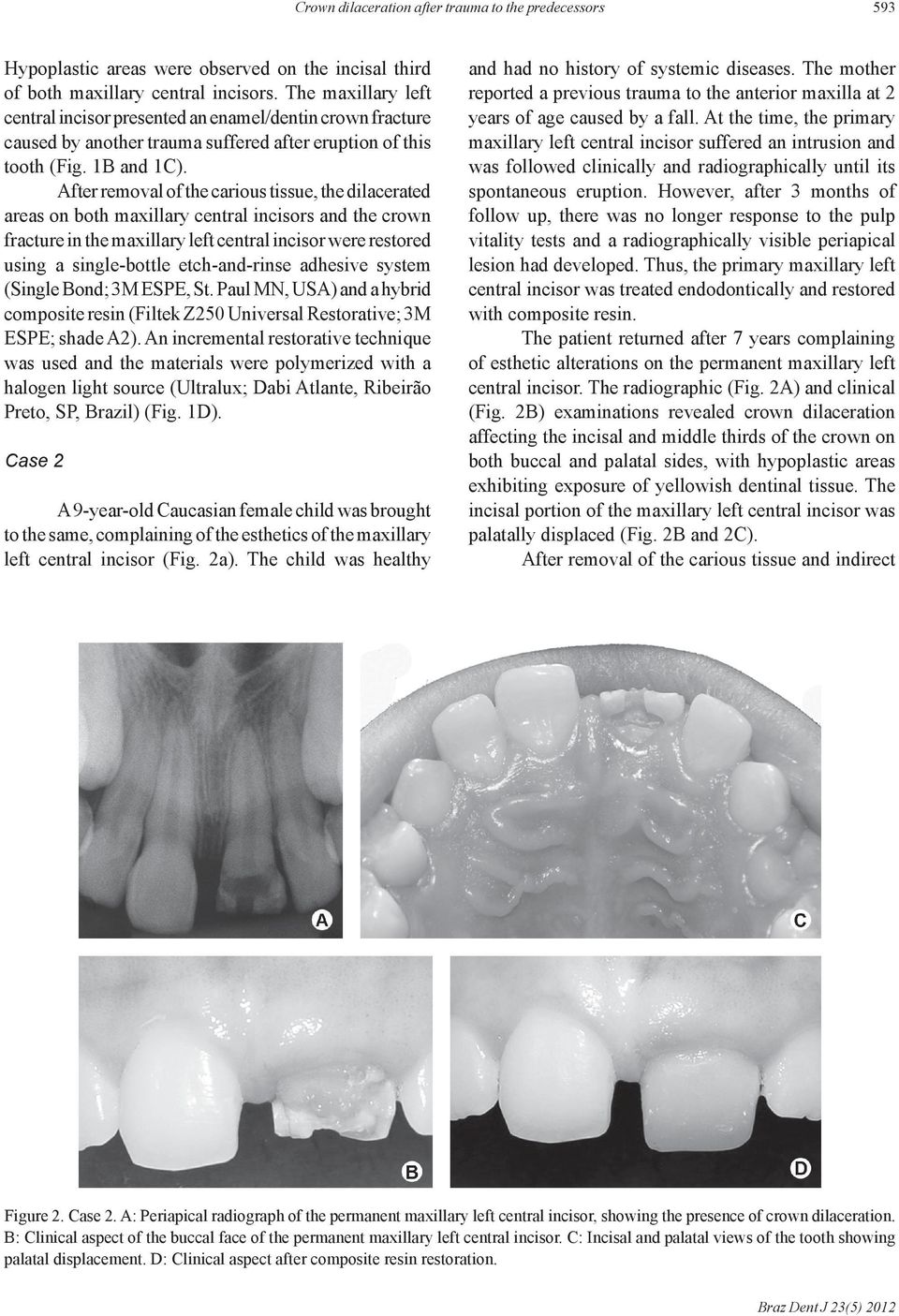
3 Crown dilaceration after trauma to the predecessors 593 Hypoplastic areas were observed on the incisal third of both maxillary central incisors. The maxillary left central incisor presented an enamel/dentin crown fracture caused by another trauma suffered after eruption of this tooth (Fig. 1B and 1C). After removal of the carious tissue, the dilacerated areas on both maxillary central incisors and the crown fracture in the maxillary left central incisor were restored using a single-bottle etch-and-rinse adhesive system (Single Bond; 3M ESPE, St. Paul MN, USA) and a hybrid composite resin (Filtek Z250 Universal Restorative; 3M ESPE; shade A2). An incremental restorative technique was used and the materials were polymerized with a halogen light source (Ultralux; Dabi Atlante, Ribeirão Preto, SP, Brazil) (Fig. 1D). Case 2 A 9-year-old Caucasian female child was brought to the same, complaining of the esthetics of the maxillary left central incisor (Fig. 2a). The child was healthy and had no history of systemic diseases. The mother reported a previous trauma to the anterior maxilla at 2 years of age caused by a fall. At the time, the primary maxillary left central incisor suffered an intrusion and was followed clinically and radiographically until its spontaneous eruption. However, after 3 months of follow up, there was no longer response to the pulp vitality tests and a radiographically visible periapical lesion had developed. Thus, the primary maxillary left central incisor was treated endodontically and restored with composite resin. The patient returned after 7 years complaining of esthetic alterations on the permanent maxillary left central incisor. The radiographic (Fig. 2A) and clinical (Fig. 2B) examinations revealed crown dilaceration affecting the incisal and middle thirds of the crown on both buccal and palatal sides, with hypoplastic areas exhibiting exposure of yellowish dentinal tissue. The incisal portion of the maxillary left central incisor was palatally displaced (Fig. 2B and 2C). After removal of the carious tissue and indirect Figure 2. Case 2. A: Periapical radiograph of the permanent maxillary left central incisor, showing the presence of crown dilaceration. B: Clinical aspect of the buccal face of the permanent maxillary left central incisor. C: Incisal and palatal views of the tooth showing palatal displacement. D: Clinical aspect after composite resin restoration.
4 594 T.S. Mellara et al. pulp capping with calcium hydroxide cement (Dycal; Dentsply Indústria e Comércio Ltda., Petrópolis, RJ, Brazil) and glass ionomer cement (Vidrion R; SSWhite, Rio de Janeiro, RJ, Brazil), the tooth was restored in the same way as described for Case 1 (Fig. 2D). Case 3 A 9-year-old Caucasian male child was brought to the same Pediatric Dentistry Clinic with esthetic complaints on the maxillary right central incisor. The child s health was good, with no history of systemic diseases. According to the mother s report, the patient had suffered trauma to the anterior maxilla at the age of 2 due to fall, causing intrusion of the primary maxillary right central incisor. The intruded primary tooth reerupted spontaneously and exfoliated at the normal time. The radiographic (Fig. 3A) and clinical (Fig. 3B) examinations showed that the maxillary right central incisor presented crown dilaceration affecting the incisal and middle thirds. Carious lesions were observed on both buccal and palatal faces of the tooth crown along the junction between the dilacerated and non-dilacerated portions, probably due to the greater accumulation of biofilm in this region. There were hypoplastic areas on the incisal third of the dilacerated tooth crown (Fig. 3C), which was palatally displaced. Removal of the carious tissue, indirect pulp capping and composite resin restoration were done as described for Case 2 (Fig. 3D). In all cases, the restorations were finished and polished in a subsequent session with fine- and extra-fine grain diamond burs (3195F and 3915FF; KG Sorensen, São Paulo, SP, Brazil) and aluminum oxide discs (Sof- Lex; 3M ESPE). The parents/caregivers were instructed about the importance of attending the follow-up recall visits, maintaining rigorous oral hygiene at home, and avoiding foods and beverages that could stain the restorations. DISCUSSION Intrusive injuries in the primary dentition are Figure 3. Case 3. A: Periapical radiograph of the permanent maxillary right central incisor showing crown dilaceration. B: Clinical aspect of the buccal face. C: Incisal and palatal views of the tooth showing palatal displacement of the crown. D: Clinical aspect after composite resin restoration.

5 Crown dilaceration after trauma to the predecessors 595 highly associated with developmental disturbances of their permanent successors. The reported prevalence of intrusive injuries affecting primary incisors varies from 4.4 to 22% and the percentage of developmental disturbances of the permanent incisors that could be attributed to injuries of their primary predecessors ranges from 12 to 74% (4). The children of the three cases presented in this paper suffered an intrusive luxation of the primary predecessor teeth around the age of 2. The disturbances to the permanent successor teeth due to trauma to the primary predecessors range from a simple white or yellow-brown discoloration to enamel hypoplasia, crown dilaceration, root duplication, root dilaceration, partial or complete arrest of root formation, odontoma-like malformation, sequestration of the permanent tooth germ, and disturbances of permanent successor eruption (4). The patients described in this paper presented crown dilaceration and white/ yellow-brown discoloration with enamel hypoplasia in the permanent anterior teeth as a result of trauma to the primary teeth. Crown dilaceration can result from an intrusion of the primary incisor when a child is around the age of 2 years, when half the crown is already formed (6,12-14). Subsequent to invasion of the partially formed follicle by the apex of the primary tooth, the permanent tooth crown twists lingually over the papilla (15,16). The displaced enamel epithelium may become activated in the new position, forming a peculiar shape of deformed enamel projecting into the pulp canal or externally at the crown-root junction (11). A radiological diagnosis of the sequelae to the permanent dentition can be established prior to tooth eruption (11), as observed in Case 2. The dilacerated crown appears foreshortened on the occlusal radiographic image in comparison to the adjacent crowns (16). Additionally, a lateral projection helps establishing a diagnosis and determining the direction of dilacerations (17). The radiographic examination is an important tool to identify pulpal complications, carious lesions and the severity of crown dilaceration, which will determine the treatment plan and case prognosis. Teeth with dilacerated crowns may erupt normally or buccally or palatally/lingually displaced. Unfortunately, even without evidence of caries, they might later develop pulpal necrosis, followed by apical periodontitis and chronic abscess (13,18). To avoid such complications, the dilacerated portion of the crown should be removed after its eruption, and a provisional crown should be placed until final restoration is made. In other cases, failure to erupt requires surgical exposure and orthodontic alignment followed by an esthetic restoration (3,6,19-22). None of the children of this case series needed endodontic or orthodontic treatment. The sequelae to the permanent dentition after trauma to the primary dentition might require only direct restorative procedures, but they frequently involve a multidisciplinary intervention also associating the areas of Pediatric Dentistry, Orthodontics, Periodontics, Surgery and Prosthodontics, depending on their extension and severity (3,11). None of the 3 cases presented in this paper needed orthodontic repositioning because the dilacerated teeth erupted normally and could be aligned and leveled only with the esthetic restorative treatment. The cases hereby presented are illustrative of the need of a rigorous clinical and radiographic follow-up of children that suffer trauma to the primary dentition at an early age, in order to detect and treat as soon as possible the sequelae to the permanent successor teeth. For cases of crown dilaceration in the permanent dentition, composite resin restorations produce excellent results to recover both esthetics and function. REFERENCES 1. Holan G, Ram D, Fuks AB. The diagnostic value of lateral extraoral radiography for intruded maxillary primary incisors. Pediatr Dent 2002;24: Flores MT. Traumatic injuries in the primary dentition. Dent Traumatol 2002;18: Küchler EC, Tannure PN, Costa Mde C, Gleiser R. Management of an unerupted dilacerated maxillary central incisor after trauma to the primary predecessor. J Dent Child 2012;79: Diab M, el Badrawy HE. Intrusion injuries of primary incisors. Part III: Effects on the permanent successors. Quintessence Int 2000;31: Arenas M, Barbería E, Lucavechi T, Maroto M. Severe trauma in the primary dentition - diagnosis and treatment of sequelae in permanent dentition. Dent Traumatol 2006;22: Tewari N, Pandey RK. Multiple abnormalities in permanent maxillary incisors following trauma to the primary dentition. J Indian Soc Pedod Prev Dent 2011;29: Andreasen JO. Traumatic Injuries to the teeth. 2nd Edition. St Louis: CV Mosby Co;1972: Maragakis GM. Crown dilaceration of permanent incisors following trauma to their primary predecessors. J Clin Pediatric Dent 1995;20: Matsuoka T, Sobue S, Ooshima T. Crown dilaceration of a first premolar caused by extraction of its deciduous predecessor: a case report. Endod Dent Traumatol 2000;16: Lowe PL. Dilaceration caused by direct penetrating injury. Br Dent J 1985;159: Nelson-Filho P, Silva RA, Faria G, Freitas AC. Odontoma-like malformation in a permanent maxillary central incisor subsequent to trauma to the incisor predecessor. Dent Traumatol 2005;21:309-
6 596 T.S. Mellara et al Andreasen JO, Ravn JJ. The effect of traumatic injuries to primary teeth on their permanent successors. II. A clinical and radiographic follow-up of 213 injured teeth. Scand J Dent Res 1971;79: Kaufman AY, Keila S, Wasersprung D, Dayan D. Developmental anomaly of permanent teeth related to traumatic injury. Endod Dent Traumatol 1990;6: Andreasen JO, Sundström B, Ravn JJ. The effect of traumatic injuries to primary teeth on their permanent successors. I. A clinical and histologic study of 117 injured permanent teeth. Scand J Dent Res 1971;79: Von Arx T. Developmental disturbances of permanent teeth following trauma to primary dentition. Aust Dent J 1993;38: Andreasen JO, Andreasen FM, Andersson L. Textbook and color atlas of traumatic injuries to the teeth. 4th ed. Oxford: Blackwell; 2007:770p. 17. von Gool AV. Injury to the permanent tooth germ after trauma to the deciduous predecessor. Oral Surg Oral Med Oral Pathol 1973;35: Prabhakar AR, Reddy VV, Bassappa N. Duplication and dilaceration of a crown with hypercementosis of the root following trauma: a case report. Quintessence Int 1998;29: MacGregor SA. Management of injuries to deciduous incisors. J Can Dent Assoc 1969;35: Wilson CF. Management of trauma to primary and developing teeth. Dent Clin North Am 1995;39: van Gool AV. Lesions of the tooth germ following injury to the deciduous teeth. Rev Belge Med Dent 1986;41: Wei YJ, Lin YC, Kaung SS, Yang SF, Lee SY, Lai YL. Esthetic periodontal surgery for impacted dilacerated maxillary central incisors. Am J Orthod Dentofacial Orthop 2012;142: Received October 13, 2011 Accepted November 8, 2012

Consequences of dental trauma to the primary teeth on the permanent dentition
 ISSN: Printed version: 1806-7727 Electronic version: 1984-5685 RSBO. 2012 Oct-Dec;9(4):457-62 Case Report Article Consequences of dental trauma to the primary teeth on the permanent dentition Carla Miranda
Guidelines for the management of traumatic dental injuries. I. Fractures and luxations of permanent teeth
 Dental Traumatology 2007; doi: 10.1111/j.1600-9657.2007.00592.x DENTAL TRAUMATOLOGY Guidelines Guidelines for the management of traumatic dental injuries. I. Fractures and luxations of permanent teeth
Residency Competency and Proficiency Statements
 Residency Competency and Proficiency Statements 1. REQUEST AND RESPOND TO REQUESTS FOR CONSULTATIONS Identify needs and make referrals to appropriate health care providers for the treatment of physiologic,
Treatment of traumatically intruded permanent incisor teeth in children. BSPD reviewed guidelines
 Treatment of traumatically intruded permanent incisor teeth in children. BSPD reviewed guidelines Albadri S, Zaitoun H, Kinirons MJ Introduction Traumatic intrusion is a luxation injury where the tooth
Anatomic Anomalies. Anomalies. Anomalies. Anomalies. Supernumerary Teeth. Supernumerary Teeth. Steven R. Singer, DDS 212.305.5674 srs2@columbia.
 Anatomic Anomalies Steven R. Singer, DDS 212.305.5674 [email protected] Anomalies! Anomalies are variations in the:! Size! Morphology! Number! Eruption of the teeth Anomalies Anomalies There are two categories:!
DENTAL TRAUMATIC INJURIES
 DENTAL TRAUMATIC INJURIES Nitrous Oxide Not Contraindicated Predisposing Factors > 90% of All Injuries Protrusion of Anterior Teeth Poor Lip Coverage Mouthguards Girls as Well as Boys Off - the - Shelf
A single visit, multidisciplinary approach to the management of traumatic tooth crown fracture C. P.K. Wadhwani, 1
 A single visit, multidisciplinary approach to the management of traumatic tooth crown fracture C. P.K. Wadhwani, 1 PRACTICE An immediate restorative technique resolving the acute problem of traumatic tooth
The Treatment of Traumatic Dental Injuries
 The Recommended Guidelines of the American Association of Endodontists for The Treatment of Traumatic Dental Injuries 2013 American Association of Endodontists Revised 9/13 The Recommended Guidelines of
Multidisciplinary Approach to Delayed Treatment of Traumatic Teeth Injuries Involving Extrusive Luxation, Avulsion and Crown Fracture
 Ó Operative Dentistry, 2014, 39-6, 566-571 Clinical Technique/Case Report Multidisciplinary Approach to Delayed Treatment of Traumatic Teeth Injuries Involving Extrusive Luxation, Avulsion and Crown Fracture
In the Spring of 2010, the American Academy of Cosmetic
 Greetings to the members of the American Academy of Cosmetic Dentistry (AACD). As you know, a sisterhood agreement was concluded between the AACD and the Japan Academy of Esthetic Dentistry (JAED) at a
Management of Avulsed Permanent Teeth
 Management of Avulsed Permanent Teeth Dr. Zuhair Al-Khatib Traumatic injuries to the teeth are so common among any community; trauma to the face especially to the oral region occurs frequently and comprises
The traumatic injuries of permanent teeth and complex therapy
 The traumatic injuries of permanent teeth and complex therapy Dr. Katalin Déri Semmelweis Egyetem Department of Pedodontics and Orthodontics Risk Angle II/1 Predisposing factor: overjet insufficient lip
Postendodontic Tooth Restoration - Part I: The Aim and the Plan of. the procedure.
 Postendodontic Tooth Restoration - Part I: The Aim and the Plan of the Procedure Sanja egoviê 1 Nada GaliÊ 1 Ana Davanzo 2 Boæidar PaveliÊ 1 1 Department of Dental Pathology School of Dental Medicine University
Management of Dental Trauma in a Primary Care Setting
 Guidance for the Clinician in Rendering Pediatric Care CLINICAL REPORT Management of Dental Trauma in a Primary Care Setting abstract The American Academy of Pediatrics and its Section on Oral Health have
INITIAL MANAGEMENT OF DENTAL TRAUMA BY DR. LUKE MOLONEY
 INITIAL MANAGEMENT OF DENTAL TRAUMA BY DR. LUKE MOLONEY CONSULTANT ENDODONTIST ROYAL CHILDREN S HOSPITAL MELBOURNE This article has been prepared on the basis that it may provide a useful aid for Dentists
CLINICAL GOALS OF PATIENT CARE AND CLINIC MANAGEMENT. Philosophical Basis of the Patient Care System. Patient Care Goals
 University of Washington School of Dentistry CLINICAL GOALS OF PATIENT CARE AND CLINIC MANAGEMENT Philosophical Basis of the Patient Care System The overall mission of the patient care system in the School
Humana Health Plans of Florida. Important:
 Humana Health Plans of Florida Important: Dental discount membership in Florida is determined by viewing the member s ID card and verifying that the Humana Logo and Medicare name is listed with an effective
DENTAL INJURIES IN 0-15 YEAR OLDS AT THE KENYATTA NATIONAL HOSPITAL, NAIROBI. H. M. MURIITHI, M. A. MASIGA and M. L.
 592 EAST AFRICAN MEDICAL JOURNAL November 2005 East African Medical Journal Vol. 82 No. 11 November 2005 DENTAL INJURIES IN 0-15 YEAR OLDS AT THE KENYATTA NATIONAL HOSPITAL, NAIROBI H. M. Muriithi, BDS,
Replacing Hopeless Retained Deciduous Teeth in Adults Utilizing Dental Implants: Concepts and Case Presentation
 Replacing Hopeless Retained Deciduous Teeth in Adults Utilizing Dental Implants: Concepts and Case Presentation by Michael Tischler, DDS Published: Dentistry Today November 2005 Photos at end of article
An overview of classification of dental trauma
 Review Article An overview of classification of dental trauma Sasikala Pagadala 1*, Deepti Chaitanya Tadikonda 2 1 Assistant Professor, Department t of Periodontics, Nanded Rural Dental College and Research
MEDICAL POLICY POLICY TITLE DENTAL AND ORAL SURGERY SERVICES AFTER AN ACCIDENT POLICY NUMBER MP- 1.108
 Original Issue Date (Created): July 1, 2005 Most Recent Review Date (Revised): Effective Date: June 29, 2010 May 25, 2011- RETIRED I. POLICY II. Dental and/or oral surgery services (on a limited basis)
Dental. Covered services and limitations module
 Dental Covered services and limitations module Dental Covered Services and Limitations Module Covered Dental Services for Patients Under the Age of 21...2 Examinations...2 Radiographs and Diagnostic Imaging...2
Dental traumatology: essential diagnosis and treatment planning
 Endodontic Topics 2004, 7, 14 34 Printed in Denmark. All rights reserved Copyright r Blackwell Munksgaard ENDODONTIC TOPICS 2004 Dental traumatology: essential diagnosis and treatment planning LEIF K.
Job Ready Assessment Blueprint. Dental Assisting. Test Code: 4026 / Version: 01
 Job Ready Assessment Blueprint Dental Assisting Test Code: 4026 / Version: 01 Measuring What Matters Specific Competencies and Skills Tested in this Assessment: Introduction to the Dental Assisting Profession
Retrospective analysis of factors influencing the eruption of delayed permanent incisors after supernumerary tooth removal
 Retrospective analysis of factors influencing the eruption of delayed permanent incisors after supernumerary tooth removal R.A.E. BRYAN*, B.O.I. COLE**, R.R. WELBURY* ABSTRACT. Aim This was to assess the
Tough Choice for Young First Permanent molars: To Do Pulp Treatment or to Extract?
 Tough Choice for Young First Permanent molars: To Do Pulp Treatment or to Extract? Jung-Wei Chen, DDS, MS, PhD Professor and Program Director Advanced Education Program in Pediatric Dentistry Loma Linda
In 1999, more than 1 million people in
 Clinical SHOWCASE Slip-and-Fall Injuries Causing Dental Trauma Morley S. Rubinoff, DDS, Cert Prosth Clinical Showcase is a series of pictorial essays that focus on the technical art of clinical dentistry.
4-1-2005. Dental Clinical Criteria and Documentation Requirements
 4-1-2005 Dental Clinical Criteria and Documentation Requirements Table of Contents Dental Clinical Criteria Cast Restorations and Veneer Procedures... Pages 1-3 Crown Repair... Page 3 Endodontic Procedures...
Use of ultrasound Doppler to determine tooth vitality in a discolored tooth after traumatic injury: its prospects and limitations
 Case report ISSN 2234-7658 (print) / ISSN 2234-7666 (online) http://dx.doi.org/10.5395/rde.2014.39.1.68 Use of ultrasound Doppler to determine tooth vitality in a discolored tooth after traumatic injury:
In the past decade, there has been a remarkable
 TECHNO BYTES Principles of cosmetic dentistry in orthodontics: Part 1. Shape and proportionality of anterior teeth David M. Sarver, DMD, MS Vestavia Hills, Ala In the past decade, there has been a remarkable
Dental Billing and Coding. Janet Bozzone, DMD, FAGD Open Door Family Medical Centers Ossining, Sleepy Hollow, Port Chester & Mount Kisco, NY
 Dental Billing and Coding Janet Bozzone, DMD, FAGD Open Door Family Medical Centers Ossining, Sleepy Hollow, Port Chester & Mount Kisco, NY What makes me an expert? I have over 20 years experience working
Case Report(s): Uncomplicated Crown Fractures
 Case Report(s): Uncomplicated Crown Fractures Tooth fractures can be classified as follows: Uncomplicated crown fracture = fracture limited to the crown of the tooth with dentin exposure but no pulp exposure.
Porcelain Veneers for Children and Teens. By Fred S. Margolis, D.D.S., F.I.C.D., F.A.C.D., F.A.D.I. Abstract
 Porcelain Veneers for Children and Teens By Fred S. Margolis, D.D.S., F.I.C.D., F.A.C.D., F.A.D.I. Abstract This article will discuss the advantages of providing our young patients and their parents an
Classification of dental trauma & management of dental avulsions
 Dr Tony Skapetis The University of Sydney Clinical Director Education WCOH Clinical Senior Lecturer University of Sydney [email protected] Classification of dental trauma & management of dental
DENTAL TRAUMA GUIDELINES
 International Association of Dental Traumatology DENTAL TRAUMA GUIDELINES Revised 2012 CONTENT: Section 1. Fractures and luxations of permanent teeth Section 2. Avulsion of permanent teeth Section 3. Traumatic
Dental-based Injuries
 Dental-based Injuries LUXATIONS CROWN FRACTURE CROWN/ROOT FRACTURE ROOT FRACTURE ALVEOLAR BONE FRACTURE AVULSIONS LUXATIONS The tooth is loose, now what? 1. Concussive-not loose or displaced, but tender
Tooth avulsion-a Dental emergency in children: A Review
 American Journal of Advances in Medical Science www.arnaca.com eissn: 2347-2766 Review Article Tooth avulsion-a Dental emergency in children: A Review Debapriya Pradhan 1, Prasant MC 2, Varsha H Tambe
RSBO Revista Sul-Brasileira de Odontologia ISSN: 1806-7727 [email protected] Universidade da Região de Joinville Brasil
 RSBO Revista Sul-Brasileira de Odontologia ISSN: 1806-7727 [email protected] Universidade da Região de Joinville Brasil de Araújo Trigueiro Campos, Fernanda; Furtado de Macedo, Adriana; Duarte, Danilo
MEDICAID DENTAL PROGRAMS CODING, POLICY AND RELATED FEE REVISION INFORMATION
 MEDICAID DENTAL PROGRAMS CODING, POLICY AND RELATED FEE REVISION INFORMATION Effective for dates of service on and after November 1, 2005, the following dental coding, policy and related fee revisions
Emergency management of dental trauma
 Australasian Emergency Nursing Journal (2010) 13, 30 34 available at www.sciencedirect.com journal homepage: www.elsevier.com/locate/aenj CLINICAL PRACTICE UPDATE Emergency management of dental trauma
original article KEY-WORDS Traumatic Dental injuries, Prevalence, Ellis and Davey classification, Fall, School Dental Health Program.
 Prevalence and Factors Associated with Traumatic Dental Injuries (TDI) to Anterior Teeth of 11-13 Year Old School Going Children of Maduravoyal, Chennai Navin Anand Ingle, Naveen Baratam, Zohara Charania
Clinical Practice Guideline For Orthodontics
 Clinical Practice Guideline For Orthodontics MOH- Oral Health CSN -Orthodontics -2010 Page 1 of 15 Orthodontic Management Guidelines 1. Definitions: Orthodontics is the branch of dentistry concerned with
Dental Services Rider Harbor Choice Plus, a product of Harbor Health Plan, Inc.
 Your Agreement gives You important information about Your health care benefits. This Dental Services Rider ( Rider ) is issued to You with Your Agreement because the plan you selected includes Other Dental
Attachment S: Benefits Covered - ADULTS - AGE 21 AND OVER
 Diagnostic services include the oral examinations and selected radiographs needed to assess the oral health, diagnose oral pathology and develop an adequate treatment plan for the Participant s oral health.
Guidelines for the management of traumatic dental injuries. II. Avulsion of permanent teeth
 Dental Traumatology 2007; doi: 10.1111/j.1600-9657.2007.00605.x DENTAL TRAUMATOLOGY Guidelines Guidelines for the management of traumatic dental injuries. II. Avulsion of permanent teeth Flores MT, Andersson
Acute Dental Problems in the School Setting
 Acute Dental Problems in the School Setting Keri Discepolo, D.D.S., M.P.H. Clinical Faculty, Yale Pediatric Dentistry Residency Program Associate, Yale School of Medicine Objectives Brief Description of
RESIDENT TRAINING GOALS AND OBJECTIVES STATEMENTS
 RESIDENT TRAINING GOALS AND OBJECTIVES STATEMENTS Evaluation and treatment of dental emergencies Recognize, anticipate and manage emergency problems related to the oral cavity. Differentiate between those
Planning esthetic treatment after avulsion of maxillary incisors
 Clinical Planning esthetic treatment after avulsion of maxillary incisors Björn U Zachrisson 1 Abstract Background: When a young patient accidentally loses two neighboring maxillary incisors, the choice
DENTAL FOR EVERYONE SUMMARY OF BENEFITS, LIMITATIONS AND EXCLUSIONS
 DENTAL FOR EVERYONE SUMMARY OF BENEFITS, LIMITATIONS AND EXCLUSIONS DEDUCTIBLE The dental plan features a deductible. This is an amount the Enrollee must pay out-of-pocket before Benefits are paid. The
Comparison of the traumatic dental injuries between visually impaired and their peer sighted children in Kerman, Iran
 Received: 5 Mar. 2013 Accepted: 25 June. 2013 Comparison of the traumatic dental injuries between visually impaired and their peer sighted children in Kerman, Iran Hamidreza Poureslami DDS, MSc 1, Mohamad
International Association of Dental Traumatology guidelines for the management of traumatic dental injuries: 3. Injuries in the primary dentition
 Dental Traumatology 2012; 28: 174 182; doi: 10.1111/j.1600-9657.2012.01146.x International Association of Dental Traumatology guidelines for the management of traumatic dental injuries: 3. Injuries in
Kathleen A. Russell, BSc, DDS, MSc Magdalena A. Folwarczna, BSc, DDS
 C L I N I C A L P R A C T I C E Mesiodens Diagnosis and Management of a Common Supernumerary Tooth Kathleen A. Russell, BSc, DDS, MSc Magdalena A. Folwarczna, BSc, DDS A b s t r a c t Mesiodentes are the
Non-carious dental conditions
 Non-carious dental conditions Children s Dental Health in the United Kingdom, 2003 Barbara Chadwick, Liz Pendry October 2004 Crown copyright 2004 Office for National Statistics 1 Drummond Gate London SW1V
Epidemiology of dental emergency visits to an urban children s hospital
 SCIENTIFIC ARTICLE Epidemiology of dental emergency visits to an urban children s hospital Yang Zeng, DDS Barbara Sheller, DDS, MSD Peter Milgrom, DDS Abstract All 1482 emergency room dental visits to
MEDICAL ASSISTANCE PROGRAM DENTAL FEE SCHEDULE
 Dental General Payment Policies Children under 21 years of age are eligible for all medically necessary dental services. For children under 21 years of age who require medically necessary dental services
Using The Canary System to Develop a Caries Management Program for Children. we design therapies to treat or remineralize early carious lesions?
 Using The Canary System to Develop a Caries Management Program for Children Dr. Stephen H. Abrams Dental caries is the most common oral disease we treat in paediatric dentistry. We place restorations to
General Dentist Fees
 General Dentist Fees January 1, 2015 Not all codes are covered benefits. Please check the member s plan for verification and limitations. There are no fee increases for 2015, but new CDT codes have been
Avulsed maxillary central incisors: The case for autotransplantation
 POINT/COUNTERPOINT 9 Avulsed maxillary central incisors: The case for autotransplantation Jim Janakievski Seattle, Wash Traumatic dental injuries most often occur in childhood and early adolescence. 1
An Overview of Your Dental Benefits
 An Overview of Your Dental Benefits Educators Health Alliance ii \ DENTAL BENEFITS PPO Dental Plan Options OPTION 1 Maintenance Dentistry OPTION 2 (STANDARD PLAN) IN-NETWORK OUT-OF-NETWORK Maintenance
Failure of eruption of first and second permanent molars
 Failure of eruption of first and second permanent molars Camila Palma* /Ana Coelho* / Yndira González* / Abel Cahuana** Failure of eruption of permanent molars is an uncommon condition with a range of
CHAPTER 10 RESTS AND PREPARATIONS. 4. Serve as a reference point for evaluating the fit of the framework to the teeth.
 CHAPTER 10 RESTS AND DEFINITIONS A REST is any rigid part of an RPD framework which contacts a properly prepared surface of a tooth. A REST PREPARATION or REST SEAT is any portion of a tooth or restoration
BDS, MDS, professor, Department of Pediatric and Preventive Dentistry, PMNM Dental College and Hospital Bagalkot, India.
 ISSN 1807-5274 Rev. Clín. Pesq. Odontol., Curitiba, v. 6, n. 1, p. 95-100, jan./abr. 2010 Licenciado sob uma Licença Creative Commons TOOTH FRAGMENT REATTACHMENT AFTER LATE RETRIEVAL (THREE MONTHS) FROM
THE SINGLE-TOOTH IMPLANT TREATMENT FOR MAXILLARY CENTRAL INCISORS LOSS AFTER TRAUMA: CASE REPORTS
 CLINICAL DENTISTRY AND RESEARCH 2011; 35(1): 47-52 THE SINGLE-TOOTH IMPLANT TREATMENT FOR MAXILLARY CENTRAL INCISORS LOSS AFTER TRAUMA: CASE REPORTS Hakan Tuna, DDS, PhD Assistant Professor, Department
Guidelines for the management of traumatic dental injuries. I. Fractures and luxations of permanent teeth
 Dental Traumatology 2007; doi: 10.1111/j.1600-9657.2007.00592.x DENTAL TRAUMATOLOGY Guidelines Guidelines for the management of traumatic dental injuries. I. Fractures and luxations of permanent teeth
Anthem Blue Dental PPO Plan
 Anthem Blue Dental PPO Plan For Individuals and Families Anthem Blue Cross and Blue Shield 700 Broadway Denver, Colorado 80273 anthem.com An independent licensee of the Blue Cross and Blue Shield Association.
DISCOUNT DENTAL PLAN COMPLETE LISTING OF MEMBER COPAYMENTS
 DISCOUNT DENTAL PLAN COMPLETE LISTING OF MEMBER COPAYMENTS 0120 PERIODIC ORAL EXAMINATION - ESTABLISHED PATIENT 20 0140 LIMITED ORAL EVALUATION - PROBLEM FOCUSED 33 0150 COMPREHENSIVE ORAL EVALUATION -
Congenital absence of mandibular second premolars
 CLINICIAN S CORNER Congenitally missing mandibular second premolars: Clinical options Vincent G. Kokich a and Vincent O. Kokich b Seattle, Wash Introduction: Congenital absence of mandibular second premolars
Zirconium Abutments for Improved Esthetics in Anterior Restorations
 Zirconium Abutments for Improved Esthetics in Anterior Restorations by Luke S., C.D.T. Mr. is the founder and owner of Capital Dental Technology Laboratory, Inc., in Naperville, Illinois. The laboratory
Anterior crowns used in children
 Anterior crowns used in children Objectives of this session Discuss strip crowns, temporary crown use and acrylic jacket crowns. Discuss the possible use of porcelain jacket crowns in paediatric dental
Pulpal response to sensibility tests after traumatic dental injuries in permanent teeth
 Dental Traumatology 2013; doi: 10.1111/edt.12074 Pulpal response to sensibility tests after traumatic dental injuries in permanent teeth Juliana Vilela Bastos 1, Eugenio Marcos Andrade Goulart 2, Maria
Diagnosis, Treatment and Prognosis of Cracked Teeth Iowa Dental Association Annual Session May 6, 2011 Dr. Bruce C. Justman
 Diagnosis, Treatment and Prognosis of Cracked Teeth Iowa Dental Association Annual Session May 6, 2011 Dr. Bruce C. Justman Longitudinal Fractures Types of Longitudinal Fractures Craze Lines Cusp Fracture
A Dental Benefit Summary for Rice University
 Aetna Dental presents A Dental Benefit Summary for Rice University CODE CODE Office Visit Copay $5 DIAGNOSTIC CROWNS/BRIDGES D0120 Exam-Periodic No Charge D2510 Inlay, Metallic, One surface $225 D0150
deltadentalins.com/usc
 Plan Benefit Highlights for: UNIVERSITY OF SOUTHERN CALIFORNIA STUDENT PLAN Group No: 05008 The Delta Dental PPO table plan provides you great dental benefits at a reasonable cost. With a table of allowance
Prevalence of Traumatic Injuries to the Anterior Primary Teeth in Preschool Children in Rasht, Guilan, 2012
 Prevalence of Traumatic Injuries to the Anterior Primary Teeth in Preschool Children in Rasht, Guilan, 2012 Original Article Javaneh Vejdani 1, Somaye Poor fathollah 2, Ehsan Kazemnezhad Leyli 3 1 Assistant
Introduction to Dental Anatomy
 Introduction to Dental Anatomy Vickie P. Overman, RDH, MEd Continuing Education Units: N/A This continuing education course is intended for dental students and dental hygiene students. Maintaining the
Maxillary canine palatal impaction occurs in 1
 ORIGINAL ARTICLE Prediction of maxillary canine impaction using sectors and angular measurement John H. Warford Jr, DDS, a,b Ram K. Grandhi, BDS, Dip Perio, Cert Ortho, MS, b and Daniel E. Tira, PhD c
Relative position of gingival zenith in maxillary anterior teeth- a clinical appraisal
 Original article: Relative position of gingival zenith in maxillary anterior teeth- a clinical appraisal 1Dr Dipti Shah, 2 Dr Kalpesh Vaishnav, 3 Dr Sareen Duseja, 4 Dr Pankti Agrawal 1HOD, Dept of Prosthodontics,
Managing worn teeth with composites
 6 Managing worn teeth with composites Clinical details A 50-year-old man presents to you complaining about his worn teeth and would like the appearance improved (Fig. 6.1). He complains of regurgitation
portion of the tooth such as 3/4 Crown, 7/8Crown.
 Lecture.1 Dr.Adel F.Ibraheem Crown and Bridge: It s a branch of dental science that deals with restoration of damaged teeth with artificial crown replacing the missing natural teeth by a cast prosthesis
TABLE OF DENTAL PROCEDURES PLEASE READ THE FOLLOWING INFORMATION CAREFULLY FOR YOUR PROCEDURE FREQUENCIES AND PROVISIONS.
 TABLE OF DENTAL PROCEDURES PLEASE READ THE FOLLOWING INFORMATION CAREFULLY FOR YOUR PROCEDURE FREQUENCIES AND PROVISIONS. The attached is a list of dental procedures for which benefits are payable under
Rochester Regional Health. Dental Plan
 Rochester Regional Health Dental Plan TABLE OF CONTENTS EXPLANATION OF TERMS... 2 INTRODUCTION... 4 DENTAL BENEFITS... 5 DEDUCTIBLES AND COINSURANCE... 7 PRE-TREATMENT ESTIMATES... 8 LIMITATIONS... 8
WMI Mutual Insurance Company
 Dental Policy WMI Mutual Insurance Company PO Box 572450 Salt Lake City, UT 84157 (801) 263-8000 & (800) 748-5340 Fax: (801) 263-1247 DENTAL POLICY A. Schedule of Benefits: Annual Maximum Dental Benefit
A. DEVELOPMENT OF THE DENTAL ORGAN (ENAMEL ORGAN):
 A. DEVELOPMENT OF THE DENTAL ORGAN (ENAMEL ORGAN): AS EARLY AS THE SECOND MONTH OF FETAL LIFE, THE DEVELOPMENT OF THE DECIDUOUS TEETH MAY FIRST BECOME EVIDENT. 1. Dental lamina and Bud stage At about six
ABSTRACT MATERIALS AND METHOD INTRODUCTION. ISSN 0970-4388 Prevalence of dental health problems among school going children in rural Kerala.
 ISSN 0970-4388 Prevalence of dental health problems among school going children in rural Kerala. JOSE A a, JOSEPH M R b ABSTRACT The purpose of this study; was to know the prevalence and pattern of dental
CLASSIFICATION OF CARIOUS LESIONS AND TOOTH PREPARATION.
 CLASSIFICATION OF CARIOUS LESIONS AND TOOTH PREPARATION. ١ G.V. BLACK who is known as the father of operative dentistry,he classified carious lesions into groups according to their locations in permanent
Location of the apical foramen and its relationship with foraminal file size
 original article Location of the apical foramen and its relationship with foraminal file size Ronaldo Araújo Souza, DDS, MSc, PhD 1 José Antônio Poli de Figueiredo, DDS, MSc, PhD 2 Suely Colombo, DDS 1
HEALTH SERVICES POLICY & PROCEDURE MANUAL. SUBJECT: Types of Dental Treatments Provided EFFECTIVE DATE: July 2014 SUPERCEDES DATE: January 2014
 PAGE 1 of 5 References Related ACA Standards 4 th Edition Standards for Adult Correctional Institutions 4-4369, 4-4375 PURPOSE To provide guidelines for determining appropriate levels of care and types
Periodontal surgery report for crown lengthening of tooth number 24,25
 411 PDS Periodontal surgery report for crown lengthening of tooth number -Course director : Dr. Nahid Ashri - instructor: Dr.Fatin Awaratani - - Student Name: Hanadi Alyami Computer Number: K S U - D E