
2013 BUSINESS AND FINANCIAL REPORT
|
|
|
- Oscar Payne
- 10 years ago
- Views:
Transcription
1 2013 BUSINESS AND FINANCIAL REPORT

2 KEY ACCOMPLISHMENTS Years ended December 31 (millions of dollars) Revenues Net income Capital assets, net 3, ,811.0 Total assets 9, ,446.9 Long-term debt 6, ,125.9 Shareholder s equity 2, ,564.9 Capital expenditures 1, Debt to capital 71.7% 38.9% Return on capital employed 7.5% 8.3% SAFETY: TO BE A SAFETY LEADER Corporate safety performance best in over 15 years, including lowest lost time frequency in over 15 years. Zero injuries experienced in some areas on a sustained basis. ENVIRONMENT: TO BE AN ENVIRONMENTAL LEADER Completed 95% of environmental leadership targets. Labrador-Island Transmission Link project released from environmental assessment from the governments of Newfoundland and Labrador and Canada. Continued implementation of successful salmon passage program on the Exploits River. BUSINESS EXCELLENCE: THROUGH OPERATIONAL EXCELLENCE, PROVIDE EXCEPTIONAL VALUE TO ALL CONSUMERS OF OUR ENERGY Filed the General Rate Application and staff responded to over 1,100 Requests for Information (RFI). Hydro completed capital investments in provincial electricity system of $80.6 million. Churchill Falls completed capital investments in support of asset renewal plan of $49.1 million. Received approval of the White Rose North Amethyst Hibernia Development Plan Amendment. Finalized amendments to the benefits terms of the 2007 White Rose Extension Project Framework Agreement. Completed three-year, 2D seismic survey with global partners TGS and PGS, capturing 47,000 line-km of seismic data from offshore. Announced the discovery of three new basins offshore Labrador (Holton, Henley, and Chidley basins) resulting from seismic program. Completed the federal loan guarantee, long-term debt financing and equity financing for the Muskrat Falls Project. Created an asset criticality analysis for the Bull Arm Fabrication Site to support the long-term asset management decisions for the site. Researched and analyzed various operating models for the Bull Arm Fabrication Site to support the long-term planning for the site. Energy Marketing delivered 99.1% of available energy to market and generated net revenues 33% higher than the market benchmark. PEOPLE: TO ENSURE A HIGHLY SKILLED AND MOTIVATED TEAM OF EMPLOYEES WHO ARE COMMITTED TO NALCOR ENERGY S SUCCESS AND FUTURE DIRECTION Launched Diversity & Inclusion awareness workshops. Completed 97% of employee engagement action plans, based on the employee engagement survey and employee focus groups. Over 2,800 on-the-spot peer recognitions and 31 nominations for President s Awards. Continued integration of Exploits into Hydro s operations; all employees transferred and the integration of bargaining units very near completion. Launched a province-wide recruitment program to attract skilled workers to the Muskrat Falls Project. COMMUNITY: TO BE A VALUED CORPORATE CITIZEN IN NEWFOUNDLAND AND LABRADOR Nalcor and Hydro supported over 370 community organizations. Hydro sponsored Ronald McDonald House Newfoundland and Labrador s Red Shoe Crew Walk for Families which raised $193,000 enough to run the House for one third of the entire year. Launched a new project website to provide detailed information on construction activities, procurement and employment for the Muskrat Falls Project. Developed, in collaboration with the Department of Education, an educational resource Power Your Knowledge to teach kids about electrical safety, how electricity is generated and how it is used on a daily basis. OUR VALUES: OPEN COMMUNICATION. ACCOUNTABILITY. SAFETY. HONESTY AND TRUST. TEAMWORK. RESPECT AND DIGNITY. LEADERSHIP

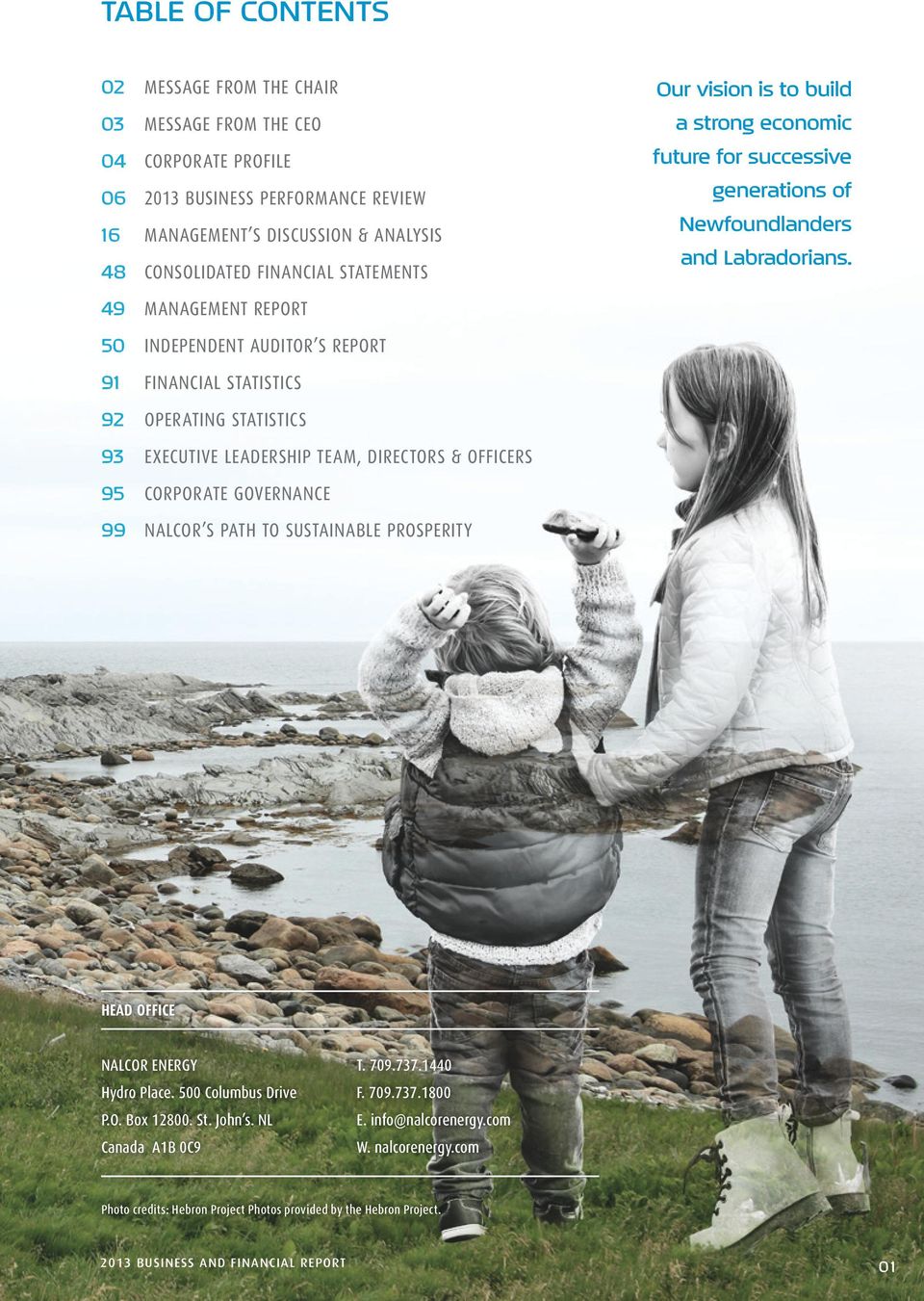
3 TABLE OF CONTENTS 02 MESSAGE FROM THE CHAIR 03 MESSAGE FROM THE CEO 04 CORPORATE PROFILE BUSINESS PERFORMANCE REVIEW 16 MANAGEMENT S DISCUSSION & ANALYSIS 48 CONSOLIDATED FINANCIAL STATEMENTS Our vision is to build a strong economic future for successive generations of Newfoundlanders and Labradorians. 49 MANAGEMENT REPORT 50 INDEPENDENT AUDITOR S REPORT 91 FINANCIAL STATISTICS 92 OPERATING STATISTICS 93 EXECUTIVE LEADERSHIP TEAM, DIRECTORS & OFFICERS 95 CORPORATE GOVERNANCE 99 NALCOR S PATH TO SUSTAINABLE PROSPERITY HEAD OFFICE NALCOR ENERGY Hydro Place. 500 Columbus Drive P.O. Box St. John s. NL Canada A1B 0C9 T F E. [email protected] W. nalcorenergy.com Photo credits: Hebron Project Photos provided by the Hebron Project BUSINESS AND FINANCIAL REPORT 01
4 MESSAGE FROM THE CHAIR Guided by a solid vision to build a strong economic future for successive generations of Newfoundlanders and Labradorians, Nalcor Energy has advanced in its journey of managing the province s energy resources for the benefit of the people of this great province. Nalcor has a solid foundation that consists of embedded principles and core values that guide our people and the work that they do. The Board of Directors continues to ensure a strong governance structure to oversee Nalcor s business activities, assume an appropriate level of risk and ensure a strong financial position for the benefit of our Shareholder, the Government of Newfoundland and Labrador. Following sanction of the Muskrat Falls Project by the provincial government in December 2012, construction progressed as planned with several major milestones achieved in In addition, Nalcor received provincial and federal release from environmental assessment for the Labrador Island Link and completed the federal loan guarantee, long-term debt financing and equity financing for the project. As the project continues to advance, it is rooted in our commitment to safety, environment and the community. Nalcor s oil and gas business is instrumental in helping us achieve our vision. Nalcor has ownership interest in three offshore oil and gas developments White Rose Extension, Hibernia Southern Extension and Hebron. With the approval of the White Rose North Amethyst Hibernia Development Plan Amendment and the amendments to the benefit terms of the 2007 White Rose Extension Project Framework Agreement, Nalcor will create additional economic value for the province. In addition, in January 2013, as part of our seismic program, Nalcor announced the discovery of three new basins offshore Labrador. In 2013, we continued to focus on investing in asset management. Guided by our asset management plan developed in 2006, Newfoundland and Labrador Hydro s capital expenditures have increased more than two-fold since While Hydro faced challenges at the Holyrood Generating Plant in 2013, the Board of Directors is confident in the organization s direction and the skilled and dedicated people who work there to ensure operations are based on sound industry standards and best practices. We are committed to providing safe, reliable, least-cost electricity to the people of the province. Nalcor is on track and will continue to lay the foundation for our journey. Guided by our core values, we will work to build a strong economic future for successive generations of Newfoundlanders and Labradorians. KEN MARSHALL ACTING CHAIR, BOARD OF DIRECTORS 2013 BUSINESS AND FINANCIAL REPORT

5 MESSAGE FROM THE CEO Since Nalcor was formed in 2008, it has been guided by a clear vision to build a strong economic future for successive generations of Newfoundlanders and Labradorians. The development, generation, transmission and sale of electricity; the exploration, development, production and sale of oil and gas; industrial fabrication; and energy marketing will help us create a prosperous future for the people of this province. In 2013, Nalcor achieved many milestones, however one that I am most proud of is our safety performance. Above all, our priority throughout the company is our safety journey. As I reflect on the years since Nalcor was formed, I am please to report that our safety performance has steadily improved. In 2013, we experienced our lowest lost time frequency rate since tracking began 15 years ago. In addition, many areas of the business had zero workplace injuries and our high-potential incidents have improved by 73 per cent since These results do not come easily and are a true testament to our caring and supportive culture, open reporting and a foundation of learning and engagement. We are solidly on track to achieve a sustained high level of safety performance. Having a solid safety foundation is imperative to us achieving business success. Without safety first, we would not be able to achieve our other goals. For the Muskrat Falls Project, as with our other lines of business, safety was top of mind throughout In addition to achieving a solid safety performance, Muskrat Falls achieved several milestones in 2013 toward completing this historic project that will benefit generations of Newfoundlanders and Labradorians well into the future. The release from provincial and federal environmental assessment for the Labrador Island Link and the completion of the federal loan guarantee, long-term debt financing and equity financing for the project are key to accomplishing our vision. The loan guarantee will result in savings of over $1 billion in interest costs for ratepayers and contribute to stable electricity rates for consumers in the province. The oil and gas side of our business also had significant accomplishments this past year. In January 2013, Nalcor announced the discovery of three new basins offshore Labrador resulting from our seismic program. The continuing success of our 2D seismic program and our ownership interest in three offshore oil and gas developments will create additional economic value for the province. While our electricity operating business faced challenges in 2013 and early 2014, we maintain our focus on asset management. Our asset management plan is robust and has resulted in an over two-fold increase in Newfoundland and Labrador Hydro s capital expenditures since I am confident in the work our people do every day. We are committed to creating a culture of continuous improvement and to providing safe, reliable, least-cost electricity to the people of this province. Our continued investment into the energy sector will help us secure sustainable, clean energy for our future. We have a strong team of highly skilled, talented people who are passionate about working to create a prosperous Newfoundland and Labrador. ED MARTIN PRESIDENT & CHIEF EXECUTIVE OFFICER 03

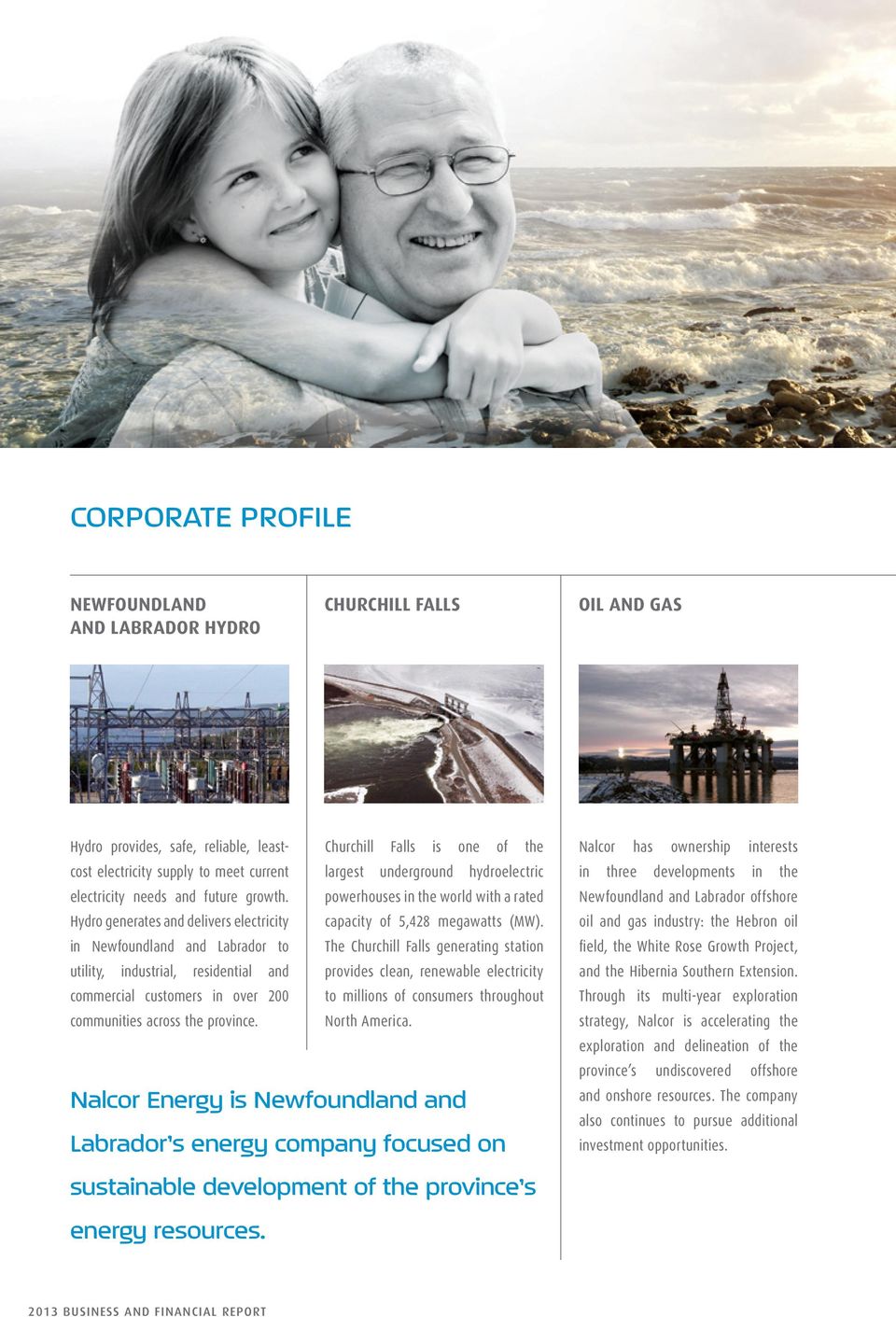
6 CORPORATE PROFILE CORPORATE PROFILE NEWFOUNDLAND AND LABRADOR HYDRO CHURCHILL FALLS OIL AND GAS Hydro provides, safe, reliable, leastcost electricity supply to meet current electricity needs and future growth. Hydro generates and delivers electricity in Newfoundland and Labrador to utility, industrial, residential and commercial customers in over 200 communities across the province. Churchill Falls is one of the largest underground hydroelectric powerhouses in the world with a rated capacity of 5,428 megawatts (MW). The Churchill Falls generating station provides clean, renewable electricity to millions of consumers throughout North America. Nalcor Energy is Newfoundland and Labrador s energy company focused on sustainable development of the province s energy resources. Nalcor has ownership interests in three developments in the Newfoundland and Labrador offshore oil and gas industry: the Hebron oil field, the White Rose Growth Project, and the Hibernia Southern Extension. Through its multi-year exploration strategy, Nalcor is accelerating the exploration and delineation of the province s undiscovered offshore and onshore resources. The company also continues to pursue additional investment opportunities BUSINESS AND FINANCIAL REPORT
7 Nalcor s business includes the development, generation, transmission and sale of electricity; the exploration, development, production and sale of oil and gas; and industrial fabrication and energy marketing. LOWER CHURCHILL PROJECT BULL ARM FABRICATION ENERGY MARKETING AND OTHER ENERGY ACTIVITIES The lower Churchill River is one of the most attractive undeveloped hydroelectric resources in North America and is a key component of the province s energy warehouse. The project s two sites at Muskrat Falls and Gull Island have a combined capacity of over 3,000 MW. The Muskrat Falls Project includes construction of an 824 MW hydroelectric dam and more than 1,500 km of transmission lines that will provide Newfoundlanders and Labradorians with long-term stable electricity rates and serve as a valuable power-producing asset for generations. The Bull Arm Fabrication site is a fabrication facility spanning over 6,300 acres with capabilities for steel fabrication and concrete construction, outfitting installation, at-shore hookup and deepwater commissioning. The site is leased by ExxonMobil Canada Properties for the Hebron project until Nalcor s energy marketing portfolio currently includes Churchill Falls recall power that is surplus to Newfoundland and Labrador s needs, energy sales to industrial customers in Labrador, long-term transmission service agreements through Québec, and power sales from the Menihek hydroelectric station. Nalcor s energy marketing portfolio will continue to grow over the coming years with the development of the Lower Churchill Project and increased production from Nalcor s offshore oil and gas interests. Nalcor will continue to pursue opportunities to increase the overall value of its current portfolio. 05

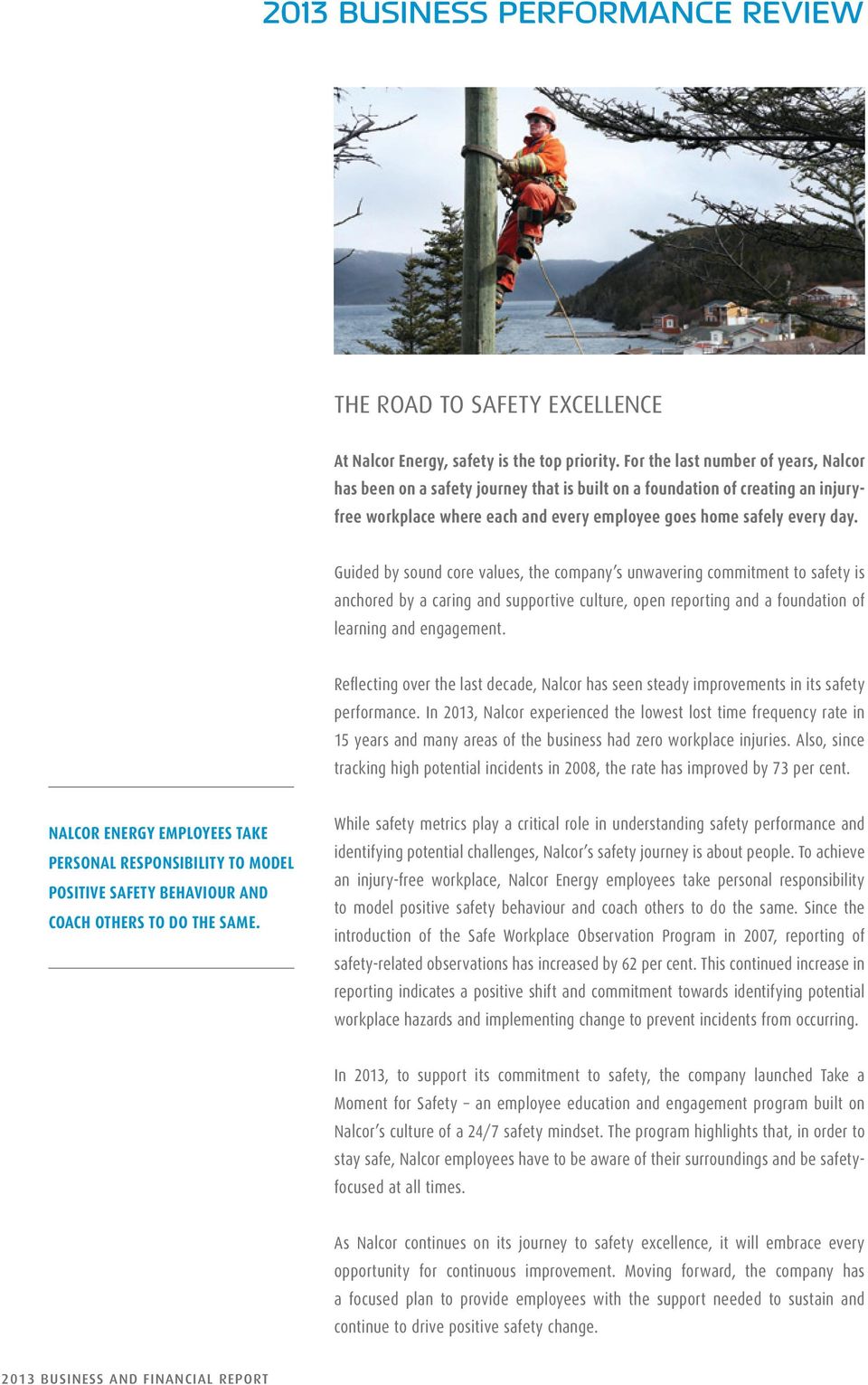
8 2013 BUSINESS PERFORMANCE REVIEW THE ROAD TO SAFETY EXCELLENCE At Nalcor Energy, safety is the top priority. For the last number of years, Nalcor has been on a safety journey that is built on a foundation of creating an injuryfree workplace where each and every employee goes home safely every day. Guided by sound core values, the company s unwavering commitment to safety is anchored by a caring and supportive culture, open reporting and a foundation of learning and engagement. Reflecting over the last decade, Nalcor has seen steady improvements in its safety performance. In 2013, Nalcor experienced the lowest lost time frequency rate in 15 years and many areas of the business had zero workplace injuries. Also, since tracking high potential incidents in 2008, the rate has improved by 73 per cent. NALCOR ENERGY EMPLOYEES TAKE PERSONAL RESPONSIBILITY TO MODEL POSITIVE SAFETY BEHAVIOUR AND COACH OTHERS TO DO THE SAME. While safety metrics play a critical role in understanding safety performance and identifying potential challenges, Nalcor s safety journey is about people. To achieve an injury-free workplace, Nalcor Energy employees take personal responsibility to model positive safety behaviour and coach others to do the same. Since the introduction of the Safe Workplace Observation Program in 2007, reporting of safety-related observations has increased by 62 per cent. This continued increase in reporting indicates a positive shift and commitment towards identifying potential workplace hazards and implementing change to prevent incidents from occurring. In 2013, to support its commitment to safety, the company launched Take a Moment for Safety an employee education and engagement program built on Nalcor s culture of a 24/7 safety mindset. The program highlights that, in order to stay safe, Nalcor employees have to be aware of their surroundings and be safetyfocused at all times. As Nalcor continues on its journey to safety excellence, it will embrace every opportunity for continuous improvement. Moving forward, the company has a focused plan to provide employees with the support needed to sustain and continue to drive positive safety change BUSINESS AND FINANCIAL REPORT
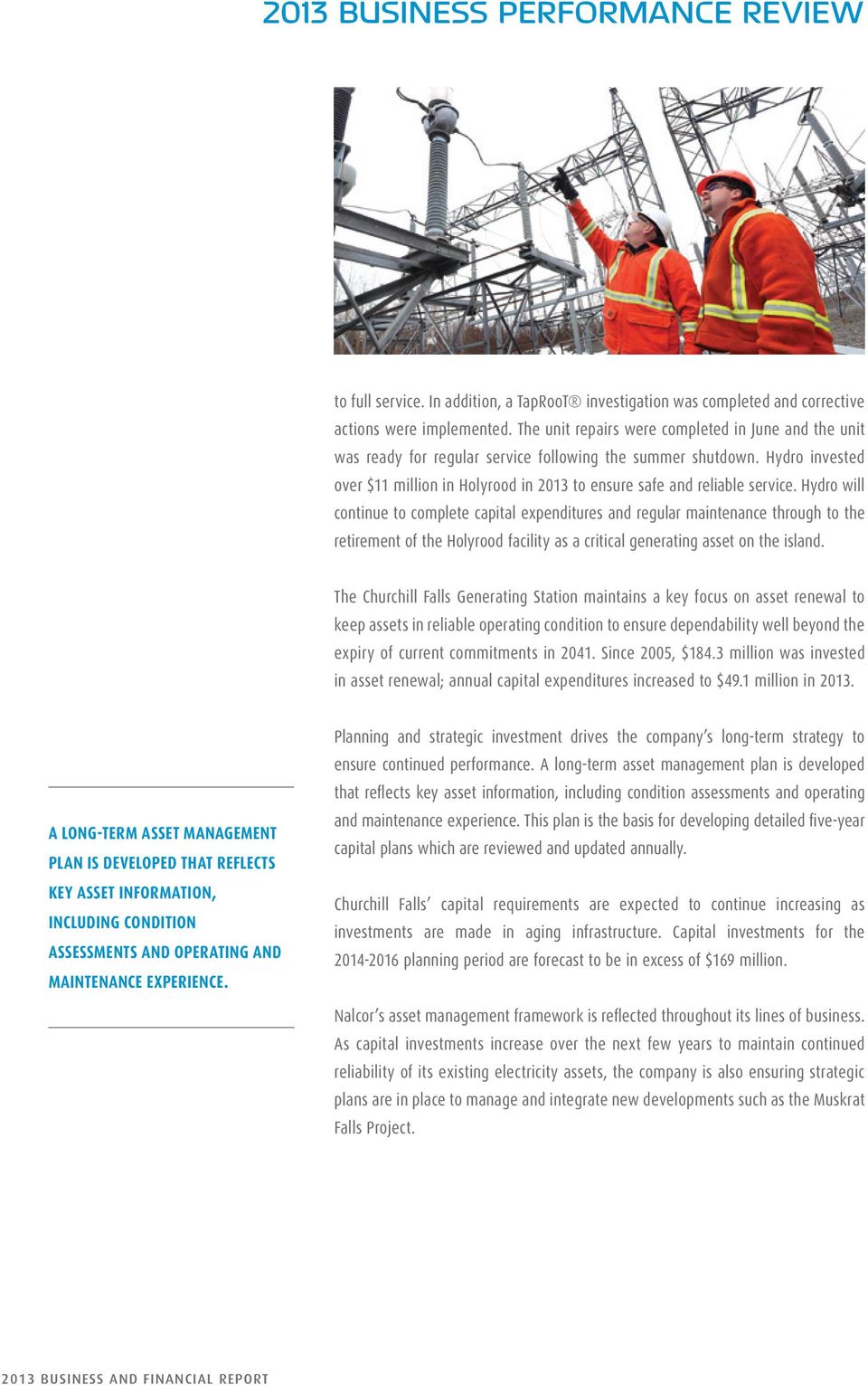
9 Strategic plans are in place to manage and integrate new developments such as the Muskrat Falls Project. STEWARDS OF THE PROVINCIAL ELECTRICITY SYSTEM Nalcor s electricity business is committed to providing safe, reliable and least-cost electricity. To facilitate this commitment, a robust asset management program is in place and is reviewed regularly to ensure strategic investments are made on the right assets at the right time. In 2006, Hydro recognized the magnitude and potential impacts of its aging assets and related customer reliability considerations. An assessment was made of current practices and a comprehensive long- term asset management plan was initiated. Over the past five years, formal condition assessments were completed on gas turbines, diesel plants, the Holyrood Thermal Generating Station (HTGS), and hydraulic structures. Resulting recommendations were integrated into Hydro s capital plans and have led to more than a two-fold increase in Hydro s capital expenditures since 2005 and is projected to continue to grow. One asset that plays a critical role in the island s power system is the Holyrood Plant, which currently provides about one-third of Hydro s total island generating capacity. On January 11, 2013 Unit 1 experienced a sudden shutdown due to an electrical disturbance that originated in the high-voltage switchyard, resulting from a winter storm with extremely high winds, heavy snow and salt contamination. The unit sustained damage as a result of a failure in the lube oil system. Hydro undertook a comprehensive analysis to investigate the damage, identify the necessary repairs and prepare to restore the unit 07

10 2013 BUSINESS PERFORMANCE REVIEW to full service. In addition, a TapRooT investigation was completed and corrective actions were implemented. The unit repairs were completed in June and the unit was ready for regular service following the summer shutdown. Hydro invested over $11 million in Holyrood in 2013 to ensure safe and reliable service. Hydro will continue to complete capital expenditures and regular maintenance through to the retirement of the Holyrood facility as a critical generating asset on the island. The Churchill Falls Generating Station maintains a key focus on asset renewal to keep assets in reliable operating condition to ensure dependability well beyond the expiry of current commitments in Since 2005, $184.3 million was invested in asset renewal; annual capital expenditures increased to $49.1 million in A LONG-TERM ASSET MANAGEMENT PLAN IS DEVELOPED THAT REFLECTS KEY ASSET INFORMATION, INCLUDING CONDITION ASSESSMENTS AND OPERATING AND MAINTENANCE EXPERIENCE. Planning and strategic investment drives the company s long-term strategy to ensure continued performance. A long-term asset management plan is developed that reflects key asset information, including condition assessments and operating and maintenance experience. This plan is the basis for developing detailed five-year capital plans which are reviewed and updated annually. Churchill Falls capital requirements are expected to continue increasing as investments are made in aging infrastructure. Capital investments for the planning period are forecast to be in excess of $169 million. Nalcor s asset management framework is reflected throughout its lines of business. As capital investments increase over the next few years to maintain continued reliability of its existing electricity assets, the company is also ensuring strategic plans are in place to manage and integrate new developments such as the Muskrat Falls Project BUSINESS AND FINANCIAL REPORT
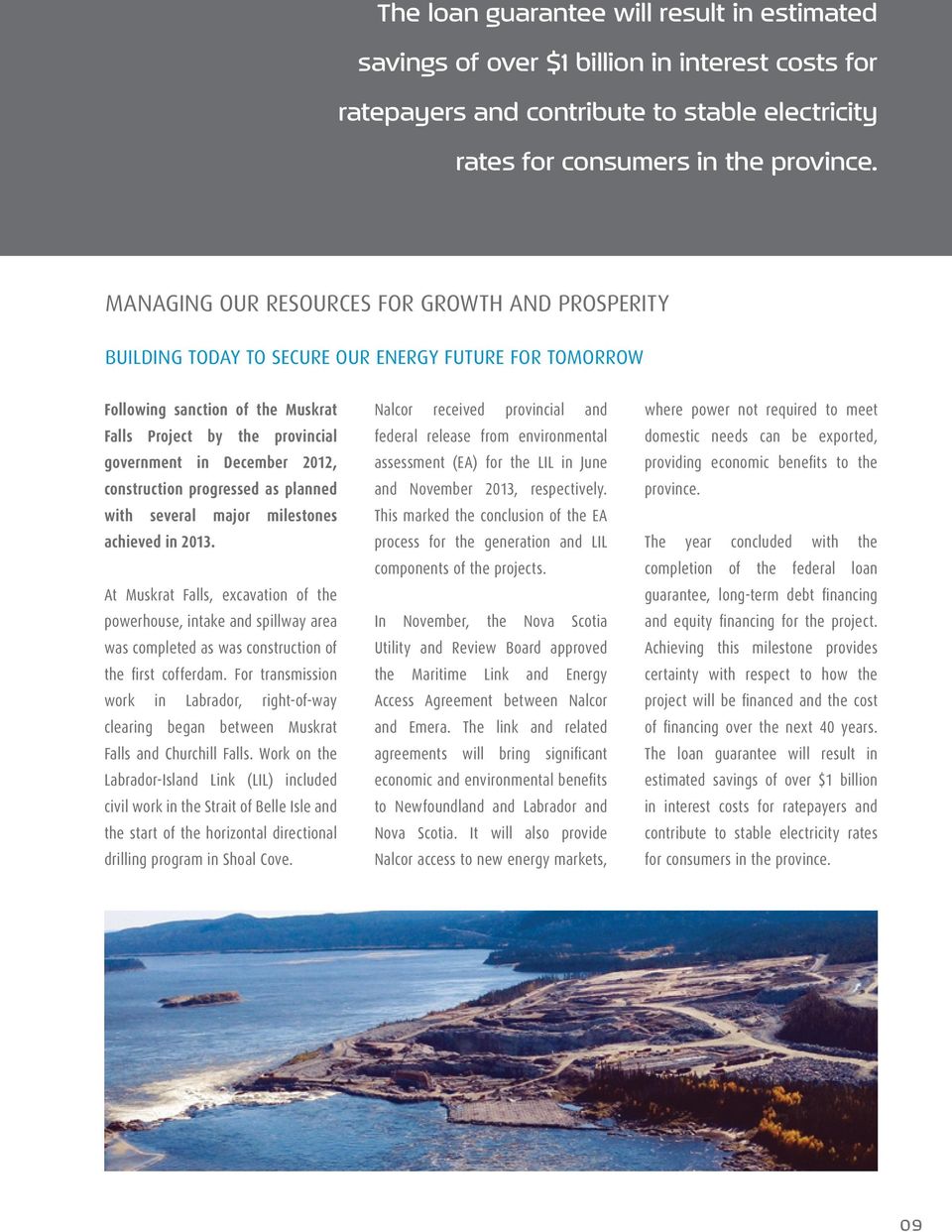
11 The loan guarantee will result in estimated savings of over $1 billion in interest costs for ratepayers and contribute to stable electricity rates for consumers in the province. MANAGING OUR RESOURCES FOR GROWTH AND PROSPERITY BUILDING TODAY TO SECURE OUR ENERGY FUTURE FOR TOMORROW Following sanction of the Muskrat Falls Project by the provincial government in December 2012, construction progressed as planned with several major milestones achieved in At Muskrat Falls, excavation of the powerhouse, intake and spillway area was completed as was construction of the first cofferdam. For transmission work in Labrador, right-of-way clearing began between Muskrat Falls and Churchill Falls. Work on the Labrador-Island Link (LIL) included civil work in the Strait of Belle Isle and the start of the horizontal directional drilling program in Shoal Cove. Nalcor received provincial and federal release from environmental assessment (EA) for the LIL in June and November 2013, respectively. This marked the conclusion of the EA process for the generation and LIL components of the projects. In November, the Nova Scotia Utility and Review Board approved the Maritime Link and Energy Access Agreement between Nalcor and Emera. The link and related agreements will bring significant economic and environmental benefits to Newfoundland and Labrador and Nova Scotia. It will also provide Nalcor access to new energy markets, where power not required to meet domestic needs can be exported, providing economic benefits to the province. The year concluded with the completion of the federal loan guarantee, long-term debt financing and equity financing for the project. Achieving this milestone provides certainty with respect to how the project will be financed and the cost of financing over the next 40 years. The loan guarantee will result in estimated savings of over $1 billion in interest costs for ratepayers and contribute to stable electricity rates for consumers in the province. 09
12 2013 BUSINESS PERFORMANCE REVIEW PURSUING OPPORTUNITIES IN THE OIL AND GAS INDUSTRY Nalcor is focused on environmentally responsible and sustainable growth and development of the province s oil and gas resources. Nalcor currently manages ownership interests in three offshore oil and gas developments White Rose Extension, Hibernia Southern Extension and Hebron. In addition to the economic value created through its ownership interests, as a partner Nalcor gains important insight into a project s realities, challenges and opportunities. Nalcor is in a position to ensure Newfoundlanders and Labradorians will benefit from offshore oil and gas resources for generations to come. NALCOR IS IN A POSITION TO ENSURE NEWFOUNDLANDERS AND LABRADORIANS WILL BENEFIT FROM OFFSHORE OIL AND GAS RESOURCES FOR GENERATIONS TO COME. Significant milestones were achieved in the province s offshore projects in The construction of the Gravity Base Structure and fabrication of the living quarters, both of which are being constructed in the province, as well as the Topsides for the Hebron Project continued on schedule for first oil in The installation of the subsea pipeline and equipment necessary for water injection, production and full field development was completed for the Hibernia Southern Extension Project. The Development Plan required for the Wellhead Platform Project was submitted and Front End Engineering Development (FEED) was also completed for White Rose. Nalcor s role, on behalf of the Province, not only resides with securing ownership interests in offshore developments but it also revolves around attracting capable global exploration companies to invest in the province s offshore through the widespread dissemination of new data and scientific assessments of the province s resource potential. As part of its exploration strategy, Nalcor invested with global seismic companies TGS and Petroleum Geo-Services to execute an extensive, three-year 2D seismic data acquisition program offshore Newfoundland and Labrador. The seismic program 2013 BUSINESS AND FINANCIAL REPORT

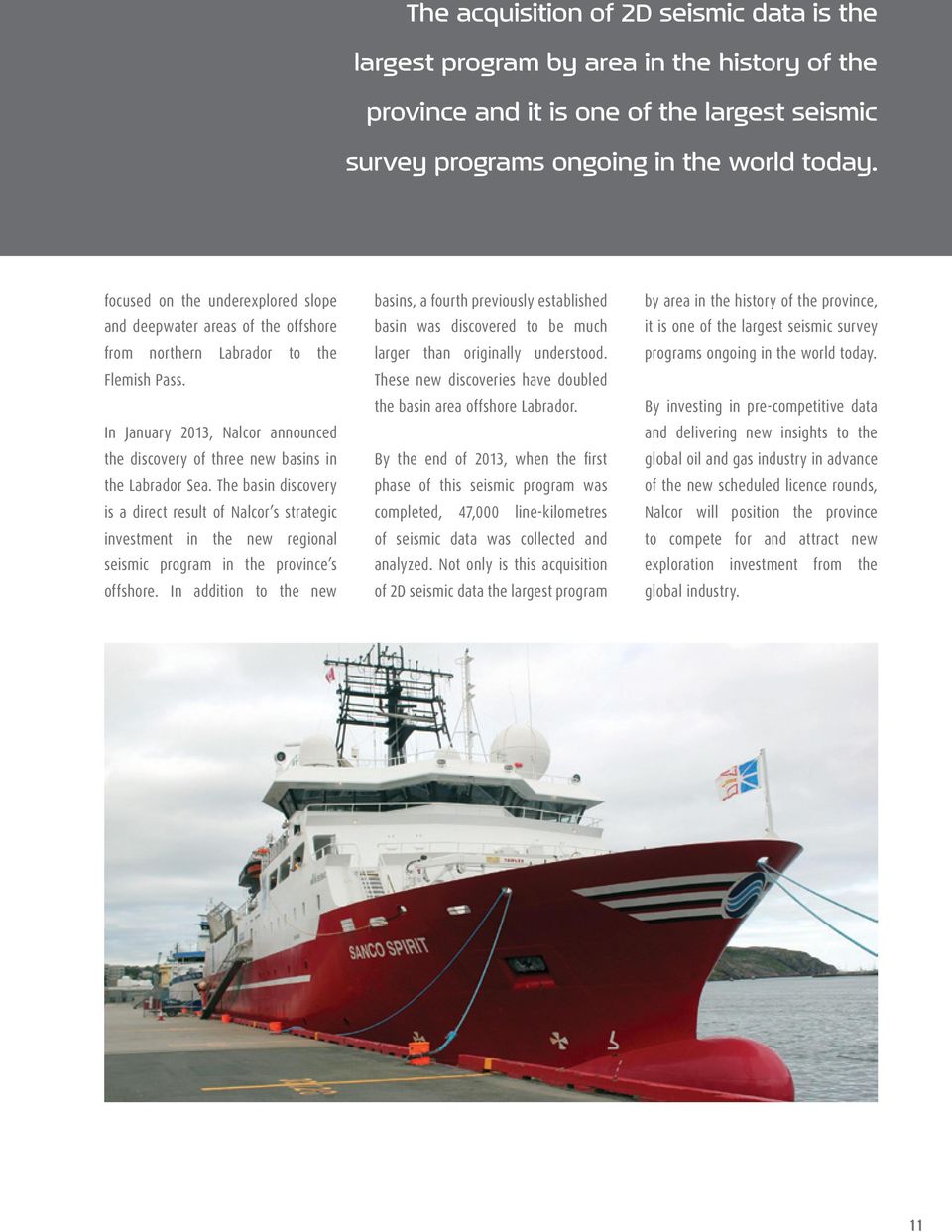
13 The acquisition of 2D seismic data is the largest program by area in the history of the province and it is one of the largest seismic survey programs ongoing in the world today. focused on the underexplored slope and deepwater areas of the offshore from northern Labrador to the Flemish Pass. In January 2013, Nalcor announced the discovery of three new basins in the Labrador Sea. The basin discovery is a direct result of Nalcor s strategic investment in the new regional seismic program in the province s offshore. In addition to the new basins, a fourth previously established basin was discovered to be much larger than originally understood. These new discoveries have doubled the basin area offshore Labrador. By the end of 2013, when the first phase of this seismic program was completed, 47,000 line-kilometres of seismic data was collected and analyzed. Not only is this acquisition of 2D seismic data the largest program by area in the history of the province, it is one of the largest seismic survey programs ongoing in the world today. By investing in pre-competitive data and delivering new insights to the global oil and gas industry in advance of the new scheduled licence rounds, Nalcor will position the province to compete for and attract new exploration investment from the global industry. 11
14 2013 BUSINESS PERFORMANCE REVIEW MANAGING THE LARGEST INDUSTRIAL FABRICATION SITE IN ATLANTIC CANADA The Bull Arm Fabrication Site is an important asset for the province for the development of the oil and gas industry in Newfoundland and Labrador and the advancement of the province s fabrication capacity. The Bull Arm Fabrication Site provides benefits through its infrastructure, technology and knowledge transfer, and the continual development of an experienced labour force. DURING THE SUMMER OF 2013, MORE THAN 3,500 PEOPLE WERE EMPLOYED AT THE SITE AND SIGNIFICANT PROGRESS WAS MADE ON CONSTRUCTION AND FABRICATION WORK. The site is currently fully leased by ExxonMobil Canada Properties (ExxonMobil) for the construction of the Gravity Base Structure (GBS), fabrication of the living quarters and GBS and Topsides installation and integration activities for the Hebron Project. During the summer of 2013, more than 3,500 people were employed at the site and significant progress was made on construction and fabrication work. Parallel to those major activities, Nalcor continued to work with ExxonMobil to complete upgrades to the site through their capital program. This program will help ensure the site s assets are in good condition to support long-term operations. Nalcor is also continuing to advance long-term planning for the site as a means of positioning it for future operations. In 2013, various operating models were researched and analyzed and safety and environment management system benchmarking activities were conducted. This work will progress the goal of a seamless transition to future site operations focusing on continual improvement to ensure a competitive, safe site with a sustained workforce for future generations BUSINESS AND FINANCIAL REPORT

15 In 2013, 99.1 per cent of available energy was delivered to the market and realized prices were 33 per cent higher than the upstate New York market benchmark. POSITIONED FOR LONG-TERM ENERGY MARKETING NEEDS Nalcor is successfully executing on a sound energy marketing strategy that is based on the organization s vision, values and goals that will maximize the value of Nalcor s current assets and position the company for longerterm energy marketing success. competence and building relationships with key industry players. In 2013, 99.1 per cent of available energy was delivered to the market and realized prices were 33 per cent higher than the upstate New York market benchmark. of surplus energy from the Lower Churchill Project and other energy projects to an energy-hungry market. Nalcor is well positioned to further develop the province s energy warehouse for the benefit of Newfoundlanders and Labradorians. Energy Marketing is the face of Nalcor to energy markets outside the province and it is successfully demonstrating Nalcor has built an energy marketing competence that will facilitate the delivery and maximize the value 13

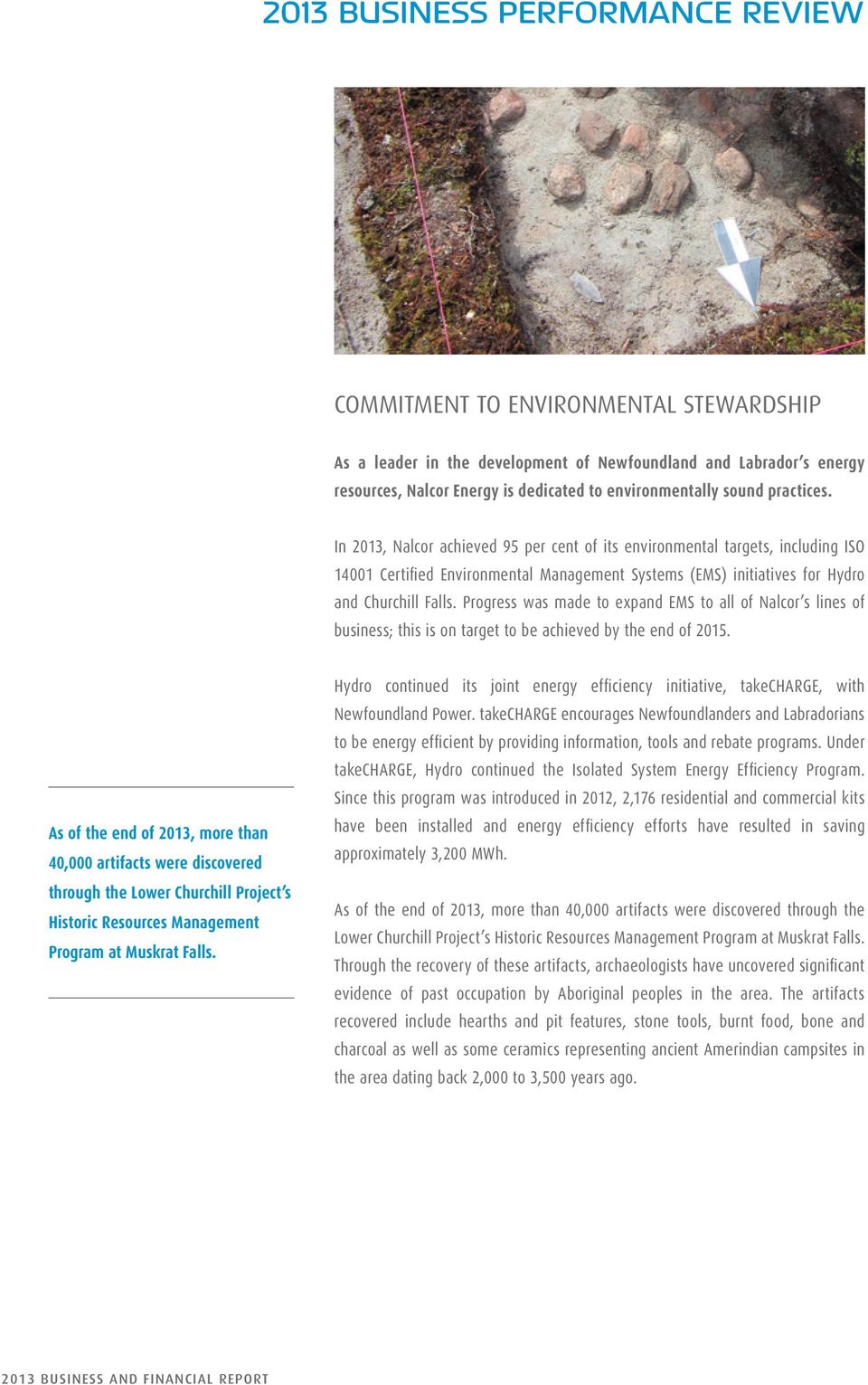
16 2013 BUSINESS PERFORMANCE REVIEW COMMITMENT TO ENVIRONMENTAL STEWARDSHIP As a leader in the development of Newfoundland and Labrador s energy resources, Nalcor Energy is dedicated to environmentally sound practices. In 2013, Nalcor achieved 95 per cent of its environmental targets, including ISO Certified Environmental Management Systems (EMS) initiatives for Hydro and Churchill Falls. Progress was made to expand EMS to all of Nalcor s lines of business; this is on target to be achieved by the end of As of the end of 2013, more than 40,000 artifacts were discovered through the Lower Churchill Project s Historic Resources Management Program at Muskrat Falls. Hydro continued its joint energy efficiency initiative, takecharge, with Newfoundland Power. takecharge encourages Newfoundlanders and Labradorians to be energy efficient by providing information, tools and rebate programs. Under takecharge, Hydro continued the Isolated System Energy Efficiency Program. Since this program was introduced in 2012, 2,176 residential and commercial kits have been installed and energy efficiency efforts have resulted in saving approximately 3,200 MWh. As of the end of 2013, more than 40,000 artifacts were discovered through the Lower Churchill Project s Historic Resources Management Program at Muskrat Falls. Through the recovery of these artifacts, archaeologists have uncovered significant evidence of past occupation by Aboriginal peoples in the area. The artifacts recovered include hearths and pit features, stone tools, burnt food, bone and charcoal as well as some ceramics representing ancient Amerindian campsites in the area dating back 2,000 to 3,500 years ago BUSINESS AND FINANCIAL REPORT
17 Employees throughout Nalcor s lines of business strive to be committed and innovative in their activities related to corporate social responsibility. ALWAYS ON IN OUR COMMUNITIES Nalcor Energy and Hydro employees have the energy and commitment to help create healthy, vibrant communities. In 2013, employees raised approximately $63,000 through the company s matching, employee volunteerism and employee giving programs to contribute to local charities across the province. Nalcor and Hydro supported over 370 community and charitable organizations in the province. In 2013, Hydro entered a visionary child & youth initiatives partnership with the Heart & Stroke Foundation, which supports several child/youth mission and community engagement initiatives. Nalcor also entered into a partnership with The Gathering Place, providing a $50,000 donation for expansion of their programs and services. Nalcor also held its third annual Acts of Kindness Week in April In this one-week period, employees logged more than 100 hours with 25-plus charities across the province, demonstrating the company s commitment to giving back to communities. 15

18 MANAGEMENT S DISCUSSION & ANALYSIS The following discussion and analysis is the responsibility of management and is as of April 3, Nalcor Energy maintains appropriate systems of internal control, policies and procedures that provide management with reasonable assurance that assets are safeguarded and that its financial information is reliable. The Board of Directors carries out its responsibility for review of this disclosure principally through its Audit Committee, comprised exclusively of independent directors. The Audit Committee has reviewed and approved this Management s Discussion and Analysis (MD&A). This MD&A should be read in conjunction with the consolidated financial statements of Nalcor Energy for the years ended and included in this Business and Financial Report, as well as the notes, for the respective years. Certain statements in this MD&A are forward-looking statements subject to risks and uncertainties. Statements containing words such as could, expect, may, anticipate, believe, intend, estimate, plan, and similar expressions constitute forward-looking statements. These statements are based on certain factors and assumptions, including: foreign exchange rates, expected growth, results of operations, performance and business prospects and opportunities. While Nalcor considers these factors and assumptions to be reasonable based on information currently available, they may prove to be incorrect. A number of factors could cause actual results to differ materially from those in the forward-looking statements, including, but not limited to: fluctuations in supply and demand in electricity markets, changes in capital markets, changes in currency and exchange rates, unexpected environmental conditions, fluctuations in future fuel and electricity prices, changes in oil reserves and government or regulatory policy changes. Nalcor assumes no obligation to update or revise any forwardlooking statements, whether as a result of new information, future events or any other reason BUSINESS AND FINANCIAL REPORT

19 TABLE OF CONTENTS 17 Section 1: Corporate Overview and Strategy 20 Section 2: Performance 38 Section 3: Risk Management Process 44 Section 4: Critical Accounting Estimates 46 Section 5: Future Accounting Changes SECTION 1: CORPORATE OVERVIEW AND STRATEGY Nalcor Energy (Nalcor or the Company) is a Crown corporation established in 2007 under a special act of the Legislature of the Province of Newfoundland and Labrador (the Province). Nalcor s business includes the development, generation, transmission and sale of electricity; the exploration, development, production and sale of oil and gas; industrial fabrication site management; and energy marketing. Nalcor s legal structure at December 31, 2013 included the entities listed below. Nalcor has segregated its business into seven reporting segments. These reporting segments allow senior management to evaluate the operational performance and assess the overall contribution of each segment to Nalcor s long-term objectives. The following summary describes the operations included in each of the Company s reportable segments. HYDRO REGULATED Hydro Regulated s mandate is to ensure a safe, reliable and least-cost electricity supply is available to meet current demand and future growth. Hydro Regulated generates, transmits and distributes electricity to customers throughout Newfoundland and Labrador. Hydro Regulated s operations consist of sales of electricity to three primary customer groups: Newfoundland Power (NP), an investor-owned utility that distributes electricity to over 255,000 customers on the island portion of the province, with Hydro Regulated supplying 93% ( %) of its energy requirements comprising 82.4% of regulated revenue ( %); over 38,000 residential and commercial customers in rural Newfoundland and Labrador comprising 14.6% of regulated revenue ( %); and major industrial customers primarily in the pulp and paper, mining and oil refining industries comprising 3.0% of regulated revenue ( %). Entity Name Newfoundland and Labrador Hydro (Hydro) Nalcor Energy - Oil and Gas Inc. (Oil and Gas) Nalcor Energy - Bull Arm Fabrication Inc. (Bull Arm Fabrication) Muskrat Falls Corporation (Muskrat Falls) Labrador Transmission Corporation (Transco) Labrador-Island Link Holding Corporation (LIL Holdco) Labrador-Island Link Limited Partnership (LIL LP) Labrador-Island Link General Partner Corporation (LIL GP) Labrador-Island Link Operating Corporation (LIL OpCo) Labrador Churchill Management Corporation (LCMC) Gull Island Power Corporation (GIPCo) Lower Churchill Development Corporation (LCDC) Churchill Falls (Labrador) Corporation Limited (Churchill Falls) Twin Falls Power Corporation Limited (Twin Falls) Description of Interest Wholly owned subsidiary Wholly owned subsidiary Wholly owned subsidiary Wholly owned subsidiary Wholly owned subsidiary Wholly owned subsidiary Limited partnership in which Nalcor, through LIL Holdco, owns 100% of the 75 Class A limited partnership units Wholly owned subsidiary Wholly owned subsidiary Wholly owned subsidiary Wholly owned subsidiary (inactive) 51% owned subsidiary of Hydro (inactive) 65.8% owned joint venture of Hydro 33.3% owned joint venture of Churchill Falls 17

20 MANAGEMENT S DISCUSSION & ANALYSIS CORPORATE OVERVIEW AND STRATEGY Hydro Regulated is regulated by the Newfoundland and Labrador Board of Commissioners of Public Utilities (PUB). Rates are set through periodic general rate applications using a cost of service methodology whereby Hydro Regulated is entitled to recover, through customer rates, all reasonable and prudent costs incurred in providing electricity service to its customers including a return on rate base. Hydro Regulated is entitled to earn a return on equity (ROE) equal to 4.47% for the purpose of determining its cost of capital, which is based on a previous PUB decision which established the ROE at a rate equal to the long-term marginal cost of debt. In 2009, the Province issued an Order in Council which provided Hydro Regulated with the ability to earn an ROE equal to the rate approved by the PUB for NP, effective following the current general rate application (GRA). The ability to earn a comparable ROE to NP and most regulated utilities across Canada provides a foundation for improved future financial performance. On July 30, 2013, Hydro filed its GRA for new rates, effective January 1, This application is currently proceeding through the regulatory process and a hearing is anticipated in July Due to the timing of the final order of the PUB related to Hydro s GRA, Hydro also filed an interim rate application on November 18, 2013, for rates to be effective from January 1, 2014, until a final order by the PUB is received relating to the GRA. Final submissions on this application were scheduled for March 2014 with a final order from the PUB expected in April Along with the GRA filing, Hydro also filed an application related to a portion of the Rate Stabilization Plan (RSP) balance. This balance was mainly due to fuel savings at the Holyrood Thermal Generating Station (HTGS) as a result of the shutdown of a portion of the pulp and paper industry in the Province since In April 2013, the Government of Newfoundland and Labrador issued directives to the PUB and Hydro on the allocation of the August 31, 2013, portion of the RSP amounting to $162.0 million, which was included in Hydro s application. In August 2013, the PUB approved Hydro s application regarding the allocation of the RSP balance with $49.0 million being allocated to industrial customers and the balance of $113.0 million allocated to the benefit of retail customers. At December 31, 2013, the amount of the load variation in the RSP was $134.4 million. On October 31, 2013, Hydro filed a further application regarding the refund of the RSP balance of $113.0 million to retail customers. Hydro s proposals in this application remain under consideration by the PUB with a final decision anticipated in Hydro Regulated s generating assets, with a total installed capacity of 1,608.9 megawatts (MW), consist of nine hydroelectric plants (939 MW), one oil-fired plant (490 MW), three gas turbines (127 MW), 25 diesel plants (52.6 MW) and 0.3 MW of wind. In addition, Hydro Regulated has entered into a number of power purchase agreements with nonutility generators to supplement its generation capacity. In order to meet the province s growing electricity needs, Hydro Regulated has entered into a Power Purchase Agreement (PPA) for output from the Muskrat Falls (MF) hydroelectric facility currently under construction as well as a Transmission Funding Agreement (TFA) to secure transmission rights on the Labrador-Island Link (LIL). These contracts will ensure Hydro Regulated s ability to provide reliable service at stable rates to customers on the island well into the future. Hydro Regulated s business strategy is to operate sound electricity systems, deliver safe, reliable electricity to customers at the lowest reasonable cost, and conduct business in an environmentally and socially responsible manner. Nalcor has implemented a corporate-wide asset management framework and organizational design which facilitates this strategy. CHURCHILL FALLS Churchill Falls is the owner and operator of the Churchill Falls Generating Station, one of the largest underground powerhouses in the world with a rated capacity of 5,428 MW. A power contract with Hydro-Québec dated May 12, 1969 (the Power Contract) provides for the sale of the majority of the electricity from this facility (approximately 30 terawatt hours (TWh)) until Churchill Falls sells 300 MW (2.6 TWh) annually (the maximum provided for under the Power Contract) to Hydro for use in Labrador and export sales (recall energy). Churchill Falls also sells 225 MW (approximately 1.8 TWh) to Twin Falls to service the mining industry in Labrador West. In addition, Churchill 2013 BUSINESS AND FINANCIAL REPORT
21 Falls earns revenue from Hydro-Québec under a Guaranteed Winter Availability Contract (GWAC). The GWAC was signed with Hydro-Québec in 1998 and provides additional revenue for the sale of up to 682 MW of seasonal availability to Hydro-Québec during the months of November through March until the end of the Power Contract in The strategy for Churchill Falls focuses on safely operating and maintaining its assets to optimize long-term value while meeting all contractual obligations. OIL AND GAS Oil and Gas is a partner in three developments in the Newfoundland and Labrador offshore: a 4.9 per cent working interest in the Hebron oil field, the province s fourth offshore oil project which was sanctioned for development on December 31, 2012; a 5.0 per cent working interest in the White Rose Growth Project, which produced first oil from the North Amethyst field in May 2010; and a 10.0 per cent working interest in the Hibernia Southern Extension Project, which produced first oil in June Nalcor also has an average working interest of 99.0 per cent in two onshore exploration permits in Parson s Pond on the Great Northern Peninsula. Oil and Gas has also developed a multi-year strategy that aims to encourage more exploration drilling by international exploration and production companies through Nalcor s investment in the provision of high-quality seismic data. Oil and Gas has also entered into a strategic partnership in a seismic survey of offshore Newfoundland and Labrador. Nearly 17,000 line-km of high-quality seismic data was acquired in 2013 ( ,000 line-km). This is part of a multi-year program that will significantly add to the offshore 2D seismic data set in Newfoundland and Labrador bringing the three-year total to 47,000 line-km one of the largest regional seismic programs on a global basis. ENERGY MARKETING The revenue and earnings in this segment are derived primarily from sales of available recall energy. This electricity is sold to markets in eastern Canada and the northern United States as well as to the iron ore industry in Labrador. To access export markets, Nalcor has service agreements with Hydro-Québec for 265 MW of long-term electricity transmission capacity from Labrador through Quebec to the Canada-United States border and in 2013, Nalcor renewed those agreements for another 10 years. This segment also includes the operations of the Menihek Generating Station which supplies power to both Hydro- Quebec for its customers in the Schefferville region and a mining company operating in Labrador. PHASE 1 LOWER CHURCHILL PROJECT Phase 1 of the Lower Churchill Project (Phase 1 Lower Churchill Project or the project) was sanctioned on December 17, The project includes an 824 MW hydroelectric facility at MF on the lower Churchill River in Labrador, over 1,500 km of 19
22 MANAGEMENT S DISCUSSION & ANALYSIS PERFORMANCE associated transmission lines in Newfoundland and Labrador linking the island of Newfoundland to Labrador, and the Maritime Link (ML) between the island of Newfoundland and Nova Scotia. The hydroelectric facility and the transmission lines in the province are being constructed by Nalcor and the ML is being constructed by Emera Inc. (Emera). The development of the Phase 1 Lower Churchill Project will provide a clean, renewable source of electricity to meet the province s growing energy demands. It will provide Newfoundland and Labrador homes and businesses with stable electricity rates well into the future, and will be a valuable power-producing asset for the province for more than 100 years. This project is the lowest-cost alternative to meet the province s growing need for electricity and will provide jobs and economic benefits for the people of Newfoundland and Labrador. In addition to providing longterm stable electricity rates, the development will help Canada s efforts to reduce greenhouse gas emissions. The PPA between Hydro and Muskrat Falls provides for the purchase by Hydro and the sale by Muskrat Falls of energy, capacity, ancillary services and greenhouse gas credits, payments for which are made on a full cost recovery basis. In addition, the LIL and related transmission rights will be used by Hydro Regulated to supply energy to its customers in exchange for payments on a full cost recovery basis pursuant to the TFA. BULL ARM FABRICATION Bull Arm Fabrication is Atlantic Canada s largest industrial fabrication site. The site, which has unobstructed, deepwater access to the Atlantic Ocean, generates revenue through leasing arrangements with large construction projects. This site is currently under lease until 2017 for the construction of the Gravity Base Structure (GBS) platform and fabrication of the Living Quarters Module as well as other construction and fabrication activities related to the Hebron project. Nalcor is currently developing a long-term strategy for the site to ensure the success of Bull Arm Fabrication once the current lease expires. CORPORATE AND OTHER ACTIVITIES This segment includes corporate support functions, business development activities and certain development projects that have not yet progressed to sanction decision including Phase 2 of the Lower Churchill Project (Gull Island or Phase 2 Lower Churchill Project). SECTION 2: PERFORMANCE FINANCIAL HIGHLIGHTS This section provides an overview of Nalcor s financial performance based on its audited consolidated financial statements. millions of dollars Revenue $ $ Expenses Net income $ 95.6 $ 92.7 Key Financial Performance Indicators: Cash flow from operations $ $ Return on capital employed (ROCE) 7.5% 8.3% Total debt to capital 71.7% 38.9% Cash flow from operations Cash flow from operating activities before working capital adjustments ROCE Net income plus interest divided by average debt plus equity (adjusted for assets under development) Total debt to capital Total debt (promissory notes, long-term debt including current portion less sinking funds), divided by debt plus shareholder s equity Certain comparative figures have been reclassified to comply with the current year s presentation Overall net income for 2013 was $95.6 million, an increase of $2.9 million from The primary reason for the increase in net income was an increase in Energy Marketing earnings related to higher export market electricity prices and Bull Arm Fabrication earnings related to higher lease rates, offset by decreased earnings in Hydro Regulated. Variances by major category are outlined below and discussed in more detail in the Business Segment Review. Revenue: Total revenue was $784.8 million, an increase of $58.7 million in 2013 compared to 2012 revenue of $726.1 million, primarily due to an increase in Hydro Regulated electricity sales, Bull Arm Fabrication s lease revenues and Energy Marketing s sales. Fuels: Fuel expense was $190.9 million, an increase of $8.5 million in 2013 compared to $182.4 million in 2012, primarily due to an increase in fuel consumption related to increased customer load, offset by a decrease in the price of fuel BUSINESS AND FINANCIAL REPORT
23 NALCOR ENERGY - NET INCOME COMPARISON 2013 VS $ MILLIONS $160.0 $140.0 $120.0 $100.0 $58.7 $1.1 $3.5 $8.4 $8.5 $10.9 $25.6 $80.0 $60.0 $40.0 $92.7 $95.6 $20.0 $ Net Income Revenue Net Finance Expense Other Income and Expense Amortization and Depletion Operating Costs Fuels and Power Purchased Regulatory Adjustments 2013 Net Income Power purchased: Power purchases were $63.2 million, an increase of $2.4 million in 2013 over 2012 costs of $60.8 million, primarily due to additional power purchased from Corner Brook Pulp and Paper Co-Generation (CBPP). Operating costs: Operating costs were $215.4 million, an increase of $8.5 million over 2012 costs of $206.9 million primarily due to an increase in salaries and related benefit costs of $6.3 million and an increase in professional service costs of $3.3 million. Amortization and depletion: Amortization and depletion was $87.7 million, an increase of $8.4 million over 2012 of $79.3 million. The increase was primarily the result of higher depletion expense in Oil and Gas due to increased production levels and an increase in amortization due to increasing levels of investment in property, plant and equipment in Hydro Regulated. Net finance expense: Net finance expense includes interest income and expense, foreign exchange gains and losses, and accretion expense on long-term debt and long-term liabilities. In 2013, net finance expense was $72.5 million, a decrease of $1.1 million compared to $73.6 million in 2012 primarily due to earnings on an increased sinking fund balance. Other income and expense: Other income and expense includes losses on disposal of property, plant and equipment, other asset removal costs, insurance proceeds and gains or losses on derivative contracts. In 2013, other expense was $3.9 million, an increase of $3.5 million from an expense of $0.4 million in Factors impacting the increase include an increase in asset disposal costs, partially offset by insurance proceeds, and losses on derivative contracts. Regulatory adjustments: Regulatory adjustments consist of Hydro Regulated deferrals of current year expenditures and amortization of previously deferred costs as approved by the PUB. In 2013, regulatory adjustments were $55.6 million, an increase of $25.6 million compared to $30.0 million in This increase is primarily due to an increase in RSP fuel deferrals of $14.0 million, an increase in rural rate adjustments of $4.4 million and an increase in RSP interest of $3.9 million. Capital expenditures: Capital expenditures totalled $1,009.5 million, an increase of $560.1 million over 2012 levels as depicted below: millions of dollars Hydro Regulated $ 80.6 $ 77.6 Churchill Falls Oil and Gas Phase 1 Lower Churchill Project Corporate and Other Activities $ 1,009.5 $ Reflects Nalcor s 65.8% ownership interest. 21
24 MANAGEMENT S DISCUSSION & ANALYSIS PERFORMANCE Cash flow from operations for 2013 was $241.2 million, an increase of $23.2 million from 2012 primarily due to an increase in revenues from Hydro Regulated, Bull Arm Fabrication and Energy Marketing. ROCE decreased from 8.3% to 7.5% largely due to the increase in the average employed capital base, which was only partially offset by earnings growth. Total debt to capital increased by 32.8% due to the issuance of $5,001.3 million in long-term debt by Muskrat Falls, Transco and the LIL LP. BUSINESS SEGMENT REVIEW In 2013, Nalcor reported its financial results in seven business segments: Hydro Regulated, Churchill Falls, Oil and Gas, Energy Marketing, Phase 1 Lower Churchill Project, Bull Arm Fabrication, and Corporate and Other Activities. These business segments include the seven lines of business of Nalcor and are differentiated on the basis of regulatory status and management accountability. The 2013 net income by business segment is shown in the following table: millions of dollars Hydro Regulated $ 0.5 $ 17.1 Churchill Falls Oil and Gas Energy Marketing Bull Arm Fabrication Phase 1 Lower Churchill Project (2.0) - Corporate and Other Activities (12.3) (10.8) Total $ 95.6 $ 92.7 HYDRO REGULATED The operations of Hydro Regulated are influenced by many external factors including regulation, performance of the domestic economy, weather patterns and fuel costs. The demand for electricity is met through a combination of hydroelectric generation, thermal generation and power purchases including wind generation. Hydro Regulated uses the RSP, as directed by the PUB, both as a means to smooth rate impacts for island electricity consumers and to protect Hydro Regulated s net income from variations in the HTGS fuel costs. Fuel costs fluctuate as a result of variations in electricity sales, fuel prices and hydraulic production. Resulting variations from the levels that were in effect when base rates were last set in 2007 are deferred in the RSP and typically recovered from or refunded to electricity consumers in the following year, with the exception of the hydraulic variation, which is recovered or refunded at a rate of 25% annually. Net income for 2013 was $0.5 million, a decrease of $16.6 million over the 2012 net income of $17.1 million. The factors affecting the 2013 reduced earnings are depicted in the chart below. The increase in total revenue for 2013 of $22.6 million primarily resulted from an increase in electricity sales. Hydro Regulated electricity sales include a base energy rate as well as rate adjustments for RSP refunds or recoveries and a fuel rider. Revenue recognized as a result of the RSP mechanism is deferred as a regulatory adjustment on the statement of income. HYDRO REGULATED VS SEGMENT EARNINGS $ MILLIONS $50.0 $45.0 $40.0 $35.0 $6.2 $0.5 $2.4 $4.2 $5.2 $30.0 $25.0 $22.6 $8.5 $20.0 $15.0 $10.0 $5.0 $0.0 $ Segment Earnings Revenue Other Income and Expense Net Finance and Expense Power Purchased Amortization Operating Costs Fuel $25.6 Regulatory Adjustments $ Segment Earnings 2013 BUSINESS AND FINANCIAL REPORT
25 Electricity sales by major customer category are outlined below: millions of dollars Newfoundland Power $ $ Rural customers Industrial customers/ secondary sales Total Electricity Sales $ $ Revenue from electricity sales to NP in 2013 increased by $21.9 million and 246 gigawatt hours (GWh) over 2012 mainly as a result of increased load growth and colder weather. Revenue from Hydro Regulated s rural customers in 2013 increased by $2.6 million over 2012 due to increased load of 16 GWh and a rate adjustment on July 1, Sales to industrial customers and secondary sales decreased by 73 GWh. This decrease in electricity requirement resulted in a $2.1 million decrease in revenue. On the island, sales decreased primarily due to lower electricity requirements for newsprint and oil refining production. CBPP electricity requirements from Hydro were lower in 2013 due in part to higher customer generation. A decrease in secondary sales to the Department of National Defence in Labrador also contributed to the lower overall industrial sales in Hydro Regulated utilizes No. 6 fuel oil at the 490 MW HTGS and diesel fuel at its diesel plants. The following table summarizes fuel consumed and the average price: No. 6 fuel consumption: Millions of barrels Average price (CAD/barrel) $ $ Diesel fuel consumption: Millions of litres Average price (CAD/litre) $ 1.09 $ 1.08 Fuel costs are summarized below: millions of dollars No. 6 fuel and other $ $ Diesel Total fuel expense $ $ Fuel costs for 2013 increased by $8.5 million over Consumption of fuel at the HTGS increased by 183,000 barrels which, when partially offset by a decrease in No. 6 fuel price, resulted in increased costs for No. 6 fuel over The RSP is designed to smooth fluctuations in fuel prices and variations in fuel consumption due to customer loads. These RSP adjustments are recorded as regulatory adjustments on the statement of income. In 2013, regulatory adjustments relating to fuel deferrals of $35.3 million were recognized, a decrease of $14.0 million from
26 MANAGEMENT S DISCUSSION & ANALYSIS PERFORMANCE To supplement Hydro Regulated s electricity generation on the island, Hydro Regulated purchases power under longterm agreements with non-utility generators (see Note 23(f) to the consolidated financial statements). For 2012 and 2013, Hydro Regulated also entered into a power purchase arrangement with the Government of Newfoundland and Labrador for the output from the hydroelectric assets on the Exploits River. In Labrador, on the interconnected grid, Hydro Regulated purchases substantially all of its electricity requirements from Churchill Falls. Total power purchased increased by $2.4 million from $57.0 million in 2012 to $59.4 million in This increase is primarily due to additional energy purchased at higher rates from CBPP. Hydro Regulated s 2013 operating costs comprised 53% ( %) of consolidated operating costs and are outlined as follows: millions of dollars Salaries $ 78.0 $ 74.1 Maintenance Other Total $ $ Total operating costs increased by $5.2 million over the 2012 level primarily due to an increase in salaries and benefits of $3.9 million. This was caused mainly by negotiated union wage settlements and normal cost of living adjustment increases. Hydro Regulated s amortization expense was $51.7 million, an increase of $4.2 million over 2012, primarily due to increasing levels of property, plant and equipment. Other income and expense decreased by $6.2 million largely due to additional insurance proceeds related to Holyrood Unit 1 repairs. Regulatory adjustments consist of Hydro Regulated deferrals of current year expenditures and amortization of previously deferred costs as approved by the PUB. In 2013, regulatory adjustments were $55.6 million, an increase of $25.6 million compared to $30.0 million in The change was primarily due to an increase in RSP fuel deferrals in 2013 of $14.0 million, an increase in rural rate adjustments of $4.4 million and an increase in RSP interest of $3.9 million. Hydro Regulated s business is capital intensive. Capital investment is driven by its asset management plan which addresses capital requirements to keep assets in reliable operating condition and to provide reliable service to customers for the long-term. The level of capital investment has been growing which is reflective of an aging asset base. Hydro Regulated s annual capital plan requires prior PUB approval. Variances between actual and planned expenditures are generally subject to PUB review prior to inclusion in Hydro Regulated s rate base. Hydro Regulated invested $80.6 million in capital additions and upgrades 2013 BUSINESS AND FINANCIAL REPORT
27 in 2013 (2012 $77.6 million), in accordance with 2013 approved capital expenditures. Investments were made in the following categories: millions of dollars Generation $ 39.0 $ 24.4 Distribution Transmission Other $ 80.6 $ 77.6 The RSP balance due to customers as at December 31, 2013, was $253.8 million ( $201.7 million). The balance in the RSP is increasing due to a continued reduction in industrial customer load and higher than average hydraulic production. This increase was partially offset by amounts owing from customers due to higher fuel prices relative to the currently approved 2007 base rates. The increased RSP balance results in higher interest costs, as interest is accrued on the outstanding balance based on the approved weighted average cost of capital of 7.6%. Rates are also adjusted annually based on forecast fuel prices through a fuel rate rider. The fuel rider and associated rate adjustment for the accumulated RSP balances becomes effective annually on July 1 for NP. RSP rates for industrial customers are normally set on January 1 of each year. A significant portion of this balance relating to load variation totalling approximately $134.4 million, which accumulated since 2007, has been set aside by the PUB to be allocated among the industrial customers and retail customers. This balance is mainly due to reduced industrial customer load as a result of the shutdown of a portion of the pulp and paper industry in the province since CHURCHILL FALLS In 2013, Churchill Falls segment earnings were $23.2 million, a decrease of $5.1 million compared to Revenues increased by $3.3 million in 2013, from $73.5 million to $76.8 million primarily due to favorable GWAC revenue earned in early This increase in earnings was offset by the decrease in other income and expense in In 2012, other income and expense included insurance proceeds from lost GWAC revenue. Amortization also increased primarily due to a large capital program in 2012 which was in service for Churchill Falls capital requirements are expected to continue to increase as investments are made to replace aging infrastructure at the plant. Churchill Falls has established a long-term asset management plan, which addresses capital requirements to keep assets in reliable operating condition, which will in turn provide reliable service to customers for the long term. Accordingly, during 2013, Churchill CHURCHILL FALLS VS SEGMENT EARNINGS $ MILLIONS $35.0 $0.2 $0.3 $1.5 $30.0 $3.3 $25.0 $6.4 $20.0 $15.0 $10.0 $28.3 $23.2 $5.0 $ Segment Earnings Revenue Other Operating Costs Amortization Other Income and Expense 2013 Segment Earnings 25
28 MANAGEMENT S DISCUSSION & ANALYSIS PERFORMANCE Falls invested $49.1 million net of contributions in aid of construction ( $45.7 million). Further, in accordance with the 1999 Shareholders Agreement, Churchill Falls maintains a segregated reserve fund to contribute towards funding capital expenditures related to the replacement of existing infrastructure. As at December 31, 2013, this fund had a balance of $76.7 million ( $77.3 million). On February 23, 2010, Churchill Falls filed a motion against Hydro-Québec in the Quebec Superior Court. The motion is seeking a modification to the pricing terms of the 1969 Power Contract as of November 30, The trial took place during the autumn of It is anticipated that the court will issue its decision on the matter in On February 3, 2010, the Province established the Churchill Falls (Labrador) Corporation Trust (the Trust) with Churchill Falls as the beneficiary. The purpose of this Trust is to fund the external costs and expenses in relation to the motion filed by Churchill Falls seeking a modification to the pricing terms of the 1969 Power Contract. To date, $3.8 million ( $1.8 million) has been received and $0.8 million ( $0.2 million) has been accrued as due from the Trust. In July 2013, Hydro-Québec filed a Motion for Declaratory Judgment (the Motion) in Quebec Superior Court relating to the interpretation of the 1969 Power Contract between Churchill Falls and Hydro-Québec regarding the interpretation of certain terms under the renewed Power Contract which commences in 2016 and obligations of the parties under the terms. The Motion and its possible outcomes are currently under consideration by Churchill Falls legal advisors. OIL AND GAS Total production in 2013 was 657,000 barrels and total sales were $72.2 million compared to 595,000 barrels and $66.9 million in The average dated Brent price per barrel realized in 2013 was $111 US dollars (USD) as compared to $116 USD in Net income for 2013 increased by $4.8 million from 2012 net income of $32.7 million primarily due to increased production volumes, favourable foreign exchange rates, offset by a decreased price per barrel. Production volumes increased at the White Rose field primarily due to stabilization of production/injection rates within the current developed areas and the completion of additional wells to offset natural decline. At Hibernia South, the existing oil producers have intermittent shutdowns, awaiting the startup of water injection operations, to increase reservoir pressure. During 2013, costs capitalized as petroleum and natural gas properties totalled $194.7 million (2012 $88.3 million) OIL AND GAS VS SEGMENT EARNINGS $ MILLIONS $50.0 $45.0 $40.0 $35.0 $9.3 $1.2 $0.7 $2.4 $2.6 $30.0 $25.0 $20.0 $15.0 $32.7 $37.5 $10.0 $5.0 $ Segment Earnings Oil and Gas Sales Production Costs Other Income and Expense Operating Costs Depletion, Depreciation and Amortization 2013 Segment Earnings 2013 BUSINESS AND FINANCIAL REPORT
29 and included pre-development, development, drilling costs and project management. The $194.7 million consisted of expenditures related to the White Rose Growth Lands of $33.4 million, Hebron of $111.5 million, Hibernia Southern Extension of $42.5 million and seismic and other exploration expenditures of $7.3 million. Cumulative capital investments since inception totalled $631.3 million. Nalcor contracted independent qualified reserve evaluators to evaluate and prepare reports on Oil and Gas oil reserves according to the Canadian Oil and Gas Evaluation Handbook reserve definitions and standards. Reserves as at December 31, 2013, are as follows: Light and Medium Oil thousands of barrels Gross Net Developed 1, Undeveloped 7,440 4,766 Total Proved 8,515 5,580 Probable 50,506 37,931 Total Proved Plus Probable 59,021 43,511 Gross reserves represent Oil and Gas working interest in remaining reserves, while net reserves represent remaining reserves less royalties. Total gross proved and probable reserves at December 31, 2013, are 59,021 thousands of barrels (mbbls), an increase of 2,860 mbbls over 2012 reserve levels. A reconciliation of gross reserves (before royalty) from December 31, 2012, to December 31, 2013, is as follows: Light and Medium Oil Gross Gross thousands of barrels Proved Probable December 31, ,078 47,083 Extensions - 3,496 Technical Revisions 94 (73) Production (657) - December 31, ,515 50,506 Depletion, Depreciation and Amortization (DD&A) Under the full cost method of accounting for oil and gas activities, DD&A is calculated on a country-by-country basis. The DD&A rate is calculated by dividing the capital costs subject to DD&A by the proved oil and gas reserves expressed as equivalent barrels (boe). The resultant dollar per boe is assigned to each boe of production to determine the DD&A expense for the period. In 2013, DD&A expense related to oil and gas properties was $20.7 million (2012 $18.2 million). The increase is mainly due to increased capital spend and an increase in production levels. The full cost method of accounting requires the costs of unproved properties and major development projects to be excluded from the DD&A calculation. At December 31, 2013, capital costs related to the Hebron project of $298.6 million (compared with $187.1 million at the end of 2012) and White Rose Well Head Platform project of $3.6 million (2012 nil) were excluded from the DD&A calculation. 27
30 MANAGEMENT S DISCUSSION & ANALYSIS PERFORMANCE ENERGY MARKETING Segment earnings were $33.2 million, an increase of $12.0 million from In 2013, Energy Marketing sales of 1.8 TWh generated $68.2 million in revenue compared to $53.6 million generated from 1.8 TWh in The primary reason for this increase was higher electricity market prices resulting from a return to normal weather in 2013 after a historically mild winter in A combination of term contracts, day-ahead and real-time sales provides Nalcor with a diversified sales portfolio. Nalcor s export sales performance is evaluated based on benchmark pricing at an interface in the New York Independent System Operator (NYISO) which corresponds to the delivery point of Nalcor s firm annual transmission booking. In 2013, Nalcor s net revenue from Energy Marketing activities exceeded the NYISO pricing benchmark by 33% ( %). Operating costs increased from $24.7 million in 2012 to $26.8 million in 2013 due to an increase in the regulated transmission rates in Quebec and Energy Marketing s growth and implementation plan to move marketing operations in-house. Details of the year over year change in Energy Marketing earnings are noted in the following chart: Energy Marketing revenues are denominated primarily in USD. Nalcor uses derivative contracts to mitigate the risk of fluctuations in foreign exchange rates as well as commodity prices. In January 2013, Nalcor entered into a series of forward foreign exchange contracts to minimize the impact of fluctuations on electricity sales, but did not enter into any commodity price swaps due to unfavorable market prices. In December 2013, Nalcor entered into a series of forward foreign exchange contracts as well as commodity price swaps. In 2013, other income and expense includes losses of $0.2 million resulting from derivative contracts, a decrease of $0.3 million from the gain of $0.1 million in Current energy marketing operations are managed in part through an energy trading and marketing agreement with Emera. In accordance with its long-term growth plans, Nalcor has incorporated a new wholly owned subsidiary in 2014, Nalcor Energy Marketing Corporation (Nalcor Energy Marketing), with a plan to move full trading and marketing operations in-house in Nalcor Energy Marketing s line of business will enable Nalcor to bring its energy products directly to market. ENERGY MARKETING VS SEGMENT EARNINGS $ MILLIONS $40.0 $35.0 $2.1 $0.3 $0.2 $30.0 $25.0 $14.6 $20.0 $15.0 $33.2 $10.0 $21.2 $5.0 $ Segment Earnings Revenue Operating Costs Other Income and Expense Net Finance Expense 2013 Segment Earnings 2013 BUSINESS AND FINANCIAL REPORT
31 PHASE 1 LOWER CHURCHILL PROJECT With the sanction of the Phase 1 Lower Churchill Project by the Government of Newfoundland and Labrador in late 2012, construction Immediately commenced and is expected to take approximately five years to complete. In 2013, Nalcor incurred $694.9 million in costs relating to the MF generation facility, the LIL, the Labrador Transmission Assets (LTA) and the ML (2012 $247.3 million), resulting in cumulative incurred expenditures to date of $1,110.2 million. Additionally, $37.0 million was incurred by Emera relating to the ML (2012 $28.0 million), which will provide Nalcor with transmission access to the Maritime provinces and New England markets. Several important milestones were achieved for the Phase 1 Lower Churchill Project in 2013 which are outlined below. Engineering, Procurement and Construction Detailed project engineering work was substantially completed in 2013 with carry-on engineering work to support the construction effort continuing through to project completion. Also in 2013, significant procurement activities took place with many large contracts awarded. Some of the major contracts awarded included the supply of electromechanical equipment for the powerhouse and spillway, supply of electrical equipment for the transmission lines, right-of-way clearing for the Labrador alternating current (AC) transmission line, reservoir clearing, construction of a marshalling yard in Labrador, provision of a drilling rig for horizontal drill program and completion of civil works for the Strait of Belle Isle marine cable crossing, major works for powerhouse, spillway and transition dams, construction of AC transmission line and camp and accommodations services. From a construction perspective, the earth works/excavation program at the MF site in Labrador was successfully completed in Right-of-way clearing for the AC transmission line in Labrador and the Strait of Belle Isle marine cable crossing program also commenced in Environmental Assessment Environmental assessment is a regulatory review and planning process administered by the federal and provincial governments for identifying the potential environmental and socioeconomic effects of proposed development projects and to inform project planning and decision-making. In 2013, Nalcor received an environmental assessment release from the governments of Canada and Newfoundland and Labrador for the LIL project. Nalcor is incorporating the terms and conditions outlined in the governments responses into the project design and planning work. Corporate Structure As part of the commercial and financing arrangements, a number of new Nalcor subsidiaries relating to the Phase 1 Lower Churchill Project were established in November
32 MANAGEMENT S DISCUSSION & ANALYSIS PERFORMANCE These include Muskrat Falls, Transco, LCMC and LIL OpCo. Two other subsidiaries, the LIL GP and LIL Holdco, were established in July 2012 as part of executing the Nalcor/ Emera formal agreements. Commercial Arrangements In November 2013, long-term power supply and transmission-related agreements were executed by Hydro and a number of the newly formed project subsidiaries. These included the following: PPA between Hydro and Muskrat Falls provides for the purchase by Hydro and the sale by Muskrat Falls of energy, capacity, ancillary services and greenhouse gas credits, payments for which are made on a full cost recovery basis. Generator Interconnection Agreement (GIA) between Hydro, Muskrat Falls and Transco provides for the construction of LTA by Transco to enable interconnection of the MF generation facility with the Newfoundland transmission system. Muskrat Falls will make payments to Transco and recover such costs from Hydro via the PPA on a flow-through cost recovery basis. LIL Lease (Lease) between Hydro, LIL OpCo and the LIL LP provides for a lease/sublease and assignment of the LIL assets and associated rights by LIL LP to LIL OpCo in exchange for the payment of rent and the obligation of LIL OpCo to operate and maintain the LIL. TFA between Hydro, LIL OpCo and the LIL LP provides for payments from Hydro to LIL OpCo, which include amounts due by LIL OpCo under the lease and the operating and maintenance costs incurred by LIL OpCo which enable LIL OpCo to meet its financial obligations. In July 2013, the Nova Scotia Utility and Review Board (UARB) also approved the development of the ML and subsequently approved the Energy Access Agreement between Nalcor and Emera in November Financing / Federal Loan Guarantee Following the execution of the Federal Loan Guarantee (FLG) Agreement with the Government of Canada in November 2012, Nalcor commenced activities to facilitate issuance of $5.0 billion in federally guaranteed, AAA-rated debt, which is divided into two separate financings: 1) MF/LTA ($2.6 billion) and 2) LIL ($2.4 billion). The loan guarantee provided by the Government of Canada in November 2013 is a high-quality guarantee that provides a direct, absolute, unconditional and irrevocable, present and continuing, obligation of Canada. Nalcor issued a Request for Financing in May 2013, inviting major financial institutions to provide proposals for the role of lead arranger in which they would provide a fully underwritten financing commitment for $5.0 billion of debt financing that would be funded at financial close. In November 2013, Nalcor appointed TD Securities and Goldman Sachs (Lead Arrangers) as co-lead arrangers. In December 2013, the Lead Arrangers, along with a syndicate of financial institutions, proceeded to place the $5.0 billion through the debt capital markets at a weighted average interest rate of approximately 3.8 per cent and a term to maturity of 35 years for MF/LTA debt and 40 years for LIL debt. These funds were then loaned to two trusts, the Muskrat Falls/Labrador Transmission Assets Funding Trust (MF/LTA Funding Trust) and the Labrador-Island Link Funding Trust (LIL Funding Trust). In the case of the MF/LTA financing, $2.6 billion was then on-lent through a non-revolving credit facility between the MF/LTA Funding Trust and Muskrat Falls and Transco (on a joint and several liability basis) under the terms and conditions of the MF/LTA Project Finance Agreement (MF/LTA PFA) to facilitate construction of MF and LTA. In the case of the LIL financing, $2.4 billion proceeds was then on-lent by the LIL Funding Trust to the Project Trust by way of a single advance under a construction facility. Through a nonrevolving credit facility, the Project Trust will lend these proceeds to the LIL LP under the terms and conditions of the LIL Project Finance Agreement (LIL PFA) to facilitate construction of the LIL. The equity portion of the financing is supported by an Equity Support Agreement between Nalcor and the project subsidiaries and an Equity Support Guarantee from the Government of Newfoundland and Labrador. Equity for Muskrat Falls and Transco will be provided by Nalcor and equity for LIL LP will be provided by Nalcor, with Emera having the right to participate in accordance with the Nalcor/Emera formal agreements BUSINESS AND FINANCIAL REPORT
33 BULL ARM FABRICATION In 2013, earnings from the activities at the Bull Arm Fabrication site increased by $11.3 million from $4.2 million in 2012 to $15.5 million in There was a significant increase in lease revenues of $11.4 million due to an increase in lease rental rates. The lease agreement for the site was finalized with ExxonMobil Canada Properties for the construction and fabrication for the Hebron project in Nalcor is focused on utilization of the Bull Arm Fabrication site during the short- to medium-term for the Hebron project, while planning for a competitive operation in the longterm. In addition to obtaining value from the site during the lease period, Nalcor will align its long-term strategy for Bull Arm Fabrication to facilitate a seamless transition at the end of the Hebron project. The strategy is intended to position the site to maximize the benefits to the province from construction and fabrication projects in Newfoundland and Labrador and from around the world. BULL ARM FABRICATION VS SEGMENT EARNINGS $ MILLIONS $18.0 $16.0 $0.1 $0.2 $14.0 $12.0 $10.0 $11.4 $8.0 $15.5 $6.0 $4.0 $2.0 $4.2 $ Segment Earnings Lease Revenue Operating Costs Other Income and Expense 2013 Segment Earnings 31
34 MANAGEMENT S DISCUSSION & ANALYSIS PERFORMANCE CORPORATE AND OTHER ACTIVITIES Gull Island: With the sanctioning of Phase 1 Lower Churchill Project to meet forecast provincial electricity supply requirements, Gull Island remains to be developed as Phase 2 of the Lower Churchill Project. The larger of the two developments at 2,250 MW, Gull Island represents a large-scale supply of clean energy, with the added benefit of flexibility that is available for export markets and to meet potential new large-scale industrial requirements in Newfoundland and Labrador. Significant work has been completed in prior years on the Gull Island project in relation to engineering studies, obtaining environmental release for the generation project and negotiating the Impact and Benefits Agreement with the Labrador Innu. This work represents key accomplishments necessary for the future development of the Gull Island project. In 2013, $6.4 million (2012 $5.5 million) was incurred in relation to Gull Island with cumulative incurred costs of $170.8 million. During 2013, Nalcor continued to monitor northeast electricity market developments and investigate and assess export market opportunities. Nalcor has, and will, continue to focus its efforts on identifying demand opportunities for long-term, cost-effective, clean energy supply by engaging with the governments, potential power purchasers, transmission developers and other market participants in the northeast. development and other business opportunities. During 2013, the Business Development group continued activity associated with the Wind-Hydrogen-Diesel Energy Project in Ramea. This research and development project uses wind and hydrogen technology to supplement the diesel requirements of this isolated community and has the potential to offset diesel with zero-emission power. The project aims to develop a wind-hydrogen-diesel energy solution designed for small-scale energy production in isolated locations. In 2013, these activities were not in a commercial stage and as a result produced only minimal revenue. Costs expensed and capitalized in 2013 were $0.4 million (2012 $0.5 million) and $nil (2012 $0.1 million), respectively. Corporate costs: Costs associated with the operation of Nalcor, the parent company, are recorded in this category as well as certain non-regulated operating costs. In 2013, operating and other costs were $12.1 million, an increase of $1.6 million over 2012 costs of $10.5 million. The increase is primarily due to increased salaries and benefits expense and professional services, offset by a decrease in net finance expense. Other: Investments in LCDC and GIPCo are included in this category. Both companies are inactive and had minimal transactions in 2013 and In addition, in 2013, Nalcor continued its efforts in relation to planning long-term transmission access to complement the current transmission reservations. This included the completion of a judicial review at the Supreme Court of Quebec in relation to complaint proceedings before the Regie de l énergie regarding an earlier transmission service request made under Hydro-Québec transmission open access rules. As a result of the outcome of these proceedings, the 2006 service request is no longer active; however, Hydro, in its capacity as a current transmission customer of Hydro- Québec, continues to engage in transmission open access regulatory activities in Quebec and assess other market access opportunities. Business Development: Business Development includes activities related to wind development, research and FINANCIAL CONDITION REVIEW ASSETS Total assets were $9,537.2 million at December 31, 2013, an increase of $6,090.3 million or per cent over December 31, There were a number of contributing factors to the increase in assets. Nalcor invested $1,009.5 million in property, plant and equipment and petroleum and natural gas properties. These additions were, in part, offset by amortization and depletion of $87.7 million. During the year, Nalcor received debt funding related to the Phase 1 Lower Churchill Project totalling $5,001.3 million where $4,477.4 million was invested in long-term investments and $525.5 million held in restricted cash as of December 31, Cash and cash equivalents increased by $81.9 million mostly related to an increase in cash flow from operating activities. There were also increases in the following 2013 BUSINESS AND FINANCIAL REPORT
35 accounts: accounts receivable of $25.2 million, inventory of $13.1 million, prepaid expenses of $1.9 million, derivative assets of $0.1 million, and long-term receivables of $15.9 million. Such increases were offset by the decreases in short-term investments of $9.8 million and regulatory assets of $0.6 million. LIABILITIES Total liabilities increased by $5,321.7 million from $1,882.0 million at December 31, 2012, to $7,203.7 million at December 31, Long-term debt increased due to receipt of the debt funding related to the Phase 1 Lower Churchill Project previously discussed. Accounts payable and accrued liabilities increased by $240.3 million due to increased fuel purchases and operating expenses and an increase in capital expenditures and accruals particularly for the Phase 1 Lower Churchill Project. Additional increases were noted from the following accounts: regulatory liabilities (including current portion) of $52.1 million due to an increase in RSP fuel deferrals, rural rate adjustments and an increase in RSP interest; long-term deferred credits of $36.1 million primarily due to additional deferrals of energy sales during the year; employee future benefits of $7.8 million; and asset retirement obligations (including current portion) of $3.0 million. Decreases of $84.0 million from short-term borrowings due to 2013 settlements and $4.1 million in other long-term payables offset the increases in the account balances above. Included in the total liabilities is the Class B limited partnership units issued representing Emera s interest in the LIL LP. These units, together with the accrued interest, resulted in an increase of $73.0 million in the Company s consolidated liability balance. EQUITY Total shareholder equity increased by $768.6 million from $1,564.9 million in 2012 to $2,333.5 million in This increase is due primarily to the additional contributed capital amounting to $706.0 million, 2013 earnings of $95.6 million, offset by an increase in other comprehensive loss of $33.0 million. LIQUIDITY AND CAPITAL RESOURCES SOURCES AND USES OF CASH Liquidity requirements are met through a variety of sources, including funds from operations, short-term borrowings, issuance of long-term debt, and contributed equity capital. 33
36 MANAGEMENT S DISCUSSION & ANALYSIS PERFORMANCE Cash flows relating to operating, investing and financing activities are summarized in the following table: millions of dollars Cash provided by (used in) Operating activities $ $ Financing activities 5, Investing activities (5,516.0) (510.1) Net increase (decrease) in cash $ 81.9 $ (6.6) During 2013, Nalcor consolidated proceeds from the bond issuances in the MF/LTA and LIL debt totalling to $5,001.3 million. Such proceeds were invested in restricted cash and long-term investments as of December 31, Aside from investing these cash proceeds, Nalcor s primary uses of funds during 2013 were operating expenses and investing activities for the Phase 1 Lower Churchill Project, Oil and Gas, Churchill Falls and Hydro Regulated segments. Cash from operating activities includes net earnings, other non-cash items and working capital. Cash from operating activities of $441.3 million increased from the prior year primarily due to adjustments for non-cash working capital. Aside from the proceeds from bond issuances, cash generated from financing activities of $5,156.6 million was due to $706.0 million in capital contributions. Investing activities included new long-term investments of $4,477.4 million, capital expenditures of $814.8 million on property, plant and equipment and $194.7 million related to oil and gas investments. Nalcor increased the limit on its unsecured demand operating credit facility from $100.0 million to $250.0 million in This facility has covenants that restricted the issuance of debt such that the unconsolidated debt to total capitalization ratio could not exceed 70%. The covenants further stipulated that the debt service coverage ratio should at all times be greater than 1.5 on an unconsolidated basis. At December 31, 2013, Nalcor was in compliance with these ratios. With the exception of $5.1 million related to four letters of credit, this credit facility was unencumbered at the end of Hydro s operating requirements are financed by cash flows from operations and short-term debt. Hydro maintains a short-term promissory note program for funding its ongoing requirements. This program has an authorized limit of $300.0 million and is guaranteed by the Province. The current credit rating of R1 (low) assigned to this program by Dominion Bond Rating Service (DBRS), combined with the Provincial guarantee, allows Hydro access to short-term funds in the Canadian Money Market at attractive rates. At December 31, 2013, there were $41.0 million in short-term notes outstanding. Throughout 2013, Hydro also maintained a $50.0 million unsecured demand operating credit facility and with the exception of letters of credit outstanding of $0.3 million, this credit facility was unencumbered at the end of Capital markets are the principal source of longer-term funding for Hydro s capital requirements. Hydro s debenture issues are currently assigned an A credit rating by DBRS, and are also fully guaranteed by the Province. Hydro s total borrowings outstanding, net of sinking funds, are limited by legislation to $1.6 billion. As of December 31, 2013, total borrowings of $902.2 million were outstanding ( $922.8 million). The operating and capital requirements of Churchill Falls are financed by cash flow from operations. An unsecured demand operating credit facility is also in place in the amount of $10.0 million and with the exception of three letters of credit outstanding of $2.0 million, this credit facility was unencumbered at the end of Churchill Falls also has access to a reserve fund for financing capital requirements with a balance in excess of $75.0 million. Any funds drawn down from the reserve fund have to be repaid within a five-year window. The operating and capital requirements of Oil and Gas are financed by funds from operations and injections of equity capital from Nalcor. During 2013, revenues from the sale of crude oil were realized from the White Rose Growth Project and the Hibernia Southern Extension. These revenues were used to offset operating costs and investments in oil and gas assets, with the balance being financed by equity contributions from Nalcor. Oil and Gas also maintained a $5.0 million unsecured credit facility to meet short-term operating requirements. As at December 31, 2013, this bank credit facility was unencumbered, with the exception of a 2013 BUSINESS AND FINANCIAL REPORT
37 single letter of credit in the amount of $0.3 million. Sources of funding for existing and future investments are evaluated on an annual basis. Bull Arm Fabrication s operating requirements are met by a combination of cash and cash equivalents on hand and funds from operations. Between 2009 to 2012, earnings were retained by Bull Arm Fabrication and reported in retained earnings. In 2013, Bull Arm Fabrication implemented its approved dividend policy of paying dividends to Nalcor when cash balances exceed $1.0 million, an amount which would provide coverage for approximately 12 months of operating expenses assuming no cash inflows. On November 29, 2013, Muskrat Falls and Transco entered into the MF/LTA PFA with the MF/LTA Funding Trust. Under the terms and conditions of the MF/LTA PFA, both companies have access to a non-revolving credit facility in the amount of $2.6 billion (MF/LTA Construction Facility). The operating and capital requirements for the MF hydroelectric facility and LTA are financed by the MF/LTA Construction Facility and contributed capital. In December 2013, the full $2.6 billion was drawn down in a single advance and is held in accounts administered by a collateral agent. Muskrat Falls and Transco draw funds from these accounts on a monthly basis in accordance with procedures set out in the MF/LTA PFA. On November 29, 2013, LIL LP entered into the LIL PFA with the Project Trust. The terms and conditions of the LIL PFA provide LIL LP with access to a non-revolving credit facility in the amount of $2.4 billion (LIL Construction Facility). The operating and capital requirements of the LIL are financed by the LIL Construction Facility and contributed capital. In December 2013, the full $2.4 billion was drawn down in a single advance and is held in accounts administered by a collateral agent. The LIL LP draws funds from these accounts on a monthly basis in accordance with procedures set out in the LIL PFA. The role of the collateral agent is to act on behalf of the lending parties, including the MF/LTA and LIL Funding Trusts and the government of Canada. The collateral agent oversees the lending and security arrangements, the various project accounts and the compliance with covenants. ACCESS TO WORKING CAPITAL Cash flow from operations and the availability of shortterm funding under various unsecured demand operating facilities are considered sufficient to meet working capital requirements. Covenants under the credit facilities are intact and draw downs to date have been without incident. Borrowing costs under the credit facility are based on Banker s Acceptance (BA) rates plus a stamping fee of 35
38 MANAGEMENT S DISCUSSION & ANALYSIS PERFORMANCE 50 basis points or the Prime Rate, depending on which borrowing option is chosen. Hydro s short-term debt is rated as R1 (low) by DBRS and A-1 high by Standard and Poor s. Both are investment grade credit ratings that facilitate Hydro s access to short-term capital markets. Hydro sells a large portion of its electricity to NP, whose First Mortgage Bonds are rated by DBRS as an A credit. Hydro continues to obtain short-term funding through its promissory note program. The notes issued under this program are guaranteed by the Province. At year end, there were $41.0 million in promissory notes outstanding. Churchill Falls primary revenue stream is at a fixed price under a long-term power contract with Hydro-Québec. Churchill Falls cash requirements are funded by cash from operations with periodic working capital needs met through ready access to cash and high-quality short-term investments. At year end, Churchill Falls had access to $17.1 million in cash and highly liquid short-term investments. It also had access to a reserve fund totalling $76.7 million for use in meeting unanticipated capital expenditures. To date, working capital requirements of Oil and Gas have been met through contributions of equity capital from Nalcor and cash from operations which consisted almost entirely of sales from White Rose and Hibernia Southern Extension production. Consequently, these funds from operations were subject to fluctuations in both the market price of crude oil and the US/Canada currency exchange rate. This exposure was managed in accordance with Nalcor s corporate Financial Risk Management Policy. A demand operating credit facility of $5.0 million provided access to additional working capital as required. Muskrat Falls and Transco have access to a $75.0 million working capital reserve account which can be used to meet any short-term funding requirements that may arise between draw downs under the MF/LTA PFA. LIL LP will have access to a $75.0 million working capital reserve account which can be used to meet any short-term funding requirements that may arise between draw downs under the LIL PFA. CAPITAL STRUCTURE Nalcor s debt and equity and related ratios are shown in the following table: millions of dollars Current portion long-term debt $ 82.2 $ 8.2 Long-term debt 5, (net of sinking funds) Short-term borrowings Total debt $ 5,903.5 $ Total shareholder s equity $ 2,333.5 $ 1,564.9 Debt to capital (1) 71.7% 38.9% Fixed rate debt as percentage of total indebtedness (2) 99.3% 87.4% EBIT to interest coverage (3) 2.3x 2.0x FFO to debt (4) 3.7% 15.3% (1) Debt to capital Total debt (promissory notes, long-term debt including current portion less sinking funds), divided by debt plus shareholders equity. (2) Long-term debt divided by total debt. (3) EBIT divided by gross interest. Earnings before interest and taxes include interest income net of guarantee fees. Gross interest is interest expense before interest income, guarantee fee, capitalized interest, accretion and foreign exchange provision. (4) FFO to debt Funds from operations (cash flow from operations plus post retirement benefits paid less capitalized interest plus or minus changes in working capital) divided by debt (total debt less post retirement benefit obligations less accrued interest). Nalcor s capital structure is key to its ability to execute its long-term strategy. Nalcor has significantly improved its financial strength over the past several years which has positioned Nalcor to facilitate growth and re-investment. This financial strength results in access to lower-cost debt and has allowed Nalcor to pursue strategic partnering opportunities. This also enables growth activities, such as the Lower Churchill Project, Oil and Gas investments and large capital investments in Hydro Regulated and Churchill Falls as part of Nalcor s long-term asset management plan. Nalcor s primary objectives when managing capital are to minimize its cost of capital within the confines of established risk parameters and to safeguard Nalcor s ability to continue as a going concern. Nalcor s approach to capital management is performed on a consolidated basis. Management monitors the capital requirements for each subsidiary individually BUSINESS AND FINANCIAL REPORT
39 Nalcor measures its capital structure using the key measures of debt to capital, earnings before interest and tax (EBIT) to interest coverage, funds from operations (FFO) to debt, weighted average term to maturity and the fixed to floating rate debt ratio. Both the weighted average term to maturity and the fixed to floating debt ratio are periodically compared to utility industry benchmarks and if deemed appropriate, adjustments to the capital structure are made. Prior to 2013, Nalcor realized a significant improvement in the debt to capital ratio as a result of strong earnings and contributed capital received from the Province. In 2013, due to new debt transactions related to the Phase 1 Lower Churchill Project, Nalcor s debt ratio increased by 32.8% compared to the prior year. The increase was planned and the Project will contribute to earnings in future years via commercial agreements that will provide full cost recovery plus a defined rate of return. In addition, these debt increases will be supplemented by additional capital contributions to fund Project expenditures as the development proceeds. OBLIGATIONS AND COMMITMENTS Obligations and commitments for the five-year period 2014 to 2018 are as follows: millions of dollars Debt repayments (1) $ $ - $ $ $ - Sinking fund installments Power purchase agreements (2) Long-term payables (3) Transmission capacity (4) Total $ $ 62.0 $ $ $ 59.5 (1) Includes repayment of long-term debt. Sinking funds have been established for all debts maturing within the next five years with the exception of the 2016 maturity. (2) Hydro has entered into a number of power purchase agreements with remaining terms ranging from 15 to 25 years. (3) Includes payments related to the Impact and Benefits Agreement, Upper Churchill Redress Agreement, Hebron penalty and the Annual Energy Base. (4) Hydro has the right to renew its transmission service contract at the end of the contract term. Total capital commitments to be incurred in the next five years related to Phase 1 Lower Churchill Project, Regulated Hydro and Churchill Falls are $2.6 billion. Additional information about Nalcor s obligations and commitments are further described in Note 23 of the consolidated financial statements. 37
40 MANAGEMENT S DISCUSSION & ANALYSIS RISK MANAGEMENT PROCESS RELATED PARTY TRANSACTIONS Nalcor enters into various transactions with its shareholder, subsidiaries and other affiliates. These transactions occur within the normal course of operations and are measured at the exchange amount, which is the amount of consideration agreed to by the related parties. Nalcor transacts with the following related parties: Related party The Province Churchill Falls Twin Falls The Trust LIL LP PUB Relationship 100.0% shareholder of Nalcor Jointly controlled subsidiary of Hydro Jointly controlled subsidiary of Churchill Falls Created by the Province with Churchill Falls as the beneficiary Partnership in which Nalcor holds 75 Class A limited partnership units Agency of the Province Intercompany transactions and balances have been eliminated upon consolidation. Related party transactions are described in Note 24 of the consolidated financial statements. SECTION 3: RISK MANAGEMENT PROCESS Nalcor is committed to identifying and managing risk in a manner that supports disciplined corporate planning and strategy formulation. Integration between risk management and strategic planning has become increasingly important as the business grows and Nalcor s risk profile continues to evolve. Nalcor focuses on an execution of risk management and mitigation strategies in each line of business utilizing a common risk framework and toolset. Risk management is viewed not only as a means by which risks are identified and mitigated as appropriate, but also as a means by which business opportunities can be identified and assessed. While recognizing that some acceptance of risk is a necessary part of doing business, Nalcor endeavors to accept only those risks that help ensure competitive advantage and that are within its capability to manage. The Board approved an Enterprise Risk Management (ERM) plan for Nalcor which included endorsement of a framework that is consistent with Risk Management Guidelines and Principles per ISO/CSA The ERM Framework provides for a timely, systematic and structured approach to identifying, evaluating, controlling, reporting and monitoring risks that have the potential to impact on the achievement of Nalcor s goals. Management is responsible for the ongoing monitoring and review of the Company s risk profile and for ensuring that the ERM framework is fully operationalized according to the five-year ERM plan. There is also an ERM committee, the principal mandate of which is to assist in developing, implementing, managing and continuously maintaining best practice standards and procedures within Nalcor s ERM framework. This committee consists of membership from all lines of business, with subject matter expertise in the area of risk management. In addition, a risk representative, who is responsible for ensuring that risk management policy and related mitigation strategies are carried out, has been appointed in each line of business. Risks are identified at the business unit level and rated according to severity and likelihood of occurrence. Mitigation strategies include initiatives such as insurance contracts, hedging transactions, asset management and capital improvements. The Internal Audit function also assists Nalcor in achieving its business objectives by providing a systematic evaluation of the effectiveness of risk management, cost control and governance processes. Opportunities for improving management control may also be identified during the audits BUSINESS AND FINANCIAL REPORT
41 Nalcor s ERM framework is based on four major categories of risk: strategic, operational, financial, and compliance related risks. STRATEGIC RISK Strategic risk management is a critical part of Nalcor s ERM process, focused on the most consequential and significant risks to enterprise value. Nalcor has identified key strategic risks within each line of business that could impede the achievement of strategic objectives and has employed mitigation strategies integrated with Nalcor s strategy planning and execution to provide reasonable assurance such events will not prevent the achievement of corporate goals and objectives. OPERATIONAL RISK Risks are identified and assessed based on the probability and severity of a potential occurrence. Events that could have a significant impact on corporate strategic goals are identified and mitigation procedures are effected to provide reasonable assurance that such events will not prevent achievement of corporate goals and objectives. Through continual updating of risk management practices, Nalcor ensures the protection of all physical and financial assets. This category of risk includes: major damage to critical assets; interruption of electrical service; and liability to third parties arising from property damage or loss, bodily injury or loss of life. To eliminate or lessen the impact of this risk, Nalcor has employed the use of insurance, developed regular asset maintenance and inspection plans and initiated redundancy of critical assets. The corporate insurance program, covering all assets and specified liabilities, is reviewed and updated annually. The review focuses on exposures to loss, insurable values, coverage limits, deductibles, self-insured retentions and loss analysis. Statistics and information compiled during the annual review are utilized to develop renewal strategies resulting in the acquisition of comprehensive coverage at competitive cost. Each operational area and facility within Nalcor has developed comprehensive response plans to provide guidance and contingency processes in the event of an emergency. The plans are based on consideration of adverse events that each area or facility might be subject to in the course of its operations such as fire, explosion, equipment failure, and natural events such as floods and ice storms. Nalcor has also established emergency response plans at 39
42 MANAGEMENT S DISCUSSION & ANALYSIS RISK MANAGEMENT PROCESS the corporate level, which provides for executive level and functional support from service areas such as safety, health, environment, human resources, engineering and communications. In addition to contingency planning for response at the time of occurrence and in the immediate post-emergency time frame, longer-term planning for business continuity-related issues is also an ongoing priority. Nalcor also has an Office of Asset Management to ensure it manages its assets effectively and consistently to maximize availability and minimize cost through a consistent framework and process across the Company. SAFETY The pursuit of safety excellence is a critical focus at Nalcor and its lines of business, which is significantly strengthened by a strong partnership between the Company and its union, the International Brotherhood of Electrical Workers (IBEW), on all matters related to safety. Safety is reinforced throughout the organization through the development of a comprehensive safety framework, which includes a Safety Credo, formal documentation of an Internal Responsibility System for safety and implementation of a comprehensive injury prevention campaign. Key safety processes are continuously reviewed and updated including work protection code, work method development, grounding and bonding practices, contractor safety management, safety performance communication and personal hazard assessment. INFORMATION TECHNOLOGY Information technology affects all aspects of Nalcor s operations. Major risk exposures in this environment relate to information security (e.g., loss of processing capability due to hardware/software failure or threat of virus attacks) availability of information (e.g., loss of communication across the wide area network), and risk of corporate data loss (e.g., loss of data through cybercriminal malware). With respect to information security, Nalcor has retained a service provider to help restore critical business systems. The service provider supplies a backup site along with all the necessary hardware and communication links. Nalcor maintains a Disaster Recovery Plan that details actual recovery procedures and processes and is updated and tested on a periodic basis. External threats to Nalcor s computer systems are mitigated through the use of firewalls, antivirus tools and detection/intrusion prevention appliances. Internet access is tightly controlled and managed by a web-filtering device that reduces the risk of potential computer viruses. ENVIRONMENTAL The number and diversity of environmental risks facing Nalcor requires a structured and consistent management approach. Nalcor applies the ISO Environmental Management System (EMS) standard, developed by the International Organization for Standardization, to its Hydro and Churchill Falls subsidiaries to drive continual improvement in mitigating environmental risks, while providing customers with safe, reliable electricity. Nalcor is also committed to the use of the EMS for its other lines of business. Targets for improvements in environmental performance for these lines of business are established and monitored as part of the corporate goals and objectives. Nalcor mitigates environmental risk through adherence to the various principles of the EMS, which include periodic internal environmental compliance audits, surveillance audits by an outside contractor and recertification as ISO compliant. REGULATORY Hydro s regulated operations are subject to the normal uncertainties facing regulated entities, including approvals by the PUB of electricity rates that provide for a reasonable opportunity to recover, on a timely basis, the estimated costs of providing electrical services, including a fair rate of return on the rate base. Specifically, there is no assurance that capital projects will be approved or that conditions on such approvals will not be imposed. Capital cost overruns might not be recoverable. In addition, there is no assurance that Hydro will receive regulatory decisions in a timely manner, meaning costs may have to be incurred prior to having an approved revenue requirement. Finally, there is no guarantee that rate orders issued will permit Hydro to recover all costs actually incurred. In total, these factors may negatively affect results of operations and the financial 2013 BUSINESS AND FINANCIAL REPORT
43 position of Hydro. Management is responsible for working closely with the regulator and its shareholder to ensure both compliance with existing regulations and the proactive management of regulatory issues. FUTURE GROWTH ACTIVITIES As Nalcor considers future growth activities in the energy sector, it may be subject to a number of risks. As investment opportunities are evaluated, strategies will be devised to mitigate identified risks. FINANCIAL RISK Nalcor s operations create exposure to various forms of financial risk, including credit, liquidity and market risk. Guided by a Board-approved Financial Risk Management Policy, Nalcor utilizes a combination of derivative financial instruments, portfolio management, counterparty credit monitoring and financing activities to manage these risks. CREDIT RISK Nalcor is exposed to credit risk in the event of nonperformance by counterparties to its financial instruments. Procedures and practices designed to manage the credit risks include assessment and monitoring of counterparty creditworthiness, setting of credit limits and various forms of credit assurance. The majority of receivables are from regulated utilities and investment grade counterparties, which minimizes credit risk. Nalcor manages its investment credit risk exposure by restricting its investments to high-quality securities. Investments held within the sinking fund portfolios of Nalcor and Hydro and the reserve fund in Churchill Falls are limited to securities issued by or guaranteed by the Government of Canada, any of the provincial governments and Canadian banks rated A or better by S&P. In addition, portfolio investments held within the reserve fund of Churchill Falls do not exceed 10% with any one entity with the exception of the Government of Canada. Long-term investments held by Muskrat Falls, Transco, and the Project Trust are with a Canadian Schedule 1 Bank with a credit rating of AA- (Standard and Poor s). Derivative transactions are executed with only highly rated banking institutions. Credit risk related to the sale of recall power is managed through contractual arrangements with creditworthy counterparties, supported by credit enhancements as appropriate. Nalcor is also exposed to potential cost overages and delays with respect to its major supply and install and construction contracts in the event that a contractor experiences financial difficulty. For the Phase 1 Lower Churchill Project, this risk is addressed by the contracting strategy, which incorporates a formal procedure for verifying the creditworthiness of entities bidding on Project contracts. These procedures assess the bidder s financial stability and capacity to perform and evaluate the contractor s ability to absorb risk, as well as the level of risk the contractor is able to absorb without 41
44 MANAGEMENT S DISCUSSION & ANALYSIS RISK MANAGEMENT PROCESS diminishing its ability to perform under the contract. Where it is deemed necessary, Nalcor will obtain performance security in the form of letters of credit, performance bonds and/or payment bonds. Identification of the exposure and ability to absorb the risk is important in assessing the exposure to Nalcor and Nalcor s ability to backstop the risk. For successful contractors who have been awarded work on the Phase 1 Lower Churchill Project, an annual review of the financial statements and credit worthiness will ensure that the financial status remains within an acceptable limit. LIQUIDITY RISK Nalcor is exposed to liquidity risk with respect to its contractual obligations and financial liabilities. Short-term liquidity is provided by cash and cash equivalents, funds from operations and maintenance of borrowing facilities sufficient to cover both anticipated and unexpected fluctuations within its operations. Cash flows are monitored continuously. Long-term liquidity is provided through the issuance of debentures in the capital markets and injections of equity capital in support of large project investments. The funding obligations associated with the longer-term debentures are managed through a balanced approach to debt maturity and a program of sinking fund investment. Debt maturities are managed to avoid overly demanding funding requirements in any given year. MARKET RISK Interest Rates: Nalcor has a $250.0 million demand operating facility. Hydro s short-term funding is managed under a provincially-guaranteed promissory note program having a $300.0 million limit and a $50.0 million demand operating facility with its banker. Churchill Falls and Oil and Gas both maintain demand operating facilities in the amount of $10.0 million and $5.0 million, respectively. subsidiary. In this manner, Nalcor attempts to minimize the likelihood of a material impact on net income resulting from an unexpected change in interest rates. Foreign Exchange and Commodity Prices: Nalcor s primary exposure to both foreign exchange and commodity price risk arises from Hydro s purchases of No. 6 fuel for consumption at the HTGS; the sale of recall power at USD market rates; USD denominated sales of crude oil by Oil and Gas; USD denominated capital expenditures in Oil and Gas; USD denominated lease revenue in Bull Arm Fabrication; and USD and European denominated capital expenditures for the Lower Churchill Project. Management of foreign exchange risk and commodity price risk is governed by the Financial Risk Management Policy approved by the Board. Hydro Regulated s exposure on the purchase of No. 6 fuel is mitigated through the operation of the RSP. Hydro Regulated purchases USD forwards as a means by which future exposure to exchange rate fluctuations on any given day can be avoided. As at December 31, 2013, there were no forward contracts outstanding in connection with No. 6 fuel purchases. During 2013, total electricity sales denominated in USD were $54.7 million (2012 $33.8 million). In 2013, Hydro mitigated foreign exchange risk on a portion of these sales through the use of foreign currency forward contracts. In January of 2013, Hydro entered into a series of 12 monthly foreign exchange forward contracts with a notional value of $23.0 million USD to hedge foreign exchange risk on a portion of Hydro s planned USD electricity sales for the year. These contracts had an average exchange rate of $1.01 CAD per USD. In 2013, management elected not to implement hedges aimed at addressing electricity price risk due to lower market pricing conditions. During 2013, there was a positive impact of $0.1 million from these derivative contracts included in other income and expense (2012 $0.1 million gain). Nalcor annually establishes clear guidelines for exposure to short-term interest rates. These exposure limits are reset annually based on ongoing benchmarking against key indices, coupled with the performance of sensitivity analysis against established risk tolerance levels for each In December of 2013, Hydro entered into a series of 12 monthly foreign exchange forward contracts with a notional value of $38.5 million USD to hedge foreign exchange risk on a portion of Hydro s planned sales of recall energy to the end of These contracts have an average exchange rate 2013 BUSINESS AND FINANCIAL REPORT
45 of $1.08 CAD per USD. Hydro also entered into a series of 12 electricity price forward contracts with a notional value of $14.2 million USD. The average price of these contracts were USD $38.74 per MWh (On Peak) and USD $28.42 per MWh (Off Peak). At December 31, 2013, a $0.3 million expense from these derivative contracts was recognized in other income and expense ( $nil). The combined impact of forward contracts on other income and expense was $0.2 million in losses for 2013 (2012 $0.1 million gain). During 2013, total oil sales denominated in USD were $71.0 million (2012 $69.2 million). While Oil and Gas had exposure to fluctuations in the USD/CAD exchange rate on those sales, a significant portion of Oil and Gas planned capital expenditures for 2013 were denominated in USD, which mitigated this exposure. In 2013, Oil and Gas entered into a series of 11 commodity price swaps with a notional value of $25.3 million USD to mitigate price exposure on 36 per cent of remaining budgeted production for the year. During 2013, a $0.8 million expense from these contracts was included in other income and expense (2012 $0.2 million gain). energy sales. These contracts provide Oil and Gas with an average fixed price of $ per barrel on approximately 36% of the estimated production for During 2013, total rental revenues from Bull Arm Fabrication denominated in USD were $16.1 million (2012 $4.9 million). During January 2013, Bull Arm Fabrication entered into a series of 22 monthly foreign exchange forward contracts with a notional value of $10.1 million USD to hedge foreign exchange risk on rental revenue. These contracts had an average exchange rate of $1.01 CAD per USD on 44% of the budgeted USD lease revenue for 2013 and 44% of the expected USD lease revenue in As of December 31, 2013, 12 of these forward contracts remained outstanding. In January 2014, Bull Arm Fabrication entered into a total of 11 forward contracts with a notional value of USD $11.7 million to mitigate USD exposure on a portion of its 2014 rental revenue. These contracts provide Bull Arm Fabrication with an average fixed price of $1.09 CAD per USD. Combined with the hedges in place as of December 31, 2013, 100% of the expected USD rental revenue for 2014 is hedged, at a weighted average exchange rate of $1.07 CAD per USD. In December 2013, Oil and Gas entered into a series of 12 commodity price swaps with a notional value of $31.9 million USD to mitigate commodity price exposure on Commodity price and foreign exchange risks, pertaining to energy sales, oil and gas investments and rental revenues are managed in a manner that considers Nalcor s earnings 43
46 MANAGEMENT S DISCUSSION & ANALYSIS CRITICAL ACCOUNTING ESTIMATES quality and planned objectives. As additional foreign exchange and commodity price exposures emerge, they will be managed in accordance with the Financial Risk Management Policy. COMPLIANCE RISK Nalcor is exposed to varying aspects of compliance risk across its lines of business. Each line of business is required to assess its risk of non-compliance and to consider mitigation strategies in instances that have a high premitigation risk rating. These include compliance with provincial legislation, regulatory directives, environmental standards, debt covenants, accounting standards and with a wide variety of contractual arrangements affecting both revenues and expenditures. EMPLOYEE FUTURE BENEFITS Nalcor provides pensions and other retirement benefits for most of its employees. The accounting estimates related to the cost of its employee benefit plan are critical accounting estimates because the derived estimates are based on the use of various key assumptions and differences in actual results or changes in assumptions could materially affect Nalcor s consolidated financial statements. Due to the long-term nature of these plans, the calculation of expenses and obligations depends on various assumptions such as discount rates, health care cost trend rates, projected salary increases, retirement age, mortality and termination rates. These assumptions are determined by management and reviewed by Nalcor s actuaries. In all of these risk areas, Nalcor has identified, rated and mitigated each risk as appropriate and ensured its consideration as part of the corporate business planning process. SECTION 4: CRITICAL ACCOUNTING ESTIMATES Nalcor s discussion and analysis of its financial condition and results of operations are based on its audited consolidated financial statements, which have been prepared in accordance with Canadian Generally Accepted Accounting Principles (GAAP). Significant accounting policies are contained in Note 2 to the audited consolidated financial statements. Some of these policies involve critical accounting estimates requiring subjective or complex judgments that are inherently uncertain which could result in materially different amounts under different conditions or using different assumptions. Management has discussed the development, selection, and application of its key accounting policies and the critical accounting estimates and assumptions they involve with the Audit Committee of the Board, and it has reviewed the disclosures described in this section. The following section discusses the critical accounting estimates and assumptions that management has made and how they affect the amounts reported in the audited consolidated financial statements. Nalcor considers these estimates to be an important part of understanding its financial statements. The discount rate reflects the weighted average interest rate at which the other post-retirement liabilities could be effectively settled using high-quality bonds at the measurement date. Based on employee demographics and expected future benefit and medical claims, payments are measured and discounted to determine the present value of the expected future cash flows. The cash flows are discounted using yields on high-quality AA-rated non-callable bonds with cash flows of similar timing. Other assumptions are based on actual experience and best estimates. Actual results that differ from the assumptions are accumulated and amortized over future periods and, therefore, generally affect recognized expense and the recorded obligation in future periods. These differences relate primarily to actual actuarial gains/losses incurred on the benefit obligation versus those expected, as recognized in the consolidated financial statements. For further details on the annual expense and obligation, see Note 13 to the consolidated financial statements. ASSET RETIREMENT OBLIGATIONS Nalcor recognizes asset retirement obligations in the period in which they are incurred if a reasonable estimate of fair value can be determined. Determining asset retirement obligations requires estimates in relation to the expected life of the asset and the costs of demolition, dismantlement, restoration and remedial work that would be required BUSINESS AND FINANCIAL REPORT
47 IMPAIRMENT OF PROPERTY, PLANT AND EQUIPMENT Nalcor reviews the carrying value of its development projects at the end of each accounting period and reviews the carrying value of its other property, plant and equipment whenever events or changes in circumstances indicate that their carrying amount may not be recoverable. When applicable, an impairment loss would be recognized equal to the amount by which the carrying amount exceeds the fair value. Various assumptions and accounting estimates are required to determine whether an impairment loss should be recognized and, if so, the value of such loss. This includes factors such as short-term and long-term forecasts of the future market price of electricity and fuel, the demand and supply of electricity and fuel, the in-service dates of new generating stations, inflation, capital expenditures and station lives. The amount of future net cash flow that Nalcor expects to receive from its property, plant and equipment could differ materially from the net book values recorded in its consolidated financial statements. FULL COST ACCOUNTING FOR PETROLEUM AND NATURAL GAS PROPERTIES Nalcor reviews the carrying value of its development projects at the end of each accounting period. The carrying value of petroleum and natural gas properties, as well as the corresponding DD&A expense, is based on estimates of costs to develop proved undeveloped reserves, proved oil and gas reserves and future net cash flows from proved reserves. REGULATION Generally, the accounting policies applicable to Hydro are subject to examination and approval by the PUB. These accounting policies may differ from those used by entities not subject to rate regulation. The timing of the recognition of certain assets, liabilities, revenues and expenses may differ from that otherwise expected using Canadian GAAP for entities not subject to rate regulation. Regulatory assets and regulatory liabilities arise as a result of the rate-setting process and have been recorded based on previous, existing or expected future regulatory orders. Certain estimates are necessary until these amounts are finalized pursuant to regulatory decisions or other regulatory proceedings. The final amounts approved by the PUB for deferral as regulatory assets and regulatory liabilities and the approved recovery or settlement periods may differ from those originally expected. Any resulting adjustments to original estimates are reported in earnings in the period in which they become known. As at December 31, 2013, Hydro Regulated had $64.4 million in current and long-term regulatory assets (2012 $65.0 million) and $254.3 million in current and longterm regulatory liabilities (2012 $202.2 million). The nature of Hydro Regulated s regulatory assets and liabilities is described in Note 6 to the consolidated financial statements. USEFUL LIFE OF CAPITAL ASSETS Property, plant and equipment are amortized over their estimated service lives. Estimated service lives are 45
48 MANAGEMENT S DISCUSSION & ANALYSIS FUTURE ACCOUNTING CHANGES determined based on the anticipated physical life of the asset, technological obsolescence and past experience, and are reviewed regularly to ensure that they continue to be appropriate. Amortization is an estimate based primarily on the anticipated useful life of assets that reflects current facts and historical information. Nalcor s consolidated property, plant and equipment represents approximately 33.7% of total consolidated assets as at December 31, 2013 ( %). Amortization expense associated with property, plant and equipment was $67.0 million during 2013 ( $61.1 million). Due to the size of Nalcor s property, plant and equipment, changes in amortization rates can have a significant impact on amortization expense. CONSOLIDATION OF VARIABLE INTEREST ENTITIES Nalcor consolidates the results of variable interest entities (VIEs) in which it holds a financial interest and is the primary beneficiary. For financial reporting purposes, Nalcor has determined that it is the primary beneficiary of the Project Trust and, as a result, has included the financial statements of the Project Trust in the consolidated financial statements. Nalcor has also determined that it is not the primary beneficiary of the MF/LTA Funding Trust and the LIL Funding Trust and therefore has not included the results of these Funding Trusts in the consolidated financial statements. The assessment of whether Nalcor should consolidate its interest in a VIE requires significant judgment and includes the consideration of many factors including Nalcor s exposure (if any) to the entity s variable returns. senior levels of management from various disciplines, as appropriate. Reporting is provided to the Leadership Team and the Audit Committee of the Board. In addition to dedicated internal resources, Nalcor had also engaged an external advisor to assist in the IFRS conversion project. Although IFRS and Canadian GAAP are based on a similar conceptual framework, there are a number of differences in recognition, measurement and disclosure. The areas with the highest potential impact on Nalcor are property, plant and equipment, regulatory assets and liabilities, investment in subsidiaries and petroleum and natural gas properties. The Canadian Accounting Standards Board (AcSB) amended the introduction to Part 1 of the Canadian Institute of Chartered Professional Accountants (CICA) Handbook Accounting to allow qualifying entities with rate-regulated activities to defer the adoption of IFRS to January 1, Nalcor is a qualifying entity and chose to use the deferral option for the year ended December 31, In January 2014, the International Accounting Standards Board (IASB) issued interim standard IFRS 14 - Regulatory Deferral Accounts (IFRS 14), which will be applicable to rate-regulated entities who have not yet converted to IFRS. The purpose of the interim standard is to enhance the comparability of financial reporting by entities that are engaged in rateregulated activities. The interim standard is effective for first-time adopters of IFRS for a period beginning on or after January 1, 2016 with early adoption permitted. CONTINGENCIES Nalcor is subject to various legal proceedings and claims associated with the ordinary course of business operations. It is management s judgment that the amount of liability, if any, from these actions would not have a material adverse effect on Nalcor s financial position or results of operations. Nalcor will continue to assess the timing and its transition to IFRS. ACCOUNTING POLICY DECISIONS AND IMPACTS The following discussion provides further information about Nalcor s policy choices upon transition to IFRS. SECTION 5: FUTURE ACCOUNTING CHANGES CONVERSION TO INTERNATIONAL FINANCIAL REPORTING STANDARDS (IFRS) Nalcor commenced its IFRS conversion project in 2008 and established a formal project governance structure which included a steering committee consisting of Regulatory Assets and Liabilities Nalcor currently uses certain accounting policies specific to rate-regulated activities under Canadian GAAP which permit the recognition of regulatory assets and liabilities. The concept of rate regulatory accounting does not exist under current IFRS; however, the IASB has released IFRS 14 which will allow Nalcor to continue recognizing regulatory 2013 BUSINESS AND FINANCIAL REPORT
49 assets and liabilities. Nalcor is currently evaluating the impact of this standard on the Company s consolidated financial statements. Property, Plant and Equipment International Accounting Standard (IAS) 16 Property, Plant & Equipment, requires that significant portions of an asset be depreciated separately. Nalcor has completed a review of its asset records and modifications were made where necessary to ensure compliance with IAS 16. IAS 16 also permits property, plant and equipment to be measured using the fair value model or the cost model. Nalcor has chosen to adopt the cost model which results in no change from the current measurement policy under Canadian GAAP. In May 2010, the IASB amended IFRS 1 such that entities with rate-regulated activities could elect to use the carrying amount of items of property, plant and equipment as deemed cost at the date of transition to IFRS. Nalcor is currently evaluating this exemption. Investment in Subsidiaries Nalcor owns 65.8% of Churchill Falls through its 100% owned subsidiary, Hydro. Due to the 1999 Shareholders Agreement between Hydro and Hydro-Québec, the nature of the relationship is that of joint venturers. Since the activities are classified as those of a joint venture, Nalcor intends to account for its investment in Churchill Falls as an equity investment and will no longer proportionately consolidate its share of the results and activities of this entity. Petroleum and Natural Gas Properties Under Canadian GAAP, Nalcor follows the CICA s guideline on full cost accounting in which all costs directly associated with the acquisition of, exploration for, and development of oil and gas reserves are capitalized on a country-by-country cost centre basis. Costs accumulated within each country are depleted using the unit-of-production method based on proved reserves. Under IFRS, Nalcor will continue to deplete capitalized costs using the unit-of-production method; however, Nalcor has chosen to deplete these costs based on proved plus probable reserves. Under IFRS, Nalcor will also adopt new accounting policies associated with pre-exploration costs, exploration and evaluation costs and development costs. Under Canadian GAAP, pre-exploration costs are capitalized and depleted within the cost centre. Under IFRS, these costs must be expensed. Exploration and evaluation costs will continue to be capitalized under IFRS until the project is determined to be technically feasible and commercially viable, at which point the costs would be transferred to property, plant and equipment. Under IFRS, Nalcor will continue to capitalize development costs; however, these costs will be depleted on a unit-of-production method on a cash-generating unit level instead of the country cost centre level. Under Canadian GAAP, unproved properties are excluded from the calculation of DD&A until proved reserves are assigned or the property becomes impaired. Under IFRS, Nalcor will test exploration and evaluation costs for impairment at the cash-generating unit level which means that once it is determined that a property is not commercially viable, an impairment loss is recognized in profit or loss. During 2014, Nalcor will continue to review all proposed and continuing projects of the IASB, closely monitor any initiatives of the International Financial Reporting Interpretations Committee with potential to impact financial reporting and will participate in related initiatives as appropriate. 47
50 CONSOLIDATED FINANCIAL STATEMENTS 2013 BUSINESS AND FINANCIAL REPORT
51 MANAGEMENT REPORT The accompanying Consolidated Financial Statements of Nalcor Energy, and all information in the Business and Financial Report, are the responsibility of management and have been approved by the Board of Directors. The Consolidated Financial Statements have been prepared by management in accordance with Canadian generally accepted accounting principles, applied on a basis consistent with that of the preceding year. The preparation of financial statements necessarily involves the use of estimates based on management s judgment, particularly when transactions affecting the current accounting period cannot be finalized with certainty until future periods. The financial statements have been properly prepared within reasonable limits of materiality and in light of information available up to April 3, Financial information presented elsewhere in the Business and Financial Report is consistent with that in the Consolidated Financial Statements. Management maintains a system of internal controls designed to provide reasonable assurance that assets are safeguarded and that reliable financial information is available on a timely basis. The system includes formal policies and procedures and an organizational structure that provides for the appropriate delegation of authority and segregation of responsibilities. An internal audit department independently evaluates the effectiveness of these internal controls on an ongoing basis, and reports its findings to management and to the Audit Committee of the Board of Directors. The responsibility of the external auditor, Deloitte LLP, is to express an independent, professional opinion on whether the Consolidated Financial Statements are fairly presented in accordance with Canadian generally accepted accounting principles. The Auditor s Report outlines the scope of their examination and their opinion. The Board of Directors, through its Audit Committee, is responsible for ensuring that management fulfills its responsibility for financial reporting and internal controls. The Audit Committee meets regularly with management, the internal auditors and the external auditors to satisfy itself that each group has properly discharged its respective responsibility and to review the Consolidated Financial Statements before recommending approval by the Board of Directors. The internal and external auditors have full and free access to the Audit Committee, with and without the presence of management. Ed Martin President and Chief Executive Officer Derrick Sturge Vice President, Finance and Chief Financial Officer 49
52 INDEPENDENT AUDITOR S REPORT To the Lieutenant-Governor in Council Province of Newfoundland and Labrador We have audited the accompanying consolidated financial statements of Nalcor Energy, which comprise the consolidated balance sheet as at December 31, 2013, and the consolidated statements of income and retained earnings, comprehensive income and cash flows for the year then ended, and a summary of significant accounting policies and other explanatory information. MANAGEMENT S RESPONSIBILITY FOR THE CONSOLIDATED FINANCIAL STATEMENTS Management is responsible for the preparation and fair presentation of these consolidated financial statements in accordance with Canadian generally accepted accounting principles, and for such internal control as management determines is necessary to enable the preparation of consolidated financial statements that are free from material misstatement, whether due to fraud or error. AUDITOR S RESPONSIBILITY Our responsibility is to express an opinion on these consolidated financial statements based on our audit. We conducted our audit in accordance with Canadian generally accepted auditing standards. Those standards require that we comply with ethical requirements and plan and perform the audit to obtain reasonable assurance about whether the consolidated financial statements are free from material misstatement. An audit involves performing procedures to obtain audit evidence about the amounts and disclosures in the consolidated financial statements. The procedures selected depend on the auditor s judgment, including the assessment of the risks of material misstatement of the consolidated financial statements, whether due to fraud or error. In making those risk assessments, the auditor considers internal control relevant to the entity s preparation and fair presentation of the consolidated financial statements in order to design audit procedures that are appropriate in the circumstances, but not for the purpose of expressing an opinion on the effectiveness of the entity s internal control. An audit also includes evaluating the appropriateness of accounting policies used and the reasonableness of accounting estimates made by management, as well as evaluating the overall presentation of the consolidated financial statements. We believe that the audit evidence we have obtained is sufficient and appropriate to provide a basis for our audit opinion. OPINION In our opinion, the consolidated financial statements present fairly, in all material respects, the financial position of Nalcor Energy as at December 31, 2013, and the results of its operations and its cash flows for the year then ended in accordance with Canadian generally accepted accounting principles. Chartered Accountants St. John s, NL Canada April 3, BUSINESS AND FINANCIAL REPORT
53 CONSOLIDATED BALANCE SHEET As at December 31 (millions of Canadian dollars) Notes ASSETS Current assets Cash and cash equivalents Restricted cash Short-term investments Accounts receivable Current portion of regulatory assets Inventory Current portion of sinking funds Prepaid expenses Derivative assets Property, plant and equipment 4 3, ,435.0 Petroleum and natural gas properties Regulatory assets Other long-term assets Long-term investments 8 4, Total assets 9, ,446.9 LIABILITIES Current liabilities Short-term borrowings Accounts payable and accrued liabilities Current portion of long-term debt Current portion of regulatory liabilities Derivative liabilities Current portion of other liabilities Long-term debt 10 6, ,125.9 Regulatory liabilities Class B limited partnership units Employee future benefits Other liabilities , ,882.0 SHAREHOLDER S EQUITY Share capital Contributed capital 15 1, , Accumulated other comprehensive income Retained earnings 1, , ,006.6 Total equity 2, ,564.9 Total liabilities and shareholder s equity 9, ,446.9 Commitments and contingencies (Note 23) Subsequent events (Note 25) See accompanying notes On Behalf of the Board Ed Martin Director Gerald Shortall Director 51
54 CONSOLIDATED STATEMENT OF INCOME & RETAINED EARNINGS For the year ended December 31 (millions of Canadian dollars) Notes Revenue Energy sales Other revenue Expenses Fuels Power purchased Operating costs Net finance expense Amortization and depletion Other income and expense Regulatory adjustments Net income Retained earnings at beginning of year Retained earnings at end of year 1, See accompanying notes CONSOLIDATED STATEMENT OF COMPREHENSIVE INCOME For the year ended December 31 (millions of Canadian dollars) Notes Net income Other comprehensive (loss) income Change in fair value of available for sale financial instruments (5.0) 8.4 Change in fair value of derivatives designated as cash flow hedges 19 (12.3) - Amounts recognized in net income (15.7) (11.2) Comprehensive income See accompanying notes 2013 BUSINESS AND FINANCIAL REPORT
55 CONSOLIDATED STATEMENT OF CASH FLOWS For the year ended December 31 (millions of Canadian dollars) Notes Cash provided by (used in) Operating activities Net income Adjusted for items not involving a cash flow Amortization and depletion Regulatory adjustments Accretion Increase in employee future benefits (Gain) loss on disposal of property, plant and equipment (0.9) 3.4 Change in fair value of cash flow hedges 19 (12.3) - Other Changes in non-cash working capital balances Financing activities Long-term debt issued 10 5, Increase in restricted cash (525.5) - Issuance of Class B limited partnership units Contributions from shareholder Decrease in deferred credits 14 (0.9) (4.1) (Decrease) increase in short-term borrowings (84.0) (Decrease) increase in long-term payables (8.0) , Investing activities Additions to property, plant and equipment 4 (814.8) (361.1) Additions to petroleum and natural gas properties 5 (194.7) (88.3) Increase in long-term investments 8 (4,477.4) - Increase in other long-term assets (42.9) (69.6) Proceeds on disposal of property, plant and equipment Decrease in short-term investments (5,516.0) (510.1) Net increase (decrease) in cash 81.9 (6.6) Cash position at beginning of year Cash position at end of year Cash position is represented by Cash Cash equivalents Supplementary cash flow information (Note 21) See accompanying notes 53
56 NOTES TO CONSOLIDATED FINANCIAL STATEMENTS 1. DESCRIPTION OF BUSINESS Nalcor Energy (Nalcor or the Company) is incorporated under a special act of the Legislature of the Province of Newfoundland and Labrador (the Province) as a Crown corporation and its business includes the development, generation and sale of electricity, oil and gas, industrial fabrication and energy marketing. Nalcor s head office is located in St. John s, Newfoundland and Labrador. 1.1 SUBSIDIARIES Nalcor holds interests in the following subsidiaries: A 100.0% interest in Newfoundland and Labrador Hydro (Hydro) whose principal activity is the generation, transmission and sale of electricity. Hydro s operations include both regulated and non-regulated activities. A 100.0% interest in Nalcor Energy Oil and Gas Inc. (Oil and Gas), a company with a broad mandate to engage in upstream and downstream sectors of the oil and gas industry including exploration, development, production, transportation and processing. A 100.0% interest in Nalcor Energy Bull Arm Fabrication Inc. (Bull Arm Fabrication), Atlantic Canada s largest industrial fabrication site with a fully integrated infrastructure to support large-scale fabrication and assembly. Its facilities include onshore fabrication halls and shops, a dry dock and a deepwater site. A 100.0% interest in Muskrat Falls Corporation (Muskrat Falls) created to develop, construct, finance and operate the Muskrat Falls plant, an 824 megawatt (MW) hydroelectric generating facility in Labrador. A 100.0% interest in Labrador Transmission Corporation (Transco) created to develop, construct, finance and operate transmission assets connecting the Muskrat Falls plant to the existing hydro electric generating facility in Churchill Falls. A limited partnership interest in the Labrador-Island Link Limited Partnership (LIL LP), created to develop, construct, finance and operate the assets and property constituting the Labrador-Island Link (LIL), a transmission link to be constructed between the Muskrat Falls plant and the Newfoundland and Labrador Island Interconnected System. Labrador-Island Link Holding Corporation (LIL Holdco) holds 100.0% of the Class A limited partnership units. A 100.0% interest in Labrador-Island Link General Partner Corporation (LIL GP) and LIL Holdco, both created to hold Nalcor s 65.0% interest in the LIL LP. A 100.0% interest in the Labrador-Island Link Operating Corporation (LIL Opco), created to operate and maintain the LIL. A 100.0% interest in the Lower Churchill Management Corporation (LCMC), created to carry out the project development and management functions for Phase 1 of the Lower Churchill Project including planning, engineering and design management, construction management, risk management, finance, procurement and supply chain management. Nalcor also has two inactive subsidiaries, Gull Island Power Corporation (GIPCo) and Lower Churchill Development Corporation (LCDC) BUSINESS AND FINANCIAL REPORT
57 1.2 JOINTLY CONTROLLED ENTITIES Nalcor holds interests in the following jointly controlled entities: A 65.8% indirect interest (through Hydro) in Churchill Falls (Labrador) Corporation Limited (Churchill Falls), a company that owns and operates a hydroelectric generating plant and related transmission facilities situated in Labrador with a rated capacity of 5,428 MW. A 33.3% indirect interest (through Churchill Falls) in Twin Falls Power Corporation (Twin Falls), a 225 MW hydroelectric generating plant on the Unknown River in Labrador. The plant has been inoperative since Nalcor and its subsidiaries and jointly controlled companies, other than Twin Falls, are exempt from paying income taxes under Section 149 (1) (d) of the Income Tax Act. 1.3 VARIABLE INTEREST ENTITIES Nalcor consolidates the results of variable interest entities (VIEs) in which it holds a financial interest and is the primary beneficiary. Nalcor has determined that it is the primary beneficiary of the LIL Construction Project Trust (Project Trust) and as a result has included the financial statements of the Project Trust in these consolidated financial statements. Nalcor has determined that it is not the primary beneficiary of the Muskrat Falls/Labrador Transmission Assets (MF/LTA) Funding Trust or the Labrador-Island Link (LIL) Funding Trust and therefore the operations of these trusts are not reflected in these financial statements. 2. SIGNIFICANT ACCOUNTING POLICIES 2.1 BASIS OF PRESENTATION These consolidated financial statements have been prepared in accordance with Canadian generally accepted accounting principles (Canadian GAAP). 2.2 PRINCIPLES OF CONSOLIDATION The consolidated financial statements include the financial statements of Nalcor, its subsidiary companies and jointly controlled entities. In addition, the financial statements of all variable interest entities for which Nalcor has been determined to be the primary beneficiary are included in these consolidated financial statements. Intercompany transactions and balances have been eliminated upon consolidation. Effective June 18, 1999, Hydro, Churchill Falls and Hydro-Québec entered into a shareholders agreement which provided, among other matters, that certain of the strategic operating, financing and investing policies of Churchill Falls be subject to approval jointly by representatives of Hydro and Hydro-Québec on the Board of Directors of Churchill Falls. Although Hydro retains its 65.8% ownership interest, the agreement changed the nature of the relationship between Hydro and Hydro-Québec, with respect to Churchill Falls, from that of majority and minority shareholders, respectively, to that of joint venturers. Accordingly, Hydro has applied the proportionate consolidation method of accounting for its interest in Churchill Falls subsequent to the effective date of the shareholders agreement. Churchill Falls holds 33.33% of the equity share capital of Twin Falls and is a party with other shareholders in a participation agreement which gives Churchill Falls joint control over Twin Falls. This investment is accounted for by the proportionate consolidation method. 55
58 NOTES TO CONSOLIDATED FINANCIAL STATEMENTS Substantially all of Oil and Gas activities are conducted jointly with others and accordingly these consolidated financial statements reflect only Nalcor s proportionate interest in such activities. 2.3 USE OF ESTIMATES AND JUDGMENTS Preparation of these consolidated financial statements requires the use of estimates and assumptions that affect the amounts reported and disclosed in these consolidated financial statements and related notes. Key areas where management has made complex or subjective judgments include the fair value and recoverability of assets, the reported amounts of revenue and expenses, litigation, environmental and asset retirement obligations, amortization and depletion, property, plant and equipment, the valuation of oil and gas reserves and related depletion and other employee future benefits. Management has also applied significant judgment in determining whether to consolidate Nalcor s interests in variable interest entities. Actual results may differ from these estimates, including changes as a result of future decisions made by the Newfoundland and Labrador Board of Commissioners of Public Utilities (PUB), and these differences could be material. 2.4 RATES AND REGULATIONS Hydro s revenues from its electrical sales to most customers within the province are subject to rate regulation by the PUB. Hydro s borrowing and capital expenditure programs are also subject to review and approval by the PUB. Rates are set through periodic general rate applications utilizing a cost of service (COS) methodology. The allowed rate of return on rate base is 7.4% ( %) +/- 15 basis points. Hydro applies various accounting policies that differ from enterprises that do not operate in a rate regulated environment. Generally these policies result in the deferral and amortization of costs or credits which will be recovered or refunded in future rates. In the absence of rate regulation, these amounts would be included in the determination of net income in the year the amounts are incurred. The effects of rate regulation on the consolidated financial statements are disclosed in Note CASH AND CASH EQUIVALENTS AND SHORT-TERM INVESTMENTS Cash and cash equivalents and short-term investments consist primarily of Government of Canada Treasury Bills, Banker s Acceptances (BAs) and term deposits drawn on Canadian Schedule 1 Chartered Banks. Those with original maturities at date of purchase of three months or less are classified as cash equivalents whereas those with original maturities beyond three months and less than 12 months are classified as short-term investments. The short-term investments bear interest rates of 1.12% to 1.33% ( % to 1.35%) per annum. Cash and cash equivalents and short-term investments are measured at fair value. 2.6 INVENTORY Inventory is recorded at the lower of average cost and net realizable value. 2.7 PROPERTY, PLANT AND EQUIPMENT Property, plant and equipment is recorded at cost, which comprises materials, labour, contracted services, other costs directly related to construction and an allocation of certain overhead costs. Expenditures for additions and betterments are capitalized and normal expenditures for maintenance and repairs are charged to operations. The cost of property, plant and equipment in progress is transferred to property, plant and equipment in service when construction is completed and facilities are commissioned, at which point amortization commences. Contributions in aid of construction are funds received from customers and governments toward the incurred cost of property, plant and equipment or the fair value of assets contributed. Contributions are recorded as a reduction to property, plant and equipment and the net property, plant and equipment is amortized BUSINESS AND FINANCIAL REPORT
59 Gains and losses on the disposal of property, plant and equipment are recognized in other income and expense as incurred. Nalcor, Oil and Gas and Bull Arm Fabrication Amortization is calculated on a straight-line basis over service lives ranging from four to 30 years. Hydro Construction in progress includes the costs incurred in engineering and construction of new generation, transmission and distribution facilities. Amortization is calculated on a straight-line basis over the estimated useful lives of the assets as follows: Generation Plant Hydroelectric Thermal Diesel Transmission Lines Terminal stations Distribution system 45 to 100 years 35 to 65 years 25 to 55 years 30 to 65 years 40 to 55 years 30 to 55 years Hydroelectric generation plant includes the powerhouse, turbines, governors and generators, as well as water conveying and control structures, including dams, dikes, tailrace, penstock and intake structures. Thermal generation plant is comprised of the powerhouse, turbines and generators, boilers, oil storage tanks, stacks and auxiliary systems. Diesel generation plant includes the buildings, engines, generators, switchgear, fuel storage and transfer systems, dikes and liners and cooling systems. Transmission lines include the support structures, foundations and insulators associated with lines at voltages of 230, 138 and 69 kilovolt (kv). Switching station assets are used to step up voltages of electricity from generation to transmission and to step down voltages for distribution. Distribution system assets include poles, transformers, insulators and conductors. Other Assets Other assets include telecontrol, computer software, buildings, vehicles, furniture, tools and equipment which are carried at cost less accumulated amortization. Amortization is calculated on a straight-line basis over estimated useful lives ranging from five to 55 years. Amortization methods, useful lives and residual values are reviewed at each reporting date. Churchill Falls Amortization is calculated on a straight-line basis over the following estimated useful lives: Hydroelectric generation plant Transmission and terminals Service facilities and other 45 to 100 years 30 to 65 years 7 to 45 years Twin Falls Amortization is calculated on a straight-line basis over the estimated useful lives of 33 years. Amortization methods, useful lives and residual values are reviewed at each reporting date. 57
60 NOTES TO CONSOLIDATED FINANCIAL STATEMENTS Lower Churchill Project Since the assets associated with the Lower Churchill Project are under construction, there is no amortization recognized until the assets are put into service. 2.8 CAPITALIZED INTEREST Interest is charged to construction in progress until the project is complete at rates equivalent to the embedded cost of debt. Capitalized interest cannot exceed actual interest incurred. 2.9 IMPAIRMENT OF LONG-LIVED ASSETS Nalcor reviews the carrying value of its oil and gas properties and development projects at the end of each accounting period. Nalcor reviews the carrying value of its other property, plant and equipment whenever events or changes in circumstances indicate that their carrying amount may not be recoverable. An impairment loss corresponding to the amount by which the carrying value exceeds fair value is recognized, if applicable PETROLEUM AND NATURAL GAS PROPERTIES Nalcor employs the full cost method of accounting for oil and gas interests whereby all costs related to the acquisition, exploration for and development of petroleum and natural gas reserves are capitalized. Such costs include land acquisition costs, geological and geophysical costs, carrying charges of non-producing properties, drilling of productive and non-productive wells, the cost of petroleum and natural gas production equipment and administrative costs directly related to exploration and development activities. Under the full cost method, capitalized costs, together with estimated future capital costs associated with proved reserves, are depleted and depreciated using the unit-of-production method based on estimated gross proved reserves at future prices and costs as determined by independent reservoir engineers. Costs of acquiring and evaluating unproved properties and certain costs associated with major development projects are not subject to depletion until proved reserves are attributable to the property, production commences or impairment occurs. The carrying value of petroleum and natural gas properties is assessed annually or as circumstances dictate. Impairment losses are recognized when the carrying value exceeds the sum of: the undiscounted future net cash flows from production of proved reserves based on forecast prices and costs; the costs of unproved properties, less impairment; and the costs of major development projects, less impairment. The amount of impairment loss is the amount by which the carrying value exceeds the sum of: the fair value of proved and probable reserves; and the cost, less impairment, of unproved properties and major development projects ASSET RETIREMENT OBLIGATIONS The fair value of the future expenditures required to settle legal obligations associated with the retirement of property, plant and equipment, is recognized to the extent that they are reasonably estimable. Asset retirement obligations are recorded at fair value, with a corresponding increase to property, plant and equipment. Accretion of asset retirement obligations is included in net income through amortization and depletion. Differences between the recorded asset retirement obligation and the actual retirement costs incurred are recorded as a gain or loss in the settlement period BUSINESS AND FINANCIAL REPORT
61 2.12 EMPLOYEE FUTURE BENEFITS Employees participate in the Province s Public Service Pension Plan, a multi-employer defined benefit plan. The employer s contributions are expensed as incurred. Nalcor provides group life insurance and health care benefits on a cost-shared basis to retired employees, in addition to a severance payment upon retirement. The expected cost of providing these other employee future benefits is accounted for on an accrual basis and has been actuarially determined using the projected benefit method prorated on service and management s best estimate of salary escalation, retirement ages of employees and expected health care costs. The excess of net cumulative actuarial gains and losses over 10.0% of the accrued benefit obligation is amortized over the expected average remaining service life of the employee group REVENUE RECOGNITION Electricity Sales Revenue is recognized on the accrual basis, as power deliveries are made. Sales within the province are primarily at rates approved by the PUB, whereas export sales and sales to certain major industrial customers are either at rates under the terms of the applicable contracts, or at market rates. A power contract with Hydro-Québec dated May 12, 1969 (the Power Contract) provides for the sale of a significant amount of the energy from Churchill Falls until The Power Contract has a 40-year term to 2016 which then renews for a further term of 25 years. The rate is predetermined in the Power Contract and decreases from the existing rate of mills per kilowatt hours (kwh) to 2.0 mills per kwh upon renewal in Churchill Falls receives revenues from Hydro-Québec under a guaranteed winter availability contract (GWAC) through The GWAC provides for the sale of 682 MW of guaranteed seasonal availability to Hydro-Québec during the months of November through March in each of the remaining years of the Power Contract. The value of differences between energy delivered and the Annual Energy Base (AEB), as defined in the Power Contract, is tracked over a four-year period and then either recovered from or refunded to Hydro-Québec over the subsequent four-year period, unless the balance is less than $1.0 million in which case it is recovered or refunded immediately. These long-term receivables or long-term payables are subject to interest at 7.0% per annum ( %). In the absence of a signed agreement with Hydro-Québec related to the AEB, Churchill Falls continues to apply the terms of the previous agreement which expired August 31, Management continues to work to negotiate terms of a new agreement. Oil Sales Revenue from the sale of crude oil is recognized under the accrual method when the significant risks and rewards of ownership have passed and collection is reasonably assured. The transfer of risks and rewards is considered to have occurred when title to the product passes to the customer. Revenue from properties in which Oil and Gas has an interest with other producers is recognized on the basis of the net working interest using the entitlement method. Under this method, crude oil produced and sold below or above Oil and Gas net working interest results in an underlift or overlift position. Underlift or overlift positions are measured at market value and recorded as an asset or liability respectively. 59
62 NOTES TO CONSOLIDATED FINANCIAL STATEMENTS Other Revenue Revenue associated with the sale of geoscience data is recognized when the terms and conditions governing sales have been met and the amount of revenue can be reliably estimated. Lease Revenue Lease revenue is recognized when services have been rendered, recovery of the consideration is probable and the amount of revenue can be reliably estimated FOREIGN CURRENCY TRANSLATION Foreign currency transactions are translated into their Canadian dollar (CAD) equivalent as follows: (a) At the transaction date, each asset, liability, revenue or expense is translated using exchange rates in effect at that date. (b) At the date of settlement and at each balance sheet date, monetary assets and liabilities are adjusted to reflect exchange rates in effect at that date. Any resulting gain or loss is reflected in income, except gains or losses on purchases of fuel, which are included in the cost of fuel inventory and reflected in income when fuel is used FINANCIAL INSTRUMENTS AND HEDGING ACTIVITIES Financial Instruments Financial assets and financial liabilities are recognized on the balance sheet when Nalcor becomes a party to the contractual provisions of the instrument and are initially measured at fair value. Subsequent measurement is based on classification. Nalcor has classified each of its financial instruments into the following categories: financial assets and liabilities held for trading; loans and receivables; financial assets held to maturity; financial assets available for sale; and other financial liabilities. Nalcor has classified its financial instruments as follows: Cash and cash equivalents Short-term investments Accounts receivable Derivatives Sinking funds investments in same Hydro issue Sinking funds other investments Investments Reserve fund Long-term receivables Short-term borrowings Accounts payable and accrued liabilities Long-term debt Long-term payables Class B limited partnership units Held for trading Available for sale Loans and receivables Held for trading Held to maturity Available for sale Held to maturity Available for sale Loans and receivables Other financial liabilities Other financial liabilities Other financial liabilities Other financial liabilities Other financial liabilities 2013 BUSINESS AND FINANCIAL REPORT
63 Each of these financial instruments is measured at amortized cost, except for cash and cash equivalents, short-term investments, sinking funds other investments, reserve fund, derivative assets and derivative liabilities which are measured at fair value. Transaction costs related to financial assets and financial liabilities are included as part of the cost of the instrument, with the exception of cash and cash equivalents and short-term investments which are expensed as incurred through interest and finance charges, based upon the pricing obtained during the quotation process. Discounts and premiums on financial instruments are amortized to income over the life of the instrument. Derivative Instruments and Hedging Activities Derivative instruments are utilized by Nalcor to manage market risk. Nalcor s policy is not to utilize derivative instruments for speculative purposes. Nalcor may choose to designate derivative instruments as hedges and apply hedge accounting if there is a high degree of correlation between price movements in the derivative instruments and the hedged items. Nalcor formally documents all hedges and the risk management objectives at the inception of the hedge. Derivative instruments that have been designated and qualify for hedge accounting are classified as either cash flow or fair value hedges. Nalcor had no derivatives designated as hedges at December 31, 2013 (2012 $nil) FUTURE ACCOUNTING CHANGES INTERNATIONAL FINANCIAL REPORTING STANDARDS (IFRS) The Canadian Accounting Standards Board (AcSB) amended the introduction to Part 1 of the Canadian Institute of Chartered Professional Accountants (CICPA) Handbook Accounting to allow qualifying entities with rate-regulated activities to defer the adoption of IFRS to January 1, Nalcor is a qualifying entity and has chosen to avail of the deferral option for the year ended December 31, Although IFRS and Canadian GAAP are based on a similar conceptual framework, there are a number of differences in recognition, measurement and disclosure. The areas with the highest potential impact on Nalcor are property, plant and equipment, regulatory assets and liabilities and petroleum and natural gas properties. In January 2014, the IASB issued an interim standard IFRS 14 Regulatory Deferral Accounts, which will be applicable to rate-regulated entities who have not yet converted to IFRS. The purpose of the interim standard is to enhance the comparability of financial reporting by entities that are engaged in rate-regulated activities. The interim standard is effective for first-time adopters of IFRS for a period beginning on or after January 1, 2016 with early adoption permitted. Nalcor continues to assess the financial reporting impacts of the adoption of IFRS; however, the impact of IFRS will depend on the IFRS standards in effect at the time of conversion and the accounting elections made. 3. RESTRICTED CASH Restricted cash is held in accounts administered by the collateral agent for the sole purpose of funding construction costs related to Phase 1 of the Lower Churchill Project. The Company draws funds from this account on a monthly basis in accordance with procedures set out in the LIL Project Finance Agreement and the MF/LTA Project Finance Agreement. 61
64 NOTES TO CONSOLIDATED FINANCIAL STATEMENTS 4. PROPERTY, PLANT AND EQUIPMENT Contributions In Aid of Accumulated Net Book Cost Construction Amortization Value (millions of Canadian dollars) 2013 Electric generation 1, ,140.2 Electric transmission and distribution Development projects 1, ,361.6 Other , ,218.0 (millions of Canadian dollars) 2012 Electric generation 1, ,126.9 Electric transmission and distribution Development projects Other , ,435.0 As at December 31, 2013 the cost of assets under construction and therefore excluded from costs subject to amortization was $1,384.5 million (2012 $661.2 million). Included in Development projects is $1,353.0 million related to the Lower Churchill Project (2012 $609.3 million). Phase 1 of the Project, which was sanctioned in December 2012, will result in the development of the 824 MW Muskrat Falls site, with power being transmitted over a new transmission line (the Labrador-Island Link) to be constructed from Labrador across the Strait of Belle Isle to the Avalon Peninsula on the island of Newfoundland, and the development of a new transmission system (the Maritime Link) from Newfoundland to Nova Scotia, for the provision of power to Emera in Nova Scotia and the provision of market access to Nalcor. Nalcor will also obtain transmission access in Nova Scotia and New Brunswick into New England from Emera. Nalcor will own and finance 100.0% of Muskrat Falls and the Labrador Transmission Assets. Nalcor and Emera, through the LIL LP will finance the Labrador-Island Link. The Maritime Link will be 100.0% owned and financed by Emera. 5. PETROLEUM AND NATURAL GAS PROPERTIES (millions of Canadian dollars) Petroleum and natural gas properties Less: accumulated depletion There were no internal costs directly related to acquisition, exploration and development activities capitalized in 2013 (2012 $0.1 million). As at December 31, 2013, $302.2 million (2012 $187.1 million) of accumulated costs of petroleum and natural gas properties were not subject to depletion. Oil and Gas properties include Nalcor s acquisition costs and proportionate share of exploration and development costs. Nalcor has a 4.9% working interest in the Hebron oil field, a 5.0% working interest in the White Rose Growth Project, and a 10.0% working interest in the Hibernia Southern Extension. Nalcor also has an average working interest of 99.0% in two onshore exploration permits in Parson s Pond on the Great Northern Peninsula BUSINESS AND FINANCIAL REPORT
65 6. REGULATORY ASSETS AND LIABILITIES Remaining Recovery Settlement Period (millions of Canadian dollars) (years) Regulatory assets Foreign exchange losses Deferred energy conservation costs n/a Total regulatory assets Less: current portion Regulatory liabilities Rate stabilization plan (RSP) n/a Deferred purchased power savings Total regulatory liabilities Less: current portion REGULATORY ADJUSTMENTS RECORDED IN THE CONSOLIDATED STATEMENT OF INCOME (millions of Canadian dollars) RSP recovery Rural rate adjustment RSP fuel deferral (35.3) (49.3) RSP interest Amortization of deferred foreign exchange losses Deferred foreign exchange losses on fuel - (0.4) Employee future benefit actuarial losses ( 1. 7 ) (2.3) Amortization of deferred major extraordinary repairs Deferred energy conservation (1.5) (1.4) Insurance proceeds Deferred purchased power savings - (0.1) Hydro has operations that are regulated by the PUB. Regulatory assets represent future revenues associated with certain costs, incurred in current or prior periods that are expected to be recovered from customers in future periods through the rate-setting process. Regulatory liabilities represent future reductions or limitations of increases in revenues associated with amounts that are expected to be refunded to customers as a result of the rate-setting process. Amounts deferred as regulatory assets and liabilities are subject to PUB approval. The risks and uncertainties related to regulatory assets and liabilities are subject to periodic assessment. When Hydro considers that the value of these regulatory assets or liabilities is no longer likely to be recovered or repaid through future rate adjustments, the carrying amount is reflected in operations. The following sections describe each of the circumstances in which rate regulation affects the accounting for a transaction or event. 63
66 NOTES TO CONSOLIDATED FINANCIAL STATEMENTS 6.2 RATE STABILIZATION PLAN On January 1, 1986, Hydro, having received the approval of the PUB, implemented a rate stabilization plan (RSP) which primarily provides for the deferral of fuel expense variances resulting from changes in fuel prices, levels of precipitation and load. Adjustments required in retail rates to cover the amortization of the balance in the plan are implemented on July 1 of each year. Similar adjustments required in industrial rates are implemented on January 1 of each year. Balances accumulating in the RSP, including financing charges, are to be recovered or refunded in the following year, with the exception of hydraulic variations, which will be recovered or refunded at a rate of 25.0% of the outstanding balance at year end. Additionally, a fuel rider is calculated annually based on the forecast fuel price and is added to or subtracted from the rates that would otherwise be in effect. A portion of the RSP balance totaling $134.4 million has been set aside with $115.3 million to be refunded to retail customers, $10.9 million to be used to phase in Island Industrial rate increases and $8.2 million subject to a future regulatory ruling. This balance is mainly due to fuel savings at the Holyrood Thermal Generating Station (HTGS) as a result of the shutdown of a portion of the pulp and paper industry in the Province in Hydro recognizes the RSP balances as a regulatory asset or liability based on the expectation that rates will be adjusted annually to provide for the collection from, or refund to, customers in future periods. In the absence of rate regulation, Canadian GAAP would require that the cost of fuel be recognized as an operating expense in the period in which it was consumed. In 2013, $35.3 million was deferred (2012 $49.3 million) as an RSP fuel deferral and $58.9 million (2012 $60.4 million) was recovered through rates and included in energy sales. Hydro s rural rates on the Island Interconnected and Isolated Systems are primarily based upon rates ordered by the PUB. Therefore, when a rural rate electricity adjustment has been approved by the PUB, Hydro s rural customers are charged the approved rate change. In 2013, Hydro recognized in regulatory adjustments, a rural rate adjustment that reduces income and increases the RSP liability by $11.4 million (2012 $7.0 million). In the absence of rate regulation, the rural rate adjustment would have been recorded in income. Hydro is required to charge or pay interest on balances accumulating in the RSP at a rate equal to Hydro s weighted average cost of capital. As a result, Hydro recognized in regulatory adjustments an RSP interest expense of $17.1 million in 2013 (2012 $13.2 million). 6.3 DEFERRED FOREIGN EXCHANGE LOSSES Hydro incurred foreign exchange losses related to the issuance of Swiss Franc and Japanese Yen denominated debt in 1975 and 1985, respectively, which were recognized when the debt was repaid in The PUB has accepted the inclusion of realized foreign exchange losses related to long-term debt in rates charged to customers in future periods. Any such loss, net of any gain, is deferred to the time of the next rate hearing for inclusion in the new rates to be set at that time. Accordingly, these losses are recognized as a regulatory asset. In the absence of rate regulation, Canadian GAAP would require that Hydro include the losses in operating costs, in each year that the related debt was outstanding, to reflect the exchange rates in effect on each reporting date. Commencing in 2002, the PUB ordered Hydro s deferred realized foreign exchange losses be amortized over a 40-year period. This amortization of $2.1 million (2012 $2.1 million) is included in regulatory adjustments BUSINESS AND FINANCIAL REPORT
67 6.4 DEFERRED MAJOR EXTRAORDINARY REPAIRS In its report dated April 13, 1992, the PUB recommended that Hydro adopt a policy of deferring and amortizing the costs of major extraordinary repairs in excess of $0.5 million, subject to PUB approval on a case-by-case basis. In 2006, Hydro incurred $2.3 million in expenses to repair a boiler tube failure at the HTGS. Pursuant to Order No. P.U. 44 (2006), the PUB approved the deferral and amortization of these costs as a major extraordinary repair. Accordingly, these costs were amortized over a five-year period. In the absence of rate regulation, Canadian GAAP would require that Hydro expense the boiler tube repairs in the year incurred. In 2013, there was amortization of $nil (2012 $0.6 million) as a regulatory adjustment. 6.5 DEFERRED ENERGY CONSERVATION COSTS Pursuant to Order No. P.U. 35 (2013), Hydro received approval to defer costs associated with an electrical conservation program for residential, industrial and commercial sectors. Accordingly, these costs have been recognized as a regulatory asset. In the absence of rate regulation, Canadian GAAP would require that Hydro include this program as operating costs in the year incurred. In 2013, Hydro recognized $1.5 million (2012 $1.4 million) in regulatory adjustments. Discharge of the balance will be dealt with as part of the General Rate Application currently before the PUB. 6.6 DEFERRED PURCHASED POWER SAVINGS In 1997, Hydro interconnected communities in the area of L Anse au Clair to Red Bay to the Hydro-Québec system. In its report dated July 12, 1996, the PUB recommended that Hydro defer and amortize the benefits of a reduced initial purchased power rate over a 30-year period. The remaining unamortized savings in the amount of $0.5 million (2012 $0.5 million) are recognized as a regulatory liability. In the absence of rate regulation, Canadian GAAP would require that Hydro include the actual cost of purchased power in operating costs in the year incurred. 6.7 PROPERTY, PLANT AND EQUIPMENT The PUB permits major inspections and overhauls to be included in the cost of capital and amortized over the average expected period of the next major inspection. In 2013, $3.5 million (2012 $6.8 million) was recognized as property, plant and equipment. In the absence of rate regulation, Canadian GAAP would require that Hydro include the major inspections as operating costs in the year incurred. 6.8 FOREIGN EXCHANGE GAINS AND LOSSES Hydro purchases a significant amount of fuel for HTGS in US dollars (USD). The RSP allows Hydro to defer variances in fuel prices (including foreign exchange fluctuations). During 2013, Hydro deferred, in regulatory adjustments, foreign exchange losses on fuel purchases of $nil (2012 loss of $0.4 million). In the absence of rate regulation, Canadian GAAP would require that Hydro include gains and losses on foreign currencies in net finance expense in the period incurred. 6.9 INSURANCE PROCEEDS Pursuant to Order No. P.U. 13 (2012), Hydro records net insurance proceeds in excess of $50,000 against the capital costs of the related assets. During 2013, Hydro recorded, in regulatory adjustments, net insurance proceeds of $4.6 million (2012 $0.2 million) with an offset against costs of the related assets. In the absence of rate regulation, Canadian GAAP would require Hydro to include insurance proceeds in net income EMPLOYEE FUTURE BENEFITS Pursuant to Order No. P.U. 13 (2012), Hydro defers the amortization of employee future benefit actuarial losses. During 2013, Hydro recorded, in regulatory adjustments, a deferral of actuarial gains and losses of $1.7 million (2012 $2.3 million). In the absence of rate regulation, Canadian GAAP would require Hydro to include employee future benefits gains and losses in net income. 65
68 NOTES TO CONSOLIDATED FINANCIAL STATEMENTS 7. OTHER LONG-TERM ASSETS (millions of Canadian dollars) Long-term receivables (a) Sinking funds (b) Reserve fund (c) (a) The majority of the balance relates to a $15.0 million long-term advance to a supplier in relation to construction of the Muskrat Falls hydroelectric plant. The balance of $0.2 million (2012 $0.2 million) includes the non-current portion of receivables associated with customer time payment plans and the long-term portion of employee purchase programs. The remaining balance of $1.5 million (2012 $0.6 million) relates to differences between the AEB in the Churchill Falls Power contract and energy delivered accumulating over the four-year period from September 2012 to August (b) As at December 31, 2013, sinking funds include $267.6 million (2012 $263.3 million) related to repayment of Hydro s long-term debt and $35.7 million (2012 $39.5 million) related to funding of Nalcor s long-term payable under the Upper Churchill Redress Agreement (UCRA). Sinking fund investments consist of bonds, debentures, promissory notes and coupons issued by, or guaranteed by, the Government of Canada, provincial governments or Canadian Schedule 1 Chartered banks, and have maturity dates ranging from 2014 to Sinking fund investments in Hydro debentures, which are intended to be held to maturity, are deducted from debt while all other sinking fund investments are shown separately on the consolidated balance sheet as assets. Annual contributions to the various sinking funds are in accordance with bond indenture terms, and are structured to ensure the availability of adequate funds at the time of expected bond redemption. Effective yields range from 1.17% to 9.86% ( % to 9.86%). Nalcor sinking funds are held to fund the annual payments to the Innu Nation as required under the UCRA. (millions of Canadian dollars) Balance at beginning of year Contributions Earnings Redemptions (1.8) (2.0) Valuation adjustment (20.8) (2.9) Balance at end of year Current portion of sinking funds Sinking fund instalments due for the next five years are as follows: (millions of Canadian dollars) Sinking fund instalments BUSINESS AND FINANCIAL REPORT
69 (c) In 2007, pursuant to the terms of the 1999 shareholders agreement, Churchill Falls commenced the creation of a $75.0 million segregated reserve fund to contribute towards the funding of capital expenditures related to Churchill Falls existing facilities and their replacement. A summary of Nalcor s 65.8% share of the reserve fund is as follows: (millions of Canadian dollars) Balance at beginning of year Contribution Net interest Mark-to-market adjustment (0.4) (0.1) Balance at end of year LONG-TERM INVESTMENTS As at December 31, 2013, long-term investments consist of structured deposit notes of $1,807.3 million (2012 $nil) related to Muskrat Falls, $396.7 million (2012 $nil) related to Transco and $2,273.4 million (2012 $nil) related to the LIL Partnership. These notes were acquired on December 20, Structured deposit notes are issued by a Schedule 1 bank, and have maturity dates ranging from 2016 to Funds held in these notes can be accessed in accordance with procedures set out in the Labrador-Island Link Project Finance Agreement and Muskrat Falls/LTA Project Finance Agreement. Effective yields range from 1.59% to 1.62% (2012 nil). (millions of Canadian dollars) Long-term investments at beginning of year - - Contributions 4, Redemptions (274.5) - Earnings Long-term investments at end of year 4, JOINT VENTURE The following amounts represent Nalcor s proportionate share of Churchill Falls assets and liabilities at December 31 and its proportionate interest in Churchill Falls operations for the year then ended. (millions of Canadian dollars) Current assets Long-term assets Current liabilities Long-term liabilities Revenues Expenses Net income Cash provided by (used in) Operating activities Financing activities (0.2) (2.5) Investing activities (32.3) (23.8) Income tax expense in the amount of $0.1 million ( $0.1 million) related to Twin Falls has been included in expenses. 67
70 NOTES TO CONSOLIDATED FINANCIAL STATEMENTS 10. DEBT 10.1 SHORT-TERM BORROWINGS Nalcor maintains a $250.0 million (2012 $100.0 million) unsecured demand operating credit facility with its banker and at year end there were no amounts drawn on this facility (2012 $nil). Borrowings in CAD may take the form of Prime Rate Advances, BAs and Letters of Credit. Borrowings in USD may take the form of Base Rate Advances, LIBOR Advances and Letters of Credit. The facility also provides coverage for overdrafts on Nalcor s bank accounts, with interest calculated at the Prime Rate. At year end, the drawings on the facility were four irrevocable letters of credit. One was issued to the Department of Fisheries and Oceans (DFO), two were issued to the Newfoundland Labrador Offshore Petroleum Board, and one was issued to Newfoundland Transshipment. The letter of credit issued to DFO in the amount of $0.3 million was in connection with the operation of hydroelectric assets on the Exploits River. The remaining letters of credit totalled $4.8 million and relate to Oil and Gas to ensure compliance with regulations relating to petroleum and natural gas exploration and production activities. Hydro maintains a $50.0 million CAD or USD equivalent unsecured demand operating credit facility with its banker and at year end there were no amounts drawn on this facility (2012 $nil). Advances may take the form of a Prime Rate Advance or the issuance of a BA with interest calculated at the Prime Rate or prevailing Government BA fee. The facility also provides coverage for overdrafts on Hydro s bank accounts, with interest calculated at the Prime Rate. At year end, Hydro had one letter of credit outstanding, reducing the availability of the credit facility by $0.3 million (2012 $18.9 million). Churchill Falls maintains a $10.0 million CAD or USD equivalent unsecured demand operating credit facility with its banker and at year end there were no amounts drawn on this facility (2012 $nil). Advances may take the form of a Prime Rate Advance or the issuance of a BA with interest calculated at the Prime Rate or prevailing Government BA fee. Churchill Falls has issued three irrevocable letters of credit, totalling $2.0 million, to ensure satisfactory management of its waste management and compliance with a certificate of approval for the transportation of special hazardous wastes granted by the Department of Environment and Conservation. Oil and Gas maintains a $5.0 million unsecured credit facility. As at December 31, 2013, there were no amounts drawn on this facility (2012 $3.7 million). Oil and Gas has issued one irrevocable letter of credit in the amount of $0.3 million to secure its share of a joint obligation to complete a fish habitat compensation and monitoring program for the Hibernia South Extension, as required under the Fisheries Act. Short-term borrowings consist of promissory notes in Hydro totalling $41.0 million. As at December 31, 2012, there were $52.0 million of promissory notes in Hydro and BAs in Nalcor totalling $73.0 million BUSINESS AND FINANCIAL REPORT
71 10.2 LONG-TERM DEBT Details of long-term debt are as follows: Face Coupon Year of Year of Value Rate % Issue Maturity (millions of Canadian dollars) Hydro V * X * Y * AB * AD * AE LIL LP Tranche A Tranche B Tranche C 1, , Muskrat Falls/Transco Tranche A Tranche B Tranche C 1, , Total debentures 6, , ,222.2 Less: sinking fund investments in own debentures , ,134.1 Less: payments due within one year , ,125.9 * Sinking funds have been established for these issues. Hydro s promissory notes, debentures and long-term loans are unsecured and unconditionally guaranteed as to principal and interest and, where applicable, sinking fund payments, by the Province. The Province charges Hydro a guarantee fee of 25 basis points annually on the total debt (net of sinking funds) with a remaining term to maturity less than 10 years and 50 basis points annually on total debt (net of sinking funds) with a remaining term to maturity greater than 10 years. The fee for 2013 was $3.7 million (2012 $3.7 million). On November 29, 2013, the Project Trust entered into the IT Project Finance Agreement (IT PFA) with the Labrador-Island Link Funding Trust (Funding Trust). Under the terms and conditions of the IT PFA, the Funding Trust agreed to provide a non-revolving credit facility in the amount of $2.4 billion available in three tranches (Tranches A, B and C) to the LIL LP. The purpose of the Funding Trust is to issue long-term debentures to the public, which debt is guaranteed by the federal government of Canada and to on-lend the proceeds to the Project Trust. The proceeds of the facility are to be used exclusively for the construction of the LIL. On December 13, 2013, all three tranches of the construction facility were drawn down by way of a single advance to the Project Trust of $2.4 billion. Under the terms of the IT PFA, the $2.4 billion advance is held in an account administered by a collateral agent with a portion of the funds invested in structured deposits notes. The LIL LP draws funds from this account on a monthly basis in accordance with procedures set out in the IT PFA. 69
72 NOTES TO CONSOLIDATED FINANCIAL STATEMENTS The role of the collateral agent is to act on behalf of the lending parties, including the Funding Trust and the Government of Canada. The collateral agent oversees the lending and security arrangements, the various project accounts and the compliance with covenants. As security for these debt obligations, the LIL LP has granted to the collateral agent first ranking liens on all present and future assets. On the date of the release of the final funding request from the collateral agent, sinking funds are required to be set up for each of the three tranches to be held in a sinking fund account administered by the collateral agent. On November 29, 2013, Muskrat Falls entered into the PFA with the Funding Trust and Transco. Under the terms and conditions of the PFA, the Funding Trust agreed to provide a non-revolving credit facility in the amount of $2.6 billion available in three tranches (Tranches A, B and C). The purpose of the Funding Trust is to issue long-term debentures to the public, which debt is guaranteed by the Federal Government of Canada and to on-lend the proceeds to Muskrat Falls and Transco. Muskrat Falls and Transco are both jointly and severally liable for the full amount of the credit facility. On December 13, 2013, all three tranches of the construction facility were drawn down by way of a single advance of $2.6 billion. Under the terms of the PFA, the $2.6 billion advance is held in an account administered by the collateral agent with a portion of the funds invested in structured deposits notes. The Company draws funds from this account on a monthly basis in accordance with procedures set out in the PFA. Muskrat Falls portion of the drawings under the facility totals $2.1 billion and is to be used exclusively for the construction of the Muskrat Falls hydroelectric facility. As security for these debt obligations, Muskrat Falls and Transco have granted to the collateral agent, first ranking liens on all present and future assets. On the date of the release of the final funding requests from the collateral agent, sinking funds are required to be set up for each of the three tranches to be held in an account administered by the collateral agent. Required repayments of long-term debt over the next five years will be as follows: (millions of Canadian dollars) Long-term debt repayment ACCOUNTS PAYABLE AND ACCRUED LIABILITIES (millions of Canadian dollars) Trade payables Accrued interest Due to related parties Other payables BUSINESS AND FINANCIAL REPORT
73 12. CLASS B LIMITED PARTNERSHIP UNITS Debt and equity instruments issued by the LIL LP are classified as either financial liabilities or as equity in accordance with the substance of the contractual arrangements and the definitions of a financial liability and an equity instrument. The Class B limited partnership units issued represent Emera s interest in the LIL LP. The Class B limited partnership units have certain rights and obligations, including mandatory distributions, that result in the classification of these units as financial liabilities. The partnership units are measured at amortized cost using the effective interest method. The return on the units is classified as a finance expense and capitalized as non-cash additions to property, plant and equipment. In 2013, the Class B limited partnership units were issued to Emera NL which contributed cash of $67.7 million to the Class B partnership account. The components of the change in balances in the Class B limited partnership units are as follows: (millions of Canadian dollars) Units 2013 Units 2012 Class B limited partnership units at beginning of year - - Units issued Accrued interest Class B limited partnership units at end of year EMPLOYEE FUTURE BENEFITS 13.1 PENSION PLAN Employees participate in the Province s Public Service Pension Plan, a multi-employer defined benefit plan. The employer s contributions of $7.3 million (2012 $6.8 million) are expensed as incurred OTHER BENEFITS Nalcor provides group life insurance and health care benefits on a cost shared basis to retired employees, and in certain cases, their surviving spouses, in addition to a severance payment upon retirement. In 2013, cash payments to beneficiaries for its unfunded other employee future benefits were $3.1 million (2012 $3.0 million). An actuarial valuation was performed as at December 31, 2012, with an extrapolation to December 31, The next actuarial valuation will be performed at December 31, (millions of Canadian dollars) Accrued benefit obligation Balance at beginning of year Current service cost Interest cost Actuarial gain (8.4) (1.0) Benefits paid (3.1) (3.0) Balance at end of year
74 NOTES TO CONSOLIDATED FINANCIAL STATEMENTS (millions of Canadian dollars) Plan deficit Unamortized actuarial loss (31.8) (42.6) Unamortized past-service cost (0.1) (0.2) Regulatory adjustments (5.2) (3.5) Accrued benefit liability at end of year (millions of Canadian dollars) Component of benefit cost Current service cost Interest cost Actuarial gain/loss (8.4) (1.0) Difference between actuarial gain or loss and amount recognized Benefit expense The significant actuarial assumptions used in measuring the accrued benefit obligations and benefit expense are as follows: Discount rate benefit cost 4.00% 4.55% Discount rate accrued benefit obligation 5.00% 4.00% Rate of compensation increase 3.50% 3.50% Assumed health care trend rates: Initial health care expense trend rate 6.00% 6.00% Cost trend decline to 4.50% 4.50% Year that rate reaches the rate it is assumed to remain at A 1.0% change in assumed health care trend rates would have had the following effects: Increase Current service and interest cost Accrued benefit obligation Decrease Current service and interest cost (1.7) (1.7) Accrued benefit obligation (17.1) (17.5) 14. OTHER LIABILITIES (millions of Canadian dollars) Long-term payables (a) Deferred credits (b) Asset retirement obligations (c) BUSINESS AND FINANCIAL REPORT
75 (a) Long-Term Payables The long-term payables consist of a payable to the Innu Nation under the Upper Churchill Redress Agreement (UCRA), a payable to the Innu Nation under an Impact and Benefits Agreement (IBA), a payable to Hydro-Quebec related to the AEB and a penalty payment regarding the Hebron Oil and Gas project. (millions of Canadian dollars) Balance at beginning of year Payments (8.1) - Additions and revisions Accretion Balance at end of year Less: current portion (8.2) (8.1) Under the UCRA, Nalcor is required to pay to the Innu Nation $2.0 million annually escalating by 2.5% annually until Currently, $2.2 million (2012 $2.1 million) of the amount is current and is recorded in accounts payable and accrued liabilities. Nalcor has sinking funds in the amount of $35.7 million (2012 $40.0 million) to fund these future obligations. Under the IBA, Nalcor is required to make annual payments to the Innu Nation that commenced on sanction of the Muskrat Falls hydroelectric plant. The Muskrat Falls hydroelectric plant was sanctioned in December 2012 and the first IBA payment was made at that time. The IBA requires annual payments of $5.0 million escalating by the annual consumer price index from sanction until first commercial power. The present value of the payments using a discount rate of 3.7% is $36.8 million (2012 $40.4 million). The current portion of the payable at December 31, 2013, is $5.0 million (2012 $5.0 million). In September 2012, the joint venture partners in the Hebron project executed the Benefits Agreement Drilling Equipment Set (DES) Settlement Agreement. This Agreement allowed the Hebron partners to adjust the Hebron Benefits Agreement such that the Hebron Project DES could be constructed at a geographic location outside of Newfoundland and Labrador in exchange for a one-time payment to the Province. The total payment was agreed to be $150.0 million payable on June 30, Nalcor s proportionate 4.9% share of the undiscounted payment will be $7.3 million. The payable is recorded at its present value of $6.7 million (2012 $6.4 million) using a discount rate of 2.6%. The long-term payable to Hydro-Québec as at December 31, 2013 is the accumulation of differences between energy delivered and the AEB billed during the four-year period from September 1, 2008 to August 31, Monthly repayments commenced in September 2012 and will terminate on August 31, The current portion of $1.0 million (2012 $1.0 million) is included in accounts payable and accrued liabilities. The long-term portion is $1.6 million (2012 $2.6 million). (b) Deferred Credits Deferred credits consist of funding from the Province, deferred revenue from Emera, deferred lease revenue and oil production. Hydro has received funding from the Province for wind feasibility studies in Labrador. Oil and Gas has received funding from the Province for oil and gas exploration initiatives. Funding related to studies and programs are amortized to income directly against the related expenditures as the costs are incurred. 73
76 NOTES TO CONSOLIDATED FINANCIAL STATEMENTS In July 2012, Nalcor entered into agreements with Emera related to Phase 1 of the Lower Churchill Project. Under these agreements, Emera is constructing the Maritime Link in exchange for the provision of power and energy by Nalcor for a 35-year period. Nalcor has recorded deferred revenue of $65.0 million (2012 $28.0 million) which equals the construction costs to date incurred by Emera. Nalcor has determined that it controls the Maritime Link asset for financial reporting purposes and, as such, has recorded the costs as a component of property, plant and equipment under construction. The following is a schedule of the deferred credits for the year: Hydro Oil and Gas Deferred Bull Arm Wind Program Energy Lease (millions of Canadian dollars) Credits Funding Sales Revenue Total Balance at January 1, Additions Amortization (1.6) (4.4) - (0.9) (6.9) Balance at December 31, Additions Amortization (1.2) (2.1) - (0.5) (3.8) Balance at December 31, Less: current portion (0.7) (2.4) - (1.4) (4.5) (c) Asset Retirement Obligations Nalcor has recognized liabilities associated with the retirement of portions of the HTGS, disposal of polychlorinated biphenyls (PCB) and retirement obligations associated with Nalcor s net interest in petroleum and natural gas properties. The reconciliation of the beginning and ending carrying amount of asset retirement obligations is as follows: (millions of Canadian dollars) Obligations at beginning of year Liabilities incurred Accretion Revisions Settlements (0.5) (0.1) Obligations at end of year Less: current portion The estimated total undiscounted cash flows required to settle the HTGS obligations at December 31, 2013, are $32.1 million (2012 $32.1 million). Payments to settle the liability are expected to occur between 2020 and The fair value of the asset retirement obligations was determined using the present value of future cash flows discounted at the Company s credit adjusted risk-free rate of 2.8% ( %). Hydro has recorded $22.6 million (2012 $21.8 million) related to HTGS obligations. The estimated total undiscounted cash flows required to settle the PCB obligations at December 31, 2013, are $3.3 million (2012 $3.6 million). Payments to settle the liability are expected to occur between 2014 and The fair value of the asset retirement obligations was determined using the present value of future cash flows discounted at the Company s credit adjusted risk-free rates ranging between 3.1% and 5.7% ( % and 5.5%). Hydro has recorded $1.5 million (2012 $2.1 million) related to PCB obligations BUSINESS AND FINANCIAL REPORT
77 Oil and Gas asset retirement obligations result from net ownership interests in petroleum and natural gas properties and related well sites. The total undiscounted estimated cash flows required to settle the obligations at December 31, 2013, are $14.5 million (2012 $10.7 million). Payments to settle the liabilities are expected to occur between 2020 and The fair value of the decommissioning liabilities was determined using the present value of future cash flows discounted at rates ranging from 4.5% to 5.9% ( % to 6.3%). A significant number of Nalcor s assets include generation plants, transmission assets and distribution systems. These assets can continue to run indefinitely with ongoing maintenance activities. As it is expected that Nalcor s assets will be used for an indefinite period, no removal date can be determined and, consequently, a reasonable estimate of the fair value of any related asset retirement obligation cannot be determined at this time. If it becomes possible to estimate the fair value of the cost of removing assets that Nalcor is legally required to remove, an asset retirement obligation for those assets will be recognized at that time. 15. SHAREHOLDER S EQUITY 15.1 SHARE CAPITAL (millions of Canadian dollars) Common shares of par value $1 each Authorized: unlimited Issued and outstanding: 122,500, CONTRIBUTED CAPITAL (millions of Canadian dollars) Total contributed capital 1, On February 3, 2010, the Province established the Churchill Falls (Labrador) Corporation Trust (the Trust) with Churchill Falls as the beneficiary. The purpose of this trust is to fund the external costs and expenses incurred in relation to the motion filed by Churchill Falls seeking a modification to the pricing terms of the Power Contract. During 2013, the Trust contributed $1.7 million (2012 $0.3 million). In addition, during 2013, the Province contributed capital in the amount of $704.3 million (2012 $45.0 million) in relation to Nalcor s capital investments ACCUMULATED OTHER COMPREHENSIVE INCOME (millions of Canadian dollars) Balance at beginning of year Other comprehensive (loss) income Change in fair value of available for sale financial instruments (5.0) 8.4 Change in fair value of derivatives designated as cash flow hedges (12.3) - Amounts recognized in net income (15.7) (11.2) Balance at end of year
78 NOTES TO CONSOLIDATED FINANCIAL STATEMENTS 16. REVENUE For the year ended December 31 (millions of Canadian dollars) Electricity sales GWAC revenue Oil sales Royalties (3.3) (1.8) Total energy sales Lease revenue Government funding Preferred dividends Other Total other revenue OPERATING COSTS For the year ended December 31 (millions of Canadian dollars) Salaries and benefits Maintenance and materials Transmission rental Professional services Oil and gas production and exploration costs Insurance Other operating costs Total CAPITAL MANAGEMENT Nalcor s principal business requires ongoing access to capital in order to maintain assets and ensure the continued delivery of safe and reliable service to its customers. Nalcor also requires access to capital to fund its various development activities relating to Oil and Gas and the Lower Churchill Project. Therefore, Nalcor s primary objective when managing capital is to ensure ready access to capital at a reasonable cost, to minimize its cost of capital within the confines of established risk parameters, and to safeguard Nalcor s ability to continue as a going concern. The capital managed by Nalcor is comprised of debt (long-term debentures, promissory notes, bank credit facilities and bank indebtedness) and equity (share capital, contributed capital, accumulated other comprehensive income and retained earnings) BUSINESS AND FINANCIAL REPORT
79 A summary of the consolidated capital structure is outlined below: (millions of Canadian dollars) Debt Long-term debt 6, ,125.9 Short-term borrowings Current portion of long-term debt Sinking funds (267.6) (263.3) 5, % % Equity Share capital Contributed capital 1, Accumulated other comprehensive income Retained earnings 1, , % 1, % Total debt and equity 8, % 2, % Nalcor s unsecured demand operating facility has covenants restricting the issuance of debt such that the unconsolidated debt to total capitalization ratio cannot exceed 70.0%. The covenants further stipulate that the debt service coverage ratio should at all times be greater than 1.5 on an unconsolidated basis. As at December 31, 2013, Nalcor was in compliance with these covenants HYDRO Hydro s unsecured demand operating facility has covenants restricting the issuance of debt such that the debt to total capitalization ratio cannot exceed 70.0%. The covenants further stipulate that the debt service coverage ratio should at all times be greater than 1.5. As at December 31, 2013, Hydro was in compliance with these covenants. Hydro s approach to capital management encompasses various factors including monitoring the percentage of floating rate debt in the total debt portfolio, the weighted average term to maturity of its overall debt portfolio, its percentage of debt to debt plus equity and its interest coverage. For the regulated portion of Hydro s operations, a capital structure comprised of 75.0% debt and 25.0% equity is maintained, a ratio which Management believes to be optimal with respect to its cost of capital. This capital structure is maintained by a combination of dividend policy, contributed equity and debt issuance. The issuance of any new debt with a term greater than one year requires prior approval of the PUB. Legislation stipulates that the total of the short-term loans issued by Hydro and outstanding at any time shall not exceed a limit as fixed by the Lieutenant-Governor in Council. Short-term loans are those loans issued with a term not exceeding two years. The current limit is set at $300.0 million. There was $41.0 million outstanding as at December 31, 2013 (2012 $52.0 million). Issuance of long-term and short-term debt by Hydro is further restricted by Bill C-24, an amendment to the Newfoundland and Labrador Hydro Act of The Bill effectively limits Hydro s total borrowings, which includes both long- and short-term debt, to $1.6 billion at any point in time. 77
80 NOTES TO CONSOLIDATED FINANCIAL STATEMENTS 18.2 OIL AND GAS Oil and Gas objective when managing capital is to maintain the ability to fund operating costs and expenditures related to development and production assets on a timely basis. Oil and Gas maintains an unsecured demand credit facility, which is used to finance operations in the short-term. Long-term capital includes share capital, contributed capital and retained earnings. Oil and Gas future requirements for capital are expected to increase as construction begins on new development assets. During this time, it is expected that Oil and Gas cash from operations will be sufficient to fund a portion of its capital needs. Sources of funding for existing and future investments are evaluated on an annual basis BULL ARM FABRICATION Bull Arm Fabrication s objective when managing capital is to maintain its ability to continue as a going concern. The focus of the capital management policy is to provide flexibility to ensure cash continues to be available to satisfy capital requirements. Prior to January 2009, net earnings received were payable to the Province. From January 2009 to December 2012, earnings were retained by Bull Arm Fabrication and reported in retained earnings. In 2013, Bull Arm Fabrication implemented its approved dividend policy of paying dividends to Nalcor when cash balances exceed $1 million, an amount which would provide coverage for approximately 12 months of operating expenses assuming no cash inflows CHURCHILL FALLS Churchill Falls objective when managing capital is to maintain its ability to continue as a going concern. Churchill Falls requirements for capital in the future are expected to increase, coincident with the aging of the plant and related infrastructure and the execution of the long-term asset management plan. The focus of the capital management policy is to provide flexibility to ensure cash continues to be available to satisfy capital requirements. Managing the level of dividend payments is a key aspect of ensuring the availability of funding to maintain the plant and infrastructure. At present, the capital position of Churchill Falls is comprised entirely of equity capital (issued capital, shareholder contributions, reserves and retained earnings). The capital structure is adjusted through the amount of dividends paid to shareholders MUSKRAT FALLS Long-term capital includes long-term debt, share capital, contributed capital and retained earnings. Muskrat Falls objectives when managing capital are to maintain its ability to continue as a going concern and to ensure timely payment of its contractual obligations as they relate to the construction of the Muskrat Falls hydroelectric plant. Muskrat Falls future requirements for capital are expected to increase commensurate with progress on construction. During this time, proceeds from the construction facility and contributed capital will be sufficient to fund the development of the Muskrat Falls hydroelectric plant TRANSCO Long-term capital includes long-term debt, share capital, contributed capital and retained earnings. Transco s objectives when managing capital are to maintain its ability to continue as a going concern and to ensure timely payment of its contractual obligations as they relate to the construction of the Labrador Transmission Assets. Transco s future requirements for capital are 2013 BUSINESS AND FINANCIAL REPORT
81 expected to increase commensurate with progress on the construction. During this time, proceeds from the construction facility and contributed capital will be sufficient to fund the development of the Labrador Transmission Assets LIL LP The capital position of the LIL LP is comprised of partner capital (issued units, cash calls and retained earnings) and long-term debt. The capital structure is adjusted through distributions paid to Limited Partners. The LIL LP s objective when managing capital is to maintain its ability to continue as a going concern and fund construction of the LIL. The LIL LP s requirements for capital in the future are expected to increase, coincident with the development of the LIL. The focus of the capital management policy is to provide flexibility to ensure cash continues to be available to satisfy capital requirements. Managing cash calls from the limited partners is a key aspect of ensuring the availability of funding to proceed with the development of the LIL. 19. FINANCIAL INSTRUMENTS AND RISK MANAGEMENT 19.1 FAIR VALUE The estimated fair values of financial instruments as at December 31, 2013, are based on relevant market prices and information available at the time. Fair value estimates are based on valuation techniques which are significantly affected by the assumptions used including the amount and timing of future cash flows and discount rates reflecting various degrees of risk. As such, the fair value estimates below are not necessarily indicative of the amounts that Hydro might receive or incur in actual market transactions. As a significant number of Nalcor s assets and liabilities do not meet the definition of a financial instrument, the fair value estimates below do not reflect the fair value of Nalcor as a whole. Establishing Fair Value Financial instruments recorded at fair value are classified using a fair value hierarchy that reflects the nature of the inputs used in making the measurements. The fair value hierarchy has the following levels: Level 1 - valuation based on quoted prices (unadjusted) in active markets for identical assets or liabilities. Level 2 - valuation techniques based on inputs other than quoted prices included in Level 1 that are observable for the asset or liability, either directly (i.e., as prices) or indirectly (i.e., derived from prices). Level 3 - valuation techniques using inputs for the asset or liability that are not based on observable market data (unobservable inputs). The fair value hierarchy requires the use of observable market inputs whenever such inputs exist. A financial instrument is classified to the lowest level of the hierarchy for which a significant input has been considered in measuring fair value. 79
82 NOTES TO CONSOLIDATED FINANCIAL STATEMENTS Carrying Fair Carrying Fair Level Value Value Value Value (millions of Canadian dollars) December 31, 2013 December 31, 2012 Financial assets Cash and cash equivalents Restricted cash Short-term investments Accounts receivable Derivative assets Sinking funds investments in same Hydro issue Sinking funds other investments Reserve fund Long-term investments 2 4, , Long-term receivable Financial liabilities Accounts payable and accrued liabilities Short-term borrowings Derivative liabilities Long-term debt including amount due within one year (before sinking funds) 2 6, , , ,668.6 Class B limited partnership units Long-term payables The fair value of cash and cash equivalents, restricted cash and short-term investments approximates their carrying values due to their short-term maturity RISK MANAGEMENT Nalcor is exposed to certain credit, liquidity and market price risks through its operating, financing and investing activities. Financial risk is managed in accordance with a board-approved policy, which outlines the objectives and strategies for the management of financial risk, including the use of derivative contracts. Permitted financial risk management strategies are aimed at minimizing the volatility of Nalcor s expected future cash flows. Credit Risk Nalcor s expected future cash flows are exposed to credit risk through its operating activities, primarily due to the potential for non-performance by its customers, and through its financing and investing activities, based on the risk of non-performance by counterparties to its financial instruments. The degree of exposure to credit risk on cash and cash equivalents, short-term investments, long-term investments and derivative assets as well as from the sale of electricity to customers, including the associated accounts receivable, is determined by the financial capacity and stability of those customers and counterparties. The maximum exposure to credit risk on these financial instruments is represented by their carrying values on the consolidated balance sheet at the reporting date. Credit risk on cash and cash equivalents is considered to be minimal, as Nalcor s cash deposits are held by a Canadian Schedule 1 Chartered Bank with a rating of A+ (Standard and Poor s). Credit risk on short-term investments is minimized by limiting holdings to high-quality, investment-grade securities issued by the Federal and Provincial governments, as well as Bankers Acceptances and term deposits issued by Canadian Schedule 1 Chartered Banks BUSINESS AND FINANCIAL REPORT
83 Credit exposure on Nalcor s sinking funds is limited by restricting the holdings to long-term debt instruments issued by the Government of Canada or any province of Canada, crown corporations and Canadian Schedule 1 Chartered Banks. The following credit risk table provides information on credit exposures according to issuer type and credit rating for the remainder of the sinking funds portfolio: Issuer Fair Value Issuer Fair Value Credit Rating of Portfolio % Credit Rating of Portfolio % Provincial Governments AA- to AAA 3.29% AA- to AAA 4.71% Provincial Governments A- to A % A- to A % Provincially owned utilities AA- to AAA 16.47% AA- to AAA - Provincially owned utilities A- to A % A- to A % Schedule 1 Canadian banks AA- to AAA 0.98% AA- to AAA - Schedule 1 Canadian banks A- to A+ 1.86% A- to A+ 1.64% Provincially owned utilities BBB+ - BBB+ 3.59% % % Credit exposure on the reserve fund is mitigated by adhering to an investment policy which restricts the holdings to long-term debt instruments issued or guaranteed by the Government of Canada or any province of Canada. Investment in the long-term debt instruments of Canadian banks is also permitted, provided the bank is rated A or higher by Standard and Poor s. With the exception of the Government of Canada, holdings of any one issuer are limited to 10.0% of the total principal amount of the portfolio. The following credit risk table provides information on credit exposures according to issuer type and credit rating for the reserve fund: Issuer Fair Value Issuer Fair Value Credit Rating of Portfolio % Credit Rating of Portfolio % Provincial Governments AA- to AAA 8.94% AA- to AAA 13.19% Canadian Schedule 1 or 2 banks AA- to AAA 16.70% AA- to AAA 12.70% Provincial Governments A- to A % A- to A % Provincially owned utilities AA- to AAA 9.09% AA- to AAA - Provincially owned utilities A- to A+ 6.06% A- to A % Canadian Schedule 1 banks A- to A % A- to A % % % Credit exposure on Nalcor s long-term investments is limited as the structured deposit notes are held by a Canadian Schedule 1 Chartered Bank with a rating of AA- (Standard and Poor s). The following credit risk table provides information on credit exposures according to issuer type and credit rating for the long-term investments: Issuer Fair Value Issuer Fair Value Credit Rating of Portfolio % Credit Rating of Portfolio % Canadian Schedule 1 bank AA % AA % - Credit exposure on derivative assets is limited by the Financial Risk Management Policy, which restricts available counterparties for hedge transactions to Canadian Schedule 1 Chartered Banks and Federally Chartered US Banks. 81
84 NOTES TO CONSOLIDATED FINANCIAL STATEMENTS Nalcor s exposure to credit risk on its energy sales and associated accounts receivable is determined by the credit quality of its customers. Nalcor s three largest customers pre-date the credit policies outlined in the Financial Risk Management Policy. These customers account for 72.6% ( %) of total energy sales and 50.2% ( %) of accounts receivable. These customers are all rate regulated entities and/or companies with investment grade credit ratings. Nalcor does not have any significant amounts that are past due and uncollectable, for which a provision has not been recognized at December 31, Liquidity Risk Nalcor is exposed to liquidity risk with respect to its contractual obligations and financial liabilities, including any derivative liabilities related to hedging activities. Liquidity risk management is aimed at ensuring cash is available to meet those obligations as they become due. Short-term liquidity for Nalcor and its subsidiaries is mainly provided through cash and cash equivalents on hand, funds from operations and a $250.0 million (2012 $100.0 million) demand operating credit facility which Nalcor maintains with its banker. In addition, Hydro has access to a $300.0 million promissory note program and a $50.0 million (2012 $50.0 million) unsecured demand operating credit facility. Oil and Gas and Churchill Falls also maintain demand operating facilities of $5.0 million (2012 $5.0 million) and $10.0 million (2012 $10.0 million), respectively. Churchill Falls maintains a $16.0 million minimum cash balance. Liquidity risk for Muskrat Falls and Transco is minimal, as both companies can access the funds drawn down from the Muskrat/ LTA construction facility for the payment of construction costs as well as interest payments. The LIL LP has access to the funds drawn down from the LIL construction facility for the payment of construction costs as well as interest payments. Long-term liquidity risk for Nalcor is managed by the issuance of a portfolio of debentures with maturity dates ranging from 2014 to Sinking funds have been established for these issues, with the exception of the issue maturing in For Churchill Falls, long-term liquidity risk is managed by maintenance of the reserve fund in accordance with the June 1999 shareholders agreement and a dividend management policy that meets long-term liquidity requirements associated with Churchill Falls capital expenditure program. The following are contractual maturities of Nalcor s financial liabilities, including principal and interest as at December 31, 2013: (millions of Canadian dollars) <1 Year 1-3 Years 3-5 Years >5 Years Total Accounts payable and accrued liabilities Short-term borrowings Long-term debt , ,225.0 Interest , ,493.3 Long-term payables , , BUSINESS AND FINANCIAL REPORT
85 Market Risk In the course of carrying out its operating, financing and investing activities, Nalcor is exposed to possible market price movements that could impact expected future cash flow and the carrying value of certain financial assets and liabilities. Market price movements to which Nalcor has significant exposure include those relating to prevailing interest rates, foreign exchange rates, most notably USD/CAD, and current commodity prices, most notably the spot prices for diesel fuel, electricity, No. 6 fuel and oil. These exposures were addressed as part of the Financial Risk Management Strategy. Interest Rates Changes in prevailing interest rates will impact the fair value of financial assets and liabilities classified as held for trading or available for sale, which includes Nalcor s cash and cash equivalents, short-term investments, sinking funds and reserve fund. Expected future cash flows associated with those financial instruments can also be impacted. The impact of a 0.5% change in interest rates on net income and other comprehensive income associated with cash and cash equivalents, debt and short-term debt was negligible throughout 2013 due to the short time period to maturity. The table below shows the impact of a 50 basis point change in interest rates on net income and other comprehensive income associated with the sinking funds, reserve fund, long-term investments and short-term investments at the balance sheet date: Net Income Other Comprehensive Income (millions of Canadian dollars) 0.5% decrease 0.5% increase 0.5% decrease 0.5% increase Interest on sinking funds (0.1) (22.9) Interest on reserve fund (0.9) Interest on long-term investments (0.2) Interest on short-term investments (0.1) (0.4) (23.8) The impact of interest rates on the expected future cash outflows related to short-term debt, which includes promissory notes and banker s acceptances issued under Nalcor s credit lines and long-term debt, are managed within the corporate financing strategy and whereby floating rate debt exposures and interest rate scenarios are forecast and evaluated. A diversified portfolio of fixed and floating rate debt is maintained and managed with a view to an acceptable risk profile. Key quantitative parameters for interest rate risk management includes the percentage of floating rate debt in the total debt portfolio, coupled with an examination of the weighted average term to maturity of the entire debt portfolio. By setting clear guidelines in respect to these quantitative parameters, Nalcor attempts to minimize the likelihood of a material impact on net income resulting from an unexpected change in interest rates. Foreign Currency and Commodity Exposure Nalcor s primary exposure to both foreign exchange and commodity price risk arises from its purchases of No. 6 fuel for consumption at the HTGS, USD denominated electricity sales, rental revenues and the sale of crude oil. These exposures are addressed in accordance with the board-approved Financial Risk Management Policy. Tactics used to address these exposures include the use of forward rate agreements and fixed price commodity swaps. 83
86 NOTES TO CONSOLIDATED FINANCIAL STATEMENTS During 2013, total electricity sales denominated in USD were $54.7 million (2012 $33.8 million). In 2013, Hydro mitigated foreign exchange risk on these sales through the use of foreign currency forward contracts. In January of 2013, Hydro entered into a series of 12 monthly foreign exchange forward contracts with a notional value of $23.0 million USD to hedge foreign exchange risk on a portion of Hydro s planned USD electricity sales for the year. These contracts had an average exchange rate of $1.01 CAD per USD. In April of 2013, Hydro entered into a series of 10 monthly foreign exchange forward contracts with a notional value of $14.4 million USD to hedge foreign exchange risk on a portion of Hydro s planned USD electricity sales for the year. These contracts had an average exchange rate of $1.03 CAD per USD. In 2013, Management elected not to implement commodity price hedges aimed at addressing electricity price risk due to low market pricing conditions. During 2013, $0.1 million in gains from these derivative contracts was included in other income and expense (2012 $0.1 million in gains). In December of 2013, Hydro entered into a series of 12 monthly foreign exchange forward contracts with a notional value of $38.5 million USD to hedge foreign exchange risk on a portion of Hydro s planned USD electricity sales to the end of These contracts have an average exchange rate of $1.08 CAD per USD. Hydro also entered into a series of 12 electricity price forward contracts with a notional value of $14.2 million USD. The average price of these contracts were USD $38.74 per MWh (on peak) and USD $28.42 per MWh (off peak). At December 31, 2013, a loss of $0.3 million from these derivative contracts was recognized in other income and expense. These forward contracts impact other income and expense with totals of $0.2 million in losses for 2013 (2012 $0.1 million gain). During 2013, total oil sales denominated in USD were $73.0 million (2012 $69.2 million). While Oil and Gas had exposure to fluctuations in the USD/CAD exchange rate on those sales, a significant portion of Oil and Gas planned capital expenditures for 2013 were denominated in USD, which mitigated this exposure. In January 2013, Oil and Gas entered into a series of 11 commodity price swaps with a notional value of $25.3 million USD to mitigate price exposure on 36.0% of remaining budgeted production for the year. During 2013, $0.8 million in losses from these contracts were included in other income and expense (2012 gain of $0.2 million). In December 2013, Oil and Gas entered into a series of 12 commodity price swaps with a notional value of $31.9 million USD to mitigate commodity price exposure on energy sales. These contracts provide Oil and Gas with an average fixed price of $ per barrel on approximately 36.0% of the estimated production for During 2013, total rental revenues of $16.1 million (2012 $4.9 million) for Bull Arm Fabrication were denominated in USD. In January 2013, Bull Arm Fabrication entered into a series of 22 monthly foreign exchange forward contracts with a notional value of $10.1 million USD to hedge foreign exchange risk on rental revenue. These contracts had an average exchange rate of $1.01 CAD per USD on 44.0% of the budgeted USD lease revenue for 2013, and 44.0% of the expected (as of January 2013) USD lease revenue in As of December 31, 2013, 12 of these hedge contracts remained outstanding HEDGE ACCOUNTING In December 2013, Muskrat Falls entered into nine bond forward contracts totalling $2.0 billion to hedge the interest rate risk on its long-term debt issue. These contracts were designated as part of a cash flow hedging relationship and the resulting loss of $14.1 million was recorded $12.3 million in other comprehensive income with $1.8 million of ineffectiveness recognized immediately in other income and expense. The loss recorded in other comprehensive income will be recognized in profit or loss over the same period as the related debt instruments which mature between 2029 and BUSINESS AND FINANCIAL REPORT
87 20. NET FINANCE EXPENSE For the year ended December 31 (millions of Canadian dollars) Finance income Interest on sinking funds Interest on reserve fund Other interest income Finance expense Interest on long-term debt Interest on Class B limited partnership units Accretion Debt guarantee fee Other Interest capitalized during construction (11.8) (2.7) Net finance expense SUPPLEMENTARY CASH FLOW INFORMATION For the year ended December 31 (millions of Canadian dollars) Accounts receivable (25.2) 38.6 Inventory (13.1) 2.0 Prepaid expenses (1.9) (0.8) Accounts payable and accrued liabilities Changes to non-cash working capital balances Income taxes paid Interest received Interest paid SEGMENT INFORMATION Nalcor operates in seven business segments. Hydro Regulated encompasses sales of electricity to customers within the Province. Churchill Falls operates a hydroelectric generating facility which sells electricity to Hydro-Québec, Hydro and industrial customers in Labrador. Oil and Gas activities include exploration, development, production, transportation and processing sectors of the oil and gas industry. Energy Marketing includes the sale of electricity to markets outside the province and other non-regulated electricity sales. Corporate and other activities encompass development activities including Phase 2 of the Lower Churchill Project and corporate activities. Phase 1 of the Lower Churchill Project includes investments in the Muskrat Falls hydroelectric plant, the Labrador-Island Link and the Labrador Transmission Assets. Bull Arm Fabrication consists of an industrial fabrication site which is leased for major construction of development projects. The designation of segments has been based on a combination of regulatory status and management accountability. The segments accounting policies are the same as those described in Note 2 of these consolidated financial statements. 85
88 NOTES TO CONSOLIDATED FINANCIAL STATEMENTS Phase 1 Corporate Lower Hydro Churchill Oil and Energy and Other Churchill Bull Inter- Regulated Falls Gas Marketing Activities Project Arm Segment Total (millions of Canadian dollars) 2013 Revenue Energy sales (4.0) Other revenue (0.7) Expenses Fuels Power purchased (3.9) 63.2 Operations and administration Net finance expense 73.5 (1.5) (0.5) (0.1) Amortization Other income and expense (0.9) Regulatory adjustments (3.9) Net income (loss) from operations (12.3) (2.0) Preferred dividends (3.2) - Net income (loss) (12.3) (2.0) Capital expenditures ,009.5 Total assets 1, , (116.4) 9,537.2 Phase 1 Corporate Lower Hydro Churchill Oil and Energy and Other Churchill Bull Inter- Regulated Falls Gas Marketing Activities Project Arm Segment Total (millions of Canadian dollars) 2012 Revenue Energy sales (4.0) Other revenue (0.6) Expenses Fuels Power purchased (4.0) 60.8 Operations and administration Net finance expense 74.0 (1.6) (0.3) Amortization Other income and expense 5.3 (4.6) (0.1) (0.1) - - (0.1) Regulatory adjustments (4.0) Net income (loss) from operations (10.8) Preferred dividends (3.4) - Net income (loss) (10.8) Capital expenditures Total assets 1, (21.3) 3,446.9 All of Nalcor s physical assets are located in the province and all revenues are generated in Canada BUSINESS AND FINANCIAL REPORT
89 23. COMMITMENTS AND CONTINGENCIES (a) Under the terms of a sublease with Twin Falls, expiring on December 31, 2014, Churchill Falls is required to deliver to Twin Falls, at an agreed price, horsepower equivalent to the installed horsepower of the Twin Falls plant and to maintain Twin Falls plant and equipment. The costs associated with making the plant operational, if required, are not estimable at this time. Beginning in 2015, Churchill Falls is required to make this horsepower available to Hydro at rates that are commercially reasonable pursuant to the 1999 shareholders agreement. At the expiry of the sublease, certain assets of Twin Falls will revert to Churchill Falls. Management is currently evaluating the extent of its responsibility, if any, for any potential related environmental or decommissioning liabilities. (b) The results of an Environmental Site Assessment conducted at the Twin Falls plant indicated higher than acceptable concentrations of contaminants in the soil and waters adjacent to the powerhouse. Further testing was conducted to determine the extent of contamination. The recommendations arising from this testing indicate that remediation is not required, but that further monitoring be carried out. Monitoring was performed throughout 2010 with no remediation required. However, the 2010 sampling did indicate some increase in PCB concentrations in sediment and fish flesh in specific locations, and an increased frequency of monitoring was recommended. Further sampling was conducted in 2013, however, the consultant s report is not yet available. (c) Hydro has entered into power sales agreements with third parties. To facilitate market access, Hydro has entered into a transmission service agreement with Hydro-Québec TransEnergie which concludes in The transmission rental payments for the next five years are as follows: 2014 $19.5 million 2015 $19.7 million 2016 $19.9 million 2017 $ 20.1 million 2018 $ 20.3 million (d) Nalcor and its subsidiaries have received claims instituted by various companies and individuals with respect to outages and other miscellaneous matters. Although such matters cannot be predicted with certainty, Management currently considers Nalcor s exposure to such claims and litigation, to the extent not covered by insurance policies or otherwise provided for, to be $0.3 million (2012 $0.3 million). One of Hydro s industrial customers commenced legal proceedings in 1997, claiming approximately $22.0 million (2012 $21.9 million) related to outages and plant shutdowns. Hydro is defending this claim. While the ultimate outcome of this action cannot be ascertained at this time, in the opinion of Hydro s Management, following consultation with its legal counsel, no liability should be recognized. (e) Outstanding commitments for capital projects total approximately $2,424.6 million as at December 31, 2013 (2012 $531.8 million). In addition, Oil and Gas has committed to fund its share of all exploration and development projects. 87
90 NOTES TO CONSOLIDATED FINANCIAL STATEMENTS (f) Hydro has entered into a number of long-term power purchase agreements as follows: Type Rating In-service Date Term Hydroelectric 175 kw 1988 Continual Hydroelectric 3 MW years Hydroelectric 4 MW years Cogeneration 15 MW years Wind 390 kw years Wind 390 kw 2010 Continual Wind 27 MW years Wind 27 MW years Estimated payments due in each of the next five years are as follows: (millions of Canadian dollars) Power purchases (g) Nalcor has issued four irrevocable letters of credit. One was issued to DFO, two were issued to the Newfoundland Labrador Offshore Petroleum Board and one was issued to Newfoundland Transshipment. The letter of credit issued to DFO in the amount of $0.3 million was in connection with the operation of the hydroelectric assets on the Exploits River. The remaining letters of credit totalled $4.8 million and relate to Oil and Gas to ensure compliance with regulations relating to petroleum and natural gas exploration and production activities. Hydro has issued one letter of credit to DFO in the amount of $0.3 million as a performance guarantee in relation to the Fish Habitat Compensation Agreement. Churchill Falls has issued three irrevocable letters of credit, totalling $2.0 million, to ensure satisfactory management of its waste management and compliance with a certificate of approval for the transportation of special hazardous wastes granted by the Department of Environment and Conservation. Oil and Gas has issued one irrevocable letter of credit in the amount of $0.3 million to secure its share of a joint obligation to complete a fish habitat compensation and monitoring program for the Hibernia South Extension, as required under the Fisheries Act. (h) Hydro has received funding, in the amount of $3.0 million, from the Atlantic Canada Opportunities Agency in relation to a wind-hydrogen-diesel research development project in the community of Ramea. This funding is repayable in annual instalments of $25,000 per commercial implementation of the resulting product. As at December 31, 2013, there have been no commercial implementations. (i) On February 23, 2010, Churchill Falls filed a motion against Hydro-Québec in the Québec Superior Court. The Motion is seeking a modification to the pricing terms of the 1969 Power Contract as of November 30, The trial took place during the autumn of It is anticipated that the court will issue its decision on the matter in (j) On February 3, 2010, the Province established the Trust with Churchill Falls as the beneficiary. The purpose of this Trust is to fund the external costs and expenses in relation to the Motion filed by Churchill Falls seeking a modification to the 2013 BUSINESS AND FINANCIAL REPORT
91 pricing terms of the 1969 Power Contract. To date, $3.8 million (2012 $1.8 million) has been received and $0.8 million ( $0.2 million) has been accrued as due from the Trust. (k) In July 2013, Hydro-Québec filed a Motion for Declaratory Judgment in Quebec Superior Court relating to the interpretation of the 1969 Power Contract between Churchill Falls and Hydro-Quebec. The Motion, and its possible outcomes are presently under consideration by Churchill Falls legal advisors. (l) The LIL LP is required to make mandatory distributions in accordance with the LIL LP Agreement. The amount of periodic distributions will be determined by the LIL GP and are expected to commence upon in-service of the LIL. (m) As part of the Lower Churchill Project Funding Agreements, Nalcor and certain subsidiaries have pledged specific future and current assets as security to the collateral agent. Nalcor has also provided guarantees in accordance with financing agreements dated November 30, (n) Under the terms of the Newfoundland and Labrador Development Agreement (NLDA), the LIL GP has certain responsibilities and provisions of duty to which it must comply in its role as the General Partner. Any failure of the LIL GP to comply with the NLDA will result in Nalcor indemnifying Emera NL for any losses sustained. 24. RELATED PARTY TRANSACTIONS Nalcor enters into various transactions with its parent and other affiliates. These transactions occur within the normal course of operations and are measured at the exchange amount, which is the amount of consideration agreed to by the related parties. Related parties with which Nalcor transacts are as follows: Related Party The Province Churchill Falls Twin Falls The Trust LIL LP PUB Relationship 100.0% shareholder of Nalcor Energy Jointly controlled subsidiary of Hydro Jointly controlled subsidiary of Churchill Falls Created by the Province with Churchill Falls as the beneficiary Partnership in which Nalcor holds 75 Class A Partnership Units Agency of the Province Routine operating transactions with related parties are settled at prevailing market prices under normal trade terms. (a) Hydro has entered into a long-term power contract with Churchill Falls for the purchase of $6.1 million (2012 $6.1 million) of the power produced by Churchill Falls. (b) Hydro is required to contribute to the cost of operations of the PUB as well as the cost of hearings and application costs. During 2013, Hydro incurred $0.6 million (2012 $1.5 million) in costs related to the PUB of which $0.2 million (2012 $0.6 million) was included in accounts payable and accrued liabilities. (c) The debt guarantee fee payable to the Province for 2013 was $3.7 million. It was paid to the Province in April 2013 (2012 $3.7 million). 89
92 NOTES TO CONSOLIDATED FINANCIAL STATEMENTS (d) The Petroleum Exploration Enhancement Program (PEEP) was established as part of the Newfoundland and Labrador Energy Plan. PEEP is designed to boost new petroleum exploration in Western Newfoundland through the acquisition and assessment of seismic data. Funding for PEEP is provided by the Province and the program is administered by Oil and Gas. Total funding received under PEEP was $4.5 million over five years. There was no funding provided in 2013 or 2012 and $1.6 million (2012 $1.8 million) is included in deferred revenue. (e) The Offshore Geoscience Data Project (OGDP) was established as part of the Newfoundland and Labrador Energy Plan. OGDP is designed to boost new offshore petroleum exploration in Newfoundland through the acquisition and assessment of seismic data. Funding for OGDP is provided by the Province and the program is administered by Oil and Gas. Total funding received under OGDP was $14.3 million over four years. In 2013, funding of $1.5 million was received from the Province (2012 $2.3 million). Currently, $2.6 million is recorded as deferred revenue (2012 $3.0 million). (f) Prior to January 1, 2009, the Provincial Minister of Finance was authorized to invest any surplus from Bull Arm Fabrication s operations. Each year, the surplus or deficit from operations was credited or charged to the distribution payable to the Province; however, there are no set terms of payment. The balance contains the accumulated results of operations of Bull Arm Fabrication since inception up to January 1, 2009, less any distributions paid to the Province. Effective January 1, 2009, earnings are to be retained and are reflected in retained earnings. As at December 31, 2013, $0.8 million (2012 $0.8 million) of distribution payable to the Province are included in accounts payable and accrued liabilities. (g) Nalcor, as the operator of the Exploits assets, has a net payable to the Province of $18.8 million (2012 $17.4 million) which is included in accounts payable and accrued liabilities. Nalcor operates these assets on behalf of the Province on a cost recovery basis. (h) Under the terms and conditions of the Churchill Falls (Labrador) Corporation (Lease) Act, 1961, Churchill Falls must pay rentals and royalties to the Province annually. As at December 31, 2013, $5.6 million (2012 $6.2 million) was payable. (i) Hydro received contributions in aid of construction from the Province related to wind feasibility studies. As at December 31, 2013, $0.7 million (2012 $1.9 million) has been recorded in deferred credits. (j) In relation to Nalcor s financial obligations with respect to the UCRA, the Province provided funding in the amount of $35.7 million which is recorded as other long-term assets. This funding will be used to offset payments to the Innu Nation. 25. SUBSEQUENT EVENTS (a) In January of 2014, Bull Arm Fabrication entered into a total of 11 forward contracts with a notional value of USD $11.7 million to mitigate USD/CAD currency exposure on a portion of its USD denominated lease revenues. These contracts provide Bull Arm with an average fixed price of $1.09 CAD per USD. Combined with the hedges in place as of December 31, 2013, 100.0% of the expected USD lease revenue for 2014 is hedged, at a weighted average price of $1.07 CAD per USD. (b) Subsequent to year end, Nalcor entered into new commitments totalling $200.9 million related to the Muskrat Falls Project. (c) In March 2014, Nalcor incorporated a wholly owned subsidiary, Nalcor Energy Marketing BUSINESS AND FINANCIAL REPORT
93 FINANCIAL STATISTICS Years ended December 31 (millions of Canadian dollars) OPERATING RESULTS Revenue Energy sales Other revenue Expenses Fuels and power purchased Operating costs Net finance expense Amortization and depletion Other income and expenses (2.8) 3.3 (0.7) Regulatory adjustments Net Income Contributions to net income Regulated Electricity Energy Marketing Churchill Falls Oil and Gas (2.5) (2.4) Bull Arm Fabrication Phase 1 Lower Churchill Project (2.0) Corporate and Other Activities (12.3) (10.8) (8.6) (7.8) (7.7) FINANCIAL POSITION Total current assets Total current liabilities Net working capital (290.3) (42.9) (54.8) (30.2) Property, plant and equipment 3, , , , ,927.2 Accumulated depreciation , ,025.5 Property, plant and equipment, net 3, , , , ,901.7 Petroleum and natural gas properties Long-term portion of sinking funds Long-term investments 4, Other assets Long-term debt 6, , , , ,141.6 Other liabilities Shareholder s equity 2, , , , ,142.0 CAPITAL EXPENDITURES 1,
94 OPERATING STATISTICS Years ended December INSTALLED GENERATING CAPACITY (rated megawatts) Churchill Falls 5,428 5,428 5,428 5,428 5,428 Twin Falls NL Hydro Hydraulic Thermal Diesel Menihek Total 7,281 7,280 7,298 7,309 7,309 ELECTRIC ENERGY GENERATED, NET (gigawatt hours GWh) Churchill Falls 34,536 35,661 33,321 33,781 30,361 NL Hydro Hydraulic 4,688 4,595 4,512 4,274 4,200 Thermal Diesel Menihek Total 40,273 41,196 38,795 38,927 35,577 ELECTRIC ENERGY SALES (GWh) Churchill Falls Export 29,787 30,805 28,569 28,966 25,870 NL Hydro Utility 5,606 5,359 5,317 5,016 5,108 Rural 1, Industrial Export 1,514 1,559 1,594 1,457 1,575 Menihek Export Twin Falls Industrial 1,683 1,740 1,715 1,772 1,591 Total 40,206 41,110 38,677 38,861 35,691 TRANSMISSION LINES (kilometres) Churchill Falls 1,079 1,079 1,079 1,079 1,079 NL Hydro 3,743 3,743 3,742 3,742 3,742 Menihek Total 4,861 4,861 4,860 4,860 4,860 PEAK ELECTRICITY DEMAND (megawatts) Churchill Falls 5,658 5,671 5,635 5,604 5,515 NL Hydro System 1,501 1,385 1,399 1,305 1,390 PETROLEUM AND NATURAL GAS PROPERTIES Oil Production (Thousands Barrels of Oil Equivalent (BOE)/day) White Rose Growth Lands Hibernia Southern Extension Remaining Reserves (Proven and Probable) (Millions BOE) White Rose Growth Lands Hibernia Southern Extension Hebron STAFFING LEVELS Full-time equivalents 1,334 1,305 1,290 1,263 1, BUSINESS AND FINANCIAL REPORT
95 EXECUTIVE LEADERSHIP TEAM, BOARD OF DIRECTORS, OFFICERS AND CORPORATE GOVERNANCE 93
96 NALCOR ENERGY EXECUTIVE LEADERSHIP TEAM (AT DEC. 31, 2013) Ed Martin President & Chief Executive Officer Derrick Sturge Vice President Finance & Chief Financial Officer Gilbert Bennett Vice President Lower Churchill Project Dawn Dalley Vice President Corporate Relations Robert Henderson Vice President Newfoundland and Labrador Hydro Paul Humphries Vice President System Operations and Planning Jim Keating Vice President Oil and Gas Chris Kieley Vice President Strategic Planning & Business Development John MacIsaac Vice President Project Execution & Technical Services Gerard McDonald Vice President Human Resources & Organizational Effectiveness NALCOR ENERGY BOARD OF DIRECTORS (AT DEC. 31, 2013) Terrance Styles (Chair)* 1, 2 Business Owner Leo Abbass 3 Corporate Director Erin Breen 4 Lawyer 1, 3, 4 Tom Clift Professor Memorial University - Faculty of Business Allan Hawkins 4 Mayor Grand Falls-Windsor Ken Marshall 1, 2 President Rogers Cable - Atlantic Region Ed Martin President & CEO Nalcor Energy Gerald Shortall 2, 3 Chartered Accountant Corporate Director 1 Compensation Committee 2 Audit Committee 3 Corporate Governance Committee 4 Safety, Health and Environment Committee NALCOR ENERGY OFFICERS (AT DEC. 31, 2013) Terrance Styles* Chair Ed Martin President & Chief Executive Officer Derrick Sturge Vice President Finance & Chief Financial Officer Gilbert Bennett Vice President Lower Churchill Project Dawn Dalley Vice President Corporate Relations Robert Henderson Vice President Newfoundland and Labrador Hydro Paul Humphries Vice President System Operations and Planning Jim Keating Vice President Oil and Gas Chris Kieley Vice President Strategic Planning & Business Development John MacIsaac Vice President Project Execution & Technical Services Gerard McDonald Vice President Human Resources & Organizational Effectiveness Wayne Chamberlain General Counsel & Corporate Secretary Peter Hickman Assistant Corporate Secretary Rob Hull General Manager, Commercial Financing Kent Legge** General Manager, Finance & Corporate Services *Terrance Styles resigned as Chair effective February 28, Ken Marshall was appointed Acting Chair effective March 14, **Kent Legge resigned effective January 31, BUSINESS AND FINANCIAL REPORT
97 CORPORATE GOVERNANCE BOARD OF DIRECTORS In 2013, Nalcor Energy s Board of Directors was comprised of eight members, including the Chair of the Board and the President and CEO of Nalcor Energy. The Board, chaired by Terrance Styles in 2013, has four active committees: Audit, Corporate Governance, Compensation and Safety, Health and Environment. The principal functions of the Board include: (a) developing Nalcor s approach to corporate governance; (b) reviewing and approving the business, financial, strategic and other plans to enable Nalcor to execute its strategy; (c) adopting processes for monitoring the company s progress toward its strategic and operational goals; (d) approving the audited financial statements and Management s Discussion and Analysis; (e) ensuring that Management has a process for identifying the principal business risks; (f) overseeing the integrity of the internal control systems; (g) ensuring that Nalcor has processes for operating within applicable laws and regulations; (h) ensuring the company has a compensation philosophy and framework; (i) ensuring a process is in place to measure the performance of senior executives of Nalcor; (j) ensuring Management creates a culture of integrity throughout the organization; and (k) ensuring that succession plans are in place for senior Management, including the President and CEO. The Board met 10 times in 2013, in addition to Committee meetings. Director attendance at Board and Committee meetings in 2013: Directors Board Audit Corporate Compensation Safety, Health of Directors Governance and Environment Number of Meetings Held Terrance Styles Leo Abbass 9 2 Erin Breen 5 2 Tom Clift Allan Hawkins 10 3 Ken Marshall Ed Martin 10 Gerry Shortall Nalcor has the following subsidiary companies, each with its own Boards of Directors. Newfoundland and Labrador Hydro Churchill Falls (Labrador) Corporation Limited Nalcor Energy Oil & Gas Inc. Nalcor Energy Bull Arm Fabrication Inc. Twin Falls Power Corporation Gull Island Power Corporation Lower Churchill Development Corporation Lower Churchill Management Corporation Labrador-Island Link General Partner Corporation (General partner of Labrador-Island Link Limited Partnership) Labrador-Island Link Holding Corporation Labrador-Island Link Operating Corporation Labrador Transmission Corporation Muskrat Falls Corporation Nalcor Energy Marketing Corporation 2 1 Terrance Styles resigned as Chair effective February 28, 2014; Ken Marshall was appointed Acting Chair effective March 14, Incorporated on March 24,
98 CORPORATE GOVERNANCE AUDIT COMMITTEE In 2013, the Audit Committee was comprised of three independent directors. All members of the Committee are required to have a basic understanding of finance and accounting and be able to read and understand financial statements, and at least one member of the Committee shall have accounting or related financial management expertise at a level of sophistication similar to that of Nalcor. In 2013, the Committee was comprised of Gerald Shortall (Chair), Ken Marshall and Terrance Styles. 3 The Audit Committee s primary duties and responsibilities are to: (a) monitor the integrity of Nalcor s financial statements, financial reporting process and systems of internal controls; (b) identify and monitor the management of the principal risks that could impact the financial reporting of the company; (c) appoint, approve compensation and monitor the independence and performance of the external auditors; (d) provide oversight over the internal audit function; (e) monitor the compliance with legal and regulatory requirements; and (f) facilitate communication among the external auditors, Nalcor s Internal Audit Department, Management and the Board. The Audit Committee has the authority to conduct any investigation appropriate to fulfilling its responsibilities, and it has direct access to the independent auditors. Subject to Board approval, the Audit Committee may retain, at Nalcor s expense, special legal, accounting or other consultants or experts it deems necessary in the performance of its duties. The Committee regularly meets separately with the external auditor and Nalcor s Internal Audit Department and Management. The Committee also regularly meets in-camera with only the Committee members present. 3 Terrance Styles resigned effective February 28, Tom Clift was appointed to the Audit Committee effective March 21, CORPORATE GOVERNANCE COMMITTEE In 2013, the Corporate Governance Committee consisted of three directors as determined by the Board, all of whom were independent. In 2013 the Committee was comprised of: Tom Clift (Chair), Leo Abbass and Gerald Shortall. The Corporate Governance Committee is responsible for: (a) developing governance principles for Nalcor and its subsidiaries that are consistent with high standards of corporate governance; and (b) reviewing and recommending a process for director orientation and assessment. COMPENSATION COMMITTEE In 2013, the Compensation Committee was comprised of three members, all of whom were independent directors. The Committee provides oversight of all compensation and human resources issues for Nalcor and its subsidiaries. In 2013 the Committee was comprised of: Ken Marshall (Chair), Terrance Styles 4 and Tom Clift. The primary responsibilities of the Committee are to: (a) undertake an annual performance review of the President and CEO; (b) review and assess Nalcor s succession planning policies and practices; (c) establish and maintain a compensation philosophy and framework; (d) review and assess compensation and benefit policies and programs and pension plans; (e) review collective bargaining mandates and any proposed tentative settlements; and (f) review performance management practices and procedures BUSINESS AND FINANCIAL REPORT
99 Subject to the approval of the Board of Directors, the Committee may engage outside legal and technical specialists to assist the Committee in the discharge of their duties and responsibilities. 4 Terrance Styles resigned effective February 28, SAFETY, HEALTH AND ENVIRONMENT COMMITTEE In 2013, the Safety, Health and Environment Committee consisted of three members as determined by the Board, all of whom were independent directors. In 2013 the Committee was comprised of: Tom Clift (Chair), Erin Breen and Allan Hawkins. The Safety, Health and Environment Committee s primary responsibilities include: (a) reviewing and reporting to the Board of Directors on the company s maintenance of safety, environment and health policies, procedures and practices; (b) reviewing with Management whether the company s safety, environment and health policies are effectively implemented and in compliance with statutory and regulatory requirements; (c) reviewing the findings of reports arising from internal and external audits and assessments of safety, environment and health issues, together with Management s response; (d) reviewing with Management the impact of proposed legislation in matters of safety, environment and health on the operations of the company; and (e) reviewing with Management and making recommendations to the Board of Directors as appropriate on the company s safety, environment and health policies and procedures and any other matters relating to the safety, environment and health that it considers relevant. INDEPENDENCE Nalcor Energy has a Director Independence Policy consisting of: (a) a majority of the Board of Directors, including the Board chair, shall be independent; (b) all the members of the Board s Committees shall be independent; (c) directors have a responsibility to discuss any potential conflicts that might impact their independence with the Board chair or the chair of the Corporate Governance Committee; and (d) if directors do not satisfy the Independence criteria, they should not participate in any discussion or voting relating to such matters. POLICY ON INDEPENDENCE OF EXTERNAL AUDITORS Nalcor Energy has an Auditor Independence Policy that governs all aspects of Nalcor s relationship with the external auditor, including: (a) establishing a process for determining whether various audit and other services provided by the external auditor affects their independence; (b) identifying the services that the external auditor may and may not provide to Nalcor; (c) pre-approving all services to be provided by the external auditor to the company; (d) establishing a process for hiring current or former personnel of the external auditor in a financial oversight role to ensure auditor independence is maintained. 97
100 CORPORATE GOVERNANCE EXTERNAL AUDITOR S FEES The external auditor of Nalcor and its subsidiaries is Deloitte LLP. Deloitte has been the external auditor since Professional fees incurred in 2013 in connection with audit and audit-related services were $1,058,000 (2012 $683,000) and fees related to non-audit services were $38,000 (2012 $422,000) BUSINESS AND FINANCIAL REPORT
101 NALCOR S PATH TO SUSTAINABLE PROSPERITY Since its beginnings in 2005, even before Newfoundland and Labrador s energy corporation had been publicly unveiled or officially named, Nalcor has been guided by a clear vision: to build a strong economic future for successive generations of Newfoundlanders and Labradorians. It is a vision of empowerment, set out by the Government of Newfoundland and Labrador, to enable the people of this province to take maximum advantage of the vast energy resources they own and shape their economic destiny. Nalcor s foundation, as the province s main electricity provider, is to provide a safe, reliable and cost-effective electricity supply to meet the current and future energy needs of its customers. The company facilitates this through a corporate-wide framework that supports the prudent management of its assets while continuing an unwavering focus on the safety of its workers, contractors and the public. While focused on this mandate, the company is leading the development of the province s energy resources including renewable opportunities such as Muskrat Falls hydroelectric generation, as well as non-renewable opportunities such as acquiring ownership positions in new oil projects in partnership with multi-national companies and spurring exploration growth through the acquisition of 2D seismic data. The company, fully owned by the Government of Newfoundland and Labrador, is expected to be an instrument of economic growth for this province, and is structured to be run as a value-generating energy company, operating on business principles, and maximizing return to its shareholders, the people of the province. Nalcor s roadmap to an ambitious but attainable future, is progressing through five phases of evolution. Great strides have been made over the past several years, proving both the value of Nalcor s strategy and the company s ability to successfully execute it, with the years of greatest growth and returns still to come. 99
102 NALCOR S PATH TO SUSTAINABLE PROSPERITY NALCOR S FIVE PHASES OF EVOLUTION PHASE ONE: THE PLAN; BEGIN WITH THE END IN MIND As the framework of the province s energy corporation was being formed in 2005, it was clear that attaining the goal of ongoing prosperity for Newfoundland and Labrador was a long-term undertaking. The energy corporation s business plan had to look to 2041 and beyond. Building that plan began with hiring the right people and identifying clear goals, values, objectives, and the vision for the company. Nalcor s genesis was in the provincial energy plan, released by the Government of Newfoundland and Labrador in The Energy Plan laid down the policies and principles the company would follow as its long term strategy was put in place to manage and develop Newfoundland and Labrador s energy resources for the benefit of future generations. NALCOR S GENESIS WAS IN THE PROVINCIAL ENERGY PLAN, RELEASED BY THE GOVERNMENT OF NEWFOUNDLAND AND LABRADOR IN Three focus areas for initial progress were also targeted: safety, operational performance, and asset management. Nalcor began its relentless safety journey which was the foundation for every part of the business. Safety became an integral part of the Nalcor identity and in addition, operational performance became essential to forming a strong foundation on which to grow and manage the energy resources of the province. Given the vast network of aging generation and transmission infrastructure Nalcor manages, and the workforce changes expected, ensuring comprehensive plans to monitor and maintain those assets was crucial. Nalcor leadership understood the corporation had to protect the integrity of the existing operating businesses Newfoundland and Labrador Hydro and Churchill Falls, as well as effectively manage new projects and acquisitions BUSINESS AND FINANCIAL REPORT
103 In terms of asset management, Nalcor s annual planned capital spending on electricity operations increased over two-fold, and is planned to further increase in the coming years. PHASE TWO: LAYING THE FOUNDATION With a strategic plan in place, and guided by the province s Energy Plan, phase two focused on laying the groundwork necessary to ready both the company and the province for growth. The efforts in this phase fall into two categories: first, improvements in process and performance within the existing business; and second, the acquisition and investment of growth-enabling assets. In both categories, Nalcor has achieved progress. To ensure the financial stability of the company through these investment years, equity investments from the company s sole shareholder, the Government of Newfoundland and Labrador, improved Nalcor s debt-to-equity ratio from 74:26 in 2005 to 38:62 in 2011 in preparation for future growth. On safety, from 2006 to 2013, the lost-time injury frequency rate improved by 83 per cent and the company s environmental performance ratings increased to 95 per cent from 75 per cent. In terms of asset management, Nalcor s annual planned capital spending on electricity operations increased over two-fold, and is planned to further increase in the coming years Over the same period, the company, on behalf of the people of the province, saw its business interests and activities continue to advance. Nalcor acquired ownership interests in Hebron, the White Rose extension, and Hibernia South oil fields; secured a federal loan guarantee for the development of Muskrat Falls; negotiated a partnership with Emera under which an off-island link to the North American electrical grid will be built; concluded the New Dawn agreement with the Innu that enabled the Lower Churchill project to proceed; sanctioned the Muskrat Falls Project; acquired the Bull Arm fabrication facility; established an energy marketing division that has successfully concluded U.S. power exports through Quebec; and Nalcor initiated one of the world s largest offshore 2D seismic exploration programs designed to facilitate additional oil exploration and lead to more oil developments. Together, these assets and projects will pay long-term dividends to the province. 101
104 NALCOR S PATH TO SUSTAINABLE PROSPERITY PHASE THREE: THE CONSOLIDATION As of 2014, Nalcor is entering a consolidation phase and preparing for future growth. The foundation has been carefully laid; during this period, Nalcor will focus on continuous improvement and investment in the existing operating business to sustain performance while executing growth projects initiated in Phase 2. The next several years will be a period of high capital investment. Projects initiated during Phase 2 will be executed; the Muskrat Falls hydro development will be completed and will provide the energy needs of the province for decades to come. THE MUSKRAT FALLS HYDRO DEVELOPMENT WILL BE COMPLETED AND PROVIDE THE ENERGY NEEDS OF THE PROVINCE FOR MANY DECADES TO COME. The 2D seismic exploration program is also a clear focus it is one of the most strategic initiatives Nalcor has undertaken in partnership with the Department of Natural Resources. Newfoundland and Labrador is perfectly poised to support a renaissance in oil exploration and development. Offshore geology suggests this province has high-quality offshore oil exploration opportunities but suffers from low levels of activity when compared to similar jurisdictions. The 2D seismic program will lower barriers to entry for exploration companies. By making the data available to the global industry, Nalcor is building interest and sparking competition, which will bring additional oil exploration in the province s highly prospective offshore BUSINESS AND FINANCIAL REPORT
105 In the minds of Newfoundlanders and Labradorians, no other event is more significant in terms of the province taking control of its economic destiny. PHASE FOUR: THE NEXT LEVEL OF GROWTH By 2020, the foundation laid in Phase 2 and the investments in Phase 3 will be showing strong returns, driven by new offshore oil developments, which Nalcor, on behalf of Newfoundland and Labrador, will have an ownership stake in. Dividends will flow to Nalcor s shareholder the provincial government and, through it, the people of the province. Nalcor s focus on sustained high performance in its existing business will remain strong. It will strategically pursue new investments that are aligned with its vision including further hydro developments, including Gull Island, and tapping the province s vast wind potential. Early and careful preparations will be made to take advantage of the opportunity in 2041: the year the Hydro-Quebec contract expires on the Churchill Falls project. In the minds of Newfoundlanders and Labradorians, no other event is more significant in terms of the province taking control of its economic destiny. 103
106 NALCOR S PATH TO SUSTAINABLE PROSPERITY PHASE FIVE: LONG-TERM SUSTAINABILITY As 2041 approaches, Nalcor will move into a phase of long-term stability and will deliver multi-generational prosperity for the province. Greater growth, based on the province s solid financial position and continued aggressive pursuit of national and international opportunities, will follow. Nalcor s projections indicate that, in Phase 5, its annual dividend stream will be substantial and sustained, with Newfoundlanders and Labradorians being the beneficiaries of this success. Nalcor s journey is a bold one. There have been, and will be challenges along the way, but they will be addressed and overcome, guided by the company s vision and strategic plan and success will be measured over decades. THERE HAVE BEEN, AND WILL BE CHALLENGES ALONG THE WAY, BUT EACH WILL BE ADDRESSED AND OVERCOME, GUIDED BY THE CORPORATION S VISION AND STRATEGIC PLAN. As of 2014, Nalcor is on a clear path to attaining its vision. Imminent new oil and gas developments, coupled with the province s boundless energy from renewable resources, ensure continued royalty generation; jobs for Newfoundlanders and Labradorians; affordable and reliable electricity for both the public and industry; and overall sustainable prosperity. The future vision of Nalcor continues to be driven by a future of prosperity for Newfoundland and Labrador BUSINESS AND FINANCIAL REPORT
107 St Nain Natuashish Hopedale Postville Makkovik Menihek Rigolet Twin Falls Churchill Falls Happy Valley- Goose Bay Mud Lake Cartwright Paradise River Black Tickle Norman Ba Gull Island PROPOSED Muskrat Falls UNDER CONSTRUCTION Charlottetown Willia Port Hope Simpson St. L Mary s Harbour L Anse-au-Loup Hawke s Bay Roddic Cat Arm Rattle Brook (PPA) Snooks Arm Corner Brook CoGeneration (PPA) Stephenville Hinds Lake Star Lake* Buchans* Grand Falls* Upper Salmon Granite Canal Bay d Esp Ramea François Grey River McCa St. Lawrence (PP
108 NEWFOUNDLAND AND LABRADOR HYDRO CHURCHILL FALLS OIL AND GAS LOWER CHURCHILL PROJECT BULL ARM FABRICATION ENERGY MARKETING
109 ENERGY PORTFOLIO LEGEND Hydroelectric Generation Station Thermal Plant/Combustion Turbine Diesel Plant Wind Generation Offshore Oil Projects y Industrial Fabrication Site ms Harbour ewis Diesel Plant operated on behalf of Mushuau Innu First Nation OPERATED UNDER LICENCE FROM THE GOVERNMENT OF NEWFOUNDLAND AND LABRADOR PPA POWER PURCHASE AGREEMENT. Anthony kton Mini Hydro Venams Bight Little Bay Islands Bishop s Falls* St. Brendan s oir Bull Arm Site llum Paradise River St. John s Holyrood Hibernia Hebron White Rose A) Fermeuse (PPA)
110 NALCORENERGY.COM
Electricity Rates Forecasting:
 Electricity Rates Forecasting: Muskrat Falls Will Options: Stabilize Rates for Consumers Legal S92A, Good Faith and Regulatory Proceedings in Quebec Department of Natural Resources October 2012 Department
Electricity Demand Forecast: Do We Need the Power?
 Electricity Demand Forecast: Do We Need the Power? Department of Natural Resources November 2012 Key Findings Electricity demand is strongly linked to economic growth. Since 2002, Newfoundland and Labrador
Muskrat Falls Project Oversight Committee. Committee Report August 2015
 Muskrat Falls Project Oversight Committee Committee Report August 2015 Table of Contents Introduction...2 Project Costs...4 I. Muskrat Falls Generation Facility...6 II. Labrador Island Transmission Link...8
LCMC Management Response to EY Review of Muskrat Falls Project Cost, Schedule and Related Risk April Report
 nalcor (111 _br energy LOWER CHURCHILL PROJECT Lower Churchill Management Corporation Corporate Office 500 Columbus Drive P.O. Box 12800 St. John's, NL Canada Al B 0C9 April 12, 2016 Ms. Julia Mullaley
Independent Supply Decision Review
 Independent Supply Decision Review Prepared for: Navigant Consulting Ltd. 1 Adelaide St. East 30th Floor Toronto, ON M5C 2V9 416.777.2441 www.navigant.com September 14, 2011 2011 Navigant Consulting Ltd.
Province of Newfoundland and Labrador. Public Accounts Volume I Consolidated Summary Financial Statements
 Province of Newfoundland and Labrador Public Accounts Volume I Consolidated Summary Financial Statements FOR THE YEAR ENDED MARCH 31, 2011 Province of Newfoundland and Labrador Public Accounts Volume I
ACADIAN TIMBER CORP. REPORTS FOURTH QUARTER AND YEAR-END RESULTS
 News Release Investors, analysts and other interested parties can access Acadian Timber Corp. s 2015 Fourth Quarter Results conference call via webcast on Thursday, February 11, 2016 at 1:00 p.m. ET at
Brookfield financial Review q2 2010
 Brookfield financial Review q2 2010 Overview Operating cash flow and gains totalled $327 million in the second quarter or $0.53 per share compared to $294 million in the prior year. This brings operating
CAPSTONE INFRASTRUCTURE CORPORATION. Financial Report for the Quarter Ended September 30, 2013
 CAPSTONE INFRASTRUCTURE CORPORATION Financial Report for the Quarter Ended September 30, 2013 FINANCIAL HIGHLIGHTS PERFORMANCE MEASURES Earnings Measures ($000s) Revenue Net income Basic earnings per share
HYDRO ONE LIMITED REPORTS FOURTH QUARTER 2015 RESULTS
 HYDRO ONE LIMITED REPORTS FOURTH QUARTER 2015 RESULTS Quarterly results reflect a number of timing, unusual and unseasonal weather related items while core operations remain strong; Board declares first
BROOKFIELD RENEWABLE ANNOUNCES 7% DISTRIBUTION INCREASE AND FOURTH QUARTER RESULTS Distribution increased from $1.66 to $1.
 PRESS RELEASE BROOKFIELD RENEWABLE ANNOUNCES 7% DISTRIBUTION INCREASE AND FOURTH QUARTER RESULTS Distribution increased from $1.66 to $1.78 per share BROOKFIELD, News, February 4, 2016 Brookfield Renewable
Scorecard - Oakville Hydro Electricity Distribution Inc.
 Scorecard - Oakville Hydro Electricity Distribution Inc. 9/24/215 Performance Outcomes Performance Categories Measures 21 211 212 213 214 Trend Industry Distributor Target Customer Focus Services are provided
BIOX ANNOUNCES 2016 FIRST QUARTER RESULTS
 PRESS RELEASE TSX symbol: BX BIOX ANNOUNCES 2016 FIRST QUARTER RESULTS TORONTO, February 4, 2016 - BIOX Corporation (BIOX) (TSX: BX), a renewable energy company that designs, builds, owns and operates
Viridis Energy Reports Nine Months & Third Quarter 2015 Financial Results Gross Profit Increases to $717,000 in Third Quarter
 Viridis Energy Reports Nine Months & Third Quarter 2015 Financial Results Gross Profit Increases to $717,000 in Third Quarter Vancouver, BC November 16, 2015 Viridis Energy Inc. ("Viridis" or the "Company")
Maritime Human Resources Solutions Seminar. Robert Cadigan President & CEO Newfoundland & Labrador Oil & Gas Industries Association
 Maritime Human Resources Solutions Seminar Robert Cadigan President & CEO Newfoundland & Labrador Oil & Gas Industries Association About NOIA NOIA s mission is to promote development of East Coast Canada
BALANCE SHEET HIGHLIGHTS
 Home Capital Reports Q1 Earnings: Diluted Earnings per Share of $0.92; adjusted diluted earnings per share of $0.96 Dividend of $0.24 per common share. Toronto, May 4, 2016 - Home Capital today reported
This discussion and analysis contains forward-looking statements. Please refer to the cautionary language on page 19.
 This discussion and analysis of financial condition and results of operation of Thompson Creek Metals Company Inc. ( Thompson Creek or the Corporation ) is prepared as at August 7, 2008, and should be
Full year and fourth quarter 2014 results 1
 Full year and fourth quarter results 1 Luxembourg, February 12, 2015 Highlights Health and Safety frequency rate 2 of 1.1x in compared to 1.3x in 2013. Shipments of 1,813 thousand tonnes in full year,
MISSION VALUES. The guide has been printed by:
 www.cudgc.sk.ca MISSION We instill public confidence in Saskatchewan credit unions by guaranteeing deposits. As the primary prudential and solvency regulator, we promote responsible governance by credit
Fleet Services CORPORATE SERVICES. Branch Manager: Steve Rapanos 57 FLEET SERVICES 2016 2018 BUSINESS PLAN
 Fleet Services CORPORATE SERVICES Branch Manager: Steve Rapanos 57 FLEET SERVICES 2016 2018 BUSINESS PLAN Table of Contents INTRODUCTION Our Branch 60 CONTRIBUTION TO THE CITY S VISION The Way Ahead 62
CENTURY ENERGY LTD. FORM 51-102F1 MANAGEMENT DISCUSSION AND ANALYSIS FOR THE YEAR ENDED AUGUST 31, 2014
 CENTURY ENERGY LTD. FORM 51-102F1 MANAGEMENT DISCUSSION AND ANALYSIS FOR THE YEAR ENDED AUGUST 31, 2014 The following management s discussion and analysis ( MD&A ), prepared as of December 11, 2014, should
BUSINESS UNIT HEADER IMAGE GOES HERE
 BUSINESS UNIT HEADER IMAGE GOES HERE 2015 Third Quarter Financial & Strategic Update Al Monaco President & CEO John Whelen Executive Vice President & CFO Legal Notice This presentation includes certain
How To Profit From A Strong Dollar
 For Immediate Release MERCER INTERNATIONAL INC. REPORTS STRONG 2015 THIRD QUARTER RESULTS ANNOUNCES QUARTERLY CASH DIVIDEND OF $0.115 NEW YORK, NY, October 29, 2015 - Mercer International Inc. (Nasdaq:
BUSINESS PLAN 2012 2015
 BUSINESS PLAN 2012 2015 Electrical Safety Authority BUSINESS PLAN 2012 2015 1 ABOUT ESA Vision: An Ontario free of electrical fatalities and serious damage, injury, or loss. Mission: To improve electrical
First quarter 2015 results 1
 First quarter results 1 Luxembourg, May 5, Highlights Health and Safety frequency rate 2 of 1.3x in Q1 compared to 1.8x in Q4. Shipments of 469 thousand tonnes in Q1 compared to shipments of 439 thousand
The New Brunswick. Energy Blueprint. Progress Report Department of Energy and Mines October 2012
 The New Brunswick Energy Blueprint Progress Report Department of Energy and Mines October 2012 The New Brunswick Energy Blueprint Progress Report Department of Energy and Mines October 2012 The New Brunswick
Northern Policy Papers
 Northern Policy Papers labrador Making Best Use of the Lower Churchill: The Muskrat Falls Development building leadership for canada s future The views, opinions, positions or strategies expressed herein
LABRADOR IRON MINES REPORTS QUARTERLY RESULTS
 LABRADOR IRON MINES REPORTS QUARTERLY RESULTS Toronto, Ontario, August 28, 2015. Labrador Iron Mines Holdings Limited ( LIM or the Company ) today reports its operating and financial results for its first
Village Farms International Announces Year End 2014 Results and Adoption of Advance Notice By-Law
 March 18, 2015 TRADING SYMBOL: The Toronto Stock Exchange: Village Farms International, Inc. VFF Village Farms International Announces Year End 2014 Results and Adoption of Advance Notice By-Law Vancouver,
TOUCHSTONE ANNOUNCES 2015 THIRD QUARTER RESULTS AND ELIMINATION OF NET DEBT; UPDATES TRINIDAD ACQUISITION
 TOUCHSTONE ANNOUNCES 2015 THIRD QUARTER RESULTS AND ELIMINATION OF NET DEBT; UPDATES TRINIDAD ACQUISITION Calgary, Alberta November 13, 2015 Touchstone Exploration Inc. ( Touchstone or the Company ) (TSX:
Creating Tomorrow s Public Service. May, 2009. A Corporate Human Resource Management Strategy For the Newfoundland and Labrador Core Public Service
 Creating Tomorrow s Public Service May, 2009 A Corporate Human Resource Management Strategy For the Newfoundland and Labrador Core Public Service 1 The Role of Public Service Employees As professionals,
Debt Reduction Plan 2005 Debt Reduction and the Offshore Offset Agreement
 Debt Reduction Plan 2005 Debt Reduction and the Offshore Offset Agreement Honourable Peter Christie Minister of Finance April 28, 2005 Contents Summary..................................1 Introduction...............................3
NORTHWESTERN ENERGY REPORTS THIRD QUARTER 2015 FINANCIAL RESULTS
 NorthWestern Corporation d/b/a NorthWestern Energy 3010 W. 69 th Street Sioux Falls, SD 57108 www.northwesternenergy.com NYSE: NWE FOR IMMEDIATE RELEASE NORTHWESTERN ENERGY REPORTS THIRD QUARTER 2015 FINANCIAL
FINANCIAL STATEMENTS 2013
 452/green [A subsidiary of SaskPower] NorthPoint Energy Solutions Inc. FINANCIAL STATEMENTS 2013 711/red Report of Management The financial statements of NorthPoint Energy Solutions Inc. (NorthPoint)
Oceaneering Announces Record Quarterly Earnings
 PRESS RELEASE Oceaneering International, Inc. 11911 FM 529 Houston, Texas 77041 Telephone: (713) 329-4500 Fax: (713) 329-4951 www.oceaneering.com Oceaneering Announces Record Quarterly Earnings October
MASUPARIA GOLD CORPORATION
 CONDENSED CONSOLIDATED INTERIM FINANCIAL STATEMENTS THREE MONTHS ENDED DECEMBER 31, 2011 and 2010 (expressed in Canadian Dollars) NOTICE TO READERS Under National Instrument 51-102, Part 4.3 (3)(a), if
Waste Management Announces Second Quarter Earnings
 FOR IMMEDIATE RELEASE Waste Management Announces Second Quarter Earnings Collection and Disposal Income from Operations Grows 3.4% HOUSTON July 26, 2012 Waste Management, Inc. (NYSE: WM) today announced
Q1 FOR THE PERIOD ENDED MARCH 31, 2006
 Q1 FOR THE PERIOD ENDED MARCH 31, 2006 I N T E R I M R E P O R T HIGHLIGHTS For the Three Months Ended March 31 December 31 March 31 2006 2005 2005 Financial ($000, except $ per unit) Revenue oil and
Using Less Energy: Nova Scotia s Electricity Efficiency and Conservation Plan
 Using Less Energy: Nova Scotia s Electricity Efficiency and Conservation Plan April 2014 Contents Summary...1 Introduction...2 Objectives of the Plan...3 Plan of Action...5 The Benefits of Energy Efficiency...
How To Plan For A New Power Plant In Manitoba
 Meeting Manitobans Electricity Manitoba is growing and is expected to continue doing so. Over the last years the province has enjoyed an expanding population and economy. These increases have led to many
AMENDED CONDENSED INTERIM CONSOLIDATED FINANCIAL STATEMENTS PERIOD ENDED JULY 31, 2015. (Expressed in Canadian Dollars)
 AMENDED CONDENSED INTERIM CONSOLIDATED FINANCIAL STATEMENTS PERIOD ENDED JULY 31, 2015 1 NOTICE OF NO AUDITOR REVIEW OF CONDENSED INTERIM CONSOLIDATED FINANCIAL STATEMENTS Under National Instrument 51-102,
Fiscal Year Guidance Achieved Execution of Vision 2020 Begun
 Fiscal Year Guidance Achieved Execution of Vision 2020 Begun Joe Kaeser, President and Chief Executive Officer of Siemens AG We delivered the results we originally promised for fiscal 2014 and made substantial
2015 ANNUAL OPERATING AND FINANCIAL PLAN
 2015 ANNUAL OPERATING AND FINANCIAL PLAN TABLE OF CONTENTS 2015 ANNUAL OPERATING AND FINANCIAL PLAN Executive Summary... 3 Summary... 7 Revenue and Expenditure Overview... 15 2015 Enterprise Financial
Third quarter results 2014
 Third quarter results 2014 Highlights Third quarter 2014 High operational activity H6 rig upgrade completed ahead of time Cooperation with KBR for Sverdrup Study awarded for Subsea on a Stick Order backlog
Viridis Energy Reports First Half & Second Quarter 2015 Financial Results Revenue increases by 18% YTD
 Viridis Energy Reports First Half & Second Quarter 2015 Financial Results Revenue increases by 18% YTD Vancouver, BC August 18, 2015 Viridis Energy Inc. ("Viridis" or the "Company") (TSXV:VRD) (OTC:VRDSF),
DATA GROUP LTD. ANNOUNCES FIRST QUARTER RESULTS FOR 2014
 For Immediate Release DATA GROUP LTD. ANNOUNCES FIRST QUARTER RESULTS FOR 2014 HIGHLIGHTS Q1 2014 First quarter 2014 ( Q1 ) Revenues of 77.9 million, Q1 Gross Profit of 18.8 million and Q1 Net Income of
Management Discussion and Analysis of Financial Position and Operating Results
 Management Discussion and Analysis of Financial Position and Operating Results This Management Discussion and Analysis of Financial Position and Operating Results (MD&A) is intended to provide an overview
ACADIAN TIMBER CORP. REPORTS FIRST QUARTER RESULTS
 News Release Investors, analysts and other interested parties can access Acadian Timber Corp. s 2012 First Quarter Results conference call via webcast on Wednesday, May 2, 2012 at 1:00 p.m. ET at www.acadiantimber.com
BRITISH COLUMBIA TRANSIT
 Audited Financial Statements of BRITISH COLUMBIA TRANSIT Years ended March 31, 2005 and 2004 AUDITOR S REPORT BC TRANSIT 41 REPORT OF MANAGEMENT Years ended March 31, 2005 and 2004 The financial statements
Provincial Debt Summary (Unaudited)
 Provincial Debt Summary The following unaudited Provincial Debt Summary information is intended to provide additional information to financial statement readers. The accounting policies applied for this
Management s Discussion and Analysis of Results of Operations and Financial Condition For the Nine Months Ended June 30, 2014
 Management s Discussion and Analysis of Results of Operations and Financial Condition For the Nine Months Ended This Management s Discussion and Analysis of Results of Operations and Financial Condition
Province of Newfoundland and Labrador. Public Accounts. Volume I. Consolidated Summary Financial Statements. For The Year Ended 31 March 2004
 Province of Newfoundland and Labrador Public Accounts Volume I Consolidated Summary Financial Statements For The Year Ended 31 March 2004 PRINTED UNDER AUTHORITY OF THE HOUSE OF ASSEMBLY This Page Intentionally
CRS Electronics Inc. Management Discussion and Analysis. Second Quarter Report For the period ended June 30, 2012. August 29, 2012
 CRS Electronics Inc. Management Discussion and Analysis Second Quarter Report For the period ended June 30, 2012 August 29, 2012 CRS Electronics Inc. - Management Discussion and Analysis Period Ended June
Western Energy Services Corp. Condensed Consolidated Financial Statements September 30, 2015 and 2014 (Unaudited)
 Condensed Consolidated Financial Statements September 30, 2015 and 2014 (Unaudited) Condensed Consolidated Balance Sheets (Unaudited) (thousands of Canadian dollars) Note September 30, 2015 December 31,
For Immediate Release
 For Immediate Release BRAMPTON BRICK REPORTS RESULTS FOR THE FOURTH QUARTER AND YEAR ENDED DECEMBER 31, 2014 (All amounts are stated in thousands of Canadian dollars, except per share amounts.) BRAMPTON,
CANADIAN NORTHERN ECONOMIC DEVELOPMENT AGENCY. Statement of Management Responsibility
 CANADIAN NORTHERN ECONOMIC DEVELOPMENT AGENCY Statement of Management Responsibility Responsibility for the integrity and objectivity of the accompanying financial statements for the initial period starting
Monitor Oil PLC (incorporated under the laws of the Cayman Islands) (formerly Monitor Oil Production, Limited) Registered Number: HL-118550 (MONI)
 Monitor Oil PLC (incorporated under the laws of the Cayman Islands) (formerly Monitor Oil Production, Limited) Registered Number: HL-118550 (MONI) For Immediate Release in Europe and North America Monitor
SITE C CLEAN ENERGY PROJECT: BUSINESS CASE SUMMARY
 SITE C CLEAN ENERGY PROJECT: BUSINESS CASE SUMMARY UPDATED MAY 2014 A HERITAGE BUILT FOR GENERATIONS Clean, abundant electricity has been key to British Columbia s economic prosperity and quality of life
A Green Sector Overview
 A Green Sector Overview Micro Hydro Electric Power Ontario's Waterpower Resources: Past and Present The first hydroelectric generator in Canada was installed near Ottawa, which was the first city in North
Westmoreland Reports First Quarter 2016 Results and Affirms Full-year Guidance
 News Release Westmoreland Reports First Quarter 2016 Results and Affirms Full-year Guidance Englewood, CO May 10, 2016 - Westmoreland Coal Company (NasdaqGM:WLB) today reported financial results for the
A Virtual Power Plant to balance wind energy - A Canadian Smart Grid Project. Number of customers
 PowerShift Atlantic will demonstrate one of the world s first virtual power plants designed to allow for more effective integration and balancing of wind power onto the power grid. The project is a collaborative
Canadian Spirit Resources Inc.
 This management discussion and analysis ( MD&A ) of the financial conditions and results of operations should be read in conjunction with the audited financial statements for the year ended December 31,
2015 Third Quarter Results Webcast October 29, 2015
 2015 Third Quarter Results Webcast October 29, 2015 Speaker Randall Oliphant Executive Chairman 2 Cautionary statements ALL AMOUNTS IN U.S. DOLLARS UNLESS OTHERWISE STATED CAUTIONARY NOTE REGARDING FORWARD-LOOKING
NEWS RELEASE QUESTOR TECHNOLOGY INC. ANNOUNCES FIRST QUARTER 2014 FINANCIAL RESULTS
 NEWS RELEASE QUESTOR TECHNOLOGY INC. ANNOUNCES FIRST QUARTER 2014 FINANCIAL RESULTS Calgary, Alberta (May 30, 2014) Questor Technology Inc. ( Questor or the Company ) (TSX-V: QST) announced today its financial
Consolidated financial statements of. BIOX Corporation. For the three month periods ended December 31, 2010 and 2009. (Unaudited)
 Consolidated financial statements of BIOX Corporation Table of contents Consolidated statements of operations and comprehensive income (loss)... 1 Consolidated statements of deficit... 2 Consolidated balance
Spectra Energy Reports Third Quarter 2007 Results
 Media: Molly Boyd (713) 627-5923 (713) 627-4747 (24-hour media line) Analysts: John Arensdorf (713) 627-4600 Date: November 6, 2007 Spectra Energy Reports Third Quarter 2007 Results Third quarter ongoing
THIRD QUARTER. Interim Report to Shareholders For the nine months ending September 30, 2012. Stability. matters
 THIRD QUARTER Interim Report to Shareholders For the nine months ending 2012 Stability matters ENBRIDGE INCOME FUND HOLDINGS INC. (ENF) NEWS RELEASE Enbridge Income Fund Holdings Inc. Announces Third
NOTICE OF NO AUDITOR REVIEW OF INTERIM FINANCIAL STATEMENTS
 Condensed Interim Consolidated Financial Statements of THE BRICK LTD. For the three months ended March 31, 2013 NOTICE OF NO AUDITOR REVIEW OF INTERIM FINANCIAL STATEMENTS Under National Instrument 51-102,
Focusing our Energy Table of Contents
 Focusing our Energy Table of Contents Section: 1 Focusing Our Energy... 1 2 Newfoundland and Labrador s Energy Warehouse.... 5 3 Oil and Gas.............................. 15 4 Electricity.... 29 5 Energy
VAALCO ENERGY ANNOUNCES FIRST QUARTER 2015 RESULTS
 VAALCO ENERGY ANNOUNCES FIRST QUARTER 2015 RESULTS HOUSTON MAY 7, 2015 VAALCO Energy, Inc. (NYSE: EGY) today reported results for the first quarter of 2015. First Quarter 2015 highlights: Successfully
BIOMARK DIAGNOSTICS INC. CONDENSED CONSOLIDATED INTERIM FINANCIAL STATEMENTS. June 30, 2015. (Stated in Canadian Dollars)
 CONDENSED CONSOLIDATED INTERIM FINANCIAL STATEMENTS (Unaudited Prepared by Management) NOTICE OF NO AUDITOR REVIEW OF CONDENSED CONSOLIDATED INTERIM FINANCIAL STATEMENTS Under National Instrument 51-102,
GUYANA GOLDFIELDS INC.
 Condensed Consolidated Interim Financial Statements (Unaudited, Expressed in United States Dollars) Three and Nine Months Ended July 31, 2013 Guyana Goldfields Inc. Condensed Consolidated Interim Balance
DOLLARAMA REPORTS STRONG SALES AND NET EARNINGS INCREASES TO CLOSE FISCAL YEAR 2011
 For immediate distribution DOLLARAMA REPORTS STRONG SALES AND NET EARNINGS INCREASES TO CLOSE FISCAL YEAR 2011 MONTREAL, Quebec, April 7, 2011 Dollarama Inc. (TSX: DOL) ( Dollarama or the Corporation )
WE RE HERE TO CHANGE BUSINESS ENERGY IN AUSTRALIA FOREVER.
 BUSINESS ELECTRICITY CAN BE BETTER. MUCH BETTER. ERM POWER HAS BEEN A QUIET ACHIEVER IN THE ENERGY INDUSTRY FOR MORE THAN 30 YEARS. WE SPECIALISE IN SELLING ELECTRICITY TO BUSINESS CUSTOMERS AND HAVE GROWN
Canada A Global Leader in Renewable Energy Enhancing Collaboration on Renewable Energy Technologies
 Canada A Global Leader in Renewable Energy Enhancing Collaboration on Renewable Energy Technologies Energy and Mines Ministers Conference Yellowknife, Northwest Territories August 2013 Canada A Global
As at June 30, 2010 December 31, 2009
 LAKE SHORE GOLD CORP. CONSOLIDATED BALANCE SHEETS (in thousands of dollars) (Unaudited) As at June 30, 2010 December 31, 2009 Assets Current Cash and cash equivalents $69,929 $132,920 Exploration advances
TORSTAR CORPORATION REPORTS SECOND QUARTER RESULTS
 PRESS RELEASE TORSTAR CORPORATION REPORTS SECOND QUARTER RESULTS TORONTO, ONTARIO (Marketwired July 30, 2014) Torstar Corporation (TSX:TS.B) today reported financial results for the second quarter ended
Office of Climate Change, Energy Efficiency and Emissions Trading. Business Plan
 Office of Climate Change, Energy Efficiency and Emissions Trading Business Plan April 1, 2011 - March 31, 2014 Table of Contents Message from the Premier...3 1.0 OVERVIEW...4 2.0 MANDATE...5 3.0 LINES
Nature of operations and basis of preparation (Note 1) Commitments and contingencies (Note 10) Subsequent events (Note 12)
 Unaudited Interim Consolidated Financial Statements For the nine months ended September 30, 2005 Contents Interim Consolidated Financial Statements Interim Consolidated Balance Sheets Interim Consolidated
SPARTAN ENERGY CORP. ANNOUNCES THIRD QUARTER FINANCIAL AND OPERATING RESULTS
 Suite 500, 850 2 nd Street SW Calgary, AB T2P 0R8 Canada Ph.: (403) 355-8920 Fax: (403) 355-2779 SPARTAN ENERGY CORP. ANNOUNCES THIRD QUARTER FINANCIAL AND OPERATING RESULTS CALGARY, ALBERTA (November
Interim Consolidated Financial Statements (Unaudited) For the 12-week and 36-week periods ended May 8, 2016
 Interim Consolidated Financial Statements For the 12-week and 36-week periods ended This document is being filed with the Canadian securities regulatory authorities via www.sedar.com by and/or on behalf
EPSILON REPORTS THIRD QUARTER 2015 RESULTS
 News Release EPSILON REPORTS THIRD QUARTER 2015 RESULTS Houston, Texas October 28, 2015 Epsilon Energy Ltd. ( Epsilon or the Company ) (TSX:EPS) today reported third quarter 2015 financial and operating
CRS Electronics Inc. Management Discussion and Analysis. First Quarter Report For the three month period ended March 31, 2012.
 CRS Electronics Inc. Management Discussion and Analysis First Quarter Report For the three month period ended March 31, 2012 May 28, 2012 CRS Electronics Inc. - Management Discussion and Analysis Three
Thomas A. Bessant, Jr. (817) 335-1100
 Additional Information: Thomas A. Bessant, Jr. (817) 335-1100 For Immediate Release ********************************************************************************** CASH AMERICA FIRST QUARTER NET INCOME
FINANCIAL RESULTS FOR THE THREE MONTH ENDED JUNE 2013
 FINANCIAL RESULTS FOR THE THREE MONTH ENDED JUNE 2013 Based on US GAAP Mitsubishi Corporation 2-3-1 Marunouchi, Chiyoda-ku, Tokyo, JAPAN 100-8086 http://www.mitsubishicorp.com/ Mitsubishi Corporation and
Spectra Energy Reports Second Quarter 2007 Results
 Media: Molly Boyd (713) 627-5923 (713) 627-4747 (24-hour media line) Analysts: John Arensdorf (713) 627-4600 Date: August 6, 2007 Spectra Energy Reports Second Quarter 2007 Results Second quarter reported
CONSOLIDATED FINANCIAL STATEMENTS
 CONSOLIDATED FINANCIAL STATEMENTS TABLE OF CONTENTS MANAGEMENT S STATEMENT OF RESPONSIBILITY FOR FINANCIAL REPORTING 65 INDEPENDENT AUDITOR S REPORT 66 CONSOLIDATED FINANCIAL STATEMENTS 67 Consolidated