
Canadian Grain Commission
|
|
|
- Frederick Hampton
- 10 years ago
- Views:
Transcription
1 Canadian Grain Commission Food Safety Identity Preserved Quality Management System Standard CGC FSIP-STAN Copy No. Uncontrolled Canadian Grain Commission Process Verification and Accreditation Industry Services Main Street Winnipeg, Manitoba Canada R3C 3G Canadian Grain Commission Revision 3

2 Contents Food Safety Identity Preserved Quality Management System Standard Contents...ii Review...iv Revision Record...v Distribution...vi 1.0 INTRODUCTION GENERAL REQUIREMENTS DOCUMENTATION REQUIREMENTS General Requirements Control of Documents Records MANAGEMENT RESPONSIBILITY Management Commitment Customer Focus Quality Policy Legal Requirements Policy Planning Responsibility, Authority and Communication Management Review RESOURCE MANAGEMENT Provision of Resources Employee Training and Records Infrastructure and Work Environment PRODUCT REALIZATION Planning and Product Realization Food Safety Team Prerequisite Programs Establishing the Food Safety HACCP Plan Identification of Critical Control Points (CCPs) Review and Update of Company HACCP Plans Customer Related Processes Purchasing Production and Service Provision Identification and Traceability Storage and Packaging Use of Certification Marks Use of CGC Load Certificates...15 CGC FSIP-STAN ii

3 7.0 MEASUREMENT, ANALYSIS AND IMPROVEMENT General Monitoring and Measuring of Customer Satisfaction Internal Audit Monitoring and Measurement of Product and Processes Control of Non-conformances Recalls Corrective Action Preventive Action FOOD DEFENCE MONITORING...19 Annex 1 Canadian Soybean Exporters Association Approved Identity Preservation Procedures...20 Annex 2 Grain Safety Prerequisite Programs Requirements...33 PPR-01 Premise Design...36 PPR-02 Premise Maintenance...38 PPR-03 Premise Housekeeping...40 PPR-04 Pest Control...42 PPR-05 Personnel Practices...44 PPR-06 Chemical Use and Storage...46 PPR-07 Personnel Training...48 PPR-08 Potable Water...50 PPR-09 Equipment Design...51 PPR-10 Calibration...52 PPR-11 Equipment Cleaning and Design...54 PPR-12 Purchasing of Non-Grain Products...56 PPR-13 Receiving, Handling, Storage, and Shipping...57 PPR-14 Recall and Traceability...62 PPR-15 Internal Audit...65 PPR-16 Corrective and Preventive Action...67 PPR-17 Food Defence...68 Table A2.1Grain Safety Prerequisite Requirements, Advantage GMP Standards and FSEP Element Cross Reference...70 Annex 3 Standard and Prerequisite Program Requirements for Grain-based Feed Ingredients...73 CGC FSIP-STAN iii

4 Review This Canadian Grain Commission standard is subject to annual review. Amendments will be issued to ensure the standard continues to meet current needs. CGC FSIP-STAN iv

5 Revision Record Revisions to this standard will be given a consecutive number and will be dated. Please ensure that all revisions are inserted, obsolete pages removed, and the record below is completed. Revision No. Initial Release Revision 1 Revision 2 Revision 3 Revision Content and Pages Supersedes CGC IP-STAN Wording and format changes to entire document Layout changes and updates based on 2010 TEAC Meeting Recommendations Updates based on 2011 & 2012 TEAC Meeting Recommendations Entered by Date J. Sutherland May 20, 2009 E. Bernardin January 14, 2010 M. Stoughton-Ens August 1, 2010 E. Bernardin CGC FSIP-STAN v

6 Distribution Name Jim Stuart Laura Anderson Elaine Bernardin Melonie Stoughton-Ens Accredited Service Providers Position Director, Industry Services, Canadian Grain Commission (CGC) National Manager Process Verification and Accreditation, CGC Certification and Accreditation Advisor Process Verification and Accreditation, CGC HACCP Technical Advisor Process Verification and Accreditation, CGC Master List at Process Verification and Accreditation Office CGC FSIP-STAN vi

7 CANADIAN GRAIN COMMISSION FOOD SAFETY AND IDENTITY PRESERVED QUALITY MANAGEMENT SYSTEM STANDARD 1.0 INTRODUCTION 1.1 This Canadian Grain Commission Food Safety and Identity Preserved Quality Management System standard sets out the requirements grain companies must meet if they wish to: a) have their Identity Preserved Quality Management System certified under the Canadian Identity Preserved Recognition System Program (CIPRS); or b) have their Food Safety and Identity Preserved Quality Management System certified under the Canadian Identity Preserved Recognition System Plus HACCP Program (CIPRS+ HACCP); or c) have their HACCP-based Food Safety Quality Management System certified under the CGC HACCP Program. 1.2 The quality management system requirements common to all three programs are listed first under each heading and are not shaded. 1.3 Additional requirements for identity preservation (CIPRS) are presented with this shading. 1.4 Additional requirements for a HACCP-based food safety system (CIPRS+ HACCP or CGC HACCP) are presented with this shading. CGC FSIP-STAN

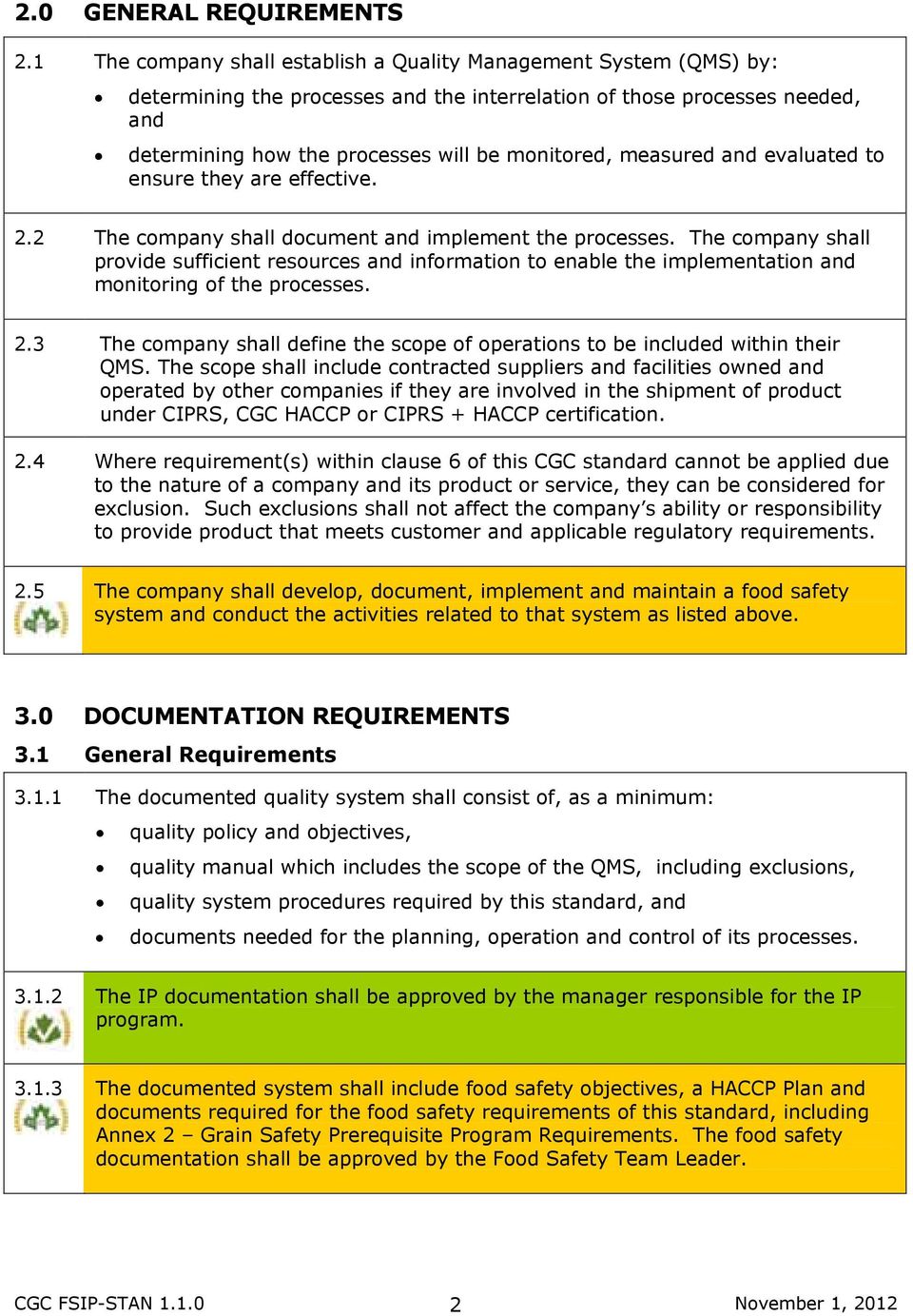
8 2.0 GENERAL REQUIREMENTS 2.1 The company shall establish a Quality Management System (QMS) by: determining the processes and the interrelation of those processes needed, and determining how the processes will be monitored, measured and evaluated to ensure they are effective. 2.2 The company shall document and implement the processes. The company shall provide sufficient resources and information to enable the implementation and monitoring of the processes. 2.3 The company shall define the scope of operations to be included within their QMS. The scope shall include contracted suppliers and facilities owned and operated by other companies if they are involved in the shipment of product under CIPRS, CGC HACCP or CIPRS + HACCP certification. 2.4 Where requirement(s) within clause 6 of this CGC standard cannot be applied due to the nature of a company and its product or service, they can be considered for exclusion. Such exclusions shall not affect the company s ability or responsibility to provide product that meets customer and applicable regulatory requirements. 2.5 The company shall develop, document, implement and maintain a food safety system and conduct the activities related to that system as listed above. 3.0 DOCUMENTATION REQUIREMENTS 3.1 General Requirements The documented quality system shall consist of, as a minimum: quality policy and objectives, quality manual which includes the scope of the QMS, including exclusions, quality system procedures required by this standard, and documents needed for the planning, operation and control of its processes The IP documentation shall be approved by the manager responsible for the IP program The documented system shall include food safety objectives, a HACCP Plan and documents required for the food safety requirements of this standard, including Annex 2 Grain Safety Prerequisite Program Requirements. The food safety documentation shall be approved by the Food Safety Team Leader. CGC FSIP-STAN
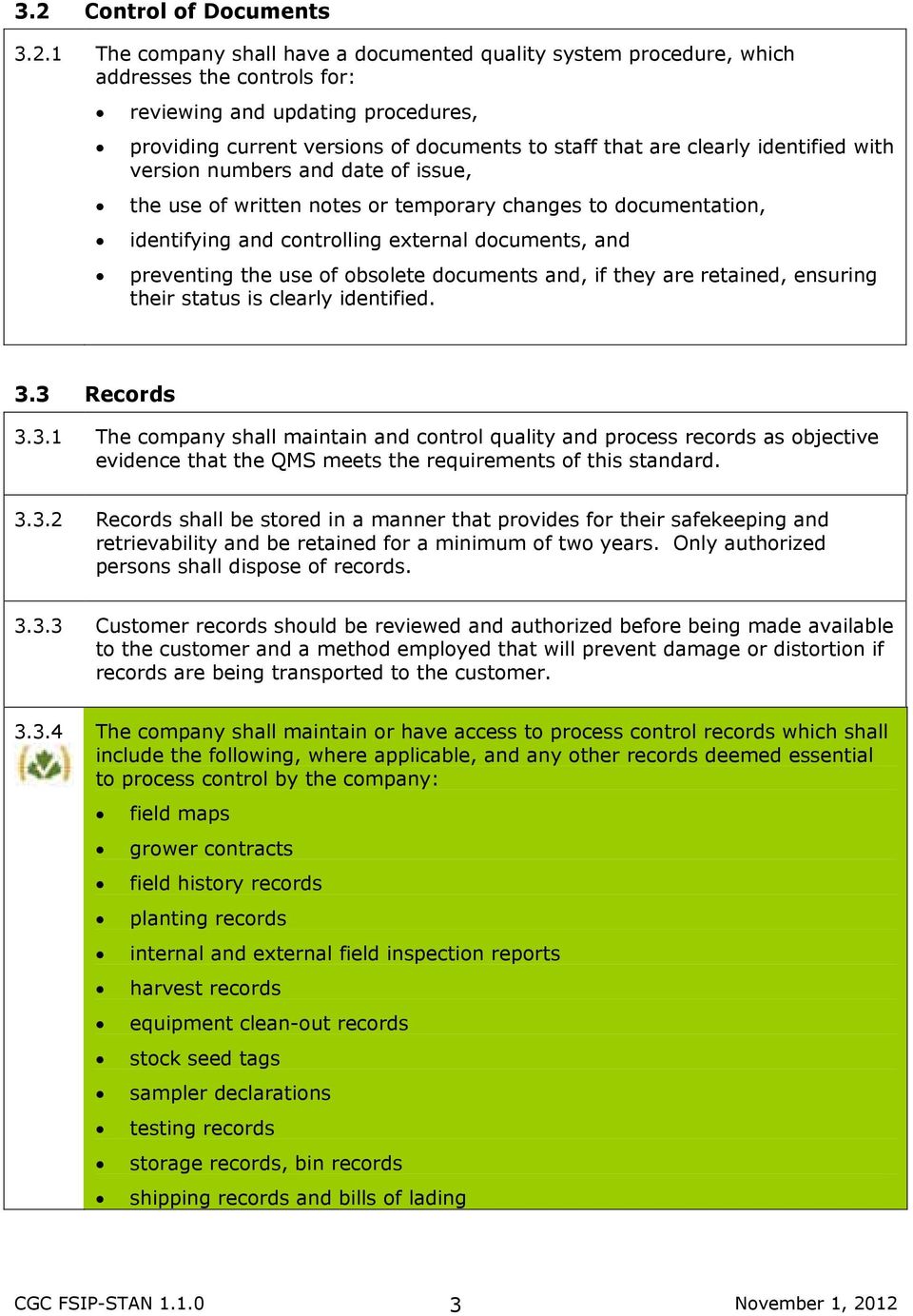
9 3.2 Control of Documents The company shall have a documented quality system procedure, which addresses the controls for: reviewing and updating procedures, providing current versions of documents to staff that are clearly identified with version numbers and date of issue, the use of written notes or temporary changes to documentation, identifying and controlling external documents, and preventing the use of obsolete documents and, if they are retained, ensuring their status is clearly identified. 3.3 Records The company shall maintain and control quality and process records as objective evidence that the QMS meets the requirements of this standard Records shall be stored in a manner that provides for their safekeeping and retrievability and be retained for a minimum of two years. Only authorized persons shall dispose of records Customer records should be reviewed and authorized before being made available to the customer and a method employed that will prevent damage or distortion if records are being transported to the customer The company shall maintain or have access to process control records which shall include the following, where applicable, and any other records deemed essential to process control by the company: field maps grower contracts field history records planting records internal and external field inspection reports harvest records equipment clean-out records stock seed tags sampler declarations testing records storage records, bin records shipping records and bills of lading CGC FSIP-STAN
10 3.3.5 Process control records shall include the following, where applicable, and any other records deemed essential to process control by the company and/or its suppliers: CCP logbooks monitoring records or checklists minutes of food safety-related meetings process control charts 4.0 MANAGEMENT RESPONSIBILITY 4.1 Management Commitment The company s senior management shall demonstrate its commitment to the QMS and continual improvement by: Developing, documenting and approving a quality policy and objectives, assigning responsibility for developing and documenting quality objectives regularly reminding staff of the importance of meeting customer as well as statutory and regulatory requirements through the effective implementation of the QMS, conducting regular senior management reviews of the QMS, and ensuring there are sufficient resources for staff to effectively implement the QMS The company s senior management shall demonstrate its commitment to the food safety management by: regularly reminding staff of the importance of food safety requirements, developing and documenting food safety policy and objectives, and establishing the legal requirements policy. 4.2 Customer Focus The company s senior management shall ensure that customer requirements are determined and satisfaction is evaluated to ensure products meet expectations. CGC FSIP-STAN

11 4.3 Quality Policy The quality policy approved by the company s senior management shall: be appropriate to the company s business and operations, state the company s commitment to follow established procedures and work at continually improving the QMS, set out the overall purpose of the QMS to guide the establishment and review of quality objectives, be communicated and explained to all staff, and be regularly reviewed to ensure it continues to be relevant to the company s operations The quality policy shall be a food safety and quality policy. 4.4 Legal Requirements Policy Senior management shall ensure that a legal requirements policy is developed that: commits the company to observing and following all applicable legal requirements, includes a documented method for identifying all applicable legal requirements and changes in those requirements, identifies a person designated by senior management to implement the legal policy. 4.5 Planning Senior management shall assign the responsibility for developing and documenting measurable quality objectives that are consistent with the quality policy to the appropriate staff. Quality objectives shall include those needed to meet requirements for the grading and labelling of the final product Senior management shall assign the responsibility for developing food safety objectives to the appropriate staff. The food safety objectives shall conform to statutory and regulatory requirements, and the food safety requirements of customers Senior management shall assign the responsibility for developing QMS processes that will result in the production of products that meet the quality objectives and customer requirements to the appropriate staff. These staff shall be responsible for ensuring the continued integrity of the QMS when changes are implemented. CGC FSIP-STAN

12 4.5.4 Senior management shall assign the responsibility for developing Food Safety and Quality Management System (FSQMS) processes that meet the food safety objectives to the appropriate staff. These staff shall be responsible for ensuring the continued integrity of the FSQMS when changes are implemented. 4.6 Responsibility, Authority and Communication Senior management shall assign to a management representative the following responsibilities and authorities: ensuring that QMS processes are developed, put into practice, regularly assessed, and revised when needed, and advising senior management of the effectiveness of the QMS and needed revisions to better meet quality objectives and customer requirements Food Safety Team Leader The food safety team leader assigned by senior management shall have the responsibility and authority to manage the food safety team. The food safety team leader must be an employee of the grain company Internal Communication All company staff shall be responsible for reporting any incidents that may impact food safety or indicate a problem with the FSQMS to their supervisor or the food safety team leader. The supervisor and/or the food safety team leader shall be responsible for initiating and recording appropriate corrective action External Communication The company shall establish, implement and maintain effective arrangements for communication with suppliers, customers, statutory or regulatory authorities. 4.7 Management Review Senior management shall review the QMS at predetermined intervals to ensure it continues to be effective in satisfying the requirements of this standard and to determine if there are opportunities for improvement Senior management shall review the food safety system at predetermined intervals to ensure it continues to be effective in satisfying the food safety requirements of this standard and to determine if there are opportunities for improvement. CGC FSIP-STAN

13 4.7.3 The management review shall include consideration of: internal and external audit results, analysis of results of monitoring and/or verification activities, product conformance with customer requirements, effective corrective and preventive actions taken as a result of nonconformances issued during audits or identified in previous management reviews, and operational or product changes that could affect the QMS Minutes of management reviews shall be kept and a record of any actions decided on to improve the QMS or the company s product, address additional resource requirements, and/or revise the company s quality policy and related food safety and quality objectives. 5.0 RESOURCE MANAGEMENT 5.1 Provision of Resources The company shall determine and provide resources to: develop, put into practice, regularly assess, and revise when needed, the QMS processes, and meet and enhance customer satisfaction Determine and provide resources to: develop, put into practice, regularly assess and revise the food safety system when needed to improve its effectiveness. 5.2 Employee Training and Records The need for training of staff whose work affects product quality shall be identified and provided on an ongoing basis. Evaluations of the training to ensure its effectiveness shall be undertaken. Records of education, training, skills and experience shall be retained Whenever possible, staff training should provide redundancy of skills to ensure continuity of service during absences Staff with responsibilities that affect the production, handling, storing, conditioning, sampling, labelling, shipping and/or distribution of IP product shall have an awareness of quality concepts. CGC FSIP-STAN

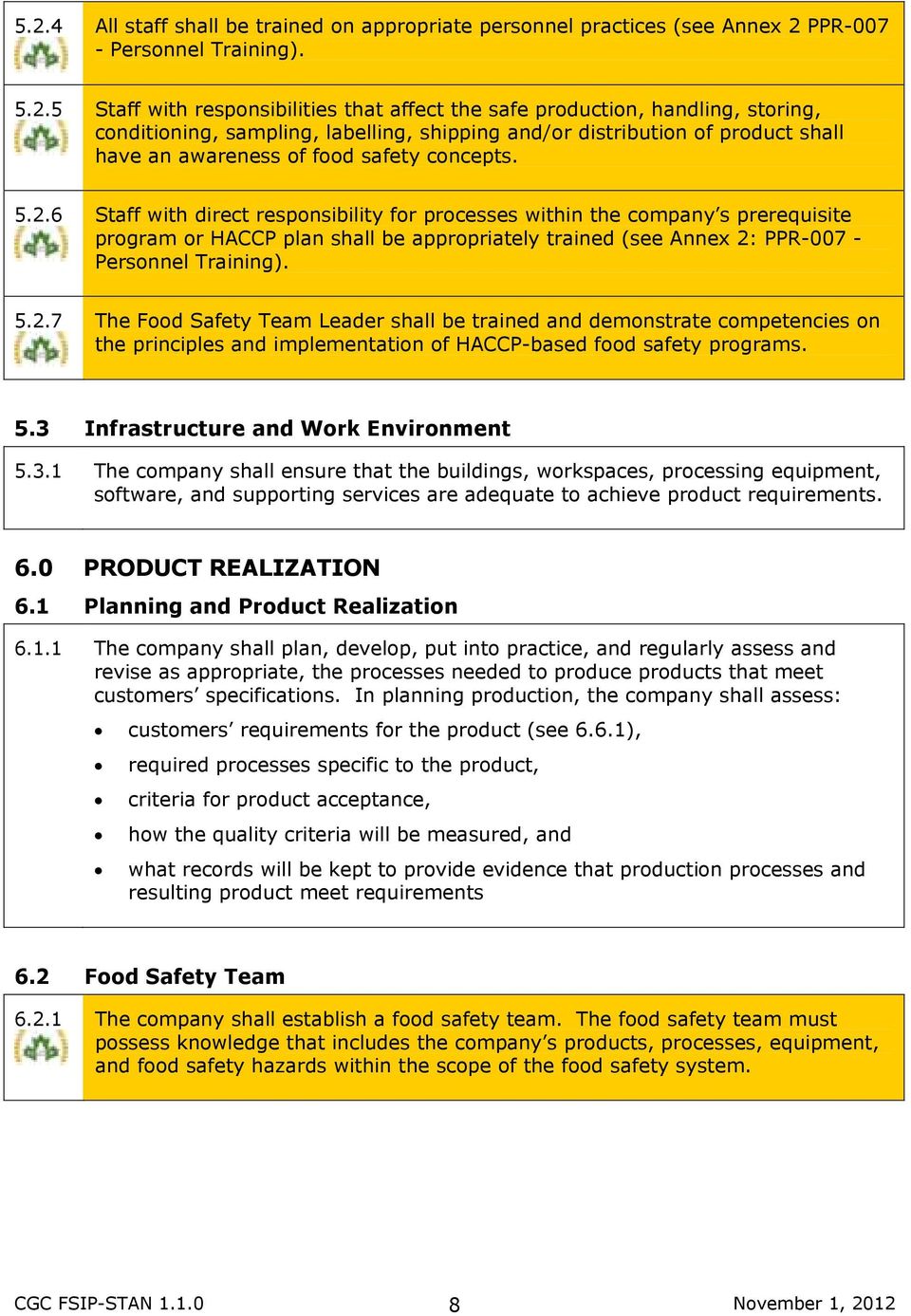
14 5.2.4 All staff shall be trained on appropriate personnel practices (see Annex 2 PPR Personnel Training) Staff with responsibilities that affect the safe production, handling, storing, conditioning, sampling, labelling, shipping and/or distribution of product shall have an awareness of food safety concepts Staff with direct responsibility for processes within the company s prerequisite program or HACCP plan shall be appropriately trained (see Annex 2: PPR Personnel Training) The Food Safety Team Leader shall be trained and demonstrate competencies on the principles and implementation of HACCP-based food safety programs. 5.3 Infrastructure and Work Environment The company shall ensure that the buildings, workspaces, processing equipment, software, and supporting services are adequate to achieve product requirements. 6.0 PRODUCT REALIZATION 6.1 Planning and Product Realization The company shall plan, develop, put into practice, and regularly assess and revise as appropriate, the processes needed to produce products that meet customers specifications. In planning production, the company shall assess: customers requirements for the product (see 6.6.1), required processes specific to the product, criteria for product acceptance, how the quality criteria will be measured, and what records will be kept to provide evidence that production processes and resulting product meet requirements 6.2 Food Safety Team The company shall establish a food safety team. The food safety team must possess knowledge that includes the company s products, processes, equipment, and food safety hazards within the scope of the food safety system. CGC FSIP-STAN
15 6.3 Prerequisite Programs The company shall establish, implement and maintain prerequisite programs that meet the requirements set out in Annex 2 of this standard. The prerequisite programs shall be evaluated by the food safety team to ensure that these requirements are met, and that they are appropriate to the size and operations of the company. 6.4 Establishing the Food Safety HACCP Plan The company shall develop, implement and maintain a food safety plan. The company s food safety plan shall be based on the CGC generic HACCP plan that was developed by a committee of technical experts following the Codex Alimentarius Commission principles of HACCP The food safety team shall evaluate the CGC generic HACCP plan against the operations of the facility(ies) within the scope of their FSQMS. This shall include verification that the product description, incoming materials, and the process flow diagram in the generic HACCP plan accurately describe the operations of the company. The results of this verification shall be recorded (e.g. through food safety team meeting minutes). Any deviations in the company s operations from the product description, incoming material and process flow diagrams must be noted and assessed to determine if the deviations introduce biological, chemical or physical hazards not addressed by the company s prerequisite programs or the generic HACCP plan. If so, these additional hazards must be addressed in the food safety system. If inputs or processes are significantly different than the generic plan, they will be subject to evaluation by the CGC technical expert advisory committee made up of CGC grain safety experts, audit firms, provincial food safety experts and grain industry representatives. 6.5 Identification of Critical Control Points (CCPs) The CGC generic HACCP plan does not identify any CCP, as all hazards are controlled by prerequisite programs that meet the requirements of Annex 2. Companies may choose to identify CCPs that they deem necessary to meet customer requirements or better control hazards within their unique operation. If CCPs are identified, the company must include the information listed below in their HACCP plan(s): CCP hazard number hazard description monitoring procedures deviation procedures and corrective actions verification procedures responsibilities HACCP monitoring records CGC FSIP-STAN

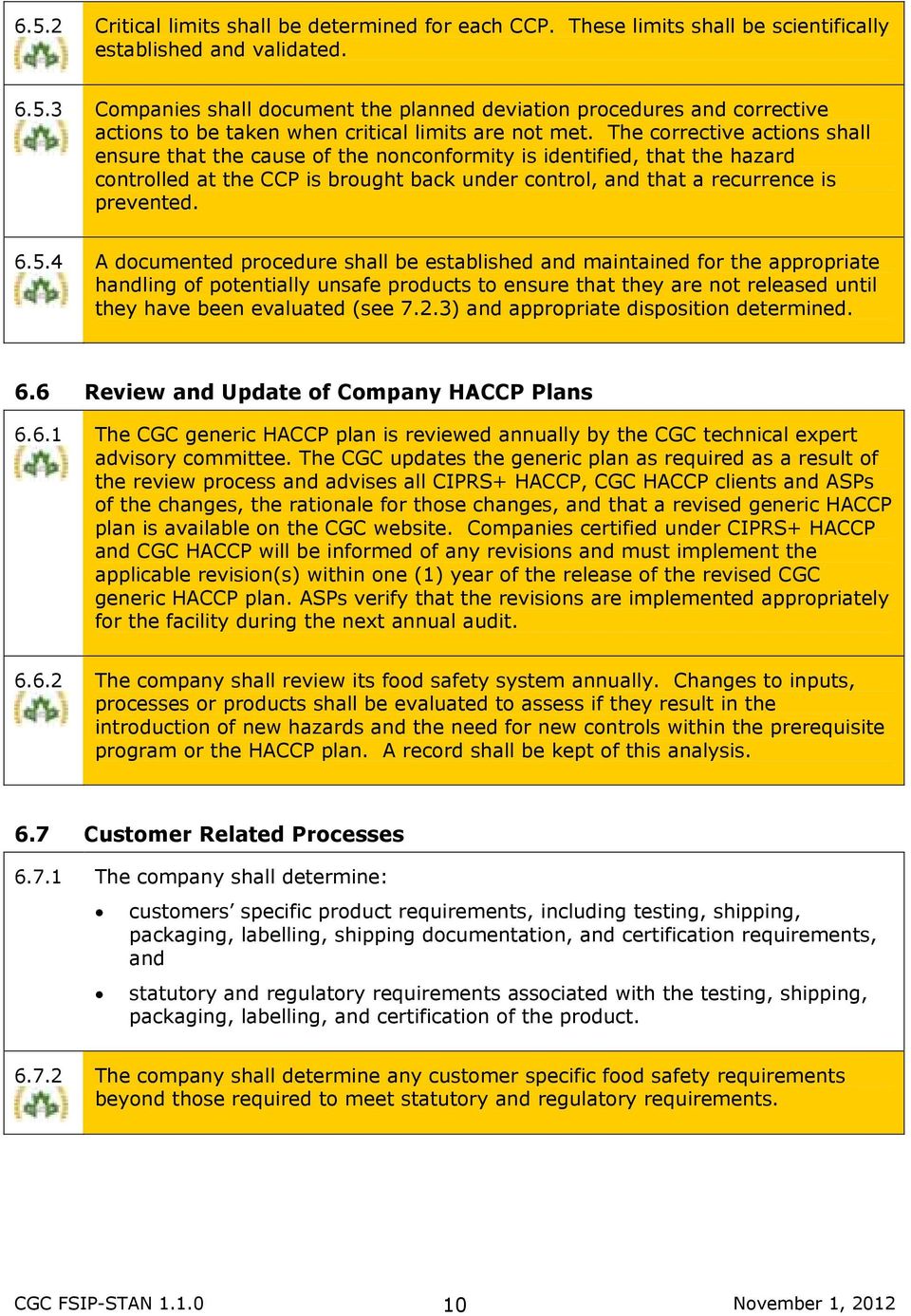
16 6.5.2 Critical limits shall be determined for each CCP. These limits shall be scientifically established and validated Companies shall document the planned deviation procedures and corrective actions to be taken when critical limits are not met. The corrective actions shall ensure that the cause of the nonconformity is identified, that the hazard controlled at the CCP is brought back under control, and that a recurrence is prevented A documented procedure shall be established and maintained for the appropriate handling of potentially unsafe products to ensure that they are not released until they have been evaluated (see 7.2.3) and appropriate disposition determined. 6.6 Review and Update of Company HACCP Plans The CGC generic HACCP plan is reviewed annually by the CGC technical expert advisory committee. The CGC updates the generic plan as required as a result of the review process and advises all CIPRS+ HACCP, CGC HACCP clients and ASPs of the changes, the rationale for those changes, and that a revised generic HACCP plan is available on the CGC website. Companies certified under CIPRS+ HACCP and CGC HACCP will be informed of any revisions and must implement the applicable revision(s) within one (1) year of the release of the revised CGC generic HACCP plan. ASPs verify that the revisions are implemented appropriately for the facility during the next annual audit The company shall review its food safety system annually. Changes to inputs, processes or products shall be evaluated to assess if they result in the introduction of new hazards and the need for new controls within the prerequisite program or the HACCP plan. A record shall be kept of this analysis. 6.7 Customer Related Processes The company shall determine: customers specific product requirements, including testing, shipping, packaging, labelling, shipping documentation, and certification requirements, and statutory and regulatory requirements associated with the testing, shipping, packaging, labelling, and certification of the product The company shall determine any customer specific food safety requirements beyond those required to meet statutory and regulatory requirements. CGC FSIP-STAN
17 6.7.3 Prior to committing to supply a product to the customer, the company shall review and determine that it has the ability to meet those requirements and ensure that customer requirements are communicated to appropriate staff. When the customer provides no written requirements, the company shall confirm and document the requirements. Records of the review shall be maintained If sampling and/or testing will be conducted: the stage in the supply chain is identified, and varietal purity testing methods and sensitivity requirements are defined Any grain safety testing methods and sensitivity requirements are defined The company shall communicate with customers as required to exchange information on product, contracts and handling of orders. Customer feedback methods shall be developed to allow for inquiries, amendments to product and shipping requirements and complaints. 6.8 Purchasing Purchase orders for non-grain inputs shall only be placed with approved suppliers that have the resources and capability to meet the specified purchasing requirements of the company. Purchased non-grain inputs shall be checked to ensure they meet the specified requirements. If work is subcontracted, the subcontractor shall have the resources and capability to meet specified requirements Purchased grain and grain products shall be inspected upon receipt to ensure they can meet the requirements of the CGC s Official Grain Grading Guide and/or customer specifications and that they are free of grain safety hazards The company shall have a system for evaluating and recording the work of suppliers. The criteria for selection, evaluation, and re-evaluation shall be defined. This may be based on past performance, ability to meet deadlines and ability to supply product that meets the specified requirements and/or supplier inspection. The evaluation shall be the basis upon which satisfactory suppliers are chosen. The extent of the evaluation shall be based on the impact of the purchased product on the quality and safety of the final product and may be determined by a risk analysis. CGC FSIP-STAN

18 6.9 Production and Service Provision The process for producing, handling, conditioning, sampling, grading, labelling, storing, distribution, and disposition of product shall be controlled. Such control shall extend to approved suppliers, and where the scope includes production, to growers Processes to be controlled shall include such items as defined by the scope of operations described in section 2.0. This shall also apply to suppliers. Control measures may include, as applicable: the availability of information that describes the characteristics of the product; the availability of work instructions; the use of suitable equipment; the availability and use of monitoring and measuring equipment; the implementation of monitoring and measurement; the implementation of release, delivery and post-delivery activities; and the use of production contracts The use of production contracts shall be controlled If the IP program is for soybeans, the processes must be compliant with the Canadian Soybean Exporters Association s Approved Identity Preservation Procedures (Annex 1) Planting The company shall ensure that: appropriate stock seed is selected to fulfil the IP contract, and that the seed is traced to the grower. Where the IP contract is variety specific, certified seed shall be used; The previous land use and isolation requirements shall be defined to meet the requirements of section 6.7; and Planters and seed drills shall be clean before planting an IP crop Cross-contamination The company shall ensure that: cultivation practices have been defined and implemented to prevent crosscontamination; Appropriate measures shall be in place to prevent cross-contamination of the crop during pollination; and Fields shall be inspected during the growing season and the presence of any volunteer crops and their removal recorded. CGC FSIP-STAN

19 6.9.7 Harvesting The company shall ensure that: processes have been defined and implemented to maintain product quality and prevent contamination during harvest; Combine harvesters and trailers shall be clean and free from any seeds of other crops before harvesting; Silos and storage bins shall be cleaned before harvesting; Handling equipment used to load and unload silos and storage bins shall be cleaned prior to use; and If any of the harvested crop is found to be contaminated beyond the requirements of the customer, this part of the crop shall not be mixed with the rest of the harvested fields, and the method of disposal shall be documented Transportation Processes shall be defined and implemented to prevent cross-contamination of the crop during the transportation from the farm to the final destination: The mode of transportation shall be clean and free from other crops before being used for transportation; A process for the inspection and if necessary, cleaning of the mode of transportation shall be defined and records of the inspections retained; and Where a supplier is used to transport the harvest, a documented procedure for the inspection and if necessary, cleaning of the mode of transportation shall be defined and records of the inspections retained Discharge and Storage at Collection Points To prevent cross-contamination at collection points: Purchased product shall be checked upon receipt to ensure that it meets the specified requirements; Purchased product shall be sampled upon receipt and should be tested. If testing is not required by the customer or is not economically feasible, the sample taken shall be kept for at least six months after the received grain lot has been shipped; Where the use of dedicated facilities is not possible, cleaning and flushing processes shall be in place; and Processes shall be in place to ensure that product is not discharged into incorrect silos and out loading is carried out from the correct silo for each mode of transportation. CGC FSIP-STAN

20 6.10 Identification and Traceability The company shall establish and maintain procedures to ensure that all grain handled by the company is controlled and identified The identification and traceability system shall be such that product can be traced through the entire production and distribution system, and segregation is maintained between different product types Traceability records shall be kept for a period defined to allow for recalls of potentially unsafe products (see Annex 2: PPR Recall and Traceability) Storage and Packaging Stored grain shall be periodically checked to ensure they continue to conform to the company s food safety product specifications. The storage area shall meet all the relevant requirements regarding temperature, humidity, light, exposure, safety etc. to maintain quality and safety Any packaging or non-grain inputs used shall be food grade, clean and meet the specifications of the customer. Stored packaging and non-grain inputs shall be checked periodically to ensure that they continue to conform to the company s food safety product specifications Use of Certification Marks Certified companies may use the CIPRS, CIPRS+ HACCP, CGC HACCP certification marks on business cards, letter head and in promotional material to indicate their certified status. When using the certification marks, certified companies shall comply with the graphics standards set out in the Standards Manual received from CGC with the certification agreement Certification marks shall be used to identify shipments made under a CIPRS, CIPRS+ HACCP or CGC HACCP certified program. If a certification mark is used to identify shipments, it shall not be used in a manner that suggests the product being shipped has been tested or certified by the Canadian Grain Commission The CIPRS, CIPRS+ HACCP, CGC HACCP certification marks may only be used to identify shipments that have been processed, packaged and shipped to final customer by facilities within the scope of the certified company as defined in Section 2.0. CGC FSIP-STAN
21 6.13 Use of CGC Load Certificates CGC load certificates may be used by a certified company to identify shipments made under a CIPRS or CIPRS+ HACCP certified program. The use of CGC load certificates is voluntary; however, if a company chooses not to use the CGC load certificates, an alternate method shall be used to distinguish identity preserved product. i.e. tags or CGC certification marks on accompanying documents. 7.0 MEASUREMENT, ANALYSIS AND IMPROVEMENT 7.1 General The company shall develop and implement the methods to monitor, measure, analyze and improve the QMS. 7.2 Monitoring and Measuring of Customer Satisfaction The company shall monitor customer perceptions as to whether the company has met their requirements. The methods for obtaining and using this information shall be determined The company shall document a procedure to monitor and resolve customer complaints. The procedure should identify the person(s) responsible for the receipt, investigation and follow-up activities after the complaint is addressed. The documentation addressing the complaint should include: date the complaint is received, name, address and phone numbers of the complainant, description of product affected, including lot or batch numbers, packaging description (if applicable) and date of production, and nature and details of the complaint, such as physical contamination, illness, product or packaging quality issue or allergic reaction A documented procedure shall be in place for the determination of the potential cause and scope of the issue. Complaints shall be investigated by personnel with knowledge in the area of concern. Records of customer complaints and investigation findings shall be maintained. Appropriate corrective action procedures (see 7.8) shall be taken when an investigation finds the complaint is a result of non-conformance to the QMS. CGC FSIP-STAN
22 7.3 Internal Audit The company shall document a procedure for planning the scope, method and frequency of internal audits designed to ensure that the QMS meets the requirements of this standard, and that procedures are effectively maintained and complied with. This procedure shall identify the responsibilities for planning and conducting internal audits. Internal audits shall be conducted to cover the entire scope of the Food Safety and/or Identity Preserved Quality Management System standard at least annually Internal audit planning shall: consider the impact of the processes and areas to be audited to the quality and safety products, ensure the results of previous audits are addressed, and ensure that internal auditors are competent, appropriately trained and, where possible, independent of the audited area or process Internal audits are required at all sites included within the scope of the certification that are involved in the production, handling, conditioning, sampling, grading, labelling, storing, distribution, and disposition of product Results of internal audits shall be reported to the manager responsible for the area being audited, and corrective actions and time frames for their implementation shall be established. The implementation of corrective actions shall be verified. Results of internal audits, corrective actions and verification of corrective actions shall be recorded Internal audits shall be used to confirm all prerequisite programs are implemented and the monitoring activities of the FSQMS are being conducted as documented. CGC FSIP-STAN
23 7.4 Monitoring and Measurement of Product and Processes The company shall develop and implement processes for monitoring and measuring criteria to verify that product meets quality, safety and customer requirements. Monitoring and measuring shall be planned to occur at points in the production process that will allow for control of non-conforming product Product shall not be shipped until authorized by designated staff. Records shall be kept of monitoring and measuring activities and authorization to provide evidence of conformity with quality and safety criteria Equipment to measure quality, safety and customer requirements shall: be calibrated at predetermined intervals, be calibrated against international or national measurement standards, or where there are no international or national standards, be calibrated to a recorded basis, and be labelled such that the calibration status can be determined When product requirements have not been met, the company shall review their processes, identify where improvements are needed, and take appropriate corrective action to ensure conformity of the product All prerequisite programs shall be monitored at predetermined intervals to ensure that they are implemented and operating as intended. Verification shall be done by competent personnel. Internal audits may be used to verify that these monitoring activities are occurring as defined. 7.5 Control of Non-conformances The company shall establish and maintain documented procedures to prevent the unintended use or delivery of product that does not conform to specifications. Records of all non-conformances and dispositions shall be maintained The IP product shall be isolated from the system where there is suspicion that contamination has occurred. Records shall be kept of disposition of the nonconforming product. 7.6 Recalls If products that have left the control of the company are subsequently determined to be unsafe, the company shall notify the relevant interested parties and initiate a recall (see Annex 2: PPR Recall and Traceability). CGC FSIP-STAN
24 7.7 Corrective Action Corrective action shall be taken when there is lack of conformity with the documented QMS or when non-conformity of the documented QMS to the requirements of this CGC standard are identified. The details of the problems encountered, their cause and the required corrective action shall be recorded and given to appropriate staff for resolution A documented procedure shall be in place to ensure that the corrective action undertaken is verified to be effective Corrective actions shall be initiated when critical limits are exceeded or there is a lack of conformity with the documented FSQMS. 7.8 Preventive Action The company shall document a procedure for determining and preventing potential problems in the production and delivery of product that meet quality, safety and customer requirements. Preventive actions shall be determined based on the cause of potential problems and the need for action to prevent the problem based on its potential impact. Preventative actions shall be recorded and reviewed The company shall continually improve the effectiveness of the management through the use of the quality policy, quality objectives, audit results, analysis of data, corrective and preventive actions and management review. 8.0 FOOD DEFENCE The company shall conduct an initial risk assessment of the facility s security to assess strengths and vulnerabilities in the prevention of intentional tampering and adulteration of grain and grain products. After the initial risk assessment has been completed, the company shall establish and maintain a food defence plan that addresses the risks identified in the risk assessment associated with intentional tampering and adulteration of grain and grain products. The food defence system shall be reviewed on an annual basis Any company that is a member in good standing of the Canadian Border Services Agency s (CBSA) Partners in Protection (PIP) program, or any customs-trade partnership program where a mutual recognition arrangement exists, shall be considered compliant to the CGC FSIP STAN requirements for food defence Food defence and annual review procedures shall be documented and the monitoring of food defence activities shall be recorded. CGC FSIP-STAN
25 9.0 MONITORING 9.1 The company shall participate in an external audit program at intervals specified by the Canadian Grain Commission. CGC FSIP-STAN
26 Annex 1 CANADIAN SOYBEAN EXPORTERS ASSOCIATION APPROVED IDENTITY PRESERVATION PROCEDURES Revision 4 December 20, 2007 Copy No. Issued to: Canadian Soybean Exporters Association Research Lane Guelph, Ontario, CANADA N1G 5B2 CGC FSIP-STAN
27 Table of Contents Review/Endorsement Amendment Record Distribution List Scope/References Complaint Procedure 1.0 Seed Standards 2.0 Planting 3.0 Field Season 4.0 Harvest 5.0 On Farm Storage 6.0 Transportation 7.0 Elevator Receiving 8.0 Elevator Storage 9.0 Processing 10.0 Loading 11.0 Audit Standards CGC FSIP-STAN
28 REVIEW These Canadian Soybean Exporters Association Identity Preservation Procedures are subject to periodic review. Amendments will be issued to ensure the Standard continues to meet current needs. Amendments will only be issued to registered owners of the Standard. Scope These Canadian Soybean Exporters Association Identity Preservation Procedures outline specifications for the quality system that must be implemented for certification by the Canadian Grain Commission. Complaint Procedure Any applicant to the CIPRS who is seeking certification of a soybean IP program, but does not wish to meet the requirements of Annex 1 of CGC IP-STAN may lodge a complaint with CSEA. Complaints from CIPRS applicants are forwarded to the CSEA Executive for action and response. The CSEA Executive will deal with the complaint on a case-by-case basis, by: - confirming the exact nature of the complaint via discussions with the applicant, including the reason for not wishing to meet the requirements; the part of Annex 1 they do not wish to meet; and what steps are being taken to mitigate the risk of not meeting Annex 1. - if appropriate, conducting a risk assessment - making a decision on whether or not the level of risk is such that not meeting the requirements would not have any adverse effect on CSEA and/or the Canadian soybean industry - communicating that decision (and the results of the risk assessment if applicable) to the applicant. CGC FSIP-STAN
29 ENDORSEMENT These Canadian Soybean Exporters Association Identity Preservation Procedures are hereby approved. Steve Scholze, Chair CGC FSIP-STAN
30 Dave Buttenham, Secretary-Manager CGC FSIP-STAN
31 Canadian Soybean Exporters Association Identity Preservation Procedures Minimum Level 1.0 Seed Standards 1.1 Certified seed accredited to Association of Official Seed Certification Agencies (AOSCA) standards or equivalent. Equivalent seed must be produced under a controlled system similar to the Canadian Seed Growers Association (CSGA) pedigreed seed increase system. Bin run seed not to be used. Bin run Grain retained from a previous crop that is used as seed for planting. Genetic purity and identity of bin run seed is uncertain. It is not produced under an AOSCA approved pedigreed seed increase system and therefore it has not been field inspected by an accredited agency. 2.0 Planting 2.1 Planter must be thoroughly cleaned and inspected prior to planting IP soybean variety. This must be done regardless if grower uses his/her own equipment or uses a custom planter. Recommendations on Good Practice * Grower should retain certified seed tag for each bag of seed. Seed lot traceability is recommended Grower should endeavor to plant IP soybean crop before planter is used on other soybean crops. IP seed bags should be stored separately from other soybean seed and other crop seed prior to planting. Grower should refer to cleaning Documentation Grower must be able to produce certified seed tag for each lot of seed purchased to produce the quantity of Identity Preserved (IP) soybeans being contracted or delivered. Grower must retain his/her invoice or receipt of purchase for all quantities of IP seed purchased. The contracting party must have sufficient documentation to prove that the seed purity and identity has been maintained Growers must detail cleaning procedure used and sign this document to authenticate that they have implemented the procedures described. CGC FSIP-STAN
32 Minimum Level Recommendations on Good Practice * procedures as detailed by equipment manufacturer if available. Documentation 2.2 Approved isolation distance for the IP crop must be used. The CSGA isolation standard for certified soybean seed is 3 metres between another soybean and another pulse crop (Bean, Fababean, Lentil, Lupin, Pea or Peanut). There is no isolation distance necessary between soybeans and crops of Barley, Buckwheat, Canaryseed, Flax, Oat, Rye, Triticale, and wheat providing the crops do not overlap. 2.3 Grower must have records of previous crop grown on IP soybean field. 3.0 Field Season 3.1 IP fields must be inspected during the growing season to confirm that isolation distances have been met and there is proper control of volunteer crops and weeds. The field inspector must also verify that the crop looks uniform as detailed in the variety description Grower should endeavor to leave minimum 1 metre isolation between an IP soybean field and fields of crops that do not require the 3 metre isolation Grower should keep detailed field maps and history of crops grown If a crop is being grown under contract, a company may allow its growers to inspect their own IP crop. In such a case, the company will have a documented process in place that outlines the conditions under which that practice is allowed; the criteria against which the grower is evaluated, and the controls that are in place to ensure proper and consistent field inspection. If the crop is not being grown under contract, the grower must arrange for a 2 nd or 3 rd party field inspection Proper isolation distance must be documented at time of field inspection Grower must be able to provide a written history of previous crop The field inspection report must document that isolation distances have been met, there is proper control of weeds and volunteer crops and that the soybean variety appears to be characteristically uniform for the appropriate growth stage. The inspector and the grower (or grower and company) must sign and date this report. CGC FSIP-STAN
33 Minimum Level 4.0 Harvest 4.1 Combine must be thoroughly cleaned and inspected prior to harvesting IP soybean variety. This is to be done regardless if grower uses his/her own equipment or uses a custom combine. 4.2 Equipment used to transfer soybeans must be thoroughly cleaned and inspected prior to transferring IP soybean crop. This is to be done regardless if grower uses his/her own equipment or uses custom harvesting. 4.3 Conveyance vehicles/equipment used to transport IP soybeans at harvest must be thoroughly cleaned and inspected prior to transporting IP soybean crop. This is to be done regardless if the grower uses his/her own equipment or custom trucking. 5.0 On Farm Storage 5.1 Grower must maintain record of what was stored in their bin prior to filling with IP soybean crop. 5.2 Storage bin must be thoroughly cleaned and inspected prior to loading. 5.3 Storage bins used to store IP crops must be visually identified so that all persons working in farm operation are Recommendations on Good Practice * Grower should endeavor to harvest IP soybean crop before combine is used on other soybean crops. Grower should refer to cleaning procedures as detailed by equipment manufacturer if available Grower should endeavor to harvest IP soybean crop before transfer equipment is used on other soybean crops If possible, grower should try to arrange for conveyance vehicles/equipment that have only been used recently to transport clean substances such as grain or food items. It is critical that all grain and meal residue is cleaned from the inside of the truck. Ideally the truck or hopper should be covered Grower should keep full records with crop type and dates when bins were loaded unloaded and cleaned. Documentation Grower must detail cleaning procedure used and sign this document to authenticate that they have implemented the procedures described Grower must detail cleaning procedure used and sign this document to authenticate that they have implemented the procedures described Grower must inspect truck and sign a document to authenticate that the truck/hopper was cleaned prior to loading Grower must keep written records of what crop was in their storage bin prior to filling with IP soybeans Grower must sign a document indicating that their bin was thoroughly cleaned and inspected prior to filling Grower should put a sign or otherwise visually identify any storage bin that will be used for IP soybean crop. All Grower must sign a document indicating that any storage bin used for an IP soybean crop was visually identified. CGC FSIP-STAN
34 Minimum Level aware that each bin should only be used for a particular IP crop. 5.4 Equipment used to unload storage bin must be thoroughly cleaned and inspected prior to usage. 6.0 Transportation 6.1 Conveyance vehicles/equipment must be thoroughly cleaned and inspected prior to loading. This must be done regardless if grower uses his/her own equipment or uses custom trucking. 6.2 Trucker must present documentation verifying the IP soybean variety and name of the grower. Recommendations on Good Documentation Practice * persons working in farm operation should be made aware that the storage bin is only to be used for the IP crop Grower must sign a document indicating that equipment used to unload storage bin was thoroughly cleaned and inspected prior to usage If possible, grower should try to arrange for hopper/trucking equipment that has only been used recently to transport clean substances such as grain or food items. It is critical that all grain and meal residue is cleaned from the inside of the truck. Ideally the truck or hopper should be covered Trucker should be carrying a completed bill of lading. The producer, trucker and receiver should sign the bill of lading. The trucker should also carry any additional documentation required by the receiving elevator Grower must inspect truck and sign a document to authenticate that the truck/hopper was cleaned prior to loading Grower must fill out documentation for the trucker that identifies the IP soybean variety being delivered and the grower name. 7.0 Elevator Receiving 7.1 Elevator must have an IP manual that details their full IP procedures for receiving, storage, processing and loading. 7.2 Incoming loads must be identified and verified as an IP crop or a non-ip crop. The crop must be identified as IP, SQWH All procedures should be described in detail. All relevant staff should be trained in IP procedures and should have access to the manual for reference Receiving procedures should be detailed in IP manual Manual must be available for inspection by auditing authority Scale tickets for incoming loads must indicate variety name and unloading/storage details for all crops. CGC FSIP-STAN
35 Minimum Level or crush. SQWH and crush soybeans are not qualified for IP certification. The crop is not unloaded as IP unless its identity is verified. 7.3 Any non-ip loads that are received into the elevator must be tracked and accounted for. 7.4 Elevator must take a sample from each load of IP soybeans received. 7.5 Elevator pit/conveyor/legs must be thoroughly cleaned and inspected prior to receiving IP crops. Alternatively they could also be dedicated to a specific IP crop. Recommendations on Good Practice * Elevator should have detailed documentation showing which bins were used to store non-ip loads. Elevator should be able to show documentation demonstrating the end use for the non-ip soybeans If requested by grower, at time of delivery, the Elevator should supply half of this sample for the grower to keep Cleaning procedures should be detailed in IP manual. Documentation Elevator must have detailed documentation for storage and tracking of non-ip loads that were received into the elevator Elevator must retain documentation detailing variety name, moisture, and weight and grade details for each load Elevator must have documentation to authenticate that pit/conveyor/legs have been thoroughly cleaned and inspected prior to receiving a specific IP crop. Records must include the date and the name of the employee who conducted the inspection. 8.0 Elevator Storage 8.1 Elevator must keep detailed storage history. Records must indicate what crop or variety was stored in their bin/silo prior to it being used to store an IP soybean crop. 8.2 Storage bins/silos must be thoroughly cleaned and inspected prior to loading with IP grain Elevator should keep full records with crop type, variety name and dates when bins were loaded unloaded and cleaned. All tonnage loaded and unloaded should be recorded Cleaning procedures should be detailed in IP manual Elevator must have detailed storage history records. Records must indicate what crop or variety was stored in their silo/bins prior to it being used to store an IP soybean crop Elevator must have records documenting that silo was thoroughly cleaned and inspected prior to loading with IP grain. Records must include the date CGC FSIP-STAN
36 Minimum Level 8.3 Equipment used to load/unload bins and silos must be cleaned and inspected prior to being used for IP crop. 8.4 Elevator must identify all bins/silos that are used to store IP soybean variety. Bins used to store SQWH and crush soybeans beans must also be identified. All elevator staff should be aware of and have access to bin/silo designation. 9.0 Processing 9.1 Conveyors/augers/legs must be cleaned when transporting different IP varieties and different crops. 9.2 All processing equipment must be thoroughly cleaned and inspected prior to processing IP crop. 9.3 Elevator must have documentation detailing the flow of IP grain through the processing system. Recommendations on Good Practice * Cleaning procedures should be detailed in IP manual Current elevator schematic should be available at pits and all other pertinent spots in elevator All transferring equipment should be shut down and cleaned prior to switching IP varieties, non-ip soybean varieties or other crops. Cleaning procedures should be detailed in IP manual All processing equipment should be shut down and cleaned prior to switching IP varieties or to other crops. Cleaning procedures should be detailed in IP manual Elevator should record tonnage when grain is transferred to different bins and the tonnage that is transferred to processing equipment. Documentation and the name of the employee who conducted the inspection Elevator must have records documenting that all equipment used to load/unload bins and silos with IP soybean crop were thoroughly cleaned and inspected prior to use. Records must include the date and the name of the employee who conducted the inspection Elevator must have detailed bin and silo maps/schematics indicating which crop and variety is to be stored in each bin Elevator must have records showing that all transferring equipment was thoroughly cleaned and inspected prior to processing IP soybean crop. Records must include the date and the name of employee who conducted the inspection Elevator must have written records showing that all processing equipment was thoroughly cleaned and inspected prior to processing IP soybean crop. Records must include the date and the name of the employee who conducted the inspection Elevator must have written records detailing origin bin(s) used for unloading raw grain for processing and destination bins used for storing the processed grain. CGC FSIP-STAN
37 Minimum Level 10.0 Loading 10.1 All containers/vessels/trucks must be inspected and cleaned as required prior to loading Elevator must have documentation detailing the flow of IP grain handled through the elevator Elevator must document grain that exits the elevator system Audit Standards 11.1 The grower must retain grower documentation unless requested by the elevator. Documentation must be retained for a minimum period subject to the requirements of the CSEA IP Standard. Recommendations on Good Practice * Inspection/cleaning procedures should be detailed in IP manual. The IP manual should detail procedures for rejection of container/vessels/trucks if they are not suitable for food use Elevator should record tonnage when grain is transferred to different bins and the tonnage that is unloaded from the elevator Elevator should record loading details for all soybeans, IP and non-ip moving through the elevator system Documentation Any bin movements prior to processing must be recorded Elevator or exporter must have written records showing that containers/vessels/trucks have been inspected and cleaned as required prior to loading with IP grain. Records must have inspection date and the name of the employee who conducted the inspection Elevator must have written records detailing bins/silos used for storing IP grain that has not been processed but has been stored and unloaded from the elevator Elevator must document and retain full records for all containers, trucks and railcars loaded from the facility. Records must include container, truck or railcar identification number, identification of the grain (IP variety, SQWH or crush) and the quantity loaded. The bin that the grain has been loaded from must also be recorded. Rule of thumb for length of time to keep IP records is three years. CGC FSIP-STAN
38 Minimum Level 11.2 Elevator/exporter must have retained records to support an annual audit All documentation must be retained for a minimum period subject to the requirements of the CSEA IP standard. Recommendations on Good Documentation Practice * Elevator/exporter must declare on their sales contracts if they are selling soybeans under the CSEA IP Standard Rule of thumb for length of time to keep IP records is three years Non Conforming Product 12.1 The elevator/exporter shall ensure procedures exist to investigate the cause of potential and actual non-conformity. Non-conforming product - includes any product that qualified as IP but because of adventitious or intentional mixing no longer meets IP requirements If the exporter has non-conforming product they must show in their documentation that they have a procedure to address the situation. This must include either documentation for disposal, customer acceptance, or alternate non-ip sales arrangements IP manual should detail how employees will inform the correct individual in the chain of command about non-conforming product The Elevator/Exporter should develop a corrective action procedure The elevator/exporter must have a written protocol detailing how they will address a situation where they have nonconforming product The Exporter must have documentation showing that nonconforming product has either been disposed of, that the customer has been informed and accepted the nonconformance or that alternate non-ip sales arrangements were made. * Recommendations on Good Practice are not part of the official CSEA IP Procedures. They are additional suggestions for the IP program but are not enforced. CGC FSIP-STAN
39 ANNEX 2 GRAIN SAFETY PREREQUISITE PROGRAM REQUIREMENTS
40 Annex 2 GRAIN SAFETY PREREQUISITE PROGRAM REQUIREMENTS Introduction This annex outlines the 17 prerequisite program requirements (PPR-001 to PPR-017) for CIPRS+HACCP and CGC HACCP. For each PPR you must: - meet the required outcome, - develop and implement written good operating procedures designed to meet the outcome, - define staff roles and responsibilities, and describe how, and at what frequency, monitoring will be performed, - determine what records will be kept as evidence that procedures are being followed and the required outcome is met, and - describe what corrective actions will be taken when monitoring reveals that your procedures have not been followed. Each PPR page is organized as follows: Required Outcome is the mandatory outcome that must be achieved. The outcomes are required to create a safe and suitable environment for the handling and primary processing of grain. They are designed to ensure that the potential hazards associated with the facility structure and condition, equipment and personnel are controlled. How you can achieve this outcome lists suggested good operating practices designed to meet the outcome. These practices can be used as guidelines for grain handling companies in developing prerequisite programs to control potential grain safety hazards in their facilities. Companies are not required to implement these suggested good operating practices exactly as written, but must implement practices that achieve the required outcomes. How you can monitor and verify this prerequisite program outlines suggested monitoring procedures companies can implement, and indicates the record keeping requirements. In order to have a complete food safety system, companies must develop, implement and maintain a HACCP plan as outlined in section 6 of this standard, in addition to a prerequisite program compliant with the 17 requirements set out in this Annex. Successful implementation of an integrated IP and food safety system, as indicated by an audit, will result in CIPRS+HACCP certification. Successful implementation of an integrated food safety and quality management system, as indicated by an audit, will result in CGC HACCP certification. CIPRS+ HACCP, CGC HACCP and other HACCP Programs CGC FSIP-STAN
41 Companies may have already developed and implemented an effective HACCP system based on the Canadian Food Inspection Agency s Food Safety Enhancement Program (FSEP), Ontario HACCP Advantage (GMP Advantage), or Manitoba HACCP Advantage (GMP Advantage). Because these other government programs, like CIPRS+ HACCP and CGC HACCP, are based on the Codex Alimentarius HACCP principles and General Principles of Food Hygiene, it is likely that these companies already meet many of the requirements of the CGC food safety programs. The requirements of this Annex are specific to grain handling and primary processing, but are designed to meet the same food safety outcomes of other HACCP-based programs. Table A2.1 at the end of this Annex provides a cross reference between these programs to aid those companies who are familiar with FSEP or GMP Advantage. CGC FSIP-STAN
42 PPR-001: PREMISE DESIGN Required Outcome All new buildings, existing buildings, and modifications to existing buildings are designed and constructed in a manner that minimizes unintentional co-mingling or contamination of product. The buildings are located away from or protected against potential sources of external contaminants that may compromise the safety and quality of the grain. Buildings are structurally complete and suitable for the operations taking place within. How you can achieve this outcome: Write and implement a Premise Design prerequisite program that includes the following: An assessment of existing buildings against grain safety and quality considerations conducted by the company as part of the development of the company s HACCP system. New buildings or modifications to existing buildings are planned and evaluated against those same safety and quality considerations. These considerations include: - The facility is located away from potential sources of external contamination that may compromise the safety and suitability of the grain. - Facility exterior is structurally complete, is suitable for the operations taking place within, and prevents access by pests. - Washrooms, change rooms, and lunch and break area(s) are provided, are equipped with adequate lighting, an adequate number of flush toilets, handwashing facilities, and are designed to prevent or minimize contamination. - Internal rooms, structures and fittings are suitable for the operations taking place within. - Lighting fixtures in areas of exposed grain and packaging materials are equipped with shatterproof bulbs or breakage seals or are approved under the Canadian Electrical Code. - Lighting is appropriate to accommodate all activities that will take place, including processing, cleaning, and maintenance. - Lighting in inspection and grading area is of a design and type that does not lead to a misleading assessment of grain. - Drainage and/or waste disposal systems are equipped with back-flow prevention and no cross-connections exist with drainage or waste systems and potable water lines. - Building materials used do not present a hazard. - Receiving, processing and shipping areas are physically separate. - Waste accumulation is prevented. - Doors are constructed to minimize the entry of pests. - Facilities for the storage of production waste (i.e. dockage and screenings) are suitable to prevent pest infestation and prevent contamination of the product. CGC FSIP-STAN
43 The assessment of existing buildings, new buildings or modifications to existing buildings must involve personnel who are designated with the responsibility for evaluating all construction against grain safety and quality considerations. The HACCP team must review the completed assessments to ensure all grain safety and quality considerations have been addressed. Keep a record of the assessment. How you can monitor and verify this prerequisite program: Assign trained and qualified personnel the responsibility to conduct an evaluation of compliance with the plans and blueprints during construction or renovation. This can be done by reviewing the invoices and specification of construction inputs, and by carrying out an inspection of the site prior to the next phase of construction being undertaken. After completion, and prior to use of the new facility, arrange a final on-site inspection. Keep records of the findings from these monitoring activities. Applicable Regulations Canada Grain Act, s. 56(1) Canada Grain Regulations, s. 16(e) References Canadian Electrical Code, Part 1, s and s Reference Listing of Accepted Construction, Packaging Materials and Non-Food Chemical Agents CGC FSIP-STAN
44 PPR-002: PREMISE MAINTENANCE Required Outcome The condition of the exterior of buildings and surrounding areas is maintained to prevent or minimize the entry or harbourage of pests and contaminants. The condition of the interior of buildings is maintained to protect the safety and quality of grain. How you can achieve this outcome Write and implement a Premise Maintenance prerequisite program that includes the following: EXTERIOR 1. The facility property and land adjacent to the facility is maintained free of debris, refuse, vegetation, and other potential sources of contamination. 2. Roadways to the facility and the shipping areas are graded and compacted to allow for adequate drainage and to minimize pooling water. 3. Equipment and materials stored outside the facility are stored in designated storage areas or on pallets and away from the walls to prevent vermin harbouring and allow for ease of cleaning. 4. Waste removed from personnel and processing areas is stored in a sealed container (e.g. dumpster) and a removal schedule is in place to minimize potential for contamination and harbourage of pests. 5. Where pipes extend through walls of the facility, they are sealed to prevent pest entry. Any holes or unprotected openings are sealed. 6. Windows in the plant are equipped with close fitting screens and/or materials that inhibit pest entry. 7. Windows are protected or constructed of unbreakable materials in areas where they may pose a food safety hazard. 8. Walls, roofs and foundations are maintained to prevent accumulation of water or entry of pests. INTERIOR 1. Drainage and sewage systems are equipped with the appropriate traps and vents to prevent sewage back-up. CGC FSIP-STAN
45 2. Waste containers in production areas are clearly identified. A removal schedule is in place to prevent waste accumulation. All flush, cleanout and sweep materials are identified and regularly disposed of to avoid contamination of grain. 3. Lighting fixtures in areas of exposed grain and packaging materials are equipped with shatterproof bulbs or breakage seals or are approved under the Canadian Electric Code. 4. Lighting in inspection and grading areas is of a design and type that does not lead to a misleading assessment of grain. The following are CGC-recommended specifications: 6 tube type 24 x 48 fixture; heat resistant, non-yellowing, white enamel reflectors; styrene prismatic diffusers. Lighting should emit between Lux, colour temp of 5000K with a colour rendering index (CRI) of 90 or higher. Lights should be positioned no more than one meter above the grading bench. 5. Cracks in walls, ceilings, floors that may harbour pests are sealed. 6. Personnel facilities are properly maintained. Washrooms are equipped with hand-washing or sanitation facilities. Hand-washing notices are posted. 7. Ceilings, doors, and walls are maintained in good repair to ensure there is no flaking paint or rust corrosion. How you can monitor and verify this prerequisite program: Conduct a visual inspection of both the exterior and interior of the buildings on a predetermined basis to ensure that all premise maintenance procedures are being followed. Record the results of the inspection. Verify that monitoring has occurred during internal audits. Your written Premise Maintenance prerequisite program should be reviewed annually to ensure it continues to be current and appropriate. Applicable Regulations Canada Grain Act, s. 56(1) Canada Grain Regulations, s. 16(e) References Canadian Electrical Code, Part 1, s and s Reference Listing of Accepted Construction, Packaging Materials and Non-Food Chemical Agents CGC FSIP-STAN
46 PPR-003: PREMISE HOUSEKEEPING Required Outcome Premise housekeeping is conducted to minimize or eliminate pests, prevent dust explosions, and protect the safety and quality of grain. How you can achieve the outcome Write and implement a Premise Housekeeping prerequisite program that ensures that a schedule is established and maintained for housekeeping activities, including: 1. Grain spilled during unloading, processing and loading is cleaned up regularly. 2. Exposed oil or grease in areas where there is potential for product contamination is cleaned up immediately. 3. Spider webs and dust on walls, beams, pipes and ceilings are swept on a predetermined basis. 4. Unused machinery and parts are stored off the ground to discourage rodents. 5. Washrooms and lunchroom are cleaned on a predetermined basis. 6. All flush, cleanout and sweep materials are identified and disposed of appropriately to avoid contamination of grain. 7. Spilled liquids are mopped up immediately. 8. Waste containers are emptied and the containers cleaned regularly and in a manner that does not contaminate product. 9. Drains, drain traps and drain covers are cleaned on a predetermined basis. 10. The boot and pit are cleaned regularly to ensure there is no dust or moisture buildup. 11. The receiving area is swept regularly to avoid build up of debris and the pit grate is cleaned after each crop type to avoid cross contamination. 12. After any period of extended inactivity and prior to the start of operations, designated personnel conduct a pre-operational assessment of the suitability of the premises including all storage areas, employee facilities, and the receiving and shipping areas. A record of this assessment must be kept. A checklist should be developed for this purpose and could serve as the record. CGC FSIP-STAN
47 How you can monitor and verify this prerequisite program: Conduct a visual inspection on a predetermined basis to ensure that all premise housekeeping procedures are being followed. Record the results of the inspection. Verify that monitoring has occurred during internal audits. Your written Premise Housekeeping prerequisite program should be reviewed annually to ensure it continues to be current and appropriate. CGC FSIP-STAN
48 PPR-004: PEST CONTROL Required Outcome A pest is any animal that either directly or indirectly causes a deterioration of the quality and safety of grain and grain products. Pests may include rodents, insects, birds and wildlife. A pest control program is developed to prevent entry and harbourage of pests and to detect and minimize pests in order to protect the quality of grain, and is carried out in a manner that will protect the safety of grain. How you can achieve the outcome Write and implement a Pest Control prerequisite program that includes the following: 1. Perform regular premise housekeeping and maintenance activities to prevent infestations from occurring. Perform regular monitoring activities to ensure the grain handling facility is not conducive to the entry and harbourage of pests. Inspect grain at receiving for the presence of pests and/or pest-damaged grain. 2. The pest control program is contracted out to a pest control company or performed by designated facility staff who: are authorized and properly trained to undertake pest monitoring and control procedures are authorized and properly trained to handle, apply and dispose of chemicals are licensed to use pest control products according to label instructions use only products licensed by PMRA under the Pest Control Products Act & Regulations record all pesticide applications and provide copies of the report to the company provide a detailed pest control program plan that includes the duties to be performed, chemicals used, handling procedures, type and location of pest devices, frequency of activities, and documentation requirements. 3. If pest control is contracted out, a current copy of the contracted company s pest control certification is kept on file, as well as the technician s licence, the contract and the insurance policy. 4. The pest control company or the designated company personnel inspects the facility to determine if the pest control is functioning as required. After each inspection, the pest control company or designated company personnel prepares a report and reviews it with the Food Safety Manager, Quality Manager or other designated staff to provide information on the status and effectiveness of the pest control program. 5. Pesticides not registered for use near food or in food handling areas are not to be used within the grain processing area. CGC FSIP-STAN
49 6. Stored grain is regularly monitored to detect for early signs of insect infestations. Installing pit-fall traps and sieving grain samples can be used to detect insects in stored grain. 7. Empty bins are subject to cleaning and maintenance and are monitored for webbing and other evidence of insect infestation. 8. If grain stored in a facility is found to be infested, the company must report the infestation to the Canadian Grain Commission as required by the Canada Grain Act and Regulations. How you can monitor and verify this prerequisite program: Conduct an on-site visual assessment of the company s pest control program on a predetermined basis. Review the associated pest application and inspection reports to ensure that pest control is effective. Record the monitoring results. Verify that monitoring has occurred during internal audits. Your written Pest Control prerequisite program should be reviewed annually to ensure it continues to be current and appropriate. Applicable Regulations Canada Grain Act, s. 76(1) s. 81(4)(a) Canada Grain Regulations, s. 64 Pest Control Products Regulations, List of Pest Control Product Formulants and Contaminants of Health or Environmental Concern (SI/ ) References Monitoring stored grain for insect pest infestations PMRA-approved pest control products CGC FSIP-STAN
50 PPR-005: PERSONNEL PRACTICES Required Outcome Employees, visitors or contractors follow personnel practices that minimize the risk of contaminating grain products. How you can achieve the outcome Write and implement a Personnel Practices prerequisite program to ensure grain safety and quality within designated areas of your facility that includes the following policies: 1. No food, beverages, medications, glass containers or any other prohibited items are allowed in the grain processing and storage areas. 2. No one is allowed to eat, chew gum, use tobacco products or spit in or around the grain processing area. 3. All jewelry must be removed or covered to ensure it will not fall into the product prior to entering areas where grain or grain handling surfaces are exposed. 4. Employees who are in contact with the product will cover all cuts and wounds with a secure bandage. 5. Employees must wash their hands after using the toilet facilities. Handwashing signs are posted. Hand sanitizing apparatus is available (where applicable). 6. All injuries occurring in the facility must be reported to the management immediately and an investigation conducted to ensure that no contamination of the grain has resulted. If contamination has occurred, corrective action is taken to dispose of the contaminated grain. 7. Employees must advise management when ill, and no one known to be suffering from a disease transmitted through food is allowed in the grain processing area. 8. Employees maintain an adequate degree of personal cleanliness and wear clean clothing, headwear and footwear. 9. All visitors and contractors must sign in at the reception area before entering the grain processing areas and abide by the above practices. 10.Packaging materials are only used once and for the purpose intended. 11.Any glass breakage will be cleaned up immediately. If there is suspicion of contamination to the product, glass breakage procedures will be followed to ensure segregation and disposal of the contaminated product. CGC FSIP-STAN
51 How you can monitor and verify this prerequisite program: Conduct a visual inspection of the facility and employees on a predetermined basis to ensure that the required personnel practices are being followed. Record the results of the inspection. Verify that monitoring has occurred during internal audits. Your written Personnel Practices prerequisite program should be reviewed annually to ensure it continues to be current and appropriate. CGC FSIP-STAN
52 PPR-006: CHEMICAL USE AND STORAGE Required Outcome Personnel mix, handle, store and use chemicals to prevent the contamination of grain. The chemicals used include pesticides, lubricants and other products for premise and equipment maintenance activities. How you can achieve this outcome Write and implement a Chemical Use and Storage prerequisite program that includes the following policies: 1. All employees or contractors who handle chemicals are appropriately trained and, if applying registered chemicals, are certified by the appropriate provincial licensing board. 2. Only products approved by PMRA under the Pest Control Products Act & Regulations are used to control infestations. 3. All other registered chemicals used are listed in the Reference Listing of Accepted Construction, Packaging Materials and Non-Food Chemical Agents published by the Canadian Food Inspection Agency. 4. All chemicals are measured, mixed, handled and used in accordance with manufacturers instructions. 5. Chemicals are taken, mixed and dispensed from correctly labeled containers. 6. Label and stored non-food grade chemicals (e.g. fumigants, lubricants) in an area where they are kept secure, dry, well ventilated, and which is separate from grain processing and storage areas to prevent potential contamination. 7. Chemicals used in grain processing areas are stored and handled in a manner that prevents contamination. 8. Maintenance activities involving chemicals are conducted in a manner that does not contaminate the product. How you can monitor and verify this prerequisite program: Conduct a visual inspection of the facility on a predetermined basis to ensure that the required chemical use and storage practices are being followed. Review training records on a predetermined basis to ensure that personnel using chemicals have received appropriate training. Record the results of the inspection and training review. CGC FSIP-STAN
53 Verify that monitoring has occurred during internal audits. Your written Chemical Use and Storage prerequisite program should be reviewed annually to ensure it continues to be current and appropriate. Applicable Regulations Canada Grain Regulations, s. 61 Pest Control Products Regulations, List of Pest Control Product Formulants and Contaminants of Health or Environmental Concern (SI/ ) References Reference Listing of Accepted Construction, Packaging Materials and Non-Food Chemical Agents PMRA-approved pest control products CGC FSIP-STAN
54 PPR-007: PERSONNEL TRAINING Required Outcome Training on Good Operating Practices, Standard Operating Procedures and HACCP is delivered and updated as required to ensure that personnel are competent in the activities, policies and procedures necessary to protect the safety and quality of grain. Training is delivered frequently enough to ensure personnel s understanding remains current. How you can achieve the outcome Write and implement a Personnel Training prerequisite program that includes the following: 1. All new employees receive orientation training which includes an overview of your Food Safety and Quality Management System, HACCP and Personnel Practices prerequisite program. 2. Identify and ensure that all personnel whose activities affect food safety and quality are trained and qualified. This is best done by developing and maintaining a matrix of training needs, in addition to the general orientation training, for every employee as required. This should be designed, maintained and followed to ensure personnel receive the appropriate training at the correct frequency. Training is delivered frequently enough to ensure personnel s understanding remains current. 3. Employee training needs should be reviewed on a predetermined basis, taking into account employee performance and trends that may suggest where additional or more frequent training may be required. Also considered is the need for trained personnel to conduct internal audits. 4. Maintain an Employee Training Record for each employee that includes the following information: Employee Name Position / Title Job Description Training received and date Section manager and employee signature. Prior to being assigned to a new position, the employee s qualifications and training record is reviewed against the qualification and training needs as described in the job description. The manager or designate signs off on the staff appointment form. 6. Job specific and/or on-the-job training follows the procedures and the prerequisite programs that apply to that specific job. Training should be recorded on the Employee Training Record. CGC FSIP-STAN
55 7. HACCP Team members are provided with HACCP training, focusing on: Prerequisite Programs Hazard analysis CGC Generic HACCP model Production Controls HACCP principles How you can monitor and verify this prerequisite program: Assign a manager or supervisor the responsibility of reviewing the employee training records and training matrix at predetermined intervals to ensure that employees are receiving training as scheduled. Record the results of this review on the training matrix. Verify that monitoring has occurred during internal audits. Your written Personnel Training prerequisite program should be reviewed annually to ensure it continues to be current and appropriate. CGC FSIP-STAN
56 PPR-008: POTABLE WATER Required Outcome When water is used in the production process or in contact with grain or grain contact surfaces, potable water is available. How you can achieve the outcome If water is used in your facility in a manner that may impact grain safety, write and implement a Potable Water prerequisite program that addresses the following: 1. Establish a sampling procedure to ensure a representative sample can be taken. Your sampling procedure should include the appropriate frequency of water quality testing depending on whether your water is from a municipal supply or a well. 2. Send samples to a laboratory that has a demonstrated ability to determine if your water supply meets the requirements of Guidelines for Canadian Drinking Water Quality. Keep copies of the test results. 3. If well water is used and water treatment is required, develop and maintain an effective water treatment program that sets out water treatment procedures, methods, chemicals to be used, and schedule. 4. Ensure that personnel are trained in your established water sampling and treatment procedures. How you can monitor and verify this prerequisite program: Assign an employee the responsibility of reviewing the test results at a predetermined frequency to ensure that water quality testing is occurring at the established frequency and that water treatment, if used, is effective. Verify that monitoring has occurred during internal audits. Your written Potable Water prerequisite program should be reviewed annually to ensure it continues to be current and appropriate. References Guidelines for Canadian Drinking Water Quality CGC FSIP-STAN
57 PPR-009: EQUIPMENT DESIGN Required Outcome All new and existing equipment, including storage bins, is designed and installed to achieve its intended purpose and protect the quality and safety of grain during handling, processing and storage. How you can achieve the outcome Write and implement an Equipment Design prerequisite program that includes the following: 1. All plant equipment and storage bins are easily cleaned and maintained. Plant and equipment surfaces are made of non-toxic materials and designed to withstand the environment of its intended use. Equipment is installed in a manner that facilitates cleaning, inspection and maintenance activities. 2. Magnets and other necessary detection devices are in place where necessary. 3. Storage bins are designed to permit cleaning and maintenance and to allow for the monitoring of humidity, temperature and air flow where required to reduce the potential of product degradation and mould growth. 4. Prior to the purchase of any major piece of equipment, review the specifications to ensure that it is made of non-toxic materials, can be easily cleaned and maintained, and is designed to withstand the environment of its intended use. The results of this review should be recorded. The purchase order for new equipment should be signed only after this review has been completed and the specifications are approved. 5. Equipment and test supplies used for testing the quality and safety of grain is fit for purpose as per the manufacturer s recommended guidelines and the company s established parameters for testing the quality and safety of grain. How you can monitor and verify this prerequisite program: After the installation of new equipment, and prior to its use, conduct a final on-site inspection of the new equipment to ensure it meets the approved specifications and record the inspection results. On-going monitoring of equipment is done through your Equipment Cleaning and Maintenance procedure (as required by PPR-011 Equipment Cleaning and Maintenance). Your written Equipment Design prerequisite program should be reviewed annually to ensure it continues to be current and appropriate. Applicable Regulations Canada Grain Act, s. 56(1) s. 59 CGC FSIP-STAN
58 PPR-010: CALIBRATION Required Outcome Calibration activities are conducted at regular and predetermined frequencies to ensure that all inspection, measuring and test equipment that may impact the safety and quality of grain operates as intended. How you can achieve the outcome Write and implement a calibration prerequisite program that includes the following: 1. Ensure all inspection, measuring and test equipment and methods are capable of providing the accuracy and precision required for the measurement being performed. This can be done by compiling and maintaining a master list of all inspection, measuring and test equipment that indicates for each: a. A description of the equipment and its purpose b. Unique equipment number c. Title of the person responsible for calibrating that piece of equipment d. Required frequency of calibration e. Calibration method f. Required action to be taken when results are unsatisfactory 2. Assign the calibration activities for each piece of equipment to appropriately trained personnel or contractors and indicate the assignment on master list. 3. Keep calibration records for each piece of inspection, measuring and test equipment that includes the date and results of each calibration, as well as the corrective action taken when results were unsatisfactory. 4. Upon installation, verify the accuracy of each piece of inspection, measuring and test equipment before it is used. Also at this time, conduct a visual inspection to ensure that the equipment location allows for proper operation and is safeguarded from adjustments that could invalidate the calibration setting. Record the results of the accuracy test and inspection. 5. Where possible, conduct calibrations against certified measurement standards which have a known relationship to a nationally registered standard. In cases where no standard exists, document the basis for calibration. 6. Identify the calibration status of all inspection, measuring and test equipment on a clearly visible sticker. At a minimum, the sticker must indicate the next calibration date. How you can monitor and verify this prerequisite program: On a predetermined schedule, review the master list of inspection, measuring and testing equipment and your records of calibration activities to verify that they are CGC FSIP-STAN
59 occurring as planned. Inspect the calibration stickers on all inspection, measuring and testing equipment to verify that the information is correct. Record the results of these reviews and inspections. Verify that monitoring has occurred during internal audits. Your written Calibration prerequisite program should be reviewed annually to ensure it continues to be current and appropriate. Applicable Regulations Canada Grain Act, s. 56(1) References Operator s Manual for each piece of equipment CGC FSIP-STAN
60 PPR-011: EQUIPMENT CLEANING AND MAINTENANCE Required Outcome Equipment and storage bins are cleaned, maintained and inspected on a regular pre-determined basis to ensure that equipment critical to grain handling and processing operations, and that may impact on the safety and quality of the grain, operates as intended and does not introduce contaminants. How you can achieve the outcome Write and implement an Equipment Cleaning and Maintenance prerequisite program that includes the following: 1. Compile and maintain a master list of all equipment critical to grain handling, processing and storage and that may impact on the safety and quality of the grain. This list should include maintenance, cleaning and inspection schedules for each piece of equipment and all storage bins based on its importance and manufacturers recommendations. This list must include any equipment that has been identified on a HACCP Plan as potentially introducing hazards to a process, e.g. pneumatic probes. For each piece of equipment include: a) A description of the equipment and its purpose b) Unique equipment number c) Maintenance and cleaning frequency d) Maintenance or cleaning method (or reference another document that describes the maintenance method) e) Inspection frequency f) Identification of chemicals and/or lubricants used 2. Ensure maintenance and cleaning activities for each piece of equipment and storage bin are assigned to appropriately trained personnel or contractors and are indicated on the master equipment list. Assigned personnel or contractors should conduct maintenance, cleaning and inspection activities at the frequency set out in the master equipment list and keep a record of these activities. 3. Where possible, only food-grade lubricants are used above the product line or any area where there could be an adverse effect on the product. Identify equipment requiring food-grade lubricants on the master list. Where food-grade lubricants cannot be used due to low temperatures, a risk assessment must be conducted to assess the potential for contamination of product. 4. Processing and handling equipment that is not self-cleaning is cleaned following the completion of each run to ensure there is no accumulation of dust and/or product buildup to minimize contamination. When equipment is disassembled and reassembled for cleaning, it must be done according to manufacturer s instructions or a detailed cleaning procedure. CGC FSIP-STAN
61 5. Conduct a pre-operational assessment of the suitability of the equipment after each run and after any extended period of inactivity. 6. Whenever maintenance is to be performed, a pre- and post-inventory of all tools is undertaken, to ensure that all tools are accounted for and to eliminate the potential for a tool to inadvertently fall into the product. How you can monitor and verify this prerequisite program: On a predetermined schedule, review the master list of equipment and your records of equipment maintenance, cleaning and inspection to verify that these activities are occurring as planned. Also inspect the calibration stickers on all inspection, measuring and testing equipment to verify that the information is correct. Record the results of these reviews and inspections. Verify that monitoring has occurred during internal audits. Your written Equipment Cleaning and Maintenance prerequisite program should be reviewed annually to ensure it continues to be current and appropriate. References Reference Listing of Accepted Construction, Packaging Materials and Non-Food Chemical Agents Operator s Manual for each piece of equipment CGC FSIP-STAN
62 PPR-012: PURCHASING OF NON-GRAIN INPUTS Required Outcome All non-grain inputs and contracted services that are critical to receiving, storing, processing and shipping of grain are acquired from approved suppliers in order to meet customer quality specifications and grain safety requirements. How you can achieve the outcome Write and implement a Purchasing of Non-Grain Inputs prerequisite program that includes the following: 1. Evaluate and select suppliers of non-grain inputs or contracted services based on their ability to meet contract requirements, which may include the suppliers quality system or other quality assurance requirements and/or supplier performance. Record the results of evaluations. 2. If a supplier does not already exist for a particular input, product can be purchased from a new supplier, but approval and justification for continued use of the new supplier is contingent upon successful completion of the supplier approval process within a year. 3. Evaluate suppliers at least annually. In the case of packaging material suppliers, the annual evaluation includes an assessment of any problems associated with the packaging that has compromised the safety or quality of shipped product, that have resulted in a customer complaint, or other nonconformances. Conduct a risk assessment of inputs to your processes and products to determine the intensity of the evaluation of each supplier. 4. Keep contact information for all key suppliers, including name, address, telephone number, contact person (and alternate). This information is also used if required for recall and traceability purposes. 5. Ensure that product specifications comply with any legislative requirements and are consistent with your prerequisite programs and HACCP plan. How you can monitor and verify this prerequisite program: On a predetermined schedule, review your purchase orders and supplier evaluation records to ensure that inputs are purchased only from approved suppliers. Verify that monitoring has occurred during internal audits. Your written Purchasing of Non-Grain Inputs prerequisite program should be reviewed annually to ensure it continues to be current and appropriate. Applicable Regulations Consumer Packaging and Labeling Act CGC FSIP-STAN
63 PPR-013: RECEIVING, HANDLING, STORAGE AND SHIPPING Required Outcome Potential hazards and risk of contamination is mitigated by ensuring that: - all incoming grain and packaging material is assessed by trained staff for grain safety hazards (e.g. treated seed, glass, foreign material, odours, suspected contamination, mould growth, etc.) and quality factors according to the CGC s Official Grain Grading Guide and/or customer specifications, - incoming grain identified as being contaminated with treated seed or glass shall be rejected at receiving, - measures are taken to ensure that grain deemed defective after receiving is either disposed or reworked in a manner that ensures its safety, - moisture content of grain is measured upon receipt; grain is stored within safe timeframes and monitored at an appropriate frequency; and records of activities are maintained, - grain and non-grain inputs are stored in conditions that protect their safety and quality, - trucks, rail cars and containers used for the transport of grain are assessed before and during loading to ensure they do not present a risk to grain safety and quality, - measures are taken to ensure that there is no contamination from chemicals or from defective grain, and - non-grain inputs must be inspected on receipt to ensure that they will not be a source of contamination. How you can achieve the outcome Write and implement a Receiving, Handling, Storage and Shipping prerequisite program that includes the following: GRAIN RECEIVING AND HANDLING 1. At receiving, require the trucker hauling the grain to provide (or sign) an affidavit indicating previous load hauled and/or cleaning records to ensure that there are no potential contaminants or varieties out of customer specification present in the load. 2. Prior to unload, inspect the truck to ensure it is clean (e.g. free of excess dirt, salt, water), in good condition (e.g. no rust or corrosion), and that there is no leakage of automotive fluid. Also inspect the receiving pit prior to unload. 3. Obtain documentation for all grain and inputs received from the trucker or grower, and compare against specifications for that delivery. 4. Sample each grain delivery according to the CGC Sampling System Handbook and Approval Guide. CGC FSIP-STAN
64 5. Inspect the delivery sample for potential contaminants (e.g. treated seed, glass) and test to determine if moisture content is within acceptable limits. Grade the sample for quality attributes and determine if additional testing and/or inspection is required to meet customer specifications (e.g. for IP grain). 6. A grain delivery that is suspected of being contaminated (e.g. contains treated seed, visible mould, glass, bones, metal, or wood chips; smells of pesticides, is beyond acceptable moisture content limits; or is infested with insects) must be either treated, cleaned, dried, redirected to another market, or rejected. 7. Keep records of each delivery including: date, sample number, receipt number, name of the grower and trucker, weight, type of grain, grade, moisture level and other quality parameters needed to meet customer specifications, as well as binning location of the delivery. Record deliveries that are rejected due to contamination or infestation. 8. Record all movements of grain from bin to bin for cleaning, drying or blending to ensure traceability and to ensure that any wet grain is not stored beyond safe timeframes. DEFECTIVE GRAIN After receiving, when grain is deemed to be a critical food safety hazard by testing and inspection activities ensure: it is binned, identified, labeled or stored separately and disposed of to prevent contamination, someone is assigned the authority to determine the appropriate disposition, which may include: o reworking o redirecting to a different market o disposal; and o a corrective action report is completed. When grain is deemed defective after receiving due to the detection of glass, ensure that the following controls are in place: the contaminated lot is segregated from other lots immediately, the contaminated lot is clearly identified to ensure that it is not available for general use, a clearly defined procedure is in place in the event that a facility decides to rework product to remove glass, the procedure should detail the quantitative criteria (i.e. amount of glass in screenings; number of passes through the cleaning equipment required; how the amount of product to be reworked will be determined) used to determine when a product is passable and when a product is still unfit for consumption. CGC FSIP-STAN
65 GRAIN STORAGE 1. Bin grain according to documented binning procedures. 2. Store grain within safe timeframes and monitor at an appropriate frequency to minimize the risk of mould growth. 3. Ensure dockage and screenings removed during cleaning are stored separately in clearly identified bins. 4. Monitor stored grain on a predetermined basis to ensure the continued quality and safety of the grain. Record bin monitoring and any actions taken to maintain the quality and safety of stored product (e.g. aeration, drying, turning bins, etc). 5. Store bagged product on pallets off the floor and away from walls to minimize potential contamination. Inspect pallets for cleanliness on receipt and keep them in good repair, or use slip sheets between pallets and bagged product. RECOMMENDED SAFE STORAGE TIMEFRAMES FOR WET GRAIN Finished product moisture (FPM) levels will minimize the risk of mould growth due to high moisture grain. FPM levels for storage up to one year are: Wheat <14.6% Soybeans <14.0% Fababeans <16.1% Beans <18.1% Lentils <13.1% Peas <16.1% Mustard seed <9.6% Oats <13.6% Barley covered <13.6% Barley hulless <14.1% Canola <10.1% Flax <10.1% When moisture level of incoming grain exceeds FPM levels, safe storage timeframes are: If moisture is > FPM and <=18% dry to below FPM within 40 days If moisture is > 18% and <=20% dry to below FPM within 20 days If moisture is > 20% and <= 22% dry to below FPM within 10 days If moisture is >22% and <= 24% dry to below FPM within 5 days If moisture is >24% dry to below FPM within 3 days CGC FSIP-STAN
66 GRAIN SHIPPING 1. Ensure that shipping instructions include any inspection and testing required to verify the safety and the quality specifications of customers is done prior to shipping. If product is being moved to another facility for cleaning, drying and/or shipping, ensure appropriate shipping instructions are provided. A shipping sample should be inspected to verify that customer specifications are met. Based on the shipping sample inspection, shipping staff may decide to ship the lot of grain, send it back for cleaning, redirect it to another market or reject the lot. Record the results of the final inspection along with information on the amount of product shipped, source bin, car or container number, and customer name or identifier. Prepare a bill of lading, an invoice and any other required shipping documentation for each shipment. 2. Prior to loading, ensure that the truck, railcar or container will not introduce a contaminant to the shipped product by: inspecting the outside area or damage and/or structural defects that may allow entry of water, infestation or contamination inspecting the interior to confirm it is in good condition, clean, dry and free of any foreign material buildup, debris, moisture and infestation verifying it is free of chemical, animal or other odours that may indicate the presence of a contaminant recording the results of this inspection. 3. In the case of shipments by truck and trailer, obtain a signed affidavit from the trucker on previous load hauled prior to loading. 4. Keep contact information for all buyers, including name, address, telephone number, contact person (and alternate). This information is also used if required for recall and traceability purposes. RECEIVING OF NON-GRAIN INPUTS 1. Inspect trucks delivering packaging material to ensure they are odour free, structurally sound, and that there is no evidence of pests or potentially hazardous materials from previous loads. 2. Inspect packaging materials, polishing agents and chemicals on receipt to confirm supplier information and that the products meet specifications as set out in the purchase order. 3. Ensure packaging materials and polishing agents are received separately from chemicals. Inspect packaging material, bulkheads, and/or cardboard liners at receiving to ensure they are odour-free and have no evidence of pests or other contaminants. CGC FSIP-STAN
67 4. Ensure chemicals, maintenance and cleaning supplies are received in a location separate from grain receiving pits to prevent potential contamination of grain products. STORAGE OF NON-GRAIN INPUTS 1. Rotate packaging on a first-in first-out basis to minimize degradation of grain bags. 2. Store packaging material on pallets off the floor and away from walls to minimize potential contamination. How you can monitor and verify this prerequisite program: On a predetermined schedule, monitor the receiving, handling, storage and shipping practices to ensure that these procedures are being followed and to review the training records to ensure that personnel performing these functions have received appropriate training. Record the monitoring results. Verify that monitoring has occurred during internal audits. Your written Receiving, Handling, Storage and Shipping prerequisite program should be reviewed annually to ensure it continues to be current and appropriate. Applicable Regulations Canada Grain Act, s. 57(d), s. 58, s. 59, s. 76(1), s. 86, s. 104 Canada Grain Regulations, s. 69 References CGC Sampling System Handbook and Approval Guide CGC Official Grain Grading Guide CGC FSIP-STAN
68 PPR-014: RECALL AND TRACEABILITY Required Outcome Traceability and recall capabilities are required to ensure that any contaminated grain or packaging that poses a food safety hazard can be effectively recalled and traced back to suppliers or producers. This requires the maintenance of receiving, binning, cleaning, storage and shipping records with unique identifier, key supplier, producer and customer information and, where applicable, correct labeling. A mock recall must be conducted at least annually. How you can achieve the outcome Write and implement a Recall and Traceability prerequisite program that includes the following: IDENTIFICATION AND TRACEABILITY 1. Maintain records of grain receiving, handling (drying, cleaning, processing), storing and shipping in a manner that ensures traceability of grain from producer delivery to shipping conveyance. 2. Maintain records of receiving, storage and use of packaging materials to ensure traceability from supplier through to shipping. RECALL COORDINATION 1. Identify a recall team, and ensure that the following information on team members and substitutes is maintained: Name Title Recall responsibilities Address Phone numbers Ensure that after-hours contact information for team members and substitutes is also maintained. 2. Ensure all team members are trained in the recall procedure and that this is recorded on the team members training records. 3. Have the recall team maintain the following information, and confirm that contact information is correct at regular intervals: key supplier and buyer information CGC contact name, address and phone numbers CGC FSIP-STAN
69 RECALL PROCEDURE When a non-conforming product that poses a potential food safety hazard has already been shipped, follow the following recall procedures: 1. Review the shipping, receiving, and cleaning records to trace the contaminated grain from the lot or bin it was shipped from forward to all customers that received shipment from that lot or bin while it contained the contaminated grain. 2. Contact the customer(s) who received the contaminated grain and co-ordinate the product recall. All recalled product must be binned separately and disposed of according to the company s control of non-conforming product procedures. 3. Inform the CGC if the non-conforming product is contaminated as defined in the Canada Grain Act 1. Samples deemed to be contaminated by the Grain Research Laboratory in consultation with the Chief Grain Inspector for Canada are graded Sample Condemned and must be disposed. To notify the CGC about a recall of contaminated grain, please contact the HACCP Technical Advisor at (204) Inform the CFIA if the non-conforming grain is being processed into food products or if the grain is destined for the feed market. Protocols for this procedure can be found in the CFIA s Food Recalls: Make a Plan and Action It! Manufacturers Guide. 5. Conduct a root cause analysis including, if necessary, inspection or testing of producer delivery samples, to evaluate the source and/or cause of the nonconformance. The investigation should include the possibility of intentional contamination of the product. If the source of the problem is determined to be a producer delivery, the information is recorded and taken into consideration in the training and evaluation of that producer. 6. The recall team must prepare a recall report summarizing of all actions taken, people involved, and records reviewed once the recall is complete. MOCK RECALL A mock recall must be conducted at least annually on grain and non-grain inputs (e.g. packaging) using the recall procedure to assess its effectiveness. This is done by identifying a shipment of grain or one lot of the non-grain input and verifying that it can be traced forward to all customer shipments from that lot, and back to all producer or supplier deliveries that made up that shipment. Customer and supplier contact information must also be verified for accuracy. The results of the mock recall must be recorded. 1 Contaminated means, in respect of grain, containing any substance in sufficient quantity that the grain is unfit for consumption by persons and animals or is adulterated within the meaning of the regulations made pursuant to paragraph 30(1)(a) of the Food and Drugs Act CGC FSIP-STAN
70 If the mock recall reveals a lack of adequate records to ensure full traceability, corrective action is initiated. How you can monitor and verify this prerequisite program: Verify that mock recalls occur annually. Review the written Recall and Traceability program annually to ensure it continues to be current and appropriate. Applicable Regulations Canada Grain Act, s. 118(d) Canada Grain Regulations, s. 61(3) Canadian Food Inspection Agency Act, s. 19(1) Food and Drugs Act, s. 30(1)(a) References Food Recalls: Make a Plan and Action It! Manufacturers Guide CGC FSIP-STAN
71 PPR-015: INTERNAL AUDIT Required Outcome Internal audits must be conducted annually to objectively assess compliance with the documented procedures of the company s food safety and quality management system in order to ensure that the system continuously protects the safety and quality of grain. Internal audits shall cover the entire scope of the food safety system, including the continued applicability of the Generic HACCP Plan for Grains, Oilseeds and Pulses. How you can achieve the outcome Write and implement an Internal Audit program that includes the following: 1. Develop an internal audit schedule at least annually, including: Department to be audited Procedure being audited Supplier audits 2. Ensure audits are performed by competent personnel who are independent of the area that is being audited. 3. Develop and use an internal audit checklist to ensure that all aspects of the FSQMS requiring verification are included. 4. Ensure internal auditors prepare audit reports which include: Audit Report Number Date of audit Name of the auditor Area / Department System element being audited Name of the person responsible for the element being audited Individual audit remarks Audit summary Corrective and Preventive Action Requests Date and signature of auditor and the auditees 5. Ensure the person responsible for the element being audited takes prompt corrective action when the internal audit detects deviations from the approved procedures. Corrective and Preventive Actions Requests are issued by the internal auditor to the responsible person. 6. Review and verify the corrective action during the next internal audit of the system element. CGC FSIP-STAN
72 How you can monitor and verify this prerequisite program: Review the internal audit reports to verify that they are complete, checklists are being used, personnel are not auditing their own work areas, and that audits have been carried out by personnel with the appropriate training. Record the result of this review. Your written Internal Audit program should be reviewed annually to ensure it continues to be current and appropriate. CGC FSIP-STAN
73 PPR-016: CORRECTIVE AND PREVENTIVE ACTION Required Outcome Corrective and preventive actions must be taken when non-conformances have been identified to ensure that they will not be repeated, or to improve the food safety and quality management system, in order to ensure the system continuously protects the safety and quality of grain. How you can achieve the outcome Write and implement a Corrective and Preventive program that includes the following: 1. Non-conformances are reported, investigated, addressed and documented. If an immediate solution is not identified, ensure that the hazard is under control and proper corrective action is taken as soon as it is reasonably possible. Corrective actions are documented. 2. The person who has identified a non-conformance that cannot be immediately corrected should report the non-conformance to the person responsible for the element of the FSQMS in which the non-conformance was found. A Corrective and Preventive Action Request form should be developed for this purpose. 3. Corrective action is the responsibility of the person responsible for the element of the FSQMS in which the non-conformance was found. This person conducts a root cause analysis to determine the cause of the non-conformance and the formulation of the appropriate corrective actions. This should be recorded on the Corrective and Preventive Action Request form. 4. The specifically identified corrective solution is then put in place. Any actions, which result in the need to modify or add a document or standard operating procedure, must be recorded and implemented following the your document control procedure. How you can monitor and verify this prerequisite program: Verify that the corrective action was implemented and has been effective in resolving the non-conformance at the next internal audit of the effected element of the FSQMS. Record the results of this verification on the Corrective and Preventive Action Request form. Your written Corrective and Preventive action program should be reviewed annually to ensure it continues to be current and appropriate. CGC FSIP-STAN
74 PPR-017: FOOD DEFENCE Required Outcome A risk assessment shall be performed on the facility and its operations to determine food defence vulnerabilities within the system and/or infrastructure. Based on the results of the risk assessment, a food defence plan shall be written and enacted to prevent the intentional tampering, adulteration or sabotage of grain and grain products. The system will assure an acceptable level of security and safety to the grain, personnel employed by the company and the infrastructure of the facility. How you can achieve the outcome 1. If your facility is a member in good standing of the Canadian Border Services Agency s (CBSA) Partners in Protection (PIP) program, or any customs-trade partnership program where a mutual recognition arrangement exists, it will be considered compliant to the CGC FSIP STAN requirements for food defence. 2. Perform an initial risk assessment on the security of your facility and its operations. The risk assessment process should include: The identification of the steps of the process flow, and all parties contributing to the process flow of the HACCP plan. This should include suppliers, receiving, storage, handling, processing and shipment of grain and grain products; An assessment of each step of the process flow for potential food defence threats; and An assessment of the organization s vulnerability to each threat identified. A food defence risk assessment tool that meets the above listed criteria (e.g. the CARVER plus Shock method) may be used to perform the risk assessment. Unmitigated risks should be addressed through corrective actions and the results of the risk assessment shall be used to develop the Food Defense Plan. Document the procedure for conducting risk assessments. 3. Write and implement a Food Defence Plan that includes the following: Employee and visitor security measures: References are attained for new employees to ensure their suitability for employment; Work assignment schedules are developed and maintained; If necessary, an employee recognition system (e.g. identification tags, colour-coded uniforms) is implemented; Access to sensitive areas (utilities and water, sensitive documents) is restricted to authorized personnel only; Personal items not required for job performance are prohibited in the grain handling area; Any unusual behaviours are reported to supervisors; CGC FSIP-STAN
75 All visitors are required to report to the appropriate company representative prior to entering the facility; All staff are trained on how to prevent, detect and respond to food defence threats; and Supervisors and management are alert for atypical illness or health conditions among employees. Physical security of the facility: Secure all accessible entryways to facilities when not in use and not being monitored; Secure all bulk unloading equipment when not in use and not being monitored; Inspect all equipment prior to use; Install adequate interior and exterior lighting; Perform regular security monitoring of the premises; Keep staff and public parking areas separate from grain receiving and delivery areas; Restrict access to the laboratory and monitoring the location and usage of re-agents, if applicable; and Limit access to chemical storage areas to authorized personnel only. The security of the day-to-day operations of the facility, including the security of receiving, handling, storage and shipping of grain and grain products: Supervise the delivery of grain and non-grain inputs; Inspect grain and non-grain inputs for evidence of contamination prior to accepting the delivery and reject suspect deliveries; Acquire non-grain inputs from previously approved suppliers; Segregate unfit or contaminated goods in a manner that minimizes the potential to compromise other goods; Keep inventories of incoming goods, and store these goods in a secure location; Randomly perform security inspections on warehouses, storage containers and vessels; and Assess the security of off-site or public warehousing locations. How you can monitor and verify this prerequisite program: A food security self-assessment must be conducted annually on the facility s operations and infrastructure to assess security strengths and areas that require improvement. Your food defence plan must be reviewed annually by your Food Defence Team to ensure that it continues to be current and appropriate. Record the results of both the assessment and the annual review. References Overview of the CARVER plus Shock Method for Food Sector Vulnerability Assessments CGC FSIP-STAN
76 Table A2.1 - Grain Safety Prerequisite Requirements, Advantage GMP Standards and FSEP Element Cross Reference. CGC PPR Advantage GMP FSEP P9.1 Exterior P9.2 Interior P9.3 Personnel facilities P9.5 Temperature and ventilation P9.6 Sewage and liquid waste P9.7 Glass and brittle material T9 Environment training V9 Environment verification PPR-001: Premise Design A1.1 - Outside Property A2.1 Building Design, Construction and Maintenance A2.2 - Lighting A2.3 - Ventilation A3.1 - Employee Facilities A3.2 Hand-washing Stations and Sanitizing Installations PPR-002: Premise Maintenance PPR-003: Premise Housekeeping PPR-004: Pest Control PPR-005: Personnel Practices P9.1 Exterior P9.2 Interior P9.3 Personnel facilities P9.5 Temperature and ventilation P9.6 Sewage and liquid waste P9.7 Glass and brittle material T9 Environment training V9 Environment verification P3.5 Waste management P4.1 Cleaning and Sanitation T4 Sanitation training V4 Sanitation verification P6.1 Pest control T6 Pest control V6 Pest control P1.1 Personnel practices P1.2 Hand washing P1.4 Injuries and illness P1.5 Access and traffic patterns T1 Personnel training V1 Personnel verification A1.1 - Outside Property A2.1 Building Design, Construction and Maintenance A2.2 - Lighting A2.4 - Waste Disposal A3.1 - Employee Facilities E1.1 - Sanitation Program D1.2 Technical Training E2.1 - Pest Control Program D2.1 - Hygiene and Health Requirements CGC FSIP-STAN
77 CGC PPR Advantage GMP FSEP P3.4 Chemical control T3 Handling training V3 Handling verification PPR-006: Chemical Use and Storage B2.2 Non-Food Chemicals Receiving and Storage D1.2 - Technical Training E1.1 - Sanitation Program E2.1 - Pest Control Program PPR-007: Personnel Training PPR-008: Potable Water PPR-009: Equipment Design PPR-010: Calibration PPR-011: Equipment Cleaning and Maintenance T1 Personnel training T2 Receiving and shipping training T3 Handling training T4 Sanitation training T5 Preventative maintenance and calibration training T6 Pest control training T7 Recall training T8 Water training T9 Environment training P8.1 Water treatment P8.2 Water testing P8.3 Water supply T8 Water training V8 Water verification P9.4 Equipment T9 Environment training V9 Environment verification P5.1 Preventative maintenance and calibration T5 Preventative maintenance and calibration training V5 Preventative maintenance and calibration verification P1.3 Utensils P4.1 Cleaning and sanitizing P4.2 Pre-operational inspection P5.1 Preventative maintenance and calibration D1.1 - General Food Hygiene Training D1.2 - Technical Training A4.1 - Water/Ice/Steam Quality and Supply C1.1 - Design and Installation C1.2 - Equipment Maintenance and Calibration C1.2 - Equipment Maintenance and Calibration G1.1 Allergen Control CGC FSIP-STAN
78 CGC PPR Advantage GMP FSEP T1 Personnel training T4 Sanitation training T5 Preventative maintenance and calibration training V1 Personnel verification V4 Sanitation verification V5 Preventative maintenance and calibration verification PPR-012: Purchasing of Non-grain Inputs PPR-013: Receiving, Handling, Storage and Shipping PPR-014: Recall and Traceability PPR-015: Internal Audits P2.1 Receiving T2 Receiving and shipping training V2 Receiving and shipping verification P2.1 Receiving P2.2 Shipping T2 Receiving and shipping training V2 Receiving and shipping verification P7.1 Product labeling P7.2 Recall T7 Recall training V7 Recall verification Advantage GMP requires that a program review be performed on a predetermined basis. F1.1 - Recall Program G1.1 Allergen Control B1.1 Food Carriers B2.1 Incoming Material Receiving and Storage B2.3 Finished Product Storage D1.2 - Technical Training G1.1 Allergen Control F1.1 - Recall Program F1.2 - Product Coding and Labeling CGC FSIP-STAN
79 ANNEX 3 STANDARD AND PREREQUISITE PROGRAM REQUIREMENTS FOR GRAIN-BASED FEED INGREDIENTS CGC FSIP-STAN
80 Annex 3 STANDARD AND PREREQUISITE PROGRAM REQUIREMENTS FOR GRAIN-BASED FEED INGREDIENTS The information in this Annex has been developed to assist grain handlers who wish to have grain-based feed ingredients included within the scope of their CGC HACCP certification. Grain companies wishing to extend the scope of their CGC HACCP certification to their feed grain operations are required to incorporate the Annex 3 Standard and Prerequisite Program Requirements in to their own CGC HACCP-certified Food Safety Quality Management System. Where additions to the Standard and Prerequisite Program Requirements (PPRs) are stated, the company s quality management system, including its quality manual, good operating practices (GOPs) and HACCP plan must be modified to reflect the feed-specific requirements. For Standard Requirements and PPRs where no additions are stated, the original CGC HACCP Standard Requirements and PPRs will continue to apply. A Generic HACCP Plan for Grain-Based Feed Ingredients has been developed for use as a tool when incorporating grain-based feed ingredients into your CGC HACCP Plan. This Generic HACCP Plan was developed and reviewed by members of the Technical Expert Advisory Committee to ensure that it meets feed industry requirements. The Technical Expert Advisory Committee will review this Annex, along with associated guidance documents, on an annual basis to assess the need for changes based on new scientific developments, new or emerging grain safety hazards or any other relevant information brought forward by the industry or audits. If changes have been made to this Annex or any associated guidance documents, companies including grain-based feed ingredients within the scope of their CGC HACCP certification will be advised of these changes and responsible for implementing any changes that are applicable to their facility. The implementation of applicable changes will be verified at the company s next CIPRS+ HACCP or CGC HACCP audit. CGC FSIP-STAN
81 STANDARD AND PREREQUISITE PROGRAM REQUIREMENTS FOR GRAIN-BASED FEED INGREDIENTS 1.0 INTRODUCTION 1.1 The Canadian Grain Commission (CGC) Feed Safety quality assurance system standard and prerequisite program requirements for grain-based feed ingredients sets out the requirements grain companies must meet if they wish to extend the scope of their CGC HACCP or CIPRS+ HACCP certification to their grain-based feed and feed ingredient operations. This standard is a supplement to the CGC FSIP STAN Food Safety and Identity Preserved Quality Management System Standard and is not a standalone program 1.2 The scope of this certification includes grain companies that handle feed grain or grain components destined for feed as whole entities or feed ingredients. 6.0 PRODUCT REALIZATION 6.14 Feed and Feed Ingredients Where grain or grain screenings from sorters, sieves and screens is sold as feed or as a feed ingredient, the company shall ensure that contaminants, pathogens and other harmful substances are maintained at a level in which these substances will not pose a subsequent hazard in animal foods for human consumption. These levels shall be defined through statutory and regulatory requirements, as well as customer-specific feed safety requirements. CGC FSIP-STAN
82 PPR-013: RECEIVING, HANDLING, STORAGE AND SHIPPING How you can achieve the outcome Write and implement a Receiving, Handling, Storage and Shipping prerequisite program that includes the following: FEED AND FEED INGREDIENTS 1. Processed feed grain and feed grain ingredients are kept separate from unprocessed grain and food-grade grain and grain products. 2. Feed grain and feed grain ingredients are received, handled, stored and shipped in a manner which minimizes the risk for cross-contamination and deterioration 3. Screenings collected for use as a feed ingredient is examined for hazards on a regular pre-determined basis. Screenings that contain physical, chemical or biological hazards in excess of regulatory or customer safety requirements is segregated to prevent unintentional use until its appropriate disposition can be determined. Applicable Regulations Feeds Act, s. 3 Feeds Regulations, s. 19 & 21 CGC FSIP-STAN
Canadian Grain Commission
 Canadian Grain Commission Certification of an Identity Preserved and/or HACCP-Based Food Safety Program (CIPRS, CIPRS+HACCP, CGC HACCP) CGC QSP 1.1.0 Uncontrolled Copy Canadian Grain Commission Process
QUALITY ASSURANCE MANUAL JPM OF MISSISSIPPI, INC.
 QUALITY ASSURANCE MANUAL JPM OF MISSISSIPPI, INC. Hattiesburg, MS Revision E 01/19/11 Revised to ISO 9001:2008 on July 9, 2009 JPM OF MISSISSIPPI, INC. MANAGEMENT QUALITY POLICY It is the goal of JPM of
ISO 9001:2008 Audit Checklist
 g GE Power & Water ISO 9001:2008 Audit Checklist Organization Auditor Date Page 1 Std. 4.1 General s a. Are processes identified b. Sequence & interaction of processes determined? c. Criteria for operation
ISO 9001:2000 AUDIT CHECKLIST
 ISO 9001:2000 AUDIT CHECKLIST No. Question Proc. Ref. Comments 4 Quality Management System 4.1 General Requirements 1 Has the organization established, documented, implemented and maintained a quality
Quality Management System Manual
 Quality Management System Manual This manual has been reviewed and approved for use by: Jack Zazulak President, Aurora Machine Limited March 07, 2011 Date - Copyright Notice - This document is the exclusive
CONCEPTS OF FOOD SAFETY QUALITY MANAGEMENT SYSTEMS. Mrs. Malini Rajendran
 CONCEPTS OF FOOD SAFETY AND QUALITY MANAGEMENT SYSTEMS Mrs. Malini Rajendran Brief background 1963 - The Codex Alimentarius Commission was created by FAO and WHO to develop food standards, guidelines and
Micro Plastics, Inc. Quality Manual
 ISO 9001:2008 11 Industry Lane Flippin, Arkansas 72634 QM-001-2008-F Page 2 of 39 Introduction Micro Plastics, Inc. developed and implemented a Quality Management System in order to document the company
Company Quality Manual Document No. QM Rev 0. 0 John Rickey Initial Release. Controlled Copy Stamp. authorized signature
 Far West Technology, Inc. ISO 9001 Quality Manual Document No.: QM Revision: 0 Issue Date: 27 August 1997 Approval Signatures President/CEO Executive Vice President Vice President/CFO Change Record Rev
SUPPLIER QUALITY MANAGEMENT SYSTEM QUESTIONNAIRE
 Company Name Street Address City, State, Zip code Phone Number Fax Company Website Email Address ORGANIZATION NAME PHONE NUMBER EMAIL ADDRESS President/CEO General Manager Engineering Manager Production
Cartel Electronics. AS 9100 Quality Systems Manual
 Cartel Electronics AS 9100 Quality Systems Manual 1900 C Petra Lane Placentia, California 92870 Introduction Cartel Electronics, as a global supplier to the aviation, space, and space industries, has developed
CENTRIS CONSULTING. Quality Control Manual
 CENTRIS CONSULTING Quality Control Manual ISO 9001:2008 Introduction Centris Consulting developed and implemented a Quality Management System in order to document the company s best business practices,
Quality Manual. UK Wide Security Solutions Ltd. 1 QM-001 Quality Manual Issue 1. January 1, 2011
 Quality Manual 1 QM-001 Quality Manual Issue 1 January 1, 2011 This document is uncontrolled when printed. Please verify with Quality Management Representative 16 Dukes Close, West Way, Walworth Industrial
The Prophotonix (UK) Ltd Quality manual
 The Prophotonix (UK) Ltd Quality manual Date: March 2014 Revision: D Sparrow lane, Hatfield Broad Oak, Herts, UK, CM22 7BA Tel: +44 (0)1279 717170 Fax: +44 (0)1279 717171 e-mail: [email protected] Page
ISO 9001 Quality Systems Manual
 ISO 9001 Quality Systems Manual Revision: D Issue Date: March 10, 2004 Introduction Micro Memory Bank, Inc. developed and implemented a Quality Management System in order to document the company s best
QUALITY MANAGEMENT SYSTEM REQUIREMENTS General Requirements. Documentation Requirements. General. Quality Manual. Control of Documents
 Chapter j 38 Self Assessment 729 QUALITY MANAGEMENT SYSTEM REQUIREMENTS General Requirements 1. Establishing and implementing a documented quality management system 2. Implementing a documented quality
Quality Management System Manual
 Quality Management System Manual Assurance ISO / AS Manual Quality Management System EXCEEDING ALL EXPECTATIONS Since our inception in 1965, Swiss-Tech has supplied the medical, aerospace, hydraulic, electronic
ISO 9001:2000 Gap Analysis Checklist
 ISO 9001:2000 Gap Analysis Checklist Type: Assessor: ISO 9001 REQUIREMENTS STATUS ACTION/COMMENTS 4 Quality Management System 4.1 General Requirements Processes needed for the quality management system
Draft Template. Quality Manual. For Biotechnology Quality Management System v1b
 Draft Template For Biotechnology Quality Management System v1b Printed copies are uncontrolled Page 1 of 16 Table of contents: Section Page 4.0 Biotechnology Quality Management System. 3-4 5.0 Management
Food Safety and Quality Management System
 Introduction The company has planned, established, documented and implemented a food safety and quality management system for the site, which is maintained in order to continually improve its effectiveness
INTEGRATED MANAGEMENT SYSTEM MANUAL IMS. Based on ISO 9001:2008 and ISO 14001:2004 Standards
 INTEGRATED MANAGEMENT SYSTEM MANUAL IMS Based on ISO 9001:2008 and ISO 14001:2004 Standards Approved by Robert Melani Issue Date 30 December 2009 Issued To Management Representative Controlled Y N Copy
Uncontrolled Document
 SOUTHWEST RESEARCH INSTITUTE QUALITY SYSTEM MANUAL July 2015 Revision 5 Quality System Manual Page iii TABLE OF CONTENTS 1.0 PURPOSE... 1 2.0 SCOPE... 1 3.0 TERMS AND DEFINITIONS... 2 4.0 QUALITY MANAGEMENT
QUALITY MANAGEMENT SYSTEM Corporate
 Page 1 of 12 4 Quality Management System 4.1 General Requirements The Peerless Pump Quality Management System shall include: Documented statements of a quality policy and of quality objectives; A quality
Quality Management System MANUAL. SDIX, LLC Headquarters: 111 Pencader Drive Newark, Delaware 19702
 Quality Management System MANUAL SDIX, LLC Headquarters: 111 Pencader Drive Newark, Delaware 19702 Doc. No. G5500 Rev. 9.1 Status : APPROVED Effective: 12/11/2014 Page 2 of 23 Quality Manual Table of Contents
This Business Management System Manual is based on ISO 9001:2008 requirements
 Page 1 of 19 (Formerly: Quality Management System Manual) When the ISO 9001:2008 standard is identifying the Quality Manual or Quality Management System, Turbonetics is representing this requirement with
ALL PRODUCTS MFG & SUPPLY
 ALL PRODUCTS MFG & SUPPLY 618 ANDERSON DRIVE ROMEOVILLE, IL 60446 PHONE: 877-255-8700 FAX: 877-255-8701 WWW. APGASKET.COM QUALITY MANAGEMENT SYSTEM MANUAL DATE: 11/20/12 REVISION 9.1 UNCONTROLLED COPY
Eagle Machining, Inc. Quality Management System
 Eagle Machining, Inc. Quality Management System 1 of 10310 Antoine Drive Bldg D, Houston, Texas 77086 BUSINESS OPERATING MANUAL (QUALITY MANUAL) Revision Date: 08/01/2014 Approved By: Joseph Vu Date: 08/01/2014
Leila Kakko Tampere University of Applied science TRADITIONAL FOOD IN COMBATING FOODBORNE PATHOGENS 2011
 Leila Kakko Tampere University of Applied science TRADITIONAL FOOD IN COMBATING FOODBORNE PATHOGENS 2011 World Food Programme Food quality control is necessary to ensure that food aid supplies are safe,
AS9100 Quality Manual
 Origination Date: August 14, 2009 Document Identifier: Quality Manual Revision Date: 8/5/2015 Revision Level: Q AS 9100 UNCONTROLLED IF PRINTED Page 1 of 17 1 Scope Advanced Companies (Advanced) has established
Quality Management System MANUAL. SDIX, LLC Headquarters: 111 Pencader Drive Newark, Delaware 19702
 Quality Management System MANUAL SDIX, LLC Headquarters: 111 Pencader Drive Newark, Delaware 19702 Doc. No. G5500 Rev. 9.2 Status : APPROVED Effective: 9/25/2015 Page 2 of 23 Quality Manual Table of Contents
Schweppes Australia Head Office Level 5, 111 Cecil Street South Melbourne Victoria 3205. www.schweppesaustralia.com.au
 Schweppes Australia Head Office Level 5, 111 Cecil Street South Melbourne Victoria 3205 www.schweppesaustralia.com.au Quality Management Systems 1. Quality Management Systems develop, implement, verify
FINE LOGISTICS. Quality Manual. Document No.: 20008. Revision: A
 FINE LOGISTICS Quality Manual Document No.: 20008 Revision: A 20008 Rev. A FINE LOGISTICS, Quality Manual Page 1 of 24 Quality Manual: Table of contents Number Section Page 1. GENERAL 3 1.1 Index and revision
Control No: QQM-02 Title: Quality Management Systems Manual Revision 10 07/08/2010 ISO 9001:2008 Page: 1 of 22
 ISO 9001:2008 Page: 1 of 22 Central Technologies has developed a Quality Management System, and the associated procedures and work instructions, to be compliant to ISO 9001:2008. Utilizing this Quality
The President of Inductors Inc. is the senior executive responsible for operations.
 Title: Quality Management System Manual Page: 1 of 20 INTRODUCTION Inductors Inc., founded in 1991, specializes in the distribution of inductive components, including but not limited to standard and custom
Contents. Management Policy Manual SEM USA Page 2 of 12
 SEM USA Page 2 of 12 Contents 1. The Schneider Electric Motion USA Management Policy... 3 2. PROCESS INTERACTION... 4 3. COMPANY OBJECTIVES:... 5 4. MANAGEMENT SYSTEM... 6 4.1. General Requirements...
Specialties Manufacturing. Talladega Castings & Machine Co., Inc. ISO 9001:2008. Quality Manual
 Specialties Manufacturing Talladega Castings & Machine Co., Inc. ISO 9001:2008 This document is the property of TMS and may not be reproduced, wholly, or in part, without the express consent of TMS. Rev.
QUALITY MANUAL ISO 9001. Quality Management System
 Page 1 of 20 QUALITY MANUAL ISO 9001 Quality Management System Printed copies are not controlled unless marked "CONTROLLED". Upon receipt of this document, discard all previous copies. Page 2 of 20 Approval
CORPORATE QUALITY MANUAL
 Corporate Quality Manual Preface The following Corporate Quality Manual is written within the framework of ISO 9001:2008 Quality System by the employees of CyberOptics. CyberOptics recognizes the importance
AEROSPACE STANDARD. Quality Management Systems - Requirements for Aviation, Space and Defense Organizations RATIONALE
 AEROSPACE STANDARD AS9100C Issued 1999-11 Revised 2009-01 Superseding AS9100B Quality Management Systems - Requirements for Aviation, Space and Defense Organizations RATIONALE This standard has been revised
FOOD SAFETY MANAGEMENT SYSTEMS (FSMS): REQUIREMENTS FOR ANY ORGANISATION IN THE FOOD CHAIN (ISO 22000:2005)
 FOOD SAFETY MANAGEMENT SYSTEMS (FSMS): REQUIREMENTS FOR ANY ORGANISATION IN THE FOOD CHAIN (ISO 22000:2005) Dr.R.MANAVALAN, M.Pharm., Ph.D. Professor and Research Director, Department of Pharmaceutics,
Community Guide to Good Practice For Feed Additive and Premixture Operators
 Community Guide to Good Practice For Feed Additive and Premixture Operators INTRODUCTION This European Guide of Practice for Animal Feed Additive and Premixture Operators ( Guide ) responds to the Regulation
Quality Manual. DuraTech Industries, Inc. 3216 Commerce Street La Crosse, WI 54603 MANUAL SERIAL NUMBER 1
 Quality Manual Approval Page Document: QA1000 Issue Date: 5/29/1997 Page 1 of 17 Revision Date: 5/20/2013 DuraTech Industries, Inc. 3216 Commerce Street La Crosse, WI 54603 MANUAL SERIAL NUMBER 1 This
Revision Date Author Description of change. 10 07Jun13 Mark Benton Removed Admin. Manager from approval
 Page 2 of 15 Document Revision History Revision Date Author Description of change 10 07Jun13 Mark Benton Removed Admin. Manager from approval 12Feb13 Mark Benton 08 01Oct12 Mark Benton 07 8/30/2012 Refer
QUALITY MANUAL 3 KENDRICK ROAD WAREHAM, MA 02571 508-295-9591 FAX 508-295-6752
 QUALITY MANUAL 3 KENDRICK ROAD WAREHAM, MA 02571 508-295-9591 FAX 508-295-6752 Section 1. REVISION STATUS Revision 01 Initial Issue 02/13/95 Revision 02 ECO No.Q-0032 05/07/96 Revision 03 ECO No.97171
ISO 9001 (2000) QUALITY MANAGEMENT SYSTEM ASSESSMENT REPORT SUPPLIER/ SUBCONTRACTOR
 Page 1 of 20 ISO 9001 (2000) QUALITY MANAGEMENT SYSTEM ASSESSMENT REPORT SUPPLIER/ SUBCONTRACTOR SUPPLIER/ SUBCONTRACTOR NAME: ADDRESS: CITY AND STATE: ZIP CODE: SUPPLIER/MANUFACTURER NO PHONE: DIVISION:
Quality Manual Printed copy valid for 24 hours from time of printing unless stamped CONTROLLED COPY in red. Page
 Quality Manual Page 1 of 20 Change Log Document Revision Date Description of Change 15/04/09 Initial Release Page 2 of 20 1.0 Scope and Exclusions Scope This Quality Manual contains policies that have
Surgi Manufacturing Quality Manual
 Surgi Manufacturing Page 1 of 18 Approvals: QA: Eng. Mgt. : A Date: 18Aug98 1. Introduction... 4 1.1 Scope... 4 1.2 Purpose... 4 1.3 Authority... 4 1.4 Issue of the Manual... 4 1.5 Amendments... 4 1.6
Rev: Issue 4 Rev 4 Quality Manual AOP0101 Date: 10/07/13. Quality Manual. CBT Technology, Inc. 358 North Street Randolph, MA 02368
 Quality Manual CBT Technology, Inc. 358 North Street Randolph, MA 02368 Issue 4 Revision 4 Note: updates are in italics Page 1 of 18 1.0 Scope and Exclusions Scope This Quality Manual contains policies
UNCONTROLLED COPY FOR REFERENCE ONLY
 CLOVER MACHINE AND MFG. 800 MATHEW ST. #101 SANTA CLARA, CA 95050 727-3380 727-7015 fax REVISION: DATE: PAGE 1 OF 45 QUALITY POLICY MANUAL DISTRIBUTION LIST: President Purchasing Manager Vice President
ONTIC UK SUPPLIER QUALITY SURVEY
 MAIL-IN / ONSITE This report is intended to furnish data relative to the Suppliers capability to control the quality of supplies and services furnished to Ontic UK. Please complete this Survey and return
HACCP: Hazard Analysis Critical Control Points. Dr. Angela Shaw Department of Food Science and Human Nutrition Extension and Outreach
 HACCP: Hazard Analysis Critical Control Points Dr. Angela Shaw Department of Food Science and Human Nutrition Extension and Outreach Information Adapted from: Hazard Analysis and Critical Control Point
AVNET Logistics & EM Americas. Quality Manual
 AVNET Logistics & EM Americas Quality Manual Avnet is committed to ensuring customer satisfaction while meeting all customer and applicable legal, statutory and regulatory requirements. This is accomplished
ISO 9001:2008 QUALITY MANUAL. Revision B
 ISO 9001:2008 QUALITY MANUAL Revision B Because we want you to achieve the highest levels of performance, we connect care Because with leading we want science you to achieve continuously the highest improve,
QUALITY MANAGEMENT SYSTEM (QMS) ASSESSMENT CHECKLIST
 1. QUALITY MANAGEMENT SYSTEM QUALITY MANAGEMENT SYSTEM (QMS) ASSESSMENT CHECKLIST 1.1 Quality Management System General 1.1.1 Is objective evidence available to demonstrate that the MDSAP site has defined,
FMC Technologies Measurement Solutions Inc.
 Table of Contents 1 Revision History... 4 2 Company... 5 2.1 Introduction... 5 2.2 Quality Policy... 6 2.3 Quality Organization... 6 2.4 Company Processes... 7 3 Scope and Exclusions... 8 3.1 Scope...
ISO 9001:2008 Quality Management System Requirements (Third Revision)
 ISO 9001:2008 Quality Management System Requirements (Third Revision) Contents Page 1 Scope 1 1.1 General. 1 1.2 Application.. 1 2 Normative references.. 1 3 Terms and definitions. 1 4 Quality management
Self-Audit Checklist
 Page 1 Company Name: Date of audit: Date of last audit performed: Name of person performing self-audit: Signature: Name of person responsible for quality system: Signature: Number of non-compliances: Page
Example of a food company quality
 Appendix A manual Example of a food company quality Contents Date: 13/03/95 RME-QLMN-OO Page 1 of 3 Section Title ISO 9001 reference 01 In trod uction 02 Purpose 03 Scope 04 Definitions 05 Management responsibility
General Guidance for Developing, Documenting, Implementing, Maintaining, and Auditing an SQF System. Module 2: System Elements. SQF Code, Edition 7.
 General Guidance for Developing, Documenting, Implementing, Maintaining, and Auditing an SQF System Module 2: System Elements SQF Code, Edition 7.1 M A Y 2 0 1 3 2013 Safe Quality Food Institute 2345 Crystal
BQ-9000 Quality Management System. Certified Marketer Requirements
 BQ-9000 Quality Management System Certified Marketer Requirements Revision 3 Effective Date: February 1, 2007 This requirements document has been prepared by the National Biodiesel Accreditation Commission,
QUALITY MANUAL REVISION RECORD
 Page 2 of 31 REVISION RECORD Date Rev Description Jun 18, 2007 N/C Original Issue Sep 16, 2009 A Update to ISO 9001:2008 Standard. Feb 04, 2010 B Revised exclusions, removed (Except 7.3.7 from the exclusion
ED FAGAN INC. QUALITY SYSTEM MANUAL
 ED FAGAN INC. QUALITY SYSTEM MANUAL APPROVED BY: Ed Fagan President ED FAGAN INC. January 13, 2010 TABLE OF CONTENTS 1. PURPOSE AND SCOPE 2 2. PRODUCTS, SERVICES AND CAPABILITIES 2 3. REVISION HISTORY
ISO-9001:2000 Quality Management Systems
 ISO-9001:2000 Quality Management Systems REQUIREMENTS 10/10/2003 ISO-9001:2000 Requirements 1 Process Based Approach C U S MANAGEMENT RESPONSIBILITY RESOURCE MANAGEMENT C U S T O M Requirements PRODUCT
Quality Management System General
 Audit Date: Quality Management System General Requirement: 4.1 and 4.2.2-QMS General Verify Scope Comments/Evidence/Findings: Verify the Exclusions is applicable and justified How are the processes in
Quality Systems Manual
 Quality Systems Manual This manual was developed to support ISO 9001 elements Revision Description of Change Author Effective Date 5-28-02 Initial Release Support ISO 9001: 2000 L. Hook 5-28-02 7-01-02
IFS Food Safety and Quality Management System
 This is an ideal package for Food Manufacturers looking to meet the requirements of the IFS Food Standard for quality and food safety of food products. Ensure your Food Safety & Quality Management System
Quality Management System Manual
 Effective Date: 03/08/2011 Page: 1 of 17 Quality Management System Manual Thomas C. West Eric Weagle Stephen Oliver President ISO Management General Manager Representative Effective Date: 03/08/2011 Page:
Rockwell Automation Quality Management System
 Rockwell Automation Quality Management System Our Quality Policy Rockwell Automation is committed to a global quality system focused on customer solutions. We achieve this through superior products and
SQF Program Vocabulary
 SQF Program Vocabulary 2nd Edition AMENDED JUNE 2009 Safe Quality Food Institute 2345 Crystal Drive, Suite 800 Arlington, VA 22202 USA 202-220-0635 www.sqfi.com SQF Institute is a division of the Food
Quality Management System
 LH Sleightholme Ltd, Westfield Works, Helperthorpe, Malton, North Yorkshire YO17 8TQ Quality Management System MANUAL ISO 9001:2008 This Quality Management System Manual has been issued on the authority
DNV GL Assessment Checklist ISO 9001:2015
 DNV GL Assessment Checklist ISO 9001:2015 Rev 0 - December 2015 4 Context of the Organization No. Question Proc. Ref. Comments 4.1 Understanding the Organization and its context 1 Has the organization
GUIDELINES FOR FOOD IMPORT CONTROL SYSTEMS
 GUIDELINES FOR FOOD IMPORT CONTROL SYSTEMS SECTION 1 SCOPE CAC/GL 47-2003 1. This document provides a framework for the development and operation of an import control system to protect consumers and facilitate
MEAT GRADING AND CERTIFICATION BRANCH QUALITY MANUAL
 United States Department of Agriculture Marketing and Regulatory Programs Agricultural Marketing Service Livestock and Seed Program Meat Grading & Certification Branch MGC Instruction 800 May 9, 2005 Page
FSSC 22000. Certification scheme for food safety systems in compliance with ISO 22000: 2005 and technical specifications for sector PRPs PART II
 FSSC 22000 Certification scheme for food safety systems in compliance with ISO 22000: 2005 and technical specifications for sector PRPs PART II REQUIREMENTS AND REGULATIONS FOR CERTIFICATION BODIES Foundation
Row Manufacturing Inc. Quality Manual ISO 9001:2008
 Row Manufacturing Inc. Quality Manual ISO 9001:2008 Row Manufacturing 210 Durham Drive Athens, Alabama 35611 Phone:256.232.4151 Fax:256.232.4133 Page 2 of 33 This Page intentionally left Blank Page 3 of
Quality Management System Manual
 Quality Management System Manual 10V Gill Street Woburn, MA USA 01801 INTRODUCTION RL CONTROLS, LLC RL Controls, LLC is a privately held company headquartered in Woburn, MA, USA. RLC has more than 80 years
OH&S Management Systems Audit Checklist (NAT, E3)
 3.1.2 3.1.1 Introduction OH&S Management Systems Audit Checklist (NAT, E3) This audit checklist is based on Element 3 (Implementation) of the National Self-Insurers OHS Audit Tool. For a full copy of the
Quality Management System Manual ISO9001:2008
 Quality Management System Manual ISO9001:2008 Controlled Copy Rev. 3 Page 1 of 21 7/1/13 Table of Contents Company Profile...5 Past...5 Present...5 Mission...5 Vision...5 Locations...6 1 Scope...6 1.1
QUALITY OPERATING PROCEDURE QOP-00-02 QUALITY ASSURANCE SYSTEM MANUAL
 PAGE 1 OF 40 QUALITY Note: The revision level of this document and any referenced documents must be verified for latest issue before use QOP-00-02 TITLE QUALITY ASSURANCE SYSTEM MANUAL APPROVALS DATE REVISIONS
FAMI-QS Certification Rules for Operators. Rules for Operators
 Rules for Operators TABLE OF CONTENTS 1. Application for certification and FAMI QS associate membership...2 2. Assessment of operators...3 2.1. Audit planning...3 2.2. Frequency of audits and re certification...5
Qualified Contractor Management System
 FCIA Education Program Quality Module UL Qualified Contractor Firm Candidates Management System & Audit Preparation Education FCIA July 8, 2007; November 2007; March 2008 FCIA Management System Education
BRC Food Safety Management System Implementation Workbook
 We have written this workbook to assist in the implementation of your BRC food safety management system. The workbook is divided into 8 steps that are designed to assist you in implementing your food safety
BRC Food Safety and Quality Management System. New Issue 7
 New Issue 7 This is an ideal package for Food Manufacturers looking to meet BRC Global Standard for Food Safety (Issue 7 2015) for Food Safety Quality Management Systems. Our BRC Food Safety Quality Management
STEEL fabrication quality SySTEmS guideline
 STEEL fabrication quality systems guideline Copyright 2002 by Canadian Institute of Steel Construction All rights reserved. This book or any part therof must not be reproduced in any form without written
Turbo Resources International Quality Procedure
 TURBO RESOURCES INTERNATIONAL QUALITY MANAGEMENT SYSTEM MANUAL APPROVALS: Revision : 46 Page : 1 of 53 TABLE OF CONTENTS INTRODUCTION 3 1. SCOPE 4 1.1 GENERAL 4 1.2 APPLICATION 5 2. NORMATIVE REFERENCE
Quality Management System Policy Manual
 Quality Management System Burns Engineering, Inc. 10201 Bren Road East Minnetonka, MN 55343 4. 4.1 General Requirements The Quality Manual consists of the quality system policy documents and the quality
14620 Henry Road Houston, Texas 77060 PH: 281-447-3980 FX: 281-447-3988. WEB: www.texasinternational.com QUALITY MANUAL
 14620 Henry Road Houston, Texas 77060 PH: 281-447-3980 FX: 281-447-3988 WEB: www.texasinternational.com QUALITY MANUAL ISO 9001:2008 API Spec Q1, 9th Edition API Spec 8C 5 Th Edition MANUAL NUMBER: Electronic
Base Recall Program September 2003
 Base Recall Program September 2003 Table of Content 1. Introduction 1 Page 2. Situation 1 Product Recall Plan 1-2 3. Mock Recall Procedure 3 4. Situation 2 Consumer Menu Item Complaint Recall Plan 4-5
GUIDELINES FOR IMPLEMTING GMP IN FOOD PROCESSING
 GUIDELINES FOR IMPLEMTING GMP IN FOOD PROCESSING 2.Storage Facilities 2.1 Use of off site facilities - are they controlled 2.1.1 Where the manufacturer commissions the services of (or contracts to) off
0. 0 TABLE OF CONTENTS
 QUALITY MANUAL Conforming to ISO 9001:2000 0. 0 TABLE OF CONTENTS Section Description ISO 9001 Clause Page 0 TABLE OF CONTENTS n/a 2 1 PIMA VALVE, INC. DESCRIPTION n/a 3 2 QUALITY MANUAL DESCRIPTION 4.2.2
GLUTEN-FREE CERTIFICATION PROGRAM
 Self Evaluation Checklist Use this checklist to internally review your facility policy and procedures to determine how they compare with the requirements needed to successfully pass the Gluten-Free Certification
NABL NATIONAL ACCREDITATION
 NABL 160 NABL NATIONAL ACCREDITATION BOARD FOR TESTING AND CALIBRATION LABORATORIES GUIDE for PREPARING A QUALITY MANUAL ISSUE NO. : 05 AMENDMENT NO : 00 ISSUE DATE: 27.06.2012 AMENDMENT DATE: -- Amendment
State Meat and Poultry Inspection (MPI) Program Laboratory Quality Management System Checklist
 This checklist is intended to help laboratories improve the quality of their testing programs with regard to meat and poultry testing samples, in order to ensure those laboratories are at least equal to
Contents of the ISO 9001:2008 Quality System Checklist
 Contents of the ISO 9001:2008 Quality System Checklist Page Hyperlinks (click underlines) This SAMPLE document includes 4 clauses of the standard. You receive the Windows.doc file (with hyperlinks). You
Technical Manufacturing Corporation (TMC) Quality Manual
 Technical Manufacturing Corporation (TMC) Quality Manual 15 Centennial Drive Peabody MA 01960 Revision: 19 Pages: 2 of 15 Date Issued: 03/13/2013 1. Table of Contents 1. TABLE OF CONTENTS... 2 2. ABOUT
QUALITY POLICY MANUAL Document: 01-090000 Revision: E Effective Date: January 15, 2010
 Section i INTRODUCTION QUALITY POLICY STATEMENT: The purpose of our business is to provide continuity of electrical power to keep businesses in business. We do this by helping clients solve their power
PRODUCT CERTIFICATION REQUIREMENTS
 PRODUCT CERTIFICATION REQUIREMENTS SIRIM QAS International Product Certification Page 1 of 14 QUALITY SYSTEM 1. GENERAL 1.1 This document defines the responsibilities and obligations of the Licensee with
SQF Level 2 Proposed Preventive Controls Comparison Modules 2 & 11
 http://leavittpartners.com/global-food-solutions Contact: [email protected] April 2013 SQF Level 2 Proposed Preventive Controls Comparison Modules 2 & 11 Introduction SQF Level 2, which
COMPANY NAME. Environmental Management System Manual
 Revision No. : 1 Date : DD MM YYYY Prepared by : Approved by : (EMR) (Top Management) Revision History Revision Date Description Sections Affected Revised By Approved By Table of Content 0.0 Terms and