
A Call to Action: Leading by Example
|
|
|
- Eileen Davidson
- 10 years ago
- Views:
Transcription
1 A Call to Action: Leading by Example The Value of Worksite Health Promotion to Small- and Medium-Sized Employers Leading by example S mall- to medium-sized businesses are the foundation of our economy, as well as the communities in which they operate. The health of their employees is the cornerstone for creating and sustaining healthy businesses. However, compared to large employers that often have strength in numbers, smaller companies are impacted more profoundly when employees are less productive or absent due to poor health. In this report, Leading by Example: The Value of Worksite Health Promotion to Smalland Medium-Sized Employers, leading organizations and their respective leaders share their best practices for creating a healthier workforce and encourage other business leaders to do the same. This call to action challenges small- to medium-sized organizations to: n Be committed to improving the health and well-being of your employees and their families. n Define and articulate the value of employee health and its connection to the health of your organization. n Implement evidence-based health initiatives that address primary prevention, the reduction of lifestyle-related risks, and the appropriate management of chronic health conditions. n Support and encourage positive lifestyle practices and remove cost and access barriers to engagement. n When applicable, team-up with appropriate community-based health promotion vendors and services that broaden your programming and reach. n Define, create, and sustain a culture of health that supports your health promotion goals and values. n Lead your industry by example. The Value of Worksite Health Promotion to Small- and mediumsized Employers th Street, NW, Suite 300 Washington, DC [email protected] Web site: Copyright 2010 Partnership for Prevention. All rights reserved.

2 Since its inception in 2004, Partnership for Prevention s Leading by Example (LBE) initiative has been well-received by business leaders as a highly successful and respected CEO-to-CEO communications campaign targeted to raising awareness of the benefits of engaging in worksite health. The Leading by Example mission has helped fuel a consensus among senior management that their support is a prerequisite for creating an employer s culture of good health for its employees. Partnership for Prevention is a national non-profit membership organization comprised of leaders in the community, non-profit organizations, and local and state governments advancing policies and practices for evidence-based prevention. Partnership for Prevention is committed to creating a prevention culture in America that addresses the specific needs of small- to medium-sized employers that are challenged to establish comprehensive worksite health promotion programs as a priority. The private sector offers the potential to exert transformative leadership in advancing clinical prevention and prevention practices among the population in America. Business leaders, such as those featured in this publication, are key contributors to the creation of healthier workplaces. Leading edge employers are protecting their investments in human capital by striving to keep employees healthy and, when disease does occur, to keep it from progressing. This publication, Leading by Example: The Value of Worksite Health Promotion to Small- and Medium-Sized Employers, provides evidence-based strategies and resources for use by small- to medium-sized employers to build or enhance their worksite health programs and create cultures of health in their work environments. The companies and CEOs featured in this publication have made a healthy workforce part of their core business strategies. Providing real examples from employers of every size helps demonstrate the business case for investing in health. As a result, the Partnership for Prevention, with support from the Centers for Disease Control and Prevention, is proud to have developed this powerful tool for small- to medium-sized employers. We encourage CEOs, owners, and other decision makers to adopt new strategies for containing health care costs and increasing productivity. CEOs and Presidents featured in this book. City of Lake Stevens, Washington Vern Little, Mayor Chestnut Hill Realty Edward E. Zuker, Founder and CEO Front Range internet, Inc. William N. Ward, CEO Camillus House, Inc. Paul R. Ahr, PhD, President and CEO City of Burien, Washington Mike Martin, City Manager Seitlin & Company David P. Morgan, President, Seitlin Benefits Family Service Association Carol A. Nagle, MS, President and CEO Shape corp. Gary Verplank, Chairman and CEO Lincoln Industries Marc LeBaron, Chairman and CEO Web Industries Donald Romine, President Michael & Susan Dell Foundation Janet Mountain, Executive Director County of Chester, Pennsylvania Carol Aichele, Chair, Chester County Commissioners Community Health of South Florida, Inc. Brodes H. Hartley, Jr., President and CEO CLARK Security Products and General Lock Susan Kuruvilla, President City of Maple Grove, Minnesota Alan A. Madsen, City Administrator Ollis and Company Richard Ollis, President and CEO Challenge yourself and your organization to lead by example. Development of this publication was funded through the Cooperative Agreement with the Centers for Disease Control and Prevention (#5U58HM000216). Its contents are solely the responsibility of the author and do not necessarily represent the official views of the Centers for Disease Control and Prevention.

3 Table of Contents Page Understanding the Health Care Landscape City of Lake Stevens, Washington... 2 Advantages of Health Promotion for Small/Medium-Sized Employers... 3 The challenges of implementing worksite health promotion... 3 The Leading by Example Commitment... 4 Health Management Initiative Assessment... 5 Understanding the Total Costs of Poor Health Chestnut Hill Realty...6 Linking Health and Productivity Front Range Internet, Inc... 7 Managing the Health of Your Entire Population What Health Coverage Reform Means for Small/Medium-Sized Employers Subsidizing health coverage...10 Employee wellness and technical assistance/resources...11 What is Health Promotion? Camillus House, Inc Health Promotion Works City of Burien, Washington Create a culture of health...14 Leverage in-house and external resources Seitlin & Company...15 Measure for results, using simple data sets Family Service Association...16 The value of health risk assessments Shape corp Focus on core practices Lincoln Industries...18 Focus on preventive screenings and services Web Industries...19 Focus on physical activity Michael & Susan Dell Foundation Focus on weight management and nutrition County of Chester, Pennsylvania...21 Focus on tobacco cessation Community Health of South Florida, Inc Focus on preventing excessive alcohol use CLARK Securities and General Lock Focus on safety on and off the job City of Maple Grove, Minnesota Focus on medical consumerism Ollis and Company Programming Matrix Putting It All Together References Acknowledgements... Inside back cover

4 City of Lake Stevens, Washington Lake Stevens Employee Wellness Program Company Overview Municipal government Lake Stevens, Washington 65 people Vern Little Mayor Program Components Annual HRA and biennial onsite biometric screenings. Health coaching, nurse advice line, EAP, tobacco cessation benefit coverage, self-care books. Personalized web portal that includes a health record, self-assessments, behavior change programs, videos, tracking tools. Themed campaigns that promote and support behavior change. Department lunchtime walking groups. Police department has a bicycling group. Annual traditions, such as disc golf, poker walk, turkey bowl, and department directors cook-off, build camaraderie and contribute to a healthy workplace culture. $100 annual incentive for engagement. Wellness store that offers merchandise for earned wellness points. Program Success Story Success began with management support. City council passed a resolution supporting the wellness program. Department directors participate in all wellness events. Employee testimonial: Both our Mayor and Chief of Police lost weight with significant diet and exercise changes. The results of their hard work inspired me, and others, to become healthier. In January, I signed up for a Learn to Run class and met my goal of running a 5K race in March. Since then, I have run at least one race each month. I ve lost weight, lowered my blood pressure and cholesterol to healthy levels, and I feel healthy. (Police Records Clerk) Mayor s Statement The City of Lake Stevens cares about the well-being of employees and their families. Our wellness initiatives and a supportive work environment help control health costs, contribute to positive morale and high level performance, and ultimately help us better serve the City s citizens. Understanding the Health Care Landscape ith the passage of the Patient Protection and Affordable Care Act W in March 2010, health care has become more accessible to Americans, especially adults working for small/medium-sized employers that, compared to large employers, typically have been limited in providing employee health insurance. Although the health care landscape is changing, its funding will continue to be a cost burden to employees and employers. Consider the following: n Our nation s health spending is expected to increase at a faster rate than the Gross Domestic Product (GDP) sometime before The percentage of GDP spent on health care is projected to be 18.7 in 2014, compared to 15.3 percent in Businesses, regardless of size, view this trend as unsustainable. 2 n Sixty-eight percent of companies with fewer than 200 employees offered health insurance to their workers in n Fifty-four percent of small companies (3 199 employees) reported the high cost of health insurance as the reason for not offering health benefits in n In 2010, employees in small companies (3 199 employees) contribute $865 annually for single coverage, compared to $917 contributed by employees in large companies (200 or more workers). In contrast, employees in small companies contribute significantly more annually for family coverage than those in large companies ($4,665 compared to $3,652). 4 Although the new legislation expands access to medical care for working adults and their families, the fact remains that the primary drivers of runaway health care costs need to be addressed proactively through a greater investment in prevention, health risk reduction, and disease management. 5 While individuals have the ultimate role in managing their wellness, employers have a vested interest in supporting their employees (and their families) in taking charge of their health. Health promotion a good business decision This Leading by Example report is designed to help the small/ medium-sized employer leverage the power of employee health as a cost containment strategy and more importantly as a productivity strategy that helps support, protect, and enhance a company s number one asset: its employees.

5 Advantages of Health Promotion for Small/Medium-Sized Employers Although small/medium-sized companies employ the majority of Americans, they are much less likely to sponsor worksite health promotion programs. 6 This is partially due to common misconceptions among small/medium-sized business owners that implementing worksite health promotion is expensive and geared toward large organizations that can realize the benefits primarily on the strength of numbers. The fact is, however, that sponsoring worksite health promotion programs provides many advantages to small/medium-sized businesses. They include: n Fewer barriers to implementation. Because small/medium-sized companies are flatter organizationally, they typically are more nimble and expedient in implementing and assessing the value of innovative practices and adapting accordingly. With fewer layers, they also afford the leader an opportunity to become more directly engaged in wellness activities. n An intimate work culture. Since small/medium-sized companies have fewer work locations, the concentration of employees and the actual physical space are conducive to promoting and supporting positive health practices such as not using tobacco, eating healthfully, and increasing physical activity. Such con-centrations and other close social networks have been shown to be influential factors in promoting and supporting behavioral change. 7,8 n Change is more evident. Because of the small number of employees, positive health changes are magnified within a small social circle. This reinforces self-efficacy (e.g., If Mary can do it, so can I. ) and promotes success among employees. n Productivity is impacted. Research has demonstrated that low-risk, healthy employees are less likely to be absent or injured and more likely to be engaged in their work This translates into greater efficiency and less business disruption for the small/medium-sized employer. n Financial incentives. The recently passed federal health care legislation provides potential small business grants and tax credits for implementing worksite health promotion programs. In addition, some states (e.g., Wisconsin, Indiana) provide small businesses with wellness credits to implement programs. 14 The Challenges of Implementing Worksite Health Promotion Without a doubt, small/medium-sized businesses perceive barriers and challenges to the implementation of a worksite health promotion program. They include the following: n Perceived expense. Many companies are challenged to maintain adequate cash flow, let alone invest in health promotion programs. The fact is that program costs can be very modest or free by leveraging internal and external resources. n High turnover. Small/medium-sized companies typically have high employee turnover. Employers question the investment when an employee may be gone within a year. On the other hand, health promotion can be viewed as a recruiting and retention tool that reinforces a healthy and supportive work environment. n Limited staff. There are many creative ways to leverage staff that don t interfere with business operations, such as recruiting and supporting employee wellness champions to help organize health promotion activities. n Privacy issues. Because of the size of small/ medium-sized employers, health promotion programs can be viewed as intrusive. When implemented properly, the intent and benefits of these programs can be communicated effectively while privacy is protected. n Existing programs. Many health plans provide wellness content/resources on their Web sites as well as preventive services within their benefit design. However, findings from Partnership for Prevention show that onsite programming or other subsidies may be limited to companies of 50 employees or more and thus exclude smaller employers (written communication, December 2009).

6 The Leading by Example Commitment Leading by Example business leaders make a healthy, productive workforce a core part of their companies business strategies. They personally lead their companies efforts to protect and maximize the return-oninvestment in human capital. Through the Leading by Example CEO Roundtable, they urge their peers to maximize productivity and minimize health care costs by investing in workforce health. The leaders featured in this publication have committed to their employee health management strategies by signing The Leading by Example Commitment. The Leading by Example Commitment A healthy, productive workforce is part of (Company name) core business strategy and I am personally committed to lead our efforts to integrate employee health in our corporate culture. Our senior management is committed to health promotion as an important investment in our human capital. Our health and productivity strategies are aligned with our business goals. All levels of management are educated regarding the link between employee health and productivity, and total economic value. (Company name) has completed the Health Management Initiative Assessment included in Leading by Example: The Value of Worksite Health Promotion to Small and Medium-sized Employers. I understand Health Management Initiative Assessment data for individual firms will not be disclosed to third parties by Partnership for Prevention ( Partnership ) without written permission. Findings from the Mission portion of the Health Management Initiative Assessment will be used to verify senior management commitment to policies and practices that will improve employee health by increasing investments in prevention and health promotion. Aggregate Health Management Initiative Assessment data may be released by Partnership to report the impact of the Leading by Example initiative. Employers will have the opportunity to review any aggregate report prior to release. Signature Signature For (Company name) Accepted by Lincoln Industries Partnership for Prevention Partnership for Prevention is a nonprofit, membership organization that works on the leading edge of health promotion and disease prevention, developing and disseminating insights that reveal the most effective prevention interventions and investments. Partnership analyzes critical health issues and provides decision-makers with innovative and feasible options for addressing them. Through the Leading by Example CEO-to-CEO initiative, Partnership is actively engaging and raising awareness among senior leaders on the importance of investments in workforce health as part of an overall business strategy. Partnership for Prevention th Street, NW, Suite 300 Washington, DC Telephone Fax Additionally, each of the featured companies has completed the Health Management Initiative Assessment found on the facing page to assess and track the progress of their employee health promotion activities.

7 Health Management Initiative Assessment for Small and Medium-Sized Employers Check the circle that applies closest to your organization. Strongly Agree Agree Undecided Disagree Strongly Disagree See Page Mission n Our management and supervisory staff are committed to health promotion as an important investment in our employees and our business goals. n All employees including managers/supervisors are educated on the link between personal health and the health of the company (total economic impact including direct medical and indirect costs such as sick days, disability, and on-the-job productivity) Data Colllection n We use a Health Risk Assessment (HRA) to identify aggregate risks and track improvements. n We measure participation rates among our employees for core program offerings, such as HRA participation, health screenings, and wellness events. n We measure employee satisfaction of our health promotion efforts , Benefit Design n We provide affordable health care benefits to our employees. n We encourage our employees to use appropriate preventive services (e.g., immunizations, preventive screenings) offered by our health benefit plan Programming Supportive Environment n We encourage regular physical activity through such initiatives as subsidizing gym memberships and/or providing changing rooms/showers, promoting walking clubs, pedometer challenges, walking during meetings, cycling to work, using the stairs, and/or periodic stretch breaks. n We provide healthful food selections in our vending machines/cafeteria and at company meetings/functions. n We look for opportunities to utilize our existing physical environment (e.g., meeting rooms, break rooms, stairwells, green areas) for wellness activities. n An employee volunteer team promotes our health promotion programs. n We provide a clean and safe work environment. n We offer annual HRAs with appropriate follow-up and resources to all employees. n We attempt to provide a variety of core initiatives that support primary prevention (e.g., health screenings, immunizations), lifestyle management (e.g., physical activity, nutrition) and risk reduction (e.g., weight control, tobacco cessation). n We provide education and resources about medical consumerism and self-care. n We encourage employees/family members to use resources provided by our health plan for managing chronic health conditions (e.g., asthma, diabetes) Evaluation n Within the past three years, 85 percent of our workforce has participated in six company-sponsored health promotion programs including an HRA, plus three or more coaching sessions (e.g., online, telephone), plus two other programs. n At least 70 percent of our workforce is considered low risk (e.g., 0-2 risk factors) Partnership for Prevention/The WorkCare Group, Inc. All rights reserved. How well does your company comply with these program elements? Refer to the pages indicated for information and action steps.

8 Edward E. Zuker Founder and CEO Chestnut Hill Realty Create Healthy Results Company Overview Privately owned, multifamily real estate company with a portfolio of 4,000 residential units; 250,000 square feet of commercial space Massachusetts and Rhode Island, 11 locations 160 employees Program Components Program initiated to address health care costs. Strong support from senior management. Program is managed by an advisory committee that meets quarterly and a wellness committee that meets monthly. Communication was done through managers because one-third of workforce doesn t have . Initiated the program with several small activities. Implemented a health risk assessment and employee needs and interest survey. Know Your Numbers campaign. During the campaign, free health screenings were held and employees completed health risk assessments providing employees with key numbers to know and improve their health status. Participated in Massachusetts Department of Public Health Working on Wellness grant program. Walk off physical activity challenge. Understanding the Total Costs of Poor Health Small/medium-sized employers have limited influence on their direct medical costs because their health premiums are affected by the insurer s experience with all covered employers within a particular health plan (e.g., fully insured). However, they can have a significant influence on controlling productivity-related costs (e.g., socalled indirect costs ) associated with poor health status. Ongoing research has documented that these indirect costs, which include absenteeism, disability, and presenteeism (being physically on the job, but not being fully engaged), can be two to three times the direct medical costs (See chart below.) To the small/medium-sized business owner, the indirect costs of poor employee health can be detrimental to business operations and profitability. The good news? Health promotion programs have been shown to substantially reduce not only direct medical costs, but also indirect costs The bottom line? Although it s difficult for small/medium-sized business owners to control escalating health premiums, they can have a considerable influence on controlling productivity-related costs associated with sick days, disability, lost days due to workers compensation claims, and on-the-job impairment (e.g., presenteeism) by encouraging and supporting a healthy workforce. Is Your Organization Aware of the Total Cost Burden of Poor Employee Health? Relative Contribution of Direct and Indirect Costs Within a Large Financial Services Corporation Annual 5K race for employees. Offer nutrition lunch and learns. Medical & Pharmacy Long- Stress relief chair massages. Wellness and benefits fair. Environmental supports vending machine choices. Presenteeism Absenteeism Term Disability Short- Term Program Success Story Disability Doubled budget from first year to second year. More than 50% of employees participated in health risk assessment. CEO Statement Investing in our employees is one of the best investments we can make as a company. Indirect Costs Direct Costs Source: Edington DW, Burton WN. Health and productivity. In: McCunney, RJ: A Practical Approach to Occupational and Environmental Medicine. 3rd ed. Philadelphia: Lippincott Williams & Wilkins; 2003:

9 Linking Health and Productivity As discussed, the productivity-related costs of poor health are greater than the direct medical costs and impact an organization s work output substantially. In fact, the evolving field of Health and Productivity Management (HPM) has shown the negative impact not only of common chronic health conditions (e.g., asthma, diabetes, heart disease) on employee productivity, but also lifestyle-related risks (e.g., tobacco use, obesity, lowphysical activity) on productivity-related variables Presenteeism, a metric emerging in the field of HPM, is gaining more attention from decision makers. It refers to diminished on-the-job performance due to impairment by health risk factors, health problems, tobacco use, or work/life issues. Unmanaged health issues, such as diabetes, migraine headaches, or asthma attacks, when viewed cumulatively across an employee population, can impair productivity considerably ,15 As illustrated on the previous page, presenteeism compared to other cost drivers is a significant liability to company performance. Absenteeism (e.g., sick days) and short-term/long-term disability are productivity measures that impact the organization when employees are not at work. When you have only a small number of employees and a few are absent for illness or disability even for a couple of days, it can have a significant impact on productivity and overall company performance. For example, can the business operations of your company of eight to ten employees handle a 20 to 25 percent absenteeism rate due to employee health issues? Or, what would be the ongoing impact to organizational output and quality if your employees on-the-job productivity were reduced 10 to 30 percent because of health risks (e.g., obesity, stress) or health status (e.g., diabetes, migraine)? The bottom line? Health and productivity are inextricably linked regardless of company size. William N. Ward CEO Front Range Internet, Inc. FRII Wellness Program Company Overview Internet service provider Fort Collins, Colorado 33 employees Program Components Lunch and learn seminars about stress, fitness, or healthy cooking. Onsite healthy cooking demonstrations. Annual health and cholesterol screening. Onsite 6-week exercise classes: yoga, pilates, and boot camp. Company softball team. 6-week walking competition. Flexercise: A flexible exercise program created to encourage employees to participate in physical activity during their free time. Chair massages. Stress reduction technique training. Smoking cessation programs. Wellness library including books, DVDs, and exercise equipment. Program Success Story 75% employee participation rate. Program events served to benefit team building. Participants in approved wellness activities who earned 100 points during a 6-month period, received a discount on their health insurance premium. FRII received the WELCOA Well Workplace Award in CEO Statement Our Wellness Program encourages our employees to make choices that lead to healthier and happier lifestyles. As a result, we anticipate improved productivity, higher morale, and decreased health care costs, long and short-term.

10 Managing the Health of Your Entire Population All companies benefit from providing health promotion programs to their entire populations, including dependents. Why? Because the risk status of their population is not static. It is important that organizations understand that today s low-risk individual can become high risk tomorrow, and there are opportunities for higher-risk employees to move to a lower-risk status, as indicated by the directional arrows below. As illustrated below, a company s entire population at any one time is distributed across the health care continuum. 16 The majority of the population is low risk and generally healthy. Other groups are medium- to high-risk because of such factors as family history, biometric measures (e.g., obesity, blood pressure, T h e H e a l t h low risk/healthy At Risk Depending on the needs of a given population, maintaining employees at low risk may be at least as cost-effective as addressing high-risk employees. Compared to low-risk individuals, medium- and high-risk individuals generate $3,623 and $5,815 in excess absenteeism, medical, and pharmacy costs, respectively. 17 Risk is not static. Two percent to 4 percent of an employee population is likely to migrate from low-risk status to higher risk within one year in the absence of preventive programs to help low-risk individuals maintain their low-risk status. 18 Common Program Elements Employee health insurance General health education/communications on primary prevention and risk avoidance Periodic preventive screenings Health Risk Assessment (HRA) Immunizations Supportive work environment that encourages healthful eating choices (e.g., vending/cafeterias), regular physical activity (e.g., walking paths, company fitness centers), and stress management (e.g., quiet rooms) Job and personal safety Incentive programs for encouraging primary prevention (e.g., 10,000 steps programs, benefit credits for participating in a Health Risk Assessment [HRA]) Common Program Elements General health education/communications on risk reduction through print, webcasts, and Web-based applications Health screenings (e.g., blood pressure, cholesterol, blood glucose) Health Risk Assessment (HRA) Disease-specific risk assessments (e.g., Cardiovascular Disease [CVD], diabetes, depression, migraine) Targeted communications based on need (e.g., weight management, physical activity, tobacco cessation, blood pressure) Health coaching (e.g., face-to-face, online, and/or telephonic) Health fairs Lunch and learn workshops It is important for organizations to understand that the risk status of their population is not static.

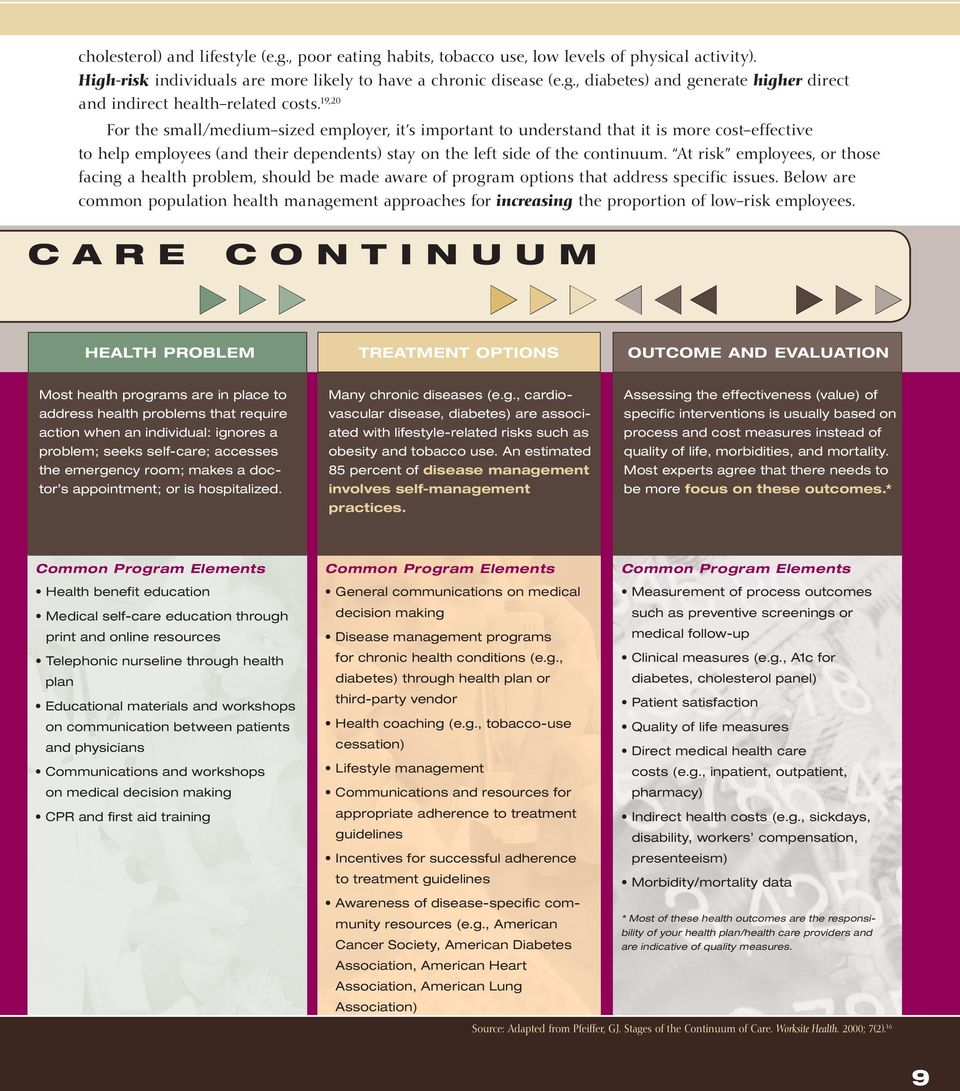
11 cholesterol) and lifestyle (e.g., poor eating habits, tobacco use, low levels of physical activity). High-risk individuals are more likely to have a chronic disease (e.g., diabetes) and generate higher direct and indirect health-related costs. 19,20 For the small/medium-sized employer, it s important to understand that it is more cost-effective to help employees (and their dependents) stay on the left side of the continuum. At risk employees, or those facing a health problem, should be made aware of program options that address specific issues. Below are common population health management approaches for increasing the proportion of low-risk employees. c a r e C o n t i n u u m Health Problem Treatment options Outcome and evaluation Most health programs are in place to address health problems that require action when an individual: ignores a problem; seeks self-care; accesses the emergency room; makes a doctor s appointment; or is hospitalized. Many chronic diseases (e.g., cardiovascular disease, diabetes) are associated with lifestyle-related risks such as obesity and tobacco use. An estimated 85 percent of disease management involves self-management practices. Assessing the effectiveness (value) of specific interventions is usually based on process and cost measures instead of quality of life, morbidities, and mortality. Most experts agree that there needs to be more focus on these outcomes.* Common Program Elements Health benefit education Medical self-care education through print and online resources Telephonic nurseline through health plan Educational materials and workshops on communication between patients and physicians Communications and workshops on medical decision making CPR and first aid training Common Program Elements General communications on medical decision making Disease management programs for chronic health conditions (e.g., diabetes) through health plan or third-party vendor Health coaching (e.g., tobacco-use cessation) Lifestyle management Communications and resources for appropriate adherence to treatment guidelines Incentives for successful adherence to treatment guidelines Awareness of disease-specific community resources (e.g., American Cancer Society, American Diabetes Association, American Heart Association, American Lung Association) Common Program Elements Measurement of process outcomes such as preventive screenings or medical follow-up Clinical measures (e.g., A1c for diabetes, cholesterol panel) Patient satisfaction Quality of life measures Direct medical health care costs (e.g., inpatient, outpatient, pharmacy) Indirect health costs (e.g., sickdays, disability, workers compensation, presenteeism) Morbidity/mortality data * Most of these health outcomes are the responsibility of your health plan/health care providers and are indicative of quality measures. Source: Adapted from Pfeiffer, GJ. Stages of the Continuum of Care. Worksite Health. 2000; 7(2). 16
12 What Health Coverage Reform Means The Patient Protection and Affordable Care Act has a number of provisions that provide employers especially small companies with new incentives to provide health coverage as well as comprehensive employee wellness programs. In addition, the new legislation provides additional funding and resources for supporting evidencebased community preventive health activities and research regarding the efficacy of worksite wellness programs. The following are some key provisions applicable to small/medium-sized employers. Subsidizing Health Coverage There is good news for small businesses in Section 1421 of the Patient Protection and Affordable Care Act. Beginning in 2010: Businesses with fewer than 25 full-time equivalent (FTE) employees and with average wages under $50,000 per employee who cover at least 50 percent of the cost of employee health care coverage can claim an income tax credit. Example: An employer with ten or fewer full-time employees with average employee wages of $25,000 (not including the owner s compensation), and pays 60 percent of the health care insurance premiums will receive a 35 percent tax credit on the amount the company pays for that insurance for fiscal year See For Your Information. This tax credit will be available to small companies until Thereafter, the credit is scheduled to increase and be available through state-based insurance exchanges that will be operating then. Another important provision Subsection (j) of Section 2705 (Prohibiting Discrimination Against Participants and Beneficiaries based on Health Status) pertains to wellness incentives for participation. Employers may provide employees (and dependents) a health premium discount or other reward (e.g., benefit credit to Health Savings Account [HSA]) for participation in company-sponsored wellness programs. Effective January 1, Raises incentive from 20 to 30 percent of total employer health care premium contribution. The Secretary of Health and Human Services may raise maximum differential to 50 percent. Employers must provide alternatives (e.g., consistent with HIPAA standards) for employees for whom it is unreasonably difficult or inadvisable to meet the standard. 10 Access to affordable health care coverage is an important component of the Patient Protection and Affordable Care Act.

13 to Small/Medium-Sized Employers Employee Wellness Technical Assistance/Resources Section of the Patient Protection and Affordable Care Act provides grants for small employers to provide comprehensive wellness programs. Authorizes appropriation of $200 million for fiscal years 2011 through Monies not actually appropriated at this time. Eligible employers must have fewer than 100 employees who are working 25 hours or more per week. The employer may not be providing a workplace wellness program as of March Qualifying wellness programs must be comprehensive as defined by the Office of the Secretary of Health and Human Services. Programs are required to include: Section 4303 provides small, medium, and large employers with technical assistance and other resources to support the evaluation of employerwellness programs. Provides employers with technical assistance, tools, and evaluation resources to help measure participation, increase participation rates, standardize measures, and evaluate program impact on such outcomes as employee health, absenteeism, productivity, workplace injury, and medical costs. Builds capacity and access for employers to evaluate their wellness programs through such channels as web portals, call centers, and other means. Health awareness initiatives that include health education, preventive screenings, and health risk assessments. Efforts to maximize employee engagement and participation. Initiatives such as counseling, online programs, and self-help materials to change unhealthy behaviors. Supportive environments that include workplace policies that encourage healthy lifestyles, healthy eating, increased physical activity, tobacco-free policies, and improved mental health. Amends Section 7 of the Fair Labor Standards Act of 1938 by adding Section 7 (r) that defines work accommodations and reasonable break time for nursing mothers. For Your Information To learn more about health promotion and preventive services provisions within the 2010 Patient Protection and Affordable Care Act go to: The Patient Protection and Affordable Care Act provides tax credits for small employers who sponsor wellness initiatives. 11

14 What Is Health Promotion? Paul R. Ahr, PhD President and CEO Camillus House, Inc. Camillus Wellness Program Company Overview Ending chronic homelessness in Miami-Dade Miami, Florida 135 employees Program Components Wellness model that is driven by employees and focuses on social, emotional, and physical components to support our people in creating a healthier work environment. Individualized nutritional and weight management counseling. Ongoing collaboration with Florida Heart Research Institute and AvMed. Annual health fair at which employees participate in health risk assessments. Smoking cessation program offered by Miami-Dade Area Health Education Center (AHEC). Healthy educational workshops throughout the year that focus on healthy living, osteoporosis, stress management, etc. Weekly/seasonal walks and/or workouts throughout the entire organization. Program Success Story 2010 South Florida Worksite Wellness Forum and Awards Winners. The documented health risk assessment results showed a tremendous decrease in the organization s overall cholesterol, blood pressure, and blood sugar. Less absenteeism. Established Team Camillus that participated in local 5K and bike events. 15% increase in employee participation in individual counseling for taking back their lives. CEO Statement Wellness is to the body what hopefulness is to the spirit, and at Camillus House we are deeply committed to promoting both for our guests, clients, and staff. Health promotion is a multidisciplinary field that relies on education and targeted interventions to help change behaviors and environments in ways that are conducive to health. The main goals of worksite health promotion are to reduce health risks and optimize health and productivity while lowering total health-related costs. In any size company, worksite health promotion creates a work environment that promotes and supports positive health practices for employees (and family members) by providing appropriate information and support for prevention, risk reduction, and disease management. 21 Common Program Elements Experts recommend that a comprehensive worksite health promotion program incorporate the following elements 22 : 1. Health education. Information and support that improves awareness, knowledge, skills, and motivation on core health practices and their effective adoption. 2. Supportive environments that reduce barriers to employee engagement in core health practices and reinforce a culture of health. Refer to page Integration. Programs that are embedded effectively within the organizational structure and value system. 4. Linkage. Cross-linking and leveraging other company functions and benefits (e.g., health benefits, safety, recruitment) to optimize participation and employee engagement. 5. Health screening. Initiatives that help employees assess health risks and provide referral to appropriate resources (e.g., health coaching) while respecting the confidentiality of personal health information. In addition, companies are encouraged to provide follow-up programming to reinforce maintenance and reduce recidivism as well as periodic evaluation (e.g., change in health risks, participation rates, sick days). Although these elements may seem complex, expensive, and time consuming to the small business owner, there are ways to adopt these recommendations that require a modest investment and benefit both employees and the company. Refer to pages 16 to

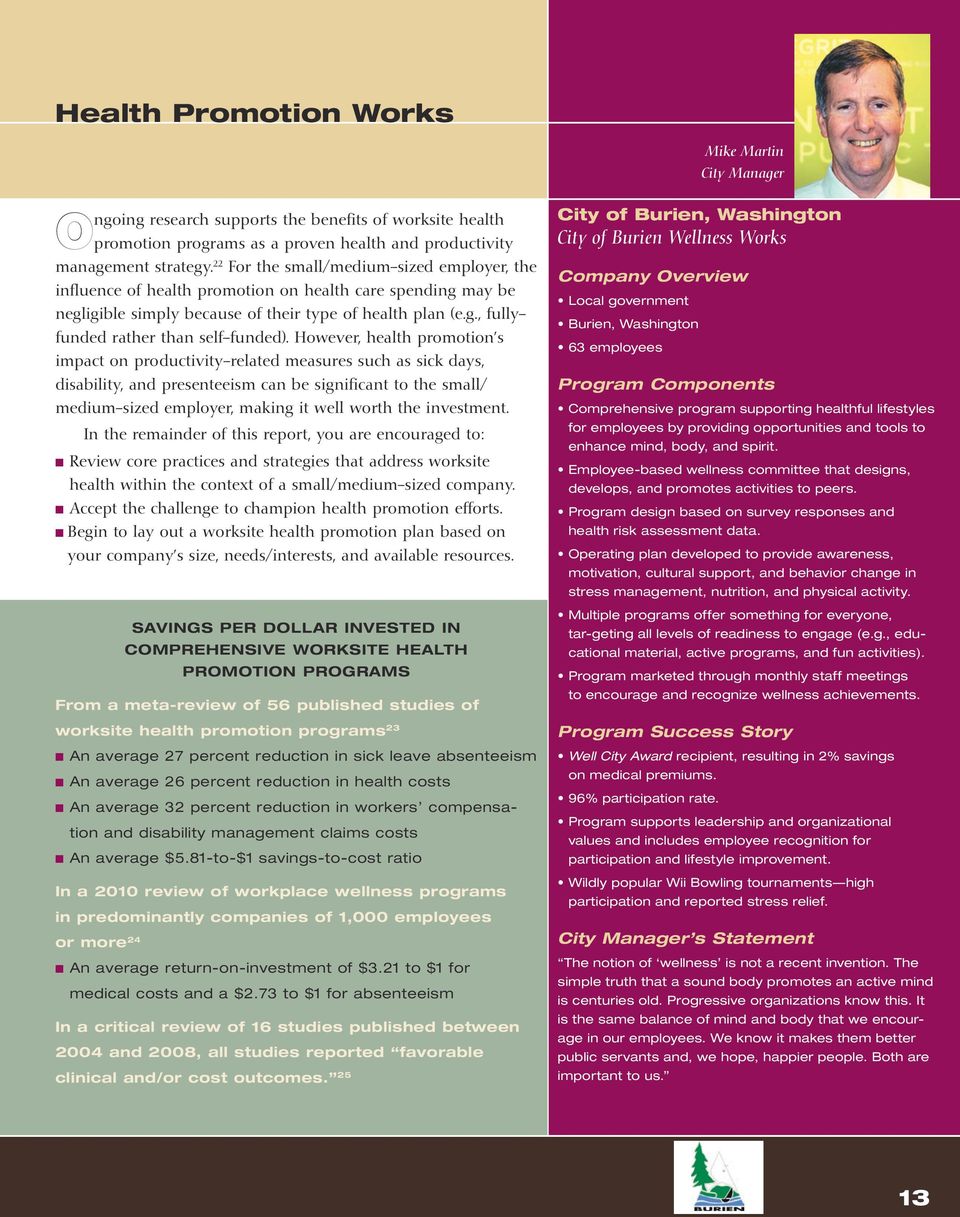
15 Health Promotion Works Mike Martin City Manager Ongoing research supports the benefits of worksite health promotion programs as a proven health and productivity management strategy. 22 For the small/medium-sized employer, the influence of health promotion on health care spending may be negligible simply because of their type of health plan (e.g., fullyfunded rather than self-funded). However, health promotion s impact on productivity-related measures such as sick days, disability, and presenteeism can be significant to the small/ medium-sized employer, making it well worth the investment. In the remainder of this report, you are encouraged to: n Review core practices and strategies that address worksite health within the context of a small/medium-sized company. n Accept the challenge to champion health promotion efforts. n Begin to lay out a worksite health promotion plan based on your company s size, needs/interests, and available resources. Savings per dollar invested in Comprehensive Worksite health promotion programs From a meta-review of 56 published studies of worksite health promotion programs 23 n An average 27 percent reduction in sick leave absenteeism n An average 26 percent reduction in health costs n An average 32 percent reduction in workers compensation and disability management claims costs n An average $5.81-to-$1 savings-to-cost ratio In a 2010 review of workplace wellness programs in predominantly companies of 1,000 employees or more 24 n An average return-on-investment of $3.21 to $1 for medical costs and a $2.73 to $1 for absenteeism In a critical review of 16 studies published between 2004 and 2008, all studies reported favorable clinical and/or cost outcomes. 25 City of Burien, Washington City of Burien Wellness Works Company Overview Local government Burien, Washington 63 employees Program Components Comprehensive program supporting healthful lifestyles for employees by providing opportunities and tools to enhance mind, body, and spirit. Employee-based wellness committee that designs, develops, and promotes activities to peers. Program design based on survey responses and health risk assessment data. Operating plan developed to provide awareness, motivation, cultural support, and behavior change in stress management, nutrition, and physical activity. Multiple programs offer something for everyone, tar-geting all levels of readiness to engage (e.g., educational material, active programs, and fun activities). Program marketed through monthly staff meetings to encourage and recognize wellness achievements. Program Success Story Well City Award recipient, resulting in 2% savings on medical premiums. 96% participation rate. Program supports leadership and organizational values and includes employee recognition for participation and lifestyle improvement. Wildly popular Wii Bowling tournaments high participation and reported stress relief. City Manager s Statement The notion of wellness is not a recent invention. The simple truth that a sound body promotes an active mind is centuries old. Progressive organizations know this. It is the same balance of mind and body that we encourage in our employees. We know it makes them better public servants and, we hope, happier people. Both are important to us. 13
16 Create a Culture of Health Regardless of a company s size, creating a true culture of health can increase participation rates in health promotion programs dramatically, establish the organization as an employer of choice, and enhance the long-tem sustainability of wellness programs. In such companies, employees see health promotion as the acceptable norm, and good-health values are reinforced in all day-to-day interactions. 26 Building a Supportive Environment The Centers for Disease Control and Prevention define a culture of health as: The creation of a working environment where employee health and safety is valued, supported, and promoted through workplace health programs, policies, benefits, and environmental supports. Building a culture of health involves all levels of the organization and establishes the workplace health program as a routine part of business operations aligned with overall business goals. 27 To create the basic framework for a culture of health, the following key elements are recommended 28 : n Dedicating senior leadership support and establishing organizational leadership/champions at all levels (e.g., middle management/supervisors and employees). As such, all levels need to be aligned with the program s business rationale, goals, and expectations. n Depending on company size and the number of locations, the establishment of a workplace health coordinator(s), council(s), or committee(s) to help guide planning and implementation of targeted programs based on the health needs of the work population. n Developing a workplace health improvement plan that is aligned with the company s goals, objectives, and the work population s health needs/interests. n Dedicating appropriate resources to execute the plan. This includes financial investments as well as leveraging internal and external resources. Refer to the next page. n Communicating clearly and consistently with employees. It s important to continually articulate the value of your program, it s progress, as well as dispel concerns on such issues as the use of health data. n Establishing a workplace informatics system. Identifying, collecting, and evaluating pertinent data sets from the beginning allow you to see if your goals and objectives are coming to fruition and establish important baselines for ongoing program planning and design. Other Important Elements n Creating a health-promoting environment by offering physical activity options (e.g., fitness facilities, walking paths), showers, healthy cafeteria/ vending selections, and lactation or quiet rooms. n Instituting health and safety policies such as prohibiting use of tobacco and requiring safety belt use, among others. n Providing abundant opportunities and reducing barriers to participation in health promotion programs. n Providing affordable health benefits that include evidence-based programs for preventive services, wellness, and appropriate treatment. Providing regular communications about the availability and use of these benefits. n Leveraging community and national resources, such as public health agencies, not-for-profit organizations, and business health coalitions, to take advantage of their programs and expertise. 14 Many employers have extended their culture of health to include health promotion by building on a history and culture of safety practices.

17 Leverage In-house and External Resources mall/medium-sized companies can provide well-rounded employee health promotion programs by leveraging S resources available both within and outside of the company (e.g., community health agencies, health plans, and wellness vendors). A key strategy is establishing wellness champions. These employee volunteers can serve as a planning and motivational group and assemble the core elements and tools of a comprehensive health promotion program. Companies have several options to develop wellness champions including hiring a part-time or full-time wellness professional or training staff to implement and manage the program, however, establishing a wellness champion model that develops local ownership and engagement is recommended. Internal Resources Wellness champions and professional staff can help plan and coordinate in collaboration with third-party organizations to deliver worksite health promotion activities, such as: n Health Risk Assessments (HRAs) n Health screenings n Health coaching n Health communications (e.g., print and online) n Onsite events (e.g., immunizations, lunch and learn lectures) External Resources The following third-party organizations may offer a variety of programming tools and expertise: n Health plans and health promotion/wellness vendors n Not-for-profit organizations (e.g., American Heart Association, American Diabetes Association, American Cancer Society) n Physicians, pharmacists, and hospitals n Local health clubs/ymcas n Colleges and universities n Business health coalitions n Governmental agencies, such as the Centers for Disease Control and Prevention (CDC) and state or local health departments n Professional Organizations (e.g., American College of Occupational and Environmental Medicine or National Association of Chronic Disease Directors) David P. Morgan President, Seitlin Benefits Seitlin & Company SWAT (Seitlin Wellness Action Team) Company Overview Insurance and advisory services Miami, Ft. Lauderdale; West Palm Beach, Florida 130 employees Program Components External partnerships (e.g., Miami-Dade County Health Dept., UM Hospital, Partnership for Prevention, etc.). Smoking cessation program. Walking program/fitness contests. Health risk assessments. Onsite biometric screenings. Stress management and nutrition workshops. Healthy vending machines and healthy breakfast/ lunches for meetings. Onsite massages. Wellness incentive and reimbursement program. Participation in community walks/races. Program Success Story Small business winner of the 2009 South Florida Worksite Wellness Forum and Awards presented by the Consortium for a Healthier Miami-Dade. Employee participation enhanced by starting slowly, ensuring comfort level, and garnering employee support and buy-in from the beginning. Percentage of employees in the extreme risk category decreased from 7% in 2009 to 2% in Percentage of employees who tested positive for nicotine decreased from 16% in 2008 to 7% in Percentage of employees reporting existing medical problems decreased from 56% in 2009 to 46% in Percentage of employees reporting back pain decreased from 13% in 2009 to 6% in President s Statement The SWAT Committee has done a great job of keeping wellness education, programs, and events active and alive throughout the year. Our incentive-based medical plan is intended to model best practices in shared accountability for healthy lifestyles and efficient health care utilization. 15

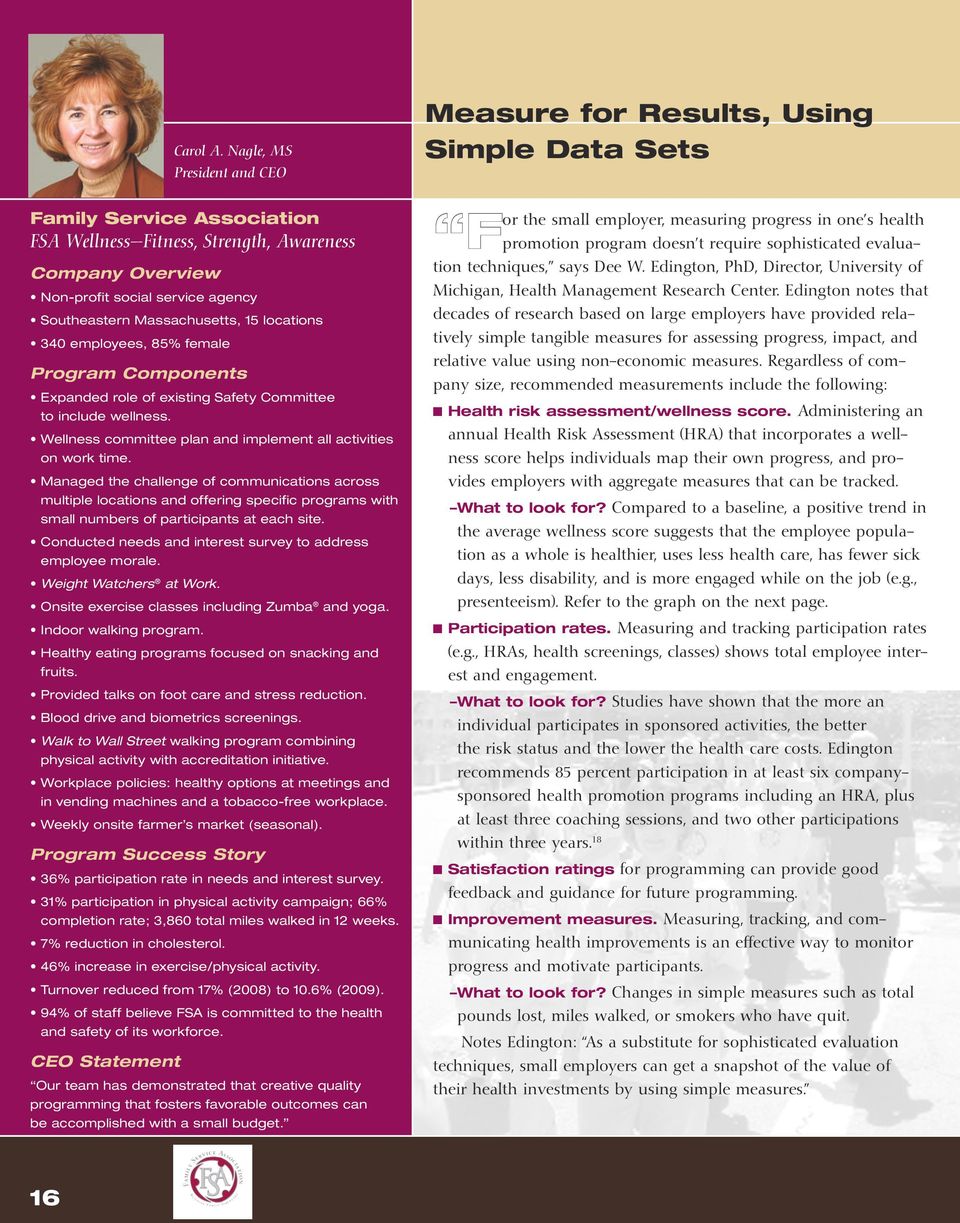
18 Carol A. Nagle, MS President and CEO Family Service Association FSA Wellness Fitness, Strength, Awareness Company Overview Non-profit social service agency Southeastern Massachusetts, 15 locations 340 employees, 85% female Program Components Expanded role of existing Safety Committee to include wellness. Wellness committee plan and implement all activities on work time. Managed the challenge of communications across multiple locations and offering specific programs with small numbers of participants at each site. Conducted needs and interest survey to address employee morale. Weight Watchers at Work. Onsite exercise classes including Zumba and yoga. Indoor walking program. Healthy eating programs focused on snacking and fruits. Provided talks on foot care and stress reduction. Blood drive and biometrics screenings. Walk to Wall Street walking program combining physical activity with accreditation initiative. Workplace policies: healthy options at meetings and in vending machines and a tobacco-free workplace. Weekly onsite farmer s market (seasonal). Program Success Story 36% participation rate in needs and interest survey. 31% participation in physical activity campaign; 66% completion rate; 3,860 total miles walked in 12 weeks. 7% reduction in cholesterol. 46% increase in exercise/physical activity. Turnover reduced from 17% (2008) to 10.6% (2009). 94% of staff believe FSA is committed to the health and safety of its workforce. CEO Statement Our team has demonstrated that creative quality programming that fosters favorable outcomes can be accomplished with a small budget. Measure for Results, Using Simple Data Sets or the small employer, measuring progress in one s health Fpromotion program doesn t require sophisticated evaluation techniques, says Dee W. Edington, PhD, Director, University of Michigan, Health Management Research Center. Edington notes that decades of research based on large employers have provided relatively simple tangible measures for assessing progress, impact, and relative value using non-economic measures. Regardless of company size, recommended measurements include the following: n Health risk assessment/wellness score. Administering an annual Health Risk Assessment (HRA) that incorporates a wellness score helps individuals map their own progress, and provides employers with aggregate measures that can be tracked. What to look for? Compared to a baseline, a positive trend in the average wellness score suggests that the employee population as a whole is healthier, uses less health care, has fewer sick days, less disability, and is more engaged while on the job (e.g., presenteeism). Refer to the graph on the next page. n Participation rates. Measuring and tracking participation rates (e.g., HRAs, health screenings, classes) shows total employee interest and engagement. What to look for? Studies have shown that the more an individual participates in sponsored activities, the better the risk status and the lower the health care costs. Edington recommends 85 percent participation in at least six companysponsored health promotion programs including an HRA, plus at least three coaching sessions, and two other participations within three years. 18 n Satisfaction ratings for programming can provide good feedback and guidance for future programming. n Improvement measures. Measuring, tracking, and communicating health improvements is an effective way to monitor progress and motivate participants. What to look for? Changes in simple measures such as total pounds lost, miles walked, or smokers who have quit. Notes Edington: As a substitute for sophisticated evaluation techniques, small employers can get a snapshot of the value of their health investments by using simple measures. 16
19 The Value of Health Risk Assessments Health Risk Assessment (HRA), or health risk appraisal, can A serve as the core measurement and intervention tool when combined with appropriate interpretation and referral. HRAs range from self-scoring questionnaires to sophisticated online applications. The primary goals of an HRA are to: n Raise employee awareness about the association between health practices/measures, the work environment, and future health problems. n Assess health issues (e.g., job stress) that relate to the work environment. n Motivate employees to seek appropriate interventions and reinforce progress through follow-up assessments. n Identify the distribution of risk (e.g., percentage of low-risk and high-risk employees) across the population. n Serve as a benchmarking, planning, and evaluation tool. Employee participation in an HRA also has been linked to health care cost control. 19,20,29 Many HRA programs are combined with health screenings, providing personalized wellness scores and health reports that recommend action steps for risk reduction. Emerging evidence shows that to be most effective, HRAs should include health coaching (face-to-face, telephonic, and/or online) to reinforce healthful behavior change. 19,20,30,31,32 Among Companies offering Health Benefits, Percentage of Companies, by Size, That Offer HRAs and Offer Incentives for Completing Them. This chart shows that HRAs are underutilized (with or without incentives) by small employers compared to large employers (when both provide health insurance). 100% 90% 80% 70% 60% 50% 40% 30% 20% 10% 0% 10% 55% 11% Offer employees the option to complete HRA* * Estimate is statistically different between all small companies and all large companies within category (p<05). Among companies offering employees the option to complete an HRA. Note: An HRA includes questions on medical history, health status, and lifestyle, and is designed to identify the health risks of the person being assessed. 19% 36% 22% Offer financial incentives to employees who complete assessments* All small companies (3 199 employees) All large companies (200 or more employees) All companies Source: The Kaiser Family Foundation and Health Research & Educational Trust Kaiser/HRET employer health benefits survey. Accessed November 30, Gary Verplank Chairman and CEO Shape corp. Shape Family Wellness Company Overview Manufacturing Grand Haven, MI 1,500 employees Program Components Onsite family wellness center. Wellness program offering healthy lifestyle incentives, stress management, nutrition, and tobacco cessation classes, financial planning, behavior modification and elder care workshops. Exuberant upper management support and participation in wellness and exercise programs. Annual health risk assessments, BMI and tobacco declarations, and annual physical exams. Comprehensive disease management program with an onsite nurse case manager. Nutritional Eat This Not That signage on vending machines and in the cafeteria, offering the healthier foods at a lower price. Tobacco-free campus. Program Success Story Shape Family Wellness was established in 2003 to combat rising health care costs that threatened the financial health of the company. A $2.5 million cost savings was realized in a fiveyear period. 7,000 pounds lost and 75 employees discontinued tobacco use. With the help of Shape s Fitness Factory and Priority Health, 99% of associates with chronic diseases are now managing their diseases. CEO Statement Our innovative and compassionate wellness programming significantly impacts the health of our associates and their families, and allows them to take charge of their health and make changes necessary to live a better life. 17

20 Focus on Core Practices Marc LeBaron Chairman and CEO Lincoln Industries Lincoln Industries Wellness Program Company Overview Manufacturing/metal finishing Lincoln, Nebraska 500 people Program Components Comprehensive wellness model that focuses on emotional, occupational, spiritual, social, intellectual and physical components to support our people in making smarter lifestyle choices. Wellness programs are aligned with our business strategy and corporate values. Integration of wellness, safety, and health benefits. Well-being assessment. Mark Your Miles (tracks total miles obtained by participants in multiple modes of physical activity). Semi-annual onsite physicals. Smoking cessation program on the clock. Weight Watchers at Work. Individual life plans are developed that use the Wellness Wheel model that reinforces and supports the multiple dimensions of health and well-being. Behavioral-based programs focusing on lifestyle. Program Success Story >90% participation rate in wellness activities. A senior management supported company-wide culture of health that includes bonuses for participation and lifestyle improvement. The go! Platinum awards program that recognizes Lincoln Industries people through a bronze, silver, gold, and platinum medal tier system, based on engagement and successes in various physical and lifestyle practices. Platinum winners receive a trip to climb a 14,000 foot mountain in Colorado with senior management. Less turnover and absenteeism, higher quality, and lower workers compensation and health care costs. CEO Statement Focusing on the whole person, our Wellness Program is dedicated to improvement, no matter how small. This support has transformed people s lives in a way that has contributed greatly to our culture, quality, productivity, and overall success of our company. o a small/medium-sized business with limited available T resources, implementing a well-rounded worksite health promotion program may seem daunting. However, by focusing on just a few core practices, a small/medium-sized company can make a significant impact on the health of its employees and the health of the business. Why implement such programs? Remarkably, a handful of chronic diseases not only are responsible for leading health care costs, but also have a significant impact on productivity-related costs. See the chart below. Yet, these conditions either can be prevented or managed more effectively by focusing on and adopting a few proven practices. Getting Focused Support employees through coordinated programs and communications that encourage: n Appropriate use of the medical care system. n Adherence to recommended preventive services. n Daily physical activity on and off the job. n Healthy eating. n A tobacco-free workplace. n Responsible alcohol use. n A safety culture and mind set. Rise of Chronic Diseases and Its Impact on Health and the health Care System Lost Economic Output Associated with Seven Common $80 Billion Presenteeism Caregiver $127 Billion Lost Workdays Individual Chronic Health Problems*, 2003 $11 Billion Lost Workdays Caregivers $828 Billion Presenteeism Individual *cancer, diabetes, heart disease, hypertension, mental disorders, pulmonary conditions, and stroke Source: DeVol R, Bedroussian A. An unhealthy America: The economic burden of chronic disease. Charting 18

21 Focus on Preventive Screenings and Services Preventive health screenings and services help raise awareness about risks and common health conditions. Screenings often identify health problems in their early stages and improve treatment outcomes with less expense. Typical preventive services involve immunizations, health risk assessments, specific disease screenings, biometric measurements, follow-up, and professional behavioral counseling. In 2006, Partnership for Prevention identified certain immunizations and practices as among the highest-ranked clinical preventive services for health impact and cost effectiveness, including 34 : n Screenings for alcohol use. n Screening for cardiovascular disease risks (diabetes, hypertension, and cholesterol). n Daily aspirin use. n Tobacco cessation and help to quit. Providing more access to valuable preventive services supports a healthier population, saves lives, and results in cost savings. Ideas for Small/Medium-Sized Employers n Communicate the value of preventive services such as immunizations (e.g., influenza, tetanus) and screenings (e.g., diabetes, mammography) that are offered by your health plan. n Attempt to reduce cost and access barriers to evidence-based preventive services by purchasing health insurance that offers services free or at a modest copay. n Distribute an annual screening/immunization schedule that summarizes recommended practices. n Encourage employee vaccinations for influenza annually. Consider onsite immunizations, if appropriate. Cross-promote related programs such as medical self-care for cold/flu, cold/flu workshops, and hand washing prompts/signage in rest rooms. n Partner with community health events such as immunization days, health fairs, or screenings. n Provide onsite facilities for screenings/immunization events (e.g., mobile mammography). n Communicate available health coaching/behavioral counseling services offered through your health plan or other third-party vendors. Donald Romine President Web Industries Web Employees Living Longer (WELL) Company Overview Contract manufacturer 100% employee stock owned company Five plants: MA, CT, IN, TX, GA; headquarters MA 315 employees Program Components Program initiated to address increasing health care costs. Established wellness committees at each plant and headquarters. Wellness committees receive direction from outsourced consultant, using work time to plan/ implement programs. Employee needs/interest survey. Kickoff events at each plant, 94% participation. Step up to the Plate and Walk Across America physical activity campaigns. Health fairs and biometric screenings. Health risk assessment. Smoking cessation leading up to tobacco-free company as of June 1, MyWELL Rewards raffle/prizes incentive program for participation in activities. Program Success Story 91% participation in needs/interest survey. Physical activity campaign had 74% participation rate, 94% of participants completed the program for a total of 457,748 minutes exercised in 9 weeks, average 233 minutes per person per week. 73% participation in health risk assessment. President s Statement The long term benefits to the company are evident in improved morale, increased engagement, and high participation in programs. We know the wellness program is the right thing to do for our employees and our company. 19
22 Focus on Physical Activity Janet Mountain Executive Director Michael & Susan Dell Foundation Michael & Susan Dell Treadmill Program Company Overview Global private family foundation established in 1999 Mission is to transform the lives of children living in urban poverty through better health and education Grant commitments to date exceed $650 million Offices in Austin, Texas; New Delhi, India; and Cape Town, South Africa 60 employees worldwide Program Components Created environments that promote healthy behaviors balancing good nutrition and regular physical activity. Included an investment in health and wellness benefits in total employee compensation package. Explored physical activity during work by replacing desks with treadmills and walking desks. Offered pre and post testing for body mass composition (BMI), metabolic rate, lipid and glucose profiles, and a health risk assessment (HRA). Encouraged treadmill use at 1.0 to 1.5 mph for at least 2 hours per day, while working. Program Success Story Ongoing voluntary participation 90%. Overall healthier, more engaged workforce. Top management support and participation. Overall decreases in cholesterol levels (increased HDL and a drop in LDL) and triglycerides, an average 7 pound weight loss and decreased BMI. Participants overwhelmingly voted to keep the treadmills in individual work spaces and in team rooms and conference rooms for employee use. Program is a key part of our US benefits program and helps attract and retain high-caliber talent. Interest in implementing program in schools to improve childrens health and learning. Executive Director s Statement Having treadmills in our office has obviously been tremendously beneficial for our health, but the most surprising results have been around how much more productive and more focused we are how much longer we can stay engaged when we re not sitting sedentary all day long. Physical inactivity contributes to poor health and increases the risk for cardiovascular disease, stroke, diabetes, colon cancer, osteoporotic fractures, depression, and injuries related to falls. The annual cost difference between an active person and an inactive person can be as high as $865 (in year 2000 dollars). 35 In fact, if inactive American adults were to become physically active, the annual savings could be $76.6 billion (in year 2000 dollars). 35 Fortunately, even moderate increases in physical activity can help improve fitness and agility, reduce health risks, and help maintain a healthy body weight. 36 Every week, adults should spend 2-1/2 hours doing moderately-intense cardiovascular activity (e.g., brisk walking) or 1-1/4 hours doing vigorouslyintense cardiovascular activity (e.g., jogging), or an equivalent combination. In addition, muscle-strengthening activities are recommended more than 2 days per week. 37 Ideas for Small/Medium-Sized Employers n Develop a policy related to physical activity sessions during the workday, such as adding 15 minutes to lunch breaks. n Encourage short physical activity sessions (e.g., walking, stretching) during all breaks periods and/or during shift changes. n Encourage better yet, lead lunch hour walking groups. n Promote individual and/or team pedometer challenges with incentives. n Promote/encourage walk and talks instead of office meetings. n Consider installing walking desks. Refer to the sidebar. n Consider providing a shower(s) and changing room(s) to encourage employees to be physically active. n Negotiate employee discounts or subsidize employee memberships at local fitness facilities/ymcas. n Place point-of-decision prompts (e.g., signage near stairs, map walking routes) to promote the benefits of physical activity. n Provide bike racks/storage to support ride to work programs. n Purchase a stationary bike and/or cross trainer and stretch station. Place in a high traffic area (e.g., empty break room). n Promote a stress buster program that encourages three- to five-minute physical activity breaks at your desk. 20
23 Focus on Weight Management and Nutrition Following a healthful eating plan not only provides the nutrients needed for robust health, development, and growth, but also helps the individual achieve and maintain a healthy body weight. And yet, despite USDA Food Pyramid recommendations and a national obsession with body weight, fewer than one-third of all American adults are at a healthy body weight, defined as having a Body Mass Index (BMI) lower than The consequences of poor nutrition and obesity in the United States not only lowers the quality of life for individuals, but also reduces productivity and increases the cost of doing business. For example, the Centers for Disease Control and Prevention (CDC) estimates the direct and indirect costs associated with obesity to be $147 billion per year in the United States. 39 Ideas for Small/Medium-Sized Employers n Sponsor and promote both individual and team weight-loss competitions that integrate appropriate education, skills, and behavioral supports. n Consider providing financial incentives and/or merchandise to employees reaching and/or maintaining a weight-loss goal. n Promote community amenities conducive to physical activity such as cycling lanes/routes, local parks, and hiking trails. n Provide free or subsidized weight management programs through health plans. n Provide educational materials, skills, and behavioral support pertinent to healthful eating, weight management, and the importance of daily physical activity. n Promote/sponsor healthy food shopping tours and farmers markets. n Provide signage in vending and meeting areas that encourage intake of fruits and vegetables (five or more servings per day). n Provide healthy, low-fat, low-sugar options in company vending machines. n Encourage/support healthy pot-luck lunches (e.g., every Friday) prepared by employees. Sponsor healthy cooking classes. n Provide fruits and vegetable snacks/low-fat dips and low-sugar beverage options during company meetings. n Provide nutritious meal options for company-sponsored events. County of Chester, Pennsylvania Chester County Employee Wellness Program Company Overview Local government Chester County, Pennsylvania 2,500 employees Program Components Backed by the Chester County Board of Commissioners, led by the human resources and health departments, and coordinated by representatives from more than 45 departments in Chester County government. Aligned with Chester County Commissioners strategic goals for staff and Chester County citizens. Emphasizes increased knowledge about nutrition, exercise, disease prevention, and healthy lifestyles and an increase in positive health behaviors. Includes onsite educational and physical activity programs, individual health risk screenings, onsite smoking cessation program, Weight Watchers at Work and summer Growers Market. Includes participation incentive program collected puzzle pieces of four cornerstones of wellness program for accumulated hours of vacation time. Program Success Story In 2008 and 2009, more than 130 activities provided to employees, reaching an average 5,000 participants. Growers Market summer program expanded from two sites in 2008 to four in Further expanded to employees and the public in Losing it at Chester County employee weight-loss program registered 250 participants resulting in more than 1,400 lbs. lost in 12 weeks. Program has received awards from the Philadelphia Business Journal and the National Association of Counties (NACo). Carol Aichele Chair, Chester County Commissioners Chairman s Statement Our plan in developing this program was to motivate Chester County staff to make changes for the better benefiting individuals and the county and become a positive example for county companies that hadn t recognized that a focus on the health of their staff benefits all. In just over two years, the program has grown in popularity and participation, and has received accolades from regional and national organizations. 21
24 Focus on Tobacco Cessation Brodes H. Hartley, Jr. President and CEO Community Health of South Florida, Inc. S.H.A.P.E.D. Staying Healthy Assists in Prevention and Early Detection Company Overview Private, non-profit, federally qualified health center established in 1971, offers quality, affordable, primary and behavioral health care services to the uninsured and underinsured Miami, Florida More than 600 employees; about 75% female In 2009, we served 71,000 unduplicated patients, representing more than 365,000 patient visits from 7 health centers and 27 schools in Miami-Dade and Monroe Counties Program Components Supported by CEO chaired wellness committee made up of employees from different departments. Tobacco cessation. Free YMCA memberships for all employees. Employer sponsored boot camp, Zumba dance classes, and body sculpt classes. Free tennis classes. Workshops and seminars on healthy lifestyle topics. Employee health fair (free screenings for high blood pressure, cholesterol, BMI). Field Trips (e.g., tour through Whole Foods Market). Program Success Story Daily wellness s reminded employees to incorporate healthy gestures into their everyday lives. Employees reported leading healthier and happier lives. Recipient of the Consortium for a Healthier Miami- Dade, 2009 South Florida Worksite Wellness Forum and Awards (Mid-Sized Employer Group). Staff survey showed 96% satisfaction with program. CEO Statement We are health care providers. We are role models for the community. We need to emphasize to our patients and our community that we believe in the importance of wellness. We owe it to ourselves and our families to be around for them in the years ahead. Despite decades of compelling science and increasing public awareness about the dangers of smoking and using tobacco products, nearly one in five adult Americans still smokes cigarettes 40 and at least 8.6 million Americans are living with one or more serious illnesses related to cigarette smoking. 41 However, only 50 percent to 60 percent of smokers receive advice about quitting smoking from a health care provider, and only 39 percent of smokers are offered over-the-counter or prescription medication or counseling to support the quitting process, despite the evidence that thousands of lives would be saved if such services were offered. 42,43 Tobacco cessation interventions cost less than treating the array of potential tobacco-related illnesses. It has been shown that the following approaches, if offered to all smokers, would save $3 billion annually 40 : n Community-wide campaigns. n Screening adults for tobacco use. n Providing brief counseling. n Offering cessation medications (including prescription and over-the-counter). Ideas for Small/Medium-Sized Employers n Enact policies to make the workplace and all company events tobacco-free both indoors and outdoors. n Provide and promote coverage information as well as local resources (e.g., print, online, coaching) for tobacco cessation. n Provide information pertaining to community and national services (e.g., American Lung Association, American Cancer Society) for tobacco cessation. These programs provide free or low-cost tobacco cessation resources. n Review what is available through your health plan, such as health coaching and availability of medications at no cost or low copay/coinsurance. n Provide medication coverage and referrals to state telephone counseling (quitlines) at QUIT NOW to assist all tobacco users in quitting. This portal number electronically connects the caller to their state quitline based on the area code. n Consider providing financial incentives combined with other cessation interventions (e.g., education, coaching) for those who quit. 44,45 22
25 Focus on Preventing Excessive Alcohol Use Excessive alcohol use, including binge drinking (four or more drinks for a woman or 5 or more drinks for a man within a short period of time), has been linked to serious health and social problems, including alcohol dependence, cardiovascular disease, certain cancers, mental health problems, liver disease, injury from motor vehicle crashes, traumatic injury, risky sexual behavior, interpersonal violence, on-the-job injury, and self-inflicted injury. 46 More than 70 percent of the estimated costs of alcohol abuse in 1998 were attributed to lost productivity ($134.2 billion) and the remaining 30 percent were attributed to the costs of treating alcohol abuse and dependence, treating the adverse medical consequences of alcohol consumption, alcohol-related motor vehicle crashes, and alcohol-related crime. 47 To the small/medium-sized employer, having an employee who misuses alcohol can be devastating not only from a human capital perspective, but also for the potential impact on business operations. However, the good news is that there are relatively low cost interventions that have been shown to be cost-effective: n Screening adults for alcohol misuse and providing brief counseling with follow-up. If all adults were counseled periodically, it would prevent 6,000 deaths and 400,000 injuries annually. 40 n Implementing early interventions for treating problem drinkers. Ideas for Small/Medium-Sized Employers n Distribute written policies on prohibiting the use of alcohol during company time, disciplinary protocols, as well as screening procedures. n Provide nonalcoholic beverages at company-sponsored events or limit to one drink per female employee and two drinks per male employee (e.g., ticket system). n Provide information about community and national support services (e.g., Alcoholics Anonymous [AA], Al-Anon). n Review what is covered by the company s health plan (e.g., counseling, medication, and in- and out-patient treatment). n During holiday periods, promote Don t drink and drive and designated driver practices. n Consider implementing an Employee Assistance Program (EAP) through a third-party vendor. Susan Kuruvilla President CLARK Security Products and General Lock Company Overview Wholesale physical security products distributor 15 locations with employees nationwide 68% male and 32% female Program Components Provided employees biometrics data. Implemented annual health risk assessment. Made value-based plan design changes to benefits program (e.g., reduction of targeted copays). Promoted company-sponsored healthy food. Designed a nationwide walking program. Promoted an employee assistance program. Planted onsite community gardens. Evaluate the wellness program annually. Program Success Story 78% participation in the annual health assessment. Saw measurable improvements in employee health risk behavior beginning as early as the first year of the health assessment, including weight management, decreased blood pressure levels, and early disease detection from recommended health screenings. Increased employee engagement with 88.4% employees satisfied with their jobs in Achieved a progressive three-year reduction in the number of individuals who reported having trouble performing work/life tasks due to mental health issues. Had less than a 2.9% increase in year-over-year costs for wellness and benefits programs by quantifying reductions in absenteeism, excess health claims, and lost productivity. Winner of San Diego s Healthiest Employers 2010 award in the medium-business category and one of five case studies presented to the White House illustrating what employers are doing to bend the health care trend. President s Statement You don t have to spend a lot of money to drive a change in behavior. It starts at the top. All of our executives are motivated, healthy, and active. We believe in living healthy lifestyles. 23
26 24 Alan A. Madsen City Administrator City of Maple Grove, Minnesota Fit for Life Wellness Program Company Overview City Government Maple Grove, Minnesota Number of employees: 245 Program Components Annual onsite health screening with health educators. Physical activity and nutrition events throughout the year. Tobacco cessation and weight management programs. Effective personal safety habits promoted. Partnership with local health club for discounts. Onsite group wellness activities and health education sessions. Onsite flu vaccination program. Program Success Story Lower annual medical and workers compensation premiums compared to the national average. Incentive-based wellness program providing up to two paid wellness days off. Employee survey results showed that the wellness program had a positive impact on their health, improved workplace morale, influenced family members to seek healthier lifestyles, increased awareness of their at-risk health behaviors and taught how to address them, and was a benefit that helped to reduce their overall health care costs. A nine time award-winning program recognized nationally, regionally, and locally as innovative and creative in providing worksite wellness benefits. Administrator s Statement Clearly our wellness program has had a tremendous positive impact on our employees mental and physical well-being. It continues to educate our employees on the great benefits of proper health. It also brings fun to the workplace and happier, healthier employees are more loyal and more productive, and ultimately provide the best service to our citizens. I am very proud to strongly endorse the program and the efforts put forth by our employees. Focus on Safety On and Off the Job Regardless of size, safety at the worksite is crucial for maintaining a healthy and productive workforce. Employers have the obligation to provide a safe work environment free of recognized hazards. For example, the indirect costs of injuries (e.g., accident investigation, low morale, production delays, repairs) may be 20 times the direct costs. 48 In a study of large employers, workers compensation costs accounted for three percent of total health- and productivity-related costs. 49 For small/medium-sized companies, employee disability due to an injury can be detrimental to manpower levels and the fulfillment of business obligations/schedules. Injury prevention and proactive return-to-work programs are key elements of a focused approach for reducing the impact of on-the-job injuries. Ideas for Small/Medium-Sized Employers n Management commitment. Management/supervisors must truly be committed to job safety, take steps to prevent injuries and illness, actively investigate and address safety problems, and provide support and follow-up in an expedient manner. n Active participation by workers. Employees are responsible for adhering to safety rules and should get involved in developing the safety program so they gain ownership. Seek input and suggestions about existing work hazards. Be sensitive to literacy issues (e.g., reading and language barriers). n Effective incentives. Recognize individuals and teams that demonstrate safe behaviors (instead of just rewarding a lack of lost-time injuries). This helps to improve safety performance and reinforces the organization s emphasis on safety. n Equipped employees. Ensure that all workers have appropriate personal protective equipment, the right tools, necessary training and education for the job, clearly documented safety procedures and work rules, methods for assessing safety performance or knowledge, and opportunities for offering input. n Safety analysis. Assess the root causes of any incidents. In addition, analyze job hazards to identify potential accidents, institute necessary controls, and evaluate program effectiveness. n Transfer skills to the home. Reinforce that job safety practices (e.g., ladder safety, slips and falls) can be applied to the home. For more information about our wellness program:
27 Focus on Medical Consumerism Medical consumerism and medical self-care education empower individuals to improve their decision-making skills in the appropriate use of medical services and to understand the importance of self-management practices. In these programs, employees learn how to select a physician, partner and communicate with their health care providers; manage medications, assess treatment options based on relative benefits, risks, and costs; and learn the importance of complying with recommended preventive screenings and immunizations schedules. Employee health management (EHM) programs, which include health promotion, self-care programs, disease management, and case management, can provide a positive Return-On- Investment (ROI) averaging double or more the savings for each dollar invested within two to three years. 50,51 Ideas for Small/Medium-Sized Employers n Help employees understand their health benefits. Provide an annual health benefit orientation to review what services are covered, premiums, copay/coinsurance, HSA options, and what wellness/preventive services are available. n Provide medical self-care education. Medical self-care provides decision-support tools for determining the appropriate and necessary use of emergency and outpatient services. A typical medical self-care program includes a self-care reference book or online option combined with training and awareness campaigns. In addition, a 24-hour nurseline may be included. Self-care is especially valuable for employers that do not provide health benefits, because it helps employees reduce out- of-pocket expenses by avoiding inappropriate medical visits. n direct employees to disease management programs. Disease management programs provide coaching/counseling services to help patients adhere to medical treatment guidelines for common chronic health conditions. Check if your company s health plan or state/local health departments offer disease management programs (e.g., diabetes, asthma). Also, refer to other community organizations (e.g., American Diabetes Association, American Lung Association). Ollis and Company The Wellness Program Company Overview Risk and benefit advisors Springfield, Missouri 30 employees; 17 female, 13 Male Program Components Annual health risk assessment including biometric testing. Wellness program participation linked with choices on health care coverage. Wellness coordinator onsite certain hours each week. Fresh fruit daily free for all employees. Six onsite wellness presentations per year. Quarterly wellness consults for all employees. Reimbursement for fitness center fees, including yoga classes, home exercise equipment, etc. Onsite fitness facility free to all employees. Program Success Story 95% participation rate in The Wellness Program. Biggest impact was linking wellness program participation to choice of health care coverage. Senior leadership not only participates in our wellness program, but also is a vocal proponent of its value. Keep it simple. Tracking sheets work well, but there are other options. The program is continually evolving. Improved employee morale, company loyalty, and stress reduction are just a few ways the wellness program has changed our culture. CEO Statement Richard Ollis President and CEO We think that communication is the key because people have to understand the program and know how it s going to benefit them as well as the company. We would really encourage a very consistent communication effort to clearly explain the program and its benefits and communicate its successes. 25
28 Programming Matrix This chart outlines the seven elements of a comprehensive worksite health promotion program as defined by Healthy Workforce 2010 and Beyond, based on the Healthy People 2020 national health objectives. 22 For the small/medium-sized employer, Minimum Steps provides a sound foundation for creating a comprehensive health promotion program. Depending on company size and resources, Moderate and Comprehensive steps represent additional suggestions that build upon the previous step(s) to create a broad program strategy. Program Elements Minimum Steps Moderate Steps Comprehensive Steps Health Education Tobacco use Alcohol/drug misuse Physical inactivity Overweight/obesity Health Risk Assessments (HRAs) every 12 months Information and resources for healthy lifestyle changes Medical self-care resources Use targeted risk interventions based on readiness to change Provide workshops on medical consumerism Health coaching (e.g., personto-person, telephonic, online) Onsite full-time wellness manager Telephonic nurseline Supportive Social and Physical Environments Open conference rooms and other work spaces for afterhours physical activity classes Negotiate health club discounts Create tobacco-free workplace Provide showers, subsidized gym memberships, walking trails, well-lit stairwells Provide healthy selections in vending machines, cafeterias, and company functions In-house health management center in large locations Allow for volunteer health teams and budget discretionary programs in all company locations Integration of the Worksite Program Involve a diverse group of employees in a broad planning effort to create ownership in the program Match the goals of the worksite program with the mission statement of your organization With senior management support, develop and use a health scorecard that is integrated with business goals Linkage to Related Programs Work-related injury/ death Health insurance Preventive services Create wellness champions. Integrate lifestyle messages (e.g., obesity, back care) into safety meetings Provide custom publications pertaining to benefits, job safety, and preventive services Create a cross-functional team (e.g., wellness, benefits, Employee Assistance Program [EAP]) for strategic health promotion planning Screening Programs Communicate the importance of preventive screening through flyers and/or company communications Sponsor or team up with other businesses to offer health fairs with screenings Through benefit plan, reduce cost and access barriers to preventive screenings Follow-up Interventions Locate and promote appropriate resources and support related to at-risk practices (be sensitive to privacy issues) Create incentive-based programs to encourage maintenance of positive health changes (e.g., no tobacco use) Benchmark health data to set short- and long-term objectives for reducing at-risk behavior Evaluation and Improvement Process Conduct periodic surveys regarding employee health promotion needs/interests Measure employee participation rates Use post-program surveys to measure satisfaction Stratify aggregate health risk assessment data by level of risk (e.g., percentage of population at low, medium, and high risk) Measure and track disability, workers compensation, and sick days Evaluate Return-On- Investment (ROI) on selected interventions Integrate employee data Measure presenteeism for selective health conditions (e.g., arthritis, diabetes) Starting a health promotion program in your organization can be 26 equal in cost to one premium coffee per month/per employee. 52
29 Putting It All Together As this report reveals, small/medium-sized employers have successfully implemented health promotion initiatives that not only have protected their bottom lines, but also have improved the health of their most important assets their people. To assess and support your organization s efforts to manage employee health, consider how the following components fit into your employee health strategy: n Create and support a culture of health. q Create leadership networks from the top down and the bottom up. q Communicate employee health as a company value. q Protect employee safety by providing appropriate education and requiring compliance to safety policies and regulations. q Reinforce and support the importance of personal responsibility in practices of health and safety. q Support regular physical activity and healthful food choices throughout the workday. q Develop, communicate, and enforce health-related policies (e.g., tobacco-, drug-, and alcohol-free worksites). q Consider offering incentives to reinforce positive health practices (e.g., tobacco cessation, weight management). n Provide health benefits as the base for preventive care. q Make an effort to provide access to affordable health care. q Select health benefits that lower/remove cost and access barriers to preventive screenings, health maintenance, and evidence-based treatments. n Provide health education and risk reduction programs. q Produce general communications (e.g., health newsletter, online content) that raise awareness, teach skills, and provide motivation for primary prevention, risk reduction, and disease management. q Provide access to confidential HRAs and follow-up risk reduction programs (e.g., targeted risk modules, health coaching). q Implement medical self-care resources and health education. q Supply access to resources and support for managing chronic health conditions. n Use simple measures to track progress. q Based on Health Risk Assessment (HRA) aggregate data, understand the distribution of health risks and areas that need attention (e.g., obesity, tobacco use). q Use a wellness score as a key program benchmark. q Use participation rates as an indicator of employee engagement. q Use safety logs. 27
30 References 1. Heffler S, Smith S, Keehan S, Borger C, Clemens MK, Truffer C. U.S. health spending projections for Health Affairs. 2005;Suppl Web Exclusives:W5-74 W Whitmer RW, Pelletier KR, Anderson DR, Baase CM, Frost GJ. A wake-up call for corporate America. Journal of Occupational and Environmental Medicine. 2003;45(9): The Kaiser Family Foundation and Health Research & Educational Trust Kaiser/HRET employer health benefits survey. ehbs.kff.org/pdf/2010/8085.pdf. Accessed December 22, Kaiser Family Foundation and Health Research and Educational Trust Kaiser/HRET employer health benefits survey: Menlo Park, CA and Chicago, IL; Carpenter D. Why small business is sick over health care costs. Hospitals and Health Networks. 2003;77(11): Linnan L, Bowling M, Childress J, Lindsay G, Blakey C, Pronk S, Wieker S, Royall P. Results of the 2004 national worksite health promotion survey. American Journal of Public Health. 2008;98(8): Christakis NA, Fowler JH. The spread of obesity over a large social network over 32 years. New England Journal of Medicine. 2007;357(4): National Institute on Aging. Social networks influence smoking and obesity. Accessed December 22, Burton WN, Conti DJ, Chen CY, Edington DW. The role of health risk factors and disease on worker productivity. Journal of Occupational and Environmental Medicine. 1999;41(10): Edington DW, Burton WN. Health and productivity. In: McCunney RJ: A Practical Approach to Occupational and Environmental Medicine. 3rd ed. Philadelphia: Little, Brown and Company; 2003: Burton WN, Pransky G, Conti DJ, Chen CY, Edington DW. The association of medical conditions and presenteeism. Journal of Occupational and Environmental Medicine. 2004;46(6)suppl:S38-S Pelletier B, Boles M, Lynch W. Change in health risks and work productivity over time. Journal of Occupational and Environmental Medicine. 2004;46(7): Goetzel RZ, Long SR, Ozminkowski RJ, Hawkins K, Wang S, Lynch W. Health, absence, disability, and presenteeism cost estimates of certain physical and mental health conditions affecting U.S. employers. Journal of Occupational and Environmental Medicine. 2004;46(4): Levin-Epstein M. Federal and state governments pressed to give tax breaks for wellness initiatives. Managed Care Magazine. 2008;17(2): Kessler RC, Ormel J, Demler O, Stang PE. Comorbid mental disorders account for the role impairment of commonly occurring chronic physical disorders: Results from the national comorbidity study. Journal of Occupational and Environmental Medicine. 2003;45(12): Pfeiffer GJ. Stages of the continuum of care. Worksite Health. 2000;7(2): Yen L, Schultz AB, Schnueringer E, Edington DW. Financial costs due to excess health risks among active employees of a utility company. Journal of Occupational and Environmental Medicine. 2006;48(9): University of Michigan Health Management Research Center. The Worksite Wellness Cost Benefit Analysis and Report, Ann Arbor, MI: University of Michigan Health Management Research Center; Edington DW. Zero Trends: Health as a Business Economic Strategy. Ann Arbor, MI: University of Michigan Health Management Resource Center; Musich S, McDonald T, Hirschland D, Edington DW. Excess healthcare costs associated with excess health risks in diseased and nondiseased health risk appraisal participants. Disease Management Health Outcomes. 2002;10(4): Pfeiffer GJ. Improving the organization through the work promotion model. Cox C, ed. ACSM s Worksite Health Promotion Manual. Champaign, IL: Human Kinetics; 2003: Partnership for Prevention. Healthy Workforce 2010 and Beyond. An essential health promotion sourcebook for both large and small employers. Washington, DC: Partnership for Prevention; Chapman LS. Meta-evaluation of worksite health promotion economic return studies: 2005 Update. American Journal of Health Promotion. 2005;19(6): Baiker K, Cutler D, Song Z. Worksite wellness programs can generate savings. Health Affairs. 2010;29(2): Pelletier KR. A review and analysis of the clinical and cost-effectiveness studies of comprehensive health promotion and disease management programs at the worksite: Update VII Journal of Occupational and Environmental Medicine. 2009;51(7): Allen J, Leutzinger J. The role of culture change in health promotion. html. Accessed December 22, Centers for Disease Control and Prevention. Culture of health. html. Accessed December 22, Centers for Disease Control and Prevention. Planning/Workplace Goverance. Accessed December 22, Serxner SA, Gold DB, Grossmeier JJ, Anderson DR. The relationship between health promotion participation and medical costs: A dose response. Journal of Occupational and Environmental Medicine. 2003;45(11): Musich S, Adams L, Hirschland D, McDonald T, Napier D, Page R, Edington DW. Benchmarking longitudinal health-risk appraisal participation trends. Worksite Health. 2001;8(2): Edington DW. Who are the intended beneficiaries (targets) of employee health promotion and wellness programs? North Carolina Medical Journal. 2006;67(6): Soler RE, Leeks KD, Sima Razi, Hopkins DP, Griffith M, Aten A, Chattopadhyay SK, Smith SC, Habarta N, Goetzel RZ, Pronk NP, Richling DE, Bauer DR, Ramsey Buchanan LR, Florence CS, Koonin L, MacLean D, Rosenthal A, Koffman DM, Grizzell JV, Walker AM. Task Force on Community Preventive Services. A systematic review of selected interventions for worksite health promotion: The assessment of health risks with feedback. American Journal of Preventive Medicine. 2010;38(2S): Devol R, Bedroussian A. An unhealthy America: The economic burden of chronic disease. Charting a new course to save lives and improve productivity and economic growth. Milkin Institute; Oct Maciosek MV, Coffield AB, Edwards NM, Goodman MJ, Flottemesch TJ, Solberg LI. Priorities among effective clinical preventive services: results of a systematic review and analysis. American Journal of Preventive Medicine. 2006; 31(1): Centers for Disease Control and Prevention. Lower direct medical costs associated with physical activity. pressrel/r2k1006a.htm. Accessed December 22, Physical activity and health: A report of the Surgeon General, Executive Summary. Centers for Disease Control and Prevention, National Center for Chronic Disease Prevention and Health Promotion. Accessed December 22, Centers for Disease Control and Prevention, National Center for Chronic Disease Prevention and Health Promotion. Physical activity guidelines for Americans PAGuidelines/pdf/paguide.pdf. Accessed December 22, National Institutes of Health. U.S. Department of Health and Human Services. Overweight and obesity statistics. gov/obesity/data/index.html. Accessed December 22, Obesity: Halting the epidemic by making health easier: At a glance National Centers for Disease Control and Prevention. Accessed December 22, Priorities for America s health: capitalizing on life-saving, costeffective preventive services. Partnership for Prevention. Accessed December 22, Centers for Disease Control and Prevention. Tobacco use: Targeting the nation s leading killer. At a glance NCCDPHP/publications/aag/pdf/tobacco.pdf. Accessed December 22, Campbell KP, Lanza A, Dixon R, Chattopadhyay S, Molinari N, Finch RA, ed. A purchaser s guide to clinical preventive services: moving science into coverage. Washington, DC: National Business Group on Health; Accessed December 22, Task Force on Community Preventive Services. The Guide to Community Preventive Services: What Works to Promote Health. New York: Oxford University Press, Accessed December 22, Volpp KG, Troxel AB, Pauly MV, Glick HA, Puig A, Asch DA, Galvin R, Zhu J, Wan F, DeGuzman J, Corbett E, Weiner J, Audrain-McGovern J. A randomized, controlled trial of financial incentives for smoking cessation. New England Journal of Medicine. 2009;360(7): Volpp KG, Gurmankin Levy A, Asch DA, Berlin JA, Murphy JJ, Gomez A, Sox H, Zhu J, Lerman C. A randomized, controlled trial of financial incentives for smoking cessation. Cancer Epidemiology, Biomarkers & Prevention. 2006;15(1): Alcohol use and health. Centers for Disease Control and Prevention. htm. Accessed December 22, Alcohol alert. National Institute of Alcohol Abuse and Alcoholism. National Institutes of Health, U.S. Department of Health and Human Services. Available at Accessed December 22, American Society of Safety Engineers. White paper addressing the return on investment for safety, health, and environmental (SH&E) management programs. June Goetzel RZ, Guindon AN, Turshen IJ, Ozminkowski RJ. Health and productivity management: Establishing key performance measures, benchmarks, and best practices. Journal of Occupational and Environmental Medicine. 2001;43(1): Serxner S, Gold D, Meraz A, Gray A. Do employee health management programs work? American Journal of Health Promotion. 2009;23(4):1-8, iii. 51. Leutzinger J, Richling D. Why Union Pacific Railroad medical selfcare program works. Worksite Health. 1994;1(1): Pfeiffer G. Workplace Health Academy. National Wellness Conference
31 Special thanks to Katherine Ruffatto, MS, and Garry M. Lindsay, MPH, CHES, for their expertise and tireless effort on this project. Editorial and production assistance provided by The WorkCare Group, Inc. The content of this publication is solely the responsibility of Partnership for Prevention.
32 A Call to Action: Leading by Example The Value of Worksite Health Promotion to Small- and Medium-Sized Employers Leading by example S mall- to medium-sized businesses are the foundation of our economy, as well as the communities in which they operate. The health of their employees is the cornerstone for creating and sustaining healthy businesses. However, compared to large employers that often have strength in numbers, smaller companies are impacted more profoundly when employees are less productive or absent due to poor health. In this report, Leading by Example: The Value of Worksite Health Promotion to Smalland Medium-Sized Employers, leading organizations and their respective leaders share their best practices for creating a healthier workforce and encourage other business leaders to do the same. This call to action challenges small- to medium-sized organizations to: n Be committed to improving the health and well-being of your employees and their families. n Define and articulate the value of employee health and its connection to the health of your organization. n Implement evidence-based health initiatives that address primary prevention, the reduction of lifestyle-related risks, and the appropriate management of chronic health conditions. n Support and encourage positive lifestyle practices and remove cost and access barriers to engagement. n When applicable, team-up with appropriate community-based health promotion vendors and services that broaden your programming and reach. n Define, create, and sustain a culture of health that supports your health promotion goals and values. n Lead your industry by example. The Value of Worksite Health Promotion to Small- and mediumsized Employers th Street, NW, Suite 300 Washington, DC [email protected] Web site: Copyright 2011 Partnership for Prevention. All rights reserved.
Working toward Wellness: Creating Consumer-Friendly Workplace Wellness Programs
 Wellness Programs: Checklist and Profiles From Families USA July 2012 Working toward Wellness: Creating Consumer-Friendly Workplace Wellness Programs Wellness programs can be a powerful tool to help people
Successful Wellness Program
 6 Key Steps TO A Successful Wellness Program by Don Hall, DrPH, CHES 2 6 KEY STEPS TO A SUCCESSFUL WELLNESS PROGRAM What Are the Benefits of Wellness? You certainly know the consequences of not feeling
Creating an effective wellness strategy
 Creating an effective wellness strategy Plan Sponsor Wellness Guide Investing in health and wellness in the workplace can really pay off. 20.02.103.1 (5/08) Healthy change starts with you Save by targeting
TotalCare Wellness Programs Reduce Health Care Costs and Improve Productivity
 TotalCare Wellness Programs Reduce Health Care Costs and Improve Productivity Up to 70% of an employer s health care spending is attributed to unhealthy lifestyle behaviors Poor Health Behaviors Drive
Introducing. Accelerating employee engagement to drive healthier lifestyles
 Introducing Accelerating employee engagement to drive healthier lifestyles Your goal is to keep employees healthy, happy, and more productive. Our goal is to help you achieve just that. In building a worksite
An Integrated, Holistic Approach to Care Management Blue Care Connection
 An Integrated, Holistic Approach to Care Management Blue Care Connection With health care costs continuing to rise, both employers and health plans need innovative solutions to help employees manage their
WHITE PAPER Wellness that Works
 WHITE PAPER Wellness that Works How program integration can maximize participation and create a culture of total health and wellness Written by the behavioral experts at eni www.eniweb.com Successfully
Corporate Wellness Programs A Guide to Strategic Design
 Background The rising cost of healthcare has forced employers to look for a variety of alternative health and welfare solutions to improve the health of their employee population, improve productivity
TACKLING POPULATION HEALTH MANAGEMENT with Worksite Wellness & Community Outreach
 TACKLING POPULATION HEALTH MANAGEMENT with Worksite Wellness & Community Outreach APRIL 2015 THE PRESIDENT S MESSAGE Daniel T. Yunker Why do we need population health management in the health care delivery
Wellness Strategies. Use and Management of Downsizing to Improve Employee Health, Performance and the Bottom Line. SHRM Foundation Executive Briefing
 SHRM Foundation Executive Briefing Wellness Strategies Use and Management of Downsizing to Improve Employee Health, Performance and the Bottom Line By David Chenoweth, Ph.D., FAWHP Sponsored by HUMANA
Tailoring Your Approach to Workplace Health Based on Your Budget and Organizational Culture
 Tailoring Your Approach to Workplace Health Based on Your Budget and Organizational Culture Breakout Session 2014 Iowa Governor s Safety & Health Conference Cedar Rapids, IA ; November 7, 2013 2 nd Annual
Creating a healthy and engaged workforce. A guide for employers
 Creating a healthy and engaged workforce A guide for employers 1 Introduction The health and wellbeing of your workforce is fundamental to the achievement of your company s current goals and future ambitions.
Data Analytics and Wellness Programming
 Click to edit Master title style Data Analytics and Wellness Programming Presented to: International Public Management Association for Human Resources January 9, 2014 Presented by: Erin Eason and Bridgette
Knox County Health Department Worksite Wellness Toolkit
 Knox County Health Department Worksite Wellness Toolkit For Small Businesses K n o x C o u n t y Health Department E v e r y P e r s o n, A H e a l t h y P e r s o n 140 Dameron Avenue Knoxville, Tennessee
Worksite Wellness Criteria and Guidelines
 Worksite Wellness Criteria and Guidelines Welcome to Fitness For Life Around Grant counties (FFLAG) Worksite Wellness Award Initiative. The Worksite Wellness Award is designed to honor worksites which
Collaborative Onsite Medical Care in the Workplace
 Collaborative Onsite Medical Care in the Workplace Sue Dierksen, MPH,RN, COHN-S/CM, CSP Director of Business Health- Aspirus Clinics Holly Bauer, RN BSN Health Services Supervisor, Sentry Insurance Objectives
Corporate Wellness Programs
 The StayFit Plan a division of Simplicity Health Plans Background The rising cost of healthcare has forced employers to look for a variety of alternative health and welfare solutions to improve the health
The Business of Healthy Employees: A Survey of Workplace Health Priorities
 The Business of Healthy Employees: A Survey of Workplace Health Priorities 2013 1 Introduction A healthy workforce plays a role in maintaining a healthy business. As demonstrated by the organization response
STRATEGIES FOR A SUSTAINABLE WELLNESS PROGRAM. Sue Blankenhagen and Jennifer Piliero May 9, 2014
 STRATEGIES FOR A SUSTAINABLE WELLNESS PROGRAM Sue Blankenhagen and Jennifer Piliero May 9, 2014 Agenda Key Industry Trends Elements of a Successful Wellness Program Five Strategies to Develop a Sustainable
Dealing with wellness and lifestyle issues. DEPT OF MEDICINE AND OCCUPATIONAL HEALTH, CRI
 Dealing with wellness and lifestyle issues. DEPT OF MEDICINE AND OCCUPATIONAL HEALTH, CRI Workplace Health refers to efforts to assist employees (and their families) to make voluntary lifestyle changes
WORKING WELL: A Global Survey of Health Promotion and Workplace Wellness Strategies
 [ essential intelligence ] BUCK SURVEYS WORKING WELL: A Global Survey of Health Promotion and Workplace Wellness Strategies Executive Summary Executive Summary Overview For the third consecutive year,
Oswald Wellness Playbook. Program Measurement
 Oswald Wellness Playbook Program Measurement Health management starts with health measurement. Introduction Health management starts with health measurement. Quality assurance through appropriate measurement
Setting up a. Wellness Program. A Checklist for Success
 Setting up a Wellness Program A Checklist for Success About This Checklist This publication, a companion to the Guide to Workplace Wellness, provides a step-by-step guide to initiate a business strategy
Kaiser Permanente: Health Education. Mei Ling Schwartz, MPH Director, Health & Physician Education Kaiser Permanente Panorama City Medical Center
 Kaiser Permanente: Health Education Mei Ling Schwartz, MPH Director, Health & Physician Education Kaiser Permanente Panorama City Medical Center Who Is Kaiser Permanente? Founded in 1945, Kaiser Permanente
How to Increase Value on Investment for Your Wellness Program
 How to Increase Value on Investment for Your Wellness Program A Real World Case Study 2016 Health Designs. All rights reserved. Introduction Onsite Intrinsic Coaching Improves Health, Well-Being and Job
How to Justify Workplace Health and Wellness Programs: It s All About Value on Investment. Case Closed.
 How to Justify Workplace Health and Wellness Programs: It s All About Value on Investment. Case Closed. Ronald Leopold, MD, MBA, MPH Health Risks. Medical Costs. Workforce Productivity. HOW TO JUSTIFY
MA SMALL BUSINESS WELLNESS TAX CREDIT. Shioban E. Torres Massachusetts Department of Public Health
 MA SMALL BUSINESS WELLNESS TAX CREDIT Shioban E. Torres Massachusetts Department of Public Health Agenda Background on MA Wellness Tax Credit Tax Credit Overview Certification Process Additional Resources
Developing Wellness Programs in the Public Sector
 Developing Wellness Programs in the Public Sector CCAO Second Wednesday s Program May 9, 2012 Presented By: Pamela Boyer, Human Resources and Benefits Manager Developing a Wellness Program: Wood County
APPLICATION FORM. Large Organizations. Community Champions. [email protected]
 APPLICATION FORM Title of Entry: Worksite Wellness A Key to Population Health Division: Large Organizations Award: Community Champions Entrant s Name and Title: Nancy Urick, MSN, RN Manager Community &
Wellness leadership: culture + strategy = results!
 Wellness leadership: culture + strategy = results! Bryce Williams, Vice President, Well-Being Blue Shield of California costs health blueshieldca.com Wellness leadership 2 Employers are the ultimate purchasers
Build It and They Will Come: Employee Wellness Programming that Works
 Build It and They Will Come: Employee Wellness Programming that Works Kristi Bracewell, BSc Certified Worksite Wellness Manager Owner, Totasola, LLC Fundamentals Understand the importance of developing
SOCA. Health insurance designed specifically for small businesses with 51-99 eligible employees.
 SOCA Health insurance designed specifically for small businesses with 51-99 eligible employees. UnitedHealthcare and SOCA: Working together to bring health coverage solutions to small businesses. The Southern
Health Management: Creating & Managing a Successful Wellness Program. Presented by Erick Hathorn, Health Management Practice Leader
 Health Management: Creating & Managing a Successful Wellness Program Presented by Erick Hathorn, Health Management Practice Leader 1 Today s Agenda Why Wellness Today s Reality Healthcare is Changing Case
Health Promotion and Wellness in Texas
 LONG LIVE TEXANS WORKPLACE ACTION GUIDE GUIDELINES FOR IMPLEMENTING WELLNESS POLICIES AND PROGRAMS IN THE WORKPLACE Developed for Texas Employers by the Texas Department of State Health Services, Health
NJWELL SHBP/SEHBP. Overview for Employees enrolled in the SHBP/SEHBP
 NJWELL SHBP/SEHBP Overview for Employees enrolled in the SHBP/SEHBP What is NJWELL? Incentive-based wellness program available to active employees and covered spouses/partners who participate in the State
Wellness in the Workplace 2012: An Optum Research Update
 Resource Center for Health & Wellbeing Wellness in the Workplace 2012: An Research Update Page 1 Health and Wellness: Strategic Differentiators for Successful Organizations Health and wellness programs
WKU Wellness Portal Frequently Asked Questions
 WKU Wellness Portal Frequently Asked Questions Wellness Portal/Zone What is the wellness portal? What is the wellness zone? The wellness web portal is your homepage and link to the WKU Employee Wellness
Turning Health Care Insights into Action. Impacting the Cost of Government through your Employee Health Benefits Strategy
 Turning Health Care Insights into Action Impacting the Cost of Government through your Employee Health Benefits Strategy Reaching your Health Care Goals: Changing the Conversation There is a significant
2011 WellPoint Associate Wellness Programs Program Name Eligibility Program Summary More Information
 Program Name Eligibility Program Summary More Information Wellness Credit Program Wellness Credit Program, spouses and who are enrolled in a Total Rewards medical plan (see Wellness Credit Program Guidelines
Employee Benefits Summary
 2015 Employee Benefits Summary 1 The benefits of work worth doing Quintiles cares about its employees and invests in them with resources and incentives that allow them to establish and maintain comfortable
Zero Trends: Health as a Serious Economic Strategy
 Zero Trends: Health as a Serious Economic Strategy Realizing the promise and Competitive Advantage of: Creating and Maintaining a Thriving and Sustainable Workplace and Workforce Edington Associates LLC
Outcomes-Based Health Risk Management: More Than a Wellness Program
 Outcomes-Based Health Risk Management: More Than a Wellness Program Summer 2013 Lockton Companies Company health plan costs have been outpacing inflation, increasing over the past 10 years at an average
HEALTH MANAGEMENT TOOLKIT SMALL BUSINESS SOLUTIONS
 HEALTH MANAGEMENT TOOLKIT SMALL BUSINESS SOLUTIONS www.mma-newengland.com Table of Contents Small Business Solutions: Health Management Overview 1 Getting Started: Health Management at Work 2 Health Management
County of San Diego Employee Wellness Program: Employee Engagement
 County of San Diego Employee Wellness Program: Employee Engagement 2014 Healthy Counties Forum: Improving Health in a Climate of Change January 30 31, 2014 Janice Mazone, Deputy Director County of San
THE 6 GUIDING PRINCIPLES OF A TOP-PERFORMING WELLNESS PROGRAM
 THE 6 GUIDING PRINCIPLES OF A TOP-PERFORMING WELLNESS PROGRAM The critical elements needed to INCREASE PARTICIPATION and DRIVE EMPLOYEE ENGAGEMENT. There is a popular misconception that wellness programs
I. Insurance Reforms and Expansion of Coverage. Implementation Date Plan years beginning on or after six months after passage of the Act.
 University of Wisconsin Center for Tobacco Research and Intervention (UW-CTRI) Summary of Selected Tobacco, Prevention, and Public Health Provisions from H.R. 3590, the Patient Protection and Affordable
Total Rewards and Employee Well-Being. research. A report by WorldatWork February 2012
 Total Rewards and Employee Well-Being research A report by WorldatWork February 2012 Contact: WorldatWork Customer Relations 14040 N. Northsight Blvd. Scottsdale, Arizona USA 85260-3601 Toll free: 877-951-9191
Sample Business Plan. Employee Wellness Program for (location) VA Hospital. Table of Contents. 1. Executive Summary. 2. Description. 3.
 Sample Business Plan Employee Wellness Program for (location) VA Hospital Table of Contents 1. Executive Summary 2. Description 3. Background 4. Organizational Assessment 5. Proposed Services 6. Target
CORPORATE WELLNESS PROGRAM
 WEIGHT LOSS CENTERS CORPORATE WELLNESS PROGRAM REDUCE COSTS WITH WORKPLACE WELLNESS 5080 PGA BLVD SUITE 217 PALM BEACH GARDENS, FL 33418 855-771- THIN (8446) www.thinworks.com OBESITY: A PERVASIVE PROBLEM
Employer-Sponsored Clinics & Telemedicine Onsite, Online, Anywhere!
 Employer-Sponsored Clinics & Telemedicine Onsite, Online, Anywhere! Presented By: Todd Wolf General Manager QuadMed Evolution Expected Benefits Scope of Services Delivery Models Feasibility Accountability
5/11/2015. Seven Benchmarks of a Successful Worksite Wellness Program. Benchmark #1 Capturing Senior Level Support
 Healthcare costs are an issue of significant concern. Much of the illness in the U.S. is directly preventable. With over 60% of Americans in the workforce, it is an is an ideal setting to address health
Community Health Needs Assessment Implementation Plan FY 14-16
 Community Health Needs Assessment Implementation Plan FY 14-16 South Miami Hospital conducted a community health needs assessment in 2013 to better understand the healthcare needs of the community it serves
Healthy employees, healthy profits: A stronger business case for employee health management programs
 Healthy employees, healthy profits: A stronger business case for employee health management programs Optum optum.com Introduction It is a simple but potentially paradigm-shifting reality for senior business
Corporate Health & Wellness
 Corporate Health & Wellness Healthier Companies Do your healthcare costs continue to rise while your benefi t brokers sit on the sideline? At Clarke & Company Benefi ts, wellness is part of our client
Texas Education Agency OP 07-43 Operating Procedures Page 1 OP 07-43 WORKSITE WELLNESS PROGRAM
 Texas Education Agency OP 07-43 Operating Procedures Page 1 OP 07-43 WORKSITE WELLNESS PROGRAM 1. Purpose. Establish a Worksite Wellness Program to foster the adoption of a wellness culture in order to
Like John Fogerty said in one of his hit songs, I see a bad moon arising, How to Decrease Your Health Care Costs for Employees with Diabetes
 How to Decrease Your Health Care Costs for Employees with Diabetes Written by Tom Milam Like John Fogerty said in one of his hit songs, I see a bad moon arising, I see trouble on the way, the self-insured
Sick at Work. The cost of presenteeism to your business and the economy. July 2011 Part of the Medibank research series
 Sick at Work The cost of presenteeism to your business and the economy. July 2011 Part of the Medibank research series In 2009/10, the total cost of presenteeism to the Australian economy was estimated
Why Wellness Matters: The Real Cost to Employers of Unhealthy Employee Behaviors
 Why Wellness Matters: The Real Cost to Employers of Unhealthy Employee Behaviors A White Paper by Manning & Napier www.manning-napier.com 1 Introduction It is no secret that health care costs have ranked
CORPORATE WELLNESS PROGRAM
 CORPORATE WELLNESS PROGRAM Why Corporate Wellness? Our mission is to inspire, educate and improve the lives of your employees, as reflected in their positive attitude and contribution to not only their