
1 AnnuAl report 2009
|
|
|
- Karen Flynn
- 10 years ago
- Views:
Transcription
1 Annual report

2 Key Facts and Figures Full-year results in a snapshot The 2009 business year was characterized by lower demand across all businesses, reflecting consumer and industry responses to the changed economic environment in Sales of million ( million in 2008), with EBIT of 380 million before special charges 1 ( 441 million in 2008). Stable EBITDA margins (24.5 %) despite more volatile environment. Comprehensive package of measures, including cost reductions of million within two years, triggering special charges of 141 million. Despite the difficult environment, Lonza s debt gearing was reduced to 49 % (76 % in 2008). Key figures Lonza Change Change before special charges after special charges 1 before special charges after special charges 1 Sales (8.4) (8.4) EBITDA (4.8) (13.0) EBIT (13.8) (45.8) Profit for the period (33.4) (62.1) Cash flow before change in net working capital (10.9) (11.7) Capital expenditures (net of customer financing) Net debt (20.6) (20.6) Net debt-equity ratio Total equity The Board of Directors is proposing a cash dividend of 1.75 per share. Sales progression EBIT and profit for the period EBIT before special charges after special charges 1 Profit for the period Gain on the sale of the remaining stake in Polynt S.p.A. 1 Special charges: Impairment of assets (83) Write-down of inventories (22) Restructuring expenses (25) Environmental expenses (11) Total special charges (141)

3 Sales by operating segments 2009 Share information before special charges 2009 after special charges 1 Basic earnings per share Life Science Ingredients Custom Manufacturing Diluted earnings per share Dividend payout ratio % Bioscience Corporate Ordinary dividend paid / declared per share Book value per share Number of shares (par value 1.00) Share price (high / low) / / EBIT by operating segments 2009 Share price at year-end Market capitalization (31 December) Excluding gain on the sale of the remaining stake in Polynt S.p.A. in 2008 Life Science Ingredients 119 Custom Manufacturing 18 Bioscience 127 Share price development Profitability % before special charges 2009 after special charges 1 EBITDA EBIT RONOA Lonza AGM 5 J F M A M J J A S O N D Lonza in a nutshell Lonza is a leading supplier to the pharmaceutical, healthcare and life-science industry. Our products and services span customers needs from research to final product manufacture. Lonza is headquartered in Basel, Switzerland, and is listed on the SIX Swiss Exchange. 1 Full-year 2008 results 2 Dividend payment 3 First-quarter business update 4 Half-year 2009 results 5 Third-quarter business update 6 Lonza 2009 investor event Lonza AGM: Lonza Annual General Meeting

4 Lonza Annual report Letter to shareholders Financial Report Consolidated Financial Statements Consolidated Balance Sheet Consolidated Income Statement Consolidated Statement of Comprehensive Income Consolidated Cash Flow Statement Consolidated Statement of Changes in Equity Notes to the Consolidated Financial Statements Report of the Statutory Auditor Financial Statements of Lonza Group Ltd Balance Sheet Holding Income Statement Holding Notes to the Financial Statements Holding Proposal of the Board of Directors Report of the Statutory Auditor Investor Information Statement of Value Added Free Cash Flow Remuneration Report Compensation Philosophy Description of Compensation Plans Compensation of the Board of Directors Compensation of the Management Committee Share Ownership and Options for the Board of Directors and Management Committee CORPORATE GOVERNANCE Group Structure and Shareholders Capital Structure Board of Directors Management Committee Compensation, Shareholdings and Loans Shareholders Participation Rights Changes of Control and Defense Measures Auditors Information and Key Reporting Dates Contacts and information Besides the Annual Report, which includes the Financial Report, the Remuneration Report and Corporate Governance, Lonza also publishes an Activity Report. Both publications are accessible online at and are also available in German. The English version prevails. In this report, Lonza and the Group refer to the whole group of Lonza companies, Lonza Group Ltd refers to Lonza Holding. The Annual Report of Lonza Group Ltd follows the guidelines issued by the OECD for multinational corporations.

5 Annual Report Letter to Shareholders 5 Dear Shareholders, Customers, Employees and Friends of Lonza, Overview The 2009 business year was characterized by lower demand across all businesses. This was reflected in order reductions driven by clinical results, affecting large-scale biopharmaceutical projects in Custom Manufacturing, and recession-related lower demand in Life Science Ingredients. Lonza reacted to the volatile business environment by implementing a re-engineering project. Despite the difficult environment, Lonza s debt gearing was reduced to 49 % (76 % in 2008). Net profit of 159 million was disproportionately lower due to restructuring costs. All businesses are profitable and remain strategically sound. The employee base remained stable. Re-engineering Lonza The main countermeasures adopted are the streamlining of Lonza s structures, reduction of fixed costs, and improvement of our product and project pipelines. Announced at the end of October 2009, the measures aim to reduce fixed costs by million over a period of months. Around 40 % of the planned reductions were already in the process of implementation by the end of December The re-engineering project also entails a reduction in staff of approximately 450 employees, which corresponds to the normal attrition rate.

6 6 Letter to shareholders Annual Report The cornerstones of the re-engineering project are: Increasing flexibility in biopharmaceutical manufacturing to meet our customers needs for more small and mid-size capacities and multiple-site sourcing. These changes will be implemented by the end of Structural changes in chemical manufacturing: strengthening of our platform in Asia and closure of the sites in Conshohocken (Riverside), PA (USA) and Shawinigan (CA). This step opens up an opportunity to enter the market for mature regulated products, a new market activity for Lonza. Merging chemical R&D organizations into one platform, with a stronger emphasis on Asia. Further increasing resources in sales and business development and aligning the entire organization to customer projects. Strategic projects Lonza continued with the execution of its strategy in 2009: Further build-out of the large scale mammalian biopharmaceutical facility in Singapore, with targeted utilization rate of 60 % at start-up in 2011 Start-up of the new custom manufacturing facilities in Nansha (CN) (chemical APIs) and the liter microbial manufacturing facility (biological APIs) in Hopkinton, MA (USA) Development of activities in India with an acquisition (Symbiosis) Groundbreaking for a new Cell Therapy facility in Singapore Opening of the new Microbial Control formulations plant in Nanjing (CN) Strengthening of our technology platform through the acquisition of Algonomics, a contract research organization supporting the Development Services Business Unit of Lonza Custom Manufacturing All businesses have an increasing pipeline of promising product developments Strategic partnership with Teva to become a leading global provider of biosimilars Introduction of the Lonza Promoter Score across all businesses, enabling customer satisfaction to be measured as reliably as financial performance New strategic opportunities have been evaluated during the course of 2009 and will be pursued over the next months.
7 Annual Report Letter to Shareholders 7 Financial summary The decrease in net profit after special charges of 62.1 % resulted from the decline in EBIT and the special charges for restructuring costs, along with the booking in 2008 of a 91 million gain realized on the remaining stake in Polynt S.p.A. Cash flow before changes in net working capital decreased by 11.7 %, from 530 million in 2008 to 468 million, due to lower results from operations. Net working capital in relation to sales increased on average from 19.9 % in 2008 to 28.1 %. Capital expenditure, excluding customer-financed projects, increased to 511 million, with no resulting delays to any growth project milestones. Net debt amounted to million ( million in 2008). Over 80 % of Lonza s debt is financed on a long-term basis, with an average fixed-interest rate below 3.5 %. The four-year 430 million convertible bond was fully converted. In addition, a 300 million straight bond, with a coupon of 3.75 % maturing in 2013, has been secured, ensuring long-term financing of the announced growth projects at attractive conditions. On 31 August 2009, the first biopharmaceutical manufacturing plant in Singapore was sold to Roche / Genentech for a consideration of USD 290 million. Senior management changes Effective 15 April 2009, Anja Fiedler joined Lonza as a Management Committee member and COO of the Bioscience business. Uwe H. Böhlke, previously COO Custom Manufacturing, Exclusive Synthesis, took over as the new Chief Officer Human Resources / Corporate Services. Lonza Custom Manufacturing is headed by Stephan Kutzer. With this reorganization the Management Committee was reduced from seven to six members effective 1 November Outlook Although the environment remains unstable, we continue to be optimistic about our ability to deal with the situation. Lonza s life sciences growth strategy will continue to deliver long-term growth. The effect of the re-engineering project will result in significant generation of free operational cash flow in Capital expenditure will be reduced from the original target of 500 million for 2010, to below 400 million, with a similar target for This will further strengthen cash flow generation and the balance sheet structure. The increased financial flexibility will open up specific expansion possibilities in our life-science-focused value chain. We remain fully committed to our vision and long-term strategy. We continue to invest significantly in science and technology to create new business opportunities. We work with passion to transform life science into new possibilities for our customers, whom we thank for their continued trust. We would especially like to thank our employees for all their commitment and dedication in the past year, and our shareholders for their continued support. Rolf Soiron Chairman of the Board of Directors Stefan Borgas Chief Executive Officer

8 8 Soundness pays off

9 9 Financial Report Consolidated Financial Statements Consolidated Balance Sheet Consolidated Income Statement Consolidated Statement of Comprehensive Income Consolidated Cash Flow Statement Consolidated Statement of Changes in Equity Notes to the Consolidated Financial Statements Report of the Statutory Auditor We make sure our work flows are sound and meet all legal, regulatory and customer requirements. After a glance at the camera, Fiona Chen, who works at the Regulatory Affairs department at our site in Guangzhou (China), concentrates her attention on a careful review of the registration dossiers.

10 10 Consolidated financial statements Financial Report Consolidated Balance Sheet Assets Note 2 Fixed assets Property, plant and equipment Accumulated depreciation and accumulated impairment losses 6 (2 158) (2 415) Intangible assets Goodwill Other non-current assets Deferred tax assets Investments in associates Long-term loans and advances Total fixed assets Current assets Inventories Value adjustments 9 (64) 708 (83) 577 Trade receivables, net Current tax receivables Other receivables, prepaid expenses and accrued income Short-term advances and other financial assets Cash and cash equivalents 12, Assets held for sale Total current assets Total assets Total equity and liabilities Note 2 Equity Share capital Share premium Treasury shares (301) (68) Retained earnings and reserves Total equity attributable to equity holders of the parent see page Non-controlling interest Total equity Liabilities Deferred tax liabilities Long-term provisions Employee benefit liability Other long-term liability Long-term debt Total long-term liabilities and provisions Other short-term liabilities Current tax payables Trade payables Short-term debt: Due to bank and other financial institutions Total current liabilities and deferred items Total liabilities Total equity and liabilities At 31 December 2 See the accompanying notes to the consolidated financial statements

11 Financial report Consolidated financial statements 11 Consolidated Income Statement Note Sales (see segment information) Cost of goods sold 2 (2 098) (2 145) Gross profit Marketing and distribution (135) (144) Research and development 3 23 (110) (103) Administration and general overheads 4 (189) (166) Other operating income Other operating expenses 20 (51) (29) Result from operating activities (EBIT) Financial income Financial expenses 21.2 (88) (63) Net financing costs (56) (53) Share of profit of associates 21.3 (1) 0 Gain on sale of assets held for sale Profit before income taxes Income taxes 22 (56) (27) Profit for the period Attributable to: Equity holders of the parent Non-controlling interest (1) (3) Profit for the period Basic earnings per share Diluted earnings per share Consolidated Statement of Comprehensive Income Profit for the period Exchange differences on translating foreign operations (205) (49) Cash flow hedges: Gains (losses) arising during the year (78) 12 Less: Reclassification adjustments for gains (losses) included in profit or loss 9 (69) Income tax relating to components of other comprehensive income 13 (7) Other comprehensive income for the period, net of tax (261) (7) Total comprehensive income for the period Total comprehensive income attributable to: Equity holders of the parent Non-controlling interest (4) (5) Total comprehensive income for the period See the accompanying notes to the consolidated financial statements includes impairment and restructuring costs of 131 million includes restructuring costs allocated to research and development of 7 million includes restructuring costs allocated to administration and general overheads of 3 million

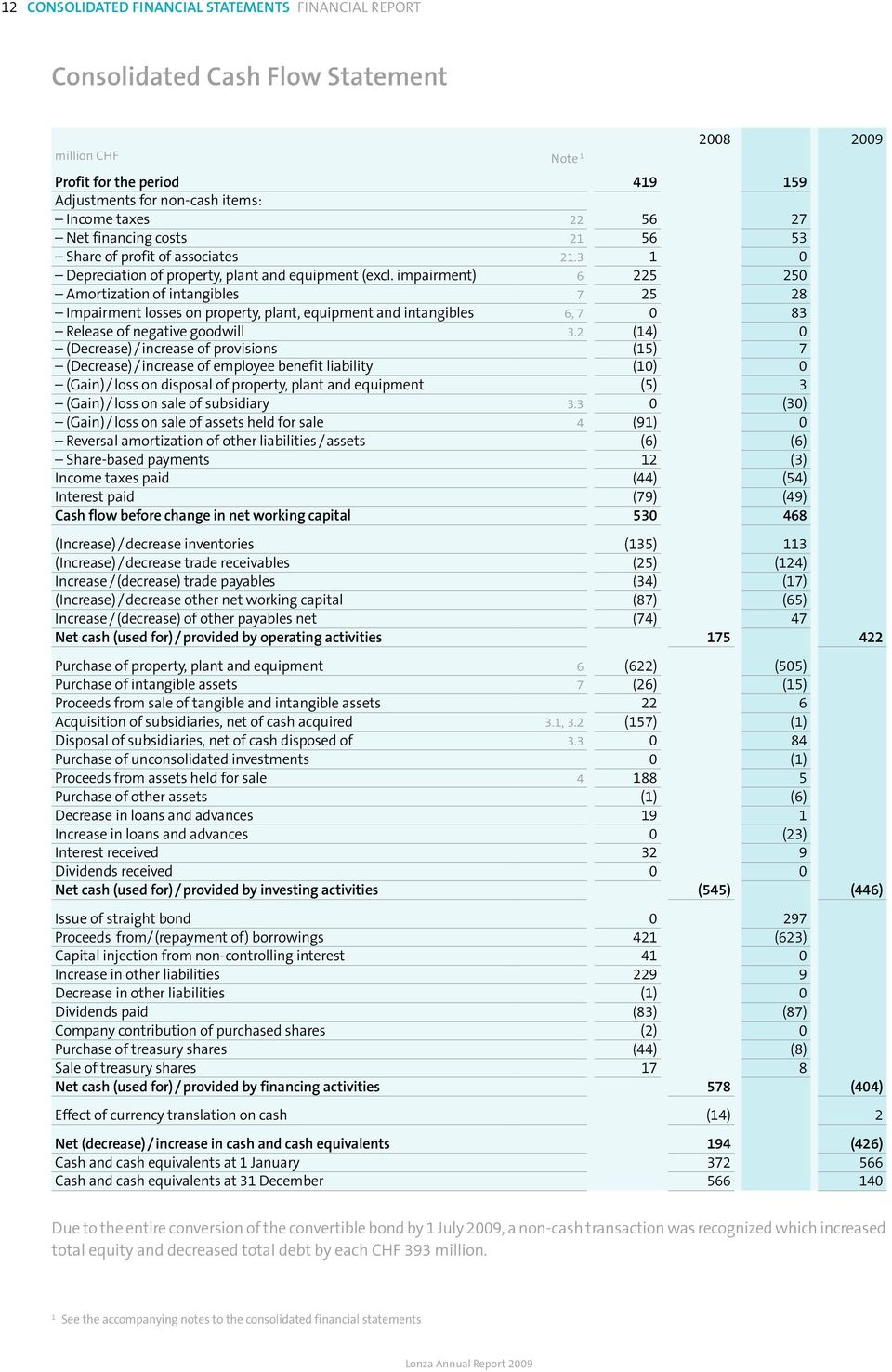
12 12 Consolidated financial statements Financial Report Consolidated Cash Flow Statement Note Profit for the period Adjustments for non-cash items: Income taxes Net financing costs Share of profit of associates Depreciation of property, plant and equipment (excl. impairment) Amortization of intangibles Impairment losses on property, plant, equipment and intangibles 6, Release of negative goodwill 3.2 (14) 0 (Decrease) / increase of provisions (15) 7 (Decrease) / increase of employee benefit liability (10) 0 (Gain) / loss on disposal of property, plant and equipment (5) 3 (Gain) / loss on sale of subsidiary (30) (Gain) / loss on sale of assets held for sale 4 (91) 0 Reversal amortization of other liabilities / assets (6) (6) Share-based payments 12 (3) Income taxes paid (44) (54) Interest paid (79) (49) Cash flow before change in net working capital (Increase) / decrease inventories (135) 113 (Increase) / decrease trade receivables (25) (124) Increase / (decrease) trade payables (34) (17) (Increase) / decrease other net working capital (87) (65) Increase / (decrease) of other payables net (74) 47 Net cash (used for) / provided by operating activities Purchase of property, plant and equipment 6 (622) (505) Purchase of intangible assets 7 (26) (15) Proceeds from sale of tangible and intangible assets 22 6 Acquisition of subsidiaries, net of cash acquired 3.1, 3.2 (157) (1) Disposal of subsidiaries, net of cash disposed of Purchase of unconsolidated investments 0 (1) Proceeds from assets held for sale Purchase of other assets (1) (6) Decrease in loans and advances 19 1 Increase in loans and advances 0 (23) Interest received 32 9 Dividends received 0 0 Net cash (used for) / provided by investing activities (545) (446) Issue of straight bond Proceeds from/ (repayment of) borrowings 421 (623) Capital injection from non-controlling interest 41 0 Increase in other liabilities Decrease in other liabilities (1) 0 Dividends paid (83) (87) Company contribution of purchased shares (2) 0 Purchase of treasury shares (44) (8) Sale of treasury shares 17 8 Net cash (used for) / provided by financing activities 578 (404) Effect of currency translation on cash (14) 2 Net (decrease) / increase in cash and cash equivalents 194 (426) Cash and cash equivalents at 1 January Cash and cash equivalents at 31 December Due to the entire conversion of the convertible bond by 1 July 2009, a non-cash transaction was recognized which increased total equity and decreased total debt by each 393 million. 1 See the accompanying notes to the consolidated financial statements
13 Financial report Consolidated financial statements 13 Consolidated Statement of Changes in Equity Share capital Attributable to equity holders of the parent Total Noncontrolling Share premium Hedging reserve Treasury shares interest Retained earnings/ Other reserves Translation reserve Total equity At 31 December (10) (324) Total comprehensive income for the year (59) (199) (4) 158 Dividends 0 0 (83) (83) 0 (83) Recognition of share-based payments Transfer of employee shares 0 0 (5) (2) 0 (2) Part-conversion of convertible bond 0 (10) Capital injection from non-controlling interest Acquisition of subsidiary (step acquisition) Recognition of put option 0 0 (60) (60) 0 (60) Acquisition of treasury shares (44) (44) 0 (44) Sale of treasury shares less taxes At 31 December (56) (209) (301) Total comprehensive income for the year (45) (5) 152 Dividends 0 0 (87) (87) 0 (87) Recognition of share-based payments 0 0 (3) (3) 0 (3) Transfer of employee shares 0 (4) (11) Conversion of convertible bond Acquisition of treasury shares (8) (8) 0 (8) Sale of treasury shares less taxes 0 (3) At 31 December (16) (254) (68) The share capital on 31 December 2009 comprised registered shares with a par value of 1 each (2008: registered shares with a par value of 1 each), amounting to (2008: ). Reserves in the amount of (2008: ) included in the financial statements of the parent company cannot be distributed.

14 14 Consolidated financial statements Financial Report Notes to the Consolidated Financial Statements 1 Accounting Principles Basis of preparation The consolidated financial statements for 2009 and 2008 are reported in Swiss francs () and are based on the annual accounts of the individual subsidiaries at 31 December which have been drawn up according to uniform Group accounting principles. The consolidated accounts are prepared in accordance with the International Financial Reporting Standards (IFRS) and with Swiss law. They are prepared on the historical cost basis, except that derivative financial instruments are stated at their fair value. Changes in accounting policies The following new and revised standards and interpretations have been issued, being effective for the reporting year 2009: IAS 1 revised Presentation of financial statements IAS 23 revised Borrowing costs IFRS 8 Operating segments Amendment to IFRS 2 Share-based payment Vesting conditions and cancellations Amendments to IAS 32 Financial instruments: Presentation and IAS 1 Presentation of financial statements Puttable financial instruments and obligations arising on liquidation IFRIC 13 Customer loyalty programmes IFRIC 15 Agreements for the construction of real estate IFRIC 16 Hedges of a net investment in a foreign operation IFRIC 18 Transfer of assets from customers Improvements to IFRSs (May 2008) Amendment to IFRS 7 Disclosures With the exception of additional disclosures, the new and revised standards as well as interpretations had no material impact on the consolidated financial statements for the year Borrowing costs relating to qualifying assets for which the commencement date for capitalization is on or after 1 January 2009, the Group capitalizes borrowing costs that are directly attributable to the acquisition, construction or production of a qualifying asset as part of the cost of that asset. Previously, the Group immediately recognized all borrowing costs as an expense. This change in accounting policy was adapted in accordance with the transitional provisions of that standard. In 2009, no qualifying assets for capitalizing borrowing costs were identified, so that the revised IAS 23 had no impact on the consolidated financial statements ended 31 December The following new and revised standards and interpretations have been issued, but are not yet effective. They have not been applied early in these consolidated financial statements. Their impact on the consolidated financial statements of Lonza has not yet been systematically analyzed. The expected effects as disclosed below reflect a first assessment by Group management.

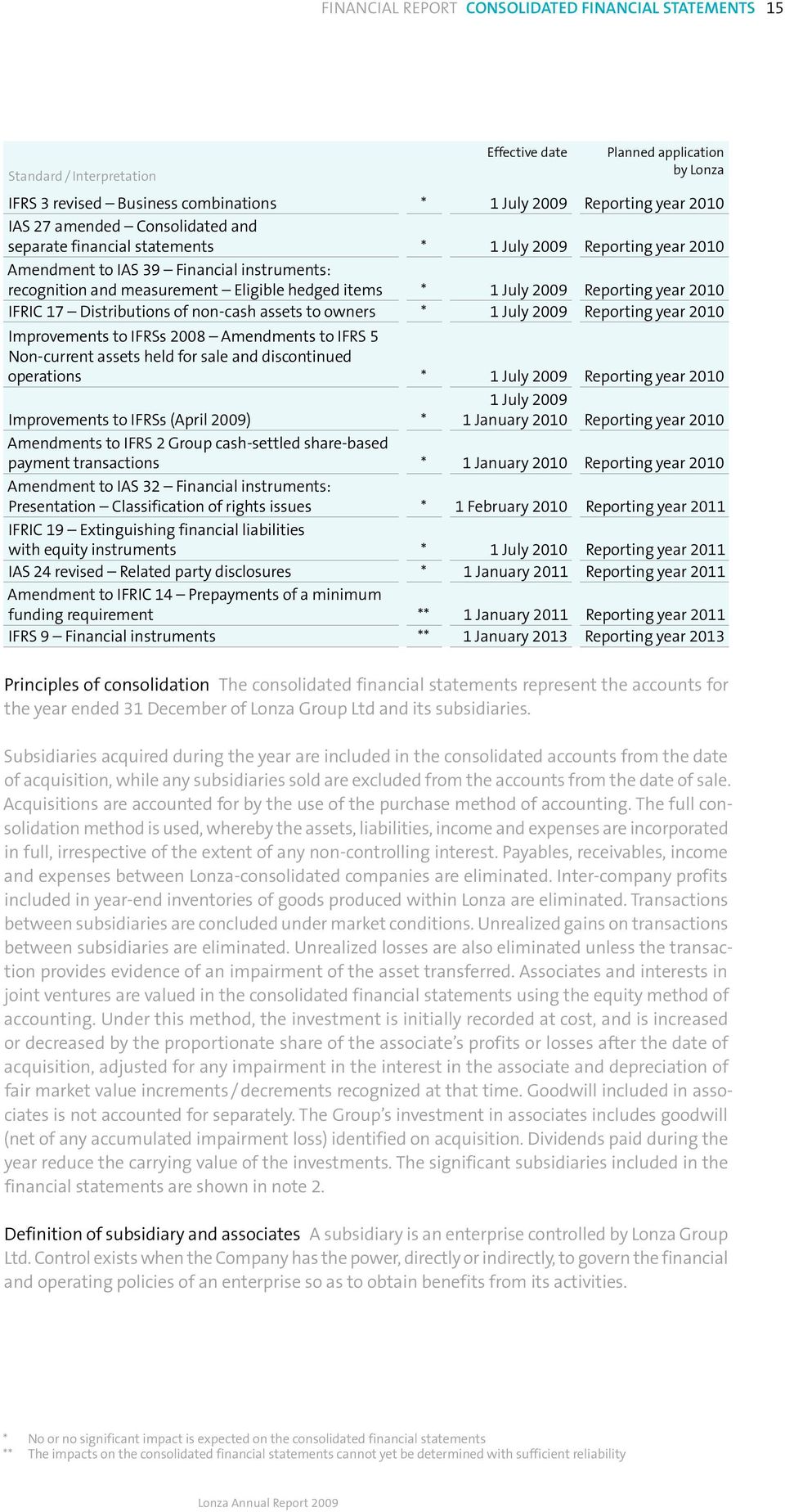
15 Financial report Consolidated financial statements 15 Standard / Interpretation Effective date Planned application by Lonza IFRS 3 revised Business combinations * 1 July 2009 Reporting year 2010 IAS 27 amended Consolidated and separate financial statements * 1 July 2009 Reporting year 2010 Amendment to IAS 39 Financial instruments: recognition and measurement Eligible hedged items * 1 July 2009 Reporting year 2010 IFRIC 17 Distributions of non-cash assets to owners * 1 July 2009 Reporting year 2010 Improvements to IFRSs 2008 Amendments to IFRS 5 Non-current assets held for sale and discontinued operations * 1 July 2009 Reporting year 2010 Improvements to IFRSs (April 2009) * 1 July January 2010 Reporting year 2010 Amendments to IFRS 2 Group cash-settled share-based payment transactions * 1 January 2010 Reporting year 2010 Amendment to IAS 32 Financial instruments: Presentation Classification of rights issues * 1 February 2010 Reporting year 2011 IFRIC 19 Extinguishing financial liabilities with equity instruments * 1 July 2010 Reporting year 2011 IAS 24 revised Related party disclosures * 1 January 2011 Reporting year 2011 Amendment to IFRIC 14 Prepayments of a minimum funding requirement ** 1 January 2011 Reporting year 2011 IFRS 9 Financial instruments ** 1 January 2013 Reporting year 2013 Principles of consolidation The consolidated financial statements represent the accounts for the year ended 31 December of Lonza Group Ltd and its subsidiaries. Subsidiaries acquired during the year are included in the consolidated accounts from the date of acquisition, while any subsidiaries sold are excluded from the accounts from the date of sale. Acquisitions are accounted for by the use of the purchase method of accounting. The full consolidation method is used, whereby the assets, liabilities, income and expenses are incorporated in full, irrespective of the extent of any non-controlling interest. Payables, receivables, income and expenses between Lonza-consolidated companies are eliminated. Inter-company profits included in year-end inventories of goods produced within Lonza are eliminated. Transactions between subsidiaries are concluded under market conditions. Unrealized gains on transactions between subsidiaries are eliminated. Unrealized losses are also eliminated unless the transaction provides evidence of an impairment of the asset transferred. Associates and interests in joint ventures are valued in the consolidated financial statements using the equity method of accounting. Under this method, the investment is initially recorded at cost, and is increased or decreased by the proportionate share of the associate s profits or losses after the date of acquisition, adjusted for any impairment in the interest in the associate and depreciation of fair market value increments / decrements recognized at that time. Goodwill included in associates is not accounted for separately. The Group s investment in associates includes goodwill (net of any accumulated impairment loss) identified on acquisition. Dividends paid during the year reduce the carrying value of the investments. The significant subsidiaries included in the financial statements are shown in note 2. Definition of subsidiary and associates A subsidiary is an enterprise controlled by Lonza Group Ltd. Control exists when the Company has the power, directly or indirectly, to govern the financial and operating policies of an enterprise so as to obtain benefits from its activities. * No or no significant impact is expected on the consolidated financial statements ** The impacts on the consolidated financial statements cannot yet be determined with sufficient reliability
16 16 Consolidated financial statements Financial Report An associate is an enterprise in which the Group has the ability to exercise significant influence, but not control, over the financial and operating policies. The consolidated financial statements include the Group s share of the total recognized gains and losses of associates on an equityaccounted basis, from the date that significant influence commences until the date it ceases. Revenue recognition Sales are recognized when the significant risks and rewards of ownership of the assets have been transferred to a third party and are reported net of sales taxes and rebates. Provisions for rebates to customers are recognized in the same period that the related sales are recorded. Revenue from termination fees is recorded in the income statement in the period in which the termination occurs. The POC (percentage of completion) method is applied for development projects as well as for projects in relation to the construction of manufacturing facilities for customers. The stage of completion of a contract is determined on the basis of the estimated total contract costs. Interest income is recognized on a time-proportion basis using the effective interest method. Dividend income is recognized when the right to receive payment is established. Foreign currencies Items included in the financial statements of each of the Group s entities are measured using the currency of the primary economic environment in which the entity operates ( the functional currency ). The consolidated financial statements are presented in Swiss francs () which is the Group s presentation currency. For consolidation purposes the balance sheet of foreign consolidated companies is translated to with the rate on the balance sheet date. Income, expenses and cash flows of the foreign consolidated companies are translated into using the yearly average exchange rates (unless this average is not a reasonable approximation of the cumulative effect of the rates prevailing on the transaction dates, in which case income and expenses are translated at the dates of the transactions). Exchange rate differences arising from the different exchange rates applied in balance sheets and income statements are allocated to reserves. In the individual company s financial statements, transactions in foreign currencies are translated at the foreign exchange rate applicable at the date of the transaction. Monetary assets and liabilities denominated in foreign currencies at the balance sheet date are translated at the foreign exchange rate ruling at that date. All resulting foreign exchange gains and losses are recognized in the individual company s profit or loss statement, except when they arise on monetary items that form a part of the Group s net investment in a foreign entity. In such case the gains and losses are deferred into equity. Derivative financial instruments and hedging Derivative financial instruments are initially recognized in the balance sheet at their fair value. The method of recognizing the resulting gain or loss is dependent on whether the derivative contract is designed to hedge a specific risk and qualifies for hedge accounting. On the date a derivative contract is entered into, the Group designates derivatives which qualify as hedges for accounting purposes as either a hedge of the fair value of a recognized asset or liability (fair value hedge), a hedge of a forecasted transaction or firm commitment (cash flow hedge) or a hedge of a net investment in a foreign entity. Changes in the fair value of derivatives which are fair value hedges are recognized in the income statement, along with any changes in the fair value of the hedged asset or liability that is attributable to the hedged risk. Changes in the fair value of derivatives in cash flow hedges that are highly effective are recognized in equity. The gain or loss relating to the ineffective portion is recognized immediately in the income statement. Where the forecasted transaction or firm commitment results in the recognition of an asset or liability, the gains and losses previously included in equity are included in the initial measurement of the asset or liability. Otherwise, amounts recorded in equity are transferred to the income statement and classified as revenue or expense in the same period in which the forecasted transaction affects the income statement.
17 Financial report Consolidated financial statements 17 Hedges of net investments in foreign entities are accounted for similarly to cash flow hedges. The Group hedges certain net investments in foreign entities with currency forward contracts. All foreign exchange gains or losses arising on translation are recognized in equity and included in cumulative translation differences. Certain derivative instruments, while providing effective economic hedges under the Group s policies, do not qualify for hedge accounting. Changes in the fair value of any derivative instruments that do not qualify for hedge accounting are recognized immediately in the income statement. When a hedging instrument expires or is sold, or when a hedge no longer meets the criteria for hedge accounting, any cumulative gain or loss existing in equity at that time remains in equity and is recognized in the income statement, when the committed or forecasted transaction is ultimately recognized in the income statement. However, if a forecasted or committed transaction is no longer expected to occur, the cumulative gain or loss that was recognized in equity is immediately transferred to the income statement. The purpose of hedge accounting is to match the impact of the hedged item and the hedging instrument in the income statement. To qualify for hedge accounting, the hedging relationship must meet several strict conditions with respect to documentation, probability of occurrence, hedge effectiveness and reliability of measurement. At the inception of the transaction, the Group documents the relationship between hedging instruments and hedged items, as well as its risk management objective and strategy for undertaking various hedge transactions. This process includes linking all derivatives designated as hedges to specific assets and liabilities or to specific firm commitments or forecasted transactions. The Group also documents its assessment, both at the hedge inception and on an ongoing basis, as to whether the derivatives that are used in hedging transactions are highly effective in offsetting changes in fair values or cash flows of hedged items. Fixed assets Fixed assets (property, plant and equipment) are stated at cost less accumulated depreciation and accumulated impairment losses. The assets are depreciated on a component basis over their estimated useful lives, which vary from 10 to 50 years for buildings and structures, and 5 to 16 years for production facilities, machinery, plant, equipment and vehicles. Fixed assets are depreciated using the straight-line method over their estimated useful lives. Subsequent expenditure incurred to replace a component of an item of property, plant and equipment that is accounted for separately, including major inspection and overhaul expenditure, is capitalized. Other subsequent expenditure is capitalized only when it increases the future economic benefits embodied in the item of property, plant and equipment. Borrowing costs incurred with respect to qualifying assets are capitalized and included in the carrying value of the assets. All other expenditure is recognized in the income statement as an expense as incurred. The residual values and the useful life of items of property, plant and equipment are reviewed and adjusted, if appropriate, at each balance sheet date.

18 18 Consolidated financial statements Financial Report Lease Financial leases, which effectively constitute assets purchased with long-term financing, are carried as fixed assets at their purchase price and are written off over their estimated useful lives if the leased assets are transferred to the lessee at the end of the lease term. If there is no reasonable certainty that the lessee will obtain ownership by the end of the lease term, the asset is fully depreciated over the shorter of the lease term and its useful life. The corresponding liabilities are included in long-term and short-term debt. The finance lease gives rise to a depreciation expense for depreciable assets as well as a finance expense for each accounting period. For the purpose of classifying a lease of land and buildings, lease of the land and of the buildings are evaluated separately. Lease payments under an operating lease are recognized as an expense in the income statement on a straight-line basis over the lease term. Intangible assets Intangible assets with a definite useful life are stated at cost less accumulated amortization and accumulated impairment losses. Intangibles include software, licenses, patents, trademarks and similar rights granted by third parties, capitalized product development costs and capitalized computer software development costs. Costs associated with internally developed or maintained computer software programmes are recognized as an expense as incurred. Costs that are directly associated with the production of identifiable and unique software products controlled by the Group, and that will probably generate future economic benefits exceeding costs beyond one year, are recognized as intangible assets. Those direct costs include the software development employee costs and an appropriate portion of relevant overheads. Intangible assets are amortized using the straight-line method over their estimated useful lives but not exceeding five years. All intangible assets in Lonza have finite useful lives. Goodwill Goodwill represents the excess of the cost of an acquisition over the fair value of the Group s share of the net identifiable assets of the acquired subsidiary / associate at the date of acquisition. When the excess is negative (negative goodwill) it is recognized immediately in profit or loss. Goodwill on acquisitions of associates is included in investments in associates. Goodwill is tested annually for impairment and carried at cost less accumulated impairment losses. Goodwill is treated as an asset in the acquisition. Gains and losses on the disposal of an entity include the carrying amount of goodwill relating to the entity sold. Inventories Inventories are reported at the lower of cost (purchase price or production cost) or market value (net realizable value). In determining net realizable value, any costs of completion and selling costs are deducted from the realizable value. The cost of inventories is calculated using the weighted average method. Prorated production overheads are included in the valuation of inventories. Adjustments are made for inventories with a lower market value or which are slow moving. Unsalable inventory is fully written off. Costs include all expenditures related directly to specific projects and an allocation of fixed and variable overheads incurred in the Group s contract activities based on normal operating capacity. Receivables Trade receivables are recognized at the original invoice amount less allowances made for doubtful accounts. An allowance is recorded for the difference between the carrying amount and the recoverable amount where there is objective evidence that the Group will not be able to collect all amounts due. A reconciliation of changes in the allowance accounts for credit losses is provided. Financial Assets Loans and advances and other financial assets are non-derivative financial assets with fixed or determinable payments that are not quoted in an active market. They arise when the Group provides money, goods or services directly to a debtor with no intention of trading the receivable. They are classified as short-term with maturities not longer than 12 months and as long-term with maturities greater than 12 months after the balance sheet date. Loans and advances are carried at amortized costs using the effective interest method. Realized and unrealized gains and losses are recorded in the income statement in the period in which they arise.
19 Financial report Consolidated financial statements 19 Cash and cash equivalents Cash includes cash in hand, in postal and bank accounts, as well as short-term deposits and highly liquid funds which have an original maturity of less than three months. Impairment Assets that are subject to amortization are reviewed for impairment whenever events or changes in circumstances indicate that the carrying amount may not be recoverable. Goodwill is tested for impairment annually, and whenever there is an indication that the unit may be impaired. An impairment loss is recognized for the amount by which the asset s carrying amount exceeds its recoverable amount. The recoverable amount is the higher of an asset s fair value less costs to sell and value in use. For the purposes of assessing impairment, assets are grouped at the lowest levels for which there are separately identifiable cash flows (cash generating units). Calculation of recoverable amount In assessing value in use, the estimated future cash flows are discounted to their present value using a pre-tax discount rate that reflects current market assessments of the time value of money and the risks specific to the asset. Reversal of impairment An impairment loss is reversed if the subsequent increase in recoverable amount can be related objectively to an event occurring after the impairment loss was recognized. An impairment loss in respect of goodwill is not reversed. In respect of other assets, an impairment loss is reversed if there has been a change in the estimates used to determine the recoverable amount. An impairment loss is reversed only to the extent that the asset s carrying amount does not exceed the carrying amount that would have been determined, net of depreciation or amortization, if no impairment loss had been recognized. Deferred taxes Tax expense is calculated using the balance sheet liability method. Additional deferred taxes are provided wherever temporary differences exist between the tax base of an asset or liability and its carrying amount in the consolidated accounts for the year. Deferred tax assets and liabilities are recognized for the future tax consequences attributable to differences between the financial statement carrying amounts of existing assets and liabilities and their respective tax bases and operating loss and tax credit carry-forwards. Deferred tax assets and liabilities are measured using substantially enacted tax rates in the respective jurisdictions in which Lonza operates that are expected to apply to taxable income in the years in which those temporary differences are expected to be recovered or settled. In assessing the recoverability of deferred tax assets, management considers whether it is probable that some portion or all of the deferred tax assets will not be realized. For transactions and other events recognized directly in equity, any related tax effects are also recognized directly in equity. Retirement benefits Most of Lonza s subsidiaries operate their own pension plans. Generally, they are funded by employees and employer s contributions. The liability recognized in the balance sheet is the present value of the benefit obligation at the balance sheet date less the fair value of plan assets, together with adjustments for unrecognized actuarial gains or losses and past service costs. A policy has been established whereby actuarial valuations are performed on a yearly basis. Actuarial gains and losses are recognized over a period not exceeding the expected remaining working lives of the participating employees if the accumulated gains and losses exceed the corridor of 10 % of the greater of plan assets and projected benefits obligation.

20 20 Consolidated financial statements Financial Report Termination benefits Termination benefits are payable when employment is terminated before the normal retirement date, or whenever an employee accepts voluntary redundancy in exchange for these benefits. The Group recognizes termination benefits when it is demonstrably committed to either: terminating the employment of current employees according to a detailed formal plan without possibility of withdrawal; or providing termination benefits as a result of an offer made to encourage voluntary redundancy. Provisions A provision is recognized in the balance sheet when the Group has a legal or constructive obligation as a result of a past event, and it is probable that an outflow of economic benefits will be required to settle the obligation. If the effect is material, provisions are determined by discounting the expected future cash flows at a pre-tax rate that reflects current market assessments of the time value of money and the risks specific to the liability. A provision for restructuring is recognized when the Group has approved a detailed and formal restructuring plan, and the restructuring has either commenced or has been announced publicly. Future operating costs are not provided for. Provisions for environmental liabilities are made when there is a legal or constructive obligation for the Group which will result in an outflow of economic resources. Provisions are made for remedial work, where there is an obligation to remedy environmental damage, as well as for containment work where required by environmental regulations. Borrowings Borrowings are recognized initially at fair value, net of transaction costs incurred. Borrowings are subsequently stated at amortized cost; any difference between the proceeds (net of transaction costs) and the redemption value is recognized in the income statement over the period of the borrowings using the effective interest method. Borrowings are classified as current liabilities, unless the Group has an unconditional right to defer settlement of the liability for at least 12 months after the balance sheet date. Straight bond Interest-bearing borrowings are recognized initially at their fair value, less attributable transaction costs. Subsequent to initial recognition, interest-bearing borrowings are stated at amortized cost, with any difference between cost and redemption value being recognized in the income statement over the period of the borrowings on an effective-interest basis. Convertible bond The convertible bond is separately shown in the balance sheet by the liability component and the equity component. The fair value of the liability component is determined on the basis of the present value of the principal plus the present value of the interest payable over the contractual period using a rate of interest applied by the market at the time. The value of the equity component is calculated by deducting the liability component from the total proceeds of the bond issue. The difference between the initial liability component and the notional amount is amortized over the contractual period of the bond and treated as a financial expense. Share Capital Ordinary shares are classified as equity. Incremental costs directly attributable to the issue of new shares or options are shown in equity as a deduction, net of tax, from the proceeds. Where any Group company purchases Lonza Group Ltd s equity share capital (treasury shares), the consideration paid, including any directly attributable incremental costs (net of income taxes), is deducted from equity attributable to the Group s equity holders until the shares are cancelled, reissued or disposed of.

21 Financial report Consolidated financial statements 21 Dividend Dividend distribution to Lonza s shareholders is recognized as a liability in the Group s financial statements in the period in which the dividends are approved by the Lonza shareholders. Share-based compensation The Group operates an equity-settled, share-based compensation plan. The fair value of the employee services received in exchange for the grant of options and other share-based compensations is recognized as an expense. The total amount to be expensed over the vesting period is determined by reference to the fair value of the options granted. At each balance sheet date, the entity revises its estimates of the number of options that are expected to become exercisable. It recognizes the impact of the revision of original estimates, if any, in the income statement, and a corresponding adjustment to equity over the remaining vesting period. Research and Development Research and development costs are charged against income as incurred. Development costs are only capitalized when the related products will generate probable future economic benefits. Fixed assets (buildings, machinery, plant, equipment) used for research purposes are valued similarly to other fixed assets. Such assets are capitalized and depreciated over their estimated useful lives. Expenses for research and development include associated wages and salaries, material costs, depreciation on fixed assets, as well as overhead costs. Net financing costs Net financing costs comprise interest payable on borrowings calculated using the effective interest rate method, the finance charge for finance leases, dividend income, share of profit of associates, foreign exchange gains and losses, gains and losses on hedging instruments that are recognized in the income statement and gain / losses of sale of financial assets. Interest income (expense) is recognized in the income statement as it accrues, taking into account the effective yield of the asset or liability or an applicable floating rate. Dividend income is recognized in the income statement on the date that the dividend is declared. Interest income and expense include the amortization of any discount or premium or other differences between the initial carrying amount of an interest-bearing instrument and its amount at maturity calculated on an effective interest rate basis. Segment reporting IFRS 8 requires segment disclosure based on the components of the entity that management monitors in making decisions about operating matters. Such components (operating segments) are identified on the basis of internal reports that the entity s chief operating decision maker (CODM) reviews regularly in allocating resources to segments and in assessing their performance. Lonza s operating segments represent business sectors that offer different products and services.
22 22 Consolidated financial statements Financial Report 2 Principal subsidiaries 1 In 2009, Lonza strengthened its protein design technology offering for biopharmaceutical development by acquiring Algonomics NV (Gent, Belgium). Algonomics is a contract research organization providing integrated immunogenicity prediction services to support companies in the development of biotherapeutics. The principal subsidiaries are shown below: Company Town / Country Purpose Currency 2 Share capital in Holding direct % Holding indirect % 100 % 100 % 100 % 100 % Lonza Australia Pty Ltd Algonomics NV Lonza Braine SA Lonza Verviers Sprl Lonza Canada Inc. Lonza Ltd Lonza Sales Ltd Lonza BioPharma Ltd Lonza Bioproducts Ltd Lonza Engineering Ltd TL Biopharmaceutical Ltd Lonza Finance Limited Lonza Biotec sro Lonza Guangzhou Ltd Lonza Guangzhou Nansha Ltd Lonza (China) Investments Co. Ltd Lonza Guangzhou Research and Development Center Ltd Lonza Nanjing Ltd Lonza Group GmbH Gewerbepark Hochrhein GmbH Lonza GmbH Lonza Cologne AG Lonza Copenhagen ApS Lonza Biologics Porriño, S.L. Lonza Ibérica S.A.U. Lonza Bioscience Sàrl Lonza France Sàrl Lonza Biologics plc Lonza Wokingham Limited Lonza Group UK Limited Lonza India Private Ltd Lonza Milano S.r.l. Lonza Japan Ltd Lonza Mexico S. de R.L. de C.V. Lonza Europe BV Lonza Benelux BV Lonza Group Investments BV OOO Lonza Rus Lonza Biologics Tuas Pte Ltd Lonza Bioscience Singapore Pte Ltd Lonza Holding Singapore Pte Ltd Lonza Microbial Control Asia Pacific Pte Ltd Lonza America Inc. Lonza Inc. Lonza Biologics Inc. Lonza Walkersville Inc. Lonza Rockland Inc. Mt. Waverly, AU Gent, BE Braine-l Alleud, BE Verviers, BE Shawinigan, CA Visp, CH Basel, CH Visp, CH Basel, CH Basel, CH Visp, CH St. Helier, Jersey, GB Kouřim, CZ Guangzhou, CN Guangzhou, CN Guangzhou, CN Guangzhou, CN Nanjing, CN Waldshut-Tiengen, DE Waldshut-Tiengen, DE Cologne, DE Cologne, DE Vallensbaek Strand, DK Porriño, ES Barcelona, ES Paris, FR Levallois-Perret, FR Slough, GB Wokingham, GB Slough, GB Mumbai, IN Treviglio, IT Tokyo, JP Mexico City, MX Breda, NL Breda, NL Breda, NL Moscow, RU Singapore, SG Singapore, SG Singapore, SG Singapore, SG Allendale, US Allendale, US Portsmouth, US Walkersville, US Rockland, US AUD EUR EUR EUR CAD USD CZK USD USD USD USD USD EUR EUR EUR EUR DKK EUR EUR EUR EUR GBP GBP GBP INR EUR JPY MXN EUR EUR EUR RUB USD SGD USD USD SGD USD USD USD USD USD % 100 % 100 % 100 % 100 % 70 % 50 % 100 % 100 % 100 % 100 % 100 % 100 % 100 % 100 % 100 % 100 % 100 % 100 % 100 % 100 % 100 % 100 % 100 % 100 % 100 % 100 % 100 % 100 % 100 % 100 % 100 % 100 % 100 % 100 % 70 % 100 % 100 % 100 % 100 % 100 % 100 % 100 % 1 All companies belonging to Lonza Group are non-listed entities 2 Abbreviation of currencies in accordance with ISO standards Research & Development Production Sales Office Service / Financing
23 Financial report Consolidated financial statements Business combination Acquisition of amaxa On 27 May 2008, Lonza announced that it was to acquire amaxa and all its activities. The deal was subject to the approval of the anti-trust authorities and was closed on 2 July This business became part of the Cell Discovery unit within Bioscience. amaxa is a supplier to the cell discovery market with leading-edge technologies in well-defined market niches of transfection systems. As a global leader in transfection technologies, the company is dedicated to enhancing the speed and quality of basic and pharmaceutical research in academia and industry, and aspires to make a significant contribution to the development of causal therapies for the treatment of severe diseases. amaxa pursues this goal by providing cutting-edge products to the R&D and clinical markets. The company, which was founded in 1998, is located in Cologne (Germany) and in Gaithersburg, MD (USA) and employs 160 people. From 2 July 2008 to 31 December 2008, the acquired business contributed sales of 15 million and a result from operating activities of minus 5 million to the Group. If the acquisition had occurred on 1 January 2008, Group sales would have been million ( +10 million) and the Group result from operating activities 440 million ( -1 million). These amounts have been calculated using the Group s accounting policies and by adjusting the results of the subsidiary to reflect the additional depreciation and amortization that would have been charged if the fair value adjustments to property, plant and equipment and intangible assets had applied from January Net assets acquired and goodwill are shown as follows: Purchase price in cash Direct costs relating to the acquisition 0.1 Total purchase consideration Fair value of net assets acquired (54.7) Goodwill 98.8 The goodwill included expected synergies from the acquisition, the labor force and potentially intangible assets that could not be valued separately. The acquisition has been accounted for using the purchase method. The following amounts of assets and liabilities acquired have been included:
24 24 Consolidated financial statements Financial Report Assets and liabilities included at acquisition date Adjustment through purchase price allocation Assets and liabilities immediately before the combination Property, plant and equipment Intangible assets (patents) Other non-current assets Inventories Trade receivables, net Other receivables, prepaid expenses and accrued income Current tax receivables Cash and cash equivalents Trade payables (0.3) 0.0 (0.3) Other short-term liabilities (4.0) 0.0 (4.0) Deferred tax liabilities (22.4) (22.4) 0.0 Fair value of net assets acquired Goodwill 98.8 Cost of the business combination Purchase consideration settled in cash Cash and cash equivalents of subsidiary acquired (2.1) Cash outflow on acquisition Step acquisition of additional 20 % of Lonza Biologics Tuas Pte Ltd On 15 February 2006, Lonza Group and Singapore s Bio*One Capital announced the creation of a joint venture company, Lonza Biologics Tuas Pte Ltd, to build a large-scale mammalian cell culture facility in Singapore for the manufacture of commercial biopharmaceuticals. Construction of the first phase started in May This jointly controlled entity was recognized in the consolidated statements so far using the proportionate consolidation method. On 27 August 2008, Lonza acquired a further 20 % of the share capital, increasing its stake to 70 % and giving it full control of Lonza Biologics Tuas Pte Ltd. As of 27 August 2008, Lonza Biologics Tuas Pte Ltd was recognized as a fully consolidated subsidiary, with a minority share of 30 %, in the group financial statements. As the plant was under construction in 2008, with the expected final build-out scheduled for 2011, a loss of 4.8 million was incurred in 2008, with a minority loss of 1.4 million. The purchase of the additional share of 20 % of net assets and the respective negative goodwill are shown as follows: Purchase price in cash 7.0 Total purchase consideration 7.0 Fair value of net assets acquired for 20 % (21.2) Goodwill (badwill) (14.2)
25 Financial report Consolidated financial statements 25 The additional share of 20 % in Lonza Biologics Tuas Pte Ltd is stated at fair value, based on the present value of agreements signed with customers. The negative goodwill occurred because Bio*One, the partner and financial branch of the Economic Development Board (EDB) of Singapore, invested in Lonza Biologics Tuas Pte Ltd on the basis of a pre-determined financing agreement, excluding sharing in profit or loss or participation in any fair value revaluations. The main objective of Bio*One is to build and expand a life-science industry in Singapore through investments in joint ventures based on a modest fixed return on their invested capital. Lonza granted to Bio*One a put option at a predetermined price. This option is exercisable from the earlier of 1 July 2011 or 12 months after Lonza s call option start date. The present value of the future cash outflows from a potential exercise of the put option of 60 million was recognized as a credit in financial liability and a debit to equity. The step acquisition has been accounted for using the purchase method. The following amounts of assets and liabilities acquired have been included: Assets and liabilities included at acquisition date Adjustment through purchase price allocation Assets and liabilities immediately before the combination Property, plant and equipment Intangible assets (customer relationship) Other receivables, prepaid expenses and accrued income Cash Trade payables (12.5) 0.0 (12.5) Other short-term liabilities (9.4) 0.0 (9.4) Current tax payables (0.1) 0.0 (0.1) Fair value of net assets (100 %) Fair value of net asset acquired in 2008 (20 %) 21.2 Goodwill recognized on that 20 % (badwill) (14.2) Cost of the business combination of additional 20 % 7.0 Purchase consideration settled in cash 7.0 Cash and cash equivalents of subsidiary acquired (50 %) (1.6) Cash outflow on step acquisition 5.4 The step acquisition has been accounted as follows: Increase of intangible assets 77.6 Increase of net assets 14.2 Credit revaluation reserve 38.8 Credit minorities 32.0 Credit badwill 14.0 Credit investment 7.0
26 26 Consolidated financial statements Financial Report 3.3 Sale of Lonza Biologics Singapore Pte Ltd, Singapore On August , Genentech Singapore Pte Ltd exercised the option to purchase from Lonza its cell culture biologic manufacturing facility that Lonza built in Singapore (Lonza Biologics Singapore Pte Ltd). The facility, which is mechanically complete, was merged with Genentech Singapore s existing biologic manufacturing facility. The Singapore manufacturing facility was acquired for a purchase price of USD 290 million. It is expected to produce Avastin (bevacizumab), a bulk drug substance, with litres of fermentation capacity. With the exercise of this option, approximately 230 Lonza employees joined Genentech Singapore Technical Operations. The net assets sold and the gain on disposal of the subsidiary are as follows: Property, plant and equipment Intangible assets 0.8 Goodwill 0.0 Other non-current assets 3.4 Inventories 16.0 Trade receivables, net 7.7 Other receivables, prepaid expenses and accrued income 0.4 Cash and cash equivalents 0.9 Total assets sold Other short-term liabilities (155.2) Trade payables (1.6) Current tax payables (2.4) Other long-term liabilities (86.1) Total liabilities sold (245.3) Total net assets sold 52.6 Consideration for sale Purchase price adjustment 16.4 Less customer-funded assets (238.2) Less stamp duties (0.3) Less provisions (2.6) Gain on disposal of subsidiary 29.7 The net cash inflow from sale is determined as follows: Consideration for sale Purchase price adjustment 16.4 Less customer-funded assets (238.2) Less stamp duties (0.3) Less cash and cash equivalents in subsidiary sold (0.9) Net cash inflow from sale 84.0
27 Financial report Consolidated financial statements 27 4 Assets held for sale The property, plant and equipment of Lonza Gewerbepark GmbH, disclosed as assets held for sale in 2008 ( 4.3 million), was sold during 2009 for a consideration of 4.6 million. On 12 February 2008, Lonza sold 27.6 % (28.5 million shares) of its holding in Polynt S.p.A. for EUR 3.67 per share to Polimeri Speciali S.p.A., an Italian company, indirectly controlled by Investindustrial. On 28 April 2008, the sale of the remaining 3.4 % stake in Polynt S.p.A. to Polimeri Speciali S.p.A. for EUR 3.67 per share followed. The two transactions resulted in proceeds of 188 million at a gain of 91 million. 5 Restructuring and impairment The consolidated income statement 2009 is charged with impairment costs, inventory writedowns and restructuring costs amounting to 141 million as a result of the restructuring program, as follows: Total Lonza Custom Manufacturing Life Science Ingredients Bioscience Corporate Impairment costs Write-down of inventories Restructuring costs Environmental costs Total restructuring program The impairment costs of 83 million are related to the decision to close the sites at Conshohocken (Riverside), PA (USA) ( 61 million, Custom Manufacturing) and Shawinigan (CA) ( 3 million, Life Science Ingredients). Further impairment charges are recognized in the Visp plant with regard to the launch plant in Custom Manufacturing ( 10 million) and arylide production ( 3 million), as well as in the Liyang plant ( 2 million), both belonging to Life Science Ingredients, and in the Walkersville plant ( 4 million) in Bioscience. For all reviewed assets, the recoverable value was assumed as zero, so that the entire carrying amount of those assets needed to be impaired. The impairment needs resulted from the announced re-engineering project Bond to adjust the organization to the current market environment. The write-down of inventories of 22 million included write-down of unsalable products from the sites at Conshohocken (Riverside), PA (USA) ( 20 million), Shawinigan (CA) ( 1 million) and Walkersville (USA) ( 1 million) for cell therapy products. The cost of all mentioned inventories are no longer recoverable as they have become entirely obsolete. The restructuring costs of 25 million are recognized for the closure of the sites at Conshohocken (Riverside), PA (USA) ( 12 million), Shawinigan (CA) ( 1 million) and Wokingham (UK) ( 1 million). With a greater focus on concentration of lean processes, additional restructuring costs of 11 million were recorded for a variety of locations in Lonza Group (Custom Manufacturing: 5 million, Life Science Ingredients: 1 million, Bioscience: 2 million and Corporate: 3 million). The restructuring measures will affect 175 employees for which a comprehensive severance package will be put in place. An amount of 21 million was set up as restructuring provisions and the remaining 4 million was expensed in 2009.
28 28 Consolidated financial statements Financial Report As a result of the restructuring program, additional environmental costs of 11 million were recognized relating to the Conshohocken (Riverside) site in Custom Manufacturing ( 4 million), as well as the Visp plant of Life Science Ingredients ( 7 million). 6 Property, plant and equipment 2009 Land Buildings and structures Production facilities Construction in progress Total Cost At 1 January Additions Disposals (5) (15) (51) 0 (71) Disposal of subsidiary 0 (156) (116) 0 (272) Transfers / reclassification (392) 0 Currency translation differences 0 (14) (15) (9) (38) At 31 December Accumulated depreciation and impairment At 1 January (2) (534) (1 622) 0 (2 158) Depreciation charge 0 (47) (203) 0 (250) Disposals Impairment losses (1) (23) (59) 0 (83) Disposal of subsidiary Currency translation differences At 31 December (3) (587) (1 825) 0 (2 415) Net carrying amount 31 December Insurance value 31 December Land Buildings and structures Production facilities Construction in progress Total Cost At 1 January Additions Disposals (6) (6) (34) 0 (46) Reclassification to assets held for sale (3) (3) Acquisition of subsidiaries Change of scope of consolidation Transfers / reclassification (345) 0 Currency translation differences (5) (39) (156) (30) (230) At 31 December Accumulated depreciation and impairment At 1 January 0 (501) (1 546) 0 (2 047) Depreciation charge (2) (43) (180) 0 (225) Disposals Currency translation differences At 31 December (2) (534) (1 622) 0 (2 158) Net carrying amount 31 December Insurance value 31 December Impairment losses of 83 million were recognized in 2009 due to the restructuring program outlined in note 5. 1 The change of scope of consolidation in 2008 was recognized because of the step acquisition of Lonza Biologics Tuas Pte Ltd, after which Lonza had 70 % of the equity and full control over the company.
29 Financial report Consolidated financial statements 29 Commitments for capital expenditure in property, plant and equipment amounted to 128 million at year-end 2009 (2008: 374 million), mostly related to capital expenditure in the Biopharmaceuticals business. The carrying amount of fixed assets under finance lease contracts at year-end 2009 amounted to 6.1 million (2008: 6.8 million). Depreciation relating to fixed assets under finance lease amounted to 1.6 million (2008: 2.0 million). The exchange rate impact between ending and opening balance is 0.9 million (2008: 0.3 million). No assets were pledged for security of own liabilities in 2009 and The Group s obligation under finance leases is secured by the lessors title to the leased assets. Leases 1. Lessee Finance lease liabilities minimum lease payments Not later than 1 year 4 4 Later than 1 year and not later than 5 years 12 8 Later than 5 years 0 0 Total future minimum finance lease payments Future finance charges on finance lease payments (3) (2) Present value of minimum finance lease payments Present value of finance lease liabilities Not later than 1 year 3 3 Later than 1 year and not later than 5 years 10 7 Later than 5 years 0 0 Present value of minimum finance lease payments Operating lease liabilities minimum lease payments Not later than 1 year Later than 1 year and not later than 5 years Later than 5 years Total future minimum operating lease payments Finance lease agreements in Switzerland expired in In the USA, assets under finance lease agreement were disposed in 2008 with regard to the closure of the Baltimore plant. The remaining lease agreements in 2009 are related to buildings and production facilities in the USA expiring in The finance lease agreement in the USA is based on an interest rate of 8.7 %. All leases are on a fixed repayment basis and no arrangements have been entered into for contingent rental payments. The fair value of the Group s lease obligations approximates to their carrying amount. The Group s obligation under finance leases is secured by the lessors title to the leased assets. Lonza leases a number of buildings, warehouses, factory and office facilities, vehicles, as well as land under operating leases. The leases for buildings, warehouses, factory and office facilities and vehicles run for periods between one and thirteen years and for the land up to five years, all with an option to renew the lease after that date. None of the leases include contingent rentals. During the year ended 31 December 2009, 10.8 million (2008: 11.9 million) was recognized as an expense in the consolidated income statement in respect of operating leases, of which none was due to sublease payments.
30 30 Consolidated financial statements Financial Report The land and building elements of a lease of land and buildings were considered separately for the purpose of lease classification as outlined in IAS Lessor There is an operating lease for which Lonza acts as lessor. This lease falls within the scope of IAS 17 and IFRIC 4 guidance. It consists primarily of a biopharmaceutical manufacturing facility in Visp. The future minimum lease payments under non-cancelable operating leases are zero, because the lease payments are pre-financed by the customer Intangible assets and goodwill Cost and accumulated amortization and impairment 2009 Goodwill Patents, trademarks, client relationship Computer software Construction in progress Cost At 1 January Additions Disposals 0 0 (1) 0 (1) Acquisition of subsidiaries Disposal of subsidiary 0 0 (1) 0 (1) Currency translation differences (4) (6) 2 0 (8) At 31 December Total Accumulated amortization and impairment At 1 January (9) (62) (36) 0 (107) Amortization 0 (17) (11) 0 (28) Currency translation differences At 31 December (8) (78) (47) 0 (133) Net carrying amount 31 December Goodwill Patents, trademarks, client relationship Computer software Cost At 1 January Additions Acquisition of subsidiaries Disposal of subsidiary Currency translation differences (45) (19) 0 (64) At 31 December Accumulated amortization and impairment At 1 January (9) (48) (28) (85) Amortization 0 (17) (8) (25) Currency translation differences At 31 December (9) (62) (36) (107) Net carrying amount 31 December Total Intangible assets include software purchased from third parties, related software implementation costs, as well as patents, trade marks and client relationship acquired. Their amortization is included in the line item Administration and general overheads of the consolidated income statement. Construction in progress includes capitalized development costs of the Bioscience segment.
31 Financial report Consolidated financial statements Impairment tests for cash-generating units containing goodwill The following units show carrying amounts of goodwill (at year-end exchange rates): Lonza Biologics (Biopharmaceuticals business) Lonza Guangzhou (Nicotinates business) 4 4 Lonza Inc. Microbial Control (Biocidal Quats business) 9 9 Lonza Braine SA (Peptide business) Lonza Bioscience (ex Cambrex) including amaxa Total carrying amounts of goodwill The change in the carrying amounts of goodwill between 2009 and the previous year results from changes in the year-end exchange rates. The recoverable amount of the above cash-generating units is based on the value-in-use calculation. The cash flow projections include the actual operating results and a five-year business plan approved by management. These cash flow projections are based on the yearly business strategy review and exclude any future cash inflows and outflows expected to arise from growth potential of future capital expenditures. The key assumptions and the approach to determining the recovery value of the cash-generating units are based on the following: The Biopharmaceutical business is primarily located in the United States as well as in Great Britain. Sales are based on existing contracts and planned utilization of equipment based on customer demand over the five-year period. Prices are as per contracts realized and are assumed to stay at current levels. Cost developments are based on individual assumptions per cost element. Personnel costs are assumed to increase by 3.0 % p.a. and the other expenses by 2.0 % p.a. The cash flow projections beyond the five-year period are based on a zero growth rate. A pretax discount rate of 9.4 % has been used in discounting the projected cash flows. Management believes that any reasonably possible change in the key assumptions on which the recoverable amount is based would not cause the carrying amount to exceed its recoverable amount. The Nicotinates (Vitamin B3) business plan relates to the site in Guangzhou in China. The cash flow projections are based on a slight decrease in gross margin in 2010, due to an expected decrease in selling price, and thereafter an unchanged margin until According to the Strategy Review for the nicotinates market, sales volume will be assumed to grow by 2.0 % p.a. The cash flow projections beyond the five-year period are extrapolated using a zero growth rate due to limitation of capacity. The cash flows are discounted at a pre-tax discount rate of 14.9 %. Management believes that any reasonably possible change in any of these key assumptions would not cause the carrying amount to exceed the recoverable amount of this business.
32 32 Consolidated financial statements Financial Report The Biocidal Quats business is located in the United States. The cash flow projections are based on constant expected gross margins during the five-year planning period, with a 3.0 % p.a. increase in sales. Selling price changes are assumed to offset changes in raw material price. Overhead costs are anticipated to grow in line with sales between No major regulatory changes will have an unfavorable impact on the volumes. Management believes this to be a fair and reasonable assumption. The cash flow projections beyond the five-year period are extrapolated using a zero growth rate. The cash flows are discounted at a pre-tax discount rate of 11.5 %. Management believes that any reasonably possible change in any of these key assumptions would not cause the carrying amount to exceed the recoverable amount of this business. The Peptides business represents the cash-generating unit of Lonza Braine SA, Belgium, including Lonza Sales Ltd, Switzerland. The cash flow projections include the five-year plan based on current headcount and a patented life-span of two years. Sales are projected on the current portfolio of peptides, with production costs varying in line with sales increase. Sales between 2010 and 2014 are assumed to grow on average by 9.3 % p.a. and fixed costs by 3.0 % p.a. The cash flow projections beyond the five-year period are extrapolated using a zero growth rate. The cash flows are discounted at a pre-tax discount rate of 9.3 %, resulting in a recoverable amount exceeding the carrying amount by 27 million. If sales grew at a 1 %-point lower average growth rate, the recoverable amount would agree with the carrying amount. Management believes that any reasonably possible change in any of these key assumptions would not cause the carrying amount to exceed the recoverable amount of this business. The Bioscience business includes the Cambrex Corporation, acquired on 6 February 2007, and the amaxa business, acquired on 2 July 2008, which was integrated into the Cell Discovery business of Bioscience. Therefore, the impairment analysis is based on the combined cash-generating unit of the Bioscience segment. The cash flow projections from are based on a 10 % average sales growth at growing EBIT-margin, as the Bioscience segment is operating in growing markets. The cash flow projections beyond the five-year period are extrapolated using a 0.5 % growth rate, which is in line with the current business strategy review. The cash flows are discounted at a pre-tax discount rate of 8.7 %. If sales grew at a 1.4 %-point lower average growth rate, the recoverable amount would agree with the carrying amount. Management believes that any reasonably possible change in any of these key assumptions would not cause the carrying amount to exceed the recoverable amount of this business Investments in associates and joint ventures Associates Lonza holds a 31 % stake in Aravis Ventures I, L.P., an international venture capital fund under Cayman Islands jurisdiction focusing on early-stage companies in biotechnology and drug development industry sectors. The total capital commitment of Lonza in Aravis Ventures is USD 18.2 million of which USD 16.7 million (2008: USD 15.8 million) was drawn up until 31 December The investment in Aravis Venture I, L.P. is accounted for using the equity method. In Lonza s 2009 financial statements, the investment in the associate relating to Aravis Ventures I, L.P. amounted to 13.2 million (2008: 12.6 million). The net capital contribution to Aravis Venture was 0.6 million in 2009 (2008: 0.4 million). An equity income of 0.3 million in 2009 (2008: equity loss of 0.6 million) and a currency loss of 0.3 million (2008: 0.7) million were disclosed. In the previous year, Lonza sold 27.6 % of its holding in Polynt S.p A. on 12 February 2008 and the remaining 3.4 % on 28 April 2008 for EUR 3.67 per share to Polimeri Speciali S.p.A., an Italian company, indirectly controlled by Investindustrial. The two transactions resulted in proceeds of 188 million at a gain of 91 million.
33 Financial report Consolidated financial statements Joint venture On 14 May 2009, the Biotechnology company TL Biopharmaceutical Ltd, a joint venture between Lonza and Teva, was established to develop, manufacture and market a portfolio of biosimilars. Through this joint venture, Lonza and Teva will bring together highly complementary capabilities to reach a leading position in the emerging biosimilars market. The company received a capital injection of 0.5 million from both parties. Lonza recognized its interest in the joint venture using the equity method. At 31 December 2009, the original investment in TL Biopharmaceuticals Ltd was entirely offset by an equity loss of 0.5 million. In 2009, Lonza financed the joint venture with a loan of 23.6 million, whereof 1.1 million is subordinated. The following aggregate amounts were disclosed for Lonza s interest in the joint venture: 2009 Current assets 0.1 Total fixed assets 31.2 Current liabilities 7.9 Long-term liabilities 23.7 Revenues 0.0 Profit (0.8) According to the joint venture agreement as of January 2009, each party agreed on minimum contributions (as a subscription for company securities or as a loan) for the first five years following the effective date: First year: USD 36 million Second year: USD 33 million Third year: USD 52 million Fourth year: USD 68 million Fifth year: USD 84 million 9 Inventories % 2008 % 2009 Raw materials Work in progress Finished goods Other Total
34 34 Consolidated financial statements Financial Report By operating segments % % Custom Manufacturing Life Science Ingredients Bioscience Total The reported inventories are net of a total value adjustment amounting to 83 million (2008: 64 million). An amount of 22 million was recognized due to the restructuring program (see note 5). The movement of inventory value adjustments is shown as follows: Inventory write-downs Raw materials Work in progress and finished goods Other Total At 1 January Increase Reversal / Utilization of write-downs (2) (10) 0 (12) Currency translation differences (1) (1) 0 (2) At 31 December The cost of inventories recognized as expenses during the period and included in Cost of goods sold amounted to million (2008: million). Development contracts In the Custom Manufacturing segment, the percentage of completion method was applied to accounting for development contracts. The stage of completion is estimated on the basis of costs incurred compared with total forecasted costs. This accounting method is applied only to customer contracts with defined payment and delivery dates. Contract costs are usually recognized as an expense in the income statement in the accounting periods in which the work is performed. An expected excess over total contract revenue for the contract is recognized as an expense as soon as it is apparent that total contract costs may exceed total contract revenue Contract revenue recognized as revenue in the period Contract costs incurred Recognized profits less recognized losses 3 9 Contract costs incurred plus recognized profits less recognized losses Less progress billings (4) (20) Total net amount due from / (to) customers Gross amount due from customers for contract work Gross amount due to customers for contract work 0 0 Advances received Retentions held by customers for contract work 0 0
35 Financial report Consolidated financial statements Trade receivables Receivables from customers Allowances for credit losses (6) (6) Total The credit risk is diversified due to the large number of entities comprising the Lonza customer base and the dispersion across many different industries and regions. Management has a credit policy in place and the exposure to credit risk is monitored on an ongoing basis. At 31 December 2009, there were no significant concentrations of credit risk. The maximum exposure to credit risk is equal to the carrying amounts. Ageing of trade receivables Not past due Past due 1 30 days Past due days Past due more than 120 days Total Reconciliation of changes in allowance accounts for credit losses Balance at the beginning of the year 10 6 Write-offs 0 (1) Increase in provision for credit losses 4 1 Decrease in provision for credit losses (7) 0 Translation differences (1) 0 Balance at the end of the year 6 6 In general, Lonza does not require collateral in respect of trade and other receivables, but uses credit insurance for country risk where appropriate. 11 Other receivables, prepaid expenses and accrued income Other receivables Prepaid taxes and social security payments 6 5 Prepaid expenses and accrued income Accrued interest income 1 0 Total Other receivables include accruals and receivables for taxes (other than income taxes). 12 Cash and cash equivalents Cash Time deposits Total
36 36 Consolidated financial statements Financial Report 13 Provisions Long-term provisions Environmental Restructuring Other Total At 1 January Increase Used (3) 0 (1) (4) Reversed Disposal of subsidiary 0 0 (1) (1) Reclassification (to short-term provisions) (1) (1) 0 (2) Currency translation differences At 31 December Short-term provisions (see note 15) Environmental Restructuring Other Total At 1 January Increase Used (1) (3) (10) (14) Reversed 0 0 (9) (9) Disposal of subsidiary Reclassification (from long-term provisions) Currency translation differences 0 (1) 0 (1) At 31 December Environmental The long-term environmental provision reflects the future expenses for environmental protection for the plants in Waldshut (Germany), in Visp (Switzerland) and Lonza Inc. (USA) and is expected to be utilized within 10 years. An increase in short-term environmental provisions was provided in Conshohocken (Riverside), PA (USA) ( 4 million) and in the Visp plant ( 7 million) as a result of the restructuring program (see note 5). Provisions were used for Gewerbepark GmbH ( 3 million) and Lonza Ltd ( 1 million). Restructuring The opening balance of short- and long-term provisions of 3 million represents the remaining amount of pre-pension costs of Lonza Ltd with regard to a reduction in headcount of 149 employees, relating to the 2003 restructuring program ( 2 million), as well as the provision for the closure of the Baltimore plant with 250 employees ( 1 million). In 2009, restructuring provisions of 21 million ( 1 million long-term provisions and 20 million short-term provisions) were recognized for the closure of the sites at Conshohocken (Riverside), PA, (USA), Shawinigan (CA) and Wokingham (UK), and further restructuring activity in a variety of locations in Lonza Group (see note 5). Provisions were used by 3 million for restructuring expenses of Lonza Ltd and for the Baltimore plant. Other Other long-term provisions were provided in Lonza Biologics Singapore Pte Ltd for operating activity and for development costs at Gewerbepark Hochrhein GmbH ( 2 million). An increase in short-term provisions of 4 million resulted from the integration of Algonomic s business within Biopharmaceuticals as well as 2 million due to contractual obligations at Lonza AG (CH) and Lonza Sales AG (CH). Other short-term provisions decreased, mainly due to provisions used for the vitamin proceedings ( 9 million). Provisions in total of 9 million were reversed due to the release of the contractual obligation ( 7 million) and relating to R&D activities ( 2 million), both recognized in the Visp plant.
37 Financial report Consolidated financial statements Net debt The net debt comprises: Long-term debt Bonds Syndicated loan Due to banks and others: Banks Other Leasing 10 7 Total Straight bond ( ) On 28 April 2009, a new bond was issued at the following terms: Amount: 300 million, due 27 May Interest: 3.75 % p.a. payable on 27 May, for the first time on 27 May The net proceeds of the bond amount to million per 27 May 2009 after considering upfront fees of million and an agio of million. Convertible bond ( ) On or after 25 August 2005 up to and including 1 July 2009, the bonds with a principal amount of 430 million were convertible at an adjusted conversion price of per share. The convertible bond was determined to be redeemed on 15 July A nominal amount of 37 million had been converted into Lonza shares by 31 December 2008 and the remaining amount of 393 million was converted by 1 July Straight bond ( ) Amount: 300 million, due 2 June Interest: 2.625% p.a. payable on 2 June, for the first time on 2 June The annual interest expenses amount to 7.9 million. Syndicated loan In order to finance the acquisition of the Biopharma and Bioproducts businesses from Cambrex, Lonza signed a syndicated loan of 500 million with a consortium of banks in December 2006; the contract term is five years. It is based on floating rates (libor + margin depending on a margin grid) and was drawn down in February Lonza hedged the interest rate for the whole five years via an interest rate swap. Short-term debt (floating interest rates) Due to banks and other financial institutions Others Leasing 3 3 Long-term debt due within one year Convertible bond ( ) Straight bond ( ) Total Total debt
38 38 Consolidated financial statements Financial Report Loans and advances (floating interest rates) Long-term loans and advances (9) (32) Short-term loans and advances (2) (1) Cash and cash equivalents (566) (140) Total (577) (173) Net debt Loans and advances increased in 2009 compared with the prior year, mainly due to the loan granted to the TL Biopharmaceutical Ltd joint venture. Breakdown of debt by currencies Average Average interest interest rates rates % % % % EUR USD Other Total Breakdown of loans and advances by currencies Average interest rates Average interest rates % % % % CZK USD Total Interest rates are floating rates. 15 Other short-term liabilities Short-term provisions (see note 13) Accrued liabilities and other payables Other interest-free liabilities Accrued interest payables Total Accrued liabilities and other payables include accruals and deferred income, such as downpayments from customers and the fair values of financial instruments (see note 31). In other interest-free liabilities, payments received from customer funding are included. The decrease in Other interest-free liabilities is due to the decrease in the customer funding liabilities relating to the sale of Lonza Singapore Biologics Pte Ltd to Genentech.
39 Financial report Consolidated financial statements Trade payables Payables to third parties Total Payables to third parties principally comprise amounts outstanding for trade purchases and ongoing costs. The carrying amount of trade payables approximates to their fair value Contingent liabilities No contingent liabilities exist for 2009 and Material and energy costs Material costs Energy costs Total Personnel expenses Wages and salaries Pensions (IAS 19) Other social security contributions Other personnel expenses Total personnel cost Other operating income and expenses Other operating income and Other operating expenses include items not assignable to the other functions of the consolidated income statement. Major elements of Other operating income in 2009 include: milestone payments received from Genentech, the gain on sale of Lonza Biologics Singapore Pte Ltd to Genentech, exchange rate gains, amortization of customer-funded assets and reversal of provisions. Other operating expenses in 2009 comprise mainly exchange rate losses. Major elements of Other operating income in 2008 include: exchange rate gains, amortization of customer-funded assets, insurance compensation and the release of negative goodwill due to the step acquisition of Lonza Biologics Tuas Pte. Other operating expenses in 2008 comprise mainly exchange rate losses.
40 40 Consolidated financial statements Financial Report Financial result Interest and other financial income Interest income 31 9 Other financial income 1 1 Total Interest and other financial expenses Interest expenses (82) (54) Other financial expenses (6) (9) Total (88) (63) Other financial expenses are primarily composed of financing costs for the convertible and straight bonds and the emission duty for the increase in capital Income from investments Share of (loss) / profit of associates (1) 0 Other investment income / (loss) 0 0 Total (1) 0 Share of (loss) / profit of associates in 2009 comprises an income of 0.3 million (2008: a loss of 0.6 million) from Aravis Ventures I, L.P., and a loss of 0.5 million (2008: none) from the TL Biopharmaceutical Ltd joint venture Taxes Income taxes Major components of tax expenses Current taxes (53) (51) Deferred tax expense relating to the origination and reversal of temporary differences (14) 23 Deferred tax (expense) / income resulting from tax rate changes 11 1 Total (56) (27) Lonza Group Ltd and the operating company Lonza Ltd are domiciled in Switzerland. The maximum rate of all income taxes on companies domiciled in Switzerland is 8 % (2008: 8 %) for holding companies and 23 % for operating companies (2008: 22 %). Since the Group operates across the world, it is subject to income taxes in many different tax jurisdictions. Lonza calculates the average tax rate as a weighted average of the rates applying in the tax jurisdictions in which it operates. The average tax rate for 2009 is 14 % (2008: 16 %). The effective tax rate for 2009 is 15 % (2008: 12 %). The change of the tax rate reflects mostly the disposal of a subsidiary in 2009 as well as the increase in valuation allowances on deferred tax assets.
41 Financial report Consolidated financial statements 41 Reconciliation of tax expense Profit before income taxes Tax at the domestic rates applicable to the profits earned in the country concerned (2008: 16 % / 2009: 14 %) Expenses that are not deductible for tax purposes 5 3 Tax-free earnings (30) (26) Deferred tax benefit from tax rate changes (11) (1) Under- / (overprovided) in prior years (1) (1) Not recognized potential deferred tax assets of current year Change of value adjustment of previously activated deferred taxes 2 0 Other 0 0 Total Deferred tax expenses (charged) / credited directly to equity 0 (7) Current tax expenses (charged) / credited directly to equity 13 (5) Capital taxes of 9 million (2008: 8 million) are contained in Administration and general overheads. Components of deferred income tax balances Assets Liabilities Assets Liabilities Short-term operating provisions Long-term operating provisions / Employee benefit liability Inventory Property, plant and equipment Other assets Tax loss carry-forwards Total The components of deferred income tax balances are included in the following captions in the balance sheet: Deferred tax assets Deferred tax liabilities (369) (341) Net deferred tax liability (230) (202) less deferred tax (assets) / liabilities net opening balance (Increase) / decrease in deferred tax liabilities, net (22) 28 Currency translation differences (3) 3 Change in scope of consolidation 22 0 Movements of deferred tax assets / (liabilities) charged to equity (0) (7) (Expense) / income recognized in income statement (3) 24
42 42 Consolidated financial statements Financial Report Years of expiration of tax loss carry-forwards Expiring in Expiring in Expiring in Expiring in Expiring from Unlimited Total At 31 December 2009, Lonza had loss carry-forwards of 166 million (2008: 266 million), for which no deferred tax asset was recognized due to uncertainty regarding utilization of these loss carry-forwards. These loss carry-forwards will expire in 2010 and subsequent years. In assessing whether it is probable that future taxable profit will be available against which the Group can utilize the potential benefit of these tax loss carry-forwards, management considers a portion of such benefits to be recoverable on the basis of the current situation of the company and the future economic benefits outlined in specific business plans for each relevant subsidiary Disclosure of tax effects to each component of other comprehensive income Before-tax amount Tax (expense) benefit Net-of-tax amount Before-tax amount Tax (expense) benefit Net-of-tax amount Exchange differences on translating foreign operations (205) 3 (202) (49) 2 (47) Cash flow hedges (69) 10 (59) 49 (9) 40 Other comprehensive income (274) 13 (261) 0 (7) (7) 23 Research and development Research and development costs include all primary costs directly related to this function, as well as internal services and imputed depreciation. These costs are incurred for: Development of new products and services Improvement of existing products and services Development of new production processes Improvement of existing production processes Cost for patents Purchase price for product and process know-how as far as it has not been capitalized The research and development costs amounted to 145 million (2008: 152 million) and represent the full range of R&D activity. However, the consolidated income statement discloses research and development costs of only 103 million (2008: 110 million), because of costs absorbed in Cost of goods sold by R&D products and services sold.
43 Financial report Consolidated financial statements Pension benefits Defined benefit pension plans Lonza sponsors pension plans set up according to the regulations of the countries in which it operates. For pension accounting purposes, these plans are considered as defined benefit plans. During 2009, actuarial valuations were performed for all significant defined benefit plans using the Projected Unit Credit Valuation Method. The principal assumptions, expressed as a weighted average for Lonza, are the result of the underlying national economic conditions of the respective countries. Actuarial assumptions % Discount rate Expected return on plan assets at 1 January Future salary increases Future pension increases Assumptions regarding future mortality are based on published statistics and mortality tables. The average life expectancy of an individual retiring at age 65 is 18 for males and 21 for females. The overall expected long-term rate of return on assets is 4.5 % (2008: 5.5 %). The expected long-term rate of return is based on the portfolio as a whole and not on the sum of the returns on individual asset categories. The return is based exclusively on historical returns, without adjustments. The funded status of the defined benefit pension plans is as follows: Present value of unfunded obligations Present value of funded obligations Total present value of obligations Fair value of plan assets (1 301) (1 408) Funded status (surplus) / deficit Unrecognized actuarial gains / (losses) (171) (169) Unrecognized past service costs Limitation on recognition of assets 0 0 Net liability recognized in the balance sheet 23 6 Assets of 11 million (2008: 0 million) and liabilities of 17 million (2008: 23 million) are included in the financial statements. Plan assets consist of the following: Equity securities Bonds Property occupied by the Group 0 0 Property Cash Company s own ordinary shares 0 0 Total fair value of plan assets
44 44 Consolidated financial statements Financial Report Movement in the defined benefit obligations Opening defined benefit obligation at 1 January Interest cost Current service cost (employer) Contributions by plan participants Benefits paid (55) (61) Curtailments and settlements (3) 0 Actuarial (gains) / losses on obligation (21) 50 Impact of exchange rate changes (37) (2) Adjustment 0 0 Closing defined benefit obligation at 31 December Movement in plan assets Opening fair value of plan assets at 1 January Expected return on plan assets Contributions by the employer Contributions by plan participants Benefits (paid) / deposited (55) (61) Actuarial gains / (losses) on plan assets (200) 47 Impact of exchange rate changes (33) 0 Adjustment 0 (1) Closing fair value of plan assets at 31 December The net periodic pension costs for Lonza s significant benefit plans consist of the following: Current service cost (employer) Interest cost Expected return on plan assets (78) (59) Actuarial (gains) / losses recognized in current year 27 3 Past service cost (7) (7) Effect of curtailments and settlements (3) 0 Total pension costs Impact from limitation on recognition of assets 0 0 Total recognized pension costs Pension costs are recognized in personnel expenses (see note 19) and allocated to the individual functions of the consolidated financial income statement. Actual return on plan assets Expected return on plan assets Actuarial gains / (losses) on plan assets (200) 47 Actual return on plan assets (122) 106
45 Financial report Consolidated financial statements 45 Historical information Present value of defined benefit obligation Fair value of plan assets (1 320) (1 387) (1 450) (1 301) (1 408) (Surplus) / deficit Experience adjustments on defined benefit obligation (gains) / losses (18) Experience adjustments on plan assets gains / (losses) 14 (200) 47 The Group expects to pay 41 million in contributions to defined benefit plans in Other post-retirement benefits Lonza s post employment benefits other than pensions are not funded. They consist mainly of post-retirement healthcare benefits in the USA, which are provided under a defined benefit plan. The principal assumptions are as follows: Actuarial assumptions % Discount rate Medical-cost trend rate Assumed healthcare-cost trend rates have a significant effect on the amounts recognized in profit and loss. A one-percentage-point change in assumed healthcare-cost trend rates would have the following effects: % + 1 %-point increase + 1 %-point decrease Effect on the aggregate service and interest cost 14.4 (11.7) Effect on defined benefit obligation 12.2 (10.2) The funded status of the post-retirement benefit plans is as follows: Present value of unfunded benefit obligations Unrecognized actuarial gains / (losses) 7 4 Unrecognized prior service cost 0 0 Liability recognized in the balance sheet 38 37
46 46 Consolidated financial statements Financial Report Movement in the defined benefit obligations Opening defined benefit obligation at 1 January Interest cost 2 2 Current service cost (employer) 1 0 Contributions by plan participants 0 0 Benefits (paid) / deposited (2) (2) Actuarial (gains) / losses on obligation (2) 2 Impact of exchange rate changes (2) (1) Adjustment 0 1 Closing defined benefit obligation at 31 December Movement in the liability recognized in the balance sheet Liability as of 1 January Expenses recognized in income statement 2 (1) Benefits (paid) / deposited (2) 2 Impact of exchange rate changes (2) (2) Adjustment 2 0 Liability as of 31 December Net periodic costs for the post-retirement benefit plans are the following: Current service cost (employer) 1 0 Interest cost 2 2 Actuarial (gains) / losses recognized in current year 0 (1) Past service cost 0 0 Adjustment 0 1 Total post-retirement cost 3 2 These expenses are recognized in personnel expenses (see note 19). Historical information of other post-retirement benefits Present value of defined benefit obligation Experience adjustments on defined benefit obligation (gains) / losses 7 0 0
47 Financial report Consolidated financial statements Share-based payments Equity-settled share option scheme Options (LOSOP) In 2000, the Board of Directors of Lonza Group Ltd implemented a Share Option Plan (LOSOP) for a selected segment of the Group s employees. These options are exercisable at a price equal to the average market closing price of the Company s shares during the period starting thirty business days and ending ten business days prior to grant date. The options are issued by a bank and listed on the SIX Swiss Exchange. The vesting period is three years. If the options remain unexercised after a period of five years from grant date, the options expire. Options are forfeited if the employees leave the Group before the options vest. Details of the share options outstanding during the year are as follows: Year Number of options Strike price Exercise ratio Vesting / Expiry Date : / : / Participants Issue 2004 Issue 2005 Management Committee Key employees Total options granted Development option plans 2009 Outstanding Granted during 2009 Forfeited during 2009 Exercised during 2009 Expired during 2009 Outstanding Exercisable LOSOP ( ) LOSOP Total options ( ) Development option plans 2008 Outstanding Granted during 2008 Forfeited during 2008 Exercised during 2008 Expired during 2008 Outstanding Exercisable LOSOP ( ) LOSOP LOSOP Total options ( ) The weighted average share price of the share options outstanding at 31 December 2009 was (2008: 69.34). The options outstanding at year-end have a remaining weighted average contractual life of 5 months (2008: 10 months). Their fair values were calculated using the market price at grant date. The amounts for options are expensed on a straightline basis over the vesting period, based on estimates of options that will eventually vest. The expected volatility was 0 % in 2009 (2008: 0 %). 1 Acting and former members
48 48 Consolidated financial statements Financial Report Fair value at grant date Grant date LOSOP March 2004 LOSOP May treasury shares with a par value of 1 each (31 December 2008: shares) are reserved for the option plans. Employee Share Purchase Plan (ESPP) In keeping with our vision and culture, Lonza introduced a new Employee Share Purchase Plan ESPP Plus in Under the new plan rules, the employees have the opportunity but not the obligation to acquire Lonza shares in multiples of three at a price reduction of 30 %. The shares purchased in this manner remain blocked for three years. After this blocking period, participants are entirely free to do as they wish with the shares. If participants keep their shares for a further two years in a blocked deposit, they will then after this holding period is over receive one free share for every three shares purchased. Due to cost-saving measures the reissue of the share purchase plan was interrupted in However, it will be continued in The minimum conditions to participate in the ESPP Plus were in: 2005: ranging from 500 to : ranging from 9 shares to 270 shares 2007: ranging from 6 shares to 195 shares 2008: ranging from 3 shares to 162 shares The ESPP is not part of an incentive program. The plan is intended as a long-term share-savings scheme to provide employees with an incentive to strengthen teamwork and personal commitment to the company. Details of share purchase plans Purchased Ratio Allocated Expiry date Price at grant date ESPP : ESPP : ESPP : ESPP : Development share purchase plans 2009 Outstanding Granted during 2009 Forfeited during 2009 Exercised during 2009 Expired during 2009 Outstanding ESPP (890) ESPP (1 008) ESPP (651) ESPP (1 015) Total shares (3 564) Development share purchase plans 2008 Outstanding Granted during 2008 Forfeited during 2008 Exercised during 2008 Expired during 2008 Outstanding ESPP ESPP ESPP ESPP Total shares
49 Financial report Consolidated financial statements 49 The weighted average share price at 31 December 2009 of the allocated shares was (2008: ). The shares outstanding at the end of the year have a remaining weighted average contractual life of 21 months (2008: 33 months). Due to cost-saving measures the reissue of the share purchase plan was interrupted in The estimated fair value of the shares granted in 2008 was The fair values were calculated using the market price at grant date. The discount on the purchase price of shares is expensed at the moment the employees acquire Lonza shares. The fair value of the free shares is expensed on a straight-line basis over the vesting period, based on estimates of shares that will eventually vest. The expected volatility was between 20 % and 30 % in 2009 (2008: 30 %). The expected dividend was not incorporated in the calculation of fair value. Fair value at grant date ESPP ESPP 2005 discount ESPP ESPP 2006 discount ESPP ESPP 2007 discount ESPP ESPP 2008 discount A total of treasury shares with a par value of 1 each (31 December 2008: shares) is reserved for the share purchase plans. Long-Term Incentive Plan (LTIP) In 2006, 2007, 2008 and 2009, the Board of Directors of Lonza Group Ltd implemented a Long-Term Incentive Plan (LTIP) for a selected segment of the Group s employees, replacing the former option plans. The LTIP has been designed to align the interests of key employees with those of Lonza s shareholders, to promote a teambased performance culture throughout the organization, and to align remuneration with the creation of shareholder value. Under the LTIP, selected key employees will be awarded the right to receive a number of registered shares of Lonza in the future, provided that certain service-related conditions are achieved. Depending on the level of the job category, the entitlement shall be between 10 % and 200 % of their annual base salary. The key employees will only receive title and ownership of the shares after a three-year vesting period and only if the conditions of vesting are fully or partially met. Conditions of vesting of the shares are as follows: The vesting of up to 50 % of the awarded share entitlement is based on the total shareholder return (TSR) achieved during the three fiscal years of Lonza compared with a defined industry peer group before the end of the vesting period. TSR target is fully reached in the event that Lonza outperforms the peer group on an annualized basis of the percentage. If the TSR target is not fully reached, the percentage of the vested shares from the share entitlement will be reduced linearly. The vesting of up to 50 % of the remaining awarded share entitlement is based on the average annual earnings per share (EPS) of Lonza achieved during the three fiscal years of Lonza before the end of the vesting period. EPS target is reached if Lonza increases its EPS within the vesting period by the percentage as set out. If the EPS target is not fully reached, the percentage of the vested shares from the share entitlement will be reduced linearly. If TRS and / or EPS minimum targets are not met, the share entitlement expires unconditionally. In 2008, the peer group 1 was adapted to the new stock index classification. 1 The peer group consists of: MSCI Chemicals, DSM, UCB, Crucell, Genentech, BMS, MSCI Healthcare, Rhodia, Cambrex, Dr Reddy s, Biocon, Nicholas Piramal, Clariant, Sigma Aldrich, Invitrogen, Millipore, Thermo Fisher Scientific.
50 50 Consolidated financial statements Financial Report Details of long-term incentive plans Grant date Share price Granted shares TSR EPS Vesting date LTIP % 50 % LTIP % 50 % LTIP % 50 % LTIP % 50 % Conditions of vesting 2006 Minimum Maximum Target Probability TSR 25 % 100 % 12 % % EPS 25 % 100 % 50 % % Volatility employees 3.00 % Conditions of vesting 2007 Minimum Maximum Target Probability TSR 25 % 100 % 12 % % EPS 25 % 100 % 50 % % Volatility employees 3.00 % Conditions of vesting 2008 Minimum Maximum Target Probability TSR 25 % 100 % 5 % % EPS 25 % 100 % 50 % % Volatility employees 3.00 % Conditions of vesting 2009 Minimum Maximum Target Probability TSR 25 % 100 % 5 % % EPS 25 % 100 % 50 % % Volatility employees 3.00 % Market conditions Market price Granted shares Fair value TSR Fair value of shares at grant date Expected vesting EPS Probability min. targets Volatility employees Total probability Total cost at grant date LTIP % % 100 % 3 % % LTIP % % 100 % 3 % % LTIP % % 100 % 3 % % LTIP % % 100 % 3 % % Development of long-term incentive plan 2009 Outstanding Granted during 2009 Forfeited during 2009 Exercised during 2009 Expired during 2009 Outstanding LTIP (92 939) 0 0 LTIP (605) LTIP (594) LTIP Total shares (94 138)
51 Financial report Consolidated financial statements 51 Development of long-term incentive plan 2008 Outstanding Granted during 2008 Forfeited during 2008 Exercised during 2008 Expired during 2008 Outstanding LTIP (4 658) (1 335) LTIP LTIP Total shares (4 658) (1 335) The weighted average share price at the date of exercise for the non-vested shares exercised during the year was (2008: ). The weighted average share price of the allocated shares at 31 December 2009 was (2008: 55.17). The shares outstanding at the end of the year had a remaining weighted average contractual life of 15 months (2008: 12 months). The estimated fair value of the shares granted in 2009 was (2008: 68.80). The costs were calculated using the market price at grant date, including probabilities as per conditions of vesting. The amounts for shares are expensed on a straight-line basis over the vesting period, based on estimates of shares that will eventually vest. The expected dividend was not incorporated in the calculation of fair value. Fair value at grant date LTIP LTIP LTIP LTIP Long-Term Incentive Plan for Members of the Management Committee named Bridge the Gap (MC shares) The LTIP plan did not provide any compensation for the Management Committee until As a result, a Bridge the Gap plan was also launched in This plan provides share grants for the Management Committee. The MC shares are subject to a restriction period. During the restriction period, an MC member may not sell, pledge or grant any other rights to any third party with respect to the MC shares. Shares will become unconditional after lapse of the restriction period. Non-vested shares Grant date Share price Granted shares Vesting date MC shares MC shares MC shares MC shares MC shares MC shares MC shares MC shares Development of long-term incentive plan for Management Committee 2009 Outstanding Granted during 2009 Forfeited during 2009 Exercised during 2009 Expired during 2009 Outstanding MC shares (7 647) 0 0 MC shares (2 960) MC shares (2 578) MC shares Total non-vested shares (13 185)
52 52 Consolidated financial statements Financial Report Development of long-term incentive plan for Management Committee 2008 Outstanding Granted during 2008 Forfeited during 2008 Exercised during 2008 Expired during 2008 Outstanding MC shares (6 737) (4 491) (622) MC shares (2 960) MC shares Total non-vested shares (6 737) (7 451) (622) The weighted average share price at the date of exercise for the non-vested shares exercised during the year was (2008: ). The weighted average share price at 31 December 2009 of the allocated shares was (2008: ). The shares outstanding at the end of the year had a remaining weighted average contractual life of 6 months (2008: 9 months). The estimated fair value of the shares granted in 2009 was (2008: ). The fair value was calculated using the market price at grant date. The amounts for shares are expensed on a straightline basis over the vesting period, based on estimates of shares that will eventually vest. The expected volatility was 0 % (2008: 0 %). The expected dividend was not incorporated in the calculation of fair value. Fair value at grant date MC shares MC shares MC shares MC shares Other share plans In recognition of the extraordinary efforts by employees to ensure successful integration of new business, the Lonza Management Committee has decided to provide a one-time award of Lonza shares if certain service-related conditions are achieved. The employees will only receive title and ownership of the shares after a minimum one-year vesting period and only if the conditions of vesting are fully or partially met. In recognition of extraordinary efforts on the part of employees for successful completion of projects or successful settlements, the Lonza Management Committee has the ability to provide a one-time award of Lonza shares. Non-vested shares Grant date Share price Granted shares Vesting date Integration Team Cambrex Integration Team Canada Integration Team Canada Integration Team amaxa Integration Team Hopkinton Awards LIFT Awards others
53 Financial report Consolidated financial statements 53 Development of the other share plans 2009 Outstanding Granted during 2009 Forfeited during 2009 Exercised during 2009 Expired during 2009 Outstanding Integration Team Cambrex (4 967) (429) 0 Integration Team Canada (270) (199) Integration Team amaxa (669) (97) 0 Integration Team Hopkinton Awards LIFT (20) 0 0 Awards others (50) 0 0 Total non-vested shares (5 976) (725) Development of the other share plans 2008 Outstanding Granted during 2008 Forfeited during 2008 Exercised during 2008 Expired during 2008 Outstanding Integration Team Cambrex Integration Team Canada (216) (253) Integration Team amaxa Total non-vested shares (216) (253) The weighted average share price at the date of exercise for the non-vested shares exercised during the year was (2008: ). The weighted average share price at 31 December 2009 of the allocated shares was (2008: ). The shares outstanding at the end of the year had a remaining weighted average contractual life of 3 months (2008: 4 months). The estimated fair value of the shares granted in 2009 was (2008: ). The fair value was calculated using the market price at grant date. The amounts for shares are expensed on a straight-line basis over the vesting period, based on estimates of shares that will eventually vest. The expected volatility was between 0 % and 42 % in 2009 (2008: between 0 % and 50 %). The expected dividend was not incorporated in the calculation of fair value. Fair value at grant date Integration Team Cambrex Integration Team Canada Integration Team amaxa Integration Team Hopkinton Awards LIFT Awards others In order to satisfy the exercise of the long-term incentive plans, Lonza acquired shares during 2009 (2008: shares), at an average market value of (2008: ). A total of treasury shares (2008: ) with a par value of 1 each are reserved for the long-term incentive and other share plans.
54 54 Consolidated financial statements Financial Report Compensation for Board of Directors The compensation system for members of the Board of Directors allows them to choose either a payment in shares or a combination of cash and shares, whereby the cash portion cannot exceed 40 %. Shares granted are rated at the relevant market price calculated, based on the average of the last five business days of each quarter. The shares are blocked for a period of three years and are eligible for a dividend. Access to these shares is only available in the fourth and later years. Development of compensation for Board of Directors 2006 Grant date Total shares Share price Fair values shares Cash 1 Total Expiry date Total The amount of was recognized as an expense in the year Development of compensation for Board of Directors 2007 Grant date Total shares Share price Fair values shares Cash 1 Total Expiry date Total The amount of was recognized as an expense in the year Development of compensation for Board of Directors 2008 Grant date Total shares Share price Fair values shares Cash 1 Total Expiry date Total The amount of was recognized as an expense in the year Development of compensation for Board of Directors 2009 Grant date Total shares Share price Fair values shares Cash 1 Total Expiry date Total The amount of was recognized as an expense in the year Recognition in the Consolidated Financial Statements The equity-settled share-based payments had an impact on the 2009 Result from operating activities amounting to an income of 3.3 million and to an expense of 11.8 million before taxes on the prior year s result. 1 Excluding social security and withholding tax
55 Financial report Consolidated financial statements Changes in shares and share capital movements Number of shares Change in year Change in year Total number of shares Treasury shares Shares reserved for convertible bonds ( ) ( ) 0 Shares reserved for share option plan (LOSOP) ( ) ( ) Shares reserved for share purchase plan (ESPP) (3 564) Shares reserved for long-term incentive plan (LTIP) ( ) Shares reserved for other plans (24 836) 103 (103) 0 Free shares Total treasury shares ( ) ( ) Total shares ranking for dividend at 31 December Transferred shares between January and date of dividend payment of following year n.a. Total shares ranking for dividend at date of dividend payment n.a. Share capital movements Share capital Translation reserve The translation reserve of the consolidated statement of changes in equity comprises all foreign exchange differences arising from the translation of the financial statements of foreign entities. Hedging reserve The hedging reserve comprises the effective portion of the cumulative net change in the fair value of cash flow hedging instruments where the hedged transaction has not yet occurred at the balance sheet date. Dividend A dividend per share of 1.75 (2008: 1.75) is proposed after the balance sheet date. Conditional capital At the Annual General Meeting held on 11 April 2005, the creation of conditional capital up to a maximum of 2.5 million was approved. The share capital of Lonza Group Ltd may be increased through the issuance of a maximum of fully paid-in registered shares with a par value of 1 each, up to a maximum aggregate amount of 2.5 million, through the exercise of conversion rights and / or warrants granted in connection with the issuance of bonds or similar debt instruments of the Group. On 21 December 2009, Lonza Group Ltd created fully paid-in registered shares with a par value of 1 each. At the Annual General Meeting held on 8 April 2009, the creation of conditional capital up to a maximum of 5 million was approved. The details and conditions are set out in Articles 4 bis to 4 quater of the Company s Articles of Association. At 31 December 2009, Lonza Group Ltd had an authorized capital of and a conditional capital of
56 56 Consolidated financial statements Financial Report 27 Earnings per share Basic earnings per share Profit for the period (equity holders of the parent) Weighted average numbers of shares Basic earnings per share Diluted earnings per share Profit for the period (equity holders of the parent) Elimination of interest expenses on convertible bond Reversing other convertible cost items Minus tax effect on dilution costs (1.3) 0.0 Diluted profit for the period Weighted average of numbers of shares Adjustment for assumed conversion of convertible debt Adjustments for dilutive options and shares Weighted average numbers of shares for diluted earnings per share Diluted earnings per share Dividends paid of the period Dividends per share of the period Dividends declared after the balance sheet date Dividends per share declared after the balance sheet date Related parties Identity of related parties The Group has a related-party relationship with one associate, one joint venture (see note 8) as well as with the Board of Directors and the members of the Management Committee. Transactions with key management personnel Board of Directors In 2009, payments to acting members of the Board of Directors of Lonza Group Ltd totaled million 1 (2008: million 1 ), % (2008: %) of which was received in the form of shares. The compensation system for Board members allows them to choose either a payment in shares or a combination of cash and shares. Shares granted are rated at the relevant market price at grant date. Free access to these shares is only available in the fourth and later years. Members of the Board of Directors and their immediate relatives control or 0.12 % (2008: 0.13 %) of the voting shares of Lonza Group Ltd. None of the directors own shares in the Group s subsidiaries or associates. 1 Including social security and withholding tax
57 Financial report Consolidated financial statements 57 Management Committee Compensation One acting member of the Management Committee gave up her function in the year under review. The acting members of the Management Committee received, for their contributions and time served in 2009, million 1 (2008: million 1 ) in cash and additional benefits and shares (2008: shares), equivalent to a value of million (2008: million). The compensation for the Board of Directors and the Management Committee was as follows: Short-term benefits Post-employment benefits Other benefits Termination benefits Share- / option-based payments Total The remuneration is included in Personnel expenses see note 19. For detailed information, please refer to Note Accounting estimates and judgments Key assumptions and sources of estimation uncertainty Use of estimates The preparation of the financial statements and related disclosures in conformity with International Financial Reporting Standards requires management to make estimates and assumptions that affect the reported amounts of assets and liabilities, and disclosure of contingent assets and liabilities at the date of the financial statements and revenues and expenses during the period reported. Actual results could differ from those estimates. Estimates are used in accounting for allowances for uncollectible receivables, inventory obsolescence, depreciation, employee benefits, taxes, restructuring provisions and contingencies. Estimates and assumptions are reviewed periodically and the effects of revisions are reflected in the financial statements in the period they are determined to be necessary. The key assumptions about the future key sources of estimation uncertainty that entail a significant risk of causing a material adjustment to the carrying value of assets and liabilities within the next financial year are described below. Environmental provisions Lonza is exposed to environmental liabilities and risks relating to its past operations, principally in respect of provisions for remediation costs, which at 31 December 2009 amounted to 25 million (2008: 18 million), as disclosed in note 13. Provisions for non-recurring remediation costs are made when there is a legal or constructive obligation and the cost can be reliably estimated. It is difficult to estimate any future action required by Lonza to correct the effects on the environment of prior disposal or release of chemical substances by Lonza or other parties, and the associated costs, pursuant to environmental laws and regulations. The material components of the environmental provisions consist of costs to fully clean and refurbish contaminated sites and to treat and contain contamination at sites. The Group s future remediation expenses are affected by a number of uncertainties which include, but are not limited to, the method and extent of remediation and the percentage of material attributable to Lonza at the remediation sites, relative to that attributable to other parties. The Group permanently monitors the various sites identified as at risk for environmental exposures. Lonza believes that its provisions are adequate, based upon currently available information; however, given the inherent difficulties in estimating liabilities in this area, there is no guarantee that additional costs will not be incurred beyond the amounts provided. Due to the uncertainty both of the amount and timing of future expenses, the provisions provided for environmental remediation costs could be affected in future periods. 1 Including incentive pay-out in March of the following year 2 Including contribution for social security and pension fund
58 58 Consolidated financial statements Financial Report Income taxes At 31 December 2009, deferred tax assets of 139 million (2008: 139 million), current tax receivables of 23 million (2008: 26 million), deferred tax liabilities of 341 million (2008: 369 million) and current tax payables of 48 million (2008: 52 million) were disclosed in the consolidated balance sheet. Significant estimates are required in determining the current and deferred assets and liabilities for income taxes. Some of these estimates are based on interpretations of existing tax laws or regulations. Management believes that the estimates are reasonable and that the recognized liabilities for income tax-related uncertainties are adequate. Various internal and external factors may have favorable or unfavorable effects on the income tax assets and liabilities. These factors include, but are not limited to, changes in tax laws, regulations and / or rates, changing interpretations of existing tax laws or regulations and changes in overall levels of pre-tax earnings. Such changes that arise could affect the assets and liabilities recognized in the balance sheet in future periods. Pensions Many of the Group s employees participate in post-employment plans. The calculations of the recognized assets and liabilities from such plans are based upon statistical and actuarial calculations. In particular, the present value of the defined benefit obligation is influenced by assumptions, on discount rates used to arrive at the present value of future pension liabilities, and assumptions on future increases in salaries and benefits. Furthermore, the Group s independent actuaries use statistically based assumptions, covering areas such as future withdrawals of participants from the plan and estimates of life expectancy. At 31 December 2009, the present value of the Group s defined benefit obligation is million ( million) for funded plans and 18 million (2008: 18 million) for unfunded plans. The plan assets at fair value amount to million (2008: million), resulting, compared with the present value of the pension obligation, in a funded status deficit of 130 million (2008: 142 million) (see note 24). The actuarial assumptions used may differ materially from actual results due to changes in market and economic conditions, higher or lower withdrawal rates or longer or shorter life spans of participants and other changes in the factors being assessed. These differences could affect the assets or liabilities recognized in the balance sheet in future periods. Impairment test of property, plant and equipment, intangible assets and goodwill The Group has carrying values with regard to property, plant and equipment of million (2008: million), goodwill of 445 million (2008: 448 million) and intangible assets of 275 million (2008: 292 million) (see notes 6 and 7). All of these assets are reviewed annually for impairment. To assess if any impairment exists, estimates are made of the future cash flows expected to result from the use of the asset and its possible disposal. Actual outcomes could vary significantly from such estimates of discounted future cash flows. Factors such as changes in the planned use of buildings, machinery or equipment, or closure of facilities, the presence or absence of competition, technical obsolescence or lower than anticipated sales for products with capitalized rights could result in shortened useful lives or impairment. Critical accounting judgments in applying the Group s accounting policies In the process of applying the Group s accounting policies, management has made the following judgments that have the most significant effect on the amounts recognized in the financial statements (apart from those involving estimations, which are dealt with above): Revenue recognition The Group has recognized revenue for sales of goods during 2009 to customers who have the right to rescind the sale if the goods do not meet the agreed quality. The Group believes that, based on past experiences with similar transactions, the quality delivered will be accepted. Therefore it is appropriate to recognize revenue on this transaction during Moreover, the Group has various contract agreements which include upfront and milestone payments over a period of several years. Revenue is recognized only when, according to Management s judgments, risks and rewards have been transferred to the customer. For certain transactions, recognition of revenue is based on the performance of the conditions agreed in particular contracts, the verification of which requires evaluation and judgments by management.
59 Financial report Consolidated financial statements Events after the balance sheet date No noteworthy events occurred after the balance sheet date. The Board of Directors authorized the consolidated financial statements for issue on 25 February Financial risk management Overall risk management policy Lonza is exposed in particular to credit and liquidity risk as well as to risks from movements in foreign currency exchange rates, interest rates and market prices that affect its assets, liabilities, and forecasted transactions. Lonza s overall risk management policy aims to limit these market risks through operational and finance activities. The Board of Directors has overall responsibility for the establishment and oversight of Lonza s risk management framework. Financial risk management is carried out by a central treasury department (Group Treasury). Group Treasury is responsible for implementing the policy, and identifies, evaluates and hedges financial risks in close co-operation with Lonza s business units. Group Treasury also has the sole responsibility for carrying out foreign exchange transactions and executing financial derivative transactions with third parties. Lonza s risk management policies are established to identify and analyze the risks faced by Lonza, to set appropriate risk limits and controls, and to monitor risks and adherence to limits. Risk management policies and systems are reviewed regularly to reflect changes in market conditions and Lonza s activities. Lonza Audit Committee oversees how management monitors compliance with Lonza s risk management policies and procedures and reviews the adequacy of the risk management framework in relation to the risks faced by Lonza. Lonza Audit Committee is assisted in its oversight role by Internal Audit. Internal Audit undertakes both regular and ad hoc reviews of risk management controls and procedures, the results of which are reported to the Audit Committee. Credit risk Credit risk is the risk of financial loss to Lonza if a customer or counterparty to a financial instrument fails to meet its contractual obligations, and mainly arises from Lonza s receivables from customers. Lonza s exposure to credit risk is influenced mainly by the individual characteristics of each customer. Risk control assesses the credit quality of the customer, taking into account its financial position, past experience and other factors. In monitoring customer credit risk, customers are grouped according to their credit characteristics, including geographic location, industry, and existence of previous financial difficulties. Purchase limits are established for each customer, which represents the maximum open amount without requiring approval from the Audit Committee; these limits are reviewed regularly. For customers domiciled in specific countries with high risk Lonza has credit risk insurances covering the maximum exposure. The maximum credit risk is equal to the carrying amount of the respective assets. There are no commitments that could increase this exposure to more than the carrying amounts. In general, Lonza does not require collateral in respect of trade and other receivables, but uses credit insurance for country risk where appropriate. Lonza establishes an allowance for impairment that represents its estimate of incurred losses in respect of trade and other receivables. The allowance is based only on the specific loss component that relates to individually significant exposures. There is no collective impairment recognized.
60 60 Consolidated financial statements Financial Report The carrying amount of financial assets represents the maximum credit exposure. The maximum exposure to credit risk at the reporting date was as follows: Financial assets available for sale Other investments available for sale carried at cost 0 0 Total financial assets available for sale 0 0 Loans and receivables Trade receivables, net Other receivables and accrued income Short-term advances and other financial assets 2 1 Long-term loans 9 32 Cash and cash equivalents Total loans and receivables Financial assets at fair value through profit or loss held for trading Currency-related instruments Total financial assets at fair value through profit or loss held for trading Total Liquidity risk Liquidity risk is the risk that Lonza will not be able to meet its financial obligations as they fall due. Lonza s approach to managing liquidity is to ensure that it will always have sufficient liquidity to meet its liabilities when due, under both normal and stressed conditions, without incurring unacceptable losses or risking damage to Lonza s reputation. Group Treasury maintains flexibility in funding also using bilateral credit lines. Lonza concludes the following lines of credit: Committed credit lines of 405 million. Lines are committed for up to two years. Uncommitted credit lines of 410 million with a maturity of one year. The table below analyzes the Group s financial liabilities and net-settled derivative financial liabilities in relevant maturity groupings, based on the remaining period at the balance sheet date to the contractual maturity date. The amounts disclosed in the table are the contractual undiscounted cash flows. Balances due within 12 months are equal to their carrying balances, as the impact of discounting is not significant. 31 December 2009 Carrying Amount Contractual cash flows Less than 1 year Between 1 and 2 years Between 2 and 5 years Over 5 years Financial liabilities Straight bond ( ) Straight bond ( ) Syndicated loan Due to banks Due to others Leasing Total debt Trade payables Other short-term liabilities Total financial liabilities
61 Financial report Consolidated financial statements December 2008 Carrying Amount Contractual cash flows Less than 1 year Between 1 and 2 years Between 2 and 5 years Over 5 years Financial liabilities Straight bond ( ) Convertible bonds Syndicated loan Due to banks Due to others Leasing Total debt Trade payables Other short-term liabilities Total financial liabilities Market risk Market risk is the risk that changes in market prices will affect Lonza s income or the value of its holdings of financial instruments. Lonza is exposed to market risk from changes in currency exchange and interest rates and commodities. The objective of market risk management is to manage and control market risk exposures within acceptable parameters, while optimizing the return on risk. Lonza has established a treasury policy of which the objective is to reduce the volatility relating to these exposures. Lonza enters into various derivative transactions based on Lonza s treasury policy that establishes guidelines in areas such as counterparty exposure and hedging practices. Counterparties to agreements are major international financial institutions with at least single-a rating. Positions are monitored using techniques such as market value and sensitivity analyses. All such transactions are carried out within the guidelines set by the Audit Committee. Foreign exchange risk Lonza is exposed to foreign exchange risk on sales, purchases and borrowings that are denominated in a currency other than the respective functional currencies of Group entities. The currencies in which these transactions are primarily denominated are USD, EUR, GBP, SGD, JPY and CNY. In managing its exposure regarding the fluctuation in foreign currency exchange rates, Lonza has entered into a variety of currency swaps, foreign exchange contracts and options. These agreements generally include the exchange of one currency against another currency at a future date. To hedge currency risk, forward contracts are designated as cash flow hedges. Lonza adopts a policy of hedging 100 % of the committed contractual exposure. The hedging of the planned contractual exposure depends on Lonza s view of the market. At 31 December 2009, if the US dollar had weakened / strengthened versus the Swiss franc by 10 %, with all other variables held constant, post-tax profit for the year would have been 7.2 million (2008: 3.0 million higher / lower) lower / higher, mainly as a result of foreign exchange losses / gains on translation of US dollar-denominated trade receivables, cash and cash equivalents and short-term liabilities. Equity would have been 1.2 million higher / lower. At 31 December 2009, if the Euro had weakened / strengthened versus the Swiss franc by 5 %, with all other variables held constant, post-tax profit for the year would have been 2.9 million (2008: 1.7 million) lower / higher, mainly as a result of foreign exchange losses / gains on translation of EUR-denominated trade receivables, cash and cash equivalents, other short-term liabilities and trade payables. There is no impact on equity.
62 62 Consolidated financial statements Financial Report At 31 December 2009, if the pound sterling had weakened / strengthened versus Swiss franc by 10 %, with all other variables held constant, post-tax profit for the year would have been 0.8 million (2008: 1.7 million lower / higher) higher / lower, mainly as a result of foreign exchange losses / gains on translation of GBP-denominated trade receivables and other short-term liabilities. There is no impact on equity. At 31 December 2009, if the Japanese yen had weakened / strengthened versus the Swiss franc by 5 %, with all other variables held constant, post-tax profit for the year would have been 0.2 million (2008: 0.5 million) lower / higher, mainly as a result of foreign exchange gains on currency-related instruments. Equity would have been 0.4 million higher / lower. At 31 December 2009, if the Renminbi had weakened / strengthened versus the Swiss franc by 10 %, with all other variables held constant, post-tax profit for the year would have been 1.4 million (2008: 3.4 million) higher / lower, mainly as a result of foreign exchange losses / gains on translation of CNY-denominated borrowings and other short-term liabilities. There is no impact on equity. Commodity price risk Lonza needs LPG as raw material for a cracker in Visp. Butane, naphta or propane can be used as feedstock for the cracker. The raw material ultimately used depends on its availability and specifications. The annual demand is approximately metric tons. In order to minimize the risk of higher raw material prices, Lonza hedges the butane price risk via swaps. At 31 December 2009, if the Butane price had weakened / strengthened by 10 %, with all other variables held constant, the impact on equity would have been 1.6 million (2008: 1.8 million higher / lower) lower / higher. Lonza s exposure to foreign currency risk was as follows based on notional amounts: 31 December 2009 USD GBP EUR JPY CNY SGD CZK Other Total Other investments Trade receivables, net Other receivables, prepaid expenses and accrued income Short-term advances and other financial assets Cash and cash equivalents Long-term debt Other short-term liabilities (63) (70) (36) (1) 0 (14) (11) 1 0 (194) Trade payables (15) 0 (30) (1) 0 (3) (9) 0 0 (58) Short-term debt (1) (9) (10) Gross balance sheet exposure 75 (18) 45 (2) 1 (16) (19) Estimated forecast purchases Gross exposure Currency-related instruments Net exposure 104 (9) 69 (2) 11 (16)
63 Financial report Consolidated financial statements December 2008 USD GBP EUR JPY CNY SGD CZK Other Total Other investments Trade receivables, net Other receivables, prepaid expenses and accrued income Short-term advances and other financial assets Cash and cash equivalents Long-term debt (74) (74) Other short-term liabilities (112) (56) (20) 0 0 (5) (13) 0 0 (206) Trade payables (15) (1) (32) (1) 0 (4) (16) 0 0 (69) Short-term debt (46) (46) Gross balance sheet exposure 191 (18) (38) (16) Estimated forecast purchases (170) (170) Gross exposure (170) (170) Currency-related instruments (52) 0 (42) (88) Net exposure (31) (18) (38) (10) 4 3 (47) The following exchange rates were applied during the year: Balance sheet year-end rates EU Euro USA Dollar Great Britain Pound sterling Singapore Singapore Dollar China Renminbi Income statement year-average rates EU Euro USA Dollar Great Britain Pound sterling Singapore Singapore Dollar China Renminbi Interest rate risk Lonza s interest rate risk arises from long-term borrowings. Borrowings issued at variable rates expose Lonza to cash flow interest rate risk. Borrowings issued at fixed rates expose Lonza to fair value interest rate risk. Lonza s policy is to manage interest cost using a mix of fixed and variable rate debt. Group policy is to maintain at least 50 % of its borrowings in fixed-rate instruments. In order to manage this mix in a cost-efficient manner, Lonza enters into interest rate swaps to exchange, at specified intervals, the difference between fixed and variable interest amounts calculated by reference to a corresponding notional principal amount. Lonza adopts a policy of having one-third of the debt on a short-term basis and two-thirds of the debt on a long-term basis. The mix between floating and fixed rates depends on the market view of Lonza. Based on the outstanding debt at 31 December 2009, if interest rates on -denominated short-term borrowings had been 100 basis points higher / lower with all other variables held constant, the impact on post-tax profit for the year would have been 1.8 million (2008: 2.7 million) lower / higher. Other components of equity would have been 9.9 million (2008: 14.0 million) lower / higher. At 31 December 2009, if interest rates on USD-denominated borrowings at that date had been 100 basis points higher / lower with all other variables held constant, the impact on post-tax profit for the year would have been 1.9 million (2008: 2.2 million) lower / higher, mainly as a result of higher / lower interest expense on floating-rate borrowings. No impact is evaluated for a change in equity.
64 64 Consolidated financial statements Financial Report 31.5 Overview of derivative financial instruments The following table shows the contract or underlying principal amounts and fair values of derivative financial instruments by type of contract at 31 December 2009 and Contract or underlying principal amounts indicate the volume of business outstanding at the balance sheet date and do not represent amounts at risk. The fair values are determined by using the difference of the prices fixed in the outstanding derivative contracts from the actual market conditions which would have been applied at the year-end if we had had to recover these trades. Financial instruments at fair value through profit or loss held for trading Contract or underlying principal amount Positive fair values Negative fair values Total net fair values Currency-related instruments Forward foreign exchange rate contracts (1) Currency swaps (6) (6) 55 4 Total currency-related instruments (7) (6) 60 4 Total financial instruments at fair value through profit or loss held for trading (7) (6) 60 4 Financial instruments effective for hedge-accounting purposes Contract or underlying principal amount Positive fair values Negative fair values Total net fair values Currency-related instruments US dollar time deposit (19) 0 (19) 0 US dollar cash deposit (1) 0 (1) Forward foreign exchange rate contracts Total currency-related instruments (19) (1) (10) (1) Interest-related instruments Interest rate swaps (19) (18) (19) (18) Total interest-related instruments (19) (18) (19) (18) Commodity-related instruments Butane swap (37) 0 (37) 2 Total commodity-related instruments (37) 0 (37) 2 Total financial instruments effective for hedge-accounting purposes (75) (19) (66) (17) Financial instruments by currency Forward foreign exchange rate contracts and currency swaps USD GBP EUR CZK JPY 5 10 DKK 5 10 SGD CAD 0 14 Total Commodity swap Interest rate swap Total financial instruments
65 Financial report Consolidated financial statements Positive fair values of derivatives are included in the balance sheet caption Other receivables, prepaid expenses and accrued income. Negative fair values of derivatives are included in the balance sheet caption Other short-term liabilities. The following hedges were included: Cash flow hedges on highly probable payments in foreign currency in 2009 and 2010 Cash flow hedges on highly probable payments for raw materials (butane) Financial instruments carried at fair value The Group applied the following hierarchy for determining and disclosing the fair value of financial instruments by valuation technique: Level 1: quoted (unadjusted) prices in active markets for identical assets or liabilities Level 2: inputs other than quoted prices included within level 1 that are observable for the asset or liability, either directly or indirectly. Level 3: inputs for the asset or liability that are not based on observable market data (unobservable inputs) Level 1 Level 2 Level 3 Total fair Fair value value Assets Derivative financial instruments Liabilities Derivative financial instruments 0 (24) 0 (24) (63) Net assets and liabilities measured at fair value 0 (12) 0 (12) In 2009, there were no transfers between Level 1 and Level 2 fair value measurements, and no transfers into and out of Level 3 fair value measurements. Carrying amounts and fair values of financial instruments by category The carrying values less impairment provision of trade receivables and payables are assumed to approximate to their fair values due to the short-term nature of trade receivables. The fair value of financial liabilities for disclosure purposes is estimated by discounting the future contractual cash flows at the current market interest rate that is available to the Group for similar financial instruments. The fair value of interest rate swaps is calculated as the present value of the estimated future cash flows. The fair value of forward foreign exchange contracts is determined using quoted forward exchange rates at the balance sheet date.
66 66 Consolidated financial statements Financial Report The table below shows the carrying amounts and fair values of financial instruments by category. Carrying amounts and fair values of financial instruments by category Carrying amount Fair value Financial assets available for sale Other investments available for sale carried at cost Total financial assets available for sale Loans and receivables Trade receivables, net Other receivables and accrued income Short-term advances and other financial assets Long-term loans Cash and cash equivalents Total loans and receivables Financial assets at fair value through profit or loss held for trading Currency-related instruments Total financial assets at fair value through profit or loss held for trading Financial liabilities at amortized cost Long-term debt Other short-term liabilities Trade payables Short-term debt Total financial liabilities at amortized cost Financial liabilities at fair value through profit or loss held for trading Currency-related instruments Total financial liabilities at fair value through profit or loss held for trading Capital management The Board s policy is to maintain a strong capital base so as to maintain investor, creditor and market confidence and to sustain future development of the business. The Board of Directors monitors both the demographic spread of shareholders, as well as the return on capital, which Lonza defines as total shareholders equity, excluding non-redeemable preference shares and non-controlling interest, and the level of dividends to ordinary shareholders. At present, employees hold one percent of ordinary shares, or just under three percent assuming that all outstanding share options vest and / or are exercised. The Board seeks to maintain a balance between the higher returns that might be possible with higher levels of borrowings and the advantages and security afforded by a sound capital position. Lonza s target is to achieve a return on shareholders equity of between 10 % and 15 %; in 2009, the return was 7.0 % after special charges (2008: 22.0 %). The return on shareholders equity before special charges would have been 12.3 %. In comparison, the weighted average interest expense on interest-bearing borrowings (excluding liabilities with imputed interest) was 3.2 % (2008: 3.0 %). From time to time, Lonza purchases its own shares on the market; the timing of these purchases depends on market prices. Primarily, the shares are intended to be used for issuing shares under Lonza s share option programme. Lonza does not have a defined share buy-back plan. Neither Lonza Group Ltd nor any of its subsidiaries are subject to externally imposed capital requirements.
67 Financial report Consolidated financial statements Segment information General information According to the requirements of the standard IFRS 8 Operating Segments, Lonza identified the following three operating segments: Custom Manufacturing Life Science Ingredients Bioscience which are described as follows: The Custom Manufacturing segment is the partner to pharmaceutical and biopharmaceutical customers for their manufacturing needs. Using a variety of technology, ingredients are manufactured for ultimate use in many critical drugs, treating patients in areas such as cardiovascular diseases, cancer, neurological and infectious diseases. Its product capabilities include both small and large molecules, resulting from technology processes such as chemical synthesis, peptide synthesis, biotransformation, microbial fermentation and mammalian cell culture. The Life Science Ingredients segment offers products used in nutrition, microbial control and in selected industrial markets. The customers of this business segment are manufacturers of consumer and health products, distributors, formulators and service companies. The ingredients range from active biocides to nutritional ingredients and include complex chemical intermediates for the agricultural industry. The Bioscience segment offers tools that life-science customers use to discover, develop, make and test therapeutics. Its customers are worldwide pharmaceutical and biotechnology companies, as well as academic and government research organizations. Bioscience s products range from cell culture and molecular biology tools for life-science research, to media used in the production of therapeutics and tests for microbial detection. Corporate includes mainly corporate functions such as finance and accounting, legal, communication, information technology and human resources Information about reportable segment profit or loss, assets and liabilities including reconciliations In the following table, revenues and profit or loss are disclosed by the three reportable segments and corporate, which includes the costs of the corporate functions, including eliminations, and adds up to the Group total. Lonza does not allocate financing costs, income and expenses from associates and joint ventures as well as taxes to the reportable segments. The information disclosed by operating segments is the same as reported monthly to the management committee.
68 68 Consolidated financial statements Financial Report Year ended 31 December 2009 Life Science Ingredients Bioscience Total operating segments Custom Manufacturing Corporate / Eliminations Group total Sales third-party Inter-segment sales (189) 0 Total sales (186) Result from operating activities (EBIT) (25) 239 Percentage return on sales % n.a. 8.9 Financial income 10 Financial expenses (63) Other investment income / (loss) 0 Net financing costs (53) Share of profit of associates 0 Gain on sale of assets held for sale 0 Profit before income taxes 186 Income taxes (27) Profit for the period 159 Included in result from operating activities (EBIT): Other operating income Other operating expenses (19) (5) (1) (25) (4) (29) Research and development Depreciation and amortization Impairment losses on intangible and fixed assets Write-down of inventories Restructuring expenses Environmental expenses Total assets (105) Total liabilities (519) Total equity Net financial (assets) / liabilities (385) Net capital invested Return on net capital invested (RONOA) 3 % n.a. 6.7 Included in total reportable segment assets: Total property, plant and equipment Additions to property, plant and equipment Total goodwill and intangible assets Additions to goodwill and intangible assets Investments in associates Additions to investment in associates Headcount Average headcount Inter-segment sales were based on prevailing market prices. 2 Net capital invested comprises all operating assets less operating liabilities. 3 Calculated at historical monthly average rates 4 Excluding impact of business combinations, calculated at average rates
69 Financial report Consolidated financial statements 69 Year ended 31 December 2008 Life Science Ingredients Bioscience Total operating segments Custom Manufacturing Corporate / Eliminations Group total Sales third-party Inter-segment sales (186) 0 Total sales (179) Result from operating activities (EBIT) (20) 441 Percentage return on sales % n.a Financial income 32 Financial expenses (88) Other investment income / (loss) 0 Net financing costs (56) Share of profit of associates (1) Gain on sale of assets held for sale Profit before income taxes 475 Income taxes (56) Profit for the period 419 Included in result from operating activities (EBIT): Other operating income Other operating expenses (26) (22) (3) (51) 0 (51) Research and development Depreciation and amortization Release of negative goodwill (14) 0 0 (14) 0 (14) Total assets Total liabilities Total equity (89) Net financial (assets) / liabilities Net capital invested (6) Return on net capital invested (RONOA) 5 % n.a Included in total assets: Total property, plant and equipment Additions to property, plant and equipment Total goodwill and intangible assets Additions to goodwill and intangible assets Investments in associates Assets held for sale Headcount Average headcount Measurement of operating segment profit or loss The accounting principles applied to the operating segments are based on the same accounting principles used for the consolidated financial statements. Lonza evaluates the performance of its operating segments on the basis of the result from operating activities (EBIT). Inter-segment sales and transfers are based on prevailing market prices. 1 Inter-segment sales were based on prevailing market prices. 2 Total assets disclosed; in previous year s annual report, operating assets were shown. 3 Total liabilities disclosed ; in previous year s annual report, operating liabilities were shown. 4 Net capital invested comprises all operating assets less operating liabilities. 5 Calculated at historical monthly average rates 6 Excluding impact of business combinations, calculated at average rates
70 70 Consolidated financial statements Financial Report 32.4 Geographical information Year ended 31 December 2009 Revenue from external customers (Sales) Property, plant and equipment Intangible assets Non-current assets Goodwill Other non-current assets Switzerland Spain Czech Republic Belgium United Kingdom Germany France Rest of Europe Europe United States Rest of North America North America Latin America Singapore China Japan Rest of Asia Asia Other countries Total Total Year ended 31 December 2008 Revenue from external customers (Sales) Property, plant and equipment Intangible assets Non-current assets Goodwill Other non-current assets Switzerland Spain Czech Republic Belgium United Kingdom Germany France Rest of Europe Europe United States Rest of North America North America Latin America Singapore China Japan Rest of Asia Asia Other countries Total Total
71 Financial report Consolidated financial statements Information about major customers In 2009, Lonza s largest customer accounts for 7.6 % and the second, third and fourth largest ones for 6.1 %, 5.2 % and 4.9 % in relation to sales. No other customer accounts for 3.5 % or more of Lonza s sales. Disclosures on Board and Management compensation Method of determining compensation and the shareholding programs In 2005, the Board of Directors analyzed the Management s compensation package based on a market study of comparable companies and concluded that the Management s compensation was not competitive enough to continue to attract and retain the talents required for the successful implementation of the ambitious strategic goals of the company. As a consequence, the Nomination and Compensation Committee restructured the compensation plans for the Management Committee as of To elaborate the new compensation plans, the Nomination and Compensation Committee was supported by the analysis conducted by external consultants. A new plan was implemented for the members of the Management Committee effective 1 January 2006, and remained unchanged again in Under the new plan, base salary targets market-average levels, with the potential for executives to earn above the market average through a combination of attractive short- and long-term incentive programs. These incentive plans are designed to align the Management Committee s objectives with the interests of our shareholders. The members of the Management Committee receive an annual base salary. In addition, they are eligible for an annual incentive, the Short-Term Incentive (STIP), and the Long-Term Incentive for Senior Management and Key Employees (LTIP). For the Management Committee, the STIP is weighted at a minimum of 80 % of the financial target of Economic Value Added (EVA), and a maximum of 20 % of individual qualitative targets, linked to the delivery of strategic milestones. A percentage of base salary ranging from 40 % to 70 % is targeted. Depending upon achievement against the targets, the incentive is paid in cash. The LTIP is a stock bonus plan. The plan establishes targets for Total Shareholder Return (TSR) to exceed an index of industry peers by 5 % per year on average over three years. The second target is Earnings Per Share (EPS) to increase by 50 % over the same three-year period. If targets are met, shares are granted. The maximum number of shares to be granted is capped at the start of the plan. The grant amount is calculated as a percentage of base salary and can range from 100 % to 200 % of base salary. Individual investment in Lonza shares is a mandatory prerequisite for participation in the plan. Besides the members of the Management Committee, the upper management, as well as specialists and experts, are also included in this program and therefore in the company s mid-term and long-term goals. The LTIP did not provide any compensation for the Management Committee until 2009, therefore a three-year Bridge the Gap plan was also launched in This plan provides share grants for the Management Committee. The shares were granted from January 2006 until January 2008 and will vest over a one- to three-year period. Members of the Management Committee receive customary additional benefits such as a company car, health insurance and in some cases contributions to children s education. Board of Directors The members of the Board of Directors received a compensation package with a base amount and additional compensation for chairing one of the Board committees. In 2009, payments to acting members of the Board of Directors of Lonza Group Ltd totaled million 1 (2008: million 1 ), % (2008: %) of which was distributed in the form of shares. The compensation system for the Board of Directors allows the members to choose either a payment in shares or a combination of cash and shares, whereby the cash portion cannot exceed 40 %. Shares granted are rated at the market price at grant date, with a discount rate of 20 %. They are blocked for a period of three years. Directors are reimbursed for travel and other related expenses associated with the performance of their services for Lonza. 1 Including social security and withholding tax
72 72 Consolidated financial statements Financial Report Board of Directors compensation Cash payment 1 Number of shares Value of shares 2 Total Cash payment 1 Number of shares Value of shares 2 Total Rolf Soiron Chairman of the Board Richard Sykes Vice-Chairman of the Board Julia Higgins Member of the Board Peter Kalantzis Member of the Board Gerhard Mayr Member of the Board Peter Wilden Member of the Board Patrick Aebischer Member of the Board Frits van Dijk Member of the Board Total In 2009, one member of the Board of Directors has given up his function and a new member was elected at the Annual General Meeting on 08 April (2008: no members gave up their function, but a new member joined the Board of Directors). Management Committee One member of the Management Committee gave up her function in the year under review. The acting members of the Management Committee received, for their contributions and time served in 2009, million 3 (2008: million) in cash and additional benefits, and shares (2008: shares), equivalent to a value of million (2008: million). Management Committee s compensation Base salary Incentive Post-employment benefits Other benefits Severance payments Share- / option-based payments 7 Value of LTIP Bridge the Gap shares (number of shares 2008: 9 401; 2009: 472) Value of LTIP shares (number of shares 2008: ; 2009: ) Total The highest compensation conferred on a member of the Management Committee was paid to Mr. Stefan Borgas. Mr. Borgas received (2008: ) paid in cash and shares to a value of (2008: ). This includes the shares of the LTIP, which are blocked between one and three years. 1 Including social security and withholding tax 2 The fair values were calculated using the market price at grant date, see note 25 in the financial part of the. 3 Includes incentive 2009, paid in March : 6 members; 2009: 7 members 5 Social security and pension fund 6 E.g. company car, health insurance and tuition 7 The fair values were calculated using the market price at grant date according to IFRS 2, see note 25 in the financial part of the.
73 Financial report Consolidated financial statements In 2009, there were 7 members (2008: 6 members) on the Management Committee. The average number of Management Committee members during the year was 6.5 full-time equivalents (2008: 6.0 full-time equivalents). One acting member of the Management Committee has given up her function. The members of the Board of Directors and the Management Committee who gave up their functions in 2009 did not receive any credits or benefits in kind (2008: ditto). In 2009, a severance payment, based on the work contract, was made to one member of the Management Committee who gave up her function (2008: no severance payment). In 2009, one member of the Board of Directors and one of the Management Committee gave up their function. The Management Committee has variable notice periods up to a maximum of 12 months. There is no special regulation in the event of change of control. Conflict of interest No member of the Board of Directors benefits materially from any contract between a Lonza company and a third party. Compensation for former members of governing bodies Compensation of million was paid to a former member of governing bodies (2008: million); this was already contained in the personnel expenses Share allotment In the reporting year 2009, the members of the Board of Directors received shares as part of their total remuneration. There were no further share allotments, except as stated in note 33.1 of this report. In note 33.1, the allotment of the LTIP shares for the Management Committee is included. These shares are only granted if the targets are met. As described in note 33.1, this plan did not provide any income before Share ownership Based on information available to Lonza Group Ltd, the members of the Board of Directors and parties closely associated with them 1 held, as per 31 December 2009, a total of (2008: ) registered shares in Lonza Group Ltd and controlled 0.12 % (2008: 0.13 %) of the share capital. None of the directors owns shares in the Group s subsidiaries or associates. The members of the Management Committee and parties closely associated with them 1 held (2008: ) registered shares in Lonza Group Ltd as per 31 December Share ownership of Board of Directors and Management Committee as of 31 December 2009: Board of Directors Lonza shares (numbers) Management Committee Lonza shares (numbers) Rolf Soiron Stefan Borgas Richard Sykes Uwe Böhlke Julia Higgins Anja Fiedler 472 Gerhard Mayr Toralf Haag Peter Wilden Stephan Kutzer Patrick Aebischer Lukas Utiger Frits van Dijk Spouse, children below age 18, any legal entities that they own or otherwise control, or any legal or natural person who is acting as their fiduciary
74 74 Consolidated financial statements Financial Report Options Under various option schemes instituted from 2000 to 2005, options were granted to the members of the Board of Directors and the members of the Management Committee. As of 31 December 2009, no more options were held (2008: Stefan Borgas held options). Details on the development of the Lonza Option Plan are published in note 25. Additional remuneration During the year under review, none of the members of the Board of Directors or the Management Committee, or parties closely linked to such persons, has billed honoraria or other remunerations to Lonza Group Ltd or any subsidiaries for additional services performed. Loans granted by governing bodies No loans were granted to the Governing Bodies nor to parties closely linked to such persons, nor are there any loans outstanding from previous years. 34 Risk management process Also in the reporting year 2009, the risk management review, which is now an established part of the process, was conducted during the first half of the year. The assessment of selected risks was re-appraised or adjusted in October. The process of identifying and evaluating the risks involved the following steps: Identification and description of possible operational risks, carried out by the risk management officers in the business units and corporate functions Valuation of risks in terms of probability of occurrence and likely impact should they occur Development and initiation of measures for risk reduction (reducing the probability or impact), including assignment of responsibilities for implementation Verification and consolidation of results by the risk management officers at Group level Creation of a Group risk map, providing an overview of the most significant risks and a basis for detailed discussion and analysis. At their meetings in May, the Management Committee and Board of Directors discussed the risk management process in detail and approved its findings. The risk management process, which has been conducted for several years, ensures a common basis of understanding between operational management and the Board of Directors in regard to the existing risks and the measures to be adopted. For an innovative company, which is a technology leader in a number of fields, effective risk management is a key issue. Changes in personnel in the strategic business fields, operations involving critical chemicals, highly potent compounds, complex information systems and rapid technological advances, as well as the dynamic nature of the relevant markets, demand a critical assessment of the attendant risks on an ongoing basis. This risk comprehension not only corresponds to our ethical principles, but is also clearly expected from us, particularly by our worldwide customers in the Custom Manufacturing area. The protection of employees, production facilities, raw material supplies, distribution channels and information systems from imminent negative influences and the preparation of alternative production capacity in case of unforeseen events are prerequisites for the selection of Lonza as a partner. Financial Risk Management is disclosed in note 31.
75 Financial report Consolidated financial statements 75 Report of the Statutory Auditor on the Consolidated Financial Statements to the Annual General Meeting of Lonza Group Ltd, Basel As statutory auditor, we have audited the consolidated financial statements (balance sheet, income statement, statement of comprehensive income, cash flow statement, statement of changes in equity and notes on pages 10 to 74) of Lonza Group Ltd for the year ended 31 December Board of Directors Responsibility The board of directors is responsible for the preparation and fair presentation of the consolidated financial statements in accordance with International Financial Reporting Standards (IFRS) and the requirements of Swiss law. This responsibility includes designing, implementing and maintaining an internal control system relevant to the preparation and fair presentation of consolidated financial statements that are free from material misstatement, whether due to fraud or error. The board of directors is further responsible for selecting and applying appropriate accounting policies and making accounting estimates that are reasonable in the circumstances. Auditor s Responsibility Our responsibility is to express an opinion on these consolidated financial statements based on our audit. We conducted our audit in accordance with Swiss law, Swiss Auditing Standards and International Standards on Auditing. Those standards require that we plan and perform the audit to obtain reasonable assurance whether the consolidated financial statements are free from material misstatement. An audit involves performing procedures to obtain audit evidence about the amounts and disclosures in the consolidated financial statements. The procedures selected depend on the auditor s judgment, including the assessment of the risks of material misstatement of the consolidated financial statements, whether due to fraud or error. In making those risk assessments, the auditor considers the internal control system relevant to the entity s preparation and fair presentation of the consolidated financial statements in order to design audit procedures that are appropriate in the circumstances, but not for the purpose of expressing an opinion on the effectiveness of the entity s internal control system. An audit also includes evaluating the appropriateness of the accounting policies used and the reasonableness of accounting estimates made, as well as evaluating the overall presentation of the consolidated financial statements. We believe that the audit evidence we have obtained is sufficient and appropriate to provide a basis for our audit opinion. Opinion In our opinion, the consolidated financial statements for the year ended 31 December 2009 give a true and fair view of the financial position, the results of operations and the cash flows in accordance with International Financial Reporting Standards (IFRS) and comply with Swiss law. Report on Other Legal Requirements We confirm that we meet the legal requirements on licensing according to the Auditor Oversight Act (AOA) and independence (article 728 CO and article 11 AOA) and that there are no circumstances incompatible with our independence. In accordance with article 728a paragraph 1 item 3 CO and Swiss Auditing Standard 890, we confirm that an internal control system exists, which has been designed for the preparation of consolidated financial statements according to the instructions of the board of directors. We recommend that the consolidated financial statements submitted to you be approved. KPMG Ltd Regula Wallimann Licensed Audit Expert Auditor in Charge Norbert Strub Licensed Audit Expert Zurich, 25 February 2010
76 Personal approach for professional results
77 77 Financial report Financial Statements of Lonza Group Ltd Balance Sheet Holding Income Statement Holding Notes to the Financial Statements Holding Proposal of the Board of Directors Report of the Statutory Auditor Investor Information Statement of Value Added Free Cash Flow Personal communication with our customers and stakeholders, but also within our teams, is an integral part of our culture. Constant exchange of information is critical to make sure that safety and quality requirements are known and applied by all responsible parties. Patrick Bayard, who works in the production of intermediates and active ingredients in the launch plant of our Visp site (Switzerland), is seen here sharing his know-how with a colleague.
78 78 Financial statements of lonza group ltd Financial Report Balance Sheet Holding Assets Fixed assets Property, plant and equipment Investments Long-term loans to subsidiaries and associates Total fixed assets Current assets Receivables: From third parties From subsidiaries and associates Prepaid expenses: Third parties Subsidiaries and associates Short-term advances: Subsidiaries and associates Marketable securities: Own shares Cash Total current assets Total assets Liabilities and shareholders equity Shareholders equity Share capital Legal reserve: General legal reserve Reserve for own shares Available earnings brought forward Profit for the year Total shareholders equity Liabilities Long-term liabilities Long-term debt: Due to third parties Long-term provisions: Due to third parties Total long-term liabilities Current liabilities Payables and other liabilities: Due to third parties Due to subsidiaries and associates Accrued expenses: Due to third parties Due to subsidiaries and associates Short-term provisions: Due to third parties Short-term debt: Due to third parties Due to subsidiaries and associates Total current liabilities Total liabilities Total liabilities and shareholders equity Shareholders equity as a percentage of total assets % At 31 December
79 Financial report Financial statements of lonza group ltd 79 Income Statement Holding Income Income from investments Interest income Other financial income Other income Income from sales of equipment Total income Expenses Personnel expenses Other administrative expenses Interest expenses Other financial expenses Taxes Other expenses Write-offs on property, plant and equipment Write-offs on debts Total expenses Profit for the year
80 80 Financial statements of lonza group ltd Financial Report Notes to the Financial Statements Holding Contingent liabilities At 31 December 2009, indemnity liabilities, guarantees and pledges in favour of third parties totaled (31 December 2008: ). The company is a member of the Lonza Group value-added-tax group in Switzerland and is thereby jointly and severally liable to the federal tax authorities for value-added-tax debts of that group. Liabilities to personnel welfare institutions 31 December 2009: (31 December 2008: ). Investments See list of principal subsidiaries, page 22. Major shareholders in accordance with Art. 663c of the Swiss Code of Obligation See 1.2 Principal Shareholders in Corporate Governance, page 105. Disclosures on Board and Management compensation in accordance with Art. 663b bis and Art. 663c para. 3 of the Swiss Code of Obligation See note 33 in Consolidated Financial Statements, page 71. Information about the risk assessment process in accordance with Art. 663b para. 12 CO Lonza Group Ltd is fully integrated into the Group-wide risk management process of Lonza Group. The specific risks arising from the type and scope of Lonza Group Ltd s business activities are covered in the Group-wide risk management process. A detailed description of the risk management process can be found in note 34 of the Consolidated Financial Statements, page 74. Own shares At 31 December 2009, Lonza Group Ltd held of its own registered shares with a par value of 1 each (31 December 2008: ), resulting in a reserve for own shares of (31 December 2008: ). In 2009, Lonza Group Ltd acquired registered shares, at an average market value of At the same time, Lonza Group Ltd sold 54 registered shares to third parties at an average market value of In order to satisfy the exercise of the different share and option plans in 2009, Lonza Group Ltd delivered registered shares, at an average market value of A total of of the registered shares with a par value of 1 each (31 December 2008: ) are reserved for the different share and option plans. In order to satisfy the conditions of the convertible bond in 2009, Lonza Finance Ltd delivered registered shares at a convertible price of and sold registered shares at a market value of to Lonza Group Ltd. At 31 December 2009, Lonza Finance Ltd no longer held any shares (31 December 2008: ). At 31 December 2009, the total number of registered shares not entitled to a dividend was , with a par value of 1 each (2008: ). 8 Conditional capital At the Annual General Meeting held on 11 April 2005, the creation of conditional capital up to a maximum of 2.5 million was approved. The share capital of Lonza Group Ltd may be increased through the issuance of a maximum of fully paid-in registered shares with a par value of 1 each, up to a maximum aggregate amount of 2.5 million through the exercise of conversion rights and / or warrants granted in connection with the issuance of bonds or similar debt instruments of the Group.
81 Financial report Financial statements of lonza group ltd 81 On 21 December 2009, Lonza Group Ltd created fully paid-in registered shares with a par value of 1 each and increased the general legal reserve in the amount of At the Annual General Meeting held on 8 April 2009, the creation of conditional capital up to a maximum of 5 million was approved. The details and conditions are set out in Articles 4 bis to 4 quater of the Company s Articles of Association. At 31 December 2009, Lonza Group Ltd had a fully paid-in registered capital of and a conditional capital of Long / short-term debts In May 2005, Lonza Group Ltd issued a % bond of 300 million, Tranche A 250 million at an issue price of % and Tranche B 50 million at an issue price of %, with maturity date 2 June In February 2007, Lonza Group Ltd used the available syndicated loan facility in order to finance the acquisition of the Biopharma and Bioscience businesses from Cambrex. The facility was set up in December 2006 in an amount of 500 million, with a maturity of five years and floating interest rates. 10 Additional notes Exchange gains / losses Other financial expenses in 2009 include net exchange rate losses of (2008: ). Own shares Other financial expenses in 2009 include a revaluation for own shares of (2008: ). Long-term loans to subsidiaries and associates Lonza Group Ltd signed a subordination agreement of 54 million (2008: 15 million).
82 82 Financial statements of lonza group ltd Financial Report Proposal of the Board of Directors concerning the appropriation of available earnings Available earnings brought forward Profit for the year Available earnings at the disposal of the Annual General Meeting Payment of a dividend of 1.75 (2008: 1.75) per share on the share capital eligible for dividend of (2008: ) Available earnings carry-forward Decrease of reserve for own shares in the 2009 business year Available earnings brought forward after creation of reserve for own shares If the Annual General Meeting approves the above proposal from the Board of Directors, the dividend of 1.75 per registered share, less 35 % withholding tax, will be paid as of 12 April 2010 at the offices designated in the publication organ of the company and in selected daily newspapers. Basel, 25 February 2010 Rolf Soiron Chairman of the Board Stefan Borgas Chief Executive Officer
83 Financial report Financial statements of lonza group ltd 83 Report of the Statutory Auditor on the Financial Statements to the Annual General Meeting of Lonza Group Ltd, Basel As statutory auditor, we have audited the financial statements (balance sheet, income statement and notes on pages 78 to 82) of Lonza Group Ltd for the year ended 31 December Board of Directors Responsibility The board of directors is responsible for the preparation of the financial statements in accordance with the requirements of Swiss law and the company s articles of incorporation. This responsibility includes designing, implementing and maintaining an internal control system relevant to the preparation of financial statements that are free from material misstatement, whether due to fraud or error. The board of directors is further responsible for selecting and applying appropriate accounting policies and making accounting estimates that are reasonable in the circumstances. Auditor s Responsibility Our responsibility is to express an opinion on these financial statements based on our audit. We conducted our audit in accordance with Swiss law and Swiss Auditing Standards. Those standards require that we plan and perform the audit to obtain reasonable assurance whether the financial statements are free from material misstatement. An audit involves performing procedures to obtain audit evidence about the amounts and disclosures in the financial statements. The procedures selected depend on the auditor s judgment, including the assessment of the risks of material misstatement of the financial statements, whether due to fraud or error. In making those risk assessments, the auditor considers the internal control system relevant to the entity s preparation of the financial statements in order to design audit procedures that are appropriate in the circumstances, but not for the purpose of expressing an opinion on the effectiveness of the entity s internal control system. An audit also includes evaluating the appropriateness of the accounting policies used and the reasonableness of accounting estimates made, as well as evaluating the overall presentation of the financial statements. We believe that the audit evidence we have obtained is sufficient and appropriate to provide a basis for our audit opinion. Opinion In our opinion, the financial statements for the year ended 31 December 2009 comply with Swiss law and the company s articles of incorporation. Report on Other Legal Requirements We confirm that we meet the legal requirements on licensing according to the Auditor Oversight Act (AOA) and independence (article 728 CO and article 11 AOA) and that there are no circumstances incompatible with our independence. In accordance with article 728a paragraph 1 item 3 CO and Swiss Auditing Standard 890, we confirm that an internal control system exists, which has been designed for the preparation of financial statements according to the instructions of the board of directors. We further confirm that the proposed appropriation of available earnings complies with Swiss law and the company s articles of incorporation. We recommend that the financial statements submitted to you be approved. KPMG Ltd Regula Wallimann Licensed Audit Expert Auditor in Charge Norbert Strub Licensed Audit Expert Zurich, 25 February 2010
84 84 INvestor information Financial Report Investor Information Lonza Group Ltd shares are listed on the SIX Swiss Exchange and included in the Swiss Market Index (SMI). The nominal value of the Lonza Group Ltd share amounts to 1. Lonza Group Ltd shares closed at the end of 2009 at a price of 73.00, which represents a decline of 25.2 % in The most significant news releases, other than results publications, during the course of 2009 were the following: 20 January 2009: Teva and Lonza announce strategic partnership to become a leading global provider of biosimilars 23 January 2009: Lonza successfully starts up Nansha API facility 24 March 2009: Lonza participates in the United Nations Global Compact 23 April 2009: Lonza brings liter microbial facility on stream in Hopkinton 29 April 2009: Lonza prices 300 million 4-year straight bond 15 May 2009: Lonza expands Cell Therapy business with new facility in Singapore 22 June 2009: DSM and Lonza strengthen their partnership and renew the collaboration in Visp / Lalden Switzerland 1 July 2009: 4-year convertible bond fully converted 9 July 2009: Medarex and Lonza sign collaboration agreement for the supply of antibodybased products 6 August 2009: Lonza successfully starts up second phase of Nansha API facility 31 August 2009: Roche and Lonza announce opt-in for Singapore manufacturing facility 9 September 2009: Lonza opens new microbial control formulations plant in Nanjing 13 October 2009: Lonza expands cell-biology platform by acquiring Simbiosys Biowares preclinical cell and molecular biology group 22 October 2009: Lonza acquires stake in Cilian AG 3 November 2009: Lonza acquires biotech service provider Algonomics For a comprehensive review of the media releases issued during 2009, refer to Lonza Group Ltd 2009 share price development versus the Swiss Leader Index and the Swiss Market Index, rebased J F M A M J J A S O N D Lonza SLI rebased SMI rebased As a result of the SIX Swiss Exchange s decision to adjust the composition of its indices effective 21 September 2009, Lonza has become part of the SMI (Swiss Market Index) again.
85 Financial report Investor Information 85 The changes in shareholdings that Lonza Group Ltd has announced since the beginning of 2009 can be viewed at The free float in Lonza Group Ltd registered shares reached % at the year-end and the average daily trade volume was shares in Registered shares Number of shares issued Number of shares ranking for dividend Par value per share 1 1 Net income (equity holders of the parent) Diluted net income Ratios per security Weighted average number of shares Diluted weighted average number of shares Basic earnings per share Diluted earnings per share Historical overview: Ten-year overview of major highlights Sales Result from operating activities (EBIT) Net capital invested Return on net capital invested (RONOA) % Headcount See note 26 2 See note 27
86 86 Statement of Value Added Financial Report Statement of Value Added Note % 2009 % Origin of value added Income from production Dividend earned Total income Services bought from third parties: Material costs 18 (1 043) (836) Energy costs 18 (71) (73) Other operating expenses excl. capital taxes (451) (462) Gross value added Depreciation on property, plant and equipment as well as amortization on intangibles and impairment 6, 7 (250) (361) Income from application of the equity method and gain on sale of assets held for sale Total net value added Distribution of value added To staff: Wages and salaries Pensions Other social security contributions Other personnel expenses Total personnel cost To public authorities: Income and capital taxes To lenders: Financial expenses net 21.1, To shareholders: Dividends paid page To the company: Profit for the period Dividends paid page 13 (83) (87) Total Distribution of value added per employee Wages and salaries Pensions Other social security contributions Other personnel expenses Total per employee See the accompanying Notes to the Consolidated Financial Statements
87 Financial report Free Cash Flow 87 Free Cash Flow The following is a summary of the free cash flow, using Lonza s definition. It includes earnings before interest, taxes and depreciation (EBITDA) and subtracts / adds the increase / decrease of operating net working capital, subtracts capital expenditures and adds disposal of fixed assets. It can be derived from the cash flow statement as follows: Profit for the period Adjustments for: Income taxes Net financing costs 1 (34) 53 Result from operating activities (EBIT) Goodwill impairment 0 0 Depreciation of property, plant and equipment Amortization of intangible assets Release of negative goodwill (14) 0 Impairment losses on property, plant, equipment and intangibles 0 83 (Gain) / loss on disposal of assets (5) 3 (Gain) / loss on sale of subsidiary 0 (30) (Increase) / decrease in inventories (135) 113 (Increase) / decrease in trade receivables (25) (124) Increase / (decrease) in trade payables (34) (17) (Increase) / decrease in other net working capital (87) (65) Change of operating net working capital (281) (93) Purchase of property, plant and equipment (622) (505) Purchase of intangible assets (26) (15) Proceeds from sale of tangible and intangible assets 22 6 Proceeds from assets held for sale (Purchase) / proceeds from sale of other assets (1) (6) Acquisition of subsidiaries, net of cash acquired (157) (1) Disposal of subsidiaries, net of cash disposed of 0 84 (Decrease) / increase in other liabilities, net Operating investment net (374) (429) Free cash flow Including share of profit of associates and gain on sale of assets held for sale
88 88 Ready to react to customer requests
89 89 Remuneration Report Compensation Philosophy Description of Compensation Plans Compensation of the Board of Directors Compensation of the Management Committee Share Ownership and Options for the Board of Directors and Management Committee Our employees respond quickly to requests and provide customers with tailor-made solutions. They cooperate with each other to make the most of their expertise, embodying the enterprising spirit that has been a characteristic of Lonza since its foundation in In our office in Mumbai (India), Anupama Shastry (left) from Human Resources, and Jyoti Vaz (right) from Marketing, work closely together to provide our internal and external customers with the best possible service.
90 90 Compensation Philosophy Remuneration Report This Remuneration Report has been included to provide an overview of Lonza s compensation programs. In addition to a description of general compensation programs, it includes the compensation levels of the Board of Directors and the Management Committee. Some information from Notes 25, 26 and 33 of the Financial Report is repeated here. Compensation Philosophy Lonza s compensation philosophy is designed to serve two goals: to enable Lonza to become the employer of choice in our industry, and to motivate and reward employees based on the company s long-term financial success. Our culture is performance-oriented, with rewards based on the achievement of specific goals. All employees have the opportunity to profit from Lonza s financial success. With regard to executive compensation, Lonza s philosophy is to compensate at an average level in base pay, combined with a variable component to encourage performance, but also with a defined upper limit. By putting a significant amount of total compensation at risk, the company encourages its executives to take actions and make decisions with consideration for both short- and long-term performance, and in line with strategic objectives. By putting a defined upper limit in place in combination with long-term programs, the company discourages short-term actions that risk the health and financial stability of the company in the long term. Base pay The base pay of Lonza employees and senior management is established by assessing the scope of the individual s job within the context of the relevant market, as well as personal experience, skills, abilities and ongoing performance. The base pay is comparable to the average level for a similar position in the industry. Potential increases in base pay are evaluated on an annual basis, and are based on the market situation along with the individual s performance. Benefits Benefit programs are defined regionally, to meet local regulations and to take into consideration the competitive situation. These programs are designed to offer somewhat above-average benefits in comparison with the industry. The benefit packages are reviewed on a yearly basis. Variable compensation and other programs Variable compensation and other programs are designed to provide employees with the opportunity to participate in the company s overall success and earn above-average total compensation. The Employee Share Purchase Plan is a share-savings plan open to all employees. The Incentive Programs are performanceoriented, and have both individual and company performance elements. The guiding principle for these plans is to motivate and reward employees on the company s long-term financial success as well as on the individuals performance of specific goals. These plans include: Employee Share Purchase Plan (ESPP) Short-Term Incentive Plan (STIP) Long-Term Incentive Plan (LTIP) Share plans for recognizing extraordinary achievements (e.g. strategic projects)
91 Remuneration Report Description of Compensation Plans 91 Description of Compensation Plans Employee Share Purchase Plan (ESPP) In keeping with our vision and culture, Lonza introduced a new Employee Share Purchase Plan, ESPP Plus, in Under the new plan rules, the employees have the opportunity but not the obligation to acquire Lonza shares in multiples of three at a price reduction of 30 %. The shares purchased in this manner remain blocked for three years. After this blocking period, participants are entirely free to do as they wish with the shares. If participants keep their shares for further two years in a blocked deposit, they will then after this holding period is over receive one additional free share for every three shares purchased. Due to cost-saving measures the reissue of the share purchase plan was interrupted in However, it will be continued in The minimum conditions to participate in ESPP Plus were in: 2005: ranging from 500 to : ranging from 9 shares to 270 shares 2007: ranging from 6 shares to 195 shares 2008: ranging from 3 shares to 162 shares The ESPP is not part of an incentive program. The plan is intended as a long-term share-savings scheme to provide employees with an incentive to strengthen team work and personal commitment. Details of share purchase plans Purchased Ratio Allocated Expiry date Price at grant date ESPP : ESPP : ESPP : ESPP : Development share purchase plans 2009 Outstanding Granted during 2009 Forfeited during 2009 Exercised during 2009 Expired during 2009 Outstanding ESPP (890) ESPP (1 008) ESPP (651) ESPP (1 015) Total shares (3 564) Development share purchase plans 2008 Outstanding Granted during 2008 Forfeited during 2008 Exercised during 2008 Expired during 2008 Outstanding ESPP ESPP ESPP ESPP Total shares The weighted average share price at 31 December 2009 of the allocated shares was (2008: ). The shares outstanding at the end of the year have a remaining weighted average contractual life of 21 months (2008: 33 months). Due to cost-saving measures the reissue of the share purchase plan was interrupted in The estimated fair value of the shares granted in 2008 was The fair values were calculated using the market price at grant date. The discount on the purchase price of shares is expensed at the moment the employees acquire Lonza shares. The fair value of the free shares is expensed on a straight-line basis over the vesting period, based on estimates of shares that will eventually vest. The expected volatility was between 20 % and 30 % in 2009 (2008: 30 %). The expected dividend was not incorporated in the calculation of fair value.
92 92 Description of Compensation Plans Remuneration Report Fair value at grant date ESPP ESPP 2005 discount ESPP ESPP 2006 discount ESPP ESPP 2007 discount ESPP ESPP 2008 discount A total of treasury shares with a par value of 1 each (31 December 2008: shares) is reserved for the share purchase plans. Short-Term Incentive Plan (STIP) In 2005, the Board of Directors of Lonza Group Ltd implemented the current Short-Term Incentive Plan (STIP) for the majority of the Group s employees, including the Management Committee. This program provides the potential for an annual incentive based on the performance and job category of the individual, and the financial performance of their business unit and / or the Group. The amount of the potential incentive is expressed as a percentage of the salary, and varies by level, up to a maximum of 70 % for the chief executive officer. In this plan, every individual is assigned specific yearly financial and personal goals in writing. The weight of the financial goals increases with the level of the employee, up to 80 % of the total potential incentive. The personal goals are generally linked to strategic projects that Lonza must deliver in the year in order to build its growth for the future. Each goal is assessed for achievement at the end of the year. The assessment varies between a rating of not achieved (with a factor of zero) to a rating of over-achieved (with a maximum factor of 2.5 for financial goals and 1.5 for individual goals). The maximum annual total incentive level is therefore capped at a maximum of 2.3 times the potential incentive amount. Based on the achievement of the goals against the targets, the incentive is paid in cash during the first half of the following year. About 90 % of our employees did participate in one of our short-term plans, either in the STIP or in the local bonus program. Long-Term Incentive Plan (LTIP) In 2006, 2007, 2008 and 2009, the Board of Directors of Lonza Group Ltd implemented a Long-Term Incentive Plan (LTIP) for a selected segment of the Group s employees, replacing the former option plans. The LTIP has been designed to align the interests of key employees with those of Lonza s shareholders, to promote a teambased performance culture throughout the organization, and to align remuneration with the creation of shareholder value. Under the LTIP, selected key employees will be awarded the right to receive a number of registered shares of Lonza in the future, provided that certain service-related conditions are achieved. Depending on the level of the job category, the entitlement shall be between 10 % and 200 % of their annual base salary. This program is capped; under no condition can the incentive exceed the set percentage, even if the performance exceeds the set targets. Individual investment in Lonza shares is a mandatory prerequisite for participation in the plan. The key employees will only receive title and ownership of the shares after a three-year vesting period and only if the conditions of vesting are fully or partially met. Conditions of vesting of the shares are as follows: The vesting of up to 50 % of the awarded share entitlement is based on the total shareholder return (TSR) achieved during the three fiscal years of Lonza compared with a defined industry peer group before the end of the vesting period. TSR target is fully reached in the event that Lonza outperforms the peer group on an annualized basis of the percentage. If the TSR target is not fully reached, the percentage of the vested shares from the share entitlement will be reduced linearly. The vesting of up to 50 % of the remaining awarded share entitlement is based on the average annual earnings per share (EPS) of Lonza achieved during the three fiscal years of Lonza before the end of the vesting period. EPS target is reached if Lonza increases its EPS within the vesting period by the percentage as set out. If the EPS target is not fully reached, the percentage of the vested shares from the share entitlement will be reduced linearly. If TRS and / or EPS minimum targets are not met, the share entitlement expires unconditionally. In 2008, the peer group 1 was adapted to the new stock index classification. 1 The peer group consists of: MSCI Chemicals, DSM, UCB, Crucell, Genentech, BMS, MSCI Healthcare, Rhodia, Cambrex, Dr Reddy s, Biocon, Nicholas Piramal, Clariant, Sigma Aldrich, Invitrogen, Millipore, Thermo Fisher Scientific.
93 Remuneration Report Description of Compensation Plans 93 Details of long-term incentive plans Grant date Share price Granted shares TSR EPS Vesting date LTIP % 50 % LTIP % 50 % LTIP % 50 % LTIP % 50 % Conditions of vesting 2006 Minimum Maximum Target Probability TSR 25 % 100 % 12 % % EPS 25 % 100 % 50 % % Volatility employees 3.00 % Conditions of vesting 2007 Minimum Maximum Target Probability TSR 25 % 100 % 12 % % EPS 25 % 100 % 50 % % Volatility employees 3.00 % Conditions of vesting 2008 Minimum Maximum Target Probability TSR 25 % 100 % 5 % % EPS 25 % 100 % 50 % % Volatility employees 3.00 % Conditions of vesting 2009 Minimum Maximum Target Probability TSR 25 % 100 % 5 % % EPS 25 % 100 % 50 % % Volatility employees 3.00 % Market conditions Market price Granted shares Fair value TSR Fair value of shares at grant date Expected vesting EPS Probability min. targets Volatility employees Total probability Total cost at grant date LTIP % % 100 % 3 % % LTIP % % 100 % 3 % % LTIP % % 100 % 3 % % LTIP % % 100 % 3 % % Development of long-term incentive plan 2009 Outstanding Granted during 2009 Forfeited during 2009 Exercised during 2009 Expired during 2009 Outstanding LTIP (92 939) 0 0 LTIP (605) LTIP (594) LTIP Total shares (94 138)
94 94 Description of Compensation Plans Remuneration Report Development of long-term incentive plan 2008 Outstanding Granted during 2008 Forfeited during 2008 Exercised during 2008 Expired during 2008 Outstanding LTIP (4 658) (1 335) LTIP LTIP Total shares (4 658) (1 335) The weighted average share price at the date of exercise for the non-vested shares exercised during the year was (2008: ). The weighted average share price at 31 December 2009 of the allocated shares was (2008: 55.17). The shares outstanding at the end of year had a remaining weighted average contractual life of 15 months (2008: 12 months). The estimated fair value of the shares granted in 2009 was (2008: 68.80). The costs were calculated using the market price at grant date including probabilities as per conditions of vesting. The amounts for shares are expensed on a straight-line basis over the vesting period, based on estimates of shares that will eventually vest. The expected dividend was not incorporated in the calculation of fair value. Fair value at grant date LTIP LTIP LTIP LTIP Long-Term Incentive Plan for Members of the Management Committee named Bridge the Gap (MC shares) The LTIP plan did not provide any compensation for the Management Committee until As a result, Bridge the Gap plan was also launched in This plan provides share grants for the Management Committee. The MC shares are subject to a restriction period. During the restriction period, an MC member may not sell, pledge or grant any other rights to any third party with respect to the MC shares. Shares will become unconditional after lapse of the restriction period. Non-vested shares Grant date Share price Granted shares Vesting date MC shares MC shares MC shares MC shares MC shares MC shares MC shares MC shares Development of long-term incentive plan for Management Committee 2009 Outstanding Granted during 2009 Forfeited during 2009 Exercised during 2009 Expired during 2009 Outstanding MC shares (7 647) 0 0 MC shares (2 960) MC shares (2 578) MC shares Total non-vested shares (13 185)
95 Remuneration Report Description of Compensation Plans 95 Development of long-term incentive plan for Management Committee 2008 Outstanding Granted during 2008 Forfeited during 2008 Exercised during 2008 Expired during 2008 Outstanding MC shares (6 737) (4 491) (622) MC shares (2 960) MC shares Total non-vested shares (6 737) (7 451) (622) The weighted average share price at the date of exercise for the non-vested shares exercised during the year was (2008: ). The weighted average share price at 31 December 2009 of the allocated shares was (2008: ). The shares outstanding at the end of the year had a remaining weighted average contractual life of 6 months (2008: 9 months). The estimated fair value of the shares granted in 2009 was (2008: ). The fair value was calculated using the market price at grant date. The amounts for shares are expensed on a straight line basis over the vesting period, based on estimates of shares that will eventually vest. The expected volatility was 0 % (2008: 0 %). The expected dividend was not incorporated in the calculation of fair value. Fair value at grant date MC shares MC shares MC shares MC shares Other share plans In recognition of the extraordinary efforts by employees to ensure successful integration of new business, the Lonza Management Committee has decided to provide a one-time award of Lonza shares if certain service-related conditions are achieved. The employees will only receive title and ownership of the shares after a minimum one-year vesting period and only if the conditions of vesting are fully or partially met. In recognition of extraordinary efforts on the part of employees for successful completion of projects or successful settlements, the Lonza Management Committee has the ability to provide a one-time award of Lonza shares. Non-vested shares Grant date Share price Granted shares Vesting date Integration Team Cambrex Integration Team Canada Integration Team Canada Integration Team amaxa Integration Team Hopkinton Awards LIFT Awards others Development of the other share plans 2009 Outstanding Granted during 2009 Forfeited during 2009 Exercised during 2009 Expired during 2009 Outstanding Integration Team Cambrex (4 967) (429) 0 Integration Team Canada (270) (199) Integration Team amaxa (669) (97) 0 Integration Team Hopkinton Awards LIFT (20) 0 0 Awards others (50) 0 0 Total non-vested shares (5 976) (725) 3 206
96 96 Description of Compensation Plans Remuneration Report Development of the other share plans 2008 Outstanding Granted during 2008 Forfeited during 2008 Exercised during 2008 Expired during 2008 Outstanding Integration Team Cambrex Integration Team Canada (216) (253) Integration Team amaxa Total non-vested shares (216) (253) The weighted average share price at the date of exercise for the non-vested shares exercised during the year was (2008: ). The weighted average shares price at 31 December 2009 of allocated shares was (2008: ). The shares outstanding at the end of the year had a remaining weighted average contractual life of 3 months (2008: 4 months). The estimated fair value of the shares granted in 2009 was (2008: ) The fair value was calculated using the market price at grant date. The amounts for shares are expensed on a straight-line basis over the vesting period, based on estimates of shares that will eventually vest. The expected volatility was between 0 % and 42 % in 2009 (2008: between 0 % and 50 %). The expected dividend was not incorporated in the calculation of fair value. Fair value at grant date Integration Team Cambrex Integration Team Canada Integration Team amaxa Integration Team Hopkinton Awards LIFT Awards others In order to satisfy the exercise of the long-term incentive plans, Lonza acquired shares during 2009 (2008: shares), at an average market value of (2008: ). A total of treasury shares (2008: ) with a par value of 1 each are reserved for the long-term incentive and other share plans.
97 Remuneration Report Compensation of the Board of Directors 97 Compensation of the Board of Directors Board of Directors compensation The members of the Board of Directors received a compensation package with a base amount and additional compensation for chairing one of the Board committees. In 2009, payments to acting members of the Board of Directors of Lonza Group Ltd totaled million 1 (2008: million 1 ), % (2008: %) of which was distributed in the form of shares. The compensation system for the Board of Directors allows the members to choose either a payment in shares or a combination of cash and shares, whereby the cash portion cannot exceed 40 %. Shares granted are rated at the market price at grant date, based on the average of the last five business days of each quarter, with a discount rate of 20 %. They are blocked for a period of three years and are eligible for a dividend. Access to these shares is only available in the fourth or later years. Directors are reimbursed for travel and other related expenses associated with the performance of their services for Lonza. Board of Directors compensation Cash payment 1 Number of shares Value of shares 2 Total Cash payment 1 Number of shares Value of shares 2 Total Rolf Soiron Chairman of the Board Richard Sykes Vice-Chairman of the Board Julia Higgins Member of the Board Peter Kalantzis Member of the Board Gerhard Mayr Member of the Board Peter Wilden Member of the Board Patrick Aebischer Member of the Board Frits van Dijk Member of the Board Total In 2009, one member of the Board of Directors gave up his function and a new member was elected at the Annual General Meeting on 08 April 2009 (2008: no members gave up their function, but a new member joined the Board of Directors). The members of the Board of Directors did not receive any credits or benefits in kind in 2009 (2008: ditto). Conflict of interest No member of the Board of Directors benefits materially from any contract between a Lonza company and a third party. 1 Including social security and withholding tax 2 The fair values were calculated using the market price at grant date, see note 25 in the financial part of the.
98 98 Compensation of the Board of Directors Remuneration Report Development of compensation Development of compensation for Board of Directors 2006 Grant date Total shares Share price Fair values shares Cash 1 Total Expiry date Total The amount of was recognized as an expense in the year Development of compensation for Board of Directors 2007 Grant date Total shares Share price Fair values shares Cash 1 Total Expiry date Total The amount of was recognized as an expense in the year Development of compensation for Board of Directors 2008 Grant date Total shares Share price Fair values shares Cash 1 Total Expiry date Total The amount of was recognized as an expense in the year Development of compensation for Board of Directors 2009 Grant date Total shares Share price Fair values shares Cash 1 Total Expiry date Total The amount of was recognized as an expense in the year Recognition in the Consolidated Financial Statements The equity-settled share-based payments had an impact on the 2009 Results from operating activities amounting to an income of 3.3 million, and to an expense of 11.8 million before taxes on the prior year s results. 1 Excluding social security and withholding tax
99 Remuneration Report Compensation of the Management Committee 99 Compensation of the Management Committee Method of determining compensation and the shareholding programs In 2005, the Board of Directors analyzed the Management s compensation package based on a market study of comparable companies and concluded that the Management compensation was not competitive enough to continue to attract and retain the talents required for the successful implementation of the ambitious strategic goals of the company. As a consequence, the Nomination and Compensation Committee restructured the compensation plans for the Management Committee as of To develop the new compensation plans, the Nomination and Compensation Committee was supported by the analysis conducted by external consultants. A new plan was implemented for the members of the Management Committee effective 1 January 2006 and remained unchanged again in Under the new plan, base salary targets market-average levels, with the potential for executives to earn above the market average through a combination of attractive short- and long-term incentive programs. These incentive plans are designed to align the Management Committee s objectives with the interests of our shareholders. The members of the Management Committee receive an annual base salary. In addition, they are eligible for an annual incentive, the Short-Term Incentive Plan (STIP), and the Long-Term Incentive Plan for Senior Management and Key Employees (LTIP). For the Management Committee, the STIP is weighted at a minimum of 80 % of the financial target of Economic Value Added (EVA) and a maximum of 20 % of individual qualitative targets, linked to the delivery of strategic milestones. A percentage of base salary ranging from 40 % to 70 % is targeted. Depending upon the achievement of the goals against the targets, the incentive is paid in cash. The LTIP is a stock bonus plan. The plan establishes targets for Total Shareholder Return (TSR) to exceed an index of industry peers 1 by 5 % per year, on average over three years. The second target is Earnings Per Share (EPS) to increase by 50 % over the same three-year period. If targets are met, shares are granted. The maximum number of shares to be granted is capped at the start of the plan. The grant amount is calculated as a percentage of base salary and can range from 100 % to 200 % of base salary. Individual investment in Lonza shares is a mandatory prerequisite for participation in the plan. The LTIP did not provide any compensation for the Management Committee until 2009, therefore a three-year Bridge the Gap plan was also launched in This plan provides share grants for the Management Committee. The shares were granted from January 2006 until January 2008 and will vest over a one- to three-year period. Members of the Management Committee receive customary additional benefits such as a company car, health insurance and in some cases contributions to children s education. 1 The peer group consists of: MSCI Chemicals, DSM, UCB, Crucell, Genentech, BMS, MSCI Healthcare, Rhodia, Cambrex, Dr Reddy s, Biocon, Nicholas Piramal, Clariant, Sigma Aldrich, Invitrogen, Millipore, Thermo Fisher Scientific.
100 100 Compensation of the Management Committee Remuneration Report Management Committee Compensation One acting member of the Management Committee gave up her function in the year under review. The acting members of the Management Committee received, for their contributions and time served in 2009, million 1 (2008: million) in cash and additional benefits and shares (2008: shares), equivalent to a value of million (2008: million). Management Committee s compensation Base salary Incentive Post-employment benefits Other benefits Severance payments Share- / option-based payments 5 Value of LTIP Bridge the Gap Shares (number of shares 2008: 9 401; 2009: 472) Value of LTIP shares (number of shares 2008: ; 2009: ) Total The highest compensation conferred on a member of the Management Committee was paid to Mr. Stefan Borgas. Mr. Borgas received (2008: ) paid in cash and shares to a value of (2008: ). This includes the shares of the LTIP, and the Bridge the Gap plan, which are blocked between one and three years. In 2009, there were 7 members (2008: 6 members) on the Management Committee. The average number of Management Committee members during the year was 6.5 full-time equivalents (2008: 6.0 full-time equivalents). One acting member of the Management Committee has given up her function. The members of the Management Committee did not receive any credits or benefits in kind in 2009 (2008: ditto). In 2009, a severance payment, based on the work contract, was made to one member of the Management Committee who gave up her function (2008: no severance payment). The Management Committee has variable notice periods, up to a maximum of 12 months. There is no special regulation in the event of change of control. 1 Includes incentive 2009, paid in March : 6 members; 2009: 7 members 3 Social security and pension fund 4 E.g., company car, health insurance and tuition 5 The fair values were calculated using the market price at grant date according to IFRS 2, see note 25 in the financial part of the
101 Remuneration report Share Ownership and Options 101 Share Ownership and Options for the Board of Directors and Management Committee Share Ownership Based on information available to Lonza Group Ltd, the members of the Board of Directors and parties closely associated with them 1 held, as of 31 December 2009, (2008: ) registered shares in Lonza Group Ltd and controlled 0.12 % (2008: 0.13 %) of the share capital. None of the directors owns shares in the Group s subsidiaries or associates. The members of the Management Committee and parties closely associated with them 1 held (2008: ) registered shares in Lonza Group Ltd as of 31 December Share ownership of acting members of the Board of Directors and Management Committee as of 31 December 2009: Board of Directors Lonza shares (numbers) Management Committee Lonza shares (numbers) Rolf Soiron Stefan Borgas Richard Sykes Uwe Böhlke Julia Higgins Anja Fiedler 472 Gerhard Mayr Toralf Haag Peter Wilden Stephan Kutzer Patrick Aebischer Lukas Utiger Frits van Djik 804 Options Under various option schemes instituted from 2000 up to 2005, options were granted to the members of the Board of Directors and the members of the Management Committee. As of 31 December 2009, no options were held from these plans (2008: Stefan Borgas held options). Details of the development of the Lonza option plan are published in note 25 in the financial part of the Lonza Annual Report. Additional Remuneration During the year under review, none of the members of the Board of Directors or the Management Committee or parties closely linked to such persons has billed honoraria or other remunerations to Lonza Group Ltd or any subsidiaries for additional services performed. 1 Spouse, children below 18, any legal entities that they own or otherwise control, or any legal or natural person who is acting as their fiduciary.
102 Learning for the future
103 103 Corporate Governance Group Structure and Shareholders Capital Structure Board of Directors Management Committee Compensation, Shareholdings and Loans Shareholders Participation Rights Changes of Control and Defense Measures Auditors Information and Key Reporting Dates As we think sustainably, ongoing training for our employees has become indispensable in order to be prepared for future opportunities and challenges. Markus Nobis (left), Plant Chemist at the small-molecule large-scale launch plant of our Visp (Switzerland) site, and Alfred Imoberdorf (right), also Plant Chemist, who was working at the same plant before joining the Process Safety department in 2009, are pictured attending the Process Safety, Risk Analysis course.
104 104 Group structure and shareholders CORPORATE GOVERNANCE 1. Group Structure and Shareholders Lonza Group Ltd, a holding company under Swiss law, is fully committed to good corporate governance. As an internationally active company, Lonza complies with the local rules and regulations of all countries in which it does business. Lonza s corporate governance is measured against the SIX Swiss Exchange s Directive on Information relating to Corporate Governance (Corporate Governance Directive, DCG). The principles and rules of Lonza Group Ltd are laid down in the Company s Articles of Association 1, the Regulations Governing Internal Organization and Board Committees, including their Charters 2, and the Code of Conduct 3. The Board of Directors reviews these principles and rules regularly in the light of prevailing best practices, e.g. the Swiss Code of Best Practice issued by the Swiss Business Federation. Detailed information on governance matters is also displayed on the company s website: Operational Group Structure Lonza is one of the world s leading suppliers to the pharmaceutical, healthcare and life-science industries. Its products and services span its customers needs, from research to final product manufacture. Lonza is the global leader in the production and support of active pharmaceutical ingredients, both chemically and biotechnologically. Biopharmaceuticals are one of the key growth drivers of the pharmaceutical and biotechnology industries. Lonza has strong capabilities in large and small molecules, peptides, amino acids and niche bioproducts, which play an important role in the development of novel medicines and healthcare products. Lonza is a leader in cell-based research, endotoxin detection and cell therapy manufacturing. Lonza is also a leading provider of value-added chemical and biotech ingredients to the nutrition, hygiene, preservation, agro and personal care markets. Lonza is headquartered in Basel, Switzerland. Its activities are organized in three divisions. The divisions function as profit centers and bear full responsibility for their respective business activities. A detailed description of Lonza s worldwide activities is available on Lonza s website: Organizational structure External Audit Board of Directors Lonza Audit Services Management Committee Life Science Ingredients Custom Manufacturing Bioscience
105 CORPORATE GOVERNANCE Group structure and shareholders 105 Holding Company, Principal Subsidiaries and Affiliates Lonza owns, directly or indirectly, all companies worldwide belonging to its Group. They represent 99.7 % of the revenue of the Group. In 2009, Lonza established Lonza Bioscience Singapore Pte Ltd, which will provide custom manufacturing services for cellular therapeutics. Principal Subsidiaries 1 In 2009, Lonza acquired (i) Algonomics NV, Gent, a contract research organisation providing integrated immunogenicity prediction services, and (ii) the preclinical cell and molecular biology assets of Simbiosys Biowares India Pvt Ltd. With these acquisitions, Lonza has strengthened its position as a worldwide leader in cell discovery and complemented its portfolio of services and technologies for the creation, optimization and development of biopharmaceuticals. Further, Genentech Singapore Pte Ltd elected to exercise an option to purchase from Lonza its cell culture biologics manufacturing company, Lonza Biologics Singapore Pte Ltd. The principal subsidiaries are shown on page 22 of the financial part of the Lonza Annual Report Principal Shareholders The following table outlines the identities of those Lonza Group Ltd shareholders and their respective shareholdings with more than 3 % of voting rights (according to information received from these shareholders): Principal Shareholders Number of shares at 1 par value * % % Franklin Resources, Inc., Fort Lauderdale (USA) The Capital Group Companies, Inc., Los Angeles (USA) n.a. n.a Lonza Group Ltd, Basel (Switzerland), and Lonza Finance Limited, St. Helier, Jersey (GB) n.a. n.a. Marsico Capital Management, LLC, Denver (USA) n.a. n.a. Manning & Napier Advisors, Inc., Fairport (USA) n.a. n.a Grupo Plafin SA, Barcelona (ES) * Share capital end 2008: Share capital end 2009: Lonza Group Ltd knows of no other shareholder(s) that owned more than 3 % of the total share capital of Lonza Group Ltd as of 31 December To the best knowledge of Lonza Group Ltd, the above-mentioned shareholders are not linked by any shareholders agreement or similar arrangement with respect to their shareholdings in Lonza Group Ltd or the exercise of shareholders rights. 1.3 Cross-shareholdings Lonza Group Ltd has not entered into any cross-shareholdings. 1 All companies belonging to Lonza Group are non-listed entities.
106 106 capital structure CORPORATE GOVERNANCE 2. Capital Structure 2.1 Share Capital The share capital of Lonza Group Ltd as of 31 December 2009 is , fully paid-in and divided into registered shares with a par value of 1 each. Shareholder Structure Shareholders % Shares % Shareholders % Shares % Switzerland United Kingdom Spain USA Others Shares in transit Treasury shares without voting rights Total Total number of shares Share Register Registered shareholders Registered shares Share distribution over Total registered shareholders Authorized and Conditional Capital As of 31 December 2009, Lonza Group Ltd has conditional capital of and authorized capital of at its disposal. This conditional / authorized capital was created by the Annual General Meetings held on 11 April 2005 and 8 April The details and conditions are set out in Articles 4 bis to 4 quater of the Company s Articles of Association Changes in Capital Share Capital and Registered Shares Share capital in Registered shares Par value in / share As of 31 December 2
107 CORPORATE GOVERNANCE capital structure Changes in Lonza Group Ltd Capital and Reserves Financial year Financial year Financial year Share capital General legal reserve Reserve for own shares Available earnings brought forward Total capital and reserves Net income for year For additional information, please refer to the consolidated statement of shareholders equity, displayed on page 13 in the financial part of the. 2.4 Shares and Participation Certificates Lonza Group Ltd registered shares, with a par value of 1 each, are listed / traded on the SIX Swiss Exchange and included in the Swiss Market Index (SMI). Lonza Group Ltd has not issued any participation certificates (non-voting shares). Security number: (valor), ISIN CH , stock symbol: LONN (Telekurs) On 31 December 2009 Lonza had a market capitalization of million (2008: million) Bonus Certificates Lonza Group Ltd has not issued any non-voting equity security (Genussscheine, bonus certificates). Limitations on Transferability and Nominee Registrations Purchasers of registered shares declaring that they have acquired these shares in their own name and for their own account will be entered without limitation as shareholders with voting rights in the share register. Persons who do not declare to have acquired the respective shares in their own name and for their own account are considered nominees and will be entered with voting rights in the share register up to a maximum of 2 % of the share capital, unless the actually entitled persons are revealed. The details are set out in Article 6 of the Company s Articles of Association 1. Convertible Bonds and Options Convertible Bond In July 2005, Lonza Finance Limited, St. Helier, Jersey (Great Britain), raised 430 million via a convertible bond. In 2009, and in accordance with its terms and conditions, this convertible bond was fully converted into new shares with a par value of 1 each. Options Options granted to the members of the Board of Directors and the members of the Management Committee are contained in the consolidated financial part of the Lonza Annual Report 2009 (note 33). Disclosure of all options outstanding is provided in the notes to the consolidated financial statements, as specified in the financial part of the Lonza Annual Report No further options or similar instruments have been issued by Lonza Group Ltd or any of the Group entities. 1
108 108 Board of Directors CORPORATE GOVERNANCE 3. Board of Directors 3.1 Members of the Board of Directors The Board of Directors is made up of non-executive members and comprises two Swiss and five non-swiss members. The members of the Board of Directors as of 1 January 2010 were as follows: Name Nationality Year of birth Position held Year of initial appointment Expiration of current term of office Rolf Soiron Swiss 1945 Sir Richard Sykes British 1942 Patrick Aebischer Swiss 1954 Dame Julia Higgins British 1942 Gerhard Mayr Austrian 1946 Chairman of the Board of Directors and Member of the Nomination and Compensation Committee Vice-Chairman of the Board of Directors, Chairman of the Nomination and Compensation Committee and Member of the Audit and Compliance Committee Member of the Board of Directors and Member of the Innovation and Technology Committee Member of the Board of Directors and Chairwoman of the Innovation and Technology Committee Member of the Board of Directors and Member of the Audit and Compliance Committee Frits van Dijk Dutch 1947 Member of the Board of Directors Peter Wilden German 1957 Member of the Board of Directors and Chairman of the Audit and Compliance Committee With the exception of Frits van Dijk, the current members of the Board of Directors will stand for re-election for a further term of one year. 3.2 Activities and Functions of the Members of the Board of Directors Rolf Soiron Holds a PhD in history from the University of Basel and a PMD from the Harvard Business School Chairman of the Board of Directors of Lonza Group Ltd, Basel (since April 2005) Chairman of the Board of Directors of Nobel Biocare Holding Ltd, Zurich ( ) Chairman of the Board of Directors of Holcim Ltd, Jona (since 2003) and member of the Board (since 1994) Member of the Board of Directors of Jungbunzlauer Group, Basel (since 1993) Managing Director of Jungbunzlauer Group, Basel ( ) CEO of Jungbunzlauer Group, Basel ( ) Sandoz Group COO and Head of Pharma in Basel ( ), Group Vice-President Agribusiness USA in New York ( ) Protek Group (orthopedic implants) President and CEO in Berne ( ) Sandoz Group various functions in Human Resources, Finance and Corporate in Basel ( ) Chairman of the Foundation Council of Avenir Suisse (since 2009) Member of the International Committee of the Red Cross (since 2009) Member of the Board of economiesuisse (since 2009) Chairman of the Basel University Council ( )
109 CORPORATE GOVERNANCE board of directors 109 Sir Richard Sykes Holds a PhD in Microbial Biochemistry from Bristol University and DSc from the University of London. Fellow of The Royal Society and Fellow of the Academy of Medical Sciences. Member of a number of government and scientific committees. Holds a number of honorary degrees and awards from institutions both in the UK and overseas. Received his knighthood in the New Year Honours List for services to the pharmaceutical industry (1994). Vice-Chairman of the Board of Directors of Lonza Group Ltd, Basel (since April 2005) Member of the Board of Directors of Lonza Group Ltd, Basel (since March 2003) Chairman of NHS London (since December 2008) Member of the Board of Directors of ENRC plc, London (since 2007) Rector of Imperial College, London ( ) Member of the Board of Directors of Rio Tinto plc, London ( ) Chairman and Chief Executive of Glaxo Wellcome plc, London ( ) Served as President of the British Association for the Advancement of Science ( ) Deputy Chairman and Chief Executive of Glaxo plc, London ( ) Deputy Chief Executive of Glaxo Group Research Ltd, London, and Group Research and Development Director of Glaxo plc, London, and Chairman and Chief Executive of Glaxo Group Research Ltd, London ( ) Vice-President, Infectious and Metabolic Diseases, Squibb Institute for Medical Research, Princeton, New Jersey ( ) Director of Microbiology and Associate Director, Squibb Institute for Medical Research, Princeton, New Jersey ( ) Head of the Antibiotic Research Unit of Glaxo Research Ltd, London ( ) Patrick Aebischer Holds an MD and a doctorate in medicine from the University of Geneva. Has received numerous honors, including the Robert Bing Prize of the Swiss Academy of Medicine and the Pfizer Foundation Prize for Clinical Neurosciences. Member of the Board of Directors of Lonza Group Ltd, Basel (since March 2008) President of the Swiss Federal Institute of Technology (EPFL), Lausanne (since 2000) Professor of Neurosciences, Swiss Federal Institute of Technology (EPFL), Lausanne (since 2000) Fellow of the American Institute for Medical and Biological Engineering (since 2000) Fellow of the Swiss Academy of Medical Sciences (since 1998) Founder of three biotechnology companies Dame Julia Higgins Holds a B.A. Honours in Physics and a D.Phil. from the Department of Physical Chemistry at the University of Oxford. Fellow and member of a number of scientific institutions in the UK and overseas, e.g. Royal Society, Royal Academy of Engineering, Royal Society of Chemistry and the American Chemical Society. Honored with the DBE (Dame Commander of the Order of the British Empire). Member of the Board of Directors of Lonza Group Ltd, Basel (since March 2006) President of the Association for Science Education ( ) Principal of the Faculty of Engineering, Imperial College, London ( ) Chairwoman of the Engineering and Physical Sciences Research Council ( ) Foreign Secretary and Vice-President of The Royal Society ( ) Trustee of The National Gallery (since 2001) Trustee of the Daphne Jackson Memorial Fellowships (since 1994) Professor of Polymer Science, Imperial College London, Department of Chemical Engineering and Chemical Technology (since 1989); Emeritus and Senior Research Investigator (from 2007)
110 110 board of directors CORPORATE GOVERNANCE Gerhard Mayr Holds a Masters Degree in Chemical Engineering from the Swiss Federal Institute of Technology (ETH), Zurich, and a Master of Business Administration from Stanford University. Member of the Board of Directors of Lonza Group Ltd, Basel (since March 2006) Member of the Board of Alcon, Inc., Hüneberg ( ) Member of the Board of UCB SA, Brussels (since 2005) Member of the Board of OMV AG, Vienna ( ) Member of the Board of Bank Austria AG, Vienna ( ) Executive Vice-President of Eli Lilly & Company with responsibility for global pharmaceutical operations ( ) President of Eli Lilly Intercontinental ( ) President of Eli Lilly International ( ) Joined Eli Lilly in 1972 as Sales Representative Member of the Board of Project Hope, USA (since 2002) Member of the Board of the Vienna Science, Research and Technology Foundation (since 2002) Member of the circle of patrons of INSEAD Business School (since 2000) Member of the US-Egypt President s Council ( ) Member of the Board of the European Federation of the Pharmaceutical Industry ( and ) Frits van Dijk studied Economics in Rotterdam, The Netherlands. Member of the Board of Directors of Lonza Group Ltd, Basel (since April 2009) Spent his entire career with Nestlé (since 1970), of which 28 years in Asia ( : India, Philippines, Sri Lanka, Malaysia, China, Japan). Was Chairman & CEO of Nestlé Waters Worldwide ( ), after which he took on his current responsibility as Head of Nestlé operations in Asia, Oceania, Africa and the Middle East, based at the Nestlé Headquarters in Vevey, Switzerland Member of the Nestlé Executive Board (since 2001) Member of the Board of several Nestlé operations / joint ventures Chair of the Consumer Industry Steering Board at the WEF Peter Wilden Holds a degree in business administration and information technology, as well as a PhD in business administration from the University of Kiel. Member of the Board of Directors of Lonza Group Ltd, Basel (since March 2004) Executive Vice-President Finance and Chief Financial Officer of Ferring Pharmaceuticals in Lausanne, Switzerland (since 2000) Member of the Board of Trace Biotech AG, Braunschweig, Germany ( ) Held various managerial positions in the Ferring Group ( ) Consultant for Mak Data System, Kiel, Germany, and the Krupp network ( ) Management Assistant with Krupp MaK Maschinenbau GmbH, Kiel, Germany ( ) Scientific Assistant of the Kiel Institute of World Economics ( ) Member of various scientific research organizations in Germany, the United States and the Netherlands.
111 CORPORATE GOVERNANCE board of directors Cross-involvement Besides their mandate for Lonza Group, none of the members of the Board of Directors or parties closely linked to such persons had any cross-involvement or important business connections with Lonza in the period under review. Elections and Terms of Office Each member of the Board of Directors is individually elected by the Annual General Meeting for a term of one year. Re-election is possible with a maximum incumbency of nine years and an age limit of 70. The Board constitutes itself and elects from amongst its members the Chairman, the Vice-Chairman and the Board Committees. Internal Organizational Structure In accordance with the law and the Articles of Association, the Board of Directors is the supreme management body of the Group. It consists of the Chairman, the Vice-Chairman and the other members. In accordance with the Articles of Association, the number of members must be at least three. The members of the Board of Directors sat on the following committees in 2009: Audit and Compliance Committee Nomination and Compensation Committee Innovation and Technology Committee Rolf Soiron Sir Richard Sykes Patrick Aebischer Dame Julia Higgins Gerhard Mayr Frits van Dijk Peter Wilden Chairman Member Chairman Member Chairwoman Member Audit and Compliance Committee The Audit and Compliance Committee meets and consults regularly with the Management Committee, the Lonza Audit Services and the independent auditors to review the scope and results of their work and their performance according to the Audit and Compliance Committee Charter. Internal and external auditors have full and free access to the Audit and Compliance Committee. The Audit and Compliance Committee reviews the systems of internal control and financial reporting, and compliance with laws and regulations. The Audit and Compliance Committee also oversees the Lonza Audit Services. The Audit and Compliance Committee is fully empowered to decide the tasks assigned to it and it regularly informs the Board of Directors on all matters discussed and decided in its meetings. Nomination and Compensation Committee The Nomination and Compensation Committee is entrusted, for example, with the review and recommendation of compensation policies and programs (e.g. incentive compensation and equity plans), the Chairman s and the CEO s compensation based on their performance, as well as the compensation of the members of the Management Committee and key executives. This Committee also makes an assessment to ensure that the area of Nomination and Compensation is in compliance with the standards set forth in the associated Charter. Further, the Nomination and Compensation Committee is continuously evaluating potential members for the Board of Directors. With regard to the tasks assigned to it, the Nomination and Compensation Committee regularly informs the Board of Directors on all matters discussed in its meetings and submits proposals for decision by the Board in accordance with the Nomination and Compensation Committee Charter.
112 112 board of directors CORPORATE GOVERNANCE Innovation and Technology Committee The main tasks of the Innovation and Technology Committee are to support the LIFT (Lonza Innovation for Future Technology) Initiative, to monitor potential technology breakthroughs, to support management in driving innovation projects and to provide and facilitate contacts, e.g. with academia and research institutions. With regard to the tasks assigned to it, the Innovation and Technology Committee regularly informs the Board of Directors on all matters discussed and decided in its meetings. In 2009, the members of the Board of Directors attended an executive seminar on Life Sciences for the Future, organized by EPFL, Lausanne. Attendance and Main Topics Detailed information on attendance at Board and Committee meetings in 2009 is provided in the following table: Board of Directors Audit and Compliance Committee Nomination and Compensation Committee Innovation and Technology Committee Number of meetings Overall attendance 92 % 94 % 100 % 100 % Main topics Discussions on Implementation of acquisition projects SIX policy Monitoring of compensation and incentive structure Monitoring of trends in research and development Implementation of organizational changes Review of transfer pricing policy Review of short-term incentive objective and calculation basis Review of developments in LIFT (Lonza Innovation for Future Technology) Review of innovation activities Review of risk management / positions Reassessment of the long-term incentive program Support of the innovation process Adaptation of Articles of Association (capital change due to conversion of convertible bonds) Meetings / discussions with internal and external Auditors Review of succession plans and talent development program Providing and facilitating scientific contacts In addition, members of the Board of Directors supported the Management Committee through regular individual contacts. 3.6 Areas of Responsibility The Board of Directors is responsible for the tasks assigned to it according to (i) Article 18 of the Company s Articles of Association 2 and (ii) the Regulations Governing Internal Organization and Board Committees 3. The Board of Directors defines the strategic direction and is responsible for the ultimate management of Lonza as well as the supervision of the persons entrusted with Group management, especially with regard to compliance with the law, the Articles of Association, the regulations and the directives, and it is obliged and entitled to issue the necessary instructions. In compliance with the law and the Articles of Association, the Board of Directors has with the exception of non-delegable and inalienable duties delegated the management of the Company to the Management Committee, 1 Four by way of telephone conferences, four half-day meetings and two full-day meetings (all with members of the Management Committee attending)
113 CORPORATE GOVERNANCE board of directors 113 Organizational Structures and Control Instruments The Board of Directors continues to commit itself to maintaining the highest standards of integrity and transparency in its governance of Lonza. On an annual basis, the Board undertakes a self-assessment process and also participates in an assessment by the Management Committee. The aim is to achieve continuous improvement in the functioning of the Board. The Regulations Governing Internal Organization and Board Committees set out in detail the powers and responsibilities of the Board of Directors, its Committees and the Management Committee. The standing Board Committees in the areas of audit / compliance, nomination / compensation and innovation / technology provide modern corporate governance guidance and support to the Board of Directors. The Code of Conduct expresses Lonza s core principles and values in professional business conduct, and provides assistance in recognizing, understanding and complying with the laws and ethical standards that govern Lonza s business activities. Broad supervisory and reviewing powers are held by the Board of Directors, which is directly supported by the Lonza Audit Services. The Regulations Governing Internal Organization and Board Committees confer on the CEO the duty to inform the Management Committee and together with the Chairman the Board of Directors on the business activities and all important business transactions including risk issues. The Board of Directors meets periodically with the Management Committee or its subcommittees for business updates and decisions to be taken. 3.7 Information and Control Instruments Lonza has a system of internal financial and accounting policies, procedures and controls to provide a reasonable assurance, given the inherent limitations of all internal control systems, at appropriate cost, that transactions are executed in accordance with company authorization, that they are properly recorded and reported in the financial statements, and that assets are properly safeguarded. Lonza Audit Services comprise six experts who oversee the finance, operational and process activities of the Group with a risk-based audit program. They continually evaluate the adequacy and effectiveness of this system of internal accounting policies, procedures and controls, and take appropriate action to correct deficiencies as they are identified. In 2009, they delivered 59 internal audit reports to the Audit and Compliance Committee. In addition to the documents required to pass resolutions, the Board of Directors receives the following reports at its regular meetings: Reports on the sales and earnings performance of the company, with the relevant market information in the same period since the beginning of the year, structured by divisions / business sectors, with the main sales areas and key product groups Reports on the cash flows, debt and debt-equity ratio, plus other relevant key figures for the Group Qualitative assessments of the divisions / business sectors and major subsidiaries Audit reports prepared by the internal and external auditors Analysis of the shareholder structure Annual overview of the Group s key staff benefit schemes, including pension funds In cases involving extraordinary events of considerable commercial relevance, the Board of Directors receives direct, immediate information. Reports encompassing the subject of risk assessment are submitted at least once per year, designed to provide the Board with a consistent, Group-wide perspective of key risks according to specific criteria.
114 114 Management committee CORPORATE GOVERNANCE 4. Management Committee The Management Committee is appointed by the Board of Directors of Lonza Group Ltd. It performs the duties assigned to it by the Board of Directors, either under the terms of the Regulations Governing Internal Organization and Board Committees or additional tasks as delegated. It is responsible for leading Lonza and for developing and implementing the Lonza policy and strategy after approval by the Board of Directors. It supports and coordinates the activities of the divisions and corporate functions. The Management Committee is also responsible for leadership development and succession planning. In 2009, Marcela Čechová resigned as Head of Global Human Resources and member of the Management Committee. 4.1 Members of the Management Committee At 1 January 2010, the Management Committee consisted of six active members. Name Nationality Year of birth Current function Stefan Borgas German 1964 Chief Executive Officer Uwe H. Böhlke German 1964 Chief Officer Human Resources / Corporate Services Anja Fiedler German 1966 COO Bioscience division Toralf Haag German 1966 Chief Financial Officer Stephan Kutzer German 1965 COO Custom Manufacturing division Lukas Utiger Swiss 1963 COO Life Science Ingredients division
115 CORPORATE GOVERNANCE Management committee Activities and Functions of the Members of the Management Committee Stefan Borgas Holds a degree in business administration from the University of Saarbruecken and a lic. oec. HSG degree (MBA) from the University of St. Gallen Chief Executive Officer (since June 2004) Worked in various functions for the BASF Group (1990 May 2004): Group Vice-President, Regional Business Unit Fine Chemicals North America, BASF Corp. (2003 May 2004) Group Vice-President, Regional Business Unit Fine Chemicals Europe, Africa, Middle East, BASF AG, Ludwigshafen ( ) Director Strategic Marketing Animal Nutrition, Fine Chemicals Division, BASF AG, Ludwigshafen ( ) Group Logistics Manager, Engineering Plastics, BASF Corp. ( ) Uwe H. Böhlke Holds a degree and a PhD in mechanical engineering as well as a degree in economics from RWTH Aachen University Member of the Management Committee (since January 2007) Chief Officer Human Resources / Corporate Services (since November 2009) COO Custom Manufacturing Exclusive Synthesis (July 2009 October 2009) Head of Exclusive Synthesis business sector (January 2007 July 2009) Held various positions at SCHOTT AG, Mainz ( ): Executive Vice-President of the global business unit Home Tech ( ) Vice-President Global Research and Development ( ) Additional global assignment Intellectual Properties ( ) Vice-President Corporate Engineering and Special Machines ( ) Worked in various functions for Fraunhofer-Gesellschaft, Munich; Institute of Production Technology, Aachen ( ): Chief engineer and member of Institute Management ( ) Consultant in Technology and Innovation Management ( ) Anja Fiedler Holds a degree in economics from the European Business School, Oestrich-Winkel (Germany) Member of the Management Committee (since April 2009) COO Bioscience division (since April 2009) Held various positions at Philip Morris International: Managing Director Czech Republic, Slovak Republic & Hungary (2006 June 2008) Vice President Business Development & Planning EEMA ( ) Held various marketing positions with increasing responsibilities at Unilever in Germany, Switzerland, Thailand and South Africa ( )
116 116 Management committee CORPORATE GOVERNANCE Toralf Haag Holds a degree in business administration from the University of Augsburg and a PhD from the University of Kiel Member of the Management Committee and Chief Financial Officer (since August 2005) Chief Financial Officer and Member of the Management Board at Norddeutsche Affinerie AG, Hamburg ( ) CEO (President) Stamping & Frame Division of The Budd Company Detroit, a subsidiary of ThyssenKrupp Automotive ( ) Director Finance, M&A and Corporate Development, The Budd Company Detroit ( ) Assistant to the CEO of Thyssen Handelsunion AG, Düsseldorf ( ) Stephan Kutzer Holds a PhD in chemical engineering from the Technical University of Munich Member of the Management Committee (since July 2005) COO Custom Manufacturing division (since November 2009) COO Custom Manufacturing Biopharmaceuticals (July 2009 October 2009) Head of Biopharmaceuticals business sector (June 2005 July 2009) Head of Performance Chemicals ( ) Site manager of Lonza Bayport, TX, facilities (November ) Assistant production manager in Lonza Guangzhou Ltd, Guangzhou, China (July September 1999) Joined Lonza in 1996 as assistant production manager at Visp and became production manager nicotinates in Lukas Utiger Holds a PhD in chemical engineering from Imperial College, London Member of the Management Committee (since August 2001) COO Life Science Ingredients division (since August 2006) Head of the Exclusive Synthesis business sector (August 2001 December 2006) Head of Research and Development for Exclusive Synthesis (October 2000 July 2001) Joined Lonza as R&D chemist in 1992 and became R&D group leader for fine chemicals in 1998 Acquired his business experience at ICI Chemicals & Polymers Division in Runcorn ( ) 4.3 Management Contracts Lonza Group Ltd and its subsidiaries have not entered into management contracts with third parties.
117 CORPORATE GOVERNANCE Compensation, Shareholdings and Loans / Shareholders Participation rights Compensation, Shareholdings and Loans Details of Board and Management compensation (Compensation Report) are contained in the Consolidated Financial Report (page 71, note 33) and in the Remuneration Report (page 89). 6. Shareholders Participation Rights 6.1 Voting-rights Restrictions and Representation Only persons with valid entries in the share register are recognized as shareholders or usufructuaries. A shareholder may only be represented at the Annual General Meeting by a legal representative or by way of written proxy by another shareholder entitled to vote, the appointed representative of the corporate body, the independent proxy or an assignee of proxy votes for deposited shares. Each share has the right to one vote. The shares held by Lonza Group Ltd are not entitled to vote at the Annual General Meeting and bear no dividend. Lonza may use an electronic voting system for all the resolutions to be taken at its Annual General Meetings. 6.2 Statutory Quora Except as otherwise stipulated by law, an absolute majority of the votes represented at the Annual General Meeting is required for resolutions and elections. For certain important matters such as a change of the company purpose and domicile, the dissolution of the company without liquidation, and matters relating to capital changes, Article 704 of the Swiss Code of Obligation provides for a two-thirds majority of votes cast, representing an absolute majority of nominal values of shares represented. 6.3 Convocation of Shareholders Meetings Ordinary Shareholders Meetings are called in accordance with the law and the Company s Articles of Association. Extraordinary Shareholders Meetings must be called upon resolution of a Shareholders Meeting or if demanded by one or more shareholders representing at least 5 % of the share capital. Lonza posts the invitations to shareholders at least 20 working days before the Annual General Meeting and publishes it on its website as well as in the Swiss Official Gazette of Commerce and several newspapers. 6.4 Agenda One or more shareholders representing together shares with a par value of may request an item to be included in the agenda of a Shareholders Meeting. The request to include an item must be submitted in writing at least 40 days before the meeting, stating the item to be included and the motions.
118 118 Changes of Control and Defense Measures / Auditors CORPORATE GOVERNANCE 6.5 Entry in the Share Register Purchasers of Lonza Group Ltd shares may submit a request to be entered, without limitation, as shareholders with voting rights in the share register, provided they expressly declare that they have acquired these shares in their own name and on their own account. Special rules exist for persons who do not expressly declare in the entry application that they hold the shares on their own account (nominees). There are no special statutory rules concerning a deadline for entry in the share register. The share register will this year be closed on 18 March 2010 at 5 pm. 7. Changes of Control and Defense Measures Duty to Make an Offer An offer to acquire all shares must be made in accordance with Art. 32 SESTA (Federal Act on Stock Exchange and Securities Trading) if the threshold of 33 1 /3 of the voting rights is exceeded. No special opting-out or opting-up dispositions are contained in the Company s Articles of Association. Clauses on Changes of Control Clauses on changes of control are not part of any employment agreements or pension plans. 8. Auditors 8.1 Duration of the Mandate and Term of Office of the Head Auditor Since 1999, KPMG Ltd, Badenerstrasse 172, CH-8026 Zurich 4, Switzerland, has held the mandate as the external statutory auditors of Lonza Group Ltd and the Group. The auditing company is elected for a term of one year. Regula Wallimann from KPMG Ltd has been the auditor in charge since 8 April The Board of Directors proposes that KPMG Ltd be re-elected as statutory auditors for the business year Head of Lonza Audit Services: Emilio Rubio, Basel (Switzerland) Auditing Honorarium Lonza Group paid KPMG Ltd million (2008: million) for professional services rendered in connection with the audit of the Group s annual financial statements and other audit-related activities. Additional Honorarium KPMG Ltd received a total fee of million (2008: million) for other services rendered to Lonza.
119 CORPORATE GOVERNANCE Auditors Supervisory and Control Instruments vis-à-vis the Auditors The Audit and Compliance Committee is responsible for evaluating the external auditors on behalf of the Board of Directors. In the reporting year, there were three joint meetings with the representatives of the external auditors. The Audit and Compliance Committee reviews Lonza s financial reporting process on behalf of the Board of Directors. Management is responsible for the financial statements and the reporting process, including the system of internal controls. The independent statutory auditor, KPMG Ltd, is responsible for expressing an opinion on the accounting records and the financial statements prepared in accordance with Swiss law and the Company s Articles of Association. KPMG Ltd is also responsible for expressing an opinion on the consolidated financial statements (balance sheet, income statement, statement of comprehensive income, cash flow statement, statement of changes in equity and notes) prepared in accordance with the International Financial Reporting Standards (IFRS), issued by the International Accounting Standards Board (IASB), and Swiss law. The Audit and Compliance Committee is responsible for overseeing the conduct of these activities by Lonza management and the external auditors.
120 120 Information and Key Reporting Dates CORPORATE GOVERNANCE 9. Information and Key Reporting Dates Lonza pursues a proactive and professional communication policy. Lonza Group Ltd publishes price-sensitive information in accordance with the obligation to disclose price-sensitive facts as required by the SIX Swiss Exchange. Corporate Communications reports directly to the Chief Executive Officer, while Investor Relations reports to the Chief Financial Officer. On basic matters of general corporate policy, Corporate Communications receives its guidelines from the Management Committee. Lonza Group Ltd provides shareholders entered in the share register with an annual report (on request only) as well as with the half-year and full-year results. These reports are also available on the company s website The website is regularly updated and provides relevant information such as share price development, news releases and presentations. It also contains an electronic version of the annual report. Media conferences and analyst meetings take place at the Company s headquarters or by conference call. Lonza manages an annual program of investor meetings. Investors, potential investors, as well as financial analysts, are also welcomed at the Company s headquarters in Basel. Anticipated Key Reporting Dates The list of all corporate events of special interest is subject to change during the year as dates are adjusted and added. Annual General Meeting for the financial year March 2010, am Congress Center Basel, MCH Swiss Exhibition (Basel) Ltd Half-year Report 2010, analysts meeting 22 July 2010 Full-year Report 2010, analysts meeting 26 January 2011 Annual General Meeting for the financial year April 2011 Congress Center Basel, MCH Swiss Exhibition (Basel) Ltd Dividend Transfer to Banks As a rule, Lonza Group pays the dividend to its shareholders on the sixth business day following the Annual General Meeting.
121 annual report Contacts and Information 121 Legal domicile Basel, Switzerland Global headquarters Lonza Group Ltd Muenchensteinerstrasse 38 CH-4002 Basel, Switzerland Tel Fax Contacts For publications and further information please contact: Lonza Group Ltd Muenchensteinerstrasse 38 CH-4002 Basel, Switzerland Investor Relations Tel Fax Media / Corporate Communications Tel Fax [email protected] Share Register c/o SIX SAG AG P.O. Box CH-4601 Olten, Switzerland Tel Fax [email protected] Listing and security information Stock exchange listing / trading SIX Swiss Exchange Common stock symbols Bloomberg LONN VX Reuters LONZn.VX Telekurs LONN Security number Valor ISIN CH Forward-looking statements Forward-looking statements contained herein are qualified in their entirety as there are certain factors that could cause results to differ materially from those anticipated. Investors are cautioned that all forward-looking statements involve risks and uncertainty. In addition to those discussed above, factors that could cause actual results to differ materially include: the timing and strength of new product offerings; pricing strategies of competitors; the company s ability to continue to receive adequate products from its vendors on acceptable terms, or at all, and to continue to obtain sufficient financing to meet its liquidity needs; and changes in the political, social and regulatory framework in which the company operates, or in economic or technological trends or conditions, including currency fluctuations, inflation and consumer confidence, on a global, regional or national basis. Imprint Production Corporate Communications, Lonza Group Ltd, Basel, Switzerland All rights reserved Editorial completion: February 2010 Design: Lonza Photography Thomas Andenmatten, Brig, Switzerland Werner Feldmann, Bodenheim, Germany Tarun Talreja, Raj Studios, Mumbai, India Michel Leroy, New York, NY, USA Many Lonza employees have contributed other pictures Lithography Birkhäuser+GBC AG, Reinach, Switzerland Print Kreisdruck AG, Basel, Switzerland
122 Our employees are committed to meeting all customer and regulatory requirements. John Zeng (front cover), Head of Purification R&D, at Lonza s site in Hopkinton, MA (USA) is reading scientific literature. The R&D department works with business development and sales representatives as well as customers to ensure their needs are satisfactorily met. Stefanie Imboden (back cover), lab assistant in the Microbiology Quality Control department at the Lonza Visp (Switzerland) site, is entering analysis data in the LIMS (Laboratory Information Management Systems). The compliance with GMP rules requires careful work.
G8 Education Limited ABN: 95 123 828 553. Accounting Policies
 G8 Education Limited ABN: 95 123 828 553 Accounting Policies Table of Contents Note 1: Summary of significant accounting policies... 3 (a) Basis of preparation... 3 (b) Principles of consolidation... 3
Consolidated financial statements
 Summary of significant accounting policies Basis of preparation DSM s consolidated financial statements have been prepared in accordance with International Financial Reporting Standards (IFRS) as adopted
In addition, Outokumpu has adopted the following amended standards as of January 1, 2009:
 1. Corporate information Outokumpu Oyj is a Finnish public limited liability company organised under the laws of Finland and domiciled in Espoo. The parent company, Outokumpu Oyj, has been listed on the
Consolidated Financial Statements Notes to the Consolidated Financial Statements for Fiscal Year 2014
 171 The most important exchange rates applied in the consolidated financial statements developed as follows in relation to the euro: Currency Average rate Closing rate Country 1 EUR = 2014 2013 2014 2013
Note 2 SIGNIFICANT ACCOUNTING
 Note 2 SIGNIFICANT ACCOUNTING POLICIES BASIS FOR THE PREPARATION OF THE FINANCIAL STATEMENTS The consolidated financial statements have been prepared in accordance with International Financial Reporting
MATRIX IT LTD. AND ITS SUBSIDIARIES CONSOLIDATED FINANCIAL STATEMENTS
 CONSOLIDATED FINANCIAL STATEMENTS AS OF DECEMBER 31, 2013 CONSOLIDATED FINANCIAL STATEMENTS AS OF DECEMBER 31, 2013 NIS IN THOUSANDS INDEX Page Auditors' Reports 2-4 Consolidated Statements of Financial
Summary of Significant Accounting Policies FOR THE FINANCIAL YEAR ENDED 31 MARCH 2014
 46 Unless otherwise stated, the following accounting policies have been applied consistently in dealing with items which are considered material in relation to the financial statements. The Company and
Acal plc. Accounting policies March 2006
 Acal plc Accounting policies March 2006 Basis of preparation The consolidated financial statements of Acal plc and all its subsidiaries have been prepared in accordance with International Financial Reporting
Residual carrying amounts and expected useful lives are reviewed at each reporting date and adjusted if necessary.
 87 Accounting Policies Intangible assets a) Goodwill Goodwill represents the excess of the cost of an acquisition over the fair value of identifiable net assets and liabilities of the acquired company
Financials. Ahold Annual Report 2014 63. Financials
 at a glance Financials Annual Report 2014 63 Financials Financial statements 64 Consolidated income statement 65 Consolidated statement of comprehensive income 66 Consolidated balance sheet 67 Consolidated
The consolidated financial statements of
 Our 2014 financial statements The consolidated financial statements of plc and its subsidiaries (the Group) for the year ended 31 December 2014 have been prepared in accordance with International Financial
Summary of significant accounting policies
 1 (14) Summary of significant accounting policies The principal accounting policies applied in the preparation of Neste's consolidated financial statements are set out below. These policies have been consistently
Ahold Annual Report 2012 73 Ahold at a glance Our strategy Our performance Governance Financials Investors
 Ahold Annual Report 73 Ahold at a glance Our strategy Our performance Governance Financials Investors Consolidated income statement Consolidated statement of comprehensive income Consolidated balance sheet
Principal Accounting Policies
 1. Basis of Preparation The accounts have been prepared in accordance with Hong Kong Financial Reporting Standards ( HKFRS ). The accounts have been prepared under the historical cost convention as modified
Contents. 3 Consolidated Financial Statements. 69 Financial Statements of Schindler Holding Ltd. 84 Compensation Report. 102 Corporate Governance
 Accelerating business. Smart mobility solutions. Financial Statements 2015 Contents 3 Consolidated Financial Statements 69 Financial Statements of Schindler Holding Ltd. 84 Compensation Report 102 Corporate
Brussels, March 2014 Summary of significant accounting policies
 Brussels, March 2014 Summary of significant accounting policies Tessenderlo Chemie NV (hereafter referred to as the "company"), the parent company, is domiciled in Belgium. The consolidated financial statements
Volex Group plc. Transition to International Financial Reporting Standards Supporting document for 2 October 2005 Interim Statement. 1.
 Volex Group plc Transition to International Financial Reporting Standards Supporting document for 2 October 2005 Interim Statement 1. Introduction The consolidated financial statements of Volex Group plc
Content. 3 Group Financial Statements. 68 Financial Statements of Schindler Holding Ltd. 86 Compensation Report. 102 Corporate Governance
 Each day Schindler moves one billion people. Financial Statements 2013 Content 3 Group Financial Statements 68 Financial Statements of Schindler Holding Ltd. 86 Compensation Report 102 Corporate Governance
SIGNIFICANT GROUP ACCOUNTING POLICIES
 SIGNIFICANT GROUP ACCOUNTING POLICIES Basis of consolidation Subsidiaries Subsidiaries are all entities over which the Group has the sole right to exercise control over the operations and govern the financial
Shin Kong Investment Trust Co., Ltd. Financial Statements for the Years Ended December 31, 2014 and 2013 and Independent Auditors Report
 Shin Kong Investment Trust Co., Ltd. Financial Statements for the Years Ended, 2014 and 2013 and Independent Auditors Report INDEPENDENT AUDITORS REPORT The Board of Directors and stockholder Shin Kong
SAMPLE MANUFACTURING COMPANY LIMITED CONSOLIDATED FINANCIAL STATEMENTS. Year ended December 31, 2011
 SAMPLE MANUFACTURING COMPANY LIMITED CONSOLIDATED FINANCIAL STATEMENTS Year ended SAMPLE MANUFACTURING COMPANY LIMITED CONSOLIDATED FINANCIAL STATEMENTS For the year ended The information contained in
Statutory Financial Statements
 Statutory Financial Statements for the year ended December 31, 2007 by Kardan NV, Amsterdam, the Netherlands Consolidated IFRS Financial Statements Consolidated IFRS Balance Sheet 54 Consolidated IFRS
Contents. 3 Group Financial Statements. 68 Financial Statements of Schindler Holding Ltd. 84 Compensation Report. 102 Corporate Governance
 Investing in people and technology. Financial Statements 2014 Contents 3 Group Financial Statements 68 Financial Statements of Schindler Holding Ltd. 84 Compensation Report 102 Corporate Governance The
HARMONIC DRIVE SYSTEMS INC. AND CONSOLIDATED SUBSIDIARIES CONSOLIDATED FINANCIAL STATEMENTS MARCH 31, 2013
 HARMONIC DRIVE SYSTEMS INC. AND CONSOLIDATED SUBSIDIARIES CONSOLIDATED FINANCIAL STATEMENTS MARCH 31, 2013 HARMONIC DRIVE SYSTEMS INC. AND CONSOLIDATED SUBSIDIARIES CONSOLIDATED BALANCE SHEETS ASSETS
CONSOLIDATED FINANCIAL STATEMENTS
 CONSOLIDATED FINANCIAL STATEMENTS Consolidated Statement of Financial Position Consolidated Statement of Income Consolidated Statement of Comprehensive Income Consolidated Statement of Cash Flows Consolidated
The statements are presented in pounds sterling and have been prepared under IFRS using the historical cost convention.
 Note 1 to the financial information Basis of accounting ITE Group Plc is a UK listed company and together with its subsidiary operations is hereafter referred to as the Company. The Company is required
ANNUAL FINANCIAL RESULTS
 ANNUAL FINANCIAL RESULTS Directors Statement The directors of Air New Zealand Limited are pleased to present to shareholders the Annual Report* and financial statements for Air New Zealand and its controlled
Consolidated Statement of Financial Position Sumitomo Corporation and Subsidiaries As of March 31, 2016 and 2015. Millions of U.S.
 Consolidated Statement of Financial Position Sumitomo Corporation and Subsidiaries As of March 31, 2016 and 2015 ASSETS Current assets: Cash and cash equivalents 868,755 895,875 $ 7,757 Time deposits 11,930
Transition to International Financial Reporting Standards
 Transition to International Financial Reporting Standards Topps Tiles Plc In accordance with IFRS 1, First-time adoption of International Financial Reporting Standards ( IFRS ), Topps Tiles Plc, ( Topps
ANNUAL FINANCIAL RESULTS
 ANNUAL FINANCIAL RESULTS For the year ended 31 July 2013 ANNUAL FINANCIAL RESULTS 2013 FONTERRA CO-OPERATIVE GROUP LIMITED Contents: DIRECTORS STATEMENT... 1 INCOME STATEMENT... 2 STATEMENT OF COMPREHENSIVE
EXPLANATORY NOTES. 1. Summary of accounting policies
 1. Summary of accounting policies Reporting Entity Taranaki Regional Council is a regional local authority governed by the Local Government Act 2002. The Taranaki Regional Council group (TRC) consists
Consolidated Balance Sheets March 31, 2001 and 2000
 Financial Statements SEIKAGAKU CORPORATION AND CONSOLIDATED SUBSIDIARIES Consolidated Balance Sheets March 31, 2001 and 2000 Assets Current assets: Cash and cash equivalents... Short-term investments (Note
IFrS. Disclosure checklist. July 2011. kpmg.com/ifrs
 IFrS Disclosure checklist July 2011 kpmg.com/ifrs Contents What s new? 1 1. General presentation 2 1.1 Presentation of financial statements 2 1.2 Changes in equity 12 1.3 Statement of cash flows 13 1.4
PART III. Consolidated Financial Statements of Hitachi, Ltd. and Subsidiaries: Independent Auditors Report 47
 PART III Item 17. Financial Statements Consolidated Financial Statements of Hitachi, Ltd. and Subsidiaries: Schedule: Page Number Independent Auditors Report 47 Consolidated Balance Sheets as of March
Consolidated financial statements 2011
 Consolidated financial statements 2011 Page 1 4.2 Consolidated financial statements 4.2.1 Consolidated income statement ( million) 2011 2010 Sales of goods and services 41,192 37,654 Sales financing revenues
Consolidated financial statements
 Rexam Annual Report 83 Consolidated financial statements Consolidated financial statements: Independent auditors report to the members of Rexam PLC 84 Consolidated income statement 87 Consolidated statement
ACCOUNTING POLICIES. for the year ended 30 June 2014
 ACCOUNTING POLICIES REPORTING ENTITIES City Lodge Hotels Limited (the company) is a company domiciled in South Africa. The group financial statements of the company as at and comprise the company and its
ANNUAL FINANCIAL RESULTS FOR THE YEAR ENDED 31 JULY 2014 FONTERRA ANNUAL FINANCIAL RESULTS 2014 A
 ANNUAL FINANCIAL RESULTS FOR THE YEAR ENDED 31 JULY 2014 FONTERRA ANNUAL FINANCIAL RESULTS 2014 A CONTENTS DIRECTORS STATEMENT 1 INCOME STATEMENT 2 STATEMENT OF COMPREHENSIVE INCOME 3 STATEMENT OF FINANCIAL
Consolidated Financial Statements
 Consolidated Financial Statements For the year ended February 20, 2016 Nitori Holdings Co., Ltd. Consolidated Balance Sheet Nitori Holdings Co., Ltd. and consolidated subsidiaries As at February 20, 2016
NOTES TO THE FINANCIAL STATEMENTS
 NOTES TO THE FINANCIAL STATEMENTS 1 SIGNIFICANT ACCOUNTING POLICIES (a) Statement of compliance These financial statements have been prepared in accordance with all applicable Hong Kong Financial Reporting
Cathay Life Insurance Co., Ltd. Financial Statements As of December 31, 2006 and 2007 With Independent Auditors Report
 Financial Statements With Independent Auditors Report The reader is advised that these financial statements have been prepared originally in Chinese. These financial statements do not include additional
CONSOLIDATED FINANCIAL STATEMENTS
 Financial Report 2015 Consolidated Financial Statements 1 CONSOLIDATED FINANCIAL STATEMENTS CONTENTS Consolidated Income Statement Consolidated Statement of Comprehensive Income Consolidated Statement
Consolidated Financial Statements. FUJIFILM Holdings Corporation and Subsidiaries. March 31, 2015 with Report of Independent Auditors
 Consolidated Financial Statements FUJIFILM Holdings Corporation and Subsidiaries March 31, 2015 with Report of Independent Auditors Consolidated Financial Statements March 31, 2015 Contents Report of Independent
Notes to Consolidated Financial Statements Note 1: Basis of Presentation
 NOTES TO CONSOLIDATED FINANCIAL STATEMENTS to Consolidated Financial Statements Note 1: Basis of Presentation Bank of Montreal ( the bank ) is a public company incorporated in Canada having its registered
Interim report to the shareholders for the six months ended March 31, 2012
 Interim report to the shareholders for the six months ended March 31, 2012 CASTING AND EXTRUSION AUTOMOTIVE SOLUTIONS NOTICE TO READER The attached consolidated financial statements have been prepared
ATS AUTOMATION TOOLING SYSTEMS INC. Annual Audited Consolidated Financial Statements
 Annual Audited Consolidated Financial Statements For the year ended March 31, 2014 MANAGEMENT S RESPONSIBILITY FOR FINANCIAL REPORTING The preparation and presentation of the Company s consolidated financial
Notes to the Consolidated Financial Statements for the 92nd Fiscal Term. Notes to the Non-Consolidated Financial Statements for the 92nd Fiscal Term
 To Those Shareholders with Voting Rights Notes to the Consolidated Financial Statements for the 92nd Fiscal Term Notes to the Non-Consolidated Financial Statements for the 92nd Fiscal Term The above documents
 Consolidated statement of total comprehensive income For the Years Ended 31 December 2013 and 2012 2013 2012 Note w 000 w 000 Revenue 4 71,514 46,007 Cost of sales 5 (31,273) (21,926) Gross profit 40,241
A&W Food Services of Canada Inc. Consolidated Financial Statements December 30, 2012 and January 1, 2012 (in thousands of dollars)
 A&W Food Services of Canada Inc. Consolidated Financial Statements December 30, and January 1, (in thousands of dollars) February 12, 2013 Independent Auditor s Report To the Shareholders of A&W Food Services
NOTES TO THE ANNUAL FINANCIAL STATEMENTSNOTE
 NOTES TO THE ANNUAL FINANCIAL STATEMENTSNOTE Notes to the ANNUAL FINANCIAL STATEMENTS 19 1. SUMMARY OF SIGNIFICANT ACCOUNTING POLICIES The principal accounting policies adopted in the preparation of these
Cathay Life Insurance Co., Ltd. Financial Statements For The Three Months Ended March 31, 2012 and 2011 With Independent Auditors Review Report
 Financial Statements For The Three Months Ended March 31, 2012 and 2011 With Independent Auditors Review Report The reader is advised that these financial statements have been prepared originally in Chinese.
Significant Accounting Policies
 Apart from the accounting policies presented within the corresponding notes to the financial statements, other significant accounting policies are set out below. These policies have been consistently applied
Samsung Life Insurance Co., Ltd. Separate Financial Statements March 31, 2013 and 2012
 Separate Financial Statements Index Page(s) Report of Independent Auditors 1-2 Separate Financial Statements Statements of Financial Position 3 Statements of Comprehensive Income 4 5 Statements of Changes
Consolidated Financial Statements of. Years ended September 30, 2015 and 2014
 Consolidated Financial Statements of Years ended September 30, 2015 and 2014 1 KPMG LLP Telephone 519-747-8800 115 King Street South, 2 nd Floor Fax 519-747-8830 Waterloo ON N2J 5A3 Internet www.kpmg.ca
POLICY MANUAL. Financial Management Significant Accounting Policies (July 2015)
 POLICY 1. Objective To adopt Full Accrual Accounting and all other applicable Accounting Standards. 2. Local Government Reference Local Government Act 1995 Local Government (Financial Management) Regulations
NOTES TO THE COMPANY FINANCIAL STATEMENTS
 FINANCIAL S 78 79 80 81 82 CONSOLIDATED INCOME CONSOLIDATED OF COMPREHENSIVE INCOME CONSOLIDATED OF FINANCIAL POSITION CONSOLIDATED OF CONSOLIDATED OF CHANGES IN EQUITY 83 NOTES TO THE CONSOLIDATED FINANCIAL
Consolidated financial statements 2012
 Consolidated financial statements 2012 Page 1 4.2 Consolidated financial statements 4.2.1 Consolidated income statement ( million) 2012 2011 Revenues (note 4) 41,270 42,628 Cost of goods and services sold
Statements Chapter 5 CHAPTER 5 STATEMENTS I. FINANCIAL STATEMENTS 70 II. CORPORATE RESPONSIBILITY STATEMENTS 149
 CHAPTER 5 STATEMENTS I. FINANCIAL STATEMENTS 70 II. CORPORATE RESPONSIBILITY STATEMENTS 149 69 I. FINANCIAL STATEMENTS Consolidated statement of financial position 71 Consolidated income statement 72 Consolidated
CONSOLIDATED FINANCIAL INFORMATION
 www.legrand.com CONSOLIDATED FINANCIAL INFORMATION AS OF DECEMBER 31, LEGRAND STATUTORY AUDITORS REPORT ON THE CONSOLIDATED FINANCIAL STATEMENTS FOR THE YEAR ENDED DECEMBER 31, PricewaterhouseCoopers Audit
Financial Statements
 Financial Statements Years ended March 31,2002 and 2003 Contents Consolidated Financial Statements...1 Report of Independent Auditors on Consolidated Financial Statements...2 Consolidated Balance Sheets...3
151 Company Income Statement 152 Company Balance Sheet 154 Notes to the Company Financial Statements
 65 Annual Report and Accounts 2014 Consolidated, Company and Food Financial Statements 2014 Page Consolidated Financial Statements, presented in euro and prepared in accordance with IFRS and the requirements
FEDERATED CO-OPERATIVES LIMITED CONSOLIDATED STATEMENT OF COMPREHENSIVE INCOME year ended October 31, 2012
 CONSOLIDATED Financial Statements Federated Co-operatives Limited / OCTOBER 31, 2012 In Millions of CAD $ FEDERATED CO-OPERATIVES LIMITED CONSOLIDATED STATEMENT OF COMPREHENSIVE INCOME year ended October
Notes to the Consolidated Financial Statements
 Notes to the Consolidated Financial Statements Basic information Vaisala is a global leader in environmental and industrial measurement. Building on over 75 years of experience, Vaisala contributes to
CONSOLIDATED FINANCIAL STATEMENTS AND NOTES
 CONSOLIDATED FINANCIAL STATEMENTS AND NOTES Consolidated Income Statements p.2 Statements of profit or loss and other comprehensive Income p.3 Statements of financial position p.4 Consolidated Cash Flow
Consolidated financial statements
 Consolidated financial statements Year ended December 31, 2009 (in blank) Consolidated Financial Statements 2 CONSOLIDATED INCOME STATEMENT... 6 STATEMENT OF COMPREHENSIVE INCOME... 7 CONSOLIDATED STATEMENT
VASSETI (UK) PLC CONSOLIDATED FINANCIAL STATEMENTS FOR THE SIX MONTHS ENDED 30 JUNE 2013
 CONSOLIDATED FINANCIAL STATEMENTS FOR THE SIX MONTHS ENDED 30 JUNE 2013 INTERIM MANAGEMENT REPORT (UNAUDITED) FOR THE 6 MONTHS ENDED 30 JUNE 2013 1. Key Risks and uncertainties Risks and uncertainties
Accounting policies for the year ended 31 March 2009
 Accounting policies for the year ended 31 March 2009 A. Basis of preparation of consolidated financial statements under IFRS National Grid s principal activities involve the transmission and distribution
(Amounts in millions of Canadian dollars except for per share amounts and where otherwise stated. All amounts stated in US dollars are in millions.
 Notes to the Consolidated Financial Statements (Amounts in millions of Canadian dollars except for per share amounts and where otherwise stated. All amounts stated in US dollars are in millions.) 1. Significant
IFRS. Disclosure checklist. August 2012. kpmg.com/ifrs
 IFRS Disclosure checklist August 2012 kpmg.com/ifrs Contents About this publication 1 What s new? 2 The Checklist 3 1. General presentation 3 1.1 Presentation of financial statements 3 1.2 Changes in equity
Independent Auditor s Report To the Shareholders and the Board of Directors of PJSC EMAlliance
 PJSC EMAlliance Consolidated financial statements prepared in accordance with IFRS for the year ended 2010 together with Independent Auditor s Report Contents Independent Auditor s Report... 3 Statement
NOTES TO THE FINANCIAL STATEMENTS For the financial year ended 31 March 2012
 For the financial year ended 31 March These notes form an integral part of and should be read in conjunction with the accompanying financial statements. 1. GENERAL The Company, Singapore Telecommunications
CONSOLIDATED FINANCIAL STATEMENTS
 CONSOLIDATED FINANCIAL STATEMENTS TABLE OF CONTENTS MANAGEMENT S STATEMENT OF RESPONSIBILITY FOR FINANCIAL REPORTING 65 INDEPENDENT AUDITOR S REPORT 66 CONSOLIDATED FINANCIAL STATEMENTS 67 Consolidated
Annual Report 2009 Financial Information
 Annual Report 2009 Financial Information Financial Information 2009 Contents 01 Chief Executive Officer and Chief Financial Officer s Responsibility Statement 02 2009 Consolidated Financial Statements
FOR THE YEARS ENDED 31 DECEMBER 2010 AND 2009
 IFRS CONSOLIDATED FINANCIAL STATEMENTS AND INDEPENDENT AUDITOR S REPORT FOR THE YEARS ENDED 31 DECEMBER 2010 AND 2009 CONTENTS Page Independent Auditor s Report 3 Consolidated Statement of Financial Position
CEZ GROUP CONSOLIDATED FINANCIAL STATEMENTS PREPARED IN ACCORDANCE WITH INTERNATIONAL FINANCIAL REPORTING STANDARDS AS OF DECEMBER 31, 2010
 CEZ GROUP CONSOLIDATED FINANCIAL STATEMENTS PREPARED IN ACCORDANCE WITH INTERNATIONAL FINANCIAL REPORTING STANDARDS AS OF DECEMBER 31, 2010 TOGETHER WITH INDEPENDENT AUDITOR S REPORT INDEPENDENT AUDITOR'S
What science can do. AstraZeneca Annual Report and Form 20-F Information 2014
 What science can do Financial Statements Group Accounting Policies Basis of accounting and preparation of financial information The Consolidated Financial Statements have been prepared under the historical
Consolidated financial statements of MTY Food Group Inc. November 30, 2015 and 2014
 Consolidated financial statements of MTY Food Group Inc. Independent auditor s report...1 2 Consolidated statements of income... 3 Consolidated statements of comprehensive income... 4 Consolidated statements
136 ST ENGINEERING / ABOVE & BEYOND
 136 ST ENGINEERING / ABOVE & BEYOND Independent auditors report Members of the Company Singapore Technologies Engineering Ltd Report on the financial STATEMENTS We have audited the accompanying financial
Preliminary Final report
 Appendix 4E Rule 4.3A Preliminary Final report AMCOR LIMITED ABN 62 000 017 372 1. Details of the reporting period and the previous corresponding period Reporting Period: Year Ended Previous Corresponding
ILLUSTRATIVE FINANCIAL STATEMENTS YEAR ENDED 31 DECEMBER 2013 International Financial Reporting Standards
 ILLUSTRATIVE FINANCIAL STATEMENTS YEAR ENDED 31 DECEMBER 2013 International Financial Reporting Standards 2 A Layout (International) Group Ltd Annual report and financial statements For the year ended
5N PLUS INC. Condensed Interim Consolidated Financial Statements (Unaudited) For the three month periods ended March 31, 2016 and 2015 (in thousands
 Condensed Interim Consolidated Financial Statements (Unaudited) (in thousands of United States dollars) Condensed Interim Consolidated Statements of Financial Position (in thousands of United States dollars)
accounting policies for the year ended 31 march 2009
 The annual financial statements are prepared on the historical cost basis, unless otherwise indicated, in accordance with International Financial Reporting Standards (IFRS), the requirements of the Companies
Financial statements: contents
 Section 5 Financial statements 115 Financial statements: contents Consolidated financial statements Independent auditors report to the members of Pearson plc 116 Consolidated income statement 123 Consolidated
Bone Therapeutics. Consolidated Financial Statements For the years ended 31 December 2012 and 2013
 Bone Therapeutics Consolidated Financial Statements For the years ended 31 December 2012 and 2013 1 TABLE OF CONTENTS Consolidated statement of financial position... 3 Consolidated statement of comprehensive
Roche Capital Market Ltd Financial Statements 2014
 Roche Capital Market Ltd Financial Statements 2014 1 Roche Capital Market Ltd - Financial Statements 2014 Roche Capital Market Ltd, Financial Statements Roche Capital Market Ltd, statement of comprehensive
WAM ACQUISITION, S.A.
 CONSOLIDATED STATEMENT OF FINANCIAL POSITION FOR THE YEARS ENDED ASSETS 31/12/2009 31/12/2008 31/12/2007 Tangible assets (note 7) Land and buildings 87,200 87,870 90,327 Data processing hardware and software
EKO FAKTORİNG A.Ş. FINANCIAL STATEMENTS AT 31 DECEMBER 2013 TOGETHER WITH INDEPENDENT AUDITOR S REPORT
 FINANCIAL STATEMENTS TOGETHER WITH INDEPENDENT AUDITOR S REPORT FINANCIAL STATEMENTS CONTENTS PAGES BALANCE SHEET (STATEMENT OF FINANCIAL POSITION)... 1 STATEMENT OF COMPREHENSIVE INCOME... 2 STATEMENT
condensed consolidated interim financial statements 2015
 January march 2015 condensed consolidated interim financial statements 2015 (unaudited) contents 1. Income Statement 1 2. Statement of Comprehensive Income 2 3. Balance Sheet 3 4. Statement of Changes
CONSOLIDATED STATEMENT OF INCOME
 CONSOLIDATED STATEMENT OF INCOME Notes Sales 1) 5,429,574 5,169,545 Cost of Goods Sold 2) 3,041,622 2,824,771 Gross Profit 2,387,952 2,344,774 Selling Expenses 3) 1,437,010 1,381,132 General and Administrative
Samsung Electro-Mechanics Co., Ltd. Consolidated financial statements Years ended December 31, 2009 and 2008 with independent auditors report
 Consolidated financial statements Years ended with independent auditors report Consolidated financial statements Years ended with independent auditors report Contents Page Independent auditors report 1-2
SAMPLE MANUFACTURING COMPANY LIMITED CONSOLIDATED FINANCIAL STATEMENTS. Year ended December 31, 2012
 SAMPLE MANUFACTURING COMPANY LIMITED CONSOLIDATED FINANCIAL STATEMENTS Year ended SAMPLE MANUFACTURING COMPANY LIMITED CONSOLIDATED FINANCIAL STATEMENTS For the year ended The information contained in