
Microsoft Clustered Storage Spaces and StarWind Virtual SAN for a Complete Software-Defined Storage Solution
|
|
|
- Jonathan Todd
- 10 years ago
- Views:
Transcription
1 Hardware-less VM Storage Microsoft Clustered Storage Spaces and StarWind Virtual SAN for a Complete Software-Defined Storage Solution LAST UPDATED: JANUARY 2015 WHITE PAPER BY JON TOIGO WHITE PAPER 1

2 Trademarks StarWind, StarWind Software and the StarWind and the StarWind Software logos are registered trademarks of StarWind Software. StarWind LSFS is a trademark of StarWind Software which may be registered in some jurisdictions. All other trademarks are owned by their respective owners. Changes The material in this document is for information only and is subject to change without notice. While reasonable efforts have been made in the preparation of this document to assure its accuracy, StarWind Software assumes no liability resulting from errors or omissions in this document, or from the use of the information contained herein. StarWind Software reserves the right to make changes in the product design without reservation and without notification to its users. Technical Support and Services If you have questions about installing or using this software, check this and other documents first - you will find answers to most of your questions on the Technical Papers webpage or in StarWind Forum. If you need further assistance, please contact us. Copyright StarWind Software Inc. No part of this publication may be reproduced, stored in a retrieval system, or transmitted in any form or by any means, electronic, mechanical, photocopying, recording or otherwise, without the prior written consent of StarWind Software. WHITE PAPER 2
3 Summary Software-defined storage (SDS) architecture continues to gain mind share in organizations that are virtualizing their storage infrastructure. Within the past 18 months, leading server hypervisor software vendors, including Microsoft, have introduced their own integral SDS offerings that are intended to deliver a one stop shop for consumers of their server virtualization wares. However, the SDS technologies from hypervisor vendors have tended to lag behind the wares of third party SDS innovators, such as StarWind Software. The smart innovator seeks to work with, rather than to compete with, the much larger operating system and server virtualization vendor. So, StarWind Software is positioning its Virtual SAN as a technology that augments and complements Microsoft s integral SDS offering. In the process, StarWind resolves some of the technical issues that continue to create problems for Redmond s software-defined storage approach. WHITE PAPER 3

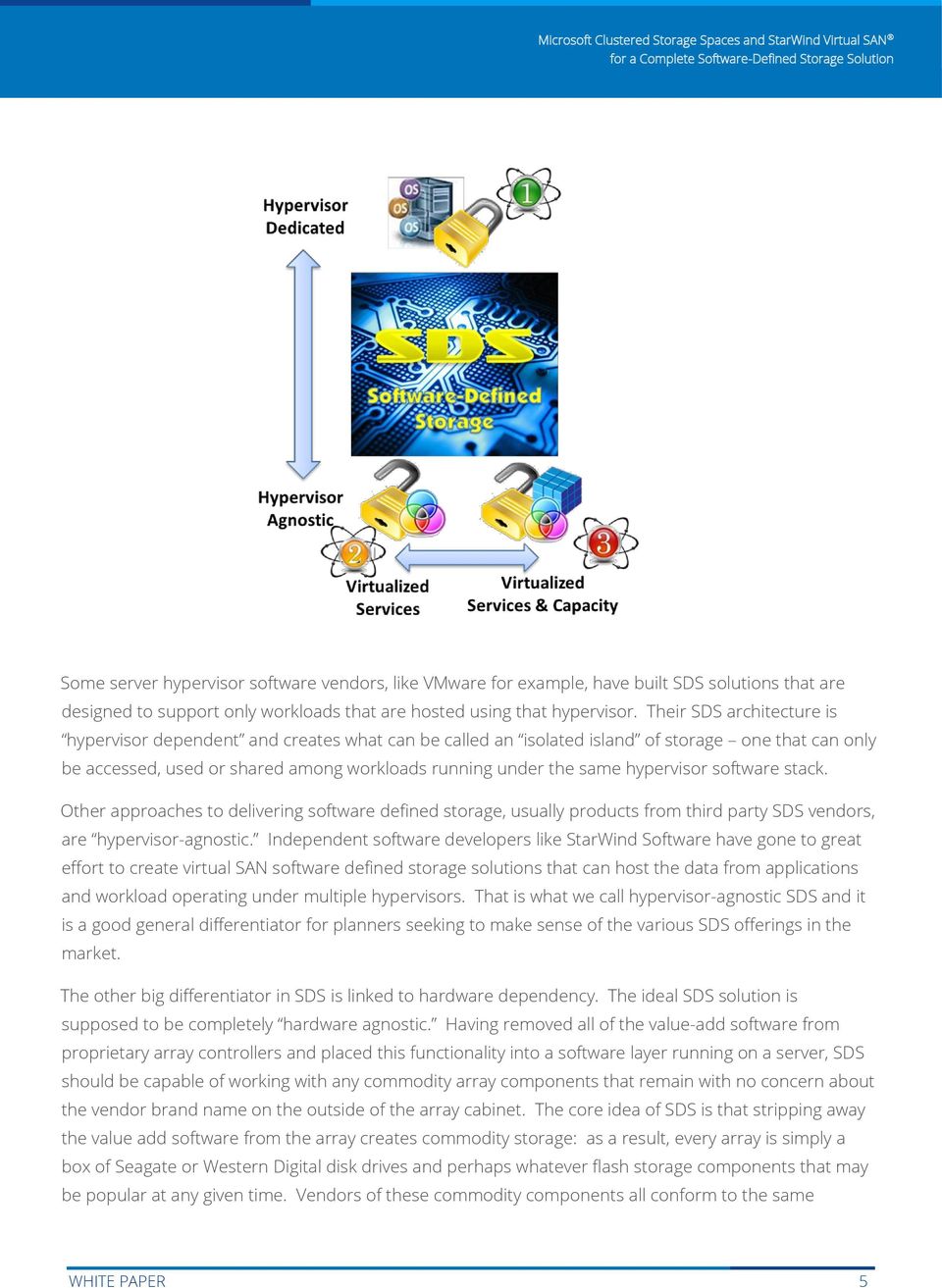
4 Introduction Software-defined storage (SDS) has captured the attention of the analyst community, the trade press and the server virtualization market, where consumers are looking for less expensive and more responsive storage solutions to support virtualized application workload. That said, there is still considerable disagreement regarding the meaning of software-defined storage itself. At a high level, SDS refers to the creation of a universal storage controller in a server-based software layer a strategy that moves the value-add storage services, functionality that traditional array vendors prefer to host on their storage array controllers, out of the array kit and into the server software stack. By doing so, SDS advocates say, the storage array becomes a box of commodity storage devices just a bunch of disks (JBOD). This, they claim, reduces the acquisition cost of storage hardware and, in theory at least, enables the easier allocation of capacity and value-add functionality or storage services to specific applications and workloads. Software-defined storage is also supposed to make it easier for a virtualization administrator, who may have little or no knowledge of the technical details of storage, to manage storage resources and to ensure that application performance is not constrained by storage-related issues. Unfortunately, there is no agreed upon strategy, architecture, or topology for delivering software-defined storage to market. Every vendor in the SDS space has its own interpretation of how to build SDS infrastructure. That has led to the introduction of a wide variety of software-defined solutions in the market today. For purposes of analysis, the most important differentiators are two-fold: hypervisor dependency and hardware dependency. WHITE PAPER 4

5 Some server hypervisor software vendors, like VMware for example, have built SDS solutions that are designed to support only workloads that are hosted using that hypervisor. Their SDS architecture is hypervisor dependent and creates what can be called an isolated island of storage one that can only be accessed, used or shared among workloads running under the same hypervisor software stack. Other approaches to delivering software defined storage, usually products from third party SDS vendors, are hypervisor-agnostic. Independent software developers like StarWind Software have gone to great effort to create virtual SAN software defined storage solutions that can host the data from applications and workload operating under multiple hypervisors. That is what we call hypervisor-agnostic SDS and it is a good general differentiator for planners seeking to make sense of the various SDS offerings in the market. The other big differentiator in SDS is linked to hardware dependency. The ideal SDS solution is supposed to be completely hardware agnostic. Having removed all of the value-add software from proprietary array controllers and placed this functionality into a software layer running on a server, SDS should be capable of working with any commodity array components that remain with no concern about the vendor brand name on the outside of the array cabinet. The core idea of SDS is that stripping away the value add software from the array creates commodity storage: as a result, every array is simply a box of Seagate or Western Digital disk drives and perhaps whatever flash storage components that may be popular at any given time. Vendors of these commodity components all conform to the same WHITE PAPER 5
6 protocols for operation and access SATA or SAS, or maybe Fibre Channel or iscsi, so the SDS solution shouldn t prefer one vendor s box of drives over any other vendor s box of drives. However, some SDS solutions remain hardware dependent. This is often the case with respect to hardware-based hyper-converged SDS storage hardware solutions, most of which are simply proprietary storage appliances, still implementing proprietary on-controller value-add software, and designed to work with a specific hypervisor. Hardware dependency can also be found in some of the socalled open SDS offerings from server hypervisor vendors. For example, a leading hypervisor vendor s Virtual SAN requires the exclusive use of SAS drives in its infrastructure, or, optionally, the use of storage node hardware that is pre-certified and branded by the vendor. By contrast, third party SDS technologies such as StarWind Software s Virtual SAN, in addition to being hypervisor agnostic, are hardware agnostic as well. In the case of StarWind, SATA as well as SAS disk may be used as primary storage, and even hyper-converged appliances are supported for use in the StarWind SDS infrastructure. Bottom line: while virtualization evangelists may stress hypervisor and hardware agnosticism as key characteristics of software-defined storage nirvana, such characteristics are by no means assured in current SDS products. Such agnosticism isn t necessarily in line with a particular hypervisor software vendor s or storage hardware vendor s revenue targets. The result is a proliferation of SDS architectures that work with only one hypervisor, or with only a select few, or that use the software-defined storage software layer to parse and manage only value-add functions, while leaving the hardware vendor to control capacity, vs controlling services and capacity from the software layer. As a result, for virtualization planners, a key challenge is often just figuring out the vendor s peculiar definition of software defined storage, what it actually delivers in terms of functionality, and what it relies on the storage array vendor to provide. Like VMware, Microsoft has its own SDS architecture, which this paper will summarize and assess. WHITE PAPER 6
7 In a Hyper-V World Microsoft s current software-defined storage solution is aimed at server infrastructure that has been virtualized using its Hyper-V technology. In 2012, Redmond began discussing its architecture for storage behind virtual servers mainly in the context of VMware s many approaches for dealing with its storage problems. Interestingly, Redmond s marketing materials villianized rival VMware s server hypervisor as the source of its application performance and storage I/O processing problems, claiming that software problems required customers to purchase more expensive storage solutions. For its own part, Microsoft introduced a new storage technology, based on a storage concept introduced for non-virtualized servers in Windows Server 2012 called Storage Spaces. They called their SDS variant of the technology Clustered Storage Spaces and claimed that it would dramatically reduce storage costs by eliminating the need for expensive brand name hardware. Clustered Storage Spaces, Microsoft claimed, could be used to build massive storage behind Hyper-V servers that could scale without incurring the high price tag of brand name storage. The resulting infrastructure would use SAS disk and would support server side Flash and DRAM memory storage. Moreover, it would avail itself of Microsoft s SMB 3.0 protocol for ease of application access while providing nearly the same performance as Fibre Channel. As a plus, it would support certain functionality that was usually found on enterprise array controllers, like thin provisioning and deduplication. WHITE PAPER 7
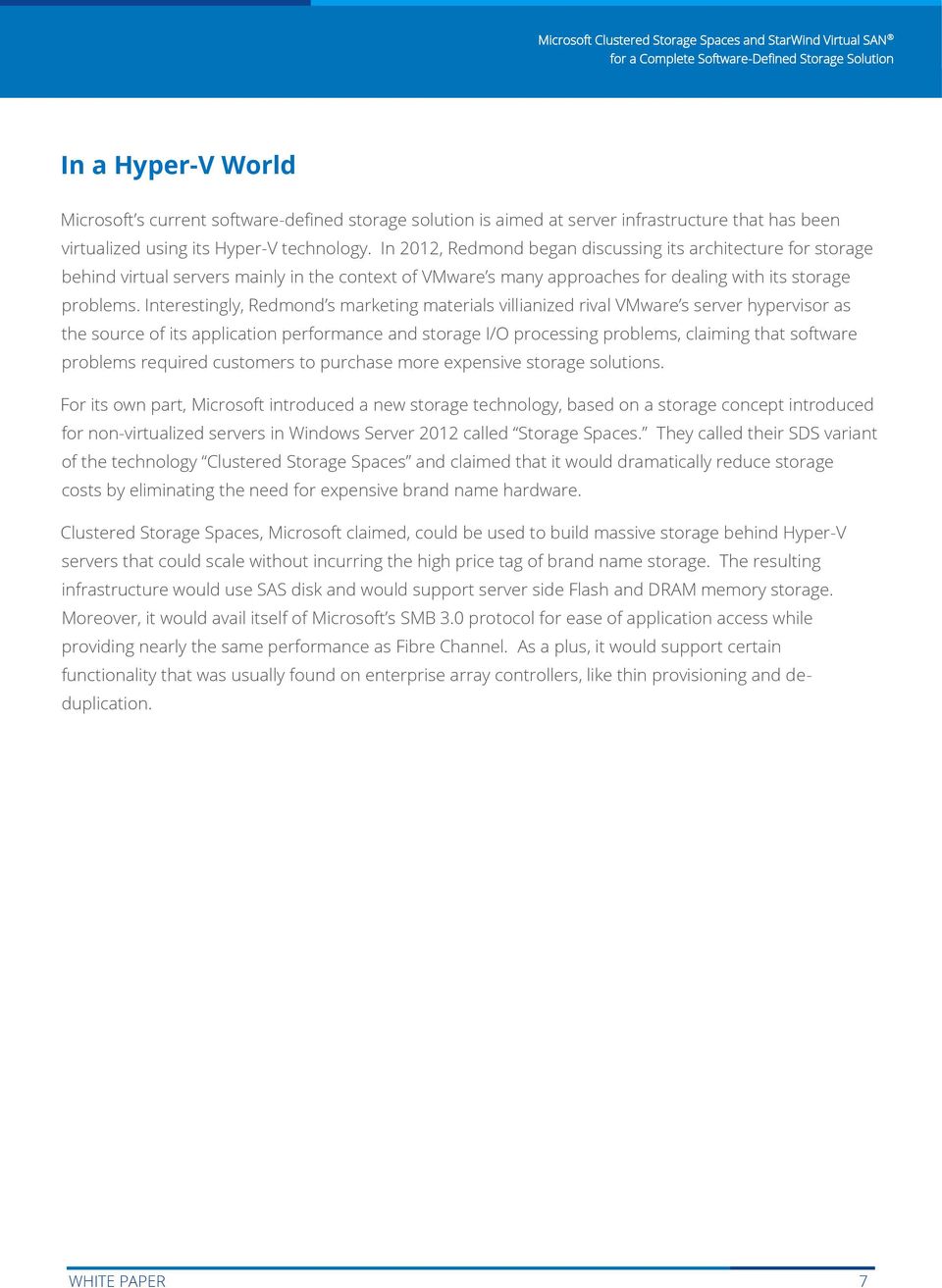
8 Basically, the resulting storage could be presented as a set of pooled resilient LUNs (or storage spaces), and you could leverage Windows clustering services and Windows file systems, such as NTFS, to make the infrastructure resilient and highly available and to present its storage as a general purpose file server repository. An early illustration. Source: blogs.technet.net The resulting infrastructure, in one writer s words, was a virtual storage appliance that could be built using existing server hardware, Windows server software, and any storage that can be mounted to the server. As a bonus, Microsoft provided a migration tool for sharing its storage with VMware servers actually, for converting and migrating Virtual Machines formatted to run with VMware hypervisors to Microsoft Hyper-V (and with no additional licensing fees!). Said Redmond s evangelists, the resulting storage avails itself in ongoing storage improvements that Redmond is making to its SMB 3.0 protocol, including SMB Transparent Failover, SMB Direct and SMB Multichannel. The chorus of analysts engaged by the vendor added their estimates of Clustered Storage Spaces business value, stating that Storage Spaces over SMB could deliver nearly the same performance (within 1-4%) as that of traditional FC storage solutions, but at approximately 50% of the cost. WHITE PAPER 8

9 There are different views of this total cost of ownership claim, of course, but the important points about Clustered Storage Spaces was that the architecture supported both block and file data storage. Moreover, in its role as a scalable file server, its storage could store virtually any file data from any application, whether virtualized by Microsoft or not. Providing both block storage (to accommodate applications such as Microsoft SQL Server) and file storage, Microsoft claimed that Clustered Storage Spaces qualified as software-defined storage. WHITE PAPER 9

10 Their strategy, after all, created a software-based controller that featured a robust set of storage services once found only on array controllers, including Different resiliency levels (simple or stripe, mirror or parity) per Storage Space Thin provisioning Sharable storage Memory-based read caching Active-Active clustering with failover SMB copy offload Snapshots and clones of Microsoft Virtual Hard Disks (VHDs) on storage pool Two and three way mirroring Fast rebuild of failed disk Tiering of hot data to solid state disk (SSD) Write back caching - write to solid state disk (SSD) first, then to SAS Data de-duplication Pushback Reveals Issues and Limitations Almost immediately following the release of Clustered Storage Spaces, pushback from engineers and operators commenced. Several issues have garnered significant attention. For one, according to software-defined storage purists, Microsoft s Clustered Storage Spaces didn t really qualify as SDS, since it did not fully divorce the storage control layer from the hardware. Detractors observed that the technology placed a heavy hardware requirement on infrastructure design. Only SAS (Serial Attached Storage protocol) disks and disk arrays could be used. Technically speaking, this doesn t completely segregate storage services from storage hardware, which makes this cobble only partly hardware agnostic. Another criticism held that the active-active high availability clustering touted by Redmond was only possible if the clustered nodes were using only external SAS JBOD arrays as their storage. If a node used internal storage storage on a server as part of its storage pool, active-active clustering was not possible, only the less available active-passive clustering could be used. While active-passive clustering can provide reasonably effective availability guarantees, it does not enable the seamless or transparent re-hosting of virtual workload that the active-active cluster advocates want. This situation also reflected a hypervisor dependency of the SDS solution. WHITE PAPER 10
11 Other issues had more to do with the efficiency of the solution than to its SDS purity. For example, many criticized how Clustered Storage Spaces used flash storage, both in the context of write caching and especially in performing data de-duplication processing. In both cases, flash memory was not being used in a manner that minimized wear. It is well understood that flash technology is vulnerable to memory wear: when a memory cell in a cell group on a flash device reaches its maximum writes somewhere around 250,000 in multilayer cell flash memory the cell fails and the entire group of cells to which it belongs must be retired. Over time, enough dead or unusable cell groups translates to a flash device of extremely limited capacity that needs to be replaced. The only workaround to this vulnerability is to limit the number and frequency of small block writes to the flash device, usually through write coalescence technology, which Microsoft does not offer. Given that Microsoft Clustered Storage Spaces technology offers no write management, it can be argued that it does not use flash technology efficiently. Moreover, it writes small block data to silicon in preparation for de-duplication, a further burden on flash durability that caused many engineers to question the economics of Clustered Storage Spaces in server environments using substantial flash technology. In addition to its implementation of de-duplication functionality, there are also concerns over Microsoft s thin provisioning methodology, which requires storage to be overprovisioned for planners to buy and deploy more than they need so that they can respond to a burgeoning space problem when it is reported. Similarly, Microsoft s much touted parity striping functionality is reported to require operators to embrace two-way mirroring for performance reasons. Two-way mirroring, critics argue, will most certainly increase storage capacity demand requiring the purchase of additional SAS disk and increasing the cost of storage infrastructure by as much as 300 to 650 percent, depending on which industry analyst one consults. The Fix Microsoft recently announced that it is making changes to Clustered Storage Spaces as part of Windows 10 Server. Spokespersons are making cryptic references in the trade press to Storage Spaces-Shared Nothing architecture. Details are sparse, but early statements suggest that the new approach will support not only SAS, but also SATA disk, plus PCIe and NVMe flash devices. However, according to one account, deployment will be in a compute and storage separated model with a fairly rigid topology requirement: a minimum of four storage nodes, plus two Hyper-V server nodes, will be required to build a shared-nothing SDS infrastructure, which by itself will increase the cost of the resulting infrastructure. Microsoft has not offered any details regarding new storage services or improvements to storage service issues cited above in the new SDS offering, which is now slated for delivery in WHITE PAPER 11


12 By contrast, an SDS solution that exists today and that complements the Microsoft SDS approach while obviating many of the limitations of Clustered Storage Spaces is the Virtual SAN from StarWind Software. StarWind s offering deploys effortlessly into a Microsoft Server/Hyper-V environment where it delivers enhancements to Clusted Storage Spaces that include Support for SATA, PCIe Flash, and 40+GbE connections Real active-active clustering of nodes configured with mixed internal storage and external JBODs A log structured file system to enable efficient write caching ahead of flash storage, reducing write frequency and wear rates and preserving flash investments Support for legacy storage gear Essentially, with StarWind Software s Virtual SAN, the storage used by Clustered Storage Spaces can be configured and presented by StarWind, alleviating many of the known constraints in Microsoft s current storage model. Going forward, StarWind Software s Virtual SAN already provides the capabilities that Microsoft is promising with its next generation SDS solution. StarWind already provides shared nothing clustering, and in more economical two and three node footprints. While Microsoft (like VMware) appears to be abandoning the small to medium business and remote office/branch office markets, which require simple yet scalable storage solutions, in favor of more complex offerings better suited to large enterprise and cloud hosting environments, StarWind supports the smaller shops with tighter budgets by delivering a Virtual SAN today that is affordable, easily deployed, and open to both white box and branded storage products. The StarWind offering also WHITE PAPER 12

13 supports hyper-converged storage appliances that may be appropriate to departmental settings or other use cases where storage requirements are growing at a slower pace. If you are considering software-defined storage for your Microsoft computing environement, StarWind Software s Virtual SAN is worth a look. For more information, or to try out a complementary technology for software-defined storage in a Microsoft Hyper-V environment, contact StarWind Software. WHITE PAPER 13

14 Contacts US Headquarters EMEA and APAC (French) Customer Support Portal: Support Forum: Sales: General Information: StarWind Software, Inc. 301 Edgewater Place Suite 100 Wakefield MA USA 2015, StarWind Software Inc. All rights reserved. WHITE PAPER 14
Whitepaper. NexentaConnect for VMware Virtual SAN. Full Featured File services for Virtual SAN
 Whitepaper NexentaConnect for VMware Virtual SAN Full Featured File services for Virtual SAN Table of Contents Introduction... 1 Next Generation Storage and Compute... 1 VMware Virtual SAN... 2 Highlights
StarWind iscsi SAN Configuring HA File Server for SMB NAS
 Hardware-less VM Storage StarWind iscsi SAN Configuring HA File Server for SMB NAS DATE: FEBRUARY 2012 TECHNICAL PAPER Trademarks StarWind, StarWind Software and the StarWind and the StarWind Software
StarWind Virtual SAN Hyper-Converged Platform Quick Start Guide
 Hardware-less VM Storage StarWind Virtual SAN Hyper-Converged Platform Quick Start Guide DATE: MAY 2015 TECHNICAL PAPER Trademarks StarWind, StarWind Software and the StarWind and the StarWind Software
StarWind Virtual SAN Scale-Out Architecture
 #1 HyperConverged Appliance for SMB and ROBO StarWind Virtual SAN VERSION 2.1 SEPTEMBER 2015 TECHNICAL PAPER Trademarks StarWind, StarWind Software and the StarWind and the StarWind Software logos are
StarWind Virtual SAN for Microsoft SOFS
 StarWind Virtual SAN for Microsoft SOFS Cutting down SMB and ROBO virtualization cost by using less hardware with Microsoft Scale-Out File Server (SOFS) By Greg Schulz Founder and Senior Advisory Analyst
StarWind Virtual SAN Installation and Configuration of Hyper-Converged 2 Nodes with Hyper-V Cluster
 #1 HyperConverged Appliance for SMB and ROBO StarWind Virtual SAN Installation and Configuration of Hyper-Converged 2 Nodes with MARCH 2015 TECHNICAL PAPER Trademarks StarWind, StarWind Software and the
Understanding Microsoft Storage Spaces
 S T O R A G E Understanding Microsoft Storage Spaces A critical look at its key features and value proposition for storage administrators A Microsoft s Storage Spaces solution offers storage administrators
High Availability with Windows Server 2012 Release Candidate
 High Availability with Windows Server 2012 Release Candidate Windows Server 2012 Release Candidate (RC) delivers innovative new capabilities that enable you to build dynamic storage and availability solutions
#1 HyperConverged Appliance for SMB and ROBO. StarWind Virtual SAN Service Level Agreement
 #1 HyperConverged Appliance for SMB and ROBO StarWind Virtual SAN OCTOBER 2015 Trademarks StarWind, StarWind Software and the StarWind and the StarWind Software logos are registered trademarks of StarWind
StarWind iscsi SAN: Configuring Global Deduplication May 2012
 StarWind iscsi SAN: Configuring Global Deduplication May 2012 TRADEMARKS StarWind, StarWind Software, and the StarWind and StarWind Software logos are trademarks of StarWind Software that may be registered
StarWind iscsi SAN & NAS: Configuring HA Shared Storage for Scale- Out File Servers in Windows Server 2012 January 2013
 StarWind iscsi SAN & NAS: Configuring HA Shared Storage for Scale- Out File Servers in Windows Server 2012 January 2013 TRADEMARKS StarWind, StarWind Software and the StarWind and the StarWind Software
StarWind iscsi SAN & NAS: Configuring HA File Server on Windows Server 2012 for SMB NAS January 2013
 StarWind iscsi SAN & NAS: Configuring HA File Server on Windows Server 2012 for SMB NAS January 2013 TRADEMARKS StarWind, StarWind Software and the StarWind and the StarWind Software logos are trademarks
SOFTWARE-DEFINED STORAGE IN ACTION
 SOFTWARE-DEFINED STORAGE IN ACTION Anne Tarantino VP Sales- Velocity Tech Solutions Copyright 2014 DataCore Software Corp. All Rights Reserved. Copyright 2014 DataCore Software Corp. All Rights Reserved.
StarWind Virtual SAN Installing & Configuring a SQL Server 2012 Failover Cluster
 #1 HyperConverged Appliance for SMB and ROBO StarWind Virtual SAN Installing & Configuring a SQL Server 2012 Failover JANUARY 2015 TECHNICAL PAPER Trademarks StarWind, StarWind Software and the StarWind
Windows Server 2003 Migration Guide: Nutanix Webscale Converged Infrastructure Eases Migration
 Windows Server 2003 Migration Guide: Nutanix Webscale Converged Infrastructure Eases Migration Windows Server 2003 end-of-support means planning must start now James E. Bagley Senior Analyst Deni Connor
StarWind Virtual SAN Provides HA Storage for Hyper-V Clusters with DAS-Based Virtualized iscsi Devices
 #1 HyperConverged Appliance for SMB and ROBO StarWind Virtual SAN Provides HA Storage for Hyper-V Clusters with DAS-Based Virtualized iscsi Devices Cost Effective HA Storage for Critical Business Applications
StarWind iscsi SAN & NAS: Configuring HA Storage for Hyper-V October 2012
 StarWind iscsi SAN & NAS: Configuring HA Storage for Hyper-V October 2012 TRADEMARKS StarWind, StarWind Software and the StarWind and the StarWind Software logos are trademarks of StarWind Software which
Expert. Briefing. \\\\ Best Practices for Managing Storage with Hyper-V
 \\\\ Best Practices for Managing Storage with Hyper-V Learn how storage functionality changes with the newest Hyper-V release and how it differs from VMware. Get details on specific Hyper-V features including
MaxDeploy Hyper- Converged Reference Architecture Solution Brief
 MaxDeploy Hyper- Converged Reference Architecture Solution Brief MaxDeploy Reference Architecture solutions are configured and tested for support with Maxta software- defined storage and with industry
Dell Converged Infrastructure
 Agenda Microsoft Software Defined and Storage Economics Summary of all Dell SDS offerings Storage Trends (SAN > JBOD > Internal Disks) Legacy Storage and JBOD Enclosure Trends Software Defined Storage
Realizing the True Potential of Software-Defined Storage
 Realizing the True Potential of Software-Defined Storage Who should read this paper Technology leaders, architects, and application owners who are looking at transforming their organization s storage infrastructure
New Features in PSP2 for SANsymphony -V10 Software-defined Storage Platform and DataCore Virtual SAN
 New Features in PSP2 for SANsymphony -V10 Software-defined Storage Platform and DataCore Virtual SAN Updated: May 19, 2015 Contents Introduction... 1 Cloud Integration... 1 OpenStack Support... 1 Expanded
Exchange Failover in a StarWind Virtual SAN using a vsphere VI with Virtualized iscsi Devices on DAS
 #1 HyperConverged Appliance for SMB and ROBO Exchange Failover in a StarWind Virtual SAN using a vsphere VI with Virtualized iscsi Devices on DAS Cost Effective HA Storage for Critical Business Applications
StarWind iscsi SAN: Configuring HA File Server for SMB NAS February 2012
 StarWind iscsi SAN: Configuring HA File Server for SMB NAS February 2012 TRADEMARKS StarWind, StarWind Software and the StarWind and the StarWind Software logos are trademarks of StarWind Software which
broadberry.co.uk/storage-servers
 Established in 1989 Broadberry Data Systems have powered the worlds largest organisations for over 23 years, ranging from the top 10 universities in England to NASA and CERN. We re a leading manufacturer
SOFTWARE DEFINED STORAGE IN ACTION
 SOFTWARE DEFINED STORAGE IN ACTION Copyright 2014 DataCore Software Corp. All Rights Reserved. Copyright 2014 DataCore Software Corp. All Rights Reserved. 1 Storage is Growing At an Unsustainable Rate
Best Practices for Implementing iscsi Storage in a Virtual Server Environment
 white paper Best Practices for Implementing iscsi Storage in a Virtual Server Environment Server virtualization is becoming a no-brainer for any that runs more than one application on servers. Nowadays,
TOP FIVE REASONS WHY CUSTOMERS USE EMC AND VMWARE TO VIRTUALIZE ORACLE ENVIRONMENTS
 TOP FIVE REASONS WHY CUSTOMERS USE EMC AND VMWARE TO VIRTUALIZE ORACLE ENVIRONMENTS Leverage EMC and VMware To Improve The Return On Your Oracle Investment ESSENTIALS Better Performance At Lower Cost Run
MS Exchange Server Acceleration
 White Paper MS Exchange Server Acceleration Using virtualization to dramatically maximize user experience for Microsoft Exchange Server Allon Cohen, PhD Scott Harlin OCZ Storage Solutions, Inc. A Toshiba
Virtualization of the MS Exchange Server Environment
 MS Exchange Server Acceleration Maximizing Users in a Virtualized Environment with Flash-Powered Consolidation Allon Cohen, PhD OCZ Technology Group Introduction Microsoft (MS) Exchange Server is one of
A virtual SAN for distributed multi-site environments
 Data sheet A virtual SAN for distributed multi-site environments What is StorMagic SvSAN? StorMagic SvSAN is a software storage solution that enables enterprises to eliminate downtime of business critical
SQL Server Virtualization
 The Essential Guide to SQL Server Virtualization S p o n s o r e d b y Virtualization in the Enterprise Today most organizations understand the importance of implementing virtualization. Virtualization
StarWind Virtual SAN Best Practices
 #1 HyperConverged Appliance for SMB and ROBO StarWind Virtual SAN Best Practices NOVEMBER 2015 TECHNICAL PAPER Trademarks StarWind, StarWind Software and the StarWind and the StarWind Software logos are
VMware Software-Defined Storage Vision
 VMware Software-Defined Storage Vision Lee Dilworth (@leedilworth) Principal Systems Engineer 2014 VMware Inc. All rights reserved. The Software-Defined Data Center Expand virtual compute to all applications
WHITE PAPER. Software Defined Storage Hydrates the Cloud
 WHITE PAPER Software Defined Storage Hydrates the Cloud Table of Contents Overview... 2 NexentaStor (Block & File Storage)... 4 Software Defined Data Centers (SDDC)... 5 OpenStack... 5 CloudStack... 6
StarWind Virtual SAN
 #1 HyperConverged Appliance for SMB and ROBO StarWind Virtual SAN Value Proposition For SMB, ROBO, Cloud and Hosting providers, who look to cut down virtualization expenses, our solution is StarWind Virtual
Software Defined Storage @ Microsoft. PRESENTATION TITLE GOES HERE Siddhartha Roy Cloud + Enterprise Division Microsoft Corporation
 Software Defined @ Microsoft PRESENTATION TITLE GOES HERE Siddhartha Roy Cloud + Enterprise Division Microsoft Corporation Lessons Learned operating large cloud properties Industry trends Cloud scale services
Big data Devices Apps
 Trends driving IT pressures Cloud Big data Devices Apps Devices: Info Workers Will Erase Boundary Between enterprise And Consumer Technologies. Forrester Research. August 30, 2012 Apps: Gartner: Predicts
StarWind iscsi SAN Software: Providing shared storage for Hyper-V's Live Migration feature on two physical servers
 StarWind iscsi SAN Software: Providing shared storage for Hyper-V's Live Migration feature on two physical servers www.starwindsoftware.com Copyright 2008-2011. All rights reserved. COPYRIGHT Copyright
Evaluation of Enterprise Data Protection using SEP Software
 Test Validation Test Validation - SEP sesam Enterprise Backup Software Evaluation of Enterprise Data Protection using SEP Software Author:... Enabling you to make the best technology decisions Backup &
All-Flash Arrays Weren t Built for Dynamic Environments. Here s Why... This whitepaper is based on content originally posted at www.frankdenneman.
 WHITE PAPER All-Flash Arrays Weren t Built for Dynamic Environments. Here s Why... This whitepaper is based on content originally posted at www.frankdenneman.nl 1 Monolithic shared storage architectures
Maxta Storage Platform Enterprise Storage Re-defined
 Maxta Storage Platform Enterprise Storage Re-defined WHITE PAPER Software-Defined Data Center The Software-Defined Data Center (SDDC) is a unified data center platform that delivers converged computing,
MaxDeploy Ready. Hyper- Converged Virtualization Solution. With SanDisk Fusion iomemory products
 MaxDeploy Ready Hyper- Converged Virtualization Solution With SanDisk Fusion iomemory products MaxDeploy Ready products are configured and tested for support with Maxta software- defined storage and with
Is Hyperconverged Cost-Competitive with the Cloud?
 Economic Insight Paper Is Hyperconverged Cost-Competitive with the Cloud? An Evaluator Group TCO Analysis Comparing AWS and SimpliVity By Eric Slack, Sr. Analyst January 2016 Enabling you to make the best
IOmark- VDI. Nimbus Data Gemini Test Report: VDI- 130906- a Test Report Date: 6, September 2013. www.iomark.org
 IOmark- VDI Nimbus Data Gemini Test Report: VDI- 130906- a Test Copyright 2010-2013 Evaluator Group, Inc. All rights reserved. IOmark- VDI, IOmark- VDI, VDI- IOmark, and IOmark are trademarks of Evaluator
High Performance Server SAN using Micron M500DC SSDs and Sanbolic Software
 High Performance Server SAN using Micron M500DC SSDs and Sanbolic Software White Paper Overview The Micron M500DC SSD was designed after months of close work with major data center service providers and
DIABLO TECHNOLOGIES MEMORY CHANNEL STORAGE AND VMWARE VIRTUAL SAN : VDI ACCELERATION
 DIABLO TECHNOLOGIES MEMORY CHANNEL STORAGE AND VMWARE VIRTUAL SAN : VDI ACCELERATION A DIABLO WHITE PAPER AUGUST 2014 Ricky Trigalo Director of Business Development Virtualization, Diablo Technologies
Remote/Branch Office IT Consolidation with Lenovo S2200 SAN and Microsoft Hyper-V
 Remote/Branch Office IT Consolidation with Lenovo S2200 SAN and Microsoft Hyper-V Most data centers routinely utilize virtualization and cloud technology to benefit from the massive cost savings and resource
Accelerating Applications and File Systems with Solid State Storage. Jacob Farmer, Cambridge Computer
 Accelerating Applications and File Systems with Solid State Storage Jacob Farmer, Cambridge Computer SNIA Legal Notice The material contained in this tutorial is copyrighted by the SNIA unless otherwise
Deep Dive on SimpliVity s OmniStack A Technical Whitepaper
 Deep Dive on SimpliVity s OmniStack A Technical Whitepaper By Hans De Leenheer and Stephen Foskett August 2013 1 Introduction This paper is an in-depth look at OmniStack, the technology that powers SimpliVity
The Benefits of Virtualizing
 T E C H N I C A L B R I E F The Benefits of Virtualizing Aciduisismodo Microsoft SQL Dolore Server Eolore in Dionseq Hitachi Storage Uatummy Environments Odolorem Vel Leveraging Microsoft Hyper-V By Heidi
Technology Insight Series
 Evaluating Storage Technologies for Virtual Server Environments Russ Fellows June, 2010 Technology Insight Series Evaluator Group Copyright 2010 Evaluator Group, Inc. All rights reserved Executive Summary
Why Choose VMware vsphere for Desktop Virtualization? WHITE PAPER
 Why Choose VMware vsphere for Desktop Virtualization? WHITE PAPER Table of Contents Thin, Legacy-Free, Purpose-Built Hypervisor.... 3 More Secure with Smaller Footprint.... 4 Less Downtime Caused by Patches...
VDI Optimization Real World Learnings. Russ Fellows, Evaluator Group
 Russ Fellows, Evaluator Group SNIA Legal Notice The material contained in this tutorial is copyrighted by the SNIA unless otherwise noted. Member companies and individual members may use this material
Building a Flash Fabric
 Introduction Storage Area Networks dominate today s enterprise data centers. These specialized networks use fibre channel switches and Host Bus Adapters (HBAs) to connect to storage arrays. With software,
WHITE PAPER. Drobo TM Hybrid Storage TM
 WHITE PAPER Drobo TM Hybrid Storage TM Table of Contents Introduction...3 What is Hybrid Storage?...4 SSDs Enable Hybrid Storage...4 One Pool, Multiple Tiers...5 Fully Automated Tiering...5 Tiering Without
Cloud Service Provider Builds Cost-Effective Storage Solution to Support Business Growth
 Cloud Service Provider Builds Cost-Effective Storage Solution to Support Business Growth Overview Country or Region: United States Industry: Hosting Customer Profile Headquartered in Overland Park, Kansas,
DataCore SANsymphony-V Software-Defined Storage The intelligent way of data virtualizing!
 DataCore SANsymphony-V Software-Defined Storage The intelligent way of data virtualizing! A practical example 2 Setting the scene Car components suppliers in Latvia 500 worker Additional fabrics in Asia
Integration of Microsoft Hyper-V and Coraid Ethernet SAN Storage. White Paper
 Integration of Microsoft Hyper-V and Coraid Ethernet SAN Storage White Paper June 2011 2011 Coraid, Inc. Coraid, Inc. The trademarks, logos, and service marks (collectively "Trademarks") appearing on the
Improving IT Operational Efficiency with a VMware vsphere Private Cloud on Lenovo Servers and Lenovo Storage SAN S3200
 Improving IT Operational Efficiency with a VMware vsphere Private Cloud on Lenovo Servers and Lenovo Storage SAN S3200 Most organizations routinely utilize a server virtualization infrastructure to benefit
Hyperscale Use Cases for Scaling Out with Flash. David Olszewski
 Hyperscale Use Cases for Scaling Out with Flash David Olszewski Business challenges Performanc e Requireme nts Storage Budget Balance the IT requirements How can you get the best of both worlds? SLA Optimized
Dell High Availability Solutions Guide for Microsoft Hyper-V
 Dell High Availability Solutions Guide for Microsoft Hyper-V www.dell.com support.dell.com Notes and Cautions NOTE: A NOTE indicates important information that helps you make better use of your computer.
SSD Performance Tips: Avoid The Write Cliff
 ebook 100% KBs/sec 12% GBs Written SSD Performance Tips: Avoid The Write Cliff An Inexpensive and Highly Effective Method to Keep SSD Performance at 100% Through Content Locality Caching Share this ebook
Redefining Microsoft SQL Server Data Management
 Redefining Microsoft SQL Server Data Management Contact Actifio Support As an Actifio customer, you can get support for all Actifio products through the Support Portal at http://support.actifio.com/. Copyright,
Windows Server 2012 授 權 說 明
 Windows Server 2012 授 權 說 明 PROCESSOR + CAL HA 功 能 相 同 的 記 憶 體 及 處 理 器 容 量 虛 擬 化 Windows Server 2008 R2 Datacenter Price: NTD173,720 (2 CPU) Packaging All features Unlimited virtual instances Per processor
Host Performance-Sensitive Applications in Your Cloud
 White Paper For Service Providers Host Performance-Sensitive Applications in Your Cloud CloudByte ElastiStor Resolves Noisy Neighbor Issues and Delivers Guaranteed QoS to Every Application Table of Contents
Extending the Power of Your Datacenter
 Software-Defined Storage Extending the Power of Your Datacenter Eric Tsai Senior Solution Architect Enterprise Group Taiwan Copyright 2013 Hewlett-Packard Development Company, L.P. The information contained
How To Get A Storage And Data Protection Solution For Virtualization
 Smart Storage and Modern Data Protection Built for Virtualization Dot Hill Storage Arrays and Veeam Backup & Replication Software offer the winning combination. Veeam and Dot Hill Solutions Introduction
Configuration Guide. Achieve Unified Management and Scale-Out of Multi-Site File-Serving Deployments Using Windows Server 2012 R2 and Sanbolic
 Configuration Guide Achieve Unified Management and Scale-Out of Multi-Site File-Serving Deployments Using Windows Server 2012 R2 and Sanbolic Introduction One of the most popular workloads found in today
IS IN-MEMORY COMPUTING MAKING THE MOVE TO PRIME TIME?
 IS IN-MEMORY COMPUTING MAKING THE MOVE TO PRIME TIME? EMC and Intel work with multiple in-memory solutions to make your databases fly Thanks to cheaper random access memory (RAM) and improved technology,
Virtual SAN Design and Deployment Guide
 Virtual SAN Design and Deployment Guide TECHNICAL MARKETING DOCUMENTATION VERSION 1.3 - November 2014 Copyright 2014 DataCore Software All Rights Reserved Table of Contents INTRODUCTION... 3 1.1 DataCore
Enterprise Storage Solution for Hyper-V Private Cloud and VDI Deployments using Sanbolic s Melio Cloud Software Suite April 2011
 Enterprise Storage Solution for Hyper-V Private Cloud and VDI Deployments using Sanbolic s Melio Cloud Software Suite April 2011 Executive Summary Large enterprise Hyper-V deployments with a large number
StarWind Deduplication vs Nexenta Deduplication
 StarWind Deduplication vs Nexenta Deduplication May 2012 RADEMARKS StarWind, StarWind Software, and the StarWind and StarWind Software logos are trademarks of StarWind Software that may be registered in
SAN Conceptual and Design Basics
 TECHNICAL NOTE VMware Infrastructure 3 SAN Conceptual and Design Basics VMware ESX Server can be used in conjunction with a SAN (storage area network), a specialized high speed network that connects computer
THE SUMMARY. ARKSERIES - pg. 3. ULTRASERIES - pg. 5. EXTREMESERIES - pg. 9
 PRODUCT CATALOG THE SUMMARY ARKSERIES - pg. 3 ULTRASERIES - pg. 5 EXTREMESERIES - pg. 9 ARK SERIES THE HIGH DENSITY STORAGE FOR ARCHIVE AND BACKUP Unlimited scalability Painless Disaster Recovery The ARK
Making the Move to Desktop Virtualization No More Reasons to Delay
 Enabling the Always-On Enterprise Making the Move to Desktop Virtualization No More Reasons to Delay By Andrew Melmed Director of Enterprise Solutions, Sanbolic Inc. April 2012 Introduction It s a well-known
Nutanix Tech Note. Configuration Best Practices for Nutanix Storage with VMware vsphere
 Nutanix Tech Note Configuration Best Practices for Nutanix Storage with VMware vsphere Nutanix Virtual Computing Platform is engineered from the ground up to provide enterprise-grade availability for critical
REDEFINE SIMPLICITY TOP REASONS: EMC VSPEX BLUE FOR VIRTUALIZED ENVIRONMENTS
 REDEFINE SIMPLICITY AGILE. SCALABLE. TRUSTED. TOP REASONS: EMC VSPEX BLUE FOR VIRTUALIZED ENVIRONMENTS Redefine Simplicity: Agile, Scalable and Trusted. Mid-market and Enterprise customers as well as Managed
StarWind iscsi SAN Software: Using with Citrix XenServer
 StarWind iscsi SAN Software: Using with Citrix XenServer www.starwindsoftware.com Copyright 2008-2010. All rights reserved. COPYRIGHT Copyright 2008-2010. All rights reserved. No part of this publication
Cloud Optimize Your IT
 Cloud Optimize Your IT Windows Server 2012 The information contained in this presentation relates to a pre-release product which may be substantially modified before it is commercially released. This pre-release
The Shortcut Guide to Balancing Storage Costs and Performance with Hybrid Storage
 The Shortcut Guide to Balancing Storage Costs and Performance with Hybrid Storage sponsored by Dan Sullivan Chapter 1: Advantages of Hybrid Storage... 1 Overview of Flash Deployment in Hybrid Storage Systems...
Trends driving software-defined storage
 Software-defined storage. Redefined. Introduction to Hedvig Hedvig Executive Team February, 2015 Trends driving software-defined storage Data volumes grow. App requirements change. Users demand new services.
Long Term Care Group Deploys Zerto for Data Protection and Recovery for Virtual Environments
 BUYER CASE STUDY Long Term Care Group Deploys Zerto for Data Protection and Recovery for Virtual Environments Iris Feng Eric Sheppard IDC OPINION Today's datacenter is dominated by virtualized workloads
Microsoft Private Cloud Fast Track
 Microsoft Private Cloud Fast Track Microsoft Private Cloud Fast Track is a reference architecture designed to help build private clouds by combining Microsoft software with Nutanix technology to decrease
Simplifying Storage Operations By David Strom (published 3.15 by VMware) Introduction
 Simplifying Storage Operations By David Strom (published 3.15 by VMware) Introduction There are tectonic changes to storage technology that the IT industry hasn t seen for many years. Storage has been
Solution Overview. Business Continuity with ReadyNAS
 Business Continuity with ReadyNAS What is ReadyNAS? ReadyNAS is a family of network storage solutions for small and medium businesses, workgroups, and remote/home offices. ReadyNAS delivers unified storage