
Bonding Assessments: What Defense Attorneys Should Know
|
|
|
- Owen Robbins
- 10 years ago
- Views:
Transcription
1 Bonding Assessments: What Defense Attorneys Should Know Renee L. Genin, LCSW Child and Family Psychotherapist (414) Systemic Perspectives, Inc N. 124th St. #106, Brookfield, WI 53005

2 TPR decisions and dilemmas... Breaking the cycle vs. breaking bonds Risk/harm to child if the bond to the biological parent is severed Risk/harm to child if bond to the foster parent is severed How long can the child wait? Prognosis for healing: Will any placement be successful for this child? Best interests: short-term? long-term? What should we tell the child?


3 What is Attachment?

4 Bonding vs. Attachment Bonding refers to the parent s tie to the infant which develops in the first few hours of life. Attachments are unique, lasting emotional ties between infants and their caregivers.

5 Attachment is... An affectional tie that a person... forms between himself and another specific (person)- a tie that binds them together in space and endures over time. (Mary Ainsworth)

6 The relationship between the mother and child is the prototype for all future relationships. -Freud

7 DMM Definition of Attachment: Attachment refers to the self-protective and progeny-protective strategy used when there is actual or perceived danger or threat of danger. (Crittenden & Ainsworth, 1989)

8 Attachment Styles Secure Attachment: Adults will keep me safe Insecure Attachment: I will keep MYSELF safe AT ALL COSTS

9 Why do we care about Attachment?

10 Developmental Attachment Keeps humans alive! Provides a protective factor against environmental stress and trauma The basis of healthy growth and development Shapes inner working model of social relationships template for future relationships blueprint for perceiving self (good vs. bad), others (trust vs. mistrust), environment (safe vs. unsafe)

11 Inner Working Models Positive Working Model Basic Trust I am good I am Worthy I am competent Others can be trusted The world is safe Vulnerability Connection Safety/Security Commitment Truth Validation Negative Working Model Basic Mistrust I am bad I am Unworthy I am impotent Others can t be trusted The world is unsafe Defense & Alienation Disconnection Threat Abandonment Lies & Tricks Rejection

12 Secure Attachment helps us Attain full intellectual potential Think logically (cause & effect thinking) Develop a conscience Become self-reliant; self-soothing Cope with stress and frustration; modulate affect; handle fear and worry. Develop relationships; have empathy

13 Consequences of Insecure Attachment can include: Poor self-esteem and self regulation Aggressive/rejecting behavior toward peers Withdrawn/isolating relations with peers Low frustration tolerance Less positive affect Lags in cognitive, developmental and academic competence Elevated levels of behavioral symptomatology, anxiety, mood disturbance

14 Attachment Development

15 Attachment across the lifespan Attachment impacts personality Attachment is a lifelong process Behavioral manifestations change over the course of development Impaired attachment (when left untreated) can result in personality disorders Attachment is repairable with intervention: children can learn how to attach Recent research suggests people can change the security of their attachment style into adulthood.

16 Process of Secure Developmental Attachment Repeated cycles of need fulfillment: parents successfully reduce uncomfortable emotions and meet child s needs Enables child to feel soothed and safe when upset This experience is encoded in implicit memory as expectations and then as mental models of social relationships Helps the child feel an internal sense of security in the world at large

17

18 Secure ( Healthy ) Attachment The child recognizes, prefers, and shows emotional response to a caregiver The emotional bond between caregiver and child is reciprocal The child is wary of unfamiliar people Has been defined as a lasting psychological connectedness between human beings Secure Attachment allows the child to launch into adulthood with a cohesive, nonshaming sense of self and others.

19 Secure Attachment Caregivers are generally attuned, responsive and available Child, at a core level, comes to perceive themself as safe, lovable, and worthy of love and connection Child comes to perceive caregivers as a reliable means of protection, support, and need provision Able to trust others and view the world as fairly safe

20 Behavioral Markers of Healthy Attachment in Children Proximity Seeking: insists on maintaining close proximity to preferred caregivers. Secure Base: uses caregivers as a secure base for exploration. Safe Haven: flees to caregiver as a safe haven when frightened or alarmed. Separation Protest: protest caregiver leaving

21
22 Harlow s Monkeys
23 Insecure Attachments Adaptive in nature Survival strategies Repeated daily interactions with caregivers lead babies to develop reasonably accurate representations of how the attachment figure is likely to respond to their attachment behaviors. Create self-fulfilling prophecies when indiscriminately applied to new relationships
24 Insecure Attachment Occurs when caregivers are generally unavailable and/or rejecting Child develops a inner working model of themselves as unworthy, unlovable, or bad Child learns over time the type of behavior they must exhibit in order to elicit the needed response from their caregiver/s or otherwise get their needs met Represents a risk factor for psychopathology
25 Sub-Types of Insecure Attachment Avoidant: Child presents as detached; doesn t seem to notice or care where their caregiver is even though internally they are feeling the need for comfort. Emotional distancing serves to reduce anticipatory anxiety of rejection/abandonment. Anxious/Ambivalent: Child is clingy, whiny, difficult to console. Disorganized Attachment: often reflects significant trauma (next slide)
26
27 What is a Bonding Assessment?
28 Bonding Assessment An assessment whose goal is to determine the nature and quality of the child s attachment relationships to birth and/or foster parents.

29
30 A Bonding Assessment asks: What is the child s capacity for healthy attachment? Who and what does the child need to feel safe in the world? Who occupies the position of psychological parent or Primary Attachment Figure? (Who is most central in the child s emotional life?) What is the quality of that attachment relationship?
31 Bonding assessments also answer questions like: Who are the child s important secondary attachment figures? What are the qualities of those attachment relationships? Can the primary attachment be transferred? What are emotional and psychological risks/benefits to the child if the PAf relationship is severed? What are the benefits?
32
33 What does the evaluator look for? Patterned, observable behavior (Approach/avoid) Unconscious or subconscious behaviors that are not easy to fake (body language) Discrimination: behavior exhibited in relationship to known caregivers differs from that exhibited toward the unknown evaluator ( stranger ) Explorative vs. self-protective behaviors
34 Caregiver Attachment Behaviors Attunement: Sensitivity to signals, anticipation of needs Responsiveness: Appropriate response to signals in a timely manner Reliability: physical and psychological availability Acceptance vs. rejection of the child s needs Cooperation vs. interference with on-going behavior
35
36 When should you ask for a bonding assessment?
37 Selling points... The child was placed with the parent during the first 2 years of life. (the first 4 is even better) Few transitions in care The parent has taken responsibility and can provide the child with a corrective narrative Mutual respect between parent/s and foster parent/s The parent is 1. Available, 2. Responsive, 3. Reliable The parent has maintained a relationship with the child The parent doesn t have an Axis II Personality Disorder The child hasn t been diagnosed with RAD The parent was not the primary abuser The parent has/had a healthy relationship with his or her own parent/s The parent has a positive support system The parent is actively working in therapy
38 Ask yourself... Is my client shaming? Is it FOGgy? (Fear, Obligation, Guilt) If you feel FOG, her children feel it too. FOG is toxic to child development. OBJECT to the assessment. And please, convince her to do a voluntary TPR.
39 Proceed with caution: FOGgy Axis II parents breed attachment disorders
40 Narcissistic Abuse: Emotional abuse of children by parents who require the child to give up their own wants and feelings in order to serve the parent's needs for esteem. Ex: Shaming the child for calling their foster parent mom. Ex: Excessive focus on the child s hair, hygiene, external appearance. It s not what she says, it s how she says it. Pawns and dolls OBJECT TO THE ASSESSMENT
41 Common characteristics of adults shamed in childhood Excerpted from: Andrea E. Lamont, Graduate Student Journal of Psychology, 2006, Vol. 8, Teachers College, Columbia University Sidebar: Jane Middelton-Moz, therapist and author. 1. Afraid of vulnerability and fear of exposure of the self. 2. May suffer extreme shyness, embarrassment and feelings of being inferior to others. They don't believe they make mistakes. Instead they believe they are mistakes. 3. Fear intimacy and tend to avoid real commitment in relationships. These adults frequently express the feeling that one foot is out of the door prepared to run. 4. May appear either grandiose and self-centered or seem selfless. 5. Often feel that, "No matter what I do, it won't make a difference; I am and always will be worthless and unlovable."
42 Adults shamed as children cont Frequently feel defensive when even a minor negative feedback is given. They suffer feelings of severe humiliation if forced to look at mistakes or imperfections. 7. Frequently blame others before they can be blamed. 8. May suffer from debilitating guilt These individuals apologize constantly. They assume responsibility for the behavior of those around them. 9. Feel like outsiders. They feel a pervasive sense of loneliness throughout their lives, even when surrounded with those who love and care. 10. Project their beliefs about themselves onto others. They engage in mindreading that is not in their favor, consistently feeling judged by others. 11. Often feel ugly, flawed and imperfect. These feelings regarding self may lead to focus on clothing and make-up in an attempt to hide flaws in personal appearance and self. 12. Often feel angry and judgmental towards the qualities in others that they feel ashamed of in themselves. This can lead to shaming others.
43 Adults shamed as children cont Often feel controlled from the outside as well as from within. Normal spontaneous expression is blocked. 14. Feel they must do things perfectly or not at all. This internalized belief frequently leads to performance anxiety and procrastination. 15. Experience depression. 16. Block their feelings of shame through compulsive behaviors like workaholics, eating disorders, shopping, substance abuse, list-making or gambling. 17. Lie to themselves and others. 18. Often have caseloads rather than friendships. 19. Often involve themselves in compulsive processing of past interactions and events and intellectualization as a defense against pain. 20. Have little sense of emotional boundaries. They feel constantly violated by others. They frequently build false boundaries through walls, rage, pleasing or isolation.
44 If you re considering a bonding assessment, read the visitation notes first.
45 Request a bonding assessment: IF the supervised visitation notes suggest a SECURE attachment.
46 Caregiver behaviors associated with SECURE attachment: Sensitive, attuned, and responsive care Clear, consistent, developmentally appropriate expectations and supervision Warm, positive, and responsive verbal interaction Treats the child as a unique individual "Holding the child in mind (i.e., awareness of and ability to reflect on the parent s own feelings and responses to the child)
47 Child behaviors associated with SECURE attachment: Comfort exploring in presence of an attachment figure When hurt, going to an attachment figure for comfort (i.e., not a stranger) Seeking help when needed Willingness to comply with requests with minimal conflict No pattern of controlling or directing the behavior of caregivers (no role-reversal)
48 Proceed with caution: IF the SV notes suggest an insecure attachment.
49 Caregiver behaviors associated with INSECURE attachment: Interfering with the child s attempts at exploration (i.e., intrusive, overly controlling) Unclear, inconsistent, developmentally inappropriate expectations and supervision Ignoring the child s needs and cues Inconsistent, unreliable responsiveness Hostile, threatening, and frightening behaviors
50 Caregiver behaviors associated with INSECURE attachment: Prioritizing the parent s needs over the child s (i.e., self-absorbed) Behaving like a child or treating the child as though he/she is in charge (i.e., rolereversal) Marked withdrawal, fright, hesitance or timidity around the child Sexualized or overly intimate behaviors
51
52
53 Child behaviors associated with INSECURE attachment: Excessive dependence Marked shyness, withdrawal, or unfriendliness Failure to seek contact, comfort when needed Indiscriminate friendliness or contact seeking Punitive, bossy behaviors
54 Child behaviors associated with INSECURE attachment: Disoriented or frightened in presence of the parent (ex: approaching while looking away, blank stare, freezing, or rocking) Promiscuous, sexualized behavior Over-concern with the parent s well-being (i. e., role reversal)
55
56 Protective factors... Detainment occurred after age 4 Child was breast fed Co-sleeping at child s request (no sexual activity) Positive secondary attachment relationships/ Connection to extended family Parent is secure : The best predictor (with 80% accuracy) of a child s attachment classification at six years of age is the birth mother s attachment classification before the birth of her child (Siegel, 1999).
57 SIGNIFICANT Risk Factors: Neglect, DV Child was detained before age of 2(-4) Child was traumatized before age 2(-4) The parent was traumatized before the age of 2(-4). The parent grew up in foster care. Child had failure to thrive. You never see the parent take her newest baby out of the car seat. DV in the home when the child was an infant.
58 Developmental Attachment Trauma
59 The Intentions of the Human Brain #1:SURVIVE... #2:THRIVE... AT ALL COST And Develop
60 Trauma Theory Trauma can disrupt the healthy development by overwhelming a person s ability to cope. Trauma is defined as: an overwhelming sense of terror, helplessness, and horror in response to real or perceived threat to the life or physical integrity of the child or someone important to that child The brain releases chemicals that help the body to respond to the threat (fight, flight, freeze)
61 Types of Trauma: Type I: Acute trauma: A single event that lasts for a limited time Type II: Chronic trauma: multiple traumatic events, often over a long period of time Neglect: Failure to provide for a child s basic needs is perceived as trauma by an infant or young child due to dependency on adults for care.
62 Brain Injury
63 The hippocampus is a brain structure crucially involved in the formation of memory for facts and events. ( thinking brain ) At birth and in early childhood this structure is not fully grown...memory of birth is unlikely. the brain structure for emotional memory, the amygdala ( lizard brain ), is mature in infancy... The outcome of these two facts:... an emotionally significant event during infancy may affect the way a child behaves later in life despite them not being able to remember the actual event. -David Sant
64 Complex Trauma Specific kind of chronic (Type II) trauma in which multiple traumatic events begin at a very young age and are caused by adults who should have been caring for and protecting the child Ex: ongoing sexual abuse, domestic violence, physical abuse
65 Complex Trauma continued Trauma that happens in childhood at the hands of a caregiver is doubly destructive because it destroys the attachment relationship that the child would normally need to depend on to manage the trauma of the abuse. The resolution of attachment issues is a central component of trauma recovery.
66 Complex Trauma & Disorganized Attachment Trauma at the hands of a caregiver creates a double bind for the child who is faced with two opposing needs. 1) The need to develop and maintain attachment to caregivers. 2) To need to defend himself emotionally, physically and mentally from the very people they are supposed to rely on When parent is a figure of both fear and reassurance, child can develop a disorganized attachment style.
67 Relationship between Trauma and Attachment Secure attachment serves as a buffer that mediates the post-trauma response (especially with Type I Trauma) Type II trauma more likely to result in Insecure Attachment Attachment protects against Trauma, but Trauma can hurt Attachment Development is derailed due to unmet safety and security needs
68 DISORGANIZED (Ambivalent) Attachment Trauma Bond 1. Contradictory responses ( I hate you, don t leave me. ) Responding to caregivers with a mixture of approach/avoidance ( push/pull dynamics, emotional manipulation) and 2. Resistance to comforting or 3. Frozen watchfulness (Dissociation)
69 Disorganized Attachment Caregiver behaviors are bizarre, threatening, unpredictable, violent or frightening Infant feels insecure, and cannot organize a strategy for insuring protective access to their caregivers. Under distress, child exhibits contradictory behavioral patterns, freezing, stilling, and slowed movements and expressions, clear signs of fear of the parent, clear signs of disorganization and disorientation.
70 Continuum of Attachment Attachment problems RAD Disorganized attachment and attachment insecurity are NOT disorders, but can increase risk of other disorders Reactive Attachment Disorder: A pattern of social relatedness based on a LACK OF an early attachment relationship
71 Reactive Attachment Disorder (RAD) Can include: control issues self destructive behavior destruction of property inappropriately demanding/clingy behavior stealing, lying passive aggression sneaky behavior hoarding, gorging inappropriate sexual attitudes and behaviors cruetly to animals or younger children
72 Attachment Classification Can Change based on: Emotional support, direction and structure provided by caregiver Stressful life events in the family Quality of home environment Environmental support Changes in mother s emotional functioning Changes in mother child interactions
73 It is loving that saves us, not loss that destroys us. -G. Vaillant, 1985
74 Role of Corrective Experience Experience changes or grows the brain The brain develops by forming connections. Interactions with caregivers are critical to brain development. The more an experience is repeated, the stronger the connections become. Important that the child perceives the experience as different. Goal is to challenge and correct (rather than reinforce) the underlying negative working model.
75 Thank You!
76
77
Insecure Attachment and Reactive Attachment Disorder
 Attachment Disorders Insecure Attachment and Reactive Attachment Disorder When infants and young children have a loving caregiver consistently responding to their needs, they build a secure attachment.
Attachment Theory: Understanding and Applying Attachment Style in Addiction Counseling. Denise Kagan, PhD Pavillon Psychologist
 Attachment Theory: Understanding and Applying Attachment Style in Addiction Counseling Denise Kagan, PhD Pavillon Psychologist Attachment Theory Mentalization and Attachment Studies Neurobiology of Attachment
THE ABSENT MOTHER. The Psychological and Emotional Consequences of Childhood Abandonment and Neglect. Dr. Judith Arndell Clinical Psychologist
 THE ABSENT MOTHER. The Psychological and Emotional Consequences of Childhood Abandonment and Neglect Dr. Judith Arndell Clinical Psychologist The Psychological Parent The object of the child s deepest
USVH Disease of the Week #1: Posttraumatic Stress Disorder (PTSD)
 USVH Disease of the Week #1: Posttraumatic Stress Disorder (PTSD) Effects of Traumatic Experiences A National Center for PTSD Fact Sheet By: Eve B. Carlson, Ph.D. and Josef Ruzek, Ph.D. When people find
THE EFFECTS OF FAMILY VIOLENCE ON CHILDREN. Where Does It Hurt?
 THE EFFECTS OF FAMILY VIOLENCE ON CHILDREN Where Does It Hurt? Child Abuse Hurts Us All Every child has the right to be nurtured and to be safe. According to: Family Violence in Canada: A Statistical Profile
caring CHILD substance abuse FOR A who has been impacted by
 caring FOR A CHILD who has been impacted by substance abuse WHERE CAN CAREGIVERS FIND HELP? Caregivers may need guidance and support as they respond to the attachment needs of vulnerable children. Help
Understanding 5 High Conflict Personality Disorders
 Understanding 5 High Conflict Personality Disorders Bill Eddy, LCSW, Esq. Attorney, Mediator, Therapist, Author Family Law Institute March 19, 2013 - Minneapolis Copyright 2013 High Conflict Institute
Personality Difficulties
 Personality Difficulties The essential features of a personality disorder are impairments in personality (self and interpersonal) functioning and the presence of pathological personality traits. There
Domestic Violence, Mental Health and Substance Abuse
 Domestic Violence, Mental Health and Substance Abuse Sue Parry, PhD NYS Office for the Prevention of Domestic Violence Why does domestic violence (DV) have so many mental health effects? Put yourself in
1of 5. Parental Resilience. Protective & Promotive Factors
 Parental Resilience 1of 5 Being a parent can be a very rewarding and joyful experience. But being a parent can also have its share of stress. Parenting stress is caused by the pressures (stressors) that
Government of Western Australia Department for Child Protection and Family Support. How do I recognise when a child is at risk of abuse or neglect?
 Government of Western Australia Department for Child Protection and Family Support How do I recognise when a child is at risk of abuse or neglect? Physical abuse Physical abuse is when someone is deliberately
Handout: Risk. Predisposing factors in children include: Genetic Influences
 Handout: Risk The more risk factors to which a child is exposed the greater their vulnerability to mental health problems. Risk does not cause mental health problems but it is cumulative and does predispose
Issues in OCD Resistance: Co-Morbidity and Merged Vs Unmerged OCD Page 1 Jonathan Grayson, Ph.D.
 Issues in OCD Resistance: Co-Morbidity and Merged Vs Unmerged OCD Page 1 Jonathan Grayson, Ph.D. I. Introduction A. Treatment resistance comes in many forms, which all of us have been addressing over the
CORE-INFO: Emotional neglect and emotional abuse in pre-school children
 CORE-INFO: Emotional neglect and emotional abuse in pre-school children Introduction This leaflet summarises what is currently known about children aged less than six years who have been emotionally neglected
Chapter 12 Personality Disorders
 The Nature of Personality Disorders Chapter 12 Personality Disorders Enduring patterns of perceiving, relating to, and thinking about the world and oneself Manifest across many life areas Are inflexible
Family Violence. Understanding the Issue. Equay-wuk (Women s Group) 16 Fourth Avenue P.O. Box 1781 Sioux Lookout ON P8T 1C4
 Equay-wuk (Women s Group) Family Violence Understanding the Issue 16 Fourth Avenue P.O. Box 1781 Sioux Lookout ON P8T 1C4 Phone: (807) 737-2214 Toll Free: 1-800-261-8294 Fax: (807) 737-2699 E-Mail: [email protected]
Bullying. Take Action Against. stealing money. switching seats in the classroom. spreading rumors. pushing & tripping
 switching seats in the classroom stealing money Take Action Against Bullying spreading rumors pushing & tripping U.S. DEPARTMENT OF HEALTH & HUMAN SERVICES Substance Abuse and Mental Health Services Administration
Psychopathology. Stages of research. Interventions
 Psychopathology Change in the way look at problems. Similar to change in biology. Also look over life cycle. Look at how they adapt to change. 1 Burden Stages of research Diagnosable symptomatology Positive
Co-dependency. Fact Sheet on co-dependency from Mental Health America:
 Co-dependency Fact Sheet on co-dependency from Mental Health America: Co-dependency is a learned behavior that can be passed down from one generation to another. It is an emotional and behavioral condition
Development Through the Lifespan. Psychosocial Stages During Infancy and Toddlerhood. First Appearance of Basic Emotions
 Development Through the Lifespan Chapter 6 Emotional and Social Development in Infancy and Toddlerhood This multimedia product and its contents are protected under copyright law. The following are prohibited
Adversity, Toxic Stress & Resiliency. Baystate Medical Center:Family Advocacy Center Jessica Wozniak, Psy.D., Clinical Grants Coordinator
 Adversity, Toxic Stress & Resiliency Baystate Medical Center:Family Advocacy Center Jessica Wozniak, Psy.D., Clinical Grants Coordinator Adverse Childhood Experiences ACE Study (www.acestudy.org) 18,000
Associates for Life Enhancement, Inc. 505 New Road ~ PO Box 83 ~ Northfield, NJ 08225 Phone (609) 569-1144 ~ Fax (609) 569-1510 ~ 1-800-356-2909
 Parents Names (If Client is a Minor) Client Information Sheet Client s Last Name First M.I.. Social Security No. Date of Birth: Age Sex M / F Home Phone No.( ) Education Level: Marital Status: Home Address:
Healing the Trauma of Adoption:
 : Juli Alvarado, MA, LPC, NCC Coaching for LIFE 866-570-0604 Most adults with whom I work, as clinicians or adoptive parents, tend to see adoption as a blessing, and in most ways it is. But for the adopted
Goals. A Model for Conceptualizing the Treatment of Trauma, Developmental Immaturity, and Eating Disorders/Addictions CODA TREE C O D A TRAUMA
 A Model for Conceptualizing the Treatment of Trauma, Developmental Immaturity, and Eating Disorders/Addictions Stephanie Schoville, M.A. Lead Clinician Rosewood Outpatient Center Tempe, Arizona Goals To
Circle of Security: An Attachment Based Intervention
 Circle of Security: An Attachment Based Intervention Charles H. Zeanah, M.D. Institute of Infant and Early Childhood Mental Health Tulane University School of Medicine Circle of Security Relationship based
SIGNS AND SYMPTOMS OF CHILD ABUSE AND NEGLECT
 SIGNS AND SYMPTOMS OF CHILD ABUSE AND NEGLECT The warning signs and symptoms of child abuse and neglect vary from child to child. Children have different ways of coping with abuse and the signs often depend
Learners with Emotional or Behavioral Disorders
 Learners with Emotional or Behavioral Disorders S H A N A M. H A T Z O P O U L O S G E O R G E W A S H I N G T O N U N I V E R S I T Y S P E D 2 0 1 S U M M E R 2 0 1 0 Overview of Emotional and Behavioral
Triple-A Model of Therapeutic Care ( Colby Pearce 2015)
 A back-to-basics, step-by-step model of care promoting children s recovery from abuse and neglect through the promotion of therapeutic care environments Colby Pearce 2015 Key Features: 1.Back-to-basics:
Assessing families and treating trauma in substance abusing families
 Children, Trauma and the impact of Substance abuse Day One Outpatient (874-1045) Amy Stevenson LCPC CCS ([email protected]) Don Burke LCPC CCS ([email protected]) Assessing families and treating trauma in
Definitions of Child Abuse in the State of Oregon
 Definitions of Child Abuse in the State of Oregon Oregon law defines physical abuse as an injury to a child that is not accidental. Most parents do not intend to hurt their children, but abuse is defined
Treatment Planning. The Key to Effective Client Documentation. Adapted from OFMQ s 2002 provider training.
 Treatment Planning The Key to Effective Client Documentation Adapted from OFMQ s 2002 provider training. 1 Models Medical Model Diagnosis Psych Eval Problems Symptoms Psycho/Social/Behavioral Model Diagnosis
THE NURTURING PROGRAM FOR FAMILIES IN SUBSTANCE ABUSE TREATMENT AND RECOVERY
 THE NURTURING PROGRAM FOR FAMILIES IN SUBSTANCE ABUSE TREATMENT AND RECOVERY Code: B2 Lisa Fockler, Program Director, Remedy Exchange Disclosures and Acknowledgements Lisa Fockler, (dba) Remedy Exchange
7/15/2010. 11 th Annual Summer Institute Sedona, AZ July 21, 2010. July 21, 2010 Sedona, AZ Workshop 1
 The Addiction-Trauma Connection: Spirals of and Healing Stephanie S. Covington, Ph.D., L.C.S.W. Center for Gender and Justice Institute for Relational Development La Jolla, CA 11 th Annual Summer Institute
Protection of the Rights of Children and Women Suffering from Drug Addiction in the Family and Society - Shelter Don Bosco, Mumbai, India -
 Protection of the Rights of Children and Women Suffering from Drug Addiction in the Family and Society - Shelter Don Bosco, Mumbai, India - Article 24 of the Convention on the Rights of the Child recognizes
Post Traumatic Stress Disorder & Substance Misuse
 Post Traumatic Stress Disorder & Substance Misuse Produced and Presented by Dr Derek Lee Consultant Chartered Clinical Psychologist Famous Sufferers. Samuel Pepys following the Great Fire of London:..much
School-Age Child Guidance Technical Assistance Paper #2
 School-Age Child Guidance Technical Assistance Paper #2 School-age Child Guidance High quality out-of-school time programs promote school-age children s emotional and social development as well as their
Strengthening the Adoptive Family: An Attachment-Based Family Therapy Approach
 Strengthening the Adoptive Family: An Attachment-Based Family Therapy Approach Reena Bernards, LCMFT January 31, 2014 Jonah Green and Associates, LLC Initial Thoughts about Adoption Adoption has both losses
What is Narrative Exposure Therapy (NET)?
 What is Narrative Exposure Therapy (NET)? Overview NET is a culturally universal short-term intervention used for the reduction of traumatic stress symptoms in survivors of organised violence, torture,
The Schema Therapy model
 The Schema Therapy model Presented by Dr Christopher Lee [email protected] Schema Modes Moment to moment emotional states that reflect the current clusters of cognitions, emotions and behaviour
Harm Reduction Strategies to Address Anxiety and Trauma. Presented by Jodi K. Brightheart, MSW
 Harm Reduction Strategies to Address Anxiety and Trauma Presented by Jodi K. Brightheart, MSW What would you diagnose a client with the following symptoms? Frantic efforts to avoid being abandoned by friends
FACT SHEET. What is Trauma? TRAUMA-INFORMED CARE FOR WORKING WITH HOMELESS VETERANS
 FACT SHEET TRAUMA-INFORMED CARE FOR WORKING WITH HOMELESS VETERANS According to SAMHSA 1, trauma-informed care includes having a basic understanding of how trauma affects the life of individuals seeking
The Counselor as a Person and as a Professional
 Self-Awareness The Counselor as a Person and as a Professional Chapter 2 Psychology 475 Professional Ethics in Addictions Counseling Listen to the audio lecture while viewing these slides Without a high
The Triple P Positive Parenting Program: Does it address attachment?
 Disclosure statement Triple P is owned by the University of Queensland. The University through its main technology transfer company, UniQuest Pty Ltd, has licensed Triple P International Pty Ltd (TPI)
Adopting Children with Attachment Problems
 Adopting Children with Attachment Problems Daniel A. Hughes This article describes children with significant attachment problems and summarizes the actions needed to increase the probability that such
TRAUMA & ADDICTION. written for. American Academy of Health Care Providers in the Addictive Disorders. Sandra H. Colen, LCSW, Dip-CFC, CAS
 TRAUMA & ADDICTION written for American Academy of Health Care Providers in the Addictive Disorders by Sandra H. Colen, LCSW, Dip-CFC, CAS December 22, 2014 Purpose The purpose of this paper is to present
Personality Disorders
 Personality Disorders Chapter 11 Personality Disorders: An Overview The Nature of Personality and Personality Disorders Enduring and relatively stable predispositions (i.e., ways of relating and thinking)
CHAPTER 1 ATTACHMENT AND EMOTIONAL RESILIENCE
 Chapter 1 ATTACHMENT AND EMOTIONAL RESILIENCE Whenever a child or adult is faced with traumatic life events, particularly the loss of a loved one, the ability to survive the emotional and physical pain
Arkansas Strategic Plan for Early Childhood Mental Health
 Summary of Arkansas Strategic Plan for Early Childhood Mental Health Arkansas Early Childhood Comprehensive Systems Social-Emotional Workgroup 2014-2015 Early Childhood Mental Health Early childhood professionals
2) Recurrent emotional abuse. 3) Contact sexual abuse. 4) An alcohol and/or drug abuser in the household. 5) An incarcerated household member
 Co Occurring Disorders and the on Children: Effectively Working with Families Affected by Substance Abuse and Mental Illness Definition (Co-Occurring also called Dual Dx) A professional diagnosis of addictive/substance
The Dance of Attachment
 The Dance of Attachment The parenting challenge for carers fostering or adopting children with attachment difficulties Kim S. Golding Dancing the Same Steps Child signals attachment needs clearly Sensitive
Age-Appropriate Reactions & Specific Interventions for Children & Adolescents Experiencing A Traumatic Incident
 The Florida Crisis Consortium is supported by the Florida Dep:ntment ofhealth. Age-Appropriate Reactions & Specific Interventions for Children & Adolescents Experiencing A Traumatic Incident The following
Personality Disorders
 Abnormal Psychology Clinical Perspectives on Psychological Disorders 5e Personality Disorders Chapter 10 Personality Disorders Chapter 10 Personality trait An enduring pattern of perceiving, relating to,
The Amazing Brain: Trauma and the Potential for Healing. By Linda Burgess Chamberlain, PhD, MPH
 The Amazing Brain: Trauma and the Potential for Healing By Linda Burgess Chamberlain, PhD, MPH A baby s brain is like a flower ready to bloom. From the first moments of life, a baby s brain is absorbing
WHAT IS PTSD? A HANDOUT FROM THE NATIONAL CENTER FOR PTSD BY JESSICA HAMBLEN, PHD
 WHAT IS PTSD? A HANDOUT FROM THE NATIONAL CENTER FOR PTSD BY JESSICA HAMBLEN, PHD Posttraumatic Stress Disorder (PTSD) is an anxiety disorder that can occur following the experience or witnessing of a
Main body by Glen McCallum, Wellness Wheel Counsellor
 Introduction by Vince Natomagan Main body by Glen McCallum, Wellness Wheel Counsellor As practised by the Pinehouse Reclaiming Our Community working group Honourable Mention: Dr. Tom Hengen, Pyschologist
Outline Chapter 1 Child Psychology 211 Dr. Robert Frank. 1 What is child development, and how has its study evolved?
 Outline Chapter 1 Chapter 1: GUIDEPOSTS FOR STUDY 1 What is child development, and how has its study evolved? 2 What are six fundamental points about child development on which consensus has emerged? 3
Restorative Parenting: A Group Facilitation Curriculum Activities Dave Mathews, Psy.D., LICSW
 Restorative Parenting: A Group Facilitation Curriculum Activities Dave Mathews, Psy.D., LICSW RP Activities 1. Framework of Resourcefulness 2. Identifying the Broken Contract Articles 3. The Process of
Supporting Children s Mental Health Needs in the Aftermath of a Disaster: Pediatric Pearls
 Supporting Children s Mental Health Needs in the Aftermath of a Disaster: Pediatric Pearls Satellite Conference and Live Webcast Thursday, August 25, 2011 5:30 7:00 p.m. Central Time Faculty David J. Schonfeld,
A GUIDE TO MAKING CHILD-FOCUSED PARENTING TIME DECISIONS
 A GUIDE TO MAKING CHILD-FOCUSED PARENTING TIME DECISIONS 2 Prepared by The Court Services Advisory Committee of the Maine District Court This booklet is based on information from the Minnesota Supreme
Personality disorder. Caring for a person who has a. Case study. What is a personality disorder?
 Caring for a person who has a Personality disorder Case study Kiara is a 23 year old woman who has been brought to the emergency department by her sister after taking an overdose of her antidepressant
Social and Emotional Wellbeing
 Social and Emotional Wellbeing A Guide for Children s Services Educators Social and emotional wellbeing may also be called mental health, which is different from mental illness. Mental health is our capacity
Essential Trauma Informed Practices in Schools. Shannon Cronn, N.C.S.P. Barb Iversen, M.C.
 Essential Trauma Informed Practices in Schools Shannon Cronn, N.C.S.P. Barb Iversen, M.C. Objectives: Participants attending this session will be able to: Define trauma Explain how trauma may impact child/teen
Codependency Made Easy. Betsy Stanfield MEd, LPC, CSAT, MBA Austin, Texas 512-743-7080: [email protected]
 Codependency Made Easy Betsy Stanfield MEd, LPC, CSAT, MBA Austin, Texas 512-743-7080: [email protected] Agenda Codependency Defined Core Symptoms* Suggestions for treatment and recovery *Pia
IMPACTS OF PROBLEM GAMBLING ON THE FAMILY. Presented by: Konnie Kirchner, LCSW, LISW, CCGC
 IMPACTS OF PROBLEM GAMBLING ON THE FAMILY Presented by: Konnie Kirchner, LCSW, LISW, CCGC Compulsive Gambler Rationalizes Grandiosity Justifies Anxiety Perfectionism Blames Pain Guilt Rigidity Dishonesty
EMOTIONAL AND BEHAVIOURAL CONSEQUENCES OF HEAD INJURY
 Traumatic brain injury EMOTIONAL AND BEHAVIOURAL CONSEQUENCES OF HEAD INJURY Traumatic brain injury (TBI) is a common neurological condition that can have significant emotional and cognitive consequences.
HELPING YOUNG CHILDREN COPE WITH TRAUMA
 HELPING YOUNG CHILDREN COPE WITH TRAUMA Disasters are upsetting to everyone involved. Children, older people, and/or people with disabilities are especially at risk. For a child, his or her view of the
Walking a Tightrope. Alcohol and other drug use and violence: A guide for families. Alcohol- and Other Drug-related Violence
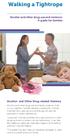 Walking a Tightrope Alcohol and other drug use and violence: A guide for families Alcohol- and Other Drug-related Violence Alcohol and other drug use and family violence often occur together. Families
Addiction takes a toll not only on the
 FAMILY PROGRAM Addiction takes a toll not only on the individual, but on the family, as well. When using, addicts are selfish and selfcentered; their wants and needs are placed ahead of the ones they love.
Physicians in Couples Counseling
 Physicians in Couples Counseling I am a psychotherapist in private practice in Toronto. I see many physicians individually in my practice for a multitude of issues. They are a unique population who present
Aggression and Borderline Personality Disorder. Michele Galietta, Ph.D. January 15, 2012 NEA.BPD Call-In Series
 Aggression and Borderline Personality Disorder Michele Galietta, Ph.D. January 15, 2012 NEA.BPD Call-In Series Goals for this Presentation Define Aggression Distinguish Anger from Aggression Discuss Evidence-Based
Antisocial personality disorder
 Page 1 of 7 Diseases and Conditions Antisocial personality disorder By Mayo Clinic Staff Antisocial personality disorder is a type of chronic mental condition in which a person's ways of thinking, perceiving
About Postpartum Depression and other Perinatal Mood Disorders
 About Postpartum Depression and other Perinatal Mood Disorders The entire period of pregnancy up to one year after delivery is described as the perinatal period. Many physical and emotional changes occur
Forgotten Victims of Domestic Violence
 Forgotten Victims of Domestic Violence Emily Catanzarite Domestic Violence Fall 2013 SLAM! Their bedroom door suddenly shuts and I hear the lock turn. The next thing I hear as I pull my blanket around
Study Guide - Borderline Personality Disorder (DSM-IV-TR) 1
 Study Guide - Borderline Personality Disorder (DSM-IV-TR) 1 Pervasive pattern of instability of interpersonal relationships, selfimage, and affects, and marked impulsivity that begins by early adulthood
Healing the Invisible Wound. Recovery and Rehabilitation from a Post Traumatic. Stress Injury. By Dr. Amy Menna
 Healing the Invisible Wound Recovery and Rehabilitation from a Post Traumatic Stress Injury By Dr. Amy Menna Post Traumatic Stress Disorder can affect anyone. It is a term used to describe a reaction to
CHAPTER 6 Diagnosing and Identifying the Need for Trauma Treatment
 CHAPTER 6 Diagnosing and Identifying the Need for Trauma Treatment This chapter offers mental health professionals: information on diagnosing and identifying the need for trauma treatment guidance in determining
Conducting Emotionally Difficult Conversations. John Banja, PhD Center For Ethics Emory University [email protected]
 Conducting Emotionally Difficult Conversations John Banja, PhD Center For Ethics Emory University [email protected] How To Break Bad News Robert Buckman (with contributions by Yvonne Kason). Baltimore:
Developing a Therapeutic Relationship with Clients with Personality Disorders. The Therapeutic Relationship. The Therapeutic Relationship 7/31/15&
 Developing a Therapeutic Relationship with Clients with Personality Disorders Jim Seckman, MAC, CACII, CCS The Therapeutic Relationship The therapeutic relationship, also called the therapeutic alliance,
ADDICTIONS. BEHAVIOURAL Internet Shopping Work Sex Gambling Food. SUBSTANCE - RELATED Alcohol Drugs Medicine Tobacco
 ADDICTIONS BEHAVIOURAL Internet Shopping Work Sex Gambling Food SUBSTANCE - RELATED Alcohol Drugs Medicine Tobacco Addiction is a chronic, relapsing disease affecting the brains's reward, motivation and
Compensation Strategies for Common Challenges after Traumatic Brain Injury
 Compensation Strategies for Common Challenges after Traumatic Brain Injury Annette Pearson MS, LADC, CBIS Vinland National Center [email protected] 1 This is any one of us, with some area(s) of
Critical Incidents. Information for schools from Derbyshire Educational Psychology Service
 Critical Incidents Information for schools from Derbyshire Educational Psychology Service Introduction to Critical Incidents A critical incident (CI) is any event that is unexpected, acute, stressful and
Psychiatric Issues and Defense Base Act Claims. Dr. Michael Hilton
 Psychiatric Issues and Defense Base Act Claims Dr. Michael Hilton Criteria for DSM-IVRPosttraumatic Stress Disorder with changes now in effect with DSM5 a. The person has been exposed to a traumatic event
APPENDIX B. ASSESSMENT OF RISK POSED TO CHILDREN BY DOMESTIC VIOLENCE Anne L. Ganley, Ph.D.
 APPENDIX B ASSESSMENT OF RISK POSED TO CHILDREN BY DOMESTIC VIOLENCE Anne L. Ganley, Ph.D. Assessment of Domestic Violence for Child Protective Services (CPS) Decision Making Guidelines for Interviewing
Trauma and the Family: Listening and learning from families impacted by psychological trauma. Focus Group Report
 Trauma and the Family: Listening and learning from families impacted by psychological trauma Focus Group Report A summary of reflections and remarks made by Baltimore City families impacted by trauma and
Military and Substance Abuse Dr. Amy Menna & Gift From Within
 1 Military and Substance Abuse Dr. Amy Menna & Gift From Within This article is meant to assist soldiers and those who support them to identify the differences between substance abuse and addiction. In
Dr. Elizabeth Gruber Dr. Dawn Moeller. California University of PA. ACCA Conference 2012
 Dr. Elizabeth Gruber Dr. Dawn Moeller California University of PA ACCA Conference 2012 http://www.youtube.com/watch?v=9rpisdwsotu Dissociative Identity Disorder- case presentation Diagnostic criteria Recognize
Erik Erikson (1950, 1963) does not talk about psychosexual Stages, he discusses psychosocial stages.
 Psychodynamic Psyche Psychosexual Stages Unconscious Mind Home Developmental Psychology Erik Erikson Erik Erikson by Saul McLeod published 2008, updated 2013 Erik Erikson (1950, 1963) does not talk about
Conduct Disorder: Treatment Recommendations. For Vermont Youth. From the. State Interagency Team
 Conduct Disorder: Treatment Recommendations For Vermont Youth From the State Interagency Team By Bill McMains, Medical Director, Vermont DDMHS Alice Maynard, Mental Health Quality Management Chief, Vermont
Why Study Psychology at The University of Western Ontario?
 Why Study Psychology at The University of Western Ontario? The Psychology Department at Western has over 50 faculty members representing seven Areas of Research Excellence. They work with talented graduate
ASSERTIVENESS TRAINING: HOW TO BECOME MORE ASSERTIVE IN ORDER TO MAXIMIZE THE CHANCE OF GETTING WHAT YOU WANT
 ASSERTIVENESS TRAINING: HOW TO BECOME MORE ASSERTIVE IN ORDER TO MAXIMIZE THE CHANCE OF GETTING WHAT YOU WANT WHAT IS ASSERTIVENESS? There are three basic interpersonal styles that we can use when interacting
COA/COSA. In this presentation you will receive basic information about alcohol and drug addiction. You will also
 In this presentation you will receive basic information about alcohol and drug addiction. You will also hear about the family dynamics of children of alcoholics and other substance abusers and finally
Impacting the Brain of the Traumatized Child Dave Ziegler, PhD
 Impacting the Brain of the Traumatized Child Dave Ziegler, PhD There is now sufficient information available from research on brain development and brain functioning, as well as the effects of trauma,
ANTISOCIAL PERSONALITY DISORDER
 ANTISOCIAL PERSONALITY DISORDER Antisocial personality disorder is a type of chronic mental illness in which your ways of thinking, perceiving situations and relating to others are dysfunctional. When
7/19/2013. 921: Reactive Attachment Disorder: WELCOME! What s In It For Me? Training Needs? What s do you want to know by the end of this training?
 921: Reactive Attachment Disorder (RAD): WELCOME! Name Tents Name County Number of Children Number of Years as a Resource/Adoptive Parent One thing you want to know about the topic 2 What s In It For Me?