
Guidance on intermediates
|
|
|
- Dortha Gallagher
- 10 years ago
- Views:
Transcription
1 Guidance on intermediates Version: 2 December 2010

2 LEGAL NOTICE This document contains guidance on REACH explaining the REACH obligations and how to fulfil them. However, users are reminded that the text of the REACH regulation is the only authentic legal reference and that the information in this document does not constitute legal advice. The European Chemicals Agency does not accept any liability with regard to the contents of this document. Guidance on intermediates Reference: ECHA-2010-G-17-EN Publ.date: December 2010 Language: EN European Chemicals Agency, Cover page European Chemicals Agency Reproduction is authorised provided the source is fully acknowledged in the form Source: European Chemicals Agency, and provided written notification is given to the ECHA Communication Unit If you have questions or comments in relation to this document please send them (indicating the document reference, issue date, chapter and/or page of the document which your comment refers to) using the Guidance feedback form. The feedback form can be accessed via the ECHA Guidance website or directly via the following link: European Chemicals Agency Mailing address: P.O. Box 400, FI Helsinki, Finland Visiting address: Annankatu 18, Helsinki, Finland

3 PREFACE This document describes when and how the specific provisions for the registration of intermediates under REACH can be used. It is part of a series of guidance documents that are aimed to help all stakeholders with their preparation for fulfilling their obligations under the REACH regulation. These documents cover detailed guidance for a range of essential REACH processes as well as for some specific scientific and/or technical methods that industry or authorities need to make use of under REACH. The guidance documents were drafted and discussed within the REACH Implementation Projects (RIPs) led by the European Commission services, involving all stakeholders: Member States, industry and non-governmental organisations. After acceptance by the Member States Competent Authorities the guidance documents had been handed over to ECHA for publication and further maintenance. Any updates of the guidance are drafted by ECHA and are then subject to a consultation procedure, involving stakeholders from Member States, industry and non-governmental organisations. For details of the consultation procedure, please see: The guidance documents can be obtained via the website of the European Chemicals Agency ( Further guidance documents will be published on this website when they are finalized or updated. This document relates to the REACH Regulation (EC) No 1907/2006 of the European Parliament and of the Council of 18 December Corrigendum to Regulation (EC) No 1907/2006 of the European Parliament and of the Council of 18 December 2006 concerning the Registration, Evaluation, Authorisation and Restriction of Chemicals (REACH), establishing a European Chemicals Agency, amending Directive 1999/45/EC and repealing Council Regulation (EEC) No 793/93 and Commission Regulation (EC) No 1488/94 as well as Council Directive 76/769/EEC and Commission Directives 91/155/EEC, 93/67/EEC, 93/105/EC and 2000/21/EC (OJ L 396, ); amended by Council Regulation (EC) No 1354/2007 of 15 November 2007 adapting Regulation (EC) No 1907/2006 of the European Parliament and of the Council on the Registration, Evaluation, Authorisation and Restriction of Chemicals (REACH), by reason of the accession of Bulgaria and Romania (OJ L 304, , p. 1).

4 Document History Please note: The original document (V.1.1, February 2008) has been largely re-written during the updating and the consultation process with the Partner Expert Group (PEG). The document history therefore only highlights the major changes but does not track single rewording or editorial changes. Version Section Change made Date June Wording has been changed for more consistency with section and for clarification that the registrant can only rely on the confirmation from his customer that the substance is used under strictly controlled conditions A sentence has been added at the end of the last paragraph to give advice to inform non-eu costumers on the RMM. 2 Clarification that the registration is only needed if the substance is not exempted from registration. 2 In the 4 th paragraph a sentence has been added to clarify how registration dossier can be submitted in case a substance is manufactured or imported also for other purposes than only the use as intermediate, or if the manufacture or use(s) are not under strictly controlled conditions. February 2008 February 2008 February 2008 February 2008 At the end of the 4 th paragraph a sentence has been added to explain how the fees will be calculated. 2 In the 3 rd paragraph from bottom of page 12 some words have been added to clarify that the information requirements applies only to the transported intermediates. 2.1 In 2 nd bullet point the reference to EU or non EU sites has been deleted. 2.2 In the classification section, some text has been added to clarify that only classification and no labeling is necessary for intermediates. February 2008 February 2008 February 2008 In addition it has been specified where the risk management measures and the strictly controlled conditions should be reported. 2.3 In the classification section, some text has been added to clarify that only classification and no labeling is necessary for intermediates. February 2008

5 Version Section Change made Date In addition it has been specified where the risk management measures and the strictly controlled conditions should be reported. 2.5 Another bullet point has been added to the 3 rd paragraph to specify what the lead registrant is recommended to submit. 2.7 Some words have been added to clarify when the registration fee will be specified. V Various clarifications, corrections and updates on tasks and obligations, including requirements with regard to classification and labeling. V Some clarification has been added regarding situations where the substance is registered for use as intermediate and for other uses. This clarification includes calculation of fees. V A clarification has been added that the criteria of Article 18(4) can also be used to justify that strictly controlled conditions SCC) for onsite intermediates are in place. V It has been highlighted that the registrant of an intermediate can choose between two registration routes: Article 17/18 route if strictly controlled conditions (including rigorous containment) are in place. Article 10 route, if control of risk is achieved by other means than strictly controlled conditions. V A paragraph has been included that converts the legal text of Article 18(4) into a systematic list of references between the different elements of rigorous containment and the unit operations they are applied to. V The role of PPE within the concept of strictly controlled conditions has been clarified. V Footnote 10 to 12: References to other Community legislation has been updated. V It has been clarified that, although no full documentation of SCC is required in the registration dossier, the registrant should give a basic indication on how his conclusions concerning SCC has been reached. Reference is made to the Appendix 3 in which the registrant can provide details on risk management measures is a structured way. February 2008 February 2008
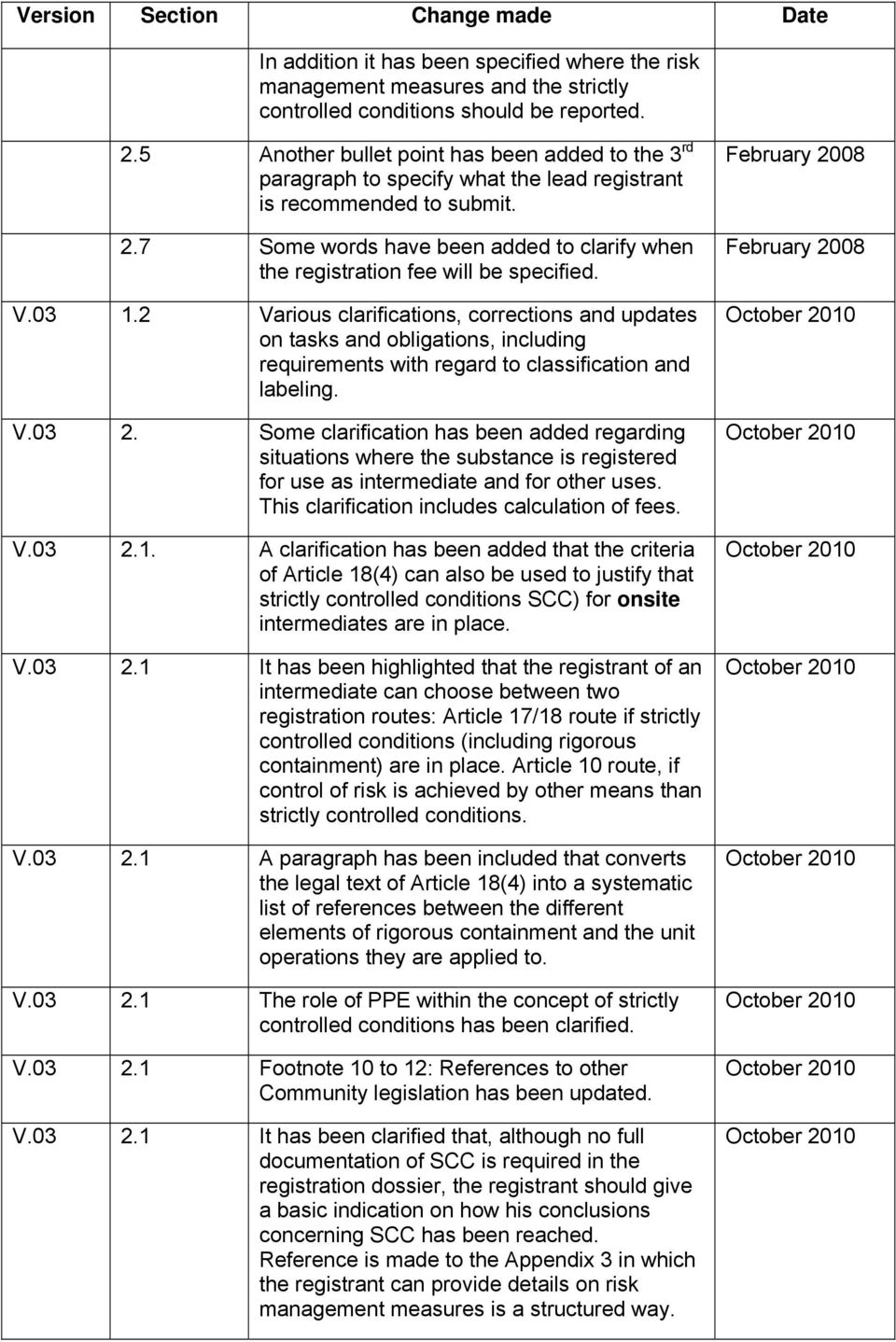
6 Version Section Change made Date V In the list of items for the internal documentation, DNELs and PNECs have been removed, since no CSA is required for isolated intermediates under strictly controlled conditions. V Addition to list of items for documentation: design of process and rigorousness of containment V Addition to list of items for documentation: design of process and rigorousness of containment V Rigorous containment is now more clearly distinguished from minimization of releases by technical and procedural means. V It has been clarified that rigorous containment according to Article 18 (4a) means the technical hardware designed for preventing releases, taking into account the physical-chemical properties of the substance and the process conditions. Containment can be achieved by a combination of mechanical barriers and air dynamic barriers. V The control banding approach has been included into this section as an example how to categorize control-, respectively containment-strategies. For further detailed examples reference is made to the COSHH control guidance sheets. It has been clarified that rigorous containment according to Article 18 (4a) means the technical hardware designed for preventing releases, taking into account the physico-chemical properties of the substance. V New example box (2) for containment strategies has been inserted, including references for sources for further information. Measures related to 18 (4b) have been removed from the example box for the pharmaceutical industry (3). Some example for measures have been newly included (e.g. soft wall isolator) New example box (6): Railway loading and unloading in chemical industry New example box (7): Storage tanks, loading and unloading of volatile liquid substances.

7 Version Section Change made Date V All mentioning of open processes in context of rigorous containment has been removed from the section At the end of section 2.1.1, a paragraph has been added on the role of measured or modeled release/exposure data and the role of the available knowledge on the intermediates intrinsic hazards in designing the rigorous containment. All other mentioning of hazard information, risk considerations and exposure data spread across the previous version of the document has been removed. V It has been clarified that procedural and control techniques are to be applied on top of rigorous containment, in order to minimize residual releases. A reference to the relevant BREF document has been added. V.03 Examples The example box on technical measures to control releases to the environment has been shifted from to Also it has been clarified that WWTP may or may not fulfill the SCC requirement, depending on the properties of the intermediate. V A reference to the BREF document on waste and waste water treatment in the chemicals industry has been included. V A summary of principles for strictly controlled conditions under REACH has been included as a new section. V A clarification has been added that the absence of a confirmation of SCC for transported isolated intermediates triggers the duty to register via the Article 10 route. V A reference to section 8.2 of REACH Annex II has been included (consistency between risk management measures in the safety data sheet and the conditions based on which the registration under Article 17 and 18 is justified. V.03 Appendix 1 Various additions and refinements in order to bring the Appendix closer to the legal text. V.03 Appendix 3 New: Format for documenting information on risk management measures in the registration dossier for onsite and transported intermediates

8 Version Section Change made Date V.03 Appendix 4 New: Definition of intermediates as agreed between Commission,Member States and ECHA on 4 May 2010 V Restructuring of registration obligations and exemptions V Restructuring of registration obligations and exemptions November 2010 November 2010 V.04 2 Deletion of repetitive information November 2010 V Minor additions and refinements November 2010 V Similar to section 2.3 the reference to Commission Regulation 453/2010 has been included. V A phrase is added (second bullet point on notification) November 2010 December 2010 V Refinement of phrase. December 2010 V The paragraph referring to hazardous properties is deleted. V The paragraph referring to hazardous properties is deleted. December 2010 December 2010

9 TABLE OF CONTENTS 1 INTRODUCTION Definition of the different categories of intermediates Tasks and obligations Non isolated intermediates On-site isolated intermediates Transported isolated intermediates REGISTRATION OF ISOLATED INTERMEDIATES Strictly controlled conditions Rigorous containment of the substance by technical means Procedural and control technologies to minimise emission and any resulting exposure Handling of the substance by trained personnel Cases of accident and where waste is generated Management Systems Summary of principles Registration requirements for on-site isolated intermediates Registration requirements for transported isolated intermediates Preparation of a registration dossier for isolated intermediates Joint submission of data on isolated intermediates by multiple registrants Time lines Registration fee APPENDIX 1: Illustrative List of Issues that may be taken into Consideration for Checking that the Isolated Intermediates are Manufactured and Used Under Strictly Controlled Conditions...26 APPENDIX 2: Example of Format for Documenting In-House Information on Strictly Controlled Conditions of Isolated Intermediates...28 APPENDIX 3: Format for Documenting Information on Risk Management in a Registration Dossier for Isolated Onsite and Transported Intermediates...30 APPENDIX 4: Definition of Intermediates as agreed by Commission, Member States and Echa on 4 May

10 1 INTRODUCTION 1.1 Definition of the different categories of intermediates REACH defines an intermediate as a substance that is manufactured for and consumed in or used for chemical processing in order to be transformed into another substance (Article 3(15)). Different types of intermediates are defined under REACH: Non-isolated intermediates Isolated intermediates On-site (non transported) isolated intermediates Transported isolated intermediates A non-isolated intermediate is an intermediate that during synthesis is not intentionally removed (except for sampling) from the equipment in which the synthesis takes place. Such equipment includes the reaction vessel, its ancillary equipment, and any equipment through which the substance(s) pass(es) during a continuous flow or batch process as well as the pipework for transfer from one vessel to another for the purpose of the next reaction step, but it excludes tanks or other vessels in which the substance(s) are stored after the manufacture (Article 3(15)(a)). On-site isolated intermediate means an intermediate not meeting the criteria of a nonisolated intermediate and where the manufacture of the intermediate and the synthesis of (an)other substance(s) from that intermediate take place on the same site, operated by one or more legal entities (Article 3(15)(b)). A site means a single location, in which, if there is more than one manufacturer of (a) substance(s), certain infrastructure and facilities are shared (Article 3(16)). A transported isolated intermediate is an intermediate not meeting the criteria of a nonisolated intermediate and transported between or supplied to other sites (Article 3(15)(c)). The circumstances under which a substance may or not be regarded as an intermediate under REACH are clarified in document Definition of intermediates as agreed by the Commission, Member States and ECHA on 4 May This definition is the starting point of this guidance. The document is attached in Appendix 4 to the current guidance. Depending on the identified intermediates different obligations and information requirements apply (see section 1.2.2)

11 The lifecycle of an isolated intermediate begins with its manufacture (in practical terms, with its removal from the manufacturing process). This lifecycle ends with the use of the substance in the synthesis process for the manufacture of another substance. Residues of the isolated intermediate, which are not transformed into another substance in a manufacturing process, will be typically discarded or disposed of as waste and channelled into waste management when not recycled as a non-isolated or isolated intermediate. Consequently, they no longer fall in the scope of REACH. Where residues of the intermediate are found in the synthesised substance, they are covered as an impurity - by the registration and evaluation of that other substance. 1.2 Tasks and obligations Non isolated intermediates For the use of a substance as a non-isolated intermediate, there are no obligations under REACH (Article 2(1)(c)) On-site isolated intermediates Manufacturers of on-site isolated intermediates in quantities of 1 tonne or more per year need to submit a registration dossier unless the substance is exempted from the registration provisions (see further information on the scope of REACH in section 1.6 of the Guidance on registration). The information to be submitted for standard registration purposes (other than registration as an intermediate) is listed under Article 10 and detailed in section of the Guidance on registration. However registrants of on-site isolated intermediates can provide reduced registration information according to Article 17(2) if they confirm that the substance is manufactured and used under strictly controlled conditions as described under Article 17(3) and section 2.1 of this guidance. Registration obligations and exemptions Article 2(8) exempts intermediates from the general registration regime referred to in chapter 1 of Title II of REACH. Instead a manufacturer of an on-site isolated intermediate has to register his substance in quantities of 1 tonne or more per year under a different regime, as specified in chapter 3 of Title II of REACH. In the case that a notification under Directive 67/548/EEC had been submitted by the manufacturer/importer of an onsite isolated intermediate, no registration is required; the substance is considered as registered and a registration number is assigned by the Agency (Article 24). If the manufacturer confirms in his IUCLID registration dossier that the on-site isolated intermediate is manufactured and used under strictly controlled conditions (see section 2.1), the information requirements on the substance intrinsic properties (physicochemical, human health and environment properties) are reduced to already available data (e.g. information he holds himself or that he can obtain from other sources) and only study summaries have to be submitted even if a full study report is available (Article 17) (see 2.2). 3

12 For monomers that are used as on-site isolated intermediate in the production of polymers the reduced registration provisions for intermediates do not apply (Article 6(2)), and the manufacturer has to proceed as for a "standard", nonintermediate, use (see Guidance on registration). If strictly controlled conditions are not met, a full (standard) data package is required depending on the tonnage level (Articles 10 & 12), and above 10 t/a a chemical safety assessment is required. This includes situations where the update of a dossier leads to such a situation. If a substance is no longer used by a registrant as an intermediate only and/or the registrant can no longer confirm that the substance is manufactured and used under strictly controlled conditions, the registration dossier will need to be updated according to Article 22 (1) without undue delay to include, depending on the tonnage band within which the substance is registered, all the information required by Articles 10 and 12. Classification and labelling If the on-site isolated intermediate is a substance to be registered the manufacturer must notify to the Classification & Labelling Inventory established at the Agency the information related to its classification and labelling in accordance with Article 39 (a) and Article 40 of Regulation (EC) No 1272/2008 if he places the intermediate on the market (i.e. he makes it available to another legal entity on the same site or another site). Notification can be done either by sending a separate notification to the Inventory or through inclusion of the relevant information, i.e. the CLP classification and labelling elements, in a registration dossier where this is required. In general, a separate notification will always have to be submitted where the notification is legally due before the registration is submitted. Once a registration dossier is submitted, a separate notification is no longer possible. Where that registration dossier still contains the DSD classifications, the manufacturer or importer would have to update it with the CLP information without undue delay, in accordance with REACH Article 22. If the on-site isolated intermediate is a substance manufactured at less than one ton per year, the manufacturer must notify to the Agency the information related to its classification and labelling in accordance with Article 39 (b) of Regulation (EC) No 1272/2008 if: he places the intermediate on the market (i.e. he makes it available to another legal entity on the same site), and the substance meets the criteria for classification as hazardous. Notification to the Inventory has to be done by 3 rd January 2011 for on-site isolated intermediates that had been placed on the market on 1 December 2010 or, for intermediates that are placed on the market only later than 1 December 2010, within one month of placing them on the market (Article 40 (3) of Regulation (EC) No 1272/2008). Further clarification in relation to notification of the classification and labelling can be found in ECHA s Practical Guide 7 How to notify substances to the Classification and Labelling Inventory 3. In addition one can consult ECHA s Introductory Guidance on the CLP Regulation

13 Dossier and substance evaluation For on-site isolated intermediates, manufactured and used under strictly controlled conditions in accordance with Article 18 (4), dossier and substance evaluation do not apply (Article 49). However the Member State Competent Authority (MSCA) where the manufacturing site is located may request additional information when it considers that: Authorisation/Restriction there is a risk to human health or the environment equivalent to the level of concern arising from the use of a substance of very high concern (substances meeting the criteria in Article 57), and that the risk is not properly controlled (Article 49). Any use of a substance as an on-site isolated intermediate is not subject to authorisation (i.e. Title VII Authorisation - does not apply) (Article 2 (8)(b)).This is also valid for intermediates used as monomers for the synthesis of polymers). Any manufacturer, importer or user must check whether an intermediate is covered by any restriction in Annex XVII of REACH (Article 67) Transported isolated intermediates Manufacturers or importers of transported isolated intermediates in quantities of 1 tonne or more per year need to submit a registration dossier unless the substance is exempted from the registration provisions (see further information on the scope of REACH in 1.6 of the Guidance on registration). The information to be submitted for standard registration purposes (i.e. reduced requirements due to strictly control conditions being in place do not apply) is listed under Article 10 and detailed in section of the Guidance on registration. However, a registrant of transported isolated intermediates can provide reduced registration information according to Article 18(2) if he confirms in his IUCLID registration dossier that he is manufacturing and/or using the substance under strictly controlled conditions, and if he declares in his IUCLID registration dossier that he has received confirmation from all the users further down the chain that the substance is used under strictly controlled conditions as described under Article 18(4) and section 2.1 of this guidance. In that case both the registrant and the users are each liable for their own statement regarding the strictly controlled conditions. Registration obligations and exemptions Article 2(8) exempts intermediates from the general registration regime referred to in chapter 1 of Title II of REACH. Instead, a manufacturer or importer of a transported isolated intermediate has to register his substance in quantities of 1 tonne or more per year under a different regime, as specified in chapter 3 of Title II of REACH. When manufactured and used under strictly controlled conditions and the annual quantity of substance is 1000 tonnes or more, the data requirements on the substance's intrinsic properties (physicochemical, human health and environment properties) as specified in Annex VII must be included in addition to the information required under chapter 3 of title II of REACH. If a notification under Directive 67/548/EEC covering manufacture/import and the relevant use has already been submitted by the manufacturer/importer, no registration is required. The substance is considered as registered and a registration number is assigned by the Agency. However, if the quantity of the 5

14 notified substance reaches the next tonnage threshold under Article 12 of the REACH Regulation, the additional required information shall be submitted (Article 24). If the manufacturer or importer confirms that he is manufacturing and/or using the substance under strictly controlled conditions and he confirms himself or states that he has received confirmation from the users that the substance is used under strictly controlled conditions (section 2.1) and the annual quantity of substance is less than 1000 tonnes, the information requirements on the substance's intrinsic properties (physicochemical, human health and environment properties) are reduced to existing available data (e.g. information he holds himself or that he can obtain from other sources) and only study summaries have to be submitted even if a full study report is available (Article 18) (see 2.3). For monomers that are used as transported isolated intermediate for the production of polymers the reduced registration provisions for intermediates do not apply (Article 6 (2)), and the manufacturer has to proceed as for a "standard" substance (see Guidance on registration) 5. Where strictly controlled conditions cannot be confirmed, a full (standard) data package is required depending on the tonnage level (Articles 10 & 12), and above 10 t/a a chemical safety assessment is required. If a substance is no longer used by a registrant as an intermediate only and/or the registrant can no longer confirm that the substance is manufactured and used under strictly controlled conditions, the registration dossier will need to be updated according to Article 22 (1) without undue delay to include, depending on the tonnage band within which the substance is registered, all the information required by Articles 10 and 12. If the transported intermediate passes the 1000 t/y threshold, then the manufacturer/importer has to update the registration dossier and submit as a minimum the information required under Annex VII Classification and labelling If the transported isolated intermediate is a substance to be registered the manufacturer/ importer must notify to the Agency the information related to its classification and labelling in accordance with Article 39(a) and Article 40 of Regulation (EC) No 1272/2008 if: he places the substance on the market (i.e. he makes it available to another legal entity on the same site or on another site), and he has not already submitted a registration. Notification can be done either by sending a separate notification to the Inventory or through inclusion of the relevant information, i.e. the CLP classification and labelling elements, in a registration dossier where this is required. In general, a separate notification will always have to be submitted where the notification is legally due before the registration is submitted. Once a registration dossier is submitted, a separate notification is no longer possible. Where that registration dossier still contains the DSD classifications, the manufacturer or importer would have to update it with the CLP information without undue delay, in accordance with REACH Article

15 If the transported isolated intermediate is a substance manufactured at less than one ton per year, the manufacturer must notify to the Agency the information related to its classification and labelling in accordance with Article 39(b) of Regulation (EC) No 1272/2008 if: he places the substance on the market (i.e. he makes it available to another legal entity on the same site or on another site), and the substance meets the criteria for classification as hazardous. Notification to the Inventory has to be done by 3 rd January 2011 for transported isolated intermediates that had been placed on the market on 1 December 2010 or, for intermediates that are placed on the market only later than 1 December 2010, within one month of placing them on the market (Article 40 (3) of Regulation (EC) No 1272/2008). Further clarification in relation to notification of the classification and labelling can be found in ECHA s Practical Guide 7 How to notify substances to the Classification and Labelling Inventory 6. In addition one can consult ECHA s Introductory Guidance on the CLP Regulation 7. Dossier and substance evaluation Manufacturer / importer must be aware that dossier and substance evaluation apply to transported isolated intermediates. Therefore, the Agency or, if there is no agreement between MSCA, the Commission may request additional information when it is conducting an evaluation. The manufacturer/importer must comply with any such request within the deadline set (see the Guidance on evaluation). Authorisation/Restriction Any use of a substance as a transported isolated intermediate is not subject to authorisation (i.e. Title VII Authorisation - does not apply) (Article 2(8)(b)). This is also valid for intermediates used as monomers for the synthesis of polymers. Any manufacturer/importer or downstream user must check whether an intermediate is covered by any restriction in Annex XVII of REACH (Article 67)

16 2 REGISTRATION OF ISOLATED INTERMEDIATES This guidance is intended to support registrants of isolated intermediates in assessing whether the conditions of manufacture and use fulfil the requirements for an isolated intermediate registration set out in Articles 17(3) or 18 (4). Also, the guidance includes three annexes describing the content and the format for documenting that strictly controlled conditions apply. The first task for the registrant is therefore to determine if the substance under investigation is an isolated intermediate manufactured and used under strictly controlled conditions and whether it is transported or not, in order to identify the information he has to provide in a registration dossier to fulfil his obligations 8. If the manufacturer or importer of a substance manufactures or imports the substance for other purposes than only the use as an intermediate, or if the manufacture or certain use(s) cannot be demonstrated as being carried out under strictly controlled conditions, then the manufacturer or importer needs to submit a standard registration dossier according to Article 10. In this situation, if part of the tonnage is manufactured and used as an intermediate under strictly controlled conditions, the registrant can submit one registration dossier covering all his tonnage. o The information requirements for this registration dossier are then based on the tonnage for non-intermediate uses and for intermediates not used under strictly controlled conditions. The part of the tonnage manufactured or imported for use an intermediate under strictly controlled conditions will not need to be taken into account for the information requirements of the registration dossier. For determination of the registration date all produced volumes of the substance regardless of the substance's use (intermediate, intermediate under SCC, and non-intermediate uses) shall be taken into account o o Nevertheless the use as intermediate should be documented in the dossier, including the volume manufactured or imported for this purpose. The fees will be calculated independently for i) the use as intermediate under strictly controlled conditions (fees for intermediates pursuant to Article 4 of Regulation (EC) No 340/2008) and ii) for the other uses (standard fees pursuant to Article 3 of Regulation (EC) No 340/2008). 8 It should be noted, though, that monomers used as on-site isolated intermediates or transported isolated intermediates do not benefit from the exemption from standard registration requirements which normally applies to intermediates and have to be registered following the registration requirements described in Article 10 (Article 6(2)). Therefore for the registration of monomers the Guidance on registration 8 has to be used (see also section and 1.1.3). 8

17 Example 1 of a substance both used as isolated intermediate and non-intermediate A company manufactures 2300 tonnes of substance A, of which 1700 tonnes are used as intermediate in strictly controlled conditions. This company will submit a standard registration dossier for substance A, where the volume of the remaining 600 tonnes not used as intermediate is used to determine the information requirements. This means that the information requirements for t substances will be used as a basis for this standard dossier. The fact that the substance is also used as an intermediate should be indicated in the dossier and the volume of 1700 tonnes used as intermediates will need to be documented in the dossier. If the manufacturer or importer of the substance manufactures or imports it only for the use as an isolated intermediate under strictly controlled conditions (see 2.1), then the manufacturer or importer can submit a registration dossier with reduced information requirements (according to Articles 17 and 18) as described in section 2.2 and section 2.3. More guidance on how to calculate the tonnage is given in the Guidance on registration. The data requirements for the registration of isolated intermediates manufactured in quantities of 1 tonne or more per year may differ for on-site and transported isolated intermediates (see section and 2.2 for on-site isolated intermediates and section and 2.3 for transported isolated intermediates). For transported intermediates, those requirements depend on the manufactured or imported volume which is transported. In case of a transported isolated intermediate in quantities of more than 1000 tonnes per year, also the information specified in Annex VII of REACH should be included (Article 18(3)). 2.1 Strictly controlled conditions For both on-site and transported isolated intermediates the possibility to provide a reduced set of information for their registration applies when: For on-site isolated intermediates, the manufacturer confirms that the substance is only manufactured and used under strictly controlled conditions (Article 17(3)). For transported isolated intermediates, the manufacturer or importer confirms himself or states that he has received confirmation from the user that the synthesis of (an)other substance(s) from that intermediate takes place on other sites under strictly controlled conditions detailed in Article18(4). For transported isolated intermediates that are manufactured in the EU the strictly controlled conditions shall apply both to the manufacture and use of the substance. Therefore, in order to benefit from the reduced registration requirements the registrants have to first assess if their intermediates are handled under strictly controlled conditions on the sites of manufacture and use. When compiling the registration dossier using IUCLID5 9, the registrant should then include a confirmation in the dossier that the substance is manufactured and used under strictly controlled conditions (see section 2.4). 9 International Uniform Chemical Information Database 9
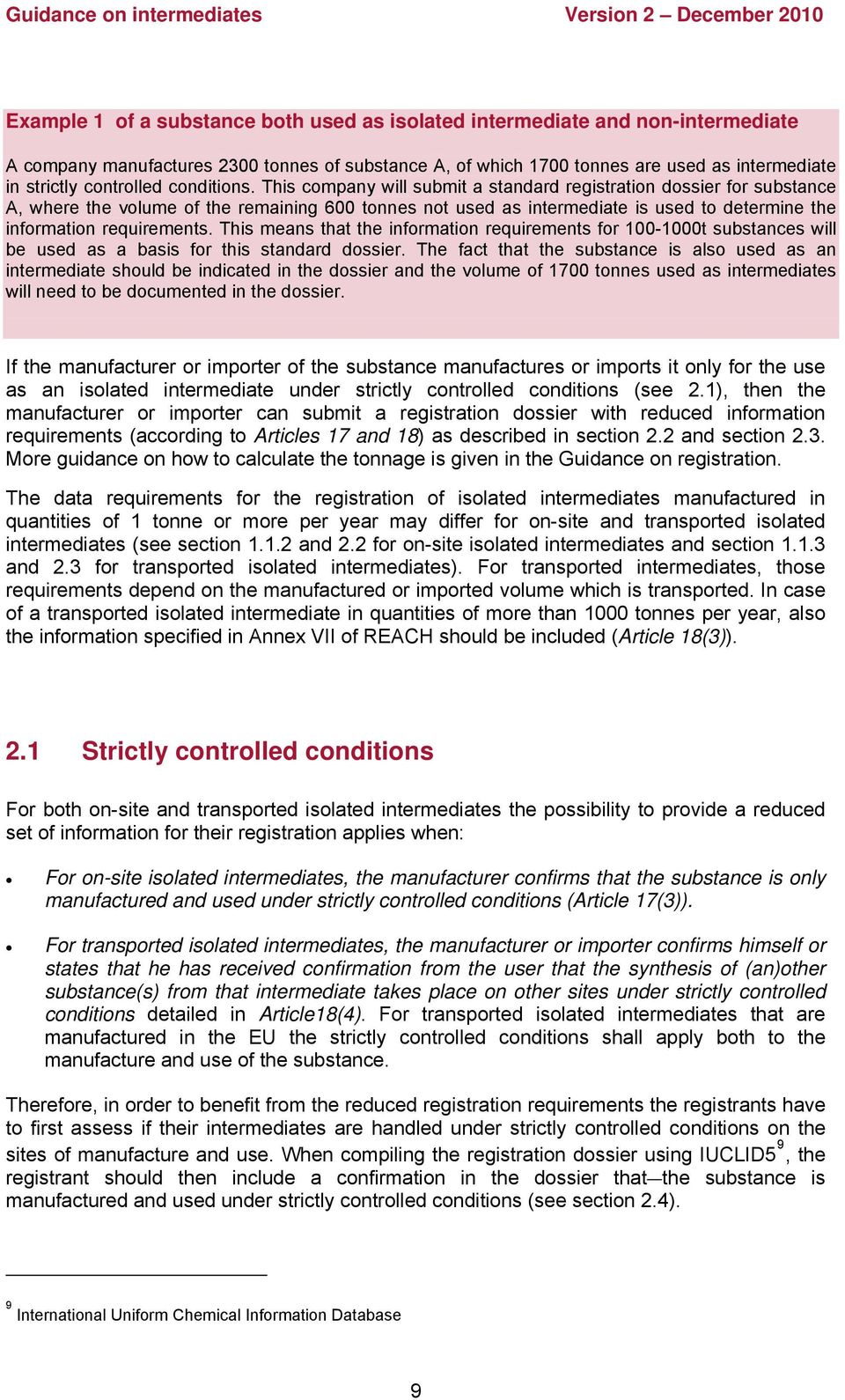
18 The definition of strictly controlled conditions in Article 18(4) for transported isolated intermediates can also be used as a working basis for isolated on-site intermediates. Article 18(4) provides a wider definition of strictly controlled conditions than Article 17(3), the latter being limited to criteria (a) and (b) of the above list. Nevertheless criteria (c) to (f) are also considered appropriate for on-site isolated intermediates, in deciding whether strictly controlled conditions apply. To assess if the intermediate is manufactured and used under strictly controlled conditions during its whole lifecycle, the registrant should evaluate if all the Article 18(4) conditions apply: (a) the substance is rigorously contained by technical means during its whole lifecycle including manufacture, purification, cleaning and maintenance of equipment, sampling, analysis, loading and unloading of equipment or vessels, waste disposal or purification and storage; (see chapter 2.1.1); (b) procedural and control technologies shall be used that minimise emission and any resulting exposure; (see chapter 2.1.2); (c) only properly trained and authorised personnel handle the substance; (see chapter 2.1.3); (d) in the case of cleaning and maintenance works, special procedures such as purging and washing are applied before the system is opened and entered; (e) in cases of accident and where waste is generated, procedural and/or control technologies are used to minimise emissions and the resulting exposure during purification or cleaning and maintenance procedures; (see chapter 2.1.4); (f) substance-handling procedures are well documented and strictly supervised by the site operator. For both types of isolated intermediate, the registrant has two possibilities based on the assessment and description of the conditions under which the substance is manufactured and/or used: Submit a registration dossier containing the limited set of data requested for intermediates, provided that he concludes that the substance is manufactured and used) under strictly controlled conditions. In this case, the dossier must contain details on risk management measures applied by the manufacturer (Article 17.2(f) and Article 18.2 (f)) and information on risk management measures recommended to the user (for transported isolated intermediates Article 18.2 (f)). Submit a standard registration dossier as described in Article 10, if he is not able to demonstrate that the substance is manufactured and used under strictly controlled conditions. In case any of the requirements for Article 18.4 (a) to (f) are not met, the registration shall include all the information required by Article 10.It is important to note that absence of rigorous containment or absence of minimisation of release cannot be justified with a risk characterisation ratio. Strictly controlled conditions should be seen as a combination of technical measures that are underpinned by operating procedures and management systems. Following Article 18 (4), strictly controlled conditions must include the following elements: 10
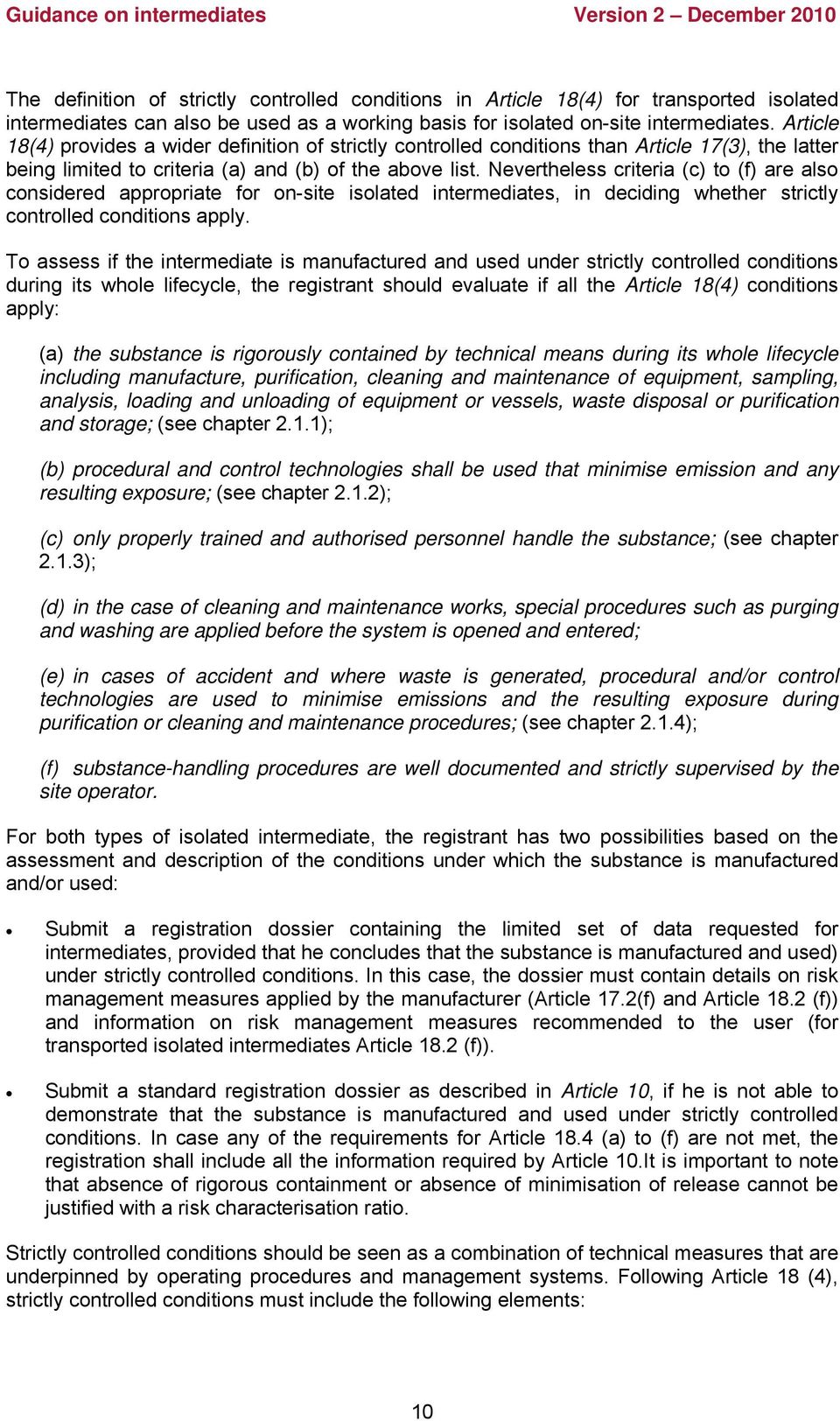
19 Technical means ensuring rigorous containment during the whole lifecycle including the following activities (Article 18 (4) (a)) o Manufacture and purification o Cleaning and maintenance of equipment o Sampling and analysis o Loading and unloading of equipment or vessels o Waste disposal o Storage Procedural and control technologies applied to minimise emissions (Article 18 (4) (b) and (e)) o residual emissions from rigorous containment o emissions from purification, cleaning, maintenance after accidents o emissions from purification, cleaning and maintenance where waste is generated Special procedures before entering the system (Article 18 (4) d) Trained and authorised personnel (Article 18 (4) (c) Procedures well documented and supervised (Article 18 (4) (f)) This approach to managing potential risks to human health and the environment aligns with, and also acknowledges, the existing regulatory obligations that impact on manufacturers of substances (e.g. control of accidents under Directive 96/82/EC 10, Integrated Pollution Prevention and Control under Directive 2008/1/EC 11, occupational protection under the Chemical Agents Directive 98/24/EC 12 ). Rigorous containment by technical means aims to prevent releases by technical design of the process or product. The physico-chemical properties of the substance and the processing conditions (such as temperature and pressure) may have an impact on the level and type of containment measures that are required. It should be emphasized that strictly controlled conditions must be achieved without taking into account the use of personal protective equipment (PPE) except for the exceptional situations hereunder (accidents, incidents, maintenance and cleaning). PPE can only be part of the strictly controlled concept as far as it aims at limiting exposure resulting from: Accidents and incidents that may occur despite appropriate management systems and operational procedures to prevent such incidents and accidents. Maintenance and cleaning works, providing that special procedures such as purging and washing are applied before the system is opened or entered. Full documentation of the strictly controlled conditions in place is not required in the registration dossier, however the registrant should give a basic indication on how the conclusion concerning strictly controlled conditions are reached. A format for documenting information on risk management in a registration dossier is given in Appendix 3. Nevertheless, there should be detailed internal documentation within a company in order to 10 Council Directive 96/82/EC of 9 December 1996 on the control of major-accident hazards involving dangerous substances. 11 Council Directive 2008/1/EC of the European Parliament and of the Council of 15 January 2008 concerning integrated pollution prevention and control). 12 Council Directive 98/24/EC of 7 April 1998 on the protection of the health and safety of workers from the risks related to chemical agents at work. 11

20 demonstrate that strictly controlled conditions apply throughout the whole life cycle of the intermediate. The national enforcement authorities may request such information. Note that where relevant documentation for compliance with other legislative frameworks can also be referred to. The detailed internal documentation within the company should at least include: justification for considering that the substance is used as an intermediate and customers statements concerning the use as an intermediate and the fulfilment of strictly controlled conditions in case of a transported isolated intermediate; the physical chemical properties of the intermediate relevant for deciding on measures to ensure that strictly controlled conditions apply; documentation on the design of the process and the equipment, especially those aspects contributing to the rigorous containment of the substance by technical means; the relevant operating conditions; measures corresponding to the requirements set out in article 18(4) (b) to (f) implemented by the manufacturer company and recommended to users; information on any residual release and resulting exposure that occurs in spite of the rigorous containment measures by technical means; and available relevant physico chemical toxicological and eco-toxicological information and any relevant reference or threshold value (e.g. community Occupational Exposure Limits (OELs). To facilitate the process for assessing whether strictly controlled conditions are achieved, Appendix 1 presents an indicative and non-exhaustive list of issues that could be considered. This list is intended to support a structured assessment and documentation by the registrant to decide if strictly controlled conditions apply. For this considerable input by experts (e.g. site managers, engineers) will be needed. It should be noted that the registrant of a transported isolated intermediate does not need to get access to confidential business information (e.g. fine detail of process technology and/or engineering, etc) from the user(s). This is because the user is responsible for ensuring that they use the intermediate under strictly controlled conditions and to confirm this to the registrant. An example of a general format to document how the substance is manufactured and used under strictly controlled conditions is provided in Appendix 2. This would contain information and justifications for the issues addressed in Appendix 1. Note that any information produced for the purpose of other legislation (e.g. for worker protection) can also be used as an element to demonstrate that strictly controlled conditions apply. Information on details of the risk management measures applied at the manufacturing site and recommended to the user in order to achieve strictly controlled conditions, have to be included in the registration dossier. Existing legislative frameworks or industry standards can be referred to when documenting such risk management measures. The format in Appendix 3 is recommended to explain the risk management measures in the registration dossier. It should be attached to the IUCLID section 13 with the file name RMM_details. 12

21 2.1.1 Rigorous containment of the substance by technical means Rigorous containment is achieved by the technical design of a process and the equipment which aims at preventing releases. The physico-chemical properties of a substance are one factor to take into account in determining the right design to achieve rigorous containment, together with the process conditions if this is relevant. Rigorous containment is applicable to handling of intermediates at any scale. Release of the substance should be prevented through containment systems, such as combinations of suitable mechanical barriers (e.g. enclosures) and air dynamic barriers (e.g. Local Exhaust Ventilation (LEV ) as integrated part of the containment and differential pressure). According to Article 18 (4): the substance is rigorously contained by technical means during its whole lifecycle including manufacture, purification, cleaning and maintenance of equipment, sampling, analysis, loading and unloading of equipment or vessels, waste disposal or purification and storage. To be able to confirm and document the rigorous containment of the substance, the registrant should characterise the process conditions and the equipment used during the whole life-cycle of the substance, taking into account the physical-chemical properties of the substance. The description of these technical means and conditions should allow the identification of potential residual exposure of workers and the environment to the substance. It should for instance specify the means of rigorous containment for the different functional elements (pressurised vessels, seals, sacks, containers, drums, etc.) involved during the whole process such as manufacture, transfer (filling, emptying, etc.) or sampling of the substance when potential residual emission could be expected to the workplace or the environment. Within a rigorously contained overall process, different containment strategies may be used for different processing steps. For example, containment measures for i) batch filling and emptying of equipment (via hose lines, pipe joints), ii) for sampling (transfer from one container to another container via closed sampler), iii) for cleaning and maintenance and iv) for transfer and management of the isolated intermediate in bulk through pipelines and dedicated bulk storage facilities can be different from each other. Examples of technical measures that could be implemented in order to ensure rigorous containment are given in examples 2 to 7 for worker and environmental protection in different industrial sectors. Those examples are in no way binding or exhaustive but illustrate the types of measures or some specific unit operations (e.g. loading/unloading and substance handling) that can be applied. Example 2 illustrates how to systematically determine a suitable containment strategy based on the control banding approach as outlined in the book Containment systems - A design guide, edited by Nigel Hirst, Mike Brocklebank, Martyn Ryder, published by Institution of Chemical Engineers (IChemE) UK, The Control Banding Approach in example 2 comprises 5 levels of control. Strategy 1 represents the lowest level of control (not regarded as rigorous containment), the only technical measure in place is general ventilation. In containment level 2, LEV is applied, but the LEV is not further integrated into a system of mechanical barriers. Since the substance is still manipulated directly and thus PPE may be required, in general, level 2 does not constitute rigorous containment. However, LEV can be an integrated part of the containment strategy 3, requiring partial or full mechanical enclosure in addition. The following illustration of strategy mentions glove-ports and direct coupling, other technical solutions however, exist as well. The level of enclosure by mechanical barriers increases from strategy 3 to strategy 5 which represents a very high level of containment requiring a fully automated enclosed process. Each level of containment is supported by a corresponding containment strategy that provides 13
22 clear practical advice on design and process equipment, maintenance, access, examination and testing, cleaning and housekeeping, personal protective equipment, training and supervision. In other words, the containment strategy defines the criteria for rigorous containment at a practical level. Example 2: Containment strategies for handling of substances (example of technical measures). For illustration see enclosed 5 principal schemes reflecting the different strategies. (Source: Hirst H., Brocklebank M., Ryder M. (Eds), Containments Systems- A Design guide, Institution of Chemicals Engineers (IChemE),
23 Note: Illustrative examples regarding the technical implementation of these strategies can be found in the COSHH control guidance sheets
24 Example 3: Pharmaceutical industry: examples of technical measures for workers and environmental protection Containment is implemented to prevent exposure of the worker and the environment. The design and selection of control technologies and equipment is based upon a set of performance based criteria. The selection of control measures aim to control and prevent emissions at source. Examples of technical measures may include: Transfers using direct coupling and closed systems, such as: Vertical process trains Special valves such as split butterfly type Vacuum transfer Totally enclosed processes; transfers using direct coupling; barrier/isolator technology, such as: Isolation technology e.g. isolators Intermediate bulk containers with split butterfly valves Soft Wall Isolators (Glove bags) Alpha Beta Rapid Transfer systems on enclosures Specialized vacuum transfer systems Example 4: Petrochemical Industry: example of technical measures for workers and environmental protection Bulk petrochemical intermediates will invariably be handled in a chemical plant of a high integrity that is designed to minimise potential for emissions to air and water. Typical examples of control measures and systems in place to deliver such strictly controlled conditions include: Enclosed transfers designed to prevent leaks e.g. self-draining transfer lines High integrity methods of material loading and unloading (e.g dry lock couplings, vapour capture and recovery) Plant designed to facilitate the draining and flushing of plant equipment items prior to maintenance, with recycle and/or suitable disposal of wastes High integrity (low emission) valve packing and flange seals In-line process controls and/or contained systems for process sampling Low emission pumps e.g. canned, magnetic, mechanical seals Routine monitoring and inspection for leaks to reduce fugitive emissions Example 5: Fine chemicals industry: examples of technical and organizational measures for workers and environmental protection Handling intermediates in batch fine chemicals facilities will require that the plant engineering and systems are designed to prevent emissions to air and water. Typical examples of control measures and systems which might be encountered to deliver such strictly controlled conditions include: Material transfers via enclosed systems (e.g. semi-bulk containers such as IBCs) Enclosed and vented charging systems (e.g. bag slitters with integral package disposal) Reaction vessel held by under-pressure (negative pressure). Exhaust air filtered and subsequently incinerated. Vessels connected via fixed pipes. 16
25 Discharging arrangements designed to minimise emissions (e.g. into drums/kegs via pneumatic filling heads and continuous liners;, connection of big bags done in a full enclosure (e.g. glove box.) Use of containers fitted with inliners for intermediate packaging and transport. Plant designed to facilitate the draining and flushing (and detoxification) of equipment items prior to maintenance Maximal use made of automated process control systems to minimise manual interventions Contained process sample systems (e.g. vented cabinets or sample bombs) Loading/unloading in a closed collection pan to prevent spillage into waste water Example 6: Chemical industry: railway car loading and unloading of liquid products Loading and unloading of railway car of liquid, volatile, products. The substance is stored into storage tanks and loaded into railway cars in order to be transported to another production site. Railway cars are loaded through connection arms. Informatic control system exists in order that loading can start only when the arm is well connected. At the end before disconnection, purge of arms is performed with N2 and gaseous substance is sent back to the tank as well as liquid phase in order to be recycled. Arm in aval is purged into a container which is re-injected into the unit through flexible hoses. Flexibles are cleaned and water is collected for treatment. OC & SCC implemented to protect workers & environment Loading of wagon is done through an automated connection arm equipped with recommended diameter (DN 80 for liquid and DN 50 for gas) All couplings are equipped with ONIS line blind system, avoiding exposure to residual hazardous chemicals Example 7: Chemical and petrochemical industry: examples of technical measures for workers and environmental protection Storage tanks for highly volatile substances have floating internal roofs and double mechanical sealing Examples of technical measures: Enclosed transfers designed to prevent leaks (self-draining transfer lines). Plant design to facilitate draining and flushing prior to maintenance. High integrity (low emission) valve packings and flange seals (The rating of the valve type is in accordance to Fugitive Emission Tightness Class, Flange gaskets specified and the intermediate properties) Routine monitoring and inspection for leaks to reduce fugitive emissions. Storage tanks have floating internal roofs with double mechanical sealing Systems are situated on concrete bases within a bund of a capacity required by the environmental permit. The tank floor and base sections of the walls are also painted to prevent corrosion. The tanks are cathodically protected. Storage tanks are installed with level controls incorporating High and High- High level alarms and an independent High level alarm. Loading and unloading of volatile liquid substances to/from tanks / truck tanks and railway tanks. Examples of technical measures for containment and minimization of releases during loading/unloading operations. Top loading through dome with cone and with vapor recovery Top loading with dip tube and with vapor recovery Top loading with dip tube and with inert gas blanketing 17
26 Bottom loading with closed manhole and with vapor recovery Bottom loading with closed manhole and with blanketing Bottom unloading by compressed air or inert gas Bottom unloading by pump with closed manhole and with intake of air Bottom unloading by gravity with closed manhole and with vapor return Bottom unloading by pump with closed manhole and with vapor return Bottom unloading by pump with closed manhole and with inert gas Top unloading by pump with closed manhole and with vapor return Measured release and exposure data is a useful element to demonstrate that rigorous containment is achieved. If such data is not available, reliable exposure model calculations can be used for this purpose Procedural and control technologies to minimise emission and any resulting exposure Releases and any resulting exposure occurring despite rigorous containment by technical means of the process are to be minimised by procedural and control technologies. For example, in case of releases to waste water (including during cleaning and maintenance processes), strictly controlled conditions include techniques to minimise the emissions by, for example, incinerating the waste water or removal of substances by onsite treatment, before discharging the waste water. The same approach applies to emissions to air. Some techniques to control emissions to the environment are listed in Example 8. The effectiveness of any methods applied to minimise emissions and resulting exposure would be described in the detailed documentation kept in-house. Furthermore some details of these methods (e.g. efficiency) may need to be included in the registration dossier. The documentation and description of methods applied can be based on the company's IPPC licence or permit, as long as sufficient and adequate documentation of the compliance with the conditions of the permit are available, and demonstrate strictly controlled conditions. In general, the relevant IPPC (Directive 2008/1/EC) Best Available Technique Reference Document (BREF) 14 can be used as a starting point to demonstrate the effectiveness of procedural and control technologies from the perspective of minimisation. Examples for such control technologies can be found in BREFs on processing in chemical industry and on Common Waste Water and Waste Gas Treatment/Management Systems in the Chemical Sector
27 Example 8: Some technical measures to control emissions to the environment Waste gas incineration: complete destruction of waste gases at high temperatures for a specified minimum residence time, as calculated by an engineer. Condenser: low temperature devices through which waste vapours are sent causing them to liquefy and be collected. Scrubber: number of types available. Usually packed columns around which an appropriate scrubbing solution circulates, as specified by an engineer. The waste vapours from a process and/or area are passed through the scrubber causing the fumes to be trapped in the scrubbing solution. The waste scrubber solution is then disposed of by incineration. HEPA-filter: a filter designed to trap small particles. The general air from an area or a piece of equipment passes through the filter before discharge to atmosphere. The contaminated filter is then disposed of by incineration. WWTP: a wastewater treatment plant is a biological and/or physical/chemical system to which the aqueous waste streams from a process and washing/cleaning solutions are sent. Traces of the substance are removed from the water before discharge into the environment. Please note: Whether a WWTP fulfils the minimisation requirement depends on the inherent properties of the substance. For example - Releases of substances which are not ready biodegradable cannot be minimised by biological treatment. - Releases of substances adsorbed to a particulate matrix during treatment will only be regarded as minimised if the subsequent sludge treatment leads to the elimination of the substance. Cryogenic treatment: very low temperature condenser which traps all the condensable materials as a liquid or a solid. This liquid or solid is then disposed of by incineration. Biofilter: A bio-filter is a biological system where certain substances in vent streams are degraded by mico organisms Handling of the substance by trained personnel In order to minimise emissions and any resulting exposure, only trained and authorised personnel can handle the substance (Article 18(4)(c)). As a minimum, the workers who handle intermediates would be provided with: training and information on process and task specific operating procedures, appropriate precautions, working procedures during the malfunctioning of the process and in accidental situations, and actions to be taken in order to safeguard themselves and other workers at the workplace. Appropriate filing and documentation of training shall be available on site. access to a safety data sheet (SDS), which includes information on the hazardous properties and on PBT/vPvB properties of the substance, such as its identity, the risks to safety and health, relevant occupational exposure limit values (EU and national ones) and other relevant legislative provisions. These procedures should apply to all personnel handling the substance including during cleaning and maintenance works. 19
28 2.1.4 Cases of accident and where waste is generated There must be procedural and/or control technologies in place that are used for minimising emissions in cases of accidents and in cases where waste is generated (Article 18(4)(e)). In this, the clarifications according to Directive 96/82/EC on the control of major-accident hazards involving dangerous substances and Directive 94/9/EC concerning equipment and protective systems intended for use in potentially explosive atmospheres might usefully be consulted and the requirements implemented. Please note: For waste treatment operations, reference should be made to the corresponding technique contained in the BREF document on Common Waste Water and Waste Gas Treatment/Management Systems in the Chemical Sector Management Systems Management systems are good options to ensure the proper application of risk management measures. A management system includes appropriate operational procedures to ensure that control measures are indeed applied 16. Such a system may also define management responsibilities, authorisation procedures (e.g. for maintenance or opening of equipment), inspection and auditing requirements etc. On any given site, a management system should contain reference to procedures for accident prevention and response. It may be appropriate to link this system to operational engineering control systems. In case of a transported intermediate, the various parties involved (supplier and customer) each will need a management system in order to ensure rigorous containment and controlled conditions over the life cycle of the intermediate Summary of principles The key principles of strictly controlled conditions for registration of intermediates under Article 17 and Article 18 of REACh are summarised below: All conditions of Article 18 (4) are to be met at the same time. The full life cycle of the intermediate is to be covered under strictly controlled conditions; If SCC conditions are declared, Risk Characterization cannot be used to justify a lack or absence of rigorous containment and emission minimisation technologies; Design of rigorous containment must prevent workers to be exposed (by technical means) to the substance and the substance to be released to the environment. In order to reach this goal, the most efficient rigorous containment strategy has to be identified for each specific process step, taking into account the process conditions and the physicochemical properties of the intermediate. The containment strategy may consist of a combination of mechanical and air dynamic barriers; The technical means of containment and the control technologies are always to be considered in context with procedural control and training of workers. Thus rigorous In practice management systems include the structure to respond to accidents and demonstrate compliance with relevant occupational and environmental legislation and/or standards. 20
29 containment and procedural control (including training) together are the elements of a strictly controlled conditions strategy; Release and exposure data is an additional useful element to verify that rigorous containment is achieved. Reliable exposure model calculations may also be used for this purpose. 2.2 Registration requirements for on-site isolated intermediates. On-site isolated intermediates manufactured in quantities of 1 tonne or more per year have to be registered to the Agency. In order to benefit from the reduced registration requirements for on-site isolated intermediates, the manufacturer must confirm that the substance is used and manufactured only under strictly controlled conditions during its whole lifecycle as defined in Article 17(3) (see also section 2.1). The information required under Article 17(2) is the following: The identity of the manufacturer: the information to be submitted is detailed in section of the Guidance on registration. The identity of the intermediate: the information to be submitted to identify the substance is the same as that to be submitted for a full registration (see of the Guidance on registration) with the exception of analytical methods descriptions (section to of Annex VI) which are not required. The classification of the intermediate: the registrant has to determine the classification of his substance with respect to physicochemical properties, environment and human health. This classification has to be documented in section 2 of IUCLID 5, under the heading classification. More guidance on classification and labelling is available in section of the Guidance on registration. Any available existing information on physicochemical, human health or environmental properties of the intermediate: when the registrant is in legitimate possession or has the permission to refer to a full study report (a full study report or study summary can be used freely after at least 12 years after its submission in the framework of a registration (Article 25(3)), he shall submit a study summary within his registration, unless in case of joint registration when the lead registrant submits the information (see section 2.5). How to prepare a study summary is described in section of the Guidance on registration. A brief general description of the use: only a brief general description of the identified use(s) of the substance as described in section 3.5 of Annex VI is required for isolated intermediates. More details can be found on what needs to be reported in section of the Guidance on registration. 21
30 Details of the risk management measures applied: the details of the risk management measures should be reported in section 13 of IUCLID (stand alone RMM report, format see Appendix 3). The information has to include a description of the effectiveness of the risk management measures applied, sufficient to demonstrate that the substance is rigorously contained during its whole lifecycle and that it is manufactured and used under strictly controlled conditions. More information on how to describe the risk management measures applied and their efficiency is available under Appendix 3. If from the available information and knowledge of the process the registrant is not able to conclude that the substance is manufactured and used under strictly controlled conditions, a full registration in accordance with Article10 has to be submitted as described under the Guidance on registration. Regarding the communication of RMM to the users of the intermediate, section 8.2 of annex II of Commission Regulation 453/ states that: "Where a substance has been registered as an isolated intermediate (on-site or transported), the supplier shall indicate that this safety data sheet is consistent with the specific conditions relied on to justify the registration in accordance with Article 17 or 18. As a consequence, risk management measures complying with the provisions of Article 18.4 should be described to the user within the SDS for on-site isolated intermediates. 2.3 Registration requirements for transported isolated intermediates Transported isolated intermediates have to be registered to the Agency if they are manufactured or imported in quantities of 1 tonne or more per year. In order to benefit from the reduced registration requirements for transported isolated intermediates, the manufacturer or importer must confirm himself or state that he has received confirmation from user(s) that the substance is used and manufactured only under strictly controlled conditions during its whole lifecycle as defined in Article 18(4) (see also section 2.1). Therefore the registrant of a transported intermediate should first get the necessary confirmation from the different users to whom the substance is supplied whether the substance is used under strictly controlled conditions or not. For transported isolated intermediates below 1000 t/a, the information required under Article 18(2) is the following: The identity of the manufacturer or importer: the information to be submitted is detailed in section of the Guidance on registration. The identity of the intermediate: the information to be submitted to identify the substance is the same as that to be submitted for a full registration (see section of the Guidance on registration) with the exception of analytical methods descriptions (section to of Annex VI) which are not required. 17 Commission Regulation (EU) No 453/2010 of 20 May 2010 amending Regulation (EC) No 1907/2006 of the European Parliament and of the Council on the Registration, Authorisation and Restriction of Chemicals (REACH). OJ L 133,
31 The classification of the intermediate: the registrant has to determine the classification of his substance with respect to physicochemical properties, environment and human health. This classification has to be documented in section 2 of IUCLID 5, under the heading classification. More guidance on classification and labelling is available in section of the Guidance on registration. Any available existing information on physicochemical, human health or environmental properties of the intermediate: when the registrant is in legitimate possession or has the permission to refer to a full study report (a full study report or study summary can be used freely after at least 12 years after its submission in the framework of a registration (Article 25(3)), he shall submit a study summary within their registration, unless in case of joint registration when the lead registrant submits the information (see section 2.5). How to prepare a study summary is described in section of the Guidance on registration. A brief general description of the use: only a brief general description of the identified use(s) of the substance as described in section 3.5 of Annex VI is required for isolated intermediates. More details can be found on what needs to be reported in section of the Guidance on registration. Details of the risk management measures applied and recommended to the user, making reference to Article 18(4): the details of the risk management measures should be reported in section 13 of IUCLID (stand alone RMM report, format see Appendix 3) The information must include a description of the effectiveness of the risk management measures applied, sufficient to demonstrate that the substance is rigorously contained during its whole lifecycle and that it is manufactured and used under strictly controlled conditions. More information on how to describe the risk management measures applied and their effectiveness is available in Appendix 3. For transported isolated intermediates in quantities of 1000 tonnes or more per year per manufacturer or importer the registrant shall include in addition information specified in Annex VII of the Regulation. More details can be found on what needs to be reported in the Guidance on registration. From the available information and knowledge of the process on the different sites, or if no confirmation is available, the registrant may not be able to conclude that the substance is used under strictly controlled conditions. In that case, a full registration (including the complete set of information as requested for standard substances and described in the Guidance on registration has to be submitted taking into account the manufactured or imported tonnage of the substance. Regarding the communication of RMM to the users of the intermediate, section 8.2 of annex II of Commission Regulation 453/ states that: "Where a substance has been registered as an isolated intermediate (on-site or transported), the supplier shall indicate that this safety data sheet is consistent with the specific conditions relied on to justify the registration in accordance with Article 17 or Commission Regulation (EU) No 453/2010 of 20 May 2010 amending Regulation (EC) No 1907/2006 of the European Parliament and of the Council on the Registration, Authorisation and Restriction of Chemicals (REACH). OJ L 133,
32 As a consequence, risk management measures complying with the provisions of Article 18.4 should be described to the user within the SDS for transported isolated intermediates. 2.4 Preparation of a registration dossier for isolated intermediates Article 111 requires that the format of the technical dossier must be IUCLID (International Uniform Chemical Information Database). This means that also other IT tools could be used to prepare the dossiers as long as they produce the exact same format. In this document only the preparation of registration dossier using IUCLID is described. The last version of this software is IUCLID 5 which will be used as the reference in this document and for which a specific guidance is available Guidance on IUCLID. The IUCLID 5 software will be downloadable from the IUCLID website at free of charge by all parties, if used for non-commercial purposes. The full registration dossier should be submitted via REACH IT to the Agency as described in section 8.2 of the Guidance on registration. For intermediates, IUCLID 5 enables the registrant to identify the information requirements for either on-site isolated intermediates, transported isolated intermediates produced at up to 1000 tonnes and transported isolated intermediates produced at 1000 tonnes or more per year. In each case, all available and relevant information need to be reported in the registration dossier. Depending on the selection of the registrant the fields to be filled in IUCLID 5 are clearly identified. 2.5 Joint submission of data on isolated intermediates by multiple registrants. A substance being used as an isolated intermediate (on-site or transported) may be manufactured or imported by several different registrants, for intermediate or non intermediate uses. In such situation joint registration needs to be submitted. The registrants have to follow the general guidance developed for joint registration (See section of the Guidance on registration). Specific rules apply to registrants of intermediates as specified in Article 19. Once the lead registrant has been identified, he has to submit first the following joint information with the agreement of the other manufacturer(s) or importer(s): the classification of the intermediate, and any available existing information on physicochemical, human health and environmental properties of the intermediate. In case one of the registrant manufactures or imports isolated transported intermediates at or above 1000 tonnes, it is recommended that the lead registrant provides the information in Annex VII, in accordance with article 18(3). Each registrant shall then submit separately specific information: 24
33 identity of manufacturer identity of intermediate a brief general description of the use (i.e. intermediate for chemical synthesis) details of the risk management measures If one registrant does not want to submit information on the classification or on the physicochemical, human health and environmental properties jointly, it is possible for him to do it separately, as far as there is a clear and justified rationale of separate submission according to the reasons set in Article 19(2). These reasons are: it would be disproportionately costly for him to submit them jointly, or submitting the information jointly would lead to disclosure of information which he considers to be commercially sensitive and is likely to cause him substantial commercial detriment, or he disagrees with the lead registrant on the selection of this information. A general guidance on how to document reasons for submitted data separately for joint registration is developed under the full Guidance on registration. 2.6 Time lines The same rules apply for the registration of intermediates and the registration of non intermediates. Section 1.7 of the Guidance on registration describes those rules in detail. Substances already notified under Directive 67/548/EEC, are considered as registered. Nevertheless some provisions apply and details can be found in section of the Guidance on registration. 2.7 Registration fee Registration fees are specified in Fee Regulation (EC) 340/
34 APPENDIX 1: Illustrative list of issues that may be taken into consideration for checking that the isolated intermediates are manufactured and used under strictly controlled conditions This list can be used by the registrant of an isolated intermediate (the manufacturer or importer) and the user of the intermediate wishing to confirm to the registrant that his use takes place under strictly controlled conditions The documentation needs to contain a justification of the relevant issues listed below. 1. Has the life cycle of the substance been accounted for? a) Manufacture of the intermediate? Continuous process or batch operation? Scale of operation? b) Use of the intermediate? Continuous process or batch operation? Scale of the operation? c) Final synthesis process? d) Any purification step? e) Sampling and analysis? f) Loading and unloading from equipment or vessels and any other substance transfers? g) Any relevant storage? h) Waste treatment? 2. Is rigorous containment by technical means in place?, a) The substance is rigorously contained by the following means (refer to the life cycle steps and process steps under 1):.. b) Procedures to ensure containment has been applied and maintained for all stages of production and processing c) Management system is in place d) Implementation of existing EU legislation e) Monitoring measurements to check on potential remaining emissions are being carried out. This includes: 26
35 3. Are procedural and control technologies being used to minimise emissions? a) Residual emissions from rigorous containment occur at the following steps of the processes.. These emissions are minimised by the following procedural and control techniques (differentiation regarding work-places and environment required):. b) Emissions from purification, cleaning and maintenance after accidents are minimised by the following procedural and control techniques (differentiation regarding work-places and environment required):. c) Emissions from purification, cleaning and maintenance are minimised by the following procedural and control techniques (differentiation regarding work-places and environment required):. d) Emissions from waste handling is minimised by the following procedural and control techniques (differentiation regarding work-places and environment required): 4. Are only properly trained and authorised personnel handling the substance? a) Relevant training or authorisation scheme covers this substance and/or process b) A procedure ensures that only trained and authorised persons handle the substance c) Other legislative frameworks that control the handling of the substance have been considered 5. Are special procedures applied before the system is opened and entered during cleaning and maintenance works? a) Process procedures for containment during cleaning and maintenance have been accounted for in plant and engineering design as appropriate for the site b) Operational procedure system checks include cleaning and maintenance of process equipment c) Risk management measures are applied during cleaning and maintenance d) Specific procedures before the system is opened. These include e.g. purging and washing and (further specify) 6. Are substance-handling procedures well documented and supervised by the site operator? a) Occupational procedures have been assessed and are documented 7. For transported isolated intermediates: a) Confirmation that the synthesis of (an)other substance(s) from that intermediate takes place under strictly controlled conditions on other sites has been documented 27
36 APPENDIX 2: Example of format for documenting in-house information on strictly controlled conditions of isolated intermediates This format can be used by the registrant of an isolated intermediate (the manufacturer or importer) and the user of the intermediate wishing to confirm to the registrant that his use takes place under strictly controlled conditions 1. Description of technological process used in manufacture 2. Description of the uses of the substance. Give a description of the uses of the substance on the different sites. Check that any relevant storage, processing and the synthesis process of the final substance have been accounted for. 3. Is the substance rigorously contained: a. During the manufacturing process? Description of the process and technical means to contain the substance. Identification of potential emissions to: Workplace Environment Modelling estimations or available monitoring data if needed Procedure and systems in place to comply with existing health, safety and environmental legislation. b. During the use? Description of the process and technical means to contain the substance. Identification of potential emissions to: Workplace Environment (air, waste water, soil, etc.) Modelling estimations or available monitoring data if needed. c. During substance transfers before and after transport? 28
37 . Description of the process and technical means to contain the substance. Identification of potential emissions to: Workplace Environment (air, wastewater, soil, etc.) Modelling estimations or available monitoring data if needed. 4. If emissions have been identified on sites of manufacture or uses, are there procedural and control technologies to minimise emission and resulting exposure? Give a description of these procedural and control technologies in place, including those applied after accidents and for waste collection and treatment. 5. Is the substance handled by trained and authorised personnel? Is the personnel provided with safety data sheet (SDS) of the substances handled? Is there sufficient training and information on appropriate precautions and working procedures (proper labelling of specific working places) at workplace? Is it guaranteed that only trained personnel handles dangerous substances? Give a description of the information and training in place. 29
38 APPENDIX 3: Format for documenting information on risk management in a registration dossier for isolated onsite and transported intermediates This format can be used by the registrant of an isolated intermediate (the manufacturer or importer) to provide a basic indication to which conditions his conclusion refers that SCC are in place. To be attached into 13 of the IUCLID dossier with the file name _RMM detail Note: This information is not to be published on ECHA s website. 1. Brief description of technological process applied in manufacture of the intermediate Provide an overall technical description (no details). A simple overview scheme may support understanding. Ensure that all relevant activities (unit operations) are covered in this description, such as synthesis, purification steps, cleaning and maintenance, sampling and analysis, loading and unloading, storage and waste treatment 2. Brief description of technological processes applied in use of the intermediate. Provide an overall technical description. A simple overview scheme may support understanding Ensure that all relevant activities (unit operations) are covered in this description, such as synthesis, purification steps, cleaning and maintenance, sampling and analysis, loading and unloading, storage and waste treatment 3. Means of rigorous containment and minimisation technologies applied by the registrant during the manufacturing and/or use process o o Description of the technical means to rigorously contain the substance. Make reference to different activities (unit operations) and life cycle stages as appropriate (see Appendix 1) Identification of residual emissions to: Workplace Environment (air, onsite water streams) o Description of the procedural and control technologies in place to minimise emission and resulting exposure. A rough quantification of the releases and information on effectiveness of control techniques may be useful to demonstrate that the technologies ensure rigorous containment and minimization of releases.. Workplace Environment (air, waste water, discharge from site) o Specify the management means and training that particularly contribute to the functioning of the technical means described above. 30
39 4. Means of rigorous containment and minimisation technologies recommended to the user of the intermediate: o o o o o Description of the technical means to rigorously contain the substance. Make reference to the different life cycle stages and activities (unit operations) as appropriate (see Appendix 1) Identification of residual emissions to: Workplace Environment (air, onsite water streams) Description of the procedural and control technologies in place to minimize emission and resulting exposure? A rough quantification of the releases and information on effectiveness of control techniques may be useful to demonstrate that the technologies ensure rigorous containment and minimization of releases Workplace Environment (air, waste water discharge from site) Specify the management means and training that particularly contribute to the functioning of the technical means described above. Are these or other procedures communicated to the user of the intermediates? 5. Special procedures applied before cleaning and maintenance o Description of the special procedures (such as purging and washing) applied before the system (any contained operation units within the life cycle of the substance) is opened and entered for cleaning and maintenance work. o Are these or other procedures communicated to the user of the intermediates? 6. Describe activity and type of PPE in case of accidents, incidents, maintenance and cleaning activities o o Briefly list the activities and required type of PPE for the situations mentioned above (no details required). Are these or other procedures and suitable PPE communicated to the user of the intermediates? 7. Waste information o o o Identify the process stages where waste is generated (e.g. purification, maintenance, emission controls). Briefly describe the type of treatment applied onsite. Briefly describe the type of treatment applied offsite. A rough quantification of waste amounts may be useful to demonstrate that the technologies ensure rigorous containment and minimization of releases. 31
40 APPENDIX 4: Definition of intermediates as agreed by Commission, Member States and ECHA on 4 May Introduction Intermediates are a class of substances for which specific provisions have been laid down under REACH for reasons of workability and because of their special nature (recital 41). REACH distinguishes between non-isolated and isolated intermediates. While the REACH Regulation does not apply to non-isolated intermediates, isolated intermediates are ruled under REACH but the general requirements are significantly reduced. In particular, isolated intermediates benefit from reduced registration requirements, provided their manufacture and use take place under the conditions set in Article 17 and 18. For on-site isolated intermediates used under strictly controlled conditions, neither dossier nor substance evaluation apply (Article 49). For on-site isolated intermediates, the provisions on introducing new and amending current restrictions (Article 68(1)) do not apply. Isolated intermediates are also exempt from authorisation (Article 2(8)). For the proper implementation of the REACH Regulation, the status of a substance as to whether it is an isolated intermediate or not should be unequivocal. From the experience on the enquiries submitted to the ECHA Helpdesk and on the public consultation for the prioritisation of substances of very high concern to be included in Annex XIV of REACH (the authorisation list ), it appears that further clarification on the concept of isolated intermediate is necessary. The objective of this note is therefore to clarify the circumstances under which a substance may or may not be regarded as an intermediate under REACH. It should be noted that this paper does not address the specific conditions that need to be fulfilled by registrants in order to make use of the specific registration requirements covered by Articles 17 and 18 of the REACH Regulation. This issue is addressed in the Guidance on Intermediates and further guidance on the concept of (strictly) controlled conditions is being developed. 2 Analysis of the definition of intermediate (Article 3(15)) In accordance with Article 3(15) of the REACH Regulation, an intermediate is a substance that is manufactured for and consumed in or used for chemical processing in order to be transformed into another substance (hereinafter referred to as synthesis). The status of a substance as an intermediate is in fact not specific to its chemical nature but to how it is used following manufacturing. The definition of an intermediate is therefore the definition of an intermediate use of a substance. For a given substance, only the quantity of that substance that is consumed in or used for chemical processing in order to be transformed into another substance is regarded as intermediate. Any other quantity of the same substance is not regarded as an intermediate. 19 Outcome from the conclusive written procedure initiated on 20 April 2010 on document CA/04/2010rev.1 to the attention of the Competent Authorities for REACH and CLP. 32
41 This definition includes non-isolated intermediates, on-site isolated intermediates and transported isolated intermediates. Article 3(15)(a) of REACH defines non-isolated intermediate as an intermediate that during synthesis is not intentionally removed (except for sampling) from the equipment in which the synthesis takes place. Article 3(15)(a) also clarifies the meaning of equipment in the definition. Hence equipment includes any chemical process installation which the intermediate is in contact with or passes through, except those used to store the intermediate after its manufacture. Chemical process installations where the intermediate is manufactured and transferred to in order to be transformed into another substance are therefore also covered under the equipment in which the synthesis takes place, unless used to store the intermediate. For an intermediate to be regarded as a non-isolated intermediate, it shall not be removed from such equipment, except for sampling. A non-isolated intermediate is thus manufactured and consumed in such chemical processing equipment. Considerations on non-isolated intermediates will not be further discussed in this note since these substances are outside the scope of REACH (Article 2(1)(c)). Article 3(15)(b) of REACH defines on-site isolated intermediates as intermediates not meeting the criteria of a non-isolated intermediate and where the manufacture of the intermediate and the synthesis of (an)other substance(s) from that intermediate take place on the same site, operated by one or more legal entities. Therefore, these substances are by definition first isolated before being used for chemical processing to be transformed into another substance. In accordance with the definition, an isolated intermediate is a substance that is manufactured for the purpose of being transformed into another substance in a subsequent step. The definition also specifies that the substance should effectively be used (i.e. transformed into another substance) in such a subsequent step in order to be regarded as an intermediate. It is a condition that such a use is a certainty rather than a mere possibility. In the case of on-site isolated intermediates, Article 3(15)(b) specifies that this subsequent step should take place on the same site as the manufacturing of the intermediate. A transported isolated intermediate is defined in Article 3(15)(c) of REACH as an intermediate not meeting the criteria of a non-isolated intermediate and transported between or supplied to other sites. Clearly, if the substance is transported between sites, it fails the criteria of a non-isolated intermediate, so the essential elements of the definition are that the substance is an intermediate (i.e. is used as an intermediate) and is transported between or supplied to other sites. As for on-site isolated intermediates, transported isolated intermediates are first isolated before being used for chemical processing to be transformed into another substance. It is clear from Article 3(15)(b) that on-site isolated intermediates are substances used for chemical processing to be transformed into another substance on one specific site, i.e. a single location with infrastructure and facilities of one or more manufacturers (Article 3(16)). Similarly, it is clear from Article 3(15)(c) that transported isolated intermediates are used for chemical processing to be transformed into another substance on one or more sites. The reference to site in Article 3(15) emphasises that an intermediate is used within industrial processes. The definition of site in Article 3(16) suggests that it is a location, in which manufacturing (of the intermediate or of the other substance) takes place. Hence, chemical processes involving the use of isolated intermediates are manufacturing activities where the synthesis or transformation is carried out and should therefore be considered as manufacturing under REACH. 33
42 An isolated intermediate (i.e. a substance used [ ] in order to be transformed into another substance ), is used in the manufacturing of another substance where it is itself transformed into that other substance. This other substance should be different from the intermediate used in the process. The definition of intermediate substance should therefore be understood to cover such transformation of this intermediate into another substance which is considered as manufacturing of that other substance in the sense of Article 3(8) REACH. Whenever a substance (A) used in a chemical processing is not used in the manufacturing of another substance (B) in order to be itself transformed into that other substance (B), it is necessarily used in order to achieve another function than transformation, either as part of the manufacturing of another substance (B) (e.g. as catalyst, processing agent, solvent), or as part of another activity (e.g. as an individual step in the production process of an article). While this other function may still involve chemical modification of the substance (A) used in the process, this type of use cannot be considered as the manufacturing of another substance (B) from the transformation of substance (A). Therefore, as soon as the main aim of the chemical process is not to transform a substance (A) into another substance (B), or when substance (A) is not used for this main aim but to achieve another function, substance (A) used for this activity should not be regarded as an intermediate under REACH. It is therefore key in the definition of an intermediate that the manufacturer of the intermediate is certain that a customer of the intermediate is a manufacturer of another substance using the intermediate for chemical processing (synthesis) into that other substance. In case the customer is using the substance for other processes than for synthesising another substance, the substance is not considered to be an isolated intermediate. Examples of circumstances under which substances that may be considered as intermediates can be chemically transformed in industrial activities are provided in next Section 3. 3 Examples of Industrial activities involving chemical transformation of substances considered as intermediates Having in mind the definition of intermediate and following the analysis developed in the previous section, the following manufacturing activities leading to the chemical modification of a substance may be distinguished under REACH (the provided examples are illustrative of cases for which a common understanding is necessary): Manufacturing of another substance on its own A substance (A) may be used in the manufacturing of another substance (B) in order to be transformed into that other substance (B). The transformation from substance (A) to substance (B) normally involves the chemical reaction of (A). However, in a limited number of cases, such as individual refining processes, substance (A) does not necessarily react in order to be transformed into substance (B). For substance (B), upon becoming available in isolated form, any use may be conceived by the manufacturer or any other actor. Substance (A), used in the manufacturing process to manufacture substance (B), can therefore be defined as a substance used in order to be transformed into another substance. Such a type of use of substance (A) is therefore considered as a use as an intermediate under REACH. It is important to note that in this particular case the use of the intermediate is exclusively that of the use as precursor in the manufacturing of other substances. Any other quantity of the same substance (A) which is not used as precursor in the manufacturing of other substances cannot be regarded as intermediate. 34
43 Due to the practical nature of manufacturing processes and to the fiscal attributes of manufacturing sites, one or more steps between the manufacturing of the substance (A) and its use in the manufacturing of substance (B) may be necessary to facilitate/ensure proper chemical processing in the synthesis of substance B. However these steps do not alter the fact that the substance was manufactured for and used in synthesis and do therefore not discredit the substance from being an intermediate. An example of such steps is set out in example 4 below. Any substance used in the manufacturing process of another substance (B) but which is not itself transformed into that substance (B), for instance a solvent, cannot be an intermediate. 35
44 Example 1: Substances used as reactants Triphenylmethanol may be manufactured in accordance with a Grignard reaction using magnesium, bromobenzene and benzophenone as reactants. In this example, magnesium is first reacted with bromobenzene and the phenylmagnesium bromide (Grignard reactant) thus formed is not isolated from the reactor but is further reacted in-situ with benzophenone. Mg + Br Br Mg magnesium bromobenzene phenylmagnesium bromide O Br Mg + OH benzophenone triphenylmethanol In this specific process, both magnesium and bromobenzene are regarded as isolated intermediates used for the manufacturing of phenylmagnesium bromide. Phenylmagnesium bromide is a non-isolated intermediate used for the manufacturing of triphenylmethanol. Finally, benzophenone is an isolated intermediate used for the manufacturing of triphenylmethanol. Example 1 : Substances used as reactants Cyclopentanone may be reduced to cyclopentanol using the lithium aluminium hydride reducing agent (LAH). The reduction process consists in the addition of the hydrogens in the hydride form in LAH to the carbon of the carbonyl functionality in cyclopentanone. Cyclopentanone is regarded as an intermediate in the manufacturing of cyclopentanol as it is itself transformed into that substance. Following the same reasoning, LAH can also in this case be regarded as an intermediate as it can be considered as being itself transformed into cyclopentanol. O H + Li + H Al - H H OH Cyclopentanone H Lithium aluminium hydride (LAH) Cyclopentanol 36
45 Example 2: Substances used as catalysts Catalysts are substances used to change the rate of chemical reactions. A substance used as catalyst in the manufacturing of another substance on its own can not be regarded as an intermediate under REACH because the catalyst is not used to be itself converted into the manufactured substance. For instance p-toluenesulfonic acid is commonly used as catalyst in the manufacturing of esters from carboxylic acids and alcohols. For these uses, p-toluenesulfonic acid cannot be regarded as an intermediate. This applies regardless of whether it is recovered at the end of the process or not. Example 3: Substances used as processing agent Substances may be added at any stage in the manufacturing process of a substance in order to optimise the physico-chemical environment of the reaction medium. Examples include dispersing agents, viscosity modifiers, lubricants, antistatic agents, etc. As these processing agents are not used in order to be themselves converted into another substance and the manufactured substance is not formed from the processing agent, they are not regarded as intermediates. This applies regardless of whether such agents are isolated from the manufactured substance or end up as impurities of that substance. Example 4: Intermediates and substances in mixtures Company X manufactures sodium hydroxide and sells this substance to company Y in order for that company to manufacture sodium acetate. The chemical processing used by company Y requires water to be added to the sodium hydroxide prior to the use in the manufacturing of sodium acetate. For technical reasons, company Y adds water to sodium hydroxide at one place on the manufacturing site and then uses this at another place on the same site to manufacture sodium acetate. Sodium hydroxide may still be regarded as an intermediate although the production process of sodium acetate entails several steps isolated in location on the manufacturing site. This is based on the fact that this step is ancillary to the aim of synthesising sodium acetate from sodium hydroxide. 4 Industrial end use other than in manufacturing of another substance on its own In the case that a substance (A) is used by the manufacturer himself or by a downstream user and chemically reacts in a process other than the manufacturing of another substance (there is no 'synthesis'), then substance (A) cannot be an intermediate. As soon as the main aim of the chemical process is not to manufacture another substance, but rather to achieve another function, specific property, or a chemical reaction as an integrated part of producing 37
46 articles (semi-finished or finished), the substances used for this activity should not be regarded as intermediates under REACH. An example is the production of articles. Article 3(15) of the REACH Regulation requires that the intermediate is transformed into another substance. Hence by virtue of Article 3(1) and 3(8) an intermediate must be used for the manufacture of a substance. The intermediate can therefore not be used for the production of an article. Indeed, as mentioned above, a substance, which is used for chemical processing with the main aim not being to transform it into another substance but rather to achieve another function, should not be regarded as an intermediate under REACH. This is further clarified through the consistent use of the words production and producer when referring to articles and manufacture and manufacturing when referring to substances. Relevant examples of industrial processes that cannot be regarded as manufacturing of other substances are not limited to the production of articles but also include any other industrial use of substances in order to provide a specific function (for instance a physicochemical property) via a chemical reaction, such as reactive coagulants/flocculants, reactive desiccants, ph neutralisers, etc. Further examples not limited to the production of articles are given below: Example 5: Substance used as curing agent Curing agents are normally used to convert a resin into a solid mass which cannot be alone further processed as such but is given a shape as part of a more complex product (in general an article). Substances used as curing agents are normally not intermediates under REACH because they are not transformed into another substance as such, as part of a process consisting in the manufacturing of that other substance on its own, but used to provide a specific physical property to a resin as an integrated part of a different process (e.g. production of an article). As an example, the adhesive properties of epoxy-based adhesives used as an integrated part of the production of an article (e.g. in order to assemble semi-finished articles) essentially originate from the in-situ curing of epoxy resins with a curing agent. Hence, even though the curing agent chemically reacts with the epoxy resin the substance used as curing agent in these two-component adhesives is not an intermediate under REACH for such uses. 38
47 Example 6: Substance used as surface treating agent A surface treatment is generally carried out to provide a specific physico-chemical property to a macroscopic substance, either on its own or in a mixture, or in an article. Surface treatment may involve chemical reactions at the surface of the material to be treated. As long as the process does not consist in the manufacturing of another substance on its own, the main aim of the process being to provide a specific physico-chemical characteristic to a material (irrespective of whether the surface treating agent is consumed in a chemical reaction and which results in another substance), surface treating agents are not regarded as intermediates. 20 For instance, silver cyanide may be used as treating agent to provide a protective layer of silver metal for decorative purposes. Although the technique consists in the electrochemical modification of the treating agent into silver metal, the treating agent cannot be regarded as an intermediate, as the metal electrodeposition is an integrated step in the process for the production of an article, the aim of that process being to provide a physico-chemical property to the material by modifying the visual appearance of a surface of an article. Example 7: Substances used as desiccant Calcium hydride (CaH 2 ) may be industrially used as dewatering agent. The mode of action of this drying agent is based on the chemical reaction taking place between calcium hydride and water (e.g. as form of humidity in certain gases, as impurity in an organic solvent), which results in the formation of calcium hydroxide (Ca(OH) 2 ). This way, for example, the gas or the organic solvent are free of water. For this application, calcium hydride is not an intermediate, since the main aim of the use of this substance is to remove water from treated organic solvent and not to be transformed into calcium hydroxide Intermediates and registration provisions under REACH One of the key-objectives of REACH is to ensure a high level of protection of human health and the environment. For this purpose, the REACH Regulation includes mechanisms for industry to address the risks associated with any substance formed, regardless of whether it is in the context of the manufacturing of a substance on its own or other (professional) activities. In this respect, registration constitutes the basic mechanism to be used by industry for the reporting of data on the substances they manufacture or import, the assessment of the risks related to them and the recommended appropriate risk management measures. 20 Please note that in some of these instances the substance resulting from the chemical reaction of the surface treating agent and the material does not need to be registered as per Annex V point Indeed, in this example, calcium hydroxide (Ca(OH) 2 ) is exempted from Titles II, V and VI of REACH as it benefits from Annex V point 4 (see Commission Staff Working Document SEC(2009)447 final accompanying Communication C(2009)2482 on the reviews of Annexes I, IV and V of REACH). The reason why Ca(OH) 2 is exempted is that the registration provisions apply to the manufacture or import of calcium hydride (CaH 2 ), but the information on Ca(OH) 2 should be included in the Chemical Safety Report (CSR) of CaH 2. 39
48 While specific registration requirements have been laid down for intermediates (provided certain specific conditions are fulfilled), REACH still ensures that the risks associated with the manufacturing and use of any registered substance is adequately assessed, as explained below. An intermediate is a substance used in the manufacturing of another substance on its own. The standard registration requirements should normally apply to that other substance manufactured (assuming it is used for purposes other than subsequent synthesis). Where relevant, the risks associated with the manufacture and use(s) of the other substance formed should be addressed in its registration. On the other hand, the registration of the intermediate is to cover the risks from its manufacture and use until it is reacted. REACH requires that the reduced registration information requirements specified in Article 17 and 18 only apply to intermediates manufactured and handled under the conditions set in these Articles. REACH therefore ensures the complete coverage of the risks throughout the supply chain. Any substance formed either during the production of an article and not intended to be released or in any activity other than the manufacturing of a substance on its own is not subject to registration. The risks associated with such a substance should be addressed in the registration of the substances from which it originates (the parent substances). As these parent substances cannot be regarded as intermediates, REACH ensures that their registration dossiers include a CSR covering these risks, as appropriate. This is also consistent with the provisions under Annex V paragraphs (3) and (4), since the risks associated with the substances referred to in these paragraphs should be addressed in the CSR of the parent substance. 22 The parent substance of the substances exempted from the obligation to register under Annex V paragraphs 3 and 4 cannot be an intermediate as it is a substance used in order to provide a specific function / physico-chemical property (including end use but excluding further manufacturing). The registration of the parent substance therefore includes in its CSR the risks derived from those exempted substances, as appropriate. 6 Conclusions A substance is an intermediate if all following conditions are met: The substance is manufactured to be itself converted into another substance on an industrial site, The outcome of the chemical processing is another manufactured substance on its own but not another substance in an article. 22 Both the Commission Communication C(2009)2482 and the Guidance on Annex V state that, although they are exempted from registration, the risks emanating from substances covered by Annex V paragraphs 3 and 4 should be addressed in the chemical safety assessment of the parent substance(s). 40
49 41
Guidance for monomers and polymers
 GUIDANCE Guidance for monomers and polymers April 2012 Version 2.0 Guidance for the implementation of REACH 2 Guidance for monomers and polymers Version 2.0 April 2012 Version Changes Date Version 0 First
Guidance on information requirements and chemical safety assessment. Chapter R.2: Framework for generation of information on intrinsic properties
 Guidance on information requirements and chemical safety assessment Chapter R.2: Framework for generation of information on intrinsic properties Version 2.1 December 2011 1 LEGAL NOTICE This document contains
Authorisation and Restriction Newsletter
 Authorisation and Restriction Newsletter August 2010, N 1 The information contained in this document is intended for guidance only and whilst the information is provided in utmost good faith and has been
Overview of Key Obligations Under Regulation (EC) No. 1272/2008 on the Classification, Labelling and Packaging of Substances and Mixtures (CLP)
 Overview of Key Obligations Under Regulation (EC) No. 1272/2008 on the Classification, Labelling and Packaging of Substances and Mixtures (CLP) Summary This document examines the key aspects of the CLP
Guidance on the preparation of an Annex XV dossier for the identification of substances of very high concern
 GUIDANCE Guidance on the preparation of an Annex XV dossier for the identification of Version 2.0 February 2014 2 Guidance on the preparation of an Annex XV dossier for the identification of Version 2.0
Data Submission Manual
 Data Submission Manual Part 04 - How to Pass Business Rule Verification ("Enforce Rules") 2 Data Submission Manual Version: 3.1 Version Changes 3.1 04/2014 Minor textual revision P 5.3.3.2 Addition of
Compilation of safety data sheets
 GUIDANCE IN A NUTSHELL Compilation of safety data sheets The document aims to explain in simple terms the main principles and obligations relating to the compilation and provision of safety data sheets
Chemical Safety Assessment
 Guidance in a Nutshell Chemical Safety Assessment This document aims to explain in simple terms the main requirements under REACH regarding the Chemical Safety Assessment LEGAL NOTICE This document contains
Guidance on information requirements and chemical safety assessment. Part A: Introduction to the Guidance document
 Guidance on information requirements and chemical safety assessment Part A: Introduction to the Guidance document Version 1.1 December 2011 LEGAL NOTICE This document contains guidance on REACH explaining
Guidance on the preparation of dossiers for harmonised classification and labelling
 GUIDANCE Guidance on the preparation of dossiers for harmonised classification and labelling Version 2.0 August 2014 2 Guidance on the preparation of CLH dossiers Version 2.0 August 2014 LEGAL NOTICE This
Chemicals Regulation: A comparison of US and European Approaches. James Searles
 Chemicals Regulation: A comparison of US and European Approaches James Searles April 11, 2011 www.steptoe.com April 11, 2011 TSCA vs.. REACH - OVERVIEW Both TSCA and REACH aim at gathering scientific information
REACH-IT Industry User Manual
 REACH-IT Industry User Manual Part 08 - Invoicing 2 REACH-IT Industry User Manual Version: 2.1 Version Changes 2.1 March 2013: Chapter 2.10 Invoice payment. New text on the possibility to request an extension
EU chemical regulation- REACH Brief Overview and Q&A
 EU chemical regulation- REACH Brief Overview and Q&A Jytte Syska, 3E Company 1 REACH Regulation (EC) No 1907/2006 of the European Parliament and of the Council of 18 December 2006 concerning the Registration,
Polymers. Cefic Polymers Working Group interpretation of specific polymers issues
 Polymers Cefic Polymers Working Group interpretation of specific polymers issues 18 December 2008 Disclaimer The information contained in this paper is intended for guidance only and whilst the information
This document is meant purely as a documentation tool and the institutions do not assume any liability for its contents
 2006R1907 EN 20.02.2009 004.001 1 This document is meant purely as a documentation tool and the institutions do not assume any liability for its contents B C1 REGULATION (EC) No 1907/2006 OF THE EUROPEAN
How to notify substances to the Classification and Labelling Inventory Practical Guide 7
 Annankatu 18, P.O. Box 400, FI-00121 Helsinki, Finland Tel. +358 9 686180 Fax +358 9 68618210 echa.europa.eu How to notify substances to the Classification and Labelling Inventory Practical Guide 7 June
European Chemicals Agency, 2014
 How to assess whether a substance is used as an intermediate under strictly controlled conditions and how to report the information for the intermediate registration in IUCLID Practical Guide 16 ABC Legal
REACH. Scope REGISTRATION. The Current EU Chemicals Policy REACH
 Introduction to the New Chemicals Policy REACH REACH and Developing Countries Brussels 28-29 October 2004 Eva Sandberg DG Environment, European Commission The Current EU Chemicals Policy Problems Existing
The Control of Major Accident Hazards Regulations (Northern Ireland) 2015
 STATUTORY RULES OF NORTHERN IRELAND 2015 No. 325 HEALTH AND SAFETY The Control of Major Accident Hazards Regulations (Northern Ireland) 2015 Made - - - - 26th August 2015 Coming into operation - 28th September
2,2,2 trifluoroethanol
 GPS Safety Summary 2,2,2 trifluoroethanol Chemical Identity Brand names 2,2,2 trifluoroethanol CAS number 75 89 8 Chemical name (IUPAC) 2,2,2 trifluoroethanol Molecular formula CF 3 CH 2 OH Synonyms TFE;
REACH Understanding the Risk Assessment Process
 _experience the commitment TM REACH Understanding the Risk Assessment Process Introduction Across virtually every segment of society, we witness how chemicals have delivered significant benefits to society.
Monomers and Polymers Hazard communication under REACH
 Monomers and Polymers Hazard communication under REACH Prepared by the CEFIC Polymer Working Group November 2009 Disclaimer The information contained in this paper is intended for guidance only and whilst
GHS - GLOBALLY HARMONIZED SYSTEM
 GHS - GLOBALLY HARMONIZED SYSTEM of Classification and Labelling of Chemicals GHS is a system proposed by the United Nations (UN) for the harmonised world-wide classification and labelling of chemical
Classification and Labelling notifications under the CLP regulation: How to be prepared? How to notify? C&L inventory creation
 Classification and Labelling notifications under the CLP regulation: How to be prepared? How to notify? C&L inventory creation CEFIC - REACH Implementation Workshop VI Brussells - November 2009 Sandrine
REACH and Safety Data Sheets
 This leaflet explains the requirements for safety data sheets and how they will change in the future. What is REACH? REACH (Registration, Evaluation, Authorisation and restriction of Chemicals) is the
Data Submission Manual
 Data Submission Manual Part 2 - How to prepare and submit an inquiry dossier using IUCLID 5 2 Data Submission Manual Version 2.2 Version Changes 2.2 April 2014 P 1 and P 6: TCC plug-in replaced by Validation
Guidance on information requirements and chemical safety assessment
 Guidance on information requirements and chemical safety assessment Part D: Exposure Scenario Building October 2012 (version 1.2) Guidance for the implementation of REACH LEGAL NOTICE This document contains
Summary of questions submitted to Chemical Watch during and after K-REACH webinar on 14/5/2013
 Summary of questions submitted to Chemical Watch during and after K-REACH webinar on 14/5/2013 1) Can you list three key differences between REACH, K-REACH and China REACH? EU REACH China-REACH K-REACH
Guidance on Information Requirements and Chemical Safety Assessment
 Guidance on Information Requirements and Chemical Safety Assessment 1 GUIDANCE Guidance on Information Requirements and Chemical Safety Assessment Version 3.0 December 2015 2 Guidance on Information Requirements
REACH-IT Industry User Manual
 REACH-IT Industry User Manual Part 06 - Dossier submission 2 REACH-IT Industry User Manual Version 2.2 Version Changes 2.2 04/2014 Chapter 2.8.1 and 2.8.2 - Updated the instructions regarding lead registrant
Working Party on Control of Medicines and Inspections. Final Version of Annex 16 to the EU Guide to Good Manufacturing Practice
 Version 8 (final) EUROPEAN COMMISSION ENTERPRISE DIRECTORATE-GENERAL Single market, regulatory environment, industries under vertical legislation Pharmaceuticals and cosmetics Brussels, July 2001 S\common\legal-legislation\75-319nd81-851\91-356\eudralexvol4\Annex
Mechanisms for assessment, classification and labeling of chemicals, including initiatives for harmonized classification and labeling of chemicals
 CHEMICALS Risk assessment of chemicals including Mechanisms for assessment, classification and labeling of chemicals, including initiatives for harmonized classification and labeling of chemicals The Global
REACH-IT Industry User Manual
 REACH-IT Industry User Manual Part 03 - Login and message box 2 REACH-IT Industry User Manual Version 2.1 Version Changes 2.1 April 2014 Updates related to REACH-IT 2.7 regarding the Terms and Conditions,
Company A EU Legal Entity Company A Only Representat. Customer. Supply polymer preparation
 REACH Registration of s in s Executive Summary Article 6.3 of REACH states that any manufacturer or importer of a polymer shall submit a registration to the Agency for the monomer substance(s) or any other
Practical Guide 6. How to report read-across and categories
 Practical Guide 6 How to report read-across and categories 2 Practical Guide 6 2.0 Version Changes Date Version 1.0 First version. March 2010 Version 2.0 Revision of the Practical guide addressing structure
Version 2.1 August 2015
 1 GUIDANCE Version 2.1 August 2015 2 LEGAL NOTICE This document aims to assist users in complying with their obligations under the CLP Regulation. However, users are reminded that the text of the CLP Regulation
Only Representatives Organisation
 Only Representatives Organisation Best Practice Guide Version 1.0 May 2014 ORO Best Practice Guide v1.0 14 ORO Page 1 CHANGES TO PREVIOUS VERSION Not applicable ORO Best Practice Guide v1.0 14 ORO Page
Proposal for a RECOMMENDATION OF THE EUROPEAN COMMISSION
 EUROPEAN COMMISSION Brussels, XXX [ ] (2013) XXX draft Proposal for a RECOMMENDATION OF THE EUROPEAN COMMISSION Providing minimum principles for the exploration and production of hydrocarbons (especially
Authorisation and Restriction: Interplay and other Strategic Considerations
 Authorisation and Restriction: Interplay and other Strategic Considerations Informa Conference on REACH Montfort, Jean-Philippe Partner +32 (0)2 551 5970 [email protected] Brussels, 5 March 2012
How downstream users can handle exposure scenarios Practical Guide 13
 How downstream users can handle exposure scenarios Practical Guide 13 Annankatu 18, P.O. Box 400, FI-00121 Helsinki, Finland Tel. +358 9 686180 Fax +358 9 68618210 echa.europa.eu LEGAL NOTICE This document
EURegulatory Compliance: Challenges and Solutions, EU CLP Regulation Overview.
 EURegulatory Compliance: Challenges and Solutions, EU CLP Regulation Overview. Chris Sowden 3E Company 3E Company Provider of EH&S compliance and risk information management solutions Global EH&S domain
Council of the European Union Brussels, 5 March 2015 (OR. en)
 Council of the European Union Brussels, 5 March 2015 (OR. en) Interinstitutional File: 2013/0027 (COD) 6788/15 LIMITE TELECOM 59 DATAPROTECT 23 CYBER 13 MI 139 CSC 55 CODEC 279 NOTE From: Presidency To:
DISCUSSION NON-PAPER. How to put ideas for cooperation under TTIP into practice a few examples
 1 DISCUSSION NON-PAPER How to put ideas for cooperation under TTIP into practice a few examples Introductory Note: This paper provides descriptions of various processes under REACH and CLP, and is destined
GHS implementation in EU - The CLP Regulation -
 GHS implementation in EU - The CLP Regulation - Lennart Dock [email protected] Swedish Chemicals Agency GHS Stocktaking Workshop for Central and Eastern Europe Chisinau, Republic of Moldova 7-9 July
Tonnage Aggregation or Not? Separate (pre-)registration or Not?
 Session I Tonnage Aggregation or Not? Separate (pre-)registration or Not? - REACH (2008. 5. 16, ) REACH,. OR 2007. 2., Q&A Question: Does it mean that the representative "substitutes" the manufacturer?
Getting Ready for REACH Advanced Solutions for Compliance. John Phyper, CSO & EVP Atrion International Inc.
 Getting Ready for REACH Advanced Solutions for Compliance John Phyper, CSO & EVP Atrion International Inc. Getting Ready for REACH Advanced Solutions for Compliance Introduction What is REACH? What Does
Guidance for identification and naming of substances under REACH and CLP
 Guidance for identification and naming of substances under REACH and CLP 1 G U I D A N C E Guidance for identification and naming of substances June 2016 Version 1.4 Guidance for identification and naming
REACH Practical Guide on Exposure Assessment and Communication in the Supply Chains Part III: Mixtures under REACH
 REACH Practical Guide on Exposure Assessment and Communication in the Supply Chains Part III: Mixtures under REACH March 2010 Copyright Copyright of CEFIC (AISBL) and VCI e.v., reproduction is authorised,
Marketing Authorisation Of A Product In Czech Republic
 MARKETING AUTHORISATION APPLICATION FOR NEW PLANT PROTECTION PRODUCTS VIA THE MUTUAL RECOGNITION PROCEDURE AS SPECIFIED UNDER REGULATION (EC) No 1107/2009 OF THE EUROPEAN PARLIAMENT AND OF THE COUNCIL
Guidance on the compilation of safety data sheets
 G U I D A N C E Guidance on the compilation of safety data sheets Version 3.1 November 2015 2 Guidance on the compilation of safety data sheets Version 3.1 November 2015 LEGAL NOTICE This document aims
REACH-like regulations around the world. Dr. Adriana Jalba Manager, International Chemicals Management (ICM) Cefic
 REACH-like regulations around the world Dr. Adriana Jalba Manager, International Chemicals Management (ICM) Cefic Content Global trends and issues of concern Concept of recent REACH-like chemical control
GUIDELINES ON MEDICAL DEVICES
 EUROPEAN COMMISSION DIRECTORATE GENERAL for HEALTH and CONSUMERS Consumer Affairs Health technology and Cosmetics MEDDEV 2.12/2 rev2 January 2012 GUIDELINES ON MEDICAL DEVICES POST MARKET CLINICAL FOLLOW-UP
C162 Asbestos Convention, 1986
 C162 Asbestos Convention, 1986 Convention concerning Safety in the Use of Asbestos (Note: Date of coming into force: 16:06:1989.) Convention:C162 Place:Geneva Session of the Conference:72 Date of adoption:24:06:1986
Guidance on Information Requirements and Chemical Safety Assessment. Chapter R.7a: Endpoint specific guidance
 Version 3.0 August 2014 1 GUIDANCE Guidance on Information Requirements and Chemical Safety Assessment Version 3.0 August 2014 2 Version 3.0 August 2014 LEGAL NOTICE This document aims to assist users
The Comprehensive Environmental Response,
 Purpose and Applicability of Regulations The Comprehensive Environmental Response, Compensation, and Liability Act (CERCLA) was enacted by Congress in 1980 to clean up the nation s hazardous waste sites
REGULATORY RISK ASSESSMENT OF NANOMATERIALS IN THE EU
 REGULATORY RISK ASSESSMENT OF NANOMATERIALS IN THE EU Karin Aschberger 1, Nanna Hartmann 1,2, Stefania Gottardo 1, Zuzana Klöslova 3, Julia Fabrega Climent 3, Valeria Amenta 1, Frans M. Christensen 1,4
Committee for Risk Assessment (RAC) Committee for Socio-economic Analysis (SEAC)
 Committee for Risk Assessment (RAC) Committee for Socio-economic Analysis (SEAC) Opinion on an Application for Authorisation for Bis(2-ethylhexyl) phthalate (DEHP) used in the processing of a stop-off
EUROPEAN CENTRAL BANK
 19.2.2013 Official Journal of the European Union C 47/1 III (Preparatory acts) EUROPEAN CENTRAL BANK OPINION OF THE EUROPEAN CENTRAL BANK of 24 May 2012 on a draft Commission delegated regulation supplementing
Guidance on Information Requirements and Chemical Safety Assessment. Chapter R.11: PBT/vPvB assessment
 Version 2.0 November 2014 1 G U I D A N C E Guidance on Information Requirements and Chemical Safety Assessment Version 2.0 November 2014 2 Version 2.0 November 2014 Legal notice This document aims to
Guidelines on operational functioning of colleges
 EIOPA-BoS-14/146 EN Guidelines on operational functioning of colleges EIOPA Westhafen Tower, Westhafenplatz 1-60327 Frankfurt Germany - Tel. + 49 69-951119-20; Fax. + 49 69-951119-19; email: [email protected]
L 94/16 Official Journal of the European Union 30.3.2012
 L 94/16 Official Journal of the European Union 30.3.2012 REGULATION (EU) No 259/2012 OF THE EUROPEAN PARLIAMENT AND OF THE COUNCIL of 14 March 2012 amending Regulation (EC) No 648/2004 as regards the use
EBA-GL-2015-02. 23 July 2015. Guidelines. on the minimum list of qualitative and quantitative recovery plan indicators
 EBA-GL-2015-02 23 July 2015 Guidelines on the minimum list of qualitative and quantitative recovery plan indicators Contents EBA Guidelines on the minimum list of qualitative and quantitative recovery
REACH-IT Industry User Manual
 REACH-IT Industry User Manual Part 02 - Sign-up and account management 2 REACH-IT Industry User Manual Version: 2.1 Version Changes 2.1 April 2014 Updates related to REACH-IT 2.7 regarding Terms and Conditions,
SAFETY DATA SHEET. Section 1: Identification of the substance/mixture and of the company/undertaking. KaVo Everest ZS-Blanks und Ronden
 SAFETY DATA SHEET Section 1: Identification of the substance/mixture and of the company/undertaking Product identifier Trade name or designation of the mixture REACH Registration Number KaVo Everest ZSBlanks
COMMISSION REGULATION (EU) No. of XXX
 EUROPEAN COMMISSION Brussels, XXX [...1(2014) XXX draft COMMISSION REGULATION (EU) No of XXX amending Regulation (EC) No 850/2004 of the European Parliament and of the Council on persistent organic pollutants
Pollution Incident Response Management Plan
 Pollution Incident Response Management Plan POLLUTION INCIDENT RESPONSE MANAGEMENT PLAN 1. Introduction This Pollution Incident Response Management Plan (PIRMP) has been prepared to describe the processes
General Protocol relating to the collaboration of the insurance supervisory authorities of the Member States of the European Union March 2008
 CEIOPS-DOC-07/08 General Protocol relating to the collaboration of the insurance supervisory authorities of the Member States of the European Union March 2008 CEIOPS e.v. - Westhafenplatz 1 60327 Frankfurt
REPORT FROM THE COMMISSION TO THE EUROPEAN PARLIAMENT AND THE COUNCIL
 EUROPEAN COMMISSION Brussels, 25.9.2014 COM(2014) 592 final REPORT FROM THE COMMISSION TO THE EUROPEAN PARLIAMENT AND THE COUNCIL on the implementation in the period from 4 December 2011 until 31 December
EXPLOSIVE ATMOSPHERES - CLASSIFICATION OF HAZARDOUS AREAS (ZONING) AND SELECTION OF EQUIPMENT
 EXPLOSIVE ATMOSPHERES - CLASSIFICATION OF HAZARDOUS AREAS (ZONING) AND SELECTION OF EQUIPMENT OVERVIEW ASSESSING THE RISK RELATIONSHIP BETWEEN FIRES AND EXPLOSIONS CLASSIFYING HAZARDOUS AREAS INTO ZONES
Comments on and improvements for the following proposed Chemical Management System Guide are welcome. Please e-mail them to [email protected].
 Comments on and improvements for the following proposed Chemical Management System Guide are welcome. Please e-mail them to [email protected]. 1.0 Introduction --------- DRAFT 9-28-98 ----------- CHEMICAL
SAFETY DATA SHEET EVO-STIK PLUMBERS MAIT
 Revision Date November 2012 Revision 9 1 / 5 SAFETY DATA SHEET According to Regulation (EC) No 1907/2006 SECTION 1: IDENTIFICATION OF THE SUBSTANCE/MIXTURE AND OF THE COMPANY/UNDERTAKING 1.1. Product identifier
Final Draft Guidelines
 EBA/GL/2015/06 20 May 2015 Final Draft Guidelines on the minimum list of services or facilities that are necessary to enable a recipient to operate a business transferred to it under Article 65(5) of Directive
The importance of substance identity in ensuring a successful registration
 The importance of substance identity in ensuring a successful registration Ninth Stakeholders Day 21 May 2014 Paweł Figiel European Chemicals Agency Key messages You need to know the identity of your substance
COMMITTEE FOR PROPRIETARY MEDICINAL PRODUCTS (CPMP) COMMITTEE FOR VETERINARY MEDICINAL PRODUCTS (CVMP)
 European Medicines Agency Veterinary Medicines and Inspections London, 15 April 2005 EMEA/CVMP/134/02 Rev 1 CPMP/QWP/227/02 Rev 1 COMMITTEE FOR PROPRIETARY MEDICINAL PRODUCTS (CPMP) COMMITTEE FOR VETERINARY
REGULATION (EEC) No 2309/93
 REGULATION (EEC) No 2309/93 Council Regulation (EEC) No 2309/93 of 22 July 1993 laying down Community procedures for the authorization and supervision of medicinal products for human and veterinary use
Consolidated TEXT CONSLEG: 1991L0414 01/01/2004. produced by the CONSLEG system. of the Office for Official Publications of the European Communities
 EN Consolidated TEXT produced by the CONSLEG system of the Office for Official Publications of the European Communities CONSLEG: 1991L0414 01/01/2004 Number of pages: 194 < Office for Official Publications
SECTION 1: IDENTIFICATION OF THE SUBSTANCE/MIXTURE AND OF THE COMPANY/UNDERTAKING. Enzymatic Drain Cleaner and Maintainer
 SECTION 1: IDENTIFICATION OF THE SUBSTANCE/MIXTURE AND OF THE COMPANY/UNDERTAKING 1.1. Product identifier Product name Product No. Enzymatic Drain Cleaner and Maintainer C187 1.2. Relevant identified uses
GHS CLP ATREAT. The new classification and labelling of hazardous chemicals. Providing a single source for your water treatment chemicals
 GHS CLP The new classification and labelling of hazardous chemicals ATREAT Providing a single source for your water treatment chemicals Dear customer The current European system for classification and
Guide to Chemicals (Asbestos Articles) Regulations 2011. S.I. No. 248 of 2011
 Guide to Chemicals (Asbestos Articles) Regulations 2011 S.I. No. 248 of 2011 Version 1 Guide to Chemicals (Asbestos Articles) Regulations 2011 Page 1 of 18 Table of Contents Introduction... 3 Background...
Information leaflet Printing Inks for Food Packaging
 Page 1 of 8 Information leaflet Printing Inks for Food Packaging 1. Introduction Food packaging is printed to provide information to the final consumer in accordance with Directive 2000/13/EC relating
Ah-Reum Seo of Chemservice Asia introduces the forthcoming chemicals regulation for South Korea
 Environment & Regulations The best strategy to implement K-REACH Ah-Reum Seo of Chemservice Asia introduces the forthcoming chemicals regulation for South Korea Most existing chemicals on the market have
Guideline on good pharmacovigilance practices (GVP)
 1 2 20 February 2012 EMA/541760/2011 3 4 Guideline on good pharmacovigilance practices (GVP) Module I Pharmacovigilance systems and their quality systems Draft finalised by the Agency in collaboration
Guideline on good pharmacovigilance practices (GVP)
 22 June 2012 EMA/541760/2011 Guideline on good pharmacovigilance practices (GVP) Module I Pharmacovigilance systems and their quality systems Draft finalised by the Agency in collaboration with Member
Consultation Paper. ESMA Guidelines on Alternative Performance Measures. 13 February 2014 ESMA/2014/175
 Consultation Paper ESMA Guidelines on Alternative Performance Measures 13 February 2014 ESMA/2014/175 Date: 13 February 2014 ESMA/2014/175 Responding to this paper The European Securities and Markets Authority
VOLUME 2A Procedures for marketing authorisation CHAPTER 1 MARKETING AUTHORISATION. November 2005
 EUROPEAN COMMISSION ENTERPRISE DIRECTORATE-GENERAL Consumer goods Pharmaceuticals Brussels, ENTR/F2/BL D(2002) NOTICE TO APPLICANTS Revision 3 VOLUME 2A Procedures for marketing authorisation CHAPTER 1
COMMISSION DELEGATED REGULATION (EU) /... of 10.6.2016
 EUROPEAN COMMISSION Brussels, 10.6.2016 C(2016) 3446 final COMMISSION DELEGATED REGULATION (EU) /... of 10.6.2016 supplementing Regulation (EU) No 648/2012 of the European Parliament and of the Council
INFORMATION FOR OBSERVERS. Project: Compliance Costs for REACH (Agenda Paper 3)
 30 Cannon Street, London EC4M 6XH, United Kingdom Tel: +44 (0)20 7246 6410 Fax: +44 (0)20 7246 6411 E-mail: [email protected] Website: www.iasb.org International Accounting Standards Board This observer note
Final Draft Guidelines
 EBA/GL/2015/05 20 May 2015 Final Draft Guidelines on the determination of when the liquidation of assets or liabilities under normal insolvency proceedings could have an adverse effect on one or more financial
SAFETY DATA SHEET Deb Protect Plus
 Revision Date 15/02/2011 Supersedes date 08/02/2011 SAFETY DATA SHEET SECTION 1: IDENTIFICATION OF THE SUBSTANCE/MIXTURE AND OF THE COMPANY/UNDERTAKING 1.1. Product identifier Product name Product No.
The Comprehensive Environmental Response,
 Purpose and Applicability of Regulations Chapter 7 The Comprehensive Environmental Response, Compensation, and Liability Act (CERCLA) was enacted by Congress in 1980 to clean up the nation s hazardous