
BANQUE POPULAIRE GROUP
|
|
|
- Laureen Short
- 10 years ago
- Views:
Transcription
1 BANQUE POPULAIRE GROUP 2006 / Registration Document
2 TABLE OF CONTENTS PRESENTATION OF THE BANQUE POPULAIRE GROUP 3 4 SUSTAINABLE DEVELOPMENT 85 Chairman s message 6 Banque Populaire Group s commitment 86 Profi le, 2006 key fi gures and ratings 7 Human resources CORPORATE GOVERNANCE 11 Board of Directors 12 Chairman s report on the conditions in which the work of the Board of Directors is prepared and organized 19 Corporate governance rules for the Banque Populaire banks 26 Statutory Auditors 30 Internal fi nancing mechanisms 32 GROUP STRUCTURE 33 5 Environment and solidarity 94 Patronage and sponsorship FINANCIAL INFORMATION 103 Management report 104 Recent developments and outlook 132 Consolidated fi nancial statements at December 31, Notes to the consolidated fi nancial statements 142 Statutory auditors report on the consolidated fi nancial statements 245 Introduction 34 Principal shareholders 35 Banque Populaire Group: Organization chart 36 The Group s history 37 Key events of Member-stakeholders, the driving force behind cooperation 41 Banque Populaire banks 44 Banque Fédérale des Banques Populaires 52 6 CHAIRMAN S REPORT ON INTERNAL CONTROL PROCEDURES 247 General organization 248 Risk monitoring and control procedures 251 Internal control procedures covering fi nancial and accounting information 260 Statutory auditors report on the Chairman s report on internal control procedures The Group worldwide 56 Natixis 57 GROUP BUSINESS REVIEW 63 Personal customers 64 Small businesses 69 Corporate clients 73 Institutional clients 81 Banks and fi nancial institutions 82 7 ADDITIONAL INFORMATION 265 Person responsible for the shelfregistration document 266 Statement by the person responsible for the shelf-registration document 266 Financial communications 266 Documents on display 267 Cross-reference table 268 Contacts 270
3 BANQUE POPULAIRE GROUP 2006 REGISTRATION DOCUMENT This document is an English-language translation of the French Document de référence fi led with the Autorité des Marchés Financiers (AMF) on April 25, 2007, in compliance with article of the AMF s standard regulations. Only the original French version can be used to support a fi nancial transaction, provided it is accompanied by an Information notice (note d opération) duly certifi ed by the Autorité des Marchés Financiers. This document was produced by the Banque Populaire Group, and the signatories to it are responsible for its contents. Copies of this document and the French-language Document de référence may be obtained free of charge from Banque Fédérale des Banques Populaires, Le Ponant de Paris 5, rue Leblanc, Paris Cedex 15. This document is also available for download from Communication Financière section Registration document - BANQUE POPULAIRE GROUP 1

4 Registration document - BANQUE POPULAIRE GROUP

5 TABLE OF CONTENTS Presentation of the Banque Populaire Group A three-dimensional organization 4 Cooperative and regional foundations 5 Corporate governance commensurate with the Group s values 5 A strategy of expansion and partnerships 5 A commitment to serving everyone 6 CHAIRMAN S MESSAGE 6 Presentation of the Banque Populaire Group PROFILE, 2006 KEY FIGURES AND RATINGS 7 Profi le 7 Key fi gures and ratings Registration document - BANQUE POPULAIRE GROUP 3

6 PRESENTATION OF THE BANQUE POPULAIRE GROUP The Banque Populaire Group provides banking, financial and insurance services for a broad client base of individuals, tradespeople, farmers, businesses and banking and financial services groups. It defi nes itself as a major multi-banner universal bank. The local retail banking business is conducted under the fl agship Banque Populaire banner backed up by complementary banners. CASDEN Banque Populaire serves employees of the French education, research and culture systems, Crédit Coopératif operates in the social and subsidized economy, ACEF caters to civil servants, while SOCAMA mutual guarantee companies cater to the needs of tradespeople and Crédit Maritime Mutuel serves the fi shing, marine and coastline industries. Corporate and investment banking and services for corporate and institutional clients are provided by Natixis, formerly Natexis Banques Populaires, the listed vehicle of the Banque Populaire Group until November 16, Natixis was created on November 17, 2006 (1), through the combination of the corporate and investment banking and services activities of the Banque Populaire Group and the Caisse d Epargne Group. The company is owned by the central bodies of the two groups, Banque Fédérale des Banques Populaires and Caisse Nationale des Caisses d Epargne (CNCE), each of which owns 34.4%. Natixis shares are traded on Eurolist Paris (compartment A). Natixis is becoming a key player in the European banking industry. It has a diversifi ed portfolio of activities with solid business expertise, large customer bases and a strong international presence. Natixis s activities are organized into fi ve core business lines: Corporate and Investment Banking, Asset Management, Private Equity and Private Banking, Services and Receivables Management. Retail banking also makes a direct contribution to Natixis s performance via the Group s 20% interest (2) in the share capital of the Banque Populaire banks and the Caisse d Epargne banks, as well as an indirect contribution through the sale of Natixis s products and services at the two networks branches, which together make up around 25% of the French retail banking market. The Banque Populaire Group stands out from other banking groups on account of its unique structure, its origins in the cooperative movement, and corporate governance commensurate with its values. These three features have helped drive strong business development based on brisk organic growth, selective acquisitions and long-term partnerships. A THREE-DIMENSIONAL ORGANIZATION The 18 Banque Populaire regional banks, CASDEN Banque Populaire and Crédit Coopératif These cooperative organizations, which have a fi rm footing in the reality of their local region and business area, are the parent companies of the Group and shareholders of Banque Fédérale des Banques Populaires. They are autonomous, fully-fl edged banks providing their customers with a local service through a full range of banking and insurance products and services. Cooperative Dimension Banque Fédérale des Banques Populaires This is the central body of the network of Banque Populaire banks and Crédit Maritime Mutuel or Crédit Maritime banks. Since April 2, 2007, it is also the central body of Natixis jointly with Caisse Nationale des Caisses d Epargne (CNCE). Finally, it is responsible for the control, strategy and coordination of all of the Banque Populaire Group s activities. Federal Dimension (1) Natixis was created on November 17, 2006, on the occasion of the combined general meeting which approved the capital increase through a capital contribution in kind to Natexis Banques Populaires, consisting of a set of assets transferred by Caisse Nationale des Caisses d Epargne (primarily Ixis-CIB and Ixis-AM) and Banque Fédérale des Banques Populaires, as well as the new company name (Natixis replacing Natexis Banques Populaires). (2) Natixis holds cooperative investment certifi cates (CCIs) representing 20% of the share capital of each of the Banque Populaire banks and each of the Caisse d Epargne banks (with the exception of Caisse d Epargne et de Prévoyance de Martinique and Caisse d Epargne et de Prévoyance de Nouvelle-Calédonie), enabling it to consolidate under the equity method 20% of the net income of the Banque Populaire banks and the Caisse d Epargne banks Registration document - BANQUE POPULAIRE GROUP
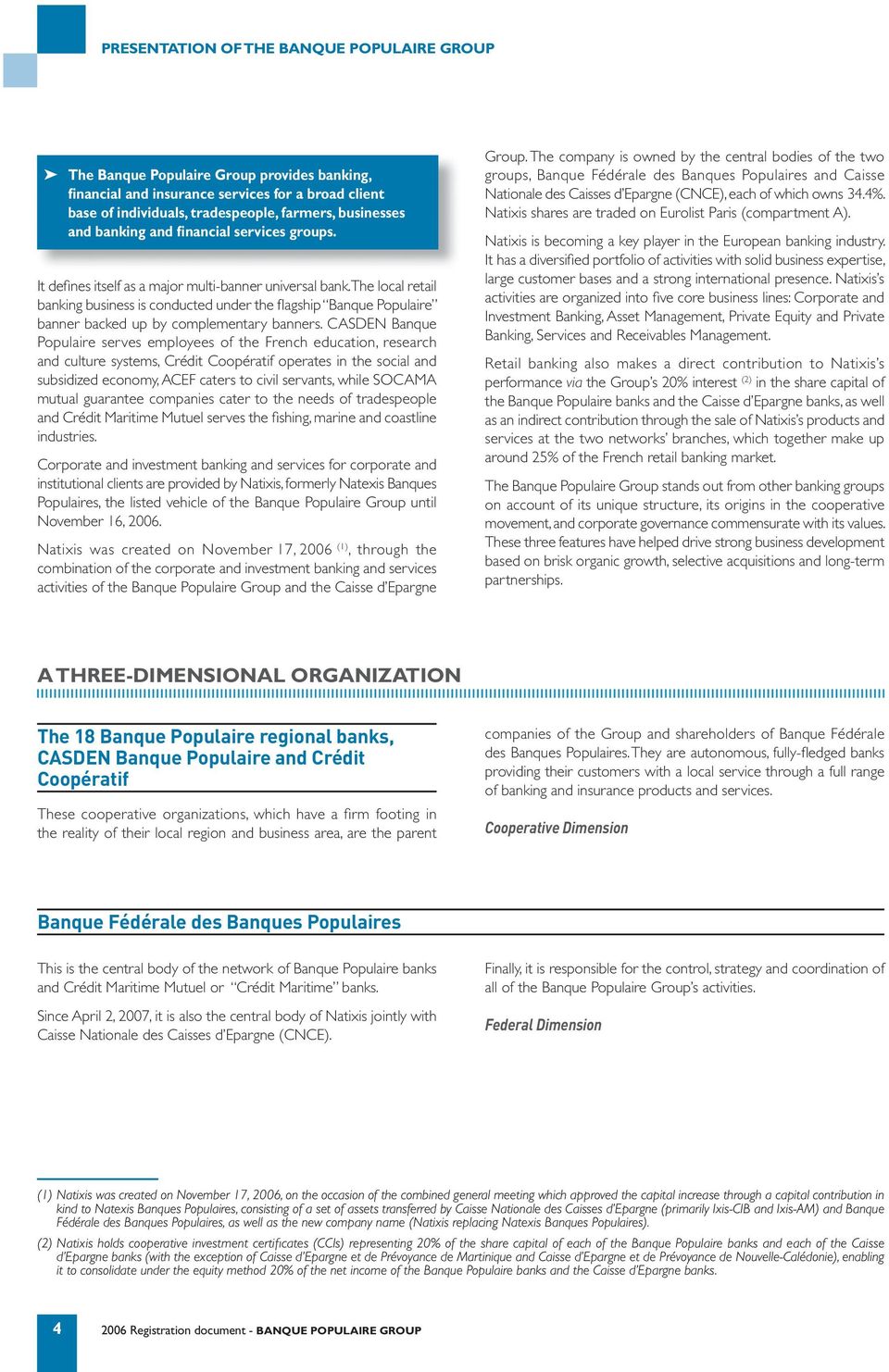
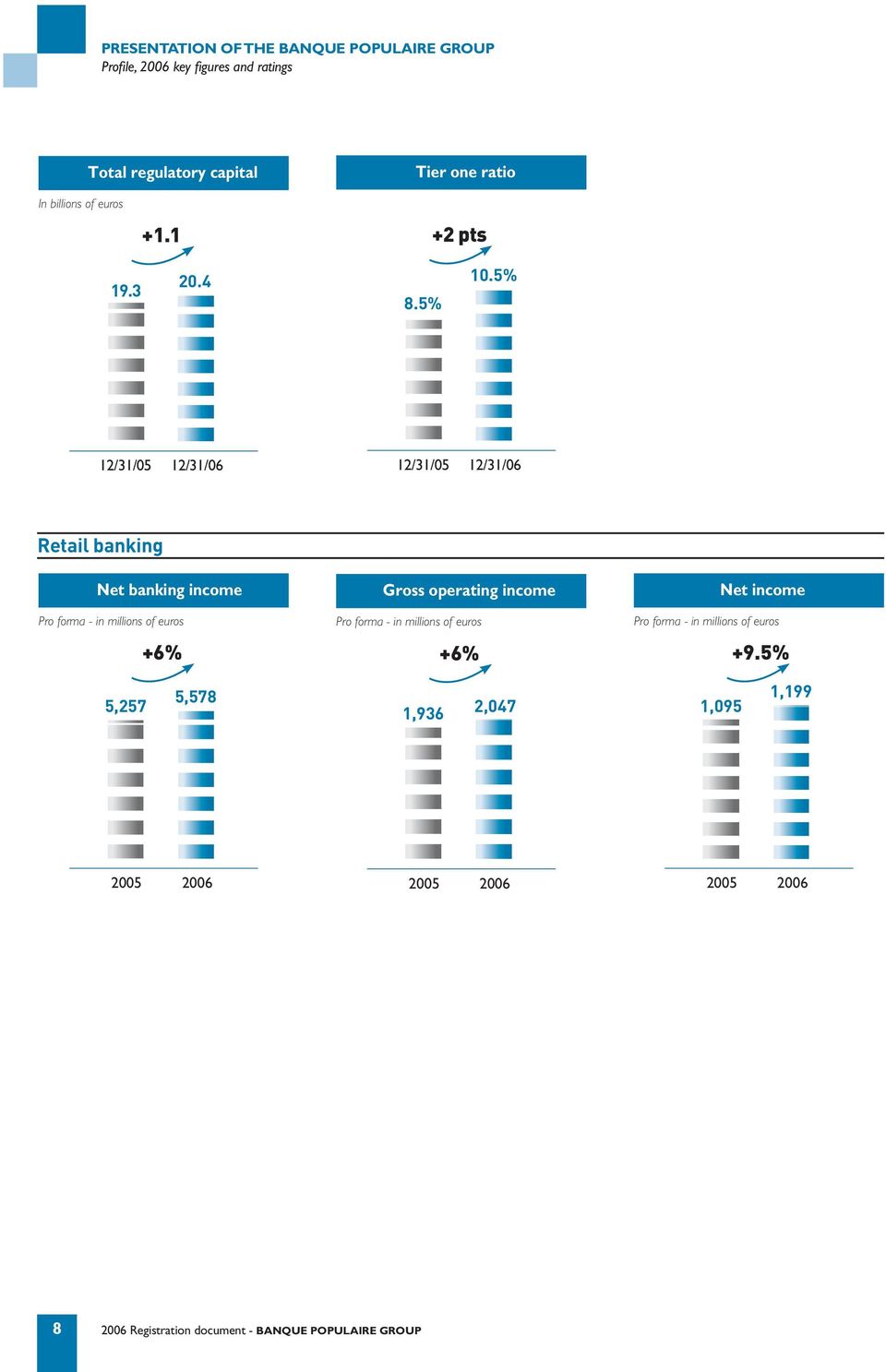
7 PRESENTATION OF THE BANQUE POPULAIRE GROUP Natixis Listed on Euronext Paris, Natixis is a joint subsidiary of the Banque Populaire Group and the Caisse d Epargne Group. It has fi ve core business lines: C orporate and I nvestment B anking, A sset M anagement, P rivate E quity and P rivate B anking, S ervices and R eceivables M anagement. Listed-Company Dimension COOPERATIVE AND REGIONAL FOUNDATIONS True to the cooperative spirit that has guided it since its inception, the Banque Populaire Group attaches great importance to local relationships and regional roots. It provides long-term support to all entrepreneurs, be they in or outside France. As cooperative banks, the Banque Populaire banks forge a modern and special type of relationship with their 7 million clients. Of these clients, 3.2 million are member-stakeholders of their banks. They guarantee the independence of their bank and bring the resources for growth. The Group s international expansion is led primarily by Natixis and its subsidiary Coface, present in 71 countries. The Directors of the Banque Populaire banks, who play an active part in the economic and community life of their regions, represent these member-stakeholders. They help to improve understanding of the local economic fabric and the men and women who play a key role in its development. The Banque Populaire Group s presence throughout France is provided both by the 18 Banque Populaire regional banks and by branches of other Group entities. CORPORATE GOVERNANCE COMMENSURATE WITH THE GROUP S VALUES The Banque Populaire banks are the Group s parent companies. Their Directors are responsible for control and supervision and for setting the bank s overall goals in accordance with the national strategy. The Banque Populaire Group s corporate governance is underpinned by the principles of cooperation. Banque Fédérale des Banques Populaires Board of Directors acts as the Group s governing body and its decisions are binding on the Group and its member units. The Chairman represents the Group nationally and internationally and safeguards the Group s cohesion and identity. This governance structure benefits from an ever more active stakeholder base. It is a key contributor to the success of the Banque Populaire Group and each of its member units. A STRATEGY OF EXPANSION AND PARTNERSHIPS In 2006, the Banque Populaire Group asserted its leading position in the small business and corporate markets. It successfully continued with its strategy of winning new customers and fostering customer loyalty, gaining the trust of over 400,000 new personal customers, bringing the total number of customers to 6,250,000. It has a total of 2,880 branches. The Group delivered a strong performance in 2006, with net banking income rising 11% to over 8 billion. Two-thirds of net banking income came from retail banking activities and one-third from Natixis, thereby maintaining the traditional balance. Recurring retail banking revenues and the creation of Natixis improved the Group s fi nancial solidity. With total regulatory capital of 20.4 billion, it has the means to continue with its strategy of expansion in its core business line and fi nding growth drivers in keeping with its business model Registration document - BANQUE POPULAIRE GROUP 5

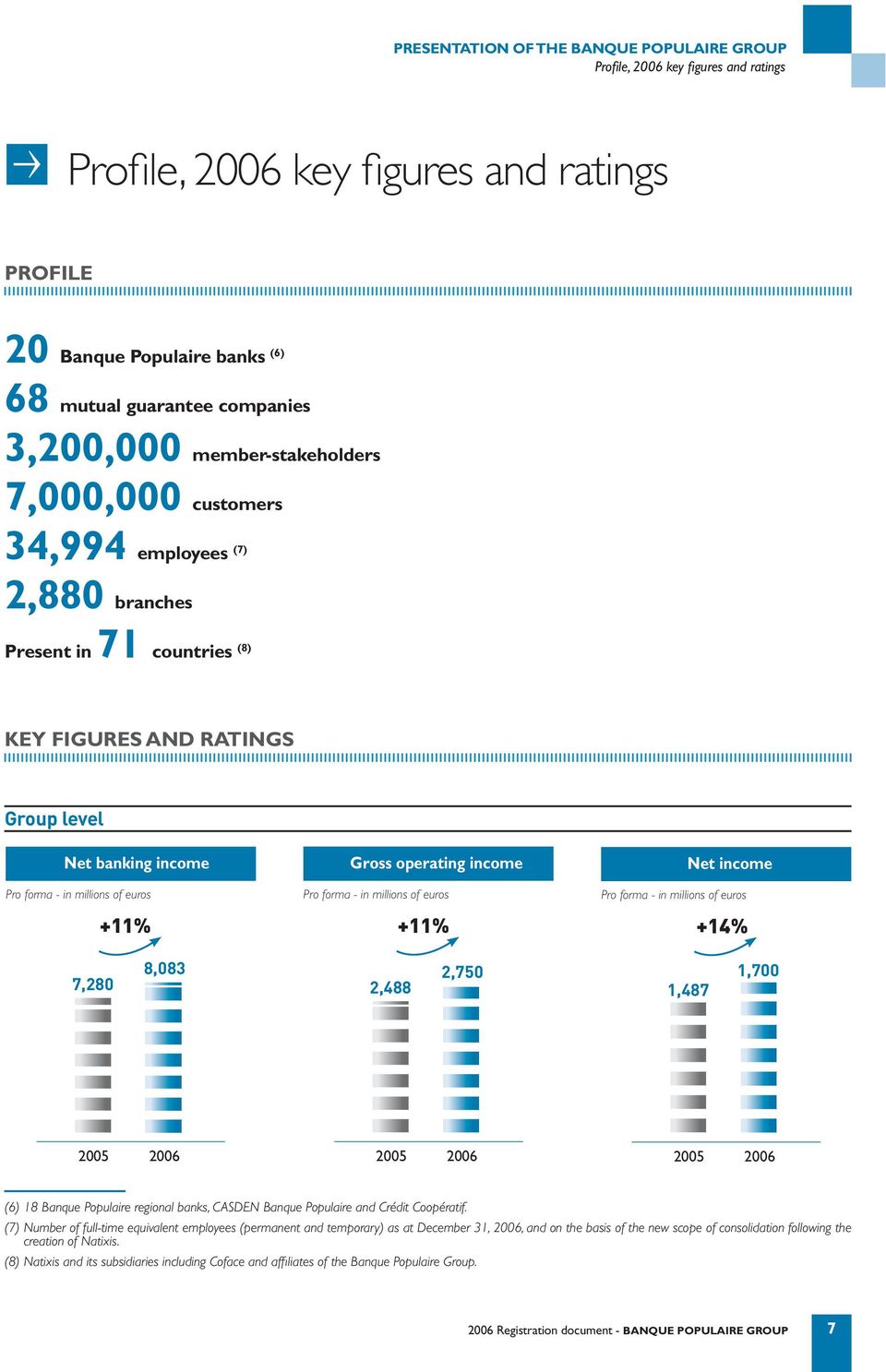
8 PRESENTATION OF THE BANQUE POPULAIRE GROUP Chairman s message A COMMITMENT TO SERVING EVERYONE A unique characteristic of the Banque Populaire Group is its longstanding commitment to economic and social development. It created over 3,000 net new jobs in It is the No. 1 provider of business start-up and buyout loans in France. Several of the Group s entities are among the market leaders in solidarity-based savings, thereby confirming its front-running position (Finansol 2006 solidaritybased fi nance survey). These positions in areas that are essential for everyone are a concrete illustration of the aims of the Banque Populaire Group. Its numerous initiatives with respect to sustainable development also demonstrate the real-life implementation of the cooperative values that drive the Group s day-to-day activities. " Chairman s message PHILIPPE DUPONT, CHAIRMAN OF THE BANQUE POPULAIRE GROUP The Banque Populaire Group reported a solid performance for 2006, reflecting its strong position in the French retail banking market in a more difficult global market. These results confirm the relevance of its strategic choices. With the creation of Natixis (3), which was an historic stage in its development, the Banque Populaire Group has strengthened its position in the areas of corporate and investment banking and services. This new dimension will foster its growth. By pursuing its strategy of winning personal customers as well as small business clients and corporate clients, the Group delivered a strong performance in Net banking income exceeded 8 billion (4), an increase of 11%. Two-thirds of net banking income came from retail banking activities and one-third from Natixis, thereby maintaining the traditional balance. Net income attributable to equity holders of the parent rose 14% to 1.7 billion. Recurring retail banking revenues and the creation of Natixis improved the Group s fi nancial solidity. With total regulatory capital of 20.4 billion, it has the means to continue with its strategy of expansion in its core business line and fi nd growth drivers in keeping with its business model. In retail banking, in which the Banque Populaire banks delivered one of the best performances in France in 2006, with net banking income up 5.3% excluding the effect of home purchase savings plans, the Group s strategy is based on three core principles: winning customers, ensuring customer loyalty and selling more products to each customer, primarily through our savings and bancassurance offering, and improving overall effi ciency thanks in particular to the technological potential of our shared IT platform. We have continued to adapt our network, which now comprises 18 Banque Populaire regional banks and nearly 3,000 branches located throughout France. The hiring of 3,000 new employees, mostly in the retail banking network, constitutes an additional advantage in our expansion. Our strategy proved fruitful yet again this year. The relevance and scope of our range of products and services and the professionalism of our teams are refl ected by a signifi cant increase in the number of customers. Organic growth was boosted by two new partnerships - one with Ordre des Masseurs Kinésithérapeutes (French Physiotherapists association) for small businesses and one with La Mutuelle des Étudiants (LMDE) ( France s principal student mutual insurance company) for personal customers. Our investment in international operations is beginning to come to fruition both in Eastern Europe and in Africa. We have enjoyed an auspicious start to 2007 with the acquisition of 61% of Foncia, market leader in residential property services in France, as well as in Belgium and Germany. With 3.2 million member-stakeholders and 35,000 employees (5), the Group is moving toward the future with determination and serenity, respecting its cooperative values by combining both performance and responsibility to society. The Banque Populaire Group is open to progress and innovation and will continue to prioritize local relationships with its customers. I am confi dent about the ability of our Group - with its entrepreneurial foundations - to adapt to the demands of the rapidly evolving banking sector in a changing world. (3) Joint subsidiary of the Banque Populaire Group and the Caisse d Epargne Group. (4) Pro forma fi gures. (5) Excluding Natixis Registration document - BANQUE POPULAIRE GROUP

9 PRESENTATION OF THE BANQUE POPULAIRE GROUP Profi le, 2006 key fi gures and ratings " Profile, 2006 key figures and ratings PROFILE 20 Banque Populaire banks (6) 68 mutual guarantee companies 3,200,000 member-stakeholders 7,000,000 customers 34,994 employees (7) 2,880 branches Present in 71 countries (8) KEY FIGURES AND RATINGS Group level Net banking income Pro forma - in millions of euros Gross operating income Pro forma - in millions of euros Net income Pro forma - in millions of euros (6) 18 Banque Populaire regional banks, CASDEN Banque Populaire and Crédit Coopératif. (7) Number of full-time equivalent employees (permanent and temporary) as at December 31, 2006, and on the basis of the new scope of consolidation following the creation of Natixis. (8) Natixis and its subsidiaries including Coface and affi liates of the Banque Populaire Group Registration document - BANQUE POPULAIRE GROUP 7
10 PRESENTATION OF THE BANQUE POPULAIRE GROUP Profi le, 2006 key fi gures and ratings Total regulatory capital Tier one ratio In billions of euros 12/31/05 12/31/06 12/31/05 12/31/06 Retail banking Net banking income Pro forma - in millions of euros Gross operating income Pro forma - in millions of euros Net income Pro forma - in millions of euros Registration document - BANQUE POPULAIRE GROUP
11 PRESENTATION OF THE BANQUE POPULAIRE GROUP Profi le, 2006 key fi gures and ratings In billions of euros Outstanding loans In billions of euros Customer deposits In billions of euros Customer savings 12/31/05 12/31/06 12/31/05 12/31/06 12/31/05 12/31/06 Long-term ratings Banque Populaire Group STANDARD & POOR S MOODY S AA- Aa3 Natixis STANDARD & POOR S MOODY S FITCH RATINGS AA Aa2 AA 2006 Registration document - BANQUE POPULAIRE GROUP 9

12 PRESENTATION OF THE BANQUE POPULAIRE GROUP Registration document - BANQUE POPULAIRE GROUP

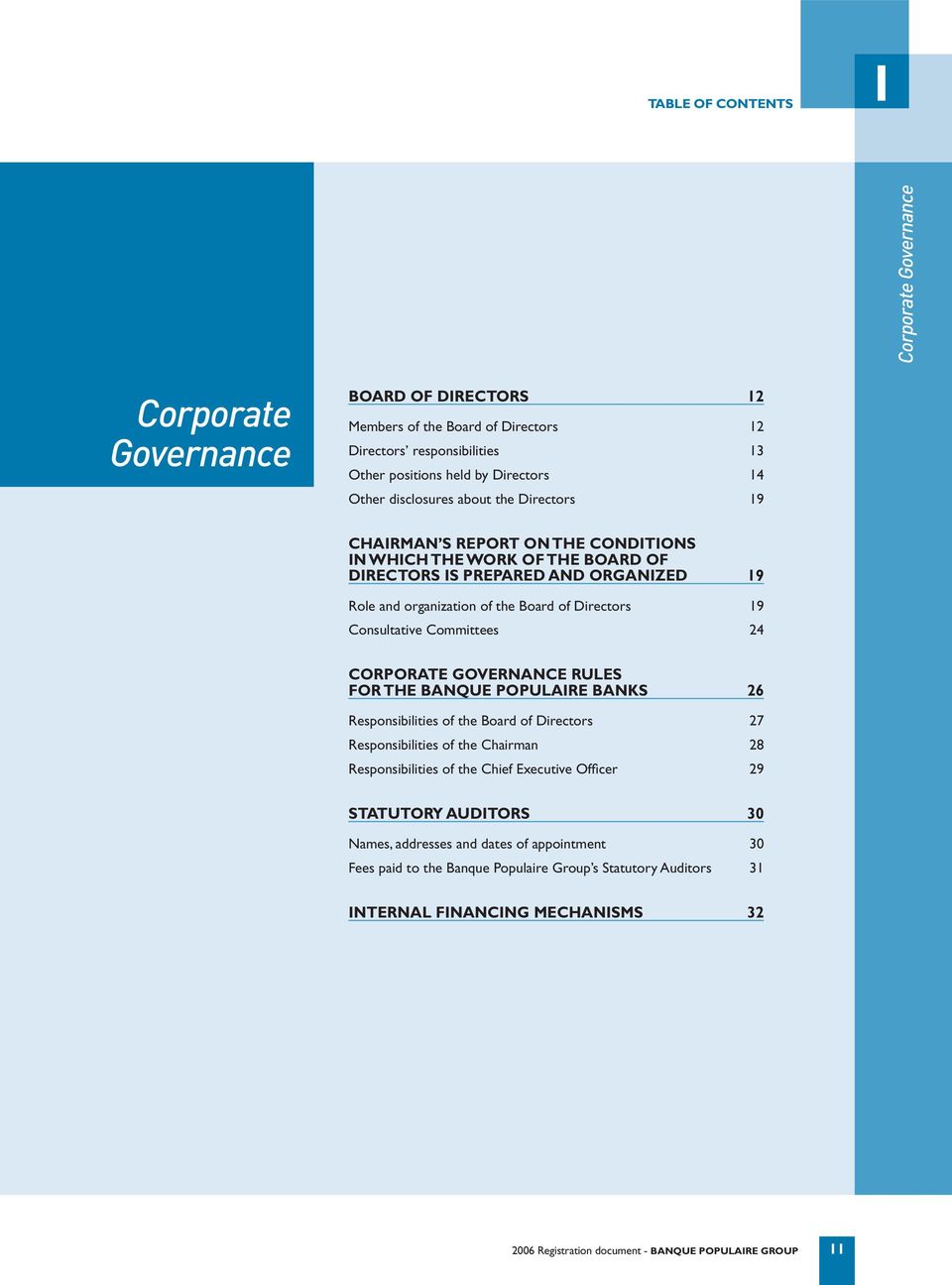
13 TABLE OF CONTENTS 1 Corporate Governance Corporate Governance BOARD OF DIRECTORS 12 Members of the Board of Directors 12 Directors responsibilities 13 Other positions held by Directors 14 Other disclosures about the Directors 19 CHAIRMAN S REPORT ON THE CONDITIONS IN WHICH THE WORK OF THE BOARD OF DIRECTORS IS PREPARED AND ORGANIZED 19 Role and organization of the Board of Directors 19 Consultative Committees 24 CORPORATE GOVERNANCE RULES FOR THE BANQUE POPULAIRE BANKS 26 Responsibilities of the Board of Directors 27 Responsibilities of the Chairman 28 Responsibilities of the Chief Executive Offi cer 29 STATUTORY AUDITORS 30 Names, addresses and dates of appointment 30 Fees paid to the Banque Populaire Group s Statutory Auditors 31 INTERNAL FINANCING MECHANISMS Registration document - BANQUE POPULAIRE GROUP 11
14 1 CORPORATE GOVERNANCE Board of Directors " Board of Directors The Banque Populaire Group, through Banque Fédérale des Banques Populaires (the central body of the Banque Populaire banks, Crédit Maritime and the mutual guarantee companies), has elected to apply the recommendations resulting from the consolidation of the AFEP, MEDEF and ANSA reports published in 2003 in areas where there is no corporate governance legislation in France. It is worth noting that the concept of independent directors is not relevant to Banque Fédérale des Banques Populaires (see the section on Independent directors - page 23). The Banque Populaire Group, as covered by this report, is referred to on a consolidated basis. This comprises the consolidating entity and companies included in the consolidated fi nancial statements in the context of exclusive or joint control. The internal control system and its scope are defi ned in accordance with the provisions of CRFB regulations and Together, Banque Fédérale des Banques Populaires and Caisse Nationale des Caisses d Epargne (CNCE) constitute the central body of Natixis (formerly Natexis Banques Populaires), created on November 17, MEMBERS OF THE BOARD OF DIRECTORS The Board of Directors referred to (including on page 19) is that of Banque Fédérale des Banques Populaires, the Group s central body. Members at December 31, 2006 Main function within the Company (1) Term of office ends in (2) First appointed/ Chairman and Chief Executive Officer Philippe Dupont Chairman of the Banque Populaire Group / Vice-Chairmen Jean-François Comas Chief Executive Offi cer of Banque Populaire Côte d Azur / Claude Cordel Chairman of Banque Populaire du Sud / Jean-Louis Tourret Chairman of Banque Populaire Provençale et Corse / Board Secretary Yvan de La Porte du Theil Chief Executive Offi cer of Banque Populaire Val de France / Directors Christian Brevard Deputy Vice-Chairman of Banque Populaire d Alsace / Michel Castagné Deputy Vice-Chairman of Banque Populaire Occitane / Jean Clochet Chairman of Banque Populaire des Alpes / Pierre Delourmel Chairman of Banque Populaire de l Ouest / Pierre Desvergnes Chairman of CASDEN Banque Populaire / Stève Gentili Chairman of BRED Banque Populaire / Yves Gevin (3) Chief Executive Offi cer of Banque Populaire Atlantique / Jacques Hausler (4) Chief Executive Offi cer of Banque Populaire Lorraine Champagne / Bernard Jeannin Chief Executive Offi cer of Banque Populaire Bourgogne Franche-Comté / Pierre Noblet Deputy Vice-Chairman of Banque Populaire Rives de Paris / Christian Du Payrat (5) Chief Executive Offi cer of Banque Populaire du Massif Central / Registration document - BANQUE POPULAIRE GROUP

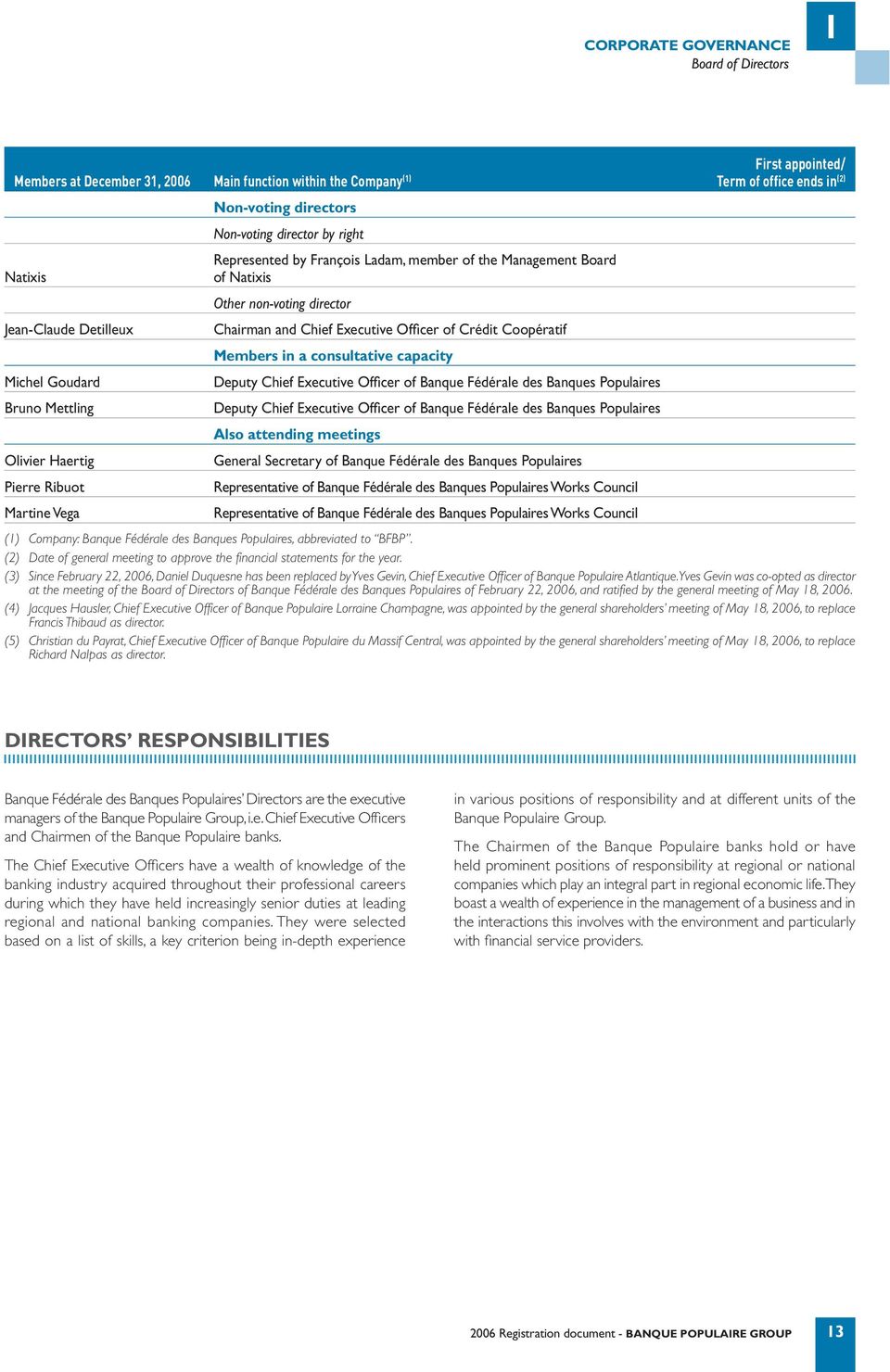
15 CORPORATE GOVERNANCE 1 Board of Directors Members at December 31, 2006 Main function within the Company (1) Term of office ends in (2) First appointed/ Natixis Jean-Claude Detilleux Michel Goudard Bruno Mettling Olivier Haertig Pierre Ribuot Martine Vega Non-voting directors Non-voting director by right Represented by François Ladam, member of the Management Board of Natixis Other non-voting director Chairman and Chief Executive Offi cer of Crédit Coopératif Members in a consultative capacity Deputy Chief Executive Offi cer of Banque Fédérale des Banques Populaires Deputy Chief Executive Offi cer of Banque Fédérale des Banques Populaires Also attending meetings General Secretary of Banque Fédérale des Banques Populaires Representative of Banque Fédérale des Banques Populaires Works Council Representative of Banque Fédérale des Banques Populaires Works Council (1) Company: Banque Fédérale des Banques Populaires, abbreviated to BFBP. (2) Date of general meeting to approve the financial statements for the year. (3) Since February 22, 2006, Daniel Duquesne has been replaced by Yves Gevin, Chief Executive Officer of Banque Populaire Atlantique. Yves Gevin was co-opted as director at the meeting of the Board of Directors of Banque Fédérale des Banques Populaires of February 22, 2006, and ratified by the general meeting of May 18, (4) Jacques Hausler, Chief Executive Officer of Banque Populaire Lorraine Champagne, was appointed by the general shareholders meeting of May 18, 2006, to replace Francis Thibaud as director. (5) Christian du Payrat, Chief Executive Officer of Banque Populaire du Massif Central, was appointed by the general shareholders meeting of May 18, 2006, to replace Richard Nalpas as director. DIRECTORS RESPONSIBILITIES Banque Fédérale des Banques Populaires Directors are the executive managers of the Banque Populaire Group, i.e. Chief Executive Officers and Chairmen of the Banque Populaire banks. The Chief Executive Offi cers have a wealth of knowledge of the banking industry acquired throughout their professional careers during which they have held increasingly senior duties at leading regional and national banking companies. They were selected based on a list of skills, a key criterion being in-depth experience in various positions of responsibility and at different units of the Banque Populaire Group. The Chairmen of the Banque Populaire banks hold or have held prominent positions of responsibility at regional or national companies which play an integral part in regional economic life. They boast a wealth of experience in the management of a business and in the interactions this involves with the environment and particularly with fi nancial service providers Registration document - BANQUE POPULAIRE GROUP 13
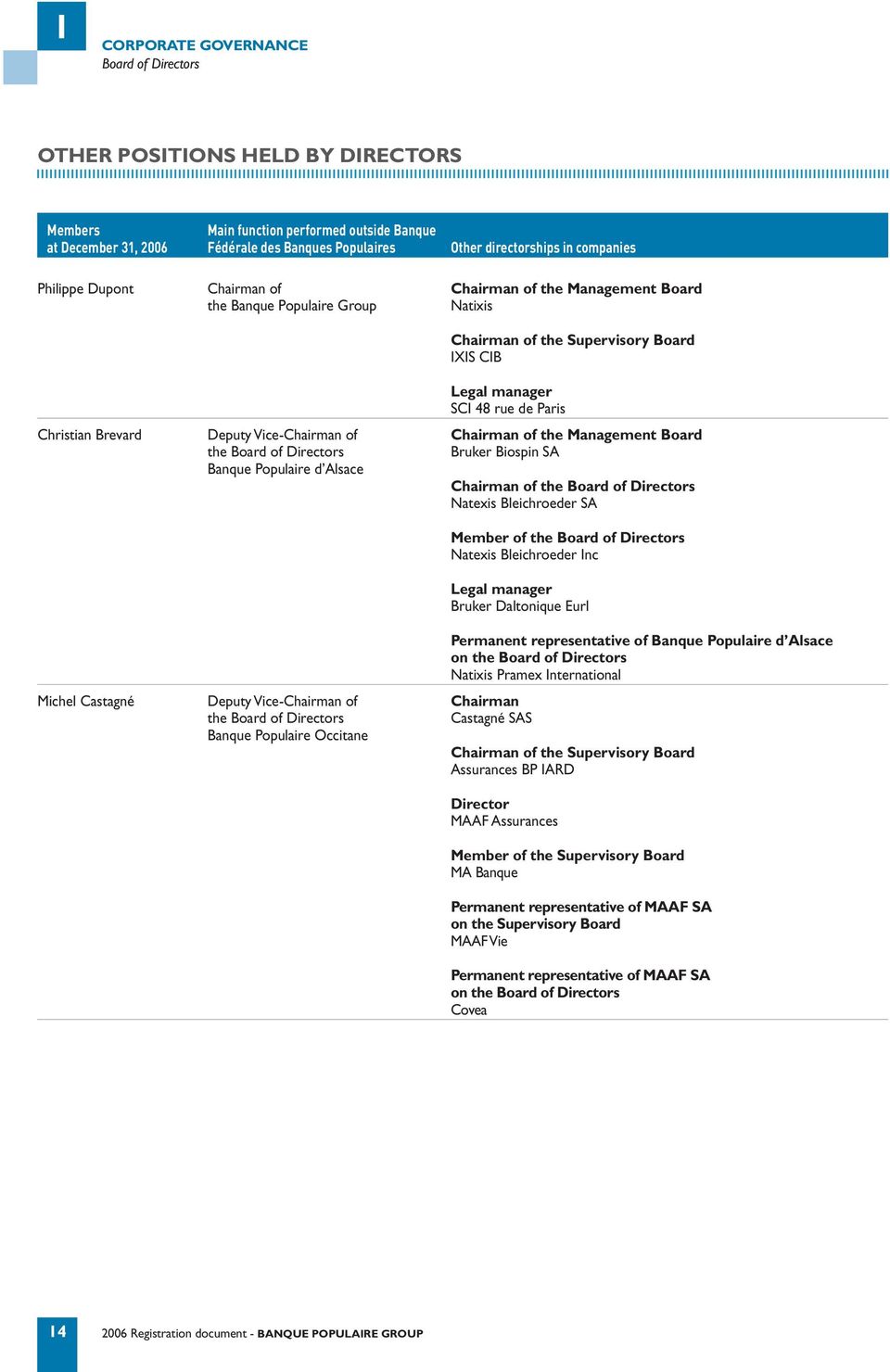
16 1 CORPORATE GOVERNANCE Board of Directors OTHER POSITIONS HELD BY DIRECTORS Members at December 31, 2006 Philippe Dupont Christian Brevard Michel Castagné Main function performed outside Banque Fédérale des Banques Populaires Chairman of the Banque Populaire Group Deputy Vice-Chairman of the Board of Directors Banque Populaire d Alsace Deputy Vice-Chairman of the Board of Directors Banque Populaire Occitane Other directorships in companies Chairman of the Management Board Natixis Chairman of the Supervisory Board IXIS CIB Legal manager SCI 48 rue de Paris Chairman of the Management Board Bruker Biospin SA Chairman of the Board of Directors Natexis Bleichroeder SA Member of the Board of Directors Natexis Bleichroeder Inc Legal manager Bruker Daltonique Eurl Permanent representative of Banque Populaire d Alsace on the Board of Directors Natixis Pramex International Chairman Castagné SAS Chairman of the Supervisory Board Assurances BP IARD Director MAAF Assurances Member of the Supervisory Board MA Banque Permanent representative of MAAF SA on the Supervisory Board MAAF Vie Permanent representative of MAAF SA on the Board of Directors Covea Registration document - BANQUE POPULAIRE GROUP
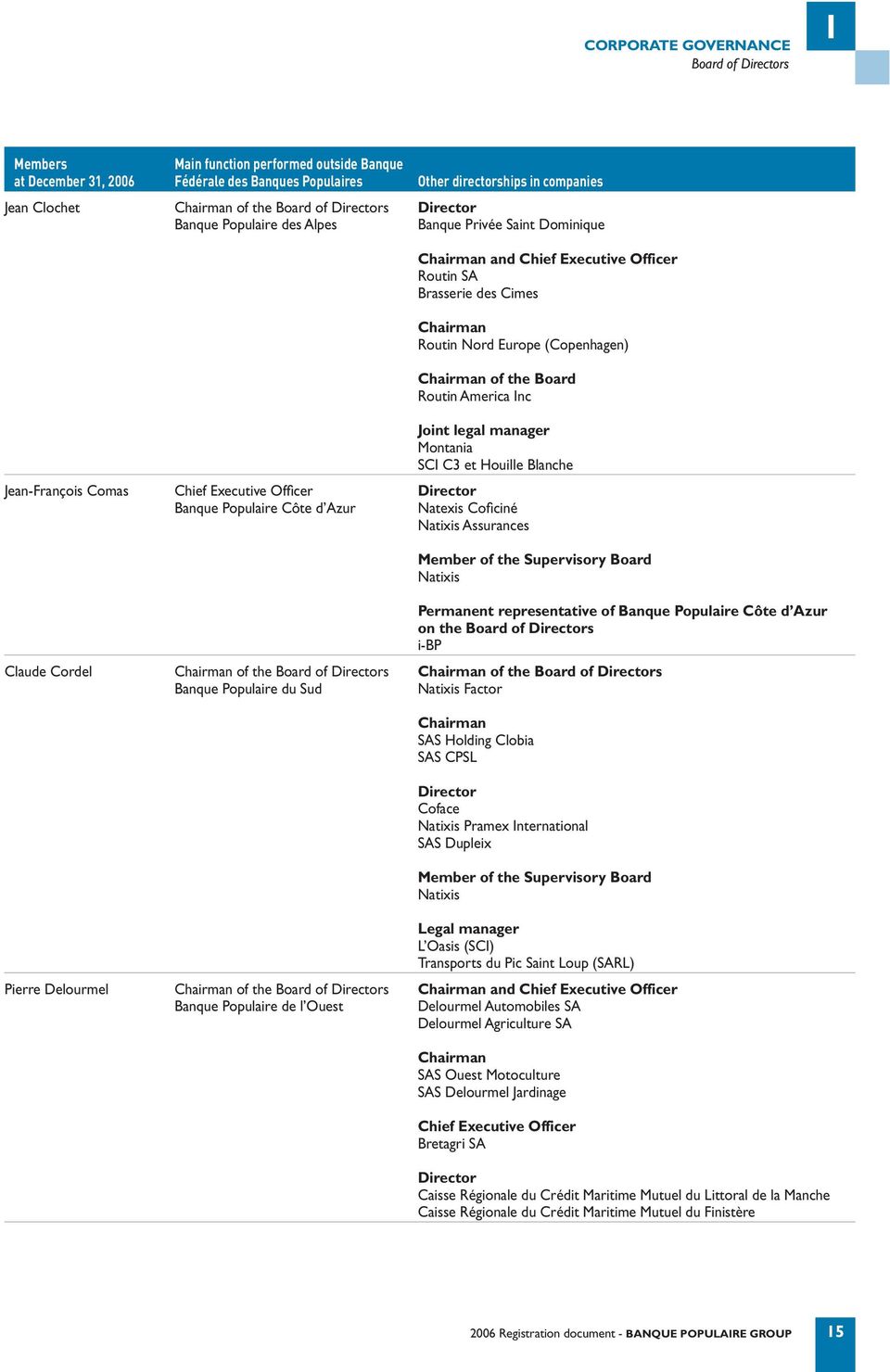
17 CORPORATE GOVERNANCE 1 Board of Directors Members at December 31, 2006 Jean Clochet Jean-François Comas Claude Cordel Pierre Delourmel Main function performed outside Banque Fédérale des Banques Populaires Chairman of the Board of Directors Banque Populaire des Alpes Chief Executive Offi cer Banque Populaire Côte d Azur Chairman of the Board of Directors Banque Populaire du Sud Chairman of the Board of Directors Banque Populaire de l Ouest Other directorships in companies Director Banque Privée Saint Dominique Chairman and Chief Executive Officer Routin SA Brasserie des Cimes Chairman Routin Nord Europe (Copenhagen) Chairman of the Board Routin America Inc Joint legal manager Montania SCI C3 et Houille Blanche Director Natexis Cofi ciné Natixis Assurances Member of the Supervisory Board Natixis Permanent representative of Banque Populaire Côte d Azur on the Board of Directors i-bp Chairman of the Board of Directors Natixis Factor Chairman SAS Holding Clobia SAS CPSL Director Coface Natixis Pramex International SAS Dupleix Member of the Supervisory Board Natixis Legal manager L Oasis (SCI ) Transports du Pic Saint Loup (SARL ) Chairman and Chief Executive Officer Delourmel Automobiles SA Delourmel Agriculture SA Chairman SAS Ouest Motoculture SAS Delourmel Jardinage Chief Executive Officer Bretagri SA Director Caisse Régionale du Crédit Maritime Mutuel du Littoral de la Manche Caisse Régionale du Crédit Maritime Mutuel du Finistère 2006 Registration document - BANQUE POPULAIRE GROUP 15
18 1 CORPORATE GOVERNANCE Board of Directors Members at December 31, 2006 Pierre Desvergnes Stève Gentili Yves Gevin Main function performed outside Banque Fédérale des Banques Populaires Chairman and Chief Executive Offi cer CASDEN Banque Populaire Chairman of the Board of Directors BRED Banque Populaire Chief Executive Offi cer Banque Populaire Atlantique Other directorships in companies Chairman of the Board of Directors Maine Gestion Parnasse Finance Director Parnasse MAIF SA Natexis Asset Management Permanent representative of CASDEN Banque Populaire on the Board of Directors Parnasse Services SA Natixis Altaïr Valorg (Sicav) Permanent representative of CASDEN Banque Populaire on the Supervisory Board Parnasse Immo (SCPI ) Permanent representative of Parnasse Finance on the Board of Directors Parnassienne de Crédit Legal manager SARL Inter-Promo SARL Cours des Roches Chairman of the Board of Directors BRED Gestion Natixis Pramex International Vice-Chairman Banque Internationale de Commerce BRED Director Bercy Gestion Finances + BRED Cofi lease Coface Compagnie Financière de la BRED (COFIBRED ) LFI Natexis Algérie Pramex Italia S.R.L. Member of the Supervisory Board Natixis Permanent representative of BRED Banque Populaire on the Board of Directors BICEC Director Natexis Bleichroeder SA Natexis Bleichroeder Inc Natixis Factor Legal manager SCI GC2I Permanent representative of Banque Populaire Atlantique on the Board of Directors SA Portzamparc Registration document - BANQUE POPULAIRE GROUP

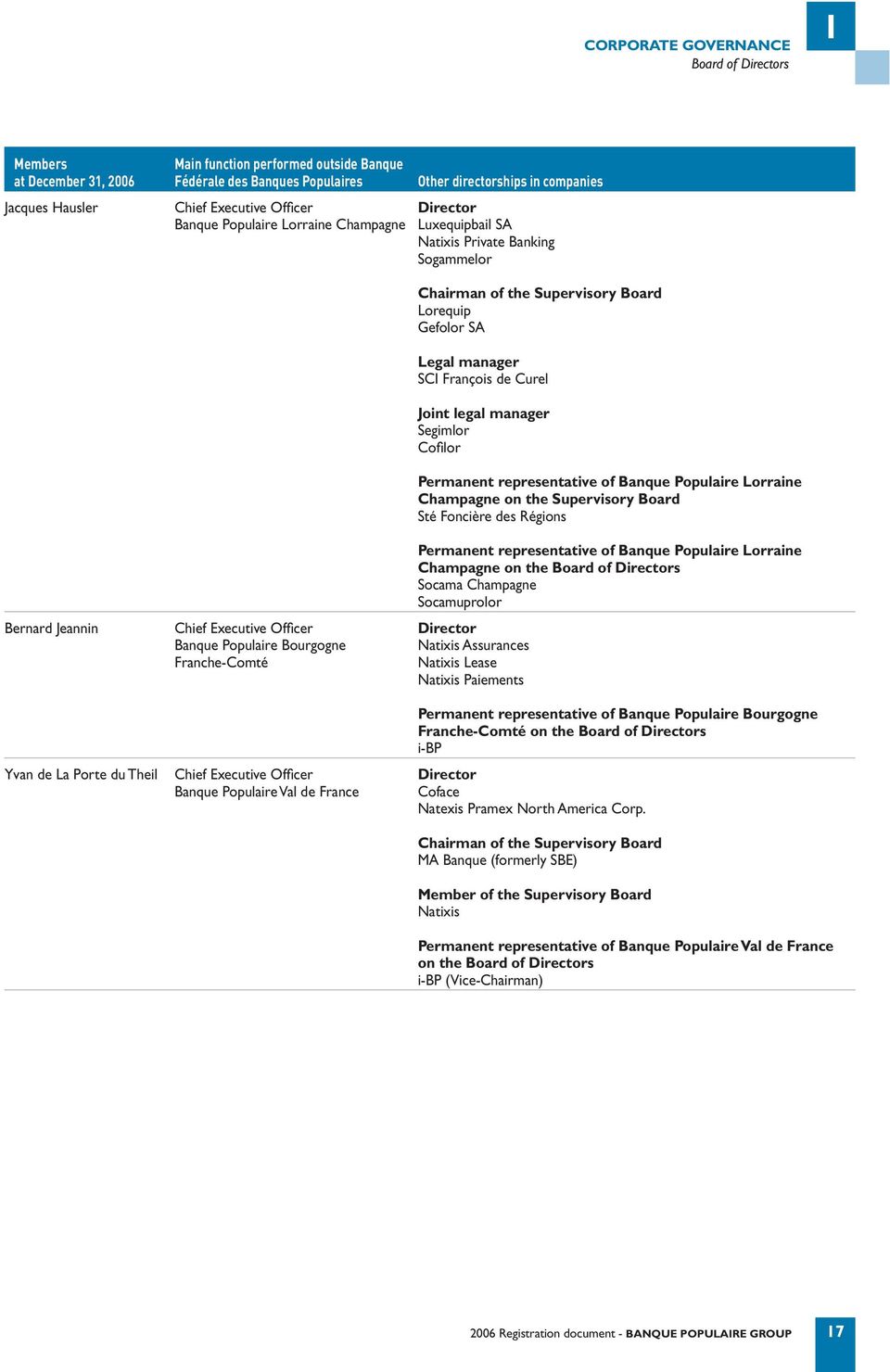
19 CORPORATE GOVERNANCE 1 Board of Directors Members at December 31, 2006 Jacques Hausler Main function performed outside Banque Fédérale des Banques Populaires Chief Executive Offi cer Banque Populaire Lorraine Champagne Other directorships in companies Director Luxequipbail SA Natixis Private Banking Sogammelor Bernard Jeannin Yvan de La Porte du Theil Chief Executive Offi cer Banque Populaire Bourgogne Franche-Comté Chief Executive Offi cer Banque Populaire Val de France Chairman of the Supervisory Board Lorequip Gefolor SA Legal manager SCI François de Curel Joint legal manager Segimlor Cofi lor Permanent representative of Banque Populaire Lorraine Champagne on the Supervisory Board Sté Foncière des Régions Permanent representative of Banque Populaire Lorraine Champagne on the Board of Directors Socama Champagne Socamuprolor Director Natixis Assurances Natixis Lease Natixis Paiements Permanent representative of Banque Populaire Bourgogne Franche-Comté on the Board of Directors i-bp Director Coface Natexis Pramex North America Corp. Chairman of the Supervisory Board MA Banque (formerly SBE) Member of the Supervisory Board Natixis Permanent representative of Banque Populaire Val de France on the Board of Directors i-bp (Vice-Chairman) 2006 Registration document - BANQUE POPULAIRE GROUP 17
20 1 CORPORATE GOVERNANCE Board of Directors Members at December 31, 2006 Pierre Noblet Christian du Payrat Jean-Louis Tourret Main function performed outside Banque Fédérale des Banques Populaires Deputy Vice-Chairman Banque Populaire Rives de Paris Chief Executive Offi cer Banque Populaire du Massif Central Chairman of the Board of Directors Banque Populaire Provençale et Corse Other directorships in companies Chairman Sonoda (SAS) Chairman of the Board of Directors Fructifrance Euro (Sicav) Natixis Intertitres Chairman of the Supervisory Board Fructifonds Immobilier (SCPI ) Bp Résidence Patrimoine 2 (SCPI ) Director Natixis Lease Natixis LLD (Vice-Chairman) Natixis Paiements Legal manager SCI Carteret SCI Natoal Director BICEC Natixis LLD Permanent representative of Banque Populaire du Massif Central on the Board of Directors i-bp Natixis Lease Chairman of the Board of Directors Banque Privée Saint Dominique Chairman Proclair SAS Sopres SAS Tourret SAS Director Lafarge Ciments Member of the Supervisory Board Natixis (Vice-Chairman) Legal manager Tourret Electronique Proclair Provence Proclair Rhône Alpes Registration document - BANQUE POPULAIRE GROUP

21 CORPORATE GOVERNANCE 1 Chairman s report on the conditions in which the work of the Board of Directors is prepared and organized OTHER DISCLOSURES ABOUT THE DIRECTORS Integrity of Directors In accordance with the enforcement rules of the EC directive 2003/71 (Article 14.1, paragraph 2), the bank reports that none of these Board members or members of Executive Management have been convicted of fraud over the past fi ve years (minimum), have been subject to bankruptcy, liquidation or receivership proceedings over the past fi ve years (minimum), have been offi cially incriminated or punished by corporate or regulatory authorities, have been enjoined from acting as a Director or Executive of an issuer or from managing or participating in the business of an issuer over the last fi ve years (minimum). Potential conflicts of interest There are no potential confl icts of interest between the duties of the Directors vis-à-vis Banque Fédérale des Banques Populaires and their private interests in accordance with the aforementioned European regulations. In addition, the Directors have not agreed to any restriction concerning the sale within a given time frame of their shareholding in the capital of Banque Fédérale des Banques Populaires. The Directors do not hold any shareholding other than that required for the performance of their duties. Contracts between Banque Fédérale des Banques Populaires and its Directors In accordance with the aforementioned EC regulation, there are no service agreements between the Directors and Banque Fédérale des Banques Populaires potentially leading to the granting of benefi ts at the end of such contract and liable to compromise their independence or to interfere with their decisions. None of the Directors of Banque Fédérale des Banques Populaires are bound to the Company or one of its subsidiaries by an employment contract. " Chairman s report on the conditions in which the work of the Board of Directors is prepared and organized This report forms an integral part of the Chairman s full report on the conditions in which the work of the Board of Directors is prepared and organized and on internal control procedures in accordance with Article L of the French Commercial Code as amended by the Financial Security Act of August 1, It was presented to the Group Audit and Risk Committee on March 13 and to the Board of Directors of Banque Fédérale des Banques Populaires on March 14, ROLE AND ORGANIZATION OF THE BOARD OF DIRECTORS The Board of Directors of Banque Fédérale des Banques Populaires (BFBP), which has been a joint stock company société anonyme under French law since May 31, 2001, exercises a certain number of legal functions. These include the responsibilities of Banque Fédérale des Banques Populaires as the central body of the network of Banque Populaire banks, Crédit Maritime and Natixis. More generally, the Board is responsible for supervising and defi ning various aspects of the strategy of the Banque Populaire Group, such as expansion, profi tability, security, organization, information systems and other matters Registration document - BANQUE POPULAIRE GROUP 19
22 1 CORPORATE GOVERNANCE Chairman s report on the conditions in which the work of the Board of Directors is prepared and organized Each Director is considered as representing all shareholders and is expected under all circumstances to act accordingly. Members of the Board of Directors The Board of Directors of Banque Fédérale des Banques Populaires has sixteen members, all elected by the shareholders at the general meeting. Directors are individuals and the majority of Directors must be either Chairman, Director or Chief Executive Offi cer of a Banque Populaire bank. Directors exercising one of these roles are selected from among candidates put forward by the Chairmen and Chief Executive Offi cers of the Banque Populaire banks according to a selection process defi ned by the Board of Directors. Directors are elected for a three-year term and may stand for re-election. Their term of offi ce expires at the close of the general meeting of the shareholders held to approve the fi nancial statements for the previous year. Each Director is required to hold one Banque Fédérale des Banques Populaires share. The term of offi ce of Directors must come to an end at the latest at the close of the annual general meeting in the year of their sixtyeighth birthday. Notice of Board of Directors meetings The Board of Directors may be convened by the Chairman as often as required in the interests of Banque Fédérale des Banques Populaires. It addresses all matters set forth in the agenda for the meeting by the Chairman. When it has not met for more than two months, at least one-third of the members of the Board may ask the Chairman to call a meeting to consider a specifi c agenda. It meets at the Company s head offi ce or at any place indicated in the notice convening the meeting. Notice of the meeting must be provided by mail or by any other means at least three days in advance. If all the Directors agree, a Board meeting may also be called verbally and without any advance notice. An attendance register is kept, which is signed by Board members present at the meeting. It is obligatory for designated representatives of the Works Council to be convened to all meetings of the Board of Directors, which they attend in an advisory capacity in accordance with the law and regulations. Any other person(s) invited to the meetings by the Chairman of the Board of Directors may also attend in an advisory capacity. Record of deliberations - Minutes - Copies - Excerpts The Board s deliberations are recorded in minutes kept in a special minute book and are signed by the Chairman of the meeting and at least one Director or, where the Chairman is unable to sign, by at least two Directors. Copies or excerpts from the minutes of the meetings may be duly certifi ed by the Chairman of the Board of Directors, the Deputy Chief Executive Offi cer or a specially authorized representative. Powers of the Board of Directors The Board of Directors determines the strategic priorities for Banque Fédérale des Banques Populaires activities and ensures that they are implemented. Subject to the powers expressly attributed to general meetings and within the scope of the corporate purpose, it considers all matters that affect the Company s operations and settles matters which concern it through its decisions. In its dealings with third parties, Banque Fédérale des Banques Populaires is bound even by the acts of the Board of Directors that fall outside the scope of the corporate purpose, unless it can prove that the third party knew that the act was ultra vires or that it could not have been unaware thereof given the circumstances. The sole publication of the bylaws shall not suffi ce to establish such evidence. The Board of Directors conducts the audits and verifi cations that it deems necessary. Each Director receives all the information required to carry out its duties and is sent any documents which he considers to be useful. The Board of Directors notably has the following powers: 1. it defi nes the policy and strategy goals for the network and the Banque Populaire Group; 2. it negotiates and enters into national and international agreements on behalf of the Banque Populaire network; 3. more generally, it makes use of the prerogatives the Company enjoys, pursuant to law in its capacity as the Group s central body; 4. it approves the executive offi cers of the Banque Populaire banks and defi nes the terms of their approval. It may also rescind this approval; 5. it approves the bylaws of the Banque Populaire banks and any amendments made thereto; 6. it takes the requisite measures to protect the liquidity and capital adequacy of the Banque Populaire network by defi ning and implementing the requisite internal mutual guarantee systems; 7. on the recommendation of the Chairman, it appoints and dismisses the Senior Executive Vice President, Internal Audit and Risk management, who monitors the consistency and effi cacy of the Group s internal control. The Senior Executive Vice President, Internal Audit and Risk management, communicates the results of audit assignments to the Board; 8. it establishes a Group Risk Management Committee and defi nes its jurisdiction, members and operating procedures. As of November 17, 2006, Natixis is a member by right of the Group Risk Management Committee. The Committee is responsible for reviewing operational and financial relations between Natixis and the Banque Populaire banks due to Natixis s equity interest in the Banque Populaire banks; 9. more generally, it lays down the general internal guidelines that are obligatory for all Banque Populaire banks to uphold, with a view to ensuring the goals defi ned in Article L of the French Monetary and Financial Code; Registration document - BANQUE POPULAIRE GROUP
23 CORPORATE GOVERNANCE 1 Chairman s report on the conditions in which the work of the Board of Directors is prepared and organized 10. it draws up the Company s annual budget and sets the rules for calculating the subscriptions payable by the affi liated Banque Populaire banks; 11. it prepares the Company s balance sheet and annual fi nancial statements; 12. it reviews the consolidated fi nancial statements of the Banque Populaire Group; 13. it adopts the Board s internal rules. Even so, a two-thirds majority of Directors attending the meeting is required for the following decisions: the entry of a third party into the Company s share capital through a capital increase; the merger of two or more Banque Populaire banks, the complete or partial disposal of their business assets or their winding-up; the creation of a new Banque Populaire bank; the removal of an affi liated bank; the adoption and amendment of the Board s internal rules; changes to the way in which Executive Management is exercised. The Board of Directors may decide to set up committees responsible for studying matters that it or its Chairman submits to them for consideration. It sets the composition and responsibilities of the committees exercising their activities under its supervision. A simple majority of votes by members attending the meeting is required to determine the creation, operating rules and any fees paid to committee members. Board decisions made in the context of the Company s duties as central body of the Banque Populaire network require prior consultation with Natixis. For the organization of this consultation process, the Chairman of the Board of Directors sends Natixis a draft of decisions as well as all information provided to the Directors in advance of the planned Board meeting. If necessary, the Chairman of the Board of Directors shall inform the Directors of any observations made by Natixis prior to the planned Board meeting. If the opinion given by Natixis is not followed by the Board of Directors, Natixis may - within three days of the date of the Board meeting - ask for a second deliberation on the decision concerned. This second deliberation shall be made at the earliest a fortnight after the initial decision is adopted. Non-voting directors The Ordinary General Meeting may appoint up to fi ve non-voting directors. The non-voting directors may be chosen from among the shareholders or elsewhere. Since the creation of Natixis on November 17, 2006, Natixis is a non-voting director by right. Non-voting directors other than Natixis are appointed for a period of three years, which ends at the close of the Ordinary General Meeting of the shareholders to approve the fi nancial statements for the previous year, held in the year in which their appointment ends. The Board of Directors may make provisional appointments between two Annual General Meetings. These appointments are subject to ratifi cation at the subsequent Ordinary General Meeting of the shareholders. Non-voting directors may stand for re-election. They may be dismissed at any time following a vote by shareholders at the Annual General Meeting. The role of non-voting directors is to ensure that the Company discharges its responsibilities, especially those provided for in law, without becoming involved or interfering in management of the Company. More specifi cally, Natixis exercises the rights attributed to it by the bylaws of Banque Fédérale des Banques Populaires. Non-voting directors are convened to meetings of the Board of Directors and participate in the deliberations in an advisory capacity. T heir absence does not impair the validity of the Board s decisions. The Board of Directors may make payments to the non-voting directors by deducting amounts from the directors fees allotted by the Annual General Meeting to its members. Chairman and Chief Executive Officer The Chairman of the Board of Directors represents the Board of Directors. The Chairman organizes and directs the Board and reports on these tasks to the General Meeting. The Chairman is responsible for the proper running of the Company s management bodies and in particular for ensuring that the Directors are able to perform their duties. The age limit for a Chairman has been set at 65. The Chairman of the Board of Directors oversees the Company s Executive Management. He carries the widest powers to act under all circumstances in the Company s name. He exercises these powers within the scope of the corporate purpose, excepting those which the law expressly confers upon the shareholders meetings and on the Board of Directors or those which the Company s internal rules state as falling within the latter s jurisdiction in its capacity as the Company s central body, as listed above. In addition, in his capacity as Chief Executive Offi cer, the Chairman represents the Company in its dealings with third parties. The Company is bound even by the acts of the Chairman that fall outside the scope of the corporate purpose, unless it can prove that the third party knew that the act was ultra vires or that it could not have been unaware thereof given the circumstances. The sole publication of the bylaws shall not suffi ce to establish such evidence. Lastly, if recommended by the Chairman, the Board of Directors may appoint up to fi ve Deputy Chief Executive Offi cers to assist the Chairman in his role as Chief Executive Offi cer. The scope and duration of the powers vested in the Deputy Chief Executive Offi cer(s) are determined by the Board of Directors in conjunction with its Chairman. The Deputy Chief Executive Offi cers enjoy the same powers as the Chairman in the exercising of his duties as Chief Executive Offi cer. The Deputy Chief Executive Offi cer(s) may not remain in offi ce after their sixty-fi fth birthday Registration document - BANQUE POPULAIRE GROUP 21
24 1 CORPORATE GOVERNANCE Chairman s report on the conditions in which the work of the Board of Directors is prepared and organized Election of the Chairman of the Board of Directors Article 2 of the internal rules states that according to Article 11 of the bylaws of Banque Fédérale des Banques Populaires, the Chairman of the Board is elected by a simple majority for the duration of his term as Director and may be re-elected. The bylaws also determine that a quorum of at least half the members of the Board is required to be present for the election to take place, with the Chairman then elected by a majority of the votes cast by the Directors present (Article 12). The Chairman of the Board of Directors of Banque Fédérale des Banques Populaires has the title of Chairman of the Banque Populaire Group. Executive Management The Chairman of the Board of Directors of Banque Fédérale des Banques Populaires is also its Chief Executive Offi cer. He exercises these powers within the scope of the corporate purpose, excepting those which the law expressly confers upon the shareholders meetings and on the Board of Directors or those which the Banque Fédérale des Banques Populaires internal rules state as falling within the latter s jurisdiction in its capacity as being a central body. The Chief Executive Officer represents Banque Fédérale des Banques Populaires in its dealings with third parties. If recommended by the Chairman, the Board of Directors may appoint up to fi ve Deputy Chief Executive Offi cers to assist him. Organization of the Board of Directors work The Board of Directors meets at least fi ve times each year, according to a schedule set at the beginning of the year. The Chairman may call additional meetings if circumstances so require. The Board of Directors met thirteen times in The absence of a member of the Board is an unusual event, since the attendance rate stood at 98.72%. The internal rules of Banque Fédérale des Banques Populaires require Directors to make every reasonable effort to attend and participate in all the meetings of the Board and of the specialized committees on which they sit. Meetings last for an average of four hours (aside from the meeting held after the Annual General Meeting of the shareholders to elect the offi ce of the Board). They systematically include a review of business trends at the Banque Populaire Group and Banque Fédérale des Banques Populaires since the previous meeting, as well as the latest news and developments in the banking industry. The Board prepares the interim and annual fi nancial statements of Banque Fédérale des Banques Populaires, as well as the consolidated fi nancial statements of the Banque Populaire Group. The business trends and results of Natexis Banques Populaires and, since November 17, 2006, Natixis, are also presented systematically. The Board participates directly in defi ning the policy and strategic goals of the network and the Banque Populaire Group. Four times a year, the Board hears a detailed report on the work of the Banque Fédérale and Group Risk Management Committee, which is followed by a debate. Acting on the recommendations of the Committee, the Board then makes any decisions it deems appropriate. Directors receive an information dossier around one week ahead of each meeting. Each agenda item considered by the Board may give rise to a debate. The members of the Board make a point of asking questions of the persons making presentations, as well as of members of the Group s executive management (Chairman, Deputy Chief Executive Offi cers of Banque Fédérale des Banques Populaires), who always attend Board meetings. A record of decisions made is sent within three business days of the Board meeting to all of the Group s executive offi cers, with the approved minutes of the meeting. Accurate minutes are also taken of meetings of the Board of Directors. They keep a record of the discussions initiated, the positions presented and the questions asked. This is provided exclusively to members of the Board. Until November 17, 2006, on the creation of Natixis, eleven members sat on the Boards of Directors of both Banque Fédérale des Banques Populaires and Natexis Banques Populaires. Since this date, fi ve Directors have sat on both the Board of Directors of Banque Fédérale des Banques Populaires and the Supervisory Board of Natixis. Main issues addressed by the Board of Directors in 2006 The Board of Directors met thirteen times in A number of these exceptional meetings concerned the partnership with the Caisse d Epargne Group for the creation of Natixis. This historic transaction for the Banque Populaire Group was discussed during ten Board meetings in the course of the year, with four meetings dedicated entirely to this subject: the meeting of March 12, 2006, for the initial presentation of the proposal to the Board, including its motivations and implications; the meeting of April 13, 2006, to present the progress made in valuation efforts; the meeting of May 28, 2006, to discuss a number of technical issues relating to the transaction; the meeting of September 14, 2006, to approve primarily the agreement to issue CCIs and transfers of assets to Banque Fédérale des Banques Populaires. The protocol agreement with Caisse Nationale des Caisses d Epargne and Natixis s shareholders agreement were submitted for the approval of the Board of Directors at its meeting of June 2, Registration document - BANQUE POPULAIRE GROUP
25 CORPORATE GOVERNANCE 1 Chairman s report on the conditions in which the work of the Board of Directors is prepared and organized The Board considered other strategic issues concerning the Banque Populaire Group. During the fi rst meeting of the year, it approved the Group Strategic Plan in its entirety, which involved all of the Group s Directors in Other issues submitted for the Board s review include: the partnership between the Banque Populaire Group and La Mutuelle des Etudiants (France s principal student mutual insurance company); the partnership with ADIE in which the Banque Populaire banks would ask their member-stakeholders to act as advisors in business start-up programs fi nanced by ADIE (French association for the right to economic initiative ); several expansion opportunities in international retail banking; the Banque Populaire Group s sports sponsorship strategy. Several technical dossiers were also submitted for its approval, such as: the 2007 Business and Communications Action Plan; amendments to the bylaws of the Banque Populaire banks with a view to the issuance of CCIs ; the response to the follow-up letter from the French Banking Commission concerning the Banque Populaire Group s assets and liabilities management; progress made in the Basel II project within the Banque Populaire Group as a whole. The Board was presented with reports on the activities of the Group Risk Management Committee, in particular that of June 20, 2006, concerning the CRBF reform and the Banque Populaire Group s internal control system. The Board approved the annual and interim fi nancial statements of Banque Fédérale des Banques Populaires and the Banque Populaire Group after hearing the report of the Audit Committee. At its meeting of February 22, 2006, the Chairman presented his report to the Board on the conditions in which the work of the Board of Directors is prepared and organized and the Company s internal control procedures. During this meeting, the results of the questionnaire answered by all Board members concerning the way the Board operates were also presented to the Board. The Board also followed up on the recommendations of the Remuneration Committee during its meeting of December 6, The merger of Banque Populaire Occitane into Banque Populaire Toulouse-Pyrénées was approved in October. Decisions of the Board of Directors The internal rules of Banque Fédérale des Banques Populaires also state the manner in which the Board shall reach decisions. They are to be made by means of formal votes for the approval of the fi nancial statements, budget, resolutions to be submitted for shareholders approval at the Annual General Meeting and, more generally, any issues of strategic importance referred to the Board by the Chairman. Office of the Board The Offi ce of the Board comprises the Chairman, three Vice- Chairmen including two Chairme n of Banque Populaire banks and one Chief Executive Offi cer of a Banque Populaire bank and a Secretary, who must also be a Chief Executive Offi cer of a Banque Populaire bank. The Offi ce of the Board does not have decisionmaking powers under the internal rules but the Chairman may call meetings of its members to inform or consult them on matters falling within his authority. Independent Directors The concept of independent Director, as defi ned by the Bouton report on corporate governance, is not relevant to Banque Fédérale des Banques Populaires. As the central body of a cooperative group, the Board of Directors of Banque Fédérale des Banques Populaires should naturally comprise representatives of the Banque Populaire banks. These banks hold over 99% of the Company s capital (as at December 31, 2006) in their capacity as credit institutions affi liated with Banque Fédérale des Banques Populaires by law. However, under the bylaws, the seats on the Board are not held by the Banque Populaire banks but by individuals. Despite being the Chairmen or Chief Executive Offi cers of Banque Populaire banks, the Directors do not sit on the Board as representatives of their respective banks but as part of the corporate governance structure of the Banque Populaire Group, exercising the powers devolved to Banque Fédérale des Banques Populaires by law. Code of ethics Article 12 of the Company s internal rules draws the Directors attention to insider trading legislation prohibiting the use of confi dential information about the Group s listed subsidiaries to which the Directors may have access in their capacity as Directors of Banque Fédérale des Banques Populaires. Independent Internal Audit Function The Board of Directors monitors the independence of the Internal Audit Function. The internal auditors have full authority to require the audited entities to provide them with all necessary documents and information to enable them to carry out their audit. They also have unrestricted access to all the computer applications used by the Banque Populaire Group. Assessment of the Board s performance The performance of the Board of Directors of Banque Fédérale des Banques Populaires is measured primarily by the frequency of its meetings, the wealth of information made available to Directors, who also sit on the Boards of Banque Populaire banks, and the openness of discussions on the various matters submitted to the Board. The representative nature of the Board and the manner in which its meetings are conducted ensure that the Board fulfi ls its stewardship 2006 Registration document - BANQUE POPULAIRE GROUP 23
26 1 CORPORATE GOVERNANCE Chairman s report on the conditions in which the work of the Board of Directors is prepared and organized role as the central governing body of the Banque Populaire Group, assuming full responsibility for determining strategy and policies. In November 2005, a questionnaire was sent to all members of the Board of Directors to solicit their opinion about the organization of the Board s work (and in particular the contents, availability of dossiers in advance of meetings, exhaustiveness and clarity of the reports), the organization of meetings (choice of speakers, structure of presentations, time spent on debates), the performance of their duties as Directors and, lastly, the level of coordination between the work of the Board and that of the committees. Directors were also asked to suggest improvements to the way the Board operates. The results of the survey were presented to the Board of Directors on February 22, They showed that Directors have a very favorable view (13 to 15 positive replies) of the dossiers submitted for review, the minutes of Board meetings, the choice of speakers, the clarity of presentations, the time spent on discussions, answers given to questions and the reports on the Risk Management Committee s work. Directors also expressed a favorable opinion (10 to 13 positive replies) on reports on the work of the Audit and Remuneration Committees and on the information provided about the follow-up on its decisions. Proposals will be made on other points in response to the wishes expressed by certain Directors concerning the sometimes excessive length of Board meetings, the arduous agendas and the availability in advance of certain dossiers concerning the Board. Director s fees The fees paid to the Board of Directors (1) set by shareholders at General Meetings are shared equally among the Directors. Members of the Offi ce of the Board and the Committees of the Board receive an additional share for each additional post held. Members of more than one Committee of the Board receive a separate share for each Committee of which they are a member. CONSULTATIVE COMMITTEES As part of the modernization of the organization inspired by the Viénot report of 1999, the Board of Directors of Banque Fédérale des Banques Populaires reviewed its corporate governance on June 20, 2001, and decided to create two specialist committees alongside the Group Risk Management Committee, namely the Audit Committee and the Remuneration Committee. Each of these Committees has four members (two Chairmen and two Chief Executive Officers of a Banque Populaire bank), nominated by the Chairman and elected by the Board of Directors of Banque Fédérale des Banques Populaires for a fi xed term. Minutes of the meetings of the committees are drawn up and the Chairman of each committee reports to the Board on the work of his committee. As with the Group Risk Management Committee, these committees serve to advise and assist the Board of Directors of Banque Fédérale des Banques Populaires. Decisions require a two-thirds majority vote of members present. For decisions to be valid, at least three members must be present. appropriate and are applied consistently from one year to the next, and for assessing the reasonableness of the main assumptions used to prepare the fi nancial statements. The scope of its responsibilities also extends to accounting and fi nancial documents published by Banque Fédérale des Banques Populaires. It also makes recommendations to the Board concerning the choice of Statutory Auditors, their audit program and the fee budget. As of January 1, 2007, it gives an opinion on the way in which the selection of the Statutory Auditors of newly consolidated entities is organized, in order to facilitate coordination of the certifi cation of the Banque Populaire Group s consolidated fi nancial statements. It meets at least twice a year. Meetings are attended by the Statutory Auditors. Lastly, the committee may also request the presence of other individuals who in one way or another are involved in the production or supervision of fi nancial statements. As of January 1, 2007, the heads of the Finance and Internal Audit departments also attend meetings. The Audit Committee The Audit Committee reviews the company and consolidated financial statements of Banque Fédérale des Banques Populaires prior to their submission to the Board of Directors and the consolidated fi nancial statements of the Banque Populaire Group. Executive Offi cers may not attend relevant meetings of this committee. The committee is responsible for ensuring that accounting policies are The Remuneration Committee The Remuneration Committee makes recommendations to the Board concerning the compensation, pension and other benefi ts awarded to Executive Offi cers. The Directors concerned are not present at meetings at which their compensation and benefi ts are discussed. (1) Details of the amounts received by individual Directors are given in the Directors compensation section Registration document - BANQUE POPULAIRE GROUP
27 CORPORATE GOVERNANCE 1 Chairman s report on the conditions in which the work of the Board of Directors is prepared and organized The Chairman of the Board of Directors, prior to involving the rest of the Board, can ask the Committee to assist him in answering any questions pertaining to the Banque Populaire Group s Executive Offi cers or to general remuneration and pension policy. During 2006, the Remuneration Committee of the Banque Populaire Group, chaired by Philippe Dupont, met to review the compensation of Group Executives, in accordance with its remit. All committee members were present. After examining the actual compensation paid in 2005 to Executive Officers of the Banque Populaire regional banks and Banque Fédérale des Banques Populaires, the committee put forward recommendations for These were passed on to the Executives of the Banque Populaire regional banks for approval by the regional Remuneration Committees. A number of work sessions took place before these meetings, in which the Committee examined the criteria used to determine the fi xed and variable components of compensation. The criteria used to determine the fi xed component remained unchanged: the level of net banking income; geographical mobility; seniority in the position. For 2006, the variable portion was determined based on performance in three areas: net banking income; cost/income ratio; return on equity. As of 2007, a second portion of variable compensation will be introduced and take into account the contribution of the Executive Offi cers of the Banque Populaire regional banks as Directors of the Banque Populaire Group, particularly in relation to the realization of the Group Strategic plan. The Group Risk Management Committee Aside from the Audit Committee and the Remuneration Committee, Banque Fédérale des Banques Populaires also boasts a Risk Management Committee, whose remit is defi ned in Article 10 of the internal rules of Banque Fédérale des Banques Populaires, pursuant to the central body powers vested with Banque Fédérale des Banques Populaires under Article L of the Monetary and Financial Code. In November 2002, the Board of Directors of Banque Fédérale des Banques Populaires also created a Risk Management Committee dedicated solely to Banque Fédérale des Banques Populaires. The Group Risk Management Committee meets four times each year in plenary session to hear reports, in accordance with the banking regulations, regarding risk assessment and monitoring and an appraisal of internal control systems of the Banque Populaire Group. It independently monitors overall risk on an ex-ante and expost basis. Monitoring is based on regular standardized counterparty risk reports providing analyses of industry and country risks and a breakdown between interbank, sovereign and client risks, as well as on interest-rate, liquidity and operating risk reports. The committee is also charged with examining overall risk strategies, exposure limits and internal control systems. Following this review, the committee makes recommendations to the Board of Directors regarding any risk management decision applicable to all Banque Populaire Group entities. The Group Risk Management Committee meets twice each year in plenary session to hear reports regarding risk assessment and monitoring and an appraisal of internal control systems of Banque Fédérale des Banques Populaires. The Committee is chaired by Chairman of the Banque Populaire Group. The Committee is made up of four members of the Offi ce of the Board as well as two members of the Group Credit Risk Committee from the Board of Directors. Since its creation on November 17, 2006, Natixis is a member by right. Committee meetings are also attended by the Deputy Chief Executive Offi cers of Banque Fédérale des Banques Populaires and the heads of the Group Risk Management and Compliance departments of Banque Fédérale des Banques Populaires. No Executive Officers (Chairman and Chief Executive Offi cer and Deputy Chief Executive Offi cers) attend meetings of the Group Risk Management Committee to review reports concerning Banque Fédérale des Banques Populaires. Experts or line managers from any of the Group s entities may be invited to attend to provide additional insight into the matters under review. Since November 17, 2006, following the creation of Natixis, the Group Risk Management Committee reviews operational and fi nancial relations between Natixis and the Banque Populaire banks in view of Natixis s equity interest in the Banque Populaire banks. Decisions are taken by a two-thirds majority. Minutes of the Committee meetings are presented to the Board of Directors of Banque Fédérale des Banques Populaires for consideration Registration document - BANQUE POPULAIRE GROUP 25
28 1 CORPORATE GOVERNANCE Corporate governance rules for the Banque Populaire banks Committees Chairman Members Attendance rate Number of meetings in 2006 Group Risk Management Committee GRMC Quarterly meetings First half 2006 (1) Philippe Dupont Second half 2006 (1) : (1 bis) Philippe Dupont (2) : J-L Tourret, C. Cordel, F.Thibaud, Y. de La Porte du Theil, J-F Comas, R. Nalpas (3) : J-L Tourret, J-F Comas, C. Cordel, Y. de La Porte du Theil, Y. Gevin, B. Jeannin (3 bis) : F. Ladam 92.68% 4 concerning the Group 2 concerning BFBP Audit Committee Remuneration Committee First half 2006: Richard Nalpas (4) Second half 2006: Jean-François Comas (4) First half 2006: (5 bis) Philippe Dupont Second half 2006: (5 bis) Philippe Dupont (4) : P. Desvergnes, J-L. Tourret, F. Thibaud (4) : P. Desvergnes, J. Clochet, Y. de La Porte du Theil (5) : J. Tourret, C. Cordel, R. Nalpas, F. Thibaud, (5) : J. Tourret, C. Cordel, J-F. Comas, Y.de La Porte du Theil 100% 2 100% 2 (1) First half 2006: appointed by the Board of Directors of Banque Fédérale des Banques Populaires meeting on May 19, Second half 2006: appointed by the Board of Directors of Banque Fédérale des Banques Populaires meeting on May 18, (1 bis) When the Group Risk Management Committee considered issues relating to Banque Fédérale des Banques Populaires, it was chaired by Jean-Louis Tourret. (2) Appointed until the Annual General Meeting of the shareholders to approve the financial statements for (3) Appointed until the Annual General Meeting of the shareholders to approve the financial statements for (3 bis) Since November 17, 2006, following the creation of Natixis, François Ladam sits on the Group Risk Management Committee as representative of Natixis, member by right. (4) Appointed for the term of their appointment as Director of Banque Fédérale des Banques Populaires. (5) Appointed for the term of their appointment as members of the Office of the Board of Banque Fédérale des Banques Populaires. (5 bis) When the Remuneration Committee considered issues relating to Banque Fédérale des Banques Populaires, it was chaired by Jean-Louis Tourret in the first half of 2006 and the second half of " Corporate governance rules for the Banque Populaire banks. On November 20, 2002, the Board of Directors of Banque Fédérale des Banques Populaires approved the corporate governance charter and internal rules framework applicable to the Boards of Directors of the individual Banque Populaire banks. This charter establishes the rules of corporate governance and codes of conduct to be followed by all the Banque Populaire banks. It sets out the responsibilities of each bank s Board of Directors, Chairman, Chief Executive Offi cer and Consultative Committees. All Group banks are required to have a Risk Management Committee (with the option of also creating an Audit Committee) and a Remuneration Committee. They may also choose to set up other committees, such as a Member-Stakeholder Committee Registration document - BANQUE POPULAIRE GROUP
29 CORPORATE GOVERNANCE 1 Corporate governance rules for the Banque Populaire banks The Banque Populaire banks are cooperative banks, and their member-stakeholders play a central role in their organization. Boards of Directors are made up of member-stakeholders, who are clients like any others. The Group Risk Management Committee oversees lending decisions regarding these Directors, to avoid confl icts of interest. Well before the May 15, 2001 Corporate Governance Act entered the statute books, the Banque Populaire banks had already decided to optimize the effectiveness of their executive and management structures by separating the roles of Chairman and Chief Executive Offi cer, thus separating responsibility for strategic decisions and control from the implementation of these decisions and the management of the business. RESPONSIBILITIES OF THE BOARD OF DIRECTORS The Directors derive their authority from the member-stakeholders, whether individuals or organizations, from among whom they are elected. The General Meetings of member-stakeholders represent a high point in the life of a cooperative bank, allowing broad-based participation in its affairs, the free fl ow of information, transparency and an informed exchange of views. The Board of Directors collectively represents all memberstakeholders and is bound to act in all circumstances in the best interests of the member-stakeholders of the Banque Populaire cooperative bank. Directors have no individual powers of management, exercising their powers only collectively through the Board of Directors. Directors code of conduct Each Director must understand that he represents all memberstakeholders and act accordingly in the fulfi llment of his duties. Directors must allocate the time and attention necessary to the performance of their duties. They must make all reasonable efforts to attend meetings of the Board of Directors and the General Meetings of the shareholders. Training events are offered to Directors as required. Where Directors, in exercising their duties, gain access to information not yet in the public domain, they are bound by a duty of confidentiality and professional secrecy. Directors who sit on Consultative Committees are expected to meet the same standards as apply to all Directors, namely loyalty, diligence, competence, regular attendance, confidentiality and professional secrecy. Directors are expected to make a more general contribution to promoting the image of their Banque Populaire bank in the regional community and economy. They play an active part in encouraging and introducing new business. Organization of the Board of Directors The Directors elect from their number a Chairman for a renewable term of three years, providing that this does not exceed the term of his appointment as a Director or go beyond the date of his sixty-fi fth birthday. Beyond this date, the Chairman s appointment is for a term of offi ce of one year, and may not exceed the statutory age limit set by the General Meeting held to approve fi nancial statements in the year of his sixty-eighth birthday. On the recommendation of the Chairman, the Board of Directors appoints a Chief Executive Offi cer, who may not be a member of the Board, for a renewable term of fi ve years or until his sixtieth birthday. Beyond the date of his sixtieth birthday, the Chief Executive Offi cer s appointment is for one year and may not exceed the age limit set in the bylaws at the date of his sixty-fi fth birthday. The Board of Directors adopts internal rules governing the organization and work of the Board and of its Consultative Committees. On the recommendation of the Chairman, the Board of Directors may set up and determine the membership of the following Consultative Committees: a Risk Management Committee; an Audit Committee. The Board of Directors may elect to combine the roles of these two committees in a single body to be known as the Audit and Risk Management Committee. The purpose of these committees is to: 1. review, on a company and consolidated basis, the main conclusions arising from risk monitoring systems, fi ndings from the internal control processes and the main conclusions arrived at by the Internal Auditors, in accordance with banking regulations; 2. analyze fi nancial statements and other fi nancial documents produced by the bank following approval of accounts and to conduct further enquiries into particular areas before such documents are brought before the Board of Directors. In addition, the Board of Directors may elect to create two other committees: a Remuneration Committee responsible for drawing up, in the absence of those concerned, any proposal concerning the employment terms of Executive Officers. The committee s proposals must be in accordance with Group policy regarding Executive remuneration; a Member-Stakeholder Policy Committee. This committee is responsible for submitting proposals to develop and promote the cooperative aspects of the Company, through steady increases in the number of member-stakeholders, a balanced distribution of capital, communications policy and involvement in local cooperative ventures, etc Registration document - BANQUE POPULAIRE GROUP 27
30 1 CORPORATE GOVERNANCE Corporate governance rules for the Banque Populaire banks The powers of the Board of Directors Strategy and operational structure The Board of Directors is responsible for setting the bank s overall strategy and policy, in accordance with the strategy and policy of the Banque Populaire Group. It determines key strategic policies based on joint recommendations of the Chairman and Chief Executive Offi cer and makes periodic checks on their implementation in terms of the fundamental issues of expansion, profi tability, security and the adequacy of the resources employed. Risk control The Board of Directors is responsible for controlling the major risk exposures of the bank and ensuring the quality and reliability of internal control systems in accordance with banking regulations (CRBF 97-02). It sets the overall direction of lending policy and sets exposure limits regarding the division and distribution of risk and its relationship with the bank s capital. It determines the exposure thresholds above which it must be consulted, ensures compliance with the procedures relative to the powers of the Group Risk Management Committee of Banque Fédérale des Banques Populaires, and monitors exposure using regular information given on an aggregate basis on the cases considered by the Group Risk Management Committee and on the portfolio as a whole. It sets overall limits for other major areas of fi nancial risk, with regard to the bank s ability to bear potential losses, and monitors the compliance with these limits and the level of risk using the regular information with which it is provided to this end. The Board of Directors also reviews the procedures for controlling operational risk, relating to information systems, accounting, fraud and embezzlement, procedures, and legal risks. It sets targets regarding internal control and risk control having reviewed the reports submitted to it and in particular following the analysis of those reports required by law or regulations. The results of any on-site inspections carried out by Banque Fédérale des Banques Populaires or by the Banking Commission or other regulators are submitted to the Board of Directors for discussion. The Board is responsible for monitoring the implementation of any recommendations made as a result of such checks. The Board is required to take without delay, any measures or corrective steps necessary to protect the fi nancial and economic balance of the bank and thus preserve its competitiveness. In more general terms, the Board of Directors is responsible for ensuring that the controls and checks in place are adequate for their purpose and for making such further controls and checks as it considers necessary. Capital remuneration policy The Board fi xes the rate of capital remuneration constituted by member shares ( parts sociales ) and CCIs subscribed by Natixis. This rate must be compatible with the creation of such provisions and reserves as may be required to ensure adequate cover of risk exposure, and with ensuring that the bank has suffi cient resources to allow its growth. The rate is set within the legal maximum level for interest paid on shares in its capital. Remuneration on CCIs is determined in accordance with market practices and under regulations must be at least equal to that paid on shares. The Board decides on the capitalization of reserves, ensuring that any such transfers are exceptional in nature. RESPONSIBILITIES OF THE CHAIRMAN The Chairman is one of the two Directors with responsibility under the terms of the Monetary and Financial Code. As a result, he is one of the two key contacts for the banking authorities and must, therefore, have a clear overview of the bank s operations in order to fulfi ll his duties. Owing to the separation of functions, the Chairman has not responsibility for the Executive Management of the bank. He is not the legal representative of the bank and may not make undertakings on its behalf to third parties. Management of the Board of Directors The Chairman is responsible for managing the Board of Directors and is also the natural point of contact for the bank s executives, memberstakeholders and third parties in their dealings with the Board. The Chairman is responsible for the smooth running of the bank s management bodies (the Board of Directors, Executive Management and General Meetings) and for ensuring compliance with the legal requirements on the responsibilities of the Board: setting the remuneration of Executives, setting and distributing Directors fees, the maximum level of which is determined by the General Meeting, and informing the Board of regulated and non-regulated agreements. The Chairman organizes and directs the work of the Board and reports on this work to the General Meeting. In this respect, the management report to the General Meeting provides information regarding the work of the Board, such as the number of meetings held during the year, the main topics discussed and the work of the Consultative Committees, etc. The Chairman determines the agenda for meetings of the Board of Directors and thus has the power to raise subjects for discussion. The Chairman ensures that the minutes of meetings of the Board of Directors give a full account of the work performed by the Board. A copy of these minutes is supplied to Banque Fédérale des Banques Populaires immediately after their approval by the Board of Directors Registration document - BANQUE POPULAIRE GROUP
31 CORPORATE GOVERNANCE 1 Corporate governance rules for the Banque Populaire banks The Chairman will use the decisions of the Board of Directors of Banque Fédérale des Banques Populaires to guide the Board of Directors in the overall direction to follow and requirements that must be met. Relationships with the Chief Executive Officer and the Group The Chairman works with the Chief Executive Officer on preparing the strategic decisions to be submitted to the Board and for the implementation of which the Chief Executive Offi cer is responsible. As one of the two key points of contact for the Group, alongside the Chief Executive Offi cer, the Chairman ensures that the policies adopted by the Board of Directors are in keeping with those determined by the Group. The Chairman plays an active role in the federal life of the Group, such as participating in federal conferences and commissions and meetings of Chairmen of the Banque Populaire banks. The Chairman represents his Banque Populaire bank at the General Meetings of Banque Fédérale des Banques Populaires. Should the Chairman be unable to attend, the bank will be represented either by a Director chosen by the Chairman or by the Chief Executive Offi cer. By staying in permanent contact with Executive Management, the Chairman ensures that the strategies and policies approved by the Board are implemented, and also keeps himself informed about the overall conduct of the bank s operations. The Chairman appends his signature to documents relating to the Group Risk Management Committee alongside that of the Chief Executive Officer and ensures that the decisions of this body are upheld. Both the Chairman and Chief Executive Offi cer are systematically informed by Banque Fédérale des Banques Populaires of the Group Risk Management Committee s fi ndings. The Chairman receives Internal Audit reports from Banque Fédérale des Banques Populaires and reports from French Banking Commission inspections and ensures the Board is fully informed of the fi ndings of inspections carried out by the Banking Commission or other regulatory bodies. The Chairman also ensures that the minutes of the Board meeting at which the Banking Commission s letter was discussed are provided to the Banking Commission. RESPONSIBILITIES OF THE CHIEF EXECUTIVE OFFICER Executive responsibility The Chief Executive Offi cer, as a responsible Director under the Monetary and Financial Code, works with the Chairman to propose choices of strategy to the Board of Directors and ensures that these are in keeping with the strategy and policies defi ned by the Group. Thus alongside the Chairman, the Chief Executive Offi cer is the bank s representative and point of contact for Group bodies and supervisory and regulatory organizations. The Chief Executive Officer also participates in the federal life of the Group. The Chief Executive Officer is responsible for implementing strategies and policies approved by the Board of Directors. The Chief Executive Offi cer is appointed by the Board of Directors and answers to the Board on the proper performance of his duties. Periodically, at the Chairman s request, the Chief Executive Offi cer reports to the Board of Directors on the implementation of policies adopted by the Board. The head of the bank and manager of its staff The Chief Executive Offi cer is the bank s legal representative vis-à-vis third parties and in law. He is vested with the fullest executive powers and is the head of the Banque Populaire bank, responsible for smooth operational and day-to-day management of the bank s affairs. The Chief Executive Officer is also responsible for management of the bank s staff. In agreement with the Chairman and in accordance with banking regulations, he informs the Board of Directors of the choice of the head of the Internal Audit function, whose independence is then safeguarded by the Board. Risk control The Chief Executive Offi cer is jointly responsible with the Chairman for implementing an internal control system safeguarding the bank against the risks to which it is exposed, including credit and margin risks, interest rate risks, market risks, foreign currency risks, liquidity risks, operational risks and risks relating to subsidiaries. The Chief Executive Offi cer makes regular checks on the correct operation of these systems, ensures that adequate resources are provided to internal control given the nature of these risks, and supervises reporting to the Board of Directors. The Chief Executive Offi cer is also responsible for the system of delegating decisions on commitments. He ensures that the staff authorized to make such commitments have the skills and training required. The Chief Executive Offi cer is responsible for ensuring constant control over risk and for promoting a strong culture of risk awareness within the bank s staff. The Chief Executive Offi cer is responsible for ensuring there is a policy for controlling legal risk with regard to operational risks and particularly legal risks which could threaten the bank s image Registration document - BANQUE POPULAIRE GROUP 29
32 1 CORPORATE GOVERNANCE Statutory Auditors " Statutory Auditors NAMES, ADDRESSES AND DATES OF APPOINTMENT The Statutory Auditors and Substitute Auditors are appointed in accordance with Art. 27 to 33 of Decree no of July 24, 1984, concerning the activities and supervision of credit institutions. The Statutory Auditors and Substitute Auditors were appointed by the Combined General Meeting of the former Caisse Centrale des Banques Populaires on May 21, 1996, for a six-year term. Their duties were renewed by the Combined General Meeting of Banque Fédérale des Banques Populaires (formerly CCBP) on May 22, On November 15, 2006, Ernst & Young and Mr. Pascal Macioce presented their resignation from their respective roles as Statutory Auditors and Substitute Auditors with effect from December 15, The meeting of the Board of Directors of Banque Fédérale des Banques Populaires of December 6, 2006, decided not to propose a replacement and extended the duties of Constantin Associés, Statutory Auditors of Banque Fédérale des Banques Populaires, to include the Banque Populaire Group. Statutory Auditors SALUSTRO REYDEL Member of KPMG International 1, cours Valmy Paris-La Défense Cedex Represented by Michel SAVIOZ CONSTANTIN ASSOCIÉS 26, rue de Marignan Paris Represented by Brigitte DREME Substitute auditors François CHEVREUX 8, avenue Delcassé Paris Jean-Claude SAUCE 66, rue Caumartin Paris Registration document - BANQUE POPULAIRE GROUP
33 CORPORATE GOVERNANCE 1 Statutory Auditors FEES PAID TO THE BANQUE POPULAIRE GROUP S STATUTORY AUDITORS The following table shows fees paid in 2005 and 2006 by the Banque Populaire Group and its fully consolidated subsidiaries to the Statutory Auditors and members of their respective groups: In thousands of euros KPMG NETWORK CONSTANTIN NETWORK ERNST &YOUNG NETWORK (2) Amount (before tax) % Amount (before tax) % Amount (before tax) % December December December December December December December December December December December December Audit Independent audit, certification, review of parent company and consolidated financial statements 2,611 3, % 80.9% % 82.0% 380 1, % 39.3% Issuer 1, % 25.8% % 26.3% % 6.4% Fully consolidated subsidiaries 503 2, % 55.1% % 55.7% 28 1, % 32.9% Proportionally consolidated subsidiaries (1) % % % Ancillary assignments and other audit assignments % 17.3% % 11.1% 36 1, % 57.7% Issuer % 15.8% % 3.6% % Fully consolidated subsidiaries % 1.6% % % Proportionally consolidated subsidiaries (1) % % Sub-total 3,076 3, % 98.2% % 93.1% 417 3, % 97.0% Other services Legal, fiscal, employment-related % 1.1% % Information technology Internal audit % 1.7% Other % 0.7% % 6.9% % 1.2% Sub-total % 1.8% % 6.9% % 3.0% TOTAL FEES 3,207 3, % 100.0% 563 1, % 100.0% 698 3, % 100.0% (1) Since the merger, subsidiaries of Natixis - formerly Natexis Banques Populaires owned by the Banque Populaire Group in are proportionally consolidated by the Banque Populaire Group on the basis of its equity interest in Natixis. Their fees are now included in the Group s income statement on a proportional basis. (2) Ernst & Young resigned as Statutory Auditors of the Banque Populaire Group and was replaced by Constantin Associés as of December 15, Registration document - BANQUE POPULAIRE GROUP 31
34 1 CORPORATE GOVERNANCE Internal fi nancing mechanisms " Internal financing mechanisms A number of G roup entities benefit from the Banque Populaire network s guarantee system, including the Banque Populaire banks, the exclusive m utual g uarantee c ompanies and Banque Fédérale des Banques Populaires, as well as other credit institutions affiliated to Banque Fédérale des Banques Populaires, under the terms of the Monetary and Financial Code. The system guaranteeing the liquidity and capital adequacy of the Banque Populaire network has been organized under a framework decision by Banque Fédérale des Banques Populaires, in its capacity as central body in accordance with Art. L , L , L and L of the Monetary and Financial Code to which the bylaws of the Banque Populaire banks make explicit reference (Article 1). The Banque Populaire network comprises the Banque Populaire banks, the exclusive m utual g uarantee c ompanies and Banque Fédérale des Banques Populaires. The system works by pooling the capital of all banks in the network. Banque Fédérale des Banques Populaires is able to put the system into effect by calling upon the Banque Populaire banks to contribute capital, within the limits of their own resources. As a last resort, Banque Fédérale des Banques Populaires will make its own capital available to meet the liquidity and capital adequacy requirements of the Banque Populaire banks. As head of the network, Banque Fédérale des Banques Populaires benefi ts from the guarantee system and the Banque Populaire banks are required to provide their fi nancial support, in particular to enable it as necessary to carry out its obligations as central body with regard to the credit institutions affi liated to Banque Fédérale des Banques Populaires but which do not form part of the Banque Populaire network. The mechanism works in two stages. The fi rst stage consists of the Federal Solidarity Funds held by Banque Fédérale des Banques Populaires and the second takes the form of the Regional Solidarity Funds set aside by the Banque Populaire banks. Each year, the Banque Populaire banks transfer an amount to this regional fund equal to 10% of their net income before transfers to the fund for general banking risks and tax, after deduction of tax on the amount of the transfer. Withdrawals from these funds by the Banque Populaire banks must be authorized by Banque Fédérale des Banques Populaires. Under a collective agreement, each Banque Populaire bank guarantees the liquidity and capital adequacy of the mutual guarantee companies whose corporate purpose is confi ned to guaranteeing the lending activities of the banks. In the context of the affi liation of Crédit Maritime, for which Banque Fédérale des Banques Populaires is the central body, in accordance with Article L of the French Monetary and Financial Code, the Banque Populaire network s guarantee system also guarantees the liquidity and capital adequacy of Crédit Maritime Mutuel. Lastly, the members of the network contribute, along with all French credit institutions, to the Fonds de Garantie des Dépôts (deposit guarantee fund) set up in application of the Depositors Protection Act Registration document - BANQUE POPULAIRE GROUP
35 TABLE OF CONTENTS 2 Group Structure Group Structure INTRODUCTION 34 The term Banque Populaire banks 34 The term network 35 PRINCIPAL SHAREHOLDERS 35 Voting rights 35 Improper control 35 Change in control 35 BANQUE POPULAIRE GROUP: ORGANIZATION CHART 36 THE GROUP S HISTORY 37 KEY EVENTS OF Natixis: creation of a new market leader in the European banking industry 38 Banque Populaire Group 39 MEMBER-STAKEHOLDERS, THE DRIVING FORCE BEHIND COOPERATION 41 Member-stakeholder events: general initiatives 41 Voluntary work by member-stakeholders: partnership with ADIE 41 Consultations to discuss and build for the future 42 Greater emphasis on communication 42 BANQUE POPULAIRE BANKS 44 Banks with the cooperative spirit at their core 44 Member-stakeholder clients at the heart of the organization 45 Strong regional roots 45 Prominent regional players 45 Close relationships with clients 46 Bylaws 46 Banque Populaire banks 48 BANQUE FÉDÉRALE DES BANQUES POPULAIRES 52 The Executive Committee 52 Banque Fédérale des Banques Populaires organization structure 52 Representing the Group 53 A cooperative organization 54 Federating strategic projects 54 Guaranteeing the Banque Populaire Group s liquidity and capital adequacy 54 Natixis, a jointly owned investment bank 55 A credit institution in its own right 55 Coordinating major Group projects 55 THE GROUP WORLDWIDE 56 NATIXIS 57 Natixis, a market leader with international scope 57 Strong momentum in all business lines 57 Structured around fi ve core business lines Registration document - BANQUE POPULAIRE GROUP 33
36 2 GROUP STRUCTURE Introduction The 20 Banque Populaire banks Banque Fédérale des Banques Populaires Natixis A successful business model combining strong financial performance and pursuit of the common good while staying faithful to the Group s cooperative values. " Introduction The Banque Populaire Group is one of France s largest retail banking networks, with 7,000,000 clients and over 2,880 branches. Rapid business development, driven by a combination of steady organic growth and selective acquisitions, has given the Group leading positions across its personal, small business, corporate and institutional client segments. The Banque Populaire Group is a cooperative group in which the 18 Banque Populaire regional banks, CASDEN Banque Populaire and Crédit Coopératif are the parent companies. The capital of these companies is wholly owned by their member-stakeholders. The Banque Populaire banks control Banque Fédérale des Banques Populaires, the central body of the Banque Populaire Group and Crédit Maritime Mutuel. It is also the central body of Natixis, jointly with Caisse Nationale des Caisses d Epargne. The other entities of the Banque Populaire Group are primarily direct or indirect subsidiaries of Banque Fédérale des Banques Populaires, the Banque Populaire banks and the mutual guarantee companies, whose sole corporate purpose is guaranteeing loans issued by the Banque Populaire banks, as well as Natixis, the joint subsidiary of the Banque Populaire Group and the Caisse d Epargne Group listed on Eurolist Paris. THE TERM BANQUE POPULAIRE BANKS In this AMF registration document all references to the Banque Populaire banks correspond to: the 18 Banque Populaire regional banks (at December 31, 2006); CASDEN Banque Populaire, a nationwide bank serving the employees and employer institutions of the French national education, research and culture systems; Crédit Coopératif Banque Populaire or Crédit Coopératif, a major player in the social economy. It joined the other Banque Populaire banks on January 30, 2003 when it took on the status of société coopérative anonyme de banque populaire à capital variable ; Crédit Maritime Mutuel or Crédit Maritime, which does not have Banque Populaire status but which, as an affi liated institution (in accordance with Article L of the French Monetary and Financial Code), benefi ts from the Banque Populaire guarantee system; t he mutual guarantee companies, whose sole corporate purpose is guaranteeing loans issued by Banque Populaire banks Registration document - BANQUE POPULAIRE GROUP
37 GROUP STRUCTURE 2 Principal shareholders THE TERM NETWORK Within the meaning of Art. L of the French Monetary and Financial Code, the Banque Populaire network encompasses: the Banque Populaire banks, all of which are cooperative banks; the mutual guarantee companies, whose sole corporate purpose is guaranteeing loans issued by Banque Populaire banks; Banque Fédérale des Banques Populaires, a joint stock company ( société anonyme ) governed by company law. Both Banque Fédérale des Banques Populaires and Natixis registered an AMF registration document with the Autorité des Marchés Financiers in April " Principal shareholders The Board of Directors of the Banque Fédérale des Banques Populaires is composed of individuals holding senior executive positions at Banque Populaire banks. The Banque Populaire banks with shareholdings in Banque Fédérale des Banques Populaires of over 5% at December 31, 2006, are as follows: CASDEN Banque Populaire % Banque Populaire Occitane % BRED Banque Populaire % Banque Populaire Lorraine Champagne % Banque Populaire Rives de Paris % Banque Populaire Bourgogne Franche-Comté % Banque Populaire Val de France % VOTING RIGHTS All the shareholders in Banque Fédérale des Banques Populaires have equal voting rights. No shareholder may exercise more than 5% of voting rights (maximum limit under the bylaws). IMPROPER CONTROL Given the duties incumbent upon Banque Fédérale des Banques Populaires as central body under French banking legislation, control of the capital is exercised jointly by the 20 affi liated Banque Populaire banks. Furthermore, the control exercised by the Banque Populaire banks over Banque Fédérale des Banques Populaires cannot be deemed to be improper given the ceiling on voting rights specifi ed in the bylaws. CHANGE IN CONTROL To the best of Banque Fédérale des Banques Populaires knowledge, there are no agreements in place that, if implemented, could subsequently lead to a change in control of the Company. This statement is made in accordance with European legislation. The provisions of Article L of the French Monetary and Financial Code oblige the Banque Populaire banks to retain an interest of at least 51% in Banque Fédérale des Banques Populaires Registration document - BANQUE POPULAIRE GROUP 35
38 2 GROUP STRUCTURE Banque Populaire Group: Organization chart " Banque Populaire Group: Organization chart At April 4, 2007 The Banque Populaire Group is organized in three dimensions: a COOPERATIVE DIMENSION with the Banque Populaire banks, the Group s parent companies, a FEDERAL DIMENSION provided by Banque Fédérale des Banques Populaires (BFBP), the central body of the Banque Populaire network and Natixis, jointly with Caisse Nationale des Caisses d Epargne, and lastly a LISTED- COMPANY DIMENSION via Natixis, the listed vehicle of the Banque Populaire Group and the Caisse d Epargne Group. 3,200,000 member-stakeholders Crédit Maritime Mutuel Affiliated to Banque Fédérale 18 Banque Populaire regional banks, CASDEN Banque Populaire, Crédit Coopératif Banque Fédérale des Banques Populaires (BFBP) i-bp IT plateform (1) Property management Rental management Real estate transactions MA Banque (2) BICEC Bank in Cameroon SAS SIBP VBI Volksbank International (3) BCI Bank in Congo (4) Corporate & Investment Banking Ixis CIB, Natixis Bleichroeder SA, Natixis Bleichroeder Inc, Natixis Lease, GCE Bail Asset Management Ixis AM group (84.58%), Natixis AM Private Equity and Private Banking Compagnie 1818 (73.40%), Banque Privée Saint Dominique, Natixis Private Equity Services Foncier Assurance (60%), Natixis Assurances, Gestitres, Caceis (50%), Natixis Investor Servicing, CEFI (67%), Novacrédit (66%), Natixis Garanties, Natixis Interepargne, Natixis Paiement Receivables Management Coface, Natixis Factor, CGE Affacturage CIFG (financial guarantees) Contribution from retail banking via CCIs (5) (1) On April 3, 2007, a standing offer was submitted for the shares not held by BFBP (2) Subsidiary of BFBP, MAAF and MMA (3) VBI-Volksbank International is a bank under Austrian law operating in nine countries in Central and Eastern Europe (4) Joint subsidiary with the Caisse d Epargne Group. Subsidiaries are 100% owned unless stated otherwise (5) Cooperative investment certifi cates: equity interest in the Banque Populaire Group and Caisse d Epargne Group networks Registration document - BANQUE POPULAIRE GROUP
39 GROUP STRUCTURE 2 The Group s history " The Group s history The Banque Populaire Group can trace its origins back to the late 19th century, with the creation of the first Banque Populaire bank in various regions of France (Angers, Menton, Montceau-Les-Mines, Toulouse etc.) on the initiative of shopkeepers, industrial companies and tradespeople, who grouped together to form associations to facilitate their member-stakeholders access to lending. March 13, 1917 Creation of the Banque Populaire banks The Banque Populaire banks are established to help boost lending to small and medium-sized businesses. They are organized as cooperative companies entirely owned by their member-stakeholders. June 20, 1921 Creation of Caisse Centrale des Banques Populaires The 74 Banque Populaire banks, united by a common identity, set up a central structure to organize a system of mutual fi nancial support by centralizing, managing and investing their cash surpluses. May 23, 1929 Creation of Chambre Syndicale des Banques Populaires A second central body is created to strengthen the system of mutual support. Its three roles are the exercise of control, the power to represent the banks and the establishment of a forum for dialogue and consultation. And more recently, June 2, 1998 Friendly takeover bid by Banque Populaire Group for Natexis S.A. At the time, Natexis S.A. was the holding company of the Natexis Group, which had been formed through the 1996 merger of Crédit National and Banque Française du Commerce Extérieur. At the close of the offer period, Caisse Centrale des Banques Populaires owned 53.2% of Natexis S.A. and the Group s total interest was 71.4%. Its interest was raised to 74.36% at the end of July 27, 1999 Creation of Natexis Banques Populaires The businesses conducted by Caisse Centrale des Banques Populaires are transferred to Natexis S.A., which is renamed Natexis Banques Populaires. December 23, 1999 Caisse Centrale des Banques Populaires becomes Banque Fédérale des Banques Populaires. The registered offi ce transfers to the Ponant de Paris building. By end-1999, the Group owns 88.06% of Natexis Banques Populaires. By year-end 2000, the fi gure has been reduced to 79.23% following the fi rst public issue of new capital by Natexis Banques Populaires in its new confi guration. May 31, 2001 Banque Fédérale des Banques Populaires adopts joint stock ( société anonyme ) status. Under Article 27 of the NRE Act (Act no of May 15, 2001 concerning corporate governance), Chambre Syndicale des Banques Populaires is wound up and all its assets, rights and obligations are transferred to Banque Fédérale des Banques Populaires, together with the collective guarantee fund. August 2, 2002, and April 2004 Natexis Banques Populaires acquires Coface Following a simplifi ed public tender offer in July 2002 and a squeezeout bid followed by a mandatory delisting in April 2004, Natexis Banques Populaires becomes the sole owner of Coface, a credit insurance and credit management services specialist. November 18, 2002 Memorandum of understanding between the Banque Populaire Group and Crédit Coopératif Registration document - BANQUE POPULAIRE GROUP 37
40 2 GROUP STRUCTURE Key events of 2006 January 10, 2003 Memorandum of understanding between the Banque Populaire Group and Crédit Maritime Mutuel. January 30, 2003 Crédit Coopératif adopts société anonyme coopérative de banque populaire status. Following approval by shareholders at its Extraordinary General Meeting, Crédit Coopératif becomes a Banque Populaire bank and joins the Banque Populaire Group s internal guarantee system. August 1, 2003 Banque Fédérale des Banques Populaires becomes the central body of the Crédit Maritime Mutuel banks. Following changes in the law in the summer of 2003 (Art. 93 of the French Financial Security Act no ) and in accordance with the agreement signed in January 2003 between the Banque Populaire Group and Crédit Maritime Mutuel, Banque Fédérale des Banques Populaires replaced Caisse Centrale du Crédit Coopératif as the central body of the Crédit Maritime Mutuel banks. November 17, 2006 Creation of Natixis Natixis was created through the combination of the corporate and investment banking, asset management and services activities of the Banque Populaire Group and the Caisse d Epargne Group. The two groups each own 34.4% of Natixis s share capital. April 3, 2007 Acquisition of 61% of Foncia Memorandum of understanding between Banque Fédérale des Banques Populaires, Jacky Lorenzetti and the family-owned holding company SEIP on the acquisition of Foncia, the leader in residential real estate management services in France. " Key events of 2006 NATIXIS: CREATION OF A NEW MARKET LEADER IN THE EUROPEAN BANKING INDUSTRY The creation of Natixis through the combination of the corporate and investment banking and fi nancial services activities of the Banque Populaire Group and the Caisse d Epargne Group was the most important event of Natixis conveys the shared aims of the two groups, which maintain their cooperative status and each pursue their own dynamic in terms of growth in retail banking. This initiative has been coupled with a large-scale market transaction -the placement of Natixis shares- marking the end of a lengthy process initiated on March 12, 2006, when the proposal was announced. A large-scale financial transaction As part of an open price offer, the placement of Natixis shares was the largest ever secondary market share placement in France, with 248 million shares representing a total of 4.85 billion after full exercise of the over-allotment option. Together, the two banking networks received 1.51 million orders from individuals representing a total of 2.45 billion (56% of the total amount). Around 750,000 member-stakeholders of the two groups registered, representing a total of 1.46 billion. Banque Fédérale des Banques Populaires and Caisse Nationale des Caisses d Epargne now each own 34.4% of Natixis s share capital. Partner shareholders DZ Bank and Sanpaolo IMI own 1.87% and 1.68% respectively. Free fl oat therefore represents 27.45% Registration document - BANQUE POPULAIRE GROUP
41 GROUP STRUCTURE 2 Key events of 2006 Leading positions in order to offer clients a better service Natixis is a key player in the banking sector in France and Europe. It has fi ve core business lines: corporate and investment banking, asset management, private equity and private banking, s ervices and receivables management. With nearly 23,000 employees, Natixis operates in 68 countries across all fi ve continents. Natixis has business relations with around all of CAC 40 groups, over 80% of companies in the SBF 250 index and the majority of large institutions. It is one of the top four in France in corporate and investment banking. In asset management, it is the No. 1 bank in France and one of the top 15 worldwide. It is world No. 3 in credit insurance and No. 1 in custodial services for institutions and fund administration in France. Finally, in France, Natixis is No. 1 in employee benefi ts planning and No. 1 in private equity in the SME market. Natixis is also developing a bancassurance business. BANQUE POPULAIRE GROUP Strategic program The Group s strategic program resulted in the formalization and approval of the Group Strategic Plan at the end of December In the fi rst half of 2006, contractual targets were set for each Banque Populaire bank. In addition, each bank presented its strategy to Banque Fédérale des Banques Populaires in accordance with the Group Strategic Plan and its achievements in relation to the Group s aims on the basis of each of the pre-defi ned strategic indicators. The strategic program also resulted in the creation of 19 projects in order to implement the plans of action set out in the Group Strategic Plan. Overall progress was in keeping with the initial time frame. Retail banking in France - adaptation and development Further adaptations in retail banking The new Banque Populaire Occitane The merger between Banque Populaire Occitane and Banque Populaire Toulouse-Pyrénées was fi nalized on October 31, 2006, resulting in the creation of the new Banque Populaire Occitane covering eight départements. It is now the largest Banque Populaire regional bank with net banking income of 381 million, 215 branches, 2,300 employees, 133,600 member-stakeholders and 540,000 active customers. Active policy of extending regional coverage On the strength of their strong regional roots, the Banque Populaire banks pursued their active policy of opening new branches in At the end of December, the Group had 2,880 branches, 77 more than in The Group is continuing to strengthen its local presence, accompanied by the development of automated or remote services in response to new customer expectations. With the acquisition of Foncia, the Banque Populaire Group has established a strong position in the residential property services sector The Banque Populaire Group signed an agreement on January 13, 2007, to acquire a 60.93% stake in Foncia, a key player in residential property services in France. Foncia s founder Jacky Lorenzetti still holds around 7% of share capital and continues to manage the company. The acquisition, which was fi nalized on April 3, 2007, is fully in keeping with the Group s strategy of developing its services offering. Foncia is a genuine growth driver that will enable the Banque Populaire Group to broaden and retain its customer portfolio by offering bancassurance services to Foncia customers. In addition, the Banque Populaire Group and Foncia share the same values and have a common vision of the banking business and real estate services, placing long-term customer relationships at the heart of their strategy. Crédit Maritime Mutuel Link-ups between Crédit Maritime Mutuel banks and Banque Populaire banks continued in accordance with the commitments made and preserving each bank s identity, giving a signifi cant boost to business activity Registration document - BANQUE POPULAIRE GROUP 39
42 2 GROUP STRUCTURE Key events of 2006 International retail banking - well controlled development Banque Fédérale des Banques Populaires participates in the VBI rights issue Through its 24.5% stake in VBI, the Banque Populaire Group is present in Central and Eastern Europe. In 2006, Banque Fédérale des Banques Populaires participated in VBI s 77.2 million rights issue, thereby supporting its organic growth in the eight countries in which it operates: Slovakia, the Czech Republic, Hungary, Slovenia, Croatia, Romania, Bosnia-Herzegovina and Serbia. At the start of 2007, VBI signed an agreement concerning the acquisition of a bank in Ukraine, which is due to be fi nalized in the fi rst half of The Group is establishing its presence in the Republic of the Congo Having already established its presence in Cameroon, the Group is building on its operations in Central Africa by gaining a foothold in the Republic of the Congo. (Cap. Brazzaville) Banque Commerciale Internationale was created in October 2006 to look after the assets and liabilities acquired from Cofi pa Investment Bank. As a result of this acquisition, the Group controls the country s largest banking network with 16 branches and 168 employees, joining the 130 or so French companies already operating in the country, which has a population of around 4 million. Strengthening the Group s cohesion and image The creation of Natixis and placement of its shares were accompanied by major communications efforts in In parallel, various initiatives helped to develop the Banque Populaire Group s reputation while also supporting cohesion within the Group. Launch of a new advertising campaign The new institutional advertising campaign, entitled Portraits, was launched in December 2006, shortly after the creation of Natixis, focusing on the Group s retail banking activities. It highlights the Group s leading position among some of its core clients. It also brings the Group together around a winning project. A leading partner in the world of sailing The Banque Populaire Group has confi rmed its role as a leading partner in the world of sailing. Pascal Bidégorry, skippering the Trimaran Banque Populaire, fi nished second in the Route du Rhum race. Jeanne Grégoire, with Figaro Bénéteau 2 Banque Populaire, came third in the Transat AG2R. Construction of the Banque Populaire V maxi multi-hull trimaran began in May 2006 and it is expected to hit the water in 2008, attesting to the Group s long-term commitment Registration document - BANQUE POPULAIRE GROUP
43 GROUP STRUCTURE 2 Member-stakeholders, the driving force behind cooperation " Member-stakeholders, the driving force behind cooperation With strong roots in European companies, cooperation represents a strategic asset that is an integral part of the Group s identity. Through its longstanding and robust relationship with its member-stakeholders, the Group demonstrates on a daily basis its commitment to cooperation and hones its local initiatives. At December 31, 2006, the Group had 3.2 million member-stakeholders For the Banque Populaire Group, the cooperative spirit of the 18 Banque Populaire regional banks, CASDEN Banque Populaire, Crédit Coopératif and Crédit Maritime has yielded tangible results: regional events for member-stakeholders, an innovative partnership with the French association for the right to economic initiative (Association pour le Droit à l Initiative Économique or ADIE), local and regional, national and international meetings and enhanced communications efforts. MEMBER-STAKEHOLDER EVENTS: GENERAL INITIATIVES The Group Strategic Plan for Member-Stakeholders, adopted in 2006 by the Board of Directors of Banque Fédérale des Banques Populaires, sets out new targets for member-stakeholders for the next three years. Varied and original initiatives were implemented on a general level, embodying the cooperative spirit and encouraging enterprise in the regions. Initiatives such as Clubs Déclic, regional initiative awards, summer schools, business start-up meetings, member-stakeholder meetings and councils, voluntary work awards and the Pop Reporter scheme are all examples of creative energies channeled into the pursuit of the common good, in keeping with the Group s roots. At the end of 2006, fi ve Banque Populaire banks supported more than 160 Clubs Déclic, representing a total of almost 300 projects identifi ed by member-stakeholders and supported by the Banque Populaire banks. Eleven Banque Populaire banks organized regional initiative awards : Banque Populaire Atlantique has organized voluntary work awards and the Pop Reporter scheme for young people for the last 13 years. Meanwhile, Crédit Coopératif awards National Prizes and Trophies for Social Economy each year. In total, over 800 initiatives were supported by member-stakeholders and the Banque Populaire banks, demonstrating their particularly strong commitment to local and regional life, representing a total of around 4 million. This ability to act, to become involved and to share is founded on a positive view of human nature and is a perfect illustration of the spirit of the Banque Populaire Group. It helps to forge strong and enduring local and regional relationships between member-stakeholders and the staff of the Banque Populaire banks. VOLUNTARY WORK BY MEMBER-STAKEHOLDERS: PARTNERSHIP WITH ADIE On May 11, 2006, the Banque Populaire Group entered into an innovative partnership with the French association for the right to economic initiative (Association pour le Droit à l Initiative Économique or ADIE). The aim of this agreement is to provide entrepreneurs supported by ADIE with the help and expertise of the Banque Populaire banks member-stakeholders. Six Banque Populaire banks have been involved in this voluntary program: Alsace, Bourgogne Franche-Comté, Lorraine Champagne, Massif Central, Nord and Rives de Paris. It is based on a straightforward principle - member-stakeholders volunteering their services are individually involved in the launch and development of a micro-business fi nanced by ADIE. These new business owners -many of whom have no training in running a company- need help in a number of areas, such as accounting, business development and legal issues. The expertise of member-stakeholders helps these microentrepreneurs in their integration into the local socio-economic fabric Registration document - BANQUE POPULAIRE GROUP 41
44 2 GROUP STRUCTURE Member-stakeholders, the driving force behind cooperation CONSULTATIONS TO DISCUSS AND BUILD FOR THE FUTURE On a local and regional level The Banque Populaire Group s 3,200,000 member-stakeholders regularly receive detailed information via specifi c channels about the activities and operations of their Banque Populaire bank. General meetings of the Banque Populaire banks are major regional events. They are held once a year in a different town in the region covered by the bank and are attended by several hundred or even thousands of member-stakeholders for each bank. Each year, the Member-Stakeholder Committee -one of the specialist committees of the Board of Directors of each Banque Populaire bank- sets new directions for member-stakeholders and ensures the follow-up of any actions taken. Welcome Meetings for new customers and member-stakeholders are held in all regions and were attended by several thousand customers and member-stakeholders in These meetings allow new customers to fi nd out about the cooperative attributes and dayto-day governance benefi ting their bank, as well as its organization and projects. They also provide the opportunity to meet all of the branch s employees in an informal setting, as well as the bank s senior management and directors, who attend all such meetings. Larger meetings of 200 to 300 member-stakeholders are held regularly by certain Banque Populaire banks to provide further opportunities to meet others and forge ties. For instance, Banque Populaire Lorraine Champagne has organized summer schools during September for its longstanding member-stakeholders for the past 13 years to inform them about the latest business and fi nancial trends. On a national level The annual decentralized meeting of member-stakeholders was held in June 2006 at Ottrott-le-Haut, in the region of Banque Populaire d Alsace. Based on the theme of Welcoming Entrepreneurship, the meeting provided the occasion for numerous discussions between all member-stakeholders of the Banque Populaire regional banks, CASDEN Banque Populaire, Crédit Coopératif and Crédit Maritime Mutuel. The meeting was also attended by representatives of foreign cooperative banks Rabobank Neederland and DZ Bank. On an international level The cooperative spirit is fi rmly anchored in the reality of European and international companies. The 26th Congress of the International Confederation of Popular Banks (CIBP) held in Paris on October 5 and 6, 2006, was attended by over 300 people representing 17 countries from around the world. Hosted this year by the Banque Populaire Group, the congress is held every three years and brings together the directors of banking groups that are members of the Confederation. In 2006, its theme was Popular Banks and social responsibility: a natural history. A number of experts and invited speakers discussed new expectations in the face of globalization, the role played by cooperative banks in the European banking industry, the modernity of the cooperative model against the backdrop of new socio-economic challenges and the importance of member-stakeholder events. The 26th Congress was marked by the election of Philippe Dupont as Chairman of CIBP. GREATER EMPHASIS ON COMMUNICATION Regional initiatives also include an annual management chart, regular meetings of the working parties of member-stakeholder managers and an annual decentralized meeting of member-stakeholders. Banque Fédérale des Banques Populaires systematically enriches the Societatis intranet portal, the principal communication system set up to support efforts to share best practices that is accessible to the Group s 35,000 employees and 450 directors of the Banque Populaire banks. A project to produce a series of short fi lms entitled The roads to Entrepreneurship (Les routes de l Audace) was proposed to the Banque Populaire regional banks in The aim of this project is to identify, record and highlight the numerous member-stakeholder initiatives supported by the Banque Populaire banks. It constitutes a concrete illustration of the Group s values and its cooperative roots, drawing on the real-life experience of member-stakeholders and customers. A trial project will be conducted by Banque Populaire d Alsace and Banque Populaire du Sud-Ouest in The fi lms will be broadcast on France 3 Alsace and France 3 Aquitaine Registration document - BANQUE POPULAIRE GROUP
45 GROUP STRUCTURE 2 Member-stakeholders, the driving force behind cooperation Entrepreneurship, Cooperation, Humanity: the Group s values For decades, the Banque Populaire Group has played an active role in the French economy at both regional and national level. Every day, the Group demonstrates that it has retained its own distinctive style and forged a strong personality. In the future, just as in the past, the Group will continue to be guided by three fundamental principles: Entrepreneurship, Cooperation and Humanity. Entrepreneurship. Founded by entrepreneurs for entrepreneurs, the Banque Populaire Group encourages entrepreneurship. It seeks to release the creative energy of its clients and staff. It respects bravery, tenacity and enthusiasm among people developing their professional or personal projects. The vision of the entrepreneur requires optimism. It is a source of constant progress. Cooperation. The Banque Populaire Group s history, its way of doing business and its day-to-day experience show its dedication to the cooperative spirit. Cooperation means working together for the common good, accepting one s full responsibility to one s partners and society. It implies mutual trust. It is meaningless unless it is for the long term. It withstands the pressures of short-termism. Humanity. The Banque Populaire Group is built on respect for the lifestyles, sensitivities, expectations and individuality of its clients and partners. Every person and every project is unique. To succeed, they need to be listened to and informed in a clear and transparent way, to be understood. Putting the individual at the heart of the process gives shape and strength to the banking relationship. Three regional member-stakeholder initiatives The Clubs Déclic are groups of member-stakeholders and customers from the same town or region volunteering their services. They share their taste for initiative, skills and relationships to carry out civic projects. Example 1: Banque Populaire du Nord s Abbeville Member- Stakeholders Initiatives Club was approached by a teacher from Lycée Professionnel de Vimeu to create a healthcare workshop within the school, making the students take responsibility for their eating habits and therefore their weight. The aim of the program is to reduce the risk of excess weight and obesity and encourage more active lifestyles, thereby combating use of drugs, tobacco and alcohol. The workshop will include get into shape equipment accessible to students and teachers. It will provide a forum for communication and discussion, favoring compliance with codes of conduct such as self-control and respecting others. A total of 1,600 students are involved in the program. Example 2: In November, Banque Populaire Provençale et Corse s Pays d Aubagne Club Déclic organized an olive harvest to create a Déclic vintage (Cuvée Déclic), intended to support the Evolio association s social integration projects. The association helps people to re-enter the world of work, with 66% of participants in its projects fi nding a job after a few months. Each year, the regional initiative awards recognize civic initiatives by individuals or associations. Member-stakeholders of certain Banque Populaire banks are invited to give out the awards. Example: La Maison des Lycéens. The winner of the Banque Populaire du Massif Central 2006 regional initiative award was La Maison des Lycéens, the fi rst project of its kind in Europe organized by students at Lycée Léonard de Vinci in Monistrol-sur-Loire. After launching a school newspaper and the fi rst school radio station in Auvergne, the students decided to set up a local school television channel. A three-year renewable contract has been signed with Télé Diffusion de France, the French broadcasting authorities and the association of municipal authorities. The channel is broadcast in Bas-en-Basset, Saint-Maurice-de-Lignon, Sainte-Sigolène, Saint- Romain-Lachalm and Chapelle-d Aurec. The National Prizes and Trophies for Social Economy Initiatives are awarded by Crédit Coopératif to social economy organizations pursuing exemplary and innovative projects in the areas of the economy, technology, society and culture. Example: Catharsis au Collège. The fi rst National Prize for Social Economy Initiatives was awarded to the Miranda association in Created in January 1993, the association is today one of the largest professional theatre companies in the Provence-Alpes Côte d Azur region. It puts on plays and also helps to combat violence at schools. Miranda regards theatre as a way of creating dialogue, allowing students to become really involved. To date, it has organized 31 shows open for a general audience and 10 shows for young audiences. Seven schools and 3,300 students have benefi ted from this initiative over the last three years. Cooperative banks in Europe Cooperative banks, which operate through decentralized networks, comply with both the banking legislation in force and cooperative legislation. The business model is underpinned by three pillars: democracy, transparency and proximity. Based on these firm foundations, cooperative banks put individuals at the heart of their activities and their organizations, thereby assuming full responsibility towards society. To this end, cooperative banks naturally contribute to local economic development and to the objectives set out in the Lisbon Agenda, particularly towards enhancing competitiveness and social cohesion. Backed by its network of 4,458* credit institutions and a presence provided by 690,527* employees working at 58,148* branches, they account for over half the number of banks in Europe. They serve million* clients, including 43.2 million* memberstakeholders. All in all, cooperative banks have market share of around 20% across the 25 member states of the European Union. * Source: GEBC - Figures as at December 31, Registration document - BANQUE POPULAIRE GROUP 43
46 2 GROUP STRUCTURE The Banque Populaire banks Net banking income: 5,578 million Net income attributable to equity holders of the parent: 1,199 million Cost/income ratio: 63.3 % Distribution clout deriving from a brisk expansion of the branch network (77 new branches opened in 2006) and a successful integration of the multi-channel model: 10.5 million connections a week. " Banque Populaire banks Loyal to their cooperative values, the Banque Populaire banks foster close and lasting relationships with their customers and member-stakeholders. They are key players in their local regional economy. BANKS WITH THE COOPERATIVE SPIRIT AT THEIR CORE The Banque Populaire banks draw their strength from the spirit that inspired their creation by a group of men aiming to take control of their own destiny. This is refl ected in their cooperative status and the way in which they conduct their day-to-day business. They are fi rmly rooted in the cooperative movement, which places the individual whether a client, member-stakeholder or employee fi rmly at the center of their concerns. The Banque Populaire banks are incorporated as sociétés anonymes coopératives de banque populaire à capital variable (1). The banks represent the cooperative dimension of the Banque Populaire Group. At the end of 2006, there were 20 Banque Populaire banks: the 18 Banque Populaire regional banks, CASDEN Banque Populaire and Crédit Coopératif. Under their cooperative status, clients of all of these banks can become member-stakeholders, providing that they meet the criteria set out in the bank s membership policy. Returns on capital represented by shares in the banks may not exceed the average yield on bonds issued by private sector companies. Returns on capital represented by CCIs must be at least equal to returns on shares in the banks. At year-end 2006, the Banque Populaire banks were owned by 3.2 million member-stakeholders, embodying the cooperative spirit on a daily basis. The cooperative spirit ensures an emphasis on long-term growth at the Banque Populaire banks. Part of the very essence of a cooperative company is that it represents the freely elected association of individuals seeking to provide a long-term solution to their shared economic requirements. The importance of these shared cooperative values has allowed the Group to expand in recent years. In 2003, Crédit Coopératif decided to become a new Banque Populaire bank, while Crédit Maritime Mutuel has become a bank affi liated with Banque Fédérale des Banques Populaires. Finally, to support the development of the Banque Populaire banks and to accompany the merging of individual banks, the i-bp joint IT platform was created, of which the Banque Populaire banks own 79.29% and Banque Fédérale des Banques Populaires 20.71%. It operates on several sites (Dijon, Lyons, Nantes, Toulouse, Versailles and Morangis) and its activities are grouped into three areas: implementation of the IT system (development, design and integration of applications), technical support (control and development of technical environments) and operations (ensuring optimum operability of the platform on a daily basis). In 2006, Banque Populaire du Sud and Banque Populaire Rives de Paris acquired stakes in i-bp. (1) Except for BRED Banque Populaire, which is a société anonyme coopérative de banque populaire à capital fi xe Registration document - BANQUE POPULAIRE GROUP
47 GROUP STRUCTURE 2 The Banque Populaire banks MEMBER-STAKEHOLDER CLIENTS AT THE HEART OF THE ORGANIZATION The status of member-stakeholder clients is unlike any other. Their capital investment may not be speculative in nature and is not made with a view to generating a profi t through large dividends. But although member-stakeholders are not traditional investors, nor are they traditional clients. They subscribe to the key cooperative value of loyalty. They are committed to a long-term relationship and have a natural tendency to introduce new clients, thereby enlarging the mutual base. Cooperative status gives priority to collective investment over individual investment. The optimization of profi ts, a way of assessing the effi ciency of any company, becomes an essential step towards fulfi lling the cooperative company s service to the common interest. This is a long-term endeavor and there cannot be any confl icts of interest between member-stakeholders and clients. Reserves do not contribute to the value of the shares in the company but are simply a collective asset owned by current and future memberstakeholders. Member-stakeholder clients contribute to the life of the bank: they understand its constraints, they support its ambitions and help drive them forward on a daily basis. STRONG REGIONAL ROOTS During 2006, the Banque Populaire banks proudly restated the features that set them apart. As cooperative regional banks, they demonstrate every day their capacity to work closely with their clients in a number of ways. This cooperative, human dimension has been adopted as a major pillar of future expansion. The Banque Populaire banks have retained and developed the regional focus that has guided them since their creation. For them, being a regional bank goes much deeper than simply providing services in a particular geographical area. It means being fully involved in and committed to developing the regional economy and dedicated to serving the local community. Their 291 Directors, including 11 non-voting Directors (but not including Crédit Coopératif whose Directors are legal entities) include 151 business owners, 7 senior executives, 28 tradespeople and independent retailers, 10 farmers and 28 self-employed professionals. The hundred or so directors and non-voting directors of the eight Crédit Maritime Mutuel regional banks linked to Banque Populaire banks in coastal areas include around 50 representatives of the marine professions (fi shing, fi sh farming and shellfi sh farming). All of them maintain close ties with local community and business organizations as well as local chambers of commerce, in many cases serving on their boards. This involvement of Directors in all areas of regional life gives the Banque Populaire banks an in-depth understanding and knowledge of their local economy. They thus cement particularly strong links with their regions and are key players in regional development. They serve to reconcile the interests of their member-stakeholders, clients, staff and local socio-economic environment. PROMINENT REGIONAL PLAYERS With the European Union increasingly becoming a community of regions, several Banque Populaire banks have merged to form major regional players. By pooling forces to become prominent regional forces, they are better able to support clients, strengthen their capital base, sharpen their regional image, win market share and give their employees increased opportunities to move to new jobs. Today s new communications technologies provide an opportunity to redraw the maps and allocate resources more effectively, without ever losing sight of the overriding need to maintain close relations between the bank and its member-stakeholders, its clients and the many other players in the regional economy. The creation in October 2006 of the new Banque Populaire Occitane, the product of the merger between Banque Populaire Occitane and Banque Populaire Toulouse-Pyrénées, dovetailed perfectly with the major drive to consolidate and make adjustments implemented over the past few years. With over 540,000 clients, including 133,600 member-stakeholders and 2,300 employees, and net banking income of 381 million in 2006, it plays a key role in the regional economy. The formation of Banque Populaire Occitane is an exciting project for clients, memberstakeholders and the entire staff, which should help to promote economic development in the region Registration document - BANQUE POPULAIRE GROUP 45
48 2 GROUP STRUCTURE The Banque Populaire banks CLOSE RELATIONSHIPS WITH CLIENTS Local personalized service forms the cornerstone of the Banque Populaire Group s client relationships. This unwavering emphasis on closeness is made possible by highly skilled and motivated teams and backed up by identifi cation of the best solutions for each client based on a global approach to their needs. Every member of staff at the Banque Populaire banks is aware that the aim is not to get clients to sign up immediately for this savings product or that loan, but to gain an in-depth understanding of each client s needs and expectations. This focus on client requirements and on the way they change from one moment to the next has helped build up momentum right across the Banque Populaire network. It is this same approach that allows client relationships to be built and developed over the long term. The Banque Populaire branch network is steadily expanding. During 2006, the number of branches increased by a net fi gure of 77, lifting the total number of branches operated by the Group to 2,880 at year-end December (including both Crédit Coopératif and Crédit Maritime Mutuel). For the Banque Populaire banks, local banking remains the main avenue of expansion thanks to the size, quality and stability of the client base and the long-term deposits they bring. In practice, this presence is backed up by local relations in all their various other forms. In addition, technological advances in remote banking channels have enabled 1.7 million subscribers (10.5 million connections a week) to enjoy online access to all banking services. In order to meet all client expectations, the Banque Populaire banks have strengthened their capabilities in all areas, and particularly in wealth management, project fi nancing and insurance. The Banque Populaire Group has also developed the requisite strategic alliances, drawing on networks such as the SOCAMA mutual guarantee companies, ACEF and CASDEN Banque Populaire (cooperative mutual bank serving the employees of the French national education, research and cultural systems). Local and close relationships represent a major factor determining clients choice and loyalty to their bank In local retail banking, the priority and original avenue of expansion chosen by Banque Populaire Group, various aspects of proximity come into play: - geographic proximity through local coverage and the existence of spheres of infl uence (the movers and shakers need to be supported); - situational proximity to stay in close contact when the client has a project; - proximity of decision-making; - and technical proximity through growing use of tools such as the internet. BYLAWS The Banque Populaire banks are sociétés anonymes coopératives de banque populaire governed by Art. L et seq.of the Monetary and Financial Code and the various legislative texts concerning the Banque Populaire banks, the Cooperative Movement Act of September 10, 1947, Art. I to IV of book II of the Commercial Code (Code de commerce), the fi rst chapter of section I of book V and section III of the Monetary and Financial Code, the related enabling legislation and by their individual bylaws. Their bylaws were extensively amended to comply with the provisions of the Corporate Governance Act of May 15, To enable the production of consolidated fi nancial statements for the Banque Populaire Group under the new IFRS accounting standards, including IAS 32 regarding debt and equity instruments, the Board of Directors of Banque Fédérale des Banques Populaires, meeting on December 15, 2004, requested the Banque Populaire banks with variable capital to make the changes to their bylaws needed in order to allow the shares in these banks to be recognized as capital instruments for accounting purposes. These changes to the bylaws were submitted to member-stakeholders at the Combined General Meeting held to approve fi nancial statements for In autumn 2006, the Banque Populaire banks also amended their bylaws to allow for the capital increase through the issuing of CCI s as part of the creation of Natixis. The Banque Populaire banks are licensed to operate as credit institutions and are thus authorized to conduct the following transactions: all banking transactions with trading and manufacturing companies, small businesses, agricultural ventures, self-employed professionals, whether incorporated or unincorporated, as well as with any other grouping or legal entity, which may or may not be member-stakeholders. They may also provide services to personal customers, participate in any and all transactions guaranteed by the mutual guarantee companies, make loans to holders of CEL (Compte Epargne Logement) or PEL (Plan Epargne Logement) home-savings accounts for the acquisition of a residential property, and collect deposits from private individuals and companies; all related transactions as defi ned in Art L of the Monetary and Financial Code, all investment services governed by Art. L and L of the Monetary and Financial Code and all brokerage and insurance transactions; Registration document - BANQUE POPULAIRE GROUP
49 GROUP STRUCTURE 2 The Banque Populaire banks all real estate and securities investment transactions. They may purchase any and all marketable securities, for their own account, and acquire equity interests in any and all companies, associations and other unincorporated entities and more generally, carry out any transaction of any type related directly or indirectly to their corporate purpose and likely to facilitate the development or achievement of this purpose. Any individual or company is eligible to become a memberstakeholder of a Banque Populaire bank, regardless of whether they are clients of the bank. To become a member-stakeholder they must be approved by the bank s Board of Directors and be recognized as creditworthy. The bylaws of the Banque Populaire banks state that their Boards of Directors are not required to explain the reasons for rejecting any application to become a member-stakeholder. Member-stakeholders liability for any losses of a Banque Populaire bank is limited to the value of their shares in the bank. All member-stakeholders are entitled to attend General Meetings and vote on resolutions personally or by proxy, in accordance with the applicable law and regulations, irrespective of the number of shares they own. All member-stakeholders may vote by correspondence using a postal voting form addressed to the Banque Populaire bank in accordance with applicable law and regulations. As stipulated in Art. L of the Monetary and Financial Code, at General Meetings of the shareholders, no member-stakeholder may exercise a number of voting rights including proxy votes and votes in respect of shares held indirectly representing more than 0.25% of the total voting rights attached to shares of the relevant Banque Populaire bank. All shares of the Banque Populaire banks are issued in registered form. They may not be sold or transferred without the prior authorization of the Board of Directors. The capital of all of the Banque Populaire banks (except for BRED Banque Populaire) is variable. The capital is increased on issuance of shares to new member-stakeholders or to existing member-stakeholders, in both cases with the prior approval of the Board of Directors. The Board of Directors may set a ceiling on the number of shares that may be held by a single member-stakeholder. Different ceilings may be set for different categories of member-stakeholders. The capital may be reduced by buying back member-stakeholders shares. If the buybacks were to have the effect of reducing the capital to less than three-quarters of the highest amount reached since the Banque Populaire bank was set up, the prior authorization of Banque Fédérale des Banques Populaires must be obtained before the capital may be reduced. In addition, under no circumstances may the capital be reduced to below the minimum capital required under banking regulations. The bylaws also stipulate that the dividends paid on shares, as decided each year by the Annual General Meeting, may not exceed the average corporate bond yield as published by the French Ministry of the Economy (Art. 14 of the Cooperative Movement Act of 1947 and Art. L of the Monetary and Financial Code). Dividends on shares acquired or surrendered during the year are paid pro rata to the number of full months for which the shares were held. The price at which shares are bought back by a Banque Populaire bank may not exceed their par value. Buybacks may be carried out no later than the thirtieth day following the Annual General Meeting held to approve the accounts for the year in which the withdrawal of the member-stakeholder and the surrender of his or her shares was approved by the Board of Directors. In accordance with Art. 39 of the bylaws, dividends are paid no later than nine months after the end of the fi nancial year. The details of dividend payments are determined by the General Meeting or, failing that, by the Board of Directors. CCI s make up 20% of the Banque Populaire banks capital, the issuance of which was reserved for Natixis. These certifi cates are marketable securities without voting rights, issued for the duration of the company s existence and representative of pecuniary rights attached to shares in the Banque Populaire banks. They are governed by Title II of the law of September 10, 1947, concerning the status of cooperatives and by decree of February 4, 1991, concerning general meetings of holders of CCI s. Holders of CCI s have a right to net assets proportionate to the capital they represent. They are also entitled to dividends determined by the Annual General Meeting depending on profi ts for the year. These dividends must be at least equal to those paid in respect of shares in the banks. Banque Fédérale des Banques Populaires may authorize the Banque Populaire Banks to incorporate a portion of their reserves into their share capital in the event of a capital increase, a maximum of half of which relates to the incorporation of reserves and the remainder of which is subscribed in cash. The portion of reserves incorporated in this manner may not exceed half the level of such reserves. In the event of successive incorporation, the portion of reserves that may be incorporated may not exceed half the increase in reserves since the previous incorporation. In accordance with Art. R of the Monetary and Financial Code, capital increases carried out via subscription in cash must be at least equal to the amount taken from reserves Registration document - BANQUE POPULAIRE GROUP 47
50 2 GROUP STRUCTURE The Banque Populaire banks BANQUE POPULAIRE BANKS The 20 Banque Populaire banks End-2006 figures, Directors in office as at March 1, BANQUE POPULAIRE DES ALPES Chairman Jean Clochet Chief Executive Officer Laurent Worbe Number of member-stakeholders 108,409 Number of employees 1,534 Number of branches 153 Regulatory capital 750m Net banking income 244m Net income 43m 2 BANQUE POPULAIRE D ALSACE Chairman Thierry Cahn Chief Executive Officer Dominique Didon Number of member-stakeholders 76,022 Number of employees 1,354 Number of branches 100 Regulatory capital 552m Net banking income 190m Net income 31m Unless stated otherwise, the fi nancial data given above correspond to individual company data for the Banque Populaire banks and company or consolidated regulatory capital (under French GAAP) include general banking reserves. (1) Consolidated data (French GAAP) (2) Consolidated data (IFRS) Full-time equivalent employees (temporary + permanent) Registration document - BANQUE POPULAIRE GROUP
51 GROUP STRUCTURE 2 The Banque Populaire banks 3 BANQUE POPULAIRE ATLANTIQUE (1) Chairman Jean-Pierre Cahingt Chief Executive Officer Yves Gevin Number of member-stakeholders 88,317 Number of employees 1,808 Number of branches 154 Regulatory capital 861m Net banking income 269m Net income (group share) 45m 6 BANQUE POPULAIRE CENTRE ATLANTIQUE Chairman Jacques Raynaud Chief Executive Officer Gonzague de Villèle Number of member-stakeholders 69,449 Number of employees 1,004 Number of branches 103 Regulatory capital 414m Net banking income 145m Net income 20m 4 BANQUE POPULAIRE BOURGOGNE FRANCHE-COMTÉ Chairman Jean-Philippe Girard Chief Executive Officer Bernard Jeannin Number of member-stakeholders 142,630 Number of employees 1,828 Number of branches 178 Regulatory capital 1,010m Net banking income 330m Net income (group share) 65m 5 BRED BANQUE POPULAIRE (2) Chairman Stève Gentili Chief Executive Officer Jean-Michel Laty Number of member-stakeholders 109,158 Number of employees 3,410 Number of branches 310 Regulatory capital 1,850m Net banking income 777m Net income (group share) 216m 7 BANQUE POPULAIRE CÔTE D AZUR Chairman Bernard Fleury Chief Executive Officer Jean-François Comas Number of member-stakeholders 50,191 Number of employees 1,148 Number of branches 95 Regulatory capital 344m Net banking income 160m Net income 20m 8 BANQUE POPULAIRE LOIRE ET LYONNAIS Chairman Hervé Genty Chief Executive Officer Olivier de Marignan Number of member-stakeholders 65,246 Number of employees 1,252 Number of branches 101 Regulatory capital 557m Net banking income 193m Net income 26m Unless stated otherwise, the fi nancial data given above correspond to individual company data for the Banque Populaire banks and company or consolidated regulatory capital (under French GAAP) include general banking reserves. (1) Consolidated data (French GAAP) (2) Consolidated data (IFRS) Full-time equivalent employees (temporary + permanent) 2006 Registration document - BANQUE POPULAIRE GROUP 49
52 2 GROUP STRUCTURE The Banque Populaire banks 9 BANQUE POPULAIRE LORRAINE CHAMPAGNE Chairman Raymond Oliger Chief Executive Officer Jacques Hausler Number of member-stakeholders 153,101 Number of employees 1,655 Number of branches 139 Regulatory capital 1,000m Net banking income 294m Net income 38m www2.bplc.fr 12 BANQUE POPULAIRE OCCITANE Chairman Michel Doligé Chief Executive Officer Alain Condaminas Number of member-stakeholders 133,676 Number of employees 2,332 Number of branches 215 Regulatory capital 1,132m Net banking income 381m Net income 92m 10 BANQUE POPULAIRE DU MASSIF CENTRAL Chairman Dominique Martinie Chief Executive Officer Christian D u Payrat Number of member-stakeholders 69,414 Number of employees 911 Number of branches 86 Regulatory capital 378m Net banking income 129m Net income 20m 13 BANQUE POPULAIRE DE L OUEST (1) Chairman Pierre Delourmel Chief Executive Officer Yves Breu Number of member-stakeholders 74,094 Number of employees 1,807 Number of branches 132 Regulatory capital 757m Net banking income 260m Net income (group share) 34m 11 BANQUE POPULAIRE DU NORD (1) Chairman Jacques Beauguerlange Chief Executive Officer Gils Berrous Number of member-stakeholders 71,239 Number of employees 1,128 Number of branches 91 Regulatory capital 422m Net banking income 153m Net income (group share) 16m 14 BANQUE POPULAIRE PROVENÇALE ET CORSE Chairman Jean-Louis Tourret Chief Executive Officer François-Xavier de Fornel Number of member-stakeholders 44,141 Number of employees 806 Number of branches 82 Regulatory capital 333m Net banking income 117m Net income 24m Unless stated otherwise, the fi nancial data given above correspond to individual company data for the Banque Populaire banks and company or consolidated regulatory capital (under French GAAP) include general banking reserves. (1) Consolidated data (French GAAP) (2) Consolidated data (IFRS) Full-time equivalent employees (temporary + permanent) Registration document - BANQUE POPULAIRE GROUP
53 GROUP STRUCTURE 2 The Banque Populaire banks 15 BANQUE POPULAIRE RIVES DE PARIS Chairman Marc Jardin Chief Executive Officer Jean Criton Number of member-stakeholders 335,598 Number of employees 2,852 Number of branches 210 Regulatory capital 1,211m Net banking income 482m Net income 72m 18 BANQUE POPULAIRE VAL DE FRANCE (1) Chairman Jean-Pierre Tremblay Chief Executive Officer Yvan de La Porte du Theil Number of member-stakeholders 137,809 Number of employees 2,345 Number of branches 209 Regulatory capital 1,293m Net banking income 364m Net income (group share) 72m 16 BANQUE POPULAIRE DU SUD (1) Chairman Claude Cordel Chief Executive Officer François Moutte Number of member-stakeholders 154,260 Number of employees 1,911 Number of branches 143 Regulatory capital 869m Net banking income 309m Net income (group share) 49m 17 BANQUE POPULAIRE DU SUD-OUEST (1) Chairman François de la Giroday Chief Executive Officer Francis Thibaud Number of member-stakeholders 74,816 Number of employees 1,124 Number of branches 102 Regulatory capital 436m Net banking income 174m Net income (group share) 29m 19 CASDEN BANQUE POPULAIRE (1) Chairman Pierre Desvergnes Number of member-stakeholders 1,091,949 Number of employees 454 Number of branches 1 Regulatory capital 1,302m Net banking income 186m Net income (group share) 48m 20 CRÉDIT COOPÉRATIF (2) Chairman Jean-Claude Detilleux (3) Chief Executive Officer Philippe Jewtoukoff Number of member-stakeholders 40,094 Number of employees 1,702 Number of branches 98 Regulatory capital 803m Net banking income 308m Net income (group share) 45m Unless stated otherwise, the fi nancial data given above correspond to individual company data for the Banque Populaire banks and company or consolidated regulatory capital (under French GAAP) include general banking reserves. (1) Consolidated data (French GAAP) (2) Consolidated data (IFRS) (3) At its meeting of January 25, 2007, the Board of Directors decided to separate the function of Chairman and Chief Executive Offi cer in accordance with the provisions of article 22 of the bylaws. Full-time equivalent employees (temporary + permanent) 2006 Registration document - BANQUE POPULAIRE GROUP 51
54 2 GROUP STRUCTURE Banque Fédérale des Banques Populaires " Banque Fédérale des Banques Populaires Central body and guarantor of the Banque Populaire network s liquidity and capital adequacy Future central body of Natixis, jointly with CNCE Banque Fédérale des Banques Populaires or BFBP is a bank with major responsibilities: promoting the Group s development, developing strategy and supervising, coordinating and managing the Group and Natixis (1). As the federating force behind the Group and the central body of the Banque Populaire banks, Crédit Maritime, the mutual guarantee companies and Natixis, jointly with CNCE, Banque Fédérale des Banques Populaires is organized to allow it to contend with the changes in the banking industry and to provide an effective response to the Group s leadership and coordination needs. THE EXECUTIVE COMMITTEE Banque Fédérale des Banques Populaires Executive Committee has the following members: Philippe DUPONT, Chairman and Chief Executive Offi cer Michel GOUDARD, Deputy Chief Executive Offi cer Bruno METTLING, Deputy Chief Executive Offi cer Francis CRÉDOT, Senior Executive VP, Legal Affairs and Compliance Alain DAVID, Senior Executive VP, Finance Chantal FOURNEL, Senior Executive VP, Logistics and Organization Bernard GOURAUD, Senior Executive VP, Technologies Bé rengère GRANDJEAN, Senior Executive VP, Human Resources Olivier HAERTIG, General Secretary Josiane LANCELLE, Senior Executive VP, Strategy Martine LEFEBVRE, Senior Executive VP, Internal Audit Pascal MARCHETTI, Senior Executive VP, Business Development Isabelle MAURY*, Senior Executive VP, Risk Management Annie de PAILLETTE, Senior Executive VP, Corporate Communications BANQUE FÉDÉRALE DES BANQUES POPULAIRES ORGANIZATION STRUCTURE The major changes in the Group (mergers, creation of i-bp, integration of Coface, Crédit Coopératif and Crédit Maritime Mutuel, creation of Natixis etc.) and in the landscape of the banking industry since 2000 (Basel II, IFRS, new requirements introduced by supervisory authorities, ratings agencies etc.) prompted Banque Fédérale des Banques Populaires to review its organization structure to better meet its regulatory obligations, especially its risk and compliancerelated imperatives, and the additional expectations of the Group. (1) Natixis, created on November 17, 2006, is the new name of Natexis Banques Populaires. It is the joint subsidiary of the Banque Populaire Group and the Caisse d Epargne Group and has fi ve core business lines: corporate and investment banking, asset management, private equity and private banking, services and receivables management. * As of February Registration document - BANQUE POPULAIRE GROUP
55 GROUP STRUCTURE 2 Banque Fédérale des Banques Populaires The organization implemented in 2005 and fi nalized in 2006 refl ects Banque Fédérale des Banques Populaires drive to step up its role and enhance its capabilities. This continuous adaptation of the role of Banque Fédérale des Banques Populaires supports the Group s capabilities in terms of leadership, coordination and analysis. The new organization structure features the addition or strengthening of six departments: a Strategy department organized into three units, responsible for Strategic Intelligence, Strategic Planning and Analysis of acquisition and international expansion opportunities through the Partnerships and Shareholdings unit; a Finance department including Financial Management (optimization of the Group s ALM and refi nancing), Financial Control (monitoring and analyzing the performance of the Group s various entities, especially its holding company responsibilities) and Accountingconsolidation (production and analysis of the Group s regulatory submissions, drafting of the relevant annual report); a Group Internal Audit and Risk Management department responsible for monitoring the fi nancial solidity of the Banque Populaire Group s banks, as well as their operations and the effi cacy of their internal control system; a Risks department, separate from Internal Audit, which is responsible for risk management at the Banque Populaire Group and has powers to monitor and manage the Group s risks. It is organized into seven units, including BFBP s permanent control unit. It is also responsible for risk management at Natixis in conjunction with Caisse Nationale des Caisses d Epargne; a Legal Affairs and Compliance department, with a Compliance unit reporting to the Legal Affairs department to monitor and control compliance failure risks of all types (legislative, regulatory, professional standards, code of conduct) within the Group. It is also responsible for compliance within the Banque Populaire Group; a Business Development department, with a Research, Marketing and Distribution unit, alongside a Markets unit covering the various client markets, and a Communications unit handling communications centered around the brand, commercial communications and sponsoring. The scope of the other departments responsibilities and organization (Corporate Communications, General Secretariat, Human Resources, Technologies, Logistics and Organization) remains unchanged and they continue to perform the same duties as previously. REPRESENTING THE GROUP Banque Fédérale des Banques Populaires is the central body of the Banque Populaire network. It combines the functions of the former Chambre Syndicale des Banques Populaires, namely internal guardianship and control functions, and the role of central body within the meaning of French banking law, and the functions of the former Caisse Centrale des Banques Populaires, which in 1999 refocused on the management of cash surpluses at the Banque Populaire banks, as well as its role as controlling shareholder of Natixis, jointly with Caisse Nationale des Caisses d Epargne (CNCE). A bank in its own right, subject to French banking law, Banque Fédérale des Banques Populaires plays a role that sets the Banque Populaire Group apart from other banking institutions. Banque Fédérale des Banques Populaires does not head the Banque Populaire Group, but rather operates at the heart of the organization. It is responsible for determining Group strategy, coordinating the network, managing the mutual guarantee mechanism and supervising subsidiaries and Natixis, for which it is majority shareholder and future central body, jointly with CNCE. Banque Fédérale des Banques Populaires decision-making body, the Board of Directors, consists of nine Chairmen and six Chief Executive Offi cers of Banque Populaire banks. The Board of Directors is the Group s main governing body, and its decisions apply to the Group as a whole, as well as to all of its component parts. In keeping with the Group s cooperative values and its federal structure, the members of the Board are elected by their peers for a three-year term. One-third of Directors retire by rotation each year. The Board of Directors plays an essential role in the Group s development, and Directors devote one-third of their time to Board matters, meetings of the Banque Fédérale des Banques Populaires Board, the Boards of subsidiaries and the Group Risk Management Committee Registration document - BANQUE POPULAIRE GROUP 53
56 2 GROUP STRUCTURE Banque Fédérale des Banques Populaires A COOPERATIVE ORGANIZATION The active involvement of all Group banks also results in Banque Fédérale des Banques Populaires organizing regular working parties and discussions: the Federal Committee, which brings together members of the Boards of Directors, Commission Chairmen and senior managers; the Federal Conference, open to all Chairmen, Chief Executive Offi cers and other senior managers; and Federal Commissions, which consider various topics at the request of the Board of Directors and on the recommendation of the Chairman of the Group. The cross-group commissions contribute their views and their expert opinions in areas such as development, communication, technology and information systems, risk management and fi nance, human resources and development in Europe and internationally. FEDERATING STRATEGIC PROJECTS Positioned at the heart of the Banque Populaire Group, Banque Fédérale des Banques Populaires develops and prepares key decisions for the future of the Group. It is responsible for strategic intelligence and planning and assesses acquisition or international expansion opportunities. Since it was created in 2001, Banque Fédérale des Banques Populaires has acquired a majority stake in BICEC in Cameroon. It launched the integration process of Crédit Coopératif, initiated the strategic decision to acquire Coface and promoted a charter for cooperation between the Banque Populaire banks in coastal areas and Crédit Maritime, an affi liate of Banque Fédérale des Banques Populaires. In 2006, it became a shareholder with a 24.5% stake and a member of the management board of VBI-Volksbank International AG, the holding company of retail banks in Central and Eastern Europe set up in partnership with ÖVAG (the central body of the Austrian Volksbank network) and German central cooperative banks DZ Bank and WGZ Bank. It also contributed to the Group s continuing expansion in Central Africa (Republic of Congo) via Banque Commerciale Internationale (BCI). In France, via subsidiary i-bp - the Group s IT platform - it continued with the migration of the Banque Populaire bank s IT systems (Banque Populaire du Sud and Banque Populaire Rives de Paris). It continued with the activities of MA Banque, the joint venture created with MAAF and MMA, which is now focused on two main products: consumer loans and deposit accounts. It also represented the Group s interests on the national and international fi nancial markets (e.g. SEPA, McDonough). Finally, at the end of 2006, Banque Fédérale des Banques Populaires oversaw the creation of Natixis jointly with Caisse Nationale des Caisses d Epargne (CNCE). In April 2007, it fi nalized the acquisition of 61% of Foncia, the leader in residential real estate management services in France. GUARANTEEING THE BANQUE POPULAIRE GROUP S LIQUIDITY AND CAPITAL ADEQUACY Banque Fédérale des Banques Populaires meets the requirement of French banking law that mutual banks should have a central body responsible for guaranteeing their liquidity and capital adequacy and for supervising and controlling the activities of the Group. Banque Fédérale des Banques Populaires is thus also in a position to offer other banks and fi nancial institutions seeking such a central body the opportunity to join the Banque Populaire Group. The guarantee system is backed by the capital of all the banks covered, through a mutual support mechanism (see Internal Financing Mechanisms p 32 ). All Banque Populaire banks, together with the mutual guarantee companies guaranteeing the loans of these banks, are covered by this mechanism. Through this system, Banque Fédérale des Banques Populaires can trigger the mutual support mechanism by calling on the other Banque Populaire banks to contribute capital within the limit of their own resources. As a last resort, Banque Fédérale des Banques Populaires will provide capital from its own resources to ensure the continued liquidity and capital adequacy of the Banque Populaire banks. Thus the liquidity and capital adequacy of the Banque Populaire banks is guaranteed by two complementary systems of protection. The federal solidarity fund is a component of Banque Fédérale des Banques Populaires fund for general banking risks. It may call upon the Banque Populaire banks to top up the level of this fund should the need arise. Likewise, the regional solidarity funds perform the same role for the Banque Populaire banks. These funds are part of their guarantee fund for general banking risks. In addition, all members of the network contribute to the Fonds de Garantie des Dépôts (deposit guarantee fund) set up in application of the Depositors Protection Act Registration document - BANQUE POPULAIRE GROUP
57 GROUP STRUCTURE 2 Banque Fédérale des Banques Populaires NATIXIS, A JOINTLY OWNED INVESTMENT BANK Natixis is the joint subsidiary of the Banque Populaire Group and the Caisse d Epargne Group, listed on Eurolist Paris (Compartment A). It has fi ve core business lines: corporate and investment banking, asset management, private equity and private banking, services and receivables management. Natixis is jointly owned by Banque Fédérale des Banques Populaires and Caisse Nationale des Caisses d Epargne, each of which own 34.4%, which together guarantee its liquidity and capital adequacy in their role as majority shareholders and central body. A CREDIT INSTITUTION IN ITS OWN RIGHT As a credit institution licensed to conduct banking transactions, Banque Fédérale des Banques Populaires manages a cash pool for the Banque Populaire banks and also meets their refi nancing needs. Banque Fédérale des Banques Populaires entrusts the bulk of responsibility for these tasks to Natixis under a specifi c agreement. More generally, as the Banque Populaire Group s central treasurer, Banque Fédérale des Banques Populaires is authorized to conduct all types of banking transactions and to provide any investment services designed to facilitate performance of these duties. COORDINATING MAJOR GROUP PROJECTS The Directors of Banque Fédérale des Banques Populaires are also tasked with planning projects and checking their overall feasibility before handing responsibility for them over to other Group units for implementation. This approach is applied both to products and projects shaping the Group s activities. The Group was involved in a number of major projects in 2006, including the launch of Natixis, which was undoubtedly a signifi cant and historic event for the Group, offering huge potential. Banque Fédérale des Banques Populaires Risk Management department also made progress in preparations for the new capital adequacy Ratio (the McDonough ratio), beginning proceedings for approval from the French Banking Commission for the various ratings systems associated to this project. This phase will take approximately 12 months. Finally, Banque Populaire du Sud and Banque Populaire Rives de Paris migrated to i-bp, the Group s shared IT platform. Active efforts are continuing regarding the migration of Banque Populaire Lorraine Champagne to the platform. The possible migration of the Crédit Maritime Mutuel banks is also being considered Registration document - BANQUE POPULAIRE GROUP 55
58 2 GROUP STRUCTURE Banque Fédérale des Banques Populaires " The Group worldwide PRESENT IN 71 COUNTRIES NATIXIS AND ITS SUBSIDIARIES AND AFFILIATES OF THE BANQUE POPULAIRE GROUP EUROPE AUSTRIA BELGIUM BOSNIA-HERZEGOVINA BULGARIA CROATIA CZECH REPUBLIC DENMARK ESTONIA GERMANY HUNGARY IRELAND ITALY KAZAKHSTAN LATVIA LITHUANIA LUXEMBOURG NETHERLANDS NORWAY POLAND PORTUGAL ROMANIA RUSSIA SERBIA SLOVAKIA SLOVENIA SPAIN SWEDEN SWITZERLAND TURKEY UKRAINE UNITED KINGDOM AMERICAS ARGENTINA BRAZIL CANADA CHILE COLOMBIA COSTA RICA ECUADOR MEXICO PANAMA PERU UNITED STATES VENEZUELA AFRICA/ASIA-PACIFIC ALGERIA AUSTRALIA BENIN BURKINA FASO CAMEROON CHINA (P.R.) EGYPT INDIA INDONESIA IRAN ISRAEL IVORY COAST JAPAN SOUTH KOREA LEBANON MALAYSIA MALI MOROCCO REPUBLIC OF THE CONGO SENEGAL SINGAPORE SOUTH AFRICA TAIWAN THAILAND TOGO TUNISIA UNITED ARAB EMIRATES VIETNAM Natixis and its subsidiaries, including Coface Subsidiaries of Banque Fédérale des Banques Populaires Multiple offices To find out more, visit : Registration document - BANQUE POPULAIRE GROUP
59 GROUP STRUCTURE 2 Natixis " Natixis Natixis is a key player in the banking sector in France and Europe. It has five core business lines: corporate and investment banking, asset management, private equity and private banking, services and receivables management. Natixis also consolidates a portion of earnings from the retail banking activities of the Banque Populaire Group and the Caisse d Epargne Group. With nearly 23,000 employees, a third of whom are based outside France, Natixis operates in 68 countries and supports the development of large businesses, SMEs and institutions. It generates net banking income of 7,322 million and net income group share of 2,158 million. Equally owned by the Banque Populaire Group and the Caisse d Epargne Group, each of which own 34.4%, Natixis is listed on the Paris Bourse and included in the CAC Next20 index. As No. 4 lender to large companies and SMEs in France, Natixis enjoys close relations with nearly all CAC 40 and SBF 120 companies. In asset management, it is the No. 1 bank in France and No. 13 worldwide. It is No. 3 worldwide in credit insurance and No. 10 worldwide in institutional custody. Natixis is No. 1 in employee savings management in France and one of the market leaders in private equity for SMEs. It is also developing a bancassurance business. NATIXIS, A MARKET LEADER WITH INTERNATIONAL SCOPE Creation of Natixis on November 17, 2006 The 2006 pro forma results primarily refl ect the performance of the various entities prior to their combination within the new company and therefore excluding expected profi ts from consolidation. All business lines performed well: Strong business momentum, with consolidated net banking income up 22% and a sharp increase in revenues in two key business lines: Corporate and Investment Banking: +27%, Asset Management: +23%; High level of investment in development (creation of 1,418 jobs); Pro forma net income increased by 25% before restructuring costs and costs relating to the creation of Natixis. Successful market transaction launched during the first few days of Natixis s existence As a result of this market transaction, the company has signifi cant free fl oat of around 7 billion. Natixis therefore benefi ts from a stable and powerful shareholder base, comprising two major banking groups linked by a shareholders agreement - the Banque Populaire Group and the Caisse d Epargne Group, each of which own 34.4%. Its shareholder base is also diversifi ed, comprising a large number of private and institutional investors. STRONG MOMENTUM IN ALL BUSINESS LINES Natixis s performance in 2006 With net banking income up 22%, coupled with continuing low level of NPL loans and satisfactory control of costs, Natixis delivered a strong overall performance in 2006, with net income attributable to equity holders of the parent of 2,100 million. Net banking income from core business lines totaled 7,510 million, up 23% compared with 2005, driven by high revenues in Corporate and Investment Banking and Asset Management. With solid economic fundamentals and a clear corporate governance structure, Natixis is pursuing its strategic plan with determination Registration document - BANQUE POPULAIRE GROUP 57
60 2 GROUP STRUCTURE Natixis Key figures Net banking income Pro forma - in millions of euros Gross operating income (1) Pro forma - in millions of euros Net income (1) Pro forma - in millions of euros Tier one ratio (2) ROE (3) Tier one capital (2) Pro forma information Pro forma information Pro forma - in billions of euros 12/31/05 12/31/ /31/05 12/31/06 (1) Excluding restructuring costs and costs relating to the creation of Natixis. (2) After deductions in accordance with CRD/Basel II. (3) Net income (excluding restructuring costs and costs relating to the creation of Natixis) divided by average book shareholders equity. The fi nancial information in this document relating to 2005 and 2006 is presented on a pro forma basis and refl ects the situation that would have arisen if the merger transactions had taken place on January 1, Due to the standardization of presentation standards and the effects of changes in the scope of consolidation, certain 2005 pro forma income statement items have undergone minor adjustments (affecting revenues by less than 1% and with no impact on net income) relative to those published in Document E. The 2006 pro forma results primarily refl ect the performance of the various entities prior to their combination within the new company and therefore excluding expected profi ts from consolidation. The 2006 pro forma fi nancial information and comparisons with 2005 were established in accordance with IFRS as adopted by the European Union and applicable as of these dates. They have been audited by the statutory auditors. Unless stated otherwise, all changes presented in this document are calculated relative to 2005 pro forma fi gures. Statutory net income attributable to equity holders of the parent for 2006, which includes Natexis Banques Populaires over ten and a half months and the new scope of consolidation for one and a half months, came to 943 million Registration document - BANQUE POPULAIRE GROUP
61 GROUP STRUCTURE 2 Natixis STRUCTURED AROUND FIVE CORE BUSINESS LINES Natixis offers its customers - companies, institutional investors and banks - a broad range of products, services and solutions, comprising primarily business loans, structured fi nance, capital market products (fi xed income, credit, forex, equities, commodities, cash and derivatives), payment products, lease fi nancing and securitization, as well as advisory and fi nancial engineering services. Corporate and Investment Banking Financing and investment banking activities draw on the expertise of all of Natixis s business lines to create and implement added-value solutions. With over 120 branches worldwide, Natixis is able to serve the needs of local clients. No. 2 in France in real estate fi nance No. 2 in France in primary corporate bond markets No. 6 in Africa and the Middle East in trade fi nance No. 7 in Europe in CDO issues (Collateralized Debt Obligations) No. 10 in the euro primary bond market T op 10 in aircraft fi nance worldwide Focus on Corporate and Investment Banking (approximately 50% of net banking income from core business lines) The Corporate and Institutional Relations department remained the main point of entry for commercial relationships for all business lines. Strong growth in fi nance leasing and cash management activities was offset by the negative impact of continuing severe pressure on margins at constant credit quality. The Structured Finance and Commodities department delivered an excellent performance resulting from both fi rm commercial activity and a more competitive offering with more numerous arranger mandates. The strongest performing activities were corporate real estate fi nancing, project fi nancing, acquisition and LBO fi nancing. International financing (trade finance, international financial institutions, international corporates) and services (assistance for international corporate clients) saw robust growth, mainly thanks to a sharp increase in loan origination, particularly among fi nancial institutions. Asset Management The Asset Management division has developed expertise across a broad range of products covering all asset classes, including money market, bonds, equities, diversifi ed, alternative and real estate assets. It also offers structured and multi-manager investment. Its business model is based on a structure grouping together multi-specialist managers with the support of a global distribution platform serving retail, institutional and corporate clients. No. 13 worldwide No. 5 in Europe No. 1 in asset management in France Focus on Asset Management (20% of net banking income from core business lines) With assets under management of 583 billion (up 13%), Natixis is a major world player in asset management. The bank continued with its strategy of diversifying into products generating higher margins, focusing in particular on the development of alternative and structured investments products. In France, it benefi ted from the strong commercial momentum of the Banque Populaire banks, with net new money driven primarily by life insurance. In the United States, the popularity of the open architecture model - combining a multi-specialist structure and a global distribution platform - was confi rmed. Private Equity and Private Banking The Private Equity and Private Banking division comprises Natixis s private equity and private banking activities. Private equity is one of Natixis s historic business lines, having operated in this market for 20 years through subsidiary Natixis Private Equity (NPE). NPE is currently recognized as one of France s market leaders in private equity for SMEs, with a portfolio of over 600 investments and assets under management of 3.2 billion in Private banking covers three activities: wealth management, serving customers with savings of over 1 million, private asset management for customers with assets of 150,000 to 1 million, and fund management. Market leader in private equity for SMEs. Focus on Private Equity and Private Banking (6% of net banking income from core business lines) The Private equity and private banking business line posted net banking income of 449 million, a 63% increase on Net income attributable to equity holders of the parent more than doubled to 229 million. Natixis s private equity business confi rmed its steady and very strong long-term performance. Private equity was the main contributor (79% of net banking income) with revenues of 354 million, an increase of 74% relative to what was already an excellent showing in Gross capital gains on asset sales hit a record level of more than 400 million Registration document - BANQUE POPULAIRE GROUP 59
62 2 GROUP STRUCTURE Natixis Investment activity was also very strong, up 63% at 603 million. Assets under management totaled 3.2 billion, with 51% managed for third parties. Despite the high level of disposals in 2006 (twice the 2005 amount), the stock of unrealized capital gains remained high at 180 million, refl ecting the portfolio s regeneration capacity. This confi rmed the steady and very strong long-term performance of Natixis s private equity business. The Private banking business consists of Compagnie 1818, Banque Privée Saint Dominique and Natixis Private Banking Luxembourg. Assets under management totaled 15.5 billion at end-2006 and net banking income was up 31% at 95 million. Services With nearly 4,200 employees, the Services division combines six business lines that are complementary and interactive from both a commercial and technical viewpoint. Four of these business lines - Insurance, Sureties and Financial Guarantees, Consumer Finance and Employee Benefi ts Planning - specialize in designing products sold primarily by the distribution networks to their customers. The other two business lines - Payments and Securities Services - complement the Group s payment processing services and fi nancial instruments activities. All of these services are designed to meet the specifi c expectations of each customer type (personal customers, institutional clients, corporate clients and small business clients). They are based on two core principles. Systems and processing are industrialized and pooled in order to provide performance and competitiveness for the distribution networks. Integrated and open systems are favored in order to meet the requirements of the European market. No. 1 employee savings manager in France No. 1 in guarantee insurance in France No. 2 in retail custody services in France No. 3 electronic banking operator in France No. 4 non-life bancassurer in France No. 10 in institutional custody services worldwide Focus on Services (15% of net banking income from core business lines) Net banking income in the Services business line rose by 10% to 1,151 million. Net income attributable to equity holders of the parent rose 15% to 238 billion. The Insurance business experienced strong growth. In life insurance, gross new money rose by 35% to 4.1 billion in a market that grew by 17%, driven by the success of new unit-linked products (60% growth against the market fi gure of 45%). Assets under management (excluding Foncier Assurances) rose by 15% (market growth: 11%) to 27.3 billion. Net banking income increased by 16% to 245 million. Employee benefi ts planning generated net banking income of 85 million, an increase of 14%. The number of employee accounts rose by 8% to 2.8 million and the number of companies grew by 17% to 30,200. Natixis Interépargne confi rmed its leading position in the account management market. The Service vouchers business continued to expand, with the number of vouchers issued rising signifi cantly. Revenues in Sureties and fi nancial guarantees increased by 5%, despite greater competition in the corporate market and despite new mortgage rules, which led to lower prices in the personal customer market. Net banking income fell by 12% to 84 million due to a specifi c provision relating to one transaction. The Consumer fi nance business, formed from the merger between CEFI and Novacrédit, saw revenues rise by 30% to 72 million. In revolving credit, distributed by both CEFI and Novacrédit, outstandings totaled 994 million. Receivables Management The Receivables Management division combines the expertise of Coface, Natixis Factor and GCE Affacturage. It enjoys a market-leading position in France and worldwide in all four business lines, which enable companies to manage, protect and fi nance their accounts receivable: company information, receivables management, credit insurance and factoring. It has developed an effective multi-network strategy. Coface offers Receivables Management solutions through its own network spanning 60 countries and those of its partners in the CreditAlliance network, comprising insurance companies, banks and services companies. Natixis Factor offers solutions through the Banque Populaire and Natixis networks as well as brokers, while GCE Affacturage uses the Caisse d Epargne and Banque Palatine networks. No. 1 in receivables management in France No. 3 factor in France No. 7 factor worldwide No. 3 in credit insurance worldwide World No. 6 in receivables management worldwide World No. 7 in company information worldwide Registration document - BANQUE POPULAIRE GROUP
63 GROUP STRUCTURE 2 Natixis Focus on Receivables Management (11% of net banking income from core business lines) Net banking income in the Receivables Management business line rose by 7% to 840 million. Net income attributable to equity holders of the parent rose 8% to 144 billion. This business line consists of Coface s four activities (credit insurance, information, debt collection and factoring) and the factoring activities of Natixis Factor, VR Factorem and GCE Affacturage. Coface s net banking income grew by 6% to 718 million. Insurance revenues rose by 10%. Services net banking income increased by 14%, due in particular to a strong factoring performance in Germany. International expansion continued with two acquisitions (information in Israel and debt collection in the United States) and the acquisition of an equity stake in Italy. Factoring net banking income came in up 15% at 121 million, as a result of aggressive commercial efforts in a market that remains highly competitive. Factored receivables rose by 16% to 13.9 billion Registration document - BANQUE POPULAIRE GROUP 61
64 2 GROUP STRUCTURE Registration document - BANQUE POPULAIRE GROUP
65 TABLE OF CONTENTS 3 Group Business review Group Business review PERSONAL CUSTOMERS 64 Client and growth oriented organization 64 A dynamic commercial strategy 65 Continually adapting the Bank s products and services 66 Brisk commercial performance in SMALL BUSINESSES 69 A major force 69 A dedicated organization 69 Firm roots 70 An extensive and innovative product range 72 CORPORATE CLIENTS 73 Client-focused organization 74 Payments processing and services 74 Stronger leadership in receivables management 75 Financing and investment 76 Corporate fi nancing 77 Asset management 77 Employee benefi ts planning 78 International expansion 79 INSTITUTIONAL CLIENTS 81 Strengthening its position in the institutional segment 81 Extending its offering in the local public sector 81 BANKS AND FINANCIAL INSTITUTIONS 82 Banking services 82 Financial services Registration document - BANQUE POPULAIRE GROUP 63
66 3 GROUP BUSINESS REVIEW Personal customers 8,083 million in net banking income* * 2006 pro forma 1,700 million in net income* % Tier One ratio The Banque Populaire Group maintains a close relationship with its clients through its dense network and its emphasis on listening to participants in the markets it serves. It holds a leading position in numerous areas. " Personal customers Major efforts by the Banque Populaire network, backed up by its successful positioning, as well as a high quality product offering and efficient commercial organization, boosted the drive to win new and secure the loyalty of existing clients, which was launched several years ago. 6, 250,00 0 personal customers billion in outstanding loans up % up 3 % up 14 % 53.4 billion in customer deposits billion of life insurance in force CLIENT AND GROWTH ORIENTED ORGANIZATION The Group further bolstered its sales and marketing organization in Customer satisfaction is central to this organization, underpinned by both a local presence and the development of automated and remote services, which allow for greater availability of customer advisors. Overall effi ciency is also supported by investment in solutions to improve customer knowledge and ensure that the products and services on offer meet customers expectation. Active policy of extending regional coverage Branches are still the main focus for developing customer relations. In 2006, the Banque Populaire banks continued their policy of extending their regional coverage with the opening of 77 new branches. Taking branch closures and transfers into account, the Group had a total of 2,880 branches at end-december The ongoing development of the ATM network -with 4,300 new units, an increase of 7% compared with was accompanied by efforts to shift towards multi-service units. Since December 2006, all of the Group s ATMs have offered a new mobile phone recharging service for customers and non-customers with a prepaid account with one of the three national mobile operators in France. Strong growth in remote banking In addition to enhancing its local presence, the Banque Populaire Group continued to invest in remote banking channels in order to meet new customer expectations. Online banking saw strong growth with 1.7 million subscribers to the Banque Populaire bank websites -an increase of 23% compared with and an average of 10.5 million connections a week (in September 2006) - up 27%. The Group s new online stock market platform launched in 2005 under the Offre Internet Client banner has seen growing success. It offers two levels of service: LineBourse for clients who take a very active approach in managing their portfolio and LineDéfi for clients interested primarily in checking up on the value of their portfolio. At year-end 2006, the Group had 34,754 securities accounts (up 36% year-on-year) and processed 533,061 orders. The second area of remote banking, call centers, were again in great demand. In 2006, 850 staff working in 25 centers answered 10 million incoming calls, generated 800,000 sales-oriented calls (up 20% compared with 2005) and handled 400, ,000 s (up 15%) Registration document - BANQUE POPULAIRE GROUP
67 GROUP BUSINESS REVIEW 3 Personal customers The strongest growth in this area related to the SMS+ service, which had over 100,000 subscribers at year-end 2006, an increase of 80% compared with year-end This service, which is highly popular with young clients, informs clients of their bank balance, most recent transactions and credit card spending via their mobile phone. A DYNAMIC COMMERCIAL STRATEGY Over the past year, the Banque Populaire Group has developed a sales and marketing strategy with two main objectives: to renew its personal customer base through targeted efforts to win new customers and to build customer loyalty with its innovative range of products and services. A targeted strategy of winning new customers In order to renew and increase the importance of its personal customers, the Group has implemented a strategy of winning new customers focusing primarily on the young working population and private clients, as well as public sector workers. As a result of this strategy, it won the trust of over 400,000 new customers in 2006 in a highly competitive market. Major efforts to target young customers Young customers are central to the Group s strategy, with a broad range of products and services targeted at this market covering the different age groups, such as the Premier Pas passbook account for under-12s and the Pass Pop account for under-18s, combining a savings account using the Livret Jeune Banque Populaire passbook and a cash withdrawal card. Adults aged can benefi t from an exclusive product range, with the Equipage Horizon package covering the daily running of their account, as well as helping them to deal with the major milestones in their life, such as buying a fi rst car, going to university and moving into a new home. For instance, the Je m installe (I m moving in) package provides a rental guarantee to help them fi nd accommodation, pays for moving-in costs and insures their home. The Group also joined in efforts to promote the products set up by the authorities, including loans to buy laptop PCs (Prêt PC) for 1 and loans towards driving lessons (Prêt Permis) for 1. In 2006, the Banque Populaire Group focused its efforts to win new customers chiefl y on the student market. One of its major achievements was a partnership agreement with France s principal student mutual insurance company, La Mutuelle des Etudiants (LMDE), to provide an innovative range of services combining solidarity and responsibility (see inset). The benefi ts of this strategy of actively targeting young customers have already been seen. In 2006, the Group had nearly 1.5 million customers aged under 28, an increase of 2.9% compared with 2005, representing 23.7% of total personal customers. The Banque Populaire Group and LMDE have made a commitment to support students In April 2006, the Group signed an agreement with La Mutuelle des Etudiants (LMDE) in order to facilitate students access to loans and thereby give them greater autonomy. This partnership is based on the creation of the Student Solidarity Guarantee Fund ( Fonds de Garantie des Solidarités Étudiantes ). Managed by Crédit Coopératif in collaboration with the Banque Populaire banks, it enables affi liates and/or members of LMDE to take out loans without the need for a guarantee from a parent or third party. The agreement also covers the launch of the Autonomy and Solidarity for Students association, a forum for discussions between the Group and LMDE, with the aim of providing solutions to students fi nancial needs. This fi ve-year partnership agreement will enable the Group to assert the know-how and specifi c expertise of its various components - namely its local presence and customer relations via the Banque Populaire banks, a strong reputation in the educational system with CASDEN Banque Populaire and knowledge of solidarity projects via Crédit Coopératif. A dedicated structure for private banking customers The Banque Populaire Group intends to strengthen its position among high net worth individuals. This target market of people with fi nancial assets in excess of 150,000 represents the Group s largest growth driver. In order to support the efforts of the Banque Populaire banks in this market, a national unit was set up in 2006 to head up the Group s private banking activities. It has two main objectives: to meet the needs of a customer group with high expectations concerning their bank s level of expertise and to develop professional and private banking relations. As part of these efforts, the Group has implemented procedures to identify high potential customers and 2006 Registration document - BANQUE POPULAIRE GROUP 65
68 3 GROUP BUSINESS REVIEW Personal customers designed a range of dedicated products and services. Other projects are on the agenda for 2007, such as the creation of a Private Banking Observatory (Observatoire Gestion Privée) to foster sharing of best practices and innovation within the Group. These sales and marketing efforts are accompanied by a desire to promote the Group s expertise and improve visibility on this customer segment with the launch of the Banque Populaire Gestion Privée label covering all of France. This label, launched at the end of 2006, embodies a shared visual identity conveyed by all means of communication with high net worth customers, such as investment statements, printed communication materials and online communications. A structured approach towards public sector employees The Banque Populaire Group has developed an original approach towards public sector employees anchored in CASDEN Banque Populaire s favored positioning among employees of the French national education, research and culture systems, as well as its partnership with Associations pour le Crédit et l Epargne des Fonctionnaires (ACEF). CASDEN Banque Populaire, a nationwide cooperative bank, is backed up by a network of 105 departmental offi ces, 3,890 correspondents in schools and 2,880 Banque Populaire branches. ACEF, which was set up to provide civil servants a range of savings and lending products on preferential terms, has aligned its organization with that deployed by the Banque Populaire banks to help win new members. The key event of 2006 in this area was the launch of the CAP 100,000 campaign targeting employees of the education system. Following on from the resounding success of the fi rst campaign in 2005, CASDEN Banque Populaire and the Banque Populaire regional banks further supported efforts to win new customers on a national level. The campaign focused on two main areas - students and trainee teachers at the Instituts Universitaires de Formation des Maîtres (IUFM) and employees of primary schools, secondary schools and higher education institutions. Spearheaded by CASDEN Banque Populaire s departmental delegations with the support of the Banque Populaire regional banks, the new CAP 100,000 campaign put them in contact with numerous prospects and boosted the pace of customer acquisitions at CASDEN Banque Populaire. CONTINUALLY ADAPTING THE BANK S PRODUCTS AND SERVICES The Banque Populaire Group s strategy of winning new customers is accompanied by extensive efforts to ensure customer loyalty and enhance customer relations. This is achieved primarily through the rolling out of an innovative range of products and services in both conventional commercial banking and insurance. The success of this approach is demonstrated by the steady increase in the number of products per customer, with an average of 8 products per customer account in 2006 compared with 7.4 in Successful launch of the first affinity card To mark the 2006 FIFA World Cup, the Banque Populaire Group launched the Carte Football Banque Populaire, the fi rst card of its kind in France. This so-called affi nity card was targeted at a specifi c group of customers and prospective customers, namely sports fans and football supporters. The limited edition card featuring original graphics was presented as a collector s item, supported by the Football Club Banque Populaire animated campaign. This club -developed in partnership with several well-known brands- offers cardholders a broad range of benefi ts via a dedicated website. As a result of this campaign, launched in April 2006, the Group has obtained its fi rst experience in this type of product, which is widely used in other European countries. It was a great commercial success, with 33,000 cards sold by the Banque Populaire banks in the space of six months. Strong performance from multi-fund life insurance products Against the backdrop of low interest rates, the only way for savers to try to achieve higher rates of return is by diversifying into the fi nancial markets. It was with this in mind that the Banque Populaire Group developed Fructi-Pulse Vie (see inset). Launched in January 2006, this new multi-fund life insurance policy was supported by a major advertising campaign and a three-month promotion, which delivered excellent results with nearly 70,000 policies sold in As a result of the success of Fructi-Pulse Vie, total infl ows into multi-fund policies came to nearly 2.5 billion to end-december 2006, up 70% compared with Another key event of 2006 was the adoption of the Fourgous Amendment, implemented in July 2005, allowing savers to convert their euro-denominated life insurance policies into unit-linked policies without forfeiting tax benefi ts. The Banque Populaire Group went beyond the strict legislative framework and created Fructi-Neo, a product dedicated entirely to the conversion of euro-denominated life insurance policies. This product, launched in March 2006, allows savers with euro-denominated policies to invest in the fi nancial markets and thereby optimize their investment performance Registration document - BANQUE POPULAIRE GROUP
69 GROUP BUSINESS REVIEW 3 Personal customers Fructi-Pulse Vie, a new turnkey life insurance policy In order to encourage customers to diversify their savings in a favorable climate, the Banque Populaire Group launched Fructi-Pulse Vie, a new turnkey life insurance policy, in This innovative product gives customers a simple solution to their savings concerns. Using three funds -a guaranteed capital fund and two equity funds- it enables savers to choose between three investment formulas depending on their saver profi le and risk adversity, ranging from the most cautious to the most dynamic. The amount allocated to the selected formula will be maintained irrespective of how the fi nancial markets develop thanks to a free automatic arbitrage mechanism. New long-term care insurance product In non-life insurance, the Group continued its Dual Auto campaign, combining insurance and a card loan. This helped to sustain the momentum built up in In 2006, the Group also launched MA Banque, the shared subsidiary created by the Banque Populaire Group and MAAF-MMA at the end of This balanced partnership has enabled the two insurers to add banking services to their insurance offering, in keeping with the expectations of their member-stakeholders. It has already been a resounding commercial success. In 2006, the MAAF-MMA networks sold 36,150 car loans and personal loans representing total outstandings of 152 million. In personal risk insurance, the Group enhanced its range of products and services with the launch of Autonomis, a new long-term care insurance product providing supplementary income for year olds should they require long-term care. Whether they require partial or total care, policyholders receive an annuity to pay for their initial needs. Support services such as home protection during hospitalization are also available to policyholders. BRISK COMMERCIAL PERFORMANCE IN 2006 Thanks to all of its actions to win new customers and foster customer loyalty in 2006, as well as the extensive efforts of the Banque Populaire banks, the Banque Populaire Group achieved an excellent commercial performance in both its lending and savings activities was also a very positive year for revolving credit thanks to the success of Novacrédit s Réserve Banques Populaires Aurore and Réserve cards. A total of 34,000 cards were sold, bringing the total number of cards to 173,000, representing outstandings of 108 million. Lending: a very favorable year The consumer lending business continued to develop in 2006 with a 16.5% increase in loan origination to 16 billion. Total outstanding loans came to 45.7 billion, up 15.9% year-on-year. In a market driven by a high level of property transactions and record low interest rates, home loan origination saw further robust growth to 15.5 billion in 2006, up 20.5% compared with Total outstandings increased by 17.9% to 48.1 billion. Consumer loan origination rose by 3.4% to 3.6 billion in This was driven in particular by promotional campaigns launched in 2006 to coincide with specifi c events or to target specifi c customer groups such as students, winter sales, the FIFA World Cup, the summer holidays and the Paris Motor Show. Total outstandings stood at 5.7 billion, an increase of 7.6% year-on-year. Savings and insurance: continuing robust growth Customer deposits rose by 5% to 48.4 billion in 2006, driven by the strong performance of passbook accounts (up 9.4%) and home purchase savings schemes. Customer savings also increased signifi cantly, with outstandings up 9% at 64.9 billion. This brisk momentum was mainly thanks to the Group s performance in life insurance, outperforming the market considerably in terms of growth (up 17%). Total inflows came to 3.6 billion to end-2006, an increase of 35% compared with In mutual funds, total outstandings stood at 24.8 billion, an increase of 3.5% year-on-year. Finally, major public placements (see inset) and buoyant market conditions benefi ted home purchase savings schemes, with outstandings rising 11% to 6,382 billion Registration document - BANQUE POPULAIRE GROUP 67
70 3 GROUP BUSINESS REVIEW Personal customers Still market leader in solidaritybased savings The Banque Populaire Group confi rmed its position as market leader in solidarity-based savings in 2006 according to the Finansol solidarity-based fi nance survey published in November. Several of the Group s entities are among the leaders in the sector: Crédit Coopératif, which offers the most extensive range of solidaritybased savings products, Natixis Asset Management and Natixis Interépargne, which are market leaders in solidarity-based savings in France, and Banque Populaire d Alsace with its CODEVair ecological savings account. These banks alone generated 382 million in solidaritybased savings in Successful placement of Natixis shares among private investors The key event of 2006 was the combining of the corporate and investment banking and fi nancial services activities of the Banque Populaire Group and the Caisse d Epargne Group with the creation of a joint subsidiary, Natixis. This initiative was accompanied by the large-scale placement of the new entity s shares, constituting the largest secondary market placement ever seen in France with a total of 248 million shares representing 4.85 billion after exercise of the over-allotment option. The placement, launched on November 18, 2006, was a huge success with private investors. Nearly 2.9 million private investors participated, representing a total of 4.4 billion. The Banque Populaire and Caisse d Epargne networks alone received 1.5 million orders representing a total of 2.45 billion, or 56% of total orders. Around 750,000 memberstakeholders of the two groups registered, representing a total of 1.46 billion. The Banque Populaire banks were instrumental in this success, thanks in particular to the network s extensive efforts coupled with major marketing and advertising efforts. The considerable involvement of the Group s customers and member-stakeholders is a further testimony to their confidence in and loyalty to the Banque Populaire Group Registration document - BANQUE POPULAIRE GROUP
71 GROUP BUSINESS REVIEW 3 Small businesses " Small businesses The Banque Populaire Group is the leader in the main segments of the small businesses market. Thanks to the breadth of its expertise and the special ties it has forged with small business organizations, it is able to support clients at every stage of their life, from the incorporation of a new business to the transfer of businesses. In 2006, the Banque Populaire Group consolidated its prominent position by further enhancing its range of products and services. It built on its position as number two in the French small business market (1) by securing a penetration rate of 20%. A MAJOR FORCE Founded by tradespeople over one century ago, the Banque Populaire Group is the leading bank for small trades-oriented businesses. It also caters to the needs of its other small business clients, predominantly farmers, self-employed professionals and business entrepreneurs. Number one in loans for starting or acquiring a business, and number one in franchise fi nancing, the Group is also the leading player in the cards market (for small businesses) and the top bank in factoring for small businesses. In addition, its longstanding partnership with the SOCAMA mutual guarantee companies has enabled the Group to develop some highly innovative products, including Prêt Express Socama loans without personal guarantees for clients equipment purchases and Prêt Socama Transmission-Reprise buy-in/buy-out fi nancing. These products facilitate access to credit and ensure the successful repayment of loans, while protecting the business owner s personal assets. They are the result of the Group s cooperation with the European Investment Fund (EIF), which manages programs to help small business on behalf of the European Commission. The EIF provides a counter-guarantee for the Socama mutual guarantee companies, which is used to benefi t their member-stakeholders directly. The Banque Populaire Group and the SOCAMA mutual guarantee companies have therefore asserted their position as unique partners capable of consistently offering innovative solutions geared to meeting the most diverse needs of their clients. In 2006, the SOCAMA mutual guarantee companies guaranteed 34,733 loans representing 919 million. At end-december, guaranteed outstandings exceeded 2 billion (2). A DEDICATED ORGANIZATION The Banque Populaire Group s marketing initiatives for small businesses emphasize its close geographical relationships and sector-specifi c expertise. It is backed by one of the densest and most effi cient networks in France, with over 2,880 branches at yearend At each branch, small business advisors, specializing in each business line, use their expertise to help each of their clients to expand their business activities. For instance, the Group has over 5,300 employees specialized in the small business sector. In the farming segment, it boasts over 100 experts and 400 advisors distributed across the branch network, who are dedicated to serving this client segment. The integration of Crédit Maritime Mutuel, the leading bank for small fi shing industry businesses, and the affi liation of each branch with one of the Banque Populaire regional banks on the French coastline have increased the effi ciency of the commercial network. In addition to providing a local presence, the Group has managed to build long-term relationships founded on trust (1) CSA Pépites 2006 survey. (2) Source: BAFI and BFBP/FEI reporting. with its clients. A large number of tradespeople are member-stakeholders and Directors of the Banque Populaire banks and thus provide them with the benefi t of their experience and professionalism. The effectiveness of the Group s sales organization derives from the very close relationships it has built with affi liated networks, such as SOCAMA and SOPROLIB (mutual guarantee companies for the promotion of self-employed professionals). It has also forged close relationships with all the small business organizations in France. These include Assemblée des Chambres Françaises de Commerce et d Industrie (ACFCI, federation of chambers of commerce and industry), Assemblée Permanente des Chambres de Métiers (APCM, permanent assembly of chambers of trade), Union Professionnelle Artisanale (UPA, professional union of craftsmen), Assemblée Permanente des Chambres d Agriculture (APCA, permanent assembly of chambers of agriculture) and Confédération Générale des Petites et Moyennes Entreprises (CGPME, general confederation of SMEs) Registration document - BANQUE POPULAIRE GROUP 69
72 3 GROUP BUSINESS REVIEW Small businesses Close partnership with the SOCAMA mutual guarantee companies To meet the needs of small businesses more effectively, the Banque Populaire Group is also backed by a network of 32 regional SOCAMA mutual guarantee companies. Led by their directors, who are business owners representing various different sectors, they facilitate access to credit for small businesses through their business expertise and each year guarantee numerous projects. They also represent the interests of trades-related businesses with their banking partner and are the number one issuer of mutual guarantees in France. FIRM ROOTS Leading bank for small trades-related businesses With one in three craftsmen and one in four shopkeepers currently Banque Populaire clients, the Group remains the leading bank for small businesses. Commerce market: still the leading bank in the franchise segment Efforts continued in 2006 to penetrate all areas of the commerce market. The Group has developed a number of initiatives over many years to improve its performance in the particularly fast-growing franchise segment, with a view to adapting to changes in local trading patterns. As the partner of choice of the French Franchise Federation and 100 or so of the leading franchisors in France, the Group offers a range of products and services tailored to the requirements of future and established franchisees. Those interested in setting up or taking over a business also receive advice for specialist customer managers. Using an extensive database about the various professions and banners, they can provide help in validating decisions and then with providing fi nancing. For established franchisees, the Group has developed a range of core services including SOCAMA-guaranteed loans, employee benefi ts (incentives, holiday vouchers, luncheon vouchers), comprehensive insurance solutions and retirement planning. Thanks to this strategy, the Group has reasserted its position year after year as the leading bank in the franchise segment. The third annual franchising survey by CSA in 2006 confi rmed the Group s leadership in this major sector of retail commerce, with market share of 50% among franchisors and 27% among franchisees. In addition, the Banque Populaire Group is the top bank recommended by franchisors to their franchisees. Trades-related industries: sharing expertise The Banque Populaire Group supports professional organizations in investing in trades-related industries in order to respond to expectations of the leading company in France. Consular networks constitute the historic circle of the Group s partners. In the three major economic sectors of building, automotive and hairdressing, the Group has developed product ranges in collaboration with Confédération de l Artisanat et des Petites Entreprises du Bâtiment (CAPEB), representing the building trades, Fédération Nationale de la Coiffure Française (FNCF), representing hairdressers, and Conseil National des Professions de l Automobile (CNPA), representing the automotive trade. Finally, since 2003, the Banque Populaire banks have distributed the Prêt Express Socama loan to cover recurring capital expenditures without personal guarantees with support from the European Investment Fund (EIF), meeting longstanding demand from small businesses. Rewarding exceptional tradespersons The Group s solid commitment to trades-related industries is demonstrated by the annual Artinov national trade prize, in partnership with APCM. For nearly 30 years, this prize has been awarded to entrepreneurs in recognition of their exemplary economic and social performance, employee management or innovation. The name of these prizes will change to Stars & Métiers in Number one in loans for starting or acquiring a business Each year, the Banque Populaire Group lends to around one in three start-up owners in partnership with the most effective support networks, notably the Chambers of Trade and Chambers of Commerce and Industry. With market share of 32% in 2006, the Banque Populaire Group remains the number one distributor of business start-up loans in France. This performance was achieved by the Banque Populaire regional banks by forging a tight network of relationships with all local business organizations that support employment in mainland France and overseas departments. In particular, the regional banks have actively Registration document - BANQUE POPULAIRE GROUP
73 GROUP BUSINESS REVIEW 3 Small businesses cooperated with a number of well-known networks including local enterprise groups, ADIE (French association for the right to economic initiative ), France Active, the Entreprendre network, Boutiques de Gestion and all enterprise bodies created by local authorities. This marriage of skills, with the best professionals in supporting and working with business creators, is a key guarantee that the companies will survive and therefore ensures tight risk control. The Group has joined forces with APCE to facilitate access to financing for entrepreneurs As a further assertion of its commitment to starting or acquiring businesses, the Banque Populaire Group signed a partnership agreement with French business start-up agency APCE in April The partnership is based on the APCE internet portal, which is the leading business start-up information website in France, attracting 3 million visitors in It enables entrepreneurs to send their fi nancing request directly to the Banque Populaire bank concerned and arrange a meeting with a professional advisor within 10 days. This is an innovative application for APCE and the Banque Populaire Group is the fi rst banking partner to benefi t from it. Farming: confirming its role as a driving force The Banque Populaire Group confi rmed its leading position in the farming sector in In a declining market, it recorded loan production of around 533 million, up 2% in relation to At the end of 2006, it had 58,000 farming clients -up 3.6% in relation to with a market share of 12% in agricultural operations. The Group continued its efforts to ensure professionalism in customer relations, with the support of a team of 100 farming experts. It has developed a three-pronged strategy commensurate with its cooperative values emphasizing long-term commitment, close relationships with farmers and fi shermen, and solidarity in times of crisis. The Banque Populaire banks also continued to enhance their range of products and services dedicated to the farming industry. In addition to fi nancing products -including the low interest loan for farmers- the Group has developed solutions to meet the specifi c needs of farmers, such as the Fréquence Agri account, the Optiplus Agri savings account and the Agrilismat loan. In 2006, it launched Optiplus Agri, a precautionary savings plan, and made online tools available to farming concessionaires to allow for automated processing of loan offers. The Group s presence in small business organizations and ability to infl uence the authorities also facilitates the task of the Banque Populaire banks in the fi eld. The Prix National de la Dynamique Agricole et de la Pêche (PNDA, national awards for dynamism in farming and fi shing) introduced by the Group 13 years ago illustrates this strategy. Each year, this event brings together not just farmers but also leading representatives of the agricultural trade unions, FNSEA (French national federation of agricultural workers unions) and the chambers of agriculture. Awards are presented to the eight farming projects and one fi shing project judged to be the most effective and innovative. Professional and private relationships: a key factor The Banque Populaire Group s efforts to win new clients in the small business market are accompanied by its desire to develop both professional and private relationships with its clients. Professional activities and personal interests are closely entwined within small businesses, making it important to have an overall view in order to give clients the best possible advice at each stage of their lives, such as preparing for retirement and buying a business. Small businesses benefi t from the Group s comprehensive expertise in terms of wealth management, fi nancial investment, tax planning and employee benefi ts planning. Self-employed professionals: stepping up its development Winning customers in the self-employed professionals segment is one of the central principles of the Group s strategic development. Thanks to its performance in the small business market and growth in the number of self-employed professionals, with 57,000 new businesses a year, the Group has considerable scope for improvement in this customer segment. In 2006, the Group continued to structure its efforts and improve its organization both on a federal level, setting up a dedicated team, and at the level of the Banque Populaire banks, assigning customer managers for self-employed professionals. It has also developed Atout Libéral, a new range of products and services to meet the varying requirements of a broad customer group, including day-to-day management, financing -either in the form of conventional business loans or lease fi nancing- electronic banking, employee benefi ts planning and wealth management. Finally, the Group has established its position among professional bodies in order to offer tailor-made solutions to its various target clients. It has thus created the PERCO-ES/PL employee pension plan, a product of its partnership with UNAPL (national self-employed professions union). At the end of 2006, the Group also became the sole banking partner of French physiotherapists association Ordre des Masseurs-Kinésithérapeutes. In addition to payment fl ows management for all of the association s national, department and regional councils, the Group also offers a range of personalized services for the organization s 60,000 professional members Registration document - BANQUE POPULAIRE GROUP 71
74 3 GROUP BUSINESS REVIEW Small businesses An à la carte service for health industry professionals In 2006, the Banque Populaire Group continued its efforts to expand its presence among health industry professionals. This included the promotion of its electronic banking solutions, which help clients secure guaranteed payment of their professional fees, send in patient medical cost reimbursement forms and automate payments in several installments for retirement planning purposes. It also launched a new sales support unit, Monédiag Santé, to provide technical and commercial expertise for the network. On the basis of the information form provided by the small business advisor, the Monédiag Santé team devises a technical plan to meet the needs of the client or prospective client and a commercial proposal. AN EXTENSIVE AND INNOVATIVE PRODUCT RANGE Electronic banking solutions for small businesses: continuing brisk momentum The Group built further during 2006 on its number one position in the issuance of payment cards to small businesses, primarily Visa Business Electron, Visa Business and Gold Business but also BusinessCard, which is part of the MasterCard network. At December 31, 2006, the Group had 290,600 cards in circulation, bringing its market share in cards issued in this market to 25%. At the same time, the Group confi rmed its position as a leading force in payment processing with the continuing roll-out of its cartexpert electronic banking offering for merchants. Market leader in factoring for small businesses A highlight of 2006 was the continued deployment of the comprehensive receivables management range for small businesses, including company information, credit insurance and factoring. In the factoring for small business segment, the Banque Populaire Group consolidated the roll-out of its company information offering, with a rise of 43% in new business. A leading position in employee savings Since July 2006, the Banque Populaire Group has enabled its entrepreneur clients to pursue a genuine policy of benefi ts not only for themselves but also for their employees. To a great extent, the successful expansion of these products probably stems from the fact that they make powerful tools available to motivate and enhance the loyalty of employees and guarantee the same tax and benefi ts offered by large companies. Since these employee savings tools were opened up to individual entrepreneurs in 2001, the Group has developed a broad range of products and services for small business in both employee savings plans and PERCO employee pension plans since The number of Fructi-Epargne employee savings contracts increased by 18% year-on-year in The Group is also continuing to promote its services vouchers business, covering restaurant vouchers -in which it is No. 4 in France and the No. 1 bank- and pre-fi nanced Chèque Emploi Service vouchers (CESU). Impressive performance in insurance In insurance, the policies sold by the Banque Populaire network enable clients and member-stakeholders to protect both their private and professional interests, for example with insurance for equipment and commercial vehicles, fi nancial protection and civil liability. With a portfolio of 28,160 small business policies, Assurances Banque Populaire IARD -a joint subsidiary of Banque Populaire and MAAF Assurances- is gaining ground in this market. Its partners want to maintain the rate of new products and services taken up by the Group s small business customers. It sold 9,871 non-life insurance policies in 2006, up 9% compared with Registration document - BANQUE POPULAIRE GROUP
75 GROUP BUSINESS REVIEW 3 Corporate clients Successful launch of the new Prêt Socama Transmission Reprise loan The Banque Populaire Group has set itself the target of becoming No. 1 bank for business buyout loans by drawing on its portfolio of small business customers, several thousand of whom could potentially sell their business every year. This requires tailor-made support both for the seller and the buyer. It is with this in mind that the Group developed the Prêt Socama Transmission-Reprise loan in partnership with mutual guarantee companies for trades-related industries and the European Investment Fund. This loan is the first of its kind, giving business owners either individual entrepreneurs or legal entities access to a loan of up to 100,000 and a personal guarantee of just 25% of the size of the loan, regardless of their size and their sales. Like the Prêt Express Socama loan, the Prêt Socama Transmission-Reprise loan is counter-guaranteed by the European Investment Fund, which manages the program on behalf of the European Commission as part of its multi-year plan to support small businesses. Launched in September 2005, the Prêt Socama Transmission- Reprise loan was the object of a large-scale media and nonmedia advertising campaign in 2006, including the distribution of an information leaflet to 200,000 business managers. The product has already been a resounding success among small businesses, providing support for over 3,000 clients in " Corporate clients No. 1 in private equity for SMEs in France No. 2 placing agent in asset management No. 3 worldwide in credit insurance No. 4 lender to corporate clients No. 4 bookrunner in acquisition finance and syndicated loans The Banque Populaire Group is a leading player in the corporate lending market. The breadth of its complementary expertise enables it to support corporates throughout their life cycle, from incorporation through expansion to their sale or even flotation. This approach, which is based on comprehensively meeting its clients needs, is underpinned by long-term partnerships at both national and international level. In 2006, the Banque Populaire Group further stepped up the pace of its progress with a range of products and services constantly fi netuned to the new needs of its clients. This momentum enabled it to establish prominent positions in the corporate market. The Banque Populaire Group thus ranks as the leading corporate bank (source: Sofres survey of September 2005). With its overall penetration rate of 42% among businesses with between 10 and 1,000 employees, it has established itself as a force to be reckoned with in this market. It works together with almost all the largest French groups Registration document - BANQUE POPULAIRE GROUP 73
76 3 GROUP BUSINESS REVIEW Corporate clients CLIENT-FOCUSED ORGANIZATION The Banque Populaire Group is building up its marketing initiatives for corporate clients by leveraging the expertise of Natixis and the Banque Populaire banks, as well as Coface s complementary expertise. Banque Fédérale des Banques Populaires, which lies at the heart of the Group, which has included Crédit Coopératif and Crédit Maritime Mutuel since 2003, is responsible for making the Group s major strategic decisions and running the network. The Banque Populaire Group s sales and marketing organization perfectly refl ects this synergy, which guarantees a rapid response to and a clear understanding of the specifi c needs of its corporate clients. The Group can thus draw on the 155 corporate branches operated by the Banque Populaire regional banks (up from 75 in 2000, representing an increase of close to 100% over fi ve years), as well as on Natixis s regional offi ces across the length and breadth of France. The relationship manager, who is the real pivotal point in the commercial relationship, can mobilize a network of expertise on behalf of his clients at these centers and at the Banque Populaire banks in areas as diverse as structured and specialized fi nancing, payments and capital management, employee benefi t planning, international assistance and fi nancial engineering. Alongside the relationship manager stands the asset management advisor, who can offer business owners solutions geared to their property management, tax planning and corporate buy-ins/buy-out requirements. Crédit Coopératif is establishing a presence with cooperative associations and businesses. Mutual guarantee companies lie at the heart of this program, forming a partnership with the associations and federations which represent these companies and are memberstakeholders in the bank. The bank is represented among SMEs which have formed fi nancial cooperatives, SCOPs (production cooperatives) with two mutual guarantee companies, and transport, trades and retailer cooperatives, etc. Within Crédit Coopératif, Banque du Bâtiment et des Travaux Publics is developing acknowledged expertise in the construction industry in partnership with such federations. PAYMENTS PROCESSING AND SERVICES A fully updated payments processing offering Payments processing represents a top priority for corporate clients given the stricter regulatory standards, the frenetic pace of advances in technology and the inroads made by electronic transactions. The Banque Populaire Group constantly endeavors to adapt its range of products and services to the changing expectations of its clients in terms of speed, reliability and security. Its innovative offering, combined with its emphasis on providing sales coverage, has enabled it to rank among the leading players in this market. It offers businesses of all sizes national and international solutions through three divisions: electronic banking with Mission Plus cards and the Cyberplus Paiements multi-channel distance selling solution, payment processing tools including teletransmission and electronic certifi cation services, and lastly cash management with pooling of receipts and cash management. In addition to its updated offering, the Group also endeavored to support its sales representatives in addressing these particular issues. A new payment processing training program was launched in 2006 to enable staff to acquire and develop the required knowledge, particularly concerning IT. The Banque Populaire Group delivered an excellent commercial performance in all of its business lines in 2006, while continuing to enhance its range of products and services. In electronic banking, the number of business cards recorded an annual increase of 22% thanks to the success of Mission Plus cards, which now include an exclusive option for managing expenses claims online. The Group also overhauled its Cyberplus Paiements secure online payment solutions. This system -which was previously only available on the internet- has been extended to all remote selling channels, including telephone, interactive voice server, mail, fax and minitel. The year also saw significant growth in electronic certification activities. Since January 1, 2006, businesses with sales of over 1.5 million are required to declare and pay VAT electronically. In 2007, this obligation will be extended to businesses with sales of 760,000 to 1.5 million. At the start of 2006, the Group launched an extensive marketing campaign to promote Click & Trust electronic certifi cates to all clients concerned by this measure. As a result, it moved up the ranks from fourth-largest to second-largest certifi cation authority in a fast-growing market. Finally, ACTIFLOW -a new cash management service- was developed in 2006 with Natixis. This comprehensive and modular service comprises four products to meet the needs of companies of all sizes: ACTIFLOW receipts (pooling of receipts), ACTIFLOW notional cash pooling (combinations), ACTIFLOW physical cash pooling and ACTIFLOW reporting Registration document - BANQUE POPULAIRE GROUP
77 GROUP BUSINESS REVIEW 3 Corporate clients STRONGER LEADERSHIP IN RECEIVABLES MANAGEMENT Receivables are, by far, the largest item on the balance sheet of French companies, accounting on average for 40% of their assets. Hence businesses need to manage, fi nance and protect their commercial relationships with their clients and suppliers. Backed by the combined expertise of Natixis Factor (1) and Coface, the Banque Populaire Group offers a comprehensive and personalized approach to receivables management, which aims to provide a suitable solution to the needs of each business. The Group enjoys a market-leading position in France and worldwide in all four business lines, which enable companies to manage, protect and fi nance their accounts receivable: company information, receivables management, credit insurance and factoring. It has developed an effective multinetwork strategy. Coface offers Receivables Management solutions through its own network spanning 60 countries and those of its partners in the CreditAlliance network, comprising insurance companies, banks and services companies. Natixis Factor offers solutions through the Banque Populaire and Natixis networks as well as through brokers Cap Poste Clients promotion The 2006 Cap Poste Clients promotion to support the Banque Populaire banks in marketing Receivables Management products to businesses was a success. A number of training, management and communications tools and actions were made available to the Banque Populaire banks, supporting efforts on the market and resulting in a 13% increase in the number of contracts and a 34% increase in factoring. In 2006, the Banque Populaire Group pursued its active policy of winning new clients and securing the loyalty of existing clients across all its business lines. To emphasize the synergies between products in the receivables management range, they have all been given names beginning with the word CREANCE (French for trade receivable): CREANCEinfo for business information, CREANCEassur for credit insurance, etc. The Group has also bolstered its network with the creation of Coface Services on January 1, This new company, which houses the combined expertise of Coface SCRL and Coface Ort, two of France s largest company information providers, was France s leading player in receivables collection and management from its inception. In the increasingly competitive factoring market, the Banque Populaire Group s growth was based on the quality of its services. Natixis Factor obtained BVQI (Bureau Veritas Quality International) certifi cation for its services in 2005 as recognition that it has honored a specifi c set of commitments to its clients over the full range of its factoring services. One of its commitments, for example, is to fi nance 100% of every factored receivable from one day after reception. A new satisfaction survey conducted at the end of 2006 showed an overall satisfaction rate of over 92% (source: Artenice). The score given by customers increased by 0.2 points to 7.4 (out of 10) and the level of very satisfi ed customers increased by 2 points compared with saw strong growth in export factoring with factored receivables up 53%, thanks to CREANCExport. In Germany, the Group benefi ts from a major new growth driver with the development of VR Factorem, a joint venture with DZ Bank subsidiary VR Leasing. In addition to France, Germany, the United Kingdom and Italy, factoring services were extended to Japan, Chile, Spain and the Netherlands. Finally, Natixis Factor is jointly responsible -with Coface Finanz- for the division s Center of factoring excellence, which supports the roll-out of the Group s factoring activities around the world. Based on winning new SME clients from the Volksbanken network, VR Factorem s business model has proven highly effective. This growth is set to continue at a sustained rate in 2007, with the launch of services in a further 20 or so countries. This strategy should enable the Receivables Management division to control 10% of the global factoring market in (1) On December 29, 2006, Natexis Factorem changed its company name to Natixis Factor, a wholly-owned subsidiary of Natixis Registration document - BANQUE POPULAIRE GROUP 75
78 3 GROUP BUSINESS REVIEW Corporate clients An integrated approach to receivables management Thanks to the combined efforts of Natixis Factor and Coface, the Banque Populaire Group is the only banking network capable of handling internally all the business lines related to receivables management: Company information enables them to evaluate the fi nancial condition of their business partners and their ability to meet their commitments (solvency information) and to detect business opportunities with solvent customers (marketing information). Credit insurance protects companies against the risk of nonpayment of their customer receivables. Receivables management helps companies recover the amounts that are due to them. Factoring enables companies to monetize their accounts receivable by transferring them to a third party, the factor, who takes responsibility for collection. FINANCING AND INVESTMENT Close client relationships The Group provides solutions meeting all the needs of its corporate clients in areas including lease fi nancing, medium- and long-term loans, structured fi nance and capital markets products by leveraging the teams and branches of the Banque Populaire banks, as well as Natixis s regional offi ces. Lease financing As No. 2 in real estate lease fi nancing and No. 5 in equipment lease fi nancing in France (source: market professionals), with its subsidiary Natixis Lease, the Group operates in all areas of lease fi nancing. It was involved in major deals with corporate clients in 2006 (Michelin, Liebher, P. Fabre, Plastic Omnium). Through its subsidiary Energéco, Natixis Lease is a market leader in providing fi nancing for wind farms, fi nancing 25% of installed power in France in Natixis Lease is continuing to build on its international presence, achieving a 50% increase in revenues compared with 2005 (not validated), mainly thanks to its operations in Spain and Italy. Long-term lending The Banque Populaire Group is the No. 2 lender to corporate clients with sales of less than 15 million with market share of 10.93% in the third quarter of 2005 (source: Centrale des risques - Banque de France, Central Risk Database). As No. 4 lender to large companies and SMEs in France, Natixis enjoys close relations with nearly all CAC 40 and SBF 120 companies. With priority given to local presence, the department is made up of advisory bankers -corporate clients, institutional clients and the public sector- and sector-based groups, providing renowned expertise in a number of sectors such as luxury goods, media, healthcare, food and automotive equipment. In France, the Banque Populaire banks and its 16 regional divisions give it direct access to medium-sized corporate clients. With total market share of 11.5% of outstanding loans (leasing and factoring included) at June 30, 2005, the Banque Populaire Group is the fourth-largest lender to all categories of French businesses (source: Banque de France). Structured finance and capital markets Natixis has a market-leading position in a number of areas of structured fi nance. As part of its strategy, it is continuing to build on its reputation as a lead arranger, signing nearly 300 mandates in 2006, representing more than one mandate a day. It is No. 2 MLA by value in real estate fi nance in France, winning 60 arrangement or joint arrangement mandates, including a growing number of international mandates thanks to the strengthening of its teams. Natixis has strengthened its presence in structured products based on alternative investment funds intended for an international client base. It has developed this business in Europe with the support of the Banque Populaire banks. The Financial Engineering unit also contributed to overall performance owing to innovative, structured deals, acting as lead arranger for deals such as China Southern, Turkish Airlines and Socatra. Customized solutions backed by a variety of underlying assets, from equities to real estate, are offered to corporate clients. Natixis reported an increasing number of mandates for structured transactions (EMTNs) in France and abroad, both in the corporate segment (Pernod Ricard, Veolia Environnement) and among fi nancial institutions (La Poste, CNCE, CNP, Caixa Catalunya, Alpha Bank, Piraeus Bank), agencies (Cades, CRH) and covered bonds (CFF, Caja Madrid, BBVA) Registration document - BANQUE POPULAIRE GROUP
79 GROUP BUSINESS REVIEW 3 Corporate clients Natixis is a key player in the securitization market in Europe and the United States, with underlying assets concerning receivables of corporate clients, as well as fi nancial assets on the books of fi nancial institutions. It is present in all segments of the market, with considerable capacity for innovation, covering all areas of securitization. The bank continued to build on its presence in syndicated loans, ranked No. 3 MLA by value in syndicated loans in France and No. 13 in the EMEA region (Europe, the Middle East and Africa), making it a heavyweight operator. CORPORATE FINANCING Private equity Through Natixis Private Equity, the Banque Populaire Group was again very active in private equity -comprising venture capital, expansion capital and LBOs- with 17 teams, 163 private equity professionals and over 600 investments. Natixis Private Equity is one of the market leaders in Europe (Germany, Spain and Italy) and is developing its reputation in the high potential markets of Asia, South America and India. It builds up relationships with investors and entrepreneurs on the basis of the values of commitment and entrepreneurship. With capital of 3.2 billion and 600 investments managed by its subsidiaries, Natixis Private Equity has confi rmed its position as France s private equity specialist for SMEs. With over 3 billion dedicated to the growth of SMEs, Natixis Private Equity is largest source of capital for companies with turnover of less than 100 million. It sponsors all of the funds it manages from the time they are set up and remains the prime subscriber thanks to the active support of Natixis. A major component of Natixis Private Equity s business model is ensuring a lasting commitment to small businesses, entrepreneurs and investors, irrespective of how economic cycles or investment markets develop. The presence of several major institutional investors in NPE s funds also helps to enhance visibility and its networks for the benefi t of entrepreneurs both in France and abroad. This original business model, targeting solely SMEs, gives Natixis Private Equity a real competitive advantage and robust growth outlook. Funds for personal customers Drawing on the strength of its expertise in its business lines, Natixis Private Equity also expanded its range of products for individual clients of the Banque Populaire regional banks. For instance, Naxicap Partners launched three new proximity investment funds (Banque Populaire Proximité Sud-Est 2005, Sud-Ouest 2005 and Ile-de-France Nord Centre 2005). In addition, Banque Privée Saint-Dominique customers benefi t from privileged access to unlisted investments offered by Natixis Private Equity. ASSET MANAGEMENT A fast-growing business Since November 17, 2006, Natixis Asset Management has been a subsidiary of Natixis, a joint subsidiary of the Banque Populaire Group and the Caisse d Epargne Group. In 2006, Natixis Asset Management continued its commercial expansion in France, with total assets under management rising by 14.6% from 99.4 billion at end-december 2005 to billion at end-december Net new money totaled 5.2 billion, of which 2.3 billion related to mutual funds and mandates, 1.4 billion to insurance mandates and 1.5 billion to employee savings plans. Assets under management or advised by Natixis Asset Square, a Natixis Asset Management subsidiary specializing in multi-manager investment, increased by 33.1% year-on-year to 3.9 billion at end-december 2006, attesting to the strong growth of this business line. A number of invitations to tender on behalf of pension funds, personal risk insurance providers, mutual associations and businesses were won in 2006, supported by the continuing streamlining of the bank s mutual fund ranges. It was also a year of considerable innovation, with the launch of several dynamic mutual funds. Natexis Asset Management Immobilier, the fourth-largest REIT management company in France (source: Institut de l Epargne Immobilière et Foncière, real estate savings institute) recorded 48.5 million in net new money and an 8% increase in managed assets, giving it a 6.7% share of managed assets (source: IEIF at December 31, 2006) Registration document - BANQUE POPULAIRE GROUP 77
80 3 GROUP BUSINESS REVIEW Corporate clients Natixis Axeltis Ltd, the London-based subsidiary dedicated to B2B distribution of Natixis s multi-brand funds, stepped up its commercial development in 2006 with the signature of 26 new contracts with external distributors. Its offering, focused on multi-manager investment, was particularly attractive to new operators in the personal risk and pension fund market looking to optimize management of their retrocessions on assets under management. The total number of distributor partners therefore increased to 56, most of which are based in France, Luxembourg and Switzerland, with intermediated assets under management of 6 billion. In addition, the number of funds listed with 100 or so asset management companies increased to over 5,700 in Recognized management quality Natixis Asset Management is regularly recognized for the quality of its management in the specialist press. For instance, in 2006, Le Revenu awarded it the gold medal for the best range of mutual funds and diversifi ed funds over three years, as well as the gold medal for the best range of sector-based equity funds over three years. EMPLOYEE BENEFITS PLANNING Expansion of revenue synergies The Banque Populaire Group has pooled all of its expertise in corporate compensation and benefi ts. It can thus provide an integrated approach to employee benefits planning, which emphasizes the synergies between the solutions available to corporate clients: employee savings (profi t-sharing, PEE company savings plans, PERCO group employee pension plans, employee share ownership etc.), top-up and group pensions and personal risk insurance (Articles 83 and 39, end-of-career benefi ts) and service vouchers (restaurant vouchers, pre-fi nanced Chèques Emploi Service vouchers, holiday vouchers etc.). This strategy has paved the way for greater revenue and organizational synergies to be harnessed between Natixis Interépargne, Natixis Assurances and Natixis Intertitres and raised the quality of the services provided to corporate clients. In 2006, the Banque Populaire Group retained its leadership in a booming employee savings market. Natixis Interépargne remains the number one administrator of employee savings with close to 30,000 corporate clients (up 17%) and over 2.8 million employee accounts (up 8%) to its name at December 31, The quality of its employee information services also constitutes one of Natixis Interépargne s competitive advantages. A satisfaction survey conducted in 2006 confi rmed signifi cant improvement in satisfaction, confi dence and image indicators. Against the backdrop of the ageing population, the stepping back of the French government and legislative incentives, distribution of pension products and supplementary provident funds offers considerable potential for growth. Natixis sells specifi c products for small businesses and SMEs. The employee savings products include investment options suitable for pension savings and extend the range of products marketed by Natixis Assurances including Madelin tax-deductible plans and defi ned contribution pension savings. Spurred on by changing lifestyles and consumer trends, the service vouchers business has undergone a radical and rapid transformation. Following on from the launch of the Chèques Cadeau (gift check) in 2004, the Chèque Culture for cultural events and Chèque Emploi Service Universel ( CESU ) for domestic employees were launched in In 2006, Natixis Intertitres expanded its range of pre-fi nanced CESU vouchers and gift vouchers, distributed under the CA DO CHEQUE brand by Titres Cadeaux, a joint venture created in partnership with La Banque Postale. The number of vouchers issued over the year increased by 12% (for all products). CA DO CHÈQUE Launched on October 16, 2006, CA DO CHÈQUE is a multi-brand voucher distributed by the Banque Populaire Group. It therefore benefits from multi-channel distribution by the 5,250 customer managers and business advisors of the Banque Populaire banks and La Banque Postale. Its aim is to issue multi-brand gift vouchers and cards to business directors, works councils and individuals. CA DO CHÈQUE is already accepted by nearly 50 leading retail chains, with a network of nearly 8,000 sales outlets throughout France. The Banque Populaire Group holds a unique position in this market through Natixis Intertitres, the first player authorized by the French National Agency for Personal Services to issue and distribute pre-financed Chèques Emploi Service Préfi nancés vouchers. In employee benefits planning, Natixis and the Banque Populaire Group intend to maintain their pro-active approach by keeping their leading position in this market in relation to account holding and capital management services, as well as developing integrated products and services, particularly concerning service vouchers in the context of employee benefits planning Registration document - BANQUE POPULAIRE GROUP
81 GROUP BUSINESS REVIEW 3 Corporate clients INTERNATIONAL EXPANSION International markets, a source of future growth The Banque Populaire Group expanded its international initiatives during It benefi ts from the expertise developed by the Banque Populaire banks and by Natixis, as well as Coface s complementary expertise. In addition, it can draw on its partnership with DZ Bank in Germany and on the coverage provided by partner banks of the VBI- Volksbank International network in Central and Eastern Europe. Natixis was selected as arranger, mandated lead arranger (MLA) and credit agent for a 1 billion syndicated loan facility for ICICI Bank, the highest amount ever syndicated by an Indian bank. In Turkey, it was involved in 21 syndications for banks and leasing companies, acting as bookrunner on three occasions and MLA 15 times. It had a good year in Russia, with eight mandates as bookrunner. In the United States, business was developed in specifi c transactions: collateralized credit line conduits, backup and fronting liquidity and secure fi nance for investment funds. Natixis developed its partnership with DZ Bank in 2006 by signing a new agreement entitling it to exclusive distribution of DZ Bank s equity research and analysis services in English-speaking countries. It has been admitted as a member of the London Stock Exchange, enabling it to trade directly in shares listed on the London Stock Exchange and the Alternative Investment Market. Advisory services for international corporate expansion Through Natexis Pramex International, a subsidiary specialized in advisory services for international corporate expansion, the Banque Populaire Group continued to support its clients in export markets. During 2006, Natexis Pramex International s expertise enabled it to win new clients, coupled with greater customer loyalty and a higher-end range of services (acquisitions, setting up products plants, joint ventures etc.). Operations in China, the US, Spain and Germany performed particularly well and subsidiaries were opened in Casablanca and Bangkok, with representative offi ces in Dubai and Beijing. Through this expanded, 19-country coverage, it will be able to develop its corporate management and delegated management services for its clients foreign subsidiaries. It notably offers Volontariat International en Entreprise services (international voluntary action agency) under the charter it entered into with the French ministry for foreign trade and its partnership with Ubifrance. Export credit insurance Through its Coface subsidiary (see Receivables Management page 60), the Banque Populaire Group ranks among the world leaders in credit insurance and tops the national rankings in terms of export credit insurance. Coface represents a unique corporate rating system with worldwide coverage, which offers a link between its business lines. Coface also makes the public export guarantees that it manages on behalf of the government available to its clients. Coface is backed by the Banque Populaire Group s network and has its own networks in 58 countries and those operated by its partners in CreditAlliance. This multi-network strategy is one of the Group s strong points. With premium income up 10% at 1.34 billion, Coface saw its strongest intrinsic growth in 10 years in 2006 (premium income up 9.8% like-for-like). It has notably extended its range of products and services to 21 additional countries. It has also strengthened its international network, acquiring a 15% stake in Cerved Business Information (CBI), one of Italy s leading company information providers. It continued its expansion in the United States with the acquisition of Newton & Associates, one of the country s leading debt collection companies. In Russia, Coface signed a partnership agreement with JSC Kapital Insurance, No. 5 in general insurance in the country, to extend its offering to include credit insurance. In Algeria, it rolled out its credit insurance offering through services company Coface Algérie Services (CALS) and local partner, Algerian public credit insurer Cagex). Since the creation of Natixis, Coface s ratings have been upgraded and are now among the highest in the sector. International trade financing Thanks to its highly organized and constantly enriched product and services range, the Group is a major force in trade fi nance. Natixis forged closer ties with its banking clients in emerging countries, developing a specialist international trade financing product line, Global Trade Services (GTS), with which it has won a number of mandates including Aluar (Argentina), Avea Telecom (Turkey), China Oil (China), CFE (Mexico), AN Hoa (Vietnam) and Secama III (Vietnam). Commodities Natixis strengthened its presence vis-à-vis all participants producers, traders, distributors and other service providers in the energy, metals and soft commodities markets Registration document - BANQUE POPULAIRE GROUP 79
82 3 GROUP BUSINESS REVIEW Corporate clients In the commodities segment, Natixis has developed a sophisticated range of fi nancing solutions for oil, gas and mineral reserves, offering borrowing base facilities, fi nancial advisory services for acquisitions in refi ning and oil services activities, and offtaking by subsidiary Contango Trading. Natixis has also diversifi ed its target countries to include Romania, Ukraine, Columbia and the Czech Republic and positioned itself in new markets such as ethanol. In 2006, the bank confi rmed its position as one of the world s top 10 lead arrangers for structured fi nance in emerging markets. Its teams acted as mandated lead arranger and it won deal of the year award for 16 deals, including Aluar, Ghana Cocobod, Rusal, Sonangol Sinopec International, Addax Petroleum, Albaco, Alro / Marco Industries, Maurel & Prom and TMK. Management emphasizes local client relationships, with commodities specialists present in its offi ces in Singapore, Hong Kong, São Paulo, Buenos Aires, Santiago de Chile, Moscow and Abidjan, as well as New York and Houston. In 2005, a Kazakhstan offi ce was added to the network. Media campaign focusing on the Group s market-leading positions To support its sales and marketing efforts and support the Banque Populaire Group s presence in the corporate market, a major media campaign was launched in Three successive series of advertisements were launched in the fi nancial press over the course of the year, concerning themes representing the Group s marketleading positions and its development priorities: No. 1 in receivables management, No. 1 in international trade and No. 1 in business disposals. A top-ranking operator The Banque Populaire Group has a front-running position in each of its core businesses. In fi nancing, it is the No. 2 lender to businesses with sales of less than 15 million with market share of around 11%. It is No. 4 lender to French companies overall, with total market share of 8% in outstanding loans (excluding lease fi nancing and factoring) in the third quarter of 2005 (source: Centrale des risques - Banque de France, Central Risk Database). It is also market leader in employee savings with 20.6% market share. It is the No. 1 operator in expansion capital and private equity for SMEs. It is also No. 1 in regional investment funds. Finally, with Coface, the Group is one of the world market leaders in credit insurance and No. 1 in France in business information Registration document - BANQUE POPULAIRE GROUP
83 GROUP BUSINESS REVIEW 3 Institutional clients " Institutional clients On the vast market of institutional clients and the local public sector, the Group holds robust positions via its various units, namely Crédit Coopératif, the Banque Populaire regional banks and Natixis. It offers national, regional and local operators services tailored to their new expectations against the backdrop of continuing regulatory reforms, such as an acceleration in combinations in the mutual sector, a decentralization and the opening up of the local public sector to banking services. STRENGTHENING ITS POSITION IN THE INSTITUTIONAL SEGMENT The institutional market comprises primarily insurance companies, mutuals, providers of personal risk insurance, pension funds, associations and other similar organizations, social agencies, trusts, training and collecting bodies and lawyers pecuniary payment funds (CARPA). This sector has been subject to extensive consolidation over the last few years at a growing rate, affecting all pension funds, CARPA funds and, in particular, healthcare mutual benefi t societies. As a result of the combined effect of the new Code de la Mutualité governing mutual benefi t societies, setting out draconian prudential rules, as well as the withdrawal of Social Security, the number of mutuals fell from 6,000 in 2000 to around 700 in The aim of these combinations is to improve productivity. This is illustrated by the growing use of invitations to tender. In 2006, the Banque Populaire Group stepped up its efforts to enhance its position in this market on the basis of its broad range of products and services. It offers cash management solutions as well as asset management, insurance and employee benefi ts planning products. In order to meet the new requirements of institutional clients, particularly concerning payments processing and financial asset management, the Group launched its Actifl ow cash management offering in 2006, as well as a broad range of structured products intended for pension funds and cash managers. As a result of this strategy, the Group gained considerable market share in the various segments of personal risk insurance providers, healthcare mutual benefi t societies and associations. In 2006, it also strengthened its position among professional associations. Having already established its presence among lawyers pecuniary payment funds, it won the invitation to tender by Ordre des Masseurs Kinésithérapeutes, the French physiotherapists association, thereby becoming its main banking partner for institutional bodies (national, regional and departmental councils). Finally, with Crédit Coopératif, the Group has the leading provider of banking services for players in the social economy, including cooperatives, business consortia and other major public-interest organizations. The bank is very active in the health and social care sector with family and managing bodies, households, retirement homes, centers for the disabled and home help services. It also offers a comprehensive range of telematic and teletransmission services for managers of professional bodies. EXTENDING ITS OFFERING IN THE LOCAL PUBLIC SECTOR The local public sector serves regional and local authorities (municipal, departmental, regional and intermunicipal authorities), public law satellite organizations (social action centers, school funds, municipal corporations), private law satellite organizations (employee committees, chambers of commerce and industry, trade chambers), the public hospital sector and semi-public companies. This market is currently in the throes of tremendous change, with new reforms such as decentralization, modernization and dematerialization of payment media, authorization under certain conditions of deposits with banks and the substitution of private law organizations with public law organizations Registration document - BANQUE POPULAIRE GROUP 81
84 3 GROUP BUSINESS REVIEW Banks and fi nancial institutions The introduction of these various reforms represents an opportunity for the Banque Populaire Group, which is looking to strengthen its position among local operators, in particular small and medium-sized municipalities. Its strong reputation among local offi cials, mainly via ACEF, the strong roots of the Banque Populaire banks in the regions and the recognized experience of Natixis have helped it to establish itself in this market. To support its business objectives, the Group has developed a global offering to meet all of the requirements of the local public sector, such as short-term loans, bridging loans, conventional and specialist fi nancing and infrastructure project fi nance. This also includes its Monéo electronic banking offering, Mission Plus business cards and the Carte d Achat, launched in Lastly, the Group distributes a full range of service vouchers to public agents and citizens, including restaurant vouchers, gift checks, interservice vouchers and, from 2006 onwards, the pre-fi nanced Chèques Emploi Service vouchers (CESU). The Group s pro-active approach in this market came to fruition in Drawing on the expertise of Natixis Intertitres, it formed a partnership with the French Ministry of Employment, Social Cohesion and Housing for the distribution of pre-fi nanced CESU vouchers to 12,000 government agents. In electronic banking, the Group also achieved further success with Monéo, winning invitations to tender by the Université de Caen CROUS regional student service center and by the city of Charenton, in the Paris region, to equip its car parks. " Banks and financial institutions Through Natixis, the Banque Populaire Group offers a wide variety of services dedicated to the banking sector. These products and services for all the Group s companies also meet the back-office needs of numerous non-group banks and financial institutions. The services for banks and financial institutions are housed in Natixis s Services core business and are structured around two business lines: banking services for electronic banking and payment transactions, and financial services for all services related to account keeping and securities custody. BANKING SERVICES Banking services provide access to national and international clearing systems, with complete transaction processing. This business line performs three functions: electronic banking through Natixis Paiements, checks and clearing systems, and personal banking services. In 2006, a structured and consistent entity was created to meet the needs of an increasingly competitive market. This was coupled with a number of objectives including the pooling of technology investment within the Group, as well as an organizational objective concerning the development of synergies between all payments activities. Natixis Paiements, which acts primarily as technical operator for the Banque Populaire network, handles 14% of mass payment fl ows in the French Interbank Teleclearing System (SIT) and payments of large amounts via the Center for Interbank Fund Transfers ( Centrale des règlements interbancaires ) platform, validated as a source by the management reporting system. In anticipation of the introduction of the Single Euro Payments Area (SEPA) and the launch of TARGET 2 in 2007, the Group has stepped up its preparatory measures. The different components of the payment processing IT system have been gradually replaced in order to handle new payment methods -pan-european direct debits and direct credits- and, more generally, automated payment transactions in Europe Registration document - BANQUE POPULAIRE GROUP
85 GROUP BUSINESS REVIEW 3 Banks and fi nancial institutions Natixis Paiements is No. 3 in electronic banking in France and manages 5.9 million bank cards. It processed 1.4 billion card transactions in In order to develop integrated and open systems, Natixis created Partecis, a joint venture in partnership with BNP Paribas. The aim of this joint venture is to develop a new shared industrial platform for processing electronic banking payments. On the basis of their existing strong positions, the Banque Populaire Group and Natixis aim to consolidate their position in France before creating a major European player in the payments and electronic banking sector. FINANCIAL SERVICES The Banque Populaire Group s fi nancial services offering is geared to the needs of two complementary market segments: retail and single-branch banks, and asset management companies and mutual funds. Natixis is market leader in France in institutional custody services, provided primarily by CACEIS, a joint venture created with Crédit Agricole in 2005, with assets in custody up 16% (for CACEIS alone). It is No. 10 in institutional custody services worldwide. At December 31, 2006, CACEIS had assets in custody of 1,787 billion. This business line will draw on the high level of assets under management to achieve economies of scale, while also developing an innovative offering and a renowned standard of services, thereby strengthening its operations while also improving productivity. Natixis is No. 3 in issuer services in France. In this business line, Natixis aims to continue to look after administration of the Group s fi nancial assets while also developing its external customer base. It also intends to enhance its range of services to include more value-added services such as funds of funds, management of complex instruments and performance and risk reporting Registration document - BANQUE POPULAIRE GROUP 83
86 3 GROUP BUSINESS REVIEW Registration document - BANQUE POPULAIRE GROUP
87 TABLE OF CONTENTS 4 Sustainable Development BANQUE POPULAIRE GROUP S COMMITMENT 86 A sustainable development approach forming part of the Group s culture 86 A commitment driven by the Group s core values of entrepreneurship, cooperation and humanity 86 Developing green fi nancing and solidarity 87 Natexis Banques Populaires commitment to sustainable development 87 Combating money laundering and fi nancial crime 88 Sustainable Development HUMAN RESOURCES 88 Number of employees: impact of the creation of Natixis 88 Attracting and retaining talented people to support our development 90 Skills planning and development 90 Career development and support for talented people 91 Improving the HR function with a consolidated, convergent HR IT system 91 Constructive and active social dialog 92 ENVIRONMENT AND SOLIDARITY 94 Banque Populaire Group invents the environmentally-friendly passbook account 94 Taking the lead from the public authorities 95 Banque Populaire regional banks: local actions in favor of the environment 95 Natexis Banques Populaires and its subsidiaries consolidate on their position as leading providers of renewable energy financing 96 PATRONAGE AND SPONSORSHIP 100 Patronage 100 Sponsorship: a new season with new challenges Registration document - BANQUE POPULAIRE GROUP 85
88 4 SUSTAINABLE DEVELOPMENT Banque Populaire Group s commitment No. 1 in microloan refinancing (source: ADIE) No. 1 in solidaritybased savings (source: Finansol survey) The Banque Populaire Group s involvement in sustainable development is in keeping with its founding values. This is reflected in a sustainable development policy with key priorities for action in the areas of organization, financing and solidarity. " Banque Populaire Group s commitment As the bank created by entrepreneurs for entrepreneurs, the Banque Populaire Group s identity is underpinned by an entrepreneurial and cooperative spirit. It acknowledges that it has particular responsibility for mobilizing the capabilities of customers and member-stakeholders so that they can pursue their personal, business and citizenship projects. This identity is a unique heritage with which managers, employees, customers and member-stakeholders alike all identify. For this reason, the sustainable development approach is driven by regional initiatives supported by the Group as a whole. A SUSTAINABLE DEVELOPMENT APPROACH FORMING PART OF THE GROUP S CULTURE In 2006, all the Banque Populaire banks appointed a sustainable development offi cer who reports to a member of the Management Committee. These officers, who are involved in business development functions, form a highly motivated and close-knit network. They promote sustainable development in their own Banque Populaire bank. Their role is to encourage exchange, accelerate initiatives and spread good practices at national level. In the months following their appointment, a number of issues were identifi ed and drilled down into common applications. A COMMITMENT DRIVEN BY THE GROUP S CORE VALUES OF ENTREPRENEURSHIP, COOPERATION AND HUMANITY The Banque Populaire Group s commitment to sustainable development is in keeping with its practices and its history. The Group s patronage policy, which is driven by its own corporate foundation, plays a crucial role in discovering new talent. The Banque Populaire Group Foundation has three objectives: supporting young classical musicians starting out on their career, helping young disabled people achieve their personal or business projects, and, since 2004, fi nancing projects to protect or enhance our water heritage. In 2006 alone, the Group selected and fi nanced 46 projects for periods of one to three years. By the end of its fi ve-year plan, it had supported 187 award winners. The Group s patronage actions extend beyond the Foundation s sphere of interest and are supported by local initiatives. The Banque Populaire banks put forward numerous candidates for projects involving young disabled people or designed to protect our water heritage Registration document - BANQUE POPULAIRE GROUP
89 SUSTAINABLE DEVELOPMENT 4 Banque Populaire Group s commitment Meanwhile, each year the Banque Populaire Group strengthens its commitment to sailing, a sport whose values controlled risk, team spirit and courage it shares. In 2006, this commitment was refl ected in the announcement of a large-scale project: the construction of a 40-meter multi-hull trimaran, the Maxi Banque Populaire V, which is designed to beat all ocean sailing records. DEVELOPING GREEN FINANCING AND SOLIDARITY Protecting the environment for future generations is the core objective of sustainable development. By financing economic development, the Banque Populaire banks play a crucial role in creating new fi nancial tools that take environmental protection into consideration. The introduction of social and/or environmental criteria in certain lending activities encourages personal, small business and corporate customers as well as institutional investors to adopt practices that are more respectful of the environment and the customer s long-term interests. The main objectives of the Banque Populaire Group s sustainable development policy are to promote an effective business model that protects the environment and to develop a solidarity-based economy. This commitment stems from the very origins of a cooperative group for which humanity is a core value. Through their involvement in regional development, the Banque Populaire banks were pioneers in this sustainable development approach and in their day-to-day operations they play an active part in encouraging solidarity between generations. Following the initiative of Banque Populaire d Alsace, which developed the CODEVair passbook account in 1999, in 2006 the Banque Populaire Group launched the CODEVair passbook account and PREVair ecological loan, already distributed by nine Banque Populaire banks, on a national scale. The sustainable development passbook account introduced by the government in January 2007 was inspired by the Banque Populaire Group s CODEVair passbook account. Now distributed by all banking networks, it offers personal customers attractive terms for loans designed to fi nance alternative heating systems or insulation work. In April 2006, the Banque Populaire des Alpes and Banque Populaire Loire et Lyonnais launched the fi rst P ublic-p rivate P artnerships (PPP) specializing in ecological investments, with support from the European Commission, the French Ecology Ministry, the ADEME (Environment and Energy Control Agency) and the European Investment Bank. The 2006 Finansol survey on solidarity financing put three of the Group s entities among the top six of the solidarity-based savings league: Crédit Coopératif, Natexis Asset Management Interépargne and Banque Populaire d Alsace. Between them, they managed 382 million in 2005, or just over 40% of all solidaritybased savings in France. Thirteen Banque Populaire banks plus Crédit Coopératif have already signed a partnership agreement with the ADIE (French association for the right to economic initiatives). In 2006, the Banque Populaire Group launched a voluntary tutoring partnership with ADIE. This initiative aims to share the expertise and skills of its member-stakeholders with entrepreneurs fi nanced by ADIE. It is initially available in six pilot regions. Banque Populaire Provençale et Corse and Banque Populaire Côte d Azur have initiated awareness campaigns for sustainable tourism ( Pavillon Bleu ) and have taken part in beach cleaning projects. Banque Populaire des Alpes has implemented a business travel plan in the Grenoble area to reduce the use of individual cars in favor of alternative solutions such as walking, cycling, public transport and car-sharing. In the Autumn, Banque Populaire Atlantique signed an agreement to implement a business travel plan with the city of Nantes and the ADEME. Banque Populaire de l Ouest will undertake a feasibility study with a view to introducing a similar plan in This type of initiative has gathered pace throughout all the Banque Populaire banks under the guidance of their sustainable development offi cers. NATEXIS BANQUES POPULAIRES COMMITMENT TO SUSTAINABLE DEVELOPMENT During 2006, Natexis Banques Populaires (1), the Banque Populaire Group s listed vehicle, took various actions to raise awareness among its employees and progressively integrate the concept of sustainable development in all its fi nancing, investment and services businesses. Leader in renewable energy financing Energéco, a subsidiary of Natexis Lease, successfully completed a large number of transactions consolidating its leadership in wind farm fi nancing in France, Spain, Italy, Portugal and the United Kingdom, as well as Morocco and the United States. (1) Natexis Banques Populaires is now called Natixis Registration document - BANQUE POPULAIRE GROUP 87
90 4 SUSTAINABLE DEVELOPMENT Human resources Commitment to socially responsible investment In 2006, Natexis Asset Management strengthened its commitment to socially responsible investment, incorporating a sustainable development screen in the investment selection process for eight bond funds. Natexis Asset Management is now France s number two player in S ocially R esponsible I nvestment (SRI) (2) and is currently reviewing the options for creating a fund specializing in the environment to round out its existing SRI range. During 2006, Natexis Asset Management and Natexis Interépargne launched a solidarity-based venture capital fund designed to manage the solidarity components of its solidarity-based employee savings funds. The fund provides a link between socially responsible investors and creators of solidarity projects, mainly involving solidarity housing and renewable energies. Supporting customers subject to CO2 quotas The European CO2 quota system has put an end to free greenhouse gas emissions. The right to pollute now has to be paid for through negotiable emission rights traded on the Europe Climate Exchange. Corporate clients can also draw value from investments designed to reduce carbon emissions. Natexis Banques Populaires supports its customers who are subject to these new environmental constraints. COMBATING MONEY LAUNDERING AND FINANCIAL CRIME During 2006, the Banque Populaire Group continued to improve and strengthen its money laundering and fi nancial crime prevention systems. The Banque Fédérale, with support from Informatique Bank Populaire and Natexis Banques Populaires, led and took part in projects on behavioral analysis, international payments control and reporting by the Group s entities. " Human resources 2006 saw the birth of Natixis and the crystallization of its strategic approach. Against this background, the Group has reaffirmed the strategic importance of its people and their commitment, coupled with a shared vision of the Group s development. The Group s human resources policy has therefore been prioritized for the coming years. NUMBER OF EMPLOYEES: IMPACT OF THE CREATION OF NATIXIS When Natixis was created on November 17, 2006, the Group s workforce was refocused on retail banking, its historical core business. The Banque Populaire Group s retail banking business employed a total of 34,994 people at end December, an increase of 2.1% over one year (on a comparable basis). After several years of sustained growth in the workforce, there was a slowdown in (2) Source: Novethic quarterly index at December 31, Registration document - BANQUE POPULAIRE GROUP
91 SUSTAINABLE DEVELOPMENT 4 Human resources Banque Populaire Group Number of employees (permanent and fixed-term contract) expressed in full time equivalents (1) Dec. 31, 2001 Dec. 31, 2002 Dec. 31, 2003 Dec. 31, 2004 Dec. 31, 2005 Dec. 31, 2006 (2) Banque Populaire regional banks + CASDEN Banque Populaire 26,549 28,719 28,066 28,712 29,428 29,744 Crédit Coopératif 1,544 1,574 1,628 1,702 Total Banque Populaire banks 26,549 28,719 29,610 30,286 31,056 31,447 Crédit Maritime Mutuel BFBP Natexis Banques Populaires (NBP) and subsidiaries 7,791 7,810 8,423 8,561 8,925 9,160 Coface 3,908 4,076 4,619 4,842 5,309 Total NBP and subsidiaries 7,791 11,718 12,499 13,180 13,767 14,469 Information systems platform Other structures (3) ,131 TOTAL GROUP 36,441 42,464 45,197 46,611 48,036 49,462 (1) Employees on permanent or fixed-term contracts present at the month end. Part-time employees are counted pro rata to their hours worked during the month. Figures published before 2006 calculated on the basis of active employees (34,811 for 2001, 40,578 for 2002, 43,224 for 2003, 44,509 for 2004 and 45,530 for 2005) have been restated on the basis of total employees (permanent and fixed-term contract) expressed in full-time equivalents. (2) On a fictive basis between November 17 and 31 December 2006 for the Natexis entities, which became Natixis as of November 17. (3) SBE Groupe BP, BICEC, CAR-IPBP, Click & Trust, banking staff seconded to the following subsidiaries: BRED, Cofilease, Sopromec, M+X, a subsidiary of BFBP, MA Bank, BP Côte d Azur international and Banque Commerciale Internationale. Natixis is a combination of the financing, investment, asset management and services activities of the Caisse d Epargne and Banque Populaire groups. Since November 17, Banque Populaire Group has owned 34.5% of the Natixis Group. The table below includes 100% of Natixis Group employees. Banque Populaire Group 2006 Number of employees (permanent & fixed-term contract) expressed in full time equivalents Dec. 31, 2005 Dec. 31, 2006 Banque Populaire regional banks + CASDEN Banque Populaire 29,428 29,744 Crédit Coopératif 1,628 1,702 Crédit Maritime Mutuel BFBP Information systems platform Other structures 870 1,131 BANQUE POPULAIRE GROUP (EXCLUDING NATIXIS) 34,269 34,994 NATIXIS GROUP(*) 19,719 21,138 (*) 2005 pro forma. The structure of the Group s workforce has changed due to its refocus on retail banking. The Banque Populaire banks, which comprise the regional Banque Populaire banks, CASDEN Banque Populaire and Crédit Coopératif, had 29,744 employees at end December: 2006, representing 90% of the Group total compared to 64.6% before the creation of Natixis. Two thirds work in the commercial network also saw a further merger between Banque Populaire regional banks (Banque Populaire Occitane and Banque Populaire Toulouse Pyrénées), bringing the total number of mergers to twelve in the past seven years. The average number of employees in each Banque Populaire bank is now about 1,500. In this respect, in exchange for a commitment to continued employment, all employees are expected to develop and maintain their skills Registration document - BANQUE POPULAIRE GROUP 89
92 4 SUSTAINABLE DEVELOPMENT Human resources Lastly, following its successful experience with BICEC in Cameroon, the Group expanded its operations in central Africa with the acquisition of Banque Commerciale Internationale in October Banque Commercial Internationale is the leading banking network in Congo-Brazzaville with 16 branches and 172 employees. ATTRACTING AND RETAINING TALENTED PEOPLE TO SUPPORT OUR DEVELOPMENT The Group continued to recruit heavily in order to replace the generation reaching retirement, meet the need for new skills and staff new branches. In 2006, the Banque Populaire Group hired over 3,000 new employees on permanent contracts including 2,700 in the Banque Populaire regional banks alone. Candidates with at least two years of professional experience accounted for two thirds of new hires, with an average of 7 to 8 years professional experience. Two thirds were under 35 years old. Candidates with four to fi ve years higher education accounted for 45% of new hires, a sharp increase on previous years. Retail banking is still the biggest recruiter among the core businesses. To meet the challenge of hiring and retaining the best people, the Group launched a series of actions to upgrade its corporate recruitment communications during 2006/2007 with the aim of consolidating and strengthening its image as an employer. A recruitment communications working group comprising members from various Banque Populaire banks was created to oversee the preparation of a campaign to promote the Group s image as an employer focusing on its specificities and its cooperative and regional dimensions. The Group now has a policy of attending career fairs at the major business schools and universities in partnership with the banks. It attended 200 events in the 2005/2006 academic year. Apart from these actions, in 2006 it took part for the fi rst time in events with a national reach such as the tenth Seminar for the employment of the disabled and the 48th Commercial Career Fair which specializes in sales careers for people with 2 to 5 years higher education. Its recruitment website, a strong vector for promoting image and appeal, had an average of 220 job adverts permanently online throughout 2006, a 13% increase over one year. During the year, the Group strengthened its presence on all its partner job sites, which generate a strong fl ow of qualifi ed candidates (e.g. Cadremploi click rate (1) of 13% compared to an average good click rate estimated at 2% depending on the agency). The Group continues to pursue its active policy of integrating young people into professional life, taking on 1,200 student interns in 2006 and 648 young people on work-study or apprenticeship contracts, mostly in retail banking. SKILLS PLANNING AND DEVELOPMENT The Group has developed an extensive training policy to ensure that its employees skills are in tune with its ambitions. Investment in training amounted to 6.4% of the payroll, well above the minimum legal requirement of 1.6% and among the highest in the industry. This refl ects the Group s goal of contributing to the co-development of its employees skills, as set out in the training agreement signed on November 8, In 2005, 85% of employees received some form of training. In line with its Commercial and Communications Action Plan, training focused mainly on an introduction to the farming market with Cible Agri, payment systems (business market) and wealth management (private banking market). Apart from these new programs, the Group continues to develop the commercial skills of its sales force through existing federal programs, such as CiblEntreprise (1,392 people trained since the program began), a range of wealth management courses (1,022 people trained over fi ve years including almost 190 this year), fi nancial savings (1,900 trained in the basics of fi nancial savings since the program was launched in 2005), and international training (over 350 specialists trained in 2006). The Group also strives to acclimatize its employees to the rapidly evolving legislative and regulatory framework through training programs in areas such as compliance (creation of a common awareness program designed for everyone plus specialized business lines modules), personal risk prevention (design of a pack for the sales force, or about 20,000 people to be trained over two years) and professional insurance cards (over 3,000 employees trained). In addition, 627 employees obtained professional banking qualifications in With 101 new ITB banking diplomas in the 2005/2006 academic year, the Group continues to stand out with a success rate of 71.9%, 11 percentage points above the industry average. (1 ) Number of clicks on the Group s logo from a job board during a week focusing on bancassurance Registration document - BANQUE POPULAIRE GROUP
93 SUSTAINABLE DEVELOPMENT 4 Human resources Some of the training on offer is available through the Group s distance learning platform e-tinéraires. This enables the Group to take a broad-scale approach to real time training, without eating too much into working hours. For 2006, e-tinéraires had over 90,000 logons, 24,000 users and 45,000 hours of training. Meanwhile, the Human Resources division, in conjunction with the HR departments in the banks, is responsible for overseeing skills planning and forecasting. To date, two thirds of companies have implemented the common program on offer, adapting it to their own context and culture. Based on industry surveys, Group HR keeps the banks informed about how banking jobs are evolving and maintains a dialog on the type of skills to hire and the expertise to develop. CAREER DEVELOPMENT AND SUPPORT FOR TALENTED PEOPLE The Group encourages the recruitment of men and women from a wide range of backgrounds and seeks to value and nurture their talents. Various training cycles and events are provided at all key stages of their professional career. 125 people were enrolled on the 2006 Mastership management program, bringing the total number of managers trained to 3,120 since the program was fi rst launched in A new intake of 31 fast-track managers joined the management training institute (Centre de Perfectionnement au Management) in October More generally, experienced managers can also enrich their expertise with à la carte management training modules from the Executive program (160 participants since its launch in 2002). Lastly, senior managers on the Senior Executive Management Potential List received further training through theme-based mornings. The Group offers opportunities to open up new horizons through brainstorming of ideas, opinions and thoughts during large-scale meetings. In 2006, 325 participants attended the fourth Executive Management summer school on the theme rupture or continuity. Meanwhile, the annual Autres Regards session, which is common to all management training institutes, involved 250 Group directors debating the theme tomorrow s economy. These meetings are important opportunities for exchange and dialog in Group life. Mobility is another way of making best use of talent. Group Human Resources, in conjunction with the HR departments concerned, provides support for employees seeking internal transfers and career development. During 2007 it will continue to provide support by organizing and more closely monitoring internal transfers and career development opportunities for high-flyers and developing the necessary information systems tools. IMPROVING THE HR FUNCTION WITH A CONSOLIDATED, CONVERGENT HR IT SYSTEM During 2006, the Group HR teams successfully took the actions required to adapt the HR IT system to the Group s legal or structural developments, with a high satisfaction rate on the part of its users. During the year, a number of organizational changes (new mergers, integration of new companies) were successfully incorporated into the PERSE system. On January 1, 2006, the new standard annual payroll return was also implemented. The Group was one of the fi rst to send the new return with its 75,000 salary rows to the social security and tax authorities on January 31, Work continues on integrating returns for the supplemental pension and health organizations. In 2006, the Group embarked on a plan to converge the various HR management tools comprising the HR IT system. The key priority is to make better use of quantitative and qualitative data on employees to implement a more active human resources management policy. It will benefi t Group entities by providing more in-depth and more relevant information on Group employees and it will also benefi t managers by giving them a more precise picture of the professional career paths and opportunities on offer. The work will be done in conjunction with the Group entities Registration document - BANQUE POPULAIRE GROUP 91
94 4 SUSTAINABLE DEVELOPMENT Human resources Compensation and benefits In a competitive environment, the Group seeks to keep its employees motivated through attractive compensation policies common to both federal and regional levels. Compensation As in previous years, a national agreement on collective pay rises was signed in On April 26, a new Group-level pay agreement was signed with the three trade unions (CFDT, CFTC, CGT), granting all employees covered by the banking industry collective agreement a permanent pay rise of 1.5%, with a minimum of 420. It also includes a 0.4% increase in the employer s contribution to the Group s own supplementary pension plan. The agreement is in line with the Group s compensation policy, which for the past fi ve years has focused on collective rather than individual measures and on boosting the lowest salaries, while building the fi rst stage of change in the Group s supplementary pension plan. Group entities have full control over their own compensation policy, whether in terms of pay rises or promotions for each employees or in terms of variable compensation (individual or collective bonuses). Group entities seek to share their profi ts with employees through profit-related bonuses and profit-sharing plans. Consequently, when results permit, performance-related compensation can reach substantial levels depending on the bank. The variable portion of compensation averaged 29% of total salary including the employer s top-up contributions. Meanwhile, to improve its image as an employer and retain its best people, in 2006 the Group embarked on a salary review for each individual employee. The aim was to provide better visibility on all components of compensation and benefi ts offered by the Group and its entities. Additional benefits All Banque Populaire Group employees benefit from various employee savings mechanisms, including profit-related bonuses, profitsharing and company savings schemes, which average about 6,000 a year per employee. When Natixis was created, the Banque Populaire banks each issued new Cooperative Investment Certifi cates before the end of 2006 leading to an increase in their share capital. As a result, this had a negative impact on the formula for calculating the profi t-sharing reserve. To offset the impact, the profi t-sharing agreements setting out the method of calculation were amended for In addition, the Alizé employee stock ownership plan created in 2001 was wound up in In 2001, 17,000 Group employees (one in every two) became shareholders of Natexis by acquiring units in two mutual funds forming part of the employee stock ownership plan. The leveraged plan enabled unit holders to benefi t fully from the increase in share price and to make substantial gains after the lockup period. CONSTRUCTIVE AND ACTIVE SOCIAL DIALOG At national level In late 2005/early 2006, the Group worked on reforming trade union rights and rules applicable to the Group s employee representative bodies. These negotiations led to the signature of four agreements on April 26, 2006, updating the previous provisions which dated from The purpose was to rationalize the way in which the employee representative bodies work and to provide a secure legal framework for the existing mechanisms. On the basis of these agreements, elections for the Group works council and intercompany works council were held in October The Natixis project was a major event in the Group s social relations in the fi rst half of All employee representatives and human resources managers were involved in the project to ensure positive, constructive social dialog. The process of informing and consulting the employee representative bodies took place in April and May, prior to signature of the agreement between the Bank Populaire and Caisse d Epargne groups on June 6, The 35 representatives bodies in the Banque Populaire Group gave their opinion on the basis of the documents prepared by the Banque Fédérale. Group Human Resources worked in conjunction with the departments concerned at Banque Fédérale and Natexis Banques Populaires, now Nati xis, to support the banks throughout the process. At the same time, the Banque Populaire Group Works Council met in March and April to receive full, comprehensive information on the project. The consultation and information process was extended, as promised by the Chairmen of the two groups, through the creation of a common consultation body within Natixis, set out in an inter-group agreement signed on September 27, 2006 by four trade unions. Management continues to implement reforms in training. On November 8, 2006, the Banque Fédérale and the CFDT, CGT, CGT- FO and SNB-CFE-CGC trade unions signed an agreement on training and career development support for employees. The agreement is valid indefi nitely and is the result of exchanges initiated in early 2006 as part of a working group comprising Group HR and heads of training in the banks, followed by negotiations from June to October. It is the fi rst stage in negotiations on training that will take place during 2007 on the theme of work/study programs. The guidelines set out in this agreement aim to encourage personalized support for employees throughout their professional career, going beyond the legal requirements introduced in 2004 and the July 2005 industrywide agreement. The new Group agreement covers fi ve broad sections: employee access to information, professional interviews and appraisals as vectors for the training approach, common guidelines Registration document - BANQUE POPULAIRE GROUP
95 SUSTAINABLE DEVELOPMENT 4 Human resources for the use of the individual right to training (DIF), a framework governing professional training periods, and tutoring as a means of transferring expertise and skills. Banque Fédérale and the trade unions have put forward several topical issues on the 2007 negotiating program, which are in line with the Group s values. They include negotiations on the professional integration of disabled people and equality of the sexes, extending the industry-wide agreement signed on November 15, Skills forecasting and planning, including mobility, will also be a major subject of negotiation in 2007, given the forthcoming challenges in terms of attracting and retaining people and the issues involved in managing older employees. As set out in the new Group agreements, elections for the employee representative bodies took place in Group companies on October 15, The election procedure was set out in a memorandum of understanding for each employee representative body signed by the four trade unions (CFDT, CGT, CFTC and SNB). Compared with the previous elections in 2004, changes were as follows: for the Group Works Council, representation of the trade unions remains relatively stable: the CFDT kept six seats, the SNB four and the CGT two; the CFTC gained a second seat while Force Ouvrière lost one of its two seats; for the Intercompany Works Council, there was no change from 2004 for the SNB and CFTC, which kept four seats and one seat respectively, while the CFDT lost two of its nine seats and the CGT and FO each gained a seat and now have three each. In line with the new agreements of April 26, 2006, the members have been elected for a term of three years. The Group takes part in the employers delegation technical working group on the creation of professional diplomas and is also involved in preparing guidelines for the training strategy. It is also a member of the Observatoire des Métiers steering committee and contributes to the debate on banking industry employment data. As part of the banking industry s joint employer/employee committee, the Group takes part in the employers delegation working group on professional equality. On November 15, 2006, negotiations resulted in an agreement on professional equality of the sexes in the banking industry, signed by the French Banking Association (AFB) and three trade unions: CFDT, CGT/FO and CGT. The end of the year saw two flagship agreements, one on impoliteness and the other on security in bank branches. At local level The Group s active negotiations are a reflection of the various entities shared goal of conducting ongoing, constructive social dialog. In the entities, various issues were discussed by the social partners, leading to agreements, particularly following the annual mandatory negotiations. These issues included equality of the sexes, healthcare plans and implementation of Group arrangements. Many new initiatives were taken by the banks in terms of employee savings plans. Lastly, the mergers between Banque Populaire banks provided an opportunity for responsible, well-balanced debate and exchange between the social partners, with a view to building a common social policy for the new entity. At industry level As an associate member of the French Banking Association (AFB), the Group is an active participant in industry activities. Group Human Resources plays a key role in the technical working groups prior to negotiations. In 2006, the Group dealt more specifi cally with the issues of professional training and equality Registration document - BANQUE POPULAIRE GROUP 93
96 4 SUSTAINABLE DEVELOPMENT Environment and solidarity " Environment and solidarity The Group aims to enhance its customer relationships with an offering of banking products that incorporate environmental and social criteria. Through joint action by its various entities, it has built up a leading position in environmental and solidarity financing solidarity-based savings and microfinance. In 2006, the Banque Populaire Group was the leading French bank in this area. Its commitment is a reflection of its cooperative values. It is also a reflection of the local support provided by the Banque Populaire banks for many projects designed to protect the environment and combat social exclusion. BANQUE POPULAIRE GROUP INVENTS THE ENVIRONMENTALLY-FRIENDLY PASSBOOK ACCOUNT In March 2006, the Banque Populaire Group rolled out its CODEVair environmentally-friendly passbook account and PREVair home loan on a national scale. CODEVair is a passbook savings account that bears interest at 2.25% or 1.75% before tax. The funds collected are used to grant personal customers loans to build or renovate their homes or to fi nance energy-saving works (solar heating and water heating, photovoltaic electricity production, etc.). PREVair is a subsidized fi xed-rate loan capped at 15,000. The aim of these products is to encourage customers and memberstakeholders to save wisely by making them aware of the issues of sustainable development. The Banque Populaire Group was the fi rst to offer both a solidaritybased savings product dedicated to sustainable development and a specific loan to finance environmentally-friendly home improvements. CODEVair and PREVair were fi rst launched on a local level by Banque Populaire d Alsace in At end 2006, most of the Banque Populaire banks were offering the products. More recently, these initiatives inspired the national Sustainable Development Passbook Account, introduced on January 1, 2007 (see inset ). The 4 th Sustainable Development Week, initiated by the Ministry of Ecology and Sustainable Development, was held from May 29 to June 4, 2006 on the theme A different way of living together. The Banque Populaire Group, supported by the Banque Populaire banks, is committed to this approach with its CODEVair and PREVair offering, which were on the agenda for discussion during the week. The French government launches the Sustainable Development Passbook Account In October 2006, the French government announced its plan to extend the Codevi tax effi cient passbook account, initially designed to fi nance small business customers, and to fi nance the battle against greenhouse gases and environmental protection. Renamed the Sustainable Development Passbook Account as of January 1, 2007, the Codevi has turned green with a new maximum ceiling of 6,000 rather than 4,500. The additional funds collected will be used to grant personal customers loans on attractive terms to fi nance environmentally-friendly home improvement work such as insulation or installing alternative heating systems. This governmental initiative is testimony to the choices made by the Banque Populaire Group, a pioneer in this fi eld since 1999 with the CODEVair, while strongly involving all banks in the battle against greenhouse gases Registration document - BANQUE POPULAIRE GROUP
97 SUSTAINABLE DEVELOPMENT 4 Environment and solidarity TAKING THE LEAD FROM THE PUBLIC AUTHORITIES Incorporating sustainable development in the customer relationship is a key priority for the Banque Populaire banks. This goal has resulted in partnerships with the ADEME (French environmental and energy control agency) and regional authorities in areas such as Aquitaine, Auvergne, Rhône-Alpes, Languedoc Roussillon and Midi-Pyrénées. The new public-private partnership approach is illustrated by a number of bid invitations launched by regional authorities for subsidized environmentally-friendly loans. Banque Populaire des Pyrénées-Orientales, de l Aude and de l Ariège, which has since merged with Banque Populaire du Midi to become Banque Populaire du Sud, immediately renewed the partnership it signed in 2004 with the ADEME at the time of the Plan Soleil, a project devoted to energy control. In May 2006, for the second year running, Banque Populaire du Sud organized a communications campaign among its customers to promote the use of solar powered water heaters. All in all, 140 branches distributed a brochure to their customers presenting a summary of the campaign, the arrangements in place and all available aid. Banque Populaire Rives de Paris, BRED Banque Populaire and Banque Populaire du Nord forged a partnership in 2006 with the Conseil régional de Picardie designed to distribute interest-free loans to customers for insulation work. In April, Banque Populaire des Alpes, Banque Populaire Loire et Lyonnais and the Rhône-Alpes regional council launched the fi rst public-private partnership to support small and medium-sized enterprises wishing to invest in environmentally friendly technology. This support was underpinned by financial innovation. The partnership was developed in cooperation with European Partners for Environment (EPE), a European environmental association in which several of the European Union s directorates take part. One of these directorates intends to allocate 220 million as of 2006 to venture capital funds active in the environmental fi eld. Meanwhile, Banque Fédérale des Banques Populaires is a member of the Effinergie association which includes local and regional authorities, local associations, a group of industrial companies and the Banque Populaire Group. Effi nergie is developing a new label that aims to support innovative solutions in energy consumption control in the building industry, one of the biggest greenhouse gas producers. BANQUE POPULAIRE REGIONAL BANKS: LOCAL ACTIONS IN FAVOR OF THE ENVIRONMENT If sustainable development is to have tangible results, the world needs to think globally and act locally. It is crucial to give sustainable development substance in an adapted local context. The local roots underpinning the Banque Populaire banks are a decisive strength in this respect. Through contacts made on a daily basis with customers and public authorities, the Banque Populaire banks can increase the number of concrete actions they take in their local area. For the second year running, Banque Populaire Provençale et Corse and Banque Populaire Côte d Azur joined the Pavillon Bleu association in organizing the Grand Prix d Éducation à l Environnement, a campaign designed to raise awareness of environmental issues by rewarding local councils for their efforts towards sustainable tourism. The fi nancing provided by the two Banque Populaire banks for the second time in 2006 contributed to strengthening the means of raising awareness and stepping up action. Banque Populaire Provençale et Corse supported the Propr attitude project launched by the Jeune Chambre Économique de Marseille (JCEM). The project is designed to raise awareness among students in light of Marseille s high schools about the issues of respect for the environment and career opportunities in this fi eld. In May 2006, a number of the bank s employees volunteered to guide young people in underprivileged educational areas and to clean the beaches on the Île du Frioul. Banque Populaire Côte d Azur took an innovative approach to managing its direct impacts on the environment. Based at Nice- Arénas, its head offi ce is air-conditioned, like all modern offi ces. The seasonal weather extremes in this region and high rainfall due to its coastal geography do not provide optimum heat exchange conditions. With a view to contributing to the quality of its environment, the bank, which is highly involved in sustainable development programs in its region, sought alternative solutions that would combine effective air-conditioning with environmental protection. A brand new solution was thought up by ANTEA, an engineering and design fi rm specializing in the environment. The solution consisted of drilling a 80-meter well to enable heat exchange with the Var water table thereby avoiding hot air emissions in the atmosphere. The work, which required specialist expertise, was completed in April The new air-conditioning system is now operational. In the same vein, Banque Populaire du Sud-Ouest launched the PROVair competition in June 2006 to strengthen its action in favor of energy savings. The competition is supported by the ADEME and the Chambres de Métiers de l Artisanat in the Gironde, Landes and Pyrénées-Atlantiques departments. It is open to all tradespeople in these departments and is designed to reward them for their responsible citizenship approach. The projects can take several forms: fi tting out a workshop, training in environmental techniques, creating 2006 Registration document - BANQUE POPULAIRE GROUP 95
98 4 SUSTAINABLE DEVELOPMENT Environment and solidarity products, processes or services designed to economize on natural resources, etc. A total of 30 projects were put forward and the best three were selected. The Group s many initiatives included the Banque Populaire des Alpes decision to set up an annual business travel plan. The main goal of this type of plan is to avoid the use of individual cars and encourage alternative solutions that are more respectful of the environment, such as walking, cycling, public transport and car sharing. These are behaviors that go hand in hand with reducing paper consumption (duplex printing), waste sorting and eco-responsible purchasing. A day-to-day internal sustainable development approach The Banque Populaire Group strives to reduce the impacts of its business on the environment and to raise the awareness of its employees in this respect. Many banks have introduced plans to encourage responsible citizenship internally in areas such as waste sorting, purchasing policies, construction and renovation of buildings. A real dialog has opened up on this issue leading to an exchange of experience and effort sharing between the Group s various entities. The Banque Populaire Atlantique s head office, which was inaugurated in 2005, is the Group s second High Environmental Quality (HQE) building. NATEXIS BANQUES POPULAIRES* AND ITS SUBSIDIARIES CONSOLIDATE ON THEIR POSITION AS LEADING PROVIDERS OF RENEWABLE ENERGY FINANCING Alongside the Banque Populaire regional banks, Natexis Banques Populaires, the Group s corporate and investment banking arm, has made combating climate change one of the key pillars of its sustainable development policy. It supports its customers who are subject to new environmental constraints, starting with the carbon market. Its actions cover a broad scope and include trading in CO 2 quotas, fi nancing Kyoto projects that will create carbon credits, and providing information or advice. Although the carbon market is not yet very liquid, it is nonetheless important. The bank s customers account for almost 80% of the French production sites concerned and just over 70% of quotas allocated to French companies. A centre of expertise dedicated to this emerging market was created in In May 2006, the Bank organized an awareness session for members of the Corporate France commercial teams. Natexis Banques Populaires has joined the Carbon Disclosure Project, a club of more than 200 institutional investors that ask the world s 1,800 biggest companies for information about how they take account of the problem of greenhouse gases. 70% of companies responded to the survey versus 58% in 2005, a sign that companies are really beginning to become aware of these issues. In summer 2006, Natexis Banques Populaires financed four wind farms in France for Spanish group Agrupacion Eolica, totaling 70 million. They are located at Patay in the Eure-and-Loire, Saint Barnabé in the Côtes d Armor, and Ségur and Canet in the Aveyron and have a total combined capacity of 48 MW. In 2006, Natixis Lease, mainly through its Energeco subsidiary, took part in fi nancing 37 wind farms with a total capacity of 378 MW. This represented a total investment of 121 million. The new project, which is in line with its sustainable development policy and its strategy of acting as mandated arranger, confi rms Natexis Banques Populaires position in wind farm fi nancing in Europe (France, Spain, Italy, Portugal, United Kingdom and Ireland), the United States and Morocco. Including solar farm fi nancing in Spain, by the end of 2006, Natexis Banques Populaires had invested a total of 442 million for capacity of almost 1,730 megawatts. Solidarity-based savings: the Group puts its values and expertise into practice The Banque Populaire Group puts its expertise and values into practice in the fi eld of solidarity-based savings. It has consolidated its number one position in solidarity-based savings in France, a booming market driven by employee savings, as witnessed by the 2006 Finansol survey (1). According to Finansol, 200,000 people had invested in solidarity-based savings products in 2005 (2), an increase of 54% over This is largely due to employee savings. Over the same period, solidarity-based savings volumes rose by 45% to 888 million, driven mainly by employee savings (+111%) but also by solidarity passbook accounts, which are attracting an increasing number of savers (+40%). The number of projects fi nanced has also grown sharply. Banks and asset management companies, the main solidarity players in the fi eld, collected 760 million in 2005, or 86% of total outstandings. * Natexis Banques Populaires became Natixis in November (1) Created in 2002, Finansol is an organization that encompasses all solidarity players in France and provides an information collection and reporting service in this fi eld. The Finansol seal of quality helps to identify solidarity-based savings products and guarantees their transparency, high ethical standards and solidarity-based aims. (2) Source: Fourth solidarity fi nancing survey published by Finansol - La Croix - Ipsos Registration document - BANQUE POPULAIRE GROUP
99 SUSTAINABLE DEVELOPMENT 4 Environment and solidarity Leader in solidarity-based savings in France The September 2006 Finansol (1) survey confi rmed the Banque Populaire Group s leading position in solidaritybased savings in France. Three of the Group s entities were among the six leading players in the sector: Crédit Coopératif, which offers the broadest choice of solidaritybased savings products, Natexis Asset Management and Natixis Interépargne, leader in employee savings, and Banque Populaire d Alsace with its CODEVair passbook account. They had a combined total of 382 million in 2005, representing just over 40% of all solidaritybased savings in France. Crédit Coopératif remains the sector leader with the broadest choice of solidaritybased savings products and 203 million in outstandings (against 145 million in 2004). Natexis Asset Management and Natexis Interépargne took second place, investing the employee savings collected ( 153 million according to the 2006 Finansol survey) in a wide range of solidarity projects led by associations working in solidarity housing, microfi nance and the development of renewable energies. Lastly, Banque Populaire d Alsace was singled out for collecting some 26 million on its CODEVair passbook account. (1) Source : Fourth Finansol 2006 solidarity-based finance survey - La Croix - Ipsos. proposed by people on minimum income support or minimum wages. They are given free support and advice by four memberstakeholders of Banque Populaire d Alsace, who volunteered for this program in Lastly, the fi rst Prix Initiatives Région Alsace granted awards to twelve local projects led by associations, including three solidarity projects in favor of elderly people, young people with sight or hearing diffi culties and people with motor impairments. Since 2006, Banque Populaire des Alpes has granted microloans to people in diffi culties, in partnership with the Secours Catholique. It makes use of the Social Cohesion Fund managed by the Caisse des Dépôts, as was previously the case under the ADIE arrangements and for some of its personal customers. Number one lender to ADIE The Group is highly involved in business microfi nancing through Crédit Coopératif, the leading banker to social integration companies, and through Banque Populaire regional bank initiatives. Crédit Coopératif has taken on this special mission in the social and solidarity economy due to its experience in the area. Sixteen Banque Populaire banks and Crédit Maritime (since end September 2006) have signed an agreement with the ADIE (Association for the Right to Economic Initiatives). The Banque Populaire Group is number one lender to the ADIE with 40% of all its available credit lines. In 2006, it fi nanced over 2,000 new microloans totaling 5 million. Social microfinance: encouraging reintegration In January 2006, the Banque Populaire Group, represented by Crédit Coopératif, signed an agreement with the Caisse des Dépôts and Consignations, which manages the government s Social Cohesion Fund, to benefi t from the FCS guarantee for the microloans it grants under the Social Cohesion Plan. The Group has received a commitment of 150,000 over three years from the Social Cohesion Fund, which guarantees 50% of loans made, representing about 5,500 social microloans. These loans help people in a precarious fi nancial position to fi nance their personal projects and encourage their reintegration into society. The projects cover areas such as home buying, education or training, employment, geographical mobility, and spending necessitated by an adverse life event (divorce, illness, disability, unemployment, etc.). The loans range from 500 to 3,000, bear fi xed-interest at each bank s base rate and are uncollateralized. Each borrower is offered personal support. The social micofi nance project put in place by Crédit Coopératif and BTP Banque for building industry apprentices attracted 120 loan applications in two months for a total of 360,000 in loans outstanding. This agreement broadens the Banque Populaire Group s scope of action in the fi eld of microfi nance. In 2006, 75% of microloans granted by the ADIE Alsace were fi nanced by Banque Populaire d Alsace. This represents a total of about 500,000 of fi nancing for over 160 business creation projects Innovative partnerships At national level, in May 2006 the Group signed a partnership with ADIE covering voluntary tutoring for entrepreneurs. The agreement aims to provide new business creators fi nanced by the ADIE with the benefi t of support and expertise from member-stakeholders of the Banque Populaire banks. These volunteers provide individual support in setting up and developing the project, telephone assistance, help in their areas of expertise, and training sessions. This initiative has been rolled out in the six regions where the ADIE lacks volunteers. The Banque Populaire banks in Alsace, Bourgogne Franche-Comté, Lorraine Champagne, Massif Central, Nord and Rives de Paris were the fi rst to inaugurate this innovative partnership. At end 2006, twenty volunteer member-stakeholders had been identifi ed and trained in close association with the ADIE s regional offi ces. The goal is to fi nd fi fty volunteers in the six pilot regions. In July 2006, Banque Populaire Côte d Azur signed a partnership with the Secours Catholique. It has undertaken to grant underprivileged people with personal loans of between 500 and 3,000 for six months to three years at an APR of less than 8% (under 6% headline rate). Banque Populaire Côte d Azur and the Secours Catholique each guarantee 50% of the loans. The decision committee comprises an equal number of representatives of both parties Registration document - BANQUE POPULAIRE GROUP 97
100 4 SUSTAINABLE DEVELOPMENT Environment and solidarity BRED Banque Populaire is a partner to the Fondation 2 e Chance. This foundation was launched in 1998 by Vincent Bolloré. It aims to assist people in a very precarious fi nancial position in their training or business creation projects. BRED Banque Populaire offers six support sites run by bank employees that aim to spread knowledge of the Foundation among companies, local authorities and other partners and in so doing, to identify and assist people who need a helping hand from the Foundation. In early 2007, a Banque Populaire Chair was inaugurated at the Audencia-Nantes business school. The Chair, sponsored by the Banque Fédérale, Banque Populaire Atlantique and Crédit Coopératif, will run research programs on the economic and social role of cooperative banks, particularly in the fi eld of microfi nance. The three-year program will involve a group of research professors and practitioners. The initial budget is 420,000, which is two thirds funded by the Banque Populaire Group. The Agence des Banques Populaires pour Coopération and le Développement (ABPCD) signed an agreement in September 2006 with Développement International Desjardins (DID), a company that specializes in providing technical support and investment in the community fi nance sector for developing and emerging countries. The agreement will enable the two partners to work together on development projects in emerging countries, particularly by providing the local populations with access to microfi nance and organizing training for fi nancial institutions at all levels. Created over twenty years ago, the ABPCD capitalizes on the experience and human resources of the Banque Populaire banks to coordinate patronage actions arising from the cooperative and mutual banking model alongside development organizations and lenders. Combating exclusion Beyond these groupwide policies, the Banque Populaire banks take innovative measures to combat social and professional exclusion in their day-to-day operations. For example, Banque Populaire Provençale et Corse has created a special unit to support and assist people who have suffered an adverse life event. In another fi eld, Banque Populaire Rives de Paris was a partner in the second edition of the Nos quartiers ont des talents campaign. This campaign aims to help 1,000 young college or university graduates in the Seine Saint- Denis area near Paris to fi nd a job in Lastly, Crédit Coopératif, a social economy cooperative bank, has supported the Quinzaine du Commerce Équitable (fair trade fortnight), which takes place throughout France every Spring, ever since its creation in Banque Populaire Atlantique was a winner in the Trophées de l insertion, an event organized by the Medef in November 2006 in favor of the integration of disabled workers. Banque Populaire Atlantique currently employs 37 disabled workers on permanent contracts and two on long-term fi xed-term contracts. Eleven of these people have been hired since September Apart from its hiring policy, Banque Populaire Atlantique also has a policy of keeping disabled people in employment and adapting their workstations to their particular needs. It also enters into many contracts with work support centers (grounds maintenance, mailroom duties) and constantly extends its patronage policy in favor of associations and disabled people. Its annual budget for disabled and humanitarian partnerships is 100,000. Natixis Asset Management strengthens its commitment to socially responsible investment (SRI) In 2006, Natixis Asset Management further strengthened its commitment to socially responsible investment. Eight bonds funds now screen the sustainable development policies of governments and companies. Four of these funds are aimed at institutional, corporate and association investors and four at retail investors. Since 2002, this approach of developing its expertise in SRI is in keeping with Natexis Asset Management s policy of integrating sustainable development issues in its internal operating processes. In 2006, Natexis Asset Management further strengthened its commitment to socially responsible investment. Eight bonds funds have introduced a socially responsible investment (SRI) screen to assess the sustainable development policies of governments and companies. Four of these funds are aimed at institutional, corporate and association investors and four at retail investors. This approach is in full keeping with Natexis Asset Management s policy since 2002 of developing specifi c expertise in sustainable development ratings of corporate and, more recently, sovereign securities. By 2004, it had already made SRI a core component of its strategy and integrated these issues in its internal operating processes. It was the fi rst asset management company in France to seek an SRI rating for its entire business activity and is now a leading SRI player in France with 2.4 billion in assets under management at June 30, Meanwhile, Natexis Asset Management and Natexis Asset Management Interépargne launched the fi rst ever solidarity-based venture capital fund. This fund is devoted entirely to managing the solidarity investments of the Banque Populaire Group s solidaritybased employee savings funds. It contributes to both society, through solidarity projects, and the environment, through eco-industry and eco-energy projects, thus further strengthening Natexis Asset Management s commitment to the solidarity economy Registration document - BANQUE POPULAIRE GROUP
101 SUSTAINABLE DEVELOPMENT 4 Environment and solidarity Glossary of solidarity financing terms Carbon market As a result of the Kyoto protocol, maximum CO 2 emission levels were set by country and, in Europe, by industrial plant generating high CO 2 emissions. Each year, these companies must disclose their CO 2 emissions and may buy emission rights if they have a shortfall and sell their surplus emission rights. This system has led to the creation of a carbon emission rights market. In France, the Caisse des Dépôts and Consignations has looked at opening up this market to smaller projects in the building, agriculture and transportation markets. The issue of domestic carbon market projects was discussed at the Climat and projets domestiques CO 2 colloquium held at Bercy on December 4, Eco-innovation All technologies whose use is less harmful to the environment than existing technologies meeting the same needs. The defi nition goes beyond the meaning of eco-industry, which covers products and services that aim to protect the environment, to encompass all industrial sectors where technological progress can reduce impacts on the environment. Effinergie Environmental association comprising banks, construction companies and local authorities. Its aim is to promote low energy buildings that meet Factor 4 standards, or a national average consumption of ( 50 kwh per year per m²). Factor 4 Goal of reducing greenhouse gas emissions in France by a factor of four by The Factor 4 group, chaired by Christian de Boissieu, published an offi cial report in September 2006 to present the various possible scenarios and ways of achieving Factor 4. Microfinance The generally accepted international and national defi nition of microfi nance is a small loan granted to people who do not qualify for fi nancing through normal banking channels, accompanied by support measures. For several years, the Banque Populaire Group has been the leading provider of microfi nance in France. Solidarity-based savings Savings that are used to fi nance environmental (CODEVair) or social projects. When part of the revenue is passed back to an association, these savings are called shared-return products (Crédit Coopératif s Codesol). The Banque Populaire Group has over 200,000 investors in solidarity-based products. Climate Plan A climate plan for a given region aims to set out actions to reduce CO 2 emissions, after consultation with the parties concerned. Climate plans are designed to ensure respect for our commitments under the Kyoto protocol and are aimed at the biggest greenhouse gas producers: transportation, agriculture, construction and industry. The Banque Populaire Group is currently assisting in drawing up climate plans for the Aquitaine Region and the City of Paris. GRI (Global Reporting Initiative) An initiative supported by the United Nations Environment Program, GRI provides a common framework for sustainability reporting (economic, social and environmental data) by companies and organizations throughout the world. The Banque Populaire Group s internal sustainable development organization will be based on the GRI guidelines and indicators. SRI (socially responsible investment) Socially responsible investment encompasses all processes designed to include extra-financial criteria (environmental, social and corporate governance) in the investment decision. The Banque Populaire Group is now a major player in SRI and solidarity-based savings through its subsidiaries. Subsidized environmentally-friendly loan This is an innovative initiative taken by Banque Populaire d Alsace in association with the ADEME (French Environment and Energy Control Agency) and then the Alsace Regional Council. Through this public-private partnership, the bank provides loans at a subsidized fi xed rate of interest to fi nance investment in environmentallyfriendly equipment. This innovative partnership has been replicated in many regions of France Registration document - BANQUE POPULAIRE GROUP 99
102 4 SUSTAINABLE DEVELOPMENT Patronage and sponsorship " Patronage and sponsorship PATRONAGE The Banque Populaire Group Foundation aims to encourage entrepreneurial spirit in all its forms Created in 1992, it is fi nanced by all the Banque Populaire banks, the Banque Fédérale des Banques Populaires and Natexis Banques Populaires (1), and its action focuses on three areas: culture, by supporting young musicians (classical instrumentalists and composers) in the early stages of their career; solidarity, by supporting young people with physical disabilities in their integration into society; and, since 2004, the environment, by taking action to preserve the country s sea and freshwater heritage. The Foundation takes a long-term approach since prizewinners may be assisted for up to three years in succession, depending on how their project progresses. Almost 350 award winners have received support from the Foundation since its creation. Through the Foundation s action and the Banque Populaire banks involvement, 187 award winners have benefi ted from the Group s patronage policy over the past fi ve years, representing total fi nancing of 4.3 million. In 2006, the Foundation s five-year patronage plan ( ) came to an end. During the year, 46 projects won awards, including 11 in music, 20 in disability and 15 in water heritage. All are projects that are in keeping with the Group s cooperative values of audacity, cooperation and humanity. In music, 67 musicians including 23 pianists, 12 cellists and 7 violinists, received 2 million during the last fi ve-year period. Among the eleven 2006 prizewinners, the Music Jury, which is composed of great musicians, rewarded four soloists among twentytwo candidates: pianists Gabriela Ungureanu, winner of the Carl Filtsch international competition in Romania, and Eric Artz, winner of the Jean Françaix international competition, Bulgarian violinist Nikolay Spassov, winner of the Sofi a Young Talent competition in 2000, and clarinetist Olivier Vivares, runner-up in the Odense international competition in Denmark in These musicians have already set out on their international career and will be tomorrow s great soloists and composers. They are supported by the Foundation provided they pursue their career in France. The Foundation s grants enable them to train with the grand masters and attend master classes, take part in international competitions, make their fi rst recordings or give more concerts. In solidarity, 90 award winners have received 1.2 million over the past fi ve years. Thirty-four projects involved higher education or professional training, eighteen were for purchasing a vehicle needed for a professional activity, twelve were for high-level sporting activities and twelve for artistic activities. In 2006, the Foundation made twenty awards based on its expert jury s decision. The fundamental selection criteria is that the project must be life-changing for the award winner. Two of the awards went to top-level sportsmen: one to replace a wheelchair specially adapted for athletics and one to purchase a horse to prepare for the paraequestrian world championships and the 2008 Paralympics. French classical music awards Bertrand Chamayou, a Foundation award winner in 2002, won the New instrumental soloist talent of the year award at the thirteenth Victoires de la Musique Classique 2006 classical music awards. The Group is extremely proud to have supported this brilliant young pianist from Toulouse in the early stages of his career. In water heritage, thirty projects have been selected over the fi veyear period with support totaling 1.1 million. Among the broad range of projects selected, restoration of national monuments (ten projects) is still the main benefi ciary of awards, followed by the restoration of ships of historical interests (six projects) and the organization of museum exhibitions (fi ve projects). In 2006, fi fteen candidates were selected by the Foundation, whose objective is to support projects to preserve, renew, enhance or protect the sea and freshwater heritage. Most of these projects are put forward by associations. The 2006 award winners selected by the Water Heritage jury include: restoration of a water mill in Hundsbach (Haut-Rhin department); restoration of a coaster (Côtes d Armor department); restoration of a lighthouse tender (Somme department); restoration of a marshland area (Haut-Rhin department); restoration of a fi sh farm at the Logis de la Constantinière (Maine and Loire department); organization of a touring exhibition presenting the activities of a heritage restoration laboratory (Grenoble); restoration of the quay and dry dock at the Manoir de Bel-Air (Finistère department); (1) Natexis Banques Populaires became Natixis in November Registration document - BANQUE POPULAIRE GROUP
103 SUSTAINABLE DEVELOPMENT 4 Patronage and sponsorship development of grounds and a nature trail at Boult-aux-Bois (Ardennes department); restoration of the fi sh locks on the Île d Oléron. Water heritage mainly concerns: restoring sites such as water reserves (caves, caverns, hot springs, lakes and rivers), water-related equipment (mills, fountains), and water-related works (dams, canals); developing or modernizing specialist museums; sponsoring artistic, research and educational actions devoted to the water heritage; renovating ships and boats of historical interest; preserving natural habitats and species. Protecting the Oléron heritage A vestige of the past, the fi sh locks on the Île d Oléron were fi rst built in the Middle Ages and have been used by the islanders over the centuries. The Observatoire Européen de l Estran decided that the locks should be preserved for future generations. The island-based association s aim is to preserve and maintain the walls of the fi sh locks, a long-term project as the sea is constantly washing away the stone blocks making up the old walls. In the old days, there were over 300 fi sh locks on the island. Only sixteen remain today, protected by the association. In 2006, the Banque Populaire Group Foundation funded the association s purchase of a tractor to collect the stones needed to restore and maintain the fi sh locks. Banque Populaire banks strong involvement The actions taken by the Banque Populaire Group Foundation are supported at the level of the Banque Populaire banks, which are becoming increasingly involved in these actions. The fi rst regional foundation, created in Bordeaux in 2005, led to a spate of similar initiatives: Paris, Lyon and now Marseille have created a foundation to encourage regional actions, mainly for solidarity and heritage projects. With its strong regional roots, Banque Populaire Atlantique is regularly involved in patronage actions, which help raise awareness about this type of support in the regional economy and society. In 2006, its initiatives included the restoration of a building used for school nature trips, restoration of the Canons de la Natière (Saint-Malo), integration of disabled people and organization of an evening debate on the theme Patronage and Business. Through regular exhibitions, Banque Populaire Atlantique promotes the talent of regional artists, contributes to improving knowledge of contemporary art and consolidates on its actions in patronage of the arts. Banque Populaire Provençale et Corse confi rmed its commitment to the battle against cancer by joining other regional mutual banks in launching an appeal for donations from customers and memberstakeholders. True to the values of solidarity and local relations, these regional mutual banks joined together in 2006 to support the creation of a cell transplant and therapy unit at the Institut Paoli-Calmettes in Marseille, one of Europe s foremost centers for bone marrow transplants. The banks provided 2 million to start the project and then launched a campaign to collect donations, which they hope will bring in a further 2 million through the generosity of the people of the south. For the third year running, a touring exhibition on Acteurs d urgence (Emergency Workers) organized by Médecins Sans Frontières (MSF) was supported by the Banque Populaire Group through seven Banque Populaire regional banks, including Banque Populaire des Alpes, Banque Populaire d Alsace, Banque Populaire de la Côte d Azur and Banque Populaire du Sud-Ouest. The exhibition tours France and gives MSF the opportunity to meet members of the general public, raise their awareness and alert them to the emergency situations that arise in the world (e.g. famines and epidemics), describe their actions when faced with humanitarian crises, and collect donations. After an initial tour in Spring 2006, Acteurs d urgence exhibition went back on the road in Autumn, welcomed and sponsored notably by Banque Populaire des Alpes and la Banque Populaire d Alsace. The Crédit Coopératif Foundation supported the fourth edition of the European Théâtre et handicap (Theatre and Disability ) festival, designed to give disabled actors the opportunity to express their talent and professional abilities on stage. The 2006 festival went beyond the borders of France, welcoming groups from Portugal, Croatia and Russia. The Crédit Coopératif Foundation was also partner to En Tandem pour la vue, a mini tour de France for ten tandems ridden by cycling champions teamed up with a visually impaired partner. The aim was to make people aware of the difficulties encountered by the visually impaired, mainly through conferences organized in some twenty towns on the tour route. Projects for musicians, disabled people and heritage protection encourage talent, life-changing projects and local action: all values with which the Banque Populaire Group and its employees can identify. Actions taken in 2006 and the during the fi ve-year plan have enabled many projects to come to life. As of mid-2007, the new Foundation plan will go into action to support new human adventures. The Banque Populaire Group thus demonstrates its commitment to those with an entrepreneurial spirit and a driving enthusiasm for community or personal projects Registration document - BANQUE POPULAIRE GROUP 101
104 4 SUSTAINABLE DEVELOPMENT Patronage and sponsorship SPONSORSHIP: A NEW SEASON WITH NEW CHALLENGES During 2006, the Banque Populaire Group reaffi rmed its role as leading partner to the world of sailing. The Group s credentials as the sailing bank stem from its presence at all levels of the sport, from the 2.29-meter Optimist to the construction of the 40-meter Maxi Banque Populaire V, from supporting local clubs to participation in international competitions saw a number of excellent competition performances. Pascal Bidégorry, skipper of the Banque Populaire trimaran, came second in the Route du Rhum, one of the most prestigious solo transatlantic races covering the 3,510 miles from Saint-Malo to Guadeloupe. An exhausting race lasting 8 days, 4 hours and 25 minutes, in which the winner pulverized the previous course record of 12 days, 8 hours and 40 minutes. This race confi rms the talent and tenacity of 38-year old Pascal, who has only been at the helm of the Banque Populaire T rimaran for three years. The Banque Populaire Group skippers also pulled out some surprises in the AG2R transatlantic, with Jeanne Grégoire and Gérald Véniard fi nishing fi fth on board the Figaro Banque Populaire. In another field, the Group and Banque Populaire de l Ouest continued to support Faustine Merret, the Athens Olympic women s windsurfi ng champion. Like Faustine, Xavier Rohart, winner of the bronze medal at the 2004 Olympics and supported by Banque Populaire Provençale et Corse, will defend his title in Beijing in Apart from top-level competitions and the exceptional champions it supports, the Banque Populaire Group also works to promote the sport of sailing in general, encouraging the values of commitment and local relations. As offi cial partner, it is involved in training and practice of the sport from initiation right through to top-level competition. The Group has equipped French sailing clubs and schools with over 5,000 sails and 5,000 life jackets. It is committed to funding the equipment required by clubs (clothing, safety equipment, etc.) until Similarly, the Banque Populaire regional banks have also strengthened their agreements with the regional sailing leagues and departmental committees. All in all, twenty-two partnership agreements have been signed with the regional sailing leagues and twelve with the departmental committees. As a result, they support more than one hundred sailing events in their regions. In 2006, the fi rst stone of the Cité de la Voile Eric Tabarly was laid at the Keroman submarine base in Lorient. This will be the home port to the fi ve legendary Pen Duick yachts, which have been restored with help from the Group, offi cial partner to the Association Eric Tabarly.. A three-hulled giant breaking all existing limits Building a maxi multi-hull designed to beat world records is undoubtedly the boldest challenge among the Banque Populaire Group s commitments in the sailing world. Work began in June 2006 on this ground-breaking multi-hull named Maxi Banque Populaire V. The 40 meter long (131 feet), 23 meter wide and 45 meter high trimaran is due to come out of dock in mid The philosophy behind the project: safety, speed, fl exibility and evolution. Skippered by Pascal Bidégorry, runner-up of the Route du Rhum in November 2006 with the Banque Populaire T rimaran, this new giant of the seas will go in quest of new records. Round the world, North Atlantic, 24 hours, Miami-New York, Mediterranean, Trophée Jules Verne all mythical races in which Maxi Banque Populaire V will take part with its exceptional skipper, but also with the support of all the Group s employees and member-stakeholders. Partnership with the Société Nationale de Sauvetage en Mer (National Lifeboat Association) The partnership between Novacrédit and the Société Nationale de Sauvetage en Mer (SNSM) is gaining importance. Launched four years ago, the idea is that 0.5% of all sums spent by Banque Populaire Group customers using their Voile Banque Populaire Aurore card is paid over to the SNSM. There are currently more than 4,200 cards in issue and over 25,000 has been paid to the SNSM since the card s launch in July Registration document - BANQUE POPULAIRE GROUP
105 TABLE OF CONTENTS Financial information MANAGEMENT REPORT 104 Group overview in Risk management 111 Directors compensation Financial information RECENT DEVELOPMENTS AND OUTLOOK 132 Acquisition of Foncia 132 A genuine growth driver for the Banque Populaire Group 132 Natixis s dual affiliation 133 Continuation of the Group Strategic Plan 133 CONSOLIDATED FINANCIAL STATEMENTS AT DECEMBER 31, Consolidated balance sheet assets 134 Consolidated balance sheet - liabilities 135 Consolidated income statement 136 Consolidated cash fl ow statement 137 Statement of changes in equity at December 31, NOTES TO THE CONSOLIDATED FINANCIAL STATEMENTS 142 STATUTORY AUDITORS REPORT ON THE CONSOLIDATED FINANCIAL STATEMENTS Registration document - BANQUE POPULAIRE GROUP 103
106 FINANCIAL INFORMATION Management report " Management report GROUP OVERVIEW IN 2006 Introduction Accounting principles used The consolidated fi nancial statements to December 31, 2006, and to December 31, 2005, are both presented in accordance with IFRS and are fully comparable in terms of accounting standards. Scope of consolidation The creation of Natixis on November 17, 2006, significantly changed the structure of the Banque Populaire Group. The Group s consolidated financial statements are now presented in two formats: The statutory financial statements, which provide a comparison with the 2005 fi nancial statements and, for 2006, include Natexis Banques Populaires fully consolidated from January 1 to November 16, 2006, and Natixis proportionally consolidated at 34.44% from November 17 to December 31, The pro forma financial statements, which refl ect the Group s new configuration, with Natixis proportionally consolidated at 34.44% over the full year in 2006 and These fi nancial statements will be directly comparable with the fi nancial statements for Unless stated otherwise, the information provided in this management report is based on pro forma data in order to ensure the comparability of results between 2005 and As regards the balance sheet, the statutory and pro forma fi nancial statements to December 31, 2006, are identical. Statutory and pro forma consolidated financial statements Statutory financial statements Pro forma financial statements % change % change Net banking income 9,040 8, % 8,083 7, % General operating expenses (6,007) (5,389) +11% (5,334) (4,792) +11% Gross operating income 3,032 2,852 +6% 2,750 2, % Impairment charges and other credit provisions (370) (436) (15)% (308) (389) (21)% Operating income 2,662 2, % 2,442 2, % Share of income of associates Net gain or loss on disposals of fi xed assets 1, Change in value of goodwill 0 3 (1) 2 Income tax (858) (855) +0% (841) (750) +12% Net income 3,529 1, % 1,751 1, % Minority interests (198) (174) (51) (33) NET INCOME ATTRIBUTABLE TO EQUITY HOLDERS OF THE PARENT 3,332 1, % 1,700 1, % The main differences between the statutory and pro forma fi nancial statements relate to: the method of consolidation of Natixis; the recognition of a capital gain on the dilution of Natexis Banques Populaires representing 1.6 billion, which is included in the statutory consolidated fi nancial statements but eliminated in the pro forma consolidated fi nancial statements; the elimination in the pro forma fi nancial statements of expenses relating to the creation of Natixis; the analytical replacement of cash generated by CCI s Registration document - BANQUE POPULAIRE GROUP
107 2006 FINANCIAL INFORMATION 5 Management report Banque Populaire Group pro forma consolidated results The Banque Populaire Group s consolidated results are broken down into the three components of the Group: the aggregate fi nancial statements of the Banque Populaire banks comprise the fi nancial statements of the Banque Populaire banks, their direct subsidiaries and mutual guarantee companies, after adjustments for consolidation purposes under IFRS and without eliminating transactions with Banque Fédérale des Banques Populaires; Natixis s contribution to the Banque Populaire Group proportionally consolidated at 34.44% as at December 31, 2006; central activities, which comprise activities managed by Banque Fédérale des Banques Populaires, in particular international retail banking, and elimination of dividends received by the Banque Populaire banks from Banque Fédérale des Banques Populaires pro forma financial statements % change in millions of euros Banques Populaires Natixis Central activities Total Banques Populaires Natixis Total Net banking income 5,578 2,516 (11) 8,083 +6% +25% +11% General operating expenses (3,531) (1,717) (86) (5,334) +6% +23% +11% Gross operating income 2, (96) 2,750 +6% +29% +11% Impairment charges and other credit provisions (280) (17) (10) (308) (20)% (52)% (20)% Operating income 1, (107) 2, % +35% +16% Share of income of associates Net gain or loss on disposals of fi xed assets 5 4 (5) 4 Change in value of goodwill 0 (1) 0 (1) Income tax (573) (242) (26) (841) Net income 1, (131) 1, % +31% +15% Minority interests (8) (39) (4) (51) NET INCOME ATTRIBUTABLE TO EQUITY HOLDERS OF THE PARENT 1, (134) 1, % +29% +14% 2006 Registration document - BANQUE POPULAIRE GROUP 105
108 FINANCIAL INFORMATION Management report Contribution of the Banque Populaire banks The aggregate fi nancial statements of the Banque Populaire banks comprise the fi nancial statements of the Banque Populaire banks, their direct subsidiaries and mutual guarantee companies, after adjustments for consolidation purposes under IFRS and without eliminating transactions with Banque Fédérale des Banques Populaires. The results of the Banque Populaire banks are presented in accordance with IFRS including IAS 32 and 39 and IFRS 4 (EU IFRS). They are pro forma fi nancial statements intended to enable comparison between 2005 and 2006, taking account of structural effects relating to the creation of Natixis. Compared with the real aggregate fi nancial statements, the only pro forma restatements concern the recognition of cash generated by the placement of CCI s issued, representing 66 million in 2005 and 70 million in Pro forma aggregate income statement in millions of euros % change Including homebuyers savings plans Excluding homebuyers savings plans Net banking income 5,578 5,257 +6% +5% General operating expenses (3,531) (3,321) +6% +6% Gross operating income 2,047 1,936 +6% +4% Cost/income ratio 63.3% 63. 2% Impairment charges and other credit provisions (280) (350) (20)% Operating income 1,767 1, % Share of income of associates 8 2 Net gain or loss on disposals of fi xed assets 5 30 Income tax (573) (520) +10% Net income 1,207 1, % Minority interests (8) (5) NET INCOME ATTRIBUTABLE TO EQUITY HOLDERS OF THE PARENT 1,199 1, % Comments on the contribution of the Banque Populaire banks to the Banque Populaire Group s consolidated results Net banking income The Banque Populaire regional banks generated aggregate net banking income of 5,578 million, an increase of 6.1%. This was impacted by the reversal of a provision for homebuyers savings plans booked in accordance with IAS 39 of 36 million, compared with a provision charge of 6 million in Excluding the change in this provision, net banking income rose by 5.3%. Excluding the homebuyers savings plans provision, net interest income rose by 3% as a result of the positive effect of the increase in credit outstandings in an increasingly diffi cult competitive climate, despite unfavorable exchange rates, marked by the fl attening of the rate curve and a higher refi nancing cost. In the second half of the year, the Banque Populaire banks nevertheless achieved slight improvement in interest margin. Commission income remained the main growth driver, with an increase of 11%, representing 35.4% of net banking income in 2006 compared with 33.9% in Growth in commission income was fueled by a 19% increase in commission from fi nancial savings products (life insurance and mutual funds), while growth in commission on banking transactions slowed down sharply to 5%. Provisions for homebuyers savings risks were subject to a reversal of 36 million due to the favorable development of interest rates, bringing the provision to 270 million. Coverage of homebuyers savings deposits declined slightly from 1.90% at end-december 2005 to 1.76% Registration document - BANQUE POPULAIRE GROUP
109 2006 FINANCIAL INFORMATION 5 Management report Customer loans In 2006, customer loans increased by over 12% to billion. The sharpest rise was in home loans, with growth of more than 16% over the period. Business loans increased by 10% and personal loans by nearly 14%, representing 54% of total customer loans. Outstanding customer loans - in millions of euros % change Personal loans 58,537 51, % Short-term loans 7,683 7,436 +3% Home loans 50,854 43, % Business loans 46,933 42, % Short-term loans 10,170 9, % Equipment fi nancing (including lease fi nancing) 36,763 33, % Other loans 3,264 2,737 TOTAL CUSTOMER LOANS 108,734 96, % Customer deposits Year-end customer deposits increased by 8.2%, with a 7% increase in average customer deposits. Demand deposits accounted for nearly 40% of total deposits, up 7.8% in terms of average deposits. Customer deposits - in millions of euros % change Personal deposits 53,441 52, % Demand deposits 11,604 11,291 +3% Time deposits 2,459 2, % Special savings accounts 39,378 38,564 +2% Business deposits 38,462 32, % Demand deposits - excluding repurchase agreements 24,239 21, % Time deposits - excluding repurchase agreements 6,523 4, % Other deposits (including savings bonds) 7,700 6,380 TOTAL CUSTOMER DEPOSITS 91,903 84, % Deposits in special savings accounts increased by 2.2% (average deposits up 2.6%), despite an outfl ow of 757 million or (-4.7%) in homebuyers savings deposits, representing 43% of total customer deposits. Customer savings Customer savings saw robust growth of over 9%, driven by the life insurance business, with assets under management up 13.7% and premium income up 28%, outperforming the bancassurance market (up 20%). In mutual funds, SICAV unit trusts and non-money market mutual funds saw an increase of over 12%, representing over 37% of total assets under management at end Customer deposits - in millions of euros % change Life insurance 29,892 26, % Mutual funds 31,426 29,950 +5% Employee savings 1,959 1, % Other (shares in SCPIs, assets under management etc.) 1,629 1,568 +4% TOTAL CUSTOMER DEPOSITS 64,906 59, % 2006 Registration document - BANQUE POPULAIRE GROUP 107
110 FINANCIAL INFORMATION Management report Operating expenses and cost/income ratio Operating expenses rose by 6% to 3,531 million, with payroll costs representing 57%, an increase of 6%, and other operating expenses representing 43%, also up 6%. General operating expenses were impacted by exceptional charges relating in particular to the merger process and IT migration projects, which are now close to completion. Excluding exceptional items, general operating expenses increased by 4.7%, also evenly divided between payroll costs and other expenses. This increase refl ects continuing heavy investment in the network (77 net branch openings in 2006) and in IT equipment intended to improve the quality of customer relations (in particular CRM tools). However, the ratio of operational IT expenditure to net banking income decreased in 2006 thanks to the performance of the i-bp platform. Meanwhile, payroll costs increased by 4.6% excluding exceptional items, due to the combined effect of new hires relating to the expansion of the network and the bank s employee incentive and loyalty policy, allowing employees to participate in the performance of the Banque Populaire banks through employee profi t-sharing schemes. Gross operating income and cost/income ratio The cost/income ratio was 63.3% (63.7% excluding homebuyers savings plans), one of the highest levels for French retail banks. Gross operating income was over 2 billion, an increase of nearly 6% (3.5% excluding homebuyers savings plans). Impairment charges and other credit provisions and operating income Consolidated impairment charges and other credit provisions came to 280 million, representing 25 basis points of risk-weighted assets, refl ecting the low cost of risk over the period. Including collective provisions of 362 million, the coverage ratio of non-performing loans was close to 75%, thereby confi rming the Banque Populaire banks policy of caution. Operating income was 1,767 million, an increase of 11% compared with Net income The tax charge rose by 10% to 573 million, relating mainly to earnings growth. After net profi t sharing with minority interests of 8 million, net income attributable to equity holders of the parent came to 1,199 million, up 10%. Contribution of Natixis Natixis s contribution refl ects proportional consolidation at 34.5%. Pro forma financial statements % change Net banking income 2,516 2, % General operating expenses (1,717) (1,394) +23% Gross operating income % Impairment charges and other credit provisions (17) (37) (54)% Operating income % Share of income of associates Net gain or loss on disposals of fi xed assets 4 34 Change in value of goodwill (1) 2 Income tax (242) (214) +13% Net income % Minority interests (39) (24) NET INCOME ATTRIBUTABLE TO EQUITY HOLDERS OF THE PARENT % Registration document - BANQUE POPULAIRE GROUP
111 2006 FINANCIAL INFORMATION 5 Management report Comments on the contribution of Natixis to the Banque Populaire Group s consolidated results Net banking income Natixis s contribution to the Banque Populaire Group s pro forma net banking income totaled 2,516 million in 2006, an increase of 25% compared with There was no currency impact as the average dollar exchange rate remained more or less unchanged year-on-year. Natixis s activities are organized into six core businesses: corporate and Investment Banking, formed from the merging of Natexis Banques Populaires Corporate and Institutional Banking and Markets division s activities with those of IXIS CIB and GCE Bail; asset Management, which comprises the activities of IAMG and Natexis Asset Management; services, comprising six business lines: two business lines relating to transaction processing (Securities and Payments) and four business lines offering products and services distributed mainly by the retail banking network (Insurance, Sureties and Financial Guarantees, Consumer Finance and Employee Benefi ts Planning); private Equity (Natixis Private Equity) and Private Banking (Banque Privée Saint Dominique, Natexis Private Banking Luxembourg and Compagnie 1818); receivables Management with Coface, Factorem and GCE Affacturage; retail Banking, through the consolidation under the equity method of 20% of income generated by the Caisse d Epargne banks from CCIs, with no impact on consolidated net banking income; in addition to these core businesses, CIFG is a subsidiary dedicated to monoline insurance. The contribution to net banking income generated by the core businesses totaled 2,559 million, an increase of 23% compared with In a favorable economic and fi nancial climate, all of Natixis s business lines achieved strong growth in 2006, with a particularly notable performance for Corporate and Investment Banking (up 27%), Asset Management (up 23%) and Private Equity and Private Banking (up 63%). Net banking income by business line The contribution of the various business lines to the Group s net banking income changed signifi cantly in 2006 compared with 2005 in favor of Corporate and Investment Banking Pro forma 13% Receivables management 17% Services 20% Asset management 2006 Pro forma 5% CIGP 1% CIFG 44% CIB 11% Receivables management 15% Services 20% Asset management 6% CIGP 1% CIFG 47% CIB Other net banking income was negative at - 44 million, down in relation to 2005, mainly due to the increased cost of fi nancing for CCI s ( 18 million relating to the impact of higher interest rates and the introduction of fi xed-rate refi nancing at the end of 2006). Net banking income from international activities represented 47% of Natixis s net banking income in Registration document - BANQUE POPULAIRE GROUP 109
112 FINANCIAL INFORMATION Management report Operating expenses and cost/income ratio Operating expenses totaled 1,717 million, an increase of 23% compared with 2005, as a result of several factors: heavy investment in human resources (increase of 1,418 in the number of full-time equivalent employees compared with end-2005), equipment (updating of business and management products) and international operations (fi ve new offi ces opened in 2006) as part of the Group s ambitious expansion plans; variable remuneration, which increased sharply in relation to 2005 due to signifi cant improvement in the performance of the Corporate and Investment Banking and Asset Management divisions and, to a lesser extent, the alignment of compensation paid in the former Corporate and Institutional Banking and Markets division with that of IXIS CIB. The cost/income ratio remained stable in relation to 2005 at 68%. Gross operating income came to 799 million, up 29% compared with Impairment charges and other credit provisions and operating income In a continuing favorable climate, impairment charges and other credit provisions came to 17 million in 2006, including reversals of collective provisions of 0.3 million and charges to provisions for specifi c risks of 17.5 million. Operating income was 782 million, an increase of 35% compared with Net income Share of income in associates ( 132 million) represents primarily the contribution of the Caisse d Epargne banks (of which Banque Fédérale des Banques Populaires indirectly owns 6.9% via CCI s held by Natixis) to the Banque Populaire Group s consolidated net income. Gains and losses on disposals of fi xed assets, which in 2005 included the capital gain of 33 million on the sale of the Liberté II building, came to just 4 million in Deducting a tax charge of 242 million and minority interests of 39 million, Natixis s contribution to net income attributable to equity holders of the parent totaled 635 million in 2006, up 29% compared with Contribution of the central activities of Banque Fédérale des Banques Populaires (BFBP) Central activities comprise: international retail banking activities managed by BFBP, in particular via BICEC in Cameroon (net banking income of 43 million) and VBI-Volksbank International in Central and Eastern Europe; partnerships, in particular MA Banque (net banking income of 26 million, up 10%), of which BFBP owns 66% in partnership with MAAF and Les Mutuelles du Mans; BFBP s proprietary activities resulting from its role as head of the network and holding company of Natixis; the elimination in the fi nancial statements of BFBP dividends received by the Banque Populaire banks ( 109 million in 2006 compared with 85 million in 2005). Regulatory capital and capital adequacy ratio The Banque Populaire Group s regulatory capital totaled 20.4 billion at December 31, 2006, including Tier 1 capital of 16.9 billion. Risk-weighted assets, calculated in accordance with the provisions of the Capital Adequacy Directive (CAD), amounted to billion, including credit risks of billion and market risks of 5.9 billion. The capital adequacy ratio therefore stood at 158% (or 12.7% expressed in the Cooke ratio format). The Tier 1 ratio was 10.5%, an increase of 200 points compared with Registration document - BANQUE POPULAIRE GROUP
113 2006 FINANCIAL INFORMATION 5 Management report RISK MANAGEMENT Risk management organization In the course of its business, the Group is exposed to four main categories of risks: credit risks arising from customer transactions; market risks arising from capital market transactions; interest rate, currency and liquidity risks arising from retail banking transactions; operational risks, including non-compliance risks. In accordance with the provisions of CRBF regulation applicable in 2006, each bank has set up risk management and monitoring systems that are independent from operating units. All Group banks have also set up their own systems of exposure limits and decision-making procedures, complying with the rules established at Group level, as set out in the credit risk manual, the interest rate and liquidity risk manual and the operational risk manual. Each bank s risk policy is determined by the bank s executive management and approved by its Board of Directors. The banks are also responsible for exercising continuous control over risks, in accordance with the rules laid down by the Board of Directors of Banque Fédérale des Banques Populaires dealing in particular with the role of the Group Risk Management Committee and by the banking regulator. At the end of 2003, the Banque Populaire Group introduced an internal credit rating system to comply with future regulatory requirements. This is based on uniform methodologies throughout the Banque Populaire Group and centralized credit rating programs for the main client categories. The Group s central body is responsible for assessing risk policies and management procedures according to standard principles and criteria. Risks are monitored at Group level as follows: Banque Populaire banks on a consolidated basis; Banque Fédérale des Banques Populaires subsidiaries on a consolidated basis; Crédit Maritime Mutuel on a consolidated basis. In addition to this consolidated risk monitoring system, the Group Risk Management Committee performs monthly assessments of material individual exposures at Group level or at the level of individual banks. Responsibility for performing credit reviews and the credit rating process may be delegated to the Banque Fédérale des Banques Populaires Risk Management Department. All Group entities are informed of the decisions made by the Group Risk Management Committee. Risk diversifi cation presents a fundamental risk management rule and is governed by external and internal guidelines. As required by the Group s risk management manuals, each bank sets internal risk concentration limits based on its own specifi c characteristics, which are lower than the limits authorized under banking regulations. In 2005, a single maximum level below the regulatory threshold was implemented, which has applied to all Group banks on a consolidated basis as of June 30, The Basel II reform has impacted not only risk assessment and measurement systems. In 2005, the adoption of the Group charter on the organization of the credit risk control unit changed the role and positioning of the Risk Management and Commitments Departments and the Group Risk Management Committee. The creation of new bodies -the Group Credit Risks Committee and the Standards and Methods Committee- was implemented at Banque Fédérale des Banques Populaires in The Group Standards and Methods Committee, led by BFBP s Risk Management Department, gives an opinion on projects concerning standards, methods and models (identifi cation, measurement, organization, tools etc.) that are collective in nature as part of prudential monitoring of the Banque Populaire Group s risks on a consolidated basis, in accordance with French banking regulations. As a result of the creation of Natixis, certain duties of the Group Standards and Methods Committee have been transferred to a communal Standards and Methods Committee of Banque Fédérale des Banques Populaires and Caisse Nationale des Caisses d Épargne, with the systematic involvement of Natixis. Banque Fédérale des Banques Populaires Risk Management Department, along with that of Caisse Nationale des Caisses d Épargne, is responsible for preparing works in coordination with Natixis s Risk Management Department for the three permanent risk-related committees set up as part of the creation of Natixis - Standards and Methods, Risk Management and Information Systems Risks. The organization of risk monitoring and control procedures is described in the Chairman s report on internal control procedures. Credit portfolio analysis 2006 saw a return to growth in Europe -with growth of 3% and 2.8% respectively for the EU-27 and the eurozone- exceeding growth in Japan for the first time in three years. Europe benefited from recovery in Germany, with rigorous investment and consumer spending ahead of the 3 percentage point VAT increase on January 1, France lagged behind the rest of the eurozone with growth of just 2%, mainly because of the slowdown in consumer spending and limited growth in investment in view of the results reported in the rest of the eurozone. Although well behind China and India which achieved growth of around 11% and 8% respectively, the United States achieved growth of 3.3%, still beating its rivals in Europe and Japan. Unsurprisingly, INSEE confi rmed that infl ation in France was still very moderate at the end of The consumer price index rose 0.2% in December, with a year-on-year increase of 1.5%. Average infl ation for the full year stood at 1.7%, which is still particularly reasonable against the backdrop of the sharp increase in commodities prices. Thanks to its strong culture of risk management and diversifi cation of commitments in terms of both sectors and regions, the Banque Populaire Group is in a favorable position to avoid overly severe consequences relating to these uncertainties Registration document - BANQUE POPULAIRE GROUP 111
114 FINANCIAL INFORMATION Management report Total risks in millions of euros 12/31/06 12/31/05 % change Total customer loans 141, ,603 (3. 2)% Sound loans 140, ,740 (3. 1)% Lease fi nancing 5,777 8,681 (33. 5)% Other loans and receivables 115, , % Trade Receivables 3,564 3,624 (1. 7)% Export Loans 756 1,206 (37. 3)% Short-term And consumer loans 18,334 24,299 (24. 5)% Equipment Loans 34,600 33, % Home Loans 51,023 44, % Other Customer loans 7,622 8,247 (7. 6)% Customer overdrafts 7,380 8,454 (12. 7)% Factoring 1,600 3,469 (53. 9)% Unlisted fi xed income securities 1,404 2,931 (52. 1)% Collective provisions (577) (749) (23. 0)% Other 8,720 6, % Non-performing loans 1,701 1,863 (8. 7)% Total interbank loans 48,491 55,740 (13. 0)% Source: Consolidated data. Natixis at 34.44% as at December 31, Customer loans decreased by around 3.2 %, solely due to Natixis consolidated at 34.44% rather than 100%. The impact of this change was particularly clear in interbank loans. On a like-for-like basis at end-2005, with Natixis consolidated at 34.44%, the increase represented 100% for interbank loans and 23.8% for customer loans. Interbank risks Western Europe North America Other Asia-Pacific North Africa & Middle East Latin America & Caribbean Central & Eastern Europe Dec-05 Dec-06 The Group s main counterparties are various banking institutions in OECD countries, representing 85%. The proportion of counterparties in North America increased from 7.1% to 9% of total interbank loans. Loans and commitments to foreign banks involve the leading banks in each country, 95.5% of which are investment grade. The concentration of risks remains stable. Jun-06 Sep-06 Dec-06 Investment grade 92. 6% 94. 1% 95. 5% Speculative grade 7. 4% 5. 8% 4. 5% High risk 0. 6% 0. 3% 0. 2% Default 0. 0% 0. 1% 0. 0% Source: Management data. The global banking industry continued to improve in Banking parties rated AA or equivalent continued to represent the largest category. Sovereign risks Sovereign risk is the risk of a Government (and/or Central Bank) being unable to honor its debts. Sovereign borrowers almost never default on their loans; instead, they initiate negotiations with lenders, frequently leading to the waiver of interest and/or part of the outstanding principal. * Management data Registration document - BANQUE POPULAIRE GROUP
115 2006 FINANCIAL INFORMATION 5 Management report 2% North America 3% Asia-Pacific 1% Central & Eastern Europe 1% - 87 North Africa & Middle East 1% - 76 Latin America & Caribbean 1% - 70 Sub-Saharan Africa represents 37% of the Group s exposures; 94% of risks are rated 1 and 99% are rated % % % % % % % % - 10,931 Western Europe 1-94% - 11,168 Dx - 0% - 10 Source: Management data (NB: amount of commitments, % of total commitments). By region, 94% of sovereign loans are in Europe and North America and 6% in higher risk areas. However, by rating, the Group s exposures relate to countries with a satisfactory level of risk. Natixis Source: Management data.(nb: amount of commitments, % of total commitments). Customer risks Breakdown by industry Industry m % % Real Estate Rental 18, % 12. 7% Holding Companies & Diversified 13, % 14. 6% Services 9, % 7. 1% Construction & Public Works 8, % 6. 6% Real Estate 7, % 4. 8% Finance & Insurance 6, % 7. 8% Consumer Goods 5, % 5. 4% Food 5, % 4. 8% Basic Industries 4, % 4. 5% Retailing 4, % 4. 2% Government 4, % 2. 6% Pharmaceuticals & Healthcare 4, % 2. 9% Mechanical & Electrical Engineering 4, % 4. 0% Transport 4, % 3. 8% Tourism, Hotels & Restaurants 3, % 3. 1% Media 1, % 2. 0% Utilities 1, % 1. 7% Energy 1, % 0. 8% Technology 1, % 1. 9% Not applicable 8, % 4. 7% Source: Management data. Natixis restated at 34.44% in 2005 and Registration document - BANQUE POPULAIRE GROUP 113
116 FINANCIAL INFORMATION Management report In real estate, which comes top of the list, half the loans concerned are to non-trading real estate companies (SCIs). The change in the scope of consolidation, with the consolidation of IXIS CIB and Natixis at 34.44%, resulted in a slight change in the breakdown of customer risks by industry. Due to the concentration of IXIS CIB s risks on the holding company and fi nance/insurance sectors, the weighting of these sectors decreased in relation to However, the weighting of the government sector increased (local authorities and extraterritorial activities). Concentration by borrower Risk-weighted loans as 2006 breakdown a % of capital 2005 breakdown % % % Largest borrower 0. 7% 6. 0% 0. 7% Top 10 borrowers 2. 4% 19. 9% 5. 1% Top 50 borrowers 4. 0% 33. 4% 11. 4% Top 100 borrowers 8. 4% 70. 9% 13. 7% Source: Management data. Natixis restated at 34.44% in 2005 and Signifi cant concentrations of risks decreased in Their weighting relative to the Group s capital has fallen compared with The banks internal limits are expressed relative to capital and the Group s 100 largest exposures (on- and off-balance sheet) represented 70.9% of capital compared with 155.8% the previous year with Natexis consolidated at 100%. SME risks The volume of risks relating to SMEs and very small enterprises before all exclusions stood at 32 billion. After exclusions, the volume was just 17.9 billion. Exclusions represent the following amounts (the criteria can be aggregated): 8.3 billion relating to double-counted counterparties ; 4 billion relating to activities not included; 1.7 billion relating to holding companies; 0.8 billion relating to products (securities and fi nancial futures). SMEs account for the majority of exposures ( 14.5 billion compared with 3.4 billion for very small enterprises). Types of SME Revenue and exposure thresholds Exclusions Business sectors Products SMEs and very small enterprises SMEs: 1.5 million < revenues < 50 million, irrespective of the level of risk or revenues < 1.5 million if risks < 1 million Very small enterprises: No information about revenues or < 1.5 million and risks < 1 million Counterparties: belonging to a Group revenues not denominated in euros revenues too old (activity code N) holding companies (NAF 741J) counterparties with no NAF code NAF/NNAF according to INSEE classification system Excluding fi nance, insurance, government, energy distribution Reference to product types reported to the Banque de France Central Credit Register The majority of SME exposures relate to real estate and commercial assets Registration document - BANQUE POPULAIRE GROUP
117 2006 FINANCIAL INFORMATION 5 Management report in millions of euros Real estate activities Trade; automotive repairs and domestic equipment; hotels and restaurants Extraction and manufacturing industries Construction Leasing and business services excluding business administration Transport and communications Education - local authority, social and personal services - Domestic services - Extra-territorial activities Agriculture, hunting, forestry, fishing, fish farming Healthcare and social action 0 1,000 2,000 3,000 4,000 5,000 6,000 Source: Management data. Natixis restated at 34.44% in 2005 and In terms of type of fi nancing, medium to long-term loans are the largest category by amount of exposure. in millions of euros Medium and long-term loans drawn Short-term loans drawn Guarantees Drawable loans Equipement leasing Property leasing 0 1,000 2,000 3,000 4,000 5,000 6,000 7,000 8,000 Source: Management data. Natixis restated at 34.44% in 2005 and Registration document - BANQUE POPULAIRE GROUP 115
118 FINANCIAL INFORMATION Management report High-risk industries Gross on and off-balance sheet exposure (in millions of euros) 12/31/ /31/2005 Aerospace 619 1,218 Insurance 1,777 2,571 Automotive 2,109 2,639 Poultry sector Telecommunications services Tourism, hotels & restaurants 3,966 4,173 Source: Management data. Natixis restated at 34.44% in 2005 and With the exception of the tourism, hotels and restaurants industry, to which the Banque Populaire Group has a high level of exposure, exposure to all other high-risk industries decreased due to the change in the scope of consolidation as at December 31, Non-performing loans Impairment charges and other credit provisions totaled 308 million, down 20.9% like-for-like, including 280 million for the Banque Populaire banks aggregated and 17 million for Natixis. This refl ects improvement in economic conditions, as well as a continuing highly conservative provisioning policy. Specifi c provision coverage of non-performing loans amounted to 67% at December 31, 2006, bearing witness to this conservative policy. Non-performing loans in millions of euros 12/31/ /31/2005 Gross Provisions Net Provision coverage Gross Provisions Net Provision coverage Interbank loans 33 (19) 14 57% 108 (61) 46 57% Customer loans 5,089 (3,388) 1,701 67% 5,782 (3,919) 1,863 68% Customer loans excl. l ease fi nancing 4,984 (3,334) 1,650 67% 5,552 (3,839) 1,713 69% Non-performing l ease fi nancing 105 (54) 51 52% 229 (80) % TOTAL 5,123 (3,407) 1,716 67% 5,889 (3,980) 1,909 68% Collective provisions 0 (597) (597) 0 (796) (796) Interbank loans 0 (20) (20) 0 (47) (47) Customer l oans 0 (577) (577) 0 (749) (749) TOTAL (INCL. COLLECTIVE PROVISIONS) 5,123 (4,004) 1,119 78% 5,889 (4,776) 1,113 81% Source: Consolidated data. Natixis at 34.44% as at December 31, Breakdown by client category % of exposure On and off-balance sheet exposure at 12/31/2006 Companies Small businesses Individuals Other Sound loans 30.5% 16.2% 30.8% 22.5% Defaults 27.4% 50.5% 21.8% 0.2% Source: Management data. Natixis restated at 34.44% in 2005 and Registration document - BANQUE POPULAIRE GROUP
119 2006 FINANCIAL INFORMATION 5 Management report The breakdown by client category and the breakdown of nonperforming loans remained stable compared with The breakdown by country shows that in the local retail banking business, over 99% of defaults concerned clients in France. For Natixis, the breakdown by country shows a moderate increase in exposure in North America and in other Western European countries. Breakdown of exposures and provisions at December 31, 2006 for Natixis consolidated at 34.44% Natixis at 34.44% in millions of euros Individual risks Country risks Industry risks Total risks Provisions for individual risks Provisions for country risks Provisions for industry risks Total provisions France ,387 2, Other Western Europe ,704 1, Eastern Europe North America Central & Latin America Africa & Middle East Asia-Pacific RISKS AND COVERAGE 439 1,329 5,592 7, Market risks Market risks primarily concern Natixis, a subsidiary of Banque Fédérale des Banques Populaires, whose market risk management system is described below. Natixis s market risk organization and management On the creation of Natixis, the capital markets activities of the former Natexis Banques Populaires and IXIS Corporate & Investment Bank were juxtaposed. They were combined within the Corporate and Investment Banking division as part of the Capital Markets business. The principles of the market risk organization in place within IXIS Corporate & Investment Bank and the former Natexis Banques Populaires have therefore been maintained, while a reconciliation process has also been initiated in order to implement the system described below. The overall consistency of procedures and the development thereof are ensured by the centralization of key decisions. The Market Risk department defi nes the risk assessment methods to be used, advises on limits and ensures the monitoring of all market risks within Natixis. Market risk management is based on a system of delegation overseen by the Group s Risk Management committee, within which the market risk committee plays a key role. The purpose of the market risk committee is to determine the bank s market risk policy and ensure that it is applied correctly. The committee is an operational extension of the executive body and as such has full decision-making powers for relevant matters. It meets once a month. However, exceptional meetings may be organized as needed. It is chaired by a member of the Management Board. All decisions are made by the Chairman after being debated by the parties involved. The Chairman may be represented if he is not available. The market risk policy determined by the market risk committee comprises the following: determining and reviewing VaR limits and operational limits. These limits are examined in the light of budgetary information provided by front offi ce managers; defi ning validation delegations; reviewing risk exposure with a possible focus on a particular risk category; reviewing any violations and/or non-authorizations of limits and measures taken or to be taken; reviewing decisions made under delegation; information about the validation of market risk methods and validation of models, on a case by case basis within the framework of ad hoc committees. Natixis s Risk Management department validates market models and carries out regular checks that the models used are relevant in the light of market developments and best practices. Market risk management system at Natixis (former Natexis Banques Populaires) Within the former Natexis Banques Populaires, the market risk department, which is fully independent of the business lines, is in charge of second-tier controls Registration document - BANQUE POPULAIRE GROUP 117
120 FINANCIAL INFORMATION Management report Its key duties are: validating the proposals made by the middle offi ce, ensuring their consistency throughout the Group and making recommendations where necessary; monitoring market risks at the various consolidation levels and particularly at Group level; ensuring internal and external reporting on market risks; validating internally-developed models and software models used to value products; validating the various delegated authorities and limits requested by the Capital Markets arm of the Corporate and Investment Banking division and proposed by the middle offi ce; making recommendations on the risk management system. First-tier controls are carried out by the middle offi ce, which plays an operational role through the applications it manages and uses daily. Its key duties are: producing and analyzing results and risks on a daily basis; producing and analyzing provisions on a monthly basis; ensuring the reliability of market parameters used to calculate results and risks; proposing methods to calculate reserves while ensuring that they are exhaustive and correspond to the nature of risks; developing the system of delegated limits and method of calculating risk, in conjunction with Risk Management; monitoring and reporting any limit violations. Finally, Internal Audit is responsible for the operational component of second-tier controls: ensuring that adequate procedures are in place and periodically assessing their appropriateness, particularly with regard to business activities and regulations; ensuring that procedures are properly and correctly followed; making recommendations on the risk management system; more generally, ensuring that procedures governing the management and monitoring of market risks are respected. This structure is divided into the following committees: a market risks committee, which meets monthly and comprises the heads of the various control levels together with front offi ce managers. It is chaired by the head of capital markets activities. The committee validates new limits, proposes changes to limits and reviews any identifi ed limit violations; a risk monitoring and supervision committee, which meets quarterly, comprising front offi ce and middle offi ce managers, the Risk Management department and the Internal Audit department to present new methods for measuring risks and divide up developments for their implementation; a new products committee, enabling capital markets activities to launch new products safely, after identifying and analyzing the different risk factors that may impact the value of the product. The new products committee meets approximately every six weeks and is completed by working parties that meet every week. The committee examines the different risks inherent to a new product, in particular market, counterparty, legal, accounting, tax and nonconformity risks. Until November 17, 2006, the bank s board of directors validated overall risk limits for all entities. In addition, the Internal Audit departments of the former Natexis Banques Populaires and Banque Fédérale des Banques Populaires periodically conducted specifi c audit assignments. Market risk management system at IXIS Corporate & Investment Bank IXIS Corporate & Investment Bank s market risk department, which is fully independent of the business lines, defi nes principles for the measurement of market risks, instructs on risk limits and monitors these limits. Market risk management is based on a complex risk measurement system, specifi c procedures and close supervision. The entire system is overseen by the market risk committee, chaired by the Chairman of the Executive Board. Its role is: to examine market risks; to establish the different limits and associated allocations to individual operators; to validate risk measurement methods and monitoring procedures; to ensure market risk procedures are respected. The market risk committee meets once a month. IXIS Corporate & Investment Bank s market risk control is provided by the Market Risks division, which forms part of the Risk Management department. This division has full independence in establishing risk measurement principles and develops the corresponding tools autonomously. The team in charge of market risk control comprises four units corresponding to IXIS Corporate & Investment Bank s main front offi ce business lines: credit, fi xed income, equities and equity derivatives, fi nancial engineering and project fi nance. Responsible for the monitoring of activities in the broad sense, these teams draw on the complementarity of risk analysis and results. They represent the division in its relations with each front offi ce and internally play the role of clients and users of risk and results systems. They are therefore responsible for: the analysis and control of market risks and corresponding reporting; regular monitoring of positions and results; second-tier validation of results produced by the results unit; Registration document - BANQUE POPULAIRE GROUP
121 2006 FINANCIAL INFORMATION 5 Management report validating pricing models; determining provisioning policies and deductions for liquidity risks, statistical risks, model risks, parameters that cannot be covered by the system and other items; monitoring of new products committees. They are also responsible for determining suitable risk measurement policies. Controls are evidenced in daily and weekly management reports examined by the Management Board and the Executive Committee. In addition, reports are submitted to the Chairman of the Management Board on a weekly basis and to the Market Risk Committee on a monthly basis analyzing actual market risks and changes since the last report. Since 1997, IXIS Corporate & Investment Bank has been authorized to use the Scénarisk internal risk monitoring model to track general interest rate, equity and currency risks and specifi c equity risks. In February 2006, authorization was extended by the French Banking Commission to include specifi c interest rate risks and convexity risk. Market risk measurement Market risk measurement at Natixis On the creation of Natixis, market risk measurement and monitoring procedures were harmonized with the use of a single calculation tool - Scénarisk - already in place at IXIS Corporate & Investment Bank. In order to monitor compliance with the VaR limit set by the regulator, Natixis s Risk Management department produces Natixis s VaR by consolidating portfolios included in the former Natexis Banques Populaires (trading and investment) with those of IXIS Corporate & Investment Bank and IXIS Capital Markets NA. Capital market transactions concerning the former Natexis Banques Populaires are consolidated on the basis of sensitivity analysis provided by front offi ce management systems. After choosing target front offi ce management systems, the VaR calculation is refi ned to take account of the convexity of positions taken on the former Natexis Banques Populaires. Since the creation of Natixis, VaR has been calculated taking account of the effects of offsetting positions where possible and by adding VaR when this is not the case. As at December 29, 2006, VaR calculations concerned the trading activities of the former Natexis Banques Populaires (excluding subsidiaries) and the Paris investment portfolio. At this date, one-day parametric VaR with 99% confi dence was 4.25 million. For Natixis Négociation, which comprises the trading activities of IXIS Corporate & Investment Bank Europe Asia and the former Natexis Banques Populaires as mentioned above, one-day parametric VaR with 99% confi dence was million. In 2007, Natixis s consolidated Monte Carlo VaR will benefi t from the effects of offsetting positions with the integration of the capital market operations of the former Natexis Banques Populaires into Scénarisk with the inputting of positions by the server. A review of all of Natixis s stress tests has been carried out. At the date of the creation of Natixis, stress tests were calculated using the VaR calculation tool selected, Scénarisk: adverse stress tests consist of shocking the different market parameters presenting major sensitivities. Tests are carried out one by one - or by group of parameters - in order to assess potential P&L changes, activity by activity. The risk scenarios defi ned by IXIS Corporate & Investment Bank (over 250 in total) will be extended to all of Natixis operations; historic stress tests consist of reproducing sets of changes in market parameters observed during past crises over a short-term horizon in order to create an ex-post simulation of the extent of P&L changes recorded. Although these stress tests cannot predict the future, they can be used to assess the exposure of the Group s activities to known scenarios. There were no historic stress scenarios in production at IXIS Corporate & Investment Bank as at November 17, The stress scenarios already in place at the former Natexis Banques Populaires will be applied to all of the Group s operations, including additional tests for credit activities; theoretical stress tests, still known as global stress tests, consist of simulating changes in market parameters in all activities on the basis of plausible assumptions concerning the reaction of one market in relation to another, depending on the type of initial shock. Four global stress tests currently in place at IXIS Corporate & Investment Bank will be extended to all of Natixis operations, once enhanced to include tests relating to forex activities. Market risk measurement at the former Natexis Banques Populaires Methods The market risk management system for the former Natexis Banques Populaires is based on a risk metrics model that measures the risk run by each Natexis Banques Populaires entity. The current model consists of a number of standard metrics and VaR (Value at Risk). As part of the creation of Natixis, IXIS Corporate & Investment Bank s internal model, based on a VaR measurement, will be applied to the portfolios of the former Natexis Banques Populaires (see above). The key standard metrics used are: sensitivity to a +/- 1% change in interest rates (overall and by maturity); yield curve exposure expressed as the potential loss; currency exposure; equity exposure; sensitivity to a +/- 1% change in implied volatilities in the equity, foreign exchange and fi xed income markets (overall, by maturity and by strike); 2006 Registration document - BANQUE POPULAIRE GROUP 119
122 FINANCIAL INFORMATION Management report sensitivity to a change in delta of an underlying (equities, fi xed income and currency); sensitivity to dividend levels; sensitivity to change in swap spreads; sensitivity to change in issuer spreads; sensitivity to change in correlations; monthly and annual loss alerts. In addition to these standard metrics, the former Natexis Banques Populaires also used VaR calculations until November 17, 2006 (see Natixis s system for VaR calculations since November 17, 2006). It used Riskmanager software developed by Riskmetrics to perform historical VaR calculations to quantify the risk of losses from capital markets activities using conservative assumptions. VaR calculations were based on: one year s historical data; a one-date potential loss horizon; a 99% confi dence level. The scope of VaR calculations was as follows: trading and investment portfolios of the former Corporate and Institutional Banking and Markets core business, excluding the structured equities and treasury portfolios; trading portfolios of Natexis Bleichroeder SA (until the end of June 2006); trading portfolios of Natexis Commodity Markets; the investment portfolio of the Finance department. For the former Corporate and Institutional Banking and Markets core business, VaR calculations were conducted daily by the middle offi ce and monthly by the Risk Management department. Natexis Commodity Markets VaR calculations were conducted daily using local Riskmanager software and monthly by the Risk Management department. Data was inputted into Riskmanager primarily using automatic interfaces developed between the front offi ce/middle offi ce systems and the software. These interfaces supply the characteristics of an operation, enabling the software to understand the various operations. Market data are provided by Riskmetrics on the basis of information from Reuters and are subject to a data management process by Riskmetrics. Main limits The main limits for the former Natexis Banques Populaires are as follows: maximum sensitivity of interest rate maturity schedules to a +/-1% shift in the yield curve of 125 million at December 31, 2006; the currency risk limit is 3 million expressed in terms of a oneday potential loss and a 99% confi dence level; maximum sensitivity to a change in issuer spreads in the secondary bond market trading book is 11.5 million, expressed in terms of a one-day potential loss and a 99% confi dence level; volatility limits for interest rate, currency and equity options are: 4.5 million for a 1% change in interest rate volatility, 3 million for a 1% change in equity volatility, million to million per currency for a 1% change in foreign exchange volatility. These overall metrics are supported by more precise measurements by underlying, maturity and strike price. Several changes occurred in 2006 in continuation of works initiated previously. New models were developed and studies carried out to quantify the model risk and improve the different valuation models taking market changes into account. The limits set for the former Natexis Banques Populaires were revised as follows: a further increase in assets authorized for negotiable debt instruments, with an adjustment of the limit relating to spread risk measurement metric (Xsi) for this portfolio (Xsi is a metric of the former Natexis Banques Populaires measuring issuer spread risk, an idiosyncratic risk); increase in Alpha/Delta limits and outstandings following the development of this activity; increase in delta limits for hybrid interest rate, exotic and equity fi nance products. Since January 1, 2006, limits for Natixis Arbitrage have been applied to Natixis s portfolios; increase in market risk limits for Natexis Bleichroeder Inc. (NBI), in particular the global VaR limit; increase in global interest rate sensitivity for capital market activities (including treasury desks); increase in sensitivity to yields on short-term and long-term treasury instruments and reduction in the treasury strategies desk s sensitivity to yields; completion of the deployment of the curve risk metric at the former Natexis Banques Populaires saw the implementation of specifi c metrics in dollars at the former Natexis Banques Populaires following the development of dollar rate options products relating to new types of risk (correlations, vega and smile). In addition, new risk metrics were implemented for the monitoring of Natexis Commodity Markets energy activities: Effective Barrel : net position on underlying energy assets expressed as the number of barrels; increase in the global VaR limit following the development of energy activities Registration document - BANQUE POPULAIRE GROUP
123 2006 FINANCIAL INFORMATION 5 Management report Calculations Historic VaR consumption for the former Natexis Banques Populaires: In millions Total VaR Global Debt & Derivatives Markets Equity Group Natural Resources & Related Industries Finance department Confi dence level: 99% Horizon: 1 day History: 1 year non-weighted Date Total VaR Interest rate VaR Forex VaR Equities VaR Commodities VaR Jan Feb Mar Apr May Jun , Jul Aug Sep Oct Nov Dec Total VaR 0 Interest rate VaR Forex VaR Equities VaR Commodities VaR Total VaR Interest rate VaR Total VaR Equities VaR 2006 Registration document - BANQUE POPULAIRE GROUP 121
124 FINANCIAL INFORMATION Management report Total VaR Commodities VaR Total VaR Forex VaR The increase in interest rate VaR between the end of November and end of December 2006 related to more limited offsetting of positions between the simple derivatives desk and the structured derivatives desk. US subsidiary ABM LLC, which operates in the securitized mortgage loans market, is subject to specifi c monitoring with one-day VaR with 99% confi dence of $3.5 million at December 29, Market risk measurement at IXIS Corporate & Investment Bank Methods Market risks are assessed using a variety of methods: synthetic VaR calculations that determine potential losses from each activity at a given confi dence level (for example 99%) and a given holding period (for example one day). The calculation is performed and monitored daily for all of the Group s trading activities. For calculation purposes, the joint behavior of market parameters that determine portfolio values is modeled using statistical data covering 365 calendar days. Over 3,500 risk factors are currently modeled and used by the Scénarisk software. Since the end of November 2004, IXIS Corporate & Investment Bank has been calculating VaR based on digital simulations, using a Monte Carlo methodology which takes into account possible non-linear portfolio returns based on the different risk factors; stress testing, which consists of measuring potential losses on portfolios based on extreme market confi gurations. These confi gurations are developed from scenarios based on historical data (economic scenarios) and hypothetical scenarios which are specifi c to each portfolio; operational indicators that set limits for all capital markets activities and/or for groups of comparable activities, based on directly observable fi gures such as nominal amounts, sensitivities, stop-loss limits, diversification indicators and market share indicators. The exposure limits determined from these operational indicators are applied alongside the VaR and stress test limits. All three limits are determined on a consistent basis, particularly when they correspond to front offi ce exposures. This is the case in particular for stop-loss limits, which trigger warnings about lossmaking strategies and are set for each individual trader. Stop-loss limits are constantly monitored and if any overrun is detected, management is required to make a decision as to whether to close, hedge or maintain the position. Calculations Since January 1, 2006, one-day VaR with 99% confidence for IXIS Corporate & Investment Bank s trading portfolios averaged at 11.7 million, with a high of 17.5 million. This was below the average limit of 20 million and the absolute limit of 25 million set by the Group Registration document - BANQUE POPULAIRE GROUP
125 2006 FINANCIAL INFORMATION 5 Management report The reliability of the VaR indicator is measured regularly by comparing it with daily trading results in order to match the potential loss predicted by the VaR indicator with the profi t or loss effectively realized. The chart above shows the results of this exercise. It can be used to check that daily results (shown in the inverse scale) exceeded potential losses (as defi ned by the VaR indicator) on no more occasions than that permitted by the statistical limit (in this case, no more than four excursions beyond this limit are permitted for 250 data items). At December 31, 2006, the breakdown of one-day VaR with 99% confi dence by class of risk was as follows (in millions of euros): 1-day 99% VaR (in millions) VaR 12/31/06 Average 1 yr. rolling Interest rate risk Equity risk Equity specific risk Interest rate specifi c risk Currency risk Netting effect (12.9) (11.6) CONSOLIDATED VAR Registration document - BANQUE POPULAIRE GROUP 123
126 FINANCIAL INFORMATION Management report Credit derivatives The credit derivatives portfolio of the former Natexis Banques Populaires at December 31, 2006, represented a total of billion, comprising credit default swaps and credit linked notes. This breaks down as 10.2 billion of credit risk bought and 4 billion of credit risk sold. These instruments generate a market risk - corresponding to the spread risk on the underlying assets - which is taken into account in the Xsi risk metric. Specifi c deductions are made from credit derivative positions to adjust the effects of uncertainties concerning the level of certain parameters which are not liquid or cannot easily be covered, particularly recovery rates. Position / regulatory portfolio type (in millions) Buy/Sell Ccy Maturity Micro-hedge Strategy Isolated open position Trading Total Buy EUR <= 1 year ,136 > 5 years 1, ,203 3, years 1, ,515 5,222 TOTAL EUR 3, ,442 10,211 Sell EUR <= 1 year > 5 years years 68 2,871 2,940 TOTAL EUR 72 4,011 4,083 14,295 At IXIS Corporate & Investment Bank, the credit derivatives portfolio at December 31, 2006, represented a total notional amount of billion comprising credit default swaps, credit linked notes and credit indexed loans. This breaks down as billion of credit risk bought and billion of credit risk sold. Notional amounts of credit derivatives at December 31, 2006 (excluding intra-group transactions): Position / regulatory portfolio type (in millions) Banking Trading Total Credit risk bought , , 652 up to 1 year 835 6, 883 7, to 5 years 138, , 157 over 5 years 57 54, , 775 Credit risk sold 5, , , 772 up to 1 year 969 7, 132 8, to 5 years 2, , , 123 over 5 years 1, , , 546 Overall position 6, , , 424 up to 1 year 1, , , to 5 years 2, , , 280 over 5 years 1, , , Registration document - BANQUE POPULAIRE GROUP
127 2006 FINANCIAL INFORMATION 5 Management report These instruments generate a market risk - corresponding to the spread risk on the underlying assets - which is taken into account in routine VaR calculations. Issuer credit risk (default risk) is measured using AMeRisC, an internally developed credit risk measurement system which nets positions on credit derivatives and on securities with similar characteristics in terms of the intended and actual holding period, maturity and other parameters, where appropriate. It also measures credit derivative counterparty risk (off-balance sheet risk). Specifi c deductions are made from credit derivative positions to adjust the effects of uncertainties concerning the level of certain parameters which are not liquid or cannot easily be covered, particularly recovery rates. The standard deductions for counterparty risk are also applied (deductions for the expected loss based on statistical risk data). Interest rate and liquidity risks The Banque Populaire Group s fi nancial risk management system aims to: defi ne the best strategy to develop net interest income while also controlling risk; check that the bank s business development refl ects its fi nancial structure in terms of both interest rate risks and liquidity risks; limit exposure to interest rate risk through adequate hedging; validate the organization and control rules of assets and liabilities management; defi ne and periodically monitor internal risk limits. The risk management policy of each Banque Populaire bank falls within the framework of the Banque Populaire Group s risk guidelines, which sets out the management and reporting rules adopted at Group level in terms of assets and liabilities management. In particular, it includes interest rate and liquidity risk limits. The Group decided on October 26, 2006, to develop its risk measurement system by adopting a new assets and liabilities management procedure which enhances its risk measurement system and risk coverage decision-making tools without calling into question the validity of past policies. Interest rate risk Short-term interest rates continued to rise in 2006 following ECB rate hikes. Long-term rates also rose to a lesser extent in a fairly straight line. This increase in long-term interest rates favors the Group s momentum. However, apart from the overall rise in interest rates, the fl attening of the yield curve has had and continues to have the most detrimental impact. The spread between three-month Euribor and 10-year CMS narrowed from an average of 208 basis points in 2004 and 129 basis points in 2005 to just 97 basis points over the fi rst 11 months of 2006, reaching just 35 basis points in November In addition this unfavorable development in the yield curve, gross margins on customer loan production decreased over the fi rst three quarters of the year but picked up in the fourth quarter. The Banque Populaire banks were slow to pass the rise in market interest rates onto customers for commercial reasons. However, the rate hike impacted the refi nancing cost of pending transactions and new loan origination. A continuing favorable volume effect more than offset the negative effects of interest rates and spreads, contributing to improvement in projected net interest income. Interest rate risk limits Limits are set as a percentage of projected net interest income on a dynamic balance sheet basis (i.e. including business projections) and earnings capacity on a static balance sheet basis (i.e. previous balance sheet) on a four-year horizon, based on predefi ned scenarios. Each Banque Populaire bank is free to set its own limits, provided that they are expressed in terms of Group metrics. Sensitivity of earnings capacity on a constant balance sheet basis ( regulatory vision) The calculation is based on four matrix-based scenarios (temporary shocks): fall and rise in market interest rates: (+/-200 bp); changes in the yield curve: short-term rates +/-100 bp, long-term rates -/+100 bp. Earnings capacity sensitivity has to comply with two limits expressed as a percentage of earnings capacity and in absolute terms as minimum required capacity. Sensitivity of net interest income on a dynamic balance sheet basis The calculation is based on projected (progressive) scenarios of Natexis Banques Populaires economists, deduced from the yield curve, of falls in interest rates, of a rise in interest rates and of a turnaround in interest rates. In each of the four years analyzed, net interest income must be higher than in the previous year to which a multiplying coeffi cient is applied. The new system adopted on October 26, 2006, contains a system of standard limits for all Banque Populaire banks implemented as of March 31, The static limit is 7% of pure fi xed-rate assets from the third to seventh year rolling and then 5% for the Group. For the Banque Populaire banks, the limit is 10% from third to seventh year rolling and then 7%. On a dynamic basis, with an increase or decrease of 100 basis points in all rates in relation to the central scenario, the net interest income sensitivity limit is 5% for the fi rst year and 7% for the second year. The net interest income sensitivity limit is 7% for the fi rst year and 10.5% for the second year for the individual Banque Populaire banks Registration document - BANQUE POPULAIRE GROUP 125
128 FINANCIAL INFORMATION Management report Hedging instruments Cash flow hedges (CFH). Cash fl ow hedges are used by the Group s entities to hedge future variable-rate borrowings (mostly interbank borrowings) and private or public issues, as well as future variable-rate loans (commercial loans, interbank loans). The use of this type of hedging is justifi ed by the maturities of the variable-rate instruments hedged, which can take account of renewal assumptions of the assets or liabilities concerned. Fair value hedges (FVH). Fair value hedges are used by the Group s entities to hedge fi xed-rate assets (securities held for sale and loans) or fi xed-rate liabilities (interbank loans, forward customer savings, private or public issues). Effectiveness testing. Prospective testing: For the hedging of a single asset or liability, prospective testing consists of verifying that the fi nancial characteristics of the hedged item and the hedging instrument are the same. In the case of hedging of a group of assets or liabilities, prospective testing is done on a constructive basis, depending on the type of documentation used: a schedule of cumulative amounts of variable-rate liabilities and fi xed-rate borrower swaps (CFH); a schedule of cumulative amounts of variable-rate assets and fi xedrate lender swaps (CFH); a schedule of cumulative amounts of fi xed-rate liabilities and fi xedrate lender swaps (FVH). Hedging is demonstrated if for each maturity category of the target repayment schedule, the nominal amount of items to be hedged is higher than the notional amount of hedging derivatives. Retrospective testing. Retrospective testing is used to ensure, at least at each accounting date, the effectiveness of hedges. During each test, changes in the fair value excluding accrued interest of hedging instruments since the previous accounting date or the date the hedge was implemented are compared with changes in the value of hedged items over the same period. The ratio of these changes must be between 80% and 125%. Outside these limits, the hedging relationship would no longer be justifi ed under IFRS. To carry out retrospective testing, hedged items are represented by: a hypothetical asset or liability that can be used to isolate the risk component(s) hedged in the case of fair value hedging; a hypothetical derivative fi nancial instrument representing full hedging of the hedged items in the case of cash fl ow hedging. Results for the Banque Populaire banks Interest rate risk. An increase in the sensitivity of net interest income to short-term interest rates is observed in parallel with steady long-term interest rates. On a dynamic balance sheet basis, the sensitivity of net interest income to temporary shocks in short-term interest rates increased. The sensitivity of net interest income to a 200 bp increase in interest rates for all of the Banque Populaire banks increased to -13% from -4% in March Sensitivity to long-term interest rates increased slightly over the four years of analysis. The sensitivity of net interest income to a fl attening of the yield curve deteriorated slightly to -14.6% from -8% in September On a four-year horizon, the projected scenarios of increases in interest rates and a turnaround in the yield curve are the most unfavorable. On a static balance sheet basis, average earnings capacity sensitivity over four years to a 200 bp fall in interest rates decreased from -32% to -26.6%. In the event of a turnaround in short-term and long-term rates, the decrease would be -24% compared with -10% previously. Liquidity risk. The liquidity gap on a static balance sheet basis relative to residual assets, as defined by current financial risk guidelines, decreased slightly. In terms of sensitivity, Natixis is still exposed primarily to a rise in short-term interest rates. Liquidity management Liquidity limits are expressed as gaps in relation to residual assets. They are measured on a dynamic balance sheet basis (including commercial projections) and calculated for normal and crisis scenarios. A second metric is calculated on the basis of earnings capacity sensitivity to a 50 bp increase in the short-term rate spread and measured over a six-month period for a normal scenario on a dynamic balance sheet basis. Liquidity indicators show that business development is under control, even more so than in the past. The slight increase in the assetsliabilities ratio shows that this has been accompanied more by borrowing rather than by increasing customer liabilities. All Banque Populaire banks comply with regulatory ratios. As with interest rate risk, the Group adopted a new system of standard limits for all of the Banque Populaire banks and the Group in October This system applies as of March 31, A liquidity gap on a static balance sheet basis is represented by an observation ratio limit of 90% on a yearly average basis up to the fi fth year and then on a fi ve-year average basis for the Group. The observation ratio limit is 85% on a yearly average basis up to the fi fth year and then on a fi ve-year average basis for each of the Banque Populaire banks individually Registration document - BANQUE POPULAIRE GROUP
129 2006 FINANCIAL INFORMATION 5 Management report Operational risk The prevention and monitoring of operational risk is based on a methodology adopted by the Board of Directors of Banque Fédérale des Banques Populaires in The defi nition of operational risk corresponds to that used by regulators: the risk of loss due to inadequacies or defi ciencies in processes, people and systems, or to external events. Risk management is based on analysis of prospective risks and the identifi cation and processing of losses and incidents. By using shared guidelines for risk classifi cation and assessment, Banque Fédérale des Banques Populaires is able to monitor risk on a consolidated basis. In order to analyze prospective risks, each Banque Populaire bank has developed mapping of the operational risks to which it is exposed, which is kept up to date. Corresponding efforts were carried out in 2004 with the defi nition of shared methods and guidelines and pursued with the implementation of pilot projects in This resulted in 2006 in the creation of mapping of operational risk for all of the Banque Populaire banks. The approach used is based on processes, with an expert assessment. Risk events are identifi ed using a detailed inventory of processes, classifi ed using guidelines applicable to the entire Group. Risk events are subject to quantitative assessment by experts with corresponding risk guidelines, allowing for monitoring on a consolidated basis and comparison of levels of risk between the Banque Populaire banks. Depending on each bank s risk management policy, this system determines measures to be taken to control risk, including implementation of plans of action to reduce the level of risk and the defi nition and monitoring of risk metrics. This system is enhanced by management of incidents and losses. Information about losses incurred since January 2005 is systematically collected and entered into a centralized database managed by Banque Fédérale des Banques Populaires Operational risk management department. This data supports the prospective data obtained from mapping and enables the experts to refi ne their assessments, if necessary. Efforts concerning business continuity since 2004 under the aegis of Banque Fédérale des Banques Populaires have led to the drawing up of Group guidelines known as the PHéNIX plan (Group plan to protect against unfavorable events and extreme incidents) and the development of business recovery plans implemented by all Banque Populaire banks. These plans are now being maintained in operating condition and are subject to regular exercises by each bank and monitored by the Group s Head of Business Recovery Plans. A management report to assess the effectiveness of business recovery plans is published each half-year. Insurance and risk coverage Like other banking groups, the Banque Populaire Group insures its major risks through specifi c insurance coverage with insurers and reinsurers. The insurance program covers the Group s material risks. It includes insurance for professional liability, directors and offi cers liability, liability for losses resulting from fraud and embezzlement, as well as the vast majority of Group information systems infrastructures and premises or major sites such as head offi ces and information systems centers. These policies also include business interruption and consequential loss cover for each Group entity. This cover has been taken out with leading international insurers that are recognized for their claims-paying ability. Legal risks The Group is currently involved in a limited number of liability claims. After review and based on the current status of claims pending, the Group does not believe these claims will have a material adverse impact on its results or fi nancial position. Provisions have been booked in the fi nancial statements at December 31, 2006, for all legal and tax risks that can be reasonably estimated. The Banque Populaire Group is not dependent on any patents, licenses or industrial, commercial or fi nancial sourcing agreements Registration document - BANQUE POPULAIRE GROUP 127
130 FINANCIAL INFORMATION Management report DIRECTORS COMPENSATION The information below concerns the compensation paid to Executive Directors of Banque Fédérale des Banques Populaire, the central body of the Banque Populaire Group. Compensation and benefits paid to Executive Directors in 2006 by Banque Fédérale des Banques Populaires and companies controlled by it Total gross compensation paid to Executive Directors of Banque Fédérale des Banques Populaires includes both a fi xed and a variable component. The fi xed and variable compensation of Philippe Dupont has remained unchanged since 2000 and that of Michel Goudard since in euros B.F.B.P Companies controlled by B.F.B.P. Fixed Variable Fixed Variable Total compensation Philippe Dupont 224, , , , ,427 Michel Goudard 290, , ,000 Bruno Mettling* 290, , ,510 * Bruno Mettling has been Deputy Chief Executive Offi cer and Executive Director since July 1, in euros Fixed B.F.B.P. Variable 2005 Companies controlled by B.F.B.P. Service awards Fixed Variable Total compensation Philippe Dupont 224,427 75, ,000 75, ,427 Michel Goudard 290,000 90,000 22, ,308 in euros B.F.B.P Companies controlled by B.F.B.P. Fixed Variable Fixed Variable Total compensation Philippe Dupont 224,427 75, ,000 75, ,427 Michel Goudard 290,345 90, ,345 Jean-Paul Dubus* 250,598 60, ,598 * Jean-Paul Dubus has asserted his pension rights as of December 31, Philippe Dupont has a car and an apartment paid for by the bank. In addition, Philippe Dupont receives a standard allowance in his capacity as Chairman and Chief Executive Offi cer. Michel Goudard and Bruno Mettling each have a company car and receive a housing allowance. Neither Philippe Dupont, Michel Goudard nor Bruno Mettling receives any allowances or benefi ts from companies controlled by Banque Fédérale des Banques Populaires Registration document - BANQUE POPULAIRE GROUP
131 2006 FINANCIAL INFORMATION 5 Management report In respect of Banque Fédérale des Banques Populaires, allowances and benefi ts in kind (tax base) awarded to Executive Directors are as follows: in euros Philippe Dupont 62,856 63,868 61,853 Michel Goudard 46,363 11,437 *** 15,921 Bruno Mettling * 45, Jean-Paul Dubus ** ,656 * Bruno Mettling has been Deputy Chief Executive Offi cer and Executive Director since July 1, ** Jean-Paul Dubus has asserted his pension rights as of December 31, *** A housing allowance of 17,500 was also paid in Director s fees Directors fees paid to members of the Board of Directors of Banque Fédérale des Banques Populaires are determined on the basis of each member s attendance rate at Board meetings and Board Committee meetings and are therefore entirely variable. For meetings held in 2006, fees per meeting and per Director were as follows: Board meetings: 823; Board committees: Group Risk Management Committee: 762, Audit Committee: 762, Remuneration Committee: 762. Total Directors fees paid in 2006 in respect of 2005 amounted to 209,934. Amounts received per Director are shown in the table below. The Directors of Banque Fédérale des Banques Populaires are also paid fees in their capacity as Directors of companies controlled by Banque Fédérale des Banques Populaires. Total fees paid in respect of 2006 amounted to 236,620. Amounts received per Director are shown in the table below. Directors Directors fees paid in 2006 * by B.F.B.P. (in euros) Directors fees paid in 2006 * by companies controlled by B.F.B.P. (in euros) P. Dupont, Chairman 11,024 11,285 C. Brevard 9,646 11,285 M. Castagné 11,024 - R. Clavaud 3,419 - J. Clochet 12,696 6,405 J-F. Comas 12,909 30,030 C. Cordel 12,854 30,945 P. Desvergnes 12,696 12,200 P. Delourmel 5,512 - J-C. Detilleux 9,646 - D. Duquesne 11,024 7,015 S. Gentili 11,024 28,200 Y. Gevin - 7,320 J. Hausler ** - - B. Jeannin 11,024 8,235 Y. de La Porte du Theil 16,329 34,115 F. Moutte ** - - R. Nalpas 15,957 7,320 P. Noblet 11,024 - C. du Payrat ** - - F. Thibaud 15,294 7,320 J-L. Tourret 16,832 34,945 TOTAL 209, ,620 * In accordance with the French corporate governance act of May 15, 2001 ( NRE Act), this table only shows directors fees paid during For Banque Fédérale des Banques Populaires, they correspond to fees for attending meetings of the Board of Directors and the Board Committee held during For the companies controlled by Banque Fédérale des Banques Populaires, they correspond to fees for attending Board meetings held during ** Members of the Board of Directors of Banque Fédérale des Banques Populaires during 2006, Jacques Haussler, François Moutte and Christian du Payrat did not receive any Directors fees in Registration document - BANQUE POPULAIRE GROUP 129
132 FINANCIAL INFORMATION Management report In his capacity as a non-voting Director of Natexis Banques Populaires until November 17, 2006, and then as a member of Natixis s Audit Committee, Michel Goudard received Directors fees of 16,285 in respect of In his capacity as a member of the Supervisory Board and the Remuneration Committee of Natixis, Bruno Mettling received Directors fees of 20,000 in respect of Post-employment benefits Philippe Dupont, Michel Goudard and Bruno Mettling belong to the general Social Security pension scheme and the ARRCO and AGIRC complementary pension schemes. In their capacity as Executive Directors, they also belong to the following two schemes: Retirement allowances Philippe Dupont, Michel Goudard and Bruno Mettling belong to the supplementary group pension scheme open to all executive managers of the Banque Populaire Group within the framework of the provisions of the by-law relating to this category. The total amount paid to a director by way of a pension cannot exceed 70% of income for the period or 60% from the age of 70, up to a maximum of 335,000. This is reduced to 50% for Directors appointed after July 1, This scheme was launched before May 1, 2005, i.e. before the Breton Act (Law ) of July 26, 2005 came into effect. Philippe Dupont benefi ts from this scheme in his capacity both at Banque Fédérale des Banques Populaires and at Natixis. Early retirement allowances In the event of the early retirement of an Executive Director, apart from in the case of gross misconduct, an amount is paid equal to one year s salary, plus 1/12th of annual compensation per year of service with the Group, and if applicable, 1/12th of the same annual compensation per year as Executive Director. The maximum amount that can be paid is 42/12ths of annual compensation. Retirement or early retirement allowances give rise to a payment equal to 1/40th of annual compensation per year of service with the Group, capped at 40/40ths of this compensation. Stock options granted to and exercised by Executive Directors No options have been granted over Banque Fédérale des Banques Populaires shares. However, Executive Directors have been granted options over Natixis shares in their capacity as executive offi cers of Banque Fédérale des Banques Populaires and in their capacity as director of companies controlled by Banque Fédérale des Banques Populaires. On the creation of Natixis, the extraordinary shareholders meeting of November 17, 2006, decided on a 10-for-one stock split and the number of options allocated was consequently multiplied by 10 at the same date. The following options were allocated to Executive Directors at end-2006: Plan characteristics Number of options granted Exercise As As Director Natixis options granted price Director of companies Number Number of to Executive Directors of Exercise Expiration of controlled by of options options at B.F.B.P. Plan number date date (in euros) B.F.B.P. B.F.B.P. exercised end-2006 Philippe Dupont N 10 CA 20/11/02 09/10/ /09/ , , , 000 N 11 CA 10/09/03 09/10/ /09/ , , , 000 N 12 CA 17/11/04 11 /17/ /16/ , , , 000 N 13 CA 15/11/05 11 /15/ /14/ , , , 000 Michel Goudard N 10 CA 20/11/02 09 /11/ /11/ , , 000 N 11 CA 10/09/03 09 /10/ /10/ , , 000 N 12 CA 17/11/04 11 /17/ /17/ , , 000 N 13 CA 15/11/05 11 /15/ /14/ , , 000 Bruno Mettling* N 13 CA 15/11/05 11 /15/ /14/ , , 000 * Bruno Mettling has been Deputy Chief Executive Offi cer and Executive Director since July 1, Registration document - BANQUE POPULAIRE GROUP
133 2006 FINANCIAL INFORMATION 5 Management report Additional information Natixis share listing Share listings The Natixis shares are traded on Eurolist by Euronext Paris (Compartment A) and are eligible for the SRD deferred settlement service (ISIN code: FR ). The Natixis shares are included in the SBF 120 and SBF 250 indices and, since March 1, 2007, the CAC Next20 index. Share price performance Average monthly share price performance and trading volume since September 2005 Year Month Average share price High Low Trading volume (number of shares) Trading volume (capital) in euros in thousands of euros 2005 September ,474 65,946 October ,410 55,267 November ,349 58,915 December ,008 47, January ,537 61,011 February ,114 74,193 March ,357, ,360 April , ,441 May ,279, ,568 June , ,330 July , ,134 August ,817 87,668 September , ,127 October ,120, ,741 After 10-for-1 stock split on November 17, 2006 November ,987, ,719 December ,516,752 3,802, January ,437, ,243 February ,638, ,964 An administrative enquiry was launched on November 28, 2005 by the General Secretary of the Autorité des Marchés Financiers (AMF) concerning the trading market for the Natexis Banques Populaires shares as of July 1, The investigations carried out by the AMF in the context of this enquiry resulted in visits to the premises of Natexis Banques Populaires and Banque Fédérale des Banques Populaires on February 22, As far as the Banque Populaire Group is aware, there have not been any follow-ups to the AMF s enquiry since this date Registration document - BANQUE POPULAIRE GROUP 131
134 FINANCIAL INFORMATION Recent developments and outlook " Recent developments and outlook ACQUISITION OF FONCIA On January 13, 2007, the Banque Populaire Group signed an agreement with Jacky Lorenzetti and family-owned holding company SEIP concerning the acquisition of a 60.93% stake in Foncia, market leader in residential real estate management services in France. The acquisition of Foncia was fi nalized on April 3 at a price of 40 per share. In accordance with the terms of this agreement, the sale of the controlling interest of Jacky Lorenzetti and SEIP was subject to certain conditions precedent, primarily the authorization from the relevant merger control authorities. Such authorizations were obtained from the German and French authorities on March 2 and March 26, 2007, respectively. In accordance with applicable stock market regulations, the Banque Populaire Group fi led a standing market offer ( garantie de cours ) with the AMF on April 3, 2007, for the Foncia shares it does not own for the same price as the acquisition price of the controlling interest, i.e. 40 per share cum dividend. Foncia s Supervisory Board has been reorganized to refl ect the company s new shareholding structure. Bruno Mettling, Chief Executive Offi cer of Banque Fédérale des Banques Populaires, has been appointed Chairman. A GENUINE GROWTH DRIVER FOR THE BANQUE POPULAIRE GROUP The merger with Foncia, France s leading provider of residential property management services (property management, rental management and real estate transactions), is fully in keeping with the Banque Populaire Group s strategy of developing its services offering. Foncia is a genuine growth driver that will enable the Banque Populaire Group to broaden and retain its customer portfolio by offering bancassurance services to Foncia customers. The Banque Populaire Group has also established its presence in a rapidly growing sector that is less sensitive to economic cycles than other real estate sectors. Foncia will underpin this new real estate division by providing its renowned expertise and professionalism, as well as a strong capacity for innovation, to the benefi t of over one million customers, building upon a brand with a leading reputation. Through its new shareholder, Foncia will have access to a major banking group and a highly complementary product range in relation to its own business, in order to step up its commercial development. The Banque Populaire Group will also provide Foncia with the necessary resources to pursue its development, with a focus on international markets. The Banque Populaire Group and Foncia share the same vision for banking and real estate services, placing long-term customer relationships at the heart of their strategy and aiming to meet the broadest range of potential customers requirements. Jacky Lorenzetti will continue his role as Chairman of the Management Board. He will keep approximately 10% of his current investment corresponding to a 7% equity interest in Foncia, thereby confi rming his confi dence in and commitment to the merger project. Mr Lorenzetti signed a shareholders agreement with Banque Fédérale des Banques Populaires on the completion of the acquisition. In collaboration with the management team and all employees of Foncia and its subsidiaries, Banque Fédérale des Banques Populaires intends to maintain Foncia s principal strategic directions in order to strengthen its position as France s leading provider of residential property management services and foster its growth, particularly abroad Registration document - BANQUE POPULAIRE GROUP
135 2006 FINANCIAL INFORMATION 5 Recent developments and outlook NATIXIS S DUAL AFFILIATION On April 2, 2007, Philippe Dupont, Chairman and Chief Executive Offi cer of Banque Fédérale des Banques Populaires and Charles Milhaud, Chairman of the Management Board of Caisse Nationale des Caisses d Épargne, signed the agreement under which Natixis will be affi liated by CNCE and BFBP as the central body. The agreement, which was approved by the CECEI ( Comité des établissements de crédit et des entreprises d investissement ) during its meeting of March 30, constitutes an extension to the creation of Natixis on November 17, 2006, in accordance with the commitments made. This dual affi liation is in accordance with Article L of the French Monetary and Financial Code. It enables Natixis to benefi t from the respective guarantee and solidarity systems of the Banque Populaire Group and the Caisse d Epargne Group. CONTINUATION OF THE GROUP STRATEGIC PLAN Under more restrictive conditions in the retail banking market, the Banque Populaire Group will continue with its Group Strategic Plan based on fi ve main axes: Continued efforts to gain market share in France; Optimizing measures to promote customer loyalty and service, with the aim of meeting customers needs and continuing to generate suffi cient profi t margins to fi nance efforts to win new customers and grow the Company; Enhancement and optimization of the business portfolio, as well improving the effectiveness of the Group s payout capacity in order to help win new customers; Targeted acquisitions in order to strengthen the Group s presence in certain priority business lines and step up its international expansion; Mobilization of all resources and adaptation of the organizational structure to meet strategic targets. With total regulatory capital of 20.4 billion, the Group has the requisite fi nancial solidity to support its growth, in keeping with its strategy Registration document - BANQUE POPULAIRE GROUP 133
136 FINANCIAL INFORMATION Consolidated fi nancial statements at December 31, 2006 " Consolidated financial statements at December 31, 2006 CONSOLIDATED BALANCE SHEET ASSETS In millions Notes Dec. 31, 2006 Dec. 31, 2005 Pro forma (1) Dec. 31, 2005 (1) Jan. 1, 2005 (2) Cash and balances with central banks and post offi ces 3,175 3,023 3,129 3,359 Financial assets measured at fair value through profit or loss V ,601 59,717 33,325 31,874 Hedging instruments V Available-for-sale financial assets V.3 21,590 21,193 29,920 28,837 Loans and advances to banks V ,491 51,931 55,744 39,543 Loans and advances to customers V , , , ,472 Interest rate hedging reserve Held-to-maturity financial assets V.5 2,370 2,380 6,899 5,748 Current income tax assets Deferred income tax assets V Other assets V.7 10,730 14,902 8,152 6,621 Non-current assets held for sale 13 Investments in associates VI.8 1,941 1, Investment property V ,154 1,055 Property, plant & equipment V.9.1 1,600 1,536 1,702 1,772 Intangible assets V Goodwill V.10 1,844 2, TOTAL ASSETS 305, , , ,501 Comments (1) The method of preparing the 2005 pro forma fi nancial statements is described in note I.5.1. A reconciliation of the published and pro forma fi nancial statements is provided in note I.5.3. (2) The consolidated fi nancial statements at January 1, 2005 were the fi rst to be prepared using the international fi nancial reporting standards (IFRS) as endorsed by the European Union and applicable as of that date Registration document - BANQUE POPULAIRE GROUP
137 2006 FINANCIAL INFORMATION 5 Consolidated fi nancial statements at December 31, 2006 CONSOLIDATED BALANCE SHEET - LIABILITIES In millions Notes Dec. 31, 2006 Dec. 31, 2005 Pro forma (1) Dec. 31, 2005 (1) Jan. 1, 2005 (2) Due to central banks and post offi ces Financial liabilities at fair value through profi t or loss V ,812 47,426 6,758 7,237 Hedging instruments V Deposits from banks V ,760 55,271 61,277 44,984 Customer deposits V , , ,483 97,878 Debt securities in issue V.12 33,148 29,691 49,090 41,538 Interest rate hedging reserve Current income tax liabilities Deferred income tax liabilities V Other liabilities V.7 10,931 11,330 12,517 10,769 Liabilities associated with non-current assets held for sale Insurance companies technical reserves V.13 14,408 12,968 29,677 26,422 Provisions V ,586 1,723 1,922 1,876 Subordinated debt V.15 5,634 5,989 6,404 5,385 Equity attributable to equity holders of the parent 19,610 18,308 13,699 11,684 Share capital and reserves 11,621 11,115 8,383 7,709 Retained earnings 3,807 5,058 3,180 2,334 Unrealized or deferred gains or losses Net income for the year 3,332 1,487 1,522 1,195 Minority interests ,301 1,249 TOTAL LIABILITIES AND EQUITY 305, , , ,501 Comments (1) The method of preparing the 2005 pro forma fi nancial statements is described in note I.5.1. A reconciliation of the published and pro forma fi nancial statements is provided in note I.5.3. (2) The consolidated fi nancial statements at January 1, 2005 were the fi rst to be prepared using the international fi nancial reporting standards (IFRS) as endorsed by the European Union and applicable as of that date Registration document - BANQUE POPULAIRE GROUP 135
138 FINANCIAL INFORMATION Consolidated fi nancial statements at December 31, 2006 CONSOLIDATED INCOME STATEMENT In millions Notes Dec. 31, 2006 Dec. 31, 2005 Dec. 31, 2006 (1) Dec. 31, 2005 (2) Dec. 31, 2004 Pro forma (1) Pro forma (2) 2004 IFRS (3) Interest and similar income VI.1 11,653 9,879 13,288 11,539 10,440 Interest expense VI.1 (8,089) (6,350) (9,359) (7,126) (6,176) Fee and commission income VI.2 3,729 3,253 3,822 3,157 3,024 Fee and commission expense VI.2 (835) (749) (1,051) (784) (701) Net gains or losses on fi nancial instruments at fair value through profit or loss VI.3 1, Net gains or losses on available-for-sale financial assets VI Income from other activities VI.5 3,191 2,769 6,755 5,794 4,872 Expenses from other activities VI.5 (2,797) (2,597) (5,598) (5,640) (4,410) NET BANKING INCOME 8,083 7,281 9,040 8,242 7,646 Operating expenses VI.6 (5,028) (4,516) (5,673) (5,084) (4,805) Amortization, depreciation and impairment of property, plant & equipment and intangible assets (305) (276) (335) (306) (300) GROSS OPERATING INCOME 2,750 2,489 3,032 2,852 2,541 Impairment charges and other credit provisions VI.7 (308) (389) (370) (436) (477) NET OPERATING INCOME 2,442 2,100 2,662 2,416 2,064 Share of results of associates VI Gains or losses on other assets VI , Change in value of goodwill VI.10 (1) 2 3 (43) INCOME BEFORE INCOME TAXES 2,592 2,270 4,387 2,551 2,034 Income taxes VI.11 (841) (750) (858) (855) (736) NET INCOME 1,751 1,520 3,529 1,696 1,298 Minority interests (51) (33) (197) (174) (103) NET INCOME ATTRIBUTABLE TO EQUITY HOLDERS OF THE PARENT 1,700 1,487 3,332 1,522 1,195 Comments (1) The method of preparing the 2006 pro forma fi nancial statements is described in note I.5.1. A reconciliation of the published and pro forma income statement is provided in note I.5.4. (2) The method of preparing the 2005 pro forma fi nancial statements is described in note I.5.1. A reconciliation of the published and pro forma income statement is provided in note I.5.2. (3) 2004 IFRS: the consolidated fi nancial statements at December 31, 2004 were prepared in accordance with IFRS except for IAS 32, IAS 39 and IFRS Registration document - BANQUE POPULAIRE GROUP
139 2006 FINANCIAL INFORMATION 5 Consolidated fi nancial statements at December 31, 2006 CONSOLIDATED CASH FLOW STATEMENT In millions Dec. 31, 2006 Dec. 31, 2005 Jan. 1, 2005 Income before income taxes 4,387 2,551 2,034 +/- Net charge to depreciation and amortization of property, plant & equipment and intangible assets /- Impairment of goodwill and other non-current assets (54) (9) 35 +/- Net charge to other provisions (including insurance reserves) 3,177 2,953 1,720 +/- Share of results of associates (36) (15) (7) +/- Net loss/(gain) on investing activities (453) (414) (194) +/- Net loss/(gain) on fi nancing activities /- Other movements (53) (79) 434 = Total non-cash items included in i ncome before income taxes and other adjustments 2,920 2,743 2,298 +/- Decrease/(increase) in interbank and money market items 10,652 1,168 8,734 +/- Decrease/(increase) in customer items (14,790) (10,426) (10,874) +/- Decrease/(increase) in other fi nancial assets or liabilities (1,424) 1,340 1,472 +/- Decrease/(increase) in non-financial assets or liabilities (3,062) 3,486 4,203 - Income taxes paid (945) (868) (633) = Net decrease/(increase) in operating assets and liabilities (9,570) (5,299) 2,901 Total net cash provided/(used) by operating activities (A) (2,263) (6) 7,232 +/- Decrease/(increase) in financial assets and investments in associates 153 (1,841) (2,445) +/- Decrease/(increase) in investment property (92) (159) 19 +/- Decrease/(increase) in property, plant & equipment and intangible assets (396) (209) (488) Total net cash provided/(used) by investing activities (B) (335) (2,209) (2,913) +/- Cash received from/(paid to) shareholders 2, (22) +/- Other cash provided/(used) by financing activities (231) 1,148 (1,624) Total net cash provided/(used) by financing activities (C) 2,474 1,217 (1,646) Effect of exchange rate changes on cash and cash equivalents (D) (44) 117 (38) NET INCREASE/(DECREASE) IN CASH & CASH EQUIVALENTS (A + B + C + D) (168) (880) 2,635 Net cash provided/(used) by operating activities (A) (2,263) (6) 7,232 Net cash provided/(used) by investing activities (B) (335) (2,209) (2,913) Net cash provided/(used) by financing activities (C) 2,474 1,217 (1,646) Effect of exchange rate changes on cash and cash equivalents (D) (44) 117 (38) Opening cash & cash equivalents 509 1,390 (1,245) Cash, central banks, post offices (assets & liabilities) 2,713 3,329 1,735 Interbank balances (2,203) (1,939) (2,980) Closing cash & cash equivalents ,390 Cash, central banks, post offices (assets & liabilities) 2,939 2,713 3,329 Interbank balances (2,599) (2,203) (1,939) Change in cash & cash equivalents (168) (880) 2, Registration document - BANQUE POPULAIRE GROUP 137
140 FINANCIAL INFORMATION Consolidated fi nancial statements at December 31, 2006 STATEMENT OF CHANGES IN EQUITY AT DECEMBER 31, 2006 Share capital and reserves Elimination Share of treasury In millions capital Reserves shares EQUITY AT DECEMBER 31, IFRS [1] 3, 033 4, Impact of adopting EU IFRS applicable as of January 1, 2005 [1] [2] 7 Appropriation of 2004 net income 259 EQUITY AT JANUARY 1, 2005 AFTER APPROPRIATION - EU IFRS 3, 033 4, Movements related to relations with shareholders Capital increase 226 (15) Share-based payment plans [3] Dividend Unrealized gains or losses in 2005 Impact of change in value of fi nancial instruments Impact of exchange rate differences Impact of acquisitions and disposals on minority interests Crédit Maritime tie-up [4] Other changes in scope of consolidation [5] 2005 net income Other changes [6] 6 EQUITY AT DECEMBER 31, EU IFRS 3, 439 4, Appropriation of 2005 net income EQUITY AT JANUARY 1, EU IFRS 3, 439 5, Movements related to relations with shareholders Capital increase 766 2, 086 Share-based payment plans [3] Dividend Unrealized gains or losses in 2006 Impact of change in value of fi nancial instruments Impact of exchange rate differences Impact of acquisitions and disposals on minority interests Change in consolidation method of former Natexis Banques Populaires sub-group [7] Other changes in scope of consolidation 2006 net income [7] Other changes Change in consolidation method of former Natexis Banques Populaires sub-group [7] Contribution of Caisses d Epargne Group subsidiaries to Natixis [8] Winding up of employee stock ownership plan (Alizé Levier) [9] Other [10] CONSOLIDATED EQUITY AT DECEMBER 31, EU IFRS 4, 205 7, Registration document - BANQUE POPULAIRE GROUP
141 2006 FINANCIAL INFORMATION 5 Consolidated fi nancial statements at December 31, 2006 Retained earnings Unrealized gains or losses Change in value of financial instruments net of deferred tax Net income Equity attributable to attributable to Exchange differences Revaluation Available-forsale assets Hedging instruments equity holders of the parent equity holders of the parent Minority interests Total equity 2, 847 (41) , , 703 1, , 482 (512) (19) (530) (549) 936 (1, 195) 0 3, 271 (39) , 684 1, , (98) (98) (43) (141) (77) (3) 219 (219) , 522 1, , 688 (21) (2) (2) 3, , , 699 1, , 000 1, 138 (1, 522) 0 4, , 699 1, , 000 2, 852 2, (101) (101) (50) (151) 0 24 (26) (2) (28) (31) (34) (34) (27) (61) 0 (931) (931) , 332 3, , 530 (133) 39 (94) (94) (344) (41) (41) (41) (29) 17 5 (7) 0 (7) 3, , , , Registration document - BANQUE POPULAIRE GROUP 139
142 FINANCIAL INFORMATION Consolidated fi nancial statements at December 31, 2006 [1] Terminology: 2004 IFRS: IFRS excluding IAS 32, IAS 39 and IFRS 4. EU IFRS: IFRS as adopted by a series of EU regulations. [2] Impact of adopting IFRS applicable in 2005 (EU IFRS). [3] Share-based payment plans in 2005 and 2006: Under IFRS 2, employee stock option plans are treated as a cost to the company. The corresponding expense is equal to the value of the options granted in return for services rendered by employees. The cost and corresponding impact on retained earnings was 3.5 million in 2005 (including 2 million attributable to the Group) and 5 million in 2006 (including 3 million attributable to the Group). Impact of acquisitions and disposals on minority interests during 2005: [4] Crédit Maritime Mutuel tie-up: as part of the tie-up between the Crédit Maritime regional banks and the Banque Populaire regional banks, each Crédit Maritime regional bank made a capital increase reserved for the appropriate Banque Populaire regional bank, giving each one between 20% and 22% of the share capital. After approval from the French Banking Commission at end 2005, the Crédit Maritime Mutuel banks were consolidated by the consolidating entity. As this was an internal restructuring, the change in minority interests resulting from the tie-up is mirrored in a changed in retained earnings ( 219 million), with no impact on the income statement. [5] Other changes in scope of consolidation: The increase in minority interests is principally due to dilution of the Group s percentage holding in Natexis Banques Populaires: - up 57 million representing a net 1.33% reduction in the Group s percentage holding in Natexis Banques Populaires, following the sale of Natexis Banques Populaires shares on the market; - up 41 million representing a net 0.83% reduction following the exercise of stock options during the period, which was partially offset by a 0.10% increase in the number of treasury shares held during the year. [6] Other changes in 2005: Other changes principally comprise: - adjustments between retained earnings (attributable to the Group) and unrealized gains/losses (attributable to the Group): 14 million; - as part of Banque Populaire Val de France s absorption of its subsidiary Sociep, Sociep s retained earnings were transferred to the share premium: 6 million [7] Creation of Natixis: Change in consolidation method of the former Natexis Banques Populaires sub-group: The Group s percentage holding in Natexis Banques Populaires has been reduced as a result of the sale of 34.4% of Natexis Banques Populaires shares to the Caisse d Epargne Group and the sale of 11.6% of Natixis shares on the market. Accordingly, Natixis is now proportionally consolidated rather than fully consolidated, with the following impact on total shareholders equity: - 1,750 million dilution impact on its share of the results and retained earnings of Natixis Banques Populaires at November 17, which was offset in the 2006 income statement under the line item gains and losses on non-current assets ; - 94 million decrease in unrealized losses (net of deferred taxes) including a decrease of 133 million on available-for-sale assets and an increase of 39 million on hedging instruments; million decrease in minority interests. [8] Creation of Natixis: contribution of the Caisse d Epargne Group s specialized subsidiaries and Caisses d Epargne bank network to Natixis: The transfer of the Caisse d Epargne Group s corporate and investment banking subsidiaries and the Caisses d Epargne network to Natixis upon its creation on November 17, 2006 did not have any impact on shareholders equity, after recognition of goodwill, except for the reclassifi cation of 344 million (net of deferred tax) from retained earnings to unrealized gains. [9] Winding up of employee stock ownership plan (Alizé Levier): On May 31, 2001, Natexis Banques Populaires set up an employee stock ownership plan under the law of February 19, 2001 via a share offering for employees of the Banque Populaire Group. A mutual fund called FCPE Alizé Levier was created to hold the shares taken up by the employees under the offering. Based on the characteristics of the operation, the Group consolidated the FCPE Alizé Levier mutual fund. On July 1, 2006, when the plan was wound up, the balance of Natexis Banques Populaires shares held by FCPE Alizé Levier was returned to Banque Fédérale des Banques Populaires at the fund s net asset value (based on the Natexis Banks Populaire share price in the fi rst half of 2006). The transaction did not change the Group s percentage interest or percentage control in Natexis Banques Populaires and was treated as an internal reclassifi cation of securities. Accordingly, the 40.7 million decrease in net assets representing the share of the net capital gain due to employees has been maintained in the Group s consolidated fi nancial statements at December 31, [10] Other changes in 2006: Other changes principally comprise: - 21 million in reclassifi cation of equity attributable to equity holders of the parent between different reserve accounts; - 7 million decrease in other changes, including - 6 million net of deferred tax due to the impact of a change in the method of estimating credit insurance fees and commissions, which are now deferred over the life of the loan, and changes due to the impact of 2004 IFRS on the opening balance sheet at January 1, Registration document - BANQUE POPULAIRE GROUP
143 FINANCIAL INFORMATION Notes to the consolidated fi nancial statements CONTENTS NOTE I SIGNIFICANT EVENTS OF THE FINANCIAL YEAR: CREATION OF NATIXIS 142 NOTE II BASIS OF PRESENTATION 149 NOTE III CONSOLIDATION METHODS AND PRINCIPLES 150 NOTE IV SCOPE OF CONSOLIDATION 158 NOTE V NOTES TO THE BALANCE SHEET 176 NOTE VI NOTES TO THE INCOME STATEMENT 207 NOTE VII RISK MANAGEMENT 218 NOTE VIII PAYROLL COSTS, NUMBER OF EMPLOYEES, COMPENSATION AND EMPLOYEE BENEFITS 227 NOTE IX SEGMENT REPORTING 232 NOTE X COMMITMENTS 239 NOTE XI RELATED PARTIES Registration document - BANQUE POPULAIRE GROUP 141
144 FINANCIAL INFORMATION Notes to the consolidated fi nancial statements " Notes to the consolidated financial statements NOTE I SIGNIFICANT EVENTS OF THE FINANCIAL YEAR: CREATION OF NATIXIS The key event in 2006 was the creation of Natixis on November 17, following a series of transactions to merge certain activities of the Banque Populaire and Caisses d Epargne Groups, while maintaining the independence of both networks. I.1 Corporate transactions Natixis was formed through the following corporate transactions: Caisse Nationale des Caisses d Epargne (CNCE) contributed some of its corporate and investment banking and services subsidiaries and associates, as well as some of the cooperative certifi cates of investment issued since 2004 by each of the Caisse d Epargne banks (except for Caisse de Martinique and Caisse de Nouvelle Calédonie), representing 20% of their share capital; SNC Champion, an entity created by Banque Fédérale des Banques Populaires (BFBP) and the Banque Populaire banks, contributed the remaining Caisses d Epargne cooperative certifi cates of investment not contributed by CNCE, which it had previously acquired from CNCE for that purpose, as well as 1.23% of the share capital of IXIS CIB and 4.63% of the share capital of IXIS AMG previously acquired for that purpose from San Paolo IMI (SPIMI). Consideration for these asset contributions was provided in the form of specially issued Natixis shares. After the transactions described above, CNCE and BFBP (through SNC Champion) made a public offering of some the Natixis shares received in consideration for the asset contributions, thereby increasing Natixis free fl oat while maintaining strict parity between the percentage interests held in Natixis owned by BFBP (direct and indirect) and CNCE. At the balance sheet date of December 31, 2006, Natixis free fl oat stood at 31 % of the share capital, with the remainder split equally between BFBP and CNCE. As part of the merger transactions, BFBP and CNCE entered into a ten-year shareholders agreement designed to maintain the parity between the two groups and ensure that the principal shareholders would support the new entity in its development. Natixis has six core businesses refl ected in the Banque Populaire Group s fi nancial statements: corporate and investment banking; asset management; private equity and private banking; services; receivables management; retail banking through ownership of the Caisses d Epargne cooperative certifi cates of investment. The following organization chart illustrates Natixis ownership structure upon completion of all the corporate transactions: Caisses d'epargne Banque Populaire banks Caisse Nationale des Caisses d'epargne Banque Fédérale des Banques Populaires FREE FLOAT Registration document - BANQUE POPULAIRE GROUP
145 2006 FINANCIAL INFORMATION 5 Notes to the consolidated fi nancial statements I.2 Impacts on the Group s percentage holding in Natixis The Banque Populaire Group s percentage holding in Natixis was % at December 3 1, 2006, compared with a holding of 80.87% in the former Natexis Banques Populaires at December 3 1, The change is mainly due to the following successive events: Contributions CNCE contributed some of its corporate and investment banking and services subsidiaries and associates, as well as some of the cooperative certificates of investment issued by the Caisses d Epargne banks. SNC Champion contributed the remaining Caisse d Epargne cooperative certifi cates of investment that were not contributed by CNCE, as well as 1.23% of the share capital of IXIS CIB and 4.63% of the share capital of IXIS AMG. In consideration for the contributions made by CNCE and SNC Champion, Natixis issued 56,136,390 new shares to CNCE representing a capital increase of 898,182,240, and 16,995,086 new shares to SNC Champion representing a capital increase of 271,921,376. The capital increase was accompanied by a share premium of 13,128,041,797. These transactions reduced the Group s holding in Natixis from 80.87% to 46.5% and generated a dilution gain of 1.3 billion in the statutory fi nancial statements. Open P rice O ffer (OPO) After the transactions described above, Banque Populaire Group (via SNC Champion) made a public offering of some of its Natixis shares, thereby increasing the free fl oat. This transaction reduced the Group s holding in Natixis to 34.44% at December 31, 2006, the same percentage as owned by the Caisse d Epargne Group, and generated a dilution gain of 0.4 billion in the statutory fi nancial statements. I.3 Consolidation methods including Natixis and Caisse d Epargne Group contributions Natixis is jointly controlled by agreement between Banque Fédérale des Banques Populaires and Caisse Nationale des Caisses d Epargne. In accordance with paragraph 30 of IAS 31, Natixis is proportionally consolidated by both entities. As regards the assets contributed: Corporate and investment banking and services subsidiaries In accordance with the principle described above, all the Caisse d Epargne Group s corporate and investment banking and services businesses have been proportionally consolidated as of the acquisition date, i.e. November 17, 2006, the date on which Natixis was created. Caisses d Epargne cooperative certificates of investment The contribution of Caisses d Epargne cooperative certifi cates of investment to the new Natixis group has given Natixis signifi cant infl uence over the Caisses d Epargne banks. These entities are accounted for by the equity method in Natixis fi nancial statements and therefore in the Group s fi nancial statements according to the proportionality rule. I.4 Accounting treatment of the Caisse d Epargne Group contributions I.4.1 Caisse d Epargne Group contributions The assets contributed by the Caisse d Epargne Group, as described in note IV - Scope of Consolidation, fall into two categories: shares in the corporate and investment banking and services subsidiaries; cooperative certifi cates of investment conferring entitlement to the share capital of the Caisses d Epargne banks. Corporate and investment banking and services subsidiaries Ixis Corporate and Investment Bank (IXIS CIB ), a wholly-owned sub-group of Natixis, offers investment banking and fi nancing services to both its public and private sector issuer customers. These activities are organized into five business lines: fixedincome (origination, trading and distribution), equity and arbitrage (trading, distribution, arbitrage and brokerage), fi nancing and credit (corporate banking, structured fi nance, trading and distribution of hybrid credit products), corporate fi nance (advice and fi nancial engineering) and alternative risks. Ixis Asset Management Group (IAMG), 84.58%-owned subgroup of Natixis, comprises the asset management business line encompassing money market, fi xed income, equity and diversifi ed fund management, CDO management and the distribution of separate accounts and mutual funds to institutional clients and distribution networks. This business line comprises 17 companies including 12 in the USA, two real estate subsidiaries and three distribution companies. CIFG, wholly-owned sub-group of Natixis, is an insurance business that issues fi nancial guarantees mainly for structured fi nance and the capital markets, infrastructure and public fi nance. Crédit Agricole Caisse d Epargne Investor Services (Caceis), a 50%- owned sub-group of Natixis, provides services to institutional investors including custody and depositary services, issuer services and fund administration. Gestitres, wholly-owned by Natixis, provides custody services for retail and private banking customers and development of IT applications. GCE Bail, wholly-owned by Natixis, is a leasing company (fi nance and operating leases, rental with purchase option) Registration document - BANQUE POPULAIRE GROUP 143
146 FINANCIAL INFORMATION Notes to the consolidated fi nancial statements GCE Affacturage, wholly-owned by Natixis, is a domestic and international factoring company (trade receivables management, invoice discounting). Natixis Garantie, a wholly-owned sub-group of Natixis, provides legal and fi nancial guarantees for all customer types. Caisse d Epargne Financing (CEFI), 67%-owned by Natixis, provides and manages consumer fi nance. Foncier Insurance, 60%-owned by Natixis, is a life and property & casualty insurance company. Compagnie 1818, 76.24%-owned by Natixis, specializes in wealth management and provides expertise in asset management, real estate services and fi nancial engineering services. Caisses d Epargne cooperative certificates of investment (CCI) The CCIs confer entitlement in the share capital of the Caisses d Epargne banks, a network of cooperative retail banks throughout France. I.4.2 Accounting treatment of contributions Principles used to value the assets contributed by the Caisse d Epargne Group to Natixis IFRS 2 on business combinations requires all identifi able assets and liabilities acquired to be measured at their fair value on the acquisition date. At December 31, 2006, the assets contributed by the Caisse d Epargne Group were valued in the consolidated financial statements at their carrying amounts in CNCE s consolidated fi nancial statements restated in accordance with IFRS as endorsed by the European Union, as no fair value adjustments to the IFRS carrying amounts were identifi ed. However, under IFRS 3, adjustments may subsequently be made to these initial fair values or to the cost of the business combination for a period of twelve months from the acquisition date. Goodwill recognized as a result of the merger operations Goodwill represents the difference between the acquisition cost and the Group s equity in the underlying net assets of the contributed entities. Positive goodwill generated by other contributed entities were maintained in the balance sheet for the sum of billion. Of this total, billion was recognized as goodwill (see note V.10, table Net values per CGU ) and billion representing the goodwill arising on acquisition of the Caisses d Epargne banks, was recognized as investments in associates. The goodwill arising on Gestitres and CIFG was negative and accordingly, as required by IFRS 3, recognized as an expense in the sum of 1.6 million and 13.5 million respectively. I.5 Preparation of pro forma financial statements As Natixis was created on November 17, 2006, two sets of fi nancial statements have been prepared: the published financial statements which include the former Natexis Banques Populaires sub-group on a fully consolidated basis until November 17, 2006, and the new Natixis sub-group proportionally consolidated from November 17, 2006 to December 31, The comparative data are those contained in the published IFRS fi nancial statements at December 31, 2005 and January 1, 2005 (balance sheet) or December 31, 2004 (income statement based on 2004 IFRS, i.e. IFRS except for IAS 32, IAS 39 and IFRS 4). These two sets of fi nancial statements are not comparable by nature and cannot provide a relevant or comparable analysis of performance between the two periods concerned; the pro forma fi nancial statements, which refl ect the Group s new structure: the Natixis scope of consolidation is proportionally consolidated as of January 1, 2005 at 34.44%, and all exceptional items related to the transaction eliminated. Pro forma information is provided for the 2005 comparatives in the case of the balance sheet and for 2005 and 2006 in the case of the income statement. The 2005 and 2006 fi nancial statements are presented on a pro forma basis. Notes V to XI to the fi nancial statements (excluding the cash fl ow statement) are presented on a pro forma basis for both years where the pro forma information is material and relevant to an analysis of performance and net assets. I.5.1 Principles used to prepare the pro forma financial statements 2006 pro forma income statement The 2006 pro forma income statement includes all expenses and revenues for the year generated by the entities contributed or acquired as part of the merger. Natixis is 34.44% proportionally consolidated for the whole of The cooperative certifi cates of investment are deemed to have been issued by the Banque Populaire banks on January 1, 2005, and the theoretical gain on reinvestment of the proceeds from January 1, 2006 to November 17, 2006 is determined on the basis of 6-month Euribor + 25 bp, i.e. 70 million in net banking income ( 46 million in net income after deferred tax). Meanwhile, the cooperative certifi cates of investment acquired by Natixis are deemed to have been refi nanced for the whole of 2006 on the terms and conditions of the refi nancing transactions implemented between November 17, 2006 and December 31, 2006, i.e million (- 29 in net income after deferred tax). Lastly, the material impacts of the creation of Natixis on earnings have been eliminated in the pro forma fi nancial statements. These impacts concern expenses and fees generated by the creation of Natixis and the dilution gain of 1.7 billion arising on consolidation following the reduction of the Group s percentage interest in Natixis from 80.87% to 34.44% Registration document - BANQUE POPULAIRE GROUP
147 2006 FINANCIAL INFORMATION 5 Notes to the consolidated fi nancial statements 2005 pro forma income statement and balance sheet General principles. The 2005 pro forma fi nancial statements have been prepared to provide a comparison of net assets and results as if the following transactions had taken place on January 1, 2005: contribution by CNCE of shares in IXIS CIB, Ixis AM Group, Caceis, Gestitres, Cie 1818, CIFG, GCE Bail, GCE Affacturage, GCE Garanties, GCE FS, Foncier Insurance, CEFI and the Caisses d Epargne cooperative certifi cates of investment paid for in Natixis shares; contribution by SNC Champion of the remaining Caisses d Epargne cooperative certifi cates of investment previously acquired for that purpose, representing 13.60% of the Caisses d Epargne banks, 1.23% of IXIS CIB and 4.63% of IXIS AMG, paid for in Natixis shares; purchase by Natixis of the cooperative certifi cates of investment issued by each of the Banque Populaire banks. The accounting policies used by Natixis to prepare its pro forma consolidated fi nancial statements are identical to those used to prepare its statutory financial statements for the year ended December 31, 2006 in accordance with IFRSs as endorsed by the European Union. Natixis is 34.5% proportionally consolidated for the whole of Scope and valuation of contributions. The scope of consolidation used to prepare the pro forma data includes all the entities contributed by the Caisse d Epargne Group. The assets contributed to Natixis pro forma consolidated balance sheet have been included at their carrying amount in CNCE s consolidated fi nancial statements restated in line with IFRSs as endorsed by the European Union. The difference between the acquisition cost and the equity in the underlying IFRS net assets was calculated as at January 1, 2005 based on Natixis equity in the underlying IFRS net assets of the companies acquired at January 1, Other restatements The other main restatements to the 2005 pro forma consolidated fi nancial statements are as follows: two issues of deeply subordinated notes recognized as equity on IXIS CIB s balance sheet have been reclassifi ed as subordinated debt and the corresponding expenses reclassifi ed in net banking income. The reclassification was made in view of the high probability of IXIS CIB being consolidated by Natixis and the pre-existence of a pari passu ranking issue made by Natixis, making coupon payments obligatory on both deeply subordinated note issues. Reclassifi cation of the amount outstanding plus accrued interest increased the carrying amount of subordinated debt by 205 million (34.5% proportional share) at December 31, 2005; the cooperative certificates of investment issued by the B anque Populaire banks are deemed to have been issued on January 1, The theoretical gain on reinvestment of the proceeds from January 1, 2005 to December 31, 2005 is based on 6-month Euribor + 25 bp, i.e. a gross impact of 66 million on net banking income ( 43 million on net income after deferred tax). Meanwhile, the cooperative certifi cates of investment purchased by Natixis are deemed to have been refi nanced over the whole of 2005 based on the following assumptions: 50% via the issuance of 10-year redeemable subordinated notes at 2-month Euribor + 20 bp, and 50% via a ten-year bullet issue at Euribor 2 months + 18 bp, or a gross impact of - 33 million on net banking income - 22 million on net income after deferred tax) Registration document - BANQUE POPULAIRE GROUP 145
148 FINANCIAL INFORMATION Notes to the consolidated fi nancial statements I.5.2 Reconciliation of the 2005 published and pro forma income statements Pro forma impacts In millions Dec. 31, 2005 Published Caisse d Epargne Group contributions (1) Change of consolidation method (2) Other (3) Dec. 31, 2005 Pro forma Net banking income 8, (1,981) 35 7,281 General operating expenses (5,390) (702) 1,303 (3) (4,792) Gross operating income 2, (678) 32 2,489 Impairment charges and other credit provisions (436) (8) 53 2 (389) Net operating income 2, (625) 34 2,100 Share of results of associates 15 4 (6) Gains or losses on other assets 116 (65) (0) 51 Change in value of goodwill 3 (1) 0 2 Income before income taxes 2, (697) 137 2,270 Income tax (855) (84) 224 (35) (750) Net income 1, (473) 102 1,520 Minority interests (174) (14) 155 (33) NET INCOME ATTRIBUTABLE TO EQUITY HOLDERS OF THE PARENT 1, (318) 102 1,487 Comments (1) Impacts on pro forma net income of the Caisse d Epargne Group s contribution to Natixis of its corporate and investment banking and services subsidiaries: IXIS CIB, Ixis AM Group, Caceis, Gestitres, Cie 1818, CIFG, GCE Bail, GCE Affacturage, GCE Garanties, GCE FS, Foncier Insurance, CEFI. (2) Impacts on pro forma net income of the change of consolidation method for the former Natexis Banques Populaires sub-group, which was fully consolidated in the published income statement and 34.4% proportionally consolidated for the whole of 2005 in the pro forma income statement. (3) Other impacts on pro forma net income mainly comprise the following restatements: - in net banking income, 66 million in respect of the theoretical gain on reinvestment of the proceeds of the cooperative certifi cates of investment issued by the Banque Populaire banks from January 1,2005 to December 31, 2005 and - 33 million in respect of the cost to Natixis of fi nancing the cooperative certifi cates of investment issued by the Banque Populaire banks and the Caisses d Epargne banks; - in share of results of associates, the pro forma share of results of the Caisses d Epargne banks accounted for under the equity method at a rate of 6.9%, i.e. 104 million; - in income tax, - 11 million in respect of deferred taxes on restatements to net banking income (presented above) and - 24 million in respect of the tax that Natixis would have paid had it received the dividends on the cooperative certifi cates of investment (issued by the Banque Populaire banks and the Caisses d Epargne banks) in Registration document - BANQUE POPULAIRE GROUP
149 2006 FINANCIAL INFORMATION 5 Notes to the consolidated fi nancial statements I.5.3 Reconciliation of the 2005 published and pro forma balance sheets Pro forma impacts In millions Dec. 31, 2005 Published Caisse d Epargne Group contributions (1) Change of consolidation method (2) Other (3) Dec. 31, 2005 Pro forma Consolidated assets Cash and balances with central banks and post offi ces 3, (142) 0 3,023 Financial assets measured at fair value through profit or loss 33,325 42,719 (16,327) 0 59,717 Hedging instruments (40) Available-for-sale financial assets 29,920 3,877 (12,607) 3 21,193 Loans and advances to banks 55,744 26,717 (30,609) 79 51,931 Loans and advances to customers 146,604 10,019 (31,841) (166) 124,615 Interest rate hedging reserve 1 1 Held-to-maturity financial assets 6,899 (4,519) 2,380 Current income tax assets Deferred income tax assets (181) 613 Other assets 8,152 3,720 1, ,902 Non-current assets held for sale 0 0 Investments in associates (34) ,811 Investment property 1,154 2 (656) 500 Property, plant & equipment 1, (207) (10) 1,536 Intangible assets (98) Goodwill ,013 TOTAL ASSETS 288,711 87,981 (95,055) 3, ,837 Consolidated equity and liabilities Due to central banks and post offi ces 416 (270) 146 Financial liabilities at fair value through profi t or loss 6,758 43,827 (3,170) 11 47,426 Hedging instruments (111) 454 Deposits from banks 61,277 24,243 (30,163) (86) 55,271 Customer deposits 104,483 11,554 (15,318) (2) 100,717 Debt securities in issue 49,090 2,205 (21,606) 2 29,691 Interest rate hedging reserve Current income tax liabilities (62) (24) 112 Deferred tax assets (265) 291 Other liabilities 12,517 4,392 (6,123) ,330 Liabilities associated with non-current assets held for sale 0 0 Insurance companies technical reserves 29, (17,115) (0) 12,968 Provisions 1, (323) 24 1,723 Subordinated debt 6, (1,372) 1 5,989 Equity attributable to equity holders of the parent 13,699 (1) 1, ,308 Share capital and reserves 8, ,115 Retained earnings 3,180 (271) 2,264 (115) 5,058 Unrealized or deferred gains or losses (68) Net income for the year 1, (318) 102 1,487 Minority interests 1, (1,035) (1) 389 TOTAL EQUITY AND LIABILITIES 288,711 87,981 (95,055) 3, ,837 Comments (1) Impacts on the pro forma balance sheet of the Caisse d Epargne Group s contribution to Natixis of its corporate and investment banking and services subsidiaries: IXIS CIB, Ixis AM Group, Caceis, Gestitres, Cie 1818, CIFG, GCE Bail, GCE factoring, GCE Garanties, GCE FS, Foncier Insurance, CEFI. (2) Impacts on the pro forma balance sheet of the change of consolidation method for the former Natexis Banques Populaires sub-group, which was fully consolidated in the published balance sheet and 3 4.4% proportionally consolidated in the pro forma balance sheet. (3) Other impacts on the pro forma balance sheet mainly comprise the following restatements: - under investments in associates, the Group s share in the value of the Caisses d Epargne cooperative certifi cates of investment owned by Natixis; - under equity attributable to equity holders of the parent, the sum of billion representing the impact of the cooperative certifi cates of investment issued by the Banque Populaire banks to Natixis, after elimination to the extent of the Group s holding in Natixis (34.4%) Registration document - BANQUE POPULAIRE GROUP 147
150 FINANCIAL INFORMATION Notes to the consolidated fi nancial statements I.5.4 Reconciliation of the 2006 published and pro forma income statements Pro forma impacts In millions 12/31/2006 Published Caisse d Epargne Group contributions (1) Change of consolidation method (2) Natixis (3) Other pro forma entries Banque Populaire banks (4) Other (5) 12/31/2006 Pro forma Net banking income 9,040 1,124 (2,091) (64) ,083 General operating expenses (6,008) (759) 1, (5,333) Gross operating income 3, (709) (56) ,750 Impairment charges and other credit provisions (370) 9 54 (1) (308) Net operating income 2, (655) (56) ,442 Share of results of associates (6) Gains or losses on other assets 1,688 1 (6) (1,680) 3 Change in value of goodwill 0 (1) 0 (1) Income before income taxes 4, (667) (56) 70 (1,633) 2,592 Income tax (858) (111) 194 (4) (24) (38) (841) Net Income 3, (473) (60) 46 (1,671) 1,751 Minority interests (197) (26) (51) Net income attributable to equity holders of the parent 3, (310) (51) 46 (1,671) 1,700 Comments (1) Income and expenses from January 1, to November 17, 2006 generated by the assets contributed by the Caisse d Epargne Group to Natixis (corporate and investment banking and services subsidiaries and contribution of Caisses d Epargne banks) have been included in the 2006 pro forma income statement. (2) Income and expenses of the subsidiaries included in the former Natexis Banques Populaires sub-group from January 1, 2006 to November 17, 2006, which are fully consolidated in the published fi nancial statements, have been proportionally consolidated over that period in the 2006 pro forma income statement. (3) Other pro forma impacts in the Natixis core business mainly comprise the cost of fi nancing the cooperative certifi cates of investment issued by the Banque Populaire banks, i.e. 44 million recognized in net banking income, and the reclassifi cation of 8 million in fee and commission income received from Natixis Garanties from net banking income to general operating expenses. (4) Pro forma impacts in the Natixis core business comprise the theoretical gain on reinvesting the proceeds of the Banque Populaire banks cooperative certifi cates of investment from January 1, 2006 to November 17, 2006, i.e. 70 million ( 46 million net of deferred tax). (5) Other pro forma impacts mainly comprise the elimination of income and expenses attributable solely to the creation of Natixis, i.e.: - in general operating expenses, elimination of expenses and fees arising on the creation of Natixis and the public offering of Natixis shares ( 43 million); - in gains or losses on other assets, elimination of dilution gains ( billion) arising on the reduction of the Group s percentage holding in Natixis, and elimination of fees related to the open price offer paid by SNC Champion to banks in the marketplace upon the public offering of Natixis shares - 61 million) Registration document - BANQUE POPULAIRE GROUP
151 2006 FINANCIAL INFORMATION 5 Notes to the consolidated fi nancial statements NOTE II BASIS OF PRESENTATION As an unlisted company, the Banque Populaire Group is not obliged to adopt international fi nancial reporting standards (IFRS). However, with a view to transparency and comparability with other major banking groups in the market, the Board of Directors of Banque Fédérale des Banques Populaires decided to prepare its consolidated fi nancial statements in accordance with IFRS as of January 1, The consolidated financial statements include a balance sheet, income statement, statement of changes in equity, cash fl ow statement and notes to the fi nancial statements. The consolidated financial statements for the year ended December 31, 2006 have been prepared using the IFRSs endorsed by the European Union and applicable as of that date. These standards include IAS 1 to 41, IFRS 1 to 6 and their interpretations endorsed by the European Union as at December 31, The 2005 comparative fi nancial statements have been prepared on the basis of the IFRSs endorsed by the European Union and applicable as of December 31, The standards and interpretations applicable for the fi rst time as of January 1, 2006 and applied retrospectively by the Group had no impact on the fi nancial statements: the modest revision of IAS 19 Employee Benefi ts on actuarial gains and losses, group plans and disclosures, has introduced a new option allowing all the actuarial gains and losses deriving from defi ned benefi t plans to be recognized in equity. Since the Banque Populaire Group has elected not to use this option, the introduction of this amendment had no impact on its fi nancial statements; the amendment to IAS 39 Financial Instruments: Recognition and Measurement and IFRS 4 Insurance Contracts concerning fi nancial guarantees states the treatment for fi nancial guarantee contracts given and allows companies to decide freely whether to account for insurance contracts qualifying as fi nancial guarantees in line with the requirements of IAS 39 or in line with IFRS 4. The Group s insurance companies have elected to account for these contracts using IFRS 4, which does not represent any change from the accounting principles used for the consolidated fi nancial statements for the year ended December 31, 2005; the amendment to IAS 39 Financial Instruments: Recognition and Measurement on Cash Flow Hedge Accounting of Forecast Intragroup Transactions allows, subject to certain conditions, the currency risk on a highly probable future intragroup transaction to qualify as a hedged item in the fi nancial statements. This extension in the scope of items that may be hedged had no impact on the Group s consolidated fi nancial statements; the amendment to IAS 21 Effects of Changes in Foreign Exchange Rates clarifi es how to account for net investments in a foreign operation. Implementation of this amendment had no impact on the Group s consolidated fi nancial statements; IFRIC 4 provides guidance on determining whether an agreement that does not have the legal form of a lease, but confers a right to use an asset in consideration for payments, effectively contains a lease to be recognized in accordance with IAS 17 Leases. This interpretation had no impact on the Group s financial statements. IFRS 6 Exploration for and Evaluation of Mineral Resources, IFRIC 5 Rights to Interests Arising from Decommissioning, Restoration and Environmental Rehabilitation Funds and IFRIC 6 Liabilities Arising from Participating in a Specifi c Market - Waste Electrical and Electronic Equipment do not apply to the Banque Populaire Group s activities and accordingly have no impact on its fi nancial statements. The Group had already adopted the fair value amendment to IAS 39 prospectively as of January 1, It has not elected for prospective adoption of the following standards and interpretations: IFRS 7 Financial Instruments: Disclosures, which will replace IAS 30 Disclosures in the Financial Statements of Banks and Similar Financial Institutions and the disclosures section of IAS 32 Financial Instruments: Disclosure and Presentation as of January 1, This standard applies exclusively to the presentation of fi nancial instruments and will accordingly have no impact on the Group s net income or equity when it comes into force in 2007; the amendment to IAS 1 Presentation of Financial Statements, which adds further share capital-related disclosures. Its adoption by the Group as of January 1, 2007 will have no impact on net income or equity; IFRIC 7 provides practical guidance on restating financial statements in line with IAS 29 Financial Reporting in Hyperinflationary Economies and applies to entities that identify the existence of hyperinfl ation in respect of an accounting period for the fi rst time. Adoption of this interpretation is not expected to have any material impact; IFRIC 8 covers the grant of stock options for no consideration. Since this case has not arisen, no impact is anticipated; IFRIC 9 states that an embedded derivative must be measured at the inception of the contract, except where the terms of the contract undergo a substantial change. The Group s practice is consistent with this interpretation and no change is anticipated. For greater clarity, the signifi cant accounting policies used to prepare the consolidated fi nancial statements at December 31, 2006 are presented in the notes to the fi nancial statements, and principally the notes to the balance sheet (note V), income statement (note VI) and the note on payroll costs, employees, employee compensation and benefi ts (note VIII) Registration document - BANQUE POPULAIRE GROUP 149
152 FINANCIAL INFORMATION Notes to the consolidated fi nancial statements NOTE III CONSOLIDATION METHODS AND PRINCIPLES III.1 Structure of the Banque Populaire Group The Banque Populaire Group is a mutual group. The capital of the Group s central body, Banque Fédérale des Banques Populaires, is owned by the Banque Populaire regional banks, which are whollyowned by their member-stakeholders. Banque Fédérale des Banques Populaires is responsible for guaranteeing the liquidity and capital adequacy of the Banque Populaire network. The Banque Populaire Group and the Caisse d Epargne Group exercise joint control over Natixis, the corporate and investment banking and services arm and listed vehicle of the two groups. Due to its unusual ownership structure, the consolidated fi nancial statements of the Banque Populaire Group are based on the defi nition of a consolidating entity made up of a group of members bound by a single mechanism for fi nancial relations and corporate governance. The consolidating entity has been determined in accordance with IAS 27, which allows the Group to prepare its consolidated fi nancial statements using IFRS. III.1.1 The role of Banque Fédérale des Banques Populaires Since its reincorporation as a société anonyme pursuant to article 27 of law no of May 16, 2001, Banque Fédérale des Banques Populaires has fully and actively exercised the two key roles assigned to it: Role of central body of the Banque Populaire Group In accordance with the 1947 Act on cooperative groups, set out in article 8 of the May 16, 2001 law, the role of central body forms the core of the Banque Populaire group s organization. Banque Fédérale des Banques Populaires is responsible for: organizing the liquidity and capital adequacy of the network as a whole; defi ning the policy and future strategy of the Banque Populaire Group; negotiating national and international agreements on behalf of the network; more generally, exercising administrative, technical and fi nancial control over the organization and management of the Banque Populaire banks and their direct or indirect subsidiaries in order to maintain a cohesive network and ensure its proper functioning and development. In 2003, the role of central body was extended to Crédit Maritime Mutuel, pursuant to article 93 of the Financial Security Act (law no ) of August 1, The role of banking holding company and bank Banque Fédérale des Banques Populaires is the holding company for its directly-owned subsidiaries. As a fully-fl edged bank, Banque Fédérale des Banques Populaires centralizes the Banque Populaire banks cash surpluses and ensures their refi nancing. This function is substantially delegated to Natixis under a cash pooling agreement. The role of lead shareholder in Natixis Banque Fédérale des Banques Populaires and Caisse Nationale des Caisses d Epargne are bound by a shareholders agreement. The two groups have agreed to maintain strictly equal percentage holdings in Natixis for a period of ten years, renewable for successive terms of fi ve years. During this period, the two groups undertake not to enter into any concert arrangement regarding Natixis shares with third parties. The shareholders agreement gives both groups an equal number of seats on Natixis Supervisory Board and requires them to consult and agree on how they will vote on certain strategic decisions. III.1.2 Liquidity and capital adequacy internal guarantee mechanisms The system guaranteeing the liquidity and capital adequacy of the Banque Populaire network has been organized under a framework decision by Banque Fédérale des Banques Populaires, in its capacity as central body in accordance with articles L , L and L of the French Monetary and Financial Code to which the bylaws of the Banque Populaire banks make explicit reference (Article 1). The Banque Populaire network comprises the Banque Populaire banks, the mutual guarantee companies whose sole purpose is to guarantee the activities of the Banque Populaire banks, and Banque Fédérale des Banques Populaires. The system works by pooling the capital of all banks in the network. If any one bank is faced with a lack of liquidity or is undercapitalized, all the other banks will be called on to contribute capital, within the limit of their own resources. As a last resort, the Banque Fédérale des Banques Populaires will also provide capital from its own resources. Banque Fédérale des Banques Populaires also benefi ts from the guarantee system. The Banque Populaire banks are required to provide it with fi nancial support, particularly to enable it, as required, to assume its obligations as central body for banks that are affiliated to it but which do not form part of the Banque Populaire network. The capital pool is organized in two tiers. The fi rst tier consists of the federal solidarity fund set aside by Banque Fédérale des Banques Populaires as a component of its fund for general banking risks. The second tier is the regional solidarity fund set aside by each Banque Populaire bank as a component of their fund for general banking risks. Each year, the Banque Populaire banks transfer an amount to this fund equal to 10% of their net income before transfers to the Registration document - BANQUE POPULAIRE GROUP
153 2006 FINANCIAL INFORMATION 5 Notes to the consolidated fi nancial statements fund for general banking risks and tax, after deduction of tax on the amount of the transfer. Withdrawals from these funds by the Banque Populaire banks must be authorized by Banque Fédérale des Banques Populaires. A collective agreement has also been signed, whereby each Banque Populaire bank guarantees the liquidity and capital adequacy of the mutual guarantee companies whose corporate purpose is limited to guaranteeing the activities of the Banque Populaire banks. With respect to the affi liation of Crédit Maritime Mutuel, for which Banque Fédérale is the central body under article L of the French Monetary and Financial Code, the liquidity and capital adequacy of the Crédit Maritime Mutuel banks is guaranteed in the fi rst instance by the Banque Populaire banks to which they are attached. Lastly, the members of the network contribute, along with all French credit institutions, to the Fonds de Garantie des Dépôts (deposit guarantee fund) set up in application of the Depositors Protection Act. In the separate fi nancial statements of each entity, the Federal Solidarity Fund and Regional Solidarity Funds are recognized by Banque Fédérale des Banques Populaires and the Banque Populaire banks respectively as a specifi c component of the Fund for General Banking Risks. Under IAS 30 and IAS 37, these funds do not meet the criteria for recognition as a liability and accordingly they have been reclassifi ed as equity in the consolidated fi nancial statements as of January 1, Similarly, transfers in and out of the funds have been eliminated in the income statement. On Monday, April 2, 2007, Philippe Dupont, Chairman and Chief Executive Offi cer of Banque Fédérale des Banques Populaires, and Charles Milhaud, Chairman of the Management Board of Caisse Nationale des Caisses d Epargne, signed the agreement which affi liated Natixis to Caisse Nationale des Caisses d Epargne and Banque Fédérale des Banques Populaires in their capacity as central body. The agreement, which was approved by the CECEI (Comité des établissements de crédit et des entreprises d investissement) during its meeting of March 30, 2007, constitutes an extension to the creation of Natixis on November 17, 2006, in accordance with the commitments made. This dual affi liation is in accordance with article L of the French Monetary and Financial Code. It enables Natixis to benefi t from the respective guarantee and solidarity systems of the Banque Populaire and the Caisse d Epargne groups. Banque Fédérale des Banques Populaires and Caisse Nationale des Caisses d Epargne will, as required by banking law and regulations, fulfi ll their duty as lead shareholders of Natixis at the request of the Commission Bancaire. They have jointly and irrevocably undertaken, even in the event of disagreement between them, to comply promptly with recommendations or instructions given by the Commission Bancaire to provide, on an equal basis and jointly and severally if necessary, any funds that Natixis might require to comply with the provisions of banking law and regulations and its commitments to the banking authorities. If Banque Fédérale des Banques Populaires and/or Caisse Nationale des Caisses d Epargne were required to provide Natixis with funds that would put them in the position of requiring fi nancial support themselves, the guarantee and solidarity mechanisms internal to each of the Banque Populaire and Caisse d Epargne groups will come into play in accordance with article L of the French Monetary and Financial Code. III.1.3 Definition of the consolidating entity Due to the Group s unusual ownership structure, the consolidating entity is made up of all the institutions directly or indirectly affi liated with the central body, as follows: the Banque Populaire banks, i.e. the 18 Banque Populaire regional banks, CASDEN Banque Populaire and Crédit Coopératif; the Crédit Maritime Mutuel banks that are affi liated to Banque Fédérale des Banques Populaires pursuant to the Financial Security Act of August 1, 2003 (law no ) and consolidated as of the second half of 2005; the mutual guarantee companies which are licensed jointly with the Banque Populaire banks to which they are attached; the Group s central body - within the meaning of the law - Banque Fédérale des Banques Populaires. Since the fi rst half of 2004, the Banque Populaire Group includes the credit institutions that have signed an association agreement with Crédit Coopératif. Their share of their net income and equity is recorded under minority interests Registration document - BANQUE POPULAIRE GROUP 151
154 FINANCIAL INFORMATION Notes to the consolidated fi nancial statements The Banque Populaire Group includes Natixis, which is consolidated in proportion to the Group s percentage holding of it. Memberstakeholders Memberstakeholders Memberstakeholders Mutual guarantee companies Crédit Maritime Mutuel Reporting entity Banque Populaire banks Banque Fédérale des Banques Populaires Local subsidiaries Associated institutions (*) NATIXIS (**) Caisse d'epargne banks Caisse Nationale des Caisses d'epargne BANQUE POPULAIRE GROUP Free Float * Credit institutions associated with Crédit Coopératif via an association agreement. ** The Caisse d Epargne banks, which are 20% owned by Natixis through cooperative certifi cates of investment, are accounted for using the equity method to the extent of the Group s holding after applying the proportionality rule, i.e. 6.9%. III.2 Scope of consolidation and consolidation methods The scope of consolidation includes all signifi cant entities over which the consolidating entity exercises control or infl uences its management. Three types of control are identifi ed under IFRS: companies that are exclusively controlled, companies that are jointly controlled and companies over which the entity exercises signifi cant infl uence. The type of control exercised by the consolidating entity is not based solely on the percentage of voting rights it holds, but includes an economic and legal analysis of relations between the consolidating entity and its subsidiaries. Under IAS 27, exclusive control is presumed to exist when the parent either has : ownership, directly or indirectly through subsidiaries, of more than half of the voting power of an entity; or power to direct the fi nancial and operating policies of the entity under a statute or an agreement; or power to appoint or remove the majority of the members of the Board of Directors or equivalent governing body and control of the entity is by that board or body. For entities that are 40-50% owned, IAS 27 requires control to be demonstrated for the entity to be fully consolidated. According to IAS 31, joint control is the contractually agreed sharing of control over an economic activity between a limited number of shareholders or investors, no shareholder is able to impose its decisions on the others, and exists only when the strategic fi nancial and operating decisions relating to the activity require the unanimous consent of the parties sharing control. According to IAS 28, signifi cant infl uence is the power to participate in the fi nancial and operating policy decisions of an economic activity but is not control or joint control over those policies. Signifi cant infl uence is presumed to exist when the consolidating entity directly or indirectly owns at least 20% of the voting rights. In order to present a true and fair picture of the group s consolidated operations, only those subsidiaries providing a material contribution are consolidated. Materiality is not determined with respect to numerical thresholds, but based on the principle of ascending materiality. In other words, any entity included at a sub-consolidation level is included at all higher consolidation levels, even if it is not material at those levels. Conversely, any entity considered to be material within a given scope of consolidation is also considered to be material at all lower consolidation levels and must therefore be consolidated by them where exclusive control is exercised. Consolidation methods The Group s consolidated fi nancial statements include the fi nancial statements of the parent company, controlled entities and entities over which the Group has signifi cant infl uence. Full consolidation Entities over which the Group has exclusive control are fully consolidated. Proportional consolidation Entities over which the Group has joint control are proportionally consolidated. IAS 31 also permits jointly controlled companies (joint ventures) to be accounted for using the equity method Registration document - BANQUE POPULAIRE GROUP
155 2006 FINANCIAL INFORMATION 5 Notes to the consolidated fi nancial statements The Group has not applied this option. Since the creation of Natixis on November 17, 2006, Natixis and all subsidiaries controlled by it have been proportionally consolidated as Natixis is jointly controlled through the contractually agreed sharing of control by Banque Fédérale des Banques Populaires and Caisse Nationale des Caisses d Epargne. Equity method Companies over which the Group has signifi cant infl uence are accounted for using the equity method. The contribution of Caisses d Epargne cooperative certifi cates of investment to the new Natixis group gives Natixis signifi cant infl uence over the Caisses d Epargne banks. These entities are accordingly accounted for using the equity method in the Group s fi nancial statements through its holding in Natixis, after application of the proportionality rule. Potential voting rights IAS 27 requires the consolidating entity to consider the existence and effect of instruments such as call options and potential voting rights when assessing whether it exercises control or signifi cant infl uence. However, potential voting rights are not taken into account for the purpose of calculating the percentage holding. A review of potential voting rights held by the Group did not lead to any changes in the scope of consolidation in 2005 and Private equity IAS 27 requires the consolidation of all subsidiaries regardless of the activity of the parent company. It therefore applies to private equity companies in the same way as other companies. Accordingly, a private equity company is required to consolidate all investments in which it holds more than 50%, provided they are material. However, IAS 28 and 31 recognize the specifi c nature of the private equity business. Private equity investments between 20% and 50% do not have to be accounted for using the equity method if they are designated at inception as at fair value through profi t or loss in accordance with IAS 39. These standards accept that for this type of investment: fair value provides a better level of information than full consolidation or equity accounting; measurement at fair value is a well-established practice among private equity companies; percentage holdings may vary and the application of IAS 28 would therefore lead to frequent deconsolidations and reconsolidations which would affect the quality of the information provided. A review of investments held by the Group s private equity companies did not lead to the consolidation of any majority investments, as none is material. Exclusion from the scope of consolidation The only exclusion from the scope of consolidation are those entities acquired with the intention of reselling them within twelve months of their acquisition, where an active plan to seek a purchaser has been established. None of the Group s entities meet this condition. Special purpose entities Special purpose entities (SPEs) created to manage a specific operation or group of similar operations are fully consolidated if they are controlled in substance by the Group, even where there is no equity relationship. The main criteria for assessing the existence of control as defi ned by SIC 12 are as follows: Activities: in substance, the activities of the SPE are being conducted on behalf of the Group, which directly or indirectly created the SPE according to its specifi c business needs; Decision-making: the Group has the decision-making powers to control or to obtain control of the SPE or its assets, including certain decision-making powers arising after the formation of the SPE. Or the Group has delegated these decision making powers by setting up an autopilot mechanism; Benefi ts: in substance, the Group has rights to obtain a majority of the benefi ts of the SPE s activities distributed in the form of future net cash fl ows, earnings, net assets or other economic benefi ts, or rights to majority residual interests; Risks: in substance, the Group retains the majority of the residual or ownership risks related to the SPE or its assets in order to obtain benefi ts from its activities. Own-account securitization transactions Natixis carries out synthetic securitization transactions in order to transfer a signifi cant portion of the counterparty risk relating to certain loan portfolios (collateralized loan obligations) or bonds (collateralized bond obligations), using credit derivatives (credit default swaps) or market derivatives (credit linked notes). In light of the criteria set out in SIC 12, the Group is not required to consolidate any of the synthetic securitization transactions carried out by Natixis or its subsidiaries in existence at December 31, 2006, with the exception of Igloo 2 where the Banque Populaire banks are exposed to the majority of the ownership risks, having subscribed to units in the SPE; in March 2001, BRED Banque Populaire securitized a portfolio of home loans through the Crystalys special purpose entity, partly guaranteed by CASDEN Banque Populaire. In line with SIC 12, Crystalys is fully consolidated in the IFRS fi nancial statements as of January 1, 2004, as CASDEN Banque Populaire and BRED Banque Populaire retain the majority of the risks and rewards of ownership of both compartments. Its consolidation had no impact on equity or Tier 1 capital as the Banque Populaire Group has retained all the units issued by the SPE; 2006 Registration document - BANQUE POPULAIRE GROUP 153
156 FINANCIAL INFORMATION Notes to the consolidated fi nancial statements in December 2004, CASDEN Banque Populaire and BRED Banque Populaire carried out a securitization through the Amaren 2 special purpose entity. At inception, the SPE s assets comprised 1,026 million of real estate loans granted by CASDEN Banque Populaire and 769 million of real estate loans granted by BRED, which were partly guaranteed by CASDEN Banque Populaire and BRED Banque Populaire s mutual guarantee companies. CASDEN Banque Populaire and BRED Banque Populaire have retained the majority of the notes issued by the SPE and Amaren 2 is therefore consolidated by the Banque Populaire Group. Securitization transactions on behalf of clients The only securitization transactions carried out on behalf of clients were carried out by the Natixis sub-group. In light of the criteria set out in SIC 12, the Group is not required to consolidate any of these securitization transactions carried out by Natixis or its subsidiaries in existence at December 31, These transactions are: at Natixis level, the multiseller conduit called Elixir Funding to refi nance its client securitization transactions on the commercial paper market. Natixis acts as arranger, depository, underwriter, cash provider, letter of credit guarantor and paying agent for Elixir Funding; at the level of IXIS CIB or its subsidiaries, two types of securitization transaction have been carried out on behalf of clients: short-term refi nancing transactions through the multi-seller conduit Direct Funding, which is managed by the IXIS CIB subgroup, medium and long-term bond refi nancing through the creation of SPEs which purchase the securitized assets and issue medium and long-term notes placed by the bank. IXIS CIB does not manage these SPEs but simply arranges the transactions. Tax structures The Group provides asset financing (aircraft, ships, hotels, technocenters, etc.) to certain clients via look-through entities (GIEs, SCIs, SAs organized as a tax group), either alone or in partnership with other banks. In these structures, the Banque Populaire Group acts both as lender and seller of tax positions. It has the power to make decisions concerning the activities of these look-through entities, in substance in a fi duciary capacity on behalf of its clients. However, it does not exercise control within the meaning of SIC 12 and the look-through entities are therefore not consolidated. Real estate structures Non-trading real estate companies (SCIs) are set up to hold fi nance leases granted by leasing subsidiaries or the SCIs themselves to finance clients real estate acquisitions (car parks, offices, headquarters buildings, etc.). These subsidiaries act in a fi duciary capacity at the request of their clients and do not exercise control over the real estate structures within the meaning of SIC 12. Financial structures The purpose of these structures is to transfer ownership of participations in syndicated acquisition fi nancing or LBOs and real estate structured fi nancing to a group of investors with different seniority rankings. In light of the criteria set out in SIC 12, the Group is not required to consolidate any of these structures (carried out by Natixis or its subsidiaries). Alizé employee stock ownership plan On May 31, 2001, the former Natexis Banques Populaires made an employee share offering open to employees of the Banque Populaire Group. The offering was carried out through a Group employee stock ownership plan governed by the Act of February 19, A corporate mutual fund (FCPE Alizé Levier) was set up to hold the shares acquired by the employees participating in the offering. Banque Fédérale des Banques Populaires entered into an agreement with the fund s custodian, guaranteeing the net asset value of any units in the fund surrendered by employees. Based on the characteristics of the operation, the Group has consolidated the FCPE Alizé Levier mutual fund. It was also consolidated under French GAAP. The shares of former Natexis Banques Populaires were acquired by the fund at a price of per share. Banque Fédérale des Banques Populaires fi nanced the leveraged component of the fund (9/10 ths of the shares) and gave a guarantee to the fund s depositary guaranteeing the net asset value of the units whenever a unit holder surrenders units in the fund and when the fund is wound up. In exchange, the transaction was structured such that at the time of surrender (early exit as provided for by law) or winding up of the plan (fi nal exit), Banque Fédérale des Banques Populaires would, as guarantor and lender, receive: all the dividends paid by former Natexis Banques Populaires to FCPE Alizé Levier; part of the capital gains corresponding to the difference between the net asset value of the units and the acquisition price paid by the fund: 38.5% of the gain corresponding to the difference between the net asset value and the fl oor price ( 98.8 per share) guaranteed by Banque Fédérale des Banques Populaires, the balance of 61.5% being due to those employees who chose to take advantage of the leveraged component, 9/10 ths of the gains corresponding to the difference between the fl oor price and the carrying amount of the shares in FCPE Alizé Levier s books at inception of the arrangement, the balance of 1/10 th being due to employees who purchased shares. On July 1, 2006, when the operation was wound up, the balance of the Natexis Banques Populaires shares held by FCPE Alizé Levier was returned to Banque Fédérale des Banques Populaires at the fund s net asset value (based on the share price of former Natexis Banks Populaire in the fi rst half of 2006) Registration document - BANQUE POPULAIRE GROUP
157 2006 FINANCIAL INFORMATION 5 Notes to the consolidated fi nancial statements The impact of winding up the operation was as follows: recognition of a gross gain of 50 million in the financial statements of Banque Fédérale des Banques Populaires, which was eliminated on consolidation; recognition of a 40.7 million decrease in shareholders equity representing the share of the net gain due to employees. As this was an internal reclassifi cation of securities (between FCPE Alizé Levier and Banque Fédérale des Banques Populaires) and the operation did not modify the Group s percentage interest or percentage control in former Natexis Banques Populaires, the decrease in shareholders equity was maintained in the consolidated fi nancial statements at December 31, Other structures None of the guaranteed funds or regional investment funds managed by the Banque Populaire Group are consolidated as the Group does not exercise control and does not have the majority of the risks and benefi ts inherent in ownership. Dedicated funds controlled by the Group are fully consolidated. They mostly concern the Group s insurance companies. III.3 Presentation of the financial statements and year end Consolidated financial statements The consolidated fi nancial statements are presented in the format set out in CNC recommendation 2004-R03 of October 27, 2004, on IFRS fi nancial statement presentation. All fi gures are expressed in millions of euros unless otherwise stated. Year end The consolidated financial statements are based on the separate financial statements of Group companies as of December 31, III.4 Institutional activities conducted by Natixis Article 116 of the amended Finance Act for 2005 (law no of December 30, 2005) extended the mandate entrusted to Natixis or any companies that it controls to manage certain public procedures on behalf of the French State. These transactions are recognized separately in the fi nancial statements and some of them may be guaranteed by the State. The State and other related creditors have a specifi c right over the assets and liabilities allocated to these institutional activities. Insurance transactions managed by Coface on behalf of the State are not recognized in the fi nancial statements. However, management fees received are recognized in the income statement under net fee and commission income. The amount of fees received and fi nancing outstanding in connection with institutional activities is not material. Activities other than fi nancing, where Natixis acts as intermediary on behalf of the State, have been accounted for using French GAAP in the IFRS fi nancial statements. III.5 Foreign currency translation The consolidated fi nancial statements are expressed in euros. The balance sheets of foreign subsidiaries and branches whose functional currency is not the euro are translated into euros at year end exchange rates. Revenue and expense items in the income statements are translated at the average rate for the period. Exchange differences arise from a difference in: the valuation of net income for the year at the average rate and closing rate; the impact on equity (excluding net income for the year) of any difference between the historic rate and the year-end rate. They are recognized in equity under the line item unrealized or deferred gains or losses exchange differences and in minority interests for the non-group share. In line with IFRS 1, the translation reserve existing at December 31, 2003 has been transferred to retained earnings. Exchange differences arising on the translation of foreign entities financial statements have been calculated prospectively as of January 1, If a foreign entity is subsequently sold, the gain or loss on sale will only include those exchange gains or losses arising after January 1, III.6 Non-current assets held for sale The assets and liabilities of subsidiaries which the Group intends to sell within a period of twelve months and for which it has initiated an active plan to locate a buyer are identifi ed separately in the balance sheets as non-current assets held for sale and liabilities associated with non-current assets held for sale. III.7 Elimination of intragroup transactions Material intercompany receivables, payables and off-balance sheet commitments and intercompany income and expenses between fully consolidated companies are eliminated in full in consolidation. For proportionately consolidated companies, these items are eliminated to the extent of the Group s percentage holding. Intragroup dividends, impairment provisions for consolidated investments and capital gains on intragroup disposals are eliminated in full Registration document - BANQUE POPULAIRE GROUP 155
158 FINANCIAL INFORMATION Notes to the consolidated fi nancial statements III.8 Insurance business General principles The following rules apply to fully consolidated insurance companies: income and expenses are classifi ed by nature in accordance with banking accounting principles and not by function; balance sheet items are included under the corresponding line items of the fi nancial statements presented in the banking format. Insurance company investments are classifi ed in the balance sheet under the various categories of fi nancial asset defi ned in IAS 39. Accordingly, they are measured at fair value through profi t or loss except for those classifi ed as held-to-maturity fi nancial assets or as loans and receivables. Contracts managed by the Group s insurance subsidiaries meet the defi nition of insurance contracts or investment contracts with a discretionary participation feature provided in IFRS 4. Accordingly, they give rise to the recognition of technical reserves, which are measured in accordance with French GAAP pending publication of an IFRS on technical liabilities of insurance companies. Discretionary participation features Investment contracts with a discretionary participation feature (life insurance) give rise to the recognition of a deferred participation liability to offset the difference in value between assets and liabilities, in accordance with IFRS 4 (shadow accounting). The deferred participation liability is equal to the portion of gains or losses on investments due to policyholders in respect of their insurance contracts. The amount is calculated on the basis of the average rate of distribution to policyholders (average contractual distribution rate for each product weighted by the value of investments on the calculation date). The change in the deferred participation liability is recognized directly in equity for changes in value of available-forsale assets and in profi t or loss for changes in assets at fair value through profi t or loss. Equalization reserves Insurance subsidiaries regularly take equalization reserves in their separate fi nancial statements to protect against the risks of catastrophes. IAS 30 and 32 do not permit the recognition of reserves covering risk of a general nature. Accordingly, the equalization reserve has been reclassifi ed in equity as of January 1, Charges to the equalization reserve made under French GAAP have therefore been eliminated in the IFRS fi nancial statements. Life and non-life insurance contracts Products sold by the Group s insurance subsidiaries are principally life insurance contracts, and more particularly investment contracts, and life and non-life personal risk contracts. Under IFRS, over 99% of investment products have been classifi ed as insurance contracts and investment contracts with a discretionary participation feature (governed by IFRS 4) and the remainder as investment contracts with no discretionary participation feature (governed by IAS 39 ). Personal risk products are entirely classifi ed as insurance contracts (governed by IFRS 4). In accordance with this classifi cation and with IFRS 4, assets, liabilities, income and expenses connected with insurance contracts are recognized and measured using French GAAP (insurance code regulations). III.9 Use of estimates in the preparation of the financial statements In preparing its fi nancial statements, the Group is required to make various assumptions and estimates based on information available at that date and likely in some cases to require expert judgment. These sources of uncertainty may affect the calculation of income and expenses on the income statement, the measurement of assets and liabilities on the balance sheet and/or certain disclosures in the notes to the fi nancial statements. The accounting estimates requiring assumptions to be made are used principally for the measurement of the following items: F inancial instruments recognized at fair value: Fair value of hybrid market instruments not traded on an active market is calculated using valuation techniques. Valuations produced by these models are adjusted to take account of modeling risks according to the instruments concerned. L oan impairment: The Group may use its expert judgment to determine both specifi c impairment and collective impairment (adjustment to the expected losses arising from the internal assessment system implemented under the McDonough framework, which underpins the amount of the collective impairment loss). V aluation of unlisted equity instruments classifi ed under availablefor-sale assets: The fair value of unlisted non-consolidated investments is obtained principally by using the P/E (price earnings ratio) and DCF (discounted cash fl ow) valuation methods, the use of which requires certain assumptions to be made. V aluation of Cash Generating Units (CGUs): All goodwill is assigned to a CGU so that it may be tested for impairment. The tests conducted by the Group consist in comparing the carrying amount of each CGU (including goodwill) with value in use. Value in use is calculated by discounting annual free cash fl ows to infi nity. The use of this method involves: estimating future cash fl ows (which are based on the mediumterm business plans prepared by the Group s business lines), projecting third-year cash fl ows to infi nity at a rate refl ecting the expected annual growth rate, Registration document - BANQUE POPULAIRE GROUP
159 2006 FINANCIAL INFORMATION 5 Notes to the consolidated fi nancial statements discounting the cash flows at a projected average annual perpetual rate of return on listed stocks in the sector concerned. F air value of loans and advances recognized at amortized cost: The fair value of unrated loans is determined using the discounted future cash fl ow technique. The discount rate is based on an assessment of the rates used by the bank during the fi nancial year for all loans with similar risk characteristics. Loans were classifi ed into groups with similar risk characteristics based on statistical research that helped to identify factors infl uencing the level of credit spreads. E mployee benefi ts: The Group commissions independent actuaries to calculate its principal employee benefi ts. The discount rates, future salary growth rates and the rates of return on plan assets are based on market rates observed at the balance sheet date (e.g. yields on French government bonds for discount rates). When applied to long-term obligations, these rates imply a source of uncertainty in the valuation. P rovisions for home loan savings schemes: The Group measures the risks inherent in home loan savings schemes prospectively until extinction of the savings carried on the balance sheet. This requires modeling current outstandings (savings and conversion into loans) based on assumptions regarding future market rates and client behavior. Use of these assumptions implies a source of uncertainty in the estimates and actual future results may therefore differ from the estimates. O ther provisions: The provisions set aside in the consolidated balance sheet, other than those for fi nancial instruments, employee benefi ts and insurance policies, primarily consist of provisions for litigation, fi nes, penalties and tax risks. A provision is set aside where it is probable that an outfl ow of resources embodying economic benefi ts will be required to settle an obligation arising from a past event and where the amount of the obligation can be measured reliably. To calculate this amount, management is obliged to assess the likelihood of the risk occurring. The amount of the provision is discounted where the impact is material Registration document - BANQUE POPULAIRE GROUP 157
160 FINANCIAL INFORMATION Notes to the consolidated fi nancial statements NOTE IV SCOPE OF CONSOLIDATION IV.1 IV.1.1 Impact of first-time adoption of IFRS 2004 IFRS First-time adoption in 2004 of 2004 IFRS (IFRS excluding IAS 32, IAS 39 and IFRS 4) led to the consolidation of the following entities: five non-trading real estate companies (Sociétés Civiles Immobilières) that hold the property investments of Natixis Assurances, the fi rst four through its subsidiary Assurance Banque Populaire Vie and the fi fth through the Coface sub-group: SCI Fructifoncier, SCI ABP Iéna, SCI ABP Pompe, Neuilly Château (sold in second half of 2005), SCI Cofi mmo; the Crystalys securitization fund, which is wholly owned by BRED Banque Populaire. However, investments between 20% and 50% held by private equity subsidiaries have not been accounted for under the equity method as they have been designated as fi nancial assets at fair value through profi t or loss. IAS 28 and 31 on investments in associates recognize that for such investments, fair value represents a better level of information than proportional consolidation or equity accounting. The adoption of IAS 27 for the private equity business has not led to the consolidation of any majority investments, as none is material. IV.1.2 EU IFRS First-time adoption of EU IFRS (IFRS as adopted by a series of EU regulations, comprising IAS 1 to 41, IFRS 1 to 6 and their interpretations as endorsed by the European Union as at December 31, 2005) led to the consolidation in 2005 of the dedicated funds representing insurance company investments managed by the insurance subsidiaries. For Natixis Assurances ASM Alternatif Garanti ABP Actions ABP Monétaire Plus ABP Taux ABP Croissance Rendement ABP Midcap For Coface Coface Europe Cofaction 2 Cofobligations AKCO Fund MSL 1 Fund IV.2 Changes in scope of consolidation in 2006 The changes in scope of consolidation in 2006 mainly concerned the creation of Banque Populaire Occitane, the impacts of creating Natixis on the Group s percentage holding in Natixis, and the Group s fi rsttime consolidation of the Caisse d Epargne s Group s corporate and investment banking and services subsidiaries (see Note I Signifi cant events of the fi nancial year: creation of Natixis ) IV.2.1 Creation of Banque Populaire Occitane Following approval at their respective shareholders meetings on October 31, 2006, Banque Populaire Occitane and Banque Populaire de Toulouse-Pyrénées merged to form the new Banque Populaire Occitane. As the merged banks were already part of the consolidating entity and the merger was accounted for at net book value, it had no impact on the consolidated fi nancial statements. IV.2.2 Capital transactions concerning Natixis The Group s percentage holding in Natixis fell from 80.87% at December 31, 2005 to 34.44% at December 31, The change was due to the following events: the contribution by Caisse Nationale des Caisses d Epargne (CNCE) of certain corporate and investment banking and services subsidiaries and affi liates, as well as some of the cooperative certifi cates of investment issued since 2004 by each of the Caisse d Epargne banks, representing 20% of their capital; the contribution by SNC Champion, an entity created by Banque Fédérale des Banques Populaires, of the remaining Caisses d Epargne cooperative certifi cates of investment not contributed by CNCE, which it had previously acquired from CNCE for that purpose, together with 1.23% of the share capital of IXIS CIB and 4.63% of the share capital of IXIS AMG previously acquired for that purpose from San Paolo IMI (SPIMI). These contributions were paid for in specially issued Natixis shares, reducing the Banque Populaire Group s holding in the new entity to 46.10%. After the transactions described above, Banque Fédérale des Banques Populaires (via SNC Champion) made a public offering of some of its Natixis shares, thereby increasing the free fl oat. At the balance sheet date of December 31, 2006, Natixis free fl oat stood at 31 % of the share capital, with the remainder split equally between BFBP and CNCE (34,44% each) Registration document - BANQUE POPULAIRE GROUP
161 2006 FINANCIAL INFORMATION 5 Notes to the consolidated fi nancial statements IV.2.3 Companies consolidated for the first time Companies consolidated for the fi rst time in 2006 were: Entities contributed by the Caisse d Epargne group Ixis Corporate and Investment Bank (IXIS CIB ): activities focused on investment and financing services for public and privatesector customers, institutional investors, businesses and local authorities. They are organized into fi ve business lines: fi xed-income (trading and distribution of fi xed-income and hybrid interest-rate and credit derivative products), equity (trading, arbitrage, securities borrowing/lending and equity and equity derivative brokerage), fi nancing and credit (corporate banking, structured fi nance, trading and hybrid credit products), corporate fi nance (advisory services and fi nancial engineering, share issues and placements), alternative risks (expertise in arranging sophisticated made-to-measure products, such as structuring, managing, hosting and distributing alternative fund products). IXIS CIB is 34.44% proportionally consolidated. Ixis Asset Management Group (IAMG): the leading institutional fund management group in France, IAMG is a holding company with 17 subsidiaries specialized in investment management for institutional and private clients. IAMG is 34.44% proportionally consolidated. La Compagnie 1818 Banquiers Privés: the Caisse d Epargne Group s wealth management bank, which with its subsidiaries boasts the full spectrum of wealth management expertise, including asset management, real estate services, financing and credit, premium banking services (payment services), and expert fi nancial engineering services. It is 34.44% proportionally consolidated. Crédit Agricole Caisse d Epargne Investor Services (Caceis): a holding company jointly owned by Crédit Agricole SA and Natixis. Its subsidiaries provide mutual fund depositary bank services and institutional custody services for mutual funds and institutional investors (insurance companies, asset management companies, non-resident banks, etc.), issuer services and fund administration. Caceis is 17.22% proportionally consolidated. Natixis Garantie: Natixis Garantie provides security deposits and legal and fi nancial guarantees to corporates, small businesses, personal customers and associations. It is 34.44% proportionally consolidated. CIFG Holding: a holding company whose principal activity is the management of the sub-group s investments. The activities performed by its subsidiaries consist in granting irrevocable and unconditional guarantees of payment on fi rst demand of the principal and interest due, in line with the initial issuance schedule. CIFG provides issuers with the possibility of securing cheaper refi nancing and offers investors credit enhanced products with new risk profi les. It is 34.44% proportionally consolidated. Foncier Assurance: this entity has two insurance activities, namely life and casualty insurance. The life insurance division distributes euro-denominated and unit-linked policies, which are intended to help customers build up savings. The casualty insurance division includes both death cover for borrowing agreements and occupational incapacity guarantees. It is 34.44% proportionally consolidated. Gestitres: this entity provides custody services and develops IT applications. It is 34.44% proportionally consolidated. Caisse d Epargne Financement (CEFI): an entity specialized in the marketing and active management of consumer loan solutions. It is 34.44% proportionally consolidated. GCE Bail: an entity whose principal business activity is granting fi nance leases. GCE Bail primarily uses three channels to reach its customers: a direct offering, an offering marketed via affi liated banking networks and an offering marketed via partnerships with business providers (equipment suppliers, industrial leasing companies, fi nancial intermediaries). It is 34.44% proportionally consolidated. GCE Affacturage: this entity s role is to handle either directly or through its subsidiaries all domestic and international factoring, notably including the invoicing, purchasing, sale, collection and recovery of all receivables, the grant in any form whatsoever of advances or guarantees for these receivables, and the requisite account keeping for these operations. It is 34.44% proportionally consolidated. Caisse d Epargne banks (consolidated via the cooperative certificates of investment owned by Natixis): the Caisses d Epargne cooperative banks have strong positions in personal and small business banking throughout France and provide an extensive range of savings and fi nancing products and services. They also contribute to regional development by offering local authorities, the hospital sector, social housing organizations, participants in the social economy, small and larger businesses a complete range of solutions to fi nance their projects, streamline their management and maximize their investment returns. They are accounted for using the equity method at a rate of 6.89%. Carrying entities (SASs) and their holding structures When Natixis was created, the Banque Populaire banks issued cooperative certifi cates of investment representing 20% of their share capital. These cooperative certifi cates of investment were taken up in full by Natixis and must at all times represent 20% of the share capital of the Banque Populaire banks. However, the Banque Populaire banks have variable share capital and to offset the effects of changes that would require the frequent creation or elimination of cooperative certifi cates of investment to maintain Natixis holding at 20%, special purpose entities were created in the second half of 2006 to hold the cooperative certifi cates of investment representing 20% of the Banque Populaire banks capital. These entities buy and sell shares in the Banque Populaire banks to which they are attached depending on demand by memberstakeholders. In this way, they ensure that Natixis holding in the Banque Populaire banks is always 20%. Sociétariat Banque Populaire Bourgogne FC, owned by Société d Expansion Bourgogne Franche-Comté, in turn owned by Banque Populaire Bourgogne Franche-Comté. Sociétariat Banque Populaire Sud-Ouest, owned by Participations BPSO, in turn owned by Banque Populaire du Sud-Ouest Registration document - BANQUE POPULAIRE GROUP 159
162 FINANCIAL INFORMATION Notes to the consolidated fi nancial statements Sociétariat Banque Populaire Massif Central, owned by SIMC, in turn owned by Banque Populaire du Massif Central. Sociétariat Crédit Coopératif, owned by Intercoop, in turn owned by Crédit Coopératif. Sociétariat Banque Populaire des Alpes, owned by La Savoisienne, in turn owned by Banque Populaire des Alpes. Sociétariat Banque Populaire du Nord, owned by Créponord, in turn owned by par la Banque Populaire du Nord. Sociétariat Banque Populaire Centre Atlantique, owned by Plusexpansion, in turn owned by Banque Populaire Centre Atlantique. Sociétariat Banque Populaire Loire et Lyonnais, owned by Garibaldi Capital Développement, in turn owned by Banque Populaire Loire et Lyonnais. Sociétariat Banque Populaire Provençale et Corse, owned by Société de Gestion Provençale et Corse, in turn owned by Banque Populaire Provençale et Corse. Ludovic de Besse, wholly-owned by Atlantique Plus, in turn owned by Banque Populaire Atlantique. Sociétariat Banque Populaire Côte d Azur, owned by Foncière Victor Hugo, in turn owned by Banque Populaire Côte d Azur. Sociétariat Banque Populaire du Sud, owned by Financière Participation Banque Populaire, in turn owned by Banque Populaire du Sud. Sociétariat Banque Populaire de l Ouest, owned by Ingénierie et Développement, in turn owned by Banque Populaire de l Ouest. Sociétariat Banque Populaire Rives de Paris, owned by Sud Participation, in turn owned by Rives de Paris. Sociétariat Banque Populaire d Alsace, owned by SPGRES, in turn owned by Banque Populaire d Alsace. Sociétariat Banque Populaire Val de France, owned by Vecteur, in turn owned by Banque Populaire Val de France. Sociétariat de la Banque Populaire Occitane, owned by Financière de la Banque Populaire Occitane, in turn owned by par Banque Populaire Occitane. Sociétariat Banque Populaire Champagne Lorraine, owned by Lux Equip Bail, in turn owned by Banque Populaire Champagne Lorraine. SGTI, owned by Banque Monétaire and Financière, in turn owned by CASDEN Banque Populaire. Other companies consolidated for the first time in 2006 Natexis ABM LCC, which acquired the activities of ABM Corp. in the United States. Natexis Funding USA, which refinances certain Group companies from the United States. It is wholly-owned by Natexis New York. Fructibail Invest, a SCI real estate company focused on the acquisition and rental of real estate assets. It is wholly-owned by Fructibail. SCI Colomb Magellan, a subsidiary of Compagnie Foncière, which rents offi ce properties in Paris. Three new private equity investment companies: FNS 4, the Natexis Industrie II venture capital fund and Providente. Natinium, a securitization vehicle registered in Ireland. Several subsidiaries in the Coface sub-group, notably including Kompass Israel, Business Data Information, Coface Holding Israel and Coface do Brasil Registration document - BANQUE POPULAIRE GROUP
163 2006 FINANCIAL INFORMATION 5 Notes to the consolidated fi nancial statements The impact of these companies on 2006 pro forma consolidated net banking income and net income was as follows (in millions of euros): Subsidiaries contributed to Natixis by the Caisse d Epargne group Company December 31, 2006 Net banking income Net income IXIS CIB IAMG CACEIS Natixis Garantie Gestitre 30 1 CIFG Holding 27 8 CEFI 23 3 Compagnie GCE Bail 5 nm GCE Affacturage 1 nm Foncier Assurance 4 nm Other companies Company December 31, 2006 Net banking income Net income Carrying entities and their holding structures 9 5 Natexis ABM LLC 6 4 Natexis Funding USA 2 2 Fructibail Invest 3 3 Business Data Info 2 nm FNS4 nm nm Natexis Industrie II nm nm Natinium nm nm Providente nm (1) SCI Colomb Magellan nm nm IV.2.4 Companies deconsolidated in 2006 The following companies were removed from the scope of consolidation in 2006: SDR Nord Pas de Calais was deconsolidated following a decrease in Crédit Coopératif s percentage holding during the year. It was previously accounted for using the equity method. Financière Vecteur, a subsidiary of Banque Populaire Val de France, was deconsolidated as it no longer met the materiality threshold. Interfinance Natexis NV and Invest Kappa, subsidiaries of Natexis Banques Populaires, were deconsolidated as they no longer had any business operations. Sogafi, a subsidiary of Natixis, was deconsolidated following its liquidation. Sodeto, a subsidiary of Natixis, was absorbed during the year. Val de A was deconsolidated following its liquidation Registration document - BANQUE POPULAIRE GROUP 161
164 FINANCIAL INFORMATION Notes to the consolidated fi nancial statements The impact of these companies on consolidated net banking income and net income was not material (in millions of euros): Company December 31, 2006 Net banking income Net income VAL A (SAS) 5 3 INVEST KAPPA 1 1 SDR Nord-Pas-de-Calais nm nm FINANCIERE VECTEUR nm nm INTERFINANCE NATEXIS NV nm nm SODETO nm nm SOGAFI nm nm IV.2.5 Other internal restructuring operations Other internal restructuring operations during 2006 were as follows: Complete transfer of all the assets and liabilities of: Maine Services to Banque Fédérale des Banques Populaires, Financière BFCE, Auxiliaire Antin and Sépia to Natixis; Purchase of minority interests by Natixis Cofi ciné; Creation of a holding company, Natixis Private Banking, to hold shares in consolidated subsidiaries Banque Privée Saint Dominique and Natexis Private Banking Luxembourg Registration document - BANQUE POPULAIRE GROUP
165 2006 FINANCIAL INFORMATION 5 Notes to the consolidated fi nancial statements IV.3 Companies included in the scope of consolidation Company December 3 1, 2006 December 3 1, 2005 December 3 1, 2004 Group (a) Country (b) interest % % control Consolidation method (c) % interest % control Consolidation method (c) % interest I) CONSOLIDATING ENTITY I-1 Banque Populaire banks BANQUE POPULAIRE DES ALPES - FR % % FC % % FC % % FC BANQUE POPULAIRE ALSACE - FR % % FC % % FC % % FC BANQUE POPULAIRE ATLANTIQUE - FR % % FC % % FC % % FC BANQUE POPULAIRE BOURGOGNE FRANCHE-COMTÉ - FR % % FC % % FC % % FC BANQUE POPULAIRE CENTRE ATLANTIQUE - FR % % FC % % FC % % FC BANQUE POPULAIRE DE LA CÔTE D AZUR - FR % % FC % % FC % % FC BANQUE POPULAIRE DE LOIRE ET LYONNAIS - FR % % FC % % FC % % FC BANQUE POPULAIRE LORRAINE CHAMPAGNE - FR % % FC % % FC % % FC BANQUE POPULAIRE DU MASSIF CENTRAL - FR % % FC % % FC % % FC BANQUE POPULAIRE DU MIDI - FR Merged N Merged N % % FC BANQUE POPULAIRE DU NORD - FR % % FC % % FC % % FC BANQUE POPULAIRE OCCITANE - FR % % FC % % FC % % FC BANQUE POPULAIRE DE L OUEST - FR % % FC % % FC % % FC BANQUE POPULAIRE PROVENÇALE ET CORSE - FR % % FC % % FC % % FC BANQUE POPULAIRE DES PYRÉNÉES ORIENTALES, DE L AUDE ET DE L ARIÈGE - FR Merged N Merged N % % FC BANQUE POPULAIRE RIVES DE PARIS - FR % % FC % % FC % % FC BANQUE POPULAIRE DU SUD - FR % % FC % % FC - - N BANQUE POPULAIRE DU SUD-OUEST - FR % % FC % % FC % % FC BANQUE POPULAIRE TOULOUSE-PYRÉNÉES - FR Merged N % % FC % % FC BANQUE POPULAIRE VAL DE FRANCE - FR % % FC % % FC % % FC BRED - BANQUE POPULAIRE - FR % % FC % % FC % % FC CASDEN - BANQUE POPULAIRE - FR % % FC % % FC % % FC CREDIT COOPÉRATIF - FR % % FC % % FC % % FC I-2 Mutual guarantee companies ACEF DU TARN ET DE L AVEYRON (10) FR Merged N % % FC % % FC ACEF OCCITANE (10) FR % % FC % % FC % % FC ACEF QUERCY AGENAIS (10) FR Merged N % % FC % % FC BICS HABITAT (15) FR Merged N % % FC % % FC BRED HABITAT (18) FR % % FC % % FC % % FC FOREST MASSIF CENTRAL (9) FR % % FC % % FC % % FC FOREST.PYRÉNÉES ORIENTALES (10) FR Liquidated N Liquidated N % % FC FOREST.SEINE ET MARNE (15) FR Liquidated N Liquidated N % % FC FORESTIERS LORRAINE (13) FR % % FC % % FC % % FC HABITAT RIVES DE PARIS (15) FR % % FC % % FC % % FC PROCOMI CÔTE D AZUR (5) FR Merged N % % FC % % FC SOCACEF BAS-RHIN (1) FR % % FC % % FC % % FC SOCACEF CENTRE ATLANTIQUE (2) FR Merged N Merged N % % FC SOCACEF MASSIF CENTRAL (9) FR % % FC % % FC % % FC SOCACEF NORD (11) FR % % FC % % FC % % FC SOCACEF TARN ET AVEYRON (10) FR Merged N Merged N % % FC SOCAMA ALPES MARITIMES (5) FR Merged N % % FC % % FC SOCAMA ARIÈGE (16) FR % % FC % % FC % % FC SOCAMA ATLANTIQUE (4) FR % % FC % % FC % % FC SOCAMA AUDE (16) FR % % FC % % FC % % FC SOCAMA AVEYRON (10) FR Merged N Merged N % % FC SOCAMA BAS-RHIN (1) FR % % FC % % FC % % FC SOCAMA BICS (15) FR Merged N % % FC % % FC SOCAMA BOUCHES-DU-RHÔNE (14) FR % % FC % % FC % % FC SOCAMA Bourgogne Franche-Comté (3) FR % % FC % % FC % % FC SOCAMA BRED IDF (18) FR % % FC % % FC % % FC SOCAMA CENTRE ATLANTIQUE (2) FR % % FC % % FC % % FC SOCAMA CHAMPAGNE (13) FR % % FC % % FC % % FC SOCAMA CHARENTE MARITIME (2) FR Merged N % % FC % % FC SOCAMA CORSE (14) FR % % FC % % FC % % FC SOCAMA CÔTE D AZUR (5) FR % % FC % % FC % % FC SOCAMA DEUX-SÈVRES (2) FR Merged N % % FC % % FC SOCAMA DOUBS HAUTE-SAÔNE (3) FR Merged N % % FC % % FC SOCAMA DU DAUPHINÉ DES ALPES DU SUD (8) FR % % FC % % FC % % FC % control Consolidation method (c) 2006 Registration document - BANQUE POPULAIRE GROUP 163
166 FINANCIAL INFORMATION Notes to the consolidated fi nancial statements Company December 3 1, 2006 December 3 1, 2005 December 3 1, 2004 Group (a) Country (b) interest % % control Consolidation method (c) % interest % control Consolidation method (c) % interest SOCAMA HAUT-RHIN (1) FR % % FC % % FC % % FC SOCAMA HAUTE-GARONNE (10) FR % % FC % % FC % % FC SOCAMA HAUTE-SAVOIE (8) FR % % FC % % FC % % FC SOCAMA JURA AIN (3) FR Merged N Merged N % % FC SOCAMA LOIRE ET LYONNAIS (6) FR % % FC % % FC % % FC SOCAMA LOIRE -HAUT-VIVARAIS (6) FR Merged N Merged N % % FC SOCAMA LORRAINE (13) FR % % FC % % FC % % FC SOCAMA LOT (12) FR Merged N Merged N % % FC SOCAMA LOT-ET-GARONNE (12) FR Merged N Merged N % % FC SOCAMA MASSIF CENTRAL (9) FR % % FC % % FC % % FC SOCAMA MIDI (16) FR Merged N Merged N % % FC SOCAMA MIDI PYRÉNÉES OUEST (10) FR % % FC % % FC % % FC SOCAMA NORD (11) FR % % FC % % FC % % FC SOCAMA NORD DE PARIS (15) FR Merged N Merged N % % FC SOCAMA NORMANDIE (18) FR % % FC % % FC % % FC SOCAMA OCCITANE (10) FR % % FC % % FC - - N SOCAMA OUEST (7) FR % % FC % % FC % % FC SOCAMA RIVES DE PARIS (15) FR % % FC % % FC % % FC SOCAMA ROUSSILLON (16) FR % % FC % % FC % % FC SOCAMA SAVOIE (8) FR % % FC % % FC % % FC SOCAMA Sud-Ouest (12) FR % % FC % % FC % % FC SOCAMA TARN (10) FR Merged N Merged N % % FC SOCAMA VAL-DE-FRANCE (17) FR % % FC % % FC % % FC SOCAMA VAR (5) FR Merged N % % FC % % FC SOCAMA VAUCLUSE (14) FR % % FC % % FC % % FC SOCAMI ALSACE (1) FR % % FC % % FC % % FC SOCAMI ATLANTIQUE (4) FR % % FC % % FC % % FC SOCAMI AUDE ARIÈGE (16) FR % % FC % % FC % % FC SOCAMI BAS-RHIN (1) FR Merged N Merged N % % FC SOCAMI BOURGOGNE FRANCHE-COMTÉ (3) FR % % FC % % FC % % FC SOCAMI CENTRE ATLANTIQUE (2) FR % % FC % % FC % % FC SOCAMI CENTRE OUEST (7) FR Merged N Merged N % % FC SOCAMI CÔTE D AZUR (5) FR % % FC % % FC % % FC SOCAMI DAUPHINÉ DES ALPES-DU-SUD (8) FR % % FC % % FC % % FC SOCAMI DU SUD-OUEST (12) FR % % FC % % FC % % FC SOCAMI HAUT-RHIN (1) FR Merged N Merged N % % FC SOCAMI HAUTE-GARONNE HABITAT (10) FR % % FC % % FC % % FC SOCAMI HAUTE-SAVOIE (8) FR % % FC % % FC % % FC SOCAMI LOIRE ET LYONNAIS (6) FR % % FC % % FC % % FC SOCAMI LORRAINE CHAMPAGNE (13) FR % % FC % % FC % % FC SOCAMI MASSIF CENTRAL (9) FR % % FC % % FC % % FC SOCAMI MIDI (16) FR Merged N Merged N % % FC SOCAMI NORD (11) FR % % FC % % FC % % FC SOCAMI NORD DE PARIS (15) FR Merged N Merged N % % FC SOCAMI OCCITANE (10) FR % % FC % % FC % % FC SOCAMI OUEST (7) FR % % FC % % FC % % FC SOCAMI PROVENCE ET CORSE (14) FR % % FC % % FC % % FC SOCAMI PYRÉNÉES ORIENTALES (16) FR % % FC % % FC % % FC SOCAMI SAVOISIENNE (8) FR % % FC % % FC % % FC SOCAMI TARN-ET-AVEYRON (10) FR Merged N Merged N % % FC SOCAMI VAL-DE-FRANCE (17) FR % % FC % % FC % % FC SOCAMMES (8) FR % % FC % % FC % % FC SOCAMUPROLOR (13) FR % % FC % % FC % % FC SOCAUPROMI ALSACE (1) FR % % FC % % FC % % FC SOFRONTA (8) FR % % FC % % FC % % FC SOPROLIB CÔTE D AZUR (5) FR Merged N % % FC % % FC SOPROLIB DES ALPES (8) FR % % FC % % FC % % FC SOPROLIB FRANCHE-COMTÉ (3) FR % % FC % % FC % % FC SOPROLIB LORRAINE (13) FR % % FC % % FC % % FC SOPROLIB NORD (11) FR % % FC % % FC % % FC SOPROLIB SAVOIE HAUTE-SAVOIE (8) FR Merged N % % FC % % FC SOPROLIB SUD-OUEST (12) FR % % FC % % FC % % FC % control Consolidation method (c) Registration document - BANQUE POPULAIRE GROUP
167 2006 FINANCIAL INFORMATION 5 Notes to the consolidated fi nancial statements Company December 3 1, 2006 December 3 1, 2005 December 3 1, 2004 Group (a) Country (b) interest % % control Consolidation method (c) % interest % control Consolidation method (c) % interest I-3 Central bodies BANQUE FÉDÉRALE DES BANQUES POPULAIRES - FR % % FC % % FC % % FC I-4 Affiliates CAISSE RÉGIONALE DU FINISTÈRE (7) FR % % FC % % FC % FC CAISSE RÉGIONALE DE GUADELOUPE - FR Merged N Merged N % FC CAISSE RÉGIONALE LITTORAL MANCHE (7) FR % % FC % % FC % FC CAISSE RÉGIONALE DE MARTINIQUE - FR Merged N Merged N % FC CAISSE RÉGIONALE DE MÉDITERRANÉE (16) FR % % FC % % FC % FC CAISSE RÉGIONALE MORBIHAN / LOIRE-ATLANTIQUE (4) FR % % FC % % FC % FC CAISSE RÉGIONALE RÉGION NORD (11) FR % % FC % % FC % FC CAISSE RÉGIONALE DE LA RÉUNION - FR Merged N Merged N % FC CAISSE RÉGIONALE SUD-OUEST (12) FR % % FC % % FC % FC CAISSE RÉGIONALE DE VENDÉE (4) FR % % FC % % FC % FC CREDIT MARITIME OUTRE-MER (18) FR % % FC % % FC - - N II) Associates CMGM (20) FR 4.55% % FC 5.37% % FC 6.03% % FC EDEL (20) FR 33.94% 33.94% FC 33.94% % FC 33.94% % FC GEDEX DISTRIBUTION (20) FR % FC % FC % FC MONINFO (20) FR 33.54% 96.80% FC 33.91% % FC 33.91% % FC NORD FINANCEMENT (20) FR 0.94% % FC 0.97% % FC 0.96% % FC SOCIETE FINANCIÈRE DE LA NEF (20) FR 6.46% % FC 5.76% % FC 6.95% % FC SOCOREC (20) FR % FC % FC % FC SOFIGARD (20) FR 0.28% % FC 0.29% % FC 0.29% % FC SOFINDI (20) FR 4.57% % FC 4.76% % FC 5.06% % FC SOFIRIF (20) FR 3.92% % FC 4.21% % FC 4.29% % FC SOFISCOP (20) FR 1.68% % FC 1.71% % FC 1.68% % FC SOFISCOP SUD-EST (20) FR 4.09% % FC 4.18% % FC 3.92% % FC SOMUDIMEC (20) FR 0.31% % FC 0.33% % FC 0.35% % FC SOMUPACA (20) FR 1.57% % FC 1.67% % FC 1.74% % FC III) Subsidiaries III-1 - Banque Populaire banks ACHATPRO (22) FR 92.80% 92.80% FC 92.80% 92.80% FC 91.37% 92.37% FC ATLANTIQUE PLUS (4) FR % % FC % % FC % % FC BANQUE CALÉDONIENNE D INVESTISSEMENT (18) FR 35.00% 35.00% EM 35.00% 35.00% EM - - N BANQUE MONÉTAIRE ET FINANCIÈRE (19) FR % % FC % % FC % % FC BATINOREST BAIL (20) FR 94.88% 94.88% FC 94.88% 94.88% FC 85.13% 81.00% FC BDG SCI (15) FR % % FC % % FC % % FC BERCY GESTION FINANCE (18) FR 99.96% 99.96% FC 99.96% 99.96% FC 99.96% % FC BGF+ (18) FR % % FC % % FC % % FC BIC BRED (18) FR 99.95% 99.95% FC 99.95% 99.95% FC 99.95% % FC BISE (20) PL 49.72% 49.72% EM 46.67% 46.67% EM 37.92% 38.91% EM B-PROCESS (18) FR 42.89% 42.89% EM 42.20% 42.20% EM 34.89% 35.89% EM BRED COFILEASE (ex-ncm) (18) FR % % FC % % FC % % FC BRED GESTION (18) FR % % FC % % FC % % FC BTP Banque (20) FR 99.95% 99.95% FC 99.95% 99.95% FC 99.95% % FC BTP CAPITAL INVESTISSEMENT (20) FR 79.42% 79.42% FC 79.42% 79.42% FC 79.42% 80.42% FC CAISSE CENTRALE (20) FR Merged N % % FC % % FC CAISSE DE GARANTIE IMMOB.DU BÂTIMENT (20) FR 33.40% 33.40% EM 33.40% 33.40% EM 33.40% 34.40% EM CAISSE SOLIDAIRE (20) FR 19.08% % FC 11.33% % FC 11.40% % FC CAPI COURT TERME No.1 (19) FR % % FC % % FC % % FC CLICK AND TRUST (18) FR % % FC % % FC % % FC COFEG (18) FR 99.67% 99.67% FC 99.67% 99.67% FC 99.67% % FC COFIBRED (18) FR % % FC % % FC % % FC COOPAMAT (20) FR Merged N % % FC % % FC CREPONORD (11) FR % % FC % % FC - - N DE PORTZAMPARC (2) FR 68.18% 74.53% FC 72.67% 74.53% FC 72.86% 75.53% FC ECOFI INVESTISSEMENT (20) FR 99.99% 99.99% FC 99.99% 99.99% FC 99.98% % FC EFITEL (20) FR 99.99% % FC 99.99% % FC 99.99% % FC ESFIN (20) FR 37.58% 37.58% EM 37.58% 37.58% EM 37.58% 38.58% EM FCC AMAREN II (22) FR % % FC % % FC % % FC FCC CRISTALYS (22) FR % % FC % % FC % % FC FINANCIÈRE DE LA BP OCCITANE (10) FR % % FC Consolidated from 2006 N Consolidated from 2006 N FINANCIÈRE PARTICIPATION BPS (7) FR % % FC Consolidated from 2006 N Consolidated from 2006 N FINANCIÈRE VECTEUR (16) FR Deconsolidated N % % FC % % FC FONCIERE VICTOR HUGO (5) FR % % FC Consolidated from 2006 N Consolidated from 2006 N % control Consolidation method (c) 2006 Registration document - BANQUE POPULAIRE GROUP 165
168 FINANCIAL INFORMATION Notes to the consolidated fi nancial statements Company December 3 1, 2006 December 3 1, 2005 December 3 1, 2004 Group (a) Country (b) interest % % control Consolidation method (c) % interest % control Consolidation method (c) % interest GARIBALDI CAPITAL DÉVELOPPEMENT (6) FR % % FC Consolidated from 2006 N Consolidated from 2006 N GIE USC (20) FR 99.79% % FC 99.79% % FC % % FC GROUPEMENT DE FAIT (20) FR % % FC % % FC % % FC INGÉNIERIE ET DÉVELOPPEMENT (7) FR % % FC Consolidated from 2006 N Consolidated from 2006 N INTERCOOP (20) FR % % FC % % FC % % FC L F I (18) FR % % FC % % FC % % FC LFI4 (18) FR % % FC % % FC 98.04% 99.04% FC LUDOVIC DE BESSE (2) FR % % FC Consolidated from 2006 N Consolidated from 2006 N LUX EQUIP BAIL (13) LU 90.00% 90.00% FC 90.00% 90.00% FC 90.00% 91.00% FC Mone+CC2 (20) FR % % FC % % FC % % FC PARNASSE FINANCES (19) FR % % FC % % FC % % FC PARNASSIENNE DE CRÉDIT (19) FR 91.13% 92.44% FC 92.06% 92.44% FC 92.09% 93.44% FC PARTICIPATIONS BPSO (12) FR % % FC Consolidated from 2006 N Consolidated from 2006 N PLUSEXPANSION (4) FR % % FC Consolidated from 2006 N Consolidated from 2006 N PREPAR COURTAGE (ex-berpa) (18) FR 99.20% 99.20% FC 99.20% 99.20% FC 99.20% % FC PREPAR-IARD (18) FR 99.99% 99.99% FC 99.99% 99.99% FC 99.99% % FC PREPAR-VIE (18) FR 99.78% 99.78% FC 99.78% 99.78% FC 99.78% % FC PROMEPAR (18) FR 99.96% 99.97% FC 99.96% 99.97% FC 99.96% % FC SAS PERSPECTIVES ET PARTICIPATIONS (18) FR % % FC 99.76% % FC 99.76% % FC SAS SOCIÉTARIAT BP LORRAINE CHAMPAGNE (13) FR % % FC Consolidated from 2006 N Consolidated from 2006 N SAVOISIENNE (8) FR % % FC Consolidated from 2006 N Consolidated from 2006 N SBE (ex-sogefip) (22) FR % % FC % % FC Consolidated from 2006 N SCI BPS (16) FR % % FC % % FC % % FC SCI BPSO (12) FR 99.00% % FC Consolidated from 2006 N Consolidated from 2006 N SCI du CRÉDIT COOPÉRATIF (20) FR % % FC % % FC % % FC SCI FAIDHERBE (11) FR % % FC % % FC Consolidated from 2006 N SCI L ARENAS (5) FR Merged N % % FC % % FC SCI SAINT-DENIS (20) FR % % FC % % FC % % FC SDR NORD PAS-DE-CALAIS (20) FR Merged N 28.92% 28.92% EM 28.92% 29.92% EM SEGIMLOR (13) FR % % FC % % FC Consolidated from 2006 N SGPC (19) FR % % FC Consolidated from 2006 N Consolidated from 2006 N SGTI (19) FR % % FC % % FC % % FC SICOMI COOP (20) FR 71.28% 71.28% FC 51.70% 51.70% FC 50.26% 51.26% FC SIMC (9) FR % % FC Consolidated from 2006 N Consolidated from 2006 N SOCIEP (17) FR Absorbed N Absorbed N 99.99% 99.99% FC SOCIÉTARIAT BP OCCITANE (10) FR % % FC Consolidated from 2006 N Consolidated from 2006 N SOCIÉTARIAT BP D ALSACE (1) FR % % FC Consolidated from 2006 N Consolidated from 2006 N SOCIÉTARIAT BP BOURGOGNE FRANCHE-COMTÉ (3) FR % % FC Consolidated from 2006 N Consolidated from 2006 N SOCIÉTARIAT BP CÔTE D AZUR (5) FR % % FC Consolidated from 2006 N Consolidated from 2006 N SOCIÉTARIAT BP DE L OUEST (7) FR % % FC Consolidated from 2006 N Consolidated from 2006 N SOCIÉTARIAT BP DES ALPES (8) FR % % FC Consolidated from 2006 N Consolidated from 2006 N SOCIÉTARIAT BP DU NORD (11) FR % % FC Consolidated from 2006 N Consolidated from 2006 N SOCIÉTARIAT BP PROVENÇALE ET CORSE (14) FR % % FC Consolidated from 2006 N Consolidated from 2006 N SOCIÉTARIAT BP RIVES DE PARIS (15) FR % % FC Consolidated from 2006 N Consolidated from 2006 N SOCIÉTARIAT BP VAL-DE-FRANCE (17) FR % % FC Consolidated from 2006 N Consolidated from 2006 N SOCIÉTARIAT BP LOIRE ET LYONNAIS (6) FR % % FC Consolidated from 2006 N Consolidated from 2006 N SOCIÉTARIAT BP CENTRE ATLANTIQUE (4) FR % % FC Consolidated from 2006 N Consolidated from 2006 N SOCIÉTARIAT BP MASSIF CENTRAL (9) FR % % FC Consolidated from 2006 N Consolidated from 2006 N SOCIÉTARIAT BP SUD (16) FR % % FC Consolidated from 2006 N Consolidated from 2006 N SOCIÉTARIAT BP SUD-OUEST (12) FR % % FC Consolidated from 2006 N Consolidated from 2006 N SOCIÉTARIAT CRÉDIT COOPERATIF / BP (20) FR % % FC Consolidated from 2006 N Consolidated from 2006 N SOCIETE D EXPANSION BOURGOGNE FRANCHE-COMTÉ (3) FR % % FC Consolidated from 2006 N Consolidated from 2006 N SOFIAG (18) FR % % FC % % FC % % FC SOFIDER (18) FR % % FC % % FC % % FC SOFINCIL (19) FR % % FC % % FC % % FC SPGRES (19) FR % % FC Consolidated from 2006 N Consolidated from 2006 N SPIG (19) FR % % FC % % FC % % FC SUD PARTICIPATION (15) FR % % FC Consolidated from 2006 N Consolidated from 2006 N TRANSIMMO (20) FR % % FC % % FC % % FC TRUST AND PAY (18) FR 62.87% 44.00% PC 62.57% 44.00% PC 59.35% 45.00% PC UNION DES CAISSES RÉGIONALES (18) FR Deconsolidated N Deconsolidated N % FC VECTEUR (17) FR % % FC Consolidated from 2006 N Consolidated from 2006 N VIALINK (18) FR % % FC % % FC % % FC % control Consolidation method (c) Registration document - BANQUE POPULAIRE GROUP
169 2006 FINANCIAL INFORMATION 5 Notes to the consolidated fi nancial statements Company December 3 1, 2006 December 3 1, 2005 December 3 1, 2004 Group (a) Country (b) interest % % control Consolidation method (c) % interest % control Consolidation method (c) % interest III-2 - Investments and projects bank NATIXIS FR 34.44% 34.44% PC 80.87% 80.87% FC 82.76% 83.76% FC Corporate and investment banking BAIL EXPANSION (23) FR 34.44% 34.44% PC 80.77% 99.88% FC 82.66% % FC BEDFORD OLIVER FUNDING LLC (23) US % % PC Consolidated from 2006 N Consolidated from 2006 N BLOOM ASSET HOLDINGS FUND PLC (23) IE % % PC Consolidated from 2006 N Consolidated from 2006 N CDC HOLDING TRUST (23) US % % PC Consolidated from 2006 N Consolidated from 2006 N CENTRE EUROPEEN D ASSURANCE (23) FR % % PC Consolidated from 2006 N Consolidated from 2006 N CLEA2 (23) FR % % PC Consolidated from 2006 N Consolidated from 2006 N DOMIMUR (23) FR 34.44% 34.44% PC 80.87% % FC 82.76% % FC DUPONT DENANT CONTREPARTIE (23) FR 17.22% 34.44% PC 40.43% % FC 41.38% 50.00% FC ECRINVEST 6 (ex-immobilière Natexis) (23) FR 34.42% 34.44% PC 80.83% 99.95% FC 82.71% % FC ENERGECO (23) FR 34.44% 34.44% PC 80.87% % FC 82.76% % FC THE FASTNET HOUSE (23) LU % % PC Consolidated from 2006 N Consolidated from 2006 N FILI SA (23) LU % % PC Consolidated from 2006 N Consolidated from 2006 N FINANCIÈRE CLADEL (23) FR 34.44% 34.44% PC 80.87% % FC 82.76% % FC FRUCTIBAIL (23) FR 34.44% 34.44% PC 80.87% % FC 82.76% % FC FRUCTIBAIL INVEST (23) FR 34.44% 34.44% PC Consolidated from 2006 N Consolidated from 2006 N FRUCTICOMI (23) FR 34.44% 34.44% PC 80.87% % FC 82.76% % FC GCE AFFACTURAGE (23) FR 0.34% 0.34% PC Consolidated from 2006 N Consolidated from 2006 N GCE BAIL (23) FR 0.34% 0.34% PC Consolidated from 2006 N Consolidated from 2006 N GUAVA CDO Ltd (23) FR % % PC Consolidated from 2006 N Consolidated from 2006 N INVESTIMA 6 (23) FR 34.44% 34.44% PC 80.87% % FC 82.76% % FC IXIS ALTERNATIVE HOLDING LIMITED (23) GB % % PC Consolidated from 2006 N Consolidated from 2006 N IXIS ASSET FINANCE INC. (23) US % % PC Consolidated from 2006 N Consolidated from 2006 N IXIS CAPITAL ARRANGER CORP. (23) US % % PC Consolidated from 2006 N Consolidated from 2006 N IXIS CAPITAL MARKETS NORTH AMERICA INC (23) US % % PC Consolidated from 2006 N Consolidated from 2006 N IXIS CMNA (AUSTRALIA) (No.2) LLC (23) US % % PC Consolidated from 2006 N Consolidated from 2006 N IXIS CMNA (AUSTRALIA) (No.2) SCA (23) LU % % PC Consolidated from 2006 N Consolidated from 2006 N IXIS CMNA (AUSTRALIA) ACCEPTANCES (No.1) INC. (23) US % % PC Consolidated from 2006 N Consolidated from 2006 N IXIS CMNA (AUSTRALIA) ACCEPTANCES (No.2) INC. (23) US % % PC Consolidated from 2006 N Consolidated from 2006 N IXIS CMNA (AUSTRALIA) FUNDING (No.1) PTY LTD. (23) AU % % PC Consolidated from 2006 N Consolidated from 2006 N IXIS CMNA (AUSTRALIA) FUNDING (No.2) PTY LTD. (23) AU % % PC Consolidated from 2006 N Consolidated from 2006 N IXIS CMNA (AUSTRALIA) HOLDINGS (No.2) INC. (23) US % % PC Consolidated from 2006 N Consolidated from 2006 N IXIS CMNA (AUSTRALIA) HOLDINGS INC. (23) US % % PC Consolidated from 2006 N Consolidated from 2006 N IXIS CMNA (AUSTRALIA) PARTICIPATIONS (No.1) INC. (23) US % % PC Consolidated from 2006 N Consolidated from 2006 N IXIS CMNA (AUSTRALIA) PARTICIPATIONS (No.2) INC. (23) US % % PC Consolidated from 2006 N Consolidated from 2006 N IXIS CMNA ACCEPTANCES LLC (23) FR % % PC Consolidated from 2006 N Consolidated from 2006 N IXIS CMNA INTERNATIONAL HOLDINGS INC. (23) FR % % PC Consolidated from 2006 N Consolidated from 2006 N IXIS CMNA INTERNATIONAL PARTICIPATIONS (No.1) LLC (23) US % % PC Consolidated from 2006 N Consolidated from 2006 N IXIS CMNA IP ASSETS HOLDINGS (LUXEMBOURG) SCA (23) US % % PC Consolidated from 2006 N Consolidated from 2006 N IXIS COMMERCIAL PAPER CORP. (23) LU % % PC Consolidated from 2006 N Consolidated from 2006 N IXIS CORPORATE & INVESTMENT BANK (23) FR % % PC Consolidated from 2006 N Consolidated from 2006 N IXIS DERIVATIVES INC. (23) US % % PC Consolidated from 2006 N Consolidated from 2006 N IXIS ENVIRONNEMENT & INFRASTRUCTURES (23) US % % PC Consolidated from 2006 N Consolidated from 2006 N IXIS FINANCIAL PRODUCTS INC. (23) US % % PC Consolidated from 2006 N Consolidated from 2006 N IXIS FUNDING CORP. (23) US % % PC Consolidated from 2006 N Consolidated from 2006 N IXIS HAWAI SPECIAL MEMBER LLC (23) US % % PC Consolidated from 2006 N Consolidated from 2006 N IXIS INVESTMENT MANAGEMENT CORP. (23) US % % PC Consolidated from 2006 N Consolidated from 2006 N IXIS LOAN FUNDING I LLC (23) US % % PC Consolidated from 2006 N Consolidated from 2006 N IXIS LUXEMBOURG INVESTISSEMENTS (23) LU % % PC Consolidated from 2006 N Consolidated from 2006 N IXIS MUNICIPAL PRODUCTS INC. (23) US % % PC Consolidated from 2006 N Consolidated from 2006 N IXIS MUNICIPAL PRODUCTS INC. SARATOGA SERIES TRUST (23) US % % PC Consolidated from 2006 N Consolidated from 2006 N IXIS MUNICIPAL PRODUCTS INC. SARATOGA SERIES TRUST (23) US % % PC Consolidated from 2006 N Consolidated from 2006 N IXIS MUNICIPAL PRODUCTS INC. SARATOGA SERIES TRUST (23) US % % PC Consolidated from 2006 N Consolidated from 2006 N IXIS MUNICIPAL PRODUCTS INC. SARATOGA SERIES TRUST (23) US % % PC Consolidated from 2006 N Consolidated from 2006 N IXIS MUNICIPAL PRODUCTS INC. SARATOGA SERIES TRUST (23) US % % PC Consolidated from 2006 N Consolidated from 2006 N IXIS MUNICIPAL PRODUCTS INC. SARATOGA SERIES TRUST (23) US % % PC Consolidated from 2006 N Consolidated from 2006 N IXIS MUNICIPAL PRODUCTS INC. SARATOGA SERIES TRUST (23) US % % PC Consolidated from 2006 N Consolidated from 2006 N IXIS MUNICIPAL PRODUCTS INC. SARATOGA SERIES TRUST (23) US % % PC Consolidated from 2006 N Consolidated from 2006 N IXIS MUNICIPAL PRODUCTS INC. SARATOGA SERIES TRUST (23) US % % PC Consolidated from 2006 N Consolidated from 2006 N IXIS MUNICIPAL PRODUCTS INC. SARATOGA SERIES TRUST (23) US % % PC Consolidated from 2006 N Consolidated from 2006 N IXIS MUNICIPAL PRODUCTS INC. SARATOGA SERIES TRUST (23) US % % PC Consolidated from 2006 N Consolidated from 2006 N IXIS MUNICIPAL PRODUCTS INC. SARATOGA SERIES TRUST (23) US % % PC Consolidated from 2006 N Consolidated from 2006 N IXIS MUNICIPAL PRODUCTS INC. SARATOGA SERIES TRUST (23) US % % PC Consolidated from 2006 N Consolidated from 2006 N % control Consolidation method (c) 2006 Registration document - BANQUE POPULAIRE GROUP 167
170 FINANCIAL INFORMATION Notes to the consolidated fi nancial statements Company December 3 1, 2006 December 3 1, 2005 December 3 1, 2004 Group (a) Country (b) interest % % control Consolidation method (c) % interest % control Consolidation method (c) % interest IXIS MUNICIPAL PRODUCTS INC. SARATOGA SERIES TRUST (23) US % % PC Consolidated from 2006 N Consolidated from 2006 N IXIS MUNICIPAL PRODUCTS INC. SARATOGA SERIES TRUST (23) US % % PC Consolidated from 2006 N Consolidated from 2006 N IXIS MUNICIPAL PRODUCTS INC. SARATOGA SERIES TRUST (23) US % % PC Consolidated from 2006 N Consolidated from 2006 N IXIS MUNICIPAL PRODUCTS INC. SARATOGA SERIES TRUST (23) US % % PC Consolidated from 2006 N Consolidated from 2006 N IXIS MUNICIPAL PRODUCTS INC. SARATOGA SERIES TRUST (23) US % % PC Consolidated from 2006 N Consolidated from 2006 N IXIS MUNICIPAL PRODUCTS INC. SARATOGA SERIES TRUST (23) US % % PC Consolidated from 2006 N Consolidated from 2006 N IXIS MUNICIPAL PRODUCTS INC. SARATOGA SERIES TRUST (23) US % % PC Consolidated from 2006 N Consolidated from 2006 N IXIS MUNICIPAL PRODUCTS INC. SARATOGA SERIES TRUST (23) US % % PC Consolidated from 2006 N Consolidated from 2006 N IXIS MUNICIPAL PRODUCTS INC. SARATOGA SERIES TRUST (23) US % % PC Consolidated from 2006 N Consolidated from 2006 N IXIS MUNICIPAL PRODUCTS INC. SARATOGA SERIES TRUST (23) US % % PC Consolidated from 2006 N Consolidated from 2006 N IXIS MUNICIPAL PRODUCTS INC. SARATOGA SERIES TRUST (23) US % % PC Consolidated from 2006 N Consolidated from 2006 N IXIS MUNICIPAL PRODUCTS INC. SARATOGA SERIES TRUST (23) US % % PC Consolidated from 2006 N Consolidated from 2006 N IXIS MUNICIPAL PRODUCTS INC. SARATOGA SERIES TRUST (23) US % % PC Consolidated from 2006 N Consolidated from 2006 N IXIS MUNICIPAL PRODUCTS INC. SARATOGA SERIES TRUST (23) US % % PC Consolidated from 2006 N Consolidated from 2006 N IXIS MUNICIPAL PRODUCTS INC. SARATOGA SERIES TRUST (23) US % % PC Consolidated from 2006 N Consolidated from 2006 N IXIS MUNICIPAL PRODUCTS INC. SARATOGA SERIES TRUST (23) US % % PC Consolidated from 2006 N Consolidated from 2006 N IXIS MUNICIPAL PRODUCTS INC. SARATOGA SERIES TRUST (23) US % % PC Consolidated from 2006 N Consolidated from 2006 N IXIS MUNICIPAL PRODUCTS INC. SARATOGA SERIES TRUST (23) US % % PC Consolidated from 2006 N Consolidated from 2006 N IXIS MUNICIPAL PRODUCTS INC. SARATOGA SERIES TRUST (23) US % % PC Consolidated from 2006 N Consolidated from 2006 N IXIS MUNICIPAL PRODUCTS INC. SARATOGA SERIES TRUST (23) US % % PC Consolidated from 2006 N Consolidated from 2006 N IXIS MUNICIPAL PRODUCTS INC. SARATOGA SERIES TRUST (23) US % % PC Consolidated from 2006 N Consolidated from 2006 N IXIS MUNICIPAL PRODUCTS INC. SARATOGA SERIES TRUST (23) US % % PC Consolidated from 2006 N Consolidated from 2006 N IXIS MUNICIPAL PRODUCTS INC. SARATOGA SERIES TRUST (23) US % % PC Consolidated from 2006 N Consolidated from 2006 N IXIS MUNICIPAL PRODUCTS INC. SARATOGA SERIES TRUST (23) US % % PC Consolidated from 2006 N Consolidated from 2006 N IXIS MUNICIPAL PRODUCTS INC. SARATOGA SERIES TRUST (23) US % % PC Consolidated from 2006 N Consolidated from 2006 N IXIS NORTH AMERICA INC. (23) US % % PC Consolidated from 2006 N Consolidated from 2006 N IXIS PARTICIPATIONS HOLDING INC. (23) FR % % PC Consolidated from 2006 N Consolidated from 2006 N IXIS PARTICIPATIONS No.1 INC. (23) US % % PC Consolidated from 2006 N Consolidated from 2006 N IXIS REAL ESTATE CAPITAL INC. (23) US % % PC Consolidated from 2006 N Consolidated from 2006 N IXIS SECURITIES (23) FR % % PC Consolidated from 2006 N Consolidated from 2006 N IXIS SECURITIES NORTH AMERICA INC. (23) US % % PC Consolidated from 2006 N Consolidated from 2006 N IXIS SECURITIZATION CORP. (23) FR % % PC Consolidated from 2006 N Consolidated from 2006 N IXIS SP S.A. - Compartiment Prévie (23) LU % % PC Consolidated from 2006 N Consolidated from 2006 N IXIS STRATEGIC INVESTMENTS CORP. (23) US % % PC Consolidated from 2006 N Consolidated from 2006 N IXIS STRUCTURED PRODUCTS LTD (23) JE % % PC Consolidated from 2006 N Consolidated from 2006 N LIME CDO Ltd (23) FR % % PC Consolidated from 2006 N Consolidated from 2006 N MANGO CDO Ltd (23) FR % % PC Consolidated from 2006 N Consolidated from 2006 N MASTER FINANCIAL INC. (23) US % PC Consolidated from 2006 N Consolidated from 2006 N NAT. BLEICHROEDER SA (ex-nat.capital) (23) FR 34.44% 34.44% PC 80.87% % FC 82.76% % FC NATEXIS ABM CORP. (23) US 34.44% 34.44% PC 80.87% % FC 82.76% % FC NATEXIS ABM LLC (23) US 34.44% 34.44% PC Consolidated from 2006 N Consolidated from 2006 N NATEXIS ALGERIE (ex-al Amana Bque) (23) DZ 34.44% 34.44% PC 80.87% % FC 82.76% % FC NATEXIS BLEICHROEDER Inc (23) US 34.44% 34.44% PC 80.87% % FC 82.76% % FC NATEXIS BLEICHROEDER UK (23) GB 34.44% 34.44% PC 80.87% % FC 82.76% % FC NATEXIS COMMODITY MARKETS LTD (ex-metals) (23) GB 34.44% 34.44% PC 80.87% % FC 82.76% % FC NATIXIS FINANCE (23) FR 34.44% 34.44% PC 80.86% % FC 82.76% % FC NATIXIS FUNDING (23) FR 34.44% 34.44% PC 80.86% 99.99% FC 82.75% % FC NATEXIS HO-CHI MINH (23) VN 34.44% 34.44% PC 80.87% % FC 82.76% % FC NATEXIS HONG KONG (23) HK 34.44% 34.44% PC 80.87% % FC 82.76% % FC NATIXIS IMMO DÉVELOPPEMENT (23) FR 34.44% 34.44% PC 80.86% 99.99% FC 82.75% % FC NATEXIS LABUAN (23) MY 34.44% 34.44% PC 80.87% % FC 82.76% % FC NATIXIS LEASE (23) FR 34.44% 34.44% PC 80.87% % FC 82.76% % FC NATEXIS LEASE MADRID (23) SP 34.44% 34.44% PC 80.87% % FC Consolidated from 2006 N NATEXIS LEASE MILAN (23) IT 34.44% 34.44% PC 80.87% % FC Consolidated from 2006 N NATIXIS LLD (23) FR 34.43% 34.44% PC 80.87% % FC Consolidated from 2006 N NATEXIS LONDRES (23) GB 34.44% 34.44% PC 80.87% % FC 82.76% % FC NATEXIS LUXEMBOURG (23) LU 34.44% 34.44% PC 80.87% % FC 82.76% % FC NATEXIS MADRID (23) SP 34.44% 34.44% PC 80.87% % FC 82.76% % FC NATEXIS MILAN (23) IT 34.44% 34.44% PC 80.87% % FC 82.76% % FC NATEXIS MOSCOW (23) RU 34.44% 34.44% PC 80.87% % FC 82.76% % FC NATEXIS NEW YORK (23) US 34.44% 34.44% PC 80.87% % FC 82.76% % FC NATIXIS PRAMEX INTERNATIONAL (23) FR 34.13% 34.44% PC 80.13% 99.08% FC 82.00% % FC NATEXIS SERVICES LTD (23) US 34.44% 34.44% PC 80.87% % FC Consolidated from 2006 N NATEXIS SHANGHAI (23) CN 34.44% 34.44% PC 80.87% % FC 82.76% % FC NATEXIS SINGAPOUR (23) SG 34.44% 34.44% PC 80.87% % FC 82.76% % FC % control Consolidation method (c) Registration document - BANQUE POPULAIRE GROUP
171 2006 FINANCIAL INFORMATION 5 Notes to the consolidated fi nancial statements Company December 3 1, 2006 December 3 1, 2005 December 3 1, 2004 Group (a) Country (b) interest % % control Consolidation method (c) % interest % control Consolidation method (c) % interest NATIXIS TRANSPORT FINANCE (ex-sbfi) (23) FR 34.44% 34.44% PC 80.87% % FC 82.75% % FC NATEXIS US FINANCE CORPORATION (23) GB 34.44% 34.44% PC 80.87% % FC 82.76% % FC NATIXIS ARBITRAGE (ex-spafin) (23) FR 34.44% 34.44% PC 80.87% % FC 82.76% % FC NATIXIS ASIA LTD (23) HK % % PC Consolidated from 2006 N Consolidated from 2006 N NATIXIS BAIL (23) FR 34.44% 34.44% PC 80.87% % FC 82.76% % FC NATIXIS BELGIQUE INVESTISSEMENTS (23) BE % % PC Consolidated from 2006 N Consolidated from 2006 N NATIXIS COFICINE (23) FR 32.50% 34.44% PC 74.80% 92.50% FC 76.55% 93.50% FC NATIXIS INNOV (23) FR % % PC Consolidated from 2006 N Consolidated from 2006 N NATIXIS PRIVATE BANKING (23) FR 34.44% 34.44% PC Consolidated from 2006 N Consolidated from 2006 N NBP DUSSELDORF (23) FR 34.44% 34.44% PC 80.87% % FC 82.76% % FC NEXGEN CAPITAL Ltd (23) IE % % PC Consolidated from 2006 N Consolidated from 2006 N NEXGEN FINANCIAL HOLDINGS Ltd (23) IE % % PC Consolidated from 2006 N Consolidated from 2006 N NEXGEN FINANCIAL SOLUTIONS (ASIA) Pte Ltd (23) FR % % PC Consolidated from 2006 N Consolidated from 2006 N NEXGEN FINANCIAL SOLUTIONS Ltd (23) IE % % PC Consolidated from 2006 N Consolidated from 2006 N NEXGEN MAURITIUS Ltd (23) FR % % PC Consolidated from 2006 N Consolidated from 2006 N NEXGEN RE Ltd (23) IE % % PC Consolidated from 2006 N Consolidated from 2006 N PAR FUND GP LLC (23) US % % PC Consolidated from 2006 N Consolidated from 2006 N PARALLEL ABSOLUTE RETURN FUND LP (23) FR % % PC Consolidated from 2006 N Consolidated from 2006 N PARALLEL ABSOLUTE RETURN MASTER FUND LP (23) US % % PC Consolidated from 2006 N Consolidated from 2006 N PARIS OFFICE FUND (23) US 17.22% 17.22% PC 40.43% 50.00% PC 41.38% % PC ROSE MORTGAGE INC. (23) US % PC Consolidated from 2006 N Consolidated from 2006 N SNC TOLBIAC FINANCE (23) FR % % PC Consolidated from 2006 N Consolidated from 2006 N UNIVERSE HOLDINGS Ltd (23) CA % % PC Consolidated from 2006 N Consolidated from 2006 N VAL A (SAS) (23) FR Liquidated % % FC 81.18% 99.09% FC VR FACTOREM (23) FR % % PC Consolidated from 2006 N Consolidated from 2006 N WORLEDGE A INVESTMENTS Ltd (23) GB % % PC Consolidated from 2006 N Consolidated from 2006 N Private Equity and Private Banking ANTEIS EPARGNE (23) FR % % PC Consolidated from 2006 N Consolidated from 2006 N BANQUE PRIVÉE ST-DOMINIQUE (23) FR 34.44% 34.44% PC 80.87% % FC 82.76% % FC BP DÉVELOPPEMENT Globale (22) FR 69.75% 69.75% FC 89.09% 97.05% FC 87.94% 94.91% FC BPSD GESTION (22) FR 34.44% 34.44% PC 80.86% 99.99% FC 82.75% % FC CENTRE FRANCAIS DU PATRIMOINE (23) FR % % PC Consolidated from 2006 N Consolidated from 2006 N COMPAGNIE GESTION (23) FR % % PC Consolidated from 2006 N Consolidated from 2006 N COMPAGNIE IMMOBILIER (23) FR % % PC Consolidated from 2006 N Consolidated from 2006 N FCPR NATEXIS INDUSTRIE Globale (23) FR 34.35% 34.44% PC 72.56% 89.73% FC 74.32% 89.80% FC FCPR NATEXIS INDUSTRIE II (23) FR 34.35% 34.44% PC Consolidated from 2006 N Consolidated from 2006 N FIN. NATEXIS SINGAPOUR (23) SG 34.44% 34.44% PC 80.87% % FC 82.76% 83.76% FC FINATEM (23) DE 34.44% 34.44% PC 72.78% % FC 74.48% % FC FNS2 (23) SG 34.44% 34.44% PC 80.87% % FC 82.76% % FC FNS3 (23) SG 34.44% 34.44% PC 80.87% % FC Consolidated from 2006 N FNS4 (23) SG 34.44% 34.44% PC Consolidated from 2006 N Consolidated from 2006 N INITIATIVE ET FINANCE INVESTISSEMENT (23) FR 31.79% 34.44% PC 74.65% 91.81% FC 76.40% 92.81% FC MERCOSUL (23) GB 34.44% 34.44% PC 80.87% % FC 82.76% 83.76% FC NATEXIS ACTIONS CAPITAL STRUCTURANT (23) FR 27.73% 34.44% PC 52.29% % FC 54.93% 58.84% FC NATEXIS CAPE (23) LU 34.44% 34.44% PC 80.87% % FC 82.76% 83.76% FC NATEXIS INDUSTRIE (23) FR 34.38% 34.44% PC 80.73% 99.83% FC 82.62% % FC NATEXIS INVERSIONES (23) SP 34.44% 34.44% PC 80.87% % FC 82.76% 83.76% FC NATEXIS INVEST ASIA (23) HK Absorbed N Absorbed N 82.76% 83.76% FC NATEXIS INVESTMENT CORP. (23) US 34.44% 34.44% PC 80.87% % FC 82.76% % FC NATEXIS INVESTMENT GLOBAL (23) FR 34.34% 34.44% PC 80.62% 99.69% FC 82.30% % FC NATEXIS PRIVATE BANKING LUXBG (23) LU 32.99% 34.44% PC 77.47% 95.80% FC 72.66% 88.80% FC NATEXIS PRIVATE EQUITY (23) FR 34.44% 34.44% PC 80.87% % FC 82.76% % FC NATEXIS PRIVATE EQUITY INTERNATIONAL MANAGEMENT (23) FR 34.44% 34.44% PC 80.87% % FC 82.76% % FC NATIXIS PRIVATE EQUITY INTERNATIONAL MANAGEMENT (ex-npeim) (23) FR 34.44% 34.44% PC 80.87% % FC Consolidated from 2006 N NATEXIS PRIVATE EQUITY INTERNATIONAL SINGAPOUR (23) SG 34.44% 34.44% PC 80.87% % FC 82.76% % FC NATEXIS PRIVATE EQUITY OPPORTUNITIES (23) FR 34.38% 34.44% PC 80.64% 99.71% FC 82.76% % FC NATEXIS VENTURE SELECTION (23) FR 34.44% 34.44% PC 80.87% % FC 82.76% % FC NAXICAP PARTNERS (23) FR 34.44% 34.44% PC 80.86% 99.99% FC 82.75% % FC NEM2 (23) FR 34.38% 34.44% PC 80.73% 99.82% FC 82.61% % FC PROVIDENTE (23) FR 34.44% 34.44% PC Consolidated from 2006 N Consolidated from 2006 N SEVENTURE PARTNERS (23) FR 34.43% 34.44% PC 80.85% % FC 82.74% % FC SOPRANE SERVICES (23) FR 34.36% 34.44% PC 80.67% 99.76% FC 82.56% % FC SOPROMEC (23) FR Sold N 89.09% % FC 87.94% % FC SPEF LBO (23) FR 34.44% 34.44% PC 80.86% 99.99% FC 82.75% % FC % control Consolidation method (c) 2006 Registration document - BANQUE POPULAIRE GROUP 169
172 FINANCIAL INFORMATION Notes to the consolidated fi nancial statements Company December 3 1, 2006 December 3 1, 2005 December 3 1, 2004 Group (a) Country (b) interest % % control Consolidation method (c) % interest % control Consolidation method (c) % interest Asset Management AEW ADVISORS, INC. (23) US % % PC Consolidated from 2006 N Consolidated from 2006 N AEW CAPITAL MANAGEMENT, INC. (23) US % % PC Consolidated from 2006 N Consolidated from 2006 N AEW CAPITAL MANAGEMENT, LP (23) US % % PC Consolidated from 2006 N Consolidated from 2006 N AEW GLOBAL ADVISORS (EUROPE) LTD (23) GB % % PC Consolidated from 2006 N Consolidated from 2006 N AEW II CORPORATION (23) US % % PC Consolidated from 2006 N Consolidated from 2006 N AEW INVESTMENT GROUP, INC. (23) US % % PC Consolidated from 2006 N Consolidated from 2006 N AEW MANAGEMENT AND ADVISORS, LP (23) US % % PC Consolidated from 2006 N Consolidated from 2006 N AEW PARTNERS III, INC. (23) US % % PC Consolidated from 2006 N Consolidated from 2006 N AEW PARTNERS IV, INC. (23) US % % PC Consolidated from 2006 N Consolidated from 2006 N AEW PARTNERS V, INC. (23) US % % PC Consolidated from 2006 N Consolidated from 2006 N AEW REAL ESTATE ADVISORS, INC. (23) US % % PC Consolidated from 2006 N Consolidated from 2006 N AEW SECURITIES LIMITED PARTNERSHIP (23) US % % PC Consolidated from 2006 N Consolidated from 2006 N AEW TSF, INC. (23) US % % PC Consolidated from 2006 N Consolidated from 2006 N AEW VIF INVESTORS, INC. (23) US % % PC Consolidated from 2006 N Consolidated from 2006 N ASAHI NVEST INVESTMENT ADVISORY CO Ltd (23) JP % % PC Consolidated from 2006 N Consolidated from 2006 N AXELTIS Ltd (23) GB % % PC % % FC % % FC CAPITAL GROWTH MANAGEMENT LP (23) US % % PC Consolidated from 2006 N Consolidated from 2006 N CASPIAN CAPITAL MANAGEMENT, LLC (23) US % % PC Consolidated from 2006 N Consolidated from 2006 N COGIM (23) FR % % PC Consolidated from 2006 N Consolidated from 2006 N CREA WESTERN INVESTORS I, INC. (23) US % % PC Consolidated from 2006 N Consolidated from 2006 N CURZON GLOBAL ADVISORY LTD (23) JP % % PC Consolidated from 2006 N Consolidated from 2006 N CURZON GLOBAL LTD (23) UK % % PC Consolidated from 2006 N Consolidated from 2006 N CURZON GLOBAL PARTNERS (23) UK % % PC Consolidated from 2006 N Consolidated from 2006 N CURZON GLOBAL UK LTD (23) UK % % PC Consolidated from 2006 N Consolidated from 2006 N CURZON GLOBAL CC LTD (23) FR 0.29% 0.29% PC Consolidated from 2006 N Consolidated from 2006 N ÉCUREUIL GESTION (23) FR % % PC Consolidated from 2006 N Consolidated from 2006 N ÉCUREUIL GESTION FONDS COMMUN DE PLACEMENT (23) FR 0.28% 0.28% PC Consolidated from 2006 N Consolidated from 2006 N FEDERAL STREET MANAGEMENT, INC. (23) US % % PC Consolidated from 2006 N Consolidated from 2006 N HANSBERGER GROUPE INC (23) US 7. 23% 7. 23% PC Consolidated from 2006 N Consolidated from 2006 N HARRIS ALTERNATIVES HOLDING INC (23) US % % PC Consolidated from 2006 N Consolidated from 2006 N HARRIS ASSOCIATES LP (23) US % % PC Consolidated from 2006 N Consolidated from 2006 N HARRIS ASSOCIATES, INC. (23) US % % PC Consolidated from 2006 N Consolidated from 2006 N HARRIS ASSOCIATES, LLC (23) US % % PC Consolidated from 2006 N Consolidated from 2006 N HARRIS ASSOCIATES INVESTMENT TRUST (23) US % % PC Consolidated from 2006 N Consolidated from 2006 N HARRIS ASSOCIATES SECURITIES, LP (23) US % % PC Consolidated from 2006 N Consolidated from 2006 N IXIS AEW EUROPE SA (23) FR % % PC Consolidated from 2006 N Consolidated from 2006 N IXIS AEW ITALIA (23) IT % % PC Consolidated from 2006 N Consolidated from 2006 N IXIS AEW LUXEMBOURG (23) LU % % PC Consolidated from 2006 N Consolidated from 2006 N IXIS ASSET MANAGEMENT (23) FR % % PC Consolidated from 2006 N Consolidated from 2006 N IXIS ASSET MANAGEMENT (AUSTRALIA) HOLDINGS, LLC (23) AU % % PC Consolidated from 2006 N Consolidated from 2006 N IXIS ASSET MANAGEMENT ADVISERS, LP (23) US % % PC Consolidated from 2006 N Consolidated from 2006 N IXIS ASSET MANAGEMENT ASIA, LTD (23) SG % % PC Consolidated from 2006 N Consolidated from 2006 N IXIS ASSET MANAGEMENT ASSOCIATES, INC. (23) US % % PC Consolidated from 2006 N Consolidated from 2006 N IXIS ASSET MANAGEMENT AUSTRALIA LIMITED (23) FR % % PC Consolidated from 2006 N Consolidated from 2006 N IXIS ASSET MANAGEMENT DISTRIBUTION CORPORATION (23) US % % PC Consolidated from 2006 N Consolidated from 2006 N IXIS ASSET MANAGEMENT DISTRIBUTORS, LP (23) US % % PC Consolidated from 2006 N Consolidated from 2006 N IXIS ASSET MANAGEMENT GLOBAL ASSOCIATES, S.A. (23) LU % % PC Consolidated from 2006 N Consolidated from 2006 N IXIS ASSET MANAGEMENT GROUP (23) FR % % PC Consolidated from 2006 N Consolidated from 2006 N IXIS ASSET MANAGEMENT HOLDINGS, LLC (23) US % % PC Consolidated from 2006 N Consolidated from 2006 N IXIS ASSET MANAGEMENT ITALIA (23) IT % % PC Consolidated from 2006 N Consolidated from 2006 N IXIS ASSET MANAGEMENT JAPAN, Ltd (23) JP % % PC Consolidated from 2006 N Consolidated from 2006 N IXIS ASSET MANAGEMENT NORTH AMERICA, LP (23) US % % PC Consolidated from 2006 N Consolidated from 2006 N IXIS ASSET MANAGEMENT PARTICIPATIONS 1 (23) FR % % PC Consolidated from 2006 N Consolidated from 2006 N IXIS ASSET MANAGEMENT PARTICIPATIONS 2 (23) FR % % PC Consolidated from 2006 N Consolidated from 2006 N IXIS ASSET MANAGEMENT SERVICES, INC. (23) US % % PC Consolidated from 2006 N Consolidated from 2006 N IXIS ASSET MANAGEMENT UK (23) UK % % PC Consolidated from 2006 N Consolidated from 2006 N IXIS ASSET MANAGEMENT US CORPORATION (23) US % % PC Consolidated from 2006 N Consolidated from 2006 N IXIS ASSET MANAGEMENT US, LLC (23) US % % PC Consolidated from 2006 N Consolidated from 2006 N IXIS FONDSSERVICES GMBH (23) DE % % PC Consolidated from 2006 N Consolidated from 2006 N IXIS INVESTMENT SERVICES JAPAN, INC. (23) US % % PC Consolidated from 2006 N Consolidated from 2006 N IXIS PRIVATE CAPITAL MANAGEMENT (23) FR % % PC Consolidated from 2006 N Consolidated from 2006 N KOBRICK FUNDS, LLC (23) US % % PC Consolidated from 2006 N Consolidated from 2006 N LOOMIS SAYLES & COMPANY, INC. (23) US % % PC Consolidated from 2006 N Consolidated from 2006 N LOOMIS SAYLES & COMPANY, LP (23) US % % PC Consolidated from 2006 N Consolidated from 2006 N % control Consolidation method (c) Registration document - BANQUE POPULAIRE GROUP
173 2006 FINANCIAL INFORMATION 5 Notes to the consolidated fi nancial statements Company December 3 1, 2006 December 3 1, 2005 December 3 1, 2004 Group (a) Country (b) interest % % control Consolidation method (c) % interest % control Consolidation method (c) % interest LOOMIS SAYLES CONSUMER DISCRETIONARY GP LLC (23) US % % PC Consolidated from 2006 N Consolidated from 2006 N LOOMIS SAYLES CONSUMER DISCRETIONARY LP (23) US % % PC Consolidated from 2006 N Consolidated from 2006 N LOOMIS SAYLES CONSUMER DISCRETIONARY, LLC (23) US % % PC Consolidated from 2006 N Consolidated from 2006 N LOOMIS SAYLES DISTRIBUTORS, INC. (23) US % % PC Consolidated from 2006 N Consolidated from 2006 N LOOMIS SAYLES DISTRIBUTORS, LP (23) US % % PC Consolidated from 2006 N Consolidated from 2006 N LOOMIS SAYLES ENERGY, LLC (23) US % % PC Consolidated from 2006 N Consolidated from 2006 N LOOMIS SAYLES FUTURES, LLC (23) US % % PC Consolidated from 2006 N Consolidated from 2006 N LOOMIS SAYLES SOLUTIONS, INC (23) US % % PC Consolidated from 2006 N Consolidated from 2006 N MC MANAGEMENT, INC. (23) US % % PC Consolidated from 2006 N Consolidated from 2006 N MC MANAGEMENT, LP (23) US % % PC Consolidated from 2006 N Consolidated from 2006 N NATEXIS ASSET MANAGEMENT (23) FR 34.44% 34.44% PC 76.96% % FC 79.56% % FC NX ASSET MANAGEMENT IMMOBILIER (23) FR 34.44% 34.44% PC 76.96% % FC 79.56% % FC NATEXIS ASSET SQUARE (23) FR 34.44% 34.44% PC 76.96% % FC 79.56% % FC PARTICIPATION 3 (23) FR % % PC Consolidated from 2006 N Consolidated from 2006 N PARTICIPATION 4 (23) FR % % PC Consolidated from 2006 N Consolidated from 2006 N PARTICIPATION 5 (23) FR % % PC Consolidated from 2006 N Consolidated from 2006 N PARTICIPATION 6 (23) FR % % PC Consolidated from 2006 N Consolidated from 2006 N REICH & TANG ASSET MANAGEMENT, LLC (23) US % % PC Consolidated from 2006 N Consolidated from 2006 N REICH & TANG DISTRIBUTORS, INC. (23) US % % PC Consolidated from 2006 N Consolidated from 2006 N REICH & TANG SERVICES, INC. (23) US % % PC Consolidated from 2006 N Consolidated from 2006 N SEAPORT SENIOR HOUSING, LLC (23) US % % PC Consolidated from 2006 N Consolidated from 2006 N SNYDER CAPITAL MANAGEMENT, INC. (23) US % % PC Consolidated from 2006 N Consolidated from 2006 N SNYDER CAPITAL MANAGEMENT, LP (23) US % % PC Consolidated from 2006 N Consolidated from 2006 N VAUGHAN NELSON INVESTMENT MANAGEMENT, INC. (23) US % % PC Consolidated from 2006 N Consolidated from 2006 N VAUGHAN NELSON INVESTMENT MANAGEMENT, LP (23) US % % PC Consolidated from 2006 N Consolidated from 2006 N VAUGHAN NELSON TRUST COMPANY (23) US % % PC Consolidated from 2006 N Consolidated from 2006 N WESTPEAK GLOBAL ADVISORS, LP (23) US % % PC Consolidated from 2006 N Consolidated from 2006 N WESTPEAK INVESTMENT ADVISORS AUSTRALIA, LIMITED PTY. (23) AU % % PC Consolidated from 2006 N Consolidated from 2006 N WESTPEAK INVESTMENT ADVISORS, INC. (23) US % % PC Consolidated from 2006 N Consolidated from 2006 N Receivables Management AKCO (23) DE 34.44% 34.44% PC 80.87% % FC % % FC AXA ASSURCREDIT (23) FR 13.78% 13.78% PC 32.35% 40.00% PC % % PC BUSINESS DATA INFORMATION (23) IL 20.98% 34.44% PC Consolidated from 2006 N Consolidated from 2006 N CENTRE D ETUDES FINANCIÈRES (23) FR 34.44% 34.44% PC 80.87% % FC % % FC CESAR (23) DE 34.44% 34.44% PC 80.87% % FC % % FC CIMCO SYSTEMS LIMITED (23) GB 34.44% 34.44% PC 80.87% % FC % % FC COFACE SUCURSAL EM Portugal (23) PT 34.44% 34.44% PC 80.87% % FC % % FC COFACE ARGENTINA (23) AG 34.44% 34.44% PC 80.87% % FC % % FC COFACE ASSICURAZIONI (23) IT 34.44% 34.44% PC 80.87% % FC % % FC COFACE AUSTRIA (23) AT 34.44% 34.44% PC 76.02% 94.00% FC % % FC COFACE BELGIUM (23) BE 34.44% 34.44% PC 80.87% % FC % % FC COFACE BULFACE BULGARIA CMS (23) BG 25.83% 34.44% PC 60.64% % FC 62.06% % FC COFACE CANADA BRANCH (23) CA 34.44% 34.44% PC 80.87% % FC % % FC COFACE CENTRALE UROPE HOLDING (23) AT 25.83% 34.44% PC 60.64% 74.99% FC Consolidated from 2006 N COFACE CHILE SA (23) CL 29.06% 34.44% PC 68.22% 84.36% FC % % FC COFACE COLLECTIONS NORTH AMERICA INC (23) US 34.44% 34.44% PC 80.87% % FC % % FC COFACE CREDIT MANAGEMENT NA (23) US 34.44% 34.44% PC 80.87% % FC % % FC COFACE CROATIE CMS (23) CT 25.83% 34.44% PC 60.64% % FC 62.06% % FC COFACE CZECH CMS (23) CZ 25.83% 34.44% PC 60.64% % FC 62.06% % FC COFACE DANMARK (23) DK 34.44% 34.44% PC 80.87% % FC % % EM COFACE DANMARK SERVICES (23) DK 34.44% 34.44% PC Consolidated from 2006 N % % FC COFACE DEBITOREN (23) DE 34.44% 34.44% PC 80.87% % FC % % FC COFACE DEBT PURCHASE LIMITED (23) GB 34.44% 34.44% PC 80.87% % FC % % FC COFACE DEUTSCHLAND (23) DE 34.44% 34.44% PC 80.87% % FC % % FC COFACE DO BRASIL SEGUROS DE CREDITO (23) BR 34.44% 34.44% PC Consolidated from 2006 N % % FC COFACE EURO DB (23) BE 34.44% 34.44% PC 80.87% % FC % % EM COFACE EXPERT (23) FR 34.44% 34.44% PC 80.87% % FC % % FC COFACE FACTORING ITALIA (23) IT 34.44% 34.44% PC 80.87% % FC Consolidated from 2006 N COFACE FINANCES PAYS BAS (23) NL 34.44% 34.44% PC Consolidated from 2006 N % % FC COFACE FINANZ (23) DE 34.44% 34.44% PC 80.87% % FC % % FC COFACE HOLDING AMERICA LATINA SA (23) MX 34.44% 34.44% PC 80.87% % FC % % FC COFACE HOLDING ISRAEL (23) IL 34.44% 34.44% PC Consolidated from 2006 N Consolidated from 2006 N COFACE HONG KONG (23) CN 34.44% 34.44% PC 80.87% % FC Consolidated from 2006 N COFACE HUNGARY (23) HU 34.44% 34.44% PC 76.02% 94.00% FC 62.06% % FC COFACE HUNGARY CMS (23) HU 25.83% 34.44% PC 60.64% % FC % % FC % control Consolidation method (c) 2006 Registration document - BANQUE POPULAIRE GROUP 171
174 FINANCIAL INFORMATION Notes to the consolidated fi nancial statements Company December 3 1, 2006 December 3 1, 2005 December 3 1, 2004 Group (a) Country (b) interest % % control Consolidation method (c) % interest % control Consolidation method (c) % interest COFACE IBERICA (23) ES 34.44% 34.44% PC 80.87% % FC % % FC COFACE IRELAND SA BRANCH (23) IE 34.44% 34.44% PC 80.87% % FC % % FC COFACE ITALIA (23) IT 34.44% 34.44% PC 80.87% % FC % % FC COFACE JAPAN (23) JP 34.44% 34.44% PC 80.87% % FC N COFACE KREDIT (23) DE 34.44% 34.44% PC 80.87% % FC % % FC COFACE KREDIT INFORMATIONS (23) DE Merged N 80.87% % FC % % FC COFACE NEDERLAND (23) NL 34.44% 34.44% PC 80.87% % FC % % FC COFACE NEDERLAND SERVICES B.V. (23) NL 34.44% 34.44% PC 80.87% % FC % % FC COFACE NORTH AMERICA HOLDING COMPANIE (23) US 34.44% 34.44% PC 80.87% % FC % % FC COFACE NORTH AMERICA INSURANCE COMPANIE (23) US 34.44% 34.44% PC 80.87% % FC % % FC COFACE NORTH AMERICA INC (23) US 34.44% 34.44% PC 80.87% % FC % % FC COFACE POLAND (23) PL 34.44% 34.44% PC 76.02% 94.00% FC Consolidated from 2006 N COFACE POLAND CMS (23) PL 25.83% 34.44% PC 58.82% 97.00% FC 62.06% % FC COFACE RATING.COM (23) FR Absorbed N Absorbed N 82.76% % FC COFACE RATING.FR (23) FR Liquidated N Liquidated N 82.76% % FC COFACE RECEIVABLES FINANCE (23) GB 34.44% 34.44% PC 80.87% % FC 80.86% % FC COFACE ROMANIA CMS (23) RO 25.83% 34.44% PC 60.64% % FC 62.06% % FC COFACE SA (23) FR 34.44% 34.44% PC 80.87% % FC % % FC COFACE SA UK BRANCH (23) GB 34.44% 34.44% PC 80.87% % FC % % FC COFACE SERVICE (23) FR 34.44% 34.44% PC 80.87% % FC Consolidated from 2006 N COFACE SERVICE POLOGNE (23) PL 34.44% 34.44% PC Consolidated from 2006 N Consolidated from 2006 N COFACE SERVICE SPA (23) IT 34.44% 34.44% PC 80.87% % FC % % FC COFACE SERVICES AUSTRIA (23) AT 34.44% 34.44% PC 76.02% % FC % % FC COFACE SERVICES BRESIL (23) BR 34.44% 34.44% PC 80.87% % FC % % FC COFACE SERVICES COLOMBIA LTDA (23) CO 34.44% 34.44% PC 80.87% % FC % % FC COFACE SERVICES ECUADOR S.A. (23) EC 34.44% 34.44% PC 80.87% % FC % % FC COFACE SERVICES NORTH AMERICA INC. (23) US 34.44% 34.44% PC 80.87% % FC % % FC COFACE SERVICES PERU S.A. (23) PE 34.44% 34.44% PC 80.87% % FC % % FC COFACE SERVICES VENEZUELA C.A (23) VE 34.44% 34.44% PC 80.87% % FC % % FC COFACE SERVICIOS ARGENTINA SA (23) AG 34.44% 34.44% PC 80.87% % FC % % FC COFACE SERVICIOS CHILE SA (23) CL 34.44% 34.44% PC 80.87% % FC % % FC COFACE SERVICIOS COSTA RICA SA (23) CR 34.44% 34.44% PC 80.87% % FC % % FC COFACE SERVICIOS ESPANA SL (23) ES 34.44% 34.44% PC 80.87% % FC % % FC COFACE SERVICIOS MEXICO SA (23) MX 34.44% 34.44% PC 80.87% % FC % % FC COFACE SERVICIOS PANAMA SA (23) PA 34.44% 34.44% PC 80.87% % FC % % FC COFACE SERVICIOS Portugal (23) PT 34.44% 34.44% PC 80.87% % FC % % FC COFACE SINGAPORE BRANCH (23) SG 34.44% 34.44% PC 80.87% % FC Consolidated from 2006 N COFACE SLOVAKIA CMS (23) SQ 25.83% 34.44% PC 60.64% % FC 60.64% % FC COFACE SLOVENIA CMS (23) SI 25.83% 34.44% PC 60.64% % FC 60.64% % FC COFACE SOUTH AFRICA (23) ZA 34.44% 34.44% PC 80.87% % FC Consolidated from 2006 N COFACE SOUTH AFRICA SERVICES (23) ZA 34.44% 34.44% PC 80.87% % FC Consolidated from 2006 N COFACE SOUTH AFRICAN INSURANCE COMPANIE (23) ZA 34.44% 34.44% PC 80.87% % IG Consolidated from 2006 N COFACE SVERIGE (23) SW 34.44% 34.44% PC 80.87% % FC % % FC COFACE SWITZERLAND (23) CH 34.44% 34.44% PC 80.87% % FC % % FC COFACE UK HOLDING LTD (23) GB 34.44% 34.44% PC 80.87% % FC % % FC COAFCE UK SERVICES LTD (23) GB 34.44% 34.44% PC 80.87% % FC % % FC COAFACE SERVICE SUISSE (23) CH 34.44% 34.44% PC 80.87% % FC Consolidated from 2006 N COFACERATING.DE GMBH (23) DE 34.44% 34.44% PC 80.87% % FC % % FC COFACERATING.MX (23) MX Liquidated N 80.87% % FC % % FC COFACERATING-HOLDING GMBH (23) DE 34.44% 34.44% PC 80.87% % FC % % FC COFACREDIT (23) FR 12.40% 12.40% EM 29.11% 36.00% EM % % EM COFACE SCRL (23) FR Merged N Merged N % % FC COFACTION 2 (23) FR 34.44% 34.44% PC 80.87% % FC Consolidated from 2006 N COFEUROPE (23) FR Sold N 80.87% % FC Consolidated from 2006 N COFINPAR (23) FR 34.44% 34.44% PC 80.87% % FC % % FC COFOBLIG (23) FR 34.44% 34.44% PC 80.87% % FC Consolidated from 2006 N COGERI (23) FR 34.44% 34.44% PC 80.87% % FC % % FC CREDICO LIMITED (23) GB 34.44% 34.44% PC 80.87% % FC % % FC EIOS (23) FR 10.25% 10.25% EM 24.07% 29.76% EM % % EM FIMIPAR (23) FR 34.44% 34.44% PC 80.87% % FC % % FC GRAYDON (23) NL 9.47% 9.47% EM 22.24% 27.50% EM % % EM KISSELBERG (23) DE 34.44% 34.44% PC 80.87% % FC % % FC KOMPASS JAPAN (23) JP 34.44% 34.44% PC 80.87% % FC 82.72% % FC KOMPASS CZECH REPUBLIC SA (23) CZ 32.03% 34.44% PC 75.21% 93.00% FC 76.97% % FC KOMPASS HOLDING (23) FR 34.44% 34.44% PC 80.87% % FC % % FC % control Consolidation method (c) Registration document - BANQUE POPULAIRE GROUP
175 2006 FINANCIAL INFORMATION 5 Notes to the consolidated fi nancial statements Company December 3 1, 2006 December 3 1, 2005 December 3 1, 2004 Group (a) Country (b) interest % % control Consolidation method (c) % interest % control Consolidation method (c) % interest KOMPASS INTERNATIONAM (23) FR 34.44% 34.44% PC 80.87% % FC % % KOMPASS ISRAEL (23) IL 15.73% 34.44% PC Consolidated from 2006 N Consolidated from 2006 KOMPASS POLAND (23) PL 27.85% 34.44% PC 82.76% % FC 62.06% % KOMPASS SOUTH EAST ASIA LIMITED (23) SG 34.44% 34.44% PC 80.87% % FC 82.76% % KOMPASS TURKEY (23) TR 24.08% 34.44% PC 56.53% 69.90% FC Consolidated from 2005 KOMPASS USA INC. (23) US 34.44% 34.44% PC 80.87% % FC 82.76% % LEID (branch of Coface Austria) (23) LI 34.44% 34.44% PC 76.02% 94.00% FC Consolidated from 2005 LIBRAIRIE ELECTRONIQUE (23) FR 34.44% 34.44% PC 80.87% % FC 82.76% % MLS1 (23) DE 34.44% 34.44% PC 80.87% % FC Consolidated from 2005 NATEXIS FACTOREM (23) FR 34.32% 34.44% PC % 99.66% FC 82.48% % OR INFORMATIQUE (23) FR 34.44% 34.44% PC 80.87% % FC % % ORCHIS TELEMATICS LIMITED (23) GB 34.44% 34.44% PC 80.87% % FC % % REACOMEX (23) LU Sold N 80.87% % FC % % THE CREDITORS GROUP HOLDINDS LTD (23) GB 34.44% 34.44% PC 80.87% % FC % % THE CREDITORS GROUP LTD (23) GB 34.44% 34.44% PC 80.87% % FC % % THE CREDITORS GROUP INFORMATION COMPANY LTD (23) GB 34.44% 34.44% PC 80.87% % FC % % UNISTRAT ASSURANCE (23) FR Absorbed N Absorbed N % % UNISTRAT COFACE (23) FR 34.44% 34.44% PC 80.87% % FC % % VR FACTOREM (23) DE 41.10% 51.00% PC % 51.00% PC 41.10% 51.00% Services ABP ACTIONS(d) (23) FR 34.08% 34.44% PC 80.02% 98.95% FC 81.72% % ABP CROISSANCE RENDEMENT(d) (23) FR 33.94% 34.44% PC 79.16% 97.88% FC Consolidated from 2005 ABP MIDCAP(d) (23) FR 34.44% 34.44% PC 80.87% % FC Consolidated from 2005 N ABP MONETAIRE PLUS(d) (23) FR 34.44% 34.44% PC 80.87% % FC 82.75% % FC ABP PREVOYANCE (23) FR 34.44% 34.44% PC 80.87% % FC 82.76% % FC ABP TAUX(d) (23) FR 34.44% 34.44% PC 80.07% 99.01% FC 81.94% % FC ABP VIE (23) FR 34.44% 34.44% PC 80.87% % FC 82.76% % FC ADIR (23) LB 11.71% 11.71% EM 27.49% 33.99% EM 28.13% 34.99% EM ASM ALTERNATIF GARANTI 1(d) (23) FR 34.10% 34.44% PC 80.07% 99.01% FC 81.93% % FC ASSURANCES BP IARD (23) FR 17.19% 17.22% EM 40.45% 49.99% EM 41.38% 50.99% EM BANCASSURANCE POPOLARI (23) IT Sold N Sold N 42.21% % PC CACEIS BANK (23) FR % % PC Consolidated from 2006 N Consolidated from 2006 N CACEIS BANK LUXEMBOURG (23) LU % % PC Consolidated from 2006 N Consolidated from 2006 N CACEIS CORPORATE TRUST (23) FR % % PC Consolidated from 2006 N Consolidated from 2006 N CACEIS FASTNET (23) FR % % PC Consolidated from 2006 N Consolidated from 2006 N CACEIS FASTNET SUISSE (23) CH % % PC Consolidated from 2006 N Consolidated from 2006 N CACEIS SAS (23) FR % % PC Consolidated from 2006 N Consolidated from 2006 N CEFI (23) FR % % PC Consolidated from 2006 N Consolidated from 2006 N CEGI (23) FR % % PC Consolidated from 2006 N Consolidated from 2006 N CEGI COURTAGE (23) FR % % PC Consolidated from 2006 N Consolidated from 2006 N CRÉDIT MARITIME VIE (23) FR Absorbed N 80.87% % FC 82.76% % FC FASTNET Belgique (23) FR % % PC Consolidated from 2006 N Consolidated from 2006 N FASTNET HOUSE (23) FR % % PC Consolidated from 2006 N Consolidated from 2006 N FASTNET IRLANDE (23) IR % % PC Consolidated from 2006 N Consolidated from 2006 N FASTNET LUXEMBOURG (23) LU 8. 95% 8. 95% PC Consolidated from 2006 N Consolidated from 2006 N FASTNET PAYS-BAS (23) NL 8. 95% 8. 95% PC Consolidated from 2006 N Consolidated from 2006 N FONCIER ASSURANCE (23) FR % % PC Consolidated from 2006 N Consolidated from 2006 N GCE GARANTIE (23) FR % % PC Consolidated from 2006 N Consolidated from 2006 N GESTITRE (23) FR % % PC Consolidated from 2006 N Consolidated from 2006 N INVEST KAPPA (23) FR Deconsolidated N 80.87% % FC 82.76% % FC INVESTOR SERVICES HOUSE (23) LU % % PC Consolidated from 2006 N Consolidated from 2006 N NATEXIS ASSURANCES (23) FR 34.44% 34.44% PC 80.87% % FC 82.76% % FC NATEXIS EPARGNE ENTREPRISE (23) FR Absorbed N Absorbed N 82.75% % FC NATEXIS INTEREPARGNE (23) FR 34.44% 34.44% PC 80.87% % FC 82.76% % FC NATEXIS INTERTITRES (23) FR 34.41% 34.44% PC 80.81% 99.93% FC 82.70% % FC NATEXIS INVESTOR SERVICING (23) FR 34.44% 34.44% PC 80.87% % FC Consolidated from 2006 N NATEXIS LIFE (23) LU 34.25% 34.44% PC 79.71% % FC 79.33% % FC NATEXIS PAIEMENTS (23) FR 34.44% 34.44% PC 80.87% % FC 82.76% % FC NOVACRÉDIT (23) FR 22.73% 34.44% PC 66.00% 66.00% FC 65.77% 65.77% FC PARTINVEST (23) LU % % PC Consolidated from 2006 N Consolidated from 2006 N SACCEF (23) FR % % PC Consolidated from 2006 N Consolidated from 2006 N SCI ABP IENA(d) (23) FR 34.44% 34.44% PC 80.87% % FC 82.76% % FC SCI ABP POMPE(d) (23) FR 34.44% 34.44% PC 80.87% % FC 82.76% % FC SCI FRUCTI FONCIER(d) (23) FR 34.44% 34.44% PC 80.87% % FC 82.76% % FC SCI SACCEF IMMOBILIER (23) FR % % PC Consolidated from 2006 N Consolidated from 2006 N % control Consolidation method (c) 2006 Registration document - BANQUE POPULAIRE GROUP 173
176 FINANCIAL INFORMATION Notes to the consolidated fi nancial statements Company December 3 1, 2006 December 3 1, 2005 December 3 1, 2004 Group (a) Country (b) interest % Registration document - BANQUE POPULAIRE GROUP % control Consolidation method (c) % interest % control Consolidation method (c) % interest SCI SACCEF LA BOÉTIE (23) FR % % PC Consolidated from 2006 N Consolidated from 2006 N SCI SACEF CHAMPS-ÉLYSÉES (23) FR % % PC Consolidated from 2006 N Consolidated from 2006 N SLIB (23) FR 34.44% 34.44% PC 80.87% % FC 82.76% % FC SOCAMAB (23) FR % % PC Consolidated from 2006 N Consolidated from 2006 N SOCECA (23) FR 8.60% 8.60% EM 20.19% 24.97% EM 20.66% 25.97% EM VITALIA VIE (23) IT 34.44% 34.44% PC 80.87% % FC 82.76% % FC Retail banking(e) CAISSE D EPARGNE DES ALPES (23) FR 6.89% 6.89% EM Consolidated from 2006 N Consolidated from 2006 N CAISSE D EPARGNE D ALSACE (23) FR 6.89% 6.89% EM Consolidated from 2006 N Consolidated from 2006 N CAISSE D EPARGNE AQUITAINE-NORD (23) FR 6.89% 6.89% EM Consolidated from 2006 N Consolidated from 2006 N CAISSE D EPARGNE D AUVERGNE ET DU LIMOUSIN (23) FR 6.89% 6.89% EM Consolidated from 2006 N Consolidated from 2006 N CAISSE D EPARGNE DE BASSE-NORMANDIE (23) FR 6.89% 6.89% EM Consolidated from 2006 N Consolidated from 2006 N CAISSE D EPARGNE DE BOURGOGNE ET DE FRANCHE-COMTÉ (23) FR 6.89% 6.89% EM Consolidated from 2006 N Consolidated from 2006 N CAISSE D EPARGNE DE BRETAGNE (23) FR 6.89% 6.89% EM Consolidated from 2006 N Consolidated from 2006 N CAISSE D EPARGNE CENTRE VAL-DE-LOIRE (23) FR 6.89% 6.89% EM Consolidated from 2006 N Consolidated from 2006 N CAISSE D EPARGNE CHAMPAGNE-ARDENNE (23) FR 6.89% 6.89% EM Consolidated from 2006 N Consolidated from 2006 N CAISSE D EPARGNE CÔTE D AZUR (23) FR 6.89% 6.89% EM Consolidated from 2006 N Consolidated from 2006 N CAISSE D EPARGNE DE FLANDRE (23) FR 6.89% 6.89% EM Consolidated from 2006 N Consolidated from 2006 N CAISSE D EPARGNE DE HAUTE-NORMANDIE (23) FR 6.89% 6.89% EM Consolidated from 2006 N Consolidated from 2006 N CAISSE D EPARGNE ÎLE-DE-FRANCE - NORD (23) FR 6.89% 6.89% EM Consolidated from 2006 N Consolidated from 2006 N CAISSE D EPARGNE ÎLE-DE-FRANCE - OUEST (23) FR 6.89% 6.89% EM Consolidated from 2006 N Consolidated from 2006 N CAISSE D EPARGNE ÎLE-DE-FRANCE - PARIS (23) FR 6.89% 6.89% EM Consolidated from 2006 N Consolidated from 2006 N CAISSE D EPARGNE LANGUEDOC-ROUSSILLON (23) FR 6.89% 6.89% EM Consolidated from 2006 N Consolidated from 2006 N CAISSE D EPARGNE LOIRE DROME ARDÈCHE (23) FR 6.89% 6.89% EM Consolidated from 2006 N Consolidated from 2006 N CAISSE D EPARGNE DE LORRAINE (23) FR 6.89% 6.89% EM Consolidated from 2006 N Consolidated from 2006 N CAISSE D EPARGNE DE MIDI-PYRÉNÉES (23) FR 6.89% 6.89% EM Consolidated from 2006 N Consolidated from 2006 N CAISSE D EPARGNE DU PAS-DE-CALAIS (23) FR 6.89% 6.89% EM Consolidated from 2006 N Consolidated from 2006 N CAISSE D EPARGNE DES PAYS DE L ADOUR (23) FR 6.89% 6.89% EM Consolidated from 2006 N Consolidated from 2006 N CAISSE D EPARGNE DES PAYS DE LA LOIRE (23) FR 6.89% 6.89% EM Consolidated from 2006 N Consolidated from 2006 N CAISSE D EPARGNE DU PAYS DE L HAINAUT (23) FR 6.89% 6.89% EM Consolidated from 2006 N Consolidated from 2006 N CAISSE D EPARGNE DE PICARDIE (23) FR 6.89% 6.89% EM Consolidated from 2006 N Consolidated from 2006 N CAISSE D EPARGNE POITOU-CHARENTES (23) FR 6.89% 6.89% EM Consolidated from 2006 N Consolidated from 2006 N CAISSE D EPARGNE PROVENCE-ALPES-CORSE (23) FR 6.89% 6.89% EM Consolidated from 2006 N Consolidated from 2006 N CAISSE D EPARGNE RHÔNE-ALPES LYON (23) FR 6.89% 6.89% EM Consolidated from 2006 N Consolidated from 2006 N CAISSE D EPARGNE DU VAL-DE-FRANCE ORLÉANAIS (23) FR 6.89% 6.89% EM Consolidated from 2006 N Consolidated from 2006 N Other businesses AUXILIAIRE ANTIN (23) FR Absorbed N 80.87% % FC 82.76% % FC CIE FONCIERE NATEXIS (23) FR 34.44% 34.44% PC 80.86% % FC 82.75% % FC CIFG ASSURANCE NORTH AMERICA (23) FR % % PC Consolidated from 2006 N Consolidated from 2006 N CIFG EUROPE (23) FR % % PC Consolidated from 2006 N Consolidated from 2006 N CIFG GUARANTY (23) FR % % PC Consolidated from 2006 N Consolidated from 2006 N CIFG HOLDING (23) FR % % PC Consolidated from 2006 N Consolidated from 2006 N CIFG SERVICES (23) FR % % PC Consolidated from 2006 N Consolidated from 2006 N CO ASSUR (23) FR 34.37% 34.44% PC 80.71% 99.80% FC 82.59% % FC COLOMB MAGELLAN SCI (23) FR 34.44% 34.44% PC Consolidated from 2006 N Consolidated from 2006 N CRISTAL NEGOCIATIONS (23) FR Absorbed N Absorbed N 82.72% 99.96% FC EDVAL C INVESTMENTS Ltd (23) GB 34.44% 34.44% PC 80.87% % FC 82.76% % FC FONCIERE KUPKA (23) FR 34.43% 34.44% PC 80.85% % FC 82.75% % FC IFCIC (23) FR 7.03% 7.03% EM 16.51% 20.42% EM 16.90% 21.42% EM IMMOBILIÈRE NATEXIS (23) FR 34.44% 34.44% PC 80.86% % FC 82.76% % FC INTERFINANCE NATEXIS NV (23) NL Deconsolidated N 80.86% 99.99% FC 82.75% % FC NATEXIS ALTAIR (23) FR 34.44% 34.44% PC 80.87% % FC 82.76% % FC NATEXIS AMBS (23) US % PC % FC % FC NATEXIS FUNDING USA (LLC) (23) US 34.44% 34.44% PC Consolidated from 2006 N Consolidated from 2006 N NATEXIS IMMO EXPLOITATION (23) FR 34.44% 34.44% PC 80.87% % FC 82.76% % FC NATINIUM (23) FR 34.44% 34.44% PC Consolidated from 2006 N Consolidated from 2006 N NBP INVEST (23) FR 34.44% 34.44% PC 80.87% % FC 82.76% 83.76% FC NBP PREFERRED CAPITAL 1, LLC (23) US % PC % FC % FC NBP PREFERRED CAPITAL II, LLC (23) US % 34.44% PC % % FC % % FC NBP PREFERRED CAPITAL III, LLC (23) US % PC % FC % FC NXBP1 (23) FR 34.44% 34.44% PC 80.87% % FC 82.76% % FC SAGP (23) FR 34.44% 34.44% PC 80.87% % FC 82.76% % FC SCI ALTAIR 1 (23) FR 34.44% 34.44% PC 80.87% % FC 82.76% % FC SCI ALTAIR 2 (23) FR 34.44% 34.44% PC 80.87% % FC 82.76% % FC SCI VALMY COUPOLE (23) FR 34.38% 34.44% PC 80.73% % FC 82.62% % FC % control Consolidation method (c)
177 2006 FINANCIAL INFORMATION 5 Notes to the consolidated fi nancial statements Company December 3 1, 2006 December 3 1, 2005 December 3 1, 2004 Group (a) Country (b) interest % % control Consolidation method (c) % interest % control Consolidation method (c) % interest SEGEX (23) FR 34.44% 34.44% PC 80.87% % FC 82.76% % FC SEPIA (23) FR Absorbed N 80.85% 99.99% FC 82.75% % FC SODETO (23) FR Absorbed N 80.86% 99.99% FC 82.75% % FC SOGAFI (23) FR Liquidated N 80.86% 99.99% FC 82.75% % FC SPAFICA (23) FR 34.44% 34.44% PC 80.86% 99.99% FC 82.75% % FC STÉ FINANCIÈRE BFCE (23) FR Absorbed N 80.87% % FC 82.76% % FC WORLEDGE A INVESTMENTS Ltd EUR (23) GB 34.44% 34.44% PC 80.87% % FC 82.76% % FC III-3 Federal activities and other AGRO AUDACES (22) FR 82.61% 91.82% FC 89.13% 91.82% FC 89.40% 92.82% FC BANKEO (4) FR 60.00% 60.00% FC 60.00% 60.00% FC 60.00% 61.00% FC BFBP ACTIONS EUROPE (21) FR % % FC % % FC Consolidated from 2005 N BICEC (21) CM 52.48% 52.48% FC 52.48% 52.48% FC 52.08% 53.48% FC CERIUS INVESTISSEMENTS (21) FR 99.85% 99.85% FC 99.85% 99.85% FC 99.85% % FC CLIVEO SNC (21) FR % % FC % % FC % % FC FCP ALIZE (22) FR Absorbed N % % FC % % FC GC2I INVESTISSEMENT (21) FR 99.96% 99.96% FC % % FC % % FC GIE CARSO MATERIEL (21) FR % % FC % 99.00% FC % % FC GIE LIVE ACHATS (21) FR % % FC % % FC % % FC INFORMATIQUE BANQUES POPULAIRES (21) FR 99.79% 99.79% FC 99.76% 99.76% FC 99.76% % FC INVESTIMA 12 (22) FR 34.44% 34.44% PC 80.87% % FC Consolidated from 2005 N MA BANQUE (ex-sbe) (21) FR 65.81% 65.81% FC 65.81% 65.81% FC 99.78% % FC MAINE SERVICES (21) FR Absorbed N % % FC % % FC OUEST CROISSANCE SCR (22) FR 94.94% 99.43% FC 98.07% 99.43% FC 98.26% % FC SAS PONANT 2 (21) FR % % FC Consolidated from 2006 N Consolidated from 2006 N SCI PONANT+ (21) FR % % FC % % FC % % FC SIBP (21) FR % % FC % % FC 99.23% % FC SNC CHAMPION (21) FR % % FC Consolidated from 2006 N Consolidated from 2006 N SNC M+X (22) FR 99.04% 99.92% FC 99.67% % FC 99.67% % FC SOCIÉTÉ CENTRALE DU CRÉDIT MARITIME MUTUEL - FR % % FC % % FC 7.64% % FC SPV IGLOO2 (22) IE % % FC % % FC % % FC VBI (21) FR 24.50% 24.50% EM 24.50% 24.50% EM Consolidated from 2005 N Comments (a) Subsidiary of: 1 Banque Populaire d Alsace. 2 Banque Populaire Centre Atlantique. 3 Banque Populaire Bourgogne Franche-Comté. 4 Banque Populaire Atlantique. 5 Banque Populaire Côte d Azur. 6 Banque Populaire Loire et Lyonnais. 7 Banque Populaire de l Ouest. 8 Banque Populaire des Alpes. 9 Banque Populaire du Massif Central. 10 Banque Populaire Occitane. 11 Banque Populaire du Nord. 12 Banque Populaire du Sud-Ouest. 13 Banque Populaire Champagne Lorraine. 14 Banque Populaire Provençale et Corse. 15 Banque Populaire Rives de Paris. 16 Banque Populaire du Sud. 17 Banque Populaire Val de France. 18 BRED Banque Populaire. 19 CASDEN Banque Populaire. 20 Crédit Coopératif. 21 Banque Fédérale des Banques Populaires. 22 Subsidiaries jointly owned by the Banque Populaire banks. 23 Natixis. (b) Country: AG: Argentina - AT: Austria - AU: Australia - BE: Belgium - BG: Bulgaria - BR: Brazil - CA: Canada - CH: Switzerland - CL: Chile - CM: Cameroon - CN: China - CR: Costa Rica - CT: Croatia - CZ: Czech Republic - DE: Germany - DK: Denmark - DZ: Algeria - GB: Great Britain - HK: Hong Kong - HU: Hungary - IE: Ireland - IL: Israel - IR: Islamic Republic of Iran - IT: Italy - JE: Jersey - JP: Japan - LI: Liechtenstein - LU: Luxembourg - MY: Malaysia - MX: Mexico - NL: Netherlands - PA: Panama - PE: Peru - PL: Poland - PT: Portugal - RO: Romania - RU: Russia - SG: Singapore - SI: Slovenia - SP: Spain - SQ: Slovakia - TR: Turkey - US: United States - VE: Venezuela - VN: Vietnam - ZA: South Africa. (c) Consolidation method. FC: Full consolidation. EM: Equity method. PC: Proportional consolidation. N: Not consolidated. (d) Consolidated upon adoption of IFRS. (e) The Caisse d Epargne banks and their direct subsidiaries (not included in this list) are consolidated by Natixis via its ownership of cooperative certifi cates of investment representing 20% of the Caisses d Epargne banks capital. % control 2006 Registration document - BANQUE POPULAIRE GROUP 175 Consolidation method (c)
178 FINANCIAL INFORMATION Notes to the consolidated fi nancial statements NOTE V NOTES TO THE BALANCE SHEET V.1 Financial assets and liabilities at fair value through profit or loss These are securities held for trading purposes or designated as at fair value through profi t or loss on initial recognition in accordance with IAS 39. Securities held for trading purposes are those acquired principally for the purpose of selling them in the near term and those forming part of a portfolio of identifi ed fi nancial instruments that are managed together and for which there is evidence of a recent actual pattern of short-term profi t-taking. The June 2005 fair value option amendment to IAS 39 Financial Instruments: Recognition and Measurement, endorsed by the European Union on November 15, 2005, sets out the conditions for designating assets and liabilities at fair value. They must fall into one of the following three categories: hybrid instruments containing one or more embedded derivatives; instruments that belong to a group of assets or liabilities that is managed and its performance evaluated on a fair value basis; instruments that eliminate or signifi cantly reduce an accounting mismatch. These assets and liabilities are measured at fair value on each reporting date and any changes recognized through profi t or loss on a separate line item entitled gains or losses on fi nancial instruments at fair value through profi t or loss. The interest component is recognized as interest income or expense. No impairment is recognized against fi nancial assets at fair value through profi t or loss as the counterparty risk is incorporated in their market value. V.1.1 General provisions relating to fair value The fair value of a fi nancial asset or liability at fair value through profi t or loss is the amount that can be obtained in an arm s length transaction between knowledgeable, willing parties. At inception, fair value is the price paid or received. On subsequent reporting dates, fair value is the quoted price if the instrument is quoted on an active market. If there is no active market for the instrument, fair value is established using a valuation technique based on observable data resulting from recent arm s length market transactions, discounted cash fl ow analysis or option pricing models. Values may be adjusted to take account of liquidity or counterparty risk, and modeling risk in the case of hybrid instruments. In the case of hybrid instruments sold, if fair value is based on a valuation technique using observable market data, any gain refl ecting the difference between the transaction price and fair value as determined is recognized through profi t or loss at inception. If observable market data are not available, fair value is based on the transaction price not the fair value arising from the valuation technique. The gain is then deferred and recognized through profi t or loss over the life of the instrument. Instruments quoted on an active market These are listed securities and derivatives, such as futures and options, that are traded on organized and identifi ably liquid markets. Over-the-counter instruments valued using recognized models and observable data Standard instruments The majority of over-the-counter derivatives, such as swaps, forward rate agreements, caps, fl oors and plain vanilla options, are traded in an active market, i.e. a liquid market with regular trading. Valuations are determined using widely accepted models (discounted future cash flows, Black and Scholes model, interpolation techniques) and directly observable market data, documented as such. Hybrid instruments Certain hybrid and/or long-maturity fi nancial instruments are valued using a recognized internal model based on observable market data such as yield curves, implied volatility ranges for options and information arising from market consensus or from active over the-counter markets. The observability of the market data used has been demonstrated. In terms of methodology, data must meet the following four conditions to be considered as observable: they are derived from external sources (via a recognized contributor if possible); they are updated periodically; they are based on recent transactions; their characteristics are identical to those of the transaction concerned. If necessary, a proxy may be used, provided its appropriateness is demonstrated and documented. The fair value of instruments obtained using valuation models is adjusted to take account of counterparty risks, modeling risks and data risks. The trading profi t generated by these instruments is recognized immediately through profi t or loss. Over-the-counter instruments valued using unrecognized models or non-observable data Under IAS 39, a profi t may only be recognized after initial recognition if it is generated by a change in a factor that market participants would consider in setting a price, i.e. only if the model and the data used to obtain the valuation are observable. If the valuation model is not recognized or the data used not observable, the trading profi t generated at inception may not be recognized immediately in profi t or loss Registration document - BANQUE POPULAIRE GROUP
179 2006 FINANCIAL INFORMATION 5 Notes to the consolidated fi nancial statements At December 31, 2006, only a limited number of hybrid option-type derivatives were valued on the basis of non-observable data. The gain generated on these instruments at inception is deferred and released to profi t or loss over the life of the instrument or until the data becomes observable. Instruments traded on active markets are quoted securities, trading or hedging derivatives (swaps, FRAs, collars, futures, etc.). Net positions are measured on the basis of the bid price for short positions and the asking price for long positions. The fair value of investments in equity instruments that do not have a quoted market price in an active market is estimated either on the basis of the group s share in the underlying net assets using latest available data, or on the basis of price earnings or discounted cash fl ow models for the most signifi cant investments. At December 31, 2006, assets at fair value principally comprise fi xed-income securities and, to a lesser extent, derivative fi nancial instruments and variable income securities, and more particularly private equity investments. V.1.2 Financial assets at fair value through profit or loss In millions Notes Dec. 31, 2006 Dec. 31, 2005 Pro forma Dec. 31, 2005 Jan. 1, 2005 Securities held for trading 41,722 33,304 22,243 22,656 Securities 41,722 33,304 22,243 22,656 Fixed income 34,657 27,440 21,628 22,026 Variable income (1) 7,065 5, Pledged assets Derivative financial instruments held for trading V ,868 16,679 4,815 3,685 Trading securities 18,868 16,679 4,815 3,685 Other Securities designated as at fair value 5,672 7,333 5,986 4,793 Securities 5,649 7,281 5,891 3,990 Fixed income 3,969 5,889 3,976 2,679 Variable income (1) 1,680 1,392 1,915 1,312 Pledged assets Loans and receivables at fair value through profit or loss 3,338 2, TOTAL 69,601 59,717 33,325 31,874 (1) Variable income securities valued on the basis of their quoted market price (listed securities) or using another valuation method (unlisted securities valued on the basis of price-earnings ratio or discounted cash fl ows) break down as follows: Variable-income securities at fair value through profit or loss In millions Quoted market price Dec. 31, 2006 Dec. 31, 2005 Other valuation methods Total Quoted market price Other valuation methods Total Securities held for trading 1,290 5,775 7, Securities designated as at fair value 519 1,161 1, ,915 o/w private equity investments 21 1,060 1, ,068 TOTAL 1,809 6,936 8,745 1,506 1,024 2, Registration document - BANQUE POPULAIRE GROUP 177
180 FINANCIAL INFORMATION Notes to the consolidated fi nancial statements V.1.3 Financial liabilities at fair value through profit or loss At December 31, 2006, fi nancial liabilities at fair value through profi t or loss comprised primarily derivative fi nancial instruments not designated as hedges and liabilities arising from short-selling of fi nancial assets (securities). The amendment to IAS 39 Financial Instruments: Recognition and Measurement, endorsed by the European Commission on November 15, 2005, permits the designation of fi nancial liabilities as at fair value through profi t or loss. The Group has elected to use this option retrospectively as of January 1, 2005 and has re-designated certain interest-rate instruments index-linked to different types of component (equities for personal savings plans and structured medium-term notes) as at fair value through profi t or loss. In millions Notes Dec. 31, 2006 Dec. 31, 2005 Pro forma Dec. 31, 2005 Jan. 1, 2005 Securities held for trading 12,724 14,161 2,107 3,210 Securities 12,626 14,128 2, Pledged securities ,215 Securities designated as at fair value 17,426 16, Securities 17,426 16, Pledged securities Derivative financial instruments held for trading V ,292 16,947 4,155 4,023 Other liabilities (1) TOTAL 49,812 47,426 6,758 7,237 (1) Principally equity-based personal savings plans. V.1.4 Derivative financial instruments held for trading Derivative financial instruments not designated as hedges are automatically deemed to be held for trading, regardless of the period for which they are held. They are measured at fair value through profi t or loss. If a hybrid instrument (host contract and derivative) is not measured at fair value through profi t or loss, the embedded derivative is separated from the host contract and recognized as an asset or liability at fair value through profi t or loss if it meets the defi nition of a derivative and its fi nancial characteristics and associated risks are not closely related to those of the host contract. Dec. 31, 2006 Dec. 31, 2005 Pro forma Notional In millions amount Asset Liability Asset Liability Futures and forwards 1,863, ,158 15,077 13,435 13,902 Interest rate 1,742, ,941 13,449 12,730 12,990 Currency 81, Equity Other 39,251 1,064 1, Options 1,055,837 3,981 3,540 3,035 2,831 Interest rate 798, , ,000 Currency 87, Equity Other 169,532 2,291 1,917 1,931 1,518 Credit derivatives 4, TOTAL 2,923,507 18,868 19,292 16,679 16, Registration document - BANQUE POPULAIRE GROUP
181 2006 FINANCIAL INFORMATION 5 Notes to the consolidated fi nancial statements In millions Dec. 31, 2005 Jan. 1, 2005 Asset Liability Asset Liability Futures and forwards 1,536 1, ,515 Interest rate 1,013 1, ,322 Currency Equity Other Options 3,268 2,623 2,743 2,503 Interest rate Currency 1, , Equity Other 1,478 1,317 1,414 1,418 Credit derivatives TOTAL 4,815 4,155 3,685 4,023 V.2 Hedging instruments - assets and liabilities IAS 39 defi nes a derivative as a fi nancial instrument that has all three of the following characteristics: its value changes in response to the change in a specifi ed interest rate, fi nancial instrument price, commodity price, foreign exchange rate, index of prices or rates, credit rating or other variable (the underlying ); it requires no or little initial net investment; it is settled at a future date. IAS 39 defi nes three types of hedging relationship: cash fl ow hedge, fair value hedge, hedge of a net investment in a foreign operation. The Group does not hold any hedges of net investments in foreign operations. In accordance with IFRS 1 (para. 29), all hedging relationships existing as of December 31, 2004 are recognized as hedges in the opening balance sheet on January 1, 2005, excluding those not allowed under IAS 39 such as written options or interest rate hedges of held-to-maturity securities. In other words, a transaction may not be designated as a hedge if it was not already so designated in the consolidated fi nancial statements at December 31, If a transaction designated as a hedge before the date of transition does not meet the criteria for hedge accounting under IAS 39, changes in fair value are no longer recognized in retained earnings but recognized in profi t or loss over the life of the hedged item. For cash fl ow hedges, changes in value of the hedging instrument are recognized through equity. Hedging relationships are presumed to be effective when the ratio of actual changes in the value of the hedging instrument and the hedged item is between 80% and 125%. V.2.1 Cash flow hedges Cash flow hedges are used to hedge exposure to changes in interest rates on variable rate assets and liabilities and future fi xedrate transactions. The Group principally uses cash fl ow hedges for macro-hedging purposes (hedging portfolios of loans or borrowings). The hedging instruments are recognized in the balance sheet at their fair value and any changes are recognized directly in equity for the effective portion of the hedge under the line item unrealized or deferred gains or losses. They are released to profi t or loss under net banking income symmetrically with gains or losses on the hedged items. The hedged item is measured in line with the rules for measuring the asset class to which it belongs. Transactions classifi ed as macro-hedges in the separate fi nancial statements have been treated under IFRS as cash fl ow hedges, which corresponds exactly to the method of managing interest rate risk used by the Banque Populaire banks. The Banque Populaire Group is therefore not concerned by the carve out version of IAS 39 on the treatment of macro-hedges as endorsed in European regulation no. 2086/2004 of November 19, Portfolios of assets or liabilities that may be hedged are, for each maturity band: assets and liabilities exposed to variability in cash fl ows (variablerate loans and borrowings) due to the fact that future interest rate levels are not known in advance; highly probable forecast transactions whose future cash fl ows are not known today, i.e. exposure to variability in cash fl ows on future fi xed-rate loans as the interest rate at which the loan will be granted is not yet known. Similarly, the Group may be exposed to variability in cash fl ows on future refi nancing in the market. Under IAS 39, hedges of an overall net position of fi xed rate assets and fi xed rate liabilities with similar maturities do not qualify for hedge accounting. However, almost the same effect can be achieved by designating a percentage of one or more portfolios of variable interest rate instruments as the hedged item Registration document - BANQUE POPULAIRE GROUP 179
182 FINANCIAL INFORMATION Notes to the consolidated fi nancial statements The effectiveness of a hedge is assessed by creating a hypothetical derivative for each maturity band and comparing changes in its fair value since inception with those of the derivatives to be documented as hedges. For a cash fl ow hedge, the hypothetical derivative is created so as to achieve a hedge that qualifi es as effective. Its characteristics are based on those of the hedged item. Effectiveness is then assessed by comparing the changes in value of the hypothetical derivative with the actual hedging instrument. This method requires the preparation of a maturity schedule. The prospective test is used to verify whether the portfolio of hedging instruments is acceptable in a macro-hedging relationship. The hedge is effective if, for each target maturity band, the nominal amount of items to be hedged is higher than the notional amount of the hedging instruments. The retrospective test is used to check whether the hedge implemented remains effective on different reporting dates. On each reporting date, changes in the fair value of hedging instruments, excluding accrued interest, are compared with those of hypothetical derivative instruments (synthetic instruments representing assets and liabilities and the management intention). The ratio of their respective changes should be between 80% and 125%. If the hedged item is sold or the future transaction is no longer highly probable, the cumulative gain or loss recognized in equity is recycled immediately to profi t or loss. If the hedging relationship is discontinued but the hedged item is still held, the fair value of the derivative, excluding accrued interest, on the date the relationship was discontinued is deferred over the life of the hedged item. After discontinuation of the hedging relationship, changes in the fair value of the former hedging instrument are recognized immediately in profi t or loss. In millions Dec. 31, 2006 Dec. 31, 2005 Pro forma Notional amount Assets Liability Assets Liability Futures and forwards 34, Interest rate 33, Currency Equity Other Options Interest rate Currency Equity Other Credit derivatives TOTAL 34, In millions Dec. 31, 2005 Jan. 1, 2005 Assets Liability Assets Liability Futures and forwards Interest rate Currency Equity Other Options Interest rate Currency Equity Other Credit derivatives TOTAL Registration document - BANQUE POPULAIRE GROUP
183 2006 FINANCIAL INFORMATION 5 Notes to the consolidated fi nancial statements V.2.2 Fair value hedges Fair value hedges are used by the Group principally for micro-hedging purposes to hedge fi xed-rate assets and liabilities. Changes in fair value of the hedging instrument are recognized in profi t or loss under the line item gains or losses on fi nancial instruments at fair value through profi t or loss. Accrued interest on the derivatives is recognized as interest income or expense. The hedged item is accounted for symmetrically with the hedging instrument. Hedged items otherwise measured using the effective interest rate method are still measured on an accruals basis and the gain or loss excluding accrued interest is recognized in profi t or loss under the line item gains or losses on fi nancial instruments at fair value through profi t or loss. The prospective test is used to check that the fi nancial characteristics of the hedged item and the hedging instrument are the same. The retrospective test is used to check whether the hedge implemented remains effective on different reporting dates. On each reporting date, changes in the fair value of hedging instruments, excluding accrued interest, are compared with those of hypothetical assets and liabilities (synthetic instruments representing assets and liabilities to be hedged at the risk-free rate). The ratio of their respective changes should be between 80% and 125%. If the hedging relationship is discontinued (e.g. the hedging instrument is sold) or the hedge is no longer effective, hedge accounting is discontinued prospectively. The hedging instrument is reclassifi ed as held for trading and adjustments to the value of the hedged item are amortized to profi t or loss on a straight-line basis over the shorter of the term of the derivative and the residual term of the previously hedged item. In the case of early repayment of the hedged item, the changes in value are recognized immediately. Documentation of a hedging relationship includes the items concerned (hedged item and hedging instrument), the hedging strategy (risk hedged, type of hedge accounting used) and detail of effectiveness tests (frequency, results, etc.). In millions Dec. 31, 2006 Dec. 31, 2005 Pro forma Notional amount Assets Liability Assets Liability Futures and forwards 10, Interest rate 9, Currency 1, Equity Other 14 (8) 0 (8) 0 Options (11) 12 0 Interest rate Currency Equity Other (11) 12 0 Credit derivatives TOTAL 10, In millions Dec. 31, 2005 Jan. 1, 2005 Assets Liability Assets Liability Futures and forwards Interest rate Currency Equity Other (7) Options Interest rate Currency Equity Other Credit derivatives TOTAL Registration document - BANQUE POPULAIRE GROUP 181
184 FINANCIAL INFORMATION Notes to the consolidated fi nancial statements V.2.3 Assessing hedge effectiveness The effectiveness of a hedge is assessed at inception of the hedging relationship and through its life both prospectively and retrospectively at least half-yearly. The retrospective test is used to check whether changes in the value of the hedging instrument and the hedged item are within the accepted range of 80% -125%. The prospective test is not necessarily quantifi ed and covers the residual term of the hedging relationship. Assessing the effectiveness of a fair value hedge involves creating a synthetic asset (or liability) to eliminate the effect of the unhedged components of market value (interest margin and liquidity). The effectiveness test compares changes in fair value of the synthetic asset (or liability) with those of the hedging instrument. As required by IFRS 1, hedging relationships existing at December 31, 2004 have been recognized at the transition date of January 1, 2005, save for those not permitted under IFRS such as hedges of held-to-maturity securities. V.2.4 Credit derivatives Credit derivatives are not considered to be fi nancial guarantees. Accordingly, credit default swaps are classifi ed as derivatives governed by the provisions of IAS 39. Credit link notes are hybrid instruments containing a host contract and embedded derivative. The embedded derivative is measured in the same way as a simple derivative. If there is no active market, embedded derivatives are measured using an internal model. V.2.5 Internal contracts Given the structure of the Banque Populaire Group, many of the hedging instruments used by the Banque Populaire banks are contracted with Natixis. To ensure that these contracts qualify as hedges on a consolidated level, Natixis ensures daily that the transactions are turned around correctly in the market in terms of notional amount and sensitivity, on an index-by-index and currencyby-currency basis and for each maturity band. This rule only applies to futures and forward contracts. Accordingly, all internal option-based contracts are recognized at fair value through profi t or loss, even if they qualify as hedges in the separate fi nancial statements. V.3 Available-for-sale financial assets Available-for-sale fi nancial assets are non-derivative fi nancial assets that are not classifi ed as loans and receivables, held-to maturity investments or fi nancial assets at fair value through profi t or loss. In the Group s case, they mainly comprise fi xed-income securities or variable income securities (equities). A vailable-for-sale fi nancial assets are measured at fair value. At initial recognition, d iscounts are not recognized at inception as the purchase price is presumed to be the market price. Fair value is determined on the basis set out in note V.1. Fair value at initial recognition is the purchase price plus directly attributable transaction costs (brokerage, commissions paid to stockbrokers, stock exchange tax) and accrued interest. As the transaction costs on these securities are not material, they are recognized immediately as an expense. On subsequent reporting dates, available-for-sale fi nancial assets are remeasured at fair value and any changes recognized in equity, other than interest and amortization of premiums/discounts on fi xedincome securities, which are recognized through profi t or loss. In the case of variable income securities, the entire change in fair value is recognized in equity. Fair value for listed securities is their market price on the reporting date. Fair value for unlisted securities is determined using price/ earnings or discounted cash fl ow models. Available-for-sale fi nancial assets are assessed for objective evidence of impairment on each reporting date. Impairment losses are incurred only if there is objective evidence of impairment as a result of one or more events that occurred after initial recognition of the asset. The defi nition of objective evidence of impairment is the same as that used for loans. Two additional indicators are used in the case of equity instruments: negative effects due to the technological, legal or economic environment and, more importantly, a signifi cant and prolonged decline in the fair value of an equity instrument below its cost. Impairment tests are conducted when the following conditions are met: fair value has fallen below cost for a period of six consecutive months; the value loss is at least 25%. Where there is objective evidence of impairment, including prolonged impairment for variable income securities, the cumulative loss that had been recognized in unrealized or deferred gains or losses is removed from equity and recognized in profi t or loss. The amount of the impairment loss is equal to the difference between purchase cost (net of any principal repayment and amortization) and the recoverable amount. Recoverable amount is the net present value of expected future cash fl ows discounted at the market interest rate in the case of fi xed-income securities, and fair value on the reporting date for variable income securities. Impairment losses are recognized in net banking income under the line item net gains or losses on available-for-sale fi nancial assets. Once an impairment loss has been recognized in respect of an equity instrument, all additional impairment losses are recognized in profi t or loss. Impairment losses are reversed in equity. Unrealized losses on fi xed-income securities are recognized as provisions (impairment charges and other credit provisions in the income statement) as the provision can be reversed in profi t or loss if the value of the security increases in a subsequent period. Available-for-sale fi nancial assets that are part of an interest rate hedging relationship are measured at fair value and any changes attributable to the hedged risk recognized in profi t or loss. This does not affect the actuarial deferral of the premium or discount, nor the recognition of interest in the case of fi xed-income securities Registration document - BANQUE POPULAIRE GROUP
185 2006 FINANCIAL INFORMATION 5 Notes to the consolidated fi nancial statements In millions Dec. 31, 2006 Dec. 31, 2005 Pro forma Dec. 31, 2005 Jan. 1, 2005 Outstanding loans Loans and advances Other Accrued interest Securities 21,566 21,155 29,920 28,837 Fixed income 18,270 18,134 24,690 24,056 Variable income (1) 3,147 2,842 5,020 4,541 Accrued interest TOTAL 21,590 21,193 29,920 28,837 (1) Variable income securities traded on an active market amounted to 207 million as at December 31, V.4 Loans and advances to banks and customers V.4.1 General rules Loans and receivables are non-derivative fi nancial assets with fi xed or determinable payments that are not quoted in an active market. All the regional banks loans and advances to customers are classifi ed as loans and receivables, including portfolios of loans acquired. All loans and advances to banks are classifi ed as loans and receivables. At initial recognition, loans are measured at their fair value, which is the nominal amount of the loan less any discount and transaction income plus transaction costs. If a loan is granted at a below market interest rate, a discount equal to the difference between the nominal value of the loan and the sum of future cash fl ows discounted at the market rate is deducted from the nominal value of the loan. Market rate is the rate practiced by the large majority of banks in the market place at a given time for instruments and counterparties with similar characteristics. Amounts recognized by the Group as discounts were not material at January 1, 2006 and December 31, After initial recognition, loans and receivables are measured at amortized cost using the effective interest method. Internal costs included in the effective interest rate comprise variable costs directly incurred in granting the loans. The Banque Populaire Group has adopted a restrictive position whereby only the performance-related component of account managers salary directly contingent upon granting loans is included in the effective interest rate. No other internal costs are included. External costs principally comprise fees and commissions paid to outside business introducers. Transaction income is income directly attributable to the origination of new loans and principally comprises set-up fees charged to customers, rebilled costs and commitment fees (if it is more probable than improbable that the loan will be drawn down). Fees received in respect of fi nancing commitments that will not give rise to a drawdown are deferred on a straight-line basis over the term of the commitment. Expenses and income arising on loans with an initial term of less than one year at inception are deferred on a pro rata basis with no recalculation of the effective interest rate. For variable or revisable rate loans, the effective interest rate is recalculated at each repricing date. Changes in future cash infl ows or outfl ows are accounted for using the catch-up method, which involves maintaining the original effective interest rate at inception of the contract and recognizing immediately in profi t or loss the difference between the carrying amount and the value obtained using discounted cash fl ow. The fair value of loans and advances to banks and customers is determined on the basis of discounted future cash flows. The discount rate used is the market rate on the reporting rate. If there is a quoted price that meets the criteria of IAS 39, the quoted price is used. The fair value of loans with an initial term of less than one year is deemed to be their carrying amount. V.4.2 Impairment of loans and receivables IAS 39 defi nes the method of recognizing and measuring impairment losses. A loan or receivable is deemed to be impaired if the following two conditions are met: there is objective evidence of impairment on an individual or collective basis as a result of one or more events that occurred after the initial recognition of the asset (a loss event ); these events generate incurred losses on the amount of the future estimated cash fl ows of loans, that can be reliably estimated. The impairment loss is equal to the difference between amortized cost and the recoverable amount, i.e. is the net present value of future cash fl ows estimated to be recoverable taking account of any available collateral, discounted at the original effective interest rate. For short-term assets with a maturity of less than one year, future cash fl ows are not discounted and impairment losses are assessed on an overall basis with no distinction between interest and principal. Movements in impairment losses are recognized in profit or loss under the line item impairment charges and other credit provisions Registration document - BANQUE POPULAIRE GROUP 183
186 FINANCIAL INFORMATION Notes to the consolidated fi nancial statements IAS distinguishes between two types of impairment: specifi c impairment; collective impairment. Specifi c impairment Specifi c impairment is calculated on a loan by loan basis according to a schedule of future cash fl ows, and determined according to historical loss experience for the category of loan concerned. Guarantees reduce the amount of the impairment and when a loan is fully guaranteed, no impairment charges are recognized. Collective impairment If there is no objective evidence of impairment for an individually assessed fi nancial asset, the asset is included in a group of fi nancial assets with similar credit risk characteristics and collectively assessed for impairment in accordance with IAS 39. The method used by the Group is largely based on the internal ratings system implemented as part of the Basel II reform, crossapplied to three portfolios (personal/small business/corporate) and three risk types (pre-default/performing in default/industry). The breakdown by portfolio is based on the segmentation recommended under Basel II and performing loans are grouped into portfolios with similar risk characteristics. For collective assessment purposes, assets have been divided into three risk groups: L oans classifi ed in the two lowest risk rating categories with a high probability of default: these loans, which are identifi ed in the management systems by a special rating, present objective evidence of deterioration, mostly in the form of payment arrears. Most of these loans are for small amounts and the impairment charge is based on future expected loss rates calculated using the future MacDonough ratio models. L oans in default according to Basel II but deemed performing under accounting standards: some loans do not fulfi ll the criteria for individual impairment assessment, but they are nonetheless considered to be in default from a prudential standpoint. In this case, a collective impairment provision is determined by applying the expected loss rate used for the purpose of calculating the future McDonough ratio, to the principal outstanding for all loans in the Group. I ndustry and country exposure determined according to a combination of quantitative and qualitative criteria: objective evidence of impairment is based on in-depth analysis and monitoring of business sectors and countries. It typically arises from a combination of micro or macro-economic factors specifi c to the industry or country. When a group of fi nancial assets is found to be impaired, the impairment charge is calculated on the basis of expected losses, as required by the Basel II accord. However, under Basel II, the expected losses are based on the probability of default over a one-year horizon. The Group has adapted the calculation method to take account of the probability of default over the maturity of the loans concerned. The Group uses its experienced judgment to adapt the results of this model to its real perceived risk. V.4.3 Loans and advances to banks In millions Notes Dec. 31, 2006 Dec. 31, 2005 Pro forma Dec. 31, 2005 Jan. 1, 2005 Performing loans Performing loans V ,497 51,924 55,745 39,552 Collective impairment (20) (16) (47) (58) Net 48,477 51,907 55,697 39,494 Non-performing loans Non-performing loans Specifi c impairment (19) (28) (61) (60) Net (1) TOTAL (2) 48,491 51,931 55,744 39,543 (1) Impairment losses accounted for 57% of total non-performing loans at December 31, 2006 against 56% at December 31, (2) At December 31, 2006, the fair value of loans and advances to banks, determined in accordance with note V.4, was 48,889 million Registration document - BANQUE POPULAIRE GROUP
187 2006 FINANCIAL INFORMATION 5 Notes to the consolidated fi nancial statements V Performing loans and advances to banks Performing loans and advances to banks mostly comprise repurchase agreements. Under IFRS, repurchase agreements are treated in the same way as in the separate fi nancial statements, except that securities sold must be identifi ed by the vendor as the counterparty has the option to sell them on again or keep them as collateral. The purchaser recognizes the nominal value of the receivable under loans and receivables. The amount disbursed in respect of the asset is recognized under securities bought under repurchase agreements. In millions Dec. 31, 2006 Dec. 31, 2005 Pro forma Dec. 31, 2005 Jan. 1, 2005 Loans and advances 10,565 11,224 12,182 8,769 Current accounts in debit 5,643 3,473 3,456 2,054 Unlisted fixed income securities Pledged assets 31,500 36,747 39,341 28,365 Other Accrued interest TOTAL 48,497 51,924 55,745 39,552 V.4.4 Loans and advances to customers In millions Notes Dec. 31, 2006 Dec. 31, 2005 Pro forma Dec. 31, 2005 Jan. 1, 2005 Performing loans Performing loans V , , , ,521 Collective impairment (577) (533) (749) (691) Impairment of securities (37) (34) (57) (54) Net 140, , , ,776 Non-performing loans Non-performing loans 5,089 5,010 5,782 5,626 Specifi c impairment (3,388) (3,445) (3,919) (3,930) Net (1) 1,701 1,566 1,863 1,696 TOTAL (2) 141, , , ,472 (1) Impairment losses accounted for 67% of total non-performing loans at December 31, 2006 against 68% at December 31, (2) At December 31, 2006 the fair value of loans and advances to customers, determined in accordance with note V.4, was 142,612 million. V Performing loans and advances to customers In millions Notes Dec. 31, 2006 Dec. 31, 2005 Pro forma Dec. 31, 2005 Jan. 1, 2005 Lease financing V ,777 5,217 8,681 8,195 Other loans and receivables V , , ,283 99,588 Current accounts in debit 7,380 6,509 8,454 7,527 Unlisted fixed income securities 1,404 1,288 2,931 2,958 Reverse repos 7,639 6,798 5,469 6,569 Factoring 1,600 1,215 3,469 2,683 Other Accrued interest TOTAL 140, , , , Registration document - BANQUE POPULAIRE GROUP 185
188 FINANCIAL INFORMATION Notes to the consolidated fi nancial statements At December 31, 2006, the fair value of performing loans and advances to customers, determined in accordance with note V.4, was 140,730 million. V Lease financing Leases are classifi ed as fi nance leases when substantially all the risks and rewards incidental to legal ownership are transferred by the lessor. Otherwise they are classifi ed as operating leases. IAS 17 gives fi ve examples of situations that lead to a lease being classifi ed as a fi nance lease: the lease transfers ownership of the asset to the lessee by the end of the lease term; the lessee has the option to purchase the asset at a price that is expected to be suffi ciently below the fair value at the date the option becomes exercisable for it to be reasonably certain, at the inception of the lease, that the option will be exercised; the lease term covers the major part of the asset s economic life ; at the inception of the lease, the present value of the minimum lease payments amounts to at least substantially all of the fair value of the leased asset; the leased assets are of such a specialized nature that only the lessee can use them without major modifi cations. IAS 17 also describes three indicators that may also lead to a lease being classifi ed as a fi nance lease: if the lessee can cancel the lease, the lessor s losses associated with the cancellation are borne by the lessee; gains or losses from the change in the fair value of the residual accrue to the lessee; the lessee has the ability to continue the lease for a secondary period at a rent that is substantially lower than the market rent. Finance leases are recognized in the balance sheet in an amount equal to the payments due under the contract discounted at the interest rate implicit in the lease plus any unguaranteed residual value accruing to the lessor. IAS 17 requires unguaranteed residual values to be reviewed on a regular basis. At December 31, 2006, the unguaranteed residual value accruing to the lessor amounted to 87 million. If there is a reduction in the estimated unguaranteed residual value, the income allocation over the lease term is revised (recalculation of a new payment table). Any reduction in respect of amounts accrued is recognized immediately in profi t or loss and any reduction in respect of future amounts is recognized by revising the interest rate implicit in the lease. Impairment charges for finance leases are determined using the same method as that described for loans and receivables. Finance income corresponding to interest is recognized in the income statement under interest income based on a pattern refl ecting a constant period rate of return on the net investment in the fi nance lease, using the interest rate implicit in the lease. The rate of return implicit in the lease is: T he discount rate at which the aggregate present value of minimum lease payments receivable by the lessor, plus the unguaranteed residual value, and is equal to the initial value of the asset (i.e. fair value at the inception of the lease, plus any direct initial costs comprising expenses incurred specifi cally by the lessor to set up the lease). V Finance lease outstandings In millions Dec. 31, 2006 Dec. 31, 2005 Pro forma Real estate Equipment Total Real estate Equipment Total Finance lease outstandings 2,920 2,856 5,777 2,751 2,466 5,217 Net non-performing leases (1) Non-performing leases Impairment (15) (39) (54) (18) (38) (56) TOTAL (2) 2,961 2,867 5,828 2,794 2,493 5,288 (1) Impairment losses covered 52% of non-performing leases at December 31, (2) At December 31, 2006, the fair value of performing fi nance leases, determined in accordance with note V.4, was 5,729 million Registration document - BANQUE POPULAIRE GROUP
189 2006 FINANCIAL INFORMATION 5 Notes to the consolidated fi nancial statements In millions Dec. 31, 2005 Jan. 1, 2005 Real estate Equipment Total Real estate Equipment Total Finance lease outstandings 5,198 3,482 8,681 5,025 3,169 8,195 Net non-performing leases (1) Non-performing leases Impairment (42) (37) (79) (52) (33) (84) TOTAL (2) 5,286 3,544 8,830 5,129 3,231 8,360 (1) Impairment losses covered 52% of non-performing leases at December 31, (2) At December 31, 2006, the fair value of performing fi nance leases, determined in accordance with note V.4, was 5,729 million. V Residual maturity of finance leases at December 31, 2006 In millions Residual maturity Under 1 year 1 to 5 years Over 5 years Not allocated Total Finance leases Gross investment 629 1,802 1, ,721 Net present value of minimum lease payments 280 1, ,695 Unearned finance income //////// //////// //////// Contingent lease payments recognized //////// //////// //////// 0 0 Provisions for unrecoverable minimum lease payments //////// //////// //////// 0 0 V Other loans and advances to customers Other loans and advances to customers amounted to 115,899 million against 101,378 million at December 31, In millions Dec. 31, 2006 Dec. 31, 2005 Pro forma Dec. 31, 2005 Jan. 1, 2005 Commercial loans 3,564 3,134 3,624 3,513 Export credits ,206 1,145 Cash loans and consumer credit 18,334 15,963 24,299 20,087 Equipment loans 34,600 31,934 33,827 30,119 Home purchase loans 51,023 44,010 44,081 38,764 Other 7,622 5,843 8,247 5,960 TOTAL 115, , ,283 99, Registration document - BANQUE POPULAIRE GROUP 187
190 FINANCIAL INFORMATION Notes to the consolidated fi nancial statements V.5 Held-to-maturity financial assets These are non-derivative fi nancial assets with fi xed or determinable payments and a fi xed maturity that the Banque Populaire Group has the positive intention and ability to hold to maturity, other than those that are designated at initial recognition as at fair value through profi t or loss, those designated as available for sale and those that meet the defi nition of loans and receivables. At initial recognition, they are measured at fair value including transaction costs. After initial recognition, they are measured at amortized cost using the effective interest method. They are tested for impairment on each reporting date and where necessary an impairment loss recognized through profi t or loss under the line item impairment charges and other credit provisions. In the Banque Populaire Group s case, this category is only used for fi xed-income securities representing insurance company investments. In millions Dec. 31, 2006 Dec. 31, 2005 Pro forma Dec. 31, 2005 Jan. 1, 2005 Bonds Cost 2,330 2,380 6,898 5,722 Impairment Net 2,330 2,380 6,898 5,722 Other Cost Impairment Net TOTAL 2,370 2,380 6,899 5,748 At December 31, 2006, the fair value of held-to-maturity securities, determined in accordance with note V.4, was 2,526 million Registration document - BANQUE POPULAIRE GROUP
191 2006 FINANCIAL INFORMATION 5 Notes to the consolidated fi nancial statements V.6 Deferred income tax assets and liabilities Deferred taxes arise on temporary differences existing in the separate fi nancial statements between the book value and the tax base of assets and liabilities carried on the balance sheet or on specifi c consolidation adjustments. They are calculated using the liability method based on future applicable tax rates. The net deferred income tax balance recognized in the balance sheet as either deferred income tax assets or liabilities, arises principally from the following sources: In millions Dec. 31, 2006 Dec. 31, 2005 Jan. 1, 2005 Main sources of deferred income taxes (1) Flow-through entities (277) (430) (450) Leasing reserve (385) (562) (618) Elimination of equalization reserve (118) (246) (187) Financial instruments at fair value through equity (751) (908) (747) Other financial instruments at fair value (168) (215) (125) Provisions for employee benefi ts Provisions for regulated savings schemes Other non-deductible provisions (2) 965 1,199 1,151 Ordinary and evergreen tax loss carryforwards Amortized cost of loans Unrealized gains on mutual funds Employee profit-sharing Other temporary differences 6 (85) 6 TOTAL SOURCES OF DEFERRED INCOME TAXES, GROSS 1, Unrecognized sources of deferred tax assets (197) (374) (422) TOTAL SOURCES OF DEFERRED INCOME TAXES, NET Recognized deferred tax assets Deferred taxes at standard rate Deferred tax liabilities Deferred taxes at reduced rate (2) (2) (10) TOTAL RECOGNIZED DEFERRED TAXES o/w deferred tax assets deferred tax liabilities (312) (536) (548) (1) Positive amounts correspond to sources of deferred tax assets and negative amounts to sources of deferred tax liabilities. (2) Including collective impairment and the impact of discounting specifi c impairment charges Registration document - BANQUE POPULAIRE GROUP 189
192 FINANCIAL INFORMATION Notes to the consolidated fi nancial statements V.7 Other assets and liabilities Other assets and liabilities correspond to technical accounts, details of which are given below. Assets In millions Notes Dec. 31, 2006 Dec. 31, 2005 Pro forma Dec. 31, 2005 Jan. 1, 2005 Sundry assets V ,447 5,303 3,036 2,375 Accrued income and prepaid expenses V ,846 9,182 4,107 3,384 Accrued income and prepaid expenses - insurance companies V , TOTAL 10,730 14,902 8,152 6,621 Liabilities In millions Notes Dec. 31, 2006 Dec. 31, 2005 Pro forma Dec. 31, 2005 Jan. 1, 2005 Sundry liabilities V ,880 6,500 6,446 5,907 Deferred income and accrued charges V ,888 4,463 5,064 4,666 Deferred income and accrued charges - insurance companies V , TOTAL 10,931 11,330 12,517 10,769 V.7.1 Sundry assets and liabilities V Other assets In millions Dec. 31, 2006 Dec. 31, 2005 Pro forma Dec. 31, 2005 Jan. 1, 2005 Securities settlement accounts 0 (1) (1) 4 Real estate development Other assets Other receivables 5,218 5,083 2,444 2,141 Accrued interest TOTAL 5,447 5,303 3,036 2,375 V Other liabilities In millions Dec. 31, 2006 Dec. 31, 2005 Pro forma Dec. 31, 2005 Jan. 1, 2005 Amounts due on securities ,955 1,775 Sundry payables 4,984 5,495 4,025 3,728 Securities settlement accounts Other Accrued interest TOTAL 5,880 6,500 6,446 5, Registration document - BANQUE POPULAIRE GROUP
193 2006 FINANCIAL INFORMATION 5 Notes to the consolidated fi nancial statements V.7.2 Accruals and prepayments V Accrued income and prepaid expenses In millions Dec. 31, 2006 Dec. 31, 2005 Pro forma Dec. 31, 2005 Jan. 1, 2005 Collection accounts 1, Adjustment accounts Prepaid expenses Accrued income 1,238 1, Deferred charges Other 2,390 6,855 2,517 1,994 TOTAL 4,846 9,182 4,107 3,384 V Deferred income and accrued charges In millions Dec. 31, 2006 Dec. 31, 2005 Pro forma Dec. 31, 2005 Jan. 1, 2005 Collection accounts Adjustment accounts Deferred income 1, Accrued expenses 876 1, 060 1, 056 1, 052 Other 2, 164 1, 947 2, 504 1, 548 TOTAL 4, 888 4, 463 5, 064 4, 666 V.7.3 Accruals and prepayments - insurance companies V Accrued income and prepaid expenses - insurance companies In millions Dec. 31, 2006 Dec. 31, 2005 Pro forma Dec. 31, 2005 Jan. 1, 2005 Reinsurers share of technical reserves Insurance receivables Reinsurance receivables Accrued premium income Deferred acquisition costs Other TOTAL , V Deferred income and accrued charges - insurance companies In millions Dec. 31, 2006 Dec. 31, 2005 Pro forma Dec. 31, 2005 Jan. 1, 2005 Insurance liabilities Reinsurance liabilities Cash deposits received from reinsurers Other liabilities TOTAL , Registration document - BANQUE POPULAIRE GROUP 191
194 FINANCIAL INFORMATION Notes to the consolidated fi nancial statements V.8 Investment property IAS 40 defi nes investment property as property held to earn rentals or for capital appreciation or both. As is the case for property, plant & equipment (see note V.9), investment property is recognized as an asset when it meets the following conditions: it is probable that the future economic benefi ts associated with the investment property will fl ow to the entity; the cost of the investment property can be measured reliably. Investment property is measured in the same way as property, plant & equipment (cost less accumulated depreciation and impairment losses) by all Group entities except the Natixis Assurance sub-group, which measures its investment properties at fair value with changes in fair value recognized through profi t or loss. Investment property leased under an operating lease may have a residual value that will reduce the depreciable amount of the asset. Gains or losses on disposal of investment properties are recognized in profi t or loss under the line item net income or expenses on other activities. In millions Cost Dec. 31, 2006 Dec. 31, 2005 Pro forma Dec. 31, 2005 Depreciation & impairment Net Cost Depreciation & impairment Net Net Investment property (1) Fair value (2 ) 283 //////// //////// Cost 451 (195) (176) TOTAL 734 (195) (176) 500 1,154 (1) Insurance company investments. Changes in fair value give rise to the symmetrical recognition of a deferred participation reserve equal, on average, to 92% of the base concerned. (2) The fair value of investment property is obtained by capitalizing the rental income at the market yield. Fair value of investment property In millions Dec. 31, 2006 Net Fair value Operating leases Finance leases - TUP * Other TOTAL * TUP: Temporarily Unlet Properties Registration document - BANQUE POPULAIRE GROUP
195 2006 FINANCIAL INFORMATION 5 Notes to the consolidated fi nancial statements V.9 Property, plant & equipment and intangible assets This item includes owner-occupied property, equipment owned and used in the business, equipment let under operating leases, property acquired under fi nance leases and assets temporarily unlet under fi nance leases, and interests in non-trading real estate companies (SCIs). In accordance with IAS 16 and IAS 38, property, plant & equipment and intangible assets are recognized as assets only if they meet the following conditions: it is probable that the future economic benefi ts associated with the asset will fl ow to the entity; the cost of the asset can be measured reliably. In accordance with IFRS 1, the Group elected not to measure these assets at fair value in the 2004 opening balance sheet. They were maintained at cost, which is defined as the purchase price plus directly attributable transaction expenses (transfer duties, fees, commissions and registration expenses). Borrowing costs are not capitalized. Internally-generated computer software is measured in accordance with IAS 38. Expenses incurred during the development phase are only recognized as intangible assets if they meet the six conditions set out by IAS 38 (including the ability to measure costs reliably). Expenses incurred during the research phase are recognized as expenses when they are incurred. A specifi c depreciation schedule is drawn up for each signifi cant component of an item of property, plant and equipment which has a different useful life or rate of consumption of future economic benefi ts than the item as a whole. Useful life is not necessarily the same as the depreciation period for tax purposes, nor the asset s economic life. The following signifi cant components and depreciation periods have been identifi ed: Component Land Indestructible elevations Walls, roof, waterproofi ng Foundations/framework External rendering Equipment and installations Internal fixtures and fittings Other items of property, plant and equipment are depreciated over their estimated useful life, which ranges from fi ve to ten years. The depreciable amount of each component is cost less residual value. Residual value is the present value of the asset at the end of its estimated useful life. The Group does not believe it can reliably measure the residual value of items other than land and indestructible elevations. Intangible assets with a fi nite useful life are amortized on a straightline basis over their estimated useful life, which may not exceed eight years in the case of software. Amortization begins as soon as the asset is ready for use. No residual value is assigned. Intangible assets with an indefi nite useful life, including purchased goodwill, are not amortized but tested for impairment at least once a year. Leasehold rights are amortized on a straight-line basis over the residual term of the lease (with no extension) and tested for impairment by comparing the net present value of market rents and actual rents. The charge to depreciation or amortization is recognized in the income statement under the heading depreciation, amortization and impairment of property, plant and equipment and intangible assets. In accordance with IAS 36, assets are assessed for objective evidence of impairment based on external indicators (decline in activity, sharp increase in rates) or internal indicators (obsolescence, wear & tear, Depreciation period N/A N/A years years years years 8-15 years restructuring, discontinuation of activity) at the interim and yearend reporting dates. Impairment testing consists of estimating the recoverable amount of an asset, which is the higher of fair value less costs to sell and value in use. Value in use is the present value of future cash fl ows expected to be derived from continuing use of the asset. The recoverable amount is estimated on an asset by asset basis, but not allocated to components of an asset. Impairment losses are recognized in the income statement under the heading depreciation, amortization and impairment of property, plant and equipment and intangible assets. They may be reversed if conditions change (e.g. evidence of impairment no longer exists). Impairment losses are deducted from the depreciable or amortizable amount of the asset and therefore have an impact on the future depreciation or amortization schedule. Gains or losses on the sale of property, plant & equipment or intangible assets are recognized in the income statement under the heading gains or losses on other assets. Assets held under fi nance leases (Group as lessee) are recognized in the consolidated balance sheet under property, plant & equipment if their amount is material. At inception of the lease, they are measured at the lower of fair value or the net present value of minimum future lease payments Registration document - BANQUE POPULAIRE GROUP 193
196 FINANCIAL INFORMATION Notes to the consolidated fi nancial statements Leased assets are depreciated over the same period as other assets in the same category. Assets leased under operating leases (Group as lessor) are recognized as assets on the balance sheet as property, plant & equipment. V.9.1 Property, plant & equipment and intangible assets Dec. 31, 2006 Dec. 31, 2005 Pro forma In millions Cost Depreciation, amortization & impairment Net Cost Depreciation, amortization & impairment Net Property, plant & equipment 3,484 (1,885) 1,600 3,270 (1,734) 1,536 Assets held under finance leases 86 (57) (58) 32 Buildings 86 (57) (58) 32 Other Owned assets 3,399 (1,828) 1,571 3,180 (1,676) 1,504 Shares in non-trading real estate companies (0) 59 Land and buildings 1,563 (620) 944 1,415 (606) 808 Other 1,808 (1,208) 600 1,707 (1,070) 637 Intangible assets 730 (468) (423) 223 Leasehold rights 175 (113) (101) 67 Software 423 (311) (284) 100 Other 131 (45) (39) 57 Non-current assets held for sale 28 (15) Property, plant & equipment 28 (15) Other TOTAL 4,241 (2,367) 1,873 3,916 (2,157) 1,759 Dec. 31, 2005 Jan. 1, 2005 In millions Cost Depreciation, amortization & impairment Net Cost Depreciation, amortization & impairment Net Property, plant and equipment 3,623 (1,921) 1,702 3,579 (1,807) 1,772 Assets held under finance assets 168 (99) (89) 186 Buildings 168 (99) (89) 79 Other Owned assets 3,455 (1,822) 1,633 3,304 (1,718) 1,586 Shares in non-trading real estate companies 59 (0) Land and buildings 1,531 (629) 903 1,386 (560) 826 Other 1,865 (1,193) 672 1,828 (1,158) 670 Intangible Assets 788 (502) (494) 234 Leasehold rights 186 (107) (100) 67 Software 483 (363) (342) 91 Other 119 (32) (52) 76 Non-current assets held for sale Property Plant and Equipment Other TOTAL 4,411 (2,423) 1,989 4,306 (2,301) 2, Registration document - BANQUE POPULAIRE GROUP
197 2006 FINANCIAL INFORMATION 5 Notes to the consolidated fi nancial statements V.9.2 Movements in property, plant & equipment and intangible assets during the year In millions Cost Jan. 1, 2005 Cost Dec. 31, 2005 Increase Decrease and other disposals Change in scope (1) Exchange differences Other Cost Dec. 31, 2006 Property, plant & equipment 3,579 3, (145) (320) (6) (28) 3,484 Assets held under finance assets (4) (79) Buildings (4) (79) Other Owned assets 3,304 3, (141) (241) (6) (28) 3,399 Shares in non-trading real estate companies (1) 0 0 (33) 28 Land and buildings 1,386 1, (33) (78) (2) 41 1,563 Other 1,828 1, (107) (164) (3) (37) 1,808 Intangible Assets (29) (128) (3) (15) 730 Leasehold rights (9) 0 (15) 176 Software (22) (97) (2) Other (7) (21) 0 (11) 132 TOTAL 4,306 4, (174) (448) (9) (44) 4,214 (1) In 2006, changes in the scope of consolidation mainly comprise the impact of the reduction in the Group s percentage holding in the former Natexis Banques Populaires sub-group, partly offset by the property, plant & equipment and intangible assets of subsidiaries contributed to Natixis by the Caisse d Epargne Group. V.10 Goodwill V.10.1 Accounting treatment Goodwill is maintained in the balance sheet at its historic value in the currency of origin and translated into euros at the year-end rate. Adjustments to goodwill are made within twelve months of the date of acquisition. Negative goodwill is recognized immediately in the income statement under Changes in value of goodwill. Goodwill is not amortized but tested for impairment whenever there is objective evidence that its value may be impaired, using the discounted cash fl ow method. V.10.2 Impairment testing For the purpose of impairment testing, goodwill is allocated to cash-generating units (CGUs). The Group s CGUs correspond to the segments defi ned for the purpose of segment reporting (see note IX): Retail Banking, which principally comprises the 20 Banque Populaire banks and Crédit Maritime Mutuel; Federal Activities, which principally comprise the activities of Banque Fédérale (and international retail banking activities conducted by the direct subsidiaries of Banque Fédérale des Banques Populaires); Investments and Projects Bank represented by Natixis and grouped into the following core businesses: Corporate and Investment Banking, Private Equity and Private Banking, Services, Receivables Management and Asset Management, which themselves form CGUs for the purpose of impairment testing. Two new autonomous CGUs have been created following the contributions made by the Caisse d Epargne Group: Guarantees and Credit Enhancement. The impairment loss is equal to the difference between the carrying amount of a CGU (which includes a portion of goodwill) and its recoverable amount, defi ned as the higher of fair value and value in use. When the recoverable amount is lower than the carrying amount, an impairment loss is recognized in profi t or loss and charged fi rst against the goodwill allocated to the CGU and then against other identifi able assets in proportion to their carrying values. Goodwill impairment losses are irreversible. At December 31, 2006, goodwill amounted to a total of 1,844 million, including 1,792 million (97% of the total) allocated to four Natixis business lines: Asset Management ( 1,118 million), Corporate and Investment Banking ( 342 million), Services ( 173 million) and Receivables Management ( 159 million) Registration document - BANQUE POPULAIRE GROUP 195
198 FINANCIAL INFORMATION Notes to the consolidated fi nancial statements Value in use is mainly determined by discounting the expected future cash fl ows from the CGU on the basis of the medium-term business plans drawn up by the Group for strategic planning purposes. These plans include the synergies deriving from the tight fi t between the business activities of the former NBP group and those contributed by the Caisse d Epargne group. The assumptions underpinning these forecasts are as follows: expected future cash fl ows: forecast data for three years taken from the Group s medium-term business plan; perpetual growth rate: various rates ranging between 0% and 2%; discount rate: various rates ranging between 8.7% and 9.6%. The discount rate used is based on recent stock market data. It represents the projected average perpetual rate of return on listed stocks in the sector concerned, based on their current share price, projected earnings for the coming years and extrapolation of these rates on the basis of a constant perpetual growth rate. This is obtained by adding together the risk-free rate (10 year OAT), the risk premium and the historical sector beta, both of which are calculated using a representative sample of listed companies in the sector. In millions Jan. 1, 2005 Dec. 31, 2005 Dec. 31, 2006 Opening balance Opening balance Acquisitions Changes in scope (2) Exchange differences and other Closing balance Net values per CGU Caisse d Epargne Group s contribution to Natixis 0 1, ,644 Caceis CEFI Cie GCE Affacturage 1 1 GCE Bail 0 0 IXIS CIB Ixis AM ,118 Natixis Garanties Other Group entities (372) (21) 200 Coface Group (288) 157 Coficiné 9 9 (7) 2 Natexis Assurances (25) 14 Natexis Bail (8) 4 Natexis Bleichroeder Inc (23) (1) 11 Natexis Factorem 6 6 (4) 2 Natexis Intertitres 6 6 (4) 2 Volksbang International AG (1) 20 (20) 0 Other (13) 7 TOTAL , (21) 1,844 (1) Under IFRS, goodwill arising on investments in associates is included in the line item Investments in associates. (2) In 2006, changes in scope of consolidation mainly comprise the impact of the reduction in the Group s percentage holding in the former Natexis Banques Populaires sub-group, partly offset by the goodwill of subsidiaries contributed to Natixis by the Caisse d Epargne Group. Historical goodwill of the contributed entities is also included under the column headed Change in scope Registration document - BANQUE POPULAIRE GROUP
199 2006 FINANCIAL INFORMATION 5 Notes to the consolidated fi nancial statements V.11 Deposits from banks and customer deposits Deposits from banks and customers deposits are presented by nature and divided into demand or time deposits. They are measured in accordance with IAS 39 as other fi nancial liabilities using the amortized cost method. At initial recognition, these liabilities are measured at fair value, which corresponds to market rates for the Group. Accordingly, no discount or premium is recognized at inception. For liabilities with an initial maturity of more than one year, fair value includes transaction costs if they are material. After initial recognition, deposits are measured at amortized cost, which consists of reducing the liability by the amount of repayments. Accrued interest is recognized in profi t or loss under the heading interest expense whether or not the liability is hedged. The fair value of deposits from banks and customer deposits is calculated by discounting future cash outfl ows. The discount rate used is the market rate on the reporting date. If a quoted price is available that meets the criteria of IAS 39, the quoted price is used. The fair value of liabilities with an initial maturity of less than one year and variable-rate liabilities corresponds to the carrying amount. V.11.1 Deposits from banks Deposits from banks and customer deposits are deemed to be made at market rates. Accordingly, no discount is recognized. Repurchase agreements and pledged securities are accounted for in the same way as in the separate fi nancial statements. Securities sold or pledged are not derecognized by the vendor or pledgor as the risks and rewards have not been transferred. In millions Dec. 31, 2006 Dec. 31, 2005 Pro forma Dec. 31, 2005 Jan. 1, 2005 Current accounts in credit 6,225 1,073 4,200 2,759 Accounts and deposits 29,467 24,630 15,505 11,936 Demand 3,058 2,320 2,352 2,372 Time 26,409 22,310 13,153 9,565 Pledged securities 1, ,576 Demand Time 1, ,559 Repurchase agreements 28,152 27,954 39,064 27,690 Demand 881 1, Time 27,271 26,689 39,064 27,690 Other liabilities Accrued interest payable TOTAL 65,760 55,271 61,277 44,984 The fair value of deposits from banks at December 31, 2006 was 65,954 million Registration document - BANQUE POPULAIRE GROUP 197
200 FINANCIAL INFORMATION Notes to the consolidated fi nancial statements V.11.2 Customer deposits Customer deposits amounted to 102,827 million at December 31, 2006 against 100,717 million at December 31, In millions Dec. 31, 2006 Dec. 31, 2005 Pro forma Dec. 31, 2005 Jan. 1, 2005 Current accounts in credit 49,154 43,910 47,333 41,641 Demand 38,361 35,887 38,141 33,745 Time 10,793 8,023 9,193 7,896 Accounts and deposits 5,069 5, Demand Time 4,397 4, Pledged securities Demand Time Repurchase agreements 7,725 12,021 16,112 17,297 Demand 2,559 3,323 3,500 5,731 Time 5,166 8,699 12,612 11,566 Special savings accounts 38,789 38,006 38,057 36,256 Factoring liabilities Accrued interest payable 1,109 1,058 1,096 1,004 Other TOTAL 102, , ,483 97,878 The fair value of customer deposits (see note V.11) at December 31, 2006 was 103,336 million. V.12 Debt securities in issue Debt securities in issue (interest-bearing notes, interbank market instruments, etc.) are broken down by nature, apart from subordinated debt, which is recorded separately in a specifi c line item. Debt securities are measured at fair value on inception, i.e. at their issue price less transaction costs, and subsequently measured at amortized cost using the effective interest rate method. No internal income or expenses are included in the effective interest rate. Transaction costs include external expenses where they are material. Debt securities are issued at market rates and no market discount is recognized. Premiums and discounts representing the difference between the issue price and the redemption price are included in the calculation of the effective interest rate. The discount is deferred on an actuarial basis and released to income under net banking income. Accrued interest on debt securities is recognized in profit or loss and recorded in an accrued interest account in the balance sheet. The fair value of variable-rate debt securities is equal to their carrying amount on the balance sheet. Fixed-rate debt securities are discounted using the fixed-rate available in the market on the reporting date (excluding spread) for a liability with the same residual maturity Registration document - BANQUE POPULAIRE GROUP
201 2006 FINANCIAL INFORMATION 5 Notes to the consolidated fi nancial statements In millions Dec. 31, 2006 Dec. 31, 2005 Pro forma Dec. 31, 2005 Jan. 1, 2005 Interbank market instruments Money market instruments 27,972 24,016 42,199 35,188 MTNs 7,118 7,393 11,752 9,480 CDs 20,854 16,623 30,447 25,708 Bonds 2,203 3,166 5,563 4,961 Other debt securities 2,520 2, ,098 Accrued interest payable TOTAL 33,148 29,691 49,090 41,538 The fair value of debt securities in issue at December 31, 2006 was 33,182 million. V.13 Insurance companies technical reserves Insurance companies cover their liabilities towards policyholders by building up technical reserves calculated on a statistical basis: M athematical reserves principally comprise: Unearned premium reserves which correspond to the proportion of premiums written during the year which relates to a subsequent fi nancial period. L ife insurance reserves which correspond to total premiums received, plus investment income distributed to policyholders, less benefi ts paid. They also include a reserve to cover future administration costs. L oss reserves for life insurance correspond to the compensation due following a claim. For credit insurance, loss reserves also include an amount to cover the estimated total cost of reported claims not settled at the period end. A reserve is also recorded for claims incurred but not reported, determined by reference to claims experience in prior underwriting years. D eferred participation reserves represent the share of investment income due to policyholders that has not yet been distributed. These reserves must be distributed within a period of eight years. Unrealized gains and losses on investments representing contracts with a discretionary participation feature are largely offset (about 92%) by the recognition of a deferred participation liability under the shadow accounting principle permitted by IFRS 4, as a proportion of these gains and losses will accrue to the policyholders through the return on their contract. O ther technical reserves comprise reserves for fi nancial uncertainties and reserves for deferred acquisition costs. In millions Dec. 31, 2006 Dec. 31, 2005 Pro forma Dec. 31, 2005 Jan. 1, 2005 Mathematical reserves 13,418 11,924 27,090 24,401 Life insurance business 10,437 9,373 22,012 19,862 Property & casualty business Unit-linked business 2,728 2,287 4,895 4,363 Loss reserves , Deferred participation reserve ,555 1,056 Other technical reserves TOTAL 14,408 12,968 29,677 26, Registration document - BANQUE POPULAIRE GROUP 199
202 FINANCIAL INFORMATION Notes to the consolidated fi nancial statements V.14 Provisions and impairment charges V.14.1 Summary In millions Jan. 1, 2005 Dec. 31, 2005 Increase Utilization Surplus released Exchange differences Changes in scope (1) Other Dec. 31, 2006 Impairment charges deducted from assets 4,905 4,925 1,536 (636) (1,024) (7) (704) 19 4,110 Performing loans (2) 748 (2) (319) (1) (231) Non-performing loans 3,990 3,980 1,099 (612) (599) (5) (471) 15 3,407 Other (24) (106) 0 (1) Provisions recognized as liabilities 2,006 2, (350) (4) (8) (342) (4) 1,705 Provisions 1,876 1, (304) (4) (8) (267) (13) 1,586 Counterparty risk (121) (3) (5) (40) (8) 270 Impairment risk (32) (1) 0 (10) 1 15 Employee benefi ts 1,142 1, (55) 0 0 (218) Operating risks (51) 0 (3) 1 (13) 108 Regulated savings accounts (45) (1) 268 Provisions for current income tax (47) 0 0 (75) TOTAL 6,910 7,002 1,870 (986) (1,028) (14) (1,046) 15 5,815 IMPACT ON NET INCOME (3) 144 (1) In 2006, changes in scope of consolidation mainly comprise the impact of the reduction in the Group s percentage holding in the former Natexis Banques Populaires sub-group, partly offset by the provisions and impairment charges contributed to Natixis by the Caisse d Epargne Group. (2) The information previously reported about collective impairment provisions has been amended following an adjustment to the method of measuring losses. The amount previously reported ( 703 million) was based on expected losses resulting from the application of Basel II, using the probability of default on a one-year horizon. Expected losses have been recalculated to factor in the probability of default based on the actual maturity of each exposure included in the groups of assets to be assessed for impairment (industries and countries). This led to a 45 million increase in provisions recognized in the opening balance sheet and a 30 million deduction from equity net of deferred tax (i.e. 24 million attributable to the Group). (3) Impact on income statement. Given the presentation of the fi nancial statements, charges to and reversals of provisions may impact on each line item of the income statement. The table below shows the impact of movements in provisions on the main consolidated income statement items: In millions Charges Reversals Net impact Net banking income (175) Operating expenses (101) Amortization, depreciation and impairment of property, plant and equipment and intangible assets (9) 12 2 Gross operating income (286) Impairment charges and other credit provisions (1,507) 1, Gains or losses on other assets (1) 4 3 Income before income taxes (1,794) 1, Income taxes (76) 47 (29) NET INCOME (1,870) 2, Registration document - BANQUE POPULAIRE GROUP
203 2006 FINANCIAL INFORMATION 5 Notes to the consolidated fi nancial statements V.14.2 Provisions A provision is a liability of uncertain timing or amount. A liability is a present obligation arising from past events, the settlement of which is expected to result in an outfl ow of resources embodying economic benefi ts that can be reliably measured. The amount recognized as a provision is the best estimate of the expenditure required to settle the present obligation on the reporting date. This amount is discounted where the effect is material. Provisions are reviewed on each reporting date and adjusted if necessary to refl ect the best estimate on that date. Provisions are not recognized for future operating losses or major repairs. No contingent assets or liabilities have been recognized. In accordance with IAS 37, a provision is taken against a fi nancing commitment if there is a risk that the counterparty might default during the commitment period. The provision covers the risk of future default, as the fi nancing commitment is irrevocable. Provision charges and reversals are recognized in the income statement on the line items corresponding to the nature of future expenditure. In millions Notes Jan. 1, 2005 Dec. 31, 2005 Increase Utilization Exchange differences Change in scope (1) Other Dec. 31, 2006 Counterparty risk (124) (5) (39) (9) 270 Financing and guarantee commitments (93) 0 48 (19) 90 Customer disputes (15) 0 (75) Other provisions (16) (4) (12) 9 26 Impairment risk (33) 0 (10) 1 15 Non-current fi nancial assets (1) 0 (2) 0 1 Real estate development (1) 0 0 Other provisions (32) 0 (7) 1 14 Employee benefits VIII.3.3 1,142 1, (55) 0 (218) Operating risk (51) (3) 1 (12) 108 Restructuring (6) (1) Other provisions (45) (2) (5) (13) 93 Home loan savings schemes V (44) 0 0 (1) 269 TOTAL 1,876 1, (306) (8) (266) (13) 1,586 (1) In 2006, changes in scope of consolidation mainly comprise the impact of the reduction in the Group s percentage holding in the former Natexis Banques Populaires sub-group, partly offset by the provisions contributed to Natixis by the Caisse d Epargne Group. V.14.3 Provisions for home loan savings schemes Risks relating to home loan savings accounts and plans have been assessed and provided for in the IFRS consolidated fi nancial statements as of January 1, The purpose of the provisions is to cover the two risks inherent in these schemes: the risk of having to grant future loans at a contractually agreed rate which is lower than the market rate; the risk of paying future interest on the savings at an abovemarket rate. Both risks have been measured prospectively until extinction of the savings carried on the balance sheet. This required modeling current outstandings (savings and conversion into loans) based on assumptions regarding future market rates and client behavior. The model used by the Group comprises three stages: S tage 1: Modeling a 30-year data law, based on observed data for all generations in existence over the past fi ve years, including the sensitivity of client behavior to the difference between the contractually agreed rates and market rates both in terms of savings and conversion into loans. S tage 2: Generating 10,000 run-off scenarios based on a set of 10,000 random interest rate trends using the Monte Carlo method (Ornstein-Uhlenbeck process) and applying a meanreverting diffusion process. This method incorporates a correlation matrix between the various indices based on ten-year rolling historic data. The mean reversion target for each index is determined based on long-term forecasts made by the Group s economists, which are also used for asset and liability management purposes. S tage 3: Calculating the fi nal provision based on the average of the differences observed for each scenario between cash 2006 Registration document - BANQUE POPULAIRE GROUP 201
204 FINANCIAL INFORMATION Notes to the consolidated fi nancial statements fl ows based on the contractually agreed rates (savings with no government premium or loan) and those determined by the model using future market rates for equivalent products for each year of the scheme. These differences are discounted using the average of month-end swap yields over the past twelve months. For the savings phase, the equivalent product used is the Fidélis step-up interest rate account sold through the Banque Populaire network. For the lending phase, rates are determined by reference to the average spread observed over the previous three years between the 5-year risk-free rate (average term of loans granted) and the rate on home loans granted at market rates. Provisions are taken for net capital losses per generation of interest rate. Capital gains are not recognized. Each of the 10,000 provisions is calculated after deducting fl ows relating to the amount outstanding that are deemed not to be sensitive to changes in rates. For reasons of prudence, this risk-free profi le is capped at the level observed in the tenth year of each generation, and then run off on a straight-line basis over the next twenty years. The risk on home loan savings accounts is calculated in a similar way, using separate interest rate mismatch assumptions. However, for these accounts, the mismatch risk is only relevant in the event of conversion into a loan as the rate paid during the savings phase is revisable and indexed to market rates. The future level of lending rates is determined by the model based on the regulatory formula. The total provision includes the difference between future cash fl ows discounted at the market rate in the year in which the loan is granted and future cash fl ows at the contractually agreed rate, for all home loans granted under the schemes which are outstanding on the calculation date. The difference is reversed on an actuarial basis over the term of the loans concerned. In millions Under 4 years Dec. 31, 2006 Dec. 31, 2005 Jan. 1, years Over 10 years Total Under 4 years 4-10 years Over 10 years Total Total Home loan savings plans (by generation) Savings 2,717 7,965 2,697 13,379 6,645 2,774 4,669 14,088 13,827 Loans ///// ///// ///// Provision Charge/reversal in the year 36 (87) 43 (8) 11 (49) 46 8 ///// Home loan savings accounts (by generation) Savings ///// ///// ///// 1,988 ///// ///// ///// 2,042 2,054 Loans ///// ///// ///// 427 ///// ///// ///// Provision ///// ///// ///// 50 ///// ///// ///// Charge/reversal in the year ///// ///// ///// 45 ///// ///// ///// 2 ///// Registration document - BANQUE POPULAIRE GROUP
205 2006 FINANCIAL INFORMATION 5 Notes to the consolidated fi nancial statements V.15 Subordinated debt Subordinated debt ranks after all other secured or unsecured liabilities but before participating loans and notes and deeply subordinated notes. It is measured at amortized cost. Preferred shares may be classifi ed as either debt or equity depending on their characteristics. All the preferred shares issued by the Banque Populaire Group are recognized as subordinated debt whereas they were recognized in minority interests in the French GAAP consolidated fi nancial statements. V.15.1 Amounts outstanding In millions Notes Dec. 31, 2006 Dec. 31, 2005 Pro forma Dec. 31, 2005 Jan. 1, 2005 Subordinated debt with fixed maturities 5,208 5,472 5,428 4,449 Deeply subordinated notes (1) Other V ,908 5,166 5,128 4,449 Perpetual subordinated debt V Preferred shares (2) Mutual guarantee deposits Accrued interest TOTAL (3) 5,634 5,989 6,404 5,385 (1) On January 25, 2005, Natexis Banques Populaires issued 300 million of deeply subordinated notes, recognized as Tier 1 capital, repayable on January 25, (2) Preferred shares issued by Natexis Banques Populaires Preferred Capital 1, LLC ( 200 million), Natexis AMBS ( 240 million), and Natexis Banques Populaires Preferred Capital 3, LLC ( 170 million), recognized as Tier 1 capital on a proportional basis at 34.44%. (3) The fair value of subordinated debt at December 31, 2006 was 5,584 million. V.15.2 Movements in other subordinated debt during the year In millions Jan. 1, 2005 Dec. 31, 2005 Issues (1) Redemptions (2) differences Exchange Change in scope (4) Other (3) Dec. 31, 2006 Other subordinated debt with fixed maturities 4,449 5, (374) (2) (638) (94) 4,908 Subordinated notes 4,444 5, (349) (1) (1,041) (89) 4,501 Subordinated debt (25) (1) 403 (4) 407 Other perpetual subordinated debt (66) (1) (66) (16) 92 Subordinated notes (65) (1) (75) (15) 81 Subordinated debt (1) 0 9 (1) 12 TOTAL 4,667 5, (440) (3) (705) (109) 5,000 (1) Issues: Issues of redeemable subordinated notes: 134 million by Banque Fédérale des Banques Populaires ( 73 million in May 2006 maturing in July 2016 and 61 million in September 2006 maturing in November 2016). Natixis sub-group: 1,000 million of redeemable subordinated notes issued by Natixis in September 2006 maturing in 2017, 500 million issued in December 2006 maturing in 2017, 300 million in December 2006 maturing in 2021 and USD300 million ( 228 million) in December 2006 maturing in (2) Redemptions: - Redemption by Banque Fédérale des Banques Populaires of the redeemable subordinated notes issued in March 1994 ( 37 million), March 1996 ( 56 million), July 1994 ( 38 million), July 1996 ( 70 million), October 1996 ( 59 million) and June 2001 ( 63 million), making a total of 323 million. - Redemption by Natexis Private Banking of redeemable subordinated notes issued in May 1999 ( 10 million). - Redemption by Crédit Coopératif of redeemable subordinated notes issued in June 1996 ( 19 million). (3) Other movements in other subordinated debt mainly comprise the change in elimination of intragroup transactions, where other consolidated entities have taken up the subordinated debt issued by the Group (ABP Vie for notes issued by Banque Fédérale des Banques Populaires) and the revaluation of subordinated debt subject to fair value hedges. (4) In 2006, changes in scope of consolidation mainly comprised the impact of the reduction in the Group s percentage holding in the former Natexis Banques Populaires sub-group, partly offset by consolidation of the subsidiaries contributed to Natixis by the Caisse d Epargne Group Registration document - BANQUE POPULAIRE GROUP 203
206 FINANCIAL INFORMATION Notes to the consolidated fi nancial statements V.16 Derecognition of assets and liabilities V.16.1 Non-current assets held for sale A non-current asset is classifi ed as held for sale if its carrying amount will be recovered principally through a sale transaction rather than through continuing use. The asset must be available for immediate sale and its sale must be highly probable within a period of one year, evidenced by an active plan to locate a buyer and complete the sale. Non-current assets or groups of assets held for sale are no longer amortized. Impairment charges are taken corresponding to the difference between the carrying amount and fair value less costs to sell. Net gains or losses generated by discontinued operations are identifi ed separately in the income statement under the line item discontinued operations and non-current assets held for sale. The net gain or loss includes net income generated by discontinued operations up to the date of discontinuation, plus gains or losses on revaluing assets or groups of assets held for sale at their fair value less costs to sell, or gains or losses on actual disposal, and the corresponding tax charge. V.16.2 Derecognition of financial assets and liabilities If substantially all the risks and rewards of ownership of a fi nancial asset are neither retained nor transferred, the Group then determines whether it has retained control of the fi nancial asset. If control is not retained, the fi nancial asset is derecognized. If control is retained, the fi nancial asset continues to be recognized to the extent of the Group s continuing involvement. Continuing involvement is evidenced by the existence of contractual conditions such as an option or obligation to repurchase the assets transferred or receipt of fi nancial compensation related to the performance of the asset transferred. A fi nancial liability is derecognized when it is settled, discharged or cancelled or expires. Repurchase agreements Vendor: The securities sold are not derecognized. The Group recognizes a liability representing the commitment to return the cash received ( securities sold under repurchase agreements ). This fi nancial liability is measured at amortized cost, not fair value. Purchaser: Securities purchased are not recognized on the balance sheet. The amount disbursed in respect of the asset is recognized under securities bought under repurchase agreements. This financial asset is treated for accounting purposes as loans and receivables. On subsequent reporting dates, the vendor continues to measure the securities sold in accordance with the rules governing their original category. The purchaser recognizes the receivable at face value under loans and receivables. Stock lending Stock lending/borrowing transactions do not qualify as transfers of fi nancial assets within the meaning of IAS. Accordingly, the securities loaned are not derecognized. Under IAS, loaned securities are not separately identifi ed but recognized in their original category and measured accordingly. Borrowed securities are not recognized by the borrower Registration document - BANQUE POPULAIRE GROUP
207 2006 FINANCIAL INFORMATION 5 Notes to the consolidated fi nancial statements V.17 Assets and liabilities by residual maturity IAS 32 requires the disclosure of information on exposure to interest rate risk. The table below shows the contractual maturity of all the Group s assets and liabilities. Assets and liabilities with no specifi c maturity, such as accrued interest, current accounts or receivables due on demand, appear in the demand column. December 31, 2006 In millions Demand Under 3 months 3 months to 1 year 1 to 5 years Over 5 years Indefinite Total Assets Cash due from banks 3, ,175 Financial assets at fair value through profit or loss 27,988 5,511 3,656 12,717 15,265 4,465 69,601 Hedging instruments Available-for-sale financial assets 1,089 1,310 1,781 2,948 7,122 7,341 21,591 Loans and advances to banks 26,137 6,220 10,066 2,654 3, ,491 Loans and advances to customers 19,824 18,302 14,545 41,205 45,284 2, ,904 Held-to-maturity financial assets , ,370 TOTAL ASSETS 78,116 31,482 30,232 60,398 72,565 14, ,532 Liabilities Due to central banks Financial liabilities at fair value through profit or loss 24,050 1,629 2,806 10,962 10, ,812 Hedging instruments Deposits from banks 28,534 11,543 13,500 6,109 6, ,760 Customer deposits 70,862 12,643 4,311 8,538 4,789 1, ,827 Debt securities in issue 5,796 14,814 5,182 4,264 3, ,148 Subordinated debt ,760 3, ,634 TOTAL LIABILITIES 129,402 40,830 26,158 31,764 27,493 2, , Registration document - BANQUE POPULAIRE GROUP 205
208 FINANCIAL INFORMATION Notes to the consolidated fi nancial statements December 31, 2005 In millions Demand Under 3 months 3 months to 1 year 1 to 5 years Over 5 years Indefinite Total Assets Cash due from banks 3, ,129 Financial assets at fair value through profi t or loss 2,237 10,317 4,110 5,749 3,425 7,487 33,325 Hedging instruments Available-for-sale financial assets 1,223 3,672 2,404 6,436 7,520 8,664 29,919 Loans and advances to banks 26,156 4,997 9,403 14, ,744 Loans and advances to customers 27,770 20,929 15,424 38,112 42,473 1, ,603 Held-to-maturity financial assets ,500 4, ,899 TOTAL ASSETS 60,446 40,058 31,394 67,550 58,323 18, ,899 Liabilities Due to central banks Financial liabilities at fair value through profi t or loss ,084 3,403 1, ,758 Hedging instruments Deposits from banks 26,520 5,744 24,694 2,472 1, ,277 Customer deposits 71,190 12,838 8,615 6,804 3,719 1, ,483 Debt securities in issue 2,861 37,051 4,981 2,684 1, ,090 Subordinated debt 125 1, ,204 2, ,404 TOTAL LIABILITIES 100,895 58,470 39,705 17,735 10,397 1, ,902 V.18 Breakdown of the balance sheet by currency The following table shows a breakdown of total assets and liabilities by currency: Dec. 31, 2006 Total EUR USD GBP JPY CHF Other Assets 305, ,337 27,142 2, ,418 5,208 Liabilities 305, ,992 13,872 4, ,599 9,404 Dec. 31, 2005 Total EUR USD GBP JPY CHF Other Assets 288, ,364 45,376 3,566 2, ,538 Liabilities 288, ,340 44,715 3, , Registration document - BANQUE POPULAIRE GROUP
209 2006 FINANCIAL INFORMATION 5 Notes to the consolidated fi nancial statements NOTE VI NOTES TO THE INCOME STATEMENT The expression IFRS 2004 used in this note refers to the 2004 comparative data prepared using IFRS except for IAS 32, IAS 39 and IFRS 4. VI.1 Net interest income The line items interest and similar income and interest and similar expense comprise interest receivable on fi xed-income securities classifi ed as available-for-sale fi nancial assets, interest receivable on loans and advances to banks and customers, and interest payable on deposits from banks and customer deposits. They also include interest receivable on held-to-maturity fi nancial assets, although this is a minority category for the Group and only concerns insurance subsidiaries. In millions Dec. 31, 2006 Pro forma Dec. 31, 2005 Pro forma Income Expense Net Income Expense Net Central banks and post offi ces 59 (14) (47) (13) Securities 1, 778 (2, 070) (291) 1, 710 (1, 691) 19 Loans and receivables 9,195 (5,312) 3,883 7,581 (3,938) 3,644 Banks 2, 488 (3, 199) (711) 1, 913 (2, 050) (137) Customers 6,334 (2,010) 4,323 5,380 (1,858) 3,522 Lease fi nancing 374 (103) (30) 259 Subordinated debt (269) (269) (266) (266) Other Hedging instruments 557 (424) (408) 89 Discontinuation of hedging relationship (CFH) 25 (20) Accrued interest 533 (403) (408) 54 Impaired loans, including restructured loans TOTAL 11,653 (8,089) 3,565 9,879 (6,350) 3,529 In millions Dec. 31, 2006 Pro forma Dec. 31, 2005 Pro forma Dec. 31, 2004 (2004 IFRS) Income Expense Net Income Expense Net Net Central banks and post offi ces 61 (36) (7) Securities 2,429 (3,196) (768) 2,555 (2,393) Loans and receivables 9, 688 (4, 970) 4, 718 8, 031 (3, 718) 4, 313 3, 818 Banks 2,250 (2,854) (603) 1,486 (1,905) (419) (316) Customers 6, 903 (1, 998) 4, 905 6, 068 (1, 767) 4, 301 3, 693 Lease fi nancing 534 (119) (46) Subordinated debt (329) (329) (299) (299) (315) Other Hedging instruments 1,043 (827) (709) Discontinuation of hedging relationship (CFH) 16 (12) Accrued interest 1,026 (815) (709) Impaired loans, including restructured loans TOTAL 13,288 (9,359) 3, ,539 (7,126) 4,413 4, Registration document - BANQUE POPULAIRE GROUP 207
210 FINANCIAL INFORMATION Notes to the consolidated fi nancial statements VI.2 Net fee and commission income The method of accounting for fees and commissions received in respect of services or fi nancial instruments depends on the ultimate purpose of the services rendered and the method of accounting for the fi nancial instruments to which the service relates. Fees and commissions for one-off services are recognized in income as soon as the service is provided. Fees and commissions for ongoing services, such as bank card fees, guarantee fees or management fees, are deferred over the period during which the service is provided. Fees and commissions that form an integral part of the effective yield of an instrument such as commitment fees or loan set-up fees are recognized as an adjustment to the effective interest rate over the term of the loan. Accordingly, in 2005 and 2006, these fees are recognized as interest income rather than fee and commission income. In millions Dec. 31, 2006 Pro forma Dec. 31, 2005 Pro forma Income Expense Net Income Expense Net Interbank transactions 14 (14) 0 25 (34) (10) Customer deposits 1, 352 (66) 1, 286 1, 280 (64) 1, 216 Securities transactions 859 (31) (30) 654 Payment services 734 (382) (362) 322 Financial services 618 (310) (234) 220 Financing, guarantee, securities, derivatives commitments 127 (32) (24) 83 Other 24 (1) (1) 18 TOTAL 3,729 (835) 2,894 3,253 (749) 2,504 In millions Dec. 31, 2006 Dec. 31, 2005 Dec. 31, 2004 (2004 IFRS) Income Expense Net Income Expense Net Net Interbank transactions 15 (26) (11) 53 (21) 32 (19) Customer deposits 1,555 (265) 1,290 1,267 (169) 1,098 1,195 Securities transactions 505 (37) (31) Payment services 846 (416) (343) Financial services 714 (242) (166) Financing, guarantee, securities, derivatives commitments 156 (63) (51) Other 31 (2) (2) TOTAL 3,822 (1,051) 2,771 3,157 (784) 2,373 2, Registration document - BANQUE POPULAIRE GROUP
211 2006 FINANCIAL INFORMATION 5 Notes to the consolidated fi nancial statements VI.3 Net gains or losses on financial instruments at fair value through profit and loss This item includes gains and losses on fi nancial assets and liabilities at fair value through profi t or loss, whether held for trading or designated as at fair value through profi t or loss, including interest. Hedging instruments includes the changes in fair value of fair value hedges, including interest, plus the symmetrical revaluation of items hedged. It also includes the ineffective portion of cash fl ow hedges. In millions Dec. 31, 2006 Dec. 31, 2005 Dec. 31, 2004 (2004 IFRS) Net gains on financial assets and liabilities excluding hedging instruments Net gains on financial assets and liabilities held for trading o/w hedging instruments 394 (243) (195) Net gains on other fi nancial assets and liabilities designated as at fair value Other (62) 333 (108) Hedging instruments and changes in value of hedged items (18) (23) 0 Ineffective portion of cash fl ow hedges Ineffective portion of fair value hedges (19) (30) 0 Changes in value of fair value hedges (45) 23 0 Changes in value of hedged items 26 (53) 0 TOTAL VI.4 Net gains or losses on available-forsale financial assets Net gains or losses on available-for-sale fi nancial assets principally comprise gains or losses on sale and impairment losses on variable income securities (prolonged impairment). Variable income securities classifi ed as available-for-sale are tested for impairment and an impairment charge recognized if their carrying amount is lower than their recoverable amount. Impairment losses on fi xed income securities are recognized under impairment charges and other credit provisions. This item also includes dividends on variable income securities, where the Group s right is established. In millions Dec. 31, 2006 Pro forma Dec. 31, 2005 Pro forma Dec. 31, 2006 Dec. 31, 2005 Dec. 31, 2004 (2004 IFRS) Dividends Gains or losses on sale Impairment losses on variable income securities (24) (3) (25) (21) 67 TOTAL Registration document - BANQUE POPULAIRE GROUP 209
212 FINANCIAL INFORMATION Notes to the consolidated fi nancial statements VI.5 Income and expenses from other activities Income and expenses from other activities comprises mainly incidental income and expenses relating to fi nance leases and income and expenses relating to investment property. This item also includes income and expenses relating to insurance activities, in particular life insurance premium income, paid benefi ts and changes in insurance companies technical reserves. In millions Notes Dec. 31, 2006 Pro forma Dec. 31, 2005 Pro forma Income Expense Net Income Expense Net Finance leases VI (206) (28) 250 (270) (20) Operating leases 34 (25) 9 25 (14) 11 Investment property 243 (2) Other non-operating assets 1 (3) (1) 2 (3) (1) Sub-total real estate activities 457 (236) (287) 121 Change in insurance companies technical reserves (5) (708) (713) 0 (704) (705) Other insurance income and expense VI.5.2 2,391 (1,662) 730 1,972 (1,480) 493 Sub-total insurance 2,386 (2,369) 17 1,972 (2,184) (212) Other income and expense VI (192) (126) 263 TOTAL 3,191 (2,797) 394 2,769 (2,597) 172 In millions Notes Dec. 31, 2006 Dec. 31, 2005 Dec. 31, 2004 (2004 IFRS) Income Expense Net Income Expense Net Net Finance leases VI (262) (21) 352 (372) (21) (5) Operating leases 60 (44) (25) 20 9 Investment property 594 (6) Other non-operating assets 3 (4) (1) 6 (5) 1 (3) Sub-total real estate activities 897 (315) (403) Change in insurance companies technical reserves (6) (1,573) (1,578) 0 (1,673) (1,673) (913) Other insurance income and expense VI.5.2 5,269 (3,445) 1,824 4,765 (3,374) Sub-total insurance 5,263 (5,017) 246 4,764 (5,046) (282) 5 Other income and expense VI (265) (191) TOTAL 6,755 (5,598) 1,157 5,794 (5,640) Registration document - BANQUE POPULAIRE GROUP
213 2006 FINANCIAL INFORMATION 5 Notes to the consolidated fi nancial statements VI.5.1 Finance leases In millions Dec. 31, 2006 Pro forma Dec. 31, 2005 Pro forma Income Expense Net Income Expense Net Gains or losses on sale 9 (29) (20) 8 (24) (16) Impairment 13 (16) (4) Other income and expense 157 (161) (4) 224 (249) (25) TOTAL 179 (206) (28) 250 (270) (20) Dec. 31, 2006 Dec. 31, 2005 Dec. 31, 2004 (2004 IFRS) In millions Income Expense Net Income Expense Net Net Gains or losses on sale 13 (36) (23) 14 (46) (33) (17) Impairment 15 (18) (3) 29 (7) Other income and expense 213 (208) (319) (10) (11) TOTAL 241 (262) (21) 352 (372) (21) (5) VI.5.2 Other insurance income and expense In millions Dec. 31, 2006 Pro forma Dec. 31, 2005 Pro forma Dec. 31, 2006 Dec. 31, 2005 Dec. 31, 2004 (2004 IFRS) Life insurance premium income 1,964 1,567 4,341 3,641 2,844 Personal risk insurance premium income Credit insurance premium income Paid benefits and claims (1,456) (1,327) (3,144) (3,193) (2,799) Other net income (68) (54) (57) TOTAL ,824 1, VI.5.3 Other income and expense In millions Dec. 31, 2006 Pro forma Dec. 31, 2005 Pro forma Dec. 31, 2006 Dec. 31, 2005 Dec. 31, 2004 (2004 IFRS) Real estate activities IT development and other services Credit management services (1) Other activities TOTAL (1) Corresponding to sales of credit information services, marketing information services and receivables collection services provided by Coface subsidiaries Registration document - BANQUE POPULAIRE GROUP 211
214 FINANCIAL INFORMATION Notes to the consolidated fi nancial statements VI.6 Operating expenses Operating expenses comprise mainly payroll costs, including wages and salaries net of rebilled expenses (see VIII.1), social security charges and employee benefi ts (see VIII.3) such as pensions (defi ned benefi t plans) and share-based payments (see VIII.4), in accordance with IFRS 2. This item also includes all administrative expenses and external services. In millions Notes Dec. 31, 2006 Pro forma Dec. 31, 2005 Pro forma Dec. 31, 2006 Dec. 31, 2005 Dec. 31, 2004 (2004 IFRS) Payroll costs Wages and salaries (1,930) (1,708) (2,053) (1,886) (1,780) of which share-based payments (5) (3) (5) (5) (4) Post-retirement and other benefi ts (236) (216) (269) (277) (265) Social security charges (566) (518) (650) (605) (566) Incentive and profi t-sharing plans (301) (238) (310) (262) (216) Payroll-based taxes (157) (144) (178) (168) (154) Other (22) 13 (20) 2 (4) TOTAL PAYROLL COSTS VIII.1 (3,213) (2,810) (3,479) (3,195) (2,986) Other operating expenses Taxes other than on income (158) (129) (186) (161) (148) Other general operating expenses (1,587) (1,540) (1,972) (1,684) (1,592) Merger-related costs (22) (6) (22) (6) (17) Other (49) (31) (13) (38) (62) TOTAL OTHER OPERATING EXPENSES (1,816) (1,706) (2,193) (1,888) (1,819) TOTAL (5,028) (4,516) (5,673) (5,084) (4,805) Registration document - BANQUE POPULAIRE GROUP
215 2006 FINANCIAL INFORMATION 5 Notes to the consolidated fi nancial statements VI.7 Impairment charges and other credit provisions This item comprises mainly charges to and reversals of specifi c and collective impairment losses and provisions relating to loans and receivables (note V.2), plus bad debts written off during the year and recoveries of bad debts previously written off. At December 31, 2005, in accordance with IAS 32 and IAS 39, the line item specifi c impairment includes securities classifi ed as loans and receivables. Dec. 31, 2006 Pro forma In millions Charges Net releases Write-offs not provided for Recoveries of bad debts written off Net Provisions (108) Financing commitments (45) Other (63) 72 9 Financial assets at amortized cost (1, 254) 940 (59) 36 (337) Loans and receivables (1, 254) 940 (59) 36 (337) Specifi c impairment (997) 664 (59) 36 (355) Collective impairment of performing loans (257) Available-for-sale financial assets Other (3) 0 (3) IMPAIRMENT CHARGES AND OTHER CREDIT PROVISIONS (1, 366) 1, 081 (59) 36 (308) o/w Released 1, 081 Utilized 426 Reversals 1, 507 Write-offs provided for (426) NET RELEASE 1, 081 Dec. 31, 2005 Pro forma In millions Charges Net releases Write-offs not provided for Recoveries of bad debts written off Net Provisions (114) 82 (32) Financing commitments (53) 48 (4) Other (61) 34 (28) Financial assets at amortized cost (1, 097) 743 (46) 42 (358) Loans and receivables (1, 097) 743 (46) 42 (358) Specifi c impairment (1, 060) 708 (46) 42 (356) Collective impairment of performing loans (37) 35 (2) Available-for-sale financial assets (4) 7 3 Other (2) 0 (2) IMPAIRMENT CHARGES AND OTHER CREDIT PROVISIONS (1, 217) 832 (46) 42 (389) o/w Released 832 Utilized 262 Reversals 1, 094 Write-offs provided for (262) NET RELEASE Registration document - BANQUE POPULAIRE GROUP 213
216 FINANCIAL INFORMATION Notes to the consolidated fi nancial statements Dec. 31, 2006 In millions Charges Net releases Write-offs not provided for Recoveries of bad debts written off Net Provisions (118) Financing commitments (48) 47 (2) Other (69) 75 6 Financial assets at amortized cost (1,402) 1,016 (64) 47 (403) Loans and receivables (1,402) 1,016 (64) 47 (403) Specifi c impairment (1,049) 695 (64) 47 (372) Collective impairment of performing loans (352) 319 (33) Available-for-sale financial assets (1) Other (3) 0 (3) IMPAIRMENT CHARGES AND OTHER CREDIT PROVISIONS (1,523) 1,171 (64) 47 (370) o/w Released 1,171 Utilized 426 Reversals 1,597 Write-offs provided for (426) NET RELEASE 1,171 Dec. 31, 2005 In millions Charges Net releases Write-offs not provided for Recoveries of bad debts written off Net Provisions (126) 93 (33) Financing commitments (51) 48 (3) Other (74) 45 (30) Financial assets at amortized cost (1,266) 848 (50) 53 (416) Loans and receivables (1,266) 848 (50) 53 (416) Specifi c impairment (1,164) 774 (50) 53 (387) Collective impairment of performing loans (103) 74 (29) Available-for-sale financial assets (4) Other (3) 0 (2) IMPAIRMENT CHARGES AND OTHER CREDIT PROVISIONS (1,399) 960 (50) 53 (436) o/w Released 960 Utilized 355 Reversals 1,315 Write-offs provided for (355) NET RELEASE Registration document - BANQUE POPULAIRE GROUP
217 2006 FINANCIAL INFORMATION 5 Notes to the consolidated fi nancial statements Dec. 31, 2004 (2004 IFRS) In millions Charges Net releases Write-offs not provided for Recoveries of bad debts written off Net Provisions (165) 162 (3) Financing commitments (66) 66 0 Other (99) 96 (3) Financial assets at amortized cost (1,134) 707 (53) 44 (437) Loans and receivables (1,134) 707 (53) 44 (437) Specifi c impairment (1,134) 707 (53) 44 (437) Collective impairment of performing loans Available-for-sale financial assets (3) 3 0 Other (47) 10 (37) IMPAIRMENT CHARGES AND OTHER CREDIT PROVISIONS (1,349) 882 (53) 44 (477) o/w Released 882 Utilized 429 Reversals 1,311 Write-offs provided for (429) NET RELEASE 882 VI.8 Share of results of associates In millions Dec. 31, 2006 Pro forma Share of net assets Share of net income Dec. 31, 2005 Pro forma Share of net assets Share of net income Financial institutions (1) 1, , Other companies TOTAL 1, , In millions Share of net assets Dec. 31, 2006 Dec. 31, 2005 Dec. 31, 2004 (2004 IFRS) Share of net income Share of net assets Share of net income Share of net assets Share of net income Financial institutions 1, (1) Other companies TOTAL 1, (1) The main increase in the share of net assets and net income of associates was the inclusion of 6.80% of the Caisse d Epargne banks through the cooperative certifi cates of investment held by Natixis Registration document - BANQUE POPULAIRE GROUP 215
218 FINANCIAL INFORMATION Notes to the consolidated fi nancial statements VI.9 Gains or losses on other assets This item comprises capital gains and losses on the disposal of property, plant and equipment and intangible assets, as well as capital gains and losses on the disposal of investments in consolidated companies. Dec. 31, 2006 Pro forma Dec. 31, 2005 Pro forma In millions Investments in consolidated companies Property, plant & equipment and intangible assets TOTAL Investments in consolidated companies Property, plant & equipment and intangible assets Total Net capital gains on disposals Net capital losses on disposals (38) (10) (48) (14) (11) (25) TOTAL (3) In millions Investments in consolidated companies Dec. 31, 2006 Dec. 31, 2005 Property, plant & equipment and intangible assets Total Investments in consolidated companies Dec. 31, 2004 (2004 IFRS) Property, plant & equipment and intangible assets Total Total Net capital gains on disposals (1) 1, , Net capital losses on disposals (110) (11) (121) (24) (21) (45) (14) TOTAL 1, , (1) Net capital gains on disposals mainly comprise 1.7 billion in dilution gains arising on the creation of Natixis after the following successive transactions: sale of shares in the former Natexis Banques Populaires sub-group to Caisse Nationale des Caisses d Epargne, leading to a 34% reduction in the percentage holding and a gross gain of 1.3 billion, and the public offering of Natixis shares leading to an 11% reduction in percentage holding and a gross gain of 0.4 billion. VI.10 Changes in value of goodwill This item includes goodwill impairment losses. An impairment loss is recognized whenever there is objective evidence of impairment. No impairment losses were recognized in In millions Dec. 31, 2006 Pro forma Dec. 31, 2005 Pro forma Dec. 31, 2006 Dec. 31, 2005 Dec. 31, 2004 (2004 IFRS) Goodwill (1) 0 (1) 0 (44) (net impairment loss) Ixis AM (1) (1) Samic (5) Natexis Bleichroeder Inc (39) Negative goodwill Unistrat 1 VAL A 1 BP Développement 2 2 TOTAL (1) 2 (0) 3 (43) Registration document - BANQUE POPULAIRE GROUP
219 2006 FINANCIAL INFORMATION 5 Notes to the consolidated fi nancial statements VI.11 Income taxes VI.11.1 Income tax charge The tax charge for the period comprises: tax payable by French companies at the standard rate of 34.43% and by foreign companies and branches at the local rate; deferred taxes arising on temporary differences existing in the separate fi nancial statements between the book value and the tax value of assets and liabilities on the balance sheet or on specifi c consolidation adjustments, calculated using the liability method. Deferred income tax assets and liabilities are set off at the level of each tax entity. The tax entity may either be a single entity or a group of entities that have elected for group tax relief. The Group does not recognize net deferred tax assets unless it is reasonably certain that they will be used to offset a future tax charge. Accordingly, the effect of tax losses is not recognized if the tax entity has incurred losses in the previous two years, as it is presumed that the future tax benefi t will not be recovered. The capitalization reserve recognized in the separate fi nancial statements of insurance companies is intended to defer capital gains arising on the sale of certain bonds to offset subsequent capital losses. The portion presumed unlikely ever to be used is reclassifi ed in equity. However, under IAS 12, it is treated as a temporary difference that gives rise to a deferred tax liability. All temporary differences have been recognized regardless of the recovery or payment date. The net deferred income tax balance is recognized in the balance sheet as deferred income tax liabilities or assets. VI.11.2 Reconciliation of the tax charge in the financial statements and the theoretical tax charge In millions Dec. 31, 2006 Pro forma Dec. 31, 2006 Dec. 31, 2005 Dec. 31, 2004 (2004 IFRS) + Net income attributable to equity holders of the parent 1,700 3,332 1,522 1,195 + Net income attributable to minority interests Income tax charge /- Other permanent differences (235) (2,064) (129) (178) - Share of results of associates (148) (37) (15) (7) = CONSOLIDATED TAXABLE INCOME 2,209 2,287 2,407 1,849 * Standard tax rate 33.33% 33.33% 33.33% 33.33% = THEORETICAL TAX CHARGE (736) (762) (802) (616) + Tax assets Impact of group tax relief (23) (20) Contribution and contribution on earnings (18) (21) (33) (32) + Income taxed at reduced rates (9) (13) (23) (15) + Tax reassessments (64) (67) (41) (44) + Differences in foreign tax rates (1) 11 (9) (9) + Changes in deferred tax assets, restricted for prudence (1) (11) 1 (12) + Exit tax on long-term capital gains reserves (25) + Other items (1) 0 (1) 29 (4) = TAX CHARGE FOR THE YEAR (841) (858) (855) (736) o/w Current (738) (852) (850) (741) Deferred (103) (6) (5) 5 (1) The increase in this item in 2005 was mainly due to the decrease in tax on the private equity business ( 17 million) and prior year income arising on the taxation of fi nance leases ( 7 million) Registration document - BANQUE POPULAIRE GROUP 217
220 FINANCIAL INFORMATION Notes to the consolidated fi nancial statements NOTE VII RISK MANAGEMENT VII.1 Risk management organization The Group is exposed to four main categories of risk: credit risks arising from customer transactions; market risks arising from capital markets transactions; interest rate, currency and liquidity risks arising from retail banking transactions; operational risks, including non-compliance risks. In accordance with standard CRBF 97-02, which was in force during 2006, each bank has set up risk management and monitoring structures that are independent from operating units. All Group banks have also set up their own systems of exposure limits and decision-making procedures, complying with the rules established at Banque Populaire Group level, as set out in the credit risk manual, the interest rate and liquidity risk manual and the operational risk manual. Each bank s risk policy is determined by the bank s executive management and approved by its Board of Directors. The banks are also responsible for exercising continuous control over risks, in accordance with the rules laid down by the Board of Directors of Banque Fédérale des Banques Populaires dealing in particular with the role of the Group Risk Management Committee and by the banking regulator. At the end of 2003, the Banque Populaire Group introduced an internal credit rating system to comply with future regulatory requirements. This is based on uniform methodologies throughout the Banque Populaire Group and centralized credit rating programs for the main client categories. The Group s central body is responsible for assessing risk policies and management procedures according to standard principles and criteria. Risks are monitored at Group level as follows: Banque Populaire banks on a consolidated basis; Banque Fédérale des Banques Populaires subsidiaries on a consolidated basis; Crédit Maritime Mutuel on a consolidated basis. In addition to this consolidated risk monitoring system, the Group Risk Management Committee performs quarterly assessments of material individual exposures at Group level or at the level of individual banks. Responsibility for performing credit reviews and the credit rating process may be delegated to the Banque Fédérale des Banques Populaires Risk Management department. All Group entities are informed of the decisions made by the Group Risk Management Committee. Risk diversifi cation presents a fundamental risk management rule and is governed by external and internal guidelines. As required by the Group s risk management manuals, each bank sets internal risk concentration limits based on its own specifi c characteristics, which are often lower than the limits authorized under banking regulations. In 2005, a single maximum level below the regulatory threshold was implemented, which has applied to all Group banks on a consolidated basis as of June 30, The Basel II reform has impacted not only risk assessment and measurement systems. In 2005, the adoption of the Group charter on the organization of the credit risk control unit changed the role and positioning of the Risk Management and Commitments Departments and the Group Risk Management Committee. The creation of new bodies -the Group Credit Risks Committee and the Standards and Methods Committee- was implemented at Banque Fédérale des Banques Populaires in The Group Standards and Methods Committee, led by BFBP s Risk Management Department, gives an opinion on projects concerning standards, methods and models (identifi cation, measurement, organization, tools etc.) that are collective in nature as part of prudential monitoring of the Banque Populaire Group s risks on a consolidated basis, in accordance with French banking regulations. As a result of the creation of Natixis, certain duties of the Group Standards and Methods Committee have been transferred to a communal Standards and Methods Committee of Banque Fédérale des Banques Populaires and Caisse Nationale des Caisses d Epargne, with the systematic involvement of Natixis. Banque Fédérale des Banques Populaires Risk Management Department, along with that of Caisse Nationale des Caisses d Epargne, is responsible for preparing works in coordination with Natixis Risk Management Department for the three permanent risk-related committees set up as part of the creation of Natixis - Standards and Methods, Risk Management and Information Systems Risks. The organization of risk monitoring and control procedures is described in the Chairman s Report on Internal Control Procedures Registration document - BANQUE POPULAIRE GROUP
221 2006 FINANCIAL INFORMATION 5 Notes to the consolidated fi nancial statements VII.2 Credit portfolio analysis 2006 saw a return to growth in Europe -with growth of 3% and 2.8% respectively for the EU-27 and the eurozone- exceeding growth in Japan for the first time in three years. Europe benefited from recovery in Germany, with vigorous investment and consumer spending ahead of the 3 percentage point VAT increase on January 1, France lagged behind the rest of the eurozone with growth of just 2%, mainly because of the slowdown in consumer spending and limited growth in investment in view of the results reported in the rest of the eurozone. Although well behind China and India which achieved growth of around 11% and 8% respectively, the United States achieved growth of 3.3%, still beating its rivals in Europe and Japan. Unsurprisingly, INSEE confi rmed that infl ation in France was still very moderate at the end of The consumer price index rose 0.2% in December, with a year-on-year increase of 1.5%. Average infl ation for the full year stood at 1.7%, which is still particularly reasonable against the backdrop of the sharp increase in commodities prices. Thanks to its strong culture of risk management and diversifi cation of commitments in terms of both sectors and regions, the Banque Populaire Group is in a favorable position to avoid overly severe consequences relating to these uncertainties. VII.2.1 Total exposure In millions Dec. 31, 2006 Dec. 31, 2005 % change Total customer loans 141, ,603 (3. 2)% Sound loans 140, ,740 (3. 1)% Lease fi nancing 5,777 8,681 (33. 5)% Other loans and receivables 115, , % Trade receivables 3,564 3,624 (1. 7)% Export loans 756 1,206 (37. 3)% Short-term and consumer loans 18,334 24,299 (24. 5)% Equipment loans 34,600 33, % Home loans 51,023 44, % Other customer loans 7,622 8,247 (7. 6)% Customer overdrafts 7,380 8,454 (12. 7)% Factoring 1,600 3,469 (53. 9)% Unlisted fi xed income securities 1,404 2,931 (52. 1)% Collective provisions (577) (749) (23. 0)% Other 8,720 6, % Non-performing loans 1,701 1,863 (8. 7)% Total interbank loans 48,491 55,740 (13. 0)% Source: Consolidated data. Natixis at 34.44% as at December 31, Customer loans decreased by around 13%, solely due to Natixis being consolidated at 34.44% rather than 100%. The impact of this change was particularly clear in interbank loans. On a like-for-like basis at end-2005, with Natixis consolidated at 34.44%, the increase represented 100% for interbank loans and 23.8% for customer loans Registration document - BANQUE POPULAIRE GROUP 219
222 FINANCIAL INFORMATION Notes to the consolidated fi nancial statements VII.2.2 Non-performing loans Impairment charges and other credit provisions totaled 308 million, down 20.9% like-for-like, including 280 million for the Banque Populaire banks aggregated and 17 million for Natixis. This refl ects an improvement in economic conditions, as well as a continuing highly conservative provisioning policy. Specifi c provision coverage of non-performing loans amounted to 67% at December 31, 2006, bearing witness to this conservative policy. I n millions Dec. 31, 2006 Dec. 31, 2005 Gross Provisions Net Provision coverage Gross Provisions Net Provision coverage Interbank loans 33 (19) 14 57% 108 (61) 46 57% Customer loans 5,089 (3,388) 1,701 67% 5,782 (3,919) 1,863 68% Customer loans excl. lease fi nancing 4,984 (3,334) 1,650 67% 5,552 (3,839) 1,713 69% Non-performing l ease fi nancing 105 (54) 51 52% 229 (80) % TOTAL 5,123 (3,407) 1,716 67% 5,889 (3,980) 1,909 68% Collective provisions 0 (597) (597) 0 (796) (796) Interbank l oans 0 (20) (20) 0 (47) (47) Customer l oans 0 (577) (577) 0 (749) (749) TOTAL (INCL. COLLECTIVE PROVISIONS) 5,123 (4,004) 1,119 78% 5,889 (4,776) 1,113 81% Source: Consolidated data. Natixis at 34.44% as at December 31, The breakdown by country shows that in the local retail banking business, over 99% of defaults concerned clients in France. For Natixis, the breakdown by country shows a moderate increase in exposure in North America and in other Western European countries. Breakdown of Natixis exposures and provisions at December 31, 2006 Natixis at 34.44% In millions Individual risks Country risks Industry risks Total risks Provisions for individual risks Provisions for country risks Provisions for industry risks Total provisions France ,387 2, Other Western Europe ,704 1, Eastern Europe North America Central & Latin America Africa & Middle East Asia-Pacific Risks and coverage 439 1,329 5,592 7, Breakdown of exposures and provisions at December 31, 2006 for Natixis consolidated at 34.44% Registration document - BANQUE POPULAIRE GROUP
223 2006 FINANCIAL INFORMATION 5 Notes to the consolidated fi nancial statements VII.3 Market risks Market risks primarily concern Natixis, a subsidiary of Banque Fédérale des Banques Populaires, whose market risk management system is described below. VII.3.1 Market risk organization and management at Natixis Market risk organization and management at Natixis On the creation of Natixis, the market activities of the former Natexis Banques Populaires and Ixis Corporate & Investment Bank were juxtaposed. They were combined within the Corporate and Investment Banking division as part of the Capital Markets business. The principles of the market risk organization in place within Ixis Corporate & Investment Bank and the former Natexis Banques Populaires have therefore been maintained, while a reconciliation process has also been initiated in order to implement the system described below. The overall consistency of procedures and the development thereof are ensured by the centralization of key decisions. The Market Risk department defi nes the risk assessment methods to be used, advises on limits and ensures the monitoring of all market risks within Natixis. Market risk management is based on a system of delegation overseen by the Group s Risk Management committee, within which the market risk committee plays a key role. The purpose of the market risk committee is to determine the bank s market risk policy and ensure that it is applied correctly. The committee is an operational extension of the executive body and as such has full decision-making powers for relevant matters. It meets once a month. However, exceptional meetings may be organized as needed. It is chaired by a member of the Management Board. All decisions are made by the Chairman after being debated by the parties involved. The Chairman may be represented if he is not available. The market risk policy determined by the market risk committee comprises the following: determining and reviewing VaR limits and operational limits. These limits are examined in the light of budgetary information provided by front offi ce managers; defi ning validation delegations; reviewing risk exposure with a possible focus on a particular risk category; reviewing any violations and/or non-authorizations of limits and measures taken or to be taken; reviewing decisions made under delegation; information about the validation of market risk methods and validation of models, on a case by case basis within the framework of ad hoc committees. Natixis Risk Management department validates market models and carries out regular checks that the models used are relevant in the light of market developments and best practices. Market risk management system at Natixis (former Natexis Banques Populaires) Within the former Natexis Banques Populaires, the market risk department, which is fully independent of the business lines, is in charge of second-tier controls. Its key duties are: validating the proposals made by the middle offi ce, ensuring their consistency throughout the Group and making recommendations where necessary; monitoring market risks at the various consolidation levels and particularly at Group level; ensuring internal and external reporting on market risks; validating internally-developed models and software models used to value products; validating the various delegated authorities and limits requested by the Capital Markets arm of the Corporate and Investment Banking division and proposed by the middle offi ce; making recommendations on the risk management system. First-tier controls are carried out by the middle offi ce, which plays an operational role through the applications it manages and uses daily. Its key duties are: producing and analyzing results and risks on a daily basis; producing and analyzing provisions on a monthly basis; ensuring the reliability of market parameters used to calculate results and risks; proposing methods to calculate reserves while ensuring that they are exhaustive and correspond to the nature of risks; developing the system of delegated limits and method of calculating risk, in conjunction with Risk Management; monitoring and reporting any limit violations. Finally, Internal Audit is responsible for the operational component of second-tier controls: ensuring that adequate procedures are in place and periodically assessing their appropriateness, particularly with regard to business activities and regulations; ensuring that procedures are properly and correctly followed; making recommendations on the risk management system; more generally, ensuring that procedures governing the management and monitoring of market risks are respected. This structure is divided into the following committees: a M arket R isks C ommittee, which meets monthly and comprises the heads of the various control levels together with front offi ce managers. It is chaired by the head of capital markets activities. The committee validates new limits, proposes changes to limits and reviews any identifi ed limit violations; a R isk M onitoring and S upervision C ommittee, which meets quarterly, comprising front offi ce and middle offi ce managers, the Risk Management department and the Internal Audit department to present new methods for measuring risks and divide up developments for their implementation; 2006 Registration document - BANQUE POPULAIRE GROUP 221
224 FINANCIAL INFORMATION Notes to the consolidated fi nancial statements a N ew P roducts C ommittee, enabling capital markets activities to launch new products safely, after identifying and analyzing the different risk factors that may impact the value of the product. The N ew P roducts C ommittee meets approximately every six weeks and is completed by working parties that meet every week. The committee examines the different risks inherent to a new product, in particular market, counterparty, legal, accounting, tax and nonconformity risks. Until November 17, 2006, the bank s board of directors validated overall risk limits for all entities. In addition, the Internal Audit departments of the former Natexis Banques Populaires and Banque Fédérale des Banques Populaires periodically conducted specifi c audit assignments. Market risk management system at Ixis Corporate & Investment Bank Ixis Corporate & Investment Bank s market risk department, which is fully independent of the business lines, defi nes principles for the measurement of market risks, instructs on risk limits and monitors these limits. Market risk management is based on a complex risk measurement system, specifi c procedures and close supervision. The entire system is overseen by the market risk committee, chaired by the Chairman of the Executive Board. Its role is: to examine market risks; to establish the different limits and associated allocations to individual operators; to validate risk measurement methods and monitoring procedures; to ensure market risk procedures are respected. The M arket R isk C ommittee meets once a month. IXIS Corporate & Investment Bank s market risk control is provided by the Market Risks division, which forms part of the Risk Management department. This division has full independence in establishing risk measurement principles and develops the corresponding tools autonomously. The team in charge of market risk control comprises four units corresponding to Ixis Corporate & Investment Bank s main front offi ce business lines: credit, fi xed income, equities and equity derivatives, fi nancial engineering and project fi nance. Responsible for the monitoring of activities in the broad sense, these teams draw on the complementarity of risk analysis and results. They represent the division in its relations with each front offi ce and internally play the role of clients and users of risk and results systems. They are therefore responsible for: the analysis and control of market risks and corresponding reporting; regular monitoring of positions and results; second-tier validation of results produced by the results unit; validating pricing models; determining provisioning policies and deductions for liquidity risks, statistical risks, model risks, parameters that cannot be covered by the system and other items; monitoring of new products committees. They are also responsible for determining suitable risk measurement policies. Controls are evidenced in daily and weekly management reports examined by the Management Board and the Executive Committee. In addition, reports are submitted to the Chairman of the Management Board on a weekly basis and to the Market Risk Committee on a monthly basis analyzing actual market risks and changes since the last report. Since 1997, Ixis Corporate & Investment Bank has been authorized to use the Scénarisk internal risk monitoring model to track general interest rate, equity and currency risks and specifi c equity risks. In February 2006, authorization was extended by the French Banking Commission to include specifi c interest rate risks and convexity risk. VII.3.2 Market risk measurement Market risk measurement at Natixis On the creation of Natixis, market risk measurement and monitoring procedures were harmonized with the use of a single calculation tool -Scénarisk- already in place at Ixis Corporate & Investment Bank. In order to monitor compliance with the VaR limit set by the regulator, Natixis Risk Management department produces Natixis VaR by consolidating portfolios included in the former Natexis Banques Populaires (trading and investment) with those of Ixis Corporate & Investment Bank and Ixis Capital Markets NA. Capital market transactions concerning the former Natexis Banques Populaires are consolidated on the basis of sensitivity analysis provided by front offi ce management systems. After choosing target front offi ce management systems, the VaR calculation is refi ned to take account of the convexity of positions taken on the former Natexis Banques Populaires. Since the creation of Natixis, VaR has been calculated taking account of the effects of offsetting positions where possible and by adding VaR when this is not the case. As at December 29, 2006, VaR calculations concerned the trading activities of the former Natexis Banques Populaires (excluding subsidiaries) and the Paris investment portfolio. At this date, one-day parametric VaR with 99% confi dence was 4.25 million. For Natixis Négociation, which comprises the trading activities of IXIS Corporate & Investment Bank Europe Asia and the former Natexis Banques Populaires as mentioned above, one-day parametric VaR with 99% confi dence was million. In 2007, Natixis consolidated Monte Carlo VaR will benefi t from the effects of offsetting positions with the integration of the capital market operations of the former Natexis Banques Populaires into Scénarisk with the inputting of positions by the server Registration document - BANQUE POPULAIRE GROUP
225 2006 FINANCIAL INFORMATION 5 Notes to the consolidated fi nancial statements A review of all of Natixis stress tests has been carried out. At the date of the creation of Natixis, stress tests were calculated using the VaR calculation tool selected, Scénarisk: adverse stress tests consist of shocking the different market parameters presenting major sensitivities. Tests are carried out one by one -or by group of parameters- in order to assess potential P&L changes, activity by activity. The risk scenarios defi ned by IXIS Corporate & Investment Bank (over 250 in total) will be extended to all of Natixis operations; historic stress tests consist of reproducing sets of changes in market parameters observed during past crises over a short-term horizon in order to create an ex-post simulation of the extent of P&L changes recorded. Although these stress tests cannot predict the future, they can be used to assess the exposure of the Group s activities to known scenarios. There were no historic stress scenarios in production at Ixis Corporate & Investment Bank as at November 17, The stress scenarios already in place at the former Natexis Banques Populaires will be applied to all of the Group s operations, including additional tests for credit activities; theoretical stress tests, or global stress tests as they are sometimes known, consist of simulating changes in market parameters in all activities on the basis of plausible assumptions concerning the reaction of one market in relation to another, depending on the type of initial shock. Four global stress tests currently in place at Ixis Corporate & Investment Bank will be extended to all of Natixis operations, once enhanced to include tests relating to forex activities. Market risk measurement at the former Natexis Banques Populaires The market risk management system for the former Natexis Banques Populaires is based on a risk metrics model that measures the risk run by each Natexis Banques Populaires entity. The current model consists of a number of standard metrics and VaR (Value at Risk). As part of the creation of Natixis, Ixis Corporate & Investment Bank s internal model, based on a VaR measurement, will be applied to the portfolios of the former Natexis Banques Populaires (see above). The key standard metrics used are: sensitivity to a +/- 1% change in interest rates (overall and by maturity); yield curve exposure expressed as the potential loss; currency exposure; equity exposure; sensitivity to a +/- 1% change in implied volatilities in the equity, foreign exchange and fi xed income markets (overall, by maturity and by strike); sensitivity to a change in delta of an underlying (equities, fi xed income and currency); sensitivity to dividend levels; sensitivity to change in swap spreads; sensitivity to change in issuer spreads; sensitivity to change in correlations; monthly and annual loss alerts. In addition to these standard metrics, the former Natexis Banques Populaires also used VaR calculations until November 17, 2006 (see Natixis system for VaR calculations since November 17, 2006). It used Riskmanager software developed by Riskmetrics to perform historical VaR calculations to quantify the risk of losses from capital markets activities using conservative assumptions. VaR calculations were based on: one year s historical data; a one-date potential loss horizon; a 99% confi dence level. The scope of VaR calculations was as follows: trading and investment portfolios of the former Corporate and Institutional Banking and Markets core business, excluding the structured equities and treasury portfolios; trading portfolios of Natexis Bleichroeder SA (until the end of June 2006); trading portfolios of Natexis Commodity Markets; the investment portfolio of the Finance department. For the former Corporate and Institutional Banking and Markets core business, VaR calculations were conducted daily by the middle offi ce and monthly by the Risk Management department. Natexis Commodity Markets VaR calculations are conducted daily using local Riskmanager software and monthly by the Risk Management department. Data was inputted into Riskmanager primarily using automatic interfaces developed between the front offi ce/middle offi ce systems and the software. These interfaces supply the characteristics of an operation, enabling the software to understand the various operations. Market data are provided by Riskmetrics on the basis of information from Reuters and are subject to a data management process by Riskmetrics. Market risk measurement at Ixis Corporate & Investment Bank Market risks are assessed using a variety of methods: synthetic VaR calculations that determine potential losses from each activity at a given confi dence level (for example 99%) and a given holding period (for example one day). The calculation is performed and monitored daily for all of the Group s trading activities. For calculation purposes, the joint behavior of market parameters that determine portfolio values is modeled using statistical data covering 365 calendar days. Over 3,500 risk factors are currently modeled and used by the Scénarisk software. Since the end of November 2004, Ixis Corporate & Investment Bank has been calculating VaR based on digital simulations, using a Monte Carlo methodology which takes into account possible non-linear portfolio returns based on the different risk factors; 2006 Registration document - BANQUE POPULAIRE GROUP 223
226 FINANCIAL INFORMATION Notes to the consolidated fi nancial statements stress testing, which consists of measuring potential losses on portfolios based on extreme market confi gurations. These confi gurations are developed from scenarios based on historical data (economic scenarios) and hypothetical scenarios which are specifi c to each portfolio; operational indicators that set limits for all capital markets activities and/or for groups of comparable activities, based on directly observable fi gures such as nominal amounts, sensitivities, stop-loss limits, diversification indicators and market share indicators. The exposure limits determined from these operational indicators are applied alongside the VaR and stress test limits. All three limits are determined on a consistent basis, particularly when they correspond to front offi ce exposures. This is the case in particular for stop-loss limits, which trigger warnings about lossmaking strategies and are set for each individual trader. Stop-loss limits are constantly monitored and if any overrun is detected, management is required to make a decision as to whether to close, hedge or maintain the position. VII.4 Interest rate and liquidity risks The Banque Populaire Group s fi nancial risk management system aims to: defi ne the best strategy to develop net interest income while also controlling risk; check that the bank s business development refl ects its fi nancial structure in terms of both interest rate risks and liquidity risks; limit exposure to interest rate risk through adequate hedging; validate the organization and control rules of balance sheet management; defi ne and periodically monitor internal risk limits. The fi nancial risk management policy of each Banque Populaire bank must comply with the Group s fi nancial risk management manual. which sets out the management and reporting rules adopted at Group level in terms of balance sheet management. In particular, it includes interest rate and liquidity risk limits. The Group decided on October 26, 2006, to develop its risk measurement system by adopting a new assets and liabilities management procedure which enhances its risk measurement system and risk coverage decision-making tools without calling into question the validity of past policies. VII.4.1 Interest-rate risk Short-term interest rates continued to rise in 2006 following four ECB rate hikes. Long-term rates also rose but to a lesser extent and not in a particularly straight line. This increase in long-term interest rates favors the Group s momentum. However, apart from the overall rise in interest rates, the fl attening of the yield curve has had and continues to have the most detrimental impact. The spread between three-month Euribor and 10-year CMS narrowed from an average of 208 basis points in 2004 and 129 basis points in 2005 to just 97 basis points over the fi rst 11 months of 2006, reaching just 35 basis points in November In addition to this unfavorable development in the yield curve, gross margins on customer loan production decreased over the fi rst three quarters of the year but picked up in the fourth quarter. The Banque Populaire banks were slow to pass the rise in market interest rates onto customers for commercial reasons. However, the rate hike impacted the refi nancing cost of pending transactions and new loan origination. A continuing favorable volume effect more than offsets the negative effects of interest rates and spreads, contributing to improvement in projected net interest income. Interest rate risk limits Limits are set as a percentage of projected net interest income on a dynamic balance sheet basis (i.e. including business projections) and earnings capacity on a static balance sheet basis (i.e. previous balance sheet) on a four-year horizon, based on predefi ned scenarios. Each Banque Populaire bank is free to set its own limits, provided that they are expressed in terms of Group metrics. Sensitivity of earnings capacity on a constant balance sheet basis ( regulatory vision): the calculation is based on four matrix-based scenarios (temporary shocks): fall and rise in market interest rates: (+/- 200 bp), changes in the yield curve: short-term rates +/-100 bp, longterm rates -/+100 bp. Earnings capacity sensitivity has to comply with two limits expressed as a percentage of earnings capacity and in absolute terms as minimum required capacity. Sensitivity of net interest income on a dynamic basis: The model uses projected (gradual) scenarios based on constant rates, Natexis Banques Populaires economists forecasts, a yield curve shift, a fall in rates, a rise in rates and a yield curve inversion. In each of the four years analyzed, net interest income must be higher than in the previous year to which a multiplying coeffi cient is applied. The new system adopted on October 26, 2006, contains a system of standard limits for all Banque Populaire banks implemented as of March 31, The static limit is 7% of pure fi xed-rate assets from the third to seventh year rolling and then 5% for the Group. For the Banque Populaire banks, the limit is 10% from third to seventh year rolling and then 7%. On a dynamic basis, with an increase or decrease of 100 basis points in all rates in relation to the central scenario, the net interest income sensitivity limit is 5% for the fi rst year and 7% for the second year. The net interest income sensitivity limit is 7% for the fi rst year and 10.5% for the second year for the individual Banque Populaire banks. Hedging instruments Cash flow hedges (CFH). Cash fl ow hedges are used by the Group s entities to hedge future variable-rate borrowings (mostly interbank borrowings) and private or public issues, as well as future variable-rate loans (commercial loans, interbank loans) Registration document - BANQUE POPULAIRE GROUP
227 2006 FINANCIAL INFORMATION 5 Notes to the consolidated fi nancial statements The use of this type of hedging is justifi ed by the maturities of the variable-rate instruments hedged, which can take account of renewal assumptions of the assets or liabilities concerned. Fair value hedges (FVH). Fair value hedges are used by the Group s entities to hedge fi xed-rate assets (securities held for sale and loans) or fi xed-rate liabilities (interbank loans, forward customer savings, private or public issues). Effectiveness testing. Prospective testing. For the hedging of a single asset or liability, prospective testing consists of verifying that the fi nancial characteristics of the hedged item and the hedging instrument are the same. In the case of hedging of a group of assets or liabilities, prospective testing is done on a constructive basis, depending on the type of documentation used: a schedule of cumulative amounts of variable-rate liabilities and fi xed-rate borrower swaps (CFH); a schedule of cumulative amounts of variable-rate assets and fi xed-rate lender swaps (CFH); a schedule of cumulative amounts of fi xed-rate liabilities and fi xed-rate lender swaps (FVH). Hedging is demonstrated if, for each maturity category of the target repayment schedule, the nominal amount of items to be hedged is higher than the notional amount of hedging derivatives. Retrospective testing. Retrospective testing is used to ensure, at least at each accounting date, the effectiveness of hedges. During each test, changes in the fair value excluding accrued interest of hedging instruments since the previous accounting date or the date the hedge was implemented are compared with changes in the value of hedged items over the same period. The ratio of these changes must be between 80% and 125%. Outside these limits, the hedging relationship would no longer be justifi ed under IFRS. To carry out retrospective testing, hedged items are represented by: a hypothetical asset or liability that can be used to isolate the risk component(s) hedged in the case of fair value hedging; a hypothetical derivative fi nancial instrument representing full hedging of the hedged items in the case of cash fl ow hedging. Results Banque Populaire banks Interest rate risk An increase in the sensitivity of net interest income to short-term interest rates is observed in parallel with steady long-term interest rates. On a dynamic balance sheet basis, the sensitivity of net interest income to temporary shocks in short-term interest rates increased. The sensitivity of net interest income to a 200 bp increase in interest rates for all of the Banque Populaire banks increased to -13% from -4% in March Sensitivity to long-term interest rates increased slightly over the four years of analysis. The sensitivity of net interest income to a fl attening of the yield curve deteriorated slightly to -14.6% from -8% in September On a four-year horizon, the projected scenarios of increases in interest rates and a yield curve inversion are the most unfavorable. On a static balance sheet basis, average earnings capacity sensitivity over four years to a 200 bp fall in interest rates decreased from -32% to -26.6%. In the event of an inversion in short-term and long-term rates, the decrease would be -24% compared with -10% previously. Liquidity risk The liquidity gap on a static balance sheet basis relative to residual assets, as defi ned by current fi nancial risk guidelines, decreased slightly. Natixis In terms of sensitivity, Natixis is still exposed primarily to a rise in short-term interest rates. VII.4.2 Liquidity risk Liquidity limits are expressed as gaps in relation to residual assets. They are measured on a dynamic balance sheet basis (including commercial projections) and calculated for normal and crisis scenarios. A second indicator used is the sensitivity of earnings capacity to a 50 bp increase in the spread over short rates measured over a period of six months on a dynamic basis assuming a normal growth scenario. Liquidity indicators show that business development is under control, even more so than in the past. The slight increase in the assetliability ratio shows that growth has been managed more through borrowings than customer liabilities. All Banque Populaire banks comply with regulatory ratios. As with interest rate risk, the Group adopted a new system of standard limits for all of the Banque Populaire banks and the Group in October This system applies as of March 31, A liquidity gap on a static balance sheet basis is represented by an observation ratio limit of 90% on a yearly average basis up to the fi fth year and then on a fi ve-year average basis for the Group. The observation ratio limit is 85% on a yearly average basis up to the fi fth year and then on a fi ve-year average basis for each of the Banque Populaire banks individually Registration document - BANQUE POPULAIRE GROUP 225
228 FINANCIAL INFORMATION Notes to the consolidated fi nancial statements VII.5 Operational risks VII.6 Insurance and risk coverage The prevention and monitoring of operational risk is based on a methodology adopted by the Board of Directors of Banque Fédérale des Banques Populaires in The defi nition of operational risk corresponds to that used by regulators: the risk of loss due to inadequacies or defi ciencies in processes, people and systems, or to external events. Risk management is based on analysis of prospective risks and the identifi cation and processing of losses and incidents. By using shared guidelines for risk classifi cation and assessment, Banque Fédérale des Banques Populaires is able to monitor risk on a consolidated basis. In order to analyze prospective risks, each Banque Populaire bank has developed mapping of the operational risks to which it is exposed, which is kept up to date. Corresponding efforts were carried out in 2004 with the defi nition of shared methods and guidelines and pursued with the implementation of pilot projects in This resulted in 2006 in the creation of mapping of operational risk for all of the Banque Populaire banks. The approach used is based on processes, with an expert assessment. Risk events are identifi ed using a detailed inventory of processes, classifi ed using guidelines applicable to the entire Group. Risk events are subject to quantitative assessment by experts with corresponding risk guidelines, allowing for monitoring on a consolidated basis and comparison of levels of risk between the Banque Populaire banks. Depending on each bank s risk management policy, this system determines measures to be taken to control risk, including implementation of plans of action to reduce the level of risk and the defi nition and monitoring of risk metrics. This system is enhanced by management of incidents and losses. Information about losses incurred since January 2005 is systematically collected and entered into a centralized database managed by Banque Fédérale des Banques Populaires Operational risk management department. This data supports the prospective data obtained from mapping and enables the experts to refi ne their assessments, if necessary. Efforts concerning business continuity since 2004 under the aegis of Banque Fédérale des Banques Populaires have led to the drawing up of Group guidelines known as the PHE NIX plan (Group plan to protect against unfavorable events and extreme incidents) and the development of business recovery plans implemented by all Banque Populaire banks. These plans are now being maintained in operating condition and are subject to regular exercises by each bank and monitored by the Group s Head of Business Recovery Plans. A management report to assess the effectiveness of business recovery plans is published each half-year. Like other banking groups, the Banque Populaire Group insures its major risks through specifi c insurance coverage with insurers and reinsurers. The insurance program covers the Group s material risks. It includes insurance for professional liability, directors and offi cers liability, liability for losses resulting from fraud and embezzlement, as well as the vast majority of Group information systems infrastructures and premises or major sites such as head offi ces and information systems centers. These policies also include business interruption and consequential loss cover for each Group entity. This cover has been taken out with leading international insurers that are recognized for their claims-paying ability. VII.7 Legal risks The Group is currently involved in a limited number of liability claims. After review and based on the current status of claims pending, the Group does not believe these claims will have a material adverse impact on its results or fi nancial position. Provisions have been booked in the fi nancial statements at December 31, 2006, for all legal and tax risks that can be reasonably estimated Registration document - BANQUE POPULAIRE GROUP
229 2006 FINANCIAL INFORMATION 5 Notes to the consolidated fi nancial statements NOTE VIII PAYROLL COSTS, NUMBER OF EMPLOYEES, COMPENSATION AND EMPLOYEE BENEFITS VIII.1 Payroll costs Payroll costs amounted to 3,479 million at December 31, 2006 against 3,195 million at December 31, Payroll costs include wages and salaries net of rebilled expenses, social security charges, incentive and profi t-sharing payments, payrollbased taxes, share-based payments in accordance with IFRS 2, and employee benefi ts such as expenses relating to defi ned contribution pension plans and the annual charge for defi ned benefi t pension plans, including: incremental benefi t entitlement for all employees; interest cost (impact of discounting); gross return on plan assets; amortization of actuarial gains or losses (corridor method) and past service costs. VIII.2 Number of employees The number of full-time equivalents at the year end by business segment was as follows: Number Dec. 31, 2006 Dec. 31, 2005 Pro forma Banque Populaire banks aggregated 32,407 32,040 Natixis (100%) (1) 21,138 19,719 Banque Fédérale and other 2,586 2,229 (1) Natixis business employees have been counted at 100%. VIII.3 Employee benefits In accordance with IAS 19, the Banque Populaire Group provides for all its obligations with respect to employee benefi ts. VIII.3.1 Obligations at end 2006 Obligations mainly comprise the following: Supplementary banking pension The Banque Populaire Group CAR pension scheme was closed to new entrants as of December 31, 1993, pursuant to the banking industry agreement of September 13, 1993, the terms of which were applied to the Banque Populaire banks through an internal agreement dated January 7, This scheme also covered Natexis Banques Populaires employees previously employed by the former Caisse Centrale des Banques Populaires. This scheme also covered Natexis Banques Populaires employees previously employed by the former Caisse Centrale des Banques Populaires. The Group s obligations towards active and retired employees concern supplementary pension benefi ts payable under the Banque Populaire Group plan and the fraction of benefi ts due under the banking industry scheme closed to new entrants on December 31,1993 that is not covered by the Social Security system, as well as the ARRCO and AGIRC obligatory supplemental pension plans. Concerning the specific Natexis Banques Populaires pension plans, the assets of the former BFCE pension fund are equal to the projected benefi t obligation while those of the former Crédit National fund are slightly lower than the projected benefi t obligation. The total amount of contributions payable in 2006 is estimated at 29 million. An expected return is allocated to each asset class (fi xed-income, equities, money market and real estate) based on macro-economic forecasts drawn up at the beginning of the year by the Strategic Planning Committee, which includes members of Executive Management, the heads of each asset class and the Group s economist. At December 31, 2006, the assets of the BP pension plan were broken down as follows: 42% in equities; 48% in fi xed income; 2% in money market; 8% in real estate. End-of-career allowances For end-of-career allowances, consolidated entities cover all or part of their commitments through insurance policies with Assurance Banques Populaires Vie, a proportionally consolidated insurance subsidiary of the Group. Provisions are recognized in the consolidated fi nancial statements for all obligations of Group entities not covered by insurance policies. A ministerial decree of July 18, 2005 reformed the system of endof-career allowances. Departures on the initiative of the employer before the age of 65 are no longer subject to social security 2006 Registration document - BANQUE POPULAIRE GROUP 227
230 FINANCIAL INFORMATION Notes to the consolidated fi nancial statements contributions. The impact of this decree amounted to 44 million in 2005 and was treated as a past service cost deferred over the remaining vesting period on an entity-by-entity basis. The 2007 Social Security Financing Act has changed the conditions governing departures on the initiative of the employer before the age of 65. After January 1, 2014, they will be subject to social security contributions. Under IAS 19, this qualifi es as a change of plan conditions and the impact will be deferred in profi t or loss as of The end-of-career contracts of the Group s entities are mainly funded by ABP Vie s General Fund, with the following asset structure: 87% in bonds and fi xed or revisable rate money market debt securities, 10% in equity and diversifi ed mutual funds and 3% in real estate. Long-service awards Long-service awards are payable to all Group employees who reach 20 years, 30 years, 35 years and 40 years service with the Group. The amount payable is based on the number of years service. The Group s obligation is determined using the projected unit credit method, similar to that used for end-of-career allowances. Other benefits Other employee benefi ts principally comprise: M utual health plan for retirees and early retirees. Under IAS 19, the employer s contribution paid by some consolidated companies to mutual health funds on behalf of retirees and early retirees is treated as a post-employment benefi t. The liability is therefore provided for in the consolidated fi nancial statements. E xecutive offi cers pensions. The executive offi cers belong to the supplementary group pension scheme open to all executive offi cers of the Banque Populaire Group, in accordance with the provisions of the status accorded to this category. P ensions for Banque Populaire Group senior managers or equivalent (FCR plan). The obligation relates to both active and retired employees. P lan for Banque Populaire bank Chairmen. This plan was fi rst established in 1986 and a 16 million liability recognized in The obligation relates to both active and retired employees. All these various obligations are partially covered by assets invested mainly in fi xed-income products (over 80%). VIII.3.2 Recognition and measurement of the liability The provision recognized in the balance sheet is equal to: the amount of the actuarial liability in respect of post-retirement and similar benefi ts for active and retired employees; less the market value of plan assets; less or plus any actuarial gains or losses arising from: experience adjustments in respect of demographic variables, changes in actuarial assumptions such as the discount rate, employee turnover and future salary increases, differences between the actual return and expected return on plan assets. The main actuarial assumptions made as at December 31, 2006, are as follows: Supplementary banking pension End-of-career allowances Longservice awards Senior managers plan Chairmen s plan Executive Officers plan Discount rate 4.04% 3.72% 3.65% 3.96% 4.00% 4.03% Inflation 1.90% 1.90% 1.90% 1.90% 1.90% 1.90% Return on plan assets 6.00% 3.80% /// /// /// /// Residual maturity /// 12 years 9 years /// /// /// Duration 16 years /// /// 10 years 13 years 15 years Mortality tables TGH05/TGF05 TF0002 TF0002 TGH05/TGF05 TGH05/TGF05 TGH05/TGF05 For end-of-career allowances and long service awards, employee turnover is calculated by age bracket and grade based on a threeyear average. The rate is 0% for employees over 55. Future salary increases are estimated by grade based on a constant population and a three-year average. Actuarial gains and losses are recognized in income using the corridor method. Under this method, the portion that exceeds 10% of the greater of the G roup s obligation or the fair value of plan assets is deferred over the remaining working lives of the employees participating in the plan. The corridor method is not used for other long-term employee benefi ts such as long service awards. The Group has used the option available under IFRS 1 to recognize all as yet unrecognized actuarial gains or losses in equity in the opening balance sheet at January 1, Registration document - BANQUE POPULAIRE GROUP
231 2006 FINANCIAL INFORMATION 5 Notes to the consolidated fi nancial statements The change in liability recognized in profit or loss therefore corresponds to: incremental benefi t entitlements (expenses); benefi ts paid during the period (income); interest cost on the opening liability (expenses); expected return on plan assets; amortization of actuarial gains and losses outside the corridor for the plans concerned. The Banque Populaire Group uses independent actuaries to measure its main liabilities. VIII.3.3 Summary of liabilities and provisions 2006 In millions Supplementary pensions End-of-career allowances Long-service awards Other Total IAS liability at January 1, 2006 Provisions recognized ,144 Unrecognized actuarial gains and losses (1) Deferral of changes in plan (42) (41) Total liability at January 1, ,247 Benefits paid in the period (26) 1 (8) (11) (43) Incremental benefit entitlements Interest cost Expected gross return on plan assets (13) (4) (17) Change in management fees 0 Contribution to fund (2) (3) (5) Contribution-related expenses Impact of change in plan recognized during the period 1 (5) (10) (14) Actuarial gains and losses Other (7) 13 6 Change recognized in payroll costs (2) (12) 12 (5) (5) Actuarial gain or loss on liabilities (13) (7) (19) Actuarial gain or loss on return on plan assets (3) (1) (4) Other actuarial gains or losses Change in actuarial gains or losses not recognized (1) (12) (7) 22 3 Impact of change in plan during the period (10) (13) (23) Other Cost not yet recognized (1) (5) (12) (17) Changes in scope - impact on liability (29) (144) (18) (23) (214) Changes in scope - impact on actuarial gains or losses (10) (19) (5) (35) Changes in scope - impact on changes in plan 8 8 Changes in scope (3) (39) (156) (18) (28) (241) Provisions recognized Unrecognized actuarial gains or losses (1) Deferral of changes in plan (34) (12) (46) TOTAL LIABILITY AT DECEMBER 31, (1) Pursuant to IAS 19. (2) As these provisions are recognized as liabilities in the balance sheet, increases (expense) are shown as positive amounts and reversals (income) are shown as negative amounts in brackets. (3) In 2006, changes in scope of consolidation mainly comprise the impact of the reduction in the Group s percentage holding in the former Natexis Banques Populaires sub-group, partly offset by the consolidation of subsidiaries contributed to Natixis by the Caisse d Epargne Group Registration document - BANQUE POPULAIRE GROUP 229
232 FINANCIAL INFORMATION Notes to the consolidated fi nancial statements In millions Supplementary pensions End-of-career allowances 2005 Long-service awards Other Total Provisions recognized ,142 Unrecognized actuarial gains or losses (1) Total liability at January 1, ,199 Benefits paid in the period (21) (4) (7) (36) (68) Incremental benefit entitlements Interest cost Expected gross return on plan assets (12) (5) (17) Change in management fees 1 1 Contribution to fund (3) (3) Contribution-related expenses Impact of change in plan recognized during the period (2) (2) Actuarial gains and losses (1) 5 3 Other (3) 3 3 (4) (1) Change recognized in payroll costs (2) (1) (29) 2 Actuarial gain or loss on liabilities Actuarial gain or loss on return on plan assets (19) (2) (21) Other actuarial gains or losses 2 (1) 1 2 Change in actuarial gains or losses not recognized (1) Impact of change in plan during the period (44) (44) Cost not yet recognized (1) (44) (44) Provisions recognized ,144 Unrecognized actuarial gains or losses (1) Deferral of changes in plan (42) (42) TOTAL LIABILITY AT DECEMBER 31, ,246 (1) Pursuant to IAS 19. (2) As these provisions are recognized as liabilities in the balance sheet, increases (expense) are shown as positive amounts and reversals (income) are shown as negative amounts in brackets Registration document - BANQUE POPULAIRE GROUP
233 2006 FINANCIAL INFORMATION 5 Notes to the consolidated fi nancial statements VIII.4 Share-based payment plans VIII.4.1 Stock option plans Banque Populaire Group grants stock options to certain of its employees. As required by IFRS 2, stock options granted after November 7, 2002, which have not vested at the balance sheet date, are valued at their fair value on the grant date using the Black & Scholes model. The fair value is expensed in payroll costs on a straight-line basis over the vesting period with a corresponding increase in equity. Fair value is reviewed on each reporting date and adjusted if subsequent information indicates a change to the initial estimation of vested rights. The expense is then adjusted for the current and future years. The Group has four stock option plans covered by IFRS 2. The options are over Natixis shares and are exercisable over a period of three years after a lock-up period of four years. Attributes of the plan Number of options Amount ( ) Outstanding at Exercice Year Date of grant Initial exercice date Expiry date Granted end 2006 price 2002 Nov. 20, 2002 Sept. 11, 2006 Sept. 9, ,297,350 1,564, Nov. 19, 2003 Sept. 11, 2007 Sept. 9, ,068,900 3,928, Nov. 17, 2004 Nov. 17, 2008 Nov. 16, ,277,500 4,190, Nov. 15, 2005 Nov. 15, 2009 Nov. 14, ,000,000 4,962, The charge for 2006 recognized in payroll costs amounted to 5 million versus 5 million in In 2006, no new stock options were granted. VIII.4.2 Stock options granted to the top 10 beneficiaries The following table shows the number of stock options over Natixis exercised by the 10 employees (excluding executive offi cers) of Banque Fédérale des Banques that exercised the highest number of options in 2006: Natixis stock options Attributes of the plan Plan number Initial exercice date Expiry date Exercise price ( ) Number of options Options exercised in Plan Sept. 11, 2006 Sept. 9, , Registration document - BANQUE POPULAIRE GROUP 231
234 FINANCIAL INFORMATION Notes to the consolidated fi nancial statements NOTE IX SEGMENT REPORTING IAS 14 requires the disclosure of information broken down by business or geographical segments that are subject to different risks and returns. The Banque Populaire Group s primary reporting format is business segment (see note IX.1.1) and its secondary format is geographical segment (see note IX.1.2). Segment reporting is based on fi nancial aggregates taken from the balance sheet and income statement and reconciled with the consolidated fi nancial statements. This information is completed by an analysis of the differences between insurance companies fi nancial statements as presented in the insurance format and their presentation in banking format (see note IX.1.3). Business and geographical segment data are disclosed on a pro forma basis to provide a more relevant analysis and comparison of performance. IX.1 Segment reporting analysis The Banque Populaire Group is structured into three sectors (or levels): Level 1: Banque Populaire regional banks This level comprises all the retail banking structures that make a contribution to Natixis results through its ownership of the cooperative certifi cates of investment, i.e. the Banque Populaire banks (including dividends received by Banque Fédérale des Banques Populaires), the Crédit Maritime banks attached to the Banque Populaire banks, the mutual guarantee companies, the temporary shareholding carrying companies and their holding subsidiaries, other subsidiaries owned directly by the Banque Populaire banks and/or SPEs (SBE, Cristalys, Amaren II). Level 2: Investments and project bank This level comprises Natixis, the corporate and investment banking and services bank owned jointly by the Banque Populaire Group and the Caisse d Epargne Group. It has fi ve core businesses apart from retail banking plus an other businesses segment: Corporate and Investment Banking: Corporate and investment banking includes fi nancing and capital markets activities for a clientele of large companies, fi nancial institutions, local authorities, and the two shareholders branch networks. It combines IXIS CIB s expertise in the capital markets with Natixis fi nancing capability. It has a highly integrated sales force that is responsible for marketing Natixis products and developing sales of all products to its clients, and particularly products provided by the core business, which include: F inancing products: working capital finance (overdrafts, spot credits, discounting, credit lines, guarantees and bonds, documentary credits), fi nancing for equipment, assets, acquisitions, projects and international trade. C apital market products: interest rate, equity, credit and currency derivatives, brokerage and arbitrage, commodities and securitization transactions. C ash management and payment services: payment systems, EDI, authorizations, checks, letters of credit, transfers, cash management. A dvisory services: design and implementation of innovative fi nancial solutions for corporate and institutional clients, mergers & acquisitions and corporate fi nance. Asset Management: Natixis asset management business has been strengthened by the contribution of the IAM Group. IAM Group is a federation of autonomous entities (specialist asset management companies and specialist distribution structures) controlled by a holding company responsible for providing guidance and ensuring consistency throughout the group. In this way, its companies can focus on their core business -generating performance- while continuing to build up their own clientele of institutional clients and benefi ting from the division s other support functions. A number of these companies are highly-reputed, such as Harris Associates, Loomis Sayles, IXIS AMG and Natexis Asset Management. Together, these specialist asset management companies enable the Group to offer a comprehensive array of expertise that meets the demands of all client categories. Distribution to these various clients groups is optimized through the Advisors/Global Associates platform, as well as the business franchises historically built up by the asset management companies, particularly in group clients. However, the asset management companies themselves are responsible for distribution to banking networks in France. This business has a strong presence in the United States thanks to the contributions from Ixis Asset Management Group. Private Equity and Private Banking: This core business comprises: T he private equity business, which has its own sales force and provides expansion capital (mature companies), buy-ins and buy-outs, venture capital (young, innovative companies) and international private equity for a clientele of small and mediumsized, mostly unlisted companies. P rivate banking in France and Luxembourg, which provides advice, planning and asset management services for a clientele of high net worth individuals, mostly clients of the Banque Populaire retail banking network but also of Natixis and, more recently, Compagnie 1818 and Caisse d Epargne Group. Services: This business line comprises the following: S ecurities back offi ce services: custody services (account holding, back-offi ce outsourcing, depository control), fund administration and accounting, issuer services, order receipt and transmission, offi ce service. The contribution of Caceis and Gestitres have strengthened Natixis position in this area Registration document - BANQUE POPULAIRE GROUP
235 2006 FINANCIAL INFORMATION 5 Notes to the consolidated fi nancial statements P ayment systems: electronic payments, issuance and collection of low-volume electronic transfers and check processing. I nsurance: savings, investment and insurance products and services through two business lines: life insurance (individual life, group life) and non-life (P&C, personal risk). E mployee benefits planning (development and marketing of products, administration of employee share ownership plans, employee account holding, fund administration and accounting). C onsumer fi nance: within Natixis, the consumer fi nance business line covers a broad range of activities across the revolving loan value chain (marketing, granting loans, administration, voluntary recovery, etc.) and administration of personal loans. These activities are conducted through Novacrédit, which carries and manages part of the Banque Populaire banks revolving loan books, as well as CEFI, which manages all the Caisses d Epargne banks revolving loans books and their personal loan books. F inancial guarantees: this business line was contributed by the Caisse d Epargne Group through the Natixis Garanties sub-group. It covers various services provided to clients, mainly through the retail banking networks: guarantees in the personal, small business and real estate development market, legal guarantees and fi nancial guarantees. Receivables Management: This business includes Coface, Natexis Factor and GCE Affacturage, which have a shared management structure. It includes trade receivables management and offers clients tailored products to manage, protect and fi nance their receivables. The contribution of GCE Affacturage, which has taken over the business of a Paris Region Caisse d Epargne department that specialized in factoring for SMEs, has strengthened Natixis position in this business line and its expertise in retail banking alongside Natexis Factor: M ain activities: credit insurance, business information and credit rating (solvency and marketing), trade receivables management (from issuance to recovery), factoring and management of public procedures on behalf of the French State. B usiness line under development: trade receivables management training; The business line has an extensive distribution network through Coface, which covers 60 countries, supported by the CreditAlliance network (91 countries). It also uses the Banque Populaire and Caisses d Epargne banking networks, which is a major source of factoring business in France and offers substantial development potential for other activities. Other businesses: Other activities not covered by these four core businesses are grouped under Other businesses, which primarily comprises the functional departments (information systems, human resources, fi nance and internal audit). Level 3: Federal activity of the Group and other This level is represented by Banque Fédérale des Banques Populaires, which guarantees the consistency and fi nancial solidarity of the Group through its function as central body and holding company of Natixis (jointly with Caisse Nationale des Caisses d Epargne), together with international retail banking activities. It also includes the joint Banque Populaire information systems subsidiaries (i-bp), Société Centrale du Crédit Maritime Mutuel, and some consolidation entries mainly including the elimination of dividends received by the Banque Populaire banks from Banque Fédérale des Banques Populaires Registration document - BANQUE POPULAIRE GROUP 233
236 FINANCIAL INFORMATION Notes to the consolidated fi nancial statements IX.1.1 Segmental analysis of the pro forma income statement Pro forma income statement (at December 31, 2006) (1) Corporate and Investment Banking Investments and projects bank Private Equity & Private Banking Federal activity and other In millions Banque Populaire banks Asset Management Services Receivables Management Other businesses Total Total Net banking income 5,578 1, (44) 2,516 (11) 8,083 Year-on-year change 2006/ % 27% 23% 63% 10% 7% n.m. 25.0% n.m. 11.0% Operating expenses (3,531) (725) (383) (51) (265) (208) (85) (1,717) (86) (5,334) Year-on-year change 2006/ % 32% 22% 19% 7% 7% n.m. 23.2% n.m. 11.3% GROSS OPERATING INCOME 2, (129) 799 (96) 2,750 Year-on-year change 2006/ % 20% 23% 99% 16% 7% n.m. 29.3% n.m. 10.5% INCOME BEFORE INCOME TAXES 1, (9) 917 (104) 2,592 Year-on-year change 2006/ % 28% 24% 93% 17% 7% n.m. 25.8% n.m. 14.2% (1) Results for each segment comprise directly attributable operating income and expenses, including transactions with other segments of the Group. The information is therefore consistent with that published upon release of the fi nancial statements on March 15, 2007 and published in the Group management report Registration document - BANQUE POPULAIRE GROUP
237 2006 FINANCIAL INFORMATION 5 Notes to the consolidated fi nancial statements IX.1.2 Segmental analysis of the balance sheet Assets (at December 31, 2006) In millions Banque Populaire banks Corporate and Investment Banking A bank with financing, investment and services activities Asset Management Private Equity & Private Banking Services Receivables Management Other businesses (2) Total Federal activity and other Unallocated (1) Total Financial assets at fair value through profit or loss 9,232 56, , ,189 7 (827) 69,601 Available-for-sale financial assets 15,068 2, , ,956 10,766 (1,168) (3,075) 21,590 Loans and advances to banks 14,859 45, ,221 5 (7,514) 39,586 17,133 (23,087) 48,491 Loans and advances to customers 109,264 28, ,371 1, , (329) 141,904 Held-to-maturity financial assets , (43) 2,424 0 (53) 2,370 Goodwill (0) ,008 1,844 (0) 0 1,844 Other assets 11,566 4,343 (275) (155) ,839 7, (80) 19,506 TOTAL ASSETS 159, , ,050 15,019 2,455 (1,199) 155,492 17,278 (27,451) 305,307 (1) This item includes intragroup balances and transactions between segments (see IAS 14 para. 24) and non-segment assets (certain consolidation adjustments that cannot be allocated to the core businesses, mainly deferred tax assets). (2) Intragroup transactions between the various segments of Investments and Project Bank are grouped under other businesses. Liabilities (at December 31, 2006) In millions Banque Populaire banks Corporate and Investment Banking A bank with financing, investment and services activities Asset Management Private Equity & Private Banking Services Receivables Management Other businesses (2) Total Federal activity and other Unallocated (1) Total Financial liabilities at fair value through profit and loss 3,904 46, (294) 46,046 7 (146) 49,812 Deposits from banks 23,246 52, (5,309) 48,876 15,325 (21,686) 65,760 Customer deposits 85,426 13, , ,371 17, (290) 102,827 Debt securities in issue 16,458 18, , (2,942) 33,148 Insurance companies technical reserves 3, , , ,408 Subordinated debt 2,158 2, ,018 2,975 (2,517) 5,634 Other liabilities 25,048 4, , ,035 11,095 (2,556) ,718 TOTAL LIABILITIES 159, , ,826 1,783 (465) 155,492 17,278 (27,451) 305,307 (1) This item includes intragroup balances and transactions between segments (see IAS 14 para. 24) and non-segment liabilities and equity (total equity and certain consolidation adjustments that cannot be allocated to the core businesses, mainly deferred tax liabilities). (2) Intragroup transactions between the various segments of Investments and Project Bank are grouped under other businesses Registration document - BANQUE POPULAIRE GROUP 235
238 FINANCIAL INFORMATION Notes to the consolidated fi nancial statements IX.2 Analysis by geographical segment The Banque Populaire Group has a large domestic banking network through the Banque Populaire banks, but also a signifi cant international business through Natixis 715 offi ces abroad (including Coface). The Group has identifi ed four main geographical segments: France Other EU countries North America (Canada, US) Other OECD countries. Each legal entity has been allocated to a geographical segment based on its country of location. IX.2.1 Analysis of the pro forma income statement by geographical segment Pro forma income statement (at December 31, 2006) In millions France Other EU countries North America Other OECD countries Unallocated (1) Total Net banking income 7, ,083 Operating expenses (4,827) (245) (207) (6) (49) (5,333) Gross operating income 2, ,750 Impairment charges and other credit provisions (394) (7) (308) Operating income 2, ,442 Share of results of associates Gains or losses on other assets (0) 0 3 Change in value of goodwill 0 (0) (1) (0) 0 (1) Income before income taxes 2, ,592 Income taxes (699) (81) (46) (1) (14) (841) Net income 1, ,751 Minority interests (42) 1 (5) (0) (5) (51) NET INCOME ATTRIBUTABLE TO EQUITY HOLDERS OF THE PARENT 1, ,700 (1) Intragroup balances and transactions between geographical segments (IAS 14 para. 24) and countries outside the four identifi ed geographical segments Registration document - BANQUE POPULAIRE GROUP
239 2006 FINANCIAL INFORMATION 5 Notes to the consolidated fi nancial statements IX.2.2 Analysis of the balance sheet by geographical segment Assets (at December 31, 2006) In millions France Other EU countries North America Other OECD countries Unallocated (1) Total Financial assets at fair value through profit or loss 33,948 11,977 22, ,601 Available-for-sale financial assets 19,099 1,388 1, (74) 21,590 Loans and advances to banks 32,737 8,657 17, (11,044) 48,491 Loans and advances to customers 125,153 7,994 8, ,904 Held-to-maturity financial assets 2, (0) (0) 0 2,370 Goodwill , ,844 Other assets 15,304 1, ,189 19,506 TOTAL ASSETS 229,084 31,926 51,329 1,542 (8,574) 305,307 (1) Intragroup balances and transactions between geographical segments (IAS 14 para. 24) and countries outside the four identifi ed geographical segments. Liabilities (at December 31, 2006) In millions France Other EU countries North America Other OECD countries Unallocated (1) Total Financial liabilities at fair value through profi t or loss 19,769 10,326 17, ,144 49,812 Deposits from banks 48,655 13,080 14, (11,395) 65,760 Customer deposits 90,275 5,253 6, ,827 Debt securities in issue 23, , ,148 Insurance companies technical reserves 13, (1) 14,408 Subordinated debt 4, (201) 5,634 Other liabilities 28,539 1,797 2, ,718 TOTAL LIABILITIES 229,084 31,926 51,329 1,542 (8,574) 305,307 (1) Intragroup balances and transactions between geographical segments (IAS 14 para. 24) and countries outside the four identifi ed geographical segments Registration document - BANQUE POPULAIRE GROUP 237
240 FINANCIAL INFORMATION Notes to the consolidated fi nancial statements IX.3 Analysis of insurance company business (pro forma) This table reconciles the amounts recognized in the separate accounts of insurance companies (consolidated accounts of subgroups in the case of the Coface Group) and the amounts recognized in the consolidated fi nancial statements presented in the banking format. The main reclassifi cations concern general operating expenses which are analyzed by function in the insurance format fi nancial statements and by nature in the banking format. At the level of net banking income, insurance income and expenses that are similar to banking income and expenses (mainly interest, fees and commissions) are reclassifi ed under the related line items in the banking format, in the interests of consistency. Movements in technical reserves and loss expenses are deducted from net banking income and not recognized as impairment charges. Reclassifi cations made in the balance sheet are not material. The main insurance-specifi c balance sheet items are presented under Insurance company investments on the assets side and Insurance companies technical reserves on the liabilities side. Accrued interest, which is reported on a separate line in the insurance format, is included on the same line as the item to which it relates in the banking format. Insurance format Net banking income General operating expenses Dec. 31, 2006 Banking format Gross operating income Other items Minority interests Net income In millions Separate or sub-consolidated financial statements (*) Premium income 2,285 2, ,285 2,285 Investment income (1) Mark-to-market gains on assets Other underwriting income Loss expenses (1,020) (1,017) (3) (1,020) (1,020) Technical reserves (1,206) (1,206) 0 (1,206) (1,206) Policyholder dividends (364) (364) 0 (364) (364) Acquisition and administration costs (257) (127) (129) (257) (257) Investment expenses (179) (178) (1) (179) (179) Mark-to-market losses on assets held to cover linked liabilities (9) (9) 0 (9) (9) Other underwriting expenses 6 32 (26) 6 6 Investment income transferred out of the technical account (2) (2) 0 (2) (2) Underwriting result (161) Investment income transferred from the technical account Other non-underwriting income Other non-underwriting expenses (67) (3) (64) (67) (67) Impairment charges and other credit provisions (3) (3) (3) Share of results of associates Exceptional items Employee profit-sharing (1) 0 (1) (1) (1) Income taxes (52) (52) (52) Goodwill amortization Minority interests (1) (1) Net income (224) 140 (52) (0) 86 Consolidation adjustments (9) (28) 11 (17) 8 (2) (9) CONTRIBUTION OF INSURANCE COMPANIES TO THE GROUP (212) 123 (45) (2) 78 * Coface sub-group. In accordance with IFRS, net banking income generated by the insurance business is broken down as follows in the banking format: Interest income and expense 331 Net fee and commission income (126) Gains or losses on financial instruments at fair value through profit or loss (199) Net gains or losses on available-for-sale fi nancial assets 63 Income and expenses from other activities 266 NET BANKING INCOME Registration document - BANQUE POPULAIRE GROUP
241 2006 FINANCIAL INFORMATION 5 Notes to the consolidated fi nancial statements NOTE X COMMITMENTS X.1 Guarantee commitments Non-financial guarantee commitments given (or received) correspond to contracts entailing an obligation (or right) to give (or receive) non-fi nancial assets in the event of default by the debtor. A fi nancial guarantee which is not qualifi ed as a derivative fi nancial instrument is a contract that requires the issuer to make specifi ed payments to reimburse the holder for a loss it incurs because a specifi ed debtor fails to make payment when due. The exercise of these rights is subject to the occurrence of an uncertain future event. In accordance with paragraph 43 of the amendment to IAS 39 and IFRS 4 (published by the IASB in August 2005 and adopted by the European Union), fi nancial guarantees given are carried at their fair value plus any transaction costs directly attributable to the issuance of the guarantees. For independent agreements entered into at market rates, fair value at the inception of the agreement is theoretically equal to the amount of the premium(s) received. All the fi nancial guarantees issued within the Natixis group are entered into at market rates. Subsequently, fi nancial guarantees are stated at the higher of: the amount initially recognized upon inception less, where appropriate, the amount of amortization recorded in line with the principles outlined in IAS 18 Revenues. This amortization represents the deferred recognition of the fees received over the over the period covered by the guarantee; and the value determined under IAS 37 Provisions, contingent liabilities and contingent assets, which is the amount that the entity would normally pay to settle the obligation or to transfer it to a third party. All the fi nancial guarantees issued by insurance subsidiaries that also meet the defi nition of an insurance contract were accounted for in line with the requirements of IFRS 4 Insurance Contracts, as permitted in paragraph AG64(a) of the amendment. In millions Dec. 31, 2006 Dec. 31, 2005 Pro forma Dec. 31, 2005 Jan. 1, 2005 Guarantees given To banks: 1,901 4,124 2,755 2,043 Confi rmed documentary credits , Other guarantees 1,406 3,589 1,354 1,062 To customers: 63,644 25,869 24,179 20,891 Real estate guarantees 1, ,289 1,127 Tax and other bonds 1,214 1,115 1,770 1,831 Other bonds and endorsements 48,575 13,281 8,077 6,929 Other guarantees 12,766 10,625 13,043 11,004 TOTAL GUARANTEES GIVEN 65,545 29,992 26,934 22,933 GUARANTEES RECEIVED FROM BANKS 7,129 5,805 6,440 7, Registration document - BANQUE POPULAIRE GROUP 239
242 FINANCIAL INFORMATION Notes to the consolidated fi nancial statements X.2 Financing commitments In accordance with IAS 39 ( 2), fi nancing commitments outside the scope of IAS 39 are recognized in accordance with IAS 37, Provisions, contingent liabilities and contingent assets. The following financing commitments fall within the scope of IAS 39: commitments classifi ed as fi nancial liabilities at fair value through profit or loss. If an entity has a past practice of reselling or securitizing loans shortly after origination, these loans are subject to IAS 39 from the commitment phase; commitments that can be settled net (i.e. sale); commitments to provide a loan at a below-market interest rate. Financing commitments given by the Banque Populaire Group are for loans at market rates. Other financing commitments covered by IAS 37: These commitments constitute contingent liabilities and are recorded in accordance with IAS 37. At initial recognition, they are not recognized in the balance sheet. A provision for contingencies and losses, recorded under liabilities, is recognized after recognition in the event of the probability of default by the counterparty over the commitment period. The nominal value of commitments governed by IAS 37 is as follows: In millions Dec. 31, 2006 Dec. 31, 2005 Pro forma Dec. 31, 2005 Jan. 1, 2005 Financing commitments given To banks 1,134 2,343 3,335 2,681 To customers: 31,594 29,455 41,173 32,078 Documentary credits ,225 1,156 Other confi rmed lines of credit 27,842 25,759 37,468 28,581 Other commitments 2,774 2,746 1,480 2,341 TOTAL FINANCING COMMITMENTS GIVEN 32,728 31,798 44,507 34,760 Financing commitments received from banks 8,719 5,400 6,998 5,514 from customers TOTAL FINANCING COMMITMENTS RECEIVED 8,719 5,400 6,998 5,514 X.3 Other commitments Acquisition of Natexis Bleichroeder Inc. In 2002, Banque Fédérale des Banques Populaires issued a guarantee relating to the shares issued by Natixis on the acquisition of Natexis Bleichroeder Inc. in December The acquisition of Natexis Bleichroeder Inc. (formerly Arnhold & Bleichroeder Inc) was paid for through the issuance of 1,401,082 new shares. The share issue, carried out on December 6, 2002, represented a capital increase of 3%. Arnhold & Bleichroeder Holdings, the former owner of Natexis Bleichroeder Inc., is committed to retaining at least 45% of these shares for a minimum of fi ve years. The remaining 55% of the shares may be sold over a period of seven years, as follows: no more than 10% between six months and one year after the transaction date, a cumulative maximum of 35% in the period to the end of the second year, a cumulative maximum of 45% in the period to the end of the third year and a cumulative maximum of 55% in the period to the end of the seventh year. Arnhold & Bleichroeder Holdings and Banque Fédérale des Banques Populaires have also signed a value protection agreement stating that if any of the 55% of the shares referred to above are sold at a price below their value at the date of issue i.e Banque Fédérale des Banques Populaires will transfer additional Natixis shares to Arnold & Bleichroeder Holdings without consideration. This value protection agreement will only apply if the shareholders of Arnold & Bleichroeder Holdings have refused an offer to purchase the Natixis shares at a price previously proposed by Banque Fédérale des Banques Populaires. In that case the Natixis shares may not be sold to a third party at a price lower than that offered by Banque Fédérale des Banques Populaires. Creation of Natixis As part of the merger between Natexis Banques Populaires and IXIS CIB, Banque Fédérale des Banques Populaires agreed to issue a counter-indemnity to Caisse Nationale des Caisses d Epargne (CNCE) for 50% of the transactions concluded by IXIS CIB as of November 17, 2006 and guaranteed by CNCE Registration document - BANQUE POPULAIRE GROUP
243 2006 FINANCIAL INFORMATION 5 Notes to the consolidated fi nancial statements NOTE XI RELATED PARTIES Related parties are companies consolidated by the Banque Populaire Group (regardless of consolidation method) and the executive offi cers of Banque Fédérale des Banques Populaires, the Banque Populaire Group s central body. XI.1 Executive officers compensation XI.1.1 Compensation, benefits in kind, loans and guarantees Total gross compensation paid to executive offi cers of Banque Fédérale des Banques Populaires includes both a fi xed and a variable component. The fi xed compensation paid to Philippe Dupont has been unchanged since 2000 and that paid to Michel Goudard since The table below shows the compensation paid to executive offi cers in 2006: In B.F.B.P Companies controlled by B.F.B.P. Fixed Variable Fixed Variable Total compensation Philippe Dupont 224, , , , ,427 Michel Goudard 290, , ,000 Bruno Mettling (1) 290, , ,510 (1) Bruno Mettling was appointed Deputy Chief Executive Offi cer and executive director on July 1, Philippe Dupont has a car and an apartment paid for by the bank. He also receives a standard allowance in his capacity as Chairman and Chief Executive Offi cer. Messrs. Goudard and Mettling each have a car and a housing allowance. Messrs Dupont, Goudard and Mettling receive no allowances or benefits from companies controlled by Banque Fédérale des Banques Populaires. Taxable allowances and benefi ts received from Banque Fédérale des Banques Populaires in 2006 amounted to 62,856 for Philippe Dupont, 46,363 for Michel Goudard and 45,931 for Bruno Mettling. No loans or guarantees have been granted to directors or executive offi cers. XI.1.2 Directors fees Directors fees paid to members of the Board of Directors of Banque Fédérale des Banques Populaires are determined on the basis of each member s attendance rate at Board meetings and Board Committee meetings, and are therefore entirely variable. Total directors fees paid in 2006 in respect of 2005 amounted to 209,934, including 11,024 paid to Philippe Dupont. The Directors of Banque Fédérale des Banques Populaires are also paid fees in their capacity as members of the Boards of Directors, Supervisory Boards and special committees of companies controlled by Banque Fédérale des Banques Populaires. Total fees paid in respect of 2006 amounted to 236,620, including 11,285 paid to Philippe Dupont. In addition: Michel Goudard received Directors fees totaling 16,285 in respect of 2006 in his capacity fi rst as non-voting director on the Board of Directors of Natexis Banques Populaires until November 17, 2006 and then as member of the Natixis Audit Committee. Bruno Mettling received Directors fees totaling 20,000 in respect of 2006 in his capacity as Member of the Natixis Supervisory Board and Remuneration Committee. XI.1.3 Post-employment benefits Messrs Dupont, Goudard and Mettling belong to the general Social Security pension scheme and the ARRCO and AGIRC complementary pension schemes. As executive officers, Messrs Dupont and Goudard also belong to the two following Banque Populaire Group supplementary plans. Pension benefits Messrs Dupont, Goudard and Mettling belong to the supplementary group pension scheme open to all executive offi cers of the Banque Populaire Group, in accordance with the provisions of the status accorded to this category. The aggregate amount paid to executive offi cers in pension benefi ts may not exceed 60% of their compensation during their employment period capped at 335,000. The maximum has been lowered to 50% f or executive offi cers appointed after January 1, Registration document - BANQUE POPULAIRE GROUP 241
244 FINANCIAL INFORMATION Notes to the consolidated fi nancial statements This plan was established before May 1, 2005, i.e. before the introduction of law no of July 26, Philippe Dupont benefi ts from this scheme in his capacity both at Banque Fédérale des Banques Populaires and at Natixis. Termination benefits Executive offi cers who are removed from offi ce before expiration of their term (except in the case of gross misconduct) are entitled to an allowance equal to one year s compensation, plus one-twelfth of annual compensation per year of service with the Group, and in the case of the chief executive offi cer one-twelfth of annual compensation per year as chief executive offi cer. On retirement or early retirement, executive offi cers are entitled to an allowance equal to one-fortieth of annual compensation per year of service with the Group, up to a maximum of 40/40ths of annual compensation. XI.1.4 Stock options granted to and exercised by executive officers No options have been granted over Banque Fédérale des Banques Populaires shares. However, executive offi cers have been granted options over Natixis shares in their capacity as executive offi cers of Banque Fédérale des Banques Populaires and in their capacity as director of companies controlled by Banque Fédérale des Banques Populaires. On the creation of Natixis, at their extraordinary general meeting of November 17, 2006, the shareholders of Natixis approved a tenfor-one stock split and the number of stock options allotted was accordingly multiplied by ten as of that date. The following table shows the stock options granted to executive offi cers outstanding at end-2006: Natexis Banques Populaires stock options granted to executive officers of B.F.B.P. Attributes of the plan 2006 As executive officer of B.F.B.P. Number of options granted As director of companies controlled by B.F.B.P. Number of options exercised (1) Number of options outstanding at end 2005 Plan number Initial exercice date Expiry date Exercise price ( ) Philippe Dupont No. 10 BD 11/20/02 Sept. 10, 2006 Sept. 9, ,000 55, ,000 No. 11 BD 09/10/03 Sept. 10, 2007 Sept. 9, ,000 60, ,000 No. 12 BD 11/17/04 Nov. 17, 2008 Nov. 16, ,000 65, ,000 No. 13 BD 11/15/05 Nov. 15, 2009 Nov. 14, ,000 70, ,000 Michel Goudard No. 10 BD 11/20/02 Sept. 10, 2006 Sept. 11, , ,000 No. 11 BD 09/10/03 Sept. 10, 2007 Sept. 10, , ,000 No. 12 BD 11/17/04 Nov. 17, 2008 Nov. 17, , ,000 No. 13 BD 11/15/05 Nov. 15, 2009 Nov. 14, , ,000 Bruno Mettling (1) No. 13 BD 11/15/05 Nov. 15, 2009 Nov. 14, , ,000 (1) Bruno Mettling was appointed Deputy Chief Executive Offi cer and executive director on July 1, Registration document - BANQUE POPULAIRE GROUP
245 2006 FINANCIAL INFORMATION 5 Notes to the consolidated fi nancial statements XI.2 Information about consolidated companies XI.2.1 Transactions with consolidated companies A list of consolidated companies can be found in note IV.2. Transactions with fully-consolidated companies are eliminated in consolidation. Transactions with non-consolidated related companies are shown in the column headed O ther. These are transactions with Caisse Nationale des Caisses d Epargne. Transactions with proportionately consolidated joint venture companies are eliminated in proportion to the Group s interest in the assets and liabilities of the company. The uneliminated portion is shown in the tables below. Transactions with consolidated joint venture companies concern the Natixis Group. Transactions with associated companies accounted for by the equity method are not eliminated. They mostly concern the Caisses d Epargne banks. XI Balance sheet transactions Transactions impacting asset items at December 31, 2006 with: In millions Joint ventures Associates Other Financial assets at fair value through profit or loss Available-for-sale financial assets 732 1, Loans and advances to banks 42,525 1,102 1,294 Loans and advances to customers 4, Held-to-maturity financial assets Goodwill Other assets TOTAL ASSETS 49,607 2,782 2,863 Transactions impacting liability items at December 31, 2006 with: In millions Joint ventures Associates Other Financial liabilities at fair value through profi t and loss 1, Deposits from banks 43, ,929 Customer deposits 2, Debt securities in issue 1, Insurance companies technical reserves Subordinated debt 1, Other liabilities TOTAL LIABILITIES 48,897 1,025 5, Registration document - BANQUE POPULAIRE GROUP 243
246 FINANCIAL INFORMATION Notes to the consolidated fi nancial statements XI Balance sheet transactions (pro forma) Transactions impacting gross operating income at December 31, 2006 with: In millions Joint ventures Associates Other Net banking income (254) General operating expenses (176) 0 (9) GROSS OPERATING INCOME 0 0 (264) XI.2.2 Results of joint venture companies and associates (pro forma) The following table shows the total net income of joint venture companies and associates and the share attributable to the Group at December 31, 2006: Joint ventures In millions 100% Group share 100% Group share NET INCOME (1) 1, , (1) Net income from joint ventures at December 31, 2006 mainly comprises net income from Natixis group entities. Net income from associated companies mainly comprises net income from the Caisse d Epargne banks ( 1,542 million at 100% and 123 million attributable to equity holders of the parent) Associates 2005 Joint ventures Associates In millions 100% Group share 100% Group share NET INCOME Registration document - BANQUE POPULAIRE GROUP
247 2006 FINANCIAL INFORMATION 5 Auditors report on the consolidated fi nancial statements " Statutory auditors report on the consolidated financial statements Year ended December 31, 2006 Banque Populaire Group Head offi ce: 5, rue Leblanc Paris cedex 15 In accordance with our appointment as Statutory Auditors by the Board of Directors of Banque Fédérale des Banques Populaires on June 23, 2004 and December 6, 2006, we have audited the accompanying consolidated fi nancial statements of the Banque Populaire Group for the year ended December 31, The consolidated fi nancial statements have been approved by the Board of Directors of Banque Fédérale des Banques Populaires. Our responsibility is to express an opinion on these fi nancial statements based on our audit. I. Opinion on the consolidated financial statements We conducted our audit in accordance with the professional standards applicable in France. Those standards require that we plan and perform the audit to obtain reasonable assurance about whether the consolidated fi nancial statements are free of material misstatement. An audit includes examining, on a test basis, evidence supporting the amounts and disclosures in the fi nancial statements. An audit also includes assessing the accounting principles used and signifi cant estimates made by management, as well as evaluating the overall fi nancial statement presentation. We believe that our audit provides a reasonable basis for our opinion. In our opinion, the consolidated fi nancial statements present fairly, in all material respects, the fi nancial position, assets and liabilities of the Banque Populaire Group at December 31, 2004 as of December 31, 2005, and the results of the operations of the entities and bodies included in the consolidation for the year then ended, in accordance with international fi nancial reporting standards. II. Justification of our assessments In accordance with the requirements of Art. L of the French Commercial Code (Code de Commerce) relating to the justifi cation of our assessments, we draw your attention to the following matters: Accounting estimates made within the context of banking activities As described in notes II and V to the consolidated fi nancial statements, the Banque Populaire Group records provisions to cover the credit risks inherent in its business. We examined the control procedures implemented by management for monitoring credit risks, modeling provisions, assessing the risks of non-recovery and determining the specifi c and collective provisions required. The Banque Populaire Group uses internal models and techniques to value fi nancial instruments that are not traded in an active market and to assess eligibility for hedge accounting (particularly fi nancial assets and liabilities at fair value through profi t or loss, available-for-sale fi nancial assets and fi nancial instruments measured at amortized cost, the fair value of which is disclosed in notes II and V to the consolidated fi nancial statements). We examined the control procedure for verifying the models and determining the underlying data used. As described in notes II and V to the consolidated fi nancial statements, the Banque Populaire Group records a provision to cover the risk inherent in home loan savings schemes. The method of calculating this provision complies with the provisions published by the CNC in its release of December 12, We examined the application of these provisions on a test basis Registration document - BANQUE POPULAIRE GROUP 245
248 FINANCIAL INFORMATION Auditors report on the consolidated fi nancial statements Other accounting estimates The Group records provisions to cover employee benefi ts (see note VIII.3 of the notes to the fi nancial statements). We examined the methodology used to value these commitments, as well as the underlying assumptions and data used. The G roup reviewed its material intangible assets and goodwill recorded in the consolidated balance sheet (notes V.10 of the notes to the fi nancial statements). We examined its conclusions and verifi ed that they had been taken into consideration in preparing the consolidated balance sheet. On this basis, we assessed the reasonableness of these estimates. Our assessment of these matters formed an integral part of our overall audit of the consolidated fi nancial statements, and therefore contributed to our opinion as expressed in the fi rst part of this report. III. Specific verification We also reviewed the information provided in the management report, in accordance with professional standards applicable in France. We have no matters to report with respect to its fairness or its consistency with the consolidated fi nancial statements. Paris-La Défense and Paris, April 18, 2007 Salustro Reydel Member of KPMG International Michel Savioz Partner Constantin Associés Brigitte Drême Partner Registration document - BANQUE POPULAIRE GROUP
249 TABLE OF CONTENTS 6 Chairman s report on internal control procedures GENERAL ORGANIZATION 248 Organization of internal control at the level of the consolidated entities 248 Organization of internal control at the level of Banque Fédérale des Banques Populaires 249 RISK MONITORING AND CONTROL PROCEDURES 251 Risk management organization 251 Market risks 253 Future developments for 2007 relating to risk control (credit, market and operational risks) 255 Impact of the creation of Natixis on the Banque Populaire Group s internal control system 258 Chairman s report on internal control procedures INTERNAL CONTROL PROCEDURES COVERING FINANCIAL AND ACCOUNTING INFORMATION 260 Preparation of the consolidated fi nancial statements 260 Preparation of Group consolidated financial statements under IFRS 260 Control process 261 Role of the Audit Committee 262 Outlook 262 STATUTORY AUDITORS REPORT ON THE CHAIRMAN S REPORT ON INTERNAL CONTROL PROCEDURES Registration document - BANQUE POPULAIRE GROUP 247
250 6 CHAIRMAN S REPORT ON INTERNAL CONTROL PROCEDURES General organization This report forms an integral part of the full Chairman s report on the conditions in which the work of the Board of Directors is prepared and organized and the internal control procedures within the Company. " General organization The Banque Populaire Group s internal control system complies with French banking and fi nancial services regulations and the corporate governance principles of the Banque Populaire Group. These regulations require general organizational systems, particularly in accordance with standard CRBF 97-02, as well as a system of external monitoring by the French Banking Commission and the Autorité des Marchés Financiers (AMF). The principles governing the internal control system were defi ned by the Board of Directors of Banque Fédérale des Banques Populaires and are set out in a corporate governance charter and an internal control charter. Changes in internal control regulations announced on March 31, 2005, prompted an extensive review of the organization of the system to be implemented within the Group s entities. In addition to the internal control charter, a total of fi ve charters were drawn up in 2005 covering all areas of risk, compliance and audit. These charters resulted in the implementation as of January 1, 2006, of a new organizational structure based on the separation of functions: permanent control of risks (operating, credit and fi nancial risks); permanent control of non-compliance risks; periodic controls. These charters are supplemented by procedures designed to ensure that for each family of risk fi nancial, operational and noncompliance the level of control is appropriate and consistent across the entire Group. The process of implementing new capital adequacy standards within the Basel II framework, being coordinated at Group level, has provided the opportunity to update and enhance existing procedures. Risk monitoring and management systems within the Banque Populaire Group and the organization of internal control information systems refl ect the decentralized organization structure and are organized on two levels: at the level of each bank, on a consolidated basis where applicable, and at that of Banque Fédérale des Banques Populaires. ORGANIZATION OF INTERNAL CONTROL AT THE LEVEL OF THE CONSOLIDATED ENTITIES On November 20, 2002, the Board of Directors of Banque Fédérale des Banques Populaires approved the corporate governance charter and internal rules framework applicable to the Boards of Directors of the individual Banque Populaire banks. This charter establishes the rules of corporate governance and codes of conduct to be followed by all the Banque Populaire banks. It sets out the responsibilities of each bank s Board of Directors, Chairman, Chief Executive Offi cer and Consultative Committees. All Group banks are required to have a Risk Management Committee (with the option of also creating an Audit Committee) and a Remuneration Committee. They may also choose to set up other committees, such as a Member-Stakeholder Committee. Well before the May 15, 2001 Corporate Governance Act entered the statute books, the Banque Populaire banks had already decided to optimize the effectiveness of their executive and management structures by separating the roles of Chairman and Chief Executive Offi cer, thus separating responsibility for strategic decisions and control from the implementation of these decisions and the management of the business. In addition, on September 6, 2006, the Board of Directors of Banque Fédérale des Banques Populaires updated the internal control charter for the Banque Populaire Group originally approved on January 21, This establishes the central principles governing internal controls. In each material Group entity, internal controls are organized from the lowest to the highest level. The organizational structure is defined by the Chief Executive Officer with the approval of the Chairman. Responsibilities and resources are allocated as effi ciently as possible, in line with the guidance issued by the Board of Directors, to ensure the coverage, exhaustive identifi cation and management of risks Registration document - BANQUE POPULAIRE GROUP
251 CHAIRMAN S REPORT ON INTERNAL CONTROL PROCEDURES 6 General organization Internal involvement in control Three levels of control are used: F irst tier: each member of staff is responsible for performing preliminary or simultaneous checks of each operation that they carry out in performing their professional duties and functions and supervisors are responsible for checking the transactions performed by those reporting to them. These fi rst-tier controls provide the foundations of the internal control system. They are described in written procedures and must be formally evidenced. S econd tier: continuous checks are undertaken to ensure compliance with internal and external rules and regulations as well as to verify the existence, implementation and effectiveness of fi rst-tier controls. In accordance with the internal control charters, these checks are structured around entities in charge of risk control (credit, fi nancial and operational risks) and an entity in charge of compliance. These entities can report to a single permanent control offi cer, as authorized by regulations. In conjunction with other parties, these continuous checks cover functional areas such as accounting, commitments, risks and IT systems security, as well as controls required by law and regulations. T hird tier: consisting of periodic audits and/or investigations carried out by the Internal Audit department. The internal auditors have free access to all information they require to conduct their audit, including confidential and privileged information. A manager oversees all such audit work. The Internal Control Officer is responsible for ensuring the consistency and effectiveness of this three-tier system, reporting to senior management. The role of the Board of Directors and the Supervisory Board The Board of Directors and the Supervisory Board oversee control of the main risks incurred by the bank, as well as the quality and reliability of the internal control system in accordance with banking regulations. The Risk Management Committee is responsible for organizing reporting systems covering company-level and consolidated risk data, the results of internal control procedures and the main fi ndings of internal auditors, in accordance with banking regulations. The Committee assesses the quality of internal control, including risk measurement, monitoring and management systems. It is also responsible for recommending additional measures where appropriate. ORGANIZATION OF INTERNAL CONTROL AT THE LEVEL OF BANQUE FÉDÉRALE DES BANQUES POPULAIRES In its role as the Banque Populaire Group s central body, as defi ned in the French Monetary and Financial Code, Banque Fédérale des Banques Populaires oversees the cohesiveness of the Banque Populaire network and takes all necessary measures to guarantee the liquidity and solvency of Banque Populaire banks as well as of the network as a whole through the Group Risk Management Committee. More generally, it supervises and controls all establishments making up the Banque Populaire Group, particularly its subsidiaries. Within the framework of the creation of Natixis, Banque Fédérale des Banques Populaires has become the central body of Natixis in conjunction with Caisse Nationale des Caisses d Epargne. Internal control structures The Group Risk Management Committee exercised its supervisory role in 2006 by drawing on three resources: the Banque Fédérale des Banques Populaires Internal Audit Department, the Group Compliance Department and the Risk Management Department. The latter two departments were created as a result of the separation of control functions in accordance with the reform of standard CRBF as of January 1, These Departments manage the Group s various control aspects in the context of the charters approved by the Board of Directors of Banque Fédérale des Banques Populaires. The Group Internal Audit Department reports directly to the Chairman and Chief Executive Offi cer. It carries out periodic controls through two units: T he Internal Control Procedures department is responsible for providing methodological and technical support to the Group entities in accordance with the Group internal audit charter and promoting the adoption by all entities of best practices identifi ed within the Group. In 2006, its work concentrated mainly on the launch of a program to create a library of audit guidelines covering all areas of retail banking on the basis of Group-wide audit methodologies, as well as the organization and management of two Group audits, the fi rst concerning anti-money laundering procedures and the second concerning the organization and implementation of business recovery plans. Annual internal control assessments are performed and the results presented to the Group Risk Management Committee for the purpose of preparing the Group s CRBF report. T he Internal Audit department and its information systems audit unit perform periodical audits of Banque Populaire Group entities in accordance with the internal audit charter approved by the Board of Directors of Banque Fédérale des Banques Populaires. These audits are carried out in accordance with an annual plan based on priorities established by the Risk Management and Internal Control departments, with recurring audits of all Group 2006 Registration document - BANQUE POPULAIRE GROUP 249
252 6 CHAIRMAN S REPORT ON INTERNAL CONTROL PROCEDURES General organization departments and entities carried out on a rolling program spanning several years. Each audit includes quantitative and qualitative risk analysis and assessments of the quality of information systems and internal control systems. The internal auditors also assess the overall effi ciency of the audited entities. The head of Internal Audit reports to the Group Chairman and Chief Executive Offi cer and these reports are submitted to the Board of Directors. In addition, reports are submitted to the Group Risk Management Committee describing the action taken to implement the internal auditors recommendations. Since November 17, 2006, the periodic audit of Natixis and its subsidiaries is carried out in conjunction with the internal audit department of Caisse Nationale des Caisses d Epargne. The Compliance Charter adopted by the Board of Directors of Banque Fédérale des Banques Populaires in 2005 sets out the terms for the creation of a Compliance unit at Group level, structured around the Compliance Department of Banque Fédérale des Banques Populaires. This unit reports to the Legal Affairs and Compliance Department, which in turn reports directly to the Chairman and Chief Executive Offi cer. The Risk Management Department, which reports directly to Executive Management, is not involved in the commercial decisionmaking process. It leads the Banque Populaire Group s Risk Management activities in accordance with the permanent control charter drawn up in It is responsible for ensuring that the same rules are applied throughout the Group, deploying appropriate risk control and continuously monitoring the risks governed by standard CRBF (credit/counterparty risk, interest rate risk, liquidity risk and operational risk). It also supervises the organization of the Basel II project for the Banque Populaire Group and manages the Group s risk database and engines required for rating all of the Group s exposures. Role of the Board of Directors of Banque Fédérale des Banques Populaires The Board of Directors of Banque Fédérale des Banques Populaires ensures that the Group s main risk exposures are properly managed on a consolidated basis and monitors the quality and reliability of the internal control system. In 2006, the Board of Directors of Banque Fédérale des Banques Populaires, assisted by the Group Risk Management Committee, continued to keep a close watch over the internal control system employed within Banque Fédérale des Banques Populaires and the Banque Populaire Group as a whole in order to manage all risks arising in the course of the Group s business, whatever their origin. Decisions of the Board concerning internal control During 2006, the Board of Directors of Banque Fédérale des Banques Populaires made a number of decisions concerning internal control in addition to those made by the Group Risk Management Committee. The matters addressed were: January - Group Risk Management Committee review of December 2005, in particular: review of Banque Fédérale des Banques Populaires organizational principles and assets and liabilities management and modifications to be made to maximum limits, approval of the schedule for Group audit assignments in 2006, updating of the Banque Populaire Group s credit risk guidelines, determining the composition of the Group Credit Risks Committee and the Standards and Methods Committee; February approval of procedures for the Basel II project - Losses; April- Group Risk Management Committee review of March 2006, in particular: review of the response to the follow-up letter from the French Banking Commission concerning the Banque Populaire Group s assets and liabilities management and approval of amendments made to the Group s fi nancial risk guidelines and the 2006 plan of action regarding assets and liabilities management, review of a Group audit report on anti-money laundering measures; September- Group Risk Management Committee review of June 2006, in particular: review of the annual reports on internal control of Banque Fédérale des Banques Populaires and the Banque Populaire Group, approval of the updated Group internal control charter and the internal audit charter of Banque Fédérale des Banques Populaires, approval of rules for the functioning of the Group Credit Risks Committee; December- Group Risk Management Committee review of October 2006, in particular: approval of new assets and liabilities management guidelines for the Banque Populaire Group, approval of the Group audit assignment schedule for Issues dealt with in meetings of the Group Risk Management Committee During 2006, there were six meetings of the Group Risk Management Committee: four to deal with matters concerning the Banque Populaire Group: in March to approve the Chairman s report on the Banque Populaire Group s internal control procedures during 2005, review balance sheet risks and propose changes to the Group s Registration document - BANQUE POPULAIRE GROUP
253 6 CHAIRMAN S REPORT ON INTERNAL CONTROL PROCEDURES General organization fi nancial risk guidelines, as well as considerations on the plan of action in terms of assets and liabilities management, as well as the review of a report by the Banking Commission and analysis of the conclusions of the Group audit concerning anti-money laundering measures, in June to review the annual reports on Group internal control and compliance with AMF regulations, propose the updating of the Group internal control charter, defi ne the rules for the functioning of the Group Credit Risks Committee and analyze the impact of regulatory reforms concerning compliance and the role assigned to the Banque Populaire Group s Compliance department, in October to propose new assets and liabilities management guidelines and balance sheet risk limits, analyze the results of the AMF enquiry into the EDF open price offer, review an initial assessment of non-compliance risks, review the organizational structure of Natixis s internal control system and the terms of joint control by Caisse Nationale des Caisses d Epargne and Banque Fédérale des Banques Populaires, as well as the impact of the transaction on Basel II rating tools and propose the Group s audit assignment schedule for 2007, in December to review the conclusions of the cross-functional audit report on approval procedures for the Basel II - CAD III capital adequacy ratio, the conclusions of the Group audit report on business recovery plans and those of an accounting audit assignment, review the choice of the Group s new assets and liabilities management tool and analyze the Banque Populaire Group s annual report on credit risks and the terms for the functioning of the Caisses d Epargne Banque Fédérale des Banques Populaires confederal committees and the updating of the functioning of the Group Credit Risks Committee and the Standards and Methods Committee as a result of the creation of Natixis; Two meetings to deal with issues concerning Banque Fédérale des Banques Populaires: in June to review the annual report on internal control and analyze the fi nancial risks of Banque Fédérale des Banques Populaires, in December to assess progress in the adaptation of Banque Fédérale des Banques Populaires risk mapping in accordance with the standards of the Banque Populaire Group and analyze proposed new balance sheet risk limits. " Risk monitoring and control procedures RISK MANAGEMENT ORGANIZATION In the course of its business, on both a consolidated and subconsolidated basis, the Group is exposed to four main categories of risks: C redit risks arising from customer transactions; M arket risks arising from capital market transactions; I nterest rate, currency and liquidity risks arising from retail banking transactions; O perational risks, in the strict sense; N on-compliance risks. In accordance with standard CRBF 97-02, each bank has set up risk management and monitoring systems that are independent from operating units. All Group banks have also set up their own systems of exposure limits and decision-making procedures, complying with the rules established at Group level, as set out in the credit risk manual updated in January 2006, the interest rate and liquidity risk manual updated in April 2006 and the operational risk manual updated in November In addition, the Group Standards and Methods Committee gives an opinion on projects concerning standards, methods and models (identification, measurement, organization, tools etc.) that are collective in nature as part of prudential monitoring of the Banque Populaire Group s risks on a consolidated basis, in accordance with French banking regulations. As a result of the creation of Natixis, certain duties of the Group Standards and Methods Committee have been transferred to a communal Standards and Methods Committee of Banque Fédérale des Banques Populaires and Caisse Nationale des Caisses d Epargne, with the systematic involvement of Natixis, as described below Registration document - BANQUE POPULAIRE GROUP 251
254 6 CHAIRMAN S REPORT ON INTERNAL CONTROL PROCEDURES Risk monitoring and control procedures Credit risks Credit risk management in the banks based on Banque Populaire Group standards Each bank s risk policy is determined by the bank s executive management and approved by its Board of Directors. The banks are also responsible for exercising continuous control over risks, in accordance with the rules laid down by the Board of Directors of Banque Fédérale des Banques Populaires dealing in particular with the role of the Group Risk Management Committee and the Group Credit Risks Committee and by the banking regulator. The risk policy defi nes: business development strategies and objectives, particularly regarding the type, quality and monetary value of risk exposures; the rules governing the organization and control of risk exposure; internal exposure limits, which are lower than regulatory limits. Since January 1, 2006, relationships within the Banque Populaire Group have been governed by a credit risk control charter. Decisions and delegations Lending decisions are based on formal procedures and approval circuits and are made by reference to an assessment of the related cost and the potential benefi ts for the bank. Clear limits are set on discretionary lending authority at each level, based on credit ratings and monetary amounts. In accordance with CRBF (Art.21), lending decisions are either countersigned or made in exercise of formal delegations of authority. Where appropriate, decision-makers take advice from the Group s specialized entities or other experts on legal, fi nancial, international or other matters. Credit risk control and duties Credit risk control is one of the permanent control functions. Its aim is to manage credit risks. Through its actions and organizational structure, credit risk control contributes to the bank s development and profi tability by ensuring the reliability and effectiveness of credit risk procedures. An active approach is developed to identify and control the risks to which the bank is exposed in the course of its activities. It has three main duties: prevention of credit risks; contribution to the bank s lending policy; permanent monitoring of credit risks. The head of credit risks reports to senior management and the Board of Directors as well as ad hoc committees. Credit risk measurement and monitoring - commitments surveillance All business portfolios are monitored according to risk criteria and by client category. A preventative risk detection system, tailored for the specific features of each client category, allows clients to be contacted and problems to be addressed before an incident occurs. In addition, several independent structures perform non-overlapping supervisory controls. Risk monitoring systems are designed to provide the senior management and the Board of Directors of each bank and of the Banque Populaire Group with quantitative and qualitative risk data, covering both outstanding commitments and transaction flows. These systems include regular reviews of at-risk commitments covering both exposures and related commitments. Information systems include applications to generate management information schedules analyzing the level of activity and qualitative and quantitative changes in risk, for both individual and aggregate exposures. Managing non-performing and irrecoverable loans Non-performing and irrecoverable loans are monitored separately in the banks, notably to ensure that the Banque Populaire Group s conservative provisioning policy is followed in all cases. Each bank has a committee which meets regularly in order to review the most signifi cant troubled loans and commitments and determine appropriate levels of related provisions. In addition to these provisions against specifi c loans, the banks may also record general provisions or reserves to protect themselves against a probable escalation of risks in a given industry or country. Centralization of risks with a single counterparty or group Data on exposures with banking counterparties are automatically aggregated. The banks have access to the Banque Fédérale des Banques Populaires risk database containing information about the largest exposures, as well as to the analyses produced by Natixis and the Group Credit Risks Committee, which are regularly updated. Client credit ratings At the end of 2003, the Banque Populaire Group introduced an internal credit rating system to comply with regulatory requirements (Basel II, CAD III). This is based on uniform methodologies throughout the Banque Populaire Group and centralized credit rating programs for the main client categories. For loans to companies, the system is based on quantitative and qualitative assessments of the counterparty s solvency and draws on the expertise of the commercial team and risk managers, with the latter having the last word. The counterparty rating scale has sixteen levels, excluding default. For small businesses and personal customers, the systems use statistical techniques and take account of two main parameters: the rating of the counterparty and the loss rate on the transaction. The rating scale has ten levels, excluding default. Interbank transactions are conducted exclusively with counterparties on the Banque Fédérale des Banques Populaires approved list, which are selected based on the credit ratings awarded by external credit agencies. A new rating system has been rolled out within the framework of Basel II reforms. This system may be modifi ed in 2007 as a result of the creation of Natixis Registration document - BANQUE POPULAIRE GROUP
255 CHAIRMAN S REPORT ON INTERNAL CONTROL PROCEDURES 6 Risk monitoring and control procedures Risk diversification Risk diversifi cation presents a fundamental risk management rule and is governed by external and internal guidelines. As required by the Group s risk management manuals, each bank sets internal risk concentration limits based on its own specifi c characteristics, which are lower than the limits authorized under banking regulations. In 2005, a single maximum level below the regulatory threshold was implemented, which has applied to all Group banks on a consolidated basis as of June 30, Credit risk reporting and control structures at Banque Populaire Group Banque Fédérale des Banques Populaires is responsible for assessing risk policies and management procedures according to standard principles and criteria. Risks are monitored at Group level as follows: Banque Populaire banks on a consolidated basis; Banque Fédérale des Banques Populaires subsidiaries on a consolidated basis; Natixis on a consolidated basis since November 17, For this assessment, in 2006, the Group Credit Risks Committee took over responsibility from the Group Risk Management Committee in its monthly meetings concerning consolidated risk monitoring of the Banque Populaire Group s counterparty risks. The Group Credit Risks Committee holds a monthly meeting to review the main counterparty risks at each Group bank on a consolidated basis or at the Banque Populaire Group as a whole, as well as any loans made to Executive Offi cers of the Banque Populaire banks, thus helping to prevent any confl icts of interest. The monthly meeting of the Group Credit Risks Committee is attended by four members appointed for one year by the Board of Directors of Banque Fédérale des Banques Populaires on the recommendation of the Chairman after the Annual General Meeting of the shareholders. The Chairman of the monthly Group Risk Management Committee meeting is chosen from among the Chairmen of the Banque Populaire banks who are members of the Offi ce of the Board. His substitute does not have to be a member of the Offi ce of the Board. Two Chief Executive Offi cers are selected from those Directors who are not members of the Offi ce of the Board and one Chief Executive Offi cer of a Banque Populaire bank who is not a member of the Board of Directors. Decisions are adopted by a majority of at least two votes. Responsibility for performing credit reviews and the credit rating process may be delegated to the Banque Fédérale des Banques Populaires Risk Management Department. All Group entities are informed of the decisions made by the Group Credit Risks Committee. For interbank risks, Banque Fédérale des Banques Populaires collates details of the limits set by each bank and outstanding commitments by counterparty. Its Risk Management department monitors aggregate exposures by counterparty, based on limits that take into account the counterparty s fi nancial characteristics and the weighting of the Group s commitments in relation to the counterparty s total fi nancing facilities. Any differences in assessment of the level of the Group s exposure or that of a Group bank are referred to the monthly meeting of the Group Credit Risks Committee for consideration. As a result of the creation of Natixis, the duties of the Group Credit Risks Committee relating to Natixis have been transferred to the communal Risk Management Committee of Banque Fédérale des Banques Populaires and Caisse Nationale des Caisses d Epargne, with the systematic involvement of Natixis, as described below. As part of the Basel II - CAD III project, the Risk Management department of Banque Fédérale des Banques Populaires has developed an information system covering the Group s exposures in their entirety. MARKET RISKS The Group s exposure to market risks, assessed on a consolidated basis, primarily concerns Natixis, which is jointly controlled by its two shareholders and future central bodies, Banque Fédérale des Banques Populaires and Caisse Nationale des Caisses d Epargne, whose market risk monitoring system is described below. Natixis s main market risks relate to the Corporate and Investment Banking division of the former Natexis Banques Populaires (parent company and specialist subsidiaries) and its subsidiary IXIS CIB. On the creation of Natixis on November 17, 2006, the principles governing the organization of market risk management at IXIS CIB and Natixis were maintained and a reconciliation process was initiated. In addition, existing market risk limits at the various entities comprising Natixis were confi rmed. The overall consistency of procedures and the development thereof are ensured by the centralization of key decisions. Natixis uses IXIS CIB s Scénarisk software, based on VaR measurement and approved by the French Banking Commission. Scénarisk is currently implemented throughout IXIS CIB and is being extended to cover the former Natexis Banques Populaires in order to calculate consolidated VaR. After choosing target front offi ce management systems, the VaR calculation is refi ned to take account of the convexity of positions transferred from the former Natexis Banques Populaires Registration document - BANQUE POPULAIRE GROUP 253
256 6 CHAIRMAN S REPORT ON INTERNAL CONTROL PROCEDURES Risk monitoring and control procedures Organization of Natixis s market risk management system The market risk management system is primarily the responsibility of the front offi ce divisions, which look after management and permanent monitoring on a daily basis in accordance with the predefi ned limits. Permanent second-tier controls are carried out by the Risk Management department. The risk supervision system is based on a validated risk measurement method, the allocation of limits of intervention to the various business lines and ex-post checks that these limits are respected. Natixis s Risk Management department plays a key role in all procedures: it provides an independent view during the decision-making process in relation to market risks; it defi nes risk measurement methods and submits them to the market risk committee for approval; it proposes limits to the market risk committee or advises the committee thereof, whether on the request of the business lines or on its own initiative; it is responsible for the day-to-day analysis and measurement of risks, using a process designed to ensure that all risks to which Natixis is signifi cantly exposed are taken into account and also the reliability and standardization within the group of calculations made; it is responsible for defi ning, implementing and using market risk measurement tools allowing for the aggregation of risks on a consolidated basis, with choices validated in principle by the market risk committee. As regards the setting of limits, a market risk committee was set up on the creation of Natixis, which meets under the chairmanship of the Chief Executive Offi cer or the Deputy Chief Executive Offi cer. A delegatory framework has also been set up in order to ensure the fl uidity of decisions between committee meetings. The delegation system is built up on the basis of business lines delegations and the following risk parameters: VaR for new requests; percentage increase in relation to an existing limit in the case of a request for an increase; type of operation. All requests must be instructed in advance by the Risk Management department. Global risk reporting is sent to members of the Management Board and front offi ce business line managers. The Risk Management department carries out daily checks to ensure that limits are respected. A procedure is in place for monitoring any violations. Aggregate interest rate and liquidity risks Interest rate risk corresponds to the risk of losses or deterioration in net interest income due to an unfavorable change in interest rates and is analyzed as a margin risk. Liquidity risk is the immediate risk of being unable to honor the bank s debts or to fi nance assets. A specific policy for each bank in complying with rules of the Banque Populaire Group Since January 1, 2006, relationships within the Banque Populaire Group have been governed by a fi nancial risk control charter. Each bank is responsible for managing its own interest rate and liquidity risks in compliance with the methods and rules set out in the Group procedure manual as updated in April The executive management of each bank determines the bank s fi nancial risk policy, subject to approval from the Board of Directors, with the aim of defi ning the best strategy to increase net interest income while also reducing the related risks, striking an appropriate balance between business growth and interest rate and liquidity risk, reducing exposure to interest rate risk through appropriate hedging programs, validating the rules governing the organization and control of balance sheet risk lines and periodically monitoring internal exposure limits. Interest rate risks: limits are set as a percentage of projected net interest income on a dynamic balance sheet basis (i.e. including business projections) and earnings capacity on a static balance sheet basis (i.e. previous balance sheet) on a four-year horizon, based on predefi ned scenarios. Liquidity risks: mismatch limits are expressed as a percentage of assets, taking account of forecast increases in commitments, based on normal and crisis scenarios over time frames of up to four years. Due to the nature of its activities, a specifi c system applies to the former Natexis Banques Populaires. In December 2006, Banque Fédérale des Banques Populaires, supported by the Risk Management and Finance departments of the Banque Populaire Group, updated existing interest rate and liquidity risk guidelines to come into effect in In addition to management rules, these guidelines comprise standards for risk measurement (methodologies, scenarios) and risk control (limits). A new risk measurement and monitoring system was also chosen, which will also come into effect in Interest rate and liquidity risk reporting structures for the Banque Populaire Group Banque Fédérale des Banques Populaires sets the assumptions to be used for the various scenarios and ensures that the sensitivity of profi ts at the Banque Populaire banks to changes in interest rates is compatible with the earnings capacity at each bank Registration document - BANQUE POPULAIRE GROUP
257 CHAIRMAN S REPORT ON INTERNAL CONTROL PROCEDURES 6 Risk monitoring and control procedures Banque Fédérale des Banques Populaires Risk Management department has set up an information system to report details of interest rate and liquidity risk exposures of all Banque Populaire banks on a standard basis. This reporting data provides the Group Risk Management Committee with a comprehensive overview of risks on which to base recommendations to the Board of Directors concerning capital adequacy decisions. The system will be developed in 2007 with the roll-out of a new risk measurement tool and to take account of the creation of Natixis. Operational risks Managing operational risks Operational risk management within the Banque Populaire Group and the responsibilities of each party involved in operational risk management and relationships with the Banque Populaire Group have been governed by a charter since January 1, The management of operational risks is based primarily on internal control systems organized at each individual bank s level in accordance with the requirements of CRBF The Group s approach is based on a risk management manual approved by the Board of Directors of Banque Fédérale de la Banque Populaire in 2005, a risk assessment methodology, a detailed inventory of the activities covered and a reporting system. A losses database, updated quarterly by each Banque Populaire bank, is also available, providing a history to enable the transition to new standards. The defi nition of operational risk corresponds to that used by regulators: the risk of loss due to inadequacies or defi ciencies in processes, people and systems, or to external events. A mapping of such risks, based on this defi nition, has been undertaken by the Banque Populaire Group, classifying risks into four main categories: systems and processes, fraud and external risks, legal and compliance risks and strategic risks. The work undertaken in the risk mapping and loss collating exercise of the Basel II project now provides Banque Fédérale des Banques Populaires with a centralized overview of the magnitude of operational risks. The Banque Populaire Group s losses relating to operational risks are recorded in a communal database and are subject to quarterly reporting. This system may be modifi ed as a result of the creation of Natixis. Business recovery plans are now maintained in operating and test condition. The system intended to facilitate management has been implemented and Banque Fédérale des Banques Populaires has worked closely with the working parties set up by Banque de France and the French Banking Federation to ensure that the market holds up in the event of a major loss claim. Insurance and risk coverage Like other banking groups, the Banque Populaire Group insures its major risks through specifi c insurance coverage with insurers and reinsurers. The policies taken out for 2007 cover the Group s material risks. This includes insurance for professional liability, directors and offi cers liability, liability for losses resulting from fraud and embezzlement, as well as the vast majority of Group information systems infrastructures and premises or major sites such as head offi ces and information systems centers. These policies also include business interruption and consequential loss cover for each Group entity. As for 2006, the entire program has been renewed for 2007 on generally better terms than previously available. All cover is provided by leading international insurers of recognized and unquestionable standing. FUTURE DEVELOPMENTS FOR 2007 RELATING TO RISK CONTROL (CREDIT, MARKET AND OPERATIONAL RISKS) The introduction of the new international banking solvency ratio - the Basel II - CAD III ratio - as of January 1, 2008, is a major strategic project for the Banque Populaire Group. Launched in 2000 and overseen by the Group s most senior management, this major project covers all business lines, involves all banks and data centers and has mobilized teams throughout the Group. In 2006, Banque Fédérale des Banques Populaires Internal Audit department, in collaboration with the banks internal audit departments, conducted an in-depth audit of measures taken since the previous audit in 2005 of the system in place covering all of the Group s entities, with a view to approval by the banking regulator. The project has been based on standardized methodologies and systems selected by the Board of Directors of Banque Fédérale des Banques Populaires. It had been widely and successfully implemented for major asset classes by the end of This has been followed by the introduction of standardized management tools and, for operational risks, the updating and group-wide introduction of risk mapping and measurement tools. This system may also be modifi ed as a result of the creation of Natixis. Confederal risk monitoring, standards and methods and information systems bodies were created for this purpose at the end of 2006, grouping together Caisse Nationale des Caisses d Epargne and Banque Fédérale des Banques Populaires, with the systematic involvement of Natixis. These bodies are described below Registration document - BANQUE POPULAIRE GROUP 255
258 6 CHAIRMAN S REPORT ON INTERNAL CONTROL PROCEDURES Risk monitoring and control procedures Non-compliance risks As stated above, the Compliance Charter adopted by the Board of Directors of Banque Fédérale des Banques Populaires sets out the terms for the creation of a Compliance unit at Group level, headed by Banque Fédérale des Banques Populaires. It comprises three sub-units, each responsible for a specifi c type of risk: fi nancial security and prevention of money laundering; ethics and compliance; legal compliance. Furthermore, the creation of Natixis on November 17, 2006, provided the opportunity for the launch of a project with Caisse Nationale des Caisses d Epargne concerning the exercise of joint compliance control as described below. Financial security and prevention of money laundering Banque Fédérale des Banques Populaires Financial Security and Money Laundering Prevention Department was set up in March It reports to the Compliance department and is responsible primarily for organizing measures to prevent and facilitate tight control of money laundering and terrorism fi nancing risks for the entire Banque Populaire Group. The department heads up the money laundering prevention sub-unit, integrated into the compliance departments of the Group s banks. In 2006, the department coordinated the structuring of anti-money laundering measures at the Group s banks, as well as developing new tools on a national level. Combating money laundering is still a key concern The role of the money laundering prevention sub-unit consists chiefl y of: declaring suspicious transactions to TRACFIN; training and informing all employees about issues relating to the prevention of money laundering and terrorism fi nancing; ensuring the implementation of framework procedures for the prevention of money laundering and terrorism fi nancing at the Banque Populaire Group (reviewed in November 2006) as applicable to each bank; providing second-tier control of retail banking and back offi ce activities; in order to do this, monitoring customer transactions and international payment fl ows through the implementation and exploitation of data queries, as well as using specialist fi ltering software. The Banque Populaire Group is continuing to improve its procedures to combat money laundering and terrorist financing Banque Fédérale des Banques Populaires, with the support of the money laundering prevention sub-unit of i-bp and Natexis Banques Populaires, now Natixis, manages and is involved in a number of projects concerning behavioral analysis, control of international payment fl ows and monitoring of lists of terrorists and embargoes, as well as passing on information from Group banks: improvement in filtering of customer transactions on the publication or amendment of lists provided by the European Union and fi ltering of international payment fl ows using lists of terrorists and embargoes, thanks to a new version of Fircosoft software; enhancement of IT tools to monitor transactions and customers; the project to implement a behavioral analysis tool (NORKOM project) to detect suspicious or illegal customer transactions has progressed signifi cantly and is now expected to come into production in September 2007; creation and development of a TRACFIN reporting system for declarations made by all Group banks, to improve the quality of the content of declarations of suspicious activity and allow for better assessment of the types of risks run by the Group s banks at the level of the central body. In 2006, prevention of money laundering was structured around a distinct sub-unit. Progress has been made in measures to combat terrorist fi nancing and a new, more effi cient and relevant system for monitoring transactions is due to be implemented in the second half of 2007 to replace the current system of data queries, while an overall system for declarations of suspicious activity by each Banque Populaire bank will support the efforts of Banque Fédérale des Banques Populaires. Ethics and Compliance The Ethics and Compliance team, created on January 1, 2006, forms part of the Group Compliance department and the sub-unit organized under the Group s Compliance Charter. Annual reports to the AMF The Ethics and Compliance team coordinates preparation of the Banque Populaire banks annual compliance offi cer reports ( RCSI ) to the Autorité des Marchés Financiers (AMF), as well as the special report, this year focusing on investment services providers contractual relations arising from their business activities. Compliance with regulations and preparation for regulatory reforms The Ethics and Compliance team coordinates the Banque Populaire Group s efforts to ensure the quality of its responses in the context of major fi nancial transactions. In 2006, in close collaboration with the Business Development department, the Ethics and Compliance team provided guidelines for compliance practices to be implemented in commercial activities, including a best practice manual Registration document - BANQUE POPULAIRE GROUP
259 CHAIRMAN S REPORT ON INTERNAL CONTROL PROCEDURES 6 Risk monitoring and control procedures Alongside Natixis and its specialist subsidiary Natexis Bleichroeder, and in keeping with fi nancial market developments, the Ethics and Compliance team plays an active role in preparing for technological and structural changes relating to regulatory reforms. It is in regular contact with the Banque Populaire banks in order to enable them to assess the impact of these changes and ensure that the necessary measures are taken in time outlook In addition to work relating to the practical application of the MIF directive and the implementation of professional codes of conduct based on the recommendations of the Delmas-Marsalet report on the marketing of savings products in France, the Ethics and Compliance team listed the themed procedures to be implemented by each Banque Populaire bank in order to comply with changes in fi nancial regulations. These procedures are intended to constitute the Group s internal guidelines in terms of ethics and compliance and are applied by activity or investment service, supporting second-tier controls coordinated by Banque Fédérale des Banques Populaires. Legal compliance The framework procedures required by standard CRBF were implemented in 2006 in accordance with the previsions of the Group Compliance Charter by the Legal Compliance team, created on January 1, Warning procedure The warning procedure required by Article 11-2 of standard CRBF is in place at Banque Fédérale des Banques Populaires and the Banque Populaire banks using a standard model based on information provided by works councils and individual communications with each employee. Once a quarter, the Group s banks inform Banque Fédérale des Banques Populaires of any warnings registered in the context of this procedure, in accordance with applicable confi dentiality requirements. New products procedures A procedure has also been implemented for the adoption of new products, in accordance with the requirements of standard CRBF 97-02, drawn up in collaboration with the Business Development department. This procedure concerns new products marketed by more than one Banque Populaire bank and governs the organization of the Group s New Products committee, which meets on average every two months. A compliance opinion is issued on each new product presented to the committee. The heads of the Legal Affairs and Compliance department and the Risk Management department or their representatives are members of the committee by right. New products marketed by just one Banque Populaire bank are the responsibility of the bank s own New Products committee, in accordance with procedural guidelines drawn up in concert with the banks. Each Banque Populaire bank provides Banque Fédérale des Banques Populaires with minutes of the meetings of its New Products committee. Centralization of information about proven noncompliance risks Banque Fédérale des Banques Populaires has a procedure in place for the centralization of information relating to proven noncompliance risks identifi ed at the Banque Populaire banks, providing for systematic half-yearly reporting and event-triggered reporting if necessary between two set periods. Outsourcing of essential services In order to support legal compliance offi cers, Banque Fédérale des Banques Populaires has outsourced various control functions for the Banque Populaire banks on a contract-by-contract basis, in order to comply with the provisions of standard CRBF The same process is in place within Banque Fédérale des Banques Populaires outlook In 2007, the sub-unit s efforts will concern furthering the implementation of the aforementioned procedures by the Banque Populaire banks. In addition, the fi nalization of the procedure initiated in 2006 for the mapping of non-compliance risks, in concert with the Banque Populaire banks, will help in defi ning relevant control programs. In terms of banking regulations governing products, the adoption of the loi informatique et libertés D ata P rotection A ct, security of people and property (transportation of funds, videosurveillance) and unsolicited selling of banking or fi nancial products, second-tier control procedures will be standardized. Compliance training In order to raise the awareness of and train the Group s employees in compliance issues and adherence to compliance rules, the Group Compliance department collaborated in the development of a number of general and business line-specifi c training modules under the aegis of Banque Fédérale des Banques Populaires Human Resources department, with the support of Natixis. Each division has contributed its expertise Registration document - BANQUE POPULAIRE GROUP 257
260 6 CHAIRMAN S REPORT ON INTERNAL CONTROL PROCEDURES Risk monitoring and control procedures IMPACT OF THE CREATION OF NATIXIS ON THE BANQUE POPULAIRE GROUP S INTERNAL CONTROL SYSTEM Natixis is also subject to the joint control of its two shareholders and future central bodies, Banque Fédérale des Banques Populaires and Caisse Nationale des Caisses d Epargne, which each have to ensure that risk monitoring requirements are respected by the respective groups on a consolidated basis. Structures and systems for the coordination of permanent and periodic controls, required to ensure overall consistency, have therefore been implemented within the framework of the creation of Natixis. Similarly, the Risk Management, Compliance and Audit departments are integrated into the corresponding business units of each of the two shareholders. Permanent risk controls Natixis s Risk Management Director reports to the Risk Management Directors of Banque Fédérale des Banques Populaires and Caisse Nationale des Caisses d Epargne. The appointment and departure of Natixis s Risk Management Director is approved by the Risk Management Directors of the two shareholding groups and Natixis s Risk Management Director is required to report to the Groups Risk Management Directors. The Risk Management Directors of Banque Fédérale des Banques Populaires and Caisse Nationale des Caisses d Epargne are informed of the appointment and departure of heads of risk management of Natixis s subsidiaries or individual business lines. They are also invited to attend meetings of Natixis s Group Risk Management Committee. The Risk Management Directors of Natixis, Banque Fédérale des Banques Populaires and Caisse Nationale des Caisses d Epargne approve Natixis s risk management charter. Risk management is coordinated by the following three permanent committees. Ad hoc committees shall be created as necessary. A S tandards and M ethods C ommittee, jointly chaired by the Risk Management Directors of Banque Fédérale des Banques Populaires and Caisse Nationale des Caisses d Epargne, with the involvement of Natixis s Risk Management department, whose main duty is to decree joint standards or to validate standards in the event of delegation. These standards relate in particular to the general organization of risk management, risk assessment methods and reporting within the framework of consolidated monitoring. Decisions made by the committee are subject to the agreement of the two shareholding groups. A n I nformation S ystems R isk C ommittee, jointly chaired by the Risk Management Directors of Banque Fédérale des Banques Populaires and Caisse Nationale des Caisses d Epargne, with the involvement of Natixis s Risk Management department and the IT directors concerned, handles issues relating to the project management of information systems risks shared by the two shareholding groups and Natixis, required for consolidated monitoring. Decisions made by the committee are subject to the agreement of the two shareholding groups. A C onfederal R isk C ommittee, set up by delegation of the Management Board of Caisse Nationale des Caisses d Epargne and the Board of Directors of Banque Fédérale des Banques Populaires, jointly chaired by a member of the Management Board of Caisse Nationale des Caisses d Epargne and the Executive Management of Banque Fédérale des Banques Populaires, is made up of four members (two appointed by Caisse Nationale des Caisses d Epargne and two by Banque Fédérale des Banques Populaires). It: approves the global risk limits proposed by Natixis by the various types of risk in accordance with Article 33 of standard CRBF and ensures compliance with these limits; decides on commitments in excess of the unit limit for large risks set in agreement with the two shareholding groups, which require the guarantee of the two shareholding groups or syndication within their networks for the portion in excess; analyzes risk strategies, limits and ratings relating to major individual counterparty risks in the context of a yearly review; periodically analyzes Natixis s main risks and may call for the analysis of high-risk cases, whether or not they are shared by one of the two shareholding groups, or exceptional transactions; acts as arbiter in any issues of communal interest affecting the control and monitoring of risks on a consolidated basis and the exercise of delegations of risk-related responsibilities. The Risk Management departments of Banque Fédérale des Banques Populaires and Caisse Nationale des Caisses d Epargne are responsible for preparing works in coordination with Natixis s Risk Management department. Permanent compliance controls Natixis s compliance division is integrated into the compliance divisions of its two shareholding groups, responsible for ensuring the consistency of all procedures. The two heads of compliance of Banque Fédérale des Banques Populaires and Caisse Nationale des Caisses d Epargne have functional authority over Natixis s head of compliance. This entails: the appointment and departure of Natixis s head of compliance is therefore pre-approved by the two heads of compliance of Banque Fédérale des Banques Populaires and Caisse Nationale des Caisses d Epargne. They are also informed of the appointment and departure of heads of compliance of Natixis s subsidiaries or individual business lines; the distribution of identical documents, as part of the shared reporting system, to both shareholding groups, which defi ne standards and reporting thresholds; the approval of Natixis s compliance charter Registration document - BANQUE POPULAIRE GROUP
261 CHAIRMAN S REPORT ON INTERNAL CONTROL PROCEDURES 6 Risk monitoring and control procedures In order to ensure that compliance procedures are consistent between Natixis and its two shareholding groups, a Compliance Coordination committee has been set up, chaired by the two heads of compliance of Banque Fédérale des Banques Populaires and Caisse Nationale des Caisses d Epargne, with the involvement of Natixis. Heads of C ompliance at Natixis s main subsidiaries are also invited to attend committee meetings either systematically or as necessary. The committee s main duty is to decree joint standards or to validate standards in the event of delegation to Natixis or one of the two central bodies, in particular those concerning: the general organization of the compliance division, in particular Natixis s compliance charter; Natixis s internal methods and framework procedures to prevent risks of non-compliance in the sense of standard CRBF as amended; reporting in the context of monitoring on a consolidated basis; in this respect, the committee determines the list, content, procedures, frequency and distribution times for reporting depending on the type of risk. The committee also sets out coordination procedures with a view to the issuing of a joint compliance opinion prior to the launch of new products by Natixis, to be distributed within the networks of both shareholding groups. Products offered by Natixis for marketing within the networks of the two shareholding groups are subject to the approval of the New Products committees of the two shareholding groups, following a coordinated opinion from the two heads of compliance of Banque Fédérale des Banques Populaires and Caisse Nationale des Caisses d Epargne. Permanent control of compliance with regulations is the direct responsibility of Natixis and monitored by the Internal Audit departments of Banque Fédérale des Banques Populaires and Caisse Nationale des Caisses d Epargne, which regularly assess the scope and correct functioning of such controls. Internal audit Natixis s internal audit department is integrated into the audit departments of the two shareholding groups. The main rules governing the joint management of this division are as follows: T he appointment and departure of Natixis s internal audit offi cer require the prior approval of the internal audit offi cers of Banque Fédérale des Banques Populaires and Caisse Nationale des Caisses d Epargne. They are also informed of the appointment and departure of the internal audit offi cers of Natixis s subsidiaries. Natixis s group audit charter is approved by the audit departments of Banque Fédérale des Banques Populaires and Caisse Nationale des Caisses d Epargne. T he audit departments of Banque Fédérale des Banques Populaires and Caisse Nationale des Caisses d Epargne define, in collaboration with Natixis s internal audit department, standards, methods and tools concerning common areas of interest and carry out regular checks that Natixis s audit department adheres to these standards. Natixis s multi-year and yearly audit schedules on a consolidated basis are drawn up in agreement with the audit departments of Banque Fédérale des Banques Populaires and Caisse Nationale des Caisses d Epargne, jointly with the Chairman of Natixis. T he audit departments of Banque Fédérale des Banques Populaires and Caisse Nationale des Caisses d Epargne have precedence in carrying out any audits they consider useful to conduct themselves, in accordance with their responsibilities. Natixis s internal audit department reports regularly to the audit departments of Banque Fédérale des Banques Populaires and Caisse Nationale des Caisses d Epargne, concerning primarily reports on audits carried out. A coordination committee meets once a month, headed by the audit departments of Banque Fédérale des Banques Populaires and Caisse Nationale des Caisses d Epargne, with the systematic involvement of Natixis s internal audit department Registration document - BANQUE POPULAIRE GROUP 259
262 6 CHAIRMAN S REPORT ON INTERNAL CONTROL PROCEDURES Internal control procedures covering fi nancial and accounting information " Internal control procedures covering financial and accounting information PREPARATION OF THE CONSOLIDATED FINANCIAL STATEMENTS General principles The consolidated fi nancial statements of Banque Fédérale des Banques Populaires and the Banque Populaire Group are prepared by Banque Fédérale des Banques Populaires in its capacity as central body of the Banque Populaire banks and Crédit Maritime and future central body of Natixis. The Banque Fédérale des Banques Populaires Finance Department has drawn up and deployed a consolidation manual designed to guarantee the reliability of the process. It is based on the following core principles: defi nition and communication of accounting principles for the Banque Populaire Group including the analysis and interpretation of new texts issued during the period, both for French and international (IFRS) accounting standards; use of the direct consolidation method to permit detailed examination of the consolidation packages of consolidated entities according to a formal review process. During 2006, this system was extended to Coface s entities following the change of consolidation software. However, some of the entities transferred to Natixis by Caisse Nationale des Caisses d Epargne are consolidated using seven separate levels; use of a single consolidation system for all consolidations and sub-consolidations conducted within the Banque Populaire Group in order to guarantee the internal consistency of the scopes of consolidation, defi nitions, standards, charts of accounts, processing sequences and analyses; the production of quarterly consolidated accounts in order to provide a better level of control of half-yearly and full-year accounts, through anticipation of operations over the period, the provision of reliable estimates on a consolidated basis and optimization of the reconciliation of intra-group transactions; checking of data reported by consolidated entities through the distribution of application interfaces and the use of more than 8,900 accuracy and consistency tests which must be completed for the data to be transmitted; item-by-item analysis of all entries that impact consolidated shareholders equity and production of a tax proof for each consolidated entity respectively, providing full evidence of consolidated shareholders equity and individual justifi cation of deferred taxes; an audit trail system to trace the accounting data published in the fi nancial statements and the notes back to the accounts of each consolidated entity and the consolidation adjustments; archiving and security procedures including the twice-daily back-up of the unifi ed consolidation database and regular data recovery testing; regular training of accounting teams at the consolidated entities and action to promote the use of best practice throughout the Banque Populaire Group; D uring 2006, Banque Fédérale des Banques Populaires changed its consolidation system without amending the basic principles of the consolidation process. The new tool has allowed for Coface and its subsidiaries to be included in the direct decentralized consolidation system, while also offering a greater volume of consolidated information and broader analysis and control functions. M igration to the new consolidation system was carried out on the occasion of the preparation of the accounts to September 30, This process was satisfying following the training of all those involved within the Banque Populaire Group. PREPARATION OF GROUP CONSOLIDATED FINANCIAL STATEMENTS UNDER IFRS Although the Banque Populaire Group is under no obligation to adopt IFRS as it is not listed, the Board of Directors of Banque Fédérale des Banques Populaires decided that the consolidated fi nancial statements of the Banque Populaire Group should be prepared in accordance with IFRS from January 1, This decision was made to facilitate transparency and comparability with other major banking institutions Registration document - BANQUE POPULAIRE GROUP
263 CHAIRMAN S REPORT ON INTERNAL CONTROL PROCEDURES 6 Internal control procedures covering fi nancial and accounting information In terms of the consolidation system, in 2006, the Banque Populaire Group opted for a mixed solution allowing for strong internal control, while also adapting to the restrictions of effective production of the Group s consolidated fi nancial statements: for the Banque Populaire banks, their subsidiaries and the majority of Natixis entities from Natexis Banques Populaires, the solution is based on the principle of item-by-item monitoring of discrepancies between the individual fi nancial statements prepared under French accounting standards by the Boards of Directors or Management Boards of the entities concerned, and their contribution to the consolidated fi nancial statements under IFRS. This system has resulted in the distribution of an IFRS consolidation package, allowing the identifi cation and checking of all restatements to the fi nancial statements prepared under French accounting standards to enable a transition to IFRS. This solution, with more than 4,500 tests, provides a full audit trail between consolidated fi nancial statements prepared under French standards and those prepared under IFRS. for Coface entities, comprising primarily foreign companies, as well as Natixis entities contributed by Caisse Nationale des Caisses d Epargne (CNCE), results are reported under IFRS as this is more fi tting with internal procedures for the preparation of their individual fi nancial statements. Impact of the creation of Natixis on procedures for the preparation of the Banque Populaire Group s consolidated financial statements in 2006 Following the creation of Natixis and the consolidation into the Banque Populaire Group of entities contributed by Caisse Nationale des Caisses d Epargne, Banque Fédérale des Banques Populaires has revised its consolidation system in accordance with its internal control principles: review of consistency between the accounting standards used by the contributed entities and those defined by the Banque Populaire Group. This analysis, which shall continue on a more detailed basis in 2007, has not identifi ed any signifi cant discrepancies in methods used requiring restatements of the fi nancial statements of the companies contributed for standardization purposes; preparation of two complete sets of accounts produced with the same accounting requirements: the fi rst concerning publishable fi nancial statements, with full consolidation of Natexis Banques Populaires until November 17, 2006, and proportional consolidation of Natixis from November 18 to December 31, 2006, and the second concerning pro forma fi nancial statements, taking account of the transaction on January 1, 2005; consolidation of entities contributed by CNCE via seven consolidation levels: IXIS CIB, IXIS AM, Compagnie 1818, CACEIS, GCE Garantie, CIFG and the Caisse d Epargne banks aggregated (consolidated under the equity method); an in-depth review of proportional consolidation rules, which until now had not been widely used. CONTROL PROCESS Internal control processes at the level of the consolidated entities Refl ecting the decentralized nature of the Banque Populaire Group, internal control procedures are tailored to the organization of each of the consolidated entities. In all cases, the process includes several layers of controls: basic permanent controls are included in processing programs at the operational level; second-tier independent checks of processing operations by Finance and Accounting Departments to ensure the accuracy and completeness of accounting data; third-tier controls by internal auditors, corresponding to controls of controls; fourth-tier controls by the Audit or Risk Management Committees set up by the main entities covered by the scope of consolidation of the Banque Populaire Group. Their purpose is to analyze individual and consolidated accounts of the entities concerned and to ensure the appropriateness and consistent application of accounting methods and review of the main assumptions used to prepare the fi nancial statements. These continuous and periodic controls, performed in the different accounting system environments within the Banque Populaire Group, include reviews of account analyses produced by the various departments, checks to ensure that suspense items are cleared and errors corrected on a timely basis and monitoring of indicators for sensitive accounts Registration document - BANQUE POPULAIRE GROUP 261
264 6 CHAIRMAN S REPORT ON INTERNAL CONTROL PROCEDURES Internal control procedures covering fi nancial and accounting information Top level controls In addition to the self-checking and external checking procedures performed at the level of the local entities responsible for preparing individual or consolidated financial statements, the quality of accounting controls is verifi ed by: Banque Fédérale des Banques Populaires, which reviews the regulatory reporting schedules prepared by the Banque Populaire banks and Crédit Maritime banks (BAFI 4000 schedules and supplementary schedules) in its capacity as the network s central body. To enhance the effectiveness of these controls, the Banque Fédérale des Banques Populaires Finance Department has elected to review these schedules on a monthly basis, thus going beyond the requirements of the French banking regulator (Commission Bancaire) for quarterly reviews; the G roup s external auditors, who work in collegiate fashion and whose opinions are based in part on the conclusions of the external auditors of each of the consolidated entities, particularly as regards compliance with the standards of the Banque Populaire Group, as laid down by Banque Fédérale des Banques Populaires, and the effectiveness of local internal control procedures; periodic internal audits by the Banque Fédérale des Banques Populaires Internal Audit Department at various entities within the Banque Populaire Group and at Banque Fédérale des Banques Populaires. ROLE OF THE AUDIT COMMITTEE The Audit Committee of Banque Fédérale des Banques Populaires, whose role is described on page 24, met twice in the presence of the external auditors, on September 4, 2006, and March 12, 2007, to review the consolidated financial statements for Banque Fédérale des Banques Populaires and the Banque Populaire Group to June 30 and December 31, 2006, respectively, prior to their presentation to the Board of Directors. Under the framework established by the Commission Bancaire (CRBF 97-02) for supervision of credit institutions, the Internal Audit and Risk Management Department of Banque Fédérale des Banques Populaires, in coordination with the Risk and Compliance permanent control departments, submits to the Group Risk Management Committee and to the Board of Directors an annual report on internal control in the Banque Populaire Group. This report is based on a detailed questionnaire which allows the assessment of internal control procedures, particularly as they concern accounting and fi nancial information from consolidated entities, and includes consolidated information where appropriate. OUTLOOK In 2007, as in 2006, the Banque Populaire Group will pursue strategies to optimize its data processing and control systems and adapt these systems to keep pace with business development and with changes in the regulatory framework, such as Basel II, COREP, IFRS, Finrep and banking regulations. The efforts undertaken to rationalize the resources and working methods of the teams responsible for producing, checking and monitoring accounting and fi nancial reporting schedules will also be pursued. In relation to this, three major projects are in progress or are due to the launched: at the level of the Banque Populaire banks, an extensive overhaul of the accounting architecture of the banks belonging to the Banque Populaire IT community (16 out of 20 Banque Populaire banks), aiming for the gradual roll-out of a single accounting interpretation solution based on identical accounting schedules validated by Banque Fédérale des Banques Populaires, as well as the creation of a database of elementary transactions, offering a more effi cient audit trail and broader reproduction and analysis functions; This project was launched in 2005 and continued in 2006, allowing for the migration of a number of applications, including those relating to lending activities, to this new architecture. The project, which is proceeding according to schedule, will continue in 2007 with the target of migrating all applications by 2008; at the level of Banque Fédérale des Banques Populaires: the launch in 2007 of a project concerning the defi nition and standardization of accounting internal control procedures within the Banque Populaire banks, the re-examination of Natixis s consolidation process, with the aim of promoting a consolidation level-based approach, while also leaving requirements unchanged in terms of transparency, consistency and controls; at the level of Natixis, the projects initiated in 2004 and 2005 continued: the Enterprise Systems Development Plan, the aim of which is to review the information systems of central functions on a common basis, is now under development. Dedicated teams comprising Natixis s business lines and central functions are involved in the implementation of the project. Finally, as the Registration document - BANQUE POPULAIRE GROUP
265 CHAIRMAN S REPORT ON INTERNAL CONTROL PROCEDURES 6 Internal control procedures covering fi nancial and accounting information migration of the accounting platform at the start of 2008 requires the adaptation of tools, Natixis will endeavor to guarantee the continuity of its accounting control tools or the management of suspense items, the scope of investigation of the accounting control system was extended in 2006: in the context of monthly permanent control assignments, the functions of the accounting control system have been extended, allowing all business lines to cover the various accounting risks such as exhaustiveness, accuracy and attribution to the correct year. The replacement of the management system for suspense items contributed to the industrialization of automatic reconciliations and also helped to improve the visibility of risks during accounting periods, the fi rst-time implementation of periodic second-tier control assignments has enhanced this monthly permanent control system. The system organized on the basis of permanent controls will focus on two levels, with a view of converging with market practices: the Finance department and business lines for fi rst-tier controls; the Finance department and the Internal Control department for second-tier controls. In order to speed up the process, these new directions should help to ensure more fl uid control procedures and provide a wider scope of second-tier controls. At the level of the subsidiaries, the adaptation of systems also continued in Following the change of system for the management of intragroup transactions in 2005, the new consolidation system implemented in 2006 allowed for the decentralization of inputting of information within foreign units and certain subsidiaries such as Coface and all entities that report to it. In parallel with the roll-out of this system to the entire scope of Natixis, the accounting controls system will be gradually extended to subsidiaries Registration document - BANQUE POPULAIRE GROUP 263
266 6 CHAIRMAN S REPORT ON INTERNAL CONTROL PROCEDURES Statutory auditors report on the Chairman s report on internal control procedures " Statutory auditors report on the Chairman s report on internal control procedures STATUTORY AUDITORS REPORT PREPARED IN ACCORDANCE WITH ARTICLE L OF THE FRENCH COMMERCIAL CODE, ON THE CHAIRMAN S REPORT ON INTERNAL CONTROL PROCEDURES RELATING TO THE PREPARATION AND PROCESSING OF ACCOUNTING AND FINANCIAL INFORMATION Year ended December 31, 2006 Banque Fédérale des Banques Populaires SA Le Ponant de Paris 5, rue Leblanc Paris Cedex 15 Dear Shareholders, In accordance with our appointment as auditors of Banque Fédérale des Banques Populaires and in accordance with Article L of the French Commercial Code, we present our report on the Chairman s report prepared in accordance with Article L of the French Commercial Code for the fi nancial year ended December 31, In his report, the Chairman comments in particular on the conditions for the preparation and organization of the work of the Board of Directors and the internal control procedures in place within the Group. It is our responsibility to report to you on our observations on the information contained in the Chairman s report on internal control procedures relating to the preparation and processing of accounting and fi nancial information. We performed our procedures in accordance with professional guidelines applicable in France. These require us to perform procedures to assess the fairness of the information set out in the Chairman s report on the internal control procedures relating to the preparation and processing of accounting and fi nancial information. These procedures notably consisted of: familiarizing ourselves with the internal control objectives and general organization, as well as internal controls over the fi nancial reporting process, as presented in the Chairman s report; obtaining an understanding of the work performed to support the information given in this report. On the basis of these procedures, we have no matters to report in connection with the information given on the internal control procedures relating to the preparation and processing of fi nancial and accounting information contained in the Chairman s report prepared in accordance with Article L of the French Commercial Code. Paris-La-Défense and Neuilly, April 25, 2007 Salustro Reydel Member of KPMG International Michel Savioz Partner Constantin Associés Brigitte Drême Partner Registration document - BANQUE POPULAIRE GROUP
267 TABLE OF CONTENTS 7 Additional information Additional information PERSON RESPONSIBLE FOR THE SHELF- REGISTRATION DOCUMENT 266 STATEMENT BY THE PERSON RESPONSIBLE FOR THE SHELF-REGISTRATION DOCUMENT 266 FINANCIAL COMMUNICATIONS 266 DOCUMENTS ON DISPLAY 267 CROSS-REFERENCE TABLE 268 CONTACTS Registration document - BANQUE POPULAIRE GROUP 265
268 7 ADDITIONAL INFORMATION Financial communications " Person responsible for the shelf-registration document Philippe Dupont, Chairman of the Banque Populaire Group and Chairman and Chief Executive of Banque Fédérale des Banques Populaires. " Statement by the person responsible for the shelf-registration document Having taken all reasonable care to ensure that such is the case, to the best of my knowledge, all of the information contained in the registration document is in accordance with the facts and contains no omission likely to affect its import. I have obtained a letter from the statutory auditors certifying that they have verifi ed the information concerning the Group s fi nancial position and the consolidated accounts as set out in the registration document and have read the full registration document. Chairman Philippe Dupont " Financial communications Financial calendar August 30, 2007 Publication of 2007 fi rst-half results of the Banque Populaire Group May 31, 2007 Annual shareholders meeting Information officer Annie de Paillette Head of Corporate Communications Banque Fédérale des Banques Populaires Tel: Fax: [email protected] Registration document - BANQUE POPULAIRE GROUP
269 ADDITIONAL INFORMATION 7 Documents on display " Documents on display Documents relating to the Banque Populaire Group and Banque Fédérale des Banques Populaires (memorandum and articles of association, reports, letters and other documents, historical individual and consolidated fi nancial data for each of the two years preceding the publication of this document) are partly included in this document and may be viewed at the registered offi ce of Banque Fédérale des Banques Populaires, preferably by appointment. This shelf-registration document is available on the website of the Autorité des Marchés Financiers ( and in the Financial Communications section of the Group website Any person wanting further information about the Banque Populaire Group or Banque Fédérale des Banques Populaires may, with no commitment and free of charge, request documents: by post: Banque Fédérale des Banques Populaires Corporate Communications Investor Relations Department Le Ponant de Paris - 5, rue Leblanc Paris Cedex 15 by telephone: Registration document - BANQUE POPULAIRE GROUP 267
270 7 ADDITIONAL INFORMATION Cross-reference table " Cross-reference table Title Page no. of registration document 1 Persons responsible Statutory auditors 30 3 Selected financial information 3.1 Selected historical fi nancial information regarding the issuer for each fi nancial year Selected historical fi nancial information for interim periods N A 4 Risk factors Information about the issuer 5.1 History and development of the issuer Investments Business overview 6.1 Principal activities Principal markets Exceptional factors N A 6.4 Extent to which the issuer is dependent on patents or licenses, industrial, commercial or fi nancial contracts or new manufacturing processes The basis for any statements made by the issuer regarding its competitive position Organizational structure 7.1 Brief description of the Group List of signifi cant subsidiaries 36 8 Property, plant and equipment 8.1 Existing or planned material tangible fi xed assets Environmental issues that may affect the issuer s utilization of the tangible fixed assets N A 9 Operating and financial review 9.1 Financial condition Operating results Capital resources 10.1 Information concerning the issuer s capital resources Sources and amounts of the issuer s cash fl ows Information on the issuer s borrowing requirements and funding structure Information regarding any restrictions on the use of capital resources that have materially affected, or could materially affect, the issuer s operations N A 10.5 Information regarding the anticipated sources of funds needed to fulfi ll commitments referred to in items 5.2. and Research and development, patents and licenses N A 12 Trend information Profit forecasts and estimates N A Registration document - BANQUE POPULAIRE GROUP
271 ADDITIONAL INFORMATION 7 Cross-reference table Title Page no. of registration document 14 Administrative, management, and supervisory bodies and senior management 14.1 Administrative bodies Administrative, management, and supervisory bodies and senior management confl icts of interests Remuneration and benefits 15.1 Amount of remuneration and benefi ts Total amounts set aside or accrued by the issuer or its subsidiaries to provide pension, retirement or similar benefi ts Board practices 16.1 Date of expiration of current term of offi ce Service contracts with members of the administrative bodies Information about the issuer s audit committee and remuneration committee Whether or not the issuer complies with the corporate governance regime in its country of incorporation Employees 17.1 Number of employees Directors shareholdings and stock options Arrangements for involving employees in the issuer s capital N A 18 Major shareholders 18.1 Shareholders owning more than 5% of the share capital or voting rights Different voting rights Control over the issuer Arrangements, known to the issuer, the operation of which may at a subsequent date result in a change in control Related-party transactions Financial information concerning the issuer s assets and liabilities, financial position and profits and losses 20.1 Historical fi nancial information Pro forma fi nancial information Financial statements Auditing of historical annual fi nancial information Age of latest fi nancial information Interim fi nancial information N A 20.7 Dividend policy N A 20.8 Legal and arbitration proceedings Significant change in the issuer s financial position NA 21 Additional information Share capital N A 21.2 Memorandum and articles of association Material contracts Third party information and statement by experts and declarations of any interest N A 24 Documents on display Information on holdings Registration document - BANQUE POPULAIRE GROUP 269
272 7 ADDITIONAL INFORMATION Contacts Pursuant to article 28 of Commission regulation no.(ec) 809/2004 of April 29, 2004, the following information is incorporated by reference in this registration document: the consolidated financial statements for the year ended December 31, 2005, the statutory auditors report thereon and the Group management report, on pages 104 to 216, pages 217 to 218 and pages 78 to 103 of the registration document fi led with the AMF on March 23, 2006, under number D ; the consolidated financial statements for the year ended December 31, 2004, the statutory auditors report thereon and the Group management report, on pages 107 to 172, page 173 and pages 85 to 106 of the registration document fi led with the AMF on March 25, 2005, under number D All other chapters of reference documents no. D and D are either of no material interest to investors or covered elsewhere in this registration document. " Contacts BANQUE POPULAIRE GROUP Le Ponant de Paris 5, rue Leblanc Paris Cedex 15 Tel.: Fax: CORPORATE COMMUNICATIONS Annie de Paillette Group Financial Communications Pierre Jouffrey Communicationfi [email protected] Registration documents/annual reports for the Banque Populaire Group and Banque Fédérale des Banques Populaires can be downloaded under the heading Financial communications Registration document - BANQUE POPULAIRE GROUP
273 Printed using vegetable inks by IMP Graphic (Cosne-sur-Loire, France), an Imprim vert printer (environmentally-friendly charter) and ISO certifi ed (environmental certifi cation). The paper used for the cover is Invercote Créato Mat (Iggesund Paperboards, Sweden) and holds ISO and EMAS certifi cation. The paper used for the inside pages is Cyclus Offset (Dalum, Denmark) made from 100% recycled paper fi bers (post-consumer paper de-inked using ecological methods). This paper holds ISO and EMAS certifi cation and has been awarded the Nordic Swan, the Blue Angel and NAPM labels as well as the European ecolabel.
274 Published by Banque Fédérale des Banques Populaires / Direction Communication Corporate Writing Banque Fédérale des Banques Populaires / Capmot Design-Production avant-garde - Tél : / Labrador - Tél : Printing IMP Graphic / Photo credits Gettyimages
Cooperation and enterprise. 2004 annual report BANQUE POPULAIRE GROUP
 Cooperation and enterprise 2004 annual report BANQUE POPULAIRE GROUP Profile 1 Interview with Philippe Dupont 2 2004 key figures 4 Corporate governance 6 The Board of Directors of Banque Fédérale des Banques
Delhaize Group SA/NV Rue Osseghemstraat 53 1080 Brussels, Belgium Register of legal entities 0402.206.045 (Brussels) www.delhaizegroup.
 Delhaize Group SA/NV Rue Osseghemstraat 53 1080 Brussels, Belgium Register of legal entities 0402.206.045 (Brussels) www.delhaizegroup.com Comparison of the current version of the Articles of Association
NOTICE OF JOINT SHAREHOLDERS MEETING
 SOCIETE GENERALE A French limited liability company with share capital of EUR 542 691 448,75 Head office: 29, boulevard Haussmann 75009 Paris 552 120 222 R.C.S. Paris NOTICE OF JOINT SHAREHOLDERS MEETING
FITCH AFFIRMS GROUPE BPCE AT 'A+'; NEGATIVE OUTLOOK
 FITCH AFFIRMS GROUPE BPCE AT 'A+'; NEGATIVE OUTLOOK Fitch Ratings-London-09 October 2012: Fitch Ratings has affirmed Groupe BPCE's (GBPCE), BPCE S.A.'s and Natixis's Long-Term Issuer Default Ratings (IDRs)
THE GROUP S CODE OF CORPORATE GOVERNANCE
 THE GROUP S CODE OF CORPORATE GOVERNANCE REVISED SEPTEMBER 2012 CONTENTS INTRODUCTION..... p. 4 A) RULES OF OPERATION OF UNIPOL GRUPPO FINANZIARIO S.p.A. s MANAGEMENT BODIES....... p. 6 A.1 BOARD OF DIRECTORS....
INTERNAL REGULATIONS OF THE BOARD OF DIRECTORS. Updated by decisions of the Board of Directors dated 16 January 2015
 CERENIS THERAPEUTICS HOLDING Limited liability company with share capital of 679,078.10 Headquarters: 265, rue de la Découverte, 31670 Labège 481 637 718 RCS TOULOUSE INTERNAL REGULATIONS OF THE BOARD
FITCH AFFIRMS GROUPE BPCE AT 'A+'
 FITCH AFFIRMS GROUPE BPCE AT 'A+' Fitch Ratings-London-11 October 2011: Fitch Ratings has affirmed Groupe BPCE's (GBCPE), BPCE S.A.'s (GBPCE's central body) and Natixis's Long-term Issuer Default Ratings
CORPORATE LEGAL FRAMEWORK IN JORDAN. Legal reference: The Companies Law No. 27 of 2002 and its amendments
 CORPORATE LEGAL FRAMEWORK IN JORDAN Legal reference: The Companies Law No. 27 of 2002 and its amendments Under the Jordanian different types of companies offer different advantages and have different requirements
ONXEO NOTICE OF MEETING. Extraordinary and Ordinary General Meeting of Shareholders. of Wednesday, April 6, 2016
 ONXEO Public Limited Liability Company with a Board of Directors with share capital of 10,138,020.75 Company headquarters: 49 Boulevard du Général Martial Valin - 75015 Paris, France Paris Trade and Companies
ARTICLES OF INCORPORATION OF HSBC BANK ANONİM ŞİRKETİ PART ONE PROVISIONS AS TO ESTABLISHMENT
 Article 1- ESTABLISHMENT ARTICLES OF INCORPORATION OF HSBC BANK ANONİM ŞİRKETİ PART ONE PROVISIONS AS TO ESTABLISHMENT A joint stock company was established by and between the incorporators whose names/surnames
Corporate Governance Regulations
 Corporate Governance Regulations Contents Part 1: Preliminary Provisions Article 1: Preamble... Article 2: Definitions... Part 2: Rights of Shareholders and the General Assembly Article 3: General Rights
Corporate Governance. www.sinopec.com. Corporate Governance Fact Sheet
 Corporate Governance Corporate Governance Fact Sheet Board of Directors Responsibilities and Liability Composition Meetings of the Board of Directors Board Committees Supervisory Committee Role and Responsibilities
German Corporate Governance Code
 (as amended on May 26, 2010) Government Commission German Corporate Governance Code 1. Foreword 1 This German Corporate Governance Code (the "Code") presents essential statutory regulations for the management
FITCH AFFIRMS GROUPE BPCE AT 'A'; STABLE OUTLOOK
 FITCH AFFIRMS GROUPE BPCE AT 'A'; STABLE OUTLOOK Fitch Ratings-Paris/London-23 June 2015: Fitch Ratings has affirmed Groupe BPCE's (GBPCE), BPCE S.A.'s and the group subsidiaries' Long-term Issuer Default
Articles and Memorandum of Association - English convenience translation -
 Articles and Memorandum of Association - English convenience translation - as of April 08, 2015 This is the convenience translation of the German original version of the Articles and Memorandum of Association
Practical Guidance for Mutual Fund Directors Board Governance and Review of Investment Advisory Agreements
 Report of the Mutual Fund Directors Forum Practical Guidance for Mutual Fund Directors Board Governance and Review of Investment Advisory Agreements October 2013 Table of Contents RECOMMENDATIONS TO ENHANCE
中 國 通 信 服 務 股 份 有 限 公 司
 中 國 通 信 服 務 股 份 有 限 公 司 CHINA COMMUNICATIONS SERVICES CORPORATION LIMITED (A joint stock limited company incorporated in the People s Republic of China with limited liability) (Stock Code: 552) AUDIT COMMITTEE
CORPORATE GOVERNANCE PRINCIPLES ZEAL NETWORK SE. (as adopted by the Supervisory Board and Executive Board on 19 November 2014)
 CORPORATE GOVERNANCE PRINCIPLES OF ZEAL NETWORK SE (as adopted by the Supervisory Board and Executive Board on 19 November 2014) FOREWORD ZEAL Network SE ("Company") transferred its registered office from
- 1 - CATHAY PACIFIC AIRWAYS LIMITED. Corporate Governance Code. (Amended and restated with effect from 3rd March 2014)
 - 1 - CATHAY PACIFIC AIRWAYS LIMITED (Amended and restated with effect from 3rd March 2014) This Code sets out the corporate governance practices followed by the Company. The Board and its responsibilities
Communication policy NASPERS GROUP 1. PURPOSE 2. DEFINITIONS. Approved by the board on: 26 June 2015
 Approved by the board on: 26 June 2015 NASPERS GROUP Communication policy (This policy must be read in conjunction with the investor relations policy) 1. PURPOSE The purpose of this policy is to record
Audit Committee Internal Regulations
 Audit Committee Internal Regulations Introduction. The Audit Committee of the Board of Directors of Abengoa, S.A. (hereinafter, "Abengoa" or the "Company") is constituted pursuant to the Capital Companies
BIG DATA VALUE - STATUTES
 BIG DATA VALUE - STATUTES English Translation of final statutes (revsap Legal, 25June2014) «BIG DATA VALUE», international non-profit association (AISBL) located at Rue de Trèves 49/51, 1040 Brussels,
Articles of Association of Auriga Industries A/S CVR no. 34629218. Page 1 of 8
 Articles of Association of Auriga Industries A/S CVR no. 34629218 Page 1 of 8 Page 2 of 8 Company name, domicile and object Article 1.1. The name of the Company shall be Auriga Industries A/S. Article
SCOR SE DRAFT ARTICLES OF ASSOCIATION. A European Company with share capital of 1 517 523 092.82 euros Registered office: 5, Avenue Kléber 75016 Paris
 SCOR SE A European Company with share capital of 1 517 523 092.82 euros Registered office: 5, Avenue Kléber 75016 Paris 562 033 357 R.C.S. Paris DRAFT ARTICLES OF ASSOCIATION SUBMITTED TO THE GENERAL MEETING
WAL-MART STORES, INC. CORPORATE GOVERNANCE GUIDELINES
 WAL-MART STORES, INC. CORPORATE GOVERNANCE GUIDELINES The following Corporate Governance Guidelines have been adopted by the Board of Directors (the Board ) of Wal-Mart Stores, Inc. (the Company ) to assist
CANADIAN NATIONAL RAILWAY COMPANY CORPORATE GOVERNANCE MANUAL. Approved by the Board of Directors. on March 2, 2004. and last updated as at
 CANADIAN NATIONAL RAILWAY COMPANY CORPORATE GOVERNANCE MANUAL Approved by the Board of Directors on March 2, 2004 and last updated as at March 10, 2015 DOCSMTL: 118334\63 TABLE OF CONTENTS 1. OVERVIEW...
ARTICLES OF INCORPORATION. Miba Aktiengesellschaft. I. General provisions. Section 1 Name and seat of the company
 ARTICLES OF INCORPORATION of Miba Aktiengesellschaft I. General provisions Section 1 Name and seat of the company (1) The name of the company is Miba Aktiengesellschaft (2) The company is based in Laakirchen,
BOARD OF DIRECTORS ROLE, ORGANISATION AND METHODS OF OPERATION
 BOARD OF DIRECTORS ROLE, ORGANISATION AND METHODS OF OPERATION Section 1 The Board of Directors The Company is managed by a Board of Directors with no less than seven and no more than thirteen members.
German Corporate Governance Code. (as amended on June 24, 2014 with decisions from the plenary meeting of June 24, 2014)
 (as amended on June 24, 2014 with decisions from the plenary meeting of June 24, 2014) 1 Foreword 1 The German Corporate Governance Code (the "Code") presents essential statutory regulations for the management
E Lighting Group Holdings Limited 壹 照 明 集 團 控 股 有 限 公 司 (incorporated in the Cayman Islands with limited liability) Stock Code : 8222
 1. ORGANIZATION E Lighting Group Holdings Limited 壹 照 明 集 團 控 股 有 限 公 司 (incorporated in the Cayman Islands with limited liability) Stock Code : 8222 TERMS OF REFERENCE OF AUDIT COMMITTEE The board (the
NOTICE FOR ANNUAL GENERAL MEETING OF SHAREHOLDERS in Reinhold Europe AB (publ), 556706-3713
 NOTICE FOR ANNUAL GENERAL MEETING OF SHAREHOLDERS in Reinhold Europe AB (publ), 556706-3713 The shareholders of Reinhold Europe AB ( publ), 556706-3713, are hereby invited to attend an Annual General Meeting
WAL-MART STORES, INC. CORPORATE GOVERNANCE GUIDELINES
 WAL-MART STORES, INC. CORPORATE GOVERNANCE GUIDELINES The following Corporate Governance Guidelines have been adopted by the Board of Directors (the Board ) of Wal-Mart Stores, Inc. (the Company ) to assist
13:1:4Crédit Industriel et Commercial
 13:1:4Crédit Industriel et Commercial Paris, July 29th, 2010 PRESS RELEASE CIC GROUP Ongoing expansion First half results to 30 June 2010 Financial results 2010 2010/2009 - Net banking income 2,376m +7%
Main legal characteristics of the French Limited Liability Company (SARL)
 Main legal characteristics of the French Limited Liability Company (SARL) The limited liability company (société à responsabilité limitée or SARL) is set up by one or several entities or individuals. The
COMPANY LAW OF MONGOLIA CHAPTER 1 GENERAL PROVISIONS
 COMPANY LAW OF MONGOLIA CHAPTER 1 GENERAL PROVISIONS Article 1. Purpose of the Law 97.1. The purpose of this Law is to regulate the establishment, registration and reorganization of a company, its management
IDENTIFY THE CHANCES SHAPE THE FUTURE
 Status: june 2015 Complete text of Memorandum and Articles of Association of DMG MORI Aktiengesellschaft Bielefeld IDENTIFY THE CHANCES SHAPE THE FUTURE 1 (1) The Company exists under the name DMG MORI
ARTICLES OF ASSOCIATION FOR SPAREBANK 1 NORD-NORGE
 ARTICLES OF ASSOCIATION FOR SPAREBANK 1 NORD-NORGE 2 June 2014 CHAPTER 1 CORPORATE NAME, REGISTERED HEAD OFFICE, OBJECTS Article 1-1 Corporate name, registered head office, objects SpareBank 1 Nord-Norge
Internal Code of Conduct on Matters Relating to the Stock Market and Policy on the Use of Relevant Information
 Internal Code of Conduct on Matters Relating to the Stock Market and Policy on the Use of Relevant Information 1. Objective This "Internal Code of Conduct on Matters Relating to the Stock Market and Policy
REGULATIONS REGARDING THE HUMAN RESOURCES AND REMUNERATION COMMITTEE OF THE BOARD OF DIRECTORS OF PJSC SIBUR HOLDING (Revision No.
 Approved by the Board of Directors of PJSC SIBUR Holding Minutes No. 180 of March 23, 2015 REGULATIONS REGARDING THE HUMAN RESOURCES AND REMUNERATION COMMITTEE OF THE BOARD OF DIRECTORS OF PJSC SIBUR HOLDING
BOARD OF DIRECTORS MANDATE
 BOARD OF DIRECTORS MANDATE Board approved: May 7, 2014 This mandate provides the terms of reference for the Boards of Directors (each a Board ) of each of Economical Mutual Insurance Company ( Economical
CIBER, INC. CORPORATE GOVERNANCE PRINCIPLES DOCUMENT
 CIBER, INC. CORPORATE GOVERNANCE PRINCIPLES DOCUMENT Introduction Effective corporate governance practices support the fiduciary duties of care and loyalty that a company's management and directors owe
Delaware PAGE I. The First State
 Delaware PAGE I The First State I, JEFFREY W. BULLOCK, SECRETARY OF STATE OF THE STATE OF DELAWARE, DO HEREBY CERTIFY THE ATTACHED IS A TRUE AND CORRECT COPY OF THE RESTATED CERTIFICATE OF "JACOBS ENGINEERING
APPROVED Sberbank Supervisory Board decision Minutes No. dated September 2014. Sberbank Corporate Secretary Regulations
 APPROVED Sberbank Supervisory Board decision Minutes No. dated September 2014 Sberbank Corporate Secretary Regulations Moscow, 2014 1 TABLE OF CONTENTS 1. GENERAL PROVISIONS 2. QUALIFICATION REQUIREMENTS
GREAT PLAINS ENERGY INCORPORATED BOARD OF DIRECTORS CORPORATE GOVERNANCE GUIDELINES. Amended: December 9, 2014
 GREAT PLAINS ENERGY INCORPORATED BOARD OF DIRECTORS CORPORATE GOVERNANCE GUIDELINES Amended: December 9, 2014 Introduction The Board of Directors (the Board ) of Great Plains Energy Incorporated (the Company
LITHUANIA LAW ON COMPANIES
 LITHUANIA LAW ON COMPANIES Important Disclaimer This translation has been generously provided by the Lithuanian Securities Commission. This does not constitute an official translation and the translator
BOARD CHARTER Link Administration Holdings Limited ("Company") ABN 27 120 964 098
 1. Role of the Board BOARD CHARTER Link Administration Holdings Limited ("Company") ABN 27 120 964 098 This Board Charter sets out the principles for the operation of the board of directors of the Company
ARTICLES OF ASSOCIATION
 ARTICLES OF ASSOCIATION OF STRÖER MEDIA SE I. GENERAL CONDITIONS ARTICLE 1 COMPANY, REGISTERED OFFICE AND TERM (1) The Company has the name Ströer Media SE. (2) The Company s registered office is in Cologne.
MONDELĒZ INTERNATIONAL, INC. Corporate Governance Guidelines
 MONDELĒZ INTERNATIONAL, INC. Corporate Governance Guidelines A. ROLE AND RESPONSIBILITY OF THE BOARD The Board of Directors (the "Board") primary responsibility is to foster Mondelēz International Inc.
Appendix 14 CORPORATE GOVERNANCE CODE AND CORPORATE GOVERNANCE REPORT
 Appendix 14 CORPORATE GOVERNANCE CODE AND CORPORATE GOVERNANCE REPORT The Code This Code sets out the principles of good corporate governance, and two levels of recommendations: code provisions; and recommended
EUTELSAT COMMUNICATIONS. Société anonyme with a share capital of 226,972,338 Euros Registered Office: 70 rue Balard, 75015 Paris 481 043 040 RCS Paris
 EUTELSAT COMMUNICATIONS Société anonyme with a share capital of 226,972,338 Euros Registered Office: 70 rue Balard, 75015 Paris 481 043 040 RCS Paris ORDINARY AND EXTRAORDINARY SHAREHOLDERS MEETING OF
Corporate Governance Code for Shareholding Companies Listed on the Amman Stock Exchange
 Corporate Governance Code for Shareholding Companies Listed on the Amman Stock Exchange CONTENTS Topic Page Preamble 3 Chapter One: Definitions 5 Chapter Two: The Board of Directors of the Shareholding
MERGER-ACQUISITION OF MONEYLINE SA BY INGENICO SA
 JOINT PRESS RELEASE September 20th, 2006 MERGER-ACQUISITION OF MONEYLINE SA BY INGENICO SA Press release written pursuant to Article 12 of Directive n 2005-11 of December 13, 2005 for the enforcement of
SSgA World Index Equity Fund. SIMPLIFIED PROSPECTUS SECTION A LEGAL
 Mutual fund in compliance with European regulations SSgA World Index Equity Fund. SIMPLIFIED PROSPECTUS SECTION A LEGAL Summary: Name: SSgA World Index Equity Fund. Legal form: French open-ended investment
CAISSE NATIONALE DES CAISSES D EPARGNE ET DE PREVOYANCE
 FOURTH SUPPLEMENT DATED 21 NOVEMBER 2008 TO THE BASE PROSPECTUS DATED 24 JUNE 2008 CAISSE NATIONALE DES CAISSES D EPARGNE ET DE PREVOYANCE Euro 30,000,000,000 Euro Medium Term Note Programme for the issue
Roche Capital Market Ltd Financial Statements 2014
 Roche Capital Market Ltd Financial Statements 2014 1 Roche Capital Market Ltd - Financial Statements 2014 Roche Capital Market Ltd, Financial Statements Roche Capital Market Ltd, statement of comprehensive
Corporate Governance Guidelines of Mitsubishi Heavy Industries, Ltd.
 文 書 保 管 保 存 bylaws Corporate Governance Guidelines of Mitsubishi Heavy Industries, Ltd. Chapter 1: General Provisions Article 1: Purpose of These Guidelines The purpose of these Guidelines is to define
ANGLOGOLD ASHANTI LIMITED
 ANGLOGOLD ASHANTI LIMITED Registration No. 1944/017354/06 ( AGA or the Company ) REMUNERATION AND HUMAN RESOURCES COMMITTEE TERMS OF REFERENCE APPROVED BY THE BOARD OF DIRECTORS ON 30 OCTOBER 2014 1.0
CHINA PIONEER PHARMA HOLDINGS LIMITED
 Purpose CHINA PIONEER PHARMA HOLDINGS LIMITED (Incorporated in the Cayman Islands with limited liability) (Stock Code: 01345) Terms of Reference for Audit Committee of the board of directors of the Company
Corporate Governance Charter
 BHF Kleinwort Benson Group SA Public limited liability company Avenue Louise 326 1050 Brussels RLE n 0866.015.010 Corporate Governance Charter Last amended as of 24 March 2015 Contents 1 Board of Directors...
CORPORATE GOVERNANCE POLICY
 CORPORATE GOVERNANCE POLICY A. Preamble The corporate objective of New World Resources Plc ( NWR ), its subsidiaries and NWR Group as a whole (the Group ) is to create long term value through the discovery,
Ally Financial Inc. Board of Directors Governance Guidelines
 Ally Financial Inc. Board of Directors Governance Guidelines Approved: March 4, 2014 I. Role and Responsibilities of the Board 3 II. Board Size and Composition 4 III. Directorships.. 5 IV. Meetings and
REGULATION ON FINANCIAL HOLDING COMPANIES (Published in Official Gazette dated November 1, 2006 Nr. 26333)
 By the Banking Regulation and Supervision Agency: REGULATION ON FINANCIAL HOLDING COMPANIES (Published in Official Gazette dated November 1, 2006 Nr. 26333) PART ONE Objective and Scope, Basis and Definitions
Articles of Association
 (Unauthorized English translation) (May 20, 2015) Articles of Association of Genmab A/S (CVR-nr. 21023884 Formerly A/S registration no.: 248.498) Page 2 of 46 Name, Registered Office, Objects and Group
Articles of Association
 (Unauthorized English translation) (August 19, 2015) Articles of Association of Genmab A/S (CVR-nr. 21023884 Formerly A/S registration no.: 248.498) Page 2 of 47 Name, Registered Office, Objects and Group
Official Gazette of the Republic of Montenegro 06/02 Official Gazette of Montenegro, 17/07, 80/08, 40/10, 36/11 [unofficial translation]
![Official Gazette of the Republic of Montenegro 06/02 Official Gazette of Montenegro, 17/07, 80/08, 40/10, 36/11 [unofficial translation]](/thumbs/39/18390872.jpg "Official Gazette of the Republic of Montenegro 06/02 Official Gazette of Montenegro, 17/07, 80/08, 40/10, 36/11 [unofficial translation]") Pursuant to Article 88, item 2 of the Constitution of the Republic of Montenegro I hereby pass the DECREE PROMULGATING THE LAW ON BUSINESS ORGANIZATIONS I hereby promulgate the Law on Business Organizations
Pursuant to Article 88, item 2 of the Constitution of the Republic of Montenegro I hereby pass the DECREE PROMULGATING THE LAW ON BUSINESS ORGANIZATIONS I hereby promulgate the Law on Business Organizations
HALOGEN SOFTWARE INC. HUMAN RESOURCES COMMITTEE CHARTER
 HALOGEN SOFTWARE INC. HUMAN RESOURCES COMMITTEE CHARTER PURPOSE The Human Resources Committee is a standing committee appointed by the Board of Directors of Halogen Software Inc. The Committee will assist
Summary of key differences between Luxembourg and Swedish corporate law, as per 22 June 2011
 Summary of key differences between Luxembourg and Swedish corporate law, as per 22 June 2011 Millicom International Cellular S.A. ("Millicom") is a company incorporated and governed under the laws of the
Appendix 1 to notice to convene the EGM proposed new Articles of Association (the complete proposals with track changes)
 Appendix 1 to notice to convene the EGM proposed new Articles of Association (the complete proposals with track changes) ARTICLES OF ASSOCIATION of TORM A/S CVR no. 22460218 Article 1 Article 1 1.1. 1.1
OPEN JOINT STOCK COMPANY AGENCY FOR HOUSING MORTGAGE LENDING. Agency for Housing Mortgage Lending OJSC INFORMATION POLICY GUIDELINES.
 OPEN JOINT STOCK COMPANY AGENCY FOR HOUSING MORTGAGE LENDING APPROVED: by decision of the Supervisory Council (minutes No 09 of 21 December 2007) Agency for Housing Mortgage Lending OJSC INFORMATION POLICY
AUDIT COMMITTEE MANDATE
 AUDIT COMMITTEE MANDATE I. PURPOSE The Audit Committee (the Committee ) is appointed by the Board of Directors of Encana Corporation ( the Corporation ) to assist the Board in fulfilling its oversight
SUPPLEMENT N 4 DATED 12 May 2014 TO THE BASE PROSPECTUS DATED 22 NOVEMBER 2013. BPCE Euro 40,000,000,000 Euro Medium Term Note Programme
 SUPPLEMENT N 4 DATED 12 May 2014 TO THE BASE PROSPECTUS DATED 22 NOVEMBER 2013 BPCE Euro 40,000,000,000 Euro Medium Term Note Programme BPCE (the Issuer ) may, subject to compliance with all relevant laws,
AVON PRODUCTS, INC. CORPORATE GOVERNANCE GUIDELINES. As amended by the Board of Directors as of December 9, 2013
 I. Purpose of Guidelines AVON PRODUCTS, INC. CORPORATE GOVERNANCE GUIDELINES As amended by the Board of Directors as of December 9, 2013 These corporate governance guidelines are intended to set a proper
BOARD CHARTER. 1.2 the policies and practices of the Board in respect of its duties, functions and responsibilities.
 The Board of Directors ('the Board') of Impala Platinum Holdings Limited ('the Company') has drawn up this Board Charter ( Charter ) in terms of the recommendations contained in the Code of Corporate Practices
SBERBANK OF RUSSIA. Regulations on Sberbank Supervisory Board Committees
 SBERBANK OF RUSSIA APPROVED by Sberbank s Supervisory Board Minutes No 51, dated November 14, 2014 Regulations on Sberbank Supervisory Board Committees Moscow, 2014 Table of contents 1. General... 3 2.
Towarowa Giełda Energii S.A. Statute unified text
 Towarowa Giełda Energii S.A. Statute unified text 1 1. The Company s name shall be Towarowa Giełda Energii Spółka Akcyjna. The Company may use an abbreviated name Towarowa Giełda Energii S.A. 1 and counterparts
JASON INDUSTRIES, INC. CORPORATE GOVERNANCE GUIDELINES
 JASON INDUSTRIES, INC. CORPORATE GOVERNANCE GUIDELINES Jason Industries, Inc. (the Company ) is committed to developing effective, transparent and accountable corporate governance practices. These Corporate