
Broadband Internet s Value for Rural America
|
|
|
- Cornelia Lambert
- 10 years ago
- Views:
Transcription
1 United States Department of Agriculture Economic Research Report Number 78 August Broadband Internet s Value for Rural America Peter Stenberg, Mitch Morehart, Stephen Vogel, John Cromartie, Vince Breneman, and Dennis Brown Abstract As broadband or high-speed Internet use has spread, Internet applications requiring high transmission speeds have become an integral part of the Information Economy, raising concerns about those who lack broadband access. This report analyzes (1) rural broadband use by consumers, the community-at-large, and businesses; (2) rural broadband availability; and (3) broadband s social and economic effects on rural areas. It also summarizes results from an ERS-sponsored workshop on rural broadband use, and other ERS-commissioned studies. In general, rural communities have less broadband Internet use than metro communities, with differing degrees of broadband availability across rural communities. Rural communities that had greater broadband Internet access had greater economic growth, which conforms to supplemental research on the benefits that rural businesses, consumers, and communities ascribe to broadband Internet use. Keywords: Internet, broadband, high-speed Internet, rural economies, rural economic growth, digital economy, telemedicine, rural, urban, Census data, June Agricultural Survey, Agricultural Resource Management Survey (ARMS), ERS, USDA Acknowledgments The authors thank the many outstanding and practical comments from Mary Bohman, Patrick Sullivan, Jim Johnson, Robert Gibbs, Erik Dohlman, and the Peer Review Coordinating Council (USDA-Economic Research Service); John Allen ( Utah State University); Mary Campanola (USDA-Rural Development); William Chambers (USDA-Farm Service Agency); and an anonymous university reviewer. Thank you to the workshop participants (listed in the appendix) whose research helped our research immeasurably. Thanks to USDA-National Agricultural Statistics Service and the Federal Communications Commission whose data were critical in our research. Special thanks to Chris Dicken, Ryan Williams, and David Nulph for their excellent GIS support. Also special thanks to Dale Simms and Cynthia A. Ray for their superlative editorial and design assistance.
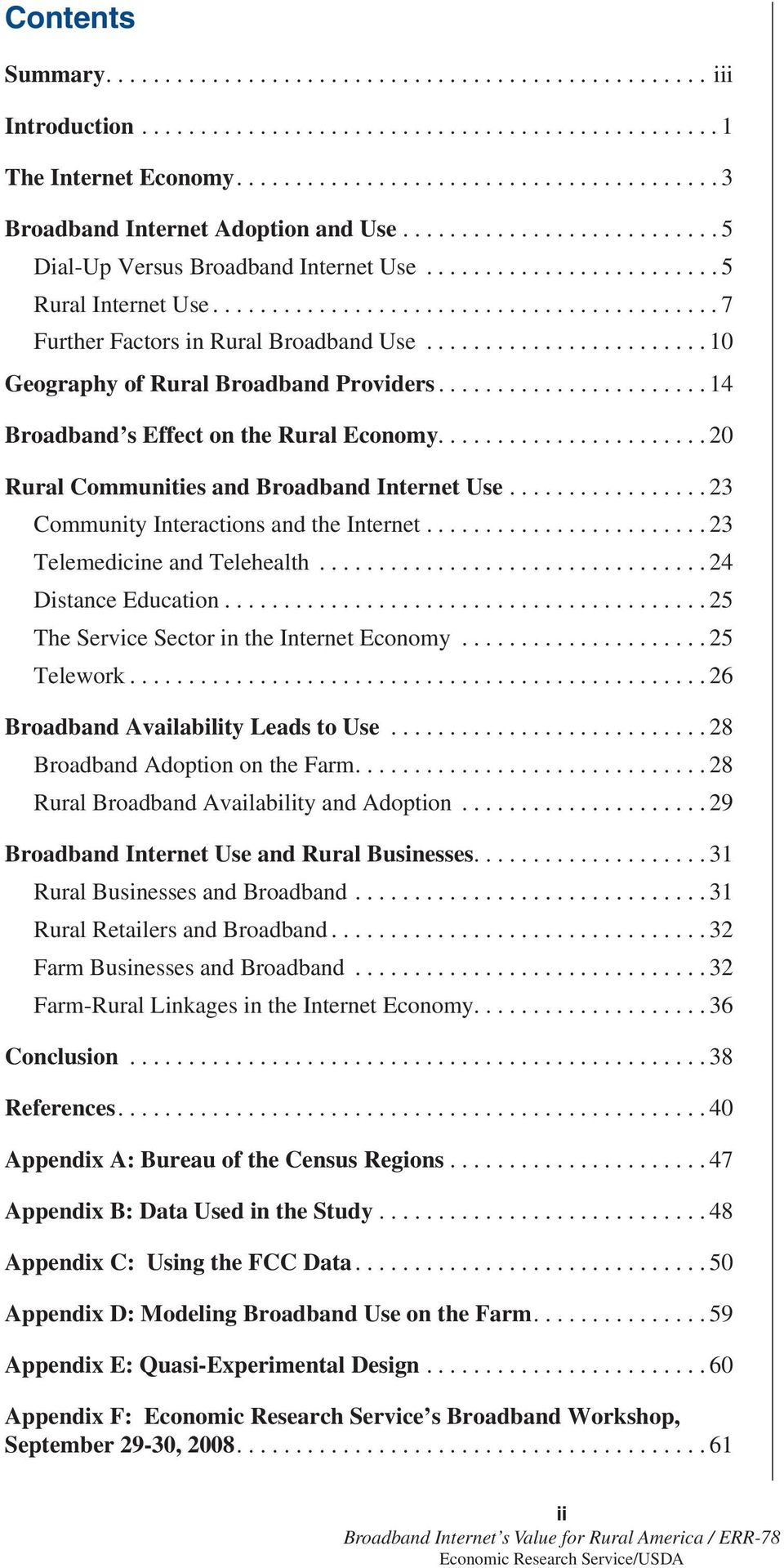
2 Contents Summary iii Introduction The Internet Economy Broadband Internet Adoption and Use Dial-Up Versus Broadband Internet Use Rural Internet Use Further Factors in Rural Broadband Use Geography of Rural Broadband Providers Broadband s Effect on the Rural Economy Rural Communities and Broadband Internet Use Community Interactions and the Internet Telemedicine and Telehealth Distance Education The Service Sector in the Internet Economy Telework Broadband Availability Leads to Use Broadband Adoption on the Farm Rural Broadband Availability and Adoption Broadband Internet Use and Rural Businesses Rural Businesses and Broadband Rural Retailers and Broadband Farm Businesses and Broadband Farm-Rural Linkages in the Internet Economy Conclusion References Appendix A: Bureau of the Census Regions Appendix B: Data Used in the Study Appendix C: Using the FCC Data Appendix D: Modeling Broadband Use on the Farm Appendix E: Quasi-Experimental Design Appendix F: Economic Research Service s Broadband Workshop, September 29-30, ii
3 Summary The Internet has become widely, but not universally, available. Two-thirds of U.S. adults had in-home Internet access by Rural businesses and consumers have become almost as likely as their urban counterparts to use the Internet, though broadband or high-speed access is less prevalent in rural areas than in more densely populated areas. The 2008 Farm Act reauthorized USDA s telemedicine, distance learning, and rural broadband access grant and loan programs. What Is the Issue? Broadband access is viewed as necessary to fully utilize the Internet s potential. As the Internet economy has matured, more applications now require higher data transmission rates, even in the case of simple shopping websites. In a recessionary economy a number of Internet activities including job searches and home businesses may become more critical for households. Whereas an estimated 55 percent of U.S. adults had broadband access at home in 2008, only 41 percent of adults in rural households had broadband access. Evidence suggests that some of this shortfall in broadband use is involuntary, and may be due to the higher cost of broadband provision or lower returns to broadband investment in sparsely populated areas. What Did the Study Find? Analysis suggests that rural economies benefit generally from broadband availability. In comparing counties that had broadband access relatively early (by 2000) with similarly situated counties that had little or no broadband access as of 2000, employment growth was higher and nonfarm private earnings greater in counties with a longer history of broadband availability. By 2007, most households (82 percent) with in-home Internet access had a broadband connection. A marked difference exists, however, between urban and rural broadband use only 70 percent of rural households with in-home Internet access had a broadband connection in 2007, compared with 84 percent of urban households. The rural-urban difference in in-home broadband adoption among households with similar income levels reflects the more limited availability of broadband in rural settings. Areas with low population size, locations that have experienced persistent population loss and an aging population, or places where population is widely dispersed over demanding terrain generally have difficulty attracting broadband service providers. These characteristics can make the fixed cost of providing broadband access too high, or limit potential demand, thus depressing the profitability of providing service. Clusters of lower service exist in sparsely populated areas, such as the Dakotas, eastern Montana, northern Minnesota, and eastern Oregon. Other low-service areas, such as the Missouri-Iowa border and Appalachia, have aging and declining numbers of residents. Nonetheless, rural areas in some States (such as Nebraska, Kansas, and Vermont) have higher-than-expected broadband service given their population characteristics, suggesting that policy, economic, and social factors can overcome common barriers to broadband expansion. iii

4 In general, rural America has shared in the growth of the Internet economy. Online course offerings for students in primary, secondary, post-secondary, and continuing education programs have improved educational opportunities, especially in small, isolated rural areas. And interaction among students, parents, teachers, and school administrators has been enhanced via online forums, which is especially significant given the importance of ongoing parental involvement in children s education. Telemedicine and telehealth have been hailed as vital to health care provision in rural communities, whether simply improving the perception of locally provided health care quality or expanding the menu of medical services. More accessible health information, products, and services confer real economic benefits on rural communities: reducing transportation time and expenses, treating emergencies more effectively, reducing time missed at work, increasing local lab and pharmacy work, and generating savings for health facilities from outsourcing specialized medical procedures. One study of 24 rural hospitals placed the annual cost of not having telemedicine at $370,000 per hospital. Most employment growth in the U.S. over the last several decades has been in the service sector, a sector especially conducive for broadband applications. Broadband allows rural areas to compete for low- and high-end service jobs, from call centers to software development, but does not guarantee that rural communities will get them. Rural businesses have been adopting more e-commerce and Internet practices, improving efficiency and expanding market reach. Some rural retailers use the Internet to satisfy supplier requirements. The farm sector, a pioneer in rural Internet use, is increasingly comprised of farm businesses that purchase inputs and make sales online. Farm household characteristics such as age, education, presence of children, and household income are significant factors in adopting broadband Internet use, whereas distance from urban centers was not a factor. Larger farm businesses are more apt to use broadband in managing their operation; the more multifaceted the farm business, the more the farm used the Internet. iv

5 How Was the Study Conducted? This report summarizes all available nationwide data on broadband use and availability and analyzes the data to isolate interactions between broadband use and economic activities. It also presents results from an ERS-sponsored workshop on rural broadband and ERS-commissioned research studies conducted by others. The aim is to assess the economic impact of not having broadband service on rural communities and their growth, community facilities, access to health care, and well-being, as requested by Congress on December 26, We first analyze who uses broadband, what it is used for, and what differences exist between the average urban and rural user to better understand the perceived usefulness of the Internet, especially broadband. We then identify rural areas that have broadband (by ZIP Code), determine when they acquired broadband service, and develop measurements of broadband availability over time. We analyze the effect of broadband Internet access on the rural economy using quasi-experimental design (QED), which allows us to compare two sets of counties alike in most aspects other than broadband availability. The results are interpreted using further analysis of rural businesses and consumers, including farm business logistic regression analysis, rural-farm linkage logistic regression analysis, and workshop research exploring many complex interactions between the Internet and socioeconomic components of the rural community: rural community social interactions; telemedicine; distance education; and rural businesses, including retail, service, and farm. v

Broadband Internet Service Helping Create a Rural Digital Economy
 VOLUME 7 ISSUE 3 Broadband Internet Service Helping Create a Rural Digital Economy 22 AMBER WAVES Peter Stenberg [email protected] Mitch Morehart [email protected] John Cromartie [email protected]
Broadband Internet Use and Rural Businesses
 Broadband Internet Use and Rural Businesses One of the salient features of the Internet is its capacity to provide information quickly and cheaply compared to other dissemination methods (Henderson et
OPPORTUNITY IN AMERICA 2011-2015
 OPPORTUNITY IN AMERICA 2011-2015 5 YEARS OF THE OPPORTUNITY INDEX TABLE OF CONTENTS 03 04-05 06-07 08 09 10-25 FIVE-YEAR LANDSCAPE PATHS OF OPPORTUNITY STATE RANKINGS NATIONAL TRENDS INDEX INDICATORS INDEX
Appendix A: Bureau of the Census Regions
 Appendix A: Bureau of the Census Regions Figure A-1 Bureau of the Census Regions WA CA OR NV ID WEST UT MT WY CO ND MN SD MIDWEST IA NE KS MO WI IL MI MI IN KY OH WV NORTHEAST PA VA NY NJ MD DE VT NH ME
Broadband Availability in America. With Rural Americans Looking for High-Speed Services, Adequate Broadband Speeds Remain Out of Reach for Many
 Broadband Availability in America With Rural Americans Looking for High-Speed Services, Adequate Broadband Speeds Remain Out of Reach for Many Federal Communications Commission January 30, 2015 High-speed
How To Measure The Impact Of High Speed Internet On Growth
 Research Report The Impact of High-Speed Internet Access on Local Economic Growth August 2005 Peter F. Orazem, Ph.D. Koch Visiting Professor of Business Economics University of Kansas School of Business
Rural America At A Glance
 United States Department of Agriculture Rural America At A Glance 2014 Edition Overview While the U.S. economy is now in its sixth year of recovery from the Great Recession of 2007-09, its performance
Sources of Health Insurance Coverage in Georgia 2007-2008
 Sources of Health Insurance Coverage in Georgia 2007-2008 Tabulations of the March 2008 Annual Social and Economic Supplement to the Current Population Survey and The 2008 Georgia Population Survey William
Map 1. Average Dollar Value of Agricultural Products Sold per Farm
 Profiles: Government Farm Payments and Other Government Transfer Payments in the United States Iowa State University Department of Economics Authors: Liesl Eathington, Research Associate Dave Swenson,
OFFICE OF RURAL HEALTH ANNUAL REPORT THRIVE 2015
 OFFICE OF RURAL HEALTH ANNUAL REPORT THRIVE 2015 The U.S. Department of Veterans Affairs Office of Rural Health strives to eliminate the barriers between rural Veterans and the services they have earned
Real Progress in Food Code Adoption
 Real Progress in Food Code Adoption The Association of Food and Drug Officials (AFDO), under contract to the Food and Drug Administration, is gathering data on the progress of FDA Food Code adoptions by
Taking stock of the digital divide
 Taking stock of the digital divide Dr. Sharon Strover University of Texas at Austin Prepared for the Lisbon Research and Policy Workshop: Technologies, contents and services for social inclusion: Facing
Workforce Trends In and Occupational Forecasts For Northern Virginia, 2010-2020
 Workforce Trends In and Occupational Forecasts For Northern Virginia, - Prepared for The Northern Virginia Community College and The Fairfax County Chamber of Commerce by Stephen S. Fuller, PhD and Ellen
Public Transportation on the Move in Rural America. Dennis M. Brown Regional Economist
 Public Transportation on the Move in Rural America by Dennis M. Brown Regional Economist Economic Research Service U.S. Dept. of Agriculture 1800 M St., N.W. Room S2092 Washington, DC 20036 Tel: (202)
Agriculture Technology Economic Cluster Wireless Broadband Infrastructure ROBERT TSE
 Agriculture Technology Economic Cluster Wireless Broadband Infrastructure ROBERT TSE San Joaquin Valley Agriculture Technology Economic Cluster FRANCE CALIFORNIA World Economies California is 9 th Largest
RURAL UTILITIES SERVICE. Statement of Brandon McBride, Administrator
 For release only by the House Committee on Appropriations RURAL UTILITIES SERVICE Statement of Brandon McBride, Administrator Before the subcommittee on Agriculture, Rural Development, Food and Drug Administration,
Broadband in the Upper Peninsula of Michigan
 Broadband in the Upper Peninsula of Michigan A high-speed Internet connection is a modern lifeline to quality jobs, information, and vital services ranging from interactive telemedicine to higher education.
STATE DATA CENTER. District of Columbia MONTHLY BRIEF
 District of Columbia STATE DATA CENTER MONTHLY BRIEF N o v e m b e r 2 0 1 2 District Residents Health Insurance Coverage 2000-2010 By Minwuyelet Azimeraw Joy Phillips, Ph.D. This report is based on data
Profile of Rural Health Insurance Coverage
 Profile of Rural Health Insurance Coverage A Chartbook R H R C Rural Health Research & Policy Centers Funded by the Federal Office of Rural Health Policy www.ruralhealthresearch.org UNIVERSITY OF SOUTHERN
Three-Year Moving Averages by States % Home Internet Access
 Three-Year Moving Averages by States % Home Internet Access Alabama Alaska Arizona Arkansas California Colorado Connecticut Delaware Florida Georgia Hawaii Idaho Illinois Indiana Iowa Kansas Kentucky Louisiana
The Obama Administration and Community Health Centers
 The Obama Administration and Community Health Centers Community health centers are a critical source of health care for millions of Americans particularly those in underserved communities. Thanks primarily
How To Calculate College Enrollment In The United States
 EDUCATION POLICY BRIEF May 2008 The Nelson A. Rockefeller Institute of Government The public policy research arm of the State University of New York The States and Their Community Colleges Every state
Broadband What is it?
 What is it? FCC Definition 200 kbps is defined as Internet Access 200 kbps in at least one direction is defined as Hi Speed Access (1) 200 kbps in both directions is defined as Advanced Services (1) A
Jessica Zufolo Deputy Administrator, USDA Rural Development Rural Utilities Service
 Jessica Zufolo Deputy Administrator, USDA Rural Development Rural Utilities Service 2 3 RUS Telecom and Broadband loan programs RUS DLT and Community Connect grant programs RD Community Facilities Loan/Grant
BUSINESS DEVELOPMENT OUTCOMES
 BUSINESS DEVELOPMENT OUTCOMES Small Business Ownership Description Total number of employer firms and self-employment in the state per 100 people in the labor force, 2003. Explanation Business ownership
VA Office of Rural Health (ORH) Overview. David Huffman, MS Associate Director Tomah VA Medical Center
 VA Office of Rural Health (ORH) Overview David Huffman, MS Associate Director Tomah VA Medical Center About Rural Veterans There are approximately 6.1 million Veterans residing in rural areas (defined
Speed Matters: High Speed Internet for All
 Speed Matters: High Speed Internet for All Communications Workers of America www.speedmatters.org The emergence of a new communications system one based on high speed interactive networks designed for
Affordable Electricity: Rural America s Economic Lifeline
 July 27, 2015 Affordable Electricity: Rural America s Economic Lifeline Summary Affordable electricity is essential to economic growth in rural America. Public policies, programs and other factors that
Rural Communities, BT s written evidence to Commons Select Committee October 2012
 Rural Communities, BT s written evidence to Commons Select Committee October 2012 Page 1 of 5 Rural Communities, BT s written evidence to Commons Select Committee 1. BT is pleased to provide evidence,
Technology Use among Rural Nevada Businesses
 February 2013 Rural Nevada represents a large and vibrant portion of the state and its economy. Rural Nevada counties (those that are not a part of a Metropolitan Statistical Area) encompass just over
Mobile Broadband in Nevada: Access At Home or On the Go
 March 2013 Without a doubt, cell phones and mobile Internet service have changed the way that people stay in touch and access the web. The Brookings Institute anticipates that by 2015 there will be 3.1
Brief 1 The State of North Carolina: Jobs, Poverty and Family. Jeannine Sato, Center for Child and Family Policy
 Brief 1 The State of North Carolina: Jobs, Poverty and Family Jeannine Sato, Center for Child and Family Policy The connection among jobs, poverty and family well-being is well established. Research shows
Main Street ECONOMIST: ECONOMIST THE THE. Economic information. Financing Young and Beginning Farmers. By Nathan Kauffman, Economist
 THE Main Street ECONOMIST: ECONOMIST Economic information Agricultural for the and Cornhusker Rural Analysis State September 201 0 Federal Reserve Bank of of Kansas City Financing Young and Beginning Farmers
Composition of Farm Household Income and Wealth
 Composition of Farm Household Income and Wealth Today it is rare for any household to receive all of its from a single source. Even when only one household member is employed, it is possible to earn from
Thank you for the opportunity to join you today to discuss such an important and urgent topic: the
 Testimony of Gary Wiltz Senate Committee on Health, Education, Labor and Pensions Subcommittee on Primary Care and Aging Hearing on Addressing Primary Care Access and Workforce Challenges: Voices from
Broadband Project Frequently Asked Questions
 Broadband Project Frequently Asked Questions What is the history of the Nelson County broadband project? Nelson County completed its research and planning for this project, with the assistance of the Virginia
Broadband Internet Access and the Digital Divide: Federal Assistance Programs
 Broadband Internet Access and the Digital Divide: Federal Assistance Programs Lennard G. Kruger Specialist in Science and Technology Policy Angele A. Gilroy Specialist in Telecommunications Policy October
FEDERAL GRANTS TO STATES AND LOCALITIES CUT DEEPLY IN FISCAL YEAR 2009 FEDERAL BUDGET By Iris J. Lav and Phillip Oliff
 820 First Street NE, Suite 510 Washington, DC 20002 Tel: 202-408-1080 Fax: 202-408-1056 [email protected] www.cbpp.org February 4, 2008 FEDERAL GRANTS TO STATES AND LOCALITIES CUT DEEPLY IN FISCAL YEAR 2009
The High Cost of Low Graduation Rates: How Much Does Dropping Out of College Really Cost? Mark Schneider Vice President AIR
 The High Cost of Low Graduation Rates: How Much Does Dropping Out of College Really Cost? Mark Schneider Vice President AIR Lu (Michelle) Yin Researcher AIR August 2011 www.air.org Contents Executive Summary...........................................................
Changes in Self-Employment: 2010 to 2011
 Changes in Self-Employment: 2010 to 2011 American Community Survey Briefs By China Layne Issued January 2013 ACSBR/11-21 INTRODUCTION From December 2007 to June 2009, the United States experienced an economic
The Economic Impact of the New Hospital on the Economy of Drumright, Creek County, Oklahoma
 The Economic Impact of the New Hospital on the Economy of Drumright, Creek County, Oklahoma Drumright Creek County Oklahoma Cooperative Extension Service Oklahoma Office of Rural Health Rural Health Policy
Greening Income Support and Supporting Green
 Conservation Program Design Greening Income Support and Supporting Green Roger Claassen and Mitch Morehart Green payments refer broadly to farm payment programs that would, if enacted, merge farm income
Traffic Safety Facts Research Note
 1 Traffic Safety Facts Research Note DOT HS 811 218 November 2009 Fatal Crashes Involving Summary Fatalities from crashes involving young drivers have accounted for just under one-fifth of all fatalities
Statewide Technology Access for Government and Education Network (STAGEnet)
 State of North Dakota Information Technology Department Statewide Technology Access for Government and Education Network (STAGEnet) Strategic Plan Prepared by: Lisa Feldner, Chief Information Officer Information
Educational Attainment in the United States: 2003
 Educational Attainment in the United States: 2003 Population Characteristics Issued June 2004 P20-550 The population in the United States is becoming more educated, but significant differences in educational
GOVERNMENT-FINANCED EMPLOYMENT AND THE REAL PRIVATE SECTOR IN THE 50 STATES
 GOVERNMENT-FINANCED EMPLOYMENT AND THE REAL PRIVATE SECTOR IN THE 50 STATES BY KEITH HALL AND ROBERT GREENE November 25, 2013 www.mercatus.org 0.7 2.4 4.2 FEDERAL CONTRACT FUNDED PRIVATE-SECTOR JOBS AS
2009-10 STATE AND LOCAL GOVERNMENT TAX AND REVENUE RANKINGS. By Jacek Cianciara
 2009-10 STATE AND LOCAL GOVERNMENT TAX AND REVENUE RANKINGS By Jacek Cianciara Wisconsin Department of Revenue Division of Research and Policy December 12, 2012 TABLE OF CONTENTS Key Findings 3 Introduction
Mimi McFaul, Psy.D. Director WICHE Mental Health Program
 Is your SORH thinking about whole health? Mimi McFaul, Psy.D. Director WICHE Mental Health Program ALASKA ARIZONA CALIFORNIA COLORADO HAWAII IDAHO MONTANA NEVADA NEW MEXICO NORTH DAKOTA OREGON SOUTH DAKOTA
Adoption of Electronic Health Record Systems among U.S. Non-federal Acute Care Hospitals: 2008-2013
 ONC Data Brief No. 16 May 2014 Adoption of Electronic Health Record Systems among U.S. Non-federal Acute Care Hospitals: 2008-2013 Dustin Charles, MPH; Meghan Gabriel, PhD; Michael F. Furukawa, PhD The
Discussion Paper. New England migration trends by David Agrawal. New England Public Policy Center Discussion Paper 06-1 October 2006
 New England Public Policy Center Discussion Paper 06-1 October 2006 Discussion Paper New England migration trends by David Agrawal Revised October 30, 2006 federal reserve bank of boston TM New England