
Hitachi TagmaStore Adaptable Modular Storage and Workgroup Modular Storage
|
|
|
- Adelia Burke
- 10 years ago
- Views:
Transcription
1 Hitachi TagmaStore Adaptable Modular Storage and Workgroup Modular Storage Architecture Guide Partner Beyond Technology Hitachi TagmaStore Modular Storage Architecture Guide Hitachi Data Systems
2 Executive Summary Bringing Application Optimized Storage Solutions to a Broad Range of Organizations Regardless of the size of an organization, Application Optimized Storage solutions from Hitachi Data Systems open new possibilities to better align storage infrastructure with business objectives. Hitachi TagmaStore Adaptable Modular Storage and Workgroup Modular Storage models play an important role in building Application Optimized Storage solutions to match application requirements such as performance, availability, functionality, and cost with storage attributes, across a wide range of organizations. Instead of providing different products for different-sized organizations, Hitachi Data Systems employs the same set of products to focus on a common tiered strategy for aligning storage characteristics and business application priorities, whether for a large enterprise or a smaller organization. Application Optimized Storage solutions offer integrated hardware, software, and services that utilize Hitachi modular storage systems in a tiered-storage architecture, which maximizes storage investment returns for businesses of any size. It s only a matter of scale. The Application Optimized Storage strategy takes the same quality and data-availability standards found in systems used to power the world s largest banks and makes them available to midsize businesses. Small businesses can rest assured that they are using versions of the same hardware, software, and services the largest enterprises use, and the largest enterprises can be confident that they are using the most cost-effective solutions to meet their business objectives. Hitachi Data Systems believes that all organizations deserve enterprise-level functionality high availability, high performance, simplified central management, and tiered solutions that align storage directly with business objectives. Because many organizations have limited budget, staff, and space, Hitachi Data Systems is offering modular systems that are scaled to fit environments and budgets in the modular storage market space. Announced in July 2005, the new Hitachi modular storage systems are an architecturally advanced offering not only in terms of footprint and performance but also in terms of policy-based management software features. These modular choices enable both large enterprises and smaller organizations to address storage challenges with automated management, affordable and easy-to-grow packaging, and a proven investment-oriented storage solutions strategy: : : Hitachi TagmaStore Adaptable Modular Storage : : Hitachi TagmaStore Workgroup Modular Storage I

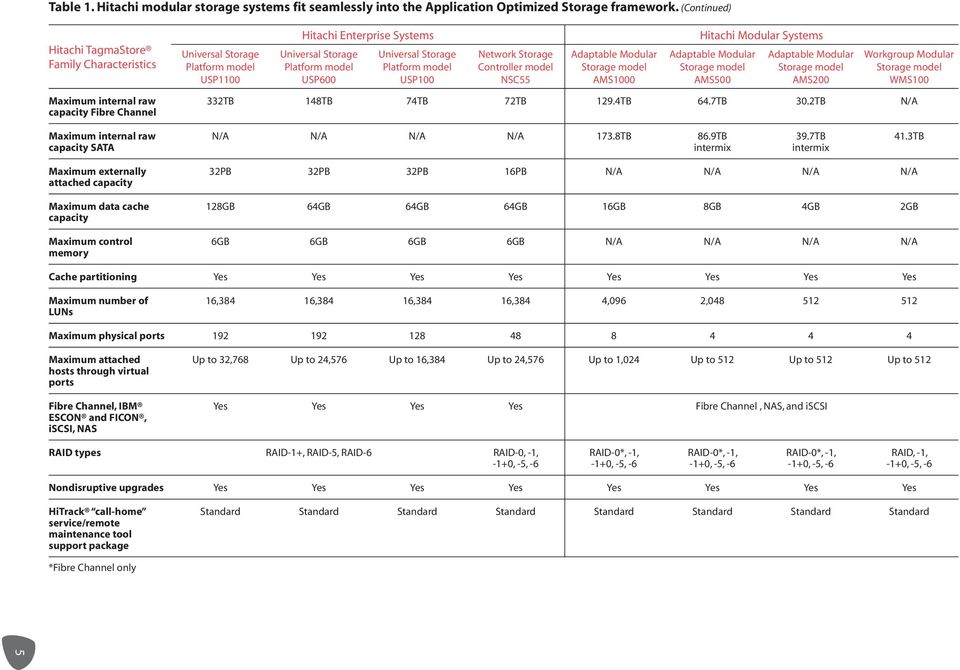
3 All Hitachi modular storage systems can be configured and managed from a single pane of glass with the easy-to-use graphical user interface of the Hitachi Storage Management and HiCommand Suite software. Best-of-breed high-performance hardware and cache partitioning set these systems apart from the competition. The industry s highest level of data availability is offered by the most advanced business continuity software, including Hitachi ShadowImage In-System Replication and Hitachi Remote Replication software, available on the larger modular products, helping you keep management simple while avoiding downtime and data loss. TagmaStore Adaptable Modular Storage, Models AMS200, AMS500, and AMS1000: the Mixable SATA and Fibre Channel Storage Systems Adaptable Modular Storage systems can serve as both the first tier (Fibre Channel disks) and second tier (SATA disks) of storage for a workgroup or midsize company, providing a self-contained tiered solution in a single system. Adaptable Modular Storage systems are intended for consolidated heterogeneous open systems computing environments and for applications in e-commerce and Web serving. Adaptable Modular Storage models offer a variety of features and functions that address the needs of midsize organizations or the tiered-storage requirements of the enterprise. Single pane of glass management of all Hitachi storage is enabled by Storage Management and HiCommand Suite software. Each model provides simplified software for quick and easy configuration and management. They also offer cache partitioning, allowing applications with different-sized data blocks to be precisely tuned, thereby optimizing their performance. For connectivity, native NAS and iscsi support allows IP-based files or volumes to be managed with the same tools as storage area network (SAN) volumes, thereby reducing management overhead. Unique in the modular market space, RAID-6 dual parity striping provides greater availability by protecting against the rare event of a second hard disk drive failure in a RAID array before successful rebuild of the first failed disk. All Adaptable Modular Storage models offer mixable SATA and Fibre Channel disk drives to allow workloads to be hosted on the most economical storage, based on assigned application priorities. Logical Unit Migration enables data to be moved nondisruptively between tiers. Finally, redundant, hot-swappable components and the Hi-Track call-home service/ remote maintenance tool support maximum uptime. II
4 TagmaStore Workgroup Modular Storage, Model WMS100: the All SATA Storage System The Workgroup Modular Storage model WMS100 is ideal for midsize companies or workgroups that require the best in scalability and performance in a small footprint. The WMS100 supports costefficient SATA drives while maintaining the performance and reliability edge that world-class Hitachi engineering delivers. The WMS100 is perfect for applications lending themselves to modular workloads, especially where a SATA option is a good fit, such as with: : : Smaller Microsoft Exchange operations that seek optimized storage : : Enterprise resource planning and customer relationship management systems with small organization workloads : : Database applications with moderate workload characteristics Like other Hitachi modular storage systems, the WMS100 provides advanced Hitachi cache partitioning, which uniquely allows administrators to efficiently allocate cache and tailor block size to specific applications, thereby optimizing their performance. Redundant, hot-swappable components and remote monitoring through the Hi-Track service/tool are also supported. The WMS100 can also serve as second- or third-tier storage for the enterprise. Application Optimized Storage Solutions Hitachi Data Systems provides solutions in various areas, including Infrastructure Simplification and Business Continuity and Disaster Recovery, as well as assessment services to help organizations identify, justify, implement, and track an Application Optimized Storage solutions investment. All Application Optimized Storage solutions are adaptable and differentially priced for enterprises of all sizes matching business application requirements with different classes (tiers) of storage using the same set of Hitachi products, software, and services. Infrastructure Simplification. Solutions in this area reduce capital expense (CapEx) and operational expense (OpEx) not only through consolidation and aggregation but also through tiered storage for data lifecycle management and archiving solutions. Tightly integrated through common management software, these Application Optimized Storage solutions leverage an organization s current storage investments, better aligning them for future growth, using best-practices financial analysis methodologies. III

5 Business Continuity and Disaster Recovery. Solutions in this area include enhanced backup and recovery for open-systems and mainframe environments. Known for decades as the industry-leading provider of high-availability data storage products, Hitachi Data Systems today offers unsurpassed technical excellence in business continuity solutions for disaster prevention, planning, and backup and recovery. These solutions are the industry s most advanced and will result in both hard and soft CapEx and OpEx savings for the enterprise. Services and Best Practices Priced for the Modular Market Space Keeping storage investment costs in mind, Hitachi Data Systems Global Solution Services (GSS) offerings, such as the Risk Analysis Workshop and the Storage Economics Strategy Service, help you assess your current environment and requirements. For example, the Storage Economics Strategy Service helps you to objectively assess your current storage environment and make tactical and strategic plans to take advantage of new storage architectures, employing the HiReturn investment analysis program to help you consider both total cost of ownership (TCO) and return on investment (ROI) approaches. In addition to the variety of assessment services mentioned above, GSS offers and works with Hitachi TrueNorth Channel partners to provide professional services for planning, design, and deployment of solutions from smaller organizations to larger enterprise environments. GSS teams combine the industry s best people, products, and methodologies to provide architectural analysis, configuration planning, and enterprise assessment to ensure that organizations maximize their storage investments and meet their business objectives. IV

6 Table of Contents Chapter 1:Hitachi Modular Storage Systems Set New Industry Standards...1 Organizations of All Sizes Face the Same IT Challenges...1 Hitachi Modular Storage Systems Benefit Smaller Organizations and the Larger Enterprise...2 Positioning for the Enterprise...2 Positioning for Midsize Companies and Workgroups...3 A Mix and Match Modular Architecture...6 Adaptable Modular Storage Models AMS200, AMS500, and AMS1000: the Mixable SATA and Fibre Channel Storage Systems...6 Workgroup Modular Storage Model WMS100: the All-SATA Storage System...8 Hitachi Modular Software Delivers Enterprise-class Functionality...8 Modular Hitachi Architectures Lead the Industry in Performance...9 Application Optimized Storage Strategy Bringing Application Optimized Storage Solutions to the Midrange Services and Best Practices Tie It All Together Chapter 2: Application Optimized Storage Solutions The Strategic Shift to a Solution Focus and Systematic Purchase Justification Infrastructure Simplification Consolidation Solutions Data Lifecycle Solutions Storage Management Software Business Continuity and Disaster Recovery Backup and Recovery Solutions Mainframe Backup and Recovery Solutions All Hitachi Storage Solutions Create Both CapEx and OpEx Savings HiReturn Investment Analysis Program Works for Businesses of Any Size Price Does Not Equal Cost Chapter 3: Hitachi Modular Storage Systems Packaging Packaging Is Modular and Expandable Full- or Half-height Industry-standard Racks Adaptable Modular Storage and Workgroup Modular Storage Fully Redundant System Designs Hot-pluggable Disk Drive Designs Chapter 4: High-performance Front-end Designs and Network Solutions Host Connectivity and Scalability to Fit Both Smaller Organization and Larger Enterprise Needs Virtual Storage Ports Reduce TCO and Improve SAN Security Open Systems Host Support Networked Storage Solutions Open Networked Storage Virtual Storage Ports and Secure Multitenancy V

7 Positioning for DAS, NAS, and SAN Coexistence Turnkey High-end Fibre Channel SAN Solutions Turnkey Low-end iscsi SAN Solutions Plug-and-play SAN Kit for Hitachi TagmaStore Modular Storage Chapter 5: Back-end Design, System Capacity, and RAID High-performance/High-capacity Back-end Designs Disk Drive Specifications Storage Capacities Flexible RAID Architectures RAID RAID-1 Mirroring RAID-1+0 Striping and Mirroring RAID-5 Distributed Parity RAID-6 Redundant Distributed Parity RAID Levels Can Be Intermixed to Tune Application Performance and Availability Definable RAID Rebuild Priorities Global Hot Spares Logical Unit Size Expansion Chapter 6: Common Data and Storage Management via Advanced-function Hitachi Software Hitachi Software Allows Simplified Management and Precise Application Tuning Manage Heterogeneous Systems from a Single Console HiCommand Storage-specific Management Business Application Modules Storage Operations Modules HiCommand Heterogeneous Storage Management Storage Services Manager Software Business Application Modules Storage Operations Modules Hitachi Storage specific Management Resource Manager Utility Package Provides Powerful, Device-level Storage Management Capability Out-of-band Management SNMP Support Ensures Compliance with All Major Systems Management Platforms Java Agent Host Storage Domains Volume Security Port Option Software Virtual LUN Software Cache Residency Manager Feature Allows Data to Be Locked and Unlocked in Cache on the Fly Cache Partition Manager Feature Allows Cache to be Divided in Different Sizes for Better Management of Cache Resources and Application Performance Tuning Read-ahead Caching for High-performance Sequential Reads VI
8 Chapter 7: Data Protection with Hitachi Modular Storage Systems Redundant and High-availability Features Software Products Contribute to High-availability Computing Hitachi Modular Storage Systems Have an Advanced Availability Profile Compared to Competitive Products Concurrent Maintenance Microcode Sparing Nondisruptive Microcode Upgrades Automatic Failure Monitoring and Reporting Cache Reliability Online Verify, Data Assurance Code, and Error Correction Code Standard Hot-swap and Redundant Power Supplies Standard Redundant Fans for Cooling Uninterruptible Power Supply Hitachi Modular Storage Systems Support Software for Business Continuity Remote Copy, PiT Copy, and Data Migration Defined Remote Copy PiT Copy Data Migration Business Goals Served by Copy Solutions Hitachi Remote Replication Software Hitachi ShadowImage In-System Replication Software Hitachi Copy-on-Write Snapshot Software Open Systems High-availability Middleware Support Alternate-pathing Middleware Switches the I/O Load in the Event of Path Failure Path Failover and Load Balancing Host Failover Parallel Database Clustering Hitachi Data Retention Utility Software Hitachi Data Protection Suite, powered by CommVault VERITAS Foundation Suite Software and VERITAS NetBackup Chapter 8: Use Cases HiReturn Investment Analysis Program TCO Is Consistently Ranked as the No. 1 User Storage Concern HiReturn Program Use Cases Defined Employing Use Case Models for Your Environment Appendix A: An Example of Application Optimized Storage Tiers Appendix B: Hitachi Data Systems Solutions Directly Address the SNIA Survey s Top Ten End User Pain Points VII

9 Hitachi Modular Storage Systems Set New Industry Standards Hitachi modular storage systems once again move the bar above the reach of the competition and set new standards for modular storage systems in terms of advanced enterprise features not offered by any competitor. These systems lead the market, not only in terms of capacity and performance but also in terms of management software. It is becoming widely accepted by industry analysts today that storage systems must be surrounded by features and services that enable simplification of storage management even for smaller organizations and entrylevel enterprises. Organizations of All Sizes Face the Same IT Challenges From the small business to the large enterprise, organizations of all sizes face the same IT challenges. It s only a matter of degree. As you seek to gain competitive advantage and grow in your respective market, you are facing many of the same data storage challenges and pain points as large enterprises: Chapter 1 Hitachi modular storage systems offer enterpriseclass functionality without compromising quality and reliability. : : Data growth continues to accelerate. : : Older storage devices are unreliable and perform poorly. : : Hard-to-meet regulatory requirements often apply, regardless of company size. : : IT budgets and head counts are flat or shrinking. : : Hard-to-manage storage infrastructure server-internal disks or server-attached storage from multiple vendors drives management cost to several times the acquisition costs. : : Backup-and-restore windows are shrinking. : : Disaster recovery time objectives require that applications be recovered within minutes or hours. : : Applications are not meeting performance and availability expectations. : : Compliance requirements and litigation fears demand that data be kept in tamperproof storage for defined time periods and made available quickly when necessary. : : Old data needs to be online and accessible within a short time (generally seconds or minutes). The primary difference is in the scale of these issues. Like large enterprises, smaller organizations are faced with managing disparate storage islands tailored to individual server applications such as Microsoft Exchange, Microsoft SQL Server, Linux, and file servers. Growth for an organization of any size means increasing storage infrastructure demands for higher capacity, increased utilization, improved performance, business continuity, and data protection, as well as the need to simplify overall management in an environment of increasing regulation. The Hitachi modular products offer best-in-class scalability and performance and enable shared storage consolidation across platforms by increasing utilization, sharing capacity, and simplifying overall management. From high-end to entry-level, Hitachi modular storage systems meet these challenges. 1
10 Hitachi Modular Storage Systems Benefit Smaller Organizations and the Larger Enterprise Whatever the storage challenges facing your business and whatever the size of your business, Hitachi Data Systems offers storage solutions that are sure to fit. Hitachi Data Systems product positioning for businesses of various sizes is defined in terms of Application Optimized Storage solutions, and does not use a one size fits all approach. As shown in Figure 1 and Table 1, Hitachi modular storage systems take on multiple roles serving in varied storage tiers 1 depending on the size of the business, installed equipment, Application Optimized Storage strategy, and other factors. Because they have the same functionality as Hitachi enterprise systems, the new modular systems fit seamlessly into the proven, enterprise-caliber Application Optimized Storage solutions aligning IT with business objectives and scaling to fit your environment and budget. Positioning for the Enterprise For large enterprise environments, Hitachi modular storage systems complement the Hitachi TagmaStore Universal Storage Platform and Hitachi Lightning 9900 V Series enterprise storage systems in tiered Application Optimized Storage deployments. As shown in Table 1, the Universal Storage Platform models USP100, USP600, and USP1100 are typically found in enterprise-level (raised floor/data center) installations, where their internal storage is designated as first-tier storage, with externally managed Universal Storage Platform storage as second- and third-tier storage. In this scenario, TagmaStore Adaptable Modular Storage and TagmaStore Workgroup Modular Storage can fill the roles of second- and third-tier enterprise storage. With a minimum number of disks, the TagmaStore Network Storage Controller model NSC55 can function in the entry-level or large enterprise as an expansion controller to centrally manage external storage as second-tier or third-tier storage, whether it is Hitachi storage or third-party storage. For the high-end enterprise, therefore, Hitachi modular storage systems with the SATA Intermix Option complement Universal Storage Platform or NSC55 systems in tiered-storage deployments for applications such as: : : Data lifecycle management : : Streaming video : : Noncritical Web serving : : archiving : : Lower-priority decision-support applications such as data warehousing : : Mainframe volume archiving for compliance : : Mainframe tape replacement : : Other lower-priority applications A large cost-savings opportunity for the enterprise is to replace a mainframe disk with a SATA disk behind a Network Storage Controller or Universal Storage Platform. This can defer or completely avoid an enterprise disk purchase cycle, depending on how much of the backup mainframe disk can be repurposed. 1 Application Optimized Storage solutions and Hitachi storage tiers are discussed in more detail below and in Chapter 2. 2

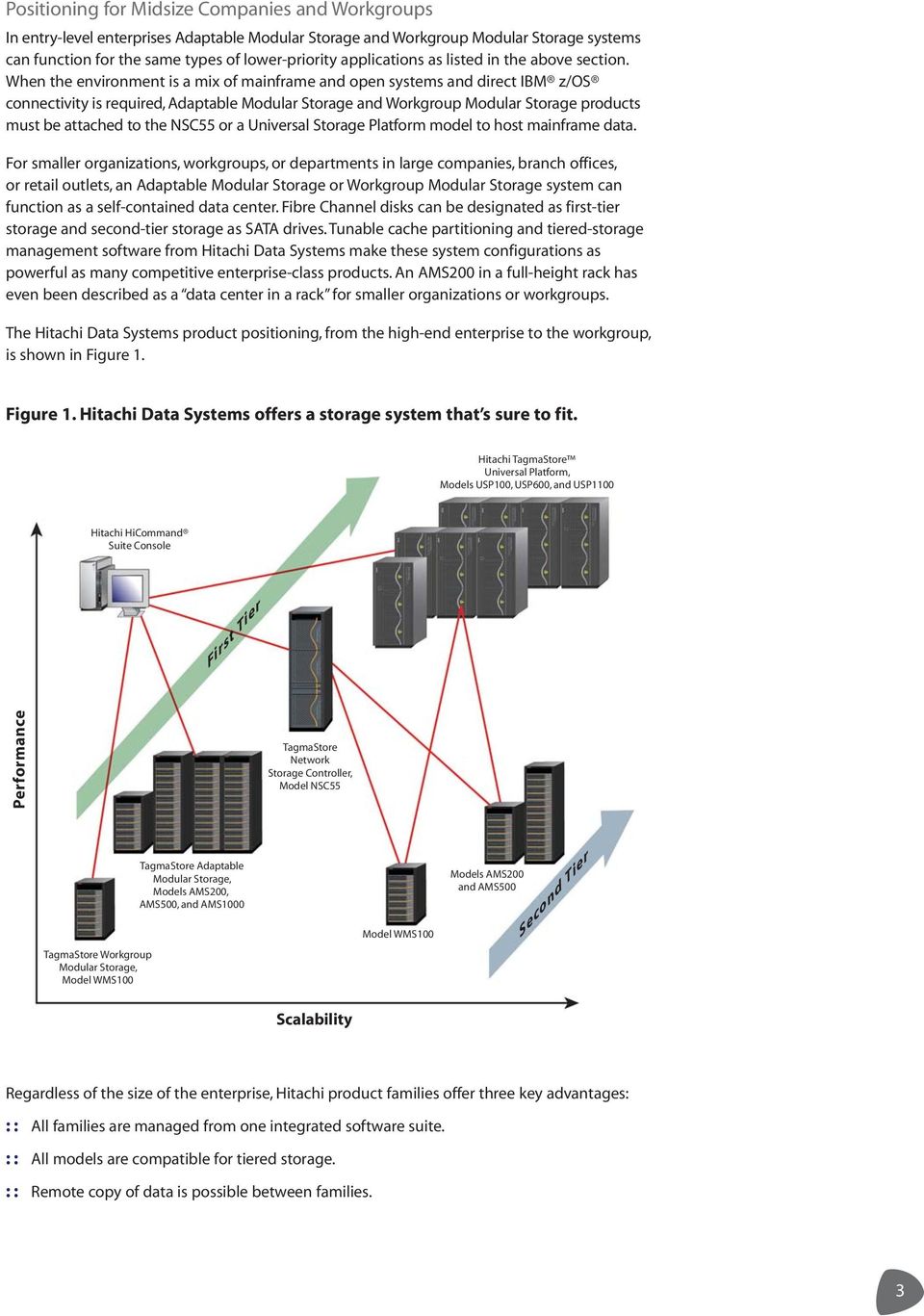
11 Positioning for Midsize Companies and Workgroups In entry-level enterprises Adaptable Modular Storage and Workgroup Modular Storage systems can function for the same types of lower-priority applications as listed in the above section. When the environment is a mix of mainframe and open systems and direct IBM z/os connectivity is required, Adaptable Modular Storage and Workgroup Modular Storage products must be attached to the NSC55 or a Universal Storage Platform model to host mainframe data. For smaller organizations, workgroups, or departments in large companies, branch offices, or retail outlets, an Adaptable Modular Storage or Workgroup Modular Storage system can function as a self-contained data center. Fibre Channel disks can be designated as first-tier storage and second-tier storage as SATA drives. Tunable cache partitioning and tiered-storage management software from Hitachi Data Systems make these system configurations as powerful as many competitive enterprise-class products. An AMS200 in a full-height rack has even been described as a data center in a rack for smaller organizations or workgroups. The Hitachi Data Systems product positioning, from the high-end enterprise to the workgroup, is shown in Figure 1. Figure 1. Hitachi Data Systems offers a storage system that s sure to fit. Hitachi TagmaStore Universal Platform, Models USP100, USP600, and USP1100 Hitachi HiCommand Suite Console First Tier Performance TagmaStore Network Storage Controller, Model NSC55 TagmaStore Workgroup Modular Storage, Model WMS100 TagmaStore Adaptable Modular Storage, Models AMS200, AMS500, and AMS1000 Model WMS100 Models AMS200 and AMS500 Second Tier Scalability Regardless of the size of the enterprise, Hitachi product families offer three key advantages: : : All families are managed from one integrated software suite. : : All models are compatible for tiered storage. : : Remote copy of data is possible between families. 3
12 Table 1. Hitachi modular storage systems fit seamlessly into the Application Optimized Storage framework. Hitachi TagmaStore Family Characteristics Universal Storage Platform model USP1100 Hitachi Enterprise Systems Universal Storage Platform model USP600 Universal Storage Platform model USP100 Network Storage Controller model NSC55 Adaptable Modular Storage model AMS1000 Hitachi Modular Systems Adaptable Modular Storage model AMS500 Adaptable Modular Storage model AMS200 Workgroup Modular Storage model WMS100 Enterprise positioning High-end enterprise model 1st tier Enhanced enterprise model 1st tier Entry-level enterprise model 1st tier Expansion controller for 2nd-tier storage 2nd-tier enterprise storage 2nd-tier enterprise storage 2nd-, 3rd-tier enterprise storage 2nd-, 3rd-tier enterprise storage; tape replacement Smaller organization and workgroup positioning N/A N/A N/A Entry-level enterprises Midsize companies and entry-level enterprises Midsize companies SME to midsize companies SME companies Architecture Hitachi Universal Star Network crossbar switch; global cache Hitachi Universal Star Network crossbar switch; global cache Hitachi Universal Star Network crossbar switch; global cache Hitachi Universal Star Network crossbar switch; global cache Dual controller; shared bus Dual controller; shared bus Dual controller; shared bus Dual controller; shared bus IBM z/os support Yes Yes Yes Yes Only when attached to a Network Storage Controller or Universal Storage Platform Configuration 2 5 frames 1 2 frames 1 frame Rackmount Rackmount Rackmount deskside Rackmount deskside Rackmount deskside Environmentals Data center Data center Data center 220V 220V 110V or 220V 110V or 220V 110V or 220V Connectivity/ virtualization of external storage Yes Yes Yes Yes Connects to Network Storage Controller or Universal Storage Platform Model upgrade options No Model USP1100 Model USP600 No No Model AMS1000 Model AMS500 No Connectivity/ virtualization of thirdparty storage Hitachi Universal Replicator software Yes Yes Yes Yes Connects through Network Storage Controller or Universal Storage Platform to manage external storage for an enterprise or a midsize company Yes Yes Yes Yes As a target As a target As a target As a target Logical partitioning Yes Yes Yes Yes Yes Yes Yes Yes Private Virtual Storage Machines Maximum internal concurrent bandwidth N/A N/A N/A N/A 81GB/sec 40.5GB/sec 23.5GB/sec 12.1GB/sec 13GB+/sec 7.5GB/sec 4.2GB/sec 4.2GB/sec Number of disks 129 1,152 Fibre Channel Fibre Channel Fibre Channel Fibre Channel Fibre Channel Fibre Channel, Fibre Channel, SATA SATA SATA 0 90 SATA 4

13 Table 1. Hitachi modular storage systems fit seamlessly into the Application Optimized Storage framework. (Continued) Hitachi TagmaStore Family Characteristics Universal Storage Platform model USP1100 Hitachi Enterprise Systems Universal Storage Platform model USP600 Universal Storage Platform model USP100 Network Storage Controller model NSC55 Adaptable Modular Storage model AMS1000 Hitachi Modular Systems Adaptable Modular Storage model AMS500 Adaptable Modular Storage model AMS200 Workgroup Modular Storage model WMS100 Maximum internal raw capacity Fibre Channel 332TB 148TB 74TB 72TB 129.4TB 64.7TB 30.2TB N/A Maximum internal raw capacity SATA N/A N/A N/A N/A 173.8TB 86.9TB intermix 39.7TB intermix 41.3TB Maximum externally attached capacity Maximum data cache capacity Maximum control memory 32PB 32PB 32PB 16PB N/A N/A N/A N/A 128GB 64GB 64GB 64GB 16GB 8GB 4GB 2GB 6GB 6GB 6GB 6GB N/A N/A N/A N/A Cache partitioning Yes Yes Yes Yes Yes Yes Yes Yes Maximum number of LUNs 16,384 16,384 16,384 16,384 4,096 2, Maximum physical ports Maximum attached hosts through virtual ports Fibre Channel, IBM ESCON and FICON, iscsi, NAS Up to 32,768 Up to 24,576 Up to 16,384 Up to 24,576 Up to 1,024 Up to 512 Up to 512 Up to 512 Yes Yes Yes Yes Fibre Channel, NAS, and iscsi RAID types RAID-1+, RAID-5, RAID-6 RAID-0, -1, -1+0, -5, -6 RAID-0*, -1, -1+0, -5, -6 RAID-0*, -1, -1+0, -5, -6 RAID-0*, -1, -1+0, -5, -6 RAID, -1, -1+0, -5, -6 Nondisruptive upgrades Yes Yes Yes Yes Yes Yes Yes Yes HiTrack call-home service/remote maintenance tool support package Standard Standard Standard Standard Standard Standard Standard Standard *Fibre Channel only 5
14 A Mix and Match Modular Architecture The Hitachi modular storage systems offer the features and functions of high-end Hitachi storage, except on a smaller scale. With the new product set, you get the same enterprise-level functionality but in a smaller package, not reduced functionality in a smaller package as is commonly offered by other industry vendors. Unlike competitive products, these new Hitachi systems can be repurposed over time. Initially, they can be used as either the primary tier of storage in a smaller organization or as first-tier expansion or second- or third-tier storage in a larger enterprise. As a small business grows or as a large enterprise completes system upgrades, Hitachi modular systems can be redeployed from the data center to a rapidly growing sales office or be moved to a Universal Storage Platform as second-tier storage. For any kind of repurposing, the reusable mix-and-match modular architecture of Hitachi modular storage is hard to beat for investment protection. A mix-and-match modular tiered architecture is hard to beat. Keeping storage investment costs in mind, Hitachi Data Systems Global Solution Services offerings, such as the Risk Analysis Workshop and the Storage Economics Strategy Service, help you assess your current environment and requirements. For example, the Storage Economics Strategy Service helps you to objectively assess your current storage environment and make tactical and strategic plans to take advantage of new storage architectures. Further, it employs the HiReturn investment analysis program to help you consider both total cost of ownership (TCO) and return on investment (ROI) approaches. Adaptable Modular Storage Models AMS200, AMS500, and AMS1000: the Mixable SATA and Fibre Channel Storage Systems Adaptable Modular Storage systems can serve as both the first tier (Fibre Channel disks) and second tier (SATA disks) of storage for workgroups or midsize companies, providing a selfcontained tiered Application Optimized Storage solution in a single system. Adaptable Modular Storage systems are intended for consolidated heterogeneous open systems computing environments and for applications in e-commerce and Web serving. As in all Hitachi TagmaStore modular systems, cache partitioning allows applications with different-sized data blocks to be precisely tuned while they are hosted on the same system. This increases cache efficiency to many times that of the competition. The Adaptable Modular Storage models AMS200, AMS500, and AMS1000 are the most scalable high-performance, high-availability systems in their category. Leveraging many high-end features, such as cache partitioning and RAID-6, the AMS200, AMS500, and AMS1000 are ideal for midsize companies that are generating fast-growing amounts of data and need to meet application requirements for availability and performance in a small footprint. Midsize companies can configure these systems as components of their Application Optimized Storage solutions, by matching application requirements and the value of data to the cost of storage in consolidation or business application platform roles, or enabling cost-effective backup, tape replacement, archiving, and compliance solutions in midsize companies. In larger enterprises, the AMS200, AMS500, and AMS1000 can be deployed in tiered-storage environments, paired with the Network Storage Controller or the Universal Storage Platform. Hitachi has a real opportunity to gain success with its midrange storage systems, because this segment of the market is growing so rapidly. Small, medium-sized, and large customers should find the Hitachi WMS and AMS storage systems attractive offerings as standalone storage systems. Tony Asaro, Senior Analyst, Enterprise Strategy Group 6

15 The AMS200, AMS500, and AMS1000 are today s most scalable high-performance, highavailability modular storage systems, supporting native Fibre Channel SAN, NAS, or iscsi workloads on high-performance Fibre Channel or cost-efficient SATA intermix drives. These models also support RAID-6 disk configurations, for even higher availability. Adaptable Modular Storage systems complement the NSC55 and the Universal Storage Platform models USP100, USP600, and USP1100, in versatile, rackmounted packages ideal for tiered-storage configurations and hosting data with multiple performance and archiving requirements. The Adaptable Modular Storage models support advanced Hitachi cache partitioning, a unique innovation in the midrange market brought over from the Universal Storage Platform. With tunable cache block size and memory space, these modular systems amplify Application Optimized Storage solutions with many of the enterprise-level benefits of the Universal Storage Platform and Network Storage Controller, but in a smaller footprint. Examples include the following: : : Cost-efficient storage solutions for standalone branch office deployment or tiered-storage configurations built on the Universal Storage Platform or Network Storage Controller : : Advanced features to improve the reliability and usability within any modular infrastructure or mission-critical midsize company operation, and for specific application workloads : : Support for native Fibre Channel SAN, NAS, or iscsi configurations and a choice of SATA and Fibre Channel disks, allowing you to match the value of your data to the cost of storage : : Innovative data center in a box configuration, which provides a small footprint for all IT needs in this highly reliable glass closet configuration Adaptable Modular Storage models offer a variety of features and functions that address the needs of midsize organizations or the tiered-storage needs of the enterprise. Single pane of glass management of all Hitachi storage is provided by Hitachi Storage Management and HiCommand Suite software. Adaptable Modular Storage models provide simplified software for quick and easy configuration and management. Further, the product line is the only one in the industry to offer cache partitioning to allow businesses to more efficiently allocate cache to specific applications, thereby optimizing their performance. For connectivity, native NAS and iscsi support allows IP-based volumes and files to be managed with the same tools as SAN volumes, thereby reducing management overhead. RAID-6 dual parity striping provides greater availability and flexibility in RAID group rebuild options than any competitor s and protects against the rare event of a hard disk drive problem. All Adaptable Modular Storage models offer mixable SATA and Fibre Channel disk drives to allow workloads to be hosted on the most economical storage, based on assigned application priorities. Finally, redundant, hot-swappable components and the Hi-Track call-home service/remote maintenance tool support maximum uptime. The Workgroup Modular Storage and the Adaptable Modular Storage families introduce next-generation modular platforms capable of supporting RAID-6, logical cache partitioning, and Fibre Channel plus IP network attachment via embedded NAS gateways and iscsi ports. Hitachi Data Systems Shakes the Midrange, a Data Mobility Group research note by John Webster 7
16 Workgroup Modular Storage Model WMS100: the All-SATA Storage System The entry-level, SATA-based WMS100 offers high-capacity, easy-to-install data storage ideal for midsize companies. The WMS100 provides the foundation for Application Optimized Storage solutions, matching requirements for cost-effective scalability and performance in a small footprint while maintaining the reliability edge provided by Hitachi engineering. This model may be considered, for example, for a business deploying its first SAN to move from inefficient and costly server-internal or server-attached storage to a centralized easy-to-manage configuration, or a business with fast-growing Microsoft Exchange or database applications. Model WMS100 is cost-effective for even the smallest company. For larger companies, the WMS100 complements Adaptable Modular Storage, Universal Storage Platform, and Network Storage Controller in tiered-storage deployments, which require common management tools, nearline backup, and data movement for data lifecycle management applications. For a midsize company, workgroup, or enterprise that requires the best in scalability in a small footprint, the WMS100 supports cost-efficient SATA drives while maintaining the performance and reliability edge that world-class Hitachi engineering delivers. The WMS100 is perfect for applications lending themselves to modular workloads, especially where a SATA option is a good fit, such as the following: : : Small Microsoft Exchange operations that require optimized storage : : Small enterprise resource planning (ERP) and customer relationship management (CRM) systems with midsize workloads : : Database applications with low to moderate workload characteristics In addition, the WMS100 provides advanced Hitachi cache partitioning, which uniquely allows the midsize company or workgroup to precisely allocate cache and tailor block size to specific applications, thereby optimizing their performance. Redundant, hot-swappable components and remote monitoring through the Hi-Track tool provide unmatched uptime for this entrylevel package. The WMS100 also serves a dual role as second- or third-tier storage for the enterprise in its maximum configuration: 41.3TB with 400GB SATA drives. This configuration can result in major capital expense (CapEx) and operational expense (OpEx) savings for enterprises in tiered open system and mainframe backup solutions using the WMS100 for enterprise disk replacement or even tape replacement. Using remote disk-to-disk replication capabilities, enterprises are finding that tape replacement can be cost-effective; it reduces the operating expense and hassle of daily tape backup and the expense of sending monthly truckloads of tape to remote sites for storage. Hitachi Modular Software Delivers Enterprise-class Functionality The Hitachi modular product line shares software functionality with Hitachi high-end storage, surpassing competitive products in many areas: : : Common management software for all storage on the floor : : Logical partitioning, including cached partitioning for application tuning : : Common remote replication software : : Common local replication ( point-in-time copy ) software : : Tiered-storage management software : : Serverless disk copy : : Built-in high-availability software to avoid downtime and data loss 8
17 Adaptable Modular Storage, Workgroup Modular Storage, and third-party storage systems connect to the Universal Storage Platform or Network Storage Controller through the innovative, integrated Hitachi virtualization layer. This layer is managed in the controller, not in a separate network appliance as is the case with competitive solutions 2. With Hitachi Universal Replicator software, copies of data can be moved freely anywhere in the Hitachi managed storage pools. Local data can be moved to remote sites, and mainframe data can be moved from enterprise storage disks on one vendor s system to SATA disks on an Adaptable Modular Storage or Workgroup Modular Storage system. In this way, enterprise storage administrators control all tiers of storage and can move them freely between any equipment in the Application Optimized Storage solution, whether the storage systems are from Hitachi, EMC, IBM, or HP. This is accomplished through a common application-programming interface (API) for all platforms and logical partitioning of storage resources. All Hitachi products support Universal Replicator software, bringing the advantages of intelligent centralized management in affordable, easy-to-grow packages to businesses of all sizes. All Hitachi modular products are supported by unique Hitachi heterogeneous virtualization technology as externally attached storage controlled by Universal Volume Manager software and Hitachi Virtual Partition Manager software running on the Network Storage Controller or the Universal Storage Platform. This allows both small and large enterprises to greatly simplify and consolidate the management of all storage on the floor, gaining the intelligence of automated management in affordable, easy-to-grow packages. Hitachi modular software capabilities are discussed in more detail in Chapter 4. Modular Hitachi Architectures Lead the Industry in Performance Custom high-performance logical processor chip sets are at the heart of the Adaptable Modular Storage and Workgroup Modular Storage high-performance RAID architecture. For all Hitachi modular storage systems, I/O processor chips perform all RAID functions in silicon, and advanced cache algorithms optimize performance, offering cache partitioning that puts Hitachi architectures generations ahead of the competition. In addition, logic-assist processors support Hitachi ShadowImage In-System Replication software, Hitachi TrueCopy Extended Distance software (available on the AMS1000 and the AMS500), Hitachi TrueCopy Synchronous software, and Copy-on-Write Snapshot software, and provide self-checking of the system. The Hitachi modular storage architectures are a generation ahead of the competition. Hitachi modular storage systems offer Fibre Channel connectivity (1-, 2-, or 4-Gbit/sec throughput) and a full range of front-end host attachments, as described in Chapter 4. These modular storage architectures support fault-tolerant disk controllers, in keeping with completely redundant design principles employed by Hitachi. The redundant controllers are linked with twin high-speed connections that are about five times as fast as competitive offerings. This ensures extremely fast operation along with controller failover in the case of component failure for uninterrupted operation. 2 For a discussion of the four technical approaches to virtualization and the advantages of Hitachi controller-based virtualization, see Chapter 2 of the Hitachi TagmaStore Universal Storage Platform and Network Storage Controller Architecture Guide 9
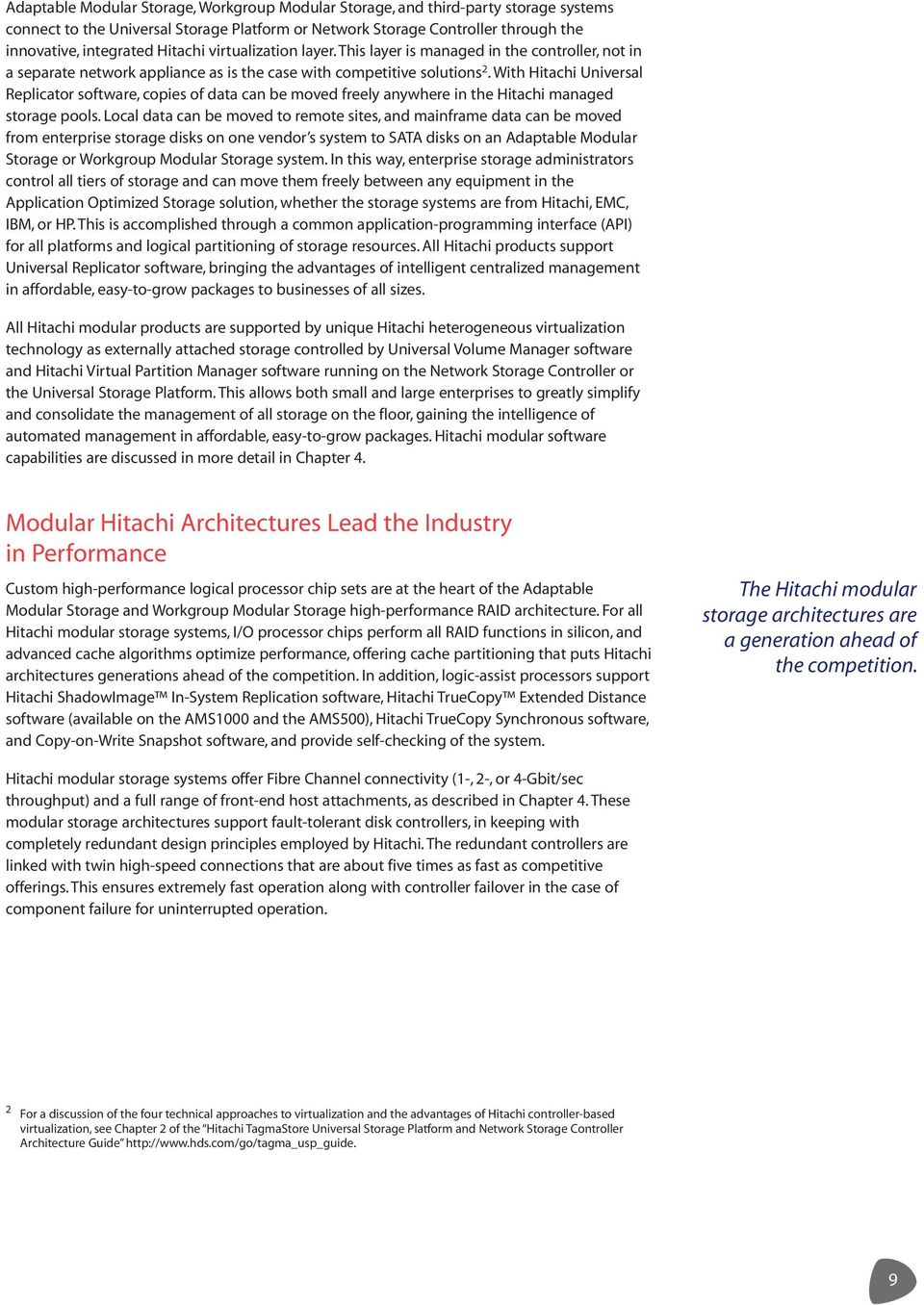
18 Application Optimized Storage Strategy When creating Application Optimized Storage solutions, Hitachi Data Systems looked at IT challenges from the customer viewpoint for businesses of all sizes, including large enterprises, smaller organizations, and workgroups. In the process, it became clear that businesses of all sizes in nearly every industry face several major issues: : : Optimizing operational efficiency is important to survival in a competitive climate. : : Corporate governance and compliance concerns are changing the way many businesses operate. : : Risk preparedness and business continuity planning are not only good business practices but are also now mandated in several industries. FORTUNE 100 companies often have large IT organizations to wrestle with these problems, yet the same challenges face all kinds of businesses. In addition, it was clear that these issues affect all business-functional departments, including finance, human resources, sales, marketing, and product development. Hitachi Data Systems worked with IT managers to build, manage, and adapt a storage infrastructure that supported these objectives. This gave rise to the Application Optimized Storage framework, depicted in Figure 2. Figure 2. The Application Optimized Storage solutions framework. Business Oper a tions A pplica tion S e r vic es C o n t en t S e r vic es Da ta S e r vic es P e r f ormanc e, Char geback, P r o v isioning, P r oblem Managemen t A r chiving, Inde xing, S ear ch, Retrie v e Backup, M igr a tion, Replica tion, S ecurit y S e r vic es and B est P r ac tic es Stor age S e r vic es Multitier Capacity, Universal Connectivity, Heter ogeneous Managemen t 10

19 As Figure 2 illustrates, IT intersects with business objectives at applications the moment of truth in terms of a technology system s ability to support business requirements. Keeping applications up and running at acceptable performance levels and bringing new applications online to support business objectives are the main tasks of IT departments. Yet keeping applications up and running requires IT to provide a variety of content, data, and storage services that are usually obscured from business users. Indeed, application services and all the underlying IT support functions are the lifeblood of a business, essential to operational efficiency, compliance, and business continuity. The combination of the new cost-effective Workgroup Modular Storage and Adaptable Modular Storage midrange storage systems with scalable capacity and the Hitachi Universal Storage Platform and Network Storage Controller enables an intelligent tiered-storage network that will ultimately reduce cost and complexity within the data center. Tony Asaro, Senior Analyst, Enterprise Strategy Group Bringing Application Optimized Storage Solutions to the Midrange All Hitachi Data Systems solutions are based on the Application Optimized Storage strategy, which matches business application priorities to storage infrastructure. Regardless of organization size, the process of aligning business objectives and IT storage considerations is the same. Business managers need to set business objectives, and IT managers need to translate these business objectives into application priorities in terms of: : : Price : : Performance : : Availability : : Functionality Application priorities are mapped to storage tiers that are established by agreement between IT and business managers. The storage tiers place different classes of data on different tiers of storage, based on the data value, the type of data, and whether the data is operational or referential. Storage management personnel then tune applications individually on each storage tier. Tiers can differ for each business and each application, large or small. It is only a matter of scale. A smaller organization might have only a few tiers, whereas a large enterprise might have many more 3. The all Fibre NSC55 offers all features of the Universal Storage Platform, including external storage virtualization. The mix-and-match Fibre and SATA AMS500 supports high-performance, high-capacity, and high-connectivity features that make it perfect for information-intensive industries such as oil exploration, life sciences, health care, and rich media. The smaller models the AMS200 entry-level storage deck and the SATA-based WMS100 are ideal for standalone deployment in retail outlets, business franchises, and professional offices. In fact, the low-end models can be combined with small-business servers in a full-height rackmount cabinet for a compact data-center-in-a-rack configuration. An example of an Application Optimized Storage solution is shown in Figure 3. Application priorities are based on predetermined policies. Application Optimized Storage tiers are organized in terms of priority of performance and availability. 3 See Appendix A for an example of Hitachi storage tiers. 11
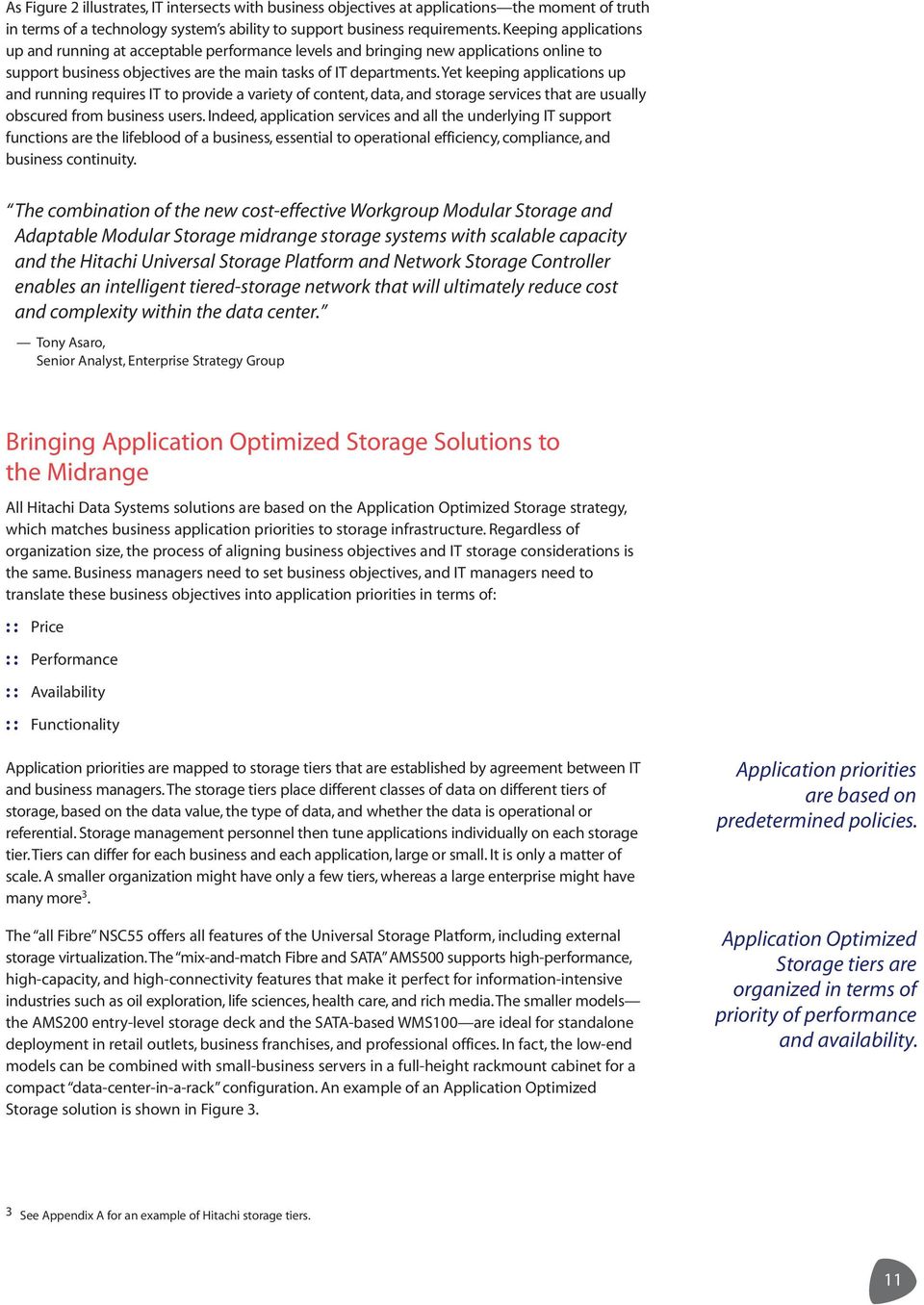
20 Figure 3. An Application Optimized Storage strategy places application data on different tiers of storage in line with performance and availability service level agreements (SLAs) agreed on by business and IT managers. Applications Sun HP IBM Wintel Linux CAD CRM SCM NAS Print Video IBM Mainframe Fibre Channel SAN Data Warehouse ERP Data Mining Tape Hitachi HiCommand Suite Console SCM ERP Hitachi TagmaStore Network Storage Controller, Model NSC55 Data Mining Hitachi Lightning 9980V CAD IBM Enterprise Storage Server CAD = computer-aided design CRM = customer relationship management SCM = supply chain management ERP = enterprise resource management Data Warehouse EMC DMX2000 CRM Online Tape TagmaStore Adaptable Modular Storage, Models AMS1000, AMS500, and AMS200 NAS TagmaStore Workgroup Modular Storage, Model WMS100 Video Print CLARiiON The Universal Storage Platform and Application Optimized Storage solutions, tiering, tools, and policies can enable enterprises not only to prioritize and deploy applications against preset business policies but also to fully leverage and add value to existing storage investments. With them IT organizations can more closely align applications with enterprise business initiatives by directly attacking the Top 10 pain points of storage identified in SNIA and Computerworld surveys (see Appendix B). Application Optimized Storage solutions provide close alignment of open or mainframe application workloads with prioritized business objectives, using preset business policies. 12

21 Services and Best Practices Tie It All Together The final key component for both justifying and implementing an Application Optimized Storage solution is the Hitachi Data Systems Global Solution Services (GSS) organization. To ensure that organizations invest storage dollars in the most intelligent way possible, GSS offers a comprehensive suite of technology, storage, education, and professional services. These are shown in Figure 4. GSS can help you cost-justify and implement a specific infrastructure that is ideal for both your present needs and future growth all within the same Application Optimized Storage framework. Figure 4. GSS offerings review. Application Optimized Storage Solutions Database Enterprise Application Filesystem Storage Area Management Consulting Storage Services Utility Enablement Consulting Business Continuity Backup Process Development Managed Services Replication Disaster Recovery Consulting Infrastructure SAN Implementation Migrate, Upgrade and Consolidate Fabric GSS consultants can help you assess, deploy, integrate, manage, and optimize storage infrastructure solutions that meet your needs. Areas in which Hitachi Data Systems consultants can assist you include the following: Application Optimized Solutions bridging the gap between business applications and IT s ability to precisely deliver service levels with strategic consulting, design integration, and robust deployment capabilities GSS offers a comprehensive suite of technology, storage, education, and professional services. Storage Services applying proven best practices along with appropriate tools and training to help with all stages of your storage infrastructure s life from planning to maintenance 13
22 Application Optimized Storage Solutions With the introduction of modular storage systems, Hitachi Data Systems opened new possibilities for midsize companies as well as large enterprises to better align storage infrastructure with application and business needs. The Hitachi TagmaStore Adaptable Modular Storage models AMS200, AMS500, and AMS1000, and the Workgroup Modular Storage model WMS100 play important roles in building Application Optimized Storage solutions from Hitachi Data Systems, which match application requirements such as performance, availability, functionality, and cost to storage attributes, regardless of organization size. Previously, the answer to size differences in organizations was to group storage system size, such as high-end or midrange, and then apply solutions based on these system sizes, with fewer features for smaller companies. The Application Optimized Storage framework takes a completely different approach. Instead of offering different products for different-sized organizations, the Hitachi approach is to use the same set of building-block products to focus on the same framework for aligning IT and business objectives, whether for an enterprise or a smaller organization. In this way, the Application Optimized Storage framework leads to solutions that employ Hitachi modular systems in a tiered-storage architecture that addresses data protection and backup, storage growth, and consolidation requirements, regardless of business size. This approach makes the same quality and data availability standards found in systems that power the world s largest banks available to smaller organizations. Chapter 2 Hitachi uses the same solutions framework, regardless of organization size. It s only a matter of scale. HDS, with its new midrange storage solutions, is developing a broad portfolio of solutions that addresses the unique business needs of midsized organizations. It delivers a set of solutions that supports consolidated, networked storage, enables cost-effective replication, supports long-term data archiving; and addresses the specific storage management challenges of IT managers at mid-sized organizations. Meeting the Needs of Mid-Sized Organizations with Next-Generation Midrange Storage, IDC white paper by Rick Villars The Strategic Shift to a Solution Focus and Systematic Purchase Justification Initiated with the September 7, 2004, announcement of the Universal Storage Platform and reinforced with the July 11, 2005, announcement of the new Hitachi modular storage systems, Hitachi Data Systems has shifted to a solutions focus. This was done to further deliver on the Hitachi Data Systems Application Optimized Storage strategy and was occasioned, in part, by a survey conducted by the Storage Networking Industry Association (SNIA) End User Council in May Hitachi Data Systems wanted to align all products, software, and services in a way compatible with how users think of their storage challenges. Because storage and storage networking underlie all applications, they can either impede or enhance the ability of IT departments to support business initiatives. The Hitachi Data Systems solutions focus was designed, therefore, to directly address all Top Ten pain points in the context of the Application Optimized Storage framework 4. 4 A specific mapping of how Hitachi Data Systems solutions solve all Top Ten pain points can be found in Appendix B of this guide. 14
23 As part of this strategic shift, Hitachi Data Systems storage hardware, software, and services would no longer be sold separately; rather, they would be sold as packaged solutions tailored specifically to help organizations solve business problems. This new solutions focus is championed by Hitachi Data Systems Global Solution Services (GSS), which provides various service options to help organizations of all sizes asses their storage environment and requirements. GSS services can help you gain storage solution financial justifications based on solid ROI/TCO methodologies via the HiReturn investment analysis program. With this new solutions focus and systematic purchase justification, you can successfully analyze, justify, implement, and track storage investments as you would any other important business investment. Hitachi Data Systems has long recognized that business success is highly dependent on intelligent IT investment decisions and that storage needs to do its part. Packaged solutions help customers solve specific business problems. To tie it all together and to implement an integrated framework of hardware, software, and related services, Hitachi Data Systems offers comprehensive approaches to Application Optimized Storage solutions. Two major solution areas are Infrastructure Simplification, and Business Continuity and Disaster Recovery. Adaptable and differentially priced, these solutions match business-application requirements to different classes (tiers) of storage for organizations of different sizes, using the same set of Hitachi products, software, and services. Tightly integrated through common management and external virtualization, Application Optimized Storage solutions fully leverage an organization s current storage investments while better aligning them for future growth, using best-practices financial methodologies. Infrastructure Simplification Hitachi Data Systems approaches Infrastructure Simplification with solutions that enable an organization, regardless of size, to dramatically reduce TCO for all storage in all locations and realize both hard and soft CapEx savings and hard and soft OpEx savings. What is most important for economic decision makers 5 to know is that building a simplified, tiered, consolidated, and aggregated Hitachi-enabled storage infrastructure can almost always be justified based on reduced cost of ownership (hard dollar cost savings). Not only will Infrastructure Simplification solutions save money through consolidation and aggregation but they will also save money through tiered-storage solutions for regulatory compliance and optimized storage costs based on application business requirements. A summary of the Infrastructure Simplification solution elements and investment benefits is shown in Table 2. Building a consolidated, aggregated, tiered, centrally managed infrastructure can almost always be justified. 5 The economic decision maker is usually the CIO, CFO, or CEO or a combination, depending on capital asset approval levels and the size of the procurement. 15
24 Table 2. Description and summary benefits of the Hitachi Infrastructure Simplification solutions. Solution Elements Hardware Required Software Required and Basic Services Definition Problem Desired Result Solution Hitachi TagmaStore Network Storage Controller (model NSC55) or Universal Storage Platform Hitachi TagmaStore Adaptable Modular Storage or Workgroup Modular Storage with SATA drives Existing Hitachi Lightning 9900 V Series systems Existing Hitachi Thunder 9200 and Thunder 9500 V Series modular storage systems Hitachi Infrastructure Simplification Solutions Consolidation and Aggregation Consolidation of multiple workloads on a single Hitachi storage system Aggregation of external storage workloads for single pane of glass storage management Underutilized storage, SAN islands, multiple staffs and replication software; one storage tier does not fit all Reduction of the number of storage management software platforms to be managed; better storage utilization; labor savings (OpEx) and delayed CapEx All multivendor data managed by Hitachi HiCommand Suite software Data virtualized into one or more logical pools on multiple tiers Existing storage frames retired or repurposed to delay storage purchase cycle (CapEx) Not required for consolidation One or more required for aggregation Required for consolidation Optional for aggregation if Hitachi systems are being aggregated Tiered Storage: Data Lifecycle Management Mainframe Application Data Message Archive for moves to modular storage with SATA Message Archive for Compliance retains data for mandatory periods Clogged servers Data cannot be kept in unaltered permanent form Unclogs servers and eliminates mailbox size limits Retains unaltered data for specified period Data lifecycle services automatically move or store data on modular storage with SATA drives at the required time and in the required format Reduced business risk One or more are required Required for backup/archive Match value of data to storage tier; replace tape with disk for faster access and quicker recovery Wasting enterprise disk for lower priority mainframe data, such as offline decision support applications or referential data Reduction of the high cost of enterprise storage and storage management by tailoring storage attributes to application priorities agreed with business managers Place data for low-priority applications on Hitachi TagmaStore Adaptable Modular Storage or Workgroup Modular Storage systems with SATA drives or repurpose current storage to defer CapEx for new storage One or more are required Required for backup/archive Optional Optional for second tier Optional for second tier Optional Optional for second or third tier IBM, EMC, Sun, or HP systems Optional Optional Optional Hitachi Universal Volume Manager Hitachi HiCommand Tiered Storage Manager Required Required Required Recommended for consolidation Required if Hitachi systems are being aggregated Required Optional for second or third tier Required Hitachi Data Retention Utility Optional Required for tamperproof archiving Optional Basic Element Manager for Sun IBM or EMC Hitachi HiCommand Device Manager Hitachi Resource Manager utility package Hitachi HiCommand Backup Services Manager, powered by APTARE Hitachi Resource Manager utility package for IBM z/os Required for each external storage system to be attached Required for each external storage system to be attached Required Required Required Required Required Required N/A N/A Required Required mixed N/A Required Message Archive for N/A Required to eliminate mailbox size limits Required for each external storage system to be attached Message Archive for Compliance N/A Required for tamperproof archiving N/A Implementation Service for Basic/recommended Basic/recommended Basic/recommended Hitachi Storage System N/A 16
25 Consolidation Solutions Consolidation refers to placing open system, mainframe, or mixed workloads onto fewer storage systems. For example, you could consolidate six systems down to two. For these solutions, the Hitachi modular systems hardware and software offer the best high-availability/ high-performance choices in the industry. Hitachi Data Systems has been very successful in offering the cost benefits of single-system workload consolidation with Universal Storage Platforms and Network Storage Controllers for high-end enterprises and with Adaptable Modular Storage and Workgroup Modular Storage systems for midsize companies. Hitachi products are technically superior; no other vendor offers single-system workload consolidation with comparable benefits. The entire Hitachi product range allows homogeneous or mixed workloads for all major open and mainframe operating systems to reside on a single Hitachi system selected according to the size of the enterprise. With Hitachi products, organizations can: Cost-optimized consolidation solutions for small to large enterprises. : : Consolidate workloads from a single type of open systems server to a single Hitachi platform : : Consolidate workloads from a single type of mainframe server to a single Hitachi platform (Universal Storage Platform or Network Storage Controller models) Consolidation of both open and mainframe workloads to a single Hitachi system allows the Application Optimized Storage solution to fully integrate Hitachi software point products and service tools in a tiered-storage environment. Data Lifecycle Solutions Even small businesses can be required to archive messages and comply with many regulatory rules and practices related to the data lifecycle. GSS designs and implements solutions that address current and emerging storage-intensive demands such as data lifecycle management, which can reduce the pain caused by the runaway growth of all data types. One example is , which is causing problems for everyone from CEOs and CFOs to administrators and users faced with mailbox size limit exceeded messages. At the same time, tough new regulations are forcing organizations to retain messages and other business documents in a tamperproof, disaster-proof form for specified periods and to be able to produce them on demand. Ideally, mainstream storage and existing business continuity practices can be leveraged rather than incurring the expense of managing special-purpose hardware. Figure 5 illustrates the Hitachi Data Systems strategy of policy-based data movement from high-cost, fast-response storage systems to lower-cost, slower-response storage systems as the frequency of access and the retention value of the data decrease over time. 17
26 Figure 5. Data is moved automatically throughout its lifecycle. Frequency of Access and Retrieval / report/ record creation, document receipt,statement print time High-performance disk purge Hitachi TagmaStore Universal Storage Platform Model USP100 TagmaStore Adaptable Modular Storage Model AMS500 All retrievals from low-cost, lower-performance, archival media from this point forward TagmaStore Adaptable Modular Storage, Models AMS1000, AMS500, and AMS200 Disposition Relative Value of Record High-cost, Fast Response (Subsecond) Low-cost, Slow Response (Subsecond to days) Retention Period Data lifecycle management solutions for Hitachi modular storage systems include: Hitachi Message Archive for Solution The Message Archive for solution leverages the standard Hitachi archival platform to provide automatic and selective document archiving, along with search-and-retrieval capabilities and audit trails. Figure 6 illustrates how archiving works in the data lifecycle. When data is introduced to the archive, a digital signature is assigned to uniquely identify the object and make sure it has not been tampered with. The object is then indexed, and metadata is created to describe the object in the message archive s metadata store. Metadata is information about the data that is used in populating, maintaining, and accessing both the descriptive information that identifies the archive s holdings and the administrative data used to manage the archive. In the Message Archive for , the only metadata needed might be the sender, date and time sent, subject line, and information about any attachments (file name, size). In addition to providing users with a view of archived information, the solution seamlessly integrates into the client interface for Microsoft Outlook and Lotus Notes. Importantly, it eliminates mailbox limit exceeded problems, effectively expanding overall storage capacity for your users. Figure 6. With the Message Archive for , users gain an unlimited mailbox. Index Header, Body and Attachment Data Message Index (metadata) Query Result Set Access Control, Queries, Retrieval Requests Original Messages Server Archive Software Server End User/Auditor Archived Messages Retrieved Messages TagmaStore Adaptable Modular Storage Model AMS
27 Hitachi Message Archive for Compliance Solution The Message Archive for Compliance solution was developed to help you optimize your system while providing message indexing, search-and-retrieval capabilities, audit trails, and policy management to preserve messages for mandatory retention periods. As shown in Figure 7, Message Archive for Compliance enables you to retain an unalterable archive of and instant messages for the fixed period of time mandated by SEC Rule 17a-4, Sarbanes-Oxley, Basel II, and other regulatory requirements. To do so, it leverages Hitachi Data Retention Utility software to provide functionality on standard disk hardware. Data Retention Utility software s tamperproof write once, read many (WORM) software is available now on Hitachi Adaptable Modular Storage systems and Workgroup Modular Storage systems. Figure 7. Message Archive for Compliance enables companies to retain an unalterable archive of and instant messages for the fixed period of time required by Sarbanes-Oxley and other mandates and regulations. Message Content Open Message Index Archive Software File Hash Retention Period Expires Hitachi Data Retention Utility Software Enabled Data Retention Utility Software Enabled Volume Full Header Body Attachments Storage Management Software Complementing all Infrastructure Simplification solutions is Hitachi Storage Management and HiCommand Suite software. Even small and medium-sized businesses (SMBs) and workgroups can find themselves managing storage from multiple vendors, each with different interfaces. Because knowledge is segregated into specialists for each device type, the organization s staff finds it difficult to ensure application uptime and to resolve problems quickly. One of the most significant problems facing businesses of all sizes is the increasing complexity of the technology supporting essential business systems. Reducing storage management complexity has many significant benefits: : : Reduced training costs (administrators don t need to learn many different management tools) : : Faster problem resolution :: : Faster deployment of new applications, because the storage infrastructure to support them is already in place : : More efficient utilization, because storage capacity is consolidated and available to a wide range of applications 19
28 Business Continuity and Disaster Recovery Known for decades as the industry leader in supplying high-availability data storage products, Hitachi Data Systems applies its unsurpassed technical excellence to Application Optimized Storage solutions that address Business Continuity and Disaster Recovery for open systems and mainframe environments. Hitachi Data Systems disaster prevention, planning, and recovery solutions are the industry s most advanced and efficient and will result in both hard and soft CapEx savings and hard and soft OpEx savings for the enterprise. When it comes to business continuity, no single answer can be applied to every company. The range of options can be overwhelming, from improving operational procedures to local disk-to-disk or tape backup, and to replicating data out-of-region to recover from wide-area disasters and comply with ever-tightening regulations. You have to make an informed decision based on business requirements and cost and weigh such factors as risk exposure, regulatory compliance, and best practices. For example, for disaster recovery, every organization and application will have different requirements for how quickly it needs to be running after an outage (recovery time objective or RTO) and how current the data needs to be (recovery point objective or RPO). Data replication is an essential technology for applications that need rapid and up-to-date recovery capabilities; by replicating current data to an alternative site, you protect it from a site-wide problem. However, two factors are inhibiting many organizations from using replication: : : The hardware cost. Often replication is bundled with high-end storage devices, so that you need two (one in each location) to make the solution work. : : The bandwidth cost. For most replication solutions, you need adequate bandwidth to handle peak traffic volumes. Dedicated bandwidth is expensive. A summary of Hitachi Business Continuity and Disaster Recovery solutions and benefits is shown in Table 3. Table 3. Description and summary benefits of Hitachi Business Continuity and Disaster Recovery solutions. Hitachi Business Continuity and Disaster Recovery Solutions Open Backup and Recovery Mainframe Backup and Recovery Disaster Prevention Planning and Recovery Definition Local or remote backup of disaster recovery volumes to Hitachi TagmaStore Adaptable Modular Storage or Workgroup Modular Storage SATA disk or tape Offloading IBM DFSMShsm replication; saves IBM z/os cycles, frees storage, and reduces cost SATA disk backup; improves Tivoli z/os backup-and-recovery efficiency, reduces TCO Replacing mainframe tape with virtual tape on SATA disk Two-data-site heterogeneous replication; allows improved disaster recovery plan testing with current data No data loss, three-site, super-highavailability solution Solution Elements Problem High cost of local backup to disk for fast restore SMS is MIPS-intensive High disk cost keeps Tivoli disk storage pools small Long restore time from tape Multiple-vendor disaster recovery software and storage resource management tools Lack of flexible disaster recovery for all storage systems Desired Result Fast restores from local replication copies Reclaim IBM z/os MIPs Larger Tivoli disk storage pools Fast restore from tape volumes One replication product for all storage systems, single pane of glass management, adequate testing of disaster prevention and disaster recovery plans Solution Remote replication and point-intime copies enable cost-effective backup to SATA disk locally or tape remotely Storage-based replication SATA disk for disk backup Put virtual tape volumes on SATA disk Improved disaster prevention and disaster recovery plan testing No-data-loss, three data center solution for the large enterprise Continued on next page. 20
29 Table 3. Description and summary benefits of Hitachi Business Continuity and Disaster Recovery solutions. (Continued) Hitachi TagmaStore Network Storage Controller or Universal Storage Platform Hitachi Business Continuity and Disaster Recovery Solutions Open Backup and Recovery One or more are required Mainframe Backup and Recovery One or more required for storagebased replication, SATA disk for disk backup, and putting virtual tape volumes on SATA disk Disaster Prevention Planning and Recovery One or more are required Hitachi TagmaStore Adaptable Modular Storage or Workgroup Modular Storage with SATA drives Optional Optional Optional Hardware Existing Hitachi Lightning 9900 V Series systems Existing Thunder 9500 V Series modular storage systems Optional Optional for storage-based replication, SATA disk for disk backup, and putting virtual tape volumes on SATA disk Optional Optional Optional Optional Hitachi TagmaStore Workgroup Modular Storage with SATA drives or Hitachi Thunder 9520V workgroup modular storage system Required for backup One or more required for storagebased replication, SATA disk for disk backup, and putting virtual tape volumes on SATA disk One or more are required IBM, EMC, Sun or HP systems Optional Optional Optional Continued on next page. 21
30 Table 3. Description and summary benefits of Hitachi Business Continuity and Disaster Recovery solutions. (Continued) Hitachi Universal Volume Manager Hitachi Business Continuity and Disaster Recovery Solutions Open Backup and Recovery Required Mainframe Backup and Recovery Required for storage-based replication, SATA disk for disk backup, and putting virtual tape volumes on SATA disk Disaster Prevention Planning and Recovery Required Hitachi ShadowImage In-System Replication Required Required for storage-based replication Required Optional: SATA disk for disk backup and putting virtual tape volumes on SATA disk Hitachi Compatible Mirroring software for IBM FlashCopy Optional Required Optional Required Software Hitachi Dataset Replication software for IBM z/os Optional Required Optional IBM Tivoli Manager Optional Required Optional Hitachi HiCommand Tiered Storage Manager Optional Required Optional Basic Element Manager for Sun, IBM, or EMC Required for each external storage system to be attached Required for each external storage system to be attached Required for each external storage system to be attached Hitachi HiCommand Device Manager Required Required Required Hitachi Resource Manager utility package Required Required Required Hitachi HiCommand Backup Services Manager software, powered by APTARE Required Recommended Required Hitachi Resource Manager utility package for IBM z/os Required mixed Required Required Required and Basic Services Implementation Service for Hitachi Storage System Implementation Service for Hitachi Data Protection Suite, powered by CommVault Basic/recommended Basic/recommended Basic/recommended Required Optional Optional 22
31 Backup and Recovery Solutions Although many enterprises maintain disaster recovery copies of critical data on disk or tape at a remote site, they also keep local backup copies at their production data centers. This is done not only because keeping local copies is essential for quick recovery from hardware or software problems but also because local copies are typically more accessible to operations staff than the remote copies may be. Backing up data should be simple: choose your files, mount a tape, and click on [Start]. These days, however, data is mushrooming faster than the ability to back it up, some of the most critical information is on tapes that can t be read or can t be found, and every backup period is spent hoping for an error-free run. And even when backups are done, problems occur. In a recent survey, the Enterprise Strategy Group found that one fifth of corporate backups to tape either fail or have errors. Scenario: Completing Successful Backups Challenge: A small retail chain is having the typical backup problems encountered across just about all businesses. It is unable to back up critical data within the allotted backup window, its tape and tape media growth are completely out of hand, and its restore of critical data takes much too long and is not backed up frequently enough to recover data to the required point in time. Solution: Implement a disk-based backup solution built on Adaptable Modular Storage and/or Workgroup Modular Storage and the Hitachi Data Migrator software, powered by CommVault. You can back up all of your data (disk-to-disk or disk-to-disk-to-tape) more often, while eliminating the two biggest causes of failure from backup environments: tape and human error. Mainframe Backup and Recovery Solutions Data growth and regulatory requirements are driving mainframe customers to store increasing amounts of data on tape for data backup and disaster recovery and also for long-term archiving (to meet regulatory requirements). They are also seeking ways to avoid or reduce the high annual maintenance, environmental, labor, and floor space costs for this proliferation of large tape silos and tens of thousands of tapes. Tape-related issues are often the major cost element in enterprise operation budgets. If disks were cheaper, mainframe customers could costeffectively trade OpEx (reducing tape management labor costs) for CapEx (purchasing lowercost disks). This would both reduce overall storage TCO and improve data availability and business resilience. Additionally, mainframe data can now be backed up without the use of expensive IBM DFSMShsm host cycles on Adaptable Modular Storage and/or Workgroup Modular Storage SATA disks. SATA disks can also be used to increase the size of the Tivoli disk storage pool, without using expensive enterprise-class disks, and to provide cost-effective tape replacement by placing data sets called by mainframe virtual tape volumes on disk instead of tape. Disaster Prevention Planning and Recovery Solutions Many IT locations today have storage systems from multiple vendors, each running their own replication product with its own procedures and policies. A smaller organization might have Sun systems at its main site and Microsoft Windows-based servers at branch offices. Additionally, the CFO might be interested in securing the services of a disaster protection firm with another type of platform. Hitachi Data Systems offers powerful business continuity and disaster recovery testing while maintaining complete disaster recovery protection. The two site solution allows disaster recovery testing with current data a major operational advantage for enterprises of any size. The industry-best three site disaster recovery solution provides alternative topologies, to achieve unparalleled levels of disaster prevention, planning, and recovery for organizations whose business absolutely depends on nonstop access to data: cascade and multitarget. 23
32 All Hitachi Storage Solutions Create Both CapEx and OpEx Savings Both the Infrastructure Simplification solutions and the Business Continuity and Disaster Recovery solutions reduce CapEx and OpEx hard and soft costs. CapEx hard-cost reductions include storage system acquisition costs, SAN acquisition costs, and software licensing costs for all data centers, whether remote or primary. Similar reductions are to be realized in CapEx soft costs in the form of future-purchase avoidance and freed storage assets for repurposing, sale, or scrap. CapEx soft-cost benefits also apply to all data centers, whether remote or primary. The line between hardand soft-cost savings is sometimes in the eye of the beholder. Most important are significant reductions in OpEx hard costs, including installation, administration, and maintenance for all data centers. Similar reductions in OpEx soft costs include performance, availability, employee productivity, scheduled or unscheduled outages, regulatory compliance, and discovery costs for all data centers. The line between hard- and soft-cost savings is sometimes in the eye of the beholder and varies from enterprise to enterprise. For this reason, the Hitachi Data Systems organization is trained to carefully work with you to understand what is best for your enterprise. HiReturn Investment Analysis Program Works for Businesses of Any Size Using the HiReturn tool is a simple way to justify storage investments. The tool focuses primarily on hard savings but can be augmented with soft savings when appropriate. Even the smallest organization or workgroup has an economic buyer who needs to approve storage procurements. The economic buyer is often a nontechnical executive who wants to know what the company is getting for its investment dollars. Hard-cost savings are usually preferred by CIOs, CFOs, and CEOs and involve measurable savings in the purchase, maintenance, installation, integration, management labor, operational labor, and other areas of an IT investment. In a practical sense, this means that the hard dollar savings and ROI/TCO benefits of a Hitachi Data Systems solution are usually so dramatic that it is unnecessary to justify purchases based on soft savings. There are times, however, that soft savings are the primary consideration for the approving executives, as would be the case for adherence to government regulations or the prevention of or recovery from IT-related business outages. Soft-cost dollar savings typically include the costs of high or low performance and availability; scheduled or unscheduled outages; future-purchase avoidance; regulatory compliance risk; freed-up storage assets for repurposing, sale, or scrap; and so on. Because of Hitachi product across-the-board technical superiority, Hitachi Data Systems solutions more often than not will clearly win in any economic comparison. Chapter 8 discusses the HiReturn tool and presents a use case chart that can be a useful guide for readers wanting to adapt the HiReturn analytical approach for their business. Regardless of size, ROI and TCO justifications make sense for customers as well as vendors. In fact, HiCommand software is vendor-agnostic and can be used to compare the costs and benefits of competing storage vendors. Hard-cost savings are usually preferred by economic buyers CIOs, CFOs, and CEOs. 24
33 Price Does Not Equal Cost Total cost of storage ownership is an often forgotten principle. The purchase price of any storage system does not always reflect the complete (often hidden) multiyear cost of ownership. The purchase price is repeatedly shown by analyst reports to represent only one quarter to one seventh of the TCO. There are several non-purchase-price costs of ownership that Hitachi Data Systems solutions can address directly. Price does not always reflect true multiyear TCO. Your Hitachi Data Systems representatives can show you how to drive down long-term OpEx costs related to storage and reduce the TCO even if the Hitachi initial purchase price is higher than that of other available solutions. This guide analyzes and quantifies the economic benefits of the Hitachi Data Systems solutions and the modular storage systems. After the benefits are defined, ROI and TCO modeling concepts will be explained, with direct examples from Hitachi Data Systems economic tools. With a high degree of confidence, GSS will use the HiReturn investment analysis program to show you how modular Hitachi software and systems can lower TCO and improve ROI by: : : Avoiding hardware and software procurement in the future : : Increasing storage management effectiveness and reducing labor content involved with managing large, complex systems : : Increasing aggregate utilization of storage resources : : Reducing, over time, hardware and software maintenance costs : : Reducing waste and license duplication 25
34 Hitachi Modular Storage Systems Packaging Packaging Is Modular and Expandable The Hitachi TagmaStore modular storage systems currently consist of four product models, each designed in a scalable, fully redundant building-block rackmount package: Chapter 3 Adaptable Modular Storage model AMS1000 : : Ultra high-end modular storage : : Consolidation platform for SAN, iscsi, and NAS (any two protocols) : : Standalone tiered storage solution (first tier for near-enterprise companies) or externally attached to Hitachi TagmaStore Universal Storage Platform or Network Storage Controller (second-tier for enterprise companies) Adaptable Modular Storage model AMS500 : : High-end modular storage for midsize or enterprise companies : : First- and second-tier storage for midsize or enterprise companies Adaptable Modular Storage model AMS200 : : Entry-level storage for midsize companies : : Data center in rack for SMBs/midsize companies : : First- and second-tier storage for the enterprise Workgroup Modular Storage model WMS1000 : : Workgroup modular storage : : Tier-2 storage for the enterprise Full- or Half-height Industry-standard Racks For all modular systems, controller trays combined with disk modules are the building blocks of a stackable design. Although the individual building blocks differ, depending on the model, all modular systems fit in standard 19-inch-wide rackmount cabinets. For Adaptable Modular Storage systems and Workgroup Modular Storage systems, Hitachi provides a standard 42U rack. This packaging is shown in Figure 8 and the capacities and packaging characteristics in Table 4. All Hitachi modular storage systems are based on controller trays and disk trays. 26
35 Figure 8. Hitachi modular storage systems are all designed for industrystandard racks. TagmaStore Adaptable Modular Storage, Model AMS1000 TagmaStore Adaptable Modular Storage, Models AMS500 and AMS200 TagmaStore Workgroup Modular Storage, Model WMS100 Table 4. Modular system packaging characteristics and system capacities. Hitachi TagmaStore Models AMS1000 AMS500 AMS200 WMS100 Architecture Dual controller, shared-bus architecture Dual controller, shared bus architecture Dual controller, shared bus architecture Dual controller, shared bus architecture Height of controller tray Height of disk tray 4U 4U 4U 4U 3U 3U 3U 3U Number of controllers 2 1 or 2 1 or 2 1 or 2 Data cache 4GB 16GB 2GB 8GB 1GB 4GB 512MB 2GB Maximum LUNs 4,096 2, Maximum raw capacity 173.8TB SATA intermix, 129.4TB Fibre Channel 86.9TB SATA intermix, 64.7TB Fibre Channel 39.7TB SATA intermix, 30.2TB Fibre Channel 41.3TB SATA Internal disk drive options (Fibre Channel unless noted) : : 73GB (10,000RPM) : : 73GB (10,000RPM) : : 73GB (10,000RPM) : : 250GB SATA (7,200RPM) : : 73GB (15,000RPM) : : 73GB (15,000RPM) : : 73GB (15,000RPM) : : 400GB SATA (7,200RPM) : : 146GB (10,000RPM) : : 146GB (10,000RPM) : : 146GB (10,000RPM) : : 500GB SATA (7200RPM) : : 146GB (15,000RPM) : : 146GB (15,000RPM) : : 146GB (15,000RPM) : : 300GB (10,000RPM) : : 300GB (10,000RPM) : : 300GB (10,000RPM) : : 250GB SATA (7,200RPM) : : 250GB SATA (7,200RPM) : : 250GB SATA (7,200RPM) : : 400GB SATA (7,200RPM) : : 400GB SATA (7,200RPM) : : 400GB SATA (7,200RPM) : : 500GB SATA (7200RPM) : : 500GB SATA (7200RPM) : : 500GB SATA (7200RPM) Disk drive interface SATA/Fibre Channel intermix SATA/Fibre Channel intermix SATA/Fibre Channel intermix SATA Minimum-maximum number of disk drives Fibre Channel, SATA Fibre Channel, SATA Fibre Channel, 0 90 SATA SATA 27
36 Adaptable Modular Storage and Workgroup Modular Storage The Mixable SATA and Fibre Channel Adaptable Modular Storage systems and all SATA Workgroup Modular Storage systems are based on controller trays and disk trays (sometimes called shelves), each with 15 disk drives. The disk trays are stacked in a vertical building block fashion, with the controller tray always at the bottom. Adaptable Modular Storage and Workgroup Modular Storage system disk trays are 3U high, and the controller trays are 4U high. The AMS200, AMS500, and AMS1000 can intermix trays of SATA and Fibre Channel drives. This configuration is useful for Application Optimized Storage tiers in which, for example, production copies of Oracle or SAP R/3 data could be hosted on Fibre Channel drives (first tier), with backup copies or RAID-1 mirror copies on SATA drives in the same rack. Figure 9 shows the maximum configuration, one controller tray and six disk trays (seven trays total), in a cutaway front view of a WMS100 (SATA only) or an AMS200 (intermixed drive trays). These seven trays can fit in a half high rack or in a full high (42U) rack, with extra room for server and networking equipment, which is often available in standard rackmount configurations. The AMS200 system can produce a single system image as large as 30.2TB or 39.7TB with Fibre Channel and SATA intermix disks, respectively. The maximum capacity of the WMS100 (SATA only) configuration is 41.3TB (with 400GB SATA drives). Figure 9. Front view of a WMS100 or an AMS200 in a 42U rack. Fibre Channel Tray (15 disk drives) Fibre Channel Disk Drive SATA Tray (15 disk drives) SATA Disk Drive SATA and Fibre Channel Trays (up to six trays) Controller Tray Controller Module 28
37 Figure 10 shows a rear view of an Adaptable Modular Storage model AMS200 or Workgroup Modular Storage model WMS100, illustrating accessibility to the controller tray, power supplies, and SATA and Fibre Channel address switch modules. Figure 10. Rear view of a WMS100 or an AMS200. Fibre Channel Disk Controller with Integrated Fibre Channel Ports Disk Power Supply SATA Disk Controller with Integrated Fibre Channel Ports Controller Fan Controller Module Controller Power Supply SATA and Fibre Channel Trays (up to six trays) Controller Tray 29
38 Figure 11 shows a loaded 42U high rack of an AMS500. A fully loaded system contains 225 drives total (15 trays) or 64.7TB of all Fibre Channel disks, or 86.9TB with all SATA disks. In Figure 11, an AMS500 is fully loaded in a 42U rack with 1 controller tray and 11 drive trays. Figure 11. Fully loaded AMS500 rack. Fibre Channel Tray (15 disk drives) Fibre Channel Disk Drive SATA Tray (15 disk drives) SATA and Fibre Channel Trays (up to 14 trays) SATA Disk Drive Controller Tray Controller Module 30
39 Figure 12 shows a front view of the AMS1000. A fully loaded system contains 450 drives total (30 trays) or 129.4TB Fibre Channel disk capacity or 173.8TB SATA intermix capacity. Figure 12. Front view of an AMS1000. Fibre Channel Tray (15 disk drives) Fibre Channel Disk Drive SATA Tray (15 disk drives) SATA and Fibre Channel Trays (up to 14 trays) SATA Disk Drive Controller Tray Controller Module 31
40 Fully Redundant System Designs All modular systems contain fully redundant components, including circuitry, controller boards, power supplies, fans, front- and back-end channel adapters, and a disk tray controller. In addition, the RAID choices offer different levels of data availability and disk rebuild time in the event of a disk drive failure. Figure 13 shows an Adaptable Modular Storage or Workgroup Modular Storage system controller board and illustrates the configurable-throughput front-end Fibre Channel host ports and back-end 200MB/sec Fibre Channel Arbitrated Loops. Fibre Channel front-end and back-end interfaces are standard for all models and built in to the controller board, with a daughterboard design for the second front-end port. Figure 13. An Adaptable Modular Storage system or Workgroup Modular Storage system controller board. CPU Chips Memory 4Gbit/sec Fibre Channel Ports to Host Back-end Fibre Channel Ports to Disks 800MB/sec Fibre Channel Interface Chip 32
41 Hot-pluggable Disk Drive Designs Figure 14 illustrates Hitachi modular storage disk drive Fibre Channel and SATA modules. All Hitachi modular system disk drives are hot-pluggable. Figure 14. SATA and Fibre Channel disk drive assemblies for Hitachi modular storage. Fibre Channel Disk Drive SATA Disk Drive 33
42 High-performance Front-end Designs and Network Solutions Host Connectivity and Scalability to Fit Both Smaller Organization and Larger Enterprise Needs Hitachi modular storage systems all support Fibre Channel interfaces for open systems connectivity. For the Hitachi TagmaStore Adaptable Modular Storage and Workgroup Modular Storage systems, Fibre Channel front-end channel adapters are integrated into the controller module, as shown in Chapter 3, Figure 13. The Fibre Channel ports operate at the data rates shown in Table 5. Chapter 4 Fibre Channel front-end interfaces are standard. Table 5. Front-end specifications of Hitachi modular storage systems. Hitachi TagmaStore Models Front-end Specifications AMS1000 AMS500 AMS200 WMS100 Maximum host connections 1, 2, or 4Gbit/sec Fibre Channel, 1Gbit/ sec iscsi, 8 NAS 1, 2, or 4Gbit/sec Fibre Channel, 1Gbit/ sec iscsi, 8 NAS 1, 2, or 4Gbit/sec Fibre Channel, 1Gbit/ sec iscsi, 8 NAS 1, 2, or 4Gbit/sec Fibre Channel, 1Gbit/ sec iscsi, 8 NAS Maximum attached hosts through Fibre Channel virtual ports 1, Hosts per port Host Storage Domains Yes Yes Yes Yes SAN-enabled Yes Yes Yes Yes Virtual Storage Ports Reduce TCO and Improve SAN Security Hitachi modular storage systems are the only modular storage systems to offer Virtual Storage Ports. This unique feature lowers TCO, both reducing acquisition costs of Fibre Channel interface cards and simplifying SAN and network administration. Virtualization is becoming increasingly important in today s heterogeneous storage environment, which is made up of the following storage architectures: direct attached storage (DAS), SAN, and NAS. Virtual Storage Ports offer secure multitenancy capability, which reduces network infrastructure costs by centralizing and efficiently managing all heterogeneous storage with uniform enterprise policies and procedures. As shown in the left side of Figure 15, today s competitive heterogeneous solutions require the separate configuration of physical ports for each host platform type supported, particularly in high-availability path failover and clustered environments. This increases expense, with unnecessary extra ports, and limits heterogeneous consolidation, resulting in higher TCO. The right side of Figure 15 shows that Hitachi modular storage systems provide for virtual Fibre Channel ports that are logically managed by intelligent Fibre Channel controller cards. In addition to lowering TCO, this improves the security and flexibility of storage allocation. Each physical Fibre Channel port may have multiple Host Storage Domains (or virtual private storage), which support logical Fibre Channel ports, each with their own set of logical unit numbers (LUNs). Hosts are matched to their assigned Host Storage Domain, based on a unique World Wide Names (WWNs) identifier, as shown by the color-coding in Figure
43 Because Hitachi modular storage volume administration is virtual, it does not require installation of Fibre Channel interface cards. Using Host Storage Domains, multiple open systems hosts, regardless of their platform or operating system, are able to access their own virtual private storage housed on a Hitachi modular storage system, with no threat of exposure to other hosts. LUN security provided by Hitachi Volume Security Port Option 6 software fences access to LUNs, based on host WWNs. Under this innovative software structure, each host system among multiple host systems has its own unique LUN 0, from which it can boot within its own Host Storage Domain. Volume Security Port Option software enables users to restrict server access to only those LUNs for which they are authorized, thereby providing administrators with unique security and flexibility not available from any other vendor in the modular market. Figure 15. Virtual Fibre Channel ports overcome competitors physical port limitations, thereby reducing TCO. Sun Solaris IBM AIX Sun Solaris AIX WWN WWN1 WWN WWN1 FC port Solaris mode FC port AIX mode Virtual FC port LUN 0 LUN 1 LUN 2 LUN 0 LUN 1 Physical FC Port LUN n Third-party Storage System LUN 2 LUN n Virtual FC port Hitachi TagmaStore Adaptable Modular Storage Model AMS500 FC = Fibre Channel 6 See also Chapter 6 and Figure
44 Open Systems Host Support Hitachi modular systems support all major open systems hosts, for unmatched heterogeneous open system host connectivity, as shown in Table 6. Table 6. Operating system support. Hitachi TagmaStore Family Models AMS1000 AMS500 AMS200 WMS100 Open Systems IBM AIX Yes Yes Yes Yes HP-UX Yes Yes Yes Yes Sun Solaris Yes Yes Yes Yes Microsoft Windows 2000 and Windows Server 2003 Microsoft Simple SAN compliant Yes Yes Yes Yes Pending Yes Yes Yes HP Tru64 UNIX Yes Yes Yes Yes SGI IRIX Yes Yes Yes Yes Novell NetWare Yes Yes Yes Yes Linux Yes Yes Yes Yes HP OpenVMS Yes Yes Yes Yes IBM z/os, via Hitachi TagmaStore Universal Storage Platform or Network Storage Controller external attachment Yes Yes Yes Yes VMware Yes Yes Yes Yes Apple MAC OS Yes Yes Yes Yes Networked Storage Solutions As today s information-centric businesses expand operations and implement data-intensive applications, IT managers seek new ways to quickly deploy storage and storage infrastructures without disrupting business operations. To this end, networked storage plays a key role, delivering numerous benefits from shared pooling and better utilization of storage resources to improved performance, better security, and higher availability. With SAN, NAS, and iscsi options, it s now possible to have it all in one solution. Hitachi modular storage supports Fibre Channel SANs, gigabit Ethernet, NAS, and iscsi for open systems and SAN interconnect. Open Networked Storage A major potential benefit of open networked storage solutions based on the new Hitachi modular storage systems is that the resulting LAN-free and server-free backup dramatically reduces the amount of planned downtime needed for data center operations. Hitachi Data Systems provides an open architecture that offers you freedom of choice in deploying data access, protection, and sharing capabilities across the enterprise. Using multiple technologies, protocols, and solutions, such as SAN, NAS, and IP, Hitachi Data Systems enables you to design, build, leverage, and augment storage infrastructures providing access to any data from any computer, anytime, anywhere. 36
45 Hitachi Data Systems presents SAN, NAS, and iscsi solutions as core Open Networked Storage offerings. They complement all Hitachi storage product families by allowing more flexibility than ever in heterogeneous environments. Whereas SAN architectures address high-bandwidth needs, NAS addresses the need for rapid file access, which is especially critical for e-business applications. Supported by McDATA switches, iscsi allows midsize companies to gain the benefits of networked storage. Open Networked Storage dramatically reduces planned downtime. The Open Networked Storage architecture exploits advances in servers, storage systems, interconnection devices, network protocols, and network configurations. However, this architecture goes beyond networked storage, providing the overall structure for solutions that allow you to manage your data without being tied to proprietary technology that limits your business options. You gain the option to locate storage either inside or outside the data center, wherever it makes the greatest business sense to do so. Moreover, you enjoy flexibility in establishing open system configurations and protecting investment in currently installed system components. Within the Open Networked Storage architecture, SANs provide high-speed Fibre Channel networks for connecting multiple multivendor servers to a pool of multivendor storage devices distributed throughout the enterprise. SANs offered by Hitachi Data Systems support the open systems standards being developed by the Storage Networking Industry Association (SNIA). Virtual Storage Ports and Secure Multitenancy Hitachi modular storage systems virtual Fibre Channel ports are key elements in lowering TCO for today s complex networked storage topologies. Virtualization is becoming increasingly important in heterogeneous storage environments, which include DAS, SAN, and NAS architectures. This increases the need to centralize and efficiently manage all heterogeneous storage with uniform enterprise policies and procedures. The heterogeneous solutions of today require the separate configuration of physical ports for each host platform type supported, particularly in high-availability path failover and clustered environments. This both increases expense through unnecessary extra ports and limits heterogeneous consolidation, resulting in higher TCO. Hitachi modular storage systems provide virtual Fibre Channel ports that are logically managed by intelligent Fibre Channel controller cards. Each physical Fibre Channel port may have multiple Host Storage Domains, supporting up to 128 heterogeneous open system hosts for the WMS100, AMS200, AMS500, and AMS1000. A Host Storage Domain supports a logical Fibre Channel port with its own set of LUNs. Hosts are matched to their assigned Host Storage Domain according to a unique World Wide Names (WWNs) identifier. LUN security provided by Hitachi Volume Security Port Option software limits access to LUNs based on host WWNs. Under this innovative software structure, each host system among multiple host systems may have its own unique LUN 0, from which it can boot, within its own Host Storage Domain. Host Storage Domains are the underlying reason for reduced modular storage system TCO. But for many applications especially Web, design, and medical the concern is not bandwidth. It is file access response time. Hitachi solutions for NAS help deliver cost-efficient storage utilization across the enterprise. The Hitachi modular storage system NAS and SAN packaging options provide the best rapid access, in addition to quick, easy, and inexpensive expansion of storage. 37
46 Positioning for DAS, NAS, and SAN Coexistence The Hitachi solutions for DAS, NAS, and SAN coexistence address the need for high-bandwidth connectivity between servers and storage nodes and for greatly improved centralized management of storage resources, as shown in Figure 16. Figure 16. Centralized management of storage resources with Adaptable Modular Storage and Workgroup Modular Storage. Red Hat Linux Clients UNIX Clients Microsoft Windows Clients Novell Clients Data Servers DAS FC Switch FC Switch SAN Hitachi TagmaStore Adaptable Modular Storage, Model AMS1000 with NAS Option (2 blades) TagmaStore Adaptable Modular Storage, Model AMS500 with NAS Option TagmaStore Workgroup Modular Storage, Model WMS100 with NAS Option FC = Fibre Channel Turnkey High-end Fibre Channel SAN Solutions Hitachi Data Systems offers the ultimate turnkey Fibre Channel SAN solution by combining an Adaptable Modular Storage system or Workgroup Modular Storage system with two Fibre Channel fabric switches in one rackmounted configuration, prewired and ready to go. (This configuration is the same as that shown in Figure 16 but without the NAS Gateways.) This option provides the high-availability and high-performance advantages of Hitachi storage plus the benefits of a switched Fibre Channel networking architecture. This networked fabric design provides the high level of intelligence and scalability that successful enterprise deployments require. The solution fulfills a wide variety of success criteria for IT departments that face growth, consolidation, and response-time issues. The turnkey Hitachi rackmounted Fibre Channel configuration is prewired and ready to go. 38
47 Turnkey Low-end iscsi SAN Solutions Hitachi Data Systems offers iscsi SAN solutions that help solve the high-cost and limiteddistance problems sometimes associated with Fibre Channel SANs. Similar to the configuration of the turnkey Fibre Channel SAN solutions described above, the iscsi solutions bring longdistance connectivity in addition to a cost-effective iscsi host, because Fibre Channel attachment is just sometimes too expensive or impractical. iscsi SANs provide an alternative to Fibre Channel SANs higher cost and limited distance. iscsi SANs can solve the biggest problem smaller organizations typically face when considering implementation of a Fibre Channel SAN: that they just can t afford it. Most have an Ethernet local area network (LAN), Ethernet infrastructure, and network administrative support and are therefore excellent candidates for implementing an iscsi SAN using the corporate LAN, as long as there is adequate unused bandwidth and network-intensive activities can be scheduled for off-peak hours. Alternatively, they can install a separate Ethernet LAN for the front end of the iscsi SAN, using iscsi connectivity. Because iscsi SANs are IP-based (Ethernet is TCP/IP), they solve another Fibre Channel problem: limited Fibre Channel transmission distance. In effect, an iscsi SAN can give a smaller organization many of the structural benefits of a Fibre Channel SAN, but without the expense of provisioning an expensive Fibre Channel infrastructure. Plug-and-play SAN Kit for Hitachi TagmaStore Modular Storage SANs have traditionally been expensive, complex, difficult to install, and, as a result, only found in the largest of organizations. Hitachi Data Systems collaborated with Microsoft and QLogic to develop a solution that is easy to buy, install, manage, and upgrade. As the first Fibre Channel storage system provider to achieve Microsoft s Simple SAN for Windows Server designation, Hitachi Data Systems offers the Plug-and-play SAN Kit for TagmaStore Modular Storage, including both Adaptable Modular Storage and Workgroup Modular Storage systems. The kit includes all the hardware and software necessary to connect two or more servers to a first SAN or to extend a SAN from the data center to a distant workgroup. Specifically, the kit includes a QLogic SANbox Fibre Channel switch, two SANblade Fibre Channel host bus adapters (HBAs), and all the necessary optical media (small form pluggable media or SFPs and cables) to physically connect your SAN. QLogic SANsurfer Express software automates the entire process with wizards and provides one console for managing the switch, HBA, and storage system. 39
48 Back-end Design, System Capacity, and RAID Chapter 5 High-performance/High-capacity Back-end Designs Both state-of-the-art, high-performance, dual-ported (active-active) Fibre Channel drives and cost-effective high-capacity SATA drives are available with Hitachi modular storage systems. This choice allows users to configure and build either high-capacity or high-performance systems or a mix of both in the same rack. Mixed configurations offer the unique competitive advantage of tiered storage in the same rack. Disk drives for all Hitachi modular products are attached via Fibre Channel Arbitrated Loops (FC-AL) to the system control units, as previously shown. Each Fibre Channel loop operates at 100MB/sec or 200MB/sec, providing an unsurpassed back-end bandwidth of up to 800MB/sec, depending on the number of controllers and products selected. Each FC-AL path is driven with a dedicated processor and a data recovery and regeneration (DRR) circuit. This is in contrast to some competitive products, where back-end paths are shared through a single processor and a single DRR circuit. Disk Drive Specifications Hitachi modular storage systems support both Fibre Channel and SATA disk drives, enabling various configurations of high-performance or high-capacity systems, as shown in Table 7. Customers can choose all SATA or mixable Fibre Channel and SATA configurations for optimal TCO. Table 7. Disk drive specifications for Hitachi modular storage systems. Hitachi TagmaStore Models Disk Drive Specifications AMS1000 AMS500 AMS200 WMS100 Fibre Channel 73GB 10,000RPM Yes Yes Yes No 73GB 15,000RPM Yes Yes Yes No 146GB 10,000RPM Yes Yes Yes No 146GB 15,000RPM Yes Yes Yes No 300GB 10,000RPM Yes Yes Yes No SATA 250GB 7,200RPM Yes Yes Yes Yes 400GB 7,200RPM Yes Yes Yes Yes 500GB 7,200RPM Yes Yes Yes Yes Minimum-maximum number of disk drives Fibre Channel, SATA Fibre Channel, SATA Fibre Channel, 0 90 SATA SATA Three choices are recommended for configuring high-performance systems with high-spin Fibre Channel drives. : : 73GB 15,000RPM drives (highest performance) : : 146GB 10,000RPM drives : : 146GB 15,000RPM drives 40
49 Four choices are offered for configuring high-capacity systems with Fibre Channel or SATA drives: : : 73GB 10,000RPM Fibre Channel drives : : 300GB 10,000RPM Fibre Channel drives : : 250GB 7,200RPM SATA drives : : 400GB 7,200RPM SATA drives Storage Capacities Hitachi modular storage systems support an unmatched range of capacities among modular products, as shown in Table 8. Table 8. Hitachi modular storage system capacities and number of disk drives for various configurations. Maximum Raw Storage Capacities* for Hitachi TagmaStore Models Disk Type AMS1000 AMS500 AMS200 WMS100 Fibre Channel 129.4TB 64.7TB 30.2TB N/A SATA 173.8TB 86.9TB 39.7TB 41.3TB * Disk capacities can be intermixed. Flexible RAID Architectures Hitachi includes a custom high-performance logical processor chip set in the heart of its system controllers in Hitachi modular storage systems. Working together, these VLSI chips perform all RAID (Redundant Array of Independent Disks) functions in silicon and switch data in and out for optimal performance. Hitachi modular storage systems support RAID-0, RAID-1, RAID-1+0, RAID-5, and RAID-6. Hitachi designs the most-advanced RAID controllers in enterprise and modular storage to interface to its disk systems. These intelligent controllers provide disk interface and RAID management, offloading these tasks to dedicated processors. All disks in the system are defined as part of a RAID array of one type or another, and nonvolatile RAM on each controller accelerates RAID functions, particularly disk writes. Supported RAID configurations of Hitachi modular storage systems are shown in Table 9. Table 9. Hitachi modular system RAID characteristics. Hitachi TagmaStore Models RAID Support AMS1000 AMS500 AMS200 WMS100 RAID-0 Yes (Fibre Yes (Fibre Yes (Fibre No Channel only) Channel only) Channel only) RAID-1 Yes Yes Yes Yes RAID-1+0 Yes Yes Yes Yes RAID-5 Yes Yes Yes Yes RAID-6 Yes Yes Yes Yes 41
50 Configurations for Hitachi modular system RAID configurations are shown in Figure 17 and are defined as follows: Figure 17. Hitachi modular storage systems support RAID-0, RAID-1, RAID-1+0, RAID-5, and RAID-6. RAID-0: Data is striped over members of the stripe set. RAID-1: Data is mirrored between two disks. Stripe 1 Stripe 2 Stripe 3 Disk 1 Disk 2 Disk 3 Disk 1 Disk 2 RAID-1+0: Data is both striped and mirrored. Stripe 1 Stripe 2 Stripe 3 Disk 1 Disk 2 Disk 3 Disk 1 Disk 2 Disk 3 Stripe 1 Stripe 2 Stripe 3 RAID-5 (3D+1P): Data is striped with parity over RAID members. d1 d2 d3 Parity d4 d5 Parity d6 d7 Parity Parity d10 d8 d11 d9 d12 Disk 0 Disk 1 Disk 2 Disk 3 Stripes 1-4 RAID-6 (6D+2P): Data is striped with dual parity over RAID members. d1 d2 d3 d4 d5 d6 p1 p2 Disk 1 d2 d3 d4 d5 d6 p1 p2 d1 Disk 2 d3 d4 d5 d6 p1 p2 d1 d2 Disk 3 d4 d5 d6 p1 p2 d1 d2 d3 Disk 4 d5 d6 p1 p2 d1 d2 d3 d4 Disk 5 d6 p1 p2 d1 d2 d3 d4 d5 Disk 6 p1 p2 d1 d2 d3 d4 d5 d6 Disk 7 p2 d1 d2 d3 d4 d5 d6 p1 Disk 8 Stripes 1-8 RAID-0 Data is striped across all members of an array. RAID-0 offers no protection against data loss if a disk fails. RAID-1 Mirroring With RAID-1, all data is mirrored across to separate disks. This RAID choice is the highestperformance and highest-availability option, but it is also the most expensive. Data is read from whichever drive is available first but written to both. Data is read from whichever drive is available first but written to both. RAID-1+0 Striping and Mirroring RAID-1+0 arrays combine the best of both RAID-0 and RAID-1, by striping a mirrored array. The fastest RAID, RAID-1+0 provides fully mirrored protection. RAID-5 Distributed Parity RAID-5 provides the cornerstone of fault-tolerance architectures for many storage systems. The technology works by breaking application data into multiple segments and then distributing the segments, along with parity information, among a group of disks. If a failure occurs on one disk drive, the data on the surviving disks is used to regenerate the missing information on a new disk drive. In RAID-5 arrays, data is striped across the array members in a fashion similar to 42
51 what you get with RAID-0, but RAID-5 provides fault resilience by keeping parity information on each stripe of data. If a failure occurs, the contents of that block can be re-created by reading back of the other blocks in the stripe, along with the parity. Parity information is rotated throughout the array to minimize potential bottlenecks in the event that data must be rebuilt from a failed disk. The space overhead of RAID-5 is equivalent to the space on one disk drive, regardless of the size of the array or the specific RAID configuration. With the Hitachi implementation of RAID-5, up to 94 percent of capacity is usable. Through the use of unique algorithms, Hitachi RAID-5 arrays perform as well as other vendors RAID-1 arrays. Hitachi modular storage systems also provide the unique ability to configure RAID-5 arrays with as many as 16 drives, greatly reducing the cost of RAID protection. With these systems, as much as 94 percent of RAID-5 capacity is usable, in contrast to many competitors 80-percent-usable storage. RAID-6 Redundant Distributed Parity RAID-6 evolved recently to deal with the one caveat concerning RAID-5: if a second drive fails before the first failed drive has been rebuilt, application data can be irretrievably lost. Until recently the risk of a second drive failure, known as a double fault, was considered too low for concern. However, as Fibre Channel and SATA disk drive densities have grown, so too has the length of time a RAID-5-configured array of disks takes to recover from a drive failure. RAID-6 protects business applications against the possibility of data loss from double-fault disk failure. All Hitachi modular storage systems offer RAID-6 to round out the complete range of available data protection strategies. RAID Levels Can Be Intermixed to Tune Application Performance and Availability Hitachi modular system RAID choices can be intermixed concurrently within each system. Different RAID levels can be selected to best fit application data availability and performance requirements. Definable RAID Rebuild Priorities In the event of a disk failure, RAID-1, RAID-1+0, RAID-5, or RAID-6 arrays can be rapidly and automatically rebuilt with available global hot spare drives. Using hot spare drives, users can choose from slow-, medium-, or fast-rebuild priorities, depending on the time of the failure and other operational considerations. Global Hot Spares Designed to ensure the integrity of data, Hitachi modular storage systems allow users to specify global hot spares from among any of the modules in the storage system, for multiple levels of redundancy. In the highly unlikely event that a disk drive reaches an error threshold but is still able to transmit data correctly, the data on the failing disk is automatically copied to one of the global hot spares, with no need to rebuild data from the failed disk. If the disk drive fails before the copy is produced and the user has defined the RAID group as either RAID-1 (mirrored), RAID-1+0 (mirrored and striped), RAID-5 (rotating-parity group) or RAID-6 (doubleparity group), a global hot spare is selected and the data is copied onto it. Data is copied from the surviving disk of the mirror (RAID-1 or RAID-1+0), or data is rebuilt from a parity (RAID-5) or double-parity group configuration. Data on the failing disk is automatically copied to one of the global hot spares. Logical Unit Size Expansion Incorporating Logical Unit Size Expansion (LUSE), Hitachi modular storage systems allow logical volumes to be expanded or deleted online. 43
52 Common Data and Storage Management via Advancedfunction Hitachi Software In line with the Hitachi commitment to open standards, advanced software, common storage management capabilities, and SAN solutions from Hitachi Data Systems are based on industry standards such as the Common Information Model (CIM), Storage Management Initiative Specification (SMI-S), and Simple Object Access Protocol (SOAP) and SAN standards. Hitachi Software Allows Simplified Management and Precise Application Tuning The Hitachi modular software packages support an enterprise s strategic goal of accessing any information, on any computer, located anywhere, at any time. The many advanced hardware and software functions available on Hitachi modular storage systems are initiated, managed, and controlled through powerful software modules that share functionality with Hitachi highend storage. Surpassing the competition, Hitachi modular software solutions deliver enterprisewide coverage of online data copy/relocation, data access/protection, and storage resource management, whether for the modular or enterprise market segments. You have the freedom to choose the precise solution or combination of solutions appropriate for your environment, after choosing the appropriate storage platform. The solutions offer: Chapter 6 Hitachi software and storage network solutions are based on industry standards. Hitachi modular storage systems enable an enterprise to access any information, on any computer, located anywhere, at any time. : : Common management software for all storage on the floor : : Internal storage virtualization : : Logical partitioning, including cached partitioning for application tuning : : Common remote replication software (synchronous on all Hitachi modular storage; asynchronous on models AMS500 and AMS1000) : : Common local replication ( point-in-time copy ) software : : Tiered-storage-management software : : Serverless disk copy : : Built-in high-availability software to avoid downtime and data loss The major elements of Hitachi software architecture are shown in Table 10. Hitachi software products are organized into two suites. : : Hitachi Storage Management software is built on a common set of management and software tools across the entire storage product line. This provides organizations with the ability to virtualize all data and manage business application service levels, all the way to the storage device. Through the application-centric approach of these modules, businesses can match application requirements to storage attributes, thus better aligning IT with business objectives. Hitachi Data Systems also offers software for managing and optimizing storage capacity and performance. Hitachi Storage Management and HiCommand Suite software is discussed later in this chapter. : : Hitachi Business Continuity software can automatically copy data between systems for rapid restore without server processing, reducing the duration of both planned and unplanned outages. In addition, it provides secondary access to data, without affecting regular production workloads, to ensure I/O consistency in the event of a rolling disaster. The software provides products that protect, move, replicate, back up, and recover data to ensure the highest data availability in the industry. Hitachi Business Continuity software is discussed in Chapter 7. 44
53 Table 10. The major software characteristics of Hitachi modular software offerings. Hitachi TagmaStore Models AMS1000 AMS500 AMS200 WMS100 Management software Hitachi Resource Manager utility package, HiCommand Suite Hitachi Resource Manager utility package, HiCommand Suite Hitachi Resource Manager utility package, HiCommand Suite Hitachi Resource Manager utility package, HiCommand Suite Logical partitioning Hitachi Cache Partition Manager feature, 4 32 partitions (cache only) Hitachi Cache Partition Manager feature, 2 16 partitions (cache only) Hitachi Cache Partition Manager feature, 2 8 partitions (cache only) Hitachi Cache Partition Manager feature, 2 6 partitions (cache only) Remote copy Hitachi TrueCopy Synchronous software Hitachi TrueCopy Synchronous software N/A N/A Point-in-time copy Hitachi ShadowImage In-System Replication and Hitachi Copy-on-Write Snapshot software Hitachi ShadowImage In-System Replication and Hitachi Copy-on-Write Snapshot software Hitachi ShadowImage In-System Replication and Hitachi Copy-on-Write Snapshot software Hitachi ShadowImage In-System Replication and Hitachi Copy-on-Write Snapshot software Serverless disk copy and tape Hitachi ShadowImage In-System Replication, and Hitachi TrueCopy Synchronous software Hitachi ShadowImage In-System Replication and Hitachi TrueCopy Synchronous software Hitachi ShadowImage In-System Replication software Hitachi ShadowImage In-System Replication software LUN security Hitachi Volume Security software Hitachi Volume Security software Hitachi Volume Security software Hitachi Volume Security software Host Storage Domains; multiple LUN 0/ports; Virtual Storage Ports Yes Yes Yes Yes Disk-based WORM data protection Hitachi Data Retention Utility Hitachi Data Retention Utility Hitachi Data Retention Utility Hitachi Data Retention Utility Dynamic LUN management Yes Yes Yes Yes Host failover Hitachi HiCommand Dynamic Link Manager software Hitachi HiCommand Dynamic Link Manager software Hitachi HiCommand Dynamic Link Manager software Hitachi HiCommand Dynamic Link Manager software Heterogeneous SAN management Hitachi HiCommand Storage Services Manager software Hitachi HiCommand Storage Services Manager software Hitachi HiCommand Storage Services Manager software Hitachi HiCommand Storage Services Manager software Common APIs Yes, across Hitachi storage systems Yes, across Hitachi storage systems Yes, across Hitachi storage systems Yes, across Hitachi storage systems Manage Heterogeneous Systems from a Single Console Common storage management is perhaps the most important component of Application Optimized Storage solutions from Hitachi Data Systems. Rather than providing disparate interfaces for disparate platforms, essentially creating multiple islands of storage management and inaccessible information, Hitachi Data Systems provides the same software, the same management interfaces, and the same tool sets to manage all heterogeneous storage systems from a single console (see Table 12). Hitachi Data Systems ensures this simplification through Hitachi Storage Management and HiCommand Suite software modules, which are based on an open architecture. These modules deploy quickly and easily, because they use standard agents already resident on servers and storage components. They protect investments and reduce vendor lock-in by working with almost any storage infrastructure you have in your data center. Standards-based management ensures broad support at both the device and application level. 45
54 To support Hitachi modular storage systems, the Storage Management and HiCommand Suite software offer modules for both Hitachi storage-specific and heterogeneous storage management, as shown in Table 11. The HiCommand Suite provides application-centric capacity and performance management of your entire storage infrastructure. Key components of Application Optimized Storage solutions, the Storage Management and HiCommand Suite modules tune storage system performance, availability, recoverability, and functionality attributes to the requirements of your vital business applications. Single-console heterogeneous storage management: same software, same management interfaces, same tool sets. Table 11. Storage Management and HiCommand Suite software supported on Hitachi modular storage systems. Hitachi TagmaStore Models Hitachi Software AMS1000 AMS500 AMS200 WMS100 Hitachi HiCommand Suite Modules Hitachi HiCommand Storage Services Manager Hitachi HiCommand Device Manager Hitachi HiCommand Tuning Manager Optional Optional Optional Optional Optional Optional Optional Optional Optional Optional Optional Optional Hitachi HiCommand Chargeback Optional Optional Optional Optional Hitachi HiCommand Dynamic Link Manager Hitachi HiCommand Global Link Availability Manager Hitachi HiCommand Global Reporter Hitachi HiCommand Path Provisioning Hitachi HiCommand QoS for File Servers Hitachi HiCommand QoS for Microsoft Exchange Hitachi HiCommand QoS for Microsoft SQL Server Hitachi HiCommand QoS for Oracle Hitachi HiCommand QoS for Sybase Hitachi HiCommand Protection Manager Hitachi HiCommand Backup Services Manager, powered by APTARE Hitachi HiCommand Replication Monitor Optional Optional Optional Optional Optional Optional Optional Optional Optional Optional Optional Optional Optional Optional Optional Optional Optional Optional Optional Optional Optional Optional Optional Optional Optional Optional Optional Optional Optional Optional Optional Optional Optional Optional Optional Optional Optional Optional Optional Optional Optional Optional Optional Optional Optional Optional Optional Optional Continued on next page. 46
55 Table 11. HiCommand Suite and SAM software supported on Hitachi modular storage systems. (Continued) Hitachi TagmaStore Models Hitachi Software AMS1000 AMS500 AMS200 WMS100 Hitachi Storage Management Software Modules Hitachi Resource Manager utility package components: Disk Array Management Program Required Required Required Included Included Included Included Included LUN Management Included Included Included Included LUN Size Expansion (LUSE) Included Included Included Included Hitachi Volume Security Port Option Hitachi Cache Residency Manager feature Hitachi Cache Partition Manager feature Included Included Included Included Included Included Included Included Included Included Included Included Password Protection Included Included Included Included SNMP Included Included Included Included HiCommand Storage-specific Management For granular discovery and control of your Hitachi storage environment, the HiCommand Suite offers Hitachi storage-specific modules. These modules augment and control the management of Hitachi storage systems by providing granular views where standards have not caught up with the advanced, industry-leading functionality of Hitachi storage. Storagespecific modules in the HiCommand Suite provide discovery and control of all Hitachi storage elements. The framework for Hitachi storage-specific management is shown in Figure 18. Device Manager software provides centralized management of distributed Hitachi environments. It also provides the device interface into Hitachi storage systems for the heterogeneous HiCommand Storage Services Manager software. Hitachi Storage Management and HiCommand Suite software modules help match application requirements to storage attributes. Business Application Modules Hitachi HiCommand Business Application Modules include Dynamic Link Manager software, which provides robust path-failover and load-balancing capabilities, and Global Link Availability Manager software, which provides single-point storage path management/ reporting for multiserver system configuration. (Protection Manager software, which automates nondisruptive online backup of Microsoft NTFS, Exchange, and SQL Server while providing rapid recovery, is available for Hitachi TagmaStore Universal Storage Platform and Network Storage Controller only.) Storage Operations Modules Hitachi HiCommand Storage Operations Modules include Tuning Manager software, which provides proactive capacity and performance monitoring, reporting, and forecasting of storage resources, including business applications such as Oracle and SQL Server; and Replication Monitor software, which employs a single, easy-to-use display to simplify configuration, monitoring, and management of all replication operations performed by Hitachi storage systems. (Tiered Storage manager software, another storage operations module, is available for the Universal Storage Platform and Network Storage Controller only.) 47
56 HiCommand Heterogeneous Storage Management HiCommand modules for the management of heterogeneous storage monitor, visually render, and administer your data infrastructure as a whole, including storage from multiple vendors as well as the switches, host bus adapters, servers, and file systems that serve business applications. Hitachi-enhanced storage management modules deliver focused management for Hitachi storage and SAN environments. For multivendor storage environments, Hitachi offers HiCommand application and business modules. Clustered around the core management module Storage Services Manager software business modules satisfy demands for rapid provisioning and accurate chargeback of storage usage. Business Application modules extend the HiCommand management reach inside application objects, better correlating application performance with the storage infrastructure and providing improved storage resource management for even the largest collections of file servers. These modules protect investments, by working with almost any storage infrastructure to manage business and application demands. The framework for Hitachi heterogeneous management software is shown in Figure 18. Storage Services Manager Software Storage Services Manager software acts as the main console for the Hitachi Storage Management and HiCommand Suite software s heterogeneous storage infrastructure management. Depending on your preference, Storage Service Manager software allows storage under its control to be viewed as independent systems, or, when attached to the Universal Storage Platform, as part of the virtualized Universal Storage Platform storage pool. Storage Services Manager software provides applicationto-disk management. Business Application Modules Hitachi HiCommand Business Application Modules QoS for Oracle, QoS for Sybase, QoS for Microsoft Exchange, and QoS for Microsoft SQL Server software identify in real time how storage infrastructure performance, capacity, and availability affect applications. In addition, QoS for File Servers software delivers end-to-end management of capacity, performance, and user consumption. Storage Operations Modules Hitachi HiCommand Storage Operations Modules include Path Provisioning software, which automates configuration of storage resources to support business applications; Chargeback software, which automatically meters storage resource utilization enterprise-wide, calculates costs, and provides comprehensive reporting; and Global Reporter software, which provides integrated reporting from separate servers managed by Storage Services Manager software. In addition, Hitachi HiCommand Backup Services Manager software, powered by APTARE, manages the entire backup environment to actively avoid data loss, improve backup performance and success rates, provide rapid troubleshooting capability, and lower operational costs. 48
57 Figure 18. Hitachi Storage Management and HiCommand Suite software. Business Application Modules QoS Application Modules Oracle - Microsoft Exchange - Sybase - SQL Server - NetApp Option QoS for File-Servers SRM Global Link Availability Manager Dynamic Link Manager Path failover and failback load balancing Protection Manager Chargeback Path Provisioning Global Reporter Storage Operations Modules Backup Services Manager Tuning Manager Replication Monitor Tiered Storage Manager Storage Services Manager Device Manager Hitachi Element Managers API CIM/SMI-S Reporting Configuration Provisioning & Replication Hitachi Resource Manager Hitachi Server Priority Manager Hitachi Volume Migration New Product HiCommand Heterogeneous HiCommand - Hitachi Storage specific Hitachi Storage specific Heterogeneous Storage Management and HiCommand Suite modules are based on an open architecture. These modules protect investments, by working with almost any infrastructure to manage business and application demands. Hitachi storage-specific modules provide granular discovery and control of your Hitachi storage environment. (Note that Hitachi HiCommand Protection Manager, Hitachi HiCommand Tiered Storage Manager, Hitachi Volume Migration, and Hitachi Server Priority Manager software are available for Hitachi TagmaStore Universal Storage Platform and Network Storage Controller only.) Hitachi Storage specific Management Hitachi storage specific management software includes the Resource Manager utility package (described below), which serves all Hitachi storage. Server Priority Manager and Volume Migration software serve the Universal Storage Platform and Network Storage Controller only.) Resource Manager Utility Package Provides Powerful, Device-level Storage Management Capability Shipped with every Hitachi modular storage system, the Resource Manager utility package allows storage managers to display the system configuration, create user name/password security for administrators, set up RAID groups, allocate LUNs, expand LUNs, and format storage. Storage administrators who need a flexible, easy-to-use configuration and error management tool will find that the Resource Manager utility package is an ideal choice. In addition to robust administrator tools, it provides a graphical user interface for monitoring and managing storage systems. 49
58 The Resource Manager utility package can also help optimize performance, by providing valuable resource utilization information, such as I/O activity, cache usage, availability status, and event notification. Administrators can use password protection to authorize users. This provides protection against unauthorized access to the Management mode of the Resource Manager software and stores the password list at the storage system. Reliable error management and reporting offer a big breakthrough for IT troubleshooters who seek rapid-fire detection and notification to maintain productivity. Out-of-band Management Two LANs can be attached to Hitachi modular storage systems: an internal LAN (private LAN), which is used to connect the service processors of multiple systems, and the user s intranet (public LAN), which allows users to access the Resource Manager utility package. SNMP Support Ensures Compliance with All Major Systems Management Platforms The Resource Manager utility package supports the Simple Network Management Protocol (SNMP), the most widely used network management protocol. System Information Messages (SIMs) are converted to SNMP Management Information Blocks (MIBs) for use with Resource Manager software, VERITAS Storage Manager, IBM Tivoli, CA Unicenter TNG, or HP OpenView. With CA Unicenter TNG, super MIBs allow the control of Hitachi modular storage systems with CA Unicenter commands. This out-of-band 7 reporting format ensures that Resource Manager software can determine the status of your Hitachi storage system even if the data channel path is down. Out-of-band management ensures data security, data accessibility, and data manageability. Java Agent The Hitachi Web Utility runs on Web browsers, such as Internet Explorer and Netscape Navigator. These programs run under the Microsoft Windows and Sun Solaris operating systems and provide a user-friendly interface for Hitachi modular storage Remote Console/ Storage Navigator software functions, which are all based on the use of Java agents. Host Storage Domains Hitachi modular storage systems provide for virtual Fibre Channel ports that are logically managed by intelligent Fibre Channel controller cards. Each physical Fibre Channel port has multiple Host Storage Domains or virtual private storage. A Host Storage Domain supports logical Fibre Channel ports (see Figure 19), each with its own set of LUNs. Hosts are matched to their assigned Host Storage Domain according to on a unique WWNs identifier. LUN security is provided by Volume Security Port Option software, which controls access to LUNs based on host WWNs. Under this innovative software structure, one LUN is reserved for the command and control device. Volume Security Port Option Software Volume Security Port Option software controls host access to Hitachi LUNs in open system, multiplatform, or SAN environments. This enables you to restrict server access to only those LUNs for which someone is authorized, as shown in Figure 19. Volume Security Port Option software for open systems, running on Hitachi storage systems, allows administrators to define multiple Host Storage Domains for each physical Fibre Channel port on the system. Hosts are authorized to see a Host Storage Domain by using the assigned Fibre Channel WWN identifier. Volume Security Port Option software may be used to create multiple Host Storage Domains per physical Fibre Channel port. Each Host Storage Domain may contain multiple LUNs, with the maximum number of LUNs contained within all Host Storage Domains on a given Fibre Channel port, up to An out-of-band communication is one that does not use the same bandwidth that carries data in a system. For example, the control information in Hitachi modular storage systems does not use the same path as data and is therefore referred to as out of band. Out-of-band communication optimizes SAN performance. 50
59 Figure 19. Volume Security Port Option software uses predefined zones to protect data from unauthorized access. Sun Solaris Production Solaris Backup Server IBM AIX Production Microsoft Exchange WWN1 WWN2 WWN3 WWN4 WWN5 WWN6 Host Storage Domains LUN 0 LUN 1 LUN 2 LUN n Virtual port W W N 1 LUN 0 LUN 1 LUN 2 LUN n W W N3 FC Port Disks LUN 0 LUN 1 LUN 2 Virtual port W W N4 LUN n Virtual port LUN 0 LUN 1 LUN 2 W W N2 FC Port LUN n LUN 0 LUN 1 LUN 2 LUN n Virtual port W W N 5/ 6 FC = Fibre Channel WWN = World Wide Names 51
60 Virtual LUN Software Virtual LUN software allows administrators to convert fixed-size volumes into several smaller, variable, custom-sized volumes. Using the Resource Manager utility package, you can configure a specific number of megabytes to each custom logical-volume-image LUN. Virtual LUN software improves data access performance, by reducing logical device contention, which can occur when several frequently accessed files are located on a single volume, as well as host I/O queue times. Multiple LUN types can be configured within each RAID group. Virtual LUN software enables administrators to more fully utilize the physical storage capacity of the Hitachi storage systems while reducing the amount of administrative effort required to balance I/O workloads. When Virtual LUN software is used in conjunction with the Cache Residency Manager feature, you can achieve even better data access performance than when either Virtual LUN or the Cache Residency Manager feature is used alone. The LUN Expansion Manager software allows administrators to create larger virtual LUNs by expanding the size of a selected LUN. Cache Residency Manager Feature Allows Data to Be Locked and Unlocked in Cache on the Fly The Cache Residency Manager feature allows you to increase the speed of database applications by dynamically locking and unlocking frequently accessed data, such as database indexes, into cache in real time. Read and write functions are then performed at cache speeds, with no disk latency delay. The result is ultrahigh performance, with a 100 percent hit rate to the selected LUNs locked in cache, because they are accessed at memory speed rather than at disk I/O speed. Using the Cache Residency Manager feature for a data set is like placing data on a solid-state disk. With the Cache Residency Manager feature, a portion of cache memory can be allocated to specific data (see Figure 20). You can add, delete, or change data managed by the Cache Residency Manager feature at any time, quickly and easily. Figure 20. The Hitachi Cache Residency Manager feature can fix data in cache like a solid-state disk. Cache Memory LUN 52
61 Cache Partition Manager Feature Allows Cache to be Divided in Different Sizes for Better Management of Cache Resources and Application Performance Tuning Hitachi is unique among modular storage vendors in offering mainframe-class cache partitioning to suit the performance needs of applications with a high degree of specificity. Figure 21 shows a fixed 16KB cache segmentation scheme for competitive modular systems without cache partitioning. This design is inefficient for applications with small blocks (4KB) or large blocks (256KB) of data and is optimized only for applications that read and write data in 16KB blocks. Unfortunately, the real world is not like this. The computer science literature on caching shows that many online applications process data in small blocks whereas decision support applications process data in much larger blocks. Figure 21. Without cache partitioning, 4KB and 128KB data is processed inefficiently in uniform 16KB cache segments. 16KB cache segment 4KB data block uses only 25 percent of cache segment 128KB data block requires 200 percent of one cache segment in overhead 53
62 The Cache Partition Manager feature enables cache memory to be subdivided and managed for more efficient use. Each of the divided portions of cache memory is called a partition. LUNs defined in the Workgroup Modular Storage and Adaptable Modular Storage systems can be assigned to a partition. You can specify the size of a partition to best match application requirements. Additionally, cache segment size can be set for 4, 8, 16, 64, 256, and 512KB to match segment sizes as established for the specific LUN on the RAID group. The WMS100 and AMS200 support up to 8 cache partitions, while the AMS500 supports up to 16 partitions per system. Cache mirroring can be disabled for applications requiring very high performance. Cache partitioning also prevents cache hoarding ensuring that business critical applications have highest priority to cache resources. Figure 22 shows that Hitachi cache can be partitioned into Partition 1 with 4KB cache segments for applications reading and writing in small data blocks and into Partition 2 with 256K cache segments for applications reading and writing in large data blocks. In this way, the contents of the cache memory can be controlled more efficiently, resulting in performance that is orders of magnitude greater than the competition s with the same amount of (or even more) cache memory. Figure 22. With cache partitions, applications with small (4KB) and large (128KB) data blocks can be efficiently processed in cache. Small block applications like OLTP more efficiently use 8KB cache segments Partition 2 Large block applications like decision support more efficently use 128KB cache partitions Partition 1 Partition 0 (master partition) 4KB data block 32KB data block Other applications 16KB data block Read-ahead Caching for High-performance Sequential Reads Sequential read caching in the new midrange modular systems is enabled with built-in heuristics to read ahead for every I/O. The heuristics are applied to determine if the data is being accessed sequentially. If so, the Hitachi modular storage system reads ahead pages corresponding to that data. Cache read-ahead ensures that likely to be requested data will already be in cache. 54
63 Data Protection with Hitachi Modular Storage Systems Redundant and High-availability Features All Hitachi modular storage systems offer the highest level of fault tolerance and high-availability features of any midrange storage system. These include features such as fully redundant and hotswappable components, battery-backed-up cache, host failover, alternate pathing, and cluster support. However, Hitachi modular storage systems also offer an array of additional premium availability features that are usually available only in higher-end enterprise storage systems. Extra supported features include remote copy, point-in-time (PiT) copy (traditionally an enterprise-class function), microcode sparing, nondisruptive microcode upgrades, automatic monitoring and reporting (Hi-Track call-home service/remote maintenance tool), and several premium data integrity and availability features. Table 12 provides a summary of the high-availability features of Hitachi modular storage systems. Chapter 7 Hitachi modular storage systems offer a variety of features not usually available in modular products. Table 12. High-availability features of Hitachi modular storage systems. Hitachi TagmaStore Models High-availability feature AMS1000 AMS500 AMS200 WMS100 Nondisruptive component replacement Major FRU Major FRU Major FRU Major FRU Nondisruptive hotpluggable disks Nondisruptive microcode updates Continuous disk background checks Hitachi HiCommand Dynamic Link Manager software Yes Yes Yes Yes Yes Yes Yes Yes Yes Yes Yes Yes Optional Optional Optional Optional Hitachi modular storage systems reduce unplanned downtime VERITAS DMP support Optional Optional Optional Optional Support for most other failover software Yes Yes Yes Yes Cache battery backup Yes Yes Yes Yes Optional UPS battery Yes Yes Yes Yes Maximum hot spares Hitachi Hi-Track call home service/remote maintenance tool Optional Optional Optional Optional 55
64 Software Products Contribute to High-availability Computing Many factors can cause unplanned downtime. The Hitachi TagmaStore Adaptable Modular Storage and Workgroup Modular Storage systems have been designed to eliminate as many of these factors as possible with hardware redundancy and online replaceable components. Data copy software makes copies of data at other locations either locally or remotely, so that processing can continue in the event of an outage. Backup-and-restore procedures and products also contribute dramatically to computer system availability, by reducing the time for restoring operations in the event of an outage. Hitachi has teamed with industry-leading storage management software providers, such as CommVault Systems and VERITAS Software, to provide world-class high-availability solutions. These solutions contribute to the fact that customers and analysts alike regard Hitachi storage systems as having the highest availability in the industry. The Hitachi Data Protection Suite, powered by CommVault, and VERITAS solutions, as well as Hitachi ShadowImage In-System Replication, TrueCopy Synchronous, TrueCopy Extended Distance, and Copy-on-Write Snapshot software are supported on the Adaptable Modular Storage and Workgroup Modular Storage systems and are discussed in more detail later in this chapter. Hitachi Modular Storage Systems Have an Advanced Availability Profile Compared to Competitive Products Hitachi modular storage systems were designed with maximum emphasis on high-availability computing. Figure 23 highlights some of the many high-availability design advantages that the Hitachi modular storage line has over other modular storage products. Among these advantages are the following: : : Unique Hi-Track tool : : Redundant, hot-swappable, active components throughout the system : : Dual data paths and dual control paths connecting all components : : Mirrored cache for all write data instead of single-image cache : : Quadruple redundant microcode sparing : : TrueCopy Synchronous software for disaster recovery : : Automatic failover architecture : : ShadowImage software, which executes logical backups at fast speeds : : Fast Copy-on-Write Snapshot software copies : : Continuous disk monitoring, which automatically adjusts for all hard and soft errors 56
65 Figure 23. Hitachi modular systems offer higher availability than competitive products. Hitachi Modular Systems Competitive Products Supports All Major open systems Nondisruptive Data Integrity Open System PiT Copy Remote Copy Supports Only Some open systems Most Are Disruptive Some Do Not Have Data Integrity at distance The red labels indicate competitive product availability deficiencies compared to the Hitachi modular systems. Yes Mirrored RAID-0, RAID-1, RAID-5, RAID-6, RAID-0+1 specially designed for high availability Hitachi, VERITAS, or server manufacturer Up to 15 global spares Cache Disk Drives Failover Hot Spares Nondisruptive Microcode Update Limited Environments only Less than 15 global spares Some Are Disruptive for Updates Some Are Not Mirrored Some Are RAID-1 only Hot-swappable redundant Hot-swappable redundant Fans Power Supplies Some Are Hot-swappable most are redundant Some Are Hot-swappable most are redundant Concurrent Maintenance The Hitachi Data Systems support center can perform maintenance activities while users continue to access information. Hardware components, such as disk drives, controllers in dualcontroller configurations, power supplies, fans, batteries, and disk drives can be replaced nondisruptively. Microcode Sparing Hitachi modular storage systems each store up to five copies of system microcode the active one plus four additional copies. This ensures that multiple copies of the microcode are available in the event of disk failure. Hitachi modular storage systems offer enterprise-level features with a modular package and price. Nondisruptive Microcode Upgrades Hitachi modular storage supports both nondisruptive microcode enhancements and nondisruptive LUN expansion. In addition, capacity can be scaled up nondisruptively, at least from a hardware standpoint. Disk modules can be added to the base module and recognized by a Hitachi modular storage system without requiring a system reboot, provided that functionality is supported by the operating system in use. Disk expansion modules can be added and recognized by Hitachi modular systems without reboots. Automatic Failure Monitoring and Reporting The Hi-Track service/tool allows each Hitachi modular storage system to self-monitor its components and provide notification of soft errors via SNMP alerts. Its call home capability enables the Hitachi modular storage system to automatically initiate a data transmission to the Hitachi Data Systems support center when it detects potential failure, thus enabling the support team to take corrective action before system integrity is compromised. System status is also available down to the unit or component level from any location via a Web browser. 57
66 Cache Reliability Hitachi modular storage systems offer important data protection: : : Mirrored cache all writes are duplicated for data protection : : Battery backup (minimum 24 hours, maximum two days for the WMS100 storage system and the AMS200 modular storage system; minimum 48 hours, maximum four days for the AMS500 and AMS1000 modular storage systems) : : Optional integrated uninterruptible power supply (UPS) for ultimate protection : : Data consistency checking in memory Online Verify, Data Assurance Code, and Error Correction Code Hitachi modular storage systems are designed to minimize the potential for a fatal data block read error via a robust, system-based, self-analysis patrol program that continually checks the storage environment for potential data integrity issues. During idle periods, the online program reads and checks data blocks to ensure full data integrity throughout the Hitachi storage system. If a data block exhibits the potential for a fatal error, the Hitachi storage system automatically reassigns the data to a problem-free data block. If the system determines that there are too many potential errors on a given disk drive, the dynamic spare drive is enabled and the data is safely copied to the spare drive. To maintain data integrity, a Data Assurance Code is added at the end of each data block and the relative block number is confirmed. The Data Assurance Code includes cyclic redundancy checking (CRC) for guaranteed safe and secure data placement. CRC is compared on read and write commands to further ensure data integrity. During idle periods, the online program reads and checks data blocks to ensure full data integrity. Standard Hot-swap and Redundant Power Supplies Hitachi modular storage systems provide fully redundant power supplies, to ensure uninterrupted power and cooling to all chassis in the system supporting full system power in the event of a power supply failure. The failed power supply can be hot-swapped without disruption to the power system. Standard Redundant Fans for Cooling Hitachi modular storage systems provide fully redundant fans for uninterrupted cooling to all components of the system. The speed and operation of these fans are monitored by the environmental monitoring system. If a fan should fail, it can be hot-swapped without disruption to the cooling system. Uninterruptible Power Supply An optional uninterruptible power supply (UPS) can also be used for ultimate data protection in the event of power failure. Hitachi Modular Storage Systems Support Software for Business Continuity In addition to the industry-leading high-availability hardware and microcode features already discussed in this chapter, Hitachi and its partners offer Business Continuity solutions for the midrange lines that support an enterprise s strategic goal of accessing any information, on any computer, located anywhere, at any time. Hitachi software solutions deliver enterprise-wide coverage of online data copy/relocation, data access/protection, and storage resource management. You have the freedom to choose the precise solution or combination of solutions appropriate for your environment. Hitachi Business Continuity solutions supported on Hitachi modular storage systems are shown in Table
67 Table 13. Business Continuity software modules supported on Hitachi storage systems. Hitachi Business Continuity Solutions Hitachi TrueCopy Synchronous software Hitachi TrueCopy Extended Distance software (asynchronous) Hitachi ShadowImage In-System Replication software Hitachi Copy-on-Write Snapshot software Hitachi TagmaStore Models AMS1000 AMS500 AMS200 WMS100 Optional Optional Optional Optional Optional Optional N/A No Optional Optional Optional Optional Optional Optional Optional Optional Hitachi Data Retention Utility Optional Optional Optional Optional Hitachi Data Protection Suite, powered by CommVault Backup and Recovery Optional Optional Optional Optional Data Migrator Optional Optional Optional Optional Data Protection Monitor Optional Optional Optional Optional Data Archiver Optional Optional Optional Optional Quick Recovery Optional Optional Optional Optional VERITAS NetBackup Optional Optional Optional Optional Remote Copy, PiT Copy, and Data Migration Defined It is important to understand the differences in what has become known as the triumvirate of copy software product categories. The jargon of copy software alternatives is made even more confusing when traditional backup methods are considered. Advances in technology have allowed new words such as real time, point in time (PiT), and snapshot to creep into the language of enterprise and modular storage. Copy products allow an enterprise to replicate, protect, and share data in dynamic new ways. Among the literally hundreds of solutions that vendors have devised, only three basic functions are actually being performed. Among the literally hundreds of solutions that vendors have devised, only three basic functions are actually being performed: : : Remote copy : : PiT copy : : Data migration Remote Copy This term refers to the operations procedure of continuously sending updates to a remote geography to provide a time-consistent copy of that data. Synchronous remote copy is typically used over short distances, and careful consideration of performance requirements is required. Asynchronous communication techniques with ways to ensure data sequencing by time stamping are used for longer distances. The purpose of remote copy is to protect data in the event of a business interruption. 59
68 PiT Copy This process creates a static image within a storage system of data at a specific time (that is, a backup), which is generally referred to as a point-in-time, or PiT, snapshot.hot. Data Migration Data migration software moves data permanently from one storage device to another. This feature is different from data duplication, in that at the end of the process, there is only one copy of the data. The purpose of data migration is to consolidate storage or upgrade to new systems. Real-time or PiT copies heighten both data security and mobility for a variety of critical activities, including protection, testing, disaster recovery, and warehousing. There are many reasons for the proliferation of products and techniques, but the primary motivation is to improve on an existing design or technique. If an existing product is insufficient in some form, that deficiency becomes the impetus for creating a newer product. For example, early implementations of copy software would reduce backup windows from hours to minutes, by not requiring the application to endure an outage for the duration of the PiT copy process. The application would still require an outage (or quiesce), but merely for the period of time necessary to initiate the process (seconds or minutes). Using these products, however, the backup is not guaranteed and may subsequently fail. This situation led to the development of such products as Snapshot (StorageTek), TimeFinder (EMC), and Hitachi ShadowImage In-System Replication software. Business Goals Served by Copy Solutions Worldwide, commerce and industry have become increasingly dependent on IT resources to conduct business. Even a temporary loss of critical applications or data access can wreak serious economic impact on a company, and an extended outage can threaten a company s existence. Regulatory and competitive pressures, coupled with the potential financial impact of systems becoming unavailable, have motivated IT executives to address availability as one of their top priorities. Primarily because of these strict availability requirements, storage systems have been enhanced over the years to include copy service functions. These hardwareassisted functions have allowed organizations to minimize outages associated with copying data for backups, maintain disaster recovery sites for critical data, create business intelligence applications that use copies of production data, or simply move data to newer hardware with a minimum of outage times. An extended outage can threaten a company s existence. Real-time or PiT copies heighten both data security and mobility for a variety of critical activities, including protection, application testing, disaster recovery, and data warehousing. No matter where the data is located, it can be replicated quickly and safely within the same data center or between different data centers. This ability to share data within the enterprise positions a business to respond quickly to competitive pressures and meet the fundamental business goal of business agility. As shown in Table 14, software products provide the functions of data migration, data duplication (or in-system replication), and remote copy (or remote replication). These functions are critical to perhaps the two most important business objectives of the enterprise: (1) to maintain business continuity in the face of adversity, such as a disaster and (2) to rapidly deploy new IT applications for business intelligence, data warehousing/olap, data center relocation, or new-application testing. 60
69 Table 14. Hitachi copy products provide data migration, in-system replication, and remote replication support. Hitachi Copy Products for Hitachi Modular Storage Systems Hitachi TrueCopy Synchronous software Hitachi ShadowImage In-System Replication software Hitachi Copy-on-Write Snapshot software Remote Replication (Remote Copy) In-System Replication (PiT Copy) Data Migration Hitachi Remote Replication Software The Hitachi Remote Replication software category provides remote copy capabilities for open systems computers. The category includes TrueCopy Synchronous software and TrueCopy Extended Distance software, which allows remote copies over virtually unlimited distances. TrueCopy software for Hitachi modular storage systems is illustrated in Figure 24. Figure 24. TrueCopy software copies data to remote sites for disaster recovery. 1 Pair Create issued. P-Vol copied to S-Vol automatically by Hitachi TagmaStore Adaptable Modular Storage. New write data stored in both primary and secondary volumes. Primary Site Server A Switch Pair Split issued. 3 Remote Volume Replication command issued. Executing remote volume replication driven completely by Adaptable Modular Storage system. S P Remote Site Server B Switch Copy 61
70 Hitachi ShadowImage In-System Replication Software Among the powerful products created to complement the robustness of Hitachi midrange modular storage systems, ShadowImage software enables open systems information to be replicated in innovative ways to meet ever-changing business challenges. With this PiT copy facility, it is now possible to execute logical backups at faster speeds and with less effort than before. Hitachi Copy-on-Write Snapshot Software Copy-on-Write Snapshot software provides nondisruptive, high-speed, logical snapshot data replication within Hitachi modular storage systems for immediate use in decision support, software testing and development, data backup, or rapid recovery operations. The high-speed, nondisruptive, point-in-time snapshot technology of Copy-on-Write Snapshot software rapidly creates up to 14 point-in-time snapshot copies of any data volume within a Hitachi modular storage system, without affecting host service or performance levels. Because Copy-on-Write Snapshot software stores only the changed data blocks in the Copy-on-Write Snapshot storage pool, the amount of storage capacity required for each Copy-on-Write Snapshot copy is substantially smaller than on the source volume. As a result, a significant savings is realized compared to full cloning methods. Snapshots store only changed data blocks. Open Systems High-availability Middleware Support Open system server vendors and third-party software vendors such as VERITAS have developed a class of software known as high-availability middleware, to help reduce downtime by automatically detecting faults and recovering data services on a redundant set of hardware. Without high-availability middleware, time is lost while a fault goes undetected. Once the fault is detected, a diagnose/repair/replace action must take place before data service recovery can begin. High-availability middleware can begin an automated recovery process immediately on the redundant hardware. The recovery process without high-availability middleware involves time-consuming and error-prone manual operations, which may include resetting the SCSI bus, restarting drivers, reassigning IP addresses, recovering and restarting applications and transactions, and even rebooting. The recovery process without high-availability middleware involves time-consuming and error-prone manual operations. There are four basic types of high-availability middleware that can reduce downtime in the event of a data path or host failure. Hitachi modular storage systems support each classification of middleware. Alternate-pathing Middleware Switches the I/O Load in the Event of Path Failure This type of middleware automatically switches the I/O load on a failed primary path to an alternate path on the same host system. Path Failover and Load Balancing Hitachi HiCommand Dynamic Link Manager software is a family of middleware software utilities that are server-based, as shown in Figure 25. HiCommand Dynamic Link Manager software enhances the availability of RAID systems by providing automatic error recovery and path failover from server-to-raid connection failures. Just because a system is RAID-protected doesn t mean that it is protected against bus connection failures, which is why Dynamic Link Manager software is required for truly nonstop operations. This product allows systems administrators to take advantage of the multiple paths on a Hitachi modular storage system by adding redundant connections between application servers and RAID systems. Dynamic Link Manager software therefore provides increased reliability and performance. Supported platforms include IBM AIX; Sun Solaris; Red Hat Linux; SuSE Linux; and Microsoft Windows 2000 and Windows Server Alternate pathing automatically switches the I/O load on a failed primary path. 62
71 Host Failover Host failover software supports a cluster of host processors in which one of the hosts automatically takes over the workload of any failed host in the cluster. This takeover includes the reassignment of networks and peripherals as well as the restarting of applications. Host clustering can also be used to create redundant workloads and scale processor capability while sharing network and disk resources. Hitachi modular storage systems support all major open systems clustering schemes, including HP TruCluster, MC/ServiceGuard and MC Lock Manager, IBM RS6000 and SP HACMP, Microsoft Cluster Server, Windows 2000 and Windows Server 2003, and VERITAS ClusterServer for Sun Solaris. Parallel Database Clustering This type of middleware is a special version of host failover middleware, which supports major parallel database servers such as Oracle Parallel Server or Sybase MPP. Clustering middleware supports distributed lock management, a feature that enables parallel database software running on separate cluster nodes to share access to the same database. If one host fails, the other hosts can take over its work. Database clusters allow an administrator to grow a database incrementally simply by adding more nodes. With nonparallel database servers, the server has to be replaced or an additional server with another database instance has to be purchased and installed when the capacity of the original system is exceeded. One of the hosts automatically takes over the workload of any failed host in the cluster. Clustering middleware supports distributed lock management. Figure 25. HiCommand Dynamic Link Manager software automatically provides path failover and load balancing for open systems connected to all Hitachi storage systems. Microsoft Windows UNIX Windows UNIX Application Software Hitachi HiCommand Dynamic Link Manager Software FC FC FC FC Hitach TagmaStore Universal Storage Platform, Model USP1100 TagmaStore Network Storage Controller, Model NSC55 TagmaStore Adaptable Modular Storage, Models AMS1000, AMS500, and AMS200 TagmaStore Workgroup Modular Storage, Model WMS100 FC = Fibre Channel 63
72 Hitachi Data Retention Utility Software The Data Retention Utility module allows your open systems and mainframe environments to lock down archived data on Hitachi storage systems, making it nonerasable and nonrewritable for prescribed periods and facilitating compliance with governmental or industry regulations. Hitachi Data Protection Suite, powered by CommVault The Data Protection Suite is a unified platform comprising solutions for data backup and recovery, migration, archiving, and replication all through a single, easy-to-use point of control. Using the CommVault Common Technology Engine (CTE) as its foundation, the Data Protection Suite enables organizations to select the combination of products that best meets their needs. Users can select the right combination of products that best meets their needs. The unified platform of the Data Protection Suite helps ensure outstanding data protection, high availability, and rapid access to information through the integration of backup and recovery, migration, archiving, replication, third-party disk-based copy capabilities, and a single point of control. Designed for disk-to-disk SAN based data protection, the Data Protection Suite avoids the performance issues of products that have evolved from LAN-based disk-totape infrastructures. Its CTE foundation enables the Data Protection Suite to help organizations implement the right mix of components without adding complexity. The Data Protection Suite includes: : : Data Migrator software : : Quick Recovery software : : Data Archiver software : : Data Protection Monitor software : : Backup and Recovery software VERITAS Foundation Suite Software and VERITAS NetBackup The VERITAS Foundation Suite supports both Hitachi enterprise and modular storage systems. The suite combines VERITAS Volume Manager and VERITAS File System to simplify storage management while ensuring high availability for critical systems. VERITAS Volume Manager is an easy-to-use, online disk and storage management tool for enterprise computing environments. VERITAS File System is an enterprise-class, journaling file system that facilitates high performance, quick recovery, and easy scalability. The VERITAS Foundation Suite provides a strong foundation, not only for managing current storage requirements but also, via its open architecture, for leveraging future technologies and opportunities. Downtime, whether scheduled or unscheduled, is costly. The VERITAS Foundation Suite helps decrease the TCO and brings greater stability to vital information systems. Complementing the Foundation Suite, VERITAS NetBackup software provides quick, reliable backup and recovery solutions for heterogeneous environments. This product is offered through the strategic alliance of Hitachi Data Systems and VERITAS Software Corporation. 64
73 Use Cases HiReturn Investment Analysis Program Chapter 8 This chapter discusses how to analyze the value of an investment in a Hitachi Data Systems storage solution for presentation to economic decision makers in your organization, such as the CFO, CIO, and/or CEO. The product-agnostic HiReturn investment analysis program can help you weigh the cost/benefit trade-offs of an investment in Hitachi modular storage solutions against your current infrastructure. It can also compare Hitachi and competitor investment alternatives. Hitachi modular storage systems can benefit an organization of any size, from a workgroup to a large enterprise. The Use Cases presented here illustrate how the HiReturn tool works in a large enterprise. If you are from a large enterprise you will find these examples comprehensive; if you are from an entry-level enterprise, smaller organization, or workgroup, you can easily scale down these examples to apply them to your organization. TCO Is Consistently Ranked as the No. 1 User Storage Concern Although TCO is an overused term in the financial analysis of storage investments, it continues to rank as the No. 1 storage concern in IT surveys. Hitachi Data Systems believes that in developing a business case for the Hitachi storage systems, you will realize that there are significant lower-tco benefits to be gained from advanced Hitachi software solutions that streamline, automate, and centralize the management of your entire storage investment. Cost reductions can be achieved not only through much improved administrator productivity and often by reduced head count or delayed new hiring but also by significantly reducing the software licensing costs traditionally associated with maintaining multiple copy and management point products. In the short term, Application Optimized Storage solutions from Hitachi Data Systems and tiered storage 8 can enable cost efficiencies for your entire heterogeneous infrastructure. In the long term, Hitachi Data Systems expects you to see the advantages of a homogeneous Hitachi storage environment for future growth. The efficiency of Hitachi systems compared to competitors is reflected, in terms of actual data collected over the past three years, in Figure 26. Figure 26. The actual average deployed capacity of Hitachi storage systems exceeds that of competitive systems by a factor of 2.5X. 2.5X 2.5X Average TB Deployed Average Terabytes Deployed 2X 1X Average TB Deployed 0 Hitachi Storage Other Vendor Storage 8 For more information, see the white paper, Tiered Storage Economics: Defining and Calculating the Economic Benefit of Tiered Storage Solutions, by David Merrill, which can be found at 65
74 HiReturn Program Use Cases Defined When using the HiReturn program, the first step is to evaluate which use case models available in the HiReturn program should be run for your particular solution justification(s). The Hitachi Data Systems sales team can help you apply this tool or the Hitachi Data Systems Global Solution Services organization can be engaged to complete the analysis for you. Table 15 provides a summary of the use cases in the model. The HiReturn tool was developed based on decades of Hitachi experience and is constantly being updated to reflect new use cases and experiences. Table 15. Description of HiReturn Program Use Cases* Use Case Administration Availability Development Time Disaster Risk Environment Hardware Maintenance Storage Management Scheduled Downtime Server Reduction Purchase Avoidance Storage Infrastructure Availability Description TB-per-person increases and a central storage administration function can emerge with fewer SANs and larger, fewer storage pools. Improved data management processes and control are usually evident. This can include reduced tape labor, which is a major factor in most data center operations budgets. Hitachi Data Systems solutions, in general, enable fewer people to manage more storage. Reduced unscheduled downtime means less exposure to opportunity loss or cost as a result of an outage. Hitachi TagmaStore family storage provides higher data storage uptime; this availability factor is converted into opportunity cost for increased revenue or as a reduction in opportunity loss. In-system replication and snapshot techniques can provide very rapid access to development teams who need right of entry to near-real-time production databases and information. Migration time is reduced, development time is impacted, and developers waiting time for test data is minimized. Hitachi Data Systems has been providing these benefits for years (prior to the TagmaStore model releases) with Hitachi TrueCopy Remote Replication and Hitachi ShadowImage In-System Replication software. The separation of storage from the servers and the ability to replicate data across long distances can enable multiple options for data recovery. Within a disaster recovery strategy, storage-related losses can be minimized based on various types of threats that exist today. A disaster protection design determines what threats can be mitigated, and this use case helps predict the differences of Annualized Loss Expectancy (ALE) of the (before and after) threats. The new generation of storage systems takes up less floor space and lowers electric bills and A/C costs due to lower kva, Btu per TB of storage capacity. The smaller footprint and electric costs generated through consolidation will provide real savings to the IT department. Hardware costs for maintenance can be lowered since maintenance is paid on only what capacity is needed and used (as opposed to wasted capacity). New storage systems often have maintenance built into the price of hardware. Maintenance costs will have to be balanced against the need of extending the storage asset, or using the older asset as a lower tiered storage solution. Integrated SAN management, storage resource management (SRM), provisioning, and chargeback tools, which fall under the broad category of Storage Management, can greatly increase the storage management effectiveness of storage administrators. Some of the improvements in time and effort will come from automation management tools; others will come from implementing best practices and processes. This use case provides ideas for potentially timesaving activities when using new tools and methods for Storage Management. With DAS, upgrades often require scheduled downtime and labor-intensive planning and installation, not to mention the business impact of the (scheduled) outage. As with Lightning family products, the TagmaStore family architecture allows storage provisioning and upgrades to be completed nondisruptively, therefore saving real and hidden business costs. Storage consolidation can reduce the number of Microsoft Windows or UNIX servers that just serve CFIS or NFS mounted storage. Additional spare servers can be eliminated as backups if open systems connect and boot from LUN 0. Investing in new storage infrastructure now may prevent other future storage-related purchases. This use case provides the option to list the kind and cost of purchases that can be avoided in the future (for example, IP network infrastructure, tape libraries). With a SIM-S compliant framework, many other software purchases can be deferred or avoided. Separate NAS, SATA, and volume manager software can be avoided all together. Up to 25 percent of current storage outages can be attributed to poor management and a lack of processes and procedures in storage administration. Storage Management software, best practices, and defined operating procedures can reduce these outages and provide improved uptime (different than the data path uptime). This use case will help to define how many hours of outage could be avoided with investments in tools and processes. * For complete details on installation, setup, and use of the HiReturn investment analysis program, please refer to the HiReturn User Guide that is installed when the program is loaded. 66
75 Employing Use Case Models for Your Environment Hitachi Data Systems sales representatives, economic specialists, resellers, and Global Solution Services consultants can all assist you by carefully completing your investment analysis and by preparing ROI proposals to determine the multiyear true costs of ownership. This analysis can also include direct competitive comparisons. The HiReturn program provides you with objective business value statements alongside the technical values of Application Optimized Storage solutions and Hitachi enterprise and modular storage systems. Stellar ratings by our customers are testimony that our cards on the table balanced sales approach defines technical, operational, business, and economic benefits and proof points that will lead you to the best choice for your enterprise. 67
76 Appendix A: An Example of Application Optimized Storage Tiers The unique new external virtualization feature of the Hitachi TagmaStore Universal Storage Platform for large enterprises and the TagmaStore Network Storage Controller for entry-level enterprises allows businesses of all sizes to benefit from the Hitachi Data Systems Application Optimized Storage strategy. It is only a matter of scale. Hitachi storage tiers will differ for each customer, depending on many factors, such as installed equipment, application priorities, business objectives, existing SAN considerations, environmental constraints, and budget. An individual site s tiering strategy may define tiers within a Fibre Channel and SATA intermixed Adaptable Modular Storage system or may define tiering among external storage comprising Hitachi and/or other vendor systems. Additionally, mainframe and open systems data can be virtualized into one or more storage pools for simplified central management by Hitachi HiCommand Suite software. Table 16 shows an example of how storage tiers can be defined for a particular customer using an Application Optimized Storage strategy. Although this example involves a large enterprise, you can easily determine a midsize company s tiering strategy by scaling down this example from eight tiers to three or even two. Table 16. An example of Application Optimized Storage tiers. Business Requirement Application Workloads Tier Data Type Data Value Amount of Data Hitachi Storage Tiers Open Systems Mainframe 1. Operational Highest Moderate to large Hitachi TagmaStore Universal Storage Platform or Hitachi TagmaStore Network Storage Controller Yes Yes 2. Operational High Moderate to large Hitachi Lightning 9900 V Series systems 3. Operational to referential 4. Operational to referential 5. Operational to referential High to moderate High to moderate Moderate to low 6. Referential Moderate to low Moderate to large Moderate to large Moderate Moderate EMC, IBM Enterprise storage systems Hitachi TagmaStore Adaptable Modular Storage (all Fibre Channel) Hitachi TagmaStore Adaptable Modular Storage with SATA Intermix Option Hitachi TagmaStore Workgroup Modular Storage Yes Not recommended Yes Yes Yes Yes Yes See note See note 7. Referential Low to archive Large to very large SATA disk replacement Yes Yes 8. Referential Low to archive Large to very large SATA disk replacement Yes Yes Note: Mainframe workloads can be placed on Adaptable Modular Storage or Workgroup Modular Storage systems only when they are attached to a Network Storage Controller or Universal Storage Platform. N/A 68
77 Appendix B: Hitachi Data Systems Solutions Directly Address the SNIA Survey s Top Ten End User Pain Points Because storage and storage networking underlie all applications, they can either impede or enhance the ability of IT departments to support business initiatives. In May 2004, the Storage Networking Industry Association (SNIA) End User Council conducted research that defined the Top 10 end user pain points, to gain insight into the importance of storage problems as inhibitors to IT s basic role. As shown in Table 17, all Top 10 pain points are directly addressed by Hitachi Data Systems solutions. Table 17. How Hitachi storage solutions address all SNIA Top 10 End User Pain Points. Top 10 End User Pain Points Problem Hitachi Data Systems Solutions 1. Cost price and TCO Storage acquisition CapEx costs decline, and management OpEx costs rise. 2. The challenge of maintaining growth and meeting capacity needs 3. The inability to manage storage assets and infrastructure 4. The lack of integrated and/or interoperable solutions 5. Increasing complexity of storage infrastructure 6. a. Poor service, support b. Ill-informed or poorly executed marketing channels Switched fabric storage is too hard to grow and manage. * Multiple SAN islands and multiple administrator groups have developed. Having multiple management domains and numerous tool sets is inefficient. Numerous tool sets from different vendors complicate management. Manufacturers and ISVs do not understand how to best deploy their own technology. 7. Lack of desired functions and features 57% cite this reason for delaying storage network purchases. 8. a. Finding the right solutions b. Justifying expenditures 57%/64% rated these two reasons a 4 or a 5 as the biggest storage-related challenge their company faces. 9. Undelivered promises 48% provide poor interoperability. 43% of solutions do not deliver all the promised benefits. 40% of products are brought to market before they are ready. 10. Lack of robust automation for provisioning There is a lack of automation tools for provisioning, migration, and archive. Consolidation reduces OpEx, and aggregation defers CapEx and extends life of preowned storage. The internal SAN of the Hitachi TagmaStore Universal Platform eliminates constant buildout of expensive Fibre Channel SAN. Virtualizing all storage centralizes and simplifies SAN management. Share a common storage platform across Private Virtual Storage Machines. Manage all storage with a single set of software tools. a. Hitachi ranks No. 1 in global service.** b. 100% solutions focus set for all channels. Hitachi offers functionality not available anywhere else. a. Hitachi Data Systems has shifted to a 100% solutions focus. b. Common ROI/TCO method used for all distribution channels. The Hitachi multimillion-dollar interoperability lab ensures that customer configurations are tested before shipping. Tiered-storage solutions and business continuity solutions address provisioning. Source May 20, 2004, SNIA End User Council Research: Top 10 End User Pain Points. 9 * 49 percent said consolidate existing capacity was one of their top three reasons. ** Independent market researcher FIND/SVP announced the results of a survey of 247 Hitachi customers on February 15, The results showed that 90 percent were extremely satisfied or very satisfied with both Hitachi service and support. In contrast, the next-strongest performer, IBM, received satisfaction levels of only 72 percent on service and support. EMC came in a distant third, scoring only 57 percent. 49 percent/42 percent of the Hitachi customer sample had IBM/EMC storage installed, respectively, and customers rated only the storage vendors whose equipment they owned and used. These results dramatically illustrate the legendary Hitachi service and support reputation in the storage industry. We have rarely seen any company, in any industry, reach these levels of customer satisfaction under the stringent measurement used here, says Bruce Kavitsky, senior vice president of the Guideline Research Division of FIND/SVP, which has been conducting market research since A complete report on the SNIA survey and an online Computerworld survey that yielded similar results are available at pdf. 69
78 Glossary 19-Inch Rack A 19-inch rack is a system based on the EIA 310-D, IEC 60297, and DIN SC48D standards for mounting various electronic modules in a stack, or rack, 19 inches (482.6 millimeters) wide. The rack s mounting fixture consists of two parallel metal strips with holes fixed in vertically symmetric regions 1.75 inches apart. Each region is 1.75 inches high and is known as a U, for unit. Rack-mountable equipment is always designed to occupy some integral number of the standard U. AICPA The American Institute of Certified Public Accountants (AICPA) is the largest professional organization of accountants in the United States. It sets Generally Accepted Auditing Standards (GAAS) and plays a role in defining Generally Accepted Accounting Principles (GAAP) in the U.S. Aggregation Storage aggregation occurs when a Hitachi TagmaStore Network Storage Controller or Universal Storage Platform controller allows for the attachment and common management of external storage systems with Hitachi Storage Management and HiCommand Suite software. The external storage systems are presented to the administrator as part of a common tiered storage pool. Alternate Pathing Alternate pathing is a type of middleware that automatically switches the I/O load on a failed primary path to an alternate path on the same host system. Availability In computer science, availability refers to the degree to which a system or resource is capable of performing its normal function. Availability is measured in terms of mean time between failure (MTBF) divided by MTBF plus the mean time to repair (MTTR). The availability equation is expressed as follows: AVAILABILITY = MTBF / (MTBF + MTTR). For example, a server that fails on average once every 5,000 hours and takes an average of 2 hours to diagnose, replace faulty components, and reboot would have an availability rating of 5,000 / (5, ) = 99.96%. This would correspond to a Level 3 rating, using the Scale of 9s. Back End In reference to storage systems, the back end includes the controllers, disk drives, and paths to the disk drives. Business Continuity Business continuity is an umbrella term that typically refers to all software and services covering both disaster recovery planning and business resumption planning. See also Disaster Recovery. Cache Defined as hiding place in French, cache (pronounced cash) is a portion of high-speed memory for keeping data where it can be retrieved quickly instead of waiting for disk access. Capital Expenditures (CapEx) CapEx is a finance acronym for expenditures that are capitalized to the balance sheet (capital expenditures) and depreciated to the income statement over their useful life. It usually includes such items as storage system acquisition costs. See also OpEx. Common Information Model (CIM) This open data model provides for the collection, storage, and analysis of management data for systems, networks, applications, and storage in a common format. CIM is being developed by the Distributed Management Task Force (DMTF) and provides a means for vendors to present management data about their products, independent of their underlying interfaces and data formats. Controller Module A basic building block of the Hitachi modular storage systems consists of a controller and 15 disks. With a Controller Module and Disk Modules containing 15 disk drives each, storage systems as large as 32.7TB can be created with 146GB drives. See also Disk Module. Data Duplication Data duplication pertains to a class of software that duplicates data as in remote copy or point-in-time (PiT) snapshots. Data duplication is differentiated from data migration: at the end of the data duplication process, there are two copies of data, and with data migration, there is only one. Data Lifecycle Management (DLM) Data Lifecycle Management (DLM) refers to the management of data throughout its entire lifecycle, especially in regard to regulatory compliance software products. Data Migration Data migration involves a class of software that migrates data from one storage device to another. This feature is different from data duplication, in that at the end of the process, there is only one copy of data. Disaster Recovery Disaster recovery is the set of processes for restoring services after a disaster. It also indicates the level of preparedness to respond to an interruption in service by implementing a disaster recovery plan to restore an organization s critical business functions. 70
79 Downtime Downtime is a planned or unplanned interruption in system availability. Planned downtime is usually for scheduled system maintenance, and unplanned downtime usually involves a business interruption or a disaster. See also Availability and Disaster Recovery. Disk Module A basic building block of the Hitachi modular storage systems, a Disk Module has a capacity of up to 2.19TB, using fifteen 146GB drives. Combining Disk Modules with Controller Modules containing a controller and 14 disk drives each, storage systems as large as 32.7TB can be created with 146GB drives. See also Controller Module. Enterprise Resource Planning (ERP) Software ERP software is a broad scope of applications that help businesses manage important functions, such as product planning, parts purchasing, inventory management, supplier interaction, customer service, and order tracking. Usually based on relational databases, ERP systems also can include application modules for finance and human resources. ERP software is usually considered business-critical. ESCON Enterprise Systems Connection architecture is an IBM mainframe ESA/390 computer peripheral interface or a connection between two mainframes for data exchange. The I/O interface utilizes z/series logical protocols over a serial interface that configures attached units to a communication fabric. Fabric In networking terminology, fabric refers to a group of switches that interconnect storage systems and servers to form storage networks that are arranged in such a way as to enhance scalability, availability, and connectivity. Failover Host, host bus adapter, cable, or controller failover is the routing of all transactions to a second host or controller when the first component fails. Fibre Channel Fibre Channel is an ANSI standard designed to provide highspeed data transfers between workstations, servers, desktop computers, and peripherals. It makes use of a circuit/packet switched topology capable of providing multiple simultaneous point-to-point connections between devices. Widely deployed in SAN implementations today, Fibre Channel can be deployed in point-to-point, arbitrated loop (FC-AL), or switched topologies. Fibre Channel-Arbitrated Loop (FC-AL) FC-AL is the most dominant of the three topologies of Fibre Channel. Using Arbitrated Loops is a cost-effective way of connecting ports in a network without the need for a switch. FICON The Fibre Connector channel (FICON) is IBM s trademarked channel for z/series or z/series processes in SAN environments. Front End In reference to storage systems, the front end includes the host adapter boards and directors to transfer data to the host from shared memory. On Hitachi modular storage systems, the front end consists of Host Interface Cards and/or the interface logic on the controller board. Generally Accepted Accounting Principles (GAAP) GAAP is a set of uniform accounting principles issued by the AICPA (American Institute of Certified Public Accountants) and the FASB (Financial Accounting Standards Board). Hard CapEx Savings Hard CapEx savings are reductions in capital expense (CapEx) that occur as an immediate and direct result of making an investment. In the context of storage financial investment decisions, hard CapEx savings include items such as reduced storage system acquisition costs; reduced SAN acquisition costs, such as buying FICON instead of ESCON; and a reduced number of servers for replication. Hard OpEx Savings Hard OpEx savings are reductions in operating expense (OpEx) that occur as an immediate and direct result of making an investment. In the context of storage financial investment decisions, hard OpEx savings include items such as reduced storage administrative labor and associated overhead; reduced SAN administrative labor and associated overhead; and environmental costs, due to reduced floor space such as electric bills. It also includes reduced hardware maintenance expense and reduced software maintenance expense due to having fewer storage systems on the floor. Hard OpEx savings have a direct effect on future-quarter P&L statements and are preferred by many CxOs making storage economic purchase decisions. Hitachi Cache Residency Manager Feature The Cache Residency Manager feature of the Hitachi Resource Manager utility package allows specified (usually high-access) data sets to be pegged or permanently placed in cache memory, so they are not managed by the data movement algorithms of the Hitachi storage system. Hitachi Copy-on-Write Snapshot Software Copy-on-Write Snapshot software provides nondisruptive, highspeed, logical snapshot data replication within Hitachi modular storage systems. Snapshots taken by Copy-on-Write Snapshot software store only the changed data blocks in the Copy-on- Write Snapshot storage pool, providing significant capacity savings when compared to full cloning methods. 71
80 Hitachi Data Retention Utility Software Data Retention Utility software provides tamperproof write once, read many (WORM) functionality for disk media on open systems on Lightning 9900 V Series systems, Hitachi modular storage systems, and the Universal Storage Platform. Hitachi HiCommand Backup Services Manager software, powered by APTARE Backup Services Manager software manages and reports on the entire backup environment, to actively avoid data loss, improve backup performance and success rates, provide rapid troubleshooting capability, and lower operational costs. Hitachi HiCommand Chargeback Software Chargeback software is a fully integrated chargeback module that employs the rich database of HiCommand Storage Services Manager software to enable association of cost with usage. Hitachi HiCommand Device Manager Software Device Manager software provides a single platform for centrally managing the Universal Storage Platform, Hitachi modular storage, Lightning 9900 V Series systems, Lightning 9900 Series systems, and Sun StorEdge 9900/9990 series and T3 systems. Hitachi HiCommand Dynamic Link Manager Software Dynamic Link Manager software is server-based and enhances RAID systems by providing automatic failover and load balancing from server-to-raid channel-connection failures. It provides increased reliability and performance. Supported platforms include IBM AIX; Sun Solaris; Red Hat Linux; SuSE Linux; and Microsoft Windows 2000 and Windows Server Hitachi HiCommand Global Link Availability Manager Software For organizations overwhelmed by the challenges of simultaneously managing multiple servers and multipathed storage environments, Global Link Availability Manager software provides simple, integrated, single-point storage-path management and reporting for multiserver system configurations, increasing administrator efficiencies while minimizing configuration errors. Hitachi HiCommand Global Reporter Software Global Reporter software provides integrated reporting from separate HiCommand Storage Services Manager servers. Hitachi HiCommand Path Provisioning Software Path Provisioning software automates the end-to-end provisioning of hosts, SAN switches, and storage systems, which saves time and ensures that mission-critical applications and projects have the storage resources they need in order to deliver business value. Hitachi HiCommand Protection Manager Software Protection Manager software is disk-to-disk-based rapid backup-and-recovery software that integrates array-based snapshot technology. It shrinks backup windows and improves the recovery time objective of Microsoft Exchange Server and SQL Server. Hitachi HiCommand QoS for File Servers Software QoS for File Servers software seamlessly integrates traditional SRM file scanning and reporting capabilities with active SAN management features, to deliver end-to-end capacity, performance, and a user consumption management solution for file servers. Hitachi HiCommand QoS for Microsoft Exchange Software QoS for Microsoft Exchange software extends integrated HiCommand SAN management, SRM, and storage operations management capabilities inside Microsoft Exchange, helping ensure the availability and performance of messaging and collaboration applications, enable more-efficient response to help desk calls, and plan for effective disaster recovery. Hitachi HiCommand QoS for Microsoft SQL Server Software QoS for SQL Server software automatically maps the path from SQL Server databases through hosts, HBAs, SAN switches, and disk storage systems, providing end-to-end capacity and performance management. Hitachi HiCommand QoS for Oracle Software QoS for Oracle software extends integrated HiCommand SAN management, SRM, and storage operations management capabilities inside Oracle databases, helping ensure the availability and performance of Oracle-based applications, enable more-efficient response to help desk calls, and plan for effective disaster recovery. Hitachi HiCommand QoS for Sybase Software QoS for Sybase software extends integrated Hitachi Data Systems SAN management, storage resource management, and storage operations management capabilities inside Sybase databases. Hitachi HiCommand Replication Monitor Software Replication Monitor software simplifies administration of the entire suite of Hitachi replication products for open systems environments, with an easy-to-use interface for managing, monitoring, and visualizing volume replication configurations and status. Hitachi HiCommand Storage Services Manager Software Storage Services Manager software is a comprehensive application-oriented platform for multivendor storage infrastructure management. Its modules provide organizations with a single, common repository for discovering and tracking all storage resources. Hitachi HiCommand Tiered Storage Manager Software Tiered Storage Manager software transparently and interactively migrates data between heterogeneous storage tiers, enabling IT administrators to match application quality-ofservice requirements with storage system attributes. 72
81 Hitachi HiCommand Tuning Manager Software Tuning Manager software provides intelligent and proactive performance and capacity monitoring, including reporting and forecasting capabilities of Hitachi storage resources. Hitachi Performance Maximizer Storage System Optimization Package The Performance Maximizer package provides detailed, indepth storage performance problem diagnosis, with the ability to perform active tuning and workload balancing of Hitachi Lightning-family storage systems. Hitachi Performance Monitor Software Performance Monitor software gathers usage statistics about physical resources in one storage system and feeds them to Hitachi Volume Migration and Hitachi Server Priority Manager software to enable load balancing and performance tuning. Hitachi Resource Manager Utility Package The Resource Manager utility package is a powerful and comprehensive package of device-level management software utilities. Hitachi Server Priority Manager Software Server Priority Manager quality-of-service software helps you optimize the data access performance of servers. Hitachi ShadowImage In-System Replication Software ShadowImage software is a firmware-based software copy utility that uses command-line interfaces to create multiple copies of a volume for the Universal Storage Platform and Hitachi midrange storage systems. Graphic or command-line interfaces control data replication and fast resynchronization of logical volumes. Hitachi Storage Management Software Storage Management software (along with HiCommand Suite software) provides application-centric capacity and performance management of the entire storage infrastructure. Storage Management and HiCommand Suite software tunes delivery of storage system performance, availability, recoverability, and functionality attributes to the requirements of vital business applications. Hitachi TagmaStore Family of Storage The TagmaStore family storage includes enterprise storage: : : TagmaStore Universal Storage Platform models USP1100, USP600, and USP100 : : TagmaStore Network Storage Controller model NSC55 and modular storage: : : TagmaStore Adaptable Modular Storage models AMS1000, AMS500, and AMS200 : : TagmaStore Workgroup Modular Storage model WMS100. Hitachi Thunder 9500 V Series Modular Storage Systems These Hitachi modular storage systems were announced in December 2002 in both rackmount and deskside packages. This series represents the first modular storage systems with virtual Fibre Channel ports and enterprise-level hardware and software features. Hitachi TrueCopy Extended Distance software Part of the Hitachi Remote Replication software category, TrueCopy Extended Distance software enables synchronous remote copy for Hitachi Adaptable Modular Storage models AMS500 and AMS1000. Hitachi TrueCopy Synchronous software Part of the Hitachi Remote Replication software category, TrueCopy Synchronous software enables synchronous remote copy for all Hitachi enterprise and modular storage systems. Hitachi Volume Migration Software Volume Migration software monitors, analyzes, and balances your system, either automatically or by making tuning recommendations to administrators, to eliminate performance bottlenecks. Hitachi Volume Security Port Option The Volume Security Port Option for open systems, part of Hitachi Resource Manager utility package, allows administrators to define multiple Host Storage Domains or Virtual Private Storage Machines, for each physical Fibre Channel port on the system. A Host Storage Domain consists of a virtual (logical) Fibre Channel port and an associated set of LUNs visible only via that logical Fibre Channel port. Host Storage Domains Host Storage Domains or Virtual Private Storage Machines are a collection of LUNs matched to assigned open system hosts, based on World Wide Names (WWNs). Each host has its own secure domain and LUN 0 for booting, with no threat of exposure to other hosts. Hot Site A hot site is an alternate facility that has the equipment and resources to recover the business functions affected by the occurrence of a disaster or a business interruption. Hot sites may vary in the type of facilities offered (such as data processing, communication, or any other critical business functions needing duplication). The location and size of the hot site are proportional to the equipment and resources needed. Similar terms include backup site, recovery site, recovery center, and alternate processing site. See also Disaster Recovery. Hot Spare A hot spare is an extra disk that is kept running (hot) but not populated with data until another disk in the storage system fails. If a disk fails in an array, the data is mapped by copying (RAID-1) or by rebuilding from parity (RAID-5) at priorities selectable by the user. 73
82 Information Lifecycle Management (ILM) Information Lifecycle Management refers to the comprehensive management of data and its parameters (metadata) from the time it is created through its active use period, archiving, and finally deletion. Internal Rate of Return (IRR) Internal Rate of Return is a financial term describing a company s rate of return, such as interest, that will accrue to the investment made. Capital expenditures are often measured in IRR to determine which investment pays back the best dividends to the company. Internet Protocol (IP) The IP is the underlying protocol for routing packets on the Internet and other TCP/IP-based networks. It is an internetwork protocol that provides a communication standard that works across different types of linked networks, such as Ethernet, FDDI, and ATM. iscsi iscsi is a standard of the IETF (Internet Engineering Task Force) standards committee that defines the sending of SCSI commands over IP networks. The Hitachi TrueNorth iscsi SAN Solution, with McData allows small and medium-sized businesses to gain the benefits of networked storage while lowering TCO through storage consolidation, improved capacity utilization, centralized backup, and unified storage management over IP networks. Logical Fibre Channel Port The Lightning 9900 V Series, Network Storage Controller, and Universal Storage Platform Fibre Channel adapter cards each contain physical Fibre Channel ports. Each physical port can be subdivided into multiple logical or virtual Fibre Channel ports. Each logical Fibre Channel port supports a Host Storage Domain, which is a collection of LUNs matched to assigned hosts, based on WWNs. See also Virtual Storage Port and World Wide Names. Logical Unit Logical unit is the SCSI term for a logical disk drive. Logical Unit Number (LUN) Logical unit number (LUN) is a SCSI term for the field in an identifying message that is used to select a logical unit on a given target. Logical Volume A logical volume is the storage medium associated with a logical disk drive. The volume typically resides on one or more storage devices. A host system sees a logical volume as a physical volume, although it does not correlate directly with a physical disk drive. Mean Time Between Failure (MTBF) Mean time between failure (MTBF) is a commonly used measure of system reliability, usually expressed in hours. Mean Time To Repair (MTTR) Mean time to repair (MTTR) includes the time taken to diagnose a failure, replace or repair faulty component(s), and restart the system so it is available to users. Message Archive for Compliance Solution The Message Archive for Compliance solution is a Hitachi Data Systems solution that was developed to help optimize systems while providing message indexing, search-and-retrieval capabilities, audit trails, and policy management to preserve messages for mandatory retention periods. Message Archive for Solution The Message Archive for solution is a Hitachi Data Systems data lifecycle solution that archives messages for security, regulatory, and other reasons. Mirrored Pair Mirrored pair refers to the RAID-1 and RAID-1+ scheme for disk drive organization when two disk units or logical units are both online and contain the same data. The operating system software refers to them as one entity and reads from either and writes to both when RAID-1 or RAID-1+ is enabled. Mirroring Mirroring is the process of writing data to two disk volumes, usually to ensure high availability in case one of the disks fails. It can be hardware- or software-based. Network-Attached Storage (NAS) Network-attached storage (NAS) servers are a special class of server that allows files to be stored over networks using the UNIX or Microsoft Windows remote file system standards. Open System An open system has characteristics that comply with de facto standards made available throughout the industry and therefore can be connected to other systems that comply with the same standards. Operating Expenditures (OpEx) This financial acronym refers to operating expenses that are charged to the profit-and-loss statement in the period in which they are incurred, as opposed to capital expenditures (CapEx) that are placed on the balance sheet and depreciated over time against the income statement. See also CapEx. Out of Band A communication that does not use the bandwidth that carries data in a system runs out of band. Parity This data-checking scheme is used in a computer system to ensure the integrity of the data. A RAID implementation uses parity to re-create data if a disk drive fails. Path Failover See Alternate Pathing. 74
83 Point-in-time (PiT) Copy A PiT copy is a copy of data that is taken at a specific point in time. PiT copies are used in many ways, including serving as backups and checkpoints. Quality of Service (QoS) Quality of service (QoS) refers to service-level agreements (SLAs) between users and the IT organization. Redundant Array of Independent Disks (RAID) Redundant Array of Independent Disks (RAID) refers to disk drive organization schemes that increase the reliability of disk storage systems by providing redundancy. Redundancy is provided either through complete duplication of the data (RAID-1 or RAID-1+, also known as mirroring) or through construction of parity data for each data stripe in the array (RAID-3, RAID-4, RAID-5, and RAID-6). RAID-5 and RAID-6, which distribute parity information across all disks in a storage system, are among the most popular means of providing parity. Remote Copy Remote copy refers generically to software or hardware utilities that provide the capability to copy data from one online volume to remote volumes without disruption. Synchronous techniques are used for short distances (typically less than 25 miles), and asynchronous techniques over LAN/WAN/MAN are used at any distance. Return on Investment (ROI) Return on Investment (ROI) is a finance term that refers to the percentage return derived from a particular investment. A negative ROI implies that there is no long-term benefit or return for a given investment. Comparing ROI for different options gives managers the choice to select investment options with the highest yield over time. Risk Management Risk management is the discipline that ensures that an organization does not assume an unacceptable level of risk. Service Information Message (SIM) Service Information Messages are messages generated by all Hitachi storage systems to identify normal operations. Simple Network Management Protocol (SNMP) Simple Network Management Protocol (SNMP) is a protocol used for communication between simple, server-resident SNMP agents that respond to network administration requests from simple to sophisticated SNMP management tools running on remote workstations. This feature is supported by the Lightning 9900 V Series and Hitachi modular storage systems. Simple Object Access Protocol (SOAP) Simple Object Access Protocol (SOAP) is an industry standard supported by Hitachi that provides a standard envelope for a messaging bus that enables simple plug-in of functional modules. This model provides a clear set of information content for management and monitoring of the entire storage and system environment. SOAP goes a long way toward promoting vendor interoperability. Small Computer System Interface (SCSI) Small Computer System Interface (SCSI) is an intelligent buslevel interface that defines a standard I/O bus and a set of highlevel I/O commands. There are currently many flavors of SCSI, defined by different bus widths and clock speeds. The seven major variations of SCSI are SCSI 1, SCSI 2 (Fast/Narrow), SCSI 2 (Fast/Wide), Ultra SCSI (Fast/Narrow), Ultra SCSI (Fast/Wide) also called SCSI 3, Ultra 2 SCSI (Narrow), and Ultra 2 SCSI (Wide). See also Fibre Channel. Snapshot Snapshot refers to a copy of a file system at a certain point in time. Snapshots are used for backup and recovery, application testing, or data warehousing/data mining applications. Storage Area Network (SAN) Storage area networks (SANs) connect storage systems to servers through Fibre Channel or Ethernet switches. Major benefits of SANs include outboard backup, sharing of resources, pooling, and reduced cost of storage management. SANs are also defined as high-speed subnetworks of shared storage devices. SAN architecture works in a way that makes all storage devices available to all servers on a local area network (LAN) or a wide area network (WAN). See also Fibre Channel. Storage Networking Industry Association (SNIA) The Storage Networking Industry Association (SNIA) is a professional organization of storage vendors that defines standards for interoperability. Soft CapEx savings Soft CapEx savings are reductions in capital expense (CapEx) that is deferred a direct result of making an investment. In the context of storage financial investment decisions, soft CapEx savings include items such as deferred need to purchase storage systems, future-purchase avoidance of SAN equipment, and deferred need to purchase servers for replication. Soft CapEx cost savings also include reduced overprovisioning costs and reduced cost of replacing freed-up storage assets. 75
84 Soft OpEx savings Soft OpEx savings refer to reductions in operating expense (OpEx) that is deferred as a direct result of making an investment. In the context of storage financial investment decisions, soft OpEx savings include items such as improved internal employee productivity or improved external customer service due to higher levels of application performance and reduced cost of scheduled or unscheduled outages and reduced disaster risks. Soft OpEx savings also include reduced costs of regulatory compliance risk, deferred storage administrative labor and associated overhead, deferred storage and SAN administrative labor, deferred cost to increase floor space and other environmental costs, and deferred operating costs associated with having more storage systems and servers on the floor. Soft OpEx savings may or may not have a direct effect on future-quarter P&L statements and are generally relatively hard to use in justifying storage investment decisions to many CxOs. Storage Management Initiative Specification (SMI-S) The Storage Management Initiative Specification (SMI-S) is a standard, developed by the Storage Networking Industry Association (SNIA), designed to make it easier for storage hardware and management software from different vendors to work together. SMI-S uses the Common Information Model (CIM) and Web-Based Enterprise Management (WBEM) specifications to create common models describing storage hardware and storage functions. Vendors then write interfaces that allow their hardware and software to share data with other vendors products by using these common models. The Hitachi HiCommand Storage Services Manager software complies with the SMI-S standard, enabling it to manage a broad range of heterogeneous storage devices. Stripe In RAID terminology, a stripe is when data is read or written in parallel to or from multiple disks instead of being read to or written from one disk. Striping provides much higher performance through its parallel design. Total Cost of Ownership (TCO) Total Cost of Ownership (TCO) refers to the total investment of an enterprise in IT systems and people. TCO is usually considered on an annual basis as charged to the P&L. U Rack-mounting fixtures consist of two parallel metal strips with holes fixed in vertically symmetric regions 1.75 inches apart. Each region is 1.75 inches high and is known as a U, for unit. Rack-mountable equipment is always designed to occupy some integral number of the standard U. For example, the Hitachi TagmaStore Adaptable Modular Storage disk trays and control trays (or shelves) are 3U high. Uninterruptible Power Supply (UPS) An uninterruptible power supply (UPS) is a power supply that includes a battery to maintain power in the event of a power outage. Virtual Storage Ports Virtual Storage Ports are a unique Hitachi feature: virtual Fibre Channel ports that are logically managed by intelligent Fibre Channel controller cards. Each physical Fibre Channel port may have multiple Virtual Storage Ports, each supporting a different open systems server. Each server is assigned a Host Storage Domain, each with its own LUN 0 and set of logical unit numbers. Hosts are matched to their assigned Host Storage Domain, based on a unique WWN identifier. Volume An IBM ESA/390 term for the information recorded on a single disk unit or recording medium, volume can also refer, indirectly, to the recording medium itself. On a nonremovable-medium storage device such as a disk drive, the term may also refer, indirectly, to the storage device that is associated with the volume. When a user stores multiple volumes on a single storage medium transparent to the program, the volumes are referred to as logical volumes. Workload I/O workload is the pattern of I/Os presented to a storage system or disk drive. Processor workload is the pattern of machine instructions presented to a microprocessor. World Wide Name (WWN) World Wide Name (WWN) refers to an 8-byte identifier assigned to each product that can be used as a port on a Fibre Channel network. The WWN is stored in nonvolatile memory and is frequently stamped on the surface of the product or used as a serial number. It applies to all host bus adapters (HBAs), switches, or storage controller cards that interface to a Fibre Channel network. z/os z/os is an IBM operating system running on z/series mainframe computers. It is an evolved form of S/390. z/series z/series is an IBM hardware platform that supports z/os, OS/390, VSE, TPF, and Linux on zseries. It is an evolved form of the S/390 mainframe family. 76
85 Corporate Headquarters 750 Central Expressway Santa Clara, California U.S.A. Phone: [email protected] Asia Pacific and Americas 750 Central Expressway Santa Clara, California U.S.A. Phone: [email protected] Europe Headquarters Sefton Park Stoke Poges Buckinghamshire SL2 4HD United Kingdom Phone: +44 (0) [email protected] Hitachi Data Systems is registered with the U.S. Patent and Trademark Office as a trademark and service mark of Hitachi, Ltd. The Hitachi Data Systems logotype is a trademark and service mark of Hitachi, Ltd. HiCommand is a registered trademark of Hitachi, Ltd. Hi-Track and TagmaStore are registered trademarks and Application Optimized Storage, Thunder 9500, Lightning 9900,, Thunder 9570V, Thunder 9585V, TrueCopy, ShadowImage, Universal Star Network, TrueNorth, HiReturn, and Resource Manager are trademarks of Hitachi Data Systems Corporation. CommVault is a registered trademark of CommVault Systems, Inc. APTARE is registered with the U.S. Patent and Trademark Office as a trademark and service mark of APTARE, Inc. All other product and company names are, or may be, trademarks or service marks of their respective owners. Notice: This document is for informational purposes only, and does not set forth any warranty, express or implied, concerning any equipment or service offered or to be offered by Hitachi Data Systems. This document describes some capabilities that are conditioned on a maintenance contract with Hitachi Data Systems being in effect, and that may be configuration-dependent, and features that may not be currently available. Contact your local Hitachi Data Systems sales office for information on feature and product availability. Hitachi Data Systems sells and licenses its products subject to certain terms and conditions, including limited warranties. To see a copy of these terms and conditions prior to purchase or license, please go to warranty.html or call your local sales representative to obtain a printed copy. If you purchase or license the product, you are deemed to have accepted these terms and conditions Hitachi Data Systems Corporation. All Rights Reserved. DISK August 2006
Hitachi TagmaStore Universal Storage Platform and Network Storage Controller. Partner Beyond Technology
 Hitachi TagmaStore Universal Storage Platform and Network Storage Controller Partner Beyond Technology Hitachi TagmaStore Universal Storage Platform and Network Storage Controller Having established a
IBM System Storage DS5020 Express
 IBM DS5020 Express Manage growth, complexity, and risk with scalable, high-performance storage Highlights Mixed host interfaces support (Fibre Channel/iSCSI) enables SAN tiering Balanced performance well-suited
HP ProLiant Storage Server family. Radically simple storage
 HP ProLiant Storage Server family Radically simple storage The HP ProLiant Storage Server family delivers affordable, easy-to-use network attached storage (NAS) solutions that simplify storage management
STORAGE CENTER. The Industry s Only SAN with Automated Tiered Storage STORAGE CENTER
 STORAGE CENTER DATASHEET STORAGE CENTER Go Beyond the Boundaries of Traditional Storage Systems Today s storage vendors promise to reduce the amount of time and money companies spend on storage but instead
The safer, easier way to help you pass any IT exams. Exam : 000-115. Storage Sales V2. Title : Version : Demo 1 / 5
 Exam : 000-115 Title : Storage Sales V2 Version : Demo 1 / 5 1.The IBM TS7680 ProtecTIER Deduplication Gateway for System z solution is designed to provide all of the following EXCEPT: A. ESCON attach
IBM Storwize Rapid Application Storage solutions
 IBM Storwize Rapid Application Storage solutions Efficient, integrated, pretested and powerful solutions to accelerate deployment and return on investment. Highlights Improve disk utilization by up to
Reinventing Storage Virtualization
 Reinventing Storage Virtualization Singapore, April, 2009 Adrian De Luca Director, Storage Management & Data Protection Asia Pacific 2009 Hitachi Data Systems Networked Storage - The First Wave Modern
Protect Microsoft Exchange databases, achieve long-term data retention
 Technical white paper Protect Microsoft Exchange databases, achieve long-term data retention HP StoreOnce Backup systems, HP StoreOnce Catalyst, and Symantec NetBackup OpenStorage Table of contents Introduction...
ENTERPRISE VIRTUALIZATION ONE PLATFORM FOR ALL DATA
 ENTERPRISE VIRTUALIZATION ONE PLATFORM FOR ALL DATA ENTERPRISE VIRTUALIZATION ONE PLATFORM FOR ALL DATA SUMMARY ONE PLATFORM FOR ALL DATA WOULD YOU LIKE TO SAVE 20% TO 30% ON YOUR STORAGE SPEND? We can
Storage Consolidation Using Hitachi Thunder 9520V Workgroup Modular Storage Systems
 Enterprise Storage Storage Consolidation Using Hitachi Thunder 9520V Workgroup Modular Storage Systems An Application Brief By Steve Smith December 2004 Executive Summary While large enterprises have been
SYMANTEC NETBACKUP APPLIANCE FAMILY OVERVIEW BROCHURE. When you can do it simply, you can do it all.
 SYMANTEC NETBACKUP APPLIANCE FAMILY OVERVIEW BROCHURE When you can do it simply, you can do it all. SYMANTEC NETBACKUP APPLIANCES Symantec understands the shifting needs of the data center and offers NetBackup
Acer Hitachi AS2040 specifications
 Product overview The Acer Hitachi AS2040 is a reliable and robust storage system designed with the small and mid-sized business in mind. Designed with enterprise-class features and simplified management
How To Get A Storage And Data Protection Solution For Virtualization
 Smart Storage and Modern Data Protection Built for Virtualization Dot Hill Storage Arrays and Veeam Backup & Replication Software offer the winning combination. Veeam and Dot Hill Solutions Introduction
Unitrends Recovery-Series: Addressing Enterprise-Class Data Protection
 Solution Brief Unitrends Recovery-Series: Addressing Enterprise-Class Data Protection 2 Unitrends has leveraged over 20 years of experience in understanding ever-changing data protection challenges in
Best Practices for Implementing iscsi Storage in a Virtual Server Environment
 white paper Best Practices for Implementing iscsi Storage in a Virtual Server Environment Server virtualization is becoming a no-brainer for any that runs more than one application on servers. Nowadays,
Next Generation NAS: A market perspective on the recently introduced Snap Server 500 Series
 Next Generation NAS: A market perspective on the recently introduced Snap Server 500 Series ABSTRACT In February 2006, Snap Server announced the 500 Series of Networked Attached Storage systems as well
June 2009. Blade.org 2009 ALL RIGHTS RESERVED
 Contributions for this vendor neutral technology paper have been provided by Blade.org members including NetApp, BLADE Network Technologies, and Double-Take Software. June 2009 Blade.org 2009 ALL RIGHTS
IBM Storwize Rapid Application Storage
 IBM Storwize Rapid Application Storage Efficient, pretested, integrated and powerful solution to accelerate deployment and return on investment. Highlights Improve disk utilization by up to 30 percent
The Next Evolution in Storage Virtualization Management
 The Next Evolution in Storage Virtualization Management Global Storage Virtualization Simplifies Management, Lowers Operational Costs By Hitachi Data Systems July 2014 Contents Executive Summary... 3 Introduction...
<Insert Picture Here> Refreshing Your Data Protection Environment with Next-Generation Architectures
 1 Refreshing Your Data Protection Environment with Next-Generation Architectures Dale Rhine, Principal Sales Consultant Kelly Boeckman, Product Marketing Analyst Program Agenda Storage
Business-centric Storage for small and medium-sized enterprises. How ETERNUS DX powered by Intel Xeon processors improves data management
 Business-centric Storage for small and medium-sized enterprises How DX powered by Intel Xeon processors improves data management Data management requirements are increasing day by day Storage administrators
Acer Hitachi AMS 2100 specifications
 Product overview For small and mid-sized businesses, Acer Hitachi Adaptable Modular Storage 2100 is an easy-to-use, scalable, cost-effective storage system for Microsoft Exchange Server, VMware, databases
QUICK REFERENCE GUIDE: KEY FEATURES AND BENEFITS
 QUICK REFERENCE GUIDE: FOR SMALL TO MEDIUM-SIZE BUSINESSES DISK-BASED BACKUP DXi4000 SERIES DEDUPLICATION APPLIANCES Patented data deduplication technology reduces disk requirements by 90% or more Scalable
Hitachi Data Systems Software
 P r o d u c t L i n e C a r d Data Systems Software and Data Management Basic Operating System Dynamic Provisioning Dynamic Tiering Compatible PAV for IBM z/os Compatible HyperPAV for IBM z/os Cross-OS
Private cloud computing advances
 Building robust private cloud services infrastructures By Brian Gautreau and Gong Wang Private clouds optimize utilization and management of IT resources to heighten availability. Microsoft Private Cloud
Business-centric Storage for small and medium-sized enterprises. How ETERNUS DX powered by Intel Xeon processors improves data management
 Business-centric Storage for small and medium-sized enterprises How DX powered by Intel Xeon processors improves data management DX Online Storage Family Architecture DX60 S2 DX100 S3 DX200 S3 Flexible
The Benefits of Virtualizing
 T E C H N I C A L B R I E F The Benefits of Virtualizing Aciduisismodo Microsoft SQL Dolore Server Eolore in Dionseq Hitachi Storage Uatummy Environments Odolorem Vel Leveraging Microsoft Hyper-V By Heidi
Efficient Storage Strategies for Virtualized Data Centers
 Efficient Storage Strategies for Virtualized Data Centers Contents Abstract. 1 Data Center Virtualization Status Report. 2 Dell EqualLogic Virtualized iscsi SAN Solutions. 2 Seamless, non-disruptive scalability.
EMC Celerra NS Series/Integrated
 Data Sheet EMC Celerra NS Series/Integrated High-end features in a mid-tier IP Storage solution: NS20, NS40, NS80 The Big Picture Ensure no-compromise availability through integrated advanced clustering,
Optimizing Storage for Better TCO in Oracle Environments. Part 1: Management INFOSTOR. Executive Brief
 Optimizing Storage for Better TCO in Oracle Environments INFOSTOR Executive Brief a QuinStreet Excutive Brief. 2012 To the casual observer, and even to business decision makers who don t work in information
VERITAS Storage Foundation 4.3 for Windows
 DATASHEET VERITAS Storage Foundation 4.3 for Windows Advanced Volume Management Technology for Windows In distributed client/server environments, users demand that databases, mission-critical applications
Clustering Windows File Servers for Enterprise Scale and High Availability
 Enabling the Always-On Enterprise Clustering Windows File Servers for Enterprise Scale and High Availability By Andrew Melmed Director of Enterprise Solutions, Sanbolic, Inc. April 2012 Introduction Microsoft
EMC Business Continuity for Microsoft SQL Server 2008
 EMC Business Continuity for Microsoft SQL Server 2008 Enabled by EMC Symmetrix V-Max with SRDF/CE, EMC Replication Manager, and Enterprise Flash Drives Reference Architecture Copyright 2009 EMC Corporation.
Cost Effective Backup with Deduplication. Copyright 2009 EMC Corporation. All rights reserved.
 Cost Effective Backup with Deduplication Agenda Today s Backup Challenges Benefits of Deduplication Source and Target Deduplication Introduction to EMC Backup Solutions Avamar, Disk Library, and NetWorker
Enterprise Storage Solution for Hyper-V Private Cloud and VDI Deployments using Sanbolic s Melio Cloud Software Suite April 2011
 Enterprise Storage Solution for Hyper-V Private Cloud and VDI Deployments using Sanbolic s Melio Cloud Software Suite April 2011 Executive Summary Large enterprise Hyper-V deployments with a large number
Optimizing Large Arrays with StoneFly Storage Concentrators
 Optimizing Large Arrays with StoneFly Storage Concentrators All trademark names are the property of their respective companies. This publication contains opinions of which are subject to change from time
EMC ISILON OneFS OPERATING SYSTEM Powering scale-out storage for the new world of Big Data in the enterprise
 EMC ISILON OneFS OPERATING SYSTEM Powering scale-out storage for the new world of Big Data in the enterprise ESSENTIALS Easy-to-use, single volume, single file system architecture Highly scalable with
NetApp FAS2000 Series
 Systems NetApp FAS2000 Series Take control of your fast-growing data and maximize your shrinking budgets with an affordable, and easy-to-use storage system from NetApp KEY BENEFITS Experience value Acquire
OVERVIEW. CEP Cluster Server is Ideal For: First-time users who want to make applications highly available
 Phone: (603)883-7979 [email protected] Cepoint Cluster Server CEP Cluster Server turnkey system. ENTERPRISE HIGH AVAILABILITY, High performance and very reliable Super Computing Solution for heterogeneous
Solving the Top Six Enterprise Storage Issues Learn How to Meet the Challenges of Rapid Data Growth with Storage Virtualization.
 Solving the Top Six Enterprise Storage Issues Learn How to Meet the Challenges of Rapid Data Growth with Storage Virtualization White Paper December 2007 Executive Summary Nowhere is the exponential growth
ETERNUS for small and medium-sized businesses Reliable Storage Solutions for your Dynamic Infrastructures
 ETERNUS for small and medium-sized businesses Reliable Storage Solutions for your Dynamic Infrastructures n Flexible and affordable storage solutions for any need n Maximum data and system availability,
Archive Data Retention & Compliance. Solutions Integrated Storage Appliances. Management Optimized Storage & Migration
 Solutions Integrated Storage Appliances Management Optimized Storage & Migration Archive Data Retention & Compliance Services Global Installation & Support SECURING THE FUTURE OF YOUR DATA w w w.q sta
EMC Backup and Recovery for Microsoft SQL Server 2008 Enabled by EMC Celerra Unified Storage
 EMC Backup and Recovery for Microsoft SQL Server 2008 Enabled by EMC Celerra Unified Storage Applied Technology Abstract This white paper describes various backup and recovery solutions available for SQL
Using EonStor FC-host Storage Systems in VMware Infrastructure 3 and vsphere 4
 Using EonStor FC-host Storage Systems in VMware Infrastructure 3 and vsphere 4 Application Note Abstract This application note explains the configure details of using Infortrend FC-host storage systems
The Modern Virtualized Data Center
 WHITEPAPER The Modern Virtualized Data Center Data center resources have traditionally been underutilized while drawing enormous amounts of power and taking up valuable floorspace. Virtualization has been
SQL Server Storage Best Practice Discussion Dell EqualLogic
 SQL Server Storage Best Practice Discussion Dell EqualLogic What s keeping you up at night? Managing the demands of a SQL environment Risk Cost Data loss Application unavailability Data growth SQL Server
New Hitachi Virtual Storage Platform Family. Name Date
 New Hitachi Virtual Storage Platform Family Name Date Familiar Challenges and Big Transformations Too Much Information Too Much Complexity 24 x 7 Expectations Continually Rising Costs Software-Defined
Best in Class Storage Solutions for BS2000/OSD
 Best in Class Storage Solutions for BS2000/OSD March 2012 Product overview Agenda Online Storage Systems ETERNUS DX400 and DX8000 SHC-OSD SAN infrastructure Nearline Storage Systems ETERNUS CS and powerful
ENTERPRISE STORAGE WITH THE FUTURE BUILT IN
 ENTERPRISE STORAGE WITH THE FUTURE BUILT IN Breakthrough Efficiency Intelligent Storage Automation Single Platform Scalability Real-time Responsiveness Continuous Protection Storage Controllers Storage
Server and Storage Virtualization with IP Storage. David Dale, NetApp
 Server and Storage Virtualization with IP Storage David Dale, NetApp SNIA Legal Notice The material contained in this tutorial is copyrighted by the SNIA. Member companies and individuals may use this
Network Attached Storage Common Configuration for Entry-Level
 Common Configuration for Entry-Level ATTACHMENT VI Product Attribute Entry Level -- Description RFI Response Main Memory (Base): 4 Internal Storage Controller: Fiber Channel RAID Controller: Dual redundant
VERITAS Business Solutions. for DB2
 VERITAS Business Solutions for DB2 V E R I T A S W H I T E P A P E R Table of Contents............................................................. 1 VERITAS Database Edition for DB2............................................................
WHITEPAPER: Understanding Pillar Axiom Data Protection Options
 WHITEPAPER: Understanding Pillar Axiom Data Protection Options Introduction This document gives an overview of the Pillar Data System Axiom RAID protection schemas. It does not delve into corner cases
EMC PowerPath Family
 DATA SHEET EMC PowerPath Family PowerPath Multipathing PowerPath Migration Enabler PowerPath Encryption with RSA The enabler for EMC host-based solutions The Big Picture Intelligent high-performance path
Using HP StoreOnce Backup Systems for NDMP backups with Symantec NetBackup
 Technical white paper Using HP StoreOnce Backup Systems for NDMP backups with Symantec NetBackup Table of contents Executive summary... 2 Introduction... 2 What is NDMP?... 2 Technology overview... 3 HP
HITACHI VIRTUAL STORAGE PLATFORM Architecture Guide. Hitachi Data Systems
 HITACHI VIRTUAL STORAGE PLATFORM Architecture Guide Hitachi Data Systems EECUTIVE SUMMARY Information has become our most valuable asset. The challenge for global businesses lies in making information
EMC DATA DOMAIN OPERATING SYSTEM
 EMC DATA DOMAIN OPERATING SYSTEM Powering EMC Protection Storage ESSENTIALS High-Speed, Scalable Deduplication Up to 58.7 TB/hr performance Reduces requirements for backup storage by 10 to 30x and archive
WHY DO I NEED FALCONSTOR OPTIMIZED BACKUP & DEDUPLICATION?
 WHAT IS FALCONSTOR? FalconStor Optimized Backup and Deduplication is the industry s market-leading virtual tape and LAN-based deduplication solution, unmatched in performance and scalability. With virtual
EMC DATA DOMAIN OPERATING SYSTEM
 ESSENTIALS HIGH-SPEED, SCALABLE DEDUPLICATION Up to 58.7 TB/hr performance Reduces protection storage requirements by 10 to 30x CPU-centric scalability DATA INVULNERABILITY ARCHITECTURE Inline write/read
Microsoft SQL Server 2005 on Windows Server 2003
 EMC Backup and Recovery for SAP Microsoft SQL Server 2005 on Windows Server 2003 Enabled by EMC CLARiiON CX3, EMC Disk Library, EMC Replication Manager, EMC NetWorker, and Symantec Veritas NetBackup Reference
HP StorageWorks D2D Backup Systems and StoreOnce
 AUtOMATEyour data protection. HP StorageWorks D2D Backup Systems and StoreOnce The combination that right-sizes your storage capacity. Solution brief Regardless of size and industry, many of today s organizations
Cisco and EMC Solutions for Application Acceleration and Branch Office Infrastructure Consolidation
 Solution Overview Cisco and EMC Solutions for Application Acceleration and Branch Office Infrastructure Consolidation IT organizations face challenges in consolidating costly and difficult-to-manage branch-office
IBM System Storage SAN Volume Controller
 SAN Volume Controller Simplified and centralized management for your storage infrastructure Highlights Enhance storage capabilities with sophisticated virtualization, management and functionality Move
IBM Storwize V7000 Unified and Storwize V7000 storage systems
 IBM Storwize V7000 Unified and Storwize V7000 storage systems Transforming the economics of data storage Highlights Meet changing business needs with virtualized, enterprise-class, flashoptimized modular
INCREASING EFFICIENCY WITH EASY AND COMPREHENSIVE STORAGE MANAGEMENT
 INCREASING EFFICIENCY WITH EASY AND COMPREHENSIVE STORAGE MANAGEMENT UNPRECEDENTED OBSERVABILITY, COST-SAVING PERFORMANCE ACCELERATION, AND SUPERIOR DATA PROTECTION KEY FEATURES Unprecedented observability
In the Age of Unstructured Data, Enterprise-Class Unified Storage Gives IT a Business Edge
 In the Age of Unstructured Data, Enterprise-Class Unified Storage Gives IT a Business Edge 7 Key Elements to Look for in a Multipetabyte-Scale Unified Storage System By Hitachi Data Systems April 2014
EMC Business Continuity for Microsoft SQL Server 2008
 EMC Business Continuity for Microsoft SQL Server 2008 Enabled by EMC Celerra Fibre Channel, EMC MirrorView, VMware Site Recovery Manager, and VMware vsphere 4 Reference Architecture Copyright 2009, 2010
Quantum DXi6500 Family of Network-Attached Disk Backup Appliances with Deduplication
 PRODUCT BRIEF Quantum DXi6500 Family of Network-Attached Disk Backup Appliances with Deduplication NOTICE This Product Brief contains proprietary information protected by copyright. Information in this
IBM Storwize V7000 Midrange Disk System
 IBM Storwize V7000 Midrange Disk System Most powerful and easy-to-use innovative midrange disk system in the storage marketplace Highlights IBM Storwize V7000 delivers sophisticated enterprise-class storage
STORAGE CENTER WITH NAS STORAGE CENTER DATASHEET
 STORAGE CENTER WITH STORAGE CENTER DATASHEET THE BENEFITS OF UNIFIED AND STORAGE Combining block and file-level data into a centralized storage platform simplifies management and reduces overall storage
ARCHITECTING COST-EFFECTIVE, SCALABLE ORACLE DATA WAREHOUSES
 ARCHITECTING COST-EFFECTIVE, SCALABLE ORACLE DATA WAREHOUSES White Paper May 2009 Abstract This paper describes reference configuration and sizing information for Oracle data warehouses on Sun servers
Table of contents. Matching server virtualization with advanced storage virtualization
 Matching server virtualization with advanced storage virtualization Using HP LeftHand SAN and VMware Infrastructure 3 for improved ease of use, reduced cost and complexity, increased availability, and
Ultra-Scalable Storage Provides Low Cost Virtualization Solutions
 Ultra-Scalable Storage Provides Low Cost Virtualization Solutions Flexible IP NAS/iSCSI System Addresses Current Storage Needs While Offering Future Expansion According to Whatis.com, storage virtualization
DAS, NAS or SAN: Choosing the Right Storage Technology for Your Organization
 DAS, NAS or SAN: Choosing the Right Storage Technology for Your Organization New Drivers in Information Storage Data is unquestionably the lifeblood of today s digital organization. Storage solutions remain
Virtual Tape Library Solutions by Hitachi Data Systems
 O V E R V I E W Virtual Tape Library Solutions by Hitachi Data Systems Hitachi Data Systems Virtual Tape Library Solutions by Hitachi Data Systems Enterprise data centers face a growing problem in data
OPTIMIZING SERVER VIRTUALIZATION
 OPTIMIZING SERVER VIRTUALIZATION HP MULTI-PORT SERVER ADAPTERS BASED ON INTEL ETHERNET TECHNOLOGY As enterprise-class server infrastructures adopt virtualization to improve total cost of ownership (TCO)
EMC: The Virtual Data Center
 EMC: The Virtual Data Center Dejan Živanovi EMC Technology Solution Group Sr. Technology Consultant High-End platforms & Business Continuity 1 Business Challenges Data growing at 70% annually 80% are files
Licensing Guide for CA ARCserve & CA XOsoft Products
 Licensing Guide for CA ARCserve & CA XOsoft Products CA ARCserve and CA XOsoft Product Pricing Models CA ARCserve and CA XOsoft products offer a multi-layered data protection solution that combines highperformance
MaxDeploy Ready. Hyper- Converged Virtualization Solution. With SanDisk Fusion iomemory products
 MaxDeploy Ready Hyper- Converged Virtualization Solution With SanDisk Fusion iomemory products MaxDeploy Ready products are configured and tested for support with Maxta software- defined storage and with
Dell PowerVault MD Family. Modular storage. The Dell PowerVault MD storage family
 Dell MD Family Modular storage The Dell MD storage family Dell MD Family Simplifying IT The MD Family simplifies IT by optimizing your data storage architecture and ensuring the availability of your data.
Microsoft SQL Server Always On Technologies
 Microsoft SQL Server Always On Technologies Hitachi Data Systems Contributes Always On Storage Solutions A Partner Solutions White Paper By Rick Andersen and Simon Pengelly December 2006 Executive Summary
Leveraging Virtualization for Disaster Recovery in Your Growing Business
 Leveraging Virtualization for Disaster Recovery in Your Growing Business Contents What is Disaster Recovery?..................................... 2 Leveraging Virtualization to Significantly Improve Disaster
Scala Storage Scale-Out Clustered Storage White Paper
 White Paper Scala Storage Scale-Out Clustered Storage White Paper Chapter 1 Introduction... 3 Capacity - Explosive Growth of Unstructured Data... 3 Performance - Cluster Computing... 3 Chapter 2 Current
DEDUPLICATION BASICS
 DEDUPLICATION BASICS 4 DEDUPE BASICS 12 HOW DO DISASTER RECOVERY & ARCHIVING FIT IN? 6 WHAT IS DEDUPLICATION 14 DEDUPLICATION FOR EVERY BUDGET QUANTUM DXi4000 and vmpro 4000 8 METHODS OF DEDUPLICATION
BlueArc unified network storage systems 7th TF-Storage Meeting. Scale Bigger, Store Smarter, Accelerate Everything
 BlueArc unified network storage systems 7th TF-Storage Meeting Scale Bigger, Store Smarter, Accelerate Everything BlueArc s Heritage Private Company, founded in 1998 Headquarters in San Jose, CA Highest
How to Manage Critical Data Stored in Microsoft Exchange Server 2010. By Hitachi Data Systems
 W H I T E P A P E R How to Manage Critical Data Stored in Microsoft Exchange Server 2010 By Hitachi Data Systems April 2012 2 Table of Contents Executive Summary and Introduction 3 Mission-critical Microsoft
Virtual Provisioning. Management. Capacity oversubscription Physical allocation on the fly to logical size. With Thin Provisioning enabled
 Management Virtual Provisioning Capacity oversubscription Physical allocation on the fly to logical size Automatic File System Extension past logical size With Thin Provisioning enabled Additional storage
IBM System Storage DS3950 Express
 DS3950 Express Manage growth, complexity and risk with scalable, high-performance storage Highlights Simplify storage infrastructure with 8 Gbps Fibre Channel interfaces Leverage mixed-host interfaces
Keys to Successfully Architecting your DSI9000 Virtual Tape Library. By Chris Johnson Dynamic Solutions International
 Keys to Successfully Architecting your DSI9000 Virtual Tape Library By Chris Johnson Dynamic Solutions International July 2009 Section 1 Executive Summary Over the last twenty years the problem of data
QRadar Security Intelligence Platform Appliances
 DATASHEET Total Security Intelligence An IBM Company QRadar Security Intelligence Platform Appliances QRadar Security Intelligence Platform appliances combine typically disparate network and security management
Protecting enterprise servers with StoreOnce and CommVault Simpana
 Technical white paper Protecting enterprise servers with StoreOnce and CommVault Simpana HP StoreOnce Backup systems Table of contents Introduction 2 Technology overview 2 HP StoreOnce Backup systems key
Symantec NetBackup 5220
 A single-vendor enterprise backup appliance that installs in minutes Data Sheet: Data Protection Overview is a single-vendor enterprise backup appliance that installs in minutes, with expandable storage
Optimized Storage Solution for Enterprise Scale Hyper-V Deployments
 Optimized Storage Solution for Enterprise Scale Hyper-V Deployments End-to-End Storage Solution Enabled by Sanbolic Melio FS and LaScala Software and EMC SAN Solutions Proof of Concept Published: March