
Sources of Debt Financing
|
|
|
- Melvin Chase
- 10 years ago
- Views:
Transcription
1 CHAPTER FIFTEEN Sources of Debt Financing Learning Objectives Upon completion of this chapter, you will be able to: Always borrow from pessimists. They never expect to get it back. Anonymous The best source of money is not to need it. 1 Describe the various sources of debt capital and the advantages and disadvantages of each. 2 Explain the types of financing available from nonbank sources of credit. 3 Identify the sources of government financial assistance and the loan programs these agencies offer. 4 Describe the various loan programs available from the Small Business Administration. 5 Discuss state and local economic development programs. 6 Discuss methods of financing growth and expansion internally with bootstrap financing. 7 Explain how to avoid becoming a victim of a loan scam. Therese Flaherty 485

2 486 SECTION 5 PUTTING THE BUSINESS PLAN TO WORK: SOURCES OF FUNDS Debt financing involves the funds that a small business owner borrows and must repay with interest. Small companies in the United States rely heavily on debt capital to start and feed their growing businesses. The U.S. Small Business Administration (SBA) estimates that lenders make $700 billion worth of loans of less than $1 million to small companies each year. Add to that amount loans from family members and friends and credit card borrowing, and total small business borrowing approaches $1 trillion a year. 1 Lenders of capital are more numerous than investors, but small business loans can be just as difficult (if not more difficult) to obtain, especially given the recent turbulence in the financial markets. Small businesses are facing a credit crunch; the crises on Wall Street have severely limited credit on Main Street. A recent survey by the National Federation of Independent Businesses (NFIB) reports that just 50 percent of small business owners who attempted to borrow money received at least most of the capital they sought, down from 89 percent just 3 years before. 2 The NFIB also reports that capital spending by small businesses, which is fueled by their access to financing, is hovering just above a 35-year low. 3 When entrepreneurs do not have access to credit, they cannot make capital investments, and their companies do not grow as fast, hire as many employees, and generate as much in sales and the entire economy suffers. The government s attempt to increase the availability of credit through the Troubled Asset Relief Program (TARP), which the Treasury Department launched at the pinnacle of the financial meltdown, failed to improve access to credit, especially for small companies, according to a report from the Congressional Oversight Panel. 4 Frank and Ingrid Brown: The Villager Frank and Ingrid Brown, owners of The Villager, a gallery in Auburn, Alabama, that sells affordable artwork from more than 150 artists from across the United States, needed capital to expand their business, which currently has 20 employees. They approached a bank for a loan backed by a guarantee from the U.S. Small Business Administration s 7(a) loan program, but the bank rejected their application. The Browns then applied for the maximum $35,000 loan through America s Recovery Capital (ARC) loan program, which Congress passed in response to the banking crisis as a way to provide financing to viable but struggling small companies. After completing volumes of paperwork, the Browns received a loan, but for just $14,000. We couldn t get any answers for why we didn t get the full amount, says Frank, who says that the small loan was hardly worth the effort required to complete the application process. The Browns also are frustrated because their local bank extended their business a $10,000 line of credit, just 20 percent of the amount they had requested. People like us hire people, says Frank, but without the capital it needs to grow, The Villager isn t bringing on new staffers. 5 Although entrepreneurs who borrow capital maintain complete ownership of their businesses, they must carry it as a liability on the balance sheet as well as repay it with interest at some point in the future. In addition, because lenders consider small businesses to be greater risks than bigger corporate customers, small companies must pay higher interest rates because of the risk return trade-off the higher the risk, the greater the return demanded. Most small firms pay the prime rate, the interest rate banks charge their most creditworthy customers, plus two or more percentage points. Still, the cost of debt financing often is lower than that of equity financing because debt financing does not require entrepreneurs to dilute their ownership interest in the company. The need for debt capital can arise from a number of sources, but financial experts identify the following reasons business owners should consider borrowing money: 6 Increasing the company s workforce and/or inventory to boost sales. Sufficient working capital is the fuel that feeds a company s growth. Gaining market share. Businesses often need extra capital as their customer bases expand and they incur the added expense of extending credit to customers. Purchasing new equipment. Financing new equipment that can improve productivity, increase quality, and lower operating expenses often takes more capital than a growing company can generate internally.
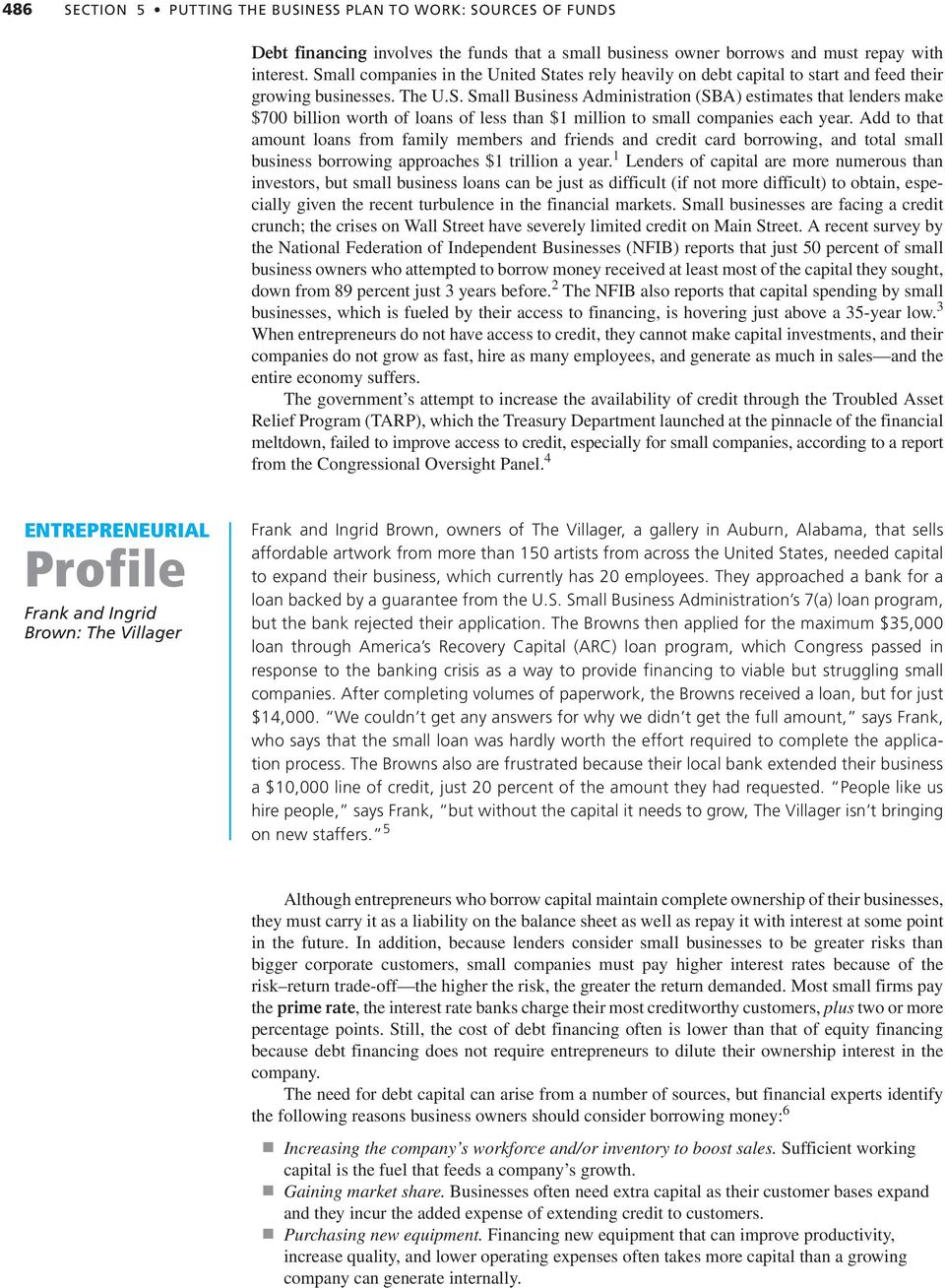
3 CHAPTER 15 SOURCES OF DEBT FINANCING 487 Refinancing existing debt. As companies become established, they can negotiate more favorable borrowing terms compared to their start-up days, when entrepreneurs take whatever money they can get at whatever rate they can get. Replacing high-interest loans with loans carrying lower interest rates improves cash flow significantly. Taking advantage of cash discounts. Suppliers sometimes offer discounts to customers who pay their invoices early. As you will learn in Chapter 17, Purchasing, Quality Management, and Vendor Analysis, business owners should take advantage of cash discounts in most cases. Buying the building in which the business is located. Many entrepreneurs start out renting the buildings that house their businesses; however, if location is crucial to their success, it may be wise to purchase the location. Establishing a relationship with a lender. If a business has never borrowed money, taking out a loan and developing a good repayment and credit history can pave the way for future financing. Smart business owners know that bankers who understand their businesses play an integral role in their companies ultimate success. Retiring debt held by a nonrelationship creditor. Entrepreneurs find that lenders who have no real interest in their companies long-term success or do not understand their businesses can be extremely difficult to work with. They prefer to borrow money from lenders who are willing to help them achieve their business mission and goals. Foreseeing a downturn in business. Establishing access to financing before a business slowdown hits insulates a company from a serious cash crisis and protects it from failure. Entrepreneurs seeking debt capital face an astounding range of credit options varying greatly in complexity, availability, and flexibility. Not all of these sources of debt capital are equally favorable, however. By understanding the various sources of capital both commercial and government lenders and their characteristics, entrepreneurs can greatly increase the chances of obtaining a loan. Figure 15.1 shows the financing strategies that small business owners use for their companies. We now turn to the various sources of debt capital. FIGURE 15.1 Small Business Financing Strategies Source: 2010 Mid-Year Economic Report, National Small Business Association, p. 8. Bank Loans Retained Earnings Credit Cards 39% 43% 42% Vendor Financing 20% Financing Strategy Private Loan (Family or Friends) Leasing Private Placement of Debt 4% 10% 19% Small Business Administration Loan 4% Asset-based Loans or Factoring 3% Other 7% 0% 5% 10% 15% 20% 25% 30% 35% 40% 45% Percentage of Small Businesses

4 488 SECTION 5 PUTTING THE BUSINESS PLAN TO WORK: SOURCES OF FUNDS A Tale of Two Borrowers Aaron s Automotive Tari Dudley had a plan to open a woman-friendly auto repair shop in Fort Worth, Texas, and operate it with her son-in-law, Aaron Phelps, who had owned a swimming pool cleaning business. Dudley had $47,000 in collateral, including a $30,000 certificate of deposit, and an excellent credit rating. Neither Dudley nor Phelps had operated a repair shop before, but Phelps had worked on cars all of his life and recently had returned to school to become a certified mechanic. However, when Dudley applied for a $250,000 loan at the bank where she had been a customer for 24 years, the loan officer did not bother to hand her an application; instead, he wrote her name and phone number on a small adhesive note. That was it, says Dudley, who suspects that the loan officer threw away the note as soon as she left the bank. She then applied for a loan at two community banks, both of which were impressed with her plan for an auto repair shop aimed at women. After 3 weeks, however, both rejected Dudley s loan request. Like many entrepreneurs, Dudley is caught square in the middle of a severe credit crunch. Government officials are encouraging banks to lend money; bankers say they want to lend money but claim that government policies discourage them from doing so. After striking out at banks, Dudley turned to a private investor, who promised to put up $30,000 but later backed out. Undeterred by the inability to get capital, Dudley and Phelps decided to forge ahead with their repair shop, confident that it would be successful. Dudley emptied her 401(k) retirement account and invested the severance pay she received from her former job, and Phelps and his wife contributed their savings account. They also scaled back their start-up costs, holding off on the purchase of an $80,000 piece of diagnostic equipment until their business becomes cash flow positive. They opened their repair shop, Aaron s Automotive ( the woman-friendly shop ) with two employees and rely on a credit card with a $12,000 limit to cover their monthly deficits. They charge $80 per hour for labor, an amount that is below what most auto dealerships in the area charge. Customers are beginning to discover the business, but Dudley and Phelps do not have the money to advertise. We re keeping our head above water, says Dudley. As the entrepreneurs fill small bags with candy, business cards, and pens bearing the Aaron s Automotive logo to deliver to prospective customers, Dudley says, It s all about cash flow. I can t put out a big sign because we don t have the money. I can t advertise. So we re putting candy in bags. Gorman Mechanical Michael Mushegan, a graduate of the University of Arizona with a degree in finance, wanted to purchase Gorman Mechanical, a company in Azle, Texas, that installs and services commercial and residential heating and air conditioning units in the Dallas Fort Worth area. Mushegan was familiar with the industry because he had grown up in it; his family operated a similar business in Arizona. Mushegan applied for a loan to purchase Gorman Mechanical, which had been in business for nearly 10 years and was profitable, at the bank where he was a customer. When the loan officer did not ask detailed questions about the business, the loan, and how he would use the money, Mushegan knew that his chances of getting financing were slim. Then he learned about SBA-guaranteed loans and discovered that a large bank, Wells Fargo, was one of the most active SBA lenders in the nation. Mushegan applied for an SBAbacked loan at Wells Fargo. [Bankers told me] that industry experience is crucial and that my credit rating was outstanding, which also was extremely important, he says. With an SBA loan guarantee, Wells Fargo approved Mushegan s loan application. After putting up 15 percent of the purchase price using his own money and investments from family, he took over Gorman Mechanical and became a business owner for the first time. 1. One of these businesses received a bank loan and the other did not. Describe the differences between the two companies that led to one entrepreneur receiving the financing he needed and the other one failing to qualify for a loan. 2. What steps would you have recommended to Tari Dudley to increase the probability of qualifying for a loan? 3. Suppose that Dudley had approached you for help after being turned down by three banks. What other sources of capital would you have suggested she use? Source: Based on Barry Shlacter, Small Businesses Continue to Feel Lending Pinch, Fort Worth Star-Telegram, December 27, 2009, com/news/small-businesses-continue-feel-lending-pinch-4.
5 CHAPTER 15 SOURCES OF DEBT FINANCING 489 Sources of Debt Capital 1. Describe the various sources of debt capital and the advantages and disadvantages of each. Commercial Banks Commercial banks are the very heart of the financial market, providing the greatest number and variety of loans to small businesses. Commercial banks provide 50 percent of the dollar value of all loans to small businesses. 7 For small business owners, banks are lenders of first resort, especially as their companies grow. The typical loan amount is small; more than 88 percent of all small business bank loans are for less than $100,000 (see Figure 15.2). The average micro business loan (those less than $100,000) is $6,820, and the average small business loan (those between $100,000 and $1 million) is $245,775. Blanca and Robert Welborn: Med-National Med-National, a company founded in 1987 by Blanca and Robert Welborn in San Antonio, Texas, that provides medical and dental services to the Department of Defense, applied for a $300,000 loan from several local banks with which the company had done business in the past. The company needed the financing to hire 20 doctors, dentists, and support staff to secure two contracts with the U.S. Army. Even though Med-National generates nearly $6 million in annual sales, has been profitable since its inception, and has an excellent credit rating, the banks refused the loan request. After nearly a year, the Welborn s persistence finally paid off when they secured the $300,000 loan they needed from one of the nation s largest small business lenders, Wells Fargo. Despite the Welborn s success, lack of access to credit has slowed their company s growth. If we could borrow money more easily, we would be hiring even more people, says Robert. 8 Banks tend to be conservative in their lending practices and prefer to make loans to established small businesses rather than to high-risk start-ups. Small companies that are less than 3 years old are as much as 50 percent less likely to receive loans or lines of credit than older, more established businesses. 9 Because start-ups are so risky, bankers prefer to make loans to companies that have successful track records. Banks are concerned with a small company s operating past and scrutinize its records to project its position in the immediate future. They also want proof of a company s stability and its ability to generate adequate cash flows that ensure repayment of the loan. If they do make loans to a start-up venture, banks like to see significant investment from the owner, sufficient cash flows to repay the loan, ample collateral (such as compensating balances) FIGURE 15.2 Commercial Bank Loans to Small Businesses by Size of Loan Source: The Small Business Economy: A Report to the President, 2009, p % Percentage of Loans % 4.7% 0 < $100,000 $100,000 to < $250,000 Loan Size $250,000 to $1 million

6 490 SECTION 5 PUTTING THE BUSINESS PLAN TO WORK: SOURCES OF FUNDS to secure it, or an SBA guarantee to insure it. Entrepreneurs should not overlook small community banks (those with less than $10 billion in assets) for loans. These small banks, which make up 98.7 percent of U.S. banking institutions, account for 52 percent of the dollar volume of all small business loans. 10 They also tend to be small business friendly and are more likely than their larger counterparts to customize the terms of their loans to the particular needs of small businesses, offering, for example, flexible payment terms to match the seasonal pattern of a company s cash flow or interest-only payments until a piece of equipment begins generating revenue. When evaluating a loan application, banks focus on a company s capacity to create positive cash flow because they know that s where the money to repay their loans will come from. The first question in most bankers minds when reviewing an entrepreneur s business plan is Can this business generate sufficient cash to repay the loan? Even though they rely on collateral to secure their loans, the last thing banks want is for a borrower to default, forcing them to sell the collateral (often at fire sale prices) and use the proceeds to pay off the loan. That s why bankers stress cash flow when analyzing a loan request, especially for a business start-up. Cash is more important than your mother, jokes one experienced borrower. 11 Banks, as well as many other lenders, also require that entrepreneurs sign a personal guarantee for any loan they make to small businesses. By making a personal loan guarantee, an entrepreneur is pledging that he or she will be personally liable for repaying the loan in the event that the business itself cannot repay the loan. Recall from Chapter 3 that in the eyes of the law a sole proprietor or a general partner and the business are one and the same; therefore, for them, personal loan guarantees are redundant. However, because the owners of S corporations, corporations, and LLCs are separate from their businesses, they are not automatically responsible for the company s debts. Once the owners of these businesses sign a personal loan guarantee, however, they become liable for their companies loans. (It is as if these individuals have cosigned the loan with the business.) Working with a partner, Rosalind Resnick launched NetCreations, an Internet marketing company, using money from various sources, including bank loans. The bank required us to provide personal guarantees for [NetCreation s] credit line and equipment lease loans that totaled $2 million, says Resnick. It wasn t until our company went public that the bank let us off the hook [for those loans]. 12 Short-Term Loans Short-term loans, extended for less than 1 year, are the most common type of commercial loan banks make to small companies. These funds typically are used to replenish the working-capital account to finance the purchase of inventory, boost output, finance credit sales to customers, or take advantage of cash discounts. As a result, an owner repays the loan after converting inventory and receivables into cash. There are several types of short-term loans. COMMERCIAL LOANS (OR TRADITIONAL BANK LOANS). The basic short-term loan is the commercial bank s specialty. Business owners typically repay the loan, which often is unsecured because secured loans are much more expensive to administer and maintain, as a lump sum within 3 to 6 months. In other words, the bank grants a loan to the small business owner without requiring him or her to pledge any specific collateral to support the loan in case of default. The owner repays the total amount of the loan at maturity. Sometimes the interest due on the loan is prepaid deducted from the total amount borrowed. Until a small business is able to prove its financial strength and liquidity (cash flow) to the bank s satisfaction, it will probably not qualify for this kind of commercial loan. LINES OF CREDIT. One of the most common requests entrepreneurs make of banks is to establish a line of credit, a short-term loan with a preset limit that provides much needed cash flow for day-to-day operations. With a commercial (or revolving) line of credit, business owners can borrow up to the predetermined ceiling at any time during the year quickly and conveniently by writing themselves a loan. Banks set up lines of credit that are renewable for anywhere from 90 days to several years, and they usually limit the open line of credit to 40 to 50 percent of a firm s present working capital, although they may lend more for highly seasonal businesses. Bankers may require a company to rest its line of credit during the year, maintaining a zero balance, as proof that the line of credit is not a perpetual crutch. Like commercial loans, lines of credit can be secured or unsecured. Small lines of credit often are
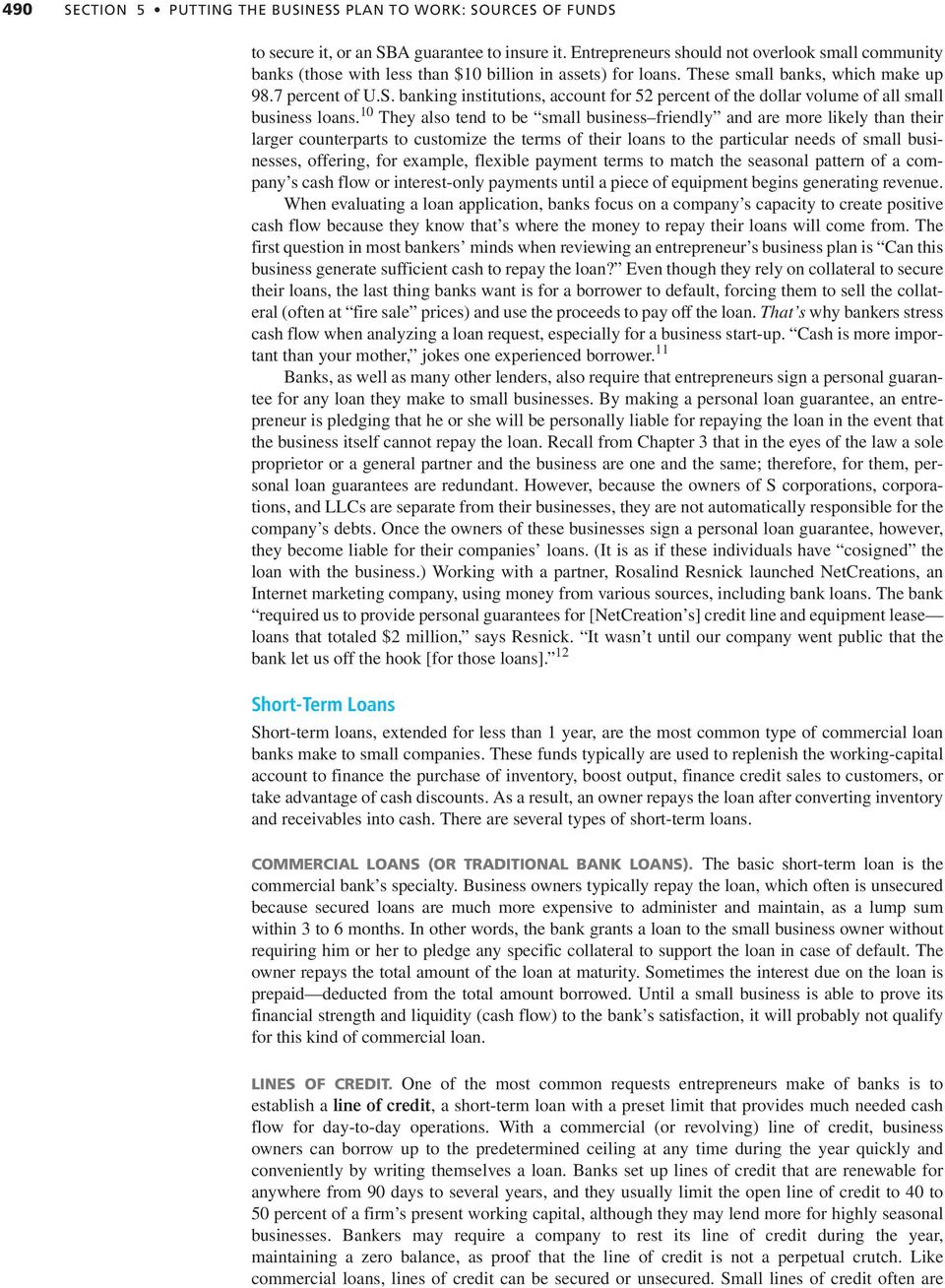
7 CHAPTER 15 SOURCES OF DEBT FINANCING 491 unsecured, and large ones usually are secured by accounts receivable, inventory, equipment, or other business assets. A business typically pays a small handling fee (1 to 2 percent of the maximum amount of credit) plus interest on the amount borrowed usually prime-plus-three points or more. Because banks prefer the security of established businesses, securing a line of credit can be difficult for some small companies, especially new ones. A study by the National Federation of Independent Businesses reports that the most difficult type of loan for small business owners to obtain is a line of credit; only 37.6 percent of the small companies that apply receive one. 13 Brad Glaberson: Cucina Fresca, Inc. Brad Glaberson, founder of Cucina Fresca, Inc., a specialty foods company in Seattle, Washington, switched from the bank he had used for 10 years when his banker eliminated his company s $70,000 line of credit and converted the existing $38,000 balance to a term loan. Glaberson approached Foundation Bank, a small community bank in Seattle, and offered loan officers a tour of his operations, monthly financial reports, and access to all of his company s financial records as part of his loan application. Foundation Bank extended Cucina Fresca a $102,000 line of credit, which Glaberson used to launch a new product line called Lazy Lasagna. 14 Table 15.1 shows one method for determining how large a line of credit a small company should seek. FLOOR PLANNING. Floor planning is a form of financing frequently employed by retailers of big-ticket items that are easily distinguishable from one another (usually by serial number), such as automobiles, recreational vehicles, boats, and major appliances. For example, Thrifty TABLE 15.1 How Large Should Your Line of Credit Be? Determining how large a small company s line of credit should be is an important step for a growing business. As a company s sales grow, so will its inventory and accounts receivable balances, both of which tie up valuable cash. To avoid experiencing a cash crisis, many growing companies rely on a line of credit. How large should that line of credit be? The following formulas will help you answer that question: Average collection period ratio + Average inventory turnover ratio - Average payable period ratio = Cash flow cycle Cash flow cycle * Average daily sales - Forecasted annual profit = Line of credit requirement Example: Suppose that Laramie Corporation has an average collection period ratio of 49 days and an average inventory turnover ratio of 53 days. The company s average payable period is 39 days, its annual sales are $5,800,000, and its net profit margin is 6.5 percent. What size line of credit should Laramie seek? Average collection period ratio 49 days Average inventory turnover ratio 53 days Total 102 days Minus average payable period ratio 39 days Cash flow cycle 63 days Annual sales $5,800,000 Average daily sales (annual sales 365 days) $ 15,890 Cash flow cycle 63 days Times average daily sales $ 15,890 Equals $1,001,096 Minus forecasted profit ( annual sales * net profit margin) 377,000 Equals line of credit requirement $ 624,096 Laramie Corporation should seek a line of credit of $624,000. Source: Adapted from George M. Dawson, It Figures, Entrepreneur Start-Ups, December 2000, p. 27.
8 492 SECTION 5 PUTTING THE BUSINESS PLAN TO WORK: SOURCES OF FUNDS Car Sales makes a floor-plan financing program available to the network of franchised dealers that sell the used cars that are taken out of service from its Thrifty Car Rental system. Bombadier Capital, the provider of the floor plan, finances Thrifty Car Sales dealers purchases of automobiles from Thrifty Car Rental and maintains a security interest in each car by holding its title as collateral. 15 Dealers pay interest on the loan monthly and repay the principal as the cars are sold. The longer a floor-planned item sits in inventory, the more it costs a business owner in interest expense. Banks and other floor planners often discourage retailers from using their money without authorization by performing spot checks to verify prompt repayment of the principal as items are sold. Intermediate and Long-Term Loans Banks primarily are lenders of short-term capital to small businesses, although they will make certain intermediate and long-term loans. Intermediate and long-term loans are extended for 1 year or longer and are normally used to increase fixed- and growth-capital balances. Commercial banks grant these loans for starting a business, constructing a plant, purchasing real estate and equipment, and other long-term investments. Loan repayments are normally made monthly or quarterly. TERM LOANS. Another common type of loan banks make to small businesses is a term loan. Typically unsecured, banks grant these loans to businesses whose past operating history suggests a high probability of repayment. Some banks make only secured term loans, however. Term loans impose restrictions (called covenants) on the business decisions an entrepreneur makes concerning the company s operations. For instance, a term loan may set limits on owners salaries, prohibit further borrowing without the bank s approval, or maintain certain financial ratios. An entrepreneur must understand all of the terms attached to a loan before accepting it. INSTALLMENT LOANS. These loans are made to small firms for purchasing equipment, facilities, real estate, and other fixed assets. When financing equipment, a bank usually lends the small business from 60 to 80 percent of the equipment s value in return for a security interest in the equipment. The loan s amortization schedule typically coincides with the length of the equipment s usable life. When financing real estate (commercial mortgages), banks typically will lend up to 75 to 80 percent of the property s value and will allow a lengthier repayment schedule of 10 to 30 years. Source:

9 CHAPTER 15 SOURCES OF DEBT FINANCING 493 CHARACTER LOANS. Banking regulatory changes intended to create jobs by increasing the credit available to small- and medium-sized companies now allow banks to make character loans. Rather than requiring entrepreneurs to prove their creditworthiness with financial statements, evaluations, appraisals, and tax returns, banks making character loans base their lending decisions on the borrower s reputation and reliability (i.e., character ). The Lessons from the Street-Smart Entrepreneur feature describes how small business owners can maintain positive relationships with their bankers. How to Maintain a Positive Relationship with Your Banker Too often, entrepreneurs communicate with their bankers only when they find themselves in a tight spot and needing money. Unfortunately, that s not the best way to manage a working relationship with a bank. Businesspeople have a responsibility to train their bankers in their businesses, says one lending advisor. A good banker will stay close to the business, and a good business will stay close to the banker. A good banking relationship has the power to influence in a significant way the success of a small business. How can business owners develop and maintain positive relationships with their bankers? The first step is picking the right bank and the right banker. Some banks are not terribly enthusiastic about making small business loans, whereas others target small businesses as their primary customers. Entrepreneurs should visit several banks both small community banks and large national banks and talk with a commercial loan officer about their banking needs and the bank s products and services. After finding the right banker, the entrepreneur must focus on maintaining effective communication. The best strategy is to keep bankers informed of both good news and bad. Karyn Korteling started her restaurant, Pastabilities, in downtown Syracuse, New York, when the city s downtown revitalization efforts were just underway. She knew that a quality restaurant located downtown could be successful by appealing to the 30,000 people who worked in the area. The menu of delicious pastas, pizzas, salads, and specialty dishes struck a chord with the lunch crowd, and soon Pastabilities also became a gathering spot for people heading out for a night on the town. Pastabilities has grown from a one-room lunch spot into a full-blown restaurant with three dining rooms, a full-service bar, and seasonal outdoor dining in a quaint plaza. Ready to add a second location but needing financing to make the move, Korteling has been meeting with her banker for several months to discuss the company s financial performance and expansion plans. She keeps her banker informed about the progress of her company (such as how she has trained her management team so that she can split her time between two locations) as well as the challenges it faces. She also asks for advice on some issues. The more they know about you and your business, the better, she says. What else can entrepreneurs do to manage their banking relationships? Understand the factors that influence a banker s decision to lend money. Bankers want to lend money to businesses; that s how they generate a profit. However, they want to lend money to businesses they believe offer a very high probability of repaying their loans on time. Bankers look for companies that are good credit risks and have clear plans for success. Invite the banker to visit your company. An on-site visit gives the banker the chance to see exactly what a company does and how it does it. It s also a great opportunity to show the bank where and how its money is put to use. Make a good impression. A company s physical appearance can go a long way toward making either a positive (or a negative) impression on a banker. Lenders appreciate clean, safe, orderly work environments and view sloppily maintained facilities (such as spills, leaks, and unnecessary clutter) as negatives. Send customer mailings to the banker as well. Besides the numbers, we try to give our bankers a sense of our vision for the business, says Mitchell Goldstone, president of Thirty-Minute Photos Etc. Goldstone sends customer mailings to his bankers so they know we re thinking about opportunities to generate money. Send the banker samples of new products. I try to make my banker feel as if he s a partner, says Drew Santin, president of a product-development company. Whenever we get a new machine, I go out of my way to show the banker what it does.
10 494 SECTION 5 PUTTING THE BUSINESS PLAN TO WORK: SOURCES OF FUNDS Show off your employees. Bankers know that one of the most important components of building a successful company is a dedicated team of capable employees. Giving bankers the opportunity to visit with employees and ask them questions while touring a company can help alleviate fears that they are pumping their money into a high-risk one-person show. Know your company s assets. Almost always interested in collateral, bankers will want to judge the quality of your company s assets property, equipment, inventory, accounts receivable, and others. Be sure to point them out. As you walk the lender through your business, says one experienced banker, it s always a good idea to identify assets the banker might not think of. Be prepared to personally guarantee any loans the bank makes to your business. Even though many business owners choose the corporate form of ownership for its limited liability benefits, some are surprised when a banker asks them to make personal guarantees on business loans. It s a common practice, especially on small business loans. Keep your business plan up-to-date and make sure your banker gets a copy of it. Bankers lend money to companies that can demonstrate that they will use the money wisely and productively. They also want to make sure that the company offers a high probability of repayment. The best way to provide bankers with that assurance is with a solid business plan. Know how much money you need and how you will repay it. When a banker asks How much money do you need? the correct answer is not How much can I get? 1. What advantages do entrepreneurs gain by communicating openly with their bankers? 2. Why do so few entrepreneurs follow Karyn Korteling s example when dealing with their bankers? 3. What are the consequences of an entrepreneur failing to communicate effectively with a banker? Sources: Based on Emily Maltby, Uptick Catches Entrepreneurs by Surprise, Wall Street Journal, December 8, 2009, p. B7; Keith Lowe, Keep Your Banker Informed, Entrepreneur, April 1, 2002, article/0,4621,298380,00.html; David Worrell, Attacking a Loan, Entrepreneur, July 2002, Maggie Overfelt, How to Raise Cash During Crunch Time, FSB, March 2001, pp ; Jenny McCune, Getting Banks to Say Yes, Bankrate.com, March 19, 2001, a.asp; Joan Pryde, Lending a Hand with Financing, Nation s Business, January 1998, pp ; Joseph W. May, Be Frank with Your Bank, Profit, November/December 1996, pp ; They ll Up Your Credit If... Inc., April 1994, p. 99; Jane Easter Bahls, Borrower Beware, Entrepreneur, April 1994, p. 97; Jacquelyn Lynn, You Can Bank on It, Business Start-Ups, August 1996, pp ; Stephanie Barlow, Buddy System, Entrepreneur, March 1997, pp ; Carlye Adler, Secrets from the Vault, FSB, June 2001, p. 33. Nonbank Sources of Debt Capital 2. Explain the types of financing available from nonbank sources of credit. Although they are usually the first stop for entrepreneurs in search of debt capital, banks are not the only lending game in town. We now turn our attention to other sources of debt capital that entrepreneurs can tap to feed their cash-hungry companies. Asset-Based Lenders Asset-based lenders, which are usually smaller commercial banks, commercial finance companies, or specialty lenders, allow small businesses to borrow money by pledging otherwise idle assets such as accounts receivable, inventory, or purchase orders as collateral. This form of financing works especially well for manufacturers, wholesalers, distributors, and other companies with significant stocks of inventory, accounts receivable, equipment, real estate, or other assets. Even unprofitable companies whose income statements could not convince loan officers to make traditional loans can get asset-based loans. Because asset-based lenders focus more on collateral than on a company s credit rating, these cash-poor but asset-rich companies can use normally unproductive assets accounts receivable, inventory, equipment, and purchase orders to finance rapid growth and the cash crises that often accompany it. Even large companies such as Levi Strauss, Goodyear, and Rite Aid rely on asset-based loans. 16 Like banks, asset-based lenders consider a company s cash flow, but they are much more interested in the quality of the assets pledged as collateral. The amount a small business can borrow through asset-based lending depends on the advance rate, the percentage of an asset s value that a lender will lend. For example, a company pledging $100,000 of accounts receivable might
11 CHAPTER 15 SOURCES OF DEBT FINANCING 495 negotiate a 70 percent advance rate and qualify for a $70,000 asset-based loan. Advance rates can vary dramatically depending on the quality of the assets pledged and the lender. Because inventory is an illiquid asset (i.e., hard to sell), the advance rate on inventory-based loans is quite low, usually 10 to 50 percent. Steven Melick, CEO of the Sycamore Group, an e-business software developer, gets an 85 percent advance rate on his company s loans from GE Capital by pledging high-quality accounts receivable as collateral. 17 The most common types of asset-based financing are discounting accounts receivable, inventory financing, and purchase order financing. DISCOUNTING ACCOUNTS RECEIVABLE. The most common form of secured credit is accounts receivable financing. Under this arrangement, a small business pledges its accounts receivable as collateral; in return, the lender advances a loan against the value of approved accounts receivable. The amount of the loan tendered is not equal to the face value of the accounts receivable, however. Even though the lender screens the firm s accounts and accepts only qualified receivables, it makes an allowance for the risk involved because some receivables will be uncollectible. A small business usually can borrow an amount equal to 55 to 85 percent of its receivables, depending on their quality. Generally, lenders do not accept receivables that are past due. Seth Chapman: Weezabi LLC When the University of Alabama received an invitation recently to play for a national championship in football, Weezabi LLC, a three-person company in Birmingham, Alabama, had to scramble to produce 60,000 Crimson Tide T-shirts. Unable to qualify for traditional financing, the tiny company, one of just a few licensed to produce Alabama merchandise, turned to asset-based financing for the capital it needed to purchase and print the T-shirts. If it [weren t] for that loan, we would have missed the boat on all of this hot-market stuff, says owner Seth Chapman. 18 INVENTORY FINANCING. Here, a small business loan is secured by its inventory of raw materials, work in process, or finished goods. If an owner defaults on the loan, the lender can claim the firm s inventory, sell it, and use the proceeds to satisfy the loan (assuming the bank s claim is superior to the claims of other creditors). Because inventory usually is not a highly liquid asset and its value can be difficult to determine, lenders are willing to lend only a portion of its worth, usually no more than 50 percent of the inventory s value. Most asset-based lenders avoid inventory-only deals; they prefer to make loans backed by inventory and more secure accounts receivable. PURCHASE ORDER LOANS. Small companies that receive orders from large customers can use those purchase orders as collateral for loans. The customer places an order with a small business, which needs financing to fill the order. The small business pledges the future payment from the order as security for the loan, and the lender verifies the credit rating of the customer (not the small business) before granting the short-term loan, which often carries annual interest rates of 40 percent or more. Borrowers usually repay the loan within 60 days. George Tarrab: Slider the UNscooter Sales at Slider the UNscooter, a Simi Valley, California-based company that sells ride-on scooters, were outstripping the company s cash flow, but because the company was less than 2 years old, lenders were not willing to extend traditional financing. Owner George Tarrab landed orders from several major retailers but needed financing to manufacture the scooters to fill them. He turned to a lender that specializes in purchase order financing, which provided $200,000 in financing. Even though UNscooter incurred large fees on the purchase order loans, Tarrab says that the loan allowed his company to fill the orders, free up cash for marketing, and attract other high-volume customers. Even though most experts advise using purchase order loans as a last resort, Tarrab had little choice. We had to get creative, he says. 19 Asset-based financing is a powerful tool. A small business that could obtain a $1 million line of credit with a bank would be able to borrow as much as $3 million by using accounts receivable as collateral. It is also an efficient method of borrowing because entrepreneurs borrow only the money they need, when they need it. Asset-based borrowing is an excellent just-in-time method of borrowing, one that often is available within just hours. As bank credit has tightened, its popularity has increased.
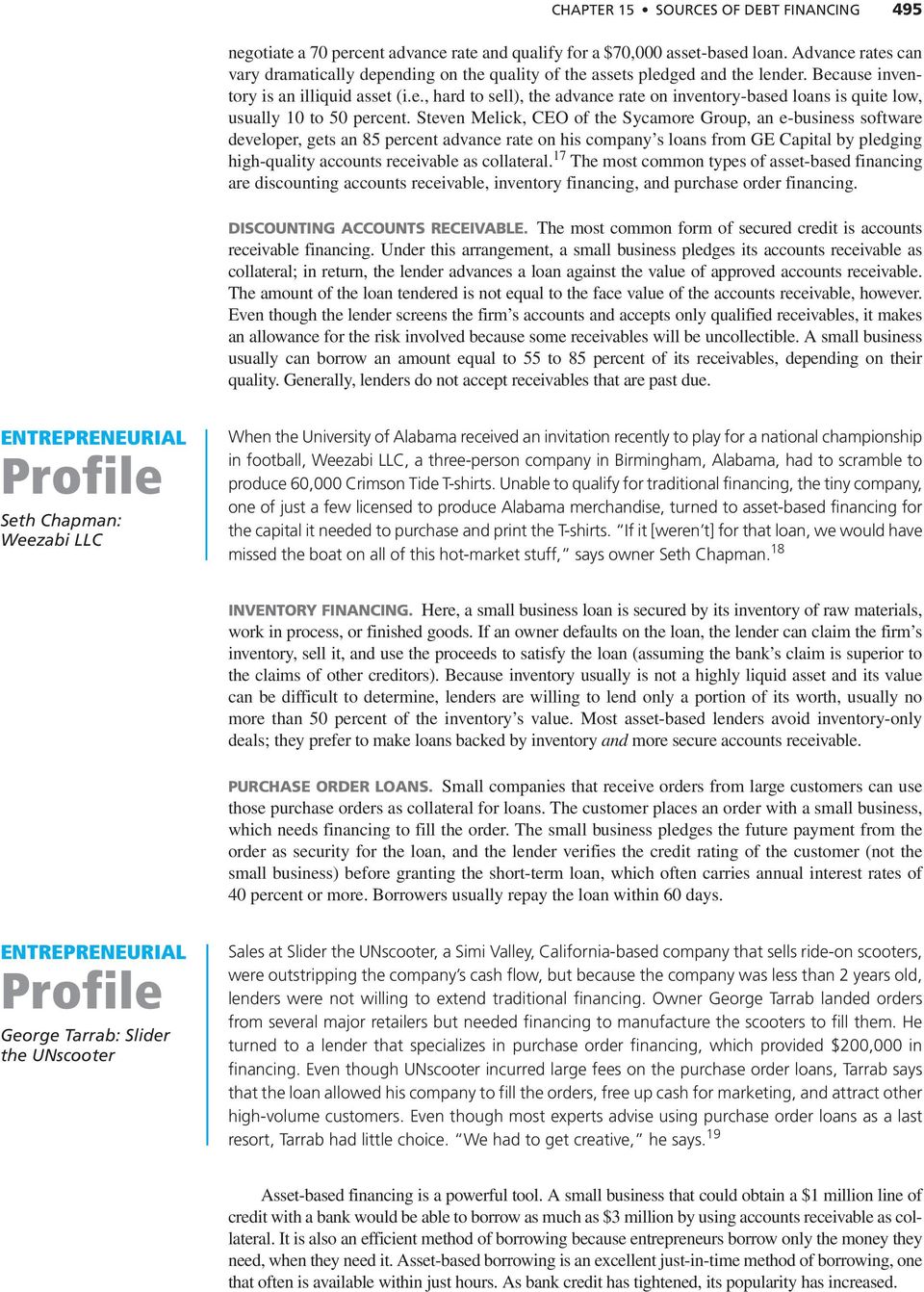
12 496 SECTION 5 PUTTING THE BUSINESS PLAN TO WORK: SOURCES OF FUNDS $600,000 $500,000 $400,000 Millions of $ $300,000 $200,000 $100,000 $ Year FIGURE 15.3 Asset-Based Loans Source: Commercial Finance Association. However, asset-based loans are more expensive than traditional bank loans because of the cost of originating and maintaining them and the higher risk involved. To ensure the quality of the assets supporting the loans they make, lenders often monitor borrowers assets, perhaps as often as weekly, making paperwork requirements on these loans intimidating, especially to first-time borrowers. Rates usually run from 2 to 8 percentage points (or more) above the prime rate. Because of this rate differential, small business owners should not use asset-based loans over the long term; their goal should be to establish their credit through asset-based financing and then to move up to a line of credit. Figure 15.3 shows the trend in asset-based borrowing since Trade Credit Because of its ready availability, trade credit is an extremely important source of financing to most entrepreneurs. In fact, 60 percent of small businesses use trade credit as a source of financing. 20 Trade credit involves convincing vendors and suppliers to sell goods and services without requiring payment up front. When banks refuse to lend money to a small business because they see it as a poor credit risk, an entrepreneur may be able to turn to trade credit for capital. Getting vendors to extend credit in the form of delayed payments (e.g., net 30 credit terms) usually is much easier for small businesses than obtaining bank financing. Essentially, a company receiving trade credit from a supplier is getting a short-term, interest-free loan for the amount of the goods purchased. Vendors and suppliers usually are willing to finance a small business owner s purchase of goods from 30 to 90 days, interest free. The key to maintaining trade credit as a source of funds is establishing a consistent and reliable payment history with every vendor. Ed and Jennifer Foy: efashion Solutions In 2000, Ed and Jennifer Foy started efashion Solutions, a company that provides e-commerce solutions for branded, well-known companies in the apparel, entertainment, and specialty retail industries, in Secaucus, New Jersey. The company performs a full range of services, including purchasing, merchandising, Web site design, marketing, business intelligence, customer service, order management, and order fulfillment for its clients. As their company grew, the Foys raised $24 million in equity capital and used a variety of traditional bank financing to support its operations. When the company s regular lender shut off access to credit because of the financial crisis, the Foys began using trade credit from their vendors. efashion Solutions has been able to negotiate net 60 credit terms with some vendors but takes advantage of cash discounts (more on these in Chapter 17 on supply chain management) from other vendors that range from 1 to 10 percent for early payment. 21
13 CHAPTER 15 SOURCES OF DEBT FINANCING 497 Equipment Suppliers Most equipment suppliers encourage business owners to purchase their equipment by offering to finance the purchase over time. This method of financing is similar to trade credit but with slightly different terms. Usually, equipment vendors offer reasonable credit terms with only a modest down payment and the balance financed over the life of the equipment (often several years). In some cases, the vendor repurchases equipment for salvage value at the end of its useful life and offers the business owner another credit agreement on new equipment. Start-up companies often use trade credit from equipment suppliers to purchase equipment and fixtures such as counters, display cases, refrigeration units, machinery, and the like. It pays to scrutinize vendors credit terms, however; they may be less attractive than those of other lenders. Commercial Finance Companies When denied bank loans, small business owners often look to commercial finance companies for the same types of loan. Commercial finance companies are second only to banks in making loans to small businesses and, unlike their conservative counterparts, are willing to tolerate more risk in their loan portfolios. 22 For instance, Chris Lehnes, a top manager at CIT Small Business Lending, says that his company regularly makes loans to small businesses with debt to equity ratios of 10:1 (10 times as much debt as equity), a situation that would send most bankers scurrying back to their vaults. 23 Of course, like banks, finance companies primary consideration is collecting their loans, but finance companies tend to rely more on obtaining a security interest in some type of collateral, given the higher risk loans that make up their portfolios. Because commercial finance companies depend on collateral to recover most of their losses, they do not always require a complete set of financial projections of future operations as most banks do. However, this does not mean that they neglect to evaluate carefully a company s financial position, especially its cash balance, before making a loan. We re looking at the projected cash flow the ability of the business to repay us, says CIT s Lehnes. We put a lot of weight on what the business has done in the past couple of years. 24 Approximately 150 large commercial finance companies, such as AT&T Small Business Lending, UPS Capital, GE Capital Solutions, CIT Small Business Lending, and others, make a variety of loans to small companies, ranging from asset-based loans and business leases to construction and SBA loans. Dubbed the Wal-Marts of finance, commercial finance companies usually offer many of the same credit options as commercial banks do, including intermediate and long-term loans for real estate and fixed assets as well as short-term loans and lines of credit. Connie Kalitta: Kalitta Air Connie Kalitta started Kalitta Air, an air cargo carrier, in 2000, and the company grew quickly to become a leading company in the air cargo market. Three years later, Kalitta wanted to expand his company to reach global markets, which required larger aircraft with greater cruising ranges. Kalitta turned to GE Capital, which provided the company with long-term financing for two Boeing freighters, allowing the company to gain significant market share in air shipments to Asia. 25 Finance companies offer small business borrowers faster turnaround times, longer repayment schedules, and more flexible payment plans than traditional lenders, all valuable benefits to cash-hungry small companies. However, because their loans are subject to more risks, finance companies charge higher interest rates than commercial banks. Their most common methods of providing credit to small businesses are asset-based accounts receivable financing and inventory loans. Rates on loans from commercial finance companies are higher than those at banks as high as 15 to 30 percent (including fees), depending on the risk a particular business presents and the quality of the assets involved. Because many of the loans they make are secured by collateral (usually the business equipment, vehicle, real estate, or inventory purchased with the loan), finance companies often impose more onerous reporting requirements, sometimes requiring weekly (or even daily) information on a small company s inventory levels or accounts receivable balances. However, entrepreneurs who cannot secure financing from traditional lenders because of their short track records, less-than-perfect credit ratings, or fluctuating earnings often find the loans they need at commercial finance companies.
14 498 SECTION 5 PUTTING THE BUSINESS PLAN TO WORK: SOURCES OF FUNDS Mariusz Kolodziej: Hudson Bakery In 1994, Mariusz Kolodziej left his native Poland and moved to New York City, where he opened Hudson Bakery, a small commercial bakery. Soon some of New York s finest restaurants and hotels were serving his breads, baguettes, rolls, Panini, and focaccias, and the company s reputation for distinctive, high-quality products and excellent service and its sales grew rapidly. In 2003, using a combination of retained earnings, bank financing, and loans and leases from a commercial finance company, Kolodziej moved production into a 50,000-square-foot bakery in North Bergen, New Jersey. Later, he opened a second bakery near Philadelphia to serve restaurants and hotels in that city. GE Capital provided Hudson Bakery with a $1.5 asset-based lease that enabled Kolodziej to acquire the equipment to outfit its new commercial bakeries. 26 Savings and Loan Associations Savings and loan associations (S&Ls) specialize in loans for real property. In addition to their traditional role of providing mortgages for personal residences, S&Ls offer financing on commercial and industrial property. In the typical commercial or industrial loan, the S&L will lend up to 80 percent of the property s value with a repayment schedule of up to 30 years. Minimum loan amounts are typically $50,000, but most S&Ls hesitate to lend money for buildings specially designed for a particular customer s needs. S&Ls expect the mortgage to be repaid from the company s future profits. Stock Brokerage Houses Stockbrokers also make loans, and many of them offer loans to their customers at lower interest rates than banks. These margin loans carry lower rates because the collateral supporting them the stocks and bonds in the customer s portfolio is of high quality and is highly liquid. Moreover, brokerage firms make it easy to borrow. Usually, brokers set up a line of credit for their customers when they open a brokerage account. To tap that line of credit, a customer simply writes a check or uses a debit card. Typically, a margin loan does not have a fixed repayment schedule; the debt can remain outstanding indefinitely, as long as the market value of the borrower s portfolio of collateral meets minimum requirements. Aspiring entrepreneurs can borrow up to 50 percent of the value of their stock portfolios, up to 70 percent of their bond portfolios, and up to 90 percent of the value of their government securities. Using stocks and bonds as collateral on a loan can be risky. Brokers typically require a 30 percent cushion on margin loans. If the value of the borrower s portfolio drops, the broker can make a margin call; that is, the broker can call the loan and require the borrower to provide more cash and securities as collateral. Recent swings in the stock market have translated into margin calls for many entrepreneurs, requiring them to repay a significant portion of their loan balances within a matter of days or hours. If an account lacks adequate collateral, the broker can sell some of the customer s portfolio to pay off the loan. Insurance Companies For many small businesses, life insurance companies can be an important source of business capital. Insurance companies offer two basic types of loans: policy loans and mortgage loans. Policy loans are extended on the basis of the amount of money paid through premiums into the insurance policy; with a policy loan, a business owner serves as his or her own bank, borrowing against the money accumulated in the investment portion of an insurance policy. It usually takes about 2 years for an insurance policy to accumulate enough cash surrender value to justify a loan against it. Once the cash value accumulates in a policy, an entrepreneur may borrow up to 95 percent of that value for any length of time. Interest is levied annually, but the entrepreneur determines the repayment rate, or repayment may be deferred indefinitely. However, the amount of insurance coverage is reduced by the amount of the loan. Policy loans typically offer very favorable interest rates, sometimes below the prime rate. Only insurance policies that build cash value those that combine a savings plan with insurance coverage offer the option of borrowing. These include whole life (permanent insurance), variable life, universal life, and many corporate-owned life insurance policies. Term life insurance, which offers only pure insurance coverage, has no borrowing capacity. Insurance companies make mortgage loans on a long-term basis on real property worth a minimum of $500,000. They are based primarily on the value of the real property being purchased. The insurance company will extend a loan of up to 75 or 80 percent of the real estate s
15 CHAPTER 15 SOURCES OF DEBT FINANCING 499 value and will allow a lengthy repayment schedule over 25 or 30 years so that payments do not strain the firm s cash flows excessively. Many large real estate developments such as shopping malls, office buildings, and theme parks rely on mortgage loans from insurance companies. Credit Unions Credit unions, nonprofit financial cooperatives that promote saving and provide loans to their members, are best known for making consumer and car loans. However, many are also willing to lend money to their members to launch businesses, especially since many banks have restricted loans to higher-risk start-ups. The first credit union in the United States was chartered in New Hampshire in Today, more than 7,500 federally and state-chartered credit unions operate in the United States, and many of them make business loans, usually in smaller amounts than commercial banks typically make. In fact, the average credit union business loan is $181,000, but some credit unions have made business loans in the millions of dollars. 28 Because credit unions are exempt from federal income tax, they often charge lower interest rates than banks. Today credit unions make more than $33.4 billion in small business loans to their members, nearly triple the $12.3 billion in small business loans they made in Lending practices at credit unions are very much like those at banks, but they are subject to restraints that banks are not. For instance, credit unions are prohibited from making business loans that total more than percent of their assets (a cap that Congress is considering increasing to 25 percent). Recent changes in legislation, however, exempt certain business loans from that limitation. In another move that favors entrepreneurs, the SBA recently opened its 7(a) loan programs to credit unions, providing even more avenues for entrepreneurs seeking financing. The Export-Import Bank also is exploring ways to work with credit unions that want to provide export financing to small businesses. Increasingly, entrepreneurs are turning to credit unions to finance their businesses capital needs. Gladys and Eustace Kumanja: Queen Bee Beauty Supply Gladys and Eustace Kumanja immigrated to the United States from Kenya in 1996 with the dream of one day opening a business of their own. Their dream became a reality when the Kumanjas opened Queen Bee Beauty Supply in Smyrna, Delaware, with the help of a $250,000 business loan from the American Spirit Federal Credit Union. Initially, the Kumanjas approached three commercial banks, but their applications were denied because the banks said that they lacked sufficient capital and business experience. The loan from the credit union, the result of the 2009 American Recovery and Investment Act designed to stimulate the economy, is supported by a 90 percent guarantee from the SBA. 30 Entrepreneurs searching for a credit union near them can use the online database at the Credit Union National Association s Web site ( Bonds Bonds, which are corporate IOUs, have always been a popular source of debt financing for large companies, but few small business owners realize that they can also tap this valuable source of capital. Although the smallest businesses are not viable candidates for issuing bonds, a growing number of small companies are finding the funding they need through bonds when banks and other lenders say no. Because of the costs involved, issuing bonds usually is best suited for companies generating annual sales between $5 million and $30 million and have capital requirements between $1.5 million and $10 million. Although they can help small companies raise much needed capital, bonds have certain disadvantages. The issuing company must follow the same regulations that govern businesses selling stock to public investors. Even if the bond issue is private, the company must register the offering and file periodic reports with the SEC. Convertible bonds, bonds that give the buyer the option of converting the debt to equity by purchasing the company s stock at a fixed price in the future, have become more popular for small companies. In exchange for offering the option to convert the bond into stock, the small company issuing the convertible bonds gets the benefit of paying a lower interest rate on the bond than on a traditional bond. The conversion feature is valuable only if the company is successful and its value increases over time. Small manufacturers needing money for fixed assets with long repayment schedules have access to an attractive, relatively inexpensive source of funds in industrial development revenue
16 500 SECTION 5 PUTTING THE BUSINESS PLAN TO WORK: SOURCES OF FUNDS bonds (IDRBs). To issue IDRBs, a company must work with a local or state government agency, which issues the bonds on the company s behalf. The company, not the government entity, is responsible for repaying both the principal and the interest on the bond issue. Typically, the amount of money companies that issue IDRBs seek to raise is at least $2 million, but some small manufacturers have raised as little as $500,000 using a mini-bond program that offers a simple application process and short closing times. Each government entity has its own criteria, such as job creation, expansion of the tax base, and others that companies must meet to be eligible to issue mini-bonds. NGK Spark Plugs, a company founded in 1936 that produces spark plugs for automotive, marine, motorcycle, and small engines, issued $15 million in industrial revenue bonds with the help of the West Virginia Economic Development Agency to build an 85,000 square-foot factory in Sissonville, West Virginia, that created 80 new jobs. 31 To open IDRBs up to even smaller companies, some states pool the industrial bonds of several small companies too small to make an issue alone. By joining together to issue composite industrial bonds, companies can reduce their issuing fees and attract a greater number of investors. The issuing companies typically pay lower interest rates than they would on conventional bank loans. Private Placements In the previous chapter, we saw how companies can raise capital by making private placements of their stock (equity). Private placements are also available for debt instruments. A private placement involves selling debt to one or a small number of investors, usually insurance companies or pension funds. Private placement debt is a hybrid between a conventional loan and a bond. At its heart, it is a bond, but its terms are tailored to the borrower s individual needs, as a loan would be. Privately placed securities offer several advantages over standard bank loans. First, they usually carry fixed interest rates, rather than the variable rates banks often charge. Second, the maturity of private placements is longer than most bank loans: 15 years rather than 5. Private placements do not require hiring expensive investment bankers. Finally, because private investors can afford to take greater risks than banks, they are willing to finance deals for fledgling small companies. Mark Benioff: Salesforce.com Entrepreneur Mark Benioff started Salesforce.com, a company that provides customer relationship management applications to more than 72,500 businesses, in his apartment in San Francisco in The company, now a leader in the field of enterprise cloud computing, recently closed a $500 million private debt placement of 5-year notes that are convertible to company stock to fund its rapid growth and acquisitions of smaller companies. 32 Small Business Investment Companies (SBICs) The Small Business Investment Company program was started after Russia s successful launch of the first space satellite, Sputnik, in Its goal was to accelerate the United States position in the space race by funding high-technology start-ups. Created by the 1958 Small Business Investment Act, small business investment companies (SBICs) are privately owned financial institutions that are licensed and regulated by the SBA. In a unique public private partnership, the 307 SBICs operating across the United States use a combination of private capital and federally guaranteed debt to provide long-term venture capital to small businesses. In other words, SBICs operate like any other venture capital firm, but, unlike traditional venture capital firms, they use private capital and borrowed government funds to provide both debt and equity financing to small businesses. Since 1958, SBICs have provided $57.2 billion in long-term debt and equity financing to more than 107,000 small businesses, adding many thousands of jobs to the U.S. economy. 33 Most SBICs prefer later-round financing over funding raw start-ups. Because of changes in their financial structure made a few years ago, however, SBICs now are better equipped to invest in start-up companies. On average, about 30 percent of SBIC investments go to companies that are less than 2 years old. 34 Funding from SBICs helped launch companies such as Apple, Federal Express, Whole Foods Market, Sun Microsystems, Outback Steakhouse, and Build-A-Bear Workshop. SBICs must be capitalized privately with a minimum of $5 million, at which point they qualify for up to three dollars in long-term SBA loans for every dollar of private capital invested in small businesses, up to the ceiling of $150 million. As a general rule, SBICs may provide financial assistance only to small businesses with a net worth of less than $18 million and average after-tax earnings of $6 million during their past 2 years. However, employment and total annual
17 CHAPTER 15 SOURCES OF DEBT FINANCING 501 sales standards vary from industry to industry. SBICs are limited to a maximum investment or loan amount of 30 percent of their private capital to a single client. Operating as government-backed venture capitalists, SBICs provide both debt and equity financing to small businesses. Currently, the average amount of SBIC financing in a company is $649, Because of SBA regulations affecting the financing arrangements an SBIC can offer, many SBICs extend their investments as loans with an option to convert the debt instrument into an equity interest later. Most SBIC loans are between $100,000 and $5 million. Although their interest rates can be high, the loan term is longer than most banks allow. Borrowers typically do not make installment payments; instead, the loan is due at an agreed-upon date. When they make equity investments, SBICs are prohibited from obtaining a controlling interest in the companies in which they invest (no more than 49 percent ownership). The most common methods of SBIC financing are straight debt instruments (24.5 percent), debt instruments combined with equity investments (29.8 percent), and equity-only investments (45.7 percent). 36 Mike Tie and Philip Williams: Paramount Building Solutions Paramount Building Solutions, a company formed in Tempe, Arizona, in 2003 by Mike Tie and Philip Williams, provides janitorial services to leading retailers in the grocery and big box categories. To finance their expansion plans for their company, Tie and Williams worked with LaSalle Capital Group, a Chicago-based SBIC with an investment pool of $128 million. Using capital from LaSalle, Paramount expanded its footprint by acquiring Janitorial Management Services, a similar company that serves large retail customers in 14 states. Paramount, which recently received the Portfolio Company of the Year award from the National Association of Small Business Investment Companies, now has thousands of service locations across the United States. In partnership with LaSalle and our other investors, we have grown Paramount from a small start-up business to a leading national player in the janitorial services industry, says Tie, the company s CEO. 37 Small Business Lending Companies (SBLCs) Small business lending companies (SBLCs) make only intermediate and long-term SBAguaranteed loans. They specialize in loans that many banks would not consider and operate on a nationwide basis. For instance, most SBLC loans have terms extending for at least 10 years. The maximum interest rate for loans of 7 years or longer is 2.75 percent above the prime rate; for shorter-term loans, the ceiling is 2.25 percent above prime. Another feature of SBLC loans is the management expertise that SBLCs offer the companies to which they make loans. Corporations own most of the nation s SBLCs, which gives them a solid capital base. Federally Sponsored Programs 3. Identify the sources of government financial assistance and the loan programs these agencies offer. Federally sponsored lending programs have suffered from budget reductions in the last several years. Current trends suggest that the federal government is reducing its involvement in the lending business, but many programs are still quite active and some are actually growing. Economic Development Administration (EDA) The Economic Development Administration (EDA), a branch of the Commerce Department, offers a variety of grants, loan guarantees, and loans to create new businesses and to expand existing businesses in areas with below-average income and high unemployment. Focusing on economically distressed communities, the EDA finances long-term investment projects needed to stimulate economic growth and to create jobs by making loan guarantees. The EDA guarantees up to 80 percent of business loans between $750,000 and $10 million. Entrepreneurs apply for loans through private lenders, for whom an EDA loan guarantee significantly reduces the risk of lending. Start-up companies must supply 15 percent of the guaranteed amount in the form of equity, and established businesses must make equity investments of at least 15 percent of the guaranteed amount. Small businesses can use the loan proceeds for a variety of purposes, including supplementing working capital, purchasing equipment, buying land, and renovating buildings. EDA business loans are designed to help replenish economically distressed areas by creating or expanding small businesses that provide employment opportunities in local communities. To qualify for a loan, a business must be located in a disadvantaged area and its presence must
18 502 SECTION 5 PUTTING THE BUSINESS PLAN TO WORK: SOURCES OF FUNDS directly benefit local residents. Some communities experiencing high unemployment or suffering from the effects of devastating natural disasters have received EDA Revolving Loan Fund (RLF) grants to create loan pools for local small businesses. The EDA provides grants to a state or local agency, which makes loans at or below market rates to small companies that otherwise have difficulty borrowing money. Currently, 578 revolving loan funds with a capital base of $852 million are in operation. Loan amounts range from as little as $1,000 to more than $1 million, but most fall between $25,000 and $175, Leroy Shatto: Shatto Milk Company Tired of struggling to survive in the traditional dairy industry, Leroy Shatto, owner of Shatto Milk Company, wanted to differentiate his company by shifting to producing all-natural, hormonefree milk that the company would market to customers directly in old-fashioned glass bottles. Shatto used the revolving loan fund at the Mo-Kan Regional Council in St. Joseph, Missouri, to revamp his entire dairy operation and now produces high-quality, hormone-free milk. The SBA recently named Shatto Missouri s Small Business Owner of the Year. 39 The EDA s Trade Adjustment Assistance for Firms (TAAF) program provides financial assistance to manufacturers and service companies that have been affected adversely by imports. Small companies work with one of 11 Trade Adjustment Assistance Centers to receive grants that cover 50 to 75 percent of the cost of projects (from market research and product development to e-commerce and inventory control) that are aimed at improving the company s competitive position. For instance, a family-owned business that produces a line of food items recently received a grant that allowed it to implement a lean manufacturing system, install sophisticated computer software that enables it to track production batches and inventory, and train workers. Because of the grant, the company has added 50 employees and has increased its sales by 20 percent. 40 Department of Housing and Urban Development (HUD) The Department of Housing and Urban Development (HUD) sponsors several loan programs to assist qualified entrepreneurs in raising needed capital. Community Development Block Grants (CDBGs) are extended to cities and towns that, in turn, lend or grant money to entrepreneurs to start small businesses that will strengthen the local economy. Grants are aimed at cities and towns in need of revitalization and economic stimulation. Some grants are used to construct buildings and plants to be leased to entrepreneurs, sometimes with an option to buy. Others are earmarked for revitalizing a crime-ridden area or making start-up loans to entrepreneurs or expansion loans to existing business owners. No ceilings or geographic limitations are placed on CDBG loans and grants, but projects must benefit low- and moderate-income families. HUD also makes loan guarantees through its Section 108 provision of the Community Block Development Grant program. The agency has funded more than 1,200 projects since its inception in These loan guarantees allow a community to transform a portion of CDBG funds into federally guaranteed loans large enough to pursue economic revitalization projects that can lead to the renewal of entire towns. For instance, the city of Greenville, South Carolina, used Section 108 funds to renovate a public market designed to serve as an anchor in its West End section that was targeted for revitalization. Since its construction, 16 small businesses have located in the market, creating new jobs and stimulating economic growth in the area, and a new stadium modeled after Boston s Fenway Park is home to the local minor league baseball team. 41 U.S. Department of Agriculture s Rural Business and Cooperative Program and Business Program The U.S. Department of Agriculture (USDA) provides financial assistance to certain small businesses through its Rural Business-Cooperative Service (RBS). The RBS program is open to all types of businesses (not just farms) and is designed to create nonfarm employment opportunities in rural areas those with populations below 50,000 and not adjacent to a city where densities exceed 100 people per square mile. Entrepreneurs in many small towns, especially those with populations below 25,000, are eligible to apply for loans through the RBS program, which makes almost $900 million in loan guarantees each year.
19 CHAPTER 15 SOURCES OF DEBT FINANCING 503 The RBS does make a limited number of direct loans to small businesses, but the majority of its activity is in loan guarantees. Through its Business and Industry (B&I) Guaranteed Loan Program, the RBS will guarantee as much as 80 percent of a commercial lender s loan up to $25 million (although actual guarantee amounts are almost always far less, usually between $200,000 and $1 million) for qualified applicants. Entrepreneurs apply for loans through private lenders, who view applicants with loan guarantees favorably because the agency s guarantee reduces the lender s risk dramatically. Jasch and Kathleen Hamilton: Diamond Organics Founded in 1998 by copreneurs Jasch and Kathleen Hamilton with the help of a $298,000 B&I loan guarantee from the USDA, Diamond Organics has become the largest online supplier of organic foods in the United States from its location in tiny Moss Landing, California. To fuel the company s current growth spurt and to launch a prepared food line called Kathleen s Kitchen, CEO Kathleen Hamilton is relying on another B&I guarantee of $2.9 million for a loan from Excel National Bank. 42 To make a loan guarantee, the RBS requires much of the same documentation as most banks and most other loan guarantee programs. Because of its emphasis on developing employment in rural areas, the RBS requires an environmental impact statement describing the jobs created and the effect the business has on the area. The RBS also makes grants available to businesses and communities for the purpose of encouraging small business development and growth. Small Business Innovation Research (SBIR) Program Started as a pilot program by the National Science Foundation in the 1970s, the Small Business Innovation Research (SBIR) program has expanded to 11 federal agencies, ranging from NASA to the Department of Defense. The total SBIR budget across all 11 agencies is more than $2 billion annually. These agencies award cash grants or long-term contracts to small companies that want to initiate or to expand their research and development (R&D) efforts. SBIR grants give innovative small companies the opportunity to attract early stage capital investments without having to give up significant equity stakes or taking on burdensome levels of debt. The SBIR process includes three phases. Phase I (project feasibility) grants, which determine the feasibility and commercial potential of a technology or product (called proof of concept ), last for up to 6 months and have a ceiling of $100,000. Phase II (prototype development) grants, designed to develop the concept into a specific technology or product, run for up to 24 months and have a ceiling of $750,000. Approximately 40 percent of all phase II applicants receive funding. Phase III is the commercialization phase, in which the company pursues commercial applications of the research and development conducted in phases I and II and must use private or non-sbir federal funding to bring a product to market. Competition for SBIR funding is intense; only 17 percent of the small companies that apply receive funding. So far, nearly 108,400 SBIR awards totaling more than $25.2 billion (26 percent in phase I and 74 percent in phase II) have gone to more than 16,000 small companies, which traditionally have had difficulty competing with big corporations for federal R&D dollars. The government s dollars have been well invested. Nearly 45 percent of small businesses receiving phase II SBIR awards have achieved commercial success with their products. 43 AeroTech Research, Inc. AeroTech Research, Inc., a small company in Newport Beach, Virginia, received phase I and II grants from NASA to develop its Turbulence Prediction and Warning System (TPAWS) that improves pilots awareness of weather conditions that create turbulence so that they can avoid it. Air turbulence is a problem for both military and commercial flights and is the leading cause of injuries in the airline industry. Turbulence has actually ripped engines from airplanes, broken wings, and caused passengers great anxiety. With the help of the SBIR grants, AeroTech created an enhanced radar warning system that alerts pilots to turbulence hotspots well in advance so that they can fly around them. AeroTech has installed TPAWS on more than 120 Delta commercial jets and is marketing the system to other airlines, both domestic and foreign. 44
20 504 SECTION 5 PUTTING THE BUSINESS PLAN TO WORK: SOURCES OF FUNDS The Small Business Technology Transfer Program The Small Business Technology Transfer (STTR) program complements the SBIR program. Whereas SBIR focuses on commercially promising ideas that originate in small businesses, the STTR allows small companies to exploit the commercially promising ideas that originate in universities, federally funded R&D centers, and nonprofit research institutions. Researchers at these institutions can join forces with small businesses to spin off commercially promising ideas while remaining employed at their research institutions. Five federal agencies award grants in two of three phases (up to $100,000 in phase I and up to $500,000 in phase II) to these research partnerships. The STTR s annual award budget is approximately $2 billion. E N T R E P R E N E U R S H I P IN ACTION Where Do We Turn Now? Tina Bean started Five Star Feeds, a business that sells livestock feed, pet food, and gardening supplies, in Port Arthur, Texas, in 2001 and has operated it at a profit since then. Bean applied for a business expansion loan at her bank and received $800,000, which she used to more than double the size of her store. With the expansion completed, she needs $150,000 to purchase the inventory more pet supplies, jeans, boots, and Western-style clothing to fill it, but the bank is balking at making the loan. The loan officer s response is We ll cross that bridge when we get there, says Bean. Well, I m there. I can t open the store if I don t have anything to put in it. Until she can get the capital she needs to purchase the inventory, Bean says she is stuck. Like Tina Bean, Matt and Marnie Brannon have been running their business, Midwest Fiat, for several years. Their company, located in Columbus, Ohio, sells vintage Italian car parts online and operates a service and restoration shop for Fiat autos. Matt started the business as a hobby, but it grew into a full-time business for him and his wife in Our revenues have grown each year, he says, pointing out the company s excellent credit rating and its track record of success. The Brannons have the opportunity to purchase one of their main competitors, a move that would quadruple the company s revenue, expand its product line, and enable it to move into a larger space. We need a loan to help us make the purchase and sustain the operating capital needed for the first 6 months of the expansion, which includes hiring five employees. Until now, the Brannons have never borrowed money for their business, choosing instead to allow it to grow organically, using its earnings to fund its growth. With a solid business plan and all of the documentation, financials, and records needed for the loan, we approached a national bank, says Matt. The loan officer [said] it would be a slam dunk, he recalls. In fact, he encouraged us to increase the request from $110,000 to $125,000. A month later, the loan officer contacted the Brannons and told them that the bank had denied their loan request. He encouraged us to pursue a home-equity line of credit, but that would give us only half the amount we would need, says Matt. The Brannons have applied for a loan at two small community banks. They re asking questions, he says. I m optimistic but nervous. They are taking a long time to make a decision, and we are on borrowed time at this point, having already missed the deadline our competitor gave us to take the offer. 1. What other sources of financing do you recommend Tina Bean and Matt and Marnie Brannon turn to for the financing they need for their businesses? 2. The Brannons had never borrowed money for their business before the opportunity to purchase a competitor suddenly emerged. What steps can entrepreneurs take to make sure that they have financing arrangements in place when such opportunities arise? Sources: Based on Peter S. Goodman, Credit Tightens for Small Businesses, New York Times, October 13, 2009, 10/13/business/smallbusiness/13lending.html; Emily Maltby, SOS: Send Loans Now, CNNMoney, July 27, 2009, galleries/2009/smallbusiness/0903/gallery.loan_woes.smb/index.html.
21 Small Business Administration (SBA) CHAPTER 15 SOURCES OF DEBT FINANCING Describe the various loan programs available from the Small Business Administration. The Small Business Administration (SBA) has several programs designed to help finance both start-up and existing small companies that cannot qualify for traditional loans because of their thin asset bases and their high risk of failure. In its nearly 60 years of operation, the SBA has helped 20 million small companies through a multitude of programs get the financing they need for start up or for growth by making or guaranteeing $211 billion in loans. 45 In the wake of the upheaval in the financial markets, banks have tightened their lending standards, and many small businesses cannot qualify for loans. Although SBA loan programs account for less than 10 percent of all small business lending, tight credit conditions make them all the more important for small companies in search of capital. 46 SBA programs help newer businesses and businesses that don t have a lot of collateral, says an executive at a bank that makes SBA-guaranteed loans. 47 About 35 percent of SBA-backed loans go to start-up companies. 48 The SBA s $90.5 billion loan portfolio makes it the largest single financial backer of small businesses in the nation. 49 The SBA does not actually lend money to entrepreneurs directly; instead, entrepreneurs borrow money from a traditional lender (About 4,500 lenders in the United States make SBA loans), and the SBA guarantees a percentage of the loan to the lender in case the borrower defaults. To be eligible for SBA backing, a business must be within the agency s criteria that define a small business. In addition, some types of businesses, such as those engaged in gambling, pyramid sales schemes, or real estate investment, among others, are ineligible for SBA loans. The loan application process can take from 3 days to many months, depending on how well prepared the entrepreneur is and which bank is involved. Express Programs To speed up processing times, the SBA has created three express programs that give entrepreneurs responses to their loan applications within 36 hours. THE SBAEXPRESS PROGRAM. With the SBAExpress Program, participating lenders use their own loan procedures and applications to make loans of up to $350,000 to small businesses, streamlining the application process for SBA loan guarantees. Because the SBA guarantees up to 50 percent of the loan, banks are often more willing to make smaller loans to entrepreneurs who might otherwise have difficulty meeting lenders standards. Lenders can charge up to 6.5 percent above the prime interest rate on SBAExpress loans below $50,000 and up to 4.5 percent above prime on loans greater than $50,000. Loan maturities on these loans typically are 7 years. Mike Robillard, president of San Antonio Clippers in San Antonio, Texas, used an SBAExpress loan to add two locations to his Sports Clips hair salon franchise operation. Robillard needed growth capital quickly to secure the best locations, a key to success in his industry. We had to start laying out money quickly to lock down those locations, he says. 50 PATRIOT EXPRESS PROGRAM. The SBA recently piloted the Patriot Express Program, which is designed to assist some of the nation s 25 million veterans and their spouses who want to become entrepreneurs. The loan ceiling is $500,000, and the SBA guarantees up to 90 percent (normally 85 percent) of the loan amount in case the borrower defaults. Like SBAExpress loans, the turnaround time on loan applications is just 36 hours. Patriot Express loans carry interest rates that range from 2.25 to 4.75 percent above the prime interest rate. The average Patriot Express loan is $82, Jenny Housely: Sorpresas Moments of Celebration Jenny Housely, a military veteran, started Sorpresas Moments of Celebration, a business in Augusta, Georgia, that hosts birthday parties and other celebrations and offers preschool fine arts classes, with the help of a $25,000 loan guarantee from the Patriot Express Program. Even though she was armed with a business plan and assistance from a local Small Business Development Center, Housely still found attracting start-up capital to be a challenge. It is difficult to get money from anyone because we are a new business, she says. Backed by the Patriot Express Program guarantee, Housely was able to acquire the loan from a Florida lender and start her company. 52
22 506 SECTION 5 PUTTING THE BUSINESS PLAN TO WORK: SOURCES OF FUNDS COMMUNITYEXPRESS PROGRAM. In 1999, working with the National Community Reinvestment Coalition, the SBA created the CommunityExpress loan program, which provides loans to entrepreneurs in communities that have experienced economic distress [those that are identified under the SBA s Historically Underutilized Business Zones (HUBZones) and the Community Reinvestment Act] and who are viewed as high-risk borrowers. The maximum loan amount is $250,000, with an SBA guarantee of 90 percent (normally 85 percent), and turnaround times on loan requests can be as fast as 36 hours. CommunityExpress loans account for 9 percent of all SBA loans, up from just 1 percent in Approximately 70 percent of CommunityExpress loans go to minority entrepreneurs, and 40 percent go to start-up companies. Like Patriot Express loans, CommunityExpress loans carry interest rates that range from 2.25 to 4.75 percent above the prime interest rate. The average CommunityExpress loan is $27, Recipients of CommunityExpress loans also receive training and consulting services for their businesses. SBA Loan Programs 7(A) LOAN GUARANTY PROGRAM. The SBA works with local lenders (both bank and nonbank) to offer a variety of loan programs designed to help entrepreneurs who cannot get capital from traditional sources to gain access to the financing they need to launch and grow their businesses. By far the most popular SBA loan program is the 7(A) loan guaranty program (see Figure 15.4), which makes partial guarantees on loans up to $2 million to small businesses. Private lenders actually extend these loans to companies, but the SBA guarantees them in case the borrower defaults. Normally, the SBA guarantees 85 percent of loans up to $150,000 and 75 percent of loans above $150,000 up to the loan guarantee ceiling of $1,500,000. However, as part of the American Recovery and Reinvestment Plan, the SBA temporarily increased its guarantees to 90 percent (up to the $1.5 million guarantee cap) and eliminated all of the loan processing fees, which range from 2 percent to 3.75 percent. After Gary Skrla lost his corporate job, he secured an $879,000 loan from Seattle, Washington-based Fortune Bank with the help of a 7(a) guarantee to open Ace Hardware in Silver Lake, Washington. Skrla saved nearly $20,000 due to the elimination of the fees on the SBA s loan guarantees. 55 The SBA does not actually lend any money to small businesses; it merely acts as an insurer, guaranteeing the lender a certain level of repayment in case the borrower defaults on the loan. Because the SBA assumes most of the credit risk, lenders are more willing to consider riskier deals that they normally would refuse. $16.0 $14.0 $12.0 Billions of $ $10.0 $8.0 $6.0 $4.0 $2.0 $ Year FIGURE 15.4 SBA 7(A) Guaranteed Loans Source: U.S. Small Business Administration.
23 CHAPTER 15 SOURCES OF DEBT FINANCING 507 Anamika Khanna and Tim Volkem: Kasa Indian Eatery Anamika Khanna and Tim Volkem, founders of Kasa Indian Eatery. Source: Kasa Indian Eatery Anamika Khanna, a former brand manager for Kraft Foods, and Tim Volkem, a former attorney, used two SBA-guaranteed 7(a) loans totaling $700,000 and $300,000 of their money to open two Indian restaurants in San Francisco, California, in just 2 years. They used the first loan to start Kasa (which means Royal Meal in Sanskrit) Indian Eatery in the city s Castro neighborhood and a year later received a second SBAguaranteed loan to open another location in the Marina district. The popular restaurants, which feature a menu built around recipes from Khanna s grandmother and the kati roll, a flaky, flatbread sandwich filled with fresh, high-quality ingredients, now employ 30 people. 56 Qualifying for an SBA loan guarantee requires cooperation among the entrepreneur, the participating bank, and the SBA. The participating bank determines the loan s terms and sets the interest rate within SBA limits. Contrary to popular belief, SBA guaranteed loans do not carry special deals on interest rates. An entrepreneur negotiates interest rates with the participating bank, with a ceiling of prime plus 2.25 percent on loans of less than 7 years and prime plus 2.75 percent on loans of 7 to 25 years. Interest rates on loans of less than $25,000 can go up to prime plus 4.75 percent. The average interest rate on SBA-guaranteed loans is prime plus 2 percent (compared to prime plus 1 percent on conventional bank loans). The SBA normally assesses a one-time guaranty fee of between 2.5 and 3.5 percent for all loan guarantees, depending on the loan amount. In a recent 5-year period, the SBA provided 7(a) guarantees on loans to an average of nearly 77,000 small businesses per year that would have had difficulty getting loans without the help of the SBA guarantee. The average 7(a) loan is $174,000, and the average duration of an SBA loan is 12 years longer than the typical commercial small business loan. In fact, longer loan terms are a distinct advantage of SBA loans. At least half of all bank business loans are for less than 1 year. By contrast, SBA real estate loans can extend for up to 25 years (compared to just 10 to 15 years for a conventional loan), and working capital loans have maturities of 7 years (compared with 2 to 5 years at most banks). These longer terms translate into lower payments, which are better suited for young, fast-growing, cash-strapped companies. Ted Clarke and Pat Easter: Jet Stream Car Wash Ted Clarke and Pat Easter, former fighter pilots and squadron mates in the Navy, became commercial airline pilots after their military careers, but both men wanted to own their own business. With the help of a 25-year SBA-guaranteed 7(a) loan from Business Loan Express, Clarke and Easter constructed Jet Stream Car Wash, a touchless car wash, in Bonney Lake, Washington, that operates 24 hours a day. 57 THE CAPLINE PROGRAM. In addition to its basic 7(a) loan guarantee program (through which the SBA makes about 70 percent of its loans), the SBA provides guarantees on small business loans for start up, real estate, machinery and equipment, fixtures, working capital, exporting, and restructuring debt through several other methods. Approximately two-thirds of all SBA loan guarantees are for machinery and equipment or working capital. The CAPLine Program offers short-term capital to growing companies seeking to finance seasonal buildups in inventory or accounts receivable under five separate programs, each with maturities of up to 5 years: seasonal line of credit (provides advances against inventory and accounts receivable to help businesses weather seasonal sales fluctuations), contract line of credit (finances the cost of direct labor and materials costs associated with performing contracts), builder s line of credit (helps small contractors and builders finance labor and materials costs), standard asset-based line of credit (an asset-based revolving line of credit for financing short-term needs), and small asset-based line of credit (an asset-based revolving line of credit up to $200,000). CAPLine is aimed at helping cashhungry small businesses by giving them a credit line to draw on when they need it. These loans are what small companies need most because they are so flexible, efficient, and, unfortunately, so hard for small businesses to get from traditional lenders.
24 508 SECTION 5 PUTTING THE BUSINESS PLAN TO WORK: SOURCES OF FUNDS SECTION 504 CERTIFIED DEVELOPMENT COMPANY PROGRAM. Established in 1980, the SBA s Section 504 program is designed to encourage small businesses to purchase fixed assets, expand their facilities, and create jobs. Section 504 loans provide long-term financing at fixed rates to small companies to purchase land, buildings, or equipment. Because they are designated for fixed asset purchases that provide basic business infrastructure to small companies that otherwise might not qualify, 504 loans are intended to serve as a catalyst for economic development. Three lenders play a role in every 504 loan: a bank, the SBA, and a certified development company (CDC). A CDC is a nonprofit organization licensed by the SBA and designed to promote economic growth in local communities. Some 270 CDCs now operate across the United States and make more than 9, loans in an average year. An entrepreneur generally is required to make a down payment of just 10 percent of the total project cost. The CDC puts up 40 percent at a low, long-term, fixed rate, supported by an SBA loan guarantee in case the entrepreneur defaults. The bank provides long-term financing at market rates for the remaining 50 percent, which also is supported by an SBA guarantee. The major advantages of Section 504 loans are their fixed rates and terms, their 10- to 20-year maturities, and the low down payment required. John Fernandez: Daystar Desserts Despite a 10-year track record of success in business, John Fernandez, CEO of Daystar Desserts, a company in Ashland, Virginia, that makes cheesecakes and other desserts, struck out with three banks when he applied for a loan to fulfill a contractual obligation to purchase the building that his company had been renting for 5 years. Daystar, with 54 employees and $15 million in annual sales, was in solid financial shape, but a crumbling real estate market and turmoil in the financial markets stymied the company s attempts to secure a $2 million loan. Fernandez turned to the SBA s 504 loan program, and, with the agency s loan guarantee, Village Bank extended Daystar a $2 million loan. Because the loan came under the America s Recovery Capital program, Fernandez saved nearly $60,000 in loan fees. Fernandez, a trained chef, started Daystar in his home in 1998; today, the company is one of the leading suppliers of cakes in the Northeast. 58 As attractive as they are, 504 loans are not for every business owner. The SBA imposes several restrictions on 504 loans: For every $50,000 ($100,000 for small manufacturers) the CDC lends, the project must create at least one new job or achieve a public policy goal such as rural development, expansion of exports, minority business development, and others. Machinery and equipment financed must have a useful life of at least 10 years. The borrower must occupy at least two-thirds of a building constructed with the loan, or the borrower must occupy at least half of a building purchased or remodeled with the loan. The borrower must qualify as a small business under the SBA s definition and must not have a tangible net worth in excess of $7 million or have an average net income in excess of $2.5 million after taxes for the preceding 2 years. Because of strict equity requirements, existing small businesses usually find it easier to qualify for 504 loans than do start-ups. The average 504 loan is $586, MICROLOAN PROGRAM. Recall from the previous chapter that the majority of entrepreneurs require less than $100,000 to launch their businesses. Indeed, research suggests that most entrepreneurs require less than $50,000 to start their companies. Unfortunately, loans of that amount can be the most difficult to get. Lending these relatively small amounts to entrepreneurs starting businesses is the purpose of the SBA s Microloan Program. Called microloans because they range from just a hundred dollars to as much as $35,000, these loans have helped thousands of people take their first steps toward entrepreneurship. Banks typically have shunned loans in such small amounts because they considered them to be unprofitable. In 1992, the SBA began funding microloans at 96 private, nonprofit lenders in 44 states in an attempt to fill the void in small loans to start-up companies, and the program has expanded from there. Since its inception, the SBA Microloan Program has made loans totaling more than $407 million to nearly 35,000 entrepreneurs! 60 Today, more than 170 authorized lenders make SBA-backed microloans. The average size of a microloan is $13,550, with a maturity of 3 years (the maximum term is 6 years), and interest
25 CHAPTER 15 SOURCES OF DEBT FINANCING 509 rates that range between 8 and 13 percent. Lenders standards are less demanding than those on conventional loans; in fact, about 37 percent of all microloans go to business start-ups. 61 All microloans are made as installment loans through nonprofit intermediaries such as Trickle Up and ACCION International that are approved by the SBA. The typical microloan recipient is a small company with five or fewer employees and collateral that bankers shun for traditional loans, for example, earthworms from a fish bait farmer in Ohio or a Minnesota grocery store s frozen fish inventory. 62 Although microloans are available to anyone, the SBA hopes to target those entrepreneurs who have the greatest difficulty getting start-up and expansion capital: women, minorities, and people with low incomes. Michael Golata and Sam s Club Retailer Sam s Club, a division of Walmart, is working with a nonbank SBA lender, Superior Financial Group, to offer its small business members microloans of up to $25,000 through the SBA. Access to capital is a major pain point for our [small business] members, says Catherine Corley, vice-president of membership. Michael Golata, a contractor for UPS who delivers emergency medical equipment to hospitals, had the opportunity to expand his business by bringing other delivery drivers into his business. Golata found a used Sprinter van for $12,500 and applied to two local banks for a loan, but both rejected his loan application. A commercial finance company was willing to lend him the money, but Golata balked at the 21 percent interest rate and $450 monthly payments. He learned about the microloans that Sam s Club was offering with Superior Financial Group and applied online for a $10,000 loan. The next day, Superior approved his loan with a 7.25 percent interest rate over 10 years. I thought I was dreaming, says Golata, whose business with UPS immediately increased from $3,000 a week to $8, LOANS INVOLVING INTERNATIONAL TRADE. For small businesses going global, the SBA has the Export Express Program, which, like other express programs, offers quick turnaround times on applications for guarantees of 75 to 85 percent on loans up to $250,000 to help small companies develop or expand their export initiatives. Loan maturities range from 5 to 25 years, depending on the purpose of the loan. The SBA also offers the Export Working Capital (EWC) Program, which is designed to provide working capital to small exporters by providing loan guarantees of 90 percent of the loan amount up to $1.5 million. The SBA works in conjunction with the Export-Import Bank to administer this loan guarantee program. Applicants file a one-page loan application, and the response time normally is 10 days or less. Small businesses must use loan proceeds to finance small business exports. James Dixon: Thomasville Lumber Company After a fire destroyed the Coastal Lumber Company s sawmill in Thomasville, Alabama, former employee James Dixon worked with a local bank to secure an Export Working Capital loan of $1 million to reopen the mill as Thomasville Lumber, purchase raw materials, and begin exporting lumber. Thomasville Lumber produces more than 20 million board feet of yellow pine lumber annually and exports 80 to 90 percent of it to Spain, Western Europe, Japan, and the Caribbean. The company, with export sales that exceed $10 million, employs more than 70 workers and received the Governor s Trade Excellence Award. 64 The International Trade Loan Program is for small businesses that are engaging in international trade or that are being adversely affected by competition from imports. The SBA allows global entrepreneurs to combine loans from the Export Working Capital Program with those from the International Trade Program for a maximum guarantee of $1.75 million. The loan ceiling is $2 million, and maturities run up to 25 years. DISASTER ASSISTANCE LOANS. As their name implies, disaster assistance loans are made to small businesses devastated by financial or physical losses from hurricanes, earthquakes, floods, tornadoes, and other disasters. Business physical disaster loans are designed to help companies repair or replace damage to physical property (buildings, equipment, inventory, etc.) caused by the disaster, and economic injury loans provide working capital for businesses throughout the disaster period. For businesses, the maximum disaster loan usually is $2 million, but Congress often raises
26 510 SECTION 5 PUTTING THE BUSINESS PLAN TO WORK: SOURCES OF FUNDS Workers clean up oil from the Deepwater oil spill in the Gulf of Mexico along a beach in Alabama. The SBA extended disaster loans to many small companies that suffered losses as a result of the spill. Source: AP Photo/Dave Martin that ceiling when circumstances warrant. Disaster loans carry below-market interest rates and long payback periods. Loans that exceed $14,000 require the entrepreneur to pledge some kind of collateral, usually a lien on the business property. In the aftermath of the Deepwater oil spill that dumped more than 200 million gallons of oil into the Gulf of Mexico, shutting down commercial and recreational fishing and decimating the tourist industry, the SBA granted disaster assistance loans to small businesses that suffered financial losses Discuss state and local economic development programs. State and Local Loan Development Programs Just when many federally funded programs are facing cutbacks, state-sponsored loan and development programs are becoming more active in providing funds for business start-ups and expansions. Many states have decided that their funds are better spent encouraging small business growth rather than chasing smokestacks trying to entice large businesses to locate in their boundaries. These programs come in many forms, but they all tend to focus on developing small businesses that create the greatest number of jobs and economic benefits. Entrepreneurs who apply for state and local funding must have patience and be willing to slog through some paperwork, however. Although each state s approach to economic development and job growth is unique, one common element is some kind of small business financing program: loans, loan guarantees, development grants, venture capital pools, and others. One approach many states have had success with is capital access programs (CAPs). First introduced in 1986 in Michigan, 22 states now offer CAPs that are designed to encourage lending institutions to make loans to businesses that do not qualify for traditional financing. Under a CAP, a bank and a borrower each pay an up-front fee (a portion of the loan amount) into a loan-loss reserve fund at the participating bank, and the state matches this amount. The reserve fund, which normally ranges from 6 to 14 percent of the loan amount, acts as an insurance policy against the potential loss a bank might experience on a loan and frees the bank to make loans that it otherwise might refuse. One study of CAPs found that 55 percent of the entrepreneurs who received loans under a CAP would not have been granted loans without the backing of the program. 66 Even cities and small towns have joined in the effort to develop small businesses and help them grow. More than 7,500 communities across the United States operate revolving loan funds (RLFs) that combine private and public funds to make loans to small businesses, often at below-market interest rates. As money is repaid into the funds, it is loaned back out to other entrepreneurs. Full Spectrum Solutions, a company that produces a line of high-quality energy- and cost-saving light fixtures, recently received a $200,000 loan from the Jackson County (Mississippi) Economic Development Corporation s revolving loan fund. Full Spectrum used the loan to purchase the equipment and machinery and to hire new workers to manufacture its Everlast Induction Lighting System. 67 In addition to RLFs, more than 1,000 communities across the United States have created community development financial institutions (CDFIs) that designate at least some of their loan portfolios for entrepreneurs and small businesses. CDFIs operate through a variety of mechanisms, including microenterprise loan funds, community development loan funds, and others, and provide loans to people who do not meet traditional lenders criteria. Because the loans that they make are higher risk, the interest rates that CDFIs charge are higher than those charged by traditional lenders.
27 CHAPTER 15 SOURCES OF DEBT FINANCING 511 Anthony Viggiano: Autotether When Anthony Viggiano s friend nearly died in a boating accident, he created a device called the Autotether that makes boating safer. Autotether is a wireless lanyard that automatically shuts off a boat s ignition if the driver falls overboard. The system also protects up to three passengers by sounding an alarm if one of them falls overboard. Because it is wireless and allows a boat s operator and passengers to move about freely, the Autotether offers significant improvements over standard kill switches. To accommodate growing demand for the product, Viggiano received a $250,000 loan from a CDFI, the Connecticut Development Authority, which provided Autotether with critical working capital and allowed the young company to hire 16 more employees. 68 Alternative Sources of Financing Although banks tend to be lenders of first resort for small businesses, accounting for the greatest volume of loans to small businesses, they are not the only lending game in town, as the following profiles illustrate. Heart to Heart Gifts Yi Ping Lai s business, Heart to Heart Gifts, an online store based in San Diego, California, sells toys, costumes, party decorations, and accessories priced from $6 to $100 for girls up to age 6. Recently, the company s sales passed the $1 million mark. Even though a recession caused sales to decline by nearly 50 percent, Yi says that the company remained profitable. Yet her bank cancelled Heart to Heart s $55,000 line of credit, saying that Yi and her company had become high credit risks. After many meetings with her bankers, Yi was able to get the line of credit reestablished, but only for $20,000. Yi is developing a new product line that will increase her company s sales, but without adequate financing her efforts are hampered. I need that cash flow for my business, she says. Finally, Yi turned to a nonprofit community development corporation in San Diego, where a loan officer helped her obtain a $35,000 line of credit. Lake Powell Furniture Kip and Melissa Bennett became the owners of Lake Powell Furniture, a small furniture store in Page, Arizona, in Within a few years, their hard work paid off; sales had increased so much that the business had outgrown its existing location. Kip had spotted an ideal location for their store on a busy corner in downtown Page, and the building was for sale. All he needed was the financing to purchase the building and transform it into a furniture store. Kip began approaching banks about commercial property loans and found one willing to make a $500,000 loan. Unfortunately, the bank was a victim of the crisis in the financial markets, and Kip lost the $7,000 that he had put into the loan application. At the recommendation of another business owner in Page, Kip approached Mercantile Commercial Capital, a nonbank lender that specializes in SBA 504 loans, which are designed to help small business owners purchase fixed assets such as buildings and equipment. Within a few months, the Bennetts received a $500,000 loan from Mercantile backed by an SBA guarantee. Despite an economic slowdown, they say that sales are on track to match their best year ever, an outcome that they say would not have been possible without their new, larger store. Jackson Pianos Joseph Jackson, owner of Jackson Pianos LLC, in St. Louis, Missouri, a company that tunes, repairs, refurbishes, and sells pianos, has seen his company s sales increase by 35 percent within the last year to exceed $500,000. His company has outgrown its existing space, but Jackson is having difficulty getting a loan to expand his business into a larger building. Jackson s bank rejected his loan application even though he has an excellent personal credit score and his company is profitable. He then turned to two large banks, but they also rejected his applications, saying that his company s cash flow was insufficient and that he should have more money tucked away in accounts. Even when Jackson reduced his loan request from $300,000 to $90,000, both banks again refused. We ve already missed our chance on a few buildings because of this, he says. 1. What advice can you offer business owners when banks refuse their loan applications? 2. Assume the role of consultant to Joe Jackson, owner of Jackson Pianos. What advice can you offer him about getting the financing he needs to support his company s expansion? Sources: Based on Nick Carey, Small U.S. Firms Face Credit Squeeze as Crisis Drags, Reuters, October 11, 2009, idusn ; Start-up Stories: How We Got the Cash, CNNMoney, April 27, 2009, smallbusiness/0904/gallery.how_entrepreneurs_got_bank_loans.smb/ 2.html; Emily Maltby, Real Collateral Damage, Wall Street Journal, July 22, 2010, pp. B1, B6.
28 512 SECTION 5 PUTTING THE BUSINESS PLAN TO WORK: SOURCES OF FUNDS Internal Methods of Financing 6. Discuss methods of financing growth and expansion internally with bootstrap financing. Small business owners do not have to rely solely on financial institutions and government agencies for capital. Instead, the business itself has the capacity to generate capital. Perhaps the least expensive form of capital is the company s retained earnings, the portion of its profits that the owner keeps in the company. Another method of generating capital is never to use it in the first place by managing the business frugally. Other types of bootstrap financing are available to virtually every small business and include factoring, leasing rather than purchasing equipment, and using credit cards. Factoring Accounts Receivable Rather than carry credit sales on its own books (some of which may never be collected), a small business can sell outright its accounts receivable to a factor. A factor buys a company s accounts receivable and pays for them in two parts. The first payment, which the factor makes immediately, is for 50 to 80 percent of the accounts agreed-upon value, which is typically discounted at a rate of 3 to 5 percent of the value of the invoice. The factor makes the second payment of 15 to 18 percent, which makes up the balance less the factor s service fees, when the original customer pays the invoice. Because factoring is a more expensive type of financing than loans from either banks or commercial finance companies, many entrepreneurs view factors as lenders of last resort. However, for businesses that cannot qualify for those loans, factoring may be the only choice! Begun by American colonists to finance their cotton trade with England, factoring has become an important source of capital for many small businesses that depend on fast billing turnaround across a multitude of industries ranging from hardware stores and pharmacies to pest control firms and staffing agencies (see Figure 15.5). Factoring deals are either with recourse or without recourse. Under deals arranged with recourse, a small business owner retains the responsibility for customers who fail to pay their accounts. The business owner must take back these uncollectible invoices. Under deals arranged without recourse, however, the owner is relieved of the responsibility of collecting them. If customers fail to pay their accounts, the factor bears the loss. Because the factoring company assumes the risk of collecting the accounts, it normally $140,000 $120,000 $100,000 Millions of $ $80,000 $60,000 $40,000 $20,000 $ Year FIGURE 15.5 Factoring Volume Source: Annual Asset-Based Lending and Factoring Surveys 2009, Commercial Finance Association, May 17, 2010, p. 15.
29 CHAPTER 15 SOURCES OF DEBT FINANCING 513 screens the firm s credit customers, accepts those judged to be creditworthy, and advances the small business owner a portion of the value of the accounts receivable. Factors will discount anywhere from 2 to 40 percent of the face value of a company s accounts receivable, depending on a small company s: Customers financial strength, credit ratings, and their ability to pay their invoices on time. Industry and its customers industries because some industries have a reputation for slow payments. History and financial strength, especially in deals arranged with recourse. Credit policies. The discount rate on deals without recourse usually is higher than on those with recourse because of the higher level of risk they carry for the factor. Although factoring is more expensive than traditional bank loans (a 2 percent discount from the face value of an invoice due in 30 days amounts to an annual interest rate of 24.5 percent), it is a source of quick cash and is ideally suited for fast-growing companies, especially start-ups that cannot qualify for bank loans. Factoring provides a business with immediate cash for accounts receivable because a business can sell receivables as soon as they are generated, explains the head of one factoring operation. 69 Small companies that sell to government agencies and large corporations, both famous for stretching out their payments for 60 to 90 days or more, also find factoring attractive because they collect the money from the sale (less the factor s discount) much faster. Taylor Pershing, CEO of a staffing company that provides employees for hospitals, relies on factoring as a source of financing. His company incurs payroll expenses for 50 employees up front but does not collect from its clients until later and uses factoring to fill the cash gap. We sometimes wait 30, 60, or 90 days to get paid, he says. Without factoring, I d need at least $500,000 in cash on hand or a similar-sized revolving credit line to meet payroll. 70 Leasing Leasing is another common bootstrap financing technique. Today, small businesses can lease virtually any kind of asset from office space and telephones to computers and heavy equipment. By leasing expensive assets, a small business owner is able to use them without tying up valuable capital for an extended period of time. In other words, entrepreneurs can reduce the long-term capital requirements of their businesses by leasing equipment and facilities, and they are not investing their capital in depreciating assets. Also, because no down payment is required and because the cost of the asset is spread over a longer time (lowering monthly payments), the company s cash flow improves. Credit Cards Unable to find financing elsewhere, many entrepreneurs have launched their companies using the fastest and most convenient source of debt capital available: credit cards! Because they cannot get financing anywhere else, many entrepreneurs launch their companies by charging their start-up expenses to credit cards. It is a common financing technique; nearly 58 percent of entrepreneurs use credit cards to cover the costs of starting their businesses, a significant increase from the 16 percent who used credit cards for start-ups in Filmmaker Spike Lee financed one of his first movies, Do the Right Thing, with credit cards and launched his career as a director. Putting business start-up costs on credit cards charging 20 percent or more in annual interest is expensive, risky, and can lead to severe financial woes, however. A study by Robert Scott of Monmouth University and the Kauffman Foundation reports that taking on credit card debt reduces the likelihood that a start-up company will survive its first 3 years of operation. Every $1,000 increase in credit card debt results in a 2.2 percent increase in the probability that a company will fail. 72 Unfortunately, some determined entrepreneurs have no other choice but to finance their companies with credit cards. Credit cards are a ready source of temporary financing that can carry a company through the start-up phase until it begins generating positive cash flow, but entrepreneurs must use them judiciously.
30 514 SECTION 5 PUTTING THE BUSINESS PLAN TO WORK: SOURCES OF FUNDS Shannon Cumberland: Rosy Rings Shannon Cumberland launched Rosy Rings, a company that sells handmade botanical candles, in her Denver, Colorado, kitchen by maxing out five credit cards. For Cumberland, the high-risk move paid off. Rosy Rings, now with more than $2 million in annual sales, manufactures more than 250,000 candles each year that are sold online and in 1,800 retail stores across the United States. 73 Shannon Cumberland launched Rosy Rings in her kitchen by maxing out five credit cards. Source: Shannon Cumberland/Rosy Rings Where Not to Seek Funds 7. Explain how to avoid becoming a victim of a loan scam. Entrepreneurs searching for capital must be wary of con artists whose targets frequently include financially strapped small businesses. The swindle usually begins when the con artist scours an area for DEs desperate entrepreneurs in search of quick cash injections to keep their businesses going. Usually, the scam involves advance fees and follows one of two patterns (although a number of variations exist). Under one scheme, scammers guarantee a small business owner a loan from a nonexistent bank with false credentials. The con artist tells the owner that loan processing will take time and that in the meantime the owner must pay a percentage of the loan amount as an advance fee. Of course, the loan never materializes, and the small business owner loses the deposit, sometimes several thousands of dollars. Another common scam begins with a loan broker who promises a capital-hungry small business owner an SBA loan if the owner pays a small processing fee. Again, the loan never appears, and the small business owner loses his or her deposit. Other scammers charge entrepreneurs excessive fees to help them apply for SBA loan guarantees. Unfortunately, schemes by con artists preying on unsuspecting business owners who are in need of capital are more common when credit tightens. Scams most commonly involve the SBA s smallest loan programs, such as the SBAExpress and Microloan programs. The Internet has made crooks jobs easier. On the Web, they can establish a legitimate-looking presence, approach their targets anonymously, and vanish instantly all while avoiding mail fraud charges if they happen to get caught. These con artists move fast, cover their trails well, and are extremely smooth. The best protection against such scams is common sense and remembering the adage, If it sounds too good to be true, it probably is. Experts offer the following advice to business owners: Be suspicious of anyone who approaches you unsolicited with an offer for guaranteed financing. Watch out for red flags that indicate a scam: guaranteed loans, up-front fees, and unsolicited pitches over the Web. Conduct a thorough background check on any lenders, brokers, or financiers with whom you intend to do business. Is the lender registered to do business in your state? Does the Better Business Bureau have a record of complaints against the company? Make sure you have an attorney review all loan agreements before you sign them. Never pay advance fees for financing, especially on the Web, unless you have verified the lender s credibility. Chapter Review 1. Describe the various sources of debt capital and the advantages and disadvantages of each. Commercial banks offer the greatest variety of loans, although they are conservative lenders. Typical short-term bank loans include commercial loans, lines of credit, discounting accounts receivable, inventory financing, floor planning, and character loans. 2. Explain the types of financing available from nonbank sources of credit. Asset-based lenders allow small businesses to borrow money by pledging otherwise idle assets, such as accounts receivable, inventory, or purchase orders, as collateral.
31 CHAPTER 15 SOURCES OF DEBT FINANCING 515 Trade credit is used extensively by small businesses as a source of financing. Vendors and suppliers commonly finance sales to businesses for 30, 60, or even 90 days. Equipment suppliers offer small businesses financing similar to trade credit, but with slightly different terms. Commercial finance companies offer many of the same types of loans that banks do, but they are more risk oriented in their lending practices. They emphasize accounts receivable financing and inventory loans. Savings and loan associations specialize in loans to purchase real property commercial and industrial mortgages with payback terms of up to 30 years. Stock brokerage houses offer loans to prospective entrepreneurs at lower interest rates than banks because they have high-quality, liquid collateral stocks and bonds in the borrower s portfolio. Insurance companies provide financing through policy loans and mortgage loans. Policy loans are extended to the owner against the cash surrender value of insurance policies. Mortgage loans are made for large amounts and are based on the value of the land being purchased. Small business investment companies (SBICs) are privately owned companies licensed and regulated by the SBA that qualify for SBA loans to be invested in or loaned to small businesses. Small business lending companies (SBLCs) make only intermediate and long-term loans that are guaranteed by the SBA. 3. Identify the various federal loan programs aimed at small businesses. The Economic Development Administration, a branch of the Commerce Department, makes loan guarantees to create and expand small businesses in economically depressed areas. The Department of Housing and Urban Development extends grants (such as Community Development Block Grants) to cities that, in turn, lend and grant money to small businesses in an attempt to strengthen the local economy. The Department of Agriculture s Rural Business-Cooperative Service loan program is designed to create nonfarm employment opportunities in rural areas through loans and loan guarantees. The Small Business Innovation Research Program involves 11 federal agencies that award cash grants or long-term contracts to small companies wanting to initiate or to expand their research and development (R&D) efforts. The Small Business Technology Transfer Program allows researchers at universities, federally funded R&D centers, and nonprofit research institutions to join forces with small businesses and develop commercially promising ideas. 4. Describe the various loan programs available from the Small Business Administration. SBA loan activity is in the form of loan guarantees rather than direct loans. Popular SBA programs include the SBAExpress Program, the Patriot Express Program, the CommunityExpress Program, the 7(a) loan guaranty program, the CAPLine Program, the Microloan Program, the 504 Certified Development Company Program, several export loan programs, and the disaster loan program. 5. Discuss state and local economic development programs. In an attempt to develop businesses that create jobs and economic growth, most states offer small business financing programs, usually in the form of loans, loan guarantees, and venture capital pools. Many state and local loan and development programs, such as capital access programs and revolving loan funds, complement those sponsored by federal agencies. 6. Discuss valuable methods of financing growth and expansion internally with bootstrap financing. Small business owners may also look inside their firms for capital. By factoring accounts receivable, leasing equipment instead of buying it, and using credit cards, owners can stretch their supplies of capital. 7. Explain how to avoid becoming a victim of a loan scam. Entrepreneurs hungry for capital for their growing businesses can be easy targets for con artists running loan scams. Entrepreneurs should watch out for promises of guaranteed loans, up-front fees, and offers that seem too good to be true.
32 516 SECTION 5 PUTTING THE BUSINESS PLAN TO WORK: SOURCES OF FUNDS Discussion Questions 1. What role do commercial banks play in providing debt financing to small businesses? Outline and briefly describe the major types of short-term, intermediate, and long-term loans commercial banks offer. 2. What is trade credit? How important is it as a source of debt financing to small firms? 3. Explain how asset-based financing works. What is the most common method of asset-based financing? What are the advantages and disadvantages of using this method of financing? 4. What function do SBICs serve? How does an SBIC operate? What methods of financing do SBICs rely on most heavily? 5. Briefly describe the loan programs offered by the following: a. Economic Development Administration b. Department of Housing and Urban Development c. Department of Agriculture d. Local development companies 6. Explain the purpose and the methods of operation of the Small Business Innovation Research Program and the Small Business Technology Transfer Program. 7. Which of the SBA s loan programs accounts for the majority of its loan activity? How does the program work? 8. Explain the purpose and the operation of the SBA s Microloan Program. 9. How can a firm employ bootstrap financing to stretch its current capital supply? 10. What is a factor? How does the typical factor operate? Explain the advantages and the disadvantages of factoring. What kinds of businesses typically use factors? Many entrepreneurs are reluctant to give up a percentage of ownership in their companies that equity capital requires and turn instead to debt capital as a source of funds. Almost every lending institution expects to see a quality business plan. A business plan adds credibility and is testimony that you have invested thought and time in your business idea. If you need debt capital for your venture, a business plan can help you clarify how much money you will need, formulate a financing strategy for acquiring the funds, and communicate to potential lenders why you are worth the risk. On the Web If you need start-up or growth capital for your venture, visit the Companion Web site at for Chapter 15 and review some equity financing options. Determine whether these sources may be useful as you explore financing opportunities. You will also find additional information regarding bootstrap and nontraditional funding. Sample Plans As in the previous chapter, you should review sample plans in Business Plan Pro for companies that are seeking debt financing. Lenders will want to confirm that you have a sound business or business idea, that you are motivated enough to make the business successful, and that you will be able to make your payments on time! They also will want to know about any collateral that you have to bring to the table. Use each aspect of the financial section the break-even analysis, projected profit and loss, projected cash flow, projected balance sheet, and business ratios to tell your company s financial story to your lending audience. In the Software Open your plan in Business Plan Pro and go to the Financial Plan section. Review the assumptions you made in the previous chapter. Once again, these assumptions will state anticipated economic conditions, current short-term and long-term interest rates, expected tax rates, personnel expenses, cash expenses, sales on credit, or any areas that you hope to develop and confirm through further research. You will then assess the type and amount of debt financing that you will need. Will this be short- or long-term financing? Work through the finance section and review the numbers in your break-even point calculation, balance sheet, projected profit and loss statement, and cash flow forecast. This section also will enable you to review industry ratios and to compare them to your company s anticipated performance. These ratio comparisons may be helpful for lenders. Make certain this section clearly tells your financial story. Providing relevant information that will be meaningful to the potential lenders who will review your plan is critical. Building Your Business Plan The business plan will help to assess the amount of debt financing needed, describe the use of these funds, and make certain that you can live with the financial consequences of these decisions. This financial road map helps you to analyze your funding options. Expect potential lenders to review your pro forma statements and, like investors, to assess the qualifications of your management team, the industry s growth potential, your proposed exit strategy, and other factors as they assess the financial stability of your venture.
SMALL BUSINESS DEVELOPMENT CENTER RM. 032
 SMALL BUSINESS DEVELOPMENT CENTER RM. 032 FINANCING THROUGH COMMERCIAL BANKS Revised January, 2013 Adapted from: National Federation of Independent Business report Steps to Small Business Financing Jeffrey
So You Want to Borrow Money to Start a Business?
 So You Want to Borrow Money to Start a Business? M any small business owners cannot understand why a lending institution would refuse to lend them money. Others have no trouble getting money, but they
How to Assess Your Financial Planning and Loan Proposals By BizMove Management Training Institute
 How to Assess Your Financial Planning and Loan Proposals By BizMove Management Training Institute Other free books by BizMove that may interest you: Free starting a business books Free management skills
THE ABC S OF BORROWING
 THE ABC S OF BORROWING All businesses, no matter what size, need to raise money at some time. Small business owners may be able to dip into their personal savings or borrow money from friends. More likely,
9. Short-Term Liquidity Analysis. Operating Cash Conversion Cycle
 9. Short-Term Liquidity Analysis. Operating Cash Conversion Cycle 9.1 Current Assets and 9.1.1 Cash A firm should maintain as little cash as possible, because cash is a nonproductive asset. It earns no
Ipx!up!hfu!uif Dsfeju!zpv!Eftfswf
 Ipx!up!hfu!uif Dsfeju!zpv!Eftfswf Credit is the lifeblood of South Louisiana business, especially for the smaller firm. It helps the small business owner get started, obtain equipment, build inventory,
The Corporate Finance Shift to Asset- Based Loans PART I
 The Corporate Finance Shift to Asset- Based Loans PART I Realistic Business Owners Look Beyond Bank Cash Flow Loans 1 Brian Ballo Corporate Finance Associates The Good News 1 Financing is currently available
Dealing With Your Banker &
 Dealing With Your Banker & Other Lenders Your financing The success or failure of your business will depend on whether or not you have enough capital to: buy the equipment and inventory you need; pay overhead
Short Term Loans and Lines of Credit
 Short Term Loans and Lines of Credit Disadvantaged Business Enterprise (DBE) Supportive Services Program The contents of this training course reflect the views of the author who is responsible for the
Business Financing. An Article by Michael L. Messer and Thomas L. Hofstetter SCHENCK, PRICE, SMITH & KING, LLP
 Business Financing An Article by Michael L. Messer and Thomas L. Hofstetter SCHENCK, PRICE, SMITH & KING, LLP Even in these challenging economic times, businesses still have a need to grow and to obtain
SMALL BUSINESS OWNER S HANDBOOK
 SMALL BUSINESS OWNER S HANDBOOK PART II: FINANCIAL PLANNING FOR SMALL BUSINESSES Introduction Financial Planning Methods of Financing Your Business Other Types of Funds & Financing How to Approach Lenders
Corporate Credit Analysis. Arnold Ziegel Mountain Mentors Associates
 Corporate Credit Analysis Arnold Ziegel Mountain Mentors Associates I. Introduction The Goals and Nature of Credit Analysis II. Capital Structure and the Suppliers of Capital January, 2008 2008 Arnold
GUIDE TO ACQUIRING STARTUP FINANCING
 GUIDE TO ACQUIRING STARTUP FINANCING 2015 American Institute of CPAs. All rights reserved. 15608-312 To make your business #CPAPOWERED, call today and let s get started. Contact information Address Phone
GUIDE TO ACQUIRING STARTUP FINANCING. To make your business #CPAPOWERED, call today and let s get started.
 GUIDE TO ACQUIRING STARTUP FINANCING To make your business #CPAPOWERED, call today and let s get started. It s no secret that you will need capital money to launch your new business. In fact, many entrepreneurs
Finance Companies CHAPTER
 CHAPTER 26 Finance Companies Preview Suppose that you are graduating from college and about to start work at that high-paying job you were offered. You may decide that your first purchase must be a car.
Finding sources of capital. Secured and unsecured borrowing Selling equity Government programs Frequently overlooked sources
 Finding sources of capital BusineSS Coach series Secured and unsecured borrowing Selling equity Government programs Frequently overlooked sources Business Coach series The fundamentals of finance The situation
UNDERSTANDING WHERE YOU STAND. A Simple Guide to Your Company s Financial Statements
 UNDERSTANDING WHERE YOU STAND A Simple Guide to Your Company s Financial Statements Contents INTRODUCTION One statement cannot diagnose your company s financial health. Put several statements together
How To Understand The Financial Intermediation Process Of A Finance Company
 W-48 Chapter 27 Finance Companies Preview Suppose that you are graduating from college and about to start work at that high-paying job you were offered. You may decide that your first purchase must be
Financing the New Venture
 Topic 7 Financing the New Venture LEARNING OUTCOMES By the end of this topic, you should be able to: 1. Identify the nine common start-up costs that need to be considered when starting a new venture; 2.
MANAGING YOUR BUSINESS S CASH FLOW. Managing Your Business s Cash Flow. David Oetken, MBA CPM
 MANAGING YOUR BUSINESS S CASH FLOW Managing Your Business s Cash Flow David Oetken, MBA CPM 1 2 Being a successful entrepreneur takes a unique mix of skills and practices. You need to generate exciting
WHAT IS BUSINESS CREDIT?
 1 WHAT IS BUSINESS CREDIT? Why Do I Need Credit? Establishing a good credit rating is an important financial priority for every business. Having good business credit means that owners of businesses can
How to Use Your Retirement Funds to Finance Your Small Business with No Taxes or Penalties. How To Use Your Retirement Funds to Finance Your Business
 How To Use Your Retirement Funds to Finance Your Business By Bill Seagraves, President January 25, 2009 TABLE OF CONTENTS Overview Succeed in Business and Retire Wealthy: It s All About Cash Flow The Rich
Loan Lessons. The Low-Down on Loans, Interest and Keeping Your Head Above Water. Course Objectives Learn About:
 usbank.com/student financialgenius.usbank.com Course Objectives Learn About: Different Types of Loans How to Qualify for a Loan Different Types of Interest Loan Lessons The Low-Down on Loans, Interest
Finance Companies CHAPTER. Preview. History of Finance Companies
 CHAPTER 26 Finance Companies Preview Suppose that you are graduating from college and about to start work at that high-paying job you were offered. You may decide that your first purchase must be a car.
Loan Lessons. The Low-Down on Loans, Interest and Keeping Your Head Above Water. Course Objectives Learn About:
 Loan Lessons Course Objectives Learn About: Different Types of Loans How to Qualify for a Loan Different Types of Interest The Low-Down on Loans, Interest and Keeping Your Head Above Water usbank.com/financialeducation
Understanding Financial Statements. For Your Business
 Understanding Financial Statements For Your Business Disclaimer The information provided is for informational purposes only, does not constitute legal advice or create an attorney-client relationship,
Overview of Financial Solutions
 Overview of Financial Solutions The Etra Advisory Group provides solutions to businesses for growth, expansion, cash flow, refinance and acquisition. We cover the world of business financing that banks
GETTING A BUSINESS LOAN
 GETTING A BUSINESS LOAN With few exceptions, most businesses require an influx of cash now and then. Sometimes it is for maintaining growth; sometimes it is for maintaining the status quo. From where does
Financial ratio analysis
 Financial ratio analysis A reading prepared by Pamela Peterson Drake O U T L I N E 1. Introduction 2. Liquidity ratios 3. Profitability ratios and activity ratios 4. Financial leverage ratios 5. Shareholder
Finance Companies CHAPTER 26. Preview. History of Finance Companies
 CHAPTER 26 Finance Companies Preview Suppose that you are graduating from college and about to start work at that high-paying job you were offered. You may decide that your first purchase must be a car.
How To Get A Home Equity Line Of Credit
 A GUIDE TO HOME EQUITY LINES OF CREDIT Call or visit one of our offices today to see what products in this guide we have to offer you! TABLE OF CONTENTS Introduction What is a home equity line of credit
ABOUT FINANCIAL RATIO ANALYSIS
 ABOUT FINANCIAL RATIO ANALYSIS Over the years, a great many financial analysis techniques have developed. They illustrate the relationship between values drawn from the balance sheet and income statement
Chapter 019 Short-Term Finance and Planning
 Multiple Choice Questions 1. The length of time between the acquisition of inventory and the collection of cash from receivables is called the: a. operating cycle. b. inventory period. c. accounts receivable
In this chapter, we build on the basic knowledge of how businesses
 03-Seidman.qxd 5/15/04 11:52 AM Page 41 3 An Introduction to Business Financial Statements In this chapter, we build on the basic knowledge of how businesses are financed by looking at how firms organize
Accounts payable Money which you owe to an individual or business for goods or services that have been received but not yet paid for.
 A Account A record of a business transaction. A contract arrangement, written or unwritten, to purchase and take delivery with payment to be made later as arranged. Accounts payable Money which you owe
SOLUTIONS TO END-OF-CHAPTER PROBLEMS. Chapter 17
 SOLUTIONS TO END-OF-CHAPTER PROBLEMS Chapter 17 3 360 17-1 Nominal cost of trade credit 97 30-15 0.0309 24 0.7423 74.23%. Effective cost of trade credit (1.0309) 24-1.0 1.0772 107.72%. 17-2 Effective cost
MANAGING CREDIT101 TM %*'9 [[[ EPXEREJGY SVK i
 MANAGING CREDIT101 TM i This book is intended as a general guide to the topics discussed, and it does not deliver accounting, personal finance, or legal advice. It is not intended, and should not be used,
Welcome. 1. Agenda. 2. Ground Rules. 3. Introductions. Loan To Own 2
 Loan To Own Welcome 1. Agenda 2. Ground Rules 3. Introductions Loan To Own 2 Objectives Identify various types of installment loans Identify the factors lenders use to make home loan decisions Identify
Using Credit to Your Advantage.
 Using Credit to Your Advantage. Topic Overview. The Using Credit To Your Advantage topic will provide participants with all the basic information they need to understand credit what it is and how to make
Using Credit to Your Advantage Credit Cards and Loans Participant Guide
 Hands on Banking Using Credit to Your Advantage The Hands on Banking program is a free public service provided by Wells Fargo. You may also access the program anytime at www.handsonbanking.org & www.elfuturoentusmanos.org
Use this section to learn more about business loans and specific financial products that might be right for your company.
 Types of Financing Use this section to learn more about business loans and specific financial products that might be right for your company. Revolving Line Of Credit Revolving lines of credit are the most
Financial Ratio Cheatsheet MyAccountingCourse.com PDF
 Financial Ratio Cheatsheet MyAccountingCourse.com PDF Table of contents Liquidity Ratios Solvency Ratios Efficiency Ratios Profitability Ratios Market Prospect Ratios Coverage Ratios CPA Exam Ratios to
SCORE. Counselors to America s Small Business SMALL BUSINESS START-UP FINANCING OVERVIEW
 SCORE Counselors to America s Small Business SMALL BUSINESS START-UP FINANCING OVERVIEW One key to a successful business start-up and expansion is your ability to obtain and secure appropriate financing.
Report Description. Business Counts. Top 10 States (by Business Counts) Page 1 of 16
 5-Year County-Level Financial Profile Industry Report Architectural Services (SIC Code: 8712) in Prince George County, Maryland Sales Range: $500,000 - $999,999 Date: 11/07/08 Report Description This 5-Year
Remember the Interest
 STUDENT MODULE 7.1 BORROWING MONEY PAGE 1 Standard 7: The student will identify the procedures and analyze the responsibilities of borrowing money. Remember the Interest Mom, it is not fair. If Bill can
Arizona Property Advisors LLC
 PRIVATE MORTGAGE INVESTING ARIZONA PROPERTY ADVISORS LLC www.buyazcashflow.com 480-228-3336 Table of Contents The Basics of Private Mortgages 1 What is a Private Mortgage? 1 Why Would Someone Borrow From
Plan and Track Your Finances
 Plan and Track Your Finances 9.1 Financing Your Business 9.2 Pro Forma Financial Statements 9.3 Recordkeeping for Businesses Lesson 9.1 Financing Your Business Goals Estimate your startup costs and personal
5.3.2015 г. OC = AAI + ACP
 D. Dimov Working capital (or short-term financial) management is the management of current assets and current liabilities: Current assets include inventory, accounts receivable, marketable securities,
SMALL BUSINESS LOAN GUIDE JANUARY 2014. A guide to help small business owners navigate the loan application process
 JANUARY 2014 A guide to help small business owners navigate the loan application process TABLE OF CONTENTS Contents WHY THIS GUIDE? 1 EQUITY INVESTMENT 2 CASH FLOW PROJECTIONS 4 WORKING CAPITAL 6 COLLATERAL
SOURCES OF CAPITAL. 1. KINDS OF MONEY When you plan the capital requirements of your new firm, you can consider two forms of money.
 SOURCES OF CAPITAL New businesses must be capitalized carefully. Entrepreneurs must identify their start-up capital needs and their cash flow through their break-even point. The total of the two, plus
Tom Serwatka, Business Advisor MV Small Business Development Center SUNY Institute of Technology [email protected] 315-792-7557
 Tom Serwatka, Business Advisor MV Small Business Development Center SUNY Institute of Technology [email protected] 315-792-7557 1 Objectives of Presentation To walk you through the steps needed to create
Venture Debt Overview
 Venture Debt Overview Introduction When utilized appropriately, venture debt can reduce dilution, extend a company s runway or accelerate its growth with limited cost to the business If utilized poorly
Accounts Payable are the total amounts your business owes its suppliers for goods and services purchased.
 Accounts Payable are the total amounts your business owes its suppliers for goods and services purchased. Accounts Receivable are the total amounts customers owe your business for goods or services sold
RELEVANT TO ACCA QUALIFICATION PAPER F9. Studying Paper F9? Performance objectives 15 and 16 are relevant to this exam
 RELEVANT TO ACCA QUALIFICATION PAPER F9 Studying Paper F9? Performance objectives 15 and 16 are relevant to this exam Business finance Section E of the Paper F9, Financial Management syllabus deals with
HOME EQUITY LOANS. How to put your home s equity to work for you Save money and negotiate better terms
 guideto: How to put your home s equity to work for you Save money and negotiate better terms HOME EQUITY LOANS Copyright 2007 LendingTree All Rights Reserved The LendingTree Smart Borrower Center offers
C&I LOAN EVALUATION UNDERWRITING GUIDELINES. A Whitepaper
 C&I LOAN EVALUATION & UNDERWRITING A Whitepaper C&I Lending Commercial and Industrial, or C&I Lending, has long been a cornerstone product for many successful banking institutions. Also known as working
It is concerned with decisions relating to current assets and current liabilities
 It is concerned with decisions relating to current assets and current liabilities Best Buy Co, NA s largest consumer electronics retailer, has performed extremely well over the past decade. Its stock sold
Plan and Track Your Finances
 Chapter 9 Plan and Track Your Finances 9.1 Finance Your Business 9.2 Pro Forma Financial Statements 9.3 Record Keeping for Businesses Ideas in Action Electronic Safekeeping Katelin Shea addressed the unmet
Outstanding mortgage balance
 Using Home Equity There are numerous benefits to owning your own home. Not only does it provide a place to live, where you can decorate as you want, but it also provides a source of wealth. Over time,
Tejas Steel Supply, Inc.
 Tejas Steel Supply, Inc. James B. Bexley Sam Houston State University Joe F. James Sam Houston State University Abstract This case study is designed to explore the credit needs and worthiness of Tejas
Money Doesn t Grow on Trees, But Getting a Business Loan is Easier Than You Think!
 Money Doesn t Grow on Trees, But Getting a Business Loan is Easier Than You Think! 10 Proven Steps to Get Funding by Dawn Fotopulos, Anita Campbell, and Rohit Arora. 1 Dawn Fotopulos An associate professor
PRESENTS. Top 5 Financing Options for Auto Repair Shop Owners
 PRESENTS Top 5 Financing Options for Auto Repair Shop Owners TABLE OF CONTENTS Financing Options for Auto Repair Shop Owners 3 Unsecured Business Loans 4 Equipment Leasing & Financing 5 Business Line of
Top 5 Financing Options For Restaurant Owners!
 PRESENTS ~ 1 ~ Top 5 Financing Options For Restaurant Owners! ~ 2 ~ TABLE OF CONTENTS Financing Options For Restaurant Owners..4 Unsecured Business Loans.. 5 Equipment Leasing & Financing.. 6 Business
Rural Entrepreneur Assistance (REA)
 Rural Entrepreneur Assistance (REA) Eligibility Criteria A. APPLICANT 1. Must be aged 18 or over, eligible to work in Canada, and a Manitoba resident. 2. Must develop and submit a sound business plan which
STATEMENT OF CASH FLOWS AND WORKING CAPITAL ANALYSIS
 C H A P T E R 1 0 STATEMENT OF CASH FLOWS AND WORKING CAPITAL ANALYSIS I N T R O D U C T I O N Historically, profit-oriented businesses have used the accrual basis of accounting in which the income statement,
Business Plan Template
 Business Plan Template Why have a Business Plan? The real value of your business plan is to empower you in a systematic way to comprehend the dynamics of your business. It enables you to review your business
Assist. Financial Calculators. Technology Solutions. About Our Financial Calculators. Benefits of Financial Calculators. Getting Answers.
 Assist. Financial s Technology Solutions. About Our Financial s. Helping members with their financial planning should be a key function of every credit union s website. At Technology Solutions, we provide
The Business Case For SBA 7a Lending For Community Banks
 The Business Case For SBA 7a Lending For Community Banks How Community Banks Can Prudently Make Loans to Small Business By: Joanne Thompson SBA OneSource, LLC This paper examines the business reasons for
The Nature, Elements and Importance of Working Capital
 C. WORKING CAPITAL MANAGEMENT 1. The nature, elements and importance of working capital 2. Management of inventories, accounts receivable, accounts payable and cash 3. Determining working capital needs
Web. Chapter FINANCIAL INSTITUTIONS AND MARKETS
 FINANCIAL INSTITUTIONS AND MARKETS T Chapter Summary Chapter Web he Web Chapter provides an overview of the various financial institutions and markets that serve managers of firms and investors who invest
Chapter 9 E-Commerce: Digital Markets, Digital Goods
 1 Chapter 9 E-Commerce: Digital Markets, Digital Goods LEARNING TRACK #: 2: BUILD BUSINESS PLAN There are lots of different ways to lay out a business plan. The sample
How to Prepare a Cash Flow Forecast
 The Orangeville & Area Small Business Enterprise Centre (SBEC) 87 Broadway, Orangeville ON L9W 1K1 519-941-0440 Ext. 2286 or 2291 [email protected] www.orangevillebusiness.ca Supported by its Partners:
Business Planner. Your small business planning guide
 Business Planner Your small business planning guide What s Inside the TD Canada Trust Business Planner Glossary...4 Your Business Profile What your business does or intends to do and your competitive advantage
Course 4: Managing Cash Flow
 Excellence in Financial Management Course 4: Managing Cash Flow Prepared by: Matt H. Evans, CPA, CMA, CFM This course provides an introduction to cash flow management. This course is recommended for 2
Writing a Business Plan
 Writing a Business Plan Small Business Development Center Georgia State University 404-651-3550 web: www.gsu.edu/sbdc Writing a Business Plan Georgia State SBDC 1 Why Write a Business Plan? A Business
HOME EQUITY LINES OF CREDIT
 HOME EQUITY LINES OF CREDIT WHAT YOU SHOULD KNOW ABOUT HOME EQUITY LINES OF CREDIT: More and more lenders are offering home equity lines of credit. By using the equity in your home, you may qualify for
Investing in mortgage schemes?
 Investing in mortgage schemes? Independent guide for investors about unlisted mortgage schemes This guide is for you, whether you re an experienced investor or just starting out. Key tips from ASIC about
Understanding Financial Management: A Practical Guide Guideline Answers to the Concept Check Questions
 Understanding Financial Management: A Practical Guide Guideline Answers to the Concept Check Questions Chapter 6 Working Capital Management Concept Check 6.1 1. What is the meaning of the terms working
Standard 7: The student will identify the procedures and analyze the responsibilities of borrowing money.
 TEACHER GUIDE 7.2 BORROWING MONEY PAGE 1 Standard 7: The student will identify the procedures and analyze the responsibilities of borrowing money. It Is In Your Interest Priority Academic Student Skills
Part 10. Small Business Finance and IPOs
 Part 10. Small Business Finance and IPOs In the last section, we looked at how large corporations raised money. In this section, we will examine some of the financing issues facing small and start-up businesses.
FINANCIAL SERVICES BOARD COLLECTIVE INVESTMENT SCHEMES
 FINANCIAL SERVICES BOARD COLLECTIVE INVESTMENT SCHEMES INTRODUCTION This booklet will provide you with information on the importance of understanding ways in which Collective Investment Schemes ( CIS )
Tabletop Exercises: Allowance for Loan and Lease Losses and Troubled Debt Restructurings
 Tabletop Exercises: Allowance for Loan and Lease Losses and Troubled Debt Restructurings Index Measuring Impairment Example 1: Present Value of Expected Future Cash Flows Method (Unsecured Loan)... - 1
WHAT DO BANKERS LOOK FOR IN A BUSINESS LOAN APPLICATION
 WHAT DO BANKERS LOOK FOR IN A BUSINESS LOAN APPLICATION Whether you are applying to a bank for a line of home equity credit, a line of credit for business working capital, a commercial short-term loan,
BaltimoreMICRO - Revolving Loan Fund
 BaltimoreMICRO - Revolving Loan Fund sbrcbaltimore.com FACT SHEET Description and purpose Administered by the Baltimore Development Corporation (BDC), the purpose BaltimoreMICRO is to provide existing
1. Planning - Establishing organizational goals and deciding how to accomplish them
 1 : Understanding the Management Process Basic Management Functions 1. Planning - Establishing organizational goals and deciding how to accomplish them SWOT analysis - The identification and evaluation
When Your Home is on The Line:
 515 Erie Boulevard West Syracuse, NY 13204 800-462-5000 When Your Home is on The Line: What You Should Know About Home Equity Lines of Credit If you are in the market for credit, a home equity plan is
1. 3 of the Most Popular Types of Business Funding
 1. 3 of the Most Popular Types of Business Funding Credit lines are what most business owners want access to. They are also one of the hardest types of financing to qualify for. To get approved for real
www.houstontx.gov/obo www.houstontx.gov/hbsc 832-393-0954
 HOUSTON BUSINESS SOLUTIONS CENTER 611 Walker St., Lobby Level Houston, Texas 77002 www.houstontx.gov/obo www.houstontx.gov/hbsc 832-393-0954 TABLE OF CONTENTS TABLE OF CONTENTS WHAT IS AN ALTERNATIVE LENDER
Money Market Funds Helping Businesses Manage Cash Flow
 Money Market Funds Helping Businesses Manage Cash Flow Since its inception, the U.S. Chamber s Center for Capital Markets Competitiveness (CCMC) has led a bipartisan effort to modernize and strengthen
A guide to business cash flow management
 A guide to business cash flow management Contents 01. Cash flow management 01 02. Practical steps to managing cash flow 04 03. Improving everyday cash flow 06 04. How to manage cash flow surpluses and