
Gplus Adapter 8.0. for Siebel CRM. Developer s Guide
|
|
|
- Coral Hicks
- 10 years ago
- Views:
Transcription
1 Gplus Adapter 8.0 for Siebel CRM Developer s Guide

2 The information contained herein is proprietary and confidential and cannot be disclosed or duplicated without the prior written consent of Genesys Telecommunications Laboratories, Inc. Copyright Genesys Telecommunications Laboratories, Inc. All rights reserved. About Genesys Genesys is the world's leading provider of customer service and contact center software - with more than 4,000 customers in 80 countries. Drawing on its more than 20 years of customer service innovation and experience, Genesys is uniquely positioned to help companies bring their people, insights and customer channels together to effectively drive today's customer conversation. Genesys software directs more than 100 million interactions every day, maximizing the value of customer engagement and differentiating the experience by driving personalization and multichannel customer service - and extending customer service across the enterprise to optimize processes and the performance of customer-facing employees. Go to for more information. Each product has its own documentation for online viewing at the Genesys Documentation website or on the Documentation Library DVD, which is available from Genesys upon request. For more information, contact your sales representative. Notice Although reasonable effort is made to ensure that the information in this document is complete and accurate at the time of release, Genesys Telecommunications Laboratories, Inc., cannot assume responsibility for any existing errors. Changes and/or corrections to the information contained in this document may be incorporated in future versions. Your Responsibility for Your System s Security You are responsible for the security of your system. Product administration to prevent unauthorized use is your responsibility. Your system administrator should read all documents provided with this product to fully understand the features available that reduce your risk of incurring charges for unlicensed use of Genesys products. Trademarks Genesys and the Genesys logo are registered trademarks of Genesys Telecommunications Laboratories, Inc. All other company names and logos may be trademarks or registered trademarks of their respective holders. The Crystal monospace font is used by permission of Software Renovation Corporation, Technical Support from VARs If you have purchased support from a value-added reseller (VAR), please contact the VAR for technical support. Customer Care from Genesys If you have purchased support directly from Genesys, please contact Genesys Customer Care. Before contacting Customer Care, please refer to the Genesys Care Support Guide for On-Premises for complete contact information and procedures. Ordering and Licensing Information Complete information on ordering and licensing Genesys products can be found in the Genesys Licensing Guide. Released by Genesys Telecommunications Laboratories, Inc. Document Version: 80gp_dev_slcrm_ _v
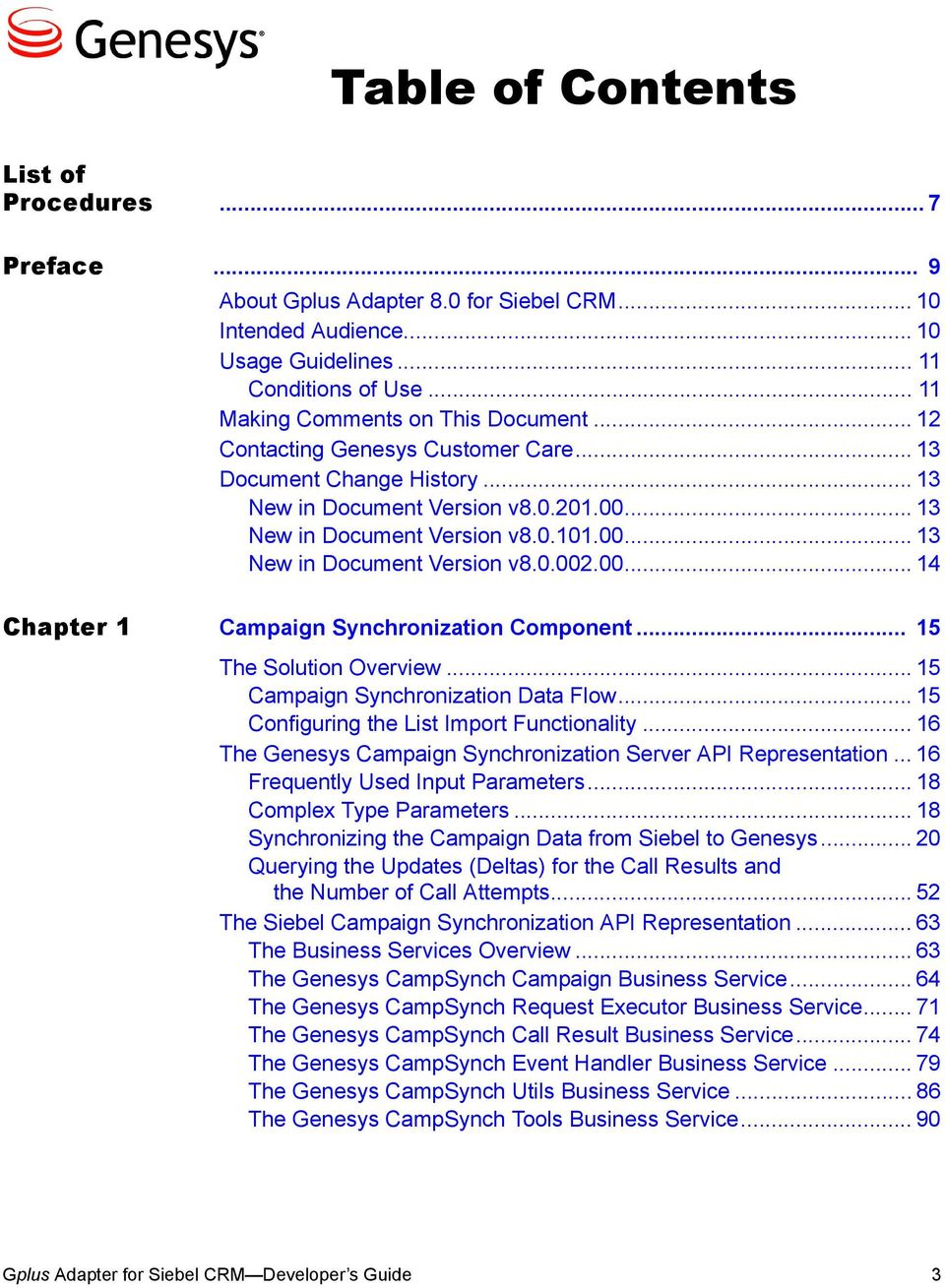
3 Table of Contents List of Procedures... 7 Preface... 9 About Gplus Adapter 8.0 for Siebel CRM Intended Audience Usage Guidelines Conditions of Use Making Comments on This Document Contacting Genesys Customer Care Document Change History New in Document Version v New in Document Version v New in Document Version v Chapter 1 Campaign Synchronization Component The Solution Overview Campaign Synchronization Data Flow Configuring the List Import Functionality The Genesys Campaign Synchronization Server API Representation Frequently Used Input Parameters Complex Type Parameters Synchronizing the Campaign Data from Siebel to Genesys Querying the Updates (Deltas) for the Call Results and the Number of Call Attempts The Siebel Campaign Synchronization API Representation The Business Services Overview The Genesys CampSynch Campaign Business Service The Genesys CampSynch Request Executor Business Service The Genesys CampSynch Call Result Business Service The Genesys CampSynch Event Handler Business Service The Genesys CampSynch Utils Business Service The Genesys CampSynch Tools Business Service Gplus Adapter for Siebel CRM Developer s Guide 3
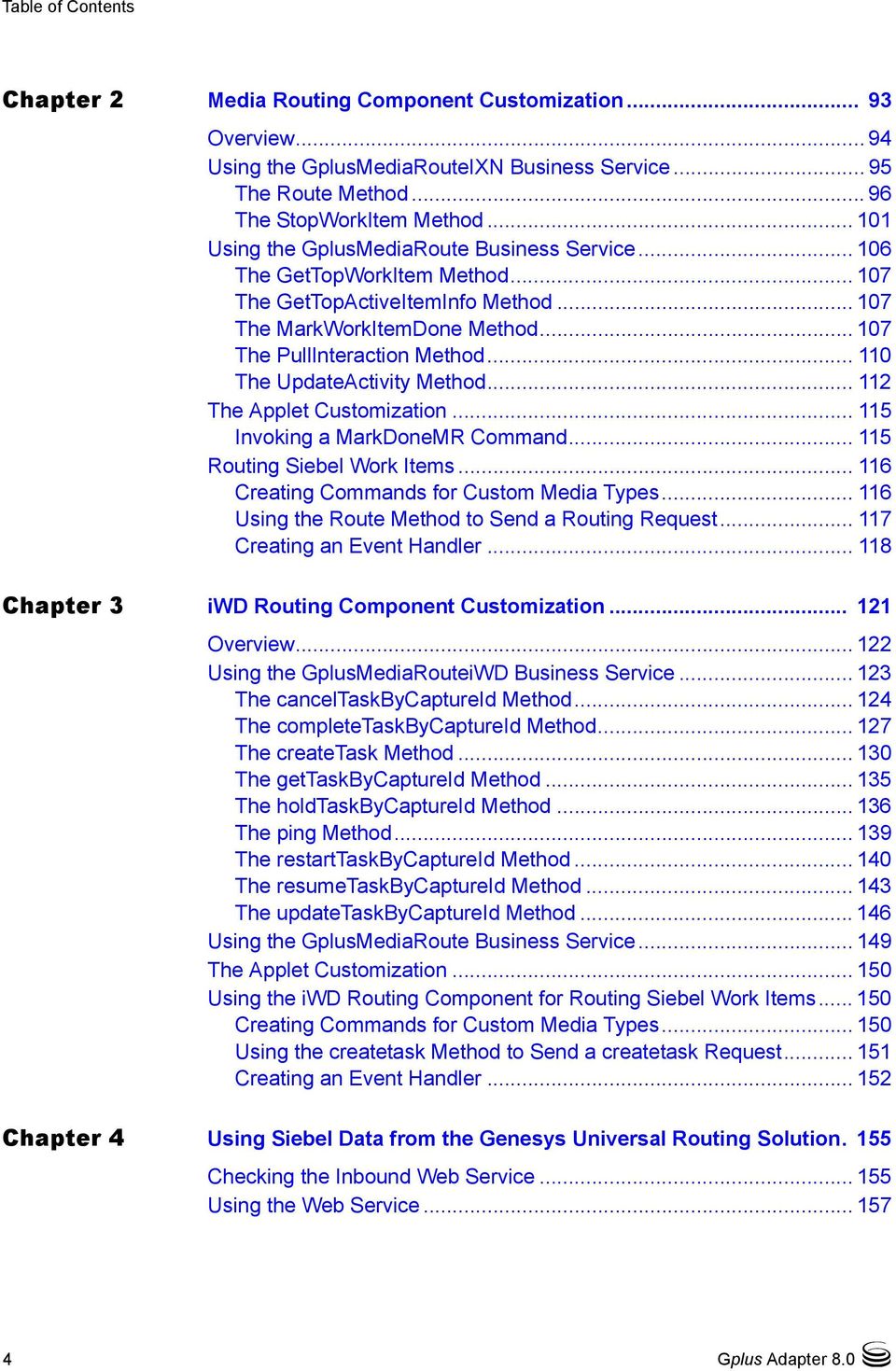
4 Table of Contents Chapter 2 Media Routing Component Customization Overview Using the GplusMediaRouteIXN Business Service The Route Method The StopWorkItem Method Using the GplusMediaRoute Business Service The GetTopWorkItem Method The GetTopActiveItemInfo Method The MarkWorkItemDone Method The PullInteraction Method The UpdateActivity Method The Applet Customization Invoking a MarkDoneMR Command Routing Siebel Work Items Creating Commands for Custom Media Types Using the Route Method to Send a Routing Request Creating an Event Handler Chapter 3 iwd Routing Component Customization Overview Using the GplusMediaRouteiWD Business Service The canceltaskbycaptureid Method The completetaskbycaptureid Method The createtask Method The gettaskbycaptureid Method The holdtaskbycaptureid Method The ping Method The restarttaskbycaptureid Method The resumetaskbycaptureid Method The updatetaskbycaptureid Method Using the GplusMediaRoute Business Service The Applet Customization Using the iwd Routing Component for Routing Siebel Work Items Creating Commands for Custom Media Types Using the createtask Method to Send a createtask Request Creating an Event Handler Chapter 4 Using Siebel Data from the Genesys Universal Routing Solution. 155 Checking the Inbound Web Service Using the Web Service Gplus Adapter 8.0
5 Table of Contents Supplements Related Documentation Resources Document Conventions Index Gplus Adapter for Siebel CRM Developer s Guide 5
6 Table of Contents 6 Gplus Adapter 8.0

7 List of Procedures Creating an event handler Using the provided sample to route Siebel service request Creating an event handler Using the provided sample to route Siebel service request Managing the Siebel inbound web services on a Siebel client Gplus Adapter for Siebel CRM Developer s Guide 7
8 List of Procedures 8 Gplus Adapter 8.0

9 Preface Welcome to the Gplus Adapter 8.0 for Siebel CRM Developer s Guide. In general, this document addresses only the interactions of the Genesys Gplus Adapter components with other Genesys systems and products. Developers who are using the Siebel application development tools and services to implement the Gplus Adapter should look at the Siebel documentation set for more information. The Gplus Adapter 8.0 for Siebel CRM Deployment Guide may contain information that is useful for developers who need to customize the Gplus Adapter 8.0 for Siebel CRM. You should have ready access to this document, if only to understand the standard Gplus Adapter configurations that may initially have been installed at your location. In brief, you will find the following information in this guide: An overview of the Media Routing Component s interface and customization options. An overview of the iwd Routing Component's interface and customization options. This document is valid only for the 8.0 release of this product. Note: For versions of this document created for other releases of this product, visit the Genesys Documentation website, or request the Documentation Library DVD, which you can order by from Genesys Order Management at [email protected]. This preface contains the following sections: About Gplus Adapter 8.0 for Siebel CRM, page 10 Intended Audience, page 10 Usage Guidelines, page 11 Making Comments on This Document, page 12 Contacting Genesys Customer Care, page 13 Document Change History, page 13 For information about the related resources and about the conventions that are used in this document, see the supplementary material starting on page 161. Gplus Adapter for Siebel CRM Developer s Guide 9
10 Preface About Gplus Adapter 8.0 for Siebel CRM About Gplus Adapter 8.0 for Siebel CRM The Gplus Adapter 8.0 for Siebel CRM is a software solution that provides seamless integration between the Siebel CRM and Genesys 8.0 solutions. This combination brings together Siebel s leading software applications and Genesys contact center solutions. The Gplus Adapter provides a single point of access to the contact information. The Adapter brings together multiple media and channels, and provides access to the power of the Siebel software, promoting better contact relationships overall. Intended Audience This guide is intended for developers who will customize the behavior of the Gplus Adapter for Siebel CRM. The guide assumes that: You are familiar with concepts related to the Siebel Enterprise Application Integration (EAI) architecture. You have a basic understanding of computer-telephony integration (CTI) concepts, processes, terminology, and applications. You have a good understanding of database systems, including the specific database system that your application uses. You have a basic understanding of network design and operation. You are familiar with the network configurations used in your enterprise s computing environment. You have a good knowledge of the Siebel application development environment, including Siebel Tools and Siebel Workflow. (If you will be modifying the style sheet file:) You understand.xsl syntax and file structure. You should also be familiar with the following Genesys solutions: Framework Universal Routing Outbound Contact Solution eservices (formerly Multimedia) Note: Refer to the Genesys Interoperability Guide for further information about the appropriate Genesys applications version numbers. 10 Gplus Adapter 8.0
11 Preface Usage Guidelines Usage Guidelines Conditions of Use The Genesys developer materials outlined in this document are intended to be used for the following purposes: Creation of contact-center agent desktop applications associated with the Genesys software implementations. Server-side integration between the Genesys software and the third-party software. Creation of a specialized client application specific to the customer needs. The Genesys software functions available for development are clearly documented. No undocumented functionality is to be utilized without Genesys express written consent. The following Conditions of Use apply in all cases for developers employing the Genesys developer materials outlined in this document: 1. Possession of interface documentation does not imply a right to use by a third party. The Genesys conditions for use, as outlined below or in the Genesys Developer Program Guide, must be met. 2. This interface shall not be used unless the developer is a member in good standing of the Genesys Interacts program or has a valid Master Software License and Services Agreement with Genesys. 3. A developer shall not be entitled to use any licenses granted hereunder unless the developer's organization has met or obtained all prerequisite licensing and software as set out by Genesys. 4. A developer shall not be entitled to use any licenses granted hereunder if the developer's organization is delinquent in any payments or amounts owed to Genesys. 5. A developer shall not use the Genesys developer materials outlined in this document for any general application development purposes that are not associated with the above-mentioned intended purposes for the use of the Genesys developer materials outlined in this document. 6. A developer shall disclose the developer materials outlined in this document only to those employees who have a direct need to create, debug, and/or test one or more participant-specific objects and/or software files that access, communicate, or interoperate with the Genesys API. 7. The developed works and Genesys software running in conjunction with one another (hereinafter referred to together as the integrated solutions ) should not compromise the data integrity. For example, if both the Genesys software and the integrated solutions can modify the same data, then modifications by either product must not circumvent the other product's Gplus Adapter for Siebel CRM Developer s Guide 11

12 Preface Making Comments on This Document data integrity rules. In addition, the integration should not cause duplicate copies of data to exist in both the participant and Genesys databases, unless it can be assured that the data modifications propagate all copies within the time required by the typical users. 8. The integrated solutions shall not compromise data or application security, access, or visibility restrictions that are enforced by either the Genesys software or the developed works. 9. The integrated solutions shall conform to the design and implementation guidelines and restrictions described in the Genesys Developer Program Guide and the Genesys software documentation. For example: a. The integration must use only published interfaces to access the Genesys data. b. The integration shall not modify data in the Genesys database tables directly using SQL. c. The integration shall not introduce the database triggers or stored procedures that operate on the Genesys database tables. Any schema extension to the Genesys database tables must be carried out using the Genesys developer software through the documented methods and features. The Genesys developer materials outlined in this document are not intended to be used for the creation of any product with a functionality comparable to any Genesys products, including products similar or substantially similar to Genesys's current general-availability, beta, and announced products. Any attempt to use the Genesys developer materials outlined in this document or any Genesys developer software contrary to this clause shall be deemed a material breach with immediate termination of this addendum, and Genesys shall be entitled to seek to protect its interests, including but not limited to, preliminary and permanent injunctive relief, as well as money damages. Making Comments on This Document If you especially like or dislike anything about this document, feel free to your comments to [email protected]. You can comment on what you regard as specific errors or omissions, and on the accuracy, organization, subject matter, or completeness of this document. Please limit your comments to the scope of this document only and to the way in which the information is presented. Contact your Genesys Account Representative or Genesys Customer Care if you have suggestions about the product itself. When you send us comments, you grant Genesys a nonexclusive right to use or distribute your comments in any way it believes appropriate, without incurring any obligation to you. 12 Gplus Adapter 8.0
13 Preface Contacting Genesys Customer Care Contacting Genesys Customer Care If you have purchased support directly from Genesys, please contact Genesys Customer Care. Before contacting Customer Care, please refer to the Genesys Care Support Guide for On-Premises for complete contact information and procedures. Document Change History This section lists content that is new or that has changed significantly since the first release of this document. The most recent changes appear first. New in Document Version v This document has been re-issued to support the Gplus Adapter for Siebel CRM release The following topics have been added or changed since the previous release of the document: Table 4, The CampSynch - Create Campaign Method Input Parameters, on page 24. XML Schema 2 on page 26. Table 6, The CampSynch - Merge Calling List Begin Method Input Parameters, on page 30. XML Schema 4 on page 30. XML Schema 5 on page 34. XML Schema 10 on page 46. API version in all Examples of Chapter 1. Chapter Campaign Synchronization Component was removed. New in Document Version v This document has been re-issued to support the Gplus Adapter for Siebel CRM release The following topics have been added or changed since the previous release of the document: The previously existing chapters, The Campaign Synchronization Flow, Configuring the List Import Functionality, Using the Genesys Campaign Synchronization Business Service, and Synchronization Summary Usage have been combined under the following chapter, Chapter 1, Campaign Synchronization Component 8.0.0, on page 15. The following chapter is now included in this document: Chapter 1, Campaign Synchronization Component, on page 15. Gplus Adapter for Siebel CRM Developer s Guide 13

14 Preface Document Change History New in Document Version v Chapter 1, Campaign Synchronization Component 8.0.0, on page 15 now includes the following new sections: The Campaign Synchronization Data Flow. Configuring the List Import Functionality. The Genesys Campaign Synchronization Business Service. The Default Scenarios for the Campaign Synchronization. Synchronization Summary Usage. 14 Gplus Adapter 8.0
15 Chapter 1 Campaign Synchronization Component This chapter provides a developer's overview of the Gplus Adapter Campaign Synchronization Component, focusing on the customization options and how to use them. The information contained herein is valid for the Campaign Synchronization Component release and later. Each topic in this chapter describes one aspect of the Component that you can use to customize the campaign synchronization between the Siebel and Genesys environments. The following topics are included in this chapter: The Solution Overview, page 15 The Genesys Campaign Synchronization Server API Representation, page 16 The Siebel Campaign Synchronization API Representation, page 63 For a functional overview of the complete Gplus Adapter and its integration with the Siebel software, see the Gplus Adapter 8.0 for Siebel CRM User's Guide. For a detailed description of the Siebel EAI architecture, see your Siebel documentation. The Solution Overview The and later version of the Gplus Adapter for Siebel CRM Campaign Synchronization Component is a new product in comparison to the earlier versions (7.5 and 8.0) of the Campaign Synchronization Component. Campaign Synchronization Data Flow Refer to the Gplus Adapter for Siebel CRM User's Guide for the explanation of the data interaction between the Siebel and Genesys sections of the Adapter. Gplus Adapter for Siebel CRM Developer s Guide 15

16 Chapter 1: Campaign Synchronization Component The Genesys Campaign Synchronization Server API Configuring the List Import Functionality Whereas your calls to the Genesys Campaign Synchronization business services' methods determine what synchronization tasks the Campaign Synchronization Component performs, the specific way in which the Campaign Synchronization Component maps the Siebel fields to the Genesys fields depends on two things: The Genesys Configuration Layer Format object that is specified by the Format Application configuration option. The Format object contains fields that form a structure for a database table. The custom fields and phone numbers specified during the deployment process. The default value for the Format option used by the Campaign Synchronization Component is GplusCampSynch. You create the Format object and specify the custom fields and phone numbers according to the instructions provided in the Gplus Adapter 8.0 for Siebel CRM Deployment Guide. Using the Format option, you can specify a different format at any time. The Genesys Campaign Synchronization Server API Representation The Campaign Synchronization Server provides a web-based interface to communicate with the clients. The Server acts as a simple web server that processes the HTTP messages of the POST request method. Note: Other HTTP request methods (for example, GET) are not supported. The input parameters of the Campaign Synchronization Server are transferred through the HTTP requests and the output parameters are transferred through the HTTP responses using XML messages. The format of XML messages is specific to the application and is described in this document. A single Campaign Synchronization Server can simultaneously process requests from several clients. Each client should be responsible for a unique set of campaigns and must have its own unique identifier. In the out-of-the-box solution, these clients are represented by the CampSynch Configuration Objects on Siebel side (see the Gplus Adapter for Siebel CRM User's Guide for more details). 16 Gplus Adapter 8.0

17 Chapter 1: Campaign Synchronization Component The Genesys Campaign Synchronization Server API The Campaign Synchronization Server's API methods can be divided into the following three groups: The methods used to synchronize the campaign data from the Siebel side to the Genesys side: CampSynch - Create Campaign (see, page 24) CampSynch - Delete Campaign (see, page 27) CampSynch - Merge Calling List Begin (see, page 29) CampSynch - Merge Calling List Data (see, page 33) CampSynch - Merge Calling List Commit (see, page 37) CampSynch - Delete Calling List (see, page 39) CampSynch - Activate Calling List (see, page 41) CampSynch - Deactivate Calling List (see, page 43) CampSynch - Merge Contact Record (see, page 45) CampSynch - Delete Contact Record (see, page 49) The method used to query the updates (deltas) for the call results and number of call attempts: CampSynch - Query Call Results Delta (see, page 55) The methods used to query the data from the Genesys side to the Siebel side (particularly, the query call results for an entire campaign, a calling list, or a contact.) CampSynch - Query Call Results by Campaign (see, page 58) CampSynch - Query Call Results by Calling List (see, page 59) CampSynch - Query Call Results by Contact (see, page 61) Each method group has its own specific behavior, parameters, and limitations for example, only one request can be processed at a time for each of the first two method groups. This behavior is to ensure that the correct sequence of operations and the correct synchronization are performed as a result. Gplus Adapter for Siebel CRM Developer s Guide 17

18 Chapter 1: Campaign Synchronization Component The Genesys Campaign Synchronization Server API Frequently Used Input Parameters There is a set of parameters that is commonly used for almost all of the requests. To avoid repetition, these parameters are collected in Table 1. They are referenced from the requests description. Table 1: The Frequently Used Input Parameters Parameter RequestId ConfigurationId CampaignName ListName Summary Description The unique request identifier. The client identifier. In the out-of-the-box solution, it is an identifier of a special configuration object in Siebel CRM that represents a connection to a particular Campaign Synchronization Server and is responsible for the synchronization of a particular set of campaigns. This parameter is used to avoid the simultaneous request execution in the scope of the aforementioned configuration object. The campaign name to which a request is associated. The calling list name to which a request is associated. Specifies whether the information about the request execution process (synchronization summary) should be included into the output parameters (response). Valid values: Y: Include the synchronization summary. N: Do not include the synchronization summary. Complex Type Parameters There is a set of complex type parameters that are used in several of the requests. To avoid repetition, these parameters are collected in Table 2. They are referenced from the requests description. Table 2: The Complex Type Parameters Parameter Sub-Parameter Mandatory Description Field The custom field description. FieldName Yes The data field name. FieldValue Yes The data field value. 18 Gplus Adapter 8.0
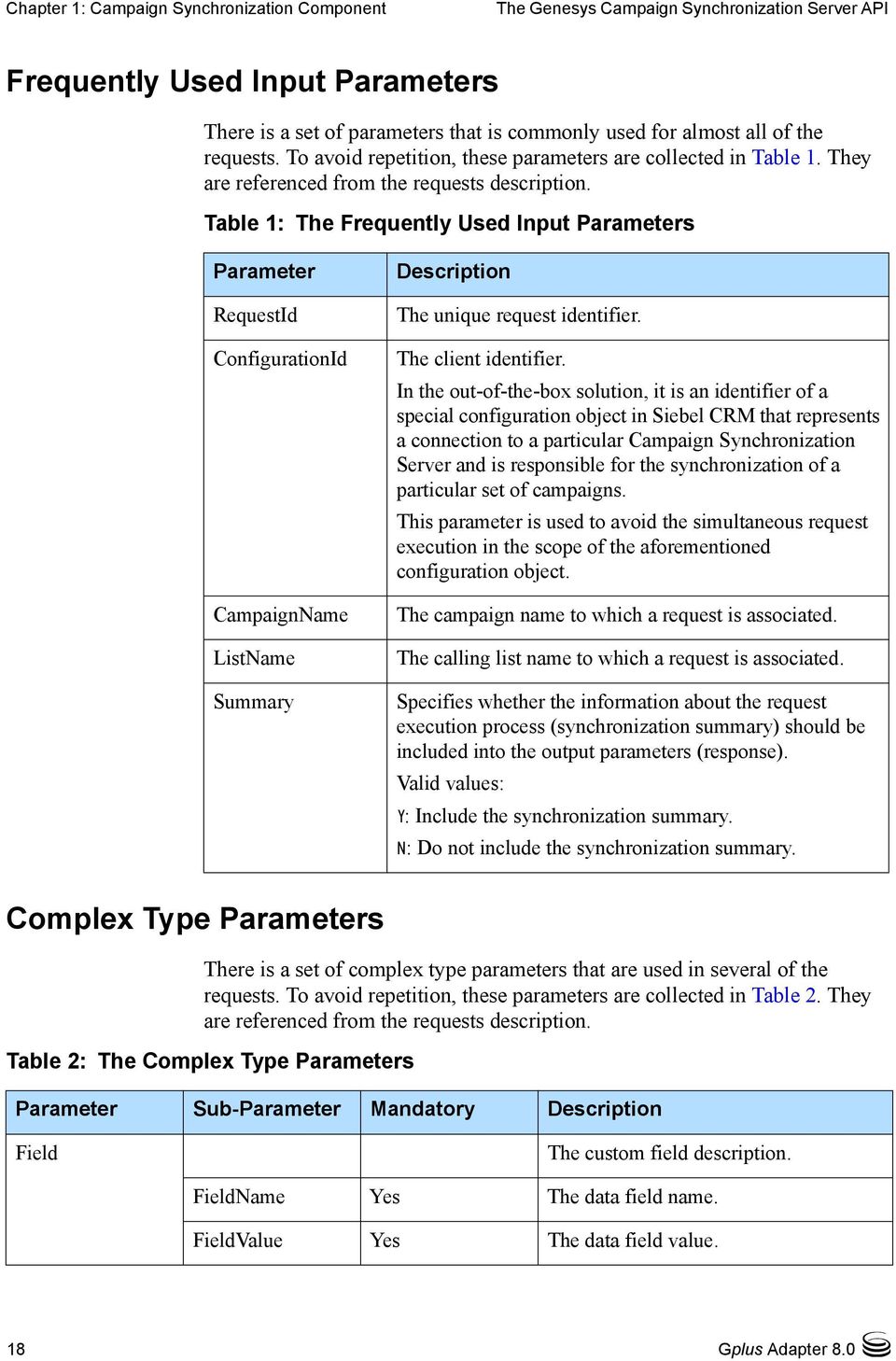
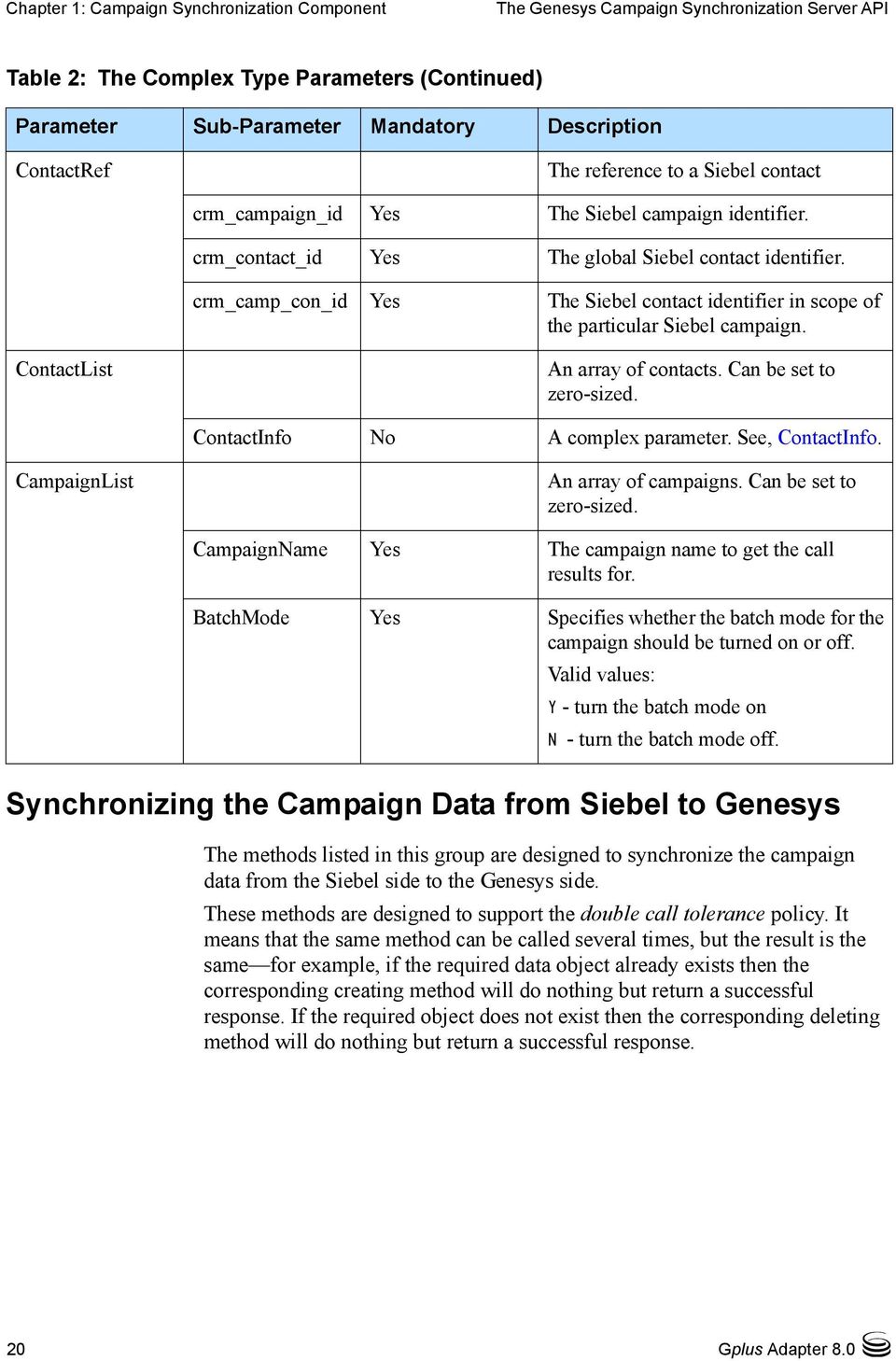
19 Chapter 1: Campaign Synchronization Component The Genesys Campaign Synchronization Server API Table 2: The Complex Type Parameters (Continued) Parameter Sub-Parameter Mandatory Description Phone The phone number. PhoneType Yes The phone type. This value must correspond to any Genesys phone type. Refer to the Outbound Contact Solution documentation for more details. Phones An array of phones. Can be set to zero-sized. Phone No A complex parameter. See, Phone. CustomFields An array of custom fields. Can be set ti zero-sized. Field No A complex parameter. See, Field. ContactInfo The Siebel contact data. crm_campaign_id Yes The Siebel campaign identifier. crm_contact_id Yes The global Siebel contact identifier. crm_camp_con_id Yes The Siebel contact identifier in scope of the particular Siebel campaign. tz_name Yes The contact's time zone name. Refer to the Gplus Adapter for Siebel CRM Deployment Guide for more details on how to configure and synchronize the time zones between the Siebel side and the Genesys side. do_not_call Yes Specifies whether the contact should be marked as one that must not be called during campaign processing. Valid values: Y: Mark the contact as do not call. N: Do not mark the contact as do not call. Phones Yes A complex parameter. See, Phones. CustomFields Yes A complex parameter. See, CustomFields. Gplus Adapter for Siebel CRM Developer s Guide 19
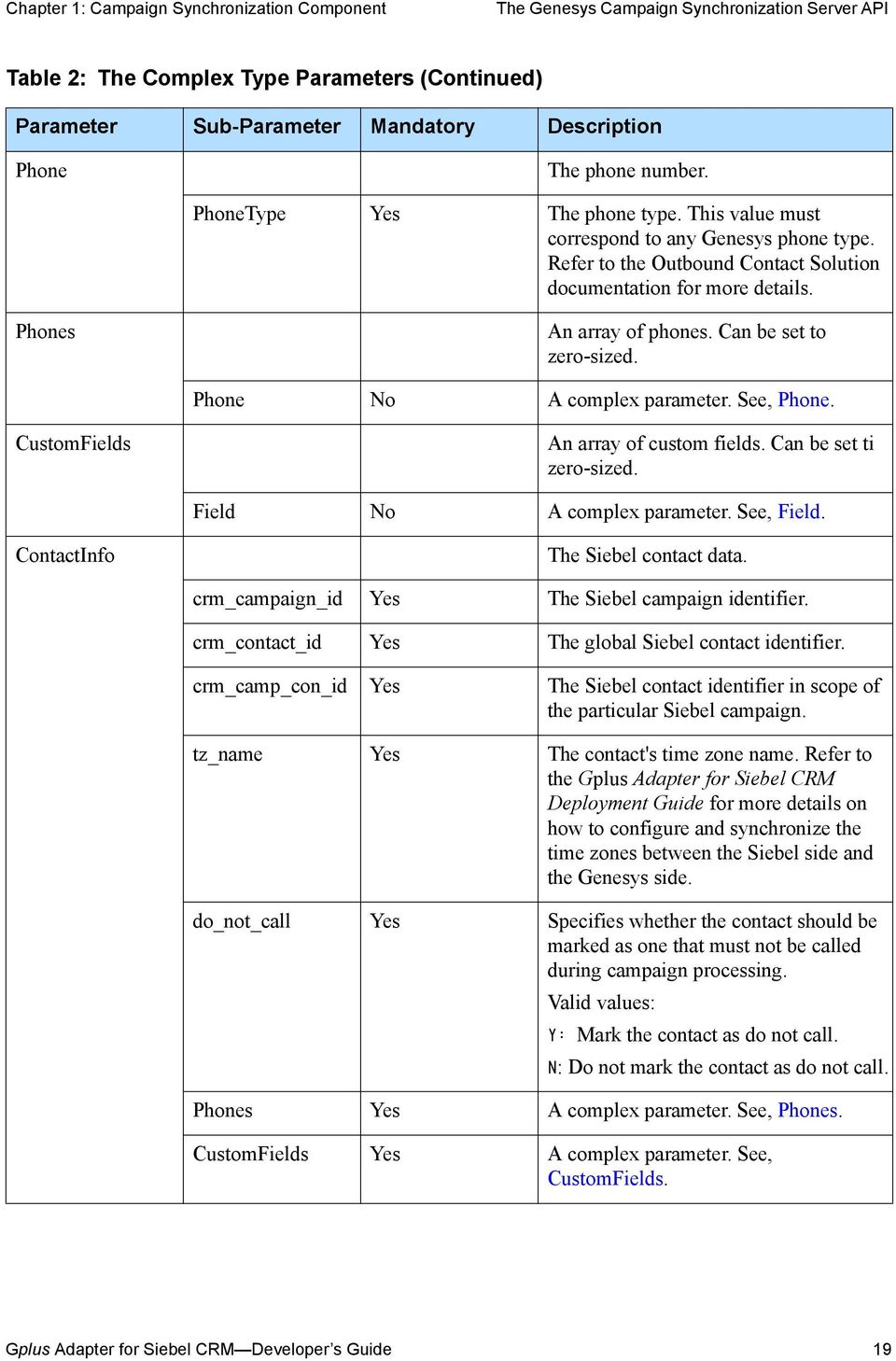
20 Chapter 1: Campaign Synchronization Component The Genesys Campaign Synchronization Server API Table 2: The Complex Type Parameters (Continued) Parameter Sub-Parameter Mandatory Description ContactRef The reference to a Siebel contact crm_campaign_id Yes The Siebel campaign identifier. crm_contact_id Yes The global Siebel contact identifier. crm_camp_con_id Yes The Siebel contact identifier in scope of the particular Siebel campaign. ContactList An array of contacts. Can be set to zero-sized. ContactInfo No A complex parameter. See, ContactInfo. CampaignList An array of campaigns. Can be set to zero-sized. CampaignName Yes The campaign name to get the call results for. BatchMode Yes Specifies whether the batch mode for the campaign should be turned on or off. Valid values: Y - turn the batch mode on N - turn the batch mode off. Synchronizing the Campaign Data from Siebel to Genesys The methods listed in this group are designed to synchronize the campaign data from the Siebel side to the Genesys side. These methods are designed to support the double call tolerance policy. It means that the same method can be called several times, but the result is the same for example, if the required data object already exists then the corresponding creating method will do nothing but return a successful response. If the required object does not exist then the corresponding deleting method will do nothing but return a successful response. 20 Gplus Adapter 8.0
21 Chapter 1: Campaign Synchronization Component The Genesys Campaign Synchronization Server API The Method Descriptions The entries in this section describe the following methods: The Common Method's Response, page 21 The CampSynch - Create Campaign Method, page 24 The CampSynch - Delete Campaign Method, page 27 The CampSynch - Merge Calling List Begin Method, page 29 The CampSynch - Merge Calling List Data Method, page 33 The CampSynch - Merge Calling List Commit Method, page 37 The CampSynch - Delete Calling List Method, page 39 The CampSynch - Activate Calling List Method, page 41 The CampSynch - Deactivate Calling List Method, page 43 The CampSynch - Merge Contact Record Method, page 45 The CampSynch - Delete Contact Record Method, page 49 The Common Method's Response All of the methods in this group produce responses of an identical type. Table 3 describes the output parameters for this method. Table 3: The Common Response Parameters Parameter Mandatory Description RequestId Yes The request identifier. ResultCode Yes The result of the request execution process. This parameter can be one of following values: 100: OK. Successfully executed : Confidential fault, which means that the request fails for some unrecoverable reason : Non-confidential fault, which means that a recoverable error occurs and the request can be successfully processed next time. 400 and higher: Critical fault, which means that not one request can be processed until the cause of the error is found. ResultDescription Yes The textual result description. Summary No The detailed information about the request execution process the synchronization summary. Gplus Adapter for Siebel CRM Developer s Guide 21
22 Chapter 1: Campaign Synchronization Component The Genesys Campaign Synchronization Server API XML Schema 1 illustrates the XML schema of the common method response. XML Schema 1 <?xml version="1.0" encoding="utf-8"?> <xs:schema attributeformdefault="unqualified" elementformdefault="qualified" xmlns:xs=" <xs:element name="gcampsynchresponse"> <xs:complextype> <xs:sequence> <xs:element name="requestid" type="xs:string" minoccurs="1" maxoccurs="1"/> <xs:element name="resultcode" type="xs:unsignedint" minoccurs="1" maxoccurs="1"/> <xs:element name="resultdescription" type="xs:string" minoccurs="1" maxoccurs="1"/> <xs:element name="summary" type="xs:string" minoccurs="0" maxoccurs="1"/> </xs:sequence> <xs:attribute name="apiversion" type="xs:decimal" use="required" /> <xs:attribute name="name" type="xs:string" use="required" /> </xs:complextype> </xs:element> </xs:schema> 22 Gplus Adapter 8.0
23 Chapter 1: Campaign Synchronization Component The Genesys Campaign Synchronization Server API Example 1 illustrates an example of the common method response. Example 1 <?xml version="1.0" encoding="utf-8" standalone="no"?> <GCampSynchResponse APIVersion="2.2" Name="CampSynch - Merge Calling List Begin"> <RequestId>1-1TSD</RequestId> <ResultCode>100</ResultCode> <ResultDescription>OK</ResultDescription> <Summary> Request: 'CampSynch - Merge Calling List Begin' Parameters: CampaignName = 'TestOL1_Load_1_ol' ListName = 'TestOL1_Load_1_Wave_1_ol' FolderName = '' InitialListState = 'Activated' Actions: [CME] Root folder 'Campaigns' found [CME] Root folder 'Campaigns' found [CME] Folder '/f1/f2' already exists [CME] Table access 'TestOL1_Load_1_Wave_1_ol' has been created [CME] Root folder 'Campaigns' found [CME] Folder '/f1/f2' already exists [CME] Table name 'CLT_123' has been updated [CME] Calling list 'TestOL1_Load_1_Wave_1_ol' has been created [CME] Calling list 'TestOL1_Load_1_Wave_1_ol' has been appended [CME] Calling list 'TestOL1_Load_1_Wave_1_ol' has been activated [DB] table: 'CLT_123_copy' has been dropped [DB] table: 'CLT_123' has been created [DB] table: 'CLT_123_copy' has been created [DB] index: 'CLT_123_copy_chain_idx' has been created [DB] request history table is available </Summary> </GCampSynchResponse> Gplus Adapter for Siebel CRM Developer s Guide 23
24 Chapter 1: Campaign Synchronization Component The Genesys Campaign Synchronization Server API The CampSynch - Create Campaign Method This method creates a Campaign object in the Genesys Configuration Database. This Campaign object is created without any calling lists. Note: After a Campaign object is created and the calling lists are synchronized, you still must perform the manual steps to finish the campaign configuration by using Genesys Configuration Manager. Table 4 describes the input parameters for the CampSynch - Create Campaign method. Table 4: The CampSynch - Create Campaign Method Input Parameters Parameter Sub-Parameter Mandatory Description RequestId Yes See, RequestId. ConfigurationId Yes See, ConfigurationId. CampaignName Yes See, CampaignName. Summary Yes See, Summary. GenesysTemplate Campaign No The Genesys campaign name that should be used as a template to finish the configuration. Note: This functionality is not implemented! 24 Gplus Adapter 8.0
25 Chapter 1: Campaign Synchronization Component The Genesys Campaign Synchronization Server API Table 4: The CampSynch - Create Campaign Method Input Parameters (Continued) Parameter Sub-Parameter Mandatory Description FolderName Yes The folder name in the Configuration Database where a campaign is placed. type Yes Values can be relative or absolute. An absolute path specifies a full object path that starts from the tenant root (but does not include the tenant name). The absolute path enables using preconfigured Configuration Units and Sites. For example, an absolute path can be Unit1/Campaigns/SBL or Site1/Unit2/Calling Lists/SBL/Org1. If an absolute path is not specified, the relative path is used. A relative path specifies an object path that is relative to the default object path (/Campaigns, /Calling Lists, or /Table Access). For example, the /SBL relative path assumes the object creation under /Campaigns/SBL, /Calling Lists/SBL, and /Table Access/SBL. Notes: An absolute path must contain a folder of type that corresponds to the required object type (for example, object type Campaign for campaigns, object type Calling List for calling lists, or object type Table Access for table access objects). Configuration Units and Sites must be created prior to synchronization, along with a folder of the required type. All subfolders can be created automatically during synchronization. Gplus Adapter for Siebel CRM Developer s Guide 25
26 Chapter 1: Campaign Synchronization Component The Genesys Campaign Synchronization Server API XML Schema 2 illustrates the XML schema of the CampSynch - Create Campaign method request. XML Schema 2 <?xml version="1.0" encoding="utf-8"?> <xs:schema attributeformdefault="unqualified" elementformdefault="qualified" xmlns:xs=" <xs:element name="gcampsynchrequest"> <xs:complextype> <xs:sequence> <xs:element name="nbparameters" minoccurs="1" maxoccurs="1"> <xs:complextype> <xs:sequence> <xs:element name="requestid" type="xs:string" minoccurs="1" maxoccurs="1"/> <xs:element name="configurationid" type="xs:string" minoccurs="1" maxoccurs="1"/> </xs:sequence> </xs:complextype> </xs:element> <xs:element name="parameters" minoccurs="1" maxoccurs="1"> <xs:complextype> <xs:sequence> <xs:element name="campaignname" type="xs:string" minoccurs="1" maxoccurs="1"/> <xs:element name="summary" type="xs:string" minoccurs="1" maxoccurs="1"/> <xs:element name="genesystemplatecampaign" type="xs:string" minoccurs="0" maxoccurs="1"/> <xs:element name="foldername" minoccurs="1" maxoccurs="1"> <xs:complextype> <xs:simplecontent> <xs:extension base="xs:string"> <xs:attribute name="type" type="xs:string" use="required"/> </xs:extension> </xs:simplecontent> </xs:complextype> </xs:element> </xs:sequence> </xs:complextype> </xs:element> </xs:sequence> <xs:attribute name="apiversion" type="xs:decimal" use="required" /> <xs:attribute name="name" type="xs:string" use="required" /> </xs:complextype> </xs:element> </xs:schema> 26 Gplus Adapter 8.0
27 Chapter 1: Campaign Synchronization Component The Genesys Campaign Synchronization Server API Example 2 illustrates a request to create a Campaign object named TestOL1_Load_1 under the Campaigns/folder_ol folder. The synchronization summary should be included into the response. Example 2 <?xml version="1.0" encoding="utf-8"?> <GCampSynchRequest APIVersion="2.2" Name="CampSynch - Create Campaign"> <NBParameters> <RequestId>1-20W5H</RequestId> <ConfigurationId>1-2A1B</ConfigurationId> </NBParameters> <Parameters> <CampaignName>TestOL1_Load_1</CampaignName> <Summary>Y</Summary> <FolderName type=relative>folder_ol</foldername> </Parameters> </GCampSynchRequest> The CampSynch - Delete Campaign Method This method deletes a campaign from the Genesys side, including the objects found in the Configuration Database, the calling lists that are associated with the campaign, the Outbound Database tables that are related to the corresponding calling lists. Table 5 describes the input parameters for the CampSynch - Delete Campaign method. Table 5: The CampSynch - Delete Campaign Method Input Parameters Parameter Mandatory Description RequestId Yes See, RequestId. ConfigurationId Yes See, ConfigurationId. CampaignName Yes See, CampaignName. Summary Yes See, Summary. Gplus Adapter for Siebel CRM Developer s Guide 27
28 Chapter 1: Campaign Synchronization Component The Genesys Campaign Synchronization Server API XML Schema 3 illustrates the XML schema of the CampSynch - Delete Campaign method request. XML Schema 3 <?xml version="1.0" encoding="utf-8"?> <xs:schema attributeformdefault="unqualified" elementformdefault="qualified" xmlns:xs=" <xs:element name="gcampsynchrequest"> <xs:complextype> <xs:sequence> <xs:element name="nbparameters" minoccurs="1" maxoccurs="1"> <xs:complextype> <xs:sequence> <xs:element name="requestid" type="xs:string" minoccurs="1" maxoccurs="1"/> <xs:element name="configurationid" type="xs:string" minoccurs="1" maxoccurs="1"/> </xs:sequence> </xs:complextype> </xs:element> <xs:element name="parameters" minoccurs="1" maxoccurs="1"> <xs:complextype> <xs:sequence> <xs:element name="campaignname" type="xs:string" minoccurs="1" maxoccurs="1"/> <xs:element name="summary" type="xs:string" minoccurs="1" maxoccurs="1"/> </xs:sequence> </xs:complextype> </xs:element> </xs:sequence> <xs:attribute name="apiversion" type="xs:decimal" use="required" /> <xs:attribute name="name" type="xs:string" use="required" /> </xs:complextype> </xs:element> </xs:schema> 28 Gplus Adapter 8.0
29 Chapter 1: Campaign Synchronization Component The Genesys Campaign Synchronization Server API Example 3 illustrates a request to delete a campaign named TestOL1_Load_1. The synchronization summary should be included into the response. Example 3 <?xml version="1.0" encoding="utf-8"?> <GCampSynchRequest APIVersion="2.2" Name="CampSynch - Delete Campaign"> <NBParameters> <RequestId>1-2DFP3</RequestId> <ConfigurationId>1-1Z1N1</ConfigurationId> </NBParameters> <Parameters> <CampaignName>TestOL1_Load_1</CampaignName> <Summary>Y</Summary> </Parameters> </GCampSynchRequest> The CampSynch - Merge Calling List Begin Method This method is the first of the three following methods listed that are designed for the calling list synchronization: CampSynch - Merge Calling List Begin CampSynch - Merge Calling List Data CampSynch - Merge Calling List Commit These methods do the following merge operations under the calling list: If a calling list does not exist, then one is created. If a calling list exists, then the new contacts are merged with old ones. This method creates the Calling List and Table Access objects in the Configuration Database, associates these objects, and then adds the calling list to the corresponding Genesys campaign. The calling list can be added to the Genesys campaign in either the active or the inactive state. Whether or not the calling list is processed by the outbound solution depends on its state. The Genesys campaign to which the calling list should be added must be present in the Configuration Database at the moment of the execution request. Gplus Adapter for Siebel CRM Developer s Guide 29
30 Chapter 1: Campaign Synchronization Component The Genesys Campaign Synchronization Server API Table 6 describes the input parameters for the CampSynch - Merge Calling List Begin method. Table 6: The CampSynch - Merge Calling List Begin Method Input Parameters Parameter Sub-Parameter Mandatory Description RequestId Yes See, RequestId. ConfigurationId Yes See, ConfigurationId. CampaignName Yes See, CampaignName. ListName Yes See, ListName. Summary Yes See, Summary. InitialListState No Specifies the state of the calling list. Valid values: 1. Activated (default) 2. Deactivated CallingListFolderName Yes The folder name in the Configuration Database where a Calling List object is placed. type Yes See The CampSynch - Create Campaign Method on page 24 for more information. TableAccessFolderName Yes The folder name in the Configuration Database where a Table Access object is placed. type Yes See The CampSynch - Create Campaign Method on page 24 for more information. XML Schema 4 XML Schema 4 illustrates the XML schema of the CampSynch - Merge Calling List Begin method request: <?xml version="1.0" encoding="utf-8"?> <xs:schema attributeformdefault="unqualified" elementformdefault="qualified" xmlns:xs=" <xs:element name="gcampsynchrequest"> <xs:complextype> <xs:sequence> <xs:element name="nbparameters" minoccurs="1" maxoccurs="1"> 30 Gplus Adapter 8.0
31 Chapter 1: Campaign Synchronization Component The Genesys Campaign Synchronization Server API <xs:complextype> <xs:sequence> <xs:element name="requestid" type="xs:string" minoccurs="1" maxoccurs="1"/> <xs:element name="configurationid" type="xs:string" minoccurs="1" maxoccurs="1"/> </xs:sequence> </xs:complextype> </xs:element> <xs:element name="parameters" minoccurs="1" maxoccurs="1"> <xs:complextype> <xs:sequence> <xs:element name="campaignname" type="xs:string" minoccurs="1" maxoccurs="1"/> <xs:element name="listname" type="xs:string" minoccurs="1" maxoccurs="1"/> <xs:element name="summary" type="xs:string" minoccurs="1" maxoccurs="1"/> <xs:element name="callinglistfoldername" minoccurs="1" maxoccurs="1"> <xs:complextype> <xs:simplecontent> <xs:extension base="xs:string"> <xs:attribute name="type" type="xs:string" use="required"/> </xs:extension> </xs:simplecontent> </xs:complextype> </xs:element> <xs:element name="tableaccessfoldername" minoccurs="1" maxoccurs="1"> <xs:complextype> <xs:simplecontent> <xs:extension base="xs:string"> <xs:attribute name="type" type="xs:string" use="required"/> </xs:extension> </xs:simplecontent> </xs:complextype> </xs:element> <xs:element name="initialliststate" type="xs:string" minoccurs="0" maxoccurs="1"/> </xs:sequence> </xs:complextype> </xs:element> </xs:sequence> <xs:attribute name="apiversion" type="xs:decimal" use="required" /> <xs:attribute name="name" type="xs:string" use="required" /> </xs:complextype> </xs:element> </xs:schema> Gplus Adapter for Siebel CRM Developer s Guide 31
32 Chapter 1: Campaign Synchronization Component The Genesys Campaign Synchronization Server API Example 4 illustrates a request to initiate the synchronization of the TestOL1_Load_1_Wave_1 calling list to the TestOL1_Load_1 campaign. The calling list should be activated. The synchronization summary should be included into the response. Example 4 <?xml version="1.0" encoding="utf-8"?> <GCampSynchRequest APIVersion="2.2" Name="CampSynch - Merge Calling List Begin"> <NBParameters> <RequestId>1-1TSD</RequestId> <ConfigurationId>1-1F2X</ConfigurationId> </NBParameters> <Parameters> <CampaignName>TestOL1_Load_1</CampaignName> <ListName>TestOL1_Load_1_Wave_1</ListName> <Summary>Y</Summary> <CallingListFolderName type="relative">/folder_ol</callinglistfoldername> <TableAccessFolderName type="relative">/folder_ol</tableaccessfoldername> <InitialListState>Activated</InitialListState> </Parameters> </GCampSynchRequest> 32 Gplus Adapter 8.0
33 Chapter 1: Campaign Synchronization Component The Genesys Campaign Synchronization Server API The CampSynch - Merge Calling List Data Method This method is the second of the three following methods listed that are designed for the calling list synchronization: CampSynch - Merge Calling List Begin CampSynch - Merge Calling List Data CampSynch - Merge Calling List Commit This method is designed to send a portion of the contacts data to the Genesys side. This method may be called a multiple of times, providing different portions of the contacts data each time. Also, this method adds the corresponding Do Not Call contact's information into the Genesys Outbound Solution. Table 7 describes the input parameters for the CampSynch - Merge Calling List Data method. Table 7: The CampSynch - Merge Calling List Data Method Input Parameters Parameter Mandatory Description RequestId Yes See, RequestId. ConfigurationId Yes See, ConfigurationId. CampaignName Yes See, CampaignName. ListName Yes See, ListName. Summary Yes See, Summary. ContactList Yes The list of the Siebel contacts. See the section, Complex Type Parameters on page 18. Gplus Adapter for Siebel CRM Developer s Guide 33
34 Chapter 1: Campaign Synchronization Component The Genesys Campaign Synchronization Server API XML Schema 5 illustrates the XML schema of the CampSynch - Merge Calling List Data method request: XML Schema 5 <?xml version="1.0" encoding="utf-8"?> <xs:schema attributeformdefault="unqualified" elementformdefault="qualified" xmlns:xs=" <xs:element name="gcampsynchrequest"> <xs:complextype> <xs:sequence> <xs:element name="nbparameters"> <xs:complextype> <xs:sequence> <xs:element name="requestid" type="xs:string" minoccurs="1" maxoccurs="1"/> <xs:element name="configurationid" type="xs:string" minoccurs="1" maxoccurs="1"/> </xs:sequence> </xs:complextype> </xs:element> <xs:element name="parameters" minoccurs="1" maxoccurs="1"> <xs:complextype> <xs:sequence> <xs:element name="campaignname" type="xs:string" minoccurs="1" maxoccurs="1"/> <xs:element name="listname" type="xs:string" minoccurs="1" maxoccurs="1"/> <xs:element name="summary" type="xs:string" minoccurs="1" maxoccurs="1"/> <xs:element name="contactlist" minoccurs="1" maxoccurs="1"> <xs:complextype> <xs:sequence> <xs:element maxoccurs="unbounded" name="contactinfo"> <xs:complextype> <xs:sequence> <xs:element name="crm_campaign_id" type="xs:string" minoccurs="1" maxoccurs="1"/> <xs:element name="crm_contact_id" type="xs:string" minoccurs="1" maxoccurs="1"/> <xs:element name="crm_camp_con_id" type="xs:string" minoccurs="1" maxoccurs="1"/> <xs:element name="tz_name" type="xs:string" minoccurs="1" maxoccurs="1"/> <xs:element name="do_not_call" type="xs:string" minoccurs="1" maxoccurs="1"/> <xs:element name="phones"> <xs:complextype> <xs:sequence> <xs:element maxoccurs="unbounded" name="phone"> <xs:complextype> 34 Gplus Adapter 8.0
35 Chapter 1: Campaign Synchronization Component The Genesys Campaign Synchronization Server API <xs:simplecontent> <xs:extension base="xs:string"> <xs:attribute name="phonetype" type="xs:unsignedbyte" use="required" /> <xs:attribute name="phonename" type="xs:string" use="required" /> </xs:extension> </xs:simplecontent> </xs:complextype> </xs:element> </xs:sequence> </xs:complextype> </xs:element> <xs:element name="customfields"> <xs:complextype> <xs:sequence> <xs:element name="field" minoccurs="0" maxoccurs="unbounded"> <xs:complextype> <xs:sequence> <xs:element name="fieldname" type="xs:string" minoccurs="1" maxoccurs="1"/> <xs:element name="fieldvalue" type="xs:string" minoccurs="1" maxoccurs="1"/> </xs:sequence> </xs:complextype> </xs:element> </xs:sequence> </xs:complextype> </xs:element> </xs:sequence> </xs:complextype> </xs:element> </xs:sequence> </xs:complextype> </xs:element> </xs:sequence> </xs:complextype> </xs:element> </xs:sequence> <xs:attribute name="apiversion" type="xs:decimal" use="required" /> <xs:attribute name="name" type="xs:string" use="required" /> </xs:complextype> </xs:element> </xs:schema> Gplus Adapter for Siebel CRM Developer s Guide 35
36 Chapter 1: Campaign Synchronization Component The Genesys Campaign Synchronization Server API Example 5 illustrates a request to pass three contacts of the TestOL1_Load_1_Wave_1 calling list of the TestOL1_Load_1 campaign. The synchronization summary is included into the response. Example 5 <?xml version="1.0" encoding="utf-8"?> <GCampSynchRequest APIVersion="2.2" Name="CampSynch - Merge Calling List Data"> <NBParameters> <RequestId>1-1TSDTTTT1</RequestId> <ConfigurationId>1-1F2X</ConfigurationId> </NBParameters> <Parameters> <CampaignName>TestOL1_Load_1</CampaignName> <ListName>TestOL1_Load_1_Wave_1</ListName> <Summary>Y</Summary> <ContactList> <ContactInfo> <crm_campaign_id>1-erki</crm_campaign_id> <crm_contact_id>1-103cf</crm_contact_id> <crm_camp_con_id>1-11bzi</crm_camp_con_id> <tz_name>(gmt+02:00) Helsinki, Kyiv, Riga, Sofia, Tallinn, Vilnius</tz_name> <do_not_call>n</do_not_call> <Phones> <Phone PhoneType="1" PhoneName="Calculated Home Phone #"> </Phone> <Phone PhoneType="2" PhoneName="Calculated Work Phone #"> </Phone> </Phones> <CustomFields></CustomFields> </ContactInfo> <ContactInfo> <crm_campaign_id>1-erki</crm_campaign_id> <crm_contact_id>1-11bzp123</crm_contact_id> <crm_camp_con_id>1-11k0q</crm_camp_con_id> <tz_name>>(gmt+02:00) Helsinki, Kyiv, Riga, Sofia, Tallinn, Vilnius</tz_name> <do_not_call>n</do_not_call> <Phones> <Phone PhoneType="2" PhoneName="Calculated Work Phone #"> </Phone> </Phones> <CustomFields></CustomFields> </ContactInfo> <ContactInfo> <crm_campaign_id>1-erki</crm_campaign_id> <crm_contact_id>1-11c02</crm_contact_id> 36 Gplus Adapter 8.0
37 Chapter 1: Campaign Synchronization Component The Genesys Campaign Synchronization Server API <crm_camp_con_id>1-11k0t</crm_camp_con_id> <tz_name></tz_name> <do_not_call>y</do_not_call> <Phones> <Phone PhoneType="1" PhoneName="Calculated Home Phone #"> </Phone> </Phones> <CustomFields></CustomFields> </ContactInfo> </ContactList> </Parameters> </GCampSynchRequest> The CampSynch - Merge Calling List Commit Method This method is the third of the three following methods listed that are designed for the calling list synchronization: CampSynch - Merge Calling List Begin CampSynch - Merge Calling List Data CampSynch - Merge Calling List Commit This method finalizes the synchronization process. It does the real contact data merging in the Outbound Database. Until this method is called, the Calling List data remains unchanged. Note: If a calling list is processed by the Outbound Contact Solution while it is being synchronized, then some data collisions are possible. It is recommended to exclude the calling list from the Outbound processing during synchronization. Table 8 describes the input parameters for the CampSynch - Merge Calling List Commit method. Table 8: The CampSynch - Merge Calling List Commit Method Input Parameters Parameter Mandatory Description RequestId Yes See, RequestId. ConfigurationId Yes See, ConfigurationId. CampaignName Yes See, CampaignName. ListName Yes See, ListName. Summary Yes See, Summary. Gplus Adapter for Siebel CRM Developer s Guide 37
38 Chapter 1: Campaign Synchronization Component The Genesys Campaign Synchronization Server API XML Schema 6 illustrates the XML schema of the CampSynch - Merge Calling List Commit method request: XML Schema 6 <?xml version="1.0" encoding="utf-8"?> <xs:schema attributeformdefault="unqualified" elementformdefault="qualified" xmlns:xs=" <xs:element name="gcampsynchrequest"> <xs:complextype> <xs:sequence> <xs:element name="nbparameters" minoccurs="1" maxoccurs="1"> <xs:complextype> <xs:sequence> <xs:element name="requestid" type="xs:string" minoccurs="1" maxoccurs="1"/> <xs:element name="configurationid" type="xs:string" minoccurs="1" maxoccurs="1"/> </xs:sequence> </xs:complextype> </xs:element> <xs:element name="parameters" minoccurs="1" maxoccurs="1"> <xs:complextype> <xs:sequence> <xs:element name="campaignname" type="xs:string" minoccurs="1" maxoccurs="1"/> <xs:element name="listname" type="xs:string" minoccurs="1" maxoccurs="1"/> <xs:element name="summary" type="xs:string" minoccurs="1" maxoccurs="1"/> </xs:sequence> </xs:complextype> </xs:element> </xs:sequence> <xs:attribute name="apiversion" type="xs:decimal" use="required" /> <xs:attribute name="name" type="xs:string" use="required" /> </xs:complextype> </xs:element> 38 Gplus Adapter 8.0
39 Chapter 1: Campaign Synchronization Component The Genesys Campaign Synchronization Server API Example 6 illustrates a request to finalize the TestOL1_Load_1_Wave_1 calling list of the TestOL1_Load_1 campaign. The synchronization summary is included into the response. Example 6 <?xml version="1.0" encoding="utf-8"?> <GCampSynchRequest APIVersion="2.2" Name="CampSynch - Merge Calling List Commit"> <NBParameters> <RequestId>1-1YTXK</RequestId> <ConfigurationId>1-1F2X</ConfigurationId> </NBParameters> <Parameters> <CampaignName>TestOL1_Load_1</CampaignName> <ListName>TestOL1_Load_1_Wave_1</ListName> <Summary>Y</Summary> </Parameters> </GCampSynchRequest> The CampSynch - Delete Calling List Method This method deletes a calling list from the Genesys side, including the Table Access object in the Configuration Database and the Outbound Database table that correspond to the calling list. Table 9 describes the input parameters for the CampSynch - Delete Calling List method. Table 9: The CampSynch - Delete Calling List Method Input Parameters Parameter Mandatory Description RequestId Yes See, RequestId. ConfigurationId Yes See, ConfigurationId. CampaignName Yes See, CampaignName. ListName Yes See, ListName. Summary Yes See, Summary. Gplus Adapter for Siebel CRM Developer s Guide 39
40 Chapter 1: Campaign Synchronization Component The Genesys Campaign Synchronization Server API XML Schema 7 illustrates the XML schema of the CampSynch - Delete Calling List method request: XML Schema 7 <?xml version="1.0" encoding="utf-8"?> <xs:schema attributeformdefault="unqualified" elementformdefault="qualified" xmlns:xs=" <xs:element name="gcampsynchrequest"> <xs:complextype> <xs:sequence> <xs:element name="nbparameters" minoccurs="1" maxoccurs="1"> <xs:complextype> <xs:sequence> <xs:element name="requestid" type="xs:string" minoccurs="1" maxoccurs="1"/> <xs:element name="configurationid" type="xs:string" minoccurs="1" maxoccurs="1"/> </xs:sequence> </xs:complextype> </xs:element> <xs:element name="parameters" minoccurs="1" maxoccurs="1"> <xs:complextype> <xs:sequence> <xs:element name="campaignname" type="xs:string" minoccurs="1" maxoccurs="1"/> <xs:element name="listname" type="xs:string" minoccurs="1" maxoccurs="1"/> <xs:element name="summary" type="xs:string" minoccurs="1" maxoccurs="1"/> </xs:sequence> </xs:complextype> </xs:element> </xs:sequence> <xs:attribute name="apiversion" type="xs:decimal" use="required" /> <xs:attribute name="name" type="xs:string" use="required" /> </xs:complextype> </xs:element> </xs:schema> 40 Gplus Adapter 8.0
41 Chapter 1: Campaign Synchronization Component The Genesys Campaign Synchronization Server API Example 7 illustrates a request to delete the TestOL1_Load_1_Wave_1 calling list from the TestOL1_Load_1 campaign. The synchronization summary is included into the response. Example 7 <?xml version="1.0" encoding="utf-8"?> <GCampSynchRequest APIVersion="2.2" Name="CampSynch - Delete Calling List"> <NBParameters> <RequestId>1-1TS9</RequestId> <ConfigurationId>1-1F2X</ConfigurationId> </NBParameters> <Parameters> <CampaignName>TestOL1_Load_1</CampaignName> <ListName>TestOL1_Load_1_Wave_1</ListName> <Summary>Y</Summary> </Parameters> </GCampSynchRequest> The CampSynch - Activate Calling List Method This method activates a calling list on the Genesys side. The calling list must exist before this method is called. The calling list must be associated with the campaign specified in the request. Table 10 describes the input parameters for the CampSynch - Activate Calling List method. Table 10: The CampSynch - Activate Calling List Method Input Parameters Parameter Mandatory Description RequestId Yes See, RequestId. ConfigurationId Yes See, ConfigurationId. CampaignName Yes See, CampaignName. ListName Yes See, ListName. Summary Yes See, Summary. Gplus Adapter for Siebel CRM Developer s Guide 41
42 Chapter 1: Campaign Synchronization Component The Genesys Campaign Synchronization Server API XML Schema 8 illustrates the XML schema of the CampSynch - Activate Calling List method request: XML Schema 8 <?xml version="1.0" encoding="utf-8"?> <xs:schema attributeformdefault="unqualified" elementformdefault="qualified" xmlns:xs=" <xs:element name="gcampsynchrequest"> <xs:complextype> <xs:sequence> <xs:element name="nbparameters" minoccurs="1" maxoccurs="1"> <xs:complextype> <xs:sequence> <xs:element name="requestid" type="xs:string" minoccurs="1" maxoccurs="1"/> <xs:element name="configurationid" type="xs:string" minoccurs="1" maxoccurs="1"/> </xs:sequence> </xs:complextype> </xs:element> <xs:element name="parameters" minoccurs="1" maxoccurs="1"> <xs:complextype> <xs:sequence> <xs:element name="campaignname" type="xs:string" minoccurs="1" maxoccurs="1"/> <xs:element name="listname" type="xs:string" minoccurs="1" maxoccurs="1"/> <xs:element name="summary" type="xs:string" minoccurs="1" maxoccurs="1"/> </xs:sequence> </xs:complextype> </xs:element> </xs:sequence> <xs:attribute name="apiversion" type="xs:decimal" use="required" /> <xs:attribute name="name" type="xs:string" use="required" /> </xs:complextype> </xs:element> </xs:schema> 42 Gplus Adapter 8.0
43 Chapter 1: Campaign Synchronization Component The Genesys Campaign Synchronization Server API Example 8 illustrates a request to activate the TestOL1_Load_1_Wave_1 calling list from the TestOL1_Load_1 campaign. The synchronization summary is included into the response. Example 8 <?xml version="1.0" encoding="utf-8"?> <GCampSynchRequest APIVersion="2.2" Name="CampSynch - Activate Calling List"> <NBParameters> <RequestId>1-1YTXO</RequestId> <ConfigurationId>1-1F2X</ConfigurationId> </NBParameters> <Parameters> <CampaignName>TestOL1_Load_1</CampaignName> <ListName>TestOL1_Load_1_Wave_1</ListName> <Summary>Y</Summary> </Parameters> </GCampSynchRequest> The CampSynch - Deactivate Calling List Method This method deactivates a calling list on the Genesys side. The calling list must exist before this method is called. The calling list must be associated with the campaign specified in the request. Table 11 describes the input parameters for the CampSynch - Deactivate Calling List method. Table 11: The CampSynch - Deactivate Calling List Method Input Parameters Parameter Mandatory Description RequestId Yes See, RequestId. ConfigurationId Yes See, ConfigurationId. CampaignName Yes See, CampaignName. ListName Yes See, ListName. Summary Yes See, Summary. Gplus Adapter for Siebel CRM Developer s Guide 43
44 Chapter 1: Campaign Synchronization Component The Genesys Campaign Synchronization Server API XML Schema 9 illustrates the XML schema of the CampSynch - Deactivate Calling List method request: XML Schema 9 <?xml version="1.0" encoding="utf-8"?> <xs:schema attributeformdefault="unqualified" elementformdefault="qualified" xmlns:xs=" <xs:element name="gcampsynchrequest"> <xs:complextype> <xs:sequence> <xs:element name="nbparameters" minoccurs="1" maxoccurs="1"> <xs:complextype> <xs:sequence> <xs:element name="requestid" type="xs:string" minoccurs="1" maxoccurs="1"/> <xs:element name="configurationid" type="xs:string" minoccurs="1" maxoccurs="1"/> </xs:sequence> </xs:complextype> </xs:element> <xs:element name="parameters" minoccurs="1" maxoccurs="1"> <xs:complextype> <xs:sequence> <xs:element name="campaignname" type="xs:string" minoccurs="1" maxoccurs="1"/> <xs:element name="listname" type="xs:string" minoccurs="1" maxoccurs="1"/> <xs:element name="summary" type="xs:string" minoccurs="1" maxoccurs="1"/> </xs:sequence> </xs:complextype> </xs:element> </xs:sequence> <xs:attribute name="apiversion" type="xs:decimal" use="required" /> <xs:attribute name="name" type="xs:string" use="required" /> </xs:complextype> </xs:element> </xs:schema> 44 Gplus Adapter 8.0
45 Chapter 1: Campaign Synchronization Component The Genesys Campaign Synchronization Server API Example 9 illustrates a request to deactivate the TestOL1_Load_1_Wave_1 calling list from the TestOL1_Load_1 campaign. The synchronization summary is included into the response. Example 9 <?xml version="1.0" encoding="utf-8"?> <GCampSynchRequest APIVersion="2.2" Name="CampSynch - Deactivate Calling List"> <NBParameters> <RequestId>1-1YTXO</RequestId> <ConfigurationId>1-1F2X</ConfigurationId> </NBParameters> <Parameters> <CampaignName>TestOL1_Load_1</CampaignName> <ListName>TestOL1_Load_1_Wave_1</ListName> <Summary>Y</Summary> </Parameters> </GCampSynchRequest> The CampSynch - Merge Contact Record Method This method merges the specific contact information to a particular calling list on the Genesys side. If the requested contact information is not present in the calling list, it will be added. If the requested contact information is present, it will be updated. The contact record(s) is deleted, if the corresponding phone number is not present in the contact data. The calling list must exist before this method is called. Table 12 describes the input parameters for the CampSynch - Merge Contact Record method. Table 12: The CampSynch - Merge Contact Record Method Input Parameters Parameter Mandatory Description RequestId Yes See, RequestId. ConfigurationId Yes See, ConfigurationId. CampaignName Yes See, CampaignName. ListName Yes See, ListName. Summary Yes See, Summary. ContactInfo Yes The Siebel contact data. See the section, Complex Type Parameters on page 18. Gplus Adapter for Siebel CRM Developer s Guide 45
46 Chapter 1: Campaign Synchronization Component The Genesys Campaign Synchronization Server API XML Schema 10 illustrates the XML schema of the CampSynch - Merge Contact Record method request: XML Schema 10 <?xml version="1.0" encoding="utf-8"?> <xs:schema attributeformdefault="unqualified" elementformdefault="qualified" xmlns:xs=" <xs:element name="gcampsynchrequest"> <xs:complextype> <xs:sequence> <xs:element name="nbparameters" minoccurs="1" maxoccurs="1"> <xs:complextype> <xs:sequence> <xs:element name="requestid" type="xs:string" minoccurs="1" maxoccurs="1"/> <xs:element name="configurationid" type="xs:string" minoccurs="1" maxoccurs="1"/> </xs:sequence> </xs:complextype> </xs:element> <xs:element name="parameters"> <xs:complextype> <xs:sequence> <xs:element name="campaignname" type="xs:string" minoccurs="1" maxoccurs="1"/> <xs:element name="listname" type="xs:string" minoccurs="1" maxoccurs="1"/> <xs:element name="summary" type="xs:string" minoccurs="1" maxoccurs="1"/> <xs:element name="contactinfo"> <xs:complextype> <xs:sequence> <xs:element name="crm_campaign_id" type="xs:string" minoccurs="1" maxoccurs="1"/> <xs:element name="crm_contact_id" type="xs:string" minoccurs="1" maxoccurs="1"/> <xs:element name="crm_camp_con_id" type="xs:string" minoccurs="1" maxoccurs="1"/> <xs:element name="tz_name" /> <xs:element name="do_not_call" type="xs:string" /> <xs:element name="phones" minoccurs="1" maxoccurs="1"> <xs:complextype> <xs:sequence> <xs:element maxoccurs="unbounded" name="phone"> <xs:complextype> <xs:simplecontent> <xs:extension base="xs:unsignedlong"> 46 Gplus Adapter 8.0
47 Chapter 1: Campaign Synchronization Component The Genesys Campaign Synchronization Server API <xs:attribute name="phonetype" type="xs:unsignedbyte" use="required" /> <xs:attribute name="phonename" type="xs:string" use="required" /> </xs:extension> </xs:simplecontent> </xs:complextype> </xs:element> </xs:sequence> </xs:complextype> </xs:element> <xs:element name="customfields" minoccurs="1" maxoccurs="1"> <xs:complextype> <xs:sequence> <xs:element name="field" minoccurs="0" maxoccurs="unbounded"> <xs:complextype> <xs:sequence> <xs:element name="fieldname" type="xs:string" minoccurs="1" maxoccurs="1"/> <xs:element name="fieldvalue" type="xs:string" minoccurs="1" maxoccurs="1"/> </xs:sequence> </xs:complextype> </xs:element> </xs:sequence> </xs:complextype> </xs:element> </xs:sequence> </xs:complextype> </xs:element> </xs:sequence> </xs:complextype> </xs:element> </xs:sequence> <xs:attribute name="apiversion" type="xs:decimal" use="required" /> <xs:attribute name="name" type="xs:string" use="required" /> </xs:complextype> </xs:element> </xs:schema> Gplus Adapter for Siebel CRM Developer s Guide 47
48 Chapter 1: Campaign Synchronization Component The Genesys Campaign Synchronization Server API Example 10 illustrates a request to merge a contact of the TestOL1_Load_1_Wave_1 calling list of the TestOL1_Load_1 campaign. The synchronization summary is included into the response. Example 10 <?xml version="1.0" encoding="utf-8"?> <GCampSynchRequest APIVersion="2.2" Name="CampSynch - Merge Contact Record"> <NBParameters> <RequestId>1-1TSDT</RequestId> <ConfigurationId>1-1F2X</ConfigurationId> </NBParameters> <Parameters> <CampaignName>TestOL1_Load_1</CampaignName> <ListName>TestOL1_Load_1_Wave_1</ListName> <Summary>Y</Summary> <ContactInfo> <crm_campaign_id>1-erki</crm_campaign_id> <crm_contact_id>1-103cf</crm_contact_id> <crm_camp_con_id>1-11bzi</crm_camp_con_id> <tz_name>(gmt+02:00) Helsinki, Kyiv, Riga, Sofia, Tallinn, Vilnius</tz_name> <do_not_call>n</do_not_call> <Phones> <Phone PhoneType="2" PhoneName="Calculated Work Phone #"> </Phone> </Phones> <CustomFields></CustomFields> </ContactInfo> </Parameters> </GCampSynchRequest> 48 Gplus Adapter 8.0
49 Chapter 1: Campaign Synchronization Component The Genesys Campaign Synchronization Server API The CampSynch - Delete Contact Record Method This method deletes the specific contact information from a particular calling list on the Genesys side. Table 13 describes the input parameters for the CampSynch - Delete Contact Record method. Table 13: The CampSynch - Delete Contact Record Method Input Parameters Parameter Mandatory Description RequestId Yes See, RequestId. ConfigurationId Yes See, ConfigurationId. CampaignName Yes See, CampaignName. ListName Yes See, ListName. Summary Yes See, Summary. ContactInfo Yes The Siebel contact data. See the section, Complex Type Parameters on page 18. Note: This contact data should not contain phones and custom fields as they are not required for this operation. XML Schema 11on page 56 illustrates the XML schema of the CampSynch - Delete Contact Record method request: Gplus Adapter for Siebel CRM Developer s Guide 49
50 Chapter 1: Campaign Synchronization Component The Genesys Campaign Synchronization Server API XML Schema 11 <?xml version="1.0" encoding="utf-8"?> <xs:schema attributeformdefault="unqualified" elementformdefault="qualified" xmlns:xs=" <xs:element name="gcampsynchrequest"> <xs:complextype> <xs:sequence> <xs:element name="nbparameters" minoccurs="1" maxoccurs="1"> <xs:complextype> <xs:sequence> <xs:element name="requestid" type="xs:string" minoccurs="1" maxoccurs="1"/> <xs:element name="configurationid" type="xs:string" minoccurs="1" maxoccurs="1"/> </xs:sequence> </xs:complextype> </xs:element> <xs:element name="parameters"> <xs:complextype> <xs:sequence> <xs:element name="campaignname" type="xs:string" minoccurs="1" maxoccurs="1"/> <xs:element name="listname" type="xs:string" minoccurs="1" maxoccurs="1"/> <xs:element name="summary" type="xs:string" minoccurs="1" maxoccurs="1"/> <xs:element name="contactinfo"> <xs:complextype> <xs:sequence> <xs:element name="crm_campaign_id" type="xs:string" minoccurs="1" maxoccurs="1"/> <xs:element name="crm_contact_id" type="xs:string" minoccurs="1" maxoccurs="1"/> <xs:element name="crm_camp_con_id" type="xs:string" minoccurs="1" maxoccurs="1"/> <xs:element name="tz_name" /> <xs:element name="do_not_call" type="xs:string" /> <xs:element name="phones" minoccurs="1" maxoccurs="1"/> <xs:element name="customfields" minoccurs="1" maxoccurs="1"/> </xs:sequence> </xs:complextype> </xs:element> </xs:sequence> </xs:complextype> </xs:element> </xs:sequence> <xs:attribute name="apiversion" type="xs:decimal" use="required" /> <xs:attribute name="name" type="xs:string" use="required" /> </xs:complextype> </xs:element> </xs:schema> 50 Gplus Adapter 8.0
51 Chapter 1: Campaign Synchronization Component The Genesys Campaign Synchronization Server API Example 11 illustrates a request to delete a contact of the TestOL1_Load_1_Wave_1 calling list of the TestOL1_Load_1 campaign. The synchronization summary is included into the response. Example 11 <?xml version="1.0" encoding="utf-8"?> <GCampSynchRequest APIVersion="2.2" Name="CampSynch - Delete Contact Record"> <NBParameters> <RequestId>1-3G1RR</RequestId> <ConfigurationId>1-1F2X</ConfigurationId> </NBParameters> <Parameters> <CampaignName>TestOL1_Load_1</CampaignName> <ListName>TestOL1_Load_1_Wave_1</ListName> <Summary>Y</Summary> <ContactInfo> <crm_campaign_id>1-2wqyq</crm_campaign_id> <crm_contact_id>1-2wqrp</crm_contact_id> <crm_camp_con_id>1-2wrfn</crm_camp_con_id> <tz_name>(gmt+02:00) Helsinki, Kyiv, Riga, Sofia, Tallinn, Vilnius</tz_name> <do_not_call>n</do_not_call> <Phones></Phones> <CustomFields></CustomFields> </ContactInfo> </Parameters> </GCampSynchRequest> Gplus Adapter for Siebel CRM Developer s Guide 51
52 Chapter 1: Campaign Synchronization Component The Genesys Campaign Synchronization Server API Querying the Updates (Deltas) for the Call Results and the Number of Call Attempts The methods listed in this group are designed to query the data from the Genesys side to the Siebel side, in particular, to query the updates (deltas) for the call results and the number of call attempts for a campaign or a calling list. The Method Descriptions The entries in this section describe the following methods: The Common Method's Response, page 52 The CampSynch - Query Call Results Delta Method, page 55 The CampSynch - Query Call Results by Campaign Method, page 58 The CampSynch - Query Call Results by Calling List Method, page 59 The CampSynch - Query Call Results by Contact Method, page 61 The Common Method's Response All of the methods in this group produce responses of an identical type. Table 14 describes the output parameters for this method. Table 14: The Common Response Parameters Parameter Mandatory Description ResultCode Yes The result of the request execution process. This parameter can be one of following values: 100: OK. Successfully executed : Any kind of non-critical error. 400 and higher: Critical fault, which means that not one request can be processed until the cause of the error is found. ResultDescription Yes The textual result description. CallResultList Yes The list of the CallResult structures. Can be set to zero-sized. Each of the CallResult structures contain the following fields: crm_campaign_id: The Siebel campaign identifier. crm_contact_id: The global Siebel contact identifier. crm_camp_con_id: The Siebel contact identifier in scope of the campaign. call_result: The Genesys result code. call_time: The time of the last call. attempts: The call attempts number. 52 Gplus Adapter 8.0
53 Chapter 1: Campaign Synchronization Component The Genesys Campaign Synchronization Server API XML Schema 12 illustrates the XML schema of the common method response. XML Schema 12 <?xml version="1.0" encoding="utf-8"?> <xs:schema attributeformdefault="unqualified" elementformdefault="qualified" xmlns:xs=" <xs:element name="gcampsynchresponse"> <xs:complextype> <xs:sequence> <xs:element name="resultcode" type="xs:unsignedint" minoccurs="1" maxoccurs="1"/> <xs:element name="resultdescription" type="xs:string" minoccurs="1" maxoccurs="1"/> <xs:element name="callresultlist" minoccurs="1" maxoccurs="1"> <xs:complextype> <xs:sequence> <xs:element maxoccurs="unbounded" name="callresult"> <xs:complextype> <xs:sequence> <xs:element name="crm_campaign_id" type="xs:string" minoccurs="1" maxoccurs="1"/> <xs:element name="crm_contact_id" type="xs:string" minoccurs="1" maxoccurs="1"/> <xs:element name="crm_camp_con_id" type="xs:string" minoccurs="1" maxoccurs="1"/> <xs:element name="call_result" type="xs:unsignedbyte" minoccurs="1" maxoccurs="1"/> <xs:element name="call_time" type="xs:string" minoccurs="1" maxoccurs="1"/> <xs:element name="attempts" type="xs:unsignedbyte" minoccurs="1" maxoccurs="1"/> </xs:sequence> </xs:complextype> </xs:element> </xs:sequence> </xs:complextype> </xs:element> </xs:sequence> <xs:attribute name="apiversion" type="xs:decimal" use="required" /> <xs:attribute name="name" type="xs:string" use="required" /> </xs:complextype> </xs:element> </xs:schema> Gplus Adapter for Siebel CRM Developer s Guide 53
54 Chapter 1: Campaign Synchronization Component The Genesys Campaign Synchronization Server API Example 12 illustrates an example of the common method response. Example 12 <?xml version="1.0" encoding="utf-8" standalone="no"?> <GCampSynchResponse APIVersion="2.2" Name="CampSynch - Query Call Results by Campaign"> <ResultCode>100</ResultCode> <ResultDescription>OK</ResultDescription> <CallResultList> <CallResult> <crm_campaign_id>1-2wqyq</crm_campaign_id> <crm_contact_id>1-2wqs0</crm_contact_id> <crm_camp_con_id>1-2wrfo</crm_camp_con_id> <call_result>21</call_result> <call_time> </call_time> <attempts>1</attempts> </CallResult> <CallResult> <crm_campaign_id>1-2wqyq</crm_campaign_id> <crm_contact_id>1-2wqsb</crm_contact_id> <crm_camp_con_id>1-2wrfp</crm_camp_con_id> <call_result>21</call_result> <call_time> </call_time> <attempts>1</attempts> </CallResult> <CallResult> <crm_campaign_id>1-2wqyq</crm_campaign_id> <crm_contact_id>1-2wqs0</crm_contact_id> <crm_camp_con_id>1-2wrfo</crm_camp_con_id> <call_result>21</call_result> <call_time> </call_time> <attempts>2</attempts> </CallResult> </CallResultList> </GCampSynchResponse> 54 Gplus Adapter 8.0
55 Chapter 1: Campaign Synchronization Component The Genesys Campaign Synchronization Server API The CampSynch - Query Call Results Delta Method This method requests information about the call results and the number of call attempt that were collected since the previous method invocation (in other words, the call results delta). The list of campaigns that are affected is provided as well as the method's input parameters. When a particular campaign is requested for the first time, the Campaign Synchronization Server starts collecting call results for this campaign. When a campaign disappears from the list, the Campaign Synchronization Server stops collecting the call results for it. When a specific campaign is requested for the first time and the batch mode option is turned on for this campaign, the Campaign Synchronization Server queries the call results for the entire campaign and responds with this data. Table 15 describes the input parameters for the CampSynch - Query Call Results Delta method. Table 15: The CampSynch - Query Call Results Delta Method Input Parameters Parameter Mandatory Description ConfigurationId Yes See, ConfigurationId. CampaignList Yes See, CampaignList. InactivityTimeout Yes The specified timeout (in seconds) when the server should stop collecting the call results for a specific client (represented via the ConfigurationId parameter). When a client is not interested in anymore updates, it simply stops calling the request without notifying a server. So, this timeout prevents an endless loop of data collection. Gplus Adapter for Siebel CRM Developer s Guide 55
56 Chapter 1: Campaign Synchronization Component The Genesys Campaign Synchronization Server API XML Schema 13 illustrates the XML schema of the CampSynch - Query Call Results Delta method response. XML Schema 13 <?xml version="1.0" encoding="utf-8"?> <xs:schema attributeformdefault="unqualified" elementformdefault="qualified" xmlns:xs=" <xs:element name="gcampsynchrequest"> <xs:complextype> <xs:sequence> <xs:element name="nbparameters" minoccurs="1" maxoccurs="1"> <xs:complextype> <xs:sequence> <xs:element name="configurationid" type="xs:string" minoccurs="1" maxoccurs="1"/> </xs:sequence> </xs:complextype> </xs:element> <xs:element name="parameters" minoccurs="1" maxoccurs="1"> <xs:complextype> <xs:sequence> <xs:element name="campaignlist" minoccurs="1" maxoccurs="1"> <xs:complextype> <xs:sequence> <xs:element maxoccurs="unbounded" name="campaignname"> <xs:complextype> <xs:simplecontent> <xs:extension base="xs:string"> <xs:attribute name="batchmode" type="xs:string" use="required" /> </xs:extension> </xs:simplecontent> </xs:complextype> </xs:element> </xs:sequence> </xs:complextype> </xs:element> <xs:element name="inactivitytimeout" type="xs: unsignedint" minoccurs="1" maxoccurs="1"/> </xs:sequence> </xs:complextype> </xs:element> </xs:sequence> <xs:attribute name="apiversion" type="xs:decimal" use="required" /> <xs:attribute name="name" type="xs:string" use="required" /> </xs:complextype> </xs:element> </xs:schema> 56 Gplus Adapter 8.0
57 Chapter 1: Campaign Synchronization Component The Genesys Campaign Synchronization Server API XML Example 13 illustrates a request to obtain the call results delta for the gpvmk3_campaign_1_load_3, SiebelCamp1, and SiebelCamp2 campaigns. XML Example 13 <?xml version="1.0" encoding="utf-8"?> <GCampSynchRequest APIVersion="2.2" Name="CampSynch - Query Call Results Delta"> <NBParameters> <ConfigurationId>1-1F2X </ConfigurationId> </NBParameters> <Parameters> <CampaignList> <CampaignName BatchMode="Y">gpvmk3_campaign_1_Load_3</CampaignName> <CampaignName BatchMode="N">SiebelCamp1</CampaignName> <CampaignName BatchMode="N">SiebelCamp2</CampaignName> </CampaignList> <InactivityTimeout>180</InactivityTimeout> </Parameters> </GCampSynchRequest> Gplus Adapter for Siebel CRM Developer s Guide 57
58 Chapter 1: Campaign Synchronization Component The Genesys Campaign Synchronization Server API The CampSynch - Query Call Results by Campaign Method This method requests information about the call results and the number of call attempt for the entire Genesys campaign. Only the contact records that are already processed by the Outbound Contact Solution are included in this query. Table 16 describes the input parameters for the CampSynch - Query Call Results method. Table 16: The CampSynch - Query Call Results Method Input Parameters Parameter Mandatory Description CampaignName Yes See, CampaignName. XML Schema 14 XML Schema 14 illustrates the XML schema of the CampSynch - Query Call Results method response. <?xml version="1.0" encoding="utf-8"?> <xs:schema attributeformdefault="unqualified" elementformdefault="qualified" xmlns:xs=" <xs:element name="gcampsynchrequest"> <xs:complextype> <xs:sequence> <xs:element name="nbparameters" minoccurs="1" maxoccurs ="1"/> <xs:element name="parameters" minoccurs="1" maxoccurs ="1"> <xs:complextype> <xs:sequence> <xs:element name="campaignname" type="xs:string" minoccurs="1" maxoccurs ="1"/> </xs:sequence> </xs:complextype> </xs:element> </xs:sequence> <xs:attribute name="apiversion" type="xs:decimal" use="required" /> <xs:attribute name="name" type="xs:string" use="required" /> </xs:complextype> </xs:element> </xs:schema> 58 Gplus Adapter 8.0
59 Chapter 1: Campaign Synchronization Component The Genesys Campaign Synchronization Server API XML Example 14 illustrates a request to obtain the call results for the TestOL1_Load_1 campaign. XML Example 14 Request to obtain the call results for the 'TestOL1_Load_1'campaign. <?xml version="1.0" encoding="utf-8"?> <GCampSynchRequest APIVersion="2.2" Name="CampSynch - Query Call Results by Campaign"> <NBParameters> </NBParameters> <Parameters> <CampaignName>TestOL1_Load_1</CampaignName> </Parameters> </GCampSynchRequest> The CampSynch - Query Call Results by Calling List Method This method requests information about the call results and the number of call attempt for the entire Genesys calling list. Only the contact records that are already processed by the Outbound Contact Solution are included in this query. Table 17 describes the input parameters for the CampSynch - Query Call Results by Calling List method. Table 17: The CampSynch - Query Call Results by Calling List Method Input Parameters Parameter Mandatory Description CampaignName Yes See, CampaignName. ListName Yes See, ListName. XML Schema 15 XML Schema 15 illustrates the XML schema of the CampSynch - Query Call Results by Calling List method response. <?xml version="1.0" encoding="utf-8"?> <xs:schema attributeformdefault="unqualified" elementformdefault="qualified" xmlns:xs=" <xs:element name="gcampsynchrequest"> <xs:complextype> <xs:sequence> <xs:element name="nbparameters" minoccurs="1" maxoccurs="1"/> <xs:element name="parameters" minoccurs="1" maxoccurs="1"> Gplus Adapter for Siebel CRM Developer s Guide 59
60 Chapter 1: Campaign Synchronization Component The Genesys Campaign Synchronization Server API <xs:complextype> <xs:sequence> <xs:element name="campaignname" type="xs:string" minoccurs="1" maxoccurs="1"/> <xs:element name="listname" type="xs:string" minoccurs="1" maxoccurs="1"/> </xs:sequence> </xs:complextype> </xs:element> </xs:sequence> <xs:attribute name="apiversion" type="xs:decimal" use="required" /> <xs:attribute name="name" type="xs:string" use="required" /> </xs:complextype> </xs:element> </xs:schema> XML Example 15 XML Example 15 illustrates a request to obtain the call results for the TestOL1_Load_1_Wave_1 calling list of the TestOL1_Load_1 campaign. <?xml version="1.0" encoding="utf-8"?> <GCampSynchRequest APIVersion="2.2" Name="CampSynch - Query Call Results by Calling List"> <NBParameters></NBParameters> <Parameters> <CampaignName>TestOL1_Load_1</CampaignName> <ListName>TestOL1_Load_1_Wave_1</ListName> </Parameters> </GCampSynchRequest> 60 Gplus Adapter 8.0
61 Chapter 1: Campaign Synchronization Component The Genesys Campaign Synchronization Server API The CampSynch - Query Call Results by Contact Method This method requests information about the call results and the number of call attempt for a specific contact. Table 18 describes the input parameters for the CampSynch - Query Call Results by Contact method. Table 18: The CampSynch - Query Call Results by Contact Method Input Parameters Parameter Mandatory Description CampaignName Yes See, CampaignName. ListName Yes See, ListName. ContactRef Yes The Siebel contact reference. See the Complex Type Parameters on page 18. XML Schema 16 XML Schema 16 illustrates the XML schema of the CampSynch - Query Call Results by Contact method response. <?xml version="1.0" encoding="utf-8"?> <xs:schema attributeformdefault="unqualified" elementformdefault="qualified" xmlns:xs=" <xs:element name="gcampsynchrequest"> <xs:complextype> <xs:sequence> <xs:element name="nbparameters" minoccurs="1" maxoccurs="1"/> <xs:element name="parameters" minoccurs="1" maxoccurs="1"> <xs:complextype> <xs:sequence> <xs:element name="campaignname" type="xs:string" minoccurs="1" maxoccurs="1"/> <xs:element name="listname" type="xs:string" minoccurs="1" maxoccurs="1"/> <xs:element name="contactref" minoccurs="1" maxoccurs="1"> <xs:complextype> <xs:sequence> <xs:element name="crm_campaign_id" type="xs:string" minoccurs="1" maxoccurs="1"/> <xs:element name="crm_contact_id" type="xs:string" minoccurs="1" maxoccurs="1"/> <xs:element name="crm_camp_con_id" type="xs:string" minoccurs="1" maxoccurs="1"/> </xs:sequence> </xs:complextype> Gplus Adapter for Siebel CRM Developer s Guide 61
62 Chapter 1: Campaign Synchronization Component The Genesys Campaign Synchronization Server API </xs:element> </xs:sequence> </xs:complextype> </xs:element> </xs:sequence> <xs:attribute name="apiversion" type="xs:decimal" use="required" /> <xs:attribute name="name" type="xs:string" use="required" /> </xs:complextype> </xs:element> </xs:schema> XML Example 16 XML Example 16 illustrates a request to obtain the call results for a specific contact of the TestOL1_Load_1_Wave_1 calling list of the TestOL1_Load_1 campaign. <?xml version="1.0" encoding="utf-8"?> <GCampSynchRequest APIVersion="2.2" Name="CampSynch - Query Call Results by Contact"> <NBParameters></NBParameters> <Parameters> <CampaignName>TestOL1_Load_1</CampaignName> <ListName>TestOL1_Load_1_Wave_1</ListName> <ContactRef> <crm_campaign_id>1-erki</crm_campaign_id> <crm_contact_id>1-11bzp</crm_contact_id> <crm_camp_con_id>1-11k0q</crm_camp_con_id> </ContactRef> </Parameters> </GCampSynchRequest> 62 Gplus Adapter 8.0
63 Chapter 1: Campaign Synchronization Component The Siebel Campaign Synchronization API Representation The Siebel Campaign Synchronization API Representation The Siebel-side solution of the Campaign Synchronization Component 8.0.1and later consists of the following major parts: The tables and business components used to store the special data involved in the synchronization process. The applets and views used to configure and monitor the synchronization process. The business services that do almost all of the work required for the campaign synchronization. The workflow processes that are responsible for the unidirectional communication with the Campaign Synchronization Server. Although, you can customize all of these parts, Genesys does not recommend modifying the tables and the business components because the entire solution is based on them and any changes may cause it not to work properly. You can customize the applets and the views using the general Siebel procedures. You can adjust the synchronization process to meet your needs by using the business services provided with the solution for example, you can synchronize the campaigns/waves/contacts Using the business services provided with the solution customers can adjust the synchronization process for their needs. For example, customers are able to synchronize campaigns/waves/contacts as a trigger to the Siebel runtime events that are not handled in the out-of-the-box solution. Also, you can customize the synchronization procedures from any appropriate place, such as menu items or buttons. The Business Services Overview The Campaign Synchronization Component solution provides six business services that are responsible for the different parts of the synchronization process. Gplus Adapter for Siebel CRM Developer s Guide 63
64 Chapter 1: Campaign Synchronization Component The Siebel Campaign Synchronization API Representation For a brief description of the business services, see Table 19. Table 19: The Campaign Synchronization Component Business Services Business Service Genesys CampSynch Campaign Genesys CampSynch Request Executor Genesys CampSynch Call Result Genesys CampSynch Event Handler Genesys CampSynch Utils Genesys CampSynch Tools Description Provides the methods to generate requests for data synchronization. This business service generates requests and places them into the request queue, which are then read by the workflow process and then sent to the Campaign Synchronization server. Provides the method that reads the request from the queue and sends it to Genesys. This method is used by the workflow process. Provides the methods to request and apply the call results from the Genesys side. Provides the methods that perform the event-oriented actions for example, the reaction on the campaign loading or the contact record update. Provides the methods that perform the auxiliary actions. This method is intended to be called from the other business services. Provides the methods that are used during the solution deployment or the configuration procedure. The Genesys CampSynch Campaign Business Service The Genesys CampSynch Campaign business service provides the methods that generate the requests for the data synchronization from the Siebel side to the Genesys side. These requests are a part of the Siebel-side API for communication with the Campaign Synchronization Server. Each of these methods generates an XML-based request, places it into a temporary file, and then adds an appropriate record into the request queue. These requests are then read from the request queue and then sent to the Campaign Synchronization Server (this process prevents any data loss in the event of a Campaign Synchronization Server failure). A path to the directory where the aforementioned temporary files are stored can be configured using the FileSystem user property of the business service (see the Gplus Adapter for Siebel CRM Deployment Guide for more details). Note: These methods do not directly send a request to the Campaign Synchronization Server. 64 Gplus Adapter 8.0
65 Chapter 1: Campaign Synchronization Component The Siebel Campaign Synchronization API Representation The methods for the Genesys CampSynch Campaign business service can only be called for the Siebel campaigns that are properly configured for the synchronization process and that are enabled for the synchronization process. The Method Descriptions The entries in this section describe the following methods of the Genesys CampSynch Campaign business service: The CreateCampaign Method, page 65 The DeleteCampaign Method, page 66 The ExportWave Method, page 66 The DeleteWave Method, page 68 The StartWaveProcessing Method, page 68 The StopWaveProcessing Method, page 69 The ExportWaveRecord Method, page 70 The DeleteWaveRecord Method, page 70 The CreateCampaign Method This method generates a request to create a Campaign object on the Genesys side that corresponds to a particular Siebel campaign load. Note: This method is not responsible for creating the calling lists that belong to the Siebel campaign load. Input Arguments CampaignId Mandatory: The ID of the Siebel campaign. This value must correspond, for example, to the Campaign Id field of the Campaign List Contact business component. LoadNumber Mandatory: The load number of a Siebel campaign. This value must correspond to the Load Number field of the Campaign List Contact business component. Output Argument None. Exceptions This method raises exceptions if there are errors. Generated CampSynch Server API Requests CampSynch - Create Campaign Gplus Adapter for Siebel CRM Developer s Guide 65
66 Chapter 1: Campaign Synchronization Component The Siebel Campaign Synchronization API Representation The DeleteCampaign Method This method generates a request to delete a Campaign object on the Genesys side that corresponds to a particular Siebel campaign load. The presence of campaign on the Genesys side is not mandatory for a successful request execution. Note: This method will complete delete a campaign, including all of the associated calling lists. You do not have to call the DeleteWave method for Campaign Load Waves before using this method. Input Arguments CampaignId Mandatory: The ID of the Siebel campaign. This value must correspond, for example, to the Campaign Id field of the Campaign List Contact business component. LoadNumber Mandatory: The load number of a Siebel campaign. This value must correspond to the Load Number field of the Campaign List Contact business component. Output Argument None. Exceptions This method raises exceptions if there are errors. Generated CampSynch Server API Requests CampSynch - Delete Campaign The ExportWave Method This method generates multiple requests to create or merge a calling list to the Genesys side that corresponds to a particular Siebel campaign load wave. All contacts assigned to the wave are separated by pages (a relatively small number of contacts) and each page is then attached to its own request, which allows the synchronization process to be done more effectively in case of network failures. The page size can be set using the ContactPageSize user 66 Gplus Adapter 8.0
67 Chapter 1: Campaign Synchronization Component The Siebel Campaign Synchronization API Representation property of the business service (see the Gplus Adapter for Siebel CRM Deployment Guide for more details). Note: An appropriate CreateCampaign method must be called before calling this method. Otherwise, because this method only puts the successfully processed requests into the queue, the execution of future requests will fail due to the absence of a campaign on the Genesys side. Input Arguments CampaignId Mandatory: The ID of the Siebel campaign. This value must correspond, for example, to the Campaign Id field of the Campaign List Contact business component. LoadNumber Mandatory: The load number of a Siebel campaign. This value must correspond to the Load Number field of the Campaign List Contact business component. WaveNumber Mandatory: The wave number of a Siebel campaign load. This value must correspond to the Wave Number field of the Campaign List Contact business component. InitialState Optional: The initial state of a calling list on the Genesys side. Possible values are Activated and Deactivated. If the value is not set, then it is not set in the CampSynch - Merge Calling List Begin request and the request use the default behavior. Output Argument None. Exceptions This method raises exceptions if there are errors. Generated CampSynch Server API Requests CampSynch - Merge Calling List Begin CampSynch - Merge Calling List Data (from 0-zero to N times) CampSynch - Merge Calling List Commit Gplus Adapter for Siebel CRM Developer s Guide 67
68 Chapter 1: Campaign Synchronization Component The Siebel Campaign Synchronization API Representation The DeleteWave Method This method generates a request to delete a calling list from the Genesys side that corresponds to a particular Siebel campaign load wave. The calling list presence on the Genesys side is not mandatory for a successful request execution. Input Arguments CampaignId Mandatory: The ID of the Siebel campaign. This value must correspond, for example, to the Campaign Id field of the Campaign List Contact business component. LoadNumber Mandatory: The load number of a Siebel campaign. This value must correspond to the Load Number field of the Campaign List Contact business component. WaveNumber Mandatory: The wave number of a Siebel campaign load. This value must correspond to the Wave Number field of the Campaign List Contact business component. Output Argument None. Exceptions This method raises exceptions if there are errors. Generated CampSynch Server API Requests CampSynch - Delete Calling List The StartWaveProcessing Method This method generates a request to activate the processing of a calling list on the Genesys side that corresponds to a particular Siebel campaign load wave. The campaign and the calling list presence on the Genesys side is mandatory for a successful request execution. Input Arguments CampaignId Mandatory: The ID of the Siebel campaign. This value must correspond, for example, to the Campaign Id field of the Campaign List Contact business component. LoadNumber Mandatory: The load number of a Siebel campaign. This value must correspond to the Load Number field of the Campaign List Contact business component. 68 Gplus Adapter 8.0
69 Chapter 1: Campaign Synchronization Component The Siebel Campaign Synchronization API Representation WaveNumber Mandatory: The wave number of a Siebel campaign load. This value must correspond to the Wave Number field of the Campaign List Contact business component. Output Argument None. Exceptions This method raises exceptions if there are errors. Generated CampSynch Server API Requests CampSynch - Activate Calling List The StopWaveProcessing Method This method generates a request to deactivate the processing of a calling list on the Genesys side that corresponds to a particular Siebel campaign load wave. The campaign and the calling list presence on the Genesys side is mandatory for a successful request execution. Input Arguments CampaignId Mandatory: The ID of the Siebel campaign. This value must correspond, for example, to the Campaign Id field of the Campaign List Contact business component. LoadNumber Mandatory: The load number of a Siebel campaign. This value must correspond to the Load Number field of the Campaign List Contact business component. WaveNumber Mandatory: The wave number of a Siebel campaign load. This value must correspond to the Wave Number field of the Campaign List Contact business component. Output Argument None. Exceptions This method raises exceptions if there are errors. Generated CampSynch Server API Requests CampSynch - Deactivate Calling List Gplus Adapter for Siebel CRM Developer s Guide 69
70 Chapter 1: Campaign Synchronization Component The Siebel Campaign Synchronization API Representation The ExportWaveRecord Method This method generates a request to merge the contact list record on the Genesys side that corresponds to a particular record in the Siebel campaign load wave. The campaign and the calling list presence on the Genesys side is mandatory for a successful request execution. Input Arguments CampContId Mandatory: The ID of the Siebel contact that belongs to a particular wave. The value must correspond to the Id field of the Campaign List Contact business component. Output Argument None. Exceptions This method raises exceptions if there are errors. Generated CampSynch Server API Requests CampSynch - Merge Contact Record The DeleteWaveRecord Method This method generates a request to delete the contact list record on the Genesys side that corresponds to a particular record in the Siebel campaign load wave. The campaign and the calling list presence on the Genesys side is mandatory for a successful request execution. The contact list record presence on the Genesys side is not mandatory. Note: This method must be called until an appropriate record is present in the Campaign List Contact business component. Input Arguments CampContId Mandatory: The ID of the Siebel contact that belongs to a particular wave. The value must correspond to the Id field of the Campaign List Contact business component. Output Argument None. 70 Gplus Adapter 8.0
71 Chapter 1: Campaign Synchronization Component The Siebel Campaign Synchronization API Representation Exceptions This method raises exceptions if there are errors. Generated CampSynch Server API Requests CampSynch - Delete Contact Record The Genesys CampSynch Request Executor Business Service The Genesys CampSynch Request Executor business service provides a single method that reads and executes (sends the request to the Campaign Synchronization Server and processes the response) one request from the request queue. This method is specially designed to be called from the Campaign Synchronization Component's workflow that is responsible for the request queue processing. It is very important that for each particular CampSynch Configuration object (in other words, for each particular Campaign Synchronization Server) there must be only one process that executes requests. In the out-of-the-box solution, this process is the workflow process. If several processes execute requests for a particular Campaign Synchronization Server, it may cause an incorrect sequence execution and therefore a synchronization failure. The Method Descriptions The entries in this section describe the following methods of the Genesys CampSynch Request Executor business service: The Execute Method, page 71 The Execute Method This method reads from the request queue and executes one request, which means it sends the request to the appropriate Campaign Synchronization Server and processes the response. The requests are chosen according to the execution order that is configured for each CampSynch Configuration object. See the Gplus for Siebel CRM User's Guide for details about the order of the request execution. This method is designed to be run from the out-of-the-box workflow process, therefore its input and output arguments are correlated with it. Input Arguments CasConfObjId Mandatory: The ID of the CampSynch Configuration object that determines a synchronization target. This Gplus Adapter for Siebel CRM Developer s Guide 71
72 Chapter 1: Campaign Synchronization Component The Siebel Campaign Synchronization API Representation CampaignId ExecChainId LastConnSubsystem value must correspond to the Id field of the Genesys CaS Config Object business component. Optional: The ID of the Siebel campaign for the previously executed request. Used for choosing the next request for a number of types of order execution. If this argument is provided, the value must correspond, for example, to the Campaign Id field of the Campaign List Contact business component. The value for this argument can be obtained from the identically named output argument. Optional: The ID of a chain of the previously executed request. Used for choosing the next request in a chain (the requests can be chained in the queue when they perform a common business function for example, requests for a wave/calling list synchronization). The value must be taken from the Chain Id field of the Genesys CaS Synch Queue business component. The value for this argument can be obtained from the identically named output argument. Optional: The type (primary or backup) of the last successfully used connection subsystem (the Siebel profile configuration). Possible values are Primary and Backup. Used for choosing a connection subsystem to send a request first. If not provided, the primary connection subsystem is used first. The value for this argument can be obtained from the identically named output argument. 72 Gplus Adapter 8.0
73 Chapter 1: Campaign Synchronization Component The Siebel Campaign Synchronization API Representation Output Argument ResultCode The result code of a request execution. See Table 20 below for details: Table 20: The Result Codes for a Request Execution (Execute) Code Result 0 The request is found and processed either successfully or with an unrecoverable error, which means that it is possible to try to execute the next request. If the request executed successfully, then the corresponding record is removed from the queue and the corresponding file (with an XML-based request content) is removed from the file system. If the request is executed with an unrecoverable error, then the corresponding record is marked as erroneous and it is kept in the queue for further analyzing and manual removal. 1 No request is found in the queue. 2 The request is found, but executed with a non-critical (recoverable) error for example, a server outage, which means that it is possible to retry this request again. The corresponding record is not removed from the queue and the next method call will find this record again. 3 A critical error occurs for example, an incorrect configuration is found or an unexpected exception occurred, which means that there is no reason to run the method again if the cause for the error is not corrected. 4 The signal to exit from the workflow process. At this time, the current implementation does not generate this code. ResultDescription CampaignId ExecChainId A more detailed description of the results, which can be obtained from the Campaign Synchronization Server or generated by the implementation of the method itself. The ID of the Siebel campaign of the recently executed request. Used for choosing the next request for some types of request processing. The ID of a chain of the recently executed request. Used for choosing the next request in a chain (requests can be chained in the queue when they do perform a common business function for example, requests for a wave/calling list synchronization). Gplus Adapter for Siebel CRM Developer s Guide 73
74 Chapter 1: Campaign Synchronization Component The Siebel Campaign Synchronization API Representation LastConnSubsystem NoDataTimeout RetryTimeout The type (primary or backup) of the last successfully used connection subsystem (the Siebel profile configuration). Possible values are Primary and Backup. Used for choosing a connection subsystem to send a request first. The value of the timeout, specified in seconds, that is configured (in the Camp WF NoData Timeout field of the Genesys CaS Config Object business component) for a particular CampSynch Configuration object. It is used by the out-of-the-box workflow process to make a pause when this method returns a result code value of 1. The value of the timeout, specified in seconds, that is configured (in the Camp WF Retry Timeout field of the Genesys CaS Config Object business component) for a particular CampSynch Configuration object. It is used by the out-of-the-box workflow process to make a pause when this method returns a result code value of 2. Exceptions This method does not raise an exception. The Genesys CampSynch Call Result Business Service The Genesys CampSynch Call Result business service provides methods that generate requests for the data (call results) synchronization from the Genesys side to the Siebel side. These requests are part of the Siebel-side API for communication with the Campaign Synchronization Server. Each of these methods generates an XML-based request, directly sends it to the appropriate Campaign Synchronization Server and then updates the Siebel Campaign Contacts with the received call results and the number of attempted calls. The methods for the Genesys CampSynch Campaign business service can only be called for the Siebel campaigns that are properly configured for the synchronization process and that are enabled for the synchronization process. The Method Descriptions The entries in this section describe the following methods of the Genesys CampSynch Call Result business service: The ImportCallResultsDelta Method, page 75 The ImportWaveCallResults Method, page 77 The ImportContactCallResults Method, page Gplus Adapter 8.0
75 Chapter 1: Campaign Synchronization Component The Siebel Campaign Synchronization API Representation The ImportCallResultsDelta Method This method generates and sends a request for getting the call results delta, which is the call results for the contacts that were processed by the Genesys outbound solution since sending the previous request. Also, it applies the received call results and the number of call attempt to the corresponding Siebel campaign contacts. It is targeted to a particular Campaign Synchronization Server (through the CampSynch Configuration object) and requests the information for the campaigns that are linked to it. This method uses the configured call result synchronization settings, including the batch mode flag. This method is designed to be run from the out-of-the-box workflow process, therefore its input and output arguments are correlated with it. Input Arguments CasConfObjId LastConnSubsystem Mandatory: The ID of the CampSynch Configuration object that determines a synchronization target. This value must correspond to the Id field of the Genesys CaS Config Object business component. Optional: The type (primary or backup) of the last successfully used connection subsystem (the Siebel profile configuration). Possible values are Primary and Backup. Used for choosing a connection subsystem to send a request first. If not provided, the primary connection subsystem is used first. The value for this argument can be obtained from the identically named output argument. Output Argument ResultCode The result code of a request execution. See Table 21 below for details: Table 21: The Result Codes for a Request Execution (ImportCallResultsDelta) Code Result 0 The request is processed either successfully or with an unrecoverable error, which means that the next time a request should be sent is after the QueryTimeout delay. 1 The request is processed with a non-critical (recoverable) error for example, a server outage, which means that the next request should be sent after the RetryTimeout delay. Gplus Adapter for Siebel CRM Developer s Guide 75
76 Chapter 1: Campaign Synchronization Component The Siebel Campaign Synchronization API Representation Table 21: The Result Codes for a Request Execution (ImportCallResultsDelta) (Continued) Code Result 2 A critical error occurs for example, an incorrect configuration is found or an unexpected exception occurred, which means that there is no reason to run the method if the cause of the error is not corrected. 3 The signal to exit from the workflow process. At this time, the current implementation does not generate this code. ResultDescription LastConnSubsystem QueryTimeout RetryTimeout A more detailed description of the results, which can be obtained from the Campaign Synchronization Server or generated by the implementation of the method itself. The type (primary or backup) of the last successfully used connection subsystem (the Siebel profile configuration). Possible values are Primary and Backup. Used for choosing a connection subsystem to send a request first. The value of the timeout, specified in seconds, that is configured (in the CR WF Query Timeout field of the Genesys CaS Config Object business component) for a particular CampSynch Configuration object. It is used by the out-of-the-box workflow process to make a pause when this method returns a result code value of 0 (zero). The value of the timeout, specified in seconds, that is configured (in the CR WF Retry Timeout field of the Genesys CaS Config Object business component) for a particular CampSynch Configuration object. It is used by the out-of-the-box workflow process to make a pause when this method returns a result code value of 1. Exceptions This method raises exceptions if there are errors. Generated CampSynch Server API Requests CampSynch - Query Call Results Delta 76 Gplus Adapter 8.0
77 Chapter 1: Campaign Synchronization Component The Siebel Campaign Synchronization API Representation The ImportLoadCallResults Method This method generates and sends request for getting the call results for an entire Siebel campaign load. Also, it applies the received call results and the number of call attempts to the corresponding campaign contacts. Within the out-of-the-box solution, this method is called by the corresponding button on the GUI. Note: The calling of this method may produce a large amount of data that is received in response to the request and is applied to the Siebel campaign contacts. Therefore, the request s execution may take a while. Input Arguments CampaignId Mandatory: The ID of the Siebel campaign. This value must correspond, for example, to the Campaign Id field of the Campaign List Contact business component. LoadNumber Mandatory: The load number of a Siebel campaign. This value must correspond to the Load Number field of the Campaign List Contact business component. Output Argument None. Exceptions This method raises exceptions if there are errors. Generated CampSynch Server API Requests CampSynch - Query Call Results by Campaign The ImportWaveCallResults Method This method generates and sends request for getting the call results for an entire Siebel campaign load wave. Also, it applies the received call results and the number of call attempts to the corresponding campaign contacts. Input Arguments CampaignId Mandatory: The ID of the Siebel campaign. This value must correspond, for example, to the Campaign Id field of the Campaign List Contact business component. Gplus Adapter for Siebel CRM Developer s Guide 77
78 Chapter 1: Campaign Synchronization Component The Siebel Campaign Synchronization API Representation LoadNumber Mandatory: The load number of a Siebel campaign. This value must correspond to the Load Number field of the Campaign List Contact business component. WaveNumber Output Argument None. Exceptions Mandatory: The wave number of a Siebel campaign load. This value must correspond to the Wave Number field of the Campaign List Contact business component. This method raises exceptions if there are errors. Generated CampSynch Server API Requests CampSynch - Query Call Results by Calling List The ImportContactCallResults Method This method generates and sends a request for getting the call results for a single particular Siebel campaign contact. Also, it applies the received call results and the number of call attempts to the corresponding campaign contacts. Within the out-of-the-box solution, this method is not called, but can be applied during the customization, if required. Input Arguments CampContId Mandatory: The ID of the Siebel contact that belongs to a particular wave. The value must correspond to the Id field of the Campaign List Contact business component. Output Argument None. Exceptions This method raises exceptions if there are errors. Generated CampSynch Server API Requests CampSynch - Merge Contact Record 78 Gplus Adapter 8.0
79 Chapter 1: Campaign Synchronization Component The Siebel Campaign Synchronization API Representation The Genesys CampSynch Event Handler Business Service The Genesys CampSynch Event Handler business service implements reactions on different events related to the Siebel campaign life-cycle for example, Campaign Loaded, Campaign Launched, Contact Changed. These methods implement algorithms that determine and generate (using the Genesys CampSynch Campaign business service) requests to Campaign Synchronization Server depending on the following: The event that happened The Siebel Campaign/Wave state The Campaign synchronization mode (configured using the GUI for each campaign) All of the methods of the Genesys CampSynch Event Handler business service can only be called for the Siebel campaigns that are properly configured for the synchronization process and that are enabled for the synchronization process. This method does not have any effect on any of the other campaigns. The Method Descriptions The entries in this section describe the following methods of the Genesys CampSynch Event Handler business service: The CampLoadWave WriteRecord Method, page 79 The Contact WriteRecord Method, page 80 The Contact PreDeleteRecord Method, page 81 The OnCampaignAssociated Method, page 81 The OnCampaignDisassociated Method, page 82 The OnCampaignLoaded Method, page 82 The OnCampaignPurged Method, page 83 The OnWaveLaunched Method, page 83 The OnWaveSuspended Method, page 84 The OnWaveUpdated Method, page 84 The OnContactUpdated Method, page 85 The OnContactPreDeleted Method, page 85 The CampLoadWave WriteRecord Method This method implements a reaction to the event of writing a Campaign Load Wave business component record. It determines the following: Whether the campaign is loaded or purged and calls an appropriate following method The OnCampaignLoaded Method, The OnCampaignPurged Method, The OnWaveLaunched Method, The OnWaveSuspended Method, or The OnWaveUpdated Method. Gplus Adapter for Siebel CRM Developer s Guide 79
80 Chapter 1: Campaign Synchronization Component The Siebel Campaign Synchronization API Representation Whether the wave is launched, suspended or updated and calls an appropriate following method The OnCampaignLoaded Method, The OnCampaignPurged Method, The OnWaveLaunched Method, The OnWaveSuspended Method, or The OnWaveUpdated Method. This method is designed to be called by the out-of-the-box Siebel runtime event handlers. It uses the Profile attributes to store the input and output data. These Profile attributes are set by the runtime event handlers when the appropriate business component's fields are changed. Input Arguments None. Output Argument None. Exceptions This method raises exceptions if there are errors. The Contact WriteRecord Method This method implements a reaction to the event of writing Contact-containing business components for example, Contact, Employee, and others. It determines whether the contact is updated and calls the The OnContactUpdated Method when required. This method is designed to be called by the out-of-the-box Siebel runtime event handlers. It uses the Profile attributes to store the input and output data. These Profile attributes are set by the runtime event handlers when the appropriate business component's fields are changed. Input Arguments None. Output Argument None. Exceptions This method raises exceptions if there are errors. 80 Gplus Adapter 8.0
81 Chapter 1: Campaign Synchronization Component The Siebel Campaign Synchronization API Representation The Contact PreDeleteRecord Method This method implements a reaction to the event of pre-deleting a record from the Contact-containing business components for example, Contact, Employee, and others. It calls the The OnContactPreDeleted Method. It is important that this method is called before a contact record is finally deleted from the business component. This method is designed to be called by the out-of-the-box Siebel runtime event handlers. It uses the Profile attributes to store the input and output data. These Profile attributes are set by the runtime event handlers when the appropriate business component's fields are changed. Input Arguments None. Output Argument None. Exceptions This method raises exceptions if there are errors. The OnCampaignAssociated Method This method generates synchronization requests that must be performed when the campaign is enabled for synchronization. Input Arguments CampaignId Mandatory: The ID of the Siebel campaign. This value must correspond, for example, to the Campaign Id field of the Campaign List Contact business component. Output Argument None. Exceptions This method raises exceptions if there are errors. Gplus Adapter for Siebel CRM Developer s Guide 81
82 Chapter 1: Campaign Synchronization Component The Siebel Campaign Synchronization API Representation The OnCampaignDisassociated Method This method generates synchronization requests that must be performed when the campaign is disabled for synchronization. Input Arguments CampaignId Mandatory: The ID of the Siebel campaign. This value must correspond, for example, to the Campaign Id field of the Campaign List Contact business component. Output Argument None. Exceptions This method raises exceptions if there are errors. The OnCampaignLoaded Method This method generates synchronization requests that must be performed when the campaign load is loaded. Input Arguments CampaignId Mandatory: The ID of the Siebel campaign. This value must correspond, for example, to the Campaign Id field of the Campaign List Contact business component. LoadNumber Mandatory: The load number of a Siebel campaign. This value must correspond to the Load Number field of the Campaign List Contact business component. Output Argument None. Exceptions This method raises exceptions if there are errors. 82 Gplus Adapter 8.0
83 Chapter 1: Campaign Synchronization Component The Siebel Campaign Synchronization API Representation The OnCampaignPurged Method This method generates synchronization requests that must be performed when the campaign load is purged. Input Arguments CampaignId Mandatory: The ID of the Siebel campaign. This value must correspond, for example, to the Campaign Id field of the Campaign List Contact business component. LoadNumber Mandatory: The load number of a Siebel campaign. This value must correspond to the Load Number field of the Campaign List Contact business component. Output Argument None. Exceptions This method raises exceptions if there are errors. The OnWaveLaunched Method This method generates synchronization requests that must be performed when the campaign load wave is launched. Input Arguments CampaignId Mandatory: The ID of the Siebel campaign. This value must correspond, for example, to the Campaign Id field of the Campaign List Contact business component. LoadNumber Mandatory: The load number of a Siebel campaign. This value must correspond to the Load Number field of the Campaign List Contact business component. WaveNumber Mandatory: The wave number of a Siebel campaign load. This value must correspond to the Wave Number field of the Campaign List Contact business component. PrevState Optional: The previous wave status. It is important to know whether the wave was suspended before launching or not. The value must correspond to the language-independent code (LIC) for the Status field of the Campaign Load Wave business component or an empty strings. By default, the value is an empty string. Gplus Adapter for Siebel CRM Developer s Guide 83
84 Chapter 1: Campaign Synchronization Component The Siebel Campaign Synchronization API Representation Output Argument None. Exceptions This method raises exceptions if there are errors. The OnWaveSuspended Method This method generates synchronization requests that must be performed when the campaign load wave is suspended. Input Arguments CampaignId Mandatory: The ID of the Siebel campaign. This value must correspond, for example, to the Campaign Id field of the Campaign List Contact business component. LoadNumber Mandatory: The load number of a Siebel campaign. This value must correspond to the Load Number field of the Campaign List Contact business component. WaveNumber Mandatory: The wave number of a Siebel campaign load. This value must correspond to the Wave Number field of the Campaign List Contact business component. Output Argument None. Exceptions This method raises exceptions if there are errors. The OnWaveUpdated Method This method generates synchronization requests that must be performed when the campaign load wave is updated. Input Arguments CampaignId Mandatory: The ID of the Siebel campaign. This value must correspond, for example, to the Campaign Id field of the Campaign List Contact business component. LoadNumber Mandatory: The load number of a Siebel campaign. This value must correspond to the Load Number field of the Campaign List Contact business component. 84 Gplus Adapter 8.0
85 Chapter 1: Campaign Synchronization Component The Siebel Campaign Synchronization API Representation WaveNumber WaveStatus Mandatory: The wave number of a Siebel campaign load. This value must correspond to the Wave Number field of the Campaign List Contact business component. Mandatory: The wave status of a Siebel campaign load. This value must correspond to the language-independent code (LIC) for the Status field of the Campaign Load Wave business component. Output Argument None. Exceptions This method raises exceptions if there are errors. The OnContactUpdated Method This method generates synchronization requests that must be performed when the Siebel contact or prospect is updated. The requests are generated for each campaign and wave (calling list) that contains the contact information. Input Arguments ContactId Mandatory: The ID of the Siebel contact or prospect. This value must correspond to the Calculated Contact Id field of the Campaign List Contact business component. Output Argument None. Exceptions This method raises exceptions if there are errors. The OnContactPreDeleted Method This method generates synchronization requests that must be performed when the Siebel contact or prospect is deleted. The requests are generated for each campaign and wave (calling list) that contains the contact information. Note: This method must be called before the contact or prospect is finally deleted. Gplus Adapter for Siebel CRM Developer s Guide 85
86 Chapter 1: Campaign Synchronization Component The Siebel Campaign Synchronization API Representation Input Arguments ContactId Mandatory: The ID of the Siebel contact or prospect. This value must correspond to the Calculated Contact Id field of the Campaign List Contact business component. Output Argument None. Exceptions This method raises exceptions if there are errors. The Genesys CampSynch Utils Business Service The Genesys CampSynch Utils business service implements various over-all helpful utilities that can be used in the Campaign Synchronization solution. The Method Descriptions The entries in this section describe the following methods of the Genesys CampSynch Utils business service: The BuildGenesysCampaignName Method, page 86 The BuildGenesysCallingListName Method, page 87 The IsCfgObjWriteAllowed Method, page 87 The IsCfgObjDeletionAllowed Method, page 88 The IsWFProcessRunning Method, page 88 The RunWFProcess Method, page 89 The StopWFProcess Method, page 89 The CalcSiebelSideWaveSynchStatus Method, page 90 The BuildGenesysCampaignName Method This method builds the name of the Genesys campaign, based on the Siebel name and the load number. Input Arguments SiebelCampaignName LoadNumber Output Argument GenesysCampaignName Mandatory: The name of a Siebel campaign. Mandatory: The load number of a Siebel campaign. Mandatory: The name of a Genesys campaign. 86 Gplus Adapter 8.0
87 Chapter 1: Campaign Synchronization Component The Siebel Campaign Synchronization API Representation Exceptions This method raises exceptions if there are errors. The BuildGenesysCallingListName Method This method builds the name of the Genesys Calling List, based on the Siebel campaign name, the load number, and the wave number. Input Arguments SiebelCampaignName LoadNumber WaveNumber Mandatory: The name of a Siebel campaign. Mandatory: The load number of a Siebel campaign. Mandatory: The wave number of a Siebel campaign. Output Argument GenesysCallingList Name Mandatory: The name of a Genesys Calling List. Exceptions This method raises exceptions if there are errors. The IsCfgObjWriteAllowed Method This method checks if a CampSynch Configuration object has any valid values to be saved or not. Input Arguments CasConfObjId ProfilePrimary ProfileBackup Mandatory: The ID of a CampSynch Configuration object. Mandatory: The new name of the primary connection subsystem (the Siebel profile). Mandatory: The new name of the backup connection subsystem (the Siebel profile). Output Argument ResultMessage An empty string if record deletion is allowed, or a reason why record deletion is not allowed. Exceptions This method raises exceptions if there are errors. Gplus Adapter for Siebel CRM Developer s Guide 87
88 Chapter 1: Campaign Synchronization Component The Siebel Campaign Synchronization API Representation The IsCfgObjDeletionAllowed Method This method checks if a CampSynch Configuration object is allowed to be deleted or not. Input Arguments CasConfObjId CampWFStatus CRWFStatus Mandatory: The ID of a CampSynch Configuration object. Mandatory: The Campaign Workflow running status (either Running or Shutdown). Mandatory: The CR Workflow running status (either Running or Shutdown). Output Argument ResultMessage An empty string if record deletion is allowed, or a reason why record deletion is not allowed. Exceptions This method raises exceptions if there are errors. The IsWFProcessRunning Method This method checks if a specified workflow process is running for a specified CampSynch Configuration object or not. Input Arguments CasConfObjId WFName Mandatory: The ID of a CampSynch Configuration object. Mandatory: The workflow name. The out-of-the-box solution names are Genesys CaS CR WF and Genesys CaS campaign WF. Output Argument IsRunning Y or N. Exceptions This method raises exceptions if there are errors. 88 Gplus Adapter 8.0
89 Chapter 1: Campaign Synchronization Component The Siebel Campaign Synchronization API Representation The RunWFProcess Method This method asynchronously runs a specified workflow process for a specified CampSynch Configuration object. Input Arguments CasConfObjId WFName Mandatory: The ID of a CampSynch Configuration object. Mandatory: The workflow name. The out-of-the-box solution names are Genesys CaS CR WF and Genesys CaS campaign WF. Output Argument None. Exceptions This method raises exceptions if there are errors. The StopWFProcess Method This method stops a specified workflow process for a specified CampSynch Configuration object or not. Input Arguments CasConfObjId WFName Mandatory: The ID of a CampSynch Configuration object. Mandatory: The workflow name. The out-of-the-box solution names are Genesys CaS CR WF and Genesys CaS campaign WF. Output Argument None. Exceptions This method raises exceptions if there are errors. Gplus Adapter for Siebel CRM Developer s Guide 89
90 Chapter 1: Campaign Synchronization Component The Siebel Campaign Synchronization API Representation The CalcSiebelSideWaveSynchStatus Method This method calculates the Siebel-oriented status of a campaign wave synchronization process. This status displays the synchronization status based on the information that is present in the Siebel-side only. It is not aware of what is happening on the Genesys-side. The resulting status values correspond to the LOV records that have the GENESYS_SBL_SYNCH_STATUS type. Input Arguments SiebelCampaignName Mandatory: The name of the Siebel campaign. LoadNumber Mandatory: The load number of a Siebel campaign. WaveNumber Mandatory: The wave number of a Siebel campaign load. Output Argument StatusLIC The status value (language-independent code) for the synchronization status. Exceptions This method raises exceptions if there are errors. The Genesys CampSynch Tools Business Service The Genesys CampSynch Tools business service provides methods that help to deploy the Campaign Synchronization solution. The Method Descriptions The entries in this section describe the following methods of the Genesys CampSynch Tools business service: The InstallRuntimeEvents Method, page 90 The UninstallRuntimeEvents Method, page 91 The ImportAll Method, page 91 The InstallRuntimeEvents Method This method installs the Siebel runtime events handlers in the Siebel Server and is designed to run using the Siebel Business Service Simulator. Input Arguments None. 90 Gplus Adapter 8.0
91 Chapter 1: Campaign Synchronization Component The Siebel Campaign Synchronization API Representation Output Argument None. Exceptions This method raises exceptions if there are errors. The UninstallRuntimeEvents Method This method uninstalls the Siebel runtime events handlers in the Siebel Server and is designed to run using the Siebel Business Service Simulator. Input Arguments None. Output Argument None. Exceptions This method raises exceptions if there are errors. The ImportAll Method This method imports the required Siebel LOV records and the Responsibility records to the Siebel Server. It is designed to run using the Siebel Business Service Simulator with inputs that are stored in a special *.xml file. The out-of-the-box solution provides the GplusCaS_LOV.xml file as an input for this method. Input Arguments The input arguments have a complex structure, so use the provided *.xml file that stores these arguments. Output Argument Use the report strings relevant to the imported records. Exceptions This method raises exceptions if there are errors. Gplus Adapter for Siebel CRM Developer s Guide 91
92 Chapter 1: Campaign Synchronization Component The Siebel Campaign Synchronization API Representation 92 Gplus Adapter 8.0
93 Chapter 2 Media Routing Component Customization The Gplus Media Routing for Siebel CRM Component (Media Routing Component) integrates the Siebel software and the Genesys software s handling of open media interactions. This chapter describes the Media Routing Component s interfaces and customizations in the following sections: Overview, page 94 Using the GplusMediaRouteIXN Business Service, page 95 Using the GplusMediaRoute Business Service, page 106 The Applet Customization, page 115 Routing Siebel Work Items, page 116 Note: The Gplus Media Routing for Siebel CRM and Gplus iwd Routing for Siebel CRM components contain common parts of the code. It is not recommended to use both of these components simultaneously. Gplus Adapter for Siebel CRM Developer s Guide 93
94 Chapter 2: Media Routing Component Customization Overview Overview The principal parts of the Media Routing Component 8.0 are shown in Figure 1. Figure 1: The Principal Parts of the Media Routing Component In general, the Media Routing Component consists of two functions: The support of server functionality, which provides the ability to route interactions and to stop routing by request from the Siebel side. The support of agent functionality, which provides the ability to handle an interaction during an agent session. The server functionality is provided by the Gplus Open Media Server (a standalone Genesys application) that submits requests to the Interaction Server through the media server protocol and the GplusMediaRoutingIXN Siebel business service that enables the formation and the distribution of requests to the Gplus Open Media Server. The agent functionality is provided by the GplusMediaRoute Siebel business service, which allows the pulling of an interaction, marking it as complete, and updating the Siebel object that corresponds to the interaction. The Media Routing Component supports a link between Siebel activities and Genesys interactions by means of a one-to-one relationship between the InteractionId and the ThirdPartyId, where InteractionId represents a Genesys interaction ID, and ThirdPartyId represents a Siebel activity record ID (or another object for example, ServiceRequest). A special field in the ThirdPartyId that represents the Siebel object is used to store a Genesys 94 Gplus Adapter 8.0
95 Chapter 2: Media Routing Component Customization Using the GplusMediaRouteIXN Business Service InteractionId for example, the Call Id field is used for Siebel ) and the Genesys interaction should contain the ThirdPartyId in the attached data. The relationship between the Siebel activities and the Genesys interactions is essential for the Pull/Stop functionality to work. However, if you do not use this functionality, you may choose not to support this association in your customization (for example you may choose not to store a Genesys Interaction Id in a Siebel activity record). Regardless of whether you use the Pull/Stop functionality or note, each Genesys interaction must have a ThirdPartyId. Please see the description of the The Route Method on page 96. For your individual customization, you may use any unique Siebel record field value as the ThirdPartyId. For example when a GplusMediaRouting-ProcessMessage workflow sends a routing request, it writes an InteractionId in the Call Id field of the Action Business Component and changes the status of the Siebel activity. If it is a successful routing request, the activity status will be Queued; otherwise it will be NotQueued. For your customization, you may use any field instead of the Call Id field. If a Siebel Business Component does not have a spare or reusable field to be used for a Genesys Interaction Id, you must add a new field into the business component using the custom extension columns or an extension table. For more information, please refer to the Siebel Tools Reference from Siebel. Using the GplusMediaRouteIXN Business Service The GplusMediaRouteIXN business service is a business service which provides server functionality and allows submitting requests for routing an interaction and stopping its processing. The GplusMediaRouteIXN business service contains the following methods: The Route Method The StopWorkItem Method Note: To enable a debug log, you may add a DebugLogFile input parameter and set it to a debug log file name. Gplus Adapter for Siebel CRM Developer s Guide 95
96 Chapter 2: Media Routing Component Customization Using the GplusMediaRouteIXN Business Service The following tables describe the available methods and their arguments: Table 22, The Route Method Input Parameters, on page 97 Table 23, The StopWorkItem Method Input Parameters, on page 102 The following symbols represent the different methods and arguments found in Table 22 and Table 23.: M: Represents mandatory arguments. M*: Represents parameters that must either be passed as an argument or have a default value set in the business service user properties. M**: Represents parameters that are required to update the Siebel record status. O: Represents the optional arguments. The Route Method The route method is used to send a routing request to the Genesys environment. The route method gathers all of the necessary input parameters and sends a routing request to a Gplus Open Media Server. If you would like to add AttachedUserData values to a routing request, you should add the custom input arguments. All input arguments, except the predefined arguments, are attached to a routing request as a AttachedUserData value. The method returns the Result, ErrorText, RouteResult, and RouteMessage parameters. Also, this method can update the Siebel object record status, if required. A RouteResult value of 0 (zero) indicates a successful operation; any RouteResult value other than 0 (zero) represents an error code. A Result value of 1 indicates a successful operation; a Result value of 0 (zero) indicates a failure. The Result value was introduced, in addition to the RouteResult value, since it is the standard Siebel output parameter that is used in CTI communications. The RouteMessage parameter contains the Genesys InteractionId. The ErrorText parameter contains the error description, if there is any. Note: If the route method is configured to update the Siebel object record, the updated results (whether successful or not) do not affect the overall results. The route method results depend on the direct routing results only. For a list of input parameters and their descriptions, see Table 22 on page Gplus Adapter 8.0
97 Chapter 2: Media Routing Component Customization Using the GplusMediaRouteIXN Business Service Table 22: The Route Method Input Parameters Argument Name Symbol Default User Property Name Description ThirdPartyId M The RecordId for the routing interaction. PrimaryGOMSConnectionSubsystem M PrimaryGOMS Connection Subsystem BackupGOMSConnectionSubsystem O BackupGOMS Connection Subsystem The name of the Siebel HTTPSubSys, created for a primary Gplus Open Media Server. See section Creating a Connection Subsystem in Chapter 8 of the Gplus Adapter 8.0 for Siebel CRM Deployment Guide. The name of the Siebel HTTPSubSys, created for a backup Gplus Open Media Server. ConnectionName M The Connection name (the Application object of the Interaction Server) as specified in the Connections tab for the Gplus Open Media Server. If you use this method as a communication profile command, you may skip the ConnectionName parameter, as this method reads the parameter value from communication profile parameters. If you use this method in a workflow, you must set the parameter value. RoutingMediaType M The media type of interaction. Only the values configured in Genesys Framework are permissible. Gplus Adapter for Siebel CRM Developer s Guide 97
98 Chapter 2: Media Routing Component Customization Using the GplusMediaRouteIXN Business Service Table 22: The Route Method Input Parameters (Continued) Argument Name Symbol Default User Property Name Description InteractionType O The Interaction type. The default value is Inbound. Note: Do not change the default value unless requested by Genesys Tech Support. InteractionSubtype O The Interaction subtype. The default value is InboundNew. Note: Do not change the default value unless requested by Genesys Tech Support. SubmitQueue M The name of the queue where the interaction is submitted. If you use this method as a communication profile command, you may skip the MediaRoutingDefaultQueue parameter, as this method reads the parameter value from the communication profile parameters. If you use this method in a workflow, you must set the parameter value. RefreshViewAfterUpdate O If this parameter s value equals Yes and the method is called from the Communications Configuration command, the active view is refreshed after the routing request is sent to show the resulting record update. 98 Gplus Adapter 8.0
99 Chapter 2: Media Routing Component Customization Using the GplusMediaRouteIXN Business Service Table 22: The Route Method Input Parameters (Continued) Argument Name Symbol Default User Property Name Description ReceivedAt O The timestamp (date and time) that is displayed when an interaction is received. The default value is a current timestamp at the moment of the method call. BusObject M** The Siebel Business Object name. If this Business Object name is provided, an attempt to update the record status (for example Activity) is made. BusComp M** The Siebel Business Component name. If this Business Component name is provided, an attempt to update the record status (for example Activity) is made. RecIdField M** The name of the Business Component field that contains the Siebel RecordID. The default value is Id. StatusField M** The name of the Business Component field that contains status information. SubStatusField O The name of the Business Component field that contains substatus information. Gplus Adapter for Siebel CRM Developer s Guide 99
100 Chapter 2: Media Routing Component Customization Using the GplusMediaRouteIXN Business Service Table 22: The Route Method Input Parameters (Continued) Argument Name Symbol Default User Property Name Description SuccessStatus O The value of the record's status if the operation is successful. SuccessSubStatus O The value of the record's substatus if the operation is successful. FailedStatus O The value of the record's status if the operation has failed. FailedSubStatus O The value of the record's substatus if the operation has failed. UserField O The name of the Business Component field that contains a user name. UserName O The user name that is set for the Siebel record if the UserField argument provided. 100 Gplus Adapter 8.0
101 Chapter 2: Media Routing Component Customization Using the GplusMediaRouteIXN Business Service The StopWorkItem Method The StopWorkItem method is used to cancel a route request, stopping it from being processed in the Genesys environment. This method may also update the status of a Siebel record and assign it to the agent. Refer to Table 23 on page 102 for details. The StopWorkItem method gathers all the necessary input parameters and sends a StopWorkItem request to a Gplus Open Media Server. This method returns the Result, ErrorText, and RouteResult parameters. A RouteResult value of 0 (zero) indicates a successful operation; any value that is not 0 (zero) represents an error code. A Result value of 1 indicates a successful operation; a Result value of 0 (zero) indicates failure. This value was introduced in addition to the RouteResult value since it is a standard Siebel output parameter that is used in CTI communications. The ErrorText parameter contains an error description, if there are any present. Note: If the StopWorkItem method is configured to update the Siebel object record, the result of the update (whether successful or not) does not affect the overall result. The StopWorkItem method results depend on the direct request results only. For a list of input parameters and their descriptions, see Table 23 on page 102. Gplus Adapter for Siebel CRM Developer s Guide 101
102 Chapter 2: Media Routing Component Customization Using the GplusMediaRouteIXN Business Service Table 23: The StopWorkItem Method Input Parameters Argument Name Symbol Default User Property Name Description ThirdPartyId M The RecordId for the search interaction to be stopped. Either the ThirdPartyId or the InteractionId parameters must be provided. InteractionId M The InteractionId of the interaction to be stopped. Either the ThirdPartyId or the InteractionId parameters must be provided. If there is no value provided, the value is found by searching the Business Component using the ThirdpartyId value. PrimaryGOMSConnection Subsystem M* PrimaryGOMS Connection Subsystem The name of the Siebel HTTPSubSys, created for a primary Gplus Open Media Server. See section Creating a Connection Subsystem in Chapter 8 of the Gplus Adapter 8.0 for Siebel CRM Deployment Guide. BackupGOMSConnection Subsystem O BackupGOMS Connection Subsystem The name of the Siebel HTTPSubSys, created for a backup Gplus Open Media Server. 102 Gplus Adapter 8.0
103 Chapter 2: Media Routing Component Customization Using the GplusMediaRouteIXN Business Service Table 23: The StopWorkItem Method Input Parameters (Continued) Argument Name Symbol Default User Property Name Description ConnectionName M The Connection name (the Application object of the Interaction Server) as specified in the Connections tab for the Gplus Open Media Server. If you use this method as a communication profile command, you may skip the ConnectionName parameter, as this method reads the parameter value from the communication profile parameters. If you use this method in a workflow, you must set the parameter value. Reason O The Reason value to be passed to the Interaction Server's StopWorkItem method. Description O The Description value to be passed to the Interaction Server's StopWorkItem method. RecIdField M** The name of a Business Component field that contains the Siebel RecordID. The default value is Id. Gplus Adapter for Siebel CRM Developer s Guide 103
104 Chapter 2: Media Routing Component Customization Using the GplusMediaRouteIXN Business Service Table 23: The StopWorkItem Method Input Parameters (Continued) Argument Name Symbol Default User Property Name Description BusObject M The Siebel Business Object name. If this Business Object name is provided, an attempt to update the record status (for example Activity) is made. BusComp M Action The Siebel Business Component name. If this Business Component name is provided, an attempt to update the record status (for example Activity) is made. InteractionField M The name of a Business Component field that contains the Genesys InteractionId. StatusField M** The name of a Business Component field that contains the status information. SubStatusField O The name of a Business Component field that contains substatus information. SuccessStatus O The value of a record's status in the case of a successful operation. 104 Gplus Adapter 8.0
105 Chapter 2: Media Routing Component Customization Using the GplusMediaRouteIXN Business Service Table 23: The StopWorkItem Method Input Parameters (Continued) Argument Name Symbol Default User Property Name Description SuccessSubStatus O The value of a record's substatus in the case of a successful operation. FailedStatus O The value of a record's status in the case of a failed operation. FailedSubStatus O The value of a record's substatus in the case of a failed operation. UserField O The name of a Business Component field that contains a user name. UserName O The user name that is set for a Siebel record if a UserField argument is provided. Gplus Adapter for Siebel CRM Developer s Guide 105
106 Chapter 2: Media Routing Component Customization Using the GplusMediaRoute Business Service Using the GplusMediaRoute Business Service The GplusMediaRoute business service provides agent functionality, allows for the pulling and marking of an interaction as completed, and updates the Siebel record. The GplusMediaRoute business service contains the following methods: The GetTopWorkItem Method The GetTopActiveItemInfo Method The MarkWorkItemDone Method The PullInteraction Method The UpdateActivity Method The following tables describe the available methods and their arguments: Table 24, The MarkDone Methods Input Parameters, on page 108 Table 25, The PullInteraction Method Input Parameters, on page 111 Table 26, The UpdateActivity Method Input Parameters, on page 113 The following symbols, found in the tables listed above, represent the different methods and arguments: M: Represents mandatory arguments. M*: Represents parameters that must either be passed as an argument or have a default value set in the business service user properties. M**: Represents parameters that are required to update the Siebel record status. O: Represents the optional arguments. Note: To enable a debug log, you may add a DebugLogFile input parameter and set it to a debug log file name. 106 Gplus Adapter 8.0
107 Chapter 2: Media Routing Component Customization Using the GplusMediaRoute Business Service The GetTopWorkItem Method The GetTopWorkItem method is used to get the ThirdPartyId parameter of a top active work item. The single input optional parameter is MediaType. If the MediaType parameter is provided, then the ThirdPartyId is returned only if top active work item's media type is equal to its value. The output parameter is ThirdPartyId. For the meaning of these parameters see the Overview on page 94. The GetTopActiveItemInfo Method The GetTopActiveItemInfo method is used to get information about a top active work item. It does not have any input parameters. The output parameters are DriverWorkTrackID (that corresponds to Interaction Id), MediaType, and ThirdPartyId. The MarkWorkItemDone Method The MarkWorkItemDone method is used to mark a Siebel work item as done. If the QueueName input parameter is set then it is used; otherwise, the QueueParameterName parameter is used and the provided parameter is read from the CTI Communications configuration. If the QueueParameterName input parameter name is not set, then the default value MediaRoutingDoneQueue is used. If there is no configuration parameter found, then a special predefined queue STOP is used. The MarkWorkItemDone method sets a MarkDoneQueue output parameter and invokes a MarkDoneMR command from the CTI Communications configuration. Note: The MarkDoneMR command uses the {@SelectedWorkItem:DriverWorkTrackID} Siebel macros, so this command is applied to a selected work item. The output parameter values are Result and ErrorText. A Result value of 1 indicates a successful operation; a Result value of 0 indicates a failed operation. For a list of the input parameters and their descriptions, see Table 24 on page 108. Gplus Adapter for Siebel CRM Developer s Guide 107
108 Chapter 2: Media Routing Component Customization Using the GplusMediaRoute Business Service Table 24: The MarkDone Methods Input Parameters Argument Name Symbol Default User Property Name Description QueueName O The name of the queue where the interaction should be placed. The default value is STOP. This value is used if: neither QueueName, nor QueueParameterName is provided there is no CTI parameter found if it is empty. QueueParameterName O The CTI Communications parameter name that contains the queue name where an interaction should be placed. This value is used if there is no QueueName provided. The default value is MediaRoutingDoneQueue. ThirdPartyId M** The RecordId for a search item of an interaction that is to be marked as done. Either the ThirdPartyId or the InteractionId parameters must be provided. InteractionId M** The InteractionId parameters must be provided. If there is no value provided, the value is found by searching the business component by using the ThirdpartyId value. BusObject M** A Siebel Business Object name. If this Business Object name is provided, an attempt to update the record status (for example Activity) is made. 108 Gplus Adapter 8.0
109 Chapter 2: Media Routing Component Customization Using the GplusMediaRoute Business Service Table 24: The MarkDone Methods Input Parameters (Continued) Argument Name Symbol Default User Property Name Description BusComp M** A Siebel Business Component name. If this Business Component name is provided, an attempt to update the record status (for example Activity) is made. RecIdField M** The name of a Business Component field that contains the Siebel RecordID. The default value is Id. InteractionField M** The name of a Business Component field that contains the Genesys InteractionId. StatusField M** The name of a Business Component field that contains the status information. SubStatusField O The name of a Business Component field that contains the substatus information. SuccessStatus O The value of a record's status in a case of a successful operation. SuccessSubStatus O The value of a record's substatus in the case of a successful operation. FailedStatus O The value of a record's status in the case of a failed operation. FailedSubStatus O The value of a record's substatus in the case of a failed operation. Gplus Adapter for Siebel CRM Developer s Guide 109
110 Chapter 2: Media Routing Component Customization Using the GplusMediaRoute Business Service Table 24: The MarkDone Methods Input Parameters (Continued) Argument Name Symbol Default User Property Name Description UserField O The name of a Business Component field that contains a user name. UserName O A user name that is set for a Siebel record if the UserField argument is provided. There is no default value The PullInteraction Method The PullInteraction method is used to pull an interaction from a queue while it is in the queue waiting for processing. Note: The interaction can not be pulled, if the interaction is being processed by another agent or by Genesys Universal Routing. If the InteractionId input parameter is set, it is used; otherwise the ThirdPartyId is used to find a proper InteractionId. The PullInteraction method opens a BusComp from the BusObject, locates a record where the RecIdField field equals ThirdPartyId, and uses an InteractionField field as the InteractionId. This method sets the InteractionId output parameter and invokes the OpenMediaPullInteractionById command from the Communications configuration. The output parameter values are Result and ErrorText. A Result value of 1 indicates a successful operation; a Result value of 0 indicates a failed operation. 110 Gplus Adapter 8.0
111 Chapter 2: Media Routing Component Customization Using the GplusMediaRoute Business Service For a list of input parameters and their descriptions, see Table 25. Table 25: The PullInteraction Method Input Parameters Argument Name Symbol Default User Property Name Description ThirdPartyId M The RecordID for the search interaction to be pulled. Either the ThirdPartyId or the InteractionId parameters must be provided. InteractionId M The InteractionId to be used to pull the interaction. Either the ThirdPartyId or the InteractionId parameters must be provided. If there is no value provided, the value is found by searching the business component by using the ThirdpartyId value. ThirdPartyId M The ID to be used as the Siebel RecordID. See the RecIdField on page 112. BusObject BusComp M (if no InteractionID is provided) M (if no InteractionID is provided) The Siebel Business Object name. If this Business Object name is provided, an attempt to update the record status (for example Activity) is made. The Siebel Business Component name. If this Business Component name is provided, an attempt to update the record status (for example Activity) is made. Gplus Adapter for Siebel CRM Developer s Guide 111
112 Chapter 2: Media Routing Component Customization Using the GplusMediaRoute Business Service Table 25: The PullInteraction Method Input Parameters (Continued) Argument Name Symbol Default User Property Name Description InteractionField RecIdField M (if no InteractionID is provided) M (if no InteractionID is provided) The name of a Business Component field that contains the Genesys InteractionId. The name of a Business Component field that contains the Siebel RecordID. The default value is Id. The UpdateActivity Method The UpdateActivity method is used to update Siebel records. Using this method, it is possible to update the following values: Interaction Id: the value that is that stored in a field reference by the InteractionField parameter. Status: the value that is stored in a field referenced by the StatusField parameter. Substatus: the value that is that stored in a field referenced by the SubStatusField parameter. User name: the value that is stored in a field referenced by the UserField parameter. The output parameter values are Result and ErrorText. A Result value of 1 indicates a successful operation; a Result value of 0 indicates a failed operation. For a list of input parameters and their descriptions, see Table Gplus Adapter 8.0
113 Chapter 2: Media Routing Component Customization Using the GplusMediaRoute Business Service Table 26: The UpdateActivity Method Input Parameters Argument Name Symbol Default User Property Name Description ThirdPartyId M The RecordID for the search interaction to be pulled. Either the ThirdPartyId or the InteractionId parameters must be provided. InteractionId M The InteractionID to be used to pull the interaction. Either the ThirdPartyId or the InteractionId parameters must be provided. If there is no value provided, the value is found by searching the business component by using the ThirdpartyId value. BusObject M The Siebel Business Object name. If this Business Object name is provided, an attempt to update the record status (for example Activity) is made. BusComp M The Siebel Business Component name. If this Business Component name is provided, an attempt to update the record status (for example Activity) is made. RecIdField M The name of a Business Component field that contains the Siebel RecordID. The default value is Id. InteractionField M The name of a Business Component field that contains the Genesys InteractionId. Gplus Adapter for Siebel CRM Developer s Guide 113
114 Chapter 2: Media Routing Component Customization Using the GplusMediaRoute Business Service Table 26: The UpdateActivity Method Input Parameters (Continued) Argument Name Symbol Default User Property Name Description StatusField M The name of a Business Component field that contains the status information. SubStatusField O The name of a Business Component field that contains the substatus information. SuccessStatus O The value of a record's status in a case of a successful operation. SuccessSubStatus O The value of a record's substatus in the case of a successful operation. FailedStatus O The value of a record's status in the case of a failed operation. FailedSubStatus O The value of a record's substatus in the case of a failed operation. UserField O The name of a Business Component field that contains a user name. UserName O The user name that is set for the Siebel record if the UserField argument is provided. 114 Gplus Adapter 8.0
115 Chapter 2: Media Routing Component Customization The Applet Customization The Applet Customization The Media Routing Component customizes the Comm Outbound Item Form applet by adding some script code in the function WebApplet_InvokeMethod (MethodName) server scripts. If MethodName equals Send or Cancel, the script calls a MarkDoneMR command from the Communications configuration to mark an interaction as done and removes it from the list of active work items. If you use the Media Routing Component for routing an interaction that is different from Siebel , you should add similar customization to the appropriate applet. Or, you may add a button on the toolbar or a menu item in the Communications menu to mark an active interaction as done. Invoking a MarkDoneMR Command You may invoke a MarkDoneMR command from the Communications configuration as follows: Example 1 var outqueue = "Mark_Done_Queue_Name"; var ctisvc = TheApplication().GetService("Communications Client"); var inp = TheApplication().NewPropertySet(); var outp = TheApplication().NewPropertySet(); inp.setproperty("markdonequeue", outqueue); ctisvc.invokemethod("markdonemr ", inp,outp); Or, you may invoke a MarkWorkItemDone method of the GplusMediaRoute business service: Example 2 var outqueue = "Mark_Done_Queue_Name"; var ctisvc = TheApplication().GetService("GplusMediaRoute "); var inp = TheApplication().NewPropertySet(); var outp = TheApplication().NewPropertySet(); inp.setproperty("queuename", outqueue); ctisvc.invokemethod("markworkitemdone ", inp,outp); Gplus Adapter for Siebel CRM Developer s Guide 115
116 Chapter 2: Media Routing Component Customization Routing Siebel Work Items Routing Siebel Work Items The Media Routing Component for Siebel can be used for routing any type of Siebel work items, both in real-time and in background (non real-time) modes. The Media Routing Component provides the basic functionality for Siebel work item routing, but customization is required to provide a graphical user interface (GUI). See the Gplus Adapter 8.0 for Siebel CRM Deployment Guide for general information about configuring the Media Routing Component. The Group buttons on the Communications toolbar work for all interaction types for example, Logon/Logout, Accept, and Ready/NotReady. However, you should create Ready and NotReady commands for custom media types and then add them into the proper command groups for example, the ReadyGroup command group and the NotReadyGroup command group. Creating Commands for Custom Media Types Example 3 is a command sample. Note: A media type is set with the in both the DeviceCommand and the FilterSpec parameters. Example 3 [Command:ReadyForSiebelSRGroup] FilterSpec = "[$GetCommandStatus(@ServiceRequest@OpenMediaReady)] = 'Enabled'" Hidden = "FALSE" DeviceCommand = "@ServiceRequest@OpenMediaReady" Description = "Set ready for SiebelSR media type" Profile = " Gplus Universal Profile " [Command:NotReadyForSiebelSR] FilterSpec = "[$GetCommandStatus(@ServiceRequest@OpenMediaNotReady)] = 'Enabled'" Hidden = "FALSE" DeviceCommand = "@ServiceRequest@OpenMediaNotReady" Description = "Set SiebelSR media type" Profile = " Gplus Universal Profile " 116 Gplus Adapter 8.0
117 Chapter 2: Media Routing Component Customization Routing Siebel Work Items Using the Route Method to Send a Routing Request To send a routing request, you must use the route method of the GplusMediaRouteIXN business service. Example 4 is a sample route command to route a service request. To use it, set the SubmitQueue parameter. If you send a routing request in a workflow, you must also set the ConnectionName parameter value. See The Route Method on page 96 for more information. Example 4 [Command:SendRouteSR] Description = "Route Service Request" Title = "Route Service Request" ServiceMethod = "GplusMediaRouteIXN.route" Comments = "Send route request to route Siebel ServiceRequest" Hidden = "False" AllViews = "False" View = "Personal Service Request List View" View = "All Service Request List View" View = "Service Request Detail View" Profile = "Gplus Universal Profile" CmdData = "SendRouteCmdSR" MenuPosition = "30.1" [CmdData:SendRouteCmdSR] RequiredField.SR Number = "?*" ServiceParam.Subject = "{Abstract}" ServiceParam.PrimaryGOMSConnectionSubsystem = " GplusOpenMediaServerPrimary " ServiceParam.BackupGOMSConnectionSubsystem = " GplusOpenMediaServerBackup " ServiceParam.BusComp = "Service Request" ServiceParam.BusObject = "Service Request" ServiceParam.InteractionField = "Integration Id" ServiceParam.RecIdField = "SR Number" ServiceParam.RoutingMediaType = "ServiceRequest" ServiceParam.SR_Type = "{SR Type}" ServiceParam.SubmitQueue = "Siebel Inbound" ServiceParam.ThirdPartyId = "{SR Number}" ServiceParam.StatusField = "Status" ServiceParam.SubStatusField = "Sub-Status" ServiceParam.RefreshViewAfterUpdate = "Yes" Comments = "" Gplus Adapter for Siebel CRM Developer s Guide 117
118 Chapter 2: Media Routing Component Customization Routing Siebel Work Items The ServiceParam.ThirdPartyId parameter should be set to the ID field for a Siebel work item record; the parameter should have the same fields as a proper event handler. In Example 4, the SR Number field value is used as the ThirdPartyId parameter. Note: The InteractionField parameter is set in Example 4 so that it is possible to use the Pull/Stop functionality. As the SuccessStatus parameter is absent, this method does not update the record status. If you want to do a record status update, you may add the SuccessStatus and FailedStatus parameters. For more information, see The Route Method on page 96. Creating an Event Handler In Example 4, the ServiceParam.Subject is an optional parameter, and it is added as an AttachedUserData value. However, this value is used in a work item description text message. See the itx_scdrv.xml file in the Gplus Communication Server folder. For more information, see Using the GplusMediaRouteIXN Business Service on page 95. Procedure: Creating an event handler Purpose: To create an event handler for each custom media type to open a Siebel view for the routed work item. Start of procedure 1. To accept a routed work item, the agent must click the Accept group button or the Accept Multimedia Interaction sub-button. 2. Create an event handler for the OpenMediaAccepted event for each custom media type to open a Siebel view for the routed work item. 3. Set the QuerySpec parameter to the value: FieldName='{ThirdPartyId} where FieldName is the ID field for a Siebel work item. 4. Set the SingleView parameter to a proper Siebel view name. See Example 5 and Example 6: Example 5 [EventHandler:OpenMediaSelectedSR] Filter.MediaType = "ServiceRequest" Profile = "Gplus Universal Profile" Comments = "EventHandler samples for Siebel work items routing" 118 Gplus Adapter 8.0
119 Chapter 2: Media Routing Component Customization Routing Siebel Work Items Order = "50" Response = "OpenSiebelViewSR" DeviceEvent = "OpenMediaSelected" [EventResponse:OpenSiebelViewSR] QueryBusComp = "Service Request" QueryBusObj = "Service Request" QuerySpec = "SR Number='{ThirdPartyId}'" SingleView = "Service Request Detail View" Comments = "EventResponse samples for Siebel work items routing" If you want to update a record status and/or assign it to the agent when an agent accepts the interaction, you should create an event handler as shown in Example 6: Example 6 [EventHandler:OpenMediaAcceptedSR] Filter.ThirdPartyId = "?*" Filter.MediaType = "ServiceRequest" DeviceEvent = "OpenMediaAccepted" Profile = "Gplus Universal Profile" Response = "EventResponseAcceptSR" Order = "50" [EventResponse:EventResponseAcceptSR] QueryBusComp = "Service Request" QueryBusObj = "Service Request" Log = "EventLogAcceptSR" [EventLog:EventLogAcceptSR] BusComp BusObj LogField.Owner LogField.Status LogField.Sub-Status QuerySpec = "Service Request" = "Service Request" = "{@UserName}" = "CHANGE_ME" = "CHANGE_ME" = "SR Number='{ThirdPartyId}'" End of procedure Next Steps There are no further steps. You have to provide a command to mark a work item as done. For this you may configure the provided MarkWorkItemDone command to support your Gplus Adapter for Siebel CRM Developer s Guide 119
120 Chapter 2: Media Routing Component Customization Routing Siebel Work Items custom types, such as adding the media types into the FilterMediaType parameter value, which contains a list of media types separated by commas. As an alternative, you may customize a button on a work item view or add a custom button on the communication toolbar to invoke a MarkDone command. Refer to the section The Applet Customization on page 115. The provided out-of-the-box sample shows how to route Siebel Service Requests in real-time mode and how to route Service Orders in background mode. It uses the ServiceRequest media type for Siebel Service Requests and the ServiceOrder media type for Service Orders. Procedure: Using the provided sample to route Siebel service request Purpose: To use the provided sample to route Siebel Service Requests in real-time mode and how to route Service Orders in background mode. Start of procedure 1. Remove the comment marks in the GenComm_universal.def (appropriate places have the following comment: "Use this command in couple with Gplus iwd Routing for Siebel CRM") file before importing a configuration and performing the above-mentioned actions. 2. Create a custom media type in the Genesys environment and then add in the Channel String parameter of the Gplus Universal Profile profile driver. 3. Set the proper values for the command and events used. End of procedure Next Steps There are no further steps. For more information about the Media Routing Component deployment and configuration, please refer to Chapter 8 Deploying the Media Routing Component in the Gplus Adapter 8.0 for Siebel CRM Deployment Guide. 120 Gplus Adapter 8.0
121 Chapter 3 iwd Routing Component Customization The Gplus iwd Routing for Siebel CRM Component (iwd Routing Component) integrates the Siebel and Genesys software s handling of interactions. Note: The Gplus iwd Routing for Siebel CRM and Gplus Media Routing for Siebel CRM components contain common parts of code. It is not recommended to use both these components simultaneously. This chapter describes the iwd Routing Component s interfaces and customizations in the following sections: Overview, page 122 Using the GplusMediaRouteiWD Business Service, page 123 Using the GplusMediaRoute Business Service, page 149 The Applet Customization, page 150 Using the iwd Routing Component for Routing Siebel Work Items, page 150 Note: The Gplus Media Routing for Siebel CRM and Gplus iwd Routing for Siebel CRM components contain common parts of the code. It is not recommended to use both of these components simultaneously. Gplus Adapter for Siebel CRM Developer s Guide 121
122 Chapter 3: iwd Routing Component Customization Overview Overview The principal parts of the iwd Routing Component 8.0 are shown in Figure 2 Figure 2: Principal Parts of the iwd Routing Component In general, the iwd Routing Component consists of two functions: Support of server functionality. This functionality provides the ability to submit requests to the Genesys iwd solution to control the interaction routing process from the Siebel side. Support of agent functionality. This functionality provides the ability to handle an interaction during an agent session. Refer to the Gplus Adapter 8.0 for Siebel CRM Deployment Guide for details. The server functionality is provided by the GplusMediaRoutingiWD Siebel business service, which allows the formation and the distribution of requests to Genesys iwd. Additionally, there are several automatically generated objects used in tandem with the GplusMediaRoutingiWD business service. They represent the outbound Web service that communicates with iwd Web Service Capture Point, and they do not require any customization. Refer to the Gplus Adapter 8.0 for Siebel CRM Deployment Guide for details. The agent functionality is provided by the GplusMediaRuote Siebel business service, which allows pulling an interaction, marking it as done, and updating the Siebel object that corresponds to the interaction. The iwd Routing Component supports a link between Siebel activities and Genesys interactions by means of a one-to-one relationship between the InteractionId and the ThirdPartyId, where InteractionId represents a 122 Gplus Adapter 8.0
123 Chapter 3: iwd Routing Component Customization Using the GplusMediaRouteiWD Business Service Genesys InteractionID, and ThirdPartyId represents a Siebel activity RecordID (or another object, for example Service Request). A special field in the ThirdPartyId that represents the Siebel object is used to store a Genesys InteractionId (for example the Call Id field is used for Siebel ) and the Genesys interaction should contain the ThirdPartyId in the attached data. Note: To keep semblance with Media Routing Component, the ThirdPartyId name is used as a parameter name, and it is mapped to the Capture Id iwd parameter. The relationship between the Siebel activities and the Genesys interactions is essential for the Pull/Stop functionality to work. However, if you do not use this functionality, you may choose not to support this association in your customization (for example you may choose not to store a Genesys InteractionId in a Siebel activity record). Regardless of whether you use the Pull/Stop functionality or not, each Genesys interaction must have a ThirdPartyId. For your individual customization, you may use any unique Siebel record field value as the ThirdPartyId. For example when a GplusMediaRouting-ProcessMessage workflow sends a routing request, it writes an InteractionId in the Call Id field of the Action Business Component and changes the status of the Siebel activity. If it is a successful routing request, the activity status will be Queued; otherwise it will be NotQueued. For your customization, you may use any field instead of the Call Id field. If a Siebel Business Component does not have a spare or reusable field to be used for a Genesys Interaction Id, you must add a new field into the Business Component using the custom extension columns or an extension table. For more information, see the Siebel Tools Reference from Siebel. Using the GplusMediaRouteiWD Business Service The GplusMediaRouteiWD business service provides server functionality and enables requests to be submited that are supported by Genesys iwd to control the interaction routing process. The GplusMediaRouteiWD business service contains the following methods: The canceltaskbycaptureid Method The completetaskbycaptureid Method The createtask Method The gettaskbycaptureid Method The holdtaskbycaptureid Method The ping Method Gplus Adapter for Siebel CRM Developer s Guide 123
124 Chapter 3: iwd Routing Component Customization Using the GplusMediaRouteiWD Business Service The restarttaskbycaptureid Method The resumetaskbycaptureid Method The updatetaskbycaptureid Method For a detailed description of these iwd methods, see the intelligent Workload Distribution 8.0. Deployment Guide for details. The following tables describe the available methods and their arguments: Table 27, The canceltaskbycaptureid Input Parameters, on page 125 Table 28, The completetaskbycaptureid Input Parameters, on page 128 Table 29, The createtask Input Parameters, on page 131 Table 30, The gettaskbycaptureid Input Parameters, on page 135 Table 31, The holdtaskbycaptureid Input Parameters, on page 136 Table 32, The ping Input Parameters, on page 139 Table 33, The restarttaskbycaptureid Input Parameters, on page 140 Table 34, The resumetaskbycaptureid Input Parameters, on page 143 Table 35, The updatetaskbycaptureid Input Parameters, on page 147 The following symbols, found in the tables listed above, represent the different methods and arguments: M: Represents mandatory arguments. M*: Represents parameters that must either be passed as an argument or have a default value set in the business service user properties. M**: Represents parameters that are required to update the Siebel record status. O: Represents the optional arguments. Note: To enable a debug log, you can add a DebugLogFile input parameter and set it to a debug log file name. The canceltaskbycaptureid Method The canceltaskbycaptureid method is used to send a canceltaskbycaptureid request to the Genesys iwd. This method cancels an interaction from routing. The canceltaskbycaptureid method gathers all the necessary input parameters and sends a canceltaskbycaptureid request to iwd. Also, this method can update the Siebel object record status, if required. This method returns the RouteResult, Result, and ErrorText parameters. 124 Gplus Adapter 8.0
125 Chapter 3: iwd Routing Component Customization Using the GplusMediaRouteiWD Business Service A RouteResult value of 0 (zero) indicates a successful operation; any RouteResult value other than 0 (zero) represents an error code. A Result value of 1 indicates a successful operation; a Result value of 0 indicates an unsuccessful operation. The Result value was introduced in addition to the RouteResult, since it is the standard Siebel output parameter that is used in CTI Communications. The ErrorText parameter contains the error description, if there is any. Note: If the canceltaskbycaptureid method is configured to update the Siebel object record, the update results (whether successful or not) do not affect the overall results. The method results depend on direct iwd call results only. For a list of input parameters and their descriptions, see Table 27. Table 27: The canceltaskbycaptureid Input Parameters Argument Name Symbol Default User Property Name Description ThirdPartyId M The RecordId for the routing interaction. Used as the CaptureId parameter value for iwd. PrimaryOutboundDispatcherBS O PrimaryOutbound DispatcherBS BackupOutboundDispatcherBS O BackupOutbound DispatcherBS The name of the business service based on the CSSWSOutboundDispatcher class that is generated during the Web Service creation (<mediabusservice>) and is intended to control the Outbound Web Service, which is used as a primary web service. The name of the business service based on the CSSWSOutboundDispatcher class that is generated during the Web Service creation (<mediabusservice>) and is intended to control the Outbound Web Service, which is used as a backup. Gplus Adapter for Siebel CRM Developer s Guide 125
126 Chapter 3: iwd Routing Component Customization Using the GplusMediaRouteiWD Business Service Table 27: The canceltaskbycaptureid Input Parameters (Continued) Argument Name Symbol Default User Property Name Description Actor O defaultactor iwd: The user or system that created the task. This argument is used only for auditing purposes and is set to SYSTEM if the value is not provided. Reason O defaultreason iwd BusObject M** The Siebel Business Object name. If provided*, an attempt is made to update the record status (for example Activity). BusComp M** The Siebel Business Component name. If provided*, an attempt is made to update the record status (for example Activity). There is no default value RecIdField M** The name of the Business Component field that contains the Siebel RecordID. The default value is Id. InteractionField M** The name of the Business Component field that contains the Genesys InteractionID. StatusField M** The name of the Business Component field that contains the status information. SubStatusField O The name of the Business Component field that contains the substatus information. 126 Gplus Adapter 8.0
127 Chapter 3: iwd Routing Component Customization Using the GplusMediaRouteiWD Business Service Table 27: The canceltaskbycaptureid Input Parameters (Continued) Argument Name Symbol Default User Property Name Description SuccessStatus O The value of the record's status if a call made to iwd is successful. SuccessSubStatus O The value of the record's substatus if a call made to iwd is successful. FailedStatus O The value of the record's status if a call made to iwd is unsuccessful. FailedSubStatus O The value of a record's substatus if a call made to iwd is unsuccessful. UserField O The name of a business component field that contains the user name. UserName O The user name that is set for the Siebel record if the UserField argument is provided. The completetaskbycaptureid Method The completetaskbycaptureid method is used to send a completetaskbycaptureid request to the Genesys iwd. This method completes an interaction routing process. The completetaskbycaptureid method gathers all of the necessary input parameters and sends a completetaskbycaptureid request to iwd. Also, this method can update the Siebel object record status, if required. This method returns the RouteResult, Result, and ErrorText parameters. Gplus Adapter for Siebel CRM Developer s Guide 127
128 Chapter 3: iwd Routing Component Customization Using the GplusMediaRouteiWD Business Service A RouteResult value of 0 (zero) indicates a successful operation; any RouteResult value other than 0 (zero) represents an error code. A Result value of 1 indicates a successful operation; a Result value of 0 indicates an unsuccessful operation. The Result value was introduced in addition to the RouteResult, since it is the standard Siebel output parameter that is used in CTI Communications. The ErrorText parameter contains the error description, if there is any. Note: If the completetaskbycaptureid method is configured to update the Siebel object record, the updated results (whether successful or not) do not affect the overall results. The method results depend on direct iwd call results only. For a list of input parameters and their descriptions, see Table 28. Table 28: The completetaskbycaptureid Input Parameters Argument Name Symbol Default User Property Name Description ThirdPartyId M The ID of a Siebel work item. Used as the CaptureId parameter value for the iwd. PrimaryOutboundDispatcherBS O PrimaryOutbound DispatcherBS The name of the business service based on CSSWSOutboundDispatcher class that is generated during the Web Service creation (<mediabusservice>) and intended to control the Outbound Web Service, which is used as a primary web service. BackupOutboundDispatcherBS O BackupOutbound DispatcherBS The name of the business service based on the CSSWSOutboundDispatcher class that is generated during the Web Service creation (<mediabusservice>) and is intended to control the Outbound Web Service, which is used as a backup. Actor O defaultactor iwd: The user or system that created the task. This argument is used only for auditing purposes and is set to SYSTEM, if the value is not provided. 128 Gplus Adapter 8.0
129 Chapter 3: iwd Routing Component Customization Using the GplusMediaRouteiWD Business Service Table 28: The completetaskbycaptureid Input Parameters (Continued) Argument Name Symbol Default User Property Name Description completeddatetime O iwd: The date and time when the task was completed. Format is YYYY-MM-DDThh:mm:ss. Reason O defaultreason iwd BusObject M** The Siebel Business Object name. If provided*, an attempt is made to update the record status (for example Activity). BusComp M** The Siebel business component name. If provided*, an attempt is made to update the record status (for example Activity). There is no default value RecIdField M** The name of the Business Component field that contains the Siebel RecordID. The default value is Id. InteractionField M** The name of the Business Component field that contains the Genesys InteractionID. StatusField M** The name of the Business Component field that contains the status information. SubStatusField O The name of the Business Component field that contains the substatus information. Gplus Adapter for Siebel CRM Developer s Guide 129
130 Chapter 3: iwd Routing Component Customization Using the GplusMediaRouteiWD Business Service Table 28: The completetaskbycaptureid Input Parameters (Continued) Argument Name Symbol Default User Property Name Description SuccessStatus O The value of the record's status if a call made to iwd is successful. SuccessSubStatus O The value of the record's substatus if a call made to iwd is successful. FailedStatus O The value of the record's status if a call made to iwd is unsuccessful. FailedSubStatus O The value of a record's substatus if a call made to iwd is unsuccessful. UserField O The name of a Business Component field that contains the user name. UserName O The user name that is set for the Siebel record if the UserField argument is provided. The createtask Method The createtask method is used to send a createtask request to the Genesys iwd. This method submits an interaction into a routing process. The createtask method gathers all the necessary input parameters and sends a createtask request to iwd. If you would like to add some AttachedUserData values to a request, you should add custom input arguments. All input arguments, except the predefined arguments, are attached to a createtask request as AttachedUserData. Also, this method can update the Siebel object record status, if required. 130 Gplus Adapter 8.0
131 Chapter 3: iwd Routing Component Customization Using the GplusMediaRouteiWD Business Service This method returns the Result, ErrorText, RouteResult, and RouteMessage parameters. A Result value of 1 indicates a successful operation; a Result value of 0 indicates an unsuccessful operation. The Result value was introduced in addition to the RouteResult, since it is the standard Siebel output parameter that is used in CTI Communications. The ErrorText parameter contains the error description, if there is any. A RouteResult value of 0 (zero) indicates a successful operation; any RouteResult value other than 0 (zero) represents an error code. The RouteMessage parameter contains the Genesys InteractionId. Note: If the createtask method is configured to update the Siebel object record, the updated results (whether successful or not) do not affect the overall results. The method results depend on direct iwd call results only. For a list of input parameters and their descriptions, see Table 29. Table 29: The createtask Input Parameters Argument Name Symbol Default User Property Name Description ThirdPartyId M The ID of a Siebel work item. Used as the CaptureId parameter value for the iwd. PrimaryOutboundDispatcherBS O PrimaryOutbound DispatcherBS BackupOutboundDispatcherBS O BackupOutbound DispatcherBS The name of the business service based on the CSSWSOutboundDispatcher class that is generated during the Web Service creation (<mediabusservice>) and is intended to control the Outbound Web Service, which is used as a primary web service. The name of the business service based on the CSSWSOutboundDispatcher class that is generated during the Web Service creation (<mediabusservice>) and is intended to control the Outbound Web Service, which is used as a backup. Gplus Adapter for Siebel CRM Developer s Guide 131
132 Chapter 3: iwd Routing Component Customization Using the GplusMediaRouteiWD Business Service Table 29: The createtask Input Parameters (Continued) Argument Name Symbol Default User Property Name Description ActivationDateTime O iwd: The date and time when the task becomes active. Before the task is activated, it remains queued and is not reprioritized and distributed. If this parameter is not provided, the task becomes active instantly. The format is YYYY-MM-DDThh:mm:ss. Actor O defaultactor iwd: The user or system that created the task. This argument is only used for auditing purposes and is set to SYSTEM, if the value is not provided. BusinessValue M* defaultbusiness Value iwd: The business value of the task. Category O iwd: The task's category. For example Followup. Channel O defaultchannel iwd: The task's media channel. For example Fax, , or Web form. DueDateTime O iwd: The date and time by which the task should be completed according to SLA. The format is YYYY-MM-DDThh:mm:ss. ExpirationDateTime O iwd: The time when the task expires and is archived. Only the tasks that have been canceled, completed, or rejected are archived. The format is YYYY-MM-DDThh:mm:ss. 132 Gplus Adapter 8.0
133 Chapter 3: iwd Routing Component Customization Using the GplusMediaRouteiWD Business Service Table 29: The createtask Input Parameters (Continued) Argument Name Symbol Default User Property Name Description Hold M* defaulthold iwd: Decides whether to initially hold the task. If true, the task is created with the initial status set to NewHeld and is not processed any further until a subsequent call to resume the TaskByCaptureId. Priority M* defaultpriority iwd: The task priority, which is an integer number used to order tasks submitted to the distribution system. ProcessId O defaultprocessid iwd: The ID of the process to which the task should be assigned. Reason O defaultreason iwd BusObject M** The Siebel Business Object name. If provided*, an attempt is made to update the record status (for example Activity). BusComp M** The Siebel Business Component name. If provided*, an attempt is made to update the record status (for example Activity). There is no default value RecIdField M** The name of the Business Component field that contains the Siebel RecordID. The default value is Id. InteractionField M** The name of the business component field that contains the Genesys InteractionID. Gplus Adapter for Siebel CRM Developer s Guide 133
134 Chapter 3: iwd Routing Component Customization Using the GplusMediaRouteiWD Business Service Table 29: The createtask Input Parameters (Continued) Argument Name Symbol Default User Property Name Description StatusField M** The name of the Business Component field that contains the status information. SubStatusField O The name of the Business Component field that contains the substatus information. SuccessStatus O The value of the record's status if a call made to iwd is successful. SuccessSubStatus O The value of the record's substatus if a call made to iwd is successful. FailedStatus O The value of the record's status if a call made to iwd is unsuccessful. FailedSubStatus O The value of a record's substatus if a call made to iwd is unsuccessful. UserField O The name of a Business Component field that contains the user name. UserName O The user name that is set for the Siebel record if the UserField argument is provided. 134 Gplus Adapter 8.0
135 Chapter 3: iwd Routing Component Customization Using the GplusMediaRouteiWD Business Service The gettaskbycaptureid Method The gettaskbycaptureid method is used to send a gettaskbycaptureid request to Genesys iwd. This method is used to request current information about the interaction. The gettaskbycaptureid method gathers all the necessary input parameters and sends a gettaskbycaptureid request to iwd. This method returns the Result, ErrorText, and RouteResult parameters. If the request is successful, the requested information is set as a child property. A Result value of 1 indicates a successful operation; a Result value of 0 indicates an unsuccessful operation. The Result value was introduced in addition to the RouteResult, since it is the standard Siebel output parameter that is used in CTI Communications. A RouteResult value of 0 (zero) indicates a successful operation; any RouteResult value other than 0 (zero) represents an error code. The ErrorText parameter contains the error description, if there is any. For a list of input parameters and their descriptions, see Table 30. Table 30: The gettaskbycaptureid Input Parameters Argument Name Symbol Default User Property Name Description ThirdPartyId M The ID of a Siebel work item. Used as the CaptureId parameter value for the iwd. PrimaryOutboundDispatcherBS O PrimaryOutbound DispatcherBS The name of the business service based on CSSWSOutboundDispatcher class that is generated during the Web Service creation (<mediabusservice>) and intended to control the Outbound Web Service, which is used as a primary web service. BackupOutboundDispatcherBS O BackupOutbound DispatcherBS The name of the business service based on the CSSWSOutboundDispatcher class that is generated during the Web Service creation (<mediabusservice>) and is intended to control the Outbound Web Service, which is used as a backup. Gplus Adapter for Siebel CRM Developer s Guide 135
136 Chapter 3: iwd Routing Component Customization Using the GplusMediaRouteiWD Business Service The holdtaskbycaptureid Method The holdtaskbycaptureid method is used to send a holdtaskbycaptureid request to the Genesys iwd. This method puts an interaction on hold. The holdtaskbycaptureid method gathers all the necessary input parameters and sends a holdtaskbycaptureid request to iwd. Also, this method can update the Siebel object record status, if required. This method returns the Result, ErrorText, and RouteResult parameters. A RouteResult value of 0 (zero) indicates a successful operation; any RouteResult value other than 0 (zero) represents an error code. A Result value of 1 indicates a successful operation; a Result value of 0 indicates an unsuccessful operation. The Result value was introduced in addition to the RouteResult, since it is the standard Siebel output parameter that is used in CTI Communications. The ErrorText parameter contains the error description, if there is any. Note: If the holdtaskbycaptureid method is configured to update the Siebel object record, the updated results (whether successful or not) do not affect the overall results. The method results depend on direct iwd call results only. For a list of input parameters and their descriptions, see Table 31. Table 31: The holdtaskbycaptureid Input Parameters Argument Name Symbol Default User Property Name Description ThirdPartyId M The ID of a Siebel work item. Used as the CaptureId parameter value for the iwd. PrimaryOutboundDispatcherBS O PrimaryOutbound DispatcherBS The name of the business service based on CSSWSOutboundDispatcher class that is generated during the Web Service creation (<mediabusservice>) and intended to control the Outbound Web Service, which is used as a primary web service. 136 Gplus Adapter 8.0
137 Chapter 3: iwd Routing Component Customization Using the GplusMediaRouteiWD Business Service Table 31: The holdtaskbycaptureid Input Parameters (Continued) Argument Name Symbol Default User Property Name BackupOutboundDispatcherBS O BackupOutbound DispatcherBS Description The name of the business service based on the CSSWSOutboundDispatcher class that is generated during the Web Service creation (<mediabusservice>) and is intended to control the Outbound Web Service, which is used as a backup. Actor O defaultactor iwd: The user or system that created the task. This argument is used only for auditing purposes and is set to SYSTEM, if the value is not provided. Reason O defaultreason iwd BusObject M** The Siebel Business Object name. If provided*, an attempt is made to update the record status (for example Activity). BusComp M** The Siebel Business Component name. If provided*, an attempt is made to update the record status (for example Activity). There is no default value RecIdField M** The name of the Business Component field that contains the Siebel RecordID. The default value is Id. InteractionField M** The name of the Business Component field that contains the Genesys InteractionID. Gplus Adapter for Siebel CRM Developer s Guide 137
138 Chapter 3: iwd Routing Component Customization Using the GplusMediaRouteiWD Business Service Table 31: The holdtaskbycaptureid Input Parameters (Continued) Argument Name Symbol Default User Property Name Description StatusField M** The name of the Business Component field that contains the status information. SubStatusField O The name of the Business Component field that contains the substatus information. SuccessStatus O The value of the record's status if a call made to iwd is successful. SuccessSubStatus O The value of the record's substatus if a call made to iwd is successful. FailedStatus O The value of the record's status if a call made to iwd is unsuccessful. FailedSubStatus O The value of a record's substatus if a call made to iwd is unsuccessful. UserField O The name of a Business Component field that contains the user name. UserName O The user name that is set for the Siebel record if the UserField argument is provided. 138 Gplus Adapter 8.0
139 Chapter 3: iwd Routing Component Customization Using the GplusMediaRouteiWD Business Service The ping Method Table 32: The ping Input Parameters The ping method is used to send a ping request to the Genesys iwd. This method checks if the iwd Web Service Capture Point is alive or not. The ping method gathers all of the necessary input parameters and sends a ping request to iwd. The method returns the Result, ErrorText, and RouteResult parameters. A RouteResult value of 0 (zero) indicates a successful operation; any RouteResult value other than 0 (zero) represents an error code. A Result value of 1 indicates a successful operation; a Result value of 0 indicates an unsuccessful operation. The Result value was introduced in addition to the RouteResult, since it is the standard Siebel output parameter that is used in CTI communications. The ErrorText parameter contains the error description, if there is any. For a list of input parameters and their descriptions, see Table 32. Argument Name Symbol Default User Property Name PrimaryOutboundDispatcherBS O PrimaryOutbound DispatcherBS BackupOutboundDispatcherBS O BackupOutbound DispatcherBS Description The name of the business service based on CSSWSOutboundDispatcher class that is generated during the Web Service creation (<mediabusservice>) and intended to control the Outbound Web Service, which is used as a primary web service. The name of the business service based on the CSSWSOutboundDispatcher class that is generated during the Web Service creation (<mediabusservice>) and is intended to control the Outbound Web Service, which is used as a backup. Gplus Adapter for Siebel CRM Developer s Guide 139
140 Chapter 3: iwd Routing Component Customization Using the GplusMediaRouteiWD Business Service The restarttaskbycaptureid Method The restarttaskbycaptureid method is used to send a restarttaskbycaptureid request to Genesys iwd. This method restarts the routing process for an interaction. The restarttaskbycaptureid method gathers all the necessary input parameters and sends a restarttaskbycaptureid request to iwd. Also, this method can update the Siebel object record status, if required. This method returns the Result, ErrorText, and RouteResult parameters. A Result value of 1 indicates a successful operation; a Result value of 0 indicates an unsuccessful operation. The Result value was introduced in addition to the RouteResult, since it is the standard Siebel output parameter that is used in CTI communications. The ErrorText parameter contains the error description, if there is any. A RouteResult value of 0 (zero) indicates a successful operation; any RouteResult value other than 0 (zero) represents an error code. Note: If the restarttaskbycaptureid method is configured to update the Siebel object record, the updated results (whether successful or not) do not affect the overall results. The method results depend on direct iwd call results only. For a list of input parameters and their descriptions, see Table 33. Table 33: The restarttaskbycaptureid Input Parameters Argument Name Symbol Default User Property Name Description ThirdPartyId M The ID of a Siebel work item. Used as the CaptureId parameter value for the iwd. PrimaryOutboundDispatcherBS O PrimaryOutbound DispatcherBS The name of the business service based on the CSSWSOutboundDispatcher class that is generated during the Web Service creation (<mediabusservice>) and is intended to control the Outbound Web Service, which is used as a primary web service. 140 Gplus Adapter 8.0
141 Chapter 3: iwd Routing Component Customization Using the GplusMediaRouteiWD Business Service Table 33: The restarttaskbycaptureid Input Parameters (Continued) Argument Name Symbol Default User Property Name BackupOutboundDispatcherBS O BackupOutbound DispatcherBS Description The name of the business service based on the CSSWSOutboundDispatcher class that is generated during the Web Service creation (<mediabusservice>) and is intended to control the Outbound Web Service, which is used as a backup. Actor O defaultactor iwd: The user or system that created the task. This argument is only used for auditing purposes and is set to SYSTEM, if the value is not provided. Hold M* defaulthold iwd: Decides whether to initially hold the task. If the value is true, the task is created with the initial status set to NewHeld and is not processed any further until a subsequent call to resume the TaskByCaptureId. Reason O defaultreason iwd BusObject M** The Siebel Business Object name. If provided*, an attempt is made to update the record status (for example Activity). BusComp M** The Siebel Business Component name. If provided*, an attempt is made to update the record status (for example Activity). There is no default value RecIdField M** The name of the Business Component field that contains the Siebel record ID. The default value is Id. Gplus Adapter for Siebel CRM Developer s Guide 141
142 Chapter 3: iwd Routing Component Customization Using the GplusMediaRouteiWD Business Service Table 33: The restarttaskbycaptureid Input Parameters (Continued) Argument Name Symbol Default User Property Name Description InteractionField M** The name of the Business Component field that contains the Genesys InteractionID. StatusField M** The name of the Business Component field that contains the status information. SubStatusField O The name of the Business Component field that contains the substatus information. SuccessStatus O The value of the record's status if a call made to iwd is successful. SuccessSubStatus O The value of the record's substatus if a call made to iwd is successful. FailedStatus O The value of the record's status if a call made to iwd is unsuccessful. FailedSubStatus O The value of the record's substatus if a call made to iwd is unsuccessful. UserField O The name of the Business Component field that contains the user name. 142 Gplus Adapter 8.0
143 Chapter 3: iwd Routing Component Customization Using the GplusMediaRouteiWD Business Service Table 33: The restarttaskbycaptureid Input Parameters (Continued) Argument Name Symbol Default User Property Name Description UserName O The user name that is set for the Siebel record, if the UserField argument is provided. The resumetaskbycaptureid Method The resumetaskbycaptureid method is used to send a resumetaskbycaptureid request to Genesys iwd. This method resumes an interaction routing after it was held. The resumetaskbycaptureid method gathers all of the necessary input parameters and sends a resumetaskbycaptureid request to iwd. Also, this method can update the Siebel object record status, if required. The method returns the Result, ErrorText, and RouteResult parameters. A Result value of 1 indicates a successful operation; a Result value of 0 indicates an unsuccessful operation. The Result value was introduced in addition to the RouteResult, since it is the standard Siebel output parameter that is used in CTI communications. The ErrorText parameter contains the error description, if there is any. A RouteResult value of 0 (zero) indicates a successful operation; any RouteResult value other than 0 (zero) represents an error code. Note: If the resumetaskbycaptureid method is configured to update the Siebel object record, the updated results (whether successful or not) do not affect the overall results. The method results depend on direct iwd call results only. For a list of input parameters and their descriptions, see Table 34. Table 34: The resumetaskbycaptureid Input Parameters Argument Name Symbol Default User Property Name Description ThirdPartyId M The ID of a Siebel work item. Used as the CaptureId parameter value for the iwd. Gplus Adapter for Siebel CRM Developer s Guide 143
144 Chapter 3: iwd Routing Component Customization Using the GplusMediaRouteiWD Business Service Table 34: The resumetaskbycaptureid Input Parameters (Continued) Argument Name Symbol Default User Property Name PrimaryOutboundDispatcherBS O PrimaryOutbound DispatcherBS BackupOutboundDispatcherBS O BackupOutbound DispatcherBS Description The name of the business service based on the CSSWSOutboundDispatcher class that is generated during the Web Service creation (<mediabusservice>) and intended to control the Outbound Web Service, which is used as a primary web service. The name of the business service based on the CSSWSOutboundDispatcher class that is generated during the Web Service creation (<mediabusservice>) and is intended to control the Outbound Web Service, which is used as a backup. Actor O defaultactor iwd: The user or system that created the task. This argument is only used for auditing purposes and is set to SYSTEM, if the value is not provided. Reason O defaultreason iwd BusObject M** The Siebel Business Object name. If provided*, an attempt is made to update the record status (for example Activity). BusComp M** The Siebel Business Component name. If provided*, an attempt is made to update the record status (for example Activity). There is no default value 144 Gplus Adapter 8.0
145 Chapter 3: iwd Routing Component Customization Using the GplusMediaRouteiWD Business Service Table 34: The resumetaskbycaptureid Input Parameters (Continued) Argument Name Symbol Default User Property Name Description RecIdField M** The name of the Business Component field that contains the Siebel RecordID. The default value is Id. InteractionField M** The name of the Business Component field that contains the Genesys InteractionID. StatusField M** The name of the Business Component field that contains the status information. SubStatusField O The name of the Business Component field that contains the substatus information. SuccessStatus O The value of the record's status if a call made to iwd is successful. SuccessSubStatus O The value of the record's substatus if a call made to iwd is successful. FailedStatus O The value of the record's status if a call made to iwd is unsuccessful. FailedSubStatus O The value of a record's substatus if a call made to iwd is unsuccessful. Gplus Adapter for Siebel CRM Developer s Guide 145
146 Chapter 3: iwd Routing Component Customization Using the GplusMediaRouteiWD Business Service Table 34: The resumetaskbycaptureid Input Parameters (Continued) Argument Name Symbol Default User Property Name Description UserField O The name of a Business Component field that contains the user name. UserName O The user name that is set for the Siebel record, if the UserField argument is provided. The updatetaskbycaptureid Method The updatetaskbycaptureid method is used to send an updatetaskbycaptureid request to the Genesys iwd. This method updates the interaction information. The updatetaskbycaptureid method gathers all of the necessary input parameters and sends an updatetaskbycaptureid request to iwd. If you would like to add some AttachedUserData values to a request, you should add custom input arguments. All input arguments, except the predefined arguments, are attached to an updatetaskbycaptureid request as an AttachedUserData. Also, this method can update the Siebel object record status, if required. This method returns the Result, ErrorText, and RouteResult parameters. A Result value of 1 indicates a successful operation; a Result value of 0 indicates an unsuccessful operation. The Result value was introduced in addition to the RouteResult, since it is the standard Siebel output parameter that is used in CTI communications. The ErrorText parameter contains the error description, if there is any. A RouteResult value of 0 (zero) indicates a successful operation; any RouteResult value other than 0 (zero) represents an error code. Note: If the updatetaskbycaptureid method is configured to update the Siebel object record, the updated results (whether successful or not) do not affect the overall results. The method results depend on direct iwd call results only. 146 Gplus Adapter 8.0
147 Chapter 3: iwd Routing Component Customization Using the GplusMediaRouteiWD Business Service For a list of input parameters and their descriptions, see Table 35. Table 35: The updatetaskbycaptureid Input Parameters Argument Name Symbol Default User Property Name Description ThirdPartyId M The ID of a Siebel work item. Used as the CaptureId parameter value for the iwd. PrimaryOutboundDispatcherBS O PrimaryOutbound DispatcherBS BackupOutboundDispatcherBS O BackupOutbound DispatcherBS The name of the business service based on CSSWSOutboundDispatcher class that is generated during the Web Service creation (<mediabusservice>) and intended to control the Outbound Web Service, which is used as a primary web service. The name of the business service based on the CSSWSOutboundDispatcher class that is generated during the Web Service creation (<mediabusservice>) and is intended to control the Outbound Web Service, which is used as a backup. ActivationDateTime O iwd: The date and time when the task becomes active. Before the task is activated, it remains queued and is not reprioritized and distributed. If this parameter is not provided, the task becomes active instantly. The format is YYYY-MM-DDThh:mm:ss. Actor O defaultactor iwd: The user or system that created the task. This argument is used only for auditing purposes and is set to SYSTEM, if the value is not provided. BusinessValue M* defaultbusiness Value iwd: The business value of the task. Gplus Adapter for Siebel CRM Developer s Guide 147
148 Chapter 3: iwd Routing Component Customization Using the GplusMediaRouteiWD Business Service Table 35: The updatetaskbycaptureid Input Parameters (Continued) Argument Name Symbol Default User Property Name Description Category O iwd: The task's category. For example Followup. Channel O defaultchannel iwd: The task's media channel. For example Fax, , or Webform. DueDateTime O iwd: The date and time by which the task should be completed according to SLA. The format is YYYY-MM-DDThh:mm:ss. ExpirationDateTime O iwd: The time when the task expires and is archived. Only the tasks that have been canceled, completed or rejected are archived. The format is YYYY-MM-DDThh:mm:ss. Hold M* defaulthold iwd: Used to decide whether to initially hold the task, or not to hold the task. If the argument is true, the task is created with the initial status set to NewHeld and is not processed any further until a subsequent call to resume the TaskByCaptureId. Priority M* defaultpriority iwd: The task priority, which is an integer number used to order tasks submitted to the distribution system. Processid O defaultprocessid iwd: The ID of the process to which the task should be assigned. Reason O defaultreason iwd 148 Gplus Adapter 8.0
149 Chapter 3: iwd Routing Component Customization Using the GplusMediaRoute Business Service Table 35: The updatetaskbycaptureid Input Parameters (Continued) Argument Name Symbol Default User Property Name Description BusObject M** The Siebel Business Object name. If provided*, an attempt is made to update the record status (for example Activity). BusComp M** The Siebel Business Component name. If provided*, an attempt is made to update the record status (for example Activity). There is no default value RecIdField M** The name of the Business Component field that contains the Siebel RecordID. The default value is Id. InteractionField M** The name of the Business Component field that contains the Genesys InteractionID. StatusField M** The name of the Business Component field that contains the status information. SubStatusField O The name of the Business Component field that contains the substatus information. Using the GplusMediaRoute Business Service See Using the GplusMediaRoute Business Service on page 106 for more information. Gplus Adapter for Siebel CRM Developer s Guide 149
150 Chapter 3: iwd Routing Component Customization The Applet Customization The Applet Customization See The Applet Customization on page 115 for more information. Using the iwd Routing Component for Routing Siebel Work Items The iwd Routing Component for Siebel can be used for routing any type of Siebel work item both in real-time and in background mode. The Media Routing Component provides basic functionality for Siebel work item routing, but customization is required to provide a graphical user interface (GUI). See the Gplus Adapter 8.0 for Siebel CRM Deployment Guide for general information on configuration of the Media Routing Component. The Group buttons on the Communications toolbar work for all interaction types, such as Logon/Logout, Accept, and Ready/NotReady. However, you should create Ready and NotReady commands for custom media types and add them into the proper command groups, such as the ReadyGroup command group and the NotReadyGroup command group. Creating Commands for Custom Media Types Example 1 is a command sample. Note: A media type is set with the in the DeviceCommand parameter and in the FilterSpec parameter. Example 1 [Command:ReadyForSiebelSRGroup] FilterSpec = "[$GetCommandStatus(@ServiceRequest@OpenMediaReady)] = 'Enabled'" Hidden = "FALSE" DeviceCommand = "@ServiceRequest@OpenMediaReady" Description = "Set ready for SiebelSR media type" Profile = " Gplus Universal Profile " [Command:NotReadyForSiebelSR] FilterSpec = "[$GetCommandStatus(@ServiceRequest@OpenMediaNotReady)] = 'Enabled'" Hidden = "FALSE" DeviceCommand = "@ServiceRequest@OpenMediaNotReady" Description = "Set SiebelSR media type" Profile = " Gplus Universal Profile " 150 Gplus Adapter 8.0
151 Chapter 3: iwd Routing Component Customization Using the iwd Routing Component for Routing Siebel Work Items Using the createtask Method to Send a createtask Request To send a createtask request, you must use a createtask method of the GplusMediaRouteiWD business service. Example 2 is a sample command to route a service request. Change all CHANGE_ME values with appropriate values. Refer to the The createtask Method on page 130. Example 2 [Command:SendRouteSR_iWD] Description = "Route Service Request" Title = "Route Service Request" ServiceMethod = "GplusMediaRouteiWD.createTask" Comments = "Send iwd.createtask request to route Siebel ServiceRequest" Hidden = "False" AllViews = "False" View = "Personal Service Request List View" View = "All Service Request List View" View = "Service Request Detail View" Profile = "Gplus Universal Profile" CmdData = "SendRouteCmdSR_iWD" MenuPosition = "30.1" [CmdData:SendRouteCmdSR_iWD] RequiredField.SR Number = "?*" ServiceParam.Subject = "{Abstract}" ServiceParam.PrimaryOutboundDispatcherBS = "CHANGE_ME" ServiceParam.BackupOutboundDispatcherBS = "" ServiceParam.BusComp = "Service Request" ServiceParam.BusObject = "Service Request" ServiceParam.InteractionField = "Integration Id" ServiceParam.RecIdField = "SR Number" ServiceParam.SR_Type = "{SR Type}" ServiceParam.ThirdPartyId = "{SR Number}" ServiceParam.StatusField = "Status" ServiceParam.SuccessStatus = "CHANGE_ME" ServiceParam.FailedStatus = "CHANGE_ME" ServiceParam.SubStatusField = "Sub-Status" ServiceParam.SuccessSubStatus = "CHANGE_ME" ServiceParam.FailedSubStatus = "CHANGE_ME" ServiceParam.RefreshViewAfterUpdate = "Yes" ServiceParam.BusinessValue = "CHANGE_ME" ServiceParam.Priority = "CHANGE_ME" ; add any required createtask parameters here Comments = "" Gplus Adapter for Siebel CRM Developer s Guide 151
152 Chapter 3: iwd Routing Component Customization Using the iwd Routing Component for Routing Siebel Work Items The ServiceParam.ThirdPartyId parameter should be set to the ID field for a Siebel work item record; it should be the same fields as in a proper event handler. Here the SR Number field value is used as a ThirdPartyId. Note: he InteractionField parameter is set in Example 2, so it is possible to use the Pull/Stop functionality. As the SuccessStatus and SuccessSubStatus parameters are absent, the method does not update the record status. If you want to do a record status update, you can add the SuccessStatus/SuccessSubStatus and FailedStatus/FailedSubStatus parameters. See The createtask Method on page 130. Creating an Event Handler In Example 2, the ServiceParam.Subject is an optional parameter, and it is added as an AttachedUserData value. However, this value is used in a work item description text message. See the itx_scdrv.xml file in the Gplus Communication Server folder. For more information, see Using the GplusMediaRouteiWD Business Service on page 123. Procedure: Creating an event handler Purpose: To create an event handler for each custom media type to open a Siebel view for the routed work item. Start of procedure 1. To accept a routed work item, the agent must click the Accept group button or the Accept Multimedia Interaction sub-button. 2. Create an event handler for the OpenMediaAccepted event for each custom media type to open a Siebel view for the routed work item. 3. Set the QuerySpec parameter to the value: FieldName='{ThirdPartyId} where FieldName is the ID field for a Siebel work item. 4. Set the SingleView parameter to a proper Siebel view name. See Example 3 and Example 4: Example 3 [EventHandler:OpenMediaSelectedSR] Filter.MediaType = "ServiceRequest" Profile = "Gplus Universal Profile" Comments = "EventHandler samples for Siebel work items 152 Gplus Adapter 8.0
153 Chapter 3: iwd Routing Component Customization Using the iwd Routing Component for Routing Siebel Work Items routing" Order = "50" Response = "OpenSiebelViewSR" DeviceEvent = "OpenMediaSelected" [EventResponse:OpenSiebelViewSR] QueryBusComp = "Service Request" QueryBusObj = "Service Request" QuerySpec = "SR Number='{ThirdPartyId}'" SingleView = "Service Request Detail View" Comments = "EventResponse samples for Siebel work items routing" If you want to update a record status and/or assign it to the agent when an agent accepts the interaction, you should create an event handler as shown in Example 4: Example 4 [EventHandler:OpenMediaAcceptedSR] Filter.ThirdPartyId = "?*" Filter.MediaType = "ServiceRequest" DeviceEvent = "OpenMediaAccepted" Profile = "Gplus Universal Profile" Response = "EventResponseAcceptSR" Order = "50" [EventResponse:EventResponseAcceptSR] QueryBusComp = "Service Request" QueryBusObj = "Service Request" Log = "EventLogAcceptSR" [EventLog:EventLogAcceptSR] BusComp = "Service Request" BusObj = "Service Request" LogField.Owner = "{@UserName}" LogField.Status = "CHANGE_ME" LogField.Sub-Status = "CHANGE_ME" QuerySpec = "SR Number='{ThirdPartyId}'" End of procedure Next Steps There are no further steps. Gplus Adapter for Siebel CRM Developer s Guide 153
154 Chapter 3: iwd Routing Component Customization Using the iwd Routing Component for Routing Siebel Work Items You have to provide a command to mark a work item as done. For this you may configure the provided MarkWorkItemDone command to support your custom types, such as adding the media types into the FilterMediaType parameter value, which contains a list of media types separated by commas. As an alternative, you may customize a button on a work item view or add a custom button on the Communications toolbar to invoke a MarkDone command. Refer to the section The Applet Customization on page 115. The provided out-of-the-box sample shows how to route Siebel Service Requests in real-time mode and how to route Service Orders in background mode. It uses the ServiceRequest media type for Siebel Service Requests and the ServiceOrder media type for Service Orders. Procedure: Using the provided sample to route Siebel service request Purpose: To use the provided sample to route Siebel Service Requests in real-time mode and how to route Service Orders in background mode. Start of procedure 1. Remove the comment marks in the GenComm_universal.def (appropriate places have the following comment: "Use this command in couple with Gplus iwd Routing for Siebel CRM") file before importing a configuration and performing the above-mentioned actions. 2. Create a custom media type in the Genesys environment and then add in the Channel String parameter of the Gplus Universal Profile profile driver. 3. Set the proper values for the command and events used. End of procedure Next Steps There are no further steps. For more information about the iwd Routing Component deployment and configuration, refer to Chapter 8 in the Gplus Adapter 8.0 for Siebel CRM Deployment Guide. 154 Gplus Adapter 8.0
155 Chapter 4 Using Siebel Data from the Genesys Universal Routing Solution It may be beneficial to use the data stored in Siebel CRM or to invoke some Siebel functionality from the Genesys Universal Routing solution. This can be achieved through the Web Service (Simple Object Access Protocol SOAP) interface. On a high level, the data access should be represented as a Siebel business service and exposed as an inbound web service. On the Genesys side, the web service strategy-building object should be used to invoke the business service from a routing strategy. This chapter describes use of Siebel data from the Genesys Universal Routing solution in the following sections: Checking the Inbound Web Service, page 155 Using the Web Service, page 157 Checking the Inbound Web Service Procedure: Managing the Siebel inbound web services on a Siebel client Purpose: To administer Siebel inbound web services on the Siebel client Gplus Adapter for Siebel CRM Developer s Guide 155
156 Chapter 4: Using Siebel Data from the Genesys Universal Routing Solution Checking the Inbound Web Service Start of procedure 1. Navigate to View > Site Map > Administration - Web Services > Inbound Web Services. See Figure Select a web service. (This chapter uses the standard Siebel Contact web service as an example.) For more information about how to create your own Inbound Web Service, refer to the Siebel documentation. Figure 3: The Siebel Inbound Web Services Administration View End of procedure Next Steps There are no further steps. 156 Gplus Adapter 8.0
157 Chapter 4: Using Siebel Data from the Genesys Universal Routing Solution Using the Web Service Using the Web Service On the Genesys side, include the Web Service object into an appropriate routing strategy to perform SOAP requests to the Siebel database. See Figure 4. Figure 4: Example of Using the Web Service Object in a Routing Strategy The Web Service object has the following properties (see Figure 5 on page 158): The Web Service URL contains the URL for the appropriate web service. For this example, the URL has the following structure: ExtCmd=Execute&UserName=<UserName>&Password=<Password> You can get this URL from the Address field of the Service Port applet of the Inbound Web Services Administration view The Method name contains the SOAP method name to invoke. It has the following structure: <namespase variable name>:<soap method name> You can find the valid method names in the Operations applet of the Inbound Web Services Administration view. The Method namespace contains the namespace for the SOAP request. It has the following structure: <namespase variable name>=< namespace> The SOAPaction contains the SOAP action. It has the following structure: rpc/< SOAP method name > The Request parameters contains the key-value pairs that correspond to the SOAP method input parameters. Gplus Adapter for Siebel CRM Developer s Guide 157
158 Chapter 4: Using Siebel Data from the Genesys Universal Routing Solution Using the Web Service Figure 5: Web Service Object Properties - General Tab To get the method s parameter list, refer to the Siebel Tools Business Service screen. You can find appropriate business service names in the Business Service field of the Service Port applet of the Inbound Web Services Administration view. You can assign the result of the SOAP request, for example, to a strategy local variable. (See Figure 6 on page 159.) 158 Gplus Adapter 8.0
159 Chapter 4: Using Siebel Data from the Genesys Universal Routing Solution Using the Web Service Figure 6: Web Service Object Properties - Result Tab Reference to the SOAP response generally depends on the requested method output variables type for example, the reference to the Address field is: SiebelContactQueryByIdResponse.SiebelMessage.ListOfContactInterface.Con tact.contact. address For more information related to the Web Service object functionality of Genesys Universal Routing, refer to the Universal Routing documentation. You can operate with the SOAP request results using an If expression strategy object for example, see Figure 4 on page 157 and Figure 7 on page 160. Gplus Adapter for Siebel CRM Developer s Guide 159
160 Chapter 4: Using Siebel Data from the Genesys Universal Routing Solution Using the Web Service Figure 7: If Expression Object Parameters For example, you can compare what is assigned in a Web Service object variable with other data. Notes: If the Siebel Web Service method returns the SiebelMessage value (an Integration object), the result key value will be a list instead of a base typed value. Use the ListGetXXX[] method to retrieve the base typed values from this list. Currently, the Web Service strategy building block does not support input/output parameters of arbitrary complexity. If it is necessary to use such a business service, it should be wrapped up into another business service with plain parameters. For general information about the Web Service strategy building block, please refer to the Genesys Universal Routing documentation. 160 Gplus Adapter 8.0
161 Supplements Related Documentation Resources The following resources provide additional information that is relevant to this software. Consult these additional resources as necessary. Gplus Adapter for Siebel CRM Gplus Adapter 8.0 for Siebel CRM User s Guide. Explains how to use the Adapter in your contact center environment. Introduces the Gplus Adapter and highlights new features in the current release. Gplus Adapter 8.0 for Siebel CRM Deployment Guide. This guide lists system requirements and describes how to install and configure the Gplus Adapter. Genesys Genesys Technical Publications Glossary, which provides a comprehensive list of the Genesys and computer-telephony integration (CTI) terminology and acronyms used in this document. Genesys Migration Guide, which provides documented migration strategies for Genesys product releases. Contact Genesys Customer Care for more information. Release Notes and Product Advisories for this product, which are available on the Genesys Customer Care website at Information about supported hardware and third-party software is available on the Genesys Customer Care website in the following documents: Genesys Supported Operating Environment Reference Guide Genesys Supported Media Interfaces Reference Manual Consult these additional resources as necessary: Genesys Hardware Sizing Guide, which provides information about Genesys hardware sizing guidelines for the Genesys 8.0 releases. Gplus Adapter for Siebel CRM Developer s Guide 161
162 Related Documentation Resources Genesys Interoperability Guide, which provides information on the compatibility of Genesys products with various Configuration Layer Environments; Interoperability of Reporting Templates and Solutions; and Gplus Adapters Interoperability. Genesys Licensing Guide, which introduces you to the concepts, terminology, and procedures relevant to the Genesys licensing system. Genesys Database Sizing Estimator 8.x Worksheets, which provides a range of expected database sizes for various Genesys products. For additional system-wide planning tools and information, see the release-specific listings of System-Level Documents on the Genesys Documentation website. Genesys product documentation is available on the: Genesys Customer Care website. Genesys Documentation website. Genesys Documentation Library DVD, which you can order by from Genesys Order Management at [email protected]. 162 Gplus Adapter 8.0
163 Document Conventions Document Conventions This document uses certain stylistic and typographical conventions introduced here that serve as shorthands for particular kinds of information. Document Version Number A version number appears at the bottom of the inside front cover of this document. Version numbers change as new information is added to this document. Here is a sample version number: 80fr_ref_ _v You will need this number when you are talking with Genesys Customer Care about this product. Screen Captures Used in This Document Screen captures from the product graphical user interface (GUI), as used in this document, may sometimes contain minor spelling, capitalization, or grammatical errors. The text accompanying and explaining the screen captures corrects such errors except when such a correction would prevent you from installing, configuring, or successfully using the product. For example, if the name of an option contains a usage error, the name would be presented exactly as it appears in the product GUI; the error would not be corrected in any accompanying text. Table 36: Type Styles Type Styles Table 36 describes and illustrates the type conventions that are used in this document. Type Style Used For Examples Italic Document titles Emphasis Definitions of (or first references to) unfamiliar terms Mathematical variables Also used to indicate placeholder text within code samples or commands, in the special case where angle brackets are a required part of the syntax (see the note about angle brackets on page 164). Please consult the Genesys Migration Guide for more information. Do not use this value for this option. A customary and usual practice is one that is widely accepted and used within a particular industry or profession. The formula, x +1 = 7 where x stands for... Gplus Adapter for Siebel CRM Developer s Guide 163
164 Document Conventions Table 36: Type Styles (Continued) Type Style Used For Examples Monospace font (Looks like teletype or typewriter text) All programming identifiers and GUI elements. This convention includes: The names of directories, files, folders, configuration objects, paths, scripts, dialog boxes, options, fields, text and list boxes, operational modes, all buttons (including radio buttons), check boxes, commands, tabs, CTI events, and error messages. The values of options. Logical arguments and command syntax. Code samples. Also used for any text that users must manually enter during a configuration or installation procedure, or on a command line. Select the Show variables on screen check box. In the Operand text box, enter your formula. Click OK to exit the Properties dialog box. T-Server distributes the error messages in EventError events. If you select true for the inbound-bsns-calls option, all established inbound calls on a local agent are considered business calls. Enter exit on the command line. Square brackets ([ ]) A particular parameter or value that is optional within a logical argument, a command, or some programming syntax. That is, the presence of the parameter or value is not required to resolve the argument, command, or block of code. The user decides whether to include this optional information. smcp_server -host [/flags] Angle brackets (< >) A placeholder for a value that the user must specify. This might be a DN or a port number specific to your enterprise. Note: In some cases, angle brackets are required characters in code syntax (for example, in XML schemas). In these cases, italic text is used for placeholder values. smcp_server -host <confighost> 164 Gplus Adapter 8.0
165 Index Symbols [] (square brackets) < > (angle brackets) A angle brackets applet customization , 150 audience, for document B brackets angle square BuildGenesysCallingListName method BuildGenesysCampaignName method business service Genesys CampSynch Campaign Genesys CampSynch Event Handler Genesys CampSynch Request Executor.. 71 Genesys CampSynch Tools Genesys CampSynch Utils GplusMediaRoute , 149 GetTopWorkItem MarkWorkItemDone PullInteraction route UpdateActivity GplusMediaRouteIXN , 123 route StopWorkItem , 127 GplusMediaRoutingiWD GplusMediaRoutingIXN C CalcSiebelSideWaveSynchStatus method..90 Campaign Synchronization Component.. 15, 16 API , 17, 63 data flow list import canceltaskbycaptureid commenting on this document conventions in document type styles D data flow document audience change history conventions errors, commenting on version number E eservices F field Genesys Siebel font styles italic monospace format object Framework Gplus Adapter for Siebel CRM Developer s Guide 165
166 Index G Genesys Configuration Layer Genesys Universal Routing Solution Siebel Data GetTopWorkItem GplusMediaRoute business service , 149 GplusMediaRouteiWD business service GplusMediaRouteIXN , 123 business service I ImportAll method , 91 InstallRuntimeEvents method intended audience IsCfgObjDeletionAllowed method IsCfgObjWriteAllowed method IsWFProcessRunning method italics iwd Routing component , 121, 122 principals L list import M MarkWorkItemDone Media Routing component , 122 applet customization , 150 customization , 121 Gplus Open Media Server principals routing Siebel Work items , 150 message HTTP method. 21, 24, 27, 29, 33, 37, 39, 41, 43, 45, 49, 55, 58, 59, 80, 81, 82, 83, 84, 85 BuildGenesysCallingListName , 87 BuildGenesysCampaignName CalcSiebelSideWaveSynchStatus , 90 CampLoadWave WriteRecord CampSynch - Activate Calling List CampSynch - Create Campaign CampSynch - Deactivate Calling List CampSynch - Delete Calling List CampSynch - Delete Campaign CampSynch - Delete Contact Record CampSynch - Merge Calling List Begin CampSynch - Merge Calling List Commit.. 17 CampSynch - Merge Calling List Data CampSynch - Merge Contact Record CampSynch - Query Call Results by Calling List CampSynch - Query Call Results by Calling List Method CampSynch - Query Call Results by Campaign , 52 CampSynch - Query Call Results by Contact , 52 CampSynch - Query Call Results Delta. 17, 52 common , 52 Contact PreDeleteRecord Contact WriteRecord CreateCampaign DeleteCampaign Method DeleteWave Method DeleteWaveRecord Method Execute ExportWave Method ExportWaveRecord Method GetTopWorkItem ImportAll , 91 ImportCallResultsDelta ImportContactCallResults ImportWaveCallResults InstallRuntimeEvents IsCfgObjDeletionAllowed , 88 IsCfgObjWriteAllowed IsCfgObjWriteAllowed Method IsWFProcessRunning , 88 MarkWorkItemDone OnCampaignAssociated Method OnCampaignDisassociated OnCampaignLoaded OnCampaignPurged OnContactPreDeleted OnContactUpdated OnWaveLaunched OnWaveSuspended OnWaveUpdated PullInteraction request POST response route , 112 RunWFProcess , 89 StartWaveProcessing Method StopWaveProcessing Method StopWFProcess , 89 StopWorkItem , 127 UninstallRuntimeEvents , 91 UpdateActivity monospace font Gplus Adapter 8.0
167 Index O object format Outbound Contact Server (OCS) P parameter complex parameters input frequent PullInteraction V version numbering, document W Web Service object using URS Web Service (SOAP) checking inbound R route , 112 RunWFProcess method S square brackets StopWFProcess method StopWorkItem , 127 summary format synchronization summary usage synchronization synchronization format summary usage summary T The , 150 type styles conventions italic monospace typographical styles U UninstallRuntimeEvents method , 91 Universal Routing UpdateActivity Gplus Adapter for Siebel CRM Developer s Guide 167
168 Index 168 Gplus Adapter 8.0
Framework 8.1. External Authentication. Reference Manual
 Framework 8.1 External Authentication Reference Manual The information contained herein is proprietary and confidential and cannot be disclosed or duplicated without the prior written consent of Genesys
Orchestration Server Migration Guide
 Genesys 8.1 Orchestration Server Migration Guide TEMPORARY DOCUMENT: Available until the information contained herein is integrated into the Genesys Migration Guide. The information contained herein is
eservices 8.1 Web API Client Developer s Guide
 eservices 8.1 Web API Client Developer s Guide The information contained herein is proprietary and confidential and cannot be disclosed or duplicated without the prior written consent of Genesys Telecommunications
No Trade Secrets. Microsoft does not claim any trade secret rights in this documentation.
 [MS-EDCSOM]: Intellectual Property Rights Notice for Open Specifications Documentation Technical Documentation. Microsoft publishes Open Specifications documentation for protocols, file formats, languages,
How To Deploy An Eservices On A Windows Server On A Microsoft Server On An Unix Server On Your Computer Or Ipad Or Ipa Server On The Netbook (For A Single Tenant) On A Server On Linux Or Sunsoft
 eservices 8.1 Deployment Guide The information contained herein is proprietary and confidential and cannot be disclosed or duplicated without the prior written consent of Genesys Telecommunications Laboratories,
Framework 8.1. Management Layer. User s Guide
 Framework 8.1 Management Layer User s Guide The information contained herein is proprietary and confidential and cannot be disclosed or duplicated without the prior written consent of Genesys Telecommunications
Media Interaction SDK 7.6. Java. Developer s Guide
 Media Interaction SDK 7.6 Java Developer s Guide The information contained herein is proprietary and confidential and cannot be disclosed or duplicated without the prior written consent of Genesys Telecommunications
Outbound Contact 8.0. Reference Manual
 Outbound Contact 8.0 Reference Manual The information contained herein is proprietary and confidential and cannot be disclosed or duplicated without the prior written consent of Genesys Telecommunications
Service Description: NIH GovTrip - NBS Web Service
 8 July 2010 Page 1 Service Description: NIH GovTrip - NBS Web Service Version # Change Description Owner 1.0 Initial Version Jerry Zhou 1.1 Added ISC Logo and Schema Section Ian Sebright 8 July 2010 Page
keyon Luna SA Monitor Service Administration Guide 1 P a g e Version Autor Date Comment
 Luna SA Monitor Service Administration Guide Version Autor Date Comment 1.1 Thomas Stucky 25. July 2013 Update installation instructions. 1 P a g e Table of Contents 1 Overview... 3 1.1 What is the keyon
[MS-DVRD]: Device Registration Discovery Protocol. Intellectual Property Rights Notice for Open Specifications Documentation
![[MS-DVRD]: Device Registration Discovery Protocol. Intellectual Property Rights Notice for Open Specifications Documentation](/thumbs/27/12044814.jpg "[MS-DVRD]: Device Registration Discovery Protocol. Intellectual Property Rights Notice for Open Specifications Documentation") [MS-DVRD]: Intellectual Property Rights Notice for Open Specifications Documentation Technical Documentation. Microsoft publishes Open Specifications documentation for protocols, file formats, languages,
[MS-DVRD]: Intellectual Property Rights Notice for Open Specifications Documentation Technical Documentation. Microsoft publishes Open Specifications documentation for protocols, file formats, languages,
Gplus Adapter 8.0. For Microsoft Dynamics CRM. User s Guide
 Gplus Adapter 8.0 For Microsoft Dynamics CRM User s Guide The information contained herein is proprietary and confidential and cannot be disclosed or duplicated without the prior written consent of Genesys
Gplus Adapter 8.0. For Microsoft Dynamics CRM. User s Guide
 Gplus Adapter 8.0 For Microsoft Dynamics CRM User s Guide The information contained herein is proprietary and confidential and cannot be disclosed or duplicated without the prior written consent of Genesys
Universal Routing 8.1. Business Process. User s Guide
 Universal Routing 8.1 Business Process User s Guide The information contained herein is proprietary and confidential and cannot be disclosed or duplicated without the prior written consent of Genesys Telecommunications

eservices 8.0 Deployment Guide
 eservices 8.0 Deployment Guide The information contained herein is proprietary and confidential and cannot be disclosed or duplicated without the prior written consent of Genesys Telecommunications Laboratories,
<!--=========================================--> <!--=========================================-->

Custom Application Support Program Guide Version 3.2.0 March 02, 2015
 Custom Application Support Program Guide Version 3.2.0 March 02, 2015 Genesys Custom Application Support Program Guide CASPG100-0215 Genesys Custom Application Support Program Guide Page 2 The information
+ <xs:element name="productsubtype" type="xs:string" minoccurs="0"/>
 otcd.ntf.001.01.auctiondetail.. otcd.ntf.001.01.auctionresult - + otcd.ntf.001.01.automaticterminationsummary
Reporting 8.0. Deployment Guide
 Reporting 8.0 Deployment Guide The information contained herein is proprietary and confidential and cannot be disclosed or duplicated without the prior written consent of Genesys Telecommunications Laboratories,
Outbound Contact 7.6. Reference Manual
 Outbound Contact 7.6 Reference Manual The information contained herein is proprietary and confidential and cannot be disclosed or duplicated without the prior written consent of Genesys Telecommunications

DocuSign Connect Guide
 Information Guide 1 DocuSign Connect Guide 2 Copyright 2003-2014 DocuSign, Inc. All rights reserved. For information about DocuSign trademarks, copyrights and patents refer to the DocuSign Intellectual
CA ERwin Data Modeler
 CA ERwin Data Modeler Creating Custom Mart Reports Using Crystal Reports Release 9.6.0 This Documentation, which includes embedded help systems and electronically distributed materials (hereinafter referred
Siebel Business Process Framework: Workflow Guide. Siebel Innovation Pack 2013 Version 8.1/8.2 September 2013
 Siebel Business Process Framework: Workflow Guide Siebel Innovation Pack 2013 Version 8.1/8.2 September 2013 Copyright 2005, 2013 Oracle and/or its affiliates. All rights reserved. This software and related
User manual for e-line DNB: the XML import file. User manual for e-line DNB: the XML import file
 User manual for e-line DNB: the XML import file version 1.2 dated 19 February 2015 1 1. Contents 1. Contents... 2 2. e-line DNB... 3 2.1 Submitting your reports to De Nederlandsche Bank... 3 2.3 Entering
Virtual Contact Center
 Virtual Contact Center Zendesk CTI Integration Configuration Guide Version 8.0 Revision 1.0 Copyright 2013, 8x8, Inc. All rights reserved. This document is provided for information purposes only and the
StarterPak: HubSpot and Dynamics CRM Lead and Contact Synchronization
 StarterPak: HubSpot and Dynamics CRM Lead and Contact Synchronization Version 1.1 2/10/2015 Important Notice No part of this publication may be reproduced, stored in a retrieval system, or transmitted
Universal Routing 8.1. Strategy Samples
 Universal Routing 8.1 Strategy Samples The information contained herein is proprietary and confidential and cannot be disclosed or duplicated without the prior written consent of Genesys Telecommunications
Siebel Application Deployment Manager Guide. Siebel Innovation Pack 2013 Version 8.1/8.2 September 2013
 Siebel Application Deployment Manager Guide Siebel Innovation Pack 2013 Version 8.1/8.2 September 2013 Copyright 2005, 2013 Oracle and/or its affiliates. All rights reserved. This software and related
KonyOne Server Prerequisites _ MS SQL Server
 KonyOne Server Prerequisites _ MS SQL Server KonyOne Platform Release 5.0 Copyright 2012-2013 Kony Solutions, Inc. All Rights Reserved. Page 1 of 13 Copyright 2012-2013 by Kony Solutions, Inc. All rights
Security for industrial automation and control systems: Patch compatibility information
 Security for industrial automation and control systems: Patch compatibility information A Progress Report for Review and Comment From ISA99 Work Group 6 (Patch Management) The material in this report has
Advanced Service Design
 vcloud Automation Center 6.0 This document supports the version of each product listed and supports all subsequent versions until the document is replaced by a new edition. To check for more recent editions
EDISPHERE. Application Integration
 EDISPHERE Application Integration Integrates Internal Applications in the Format Desired By the Applications EDISPHERE can seamlessly integrate with your internal business applications in many different
Siebel Installation Guide for UNIX. Siebel Innovation Pack 2013 Version 8.1/8.2, Rev. A April 2014
 Siebel Installation Guide for UNIX Siebel Innovation Pack 2013 Version 8.1/8.2, Rev. A April 2014 Copyright 2005, 2014 Oracle and/or its affiliates. All rights reserved. This software and related documentation
WebSphere Business Monitor
 WebSphere Business Monitor Administration This presentation will show you the functions in the administrative console for WebSphere Business Monitor. WBPM_Monitor_Administration.ppt Page 1 of 21 Goals
IBM Campaign Version-independent Integration with IBM Engage Version 1 Release 3 April 8, 2016. Integration Guide IBM
 IBM Campaign Version-independent Integration with IBM Engage Version 1 Release 3 April 8, 2016 Integration Guide IBM Note Before using this information and the product it supports, read the information
Schema XSD opisująca typy dokumentów obsługiwane w Systemie invooclip
 Krajowa Izba Rozliczeniowa S.A. Schema XSD opisująca typy dokumentów obsługiwane w Systemie invooclip Wersja 1.1
Siebel Installation Guide for Microsoft Windows. Siebel Innovation Pack 2013 Version 8.1/8.2, Rev. A April 2014
 Siebel Installation Guide for Microsoft Windows Siebel Innovation Pack 2013 Version 8.1/8.2, Rev. A April 2014 Copyright 2005, 2014 Oracle and/or its affiliates. All rights reserved. This software and
For Microsoft Dynamics CRM
 Gplus Adapter 8.0 For Microsoft Dynamics CRM Manual Deployment Guide The information contained herein is proprietary and confidential and cannot be disclosed or duplicated without the prior written consent
Event Manager. LANDesk Service Desk
 Event Manager LANDesk Service Desk LANDESK SERVICE DESK EVENT MANAGER GUIDE This document contains information that is the proprietary and confidential property of LANDesk Software, Inc. and/or its affiliated
COM_2006_023_02.xsd <?xml version="1.0" encoding="utf-8"?> <xs:schema xmlns:xs="http://www.w3.org/2001/xmlschema" elementformdefault="qualified">

For Sales Kathy Hall 402-963-4466 [email protected]
 IT4E Schedule 13939 Gold Circle Omaha NE 68144 402-431-5432 Course Number Course Name Course Description For Sales Chris Reynolds 402-963-4465 [email protected] www.it4e.com DUCC-CVP v8.0sk For Sales
ASPIRE Programmable Language and Engine
 ASPIRE Programmable Language and Engine Athens Information Technology Agenda ASPIRE Programmable Language (APDL) ASPIRE Programmable Engine (APE) 2 ASPIRE Programmable Language ASPIRE Programmable Language
Session Initiation Protocol (SIP) Registration Extensions
 [MS-SIPREGE]: Intellectual Property Rights Notice for Open Specifications Documentation Technical Documentation. Microsoft publishes Open Specifications documentation for protocols, file formats, languages,
XIII. Service Oriented Computing. Laurea Triennale in Informatica Corso di Ingegneria del Software I A.A. 2006/2007 Andrea Polini
 XIII. Service Oriented Computing Laurea Triennale in Informatica Corso di Outline Enterprise Application Integration (EAI) and B2B applications Service Oriented Architecture Web Services WS technologies
Virtual Contact Center
 Virtual Contact Center Zendesk Integration Configuration Guide Version 7.1 Revision 1.0 Copyright 2012, 8x8, Inc. All rights reserved. This document is provided for information purposes only and the contents
RS MDM. Integration Guide. Riversand
 RS MDM 2009 Integration Guide This document provides the details about RS MDMCenter integration module and provides details about the overall architecture and principles of integration with the system.
BrightStor ARCserve Backup for Windows
 BrightStor ARCserve Backup for Windows Tape RAID Option Guide r11.5 D01183-1E This documentation and related computer software program (hereinafter referred to as the "Documentation") is for the end user's
Silect Software s MP Author
 Silect MP Author for Microsoft System Center Operations Manager Silect Software s MP Author User Guide September 2, 2015 Disclaimer The information in this document is furnished for informational use only,
MiContact Center Outbound
 MiContact Center Outbound Increase revenues and control operating costs with outbound dialing, campaigning and scripting Does your business need to streamline your outbound contact center operations and
etrust Audit Using the Recorder for Check Point FireWall-1 1.5
 etrust Audit Using the Recorder for Check Point FireWall-1 1.5 This documentation and related computer software program (hereinafter referred to as the Documentation ) is for the end user s informational
The Direct Project. Implementation Guide for Direct Project Trust Bundle Distribution. Version 1.0 14 March 2013
 The Direct Project Implementation Guide for Direct Project Trust Bundle Distribution Version 1.0 14 March 2013 Version 1.0, 14 March 2013 Page 1 of 14 Contents Change Control... 3 Status of this Guide...
IBM WebSphere Portal Reference Guide Release 9.2
 [1]JD Edwards EnterpriseOne IBM WebSphere Portal Reference Guide Release 9.2 E53620-03 March 2016 Describes how to use this guide to supplement the use of the IBM WebSphere Portal with Oracle JD Edwards
Oracle Cloud. Creating a Business Intelligence Cloud Extract 11.1.1.10.1 E59934 01
 Oracle Cloud Creating a Business Intelligence Cloud Extract 11.1.1.10.1 E59934 01 June 2015 Oracle Cloud Creating a Business Intelligence Cloud Extract, 11.1.1.10.1 E59934 01 Copyright 2014, 2015, Oracle
Microsoft Dynamics CRM Adapter for Microsoft Dynamics GP
 Microsoft Dynamics Microsoft Dynamics CRM Adapter for Microsoft Dynamics GP May 2010 Find updates to this documentation at the following location. http://go.microsoft.com/fwlink/?linkid=162558&clcid=0x409
Virtual Contact Center
 Virtual Contact Center Salesforce Multichannel Integration Configuration Guide Version 7.0 Revision 2.0 Copyright 2012, 8x8, Inc. All rights reserved. This document is provided for information purposes
2015-09-24. SAP Operational Process Intelligence Security Guide
 2015-09-24 SAP Operational Process Intelligence Security Guide Content 1 Introduction.... 3 2 Before You Start....5 3 Architectural Overview.... 7 4 Authorizations and Roles.... 8 4.1 Assigning Roles to
BusinessObjects XI R2 Product Documentation Roadmap
 XI R2 Product Documentation Roadmap XI R2 indows and UNIX Patents Trademarks Copyright Third-party contributors Business Objects owns the following U.S. patents, which may cover products that are offered
[MS-SPACSOM]: Intellectual Property Rights Notice for Open Specifications Documentation
![[MS-SPACSOM]: Intellectual Property Rights Notice for Open Specifications Documentation](/thumbs/27/9549259.jpg "[MS-SPACSOM]: Intellectual Property Rights Notice for Open Specifications Documentation") [MS-SPACSOM]: Intellectual Property Rights Notice for Open Specifications Documentation Technical Documentation. Microsoft publishes Open Specifications documentation for protocols, file formats, languages,
[MS-SPACSOM]: Intellectual Property Rights Notice for Open Specifications Documentation Technical Documentation. Microsoft publishes Open Specifications documentation for protocols, file formats, languages,
CA Data Protection. Content Provider Development Guide. Release 15.0
 CA Data Protection Content Provider Development Guide Release 15.0 This Documentation, which includes embedded help systems and electronically distributed materials (hereinafter referred to as the Documentation
HP Operations Orchestration Software
 HP Operations Orchestration Software Software Version: 9.00 HP Project and Portfolio Management Integration Guide Document Release Date: June 2010 Software Release Date: June 2010 Legal Notices Warranty
Sage 100 ERP. Installation and System Administrator s Guide
 Sage 100 ERP Installation and System Administrator s Guide This is a publication of Sage Software, Inc. Version 2014 Copyright 2013 Sage Software, Inc. All rights reserved. Sage, the Sage logos, and the
CA ARCserve Backup for Windows
 CA ARCserve Backup for Windows Agent for Microsoft SharePoint Server Guide r15 This documentation and any related computer software help programs (hereinafter referred to as the "Documentation") are for
IBM Campaign and IBM Silverpop Engage Version 1 Release 2 August 31, 2015. Integration Guide IBM
 IBM Campaign and IBM Silverpop Engage Version 1 Release 2 August 31, 2015 Integration Guide IBM Note Before using this information and the product it supports, read the information in Notices on page 93.
Siebel Performance Management Guide. Version 7.8, Rev. A April 2005
 Siebel Performance Management Guide Version 7.8, Rev. A April 2005 Siebel Systems, Inc., 2207 Bridgepointe Parkway, San Mateo, CA 94404 Copyright 2005 Siebel Systems, Inc. All rights reserved. Printed
Gplus Adapter 6.0. Aspect WFM. Installation and Configuration Guide
 Gplus Adapter 6.0 Aspect WFM Installation and Configuration Guide The information contained herein is proprietary and confidential and cannot be disclosed or duplicated without the prior written consent
DRAFT. Standard Definition. Extensible Event Stream. Christian W. Günther Fluxicon Process Laboratories [email protected]
 Extensible Event Stream Standard Definition Christian W. Günther Fluxicon Process Laboratories [email protected] XES Version: 1.0 Revision: 1 November 25, 2009 DRAFT Introduction Event logs, as they
Oracle Java CAPS Message Library for EDIFACT User's Guide
 Oracle Java CAPS Message Library for EDIFACT User's Guide Part No: 821 2607 March 2011 Copyright 2008, 2011, Oracle and/or its affiliates. All rights reserved. License Restrictions Warranty/Consequential
INCREASE REVENUES AND CONTROL OPERATING COSTS WITH OUTBOUND DIALING, CAMPAIGNING, AND SCRIPTING
 brochure MITEL MiCONTACT CENTER OUTBOUND INCREASE REVENUES AND CONTROL OPERATING COSTS WITH OUTBOUND DIALING, CAMPAIGNING, AND SCRIPTING Does your business need to streamline your outbound contact center
Deciding When to Deploy Microsoft Windows SharePoint Services and Microsoft Office SharePoint Portal Server 2003. White Paper
 Deciding When to Deploy Microsoft Windows SharePoint Services and Microsoft Office SharePoint Portal Server 2003 White Paper Published: October, 2003 Table of Contents Introduction 4 Relationship between
Modernize your NonStop COBOL Applications with XML Thunder September 29, 2009 Mike Bonham, TIC Software John Russell, Canam Software
 Modernize your NonStop COBOL Applications with XML Thunder September 29, 2009 Mike Bonham, TIC Software John Russell, Canam Software Agenda XML Overview XML Thunder overview Case Studies Q & A XML Standard
HP Data Protector Integration with Autonomy LiveVault
 HP Data Protector Integration with Autonomy LiveVault Introducing cloud backup for HP Data Protector environments Technical white paper Table of contents Summary... 2 Introduction... 2 Integration concepts...
Scribe Online Integration Services (IS) Tutorial
 Scribe Online Integration Services (IS) Tutorial 7/6/2015 Important Notice No part of this publication may be reproduced, stored in a retrieval system, or transmitted in any form or by any means, photocopying,
Virtual Contact Center
 Virtual Contact Center MS Dynamics CRM Integration Configuration Guide Version 7.0 Revision 1.0 Copyright 2012, 8x8, Inc. All rights reserved. This document is provided for information purposes only and
SEER Enterprise Shared Database Administrator s Guide
 SEER Enterprise Shared Database Administrator s Guide SEER for Software Release 8.2 SEER for IT Release 2.2 SEER for Hardware Release 7.3 March 2016 Galorath Incorporated Proprietary 1. INTRODUCTION...
MGC WebCommander Web Server Manager
 MGC WebCommander Web Server Manager Installation and Configuration Guide Version 8.0 Copyright 2006 Polycom, Inc. All Rights Reserved Catalog No. DOC2138B Version 8.0 Proprietary and Confidential The information
Using HP Systems Insight Manager to achieve high availability for Microsoft Team Foundation Server
 Using HP Systems Insight Manager to achieve high availability for Microsoft Team Foundation Server Executive summary... 2 Audience... 2 Architecture... 3 Prerequisite... 4 Deploying AT servers... 5 Configuring
[MS-FSDAP]: Forms Services Design and Activation Web Service Protocol
![[MS-FSDAP]: Forms Services Design and Activation Web Service Protocol](/thumbs/26/7786145.jpg "[MS-FSDAP]: Forms Services Design and Activation Web Service Protocol") [MS-FSDAP]: Forms Services Design and Activation Web Service Protocol Intellectual Property Rights Notice for Open Specifications Documentation Technical Documentation. Microsoft publishes Open Specifications
[MS-FSDAP]: Forms Services Design and Activation Web Service Protocol Intellectual Property Rights Notice for Open Specifications Documentation Technical Documentation. Microsoft publishes Open Specifications
EMC Documentum Repository Services for Microsoft SharePoint
 EMC Documentum Repository Services for Microsoft SharePoint Version 6.5 SP2 Installation Guide P/N 300 009 829 A01 EMC Corporation Corporate Headquarters: Hopkinton, MA 01748 9103 1 508 435 1000 www.emc.com
PeopleSoft Enterprise CRM 9.1 Marketing Applications PeopleBook
 PeopleSoft Enterprise CRM 9.1 Marketing Applications PeopleBook October 2009 PeopleSoft Enterprise CRM 9.1 Marketing Applications PeopleBook SKU crm91pbr0 Copyright 2001, 2009, Oracle and/or its affiliates.
WebSphere Commerce and Sterling Commerce
 WebSphere Commerce and Sterling Commerce Inventory and order integration This presentation introduces WebSphere Commerce and Sterling Commerce inventory and order integration. Order_Inventory_Integration.ppt
CA DLP. Stored Data Integration Guide. Release 14.0. 3rd Edition
 CA DLP Stored Data Integration Guide Release 14.0 3rd Edition This Documentation, which includes embedded help systems and electronically distributed materials, (hereinafter referred to as the Documentation
Quick Connect Express for Active Directory
 Quick Connect Express for Active Directory Version 5.2 Quick Start Guide 2012 Dell Inc. ALL RIGHTS RESERVED. This guide contains proprietary information protected by copyright. The software described in
CA Spectrum and CA Service Desk
 CA Spectrum and CA Service Desk Integration Guide CA Spectrum 9.4 / CA Service Desk r12 and later This Documentation, which includes embedded help systems and electronically distributed materials, (hereinafter
How To Use A Siebel Email Response On A Microsoft Ipa 2.2.2 (Aipa) With A Pf-F2 (F2) And Pf.2A (F1) On A Mac
 Siebel Email Administration Guide Siebel Innovation Pack 2013 Version 8.1/8.2 September 2013 Copyright 2005, 2013 Oracle and/or its affiliates. All rights reserved. This software and related documentation