
Strategic Cost Optimization: Driving Business Innovation While Reducing IT Costs
|
|
|
- Blaise McKinney
- 10 years ago
- Views:
Transcription
1 Strategic Cost Optimization: Driving Business Innovation While Reducing IT Costs CIOs embrace strategic cost optimization initiatives by striking a balance between IT spend and investments in business innovation.

2 Executive Summary Faced with ongoing business uncertainty and never-ending pressure to optimize IT spend, CIOs are shifting away from pure cost reduction programs and embracing more strategic cost-saving initiatives. Strategic cost optimization techniques prepare organizations for growth by striking the right balance between reduced IT spend as a percentage of revenue and increased investments in business innovation and IT improvement initiatives. Thus, many CIOs are turning to strategic IT cost optimization (ITCO) programs that support a business mandate to simultaneously innovate and build long-term competitive advantage while reducing technology-related costs. This white paper weighs the benefits and downsides of shortterm cost reduction vs. strategic cost optimization programs and offers a four-level framework for prioritizing initiatives that enable IT to better support the business, both today and for the future. It provides a framework that can help CIOs prioritize cost optimization initiatives by considering not only the potential cost savings, but also other benefits, such as time requirements, degree of organizational and technical risk, impact on customers and investment required. 2 KEEP CHALLENGING March 2014
3 STRATEGIC COST OPTIMIZATION: DRIVING BUSINESS INNOVATION WHILE REDUCING IT COSTS 3

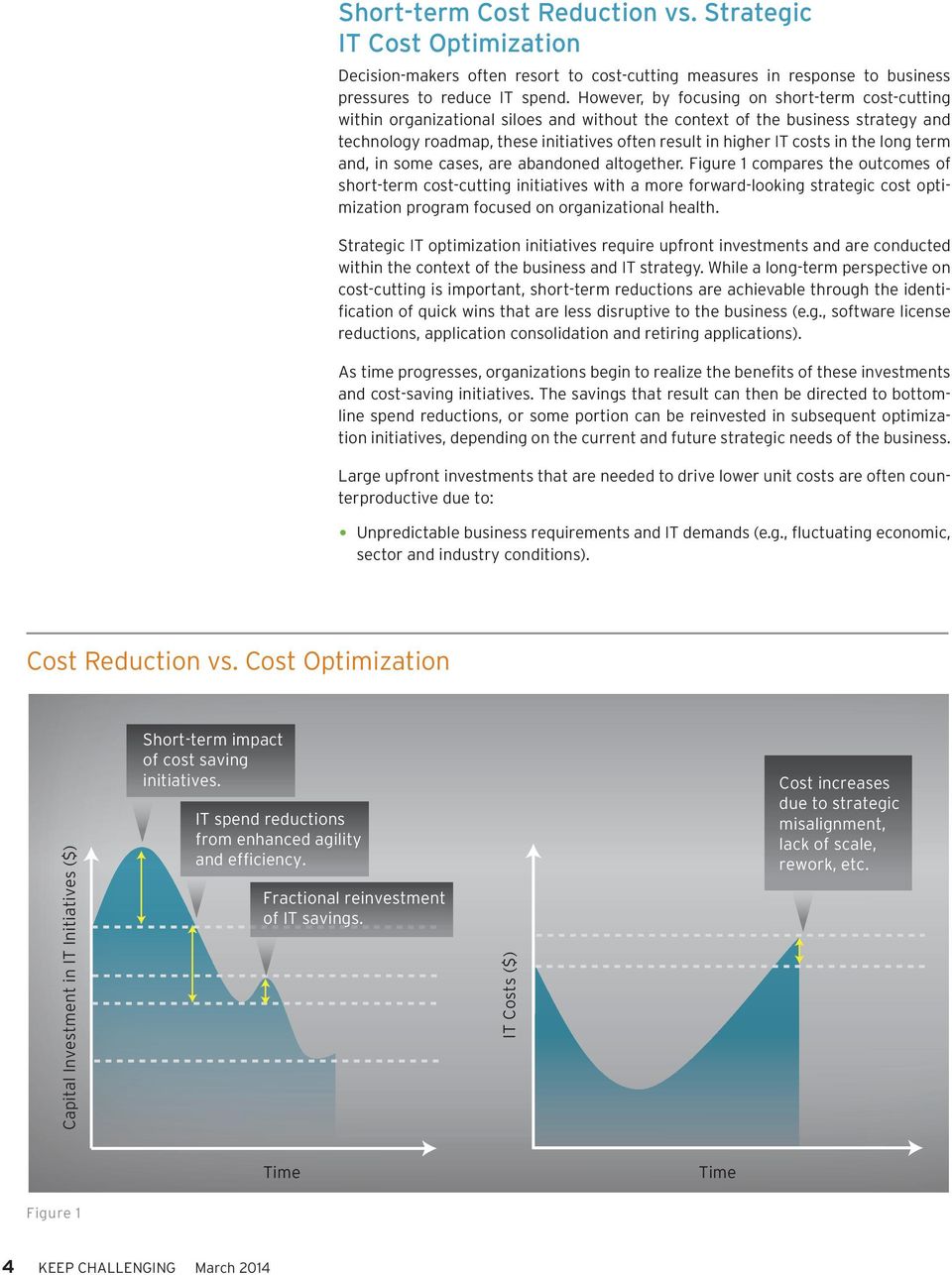
4 Short-term Cost Reduction vs. Strategic IT Cost Optimization Decision-makers often resort to cost-cutting measures in response to business pressures to reduce IT spend. However, by focusing on short-term cost-cutting within organizational siloes and without the context of the business strategy and technology roadmap, these initiatives often result in higher IT costs in the long term and, in some cases, are abandoned altogether. Figure 1 compares the outcomes of short-term cost-cutting initiatives with a more forward-looking strategic cost optimization program focused on organizational health. Strategic IT optimization initiatives require upfront investments and are conducted within the context of the business and IT strategy. While a long-term perspective on cost-cutting is important, short-term reductions are achievable through the identification of quick wins that are less disruptive to the business (e.g., software license reductions, application consolidation and retiring applications). As time progresses, organizations begin to realize the benefits of these investments and cost-saving initiatives. The savings that result can then be directed to bottomline spend reductions, or some portion can be reinvested in subsequent optimization initiatives, depending on the current and future strategic needs of the business. Large upfront investments that are needed to drive lower unit costs are often counterproductive due to: Unpredictable business requirements and IT demands (e.g., fluctuating economic, sector and industry conditions). Cost Reduction vs. Cost Optimization Capital Investment in IT Initiatives ($) Short-term impact of cost saving initiatives. IT spend reductions from enhanced agility and efficiency. Fractional reinvestment of IT savings. IT Costs ($) Cost increases due to strategic misalignment, lack of scale, rework, etc. Time Time Figure 1 4 KEEP CHALLENGING March 2014
5 Potential business exit/divestiture. Short-term opportunities or projects that are inconsistent with the long-term business direction. Rapid new business/growth opportunities that require frequent IT changes and expensive scaling. Software as a service (SaaS) and other services delivered via the cloud may appear to be more expensive initially, but they may often provide improved long-term returns. This is because of the operational and financial flexibility that these initiatives afford, such as consumption-based pricing that variablizes cost outlays. Thus, a strategic IT cost optimization program is not a one-time initiative. Instead, it is a continuous improvement exercise for CIOs seeking to optimize IT spend and deliver a sustainable business advantage. However, CIOs can no longer concentrate resources and investments on cost reduction efforts alone; they must maintain an appropriate balance between meeting savings targets and supporting necessary innovation and process improvements that future-proof the business. Four Levels of Strategic Cost Optimization Figure 2 illustrates how an organization can transform its cost optimization efforts from tactical to strategic and realize maximum value over a specific period of time. Our framework helps CIOs and other decision-makers weigh the risk-reward tradeoffs of all possible initiatives before implementing them. A Framework for Strategic Cost Optimization Low High Cost Savings Tighter alignment with business Do more with less 1 Transform to higher levels Transform: Invest more to optimize more Agenda: Evaluate technology, broaden capabilities, create new sources of revenue. Rationalize: Business relevance, flexibility, agility Agenda: Rationalize IT portfolio, reduce functional redundancies. Optimize: Remove waste, increase efficiency Agenda: Improve processes, go lean, evaluate target operating models (shared services), exercise sourcing options. Reduce: Reduce costs and prioritize spend Agenda: Cut IT costs, prioritize demand, span of control enhancements. Tactical Nature of IT Cost Optimization Strategic Figure 2 STRATEGIC COST OPTIMIZATION: DRIVING BUSINESS INNOVATION WHILE REDUCING IT COSTS 5
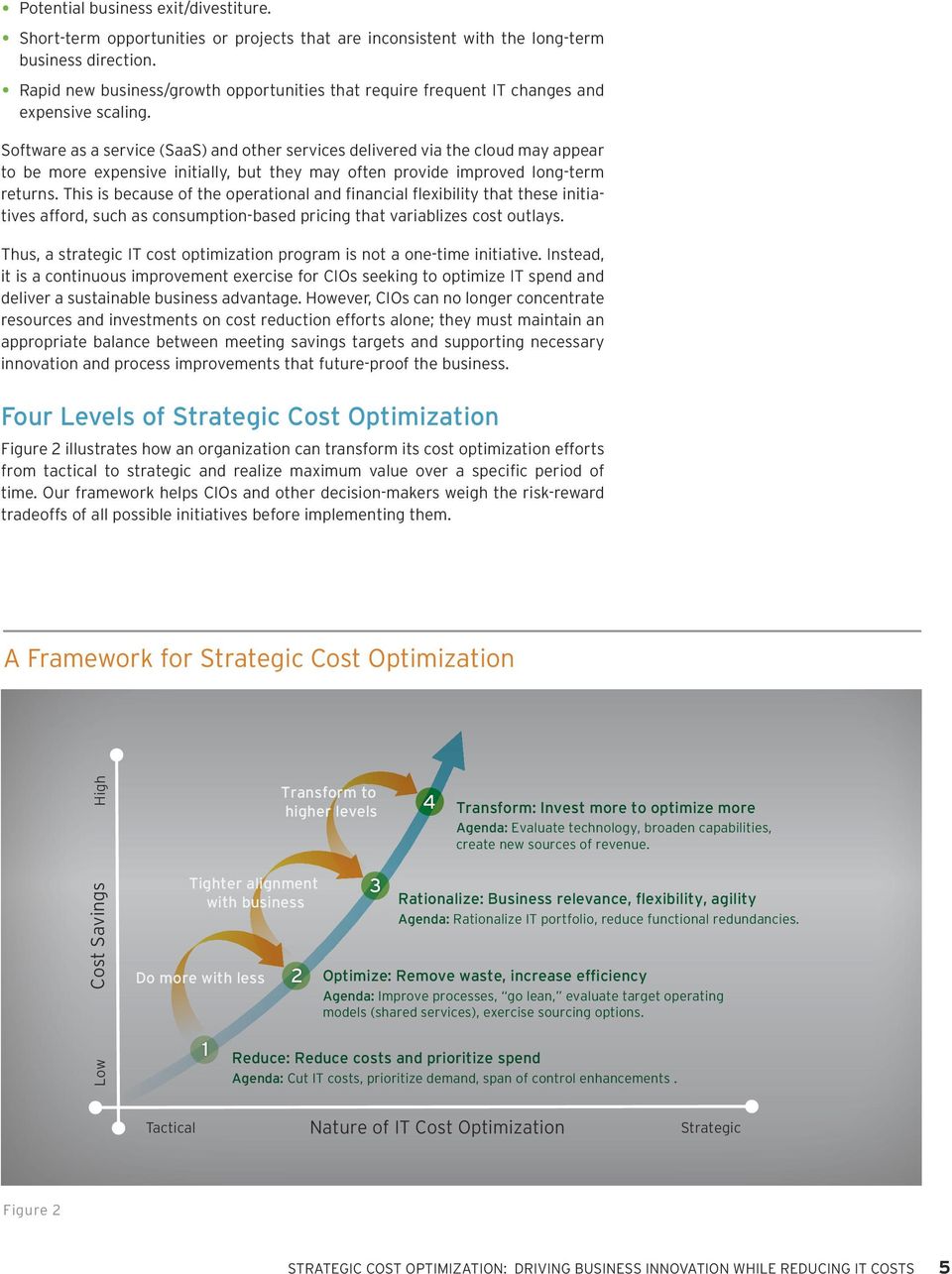
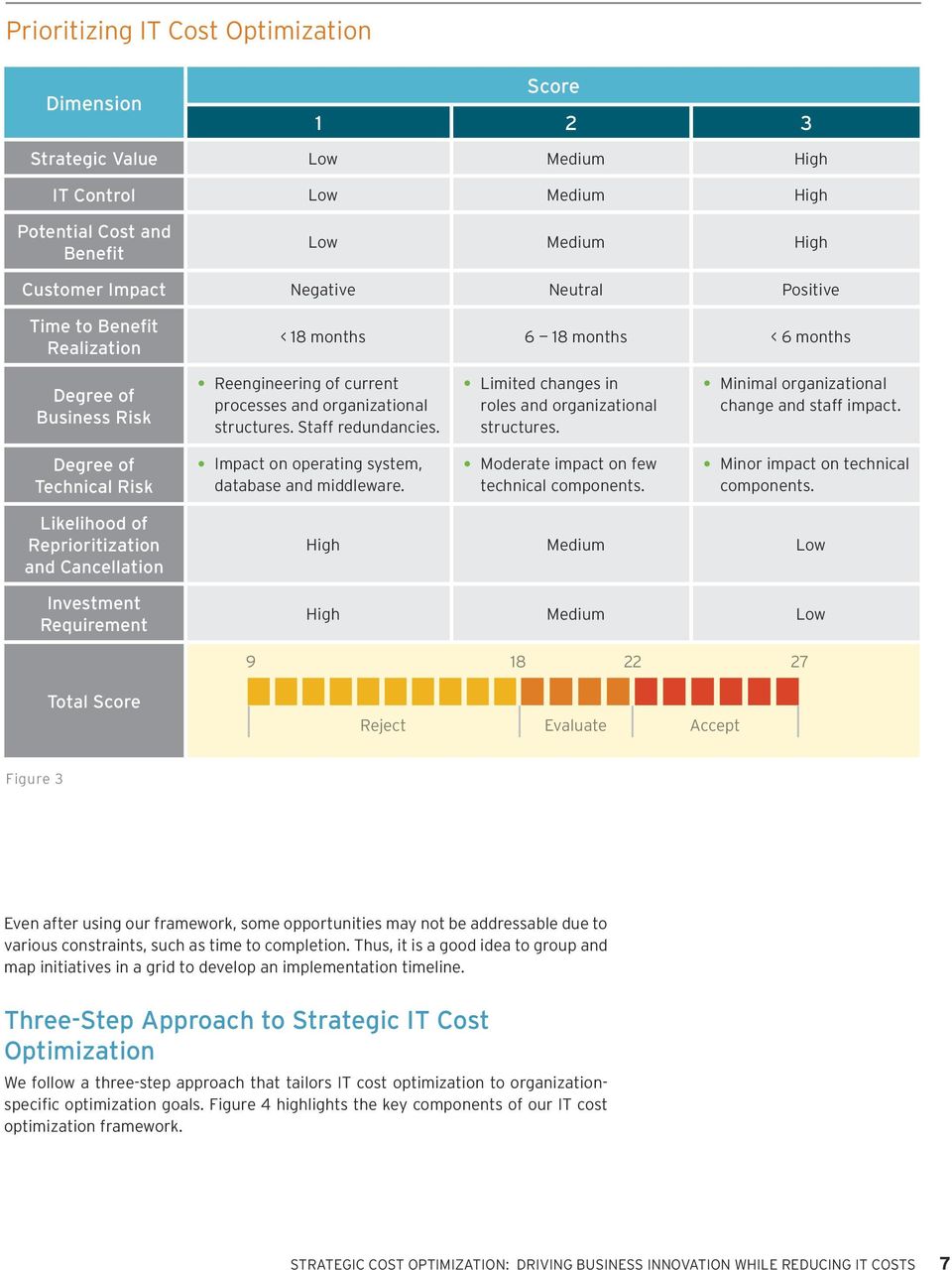
6 Here is a closer look at each level within the strategic cost optimization framework: Level 1 (Reduce): Cut costs and prioritize spend. Companies tend to prioritize cost optimization initiatives by simply considering short-term cash savings. While cash savings are important, prioritizing costoptimization initiatives with only short-term goals in mind can cause unanticipated problems. Decision-makers must consider the degree of organizational and technical risk, as well as the impact of such myopic thinking on consumers of IT services. Level 2 (Optimize): Remove waste and increase efficiency. Cost-cutting can have unforeseen negative consequences. The focus should be on eliminating excess waste while increasing the efficiency of current systems. Speed-to-market, quality and utilization have become exceedingly important. Suitable metrics to measure performance should be implemented, such as speed of IT delivery (i.e., development and implementation time), reduction in transaction time for users and integration of valuable IT assets. Such metrics can indicate the efficiency level of IT initiatives across all areas of the organization. Level 3 (Rationalize): Seek business relevance, flexibility and agility. It is imperative to focus on business goals and ensure that IT initiatives are aligned with business objectives and priorities. IT performance metrics should be closely tied to business metrics so that their alignment can be measured appropriately. Some of the metrics that could help with the measurement of an organization s business innovation include addition of new customers/users, ability to meet current and future functional needs and reduction in time to market of new products and services. Level 4 (Transform): Invest more to optimize more. As economic conditions improve, companies can focus their cost optimization efforts on implementing long-term business and IT process improvements, enabling business growth and innovation, and repositioning the business to sustain a competitive advantage. As the percentage of IT investment aimed at business transformation increases, the percentage spent on business sustenance should remain constant or decline as operational efficiencies are achieved over time. IT Cost Optimization Planning Recognizing that cost optimization teams usually operate on tight timeframes, we have created a framework for prioritizing cost optimization techniques by considering not only the potential benefits in terms of savings, but also the time requirements, degree of organizational and technical risks, impact on customers, and investment required. By evaluating the factors depicted in Figure 3 (see next page), CIOs can weigh the future strategic value, risks and benefits of cost optimization initiatives. In assessing options, decision-makers should also take into account: Time to complete the initiative. Tactical and organizational risk. Upfront cash investments required to achieve downstream savings. 6 KEEP CHALLENGING March 2014
7 Prioritizing IT Cost Optimization Dimension Score Strategic Value Low Medium High IT Control Low Medium High Potential Cost and Benefit Low Medium High Customer Impact Negative Neutral Positive Time to Benefit Realization < 18 months 6 18 months < 6 months Degree of Business Risk Reengineering of current processes and organizational structures. Staff redundancies. Limited changes in roles and organizational structures. Minimal organizational change and staff impact. Degree of Technical Risk Impact on operating system, database and middleware. Moderate impact on few technical components. Minor impact on technical components. Likelihood of Reprioritization and Cancellation Investment Requirement High Medium Low High Medium Low Total Score Reject Evaluate Accept Figure 3 Even after using our framework, some opportunities may not be addressable due to various constraints, such as time to completion. Thus, it is a good idea to group and map initiatives in a grid to develop an implementation timeline. Three-Step Approach to Strategic IT Cost Optimization We follow a three-step approach that tailors IT cost optimization to organizationspecific optimization goals. Figure 4 highlights the key components of our IT cost optimization framework. STRATEGIC COST OPTIMIZATION: DRIVING BUSINESS INNOVATION WHILE REDUCING IT COSTS 7
8 IT Cost Optimization: Three-Step Approach IT Investment Optimization IT & Business Alignment Flat or declining IT budgets, coupled with an increased demand for IT services. Removal of expenses from current spend or run rate in order to invest in future business opportunities. Define IT investment optimization goals Identify investment opportunity Prioriti tize investment portfolio Develop ongo ing governance Opportunity Identification IT Cost Assessment Business challenges identified through merger, acquisition or divestiture of business operation. Increased utilization of IT resources and assets. Alternate sourcing Business alignment Vendor renegotiation Consolidation/ rationalization Standardization People alignment Realization of Benefits Software Hosting Network Application portfolio rationalization Infrastructure rationalization Organization and operating model Global sourcing End User Computing Operations and process transformation IT Overhead Management Figure 4 Our methodology assesses a core set of key organizational objectives (i.e., total cost savings, impact on customers, time requirements, degree of organizational and technical risk and required investment) for various IT cost optimization initiatives. When planned strategically, these objectives can result in a variety of benefits to IT organizations (see Figure 5). Looking Forward Business uncertainty will continue to impact IT organizations, and even a wellthought-out cost savings program can prove ineffective in the long run. However, when cost pressures are intense, businesses must overcome the dual challenge of continuously innovating while reducing spend to outperform the competition. Overcoming these obstacles requires a strategic cost optimization program to strike a balance between cost reduction initiatives and investments needed to generate process efficiencies, improve quality of service, build a stronger value chain, improve skill management and increase customer satisfaction. Further, cost optimization cannot be a one-time strategic IT initiative. Instead, it should be a guiding principle for managing IT in the most efficient manner while responding promptly to fluctuations in business conditions. 8 KEEP CHALLENGING March 2014

9 IT Cost Optimization Initiative Benefits ITCO Initiatives Application Portfolio Rationalization Infrastructure Rationalization Organization and Operating Model Global Sourcing Operations and Process Transformation Figure 5 Cognizant s Approach Portfolio Assessment Assess the portfolio based on business and technology drivers. Conduct a cluster analysis to select the group of applications to be rationalized. Conduct a portability analysis to check how easily the portfolio can be migrated to target architecture. Transformation Plan Definition Define the plan to achieve the target architecture. Prepare the transformation roadmap. Asset Optimization Infrastructure standardization Desktop virtualization Printer fleet optimization Contract Optimization Procurement vendor and maintenance contract negotiations. Overall Service Model Patch management. Help desk support. OS upgrade. Security updates. IT Performance and Process Improvement Maturity assessment. Process improvement roadmap. IT Workforce and Skills Optimization Workforce assessment and strategy. Suitability analysis. Governance and change management. IT Organization and Governance Model Current organization assessment. Future organization definition. Governance and transition recommendations. Needs Assessment Identify strategic goals and baseline inventory. Suitability Analysis Portfolio maturity analysis. Service model definition. Transition Planning & Financial Analysis Resource planning. Financial analysis. Sourcing strategy. Supplier Selection Supplier selection, evaluation and finalization. Enterprise & Business Transformation Functions Transformation driver identification. Current state assessment of capabilities, operating model and IT portfolio. Future state operating model definition, IT roadmap, sourcing model, architecture roadmap and governance framework. Transformation adoption roadmap. Benefits Improved Cost Management Reduce/contain costs without affecting service quality. Continuous IT spend optimization. Increased Efficiency Highly flexible IT portfolio. Improve analysis of system deficiencies, process constraints and risks from technology architecture perspective. Business Transformation Adapt to industry best practices. Seamless business transformation flow. Cost Efficiencies Reduce total cost of ownership. Reduce procurement and support service cost. Increased Efficiency Improve economies of scale by standardization of assets. Obtain operational efficiency by aligning to industry standards and investing in more optimization initiatives. Increased Cost Savings Savings due to process standardization and reduced re-work. Improved Product Quality and Service Improve time to market by combining improved schedules with higher quality. Increased Customer Satisfaction Increased organization flexibility to respond to business demand. Strategic Advantage Achieve competitive edge by investing IT cost savings into more forward-looking innovative ideas. Cost Savings Reduce cost for acquiring skills with prompt response to ramp-up and ramp-down situations. Improved Skills Management Leverage the best skills wherever they exist. Dedicated high-valued workforce for more important initiatives. Long-term, Trusted Relationships Co-development, benefit and risk sharing Stronger Value Chain Improve visibility of end-to-end value chain. Strengthen supplier and partner relationship. Improved Demand Management Increase demand forecast accuracy. Improved Cost Management Drive significant increase in bottom line. STRATEGIC COST OPTIMIZATION: DRIVING BUSINESS INNOVATION WHILE REDUCING IT COSTS 9

10 Quick Take Lighting Up IT A leading electric utilities company in the U.S. engaged us to help the organization embrace a robust IT cost optimization methodology. The company s goals were to achieve significant cost savings across infrastructure, process and technology through: Reduced technology total cost of ownership and improved ROI. Effective sourcing of technology resources. Process and operations maturity. Tool rationalization and end-state planning. We engaged with various business stakeholders within the organization to optimize and consolidate organization-wide processes through self-optimization and varied levels of sourcing approaches. We established clear service and operational level agreements (SLA and OLA) and used service automation to enable productivity improvements. The team rationalized the utility s infrastructure, application and tools costs, implemented enterprise monitoring standards and enabled end-to-end tools integration. Lastly, we implemented ITIL component capacity management (CCM) and SACM processes, including IT asset management. Key benefits of the IT cost optimization framework program included: Cost savings People $5M labor savings via self-optimization. $9M average labor savings per year via selective sourcing. $14M to $19M average labor savings per year via full sourcing over a span of five years. Tools $1.6M software license savings as a result of consolidation. $3.4M in labor savings through end-to-end integration and automation. 20% reduction in overlapping tools. Technology $9M estimated savings via technology optimization. Reduction in Op-Ex (i.e., vendor support and software costs) by as much as 20% in full-time staff supporting network operations. Approximately 15% to 20% cost savings in 85% of virtualized environments. Process Improved cost-capacity balance. Improved system availability and productivity against capacity issues. Cost avoidance on duplication of tools, data sources and processes. Effective Demand Management Establishment of an effective demand/forecast process for capacity. Better Skill Management Cross-training of resources to enhance resource utilization and improve focus on strategic activities. Selective use of third parties for low-skilled activities and gradual increase of offshore resources. Better Product Quality Improvement in client s perception of quality. Robust SLAs and OLAs across the organization. Reduced time to solution of complex issues/problems. 10 KEEP CHALLENGING March 2014

11 About the Authors Harold Albo is a Director in Cognizant Business Consulting s Strategic Services Practice. With over 25 years of professional experience, Harold s strategic consulting expertise spans IT transformation projects, application portfolio analysis, and IT service management and governance. He has deep experience in IT performance and cost optimization. Harold holds a bachelor s degree from North Carolina State University and an M.B.A. from the University of South Carolina. He can be reached at [email protected]. Shreshth Anand is a Senior Consultant in Cognizant Business Consulting s Strategic Services Practice. With six-plus years of IT consulting experience, Shreshth s expertise spans IT process management, organization change management and performance management. He holds a bachelor s degree from Visvesvaraya National Institute of Technology and an M.B.A. from the Asian Institute of Management, Manila. Shreshth can be reached at [email protected]. Manga Rajesh Gali is a Senior Consultant in Cognizant Business Consulting s Strategic Services Practice. He has more than eight years of IT advisory experience spanning IT strategy and transformation, organization change management, IT cost optimization and global sourcing strategy. Rajesh holds a bachelor s degree from Indian School of Mines and an M.B.A. from XLRI Jamshedpur, India. He can be reached at [email protected]. STRATEGIC COST OPTIMIZATION: DRIVING BUSINESS INNOVATION WHILE REDUCING IT COSTS 11
12 About Cognizant Cognizant (NASDAQ: CTSH) is a leading provider of information technology, consulting, and business process outsourcing services, dedicated to helping the world s leading companies build stronger businesses. Headquartered in Teaneck, New Jersey (U.S.), Cognizant combines a passion for client satisfaction, technology innovation, deep industry and business process expertise, and a global, collaborative workforce that embodies the future of work. With over 50 delivery centers worldwide and approximately 171,400 employees as of December 31, 2013, Cognizant is a member of the NAS- DAQ-100, the S&P 500, the Forbes Global 2000, and the Fortune 500 and is ranked among the top performing and fastest growing companies in the world. Visit us online at or follow us on Twitter: Cognizant. World Headquarters 500 Frank W. Burr Blvd. Teaneck, NJ USA Phone: Fax: Toll Free: [email protected] European Headquarters 1 Kingdom Street Paddington Central London W2 6BD Phone: +44 (0) Fax: +44 (0) [email protected] India Operations Headquarters #5/535, Old Mahabalipuram Road Okkiyam Pettai, Thoraipakkam Chennai, India Phone: +91 (0) Fax: +91 (0) [email protected] Copyright 2014, Cognizant. All rights reserved. No part of this document may be reproduced, stored in a retrieval system, transmitted in any form or by any means, electronic, mechanical, photocopying, recording, or otherwise, without the express written permission from Cognizant. The information contained herein is subject to change without notice. All other trademarks mentioned herein are the property of their respective owners.
Maximizing Business Value Through Effective IT Governance
 Cognizant 0-0 Insights Maximizing Business Value Through Effective IT Implementing a holistic IT governance model not only helps IT deliver business value but also advances confidence with business. Executive
ICD-10 Advantages Require Advanced Analytics
 Cognizant 20-20 Insights ICD-10 Advantages Require Advanced Analytics Compliance alone will not deliver on ICD-10 s potential to improve quality of care, reduce costs and elevate efficiency. Organizations
Driving Innovation Through Business Relationship Management
 Cognizant 20-20 Insights Driving Innovation Through Business Relationship Management BRM organizations take the IT-business partnership to the next level, enabling technology to transform business capabilities.
Transform Customer Experience through Contact Center Modernization
 Cognizant Healthcare Solution Overview Transform Customer Experience through Contact Center Modernization Improve customer experience and reduce costs with next-generation contact center services Health
Two-Tier ERP Strategy: First Steps
 Cognizant 20-20 Insights Two-Tier ERP Strategy: First Steps Monolithic ERP solutions are often too complex, slow and expensive to manage in perpetuity; hybrid solutions that combine on-premises/ cloud-hosted
Credit Decision Indices: A Flexible Tool for Both Credit Consumers and Providers
 Cognizant 20-20 Insights Decision Indices: A Flexible Tool for Both Consumers and Providers Executive Summary information providers have increased their focus on developing new information solutions, enriching
> Cognizant Analytics for Banking & Financial Services Firms
 > Cognizant for Banking & Financial Services Firms Actionable insights help banks and financial services firms in digital transformation Challenges facing the industry Economic turmoil, demanding customers,
Cognizant Mobile Risk Assessment Solution
 Cognizant Solutions Overview Solution Overview Cognizant Mobile Risk Assessment Solution 1 Mobile Risk Assessment Solution Overview Cognizant Solutions Overview Transforming Risk Engineering, Field Underwriting
Creating Competitive Advantage with Strategic Execution Capability
 Cognizant 20-20 Insights Creating Competitive Advantage with Strategic Execution Capability By embracing the Strategic Execution Framework, organizations can identify and resolve internal stress points
LifeEngage : The Life Insurance Platform for the Digital-Age Insurer
 Cognizant Solutions Overview Solution Overview LifeEngage : The Life Insurance Platform for the Digital-Age Insurer 1 LifeEngage Solution Overview Cognizant Solutions Overview Digital forces are disrupting
Cognizant assetserv Digital Experience Management Solutions
 Cognizant assetserv Digital Experience Management Solutions Transforming digital assets into engaging customer experiences. Eliminate complexity and create a superior digital experience with Cognizant
Building a Collaborative Multichannel Insurance Distribution Strategy
 Cognizant 20-20 Insights Building a Collaborative Multichannel Insurance Distribution Strategy A CRM-enabled agency management solution can help improve agency channel productivity and enable multichannel
How Healthy Is Your SaaS Business?
 Cognizant 20-20 Insights How Healthy Is Your SaaS Business? ISVs can t know for sure unless they apply a structured approach to software-as-a-service performance monitoring. They can apply metrics and
Cognizant 20-20 Insights. Executive Summary. Overview
 Automated Product Data Publishing from Oracle Product Hub Is the Way Forward A framework using Oracle tools and technologies to publish products from Oracle Product Hub to disparate product data consuming
Integrated Market Research: The Intelligence Behind Commercial Transformation
 Cognizant 20-20 Insights Integrated Market Research: The Intelligence Behind Commercial Transformation To perform effectively in today s challenging economic conditions, pharma companies are weaving primary
How To Choose A Test Maturity Assessment Model
 Cognizant 20-20 Insights Adopting the Right Software Test Maturity Assessment Model To deliver world-class quality outcomes relevant to their business objectives, IT organizations need to choose wisely
Transforming the Business with Outcome-Oriented IT Infrastructure Services Delivery
 Cognizant 20-20 Insights Transforming the Business with Outcome-Oriented IT Infrastructure Services Delivery To enable IT to advance enterprise objectives, organizations must look holistically at IT infrastructure
Retail Analytics: Game Changer for Customer Loyalty
 Cognizant 20-20 Insights Retail Analytics: Game Changer for Customer Loyalty By leveraging analytics tools and models, retailers can boost customer loyalty by creating a personalized shopping experience
Virtual Clinical Organization: The New Clinical Development Operating Model
 Cognizant 20-20 Insights Virtual Clinical Organization: The New Clinical Development Operating Model Executive Summary Clinical development executives are facing more pressure than ever to reduce costs
Virtual Brand Management: Optimizing Brand Contribution
 Cognizant Solution Overview Virtual Brand Management: Optimizing Brand Contribution The Challenge The pharmaceuticals industry today is facing nothing short of a crisis. For starters, a reduced number
Agile/Scrum Implemented in Large-Scale Distributed Program
 Cognizant 20-20 Insights Agile/Scrum Implemented in Large-Scale Distributed Program Executive Summary It was early July 2010 when problems were detected while running a large program at one of our clients
Key Indicators: An Early Warning System for Multichannel Campaign Management
 Cognizant 20-20 Insights Key Indicators: An Early Warning System for Multichannel Campaign Management For pharmaceuticals companies, a careful analysis of both leading and lagging indicators for multichannel
Open Source Testing Tools: The Paradigm Shift
 Cognizant 20-20 Insights Open Source Testing Tools: The Paradigm Shift Executive Summary Businesses today demand faster time-to-market for their software products without significant expenditures in testing
How To Know If A Project Is Safe
 Cognizant 20-20 Insights Risk Mitigation: Fixing a Project Before It Is Broken A comprehensive assessment of unforeseen risks in the project lifecycle can prevent costly breakdowns at the testing stage.
Cloud Brokers Can Help ISVs Move to SaaS
 Cognizant 20-20 Insights Cloud Brokers Can Help ISVs Move to SaaS Executive Summary Many large organizations are purchasing software as a service (SaaS) rather than buying and hosting software internally.
Using Predictive Analytics to Optimize Asset Maintenance in the Utilities Industry
 Cognizant 20-20 Insights Using Predictive Analytics to Optimize Asset Maintenance in the Utilities Industry By working proactively to collect and distill digital information, transmission and distribution
Two-Tier ERP: Enabling the Future-Ready Global Enterprise with Better Innovation, Customer Experience and Agility
 Cognizant 20-20 Insights Two-Tier ERP: Enabling the Future-Ready Global Enterprise with Better Innovation, Customer Experience and Agility Organizations that embrace two-tier ERP strategies are better
Making Multicloud Application Integration More Efficient
 Cognizant 20-20 Insights Making Multicloud Application Integration More Efficient As large organizations leverage the cloud for more and more business functionality and cost savings, integrating such capabilities
DevOps Best Practices: Combine Coding with Collaboration
 Cognizant 20-20 Insights DevOps Best Practices: Combine Coding with Collaboration (Part Two of a Two-Part Series) Effectively merging application development and operations requires organizations to assess
Granular Pricing of Workers Compensation Risk in Excess Layers
 Cognizant 20-20 Insights Granular Pricing of Workers Compensation Risk in Excess Layers Identifying risk at a granular level and pricing it appropriately will put carriers on a path to sound underwriting
Extending Function Point Estimation for Testing MDM Applications
 Cognizant 20-20 Insights Extending Function Point Estimation for Testing Applications Executive Summary Effort estimation of testing has been a much debated topic. A variety of techniques are used ranging
Agile Planning in a Multi-project, Multi-team Environment
 Cognizant 20-20 Insights Agile Planning in a Multi-project, Multi-team Environment How organizations evolve to cope with the challenge of scaling Agile planning and improving its reliability. Executive
POS Data Quality: Overcoming a Lingering Retail Nightmare
 Cognizant 20-20 Insights POS Data Quality: Overcoming a Lingering Retail Nightmare By embracing a holistic and repeatable framework, retailers can first pilot and then remediate data quality issues incrementally,
Improve Sourcing and Contract Management for better Supplier Relationship
 Cognizant Solution Overview Improve Sourcing and Contract for better Supplier Relationship Introduction Organizations consider sourcing and contract management as a source of competitive advantage in the
Optimizing Agile with Global Software Development and Delivery
 Cognizant 20-20 Insights Optimizing Agile with Global Software and Delivery A blueprint for integrating global delivery and Agile methodology, allowing organizations to achieve faster returns on investment,
Talent as a Service: Enabling Employee Engagement While Boosting Efficiencies
 White Paper Talent as a Service: Enabling Employee Engagement While Boosting Efficiencies The human resources (HR) and human capital management (HCM) landscapes have changed radically in recent years.
> Solution Overview COGNIZANT CLOUD STEPS TRANSFORMATION FRAMEWORK THE PATH TO GROWTH
 > Solution Overview COGNIZANT CLOUD STEPS TRANSFORMATION FRAMEWORK A comprehensive, tool-based framework speeds up the time to value for your cloud-enabled business transformation projects. It s accepted:
The Impact of RTCA DO-178C on Software Development
 Cognizant 20-20 Insights The Impact of RTCA DO-178C on Software Development By following DO-178C, organizations can implement aeronautical software with clear and consistent ties to existing systems and
Business-Focused Objectives Key to a Winning MDM Implementation
 Cognizant 20-20 Insights Business-Focused Objectives Key to a Winning MDM Implementation Successful MDM projects are defined by strong vision, structured business cases and a well-mapped ROI plan, all
Future of Work Enabler: Flexible Commercial Models
 Making the Shift to the Next-Generation Enterprise (a multipart series) Future of Work Enabler: Flexible Commercial Models As companies adopt more flexible approaches to business process service delivery,
Innovative, Cloud-Based Order Management Solutions Lead to Enhanced Profitability
 Cognizant 20-20 Insights Innovative, Cloud-Based Order Management Solutions Lead to Enhanced Profitability Executive Summary To contend with increasing product and service complexity, communication service
A Tag Management Systems Primer
 Cognizant 20-20 Insights A Tag Management Systems Primer Emergent tagging tools allow nontechnical resources to more effectively manage JavaScripts used by ad measurement and serving systems. Executive
Cognizant Mobility Testing Lab. The faster, easier, more cost-effective way to test enterprise mobile apps.
 Cognizant Mobility Testing Lab The faster, easier, more cost-effective way to test enterprise mobile apps. Be Cognizant 2 MOBILE APP TESTING REINVENTED With Cognizant Mobility Testing Lab You Will Save
Reducing Costs, Increasing Choice: Private Health Insurance Exchanges
 Cognizant 20-20 Insights Reducing Costs, Increasing Choice: Private Health Insurance Exchanges Private exchanges provide payers with a competitive, value-generating solution to the challenges posed by
Cognizant Mobility Testing Lab A state of the art Integrated platform for Mobility QA
 Solutions Overview Cognizant Mobility Testing Lab A state of the art Integrated platform for Mobility QA Mobile App QA Reinvented: With the astounding proliferation of mobile devices, smartphones and tablets
Solving Storage Headaches: Assessing and Benchmarking for Best Practices
 Cognizant 20-20 Insights Solving Storage Headaches: Assessing and Benchmarking for Best Practices Executive Summary Data center infrastructure has evolved considerably in the post-dot-com era, but one
Moving Beyond Social CRM with the Customer Brand Score
 Cognizant 20-20 Insights Moving Beyond Social CRM with the Customer Brand Score Travel and hospitality organizations can boost customer loyalty by better understanding customer behaviors and attitudes,
Migration Decoded. Cognizant 20-20 Insights
 Cognizant 20-20 Insights Migration Decoded To keep pace with the unrelenting, swift pace of new technology, IT organizations need an integrated software migration framework that spans everything from effort
Mortgage LOS Platform Evaluation and Selection
 Cognizant 20-20 Insights Mortgage LOS Platform Evaluation and Selection A comprehensive and fact-based process that takes into account business goals, channels, target segments, products and investors
Life and Annuity Insurance Transformation through End-to-End Business Processing ORACLE STRATEGY BRIEF JULY 2014
 Life and Annuity Insurance Transformation through End-to-End Business Processing ORACLE STRATEGY BRIEF JULY 2014 Table of Contents Executive Overview 1 Life and Annuity Insurers needs 1 Business Needs
Complaints Management: Integrating and Automating the Process
 Cognizant 20-20 Insights Complaints Management: Integrating and Automating the Process To strengthen their brand and fortify customer relationships, device manufacturers require a standards-based, next-generation
Software Quality Transformation: Focus on Results, Not Process
 Cognizant White Paper Software Quality Transformation: Focus on Results, Not Process Executive Summary Based on an independent survey conducted by the Boston, Massachusetts-based IT project management
Don t Let Your Data Get SMACked: Introducing 3-D Data Management
 Don t Let Your Data Get SMACked: Introducing 3-D Data Management As social, mobile, analytics and cloud continue to disrupt business, organizations need a new approach to data management that supports
Proactive MDM: Marrying Master Data with Operational Processes to Elevate Business Value
 Cognizant White Paper Proactive MDM: Marrying Master Data with Operational Processes to Elevate Business Value Executive Summary As the concept of master data management (MDM) has evolved and risen to
Moving Financial Planning and Analysis to the Next Level
 Cognizant 20-20 Insights Moving Financial Planning and Analysis to the Next Level Turning over contextual tasks to a trusted partner can free finance professionals to work on key strategic imperatives
Online Capabilities of UAE Insurance Carriers: The Road to Customer Satisfaction
 Cognizant 20-20 Insights Online Capabilities of UAE Insurance Carriers: The Road to Customer Satisfaction Given increased competitive pressures and significant operational challenges, highly functional
A Next-Generation Approach to Integrated Warranty Management
 Cognizant 20-20 Insights A Next-Generation Approach to Integrated Warranty For today s manufacturers, gaining actionable insights from customers warranty data requires a closed-loop system that pivots
Emerging Differentiators of a Successful Wealth Management Platform
 Cognizant 20-20 Insights Emerging Differentiators of a Successful Wealth Management Platform Changes in the wealth management industry point to the need for scale and flexibility goals that can be achieved
How To Understand The Financial Impact Of Icd-10
 Cognizant 20-20 Insights Financial Impact Analysis: A Window into the Business Impact of ICD-10 Health providers can determine the full financial consequences of the ICD-10 transition by using reimbursement
Convergence of CRM, BPM, MDM and BI: The Fantastic Four of Customer Centricity
 Cognizant 20-20 Insights Convergence of CRM, BPM, MDM and BI: The Fantastic Four of Customer Centricity To get increasingly closer to and work more proactively with customers, organizations need to look
Top Five Secrets for a Successful Enterprise Mobile QA Automation Strategy
 Cognizant 2-2 Insights Top Five Secrets for a Successful Enterprise Mobile QA Automation Strategy From tool selection through choosing the best framework, here are five ways quality assurance teams can
Knowledge Management in Agile Projects
 Cognizant 20-20 Insights Management in Agile Projects Executive Summary Software development is knowledge-intensive work and the main challenge is how to manage this knowledge. The Agile manifesto advocates
Streamlining Submission Intake in Commercial Underwriting for Middle Market Segments
 Cognizant 20-20 Insights Streamlining Submission Intake in Commercial Underwriting for Middle Market Segments Automated data extraction of submission documents combined with manual prequalification by
The Business Case for On-Demand Test Services
 Cognizant Reports The Business Case for On-Demand Test Services The traditional QA service delivery model is stifling organizations with high incidents of defects, inefficiencies and delays. On-demand