
Federal Identity Management Handbook
|
|
|
- Phyllis Parks
- 10 years ago
- Views:
Transcription
1 September 2005 PUBLIC DRAFT
2 Acknowledgements The Office of Management and Budget and the Federal Identity Credentialing Committee would like to acknowledge the significant contributions of the National Institute of Standards and Technology (NIST) and the Government Smart Card Interagency Advisory Board (IAB) for providing valuable contributions to the development of this handbook. A special thanks goes out to those who participated in the various workshops and provided valuable subject matter expertise and lessons learned. The comments received from other government and industry organizations are also acknowledged. PUBLIC DRAFT i

3 Table of Contents 1. Introduction Purpose Federal Identity Credentialing Committee/Interagency Advisory Board Business and Policy HSPD OMB Guidance M HSPD-12 Implementation Roadmap Registration and Issuance Requirements Control Objectives Identity Proofing and Registration Identity-Proofing Recommendations Temporary Access and Access-Pending Authorization Agency Affiliates and Agency Partners Identity Source Documents Notifications and Document Management Background Checks FIPS 201 Card Issuance and Maintenance General Requirements for Issuance and Maintenance Role-Based Model Example System-Based Model Example Suspension, Revocation, and Destruction Reissuance to Current PIV Cardholders Privacy Requirements Protecting Personal Privacy Agency Requirements PIV Card Lifecycle Managing the PIV Card Lifecycle Suggested Card Lifecycle Management Methodology Card Lifecycle Management Implementation PIV - Validation, Certification, and Accreditation PIV II - Front-End Subsystem Physical PIV Card Requirements Physical PIV Card Topology Implementation Recommendations PIV Logical Data Communication with the User Community Logical Access Control PIV Card Cryptographic Specifications Cryptographic Implementation Guidance PUBLIC DRAFT ii
4 4.3 Physical Access Control Physical Access Control System Components Physical Access Interoperability Guidelines Biometric Data Specifications Use of Biometric Technologies Biometric Data Requirements Biometric Technology Implementation Guidance Card Reader Specifications Smart Card Readers Card Reader Compliance Requirements Card Reader Implementation Guidance PIV II Identity Proofing, Registration, Issuance and Management PIV II Identity Proofing and Registration Requirements PIV II Card Issuance Requirements Card Issuance Implementation Recommendations PIV Card Maintenance Key Management Card Authentication Identity Authentication Assurance Levels Card Authentication Mechanisms Graduated Identity Assurance Levels PIV II Special Technical Publication Implementation Planning Acquisition Planning Funding Streams GSA Acquisition Strategy Major Components of an Identity-Management System Anticipating Implementation Costs Agency PIV Sponsorship Shared Service Provider Acquisition Planning Template Migration Planning HSPD-12 Guidance OMB Implementation Guidance Key Benefits of Business and Systems Integration PIV Training Developing the Migration Plan Lessons Learned Implementation Management Stakeholder Management Procurement Plan System Design System Interoperability Pilot and Production PUBLIC DRAFT iii

5 5.3.7 Post-Issuance Processes Training Case Studies U.S. Department of State U.S. Department of Interior U.S. Department of Homeland Security Conformance Testing Why Conformance Testing is Needed How Conformance Testing is Performed Reference Implementation APPENDIX A Sample Acquisition Planning Template APPENDIX B Implementation Checklist APPENDIX C Sample PIV Request Form APPENDIX D GSA Technical Supplement to OMB M APPENDIX E PART 731 Suitability Glossary Acronyms INDEX PUBLIC DRAFT iv

6 List of Figures Figure 1. Sample Card Lifecycle Methodology...42 Figure2. Certification and Accreditation Processes...46 Figure 3. PIV Card Front Printable Areas and Required Data...52 Figure 4. Card Back Printable Areas and Required Data...54 Figure 5. Card Front Optional Data Placement Example Figure 6. Card Front Optional Data Placement Example Figure 7 Card Front Optional Data Placement Example Figure 8. Card Front Optional Data Placement Example Figure 9. Card Back Optional Data Placement Example Figure 10. Card Back Optional Data Placement Example Figure 11. Physical Access Control System...73 Figure 12. Fingerprint Enrollment and Authentication Process Flow...78 Figure 13. Balancing Card Reader Assurance Levels with Convenience...84 Figure 14. PIV Identity Verification and Issuance...85 Figure 15. PKI Decision Making Process...92 Figure 16. Example Organization Structure for Agencies PIV Implementation Figure 17. Identity Management Components and Examples of the Assets Required 110 Figure 18. Four Primary Components of SSP Certification and Accreditation Process Figure 19. Identity Management Convergence Architecture Figure 20. FIPS 201 Migration Plan Roadmap Figure 21. FIPS 201 Card and Middleware Test Process Figure 22. NIST Reference Implementation Architecture PUBLIC DRAFT v
7 List of Tables Table 1. PIV Card Topology Elements (Card Front)...49 Table 2. PIV Card Topology Elements (Card Back)...50 Table 3. PIV Card Mandatory Logical Elements and Categories of Use...67 Table 4. Optional Logical Elements and Categories of Use...68 Table 5. PIV Key Types...71 Table 6. FIPS 201 Biometric Data Requirements...76 Table 7. Mandated CRL Publication Frequencies...95 Table 8. Scenarios Affecting CA Performance and Recommended Responses...97 Table 9. OMB E-Authentication and PIV Assurance Levels...98 Table 10. Advantages and Disadvantages of Authentication Methods Table 11. Assurance Levels and Authentication Mechanisms for Physical and Logical Access Table 12. Potential FIPS 201 Acquisition Stakeholders Table 14. Sample Smart-Card Related Products List Table 15. Necessary Steps for Identity Proofing and Registration Table16. Sponsor Menu Items for Identity Proofing and Registration Table17. Necessary Steps for PIV Card Issuance Table 18. Sponsor Menu items for PIV Card Issuance Table 19. Sponsor Menu Items for PKI Credential Issuance Table 20. Sponsor Menu Items for PIV Card Usage Table 21.Sponsor Menu Items for PIV Card Maintenance Table 22. Sponsor Menu Items for PIV Card Termination Table 23. Complete Sponsor Menu Table 13. Amount of Time Required to Train PIV Roles Table 24. Ongoing Federal Smart Card Technology Initiatives by Department Table 25. Integrated Federal Smart Card Implementations by Agency PUBLIC DRAFT vi

8 1. Introduction 1.1 Purpose This handbook was developed in collaboration with the FICC, IAB, FPKIPA, and OMB. It is offered as an implementation guide for government agency credentialing managers, their leadership, and other stakeholders as they pursue compliance with HSPD-12 and FIPS 201. The handbook provides specific implementation direction on course of action, schedule requirements, acquisition planning, migration planning, lessons learned, and case studies. While this Handbook cites policies and standards, it is not a policy document. It is intended as a resource for Agency Implementers of HSPD-12. In the event that this document contradicts established policies and standards, those documents take precedence. E-Government, an integral part of the President s Management Agenda (PMA), is defined as the use of digital technologies to transform government operations in order to improve effectiveness, efficiency, and service delivery. As the Federal Government modernizes internal processes and adopts crossagency applications available to all Federal employees, a common, trusted basis for authenticating the identity of individuals within the Federal sector is required. Additionally, in accordance with the President s vision of creating a more responsive and cost-effective government, the Office of Management and Budget (OMB), provided a memo to Federal Chief Information Officers (CIOs), outlining details of the E-Government initiative on authentication and identity management OMB Memorandum dated 3 July 2003, Subject: Streamlining Authentication and Identity Management within the Federal Government ( The OMB memo also charged the Federal Identity Credentialing Committee (FICC) to develop a Common comprehensive policy for credentialing of Federal employees. On August 27, 2004, a Homeland Security Presidential Directive was issued entitled HSPD-12, Policy for a Common Identification Standard for Federal Employees and Contractors. HSPD-12 directed the promulgation of a new Federal standard for secure and reliable identification issued by Federal agencies for their employees and contractors. In response to the directive, the National Institute of Standards and Technology (NIST) published Federal Information Processing Standards Publication 201 (FIPS 201) on February 25, FIPS 201 and its associated Special Publications provide a detailed specification for Federal agencies and departments deploying a Personal Identity Verification (PIV) card for their employees and contractors. The FIPS 201 standard can be accessed from the NIST web site at Once implemented, a secure and interoperable PIV card will provide the attributes of security, authentication, identity verification, trust, and privacy to a commonly accepted identification card for Federal employees and contractors. While privileges granted to the PIV cardholder will remain a local agency decision, the PIV card is a core component to setting the trust model across the Federal enterprise. PUBLIC DRAFT 1

9 1.2 Federal Identity Credentialing Committee/Interagency Advisory Board The FICC is composed representatives from the major Federal agencies and departments. Its purpose is to assist agencies engaged in implementing government-wide identity management mandates. Members of the FICC also champion these activities at the agencies they represent. The Smart Card Interagency Advisory Board (IAB) works with the FICC and is composed of representatives from the major Federal agencies and departments skilled in implementing physical access control systems with smart card related technology. The IAB conducts analyses and provides recommendations to government and industry on technology issues related to the efficient use of smart cards and related products by components of the United States Government. The Federal PKI Policy Authority (FPKIPA) also works with the FICC and is composed of representatives from the major Federal agencies and departments skilled in implementing public key infrastructure solutions within their agencies. The Policy Authority is responsible for administering the policy framework of the Federal PKI architecture, which includes the Federal Bridge Certification Authority and the Federal Common Policy Framework, both of which are designed to promote interoperability and mutual trust among the participants. 1.3 Business and Policy For the Federal government to fully realize the benefits of electronic government, a ubiquitous and consistent method of providing identity credentials is necessary for both electronic security (logical access) and building security (physical access) within the Federal sector. As the Federal government modernizes internal processes to reduce costs for agency administration and moves to cross-agency applications that are available to all Federal employees, a common, trusted basis is needed for authentication. FIPS 201 provides for the issuance of PIV cards for Federal employees and contractors that provide sufficient identity assurance to satisfy a variety of government-wide application and access control requirements. The role of the FICC, with assistance from the FICC working groups, the IAB, the Federal PKI Policy Authority, and OMB, is to assist agencies in the implementation of the Personal Identity Verification Standard. The goal is to establish a comprehensive set of policies and procedures that allow for robust, efficient and interoperable identity credentialing systems across the Federal enterprise. Policy that relates to privilege granting and building access control will continue to be managed by individual agencies. To maintain a common understanding of the latest developments in Federal credentialing, agencies are encouraged to follow the activities of the FICC (see ), the Smart Card Project Managers group, and the Smart Card IAB (see ). The FICC provides a focal point for the implementation of the component, including support of migration to a shared service concept endorsed as part of the Federal Enterprise Architecture. The FICC identifies and resolves Federal identity credentialing technical and business issues and recommends solutions for interoperability issues. The FICC will continue to track and assess the Federal government s progress toward full implementation of the Standard and will act as a focal point for identifying issues and developing solutions. PUBLIC DRAFT 2
10 1.3.1 HSPD-12 For Immediate Release Office of the Press Secretary August 27, 2004 Homeland Security Presidential Directive/Hspd-12 Subject: Policy for a Common Identification Standard for Federal Employees and Contractors (1) Wide variations in the quality and security of forms of identification used to gain access to secure Federal and other facilities where there is potential for terrorist attacks need to be eliminated. Therefore, it is the policy of the United States to enhance security, increase Government efficiency, reduce identity fraud, and protect personal privacy by establishing a mandatory, Government-wide standard for secure and reliable forms of identification issued by the Federal Government to its employees and contractors (including contractor employees). (2) To implement the policy set forth in paragraph (1), the Secretary of Commerce shall promulgate in accordance with applicable law a Federal standard for secure and reliable forms of identification (the "Standard") not later than 6 months after the date of this directive in consultation with the Secretary of State, the Secretary of Defense, the Attorney General, the Secretary of Homeland Security, the Director of the Office of Management and Budget (OMB), and the Director of the Office of Science and Technology Policy. The Secretary of Commerce shall periodically review the Standard and update the Standard as appropriate in consultation with the affected agencies. (3) "Secure and reliable forms of identification" for purposes of this directive means identification that (a) is issued based on sound criteria for verifying an individual employee's identity; (b) is strongly resistant to identity fraud, tampering, counterfeiting, and terrorist exploitation; (c) can be rapidly authenticated electronically; and (d) is issued only by providers whose reliability has been established by an official accreditation process. The Standard will include graduated criteria, from least secure to most secure, to ensure flexibility in selecting the appropriate level of security for each application. The Standard shall not apply to identification associated with national security systems as defined by 44 U.S.C. 3542(b)(2). (4) Not later than 4 months following promulgation of the Standard, the heads of executive departments and agencies shall have a program in place to ensure that identification issued by their departments and agencies to Federal employees and contractors meets the Standard. As promptly as possible, but in no case later than 8 months after the date of promulgation of the Standard, the heads of executive departments and agencies shall, to the maximum extent practicable, require the use of identification by Federal employees and contractors that meets the Standard in gaining physical access to Federally controlled facilities and logical access to Federally controlled information systems. Departments and agencies shall implement this directive in a manner consistent with ongoing Government-wide activities, policies and guidance issued by OMB, which shall ensure compliance. PUBLIC DRAFT 3

11 (5) Not later than 6 months following promulgation of the Standard, the heads of executive departments and agencies shall identify to the Assistant to the President for Homeland Security and the Director of OMB those Federally controlled facilities, Federally controlled information systems, and other Federal applications that are important for security and for which use of the Standard in circumstances not covered by this directive should be considered. Not later than 7 months following the promulgation of the Standard, the Assistant to the President for Homeland Security and the Director of OMB shall make recommendations to the President concerning possible use of the Standard for such additional Federal applications. (6) This directive shall be implemented in a manner consistent with the Constitution and applicable laws, including the Privacy Act (5 U.S.C. 552a) and other statutes protecting the rights of Americans. (7) Nothing in this directive alters, or impedes the ability to carry out, the authorities of the Federal departments and agencies to perform their responsibilities under law and consistent with applicable legal authorities and presidential guidance. This directive is intended only to improve the internal management of the executive branch of the Federal Government, and it is not intended to, and does not, create any right or benefit enforceable at law or in equity by any party against the United States, its departments, agencies, entities, officers, employees or agents, or any other person. (8) The Assistant to the President for Homeland Security shall report to me not later than 7 months after the promulgation of the Standard on progress made to implement this directive, and shall thereafter report to me on such progress or any recommended changes from time to time as appropriate. GEORGE W. BUSH # # # PUBLIC DRAFT 4

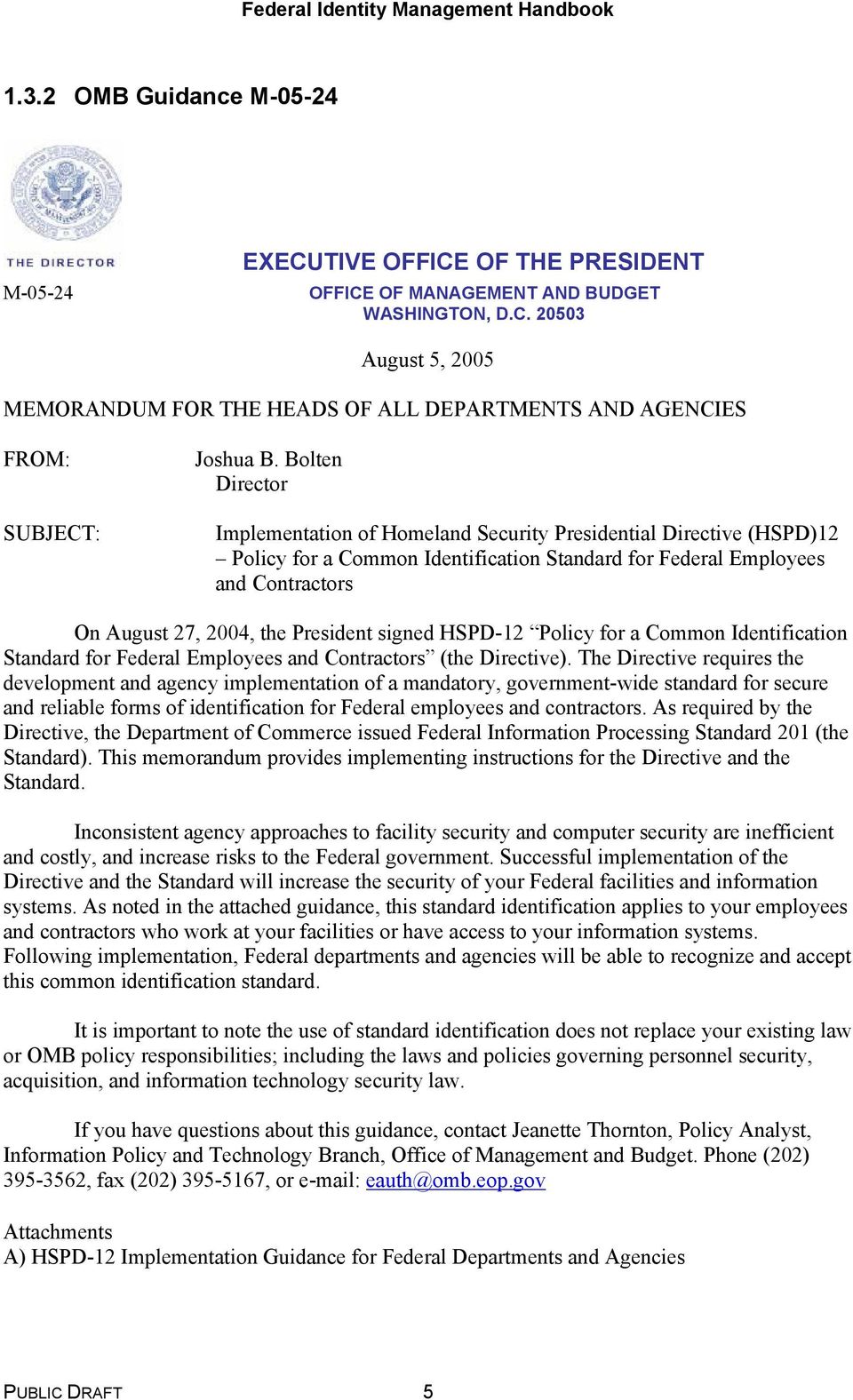
12 1.3.2 OMB Guidance M M EXECUTIVE OFFICE OF THE PRESIDENT OFFICE OF MANAGEMENT AND BUDGET WASHINGTON, D.C August 5, 2005 MEMORANDUM FOR THE HEADS OF ALL DEPARTMENTS AND AGENCIES FROM: SUBJECT: Joshua B. Bolten Director Implementation of Homeland Security Presidential Directive (HSPD)12 Policy for a Common Identification Standard for Federal Employees and Contractors On August 27, 2004, the President signed HSPD-12 Policy for a Common Identification Standard for Federal Employees and Contractors (the Directive). The Directive requires the development and agency implementation of a mandatory, government-wide standard for secure and reliable forms of identification for Federal employees and contractors. As required by the Directive, the Department of Commerce issued Federal Information Processing Standard 201 (the Standard). This memorandum provides implementing instructions for the Directive and the Standard. Inconsistent agency approaches to facility security and computer security are inefficient and costly, and increase risks to the Federal government. Successful implementation of the Directive and the Standard will increase the security of your Federal facilities and information systems. As noted in the attached guidance, this standard identification applies to your employees and contractors who work at your facilities or have access to your information systems. Following implementation, Federal departments and agencies will be able to recognize and accept this common identification standard. It is important to note the use of standard identification does not replace your existing law or OMB policy responsibilities; including the laws and policies governing personnel security, acquisition, and information technology security law. If you have questions about this guidance, contact Jeanette Thornton, Policy Analyst, Information Policy and Technology Branch, Office of Management and Budget. Phone (202) , fax (202) , or [email protected] Attachments A) HSPD-12 Implementation Guidance for Federal Departments and Agencies PUBLIC DRAFT 5
13 Attachment A HSPD-12 IMPLEMENTATION GUIDANCE FOR FEDERAL DEPARTMENTS AND AGENCIES 1. To whom does the Directive apply? 2. What is the schedule for implementing the Directive? 3. How should I implement Part 1 of the Standard? 4. How should I implement Part 2 of the Standard? 5. What acquisition services are available? 6. How must I consider privacy in implementing the Directive? 7. Is there anything else I must consider or know? 1. To whom does the Directive apply? As defined below, Department and Agency heads must conduct a background investigation, adjudicate the results, and issue identity credentials to their employees and contractors who require long-term access to Federally controlled facilities and/or information systems. A. Departments and Agencies Executive departments and agencies listed in title 5 U.S.C. 101, and the Department of Homeland Security; independent establishments as defined by title 5 U.S.C. 104(1); and the United States Postal Service (title 39 U.S.C 201). Does not apply to: Government corporations as defined by title 5 U.S.C. 103(1) are encouraged, but not required to implement this Directive. B. Employee Federal employees, as defined in title 5 U.S.C 2105 Employee, within a department or agency. Individuals employed by, detailed to or assigned to a department or an agency. Within the Department of Defense (DoD) and the Department of State (DoS), members of the Armed Forces, Foreign Service, and DoD and DoS civilian employees (including both appropriated fund and non-appropriated fund employees). Applicability to other agency specific categories of individuals (e.g., shortterm (i.e. less than 6 months) guest researchers; volunteers; or intermittent, temporary or seasonal employees) is an agency risk-based decision. Does not apply to: Within DoD and DoS, family members and other eligible beneficiaries. Occasional visitors to Federal facilities to whom you would issue temporary identification. C. Contractor Individual under contract to a department or agency, requiring routine access to federally controlled facilities and/or federally controlled information PUBLIC DRAFT 6

14 systems to whom you would issue Federal agency identity credentials, consistent with your existing security policies. Does not apply to: Individuals under contract to a department or agency, requiring only intermittent access to federally controlled facilities. D. Federally Controlled Facilities Federally-owned buildings or leased space, whether for single or multi-tenant occupancy, and its grounds and approaches, all or any portion of which is under the jurisdiction, custody or control of a department or agency covered by this Directive. Federally controlled commercial space shared with non-government tenants. For example, if a department or agency leased the 10th floor of a commercial building, the Directive applies to the 10th floor only. Government-owned contractor-operated facilities, including laboratories engaged in national defense research and production activities. Facilities under a management and operating contract. Such as for the operation, maintenance, or support of a Government-owned or-controlled research, development, special production, or testing establishment. E. Federally Controlled Information Systems Information technology system (or information system), as defined by the Federal Information Security Management Act of 2002 (44 U.S.C. 3502(8)). Information systems used or operated by an agency or by a contractor of an agency or other organization on behalf of an agency (44 U.S.C. 3544(a)(1)(A)). Applicability for access to Federal systems from a non-federally controlled facility (e.g. a researcher up-loading data through a secure website or a contractor accessing a government system from their own facility) should be based on the risk determination required by existing National Institute of Standards and Technology (NIST) guidance. 1 Does not apply to: Identification associated with national security systems as defined by the Federal Information Security Management Act of 2002 (44 U.S.C. 3542(2)(A)) What is the schedule for implementing the Directive? A. The Department of Commerce s National Institute of Standards and Technology (NIST) shall meet the following milestones: 1 Federal Information Processing Standard (FIPS 199): Standards for Security Categorization for Federal Information and Information Systems, 2/04, final.pdf. 2 See NIST Special Publication : Guideline for Identifying an Information System as a National Security System, 8/03, PUBLIC DRAFT 7
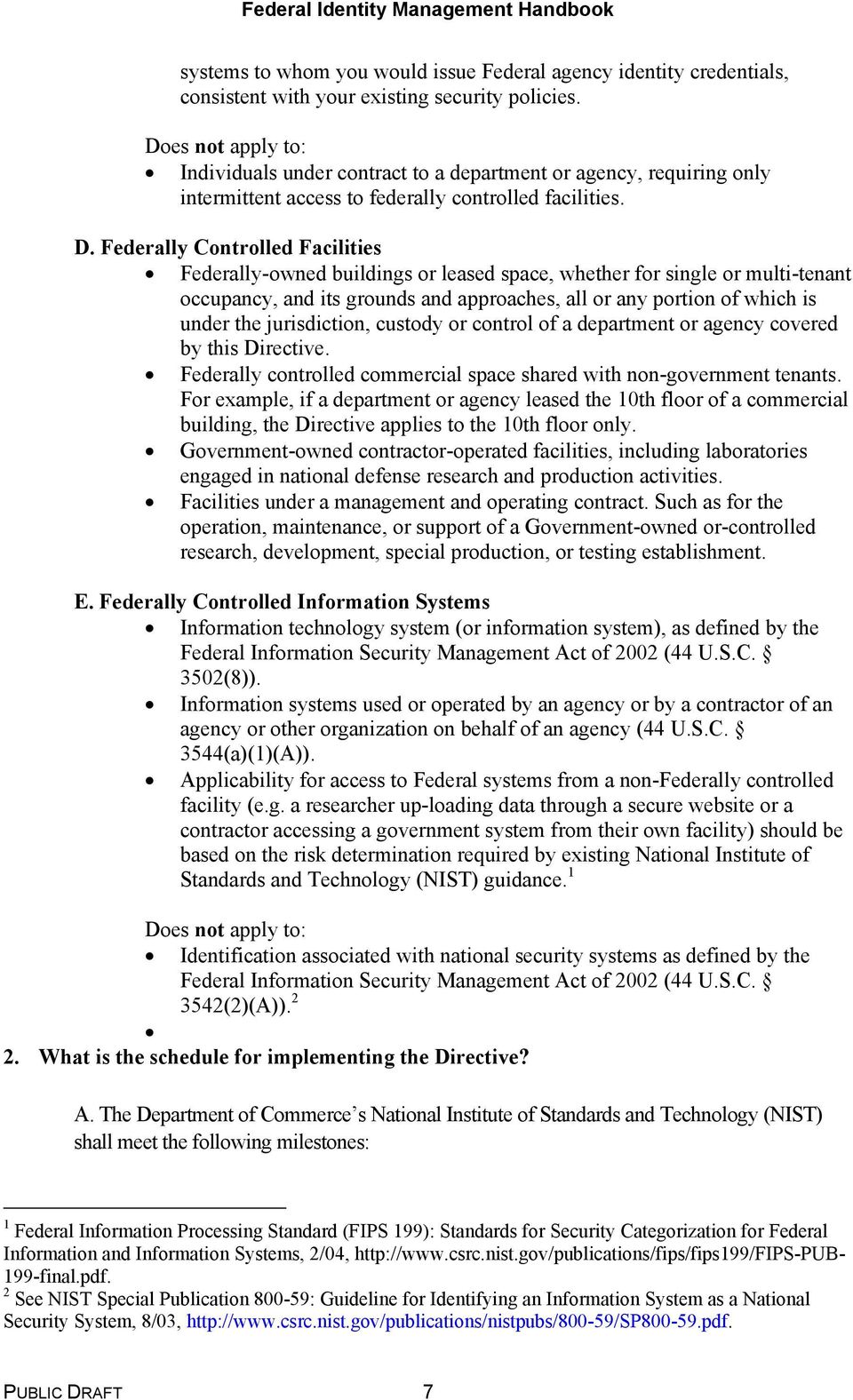
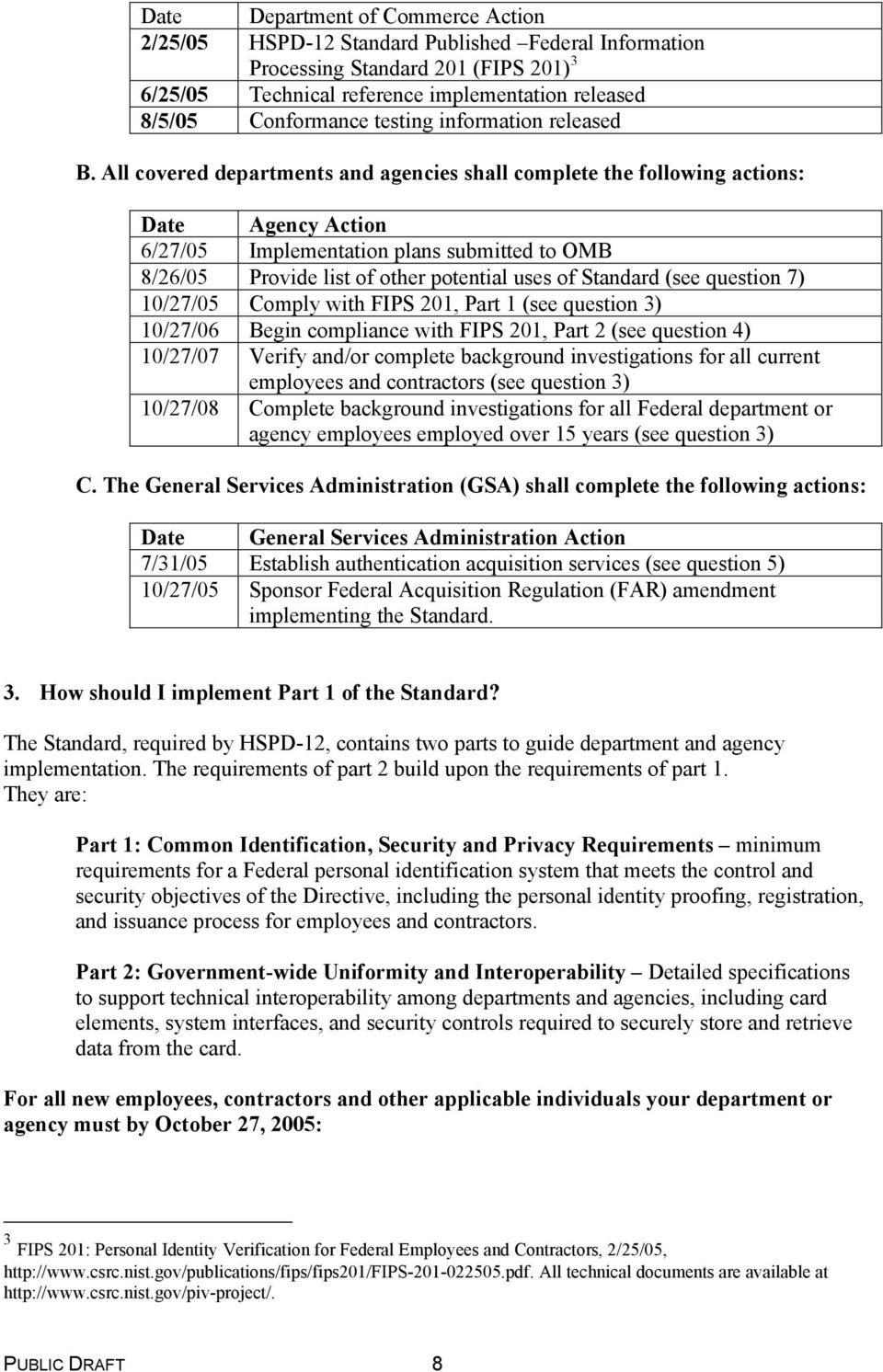
15 Date Department of Commerce Action 2/25/05 HSPD-12 Standard Published Federal Information Processing Standard 201 (FIPS 201) 3 6/25/05 Technical reference implementation released 8/5/05 Conformance testing information released B. All covered departments and agencies shall complete the following actions: Date Agency Action 6/27/05 Implementation plans submitted to OMB 8/26/05 Provide list of other potential uses of Standard (see question 7) 10/27/05 Comply with FIPS 201, Part 1 (see question 3) 10/27/06 Begin compliance with FIPS 201, Part 2 (see question 4) 10/27/07 Verify and/or complete background investigations for all current employees and contractors (see question 3) 10/27/08 Complete background investigations for all Federal department or agency employees employed over 15 years (see question 3) C. The General Services Administration (GSA) shall complete the following actions: Date General Services Administration Action 7/31/05 Establish authentication acquisition services (see question 5) 10/27/05 Sponsor Federal Acquisition Regulation (FAR) amendment implementing the Standard. 3. How should I implement Part 1 of the Standard? The Standard, required by HSPD-12, contains two parts to guide department and agency implementation. The requirements of part 2 build upon the requirements of part 1. They are: Part 1: Common Identification, Security and Privacy Requirements minimum requirements for a Federal personal identification system that meets the control and security objectives of the Directive, including the personal identity proofing, registration, and issuance process for employees and contractors. Part 2: Government-wide Uniformity and Interoperability Detailed specifications to support technical interoperability among departments and agencies, including card elements, system interfaces, and security controls required to securely store and retrieve data from the card. For all new employees, contractors and other applicable individuals your department or agency must by October 27, 2005: 3 FIPS 201: Personal Identity Verification for Federal Employees and Contractors, 2/25/05, All technical documents are available at PUBLIC DRAFT 8
16 A. Adopt and accredit a registration process consistent with the identity proofing, registration and accreditation requirements in section 2.2 of the Standard and forthcoming technical guidance issued by NIST, regardless of whether your agency will be ready to issue standard compliant identity credentials by October 27, This registration process will apply to all new identity credentials issued (i.e. no new identity credentials can be issued until these conditions are met). 4 B. Initiate the National Agency Check with Written Inquiries (NACI) or other suitability or national security investigation prior to credential issuance. Before issuing the credential, agencies should receive notification of results of the National Agency Checks. 5 If you do not receive the results in 5 days, the identity credential can be issued based on the FBI National Criminal History Check (fingerprint check). 6 Identity credentials issued to individuals without a completed NACI or equivalent must be electronically distinguishable (i.e. information is stored in the data on the card) from identity credentials issued to individuals who have a completed investigation. The Department of Commerce will provide the electronic format for this information. Agencies shall not re-adjudicate individuals transferring from another department or agency provided: 1) possession of a valid Federal identity credential can be verified by the individual s former department or agency, and 2) the individual has undergone the required NACI or other suitability or national security investigation at individual s former agency. Since Foreign National employees and contractors may not have lived in the United States long enough for a NACI to be meaningful, agencies should conduct an equivalent investigation, consistent with your existing policy. OMB will establish an interagency working group to explore whether guidance is necessary with respect to background investigations for foreign national employees and contractors. C. Include language implementing the Standard in applicable new contracts. All new contracts (including exercised options) requiring contractors (as defined in 1.C. above) to have long term access to federally controlled facilities or access to federally controlled information systems shall include a requirement to comply with the Directive and Standard for affected contractor personnel. Agencies must comply with the forthcoming Federal Acquisition Regulation sections on these requirements. For current employees, contractors and other applicable individuals, your department or agency must by October 27, 2005: D. For current employees, develop a plan and begin the required background investigations for all current employees who do not have an initiated or successfully 4 NIST Special Publication : Guidelines for the Certification and Accreditation of PIV Card Issuing Organizations, 7/05, 5 The National Agency Checks are the Security/Suitability Investigations Index (SII), Defense Clearance and Investigation Index (DCII), FBI Name Check, and FBI National Criminal History Fingerprint Check. The National Agency Check with Written Inquiries includes all of the National Agency Checks plus searches of records covering specific areas of an individual s background during the past five years. 6 Section 2.2 of the Standard has been revised to clarify for the initial credential issuance, only the fingerprint check must be completed. PUBLIC DRAFT 9

17 adjudicated investigation (i.e., completed National Agency Check with Written Inquires or other Office of Personnel Management [OPM] or National Security community investigation ) on record. By October 27, 2007 verify and/or complete background investigations for all current employees. At card renewal (every 5 years), the NACI requirements should be followed in accordance with OPM guidance. Currently OPM does not have a requirement to reinvestigate employees, not otherwise subject to an investigation (e.g. for a security clearance). For individuals who have been Federal department or agency employees over 15 years, a new investigation may be delayed, commensurate with risk, but must be completed no later than October 27, E. For current contractors and other applicable individuals, develop a plan and begin the required background investigations for all current contractors who do not have a successfully adjudicated investigation on record. Phase in this requirement to coincide with the contract renewal cycle, but no later than October 27, How should I implement Part 2 of the Standard? By October 27, 2006, all departments and agencies must begin deploying products and operational systems meeting these requirements: A. Issue and require the use of identity credentials for all new employees and contractors, compliant with Parts 1 and Part 2 of the Standard. For current employees and contractors, phase in issuance and use of identity credentials meeting the Standard to end no later than October 27, B. Implement the technical requirements of the Standard in the areas of personal authentication, access controls and card management, consistent with the Standard (i.e. sections 3, 4, and 5) and NIST Special Publication C. Risk Based Facility Access Use the appropriate card authentication mechanism described in section 6 of the Standard, with minimal reliance on visual authentication to the maximum extent practicable (section 6.2.1). Officials who control access shall determine the appropriate mechanism based on risk determinations. D. Use of Digital Certificates Compliance with the Standard requires the activation of at least one digital certificate on the identity credential for access control. This digital certificate (and any optional digital certificates on the identity credential) must originate from: 1) An agency certification authority cross-certified with the Federal BridgeCertification Authority at medium assurance or higher by December 31, 2005; or 2) An approved Shared Service Provider. 8 7 NIST Special Publication : Integrated Circuit Card for Personal Identity Verification, 4/8/05, 8 OMB Memorandum M-05-05: Electronic Signatures: How to Mitigate the Risk of Commercial Managed PUBLIC DRAFT 10

18 Agencies must require the use of the identity credential for system access. Prioritize this requirement based on risk, using your authentication risk assessments required by previous OMB guidance and the categorization required by FIPS Document the results and make available to your Chief Information Officer, security office and Inspector General s Office upon request. You are already required to have rules of behavior in place (including the consequences for violation) before employees and contractors are granted access to systems. 10 All employees and contractors must have access to this documentation. 5. What acquisition services are available? A. Requirement to use federally approved products and services To ensure government-wide interoperability, all departments and agencies must acquire products and services that are approved to be compliant with the Standard and included on the approved products list. A forthcoming Federal Acquisition Regulation will require the use of only approved products and services. B. Use of GSA Acquisition Services GSA has been designated as the executive agent for Government-wide acquisitions of information technology" under section 5112(e) of the Clinger-Cohen Act of 1996 (40 U.S.C (e)) for the products and services required by the Directive. GSA will report to OMB annually on the activities undertaken as an executive agent. GSA will make approved products and services available through blanket purchase agreements (BPA) under Federal Supply Schedule 70 for Information Technology, a schedule under the Multiple Award Schedules (MAS) Program. When developing BPAs, GSA will ensure all approved suppliers provide products and services that meet all applicable federal standards and requirements. Departments and agencies are encouraged to use the acquisition services provided by GSA. Any agency making procurements outside of GSA vehicles for approved products must certify the products and services procured meet all applicable federal standards and requirements, ensure interoperability and conformance to applicable federal standards for the lifecycle of the components, and maintain a written plan for ensuring ongoing conformance to applicable federal standards for the lifecycle of the components. C. Sponsorship For small departments and agencies and agencies who share facilities with another agency it may not be cost effective to procure your own products or services. GSA will identify agency sponsors who will provide a range of services to agencies. The extent and cost of services to be provided will be determined by agreement between the sponsor and the customer agency. Services, 12/20/04, 9 OMB Memorandum M-04-04: E-Authentication Guidance for Federal Agencies, 12/16/03, and FIPS 199: Standards for Security Categorization for Federal Information and Information Systems, 2/04, final.pdf. 10 See OMB Circular A-130 at PUBLIC DRAFT 11

19 6. How must I consider privacy in implementing the Directive? You are already required under the Privacy Act of 1974 (5 U.S.C. 552a), the E-Government Act of 2002 (44 U.S.C. ch. 36), existing OMB policy and section 2.4 of the Standard to satisfy privacy and security requirements. Implementing the Directive does not alter these requirements. In addition, prior to identification issuance you must: A. Ensure personal information collected for employee and contractor identification purposes is handled consistent with the Privacy Act of 1974 (5 U.S.C. 552a). B. Assign an individual to be responsible for overseeing the privacy-related matters associated with implementing this Directive. C. Submit to OMB, and make publicly available, a comprehensive privacy impact assessment (PIA) of your HSPD-12 program, including analysis of the information technology systems used to implement the Directive. The PIA must comply with section 208 of the E-Government Act of 2002 (44 U.S.C. ch. 36) and OMB Memorandum M of September 26, 2003, OMB Guidance for Implementing the Privacy Provisions of the E-Government Act of You must periodically review and update the privacy impact assessment. your completed PIA to [email protected]. D. Update the pertinent employee and contractor identification systems of records notices (SORNs) to reflect any changes in the disclosure of information to other Federal agencies (i.e. routine uses), consistent with Privacy Act of 1974 (5 U.S.C. 552a) and OMB Circular A-130, Appendix These SORNs should be periodically re-reviewed to ensure accuracy. E. Collect information using only forms approved by OMB under the Paperwork Reduction Act (PRA) of 1995 (44 U.S.C. ch. 35), where applicable. Departments and agencies are encouraged to use Standard Form 85, Office of Personnel Management Questionnaire for Non-Sensitive Positions (OMB No ) or the Standard Form 85P, Office of Personnel Management Questionnaire for Positions of Public Trust (OMB No ) when collecting information. If you plan to collect information from individuals covered by the PRA using a new form you must obtain OMB approval of the collection under the PRA process. F. Develop, implement and post in multiple locations (e.g., agency intranet site, human resource offices, regional offices, provide at contractor orientation, etc.) your department s or agency s identification privacy act statement/notice, complaint procedures, appeals procedures for those denied identification or whose identification credentials are revoked, and sanctions for employees violating agency privacy policies. G. Adhere to control objectives in section 2.1 of the Standard. Your department or agency may have a wide variety of uses of the credential not intended or anticipated by the Directive. These uses must be appropriately described and justified in your SORN(s) and PIA. 11 See PUBLIC DRAFT 12

20 Note: OMB has established a small working group to develop model language for common portions of the SORN, PIAs and Privacy Act Statements for department and agency use when implementing the Directive. These products will be completed no later than October 27, Is there anything else I must consider or know? A. Paragraph 5 of the Directive asks departments or agencies to identify those Federally controlled facilities, Federally controlled information systems, and other Federal applications that are important for security and for which use of the Standard in circumstances not covered by this Directive should be considered by August 26, This determination should be consistent with the privacy requirements specified in question 6 of this guidance and should include any uses of the Standard not meeting the control objectives listed in the Standard. If you have identified other facilities, information systems or applications, submit them to the Assistant to the President for Homeland Security, with an electronic copy to the Office of Management and Budget at [email protected]. B. Annual Reporting The applicability section of the Standard requires annual reporting on the numbers of agency issued credentials, to include the respective numbers of agency-issued 1) general credentials and 2) special-risk credentials (issued under the Special-Risk Security Provision on page v of the Standard). Future OMB guidance will address this requirement. C. Biometrics Implementation This OMB guidance is being issued before finalization of NIST Special Publication : Biometric Data Specifications for Personal Identity Verification. Agencies may defer the capture of biometrics for the identity credential until the NIST guidance is final. D. Employees Serving Undercover Agencies with employees who serve undercover shall implement this Directive in a manner consistent with maintenance of the cover, and to the extent consistent with applicable law and policy. E. Relationship to Personnel Security Clearances The directive reaffirms the existing requirement, first enumerated in Executive Order of April 27, 1953 to conduct background investigations on all Federal employees. This investigation is used to determine suitability. Thus, the investigation required by the directive is not the same as the investigations required for personnel security clearances or for public trust determinations. The issuance of a security clearance is a discrete privilege and should be done in accordance with applicable standards. Personnel security investigations for the purpose of issuing security clearances or for the purpose of making public trust determinations can be sufficient for the required background investigations required by the directive. F. Applying guidance to temporary employees and contractors The requirements for temporary employees and contractors should be viewed as the minimum requirements, dependent on risk and other factors. Agencies who employ temporary personnel (e.g.contract employment under special arrangements with schools, businesses, state and local governments, etc.) should apply this guidance as follows: PUBLIC DRAFT 13

21 Employed greater than 6 months Apply all sections of this guidance, including the background investigation requirements in the Standard (e.g. completed National Agency Check with Written Inquires [NACI] or other Office of Personnel Management or National Security community investigation ). Employed 6 months or less a) Apply adequate controls to systems and facilities (i.e. ensuring temporary staff has limited/controlled access to facilities and information systems). b) Provide temporary employees and contractors with clear documentation on the rules of behavior and consequences for violation before granting access to facilities and/or systems. c) Document any security violations involving these employees, and report them to the appropriate authority within 24 hours. d) Identity credentials issued to these individuals must be visually and electronically distinguishable from identity credentials issued to individuals to whom the Standard does apply. Agencies should be careful not to develop policies which overlap or contradict the Standard s processes for identity proofing and issuance. Occasional visitors a) Apply adequate controls to systems and facilities (i.e. ensuring visitors have limited/controlled access to facilities and information systems). b) Develop agency-specific visitor policies (as appropriate). PUBLIC DRAFT 14
22 1.3.3 HSPD-12 Implementation Roadmap Since every Government agency and/or department is conceivably at different points in the deployment of their current employee identification programs, it would be difficult to establish an approach to HSPD-12 implementation that would fit every situation. Recognizing this, in an effort to assist the reader, this section will present a high level roadmap as a guide to making the best use of this handbook. The handbook is structured similarly to the FIPS 201 document and is divided into two major parts: PIV I and PIV II. PIV I addresses methods for complying with the requirements for common identification, security and privacy. PIV II addresses methods for complying with the technology and migration requirements for a secure and interoperable PIV. The handbook presents guidance in other areas as well. For example, Section 5 contains useful information on acquisition planning, migration planning, lessons learned and presents examples of case studies of existing successful agency implementations. Section 5 also includes information on the FIPS 201 product conformance test suite, and the FIPS 201 baseline reference implementation. The reader can read the handbook from cover to cover or a specific section at a time. Agency implementers might want to use the Table of Contents or the Index to find a topic they wish to focus on and go to it directly. For example, the reader might want to start by gaining a better understanding of the near term requirements of PIV I. This can be accessed in Section 2. Following this, the reader may want to gain a better understanding of how to analyze their agency s current ID card environment to determine where they are relative to the goal. A method for performing this analysis is presented in Section 5.2, Migration Planning. Finally, a checklist is presented in Appendix B whose purpose is to enable implementers to track each step or requirement completed. Although ostensibly at different starting points in their journey, agency implementers may wish to see an example outline of general steps that may be taken in meeting their HSPD-12 goals. An initial outline follows. 1. Gain a clear understanding of HSPD-12 and FIPS 201 requirements by reviewing FIPS 201 and supporting documents as well as Sections 2 and 4 of this handbook. 2. Review OMB s guidance and schedule for HSPD-12 compliance in Section 1.3 of this handbook. 3. Gain a clear understanding of your agency s current policies for Credentialing, Physical Access Control, Logical Access Control, Graduated Security Criteria and Information Privacy. 4. Involve the primary Agency Stakeholders in the process. (For starters usually Management, Security Chief, Information Technology, Privacy Officer, Human Resources and Financial Officer) It s best to have regular sustained involvement from stakeholders rather than on an occasional basis. See section 5.2 of this handbook.. 5. Reach agreement on future policy as it pertains to item 3 above. This is a key item because these policies will drive other decisions later. PUBLIC DRAFT 15
23 6. Establish a list of objectives your agency wants to achieve while meeting the directive. 7. Using the policy decisions from item 6 above, develop an initial list of requirements for the project and an initial roadmap to achieve the objectives list in item When practicable, begin to analyze the budget requirements and funding sources outlined in Acquisition Planning, Section 5.1 of this handbook. 9. Compare the compliance requirements necessary to meet PIV I to your agency s current identity proofing, registration, issuance and maintenance process. Identify any gaps and add these to the plan. Remember that your agency s plan should ensure that the FIPS 201 requirements for privacy are implemented before PIV IDs are issued. Refer to Section 2.4. Once the plan takes shape, continue to build on other aspects, keeping the plan as simple as possible. Research other successful implementations and learn from the experience of others. Depending on the size and scale of your agency or department, analyze and consider the possibility of utilizing Agency PIV Sponsorship, found in Section 5.1 of this handbook. We hope that this example provides assistance in developing the thought process for the formation of your agency s plan. As they proceed, agency implementers are encouraged to seek assistance from other subject matter experts such as GSA s Smart Card Project Office and qualified industry service providers, Section 5.1 of this handbook. PUBLIC DRAFT 16
24 2. Registration and Issuance Requirements 2.1 Control Objectives HSPD-12 establishes control objectives for secure and reliable forms of identification. Federal departments and agencies shall implement government-wide identity proofing, registration, and issuance functions that accomplish the following: 1 a. Identification is issued based on sound criteria for verifying an individual employee s identity. b. Identification is strongly resistant to identity fraud, tampering, counterfeiting, and terrorist exploitation. c. Identification can be rapidly authenticated electronically. d. Identification is issued only by providers whose reliability has been established by an official accreditation process. HSPD-12 requires the implementation of the control objectives to protect the privacy of PIV subscribers. Agencies are required to comply with the identity-proofing, registration, issuance, and maintenance processes defined in PIV I to meet these control objectives no later than October 27, The cards that are issued in October 27, 2005 do not have to comply with PIV II, which defines the specifications for a PIV compliant identity card. To conform to these control objectives agencies should ensure that: 2 Credentials are only issued (1) to individuals under their true identity and (2) after a proper authority has authorized issuance of the credential. Only an individual with a completed background investigation 3 on record is issued a credential. An individual is issued a credential only after presenting two identity source documents, at least one of which is a valid Federal or state government picture ID. Fraudulent or altered identity source documents are not accepted as genuine. A person suspected or known to the Government as being a terrorist is not issued a credential. No substitution occurs in the identity-proofing process. More specifically, the individual who appears for identity proofing, and whose fingerprints are checked, is the person to whom the credential is issued. No credential is issued unless requested by proper authority. 1 FIPS 201, Federal Information Processing Standards Publication, Personal Identity Verification (PIV) for Federal Employees and Contractors, February, Ibid. 3 Results of the National Criminal History Fingerprint Check are sufficient for credential issuance. However, the NACI must still be completed PUBLIC DRAFT 17
25 A credential remains serviceable only up to its expiration date. More precisely, a revocation process exists such that expired or invalidated credentials are swiftly revoked. A single corrupt official in the process cannot issue a credential with an incorrect identity or to a person not entitled to the credential. An issued credential is not modified, duplicated, or forged. The following sections of this handbook, in addition to FIPS 201, provide agencies with best practices, lessons learned, and case studies in identity management to assist agencies in complying with PIV I. 2.2 Identity Proofing and Registration The FIPS 201 identity-proofing process constitutes a standard policy for Federal agencies to follow when they provide official Government identification for new employees and contractors. When the policy is followed consistently, it will help ensure that cardholders are who they claim to be. Adherence to a uniform identity-proofing process across the Federal Government will also help establish a baseline level of trust among agencies. HSPD-12 and FIPS 201 require Federal agencies to comply with the standard for identity-proofing employees and contractors by October Each Federal agency is responsible for verifying or validating the identity of individuals to whom it issues credentials. FIPS 201 establishes a specific level of trust in an individual s identity as part of a process that binds the ID card to an individual (e.g., employee or contractor). Once that level of trust is established, it is possible to establish a chain of trust among Government agencies. Establishing and binding a validated identity to a PIV credential at the time the credential is issued is the foundation for a trusted common identity credential accepted throughout the Federal enterprise. FIPS 201 is composed of two major sections, PIV I and II. Both of these sections define requirements for the identity-proofing and registration process. The initial requirement for agencies is to begin complying with PIV I by October 27, In order to be in compliance with PIV I agencies should implement a certified and accredited identity-proofing, registration, and issuance process for PIV cards across their enterprise. Note that compliance with PIV I does not require the issuance of a PIV II compliant card. Agency compliance with the PIV II component of the standard will begin by October 27, 2006, and will be discussed in subsequent sections of this document. For PIV I, verifying an individual s identity is the first step. FIPS 201 mandates processes and provides guidance on both the source documents required to validate an individual s identity and the process for issuing a Federal ID card. This section of the handbook provides additional guidance to help agencies comply with these requirements. A secure and robust identity-proofing process is the foundation for FIPS 201 compliance. A successful implementation of FIPS 201 is not contingent on technologies and systems only. If a PIV credential is issued based on a faulty identity-proofing process, the credential is compromised, no matter what technology it implements. FIPS 201 specifies an identity verification chain of trust for Federal agencies. An identity verification chain of trust comprises a common set of identity vetting rules that are used by multiple entities so that PUBLIC DRAFT 18
26 they can accept and trust one another s credentials. The chain of trust assures all parties involved that each participating entity followed the vetting procedures to securely and accurately verify an individual s identity. One of the goals is to permit agencies other than the issuing agency to accept a credential and avoid the requirement to issue a separate credential. This goal is also reflected in the Control Objectives of HSPD-12. The identity-proofing and registration process defined in Section 2.2 of FIPS 201 applies to the following categories of employees: New employees, contractors, and affiliates* Current employees, contractors, and affiliates* (* Affiliates are any other individuals whom an agency deems necessary to receive a PIV card.) A single identity-proofing and registration process is defined in FIPS 201 for government employees and contractors, which includes successful completion and adjudication of the National Agency Check. With Written Inquiries (NACI.) This process also applies to foreign nationals who are working for the Federal Government overseas (e.g., an Iraqi citizen working for the U.S. Agency for International Development); however, the process for registration and approval may vary from country to country and is under the administration of the U.S. Department of State/Bureau of Diplomatic Security or a U.S. area military commander, as applicable. General Requirements for PIV I Identity Proofing and Registration Requirements for PIV I Identity Proofing and Registration are as follows: 1. Agencies must use an approved identity proofing and registration process. 2. The process must begin with the initiation of a National Agency Check with Written Inquiries (NACI) or an equivalent Office of Personnel Management (OPM) or National Security investigation required for Federal employment. For current employees, this requirement is satisfied if the employee has a completed and successfully adjudicated NACI on file. 3. Before PIV credential issuance occurs, the FBI National Criminal history fingerprint check portion of the National Agency Check with Written Inquiries (NACI) must be completed and properly adjudicated. 4. The applicant must appear at least once in person in front of a PIV official before credential issuance can take place. 5. During identity proofing, the applicant must provide two identity source documents in original form. The documents must be on the list of acceptable documents included in I-9, OMB No , Employment Eligibility. One of the documents must be a valid (not expired) picture ID issued by a state government or the Federal Government. 6. The PIV identity-proofing, registration, and issuance process must adhere to the principle of separation of roles. No single individual may have the power to request issuance of a PIV credential without the approval of a second authorized person. PUBLIC DRAFT 19
27 Each department or agency must accredit its identity proofing and registration process. For the purposes of compliance by October 27, 2005, agencies may self-assert compliance; this requires approval in writing by the head of the department or agency. When making the self-assertion, departments or agencies should identify those individuals who have direct oversight responsibilities and accountability for the identity proofing and registration process. Subsequently, the identity proofing and registration process must be officially certified and accredited in accordance with Special Publication : Guidelines for the Certification and Accreditation of PIV Card Issuing Organizations Identity-Proofing Recommendations Temporary Access and Access-Pending Authorization No new employee or contractor can be issued a Federal identity card until the identity-proofing process is completed. Employees may require access to buildings and systems, pending the completion of these requirements. Also, certain individuals do not require a PIV card but do need access to facilities, such as individuals who fill vending machines. Individual agency procedures for temporary visitor access should be applied in both of these situations. It is the responsibility of each agency to design its temporary badges. The design of temporary and visitor badges should be physically and electronically unique and easily differentiated from an official PIV card. This practice eliminates the possibility of mistaking temporary and visitor badges for valid PIV credentials. The exact specifications of a PIV-compliant identity credential can be found in Section 4.1 of this document Agency Affiliates and Agency Partners Many agencies have affiliates or partners that require logical and/or physical access to do their jobs and that do not fall under the category of employee or contractor. Examples of affiliates and partners are visiting professors, guest faculty or fellowship recipients, interns or temporary help, and task-force members. Each agency must determine whether these individuals require a PIV card based on the individual s type of duties and the term of service. If so, then all identity-proofing and issuance requirements in FIPS 201 must be met. OMB guidance suggests that temporary employees (less than 6 months), short-term guests and occasional visitors to Federal facilities do not require a PIV card. If agencies determine that affiliates and/or partners do not require a PIV card, agencies are encouraged to implement agency-specific policies for these individuals. Agencies should be careful not to develop policies that overlap or contradict the FIPS 201 processes for identity proofing and issuance Identity Source Documents Applicants are required to provide two forms of identification when applying for a PIV card. The following link provides the acceptable forms of identification listed I-9, OMB No , Employment Eligibility ( One of these documents must be a valid state of Federal issued photo ID. Individuals involved in the PIV identityproofing process should be trained in document inspection. Additionally, individuals who are responsible for identity proofing within agencies need access to electronic (when available) and nonelectronic means for verifying the authenticity of identity source documents. The validity of identity source documents should be verified by electronic means whenever possible. Electronic methods that perform document verification are available commercially and most operate in PUBLIC DRAFT 20
28 a similar manner. An electronic reader reads the document, such as a driver s license. The reader confirms the likelihood that the document is valid (not fraudulent or expired) and has not been altered in any way. This electronic validation is not infallible, nor does it attest to the individual s trustworthiness; however, it is more reliable than relying on visual inspection alone. In some cases, the issuer of the identity source documents may provide a means to directly verify the document s authenticity electronically. When all else fails, manuals exist that list all valid state driver s licenses and their features and topology Notifications and Document Management Agencies should develop a secure and robust workflow for notification when each step of the identityproofing process for an applicant is completed (for example, notification that a credential can be issued). The workflow method that is implemented should: Be secure Be auditable Protect the applicant s privacy Depending upon the volume of applicants, it may be beneficial for some agencies to implement a secure electronic workflow method for managing PIV notifications and documents. Additionally, each agency requires proper security controls to manage the submission and storage of relevant identity source documents throughout the identity-proofing process. Data should be protected in transit and at rest using FIPS approved encryption algorithms. When identity source documents are transferred, either manually or electronically, it must be done securely. Some examples of secure transmissions include sending the documents using encrypted , exchanging the documents via secure intranet or internet connection, or placing duplicates of the original documents in a sealed and secure envelope and transporting them so that they are never out of the possession of the transporter. The United States Postal Service and several commercial companies provide secure transport of documents. Additionally, it is the responsibility of the PIV Registration process (described in Section 2.3.2) and the identity management system (IDMS) (described in Section ) to maintain the following documentation: Completed and signed PIV request Completed and signed SF 85 (or equivalent) Information related to the Applicant s identity source documents Results of the Applicant s background check Copies of the photograph and fingerprints of the Applicant Any additional documents used to prove the identity of the Applicant The PIV Registration process and the IDMS should, at a minimum, maintain these documents for the life cycle of the Applicant s employment, or until expiration of the individual s credential / enrollment. Individual agencies may provide additional guidance concerning how long employees identity source PUBLIC DRAFT 21
29 documents have to be maintained. The items that are maintained by the PIV Registration process and IDMS should be maintained securely. If the documents are maintained as hard copy, they should be stored in a secure facility. If the documents are maintained electronically, they should be stored in a secure database. Individual agencies should develop a standardized business process for storing and maintaining this information Background Checks Background checks in the form of a NACI or equivalent is required for all employees and contractors who apply for a PIV card. At a minimum, before a PIV card can be issued, a FBI National Criminal History Fingerprint check must be completed. The U.S. Investigative Service (USIS) or Federal Investigative Processing Center (FIPC) conducts all NACI checks for non-department of Defense (DoD) employees. The Defense Security Services (DSS) conducts NACI checks for DoD employees. Standard NACIs are composed of a Security/Suitability Investigations Index (SII), Defense Clearance and Investigation Index (DCII), FBI Name Check, and FBI National Criminal History Fingerprint Check., along with written inquiries and search of records covering specific areas of an individual s background during the past five years (inquiries sent to current and past employers, schools attended, references, and local law enforcement authorities). 4 Each agency will have differing requirements for determining if a NACI is satisfactory and thus credential issuance can take place. This is because NACIs do not present information in a pass or fail manner; they provide a report to agencies and then agencies can adjudicate the NACI and determine whether an individual should be issued a credential. However, all agencies should follow OPM Guidance on adjudication, 5 CFR 731(see Appendix E). An example NACI can be found at the following location, FIPS 201 Card Issuance and Maintenance Compliance with FIPS 201 requires that all Federal identity cards be issued by a certified and accredited issuance process. Today, many Federal agencies are in different stages of development with regard to their credentialing strategies for physical and logical access. Some agencies are deploying chip-based smart card technology while others are not. Some agencies are deploying PKI credentials while others are not. Regardless of the type and form of identification an agency is issuing, all agencies must comply with PIV I card issuance control and security requirements by October This means that by October 2005, an agency may continue to issue its current employee identification; however, the controls and procedures surrounding the issuance of official government identification must be in compliance with PIV I. Training will be provided for the various roles associated with FIPS 201. As of publication of this document the training modules are under development and information concerning training will be provided as it becomes available General Requirements for Issuance and Maintenance To achieve compliance with FIPS 201 card issuance requirements, at a minimum the following must be met. 4 Ibid. PUBLIC DRAFT 22
30 1. Agencies must use an approved, certified, and documented credential issuance and maintenance process. 2. The FBI National Criminal History Fingerprint Check must be completed and adjudicated before issuance can take place. Further, the process shall ensure completion and successful adjudication of the National Agency Check with Written Inquiries (NACI), or other OPM or National Security community investigation as required for Federal employment. 3. The credential must be revoked or withheld if the results of the NACI are deemed to be nonsatisfactory by the issuing agency. 4. Prior to the release of a PIV credential to an applicant, the issuer must complete the chain of trust by verifying that the photograph in the registration or enrollment record matches the applicant. Upon successful match, the issuer shall release the PIV credential to the applicant. 5. Agencies must issue credentials through systems and providers whose reliability has been established by the agency and documented and approved in writing. For October 27, 2005 the agency may self certify that the PIV issuance and maintenance process adopted for that particular agency meets PIV I of FIPS 201. This self-certification requires written concurrence by the head of the department or agency. As a requirement of the FIPS 201, by October 2005, Federal agencies must document their PIV issuance and maintenance policy, validate the reliability of the systems and providers that issue credentials, and approve their reliability in writing. This is one of the control objectives stated in HSPD-12. Fundamentally, reliability of the systems and providers who issue credentials should indicate that those systems and providers are accredited and secure. NIST SP , Guidelines for the Certification and Accreditation of PIV Card Issuing Organizations, 5 should be used by agencies to validate reliability. To further illustrate how a compliant system would operate, FIPS 201 outlines two models of identity proofing, registration, issuance, and maintenance of Federal credentials that meet the control objectives for PIV I. They are a role-based model and a system-based model. These are examples only of compliant systems; agencies are free to implement alternative processes, provided the requirements above are met. To assist agencies in determining that their processes meet the PIV I requirements, a checklist will be provided. It is recommended that the agency enrollment/clearance processes be evaluated against this checklist to ensure that there are no deficiencies in the agency processes as they pertain to FIPS 201 compliance Role-Based Model Example The role-based model assigns PIV identity-proofing responsibilities to individuals, based on the roles and functions they perform. In this model, one person cannot perform multiple roles; with one exception: the PIV Issuer and PIV Digital Signatory functions may be performed by the same entity. This requirement safeguards against the possibility of collusion between an applicant and the issuing authority. 5 NIST Special Publication , Guide for the Security Certification and Accreditation of Federal Information Systems, NIST, May PUBLIC DRAFT 23
31 Individual agencies will determine who performs each role for that agency. Each agency should also implement training for the roles Description of Roles The PIV role-based identity proofing process defines the following roles: Applicant PIV Sponsor PIV Registrar PIV Issuer PIV Digital Signatory PIV Authentication Certification Authority (CA) The Applicant is the individual to whom a PIV card will be issued once the PIV Registrar approves the application and the appropriate background checks have taken place. In support of the application process, the Applicant should complete the following activities: Complete an SF 85 or equivalent. Present two forms of identification included in the acceptable documents list included in Form I-9, OMB No , Employment Eligibility Verification. One of the identification forms must be a valid state or Federal issued picture ID. The PIV Sponsor is the individual who validates an Applicant s requirement for a PIV credential and sponsors the Applicant s request. The PIV Sponsor should meet the following minimum standards: Be a government official and be authorized in writing by the agency to request a PIV card. Have valid justification for requesting a PIV card for an Applicant. Be in a position of responsibility for the agency. Have already been issued a valid PIV card. Have successfully completed the Federal PIV Sponsor training module. The PIV Registrar is the individual or entity that performs the identity-proofing process for the Applicant and ensures that the proper background checks have taken place with positive results. The PIV Registrar has final approval authority for issuance of a PIV credential to an Applicant. Once the background check is completed successfully, the PIV Registrar notifies the PIV Issuer that a PIV credential can be issued to the Applicant. The PIV Registrar should meet the following minimum standards: Be a government official and be designated in writing as a PIV Registrar. PUBLIC DRAFT 24
32 Be able to assess the reasonableness of the Applicant s identity-proofing documents. Reasonableness in this context indicates that the PIV Registrar is trained to detect any improprieties in the Applicant s identity-proofing documents. Be able to evaluate whether a PIV application is satisfactory and apply agencyspecific processes to an unsatisfactory PIV application. Thus, the PIV Registrar needs training on agency processes and procedures for adjudicating an unsatisfactory PIV application. Have successfully completed the PIV Registrar roles and responsibilities training module. The PIV Issuer is the individual or entity that issues an identity credential to an Applicant following the positive completion of all identity proofing, background checks, and related approvals. The PIV Issuer should meet the following minimum standards: Be designated in writing as a PIV Issuer. If performed by a non government official the individual must be designated to perform this role by a government official within the agency and be designated in writing as an Issuing Authority. Have successfully completed the PIV Issuer roles and responsibilities Training module. The PIV Digital Signatory is the entity that signs the PIV biometric and cardholder unique identifier (CHUID) of the Applicant. The PIV Digital Signatory should meet the following minimum standards: Be designated in writing as a PIV I Digital Signatory. Has been issued a PIV Signatory Certificate for the purpose of signing PIV biometric data and CHUID information. Responsible for the secure management of the PIV Digital Signatory certificate at all times. The PIV Authentication Certification Authority (CA) is the CA that signs and issues the PIV Authentication Certificate of the Applicant. The PIV Authentication CA should meet the following minimum standards: Either participate in the Federal PKI for the Common Policy managed by the Federal PKI Policy Authority as a Shared Service Provider or be an Agency owned CA that is cross-certified with the Federal Bridge Cross Certification Authority at medium assurance or higher. Conform to Worksheets 1-3 in X.509 Certificate and CRL Profile for the Common Policy. Conform with issuance of certificates that meet Worksheets 4-6 in the X.509 Certificate and CRL Profile for the Common Policyor their replacements when a planned revision is published. PUBLIC DRAFT 25
33 Training All of the roles defined above should be implemented in an agency s identity-proofing process. Each role is unique and has its own requirements. Training should be provided to ensure that each role functions properly. Individuals who are designated for the roles identified above will require training in two areas: Agency-specific processes and procedures. These are the processes and procedures that are unique within each agency (for example, the method for adjudicating an unsatisfactory PIV application). PIV-specific processes and procedures. These are the processes and procedures that are unique to the PIV identity-proofing process (for example, the methodology for assessing the completeness of an Applicant s request or the steps involved in completing a PIV application form). Standardized PIV roles and responsibilities training has been made available by the FICC. The Department of Interior has led an effort to develop a computer based training module that addresses all of the roles and responsibilities. It is recommended that Agencies start with this training. A certification test is available upon completion via the USALearning website. For further information regarding this training module contact [email protected] Identity-Proofing and Registration Process Steps This section describes the requirements for the role based identity-proofing and registration steps. Agencies can implement more stringent requirements as long as they follow the minimum requirements defined below. 1. The PIV Sponsor completes a PIV request for an Applicant. (Appendix C depicts a sample PIV request). 2. The PIV Sponsor submits the request to the PIV Registrar and the PIV Issuer. 3. The PIV Registrar confirms the validity of the PIV request. 4. After the request is validated, the Applicant completes an SF 85, Questionnaire for Non- Sensitive Positions or its equivalent. (a blank SF 85 can located at the following location, 5. The Applicant provides the appropriately completed and signed form to the PIV Registrar. 6. The Applicant appears in person and provides two identity source documents to the PIV Registrar. At least one of the identity source documents should be a valid picture ID issued by a state or by the Federal Government. 7. The PIV Registrar visually inspects the identity source documents and validates them electronically as being unaltered and authentic. (If electronic means are unavailable, the PIV Registrar uses another means to authenticate the identity source documents.) The PIV Registrar also verifies that the picture on the identity source documents is of the Applicant. PUBLIC DRAFT 26
34 8. If the PIV Registrar is able to validate the documents successfully, the Registrar records the following information for each of the identity source documents provided by the Applicant. This information may also be scanned: The title of the document The document s issuing authority The document s number, as listed on the document The document s expiration date, if available Any other information deemed necessary to confirm the identity of the Applicant 9. The PIV Registrar signs and files the record of the collected information. The PIV Registrar is not required to keep a copy of the original documents, to reduce the likelihood that an Applicant s identity source documents are compromised. 10. The PIV Registrar compares the information on the PIV Request to the information provided on the SF 85 (or equivalent) and the identity source documents to ensure that the information is the same on all forms. 11. The PIV Registrar obtains and retains a copy of the electronic facial image of the Applicant. The facial image should meet the requirements specified in SP (Per FIPS 201, a facial image is printed on the card but is not required to be stored electronically in a PIV card) 12. The PIV Registrar collects and retains all 10 fingerprints of the Applicant. Two of these fingerprints should be collected in accordance with the instructions in Section 4 of this document. 13. The PIV Registrar initiates a National Agency Check with Inquiries (NACI) on behalf of the applicant. Agencies will need to define a specific adjudication process for when such investigations return unfavorable results. This process will need to include timely notification and appeal methods for the applicant, at a minimum. See Appendix E. 14. The PIV Registrar notifies the PIV Sponsor and PIV Issuer of the results of the process. If all steps have been completed successfully, the Sponsor and Issuer are notified that the applicant has been approved for a PIV card. If any of the background checks are unsuccessful or if there are irregularities in the applicant s information, the Sponsor and Issuer are notified that irregularities have occurred. 15. The PIV Registrar uses a secure process to make the following information available to the PIV Issuer: Applicant s electronic photo A copy of the results of the Applicant s background investigation Other data associated with the Applicant (i.e., Applicant s name, affiliation, contact information) PUBLIC DRAFT 27
35 16. The PIV Registrar should make the following information available to the PIV Digital Signatory via a secure process: Electronic biometric data for card personalization Other data associated with the Applicant that is required for the generation of signed objects for card personalization 17. The PIV Registrar maintains the following information pertaining to the Applicant: Completed and signed PIV Request Completed and signed SF 85 (or equivalent) Information concerning the identity source documents collected in Step 8. The results of the applicable background check Copies of photo and fingerprints collected in Steps 11 and 11. Any other relevant materials used to validate the Applicant s identity Current employees with a valid background check on file do not require an additional background check. The PIV Registrar can notify the PIV Issuer that a credential can be issued to the Applicant if a valid background check is on file Issuance Steps 1. The PIV Issuer (or authorized delegate) shall confirm the validity of the PIV Request received from the PIV Sponsor, and the approval notification received from the PIV Registrar. The PIV Issuer shall also confirm that the approval notification is consistent with the results of the background investigation. Agencies should develop a precise business process for distribution and confirmation of the PIV request and the approval notification. This is discussed below. 2. The PIV Issuer (or authorized delegate) shall initiate the creation of a CHUID for the new PIV Card. The CHUID shall be made available to the PIV Digital Signatory through a secure mechanism. 3. The Digital Signatory shall create digitally signed credential elements (biometric and CHUID) needed for the card personalization process, using the data supplied by the PIV Registrar and the newly assigned CHUID. The digitally signed credential elements shall comply with the relevant specifications in Sections and The signed credential elements shall be made available to the PIV Issuer. 4. The Applicant may be asked to provide a PIN, or the PIV Issuer may generate a PIN on the Applicant s behalf. 5. The PIV Issuer (or authorized delegate) shall personalize the PIV card. The personalized PIV Card shall meet all of the technical and interoperability specifications in Section The Applicant may generate cryptographic key pairs for the PIV card through the PIV Authentication CA and obtain the corresponding certificates from the PIV Authentication CA at this time. Alternatively, the Applicant may be supplied with a one-time authenticator for use PUBLIC DRAFT 28
36 in a subsequent certificate request to the PIV Authentication CA. In the latter case, the Applicant will generate key pairs at a local workstation rather than at the PIV Issuer location. Encryption key pairs may already be generated and escrowed (again, this could be done at the centralized issuance facility). 7. The recipient s name, issuer identity, card number, and possibly PKI certificate identification information shall be enrolled and registered with back-end data stores that support the PIV system. Depending on the infrastructure design, the back-end data stores may be centralized or decentralized. 8. The PIV Issuer (or authorized delegate) shall control the creation and personalization of a new PIV card using the information provided by the PIV Registrar. Card personalization can occur either during the actual issuance transaction (i.e., in the presence of the Applicant) or prior to the Applicant appearing in person to collect the card from the PIV Issuer. This is described in further detail below. 9. The Applicant shall appear in person before the PIV Issuer (or an authorized delegate) to collect the PIV card. Before the newly created PIV card is given to the Applicant, the PIV Issuer shall verify that the individual who collects the identity credential is indeed the Applicant through the following steps: The individual shall present a state or Federal government-issued picture identity source document (this should be the same documentation presented during registration, See Section item 6.) The PIV Issuer (or an authorized delegate) shall validate that the picture and name on this source document match the picture and name on the newly personalized PIV card. Additionally, the PIV Issuer (or an authorized delegate) shall validate that the individual looks like the picture on the PIV card. The PIV Issuer (or an authorized delegate) shall check that the fingerprint of the individual matches the biometric credential embedded in the PIV card. The check should meet the requirements of SP It is important to note the requirement for the Applicant to appear in person to the PIV Issuer to receive the PIV credential. Agencies should plan their issuance strategies carefully in order to comply with this requirement. Agencies should base their decision on: Internal review of issuance infrastructure Issuance population Individuals designated as a PIV Issuer 10. The PIV Issuer shall obtain a signature (depending on agency specific rules this could be a digital signature) from the Applicant (now PIV cardholder) attesting to the Applicant s acceptance of the PIV card and related responsibilities. This requirement is to ensure that the PIV cardholder has taken acceptance of the PIV card as well as been informed of the responsibilities involved in its ownership. PIV cardholders should be informed of the following: PUBLIC DRAFT 29
37 If their PIV card begins to wear (i.e.. laminate coming lose, ink rubbing off, cuts/rips/tears occur in the card) they shall return to the PIV Issuer immediately. If their PIV card is lost or stolen, they shall notify the PIV Issuer immediately. If their PIV card does not operate properly when inserted into a logical or physical access reader, they shall notify the PIV Issuer immediately. If any personal information changes, the PIV cardholder shall notify the PIV Issuer immediately (i.e., changes in affiliation, name change, or other personal information changes). As one final check the PIV Issuer may conduct a one-to-one fingerprint biometric check on the Applicant. Although this is not required in PIV I, agencies should consider implementing a method whereby the PIV Issuer conducts a one-to-one fingerprint biometric check between the Applicant s enrolled image and a live sample before issuing the card. This one-to-one check provides additional assurance that the individual who applied and was enrolled for a PIV card is the same individual who is being issued a PIV card, thus, increasing confidence in the Applicant s identity. 11. When all of the above requirements are completed, the PIV Issuer shall notify the PIV Sponsor and the designated PIV Registrar that the personalization and issuance process is complete. Conversely, if any of the required steps are unsuccessful, the PIV Issuer shall send appropriate notifications to the same authorities. Agencies should develop a secure and timely scheme for notifying the PIV Sponsor and PIV Registrar of PIV credential personalization and issuance to a PIV cardholder. In circumstances where any of the steps are unsuccessful, agencies should follow internal policies and procedures for adjudication of an Applicant s PIV request. 12. The PIV Issuer shall be responsible for maintaining the following: Completed and formally authorized PIV Request The approval notice from the PIV Registrar The name of the PIV Applicant The credential identifier, such as an agency card serial number The expiration date of the identity credential The signed acceptance form from the Applicant. Records and controls for PIV card stock, to ensure that stock is only used to issue valid credentials. Agencies should establish a business process and secure delivery method for all PIV-related documents. Agencies can implement a system-based model that provides all or part of the data and document management requirements for storage, notifications, and approval/disapprovals electronically. This can include web-based applications for use by the PIV Sponsor, PIV Registrar, and PIV Issuer functions. Alternatively, agencies could choose to implement a business process that is more manual in its functionality. This process would consist of documents stored in hard-copy form and notifications and approvals/disapprovals generated via or telephone communication from one role to another. Regardless of the exact business process implemented by the agency, the process PUBLIC DRAFT 30
38 should be auditable and secure, and provide for protection of the privacy the applicant s information privacy System-Based Model Example The system-based model may be ideal for agencies that already have an automated identity management system. The sections below summarize the roles, components, and processes of a typical system-based model System Based Roles The PIV system-based identity proofing process defines the following roles: Applicant Employer/Sponsor Approval Authority Enrollment Official Issuing Authority (Issuer) The Applicant is the individual to whom a PIV card will be issued once the PIV Registrar approves the application and the appropriate background checks have taken place. The Applicant must appear in person to the Employer/Sponsor or the Approval Authority or the Issuing Authority at least once prior to issuance of a PIV card. In support of the application process, the Applicant should complete the following activities: Complete an SF 85 or equivalent Present two forms of identification from the list of acceptable documents listed on I- 9, OMB No , Employment Eligibility The Employer/Sponsor is the individual who validates an Applicant s requirement for a PIV card and authorizes the Applicant s request. The Employer/Sponsor should meet the following minimum standards: Be a government official and be authorized in writing by the agency to request a PIV card Have valid justification for requesting a PIV card for an Applicant Be in a position of responsibility for the agency and defined as such by the agency Have already been issued a valid PIV card Have successfully completed the Federal PIV Sponsor roles and responsibilities training module The Enrollment Official is the individual, who initiates the chain of trust for identity proofing and provides trusted services to confirm employer sponsorship, bind the Applicant to their biometric, and PUBLIC DRAFT 31
39 validate the identity-source documentation. The Enrollment Official delivers a secured enrollment package to the IDMS for adjudication. The PIV Enrollment Official should meet the following minimum standards: Be a government official and be designated in writing as a PIV Enrollment Official Be able to assess the reasonableness of the Applicant s identity-proofing documents. Reasonableness in this context indicates that the PIV Enrollment Official is trained to detect any improprieties in the Applicant s identity-proofing documents Be able to evaluate whether a PIV application is satisfactory and apply agencyspecific processes to an unsatisfactory PIV application. Thus, the PIV Enrollment Official needs training on agency processes and procedures for adjudicating an unsatisfactory PIV application Have successfully completed the PIV Enrollment Official roles and responsibilities training module The Approval Authority establishes the organizational chain of command within the IDMS. This individual also manages the scope of the chain of trust between the enrollment process, the IDMS, card production and activation. This individual manages the entire IDMS and is also responsible for designating those individuals who will perform the duties of the Employer/Sponsor. Additionally, the Approval Authority should make sure that no single individual/role has the capability to issue a card without the participation of another individual and that there are at least two different individuals participating in the process at all times. The Approval Authority should be responsible for validating and auditing all of the checks that are conducted by the IDMS. The Approval Authority should meet the following minimum standards: Be a government official and be designated in writing as an Approval Authority Be in a position of responsibility for the agency and defined as such by the agency Have already been issued a valid PIV card Have successfully completed the Federal Approval Authority roles and responsibilities training module The Issuing Authority (Issuer) is the individual or entity who activates and issues a PIV card to an Applicant following the positive completion of all identity proofing, background checks, and related approvals. The Issuing Authority is responsible for ensuring that a one-to-one biometric check of the Applicant s enrolled fingerprint biometric image matches the fingerprint image at card issuance. The Issuing Authority should meet the following minimum standards: Designated in writing as a PIV Issuing Authority. If performed by a non government official the individual must be designated to perform this role by a government official within the agency and be designated in writing as an Issuing Authority PUBLIC DRAFT 32
40 Components Have successfully completed the Issuing Authority roles and responsibilities Training module Certain components are associated with the system-based model. These components automate some of the tasks that are completed manually in the role-based model. A description of these components follows. The Approval Authority maintains the IDMS. The IDMS contains records, including all documentation for all issued PIV cards. The IDMS is generally a collection of databases and interfaces that work together to perform the various functions described below. Some examples of components associated with the IDMS include a biometrics data repository, an account management function, a card management system, and a PKI infrastructure. The IDMS is typically just one part of an integrated identity management solution. The card management system within the IDMS should track the status of a PIV card throughout its entire lifecycle, including the production-request, personalization and printing, activation and issuance, suspension, revocation, and destruction phases. Additionally, the IDMS performs the identity proofing, verification, and validation of an Applicant prior to PIV issuance. The biometric database within the IDMS has the capability to do a one-to-many fingerprint biometric search on all Applicants in the system to ensure that no Applicants have already been issued a PIV card and are requesting additional PIV cards fraudulently. In accordance with HSPD-11, 6 the IDMS will have the capability to conduct identity verification and validation processes using government-wide databases and services. In addition, the IDMS should provide the following services: Notify Applicants of the status of or be available to be queried by the applicant for their PIV requests. Applicants should not be able to query the IDMS directly Notify the Employer/Sponsor of or be available to be queried by the Employer/Sponsor for the PIV request Notify or be available to be queried by the Employers/Sponsors, Approval Authorities, and Issuing Authorities to see if a credential is still valid The IDMS should contain all data records and be responsible for providing the Applicant s data record that will be used by the Card Production and Personalization system. The IDMS should provide the card personalization information via secure means. The Enrollment System initiates the chain of trust for identity proofing by confirming employer sponsorship, validating identity documentation, binding Applicants to their biometric data, and validating identity documentation. The enrollment system provides the IDMS with all of the identity documentation and forms that an Applicant completes prior to PIV card issuance. Although not defined in FIPS 201, agencies will have to establish an Enrollment Official to be responsible for operating the enrollment system. Because this individual will have access to Applicants personal information and biometric data, the Enrollment Official should be properly vetted and be trained to operate the enrollment system. The Card Production and Personalization System personalizes and prints PIV credentials after the IDMS has approved such actions. Additionally, the IDMS should provide the following services: 6 Homeland Security Presidential Directive 11 (HSPD-11) defines comprehensive terrorist-related screening procedures. PUBLIC DRAFT 33
41 Maintain full inventory control of blank card stock, consumables, and manufacturing materials Maintain a list of IDMSs that can submit PIV requests for card production Maintain a list of Issuing Authorities that can activate and issue PIV cards Provide electronic acknowledgement of IDMS requests for PIV card production Notify the IDMS of successful/unsuccessful production of a PIV card Allow only approved individuals to access an Applicant s card personalization information These systems are essential in maintaining the chain of trust. Therefore, for each of the systems listed above, there should be a documented business process, a security evaluation, and a security policy Issuance Steps This section describes the requirements for the system-based identity-proofing and registration process defined in FIPS 201. Agencies can implement more stringent requirements as long as they follow the minimum requirements defined below. All actions taken and systems associated with those actions should be auditable and secure. 1. Employers/Sponsors are pre-registered in the IDMS 2. The Applicant provides a formal PIV request and a minimum of two forms of acceptable identity documentation from I-9, OMB No , Employment Eligibility to the Employer/Sponsor. At least one of the documents must be a valid picture ID issued by a state or by the Federal Government. 3. The Employer/Sponsor approves the request. 4. The Applicant appears for enrollment and provides the same documentation as provided to the Employer/Sponsor. The Applicant consents to enrollment and collection of demographic and biometric information for vetting and proofing identity and conducting background checks for the purpose of issuing a PIV card. 5. The Applicant s identity documents are inspected and verified. If available, an electronic method should be used to check the validity of the identity documents. 6. The Employer/Sponsor s approval is verified. 7. Fingerprints and a photograph of the Applicant are taken. The fingerprints and photograph must meet the standards defined in Sections and 4.4of this document. 8. The Applicant s supporting documents are scanned into the system electronically. 9. The Applicant s completed electronic enrollment package (scanned documents, biometric samples, and digital photograph) are digitally signed and forwarded to the IDMS. 10. The IDMS verifies the integrity of the enrollment package by confirming completeness and accuracy and that the digital signature is valid. PUBLIC DRAFT 34
42 11. The IDMS confirms that the Employer/Sponsor is valid and approved the request. 12. The IDMS performs a one-to-many fingerprint biometric search to ensure that the Applicant is not already enrolled in the system. 13. The IDMS performs appropriate identity verification and validation through government-wide databases in accordance with HSPD-11 (HSPD-11 can be found at the following location, Once the IDMS has successfully completed steps 10 13, the Approval Authority approves card production for the Applicant. 15. The IDMS sends the information necessary for card personalization to the card production and personalization system. 16. The card production and personalization system personalizes and prints the PIV card. 17. Prior to issuing the PIV card to the Applicant, a one-to-one fingerprint biometric check is conducted against the IDMS record to ensure that the person who was enrolled in the system is the same individual being issued the PIV card. 18. The Issuer activates the PIV card Suspension, Revocation, and Destruction Certain circumstances require a PIV card to be suspended, revoked, or destroyed. Agencies will therefore need to create a card registry that is capable of displaying the status of PIV cards in real time. Additionally, agencies should define auditable policies and procedures that will define when and how logical and physical access controls are properly disabled, after a revocation and or suspension. Agencies may suspend credentials for various reasons, but most commonly such suspensions will be temporary. In all likelihood under this circumstance agencies will not want to revoke the PIV card. Agencies will therefore need to develop reinstatement policies for situations in which an agency suspends a PIV card with the intention of reinstating the card later. Revocation is different than suspension. Agencies should have strict policies in place for the suspension of a PIV card. Also, agencies should consider suspending a PIV card for only a short period of time. A PIV card is permanently rendered invalid as a result of revocation. It is recommended that agencies do the following: Establish criteria (e.g., misconduct, extended absence in excess of 90 days/12 weeks, etc.,) for the suspension of a PIV Card. In those cases which could lead to revocation and/or punitive reduction of access privileges, the Issuing Authority may confiscate the card for secure storage until such time as the matter is resolved and cause the central data store to reflect that the card is in a 'Suspended' status. Ensure that a valid NACI, NAC, or other national security community investigation required for Federal employment is on file before card reinstatement. Example of circumstances in which an agency will want to revoke a PIV card include the following: The card has been compromised (i.e., stolen or lost). PUBLIC DRAFT 35
43 An agency has terminated employment of an individual. An individual has received a promotion, thus requiring new information to be printed on the card. The process for revoking a PIV card should include the following: Deactivate the logical data elements Update the card registry to indicate that the PIV card has been revoked If the card is available, destroy the PIV card Reissuance to Current PIV Cardholders Reissuance will occur when a PIV Card has been lost or destroyed, or when the cardholder is reinstated after a suspension or revocation of access privileges. Reissuance requires the Issuing Authority to perform the following: Query the IDMS to ensure that the PIV credential is not expired. Verify the individual requesting reissuance of a PIV card by conducting a one-toone fingerprint biometric match to data stored in the IDMS. Verify the photograph in the IDMS is the person who is requesting a PIV card. Recapture biometrics (2 fingerprint biometrics). Issue a new credential and update the IDMS record for the individual. Digitally sign the biometrics and new credential record. Agencies will need to develop specific business processes beyond what is described above for the suspension, revocation, reissuance, and destruction of all PIV cards. The processes should be secure and protect the privacy of PIV cardholders. Additionally, agencies should provide proper training to those individuals responsible for performing each of the processes and to those who will update the card registry. Because of the heightened security requirements throughout the Federal Government, it is recommended that agencies implement a method that allows real-time updating of the card registry. 2.4 Privacy Requirements Protecting Personal Privacy During the FIPS 201 identity-proofing and issuance process, agencies will have certain responsibilities for collecting, validating, transmitting, and storing the PIV Applicant s personal information. One of the stated objectives of HSPD-12 is that the PIV system is to protect the personal privacy of all cardholders. To accomplish this, agencies must put certain privacy controls in place. These controls will help ensure that PIV information is collected, transmitted, stored, and used in a secure manner that does not affect the PIV applicant s right to privacy. Several Federal guidelines and policies are currently in place that apply to the protection of an individual s privacy, including OMB Memorandum M-05-08, the E-Government Act of 2002, the PUBLIC DRAFT 36
44 Privacy Act of 1974, OMB Memorandum M-03-22, and NIST SP Agencies must also adhere to the requirements described below when implementing FIPS Agency Requirements FIPS 201 requires the transfer and storage of a PIV applicant s personal information. Every agency has an obligation to their employees to protect their privacy. FIPS 201 mandates that agencies do the following Senior Agency Official for Privacy Agencies must assign an individual to be the senior agency official for privacy. This individual may not assume any other operational role in the PIV system (i.e., Registrar, Issuer, CA). The senior agency official for privacy should be the lead for implementing PIV privacy policies and agency-specific policies and ensure that they are being applied and maintained in a consistent manner throughout every phase of FIPS 201 implementation (design, development, implementation, and postimplementation). The senior agency official for privacy should have intimate knowledge of Federal and agency-specific privacy policies and best practices. OMB Memorandum M Designation of Senior Agency Officials for Privacy requires that by March 11, 2005, executive-level departments and agencies designate a person to be responsible for agency-wide privacy issues. Agencies may find it useful to let the senior agency official for privacy assume the duties of maintaining the privacy requirements of FIPS 201. In some agencies, a single individual may already be responsible for privacy related issues. In other agencies, multiple individuals may be responsible for privacy issues. These agencies will have to designate a single individual as the senior agency official for privacy. Senior agency officials for privacy can have duties unrelated to their responsibilities for FIPS Privacy Impact Assessment Agencies must conduct a Privacy Impact Assessment (PIA) on those systems and processes that support the transmission and storage of a PIV Applicant s information in identifiable form (IIF). IIF is data in an IT system or online collection (i.e., a web-application) (1) that directly identifies an individual (name, address, social security number, telephone number, address) or (2) which an agency intends to use in conjunction with other data elements to identify an individual (indirect identification). 7 An example of an indirect identification data element is the CHUID, which contains the Federal Agency Smart Credential Number (FASC-N). The CHUID and FASC-N are described further in Section and Agencies may also have to maintain an applicant s information non-electronically. The PIA should also assess the security and privacy of information stored in physical form (paper records). Many agencies currently store employee records or some subset of their records in storage rooms or warehouses. Such storage can be cumbersome, difficult to manage, and a security vulnerability. Agencies currently maintaining applicant information in physical form should consider implementing 7 OMB Memorandum, M-03-22, Guidance for Implementing the Privacy Provisions of the E-Government Act of 2002, OMB, September 26, 2003 PUBLIC DRAFT 37
45 an electronic method for maintaining an applicant s information. When this is not feasible, the PIA must include information stored in physical form. The senior agency official for privacy should have direct oversight of the PIA. PIAs should be conducted in accordance with OMB M-03-22, which defines the conditions and requirements for conducting a PIA. Agencies should use the PIA internally to identify any weaknesses or flaws in protecting the privacy of its employees. OMB, M can be found in its entirety at Following is a summary of the information that should be included in a PIA. 8 What information is to be collected (nature and source) Why the information is being collected (e.g., to determine eligibility) Intended use of the information (e.g., to verify existing data) With whom the information will be shared (e.g., another agency for a specified programmatic purpose) What opportunities individuals have to decline to provide information (i.e., where providing information is voluntary) or to consent to particular uses of the information (other than required or authorized uses), and how individuals can grant consent How the information will be secured (e.g., administrative and technological controls) Whether a system of records is being created under the Privacy Act, 5 U.S.C. 552a PIAs must identify what choices the agency made regarding an IT system or collection of information as a result of performing the PIA Full Disclosure Agencies are required to write, publish, and maintain a clear and comprehensive document listing the types of information that will be collected. Additionally, agencies must clearly explain the following to an Applicant: What information will be collected and how the information will be collected What information will be stored and how it will be stored What information will be transmitted and how it will be transmitted What information will be used and how it will be used Who will have access to the information How the information will be protected Many departments and agencies currently have policies that inform an Applicant as to what information will be collected as a condition of their employment. The results of the PIA should assist agencies in identifying and communicating this information to applicants. Agencies may find it useful 8 Ibid. PUBLIC DRAFT 38
46 to produce pamphlets, briefings, and handouts that describe what applicants need to know about the collection, transmission, use, and storage of their IIF. Additionally, agencies will find it beneficial to educate users on all aspects of the FIPS 201 implementation, not just the privacy issues. User acceptance will aid greatly in a successful implementation Privacy Act of 1974 Agencies must ensure that a PIV Applicant s information is managed in a manner consistent with the Privacy Act of The Privacy Act of 1974 defines the processes, terms, rules, and requirements for maintaining the privacy of individuals records. (For the full text of the Privacy Act of 1974, go to Appeals Process for Denied/Revoked Credentials Agencies must allow an Applicant who has been denied a PIV card or a cardholder whose card has been revoked a method to appeal. Agencies should ensure that the adjudication method they establish defines this process precisely and identifies the individuals within an agency who should be involved in the appeal of a denied or revoked card. The appeal may reveal that an error was made in the identity proofing and registration process. The appeal process gives the agency an opportunity to correct such errors Legitimate Need to Access Systems Only individuals with a legitimate need to access the systems in which an applicant s IIF is stored and maintained can be allowed to access those systems. Such systems include all databases and applications that contain an applicant s information. The definition of who has a legitimate need to access the agency s PIV system will differ from agency to agency. For example, some agencies may allow contractors to access their systems, while other agencies will allow only government personnel to access their systems. Regardless, every agency must ensure that only individuals whose immediate duties require them to access PIV systems should be able to access those systems. Agencies should establish and implement a clear and auditable set of business processes to control system access. Additionally, the system implemented by an agency and the PIA must define the procedures for individuals to access and review any data stored in the system to ensure the accuracy of the data Consequences for Violating PIV Privacy Policies Agencies must define the consequences of violating the PIV privacy policies. After defining the consequences of violating PIV privacy policies, agencies should publish their privacy rules so that all individuals within that agency are aware of the rules and the consequences for violating them. Different agencies can have different rules defining the consequences for violating PIV privacy policies. All individuals within an organization are capable of violating privacy rules. Some things that every agency should consider when defining the consequences include: The severity of the violation PUBLIC DRAFT 39
47 The number of times a violation has occurred Whether the violation was malicious Technologies and Systems Agencies must ensure that the technologies and systems used to collect, validate, transmit, and store an applicant s information are in compliance with the PIV privacy policies and allow for continuous auditing. The requirement to audit the technologies and systems used to implement FIPS 201 is important for ensuring the privacy of the agency s employees. The PIA should identify the technologies and systems that will be used by agencies. Agencies should institute business processes that address how and when a system should be audited. Continuous auditing implies that the technologies and systems used to implement FIPS 201 can be audited in real time. When real-time auditing is not possible, agencies should define exactly when and how auditing will occur. Agencies should also adhere to all FISMA requirements as directed NIST SP Agencies must, where applicable, use the security controls defined in NIST SP to assist in compliance with the PIV privacy policies. SP identifies and defines security controls that agencies should implement to protect their information systems. SP was published on February 28, The full text version can be found at and Sustaining PIV Privacy Policies Agencies must ensure that the technologies and systems used to collect, transmit, store, and use a PIV applicant s information sustain and do not erode the PIV privacy policies. Specifically, agencies must employ an electromagnetically opaque sleeve or other technology to protect against any unauthorized contactless access to information stored in the integrated circuit chip (ICC) of a PIV card. Agencies will have to include this requirement in their acquisition strategy. This requirement means simply that agencies should implement technologies and systems that adhere to the privacy guidelines outlined in this section and do not interfere or impede with the privacy requirements Summary Privacy protection must be built into every process associated with FIPS 201 and the PIV I and PIV II processes. Agencies should view privacy protection not as a one-time implementation requirement but as a function that should be monitored and maintained throughout the life of their FIPS 201 implementation and sustainment. Agencies have many policies, guidelines, and best practices to aid them in implementing a FIPS 201-compliant system that protects cardholder privacy. Agencies may choose to implement privacy policies and best practices in addition to those mandated by FIPS 201. PUBLIC DRAFT 40
48 2.5 PIV Card Lifecycle Managing the PIV Card Lifecycle How to manage card lifecycles is one of the fundamental elements of a secure identity management system. Lifecycle management encompasses the entire life of a smart card, beginning at the preissuance stage, when an agency provides the card specifications to a card manufacturer, and ending at termination, when the card is deactivated or retired. Because smart cards contain processors that are capable of running several different applications, it is a best practice to provide lifecycle management for these applications. Therefore, the card lifecycle management methodology endorsed by an agency may also include management of all applications that reside on the smart card. Smart cards are a dynamically programmable technology that can communicate with card readers and back-end repositories. Regular maintenance must be performed so that the card continues to perform effectively. A successful card lifecycle management methodology enables an agency to maintain control over its card population and monitor each card s usage throughout that card s life. The Government Smart Card Handbook 9 includes a section on card lifecycle management architecture that agencies can use to supplement the key design components described in the following subsections. Both of these documents will assist agencies in the creation of an implementation process. The Handbook is available at: Suggested Card Lifecycle Management Methodology FIPS 201 includes information about card lifecycle management, but it does not stipulate specific requirements. The information is based on best practices accumulated from agency deployments of smart cards. Therefore, an agency can choose its own method for managing card lifecycles. The process flow shown in Figure 1 is an example of a card lifecycle methodology. Stages one, three, four, and five are referenced in FIPS 201. Application management, data management, and certificate management correspond to PIV card maintenance in FIPS 201. Reissuance, revocation, and termination are all components of what FIPS 201 refers to as PIV card termination. Although FIPS 201 does not comment on the pre-issuance stage, it is included in the process flow to provide agencies with a perspective on the entire card lifecycle. 9 Government Smart Card Handbook, General Services Administration, February PUBLIC DRAFT 41
49 1 PIV Card Request and Identity Proofing and Registration 5 Provisioning Reissuance 2 Pre-Issuance Key Transfer Card Initialization Card Personalization 4 Post-Issuance PIV Card Usage Application Management Data Management Certificate Management Revocation and Termination 3 Issuance Card Issuance PKI Credential Issuance FIGURE 1. SAMPLE CARD LIFECYCLE METHODOLOGY Card Lifecycle Management Implementation Key Technical Specifications The card lifecycle management marketplace is fairly mature. Many commercial-off-the-shelf (COTS) products are offered by a variety of vendors. Many of the available solutions are based on a modular platform, providing government agencies with the ability to customize an integrated architecture or simply build a stand-alone solution. There are, however, three principal components to a card lifecycle management system: Card management Application management Key management The card management component is responsible for the card issuance process and the lifecycle management of smart cards. Additionally, it generates statistics and data regarding the installed base of cards. These queries and reports are reviewed to detect any anomalies in the system. PUBLIC DRAFT 42
50 The application management component is responsible for maintaining the applications hosted on smart cards. In addition to monitoring the applications, application management also interacts with application providers whenever application-specific information needs to be exchanged. The key management component is responsible for the implementation of security procedures for the generation, secure storage, and distribution of electronic encryption keys. Electronic keys are used to encrypt and decrypt data and to authenticate the identity of the holder of the private key Card Lifecycle Stages Three primary stages are associated with card lifecycle management: pre-issuance, issuance, and postissuance. The following sections describe specific processes associated with each stage Pre-Issuance Stage In the pre-issuance stage, a Federal agency is responsible for creating a specification that documents the requirements for manufacturing and delivering smart cards. The specification includes both technical and process requirements. The requirements should include a description of the key management process, by which the agency transmits security keys to the card manufacturer for storage on the card and a description of the controls in place for the secure delivery of completed PIVs to the issuing agency. For example, a numbering scheme could be introduced for card manufacturers to follow so that duplicate cards are not issued. A secure method of delivery also ensures that the card stock has not been tampered with and meets the FIPS 201 card body specifications. It is important to note that while managing card lifecycles is not mandatory, the Federal Government is attempting to achieve a uniform pre-issuance process. The impetus for a standardized process is the promotion of a common card platform, with which all vendors would be able to comply. Agencies that design their card lifecycle management processes in accordance with standards such as FIPS 201 will be able to select any compliant smart card available on the market, since each compliant manufacturer would offer compatible product suites. Moreover, when agencies issue standardized pre-issuance specifications, card interoperability among agencies will presumably increase beyond what will already be achieved by the integration of FIPS 201-compliant cards. Several processes must occur during card manufacture to configure a smart card. The two most critical processes are card initialization and card personalization. At card initialization, the manufacturer performs functions such as programming the ICC that resides on the smart card, loading the operating system with the card serial number and security keys, and reserving areas of memory for photos, digital signatures, and biometrics. NIST SP , the technical companion to FIPS 201, provides detailed requirements for implementing the initialization functions. During card personalization, the card topology is configured according to the issuing agency s criteria and the cardholder s information is programmed into the chip and printed on the card s surface, associating the card uniquely with the cardholder. In addition, the cardholder s physical and logical access-control privileges are instantiated to the card. Again, agencies are advised to reference NIST SP as a technical implementation supplement. PUBLIC DRAFT 43
51 Issuance Stage Card management enters the issuance stage after a card is manufactured and delivered to the issuing agency. The issuing agency is responsible for distributing the personalized cards to the correct cardholders. An agency must choose whether to distribute cards from a central location or from regional issuing stations. Multiple factors influence this decision. These factors include the cardholder s location, whether multiple issuing authorities are available, and the definition of logistical support for card distribution. It should be noted that regional issuance may have a higher security risk. To evaluate appropriate risk and cost factors, an agency should develop a business process to determine how to issue its cards. Services and Support Before a card lifecycle management system has been selected and deployed, an agency should carefully review the terms of its contract with the vendor to determine that training and maintenance are addressed. The provision of adequate training in combination with ongoing support and maintenance is a major factor in the successful implementation of any information technology system, even one composed of COTS products. Training Training will be made available on a Government wide basis via USALearning. However, the contractor must be able to provide end-user training on the card lifecycle management system to agency personnel as required. Typically, training classes are both formal, consisting of approximately 4 days of instruction, and informal, consisting of on-site desk-side coaching sessions. Both technical training and user training should be available. It is also recommended that training on day-to-day operations be provided to system operators and administrators to ensure that they have a thorough understanding of the systems and related components they will be responsible for managing. The training supplier must be able to provide lesson plans and training manuals that include the type of training to be offered and a list of reference materials. Support and Maintenance Agency staff or a contractor should be able to perform maintenance of the card lifecycle management system, including supporting software and hardware. The same personnel should provide periodic resolution support for any issues and ongoing training as required. The contractor should also be able to provide both onsite and offsite help desk support according to the agency s requirements. To facilitate this effort, the contractor should write and publish a help desk manual for the agency, to serve as a reference guide when immediate action must be taken to resolve a system malfunction. The contractor may also be required to publish help desk software that can track trouble calls, dispatch trouble tickets and repairs, import and export data, and create tracking reports. Other contractor duties may include monitoring the system and preparing regular reports, such as operational readiness reports or monthly status reports Post-Issuance Stage The post-issuance stage begins as soon as the cardholder receives the card and begins to use it. During this stage, the agency is responsible for managing the card applications, data, and applets to ensure that only an authorized user is using the card and that the card is being used within the scope of the user s authority. PUBLIC DRAFT 44
52 Certificate management for PKI systems is part of both the issuance stage and the post-issuance stage. The Certification Authority (CA) is responsible for properly vetting each certificate request before creating, signing, and publishing the cardholder s certificate. This process occurs during identity proofing and enrollment, which immediately precede card issuance. During the post-issuance stage, the chain of trust established between the CA and any dependent parties must be maintained diligently to ensure the secure exchange of digital certificates. Additionally, as certificates expire, cardholders must be able to submit requests for new certificates. Cardholders may lose or misplace their cards or forget the PIN or password required to authenticate to the card, or one of the applications running on a card may cause it to fail. Agencies should design suitable contingency plans to address these situations. Business continuity and the ability to accommodate access control issues are key drivers for each Federal agency. Managing risk by implementing a card management system enables agencies to avoid reissuing a card to an employee or contractor who no longer needs a card and to alert the access control system that a cardholder no longer requires access. It also enables a legitimate user to reset a password easily. This effort should focus on creating procedures for agency card administrators, not on the technical components associated with each issue. Particular attention should be given to developing a process that enables the agency to prove that the cardholder reporting the lost or faulty card is in fact the cardholder to whom the card was issued. To address this issue, card management systems typically store information in the cardholder s file that the cardholder can remember easily but that is difficult for somebody else to guess. In the event that a card is lost, stolen, or malfunctioning, procedures should be established for the cardholder to notify the organization (or personnel) responsible for card management so that the original card can be deactivated and the cardholder can be issued a replacement card. For example, an agency might first update its revocation list by adding the card s identification number so that all possible fraudulent activity can be prevented. Next, the agency would access the demographic data, collected when the cardholder was enrolled and stored in a cardholder database, and process a request for a replacement card. This process is defined in Section of FIPS 201. Finally, if the cardholder s job changes or if the cardholder leaves the agency entirely, it is likely that card privileges will also change. To prevent a cardholder s card from being used inappropriately, the issuing agency should establish procedures for the timely deactivation of the card and adhere to best practice methods for recovering the card itself. This way, an agency can be assured that only authorized active cards are in circulation. PUBLIC DRAFT 45
53 3. PIV - Validation, Certification, and Accreditation PIV validation, certification, and accreditation is a quality assurance process that defines and evaluates risk, establishes mitigation and contingency plans to control risk, and assesses the overall vulnerability of business and IT processes. The process is comprehensive and includes an assessment of mission and operational requirements, key stakeholder participation, technical constraints, and security and deployment issues. The process requires that all individual functions that assume responsibility or risk be identified and accredited. It is essential that agency officials have complete, accurate and trustworthy information about their PIV Card Issuer (PCI), to make timely, credible, risk-based decisions on whether to authorize its operation. To assist Federal Agencies in assessing the reliability of an organization providing PIV Card Issuer services, NIST has prepared Special Publication SP provides Agencies with a formal process for assessing the attributes of PCI s using various methods of assessment that verify that a PCI is reliable and capable of enrolling approved applicants and issuing PIV Cards. SP describes the four phases of certification and accreditation as (1) Initiation, (2) Certification, (3)Accreditation, and (4)Monitoring where each phase consists of tasks and subtasks that are carried out by responsible officials (e.g., DAA, CA, PCI Manager,). The following figure is a view of the certification and accreditation processes including the tasks associated with each phase. Initiation Phase Preparation Resource Identification Operations Plan Analysis and Acceptance Certification Phase PCI Attribute Assessment Certification Documentation Accreditation Phase Accreditation Decision Accreditation Documentation Monitoring Phase PCI Management and Control PCI Status Monitoring Status Reporting and Documentation FIGURE2. CERTIFICATION AND ACCREDITATION PROCESSES The Initiation Phase consists of three tasks: preparation; resource identification; and operations plan analysis and acceptance. The primary purpose of this phase is to identify the attributes of the PCI that should be exhibited before the certification agent begins the assessment tasks. PUBLIC DRAFT 46
54 The Certification Phase has two tasks: the attribute assessment; and certification documentation. The phase determines the extent to which the services and specifications of FIPS 201 are provided and implemented correctly, operating as intended, and are producing the desired outcome with respect to meeting the requirements of the agency. This phase also specifies actions to be taken to correct deficiencies in the operations of the PCI and to minimize risks and mitigate vulnerabilities. Upon successful completion of this phase, the Agency should have sufficient knowledge from the certification activities to recommend the appropriate accreditation decision. The Accreditation Phase consists of two tasks, making an appropriate accreditation decision and completing the accreditation documentation. When complete, the PCI will have an authorization to operate the PCI services defined in its operations plan; an interim authorization to operate under specific terms (e.g., three (3) months) and conditions; or a denial of authorization. The Monitoring Phase consists of three tasks, PCI management and control, PCI status monitoring; and status reporting and documentation. The purpose of this phase is to provide oversight and monitoring of the day-to-day operations of the PCI and to inform the appropriate authority when changes occur that may impact the reliability of the PIV System or its components. The activities in this phase are performed continually throughout the life cycle of the PIV System. Re-accreditation may be required because of changes in operation, management, technology, or support systems or when agency policies require periodic reaccreditation or independent accreditation of the PIV system or its components. No more than three (3) years should pass between PCI reliability accreditations. More detailed information on the PIV Certification and Accreditation process can be found at the NIST web site under SP PUBLIC DRAFT 47
55 4. PIV II - Front-End Subsystem 4.1 Physical PIV Card Requirements Individuals within the Federal Government who are responsible for credentialing their employees may have different views on the appearance of their agency s credentials. FIPS 201 attempts to satisfy different agency requirements by providing a baseline specification to which the PIV credentials must adhere, while at the same time allowing for the inclusion of optional elements on the card. This enables agencies to customize their PIV credential to meet agency-specific needs, while at the same time adhering to the common PIV requirements defined in FIPS 201. This section summarizes the specifications for a FIPS 201-compliant PIV card, including the topography, security features, ICC features, and physical features. The specifications include the physical characteristics of the card, commonly referred to as the card body. The prominent characteristics of a card body are the card s dimensions (width and height), thickness, and topology. The reason for defining common physical characteristics is so that PIV cards can be visually recognizable and accepted as well as generally behave in a similar manner. A PIV credential must also comply with applicable International Standards Organization/International Electrotechnical Commission (ISO/IEC) standards, summarized in Section These standards are established to support global interoperability such that independent implementations based on open standards should be interoperable. This section also discusses the visual elements included in the topology of the card and the data elements included in the credential s ICC. A PIV card is imprinted with the cardholder s name, photograph, and other identifying information. The cardholder s agency or department affiliation is also printed on the card. The process of imprinting specific cardholder information and writing data to the ICC is called card personalization and occurs before the card is issued. The FIPS 201 card specification also covers the machine-readable electronic components of the card. These components enable data on the card to be read and interpreted electronically. Examples of optional components that can be implemented on a PIV credential include a magnetic stripe (magstripe), barcodes, and optical technology. FIPS 201 lists certain mandatory physical, topographical, and electronic elements. An agency can also choose to include several optional elements. The following sections provide further detail and recommendations for the physical design and characteristics of a PIV card Physical PIV Card Topology This section lists the mandatory and optional topology elements of a PIV card. A PIV card must include certain elements on both the front and the back of the card. These elements are identified by zone. Table 1. PIV Card Topology Elements (Card Front) and Table 2 identify the mandatory and optional zones on the front and back of the PIV card. The requirements for each element are described in the following sections. PUBLIC DRAFT 48
56 Table 1. PIV Card Topology Elements (Card Front) Mandatory Zone Description Data Format (Y/N) Y 1 Photograph Minimum 300 dpi Y 2 Name Minimum 10pt/arial font N 3 Signature N 4 Agency specific text area Agency discretion N 5 Rank Agency discretion N 6 Portable Data File (PDF) IAW applicable AIM two-dimensional bar code standards Y 7 Reserved space for ICC Y 8 Employee Affiliation 6pt/arial/bold font N 9 Header 6pt/arial/bold font Y 10 Agency Name, Department, and/or 6pt/arial/bold font Organization N 11 Agency Seal 20x20 mm, minimum 65% brightness/25% contrast Y 12 Footer 6pt/arial/bold font N 13 Issue Date YYYYmmmdd, 6pt/arial/bold font Y 14 Expiration Date YYYYmmmdd, 6pt/arial/bold font N 15 Color-Coding for Employee Affiliation N 16 Photo Border for Employee Affiliation N 17 Agency Specific Data 6pt/arial/bold font PUBLIC DRAFT 49
57 Table 2. PIV Card Topology Elements (Card Back) Mandatory Zone Description Data Format (Y/N) Y 1 Agency Card Serial Number 6pt/arial/bold font Y 2 Issuer Identification 6pt/arial/bold font N 3 Magnetic Stripe I ISO N 4 Return To Information 5pt/arial/normal font N 5 Physical Characteristics 6pt/arial/bold font N 6 Additional Language for 5pt/arial/normal font Emergency Responder Officials Mandatory PIV card elements The seven mandatory elements that must be printed on a PIV card are: Photograph of the PIV cardholder (front of card) Name of the PIV cardholder (front of card) Employee affiliation of the PIV cardholder (front of card) Name of the agency, department, and/or organization with which the PIV cardholder is affiliated (front of card) Expiration date of the PIV card (front of card) Agency card serial number (back of card) Issuer identification (back of card) The requirements for each visual element are described below. The placement and formatting for each mandatory element are shown in Figure 3 and Figure Front 10 Zone 1 Photograph: The photograph should generally be placed in the upper left corner and be a full frontal pose, from the top of the head to the shoulders. The resolution must be a minimum of 300 dpi. The recommended dimensions are 37.0 x mm, which is a.75 aspect ratio (width divided by height). The background for the photograph should follow recommendations set forth in SP Zone 2 Name: The cardholder s full name, or pseudonym when applicable under law, must be printed directly under the photograph in capital letters in at least a 10-pt font. The format for the name field should be last name, first name, middle initial. The dimensions of this zone are 8.5 x 49.0 mm. 10 FIPS 201. PUBLIC DRAFT 50
58 Zone 7 ICC: This space is reserved for a contact ICC that complies with ISO/IEC The area directly above zone 8 is also reserved space that could be used as a location for a contactless ICC. Zone 8 Employee Affiliation: Employee affiliation must be printed on the right side of the card. Employee affiliations will vary between Federal organizations. Some examples of employee affiliation are Contractor, Active Duty, Civilian, and Foreign National. Zone 10 Organizational Affiliation: The name of the Federal department or agency, or other organization, must be printed under the affiliation. The dimensions of this zone are 10.0 x mm. Zone 14 Expiration Date: The card expiration date must be printed in YYYYmmmdd format. The dimensions of this zone are 4.5 x mm. PUBLIC DRAFT 51
59 FIGURE 3. PIV CARD FRONT PRINTABLE AREAS AND REQUIRED DATA Back 12 Zone 1 Agency card serial number: A unique serial number from the issuing department or agency must be printed on the card as shown in Figure Ibid. 12 Ibid. PUBLIC DRAFT 52
60 The number can be formatted at the discretion of the issuing department or agency. Agencies will need to devise and promulgate their unique agency card serial numbers. Individual agencies should engage with their card manufacturers and decide at what point in the card issuance process the agency card serial number should be placed on the PIV card. Zone 2 Issuer identification: An issuer identification, consisting of 6 characters for the department code, 4 characters for the agency code, and a 5-digit number that uniquely identifies the issuing facility within the department or agency, must be printed on the card. Individual agencies are responsible for selecting and implementing a numbering scheme that uniquely identifies each issuing agency within the agency. PUBLIC DRAFT 53
61 FIGURE 4. CARD BACK PRINTABLE AREAS AND REQUIRED DATA Optional PIV Card Elements Several optional data elements can be implemented on both the front and back of a PIV card. The placement and formatting of each optional visual element is illustrated in Figure 5, Figure 6, Figure 7 and Figure Ibid. PUBLIC DRAFT 54
62 Front 14 Zone 3 Signature: If included, a signature it must be placed below the photograph and cardholder name. The space for the signature must not interfere with contact or contactless placement of the card. Because of space constraints, including a signature may limit the size of the optional two-dimensional bar code. The dimensions of this zone are 7.5 x 49.0 mm. Zone 4 Agency Specific Text Area: This area can be used at the discretion of individual agencies. Zone 5 Rank: If included, rank must be printed as shown in Figure 5. The rank can be formatted at the discretion of the department or agency. Zone 6 PDF two-dimensional bar code: If included, a PDF bar code it must be located on the left side of the card. If a cardholder s signature is included (Zone 3), the size of the PDF bar code may be affected. The card issuer should confirm that a PDF bar code used in conjunction with a cardholder s signature can satisfy the anticipated PDF data storage requirements. Zone 9 Header: If included, the text United States Government must be placed as shown in Figure 6. Departments and agencies may also choose to use this zone for other department- or agency-specific information, such as identifying a Federal emergency responder role. The dimensions of this zone are 2.0 x mm. Zone 11 Agency seal: If included, the agency seal should be printed as shown in Figure 5. To ensure that the information printed on the seal is legible and clearly visible, the seal should be printed according to the guidelines in Figure 5. The dimensions of this zone are 20.0 x 20.0 mm. Agencies may also print their seals in other locations so the seal does not interfere with any of the mandatory data elements or technologies on the card. Transparency should be no greater than 65% brightness and 25% contrast so as not to interfere with the readability of other textual information. Zone 12 Footer: The footer is the preferred location for the Emergency Response Official Identification label, if included. A department or agency can print Federal Emergency Response Official, preferably in red. Departments and agencies can also print a second line in Zone 9 that further identifies the Federal emergency respondent s official role. Some examples of official roles are Law Enforcement, Firefighter and Emergency Response Team (ERT). Zone 13 Issue Date: If included, the card issuance date must be printed in YYYYmmmdd format. The dimensions of this zone are 4.5 x mm and is located above Zone 14. Zone 15 Color-Coding for Employee Affiliation: Color-coding can be used to further identify the employee s affiliation. If included, the color must be used as a background color for the information in Zone 2 (name), as illustrated in Figure 7. Blue, red, and green must be used as follows: Blue for foreign nationals Red for emergency responder officials Green for contractors Zone 15 can be solid or patterned, at the department s or agency s discretion. The dimensions of this zone are 8.5 x 49.0 mm. 14 Ibid. PUBLIC DRAFT 55
63 Zone 16 Photo Border for Employee Affiliation: A border can be used around the photograph to further identify the employee s affiliation, as illustrated in Figure 6. This border can be used in conjunction with color coding (Zone 15) to enable departments and agencies to identify various employee categories. The photo border cannot obscure the photo. The border can be a solid or patterned line. Blue, red, and green must be used as follows: Blue for foreign nationals Red for emergency responder officials Green for contractors All other colors can be used at the department s or agency s discretion. Zone 17 Agency Specific Data: In cases in which other defined optional elements are not used, Zone 17 can be used for other department- or agency-specific information. PUBLIC DRAFT 56
64 FIGURE 5. CARD FRONT OPTIONAL DATA PLACEMENT EXAMPLE Ibid. PUBLIC DRAFT 57
65 FIGURE 6. CARD FRONT OPTIONAL DATA PLACEMENT EXAMPLE Ibid. PUBLIC DRAFT 58
66 FIGURE 7 CARD FRONT OPTIONAL DATA PLACEMENT EXAMPLE Ibid. PUBLIC DRAFT 59
67 FIGURE 8. CARD FRONT OPTIONAL DATA PLACEMENT EXAMPLE Ibid. PUBLIC DRAFT 60
68 Back 19 Zone 3 Magnetic Stripe: If included, a magnetic stripe must have high coercivity and be placed according to the standards in ISO/IEC Zone 4 Return To: If included, return to information must be placed on the back of the card. Generally, the language is If Found Return to: and an address. In general agencies should place the language as depicted in Figure 9. Zone 5 Physical Characteristics of Cardholder: If the cardholder s physical characteristics (e.g., height, eye color, hair color) are included, they must be printed in the general area identified in Figure 9. Zone 6 Additional Language for Emergency Responder Officials: Departments and agencies may choose to provide additional information to identify emergency response officials or to identify the cardholder s authorized access better. Such additional text may be printed in the general area identified in Figure 9 and should not interfere with other printed text or machine-readable components. Individual agencies will have specific guidance concerning the text that is acceptable for Zone 6. Although, example language could include the following: First Responder or Federal Emergency Response Official. Example language is also provided in Figure 9. Zone 7 Standard Section 499, Title 18 Language: If standard Section 499, Title 18 language warning against counterfeiting, altering, or misusing the card is used, it must be printed in the general area identified in Figure 9. Section 499, Title 18 specifically states the following (agencies can chose to paraphrase): Whoever falsely makes, forges, counterfeits, alters, or tampers with any naval, military, or official pass or permit, issued by or under the authority of the United States, or with intent to defraud uses or possesses any such pass or permit, or personates or falsely represents himself to be or not to be a person to whom such pass or permit has been duly issued, or willfully allows any other person to have or use any such pass or permit, issued for his use alone, shall be fined under this title or imprisoned not more than five years, or both. 20 Zone 8 Linear 3 of 9 Bar Code: If included, a bar code must be placed as illustrated in Figure 9. The bar code must conform to the standards set by the Association for Automatic Identification and Mobility (AIM). The beginning and end points of the bar code will depend on which contactless module is embedded. Departments and agencies are encouraged to coordinate placement of the bar code with the card vendor. Zone 9 Agency-Specific Text: In cases in which other defined optional elements are not used, Zone 9 can be used for other department- or agency-specific information. For example, emergency responder officials may use this area to provide additional details. Zone 10 Agency-Specific Text: Like Zone 9, Zone 10 can be used to provide department- or agencyspecific information. Figure 9 and Figure 10 illustrate the placement of optional data on the back of a PIV card as depicted in FIPS Ibid. 20 Title 18, United States Code Section 499, Military, Naval, or Official Passes, January 6, PUBLIC DRAFT 61
69 FIGURE 9. CARD BACK OPTIONAL DATA PLACEMENT EXAMPLE FIPS 201. PUBLIC DRAFT 62
70 FIGURE 10. CARD BACK OPTIONAL DATA PLACEMENT EXAMPLE Ibid. PUBLIC DRAFT 63
71 4.1.2 Implementation Recommendations The following section provides recommendations for agencies to follow for implementation of FIPS 201 card specifications. Regardless of which methods are selected, however, the card must comply with the FIPS 201 physical specifications Card Printing FIPS 201 levies two requirements concerning the printed material of a PIV card. The printed information on a PIV card should not rub off during the life of the card. Additionally, the printing process should not deposit debris on the printer rollers during printing and lamination of the card. 23 An agency can chose from several commonly accepted printing methods to personalize PIV cards. Such methods include standard dye-sublimination printing, reverse dye printing, thermal transfer printing, and laser etching. The printing method selected will determine the quality and durability of the end product. Tradeoffs can include production costs and levels of maintenance and support. Various vendors offer different models of printers. ID card printers can vary in cost, quality, and capability. (For more information on card printers and consumables see Section 4.8.) It is estimated that, with normal usage, the useful life of a new PIV identification card is 3 5 years. FIPS 201 requires the PIV card to be valid for no more than 5 years. 24 Every card will experience normal wear and tear associated with usage. It is to be expected that a certain percentage of cards will need to be replaced before their normal end-of-life (EOL). Additionally, PIV cardholders will use their cards with different frequencies, and the more frequently a PIV card is used, the more likely it is to wear out. Agencies will want to inform and educate PIV cardholders on the proper use and storage procedures for their PIV cards. This will reduce replacement costs due to reissuance of cards before their EOL. Regardless of the printing method and printer model used, PIV credential printers should receive regularly scheduled maintenance to ensure that the printers are working properly and that debris is cleaned from the printer rollers. Also, agencies should follow manufacturer recommendations for printer maintenance. This will help ensure proper printing of PIV cards and also reduce the number of defective cards produced. Proper training should be provided to those individuals who are responsible for printer maintenance to ensure that they are aware of the proper procedures for cleaning card printers Tamper-Resistant Security Features Federal agencies must incorporate at least one tamper-proofing and resistance security feature into their PIV cards. Tamper-resistant security features for the purposes of this document are defined as features that are incorporated into the card body to reduce counterfeiting, resist tampering, and provide visual evidence of attempts to tamper with a PIV card. Tamper-resistant security features can be incorporated into the PIV card either by printing or incorporation into the card laminate. Agencies are strongly encouraged to review their requirements and incorporate commensurate security features to the 23 Ibid. 24 Ibid. PUBLIC DRAFT 64
72 maximum extent practicable and cost effective in order to reduce the risk of a PIV card being tampered with or illegally duplicated. One security feature commonly implemented on identity cards is a hologram. Holograms are either generic, meaning that the image is non-specific and therefore available to the general public, or customized, meaning that the image is of something specific such as a corporate or agency logo. Custom holographic images are often registered or trademarked to prevent unauthorized use. Holograms that are customized can be more expensive to produce, and the lead times for graphic design may be longer; however, such holograms can provide a greater level of security than generic holograms. Other examples of security features that can be included on the card body include: Optical varying structures Optical varying inks Holographic images (ghost images) Hidden text Water marks Laser etching and engraving All tamper-resistant and anticounterfeiting methods implemented by agencies must meet the following requirements: The security features are implemented in accordance with durability requirements specified in ISO/IEC The security features are free from defects. The security features do not obscure printed information on the PIV card. The security features do not impede access to machine-readable information on the PIV card. Agencies should work closely with their card vendors and systems integrators to evaluate which security methods are most suitable. Agencies may also want to consider a combination of security features to achieve a higher confidence that the PIV card is tamper resistant Physical Characteristics and Card Durability PIV credentials must adhere to multiple commonly accepted smart-card specifications. These specifications are identified in Section of FIPS 201. They include: ISO/IEC 7810 ANSI 322 ISO/IEC The standards and specifications can be found in their entirety and are available for a fee from the ISO web site ( FIPS 201 levies additional requirements: 1. PIV cards must contain both a contact and a contactless interface. PUBLIC DRAFT 65
73 2. Agencies may elect to punch a hole in the PIV card body to enable the card to be worn on a lanyard. 3. The PIV card shall not be embossed. 4. Decals shall not be stuck to the card. The FIPS 201 specification does not prescribe whether the required contact and contactless interface for a PIV card should be implemented as a dual-interface or a hybrid smart card. Therefore, each agency can evaluate which type of smart card to implement. Dual-interface smart cards contain a single chip capable of conducting both contact and contactless transactions. Hybrid cards contain both a contact chip and a contactless chip. The two chips are not connected and perform their contact and contactless functions independently. Agencies should be cautious when deciding whether to punch holes in their PIV cards. They should ensure that planned alterations are coordinated with the card manufacturer and do not affect card performance, durability, or the information visible on the PIV card. 25 Strict guidelines must be associated with the practice of punching holes in PIV cards, and the practice should be monitored closely by agencies implementing it. Plastic ID cardholders into which an ID card can be inserted are commonly available, for use with a lanyard. This method does not require punching a hole in the PIV card Topology In addition to the mandatory data elements, a card can include certain optional data elements that agencies may find useful. The optional elements allow individual agencies to tailor their PIV credentials to meet their specific needs and provide additional security features. For example, optional PIV elements that can provide additional levels of assurance include the signature of the PIV cardholder, color coding for employee affiliation, and physical characteristics (i.e., height, weight, eye color, hair color) of the PIV cardholder. Individual agencies may find it useful to identify what items are included on their current identity credentials and what items are currently recognizable to security personnel. Agencies can then decide what optional topology elements to implement. While each additional item placed on a card may make it more difficult for the card to be replicated illegally, agencies should note that card topology management also becomes more complex with each additional item placed on the card. In addition to the mandated technologies, agencies may have to accommodate certain technologies to support legacy applications. These technologies include bar code and magnetic stripe technologies. The types of bar codes supported by FIPS 201 include a PDF 417 two-dimensional bar code and a linear 3 of 9 bar code, as defined by AIM standards. The magnetic stripe must have high coercivity and its placement must conform to ISO/IEC Whenever possible, use of these technologies should be limited in favor of the more secure ICC technology that is included on all FIPS 201 compliant PIV cards. The specific requirements for placement and format of data elements on a PIV card are included in Figure 3 through Figure 10 and in Section 4.1 of FIPS Ibid. PUBLIC DRAFT 66
74 4.1.3 PIV Logical Data Logical information refers to the data that is stored in the PIV card ICC. The mandatory logical data elements are as follows: A personal identification number (PIN), used to prove the identity of the cardholder to the card (CHTC authentication) A cardholder unique identifier object (CHUID), used by the card to prove the identity of the cardholder to an external entity (CHTE authentication), such as a host computer system (e.g. a Physical Access Control system) A PIV authentication data set (one asymmetric key pair and corresponding certificate associated with the cardholder), used by the card to prove the identity of the cardholder to an external entity (CHTE authentication), such as a network computer system Two biometric fingerprints, used by the card to prove the identity of the cardholder to an external entity (CTE authentication), such as a network computer system and used if agencies choose to implement on-card or off-card matching of biometric information Table 3 summarizes the mandatory logical data elements stored on a PIV card and their authentication categories. Table 3. PIV Card Mandatory Logical Elements and Categories of Use Several optional data elements can also be stored in the PIV card ICC. The FIPS 201 standard establishes requirements for these logical elements. These elements include: Asymmetric key pair and corresponding certificate for Digital signatures, used by the card to sign messages, thus (among other things)proving the identity of the signer(cardholder) to the recipient of the signature such as a network computer system, i.e. to an external entity (CHTE authentication), such as a network computer system Asymmetric key pair and corresponding certificate for Key management, used by the card to establish and or transport encipherment keys(or used by the card as an encipherment key) with an external entity, such as a network computer system to support encipherment (encryption)(de)for confidentiality Asymmetric or symmetric card authentication keys for supporting additional physical access applications, used by the card to prove the identity of the PUBLIC DRAFT 67
75 cardholder to an external entity (CTE authentication), such as a network computer system for access to a building Symmetric key associated with the card management system, used by the card management system to prove its identity to the card(cmtc authentication) and vice versa, thus unlocking the card for personalization or update Table 4 summarizes the optional logical data elements stored on a PIV card and their authentication categories. Table 4. Optional Logical Elements and Categories of Use It is important to note that the only biometric data that is required to be stored on the PIV card are two electronic fingerprints. There is no requirement to store the applicant s electronic facial image on the PIV card. The electronic facial image is stored in a database maintained by the PIV Registrar, and its use is mandatory only under certain circumstances. The specific requirements for biometric data and uses are described in Section 4.4. The logical data structure of a PIV card supports both multi-programmable and file system card platforms. The logical data structure provides the exact data elements, their format, and where to locate them on the chip. SP provides the technical specifications for an interoperable PIV card, including cryptographic keys and other authentication objects Activation of a PIV Card In order to perform the biometric and asymmetric authentication described above, the PIV card must be activated. This is because reading the biometric information on the card and using the asymmetric keys are considered privileged operations. 26 When cardholder activation is required, the activation must be PIN based. For example, an agency may want to implement a fingerprint biometric check at a physical access point. The PIV cardholder will be asked to enter a PIN at the physical access point. The PIN is transmitted to the PIV card and checked by the card. If the PIN is correct, the card is activated and the biometric can be read. PIV cards can also be activated by the card management system, for card personalization or postissuance card updates. Card personalization or updates must be performed using a challenge-response 26 Ibid. PUBLIC DRAFT 68
76 protocol as specified by SP During card personalization, card management keys must be unique for each PIV card, meaning that one cryptographic key cannot be used to activate more than one card CHUID The CHUID is a container 27 and a mandatory data element. The CHUID container includes the FASC- N. The FASC-N uniquely identifies each PIV card. The CHUID is a free read data element from both the contact and contactless interfaces (the PIV card doesn t have to be activated for an electronic reader to read the CHUID). The format of the CHUID is specified in Technical Implementation Guidance: Smart Card Enabled Physical Access Control Systems v2.2, commonly referred to as PACS v2.2. FIPS 201 requires two additional unique data elements in the CHUID container. The first is an expiration date, which facilitates status checking in the asymmetric signature field. The second is the format of the asymmetric signature field, which is specified in FIPS 201. For additional information about the CHUID, see Section 4.2 of FIPS 201 and SP Communication with the User Community After agencies select and implement the physical, visual, and logical elements that will be placed on their PIV cards, they should communicate with their user community and educate them on the visual, physical, and logical specifications of their PIV cards. This communication is essential in gaining the acceptance of users and ensuring a smooth transition to a fully compliant PIV card. If users are aware of what the credential looks like, what its functionality is, what information is stored on the card, and how the information will be used, they will be more likely to accept the PIV card. To accomplish this, agencies may find it useful to provide intra-agency marketing materials to their user communities. More information on stakeholder involvement in the PIV program can be found in 5.2. Some materials that agencies may want to consider developing are: Informational briefings Pamphlets User symposiums Direct messages 4.2 Logical Access Control PIV Card Cryptographic Specifications The FIPS 201 cryptographic specifications provide Federal agencies and PKI vendors with a clear definition of the algorithms and key management processes that must be used in conjunction with PIV cards for access control applications. The FIPS 201 cryptographic specifications enable agencies and their PIV cardholders to exchange electronic data in a process that is supported by the principles of 27 A container is a concept that was introduced by the Government Smart Card Interoperability Specification document. Container referrers to the concept of placing data elements that have the same access control rules in one standard location, hence the term container. Additionally, a container generally has a group of data elements that are accessed at the same time. PUBLIC DRAFT 69
77 integrity, confidentiality, non-repudiation, and secure authentication. The use of cryptographic mechanisms in conjunction with the PIV card and the PIV identity proofing and registration requirements increases the assurance that the cardholder s identity as presented is true. Cryptographic Requirements One function of the PIV card is to authenticate the card itself to a back-end system. Such authentication is essential to ensure that the card being presented is a valid PIV card that was issued in compliance with FIPS 201. To meet this objective, the FIPS 201 cryptographic specifications identify a single mandatory key that must be stored on the card. This key, the PIV authentication key, is an asymmetric private key that enables the cardholder to access physical and logical access-control applications. Asymmetric key cryptography uses a secure public and private key pair to encrypt and decrypt messages. To enable asymmetric key cryptography, the PIV card must implement the following functions 28 : RSA or elliptic curve key-pair generation RSA or elliptic curve private key cryptographic operations Importation and storage of X.509 certificates Cryptographic Implementation Guidance FIPS 201 specifies four optional keys that agencies can use in addition to the mandatory authentication key. Use of the optional keys will be contingent upon each agency s cryptographic requirements. Of course, it is likely that an agency may require many different combinations of optional keys, given the diversified needs of users. The optional keys are as follows: Card authentication key. This key can be either an asymmetric or symmetric private key and is used exclusively for physical access control. Digital signature key. This key is an asymmetric private key used for signing documents. Key management key. This key is an asymmetric private key used for key establishment and transport. Card management key. This key is a symmetric key used for card personalization and in post-issuance card lifecycle processes. An agency s cryptographic requirement will determine which optional keys it uses. An agency with diversified user needs may require cards carrying different combinations of optional keys. FIPS 201 establishes three levels of assurance to provide agencies with a choice for accommodating different security needs. For further guidance, refer to Section FIPS 201, op. cit. PUBLIC DRAFT 70
78 Cryptographic Algorithms FIPS 201 requires agencies to select certified cryptographic algorithms and key sizes as detailed in NIST SP and summarized here. These algorithms are commercially available, and the PIV card has enough allocated storage space for the keys. Over time, the keys will be migrated to more advanced cryptographic algorithms and/or greater key lengths. Table 5 lists the permitted algorithms and key sizes associated with each key type and time period of use. For asymmetric keys, the date listed under Time Period for Use is the certificate expiration date. For symmetric keys, the date listed is the PIV card expiration date. For additional requirements (e.g., RSA exponent limits, and keys for signing authentication information), refer to SP Table 5. PIV Key Types Physical Access Control It would be difficult to recall a time when agencies of the Federal Government operated without a physical access control system (PACS) based on a credential that allows people both to communicate with the system and access Federal buildings. PACSs have many benefits, foremost among which are their use of mature and proven technologies that can strengthen the trust relationship between an 29 NIST Special Publication , Recommendation for Cryptographic Algorithms and Key Sizes, NIST, April PUBLIC DRAFT 71
79 agency and an employee and enhance the level of security with which employees interact with building facilities. Substantial guidance is available to agencies considering the deployment of a new PACS or upgrading a current system. The widespread use of PACSs and the presence of a mature marketplace offer agencies the advantage of steadily declining prices for physical security products. Both factors have also contributed to the widespread adoption of PACSs by Federal agencies. Currently, there are a variety of autonomous PACSs at the Federal level. Agencies originally deployed a PACS according to their local security requirements, leading to the adoption of numerous incompatible systems. Such systems cannot share information readily or authenticate employees from different agencies. Recently, the Federal Government has taken a more proactive role by initiating substantial changes to agency PACS policies. Significant progress has been made through the development and adoption of GSA s Government Smart Card Interoperability Specification (GSC-IS). The GSC-IS defines an architectural model for interoperable smart cards. FIPS 201 has also advanced the goal of a standardized and interoperable system for physical access Physical Access Control System Components A PACS that is based on smart cards is composed of the following components: PIV Card. The PIV card stores a cardholder s access control information. It is presented to a card reader to enable an authentication transaction. PIV Card Reader. The card reader provides power to the card s interface and extracts the cardholder s information from the card. It then sends the information to the control panel. Although it is less common to use the contact interface for physical access, one can do so by inserting the card directly into the reader. Control Panel. The control panel receives the user s credential number from the card reader and renders an access decision based on the credential number s matching rights locally stored in the panel s database and permits access, rejects access, or forwards to an access control server for a further database query. Access Control Server. The access control server is a database that stores the user s information in the cardholder data repository. The server also manages the system s time and day rules. PIV Cardholder Data Repository. The cardholder data repository manages PIV cardholder access control privileges. Door Lock. The door lock receives a signal from the control panel to unlock the door or inform the PIV cardholder that access has been denied. The access control transaction should appear seamless to the PIV cardholder. To make this possible, various components work together to authenticate cardholders at levels consistent with agency security requirements and at transaction speeds that are acceptable to the cardholders. Figure 11 illustrates the process. PUBLIC DRAFT 72
80 PIV Card PIV Card Reader Door Lock PIV Card PIV Card Reader Control Panel Access Control Server PIV Cardholder Data Repository Back-End System Door Lock FIGURE 11. PHYSICAL ACCESS CONTROL SYSTEM Physical Access Interoperability Guidelines FIPS 201 does not mandate specific PACS mechanisms. Instead, the standard references a document published by the Physical Access Interagency Interoperability Working Group (PAIIWG), which helps agencies understand the technical components of a PACS and provides guidance for implementing a minimum level of security and interoperability between a smart card and a reader. Agencies should reference this document when designing a PACS Physical Access Interagency Interoperability Working Group The PAIIWG is a government and industry partnership created to provide smart card physical access interoperability solutions to the Federal Government. The PAIIWG s official mission focuses on the following goals 30 : Create a physical access interoperability guidance document for use by Federal departments and agencies, to include the following technical specifications: A new credential numbering system to augment the SEIWG-012 A method for providing a secure form of card authentication A means of protecting the card PIN when used 30 Federal PKI Deployment Workshop 2: Federal Credential And Beyond, presentation by Mike Sulak, May 12, PUBLIC DRAFT 73
81 A discussion of contact and contactless interoperability issues Promote industry membership in the PAIIWG. Encourage industry participation in developing technical standards and guidelines. Develop government and industry consensus on a technical framework. Submit the technical guidance to the IAB for final approval and submission to the FICC Technical Implementation Guidelines The solutions developed by the PAIIWG are incorporated in a document called the Technical Implementation Guidance (TIG): Smart Card Enabled Physical Access Control Systems Version 2.2. The TIG is not a standard that requires agency compliance. The objective of the TIG is to define specifications to enable agencies to procure and implement hardware and software for PACSs such that these systems will achieve the following goals: 1. Operate with the Federal Agency Smart Credential (FASC). 2. Facilitate cross-agency Federal enterprise interoperability. 3. Allow a legacy PACS to operate with FASC-compatible card readers until the system is upgraded Card Specifications The centerpiece of the TIG is the FASC-N, a unique number assigned to one individual. This number will be associated with the individual as long as that person is employed by the issuing agency. A new FASC-N will be assigned if the individual transfers to a different agency. The FASC-N supports a centralized numbering scheme that is designed to limit nonrepudiation and reciprocity of Federally issued credentials. While the agencies themselves continue to be responsible for issuing credentials to employees and creating FASC-Ns, the TIG provides the government with a standardized credential for physical access control applications. FIPS 201 mandates that a FASC-N be created for each PIV card applicant and stored on the PIV card Card Holder Unique Identifier The CHUID is a data file that is unique for each cardholder. The CHUID establishes a standardized data model for Federal agencies to use in their PACS applications. It provides detailed guidance regarding the configuration of data model components according to their data elements, tags, types, and maximum byte sizes. The CHUID container is an elementary file that is a required part of the data model for all PIV cards Federal Agency Smart Credential Number The FASC-N must always be present in the CHUID elementary file. This requirement enables agencies to create unique credential numbers for employees that will not be duplicated by other agencies as long as they comply with FIPS 201. PUBLIC DRAFT 74
82 There are billions of possible statistical permutations that an agency can achieve when it creates credential numbers. Agencies can select up to a maximum of 40 characters to compose the data stored on the FASC-N. Many agencies choose to combine the 4-digit System Code with the 6-digit Credential Number or simply use the employee s social security number (SSN). The TIG strongly discourages the use of SSNs because of the risk to individuals as a result of unauthorized disclosure. The SSN was a central data element of the SEIWG-012, the predecessor to the FASC-N. To achieve full Federal interoperability of a PACS, agencies must at a minimum be able to distinguish 14 unique digits when matching FASC-N-based credentials to unexpired cardholders. This minimum threshold has been established to guarantee the uniqueness of all FASC-N cards Assurance Profiles Federal agencies are responsible for authenticating the identities of employees, contractors, and other authorized personnel to whom they issue credentials. Once a chain of trust is established between the agency and its cardholders, the agency selects an assurance profile that will be compatible with its security needs. The transaction between a PIV card and card reader can be more or less reliable, and an agency may have varying requirements for transaction reliability. These may reflect the value of the assets that a PACS is protecting. For this reason, FIPS 201 defines a range of assurance profiles Some Confidence, High Confidence, and Very High Confidence and associates each profile with an extensible data model based on PIV cards. Each profile correlates to a degree of confidence in the integrity of the transaction between the card and the reader. By using the methods prescribed for each assurance profile, a PACS can operate at the level of integrity and security required by the specific environment and facilitates cross-agency interoperability for the population of PIV cardholders. For a detailed process flow analysis of the various PIV card authentication mechanisms available to agencies, refer to Section Card Issuance Controls The TIG does not address technical controls on the card issuance process. However, it is clear that controls are required on card personalization and the use of data from PIV cards. The issuer must control instantiation and modification of data on a PIV card, and individuals may control when data is released during use to prevent unintended or unauthorized disclosure of personal information. The PIV card technical controls are based on issuer-managed keys that must be protected. Issuer information systems must create and maintain card-unique keys such that no two cards have the same keys. The card-unique key may be implemented through key diversification, in which a master key and card data, such as a serial number, are combined in a cryptographic operation to produce card unique keys. In this case, the diversification master key must be maintained in a FIPS 140 Level 3 security device to ensure that a single compromise will not result in a loss of all PIV cards from a given issuer. Summary The publication of FIPS 201 and the TIG is bringing a new degree of compatibility and interoperability to the Federal identity management process. Until recently, agencies did not have access to specific guidance from a central authority that could facilitate the issuance of their credentials for physical access applications. Now, a data model has been introduced, based on the PIV card. The data model PUBLIC DRAFT 75
83 supports a government-wide numbering scheme that also enables agencies to issue unique credentials. Agencies can follow the instructions presented in the TIG to achieve a standardized credential that is interoperable across the Federal enterprise. 4.4 Biometric Data Specifications Use of Biometric Technologies The use of biometric technologies has attracted significant attention in recent years as a strong authentication mechanism for access control applications. The ability to bind a cardholder s physiological traits to a PIV card makes a convincing argument for using biometrics as a supplement or alternative to other authentication technologies. While biometrics can be used in almost any access control application, they typically are used as a secondary or tertiary form of authentication. Agencies are free to implement additional biometric technologies at their discretion. However, for the purposes of interoperability left and right index fingerprints are required. This section only discusses the mandatory biometric requirements. Although using biometric data as a strong authentication factor is considered acceptable, there are few actual use-case scenarios to help agencies determine how to use biometrics to achieve a target security level. This section documents the biometric technologies required by FIPS 201, evaluates the strengths and weaknesses of these technologies, and provides practical guidance for using these technologies at a Federal agency Biometric Data Requirements Table 6 summarizes the FIPS 201 requirements for using biometric data. Table 6. FIPS 201 Biometric Data Requirements Data Type Capture Format Number Use Fingerprint Image 10 Fingerprint Image 2 Face Image 1 Forensics/background check Access control Access control FIPS 201 mandates the electronic capture of fingerprints and a facial image during the PIV identityproofing process. The default preference for the two fingerprints is the two index fingers. In addition, where possible, all 10 fingerprints must be collected for the FBI National Criminal History Fingerprint Check as discussed in Section 2. For the initial collection of fingerprint images from applicants, agencies are encouraged to procure a fingerprint acquisition device that complies with Appendix F of the FBI s Electronic Fingerprint Transmission Specification, 31 the BIOAPI, 32 and the 31 Electronic Fingerprint Transmission Specification, Federal Bureau of Investigation, Department of Justice, January INCITS , American National Standard for Information Technology The BioAPI Specification. PUBLIC DRAFT 76
84 CBEFF 33 standards. The captured images must be formatted according to the standards in INCITS and embedded within the CBEFF 35 data structure. After they are acquired, fingerprint and facial images will be securely stored and maintained on a database server. Although a facial image of the PIV cardholder must be captured, this process does not require the use of a facial biometric system (i.e., a system that uses the image captured to automatically identify the PIV cardholder). Instead, an agency may use a digital camera to photograph the cardholder and print the facial image to the PIV card. While facial image acquisition can be satisfied with a COTS product, the image must be formatted according to the requirements of INCITS and embedded within the CBEFF 37 data structure. When an expired card needs to be replaced, a new facial image of the cardholder must be acquired. The facial image is not stored on the PIV card electronically. Biometrics of the cardholder s right and left index fingers, if present, must be stored electronically on the PIV card. The fingerprints shall be accessible only over the PIV card s contact interface and after the presentation of a valid PIN. Therefore, the biometrics stored on the card must not be readable in the clear and must be protected by another authentication mechanism such as a PIN. The fingerprint biometrics can be used to authenticate a PIV cardholder at the agency s discretion. The complete technical specifications for the acquisition, formatting, and storage of biometric data are included in NIST SP Section 4.8 of this handbook includes a detailed biometric device product table Biometric Technology Implementation Guidance FIPS 201 authorizes the use of fingerprint biometric technology to enable Federal agencies to authenticate a PIV card with a high degree of confidence. Furthermore, confidence in a card authenticated by biometric data is higher when the data is used in partnership with another authentication factor, such as a digital signature or a PIN. In addition to basic data protection requirements, an agency must consider other requirements before deploying biometrics. Some of the more obvious include how to render accurate and efficient authentication decisions, maintain historic levels of user convenience, and protect users privacy rights. The use of biometrics has a direct impact on each of these criteria. Figure 12 illustrates a typical enrollment and authentication process for using fingerprint biometrics as an authentication mechanism. This scenario is applicable to both physical and logical access control applications. 33 NISTIR 6529-A Common Biometric Exchange Formats Frameworks, NIST Interagency Report, April, INCITS , American National Standard for Information Technology Finger Image-Based Data Interchange Format. 35 NISTIR 6529-A Common Biometric Exchange Formats Frameworks, NIST Interagency Report, April, INCITS , American National Standard for Information Technology Face Recognition Format for Data Interchange. 37 NISTIR 6529-A Common Biometric Exchange Formats Frameworks, NIST Interagency Report, April, NIST Special Publication , Biometric Data Specification for Personal Identity Verification, NIST, January 24, PUBLIC DRAFT 77
85 1 Fingerprint Biometric Device 2 Fingerprint Biometric Enrollment 3 Image Storage Biometric Enrollment Fingerprint 4 Biometric Device 5 Fingerprint Biometric Verification 6 8 Biometric Authentication 7 Facility Workstation Process Description 1 Acquire the fingerprint. 2 Format the fingerprint biometric for storage. 3 Store the image in a data repository (server, reader, or PIV card). 4 Authenticate the fingerprint biometrics stored on the PIV card by acquiring the verification biometric. 5 Extract the fingerprint biometrics from the card. 6 Compare the enrollment and verification biometrics. 7 Determine whether the biometrics match. If they match, enable cardholder access. If they don t, send a signal denying access. 8 Create and store a transaction record. FIGURE 12. FINGERPRINT ENROLLMENT AND AUTHENTICATION PROCESS FLOW Agency Security Considerations Although the enrollment and capture of fingerprint biometrics is mandatory, agencies must decide for themselves how to actually use biometrics. The list below represents sample criteria that an agency can review to determine whether their operating environments can benefit from the implementation of biometrics: Requirement for a high level of security for facilities and systems Requirement for a strong mechanism for identity authentication PUBLIC DRAFT 78
86 Requirement for a strong identity authentication mechanism where PKI or another mechanism cannot be used Business case for the elimination of passwords Requirement for enhanced auditing and reporting capabilities High percentage of employees who work with confidential or high security information High risk of hacker attack on agency systems Significant adverse consequences if systems or facilities are compromised The many different biometric modalities available in the marketplace today satisfy the above requirements to varying degrees; some modalities are more applicable in certain environments than others. With regards to the biometric specifications presented in FIPS 201, fingerprint biometrics are very capable of satisfying each of these requirements and have been integrated into many legacy environments that feature the same requirements. Using fingerprints offers the following advantages: Highly Accurate. The fingerprint device is a proven technology capable of high levels of accuracy with a long history of use. Used in conjunction with smart cards, fingerprints provide strong protection for the PKI credentials held on the card, thus affording greater trust in PKI services, especially digital signatures for nonrepudiation. Versatile Deployments. Fingerprint capture and authentication devices are small and can easily be integrated into a desktop environment or in a standalone reader. Fingerprint devices can be deployed in a wide range of physical and logical access environments that are susceptible to changes in lighting or climate. Ability to Enroll Alternate Fingers. FIPS 201 requires that prints of the PIV cardholder s two index fingers be stored on the card. If these fingerprints cannot be obtained, up to eight other fingers are candidates for enrollment. Ease of Use. The use of electronic fingerprint capture devices requires very little user training. Additionally, such devices are less cumbersome to use than an inkpad. Elimination of Passwords. Fingerprints can replace passwords for logging on to computer networks, so that users do not have to present a card or remember a password or PIN. This functionality can be beneficial to an agency, since substantial resources are typically required to pay for resetting passwords. Using fingerprints can redirect these resources to other activities Agency Implementation Considerations An agency must consider several fundamental implementation decisions before deploying a biometric system. It is highly recommended that an agency first gather the requirements for a biometric system and ensure that they are closely aligned with the agency s objectives for identity management. For example, before the actual details of an implementation are reviewed, define what data the system is designed to protect, how the data will be used by the system, and what fallback procedures can be used during a security breach. The results of this research will yield an optimal balance between security, PUBLIC DRAFT 79
87 cost, and the performance of a biometric system. Moreover, the same results can be used to design a pilot whose results can be used to gauge how the biometric system will perform in a real-world environment. The following implementation considerations are specific to a biometric system: False Match/False Non-Match. The false match rate (FMR) is the rate at which the system incorrectly recognizes an individual as a valid user. The false non-match rate (FNMR) is the rate at which a valid user is rejected by the system. The FMR and FNMR are inversely related, meaning when the FMR goes down, the FNMR goes up, and vice versa. System administrators must balance the FMR against the FNMR to ensure adequate security and user convenience. Enrolled Image Quality. The quality of the biometric enrollment image is critical to the system s success. If a poor image is captured at enrollment, the likelihood of a false non-match increases substantially. To mitigate the risk of a low quality enrollment image, FIPS 201 recommends that the PIV Issuer match the PIV card applicant s operational biometric with the enrollment biometric when issuing the card. Accuracy Limitations. Fingerprint biometric systems are highly accurate authentication technologies, but they are subject to failure and can enable an intruder to breach the system. Agencies should consider coupling biometrics with another authentication mechanism, especially in facilities or networks that require a high level of security. Affordability. The fingerprint biometric market is represented by the greatest number of manufacturers. Market competition and the progressive adoption of fingerprint biometrics have reduced prices significantly. Today, fingerprint biometrics are integrated onto computer keyboards and mice and offered to customers at prices that are only marginally higher than if these peripherals were to be purchased separately. Applicable Standards. Many biometric solutions use their own proprietary algorithms and processes. The agency must ensure that the biometric solution follows applicable standards to the greatest extent possible. Deployment. Biometric services can be integrated by an internal agency team, through outsourcing, or through a combination. Agencies can opt to purchase their own biometric system and operate it in-house. In this case, the hardware and software are purchased from a vendor, but the agency staff provides all services. Providing biometric services in-house requires substantial resources, including staff trained in the use of biometric equipment, a trusted computing environment to process and store biometric data, and substantial hardware and software to perform enrollment and template creation, capture, translation, and verification. Enrollment. During enrollment, the PIV applicant s required information is captured, including biographic data, photograph, and biometric fingerprint image. Best practices encourage a linear process, in which the applicant s information is gathered and vetted, and a PIV card is issued once the background check and PUBLIC DRAFT 80
88 adjudication process is completed. Card enrollment can be performed locally or centrally. In local enrollment, card personalization and distribution are performed on site. In central enrollment, the biometric image must be downloaded to the card issuance facility. Local enrollment is often faster than centralized enrollment but requires the purchase of more equipment. Comparison Processing. Processing that uses biometrics requires that the data presented be compared to captured data. This comparison can be performed on a PIV card itself, on the card reader, or on a central server. Each solution offers different security levels and processing speeds Agency Policy Considerations In addition to security requirements, agencies should consider functional and policy issues when deciding whether to use fingerprint biometrics. The agency s biometric requirements should also be communicated to users so that users know how they can use biometrics to improve work performance and how agencies will be protecting biometric data. The ultimate success of a biometric system depends on how well an agency s administrators and user population understand why and how biometrics are used. The following criteria represent some relevant biometric policy considerations: User Acceptance. Fingerprint technology s association with forensic and criminal fingerprinting may make some users uncomfortable. Agencies should stress the underlying value of biometrics, such as security and ease-of-use. Privacy. Privacy advocates are concerned that fingerprint data may be used for activities outside of an agency s access control system. Agencies should educate users and organizations on their processes for securing biometric data and ensure that the data is not vulnerable to function creep. Inability to Enroll Some Users. A small percentage of users will be unable to enroll in many fingerprint systems. Agencies should identify a fallback authentication method to authenticate such users. For example, PKI or a password may be a suitable substitute. Ease of Use. Users have established expectations for the convenience and speed of using access control systems. Fingerprint devices should strive to maintain equivalent ease of use. 4.5 Card Reader Specifications Smart Card Readers Card readers are the electronic devices that supply power to and communicate with the PIV card. Card readers enable the cardholder to be authenticated and also communicate with the back-end registration system for an access control application. The card-to-reader interface represents an important consideration in a credentialing system s architecture. It establishes parameters for electronic signals and transmission protocols that determine how a PIV card communicates with the reader and other components of the access control system. PUBLIC DRAFT 81
89 To be compliant with FIPS 201, card readers must be compatible with the specifications of the International Organization for Standardization (ISO). This decision is fortunate: ISO standards governing the card-to-reader interface have been public for several years, so card-reader vendors have had ample time to manufacture compliant products. As a result, many available COTS readers are already compliant Card Reader Compliance Requirements FIPS 201 defines specifications for both contact and contactless interfaces. At a minimum, agencies must adhere to these specifications when selecting card readers Contact Reader Specifications According to FIPS 201, contact card readers must comply with ISO/IEC 7816, the standard for the card-to-reader interface. 39 ISO/IEC 7816 is composed of a series of standards defining the parameters for use of ICCs with a contact interface. When the reader is connected to a desktop computer, the reader must also comply with the Personal Computer/Smart Card (PC/SC) specification for the readerto-host system interface Contactless Reader Specifications According to FIPS 201, contactless card readers must comply with ISO/IEC 14443, the standard for the card-to-reader interface. 40 ISO/IEC is composed of a series of standards defining the parameters for use of integrated circuit cards with a contactless interface. When the contactless reader is connected to a desktop computer, the reader must also comply with the PC/SC Specification for the reader-to-host system interface Card Reader Implementation Guidance As agencies prepare to deploy their card readers, they will be able to leverage the ISO specifications, which establish uniformity and interoperability. However, although all ISO-compliant card readers are interoperable, an agency should be sure that the readers it procures are also compatible with the agency s PIV card. Therefore, agencies should not simply procure the card readers and integrate them at their facilities prior to ensuring their compatibility with PIV cards. Until smart card manufacturers are able to issue PIV-compliant cards, sufficient uncertainty will remain as to whether the PIV cards will be compatible with card readers. This issue warrants concern and caution on behalf of agencies. FIPS 201 describes several candidate card authentication mechanisms that can be used to satisfy different security requirements. The card reader an agency selects must offer the functionality required to support the chosen authentication mechanism. For example, if an agency decides to use a biometric and PIN to authenticate users to a highly secure room, it will have to acquire a combination card reader that includes both a biometric acquisition scanner and a PIN pad. This card reader model will require a contact interface as FIPS 201 specifies the use of biometrics over the contact interface only. 39 FIPS 201, op. cit. 40 Ibid. PUBLIC DRAFT 82
90 The Federal Government is aware that commercially available cards cannot currently meet the FIPS 201 requirements. Smart card manufacturers are working to remedy this situation. To ensure that smart cards and readers are compatible, the government is sponsoring conformance testing. The initial test suites are to be published in August (For more information on the conformance test suite and smart card technologies being tested, refer to Section 5.6.) Agency Implementation Options As the state of today s Federal identity management systems runs the entire credentialing gamut from agencies in the midst of requirements gathering to those that are in full-scale production agencies are able to choose from several courses of action to prepare their operational environments for FIPS 201- compliant card readers. These options are as follows: Begin the Planning and Analysis Phase. According to the OMB Implementation Guidance, agencies are required to begin deploying products and operational systems that comply with the FIPS 201 technical specifications (PIV II) by October 27, This interval of time may be used by agencies to focus on planning and designing a PIV system. Since the results of the conformance testing of vendor products, including smart-card readers, should be available starting in August 2005, agencies that are not currently using smart-card readers can use this time to analyze and formulate their card reader requirements. Careful planning will lower the risk of deploying incompatible readers. This scenario most likely pertains to agencies that are currently not using smart-card readers. Maintain Current Operations. Agencies that have already deployed smart-card readers should continue to use their installed readers. They should simultaneously identify which of their installed readers comply with FIPS 201 and which do not. Nonconforming readers can be identified by contacting the card reader vendor, or the agency can wait for the conformance testing results. Agencies that are currently deploying smart cards should consider continuing their deployment. These cards are already interoperable with the installed base of smart-card readers. As such agencies begin deploying PIV-compliant smart cards, they may need to upgrade or reprogram their readers. Such agencies should consult with the manufacturer to determine whether their installed smart-card readers are programmable. If they are not, the readers will most likely require replacement. Finally, such agencies should create a migration plan for adopting ISO-compliant readers. Evaluate FIPS 201-Compliant Readers. FIPS 201-compliant readers are currently commercially available, so an agency may consider deploying them immediately. However, there are still significant risks surrounding card-to-reader interoperability. Product guarantees will not be available until the conformance testing is completed. An agency that chooses this option should include protective clauses in its contracts with the smart card and card-reader vendors so that the agency has legal recourse if interoperability fails Balancing Security with Convenience Imbedded within many identity management technologies is an inherent trade-off between security and convenience: as security levels increase, user convenience decreases, since longer card-authentication processing periods are required for users to access facilities and networks. Conversely, systems that support high levels of user convenience by authenticating cards rapidly may sacrifice a measure of PUBLIC DRAFT 83
91 security. Smart-card readers are no exception. Federal agencies should regularly evaluate their operational environment so that a balance is struck between security and user convenience. Figure 13 illustrates how an agency may define its card reader assurance levels by comparing the facilities and information that concentric security circles are designed to protect with throughput levels. Concentric security circles are the rings of security that help determine the assurance level required for the protection of a specific environment s assets. For technical implementation guidance on designing card reader assurance levels, refer to the PACS Implementation Guidance. 41 FIGURE 13. BALANCING CARD READER ASSURANCE LEVELS WITH CONVENIENCE 4.6 PIV II Identity Proofing, Registration, Issuance and Management To achieve compliance with PIV II requirements, an agency must be issuing PIV cards that comply with the Government s PIV II interoperability specifications. This requirement does not apply to existing government identity credentials, but only to newly issued PIV cards. All requirements for PIV I compliance must be met for PIV II. Additional security requirements are also imposed for PIV II. Detailed technical specifications for PIV II compliance are provided in SP , SP , and SP Following is a summary of the PIV II requirements for identity proofing, issuance, maintenance, and key management for an interoperable PIV card PIV II Identity Proofing and Registration Requirements PIV II credential issuance can be performed only after all requisite PIV I identity-proofing and background check steps have been successfully performed and documented. An additional requirement for PIV II compliance is that the fingerprints and facial biometrics that are used to personalize the PIV card must be captured during the identity proofing and registration process and reverified during the issuance process. Therefore, agencies will need to procure electronic biometric 41 Technical Implementation Guidance: Smart Card Enabled Physical Access Control Systems V2.2, Government Smart Card Interagency Advisory Board, July 30, PUBLIC DRAFT 84
92 capture devices and deploy them to those responsible for identity proofing and registration within the agency. Biometric specifications are included in SP When agencies capture the biometric data from the applicant it is recommended that they implement some type of secure identity management system that stores the biometric information and is capable of securely providing the biometrics to the card production and personalization system. Figure 14 illustrates how an agency may chose to design identity proofing and issuance systems, including the identity management system, and integrate the various roles associated with identity proofing and card issuance. 1 Employee Enrolls PIV Identity Verification and Issuance Employee Application 2 Employer/ Sponsorship 3 Approval Authority 5 Identity Management System (IDMS) Identity Verification 1:n 1:n biometric biometric search search Confirm Confirm employment employment ID ID Validation Validation through through standard standard government government wide wide services services Government Government DB s DB s Threat Threat risk risk 6 4 Enrollment 8 7 Card Production & Personalization Numbers Indicate Separate Functional Areas of Responsibility Green functions manage Chain of Trust for Identity Verification Issuer - Card Activation PIV Activated for Operational Use FIGURE 14. PIV IDENTITY VERIFICATION AND ISSUANCE The identity-proofing and registration requirements are as follows: 1. Identity proofing and registration systems must comply with the objectives and requirements in Section 2.2 of FIPS 201 (Section 2.1 of this document). 2. Applicant biometric information used for card personalization must be captured during the identity proofing and registration process. PUBLIC DRAFT 85
93 4.6.2 PIV II Card Issuance Requirements The card issuance requirements for PIV II compliance are listed below. All of the PIV I issuance requirements must be followed except as noted. 1. Issuance and maintenance systems must comply with the objectives and requirements in Section 2.3 of FIPS 201 (Section 2.3 of this document). 2. The PIV card must be revoked if the NACI is not successfully completed and adjudicated within 6 months of the application or the results are deemed to be non-satisfactory by the issuing agency. 3. Individuals within an agency responsible for issuance must perform a one-to-one fingerprint biometric match of the Applicant against the enrollment record or the PIV card before releasing the PIV card to the Applicant. The one-to-one fingerprint biometric check provides added assurance in the binding of the applicant s identity to the PIV card. Individuals within agencies responsible for PIV card issuance will need to have biometric fingerprint devices and connectivity to the identity management system to perform the one-to-one fingerprint biometric match. If agencies choose to match the Applicant s fingerprint biometric to the card, PIV Issuers will need PIV card readers to perform the check.. Agencies are free to implement more stringent requirements or agency specific requirements as long as the requirements above are satisfied Card Issuance Implementation Recommendations Card Issuance Components The components necessary for PIV card issuance may include the following: PIN pad Camera Card printer Fingerprint biometric capture device Network connectivity Desktop computer and keyboard These items should be included in the acquisition plan that each agency will compile for FIPS 201. Certain issuing components can be shared by multiple issuing stations. For example, depending on the logistics involved, issuing stations may be able to share a card printer or the camera used to take the applicant s photograph. Sharing components can decrease overall implementation costs, although, there may be a trade-off in the form of increased wait times for PIV card issuance and thus decreased customer satisfaction. How to configure issuing stations should be decided by determining how many applicants will be issued a PIV card at the particular site. PUBLIC DRAFT 86
94 PIV Card Activation 42 Before a PIV II compliant PIV card can be issued, it must be personalized with the PIV applicant s information and activated. To activate the card, the card management system performs a challengeresponse protocol using cryptographic keys stored on the card. When cards are personalized, card management keys are set to be specific to each PIV card (a card issuer may not use a single cryptographic key to activate more than one card). This requirement eliminates the possibility that if one key used for activation is compromised, all PIV cards are compromised as well. Card management keys must meet the algorithm and key size requirements stated in Section PIV Card Personalization During the pre-issuance process (see Section ), a Card Management Key is installed in the card. From that time on, any personalization or update requires that the Card Management System use that key to activate the card for those functions. Personalization occurs when the card body is printed with the mandatory PIV credential topology elements and the ICC is populated with the mandatory logical data elements. (The acquisition of card personalization equipment is discussed in Section ) Card personalization can occur prior to the Applicant s appearance before the PIV Issuer or in conjunction with the Applicant s appearance at the issuing station. The PIV card is personalized using the information provided by the Applicant and Registrar during the application process and captured during the registration process. There are several ways for the PIV registration process to collect and distribute this information to the PIV issuing process: Through a secure web-based application associated with the agency s identity management system Through an encrypted message Through secure personal delivery (e.g., the PIV Registrar hand delivers the applicant s information to the PIV Issuer) If an IDMS is implemented, the IDMS transmits personalization information to the card production and personalization system via a secure channel. The Applicant s personal information must be communicated securely. Agencies should ensure that all individuals involved in the issuance process have been thoroughly vetted, the data transfer is secure, and all applicable privacy standards are maintained PIV Card Maintenance Certain card maintenance functions may be necessary during the life of the PIV card. These functions are essential to the management of a PIV card. Maintenance functions can include: PIV card renewal (PIV card reaches the end of life) PIV card reissuance (PIV card is lost, stolen, or compromised) 42 FIPS 201, op. cit. PUBLIC DRAFT 87
95 PIV card PIN reset (the PIN on a PIV card is locked because the predefined number of attempts to enter the PIN is exceeded) PIV revocation or termination (an individual is fired from or voluntarily leaves an organization) Each of these card management processes is detailed below. The sole card maintenance requirement is that individuals within an agency responsible for authenticating PIV cardholders must have access to the status of PIV credentials in real time. For example, if an individual s employment is terminated, all individuals and systems within that agency responsible for authentication of PIV credentials need to be informed as soon as possible, such that the individual who was terminated cannot access any of the agency s logical or physical assets Card Renewal Card renewal replaces a card repeating the full identity proofing and registration process (for example, when an individual s PIV card expires). The card renewal requirements are as follows: 1. The PIV Issuer will validate that the individual has all necessary identity documents on file and that the individual s card has not been revoked, suspended, or terminated. 2. NACI checks must be followed in accordance with OPM guidance. 3. PIV cards are only valid for a period of up to 5 years. Individual agencies are free to implement a shorter life cycle for their PIV cards. 4. A PIV cardholder should be permitted to apply for a PIV renewal 6 weeks prior to expiration of the PIV card or at an earlier time as determined by individual agencies. 5. The PIV Issuer will verify the cardholder s identity against the biometric information stored on the expiring card. 6. The expired PIV card must be collected by the PIV Issuer and destroyed. 7. Fingerprints generally change very little over the validity period of the PIV Card, therefore the same fingerprint data may be reused with the new PIV Card. However, the Issuer Authority must confirm that the old data is still viable and that the individual has not suffered and injury or illness that would affect the accuracy and availability of the fingerprints. 8. The digital signature must be recomputed with the new FASC-N. Every PIV card must have a unique FASC-N. The expiration date of the PIV authentication certificate and the optional digital signature certificate cannot be later than the expiration date of the PIV card. Hence, a new PIV authentication key and certificate shall be generated. If the PIV card supports the optional key management key, it may be imported to the new PIV card. Agencies will want to establish a method by which all collected PIV cards are destroyed. It is not a good business practice to collect expired cards and store them for long periods of time without PUBLIC DRAFT 88
96 destroying them; these cards could be misplaced or stolen. Following is an example business process that agencies could implement: 1. An agency designates one or more specific organizational components to be responsible for PIV Card destruction. These components must communicate activities daily, in accordance with paragraph above. 2. The agency schedules delivery of the PIV cards to that component (e.g., every Friday or once every two weeks). 3. PIV cards are either hand-delivered or mailed to the component using a secure delivery method. 4. The component then destroys the cards according to agency policies. Agencies should ensure that the data in the ICC is electronically erased and all other data elements used to identify an individual are destroyed PIV Card Reissuance When a PIV card is reissued, the entire registration and issuance process, including fingerprint capture, sis conducted. The PIV Issuer shall verify that the employee remains in good standing and personnel records are current before reissuing the card and associated credentials. The following requirement applies to card reissuance: 1. A cardholder shall apply for reissuance under the following circumstances: The PIV card is reaching its expiration date. Up to 6 weeks prior to expiration a card can be renewed. The PIV card is expired. The PIV card is compromised, lost, or stolen. The PIV cardholder s employee status changes (e.g., promotion) or an attribute changes. The PIV cardholder s logical credentials are compromised. When these events are reported, procedures must be in place to ensure the following: The PIV card is revoked. Any local databases that indicate current valid (or invalid) FASC-N values must be updated to reflect the change in status. The CA must revoke the certificate corresponding to the PIV authentication key on the PIV card. Departments and agencies may revoke certificates corresponding to the optional digital signature and key management keys. Certificate revocation lists (CRLs) shall include the appropriate certificate serial numbers. Online Certificate Status Protocol (OCSP) responders shall be updated so that queries with respect to certificates on the PIV card are answered appropriately. This may be performed indirectly (by publishing the CRL) or directly (by updating the OCSP server s internal revocation records). PUBLIC DRAFT 89
97 For attribute changes, the PIV Registrar must verify the reason for the change and keep a copy for records. If the old PIV card is still available, it should be collected and destroyed in accordance with agency specific policies. If the card cannot be collected, normal operational procedures for revoking the old credential shall be completed within 18 hours of notification. Under some circumstances, 18 hours is an unacceptable delay; for example, a department or agency may discover a cardholder is a person on a terrorist watch list. In that case, emergency procedures must be executed to disseminate this information to law enforcement personnel as rapidly as possible. Departments and agencies are required to have procedures in place to issue emergency notifications for such cases PIV Card PIN Reset The PIN on a PIV card may need to be reset if the contents of the card are locked because an invalid PIN was entered more than the number of attempts stipulated by the department or agency. Generally, it is a best business practice to allow a cardholder three attempts to enter the PIN correctly. The PIV issuer can perform PIN resets or another individual may be designated to perform that function within the individual agency. The PIN reset requirement is as follows: 1. Before the reset PIV card is given back to the cardholder, the individual responsible for PIN reset (i.e. PIV issuer) should ensure that the cardholder s biometric matches the stored biometric on the reset PIV card. Departments and agencies can adopt more stringent procedures for PIN reset (including disallowing PIN reset, and requiring the termination of PIV cards that have been locked). Individual agencies should formally document their procedures for PIN reset. Many agencies that are currently deploying smart card-technology have found that requests for PIN reset is a major help desk expense. Agencies must provide individuals to respond to cardholder requests to have PINs reset PIV Card Termination The termination process ensures that a PIV card can no longer be used. The termination requirement is as follows: 1. The PIV Card shall be terminated under the following circumstances: An employee separates (voluntarily or involuntarily) from Federal service. An employee separates (voluntarily or involuntarily) from a Federal contractor. A contractor changes positions and no longer needs access to Federal buildings or systems. A cardholder is determined to hold a fraudulent identity. A cardholder passes away. Termination procedures must be in place as to ensure the following: PUBLIC DRAFT 90
98 The PIV card is collected and destroyed. The PIV card is revoked. Any local databases that indicate current valid (or invalid) FASC-N values must be updated to reflect the change in status. The PIV Authentication CA shall be informed and the certificate corresponding to the PIV authentication key on the PIV card must be revoked. Departments and agencies may revoke certificates corresponding to the optional digital signature and key management keys. CRLs issued shall include the appropriate certificate serial numbers. OCSP responders shall be updated so that queries with respect to certificates on the PIV card are answered appropriately. This may be performed indirectly (by publishing the CRL) or directly (by updating the OCSP server s internal revocation records). The data that has been collected from the cardholder is disposed of in accordance with the stated privacy and data retention policies of the department or agency. PIV card termination is the last process in the lifecycle of a PIV card Key Management Key management comprises the policies and procedures for managing data required to establish and maintain cryptographic keys. For the cryptographic system to be successful, the keys must be protected at all times. By implementing a competent key management process, an agency can establish a foundation for secure generation, storage, distribution, and revocation of keys. An agency s key management process should be documented in the agency s Certification Practice Statement (CPS), which describes the practices for implementing the agency s PKI. The CPS may be created by a shared service provider (see Section 5.1.6) or by the agency itself. Figure 15 below describes the process that must be followed for decision making for PKI. FIPS 201 requires agencies to issue and manage X.509 public key certificates for the management of public keys stored on the PIV card. Certificates must be issued according to the guidelines provided in the X.509 Certificate Policy for the Common Policy Framework (PKI Common Policy). 43 The PKI Common Policy is a Federal policy that agencies can reference when designing and implementing their PKI systems. The OMB approved this policy and advocates its use. The PKI Common Policy describes a concise methodology for implementing the following PKI services: Key generation/storage Certificate generation, update, renewal, re-key, and distribution CRL generation and distribution Directory management of certificate-related items Certificate token initialization/programming/management 43 X.509 Certificate Policy for the U.S. Federal PKI Common Policy Framework, February 10, PUBLIC DRAFT 91
99 System management functions (security audit, configuration management, archiving) These services must accompany the implementation of asymmetric key cryptography. An agency must enable these services regardless of whether it implements only the mandatory key or both the mandatory key and the optional keys. The following is a visual illustration of the Federal PKI decision making process. FIGURE 15. PKI DECISION MAKING PROCESS FIPS 201 Key Management Requirements FIPS 201 requires agencies to use the PKI Common Policy as guidance for digital certificate management. The following sections summarize the major components of the guidance PKI Common Policy Requirements Application for a Certificate When a prospective subscriber applies for a certificate, an agency must complete several steps before issuing the certificate. This process varies slightly, depending on whether the subscriber is a Federal PUBLIC DRAFT 92
100 employee, a contractor, or another affiliated user. For a detailed description of the PKI identityproofing process, refer to Section 5.1 of FIPS 201 and Section of this handbook Certificate Issuance FIPS 201 requires the agency s CA participate in the hierarchical PKI for the Common Policy managed by the Federal PKI. Agencies that operate their own PKIs and are cross-certified with the federal bridge certification authority at medium or higher are considered compliant with this requirement. All others must acquire services from a certified PKI Shared Service Provider ( Self-signed, self-issued, and CA certificates issued by CAs shall conform to the following worksheets or their replacements when a planned revision is published found in the X.509 Certificate and CRL Profile for the Common Policy 44 : Worksheet 1: Self-Signed Certificate Profile Worksheet 2: Self-Issued CA Certificate Profile Worksheet 3: Cross Certificate Profile The PKI Common Policy requires FIPS Level 2 validation for the PIV card. FIPS 201 has imposed an additional security measure by requiring PIV cardholders to authenticate to the PIV card each time the card performs a private key computation with the digital signature key. The certificate issuance process begins when the subscriber s identification data is bound to the public key. An agency can bind the data electronically, with cryptography, or with a hardware cryptographic module. This decision should be based on the agency s business rules for certificate issuance. FIPS 201 and the PKI Common Policy support the use of both RSA and elliptic curve cryptographic algorithms. Where an asymmetric card authentication key is accessible through the contactless interface, the elliptic curve algorithm offers compelling performance advantages. Private key operations may be performed with fewer operations than with RSA, and the encrypted challenge and the public key certificate will be smaller. To maximize performance, agencies should consider the 163- bit elliptic curve algorithms for the asymmetric card authentication key. However, agencies should note that elliptic curve authentication mechanisms are not widely implemented at this time. Agencies should not depend upon PIV cards issued by other agencies supporting elliptic curve card authentication keys. For the PIV authentication key, digital signature key, and the key management key, the RSA algorithm offers compelling advantages with respect to interoperability. To the first order of approximation, all applications that support asymmetric cryptography support the RSA algorithm. Implementations may limit the size of their private keys, but support for larger public key sizes is also prevalent. These keys are accessed solely through the contact interface and require cardholder activation (e.g, by entering a PIN). Consequently, the differences in performance do not have the same effect on usability for these keys. To maximize their utility, agencies should use the RSA algorithm for the PIV authentication key, digital signature key, and the key management key until 2008, to give application developers time to add elliptic curve support. 44 X.509 Certificate and CRL Profile for the Common Policy, Version 1.1, July 8, Federal Information Processing Standards Publication 140-2, May 25, PUBLIC DRAFT 93
101 When the CA receives a request to issue a certificate, it verifies the identity and authority of the subscriber submitting the request and reviews the assurance level used to protect the request. The CA then builds and signs the digital certificate and notifies the subscriber that it is available. Once the subscriber is ready to accept delivery of the certificate, the CA generates the private key in a cryptographic module and instantiates the data onto a cryptographic token. The token is sent to the subscriber, and the subscriber acknowledges receipt of the token. The last step in the certificate issuance process is to distribute the CA s public key. While public keys are commonly known as the originators of certification paths, the CA must first ensure the integrity of its trust anchor or trusted certificate, because this is where the public keys reside. Therefore, the CA must validate that subscribers have received certificates through a trusted certificate. The PKI Common Policy mandates one or more of the following ways to deliver trusted certificates to subscribers: The RA loads the trusted certificate onto a token through secure mechanisms. The certificates are distributed using secure out-of-band mechanisms. Certificate hashes or fingerprints are compared to trusted certificate hashes or fingerprints. Certificates can be loaded from web sites secured with a valid certificate of equal or greater assurance level than the trusted certificate Certificate Acceptance An agency is responsible for communicating a code of conduct to subscribers that will ensure their correct use of digital certificates. Specific guidance should be provided for safeguarding private keys at all times, notifying the CA in the event that private keys are compromised, and abiding by the terms and conditions pertaining to certificate use. These responsibilities should be documented in the agency s Certificate Policy. After these terms are satisfied, the agency informs the subscriber that a certificate has been generated successfully Certificate Suspension and Revocation Certificate suspension or revocation occurs when the subscriber s binding to the public key in the certificate (established during the identity-proofing process) is severed. For example, a subscriber s role classification can be altered, which may affect certificate-signing privileges; a private key may be compromised; the subscriber may violate the user agreement; or a subscriber may change positions or employment altogether. To mitigate the potential risk of fraudulent activity, it is imperative that CAs revoke certificates as soon as revocation requests are approved. Therefore, no grace period is allowed for certificate revocation. Moreover, the PKI Common Policy encourages agencies to update their CRLs every 18 hours. The PKI Common Policy also mandates the CRL publication frequencies shown in Table 7. PUBLIC DRAFT 94
102 Table 7. Mandated CRL Publication Frequencies Use Case CAs operating off line Subscribers operating on line Certification revocation due to compromise CRL Publication Every 24 hours Every 18 hours Within 6 hours of notification Security Audit Procedure The CA is responsible for generating and monitoring audit log files. Agency CAs are required to capture the following information in each audit record to ensure compliance with the PKI Common Policy: The type of event When the event occurred (date and time) An indication of whether the CA s signing process succeeded or failed An indication of whether certificate revocation succeeded or failed The identity of the entity and/or operator that caused the event Examples of auditable events include identification and authentication attempts, key generation, certificate registration, certificate revocation, and CRL profile management. (A comprehensive list of events is available in the PKI Common Policy.) PKI compliance auditors are required to review audit logs at least once every 2 months, with careful consideration of any unusual records Records Archival Each agency s PKI administrator is required to maintain an archival database that provides storage capabilities for all transaction records enabled by PKI. The archive must reside in a location that is physically separate from the CA. Records stored in the archives must be maintained for a minimum of 10 years and 6 months. Proper management of this database is critical to the success of PKI, because the availability of a long-term audit trail can allay many liability risks. The PKI Common Policy has established the following minimum requirements for the content of an agency s PKI archives: CA accreditation (if applicable) Certificate Policy Certification Practice Statement Contractual obligations Other agreements concerning operations of the CA System and equipment configuration PUBLIC DRAFT 95
103 Modifications and updates to system or configuration Certificate requests All certificates issued and/or published Record of re-keys Security audit data Revocation requests Subscriber identity authentication data Subscriber agreements Documentation of receipt of tokens All CARLs and CRLs issued and/or published Other data or applications to verify archive contents Documentation required by compliance auditors Compromise and Disaster Recovery The CA and its associated directory are designed to operate 24 hours a day, 365 days a year. While this is an optimal goal, it must be anticipated that technological, human, or other problems will affect the CA s operations. To help agencies prepare a plan that addresses potential problems with the CA, the PKI Common Policy includes several scenarios in which CA performance is significantly affected and suggests possible responses. These scenarios are listed in Table 8. PUBLIC DRAFT 96
104 Table 8. Scenarios Affecting CA Performance and Recommended Responses Scenario CA equipment is damaged CA cannot generate CRLs CA signature keys are compromised CA is extensively damaged and all copies of the CA signature key are destroyed Response Notify the Federal PKI Policy Authority. Attempt to restore CA operations within 72 hours. Notify the Federal PKI Policy Authority. Attempt to restore CA operations within 72 hours. Notify the Federal PKI Policy Authority and other cross-certified CAs. Attempt to restore CA operations within 72 hours. Distribute the new trusted certificate through a secure out-of-band mechanism. Automatically renew subscriber certificates or require subscribers to apply again. Notify the Federal PKI Policy Authority. CAs can continue to use original certificates while the new certificates are being generated. 4.7 Card Authentication Authentication is the process that determines whether an individual or entity is actually what it appears to be. Authentication seeks to establish the validity of an identity claim. For the purposes of this document and FIPS 201, the term authentication is used in reference to the identity of the cardholder. For credentials issued by different agencies to be accepted throughout the Federal Government, an agency must have confidence in a credential issued by a different agency. For agencies to have confidence in each other s credentials, the Federal Government has defined a set of authentication levels that apply to the methods used for authentication. Each identity assurance level guarantees the particular amount of confidence an agency can have in the identity of any PIV cardholder, even if the card was issued by a different agency. Each level of identity assurance is achieved by using particular methods to authenticate the cardholder and the card. Each agency is responsible for assigning a PIV assurance level to both their physical and logical resources. After agencies have assigned an assurance level they can then use the appropriate authentication mechanism to provide the required level of identity assurance Identity Authentication Assurance Levels FIPS 201 defines three PIV identity assurance levels. The three levels are similar to the four assurance levels defined in OMB s E-Authentication Guidance, M-04-04, for Federal agencies. Table 9 compares the OMB and PIV assurance levels. PUBLIC DRAFT 97
105 Table 9. OMB E-Authentication and PIV Assurance Levels OMB E Assurance Levels PIV Assurance Levels Level Level 1 Little or no confidence in the asserted identity's validity. Some confidence in the asserted identity's validity. No equivalent. 2 Some A basic degree of confidence in the identity of the cardholder. A strong degree of confidence in the identity of the cardholder. A very strong degree of confidence in the identity of the cardholder. 3 High confidence in the asserted identity validity. High 4 Very high confidence in the asserted identity's validity. Very High The PIV authentication levels do not include a level that is equivalent to OMB E-Authentication Guidance, M Level 1 assurance. One of the goals of FIPS 201 is to ensure that a basic level of identity assurance is associated with every PIV cardholder. Therefore, it would be counterproductive to permit a level of assurance that did not at least include some confidence in the identity of a PIV cardholder. Three parameters establish confidence in the identity of the PIV cardholder: The thoroughness of the identity-proofing process implemented by agencies. The security of the PIV card issuance and maintenance process implemented by agencies. The technical authentication mechanisms, which are used to verify that the PIV cardholder is the rightful owner of that PIV card. Each mechanism involves the use of specific processes and techniques. Individual agencies are responsible for determining the proper level of identity assurance required for access to their physical and logical assets. This determination should be based on a worst-case scenario; for example, to mitigate the risk that individuals could gain access to physical or logical assets as a result of their identity being improperly authenticated. Agencies should evaluate the potential negative repercussions to determine the proper level of identity assurance required. For example, suppose that an agency has a facility in which only office supplies are stored things such as computer paper, pens, and ink cartridges for printers. The agency should evaluate what the repercussions might be if an improperly authenticated individual were able to access the facility. In this case, the consequences of improper authentication may be minor, so an agency would want to assign the PIV authentication level some confidence. Conversely, a facility that stores personnel records will most likely require a PIV authentication level of very high confidence. This is because improperly granting access to the facility and the records could have serious consequences. OMB M addresses identity assurance for electronic transactions and describes a methodology for addressing the risks and potential impact of falsely authenticating an individual s identity. 46 A full text version of OMB M is located at 46 FIPS 201, op. cit. PUBLIC DRAFT 98
106 FIPS 201 requires that the methodology described in OMB M be applied by agencies when authenticating individuals who can access logical resources. When authenticating individuals for physical access, agencies can use a methodology similar to that described in OMB M or another methodology entirely, such as a method based on the mechanisms in IAB PACS v2.2. To help reduce the risks and potential impact of falsely authenticating an individual for physical access, agencies should at a minimum ensure that security personnel are properly trained. The training should cover the common characteristics of a PIV card, including the data printed on the card and the data stored in the ICC. Training should also be provided to security personnel on the functionality of a PIV card. Lastly, the components used to support physical access should be auditable Card Authentication Mechanisms A PIV card supports multiple authentication mechanisms in both reader and reader-less environments. The environment dictates which authentication mechanisms can be implemented. For example, at a physical access point with a security guard but no PIV card reader, the PIV cardholder can only be authenticated by visual inspection of the PIV card. Generally, the higher the degree of identity assurance, the longer the authentication transaction. For example, it may takes less time to visually authenticate an individual than it does for an individual to enter a PIN and present a fingerprint biometric for authentication, although visual authentication is considered a weak form of authentication. The authentication mechanisms supported by a PIV card include the following: Visual authentication CHUID authentication Biometric authentication Unattended biometric authentication Attended biometric authentication PKI authentication In addition to the authentication mechanisms above, a PIV card supports PIN authentication. Although, PIN authentication is not defined in FIPS 201, it can be used as an authentication mechanism. When PIN authentication is combined with another authentication mechanism such as biometric authentication it provides a higher degree of authentication than if PIN authentication were used alone. For planning purposes, agencies should be aware that there are certain long-term costs associated with implementing authentication mechanisms and that some authentication mechanisms may be more costly than others over the long term. As an example, in the long term, visual authentication may be more costly to implement than biometric authentication. Visual authentication requires the services of a security officer at each physical access point to visually inspect the identification card and cardholder. Unattended biometric authentication requires biometric readers at physical access points and, depending on where an agency wishes the biometric match to take place (in the reader, on the card, or in a database), network connectivity. The unattended biometric authentication mechanism is a onetime expense with reoccurring maintenance and upgrade costs. The cost of the security official is PUBLIC DRAFT 99
107 usually a reoccurring expense. At some point, the cost of implementing visual authentication should surpass that of implementing unattended biometric authentication. Each authentication method has certain advantages and disadvantages, summarized in Table 11. Table 10. Advantages and Disadvantages of Authentication Methods Visual Authentication Not conducive to high throughput areas. Can be used in reader and reader free environments. Non-card owner may be detected by visual inspection by security officer. CHUID Authentication Conducive for use in high throughput areas. Can only be used in environment with elcetronic readers (contact or contactless). Non-card owner cannot be detected (CHUID can be read without cardholder activation) Biometric Authentication Can be slow because use of biometric requires cardholder to enter PIN number and provide biometric. Can only be used in an environment with contact readers. Non-card owner can be detected. PKI Authentication Can be slow because use of PKI requires interaction with card holder (cardholder required to enter PIN). Typically only used in a contact reader environement. Non-card owner can be detected. PIN is required to access the PKI certificate Visual Authentication Visual authentication provides some confidence in the identity of a cardholder. Several elements can be used for visual authentication, including a photograph, name (can only be used if the security officer has a list of approved personnel assigned to an area), employee affiliation/employment identifier, expiration date, agency card-serial number, and issuer identification. An agency may also choose to implement and use several optional visual elements, such as a cardholder signature or cardholder physical characteristics. Because it is prone to human error, visual authentication provides the lowest level of identity assurance. Agencies may not want to install electronic readers at all physical access locations, or it may not be feasible for agencies to have connectivity at all physical access locations. Under these circumstances, agencies can implement visual authentication of a PIV cardholder. The visual authentication process should at a minimum follow these steps: 1. The security officer at the physical access entry point confirms that the PIV card presented by the PIV credential holder appears to be valid and unaltered. For a security officer to check the validity of a PIV card and determine whether it is unaltered, the officer will need training on the physical characteristics of the PIV card. 2. The security officer compares the photograph on the PIV card to the face of the individual presenting the card. 3. The security officer checks the expiration date on the PIV card to ensure that the card is still valid. PUBLIC DRAFT 100
108 4. One or more of the other visual data elements should be used to determine whether the PIV cardholder should be granted access. If agencies choose to implement certain optional visual elements, the officer could also use the following for authentication: Check the physical characteristics on the card to ensure that they describe the individual presenting the card. Collect the PIV cardholder s signature and compare it with the signature on the card. People never sign their signature the same way twice. Therefore, if the visual authentication process includes evaluating the PIV cardholder s signature with the signature on the card, security officials need proper training in detecting false signatures CHUID Authentication A PIV cardholder can be authenticated electronically using the CHUID stored in the PIV card ICC. Because the CHUID is a free-read data element, it provides only some confidence in the identity of the cardholder. Implementation of PIV II in FIPS 201 requires that all PIV cards contain a CHUID. If authentication is accomplished using the CHUID, a FIPS 201-compliant PIV card reader must be installed at the access point. Both contact and contactless readers can read the CHUID. The CHUID can be used to authenticate a PIV cardholder using the following process: 1. The CHUID is read electronically from the PIV card. 2. One or more of the CHUID data elements (FASC-N, Agency Code, Data Universal Number System) are used to determine whether the PIV cardholder should have access. 3. In addition, the following elements can be used by agencies on an optional basis: The digital signature of the CHUID can be checked to ensure that it was signed by a trusted source and is unaltered. The expiration date of the CHUID can be checked to ensure that the PIV card has not expired Biometric Authentication A PIV card contains, at a minimum, a digitally signed biometric (typically two index fingerprints) that can be used for authentication. The biometric data is stored only in a contact ICC. Only a contact reader can be used for PIV biometric authentication purposes. The contactless interface can only be used if non-interoperable biometric data are being employed on the contactless interface. However, the authentication can be unattended or attended. Unattended biometric authentication takes place when there is no security guard or attendant at a physical access point. The PIV cardholder enters a PIN and provides a biometric without supervision. Because the cardholder could be providing their PIN and biometric under duress, unattended biometric authentication provides high confidence in the identity of the cardholder. PUBLIC DRAFT 101
109 Attended biometric authentication takes place when there is a security guard or attendant at a physical access point. The PIV cardholder enters a PIN and provides a biometric under supervision. Attended biometric authentication provides very high confidence in the identity of the cardholder, because a security guard or attendant witnesses the transaction. Two biometric fingerprints are stored on a PIV card. Agencies can chose to use both fingerprints or only one for authentication purposes. FIPS 201 does not mandate where the match takes place: off the card (on a reader or server) or on the card Match Off the Card 1. The CHUID is read from the PIV card. 2. The expiration date of the CHUID is read to ensure that the PIV card is not expired. 3. The cardholder is prompted to enter a PIN. Entering the PIN activates the PIV card and allows a reader to check the biometric. 4. The PIV biometric is read from the PIV card. 5. The PIV cardholder is prompted to submit a biometric sample. 6. The sample is compared with the biometric. If the biometrics match, the cardholder is authenticated as the owner of the card. 7. The FASC-N in the CHUID of the PIV authentication certificate is compared with the FASC- N in the signed attributes field of the external digital signature on the biometric. 8. One or more of the CHUID data elements ((FASC-N, Agency Code, Data Universal Number System) are used to determine whether the PIV cardholder should be granted access. 9. (Optional) The digital signature of the biometric is verified to ensure that the stored biometric is intact and comes from a trusted source Match On the Card 1. The CHUID is read from the PIV card. 2. The expiration date of the CHUID is read to ensure that the PIV card is not expired. 3. The cardholder is prompted to enter a PIN. Entering the PIN activates the PIV card. 4. The PIV cardholder is prompted to submit a biometric sample. 5. The sample is compared to the biometric stored on the card. If the biometrics matches, the cardholder is authenticated as the owner of the card. 6. The FASC-N in the CHUID of the PIV authentication certificate is compared with the FASC- N in the signed attributes field of the external digital signature on the biometric. 7. One or more of the CHUID data elements (FASC-N, Agency Code, Data Universal Number System) are used to determine whether the PIV cardholder should be granted access. PUBLIC DRAFT 102
110 8. (Optional) The digital signature of the biometric is verified to ensure that the stored biometric is intact and comes from a trusted source PKI Authentication A PIV card carries mandatory and optional asymmetric private keys and corresponding certificates that can be used for authentication. The process for using asymmetric cryptography is as follows: 1. The cardholder is prompted to enter a PIN. By entering the PIN, the cardholder activates the PIV card and allows a card reader to access it. 2. The card reader issues a challenge request to the card and requests an asymmetric operation in response. 3. The PIV card signs the challenge request with the PIV authentication private key and attaches the associated certificate. 4. The card reader verifies the response signature and PKI path validation is conducted in compliance with X.509 Certificate Policy for the Common Policy Framework. The related digital certificate is checked to ensure that it is from a trusted source. The revocation status of the certificate is checked to ensure that the certificate has not been revoked. 5. The subject distinguished name and FASC-N are extracted from the authentication certificate and passed to the authorization function (this step requires connectivity to the PKI network. Stand-alone access control systems will not be able to perform this step) Graduated Identity Assurance Levels The authentication mechanisms described above can be used to provide graduated assurance levels for identity authentication. For example, electronic authentication mechanisms generally provide higher level of confidence in the identity of an individual than visual authentication mechanisms. Agencies may wish to combine authentication mechanisms to enhance the confidence in identity authentication. The assurance levels are to be applied to both physical and logical access environments. Physical access environments include buildings and facilities. Logical access environments include personal computers, networks, and computer applications. Individual agencies are responsible for determining their physical and logical access control permissions, assigning assurance levels to their physical and logical assets, and implementing the authentication mechanisms discussed above. Table 11 illustrates which authentication mechanisms can be implemented for the three PIV assurance levels for granting logical and physical access. The table depicts what mechanisms can be used but does not judge whether the authentication mechanisms are feasible for use in each access control environment. For example, it may not be feasible for a security official to watch individuals present their biometric for logical access, but agencies can do so if they wish. Additionally, an authentication mechanism used to ensure a higher level of assurance can be used to ensure a lower level of assurance. For example, any authentication mechanism that achieves very high confidence can also be applied to provide high confidence and some confidence in the assurance of an individual. PUBLIC DRAFT 103
111 Table 11. Assurance Levels and Authentication Mechanisms for Physical and Logical Access Assurance Level Some confidence Visual CHUID Mechanism for Physical Access CHUID PKI Mechanism for Logical Access High confidence Unattended biometric Unattended biometric PKI Very high confidence Attended biometric PKI 4.8 PIV II Special Technical Publication Attended biometric PKI NIST Special Publication , Interfaces for Personal Identity Verification is a technical specification designed for those individuals within an agency or who are contracted by an agency to implement FIPS 201. Because it is a technical standard, this section of the handbook only provides a summary in non-technical terms of SP Those individuals who need a technical understanding and, not just an overview of SP should refer to the document itself. SP contains technical specifications describing an application programming interface and card command interface with a FIPS 201 compliant PIV card and the identity credentials associated with it. Specifically SP provides the mechanism for PIV card functionality and interoperability amongst FIPS 201 implementations by defining a PIV data model, communication interface, application programming interface, and card command set. The definition of these elements allows agencies to comply with the use cases defined and described in SP as well as expand upon these use cases as agencies deem necessary. The use cases include Authentication using PIV Visual Credentials, PIV CHUID, PIV Biometrics, and the PIV Authentication Key. Included with the use cases are an explanation of each as well as a diagram. SP is divided into three parts. Part 1 provides an introduction, introduces the PIV data model, and migration considerations. Part 2 provides the transition card interfaces for the Application Programming Interface (API), card application version, and the card edge commands. Part 3 provides the technical specifications for the endpoint PIV II specification, including concepts, constructs, data objects, data types and representations, client application programming interface, and card application card command interface. One of the key aspects of SP is that it provides a migration strategy for achieving full compliance with the technical interface specifications of a fully compliant PIV card. Specifically, SP includes two card specifications: (1) Optional, transition specification. Agencies with existing GSC-ISv2.1 deployments may choose to use as a 'bridge' to move forward from their current deployment to the endpoint PIV II specification. (2) Mandatory, endpoint PIV-II specification. The transition phase will start when agencies begin deploying PIV-II cards, and will end when those cards are fully deployed. At that point all individuals requiring PIV cards will have PIV-II compliant cards and middleware. PUBLIC DRAFT 104
112 The commonality across these specifications occurs at the data model level. The Card Capability Container (CCC) and core data model originally derived from GSC-ISv2.1 are maintained. They are being maintained across the boundary between the transition specification and the endpoint PIV II specification. The interface definitions will change but the continuity of the data model will help to reduce the impact of these changes on application programmers. This is the primary value in providing an optional transition specification for the GSC-IS community. Because the card interfaces are different, we are not expecting that PIV II middleware deployed during the transition phase will be able to recognize transitional cards. Transitional middleware may be designed to recognize PIV II cards if an agency so chooses, but this seems unlikely as the main purpose of the transition path is to avoid redeployment of middleware and cards during the transition phase. The move to the PIV II unified card edge ensures the Federal government's investment in future deployments of PIV card architecture and the Federal government's investment in that architecture by ensuring uniformity. The PIV II specification provides the following benefits: A hard target for middleware developers that does not require them to implement complex Application Protocol Data Unit (APDU) mapping schemes Technology neutrality (can be implemented on any card platform) Compliance with existing International Standards Organization (ISO) smart card standards Data management scheme neutrality (independent of whether the underlying card platform uses object oriented, file oriented, or another data scheme) A naming scheme for PIV credential element objects based on the internationally managed Object Identifier (OID) namespace FIPS 201 and SP are evolutions of smart card interoperability in the Federal government and provide smart card implementers within the Federal government a common framework with which to implement smart card technology. PUBLIC DRAFT 105
113 5. Implementation Planning 5.1 Acquisition Planning The information in this section will help guide Federal agencies acquire the components and services needed to comply with HSPD-12 and FIPS 201. FIPS 201 compliance is more than simply a requirement to purchase smart cards, hardware, and software. Compliance also represents an opportunity for agencies to assess and adjust their current business and operational processes to make them more efficient, secure, and consistent across the Federal Government. For example, every Federal agency supports an identity proofing and registration process for its employees and contractors. As part of this process, the prospective employee provides the agency with various forms of identification and, typically, a record of the prospect s fingerprints. The agency then typically processes a background check on the prospective employee. The agency s identity-proofing process constitutes the agency s trust model. The trust model is the basis for an agency s belief that the individual is the person the individual claims to be. The HSPD-12 control objectives are intended to establish a common, interoperable, and secure method for identification and a common trust model for use by all agencies within the Federal Government. How an agency ultimately manages the acquisition process depends on factors such as the agency s size and the distribution of their facilities and personnel. Agencies should form centralized enterprisewide acquisition capabilities for coordination of their PIV acquisition requirements. Centralizing acquisition provides agencies with the following benefits: Consolidated hardware and software requirements Acquisition of common, interoperable products Consistent warranty and maintenance programs Purchase discounts based on volume A consistent approach to solving common problems Better budget control Figure 16 illustrates a typical agency organizational structure for PIV implementation. This structure includes business management and acquisition. The business management and acquisition functions should interact directly with the other implementation functions. PUBLIC DRAFT 106
114 Program Development and Planning Communication PKI Manager Technical Manager Operations Manager Business Manager Logical Access PKI Credentialing Componets Functional Applications Budget Management IDMS & IT Infrastructure Physical Access Biometrics Vetting Liason Training Acquisition Support FIGURE 16. EXAMPLE ORGANIZATION STRUCTURE FOR AGENCIES PIV IMPLEMENTATION Funding Streams Whether funding is an issue for an agency will depend on whether the agency will need to acquire goods and services to comply with FIPS. Agencies should first evaluate their current business and operating processes to determine whether these processes already satisfy the requirements in FIPS 201. If not, it may be possible to meet these requirements by redesigning one or more processes. Agencies should consider implementation of FIPS 201 as the next logical step in evolving their identity management capabilities, not as a mandate to discard their current systems and start over. Although process redesign can be complex, it may not always require the purchase of goods or services. When goods or services are required, an agency should consider several alternative funding streams. As an example, existing budgets should be reviewed to determine what level of funding is currently planned for upgrades to building security, personnel data management, and information technology security (i.e., in the agency s current physical security, human resources, and logical security budgets). Funding may already be available in these areas to satisfy FIPS 201 requirements. It is not possible to recommend a single acquisition solution that will work for every agency. Current identification systems and procedures will differ. Therefore, agency requirements for FIPS 201 compliance may vary. The specific quantities of goods and services required to meet the standard at each agency will be agency-specific. Once the funding sources are identified, an agency can conduct funds transfers between internal departments to the centralized acquisition team. Table 12 lists some agency personnel who should be involved in the acquisition process. PUBLIC DRAFT 107
115 Table 12. Potential FIPS 201 Acquisition Stakeholders Function Physical security Logical CFO X X Head of Security X CIO Personnel X X GSA Acquisition Strategy The Smart Access Common ID Governmentwide Acquisition Contract (GWAC) has been the primary acquisition vehicle for smart cards, smart card readers, associated card management systems, related products and services. This GWAC currently requires smart card products and services to conform to the Government Smart Card Interoperability Specification (GSC-IS), as updated (i.e., GSC-IS v.2.1). While the full set of FIPS 201 requirements are in the process of being added to this GWAC, it will be allowed to expire on May 17, 2006, without the exercise of options. Only those established task orders that adhere to the guidance below will be allowed to continue beyond the expiration date. GSA will replace GWAC with a Blanket Purchase Agreement (BPA) for smart card systems and related products and services under a recently established Special Item Number (SIN) within IT Schedule 70. This BPA will be in place before the expiration of GWAC and will serve as the replacement vehicle for acquisition of approved, FIPS 201 compliant products and services for Federal agencies. Federal agencies are required to purchase only approved products and services. GSA will make Federally approved products and services available that are compliant with FIPS 201 and associated specifications to agencies. 1. Agencies that have not begun deployment of smart (i.e., integrated circuit) cards as identity badges for employees and contractors should not begin or make procurements until End Point products, as defined in NIST Special Publication , are available. End Point products employ a unified card edge interface that is technology-independent and compliant with current international standards. Full technical specifications for these products can be found in SP Agencies that have initiated a large scale deployment of smart cards as identity badges prior to July 2005 may acquire Transitional products and services, also defined in NIST Special Publication , as part of a migration strategy. In so doing, these agencies should weigh benefits and costs of such a strategy over moving directly to an End Point smart card. 3. All new GWAC Task Orders (T.O.) on the existing GWAC will be reviewed and approved by the GSA, Office of Governmentwide Policy (OGP) to determine and ensure that each includes language that ensures compliance with FIPS 201. In addition, GSA will review each T.O. document to ensure it has a clear migration path; this information should also be reflected in an update to the requesting agency's implementation plan. 4. All current GWAC T.O.s will be reviewed by GSA. The Office of Governmentwide Policy (OGP) designated a Deputy Associate Administrator to ensure these T.O.s are compliant or can be modified to ensure compliance with FIPS 201. If not, the T.O. will be allowed to expire X HR PUBLIC DRAFT 108
116 without renewal. GSA requires that all T.O.s in effect beyond December 31, 2005 be modified by March 2006 to include language that ensures compliance with FIPS 201 and is in accordance with Federal Acquisition Regulation. GSA procedures will ensure Federal policy and standards are met whenever acquisitions through the Smartcard GWAC or replacement BPA are used. As the designated authority for FIPS 201 compliant procurements, GSA will report to OMB on agency acquisitions pertaining to the standard. All FIPS 201 related acquisitions are subject to OMB review. GSA will release additional information on the time-frame for BPA availability on the following website: Please direct acquisition questions to Michael R. Brooks, Director, Center for Smart Card Solutions, Federal Acquisition Service, phone , Fax , or When using GSA s Smart Card Contract Vehicle is impractical, agencies can use individual GSA Schedules. Using a schedule is recommended primarily to acquire quick turn-around for commodity or consumable item acquisitions. This method is not recommended when support or a warranty is required, or if the item being procured could affect the functionality of the infrastructure. GSA Aggregated Buy. GSA s Aggregated Buy is a program developed by a coalition of Federal agencies in conjunction with GSA to leverage the buying power of the Federal Government. The program is designed to pool the requirements of participating agencies for certain high-volume items such as smart-card stock. Aggregated Buys are planned to occur on a regular basis. It is currently anticipated that the program will be used to make regular buys of smart cards, providing participating agencies with quantity discounts. In the future, middleware, card printing consumables, and smart card readers for logical access will be added to the program. To facilitate this process, participating agencies will provide their purchase requirements and associated funding to a representative of GSA s Office of Smart Cards (FTS). Agencies wishing to participate in a quarterly aggregated buy should complete the following steps prior to the beginning of the next fiscal quarter. (As an example, for participation in an April buy, all planning steps should be completed before the second week in March.) The steps are: Determine which contract line items and how much of each your organization needs. If assistance is needed in determining your agency s requirements, contact the GSA Smart Card Office at 202/ Prepare a funding document (MIPR, P.O., RWA) and forward it to GSA/TFS, Rm.5010, 1800 F Street, NW, Washington, DC Documents can also be faxed to 202/ Mark the document For Project # 24612INS Major Components of an Identity-Management System Implementation of a fully functional identity-management system can represent a significant and complex effort requiring the coordination of many resources. Figure 17 illustrates a high-level view of the major components of an identity management infrastructure to assist agencies in understanding the potential extent of an integration effort. PUBLIC DRAFT 109
117 FIGURE 17. IDENTITY MANAGEMENT COMPONENTS AND EXAMPLES OF THE ASSETS REQUIRED Anticipating Implementation Costs Various factors can contribute to an agency s overall cost. PIV applicant volume, (anticipated number of future employees and contractors to join the agency) and potential cost sharing within and among agencies are also factors. Because vendors offer sliding scales for pricing on products and services, agencies can coordinate their procurements to obtain discounts. Agencies can also save costs through consolidation. One of the most compelling business cases for the use of smart cards is the potential cost savings resulting from implementing several applications on one platform. Agencies can also consolidate functions, creating economies of scale that lead to reduced costs in areas such as card issuance and administration. Additionally, card issuers and application owners are expected to benefit from reduced costs due to sharing the following services: Core Services. Data processing that supports core services is shared among all programs using card applications. Data Collection. The costs of gathering and storing common data are shared among application owners. PUBLIC DRAFT 110
118 Card Personalization. The PIV is personalized and issued once, rather than once per application. Infrastructure. For many applications, infrastructure can be shared among application owners. The investment required to upgrade the infrastructure and transition to a smart-card platform consists of costs for design and development and costs for implementation. Design and development costs are commonly incurred by the following: Detailed system design and review Hardware and software development System demonstration and acceptance testing Training and documentation Project administration Smart card reissue percentage Data sharing/data interface costs Independent validation and verification Implementing a fully functional smart-card infrastructure requires more than simply printing and issuing smart cards. A complete smart-card implementation can be a complex program management task. First and foremost, the agency should define its functional and technical requirements based on their physical and logical access requirements Anticipating Costs of Smart-Card Related Equipment A wide variety of equipment is currently available in the commercial marketplace to assist with the identity management process. New models and technologies are introduced seemingly on a daily basis. Although it is not possible to present a complete list of all products on the market or specific models and pricing, it is necessary to recognize that different technologies and price points exist to satisfy a similar need. It is important, therefore, to assess the long-term logistical requirements before making a purchase decision. A product conformance testing suite is planned for FIPS 201 related products. Vendors can, at their cost, submit products for testing and, if the products pass, add them to an approved products list for FIPS 201. Prior to procurement, agencies should conduct their own interoperability test on approved products. (For more information, see Section 5.5.) Table 13 lists various items that may be useful for a successful FIPS 201 implementation. Although the list is by no means exhaustive, it indicates what types of smart card and related hardware and software are currently available and their relative cost. Volume discounts are not incorporated into this table. There are often several ways to satisfy a single requirement. Agency acquisition teams should select combinations of products and services that are appropriate for their implementation. PUBLIC DRAFT 111
119 Table 13. Sample Smart-Card Related Products List Item Description Use Unit Price Smart-card token Contact smart card reader (USB) Contactless smart card reader PC keyboard smart card reader Fingerprint reader/scanner Document scanner ID card printer, low volume ID card printer, high volume Smart card middleware Smart card managment system Centralized smart card personalization Credentialing device with a contact and contactless interface Device for reading the information stored on the smart-card token through a contact interface Device for reading the information stored on the smart-card token through a contactless interface PC Smart Card Reader for reading the information stored on the smart-card contact interface Fingerprint biometric acquisition device Device used to read documents presented for identification Desktop smart card printer Large batch smart card printer Software that enables the card to commnicate with the reader Supports issuance and lifecycle managment of smart cards and data stored on the cards Completing the topographical printing and ICC initialization at a secure central facility vice multiple locations Physical and logical access control applications Physical and logical access control applications Physical access for secure access to secure buildings and facilities Logical access Physical and logical access control applications Provide a level of assurance that a document presented to verify identity are not forged or manipulated $5 - $15 $15 - $25 $300 - $1,500 $15 - $50 $25 - $10,000 Cost may vary significantly Card printing $1,000 - $4,000 Card printing $6,000 - $12,000 Logical access Maintenance and support PIV production and issurance $2 - $10 per seat $5 - $50 per seat $3 - $5 per smart card ID card printing consumables Consumable items such as printer ribbons and laminates PIV card production $25 - $50 per roll - ribbon $100 - $200 per roll - laminate 250 cards/roll PUBLIC DRAFT 112
120 5.1.5 Agency PIV Sponsorship Agency PIV sponsorship enables an agency that has successfully implemented a smart-card identification program to help another agency become FIPS 201 compliant by providing smart-card services. Entering into this type of arrangement does not relieve the sponsored agency of compliance responsibility, but it may offer the sponsored agency significant advantages, including reduced costs. Over 100 departments and agencies are required to comply with HSPD-12 and implement FIPS 201 compliant personal identity verification (PIV) systems. Yet fewer than half have 500 or more employees. Many are small agencies for which it may not be practical to stand up their own secure credentialing infrastructure. Following their analysis, theses agencies may be better served by acquiring credentialing services through a sponsor. This section addresses the issues related to agency sponsorship as identified and addressed by the sponsorship committee. It serves as the basis for the development of the menu of capabilities that sponsors might potentially provide (version 2.0) to client agencies. Portions of the Sponsor Menu are included in the sections of this document as appropriate, and in its entirety at the end. The term client is used, rather than sponsored, to denote the agency that subscribes to the services provided by the sponsor. All the phases of PIV credentialing including how they could reasonably be implemented in a client/sponsor environment are addressed. Section 3.2 of FIPS 201 specifies the seven activities of the PIV card life cycle: PIV Card Request Identity Proofing and Registration PIV Card Issuance PKI Credential Issuance PIV Card Usage PIV Card Maintenance PIV Card Termination This section follows that paradigm, addressing each of these life cycle activities in a client/sponsor environment. Note that the ordering of the activities may vary, depending on the level of sponsorship support required by the client. For example, if the client requires sponsorship support for identity proofing and registration, then the order would be: PIV Card Request Identity Proofing and Registration (by sponsor) PIV Card Issuance However, if the client already has its own registration and identity proofing process in place, and requests support only for PIV Card Issuance, then the natural order of activities would be different: Identity Proofing and Registration (by client) PIV Card Request PUBLIC DRAFT 113
121 PIV Card Issuance PIV Card Request This activity applies to the initiation of a request for the issuance of a PIV card to an applicant and the validation of this request. A formal process for requesting a PIV card must be defined, so that client agency has well-defined mechanism for requesting a PIV card for an employee from the sponsor. As part of the client/sponsor agreement, the responsibility for performing identity proofing and registration should be explicit. If the client has these responsibilities, then this activity should be complete prior to the PIV card request. If the sponsor has these responsibilities, then the request can and should precede the identity proofing and registration. As an assurance mechanism, the PIV Card Request should state whether the identity proofing and registration has been completed. No sponsor menu items apply to PIV Card Request Identity Proofing and Registration The goal of this activity is to verify the claimed identity of the applicant and that the entire set of identity source documents presented at the time of registration is valid. The individual steps for identity proofing and registration may be shared between the client and sponsor agencies, depending on their agreement. Table 15 summarizes the necessary steps for new employees, existing employees without a NACI, and existing employees with a NACI. (Note that existing staff must complete a NACI, or must have a successfully adjudicated NACI completed within the past 15 years on file.) Table 14. Necessary Steps for Identity Proofing and Registration ID Proofing/Registration Step New Employee Existing w/o NAC Existing w NAC Comments & Considerations 1 Client Agency makes hiring decision y Client does own hiring. 2 HR makes offer, sends package to applicant. y 3 Applicant receives offer and package. y 4 Applicant directed to bring I-9 documents. y y y 5 Applicant s I-9 Documents are validated y y y Sponsor may provide service 6 Applicant is fingerprinted (flat, tenprints) y y Sponsor may provide service 7 Applicant is photographed (electronic image) y y y may be deferred until issuance, based on nature and location of printing 8 Applicant fills out forms like 85-P y y Paper, electronic, web-based? 9 85-P is returned to client agency s HR dept. y y 10 HR checks the 85-P to ensure no issues y y PUBLIC DRAFT 114
122 11 If no issues, 85-P is sent to OPM y y 12 OPM conducts NAC y y 13 OPM Results sent back to HR y y 14 HR performs adjudication y y 15 HR notifies issuing agent that card can be issued. y y y Card may be printed only after FBI print check completion Table 16 identifies sponsor menu items that apply to Identity Proofing and Registration. Table15. Sponsor Menu Items for Identity Proofing and Registration PIV-I PIV-II Sponsor Capability Description 1 NAC/NACI Provisioning Provide for collection and storage of all necessary information for submission of NAC/NACI. 1a Collect Tenprints Acquire the tenprints or slap prints for use in NAC FBI Fingerprint check. 1b Collect SF 85 (or equivalent) Information Acquire the SF 85 (or equivalent) information required for the NACI. (Either electronically or on paper.) 1c Store Tenprints Store Tenprints in the Identity Management System (IDMS) for later use in the NACI and Issuance process. 1d Store SF 85 (or equivalent) Information Store SF 85 (or equivalent) in the Identity Management System (IDMS) for later use in the NACI and Issuance process. 2 I9 Document Provisioning Provide for collection, storage, and proofing of I9 documents. 2a Identity Document Proofing Verify the two I-9 documents match the applicant, and verify the authenticity of the I-9 documents. 2b Collect Identity Documents Acquire images of two I-9 documents. 2c Store Identity Documents Store two I-9 documents. 5 Card Data Capture & Storage Acquire the data that will be contained graphically and/or electronically on the card. 5a Collect Two-Digit Biometric Acquire the two fingerprints (or other biometric if fingerprints are not available) for inclusion in the chip. 5b Collect Photo Acquire a photo of the individual to be printed on the card, and perhaps also stored in the chip(s). 5d Store Two-Digit Biometric Store the two fingerprints (or other biometric if fingerprints are not available) for use in issuance process. 5e Store Photo Store a photo of the individual for use in issuance process. 5f Store Cardholder-specific Info Store all cardholder specific demographic information required by the client agency s card design for use in issuance process. Open items that need to be resolved between the sponsor and client include: Will the sponsoring agencies take fingerprints? Will the sponsoring agency take photographs? Will the sponsoring agencies validate I-9 documents? Will this be done on site or at a central location? Will the sponsoring agency have a mobile facility? PUBLIC DRAFT 115
123 Can this be done on any given day or must these things be done on a weekly, monthly, or twice per yearly basis? Will the sponsoring agency allow another agency to handle parts of the enrollment process? How does the sponsoring agency know they re getting a valid request from the client agency? Consistent with guidance, when and where must the applicant appear in-person? If the client agency hosts IT system, then the client agency must produce C&A and privacy documents. Alternatively, if the sponsoring agency hosts IT system, then the client agency may be able to use eth sponsoring agency s C&A and privacy documentation as a starting point PIV Card Issuance This activity deals with the personalization (physical and logical) of the card and the issuance of the card to the intended applicant. The individual steps for the PIV card issuance may be shared between the client and sponsor agencies, depending on their agreement. Table 17 summarizes the necessary steps. Table16. Necessary Steps for PIV Card Issuance PIV Card Issuance 1 Applicant is notified to appear at a location to retrieve PIV Card. 2 Issuing agent verifies identity. New Employee Existing w/o NAC Existing w NAC y y y y y y 3 Issuing agent acquires photo (if not previously y y y acquired during the registration process) 4 Issuing agent acquires biometrics (if not y y y previously acquired during the registration process.) 5 Issuing agent personalizes card (if not y y y previously personalized at central personalization facility.) 6 Issuing agent delivers card to applicant. y y y The Sponsor menu items in Table 18 apply to PIV card issuance. Comments & Considerations PUBLIC DRAFT 116
124 Table 17. Sponsor Menu items for PIV Card Issuance Sponsor Capability Description 5 Card Data Capture & Storage Acquire the data that will be contained graphically and/or electronically on the card. 5a Collect Two-Digit Biometric Acquire the two fingerprints (or other biometric if fingerprints are not available) for inclusion in the chip. 5b Collect Photo Acquire a photo of the individual to be printed on the card, and perhaps also stored in the chip(s). 5d Store Two-Digit Biometric Store the two fingerprints (or other biometric if fingerprints are not available) for use in issuance process. 5e Store Photo Store a photo of the individual for use in issuance process. 5f Store Cardholder-specific Info Store all cardholder specific demographic information required by the client agency s card design for use in PIV-II 7 Card Printing & Personalization Services issuance process. Acquire FIPS 201 compliant smart card cardstock, personalize by adding graphical or electrical information, and print PIV Cards. 8 Card Transport Provide secure shipment of personalized PIV cards from the personalization facility to the designated issuance official for the client agency. 9 Card Issuance Provide services to issue the card to the applicant. Open items that need to be resolved between the sponsor and the client are Decentralized vs. Centralized Issuance There are two fundamentally different approaches to personalization and issuance: Decentralized Issuance: The credential is personalized on site, usually at the location where the applicant/cardholder is physically present. Decentralized issuance is probably prevalent throughout most government and commercial organizations. Decentralized issuance is typically implemented as a while-you-wait service and is noted for its high convenience, both for local security offices that must issue the cards, and for the applicants. Well known examples of decentralized issuance include many Drivers Licenses (including Virginia s) and the DOD Common Access Card. Centralized Issuance: The credential is personalized at a central site, often hundreds or thousands of miles from where the applicant/cardholder is physically located. Centralized issuance is not prevalent in most government or commercial organizations. Centralized issuance is typically implemented as a walk-in, apply, wait for delivery and pick up service. Centralized issuance typically allows for much higher security and much lower cost than decentralized issuance. Well known examples of centralized issuance include US Passports and Transportation Worker Identification Credentials (TWIC). Each of these can be a valid, FIPS 201 compliant approach for PIV issuance. A sponsor may offer decentralized issuance, centralized issuance, or both. Depending on the approaches offered, the processes and their order may vary slightly. Personalization PUBLIC DRAFT 117
125 Personalization is the activity that takes a blank credential (i.e. a blank PIV card) and adds both graphical and electrical information (e.g. name, photo) to the card so that it is specific to a given individual. Graphical Perso (Printing) Who does the printing? (In house or outsourced? Mobile Facility?). Mobile facility? Depends on agency and location. Will card be shipped to designated issuing officer? (Sponsoring agency must offer their procedures for remote personnel.) Printing includes picture, text, and chip (but chip may or may not be activated). Which optional items will sponsoring agency provide? (For example, does client agency want to include a printed signature on the card?) Electrical Perso (Population of the chip/chips) Will the basic operational capability of card be populated as part of the initial issuance? Is PKI included? (Sponsoring agency should make its available options for PKI known and a description of how each certificate can/should be used.) Will the sponsoring agency provide PKI certificates? Would such certificates be issued under the name of the client agency or sponsoring agency? Biometrics capture (two prints) must be on card, but specifications guidance is not final yet. The working assumption is that prints must be taken twice, once for FBI Fingerprint Check and once for the card. The Digital picture should have already been taken and will be on the card Final Card Production Does the agency want to have its own agency seal, or the Great Seal of the US? Will sponsoring agencies accept laminate for card printing? (As part of card production specialized laminate or agency seal can be applied to card itself.) Card Issuance How is the card delivered to the issuing agents? (Card must be issued by certified issuer, could be sponsoring agency or client agency.) PKI Credential Issuance This activity deals with generating logical credentials and loading them on to the PIV card. The following sponsor menu items Table 19 applies to PKI Credential Issuance. PUBLIC DRAFT 118
126 Table 18. Sponsor Menu Items for PKI Credential Issuance Sponsor Capability Description 6 PKI Provide services related to PKI 6a Certificate (1-3) Services Obtain digital certificates corresponding to each public/private key on the card. Open items that need to be resolved between the client and sponsor include: Would the certificate appear as the client or sponsoring agency s certificate? (Sponsoring agencies can optionally provide a PKI certificate.) There are at least three kinds of certificates: PIV Authentication, signature, encryption. (The purposes of any available certificates should be described.) Does maintenance include certificate renewal? (Certificates typically expire after a set period of time, and renewing them costs an additional fee.) PIV Card Usage During this activity, the PIV Card is used to perform cardholder authentication for access to a physical or logical resource. Access authorization decisions are made after successful cardholder identification and authentication. The following sponsor menu items Table 20 applies to PIV Card Usage. Table 19. Sponsor Menu Items for PIV Card Usage Sponsor Capability Description 3 Training Provide end user training, both for any systems offered by the sponsoring agency and for overall HSPD 12 training and certification. 6 PKI Provide services related to PKI 6b PIV Middleware Provide licensing and distribution for [ compliant] middleware. (Anticipated to be loaded primarily on PCs and workstations enabled for PIV Card based logical access control) Open items that need to be resolved between the sponsor and client include: Middleware, Card Readers and Integration Card readers for logical access (part of menu for logical access). Middleware, security layer, central directory services; access to integration services (integration services: connecting card reader/middleware to back end processes/databases. Physical door readers are separate issues.) Cardholder Training Training (online training for all participants). This will be provided government wide. PUBLIC DRAFT 119
127 PIV Card Maintenance This activity deals with the maintenance or update of the physical card and the data stored thereon. Such data includes various card applications, PIN, PKI credentials, and biometrics. The Sponsor menu items in Table 21 apply to PIV card maintenance. Table 20.Sponsor Menu Items for PIV Card Maintenance Sponsor Capability Description 10 Card Maintenance Services Provide services related to card maintenance activities (e.g. PIN reset, regenerate keys and certificates for expired certs on non-expiring cards, MY-CARD-DOESN T-WORK.) Undoubtedly the client agency will require some sponsor support for PIV Card Maintenance. At a minimum, support for a mechanism for PIN reset seems desirable. The sponsor should prepare a list of services related to PIV Card Maintenance, such as card renewal and replacement that can be provided PIV Card Termination The termination process is used to permanently destroy or invalidate the PIV Card and the data and keys needed for PIV authentication so as to prevent any future use of the card for PIV authentication. The Sponsor menu items in Table 22 apply to PIV card termination. Table 21. Sponsor Menu Items for PIV Card Termination Sponsor Capability Description 11 Termination & Revocation Services Provide services related to card termination and revocation, such as I-LOST-MY-CARD, card revocation via CRL and OCSP responders, etc. And also to reflect that the PIV Card has been terminated in the various IT systems that form the PIV system back end. Sponsor support will be required for PIV Card Termination. Open items that need to be resolved between the sponsor and client include: Revocation process is not just agency wide, but government wide. Complete Sponsor Menu The complete menu of capabilities that sponsors might potentially provide is presented in Table 23 below. Table 22. Complete Sponsor Menu Sponsor Capability Description 1 NAC/NACI Provisioning Provide for collection and storage of all necessary information for submission of NAC/NACI. 1a Collect Tenprints Acquire the tenprints or slap prints for use in NAC FBI Fingerprint check. 1b Collect SF 85 (or equivalent) Acquire the SF 85 (or equivalent) information required for Information the NAC. (Either electronically or on paper.) PIV-I PUBLIC DRAFT 120
128 PIV-II Sponsor Capability Description 1c Store Tenprints Store Tenprints in the Identity Management System (IDMS) for later use in the NACI and Issuance process. 1d Store SF 85 (or equivalent) Information Store SF 85 (or equivalent) in the Identity Management System (IDMS) for later use in the NACI and Issuance process. 2 I9 Document Provisioning Provide for collection, storage, and proofing of I9 documents. 2a Identity Document Proofing Verify the two I-9 documents match the applicant, and verify the authenticity of the I9 documents. 2b Collect Identity Documents Acquire images of two I9 documents. 2c Store Identity Documents Store two I9 documents. 3 Training Provide end user training. 4 Agency-level Card Design and Customization Provide the ability for the client agency to specify the design for their card e.g. the agency seal, whether a bar code, signature panel, or any other optional zones will be included in the card, as well as any security features that be used. 5 Card Data Capture & Storage Acquire the data that will be contained graphically and/or electronically on the card. 5a Collect Two-Digit Biometric Acquire the two fingerprints (or other biometric if fingerprints are not available) for inclusion in the chip, 5b Collect Photo Acquire a photo of the individual to be printed on the card, and perhaps also stored in the chip(s). 5c Collect Cardholder-specific Info Acquire all cardholder specific demographic information required by the client agency s card design including mandatory and client agency selected optional elements. 5d Store Two-Digit Biometric Store the two fingerprints (or other biometric if fingerprints are not available) for use in issuance process. 5e Store Photo Store a photo of the individual for use in issuance process. 5f Store Cardholder-specific Info Store all cardholder specific demographic information required by the client agency s card design for use in issuance process. 6 PKI Provide services related to PKI 6a Certificate (1-3) Services Obtain digital certificates corresponding to each public/private key on the card. 6b PIV Middleware Provide licensing and distribution for [ compliant] middleware. (Anticipated to be loaded primarily on PCs and workstations enabled for PIV Card based logical access control) (This is actually PIV middleware for accessing the smart card. It is more than just PKI middleware, but it fits here well enough.) Acquire FIPS 201 compliant smart card cardstock, print PIV Cards, and personalize them. 7 Card Printing & Personalization Services 8 Card Transport Provide secure shipment of personalized PIV cards from the personalization facility to the designated issuance official for the client agency. 9 Card Issuance Provide services to issue the card to the applicant. 10 Card Maintenance Services Provide services related to card maintenance activities (e.g. PIN reset, regenerate keys and certificates for expired certs on non-expiring cards, MY-CARD-DOESN T-WORK.) 11 Termination & Revocation Services Provide services related to card termination and revocation, such as I-LOST-MY-CARD, card revocation via CRL and OCSP responders, etc. PUBLIC DRAFT 121
129 5.1.6 Shared Service Provider The Shared Service Provider (SSP) program is operated by the FICC. The purpose of the program is to ensure that third-party PKI service vendors can satisfy the U.S. Government requirements for issuing and managing digital certificates on smart card tokens that satisfy all the requirements of the U.S. Common Policy Framework, FIPS 201 and NIST SP Vendors who successfully pass these policy, procedural, and operational requirements are added to the Certified Providers List and their certificates express the Common Policy OIDs. SSP vendors' CAs are cross-certified with the Federal Bridge CA (FBCA) through the Common Policy linkage. After December 2005, Federal entities newly implementing PKIs will be required to get their certificates and services through the SSP program unless explicitly exempted by OMB Federal Legislation Section 210 of the Electronic Government Act of 2002 authorizes agencies to enter into share-insavings contracts, whereby agencies can consolidate their information technology purchases to reduce overall operating expenses and improve efficiency. Applying the guidance provided in this policy, OMB has decided that, beginning in 2006, agencies will procure PKI equipment and services through qualified service providers. The purpose of this mandate is to endorse a uniform implementation policy and enhance the interoperability of public key infrastructures across the Federal enterprise. The SSP Working Group was commissioned to evaluate PKI vendor compliance with the PKI Common Policy and facilitate the PKI implementation process for Federal agencies. On March 11, 2004, a conference was held to introduce the SSP Working Group s goals to industry representatives and outline the certification process. Following an application process that included demonstration of vendor PKI capabilities and compliance with Federal technical specifications, an initial Qualified Bidders List was published on June 30, Currently, new applications are being accepted from PKI vendors who want to be added to the Certified Providers List. The Certified Providers List and all supporting documentation for SSP applicants is available at A Common Policy The SSP Working Group is specifically tasked with ensuring that qualified vendors can issue medium or higher digital certificates to Federal employees, contractors, and third-party affiliates. The primary SSP Working Group activity has been to establish a pool of qualified PKI vendors, complementing the government policy mandating the implementation of an agency PKI system under the Federal Common Policy root certification authority. As agencies issue contracts to qualified service providers, all agency PKI architectures will have a similar design and agencies will more easily be able to trust each other's digital certificates. The publication of an SSP Certified Providers List also helps further the development and adoption of government-wide standards for electronic identity management using PKI technology. The current standard for cryptographic modules for logical access is Security Requirements for Cryptographic Modules. The Federal Government created this standard for use in agency PKI applications. Documents such as the SSP Certified Providers List reinforce the government's requirement for standards. As standards continue to evolve and a greater number of vendors comply with them, PKI certificate interoperability will be extended across the Federal enterprise. PUBLIC DRAFT 122
130 The SSP Certified Providers List lists vendors that meet the criteria of the Common Policy Framework. Government agencies can consult the list to find an appropriate vendor and to procure PKI products and services through a GSA Schedule 70 Contract. Companies that are already providing PKI services to the government under other contract mechanisms are not required to change their contracts, however, only by successfully completing the SSP suite of tests can a vendor be a Certified SSP Provider of PKI services Agency Requirements The SSP program enables agencies to outsource their PKI-related services to a pre-qualified vendor. This opportunity may make an especially strong business case for smaller agencies that are unable to meet the staffing and operational requirements of a PKI system by themselves. However, agencies must comply with a few requirements even when they partner with a service provider. These requirements are introduced below Certification and Accreditation Federal regulations mandate that agencies complete the certification and accreditation process for SSPs. To help agencies comply with this requirement, the SSP Working Group requires the SSP applicant to complete a security certification and accreditation assessment on the government's behalf. This process helps contracting agencies mitigate the risks associated with introducing new information technology systems into their existing operations. Guidelines for completing the assessment are defined in SP The SSP applicant incurs the cost of the assessment. Figure 18 illustrates the four primary components of the certification and accreditation process and details the major tasks associated with each component. Initiation Phase Security Certification Phase Security Accreditation Phase Continuous Monitoring Phase Preparation and review of system security plan Project Plan and resource identification Sysem security plan analysis, update and acceptance Security control assesment Security certification documentation Security accreditation decision Security accreditation document Configuration management and control Security control and monitoring Status reporting and documentation FIGURE 18. FOUR PRIMARY COMPONENTS OF SSP CERTIFICATION AND ACCREDITATION PROCESS Completion of this process results in a unique certification and accreditation report that agencies can reference. As agencies prepare to implement PKI systems, they can leverage the work already PUBLIC DRAFT 123
131 completed by the SSP applicants, fulfill their Federal regulatory requirement for completing the certification and accreditation process, and reduce their initial PKI system investment. While an agency can take advantage of the certification and accreditation assessment conducted by a service provider, it is still required to complete its own certification and accreditation assessment of the identity-proofing process it uses to issue identity credentials. An RA under agency control is responsible for identity-proofing each user. While an agency may choose to outsource RA functions to a qualified service provider, it must retain authority for, and responsibility for local certificate issuance decision-making The Post-Acceptance Process Federal policy requires that each agency perform a periodic certification and accreditation evaluation of its identity-proofing process. This evaluation should focus specifically on the RA's role in identityproofing candidates for digital certificates. The certification and accreditation process must be repeated every 3 years, or whenever the system undergoes a major modification. The renewal of the certification and accreditation report is in accordance with OMB A Agency Archive Requirement Each agency is responsible for developing and implementing a records management plan that will meet the agency s regulatory, legal, and business needs as well as the SSP archive requirements. Archive requirements are documented in the X.509 Certificate Policy for the Common Policy Framework, section 4.6, "Records Archival." In this context, "archival" refers to the management of records for a long but limited period of time in a location that is physically separate from the CA or RA that initially generated the record. General guidance for management of such records for Federal Agency use is published in Records Management Guidance for PKI-Unique Administrative Records. This guidance is available at two locations: The completed records management plan and an accompanying SF-115 form are submitted to the National Archives and Records Administration for approval. The agency must ensure that its SSP can execute all tasks documented in the plan Acquisition Planning Template Agencies should allow sufficient time to plan for each step of their employee identification project. It is therefore essential for agencies to have a clear understanding of the government s PIV compliance milestones. Agencies requiring clarification should refer to OMB implementation guidance and the National Institute for Standards and Technology (NIST). A sample acquisition planning template is provided in Appendix to assist agencies with PIV budget planning. The requirement for preparation of the written acquisition plan is defined in the Federal Acquisition Regulation (FAR) Part 7 (as supplemented by the General Services Administration 47 Office of Management and Budget Circular No. A-130. PUBLIC DRAFT 124
132 Manual, Part 507). This template is not intended to substitute for these regulations, but rather to assist in preparation of an acquisition plan. 5.2 Migration Planning Federal agency identity credentialing systems are currently integrated to different levels of completion. Once agencies understand FIPS 201 requirements, they will need to evaluate their current credentialing environment to determine how to comply with the mandated requirements. The agency s credentialing program and business practices may then need to be modified to comply with the new standard. This section provides practical guidance on how to conduct this process. The section consolidates identity management best practices and functional process guidelines. As agencies migrate toward FIPS 201 compliance, they will also want to reference two documents: HSPD-12 and the OMB HSPD- 12 Implementation Guidance HSPD-12 Guidance HSPD-12 defines control objectives that are critical to implementation of a common, interoperable Federal identification credential. The goal of HSPD-12 and FIPS 201 is to provide the framework and specifications for a commonly accepted, interoperable, secure identity credential based on sound and accepted identity-proofing procedures. Specific physical and logical access decisions are under the control of the agencies. Individual agencies should determine what levels of assurance are required for physical and logical access points OMB Implementation Guidance OMB s Implementation Guidance identifies milestones that Federal agencies must meet as they implement the new credentialing requirements. A timeline is provided for the delivery of the Agency Implementation Plan and a separate document that identifies facilities, systems, and other applications that are important for security but not covered in HSPD-12. A schedule is also provided for FIPS 201 PIV I and PIV II implementation Key Benefits of Business and Systems Integration A Federal agency can realize numerous tangible benefits from deploying a federated credential. A robust authentication process based on credentialing technology can enhance security and create detailed audit trails while increasing protection for employee privacy rights. Ultimately, the impact of these benefits will be strongest when agencies are able to integrate their building security applications with their network security applications. In most cases, such integration is still in the future. However, it is worthwhile to consider such an architecture. In recent years, human resources, physical security, and information security have begun to require and use the same data. Smart cards are already capable of communicating with physical and logical access control applications. If the back-end databases that support the applications could be integrated, an agency could benefit from consolidated security management, faster response rates, improved detection and audit control, and uniform policies. Furthermore, the convergence of PIV cardholder information 48 Office of Management and Budget, FIPS 201 Implementation Guidance. PUBLIC DRAFT 125
133 is supported by the emergence of a standardized PIV card that will encourage interoperability and file sharing. A fully integrated system can immediately reflect an employee s status, including changes resulting from hiring, termination, or altered access privileges. Human resources, physical security, and information security departments can retain their autonomy and still integrate their data by maintaining a common centralized identity management network. The databases could be partitioned and the network might manage only the PIV cardholder data elements that are required for access control; the remaining files for a cardholder, such as background check results and digital certificates could be managed from a back-end database by the appropriate agency department. The information sent to the network could not be rerouted to another department s network. Figure 19 illustrates one possible architecture in which three otherwise autonomous departments consolidate their PIV cardholder information in a central identity-management system. Human Resources Identity Proofing Registration Training Physical Security Physical Access Control PIV Enrollment/Issuance PIV Card Production Training Information Security Logical Access Control Public Key Infrastructure Training Identity Management System PIV Card Lifecycle Management Biometric Data Management Database Management Training FIGURE 19. IDENTITY MANAGEMENT CONVERGENCE ARCHITECTURE Many choices are available to an agency, and the final decision will be influenced by security requirements, business needs, budgets, legacy systems, and other determining factors. Given the wide selection of available security products and the many combinations in which they can be integrated, it is easy to imagine the high degree of customization that an agency may require. To facilitate the migration process, specific variables are identified here that agencies should consider when comparing their requirements with products and solutions providers. A Federal agency s success at managing its security requirements is contingent upon its processes for auditing governance, compliance, and use. Because many different users access an agency s facilities and networks, it is especially challenging for an agency to grant the necessary rights and privileges to each user while still protecting the confidentiality and privacy of its users and data. An effective credentialing methodology represents the key driver for agency security. PUBLIC DRAFT 126
134 5.2.4 PIV Training Proper training is critical to successful implementation. Every agency must ensure that everyone who is directly or indirectly part of the PIV process is trained. Everyone includes an agency s management, PIV Sponsors, Registrars, Issuers, the Privacy Officer, and every approved Applicant for a PIV card. Each role requires unique training. For example, a PIV cardholder should understand the proper use of the PIV card, its electronic capability, and how to keep the card secure. Standard, interactive webbased training programs and modules are being developed for the PIV program. Following the completion of a training module, each trainee should be asked to complete a course evaluation and a test via USALearning. Agencies should regard training as a component of implementation cost. Per-user training costs will be conveyed as the training modules are completed. Table 23 indicates the approximate amount of time it will take to complete a specific training module. Table 23. Amount of Time Required to Train PIV Roles Role Agency Management PIV Applicant PIV Sponsor PIV Registrar PIV Issuer Time to Train 60 minutes 15 minutes 30 minutes 60 minutes 1 to 2 days Developing the Migration Plan The transition to the multi-application card platform required to comply with FIPS 201 may be transformational for many agencies. Several years may have passed since an agency designed its current identity management system. During this time, technology and standards have evolved, and discrepancies may exist between the current state of technology, current implementation standards, and an agency s current system. A migration plan defines a critical path to FIPS 201 compliance that accommodates all dependencies of the PIV system. The plan evaluates the tasks, dependencies, resources, and milestones required for deployment of the PIV card. A proficient migration plan explains how to resolve discrepancies between the current identity management system and a FIPS 201-compliant system. It also describes how to mitigate transitional vulnerabilities. Key stakeholders in an agency, including information technology, physical security, and human resources administrators, should use the migration plan to structure and implement the transition to a FIPS 201-compliant system. FIPS 201 introduces some new credentialing concepts that may be unfamiliar to agencies. The transition to this new credentialing environment will require many decisions. A competent migration plan defines a standardized process for re-engineering current security applications or business processes that is based on consistent, feasible, and documented decisions. After such a plan is PUBLIC DRAFT 127
135 implemented and the replacement policies are in place, an agency will immediately be able to take advantage of a new PIV system that reduces support costs, upgrades legacy technologies, and supports a common Federal credentialing environment. While it is not possible for this handbook to propose a migration plan that is appropriate for every agency, migration to a FIPS 201-compliant system includes a number of processes and requirements common to all agencies. These common processes and requirements are discussed in the following sections. Agencies are encouraged to use this guidance as a template, customize it as needed, and rely on it as a road map to FIPS 201 compliance. Figure 20 illustrates a suggested FIPS 201 migration-plan road map. FIPS 201 Migration Plan Roadmap Present October 27, 2006 Workstream Program Management Change Management Business and Policy Prepare CIO, HR, PACS Project Governance Migration Roadmap Communications Plan Define Critical Implementation Issues Define Core Processes Define Physical and Logical Access Policies Analyze FIPS 201 Requirements Validate Solution Quality and Risk Management Plan Implementation Handbook Assess Organizational & Technology Change Implications Define Current Credentialing Model Future Process Model Design, Develop and Test Activities Project Status Reports Update Design Documentation Plan Legacy Transition to PIV Card Plan End User Training Submit OMB Agency Plan Conduct Certification & Accreditation Train and Deploy Go-Live Decision Pilot Implementation End User Training End User Production Support Monitor Physical and Logical Access Use Cases User Acceptance Test Transition and Control Phase Out Migration Management Roles Lessons Learned & Best Practices Execute Audit Plan End User Support Success Metrics Technical Infrastructure Applications Development Knowledge Transfer Future Technology Architecture Hardware/Software Evaluation Change Control Procedure Review Internal Security Requirements Migration Team Training Team Roles & Responsibilities Assess Threats and Vulnerabilities Evaluate Conformance Testing Compare with NIST Reference Implementation Technical & Process Documentation Specify Hardware, Software, and Network Components System Interfaces FIPS 201 Compliant Development Design Review Sessions FIPS 201 and International Standards Compliance Test Software Execute FIPS 201 Development Support Plan End User Training Performance Tuning Data Conversion System Documentation Maintenance Manual Support Desk FIGURE 20. FIPS 201 MIGRATION PLAN ROADMAP Prepare The Prepare stage initiates the agency s migration plan. During this stage, a migration planning team is identified and a communications plan is drafted. The communications plan serves as a key reference tool throughout the migration process. One of the first responsibilities of the migration team is to draft a high-level migration scenario. To draft such a scenario, the team must evaluate the technical and process gaps between the agency s legacy business processes and the PIV requirements. PUBLIC DRAFT 128
136 A number of key activities should be completed during the Prepare stage: Define the Agency s Physical and Logical Access Control Policies. A clear definition of how PIV cardholders will access and use the PIV system is critical. Analyze and Understand the FIPS 201 Personal Identity Verification Policy Requirements. The FIPS 201 standard establishes requirements that agency PIV systems must meet. Agencies should review FIPS 201 to understand all of the implications to the agency. Develop a Roadmap Plan to Meet the Policy and Timing Requirements for Your Agency. While FIPS 201 provides the PIV requirements, OMB implementation guidance defines a schedule for PIV system deployment. A Roadmap Plan should consolidate the requirements from both of these documents and provide the agency with a single reference document for achieving compliance. Statement of Work. The statement of work provides a conceptual definition of the migration process. The statement of work is composed of major business drivers and a project work plan. Gather Process Documentation. Referencing FIPS 201 and its accompanying technical Special Publications, compare the PIV system requirements with the legacy system requirements. Review Availability of Funds. The FIPS 201 implementation timeline may be shorter than the agency s procurement cycles. Successful migration will require agencies to simultaneously reallocate funds and plan their process re-engineering efforts. A PIV system should be considered an extension of the agency s existing credentialing system, not a new program Validate Solution In the Validate Solution stage, the assumptions derived in the Prepare stage are validated, using empirical evidence and experience that the agency has acquired by using its current credentialing system. In this stage, an agency will need to determine whether the PIV system architecture it has designed meets all the requirements of FIPS 201. To accomplish this, an agency should review the results of conformance testing for potential interoperability issues between different PIV system components such as cards, readers, and biometric acquisition devices. Conformance testing will also validate specific vendor product certifications. Another tool that can be used to validate a proposed PIV solution is the planned NIST FIPS 201 Reference Implementation. Once the Reference Implementation is available, it will be able to partially alleviate an agency s obligation to test whether a particular vendor s card is compatible with the SP specifications. Instead, agencies can simply require that PIV vendor products (such as client applications and middleware) perform satisfactorily against the Reference Implementation. Additional activities that should be completed during this stage include: Complete Agency Plan. The Agency Plan enables an agency to correlate its current identity management policies with the HSPD-12 control objectives. This PUBLIC DRAFT 129
137 template will provide agencies with significant insight into the PIV migration process. Submit HSPD-12 Agency Plan to OMB for Approval. The Agency Plan is submitted to OMB for review and approval. This review process offers agencies an unbiased and objective perspective on issues relevant to their credentialing system Design, Develop, and Test Once the PIV implementation solution is validated, the Design, Develop, and Test stage can begin. In this stage, the system architectural design is reviewed and tuned. An agency should consider how PIV-related data is used throughout the PIV system. The level of data redundancy between the legacy and PIV system should be evaluated. For example, it should be determined whether data files from the legacy system will be applicable to the PIV system. It is likely that they will, and these files should be absorbed into the PIV system. Similarly, if there are discrepancies in the data field names between the legacy and PIV system, a design modification should be made to ensure consistent naming conventions. For example, it should be noted whether user field names are composed of first and last names instead of eight characters. Other questions that should be resolved include how users will access data during the migration process, what the data archiving requirements and reporting requirements for PIV card applications are, and whether hardware and software upgrades are required. The following activities should also be completed during this stage: Technical Solution and Business Policy Alignment. As the technical infrastructure team refines the system architecture, the migration team should be finalizing the PIV system s business processes. One document that will facilitate this task is the HSPD-12 Agency Plan, which is included in Section of this handbook for agencies to complete and submit to OMB. Completing the HSPD-12 Agency Plan provides agencies with an objective observer capable of assessing the viability of their migration plans. Security Accreditation. FIPS 201 also mandates the completion of a security accreditation process. PIV validation, certification, and accreditation is a quality assurance process that defines, evaluates, and certifies risk for a PIV system. Completion of this process is critical to identifying the operational and technical risks associated with a PIV system and certifying that the system is ready for deployment. For further information, refer to Section 3.0 of this handbook Train and Deploy After successful completion of the three previous stages, an agency can confidently deploy its PIV system. Throughout this stage, predetermined performance metrics will be monitored so that system deployment can be evaluated properly. Business processes should ensure that detailed user procedures are available and incorporated into end-user training modules, so that all PIV card users are aware of how to use the card. Reporting tools should be established to track the system s performance and PUBLIC DRAFT 130
138 create reports. Finally, a robust test should be conducted on the system to determine whether it meets FIPS 201 and agency requirements. The following represent additional activities to be completed during this stage: Execute Communications Plan. The Communications Plan that was drafted in the Prepare stage is deployed to provide hands-on support to all user groups. Implement Training for Stakeholders. Key stakeholders not involved with program management of the migration planning process will need to gain a working knowledge of the PIV system. Update Risk Analysis and Mitigation Plan. The Risk Analysis and Mitigation Plan should be considered a living document throughout the migration process, with frequent evaluations and modifications made based on the PIV system implementation Transition and Control The Transition and Control stage represents the final stage of the migration process and the beginning of the PIV system s production phase. By this time, most of the system s process and technical issues should be resolved. Administrative roles associated with the migration plan are phased out and PIV program management roles are introduced. These roles may or may not be assigned to the same people. It is recommended that best practices and lessons learned from the migration process be documented for future reference. This documentation, a user acceptance review, and the system s performance reports should be evaluated in a post-implementation review that will provide the agency with suggestions for continuously improving the PIV system. After PIV cards are issued, it is the agency s responsibility to supervise the proper use of each card. It is very important for the integrity of the access control system that each individual access only those facilities and workstations that are authorized for that person s use. Supervision of access control can be accomplished with access control software that creates detailed audit trail logs. These reports provide access control system administrators with information on who is accessing specific applications. 5.3 Lessons Learned This section highlights the lessons learned from interviews conducted with FICC Working Group chairpersons and Federal agency credentialing program managers. While the scope and scale of credentialing projects within the government vary widely, the observations made by those who participated in implementing and operating credentialing systems shared many commonalities. These comments are consolidated below Implementation Management It is a best practice to limit the number of technologies or media on a smart card. A large number of collocated technologies increases both the likelihood of malfunction and the complexity of card PUBLIC DRAFT 131
139 lifecycle management. For example, a credential carrying both a magnetic stripe and a chip can be bent accidentally, and while the magnetic stripe can still be read, the chip is damaged or broken. Printing cards that carry multiple technologies has a higher degree of failure, because the printer must add each technology to the card perfectly. The variance in lifecycles for each technology can cause some of the technologies on the credential to be retired prematurely. The use of credentialing tokens and particularly smart cards offers a dynamic solution for agencies that use only one or two card technologies today but will need to add other applications that are supported by the smart card ICC in the future. The versatility of a smart card makes this scenario feasible. With increases in memory capacity apparent in new generations of smart cards, an agency can purchase an advanced credential such as a smart card today and add applications over time. Doing so stretches the card s life over a number of years Stakeholder Management Some of the most critical requirements to the success of a standardized Federal credentialing program included enforcement of a single credentialing policy, the ability of Federal agencies to obtain the funding required to implement the policy, and stakeholder involvement. Federal agency project managers can be assured that both of these criteria are being resolved. Federal credentialing policy has been consolidated in FIPS 201, which incorporates much of the work that has been completed by the FICC, the FICC working groups, the IAB, and the individual agencies. Each agency is required to allocate funding to support the implementation of the new standard. The issuance of HSPD-12 requires project managers to procure and implement smart card technology. Previously, individual agencies could implement smart card technology at their own discretion. As agency project managers prepare to implement the new standard, they should maintain communication with senior management, such as agency CIOs, physical access directors, and human resources executives. Buy-in and the active participation of leadership is important to the success of a credentialing program. It is recommended that agency project managers inform their senior management of pending standards and legislative mandates that will influence the decision-making process. Moreover, it should be anticipated that some senior executives might not be familiar with credentialing technologies. Agency project managers should be prepared to educate them so that these executives can become more familiar with smart card technology. To meet this need, training modules for agency executives may become available that will underscore the importance of their participation in the PIV system business decisions. All stakeholders should be made aware that a properly implemented credentialing program represents a long-term investment that can enhance security and user convenience while reducing costs Procurement Plan Once agencies have identified their credentialing requirements, the next logical step is to create a procurement plan. A procurement plan helps an agency select an optimal credentialing technology platform that will satisfy the agency s requirements while supporting future technology upgrades. To create a procurement plan, an agency should first conduct a thorough review of access control policies established by FIPS 201 and the agency s internal directives. This review will then inform the agency PUBLIC DRAFT 132
140 of the technical and functional requirements of a PIV system. This endeavor can only be successful if the cost of procuring the technology falls within the agency s budget. Many individuals do not have accurate information about the cost of credentialing technology. For instance, one popular misconception is that smart cards contribute the majority of an implementation s costs. Smart cards actually represent a small fraction of total costs; the card management system, card readers, administration, support, maintenance, and other changes to the IT infrastructure to support new identity management processes also contribute to the total cost of ownership. Agencies need accurate cost estimates to balance the costs and benefits of different credentialing technologies. The Federal Government provides different resources for agency use in procuring new credentialing technologies. For example, use of the SSP Qualified Bidders List can facilitate an agency s PKI procurement process. A Federally sponsored aggregate card buy in December 2004 consolidated smart card purchases from many agencies, substantially reducing the price per card. The Federal government will continue to support initiatives such as these by identifying common credentialing criteria and introducing programs that are designed to reduce costs for everyone System Design The correct identification of credentialing requirements is critical to the success of an agency s credentialing program. To ensure that this process is conducted effectively, the agency needs to query users at all levels to determine exactly how they are using their credentials for access. There are many ways to collect these data, but questionnaires, interviews, and meetings are proven, low-cost methods that enable an agency to assess its requirements quickly. Agencies with large-scale identity management systems have observed that the management of the credentialing system is more straightforward if the smart card is used as an authentication token only, not as a data storage device. In a typical work environment, the user authenticates to the agency network and accesses data directly from the network. No data other than the card personalization data used for identification management is stored on the card. This approach has three benefits: The most current information is available to the cardholder. The lack of ancillary data on the card allows an agency to prolong the card s life, because the card s memory requirements remain constant. The lack of ancillary data lowers an agency s operational risk. If the credential is compromised, there is no danger that sensitive information will be divulged System Interoperability Although vendors are striving to comply with interoperability specifications such as GSC-IS and FIPS 201, the resolution of credential, reader, and chip interoperability issues will not automatically mean that agency security applications will operate seamlessly for an indefinite period of time. Hardware components such as tokens, readers, and chips are technologically stable; because they have a long product lifecycle, they will not require frequent modifications or updates. However, technologies and applications such as card middleware, which includes applets, and card capability containers change more frequently. For example, altering the data model for a smart card could require updating the card middleware. This relatively common occurrence requires an agency to change each PUBLIC DRAFT 133
141 instance of the middleware. Because middleware is sometimes installed on individual workstations, this process can be inefficient Pilot and Production Pilots and prototypes represent a valuable opportunity to evaluate a security application with a controlled amount of risk. Data derived from a pilot can be used to anticipate the results of full-scale production of the same system and to troubleshoot any difficulties that may arise. If a pilot is carefully organized so that it involves a microcosm of the entire user community, an agency can learn from a pilot and modify the system before production Post-Issuance Processes Post-issuance processes are critical to credentialing systems. Such processes can establish benchmarks for monitoring the system s use. The following resources can be integrated into a post-issuance process: Training Logistic support that orders cards and consumable products when inventory falls beneath an established threshold Help desk for troubleshooting technical issues System administration tools that offer auditing, searching, and reporting functionality Card-management applications that can upgrade, reissue, and revoke credentials Interviews conducted with government credentialing experts indicate that credentialing project managers and issuing authorities assume users will understand how to use a credential quickly, with little or no training. Actually, users frequently are unaware of what applications are on the credential or how to use it properly. Moreover, they lack the authority to request training. Agencies can therefore anticipate a variable user acceptance rate. To meet this challenge, agencies should develop and supervise a thorough training program. Such a program will assure agencies that its users are in fact using the PIV card for its intended purpose and users will recognize the importance of the PIV system to the agency. 5.4 Case Studies Federal agencies are currently issuing many diverse forms of ID cards to enable employees and contractors to access government buildings and computer networks. The ease with which older generations of cards can be duplicated and the error factor inherent in humans scanning older cards at building entrances have led a number of agencies to adopt smart card technology. Smart card technology provides a more secure card, guards against identity theft, and fosters secure logical and physical access. PUBLIC DRAFT 134
142 This section introduces current Federal smart card credentialing system case studies. There are a variety of smart card deployments in different development stages, and a variety of applications are supported by each deployment. This section also provides specific case studies related to smart card implementations at the Department of State, Department of Interior, and Transportation Security Administration. The United States Government Accountability Office (GAO) completed a study on smart card technology in September The study reported on the agencies implementing this technology and the progress of each initiative. According to the GAO s report to Congress, Federal Agencies Continue to Invest in Smart Card Technology, GAO found that while Federal agencies are continuing to invest in this technology, more than half of these efforts have been discontinued. Two primary reasons were cited for discontinuation: Many projects have been absorbed by the larger scale smart card implementation efforts. The remaining projects were deemed no longer feasible. GAO s findings state that only 24 of the 52 smart card technology initiatives started by various agencies are ongoing. Of these 24 projects, 16 are in the pilot, planning, or operational phase and are intended to support a variety of uses. (Information on the remaining eight projects could not be obtained for publication in the GAO report.) A total of 12 of these 16 credentialing systems are largescale projects intended to provide identity credentials to an entire agency s employees, while the remaining four projects are smaller in scale. Smart card initiatives in government vary widely in size and scale. For instance, the DoD Common Access Card (CAC) has already been deployed to over 4 million personnel and is one of the Federal Government s best-known credentialing implementations. The CAC includes a digital signature, encryption modules for secure messages, and a hardware token for storage of cryptographic keys to protect unclassified networks and smart card technology. The hardware token serves as an identification card and an enabler for logical and physical access. On a smaller scale, the Department of Commerce s National Oceanic and Atmospheric Administration (NOAA) Geophysical Fluid Dynamics Laboratory Access Card is designed to be used by approximately 600 employees. The objective of NOAA s credential is to facilitate secure log-on to computer terminals. Table 24 summarizes the 16 ongoing smart card implementations documented in the GAO report. PUBLIC DRAFT 135
143 Table 24. Ongoing Federal Smart Card Technology Initiatives by Department Federal Agency Projects Status Size Commerce 2 Defense 2 Cards Issued Population Served Operational Large 5,313 As needed Operational Small Operational Operational Large 2,750,859 Large 46,105 3,457,975 15,000 per year DHS 1 Pilot Large 0 6,000,000 Interior 3 Planning Operational Operational Small Large Large 0 0 7,100 2,100 70,000 90,000 Justice 1 Pilot Large 31 50,000 Labor NASA State Operational Planning Operational Small Large Large ,000 3,100 85, ,000 Transportation 2 Operational Small 1,200 1,200 Planning Large 0 98,853 Treasury 2 Operational Large 2,500 7,500 Operational Large 30,528 75,000 Source: GAO s Report to the Subcommittee on Technology, Information Policy, Intergovernmental Relations, and the Census, Committee on Government Reform, House of Representatives, Federal Agencies Continue to Invest in Smart Card Technology, September As previously stated, many agencies smart card initiatives were absorbed by larger-scale implementations. More agencies are currently seeing the benefits of integrated agency-wide smart card efforts. Aside from preventing identity theft, these integrated smart card initiatives enable one interoperable card to be used at numerous government locations for both physical and logical access. Integrated smart card technologies help increase the level of identity assurance while reducing production costs. Nine government agencies currently have such multiuse application projects underway. These efforts are summarized in Table 25. PUBLIC DRAFT 136
144 Table 25. Integrated Federal Smart Card Implementations by Agency Defense Agency Project Status Completion Homeland Security General Services Administration Common Access Card (CAC) Identification and Credentialing Program Nationwide Identification Operational Pilot Operational April 2003 Unknown December 2004 Applications Supported Identity credential Physical access Logical access Identity credential Physical access Logical access Identity credential Physical access Interior Labor NASA State Treasury Veterans Affairs E-Authentication Operational January 2004 E-Authentication Planning April 2005 One NASA Smart Card Badge Identity credential Physical access Logical access E-signature Identity credential Physical access Logical access Identity credential Physical access Logical access Global Look ID Operational September 2006 Identity credential Physical access Logical access Electronic Treasury Enterprise Card Authentication and Authorization Infrastructure Project Planning September 2004 Operational September 2004 Identity credential Physical access Logical access Asset management Pilot September 2007 Identity credential Physical access Logical access Source: GAO s Report to the Subcommittee on Technology, Information Policy, Intergovernmental Relations, and the Census, Committee on Government Reform, House of Representatives, Federal Agencies Continue to Invest in Smart Card Technology, September As these data indicate, Federal agencies are relying more and more on smart card technologies for identity credentialing and physical access, and the benefits of implementing smart card technologies are becoming clear. Such benefits range from verifying the identity of agency personnel accessing government buildings and computer terminals to managing assets and storing monetary value. In addition, agencies are consolidating their efforts, with smaller-scale initiatives being absorbed by larger initiatives to integrate the smart card technologies and reduce costs and confusion. As agencies begin to consolidate their efforts, the cost of obtaining the technology necessary to implement a smart cardbased identity credentialing program is likely to decrease. PUBLIC DRAFT 137
145 5.4.1 U.S. Department of State The U.S. Department of State was one of the first Federal agencies to implement a multifunctional smart card for physical and logical access control and PKI applications. Although the applications are completely integrated, two bureaus within the State Department separately manage the physical and logical access control systems. The State Department relied on two Federal credentialing guidelines for assistance in the design and implementation of its system. Technical Implementation Guidance: Smart Card Enabled Physical Access Control Systems Version 2.2 was used in the design of the physical access control system. The State Department deployed its cards in accordance with the standards in the Government Smart Card Interoperability Specification (GSC-IS), making State s cards compatible with those of other complying agencies. The State Department s smart cards use the file system card edge. Although cards that are supported by the virtual machine (VM) card edge have captured the majority of the smart card market in recent years, VM cards did not have a proven performance record when the State Department began its implementation. File System cards are fully supported in Federal government applications, and FIPS 201 promotes a credentialing system in which either card edge can be selected by an agency, with the assumption that they will be interoperable. The programmable readers installed at the State Department are able to communicate with different legacy access control systems. A 3-year migration path has been suggested to replace the current legacy access control system. Approximately 130,000 users will use the new card to access State Department facilities. To date, the State Department has issued the cards to its U.S.-based employees and is in the process of issuing cards overseas. PKI is currently used for encrypting and signing s on the department s SBU OpenNet (ON) system, for code-signing, and for secure access to State Department web sites. PKI will also be used to provide digital signatures for the new E-Forms application, which the A bureau will deploy. BLADE (Biometric for Logical Access and Development) will be integrated with PKI to replace username/password for access to ON. Once integration is complete, all State Department users will use PKI to log on to their unclassified Windows accounts. As of July 2004, approximately 20,000 desktops support PKI, with the PKI/BLADE rollout planned to be complete by the end of Biometrics are currently being integrated to control physical access to sensitive areas. In the future, the State Department plans to store other data on the smart card, including emergency medical information, human resources data, and travel orders U.S. Department of Interior The Bureau of Land Management (BLM) within the U.S. Department of Interior has one of the most comprehensive smart card deployments, with approximately 20,000 users. BLM forecasts that all 70,000 Bureau users will be issued card tokens by October Before deploying its new credential, BLM engaged in a variety of activities that helped the agency complete the process satisfactorily. First, BLM developed a business case to evaluate key business drivers and discriminators for its identity management program. Key performance criteria included a reduction in fixed labor cost, the establishment of a single point of data entry, and the creation of a PUBLIC DRAFT 138
146 single, agency-wide credentialing system entirely manufactured from COTS products. BLM documented its business case in the OMB-300 form and submitted it to the OMB for review. Once the document was approved, BLM was assured that its funding and IT process goals were acceptable. Additionally, BLM met with agencies that had launched major credentialing programs, such as DoD. By researching other agency programs, BLM was able to identify best practices and lessons that could be applicable to its own identity management program. Finally, BLM completed a substantial amount of integration work with smart cards and their associated applications in advance of issuing a solicitation. To this end, it engaged vendors to establish a demonstration lab in which a small-scale credentialing environment was created. The evaluation of the lab s performance enabled BLM to reduce technology and process risks while observing the products in operation. The cards that BLM is deploying contain a 64-KB contact chip for logical access applications and a separate 4-KB contactless chip for physical access applications. The evolution from a proximity card to a contactless chip for physical access represents a significant achievement for a Federal agency. This migration strategy provides increased security without decreasing the rate at which users are able to access facilities. Moreover, the larger amount of memory available on the contactless chip enables BLM to program the cards so that they can operate with many different readers across multiple locations. BLM users access network applications by inserting a smart card into a workstation s reader and entering a PIN. Once they are logged on, employees can access many applications and forms that automatically populate user information stored on the card. BLM s contractors can securely access the same system and distribute forms that are signed with digital certificates. For example, oil and gas contractors have found that BLM s eforms streamline the procurement process, providing them with the current status of their proposals and projects. BLM s migration to online data processing has also proved beneficial to its form management process: the agency s more than 1,000 forms are easily updated on line, ensuring users that they have the correct source document. The result is increased communication speed and decreased volumes of paper and help-desk calls. While many of BLM s users appreciate the introduction of smart cards into their work environment, there is a perception that authentication to facilities and networks with the new credential takes more time. Users also tend to blame smart cards when other mechanical devices, such as elevators, card readers, or network directories, fail. To dispel some of these misperceptions, BLM has released a 22- minute training video that conveys BLM s program vision and shares its goal to be a leader in cyberand physical security while endorsing IT interoperability across government. The training is also available on CD-ROM and the Internet U.S. Department of Homeland Security Transportation Security Administration Transportation Workers Identification Credential The Transportation Security Administration (TSA) is mandated by Federal legislation to develop an identification system for individuals requiring access to secure areas of the nation s transportation system, including seaports and airports and rail, pipeline, trucking, and mass transit facilities. To meet PUBLIC DRAFT 139
147 this requirement, TSA is issuing the Transportation Worker Identification Credential (TWIC), a uniform credential that is designed to enable access to the transportation system. In the prototype phase of the implementation, TSA is distributing the TWIC to approximately 200,000 workers in East Coast, West Coast, and Florida ports. The production phase will issue the TWIC to as many as 6 million workers. The TWIC is supported by a technical solution that is scalable, secure, and COTS-based. The components are interoperable and nonproprietary, giving TSA flexibility and choice while ensuring that the solution does not lock the government into a single design. The integrated system provides a comprehensive solution for enrolling and issuing the TWIC to a widely dispersed population. The architecture enables workers and their employers to initiate the enrollment process using a web-based pre-enrollment tool. The worker s identity is authenticated using biometrics, background checks, and identity-proofing documents. The enrollment web site is secure, protects users privacy rights, and lowers TSA s administration costs. Once the background checks are passed, the enrollment information is securely transmitted to a card production facility. The cardholders personal and biometric information is stored on the smart card. Finally, the card is activated through a one-on-one authentication transaction between a Trusted Agent and the cardholder that includes matching the cardholder s fingerprint to the fingerprint stored on the card. Once the cardholder has an active TWIC, logical and physical access to sites can be granted using a variety of biometric technologies including facial recognition, iris scan, hand geometry, and fingerprint. Additionally, the credential can be used within a facility to facilitate multiple levels of access control. A large number of metrics are being collected and monitored during the prototype phase. The system also makes use of an end-to-end security infrastructure for establishing a chain of trust for the different processes within the system. Summary Federal agencies have many resources at their disposal to aid them in implementation of FIPS 201. One of the most important resources is the experience and lessons learned by other agencies who have implemented smart card technology. Many credentialing managers and experts from various agencies are able and willing to provide their insights into best practices for implementing a credentialing system. Many of these individuals are members of the FICC and IAB. Membership to these two committees is open to all Federal agencies and their credentialing managers. 5.5 Conformance Testing Conformance testing is done to ensure that a product meets the requirements described in a specification. Conformance testing detects any deviations from the specification and must define the criteria for determining conformance. The specification against which the product is tested generally includes test assertions. Test assertions are statements of functionality or behavior that will be true for conforming products. Generally, if a product satisfies all of the test assertions associated with a specification, then it is said to be in conformance with the specification. PUBLIC DRAFT 140
148 Conformance testing is essential to the implementation of a PIV system. Conformance testing is usually performed on a product or a suite of products and produces a set of results. During testing, the results will be evaluated to determine whether they conform to FIPS 201 and associated Special Publications (SP and SP , which are the technical specifications for ICC and biometric data, respectively). If the results conform, they are then used as the baseline against which to compare other test results. Cards and middleware will be tested to ensure that they conform to the specifications defined in FIPS 201, SP , and SP Vendor products that complete and pass the FIPS 201 conformance test suite are considered to be FIPS 201 compliant Why Conformance Testing is Needed Conformance testing is used to determine whether a particular product (or implementation) performs in a manner that complies with the functional and technical requirements of FIPS 201. Conformance testing cannot be used to judge whether one product is superior to another. Conformance testing enables agencies to implement standards-based products. Conformance testing also promotes interoperability among products, cost savings, and quality. Potential cost savings are realized by agencies as a result of not having to purchase products that do not conform to FIPS 201 and the associated Special Publications. It is important to note that although conformance testing increases the probability that two conformant products will be interoperable, it does not guarantee interoperability. Agencies are encouraged to complete their own tests to prove interoperability and functionality within their own environments. The policies and business processes that agencies implement also affect interoperability How Conformance Testing is Performed Conformance testing generally involves the following components: The conformance requirements A test tool A test program Test procedures A test organization (performs the test, publishes results, certifies conformant products/implementations, adjudicates any issues that arise) A test report or compliant product listing or both PUBLIC DRAFT 141
149 Figure 21 illustrates the process for testing cards and middleware for conformance to FIPS 201. Card Testing Middleware Testing Card Edge Test Contact Contactless Passed FIPS Test Passed Applet Test BSI Test Passed Functional & Interoperability Test Passed Compliant Product Listing (Website) FIGURE 21. FIPS 201 CARD AND MIDDLEWARE TEST PROCESS 49 The tests for cards and middleware follow separate testing paths that converge at the functional and interoperability test, where integrated conformance testing is performed on end-user applications. The test process is described below Card Testing NIST Special Publication (draft), PIV Middleware and PIV Card Application Conformance Test Guidelines (SP Compliance), is available for guidance. These guidelines provide an approach for development of conformance tests for PIV middleware and PIV card application products. The approach includes Derived Test Requirements (DTR) and Test Assertions (TA). The DTRs and TAs are based on SP Interfaces for Personal Identity Verification. The Guidelines are to be used by the developers of software modules and testing laboratories. If possible individual agencies should be an active participant in the development of the testing suite and process. The first step in testing cards is to test the card edge. The card edge communicates directly with the card by using the Application Protocol Data Unit (APDU). FIPS 201 specifies two card edges, contact and contactless. Testing will be conducted on both card edges. Once the card edge has successfully met all test requirements, the card is submitted for FIPS module testing. This testing certifies that the cryptographic modules used on the card meet the 49 Figure courtesy of Department of Defense (DoD) Joint Interoperability Test Command (JITC). PUBLIC DRAFT 142
150 requirements in FIPS When testing is complete and a certificate of conformance is issued, optional applet testing can begin. Applet testing is agency-specific. Requirements for applets vary from agency to agency. For example, some agencies may want to implement an electronic purse, while others may want to implement an applet that automatically populates on-line forms. Applet testing for functions not required by FIPS 201 and the associated Special Publications is optional, and if it is not desired by an agency, the card can proceed from FIPS testing to functional and interoperability testing. If applet testing is required, the PIV card must pass the test defined by the agency before moving to functional and interoperability testing Middleware Testing Middleware testing begins with tests on the basic services interface (BSI). The BSI is an application program interface (API) in the middleware. The BSI is the interface between a high level program and APDU commands that the PIV card understands. Testing the BSI tests the ability of the middleware to communicate with a PIV card. Once BSI testing is successful, middleware testing proceeds to functional and interoperability testing Functional and Interoperability Testing Functional and interoperability testing tests end-user applications. Utility programs included in the middleware, web browser interfaces, and signing modules are just some of the applications that could be tested Post-Test Process After a product has successfully completed conformance testing, it is added to the compliant productlist web site. The web site will eventually list all products that have successfully completed FIPS 201- conformance testing. Agencies can use the web site to research FIPS 201-conformant smart cards and middleware. Agencies can also refer the FICC web site ( for FIPS 201- compliant products Testing Organization Requirements The organization responsible for conformance testing needs to be composed of impartial experts who have no stake in the outcome of the tests. This ensures that testing is done fairly and the results are not influenced in any way. Additional test tools, test plans, and test procedures will be developed in the coming months to support compliance testing of FIPS 201 products. Agencies should check the NIST web site, or the FICC web site for further details. Summary Products that successfully pass and complete the FIPS 201 conformance test are considered FIPS 201 compliant. The results of conformance testing provide agencies with a valuable resource. The publication of test results and the compliant product registry provide agencies with a list of conforming PUBLIC DRAFT 143
151 and nonconforming products. Agencies are also encouraged to conduct pilots and delay full-scale implementation until they have evaluated how the components they want to implement for FIPS 201 will behave in their environment. 5.6 Reference Implementation To assist Federal agencies in their technical understanding of a PIV system implementation, the Government commissioned development of a PIV Reference Implementation. The objective of the Reference Implementation is to produce a software framework within which to test candidate PIV cards and client applications that use the PIV card. The functionality of the PIV Reference Implementation is defined by SP , Integrated Circuit Card for Personal Identity Verification. 50 SP is the technical companion to FIPS 201 and provides all the technical details needed to build interoperable PIV cards and PIV client-application programming interface middleware. The PIV Reference Implementation complies with the technical specifications of SP and provides an environment in which the interoperation of client application programs, the PIV card application, and other card applications can be assessed. Figure 22 is a diagram of the PIV Reference Implementation architecture. In addition to the PIV card application, other card applications can be loaded into either the Java Card runtime environment or into the native code runtime environment and run with the PIV card application. Java Card Virtual Machine Framework Card Manager PIV Card Command Interface Java Card Applet #1 Java Card Applet #2 PIV Application Other Application Java Card Runtime Environment Data Object Store Memory Management and Cryptography FIGURE 22. NIST REFERENCE IMPLEMENTATION ARCHITECTURE Special Publication , Integrated Circuit Card for Personal Identity Verification, NIST, February NIST Reference Implementation. PUBLIC DRAFT 144
152 The PIV Reference Implementation has been created by NIST. It is available to agencies on CD-ROM and through the Internet. The final product includes source code and an executable program that enables PIV card simulation. Detailed instructions describing how to install, build, and execute the PIV Reference Implementation is included. Agencies can also use the PIV Reference Implementation as part of the PIV system component acquisition process. Because the PIV Reference Implementation meets the requirements of SP , agency solicitations may require that vendor products perform satisfactorily with the PIV Reference Implementation. By requiring compliance with the Reference Implementation, agencies may be able to avoid conducting user acceptance tests to ensure interoperability of the PIV system components they procure. Regardless of who conducts the testing (an agency or a vendor), the test will only apply to cards that comply with the SP specifications. However, agencies can use the PIV Reference Implementation to test their own agency-specific card applications in addition to the PIV card application. To do this, the agency-specific card applications are loaded into the PIV Reference Implementation and tested in coordination with the PIV card application. PUBLIC DRAFT 145
153 6. APPENDIX A Sample Acquisition Planning Template Acquisition Plan Title: Prepared by: Name Title Office Telephone Number Date Approvals: Name Title Office Telephone Number Date PUBLIC DRAFT 146
154 Acquisition Planning Template 1.0 Statement of Need Introduce the plan with a brief statement of need. Summarize the technical and contractual history of the acquisition. Discuss feasible acquisition alternatives, the impact of prior acquisitions on those alternatives, and any related in-house effort. These acquisition requirements are in response to HSPD-12 and the subsequent FIPS 201 specifications developed by NIST. 1.1 Background HSPD-12 was issued on August 27, It establishes a policy for a common identification standard for Federal employees and contractors. The Secretary of Commerce, with direct involvement of NIST, was tasked with developing the standard. The acquisition plan described herein is designed to meet the requirements of HSPD-12/FIPS Acquisition Alternatives List different methods to obtain services: - GSA Smart Access Technologies Contract - Individual GSA schedules - Aggregated Buy - COMMITTS program (Department of Commerce) - Other Government GWAC 2.0 Applicable Conditions State all significant conditions affecting the acquisition, such as (i) Requirements for compatibility with existing or future systems or programs (ii) Known cost, schedule, and capability or performance constraints. 3.0 Cost Set forth the established cost goals for the acquisition and the rationale supporting them and discuss related costs including, as appropriate, costs included in Section 3.1 below. Discussion of the thought process that goes into cost development. 3.1 Life-Cycle Cost of FIPS 201 Implementation Include other costs as appropriate: - Maintenance costs - Replacement costs - Upgrade costs (i.e., technology improvements) - Integration costs (i.e., project management costs) PUBLIC DRAFT 147
155 4.0 Capability or Performance Specify the required capabilities or performance characteristics of the supplies or the performance standards of the services being acquired and state how they are related to the need. High-level discussion: - All items being procured satisfy the requirements of FIPS 201, which are (for example) 64K contact/contactless card, biometric fingerprint capture device. - These additional items, although not required by FIPS 201, are necessary for agency specific requirements: (for example) PKI for logical access to systems/networks/applications 5.0 Delivery or Performance-Period Requirements Describe the basis for establishing delivery or performance-period requirements. Explain and provide reasons for urgency if development and production must proceed concurrently or if urgency constitutes justification for not providing for full and open competition. 6.0 Trade-Offs Discuss the expected consequences of trade-offs among the various cost, capability or performance, and schedule goals. 7.0 Risks as identified in OMB Agency Plan Discuss technical, cost, and schedule risks and describe what efforts are planned or underway to reduce risk and the consequences of failure to achieve goals. If development and production will proceed concurrently, discuss the effects on cost and schedule risks. 8.0 Acquisition Streamlining If specifically designated by the requiring agency as a program subject to acquisition streamlining, discuss plans and procedures to (i) Encourage industry participation by using draft solicitations, pre-solicitation conferences, and other means of stimulating industry involvement during design and development in recommending the most appropriate application and tailoring of contract requirements. (ii) Select only the necessary and cost-effective requirements. (iii) State the timeframe for identifying which of the specifications and standards originally provided as guidance only, shall become mandatory. Participate in Government-wide acquisition methods such as: - SSP - Aggregated buy - GSA Smart Access Common ID Contract Plan of Action 1.0 Sources Indicate prospective sources of supplies or services that can meet the need. Consider required sources (see Part 8). Include consideration of small business, veteran-owned small business, service-disabled veteran-owned small business, HUBZone small business, PUBLIC DRAFT 148
156 Plan of Action small disadvantaged business, and women-owned small business concerns (see Part 19), and the impact of any bundling that might affect their participation in the acquisition (see Part 7.107) (15 U.S.C. 644(e)). Address the extent and results of the market research and indicate the impact of such research on the various elements of the plan (see Part 10). 2.0 Competition Describe how competition will be sought, promoted, and sustained throughout the acquisition process. If full and open competition is not contemplated, cite the authority in 6.302, discuss the basis for the application of that authority, identify the sources, and discuss why full and open competition is not possible. 2.1 Competition, Component Breakout Identify the major system components or subsystems. Discuss component breakout plans relative to these major components or subsystems. Describe how competition will be sought, promoted, and sustained for acquisition of these components or subsystems. Example: The major components are: o Biometric capture devices: fingerprint and facial o IDMS: Systems or applications that manage the identity verification, validation and issuance process o Enrollment equipment: Computer monitor/key board, PIN pad, camera, network connection, back-end database, software o Card issuance system: Cards, printers/consumables o Card management system: Monitor, keyboard, database, network connectivity, software o Physical access control system: Readers, turnstiles, PIN pads, back-end system, software o Logical access control: Readers, middleware, PKI (necessary systems/components), software o Central management / Integration services 2.2 Competition, Spares, and Repair Parts Describe how competition will be sought, promoted, and sustained for acquisition of spares and repair parts. Identify the key logistic milestones, such as technical data delivery schedules and acquisition method coding conferences that affect competition. 2.3 Competition, Subcontracts When effective subcontract competition is both feasible and desirable, describe how such subcontract competition will be sought, promoted, and sustained. Identify any known barriers to increasing subcontract competition and address how to overcome them. 3.0 Source Selection Procedures Discuss the source-selection procedures for the acquisition, including the timing for submission and evaluation of proposals and the relationship of evaluation factors to the attainment of the acquisition objectives. 4.0 Contracting Considerations For each contract contemplated, describe the use of multiyear contracting, options, or other special contracting methods (see Part 17); any special clauses, special solicitation provisions, or FAR deviations required (see Subpart 1.4); whether sealed bidding or PUBLIC DRAFT 149
157 Plan of Action negotiation will be used and why; whether equipment will be acquired by lease or purchase (see Subpart 7.4) and why; and any other contracting considerations. 4.1 Contract Type For each contract contemplated, discuss contract type selection (see Part 16) and use of multiyear contracting, options, or other special contracting methods (see Part 17); 4.2 Lease or Purchase Contemplate whether equipment will be acquired by lease or purchase (see FAR Subpart 7.4) 4.3 Performance-Based If a performance-based contract will not be used or if a performance-based contract for services is contemplated on other than a firm-fixed price basis, provide a rationale for these decisions (see (a) and (a)(3)). Acquisition plans for service contracts must describe the strategies for implementing performance-based contracting methods or must provide a rationale for not using those methods. 5.0 Budgeting and Funding Include budget estimates, explain how they were derived, and discuss the schedule for obtaining adequate funds at the time they are required (see FAR 32.7). 6.0 Product or Service Descriptions Explain the choice of product or service description types (including performance-based contracting descriptions) to be used in the acquisition. 7.0 Priorities, Allocations, Allotments When urgency dictates a particularly short delivery or performance schedule, certain priorities may apply. If so, specify the method for obtaining and using priorities, allocations, and allotments, and the reasons for them (see Subpart 11.6). 8.0 Contract versus Government Performance Address the consideration given to OMB Circular No. A-76 (see Subpart 7.3). 9.0 Inherently Governmental Functions Address the consideration given to OFPP Policy Letter 92-1 (see Subpart 7.5). The following roles, identified in FIPS 201, must be the responsibility of an authorized government employee: - PIV Sponsor - PIV Registrar - PIV Issuer 10.0 Management Information Requirement Discuss, as appropriate, what management system will be used by the government to monitor the contractor's effort Make or Buy Discuss any consideration given to make-or-buy programs. Include a GOTS vs. COTS discussion, assuming that as a result of the issuance of FIPS 201, many companies will develop FIPS 201-compliant GOTS products Test and Evaluation: PUBLIC DRAFT 150
158 Plan of Action Discuss the conformance testing that has been done on FIPS 201 products Logistics Consideration Describe 13.1, 13.2, 13.3 and 13.4, below 13.1 Assumptions Concerning Contractor or Agency Support Describe the assumptions determining contractor or agency support, both initially and over the life of the acquisition, including consideration of contractor or agency maintenance and servicing (see Subpart 7.3) and distribution of commercial items 13.2 Quality Assurance, Reliability, Maintainability, Warranties Describe reliability, maintainability, and quality assurance requirements, including any planned use of warranties (see Part 46); 13.3 Requirements For Contractor Data Describe the requirements for contractor data (including repurchase data) and data rights, their estimated cost, and the use to be made of the data (see Part 27); 13.4 Standardization Concepts Discuss any standardization concepts, including the necessity to designate (in accordance with agency procedures) technical equipment as "standard" so that future purchases of the equipment can be made from the same manufacturing source Government Furnished Property Indicate any property to be furnished to contractors, including materials and facilities, and discuss any associated considerations, such as the availability of such property or a schedule for its acquisition (see Part 45) Milestones For The Acquisition Cycle Address the following steps and any others considered appropriate: Acquisition plan approval Statement of work Specifications Data requirements Request for Information Market Research Completion of acquisition-package preparation Purchase request Justification and approval for other than full and open competition where applicable and/or any required D&F approval Issuance of solicitation Evaluation of proposals, audits, and field reports Beginning and completion of negotiations Contract preparation, review, and clearance Contract award 16.0 Identification Of Participants In Acquisition Plan Preparation List the individuals who participated in preparing the acquisition plan, giving contact PUBLIC DRAFT 151
159 Plan of Action information for each. PUBLIC DRAFT 152
160 7. APPENDIX B Implementation Checklist ID# Task Applicable FIPS 201 Section PIV I Compliance by October 27, 2005 Identity Proofing Identity proofing and registration process is accredited by department or agency 2 Identity proofing and registration process is approved in writing by the head of department or agency 3 A NACI has been initiated or a completed NACI is on record for all employees and contractors 4 A FBI national Criminal History Fingerprint Check has been completed and adjudicated for all employees and contractors prior to credential issuance 5 All credential applicants have appeared in-person at least once to an individual responsible for credential issuance in your department or agency 6 All applicants have provided 2 forms of original documentation included in the Form I-9, OMB No , Employment Eligibility Verification 7 At least one of the documents listed in ID # 6 above is a valid State or Federal Government issued picture ID 8 Agency s identity proofing, registration, and issuance processes does not allow one individual to issue a credential without the cooperation of at least one other approved individual Issuance and Maintenance Issuance and maintenance process is accredited by department or agency 10 Issuance and maintenance process is approved in writing by the head of Status (Not Started, In-progress, Complete) Completion or Scheduled Completion Date Responsible Organization Responsible Individual/phone # PUBLIC DRAFT 153
161 department or agency 11 Issuance and maintenance process ensures the completion and successful adjudication of a NAC, NACI, or another OPM or National Security community investigation as required for Federal employment. (If the results of the investigation so dictate the credential shall be revoked) 12 Prior to the release of a PIV credential to an applicant, the issuer must complete the chain of trust by verifying that the photograph in the registration or enrollment record matches the applicant. Upon successful match, the issuer shall release the PIV credential to the applicant 13 The National Criminal History Fingerprint Check must be completed and adjudicated before issuance can take place 14 Agencies must issue credentials through systems and providers whose reliability has been established by the agency and so documented and approved in writing Privacy Assign an individual to the role of senior agency official for privacy 16 Conduct a comprehensive Privacy Impact Assessment (PIA) on systems containing personal information in identifiable form for the purpose of implementing PIV, consistent with the E- government act of 2002 and OMB Memorandum M-03-22, as applicable 17 Write, publish, and maintain a clear and comprehensive document listing the types of information that will be collected, the purpose of collection, what information may be disclosed to whom during the life of the credential, how the information will be protected, and the complete set of uses of the credential and related information at the department of agency PUBLIC DRAFT 154
162 18 Assure that systems that contain information in identifiable form for the purpose of enabling the implementation of PIV are handled in full compliance with fair information practices as defined in the Privacy Act of Maintain appeals procedures for those who are denied a credential or whose credentials are revoked 20 Ensure that only personnel with a legitimate need for access to information in identifiable form in the PIV system are authorized to access IIF, including but not limited to information and databases maintained for registration and credential issuance 21 Coordinate with the appropriate department or agency officials to define consequences for violating privacy policies of the PIV system 22 Assure that the technologies used in the department or agency s implementation of the PIV system allow for continuous auditing of compliance with stated privacy policies and practices governing the collection, use, and distribution of information in the operation of the program 23 Utilize security controls described in NIST SP , Recommended Security Controls for Federal Information Systems, to accomplish privacy goals, where applicable 24 Ensure that the technologies used to implement PIV sustain and do not erode privacy protections relating to the use, collection, and disclosure of IIF PIV II Compliance provided by OMB Implementation Guidance Physical PIV Card Topology The PIV Card shall comply with physical characteristics as described in: ISO 7810 PUBLIC DRAFT 155
163 ISO ISO 7816 ISO Printed Material The printed material shall not rub off during the life of the PIV Card 27 The printing process shall not deposit debris on the printer rollers during printing and laminating Tamper Proofing and Resistance 28 Printed material shall not interfere with the contact and contactless ICC(s) and related components, nor shall it obstruct access to machine-readable information 29A The PIV Card shall contain security features that aid in reducing counterfeiting, are resistant to tampering, and provide visual evidence of tampering attempts. At a minimum, a PIV Card shall incorporate one such security feature (examples: Optical varying structures, Optical varying inks, Laser etching and engraving, Holograms, Holographic images, Watermarks) 29B Incorporation of security features shall: Be in accordance with durability requirements [ISO7810] Be free of defects, such as fading and discoloration Not obscure printed information Not impede access to machine-readable information Physical Characteristics and Durability 30 The PIV Card shall contain a contact and a contactless ICC interface PUBLIC DRAFT 156
164 31 The card body structure shall consist of card material(s) that satisfy the card characteristics in ISO7810 and test methods in American National Standards Institute (ANSI) The card shall be subjected to actual, concentrated, or artificial sunlight to appropriately reflect 2000 hours of southwestern United States sunlight exposure in accordance with ISO10373, Section Concentrated sunlight exposure shall be performed in accordance with G90-98 and accelerated exposure in accordance with G After exposure, the card shall be subjected to the ISO10373 dynamic bending test and shall have no visible cracks or failures. Alternatively, the card may be subjected to the ANSI322 tests for ultraviolet and daylight fading resistance and subjected to the same ISO10373 dynamic bending test 32 The card shall be 27- to 33- mil thick (before lamination) in accordance with ISO The PIV Card shall not be embossed 34 Decals shall not be adhered to the card 35 The card material shall withstand the effects of temperatures required by the application of a polyester laminate on one or both sides of the card by commercial off-the-shelf (COTS) equipment. The thickness added due to a laminate layer shall not interfere with the smart card reader operation. The card material shall allow production of a flat card in accordance with ISO7810 after lamination of one or both sides of the card. Mandatory Items on the Front of the PIV Card 36 Zone 1 Photograph. The PUBLIC DRAFT 157
165 photograph shall be placed in the upper left corner and be a full frontal pose from top of the head to shoulder, as depicted in Figure 4-1. A minimum of 300 dots per inch (dpi) resolution shall be used. The background should follow recommendations set forth in SP Zone 2 Name. The full name3 shall be printed directly under the photograph in capital letters. The font shall be a minimum of 10 point 38 Zone 8 Employee Affiliation. A printed employee affiliation shall be printed on the card. Some examples of employee affiliation are CONTRACTOR, ACTIVE DUTY, and CIVILIAN. 39 Zone 10 Organizational Affiliation 40 Zone 14 Expiration Date. The card expiration date shall be printed in a YYYYMMMDD format Mandatory Items on the Back of the Card 41 Zone 1 Agency Card Serial Number. Must contain the unique serial number from the issuing department or agency. The format shall be at the discretion of the issuing department or agency 42 Zone 2 Issuer Identification. This item shall be printed as depicted in Figure 4-6 and consist of six characters for the department code, four characters for the agency code, and a five-digit number that uniquely identifies the issuing facility within the department or agency Logical Credential Data Model PUBLIC DRAFT 158
166 43 Mandatory data elements: PIN CHUID PIV authentication data (one asymmetric key pair and corresponding certificate) Two biometric fingerprints PIV Card Activation The PIV Card must be activated to perform privileged operations such as reading biometric information and using asymmetric keys Activation by Cardholder PIV Cards shall implement PIN-based cardholder activation to allow privileged operations using PIV credentials held by the card Activation by Card Management System 46 To activate the card for personalization or update, the card management system shall perform a challenge response protocol using cryptographic keys stored on the card in accordance with SP When cards are personalized, card management keys shall be set to be specific to each PIV Card 48 Card management keys shall meet the algorithm and key size requirements stated in Special Publication , Recommendation for Cryptographic Algorithms and Key Sizes Cardholder Unique Identifier 4.2 (CHUID) 49 The PIV Card shall include the CHUID as defined in SP PIV CHUID Data Elements The CHUID shall include an expiration date. In machinereadable format, the expiration date data element shall specify when the card expires. The expiration date format and encoding rules are as specified in SP Asymmetric Signature Field in PUBLIC DRAFT 159
167 CHUID 51 This standard requires inclusion of the Asymmetric Signature field in the CHUID container Logical Access At least one asymmetric key must be stored as the PIV key 53 Cryptographic operations with the mandatory key must be performed through the contact interface 54 All cryptographic operations, whether using the mandatory or optional keys, shall be performed oncard 55 All cryptographic keys shall be generated within a FIPS validated cryptomodule with overall validation at Level 2 or above 56 The PIV card shall provide Level 3 physical security to protect the PIV private keys in storage 57 The PIV card shall not export the PIV authentication key 58 The PIV card shall store a corresponding X.509 certificate to support validation of the public key. The expiration date of the certificate must be no later than the expiration date of the PIV card Biometric Data Specifications 59 A full set of fingerprints for a background check, electronic facial image, and two electronic fingerprints are collected during the identity proofing 60 The two fingerprints shall be accessible only over the contact interface and after presentation of a valid PIN Biometric Data Representation and Protection 61 PIV biometric data records shall be embedded in a data structure conforming to the Common Biometric Exchange Formats Framework PUBLIC DRAFT 160
168 62 PIV biometric data will not be readable in the clear and is protected by an authentication mechanism 63 An electromagnetically opaque sleeve or other technology is required to protect the card data Contact Reader Specifications 64 Contact readers shall conform to ISO 7816 standard for the card-toreader interface and the PC/SC specification for the reader-to-host system interface Contactless Reader Specifications 65 Contactless readers shall conform to ISO standard for the card-toreader interface and the PC/SC specification for the reader-to-host system interface PIN Input Device Specifications PIN input devices shall be used for implementing PINbased PIV card activation PIV II Identity Proofing and Registration Requirements All PIV-II identity proofing and registration systems must satisfy the PIV-I objectives and requirements stated in Section 2.2 in order to be approved 68 An additional requirement for PIV-II is that the biometrics (fingerprints and facial image) that are used to personalize the PIV Card must be captured during the identity proofing and registration process PIV Card Issuance All PIV-II issuance and maintenance systems must satisfy the PIV-I objectives and requirements stated in Sections 2.3 in order to be approved 70 The process must verify successful completion and adjudication of the NACI within six months of PIV card issuance, or the PIV card and the PIV authentication certificate for PUBLIC DRAFT 161
169 the card shall be revoked 71 The issuer shall perform a 1:1 biometric match of the applicant against the biometric included in the PIV Card or in the PIV enrollment record PIV Card Maintenance The PIV system must ensure that information concerning PIV card renewal, reissuance, PIN reset, and termination is distributed efficiently within the PIV management infrastructure and made available to parties authenticating a cardholder PIV Card Renewal The card issuer shall verify that the employee remains in good standing and personnel records are current before renewing the card and associated credentials 74 When renewing identity credentials to current employees, the NACI checks shall be followed in accordance with the OPM guidance 75 The PIV Card shall be valid for no more than five years 76 A cardholder shall be allowed to apply for a renewal starting six weeks prior to the expiration of a valid PIV Card and until the actual expiration of the card 77 The card issuer will verify the cardholder s identity against the biometric information stored on the expiring card 78 The expired PIV Card must be collected and destroyed 79 The same biometric data may be reused with the new PIV Card while the digital signature must be recomputed with the new FASC-N 80 The expiration date of the PIV authentication certificate and optional digital signature certificate cannot be later than the expiration date of the PIV Card PUBLIC DRAFT 162
170 PIV Card Reissuance The entire registration and issuance process, including fingerprint and facial image capture, shall be conducted 82 The card issuer shall verify that the employee remains in good standing and personnel records are current before reissuing the card and associated credentials 83 Normal operational procedures must be in place to ensure the following: The PIV Card itself is revoked. Any local databases that indicate current valid (or invalid) FASC-N values must be updated to reflect the change in status The CA shall be informed and the certificate corresponding to PIV authentication key on the PIV Card must be revoked Online Certificate Status Protocol (OCSP) responders shall be updated so that queries with respect to certificates on the PIV Card are answered appropriately PIV Card PIN Reset Before the reset PIV Card is provided back to the cardholder, the card issuer shall ensure that the cardholder s biometric matches the stored biometric on the reset PIV Card PIV Card Termination The PIV Card shall be terminated under the following circumstances: An employee separates (voluntarily or involuntarily) from Federal service An employee separates (voluntarily or involuntarily) from a Federal contractor A contractor changes positions and no longer needs access to Federal buildings or systems PUBLIC DRAFT 163
171 A cardholder is determined to hold a fraudulent identity A cardholder passes away 86 Normal termination procedures must be in place as to ensure the following: The PIV Card is collected and destroyed The PIV Card itself is revoked The CA shall be informed and the certificate corresponding to PIV authentication key on the PIV Card must be revoked OCSP responders shall be updated so that queries with respect to certificates on the PIV Card are answered appropriately The IIF that has been collected from the cardholder is disposed of in accordance with the stated privacy and data retention policies of the department or agency PIV Key Management 87 The certificate authority that issues X.509 certificates shall participate in the hierarchical PKI for the Common Policy managed by the Federal PKI. Self-signed, self-issued, and CA certificates shall conform to Worksheets 1, 2, and 3 in X.509 Certificate and CRL Profile for the Common Policy 88 All certificates shall be issued under the id- CommonHW policy and id- CommonAuth policy as defined in the X.509 Certificate Policy for the U.S. Federal PKI Common Policy Framework 89 CAs that issue certificates corresponding to PIV private keys shall issue CRLs every 18 hours, at a minimum. The contents of X.509 CRLs shall conform to Worksheet 4 of X.509 Certificate and CRL Profile for the Common PUBLIC DRAFT 164
172 Policy 90 CA certificates and CRLs will be distributed using LDAP and HTTP 91 Online Certificate Status Protocol responders shall be implemented as a supplementary certificate status mechanism Identity Authentication Assurance Levels 92 Parties responsible for controlling access to Federal resources (both physical and logical) shall determine the appropriate level of identity assurance required for access, based on the harm and impact to individuals and organizations as a result of errors in the authentication of the identity of the PIV cardholder: SOME Confidence A basic degree of assurance in the identity of the cardholder HIGH Confidence A strong degree of assurance in the identity of the cardholder VERY HIGH Confidence A very strong degree of assurance in the identity of the cardholder PIV Validation, Certification, and Accreditation 93 PIV Card Issuers are certified by appropriate agency authority 94 PIV IT Systems are certified by appropriate agency authority OMB Implementation Guidance 95 Prepare and submit an HSPD-12 agency plan by June 27, Submit a report to OMB that recommends additional facilities, information systems or other applications that should be included under FIPS Implement the requirements App. B1 PUBLIC DRAFT 165
173 for FIPS 201 PIV I by October 27, Implement the requirements for FIPS 201 PIV II by October 27, Update the agency s System of Record as needed. 100 Meet the requirements of OMB and comply with the PKI Common Policy Framework by either cross-certifying with the Federal Bridge or procure PKI services from an approved Shared Service Provider. PUBLIC DRAFT 166
174 8. APPENDIX C Sample PIV Request Form Sample PIV Request Form Section I: Applicant Information First Name: Last Name: DOB: Position / Job Title: Organization Currently Assigned to: Home Address: Home Phone Number: Home Work Address: Work Phone Number: Work Section II: PIV Sponsor Information. Sponsor must sign in Section V First Name: Last Name: Position / Job Title Organization: Work Address: Work Phone Number: Work Section III: PIV Registrar. First Name: Last Name: Position / Job Title Organization: Work Address: Work Phone Number: Work Section IV: PIV Issuer First Name: Last Name: Position / Job Title Organization: Work Address: Work Phone Number: Work Section V: Signature of PIV Sponsor Sign Here: PUBLIC DRAFT 167
175 9. APPENDIX D GSA Technical Supplement to OMB M March 3, 2005 Dear CIO Member: On December 20, 2004, the Office of Management and Budget (OMB) issued memorandum M Electronic Signatures: How to Mitigate the Risk of Commercial Managed Services. This technical supplement provides additional information on the Shared Service Provider Program prescribed for agency use in the OMB memorandum. Definitions and Scope Electronic signature used in M refers to technology used for identity assurance in addition to the act of affixing a legal signature to a document. The scope of these memos is limited to Public Key Infrastructure (PKI), a cryptographically based signature solution. Specifically, these memos cover the deployment of PKI digital certificates to Federal employees and contractor staff on behalf of their employing agencies. They do not refer to Government-tobusiness or Government-to-citizen relationships. The activities of the E- Authentication initiative address credentialing and electronic signatures in these relationships. Technical Requirements To meet the requirements of M-05-05, agencies must be compliant with the Federal PKI Common Policy Framework, the standard policy for the deployment and use of digital certificates for Federal employees, contractors and affiliates. 52 All agency implementations of PKI must comply with the Common Policy Framework by October 25, This can be achieved in one of two ways: 52 X.509 Certificate Policy for the U.S. Federal PKI Common Policy Framework, available at November 1, PUBLIC DRAFT 168
176 1. Cross-Certification with the Federal Bridge Agencies operating a Certification Authority that is cross-certified with the Federal Bridge at medium assurance or higher are operating in accordance with the Common Policy. Agencies operating a Certification Authority that is not cross-certified with the Federal Bridge at medium assurance or higher must achieve crosscertification by December 31, 2005, or migrate to compliance with the Common Policy Framework via a Shared Service Provider. Subsequently, the Federal PKI Policy Authority will no longer accept applications for cross certification from Federal organizations unless such requests are accompanied by specific approval from OMB. All future cross certification activities will be reserved for facilitating interoperability with external entities (e.g. states, industry, academia, allied governments). 2. Shared Service Provider Program Agencies that do not meet the criteria above are required to purchase PKI services from entities on the Shared Service Provider list posted at when implementing PKI for their employees and contract staff. Entities included on the Shared Service Provider list have undergone a review process in order to ensure their compliance with the Federal PKI Common Policy Framework and are specifically authorized to issue certificates under the Common Policy. Access Certificates for Electronic Services The Access Certificates for Electronic Services (ACES) program administered by General Services Administration (GSA) provides PKI services to a large variety of communities, including unaffiliated individuals, business affiliates, and Federal employees. The majority of ACES services are unaffected by this requirement and continue to be a viable solution for Government-to-citizen, Government-tobusiness, and Government to Government interactions. Only the Federal Employee PKI Certificate service within ACES is required to undergo review to join the Shared Service Provider program. This is underway. The ACES Federal Employee PKI Certificate services will complete the process and be recognized as Shared Service Providers by October 25, Impact of Homeland Security Presidential Directive (HSPD) 12 HSPD-12 requires the use of identification credentials by Federal employees and contractors that meets a government-wide standard. This standard includes access to federally controlled information systems. To meet the logical access requirements of HSPD-12, the standard will specify that agencies must be complaint with the Federal PKI Common Policy Framework discussed above. This ensures agencies compliance with both M and HSPD-12 and promotes interoperability across the Government PUBLIC DRAFT 169
177 For questions regarding this memorandum, contact Judith Spencer, Office of Governmentwide Policy, General Services Administration, phone (202) , fax (202) , Sincerely, G. Martin Wagner Associate Administrator PUBLIC DRAFT 170
178 10. APPENDIX E PART 731 Suitability Authority: 5 U.S.C. 1302, 3301, 7301, 7701; E.O , 3 CFR Comp., p. 218; E.O , 3 CFR, 1990 Comp., p. 306., 5 CFR, part 5. Source: 65 FR 82243, Dec. 28, 2000, unless otherwise noted. Subpart A Scope Purpose. (a) The purpose of this part is to establish criteria and procedures for making determinations of suitability for employment in positions in the competitive service and for career appointment in the Senior Executive Service (hereinafter in this part, competitive service ) pursuant to 5 U.S.C and Executive Order (3 CFR, Comp., p. 218). Section 3301 of title 5, United States Code, directs consideration of age, health, character, knowledge, and ability for the employment sought. Executive Order directs OPM to examine suitability for competitive Federal employment. This part concerns only determinations of suitability based on an individual's character or conduct that may have an impact on the integrity or efficiency of the service. Determinations made under this part are distinct from determinations of eligibility for assignment to, or retention in, sensitive national security positions made under Executive Order (3 CFR, Comp., p. 936), Executive Order 12968, or similar authorities. (b) Definitions. In this part: Applicant. A person being considered for employment. Appointee. A person who has entered on duty and is in the first year of a subject to investigation appointment (as defined in ). Employee. A person who has completed the first year of a subject to investigation appointment. Material. A material statement is one that is capable of influencing, or has a natural tendency to affect, an official decision Implementation. (a) An investigation conducted for the purpose of determining suitability under this part may not be used for any other purpose except as provided in a Privacy Act system of records notice published by the agency conducting the investigation. (b) Under OMB Circular No. A 130 Revised, issued February 8, 1996, the Director of OPM is to establish policies for Federal personnel associated with the design, operation, or use of Federal automated information systems. Agencies are to implement and maintain a program to ensure that adequate protection is provided for all automated information systems. Agency programs should be consistent with government-wide policies and procedures issued by OPM. The Computer Security Act of 1987 (Public Law ) provides additional requirements for Federal automated information systems. PUBLIC DRAFT 171
179 (c) Policies, procedures, criteria, and guidance for the implementation of this part shall be set forth in OPM issuances. OPM may revoke an agency's delegation to adjudicate suitability under this part if an agency fails to conform to OPM issuances Delegation to agencies. (a) OPM delegates to the heads of agencies limited authority for adjudicating suitability in cases involving applicants for and appointees to competitive service positions in the agency (including limited, agency-specific debarment authority under ). OPM retains jurisdiction in all competitive service cases involving evidence of material, intentional false statement or deception or fraud in examination or appointment. Agencies must refer these cases to OPM for adjudication, or contact OPM for prior approval if the agency wants to take action under its own authority (5 CFR part 315 or 5 CFR part 752). Also, this delegation does not include cases involving refusal to furnish testimony as required by 5.4 of this chapter, title, or passover requests involving preference eligibles who are 30 percent or more compensably disabled which must be referred to OPM for adjudication, as provided under Civil Service Reform Act of 1978, Public Law , 92 Stat et seq. (Codified as amended in scattered sections of 5 U.S.C.) (b) Any adjudication by an agency acting under delegated authority from OPM which indicates that an extended general, across agency lines, debarment by OPM under (a) may be an appropriate action should be referred to OPM for debarment consideration if not favorably adjudicated by the agency. Referral should be made prior to any proposed action, but after sufficient resolution of the suitability issue(s) through subject contact or investigation to determine if an extended general debarment period appears warranted. (c) Agencies exercising authority under this part by delegation from OPM must show by policies and records that reasonable methods are used to ensure adherence to regulations, standards, and quality control procedures established by OPM. (d) Before making any applicant suitability determination, the agency should first ensure the applicant is eligible for the position, among the best qualified, and/or within reach of selection. Because suitability issues may not be disclosed until late in the application/ appointment process, only the best qualified should require a suitability determination, with appropriate procedures followed and appeal rights provided, if suitability issues would form the only basis for elimination from further consideration. (e) When an agency, exercising authority under this part by delegation from OPM, makes an adjudicative decision under this part, or changes a tentative favorable placement decision to an unfavorable decision, based on an OPM report of investigation or upon an investigation conducted pursuant to OPM-delegated authority, the agency should: (1) Ensure that the records used in making the decision are accurate, relevant, timely, and complete to the extent reasonably necessary to ensure fairness to the individual in any determination; (2) Ensure that all applicable administrative procedural requirements provided by law, the regulations in this part, and OPM policy guidance have been observed; (3) Consider all available information in reaching its final decision, except information furnished by a non-corroborated confidential source. Information furnished by a non-corroborated confidential source can only be used for limited purposes, such as lead information or in interrogatories to a subject if the identity of the source is not compromised in any way; and PUBLIC DRAFT 172
180 (4) Keep any record of the agency action as required by OPM in its supplemental guidance. (f) Paragraph (a) of this section notwithstanding, OPM may exercise its jurisdiction under this part in any case when it, in its discretion, deems necessary. (g) Any applicant or appointee who is found unsuitable by any agency acting under delegated authority from OPM under this part may appeal the adverse suitability decision to the Merit Systems Protection Board under the Board's regulations Appointments subject to investigation. (a) To establish a person's suitability for employment, appointments to positions in the competitive service require the person to undergo an investigation by OPM or by an agency with delegated authority from OPM to conduct investigations. Certain appointments do not require investigation. Except when required because of risk level changes, a person in the competitive service who has undergone a suitability investigation need not undergo another one simply because the person has been: (1) Promoted; (2) Demoted; (3) Reassigned; (4) Converted from career-conditional to career tenure; (5) Appointed or converted to an appointment if the person has been serving continuously with the agency for at least 1 year in one or more positions under an appointment subject to investigation; and (6) Transferred, provided the individual has served continuously for at least 1 year in a position subject to investigation. (b)(1) OPM or an agency with delegated suitability authority may investigate and take a suitability action against an applicant, appointee, or employee in accordance with There is no time limit on the authority of OPM or an agency with delegated suitability authority to conduct an investigation of an applicant who has been appointed to a position. (2) An employee does not have to serve a new probationary or trial period merely because his or her appointment is subject to investigation under this section. An employee's probationary or trial period is not extended because his or her appointment is subject to investigation under this section. (3) The subject to investigation condition also does not eliminate the need to conduct investigations required under for public trust positions Authority to take suitability actions. (a) OPM may take a suitability action under this part against an applicant or appointee based on any of the criteria of ; (b) An agency, exercising delegated authority, may take a suitability action under this part against an applicant or appointee based on the criteria of subject to the agency limitations prescribed in ; PUBLIC DRAFT 173
181 (c) OPM may take a suitability action under this part against an employee only in cases involving material, intentional false statement or deception or fraud in examination or appointment, or refusal to furnish testimony as required by 5.4 of this title, or statutory or regulatory bar. A statement may be a material statement even if an agency does not rely upon it. (d) An agency may not take a suitability action against an employee under this part. Nothing in this part precludes, or is intended to preclude, an agency from taking an adverse action against an employee under the procedures and standards of part 752 of this title or terminating a probationary employee under the procedures of part 315 of this title Designation of public trust positions and investigative requirements. (a) Risk designation. Agency heads shall designate every competitive service position within the agency at a high, moderate, or low risk level as determined by the position's potential for adverse impact to the efficiency and integrity of the service. OPM will provide an example of a risk designation system for agency use in supplemental guidance. (b) Public Trust positions. Positions at the high or moderate risk levels would normally be designated as Public Trust positions. Such positions may involve policy making, major program responsibility, public safety and health, law enforcement duties, fiduciary responsibilities, or other duties demanding a significant degree of public trust; and positions involving access to or operation or control of financial records, with a significant risk for causing damage or realizing personal gain. (c) Investigative requirements. Persons receiving an appointment made subject to investigation under this part must undergo a background investigation. Minimum investigative requirements correlating to risk levels will be established in supplemental guidance provided by OPM. Investigations should be initiated before appointment or, at most, within 14 calendar days of placement in the position. (d) Suitability reinvestigations. Agencies, relying on authorities such as the Computer Security Act of 1987 and OMB Circular No. A 130 Revised (issued February 8, 1996), may require incumbents of certain public trust positions to undergo periodic reinvestigations. The appropriate level of any reinvestigation will be determined by the agency, but may be based on supplemental guidance provided by OPM. (e) Risk level changes. If an individual experiences a change in position risk level (moves to a higher risk level position, or the risk level of the position itself is changed) the individual may encumber or remain in the position. Any upgrade investigation required for the new risk level should be initiated within 14 calendar days after the move or the new designation is final. (f) Any suitability investigation completed by an agency under provisions of paragraphs (d) or (e) of this section must be adjudicated by the employing agency. The subject's employment status will determine the applicable agency authority and procedures to be followed in any action taken. Subpart B Suitability Determinations Standard. Subject to subpart A of this part, an applicant, appointee, or employee may be denied Federal employment or removed from a position only when the action will protect the integrity or promote the efficiency of the service Criteria. PUBLIC DRAFT 174
182 (a) General. In determining whether its action will protect the integrity or promote the efficiency of the service, OPM, or an agency to which OPM has delegated authority, shall make its determination on the basis of the specific factors in paragraph (b) of this section, with appropriate consideration given to the additional considerations outlined in paragraph (c) of this section. (b) Specific factors. When making a determination under paragraph (a) of this section, the following may be considered a basis for finding an individual unsuitable: (1) Misconduct or negligence in employment; (2) Criminal or dishonest conduct; (3) Material, intentional false statement or deception or fraud in examination or appointment; (4) Refusal to furnish testimony as required by 5.4 of this title; (5) Alcohol abuse of a nature and duration which suggests that the applicant or appointee would be prevented from performing the duties of the position in question, or would constitute a direct threat to the property or safety of others; (6) Illegal use of narcotics, drugs, or other controlled substances, without evidence of substantial rehabilitation; (7) Knowing and willful engagement in acts or activities designed to overthrow the U.S. Government by force; (8) Any statutory or regulatory bar which prevents the lawful employment of the person involved in the position in question. (c) Additional considerations. In making a determination under paragraphs (a) and (b) of this section, OPM and agencies shall consider the following additional considerations to the extent they deem them pertinent to the individual case: (1) The nature of the position for which the person is applying or in which the person is employed; (2) The nature and seriousness of the conduct; (3) The circumstances surrounding the conduct; (4) The recency of the conduct; (5) The age of the person involved at the time of the conduct; (6) Contributing societal conditions; and (7) The absence or presence of rehabilitation or efforts toward rehabilitation Actions by OPM and other agencies. (a) List of actions. For purposes of this part, an action is one or more of the following: (1) Cancellation of eligibility; (2) Denial of appointment; PUBLIC DRAFT 175
183 (3) Removal; (4) Cancellation of reinstatement eligibility; (5) Debarment. (b) An applicant's eligibility may be cancelled, an applicant may be denied employment, or an appointee may be removed when OPM or an agency exercising delegated authority under this part finds that the applicant or appointee is unsuitable for the reasons cited in subject to the agency limitations of (a). (c) OPM may require that an employee be removed on the basis of a material, intentional false statement, or deception or fraud in examination or appointment; or refusal to furnish testimony; or a statutory or regulatory bar. OPM may also cancel any reinstatement eligibility obtained as a result of false statement, deception or fraud in the examination or appointment process. (d) An action to remove an appointee or employee for suitability reasons under this part is not an action under parts 752 or 315 of this title. Where behavior covered by this part may also form the basis for a part 752 or 315 action, agencies may use part 315 or 752, as appropriate, instead of this part. (e) Agencies are required to report to OPM all unfavorable adjudicative actions taken under this part, and all actions based on an OPM investigation Debarment by OPM. (a) When OPM finds a person unsuitable for any reason listed in , OPM, in its discretion, may deny that person examination for, and appointment to, a competitive service position for a period of not more than 3 years from the date of determination of unsuitability. (b) On expiration of a period of debarment, OPM or an agency may redetermine a person's suitability for appointment in accordance with the procedures of this part. (c) OPM, in its sole discretion, determines the duration of any period of debarment imposed under this section Debarment by agencies. (a) Subject to the provisions of , when an agency finds an applicant or appointee unsuitable for reasons listed in , the agency may deny that person examination for, and appointment to, all, or specific,, positions within the agency for a period of not more than 1 year from the date of determination of unsuitability. (b) On expiration of a period of agency debarment, the agency may redetermine a person's suitability for appointment by the agency, in accordance with the procedures of this part. (c) The agency is responsible for enforcing the period of debarment and taking appropriate action should the individual apply or be inappropriately appointed during the debarment period. This does not limit OPM's ability to exercise jurisdiction and take an action if it deems appropriate. (d) The agency, in its sole discretion, determines the duration of any period of debarment imposed under this section. Subpart C OPM Suitability Action Procedures Scope. PUBLIC DRAFT 176
184 (a) Coverage. This subpart sets forth the procedures to be followed when OPM proposes to take, or instructs an agency to take, a final suitability action against an applicant, appointee or employee. (b) Definition. In this subpart, days mean calendar days. [65 FR 82243, Dec. 28, 2000; 66 FR 11100, Feb. 21, 2001] Notice of proposed action. (a) OPM shall notify the applicant, appointee, or employee (hereinafter, the respondent ) in writing of the proposed action and of the charges against the respondent (including the availability for review, upon request, of the materials relied upon). The notice shall state the specific reasons for the proposed action and that the respondent has the right to answer the notice in writing. If the respondent is an employee, the notice shall further state that the employee may also make an oral answer, as specified in (a). The notice shall further inform the respondent of the time limits for response as well as the address to which such response should be made. (b) The notice of proposed action shall be served upon the respondent by being mailed or hand delivered to the respondent's last known residence, and/or duty station, no less than 30 days prior to the effective date of the proposed action. If the respondent is employed in the competitive service on the date the notice is served, the respondent shall be entitled to be retained in a pay status during the notice period. (c) OPM shall send a copy of this notice to any employing agency that is involved Answer. (a) Respondent's answer. A respondent may answer the charges in writing and furnish documentation and/or affidavits in support of the response. A respondent who is an employee may also answer orally. The respondent may be represented by a representative of the respondent's choice, and such representative shall be designated in writing. To be timely, a written answer shall be made no more than 30 days after the date of the notice of proposed action. In the event an employee requests to make an oral answer, the request must be made within this 30 day time frame, and OPM shall determine the time and place thereof, and shall consider any answer the respondent makes in reaching a decision. (b) Agency's answer. An employing agency may also answer the notice of proposed action. The time limit for filing an answer is 30 days from the date of the notice. OPM shall consider any answer the agency makes in reaching a decision Decision. The decision shall be in writing, dated, and inform the respondent of the reasons for the decision. The employing agency shall remove the appointee or employee from the rolls within 5 work days of receipt of OPM's final decision. The respondent shall also be informed that an adverse decision can be appealed in accordance with subpart E of this part. OPM shall also notify the respondent's employing agency of its decision. [65 FR 82243, Dec. 28, 2000; 66 FR 11100, Feb. 21, 2001] Subpart D Agency Suitability Action Procedures Scope. PUBLIC DRAFT 177
185 (a) Coverage. This subpart sets forth the procedures to be followed when an agency proposes to take a final suitability action against an applicant or appointee. (b) Definition. In this subpart, days mean calendar days Notice of proposed action. The agency shall provide the applicant or appointee (hereinafter, the respondent ) reasonable notice in writing of the proposed action and of the charges against the respondent (including the availability for review, upon request, of the materials relied upon). The notice shall state the specific reasons for the proposed action, and that the respondent has the right to answer the notice in writing. The notice shall inform the respondent of the time limits for response as well as the address to which such response should be made. If the respondent is employed in the competitive service on the date the notice is served, the respondent shall be entitled to be retained in a pay status during the notice period Answer. A respondent may answer the charges in writing and furnish documentation and/or affidavits in support of the response Decision. The decision shall be in writing, dated, and inform the respondent of the reasons for the decision. The respondent shall also be informed that an adverse decision can be appealed in accordance with subpart E of this part. The employing agency shall remove an appointee from the rolls within 5 work days of their final decision. Subpart E Appeal to the Merit Systems Protection Board Appeal to the Merit Systems Protection Board. (a) Appeal to the Merit Systems Protection Board. An individual who has been found unsuitable for employment may appeal the determination to the Merit Systems Protection Board. If the Board finds that one or more charges are supported by a preponderance of the evidence, it shall affirm the determination. If the Board sustains fewer than all the charges, the Board shall remand the case to OPM or the agency to determine whether the action taken is still appropriate based on the sustained charge(s). This determination of whether the action taken is appropriate shall be final without any further appeal to the Board. (b) Appeal procedures. The procedures for filing an appeal with the Board are found at part 1201 of this chapter. Subpart F Savings Provision Savings provision. No provision of the regulations in this part shall be applied in such a way as to affect any administrative proceeding pending on January 29, An administrative proceeding is deemed to be pending from the date of the agency or OPM notice of proposed action described in PUBLIC DRAFT 178
186 11. Glossary Access Access Control Accreditation Agency Algorithm Applicant: Application Application Program Interface (API) Approved Architecture Ability to make use of any information system (IS) resource. [NS4009] The process of granting or denying specific requests: 1) obtain and use information and related information processing services; and 2) enter specific physical facilities (e.g., Federal buildings, military establishments, border crossing entrances). Formal declaration by a Designated Approving Authority that an IS is approved to operate in a particular security mode using a prescribed set of safeguards at an acceptable level of risk. [NS4009] Any department, subordinate element of a department, or independent organizational entity that is statutorily or constitutionally recognized as being part of the Executive Branch of the Federal Government. A computational procedure used for performing a set of tasks such as encryption process, digital signature process, or cardholder verification. An individual applying for a PIV Card/credential. The Applicant may be a current or prospective Federal hire, a Federal employee, or a contractor. A hardware/software system implemented to satisfy a particular set of requirements. In this context, an application incorporates a system used to satisfy a subset of requirements related to the verification or identification of an end user s identity so that the end user s identifier can be used to facilitate the end user s interaction with the system. A formal specification of a collection of procedures and functions available to a client application programmer. These specifications describe the available commands, the arguments (or parameters) that must be provided when calling the command, and the types of return values when the command execution is completed. FIPS approved or NIST recommended. An algorithm or technique that is either (1) specified in a FIPS or a NIST recommendation or (2) adopted in a FIPS or NIST recommendation. A highly structured specification of an acceptable approach within a framework for solving a specific problem. An architecture contains descriptions of all the components of a selected, acceptable solution while allowing certain details of specific components to be variable to satisfy related constraints (e.g., costs, local environment, user acceptability). PUBLIC DRAFT 179
187 Archive Asymmetric Keys Audit Audit Data Authenticate Authentication Authorization Bar Code Binding Biometric Biometric Information Biometric System Long-term, physically separate storage Two related keys, a public key and a private key, that are used to perform complementary operations, such as encryption and decryption or signature generation and signature verification. Independent review and examination of records and activities to assess the adequacy of system controls; to ensure compliance with established policies and operational procedures; and to recommend necessary changes in controls, policies, or procedures. [NS4009] Chronological record of system activities to enable the reconstruction and examination of the sequence of events and changes in an event. [NS4009audit trail] To confirm the identity of an entity when that identity is presented. The process of establishing confidence of authenticity; in this case, in the validity of a person s identity and the PIV Card. The process of determining what types of activities or access are permitted for a given physical or logical resource. Once the identity of the user has been authenticated, they may be authorized to have access to a specific location, system, or service. In the context of logical access control, the process whereby a user s privileges to access and manipulate data objects are assigned. The set of vertical bars of irregular widths representing coded information placed on consumer products and other items (such as identification cards) that may require this type of identification. An affirmation by a Certificate Authority/Attribute Authority (or its acting Registration Authority) of the relationship between a named entity and its public key or biometric template. A measurable, physical characteristic or personal behavioral trait used to recognize the identity, or verify the claimed identity, of an Applicant. Facial images, fingerprints, and iriscan samples are all examples of biometrics. The stored electronic information pertaining to a biometric. This information can be in terms of raw or compressed pixels or in terms of some characteristic (e.g., patterns). An automated system capable of the following: + Capturing a biometric sample from an end user + Extracting biometric data from that sample + Comparing the extracted biometric data with data contained in one or more references + Deciding how well they match + Indicating whether or not an identification or verification of PUBLIC DRAFT 180
188 identity has been achieved. Capture Cardholder Card Initialization Card Personalization Card Printer The method of taking a biometric sample from an end user. [INCITS/M ] An individual possessing an issued PIV Card. Refers to the process of preparing a card for use by performing the following tasks: searching for initialization files, locating definite values to use in place of variable values, and loading these values. Refers to the modification of a card such that it contains data specific to the cardholder. Methods of personalization may include encoding the magnetic stripe or bar code, loading data on the ICC, or printing photo or signature data on the card. Equipment capable of printing information on the physical surface of the card. Card Reader Equipment capable of reading the information on a card such as that in the magnetic stripe or chip. Certificate A digital representation of information which at least (1) identifies the CA issuing it, (2) names or identifies its subscriber, (3) contains the subscriber s public key, (4) identifies its operational period, and (5) is digitally signed by the CA issuing it. [ABADSG]. As used in this CP, the term Certificate refers to certificates that expressly reference the OID of this CP in the Certificate Policies field of an X.509 Certificate Authority v.3 certificate. The Certificate Authority is a component of the Public Key Infrastructure. The CA is responsible for issuing and verifying digital certificates. Digital certificates may contain the public key or information pertinent to the public key. Certificate Policy(CP) Certificate Revocation List (CRL) A specialized form of administrative policy tuned to electronic transactions performed during certificate management. A CP addresses all aspects associated with the generation, production, distribution, accounting, compromise recovery, and administration of digital certificates. Indirectly, a CP can also govern the transactions conducted using a communications system protected by a certificate-based security system. By controlling critical certificate extensions, such policies and associated enforcement technology can support provision of the security services required by particular applications. A periodically issued list, digitally signed by a CA, of identified certificates that have been suspended or revoked prior to their expiration dates. The list generally indicates the CRL issuer s name, the date of issue, the date of the next scheduled CRL issue, the suspended or revoked certificates PUBLIC DRAFT 181
189 serial numbers, and the specific times and reasons for suspension and revocation. Certification Certification Authority Certification Authority Revocation List (CARL) Certification Practice Statement(CPS) Certification Practice Statement Chip (Card) Operating System Client(application) Comparison Component Compromise Compromise Confidentiality Conformance Testing The process of verifying the correctness of a statement or claim and issuing a certificate as to its correctness. A trusted entity that issues and revokes public key certificates. A signed, time-stamped list of serial numbers of CA public key certificates, including cross-certificates that have been revoked. A statement of the practices that a CA employs in issuing, suspending, revoking, and renewing certificates and providing access to them, in accordance with specific requirements (i.e., requirements specified in this CP or requirements specified in a contract for services). A document that states the practices that a Certificate Authority employs in issuing certificates. The operating system within a card s integrated circuit that interprets commands sent by the workstation and performs the functions requested. A system entity, usually a computer process acting on behalf of a human user, that makes use of a service provided by a server. The process of comparing a biometric with a previously stored reference. See also Identification and Identity Verification. [INCITS/M ] An element of a large system, such as an identity card, PIV Issuer, PIV Registrar, card reader, or identity verification support, within the PIV system. Disclosure of information to unauthorized persons, or a violation of the security policy of a system in which unauthorized intentional or unintentional disclosure, modification, destruction, or loss of an object may have occurred. [NS4009] A violation (or suspected violation) of a security policy, in which an unauthorized disclosure of, or loss of control over, sensitive information may have occurred. Assurance that information is not disclosed to unauthorized entities or processes. [NS4009] A process established by NIST within its responsibilities of developing, promulgating, and supporting FIPS for testing specific characteristics of components, products, and services, as well PUBLIC DRAFT 182
190 as people and organizations for compliance with a FIPS. Contact Interface Contactless Interface Credential Cross Certificate Cryptographic Key Cryptographic Module Cryptography Digital Certificate Digital Signature Distinguished Name Duration Electronic Purse A chip card that allows interface through a contact. A contact is an electrical connecting surface on an ICC and/or interfacing device that permits a flow of energy current, thereby transmission of data. An ICC that enables energy to flow between the card and the interfacing device without the use of contact. Instead, induction of high-frequency transmission techniques is used through a radio frequency (RF) interface. Evidence attesting to one s right to credit or authority; in this standard, it is the PIV Card and data elements associated with an individual that authoritatively binds an identity (and, optionally, additional attributes) to that individual. A certificate used to establish a trust relationship between two CAs. A parameter used in conjunction with a cryptographic algorithm that determines the specific operation of that algorithm. The set of hardware, software, firmware, or some combination thereof that implements cryptographic logic or processes, including cryptographic algorithms, and is contained within the cryptographic boundary of the module. [FIPS 1401] The mathematical science used to secure the confidentiality and authentication of data by replacing it with a transformed version that can be reconverted to reveal the original data only by someone holding the proper cryptographic algorithm and key. A portable block of data, in a standardized format, which at least identifies the certificate authority issuing it, names or identifies its subscriber, contains the subscriber s public key, identifies its operational period, and is digitally signed by the certificate authority issuing it. A unique electronic signature that accompanies documents and messages. The digital signature serves two primary functions: verifies the authenticity of the party sending the message, and verifies that the content of the message has not been altered. A set of data that identifies a real-world entity, such as a person in a computer-based context. A field within a certificate that is composed of two subfields: date of issue and date of next issue. A mechanism that allows end users to pay electronically for PUBLIC DRAFT 183
191 goods and services. The function of the electronic purse is to maintain a pool of value that is decremented as transactions are performed. Employee Encryption Extensions False Acceptance Rate (FAR) Federal Bridge Certification Authority(FBCA) Federal Information Processing Standards (FIPS) Framework Graduated Security Identification Identification Authentication Any person employed by an Agency as defined above. Refers to the process of translating data into a cipher, a more secure form of data. Encrypted data is less likely to be intercepted and accessed by unauthorized persons. This mechanism is particularly important in executing sensitive transactions. Extension fields in X.509 Version 3 certificates Refers to the rate at which an unauthorized individual is accepted by the system as a valid user. The FBCA consists of a collection of PKI components (Certificate Authorities, Directories, Certificate Policies, and Certificate Practice Statements) that are used to provide peerto-peer interoperability among Federal Agency CAs. A standard for adoption and use by Federal departments and agencies that has been developed within the Information Technology Laboratory and published by NIST, a part of the U.S. Department of Commerce. A FIPS covers some topic in information technology to achieve a common level of quality or some level of interoperability. A structured description of a topic of interest, including a detailed statement of the problem(s) to be solved and the goal(s) to be achieved. An annotated outline of all the issues that must be addressed while developing acceptable solutions to the problem(s). A description and analysis of the constraints that must be satisfied by an acceptable solution and detailed specifications of acceptable approaches to solving the problems(s). A security system that provides several levels (e.g., low, moderate, high) of protection based on threats, risks, available technology, support services, time, human concerns, and economics. The process of discovering the true identity (i.e., origin, initial history) of a person or item from the entire collection of similar persons or items. The process of determining the identity of a user that is attempting to access a physical location or computer resource. Authentication can occur through a variety of mechanisms including challenge/response, time-based code sequences, biometric comparison, or other techniques. PUBLIC DRAFT 184
192 Identifier Identity Identity Management System(IDMS) Identity Proofing Identity Verification Information in Identifiable Form (IIF) Integrated Circuit Chip Card Integrity International Standards Organization Unique data used to represent a person s identity and associated attributes. A name or a card number are examples of identifiers. The set of physical and behavioral characteristics by which an individual is uniquely recognizable. Identity management system comprised of one or more systems or applications that manages the identity verification, validation and issuance process. The process of providing sufficient information (e.g., identity history, credentials, documents) to a PIV Registrar when attempting to establish an identity. The process of confirming or denying that a claimed identity is correct by comparing the credentials (something you know, something you have, something you are) of a person requesting access with those previously proven and stored in the PIV Card or system and associated with the identity being claimed. Any representation of information that permits the identity of an individual to whom the information applies to be reasonably inferred by either direct or indirect means. [E-Gov] A card containing a microcontroller and memory capable of making decisions and processing data. Protection against unauthorized modification or destruction of information. [NS4009]. A state in which information has remained unaltered from the point it was produced by a source, during transmission, storage, and eventual receipt by the destination. A worldwide organization dedicated to fostering the development of systems standards. National standards organizations from 100 different countries are members of the ISO, including the United States (American National Standards Institute ANSI). Member organizations participate in the development of ISO standards. Interoperability Issuer For the purposes of this handbook, interoperability allows any government facility or information system, regardless of the PIV Issuer, to verify a cardholder s identity using the credentials on the PIV Card. The organization that is issuing the PIV Card to an Applicant. PUBLIC DRAFT 185
193 Typically this is an organization for which the Applicant is working. Key Key Management A value that particularizes the use of a cryptographic system. The process and means by which keys are generated, stored, protected, transferred, loaded, used, revoked, published, and destroyed. Key Pair Two mathematically related keys having the properties that (1) one key can be used to encrypt a message that can only be decrypted using the other key and (2) even knowing one key, it is computationally infeasible to discover the other key. Lightweight Directory Access Protocol (LDAP) LDAP is an emerging software protocol for enabling anyone to locate organizations, individuals, and other resources such as files and devices in a network, whether on the Internet or on a corporate intranet. LDAP is a lightweight (smaller amount of code) version of DAP (Directory Access Protocol), which is part of X.500, a standard for directory services in a network. Logical Access Control Match/Matching Model National Security System Nonrepudiation An automated system that controls an individual s ability to access one or more computer system resources such as a workstation, network, application, or database. A logical access control system requires validation of an individual s identity through some mechanism such as a PIN, card, biometric, or other token. It has the capability to assign different access privileges to different persons depending on their roles and responsibilities in an organization. The process of comparing biometric information against a previously stored biometric data and scoring the level of similarity. A very detailed description or scaled representation of one component of a larger system that can be created, operated, and analyzed to predict actual operational characteristics of the final produced component. Any telecommunications or information system operated by the U.S. Government, the function, operation, or use of which involves intelligence activities; involves cryptologic activities related to national security; involves command and control of military forces; involves equipment that is an integral part of a weapon or weapons system; or is critical to the direct fulfillment of military or intelligence missions, but does not include a system that is to be used for routine administrative and business applications (including payroll, finance, logistics, and personnel management applications). [ITMRA] Assurance that the sender is provided with proof of delivery and that the recipient is provided with proof of the sender s identity so that neither can later deny having processed the PUBLIC DRAFT 186
194 On-Card One-to-Many Object Identifier(OID) Online Certificate Status Protocol (OCSP) Out-of-Band Personal Identification Number (PIN) Personal Identity Verification (PIV) PIV Issuer PIV Registrar data. [NS4009]. Technical nonrepudiation refers to the assurance a relying party has that if a public key is used to validate a digital signature, that signature had to have been made by the corresponding private signature key. Legal nonrepudiation refers to how well possession or control of the private signature key can be established. Refers to data that is stored within the PIV Card or to a computation that is performed by the Integrated Circuit Chip (ICC) of the PIV Card. Synonym for Identification. [INCITS/M ] A specialized formatted number that is registered with an internationally recognized standards organization; the unique alphanumeric/numeric identifier registered under the ISO registration standard to reference a specific object or object class. In the federal government PKI OIDs are used to uniquely identify each of the four policies and cryptographic algorithms supported. An online protocol used to determine the status of a public key certificate. [RFC 2560] Communication between parties using a means or method that differs from the current method of communication (e.g., one party uses U.S. Postal Service mail to communicate with another party where current communication is occurring online). A private series of numbers that a user knows that are used to increase confidence in a user s professed identity. A physical artifact (e.g., identity card, smart card) issued to an individual that contains stored identity credentials (e.g., photograph, cryptographic keys, digitized fingerprint representation) so that the claimed identity of the cardholder can be verified against the stored credentials by another person (human readable and verifiable) or an automated process (computer readable and verifiable). An authorized identity card creator that procures FIPSapproved blank identity cards, initializes them with appropriate software and data elements for the requested identity verification and access control application, personalizes the cards with the identity credentials of the authorized subjects, and delivers the personalized cards to the authorized subjects along with appropriate instructions for protection and use. An entity that establishes and vouches for the identity of an Applicant to a PIV Issuer. The PIV Registrar authenticates the Applicant s identity by checking identity source documents PUBLIC DRAFT 187
195 and identity proofing, and ensures a proper background check has been completed, before the credential is issued. PIV Sponsor Physical Access Control Population Privacy Private Key Private Key Proximity Public Key Public (Asymmetric) Key Cryptography Public Key Infrastructure (PKI): An individual who can act on behalf of a department or agency to request a PIV Card for an Applicant. Refers to an automated system that controls an individual s ability to access to a physical location such as a building, parking lot, office, or other designated physical space. A physical access control system requires validation of an individual s identity through some mechanism such as a PIN, card, biometric, or other token prior to providing access. It has the capability to assign different access privileges to different persons depending on their roles and responsibilities in an organization. The set of users for the application. [INCITS/M ] Restricting access to subscriber or relying party information in accordance with Federal law and Agency policy. (1) The key of a signature key pair used to create a digital signature. (2) The key of an encryption key pair used to decrypt confidential information. In both cases, this key must be kept secret. A mathematical key (kept secret by the holder) used to create digital signatures, and, depending upon the algorithm, to decrypt messages or files encrypted (for confidentiality) with the corresponding public key. Refers to a technology used to provide physical access control. This technology uses a contactless interface with a card reader. An antenna is embedded in the card, which emits a unique radio frequency when in close proximity to the electronic field of the card reader. A mathematical key that can be made publicly available and which is used to verify signatures created with its corresponding private key. Depending on the algorithm, public keys are also used to encrypt messages or files that can then be decrypted with the corresponding private key. A type of cryptography that uses a key pair of mathematically related cryptographic keys. The public key can be made available to anyone who is to use it and can encrypt information or verify a digital signature; the private key is kept secret by its holder and can decrypt information or generate a digital signature. A support service to the PIV system that provides the cryptographic keys needed to perform digital signature-based identity verification and to protect communications and storage PUBLIC DRAFT 188
196 of sensitive verification system data within identity cards and the verification system. Recommendation Reference Implementation Re-key (a certificate) Renew (a certificate) Renewal A special publication of the ITL stipulating specific characteristics of technology to use or procedures to follow to achieve a common level of quality or level of interoperability. An implementation of a FIPS or a recommendation available from NIST/ITL for demonstrating proof of concept, implementation methods, technology utilization, and operational feasibility. To change the value of a cryptographic key that is being used in a cryptographic system application; this normally entails issuing a new certificate on the new public key. The act or process of extending the validity of the data binding asserted by a public key certificate by issuing a new certificate. The process of obtaining a new certificate of the same class and type for the same subject once an existing certificate has expired. Repository Revocation Risk Root CA Server Signature Certificate Standard Storage Subscriber A database containing information and data relating to certificates as specified in this CP; may also be referred to as a directory. The process of permanently ending the operational period of a certificate from a specified time forward. Generally, revocation is performed when a private key has been compromised. An expectation of loss expressed as the probability that a particular threat will exploit a particular vulnerability with a particular harmful result. In a hierarchical PKI, the CA whose public key serves as the most trusted datum (i.e., the beginning of trust paths) for a security domain. A system entity that provides a service in response to requests from clients. A public key certificate that contains a public key intended for verifying digital signatures rather than encrypting data or performing any other cryptographic functions. A published statement on a topic specifying the characteristics, usually measurable, that must be satisfied or achieved to comply with the standard. An electronic and/or mechanical-magnetic device that holds information for subsequent use or retrieval. A person who is the subject of, has been issued a certificate, and is capable of using, and authorized to use, the private key PUBLIC DRAFT 189
197 that corresponds to the public key listed in the certificate. Tamper resisting Tampering Threat Token Trusted Agent Trusted Certificate Trustworthiness Update (a certificate) Validation Refers to the technology available to prevent unauthorized alteration or modification of cards. Refers to any unauthorized alteration or modification of a card. Any circumstance or event with the potential to cause harm to an information system in the form of destruction, disclosure, adverse modification of data, and/or denial of service. [NS4009] A hardware security token that contains a user s private key(s), public key certificate, and optionally other certificates Entity authorized to act as a representative of an Agency in confirming subscriber identification during the registration process. Trusted Agents do not have automated interfaces with CAs. A certificate that is trusted by the relying party on the basis of secure and authenticated delivery. The public keys included in trusted certificates are used to start certification paths. Also known as a trust anchor. Security decision with respect to extended investigations to determine and confirm qualifications, and suitability to perform specific tasks and responsibilities. The act or process by which data items bound in an existing public key certificate, especially authorizations granted to the subject, are changed by issuing a new certificate. The process of demonstrating that the system under consideration meets in all respects the specification of that system. [INCITS/M ] PUBLIC DRAFT 190
198 12. Acronyms ACES AES AIM ANSI APDU API BLM BSI CA CAC CBEFF CCC CHUID CIOs COTS CPS CRL CTC CTE DCII DoD dpi ECDSA EOL ERT FASC FASC-N FBCA FBI FICC FIPS FIPS PUB FISMA FMR FNMR FPKIPA FTS GAO GSC-IS HSPD HTTP IAB Access Certificates for Electronic Services Advanced Encryption Standard Association for Automatic Identification and Mobility American National Standards Institute Application Protocol Data Unit Application Programming Interface Bureau of Land Management Basic Services Interfaces Certification Authority Common Access Card Common Biometric Exchange Formats Framework Card Capability Container Cardholder Unique Identifier Chief Information Officers Commercial Off-the-Shelf Certification Practice Statement Certificate Revocation List Cardholder to Card Cardholder to External System Defense Clearance and Investigation Index Department of Defense Dots Per Inch Elliptic Curve Digital Signature Algorithm End-of-Life Emergency Response Team Federal Agency Smart Credential Federal Agency Smart Credential Number Federal Bridge Certificate Authority Federal Bureau of Investigation Federal Identity Credentialing Committee Federal Information Processing Standards FIPS Publication Federal Information Security Management Act False Match Rate False Non-match rate Federal PKI Policy Authority Federal Technology Service Government Accountability Office Government Smart Card Interoperability Specification Homeland Security Presidential Directive Hypertext Transfer Protocol Interagency Advisory Board PUBLIC DRAFT 191
199 ICC ID IDMS IEC IIF INCITS ISO IT JITC LDAP NAC NACI NIST NISTIR NOAA OCSP OID OMB ON OPM PACS PAIIWG PC/SC PCI PDF PIA PIN PIV PKI PMA RSA SF SII SP SSN SSP TIG TSA TWIC VM Integrated Circuit Chip Identification Identity Management System International Electrotechnical Commission Information in Identifiable Form International Committee for Information Technology Standards International Organization for Standardization Information Technology Joint Interoperability Test Command Lightweight Directory Access Protocol National Agency Check National Agency Check with Inquiries National Institute of Standards and Technology National Institute of Standards and Technology Interagency Report National Oceanic and Atmospheric Administration Online Certificate Status Protocol Object Identifier Office of Management and Budget OpenNet (system) Office of Personnel Management Physical Access Control System Physical Access Interagency Interoperability Working Group Personal Computer/Smart Card PIV Card Issuer Portable Data File Privacy Impact Assessment Personal Identification Number Personal Identity Verification Public Key Infrastructure President s Management Agenda Rivest Shamir Adleman Standard Form Security/Suitability Investigations Index Special Publication Social Security Number Shared Service Provider Technical Implementation Guidance Transportation Security Administration Transportion Worker Identification Credential Virtual Machine PUBLIC DRAFT 192
200 13. INDEX A Acquisition Planning... 17, 109, 127, 149, 150 B Bar Code Biometric... 78, 79, 80, 83, 87, 102, 104, 141, 152, 164 C Card Authentication , 102 Card Printing Card Topology... 50, 51, 52, 159 CHUID Control Objectives... 18, 20 Cryptographic... 72, 73, 125, 163 E E-Government Act F FASC-N... 39, 71, 76, 77, 91, 92, 94, 104, 105, 106, 166, 167 Federal Identity Credentialing Committee... i, 1, 2, 76, 125, 135, 143, 146 Federal PKI Policy Authority (FPKIPA)... 1, 2, 173 H Homeland Presidential Security Directive , 4, 16, 18, 19, 20, 24, 38, 109, 128, 133, 135, 150, 170, 173 HSPD-12 Agency Plan HSPD-12 Implementation Roadmap I Identity Proofing... 19, 20, 87, 156, 165 Identity Proofing and Issuance Roles... 25, 33, 130 ISO , 164 ISO ISO , 164 Issuance... 23, 24, 30, 31, 36, 46, 47, 77, 87, 88, 89, 96, 137, 154, 157, 165 K Key Management... 94, 95, 168 PUBLIC DRAFT 193
201 L Logical Access... 16, 72, 107, 132, 141, 163 M Magnetic Stripe Middleware , 146 Migration Planning... 16, 128 N National Agency Check (NAC)... 20, 29, 37, 157 National Agency Check with Written Inquiries (NACI)... 20, 23, 24, 29, 37, 89, 91, 156, 157, 165, 166 NIST SP , 48 NIST Special Publication Interfaces for Personal Identity Verification.. 39, 45, 46, 70, 71, 87, 125, 132, 144, 145, 147, 148 NIST Special Publication Biometric Data Specification for Personal Identity Verification. 28, 31, 52, 79, 87, 144, 161 P Personal Identity Verification... 1, 2, 18, 79, 132, 147 Personal Identity Verification Part I.. 16, 17, 18, 19, 20, 25, 26, 27, 28, 29, 30, 31, 32, 43, 50, 82, 85, 87, 88, 89, 90, 91, 92, 104, 107, 110, 128, 153, 156, 159, 165, 169, 170, 171 Personal Identity Verification Part II... 16, 19, 43, 50, 85, 87, 88, 90, 104, 107, 128, 159, 165, 170 Physical Access... 16, 69, 71, 74, 75, 76, 86, 141 PIV Card Activation... 90, 162 PIV Card Authentication , 102 PIV Card Lifecycle... 43, 44, 45 PIV Card Reissuance... 92, 166 PIV Card Renewal PIV Card Specifications PIV card Topology PIV Validation, Certification, and Accreditation... 48, 169 PKI Common Policy. 2, 27, 94, 95, 96, 97, 98, 99, 106, 125, 126, 127, 168, 170, 172, 173 Pre-Issuance Privacy... 5, 16, 38, 39, 40, 41, 42, 43, 83, 130, 157, 158 R Reference Implementation , 147, 148 Role-Based Model S Shared Service Provider (SSP) , 170, 172, 173 PUBLIC DRAFT 194
202 Smart Card Interagency Advisory Board (IAB)... i, 1, 2, 76, 86, 102, 135, 143 Smart Card Readers System-Based Model T Training... 26, 27, 35, 46, 102, 114, 130, 134, 137 V Validation... 48, 169 PUBLIC DRAFT 195
E X E C U T I V E O F F I CE O F T H E P R E S I D EN T
 EXECUTIVE OFFICE OF THE PRESIDENT OFFICE OF MANAGEMENT AND BUDGET WASHINGTON, D.C. 20503 THE DIRECTOR M-05-24 August 5, 2005 MEMORANDUM FOR THE HEADS OF ALL DEPARTMENTS AND AGENCIES FROM: SUBJECT: Joshua
GOALS (2) The goal of this training module is to increase your awareness of HSPD-12 and the corresponding technical standard FIPS 201.
 PERSONAL IDENTITY VERIFICATION (PIV) OVERVIEW INTRODUCTION (1) Welcome to the Homeland Security Presidential Directive 12 (HSPD-12) Personal Identity Verification (PIV) Overview module, designed to familiarize
Department of Veterans Affairs VA DIRECTIVE 6510 VA IDENTITY AND ACCESS MANAGEMENT
 Department of Veterans Affairs VA DIRECTIVE 6510 Washington, DC 20420 Transmittal Sheet VA IDENTITY AND ACCESS MANAGEMENT 1. REASON FOR ISSUE: This Directive defines the policy and responsibilities to
DEPARTMENTAL REGULATION
 U.S. DEPARTMENT OF AGRICULTURE WASHINGTON, D.C. 20250 DEPARTMENTAL REGULATION SUBJECT: Identity, Credential, and Access Management Number: 3640-001 DATE: December 9, 2011 OPI: Office of the Chief Information
U.S. Department of Energy Washington, D.C.
 U.S. Department of Energy Washington, D.C. ORDER DOE O 206.2 Approved: SUBJECT: IDENTITY, CREDENTIAL, AND ACCESS MANAGEMENT (ICAM) 1. PURPOSE. To establish requirements and responsibilities for DOE s identity,
Audio: This overview module contains an introduction, five lessons, and a conclusion.
 Homeland Security Presidential Directive 12 (HSPD 12) Overview Audio: Welcome to the Homeland Security Presidential Directive 12 (HSPD 12) overview module, the first in a series of informational modules
GAO PERSONAL ID VERIFICATION. Agencies Should Set a Higher Priority on Using the Capabilities of Standardized Identification Cards
 GAO United States Government Accountability Office Report to Congressional Requesters September 2011 PERSONAL ID VERIFICATION Agencies Should Set a Higher Priority on Using the Capabilities of Standardized
Privacy Impact Assessment of. Personal Identity Verification Program
 Official of Federal Governors Reserve seal of of the System. Board Program or application name. Privacy Impact Assessment of Personal Identity Verification Program Personal Identity Verification (PIV)
NOAA HSPD-12 PIV-II Implementation October 23, 2007. Who is responsible for implementation of HSPD-12 PIV-II?
 NOAA HSPD-12 PIV-II Implementation What is HSPD-12? Homeland Security Presidential Directive 12 (HSPD-12) is a Presidential requirement signed on August 27, 2004 requiring Federal agencies comply with
Personal Identity Verification (PIV) of Federal Employees and Contractors
 FIPS PUB 201-1 Change Notice 1 FEDERAL INFORMATION PROCESSING STANDARDS PUBLICATION Personal Identity Verification (PIV) of Federal Employees and Contractors Computer Security Division Information Technology
Identity and Access Management Initiatives in the United States Government
 Identity and Access Management Initiatives in the United States Government Executive Office of the President November 2008 Importance of Identity Management within the Federal Government "Trusted Identity"
Justice Management Division
 Justice Management Division Privacy Impact Assessment for the Personal Identity Verification (PIV) Card System Issued by: Stuart Frisch, Senior Component Official for Privacy Reviewed by: Vance E. Hitch,
Personal Identity Verification (PIV) of Federal Employees and Contractors DRAFT
 1 2 3 4 5 6 7 8 9 10 11 12 13 14 15 16 17 18 19 20 21 22 23 24 25 26 27 FIPS PUB 201-2 FEDERAL INFORMATION PROCESSING STANDARDS PUBLICATION Personal Identity Verification (PIV) of Federal Employees and
~ Final Credentialing Standards for Issuing Personal Identity Verification Cards under HSPD-12
 UNITED STATES OFFICE OF PERSONNEL MANAGEMENT Washington, DC 20415 The Director July 31, 2008 MEMORANDUM FOR HEADS OF DEPARTMENTS AND AGENCIES FROM: SUBJECT: LINDA M. SPRINGER DIRECTOR ~ Final Credentialing
1. The human guard at the access control entry point determines whether the PIV Card appears to be genuine and has not been altered in any way.
 + Expiration date + Agency card serial number (back of card) + Issuer identification (back of card). The PIV Card may also bear the following optional components: + Agency name and/or department + Department
U.S. Department of Housing and Urban Development
 U.S. Department of Housing and Urban Development PRIVACY IMPACT ASSESSMENT FOR: PERSONAL IDENTITY VERIFICATION (PIV) PROCESS TECHNOLOGY AND DATABASE IN COMPLIANCE WITH HOMELAND SECURITY PRESIDENTIAL DIRECTIVE
Personal Identity Verification (PIV) of Federal Employees and Contractors
 FIPS PUB 201-2 FEDERAL INFORMATION PROCESSING STANDARDS PUBLICATION Personal Identity Verification (PIV) of Federal Employees and Contractors Computer Security Division Information Technology Laboratory
NSF AuthentX Identity Management System (IDMS) Privacy Impact Assessment. Version: 1.1 Date: 12/04/2006. National Science Foundation
 This document has been archived and replaced by piaauthentx1207..0 National Science Foundation NSF AuthentX Identity Management System (IDMS) Privacy Impact Assessment Version: 1.1 Date: 12/04/2006 Table
This Instruction implements Department of Homeland Security (DHS) Directive 110-01, Privacy Policy for Operational Use of Social Media.
 I. Purpose Department of Homeland Security DHS Directives System Instruction Number: 110-01-001 Revision Number: 00 Issue Date: 6/8/2012 PRIVACY POLICY FOR OPERATIONAL USE OF SOCIAL MEDIA This Instruction
OFFICE OF THE INSPECTOR GENERAL SOCIAL SECURITY ADMINISTRATION
 OFFICE OF THE INSPECTOR GENERAL SOCIAL SECURITY ADMINISTRATION CONTRACTOR SECURITY OF THE SOCIAL SECURITY ADMINISTRATION S HOMELAND SECURITY PRESIDENTIAL DIRECTIVE 12 CREDENTIALS June 2012 A-14-11-11106
Department of Defense INSTRUCTION
 Department of Defense INSTRUCTION NUMBER 1000.13 January 23, 2014 USD(P&R) SUBJECT: Identification (ID) Cards for Members of the Uniformed Services, Their Dependents, and Other Eligible Individuals References:
Announcing Approval of Federal Information Processing Standard (FIPS) Publication 201-2,
 This document is scheduled to be published in the Federal Register on 09/05/2013 and available online at http://federalregister.gov/a/2013-21491, and on FDsys.gov Billing Code 3510-13 DEPARTMENT OF COMMERCE
Personal Identity Verification
 for the Personal Identity Verification Contact Point Cynthia Sjoberg Program Manager, HSPD 12 Training and Operations Security Division Office of Security Department of Homeland Security (202) 447 5010
HSPD-12 Implementation Architecture Working Group Concept Overview. Version 1.0 March 17, 2006
 HSPD-12 Implementation Architecture Working Group Concept Overview Version 1.0 March 17, 2006 Table of Contents 1 PIV Lifecycle... 3 2 High Level Component Interaction Diagram... 4 3 PIV Infrastructure
Commonwealth of Virginia Personal Identity Verification-Interoperable (PIV-I) First Responder Authentication Credential (FRAC) Program
 Commonwealth of Virginia Personal Identity Verification-Interoperable (PIV-I) First Responder Authentication Credential (FRAC) Program October 2012 W. Duane Stafford Statewide Credentialing Coordinator
Personal Identity Verification (PIV) of Federal Employees and Contractors
 FIPS PUB 201-2 FEDERAL INFORMATION PROCESSING STANDARDS PUBLICATION Personal Identity Verification (PIV) of Federal Employees and Contractors Computer Security Division Information Technology Laboratory
Information Technology Policy
 Information Technology Policy Identity Protection and Access Management (IPAM) Architectural Standard Identity Management Services ITP Number ITP-SEC013 Category Recommended Policy Contact [email protected]
DEPARTMENT OF DEFENSE GUIDEBOOK FOR CAC-ELIGIBLE CONTRACTORS FOR UNCLASSIFIED NETWORK ACCESS
 DEPARTMENT OF DEFENSE GUIDEBOOK FOR CAC-ELIGIBLE CONTRACTORS FOR UNCLASSIFIED NETWORK ACCESS 21 NOVEMBER 2014 Contents SCOPE CHAPTER 1 INTRODUCTION... 4 1.1 PURPOSE AND BACKGROUND... 4 1.2 POLICY AND REGULATIONS...
For Official Use Only (FOUO)
 The FEMA Mission To support our citizens and first responders to ensure that as a nation we work together to build, sustain, and improve our capability to prepare for, protect against, respond to, and
Small Business Administration Privacy Impact Assessment
 Small Business Administration Privacy Impact Assessment Name of Project: Personal Identity Verification (PIV)/ Homeland Security Presidential Directive 12 (HSPD-12) (Note: This PIA is intended to cover
The Government-wide Implementation of Biometrics for HSPD-12
 The Government-wide Implementation of Biometrics for HSPD-12 David Temoshok Director, Identity Policy and Management GSA Office of Governmentwide Policy September 24, 2008 1 The HSPD-12 Mandate Home Security
December 8, 2011. Security Authorization of Information Systems in Cloud Computing Environments
 December 8, 2011 MEMORANDUM FOR CHIEF INFORMATION OFFICERS FROM: SUBJECT: Steven VanRoekel Federal Chief Information Officer Security Authorization of Information Systems in Cloud Computing Environments
NIST s FIPS 201: Personal Identity Verification (PIV) of Federal Employees and Contractors Masaryk University in Brno Faculty of Informatics
 NIST s FIPS 201: Personal Identity Verification (PIV) of Federal Employees and Contractors Masaryk University in Brno Faculty of Informatics Jan Krhovják Outline Introduction and basics of PIV Minimum
SYSTEM NAME: Digital Identity Access Management System (DIAMS) - P281. SYSTEM LOCATION: U.S. Department of Housing and Urban Development, 451 Seventh
 SYSTEM OF RECORDS NO.: OCIO/QN.01 SYSTEM NAME: Digital Identity Access Management System (DIAMS) - P281 SYSTEM LOCATION: U.S. Department of Housing and Urban Development, 451 Seventh Street, SW, Washington
Overview. FedRAMP CONOPS
 Concept of Operations (CONOPS) Version 1.0 February 7, 2012 Overview Cloud computing technology allows the Federal Government to address demand from citizens for better, faster services and to save resources,
Status: Final. Form Date: 30-SEP-13. Question 1: OPDIV Question 1 Answer: OS
 Status: Final Form Date: 30-SEP-13 Question 1: OPDIV Question 1 Answer: OS Question 2: PIA Unique Identifier (UID): Question 2 Answer: P-2277902-798208 Question 2A: Name: Question 2A Answer: Identity and
Department of Veterans Affairs VA Directive 0710 PERSONNEL SECURITY AND SUITABILITY PROGRAM
 Department of Veterans Affairs VA Directive 0710 Washington, DC 20420 Transmittal Sheet June 4, 2010 PERSONNEL SECURITY AND SUITABILITY PROGRAM 1. REASON FOR ISSUE: To revise Department of Veterans Affairs
DEPARTMENTAL DIRECTIVE
 ADMINISTRATIVE COMMUNICATIONS SYSTEM U.S. DEPARTMENT OF EDUCATION DEPARTMENTAL DIRECTIVE OM:5-101 Page 1 of 17 (07/16/2010) Distribution: All Department of Education employees Approved by: /s/ Winona H.
U.S. DEPARTMENT OF COMMERCE UNITED STATES PATENT AND TRADEMARK OFFICE. Privacy Impact Assessment
 U.S. DEPARTMENT OF COMMERCE UNITED STATES PATENT AND TRADEMARK OFFICE Privacy Impact Assessment Personal Identity Verification System Card Management System (HSPD12-PIVS/CMS) PTOI-007-00 September 18,
HSPD-12 Homeland Security Presidential Directive #12 Overview
 HSPD-12 Homeland Security Presidential Directive #12 Overview HSPD-12 Stands for Homeland Security Presidential Directive #12. HSPD-12 is the Policy for a Common Identification Standard for Federal Employees
2. APPLICABILITY AND SCOPE
 Department of Defense DIRECTIVE NUMBER 1000.25 July 19, 2004 Certified Current as of April 23, 2007 USD(P&R) SUBJECT: DoD Personnel Identity Protection (PIP) Program References: (a) DoD Directive 1000.22,
US Security Directive FIPS 201
 Security US Security Directive FIPS 201 Compliance Strategies Learn about compliance strategies for governmental agencies in meeting requirements of Homeland Security Presidential Directive 12 (HSPD-12),
Identity, Credential, and Access Management. An information exchange For Information Security and Privacy Advisory Board
 Federal CIO Council Information Security and Identity Management Committee Identity, Credential, and Access Management An information exchange For Information Security and Privacy Advisory Board Deb Gallagher
Legislative Language
 Legislative Language SEC. 1. COORDINATION OF FEDERAL INFORMATION SECURITY POLICY. (a) IN GENERAL. Chapter 35 of title 44, United States Code, is amended by striking subchapters II and III and inserting
E-Authentication Guidance for Federal Agencies
 EXECUTIVE OFFICE OF THE PRESIDENT OFFICE OF MANAGEMENT AND BUDGET WASHINGTON, D.C. 20503 The Director December 16, 2003 M-04-04 MEMORANDUM TO THE HEADS OF ALL DEPARTMENTS AND AGENCIES FROM: SUBJECT: Joshua
5 FAM 140 ACCEPTABILITY AND USE OF ELECTRONIC SIGNATURES
 5 FAM 140 ACCEPTABILITY AND USE OF ELECTRONIC SIGNATURES 5 FAM 141 PURPOSE (CT-IM-112; 07-30-2010) (Office of Origin: IRM/OPS/ITI/SI/IIB) The purpose of this FAM chapter is to enable the Department to
An Operational Architecture for Federated Identity Management
 An Operational Architecture for Federated Identity Management March 2011 Implementing federated identity management and assurance in operational scenarios Federated Identity Solution The Federated identity
I. U.S. Government Privacy Laws
 I. U.S. Government Privacy Laws A. Privacy Definitions and Principles a. Privacy Definitions i. Privacy and personally identifiable information (PII) b. Privacy Basics Definition of PII 1. Office of Management
SIGNIFICANT CHANGES DOCUMENT
 SIGNIFICANT CHANGES DOCUMENT Descriptive Title Schedule 70_MassModification_Health IT SIN Significant Changes Disclaimer Language DISCLAIMER: GSA FAS is posting this notification of a planned solicitation
Reclamation Manual Directives and Standards
 PRA Process 1. Introduction. A. Additional information and requirements supplementing the PRA process are defined in the Directive and Standard (D&S). Terms used within this Appendix can be found in the
NATIONAL CREDIT UNION ADMINISTRATION OFFICE OF INSPECTOR GENERAL
 NATIONAL CREDIT UNION ADMINISTRATION OFFICE OF INSPECTOR GENERAL INDEPENDENT EVALUATION OF THE NATIONAL CREDIT UNION ADMINISTRATION S COMPLIANCE WITH THE FEDERAL INFORMATION SECURITY MANAGEMENT ACT (FISMA)
Physical Access Control System
 for the Physical Access Control System DHS/ALL 039 June 9, 2011 Contact Point David S. Coven Chief, Access Control Branch (202) 282-8742 Reviewing Official Mary Ellen Callahan Chief Privacy Officer (703)
2012 FISMA Executive Summary Report
 2012 FISMA Executive Summary Report March 29, 2013 UNITED STATES SECURITIES AND EXCHANGE COMMISSION WASHINGTON, D.C. 20549 OI'!'ICEOI' lnstfl! C1'0R GENERAt MEMORANDUM March 29,2013 To: Jeff Heslop, Chief
Department of Defense DIRECTIVE
 Department of Defense DIRECTIVE NUMBER 5400.11 October 29, 2014 DCMO SUBJECT: DoD Privacy Program References: See Enclosure 1 1. PURPOSE. This directive: a. Reissues DoD Directive (DoDD) 5400.11 (Reference
FITSP-Auditor Candidate Exam Guide
 FITSP-Auditor Candidate Exam An Overview of the FITSP-A Certification 2010 Edition Copyright 2009-2010 FITSI 1 FITSP-Auditor Candidate Exam This page is left intentionally blank Copyright 2009-2010 FITSI
FINAL Version 1.1 April 13, 2011
 Office of the Chief Information Security Officer Centers for Medicare & Medicaid Services 7500 Security Boulevard Baltimore, Maryland 21244-1850 Risk Management Handbook Volume III Standard 3.1 FINAL Version
GOVERNMENT USE OF MOBILE TECHNOLOGY
 GOVERNMENT USE OF MOBILE TECHNOLOGY Barriers, Opportunities, and Gap Analysis DECEMBER 2012 Product of the Digital Services Advisory Group and Federal Chief Information Officers Council Contents Introduction...
Subject: Critical Infrastructure Identification, Prioritization, and Protection
 For Immediate Release Office of the Press Secretary The White House December 17, 2003 Homeland Security Presidential Directive / HSPD-7 Subject: Critical Infrastructure Identification, Prioritization,
DEPARTMENT OF THE INTERIOR. Privacy Impact Assessment Guide. Departmental Privacy Office Office of the Chief Information Officer
 DEPARTMENT OF THE INTERIOR Privacy Impact Assessment Guide Departmental Privacy Office Office of the Chief Information Officer September 30, 2014 Table of Contents INTRODUCTION... 1 Section 1.0 - What
FOUR PILLARS FOR A SUCCESSFUL PIV ECOSYSTEM
 FOUR PILLARS FOR A SUCCESSFUL PIV ECOSYSTEM Four Pillars that HSPD-12 Programs must consider for a secure, efficient, interoperable PIV enterprise deployment. Continued HSPD-12 Implementation under OMB
December 17, 2003 Homeland Security Presidential Directive/Hspd-7
 For Immediate Release Office of the Press Secretary December 17, 2003 December 17, 2003 Homeland Security Presidential Directive/Hspd-7 Subject: Critical Infrastructure Identification, Prioritization,
GSA FIPS 201 Evaluation Program
 GSA FIPS 201 Evaluation Program David Temoshok Director, Federal Identity Policy and Management GSA Office of Governmentwide Policy NIST/DHS/TSA TWIC QPL Workshop April 21, 2010 1 HSPD-12 Government-wide
TELSTRA RSS CA Subscriber Agreement (SA)
 TELSTRA RSS CA Subscriber Agreement (SA) Last Revision Date: December 16, 2009 Version: Published By: Telstra Corporation Ltd Copyright 2009 by Telstra Corporation All rights reserved. No part of this
Federal Identity, Credential, and Access Management Trust Framework Solutions. Relying Party Guidance For Accepting Externally-Issued Credentials
 Federal Identity, Credential, and Access Management Trust Framework Solutions Relying Party Guidance For Accepting Externally-Issued Credentials Version 1.1.0 Questions? Contact the FICAM TFS Program Manager
2. Each server or domain controller requires its own server certificate, DoD Root Certificates and enterprise validator installed.
 Purpose and Scope The purpose of this policy is to define the roles and responsibilities on implementing the Homeland Security Presidential Directive 12 (HSPD-12) Logical Access Control (LAC) throughout
SUBJECT: Directive-Type Memorandum (DTM) 09-012, Interim Policy Guidance for DoD Physical Access Control
 UNDER SECRETARY OF DEFENSE 5000 DEFENSE PENTAGON WASHINGTON, D.C. 20301-5000 INTELLIGENCE December 8, 2009 Incorporating Change 5, Effective March 3, 2015 MEMORANDUM FOR SEE DISTRIBUTION SUBJECT: Directive-Type
Crew Member Self Defense Training (CMSDT) Program
 for the Crew Member Self Defense Training (CMSDT) Program February 6, 2008 Contact Point Michael Rigney Federal Air Marshal Service Flight Programs Division [email protected] Reviewing Officials Peter
PRIVACY IMPACT ASSESSMENT (PIA) GUIDE
 U.S. Securities and Exchange Commission Office of Information Technology Alexandria, VA PRIVACY IMPACT ASSESSMENT (PIA) GUIDE Revised January 2007 Privacy Office Office of Information Technology PRIVACY
Privacy Impact Assessment (PIA) for the. Certification & Accreditation (C&A) Web (SBU)
 Privacy Impact Assessment (PIA) for the Cyber Security Assessment and Management (CSAM) Certification & Accreditation (C&A) Web (SBU) Department of Justice Information Technology Security Staff (ITSS)
What Does it Mean to be PIVish in PACS ICAM PIV in E-PACS Guidance v2.0.2 the short form. December 3, 2012
 Federal CIO Council Information Security and Identity Management Committee IDManagement.gov What Does it Mean to be PIVish in PACS ICAM PIV in E-PACS Guidance v2.0.2 the short form December 3, 2012 HSPD-12
Department of Veteran Affairs VA HANDBOOK 6510 VA IDENTITY AND ACCESS MANAGEMENT
 Department of Veteran Affairs VA HANDBOOK 6510 Washington, DC 20420 Transmittal Sheet VA IDENTITY AND ACCESS MANAGEMENT 1. REASON FOR ISSUE: This Handbook defines roles, responsibilities, and procedures
FISH AND WILDLIFE SERVICE INFORMATION RESOURCES MANAGEMENT. Chapter 7 Information Technology (IT) Security Program 270 FW 7 TABLE OF CONTENTS
 TABLE OF CONTENTS General Topics Purpose and Authorities Roles and Responsibilities Policy and Program Waiver Process Contact Abbreviated Sections/Questions 7.1 What is the purpose of this chapter? 7.2
Background Check Service
 for the Background Check Service Contact Point Elizabeth Gaffin USCIS Privacy Officer United States Citizenship and Immigration Services 202-272-1400 Reviewing Official Hugo Teufel III Chief Privacy Officer
Information Security Guide For Government Executives. Pauline Bowen Elizabeth Chew Joan Hash
 Information Security Guide For Government Executives Pauline Bowen Elizabeth Chew Joan Hash Introduction Table of Contents Introduction 1 Why do I need to invest in information security? 2 Where do I need
Identity, Credential, and Access Management. Open Solutions for Open Government
 Federal CIO Council Information Security and Identity Management Committee Identity, Credential, and Access Management www.idmanagement.gov Open Solutions for Open Government Judith Spencer Co-Chair, ICAM
Security Language for IT Acquisition Efforts CIO-IT Security-09-48
 Security Language for IT Acquisition Efforts CIO-IT Security-09-48 Office of the Senior Agency Information Security Officer VERSION HISTORY/CHANGE RECORD Change Number Person Posting Change Change Reason
I N F O R M A T I O N S E C U R I T Y
 NIST Special Publication 800-78-2 DRAFT Cryptographic Algorithms and Key Sizes for Personal Identity Verification W. Timothy Polk Donna F. Dodson William. E. Burr I N F O R M A T I O N S E C U R I T Y
TITLE III INFORMATION SECURITY
 H. R. 2458 48 (1) maximize the degree to which unclassified geographic information from various sources can be made electronically compatible and accessible; and (2) promote the development of interoperable
STATE OF LOUISIANA STANDARD OPERATING PROCEDURE. Statewide Credentialing/Access Program. All Hazards Access
 STATE OF LOUISIANA STANDARD OPERATING PROCEDURE Statewide Credentialing/Access Program All Hazards Access STATE OF LOUISIANA STANDARD OPERATING PROCEDURE Critical Infrastructure Owners/Operators Pilot
INSTRUCTIONS FOR COMPLETING THE USPTO CERTIFICATE ACTION FORM
 INSTRUCTIONS FOR COMPLETING THE USPTO CERTIFICATE ACTION FORM The completed form should be sent to: Box EBC Washington D.C.20231 Block 1- Requestor Status The Certificate requester should check the appropriate
I N F O R M A T I O N S E C U R I T Y
 NIST Special Publication 800-78-3 DRAFT Cryptographic Algorithms and Key Sizes for Personal Identity Verification W. Timothy Polk Donna F. Dodson William E. Burr Hildegard Ferraiolo David Cooper I N F
FEDERAL IDENTITY, CREDENTIAL, AND ACCESS MANAGEMENT AND PERSONAL IDENTITY VERIFICATION (PIV) SOLUTIONS
 FEDERAL IDENTITY, CREDENTIAL, AND ACCESS MANAGEMENT AND PERSONAL IDENTITY VERIFICATION (PIV) SOLUTIONS Homeland Security Presidential Directive 12 (HSPD 12), FIPS 201, and the latest Federal Identity,
5 FAM 620 INFORMATION TECHNOLOGY (IT) PROJECT MANAGEMENT
 5 FAM 620 INFORMATION TECHNOLOGY (IT) PROJECT MANAGEMENT 5 FAM 621 GENERAL (Office of Origin: IRM/BMP/SPO/PMD) a. The strategic importance of Information Technology (IT) to the mission of the State Department
Understanding the differences in PIV, PIV-I, PIV-C August 23, 2010
 Federal CIO Council Information Security and Identity Management Committee Identity, Credential, and Access Management Understanding the differences in PIV, PIV-I, PIV-C August 23, 2010 Tim Baldridge AWG
Privacy Impact Assessment for Threat Assessments for Access to Sensitive Security Information for Use in Litigation December 28, 2006
 for Threat Assessments for Access to Sensitive Security Information for Use in Litigation December 28, 2006 Contact Point Andrew Colsky Sensitive Security Information (SSI) Office [email protected] Reviewing
UNITED STATES DEPARTMENT OF THE INTERIOR BUREAU OF LAND MANAGEMENT MANUAL TRANSMITTAL SHEET MS 1221 DIRECTIVES MANUAL
 Form 1221-2 (June 1969) Subject UNITED STATES DEPARTMENT OF THE INTERIOR BUREAU OF LAND MANAGEMENT MANUAL TRANSMITTAL SHEET MS 1221 DIRECTIVES MANUAL Release 1-1759 Date 7/25/2014 1. Explanation of Materials
Certification Practice Statement
 FernUniversität in Hagen: Certification Authority (CA) Certification Practice Statement VERSION 1.1 Ralph Knoche 18.12.2009 Contents 1. Introduction... 4 1.1. Overview... 4 1.2. Scope of the Certification
STATEMENT OF WORK. For
 STATEMENT OF WORK For Credentialing and Validation Support for DC Homeland Security & Emergency Management Agency (DC HSEMA) IN SUPPORT OF THE GOVERNMENT OF THE DISTRICT OF COLUMBIA November 15, 2012 1.
PERSONALLY IDENTIFIABLE INFORMATION (Pin BREACH NOTIFICATION CONTROLS
 ClOP CHAPTER 1351.19 PERSONALLY IDENTIFIABLE INFORMATION (Pin BREACH NOTIFICATION CONTROLS TABLE OF CONTENTS SECTION #.1 SECTION #.2 SECTION #.3 SECTION #.4 SECTION #.5 SECTION #.6 SECTION #.7 SECTION
Department of Defense INSTRUCTION
 Department of Defense INSTRUCTION NUMBER 7750.07 October 10, 2014 DoD CIO SUBJECT: DoD Forms Management Program References: See Enclosure 1 1. PURPOSE. This instruction: a. Reissues DoD Instruction (DoDI)
Privacy Impact Assessment
 Privacy Impact Assessment For: Education Investigative Tracking System (EDITS) Date: April 10, 2013 Point of Contact: Hui Yang System Owner: Wanda A. Scott Author: William Hamel Office of Inspector General
Student Administration and Scheduling System
 for the Student Administration and Scheduling System DHS/FLETC/PIA-002 February 12, 2013 Contact Point William H. Dooley Chief, Office of IT Budget, Policy, & Plans (912) 261-4524 Reviewing Official Jonathan
Archived NIST Technical Series Publication
 Archived NIST Technical Series Publication The attached publication has been archived (withdrawn), and is provided solely for historical purposes. It may have been superseded by another publication (indicated
Federal Identity, Credential, and Access Management Trust Framework Solutions. Overview
 Federal Identity, Credential, and Access Management Trust Framework Solutions Overview Version 1.0 02/07/2014 Questions? Contact the FICAM TFS Program Manager at [email protected] 1 Table of Contents 1.
Privacy Impact Assessment (PIA) Waiver Review System (WRS) Version 03.06.01.01. Last Updated: December 2, 2013
 United States Department of State (PIA) Waiver Review System (WRS) Version 03.06.01.01 Last Updated: December 2, 2013 Bureau of Administration 1. Contact Information Department of State Privacy Coordinator
Department of Defense MANUAL
 Department of Defense MANUAL NUMBER 7600.07 August 3, 2015 IG DoD SUBJECT: DoD Audit Manual References: See Enclosure 1 1. PURPOSE. This manual: a. Reissues DoD 7600.07-M (Reference (a)) in accordance