
CourseBook. ALFAInternational 2015TransportationSeminarCourseBook
|
|
|
- Scarlett Golden
- 10 years ago
- Views:
Transcription
1 CourseBook ALFAInternational 2015TransportationSeminarCourseBook

2 ALFA International The Premier Global Legal Network Where You Need Us. When You Need Us.

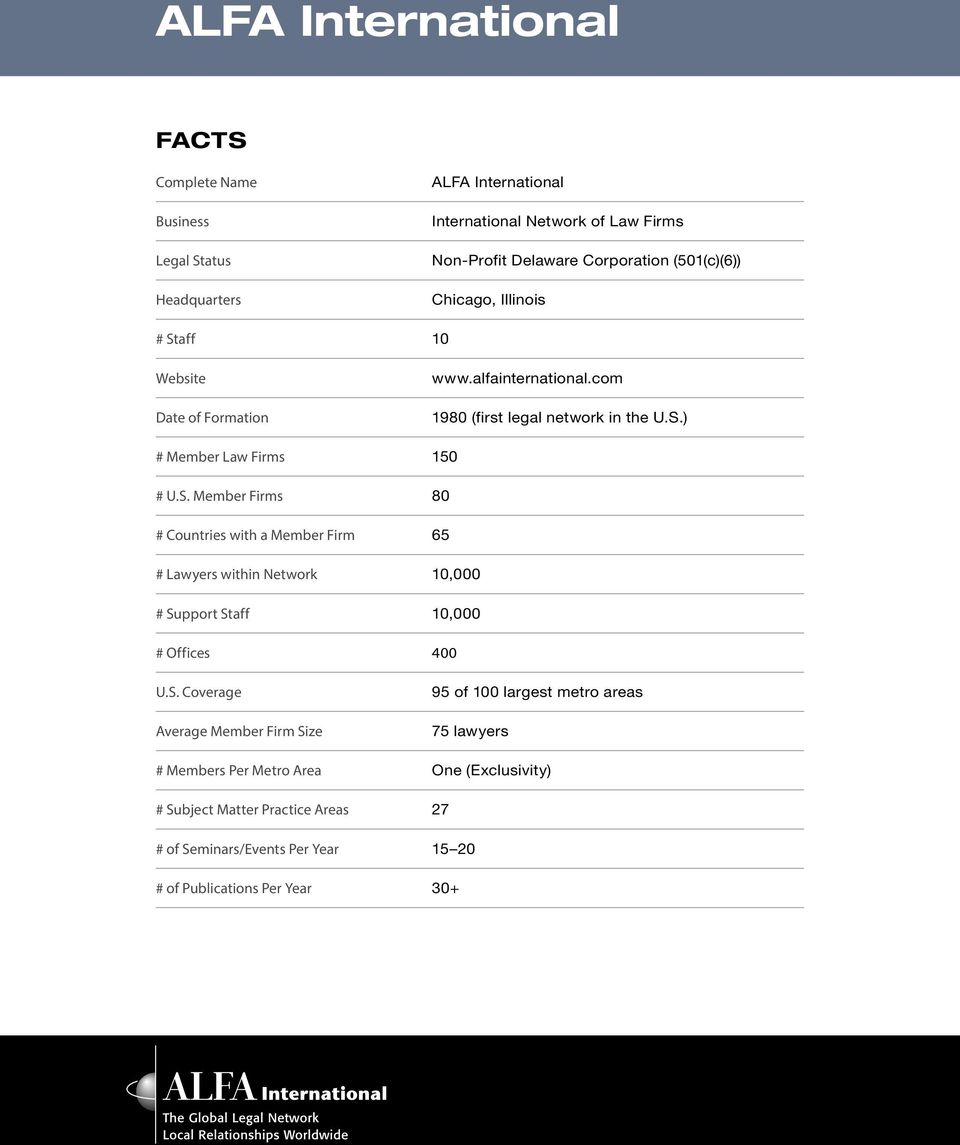
3 ALFA International FACTS Complete Name Business Legal Status Headquarters ALFA International International Network of Law Firms Non-Profit Delaware Corporation (501(c)(6)) Chicago, Illinois # Staff 10 Website Date of Formation (first legal network in the U.S.) # Member Law Firms 150 # U.S. Member Firms 80 # Countries with a Member Firm 65 # Lawyers within Network 10,000 # Support Staff 10,000 # Offices 400 U.S. Coverage Average Member Firm Size 95 of 100 largest metro areas 75 lawyers # Members Per Metro Area One (Exclusivity) # Subject Matter Practice Areas 27 # of Seminars/Events Per Year # of Publications Per Year 30+
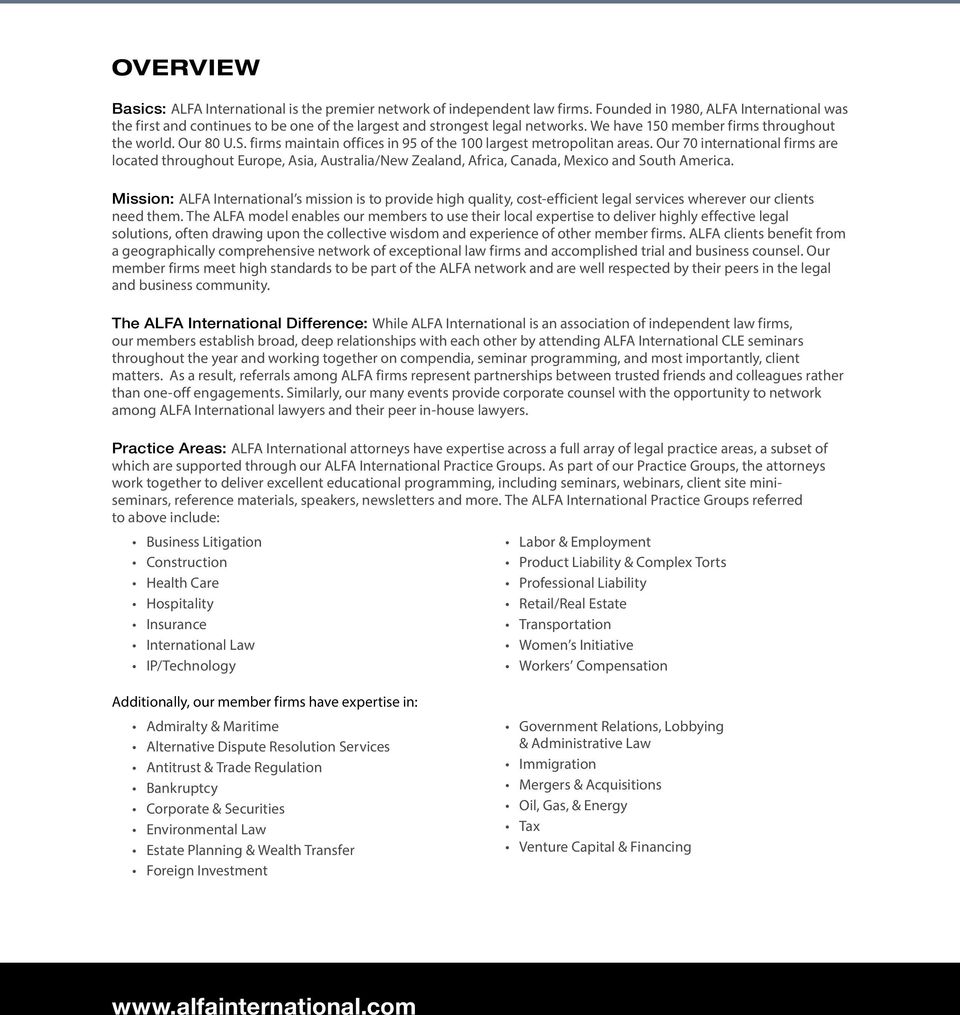
4 OVERVIEW Basics: ALFA International is the premier network of independent law firms. Founded in 1980, ALFA International was the first and continues to be one of the largest and strongest legal networks. We have 150 member firms throughout the world. Our 80 U.S. firms maintain offices in 95 of the 100 largest metropolitan areas. Our 70 international firms are located throughout Europe, Asia, Australia/New Zealand, Africa, Canada, Mexico and South America. Mission: ALFA International s mission is to provide high quality, cost-efficient legal services wherever our clients need them. The ALFA model enables our members to use their local expertise to deliver highly effective legal solutions, often drawing upon the collective wisdom and experience of other member firms. ALFA clients benefit from a geographically comprehensive network of exceptional law firms and accomplished trial and business counsel. Our member firms meet high standards to be part of the ALFA network and are well respected by their peers in the legal and business community. The ALFA International Difference: While ALFA International is an association of independent law firms, our members establish broad, deep relationships with each other by attending ALFA International CLE seminars throughout the year and working together on compendia, seminar programming, and most importantly, client matters. As a result, referrals among ALFA firms represent partnerships between trusted friends and colleagues rather than one-off engagements. Similarly, our many events provide corporate counsel with the opportunity to network among ALFA International lawyers and their peer in-house lawyers. Practice Areas: ALFA International attorneys have expertise across a full array of legal practice areas, a subset of which are supported through our ALFA International Practice Groups. As part of our Practice Groups, the attorneys work together to deliver excellent educational programming, including seminars, webinars, client site miniseminars, reference materials, speakers, newsletters and more. The ALFA International Practice Groups referred to above include: Business Litigation Construction Health Care Hospitality Insurance International Law IP/Technology Labor & Employment Product Liability & Complex Torts Professional Liability Retail/Real Estate Transportation Women s Initiative Workers Compensation Additionally, our member firms have expertise in: Admiralty & Maritime Alternative Dispute Resolution Services Antitrust & Trade Regulation Bankruptcy Corporate & Securities Environmental Law Estate Planning & Wealth Transfer Foreign Investment Government Relations, Lobbying & Administrative Law Immigration Mergers & Acquisitions Oil, Gas, & Energy Tax Venture Capital & Financing
5 For more information about upcoming seminars, webinars or other educational opportunities, please contact: (312) N. Michigan Ave., Suite 1180 Chicago, IL Tel: (312) 642-ALFA (2532) Fax: (312) Please join ALFA International on Please follow ALFA

6 ALFA International The Global Legal Network Local Relationships Worldwide Directory of Transportation Practice Group Member Firms April 2015

7 ALFA International The Global Legal Network Local Relationships Worldwide 980 N. Michigan Avenue, Suite 1180 Chicago, Illinois /642-ALFA (2532) FAX: 312/ Transportation Practice Group Pocket Directory of Member Firms ALFA International also publishes an electronic version of this guide. Copies may be obtained by contacting ALFA International s Chicago headquarters. REVISED APRIL 2015 COPYRIGHT 2014 ALFA INTERNATIONAL GLOBAL LEGAL NETWORK, INC. ALL RIGHTS RESERVED.

8 ABOUT ALFA INTERNATIONAL ALFA International is a premier network of independent law firms. Founded in 1980, ALFA is the first and continues to be one of the largest and strongest legal networks. We have 145 member firms throughout the world. Our 80 U.S. firms represent 92 of the 100 largest American metropolitan areas. Our 65 international firms are located throughout Europe, Asia, Australia/ New Zealand, Africa, Canada, Mexico and South America. ALFA International s mission is to provide high quality, cost efficient legal services wherever our clients need them. The ALFA model enables our members to use their local expertise to deliver highly effective legal solutions, often drawing upon the collective wisdom and experience of other member firms. Our law firms meet high standards to be part of the ALFA network and are well-respected by their peers in the legal and business community. ALFA clients benefit from a geographically comprehensive network of exceptional law firms and accomplished trial and business counsel. Our clients also have access to a wide range of educational programs and publications produced by ALFA International s member firms, including conferences, on-site seminars, tele-seminars, a speaker s bureau, and numerous reference publications (digests, compendia, manuals, etc). Our Practice Groups include: Business Litigation Labor & Employment Construction Product Liability Health Care Professional Liability Hospitality Retail/Real Estate Insurance Transportation International Law Women s Initiative IP/Technology Worker s Compensation Please feel free to contact ALFA International s Chicago headquarters or any of the ALFA member firms listed in this directory for assistance. Learn more about ALFA International at www. alfainternational.com. 2

9 U.S. MEMBER FIRMS ALABAMA MOBILE McDowell Knight Roedder & Sledge, L.L.C. RSA Battle House Tower 11 North Water Street, Suite Mobile, AL Tel: (251) Fax: (251) ARIZONA PHOENIX Renaud Cook Drury Mesaros, PA One North Central Avenue Suite 900 Phoenix, AZ Tel: (602) Fax: (602) TUCSON Renaud Cook Drury Mesaros, PA 177 North Church Avenue Suite 815 Tucson, AZ Tel: (520) Fax: (602) Brian P. McCarthy Cell: (251) Tamara N. Cook Cell: (602) Tamara N. Cook Cell: (602) Jonathan Lieb Cell: (251) William W. Drury Cell: (602) William W. Drury Cell: (602)

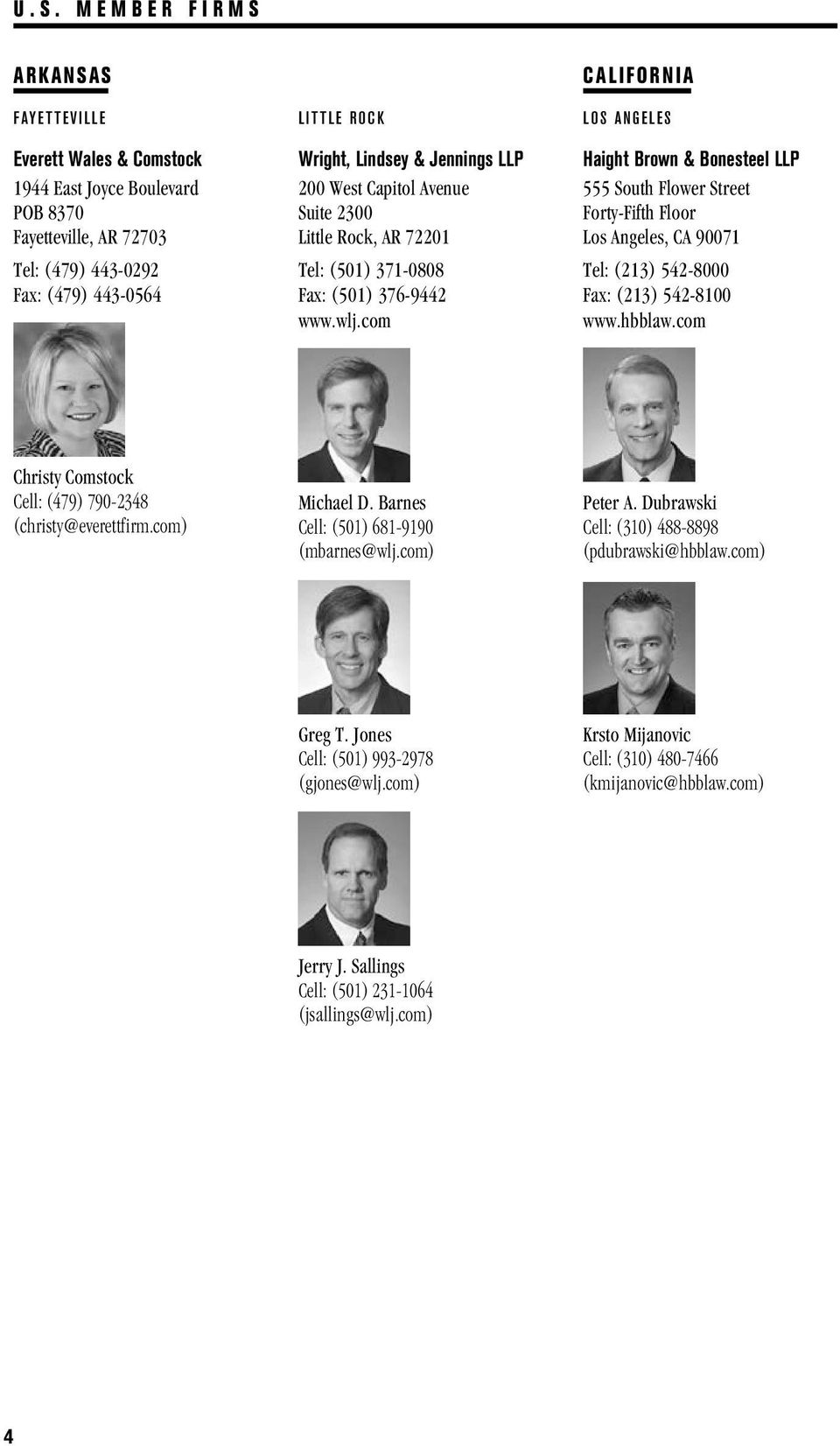
10 U.S. MEMBER FIRMS ARKANSAS FAYETTEVILLE Everett Wales & Comstock 1944 East Joyce Boulevard POB 8370 Fayetteville, AR Tel: (479) Fax: (479) LITTLE ROCK Wright, Lindsey & Jennings LLP 200 West Capitol Avenue Suite 2300 Little Rock, AR Tel: (501) Fax: (501) CALIFORNIA LOS ANGELES Haight Brown & Bonesteel LLP 555 South Flower Street Forty-Fifth Floor Los Angeles, CA Tel: (213) Fax: (213) Christy Comstock Cell: (479) Michael D. Barnes Cell: (501) Peter A. Dubrawski Cell: (310) Greg T. Jones Cell: (501) Krsto Mijanovic Cell: (310) Jerry J. Sallings Cell: (501)
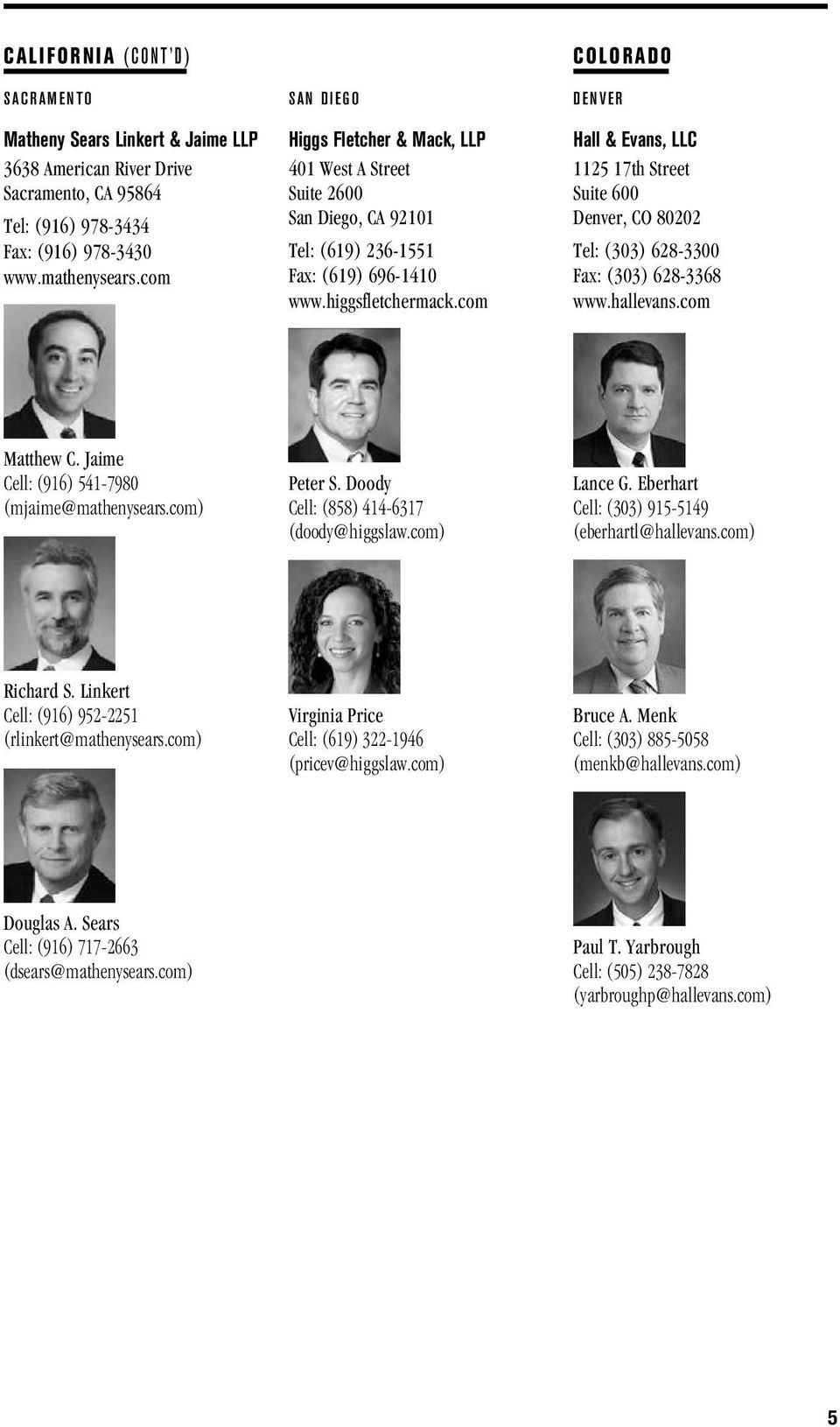
11 CALIFORNIA (CONT D) SACRAMENTO Matheny Sears Linkert & Jaime LLP 3638 American River Drive Sacramento, CA Tel: (916) Fax: (916) SAN DIEGO Higgs Fletcher & Mack, LLP 401 West A Street Suite 2600 San Diego, CA Tel: (619) Fax: (619) COLORADO DENVER Hall & Evans, LLC th Street Suite 600 Denver, CO Tel: (303) Fax: (303) Matthew C. Jaime Cell: (916) ([email protected]) Peter S. Doody Cell: (858) ([email protected]) Lance G. Eberhart Cell: (303) ([email protected]) Richard S. Linkert Cell: (916) ([email protected]) Virginia Price Cell: (619) ([email protected]) Bruce A. Menk Cell: (303) ([email protected]) Douglas A. Sears Cell: (916) ([email protected]) Paul T. Yarbrough Cell: (505) ([email protected]) 5
12 U.S. MEMBER FIRMS CONNECTICUT HARTFORD Halloran & Sage LLP One Goodwin Square 225 Asylum Street Hartford, CT 6103 Tel: (860) Fax: (860) FLORIDA FORT LAUDERDALE Fowler White Burnett P.A. 100 Southwest Third Avenue Fort Lauderdale, FL Tel: (954) Fax: (954) MIAMI Fowler White Burnett P.A Brickell Avenue 14th Floor Miami, FL Tel: (305) Fax: (305) Frederick J. Trotta, Jr. Cell: (203) Edward J. Briscoe Cell: (305) Edward J. Briscoe Cell: (305) Richard C. Tynan Cell: (860) Michael J. Drahos Cell: (954) Christopher E. Knight Cell: (305) WESTPORT Halloran & Sage LLP 315 Post Road West Westport, Connecticut Tel: (203) Fax: (203) Christopher E. Knight Cell: (305) J. Michael Pennekamp Cell: (305) Stephen Fogerty Cell: (203)

13 FLORIDA (CONT D) SARASOTA Dickinson & Gibbons, P.A. 401 North Cattlemen Road Suite 300 Sarasota, FL Tel: (941) Fax: (941) WEST PALM BEACH Fowler White Burnett P.A. 777 South Flagler Drive Suite 901 West Palm Beach, FL Tel: (561) Fax: (305) GEORGIA ATLANTA Hawkins Parnell Thackston & Young LLP 4000 SunTrust Plaza 303 Peachtree Street, NE Atlanta, GA Tel: (404) Fax: (404) Jeffrey Peairs Cell: (941) Michael J. Drahos Cell: (954) Warner S. Fox Cell: (404) A. James Rolfes Cell: (941) Christopher E. Knight Cell: (305) Alan F. Herman Cell: (404) William H. Major Cell: (404) David H. Wilson Cell: (404)

14 U.S. MEMBER FIRMS GEORGIA (CONT D) SAVANNAH Hunter Maclean Exley & Dunn, P.C. 200 East Saint Julian Street Savannah, GA Tel: (912) Fax: (912) IDAHO BOISE Greener Burke Shoemaker PA 950 West Bannock Street Suite 900 Boise, ID Tel: (208) Fax: (208) ILLINOIS BELLEVILLE Brown & James, P.C. Richland Plaza West Main Street Suite 200 Belleville, IL Tel: (618) Fax: (618) Bradley M. Harmon Cell: (912) ([email protected]) Christopher C. Burke Cell: (208) ([email protected]) Beth Kamp Veath Cell: (314) ([email protected]) Nicholas J. Laybourn Cell: (912) ([email protected]) Fredric V. Shoemaker Cell: (208) ([email protected]) COEUR D ALENE Paine Hamblen LLP 701 Front Avenue Suite 101 Coeur d Alene, ID Tel: (208) Fax: (208) CHICAGO Johnson & Bell, Ltd. 33 West Monroe Street Suite 2700 Chicago, IL Tel: (312) Fax: (312) Robert M. Burke Cell: (708) ([email protected]) Scott C. Cifrese Cell: (509) ([email protected]) Gregory D. Conforti Cell: (312) ([email protected]) 8
15 INDIANA CROWN POINT Johnson & Bell, Ltd Broadway Suite B Crown Point, IN Tel: (219) Fax: (219) INDIANAPOLIS Lewis Wagner 501 Indiana Avenue Suite 200 Indianapolis, IN Tel: (317) Fax: (317) IOWA DES MOINES Whitfield & Eddy, P.L.C. 317 Sixth Avenue Suite 1200 Des Moines, IA Tel: (515) Fax: (515) Edward Hearn Cell: (219) ([email protected]) Robert R. Foos, Jr. Cell: (317) ([email protected]) Bernard L. Jerry Spaeth Cell: (515) ([email protected]) John C. Trimble Cell: (317) ([email protected]) Kimberly S. Bartosh Cell: (515) ([email protected]) Lesley Pfleging Cell: (317) ([email protected]) Matthew D. Jacobson Cell: (515) ([email protected]) 9
16 U.S. MEMBER FIRMS KANSAS OVERLAND PARK Baker Sterchi Cowden & Rice L.L.C. 51 Corporate Woods 9393 West 110th Street Suite 500 Overland Park, KS Tel: (913) Fax: (816) WICHITA Hinkle Law Firm LLC 301 North Main Street Suite 2000 Wichita, KS Tel: (316) Fax: (316) KENTUCKY BOWLING GREEN Harlin Parker 519 East Tenth Street Bowling Green, KY Tel: (270) Fax: (270) James R. Jarrow Cell: (816) J. Philip Davidson Cell: (316) Marc A. Lovell Cell: (270) Shawn M. Rogers Cell: (816) Jay Skolaut Cell: (316) Hal D. Meltzer Cell: (913) Marcos A. Barbosa Cell: (913)
17 KENTUCKY (CONT D) LEXINGTON Dinsmore & Shohl LLP 250 West Main Street Suite 1400 Lexington, Kentucky Tel: (859) Fax: (859) LOUISVILLE Dinsmore & Shohl LLP 101 South Fifth Street Suite 2500 Louisville, KY Tel: (502) Fax: (502) LOUISIANA NEW ORLEANS Leake & Andersson, L.L.P Poydras Street Suite 1700 New Orleans, LA Tel: (504) Fax: (504) Colleen P. Lewis Cell: (859) James T. Lewis Cell: (502) Louis P. Bonnaffons Cell: (504) James T. Lewis Cell: (502) Craig M. Cousins Cell: (504) Lee A. Rosenthal Cell: (859) Stanton E. Shuler Cell: (504)

18 U.S. MEMBER FIRMS MAINE PORTLAND Norman Hnson & DeTroy, LLC Two Canal Street Portland, ME Tel: (207) Fax: (207) MARYLAND BALTIMORE Semmes, Bowen & Semmes 25 South Charles Street Suite 1400 Baltimore, MD Tel: (410) Fax: (410) MASSACHUSETTS BOSTON Morrison Mahoney LLP 250 Summer Street Boston, MA 2210 Tel: (617) Fax: (617) Jonathan W. Brogan Cell: (207) ) Thomas V. McCarron Cell: (410) Sean F. McDonough Cell: (617) morrisonmahoney.com) Gareth W. Notis Cell: (617)

19 MICHIGAN BLOOMFIELD HILLS Plunkett Cooney Woodward Avenue Suite 2000 Bloomfield Hills, MI Tel: (248) Fax: (248) GRAND RAPIDS Plunkett Cooney Bridgewater Place 333 Bridge N.W. Suite 530 Grand Rapids, MI Tel: (616) Fax: (616) MINNESOTA MINNEAPOLIS Nilan Johnson Lewis PA 120 South Sixth Street Suite 400 Minneapolis, MN Tel: (612) Fax: (612) Robert A. Marzano Cell: (586) DETROIT Plunkett Cooney 535 Griswold Street Suite 2400 Detroit, MI Tel: (313) Fax: (313) Timothy F. Sheridan Cell: (616) Sheila T. Kerwin Cell: (612) Stanley E. Siegel Cell: (612) Michael K. Sheehy Cell: (248)
20 U.S. MEMBER FIRMS MISSISSIPPI GULFPORT Daniel Coker Horton & Bell, P.A th Street Suite 400 Gulfport, MS Tel: (228) Fax: (228) JACKSON Daniel Coker Horton & Bell, P.A Old Canton Road Suite 400 Jackson, MS Tel: (601) Fax: (601) OXFORD Daniel Coker Horton & Bell, P.A. 265 North Lamar Boulevard Suite R Oxford, MS Tel: (662) Fax: (662) Edward C. Taylor Cell: (228) ([email protected]) Jackson H. Ables Cell: (601) ([email protected]) Luke Benedict Cell: (662) ([email protected]) Jason Strong Cell: (601) ([email protected]) Mitchell Driskell Cell: (662) ([email protected]) 14

21 MISSOURI KANSAS CITY Baker Sterchi Cowden & Rice L.L.C. Crown Center 2400 Pershing Road Suite 500 Kansas City, MO Tel: (816) Fax: (816) ST. LOUIS Brown & James, P.C Market Street 20th Floor St. Louis, MO Tel: (314) Fax: (314) MONTANA BOZEMAN Axilon Law Group, PLLC 895 Technology Drive Bozeman, MT Tel: (406) Fax: (406) James R. Jarrow Cell: (816) Shawn M. Rogers Cell: (816) Kurt A. Schmid Cell: (314) Joseph R. Swift Cell: (314) Gary D. Hermann Cell: (216) BILLINGS Axilon Law Group, PLLC Electric Building Suite 310 Billings, MT Tel: (406) Fax: (406) Hal D. Meltzer Cell: (913) Thomas Singer Cell: (406) Marcos A. Barbosa Cell: (913)
22 U.S. MEMBER FIRMS MONTANA (CONT D) MISSOULA Axilon Law Group, PLLC 3117 Humble Road Missoula, MT Tel: (406) Fax: (406) NEBRASKA LINCOLN Baylor, Evnen, Curtiss, Grimit & Witt, LLP Street Suite 600 Lincoln, NE Tel: (402) Fax: (402) NEVADA LAS VEGAS Alverson Taylor Mortensen & Sanderrs 7401 W. Charleston Boulevard Las Vegas, NV Tel: (702) Fax: (702) Jill Gerdrum Cell: (406) ([email protected]) Stephen S. Gealy Cell: (402) ([email protected]) Katie Wilson ([email protected]) Jarrod P. Crouse Cell: (402) ([email protected]) 16
23 NEW HAMPSHIRE MANCHESTER Wadleigh, Starr & Peters, P.L.L.C. 95 Market Street Manchester, NH Tel: (603) Fax: (603) NEW MEXICO ALBUQUERQUE Butt Thornton & Baehr PC 4101 Indian School Road, NE Suite 300 South Albuquerque, NM Tel: (505) Fax: (505) NEW YORK ALBANY Carter, Conboy, Case, Blackmore, Maloney & Laird, P.C. 20 Corporate Woods Boulevard Albany, NY Tel: (518) Fax: (518) Marc R. Scheer Cell: (603) S. Carolyn Ramos Cell: (505) Brian Carr Cell: (518) Raul Sedillo Cell: (505) William J. Decaire Cell: (518) Edward D. Laird Cell: (518)
24 U.S. MEMBER FIRMS NEW YORK (CONT D) BUFFALO Damon Morey LLP The Avant Building Suite Delaware Avenue Buffalo, NY Tel: (716) Fax: (716) NEW YORK Lester Schwab Katz & Dwyer, LLP 100 Wall Street New York, NY Tel: (212) Fax: (212) SYRACUSE Hancock Estabrook, LLP 1500 AXA Tower 100 Madison Street Syracuse, NY Tel: (315) Fax: (315) Joseph W. Dunbar Cell: (716) Felice J. Cotignola Cell: (973) Maureen E. Maney Cell: (315) Thomas A. Drury Cell: (716) Robert N. Dunn Cell: (347) Timothy P. Murphy Cell: (315) Vincent G. Saccomando Cell: (716) Melvin Katz Cell: (561) Mark J. Schulte Cell: (315)
25 NORTH CAROLINA RALEIGH Young Moore and Henderson P.A Glenwood Ave Suite 200 Raleigh, NC Tel: (919) Fax: (919) NORTH DAKOTA FARGO Vogel Law Firm 218 NP Avenue Fargo, ND Tel: (701) Fax: (701) OHIO CINCINNATI Dinsmore & Shohl LLP 255 East Fifth Street Suite 1900 Cincinnati, OH Tel: (513) Fax: (513) David M. Duke Cell: (919) Robert B. Stock Cell: (701) Colleen P. Lewis Cell: (859) Shannon S. Frankel Cell: (919) M. Daniel Vogel Cell: (701)
26 U.S. MEMBER FIRMS OHIO (CONT D) CLEVELAND Frantz Ward LLP 200 Public Square Suite 3000 Cleveland, OH Tel: (216) Fax: (216) COLUMBUS Crabbe, Brown & James LLP 500 South Front St. Suite 1200 Columbus, OH Tel: (614) Fax: (614) OKLAHOMA OKLAHOMA CITY Phillips Murrah P.C. 101 North Robinson 13th Floor Oklahoma City, OK Tel: (405) Fax: (405) Brett K. Bacon Cell: (216) Robert C. Buchbinder Cell: 614) Lyndon W. Whitmire Cell: (405) T. Merritt Bumpass Cell: (216) Vincent J. Lodico Cell: (614) Christopher G. Keim Cell: (216) DAYTON Dinsmore & Shohl LLP One South Main Street Suite 1300 Dayton, Ohio Tel: (937) Fax: (937) Colleen P. Lewis Cell: (859)
27 OKLAHOMA (CONT D) TULSA Franden Farris Quillin Goodnight & Roberts 900 Williams Center Tower II Two West Second Street Tulsa, OK Tel: (918) Fax: (918) OREGON PORTLAND Cosgrave Vergeer Kester LLP 500 Pioneer Tower 888 SW Fifth Avenue Portland, OR Tel: (503) Fax: (503) PENNSYLVANIA HARRISBURG McNees Wallace & Nurick LLC 100 Pine Street P.O. Box 1166 Harrisburg, PA Tel: (717) Fax: (717) Joseph R. Farris Cell: (918) Derek J. Ashton Cell: (503) Barbara A. Darkes Cell: (717) F. Jason Goodnight Cell: (918) Robert E. Barton Cell: (503) Jim Franklin Cell: (717) Curtis Roberts Cell: (918) Walter H. Sweek Cell: (503)
28 U.S. MEMBER FIRMS PENNSYLVANIA (CONT D) PHILADELPHIA German, Gallagher & Murtagh, P.C. The Bellevue 200 South Broad Street Suite 500 Philadelphia, PA Tel: (215) Fax: (215) PITTSBURGH Meyer, Darragh, Buckler, Bebenek & Eck, P.L.L.C. U.S. Steel Tower 600 Grant Street Suite 4850 Pittsburgh, PA Tel: (412) Fax: (412) RHODE ISLAND PROVIDENCE Higgins, Cavanagh & Cooney, LLP The Hay Building 123 Dyer Street Providence, RI 2903 Tel: (401) Fax: (401) Robert P. Corbin Cell: (609) Paul R. Robinson Cell: (412) John F. Kelleher Cell: (508) Gary R. Gremminger Cell: (484) Edward Brandenstein Cell: (412) Stephen B. Lang Cell: (401) David Meredith Cell: (517) James A. Ruggieri Cell: (401)
29 SOUTH CAROLINA CHARLESTON Young Clement Rivers LLP 25 Calhoun Street Suite 400 Charleston, SC Tel: (843) Fax: (843) COLUMBIA Nelson Mullins Riley & Scarborough LLP 1320 Main Street Meridian Building 17th Floor Columbia, SC Tel: (803) Fax: (803) GREENVILLE Nelson Mullins Riley & Scarborough LLP 104 South Main Street Suite 900 Greenville, SC Tel: (864) Fax: (864) Duke R. Highfield Cell: (843) Christopher J. Daniels Cell: (803) William S. Brown Cell: (864) Stephen L. Brown Cell: (843) Jay Thompson Cell: (803)
30 U.S. MEMBER FIRMS TENNESSEE CHATTANOOGA Leitner, Williams, Dooley & Napolitan, PLLC 200 W. Martin Luther King Boulevard Suite 500 Chattanooga, TN Tel: (423) Fax: (423) KNOXVILLE Lewis, Thomason, King, Krieg & Waldrop, P.C. One Centre Square 5th Floor 620 Market Street Knoxville, TN Tel: (865) Fax: (865) MEMPHIS Burch, Porter & Johnson, PLLC 130 North Court Avenue Memphis, TN Tel: (901) Fax: (901) Alan B. Easterly Cell: (423) Benjamin W. Jones Cell: (865) Melissa A. Maravich Cell: (901) Marc H. Harwell Cell: (423) Richard W. Krieg Cell: (865) Eric J. Plumley Cell: (901) Benjamin T. Reese Cell: (423) Mary A. Stackhouse Cell: (865)
31 TENNESSEE (CONT D) NASHVILLE Leitner, Williams, Dooley & Napolitan, PLLC 414 Union Street Bank of America Building Suite 1900 Nashville, TN Tel: (615) Fax: (615) Lewis, Thomason, King, Krieg & Waldrop, P.C. 424 Church Street Suite 2500 Nashville, TN Tel: (615) Fax: (615) TEXAS AMARILLO Mullin Hoard & Brown, L.L.P. 500 S. Taylor Suite 800, LB 213 Amarillo, TX Tel: (806) Fax: (806) R. Chuck. Mangelsdorf Cell: (615) leitnerfirm.com) John R. Tarpley Cell: (615) Danny M. Needham Cell: (806) D. Randall Mantooth Cell: (615) Mary Beth Haltom White Cell: (615) Christopher W. Weber Cell: (806) Thomas J. Dement Cell: (615) David A. Changas Cell: (615) J. Paul Brewer Cell: (615)
32 U.S. MEMBER FIRMS TEXAS (CONT D) AUSTIN Naman, Howell, Smith & Lee, P.L.L.C Capital of Texas Highway North Suite 490 Austin, TX Tel: (512) Fax: (512) DALLAS Strasburger & Price, LLP 901 Main Street Suite 4400 Dallas, TX Tel: (214) Fax: (214) EL PASO Mounce, Green, Myers, Safi, Paxson & Galatzan, P.C. 100 North Stanton Suite 1000 El Paso, TX Tel: (915) Fax: (915) P. Clark Aspy Cell: (512) Mark S. Scudder Cell: (214) Carl H. Green Cell: (915) Jay P. Lea Cell: (512) Annie J. Jacobs Cell: (214) Darryl S. Vereen Cell: (915) Michael A. Thomas Cell: (512) Samuel J. Hallman Cell: (214)
33 TEXAS (CONT D) HOUSTON Lorance & Thompson, P.C North Loop West Suite 500 Houston, TX Tel: (713) Fax: (713) Ryan T. Hand Cell: (832) SAN ANTONIO Naman, Howell, Smith & Lee, P.L.L.C Reunion Place Suite 600 San Antonio, TX Tel: (210) Fax: (210) Eric R. Benton Cell: (713) Roger D. Oppenheim Cell: (832) David L. Ortega Cell: (210) Melanie R. Cheairs Cell: (281) David W. Prasifka Cell: (713) Larry D. Warren Cell: (210) Brian T. Coolidge Cell: (281) Walter F. Williams Cell: (713) Daniel L. Fulkerson Cell: (832)
34 U.S. MEMBER FIRMS TEXAS (CONT D) WACO Naman, Howell, Smith & Lee, P.L.L.C. 400 Austin Avenue Suite 800 Suite 800 Waco, TX Tel: (254) Fax: (254) UTAH SALT LAKE CITY Christensen & Jensen, P.C. 15 West South Temple Suite 800 Salt Lake City, UT Tel: (801) Fax: (801) VERMONT RUTLAND Ryan Smith & Carbine, Ltd. Mead Building 98 Merchants Row Rutland, VT 5702 Tel: (802) Fax: (802) Jordan A. Mayfield Cell: (254) Geoff Haslam Cell: (801) Andrew H. Maass Direct: (802) P. Clark Aspy Cell: (512) Dale J. Lambert Cell: (801) Mark F. Werle Direct: (802) Jerry P. Campbell Cell: (254) John J. Zawistoski Direct: (802)
35 VIRGINIA RICHMOND Morris & Morris, P.C. 11 South 12th Street Fifth Floor Richmond, VA Tel: (804) Fax: (804) WASHINGTON SEATTLE Merrick, Hofstedt & Lindsey, P.S Western Avenue Suite 200 Seattle, WA Tel: (206) Fax: (206) SPOKANE Paine Hamblen LLP 717 West Sprague Avenue Suite 1200 Spokane, WA Tel: (509) Fax: (509) D. Cameron Beck Cell: (804) Thomas J. Collins Cell: (206) Scott C. Cifrese Cell: (509) Joseph M. Moore Cell: (804) Aaron Dean Cell: (425) Andrew C. Gauen Cell: (206)
36 U.S. MEMBER FIRMS WEST VIRGINIA CHARLESTON Robinson & McElwee PLLC 400 Fifth Third Center 700 Virginia Street East Charleston, WV Tel: (304) Fax: (304) WISCONSIN MILWAUKEE Whyte Hirschboeck Dudek S.C. 555 East Wells Street Suite 1900 Milwaukee, WI Tel: (414) Fax: (414) WYOMING CASPER Murane & Bostwick, LLC 201 North Wolcott Casper, WY Tel: (307) Fax: (307) Edward J. George Cell: (304) CLARKSBURG Robinson & McElwee PLLC 140 West Main Street Suite 300 Clarksburg, WV Tel: (304) Fax: (304) Thmoas Gonzalez Cell: (414) Jack Laffey Cell: (414) Jeff S. Meyer Cell: (307) CHEYENNE Murane & Bostwick, LLC 508 West 27th Street Cheyenne, WY Tel: (307) Fax: (307) Stephen F. Gandee Cell: (304) Loyd E. Smith Cell: (307) Greg Greenlee Cell: (307)
37 INTERNATIONAL FIRMS AUSTRALIA MELBOURNE Cornwall Stodart Level William Street Melbourne, Victoria Tel: Fax: CANADA CALGARY Borden Ladner Gervais LLP Centennial Place East Tower 1900, 520-3rd Avenue Southwest Calgary, AB T2P OR3 Tel: (403) Fax: (403) VANCOUVER Fasken Martineau DuMoulin LLP Burrard Street Vancouver, BC V6C OA3 Tel: (604) Fax: (604) Levent Shevki ) Bruce Churchill-Smith Cell: (403) William Westeringh SAINT JOHN Stewart McKelvey Suite 1000 Brunswick House 44 Chipman Hill St. John, NB E2L 2A9 Tel: (506) Fax: (506) J. Paul M. Harquail Cell: (506) *Providing bilingual legal services in English and French 31
38 For further information and a directory of the full membership, please contact ALFA International. ALFA International The Global Legal Network Local Relationships Worldwide 980 N. Michigan Avenue, Suite 1180 Chicago, Illinois Tel: ALFA (2532) Fax: ALFA INTERNATIONAL GLOBAL LEGAL NETWORK, INC. ALL RIGHTS RESERVED.
39 Please click on session titles to view contents: TABLE OF CONTENTS ALFA International Overview Transportation Practice Group Member Firms PROGRAM SESSIONS Stone Cold Locks - Ideas on Closing Arguments Traumatic Brain injury Claims: Use of Neuropsychology Expert to Evaluate if Real or Bogus One Way or the Other, We Are Watching You: Successes and Pitfalls of Surveillance and Social Media Invetsigations The Drive Cam Fleet Management Perspective V. Driver Perspective The Fatigued Driver: Sleep Apnea, Hours of Service and the DOT Medical Exam A Morning in the Life: Responding to Plaintiffs' Day-in-the-Life Videos in Mediation Driving Under the Influence - Or Not? (Drugs, Alcohol and Transportation) Minimizing Jury Distractions: Strategies to Preclude Admissibility of Preventability Determines and CSA / SMS Data Third Party Liens: How to Manage the Detrimental Impact Liens Impose Upon Settlment Negotiations Crash Avoidance Technology: Can You Afford (Not to Have) It?
40 ALFA INTERNATIONAL 2015 TRANSPORTATION SEMINAR April 29 May 1, 2015 The Hotel Del Coronado Coronado, California STONE COLD LOCKS IDEAS ON CLOSING ARGUMENTS Larry Warren Moderator NAMAN, HOWELL, SMITH & LEE San Antonio, Texas Edward George ROBINSON & MCELWEE PLLC Charleston, West Virginia Darryl Vereen MOUNCE, GREEN, MYERS, SAFI, PAXSON, & GALATZAN, P.C. El Paso, Texas
41 Fact Pattern for 2015 ALFA Transportation Program Estate of Chuck Manson v. Fast Forward Freight Incorporated, and Rocky Knievel This case involves a tragic interstate accident which occurred at approximately 1:30 p.m. July 5, 2010, at the 178 mile marker on Interstate 84, eastbound, in Baker County, Oregon. Chuck Manson (age 61) had just been released from the Oregon State Penitentiary after serving a nine-year sentence for armed robbery and assault with a deadly weapon. Manson was on his way to Boise to care for his 77-year-old mother who was on public assistance. Manson thought his Toyota had experienced a sudden acceleration event. As a result, he pulled out of the travel lane and onto the shoulder of I-84. The spot he chose to pull over was on the immediate downhill side of a sharp rise in the highway. After pulling over, Manson propped the hood of his Toyota open while checking the acceleration linkage. While checking the linkage, he heard the tell-tale hissing of a flat tire in progress. He did not have any flares, but he had a bag of fresh oranges. Manson opened the bag of oranges and placed six oranges in a line approximately 50 yards behind his parked car to warn oncoming drivers of his presence. While Manson was working on the flat tire on the right shoulder, an eastbound commercial motor vehicle driven by Rocky Kneivel (age 50) drifted onto the right shoulder of the road. Knievel was employed by Fast Forward Freight Incorporated (Fast Forward) as a long haul driver. Knievel was headed east on I-84 towards Boise en route to his next stop in Salt Lake City, Utah. There is no dispute that Knievel s eighteen-wheeler drifted over the white line onto the right shoulder just prior to the accident. Knievel may have experienced a microsleep event which was precipitated by a medical condition known as sleep apnea (see discussion below). The evidence suggests that Knievel spotted Manson s Toyota just in time to attempt to take evasive action to avoid colliding with the rear of the Manson Toyota which was parked approximately 12 inches away from the white line on the right shoulder. Evidence suggests that Manson had parked close to the white line so that he had enough room to bend over and work on the flat right rear tire, given that there was a thick row of prickly cactus lining the edge of the asphalt. 2
42 The tractor-trailer unit driven by Knievel knocked the rearview mirror off of the Larkins' vehicle, and the right rear tires of the trailer unit scrubbed up against the side of the driver's door. The glancing impact knocked the Toyota off of the jack being used by Manson to change the tire. As it fell off the jack, the Toyota struck the crouched over Manson, causing compression injuries to his chest which led to his eventual death on the side of the road approximately three hours later. Manson had apparently turned on the emergency hazard lights of his Toyota before exiting his vehicle to inspect the acceleration linkage and to change his flat tire. Depending on one s viewpoint, there are several possible explanations for Knievel s failure to see, observe and drive safely by Manson. As explained below, Knievel could have been experiencing a micro-sleep event precipitated by his medical/respiratory condition known as sleep apnea. He also could have been suffering from garden variety fatigue given his eight hour commute from Whistler, British Columbia to the Portland terminal where he began driving at 8:00 am on the day of the fatal crash. Knievel was arrested and charged with vehicular homicide in connection with the death of Manson. Knievel was transported to the Baker County Jail where he was charged with vehicular homicide and held in lieu of $1 million bond. Fast Forward terminated Knievel one week after he was taken into custody. Unable to make bond, Knievel remained in jail throughout the months of July, August and into September. Eventually, Knievel s public defender negotiated a plea with the prosecutor s office. Knievel pled no contest to criminally negligent homicide. He was sentenced to six months in jail with credit for time served. Knievel now works as a trainer for Friendly Fido, a non-profit that provides Labradors to handicapped adults in need of animal-assisted therapy. Manson died a hero in the eyes of his family and his colleagues back at the penitentiary. He had turned his life around in the state pen and was headed back to Boise where he planned to be a state-paid caregiver for his elderly mother. According to plaintiff s counsel, Manson s new life was cut short due to the negligent hiring, training, and supervision of Kneivel by Fast Forward, coupled by the negligent operation of the CMV by Knievel. The Estate of Manson s trial team has undertaken a comprehensive effort to discredit Fast Forward and portray the corporation as indifferent to safety, indifferent to the regulations embodied in the 3
43 Federal Motor Carrier Safety Regulations, and grossly negligent for knowingly hiring driver s with sleep apnea. Fast Forward takes issue with these assertions and will be prepared to defend itself at trial with respect to its method of operation, hiring of drivers, supervision of drivers, enforcement of hours of service regulations and in particular, the supervision of Knievel as a commercial vehicle driver for Fast Forward. Fast Forward also raises the issue of Manson s comparative fault for choosing to pull over on the immediate downside of a sharp rise in the highway, his failure to have and use conventional traffic flares, and his failure to pull far enough off of the roadway. Manson was 61 years old when he died. He was expected to live until the age of 80. Manson s trial team projected Manson to work until age 75 at a salary of $36,000 per year. An economist has made a preliminary assessment that the Estate s loss of earnings has a present day value of $500,000 (after deductions for consumption required by Oregon law). As noted above, Manson lingered for approximately three hours after impact while in and out of consciousness, therefore, pain and suffering prior before death is an issue. According to the autopsy, Manson could have been conscious for 90 minutes. The other primary loss classification for this wrongful death claim will be loss of companionship and services damages for Manson s 78-year-old mother. Manson s grandmother was still alive and in good health at the age of 94. While Manson had not been in her life for the past nine years, and had been in/out of prison since the age of 17, his mother testified that he wrote her beautiful letters on a weekly basis from the state pen. In addition, he sent her paintings of clowns which he did in the pen s artist workshop. Plaintiffs seek damages against Fast Forward and Knievel, as an individual. EMPLOYMENT WITH FAST FORWARD FREIGHT Kneivel was a long-haul driver for Fast Forward. He had been so employed for five years. Before hiring Kneivel, Fast Forward had a policy of refusing to hire anyone with sleep apnea. However, a local union learned about this policy and began picketing Fast Forward s headquarters. Ultimately, Fast Forward management consulted with medical experts and were advised that drivers with sleep apnea, if properly treated, were not inherently dangerous. In order to get rid of the picketers, Fast Forward changed its policy. Shortly thereafter, Knievel was hired. Unfortunately, Kneivel only provided an Oregon post office box as an address on his application and this went unnoticed by Fast Forward s human 4
44 resources department. As a result, Fast Forward was not aware that Kneivel had an 8 hour commute from Whistler, BC before beginning his week-long routes from the Portland, Oregon terminal. Kneivel possessed a current D.O.T. physical card indicating he has successfully passed a medical/physical exanimation and was physically qualified to operate a commercial motor vehicle as defined by the Federal Motors Carrier Safety Regulations. Kneievel had a regular D.O.T. physical examination done every two (2) years in order to keep his commercial driver s license current, as required by the Federal D.O.T. regulations. Before Fast Forward, Kneivel had been an intrastate day driver for Minute Men, a deliverer of small business packages in Vancouver, British Columbia. Kneivel was fired by Minute Men after two rear-end accidents that were determined to be preventable by Minute Men management. Fast Forward had made a good faith effort to obtain Kneivel s personnel file from Minute Men, but Minute Men failed to respond and Fast Forward didn t pursue it further in accordance with FMSCR regs. Kneivel did not mention the rear-end accidents during his job interview with Fast Forward and Fast Forward only ordered Kneivel s Oregon driving record, which did not show his British Columbia CMV accidents. Additionally, Fast Forward did not inquire and Kneivel did not volunteer that Kneivel discovered his sleep apnea during a Canadian Department of Motor Vehicles investigation into a single car accident that occurred when Kneivel fell asleep at the wheel of his private vehicle one afternoon in Canada suspended his driver s license for one year. His license was reinstated when he produced a doctor s note stating his sleep apnea was correctable by regular use of a CPAP machine. Prior to the subject accident, Kneivel was off work on July 2, 3, and 4. It came out in discovery that Kneivel had partied hard on July 4th, before falling asleep on his neighbor s lawn at 8 pm on July 4. Kneivel was not there when his neighbor woke up the next morning. Kneivel s memory is hazy, but he testified he slept on the lawn from 8 pm to midnight, before leaving Whistler for Fast Freight s Portland terminal. In addition, Kneivel had been off work on vacation from June 18, 2010, until June 26, 2010, a total of nine days. During these nine days, Kneivel worked on his cousin s crab-fishing 5
45 boat off the coast of Alaska. Due to ribbing from his fellow crew members, he did not use his CPAP machine while crabbing. He worked night and day on the crab vessel and returned exhausted but flush with cash. After his crabbing vacation, Kneivel worked five days for Fast Forward (from June 27 through July 1). Accordingly, Kneivel was off-work twelve (12) out of the seventeen (17) days preceding this accident. Fast Forward does not dictate how its drivers spend their off-duty time. However, it expects its drivers to be wellrested and alert while driving its vehicles. Fast Forward required each driver to check in personally with a dispatcher and to obtain his/her CMV keys from a supervisor before heading out on the road. Both the dispatcher and supervisor were responsible for observing all drivers for visible signs of fatigue. Both the dispatcher and supervisor testified that Kneivel appeared fine when he obtained his truck keys at 8 am on July 5. Fast Forward maintains that when Kneivel was off-duty and not working as a truck driver it had every right to assume Kneivel was getting adequate rest and sleep on his days off. Moreover, Fast Forward expected Kneivel to religiously use his CPAP machine. Accordingly, the company had every right to assume Kneivel would not report to work ill or fatigued but ready to work and rested. The company obviously must depend on their professional drivers in this regard, as related by Don Spacy, Driver Manager and direct supervisor for Knievel: Q: In your opinion as the manager, drivers' manager, is it important for a driver to receive training on fatigue awareness? A: You are asking me if I think it? Q: You are the manager. Yes, sir. A: Well, I think-think it's important that a driver understands that he needs to get his rest and use his time adequately when he's off duty. Q: Well what about is it important for a driver to recognize signs of fatigue when he is on the road? A: Yeah, yes, sir. Q: And is it important for a driver to know what to do when he recognizes signs of fatigue on the road? 6
46 A: It's just like any other driver, they can pull off. I have never, ever told a driver or anybody that they could not pull that vehicle over at any time get out of that vehicle and get their rest, get a-take a nap or whatever they want to do. I have never disciplined a driver for doing so or told them that they could not do it. (Depo. of Don Spacy, p. 122). Plaintiff asserts that there is a factual predicate for an award of punitive damages because Fast Forward failed to educate its drivers regarding fatigue awareness. The company did in fact address driver fatigue on a daily basis with all of its drivers based upon the company's adherence to the Federal Motor Carriers Safety Administration Hours of Service Regulations for over-the-road truck drivers. The hours of service requirements of FMCSR are designed to help eliminate fatigue by over-the-road truck drivers. Fast Forward knows that hours of service regulations were created to help prevent driver fatigue. (See Depo. of Don Spacy, p. 8). In addition, Fast Forward monitored all of their drivers by means of an electronic monitoring system contained in the on-board XATA system which tracks the number of hours and minutes a vehicle is driven by each company truck driver. Fast Forward s drivers, including Kneivel, were given updated training with respect to hours of service regulations when the new hours of service requirements were amended under the FMCSR in January, Fast Forward did take affirmative steps to address driver fatigue, as follows: 1. Demanding adherence to the hours of service regulations or the Federal Motor Carriers Safety Regulations; 2. Managing the hours of service for commercial vehicle drivers; 3. Implementing an on-board computer system (XATA system) to monitor driver hours; 4. Educating drivers with respect to being well-rested and keeping physically fit during the driver orientation process via driver trainers and the driver trainer checklist; 5. Requiring professional motor vehicle drivers to log their hours of service both driving and on-duty not driving each and every day throughout the year. Professional drivers are expected to know how to deal with the issue of driver 7
47 fatigue, since it is addressed on a daily basis under the hours of service regulations; and 6. Implementing a five-day work week for interstate drivers. In 2009, Fast Forward considered installing Drive-Cam in its interstate vehicles. However, the plan was tabled due to cost considerations. According to intercompany s, there was a commitment to install Drive-Cam beginning in (See generally Depo. of Don Spacy, pp ). In December, 2009, Kneivel was given a level one discipline for exceeding his hours of service. The discipline included a written warning and an on-line course regarding driver fatigue and the relationship between driver fatigue and accidents. Fast Forward s driver managers at the Portland, Oregon, distribution center had daily interactions by cell phone with Kneival when he was working. (Depo. of Don Spacy, p. 35, lines 8-13). Spacy explained that Kneivel was making improvement based upon the daily management and counseling extended to him by the driver managers at the distribution center. Spacy testified as follows: Q: Why wasn't he taken off the road and suspended in December? A: Because it was only his fourth hours of service violation. We were checking his hours regularly and he was conforming to the federal regulations. Q: How many times did he violate D.O.T. regs for hours of service which you said were very important, and not be at least suspended? A: The violations that he had were violation of a ten hour-what you want to call the ten hour or the eleven hour rule. And those violations were because he was 10 to 14 minutes minutes early. And if he would have been on any other system besides XATA, he would have been on paper log, you never would have seen it anyways because the paper log is in fifteen minute increments. Q: But he was still in violation, wasn't he? A: He was still in violation. Q: And you are supposed to address those violations, aren't you? 8
48 A: Yes, sir, I am. We did give him one written warning. And required an on-line class. But he was showing up-he was showing improvement. We was talking to him daily about-we was talking to him daily about his hours of service. And he was showing improvement. Q: So you were aware on a daily basis that he was subject to an out-of-service order if he was stopped? A: Not every day, he wasn't. Q: Well, the days that you talked to him about his hours of service? A: The day-when we would get the trip back and Patricia would notate or find out that he didn't take his ten hours off in between shifts, she would call him and talk to him about, hey, you clocked in four minutes early. Q: So you knew he was violating hours of service whenever you talked to him? A: Oh, yes, sir. And that's the reason we started calling him on a daily basis. Q: And you didn't give him any type of counseling did you? A: I did on December 5, because he had four violations. Q: And from December 6 through July 5, 2010? A: His violations came down. It showed that, with our day to day communication with Rocky, he was getting better. Q: Were you aware he had sleep apnea? A: At one time I think I was. I must have been because it shows we discussed it during his job application. Q: Did you ever discuss it again with him? A: No. He gave us a doctor s note. And he passed his D.O.T. physicals. That s what Federal law requires. Q: Do you agree that Federal law is the bare minimum? OBJECTION(witness instructed not to answer) Court ordered the witness to answer. A: I think Federal law is a very high standard. The rules are called FMCSR (Federal Motor Carrier Safety Regulations). Intelligent people spent a lot of time getting those rules right and the rules are there to ensure maximum safety. So, no, I would not describe federal law as the bare minimum. Q: Why didn t you ask him about his CPAP machine? 9
49 A: I assumed that was something between him and his doctors. Q: Did you know he was working night and day on a crab vessel for 9 straight days approximately one week before my client was killed? A: No. Q: Why not? A: Didn t ask. Q: You didn t ask him what he did on his vacation? A: Nope. Q: Were you aware he was not using his CPAP machine while he was crabbing for nine days? A: No I wasn t. Q: Don t you want to know stuff like that before you give drivers the keys to an 18-wheeler? A: We expect our drivers to come to work well-rested and alert. We discuss that all the time in safety meetings. Q: Why didn t you know he had an eight-hour commute every time he showed up for work? A: I can t answer that. I guess, I didn t ask. Q: Did you ever walk outside to the employee parking lot and take a look at his British Columbia license plate and then ask him why his car was licensed in another country? A: No I didn t. Q: Wouldn t that be good to know about a driver who had sleep apnea and four hours of service violations? A: Maybe. (Depo. of Don Spacy, pp ). The Plaintiff has filed a Second Amended Complaint alleging reckless conduct and seeking punitive damages totaling $5,000,000 on the part of Fast Forward with respect to enforcing hours of service regulations for Rocky Kneivel. The Second Amended Complaint asserts that Fast Forward is liable for negligent supervision, negligent retention and had a cavalier attitude with respect to the enforcement of hours of service regulation spelled out by the Federal Motor Carriers Safety Regulations. The evidence shows that the company was 10
50 addressing this driver and his hours of service. The evidence shows Kneivel was improving in this area. Fast Forward disputes that it acted recklessly or maliciously or willfully and wantonly. Since Knievel was off-work twelve (12) out of seventeen (17) days preceding this accident, there is no relevance between the technical of hours of service violations by this truck driver and the accident of July 5, It is well settled that an allegation of negligence per se must include an element of proximate cause between the alleged statutory violation (or violation of regulation) and the accident at issue. Fast Forward maintains that Plaintiff cannot prove proximate cause or cause in fact relative to Knievel s previous minor hours of service violations and this accident. In the Complaints, the Plaintiff asserts Kneivel was not properly managed under the company's progressive discipline policy. Fast Forward defends its discipline regarding the hours of service issue. While working for Fast Forward, Knievel was written up for backing into and damaging a sign of a Pilot's Station in Cookeville, Tennessee. He was issued a reprimand for insubordinate conduct based upon his refusal to drive during a snowfall in Montana. Kneivel was also reprimanded for improper use of the company's cell phone when 250 texts were discovered between him and his girlfriend. Mr. Bowers was reprimanded by the company for failing to disclose a speeding ticket, which he had been issued during the time he worked for Minute Men. As noted above, Mr. Bowers was reprimanded for his hours of service violations on December 5, Fast Forward disputes plaintiff s assertions that it did not adequately supervise and discipline Knievel. Fast Forward maintains that it complied with the dictates of the Federal Motor Carrier Safety Regulations by insuring that Knievel possessed a valid CDL, was trained under the dictates of the Federal Motor Carriers Safety Regulations, possessed a valid D.O.T. physical, was instructed in the hours of service regulations, and reprimanded and counseled when he violated them. 11
51 Plaintiff maintains that Fast Forward was negligent for failing to reasonably and regularly inquire about Kneivel s sleep apnea, his use or non-use of his CPAP machine, his lengthy commute to work and, on the day of the accident, failed to adequately observe Kneivel for signs of fatigue before handing him the keys to the tractor-trailer. Witnesses at the Portland terminal testified that Kneivel had bags under his eyes, his eyes appeared raccoon-like, his hair was messed up, his clothes were disheveled, his breath stunk, and he had an odd grin on July 5, Fast Forward has retained a human factors expert who will testify that it is very difficult to detect fatigue during short interactions. Fast Forward can show that it monitored Kneivel daily by means of an electronic on-board computer information system which tracked movements of his vehicle, and his work day, to the minute. By starting to work several minutes early on multiple occasions during 2009, Kneivel placed himself in technical violation of the "ten hour off' rule. Plaintiffs point out that Fast Forward chose not to install Drive-Cam in Kneivel s vehicle before the fatal accident. Plaintiffs have retained a CMV safety expert who will testify that had Drive-Cam been installed, Fast Forward would have noticed signs of fatigue about Knievel on the video feed during the five and one half hours he drove from the Portland terminal to the accident location. Fast Forward s human factors expert will dispute this. There were no drugs or alcohol involved in this accident. While Kneivel crossed the white line onto the right shoulder he did so by only inches. However, this was enough to knock Manson s Toyota off the jack and cause the fatal injuries. There is no evidence Knievel was speeding at the time of this accident. Fast Forward has stated in a press release that this was an unfortunate and tragic highway accident which was unavoidable due to a combination of roadway design factors, lack of adequate warning devices, and vehicle placement on the part of Manson. 12
52 THIS ACCIDENT MAY HAVE BEEN UNFORESEEABLE DUE TO A PREVIOUSLY UNDIAGNOSED MEDICAL CONDITION In addition to what is set forth above, Fast Forward has retained a sleep apnea/fatigue expert who will opine that this accident was probably caused by a sudden, unforeseeable physical and mental incapacitation of Kneivel. Under federal regulations Knievel was required to have a valid D.O.T. physical/medical examination every two years. Respiratory conditions, including sleep apnea, is listed on the D.O.T. physical as an area of examination by the physician. After this accident, Kneivel was referred for a polysomnogram study (sleep study) on July 5, Dr. Ron McDonald reviewed the results of the sleep study and prepared a report. Dr. McDonald s report indicated that Knievel gave a history consistent with underlying sleep pathology. The patient's respiratory summary indicated the patient had oxygen saturation as low as 70%; in addition, during 18% of the sleep time the saturation level was less than 89%. Dr. McDonald's impression of the test was "significant hypopnea of obstructive type". Kneivel was recommended to regularly use his CPAP (continuous positive airway pressure) device during sleep. Mitch Bowers was seen and examined by Dr. Varmint, director of Washington Forensic Psychiatry, on December 13-19, Dr. Varmint conducted an extensive forensic psychiatric evaluation of Kneivel. Dr. Varmint referred Kneivel for evaluation by James S. Kook, Ph.D., a neuropsychologist who also collaborated with Mary Sandman, Ph.D., a psychologist and expert on sleep disorders. Dr. Varmint is expected to render the following opinions within a reasonable degree of medical certainty: 1. At the time of the accident Kneivel had a serious psychiatric and medical condition, "breathing-related sleep disorder." This breathing-related sleep disorder is defined by The Diagnostic and Statistical Manual of Mental Disorders, Fourth Edition (DSM-IV) as "sleep disruption, leading to excessive sleepiness or insomnia that is judged to be due to a sleep-related breathing 13
53 condition (e.g., obstructive or central sleep apnea syndrome or central alveolar hypoventilation syndrome). 2. One of the primary symptoms of breathing-related sleep disorder is daytime drowsiness and frequent, brief episodes of daytime sleeping. Excessive daytime sleepiness may be manifest in several ways: feelings of drowsiness; a tendency towards short sleep latency, or falling asleep very quickly; repeated short periods of sleep ("microsleep" that lasts from several seconds to several minutes). The person may not be aware that microsleep has occurred. While in a microsleep, a person fails to respond to outside information. Microsleeps are most likely to occur at certain times of the day, such as pre-dawn hours and mid-afternoon hours when the body is "programmed" to sleep. 3. On the day of the accident, Knievel was experiencing brief episodes of daytime sleeping. 4. On the day of the accident, Kneivel was not aware he was falling asleep while driving his tractor-trailer unit on Interstate 84. Dr. Sandman will testify as an expert witness for the Defendants in this action. Dr. Sandman holds the position of Administrative Team Leader, Systems and Cognitive Neuroscience Cluster at the National Institute of Neurological Disorders and Stroke, National Institutes of Health at Portland State University. Dr. Sandman holds a Ph.D. in developmental and physiological psychology from Oregon State University. Dr. Sandman was asked to review extensive information from the Oregon State Police investigation into this accident and the criminal charges pending against Knievel. Dr. Sandman has also reviewed witness statements and deposition testimony from accident eyewitnesses, and the transcript of testimony from the accident reconstructionist from the Oregon State Police. Dr. Sandman also reviewed the medical records of Knievel, the neuropsychological testing by Dr. Varmint, a head MRI scan report, the report of EEG and the sleep testing Knievel had in December, Dr. Sandman review of this evidence and documentation led her to summarize the following facts which she believes are relevant to her opinions in this case: 14
54 FACTS 1. Ms. Karen Whisky, another motorist, observed Knievel to have been driving in an erratic and inattentive manner approximately two hours before the crash. 2. The State Police Reconstructionist's Report concluded that, immediately before striking the Manson Toyota, Knievel s vehicle ran off the right side of the roadway. Knievels' vehicle struck the Manson Toyota during Knievel s attempt to steer the vehicle back into the right hand travel lane. 3. The first signs of braking by Knievel were noted 100 feet beyond the point of impact with the Manson Toyota. 4. On a police videotape (filmed inside a police vehicle while Knievel was being driven to jail three hours after the accident) Knievel can be seen to fall asleep repeatedly while riding in the back seat of the police vehicle. 5. In December, 2011, Knievel underwent a nighttime sleep study and was diagnosed with obstructive sleep apnea and prescribed treatment with a nasal continuous positive airway pressure device (CPAP). 6. During a daytime EEG procedure performed on February 1, 2012, Mr. Knievel was documented to have fallen asleep quickly and repeatedly. Dr. Sandman has arrived at the following opinions which are expressed in her report dated March 1, OPINIONS 1. At the time of the collision, Knievel was excessively sleepy due to his medical condition and due to sleep deprivation. 2. Fatigue due to sleep apnea and long work periods adversely affected the attention and driving abilities of Knievel. 3. Knievel was unaware of the presence of his sleep apnea and the impairment to his driving ability caused by this sleep disorder. Dr. Sandman s basis for her opinion that Knievel was unaware of the presence of sleep apnea and the impairment to his driving ability is based upon the following items: 15
55 a. Sleep apnea is a medical condition characterized by repetitive airway obstruction during sleep. This condition develops gradually over months and years, leading to poor sleep and excessive sleepiness. b. Excessive sleepiness leads to progressive loss in the ability to sustain attention and perform tasks such as driving. Because these effects develop slowly, they are often not recognized by the patient. c. Knievel underwent evaluation for sleep apnea after this fatal accident and at the direction of his civil defense attorney. Being prompted by others to seek medical evaluation is a frequent feature in the medical histories of patients with sleep apnea. d. The adverse effects of sleep apnea on attention and performance are biologically based and cannot be reversed by attempts to increase motivation to stay awake, remain alert, and perform well. Commonly tried counter measures such as opening a window and playing loud music are ineffective. Fast Forward will argue that because Knievel suffered from a medical condition the severity of which it/he was unaware, and because the medical condition in this instance caused Knievel to suffer mental and physical incapacitation, Fast Forward and Knievel may not be held legally responsible for causing this accident under Oregon law. In a recent case, Bullitt v. Gross, the Oregon Supreme Court established the rule in Oregon that deals with loss of consciousness or physical incapacity experienced by the operator of a motor vehicle while driving. In Bullitt, the Court adopted the rule that when a sudden loss of consciousness or physical capacity, not reasonably foreseeable, is experienced while driving, a defendant has a defense to negligence. For this defense to apply, a defendant must establish that the sudden loss of consciousness or physical capacity to control the vehicle was not reasonably foreseeable to a prudent person. To determine whether the loss of capacity or consciousness is foreseeable, the Court listed the following non-exclusive set of factors which should be taken into consideration: (1) the extent of the driver's awareness or knowledge of the condition that caused the sudden incapacity; (2) whether the driver had sought medical advice or was under a physician's care for the condition when the accident occurred; (3) whether the 16
56 driver had been prescribed, and had taken, medication for the condition; (4) whether a sudden incapacity had previously occurred when driving; (5) the number, frequency, extent and duration of incapacitating episodes prior to the accident while driving and otherwise; (6) the temporal relationship of the prior incapacitated episodes to the accident; (7) a physician's guidance or advice regarding driving to the driver, if any; and (8) medical opinions regarding the nature of the driver's condition, adherence to treatment, foreseeability of the incapacitation, and potential advance warnings which the driver would have experienced immediately prior to the accident. At Fast Forward, Knievel was punctual and possessed an excellent attendance record. He rarely missed a day of work. From all outward appearances, Knievel was healthy. He was not the type of employee who appeared to suffer from any apparent illness. According to Fast Forward, since neither it nor Kneivel were aware that Kneivel suffered from this medical condition which could and apparently did cause him to become incapacitated while driving his commercial motor vehicle, there is a chance that the jury may conclude that this accident was not reasonably foreseeable and was not the fault of it or Knievel. Therefore, legal liability for this accident may not attach to the Defendants. STANDARD IN THE INDUSTRY FOR SLEEP APNEA TESTING The Plaintiff will use its safety and human factors experts to argue that Fast Forward and Knievel should have taken proactive steps to test Knievel and other drivers for sleep apnea. Fast Forward counters that such testing is not required under the Federal Motor Carriers Safety Regulations. Plaintiff points out that sleep testing is apparently required for pilots who operate in the airline industry. Sleep disorders, loud snoring and daytime sleepiness are set forth under the checklist for the long form D.O.T. physical/medical examination. As noted above, Knievel disclosed the fact he had sleep apnea and used a CPAP machine, which apparently motivated him to check the box for "loud snoring", etc. during his D.O.T. physical examination in This box was not checked on any subsequent medical evaluations. There is no mention of sleep apnea in any of Kneivel s performance reviews after his initial application. 17
57 None of the Safety Materials produced by Fast Forward deal with sleep apnea as it relates to fatigue and driver safety. 18
58 CAUSE NO DCVAJA ESTATE OF CHUCK MANSON IN THE DISTRICT COURT VS. 365th JUDICIAL DISTRICT FAST FORWARD FREIGHT INC ROCKY KNIEVAL BAKER COUNTY, OREGON LADIES AND GENTLEMEN OF THE JURY: JURY CHARGE This case is submitted to you by asking questions about the facts, which you must decide from the evidence you have heard in this trial. You are the sole judges of the credibility of the witnesses and the weight to be given their testimony, but in matters of law, you must be governed by the instructions in this charge. In discharging your responsibility on this jury, you will observe all the instructions which have previously been given you. I shall now give you additional instructions which you should carefully and strictly follow during your deliberations. 1. Do not let bias, prejudice or sympathy play any part in your deliberations. 2. In arriving at your answers, consider only the evidence introduced here under oath and such exhibits, if any, as have been introduced for your consideration under the rulings of the Court, that is, what you have seen and heard in this courtroom, together with the law as given you by the court. In your deliberations, you will not consider or discuss anything that is not represented by the evidence in this case. 3. Since every answer that is required by the charge is important, no juror should state or consider that any required answer is not important. 4. You must not decide who you think should win, and then try to answer the questions accordingly. Simply answer the questions, and do not discuss nor concern yourselves with the effect of your answers. 19
59 5. You will not decide the answer to a question by lot or by drawing straws, or by any other method of chance. Do not return a quotient verdict. A quotient verdict means that the jurors agree to abide by the result to be reached by adding together each juror s figures and dividing by the number of jurors to get an average. Do not do any trading on your answers; that is, one juror should not agree to answer a certain question one way if others will agree to answer another question another way. 6. Unless otherwise instructed, you may answer a question upon the vote of ten or more jurors. If you answer more than one question upon the vote of ten or more jurors, the same group of at least ten of you must agree upon the answers to each of those questions. These instructions are given you because your conduct is subject to review the same as that of the witnesses, parties, attorneys and the judge. If it should be found that you have disregarded any of these instructions, it will be jury misconduct and it may require another trial by another jury; then all of our time will have been wasted. The Presiding Juror or any other who observes a violation of the court s instructions shall immediately warn the one who is violating the same and caution the juror not to do it again. When words are used in this charge in a sense that varies from the meaning commonly understood, you are given a proper legal definition which you are bound to accept in place of any other meaning. Answer Yes or No to all questions unless otherwise instructed. A Yes answer must be based on a preponderance of the evidence unless you are otherwise instructed. If you do not find that a preponderance of the evidence supports a Yes answer, then answer No. The term preponderance of the evidence means the greater weight of credible 20
60 evidence admitted in this case. A preponderance of the evidence is not measured by the number of witnesses or by the number of documents admitted in evidence. For a fact to be proved by the preponderance of the evidence, you must find that the fact is more likely true than not true. Whenever a question requires an answer other than Yes or No, your answer must be based on a preponderance of the evidence unless you are otherwise instructed. A fact may be established by direct evidence or by circumstantial evidence or both. A fact is established by direct evidence when proved by documentary evidence or by witnesses who saw the act done or heard the words spoken. A fact is established by circumstantial evidence when it may be fairly and reasonably inferred from other facts proved. [IF APPLICABLE] During trial it was permissible for you to take notes. You may carry those notes to the jury room for your personal use during deliberation on the court s charge. You may not share these notes with other jurors. A juror may not rely on the notes of another juror. If you disagree about the evidence, the presiding juror may apply to the court and have the court reporter s notes read to the jury. 21
61 PROPOSED QUESTIONS QUESTION NO. 1: Did the negligence, if any, of the persons named below proximately cause the occurrence in question? Occurrence means the events which took place at Mile marker 178 on IH 84 in Baker County, Oregon at or around 1:30 p.m. on July 5, "Negligence," when used with respect to the conduct of CHUCK MANSON, FAST FORWARD FREIGHT INC. and ROCKY KNIEVEL means a failure to use ordinary care; that is, failing to do that which a person or company of ordinary prudence would have done under the same or similar circumstances, or doing that which a person or company of ordinary prudence would not have done under the same or similar circumstances. "Ordinary care," when used with respect to the conduct of CHUCK MANSON, FAST FORWARD FREIGHT INC. and ROCKY KNIEVEL means that degree of care that would be used by a person of ordinary prudence under the same or similar circumstances. Proximate cause means a cause that was a substantial factor in bringing about an event, and without which cause such event would not have occurred. In order to be a proximate cause, the act or omission complained of must be such that a person using ordinary care would have foreseen that the event, or some similar event, might reasonably result therefrom. There may be more than one proximate cause of an event. Source: OPJC 2.1, 2.4, 4.1 ANSWER YES OR NO. FAST FORWARD FREIGHT, INC. ROCKY KNIEVEL CHUCK MANSON 22
62 If you answered Yes to Question 1 for more than one of those named below, then answer the following question. Otherwise, do not answer the following question. Assign percentages of responsibility only to those you found caused or contributed to cause the injury. The percentages you find must total 100 percent. The percentages must be expressed in whole numbers. The percentage of responsibility attributable to any one is not necessarily measured by the number of acts or omissions found. The percentage attributable to any one need not be the same percentage attributed to that one in answering another question. QUESTION NO. 2: For each party found by you to have caused the occurrence in question, find the percentage caused by: FAST FORWARD FREIGHT, INC. % ROCKY KNIEVEL % CHUCK MANSON % Total: 100 % Source: OPJC 4.3 QUESTION NO. 3: What sum of money would have fairly and reasonably compensated CHUCK MANSON for a. Funeral and burial expenses Funeral and burial expenses means the reasonable amount of expenses for funeral and burial for CHUCK MANSON reasonably suitable to his station in life. Answer in dollars and cents for damages, if any. Answer: 23
63 QUESTION NO. 4: What sum of money, if paid now in cash, would fairly and reasonably compensate Diana Laura Manson for her damages, if any, resulting from the death of CHUCK MANSON? Consider the elements of damages listed below and none other. Consider each element separately. In answering this question, you shall not award any sum of money on any element if you have otherwise, under some other element, awarded a sum of money for the same loss. That is, do not compensate twice for the same loss, if any. Do not include interest on any amount of damages you find. Answer separately, in dollars and cents, for damages, if any. Do not reduce the amounts, if any, in your answers because of the negligence, if any, of CHUCK MANSON You are instructed that any monetary recovery for is subject to federal income taxes. Any recovery for is not subject to federal income taxes. a. Pecuniary loss Pecuniary loss means the loss of the care, maintenance, support, services, advice, counsel, and reasonable contributions of a pecuniary value that Diana Laura Manson, in reasonable probability, would have received from Martin Chavez Manson had he lived. Answer, with respect to this element, in dollars and cents for damages, if any, that were sustained in the past by Diana Laura Manson: Answer: Manson: in reasonable probability will be sustained in the future by Diana Laura Answer: b. Loss of companionship and society Loss of companionship and society means the loss of the positive benefits flowing from the love, comfort, companionship, and society that Diana Laura Manson, in reasonable probability, would have received from CHUCK MANSON, had he lived. 24
64 c. Mental anguish Mental anguish means the emotional pain, torment, and suffering experienced by Diana Laura Manson because of the death of CHUCK MANSON. In determining damages for elements b and c, you may consider the relationship between Diana Laura Manson and, CHUCK MANSON their living arrangements, any extended absences from one another, the harmony of their family relations, and their common interests and activities. You are reminded that elements b and c, like the other elements of damages, are separate, and, in awarding damages for one element, you shall not include damages for the other. Answer, with respect to elements b and c listed above, in dollars and cents for damages, if any, that were sustained in the past by Diana Laura Manson: Answer: Manson: in reasonable probability will be sustained in the future by Diana Laura Answer: d. Loss of inheritance Loss of inheritance means the loss of the present value of the assets that the deceased, in reasonable probability, would have added to the estate and left at natural death to Diana Laura Manson. Answer in dollars and cents for damages, if any. Answer: 25
65 QUESTION NO. 5: What sum of money, if paid now in cash, would fairly and reasonably compensate Jonathan Manson for his damages, if any, resulting from the death of CHUCK MANSON? Consider the elements of damages listed below and none other. Consider each element separately. In answering this question, you shall not award any sum of money on any element if you have otherwise, under some other element, awarded a sum of money for the same loss. That is, do not compensate twice for the same loss, if any. Do not include interest on any amount of damages you find. Answer separately, in dollars and cents, for damages, if any. Do not reduce the amounts, if any, in your answers because of the negligence, if any, of CHUCK MANSON You are instructed that any monetary recovery for is subject to federal income taxes. Any recovery for is not subject to federal income taxes. a. Pecuniary loss. Pecuniary loss means the loss of the care, maintenance, support, services, advice, counsel, and reasonable contributions of a pecuniary value that Jonathan Manson, in reasonable probability, would have received from CHUCK MANSON had he lived. Answer, with respect to this element, in dollars and cents for damages, if any, that were sustained in the past by CHUCK MANSON. Answer: in reasonable probability will be sustained in the future by Jonathan Manson: Answer: b. Loss of companionship and society. Loss of companionship and society means the loss of the positive benefits flowing from the love, comfort, companionship, and society that Jonathan Manson, in reasonable probability, would have received from CHUCK MANSON, had he lived. c. Mental anguish. Mental anguish means the emotional pain, torment, and suffering experienced by Jonathan Manson because of the death of CHUCK MANSON In determining damages for elements b and c, you may consider the relationship between Jonathan Manson and CHUCK MANSON, their living arrangements, any extended absences from one another, the harmony of their family relations, and their common interests and activities. You are reminded that elements b and c, like the other elements of 26
66 damages, are separate, and, in awarding damages for one element, you shall not include damages for the other. Answer, with respect to elements b and c listed above, in dollars and cents for damages, if any, that were sustained in the past by Jonathan Manson: Answer: in reasonable probability will be sustained in the future by Jonathan Manson: Answer: d. Loss of inheritance. Loss of inheritance means the loss of the present value of the assets that the deceased, in reasonable probability, would have added to the estate and left at natural death to Jonathan Manson. Answer in dollars and cents for damages, if any. Answer: When you have answered all of the foregoing special issues which you are required to answer under the instructions of the judge, you will advise the bailiff at the door of the jury room that you have reached a verdict, and then you will return into Court with your verdict. 27
67 JUDGE CERTIFICATE We the Jury, have answered the above and foregoing special issues as herein indicated, and herewith return same into Court as our Verdict. (To be signed by the presiding juror if unanimous.) PRESIDING JUROR (To be signed by those rendering the Verdict if not unanimous.) 28
68 ALFA INTERNATIONAL 2015 TRANSPORTATION SEMINAR April 29 May 1, 2015 The Hotel Del Coronado Coronado, California TRAUMATIC BRAIN INJURY CLAIMS: USE OF NEUROPSYCHOLOGY EXPERT TO EVALUATE IF REAL OR BOGUS Craig Cousins Moderator LEAKE & ANDERSSON LLP New Orleans, Louisiana Clark Aspy NAMAN HOWELL SMITH & LEE, PLLC Austin, Texas Cam Beck MORRIS & MORRIS, P.C. Richmond, Virginia { DOCX / }
69 TRAUMATIC BRAIN INJURY CLAIMS: USE OF NEUROPSYCHOLOGY EXPERT TO EVALUATE REAL OR BOGUS CLAIMS Cases involving severe to moderate traumatic brain injuries are generally easy to identify soon after the accident. The company driver may report that the claimant was unconscious or seriously injured. In such cases the claimant will be taken from the scene of the accident by ambulance and the EMS attendant, and/or emergency room physicians will document problems suggestive of brain injury (such as loss of consciousness, lack of responsiveness and low Glasgow Coma). The company may even call for an emergency response team to go to the scene of the accident. In these cases, the company or insurer knows they are probably dealing with a brain injury case and can prepare their defense of the claim accordingly. Cases involving mild traumatic brain injuries are harder for companies and insurers to identify. The company driver may report this as a minor accident. The driver may have spoken to the claimant at the scene of the accident and reported back to the company or the insurer that the claimant did not appear to be hurt. Based on this initial report, the trucking company or insurer may or may not conduct an emergency response to gather more information at the scene of the accident. Despite the lack of early indicators, companies and insurers sometimes find themselves facing a mild traumatic brain injury case once the lawsuit is filed a year after the accident. This panel will explore ways to identify mild traumatic brain injury cases soon after the accident. Further, the panel will identify and discuss some of the available diagnostic testing and discovery options, including the use of the neuropsychology expert, to try to distinguish the true mild traumatic brain from the bogus claim. How are mild TBI s defined The attached chart shows categories of mild TBI s. A mild TBI has been called the invisible injury because it can be diagnosed when the claimant may not have even suffered direct trauma to his head. The initial treating doctors may not even consider whether the claimant suffered a concussion. As such, cognitive assessments or diagnostic testing, if even performed, may be reported as normal. Yet, the claimant still complains of headaches, or other issues such as memory problems, confusion, forgetfulness or dizziness since the accident. How to identify the mild TBI claim before the lawsuit Studies show that 95% of mild traumatic brain injuries resolve within 3 months. Delayed onset of symptoms does not happen with a true traumatic brain injury. In true mild traumatic brain injury cases, chemicals affecting the brain are released immediately after the injury. The scenario that we are exploring is when the company driver reports the accident as minor with no identifiable injury to the claimant. The police report does not list any injuries at the scene. { DOCX / }
70 The first contact with the claimant is usually through a phone call to request an interview. What should the company representative ask the plaintiff in the interview to look for as an indicator of a possible mild TBI claim in the future? Mechanism of injury Any striking of the head Any loss of consciousness or altered state If so, how long We you interviewed by EMS Were you taken to the hospital emergency room Was any testing done on your head What symptoms did you have What symptoms are you currently having Are symptoms improving or worsening Does the Claimant have a history of any head trauma or TBI Positive answers to any of these questions by the claimant should indicate to the company representative that further steps need to be taken to protect against the claimant later claiming a mild TBI. The next step is gathering medical records. Typically, the company representative starts to receive medical records from claimant s counsel or requests records through authorizations provided by the claimant. In addition to the medical providers identified by the claimant, the company representative should request EMS and ER records as they provide the first information on any reporting of head trauma, loss of consciousness or complaints. They have information on functionality of the claimant at the scene and shortly thereafter. The adjuster should conduct an initial social media search to preserve any information and photos that may later be deleted. As the records come in the adjusters should look for: Direct trauma to Claimant s head, including impact with the windshield Brief loss of consciousness or altered state Any reports of confusion at the scene Any records containing a Glasgow Coma Score registered at the scene and/or hospital Diagnosis of concussion or PTSD Complaints of depression, memory problems, headaches, dizziness Still reporting symptoms of headaches, memory or concentration issues, are symptoms getting worse. Claimant s reporting of any prior history of mental or emotional difficulties Claimant s medical history, including stroke, diabetes, migraines, etc { DOCX / }
71 What to do when indicators of a possible mild TBI claim are found Retain counsel and order surveillance if the claimant and counsel are not providing information and not cooperating may be hiding something. Hire experts - benefits: You get your choice of the best experts prior to claimant s counsel Experts can review medicals to assist in rooting out if TBI claim being set up Experts can guide you in when to conduct IMEs by a neuropsychologist and medical doctor. What to do when the lawsuit is filed Now, lawsuit is filed, what to do next: Take Plaintiff s Videotaped Deposition as soon as possible. Depose the plaintiff quickly to minimize plaintiff s opportunity to review records and pick up terminology. Plaintiffs fabricating claims often learn more as the case progresses and can mimic symptoms their doctors identify as typical of brain injuries. By documenting their status early, it is less likely they have perfected their craft and you have a baseline to compare later conduct. In addition, because brain injuries do not get worse with time, documenting plaintiff s status as early as possible either serves as a floor for their presentation, or provides a useful point of comparison if they try to increase their symptoms as the case progresses. For these reasons, it is highly recommended that the plaintiff s deposition be videotaped. Other advantages of video-taping the plaintiff s deposition are: The video will preserve Plaintiff s current appearance and testimony in case he attempts to exaggerate his injuries at trial Your client s decision makers will have an opportunity to view and assess the Plaintiff s appearance, testimony and cognitive condition prior to mediation and trial The video can be used for a focus group or mock trial Document requests are now available. More records are now available, consult with expert on records to assist in preparation for deposition of plaintiff and medical providers and opposing Neuropsychologist, such as: Underlying documentation and test results for neuropsychological testing Answers to individual questions on MMPI and personality testing School records transcripts and any documentation of performance testing Employment testing and attendance records Receipt of the Plaintiff s Neuropsychology Report What to look for: Validity Testing (to check for magnification if symptoms) Embedded test, i.e., memory etc. { DOCX / }
72 Review with expert the Neuropsychology report from plaintiff s expert What testing to look for Obtain a preview of your expert s opinions Do we need a neuropsychology IME? Do we need to redo the testing? Testing may confirm plaintiff s case Make sure to obtain the underlying data from the testing Should and can we do retesting on the plaintiff? 18 mo. 2years later? Declines should not occur. If declines are found during the retesting then other factors are in play, i.e. dementia in older claimants Can testing show a road map of the injury? Does the injury claim need to correlate to a certain part of the brain being injured? Issues to consider in IME doctor testing of plaintiff: practice effect taking tests for the second time what tests and when given give alternate tests Exacerbating factors to TBI claims to look for in the records: substance abuse concurrent health problems treatable health issues preexisting brain injury preexisting psychological or psychiatric difficulties preexisting learning difficulties Does claimant fall into a known risk group that makes recovery more difficult, such groups include: o Individuals over 65 o Victims of prior or subsequent head trauma What testing other than neuropsychological testing is relevant? Is baseline testing for athletes available? New technology and tests are being introduced. The battle ground in many cases is the accepted testing versus the new technologies. Diffusion Tensor Imaging Diffusion Kurtosis Imaging Quantitative MRI Functional MRI Eye Tracking Synchronization Devise Tesla MRI PET/SPECT Scans { DOCX / }
73 If testing not available, how do we get baseline of plaintiff s functionality before the accident? School records, employment records, disability records mental health records. Depose, teachers, co-workers, boss, family and friends. Retain a private investigator specializing in social media investigation. Social media searches should be performed as soon as possible after the injury occurs. Then, the investigator should conduct regular follow up investigations. Once discovery commences, the defendant should issue a request for production for electronic files of Plaintiff s social media accounts. In certain situations, defense counsel may want to seek production of the Claimants hard drive(s).. In cases with no objective findings, look to other reasons for subjective complaints. For example, complaints of lack of concentration are found higher in college student populations. Therefore, the complaints may be caused by factors other than a brain injury. Consider other experts than just a neuropsychologist and medical doctor on TBI claims. You will frequently need a neuro-radiologist to review diagnostic tests that Plaintiff claims prove a TBI, or this expert may be able to explain why objective testing does not show any physical injuries or abnormalities that support Plaintiff s complaints. Life care planners consult first. Then decide if you want to hire to do report. Problem is, you are often suggesting a number that may be significant even if significantly less than plaintiff s expert. Do you want to just defend against their expert? You may also need a vocational rehabilitation expert. Similar to a life care expert, this expert may serve to legitimate a portion of the Plaintiff s damages. Procedural battle grounds with plaintiff counsel Trends toward two full days of evaluation: Plaintiff counsel objects (see how long their expert tested the plaintiff. Courts have generally allowed this if plaintiff s expert tested for 2 days. Plaintiff bar is requesting to video tape the neuropsychology IME. Court rulings hinge on whether the plaintiff s expert video-taped their testing. Plaintiff bar is asking to allow a family member to be present during the testing. Courts have not allowed if the presence of the third party may affect the reliability of the testing. May allow them to be present for interview portion. { DOCX / }
74
75
76
77
78
79 ALFA INTERNATIONAL 2015 TRANSPORTATION SEMINAR April 29 May 1, 2015 The Hotel Del Coronado Coronado, California ONE WAY OR THE OTHER, WE ARE WATCHING YOU: SUCCESSES AND PITFALLS OF SURVEILLANCE AND SOCIAL MEDIA INVESTIGATIONS Kurt Schmid Moderator BROWN & JAMES St. Louis, Missouri Jason Goodnight FRANDEN, FARRIS, QUILLIN, GOODNIGHT & ROBERTS Tulsa, Oklahoma Paul Robinson MEYER, DARRAGH, BUCKLER, BEBENEK & ECK, P.L.LC. Pittsburgh, Pennsylvania 1
80 Authenticating Social-Networking Evidence at Trial Kurt A. Schmid BROWN & JAMES P.C. 800 Market Street, Suite 1100 St. Louis, Missouri Phone: (314) Fax: (314) In order for any item to be admissible into evidence at trial, there needs to be some attempt by the proponent of the evidence to prove that the item is what the proponent says it is, i.e., that the item is authentic. Most courts allow a photograph into evidence only after there is some testimony from a witness that the photograph fairly and accurately shows what the proponent of the photograph wants it to show. The jury can choose to believe or disbelieve that testimony, but that testimony must exist for the jury to consider the photograph at all. Evidence from social networking sites, like Facebook and Twitter, are fraught with authentication problems. First, this evidence is digital. How do we prove that this piece of paper we are showing the jury is a print-out of what actually appeared digitally on the plaintiff s Facebook page when we say it did? Second, social networking sites can be accessed from anywhere and by anyone. Just because something is on someone s Facebook page does not mean the page s owner posted it, right? Any hacker with an axe to grind or just some free time can ruin a Facebook feed. So, how can we expect that a court is going to admit into evidence a plaintiff s tweet that she was, N (sic) Hawaii playin (sic) beach v-ball with my besties!!! when she was supposed to be hobbled by a knee injury caused in the motor vehicle accident you are defending against? Jurisdictions differ on what authentication is required before such evidence can be considered by a jury. The following case summaries give us some idea of what judges will be looking for. 2
81 Generally, an item of evidence is sufficiently authenticated when there is sufficient evidence that the jury might find that the evidence is what the evidence s proponent claims. Courts that have wrestled with the authenticity of digital communications have come up with several standards the evidence proponents must meet before a jury can consider such evidence. In Griffin v. State, 995 A.2d 791 (Md. 2010), the trial court allowed into evidence several pages of print outs of the defendant s girlfriend s MySpace page (to the millennials who read this: MySpace was a proto-facebook that was popular in the early 2000 s. Now, only bots and defunct music bands have MySpace pages). One of the posts on the page, attributed to the defendant s girlfriend, said, Free [Defendant]!!!! Just remember snitches get stitches!! U (sic) know who you are!! When the State called plaintiff s girlfriend as a witness, it did not question her about the pages allegedly printed from her MySpace profile. Rather, the State attempted to authenticate the pages through the testimony of the lead investigator on the case. The investigator testified that he knew the MySpace page belonged to defendant s girlfriend because it had a photograph of the defendant and his girlfriend at the top of the page. Further, the girlfriend made reference to the defendant on the page, and the girlfriend s birth date was on the page. The trial court agreed that the testimony provided to authenticate the print out was weak, but recognizing a low bar, the judge ruled that the print out was properly authenticated. On appeal, Maryland s supreme court recognized the perils of proving the authenticity of evidence from social media sites. It points out there is no law that prevents someone from establishing a fake account under someone else s name. With some humor, the court cited the example of an internet security company creating a Facebook profile for a toy frog named Freddi Staur, and nearly 200 Facebook users chose to add the frog as a friend. Ultimately, 3
82 the supreme court reversed the trial court s decision and remanded for a new trial. It held that the trial court did not require a high enough bar so that concerns that another user could have created the MySpace account or posted the incriminating statement could be alleviated. The court went on to offer recommendations as to how such evidence can be properly authenticated. Most obviously, the court pointed out that the state could have asked the purported owner of the MySpace site whether or not it was in fact hers, and whether the alleged post was authored by her. Another option would be to search the user s computer and examine its internet history and hard drive. A third option given was to obtain information directly from a representative of the social networking site that links the establishment of the profile to the person who allegedly created it and also links the posting sought to be introduced to the person who initiated it. This author says good luck trying to obtain the cooperation of any representative of any social networking site to obtain this foundation. In People v. Clevenstine, 68 A.D.3d 1448 (N.Y. 2010), the court set forth the rule as authenticity is established by proof that the offered evidence is genuine and that there has been no tampering with it. In Clevenstine, the prosecution sought the admission of messages between the defendant and two victims on MySpace. To authenticate those messages, the prosecution got testimony from the victims that the messages were between them and the defendant, testimony from a police officer that he had retrieved those messages from the victims computer, testimony from a representative of the social networking site that the messages were between accounts created by the defendant and the vicitms (there must have been someone at MySpace with nothing to do and was looking to earn some witness fees), and testimony from the defendant s wife that she saw the messages on her and her husband s computer. 4
83 The court held this level of authentication was sufficient. (One should hope so). The court noted that the defendant rightly pointed out that it was possible someone else accessed his account and sent message under his name, but the likelihood of such a scenario presented a factual issue for the jury to decide. There are other opinions from across the country which speak to the authenticity of social media evidence at trial. This author recommends Com. v. Williams, 926 N.E.2d 1162 (Mass. 2010), U.S. v. Vayner, 769 F.3d 125 (2d Cir. 2014), U.S. v. Hassan, 742 F.3d 104 (4 th Cir. 2014), Moore v. State, 763 S.E.2d 670 (Ga. 2014), and Burgess v. State, 742 S.E.2d 464 (Ga. 2013) for other examples of ways courts have handled the admission of social media evidence at trial. Obviously, this area of the law is new and fluid. As litigants and court s understandings of the complexities of social media grow, authentication issues will hopefully become easier to tackle. 5
84 ALFA INTERNATIONAL 2015 TRANSPORTATION SEMINAR April 29 May 1, 2015 The Hotel Del Coronado Coronado, California THE DRIVE CAM FLEET MANAGEMENT PERSPECTIVE V. DRIVER PERSPECTIVE Bob Barton Moderator COSGRAVE VERGEER KESTER LLP Portland, Oregon J. Phillip Davidson HINKLE LAW FIRM LLC Wichita, Kansas
85 THE DRIVER CAM FLEET MANAGEMENT PERSPECTIVE V. DRIVER PERSPECTIVE You ve heard the statistics. Globally, hundreds of thousands of lives are lost each year because of motor vehicle accidents. Many more are injured. In the United States alone, a motor vehicle accident occurs every 5 seconds. Every 12 minutes, a fatality occurs as a result of a motor vehicle accident. These statistics are largely made up of accidents that were not the result of isolated driving errors or mistakes. Frankly, we all get away with isolated mistakes caused by risky behavior. Instead, the statistics, by and large, represent the ultimate consequence of repeated risky driving habits that occur over and over. Accidents cause down time, worker s compensation losses, litigation expenses, and liability exposures costs that exceed $1 trillion worldwide. In order to succeed financially and as corporate citizens, motor carriers must continually look for ways to reduce risk. How can motor carriers predict and correct risky driving behavior before the risk is realized in a loss? Today, motor carriers can enlist video event recorder technology to assist them with this task. A. A BRIEF OVERVIEW OF VIDEO EVENT RECORDER TECHNOLOGY Video event recorders are small devices that are mounted in the cab of a tractor and record the activities inside and outside of the cab. Typically utilizing a cellular upload process, video event recorders provide motor carriers and their employees feedback concerning critical occurrences (e.g., hard braking, air bag deployment, swerving) as well as the general driving habits of the driver. While there are products on the market that allow for video event recorders to collect hours of data, most systems marketed to motor carriers capture and store video for seconds before and after a recordable event. Although video event recorders are continuously collecting -2-
86 data, the audio and video from the video event recorder is only automatically stored when the vehicle exceeds a preset g-force threshold or when it recognizes a fault code (e.g., airbag deployment, brake failure, etc.) Most vehicle event recorders also contain a manual button that can be used by the driver to activate the recorder in case of an event that warrants its use. The audio and video captured by the vehicle event recorder cannot be viewed in real-time by the employer. However, devices with GPS can transmit real-time location as well as immediate notice to the employer of critical occurrences. In addition to audio and video, event recorders also show the time of the accident, the speed prior to the accident, and are a useful tool to observe driver distractions other than those solely related to electronic devices, including eating and drinking while driving, failing to wear a seatbelt, cell phone use, etc. B. THE BENEFITS OF VIDEO EVENT RECORDER TECHNOLOGY 1. Looking Back in Time: Analyzing Accidents and Protecting Motor Carriers from Fraudulent Claims Video event recorders have many benefits. At their simplest, video event recorders protect motor carriers from fraudulent claims and provide information which can exonerate the driver of a commercial motor vehicle where their behavior was not the sole cause of a loss. In the past, crash investigation, no matter how thorough and in-depth, was limited by its very nature. The reconstruction occurred after-the-fact and relied on eye witness evidence provided by the drivers or by third-party witnesses who may be less than truthful about what they were doing prior to the crash or who may have limited recall due to the time that had passed since the accident or the injuries he or she received in the accident. Even drivers with accurate recollections of events were often left to exonerate themselves and their employer while law enforcement and/or opposing counsel attempted to discredit the driver s statement or his version -3-
87 of the occurrence facts. Video event recorder technology provides direct observation of the occurrence, proving to be the ultimate concrete and unbiased witness to the occurrence. Due to the power of this evidence to exonerate or implicate, companies utilizing video event recorder technology should work with the manufacturer of that technology to establish a specific protocol or company policy related to video retention and storage to avoid spoliation claims. In addition, companies should consider when to produce video event recorder technology following an accident. One key consideration is that information provided to local law enforcement following an accident absent a subpoena and protective order could be provided by that law enforcement agency to the media, to other counsel, or to any other person who seeks this information pursuant to a Freedom of Information Act ( FOIA ) request. 2. A Glimpse into the Future: Identifying Issues and Coaching to Correct The benefits of video event recorder technology go well beyond accident investigations and preventability analysis. In fact, empirical studies have concluded that the use of video event recorder technology can actually prevent accidents by effectively reducing risk to the public and to motor carriers posed by unsafe drivers. How so? First, according to the FMCSA, there are five key driver-related factors in large truck fatal crashes: Speed Failure to keep Failure to yield Distraction/inattention Operating the vehicle Related in proper lane right-of-way in an erratic manner Video event recorder technology provides continuous monitoring of these driving behaviors which can then be studied to identify potential unsafe drivers. This includes, but is not limited to drivers who are in violation of policies related to the use of electronic devices while driving, drivers who exhibit behaviors consistent with fatigue, drivers who fail to obey traffic controls, -4-
88 and drivers who are failing to appropriately maintain their logbooks. Motor carriers who observe these behaviors can coach drivers to avoid driving behavior that increases the risk of accidents or terminate the driver if they feel the behavior cannot be corrected. Similar to nearly every other profession from job hiring to professional sports motor carriers can also use the data obtained from vehicle event recorders to analytically study its risk and develop ways to address it. Nationally, the push for analytic analysis of crash data began in earnest in At that time, the Federal Motor Carrier Safety Administration (FMCSA) and the National Highway Traffic Safety Administration (NHTSA) collaborated on conducting the Large Truck Crash Causation Study (LTCCS) to investigate large truck crash genesis. 1 The LTCCS was based on a national sample of almost 1,000 injury and fatal crashes involving large trucks that occurred between April 2001 and December For each crash, detailed information was collected on nearly 1,000 factors related to the vehicles involved in the accident (vehicle type, weight, brake condition, air bag status), the drivers (driving history, fatigue, seatbelt use), the environment (weather, road conditions, lighting conditions), as well as information about passengers and non-motorists involved in the large truck crashes. The LTCCS was the first national database that contained information detailing the contributing factors for large truck crashes. Since the LTCCS, studies have confirmed that while the relationship between crashes and near-crashes is complex and dependent on not a single set of circumstances, the causal mechanisms for crashes and near-crashes are similar. Because there is a strong frequency relationship between crash and near-crash data, motor carriers can effectively use near-crash data 1 U.S. Department of Transportation. Report to Congress on the Large truck Crash Causation Study (2006). -5-
89 to significantly improve their ability to predict future behavior by helping motor carriers identify those factors that have a significant impact on traffic factors and accidents. 2 A smaller study from the University of Iowa also found that combining video event recorder technology with a weekly review of safety-relevant incidents resulted in a significant decrease in safety-relevant events. 3 Some of the results from this study are below: Average number of safety-relevant events and incidents (including near-crashes and crashes) per 1000 miles for all drivers during the baseline and intervention phases. Average number of safety-relevant events per 1000 miles for the high and low frequency driver groups. 2 Feng Guo, Sheila G. Klauer, Michael T. McGill, and Thomas A. Dingus. Evaluating the Relationship Between Near-Crashes and Crashes: Can Near-Crashes Serve as a Surrogate Safety Metric for Crashes? DOT HS (Oct. 2010). 3 Daniel V. McGehee, Mireille Raby, Cher Carney, John D. Lee, and Michelle L. Reyes. Extending parental mentoring using an event-triggered video intervention in rural teen drivers. 38 Journal of Safety Research 215 (March 2007). -6-
90 The Virginia Tech Transportation Institute recently modeled the potential reduction in fatal and injury crashes in large trucks and buses in the United States had these fleets been participating in a vehicle recording technology program. The final data set included a total of 10,648 fatal truck and bus crashes (resulting in 11,993 fatalities) and 213,000 injurious truck and bus crashes (resulting in 330,000 injuries). The study found that the beneficial effects of a program based on vehicle video event recorder technology had the potential to eliminate an average of 727 fatal truck and bus crashes a 20.5% reduction of the total fatal crashes and save 801 lives each year. Similarly, the predicted driver improvement related to the institution of a video recorder technology program had the potential to reduce an average of 25,007 truck and bus injury crashes a 35.2% reduction and save 39,066 injuries each year. Stated differently, providing a platform for a motor carrier s safety professionals to provide both real-time and periodic feedback to the driver regarding the driver s habits behind the wheel even without a critical occurrence can lead to a significant reduction in a motor carrier s risk. For example, a 2009 study of 203 drivers over 3 million miles identified the following non-driving tasks/behaviors that drivers engaged in immediately prior to critical occurrences: Task Odds Ratio Safety- Critical Events (n) Text message on cell phone Interact with/look at dispatching device Write on pad, notebook, etc Use calculator
91 Look at map Dial cell phone Talk or listen to hand-held phone Talk or listen to hands-free phone Talk or listen to CB radio In total, 60% of the safety-critical events had some type of non-driving task being performed just prior to the occurrence. Through coaching, drivers are engaged before an accident and instructed on potentially dangerous driving behavior so that they can immediately self-correct the behavior. This real-time feedback can build driver confidence by letting drivers know how they are performing against required policies and standards. Conversely, video event recorders can be used to identify drivers for positive recognition based on their performance and reinforce safe driving techniques. 3. Increasing Fleet Efficiency Finally, motor carriers installing video event recorder technology can also reap a net savings related to increased fuel efficiency. One such program boasts that it can improve fuel efficiency by up to 12%. In addition to reducing motor carriers largest expense, improved fuel efficiency lowers vehicle emissions. To achieve this result, the aforementioned program focuses on three driving behaviors that have the greatest impact on fuel efficiency: efficient or smooth driving, idling, and speeding. The program provides drivers with in-cab feedback on efficient driving and measures the driving behaviors to arrive at a fuel score ranking. -8-
92 C. VIDEO EVENT RECORDER TECHNOLOGY IS NOT PERFECT While there are tangible benefits to video event recorder technology, there is a risk that video of your driver could be used in the courtroom or be the leading story for the nightly news. In addition, the video event recorder technology comes at a real cost. Above and beyond the cost to purchase the recorders and for the vendor to manage the program, motor carriers have to overcome internal resistance within their organizations and the get that camera out of my face response from drivers. This is particularly concerning in an industry struggling to find enough drivers to fill its tractors. In addressing this issue, driver education is an important component. The primary concern expressed by drivers is that the recorder could be misused. This includes fear that the recorders will be used to spy on off-duty drivers or that the recorders could be hacked to invade the driver s privacy. As such, motor carriers need to be prepared to convince their drivers that the video event recorders are there to protect them, not spy on them. Most systems do not allow a live look-in on drivers or real-time monitoring. This is generally because the video event recorder cannot be triggered remotely. Rather, the recorder is only activated by critical occurrences and other abrupt movements. Regardless, motor carriers should be completely frank with their drivers with respect to what the video event recorders will and will not record. Drivers are also wary that the technology will be used for punishment, rather than education. To minimize this concern, motor carriers should institute specific policies setting forth how it will use video event recorders to coach the driver to correct unwanted behavior. Rather than discipline, motor carriers should use onboard cameras in training, and talk in terms of coaching to correct driver problems, as opposed to firing drivers. -9-
93 D. CONCLUDING THOUGHTS In 2000, the very first camera phone was introduced to the public. Ten years later, the number of camera phones worldwide totaled more than one billion. The proliferation of cameras and video recorder technology in conjunction with smart phones, apps, social media, etc. has fostered a culture in which events are captured and broadcast to the public not just by law enforcement and news agencies, but by persons of all walks of life. High risk professions including the transportation industry have been exposed as a result of the pervasiveness of video recorder technology, but they have also been exonerated. While questions regarding the capabilities of this technology and the authorized use of this technology are to be expected and must be addressed in order to maximize the benefit of this technology for those implementing it, there is no doubt the use of this technology can result in better behavior on both sides. -10-
94 ALFA INTERNATIONAL 2015 TRANSPORTATION SEMINAR April 29 May 1, 2015 The Hotel Del Coronado Coronado, California THE FATIGUED DRIVER: SLEEP APNEA, HOURS OF SERVICE AND THE DOT MEDICAL EXAM Benjamin T. Reese Moderator LEITNER, WILLIAMS, DOOLEY & NAPOLITAN, PLLC Chattanooga, Tennessee Scott Cifrese PAINE HAMBLEN LLP Spokane, Washington Barbara Darkes MCNEES WALLACE & NURICK LLC Harrisburg, Pennsylvania Mark Scudder STRASSBURGER & PRICE, LLP Dallas, Texas
95 PLAINTIFFS' THEORIES OF DIRECT TORT LIABILITY AGAINST THE MOTOR CARRIER/TRUCKING COMPANY What Plaintiff's Counsel Says on Fatigue: Consider fatigue as a factor in every crash, until it is ruled out. Always retain a qualified expert to examine the motor carrier's system of monitoring its drivers' hours of service. The world's leading sleep experts agree that fatigue is the largest identifiable and preventable cause of accidents in the transportation operation. Because of poor investigation in the area of fatigue, and because of the lack of documentation regarding involvement of fatigue in crashes, we still have no solid statistics regarding how many or what percentage of truck crashes are caused or contributed to by driver fatigue. The fact of the matter is that driver fatigue is a significant cause of losses in the trucking industry and should be investigated as a possible factor in catastrophic truck crashes. Vicarious Liability of Motor Carrier: Theory Motor Carrier is liable for its driver's general negligence, negligence per se, and recklessness under agency and respondeat superior principles. Driver was acting as an agent, servant or employee of the motor carrier, and was acting in the ordinary course of driver's employment. Motor carrier's liability extends to owner-operators who are leased - The Federal Motor Carrier Safety Regulations require motor carriers/trucking companies that are leasing equipment and vehicles to have exclusive possession, control and use of the equipment and driver. Courts have used this exclusivity factor to hold motor carrier/trucking company's liable for the driver's actions. The theory is that it is the motor carrier/trucking company that has put the leased equipment and driver into the stream of commerce. What the Pleadings Will Assert At all times, driver was acting as an agent, servant, or employee of Motor Carrier, and was acting in the ordinary court of employment for the Motor Carrier. As such, under the principles of agency and respondeat superior, Motor Carrier is vicariously liable for its driver's negligence, recklessness, and violations of common law and regulatory and statutory requirements. At all relevant times, driver operated the Motor Carrier's tractor-trailer with the knowledge, consent and permission of the Motor Carrier. At all relevant times, Motor Carrier controlled or had the right to control the operation and use of its tractor trailer and the actions of its driver.
96 At all relevant times, the tractor-trailer operated by driver had displayed on it the logo, name and DOT number of Motor Carrier, with knowledge and consent of Motor Carrier. Causes of Action for Direct Liability of Motor Carrier: 1. Negligent hiring Theory: The motor carrier had information or knowledge (direct or indirect) at the time of hiring the driver that the driver was incompetent. What the pleadings will assert: The Motor Carrier failed in its duty to make sure the driver had no established medical history or diagnosis of respiratory dysfunction that is likely to interfere with the driver's ability to control/drive a motor vehicle safely. 2. Negligent entrustment Theory: The motor carrier should not have entrusted the driver with a truck due to the driver's inexperience and/or inability to safely operate a commercial motor vehicle. What the pleadings will assert: Motor Carrier is liable for injuries that resulted from the fact that Motor Carrier entrusted driver with an eighteen wheel tractor trailer with instructions for driver to drive for many hours when Motor Carrier had adequate information that driver suffered from sleep disorder, but failed to send driver for testing or further evaluation. 3. Negligent retention Theory: The motor carrier should not have allowed the driver to remain in its employ as a driver because they learned things during the course of the driver's employment identifying that the driver was incompetent/unsafe. What the pleadings will assert: The records available to the Motor Carrier showed chronic and repeated hours of service violations, and the Motor Carrier's failure to effectively counsel the driver and impose appropriate discipline (including termination) evidences a conscious disregard by the Motor Carrier of a dangerous condition. 4. Negligent supervision
97 Theory: The motor carrier failed to discipline a driver for incompetent actions or failed to intervene when the driver showed signs of incompetence. What the pleadings will assert: The Motor Carrier failed to exercise reasonable care in meeting its duties in failing to train, instruct, supervise and monitor its driver to make sure the driver was not too fatigued or ill, or not likely to become too fatigued or ill, to safely operate a commercial motor vehicle. The Motor Carrier failed to exercise reasonable care in meeting its duties by permitting its driver to operate a commercial motor vehicle when the driver was too fatigued or ill, or likely to become to fatigued or ill, to safely operate a commercial motor vehicle. The Motor Carrier has a duty to monitor driver logs and to establish proper controls of driving time to ensure compliance with hours of service regulations. The Motor Carrier has a duty to review its driver's hours of service logs on a regular basis and to react to hours of service violations, including implementing appropriate discipline so that such dangerous activity did not continue. The Motor Carrier's failure to educate and train its drivers on driver fatigue shows the Motor Carrier's conscious disregard for public safety. 5. Negligence per se Theory: A Motor Carrier is liable for injuries resulting because its driver violated the Federal Motor Carrier Safety Regulations or driver and vehicle related state. What the pleadings will assert: Motor Carrier was negligent per se in violating particular federal regulations, including, but not limited to, 49 C.F.R , which states that a motor carrier shall not require or permit a person to drive a commercial motor vehicle unless that person is qualified to drive a commercial motor vehicle; and 49 C.F.R , which states that a motor carrier shall not require or permit a driver to operate a commercial motor vehicle while a driver's ability or alertness is so impaired, or so likely to become impaired, through fatigue, illness, or any other cause, as to make it unsafe for him to begin or continue to operate the commercial motor vehicle. Recklessness: If Plaintiff can show that the motor carrier/trucking company's actions were reckless, this provides grounds for seeking punitive damages.
98 Driver Fatigue and the DOT Medical Examination Chuck Mangelsdort, Esq. /Vashville office
99 ILL OR FATIGUED OPERATOR G SEGTION No driver shall operate a commercial motor vehicle, and a motor carrier shall not require or permit a driver to operate a commercial motor vehicle, while the driver's ability or alertness is so impaired, or so likely to become impaired, through \ fatigue, illness, or any other cause, âs to make t unsafe for him/her to begin or continue to operate the commercial motor vehicle.
100 PHYSICAL AUALI FICATIONS FOR DRIVERS x sectlon x (a) a person shall not drive a commercial motor vehicle unless he/she is physically qualified to do so and, except as provided in section , has on his/her person the original, or a photographic copy, of a medical examiner's certificate that he/she is physically qualified to drive a commercial motor vehicle. x (b) a person is physically qualified to drive a commercial motor vehicle if that person- - (5) has no established medical history or clinical diagnosis of a respiratory dysfunction likely to interfere with his/her ability to control and drive a commercial motor vehicle safely
101 Med ical Adviso ry Criteria ß SECTION (BX5) - To function adequately the cells of the body require a continuous supply of oxygen and removal of carbon dioxide. Proper functioning of the respiratory system insures this adequate gaseous exchange. Any interrupt on in respiration for more than a few minutes will result in irreversible brain damage and ultimately death.
102 Medical Adviso ry Criteria G Since a driver must be alert at all times, any change in his or her mental state is in direct confl ict with highway safety. Even the slightest impairment in respiratory function under emergency conditions (when greater oxygen supply is necessary for performance) may be detri mental to safe driving.
103 Medical Adviso ry Criteria å There are many conditions that interfere with oxygen exchange and may result in incapacitation, including : - emphyseffiâ, - chronic asthffiâ, - carcinoffiâ, - tuberculosis, - chronic bronchitis and - sleep apnea.
104 Fatigue & Sleep Apnea rcfatigue due to sleep apnea and long work periods adversely tt effects attention and driving abillties.
105 Fatigue & Sleep Apnea c, Activities that require sustained attentiof, adverse effects can manifest as unanticipated and uncontrolled lapses in attention or as brief periods of involuntary sleep æ Scientific literature and testing has established that fatigue and sleep deprivation increase sleep ness (the need to sleep) and impair neurocognitive performance. This impairment is most evident in persons performing tasks that require sustained attention while relatively immobile in a sitting position.
106 Fatigue & Sleep Apnea re Driving a motor vehicle is often cited as a task subject to the performance-impairi ng effects of fatigue and sleep deprivation. G Scientific studies have shown that the effects of going without sleep for hours is as impairing to performance as ethanol intoxication.
107 Diagnosis of Sleep Apnea re Sleep apnea is a medical condition characterized by repetitive ainruay obstruction during sleep. x This condition develops gradually over months and years, leading to poor sleep and excessive sleepiness. fr Excessive sleep ness leads to progressive loss in the ability to sustain attention and perform tasks such as driving. re Because these effects develop slowly, they are often not recognized by the patient.
108 Diagnosis of S eep Apnea ß The adverse effects of sleep apnea on attention and performance are biologically based and cannot be reversed by attempts to increase motivation to stay awake, remain alert, and perform well. rc Commonly tried counter-measures such as opening a window and playing loud music are ineffective. re, The symptoms of sleep apnea are often not recognized by the patient but by others. Prompting by family members or co-workers to seek medical attention is a frequent feature in the medical histories of patients with sleep apnea.
109 BREATHING-RELATED SLEEP DISORDER fr,,sleep DISRUPTION, LEADING TO EXCESSIVE SLEEPINESS OR INSOMNIA, THAT IS JUDGED TO BE DUE TO A SLEEP-RELATED BREATING condtion (E.G. OBSTRUCTIVE OR CENTRAL SLEEP APNEA SYNDROME)''
110 BREATHING-RELATED SLEEP DISORDER According to the DSM-IV-TR. re "Excessive sleep ness" is the most common presenting complaint of individuals with breath ng-related sleep disorder. ru Sleepiness results from frequent arousals during nocturnal sleep as the individual attempts to breath normally. The sleep ness is most evident in relaxing situations, such as when the individual is reading or watching television. m When sleep ness is extreme the person may fall asleep while actively conversing, eating, wâlking or driving".
111 Daytime Sleepiness rc Excessive daytime sleep ness may be manifested several ways: (1) feelings of drowsiness; (2) a tendency towards short sleep latency, or falling asleep very quickly; - (3) repeated short periods of sleep, or micro sleep, that last from several seconds to several minutes; (4) falling asleep for an extended period of time, i.e. napp ng.
112 Daytime Sleepiness å M cro-sleeps are most likely to occur at certain times of the day, such as pre-dawn hours and mid-afternoon hours when the body is "programmed" to sleep. m M cro-sleeps increase with cumulative sleep debt. re In other words, the more sleep deprived the person is the greater the chance a micro sleep episode will occur.
113 DRIVER FATIGUE: THE SCIENCE re 1. While driver drowsiness lfatigue is cited on police accident reports as a causal factor in a relatively small percentage of truck accidents, t is believed to play a larger role than cited due to underreporting and to subtle effects on driver performance. Case studies suggest that t plays a s gnificant role in accidents that result in fatalities and injuries. ü 2. Although there is some disagreement about the definition of driver fatigue, most investigators agree that a reasonable operations definition includes time-correlated deterioration in driving performance, physiological state of arousal, and subjective feelings of sleep ness or tiredness.
114 DRIVER FATIGUE: THE SGIENGE fi 3. The consequences of driver fatigue are believed to include: n lncreased lapses of attention I Increased information processing and decision making time x lncreased reaction time to critical events x More variable and less effective control responses x Decreased motivation to sustain performance x, Decreased psychophysiological arousal (e.9., brain waves, heart action) ; lncreased subjective feelings of drowsiness or fatigue t Decreased vigilance (e.9., watchfulness) x Decreased alertness (e.9., readiness)
115 DRIVER FATIGUE: THE SCIENCE ß 4. The primary causes of driver fatigue are long periods of driving, circadian low points and sleep debt. Fatigue effects have also been associated with: I Rotating schedules r Two-person or team "sleeper" operations I Monotonous driving environments x Driving in darkness Adverse weather conditions x Alcohol and drugs * Physical work, in addition to driving N Noise, vibration and heat
116 DRIVER FATIGUE: THE SCIENCE rc 5. Much recent research on driver fatigue has been performed in driving simulators. While this permits a degree of experimental control not possible in over-the-road studies, many variables that affect driver fatigue may operate differently in the real world than in simulators ( f they are represented in simulators at all). Thereforê, significant findings about driver fatigue from simulator studies require real-world validation.
117 DRIVER FATIGUE: THE SCIENCE 3 6. Many countermeasures aimed at minimizing fatigue-related accidents have been proposed, although few have been the subject of operational testing. Countermeasures fall into the following categones: r Alarm systems, based on changes in driver performance, or level of psychophysiological arousal, or both; r Alertness maintainers, in the form of driving hour regulations, obligatory rest stops, napp ng, training about factors that cause driver fatigue, and certain devices installed in the driving environment.
118 Medical Examination Report Fon con MERcTAL DRTvER FtrNESs DETERMINAT on 64e-F (6045) 1 Drive/s Name (Last, First, Middle) Address 2 Yes No DRIVER'S INFORMATION HEALTH HISTORY Any illness or injury n the last 5 years? Head/Bra n injuries, disorders or illnesses Seizures, ep lepsy D Driver completes this section City, State, Zip Code Driver completes this section, but medical examiner is encouraged to discuss with driver Eye d sorders or mpa red vision (except conective lenses) Ear disorders, loss of hearing or balance Heart d sease or heart attack; other cardiovascular condition fl medication Heart surgery (valve replacemenvbypass, ang oplasty, pacemaker) fl High blood pressure Muscular d sease Shortness of breath Social Security No Yes No Work Tel: ( ) Birthdate M/D/Y Home Tel: ( ) Age Sex NM!r Driver License No. Lung disease, emphysema, asthma, chronic bronchitis Kidney disease, dialysis Liver disease Digestive problems Diabetes or elevated blood sugar controlled by:! diet! piils ll insulin lãrvous or psychiatric disorders, e.g., severe depression f_l f_l medication [ ]t-oss of, oraltered consciousness New Certification n Recertification - Follow-up fl License Class Yes No EA NB E Other TC ED Date of Exam State of lssue Fa nting, dizziness Sleep disorders, pauses n breathing while asleep, daytime sleepiness, loud snoring Stroke or paralysis Missing or impaired hand, arm, foot, leg, finger, toe! Sninal njuryord sease f-l I - Chron c low back pain Regular, frequent alcohol use Narcotic or habit forming drug use For any YES answer, indicate onset date, diagnosis, treating physician's name and address, and any current limitation. List all medications (including medications) used regularly or recently. I certify that the above information is complete and true. I understand that haccurate, false or missing information may invalidate the examination and my Medical Examiner's Certificate. Driver's Sionafrlre ñafa,medical Examiner's Gomments on Health History (The medical examiner must review and discuss with the driver any "yes" answers and potential hazards of medications, including over-the-counter medications, while driving. This discussion must be documented below. )
119 STI N G ( Medical,Exam ner cq np!glqg*sectio 3 th h- 7) ru"r", L?sJ,-j.: ::'-- * i p-ç VISION At least 20/40 ãcuity{snellen) in each èyé with or without có At least 70 degrees peripheral in meridian :ln ãsured in each eye.:.the use of corrective lenses should be noted on the Medical Examiner's Gertificate.. Numerical readings must be provided. Applicant can recognize and distinguish among traffic control signals and devices showing standard red, green, and amber colors? ACUITY UNCORRECTED CORRECTED HORIZONTAL FIELD OF VISION Right Eye Left Eye Both Eyes t t 20t Right Eye Left Eye O O Applicant meets visual acuity requirement only when wearing f] Corrective Lenses Monocular Vision: I Yes E No Yes No Complete next line only if vision testing is done by an opthalmologist or optonetrist Date of Examination Name of Ophth almologist or Optometrist (print) 4. HEARING Standard: a) Must first perceive forced whispered voice 2 5 ft., with or without hearing aid, or b) average hearing loss in better ear < 40 db I Chect< if hearing aid used for tests. I Chect if hearing aid required to meet standard. INSTRUCTIONS: To convert audiometric test results from ISO to ANSI, -14 db from ISO for 500H2, -10d8 for 1,000 Hz, -8.5 db for 2000 Hz. To average, add the readings for 3 frequencies tested and divide by 3. Numerical read must be recorded. Right Ear Left Ear a) Record distance from individual at which forced whispered voice can first be heard. Right ear, \ Feet Left Ear \ Feet b) lf audiometer is used, record hearing loss in decibels. (acc. to ANSI ) 500 Hz Average: 1000 Hz 2O0O Hz 500 Hz Average: 1000 Hz 2O0OHz 5 BLOOD PRESSURE/ PULSE RATE Numerical readings must be recorded. Medical Examiner should take at least two readings to confirm BP Blood Pressure Systolic. -Driver qualified if <140/90 Diastolic P!se. Ratq: -[l Regular E! gg rlar Readinq / / Cateqorv Stage 1 Stage Expiration Date 1 year One-time certificate for 3 months. Recertification 1 year if <140/90. One-time certificate for 3 months if / l, ygar from!a!9- gf exam if < Record Pulse Rate: >'180/110 Stage 3 6 months from date of exam f <140/90 6 months if <140/90 6. LABORATORY AND OTHER TEST FINDINGS Numerical readings must be recorded. Urinalysis is required. Protein, blood or sugar in the urine may be an indicalion for further testing to rule out any underlying medical problem. Other Testing (Describe and record) URINE SPECIMEN SP. GR. PROTEIN BLooD] SUGAR
120 E PHYSICAL EXAMINAÏION See lnstructions to the Medical Examiner for guidance. BODY SYSTEM 1. General Appearance 2. Eyes CHECK FOR: Marked overweight, tremor, signs of alcoholism, problem drinking, or drug abuse. Pupillary equality, reaction to light, accommodation, ocular motility, ocular muscle imbalance, extraocular movement, nystagmus, exophthalmos. Ask about retinopathy, cataracts, aphakia, glaucoma, macular degeneration and refer to a specialist if appropriate. YES* NO BODY SYSTEM 7. Abdomen and Viscera 8. Vascular System 9. Genito-urinary System CHECK FOR: Enlarged liver, enlarged spleen, masses, bruits, hernia, significant abdominal wall muscle weakness. Abnormal pulse and amplitude, cartoid or arterial bruits, varicose veins. Hemias. YES* NO r 3. Ears 4. Mouth ahd Throat 5. Heart 6. Lungs and chest, not including breast examination Scarring of tympanic membrane, occlus on of external canal, perforated eardrums. lnemediable deformities likely to interfere with breathing or swallowing. Murmurs, extra sounds, enlarged heart, pacemaker, implantable defibrillator. Abnormal chest wall expansion, abnormal respiratory rate, abnormal breath sounds including wheezes or alveolar rales, impaired respiratory function, cyanosis. Abnormal findings on physical exam may requ re further testing such as pulmonary tests and/ or xray of chest. 10. Extremities- Limb impaired. Driver may be subject to SPE certifìcate if otherwise qualified Spine, other musculoskeletal 12. Neurological Loss or impairment of leg, foot, toe, arm, hand, finger, Perceptible limp, deformities, atrophy, weakness, paralysis; clubbing, edema, hypotonia. lnsuff cicent gíasp and prehension in upper limb to maintain steering wheel grip. lnsufficient mobility and strength in lower limb to operate pedals properly. Previous surgery, deformities, limitation of motion, tendemess. lmpaired equilibrium, coordination or speech pattern; asymmetric deep tendon reflexes, sensory or positional abnormalities, abnormal patellar and Babinki's ieflexes, ataxia. "COMMENTS: Meets standards in 49 CFR 391:41; qualifies for 2 year certificate Does not meet standards! Meets standards, but periodic monitoring required Driver qualifìed only for: n3 months n6 months due to!1year! other Temporarily disqualified due to (condition or medication): Return to medical examiner's office for follow up on Wearing hearing aìd Accompanied by a exemption. Driver must present - exemption at time of certification. n Skill Performance Evaluation (SPE) Certificate Û Driving within an exempt intracity zone (See 49 CFR ) D Qualified by operation of 49 CFR Medical Examiner's signature Medical Examiner's name Address Telephone Number lf meets standards, complete a Medical Examiner's Certificate as stated in 49 CFR (h). (Driver must carry certifìcate when operating a commercial vehicle.)
121 - -' ::::1,:,'i! t: t.::i: -.-,ri '. :":r: rære G';:j.:;l -:F :êr;^ r..'., "îëæë-;â,.'. THE DRTVER'S ROLE Responsibilities, work schedules, physical and emotional demands, and lifestyles among commercial drivers vary by the type of driving that they do. Some of the main types of a driver beginning a trip in a fatigued condition; long hows; extended time away from family and fiends, which may result in lack of social support; tight pickup and deliver materials may add to tle demands on the commercial driver. the tractor, loading and unloading trailer(s) (sometimes a driver may lift a healy load or unload as much as 50,000 lbs. of feight afer sitting for a long period of time without any of the vehicle, frequent entering and exiting of the cab, and the ability to climb ladders on the tractor and/or trailer(s). In addition, a driver must have the perceptual skills to monitor a sometimes complex driving situatior the judgment skills to make quick decisions, when necessary, and the manipulative skills to control an oversize steering wheel, shift gears using a manual transmission, and maneuver a vehicle in crowded areas. $ PTTSICAL QUALIFICATIONS FOR DRIVERS (a) A person shall not drive a con nercial motor vehicle unless he is physically qualiñed to do so and, except as provided in $391.67, has on his person the original, or a photographic copy, of a medical examiner's certificate that he is physically qualified to drive a comrnercial motor vehicle. (b) A person is physically qualified to drive a motor vehicle. ifthat person: (l) Has no loss ofa foot, a leg, á hand, or an arm, or has been granted a Skill Performance Evaluation (SPE) Certificate (formerly Limb Waiver Program) pursuant to $ (2) Has no impairment of: (i) A hand or finger which interferes with prehension or power grasping; or (ii) An arrn" foot, or leg which interferes with the abilþ to perform normal tasks associated with operating a commercial motor vehicle; or any other significant limb defect or limitation,which interferes with the ability to perform normal tasks. associated with operating a commercial motor vehicle; or has been granted a SPE Certificate pursuant to $ (3) Has no established medical history or clinical diagnosis ofdiabetes mellitus currently requiring insulin for control; (4) Has no cunent clinical diagnosis ofmyocardial infarction, angina pectoris, coronary insufficiency, thrombosis, or any other cardiovascular disease ofa variet r known to be accompanied by syncope, dyspnea, collapse, or congestive cardiac failure. (5) Has no established medical history or clinical diagnosis of a respiratory dysfunction likely to interfere with his ability to control and drive a commercial motor vehicle safely. (6) Has no current clinical diagnosis ofhigh blood pressure likely to interfere with his ability to operate a commercial motor vehicle safely. (7) Has no established medical history or clinical diagnosis of rheumatic, arthritic, orthopedic, muscular, neuromuscula, or vascular disease which interferes with his ability to control and operate a commercial motor vehicle safely. (8) Has no established medical history or ciinical diagnosis ofepilepsy or any other condition which is likely to cause loss ofconsciousness or any loss ofability to control a commercial motor vehicle; (9) Has no mental, nervous, organic, or functional disease or psychiatic disorder likeiy to interfere with his ability to drive a commercial motor vehicle safely; (l 0) Has dist nt visual acuity ofat least 20/40 (Snellen) in each eye without corrective lenses or visual acuity :-j. separately cor ected to (Snellen) or better with.,. corrective lenses, distant binocular acuity ofat least (Snellen) in both eyes with or without corrective lenses, field ofvision ofat least T0degrees in the horizontal meridian in each eye, and the ability to recognize the colors oftrâffic signals and devices showing standard red, green and amber; (1 1) First perceives a forced whispered voice in the better ear not less than 5 feet with or without the use of a hearing aid, or, iftested by use ofan audiometric device, does not have an average hearing loss in the better ear greater than 40 decibels at 500 Hz, 1,000 FIz and 2,000 Hz with or without a hearing device when the audiometric device is calibrated to the American National St ndard (formerly ASA Standard) ; (12)(i) Does not use any drug or substance identified in 2l CFR Schedule I, an amphetamine, a narcotic, or other habit-forming drug. (ii) Does not use any non-schedule I drug or substance that is identified in the other Schedules in 21 part 1308 except when the use is prescribed by a licensed medical practitioner, as defined in $ , who is familiar with the driver's rnedical history and has advised the driver that the subst nce will not adversely affect the driver's ability to safely operate a commercial motor vehicle. (13) Has no current clinical diagnosis of alcoholism.
122 INSTRUCTIONS TO THE MEDICAL EXAMINER General lnformation The purpose of this examination is to determine a driver's physical Federal Motor Carrier Safety Regulations - -Advisory Criteriaqualifìcation to operate a commercial motor vehicle (CMV) in nterstate Diabetes. commerce according to the requirements in 49 CFR Therefore, Loss of Limb: the medical examiner must be knowledgeable of these requirements and S391'41(bX1) referred to rhe section on the form, rhe Driver,s Rore. ln addition to reviewing the Health History section with the driver and conducting the physical examination, the medical examiner should discuss Limb lmpairment: S391'41(bX3)!il:::,r,:gl1;{{:uîri*;'ltii' ispa cá', fl"ø '"t;'::;.i:"lzñtiffi?t'ä:::ï'tr"ä:'åt;:fjíi:*" result in a loss of consciousness or disorientation in time and space' lndividuals who require insulin for control have the need for additional laboratory tests or more stringent examination wh ch nterferes with the ab t ti to-pe ò ín normaltasks - snock)' driving. performance of normat tasks associated with operatingì *cl:i:1i1"^:f the FMCSRS' regulations, the certificate is valid for two years, untess the driver nu" eguiþment modifications have been developed to compensate ":'' a medicarcondition that does not prohibit driving but does require Bji':lilrt' *, Xi:iri"*:U:::,;lg*"- iîëüi'%8i;ij-iffiffif:;fii*ffi:?:'åmå. more frequent monitoring. ln such situations, the medical certificate personsw th the toss of a footôr timb or with tunctionat ÎIÎTttll?^-^-. ---: "'? ' Vehicle Drivers at: attached form. Contact the FMCSA al (202) for: further equ-ipment mbdifications which enãbl" th"r to safely ' etc')'. -, :ii''',?l::ä:iijïi::åiä1iiå'åï'ü:ïi,,i3ååìtìo,li'"",.c::í?yiì:.rrarcondition SPE certificates when a State D recior for the FMCSA determ'nes 5391 '41 (ÞX4). qualifications for commercial driving. These recommendations have been accompanied by a SPE certificate. The driver and the employing ;;;;;;;;i;;;r;": it,s reference by section is highlighted. cardiovascular condition which has not fully stabilized regardless of the time limit The lerm"known to be
123 .: a ''::'' *:symptoms of syncope,-dyspnea, collapse or congestive --- ' - cardiac failure; andipf {2) which is likely to cause syñcôpe, dyspnea, collapse or congest ve cardiac failure. It is the intent of the FMCSRS to render unqualifìed, a driver who has a current cardiovascular disease which is accompanied by and/or likely to cause symptoms of syncope, dyspnea, collapse, or congestive cardiac failure.' However, the subjective decision of whether the nature and severity of an individual's condition will likely cause symptoms of cardiovascular insufficiency is on an individual basis and qualification rests with the medical examiner and the motor canier. ln those cases where there is an occurrence of cardiovascular insufficiency (myocardial infarction, thrombosis, etc.), it is suggested before a driver is certified that he or she have a normal resting and stress electrocardiogram (ECG), no residual complications and no physical limitations, and is taking no medication likely to interfere with safe driving. Coronary artery bypass surgery and pacemaker implantation are remedial procedures and thus, not unqualifying. lmplantable cardioverter defìbrillators are disqualifying due to risk of syncope" Coumadin is a medical treatment which can improve the health and safety of the driver and should not, by its use, medically disqualify the commercial driver. The emphasis should be on the underlying medical condition(s) which require treatment and the general health of the driver. The FMCSA should be contacted al (202) for additional recommendations regarding the physical qualifìcation of drivers on coumadin. (See Cardiovasular Advisory Panel Guidelines for the Medical examination of Commercial Motor Vehicle Drivers at: http J/ htm ) Respiratory Dysfunction $e1.4r(bxs). A person is physically qualified to drive a commercial motor vehicle if that person: Has no esfab/íshed medical hîstory or clinical diagnosis of a respiratory dysfunction likely to interfere with ability to control and dive a commercial motor vehicle safely. Since a driver must be alert at all times, any change in his or her mental state is in direct conflict with highway safety. Even the slightest impairment in respiratory function under emergency conditions (when greater oxygen supply is necessary for performance) may be detrimental to safe driving. There are many condit ons that interfere with oxygen exchange and may result in incapacitation, including emphysema, chronic asthma, carcinoma, tuberculosis, chronic bronchitis and sleep apnea. lf the medical examiner detects a respiratory dysfunction, that in any way is likely to interfere with the drive/s ability to safely control and drive a commercial motor vehicle, the driver must be refened to a specialist for further evaluation and therapy. Anticoagulation therapy for deep vein thrombosis and/or pulmonary thromboembolism is not unqualifying once optimum dose is achieved, provided lower extremiç venous examinations remain normal and the treating physician gives a favorable recommendation- Commercial Driversat: htto:// dot.qov/rulesreqs/medreports.htm and Hypertension s3e1.41(bx6) A person is physically qualified to dr ve a commercial motor vehicle if that person: Has no current clinical diagnosis of high blood pressuie likely to inte fere with ability to operate a commercial motor vehícle safely. Hypertension alone s unlikely to cause sudden collapse; however, the likelihood increases when target organ damage, particularly cerebral vascular disease, is present. This regulatory criteria is based on FMCSA's Cardiovascular Advisory Guidelines for the Examination of CMV Drivers, which used the Sixth Report of the Joint National Committee on Detection, Evaluation, and Treatment of High Blood Pressure (1997). Stage t hyperiension corresponds to a systolic BP of mmhg andior a diastolic BP of mmhg- The driver with a BP in this range is at low risk for hypertensionrelated acute incapacitation and may be medically certified to drive for a one-year period. Certification examinations should be done annually thereafter and should be at or less than 140/90. lf less than 160/100, certification may be efended one time for 3 months. A blood pressure of systolic and/or diastolic is considered Stage 2 hypertension, and the driver is not necessarily unqualified during evaluation and institution of treatment. The driver is given a one time certification of three months to reduce his or her blood pressure to less than or equal to 140/90. A blood pressure n this range is an absolute indication for anti-hypertensive drug therapy. Provided treatment is well tolerated and the driver demonstrates a BP value of 140/90 or less, he or she may be certified for one year from date of the initial exam. The driver is certified annually thereafter. A blood pressure at or greater than 'lb0 (systolic) and 1 l0 (diastolic) is considered Stage 3, high risk for an acute BP+elated event. The dr ver may not be qualified, even temporarily, until reduced to 140/90 or less and treatment is well tolerated. The driver may be certified for 6 months and biannually (every 6 months) thereafter, if at recheck BP is 140/90 or less. Annual recertification is recommênded if the medical examinei does hot know the severity of hypertension prior to treatment. An elevated blood pressure fìnding should be confirmed by at least two subsequent measurements on different days. Treatment includes nonpharmacologic and pharmacologic modalities as well as counseling to reduce other risk factors. Most ant hypertens ve medications also have side effects, the importance of which must be judged on an individual basis. lndividuals must be alerted to the hazards of these medications while driving. S de effects of somnolence or syncope are particulary undesirable in commercial drivers. Secondary hypertension is based on the above stages. Evaluation is wananted if patient is persistently hypertensive of may ' -amenable to surgical intervention or sþecific pharmacologic - drsease. (See Cardiovascular Advisory Panel Guidelines for the Medical Examination of Commercial Motor Vehicle Drivers at: ) Rheumatíc, Arthritic, Orthopedic, Muscular, Neuromuscular or Vascular D sease (bX7) A person is physically qualified to drive a commercial motor vehicle if that person: Has no esfab/rshed medicat history or ctinical diagnosrs of rheumatic, añhrit c, otfhoped c, muscular, neuromuscular or vascular disease which inteíeres with the ability to control and operate a commercial motor vehicle safely. Certain diseases are known to have acute episodes of transient muscle weakness, poor muscular coordination (ataxia), abnormal sensations (paresthesia), decreased muscular tone (hypotonia), visual disturbances and pain which may be suddenly incapacitating. With each recurring episode, these symptoms may become more pronounced and remain for longer periods of time. Other diseases have more insidious onsets and display symptoms of muscle ' wasting (atrophy), swelling and paresthesia which may not " suddenly incapacitate a person but may restrict his/her movements and eventually interfere with the ability to safely operate a motor vehicle. ln many nstances these d seases are degenerative in nature or may result in deterioration of the involved area. Once the individual has been diagnosed as having a rheumatic, arthritic, orthopedic, muscular, neuromuscular or vascular disease, then he/she has an established history of that disease. The physician, when examining an individual, should consider the following: (1) the nature and severity of,,: - the individual's condition {suchas sensory loss or loss of._...-,. :, : strength); (2) the degree of limitation present (such as range of motion); (3) the likelihood of progressive limitation (not always present initially but may manifest itself over time); and (4) the likelihood of sudden ìncapacitation. lf severe functional impairment exists, the driver does not qualify. ln cases where more frequent monitoring is required, a certificate for a shorter period of time may be issued. (See Conference on Neurological Disorders and Commercial Drivers at:
124 consclousness ör'áiy loss of ability to control a motor veh cle. Epilepsy is a chronic functional disease characterized by seizures or episodes that occur without warning, resulting in loss of voluntary control which may lead to loss of consciousness and/or seizures. Therefore, the following drivers cannot be qualified: (1) a driver who has a medical history of epilepsy; (2) a driver who has a current clinical diagnosis of epilepsy; or (3) a driver who is taking antiseizure medication. lf an individual has had a sudden episode of a nonepilept c seizure or loss of consciousness of unknown cause which did not require antiseizure medication, the decis on as to whether that person's condition will likely cause loss of consciousness or loss of ability to control a motor vehicle is made on an individual basis by the medical examiner in consultation with the treating physician. Before certification is considered, it is suggested that a 6 month waiting period elapse from the time of the ep sode. Following the waiting period, it is suggested that the individual have a complete neurological examination. lf the results of the examination are negative and antiseizure medication is not requ red, then the driver may be qualified. ln those individual cases where a driver has a seizure or an ep sode of loss of consciousness that resulted from a known medical condition (e.9., drug reaction, high temperature, acute infectious disease, dehydration or acute metabolic disturbance), certification should be deferred until the driver has fully recovered from that condition and has no existing residual complications, and not taking antiseizure medication. Drivers with a h story of epilepsy/seizures off antiseizure medication and seizure-free for 10 years may be qualified to drive a CMV in interstate commerce. lnterstate drivers with a history of a single unprovoked seizure may be qualified to drive a CMV in interstate commerce if seizure-free and off antiseizure medication for a S-year period or more. (See Conference on Neurological Disorders and Commercial Drivers at: gov/rulesregs/medreports.htm) MentalDisorders,.. : -.,: -:-!::;i;: : :' : -"'.--.-s391.4:r(bx9) ::---.,:i,{ pgrsgn is physically qualified t9 driygg commercial motor.. veìiçlg if lhat person:.... ". Has.no mental, nervous, organîc or functíonal disease or. psychiatrîc disorder likely to inte ferè with ability to drive a motor vehicle safely. Emotional or adjustment problems contribute directly to an individual's level of memory, reasoning, attention, and judgment., These problems often underlie physical disorders. A variety of functional disorders can cause drowsiness, dizziness, confusion, weakness or paralysis that may lead to incoordination, inattention, loss of functional control and susceptibility to accidents while driving. Physical fatigue, headache, impaired coordination, recurring physical a lments and chronic'nagging" pain may be present to such a degree that certification for commercial driving is inadvisable. Somatic and psychosomatic complaints should be thoroughly examined when determining an individual's overall fìtness to drive. Disorders of a periodically incapacítating nature, even in the early stages of development, may warrant disqualification. Many bus and truck drivers have documented that "nervous trouble" related to neurotic, personallty, or emotional or adjustment problems is responsible for a significant fraction of their preventable accidents. The degree to which an individual is able to appreciaie, evaluate and adequately respond to environmental strain and emot onal stress is critical when assessing an individual's mental alertness and flexibility to cope with the stresses of commercial motor vehicle driving. When examining the driver, it should be kept in mind that individuals who live under chronic emot onal upsets may have deeply ingrained maladaptive or erratic behavior patterns. Excessively antagonistic, instinctive, impulsive, openly aggressive, paranoid or severely depressed behavior greatly interfere with the driveds ability to drive safely. Those individuals who are highly susceptible to frequent states of emotional instability (schizophrenia, affective psychoses, paranoia, anxiety or depressive neuroses) may warrant d squalification. Careful consideration should be g ven to the side effects and interactions of medications in the overall qualification determination. See Psych atric Conference Report for specific recommendat ons on the use of medications and potential hazards for driving. (See Conference on Psychiatric Disorders and Commercial Drivers at: -! :'. :. :::i:-: VisiOn..:' ' --.,-,, ;,; (bX10)..;iA person is physically qualifi{ i9 drive a commercial motor ;.::. -. vehicle if that person: '. Has distant visual acu ty of at east 20/40 (Snellen) in each eye wíth or without conecflye /enbes or v sual acu ty separately ' conected to 20/40 (Snellen) or better wíth conectíve lenses, distant binocular acuity of at least 20/40 (Snellen) in both eyes with or without conective lenses, field of vision of at least 70 degrees in the horizontal meridian in each eye, and the abilíty to recognize the colors of traffic signals and devices showing standard red, green, and amber. The term "ability to recognize the colors of is interpreted to mean if a person can recognize and d stinguish among traffic control signals and devices showing standard red, green and amber, he or she meets the minimum standard, even though he or she may have some type of color perception deficiency. lf certain color perception tests are administered, (such as lshihara, Pseudoisochromatic, Yarn) and doubtful findings are discovered, a controlled test us ng signal red, green and amber may be employed to determine the driver's ability to recognize these colors. Contact lenses are permissible if there is sufficient evidence to indicate ihat the driver has good tolerance and is well adapted to their use. Use of a contact lens in one eye for distance visual acuity and another lens in the other eye for near vision is not acceptable, nor telescopic lenses acceptable for the driving of commercial motor vehicles. lf an individual meets the criteria by the use of glasses or contact lenses, the following statement shall appear on the Medical Examiner's Certificate: "Qualified only if wearing corrective lenses." CMV drivers who do not meet the Federal vision standard may call (703) for an application for a vision exemption. (See Visual Disorders and Commercial Drivers at: http :// reports. htm) Hearing s3e1.41(bx1r ) A person is physically qualified to drive a commercial motor vehicle if that person: First perceives a forced whíspered voice ín the better ear at not /ess fñan 5 feet with or without the use of a hearing aíd, or, if tested by use of an audíometríc devíce, does not have an average hearing loss in the better ear greater than 40 decibels at 500 Hz, 1,000 Hz, and 2,000 Hz with or without a hearíng aid when the audiometric device is calíbrated to American National Standard (formerly ADA Standard) Since the prescribed standard under the FMCSRs is the American Standards Association (ANSI), it may be necessary to convert the audiometric results from the ISO standard to the ANSI standard. lnstructions are included on the Medical Examination report form. lf an individual meets the criteria by using a hearing aid, the driver must wear that hearing aid and have it in operation at all times while driving. Also, the driver must be in possession of a spare power source for the hearing aid. For the whispered voice test, the individual should be stationed at least 5 feet from the examiner with the ear being tested tumed toward the examiner. The other ear is covered. Using the breath which remains after a normal expiration, the examiner whispers words or random numbers such as 66, 18,
125 - -: :"a;:,é!'ì,-.i I 23, etc. The examiner should not use only sibilants (s sounding materials). The opposite ear should be tested in the same manner. lf the individual fails the whispered voice test, the audiometric test should be administered. lf an individual meets the criteria by the use of a hearing aid, the following statement must appear on the Medical Examiner's Certifìcate "Qualified only when wearing a hearing aid." (See Hearing Disorders and Commercial Motor Vehicle Drivers at: http ://www/f mcsa.dot. gov/ru lesregs/m edreports htm) Drug Use s3e1.4r (bx12) A person is physically qualified to drive a commercial motor vehicle if that person does not use any drug or substance identified in 21 CFR , an amphetamine, a narcotic, or other habit-forming drug. A driver may use a non-schedule I drug or substance that is identified in the other Schedules in 21 part 1308 if the substance or drug is prescribed by a licensed medical practitioner who: (A) is familiar with the driver's medical history, and assigned duties; and (B) has advised the driver that the prescribed substance or drug will not adversely affect the driver's ability to safely operate a commercial motor vehicle. This exception does not apply to methadone. The intent of the medical certification process is to medically evaluate a driver to ensure that the driver has no medical condition which interferes with the safe performance of driving tasks on a public road. lf a driver uses an amphetamine, a' narcotic or any other habit-forming drug, it may be cause for the driver to be found medically unqualified. lf a driver uses a Schedule I drug or substance, it will be cause for the driver to be found medically unqualified. Motor carriers are encouraged to obtain a practitioner's written statement about the effects on transportation safety of the use of a particular drug. A test for controlled substances is not required as part of this biennial certification process. The FMCSA or the driver's employer should be contacted directly for information on controlled substances and alcohol testing under Part 382 of the FMCSRS. The term "uses" is designed to encompass instances of prohibited drug use determined by a physician through established medical means. This may or may not involve body fluid testing. lf body fluid testing takes place, positive test results should be confirmed by a second test of greater specificity. The term "habit-forming" is intended to include any drug or medication generally recognized as capable of becoming habitual, and which may impair the useds ability to operate a commercial motor vehicle safely. The driver is medically unqualified for the duration of the prohibited drug(s) use and until a second examination shows the driver is free from the prohibited drug(s) use. Recertification may involve a substance abuse evaluation, the successful completion of a drug rehabilitation program, and a negative drug test result. Additionally, given that the certification period is normally two years, the examiner has the option to certify for a period of less than 2 years if this examiner determines more frequent monitoring is required. (See Conference on Neurological Disorders and Commercial Drivers and Conference on Psychiatric Disorders and Commercial Drivers at: http :// mcsa. dot. gov/ru lesregs/medre ports. htm) Alcoholism s3e1.4r(bxr3), A person is physically qualified to drive a commercial motor vehicle if that person: Has no current clinical diagnosís of alcoholism. The term "cunent clinical diagnosis of is specifically designed to encompass a currenl alcoholic illness or those instances where the individual's physical condition has not fully stabilized, regardless of the time elemenl lf an individual shows signs of having an alcohol-use problem, he or she should be refened to a : specialist. After counseling and/or treatment, he or she may be considered for certification.
126
127
128
129
130 POTENTIAL EXPERT WITNESSES SLEEP SPECIALISTS Sleep specialists come from a variety of medical backgrounds. In addition to their primary specialty, they may also be board certified through the American Board of Sleep Medicine. A few of the specialties follows: Primary Care Physicians (Family Practice/General Practice/Internists) Pulmonologist (specializing in the respiratory tract) Otolaryngologist (specializing in ear, nose and throat issues ENT) Cardiologist (specializing in heart-related conditions) Neurologist (specializing in disorders of the nervous system). Psychiatrist (specializing in mental health) Alternative Medicine (Acupuncture) Sleep Medicine (specializing in sleep disturbances and disorders)
131 BERLIN QUESTIONNAIRE llciaht (m) Wclaht (k&) Age. Male / femnlc l'lenjc choom: the com:<.: I response to each question. CA rtcor>' 1 1. Do yo a snore? _a. Yes _b. No _e. Don'thow If you'""" 2. Your snoring is: _ " Slightly louder than brcothina _b. As loud as tnlkina _e. louder than Wlklng _d. Very loud - ean be henrd In udjuccnt rooms 3. Jlow oftu do you In ore _ 1. Nearly every day _b. 3,... times a '~c:ck _e.l 2timeuwe<~ _d. 1 2 tim<s a month _e. Nc:'tcr Of nearly never 4. IJ1U yoursnoring ever bothert-d other l>eoplt? _ u. Yes _ b. No _c. Don't Know S. H as anyone notieed that you quit breathing &sriag your sl~p? _ 1 'learly every day _b times a \\etk _c. 1-2 tirnes a week _d. 1 2 times a month _ c. Never or nearly never CA't' GORY 2 6. How often do you reel II red or fatigued after your llltej,? _1. Nearly every day _b. 3-4 times 1 "cck c. 1 2 times a week _ d. 1 2 limes 1 month _e. Never or ntarl)' ne' cr 7. Durlac your ~ king tlnu.,do )<OU feel tired, fttlgutd or not UJ) to pur! _ u. Neorly evc1 y duy b. 3-4 times 1 week e. 1 2 limes o week _d. 1 2 times a month _e. Never or nearly never 8. ll1 you r nodded oft or f1ll n aslotp whlk dri>lna bl<lt? - Y<> b.no Jfy s 9. flow of!e11 do<- thl ue<ur? _a. Nemly c:vcry dtly _ b. 3-4 times fl week _c. 1-2 tirnes n week _ d. 1-2 limes" mo1hh _e. Neve-r or nearly M\'er C..n:CORVJ 10. Do yoo have hl&b blood prasure? Yes _ No _ Don' l know
132 Berlin Questionnaire (for sleep apnea) Sconng Be1in questionnaire Adapted frcm: Table 2 lrom Netzer, et al (NeUe< NC, S1401ls RA, Ne<zer CM. Clark K, Sltolll KP. Using the Bed~n Oueolionneltt to l<let~llfy pot.enll ot risk for tho sleep epneo syndrome. Ann fnlern Mtd Oct 5.131(7) 8S GI) The questionnaire consists of 3 categories related to the risk of having sleep apnea. Patients ceo be classified Into High Risk or Low Risk based on their responses to the Individual items and thtlr ovenallscores In tile symptom cetogoriea. Catogorie and scoring: Category 1 ~ems 1, 2, 3. 4, 5. Item 1: if 'Yes', assign 1 point Item 2: if 'c or 'd' Is the response. assign 1 point Item 3: ll'a or 'b' ls the retponae. assign 1 point Item 4: ll'a is tm response. assign 1 point Item 5: il'a or 'b' is the response. assign 2 points Add points. Category 1 Ia poaltlve II the total score Is 2 or more points Category 2 items (item 9 should be noted separately) Item 8: il'a or 'b' is the response, assign 1 point Item 7: d '1 or 'b' Is the response, assign 1 point Item 8: W 'a Is the response, assign 1 point Add points. Category 2 Ia positive II the total sco"' is 2 or mont points Cttegory 3 Is positive If the answer to Item 10 is 'Yes' OR If the BMI of the patient Ia greater then 30kg/mt. (BMI must be calculated. BMIIs defined as weight (kg) divided by height (m) squared, I.e.. kg/mz). High Risk: if there are 2 or more Categories where the score is positive Low Risk: if there is only 1 or no Categories where the score is positive Addrtional question: "em 9 should be noled separately.
133 STOP BANG Questionnaire Beiahl in<ll<$/cm W<iahl _ Age Moi<IFemale BMI Coll rsit< cfshirt: S, M, L, XL, or Neck eircuirfercnee em - lblkg Inches/em I. Snoring Do you.mor: loudly (louder 1hon tolking or loud enough 10 be hcmxl through closed doors)? Y<s No 2. 11red Do ) ou oflet feel rired, faliaued. ot slttpy during da)'lime? Yes No J. Ob orved lias anyone observed you 51op brelllhinll during your sleep? Yes No 4. Bloodprcssur<: Do you have or are you bein& crcaced for high blood pre.ssure? Yes No S. BMI BMI more!mnls kllfm'? Yes No 6.Age Ai< over 50 yr old? Yes No 7. Netk elrcumrerence N~k cir<:untference g1-ca1cr chnn 40 em? Yes No 8. O.nd<r G<nder malt? Y<s 1\o Neck ci.n:lmferencc is memured by staff 1/iglr risk ojosa: answerina ye.s to thrc~ or more items /_,ow,.{\ It oj'osa: answering yes to less 1han thl'ei) items Adapocd from: STOP QuaNonnafre A Tool to Screen Patients for Obstructive Sleep Apnea - Ctotm9, F ReP. C.,' 81,. Y-M 8 B S.! Pu Uoo,!I 0,t Sll1ton A Cl>iJnf, PI>.D. s.nthrtv-iiijbs- S.ull<*i-IISc,.N-IIO,tc.MII- FRCP.C.o Alu.. aa....,... I. I I WI~O... ~...,_,-# ' )(:oeio,... _...._...
134 The Epworth Sleepiness Scale The Epwotlh S1eepiless Scale Is widely used in the field of sleep medicine es 1 sullje<1ive measure of pat4tll's sjeepne$$. The lest Is a lisr of eighl silualions in which you ra1e yow tendency 1o become o!hpy on 1 sc<iie of 0, no chance of dozing, 10 3, high chan<:e of dozing W1en you!irish lhe lesi, add up lhl volueo of you responmo. Your rouolocorels based on a ocole of The scale eslimaleo wllethlr you are experiencing exceuwe oihj)inhs lllal possibly requorfl medlcol enenrion How Sleepy Are You? How likely are you rc doze off or fall asleep in the following siluallono? You should rare four chanoes of dozing off, not )u$1 feeling!ired. Even If you have nor done some of rhese things reoently 1ty 10 de1ermlno how they NOuld have affected you. For each siruation, dooldo wh-or nor you would have. No c:n.not of dozing O Slight dlanoe of~ 1 Moderale chance ol dozjng 2 High dlanoeofdozing 3 'Mill down lho numoer corresponding to your choloe In llle right hand column Tolol your soore below. ""Siiiinganc ~. ".1 TV :mr>q. ton a I (I g ' I ror AI 1 Pl'""9"' in a car lor rwliiioui". break 1 L yong O(IWn 10 resl'n me ~and r aner I'" a oar, whlle I tor a few 'In traffic 'of' Analyu Yout Sco,. fnltrprelldon: 0 7:lt It unlikely that you are abnotmely Reepy. 8 8:You h.ve tm everago etnoun1 ot Olylime 16eeptness. 10 1S:You m.ey be exoet~lvoty 11oopy dtptndlng oolhe 1itu-at1on. You m y w1nt to oontidtr tttldng medical etutntlon :You 11e txoenively ''"PY and nouici contldtr tetklng moo!o11 auenuott Re!Ofenct: Johi'IS MW, A new method for me11url~ daytime s.)eepinen: The EpW'Of1h Siteplness Scale. SleSp '"' <el $OO.S.
135 Regulations Section Page I of3 I )( FOOetal Motor Camer Safety ActnlniSirt~lion I Published on Federal Motor Carrier Safety Administration (hl!o://www,fmcsa.dot.qov) Part 391 QUALIFICATIONS OF DRIVERS AND LONGER COMBINATION VEHICLE (LCV) DRIVER INSTRUCTORS Section Guidance : Physical qualifications for drivers. (a)(1)(i) A person subject to this part must not operate a commercial motor vehicle unless he or she is medically certified as physically qualified to do so, and, except as provided In paragraph (a)(2) of this section, when on-duty has on his or her person the original, or a copy, of a current medical examiner's certificate that he or she is physically qualified to drive a commercial motor vehicle. NOTE: Effective December 29, 1991, the FMCSA Administrator determined that the new Licencia Federal de Conductor issued by the United Mexican States is recognized as proof of medical fitness to drive a CMV. The United States and Canada entered into a Reciprocity Agreement, effective March 30, 1999, recognizing that a Canadian commercial driver's license is proof of medical fitness to drive a CMV. Therefore, Canadian and Mexican CMV drivers are not required to have In their possession a medical examlnefs certificate if the driver has been issued, and possesses, a vald commercial driver license Issued by the United Mexican States, or a Canadian Provin~e or Territory and whose license and medical status, including any waiver or exemption. can be electronically verified. Drivers from any of the countries who have received a medical authorization thai deviates from the mutually accepted compatible medical standards of the resident country are not qualified to drive a CMV in the other countries. For example, Canadian drivers who do not meet the medical fttness provisions of the Canadian National Safety Code for Motor Carriers, but are Issued a waiver by one ofthe Canadian Provinces or Territories, are not qualified to drive a CMV in the Un~ed States. In addition, U.S. drivers who received a medical variance from FMCSA are not qualified to drive a CMV in Canada. (II) A person who qualifies for the medical examlnefs certificate by virtue of having obtained a medical variance from FMC SA, in the form of an exemption letter or a skill performance evaluation certificate, must have on his or her person a copy of the variance documentation when on-duty. (2) COL exception. (i) Beginning January 30, 2014, a driver required to have a commercial driver's license under part 383 of this chapter, and who submitted a current medical http :/lwww. f mesa. dol. gov/prinllrcgulati onslti tlc4 9/sectionl /212015
136 Regulations Section Page 2 of 3 examiners certificate to the State In accordance with (h) of this chapter documenting that he or she meets the physical qualification requirements of this part, no longer needs to carry on his or her person the medical examiner's certificate specified at (h), or a copy for more than 15 days after the date it was issued as 1alid proof of medical certification. (li) A COL holder required by (h) to obtain a medical examiners certificate, who obtained such by virtue of having obtained a medical variance from FMC SA, must continue to have in his or her possession the original or copy of that medical variance documentation at all times when on-duty. (3) A person is physically qualified to drive a commercial motor vehicle if: (i) That person meets the physical qualification standards in paragraph (b) of this section and has complied with the medical examination requirements in ; or (li) That pereon obtained from FMC SA a medical variance from the physical qualification standards In paragraph (b) of this section and has complied with the medical examination requirement in (b) A person is physically qualified to drive a commercial motor vehicle if that person- (1) Has no loss of a foot, a leg. a hand, or an arm, or has been granted a s<ill performance evaluation certificate pursuant to ; (2) Has no Impairment of: (i) A hand or finger which Interferes with prehension or power grasping; or (ii) An arm, foot, or leg which Interferes with the ability to perform normal tasks associated with operating a commercial motor vehicle; or any other significant limb detect or limitation which interferes with the ability to perform normal tasks associated with operating a commercial motor vehicle; or has been granted a skill performance evaluation certificate pursuant to (3) Has no established medical history or clinical diagnosis of diabetes mellitus currenuy requiring insulin lor control; (4) Has no current clinical diagnosis of myocardial infarction, angina pectoris, coronary insufficiency, thrombosis, or any other cardiovascular disease of a variety known to be accompanied by syncope, dyspnea, collapse, or congestive cardiac failure. (5) Has no established medical history or clinical diagnosis of a respiratory dysfunction likely to Interfere with his/her ability to control and drive a commercial motor vehicle safely; (6) Has no current clinical diagnosis of high blood pressure likely to Interfere with his/her ability to operate a commercial motor vehicle safely; (7) Has no established medical history or clinical diagnosis of rheumatic, arthritic, orthopedic, muscular, neuromuscular, or vascular disease which interferes with his/her ability to control and operate a commercial motor vehicle safely; (8) Has no establshed medical his lory or clinical diagnosis of epilepsy or any other condition which is likely to cause loss of consciousness or any loss of ability to control a commercial motor vehicle; (9) Has no mental, nervous, organic, or funcuonal disease or psychiatric disorder likely to interfere with his/her ability to drive a commercial motor vehicle safely; (10) Has distant visual acuity of at least 20/40 (Snellen) in each eye withoul corrective tenses or visual acuity separately corrected to 20/40 (Snellen) or better with corrective lenses, distant binocular acuity of at least 20/40 (Snellen) In both eyes w"h or without corrective lenses, field of vision of at least 70' In the horizonlal Meridian In each eye, and the ability to recognize the colors of traffic signals and devices showing standard red, green, and amber; (11) First perceives a forced whispered voice in the better ear at not less than 5 feet with fine sa. dot gov/prinvrcgulations/ti tle4 9/section/ t
137 Regulations Section Pagc3 of3 or without the use of a hearing aid or, If tested by use of an audiometric device, does not have an average hearing loss in the better ear greater than 40 decibels at 500 Hz, 1,000 Hz, and 2,000 Hz with or withou1 a hearing aid when the audiometric devi<:e is calibrated to American Natonal Standard (formerly ASA Standard) Z (12)(i) Does not use any drug or substance identified in 21 CFR Schedule I, an amphetamine, a narcotic, or other habit-foitiling drug. (II) Does not use any non-schedule I drug or substance that is identified in the other Schedules in 21 part 1308 except when the use is prescribed by a licensed medical practitioner, as defined in , who is familiar with the driver's medical history and has advised the driver that the substance will not adversely affect the driver's ability to safely operate a commercial motor vehicle. (13) Has no current clinical diagnosis of alcoholism. Citation: [35 FR 6460, Apr. 22, 1970, as amended at 35 FR 17420, Nov. 13, 1970; 36 FR 223, Jan. 7, 197t ; 36 FR 12857, July 8, 1971; 43 FR 56900, Dec. 5, 1978; 55 FR 3554, Feb. 1, 1990; 60FR38744,July28, 1995; 62 FR37152,July 11, 1997; 65 FR59389, Oct. 5, 2000; 67 FR 61824, Oct. 2, 2002; 73 FR 73127, Dec. 1, 2008, 75 FR 28502, May 21, 201 0; 76 FR 70663, Nov. 15, 2011 ; 77 FR 4483, Jan. 30, 2012) Disclaimer: Although we make every effort to assure that the information we provide is complete and accurate, it is not intended to take the place of published agency regulations. Regulations issued by the U.S. Department of Transportation and its Operating Administrations are published In the Federal Register and compiled In the U.S. Code of Federal Regulations (CFR). Copies of appropriate volumes of the CFR In book foitilat may be purchased from the Superintendent of Documents, U.S, Government Printing Offoce, or exanlned at many libraries. The CFR may also be viewed online at bttp;/jecfr.gpoaccess,gov. U.S. DEPARTMENT OF TRANSPORTATION Federal Motor Carrier Safety Administration 1200 NEW JERSEY AVENUE, SE WASHINGTON, DC SOurce URL: b Ug' ilylww. fmcsa.dot. gowr~ulation sijilie49fsectjgnl39 1,41 fmc.sa.dolgov/pri ntlrcgulalions/ti tlc4 9/section/ /2/20JS
138 National Transportation Safety Board W shlngton, 0 C. 2~ Safety Recommendation Tho Jloll<>l'~bltAu ut S. Ferro t\duliuislmtar l' cdei'ftl MofOI Clu'ner sarery Ad.minjstnuion 1100 Now Jm y Avenue, SE Suilt W60 JOO Wasluo~rou. D.C 20S90 D11o: Ocrobtr In roply rotor 10: H 10 81hroufi)J I I nnd H OS IJ nud 1 4 (Jlcilcr rion) On Jrul< a multm?bicl accidm1 oc:nomd on Jru... r 44 (I~) near Miami. OklabOlUA, shortly after I tuioor- accident W the SAliM YtdnUy Ottu.rred TI»e mi.ocr a«idcut look ploc obatu I I) p m. wb<u Ford Foeus lrovclmp ntlbowul ilopoot "'' l-44 dlioed luro fl lnick tractor.wuljtrader parked on tbt n@)lt 1houlde1. ARer d1~ focus.sidtswiprd the senutrtjle:r. tbt cru s dnver overcotte<:ted to lhc! len, latl control. and l'tnkk the con<:~le center medjau barner. The focus came to mh in d1e roadw-ay, bl~kms. the left eastbow:td lane. As the trail ins traffic begau to slow and stop, it fonned 11 <1ueue. Several motorists exited their vehiclca null bjgnu to push the disabled Pocus to the rig.lll shoulder. The qun1~ of stopped Vt hici\lli And Rppronchlntt bill.slowing vehic:icn OX I ~ndcd m.clc from the ficcident.site fij>t>l'<lximnlcly I.SOO feel 10 noou1urilcpo S. MCtlllW.Ile. nbout I; J 9 v.\1)., A 76 )'eai' Oid II\ICk d iver OJK.'I'IIt i n~ ll 2008 Volvo rmek~ici'icior i11 comblualioo wirb 1m empty 2009 Oreat l)auo rd}.'igc "atcd semitrailer was rr volins eosrlx!ruld in lhe oulside (right) lane of l OllJlroxiUllllely 69 mjir (Th< posred ipc('d limit waa 75 mph.) Tite tmd:: driver did not rc~cl 10 the queue of.slowi1g and stopped vebicih and e<llidod wrlh the rem of 2003 Utnd Rove Jpoll uhllty vehicle (SUV). As lx!lh whiclcs mov«foiw31d, rb l.ruld Rover 01ruck 1003 lly.urdal SoiiAII And 1h<u d<porl<d Ill< nslll 111ue aod ol10uick1. CQIIllllJ 10 ml off rbc ""'dway Tho Volvo courwu<d fo"'ozd. struck aod ovmodt llw H!1Jlldoi Souala. slruck aod ovcnode Koa Sp<di'L aod dl<n nuck!he,_ of o 2000 Ford 1\Wdsw miruvan. The \'oh'o ovmodt a JIOrliou of!be Wwdslar while pushing i1 into!he r<lt of a Hv.s1od: rrailer bting IOW<d by a fo<d fjso prd:up Ind. Tho FO<d p1clcup m1<k poslwd forward IUd 11nrct a 2008 Cb<VI'ol<l Tobo< S!JV. The Volvo COIUbUI~hOII tuui Cllll~ 10 rt'sl approximlttly 270 fht pjii the J)OUJI Wht'ft II 1niUIJy SmiCk lhe t.a.od Rovtr. AJ a rt.sujt of t.lw Volvo «~mbntahon mut'a llnkh~@ tbe 11lowfl.lnnd topped vtb1clt 8H7A
139 2 queue on l-44, 10 passt'dgrt veb!dt occupwmrs eli~ S retttwd "-to-.serious injuries. and tbe dn\-'tf of tbe Vcl\'o combinahoo 1ulit WIIS NriOtasly iujured.. 1 Tile Notiowll Tmn.lpo110tiou sarety Boord detennined thor the prob.,blt COII3t or this "ccideot was dl! \tlvo tnk"k drivtr' fsul,gut. caused by the eoaubl1k"<l effe\'itl of ~~eutt slc:~p loss. cijc:iiditul d.lsn.,tiou associ11tod with bjs sblft work sclu:dulc, Rud uuld s1ctj1 3Jmca. wbjc.h l'e5ultcxl in lbe <lrivet s folhu>e to!'fact to sjowijis aud stopped IJAffic Aheltd by applying tbc brakes or pcrfonuins ru1y evrsivc IUAnL uver to avoid colliding with tbe traffic q-ueue. Conrribuliug 10 the severity of rbc ttceidtlll wei'e the Volvo tmd::~h actor combin.ttiou unit's high IIUJWIIpeed Aid its IU\ICI\U'III IUOOillplhbJitry with I he pautus.tf vehiclts. Amon3 lbe intl<'l ditcu.. ed in the NoiiOOAI Trampof1olloo SoCery Boord (NTSO)..,.Jdeul repor1 ar< J<'Od Cor upcillfd oud COIJipi<MOmt COIIJ'II tdiic Ollltsulls mel raupe managemenr pro{tfa-ms. and tbt latk of Federal ~we~ueots for VJdto e-vuu recorders oo btavy todliixrtia1 vducles. Fatl&ut i:ddntion and lnform.1uion 11te NTS.B hns lontt bccu concet'ued 11bout bow ((lliguc 11ffec1s rtll lrlm&j'k>i'iahou OJlCI'ntors, jucludiug cowu1c J~in t tnt<:k IUid bus drivers. I.11 l990, the NTSH COillploted a study of 182 beavy tnu.ic ttcddents rhar were f1ut1l to!he truck driver 2 1l1e NTSB 's priaaf)' ptuvose iu iuve&ti@,81iog filra1 IO Iht l1lltk:-d:rivcr "ccidcuts was 10 assess the role of olcobol wd orber drugs in these acddeots. Tbe study fow:kt. however. tb.at the mosr fff'(lueotly c- tt"d pc'obable esuse in sucb Acctdtots wu faust~. lu a aubt«~unn afel)' study that focnnd ou &uigut role in heavy trod: IIC<IdentJ.' lht NTSD rtror1unendtd IIIII the Federal Hi&lrwoy i\duumsh'ttlion (FH\VA), 111 <OOp<ntroo wa b tbe Amm< u Tru<lwtjt Asto<iariom. bic (ATA). the Pror...,OIIll Truck Onver lmtituit. tbe Co~~~~D<t<ial V<h1d< Sofery AlliNIC<: (CVSA), and tht No1101w Pnvate Tru<k Council. take tft following acmon: Develop and disuminare. in cousuhaaion wirh rht U.S. l.)cpltmincut of Trau.sponanon lhuuan Facrors Coonliu~trlntt Conunbtc:o, a tntmin& nnd ('ducnuon modult' ro infom1 lmt:k djmil Of lhc haziud'j of driving wlaile BltiJUCd, It $IKM1hl illcltutc lnfoiuwiiioflllboui rbe: need for'"' ade(lui\te mnou111 or qunlhy sl~p. i U'alt'(lics for 1\vordlus \lttj) bss sucb U Slf111t k oappmg. con~kttiiuiou Of Uu: bc-bavioral t~nd llh~toi Ofi.ICII I COUSC(II:c:"II CCS of MtepiDei$, and Ill 11warrnns that si"p can occur suddenly and wllbout WArning o all dnvtn rtt;ardlm of their asc Ol' experi<tltt. (H 95 5) The FIIWA Office of Motot Camm dmriburtd pourplllets; wo!l<.td wub the Ow!ICr Openuor ~Ddepfttdenr Om'\"ro i\jjo<,.iioo, the CVSA. ond the No11oool Prime Truck 1 Fo. tddiriotlal in.fonrwltwn, Mt ~t T'rnffl)r Sctmllroi/4r Rzu,.. JN( Collmon /Iff() Pm.fi"P' YtiUde$ Olf fillll'lltfl~ JJ, N«.r Mumn, 0*/ohuN o, J1m1 16, 1009, HJ@bway Attid~tl IWpot1 NTSSI.-IAR I :tl02 (Wasbi11pon. OC: N1rional Tnwport;ul~lfl ~(Itt)' Do111d, 2010}, whie1l is 1\'llilai.Jit on 1w NTSB we-bsite at <~_"W\\'.ll!tb aorlwthj"twlo J OIUAR l f>, 1 J. ou1r1t, t4/rolwl, Olltf'l l>ftljil, IJII(/ M~/11-nl Fa(tors 1t1 Ftllni-To ff lh'l'"'' 111-f''Y Trurk Crn1h~J (IIOI!Imt I), S11fet1 Study 'NTSil/SS-90/0) {Wathln,.ton,. DC. 'N'11tio1lAI Tnu~Atkltt $Jifft)' rio111d, 1990) t Fnrtot'l Ttr#t A/fM>t FntlfH* m Jl~w 1>'Htk A«id~tt~. Yt>IJtiM I AIMh'lll, S11fcf)' Study Nl'SDI$$ 9.5/01 <"' ~bu~jioil IX> NJ~I iorul T1'ltlip0t'talio.t Safl:ty Dcwlrd.. J99S).
140 3 Council oo!hi! issue;.00 $J>On«<td tb< U.S. J)epartmont oft..wportlllod (001) 199S Trude and Bus Swnnit. It also futtdcd the ATA to adapl tb< sleep tducahoo and t:ainio$ modul< ckveloped by IDe Na11ooal AtrOUJUIItct 111nd Spat'e Administration to the u101or zamer mdtutry nud to ldeurify, evnhuue, nod lflvcl recommended tmn~mjeol t'rachct'l fo dtttml.lnina which <IIIVCrl l\j-.e At risk of ft~idtuil Rud safety viojntioli.'j "Ud for devtjopi.ng Ql4:1UI:t of nppt'ojlli&lcly modifying dj lver btluwiot. 11lc development nnd distt ibuliou of brochures. utl\oual.!.l. Mul,ideotapes. ruch M '''J'lw Alc_l't Driver. A Trucket a Guide to Sleep. Fa ti~e. and Rttl in Otu 2.<1-Hour Society," "Awake at tbe Wheel," "FAtis:ue and lhe Tmck Drivtl'," alld "Dealillf with Tnlc:k Olivtr fati(i.\ic:' publicized the imponance or lbe isstle :>f ffltig.ue. nte PIIWA st"led tluu it would coobnue ils ednc:atiomi acuvilles ftnd duu lbe stnucgit plan for iu OOt<t of Motor CIITiell would ut<hlde tdttcotiodai od infonn hon l API'fO"Chel Safety Re«ltWll<<>datuo H-9S S w.. clauof...s "Ciooed-A«q>tllbl Achon" 011 July due to lit< 1$fttcy's "ort wotb vanotos orpnuattooj to ednool< ""'... abotot... or drowsy driyujjl When NTSB invtslipton l't'vi.:w\. d the ttalmng m:~ trrial th11t tbt mo«or carrier in thi'.l cft&o, Atsocirued \VboltSIIIt O "OCen. l11c. (AWG). provided it1 dnvta's on fatap1e, they fo uad only lbt VI IS videotnfl" "The Alert Orivor A Trucker's Ouodc 10 Sl l' Ftll i~u e. ond R sl in Otu' 24-l lour Society,'' which wn rclenscd in 1996 by I he ATA. in p:u1not ltip with 110 FHWA Offico of Motor Canitrs. Although the vidl"' provides valuable guide liner (OJ' 11\ltk drivel'$ r~ga rding tlu: importa.j.k'e of sleep, the cognihve eite-cts of sleepineis, and the best strategies to rt>duce fatigue rela«ed to shift w01t. sorne of the infonwuion provided is outd..'ltcd, and tbc video doti not indudc vital fati,_ue.. rtlat.d fatll and guida.nce. For txamplo. the vi~ ref«ences obsolete ltouro.of ""'icr (HOS) rti!uioli""'; lit< ftdoral Motor C rrior Saf<ly Admimotntioa (FMCSA) lltuuft<llllly...--! tbcto r<jt)olatoocll Ul Apnl limohl)$ dnvuo~ to 11 boon witluo a l4 heur. - teodabl period aft or <Otlllttj! 00 duty fouowllli I 0 C:Oil'I<C\lh\'0 boon orr duty (known 1s tbt ll hour rult) 4 The video also does ool mention the nsl:: facron for obstruclih sleq> apoea (05A). wbith is a si(twfkaol omis5iou. t0vr1~ the prevalence of lh~ factors among eommercirl drivers 5 Fun her, the d.rivt'r fnligur video doe$ not meution rhc unpo.nance or runintninmg one's health nud diet to reduce fnli~uc.' RtstiUCh hru JeveAied ho\v a llf'allh 1\nd wellnc:n l~@lllli!'u can reduce tbe ri k filt'io I'S thl\1 IUJty JeRd to nui[(iio nnd <howsi.ee.ss. 1 A booklet thnt nt.-compautts the video include 10me infonnntiou on hta1llh thaluteot'mce :tu<l OSA rask Ahbou@b tbt- n&lel concemiiiji wttu)' hm.its b oo-dl.ll) tone ~~ned Ut~C'Iwlfed, dn'-ers we~ auowed to,.,..., lht 'l'tkl) bmit Qkloll.a.on dlft' thty 1ool; J Qsecuth"'! boun off cht()' (bq\1111 )e l4 boar rdiimt poo. "-l Tbc: n.k aij,o c:~ lbt ftqultttc off..,. hnw 6om lllot.n pro\ld.qf dn"m O'lOR rime*,..,...,..,... t (alll. SNob..t olbcn....,.,....d S... O..O.dered Bn.lhant c..,.,mtc.al Lollf Haj Tnd: Dn\ifft... C1w:t,, \' S (1991). pp 117,_Uil. (b) ll Hltbllco JOd H Sw v l. "'SiftP'll'N WOJit AIOOI:II C'OttllllUio::tal Tiud Driv~n... SIHp, \'OI 2J. no I (1000). J."P.C9-j7, (a) J. a.'oekt:ki otbdl, ComN,.fflffl T'rri tfltd Blt.t Stljery S) 'Jt~IS 1 /tfoiot«xteh I,NfMJtJy HOtll'$ ()/.'ittniu nml Ft~ttgu M(UJI!f.M/#111 Terltntqu~' (W,ubiJif,IOI\, DC: Trrmsportation Rnc- n:b Ooud. 200S). ;b) Fo#p«$""*'' ~/ BC Trurk /)Jil'W'* (WotkS..f BC, Dtumbtr 2005), (A«~~ JuneS, 2010). (CI 1), Wlej~.a~}Cj, Jl, Ht.~.ow k, 1111d S, Mc l)o.~ld. Commmtnl MOIOI' YIIIH"fl Jli nlth mfd fl'riiniiii Sf11d) Fmof R'JIOII. 00 \JF..OO'l (Biffl;kfbt.ltln Virrc:bt.IA: N111.ounl Surf c~ 'l"rnmponaalou Safely C'enlfr It> lk~c llcu(:e. ft bi\w)' ), 1 (I) R. Stoolls MOd odu.-n. (b) H Hlkkll~~tn aod H. Suumal. (c:) FMtr~ Snr't.. 'oj BC T'hd IJmw-..
141 (oc:lots. bowev!s",._... lhe vicj<o d dje primary modo o( iu(onnaboo cbs.'<'mioarioo, lh< ltleplloo o(!lis infoilllarioiiio 0 snppl<m<t~lluy booldel makn Illest hl:oly IMI il will be S«U oud h<od<d by 11'11Ck drive11. lu Rdd1tton, the J 996 video J.wovidos qutslionable stnllej.ius fot' lllltk dj iwrs to follow m cotubntlnlt sleepine-ss. such 111 chewiu if. gum, t"atlng sunflower seeds, Hu ulng on (be radjo, and rollill,jl dowu the window. 1 11owcvt-r. on hs website. tbc FMC SA haa discouj'ngcd tbc ll':ic or tmch "'alertness tricb: slating du11 1bey Arc not.. real ewes foj' dtowsmess nnd IUft)' Fi\'t' you a false sense of sectuity."' lbt NTSB couctudet th1111 tbt provts.aon of new And updlttd infonmtiou on ilt~. tausue. and altndtss by oho FMCSA. band oo IJlOI'li'Y..,,.,,,n.,...,h. 11 eos<uualoo eosnrina lbal ~oal dnven bavell~<...wy snodao<e lo enable obow 10 b: aim and well resled wbm opmotin@ ob tr velucles Upckoing Ill< informahoo boons P<ovided lo lruck driven 011 C.li&\1< and (al:i'l< conooern,..st.-.., HOS. and OSA may help 10 reduce ac<odenis caused by f.atigut, tberefcn, the NTSB recommends that tbe FMCSA c:rtrit educ11tiooal materials tbat J>tovide C1111\"'r infomu 1ion on f11tlgut and fati,aue countenutmurts nud mnkt the nll'ltf'nnls IIV11113b l ~ in d~fcr<:nt l'onnt111, lnc:ludinj UJxt.lltius tmd te<llstrlbllllllj II ll, l c:k~dtivtl' focused drivet fotigue 'ltdco. l'i.1j1hcr, the J1MCSA should Ull\kc tho video IIVAiltlble c ltc:il'oiiiclih)i for quicker d1sse.miu. uiou. And il tbould illjjjicmeol a pl:tu ro l'tf!.ulnl'ly UJ)dnlc jb.: educational matcri11lsllnd tlle video with the lfttest acienlif'le information and to reguhuly tedjstribute them. Yati&ll~ J\1ana&~mut Procram' AltbouPI employee educahoo <011Cfl111l13 ra~igne,. <xllfllltly \'oluable, doe provo11oo of m(onnariou akue IS msuffictftlt to C:OUJhtutt All adtquatt C,.tJJUC UlAtUI$C'Int'lll propmn, wbjc:b aboujd ID\'Ol~ all aspetts of 1 carrin'a OSX-'faiJOO.. A farigut manasnntut.,.-o,.ra:u IS 1 sysjrau 11 designed to take a corupreberuive. lsilorrd approach (0 the issue or faij{tt~ Withal an industry or a workplace ao:j to addrr.s.s che problem of fatigue in an opeom.rional envirouauetl Commonly, :. fnh8ue mamtp.ement PfOSJ'IUll would incotporntc individual propam ~focused efforts to heijj UIM1t8!1." fntigue (ror exn 111)lo, J)()lic:lea 1nd JH'Acticcs ~tddretttllb sched11lms; 11 anendnne : CIIIJ>Ioycc education. medicaihci'et:nln,p., nnd trentwcul: p~t-.oun l a'csj>onsibility during nouwo1t 1Jt1iods: tnskarorkjood is.+.~uc"; 1'fSI euvu'oum~uts ; mad rotrunutijl,s rwcvor III'IJJJJin') as well 1.1s AU O\'f1'all or(utnitatioual stt-ates,y for iiuj)icuaeuting, supervising, 1md evaluatlug the pima. Maaly motor C"arricrs have developed and JMU into ac1ion their own f"'' tue management proparus. alli10t1gla lh~ exte:nr and nann oft be f)iani vary wjdejy 1 A VIIDtU s;llkd... dw Voh'O c 't *"'ft... tn.tow \lo"l' lolled down et dw IK<'Mk.. t«<w M.,..,.run bno(.tlo\'w' UlO F 'l1la1 WM <afinonf pcbla«tdtal tc_, pilot~ lwtbcr Cbc...,. s opeued tw-rore Ot i...wdlolltl'ly roi!owuii dw..:c:adeht... C' tk ll0'+11'f\ci. II K 1110'1 tdlrmi See <hfrp;/l'lliww.fiiic'm dot t0\ ltb9t r. ou~:teb!~atioav'*jxs<tpltlr!)jc 61rim )an> (aceii!sh'd 'NO\~n1be:r J. 2CKX). 10 JfAiii'te rtwaagtmenc ' ) n alto be rtfnred to fi.s (IIIIIJUC nllmllj.flllitlll pbu.. fslif.\w 1111.: 1uMl.t8tlllttM J1101}JlUIU, r11if;lte IIUinllJ.tmoant ldwiilv\. (!UI.IIt COILIIItnuc.s-UrU f'l\ljrfiul,, lind IICI1ncn UliiiW,.Illelll f)milfipl,, POl' lilt VUI'JIOUl of lhit lciic'i, tho " (lllii UII l li*!~j.tll!lrlll pi'otj.iiiiii" Will bt UMd when rtfei'i'uii!tl~otnuii y IO ~~~~~ y~t m. II $(bco&;lliuj poll.cie$ and t>r.toebc~ ( Qu)d Wcludc \\1lllen pol Kin aod/01 d1t UM of (Mt~l.lf'-'lllOdtling r;oftwwc toob to tl!ii.m in rucn de'\'\'lopmeut.
142 AWG q>eral.. arotoldll,. clod aod ill ~us woo< 011 tun clt<dul<s. yet lbe NTSB fowid oo evide-1ce abat lhi camtr bad tabu any C'OIJ1P6U}'Widt atijoo 10 uunuuize tbe occurrenn or (<t~tigutd drh nlf:- Apan from in( luchu~ fht omd;ued Alen Drh cr video '" IIJ "UIIUID(t Htnry, AWO dad not luwe noy pro~1uu 111 plll<.'e' to prtpart nod tdu(tllt.1 ilt chtpnrehen. OHUl~tJm, And dtlver' IO d~ul witll the (tiii{uic'-i('ioied CO ll~tqueoc" o r thin WOik ~ratioo$. The NTSB concludes that AWG did oot l11wo n lnc:wha(tful farig.ue wmlb!lciiieni JWO(:I.ntUllll place at tbe time or the accident. 'Jbe FM'CSA is cmrcutly coijabomllog with Trouspon Cnnftda and others on the dovelovmenl of 1he North Amencllll Foliguo MonaJ!.tlll<nl l'ro(!i~iu (NAFMP). which will provide cmupmywide (t:uidelintl for the IUIIUI.S.ttuetlt Of f'a ii(uif in 8 lllotot Camet opf'nuiuij envir...,..,l. The NAF111P guo<i<iulm ore envosiooed lo ptottloce II>< followtll{t <lemmis. (I) COIJ>OI1I" ~.,._.,.., mdudwg u.. W\'"""'"""" aud Sllppol1 or OIA!ta$l'Ol('UI, (2) modijicalioos to scbcduiioj!. pobctts aud practices. (3) oonlpijtywt<lt forigoc nwii~<medi tnmiu.(t, (4) steep disorder ~recnin@: and ueatmeut for drh en, and (S) fatlgue-mooitorintt t~hno lo2-ies a:od ttlenness stl'fttt~.lct. The NAfMP fatigue ma.nas,emeut pidelinc:s are nuhcip1ued to be iwililable Within t il ~ next 2 years: they will be npphcnble to a'j motor c~am~r optnui oru~. iodn!fll')'\'iich:, re~nl'dles! ofslto. BecaulSf of the complex: tinhu'o of tbc tl.ctors chat contl'ibtne to ratitr.uc, Hot only has the NTSB issued safety reconuncodatiom t'tp.arding f~ tigtte iu all modes. but il bas also s.uppot1ed industry initiatives Jed by tli 111 DOT to develop pracaical fa ugue mnjagcuu:d tools for tbe ttansp<m1ation ilidustry. u For exau1.ple, LO tht late 1990s. lht DOT's liuu:mu fiic"iotl Coordiruuio~ Conumllt't BJOup c:otljishnt or rqm'tu'lutii\'h from abe F'~'ll AvutttOD Admmu~trtHOU (PAA) aud ocher lnw>pollatiou ulodal oclmuti>lllllionj, potttc<cd Ill ~lor Fah(!l'l< MA111(1<W<UI (OFM) Prow m." Tht ptopnm resullcd w,.~1 prodtt<la, tucln.ltll{t a poteltcal JUKft adc:lttss:n(t fatigue UWI3@:tllk'tlt a.od CountenDeMUI'(' UII~IA aod work.scbeduj-t f't'prrsrn1ali0tlllld analysis software to aad ruana,gen and schcdulcrs in evaluati.qa and desi~uill,p; wotk schedules and IJroc:edures for vt Hd..-,fi.ns the ourpu1 of fatipue nlodehng: toob. tu response to Snftl)' Reconmc:nd!\lion A.06~ It, which the NTSB lsshe<l 10 the FM iu au report on the KIJk.eville. Missouri, oit'cmo nccldenl," on Atnil28, lhe FAA '" ""' Stt/11!' Aim fo,. Opt!t'fltorl which iufuruicd nvlnuon OJ)(!l'ato 'S of the fntlsuc r lr11cd info 1Unl'ion Jn 1ltc u ( > C'bHlfHif.,,. nw.,. F,.., A,..otlt. F.dmtl &pr~s FI,M l<~'t,.,._,.'!1 1JJ.,vnJFE. Tctl,_.,n,_, Flolfdtt..hJ) , Ailt:taft Acctdnu Repoc1 N'TS81M.Jl4U02 (W... ~ N.t~~OIIill T~U~pGNhoo Safl'f)' 80tttd. 1004) ()) Collmott "ua Tibb tuiid Crcut SIKJft qf M~. COipotQN Atrbnn Flrrhl J966. BnU3Ir A'~* BA.E.JJ!OJ, NI1SIX. Knbd/1,, MmoHn, Ot-10/wr /0, J(J()4. A&rttat Acc*nl Report I"M'SUIAAk-06/01 (Wa,hingron. DC" N11t1ol'llll Tuu~.atioct Sakly O.O.rd, 1006) u 11 U prognm \\'11!1 t!6111b1 1~hcd 118 Plitt of tbe ''ON'EOOT"'' JlfOinllll tu cooulmntt! rttor""' "-'llofij DOT Alfu<:itl. Q,. of the foil ~ O( tha ff«mi Wilt IU U!d U«lho mnliic'i of ll'"«:tdi.'111\ nd ll'l,)wih Mln.t el IO Qpft'IIIOI fillf!lil1t. I ' ConmtrtruJ n mijjio'uwthi 0/UN'ntol' '~'"'"' MnflltJlt!NU'_f/1 Rllfotlltc~ (WI\hhtJ.,OII. IX.'. u.s. D J)llr11l1C"nl of TnU... Kif1Ati.cxl. ltthatdt fllld Spoci11l Prow11m Adurluo~iiUIJioo. 200J). u N'1'S8/AA.FA~IOI.
143 6 DOT OFM progmn. A.,_du>S 10 DOT aod iudustry ponot~~~<l, tho Fodtr.ll Railroad AdmiJUJII'alioo bas lesled aod applied some or 111< OFM program IOOb 1D lb< nlibmd iudmtty 16 IJI fkidai.od. tbe RAil SAruty Jmprovemtnl Act or IIDitl llmt lht SecretAry of Tunut>Ot1Dtiou. by rep;uhtlion, hhll t<tuire e&eb Nlilroad Ctl11'1el tluu 15 n ('las.! I nilro~d. 11 ft I'IUIJ'O.nd canier that bns iu ~dt.!q\m t e 1U1fety perfotm:wco (Rs <lel(aanultd by tbe Srel'tUU)'). or " J'AIIJ'oad crnicr that p1'0v1dts imerdty rnil J>I'S..IIellger or oouunutcr milpoucuger trausporlation 10 dcvcioj) and update, at least once evc1y 2 yl."ars, A fatigue nmnagcmcnt plnn designed to re<lni.-e the fatigue txpet'ienced by SA fcty relt~ t ed railroad etdj)ioyeej, '" well AS the likejibood of Aecadent.t, incidtnts, in~\ui Ct, aud frtalitin caused by fat1p:ne. F'U1htr. the Ala lute Safery Md FAA Extf1uion Act at 2010 t wall rtquare 11JI PN1121 air carum 10 iubmir ro the faa Carigne ri.d: UUI!UI{ttuttut plau Cor ttt p1lolt 10 tha1tbt faa can re:vu. w aud a«epl 11 'The plu mwr ~..DC tude ll>nuai rail!i"".,._elll<'lll ln11111u8 for palots. a wort/rn1 policy 10 b<lp DWII!< pilol ran suo. aod a mtlbodology IO asseu lhe <lf«iiv<ii... of lb< JliOIUIIIII- Air ClmffS will also b< requited to update and resubmit thetr plan~ 10th~ FAA rvt.'t')' 2 yean. TI1e Ffi.1CSA hl\t not )'Cit ~tvvluxl such fuid:mcc or requueautnls concerning ftllt$1 t IUtllut8CUltut pl'o~runs iu the n OII>t' CIUTiet' mdmlllry. However, until I lie 1-'MCSA iuu~s gmdance 10 opcrr\1011 ou lhe best pmchcts h> AJJJJI)' m developiu"- A fruig.110 uuma$cliin11 protunm. olhet resources ~co available 10 help lllotoi' c"niers create cowprchcnsiw tmu,auywide policirs tutd processes for re:lucing fatigur-t~la ted accidents. For instance. organivuiouj such as the Nation~ I lnstiltllo ror Cccuparional SAfely and Heahb Md lhe Narionol Highway Traffic Safely AdllliuU:trarioo (NlrrSA) provtde updated iufonualion aud prunphle11 relttlcd IO dljft wod: thr\1 could be used OS I SIAillll$ J)OUII ror dovcloplll$ a flligtrtllll!iiijciim'iii(.-o[ua1n. 10 Jl AddilioU, lbt DOT UIUCS ovorlablt stoonl r... IIIIIII$01Dt01 r<sow'<ft and loob III'OIIPI Ito olfon or ill IIWJWI for:ron Coord!nall"' Conwnll«'" It YMNINHM W OII._,IJM oj d FdRf" Ann""""' Tool /tji RMirW lt~ t ~h s.a...v A#pt1111. DOT.o6121(W.._DC U S o.,..m-o(tr--ollloolroodaa_'"_l006) " For a!ckbho l *- lllltoa.. Soft <~UP h tbmm.issj»!0 10\ W b1uudos cq"'dt..lllrtlir'"" II 0 ton& btjii&dpcaj: ( la209'-mr m.pd t> (Ktc-Mold Auautt I 0). u A Cbu I railroad i!. 01M thllt lw llllturitol c:ani.u opuatlnf TC'\" 1li.JCI lbllt ultt'd ctw ~bow ~moun! b C'l:tS4 I CIUnth b dttenuiud by tbc Surl'.ltcc Tr.,ktp(lf'Qtioa 8oanl Ulldcr 49 Cod rtf FNfntll R fiii(jiiofjs 120l.l For ddltiot..-1 lu(omuuion. u~ o( h[!q;/i((wsbm!!i"''cdt.!!po.i!:ql'lca.t~ b!u t~\i09 S1tiNl'rnnrlll 'mjm billt&:doc;id '[: I~20Qrd t.ji'51 (1dl" (ae~ued A11J\Ift ) For t!sdilionnl iufo111111llou, '" <httw/rn I&'"" C'''' i!q\'inio\lw'lpuio n(!!ktdt!ntulu,l'> 1tln;:lfwmt.nldto aor/pc,,vlc6!)1!gl"'4! OWJY dtbj na IOtunynldt o"- sh hlnalrt)ow,tbcwim cc.tu ll ;a. acetntd Allfmt l-4, 2010), : SH <bnpjlilfsulplan\,'e(ul'i r1n b!ml> (acce5sed Ausut.l ).
144 7 Tile gool of a uigue uuu agement progrnm is to trutjgate htuun,u fatip,ue. lheteby reducill(t the prob{lbility of h uurm error-caused incidents mtd accidents. Pilot 11tudies conducted for the NAFJ..1P have shown positive rctn~hs with l'trpec:t to djlvtr sleep lensdu ~lld,'e(l,ucriou In critical drwihlo e\ftiui n Other model or U'AtUporlfttiOn-in Jm111CUIIU', avifttion nd have mo, od toward Jlandaltn3 fa11poo uwli~ooj<tll prowomj for tbe11 wodlll comm Tilt NTSB cooctudes that.k' ~ or fall""~ IMU3,C1lK'IIl JKOSfllllS by molar c:arnm hat IM polctlhal 10 reduct acddtuij call$td by farigutd couunercial dti\o'ttt. To be 111ost effective, t1 ftltisue managemenc IJfopnm should he comjlrebeusi\re And a ntboril~tt i vo, W1thiu the next 2 yettrl, the NAFMl' Is "XJ.~«IC'd to J)t OVId\1 flttign: uumag.ement prognun gutddmtl SJ*i0c~lly dcti8'led for U.lt ln the UlOIOt' CIUTirr f'iw'lroi\ule OI Uuplttutnlahon of rbe:se guidehntt by ev"y anotor camtr would be a OliJCI scrp 1owMd addrtssan8 W. probl~m o(f'allgut IUOOI couwltt--c:jal dnvtn on lbc-luihoo's lup >" Bul afdte NAThiP guiclclin<s rt'1llaill volunt ry-and lftusod by loiii< carri.,. but,,.,... by ochers-thij impot1aut SAfer/ tool mittj'it have only a limit«! etfect in reducing fau~ue--related hi 1\vay ~tccideut.!, Com~:ctucnc l y, rhc NTSB recommends lluu tb~ FMCSA rtqlurc- nil ~noror <'Afl"itrs 10 11dop1 1\ ftuip,\ut nuuu1gcmeur prop:mm l"ued on che NAFMP guidelines for eire IU(IIIAgemenr of fatjp.\lc iu fijuoi>)t <:AlTier opomlinb. cuvuoruncul n.. N'TSB refereu<ed lbt NAR>iP iu il> r<poo1.., ao early momuo~ cow>iou beiw«u truclc lrlicio< I<:Uilnliltt lllld a n>otorcoodt n.ar Ossto, Wi.coosiu. n Allhou(ll>!be NTSB lw suppontd tbe NAFM"P df01110 crenle fatigue lllanaatweut ttuidelines. in the Outt> repon, it also e~pres.sed conc~m that motor ctu'l'icrs hnve been ovl'lltutt ill~ tbeir own rnii@:ut manngem<.'1ll 1""11'""" without CXI"'''' ovmtpbt. 11oe NTSO cool!idcrcd tlull t h~ I'MCSA. the Federol ll@tucy I'C.!iponsllle ror motor cattic!r anfety, mllil aijo bo involved in lhc evnhuuio1 of the fntil{ne management programs used by canit:n to detem1ine whrth~ they succntfhlly tllllt(tate fati,suco The NTSB oooduclcd!bot r.,.. f ti~~ UlllllOgewem pro[u uu to be.,...,..,rut, FMCSA overso(ll>t i U«<k'<l. tb<fffore. tbe NTSB Widt lbe fouowing r«<>llllll<udatioo to tbe FIIICSA: Develop IIKI USC I IUtlhodolo,:y that "ill COntiJIUaUy 3SK$S cbi:' tft"cctiv'ftli:u of tht t'llugue [email protected] pi11ji5 nntjlcruewucd by n10101 carncn. indudm~ thtlr 1bllny to ht~>t'ovc slcc:p and ll l ttu~~es~t, mhlg~~tt' perforuumce Cl1'01\, 1u1d prt\'cui nk'idctll's Au(l ll<<idcull. (H.08 14) 8os<d CD the FMCSA'$ cootuming wod; wilb!be NAR>4P, Safety R<W!lDnendation H~ l4,. cuautly cjamfood "'pm-a<«pl ble R.. pou... " n.. NTSB <OOOid<rs duu tbe cirtwjl$faoch of the Mim1u l«'tdeut again demonurarr the &eriou.s n~nn of farigue-r~bted nccideols nnd lhf need for offerellve fati~l.e manap:emenr pro[u'ftdl1 r~ud ov,'t"sig.bt of aucb profb1'u~-t; tlu,lrefojc, the Bontd roticrtlles SAfely R\-conuuendniiOU H OS ~ III. and u ro1h1tln'i classjtierl"o)k II- Accepfable RcsV()ulie." n C J A. MOK0\1Ida aod Olben.. C.,~ of,.vonit A~ FtJtlp4 NoMniMntt ProgrfHI for c.,.wn.~ /alolv Ottrun. 1'1tltt._// t"'- $1wt1]-J. TP l"fj t (QIIa'lll':a,. Ollurio Tf1IMPOI' c.a.&. J._., 2006) (b) A S1r11lry *ld odlltn. E.lf«~t fl/ Fliii,W J.lo,...,, /'t~ht ()llf FD1i6W Nt 1M C~ltll MNol' OJ""'"/~"'' tumltfatv RfiHII'I. TP 1"'91 1 G (01'141wt. Onnano I fltll'pot't C't:Mdl, S.pcttlibef l(09) 11 Tnwri J);HIOI' Smlltr(ll/~r RtJIW ~r mrd MoiQt"NHPCh Ct#IW~r W11h ();,ullutttd Tl'llfi, lifl4'111m Hig/nm,l' 94, l'lmtro.t.tffo~ IJ'isrorni11, OfW/Hr 16, JOQj, Hit!f1 WII)' A(Cide:ut R.epoi1.N'l'SAiliAR..Olt'Ol (Wa_,.JWn8Jon, DC: N111ion l 'ffiij~1.al.i.oo Sa( 1y IJ.o11r<l. 2008),
145 8 Also iu the Osseo accident teport, the NTSB coucluded. tl1.11 b:.d tbt trucjc... tractoi' semitmilcr been cqujp~d with tcc:lmolosies: to detect f1\liguc, 1he systems mighl l,ave prevented or mitigrttd the severity of the ratigue--related c1m h. Consequently, lho NTSB 1ssued aoothc1' recommcmcbtlo1.1 reprduj.ll ft~tittue to the 1-'MCSA, follows Dow lop ldd Ullpktumr 1 plio 10 deploy l<thllo~,. <OIIllncrml wine~ 10 r<du<c lbc O«l1f"<<l«offatigue-rclllcd O<<idcDIS. (H.()I.J J) On Mny l I. 2009, the PMCSA respotlded to this tecouweud..nion 111td iucljcated that th ~ devtlopm~ut of!'ill advm1c.1ed 0I'OWIY Driver \V11miug Systcu1 Wfl~ mlde1wl\y And would movo inro prln<ot>olo'ol<or<h nd proioi)'po development In oe FMC SA JMojccocd rhotthi J>b"e would I 2 )'em. after wbitb couwooj<oaliuoriot> deciolooo wo.~d be mode. '111< f'mcsa hat aclo:oowlcd. ed U.t dmw drowsiu... pooos Dl3}0r llllftl IO W,hway sarooy. (I.OVW!he 24-looou opm~lions, hi~ AOOual mileascs. tholletlging environn>n~lol coocbtions, and do:nandiog W<><k scmdtdtj r.. eed by CODll:uercial dnvers today. 2,. However, in its response to the" NTSB, the FMCSA sr:.ecifically stated 11\At it wns unaware of Any nviulable tcchnolo!y th:.t could be used by comtuetciai drivers for both dny ft.ud night d.rivinjl. Tile NTSB resr>onded 1m1 nhhon p.h tho FMCSA w''8 COI1'f'C1 t_hl\1 no producta wcl'e enrrenlly twnilnblc eonuncrcllllly tht\1 could bt used effectively bolh day aod uighl, the s,p.eocy't re«ntly publ_ijbed rcviewn of A<'ltVthes \Utde.way lo de' elop W)()bCJUSt\-e. in vrbiclt. real-h!de. drowsy dnvtt detcc:tto. and td~rtuejs systems disci.issed II ltm1 five sepanut S)"'lc:tU.S capable of funchoo.in$ uoc:ler I vandy cf coodirious.m TheterO<e, lbc NrSB <L'Wifi<d s.rery Reronunend hou H "Opeto-Uuacccpt ble Response'" on Octol:w:r 2, The NTSB c:ou.siders tbrh the circutr, IRDC~'I of rhe Mitunl 11ccideut Apnlu demonstrate the S<'l'ious consc.-tuences of fi tis.u~ a elattd 11ccidents nud the need rol' iu-vehiclt ltchuolog.ics 10 roduco till.' iucicwnco of such liccldcnls: COIIIC:llllt'UIIy. tlto NTSD reiterat e~ SAfety RecouuneudtU10U l-f , and the l'econljneudrtuon remains classified ''()pcn-uua«tplobk R.-spous." VidN Ev~ nf Rf'C'orde:rsn lt dntn!j.aibered by the NTSB during this JllVt.,tisx.tiou stronp.ly indi(mted that 3 loa;,., or drivtj' nle tneu due to f11tip.ue wtls tho moat likely cnusc oj' this ACcide11t. l lowevel', e,ivou tlh: limited iufonuaiiou nvailllblc. tlus could uot be continued witb absolute ce '1ahuy n uu. driver distraction rould uot be ruled our. A 2009 NIITSA rq>o<i, An E:mmlnatim1 of Drlo-u Dlsmr<li<Hr m Rrrom..t in NIITS.~ Dntnlxuos. 11ottd 1blo1, in oloour $,870 people loor rb or bv s onct on.. til»lcd 515,000 PfOJ)Ie Wtrt injured in poh(t-rcpor1ed cms.hes HI which IU leas I OUt fonn o( dj Vtr distncllon ~1ppenred on tl1c nccidtm rvs>or1. NIITSA funher n.j8ttled lbth. " While 11teu omnbc1'8 are _,. A1t,YJI.nrton of EN tl"l DJII't!r' F(JI(gJrl I».JN'fiDn Mea uret tmd Ttll'hll6/oJ~6. TNb Bnr( FMCSA IUUt~-oo6 (Wa~OL 0C: US ()cpnt~ lnm of li~u... Ftdtral Mocw C'arTitr Sa(~y Admiluscr hoa. 1u.w %009). p. -1 n t. Rwr S ropbll. and H tto\\wnb. Alf ~'*'II/ EiPwJt'fl Drnw FflftJW Dt~ Jl«trwrn ttttd r«lwololi~j Fm.1l lttpcn, FMC'SA RkR..o9.00S (W..tu&:ltton, DC~ US ~fllwlll o( TmJl... UIC._, F.ct.ral MotOr C.n1tr S*'f~ry Adnu.nblnt~' Jww 'l009) 1 1'h;Jat fh t ~YSI ~lul :n'f: all illumlnllfioi\ couditiont (from f\111 unligbt to oott,>hltt cwk"n). eye(lbuh. cautact leitsfi., 1\M:KI w p.lauti. acid \'llliablc ub;iett distllncts.
146 9 aljni6oanl, obey may uoo mot oho 11\10 me of lhe problem. inc: IlK' odtolloolloo of disuxtioo llncl its role iu di~ cnsb by law mfortt'llleot can be vny difficuil..n II IllS been esti.motted that 80 percent of a1jc11'1shts and 65 perte11t or uear-cnsbes involve aocn ">'JW of clrtvt'l' maneur.oo.. 11 Dlttmctaon is ooe Conn or mnllt11hon, Acld~ accordinp 10 Nt-ITSA Fat&lhty Analys s Repor1in~: Syatem dntn. drivel' distri\ctiou wns rtjxu1ed 10 brtve beeu involv~d iu 16 vcsctur of all fattll Cl'llllhe!l iu Acoordiu1- to NIJ"rSA's Ocue11tl E51iuuues Sysi('JU iufonuatjon "" estimattd 21 JK'l'«tll of injuy ctasbes involve dislr3cicd drivht(t. 29 One possible solution 10 the JH'Obltm of dnver disuoorion umy be the video evel\t reeonler (VE.R), A device dei!jtned to ('.II)Jture video and ocher Jlft!ftUltttra related 10 opentlor and VC'hicle rk'rfonmnct. A VER may ft('()rd foiwiird looking vadto, inimor video. intc1ior tnwito. loom! «<l<nloou. oud lon!uouduiai... IMIIIOII VER $)'$1tnll n,.y ho eoufi~ 10.., II video lllld Olber daoo ofter o ul@@tflll$ t\'tol ls deo<dod VER '""'"'fa<fw<n off«systems for we i.n private. ptd.>lic, and couunert"tal \'~hides. For cotn.11errial vehicle use, the: systellls are marketed 111 tool11 10 rtduce operntm,_ and ulsuf'rlllee costs while iucr.;~-:ts iull- lt~fet y, by Allowing cotnl>nhlts to IIIOIIIhll' IIIKI tnodi(y drivfr b(lltwiot. Wilb :es1>eci IO opumhiim rmd imurouce COSIS, CO JHL)N1iet WJH I(:l lheic wsteu" hnv~ hlj)ol'iod l'eduecd t'ud CCniSUllli)tlou, rower colli.~ious. :uul iu ~umnec clnnn~ 8A\ 1 lu['$ CouteftinlS Hftrc:ty. the cowpauie.s 1epot1 t'cduelious in collisions. velt1cle dt\ll\llgc, nud injury/wotkel''s corupeusation d1i.ms. tn Janna.')' 2008, 1he NTSB in\'ettigried n Becidenr ntar Mlf<ICtm H~t. Utah, iu Wb1cb the utvolved ruol()l"e().cb wat eq\iivimmi wi1b VER. Jl TIM: iutomu.hon tn>tu the VER llowed invt>llpio<j 10 doc:wn<~ll velh<le moc1011. use of beodlisj>ij. dmw 1< and poutns<r lllltwtui$ and "'ac:oioos B«M,.. of lbe wformoboo =ord<d by lilt VI!R on lbe Muic:au H11 mocom>:~<b. in,...tigalon were able 10 deomwne lbal ohe dnv<r was dnvui$ 100 foso (23 wph above I he pomed speed lnni1 of 65 mpb) :md was uot disrracted or usio(l n cellular 1eltpbone. lbe VER provided \'tt1fied infonuriioo uoswaijaijie by other 1HtAU.S ruki lu:ijled prove truu 1be 11cc id~ru WftJ ct1use<l by lht djivtr 't dlmini!lhed Blertness. 11te PMC'SA luu evahullt'<l VEJl8 in n driving bchjwioi' uu,nnscmcttt )'Item srudy.l 2 VJ~R.s w~ae aosialled in the flcel.a of two <.'Ouuueorcjal carriers. Ourins lho atudy's evahmtjou 11 AJt EJ,.~ of Dmvr Dtswtllt'fioll 1U RH'tllrtkd 1J1.\11'TSA DnHJ/Jnsa, DOT ItS t l 1 ~16 (WaWD.p'*" OC' N'UTSA N11.oaal C..ll«b Swi rkl IQCI AMt,..\. S.W~t~nlbtt 2009) See <hi ,...,...,.,m, p41> c..-...s ~-' 2oo0) S+t 4rMl )Om Mb-gwiMf ll\ub U!OC)I Ntbplutis pmpa SlwiX U1'9?0 p> (.cce$md S.,...obu ~~ rt An E.m1JII1tt180'1 ~ f)myr Outrm tion tu R«<rd«f m NHTS.t [)QraAn'' 00T lis Ill S«Md <bttujtwwy..d!w5'1!ulsprq>' (both Kc~d F llnm.ry J. 11 MoJQIY'«fr-.1 Rollo '" ' NMI M«'.IMn Jlat, Uttrh, Jmuml'' 6, }(JM, Ht,.hwny Ao:1:itl~11 fltjlot, NTSUIIIAR..0$:1101 ~VMI anatou. DC: N~! low~i Tnm~ot)()t tm.on Sflfef)' Board, 2009}» Stt <liltp 1/www Cmgo.dgt.w\ aitcta tut-<ftrdll'thtllfcb Sa:lluQlpay/lccM'MCSA J:.!{Jt I0:9J2.&.!d1> (K«'il>td SC'pttmbtt ) and <htrpjlwww.ru'ltlll dol~r.:m'fattnc'&taremnedi.ll\\obd~o~~t' l2.s.lidts pdf> (.cet trtd Febnwy.l ).
147 10 phase. data co]ectcd!row the VERs were st"d.t to the system pc-ovidtr for review. aod aafety-rvl.1ted eyaus were focwarded to the- canie-r Dli\Dagtmml 10 an.. utttrvtohoo" could be rouduc:ctd. An iuervention C'()on'ted of the 1wutag:er and drh ft' watch.uj!l the viceo, dimassm$ the cause, nnd dccf:mj.iuio(l followup ateps: ( t nuui n~. discapliue, rewtud, ~ tc) to prevent fl1tu1't iuu(.ts, 111f results from tbu two ~:1mi en mdic."ted a reduc1ion m anft~ty tuln t ed evcnb per lo,ooo milea of over ]8 p~rceru nt one Cl-m4.'t' tmd ov~ r S2 pe1x:t'ltt At tile othel',.ijj additioo..severe ~wfety rc: Lued ir.d dents decrel\scd by more tlum 59 percent rutd 44 JJCJ'CCnt, rc"l'«lively. Based 0 11 tbe l ludy resujts, the NTSS concludes that VERs bavc the poiniii AI ro iocrem s~fe bclmvior flnlong comruen-iaj driven tbroush stmt-hll'cd SRfety prrfonnance n\omtoring, whi:b may lead to d«re;:ues in accidculs aud UIJiu ies Ou Mllf<b the FMC'SA tnu<d not>«of fino I 2 y<or <A<IDptiOO to ~ybouod Lu>es. In< to <lllble th< oompany to DIOOIJI VElte oo tts bus<s lower 10 the wu>dslueld 1hao is ctneutly p<mun<d by F<detal regularioos Accordwg k the fmc'sa. GNybouud rl"ql.c'sttd lhe enm.plloo to Uun the cowpany could u!of' rht VERs ro 1ncttase safety tluougb (I) i<kfltificarioo and rtmtdji'itioo of risky drlvm,tt behav1on. such ttt dinacred drivinj nnd drow1inen. (2) enh!'uce<t moniton n~ of patsen.ger bel l~tv i or~ nnd (3) l;!nhnnced cojiasjon review nnd nn:tlysis. One or the ren11011j tluu the FMCSA g.~ anted the txciii()ti ou lo Greyhound wn.! tllnt it "believes tbnl the potent in I.!lflf"l)' g.alus from the use or vii leo cvc111 recorders to iihj>i'ove driver behavior will i111provc t lh~ Ovemll level o[ $8fcty 10 I he llloiorin,p. J>tlblic. " 33 As demonstrated by the Mexican Hal ac:cidcnr VERt eatl provide u1romu1iioil 001 rypicaijy IIVAIIable tluootth other inv~.stigallvt lllt"uj, pot"~:ntil'lll)' allowill{l a mor. IC'C.U111C dtlt"lllluiii.oit or IJroblblc cause. l.o lhe C:8W or lht Mumu acc:idcnt. II forward~loobu~ vtdeo could bavo pnwt<kod Utvt.Shp1011 more iuronutll04 OU tbt ftdiolll or tbt v.lticl<s ab<ftd of the aoctdoot tmc:k aud 1M II' Y>Stbllity. and Nl '"'"""' VIdeo c:oul4 have allow«< WWS'fl~fOl$ 1Q cntirdy rule Otlt rutdic:al iuc-apacilahoil Of dijtricuou AUd 1demfy periods Of redt...s >ig:ilan«. Tl> NTSB <on<lud that bad d>e accideut tru<k h<a1 equtpped with aver, mort' detiuilive assessment of rbe <b iver s precfllsh eo1khtion 11nd l>eluwior wadd have been I)OJ!Iible. 1 1u~ NTSB bmj long ~dv~>ctlt Cd tbc use of recordanlt devtcej "" n mcn 11s of qnanlifyiug OiJCI'fllor and \ 1 t b.icle beluwior1 in othc:l' modes of traosj>oi'i I\I ion.l ~ NTSB [email protected] L'I lu1vt b('ue~ilted from the presence of cbtft. video. end audio recorders in ulosr modes oftranspoj1ahoo. aud h is e'~de01 from FMCSA fundt'd research thai VER data Are be ins, used oua routine basis by h'jiuij011tlioo s.afety nunagn 10 rf'duc~ nsky bebavton by lhtu dnvtn lhrcugh itnleh.u ed safeiy t~ttformauct nn)tulorina JKOVft.IUS: Another bwefit of USIJII VERt for utooitofins op<rator bdtov100 ll!ld pro ~ """'deut mron.uatton has bet-n demomlrattd in d1t fae1d operational tests (or forwaud co8j110d wanuj'i~ systcuu add Lht ttse-arch tesr:s or integnuc'd vt-bicje based safety systtms. Such safety systems 1cly heavily on driver perception and reaction timfl to ptovide tht best wrmi112- and alerting iute1vnls for accident prcveutiou. Addllioual infonumiou on d1 iver bel~viors )Jtwided by an u 1"ttd1.MI Rtii'Sf~. \'OJ 7<4,110 $2 (Mt.~dll9, 2009).pp J M Jo'or ~X&IIfllt, sec NTSD S~t(ffy!UtOt.riOMtld R Sl-6,. R JI I ~7. R-84 3!, k $7 21, < M-9'5 ' M 9$-6, H.()7..A1. ) , A 09 90, R IO.I A I0.27. and A I0-29.
148 II inct't'ased vohu:ae ofv R data coujd be used co help impro"e lhtse S:ystenu. AJtecdotal tvidenec of savinp in fu:l ADd ill$~ C'OI1S also 5UU'"SI11bal CODl.O'K"fC&al mofot vehxl~ carrif'ft could W.J<fil fin ncitlly by inst mng ond usin$ VFRs ohrougbouo ohoir Oeeu Down. ooo, «Mold benefit by ' hc 5)'11e11'1.1IO )>t'ovide evidence o( I heir ~fc tift VI up behavior. 11Je MatJUJ Mcideut uwesti~uttjou shows not onjy the VAlue of llavitt,s sctcolific. unblaitd dlta available wbcu iuvesri1t.3tiug and recons:uuctang highway traus.pottation ArodetUs bul aijo oh< \'alue of hwitl$ ~ <Vftll dot to oorrelate with analog ond d>j!>lal...,, dota recorder data to estabhsb a driver's coodition and state or atttnhon. Heavy conwercial vehideiuduatjy anembe11 could Rlso ronlitt: ""rcty. co11t, ruul ochet 1>tltc ils by ius tailing VER., it\ all their vt:hlch:t. 11lertforo. the NTSB njcouw1endl Uuu!lie J!'J\1CSA n~q u irc f'll h\'h'iy commcrcil'l v.w<ia to h< eqoupped wotb VI!JU tbllt pturt dot in oowo.. hoo with doe drj,..,. and tbt OUtride C.OVirOUlltt:it and roadway 1.D tb~t twtlt O( It mdb 01 Sudden ~ftratioo C\'ettl l'bt device should aeatt recordings that &re cas1ly Mcessible fot rtview wbm tonducti.np: efl'ic tncy teshng. and systemwide perfomumoe.. monitorin,g. p1ograms. Furl1 tr, the NTSR rtronunend.'i 1hn1 I he FMCSA require JIIOior carriers 10 review l'lnd use VER infonu111ion in COUJIIlltllou with other s~rfon.alance dl,tll 10 verify lh~tl d.! ivei' action fll'~ in a«ordlucc: W1th comp,.ny And result~ lory ml., aud prooo.lur n tlltalto.. r,;y. As a result of the luve611jillhott, rbe N"tional Transponnllon Safety Oorud makes the following new :econuueud.rtious to the Fed~1'Rl Motor Carrier SAfety Adnliliistt"uiou: Cmte ednct~tiom~l Jnattriab that provide curretll infonl)l'ltion 0t1 fahjnt and f u,gut eouultru-.nsures Md make tbt uaa1mals IYIUiftble in dafttmu!onwus, ulcluch!8 upd.tuuji. 1md Jt<httribtthng your tnaek-dr vcr-focuteod d11wr fnlltl\jt video; :unke tbe video ftvi\hrble e)t"ccioujcnljy r01 quicker disll:tmiuaiion; aud implement a plan to rcguln.rly update rhe educarioual rnnlerials and the VJd~o-o with the latest SC"itsuific itlfom)ation and to regula ly redistribute them. (H-10.8) Rtquirt all mofor c11rriers to adopt a fllll(lue muu g~tlk'ui program bnw4 on the Nonh Anwricttn Fa1iauc MIIUI\{tt'lUOnl Prosram gmd hhfs fol' the: mnua{ltmeul or fruigm~ iu" motor cnrticl' OJ>CI'Rilug cnvlr'onmout. (H l0..9) Require all bea"y conwlftt'ial vehieles 10 be: equipped wjtb video e\'eul ~Jders th3t captur clala in con..,.toon with th< driver and the outsjde env110wkdi and roadwa> m tl:te evalt of" cmsh or sudden dtceleration eve11t. The dcvact should ce-cllfe recordings thai nrc tl\sily "ccessiblc for review wbcu conducting cll'idency ttating; nd t)'slcmwidt ptt fonnftoc:t Jnonltorintt prottjliiui, (B-10 10) Re<1u n UlOfOr carrim 10 nvirw aud USt vtdoo t\'t'lll I"K''fCCtr mfonutiou w ronjwl.;1101l wilb othet pnfomlafl«data ro venfy rhar drh'ff acnoru 1ft m accorck.uce witb company nud regulatol'y rules :md procedures t.":sstnnal 1Q safet)'. (l'l IO ll) f'w1lltt. tbt NotoOilll TriiUIIOilltioo S.fdy lloard tcitoj11ot... sor,;y R«''UllllOiodoll0111 ll-08 1 J and -t4 to tbe fedend MotU< Carri<r s.roty A<hwniotrollotL
149 .::!'. I ZS?94 Feder-al RP,gllt ~tr / Vol. 77, No. 77/F'rldty, AJ>rll 20, 20U/NotM:II tolit. Mouwc.m.~y aad An~ utl Rc!ports (Fona. t.lp-1)!.hal proride fl aoc:aal and O~lie& data U.S. C. l 4 l 2l; ni l.dlplemetultll f'mc:sa h!!lllll llont at 4l CF'R p11.rt $69). The._.,,.,cy '""thlf lnfotmotlon to IIUfllltl th httl1hl\ Of tht h d U6U)' lind ld(lutu)' lndu Mtry eht ngth that filii)' 11froct oot lon ~tl ltiuiipofltuo n policy 1'ho d1111 ~tl o tl&ow ~ompa11y fi n.nn ci~~ol ilflblllly nnd tntrtlc patteros. Motor CfttTI(IU Of p &SIIUfliOI'$ roquited to compl_y wltb the rogulations ilrt tla.1iood on tho ba1it orthtir 11.nnu11l lfo Clrl ~~ opintl nc l'e\'oiilli!. Vn lltor th Plnt.~Kial a Optrlhftl Statbtla IF OSI 1"01'... 11Ht FMCSA <OII«u baienee thom ud locom. f-.lftll"'' dlta )o"' wt\llllrfofliniiloo on tonup. nlil... ~~~nplqyeos.. tnniporulion tqufp~n~~~nt, and qe}m:r rebted d.rt.11. Tho d 11t nd in(onnat on colklcu!d I mnde pt.~bhdy flv iltlltle '' pretcjibtd In " t) CPR 1)1111 :J69 Tlllt n>tfulii,iom ~.,. ronuorly u dmlnl ~ let'\'td bv tl'o lrll(ll'lllto Co nmunct Comnllu lun iicc), lhu ln tcc,.tl h.l Comnu!rt.c A<:l. <19 U.S C. 1114l, 40 U.S.c. tlltla(d){l) nnd tho Du1 Rcsul111tory AL'1 of19!12 and later lltllllf(lrwcf 10 lho u.s. Otparlm~J\1 or 'fl"'nlpol1tllon on J nuary 1, 1996, by lho JCCTtrmlna1ion Ac:tor 199S IICCTA) (Pub L U) Sc t IOJ 1o.t. 21. lttsfi. IIOW m41nfd u s.c 1412l n. Stc:r.wyot Tr.n JK~N~ Ion IStuM rji tnnden'fd dw auta.or.ty to dmi.lliwr tim F.t~OS proptua to tb foc'def B rnu of TnntpoNtion Stii!t cstiaon Sept.embeor 30, 1001 ~63 FR 12192). PllN"uant 10 thij lllllhcm'ity, tho UTS, now pthi of tho AMcmrch and lnuuvf tl\'t 1'1!C:hnoloa;y lltltulnllltl'\llllon (RrrA), Iut<:luno lh cu Jl<llltlblo OOT motl l adllllnh ll.. tlon for ltiij)itlmcntlug tlln F&OS program and roqulrom('utt QIR pnr1 t420 On Scptemb'-" l the Socrecary ll"'lltlorred tht! rc!iopaniihiity roc the FIIO$ prosram Jrum UTS, to FMCS.o\ {&g F'R 1100i): {).\ Au&uit 11, 2006 (71 FR 4J740~ tt.. S.UWC..y pu'iiii!md a OMI,.., hac lllllltlfn'fd d~ llw IIIOiol urr ftneocltl Mel ttttijiktl NpOIUAI recu tions ol BTS lhtc WHe formerly klc:attd I c;npter XI olthlo0 4tCF'R to FMCSA in 49c.hn.ptw nr or title if9 CFR part 300. fmcsa plaps fo irullaje. resuim.ot)' pt~ In the..., Ntundwl w:.u ~Ut~h In the ehminaaion ot rwo qukihiy ntp;~rtina r.ll"imnents th;at are curtt'-ntly report«11o OMB under ti'ici PlptrworJ.. "cd\lcho«< Act (PKA) of t ns (4o4 US C ). Thtto lorntt t.u:hul": Itt Porm Qf'R Quarterly lor propctrly Qfln lerll, nuthc)fflu!d by OMB undvr lnrormal.ion coll~lion :Jl: 1nd (2) the Class ( passenger Oln'(OT nn11ncial qunrtedy survfl}' fmp- 1 Quirtody), 11uthoriud b) OMDundcr lnl01m tloncolloction 2126-oOSI The fmcsa d0t1 not h1v.thil flll"loty 111h0tuy 10 eumlnelt d)o am-.el..,..... "" _.,...,...,..._ fmcsa wlll lie Jl'IWishu'la dhat limi nde that bill btdude addll~nal information, including the Nduoed p~perwor\: bv,rdnf,, resullin.s. hn1thlt future ac-tion Tr tl~. AnuuBI ond Quarc.orly Rtpon or Cln..u I Motor C~~trl ttrl of l'llimin8~fll (0Mll >). OMIJ L"vnlrol Numl>t!r; 2 J'ltHlOJ t. 'I'J'P'f of ifftrtjiii\'~f: Exltutslon or a ~~urr~ntly pproved inform<~ lion oollectlon ll!(pt~ l. /f('jpomlftnl ' Clau 1 Motor CaiYitrt: of PI Nt.Ptt W dnwhi /lh,,.,_.ofr~m J, 11tlnNfld nm.,_ ifefpomr 1t "''""'et,.~. ~pii'olk>n Or.H~. St-pttlllbef Frr.qutt.flcy of &sponstt;.hnnuajiy a.nd Q.cMI ~tl y. gftlrrmtfld ToJol Amwul 8urdil~t,' tu}l.ll'll ( 10 fl\tojl(l fltcl. k l ll mhiuioj pih rtllpucnoioo mlmcl ntcl Pt1bllc Common11 lrn iced: Yuu IIJil nshd to t:ommunl on any aspect of lhl.i informotlon colh:c:tior~. il~ci udlng: II) Wh ther the proposed couoccior~ is nt lrf foj the agency to pejfom ns Mlmo : C2) the IIOI:UfliCJ oftht.u... t.ec~ bwdtn. (3) WilY. u f).tcsa 1o...,..,. d~t qui.ky, u Ful.._, e111d dlritj of 1ht coutdt"d lafotm.llon. and ( 4) W1)'.t that the tkudtca mujd be mmhnlud.-jtbout redudqlhe qunllty of the c:ollo..:tud infonn tie.o. The asoncy wlll u m ~ru~~rbe or include )'O\It oommcul.s In thu tequest Cor OMO's loarnnou of th l.t~ln fornlllli cm colloci!m, luuml11o11 t\j)fil tlt, lt012 Kt llr LAitlrll/, Aum ((1/4' AdtJIIIUtllut~, /Dt Officrt of R~li,.IUd on.dhtj<irnltjtioii T«hnQIQIY tr11 Dot. 20U-»1 hid 4-J.. U 1-u &.114 oooc 4t1...U~ ~PAA~lNTOFTRAHSPORTAnoH,..,.. "<*!r Qwrier satety A~ion 11MCIA...t012...,ll21 Ptopottd flltcoruntnd t~na Oft ()t)ettuctl~ ttttp ApnM AOIIHOV!,(lderel Motor Cmlur Snfoty Admlr'llllh tloo IPMCSAJ. 001'. ACTION: Notice: request for publi<: c:omm.: ::":::":... _ JUWAAR'f: PMCS.o\ annou ptojioiic!d ~~ornnu. ndiho. from ht MO'or c.r.l<tf S I"Y AhiiOI)' Committeo fmc..\aq -.ad &811 Modk:.al ReYk-w Uowd IMitUJ on0bstntd1" ~_, AJ""" (OSA) ani ~e mtdiw ce,.jr~ of ~i~t motor.-.hklci (Q.(VJ drivas. Tho- MCSAC aftd tho MRB IUO PM::SA adv iuuy conunlttoetunrl operate- in accord fl(t W11h dto rcdc111lad 110ry Comm ~uee llc:t ipacaj At lhc AgoAcy' 11)()11.. 1, thl,) oommlttnc!iiilull lk!c.. ted and JJrovldctltl clr flnalhwd roconuuondlllio ~~~ to f'mcsa on I~ObN~ry ~. i he A$t!JlC)' ptof>oiiej IO dopl tht roccmmcmd11ti Onli at 1\JtWittory suidllf\qii:' arter reoviewln.ji..nd t\'l lu Hna c.olll~:~ent s mc1 h d (I'Oilllhe pwbut OAfll: C:O..fMf!l... bf rkt '\'tld 011 Of bemma) 21. ZOIZ AOOMUII; You.. y submit c;om.ments t.r1"1 Uw Fed l Docbt ~ba.4i:;cmttrlt Syteotn (FOMSJ l)ock et No. FMCSA u ittt an y of the followln1 mflhorll l't~<ff!ml!fltull mokr ng Pmtal, Co to lcllp:/llt'ivw,iylijifltrlioii1,8tlv, fo'oitow dtv on-llttlt ln8u\ic:tl, u for \lbnllttlnq toi!lfll(uit Mail: Docl.c1 Marl!t.ij.CuiiHII P11clllty; U.S. Dupt1mun1 oitran!lportatlon Ntw Jortey ~veaue S.. West Bulldln.s Cround F'IOCif, R)Out W12-140, W thlnston, OC , lksttd lkll'n")'. Wtit Bu1kU01 Crou d nuu.. ltlc:wa wn... J.tO. IiOO hew,_...,. A"-t.lt $1,, \Vfl.'thiiiJIOR. OC. -...,... tara. and a p- hjo11c&.y lhr~ F'rhlly. ucept Federal tlolid"y' Fax, t-l<rl-493-2l$t. lltl/roctiofl6 hch &l b min ion ftluit J"cludo the Agu1cy n01me nn l th<l doct.ut munbun for thit~ notil:t, Noto thllt lflll r..omnum rc<:oiycd will bu poiihltl whhoul t lu1ngc to IIHP'II www "'lllllrltlom -$0V, irleludlng ny J>Ottlonnl lufomlllltm j)tovidod, PhtllMI.t1t110 the Prl a~y Ac:t ltee.ding below fo. furl her informal OA. Dodl!f. For aa:est 10 lhe dod;el to r...d bad.&loiol.n4 d.ocu..tneftts Of
150 COIIUMDU, fo 11o #!,up.;}/.,..,... "'*'ons p etlq)' ti.ih or ltc:imi WU-140 on tbepwnd kwtl o( thl \V.. I Bllllldlq.llOONtwJeney II\'INUICI SE, Washlnctoo. DC, b.twnn 9 11m """ 1 p m, Mondiithrooth r.tll y, uctpt Fedtrlll tol1dny Tb11 1-'0M.IJ 11!1Yiill!1blo 14 h(ttrt t.acl d~1y, :1~1 dll)'l II..Ch your. If )'0\1 wnnl ncknoh'lt.!di:lment lh;11 wu rtteivr.d yo1u' commenu. plt!tl5u ind wle 11 self ndcln!ulltl,llt mped enwtope or (loiif.llrtiqr prim I he 11Cluow100Qillf!J\I tj.-,c th t Jipellrtafler fllhml lll n~ tomtlll"l'lll un-liru~ J n\'ocy Att Atlyont nay rch tht lkttonk;; luor1111 of II egftimntt 11IQI'I'td ~ olowdod.mj by th1 n.ttim ol dtlolrwli ldml,.qnittl"& the: com.lboim lor ottt.. pcmo pluf11tt. COinlnOM, 1f sutmntted oo 'behalf of an auoclflt on. bv"'"" l..t~or ~;~nion. e1~.). You m y NYi(lw OO'i Privacy Act StAtllmont tot tl'lt~ POMS publbhd In tl'lt r 1 uduut R sl~t r on J'nu.nry 11, :t.ooij (1J rr 3310), Ot )"CCU Ill )' YIJII l!llp. llt~(foc-hl r~rxrtsll SI O H"'II2001tlpdf/ 88-?BJ pdf. FOA 'UI'n4rA.. ORMATIC.N CONTACT: Anao1a Ward. l\'1.1r5e Conlnlllll:!l Medical Proar m. (202J 3(16-4on. /~m..tic4jjcrdot.jo"'i.fmcs.'\, ~IIU\K\t"flt of Tr n..»>oittlioii, t!00 New fotwr A\<wl\141 SB.. Room \\1& W h.-on. DC l<& Otnc. lrrtows an lrom 8 JO I m IO t p,. \loodoyl""""" Fridoy,.,..,. Fedo..t holldo,... IUII'f'\,I(M(HT AllY.. R)fltu,fiCIH: R.-ekvt..,ncl 4Q (:JIK 39 1 t1 tfb)f5) p-ovtde11 1hat " PI"' II(UI I IIOud phyi110fl11)' to drsvo o t :MY ll tlml fmioon lli1.t no 06tllbllllhttd uurllcul ) l toi}i 01 t:un l c~al dlagno 111 of c pirlltory dy l\uu:uo: likoly to lntc ic10 wllh tho llbiiiij to conuol nd drivf a CMY sajely. 1bo lnf.tnchons to TLc Medic:~J " "''* on lhl Mtdictl Wm n uon Rl'pCN1. (40 a1t Jtl 43) idcn11r" OSA M ono of""'"' rwpi'*"j ct,.fltnttfon Itt-liN)' lift dttraim!oit.l ~..,. dr v1...,.. tbt cork.tjon..,., lnt~rfer with driytt am:toess and m y c u.,.du.ol or tudde.r. tnc:epecltaclon f'mcsa directed hs tvo advi$0ly t.ommiutlhl, lhe MCSAC and the MRB, IJIIII"Ijolntly nd eubllcdly to delioontt cut lht.~toplc or O!iA nnd wluuhltl' Q.{V dd ycu'll whl OSA thoul.t b 1 m(ldlchlly cnrtlfl, d. IIM(.;SA lt~k!ldthtt MCSAC lind th11 MRB with IOhHI)' pl'(lvic..:ins lnfo melion. conct~plll. and idc11s 1he A.atney ~bovld wn5:ider in dew:loping ftlculmory 1uid4nce f'or lwioratnleu, Q.CV dlivera.... d medical eumii'ih Gil Federallh gl tflr/vol. '' No. 77/Frld y. I\JU11 20, 2:0ta/Nollc(!l 2379& OSA lad wbelbtr *'"en w1dt this oondiuoa dloukf ~ Dedkally <*'tln.d Ia opec a. O.CVs 'n lntersw totnd~rn FMCSA tmlruded the MCSAC and to. IRIIto provkle tnformatloon boul ho~~~o hl ddrwu drhltn with OSA '"the 1h~t '""" uullltht A;enty tan I.'M Idur tftttal for lof\1 14lrnl "tlqullltot)' t.tl<ut, "' I)O.Il or thu <:ommiiii.'c$' pt~)ood rur dovoloplng II.'Commend illtil)n$ I() btl COIIfidOrod tor reguhiior)" gu"it!tuioo on OSA.th11 Nl)vemfler 2001 vidence R 1)1>11 w1" upd111ed hl NoVflmbar 2011 '"d l~ffk!ntell thf Dlofnilxrt lohll "'~~~~~ ot th MCS.AC and th MRIJ Aftfll the Ololmbtr 2011iol... ~te:sac.mjtb fhecios. 1 MCSAC...MKU tubcc:lllidllt.e wu forided in IICCIOIIdlnc. with FACA rccpinjr~t:i'ij. TM twbtommhw.' wk w~ 10 brine roco1nmend11lion b.cl to 1h~ fulljclnt ccwnmiuo for dolibctulion. Tho lubcummltt«~ m(!t,,ublicty on Ji mhhy 4- t, 2012, hj cll~~~;u.. thl t"tk nd l)ru t)lltlld fooontiiu!illlatlon ~ tor the rult MCSAC'f und Ml<B'II consldetntlon aud doubotbllon al du: February lolnt MCSAC..MRD mooting. In ~dj1"uiif')' 2.1)U dte lolnt committee dr.lit.e1-.t1ed 1nd nntlir.od ilj reoo+mm~ndat ioili 00 OSA 1nd mcodi<;al tt!f11ne.tlon of~v dfi "1!1J la P~ C.Wift!C»" OSA 'f'be bjic.iftlallfyboryaf.m.. for lhe Rfllptntory 01thlnction requift.idhii (391 41(bJ('JI Jlak!J lhat -rt~ere ate mony condition~ tmt inthfhe w1th O:ll)'p:IM IUI(;h.108~ IIJld tlliiy t"elllll!ln ln<'llpu(llnti(ln, lucludlnslamona Olhtntl ttoop 11p1w11 If he modlcnl u1mlncr llo oot r~ph.. to 'Y dydllnctlon,lhlll ln '"'Y w11y I to.clly to lnto., fofo with tho drlvu, 11blllly to rely control 1111d drlvu 11 co runt!rc:iiij motor Yehlc.lo, the d'l"" mw;t be nele Tt'd to a s-pociall!it fot f'un ht!t ti\'aiuiuon and lbonlpy " CumntJy. fmcs!t rejiej on medical fxuj~jnon to ~.pply profcmonal 1 -llo tppijiill I'>ICSA o tdvlt«j utt.to Dn 0SA 10 clewrmin -~"- dnyw t.t... pr,.lory d1'fllirkuon tocl1 OSJ\ I.Ml rmj afftcl hi' or h~r.ttilji)' lo operate a CMV 10 r(l:l y. The motcm" carrier communlt y and mtdic l Cll.1miners hllw requl!stcd thijt J1MCSA hnpr0\ 1! he exisun.a advltory trilurln lind proi/ido moro unlrorrn ll'ijiiitltory ~uldance em OSA 10 lho mo10r otmie ln<halry and modlool uxnmlnr., 1'h l rupu1ied kec:otnme.ndalhml /ntrodiic'f.joit Tho MCSAC Rd MRS dcvdoped a.nd dlttuuecl by questinns i+ll,._... ldtttwta,..., 11-GS to provide 111r.n...1oo. cruaopt.s..aod kims n.tcsa should COIUidet lo cfen.toplnc,..ulmorf 1-uiclu.ce klr ft)i)(oi' c:amen CMV drnrrs. aad ftled1eal xatalnen on O.';A 11d whltthh dnvotj w11h thb condition l ou\1 Lu l:llld!c;oll)l.. oruo\ld to OIHII'fll~ C:MVt II' lnlotllfl&t41 COinllllli C"U Tltttl\l CIUIHitlont &rii ll.!lllld billow AltJ lndh idu,1l:t with OSA at an llltofqffi."cc till~ rtr II motor VflhlcJO C'lll$h \\'hcu cc.uu pili~ to compafable hulividu l who d o not h&\'t\ OSAt Wbal dilltlll.., rtlall!d fatlart 41"\1 oclatod wub 1111 incr.,.sod 1l'loto \"l hk I a.. h n k emotij hkiivld'*'l' wlth05af At tndn MiuiJJ with OSA uuw re of tht.,._.not ;C lht IM:IQQ tk.a PP"' to b. utocjamdwithwa incre&md mgcot Wlhklt aub n:ll? Are allen tcreeni:ngldi~k. tnt:. t~ll ble dull w,u enable eumum to lcle,ult') tho dividuals with OSA WhO IUtiiiiii'III!CfNtlfd tifk ror II IIIOtnt (1illcllt CIIIJI\V Wltfr,h h t.o~ll tncut hayu!joon h<~~vn 10 ullttlllvtl) 1t!Jucu Chl.Sh rb k flrnong htdlvldu l with OSA! What '" lho Jcmglb of time fl)q 11ir~rl rciii<nvlng ln\t)a ion of an effotth o tthiilw!i\1 ror lnjivlduali with OSA to nhkh I dt!ttee d lmprovetnt"nt IIIII "'oold 1..wmttJ.tfo dm nat llow M1+11n kiiiowuii C*M\1411 ol u...,,.,.. \'alii hdlvtchath ~Ill OSA cl.-..,,.~ l'ltuc:lld dm-er No'-'ty (le.., Corutqutoc.e of non<empliaaoe1t ~.CMSluou ohhe abo,.. questions rormcd tbtt buij of the foln MCSAC. MRB t.c:ommerda Jons lor f.oihid~tthtl on bj FMCSA whon dov.,tup1111\ l'flg:~lat ory suidancu rue11ullns [)8A.1'ho ~lnt MCSAC.Mnn fikiij!illlll'lllll'ltioii.f lui) IUillntllrllOll bcrluw I tffllt!jyjj H~oolll/lltmdotion$ Retgordms OSA A OSA dn1gi"iqij:i precludn "noo+nd111on l cr.rtif.a.tioa. 0 A drhw '' t.b an 0SA cti.,iuwb...,. btc.t~r!htftmioftow~-a t.ondtuon r nca. I Ttt. clrt~ hu u..,...md OSA with n 11pn hypofnh lude-ll; (AHJJ or IC~N thu cw vqual to zo {I.e-. mild-~& modtttlllfl OSA), ond 2 Tho drlvl!f doc$ nol ndrnit to oxporlonclng fi)qiill sluepin1111- d1 rinsi thfl mnjor wakoperlod, or 3 n.., tl rlv~.-.,. O~A it 001na 11lftttllvuly l l'tl!l l ~d. C Nato on llllllh r~lt.,l l: 1 '11111 AHI tl~tellhol d Is used to pliorlllr.e drh e1s witl1 OS!t who neoct 11mn1odia1e I!'NII(Ie!U. 2 n.. AH I tlresho'd iueut 10 boa tim cmll,.... in the mod.eu,..o-
151 237UO I~Cidero l Re,shtur/ Vol. 77. No. 7'7/f'rldoy, AJ)fll 20, 2012/Nolloo W\'t.ue OSA range Ia &1e!hllcally higher lhan fo r drivers with m ld OS/\. l. Ahhous h :m AHI ti1' i11 lil:cl) a.afur lhrtt~h ol d, th!'!l'(l i.,n Q rhthiio $upporlthis tuhi ~uc:h 1i thrlllllu>l l muy bo lou 1waetl<:ul ln lllwtt Cl! t:tut!lllt~,g t)lllic!iii.!i fr.w II'(!IUrn<tnt l)d vort whh mild OSA (A HI hwols as low a!l 5) lnll)' bltnonr fl'om OSA tnt~tlm11nt, and should 00 encouruged to cjc:ploril ltootmont optio.1s. 5. Ori\ e.ts with 1111 Al-.1 between!5 ~mel 20 should be (!!'l CO un:~soo!<>!look tnullment lf they ha, e fl hi ~IOt)' lnvolvlns n fohsuo rolotfld CYB!h at" OOT dorlnod t ln_alo vohl<:lo «ruh. o If lhoy ro,,or1 11looplnott..-hllo oponulng a motor vultlcle. 0. A t.lrivet with llll 0'M dio gnt'ijill nwty br. rec;ertificd tlnnu: lly. balil!d (m dcmon~trnting"compli n~cc wilh 1re.11mcnt. 1. MinlmtiU) &ot:eptn\ le compliance wtlh POJiilive Airway Pceume (PAP) ltoatment c:onll&tj of t l(llut lllll)urt J)l)r day of u~o oo 70 porcou1 or dny. 2. l)l'ivc l 11hould bo aodo uwuro ll11_11 cnt1re hours llf PAP use h:1 JIN!femblc: 11nd t11al Op1imal1nlatmenl tffi<:acy c>ccurll wilh 7 a~ more howl! of daily u!le durin$ sleep. tl. lmmedlola Dlsq mlljkotlon or CetrJJjicolion D6nlol 11. Oliven,:hould btl cllt~q u &llnu-d l mml)lllll t e~ly c1r donh.-d <ettlficaiion If ; n)' o r tht! followiua eotdilion:t llre ule4: 1. iho drlv(!r admits b I!Xpllflencln.g 11xcesslve sloeplness during 1he OUijor wake period,, hila dtl\''lng: or 2. The drh orc.xpurittncod n crmh unoclmod with fallingusleep; or :1, T ho d1 h or hfli IJOOf fo und M l\ compllllnl wllh lroottno-nt t>er ltftoommilftdttllon 1.0. Ill, Condlflonal Certi{Jrxlion A. l)rivcrs m; y Le,srllntecl c:onclilil)nal c:1..'1'til'i~~ion it ;my Qf (hr fe>llowing <:l)ndition$ nr~; met: 1. Tho driver hos &n IIHI or gfootor thnn :ao until oompllam with PAP;. or 2. nu, drlvt~r lut~ nndtrtjono 11ursury 11nd ile llc 1dhtK (*l o1> llndlnss l"tr Reocoenm.:ndfltlon VI -VIII~ or 3, 1'ho drlvor has a Dod)' Mus fndex (BMll of grealer than or icjuiiilo 3S kgfm1 pending a slocp lptudy. 8. Not~!:! on HMIIhN:!I!mld: ' I'"'_..} r.fr ) ocod m lllo.. fmi-( CO:I"'II'I\IO!/)f hh1;iiii'io!ij!lfoi"\!oiiin,holl!!i!l!lf... h!o:f>l ''l~>fllllilltl 1111 tlll,l!w.o)' l lnl tlohllooot IILII II..Itl ( llllllllifl'l OJ oo'll!o h l'(mfh (I)!\ 1~1 111 t (II) l!od II)' hoj11.ry lll l tt'l" ' wh"' "'" """-1! \lflh~r lnfi 'Y l"""" ol lotl lly,.,11i-.-.ro m'!llio:dhllihot'!tol '""'1 ln1m ' "" ~ ~~~.,. ulllot ~J~;io:ltnt: Q( fli\1 Oloo:o '" ~ Ol!ltl~lf.,,hl.lllt ino;mtillljdi» o!oll,_,ll!n "' OJ"-'"'" ttf t llio..,:.;ht..ool, roocj11itl"''l llloo ""'olor w:hii:l.-(..)1() '"' ~'"" "90f"'d'" "Y ft.. ml....,.,,.h)' II hlw lmo:l 4r mlorr oullll)f-.,.,.;,:~., 1. The MRS is In agreement that a BMJ threshold or33 is e;upported by s-tudies. 2. MCSAC mqmlx~r Rolu:rt P 1mnce)~ln ICon Wid 1trci8hlt ;I$$C!rtc:d ttu t llmi lhr<!~hol should bo objoctiwly ~luh:d IO Ct11h rillk. C. Ccuulltlonnl 00 1lfleutlcm should hu:lujc th~t rollowlng Qlcnutllhl! 1. A driver with a BMI or g1aater than or equal to 35 kglmll may be eordfiod ror 60 days pend ing sloop study and treatment (If the driver Is diagnosed wilh OSA). 2. Wi1l1in BO d ny11. if 11 dri vt~r htllns: IN!IIIt!d wilh OSA I Clllnplh nl w 1h trtllllnuml (~w RocommondatiOUJ I. D. :uul V-IX). llut ch'ivflr muy 1'(!1:clvn 1u1 addilion1il 90 day conditional C wti(knlion. 3. Aftet 90 days. tr lhe dtlver Is still complifml wilh lfofiltnoill, the drlvl!f may be COf(lfled ror no more than 1 year. Fuhml t& tiflclfltioi\ ahquld bo doj)oildont on COI\tlnuod c:ompiimu;o. o. OSA Screonlng tl.o.. ld or~ tl fylna lndlvidufllll with undl~nt111ud OSA) 1. In addition to IJMI q f3' or abov11, lhc tollowing info-mmtiofl lila)' hd1, a dinic;i;m diagno:ic! OSA: a. Symptoms or OSA may lndude le-ud snoring, wunoasod 11pnens. or slonplnoaj during tho mo)or wake porlod: b. TUsk (bci OI'I ofosa tnl.ly lnt:j11do thu rollowing rnolors. Howu\'cr, U 11i118lo risk f~m:tor alone tnlfy not in for ri:sl.:, t~nd a oombioation of mulliplo factors should be o..xamined. i. factors MsociOIIed 1.-dth high ri$1.:: - Smillll Of n~~-ffl(l jillw - SmAll oirwny (Malhlrllpnll Sc:alo j(.fu'(l of Cllllllil!lu 4) -"'f!ck IIZO (~J l?lnchot (n'utlu), 18,$ lnc:ho11 (romul<r) - Hypertension (truatud Of u.ntroalod) -Typo 2 djabotos (tntlltcd or \lllt«:il tt~d) - llypod p-oidism (untnmll:d) il Olher fucto-11: - OMI Srfllller than or equ1111o 26 k.&fmt - Ago "z and abo\'o - r:onllly hla1ory - \i11l0 Qf J)QIII U!JIIU8al fcnuiio --lilt(jaricnc.:cd a 11i113 o vnl1idc cra;h I V. M~lhm/ oj l)ici}jnt»'(.t fuul Sf!l!t<tJiy 11.. Methods or dlagnostslncludo In laboralory polysomnosraphy, at-home polysomnogrophy, or an FDA IIpprovod limited channei JunbulbiOry lemins dovlco which ont~ute.$ dtuin of cu tody. 1. ln labollltory poly,ornnttjvii j>ley, whldt is ml)ro comtnclum h o.' 1ould bu tonsldorcd whun the clinician suspects anothur sloop disord«in addition to sleep apnc New OSA llc:roening t~,oc.:hnologh!ll witt li'kt!l)' t~nlttrs<~- 0 'Ote- d.rlvor should bu testod whjiu on usual chron <: medi t:lltions. C. Tho MCSf.C and MRB did n<m ooo11fder lt.hl lwei& rtom unattended (ttl., ln ltomuj ttu dim~. only in lnbcn11-ic>r)' 5h:Qp 11tudi~ that dutoct tho llt0\11(11 c:ompo11cm or ltrtjojmullt,.-11 w"ll Mturutl? ' J, lin ln honl.laloop &tudy may underostlmole Mil whon ~omparud to an Jn-laborttlor1 slucp study boc.:ae>se the In-home stud)' ike))' docs nul consider totnl sloop limo 2. Tho modic tl o.xamlnor shoutd ~ ~c cllnltol Ju<l$lncot wh11n lnlt,-tpn.. 11ng 1hu retult of unllttcndud 11lonp 11111dy. a. 1f Uto olhticlo11 bcllu, ot dtu l t~\'qi or tlplloo is erc.1tcr lhnn I he lev.~) n.lp(lrlnd by the i n~om u$1udy, I he dinid.tm 11h0\1ld <:O tl$idc: f\."c(iftlftimdinglul iu laboratory sloop study. V. Tr~almtmt f-osi!it'c Airwvy Plv:$$un: /PAP/ A Alllodlvlth.ll lt wilh OS/\ 1hould bo wfl!itud «<I ll cllnlcltn whh rclov1111t WCI)Crtiao. B. PAP Is thu p rufo~tud OSA thur; py. C. Adequate PAP pressuro $hould be es.tabllshud th.rwgl1 one ol'tht~ roiiqwing methods: 1. T ilnrtinn ll' d)' wid1 1)0 lytl<lm nnsrn pi y 0 Auto tllr.t1on ll)'lllem A drlvvi' who hot btl(rn ~ll &<f \ll llfhrd may be tondltin\d IIy oo1'llliod (J"'r t<ucommendathm Ill) lfthv followina condition!! are mot: 1. The dti\'erlssuccessfully tn:atud fot one h eok: ond 2. 11to drh ercan demonstrate al l01111t mhtlmnl ooml)llnnoo (Lo., 4 houn1 por 118et ou?o p01ou11t of ''fjllnl1) ~ Qfld 3. rh6 drh N do~ lloi I'(IJIOil cli.w!lslvu!llooplnl.lf4 during tho metor Wl l:e pt,'flod. VI. Treatmt?nt: Boriolrlc Smgcty A. Af1or barlli!tlc surgory. a driver mny be ct~rl lned II the following cond!llona <11'41 mot 1. Sill mon htt havo J)ll.iJ(fd 11lnco d1u ~uta.<ny (ror wftfjin ION): ttnd 2. 1'h(l d l'lv<ll' hfl~ bcton compllent with PAP for alx morth11: Olld 3. The dr1ver has bet.'n cleered by tho; l.footjng pbyslcitn: ond 11. The dri\'et :loe!l nol rupor1 fi.xoo!is\\'o slouplnoss duting I he omjo r \\'llh period, 0. A Our 1liX.n11n1111i ltll\'0 pouod ~i n011 IUI'$;U1)' If tho llpntlll 8J)P'UUII IC) )141\'0 rotolvod, a rujh.\lt luoj) 11udy 1hould bo considered 10 tl~l for lhll pregonoo qr ongoin& sloop ;~pn ea. C. Arumnii"CC!!I1ificnlion: 1. 1f dinicallylndlcoted. ~poot 1ho sloop lltudy.
152 J'edor11l Reglahtr I Vol. 11, No. 11/ Prldny. t\t)tll 20, 2012/ Nollt:oll 2J?O? VI/, 'l'too/metl/! Otophttryllgea/ Surgery, Facial Bonf! Sutgf!ty A AAor oropharyngool or facl11l bone surgor), 11 drh cr ma)' bit oertlfled H the rollmying condition~ nm nt!hj I Onu month 1tM I)IU&od 11lnoo lllugury; tmd 2. 'I'J1n tlrlvcr lu1 ~ \Nie:1..:l~rtd b)' 1ho tre~~oli ng Jlb)'!li~o:i :m: Qm/ 3. The dri'lflr d ous 111 re1)011 excessive sleepiness during Lhe uuljor wake period. 8. AAet OM month h )ll llusi:d llincu su ts,oi')!, if 1ha Allrlfl..'\ apptmr~ 10 )l.fl\'0 ro~olvftd 3 rt!j)lliilllloup nud) ~hou l d hu C:Cllulldercd 10 te.:l lor lhti i)i"ct em)ij or un~nlns '~'P " 1)11(111, (.;. A1\nufll tc!tlutlilicnliqn: t. lf.;j init411}' inflicll k:d, rept:;.,llh., sl11ep.o~!ud y. Vlll. 1it!Ollllf!ld: 1'rodreostomy A. Aflerr fl tti!.chllos!ot'ly, a dr ivui' lllll_\' bo carttnod U the following oondiiionll aro mott 1. Onu month 1wt I)DMC!d 1lnco 1urgury: and 2. The driver ha~ beet cleared b) the tl'flatlng physician: otld 3. Tho driver does no: repor1 e.xcesslve sleepiness dur{ng the m11jor wake Jl(!rlod. 0. AfiOf onu month hu patoiiod thu.:o ll'lfij.oty, lr th(l O;l)llllt lll)l)lt1u11 10 llllvil rc11olvcd a rcpoqt sloup 11\ld)' t.h(jiihl bu COII-llidcro(i lo {(151 for lhu pro\11!1100 or c.mgoing sleep apr~tm. C. Annual rf!c.'trlific:alion: t. If dinie&uy h\dica.tt~d, rl~peat theo.tlecll.tludy. IX,?'rootmtttll Allnnurlft'.~ A. 1"hftt0 lfllhnl16(1 d rttn ro.wu~ll ng <:Ompllan<:u IIJ\lllong tltfm ofllcitc_\' o( dontol llppllauco!l ru1d ti Qlill tocl\nologle:~ ore not op~ roved altornatlvos at tblsllme,t B. Surgical uootmont Is acoeptable (5(!o Rocommondations VI-VIII), Rcq\wllt for Comment!' fmcsa r.,qu(llll!l <:Om'l'lulltll em tho ut~<. vo jolnl rooommondui<.hiiii)i'ovltlud to tim Agom;y by itf MQor Qmier ~~~rllt}' Advitory CommitiOI: ;md Mctlictll Hc\ iqw 1J.o.1rd "On Ob$tnt:th o Sleep Ap nc:n.l. Oommonlcrs OJcrcqt csted to pivvido supporting dol<1 whcl"((vcr.epp!vpriate. 11u.> 1\.&Wit)' will cnn~idcr all 0011\niiHihl fi!c:ulvetd br,r~u I he c:lo~l! ur bll~l ncu&ll M11y 21, 20\2. Comn11u1h1 will bo llyillliibiu roi' IIXIWIInutlon In tho 1)-d Oil p11bllti':._i'muttlf'to~d Ill lim f'11l,.. r MC'.$AC-tlli~~t~,..,.,.. ~, (0wmy Sd"'""lil, Oari: F.-..t>t t.i-,..,._,, t'ln.dt"", TXJ ouqbo'*ll<l lbol lh ~m(:~to.y Ill dmtd Oll'flifom t mi Y....til tot..... ~ docket fit the loclltion llst~d uudur the AOOM.SS!S lle<:uo!l of lhh tloiioc!. ihll AS,.:>11cy will file comments r<looh ed aftet the comment cio.tine, date ill the public docket, 11nd w ill oonslde thorn I() tho CX10nt (UII(ttiCtllbl~. fn Additll'.lll to late (lofiu'iloi\111, F'MCSA wlllllll(l continuo IQ nlo, In lbq pub)lo dockot. IOhl\'tUlt inronntllion lhllt bocomo Gvl!jiJJblcuJwr du: ~:omrncnt d(l$ing c.j;1tc, Jnlc!rUI'IC!tl pcrson~ $hould mfll\itllr ttu! Jhlhli c; d()(!.,ci for new ma.tt!dal lut:l)d o.n. Apr!! Hi, loll.. l,nrry \\!, Mln(lt,,o\-.,roc(l'/1" Adm /Mm'tJIDr &j 1\lllr.y Jfl n.,. ~111:t~r.1.u t lt.,d,.. n: u~.ml ft!u.iiio t~o Ill"" DEPARTMENT OF TRANSPORTATION FedOrJI l.tolor Co1m1otr S.fety Admlnlttr~ion IOOCkt l No, f/~8~1t""'f4to: FM<:8A Z00t.. t l42t; FMCSA-.2002,.f2844l 'MC8A t6SM; FMC8Jo.. 200S..2111t; FMCSo\oo ; Ft.ICSA-4110&-2,773; F,.tCS~ : FMC$A Q021; Ft.tC$A- 20W-<1303; FMC$A-20ot-02tl) Qt41ifleation of Orlvert.: Extmplion AppJKoal!ons; VIsiOn AQCNCV; Ft:dt..,lll M~Cif C.ITiet S!lfttt)' Adlnh\llltrAiion WMCSI\I, UO'I'. ACTIOfol: NotiUII of NlllliWII1 ~If ~Xll111p1iCHI!I: l'ftqut!lll kll C0/1\U)I:Illl, SUt.U.IARY: PMC.'i:A a n.1tounoos its deci:tion to 1'1!ncw tho exemptions from tho \ it ion ~l'!(l uii'cinlmt in the Federal Mt1tC1r Cl.rrlllr Sflferty ROS,\IIfltlont for 29 lndividllnl. FMCSA l1n~ litllllltoi'}' tl\lthority to i!xi'iii p tlndlvidlllll~ ri'cllll the \'llliofl t;t<lulwmunl U lhu tlxcillptlon.t /lhllltod WUJ llot compromise iidety. The Agoncy has concludod ljlat granting lhc:se exemption renewals will provldo o level or lialoty thot is oquh ~~olcnt to or 8Jt."e1Cf tlum the luvol of snfcty rntti nt~~;inorl with0\11 tho o)(omption' ror thtt11o oommun:lt,l motor vehlclnlcm\') dri\ enl. DATES: This tlocision is l;(l(ll!tiv(! Mny '. (:Qmmr.ntli mulit be! cecei v~tl l)n l)r bcfqtl! M;:~)' 21, AOORE$SES: Yqu mol}' $Ubmit <:ommcnls OO;a,rin$ the Fudcr11l Oockut Mannsemcnt S)'lltom (PDMS) l>ttr.t~: FMCSAt ~80; I'MC.'ji\ l.. tl428; FMCSA t28. 1~MCSA -2PO!It6S64: PMCSA- 200!3t-217J l. I~MCSA ZOO!i : FMCSA ~ FMCSA ; FMCSA-:t()()I'J- 00~ 1 ; FMCS:\- 200!) : FMCSA , ll.$ing any Qrtllt! rollowin.s, mel hod$: fl'(iffml elfll lemokit'8 PorltJI: Co to h((p://wwu.rt!~imion.\.so ' Follow th~ On line ili.~i111l'i.i(lll$ rm s ul:nnlttill8 OClllll ium t ~. Mai11 Oookn1 Mana (1mom Faciloty: U.S. OrflpartmCIIt oftmn.;pono.tlon. 1 ~00 Now JCJN41)' Avtnuo S6.. Wtnlt Oulldlng C:ruund PIO<H,Itoon\ Wt2- t40, wn,hinstqn.l')g 20! Ho11d DeUlt Jy orcoorier: Wast Building Groucd Floor. Room Wl2-HO, t WO New Ieney Ave-nueSE., Washinglon, DC, beth oon 0 a.m and 5 p.m., Monda) throu,gh ltrlday, oxoopt Podl)tnl holidays. Fox. J.. 20Z..o4Q3... ~~0 I /n#riiciicmj: lt~~cii tl\lbmh&~iuu must im;lvdc thll' Agtncy mut1c amllhn doc.:}:ct ntunbcdqr tt1is mllit:e. NOit! dull O(n' ~~~ ~u wmmt:ntj; re<:ti\'t!d w ithoul t hlmgu h ) 1""-'\l'.l'l!SU/QiiQI'$.f1(W, indudin,s tin)' fwr.connl hlrcmll fl.th)n lnclud.:d in a OOIIIIIHIIII. I)IOIUO too lh(} Ptiwu;y AC:I h(illdll'lg twiiow, Doc;k(lf, For lltodiui to 1h~ dv<:kct tc> road beckgrouruj documont5 or COffinl(lllC$, go t>) llflp:// MO'\v,regulafiots go1 at any tim~j or Room W 1 2- l ~(.l on lh(l ground Jc, cl of tho Wolit Building New jc!ll(~)' Avonuo SF.., Wuhingtnn, llc. b~w~n 1) u.m. rmd S 1).1!1 Monduy througl lfrldny, I!XOI!JII l'lidur11l hallduyt, T'hv VL-d m l Ood:ct Mnnfltlumont Systom WOMSt lt ~wullnble 24 hour:j uac:h duy, 365 da)'ll «utch )oar. lryou went acknowledgmaflt lhal w~ rot:givcd your comments, plollsiii inc:lude a self addrossod, slaw pod envelopo or postcard or prl11ltha ac:knawlodgomont poae thatappon naor &uhmhtln,a oommuttt o11 llno. Prh'or:r Act: Anyone muy!lcdl~:h thu lllcctltiiiic rnnn IJr :til (;Olllmlmlt rc~;c!in~d inta tu.y of our dockoti by the nan:!! of lh~ in<l, ldual submitting tho c:ommem (or or the person signing the comment. If sut mllted on behalf or an a~soclntlon, business, labor union, otc.), You may ruv1w OO'f"il Prlvtcy I\C1 Suuomont ro,, tl o POMS IJttblhhod In tho Fudural tte.atlr 011 J~tllllllff 17, 2008 (73 FR :1316), or y«>u IJtil}' vit.lt hllp.l/edockel11ceess gj1o.govf2()qij /pdfl EIJ JIJS.pdf. FOR FVRTHER tnfqfimation CONTACT: Elaine M- Pupp.Chief. M~; di.;-.1 Programi OiviJion, )66--4()01, /tm :_-omtdiooio Ior.-ov. J 1 MCSA. bcrpbrtmunt or'rl'lul~f)011&tlon. 1:!00 Nuw J Or~)' Avenue se, Room WCI4... 2Z4, Wrt.Shlngton, OC 2059U-UOIH, Office hours are rrom 8:30a.m. to 5 p.m. Monda)' tbrougb Frid3y, u>:oopl Fl!dl)rnl holid3)'1 SUPR.E.MEHTAAY INA>RtiATtON:
153 Medical Examination Report FOR COMMERCIAL DRIVER RTNESS DETERMINATION 649-F (6045) Social Seariy No. IV;Je r1i6c:aboc Cl Cl 0 I 2.PW''.. IY.. No DO /WJ*-9<"'ffl"fii'IIM'"'~'~ CJO ~telisl..,...dill:ltdo) >~ct.._ CJCJ Ci='';; ~ f<p"--"c:o..._jfed~_.-.~~~1«1$('$) CJ &>'~~~~~~or~ H'O""" v~llttll<'o:oaoer~ ~ ooncltlm B 0 ~a =:=r(\qm[i~tr,.-s...-;~1)'. t::j 0 H91tfood~ t!ledbl " ~o "'u'k... ~ ---J S~d-..tt> Driver c.orrpetes thj$ section. twa medical examiner is encouraged to cfi$cu$$ w h driver.!yes. No R~ l...-gd!w~~.~~bt'on~fl$ Kicln!y ~:t!s:e. ~s Liver cfsene Oigc$~ pc:dcm$ DlabeM$ 01 ~ Dlood wgar COiaiOied W;: Q ~i! 0 ir-.dn 0 0 N 1V()U$ Cf ~diwiic.i$. 4',g. ~ <t&pf$$$101' ""'" --- :_- 0 0 LOH Of, ~~COI"'SSOu!l.I'I!U Ys"> -,;"9'f.we 8 0 F".a1Mt19,duile$!1 ::J Steep d.., jmumto ilt~ ooillt.... claf lo<.>d 8 B Sllct.e 0t Fllllltf.;. loliu<nga-..~~~- foqi, ~. 0 LJ SPfll'l il!)l.., or._ oo ~~kr... ~~ oo ~.~ ~o C Har~c;otoeorN!trt~<h9- fof any YES answer. indicate onset dale, diagnosis, trealing physician's name ald address. and any curren1 limit$1ion l.i$t all medications (nc:tuding over-the-counter medications) used regula'rty or recently. l I certify that the above infonnation is QOf'I'IPle1e and true. I understand that ttae:eurate. false or ryii$sii"'9 nlormation mayl'l'lalidate the examination and my Medical Exanw'le('s Oertif.cate. Driver's Signature oat:.. _ Medical Examln.en Comments on Health Historv (The meesical exam1ner rnu:st review and di'scuss wih the driver any "'yes" answers and PC'ential hazards of medica6ol\$, ~ over-tht'l<ounter medications, v.t.ile driving. This discussion musi be documented below. )
154 TESTING (Medical Examiner completes Section 3 through 7) -.e: Last, First, M.... /.SION Standard: At k!ast 20UO acuity ~Snellen) ln each eye with or without eorrection. At least 70 degrees peripheral in horizontal meridian measured In each ey. The U$& of corrective len.<;es should be noted on the Med:i::al Ex~mlnet"s c.ttiflcate. INSTRUCTIONS: When of1er than the Soelen chan e used, gl\le test festal$ 11'1 Snellei'K(lrr~ values. In recotdwlg c:istange visiot\ use 20 feet as notm8l Report...sua I acuity.ar:s a ratio...n 20 as ntjmetatof am the $m311c:st type reed at 20 teet as derw::mlna1or. If the a~ -.ears OO«e<:tive ~ W'le$e $hould tie worn v.t1il8 'Wsual acuity is *l9.ested. It!he chief hatllualy wears contsct tenses. or tnlends to do.so v.tailt c:iiving, suflic::ier«.ew:ieoce of good~ and 9dapt3tl0tt 10 lhec" use most be cbyious. MonocuiM tjrwws are not qualill«<. Numerica1 rudings must be provided. ACUI1Y UNCORRECTED CORRECTED ~oc:ti20ntat- 'Jtt.O Of; 'VI$10N Riglo Eye / R;ght Eye 0 loll Eye 201 2()1 le~ Eye 0 BcUtEyes 201 2()/ ~te next line orly if vision testing is done by an oplhatnologisl or optometosl Applicant can recogrjze and cistinguish among uaffic coo1ro1 signals and dewces Sho!ltdng s-landard ted. gteef\. ard a~ edor$? Applicant mee1s visual acuity requiremenl only when wearwlg: 0 Corrective lenses Monoculor Vosion; D Yes 0 No 0 Yes 0 No Date of Ex-amin~ion Name of Ophthalmologist Ot Optome«nst (print) Tel. NO. ~ L cense NOJ State of Issue s~ StanOard: a) Muu first perceive forced whispered voice~ 5 ft.. wfth or without hearing aid, or b) average hearing loss in better ear ~ 40 db 0 Check if hearing aid used f or tests. 0 Chedc. if he~ring aid requir'fld to metrt standard. tnstructions: To CCII'M!It aud!c~ti tat~ from ISO to ANSI C.B from tso fof 500Hz. 1Dd8 for til, db lor2coo 1'4. T.-ver~. adcl N Jeadi"'gs for 3 frequenc;:ie$ t'6::;t00 and 6Yitte by 3. Numerical readin_g_s must be recorded. Risftt a -LeO a) Record distance from nimdual at whi Rqlt ear Left E A- Numerical rudjngs must be recorded. Medical Examiner should ~ke at least two readings to confirm BP. foc'ced whispered voice c:an tnt be he&rd. \ Feet \feet lb) If~ IS U$o00. f$c:cf"\f hnn"rj ~In 500"< 1000Hl Hz 500Hz pooo Ht 12000"'- ~(.;too. loans! l24~1951) ~~re I Sy~~~ I Dmt~;c I Onver qualffied if ~ Pulse Rate: 0 RegularO irregutar Beadlo<l Cateao!): FxpiratMln Date ~erllfgtioft () Stage 1 Stage2 I I yea< One-time oertificate for 3 months, 1 year if!_1401'90. One-time c.er1ilica1e for 3 months i ye3r from date ol exam if ~ Fteoocd Pulse Rate: ~ I Soaoe 3 6 months from date of exam if < months if< :, '-C" t.j "PV /:2.~,... -,--"::::R TE'T F "-1._... e: r,. '-'. '"~ -..,_.,'l :~ ~.... Numerical readings mu$t be recorded. \Jnrl:attSIS IS requ.ceo. PtOIIelr\ blood ~ Wg;iK in h t.fine may be an indlcaion for funher lestltlg 10 rule cut arty ~ing mecxal problem. O<ho< T~ (Oescrile and recold) I. SP. GR. I PROTEIN I BLOOOI SUGAR URINE SPECIMEN '
155 a _.Hy::_~ Cf,L lx.,.::.r: ~~;.-l::f~ I Height. (in.) Weghl, (lbs.) I Name: Last. First. MOdle, The presence o f a oenain con::lifion may not neoessanty dis<m'''f't a ~. ~ if the QOI.-oe. i$ <Xlntr<lled ~. i$ not likely 110 l!loq"mn q is readily amenable to trea1menl E"'E!n 4 a oonditlot\ does nc1 disqu~lify a dtivor. th8 medical examiner may c:on9def' defening 1he drwer semporarily. Also,. Ohe driver Should be 8IMsed to take the neo=ssaty steps to correct 1he...,. adition ;as soon as po:s.sijie particularty d ihe oondibon_ l.f neglected. c:cd:i re$l.l ir\ rnqtt; tet.o.is illnt$$ t~ megn attec:t dri~. Chock YES ir lf'lerc car arry abnormalities. Chedt NO if the body s-ystem as nontial. DIScuss any YES an$weus in de!8l tn 1t1e space below, and.r'ldiea1e wheltletit wcdd atrec:t u-.e drive($ ~ 10 operate a commen:aal molor \'ehlele satet,o. Entes' 3pplicabte ~nunber befofe each c:c:nmenl If ~anic. ~ is present. note llat il has been oom~ for. See btll.ici't00$10 lhe ~E!pr?!'im!rfor ~ BODY SYSTEM I CHECK FOR: YES' NO 1. General Appearance Marked ovtmeight tremor. signs of altohob'n. probtam omklng. or orug souse. 2. EJO$ Pupillaory equality. reac6on to light, 8CCOti'IIJlOdst ocular motility, ocular musde.mbalanot, OJC~ ~ment ~1.1$, exq9hlh~. Ask about retinopathy, cotarac1s, aphakla, glauooma. r1'i80jiar ~t1on and feb to~ spec:i31li$1 1t ~l)l)fopri.. BODY SYSTEM CHECK FOR:... 7 Abdomen ancs Vi$Ctr;) tinl ; enlilrgea $raeen. ~ tii'ijts. hetnia. ~ aixiominal 0811 fl'll;ll5de 8. Vascular $)$tern - Atnot!NII pa;c: nc:l ;arn!'fiiucie. (;I1CJfld Cit anen.t tlruu.. \'ilrieo&e ~- 9. GeQ,'!O-urinary Systam ves~ NO 3.Ews 4. a.touh and Throat SceiMg of lymp.:rie: ~c. ooclusion ol exiemal canal, ~eardrums...,_, Mvrmurs. extra scum. enlarged hem, paoernai:ef, lnetnedi;)ble defo~ li!:eiy to interfere ~ breathing or ~ tmplantable defibrillator. 6 I.A.Ings and <::hest Abnormal coo:st wal expansion, abnormal!e5pl'8toi)' rate, not~ breast abnonna1 breath sound$.nc:tuding wheezes or ~ar rakls. respiratory fu"dion., cyanosis. Abnofmail findings on onysc;a~ exam may reqjiire fulther te!t.ng: sueh as J)UIMOMty 1I!:SIS andfor xr Yofdt!CR...,.... irnp;aired cow.ents: 10. Exuernifies- t.mb 1.0$$ Of.l!mCf'll of ltg. fool... ~. lmpaifed. Drfvef may nnqor.~blolmp,<le~~. be sia:i;ect to SPE WE!8filftHa.I>'UiySi$, dubbit\g. edi!in. hypotcria. tnsu!f>cclcnt 91Hp wd ~ion cenif.cr.e l Olherwise tn upper '"*' 110 rnainuin steerir.g.ned grip, QuOlllil!led. ~m::!oilqo 0)1'1\1 ~... a:;... trnb to~'** propetly, 11. Spine, oe. Prto.i::us sugey, clekll"'lrilioes, liir:ilallbn of roos,ci.6;:)s~al mcticn, limcllemess. 12.~ lrn~ ~t~n~jm.oo~or~ pattem::" ~deep 1Ef'ldOII; fdeor;ea sensory ot pc$iti0nal 3tlneri'Mili!s. abnormal p:~~..s Bai:JClliTs re&exes,. atuia. ' Noft CIU'Iifie ~tian $btla t..a. Scm lnstn!qinrp;, J() ;ba Meet~~ F'!?!!'!"!!"!!' fr'lt (ptirull'lt'"' 0 Meets standanfs-. 49 CFR 391,.111, q~ for 2 )'Cal' ~ 0 Doe$ n<>1 meet~ 0 Moots standards,. WI periodic morwronng.-~ulred due 10 --=-,----- Otlverquald\edcriJ tor' 0 3mon1hs 03months D 1 )'ear O Otner Temporatity cbqualfied du" lo (~ or mecication);c _ Return to medical examl'let's otfloe JOe **'w up art 0 ~Nii!t"'t".t:tl.t>~ 0 YleMng hearing aid 0 ~ by a.-:-c-:-:::;,-,::::-:--""'iverl exempooh. Driver must presen;: exemp:km a1 time ot cerd6c:alion. 0 Skill ~e e."-''~ (SPE) Cetliliea:te ~ wittin an exempc.rracity zone (See 49 Cffl ) T-- 0 Ouallllied by oper81lon cj 49 CFtt Modic::JI Elr.Jminds signt~ture Mecical Ex~s name Address----- l...ts s.qnd rds. ~.a Mtc!IC4!1 Eu fnm"& Ctrd'!Cet as-stalled.tt CFR 351.~1'1). (C:Wtr.oeurv~ wry certifleabe Vltlen operajing t <XII'N'II!Efd ahetiiefe.) J
156 49 CFR Physical Qualifications for Drivers THE DRIVER'S ROU: Responsibilities. ""ut'sdlodulcs. pbysicalafld emotional demands. ~ hfestyic$ a.moog comme:m:)l drivm "3l'Y by th~ ~ pe of dri'yic1 that 1hey do. Sor.u- oftht msin types of dri\o'ei's include tbe followirts;: rum around or shaft rtj:ay (dri,~rs retljr'ft 50 thcit hotne b3se e:aeh t"\'tning): long relay (dri\~rs drive 9-11 bouts and then hive at k:asl a 10 bour olf4 dat)' period), stflligflllbroll.gh haul (c;ross cowju) drivers): iinc:l ~ driyci's (drh'(rs shme lhe drwi~ by alttm2ti:ftt lht:ir 5-how dtivi.n& ptriods and 5-bour l'tsl periods.) Tbt following fx10n may be- i1wolwd in. a dmds perfortj)~ of dutits: abrup~ scbtduk c:ha.nges and rotating wort ~llcduks. t\ildl IIWI)' result in irregvtar s)cep patterm and a dth'c:r beginning a trip a fatigued oondicx.: Jon& bours: extended time away from Wnil)' aoo friends. wfl:ich nuy rtsull in lack or tocial supp011; tisht pi.ebp '&ftd deli"'~r'y $Chtdules, with irrq.ubrit) in..votic, rest, and t:~~tin& p:mems, 3(1\Yf# mid. '"'e<~ther and tnff.c c:odditjons, which IIU)' cause dclays and kad to burtiodly ioadioc or unloading o;1111ll" in Ofdl:l l\1' o.v.~c' rv1 11 <: lul>l «i.. IIC:.,.) cu.. i..u.uuuc:ul l.. vojftmc.,..~,~~;ll l» C'~~ ~-ibt<jtkm, o-..;.i~... c.,o;toc:uoc;$ in lo:>'oo~c.. 'f',,...,~-lioo& ~~&C'U )<o- lo.a~aoj~ ~Mal$ may lldd 10 tbt demands on the- ctjm(ix:fcial dri, er, There may be duties ia addition to tbc dri~ lask for \\iljcb a dm:oef is responsible aod oeed:s to be Iii. Some: o(t.bese re~bilitics are: coupling and WICCitlplint trailer{s) hom 1!K tnk:tor, loadina -.d wdo:uling. lr:tikr(s) ($0mdim.es a driver ~ lift a he:avy load ()f u:aload as much as 50,000 lbs.. of freight after sining for a long period of time without any szmcbing period): inspcctin& the operating «<lldition of uactor andlor u-aikt(s) before:. dttrifl& and after dcl"''c'ryol c:argo; li.oing. inswi -c,. ~ ~mo~ing. hea:''y lirt cbaijjs; and., liftia.g ~Y)' 1a~1.1hn:s to wvc:r open top tj:aikn., 1Dc.11bove Wks demmd agilit)'. the abili(y to bend 'nd Sloop. the' "abijit)' to l'l'l3inl3i.a 2 erooehing positioo ro itlsp«c tbt undtrs.idt oftht vehid t, fr-tqueat m1erins and -txititl:& of tht cab, and 1he 3hillry 10 climb laddt'rs oe tht-ttactor and/or traib(s). In additm>n. a drner muse have thoe perc<pnzal ski:lls to monitor a sometimes oomplex c1nvv1c sit~ ion, dut judgment!okill.s I() ruakt quiet ckcisio ts. wbtn ~.and t.j\(: tl'l;:lfti:pulalivc skills 10 OOCittOI an oversizt" s'miflt whttl, sltifl 8.f!'31S ~!Sift& a nanual transmission. and maneuver a ''Chicle in crowded veas.,»i AI PHYSICAL Ql'AUFICATIONS for DRIVERS (a) A~ Shall QIIC l!n-1: "«<rrlmi:n-ul w..o!cr,d.dt w.b$ he is physiafl) quli(x'd 10 do so and.~ "''O''i6od ill llis pc:tsootl~~-. fb:wlof}'ltp1u.c ~py. of :a mcdtal cx:aminds «rti6ak that he i5 phy:siu.lly qu;di:ficd to driw a c.ommerdal mo50t ~c. (It) A p:rson i.' ph)~ q;wif.::d 1D dri~ c a nldof 1>'0bick if d!:u pcr$1)n: (I) Has t10 lossofa G:loL a k&- a band. or aa aj1a. Ilk Ala$ bem tnentcd l'l Skill P~ Ev11tumioft (Sl"E) Ccn~~(f,)rmerly a..-v.'ai" r ftro~),...o (lllb$ no impairment of (i) A h;u,d or finec:r l!iclt *1c11tS \\oi tb ~01 po.,.,>tt ~tas~:o. (li)all am. btl. tn k a... t.icb illk.tferes wilh thc.l'lhil:ily 10 pcriorm aormal nsk..$ $SSO.:i;Med icll operating o co~ MOior,.dltdc-~ 0131))' oltlc:r ~t limb de IC.:t «lilla&llion Yo.bic:b inlcsfctcs.,;m llv.lbif.ty tq perform I)Of'INI cash ~co \\11b ~ a(l(!llftmtrtlal t'i'ioo)f,"ddktc: or bas btnj gra11ud a Sf" Cmibc puriuanl ~ Jl (3) li:u no c!:!:~blabcd medical hisl.c.w) nc clinical diag:flo$i$ of illilbcl. 5. mc:lld.iis <vijcii.b r~uitin.t; insujia b CIOIDWOI: (-4 ) Has no e!jitt'nt dliqqidlag;no~softn}'oc-dai irlfatction, IVll!,iiU pcd!oris. comn:uy il't$utncimcy, llll011 k's. or lilly oilier ca-dio\'jos«ii<if ~of a,..-;cty ~ 10 bt 11ctornpan.tdby S)r'l~. dyjpnn.. ~. «COCI!',O:Siio.l: at'ciqc ~ ( $) H<~~S 1'0 C$1:Klli!hed nlt'dical h.is'ioiy or dir~ic~..,..,!tis of 2 JIC$I)ioo.")l')' <lys{unction litdy to intnfa\" '-'1lb his ~ 10 <:Onll'OIIln.d dr~'c' ~rcitj mo or ''dick.u.jy. i6) l:bs 1110 cwrem cliniul d'~ or high blond~ lll.dj 10.nniht ""i:th h.$11lllicyto opc:t111 : 3 <OQIIl'lefCiiJ mo1ot 1>-eb.ick a.fcly. (1) l-ias no es~~li~d medial isloty 01' cliniclll darp:ts:is f>f ~ :utlllll.ie, orlliopodic:. tllfii90uw. nc~. or \':Lo;c:ubr 6sezle hith it ltffcm..,..,.. bi:s tl>ility 110 oomrolsad oca-e commercui molelr 'dixie safely. (') "-r-o~i$ll<'d medial ilis5ocy 01 d init:d ~ oi tpkpsy 01 aey olbtr OOI'MiilioG,.,bicb i:s lil:ely tq ~ )oss or o.::an:sc:-iownns «:~n:r!oss of abiuzy.o <:Otlll'Oia ~mow ''""'ic::k; C9) Jbs.o mtnllll. """-oos.. ~. OC' fudcijodal d~ or ~iwic: dip.:kr GkcJy to ~t witb hi:l ablf.._,.io ~ a CIOI:'I'III'IetN.I fi\oio)t 'dick s;afejr. ( 10) Ibis d!sw1t visual acuity.t'. kast 20/-40 (Sntb) ext. C')'C: itho.. col'f'«<tiw k:llsa «vir~:.i ar:uity sq4rtld) cotft'ct«< ~ 201'10 \Sf~ ~~~) 0t l:lefl<f\\o1llt COUt<:li\C' ~.$..distant t.noad;w ~il)'ofm kas( 2QI:tf (Saelea) in. bo1h ere~.,..itb «.-itbo~jt co~ttcli~ lema. Grid.t, JMO of at least ~ ifl1he horilonul mcnthul in nth ey<. atkl tt.: _.IY 10 1eoog tize me cobs or rn:ftjc: $ign:ah :and dcvicii's.,_ing :i.1:~ndard red.!1fta (II) f""a:'d percth ts ;a!on:td iusptttd voltt In d'le bcacr t no1 ku ttun Sf«'' with o.-,.,iibocit 1~ I.I.SI.' or a~ ai c:st«1 by gse of -.diomc:uic rle\ icc:, doc$ ta ll:a~oe :.:n '"U11 " bearins l~s in!he-bttler <'fll &ft".111:r th.m <todtc~ls ~ 1,000 lh lllldl..ooo Jb: \~i th ar witho-.m a ~ de\'ioe wbc:ft tb...rioilleljic de, i«: is a lillr:ab:d to lbe Amnicun Na!JOGIII Stuld:ud C IOrmcrfy ASA Stlrlb-d)l.24.S I9S l ~ t l2)ll) Oocs.ot U9C au-y drugot~ identified ill! 21 Cf'R Sdleduk I. :m ~a n;m:ol.ic. or odta lltbil-foc'qa"i drug, (il) Ood.oc Pe any e~on-sdltdlilk I chc 0.1 substantt tb::ll los idc:!!ltiflltd ill e.c: olbt:f Scltcdlrics ll pvt 1308 C'JCC~F' ""be~ die est: is prc$cribtd by~ I~ modictll prlld1'tlloc:la.. at dtfmcd in f , ~IS f:~tnil.ia1.,.,,th the rlrivd-' $.ncdieal hi~ lind &. ~ the driver tlull l.he ~ ill 1101.:~~uselytlfea 1hc drivtt"'s 3b1Ji'Y :raf-dy opnw: a comm1:1citd mo1ur,-d:kje....,... til) Hu cwn:o~cl in 'eai d~of
157 ~~ I,.! ia ~ ~~~ l! ~a~~~~~! ~ ~~ i~sjgit it 11. "'11 U zo. ~ - 8 '3: &!f s 3 ~ a, i ~ t ~.$ ~» t f -$ k ~. I~ a ~hili ~~ il l~ - lui i J :! F t If ~ ijh&l i lf ll!liiilfjiilil!liit~~~~~~fllljillitf~!l! lli!lli lliil!i l!!!lllj!!lllllli!lljli!ili:'' l!jjll' hu1h 1 IUth~dHlfih~~ 1! ~ trl!li l ~ ~~ t ~=h!.lj 'hhtpi I J U : U~ 1 f li{! h ~ I '1"1 ll'i ",.,, II.ll I I i~~ i 1 ~~ ~ n ~~!~ ~~~i~~~~~~ J! Ji I'" ii ~a 151tlif1l t I~ :!~i!itiijunh.til' f=jll i 1 1 I.J, i 1 1 Jil Ji I, I I.. ' ~ ' ' I ~! I ~ 8 i J 1 fig ~ I f I
158 "' ~~a.s.fn! U -rul8s HiUIJiat Hgt~i~ ~*luu }afp~~ ir hi!lhur~~l~d~ihuui!~!ih!i!h ihi~u!ih~r li Hi! ~u fj! i!l'il!1 l!!lii l!lli!liil l!!lfl! tii~ ! I I I.g l s Ill ~ i... ss I i d
159
160 23, e4c. The exatn ner Sbo1.11d not U!$e onty Sibil <~nts ($~materials)._ The opposite ear shoold be tested in the same manner. If the IIX1MCI141 tal$ r.c whi~ voice test. the audic:metric. test &bcdd be ad"ninis<esed. If an indmd.cal meets the er1tena by N use or <' hearing aid'. the lc:~wing statlameol tnpst ~ppe-ar on ~toe~~ l:xartunet'.=o Oenolc.bte ~ouald\ed <:rij..nen we3ting a ~aid." (See~ Oi&ofdal$ and CommM:ial Mo1or Vehicle OnvetS at http;ll'wwwtfrna;a.dot.gov/rules.regsa'nedreoorts. hlm) D<ugtm 391.A11bM1ll A pet$0n IS~ ~aified IO~a oommetciaf rt1010t vehicte if that person does not use any «vg or subslanoe lclenlied 1n 21 CFR , an.-:nphetamine. a recc:oiic. or other hab~ Mig. A driver mat use a noo-sehedtle 1 ~ orsubs~noe lbjt 1S i<len~ilied., h OCher Schedules in 2-1 part 1308 if the s.wstance or drug is preso'lt!ed by a bcensed tneck::lll practil.iorter \\t10 (A) 1$ '*""m~r with the driww"$ mecical history. ard assigned duties~ and (8) has advised the dr'l'w!iibaa the prescribed $Ub$Uin~ or drog ~ not ~rwly affect the driver'$ ability to safety~ a eommerciat mo10t...ehtc::le, lhi$ e~ docs not ar;ply k»~. The in~nt of fte medical oeniftcatioi'i process is 10 mcclically evaluate a dti es to ensute thm 1t'l8 dfm!r has no medical condition v.tlich interferes "" tht sar. ped c'man0e 01 driving ~k$ on a Pttllic road. If a driver uses an amphetamine, a nartc:iilc or 8fr'/ o1her habl-lion'nlng drug, 11 may be eau&e- lot the drivet to be louncf med'"tealty ~allied. If a driver uses a $chedtje I drug«~' ic w'oll l)ol: ~ t,:w 1hC; ~Y f '0 ~ fourd medically unquamecl Motor carrie1s are encouraged to obialo a prac:uionefs wrilten $11' 1 ~~the elleds on tr.-nspo~on sale;y of the use of a panio.dar drug. A tes.t lor conltoued ~I$ not requin!d as part of ttisl:lierrial certif~t.a6on ptocle!.s. The FMCSA 011be drivef'r. eftiijioyer $hould be contacted <firiec:ty b information on controlled substances and a1oohot testw\g under Pan 382 o( the f MCSRs. The tenn ~us.es:~ i$ <0-.,..,.~:d tq cnoompa$$ ~ of prohibited m.g use de~rmined by a,:ttvs.e~an through e5!8l*shed medleal muns. Tlil may or may not imdve body lluid testinv If body fluid testing take$ place, positive lest restas ShotM be conln'ned bv 31 $eoond test 01 ~ 5J)ecifltity, The 181m "habit-l'tlrming" is ircended to incltjoe any drug or medication ~ fecognllecl as~ 01 beoomil'l9 habi;ual, and which may~ the U&er's ebity to oper:a1e a commet'qsi fi'iogoi' vehicle safely. The drivef i$ medic::aal ~liiicd for h c:uaiion of the prohibied«ug(s} use and unda second eumlnabon ShotwrrS lhe dn'yer is tree from tne prohtited drug(s) use. Rec:eljica(-on may invefl.te a stbstance abuse ev&jaaon, the suocc$$1\i con...,tio; ot a drug~ Pf'C9'811l, and a negatrve drug test restat Addi!ion:.ny. ~ tmt the cettific;:;llion pe60d is nonna!ly ~ J6CIIS, the examiner t.as fle option to certtfy for a period of less than 2 years II thl!i ~"<oo"l'loiol$( (,lc!lci"a~ o"o)q( kli:i4v'i:" oc. t... \11 ifo!jl is required. (See conteter'lce ott. Neui'Oiogie:;tl flii$ofttel'$ 3nd Commen;ial Orrivers and Conference Qn Psychia1ric Otsorders and CcwnmetOSI Drivets http ://wwn.fmaa.oot.gov/rulesreg~eports. him) Alcoholism 391A1(bX13) A. person is ~ QUalifiEd to c:fri,te a commeraal tiiok)( vehicle If th3t petson HIJs no OJ(fl!IW dit»cal &~ ct ab)l'a06'f,m, The tenn euten1 clinical ciagno:sis of' is specrfic:aly desagned to encompass a cutte01 ()Jcoholic; iltte$$ or those in$t:clnce$ -M18re t11e individuars physical ocnctilion ha$ not tay stablli2ec, regatdless ollhe time eiii!!meot. 11 all'l in(livioj~.$how$ sign$ of t~avn; an all:ohoj-use problem. be or She should t:e re-fened 10 a sped31isz. Air«c:aun~ ancvot treatment. he or she may be c:ons;ctered kx certiicaion.
161 t) Symptoms a) Chancte~stla I) Loud snoring II) Morning lw"dnchos Ill) Gasping or choking while sleeping iv) Lossofscxdrfvt!/impotence v) Excessivt! dll)lllme sleepiness vi) lrrln ~llfty ondjor feelings of depression vfi)conctmrntlonrmd memory (Jroblems viii) Frequent nighttime urlniliioii b) Risk Groups I) BM/=30 or above II) LII~P neck size 171nches for n,.n. 16 inches for women Ill) MidtCe Age met~ post menop.>usnl women lv) Etlwlrity v) Po opje with nbnon11alities of tho bony and son tissue strucruros of the heat/""" neck 'e.g. re<:essed chin. small jaw. or large overbite) vi) FamJiy history ofosa vii) Smozers viii) Ptople wfrh ondomne d1sordtrs such.sll<romeply.1nd HyporhyrrJitlism c) Effects I) lncrejsetllwnrr rtllo II) Chronic e/evnt/on of daytime blood pressure ill) Impaired glucose tolerance and Insulin resistance lv) Moot! changes 2) OSA Ica~. lllaanosls. ~c~ a) Questionnaires & Sleep Study ( )lkrlm (~) Stop & Stop &ng (<) Epworth Sleepiness Seal (c) Poiysomllo8r.>phy b) OSA Testing (1) Sleep study (lo) Home Slet!p Study c) Diagnosis I} Medicare
162 (8) AHI or ROI gre1ter than orl!qua/ to JS e~nts ~r/wuror~aterlhan oreqwl to S ~wna per hour11nd Jess chan 14 events perhourwtth docu:n61ti!d symfj(oms of t=ssl~ d1ytime slttplness; lmp611'11d CO(JIIftlon; mood dlsord,rs. lnsomnl:~: or documttnted hyj*rttnslon: l.srhemlr he:jf't; or h1'srory of stroktj II) MSM (a) Th< patie11t ropoj'ts daytime sleepiness, Ullrdrt slllri!j loop, fatigue, lnsomnlit and/or unlntenrlonal slet.~p episotles during wakefulness. The patienr awllkon$ with breath holding, gasping or chokf11g. The patient's bed pnrrnor roports loud snoring, breathing lmerm11tions. or both, during rhe pat/tnt's sleep. (t)pof}'s()nlllogrtjphy (PSG) shows more than five scor.jblc resplrarory eventt (e./? apne11s. hypopneas. RERAs) per hour of sleep andjor evidence of respfrtjtory effort during all or a portion of ejc~ f"i!spfracory event (c) PSG shows moro cha11 IS scorab/e respiratory events (e.g. apneas. hypoprwns, Rlill/ls) p< r hour of sleep andjor ovltfonce of rtsplratory ctrort tlurtnu all or n portion of each rosptrmory event (d)arwther curro11r sleep tffsordcr; nwdical or ncurofog/c,11 tfltorder. medication use, or sub.ftance use tloes not b.'ttt.'r IIC:COtmr /Qr the patient's cone/it/on. d) OSA Typts f) Mlfd(AHiofS JS) ff) Moduate (All/ of 15 30) Iff} Sl!l't!te (AHI more thrn 30) 3) Trcatment Severe O$A a) CPAP. APAP. BIPAB, b) 01'111 8/Jt>!lonccs c) Surg~ry d) Other f) Wefgilt foss (bemvlornl cllange mild OSA) If) Posicon Thernpy {I)Iuise he. d whfle s/t('pfnl (Z)AYOfd s/t('pfng 011 one's back 4) Is this condition comga!lble with over the road drivintl a) DOT's pcsfrlon f) FMCSA regulations do not specfflcaf/y atftfress sleep npnca, they do prescribe thur personw/rll n merffcnl 11/srory or cflnfcfll dlngnosls uf1my condition likely ro tnrorferc with tilofr abfllty ro drive snfo/y can nor bo modlml/y c;u111fflod to oper.re.1 <YJmmcrcfal motor voir/ell! (CMV) In fntorstntc commer<'o. (see also FMCSR (b) (5)) ii} A motor carrier may not require or permit.a driver to operate a OIV if the driver has a condition, i11rludf11g sft't'p apnea, chat would affect his or her ability ro
163 safety operate the Ill' hid~. Ills critical that persons with sleep a{jie.t fully use the matment provided by their doctor. They should not drive lfl~ey are not being treated. Being effecrive/y treated, and complying with that l1l!atment offen the best ho{xi of11 rommurial driver With sleep 11pnea to se:ure the ability to do his or her job snfvly ""'' bo fitlly alert. Ill) FMCSII cur.rently relies on Mcdlclll Examiners to apply profvssloml judgment In applying FMCSA s advisory cr/toria on OSA to dewrm/110 w/letherr1 rlrlver has a respiratory dysfunction such as OSA that might affccr his or her amity to opcr;.re a CMV safely. b) Adhm!nre is key I) IJt~omclal swndard {MedlcRre) (1) IJse ~ -# houn 011?(liN of nights (S of7. which mmslates /11ro 11 of 30 daji$) dmril!/f 30 consemtlve dll)l$ W1thin the pnor 90 day period. ii) Usag Prob/em Non adherenre estimated at (J)Fit (a) leaks (b) 1J11romfortnblo sloop positioning due (2) MOIIIIOr/1/g (a) 1/efi/1 mtes on CPAP.1ccessor/e,; (e.g. mnsk, chin >ll'llps, hos< s, filrers, machines) (b) Device data dow11/oads Acrooyms=deco41D& crt!lcal n:fcrcow CPAP=Continuous positive airway pressure APAP Auto titrarlng posit/~ nirway pressure 8/PIIP BI ievel positive nin~.iy prossure NCPIIP Nnsal cont/mious poslrlve nlrivi/y fjiyjssuro 11/ff Ap//C.? flypopm n lnrlox ROf Respiratory Dislllrbance Index SOB=Sfeep Disordered Brearll/11g EOS Exct!ssive daytime sleepiness PSC Potysommgraphy RERA Respirorory -re/arcd aro11sj/1 MSM Amerlan Ac;~demyofSIIN!p Medid11e lotemet source! Government Sites hl Lg: L /www. rm ;s a.dot.go v /d I' I ver. Q fq tj([sl cc u a p 0 ~0 /del ~lou. wbc!l xou. have S I eep illli).i:ji hnp;[twww.mulations.eov/ll!doc:u,ncmdetai!;d-emcsa \
164 Medic~ I Examlne- s Handbook: http: II nrcmo.fmcsa.dot. gov I documqnts/fmcsamedlcpiemmlnerharjdbook 2014MAR 18. pd! American Sleep Foundation btl p: /Is ICC D (g u ndatj ad,org American Acudemy ofsieep Medicine Mayo Clinic llldusa:y SltrJ h rtp: lww w,mayodl n jc,o ra /<1 I seas C$ Condl tlon s I sl cop o on ~~/m u It I mod I o /o bst ructivc sleep apa ~a/vld I 1 North American Fatigue Management Program hrrp.jjwww.nafmp.com/enj Befenmcc MlltfltJIII B~rlln Qutsrionnal~ Stop/SlOp &ng Questlonn lr. Th Epwtmh SIN>pin.ss Sto le FMC$R P.rt 39 I Nnrion.?/ rnwsportadon SnftJty Rottrd Snfocy HtJrommendrJtlon JI J 0 8 J I Apr/120. llil 1 Ft dernl liraistm Proposed Rommmu11tlatlons on ObstmctivtJ Slllf!p 11pne.1 Medlr:JII EKomluac/on Rt-pol't For Commercial Orlvor 1-'ltntt$$ Oett*rmlnnrlon ($ample)
165 ALFA INTERNATIONAL 2015 TRANSPORTATION SEMINAR April 29 May 1, 2015 The Hotel Del Coronado Coronado, California A MORNING IN THE LIFE: RESPONDING TO PLAINTIFFS DAY-IN-THE- LIFE VIDEOS IN MEDIATION Duke Highfield Moderator YOUNG CLEMENT RIVERS, LLP Charleston, South Carolina [email protected] Carolyn Ramos BUTT THORNTON & BAEHR Albuquerque, New Mexico [email protected]
166
167 A MORNING IN THE LIFE: RESPONDING TO PLAINTIFFS DAY-IN-THE-LIFE VIDEOS IN MEDIATION
168 Defense Plan for Mediation Highlight benefits of mediation Highlight benefits of settlement Break into groups without inflaming Plaintiff
169 Trial Expectations
170 But then A Day in the Life?
171 Plaintiff s Day in the Life Strategy Bolster credibility of damages claim Influence mediator and appeal to emotions of adjuster Accentuate degree of injuries Increase value of consortium claims Demonstrate preparedness Invite defense to show hand
172 Day in the Life: Behind the Scenes: Just how accurate is the information in a day-in-the-life video??
173 Day in the Life: Behind the Scenes And what kind of coaching goes on behind the scenes?
174 Combating the Bias at Mediation Focuses solely on strongest aspects of plaintiff s damages claim Video is not evidence Damages described may not be recoverable Cannot settle without compromise
175 Need for Live Testimony Because this is what they present
176 Need for Live Testimony And this is what happens on cross
177 Admissible at Trial? Edited and choreographed to incite sympathy and emotion Hearsay Due process Cumulative Evidence
178 Plan of Action for Unsuccessful Mediation Briefcase justice Request all source material and communications Don t take assertion of privilege at face value Be prepared for last minute attempt to waive privilege
179 ALFA INTERNATIONAL 2015 TRANSPORTATION SEMINAR April 29 May 1, 2015 The Hotel Del Coronado Coronado, California DRIVING UNDER THE INFLUENCE OR NOT? (DRUGS, ALCOHOL AND TRANSPORTATION) Sean McDonough Moderator MORRISON MAHONEY, LLP Boston, Massachusetts Jerry Sallings WRIGHT, LINDSEY & JENNINGS, LLP Little Rock, Arkansas
180
181
182
183
184
185
186
187
188
189
190
191
192
193
194 ALFA INTERNATIONAL 2015 TRANSPORTATION SEMINAR April 29 May 1, 2015 The Hotel Del Coronado Coronado, California MINIMIZING JURY DISTRACTIONS: STRATEGIES TO PRECLUDE ADMISSIBILITY OF PREVENTABILITY DETERMINES AND CSA/SMS DATA Christy Comstock Moderator EVERETT WALES & COMSTOCK Fayetteville, Arkansas Ryan Hand LORANCE & THOMPSON Houston, Texas
195 A. Overview Regarding Preventability Determinations While motor carriers conduct accident reviews for many reasons, the general focus of the preventability determination is safety. Preventability determinations are used by the transportation industry to analyze and understand accidents and serve as a tool for risk managers to aid in accident prevention. Criteria governing the process employed to reach a preventability determination vary. A motor carrier may have developed their own internal processes and directive to employ in accident reviews; however, many motor carriers utilize the preventability standard of the National Safety Council or the American Trucking Association while others use the DOT definition and appendices. National Safety Council definition: A preventable collision is one in which the driver failed to do everything that reasonably could have been done to avoid the accident. The Council clarifies that its preventability standard is not solely based on or determined by legal liability. American Trucking Association inquiry: Was the vehicle driven in such a way to make due allowance for the conditions of the road, weather and traffic and also to assure that the mistakes of other drivers did not involve the driver in a collision? Section Federal Motor Carrier regulation: A preventable accident on the part of the motor carrier is an accident (1) the involved a commercial motor vehicle and (2) that could have been averted but for an act, or failure to act, by the motor carrier or the driver. Appendix A to 385 Explanation of Safety Audit Evaluation Criteria states Preventability will be determined according to the following standard: if a driver, who exercises normal judgment and foresight, could have foreseen the possibility of the accident that in fact occurred, and avoided it by taking steps within his/her control which would not have risked causing another kind of mishap, the accident was preventable. Each of these preventability inquiries focuses on what the commercial driver could have done to avoid an accident, which effectively imposes a different standard of care on the commercial driver than the standard imposed by common law negligence (failure to act as a reasonably careful and/or prudent driver). While a driver may not be at fault under the common law standard for negligence, the driver may be deemed to have been involved in a preventable accident. And although preventability determinations are not meant to be used to assign blame, fault or liability for an accident, these determinations are very often the centerpiece of accident litigation, and the distinction between the negligence and preventable accident standard may be lost on the jury at trial. 2
196 B. Best Practices in Accident Litigation As you will be reminded by the case summaries below, there are a number of tactics which can be employed when seeking to exclude an accident investigation and preventability determination both during discovery and during trial. The answer of admissibility largely may be determined by the motor carrier s policy and protocols before an accident occurs. Where the motor carrier s preventability standard mimics or is substantially similar to the standard imposed by the law of the jurisdiction where litigation is pending, there is an increased risk that the Court will permit the motor carrier s preventability determination into evidence at trial. On the other hand, where a motor carrier has carefully created its policies and delineated that the preventability determination is not an assessment of fault or liability; that many factors are taken into consideration, some of which would not be considered by a court or jury; that a heightened standard is being employed with the goal of improving driver performance, enhancing safety and preventing future accidents; and that the determination is not intended to be used in litigation, a stronger argument for exclusion of the evidence exists. Although the Federal Motor Carrier Safety Regulations do not explicitly require that motor carriers engage in the preventability analysis, preventability of accidents is one factor considered by the FMCSA in evaluating a motor carrier s safety rating under 49 C.F.R (f). If a motor carrier is engaging in preventability analysis for this purpose, then the policy should tie the practice to the requirements of the FMCSA in order to maximize potential applicability of the protections of 49 U.S.C. 504(f) (Recall that Section 504(f) precludes admissibility of a motor carrier s accident register, Sajda v. Brewton, 265 F.R.D. 334, 340 (2009). Following an accident particularly a serious accident or an accident that could develop into a serious matter -- a motor carrier should consider whether its internal policies require that a preventability determination be made in each instance, and might consider the following: If the policy requires a preventability determination, are there exceptions? Does an exception apply here? If we make an exception to the policy requiring preventability determinations, how is that exception documented? Are there timing requirements, and if there is no required timeframe, why is a preventability determination being made at this time? If a preventability determination is required, document the process employed, the persons engaged and the information considered. When counsel is hired by a motor carrier following an accident, it is typically because there is a reasonable anticipation of litigation. Use the anticipation of litigation as a springboard to work closely with your counsel and develop a sound basis for asserting the work product privilege for materials developed during the course of the investigation, many of which may be utilized in the preventability determination. Investigative materials may qualify to be excluded from discovery and admissibility under the work product doctrine even if the ultimate preventability determination comes into evidence. Consider including your general counsel or in-house attorneys in the investigative/preventability determination process. 3
197 Build your objections and develop assertions of privilege during the written discovery phase, identifying investigative materials developed as work product in a privilege log. Use motions to quash and motions for protective orders to preclude deposition questions about investigations and preventability determinations, particularly with respect to Rule 30(b)(6) corporate depositions. If depositions cannot be avoided, prepare your motor carrier witnesses to explain that the preventability standard is not the same as the negligence standard, and explain why the standard is different. You are laying the groundwork for in limine motions and other evidentiary motions based on common arguments such as the attorney client privilege/work product doctrine; imposition of a higher standard of care for commercial drivers; relevancy under Rule 401; confusion/risk of unfair prejudice under Rule 403; subsequent remedial measures under Rule 407; self-critical analysis privilege where recognized; and depending on the investigative documentation, lack of foundation and hearsay objections. While the following list is not exhaustive, we have included many of the often-cited decisions regarding preventability, and where available, we have referenced key facts supporting the Court s decisions. C. Discovery of Preventability Determinations Laws v. Stevens Transport, Inc., 2013 WL (S. District Ohio, March 8, 2013) Preventability determination is discoverable where no evidence that defense counsel was involved in making the preventability determination but rather, the preventability decision was made by the motor carrier in the normal course of business pursuant to the regulations of the Federal Motor Carrier Safety Administration. Same: Smith v. Marten Transport, 2010 WL (D. Colorado Dec. 17, 2010) Sajda v. Brewton, 265 F.R.D. 334, 340 (N.D. Indiana 2009) Carlson v. Freightliner, 226 F.R.D. 343 (D. Nebraska 2004) Heartland Express v. Torres, 90 So.3 rd 365 (Florida, June 25, 2012) On appeal, the Court held that Plaintiff could not obtain discovery from Heartland s corporate representative during a Rule 30(b)(6) deposition concerning the preventability determination as this information concerned Heartland s risk management investigation, and the investigation was conducted in the anticipation of litigation and thus, the findings are protected work-product. Byrd v. Wal-Mart Transportation, 2009 WL (S. District Georgia, Sept ) Where Wal-Mart employed its Serious Accident Review Committee following a fatality accident, Wal-Mart s subjective evaluation of its legal responsibility for the accident (preventable vs non-preventable) was a protected mental impression of the merits of the anticipated litigation (i.e., work product) which was shielded from discovery. The Court noted, however, that had Plaintiff sought the unprotected facts discussed in the SAR committee or the criteria/uniform methodology used by the SAR committee, this information would have been discoverable. 4
198 Gruenbaum v. Werner Enterprises, 270 F.R.D. 298 (2010) Following a fatality accident, Werner s general counsel implemented Werner s Catastrophic Loss Team protocol for serious accidents in the anticipation of litigation, and the Court held that the work product doctrine protected the investigative file from discovery. Although a preventability decision had not been made at the time the motion to compel was filed (and there was some evidence that general counsel made the preventability determination), the Court stated that even if such a preventability determination had been made, information regarding this CAT Loss investigation would be privileged. The Court did note that persons other than general counsel (those in the risk department ) might have knowledge of the factors reviewed by general counsel in making a preventability determination. D. Admissibility of Preventability Determinations Jeffrey Rogge v. Estes Express Lines, 2014 WL (N. D. Ohio, Nov. 10, 2014) Preventability determination ruled not admissible as it is not relevant. There is no evidence in the record as to the basis on which the person expressed that rather vague and indefinite opinion. There is no indication that the opinion is based on national, company or personal standards. The opinion is, therefore, unreliable and the jury should not and will not hear it. Asbury v. MNT, Inc., 2014 WL (D. New Mexico Aug. 6, 2014) An expert witness cannot testify about preventability by using a definition of preventability which differs from the definition in the FMCSR, 49 C.F.R Cockerline v. UPS, 2013 WL (Superior Court of New Jersey, Oct. 9, 2013) Preventability determination was not an admission of fault, and was not admissible as the preventability determination was substantially more prejudicial than probative. The preventability determination made by UPS contained no admissions by UPS about how the accident occurred, and the preventability determination could only be probative after an entirely collateral proceeding about how it had been conducted. The Court concluded the preventability determination was a matter entirely separate from the circumstances of the accident itself and could only confuse, take an undue consumption of time and mislead a jury. There was no evidence that UPS attempted to determine [the driver s] blame or legal responsibility for striking [Plaintiff s vehicle] or that UPS attempted to investigate subsequent aspects of the accident, much less assign liability. McLane v. Rich Transport, 2012 WL (E.D. Arkansas, Sept. 7, 2012) Preventability determination by Plaintiff s expert using FMCSA definition of preventable accident at 49 C.F.R was not admissible as it will not assist the jury. Brosette v. Swift Transportation, 2008 WL (W. District Louisiana, Oct. 30, 2008) Preventability determination ruled admissible. The Court concluded that Swift applied 49 C.F.R to assess the preventability of the accident. Section defines a preventable accident as an accident (1) that involved a commercial motor vehicle; and (2) that could have been averted but for an act, or failure to act, by the motor carrier or the 5
199 driver. Ruling that the preventability determination could come into evidence stated that the meaning of preventable embodied in the [DOT] regulation is no different from the meaning of the term in ordinary usage and no confusion or prejudice would result from the introduction of the preventability determination. Harper v. Griggs, 2006 WL (U.S.D.C. W. District Kentucky Sept. 11, 2006) Pursuant to Rule 407 (subsequent remedial measures), the Court precluded evidence generated by Crete Carrier s Accident Review Board which was of a conclusory nature such as ARB s thoughts, analyses, inferences or deductions based on the factual circumstances of the accident and their recommendations and employment decisions in light of the accident. However, the ARB evidence relating to the causes, circumstances or damages caused by the accident was admissible. Ferguson v. Martin Brower, 2006 WL (N. Dist. Oklahoma, April 12, 2006) Preventability determination ruled admissible. Defendants admit that Martin Brower investigates any accidents involving its vehicles to determine if they were preventable. Such information is clearly relevant to the claims at issue here. To the extent that these investigations are conducted and recorded as part of Martin Brower s regular business practice, information contained herein is also admissible. Defendants argue that jurors would not understand the difference between preventability and liability and thus, that such information would be more prejudicial than probative. The Court disagrees and finds that any misapprehension or prejudice can be adequately addressed on cross-examination and/or in the jury instructions. A favored response to the curative instruction: Instructing the jury to consider the evidence only for its admissible purpose is often an admonition to perform a mental gymnastic beyond its powers. Bruton v. United States, 391 U.S. 123 (1968). Tyson v. Old Dominion Freight Line, Inc., 270 Ga.App. 897 (April 26, 2005) Preventability determination reached by Old Dominion s Accident Review Committee ruled inadmissible as the evidence shows that Old Dominion s definition of preventable is different from the standard of liability. Old Dominion s internal review policy provided as follows: Responsibility for accidents is based on whether or not the accident was preventable and not on who was primarily responsible or at fault. Responsibility to prevent accidents goes beyond careful observance of traffic rules and regulations. Drivers must drive in a manner to prevent accidents, regardless of the other fellow s faulty driving or failure to observe traffic regulations. This standard has been set for internal purposes only and shall not be considered to impose a greater burden of blame than that required by law in the event of an accident whose cause is disputed or where litigation arises. Inman v. Sacramento Regional Transit, 2003 WL (Ca. Ct. Appeal, March 28, 2003) Preventability determination ruled inadmissible. The Court found important the fact that the preventability analysis employed a higher standard than the negligence standard, that the 6
200 preventability analysis considered less evidence than the evidence presented at trial, and that the transit board would have to conduct a trial within a trial to illustrate the preventability determination is entitled to less weight in the negligence analysis. The transit board had offered this proof regarding its investigation: The accident grading board is convened after a collision occurs, and the idea behind the grading board is to grade these accidents, assess preventable or unpreventable for two purposes. One, a preventable accident leads to discipline of an operator and the hearing is designed to educate and keep these kinds of accidents from happening again. The standard it is not the standard that is used in a civil lawsuit. It is not the reasonably prudent person s standard that the jury s going to be applying in this case. Villaba v. Consolidated Freightways, 2000 WL (N. Dist. Illinois, Aug. 14, 2000) Consolidated Freightways conducted an accident review pursuant to the company s fleet safety program for the sole purpose of increasing the driver s understanding of how to prevent accidents, and Consolidated utilized the National Safety Council rules to determine accident preventability. While Villaba argued that the standard for preventability is the same as the standard for negligence under Illinois law, the Court found that the National Safety Council definition of preventability makes clear that it is not solely based on or determined by legal liability. The Court found that having two standards the Illinois standard for negligence and the NSC definition of preventability may confuse and mislead the jury and result in a minitrial regarding the different standards and the significance of the preventability finding, diverting attention away from the real issue of negligence. Consolidated s finding of preventability could lead the jury to decide the issue of negligence by improper reference to the preventability standard and Consolidated s finding of preventability. NSC Definition of Preventability: The NSC definition appears to be the same 15 years after the Villaba decision. E. Discovery of CSA/SMS/PCP Data There continue to be relatively few reported decisions concerning the discovery and admissibility of data generated through the Compliance Safety Accountability ( CSA ), Safety Measurement System ( SMS ) and Pre-Employment Screening Program ( PSP ) data. One helpful approach may to be to get acquainted with the articles written about the statistical meaningfulness of the CSA scores and crashes. A 2012 study by the American Transportation Research Institute ( ATRI ) suggests a possible relationship between the SMS data and carrier safety. See Compliance Safety Accountability: Analyzing the Relationship of Scores to Crash Risk, October A 2013 American Trucking Association white paper (The Reliability of CSA Data and Scores, afety/are%20csa%20scores%20reliable%20dec%202013final.pdf) is critical of the ATRI paper and references two studies that found there was little, if any, statistical correlation between a motor carrier s SMS scores and crash risk. A study by Wells Fargo Securities in 7
201 2012 found that of the 4,600 largest carriers, there was no meaningful relationship between BASCI scores and accident history, and concluded that the scores should not be relied upon as an indicator of safety performance or crash risk. See Gallow, A.P. & Busche, M., CSA: Another Look with Similar Conclusions, Wells Fargo Securities Equity Research (July 12, 2012). A similar study conducted by University of Maryland Professor James Gimpel found that the association between crash risk and the BASIC scores is so low as to be irrelevant. See Statistical Issues in the Safety Measurement and Inspection of Motor Carriers, Alliance for Safe, Efficient, and Competitive Truck Transportation (July 10, 2012). In addition to evidentiary objections on the grounds of relevance, confusion of the issues, unfair prejudice, hearsay, prior bad acts/dissimilar occurrences, character attack, objections to production of CMS/SMS data should note that the data is generally unreliable, along with the DOT s website disclaimer: Readers should not draw conclusions about a carrier s overall safety condition based on the data displayed on this system. Unless a motor carrier in the SMS has received an UNSATISFACTORY safety rating pursuant to 40 CFR Part 385, or has otherwise been ordered to discontinue operations by the FMCSA, it is authorized to operate on the nation s roadways. A comprehensive set of discovery is circulating among the Plaintiffs bar regarding violations of the BASICs so it is also good to keep in mind that BASICs ( Behavioral Analysis Safety Improvement Categories ) are measurements, not regulations and thus, they cannot be violated. Objections to disclosing PSP data may include statements that a motor carrier cannot disclose this data without written authorization and several federal statutory schemes protect unauthorized disclosure, including the Privacy Act of 1974, the Drivers Privacy Protection Act of 1994, and the Fair Credit Reporting Act; however, as illustrated below, a narrowly drawn discovery request may defeat these objections. Vanduser v. Purdy Brothers Trucking, 2011 WL (Oct. 21, 2011) The Court held that documents from the Driver Safety Measurement System ( DSMS ) or any pre-employment screening program ( PSP ), the driver profile from the Motor Carrier Management Information System ( MCMIS ) are discoverable as they may relate to potential claims for negligent hiring, training, retention and supervision. The Court did not address the motor carrier s privacy issues but presumably did not find them meritorious as the Court directed the motor carrier to respond to the subpoena duces tecum for the documents production. F. Admissibility of CSA/SMS Data Riffey v. CRST Expedited, 2013 WL (E.D. Arkansas Dec. 20, 2013) The Court granted summary judgment in favor of the motor carrier on the issue of punitive damages despite CSA data reflecting that the motor carrier had a 92.8% score on the BASIC of unsafe driving. The Court noted that Plaintiff had not shown that the driver involved in the 8
202 accident was among the pool of drivers which constitute the 92.8%; that the 92.8% BASIC score appears to carry little weight with the FMCSA in light of the fact that the motor carrier had a satisfactory safety rating. The Court further premised its decision on the fact that the motor carrier had implemented monitoring and safety systems and equipped its trucks with on-board communication systems which are not required by the FMCSA. McLane v. Rich Transport, 2012 WL E.D. Arkansas, Sept. 7, 2012) The Court denied a motion in limine to exclude a motor carrier s CSA scores and percentiles at the time of the accident, permitting an expert to offer testimony about the motor carriers safety practices. Relevant to the Court s decision (although not included in the decision) was evidence that the motor carrier did not have a cell phone or texting policy, that the driver had been engaged in voluminous texting prior to the accident and that the driver had submitted false driver s logs. Grosek v. Panther Transportation, 2009 WL (M.D. Pa. 2009) The Court permitted a motor carrier s expert to testify regarding the motor carrier s favorable federal government data and safety statistics, stating that references to federal law and statistics and industry standards will not confuse the jury or prejudice the plaintiffs, since the report is brief and the information and statistics objected to are not complicated. The Court further noted that such information by experts on both sides will help the jury assess whether Defendant Panther violated the standard of care in training [its driver]. Although the evidence was favorable to the motor carrier in this instance, the same wisdom could be applied to support the admission of unfavorable CSA/SMS data. Frederick v. Swift Transportation, 591 F.Supp.2d 1156 (D. Kansas Nov. 5, 2008) Although the decision did not address CSA/SMS data, the Court s holding that a compliance review occurring five (5) years prior to the accident was not relevant to the accident, has some potential applicability to the CSA/SMS admissibility issue. FCCI Ins. Group v. Rodgers Metal Craft, 2008 WL (M.D. Ga. 2008) Although the decision did not address CSA/SMS data, the Court s decision declining to take judicial notice of a motor carrier s Safestat data because it was not the type of reliable or scientific evidence contemplated by Federal Rule of Evidence 201 has potential applicability. 9
203 ALFA INTERNATIONAL 2015 TRANSPORTATION SEMINAR April 29 May 1, 2015 The Hotel Del Coronado Coronado, California THIRD PARTY LIENS: HOW TO MANAGE THE DETRIMENTAL IMPACT LIENS IMPOSE UPON SETTLEMENT NEGOTIATIONS Matthew D. Jacobson Moderator Whitfield & Eddy, PLC Des Moines, Iowa Mary Beth Haltom White LEWIS, THOMASON, KING, KRIEG & WALDROP, PC Nashville, Tennessee
204 I. Overview There are many competing interests for potential recovery in a personal injury lawsuit. If it is a workplace accident, the worker s compensation insurance carrier for the employer will be interested in recouping payments made under the policy against a third party tortfeasor. Medical insurers which have paid medical bills for injured parties also desire to recover those payments from third party tortfeasors. And, as we are all painfully aware, the federal government is extremely interested in recovering any payments made to someone whose injuries may have been caused by a third party. Finally, the attorney for the injured party will typically claim 25% to 40% of an injured party s tort recovery in the form of contingency fee recovery. The sum of all these claims often add up to a rather disheartening bottom line recovery to an injured plaintiff. Quite frequently, the injured plaintiff faces a situation in which he or she recovers less than 50% of the settlement amount and is dismayed by the fact that other non-injured entities walk away with a significant portion of the settlement amount. While some plaintiff s counsel are up-front with their clients about this possibility from the outset of a lawsuit, it is not infrequent that settlement discussions are slowed due to comments such as my client was expecting to net more out of the lawsuit or my client won t settle unless she receives $X out of the settlement. Navigating through potential lien claims can be a torturous exercise for defendants and their counsel when they are looking to resolve a lawsuit via settlement. In deciding to settle a case, a defendant is weighing the risks of exposure if the case were to go to trial, the costs of going forward with trial and the cost-certainty associated with a settlement. Efforts to settle a case can be scuttled quite quickly by an injured plaintiff who is unprepared to face the ramifications of existing liens or who is unprepared for the amount of liens that may exist. Similarly, it is important for defense counsel to fully understand what liens may exist and how those liens might be compromised and/or exploited during the settlement process. The breakout session will focus on the impact that various liens may have upon the settlement process and offer some practical advice and/or guidance as to how to best manage the existence of those liens.
205 II. Medicare Liens The Medicare Secondary Payer Act ( MSPA ) has caused significant headaches in the settlement process. Whenever a Medicare recipient receives settlement funds, the MSPA creates an obligation to not only reimburse Medicare for the care it paid for related to the claim but also, in certain situations, to set aside certain amounts of a settlement to pay for future medical care. Thus, the process of resolving a liability claim involving medical treatment paid by Medicare requires the parties to consider Medicare s interests with regard to the settlement of the medical portion of the claim. The intent of the MSPA is to prevent settling parties from shifting the responsibility for payment of medical expenses to Medicare. This is a two-step analysis, requiring the parties to consider both (1) medical expenses already incurred and paid by Medicare, which are known as conditional payments, and (2) the possibility of future medical expenses yet to be incurred that may be payable by Medicare, which are sometimes referred to under the catch-all phrase Medicare Set Asides. The Center for Medicare and Medicaid Services ( CMS ) is charged with the responsibility of identifying the amount of Medicare liens and enforcing Medicare lien rights. Although the MSPA statute and related federal regulations can be difficult to interpret, it is very clear that CMS can pursue recovery from anyone who receives payment from a settlement resolving medical liability where the burden is improperly shifted to Medicare. Such recovery efforts may be directed not only towards the Medicare beneficiary and the insurance carrier, but also to self-insureds, attorneys who are paid fees from the settlement, medical providers, or anyone else who has received a portion of a thirdparty payment. Because Medicare is not a party to the settlement, it does not consider itself bound by the terms of settlement. Therefore, Medicare may pursue recovery, regardless of the amount of the settlement, if it does not believe the parties adequately considered Medicare s interests. It is important to note, however, that CMS has no legal right to seek reimbursement or pursue subrogation until the medical portion of the claim settles. Thus, until the parties either reach a settlement agreement or the Court renders a final decision, there can technically be no overpayment by Medicare. When trying to settle a case involving a Medicare eligible plaintiff, it is incredibly important that plaintiff s counsel has crossed his/her t s and dotted his/her i s with respect to notifying Medicare of the potential for recovery from a third party. Defense counsel should remind Plaintiff s counsel of the need to contact Medicare s Secondary Payer Recovery Center ( MSPRC ) to start the process of identifying what conditional payments for which Medicare may seek reimbursement out of any settlement proceeds. The process of indentifying conditional payments takes approximately two months and obtaining a final listing of conditional payments can take even longer if there is a dispute over whether a particular conditional payment is related to the underlying lawsuit. Attempting to settle a lawsuit involving a Medicare recipient when opposing counsel does not have a Conditional Payment Letter from the MSPRC is fraught with peril.
206 Given that the process of identifying the amounts sought to be repaid by the MSPRC may take several months, it is impractical for any settlement to be finalized (i.e. check issued to the plaintiff s lawyer) until the lien amount is finalized. The settlement documentation should identify that the plaintiff s counsel has obtained a lien amount from MSPRC, that the lien will be paid from settlement proceeds and that Medicare s present and future interests have been considered when reaching the final settlement. Consequently, in order to best ensure that settlement efforts are fruitful, a defendant and its counsel should ensure that opposing counsel has fully satisfied all requirements imposed by Medicare before any settlement efforts are pursued. After a settlement has been reached, the MSPA requires plaintiff s counsel to contact the MSPRC to provide information regarding (1) date and amount of settlement; (2) attorney s fees and costs; and (3) copy of settlement agreement. After this information is received, the MSPRC will issue a Final Demand Letter. Plaintiff s counsel will then pay the final amount demanded by the MSPRC. An issue that can arise post-settlement and which should be addressed during settlement discussions is the timing for issuing the settlement check. Will the settlement check be issued only after the Final Demand Letter is received from the MSPRC or will the settlement check be issued immediately? If the latter, it is likely the best practice to secure a written agreement from plaintiff s counsel that it will hold a specified amount in plaintiff s counsel s trust account to cover claims for reimbursement by the MSPRC. Addressing those issues at the time of settlement as opposed to weeks after the settlement negotiations have concluded will avoid potentially difficult disputes and uncomfortable motion practice in court. III. Worker s Compensation Liens Plaintiffs who are injured during the course of employment will, in most instances, receive compensation through their employer s worker s compensation insurance policy. The injured party will have medical bills paid; receive lost income and compensation for the type of injury (including temporary total disability ( TTD ) and/or permanent partial disability ( PPD ). The amount of compensation will depend upon the state in which the person was injured or employed. Recovery available to an injured person under worker s compensation statutes is generally less than what could be obtained in a civil lawsuit against a potentially at-fault third party. In general, potential compensation to an injured person in a civil lawsuit for non-economic damages such as pain and suffering and loss of normal life exceeds compensation for TTD and/or PPD in a worker s compensation action. Consequently, financial motivation exists for an injured person (and an injured person s attorney) to pursue additional recovery against any potentially at-fault third party. Where an injured plaintiff files a lawsuit against a third party after receiving worker s compensation benefits, the worker s compensation insurance carrier will almost
207 certainly claim a lien on any settlement proceeds received from the third party. All states incorporate subrogation provisions into their worker s compensation statutes and generally provide for allocation of how attorney s fees are to be paid from any recovery on a worker s compensation lien. For example, in Pennsylvania, Section 319 of the Worker s Compensation Act reads, in relevant part, as follows: Where the compensable injury is caused in whole or in part by the act or omission of a third party, the employer shall be subrogated to the right of his employee... against such third party to the extent of the compensation payable... [R]easonable attorney s fees and other proper disbursements incurred in obtaining a recovery or in effecting a compromise settlement shall be prorated between the employer and employee... the employer shall pay that proportion of attorney s fees [and costs] that the amount of compensation paid or payable at the time of recovery or settlement bears to the total recovery or settlement. Any recovery against such third person in excess of the compensation theretofore paid by the employer shall be paid forthwith to the employee... and shall be treated as an advance payment by the employer on account of any future installments of compensation. With notable exceptions where an employer s conduct can be characterized as intentional, willful or wanton or reckless, an injured employee s sole recourse against his or her employer is through the applicable worker s compensation statute. Unfortunately, in many states, an employer s protections are absolute and an employer cannot be brought into the case as an additional defendant even if the employer s conduct may have caused some or all of the alleged injury. In contrast, some states allow for an employer to be named as a third party defendant for contribution purposes. (I.e. Illinois) In those states, the employer s potential liability is limited to what was paid to the injured employee in the worker s compensation action. In those instances, while the employer does not face potential additional liability, an employer found to be at fault will have its recoverable lien reduced, or in some cases, eliminated. This could prove to be a valuable tool for settlement purposes in that it provides a mechanism to obtain lien waivers. However, it is also important to fully grasp the strategy implications of bringing an employer into a lawsuit as a third party when the employer s potential liability is capped and the employer s liability must flow through a defendant s liability. You do not want to be caught in a situation where the defendant is left paying a large verdict because (1) the jury is mad at the employer s conduct; (2) the jury allocates most fault to the employer but (3) the employer s damages are capped by the amounts paid through worker s compensation. In those instances, it may be much a much wiser strategy to keep the employer in the case through settlement discussions but to dismiss the employer before trial and adopt the point at the empty chair defense at trial. When it comes time to begin serious settlement negotiations, you will want specific information pertaining to the actual lien claimed by the worker s compensation carrier. It
208 is often best practice to obtain information about the employer s worker s compensation carrier and, if possible, subpoena information from the insurance carrier to obtain as much information as possible (without opposing counsel sanitizing the information). Unless and until you have definitive information pertaining to the worker s compensation lien, it will be difficult to formulate a settlement strategy. If you are going to be participating in mediation or a court-sponsored settlement conference, it is incredibly helpful to require the participation of the worker s compensation insurer s decision-maker at the conference. Quite often, a settlement will hinge not only on the plaintiff being flexible with his/her demands, but will require compromise on the worker s compensation carrier s part. Having the lien holder s decision-maker actively participate in the mediation or settlement conference likely increases the chances that a compromise can be reached. While it is always better to have the insurer s decision-maker attend in person, that is not always practical or even possible. In those cases, you should insist that the lien holder s decision-maker be available by phone to speak directly with the mediator or the judge presiding over the settlement conference. When facing a situation where the plaintiff is an injured employee and there is a worker s compensation lien, there are some key issues to address which will help manage/ease the settlement process: What does the venue s statute provide for recovery of worker s compensation payments? Does the venue allow for a defendant to name the employer as a third party defendant? Does the venue allow or require a worker s compensation lien holder to intervene into a lawsuit brought by the injured employee against a third party? Is the injured plaintiff s lawyer in charge of recovering the worker s compensation lien or is there outside counsel working for the worker s compensation insurance carrier? Is the worker s compensation lawsuit still proceeding? If not, what are the terms of the settlement? Is there a provision for future payments? If the case is still pending, what payments have been made to date and for what types of compensation (TTD/PPD, etc.)? What is holding up the worker s compensation resolution? (Future medical care? Extent of disability?) Having a firm grasp on all of these issues will only assist in the settlement process and minimize the potential headaches which could arise as the parties try to reach an accord. IV. Physician/Hospital/Health Insurance Liens In just about every personal injury lawsuit, the injured plaintiff will have incurred medical treatment and associated medical bills. If the injured plaintiff possesses medical
209 insurance coverage, there will be a lien asserted by the insurer. If the injured plaintiff is uninsured, the health care provider will likely seek to recover all medical bills by asserting a lien on the injured person s recovery. As part of the discovery process, you will quickly learn not only the specifics of the medical care provided to the injured plaintiff but also (1) the amount billed by health care providers; (2) the amount paid to the health care providers by an insurer or the plaintiff and (3) whether any balance exists that must be paid by the plaintiff or whether the health care provided wrote off the balance pursuant to an agreement with the plaintiff s insurance provider. When analyzing the potential exposure that may be faced by a defendant at trial in a particular lawsuit, it is important to understand whether you are in a venue that allows for a plaintiff to recover the value of medical charges that were billed (i.e. Illinois) or whether the plaintiff is limited to recover the value of medical bills that were actually paid. (i.e. Iowa). Just as important, when analyzing the potential settlement value of a particular lawsuit, it is necessary to have a firm grasp on all of the potential liens that may have arisen as a result of insurance payments or unpaid medical bills. Once you have ascertained all of the liens that are being claimed by insurers or health care providers, you can start to formulate a settlement strategy. Unfortunately, access to the health care providers or health care insurers is usually controlled by plaintiff s counsel. Consequently, a defendant and its counsel must, in large part, rely upon plaintiff s counsel to directly negotiate liens with health care providers or health care insurers. However, despite not having access to the health care providers or health care insurers, there are some methods by which a defendant can best position itself when it comes to settlement negotiations where medical liens may present an impediment to settlement. When dealing with health care liens, it is important to understanding the particular state s approach to health care liens. A defendant and its counsel must understand how a particular state provides for perfection of a enforceable health care lien. Next, if there is a valid lien, it is important to have a thorough understanding of how does the particular state or venue handle enforceability of those liens. For example, in the Illinois Healthcare Services Lien Act provides that all health care provider lien holders may not recover more than 40% of an injured person s total recovery including verdict, judgment or settlement. No single health care provider can recover more than one-third of any verdict, judgment or settlement. Further, case law interpreting the Illinois Healthcare Services Lien Act holds that the 40% cap applies after attorney s fees and litigation costs are deducted from the injured person s recovery. Thus, in appropriate situations and venues, where there are large health care liens which will greatly undermine an injured plaintiff s net recovery, a defendant and its counsel can use their understanding of the underlying statutory scheme to greatly diminish the amount of the lien being claimed.
210 With respect to health care insurance liens, a similar approach applies. Having a thorough understanding of what statutory limits may be placed on what a health care insurer seeking to recover on a lien. For example, in California, a health insurer s lien may be no more than the cost to perfect the lien (i.e. lien less reasonable attorney s fees) and an insurer s lien claim may not be exceed one-third of the total recovery. Further, in Illinois, an insurer s lien claim must be reduced by the amount of the injured person s comparative fault. In short, when preparing to engage in settlement negotiations with opposing counsel, a defendant and its counsel should not only know the health care parties that are asserting liens and the amount of the liens being asserted, they should be well-versed in what amounts may be recoverable and what amounts may not be recoverable. Having a firm grasp on the enforceability of lien claims will greatly assist a defendant and its counsel trying to reach an advantageous and acceptable settlement of the injured person s claims. V. Attorney s Liens Perhaps one of the most frustrating liens faced by a defendant and its counsel is the attorney s lien claimed by the plaintiff. In almost every circumstance, a plaintiff s lawyer will seek between 25% and 33.3% of any settlement regardless of the stage of the litigation or the amount of time or work invested by plaintiff s counsel. Because the attorney s lien is a matter of contract between a plaintiff and his/her attorney, there is often very little that can be done by a defendant and its counsel to impact the amount of the fees claimed by plaintiff s counsel. Preparing a solid defense and raising the risk of a defense verdict may be the best way to convince plaintiff s counsel that he/she may want to reduce his/her percentage of recovery in order to secure a settlement with a net recovery acceptable to the plaintiff. There may be nothing more convincing to a plaintiff s lawyer to compromise his/her fees than running the risk of not getting paid for his/her efforts in the case. In certain high damage or death cases, perhaps the best method for limiting fees claimed is seeking an early mediation or settlement conference. In those situations, the plaintiff s lawyer may not have significant time into the case and, at the appropriate time in the mediation, you can approach the mediator to suggest that it is better for the plaintiffs to settle for the amounts being offered rather than pursuing prolonged litigation. You can also point out that the plaintiff s attorney s fee claim may be the largest hurdle to achieving settlement and that, given the amount of time that is likely invested in the case and the amount of the settlement offer, the mediator should approach plaintiff s counsel about the possibility of reducing the percentage of recovery. However, the amount of plaintiff s counsel s fees is usually a prickly issue that should be handled with great care. If handled inappropriately, it may only serve to hinder settlement discussions.
211 ALFA INTERNATIONAL 2015 TRANSPORTATION SEMINAR April 29 May 1, 2015 The Hotel Del Coronado Coronado, California CRASH AVOIDANCE TECHNOLOGY CAN YOU AFFORD (NOT TO HAVE) IT? Robert Foos Moderator LEWIS WAGNER Indianapolis, Indiana Peter Doody HIGGS FLETCHER & MACK. LLP San Diego, California Danny Needham MULLIN HOARD & BROWN, LLP Amarillo, Texas 1
212 I. What is Crash Avoidance Technology? a. There are two main manufacturers of the crash avoidance technology, Meritor (On Guard) and Bendix (Wingman Advanced). b. Crash Avoidance Technology is designed to be a driver-assistance system to help the driver quickly recognize and respond to potentially dangerous driving situations such as rear-end collisions or following too closely. It is not intended to replace driver control of the vehicle at any time. The driver maintains control of the vehicle and must ultimately determine the actions necessary for safe operation. c. Forward Collision Avoidance & Mitigation (FCAM) systems: i. Includes Forward Collision Warning (FCW); Adaptive Cruise Control (ACC); and collision imminent braking (CIB) 1. The Collision Warning System (CWS) will generate an audible and visible alert when the vehicle s following distance may result in a collision. CWS provides only a warning and will not control vehicle speed unless ACC is engaged or a CMS event is detected. CWS cannot be turned off and is always active at vehicle speeds above 15 mph. 2. Adaptive Cruise Control works in conjunction with conventional cruise control to maintain the set cruise speed when no vehicle is being tracked and maintains a minimum following interval when a target vehicle is being tracked. The minimum following interval is achieved by controlling engine throttle, engine retarder and the foundation brakes without driver intervention. When the target vehicle is no longer being tracked, the set cruise speed resumes automatically. Maximum deceleration is.025g s (equivalent to 1/3 full brake power). a. When the ACC is active, the driver can override the system braking, engine throttle and engine retarder controls by manually depressing the accelerator pedal. ACC can also be deactivated by pressing the brake pedal, similar to standard cruise control. 3. Collision Mitigation System (CMS) will provide driver alerts with both visual and audible alarms through an incab dash display when the vehicle s following distance could result in a rear-end collision. If a potential rear-end collision is developing and the driver does not take action 2
213 II. to decelerate the vehicle, the system automatically dethrottles the engine and applies the engine retarder and foundation brakes to provide up to.35g s of braking power (approximately ½ the full power of the braking system). a. The following-distance alert will emit an audible alert and the in-cab dash display screen will turn yellow if the driver is following too closely behind another vehicle at a steady driving speed. This alert will end when the vehicle speed drops below the speed of the lead vehicle and the following distance is increased. b. If the lead vehicle is decelerating or the commercial vehicle is driving much faster than the lead vehicle, the system will display a collision warning symbol on the in-cab display, sound an audible alarm, turn the display screen red and activate the braking, engine and retarder control to reduce the vehicle speed. d. Lane Departure Warning (LDW) Systems e. Enhanced Visibility systems (Blind Spot Monitoring) f. Vehicle to Vehicle (V2V) based safety systems. A Look at the Numbers a. The FMCSA Commercial Motor Vehicle Facts March 2013 determined that in 2011 there were: i. 3,568 fatal crashes involving large trucks or buses resulting in $39 Billion in estimated crash costs 1. ii. 73,000 personal injury crashes involving large trucks or buses resulting in $32 Billion in estimated crash costs. iii. 252,000 property damage only crashes involving large trucks or buses resulting in $16 Billion in estimated crash costs. iv. Total of $87 Billion dollars in estimated crash costs in 2011 alone. b. The National Highway Transportation Safety Administration in conjunction with University of Michigan Traffic Research Institute (UMTI) performed a controlled study in 2013 and released its NHTSA Heavy Vehicle Crash Avoidance Research Overview in January of 2014: 1 T. Miller, E. Zaloshnja, and R. Spicer, Revised Cost of Large Truck and Bus Involved Crashes (2002), adjusted to 2012 dollars and 2013 value of a statistical life (VSL), and updated to reflect new guidance on valuing injuries from the Office of the Secretary of Transportation. 3
214 III. IV. i. Three fleets were examined after having operated a portion of their fleet equipped with FCAM systems for a year or more. 1. Results from two fleets were statistically valid. 2. Insufficient data was available from the third fleet. ii. Results from both fleets were consistent the FCAM system had protective effect against rear-end crashes: 1. In Fleet A, trucks without the FCAM system were 2.2 times more likely to be the striking vehicle in a rear-end crash than trucks with the system. 2. In Fleet B the odds ratio was very similar at iii. Based on the results of the survey, the NHTSA has initiated an FOT focused on Crash Avoidance systems for heavy vehicles. 1. The full results will not be available until mid-march of 2015 but they expect notable and statistically verifiable reduction in all types of collisions. c. Engineers and vendors expect even greater returns on second and third generation technologies i. Newer/better sensor technology and sensor fusion ii. More refined detection algorithms (e.g.; reduced nuisance and false alarms) What does it Cost to Outfit a Fleet with Crash Avoidance Technology? a. Trucks are now coming factory equipped with Crash Avoidance Technology b. Cost depends upon the size of the fleet i. Roughly $3,000 per tractor What are some potential problems? a. Does it encourage drivers to be less attentive? b. Will rapid deceleration cause the CMV to be rear-ended by traffic? c. Do you run the risk of keeping potentially damaging data as a fleet, or per driver? d. Can the data be worked into a driver training/retention program? 4
215
216 Crash Avoidance Technology Can you afford (not to have) it?
217 Bendix Wingman Advanced
218 Bendix Wingman Advanced
219 Bendix Wingman Advanced
220 Bendix Wingman Advanced
221 Heavy vehicle crashes by crash type Fwd impact with Ped, Animal, or Object 8% Backing, 6% Other 4% Off Roadway, 16% Crossing Paths, 15% Rear End, 21% Opposite Direction, 7% Lane Change, 23% Data for truck tractors only, and, truck was striking vehicle (or otherwise at fault ) Based on data from Volpe Report Heavy Vehicle Pre Crash Scenario Typology for Crash Avoidance Research
222 Early Adopter Analysis Crash records from three fleets were examined after having operated a portion of their fleet equipped with FCAM systems for a year or more. Results from 2 of the fleets were statistically valid. Insufficient data was available from the third fleet. Results from both fleets were consistent. The FCAM system had a protective effect against rear end crashes: In the case of Fleet A, trucks without the FCAM system were 2.2 times more likely to be the striking vehicle in a rear end crash than trucks with the system. The result for Fleet B was very similar, with an odds ratio 1.96.
223 CMV Facts FMCSR 2013
224 CMV Facts FMCSR 2013
225 The Bottom Line 21% of all accidents are rear-end accidents 21% of $87 Billion is more than $18.2 Billion
90-400 APPENDIX B. STATE AGENCY ADDRESSES FOR INTERSTATE UIB CLAIMS
 INTERSTATE UIB CLAIMS Alabama Multi- Unit (#01) Industrial Relations Bldg. Montgomery, AL 31604 Alaska Interstate Unit (#02) P.O. Box 3-7000 Juneau, AK 99801 Arizona Interstate Liable Office (#03) Department
State Insurance Information
 State Insurance Information Alabama 201 Monroe St. Suite 1700 Montgomery, AL 36104 334-269-3550 fax:334-241-4192 http://www.aldoi.org/ Alaska Dept. of Commerce, Division of Insurance. P.O. Box 110805 Juneau,
Alabama Commission of Higher Education P. O. Box 302000 Montgomery, AL. Alabama
 Alabama Alaska Arizona Arkansas California Colorado Connecticut Delaware Alabama Commission of Higher Education P. O. Box 302000 Montgomery, AL 36130-2000 (334) 242-1998 Fax: (334) 242-0268 Alaska Commission
State-by-State Listing of Departments of Insurance Updated August 2005
 BUREAUS State-by-State Listing of Departments of Insurance Updated August 2005 Alabama Dept. of Insurance P.O. Box 303351 201 Monroe St. #1700 Montgomery AL 36104 (334) 269-3550 http://www.aldoi.org E-mail:
State Vocational Rehabilitation (VR) Agencies
 State Vocational Rehabilitation (VR) Agencies State Vocational Rehabilitation (VR) agencies furnish a wide variety of services to help people with disabilities return to work. These services are designed
Department of Banking and Finance
 Criminal History Reference Listings The following contacts may assist in obtaining criminal history checks from various state agencies. While the information is believed to be reliable, the links reflect
WWW.IMMIGRANTJUSTICE.ORG/KIDS
 On the following pages you will find addresses for: Dept. of Justice Immigration Courts AND Dept. of Homeland Security Offices of Chief Counsel (OCC) DISCLAIMER: The most current addresses for DOJ Immigration
ANTI FRAUD BUREAUS ALASKA ARKANSAS ARIZONA CALIFORNIA
 ANTI FRAUD BUREAUS Anti-Fraud Bureaus are generally state operated agencies that have been organized to detect, investigate and deter insurance frauds of many types. Fraud bureaus and insurance company
AZ State Board of Physical Therapy, 1400 W Washington, Suite 230, Phoenix, AZ 85007, Phone: 520-542-3095 Fax: 520-542-3093
 General Information Licensing requirements vary state by state. This page will provide you links to each State Licensing Board, along with contact information; and, as we develop it. Please refer to each
STATE CONSUMER ASSISTANCE PROGRAMS UNDER PHS ACT SECTION 2793
 STATE CONSUMER ASSISTANCE PROGRAMS UNDER PHS ACT SECTION 2793 Alabama (No program) Alaska (No program) Arizona (No program) Arkansas Arkansas Insurance Department Consumer Services Division 1200 West Third
Rates are valid through March 31, 2014.
 The data in this chart was compiled from the physician fee schedule information posted on the CMS website as of January 2014. CPT codes and descriptions are copyright 2012 American Medical Association.
NURSING STATE REGULATORY AUTHORITIES Contact the National Council of State Boards of Nursing at https://www.ncsbn.org
 ALABAMA RSA Plaza, Suite 250 770 Washington Avenue Montgomery, AL 36104 (334) 242-4060 or 800-656-5318 http://www.abn.state.al.us/ ALASKA 550 West 7th Avenue, Suite 1500 Anchorage, AK 99501-3567 (907)
Alabama Department of Postsecondary Education Private School Licensure Division P.O. Box 302130 Montgomery, AL 36130 2130
 Alabama Department of Postsecondary Education Private School Licensure Division P.O. Box 302130 Montgomery, AL 36130 2130 Alaska Commission on Postsecondary Education P.O. Box 110505 Juneau, AK 99811 0505
Masters of Science in Finance Online Degree Program Updated February 5, 2014.
 Masters of Science in Finance Online Degree Program Updated February 5, 2014. This document contains the following information related to Georgetown University s Master of Science in Finance Online Program:
Physical Therapy Marketing Success :: physical therapy assistant schools usa
 Physical Therapy Marketing Success :: physical therapy assistant schools usa Physical Therapy Marketing Success :: physical therapy assistant schools usa Downloading From Original Website --> http://f-ebook.esy.es/ptsuccess/pdx/fph1
Notices of Cancellation / Nonrenewal and / or Other Related Forms
 Forms are listed alphabetically by form title. INDEX POLICY CODES 1. Auto 2. Fire and Multiple Peril 3. Liability 4. Property, other than Fire and Multiple Peril (e.g. Crime & Inland Marine) 5. Workers
Alabama Department of Agriculture and Industries 1445 Federal Drive Montgomery, AL 36107 http://www.agi.alabama.gov/pesticide_management
 Below is a list of the contact information for the department in each state that handles licenses for pesticides application, which is often required for HVAC system cleaners who use antimicrobial products.
Information About Filing a Case in the United States Tax Court. Attached are the forms to use in filing your case in the United States Tax Court.
 Information About Filing a Case in the United States Tax Court Attached are the forms to use in filing your case in the United States Tax Court. It is very important that you take time to carefully read
Brandi Dougherty Compliance Manager Allied Business Schools, Inc. 22952 Alcalde Drive Laguna Hills, CA 92653-1311 bdougherty@allied.
 Complaint Procedure From time to time, differences in interpretation of school policies will arise among students, faculty, and/or the administration. When such differences arise, usually a miscommunication
LexisNexis Law Firm Billable Hours Survey Top Line Report. June 11, 2012
 LexisNexis Law Firm Billable Hours Survey Top Line Report June 11, 2012 Executive Summary by Law Firm Size According to the survey, we found that attorneys were not billing all the time they worked. There
Vocational Rehabilitation Funding for a Power Wheelchair with ilevel:
 Vocational Rehabilitation Funding for a Power Wheelchair with ilevel: The American s with Disabilities Act (ADA) was signed into law on July 26, 1990. It is a wide-ranging law intended to make American
National Electric Rate Survey
 National Electric Rate Survey Ranking of typical residential, commercial and industrial electric bills 2015 Survey 1040 O Street, P.O. Box 80869 Lincoln, NE 68501-0869 p: 402.475.4211 www.les.com Lincoln
VCF Program Statistics (Represents activity through the end of the day on June 30, 2015)
 VCF Program Statistics (Represents activity through the end of the day on June 30, 2015) As of June 30, 2015, the VCF has made 12,712 eligibility decisions, finding 11,770 claimants eligible for compensation.
NEW CARRIER SIGN UP REQUEST FORM
 Instructions: (Please fax or email the completed documents) [email protected] Fax: 1-855-631-4174 o Fill o Copy o Copy o initial o Insurance out Carrier profile of Common Carrier Authority Company
Hail-related claims under comprehensive coverage
 Bulletin Vol. 29, No. 3 : April 2012 Hail-related claims under comprehensive coverage Claims for hail damage more than doubled in 2011 compared with the previous three years. Hail claims are primarily
Naming. Registered Agent
 Naming Registered Agent Listing the correct name and address of your Registered Agent on filings is critically important. To make sure you have the most current address for NCR in a given state, always
Department of Veterans Affairs Quarterly Notice to Congress on Data Breaches Third Quarter of Fiscal Year 2015 April 1, 2015 through June 30, 2015
 VHA 4/1/15 VISN 01 Boston, MA 1 0 4/15/15 VISN 01 Boston, MA 1 0 4/22/15 VISN 01 Boston, MA 10 0 4/24/15 VISN 01 Boston, MA 1 0 4/27/15 VISN 01 Boston, MA 0 1 4/29/15 VISN 01 Boston, MA 0 1 4/30/15 VISN
INTRODUCTION. Figure 1. Contributions by Source and Year: 2012 2014 (Billions of dollars)
 Annual Survey of Public Pensions: State- and Locally- Administered Defined Benefit Data Summary Report: Economy-Wide Statistics Division Briefs: Public Sector By Phillip Vidal Released July 2015 G14-ASPP-SL
STATE POLICE CRIMINAL RECORD HISTORY
 STATE POLICE CRIMINAL RECORD HISTORY ALABAMA: ALASKA: ARIZONA: ARKANSAS: CALIFORNIA COLORADO: CONNECTICUT: DELAWARE: FLORIDA: GEORGIA: Alabama Bureau of Investigation, Attn: Identification Unit PO Box
STATE INCOME TAX WITHHOLDING INFORMATION DOCUMENT
 STATE INCOME TAX WITHHOLDING INFORMATION DOCUMENT Zurich American Life Insurance Company (ZALICO) Administrative Offices: PO BOX 19097 Greenville, SC 29602-9097 800/449-0523 This document is intended to
Agencies for Higher Education in the U.S.A.
 Agencies for Higher Education in the U.S.A. The following agencies are those that license, regulate, or are otherwise concerned with higher education in their state. The contact information changes on
CONTACT INFORMATION FOR STUDENT COMPLAINT PROCESSES *
 Alabama Alaska Alabama Commission on Higher Education PO Box 302000 Montgomery, AL 36130-2000 http://www.accs.cc/complaintform.aspx Alaska Commission on Postsecondary Education PO Box 110505 Juneau, AK
2016 Individual Exchange Premiums updated November 4, 2015
 2016 Individual Exchange Premiums updated November 4, 2015 Within the document, you'll find insights across 50 states and DC with available findings (i.e., carrier participation, price leadership, gross
Property and Casualty Insurance Guaranty Associations Affected by Freestone Ins Co Insolvency. Name Address 1 Address 2 City State Zip Code Tel Number
 Property and s Affected by Freestone Ins Co Insolvency Name Address 1 Address 2 City State Zip Code Tel Number Alabama Insurance Suite 200 2020 Canyon Rd Birmingham AL 35216 (205) 823-4042 Arizona Property
*Time is listed as approximate as an offender may be charged with other crimes which may add on to the sentence.
 Victims of drunk driving crashes are given a life sentence. In instances of vehicular homicide caused by drunk drivers, these offenders rarely receive a life sentence in prison. Laws vary greatly on the
DAYTONA COLLEGE STATE AGENCIES
 2013 DAYTONA COLLEGE STATE AGENCIES 2012-2013 Revised August 2012 State Agencies If a student s complaint cannot be resolved after exhausting the Institution s grievance procedure (published in the College
Cancellation/Nonrenewal Surplus Lines Exemptions
 Cancellation/Nonrenewal Surplus Lines Exemptions * Indicates updates in laws or regulations for the state Contact: Tina Crum, [email protected], 847-553-3804 Disclaimer: This document was prepared by
AAIS Mobile-Homeowners 2008 Series
 Policy Forms and Endorsements IT IS WOLTERS KLUWER FINANCIAL SERVICES' POLICY TO LIMIT THE SALE OF BUREAU FORMS TO THE MEMBERS AND SUBSCRIBERS OF THOSE RESPECTIVE BUREAUS. PURCHASE AND USE OF BUREAU FORMS
Construction Initiative: Distribution of $24.8 Billion In Bonding Authority Initial Estimates for H.R. 4094
 Alabama Alaska Arizona Arkansas California SEA Allocation 208,207 Birmingham City 33,463 Mobile County 51,654 Montgomery County 21,960 QZABS 39,638 Total 354,922 SEA Allocation 47,418 Total 53,398 SEA
United States Bankruptcy Court District of Arizona NOTICE TO: DEBTOR ATTORNEYS, BANKRUPTCY PETITION PREPARERS AND DEBTORS
 United States Bankruptcy Court District of Arizona NOTICE TO: DEBTOR ATTORNEYS, BANKRUPTCY PETITION PREPARERS AND DEBTORS UPDATED REQUIREMENTS FOR FORMAT OF MASTER MAILING LIST The meeting of creditors
How to Change Your Address with the Immigration Court and Government Attorneys
 How to Change Your Address with the Immigration Court and Government Attorneys In this guide, we will review step-by-step how to prepare the forms you need to change your address with the Immigration Court
CONTACT INFORMATION FOR STUDENT COMPLAINT PROCESSES *
 CONTACT INFORMATION FOR STUDENT COMPLAINT PROCESSES * ALABAMA Alabama Commission on Higher Education P. O. Box 302000 Montgomery, AL 36130-2000 http://www.accs.cc/complaintform.aspx ALASKA Alaska Commission
United States Bankruptcy Court District of Arizona
 United States Bankruptcy Court District of Arizona NOTICE TO: DEBTOR ATTORNEYS, BANKRUPTCY PETITION PREPARERS AND DEBTORS UPDATED REQUIREMENTS FOR FORMAT OF MASTER MAILING LIST The meeting of creditors
How To Get A Transcript From A Closed School
 OTHER STATE S CLOSED SCHOOL TRANSCRIPT HOLDERS AK: AL: AR: AZ: CA: CO: CT: Alaska Commission on Postsecondary Education P.O. Box 110505 Juneau, AK 99811 0505 Linda Polk, Records Officer (907) 465 6698
University of Saint Joseph College of Pharmacy
 State School code Name of School AL 001 Auburn University AL 002 Samford University AR 004 University of Arkansas AR 096 Harding University AZ 003 University of Arizona AZ 082 Midwestern University-Glendale
The Most Affordable Cities For Individuals to Buy Health Insurance
 The Most Affordable Cities For Individuals to Buy Health Insurance Focusing on Health Insurance Solutions for Millions of Americans Copyright 2005, ehealthinsurance. All rights reserved. Introduction:
University of Alabama School of Medicine 2016 Match Results by PGY1 Location
 University of Alabama School of 206 Match Results by PGY Location Institution * City * State* Program * Count All Children s Hospital St. Petersburg FL Baptist Health System Birmingham AL General Surgery
CPT Codes For Spirometry
 Micro Direct, Inc. 803 Webster Street Lewiston, ME 04240 (800) 588-3381 (207) 786-7280 FAX www.mdspiro.com CPT Codes For Spirometry The current Procedural Teminology (CPT) codes defined below are the most
How To Get An R22 In Massachusetts
 MAIA Bulletin #2004-26 December 2004 (updated 6/6/05) SR-22 Project One of the most common complaints we receive is that consumers in Massachusetts are unable to secure SR-22 (financial responsibility)
National Bureau for Academic Accreditation And Education Quality Assurance PUBLIC HEALTH
 1 GEORGE WASHINGTON UNIVERSITY WASHINGTON DC B Athletic Training 1 MA B 1 BROWN UNIVERSITY PROVIDENCE RI B EAST TENNESSEE STATE UNIVERSITY JOHNSON CITY TN B 3 HUNTER COLLEGE NEW YORK NY B 4 UNIVERSITY
State Charitable Registration
 State Charitable Registration Alabama: AL08-183 Alabama Office of the Attorney General Consumer Affairs Division 11 S. Union St., Montgomery, Alabama 36130 Alaska: TID# 042433182 Alaska Department of Law
TUMOR REGISTRIES BY STATE
 Appendix F TUMOR REGISTRIES BY STATE California Colorado California Tumor Tissue Registry Loma Linda University School of Medicine Dept. of Pathology 11021 Campus Ave., AH 335 Loma Linda, CA 92350 Ph.
Table 1: Advertising, Marketing and Promotional Expense as a Percentage of Net Operating Revenue
 Table 1: Advertising, Marketing and Promotional Expense as a Percentage of Net Operating Revenue NAIC Group % Attorney s Title 3.8% Chicago / Fidelity 0.9% Diversified 0.6% First American 2.7% Investors
Alabama Department of Postsecondary Education Post Office Box 302130 Montgomery, AL 361130-2130 334.293.4500 www.accs.cc
 All student records for Performance Training Institute are stored with the New Jersey Department of Labor and Workforce Development. Additionally, student files have been sent to the State Authorizing
Centers of Excellence
 Centers of Excellence A program of the NMSDC to enhance corporate minority supplier development through knowledge sharing and excellence in implementing NMSDC best practices. Centers of Excellence enhances
The MetLife Market Survey of Assisted Living Costs
 The MetLife Market Survey of Assisted Living Costs October 2005 MetLife Mature Market Institute The MetLife Mature Market Institute is the company s information and policy resource center on issues related
State Contact Information for Student Complaints
 Alabama: Commission on Higher Education Alabama Commission on Higher Education, P.O. Box 302000 Montgomery, AL 36130-2000 www.ache.state.al.us/federal-reg.pdf Department of Postsecondary Education Alabama
ENS Governmental Format Status (As of 06/16/2008)
 Alaska AK Production (G) Region D Tan - Development Required Alabama AL Production (G) Region C Arkansas AR Production (G) Region C D Yellow - Pended for required Beta Site Green - In Production - Direct
American College of Physicians. State Disclosure Requirements
 American College of Physicians State Disclosure Requirements Solicitation Language updated February 2015 and Valid Through Date: February 2016 Chapter Alabama Disclosure Message organization, and is an
2010 Allocations to States of Volume Cap for Qualified School Construction Bonds
 2010 Allocations to States of Volume Cap for Qualified School Construction Bonds Total Dollar Allocation by State/ State/Territory Territory Alabama 140,453,000 Alaska 28,163,000 Arizona 171,115,000 Arkansas
50-State Analysis. School Attendance Age Limits. 700 Broadway, Suite 810 Denver, CO 80203-3442 303.299.3600 Fax: 303.296.8332
 0-State Analysis School Attendance Age Limits 700 Broadway, Suite 810 Denver, CO 80203-32 303.299.3600 Fax: 303.296.8332 Introduction School Attendance Age Limits By Marga Mikulecky April 2013 This 0-State
Number of Liver Transplants Performed 2003-2004 Updated October 2005
 PEDIATRIC CENTERS PEDIATRIC TRANSPLANT CENTERS Number of Liver Transplants Performed 2003-2004 Updated October 2005 University of Alabama Hospital, Birmingham, AL 3 2 1 University Medical Center, University
Student Complaints and Consumer Information by State and Agency
 Student Complaints and Consumer Information by State and Agency In compliance with the Program Integrity Rule issued by the United States Department of Education, the list below provides the agency contact
Motor Vehicle Financial Responsibility Forms
 Alphabetical Index Forms are listed alphabetically by form title. Important Note: The forms shown herein for each state may not be a complete listing of all the financial responsibility forms that are
Driving under the influence of alcohol or
 National Survey on Drug Use and Health The NSDUH Report December 9, 2010 State Estimates of Drunk and Drugged Driving In Brief Combined 2006 to 2009 data indicate that 13.2 percent of persons aged 16 or
UNITED STATES DISTRICT COURT FOR THE DISTRICT OF COLUMBIA
 EXHIBIT B UNITED STATES DISTRICT COURT FOR THE DISTRICT OF COLUMBIA STATE OF COLORADO by Attorney General John W. Suthers 1525 Sherman Street, Fifth Floor Denver, Colorado 80203 Civil Action No. 1:05-cv-02182-CKK-AK
Benefits of Selling WorkLife 65
 PruTerm WorkLife 65 SM LEARN ABOUT THE PRODUCT AND MARKET Benefits of Selling WorkLife 65 Pru s new and innovative term product will resonate with your clients. WorkLife 65 is a new and innovative term
Foreign Language Enrollments in K 12 Public Schools: Are Students Prepared for a Global Society?
 Foreign Language s in K 2 Public Schools: Are Students Prepared for a Global Society? Section I: Introduction Since 968, the American Council on the Teaching of Foreign Languages (ACTFL) has conducted
ANTHONY P. CARNEVALE NICOLE SMITH JEFF STROHL
 State-Level Analysis HELP WANTED PROJECTIONS of JOBS and EDUCATION REQUIREMENTS Through 2018 JUNE 2010 ANTHONY P. CARNEVALE NICOLE SMITH JEFF STROHL Contents 1 Introduction 3 U.S. Maps: Educational concentrations
Online Labor Demand Shows Strong Increases, up 217,900 in December
 News Release Follow The Conference Board For further information: Peter Tulupman 212-339-0231 / [email protected] Release #5640 Jonathan Liu 212-339-0257 / [email protected]
TABLE 37. Higher education R&D expenditures at institutions with a medical school, by state, institutional control, and institution: FY 2011
 TABLE 37. Higher education R&D at institutions with a medical school, by state, institutional Alabama U. AL, Birmingham 503,698 369,116 U. South AL 42,233 16,810 Arizona U. AZ 610,565 160,136 Arkansas
Student Complaint Processes
 Student Complaint Processes STATE CONTACT INFORMATION FOR STUDENT COMPLAINT PROCESSES ALABAMA Alabama Commission on Higher Education P.O Box 302000 Montgomery, AL 36130 2000 http://www.accs.cc/complaintform.aspx
Tuition and Fees. & Room and Board. Costs 2011-12
 National and Regional Comparisons of Tuition and Fees & Room and Board Costs 2011-12 Table of Contents Table of Contents... 1 Comparator Institutions... 3 University of Wyoming Comparator Institutions...
Health Insurance Exchanges and the Medicaid Expansion After the Supreme Court Decision: State Actions and Key Implementation Issues
 Health Insurance Exchanges and the Medicaid Expansion After the Supreme Court Decision: State Actions and Key Implementation Issues Sara R. Collins, Ph.D. Vice President, Affordable Health Insurance The
COMMERCIAL FINANCE ASSOCIATION. Annual Asset-Based Lending and Factoring Surveys, 2008
 COMMERCIAL FINANCE ASSOCIATION Annual Asset-Based Lending and Factoring Surveys, 2008 Non-Member Edition May 6, 2009 R.S. Carmichael & Co., Inc. Commercial Finance Association 70 West Red Oak Lane (4 th
University of Massachusetts School of Law: Career Services Office State-By-State Online Job Search Resources
 University of Massachusetts School of Law: Career Services Office State-By-State Online Job Search Resources Alabama http://www.alabar.org - Alabama Bar Association http://www.judicial.state.al.us - Alabama
Cancellation of Debt (COD) R. Bruce McCommons Harford County, MD TrC 12/4/2013 [email protected]
 Cancellation of Debt (COD) R. Bruce McCommons Harford County, MD TrC 12/4/2013 [email protected] 1 Cancellation of debt (COD)... Generally, if a debt for which the taxpayer was personally responsible
The MetLife Market Survey of Nursing Home & Home Care Costs
 The MetLife Market Survey of Nursing Home & Home Care Costs September 2005 MetLife Mature Market Institute The MetLife Mature Market Institute is the company s information and policy resource center on
ANGELOUECONOMICS 2012 INDUSTRY HOTSPOTS
 ANGELOUECONOMICS 2012 INDUSTRY HOTSPOTS INDUSTRY SPECIALIZATION OF AMERICA'S 100 LARGEST METROPOLITAN AREAS INDUSTRY CLUSTERS 19-24 (of 36) ABOUT THE RANKINGS In the 21 st Century, the engines that drive
IACP National Law Enforcement First Line Supervisor Training on Violence Against Women Number of Departments Trained by State
 IACP National Law Enforcement First Line Supervisor Training Number of Departments Trained by State Alabama Alaska (1) Arizona (4) Arkansas California (1) Colorado Connecticut District of Columbia (1)
National Bureau for Academic Accreditation And Education Quality Assurance SPECIAL EDUCATION
 1 AMERICAN UNIVERSITY WASHINGTON DC M 2 ANDREWS UNIVERSITY BERRIEN SPRINGS MI M 3 APPALACHIAN STATE UNIVERSITY BOONE NC B 4 ARIZONA STATE UNIVERSITY - TEMPE TEMPE AZ MD 5 AUBURN UNIVERSITY - AUBURN AUBURN
FOR RELEASE: 3/23/00 IR-2000-17 IRS EXPANDS LOW-INCOME TAXPAYER CLINIC GRANTS, AWARDS $4.4 MILLION TO PROGRAMS IN 32 STATES
 FOR RELEASE: 3/23/00 IR-2000-17 IRS EXPANDS LOW-INCOME TAXPAYER CLINIC GRANTS, AWARDS $4.4 MILLION TO PROGRAMS IN 32 STATES WASHINGTON In another step to expand legal assistance for taxpayers, the Internal
APPENDIX 1: SURVEY. Copyright 2010 Major, Lindsey & Africa, LLC. All rights reserved.
 APPENDIX 1: SURVEY Major, Lindsey & Africa Partner Compensation Survey (2010) Dear : Major, Lindsey & Africa invites you to participate in our 2010 MLA Partner Compensation Survey. This Survey, which is
Motor Vehicle Financial Responsibility Forms
 Alphabetical Index Forms are listed alphabetically by form title. Important Note: The forms shown herein for each state may not be a complete listing of all the financial responsibility forms that are
CONTACT INFORMATION FOR STUDENT COMPLAINT PROCESSES*
 - CONTACT INFORMATION FOR STUDENT COMPLAINT PROCESSES* ARIZONA Arizona State Board for Private Postsecondary Education 1400 W. Washington Street Room 260 Phoenix, AZ 85007 http://azppse.state.az.us/student_info/compliance.asp
A B C D E. Boston MA NA Environmental Health (MPH; PhD) Environmental/Occupational Health and Safety (BS) Environmental & Occupational Health (BS);
 2 3 4 5 6 7 8 9 0 2 3 4 5 6 7 8 9 20 Alabama A&M University Norman AL Environmental Science (BS) Benedict College Columbia SC Environmental (BS) Bloomsburg University PA Physics (BS) Boise State University
STATE LIQUOR AUTHORITIES
 STATE LIQUOR AUTHORITIES ALABAMA ALCOHOLIC BEVERAGE CONTROL BOARD 2715 Gunter Park Dr W Montgomery, AL 36109 334-213-6300 http://www.abc.alabama.gov/ ALASKA ALCOHOLIC BEVERAGE CONTROL BOARD 5848 E. Tudor
Arizona Form 2014 Credit for Taxes Paid to Another State or Country 309
 Arizona Form 2014 Credit for Taxes Paid to Another State or Country 309 Phone Numbers For information or help, call one of the numbers listed: Phoenix (602) 255-3381 From area codes 520 and 928, toll-free
Physical Therapy Marketing Success :: physical therapy assistant schools usa
 Physical Therapy Marketing Success :: physical therapy assistant schools usa Physical Therapy Marketing Success :: physical therapy assistant schools usa Downloading From Original Website --> http://f-ebook.esy.es/ptsuccess/pdx/fph1
Charges against drowsy driver causing fatality? Manslaughter or criminally negligent homicide. Yes. Sleep disorders, no. Possibly vehicular homicide.
 Sleep AL 3.4 (2.5 6.1) None. Sleep disorders, no d AK 3.4 (2.5 6.1) No laws enacted, but can be charged under Alaska's Unsafe Driving Practices law. Reckless endangerment or reckless driving. Manslaughter
District of Columbia State Data Center Quarterly Report Summer 2007
 District of Columbia State Data Center Quarterly Report Summer 2007 Commuting to Work: Bike? Walk? Drive? Introduction by Joy Phillips Robert Beasley In 2005, 45 percent of District residents drove to
Physical Therapy Marketing Success :: physical therapy assistant schools usa
 Physical Therapy Marketing Success :: physical therapy assistant schools usa Physical Therapy Marketing Success :: physical therapy assistant schools usa Downloading From Original Website --> http://f-ebook.esy.es/ptsuccess/pdx/fph1
LIMITED PARTNERSHIP FORMATION
 LIMITED PARTNERSHIP FORMATION The following Chart has been designed to allow you in a summary format, determine the minimum requirements to form a limited partnership in all 50 states and the District
ISSUE BRIEF. Health Insurance Marketplace Premiums for 2014
 ASPE ISSUE BRIEF Health Insurance Marketplace Premiums for 2014 On October 1, 2013, a Health Insurance Marketplace will open in each state, providing a new, simplified way to compare individual market
State Contact Information for Student Complaints
 State Contact Information for Student Complaints (*Many states do not require specific authorization or licensure for their residents to enroll in online programs.) ALABAMA Alabama Commission on Higher
AAIS Personal and Premises Liability Program
 Policy Forms and Endorsements IT IS WOLTERS KLUWER FINANCIAL SERVICES' POLICY TO LIMIT THE SALE OF BUREAU FORMS TO THE MEMBERS AND SUBSCRIBERS OF THOSE RESPECTIVE BUREAUS. PURCHASE AND USE OF BUREAU FORMS
Higher Learning Commission of the North Central Association of Colleges and Schools: 230 S. LaSalle St., Ste. 7-500, Chicago, IL 60604-1413
 Registering a Complaint Regarding Online Programs Students who wish to file a complaint may contact the St Ambrose University Vice President for Academic and Student Affairs at 563-333-6000 for assistance.
GROWTH Who We Educate
 WHO WE ARE (www.artinstitutes.edu), a system of more than 50 schools located throughout North America, provides an important source for design, media arts, fashion and culinary professionals. Several institutions