
Release 136 April Glossary
|
|
|
- Simon Roberts
- 10 years ago
- Views:
Transcription
1 Glossary

2

3 Guidance on the Glossary of definitions Guidance on the Glossary of definitions 1. The rules and guidance for interpreting the Handbook are to be found in GEN 2 (Interpreting the Handbook) 2. The guidance in the following paragraphs reminds the reader of some practical points for interpreting Handbook text. 3. Each sourcebook or manual has a reference code of two or more letters, usually a contraction or abbreviation of its title (for example, GEN stands for the General Provisions and COBS for the Conduct of Business sourcebook). The meaning of each of these codes is given in the Glossary. 4. Expressions used in the Handbook which are defined in the Glossary appear in the text in italic type ( GEN R (1) (Use of defined expressions)). An expression which is not shown in the text in italics has its natural meaning unless the context otherwise requires ( GEN G). 5. An expression which appears in the text in italics, but is not itself defined in the Glossary, should be read in the same sense as the expression to which it relates (for example, "advice on investments" and "advise on investments" are related to "advising on investments", so the reader should refer to the definition of "advising on investments" for their meaning). ( GEN R (2) and GEN G). 6. The words "in writing", unless the contrary intention appears, mean in legible form and capable of reproduction on paper; they include electronic communication ( GEN R (References to writing)). 7. The Interpretation Act 1978 applies to the Handbook, so (unless the contrary intention appears): (1) the singular includes the plural, and the plural the singular ( GEN G (3)); (2) the masculine includes the feminine ( GEN G (3)); (3) a reference to a statutory provision is a reference to it as amended from time to time ( GEN G (2)); under GENPRU G (Cross-references in the Handbook) the same applies to a provision in the Handbook. Guidance on the Glossary of definitions1 8. Many of the defined expressions in the Glossary are used or defined in the Act or in a statutory instrument made under it. In these cases, the Glossary refers to the statutory provision which is the source of the Handbook definition. Where there is a short statutory definition, the Glossary sets out the definition in full. Where the statutory definition
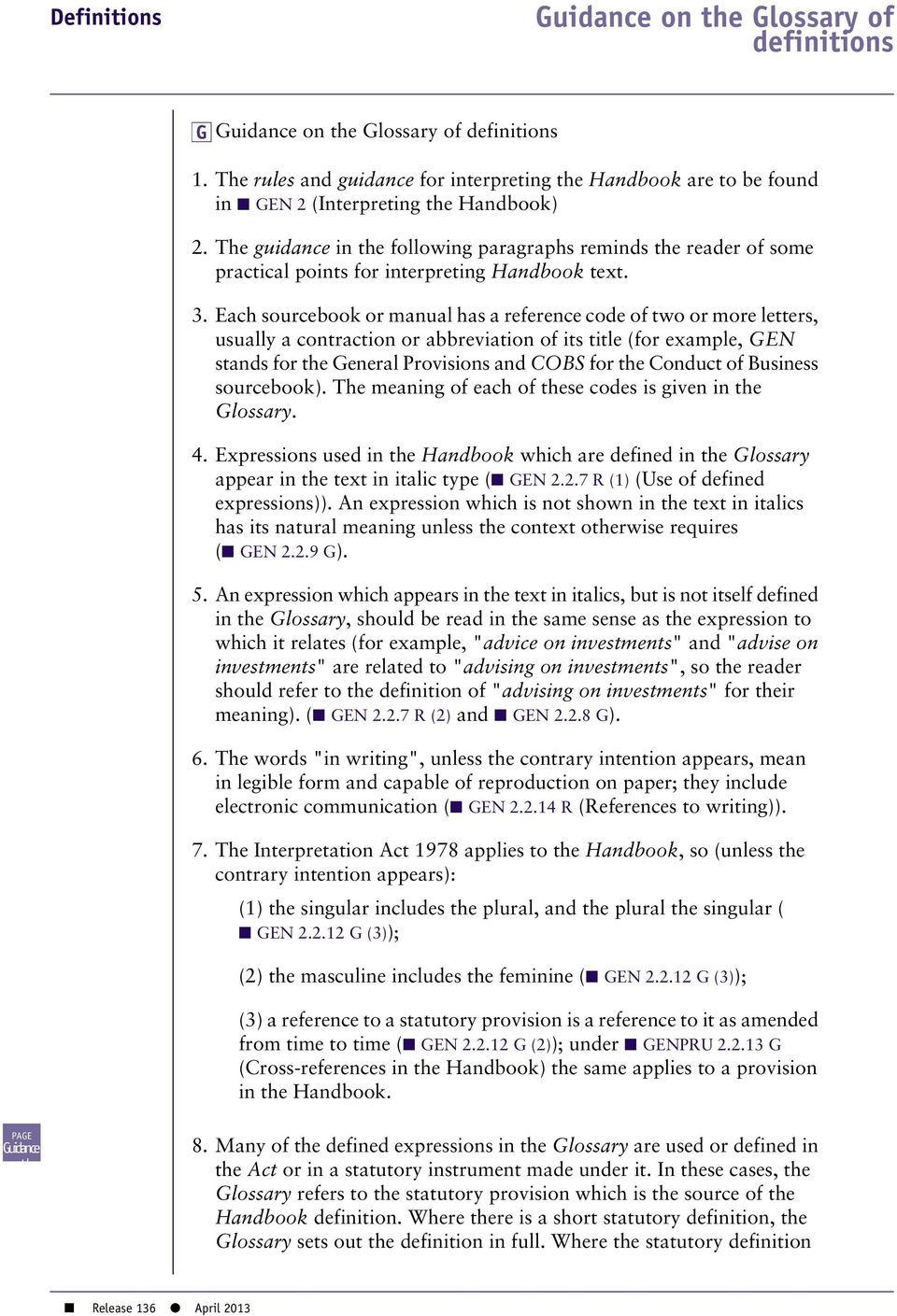
4 Guidance on the Glossary of definitions is long, the Glossary gives a summary of it, and states that it is a summary. Guidance on the Glossary of definitions2

5 Act (in BSOCS) the Building Societies Act

6 12

7 51

8 52

9 A ABCP internal assessment approach the method for calculating the risk weighted exposure amount for a securitisation position in relation to an asset backed commercial paper programme as set out in BIPRU R. ABCP programme (for the purposes of BIPRU 9 (Securitisation)) an asset backed commercial paper programme. accepted channel for dissemination of information (in relation to any prescribed market) an approved channel of communication by which information concerning investments traded on the market is formally disseminated to other market users on a structured and equitable basis. A1 accepted market practice accepting deposits accident account (as defined in section 130A(3) of the Act) practices that are reasonably expected in the financial market or markets in question and are accepted by the FCA or, in the case of a market situated in another EEA State, the competent authority of that EEA State within the meaning of the Market Abuse Directive. the regulated activity, specified in article 5 of the Regulated Activities Order (Accepting deposits), which is in summary: accepting deposits if: (a) money received by way of deposit is lent to others; or (b) any other activity of the person accepting the deposit is financed, wholly or to a material extent, out of the capital of or interest on money received by way of deposit. (in relation to a class of contract of insurance) the class of contract of insurance, specified in paragraph 1 of Part I of Schedule 1 to the Regulated Activities Order (Contracts of general insurance), providing fixed pecuniary benefits or benefits in the nature of indemnity (or a combination of both) against risks of the person insured or, in the case of a contract made under section 140, 140A or 140B of the Local Government Act 1972 (or, in Scotland, section 86(1) of the Local Government (Scotland) Act 1973), a person for whose benefit the contract is made: (a) sustaining injury as the result of an accident or of an accident of a specified class; or (b) dying as a result of an accident or an accident of a specified class; or (c) becoming incapacitated in consequence of disease or of disease of a specified class; including contracts relating to industrial injury and occupational disease but excluding contracts within paragraph 2 of Part I of Schedule 1 to the Regulated Activities Order (Sickness) and contracts within paragraph IV of Part II of that Schedule (Permanent health). (in relation to a dormant account) has the meaning given in section 9 of the Dormant Bank and Building Society Accounts Act 2008, which is in summary: (a) an account which has at all times consisted only of money and is provided by a bank or building society as part of its activity of accepting deposits; and (b) in relation to a building society, it includes an account representing shares in the society, other than: (i) preferential shares; or

10 A (ii) deferred shares within the meaning given in section 119(1) of the Building Societies Act accountable functions accountable significant-influence function (1) (in the FCA Handbook and in relation to an approved person) the functions described in APER 1.1A.2 P, which are in summary: (a) FCA controlled functions; (b) PRA controlled functions; and (c) any other functions in relation to the carrying on of a regulated activity; in relation to the authorised persons in relation to which that person is an approved person. (2) (in the PRA Handbook and in relation to an approved person) the functions described in APER 1.1B.2 P, which are in summary: (a) PRA controlled functions; (b) FCA controlled functions that are significant-influence functions; and (c) any other significant-influence functions; in relation to the PRA-authorised persons in relation to which that person is an approved person. (in the FCA Handbook) any accountable function that is a significant-influence function. accounting reference date accredited body accumulating with-profits policy (1) (except in COLL ): (a) (in relation to a company incorporated in the United Kingdom under the Companies Acts) the accounting reference date of that company determined in accordance with section 391 of the Companies Act 2006; (b) (in relation to any other body) the last day of its financial year. (2) (in COLL): the date stipulated in the prospectus on which the annual accounting period of an authorised fund ends. any of the following bodies recognised by the FCA for the purpose of providing the independent verification required under TC R: (a) CFA Society of the UK; (b) The Chartered Insurance Institute; (c) The Institute of Financial Planning; (d) The Chartered Institute for Securities and Investment; (e) The Chartered Institute of Bankers in Scotland; (f) The ifs School of Finance; [Note: The ifs School of Finance acts through its Institute of Financial Services] (g) The Institute of Chartered Accountants in England and Wales; (h) The Pensions Management Institute. a with-profits insurance contract which has a readily identifiable current benefit, whether or not this benefit is currently realisable, which is adjusted by an amount explicitly related to the amount of any premium payment and to which additional benefits are added in respect of participation in profits A2

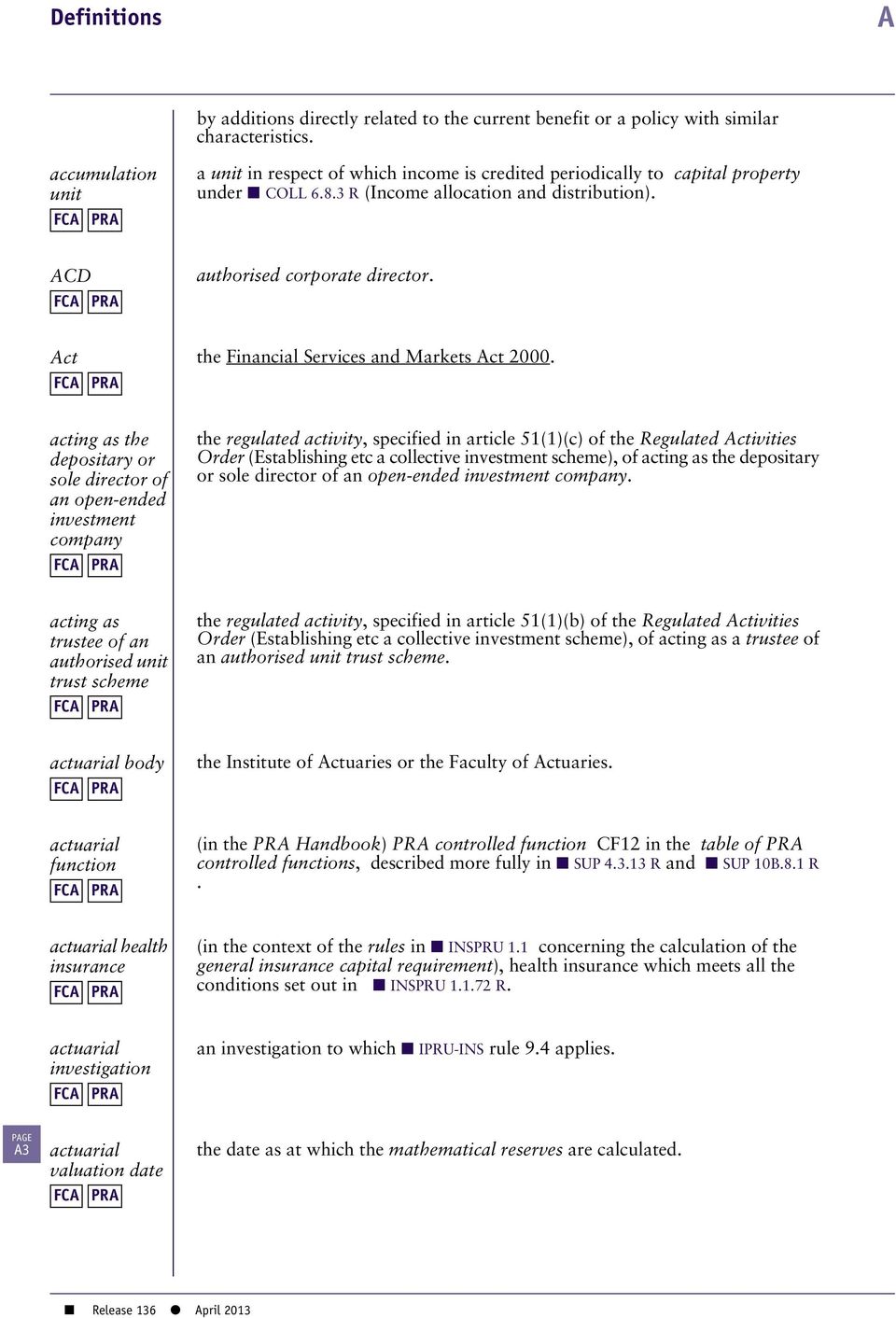
11 A by additions directly related to the current benefit or a policy with similar characteristics. accumulation unit a unit in respect of which income is credited periodically to capital property under COLL R (Income allocation and distribution). ACD authorised corporate director. Act the Financial Services and Markets Act acting as the depositary or sole director of an open-ended investment company the regulated activity, specified in article 51(1)(c) of the Regulated Activities Order (Establishing etc a collective investment scheme), of acting as the depositary or sole director of an open-ended investment company. acting as trustee of an authorised unit trust scheme the regulated activity, specified in article 51(1)(b) of the Regulated Activities Order (Establishing etc a collective investment scheme), of acting as a trustee of an authorised unit trust scheme. actuarial body the Institute of Actuaries or the Faculty of Actuaries. actuarial function (in the PRA Handbook) PRA controlled function CF12 in the table of PRA controlled functions, described more fully in SUP R and SUP 10B.8.1 R. actuarial health insurance (in the context of the rules in INSPRU 1.1 concerning the calculation of the general insurance capital requirement), health insurance which meets all the conditions set out in INSPRU R. actuarial investigation an investigation to which IPRU-INS rule 9.4 applies. A3 actuarial valuation date the date as at which the mathematical reserves are calculated.
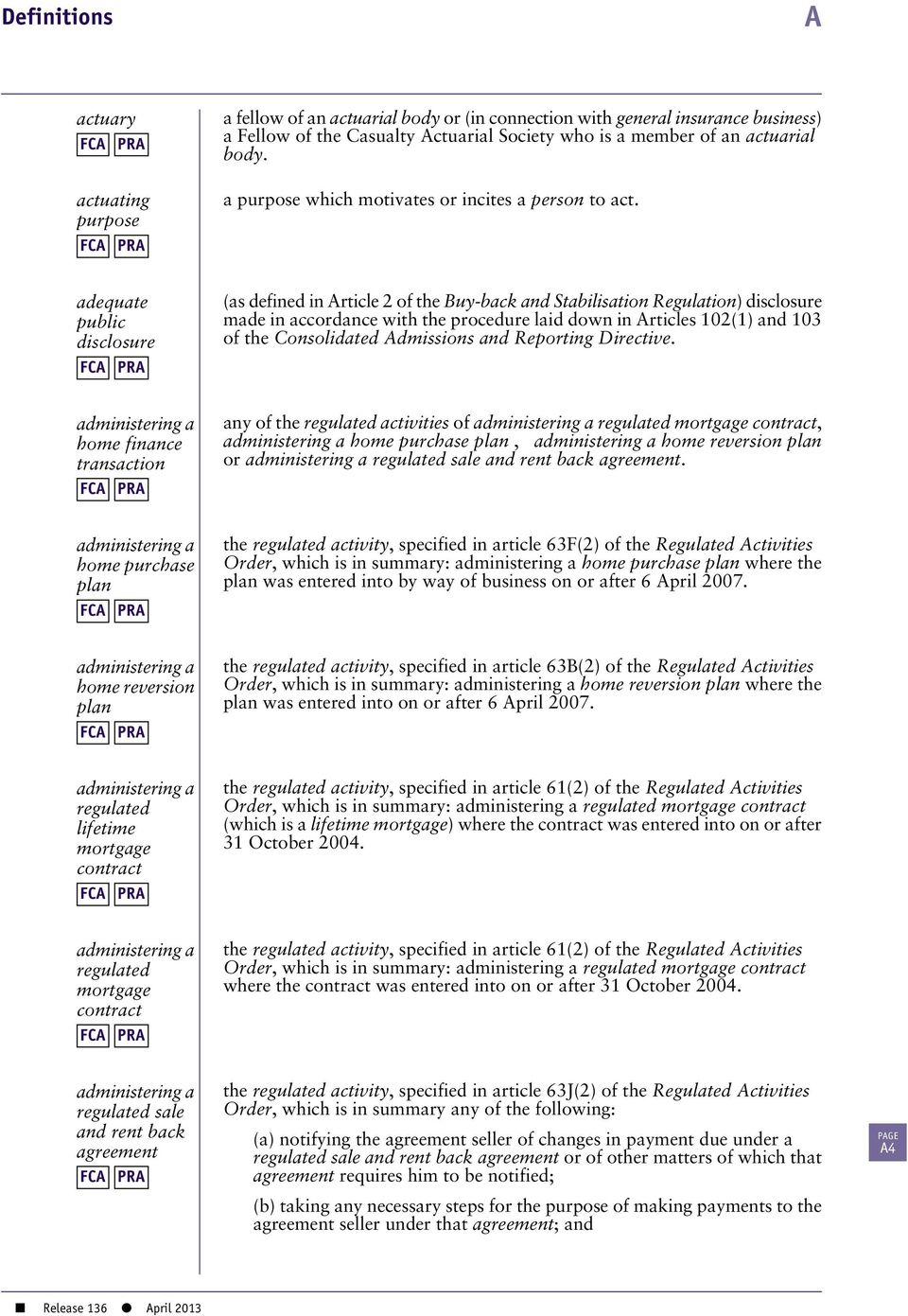
12 A actuary actuating purpose a fellow of an actuarial body or (in connection with general insurance business) a Fellow of the Casualty Actuarial Society who is a member of an actuarial body. a purpose which motivates or incites a person to act. adequate public disclosure (as defined in Article 2 of the Buy-back and Stabilisation Regulation) disclosure made in accordance with the procedure laid down in Articles 102(1) and 103 of the Consolidated Admissions and Reporting Directive. administering a home finance transaction any of the regulated activities of administering a regulated mortgage contract, administering a home purchase plan, administering a home reversion plan or administering a regulated sale and rent back agreement. administering a home purchase plan the regulated activity, specified in article 63F(2) of the Regulated Activities Order, which is in summary: administering a home purchase plan where the plan was entered into by way of business on or after 6 April administering a home reversion plan the regulated activity, specified in article 63B(2) of the Regulated Activities Order, which is in summary: administering a home reversion plan where the plan was entered into on or after 6 April administering a regulated lifetime mortgage contract the regulated activity, specified in article 61(2) of the Regulated Activities Order, which is in summary: administering a regulated mortgage contract (which is a lifetime mortgage) where the contract was entered into on or after 31 October administering a regulated mortgage contract the regulated activity, specified in article 61(2) of the Regulated Activities Order, which is in summary: administering a regulated mortgage contract where the contract was entered into on or after 31 October administering a regulated sale and rent back agreement the regulated activity, specified in article 63J(2) of the Regulated Activities Order, which is in summary any of the following: (a) notifying the agreement seller of changes in payment due under a regulated sale and rent back agreement or of other matters of which that agreement requires him to be notified; (b) taking any necessary steps for the purpose of making payments to the agreement seller under that agreement; and A4
13 A (c) taking any necessary steps for the purposes of collecting or recovering payments due under that agreement from the agreement seller; but a person is not to be treated as administering a regulated sale and rent back agreement because he has, or exercises, a right to take action for the purposes of enforcing that agreement (or to require that such action is or is not taken); and in relation to a person who acquires obligations or rights under a regulated sale and rent back agreement, an activity is a specified kind of activity for the purposes of this definition only if the agreement was entered into by the agreement provider (rather than the obligations or rights acquired) on or after 1 July administering a specified benchmark FCA administrative expenses The regulated activity, specified in article 63O(1)(b) of the Regulated Activities Order, which means: (1) administering the arrangements for determining a specified benchmark, or (2) collecting, analysing or processing information or expressions of opinion for the purpose of determining a specified benchmark, or (3) determining a specified benchmark through the application of a formula or other method of calculation to the information or expressions of opinion provided for that purpose. has the meaning set out in the insurance accounts rules. A5 administrative functions (a) (in relation to managing investments): (i) arranging settlement; (ii) monitoring and processing corporate actions; (iii) client account administration, liaison and reporting, including valuation and performance measurement; (iv) ISA or CTF administration; (v) investment trust savings scheme administration; (b) (in relation to effecting or carrying out life policies): (i) new business administration; (ii) policy alterations including surrenders and policy loans; (iii) preparing projections; (iv) processing claims including pension payments; (v) fund switching; (c) (in relation to the operation of a stakeholder pension scheme): (i) new business administration; (ii) receipt of or alteration to contributions; (iii) preparing projections and annual statements; (iv) administration of transfers; (v) handling claims, including pension payments; (vi) fund allocation and switching.

14 A admissible asset admission or admission to listing (1) (for the purpose of the rules in GENPRU and INSPRU as they apply to members of the Society of Lloyd's, the Society and managing agents ) an asset that, subject to paragraphs (2) and (3) of GENPRU 2 Annex 7 R, falls into one or more categories in paragraph (1) of GENPRU 2 Annex 7 R as modified by GENPRU R. (2) otherwise: (a) (in relation to an insurer which is not a pure reinsurer) an asset that, subject to paragraphs (2) and (3) of GENPRU 2 Annex 7 R, falls into one or more categories in paragraph (1) of GENPRU 2 Annex 7 R ; or (b) (in relation to a pure reinsurer) an asset the holding of which is consistent with compliance by the firm with INSPRU A R. (in LR) admission of securities to the official list. admission to trading advanced IRB approach advanced measurement approach advanced prudential calculation approach (1) (in LR) admission of securities to trading on an RIE's market for listed securities. (2) (in PR and DTR) admission to trading on a regulated market. (3) (elsewhere in the Handbook)(in relation to an investment and an exchange) the process by which the exchange permits members of the exchange to enter into transactions in that investment under and subject to the rules of the exchange. one of the following: (a) (in relation to the sovereign, institutional and corporate IRB exposure class) the approach under the IRB approach under which a firm supplies its own estimates of LGD and conversion factors; (b) (where the approach in (a) is being applied on a consolidated basis) the method in (a) as applied on a consolidated basis in accordance with BIPRU 8 (Group risk - consolidation); or (c) when the reference is to the rules of or administered by a regulatory body other than the appropriate regulator, whatever corresponds to the approach in (a) or (b), as the case may be, under those rules. one of the following: (a) the adjusted method of calculating theoperational risk capital requirement set out in BIPRU 6.5 (Operational risk: advanced measurement approaches); (b) (where the approach in (a) is being applied on a consolidated basis) the method in (a) as applied on a consolidated basis in accordance with BIPRU 8 (Group risk - consolidation); or (c) when the reference is to the rules of or administered by a regulatory body other than the appropriate regulator, whatever corresponds to the approach in (a) or (b), as the case may be, under those rules. one of the following: (a) the IRB approach; or (b) the advanced measurement approach; or (c) the VaR model approach; or A6

15 A (d) the CAD 1 model approach; or (e) the master netting agreement internal models approach; or (f) the CCR internal model method; including, in each case, whatever corresponds to that approach under the rules of or administered by a regulatory body other than the appropriate regulator. advanced prudential calculation approach permission advertisement adviser adviser charge advising on a home finance transaction one of the following: (a) an IRB permission; or (b) an AMA permission; or (c) a VaR model permission; or (d) a CAD 1 model waiver; or (e) a master netting agreement internal models approach permission; or (f) a CCR internal model method permission. (in PR and LR 4) (as defined in the PD Regulation) announcements: (a) relating to a specific offer to the public of securities or to an admission to trading on a regulated market; and (b) aiming to specifically promote the potential subscription or acquisition of securities. (1) (except in IPRU(INV) 13) an individual who is: a representative, an appointed representative or a tied agent (2) (in IPRU(INV) 13) a financial adviser. any form of charge payable by or on behalf of a retail client to a firm in relation to the provision of a personal recommendation by the firm in respect of a retail investment product (or any related service provided by the firm) which: (a) is agreed between that firm and the retail client in accordance with the rules on adviser charging and remuneration ( COBS 6.1A); and (b) is not a consultancy charge. any of the regulated activities of advising on regulated mortgage contracts, advising on a home purchase plan, advising on a home reversion plan or advising on a regulated sale and rent back agreement. A7 advising on a home purchase plan the regulated activity, specified in article 53C of the Regulated Activities Order, which is in summary: advising a person if the advice: (a) is given to him in his capacity as a home purchaser or potential home purchaser; and (b) is advice on the merits of his: (i) entering into a particular home purchase plan; or (ii) varying the terms of a home purchase plan entered into by him on or after 6 April 2007 in such a way as to vary his obligations under that plan.

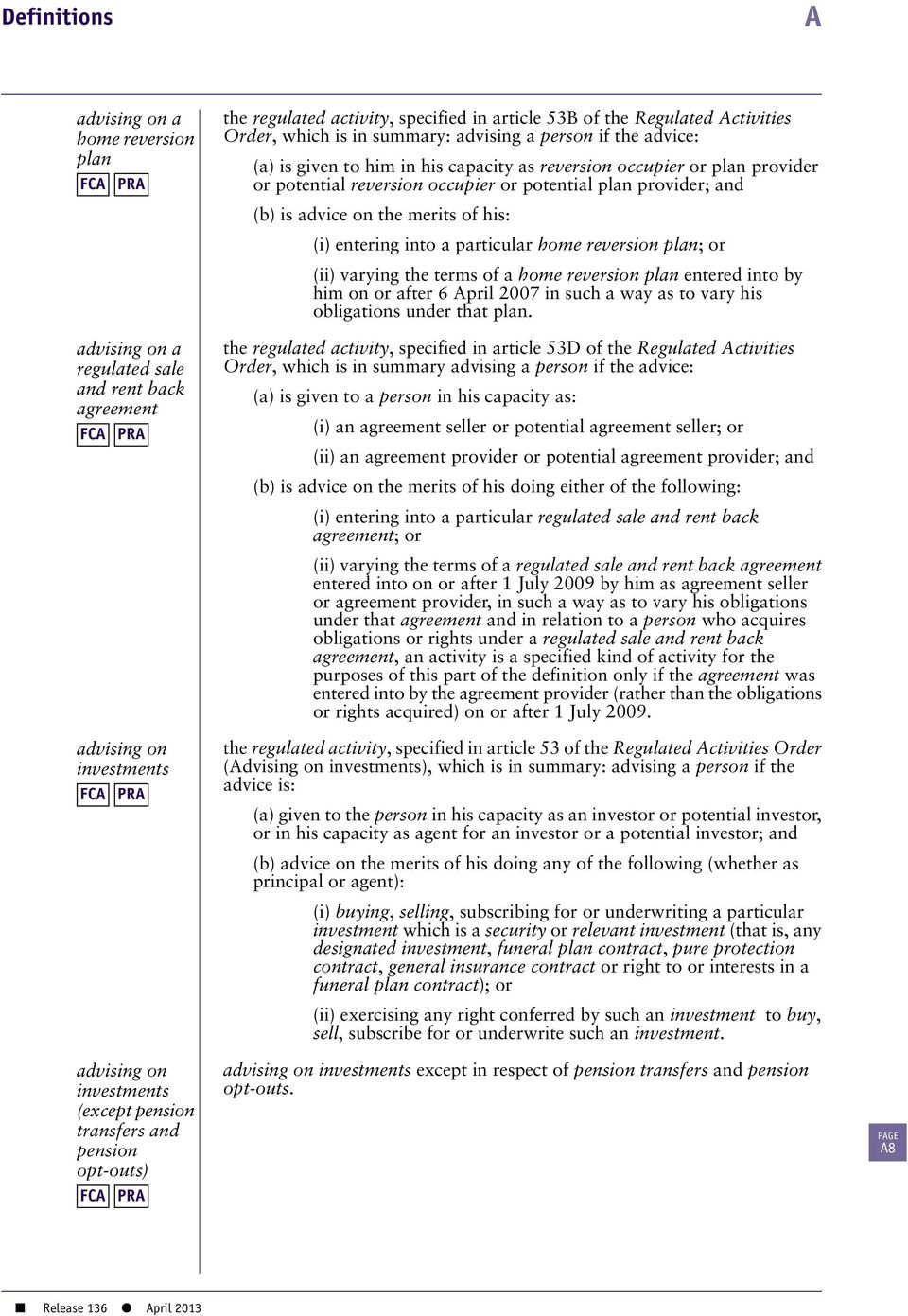
16 A advising on a home reversion plan advising on a regulated sale and rent back agreement advising on investments advising on investments (except pension transfers and pension opt-outs) the regulated activity, specified in article 53B of the Regulated Activities Order, which is in summary: advising a person if the advice: (a) is given to him in his capacity as reversion occupier or plan provider or potential reversion occupier or potential plan provider; and (b) is advice on the merits of his: (i) entering into a particular home reversion plan; or (ii) varying the terms of a home reversion plan entered into by him on or after 6 April 2007 in such a way as to vary his obligations under that plan. the regulated activity, specified in article 53D of the Regulated Activities Order, which is in summary advising a person if the advice: (a) is given to a person in his capacity as: (i) an agreement seller or potential agreement seller; or (ii) an agreement provider or potential agreement provider; and (b) is advice on the merits of his doing either of the following: (i) entering into a particular regulated sale and rent back agreement; or (ii) varying the terms of a regulated sale and rent back agreement entered into on or after 1 July 2009 by him as agreement seller or agreement provider, in such a way as to vary his obligations under that agreement and in relation to a person who acquires obligations or rights under a regulated sale and rent back agreement, an activity is a specified kind of activity for the purposes of this part of the definition only if the agreement was entered into by the agreement provider (rather than the obligations or rights acquired) on or after 1 July the regulated activity, specified in article 53 of the Regulated Activities Order (Advising on investments), which is in summary: advising a person if the advice is: (a) given to the person in his capacity as an investor or potential investor, or in his capacity as agent for an investor or a potential investor; and (b) advice on the merits of his doing any of the following (whether as principal or agent): (i) buying, selling, subscribing for or underwriting a particular investment which is a security or relevant investment (that is, any designated investment, funeral plan contract, pure protection contract, general insurance contract or right to or interests in a funeral plan contract); or (ii) exercising any right conferred by such an investment to buy, sell, subscribe for or underwrite such an investment. advising on investments except in respect of pension transfers and pension opt-outs. A8
17 A advising on pension transfers and pension opt-outs advising on investments in respect of pension transfers and pension opt-outs. advising on regulated mortgage contracts advising on syndicate participation at Lloyd's the regulated activity, specified in article 53A of the Regulated Activities Order, which is in summary: advising a person if the advice: (a) is given to the person in his capacity as a borrower or potential borrower; and (b) is advice on the merits of his: (i) entering into a particular regulated mortgage contract; or (ii) varying the terms of a regulated mortgage contract entered into by him on or after 31 October 2004 in such a way as to vary his obligations under that contract. the regulated activity, specified in article 56 of the Regulated Activities Order (Advice on syndicate participation at Lloyd's), of advising a person to become, or continue or cease to be, a member of a particular Lloyd's syndicate. A9 affected person affiliated company AFM (in COLL ): (a) (in relation to an ICVC): (i) the ICVC; (ii) its depositary; (iii) a director of the ICVC; (iv) any investment adviser of the ICVC; (v) any associate of any person in (a)(i), (ii), (iii) or (iv); (vi) the auditor of the scheme; (b) (in relation to an AUT): (i) the manager; (ii) the trustee; (iii) any investment adviser of the manager; (iv) any associate of any person in (b)(i), (ii) or (iii); (v) the auditor of the scheme. (in relation to a person) an undertaking in the same group as that person. authorised fund manager.

18 A agent agreeing to carry on a regulated activity aircraft aircraft liability all price risk measure allocation period (in relation to payment services or electronic money) a person who acts on behalf of a payment institution or an electronic money institution in providing payment services. [Note: article 4(22) of the Payment Services Directive] the regulated activity, specified in article 64 of the Regulated Activities Order (Agreeing to carry on specified kinds of activity), of agreeing to carry on an activity specified in Part II of that Order other than: (a) accepting deposits; (aa) issuing electronic money; (b) effecting contracts of insurance; (c) carrying out contracts of insurance; (d) establishing, operating or winding up a collective investment scheme; (e) acting as trustee of an authorised unit trust scheme; (f) acting as the depositary or sole director of an open-ended investment company; (g) establishing, operating or winding up a stakeholder pension scheme; (h) establishing, operating or winding up a personal pension scheme. (in relation to a class of contract of insurance) the class of contract of insurance, specified in paragraph 5 of Part I of Schedule 1 to the Regulated Activities Order (Contracts of general insurance), upon aircraft or upon the machinery, tackle, furniture or equipment of aircraft. (in relation to a class of contract of insurance) the class of contract of insurance, specified in paragraph 11 of Part I of Schedule 1 to the Regulated Activities Order (Contracts of general insurance), against damage arising out of or in connection with the use of aircraft, including third-party risks and carrier's liability. (in BIPRU 7.10 (Use of a Value at Risk Model)) has the meaning in BIPRU A R (Capital calculations for VaR models), which is, in relation to a business day, the all price risk measure required under the provisions in BIPRU 7.10 about specific risk for the correlation trading portfolio. a single 24-hour period or, with the agreement of each professional client concerned, a period spanning five consecutive business days, during which an aggregated series of transactions may be executed. allotment alternative debenture alternative projection (as defined in Article 2 of the Buy-back and Stabilisation Regulation) the process or processes by which the number of relevant securities to be received by investors who have previously subscribed or applied for them is determined. the investment specified in article 77A of the Regulated Activities Order (Alternative finance investment bonds). (in COBS) a projection calculated on the basis described in paragraph 1.5R of the projection rules ( COBS 13 Annex 2), rather than in accordance with the remainder of those rules. A10
![[Note: article 4(22) of the Payment Services Directive] the regulated activity, specified in article 64 of the Regulated Activities Order (Agreeing to carry on specified kinds of activity), of](/docs-images/41/854327/images/page_18.jpg "agreeing to carry on an activity specified in Part II of that Order other than: (a) accepting deposits; (aa) issuing electronic money; (b) effecting contracts of insurance; (c) carrying out contracts")
19 A alternative standardised approach one of the following: (a) a version of the standardised approach to operational risk under which a firm uses different indicators for certain business lines as referred to in BIPRU R (The alternative standardised approach); (b) (where the approach in (a) is being applied on a consolidated basis) the method in (a) as applied on a consolidated basis in accordance with BIPRU 8 (Group risk - consolidation); or (c) when the reference is to the rules of or administered by a regulatory body other than the appropriate regulator, whatever corresponds to the approach in (a) or (b), as the case may be, under those rules. AMA the advanced measurement approach. AMA permission an Article 129 implementing measure, a requirement or a waiver that requires a BIPRU firm or an institution to use theadvanced measurement approach to operational risk on a solo basis or, if the context requires, a consolidated basis. A11 ancillary activity ancillary insurance services undertaking ancillary risk an activity which is not a regulated activity but which is: (a) carried on in connection with a regulated activity; or (b) held out as being for the purposes of a regulated activity. (in relation to any undertaking in a consolidation group, sub-group or other group of persons) an undertaking complying with the following conditions: (a) its principal activity consists of: (i) owning or managing property; or (ii) managing data-processing services; or (iii) any other similar activity; (b) the activity in (a) is ancillary to the principal activity of one or more insurance undertakings; and (c) those insurance undertakings are also members of that consolidation group, sub-group or other group of persons. (in relation to an insurer with permission under the Act to insure a principal risk belonging to one class (as defined for the purposes of INSPRU and SUP) of general insurance business) a risk included in another such class which is: (a) connected with the principal risk, (b) concerned with the object which is covered against the principal risk, and (c) the subject of the same contract insuring the principal risk. However, the risks included in classes 14, 15 and 17 may not be treated as risks ancillary to other classes, except that the risk included in class 17 (legal expenses insurance) may be regarded as an ancillary risk of class 18 where: (d) the conditions laid down in (a) to (c) are fulfilled, and (e) the principal risk relates solely to assistance provided for persons who fall into difficulties while travelling, while away from home or while away from their permanent residence or where it concerns disputes or risks arising out of, or in connection with, the use of sea-going vessels.

20 A ancillary service ancillary services undertaking any of the services listed in Section B of Annex I to MiFID, that is: (a) safekeeping and administration of financial instruments for the account of clients, including custodianship and related services such as cash/collateral management; (b) granting credits or loans to an investor to allow him to carry out a transaction in one or more financial instruments, where the firm granting the credit or loan is involved in the transaction; (c) advice to undertakings on capital structure, industrial strategy and related matters and advice and services relating to mergers and the purchase of undertakings; (d) foreign exchange services where these are connected to the provision of investment services; (e) investment research and financial analysis or other forms of general recommendation relating to transactions in financial instruments; (f) services related to underwriting; and (g) investment services and activities as well as ancillary services within (a) to (f), above, related to the underlying of the derivatives included under Section C - 5, 6, 7 and 10, that is (in accordance with that Annex and Recital 21 to, and Article 39 of, the MiFID Regulation): (i) commodities; (ii) climatic variables; (iii) freight rates; (iv) emission allowances; (v) inflation rates or other official economic statistics; (vi) telecommunications bandwidth; (vii) commodity storage capacity; (viii) transmission or transportation capacity relating to commodities, where cable, pipeline or other means; (ix) an allowance, credit, permit, right or similar asset which is directly linked to the supply, distribution or consumption of energy derived from renewable resources; (x) a geological, environmental or other physical variable; (xi) any other asset or right of a fungible nature, other than a right to receive a service, that is capable of being transferred; (xii) an index or measure related to the price or value of, or volume of transactions in any asset, right, service or obligation; where these are connected to the provision of investment services or ancillary services. [Note: article 4(1)(3) of MiFID] (1) (in accordance with Article 4(21) of the Banking Consolidation Directive (Definitions) and subject to (2)) and in relation to an undertaking in a consolidation group, sub-group or another group of persons) an undertaking complying with the following conditions: (a) its principal activity consists of: (i) owning or managing property; or (ii) managing data-processing services; or A12

21 A (iii) any other similar activity; (b) the activity in (a) is ancillary to the principal activity of one or more credit institutions or investment firms; and (c) those credit institutions or investment firms are also members of that consolidation group, sub-group or group. (2) (for the purpose of GENPRU 1.3 (Valuation) and INSPRU 6.1 (Group Risk: Insurance Groups) an undertaking in (1) and an ancillary insurance services undertaking. ancillary stabilisation announceable information (as defined in Article 2 of the Buy-back and Stabilisation Regulation) the exercise of an overallotment facility or of a greenshoe option by investment firms or credit institutions, in the context of a significant distribution of relevant securities, exclusively for facilitating stabilisation activity. information which is usually the subject of a public announcement, although not subject to any formal disclosure requirement. annual accounting period (1) [deleted] (2) (in COLL): the period determined in accordance with COLL R (3) to COLL R (7) (Accounting periods). Annual Accounts annual audited fixed expenditure (1) the Council Directive of 19 December 1991 concerning the annual accounts and consolidated accounts of insurance undertakings (No. 91/674/EEC). (2) (in UPRU) accounts prepared to comply with : (a) the Companies Acts 1985 to 1989, and their equivalent in Northern Ireland, where these provisions are applicable; or (b) the Companies Act 2006; or (c) other statutory obligations. (in UPRU) has the meaning given in UPRU R (Annual audited fixed expenditure). annual bonus annual budget (in relation to a with-profits insurance contract) a discretionary addition to policy benefits under a with-profits insurance contract made by a long-term insurer as a result of the annual actuarial investigation. the annual budgeted costs of operating the Financial Ombudsman Service. A13 annual eligible income (in FEES) (in relation to a firm and a class) the annual income (as described in FEES 6 Annex 3 R ) for the firm's last financial year ended in the year to 31 December preceding the date for submission of the information under FEES R attributable to that class. A firm must calculate annual eligible income from such annual income in one of the following ways:
22 A (a) only include such annual income if it is attributable to business conducted with or for the benefit of eligible claimants and is otherwise attributable to compensatable business; or (b) include all such annual income. annual financial statements annual income the financial statements in respect of the year ending on the firm's annual accounting reference date, which is the date to which a corporate firm's accounts are prepared for the purposes of the Companies Acts, or, where the firm is not subject to the Companies Acts, the equivalent date chosen by the firm and notified to the FCA or PRA as the case may be. (in MIPRU) the income referred to in MIPRU 4.3 annual income allocation date the date in any year stated in the most recently published prospectus as the date on or before which, in respect of each annual accounting period, an allocation of income is to be made. annual percentage rate the annual percentage rate of charge for a contract as calculated in accordance with MCOB 10 (Annual percentage rate). annual report and accounts annual statement provisions annualised net written premiums APER (a) (in relation to a company incorporated in the United Kingdom) an annual report and annual accounts as those terms are defined in: (i) section 262(1) of the Companies Act 1985, together with an auditor's report prepared in relation to those accounts under section 235 of the same Act where these provisions are applicable; or (ii) section 471 of the Companies Act 2006 together with an auditor's report prepared in relation to those accounts under sections 495 to 497 of the same Act; (b) (in relation to any other body) any similar or analogous documents which it is required to prepare whether by its constitution or by the law under which it is established. (in MCOB) in relation to a: (a) regulated mortgage contract, MCOB 7.5; (b) home purchase plan, MCOB R to MCOB R; and (c) instalment reversion plan, MCOB R to MCOB R (2)(c). (for the purposes of INSPRU 1.4 ) in relation to a financial year, the net written premiums received during that financial year, except that in relation to a financial year that has been validly extended beyond, or shortened from, a period of 12 months, the amount of net written premiums is the amount determined in accordance with the formula: NWP x 365/Dwhere: (1) NWP is the amount of net written premiums received in the financial year; and (2) D is the number of days in that financial year. the part of the Handbook in High Level Standards which has the title Statements of Principle and Code of Practice for Approved Persons. A14
23 A applicable asset applicable provisions applicable sectoral consolidation rules (a) in relation to MiFID business, a financial instrument; or (b) in relation to safeguarding and administering investments that is not MiFID business, a designated investment. the Host State rules with which: (a) an incoming EEA firm is required to comply when carrying on a permitted activity through a branch or by providing services (as applicable) in the United Kingdom, as defined in paragraphs 13(4) and 14(4) of Part II of Schedule 3 to the Act (Exercise of passport rights by EEA firms); or (b) a UK firm is required to comply when conducting business through a branch (in accordance with paragraph 19(13) of Part III of Schedule 3 to the Act (Exercise of passport rights by UK firms)) or by providing services (as applicable) in another EEA State. (in respect of a financial sector and in accordance with paragraph 6. 9 of GENPRU 3 Annex 1 R (Applicable sectoral consolidation rules)) the appropriate regulator's sectoral rules about capital adequacy and solvency on a consolidated basis applicable to that financial sector under the table in paragraph 6.10 of GENPRU 3 Annex 1 R. A15 applicable sectoral rules applicant appointed representative Appointed Representatives Regulations (in respect of a financial sector) applicable sectoral consolidation rules for that financial sector and the appropriate regulator's sectoral rules about capital adequacy and solvency for: (a) the banking and investment services sector as set out in paragraph 6.2 of GENPRU 3 Annex 1 R; or (b) insurance undertakings; which of those sets of rules apply for the purpose of a particular calculation depends on the nature of that calculation. (1) (in LR) an issuer which is applying for admission of securities. (2) (in PR) an applicant for approval of a prospectus or supplementary prospectus relating to transferable securities. (in accordance with section 39 of the Act (other than an authorised person) who: (a) is a party to a contract with an authorised person (his principal) which: (i) permits or requires him to carry on business of a description prescribed in the Appointed Representatives Regulations; and (ii) complies with such requirements as are prescribed in those Regulations; and (b) is someone for whose activities in carrying on the whole or part of that business his principal has accepted responsibility in writing; and who is therefore an exempt person in relation to any regulated activity comprised in the carrying on of that business for which his principal has accepted responsibility. the Financial Services and Markets Act 2000 (Appointed Representatives) Regulations 2001 (SI 2001/1217).
24 A apportionment and oversight function FCA controlled function CF8 in Parts 1 and Part 2 of the table of FCA controlled functions, described more fully in SUP 10A.7.1 R. appropriate actuary an actuary appointed under SUP R (Appointment of an appropriate actuary). appropriate charges information (in COBS) information about charges which is calculated and presented in accordance with the charges rules in COBS R and COBS 13 Annexes 3 or 4. appropriate position risk adjustment appropriate regulator appropriate UK regulator appropriate valuer (1) (in relation to a position treated under BIPRU 7.6 (Option PRR)) the percentage figure applicable to that position under the table in BIPRU R (Appropriate Position Risk Adjustment); (2) (for any other purpose and in relation to a position) the position risk adjustment applicable to that position under BIPRU 7 (Market risk). (1) in the FCA Handbook, the FCA; and in the PRA Handbook, the PRA; (2) (a) in SUP 11 "appropriate regulator" has the meaning given in section 178 of the Act, and (b) in SUP 18 "appropriate regulator" has the meaning given in section 103A of the Act. (1) in relation to an EEA firm (in accordance with Schedule 3 paragraph 13(4) and 14(4) to the Act), whichever of the FCA or PRA is the competent authority for the purposes of the relevant Single Market Directive; (2) in relation to a UK firm (in accordance with Schedule 3 paragraph 18A to the Act), (a) the PRA, where the firm is a PRA-authorised person; and (b) in any other case, the FCA. (3) in relation to a Treaty firm (in accordance with section 35(2A) of the Act), (a) in the case of a PRA-authorised person, the PRA; and (b) in any other case, the FCA. (in COLL ) a person who complies with the requirements of COLL R (7) (Investment in property) or COLL R (4) ( Investment in property). approve (in relation to a financial promotion) approve the content of the financial promotion for the purposes of section 21 of the Act (Restrictions on financial promotion). A16
25 A A17 approved bank approved collateral approved counterparty approved credit institution (except in COLL ) (in relation to a bank account opened by a firm): (a) if the account is opened at a branch in the United Kingdom: (i) the Bank of England; or (ii) the central bank of a member state of the OECD; or (iii) a bank; or (iv) a building society ; or (v) a bank which is supervised by the central bank or other banking regulator of a member state of the OECD; or (b) if the account is opened elsewhere: (i) a bank in (a); or (ii) a credit institution established in an EEA State other than the United Kingdom and duly authorised by the relevant Home State regulator; or (iii) a bank which is regulated in the Isle of Man or the Channel Islands; or (c) a bank supervised by the South African Reserve Bank; or (d) any other bank that: (i) is subject to regulation by a national banking regulator; (ii) is required to provide audited accounts; (iii) has minimum net assets of 5 million (or its equivalent in any other currency at the relevant time) and has a surplus revenue over expenditure for the last two financial years; and (iv) has an annual audit report which is not materially qualified. (in COLL ) any person falling within (a-c). any form of security for the discharge of any liability arising from a contingent liability investment (other than a guarantee) which: (a) (in relation to an on-exchange transaction) is acceptable under the rules of the relevant exchange or clearing house; and (b) (in relation to an OTC transaction) would be acceptable for a similar transaction to the relevant exchange or clearing house. any of the following: (a) an approved credit institution; or (b) a firm whose permission includes dealing in investments as principal with respect to derivatives which are not listed; or (c) a MiFID investment firm whose authorisation (as referred to in article 5 of MiFID) authorises it to carry on activities of the kind referred to in (b); or (d) in respect of a transaction involving a new issue of securities which are to be listed, the issuer or a MiFID investment firm acting on behalf of the issuer. a credit institution recognised or permitted under the law of an EEA State to carry on any of the activities set out in Annex 1 to the Banking Consolidation Directive.
26 A approved depositary approved derivative approved financial institution approved index any depositary: (a) which is subject to regulation by a national regulatory body in connection with its custody services; (b) which is required to prepare audited accounts; (c) whose latest annual audit report is not materially qualified; and (d) which (i) has minimum net assets of 5 million (or its equivalent in any other currency at the relevant time) and has surplus revenue over expenditure for the last two financial years; or (ii) if not, nevertheless has adequate financial resources for its business. (1) (in COLL ) a derivative which is traded or dealt in on an eligible derivatives market. (2) (in INSPRU) a derivative in respect of which the conditions in INSPRU R are met. any of the following: (a) the European Central Bank; (b) the central bank of an EEA State; (c) the International Bank for Reconstruction and Development; (d) the European Bank for Reconstruction and Development; (e) the International Finance Corporation; (f) the International Monetary Fund; (g) the Inter-American Development Bank; (h) the African Development Bank; (i) the Asian Development Bank; (j) the Caribbean Development Bank; (k) the European Investment Bank; (l) the EU; and (m) the European Atomic Energy Community. in relation to permitted links: (a) an index that is: (i) calculated independently; (ii) published at least once every week; (iii) based on constituents that are permitted links; and (iv) calculated on a basis that is made available to the public, and that includes both the rules for including and excluding constituents and the rules for valuation which must use an arithmetic average of the value of the constituents; or (b) a national index of retail prices published by or under the authority of a government, or by a body recognised under the national legislation, of a Zone A country; or (c) an index that is: A18
27 A (i) based on constituents that are permitted links; and (ii) in respect of which a derivative contract is listed ; or (d) the average earnings index when used for the purposes of orders made under section 148 of the Social Security Administration Act 1992 by the Department for Work and Pensions. approved money-market instrument (in accordance with COLL 5.2.7F R) a money-market instrument which is normally dealt in on the money market, is liquid and has a value which can be accurately determined at any time. approved person a person in relation to whom the FCA or the PRA has given its approval under section 59 of the Act (Approval for particular arrangements) for the performance of a controlled function. approved quasi-derivative a quasi-derivative in respect of which the conditions in INSPRU R are met. A19 approved reinsurance to close approved reporting mechanism (a) a reinsurance to close effected before 1 January 2005; or (b) an agreement under which members of a syndicate in one syndicate year ("the reinsured members") agree with the members of that syndicate in a later syndicate year or the members of one other syndicate ("the reinsuring members") that the reinsuring members will discharge, or procure the discharge of, or indemnify the reinsured members against, all known and unknown insurance business liabilities of the reinsured members arising out of the insurance business carried on by the reinsured members in that syndicate year that is: (i) effected after 1 January 2005; and (ii) not a balance transfer between two syndicate years where the syndicate has only one member and the member is the same in each of those years ; or (c) an agreement under which members of a syndicate in one syndicate year ("the reinsured members") agree with a subsidiary of the Society that that subsidiary will discharge, or procure the discharge of, or indemnify the reinsured members against, all known and unknown insurance business liabilities of the reinsured members arising out of the insurance business carried on by the reinsured members in that syndicate year ("the reinsured liabilities") and where: (i) that subsidiary is wholly owned by the Society and if from time to time the subsidiary has an asset or cash flow deficiency such that the subsidiary is unable to meet any of the liabilities which it has reinsured, the Society is legally obliged to pay to the subsidiary a sum equal to that deficiency; and (ii) at the effective date of the agreement, the relevant syndicate year has been open for at least two years after the date at which it would normally have been closed in accordance with the policies and practices in relation to the syndicate concerned. a trade-matching or reporting system approved by the FCA in accordance with Section 412A of the Act.
28 A approved security approved stock lending transaction (1) (in COLL ) a transferable security that is admitted to official listing in an EEA State or is traded on or under the rules of an eligible securities market (otherwise than by the specific permission of the market authority). (2) (in INSPRU ) any of the following: (a) any security issued or guaranteed by, or the repayment of the principal of which, or the interest on which, is guaranteed by, and any loans to or deposits with, any government, public or local authority or nationalised industry or undertaking, which belongs to a Zone A country; (b) any loan to, or deposit with, an approved financial institution; (c) any debenture issued before 31 December 1994 by the Agricultural Mortgage Corporation Limited or the Scottish Agricultural Securities Corporation Limited. (3) (in COBS) any of the following: (a) any security issued or guaranteed by, or the repayment of the principal of which, or the interest on which is guaranteed by, and any loan to or deposit with, any government, public or local authority or nationalised industry or undertaking that belongs to Zone A as defined in the Banking Consolidation Directive; or (b) any loan to, or deposit with, an approved financial institution; or (c) debentures issued before 31 December 1994 by the Agricultural Mortgage Corporation Ltd or the Scottish Agricultural Securities Corporation Ltd. a stock lending transaction in respect of which the conditions in INSPRU R have been met. APR annual percentage rate. APR rules MCOB 10. arrangement arranging (as defined in section 59(10) of the Act (Approval for particular arrangements)) any kind of arrangement for the performance of a function of an authorised person ("A") which is entered into by A or any contractor of his with another person, including, in particular, that other person's appointment to an office, his becoming a partner, or his employment (whether under a contract of service or otherwise). (a) (except in relation to a home finance transaction ) arranging (bringing about) deals in investments, making arrangements with a view to transactions in investments or agreeing to carry on either of those regulated activities. (b) (in relation to a regulated mortgage contract) arranging (bringing about) regulated mortgage contracts, making arrangements with a view to regulated mortgage contracts or agreeing to carry on either of those regulated activities; A20
29 A (c) (in relation to a home purchase plan) arranging (bringing about) a home purchase plan, making arrangements with a view to a home purchase plan or agreeing to carry on either of those regulated activities. (d) (in relation to a home reversion plan) arranging (bringing about) a home reversion plan, making arrangements with a view to a home reversion plan or agreeing to carry on either of those regulated activities. arranging (bringing about) a home finance transaction any of the regulated activities of arranging (bringing about) a regulated mortgage contract, arranging (bringing about) a home purchase plan, arranging (bringing about) a home reversion plan or arranging (bringing about) a regulated sale and rent back agreement. A21 arranging (bringing about) a home purchase plan arranging (bringing about) a home reversion plan arranging (bringing about) a regulated sale and rent back agreement arranging (bringing about) deals in investments the regulated activity, specified in article 25C(1) of the Regulated Activities Order, which is in summary: making arrangements for another person to: (a) enter into a home purchase plan as home purchaser; or (b) vary the terms of a home purchase plan entered into by him as home purchaser on or after 6 April the regulated activity, specified in article 25B(1) of the Regulated Activities Order, which is in summary: making arrangements for another person to: (a) enter into a home reversion plan as reversion occupier or as plan provider; or (b) vary the terms of a home reversion plan entered into by him as reversion occupier or as plan provider on or after 6 April the regulated activity, specified in article 25E(1) of the Regulated Activities Order, which is in summary making arrangements: (a) for another person to enter into a regulated sale and rent back agreement as an agreement seller or as an agreement provider; or (b) for another person to vary the terms of a regulated sale and rent back agreement, entered into on or after 1 July 2009 by him as agreement seller or agreement provider, in such a way so as to vary his obligations under that agreement and in relation to a person who acquires obligations or rights under a regulated sale and rent back agreement, an activity is a specified kind of activity for the purposes of this part of the definition only if the agreement was entered into by the agreement provider (rather than the obligations or rights acquired) on or after 1 July 2009; including making arrangements with a view to a person who participates in the arrangements entering into a regulated sale and rent back agreement as agreement seller or agreement provider. the regulated activity, specified in article 25(1) of the Regulated Activities Order, which is in summary: making arrangements for another person (whether as principal or agent) to buy, sell, subscribe for or underwrite a particular investment which is: (a) a designated investment; or (b) a funeral plan contract; or (c) the underwriting capacity of a Lloyd's syndicate; or (d) membership of a Lloyd's syndicate; or (da) a pure protection contract; or
30 A (db) a general insurance contract; or (e) rights to or interests in investments in (b), (c) or (d). arranging (bringing about) regulated mortgage contracts arranging deals in contracts of insurance written at Lloyd's the regulated activity, specified in article 25A(1) of the Regulated Activities Order, which is in summary: making arrangements for another person to: (a) enter into a regulated mortgage contract as borrower; or (b) vary the terms of a regulated mortgage contract entered into by him as borrower on or after 31 October (see also arranging (in relation to regulated mortgage contracts) and making arrangements with a view to regulated mortgage contracts.) the regulated activity, specified in article 58 of the Regulated Activities Order (Arranging deals in contracts of insurance written at Lloyd's), carried on by the Society of Lloyd's of arranging deals in contracts of insurance written at Lloyd's. arranging qualifying credit arranging safeguarding and administration of assets the controlled activity, specified in paragraph 10A of Schedule 1 to the Financial Promotion Order, of making arrangements: (a) for another person to enter as borrower into an agreement for the provision of qualifying credit; or (b) for a borrower under a regulated mortgage contract, entered into on or after 31 October 2004, to vary the terms of that contract. that part of safeguarding and administering investments which consists solely of arranging for one or more other persons to carry on both: (a) the safeguarding of assets belonging to another; and (b) the administration of those assets. arrears Article 129 implementing measure Article 129 permission (in relation to a regulated mortgage contract or a home purchase plan ) either: any: (a) a shortfall (equivalent to two or more regular payments) in the accumulated total payments actually made by the customer measured against the accumulated total amount of payments due to be received from the customer; or (b) remaining in breach, for more than one month, of an agreed borrowing limit or of an obligation to pay or repay where the loan or home purchase plan does not have a regular payment or repayment plan. (a) measure taken by the appropriate regulator under regulations 7-9 of the Capital Requirements Regulations 2006; or (b) corresponding measure taken by another competent authority to apply an Article 129 permission as referred to in the last paragraph of Article 129(2) of the Banking Consolidation Directive. a permission of the type referred to in Article 129(2) of the Banking Consolidation Directive (permission to apply the IRB approach, the AMA approach or the CCR internal model method on a consolidated basis) or Article 37(2) of the Capital Adequacy Directive (permission to apply the VaR A22
31 A model approach on a consolidated basis) excluding an Article 129 implementing measure. A23 Article 129 procedure Article 134 relationship article 9 default assessable mutual asset asset backed commercial paper programme the procedure described in Article 129(2) of the Banking Consolidation Directive (permission to apply the IRB approach, the AMA approach or the CCR internal model method on a consolidated basis) or that applies under Article 37(2) of the Capital Adequacy Directive (permission to apply the VaR model approach on a consolidated basis) for the purpose of applying for and granting or refusing an Article 129 permission or the procedure for varying of revoking an Article 129 permission in accordance with the Banking Consolidation Directive or the Capital Adequacy Directive. (in accordance with Article 134 of the Banking Consolidation Directive) a relationship of one of the following kinds: (a) where a person exercises a significant influence over one or more persons, but without holding a participation or other capital ties in these persons and without being a parent undertaking of these persons; or (b) where two or more persons are placed under single management other than pursuant to a contract or clauses of their memoranda or articles of association. (as defined in article 2(2) of the compensation transitionals order) any of the following: (a) the passing of a resolution for the voluntary winding up of an authorised insurance company within the meaning of section 3 of the Policyholders Protection Act 1975 in circumstances falling within section 5(1)(a) of that Act; (b) the making by the court of an order for the winding up of such a company in accordance with section 5(1)(b) of that Act; (c) the appointment of a provisional liquidator in the circumstances falling within section 15 of that Act in respect of such a company; (d) such a company becoming a company in financial difficulties within the meaning of section 16 of that Act; (e) a participating deposit-taker becoming insolvent for the purposes of Part II of the Banking Act 1987; (f) a participating institution becoming insolvent within the meaning of section 25A of the Building Societies Act 1986; (g) the beginning of a dissolution or transfer of engagements of a member society in accordance with rule 9(2) of the Rules of the Friendly Societies Protection Scheme. (for the purposes of INSPRU 1.4) a mutual where the insurance business carried on by the mutual is limited to the provision of insurance business to its members and whose articles of association, rules or bye-laws provide for the calling of additional contributions from members to meet claims. (in RCB) (as defined in Regulation 1(2) of the RCB Regulations) any property, right, entitlement or interest. (for the purposes of BIPRU 9 (Securitisation) and in accordance with Part 1 of Annex IX of the Banking Consolidation Directive (Securitisation definitions)) a programme of securitisations (within the meaning of paragraph (2) of the definition of securitisation) the securities issued by which predominantly take the form of commercial paper with an original maturity of one year or less.
32 A asset backed security asset identification rules (as defined in the PD Regulation) securities which: (a) represent an interest in assets, including any rights intended to assure servicing, or the receipt or timeliness of receipts by holders of assets of amounts payable thereunder; or (b) are secured by assets and the terms of which provide for payments which relate to payments or reasonable projections of payments calculated by reference to identified or identifiable assets. rules made by the appropriate regulator which require an authorised person who has permission to effecting or carry out contracts of insurance to identify assets which belong to him and which are maintained in respect of a particular aspect of his business. asset management company a management company within the meaning of Article 2(1)(b) of the UCITS Directive, as well as an undertaking the registered office of which is outside the EEA and which would require authorisation in accordance with Article 6(1) of the UCITS Directive if it had its registered office within the EEA. asset pool (in RCB) (as defined in Regulation 1(2) of the RCB Regulations) an asset pool within the meaning of Regulation 3 of the RCB Regulations. asset pool monitor a person appointed under regulation 17A of the RCB Regulations. asset-related capital requirement a component of the calculation of the ECR for a firm carrying on general insurance business as set out in INSPRU 2.2. assistance assisting in the administration and performance of a contract of insurance (in relation to a class of contract of insurance) the class of contract of insurance, specified in paragraph 18 of Part I of Schedule 1 to the Regulated Activities Order (Contracts of general insurance), providing either or both of the following benefits: (a) assistance (whether in cash or in kind) for persons who get into difficulties while travelling, while away from home or while away from their permanent residence; (b) assistance (whether in cash or in kind) for persons who get into difficulties otherwise than as in (a). the regulated activity, specified in article 39A of the Regulated Activities Order (Assisting in the administration and performance of a contract of insurance) of assisting in the administration and performance of a contract of insurance. A24
33 A A25 associate (1) (in LR) (in relation to a director, substantial shareholder, or person exercising significant influence, who is an individual): (a) that individual's spouse, civil partner or child (together "the individual's family"); (b) the trustees (acting as such) of any trust of which the individual or any of the individual's family is a beneficiary or discretionary object (other than a trust which is either an occupational pension scheme or an employees' share scheme which does not, in either case, have the effect of conferring benefits on persons all or most of whom are related parties; (c) any company in whose equity securities the individual or any member or members (taken together) of the individual's family or the individual and any such member or members (taken together) are directly or indirectly interested (or have a conditional or contingent entitlement to become interested) so that they are (or would on the fulfilment of the condition or the occurrence of the contingency be) able: (i) to exercise or control the exercise of 30% or more of the votes able to be cast at general meetings on all, or substantially all, matters; or (ii) to appoint or remove directors holding a majority of voting rights at board meetings on all, or substantially all, matters; (d) any partnership whether a limited partnership or limited liability partnership in which the individual or any member or members (taken together) of the individual's family are directly or indirectly interested (or have a conditional or contingent entitlement to become interested) so that they hold or control or would on the fulfilment of the condition or the occurrence of the contingency be able to hold or control: (i) a voting interest greater than 30% in the partnership; or (ii) at least 30% of the partnership. For the purpose of paragraph (c), if more than one director of the listed company, its parent undertaking or any of is subsidiary undertakings is interested in the equity securities of another company, then the interests of those directors and their associates will be aggregated when determining whether that company is an associate of the director. (2) (in LR) (in relation to a substantial shareholder or person exercising significant influence, which is a company): (a) any other company which is its subsidiary undertaking or parent undertaking or fellow subsidiary undertaking of the parent undertaking; (b) any company whose directors are accustomed to act in accordance with the substantial shareholder's or person exercising significant influence's, directions or instructions ; (c) any company in the capital of which the substantial shareholder or person exercising significant influence and any other company under paragraph (1) or (2) taken together, is (or would on the fulfilment of a condition or the occurrence of a contingency be) able to exercise power of the type described in paragraph (1)(c)(i) or (ii) of this definition. (3) (except in LR)(in relation to a person ("A")):
34 A (a) an affiliated company of A; (b) an appointed representative of A, or a tied agent of A, or of any affiliated company of A; (c) any other person whose business or domestic relationship with A or his associate might reasonably be expected to give rise to a community of interest between them which may involve a conflict of interest in dealings with third parties. associated call option a right to acquire a particular amount of the relevant security or of any associated security at a future date at a particular price. associated instrument at the money attached shares auction platform (as defined in Article 2 of the Buy-back and Stabilisation Regulation) any of the following financial instruments (including those which are not admitted to trading on a regulated market, or for which a request for admission to trading on such a market has not been made, provided that the relevant competent authorities have agreed to standards of transparency for transactions in such financial instruments): (a) contracts or rights to subscribe for, acquire or dispose of relevant securities; (b) financial derivatives on relevant securities; (c) where the relevant securities are convertible or exchangeable debt instruments, the securities into which such convertible or exchangeable debt instruments may be converted or exchanged; (d) instruments which are issued or guaranteed by the issuer or guarantor of the relevant securities and whose market price is likely to materially influence the price of the relevant securities, or vice versa; and (e) where the relevant securities are securities equivalent to shares, the shares represented by those securities (and any other securities equivalent to those shares). (for the purposes of BIPRU 7 (Market risk) and in relation to an option or warrant) the strike price of that option or warrant being equal to the current market value of the underlying instrument. (in CREDS) means any shares in the credit union (other than any deferred shares): (a) (in relation to a Great Britain credit union) the withdrawal of which is not permitted by section 7(5) of the Credit Unions Act 1979 or (in relation to a Northern Ireland credit union) the withdrawal of which is not permitted by article 23(4) of the Credit Unions (Northern Ireland) Order 1985; or (b) (in relation to a Great Britain credit union) the withdrawal of which is not permitted by the terms of a loan made to a member; or (c) the withdrawal of which is not permitted without seeking and obtaining the permission of the committee of management of the credit union. In relation to a Great Britain credit union, paragraph (c) is relevant only where the credit union made a loan to the holder of the shares before the Legislative Reform (Industrial and Provident Societies and Credit Unions) Order 2011 came into force. a platform on which auctions of emissions allowances are held in accordance with the auction regulation. A26
35 A FCA auction regulation FCA auction regulation bidding Audit Directive AUT Commission Regulation (EU) No 1031/2010 of 12 November 2010 on the timing, administration and other aspects of auctioning of greenhouse gas emission allowances pursuant to Directive 2003/87/EC of the European Parliament and of the Council establishing a scheme for greenhouse gas emission allowances trading within the Community. the regulated activity of bidding in emissions auctions where it is carried on by: (a) a firm that is exempt from MiFID under article 2(1)(i); or (b) a MiFID investment firm (other than a UCITS investment firm) on behalf of its clients in relation to a two-day emissions spot. Directive 2006/43/EC of the European Parliament and of the Council of 17 May 2006 on statutory audits of annual accounts and consolidated accounts, amending Council Directives 78/660/EEC and 83/349/EEC and repealing Council Directive 84/253/EEC. an authorised unit trust scheme. authorisation authorisation as an authorised person for the purposes of the Act. authorisation order authorised central counterparty an order made by the FCA : (a) in relation to an AUT under section 243 of the Act (Authorisation orders); (b) in relation to an ICVC under regulation 14 of the OEIC Regulations (Authorisation); as a result of which the AUT becomes authorised or the body becomes incorporated as an ICVC under regulation 3 of the OEIC Regulations (Open-ended investment company). a CCP authorised or recognised under EMIR. authorised corporate director the director of an ICVC who is the authorised corporate director of the ICVC in accordance with COLL R (Appointment of an ACD) including, if relevant, an EEA UCITS management company. A27 authorised electronic money institution authorised fund (in accordance with regulation 2(1) of the Electronic Money Regulations): (a) a person included by the FCA in the Financial Services Register as an authorised electronic money institution pursuant to regulation 4(1)(a) of the Electronic Money Regulations; or (b) a person deemed to have been granted authorisation by virtue of regulation 74 of the Electronic Money Regulations. an ICVC or an AUT.
36 A authorised fund manager an ACD or an authorised unit trust manager. authorised insurance company (In COMP) (in accordance with the compensation transitionals order) a person who was, at any time before commencement, authorised under section 3 or 4 of the Insurance Companies Act 1982 to carry on insurance business of any class in the United Kingdom. authorised payment institution authorised person authorised primary dealer authorised primary dealer exemption (in accordance with regulation 2(1) of the Payment Services Regulations) a person included by the FCA in the Financial Services Register as an authorised payment institution pursuant to regulation 4(1)(a), or a person deemed to have been granted authorisation by virtue of regulation 121 of the Payment Services Regulations. (in accordance with section 31 of the Act (Authorised persons)) one of the following: (a) a person who has a Part 4A permission to carry on one or more regulated activities; (b) an incoming EEA firm; (c) an incoming Treaty firm; (d) a UCITS qualifier; (e) an ICVC; (f) the Society of Lloyd's. (see also GEN R for the position of an authorised partnership or unincorporated association which is dissolved.) (as defined in article 2(1)(n) of the short selling regulation) a natural or legal person who has signed an agreement with a sovereign issuer or who has been formally recognised as a primary dealer by or on behalf of a sovereign issuer and who, in accordance with that agreement or recognition, has committed to dealing as principal in connection with primary and secondary market operations relating to debt issued by that sovereign issuer. an exemption from articles 7, 13 and 14 of the short selling regulation for the activities of an authorised primary dealer pursuant to article 17 of the short selling regulation. authorised professional firm a professional firm which is an authorised person. authorised UK representative (in relation to a firm) a person resident in the United Kingdom who is authorised to act generally, and to accept service of any document, on behalf of the firm. A28 authorised unit trust manager a manager of an AUT.
37 A authorised unit trust scheme (as defined in section 237(3) of the Act (Other definitions)) a unit trust scheme which is authorised for the purposes of the Act by an authorisation order. authorised Voluntary Jurisdiction participant a participant in the Voluntary Jurisdiction who is an authorised person. automatic enrolment scheme a scheme that meets the conditions in Part 1 of the Pensions Act In summary this is a qualifying occupational pension scheme or qualifying personal pension scheme that enables automatic enrolment arrangements to take place. AVC a voluntary contribution arrangement paid by a member of an occupational pension scheme under the terms of the scheme or of a separate contract. average outstanding electronic money (in accordance with regulation 2(1) of the Electronic Money Regulations) the average total amount of financial liabilities related to electronic money in issue at the end of each calendar day over the preceding six calendar months, calculated on the first calendar day of each calendar month and applied for that calendar month. A29
38 A30
39 B backtesting exception (in BIPRU 7.10 (Use of a value at risk model)) an exception (excluding a specific risk backtesting exception) arising out of backtesting a VaR model as more fully defined in BIPRU R. backwardation a situation in which futures prices are lower than cash prices. balance balancing amount Balancing and Settlement Code bank Bank Accounts Directive (in relation to a person's account) has the meaning given in section 8 of the Dormant Bank and Building Society Accounts Act 2008, which is in summary the amount owing to the person in respect of the account at any particular time, after the appropriate adjustments have been made for such things as interest due and fees and charges payable. In relation to a time after a transfer of the balance to a dormant account fund operator, the adjustments include those that would fall to be made but for the transfer or transfers. in respect of a syndicate, any part of the capital resources that: (a) the managing agent of the syndicate has assessed to be necessary to support the insurance business carried on by the members of the syndicate through the syndicate, including those capital resources required to support the risks arising at syndicate level that affect that business; but (b) are not managed by or at the direction of the managing agent of the syndicate. the document designated by the Secretary of State and adopted by the National Grid Company plc as the Balancing and Settlement Code as modified from time to time in accordance with the terms of the transmission licence granted under section 6(1)(b) of the Electricity Act 1989 in respect of England and Wales, or any subsequent similar instrument or arrangements. (a) a firm with a Part 4A permission which includes accepting deposits, and: (i) which is a credit institution; or (ii) whose Part 4A permission includes a requirement that it comply withthe rules in GENPRU and BIPRU relating to banks ; but which is not a building society, a friendly society or a credit union; (b) an EEA bank which is a full credit institution. Council Directive 86/635/EEC of 8 December 1986 on the annual accounts and consolidated accounts of banks and other financial institutions. B1 banking and investment group a group of persons (at least one of which is an EEA regulated entity that is a credit institution or an investment firm) who: (a) form a group in respect of which the consolidated capital adequacy requirements for the banking sector or the investment services sector under: (i) the appropriate regulator's sectoral rules; or (ii) the sectoral rules of another competent authority; apply; or (b) would form such a group if the scope of those sectoral rules were amended as described in paragraph 3.1 of GENPRU 3 Annex 2 R (removing restrictions relating to place of incorporation or head office of members of those financial sectors).
40 B banking and investment services conglomerate a financial conglomerate that is identified in paragraph 4.3 of GENPRU 3 Annex 1 R (Types of financial conglomerate) as a banking and investment services conglomerate. banking and investment services sector (in relation to a financial sector in a consolidation group or a financial conglomerate and in accordance with GENPRU 3.1 (Cross sector groups)), the investment services sector and the banking sector taken together. Banking Consolidation Directive the Directive of the European Parliament and the Council of 14 June 2006 relating to the taking up and pursuit of the business of credit institutions (No 2006/48/EC). banking customer Banking Ombudsman scheme (in BCOBS): (a) a consumer; (b) a micro-enterprise; or (c) a charity which has an annual income of less than 1 million. A natural person acting in a capacity as a trustee is a banking customer if he is acting for purposes outside his trade, business or profession. the former scheme set up, on a voluntary basis, to handle complaints against those banks which subscribed to it. banking sector base capital resources requirement base costs base costs levy a sector composed of one or more of the following entities: (a) a credit institution; (b) a financial institution; and (c) an ancillary services undertaking that is not an ancillary insurance services undertaking. an amount of capital resources that an insurer must hold as set out in GENPRU R (Table: Base capital resources requirement for an insurer) or a BIPRU firm must hold under GENPRU R (Base capital resources requirement for a BIPRU firm) and GENPRU R (Table: Base capital resources requirement for a BIPRU firm) or, as the case may be, GENPRU R (Calculation of the base capital resources requirement for banks authorised before 1993). management expenses which are not attributable to any particular class. a levy, forming part of the management expenses levy, to meet the base costs in the financial year of the compensation scheme to which the levy relates, each participant firm's share being calculated in accordance with FEES R. B2
41 B base currency base prospectus (1) (in COLL ) the currency specified: (a) in the instrument of incorporation of an ICVC as the currency in which its accounts are to be prepared; or (b) in the trust deed of an AUT as the base currency of the AUT. (2) (in GENPRU and BIPRU) (in relation to a firm) the currency in which that firm's books of account are drawn up. (in Part 6 rules) a base prospectus referred to in PR R. basic advice basic indicator approach the regulated activity, specified in article 52B of the Regulated Activities Order (Providing basic advice on stakeholder products) which is, in summary, providing advice on stakeholder products using a process that involves putting pre-scripted questions to a retail client. the approach to calculating the ORCR set out in BIPRU 6.3 (Operational risk: Basic indicator approach). basis risk BCD the risk that the relationship between two financial variables will change, particularly between two sorts of interest rate or between a hedge and the position it ostensibly hedges. Banking Consolidation Directive. BCD credit institution a credit institution that has its registered office (or, if it has no registered office, its head office) in an EEA State, excluding an institution to which the BCD does not apply under article 2 of the BCD (see also full BCD credit institution.). BCOBS the Banking: Conduct of Business sourcebook. B3 bearer certificate bearer form behaviour (in COLL ) a certificate or other documentary evidence of title, for which provision is made in the instrument constituting the scheme, which indicates that: (a) the holder of the document is entitled to the units specified in it; and (b) no entry will be made on the register identifying the holder of those units. (in relation to a client's certificate, share transfer or other document) in a form signed by the client so that it enables a designated investment or deposit to which it relates to be sold, transferred, surrendered or dealt with in any other way without the need to obtain further written instructions and allows the firm access to the sale proceeds. any kind of conduct, including action or inaction. BENCH Guide for Benchmark Activities (BENCH)
42 B FCA benchmark administration function FCA FCA-controlled function CF50 in the table of FCA-controlled functions which is the function of acting in the capacity of a person who is responsible for oversight of a firm's compliance with MAR 8.3 (requirements for benchmark administrators). benchmark administrator FCA A person carrying out the regulated activity of administering a specified benchmark. benchmark submission FCA The information or expression of opinion provided to a benchmark administrator for the purpose of determining a specified benchmark as defined in article 63O(2)(a) of the Regulated Activities Order benchmark submission function FCA FCA-controlled function CF40 in the table of FCA-controlled functions which is the function of acting in the capacity of a person who is responsible for oversight of a firm's compliance with MAR 8.2 (benchmark manager). benchmark submitter FCA A person carrying out the regulated activity of providing information in relation to a specified benchmark. bid price the price at which a person could sell a unit in a dual-priced authorised fund or a security. bidding in emissions auctions the regulated activity, specified in article 24A of the Regulated Activities Order (Bidding in emissions auctions), which is in summary the reception, transmission or submission of a bid at an auction of an emissions auction product conducted on an auction platform. biofuel liquid or gaseous fuel produced from biomass. biofuel collective investment scheme a collective investment scheme, the property of which consists only of property which is biofuel or a biofuel investment or cash awaiting investment. biofuel investment any of the following: (a) a unit in a biofuel collective investment scheme; (b) an option to acquire or dispose of a biofuel investment; (c) a future where the commodity in question is biofuel; B4
43 B (d) a contract for differences where the property in question is biofuel or a biofuel investment or the index or other factor in question is linked to or otherwise dependent upon fluctuations in the value or price of biofuel or any biofuel investments; (e) rights to or interests in investments in (a) to (d). biomass biomass collective investment scheme the biodegradable fraction of products, waste and residues from agricultural (including vegetal and animal substances), forestry and related industries, as well as the biodegradable fraction of industrial and municipal waste. a collective investment scheme, the property of which consists only of property which is biomass or a biomass investment or cash awaiting investment. biomass investment BIPRU any of the following: (a) a unit in a biomass collective investment scheme; (b) an option to acquire or dispose of a biomass investment; (c) a future where the commodity in question is biomass; (d) a contract for differences where the property in question is biomass or a biomass investment or the index or other factor in question is linked to or otherwise dependent upon fluctuations in the value or price of biomass or any biomass investments; (e) rights to or interests in investments in (a) to (d). the Prudential sourcebook for Banks, Building Societies and Investment Firms. B5 BIPRU 125K firm BIPRU 50K firm has the meaning in BIPRU R (Types of investment firm: BIPRU 125K firm) which in summary is a BIPRU investment firm that satisfies the following conditions: (1) it does not deal on own account or underwrite issues of financial instruments on a firm commitment basis; (2) it holds clients' money or securities in relation to investment services it provides or is authorised to do so; (3) it offers one or more of certain specified services; (4) it is not a UCITS investment firm ; and (5) it does not operate a multilateral trading facility. has the meaning in BIPRU R (Types of investment firm: BIPRU 50K firm) which in summary is a BIPRU investment firm that satisfies the following conditions: (a) it satisfies the conditions in BIPRU R (1) (does not deal on own account or underwrite issues of financial instruments on a firm commitment basis) and BIPRU R (3) (offers one or more of certain specified services); (b) it does not hold clients' money or securities in relation to investment services it provides and it is not authorised to do so; (c) it is not a UCITS investment firm ; and
44 B (d) it does not operate a multilateral trading facility. BIPRU 730K firm has the meaning in BIPRU R (Types of investment firm: BIPRU 730K firm) which in summary is a BIPRU investment firm that is not a UCITS investment firm, a BIPRU 50K firm or a BIPRU 125K firm. BIPRU firm BIPRU investment firm has the meaning set out BIPRU R (The definition of a BIPRU firm), which is in summary a firm that is: (a) a building society; or (b) a bank; or (c) a full scope BIPRU investment firm; or (d) a BIPRU limited licence firm; or (e) a BIPRU limited activity firm; but excluding firms of the type listed in BIPRU R (Exclusion of certain types of firm from the definition of BIPRU firm). has the meaning set out BIPRU R (Definition of a BIPRU investment firm), which is in summary one of the following types of BIPRU firm: (a) a full scope BIPRU investment firm; or (b) a BIPRU limited licence firm; or (c) a BIPRU limited activity firm; including a UCITS investment firm that is not excluded under BIPRU R (Exclusion of certain types of firm from the definition of BIPRU firm). BIPRU limited activity firm BIPRU limited licence firm body corporate bonded investment has the meaning in BIPRU R (Types of BIPRU investment firm), which is in summary a limited activity firm that meets the following conditions: (a) it is a firm; and (b) its head office is in the United Kingdom and it is not otherwise excluded from the definition of BIPRU firm under BIPRU R (Exclusion of certain types of firm from the definition of BIPRU firm). has the meaning in BIPRU R (Types of BIPRU investment firm), which is in summary a limited licence firm that meets the following conditions: (a) it is a firm; and (b) its head office is in the United Kingdom and it is not otherwise excluded from the definition of BIPRU firm under BIPRU R (Exclusion of certain types of firm from the definition of BIPRU firm). (in accordance with section 417(1) of the Act (Definitions)) any body corporate, including a body corporate constituted under the law of a country or territory outside the United Kingdom. a designated investment not held by a trustee when acting as a trustee: (a) which, except in the case of a unit, is one of the following: (i) a readily realisable security held for a customer, whether or not held under a discretionary arrangement; or (ii) a designated investment in bearer form; or (iii) a designated investment held by a nominee company under the control of the firm or a person whom the firm controls; or B6
45 B (iv) a designated investment to which the title is recorded in electronic form; (b) which the firm may sell or procure the sale of without the signature or other action of the customer or an independent third party; and (c) where the proceeds of such a sale are or could be payable to the firm or its associate. book value of property (in LR) (in relation to a property company) the value of a property (which is not classified as a net current asset) before the deduction of mortgages or borrowings as shown in the company's latest annual report and accounts. borrow back a feature of a regulated mortgage contract under which the customer has the ability to re-borrow monies paid by him. B7 branch (a) (in relation to a credit institution): (i) a place of business which forms a legally dependent part of a credit institution and which carries out directly all or some of the transactions inherent in the business of credit institutions; (ii) for the purposes of the Banking Consolidation Directive, any number of places of business set up in the same EEA State by a credit institution with headquarters in another EEA State are to be regarded as a single branch; (b) (in relation to an investment firm): (i) a place of business other than the head office which is a part of an investment firm, which has no legal personality and which provides investment services and/or activities and which may also perform ancillary services for which the firm has been authorized; (ii) all the places of business set up in the same EEA State by an investment firm with headquarters in another EEA State are regarded as a single branch; [Note: article 4(1)(26) of MiFID] (c) (in relation to an insurance undertaking) any permanent presence of the insurance undertaking in an EEA State other than that in which it has its head office is to be regarded as a single branch, whether that presence consists of a single office which, or two or more offices each of which: (i) is managed by the insurance undertaking's own staff; or (ii) is an agency of the insurance undertaking; or (iii) is managed by a person who is independent of the insurance undertaking, but has permanent authority to act for the insurance undertaking as an agency would. (d) (in relation to an IMD insurance intermediary): (i) a place of business which is a part of an IMD insurance intermediary, not being the principal place of business, which has no separate legal personality and which provides insurance mediation for which the IMD insurance intermediary has been registered; (ii) for the purposes of the Insurance Mediation Directive, all the places of business set up in the same EEA State by an IMD insurance intermediary with headquarters in another EEA State are to be regarded as a single branch. (e) (in relation to an IMD reinsurance intermediary):
46 B breach (i) a place of business which is a part of an IMD reinsurance intermediary, not being the principal place of business, which has no separate legal personality and which provides reinsurance mediation for which the IMD reinsurance intermediary has been registered; (ii) for the purposes of the Insurance Mediation Directive, all the places of business set up in the same EEA State by an IMD reinsurance intermediary with headquarters in another EEA State are to be regarded as a single branch. (f) (in relation to an EEA UCITS management company): (i) a place of business which is a part of an EEA UCITS management company, which has no separate legal personality and which provides the services for which the EEA UCITS management company has been authorised; (ii) for the purposes of the UCITS Directive, all the places of business set up in the same EEA State by an EEA UCITS management company with headquarters in another EEA State are to be regarded as a single branch. (g) (in accordance with regulation 2(1) of the Payment Services Regulations) (in relation to a payment institution) a place of business of a payment institution, other than its head office, which forms a legally dependent part of the institution and which carries out directly all or some of the transactions inherent in its business. For the purposes of the Payment Services Regulations, all places of business set up in the same EEA State other than the United Kingdom by an authorised payment institution are to be regarded as a single branch. [Note: article 4(29) of the Payment Services Directive] (h) (in relation to a person carrying on auction regulation bidding) a branch. in DEPP: (1) misconduct in respect of which the FCA is empowered to take action pursuant to section 66 (Disciplinary powers) of the Act; or (2) a contravention in respect of which the FCA is empowered to impose a penalty pursuant to section 91 (Penalties for breach of listing rules) of the Act; or (3) a contravention for the purposes of Part XIV (Disciplinary Measures); or (4) behaviour amounting to market abuse, or to requiring or encouraging market abuse, in respect of which the FCA takes action pursuant to section 123 (Power to impose penalties in cases of market abuse) of the Act ; (5) a contravention of any directly applicable EU regulation made under MiFID; (6) a contravention in respect of which the FCA is empowered to take action pursuant to section 131G (Breach of short selling regulation: Power to impose penalty or issue censure) of the Act; (7) a contravention in respect of which the FCA is empowered to take action pursuant to section 88A (Disciplinary powers: contravention of s.88(3)(c) or (e)) of the Act; (8) a contravention in respect of which the FCA is empowered to take action pursuant to section 89Q (Disciplinary powers: contravention of s.89p(4)(b) or (d)) of the Act; B8
47 B (9) a contravention in respect of which the FCA is empowered to take action pursuant to section 192K (Power to impose penalty or issue censure) of the Act; (10) a contravention in respect of which the FCA is empowered to take action pursuant to section 249 (Disciplinary measures) of the Act; (11) a contravention in respect of which the FCA is empowered to take action pursuant to section 312E (Public censure) or section 312F (Financial penalties) of the Act; or (12) a contravention in respect of which the FCA is empowered to take action pursuant to section 345 (Disciplinary measures: FCA) of the Act. break fee arrangement (in LR) an arrangement falling within the definition in LR A R. broker (in MAR, SYSC and INSPRU ) any person when dealing as agent. B9 broker fund broker fund adviser brought forward amount BSOCS (in relation to a fund for which the firm is or will be a broker fund adviser): (a) an actual or notional fund of a long-term insurer or overseas long-term insurer, which contains or will contain contributions made or to be made by a client or clients of a firm in connection with a life policy or policies; (b) a fund of a collective investment scheme, which contains or will contain cash contributions made or to be made by a client or clients of a firm in connection with the purchase of units in the scheme. a firm which has, or whose associate being an authorised person has, an arrangement with a long-term insurer, overseas long-term insurer or operator of a regulated collective investment scheme, under which it is to be expected that the long-term insurer, overseas long-term insurer or operator will take into account the advice of that firm or its associate: (a) in the case of a long-term insurer or overseas long-term insurer, on any matter likely to influence the performance of any of the long-term insurer's or overseas long-term insurer's funds or of any investment issued by the long-term insurer or overseas long-term insurer into which cash contributions of that firm's customers have been made; (b) in the case of an operator, on the composition of the property of the collective investment scheme into which cash contributions of that firm's customers have been made; in this definition associate includes any authorised person in respect of whose services the first firm receives any benefit or reward, either directly or indirectly, in connection with advice of the kind described in (a) and (b) given to a long-term insurer or overseas long-term insurer or to a collective investment schemeoperator. an amount, as defined in INSPRU R, used in the calculation of the general insurance capital requirement. the Building Societies sourcebook.
48 B buffer securities restriction BIPRU R. building block Building Societies Ombudsman scheme (in PR and LR) (as defined in the PD Regulation) a list of additional information requirements, not included in one of the schedules, to be added to one or more schedules, as the case may be, depending on the type of instrument and/or transaction for which a prospectus or base prospectus is drawn up. the former scheme set up and recognised under the Building Societies Act 1986 to handle complaints about building societies. building society (as defined in section 119(1) of the Building Societies Act 1986) a building society incorporated (or deemed to be incorporated) under that Act. business day business illustration (1) (in relation to anything done or to be done in (including to be submitted to a place in) any part of the United Kingdom): (a) (except in REC) any day which is not a Saturday or Sunday, Christmas Day, Good Friday or a bank holiday in that part of the United Kingdom; (b) (in REC) (as defined in section 167 of the Companies Act 1989) any day which is not a Saturday or Sunday, Christmas Day, Good Friday or a bank holiday in any part of the United Kingdom. (2) (in relation to anything done or to be done by reference to a market outside the United Kingdom) any day on which that market is normally open for business. an illustration for a regulated mortgage contract that is for a business purpose. business offer document an offer document for a regulated mortgage contract that is for a business purpose. Business Order the Financial Services and Markets Act 2000 (Carrying on Regulated Activities by Way of Business Order) 2001 (SI 2001/1177). Buy-back and Stabilisation Regulation Commission Regulation (EC) of 22 December 2003 implementing the Market Abuse Directive as regards exemptions for buy-back programmes and stabilisation of financial instruments (No 2273/2003). B10
49 B buy-back programme (as defined in Article 2 of the Buy-back and Stabilisation Regulation) trading in own shares in accordance with Articles 19 to 24 of the PLC Safeguards Directive. buying (in accordance with article 3(1) of the Regulated Activities Order (Interpretation)) any form of buying, including acquiring for valuable consideration. byelaw any Byelaw, direction, regulation, or other instrument made using the powers of the Council under section 6 of Lloyd's Act 1982 (including any regulation ratified by the Council by special resolution) and any condition or requirement made under any such Byelaw, direction, regulation or other instrument. B11
50 B12
51 C CAD Capital Adequacy Directive. CAD 1 model a risk management model of the type described in BIPRU 7.9 (Use of a CAD 1 model). CAD 1 model approach CAD 1 model waiver one of the following (a) the approach to calculating part of the market risk capital requirement set out in BIPRU 7.9 (Use of a CAD 1 model); (b) (where the approach in (a) is being applied on a consolidated basis) the method in (a) as applied on a consolidated basis in accordance with BIPRU 8 (Group risk - consolidation); or (c) when the reference is to the rules of or administered by a regulatory body other than the appropriate regulator, whatever corresponds to the approach in (a) or (b), as the case may be, under those rules. a waiver that requires a firm to use the CAD 1 model approach on a solo basis or, if the context requires, a consolidated basis. CAD Article 22 group a UK consolidation group or non-eea sub-group that meets the conditions in BIPRU R (Definition of a CAD Article 22 group). CAD bank a bank which uses the Capital Adequacy Directive to measure the capital requirement on its trading book. CAD full scope firm has the meaning set out BIPRU R (Types of investment firm: CAD full scope firm), which in summary is a CAD investment firm that is not a limited activity firm or a limited licence firm. CAD investment firm callable contribution has the meaning set out BIPRU R (Types of investment firm: CAD investment firm), which in summary is an investment firm that is subject to the requirements imposed by MiFID (or which would be subject to that Directive if its head office were in an EEA State) but excluding a bank, a building society, a credit institution, a local and an exempt CAD firm. amounts that members are liable to pay to the Society (or may by resolution of the Society be liable to pay) as contributions to the Central Fund. C1 cancellation cancellation price (in COLL) (in relation to units) a cancellation of a unit by an ICVC or by the trustee of an AUT. (in COLL) (in relation to the cancellation of units in a dual-priced authorised fund) the price for each unit payable by the depositary to the authorised fund manager on that cancellation.
52 C candidate capacity transfer market a person in respect of whom an application is made for approval under section 59 of the Act (Approval for particular arrangements) of the performance of an FCA controlled function or a PRA controlled function. any method of transferring capacity in syndicates, including capacity auctions, bilateral arrangements, capacity offers, minority buy-outs and conversion schemes. capital account (in COLL ) an account relating to the capital property of an authorised fund. Capital Adequacy Directive the Directive of the European Parliament and the Council of 14 June 2006 on capital adequacy of investment firms and credit institutions (No 2006/49/ EC). capital instrument (in GENPRU, BIPRU and INSPRU 6 and in relation to an undertaking) any security issued by or loan made to that undertaking or any other investment in, or external contribution to the capital of, that undertaking. capital market-driven transaction capital planning buffer capital property (in accordance with point 2 of Part 1 of Annex VIII of the Banking Consolidation Directive (Eligible forms of credit risk mitigation)) any transaction giving rise to an exposure secured by collateral which includes a provision conferring upon the person with the exposure the right to receive margin frequently. (in BIPRU 2.2) the amount and quality of capital resources that a firm should hold at a given time in accordance with the general stress and scenario testing rule, so that the firm is able to continue to meet the overall financial adequacy rule throughout the relevant capital planning period in the face of adverse circumstances, after allowing for realistic management actions. (in COLL ) the scheme property, other than income property and any amount for the time being standing to the credit of the distribution account. capital redemption Capital Requirements Regulations 2006 capital resources (in relation to a class of contract of insurance) capital redemption contracts where effected or carried out by a person who does not carry on a banking business, and otherwise carries on the regulated activity of effecting or carrying out contracts of insurance, as specified in paragraph VI of Part II of Schedule 1 to the Regulated Activities Order (Contracts of long-term insurance). the Capital Requirements Regulations 2006 (SI 2006/3221). (1) in relation to a BIPRU firm or an insurer, the firm's capital resources as calculated in accordance with the capital resources table, including, in relation to a BIPRU firm, as that calculation is adjusted under BIPRU 10.5 for the purposes of BIPRU 10 (Large exposures requirements); or C2
53 C (2) (in relation to an institution that is an EEA firm and not a BIPRU firm and which is required to meet the capital resources requirements of the CRD implementation measures for its EEA State on an individual basis) capital resources calculated under those CRD implementation measures; or (3) (for the purposes of GENPRU and BIPRU, in relation to an undertaking not falling within (1) or (2) and subject to (4)), capital resources calculated in accordance with (1) on the assumption that: (a) it is a BIPRU firm with a Part 4A permission; and (b) it carries on all its business in the United Kingdom and has obtained whatever permissions for doing so are required under the Act; or (4) (for the purposes of GENPRU and BIPRU and in relation to any undertaking not falling within (1) or (2) for which the methodology in (3) does not give an answer whose capital resources a BIPRU firm (the "relevant firm") is required to calculate under a Handbook rule) capital resources calculated under (1) on the assumption that it is a BIPRU firm of the same category as the relevant firm. capital resources gearing rules (1) (in relation to an insurer) GENPRU R, GENPRU R and GENPRU R to GENPRU R. (2) (in relation to a bank or building society) GENPRU R, GENPRU R, GENPRU R and GENPRU R. (3) (In relation to a BIPRU investment firm) GENPRU R, GENPRU R and GENPRU R and GENPRU R capital resources requirement capital resources table an amount of capital resources that: (1) a BIPRU firm must hold as set out in the main BIPRU firm Pillar 1 rules; or (2) an insurer must hold as set out in GENPRU R to GENPRU R. (in relation to an insurer or BIPRU firm) the table specified in GENPRU R (Applicable capital resources calculation) which in summary is as follows: (1) (in the case of an insurer) GENPRU 2 Annex 1 R; C3 captive reinsurer CARD (2) (in the case of a bank) GENPRU 2 Annex 2 R; (3) (in the case of a building society) GENPRU 2 Annex 3 R; and (4) (in relation to a BIPRU investment firm) whichever of the tables in GENPRU 2 Annex 4 R, GENPRU 2 Annex 5 R or GENPRU 2 Annex 6 R applies to the firm under GENPRU R. a pure reinsurer owned by: (a) a financial undertaking other than an insurance undertaking or a reinsurance undertaking; or (b) a group of insurance undertakings or reinsurance undertakings to which the Insurance Groups Directive applies; or (c) a non-financial undertaking, the purpose of which is to provide reinsurance cover exclusively for the risks of the undertaking or undertakings to which it belongs or of an undertaking or undertakings of the group of which that pure reinsurer is a member. Consolidated Admissions and Reporting Directive.
54 C carrying out contracts of insurance the regulated activity, specified in article 10(2) of the Regulated Activities Order (Effecting and carrying out contracts of insurance), of carrying out a contract of insurance as principal. cash assimilated instrument (in accordance with Article 4(35) of the Banking Consolidation Directive (Definitions)) a certificate of deposit or other similar instrument issued by a lending firm. cash component a qualifying investment prescribed in paragraph 8 of the ISA Regulations (Qualifying investments for a cash component). cash deposit CTF a deposit account held within a CTF. cash deposit ISA a cash component of an ISA which does not include the qualifying investments prescribed in paragraphs 8(2)(c), (d), (e) or (f) of the ISA Regulations. cashback CASS (in MCOB) a cash amount paid by a mortgage lender to a customer (typically at the beginning of a contract) as an inducement to enter into a regulated mortgage contract with the mortgage lender. the Client Assets sourcebook. CASS large firm has the meaning in CASS 1A.2.7 R (CASS firm types). CASS medium firm has the meaning in CASS 1A.2.7 R (CASS firm types). CASS operational oversight function CASS resolution pack (in the FCA Handbook) FCA controlled function CF10a in Parts 1 and 2 of the table of FCA controlled functions, described more fully in SUP 10A.7.9 R. those documents and records which are specified in CASS 10.2 and CASS C4
55 C CASS small firm has the meaning in CASS 1A.2.7 R (CASS firm types). CAT standards the CAT standards for ISAs prescribed by the Treasury on 22 December category B firm a personal investment firm, other than an exempt CAD firm. category B1 firm a category B firm whose permission includes dealing in investments as principal. category B2 firm a category B firm whose permission does not include dealing as principal; and is not subject to a requirement preventing the holding or controlling of client money or custody assets. category B3 firm causing dematerialised instructions to be sent CCP a category B firm: (a) whose permission includes only insurance mediation activity in relation to non-investment insurance contracts, home finance mediation activity, assisting in the administration and performance of a contracts of insurances, arranging transactions in life policies and other insurance contracts, advising on investments and receiving and transmitting, on behalf of investors, orders in relation to securities and units in collective investment schemes; and (b) which is subject to a requirement not to hold or control client money or custody assets. the regulated activity, specified in article 45(2) of the Regulated Activities Order, which is in summary: causing dematerialised instructions relating to a security to be sent by means of a relevant system in respect of which an operator is approved under the 1995 Regulations where the person causing them to be sent is a system-participant;in this definition: (a) "the 1995 Regulations" means the Uncertificated Securities Regulations 1995 (SI 1995/3272); (b) "dematerialised instruction", "operator" and "system-participant" have the meaning given by regulation 3 of the 1995 Regulations. as defined in article 2(1) of EMIR. CCR counterparty credit risk C5 CCR internal model method one of the following: (a) the method of calculating the amount of an exposure set out in BIPRU 13.6 (CCR internal model method); (b) (where the approach in (a) is being applied on a consolidated basis) the method in (a) as applied on a consolidated basis in accordance with BIPRU 8 (Group risk - consolidation); or
56 C (c) when the reference is to the rules of or administered by a regulatory body other than the appropriate regulator, whatever corresponds to the approach in (a) or (b), as the case may be, under those rules. CCR internal model method permission an Article 129 implementing measure, Article 129 permission, a requirement or a waiver that requires a BIPRU firm or an institution to use the CCR internal model method. CCR mark to market method the method of calculating the amount of an exposure set out in BIPRU 13.4 (CCR mark to market method). CCR standardised method the method of calculating the amount of an exposure set out in BIPRU 13.5 (CCR standardised method). ceding insurer's waiver central assets (in FEES) a waiver granted on the application of an insurer that waives or modifies its obligations under any one or more of GENPRU 2 Annex 7 R, INSPRU A R and INSPRU R in order to enable it to: (a) treat amounts recoverable from an ISPV as: (i) an admissible asset; or (ii) reinsurance for the purposes of calculating its mathematical reserves; or (iii) reinsurance reducing its MCR; or (b) otherwise ascribe a value to such amounts. the Society's own assets that are available at its discretion to meet a member's liabilities in respect of insurance business. central bank central counterparty Central Fund certificate representing (in accordance with Article 4(23) of the Banking Consolidation Directive (Definitions) and for the purposes of GENPRU and BIPRU) includes the European Central Bank unless otherwise indicated. (in accordance with Part 1 of Annex III of the Banking Consolidation Directive (Definitions) and for the purpose of BIPRU 13 (The calculation of counterparty risk exposure values for financial derivatives, securities financing transactions and long settlement transactions)) an entity that legally interposes itself between counterparties to contracts traded within one or more financial markets, becoming the buyer to every seller and the seller to every buyer. the Central Fund established under Lloyd's Central Fund Byelaw (No 4 of 1986) and the New Central Fund established under Lloyd's New Central Fund Byelaw (No 23 of 1996). the investment specified in article 80 of the Regulated Activities Order (Certificates representing certain securities), which is in summary: a certificate or other instrument which confers contractual or property rights (other than rights consisting of options): C6
57 C certain securities certificate representing debt securities (a) in respect of any share, debenture, alternative debenture, government and public security or warrant held by a person other than the person on whom the rights are conferred by the certificate or instrument; and (b) the transfer of which may be effected without requiring the consent of that person; but excluding any certificate or other instrument which confers rights in respect of two or more investments issued by different persons or in respect of two or more different government and public securities issued by the same person. (in LR) a certificate representing certain securities where the certificate or other instrument confers rights in respect of debentures, alternative debentures, or government and public securities. certificate representing equity securities (in LR) a certificate representing certain securities where the certificate or other instrument confers rights in respect of equity securities. certificate representing shares (in LR) a certificate representing certain securities where the certificate or other instrument confers rights in respect of equity shares. CESR's guidelines on a common definition of European money market funds the Committee of European Securities Regulators' guidelines on a common definition of European money market funds: 19 May 2010 (CESR/10-049). These are available at CESR's UCITS eligible assets guidelines The Committee of European Securities Regulators' guidelines concerning eligible assets for investment by undertakings for collective investment in transferable securities (CESR/07-044). These are available at CF Arch cru payment scheme the requirements included in the permissions of Capita Financial Managers Limited, BNY Mellon Trust & Depository (UK) Limited and HSBC Bank plc at their request under section 44 of the Act on 31 August C7 CFD CFEB contract for differences. the consumer financial education body originally established by the FSA under section 6A(1) of the Act (Enhancing public understanding of financial matters etc) (as it had effect before the passing of the Financial Services Act 2012) and having the name Money Advice Service.
58 C CFEB levy the levy payable to the FCA pursuant to FEES R by the persons listed in FEES 1.1.2R(5). CFPPFM the consumer-friendly version of a firm's PPFM, which must be produced pursuant to COBS R. CFTC the Commodity Futures Trading Commission. charge chargeable case chargeable case (general) FCA (1) (In LR) (in relation to securitised derivatives) means any payment identified under the terms and conditions of the securitised derivatives (2) (except in LR) any fee or charge made to: (a) a client in connection with designated investment business; or (b) a customer in connection with any insurance mediation activities in respect of a non-investment insurance contract; whether levied by the firm or any other person, including a mark-up or mark-down. any complaint referred to the Financial Ombudsman Service, except where: (a) the Ombudsman considers it apparent from the complaint, when it is received, and from any final response or redress determination which has been issued by the firm or licensee, that the complaint should not proceed because: (i) the complainant is not an eligible complainant in accordance with DISP 2; or (ii) the complaint does not fall within the jurisdiction of the Financial Ombudsman Service (as described in DISP 2); or (iii) the Ombudsman considers that the complaint should be dismissed without consideration of its merits under DISP 3.3 (Dismissal of complaints without consideration of the merits and test cases); or (b) the Ombudsman considers, at any stage, that the complaint should be dismissed under DISP 3.3.4R(2) on the grounds that it is frivolous or vexatious. a chargeable case that is not a chargeable case (PPI). chargeable case (PPI) FCA charging group FCA a chargeable case that, in the Ombudsman's opinion, falls wholly or partly within the scope of DISP App 3 (Handling Payment Protection Insurance Complaints). as defined in FEES 5 Annex 3R Part 3. C8
59 C charity chief executive chief executive function Chinese wall circular CIS administrator (in BCOBS and BIPRU) includes: (a) in England and Wales, a charity as defined by section 1(1) of the Charities Act 2006; (b) in Scotland, a charity as defined by section 106 of the Charities and Trustee Investment (Scotland) Act 2005; or (c) in Northern Ireland, a charity as defined by section 1(1) of the Charities Act (Northern Ireland) 2008 or, until that section comes into force, a body which is recognised as a charity for tax purposes by Her Majesty's Revenue and Customs. (1) (in relation to an undertaking whose principal place of business is within the United Kingdom) the person who, alone or jointly with one or more others, is responsible under the immediate authority of the directors for the conduct of the whole of its business. (2) (in relation to an undertaking whose principal place of business is outside the United Kingdom) the person who, alone or jointly with one or more others, is responsible for the conduct of its business within the United Kingdom. (1) (in the FCA Handbook) FCA controlled function CF3 in Part 1 of the table of FCA controlled functions, described more fully in SUP 10A.6.17 R. (2) (in the PRA Handbook) PRA controlled function CF3 in the table of PRA controlled functions, described more fully in SUP 10B.6.7 R. an arrangement that requires information held by a person in the course of carrying on one part of its business to be withheld from, or not to be used for, persons with or for whom it acts in the course of carrying on another part of its business. (in LR) any document issued to holders of listed securities including notices of meetings but excluding prospectuses, listing particulars, annual reports and accounts, interim reports, proxy cards and dividend or interest vouchers. (in relation to firm type in SUP (Confirmation of standing data)) a person responsible for the administrative functions of a collective investment scheme. CIS stakeholder product the stakeholder product specified by regulations 5 (units in certain collective investment schemes) and 7 of the Stakeholder Regulations. C9 CIS trustee CIU CIU look through method (in relation to firm type in SUP (Confirmation of standing data)) a person holding the property of a collective investment scheme on trust for the participants in the collective investment scheme. collective investment undertaking. one of thestandard CIU look through method or the modified CIU look through method.
60 C CIU PRR the collective investment undertaking PRR. claim claims amount (1) (in COMP) a valid claim made in respect of a civil liability owed by a relevant person to the claimant. (2) (in INSPRU and SUP ) a claim under a contract of insurance. an amount, as defined in INSPRU R, used in the calculation of the general insurance capital requirement. class (A) In the FCA Handbook: (1) (in GENPRU, INSPRU and SUP) (in relation to a contract of insurance) any class of contract of insurance listed in Schedule 1 to the Regulated Activities Order (Contracts of insurance) and references to: (a) general insurance business class 1, 2 3, etc. are references to contracts of insurance of the kind mentioned in the corresponding numbered paragraph in Part I of Schedule 1 to that Order or, as the context may require, to the effecting or carrying out of contracts of insurance of that kind; and (b) long-term insurance business class I, II, III, etc. are references to contracts of insurance of the kind mentioned in the corresponding numbered paragraph in Part II of Schedule 1 to that Order, as the context may require, to the effecting or carrying out of contracts of insurance of that kind. (2) (in COLL): (a) a particular class of units of an authorised fund; or (b) all of the units relating to a single sub-fund; or (c) a particular class of units relating to a single sub-fund; or (d) in relation to an EEA UCITS scheme, any arrangement equivalent to (a), (b) or (c). (3) (in COBS) a particular category or type of packaged product. (4) (in LR) securities the rights attaching to which are or will be identical and which form a single issue or issues. (5) (in FEES) one of the broad classes to which FSCS allocates levies as described in FEES 6.4.7A R, FEES 6.5.6A R and FEES 6 Annex 3AR. (B) In the PRA Handbook: (1) (in GENPRU, INSPRU and SUP) (in relation to a contract of insurance) any class of contract of insurance listed in Schedule 1 to the Regulated Activities Order (Contracts of insurance) and references to: (a) general insurance businessclass 1, 2, 3, etc. are references to contracts of insurance of the kind mentioned in the corresponding numbered paragraph in Part I of Schedule 1 to that Order or, as the context may require, to the effecting or carrying out of contracts of insurance of that kind; and (b) long-term insurance business class I, II, III, etc. are references to contracts of insurance of the kind mentioned in the corresponding numbered paragraph in Part II of Schedule 1 to that Order or, as the context may require, to the effecting or carrying out of contracts of insurance of that kind. C10
61 C (2) (in COLL ): (a) a particular class of units of an authorised fund; or (b) all of the units relating to a single sub-fund; or (c) a particular class of units relating to a single sub-fund ; or (d) in relation to an EEA UCITS scheme, any arrangement equivalent to (a), (b) or (c). (3) (in COBS) a particular category or type of packaged product. (4) (in LR) securities the rights attaching to which are or will be identical and which form a single issue or issues. (5) (in FEES) one of the classes to which FSCS allocates levies as described in FEES R. class 1 acquisition (in LR) a class 1 transaction that involves an acquisition by the relevant listed company or its subsidiary undertaking. class 1 circular (in LR) a circular relating to a class 1 transaction. class 1 disposal (in LR) a class 1 transaction that consists of a disposal by the relevant listed company or its subsidiary undertaking. class 1 transaction (in LR and FEES) a transaction classified as a class 1 transaction under LR 10. class 2 transaction (in LR) a transaction classified as a class 2 transaction under LR 10. class meeting (in COLL ) a separate meeting of holders of a class of units. C11 class tests clean-up call option clearing facilitation service (in LR) the tests set out in LR 10 Annex 1 G (and for certain specialist companies, those tests as modified by LR 10.7), which are used to determine how a transaction is to be classified for the purposes of the listing rules. (for the purposes of BIPRU 9 (Securitisation), in relation to a securitisation (within the meaning of paragraph (2) of the definition of securitisation) and in accordance with Part 1 of Annex IX of the Banking Consolidation Directive (Securitisation definitions)) a contractual option for the originator to repurchase or extinguish the securitisation positions before all of the underlying exposures have been repaid, when the amount of outstanding exposures falls below a specified level. (in relation to a RIE) any regulated activity carried on by an RIE for the purposes of, or in connection with, the provision by the RIE of services designed to facilitate the provision of clearing services by another person.
62 C clearing firm a firm which assumes primary responsibility (including legal liability) for the execution and settlement of transactions for clients. clearing house client a clearing house through which transactions may be cleared and for the purposes of CASS 7 and CASS 7A, includes an authorised central counterparty. (1) (except in PROF and except in relation to a home finance transaction) has the meaning given in COBS 3.2, that is (in summary and without prejudice to the detailed effect of COBS 3.2) a person to whom a firm provides, intends to provide or has provided a service in the course of carrying on a regulated activity, or in the case of MiFID or equivalent third country business, an ancillary service; (2) [deleted] (a) every client is a customer or an eligible counterparty ; (b) "client" includes: (i) a potential client; (ii) a client of an appointed representative of a firm with or for whom the appointed representative acts or intends to act in the course of business for which the firm has accepted responsibility under section 39 of the Act (Exemption of appointed representatives) or, where applicable, a client of a tied agent of a firm; (iii) a collective investment scheme even if it does not have separate legal personality; (iiia) any person to whom collective portfolio management services are provided, irrespective of whether or not it is authorised; (iv) if a person ("C1"), with or for whom the firm is conducting or intends to conduct designated investment business, is acting as agent for another person ("C2"), either C1 or C2 in accordance with the rule on agent as client COBS R; (v) for a firm that is establishing, operating or winding up a personal pension scheme, a member or beneficiary of that scheme; (c) "client" does not include: (i) a trust beneficiary not in (b)(v) ; (ii) a corporate finance contact; (iii) a venture capital contact. (3) (in PROF) (as defined in section 328(8) of the Act (Directions in relation to the general prohibition)) (in relation to members of a profession providing financial services under Part XX of the Act (Provision of Financial Services by Members of the Professions)): (a) a person who uses, has used or may be contemplating using, any of the services provided by the member of a profession in the course of carrying on exempt regulated activities (including, where the member of the profession is acting in his capacity as a trustee, C12
63 C a person who is, has been or may be a beneficiary of the trust); or (b) a person who has rights or interests which are derived from, or otherwise attributable to, the use of any such services by other persons; or (c) a person who has rights or interests which may be adversely affected by the use of any such services by persons acting on his behalf or in a fiduciary capacity in relation to him. (4) (in relation to a regulated mortgage contract, except in PROF ) the individual or trustee who is the borrower or potential borrower under that contract. (5) (in relation to a home purchase plan, except in PROF) the home purchaser or potential home purchaser. (6) (in relation to a home reversion plan, except in PROF): (a) the reversion occupier or potential reversion occupier; or (b) an individual who is an unauthorised reversion provider and who is not, or would not, be required to have permission to enter into a home reversion plan. (7) (in relation to a dormant account transferred to a dormant account fund operator) a person entitled to the balance in the dormant account held with a bank or building society which was transferred to a dormant account fund operator. (8) (in relation to a regulated sale and rent back agreement, except in PROF): (a) the individual or trustee who is the SRB agreement seller or potential SRB agreement seller; or (b) an individual who is an unauthorised SRB agreement provider or potential unauthorised SRB agreement provider and who does not have, or would not be required to have, permission to enter into a regulated sale and rent back agreement. client asset rules CASS. client bank account (1) (other than in CASS 7 and CASS 7A and principally in CASS 5): (a) an account at a bank which: (i) holds the money of one or more clients; (ii) is in the name of the firm; (iii) includes in its title an appropriate description to distinguish the money in the account from the firm's money; and (iv) is a current or a deposit account; or (b) a money market deposit of client money which is identified as being client money. C13 (2) (in CASS 7 and CASS 7A) (a) an account at a bank which: (i) holds the money of one or more clients; (ii) is in the name of the firm; and (iii) is a current or a deposit account; or
64 C (b) a money market deposit account of client money which is identified as being client money. client equity balance client money client money (insurance) distribution rules the amount which a firm would be liable (ignoring any non-cash collateral held) to pay to a client (or the client to the firm) in respect of his margined transactions if each of his open positions was liquidated at the closing or settlement prices published by the relevant exchange or other appropriate pricing source and his account closed. This refers to cash values and does not include non-cash collateral or other designated investments held in respect of a margined transaction. (1)[deleted] (2) (in CASS 5) subject to the client money rules, money of any currency which, in the course of carrying on insurance mediation activity, a firm holds on behalf of a client or which a firm treats as client money in accordance with the client money rules. (2A) (in CASS 6, CASS 7, CASS 7A and CASS 10 and, in so far as it relates to matters covered by CASS 6, CASS 7, or COBS) subject to the client money rules, money of any currency: (a) that a firm receives or holds for, or on behalf of, a client in the course of, or in connection with, its MiFID business; and/or (b) which, in the course of carrying on designated investment business that is not MiFID business, a firm holds in respect of any investment agreement entered into, or to be entered into, with or for a client, or which a firm treats as client money in accordance with the client money rules. (3) (in MIPRU ): (a) in relation to an insurance intermediary when acting as such, money which is client money in (2); (b) in relation to a home finance intermediary when acting as such, money of any currency which in the course of carrying on home finance mediation activity, the firm holds on behalf of a client, either in a bank account or in the form of cash. (4) (in UPRU and COMP) client money for the purposes of the relevant client money rules. the rules in CASS 5.6 (Client money distribution). client money chapter CASS 7. client money distribution rules CASS 7A. C14 client money rules (1) [deleted]
65 C (2) (in CASS 5) CASS 5.1 to CASS 5.5. (3) (in CASS 3, CASS 6, CASS 7, CASS 7A, UPRU and COBS) CASS 7.1 to 7.8. client money segregation requirements CASS R and CASS R. client transaction account (in relation to a firm and an exchange, clearing house or intermediate broker) an account maintained by the exchange, clearing house or intermediate broker, as the case may be, in respect of transactions in contingent liability investments undertaken by the firm with or for its clients. client's best interests rule COBS R. C15 close links (1) (in relation to MiFID business) a situation in which two or more persons are linked by: (a) participation which means the ownership, direct or by way of control, of 20% or more of the voting rights or capital of an undertaking; (b) control which means the relationship between a parent undertaking and a subsidiary, in all the cases referred to in Article 1(1) and (2) of Directive 83/349/EEC, or a similar relationship between any person and an undertaking, any subsidiary undertaking of a subsidiary undertaking also being considered a subsidiary of the parent undertaking which is at the head of those undertakings. [Note: article 4 (1)(31) of MiFID] A situation in which two or more persons are permanently linked to one and the same person by a control relationship is also to be regarded as constituting a close link between such persons. (2) (except where (1) applies and except in SUP 3 (Auditors) and SUP 4 (Actuaries)) (in accordance with paragraph 3(2) in Schedule 6 to the Act (Close links)) the relationship between a person ("A") and another person ("CL") which exists if: (a) CL is a parent undertaking of A; or (b) CL is a subsidiary undertaking of A; or (c) CL is a parent undertaking of a subsidiary undertaking of A; or (d) CL is a subsidiary undertaking of a parent undertaking of A; or (e) CL owns or controls 20% or more of the voting rights or capital of A; or (f) A owns or controls 20% or more of the voting rights or capital of CL. (3) ( in SUP 3 (Auditors) and SUP 4 (Actuaries)) (in accordance with section 343(8) of the Act (Information given by auditor or actuary to a regulator: persons with close links)) the relationship in (2), disregarding (e) and (f).
66 C close matching rules for the purposes of permitted links, the rules in INSPRU R, INSPRU R, INSPRU R, and INSPRU G. close out close period (in COLL ) enter into a further transaction under which the obligation to deliver or receive which arises or may, at the option of the other party to the transaction, arise under the original transaction is offset by an equivalent and opposite obligation or right to receive or deliver. (in LR) as defined in paragraph 1(a) of the Model Code. close relative closed closed-ended (as defined in article 3(1) of the Regulated Activities Order and article 2(1) of the Financial Promotion Order) (in relation to any person): (a) his spouse or civil partner (b) his children and step-children, his parents and step-parents, his brothers and sisters and his step-brothers and step-sisters; and (c) the spouse or civil partner of any person within (b). (in relation to a syndicate year) closed by reinsurance to close in accordance with byelaws, either into another syndicate year or into an insurer approved by the Council for the purpose. (in LR) (in relation to investment entities) an investment company which is not an open-ended investment company. closed-ended investment fund closely related closing date CMAR (in LR) an entity: (a) which is an undertaking with limited liability, including a company, limited partnership, or limited liability partnership; and (b) whose primary object is investing and managing its assets (including pooled funds contributed by holders of its listed securities): (i) in property of any description; and (ii) with a view to spreading investment risk. (in GENPRU and BIPRU) describes a relationship between two or more persons under which one or more of the following applies: (a) the insolvency or default of one of them is likely to be associated with the insolvency or default of the others; (b) it would be prudent when assessing the financial condition or creditworthiness of one to consider that of the others; or (c) there is, or there is likely to be, a close relationship between the financial performance of those persons. the date specified in the earliest relevant public announcement of the offer as the last date for acceptance of the offer, or, if no such date is specified, then the date on which the issuer (or seller) of the securities offered receives any of the proceeds of the offer. a Client Money and Asset Return, containing the information specified in SUP 16 Annex 29 R. C16
67 C CNCOM the concentration risk capital component. COB the Conduct of Business sourcebook up to 1 November COBS the Conduct of Business sourcebook from 1 November Code of Market Conduct the provisions in MAR 1 indicated by an "E" or "C" in the margin or heading, issued by the FCA as required by section 119 of the Act (The Code). C17 Code of Practice for Approved Persons cold call (1) (in the FCA Handbook) the provisions in APER 3 and APER 4 indicated by an "E" in the margin or heading, the purpose of which is to help determine whether or not an approved person's conduct complies with the Statements of Principle and which are issued by the FCA under section 64(2) of the Act (Conduct: statements and codes). (2) (in the PRA Handbook) the provisions in APER 3 and APER 4 indicated by an "E" in the margin or heading, the purpose of which is to help determine whether or not an approved person's conduct complies with the and which are issued by the PRA under section 64(2) of the Act (Conduct: statements and codes). The provisions of APER 1 marked with an "E" in the margin also form part of the Code of Practice for Approved Persons. a financial promotion made in the course of a personal visit, telephone conversation or other interactive dialogue: (a) which: (i) was not initiated by the recipient of the financial promotion; and (ii) does not take place in response to an express request from the recipient of the financial promotion; or (b) in relation to which it was not clear from all the circumstances when the call, visit or dialogue was initiated or requested, that during the course of the call, visit or dialogue, communications would be made concerning the kind of controlled activities and controlled investments to which the communications in fact made relate. In this definition: (c) a person is not to be treated as expressly requesting a call, visit or dialogue: (i) because he omits to indicate that he does not wish to receive any or any further visits or calls or to engage in any or any further dialogue; or (ii) because he agrees to standard terms that state that such visits, calls or dialogue will take place, unless he has signified clearly that, in addition to agreeing to the terms, he is willing for them to take place; (d) if a call, visit or dialogue is initiated or requested by a recipient (R), it is treated as also having been initiated or requested by any other person to whom it is made at the same time as it is made to R if that other recipient is
68 C a close relative of R or expected to engage in any investment activity jointly with R. [Note: article 8 of the Financial Promotion Order] COLL the Collective Investment Schemes sourcebook. collateral collateral rules (1) (in COLL ) any form of security, guarantee or indemnity provided by way of security for the discharge of any liability arising from a transaction. (2) (in COBS and CASS) any of the following: (a) an investment specified in articles 76 to 81 of the Regulated Activities Order; that is: (b) money; or (i) shares (article 76); (ii) debentures (article 77); (iia) an alternative debenture (article 77A); (iii) government and public securities (article 78); (iv) warrants (article 79); (v) certificates representing certain securities (article 80); (vi) units (article 81); or (c) a commodity warrant (however title is recorded or evidenced); which belongs to a client and which is held or controlled by the firm under the terms of a deposit, pledge, charge or other security arrangement. (3) (in INSPRU and SYSC): CASS 3. (a) (in relation to any transaction) a mortgage, charge, pledge or other security interest or, as the context may require, an asset that is subject to a mortgage, charge, pledge or other security interest; and (b) (in relation to a stock lending, repo or derivative transaction only): (i) a transfer of assets (other than by way of sale) subject to a right of the transferor to have transferred back to it the same, or equivalent, assets or, as the context may require, the assets so transferred by the original transferor; or (ii) a letter of credit; where the assets are transferred, or the letter of credit is issued, to secure the performance of the obligations of one of the parties to that transaction. C18 collective insurance (in relation to a class of contract of insurance) the class of contract of insurance, specified in paragraph VIII of Part II of Schedule 1 to the Regulated Activities Order (Contracts of long-term insurance), of a kind referred to in article 2(2)(e) of the Consolidated Life Directive ("the operations carried
69 C out by insurance companies such as those referred to in Chapter 1, Title 4 of Book IV of the French "Code des assurances""). collective investment scheme collective investment undertaking other than the closed-end type collective investment undertaking PRR a collective investment scheme, as defined in section 235 of the Act (Collective Investment Schemes), which is in summary: (a) any arrangements with respect to property of any description, including money, the purpose or effect of which is to enable persons taking part in the arrangements (whether by becoming owners of the property or any part of it or otherwise) to participate in or receive profits or income arising from the acquisition, holding, management or disposal of the property or sums paid out of such profits or income; and (c) which are not excluded by the Financial Services and Markets Act (Collective Investment Schemes) Order 2001 (SI 2001/1062). (in PR) (as defined in Article 2.1(o) of the prospectus directive) unit trusts and investment companies: (a) the object of which is the collective investment of capital provided by the public, and which operate on the principle of risk-spreading; (b) the units of which are, at the holder's request, repurchased or redeemed, directly or indirectly, out of the assets of these undertakings. the part of the market risk capital requirement calculated in accordance with BIPRU R (Calculation of the collective investment undertaking PRR). collective portfolio management COLLG in relation to a management company, the activity of management of UCITS schemes, EEA UCITS schemes or other collective investment undertakings not covered by the UCITS Directive that the firm is permitted to carry on in accordance with article 6(2) of the UCITS Directive. This includes the functions mentioned in Annex II to that directive. the Collective Investment Scheme Information Guide. Combined Code (in LR and DTR ) in relation to an issuer the Combined Code on Corporate Governance published in June 2008 by the Financial Reporting Council. C19 combined initial disclosure document information about the breadth of advice, scope of advice or scope of basic advice and the nature and costs of the services offered by a firm in relation to two or more of the following: (a) packaged products or, for basic advice, stakeholder products that are not a group personal pension scheme or a group stakeholder pension scheme (but only if a consultancy charge will be made); (b) non-investment insurance contracts; (c) regulated mortgage contracts other than lifetime mortgages; (d) home purchase plans; (e) equity release transactions;
70 C which contains the keyfacts logo, headings and text in the order shown in, and in accordance with the notes in, COBS 6 Annex 2. commencement the beginning of the commencement day. commencement day the day on which section 19 of the Act (The general prohibition) comes into force, being 1 December commercial customer (in ICOBS and CASS 5) a customer who is not a consumer. commission commission equivalent any form of commission or remuneration, including a benefit of any kind, offered or given in connection with: (a) designated investment business (other than commission equivalent); (b) insurance mediation activity in connection with a non-investment insurance contract; or (c) the sale of a packaged product, that is offered or given by the product provider. the cash payments, benefits and services listed in COBS 6 Annex 6 E which satisfy the criteria in COBS R. commitment commodity a commitment represented by insurance business of any of the classes (as defined for the purposes of INSPRU and SUP) of long-term insurance business. (1) (except for (2) and (3)) a physical asset (other than a financial instrument or cash) which is capable of delivery. (2) (for the purpose of calculating position risk requirements) any of the following (but excluding gold): (a) a commodity within the meaning of paragraph (1); and (b) any: (i) physical or energy product; or (ii) of the items referred to in paragraph 10 of Section C of Annex I of the MIFID as an underlying with respect to the derivatives mentioned in that paragraph; which is, or can be, traded on a secondary market. (3) (in relation to the MiFID Regulation, including the definitions of a financial instrument and an ancillary service) any goods of a fungible nature that are capable of being delivered, including metals and their ores and alloys, agricultural products, and energy such as electricity, not including services or other items that are not goods, such as currencies or rights in real estate, or that are entirely intangible. [Note: article 2(1) of the MiFID Regulation] C20
71 C commodity extended maturity ladder approach the method of calculating the commodity PRR in BIPRU R (Extended maturity ladder approach). commodity future a future relating to a commodity. commodity maturity ladder approach the method of calculating the commodity PRR in BIPRU R (Maturity ladder approach). commodity option an option relating to a commodity. commodity PRR the part of the market risk capital requirement calculated in accordance with BIPRU 7.4 (Commodity PRR) or, in relation to a particular position, the portion of the overall commodity PRR attributable to that position. commodity simplified approach the method of calculating the commodity PRR in BIPRU R (Simplified approach). common platform firm common platform organisational requirements a firm that is: (a) a BIPRU firm; or (b) an exempt CAD firm; or (c) a UK MiFID investment firm which falls within the definition of 'local firm' in Article 3.1P of the Capital Adequacy Directive ; or (d) a dormant account fund operator. SYSC 4 to SYSC 9. C21 common platform outsourcing rules SYSC R to SYSC G.
72 C common platform record-keeping requirements the record-keeping requirements applicable to common platform firms set out in SYSC 9. common platform requirements SYSC 4 to SYSC 10. common platform requirements on financial crime the requirements on financial crime applicable to common platform firms set out in SYSC 6.3. communicate communicated to a person inside the United Kingdom (in relation to a financial promotion) to communicate in any way, including causing a communication to be made or directed. [Note: section 21(13) of the Act (Restrictions on financial promotion) and article 6(d) of the Financial Promotion Order (Interpretation: communications)] communicated other than communicated to a person outside the United Kingdom. communicated to a person outside the United Kingdom (a) made to a person who receives it outside the United Kingdom; or (b) directed only at persons outside the United Kingdom. In this definition: (c) If the conditions set out in (f)(i), (ii), (iii) and (iv) are met, a financial promotion directed from a place inside the United Kingdom will be regarded as directed only at persons outside the United Kingdom. (d) If the conditions set out in (f)(iii) and (iv) are met, a financial promotion directed from a place outside the United Kingdom will be regarded as directed only at persons outside the United Kingdom. (e) In any other case in which one or more of the conditions in (f)(i) to (v) is met, that fact will be taken into account in determining whether a financial promotion is directed only at persons outside the United Kingdom (but a financial promotion may still be regarded as directed only at persons outside the United Kingdom even if none of these conditions is met). (f) The conditions are that: (i) the financial promotion is accompanied by an indication that it is directed only at persons outside the United Kingdom; (ii) the financial promotion is accompanied by an indication that it must not be acted upon by persons in the United Kingdom; C22
73 C (iii) the financial promotion is not referred to in, or directly accessible from, any other financial promotion which is made to a person or directed at persons in the United Kingdom by the same communicator; (iv) there are in place proper systems and procedures to prevent recipients in the United Kingdom (other than those to whom the financial promotion might otherwise lawfully have been made) engaging in the investment activity to which the financial promotion relates with the person directing the financial promotion, a close relative of his or a member of the same group; (v) the financial promotion is included in: (A) a website, newspaper, journal, magazine or periodical publication which is principally accessed in or intended for a market outside the United Kingdom; (B) a radio or television broadcast or teletext service transmitted principally for reception outside the United Kingdom. Community Co-Insurance Directive the Council Directive of 30 May 1978 on the coordination of laws, regulations and administrative provisions relating to Community co-insurance (No 78/473/EEC). community co-insurance operation an operation to which the Community Co-Insurance Directive applies, as modified by article 26 of the Second Non-Life Directive. COMP the Compensation sourcebook. company any body corporate. Company Announcements Office the Company Announcements Office of the London Stock Exchange, the information dissemination provider approved by the UKLA. compensation costs the costs incurred: (a) in paying compensation; or (b) as a result of making the arrangements contemplated in COMP R or taking the measures contemplated in COMP R; or C23 (c) in making payments or giving indemnities under COMP R; or (d) under section 214B or section 214D of the Act; or (e) by virtue of section 61 (Sources of compensation) of the Banking Act 2009; (including the costs of paying interest, principal and other costs of borrowing to pay such costs).
74 C compensation costs levy a levy imposed by the FSCS on participant firms to meet compensation costs, each participant firm's share being calculated in accordance with FEES 6.5 compensation fund any policyholder compensation scheme in any EEA State. compensation scheme compensation transitionals order the Financial Services Compensation Scheme established under section 213 of the Act (The compensation scheme) for compensating persons in cases where authorised persons and appointed representatives, or, where applicable, a tied agent of a firm, are unable, or are likely to be unable, to satisfy claims against them. the Financial Services and Markets Act 2000 (Transitional Provisions, Repeals and Savings) (Financial Services Compensation Scheme) Order 2001 (SI 2001/2967). competent authority competent employees rule (1) (in relation to the functions referred to in Part VI of the Act) ): (a) the FCA, or (b) an authority exercising functions corresponding to the functions referred to in Part VI of the Act under the laws of another EEA State. (2) (in relation to the exercise of an EEA right and the exercise of the overseas financial stability information power) a competent authority for the purposes of the relevant Single Market Directive or the auction regulation. (3) (in relation to a group, and for the purposes of SYSC 12 (Group risk systems and controls requirement), GENPRU, BIPRU and INSPRU, any national authority of an EEA State which is empowered by law or regulation to supervise regulated entities, whether on an individual or group-wide basis. (4) the authority, designated by each EEA State in accordance with Article 48 of MiFID, unless otherwise specified in MiFID. [Note: article 4(1)(22) of MiFID] (5) (in REC) in relation to an investment firm or credit institution, means the competent authority in relation to that firm or institution for the purposes of MiFID. (6) (in COBS 13.4) the authority designated by each EEA State in accordance with Article 11 of the Market Abuse Directive. [Note: article 1(7) of the Market Abuse Directive] (7) the authority designated by each EEA State in accordance with article 32 of the short selling regulation. [Note: This definition is based on the definition contained in the CRD (Consequential Amendments) Instrument 2006 which was consulted on in the consultation paper Strengthening Capital Standards 2 (CP 06/3)] (a) for a firm which is not a common platform firm, SYSC R. (b) for a common platform firm, SYSC R. C24
75 C complaint complaints data publication rules (1) [deleted] (2) (in SUP 10 and DISP, except DISP 1.1 and the complaints handling rules and the complaints record rule in relation to MiFID business, and in CREDS 9 ) any oral or written expression of dissatisfaction, whether justified or not, from, or on behalf of, a person about the provision of, or failure to provide, a financial service or a redress determination, which: (a) alleges that the complainant has suffered (or may suffer) financial loss, material distress or material inconvenience; and (b) relates to an activity of that respondent, or of any other respondent with whom that respondent has some connection in marketing or providing financial services or products, which comes under the jurisdiction of the Financial Ombudsman Service. (3) (in DISP 1.1, the complaints awareness rules only in relation to collective portfolio management and the complaints handling rules and the complaints record rule only in relation to MiFID business and collective portfolio management) any oral or written expression of dissatisfaction, whether justified or not, from, or on behalf of, a person about the provision of, or failure to provide, a financial service or a redress determination, which alleges that the complainant has suffered (or may suffer) financial loss, material distress or material inconvenience. (4) (in DISP) reference to a complaint includes: (a) under all jurisdictions, part of a complaint; and (b) under the Compulsory Jurisdiction, all or part of a relevant complaint. DISP 1.10A. complaints handling rules DISP 1.3. C25 complaints investigator complaints record rule (1) (in relation to a UK RIE) the independent person appointed under arrangements referred to in paragraph 9(3) of the Schedule to the Recognition Requirements Regulations to investigate a complaint and to report on the result of his investigation to that RIE and to the complainant. (2) (in relation to a UK RCH) the independent person appointed under arrangements referred to in paragraph 23(3) of the Schedule to the Recognition Requirements Regulations to investigate a complaint and to report on the result of his investigation to that RCH and to the complainant. (3) (in relation to an RAP) the independent person appointed under arrangements referred to in regulations 22 and 23 of the RAP regulations to investigate a complaint and to report on the result of his investigation to that RAP and to the complainant. DISP 1.9.
76 C complaints reporting rules DISP complaints resolution rules DISP 1.4. complaints time barring rule DISP 1.8. complaints time limits rules DISP 1.6. compliance oversight function (in the FCA Handbook) FCA controlled function CF10 in Parts 1 and 2 of the table of FCA controlled functions, described more fully in SUP 10A.7.8 R. composite firm a firm that carries on both long-term insurance business and general insurance business. composite insurer (in relation to firm type in SUP (Confirmation of standing data)) an insurer with permission to effect or carry out both long-term insurance contracts and general insurance. Compulsory Jurisdiction concentration risk capital component the jurisdiction of the Financial Ombudsman Service to which firms, payment service providers and electronic money issuers (and certain other persons as a result of the Ombudsman Transitional Order or section 226(2)(b) and (c) of the Act) are compulsorily subject. the part of the credit risk capital requirement calculated in accordance with BIPRU 10.10A.8 R (How to calculate the concentration risk capital component). COND conflicts of interest policy the part of the Handbook in High Level Standards which has the title Threshold Conditions. (1) the policy established and maintained in accordance with SYSC R; and (2) (in MAR 8) the policy established and maintained in accordance with MAR G which identifies circumstances that constitute, or may give rise to, a conflict of interest arising from benchmark submissions and the process C26
77 C of gathering information in order to make benchmark submissions, and sets out the process to manage such conflicts. C27 conglomerate capital resources conglomerate capital resources requirement connected client connected contract (in relation to a financial conglomerate with respect to which GENPRU R (Application of methods 1, 2 or 3 from Annex I of the Financial Groups Directive) applies) capital resources as defined in whichever of paragraphs 1.1, 2.1 or 3.1 of GENPRU 3 Annex 1 R (Capital adequacy calculations for financial conglomerates) applies with respect to that financial conglomerate. (in relation to a financial conglomerate with respect to which GENPRU (Application of methods 1, 2 or 3 from Annex I of the Financial Groups Directive) applies) the capital resources requirement defined in whichever of paragraphs 1.3, 2.4 or 3.3 of GENPRU 3 Annex 1 R (Capital adequacy calculations for financial conglomerates) applies with respect to that financial conglomerate. (in LR) in relation to a sponsor or securities house, any client of the sponsor or securities house who is: (a) a partner, director, employee or controller (as defined in section 422 of the Act) of the sponsor or securities house or of an undertaking described in paragraph (d); or (b) the spouse, civil partner or child of any individual described in paragraph (a); or (c) a person in his capacity as a trustee of a private trust (other than a pension scheme or an employees' share scheme) the beneficiaries of which include any person described in paragraph (a) or (b); or (d) an undertaking which in relation to the sponsor or securities house is a group undertaking. a non-investment insurance contract which: (a) is not a contract of long-term insurance (as defined by article 3 of the Regulated Activities Order); (b) has a total duration (including renewals) of five years or less; (c) has an annual premium (or the equivalent of annual premium) of 500 or less; (d) covers the risk of: (i) breakdown, loss of, or damage to, non-motor goods supplied by the provider; or (ii) damage to, or loss of, baggage and other risks linked to the travel booked with the provider ("travel risks"); in circumstances where: (A) the travel booked with the provider relates to attendance at an event organised or managed by that provider and the party seeking insurance is not an individual (acting in his private capacity) or a small business; or (B) the travel booked with the provider is only the hire of an aircraft, vehicle or vessel which does not provide sleeping accommodation; (e) does not cover any liability risks (except, in the case of a contract which covers travel risks, where the cover is ancillary to the main cover provided by the contract);
78 C (f) is complementary to the non-motor goods being supplied or service being provided by the provider; and (g) is of such a nature that the only information that a person requires in order to carry on one of the insurance mediation activities is the cover provided by the contract. In this definition: (h) the transfer of possession of an aircraft, vehicle or vessel under an agreement for hire which is not: (i) a hire-purchase agreement within the meaning of section 189(1) of the Consumer Credit Act 1974; or (ii) any other agreement which contemplates that the property in those goods will also pass at some time in the future; is the provision of a service related to travel, not a supply of goods; (i) "small business" means a sole trader, body corporate, partnership or an unincorporated association which had a turnover in the last financial year of less than 1,000,000 (but where the small business is a member of a group within the meaning of section 262(1) of the Companies Act 1985 (and after the repeal of that section, within the meaning of section 474(1) of the Companies Act 2006), reference to its turnover means the combined turnover of the group); (j) "turnover" means the amounts derived from the provision of goods and services falling within the business's ordinary activities, after deduction of trade discounts, value added tax and any other taxes based on the amounts so derived. connected lending of a capital nature (in accordance with GENPRU R (Deductions from tiers one and two: Connected lending of a capital nature)) all lending within GENPRU R or GENPRU R and guarantees within GENPRU R or GENPRU R. connected person (1) (in relation to the FCA or PRA's consideration of an application for, or of whether to vary or cancel, a Part 4A permission) (in accordance with section 55R of the Act (Persons connected with an applicant)) any person appearing to the regulator concerned to be, or likely to be, in a relationship with the applicant or person given permission, which is relevant. (2) (in relation to the FCA or PRA's power to gather information under section 165 of the Act (Regulators' power to require information)) (in accordance with section 165(11) of the Act) a person who has, or has at any relevant time had, the following relationship with another person ("A"): (a) he is a member of A's group; (b) he is a controller of A; (c) he is a member of a partnership of which A is a member; (d) he is or has been an employee of A; (e) if A is a body corporate, he is or has been an officer, or manager or agent of A or of a parent undertaking of A; (f) if A is a partnership, he is or has been a member, manager or agent of A; C28
79 C (g) if A is an unincorporated association of persons which is neither a partnership nor an unincorporated friendly society, he is or has been an officer, manager, or agent of A; (h) if A is a friendly society, he is or has been an officer or manager of A ("officer" and "manager" having the same meaning as in section 119(1) of the Friendly Societies Act 1992); (i) if A is a building society, he is or has been an officer of A ("officer" having the same meaning as in section 119(1) of the Building Societies Act 1986); (j) if A is an individual, he is or has been an agent of A. (3) (in relation to the FCA or PRA's powers of investigation under sections 171 and 172 of the Act (Powers of persons appointed under section 167; Additional power of persons appointed as a result of section 168(1) or (4))) (in accordance with section 171(4) of the Act) a person who has, or has at any relevant time had, the following relationship with a person under investigation ("P"): (4) to follow (a) he has the relationship specified in any of paragraphs (2) (a), (b) or (d) to (j) to P (where references in those paragraphs to A are taken to be references to P); (b) it is a partnership of which P is a member; (c) he is the partner, manager, employee, agent, appointed representative, or, where applicable, tied agent, banker, auditor, actuary or solicitor of: (i) P; or (ii) a parent undertaking of P; or (iii) a subsidiary undertaking of P; or (iv) a subsidiary undertaking of a parent undertaking of P; or (v) a parent undertaking of a subsidiary undertaking of P. (5) (in DTR and LR in relation to a person discharging managerial responsibilities within an issuer) has the same meaning as in section 96B(2) of the Act. (a) [deleted] (b) [deleted] (c) [deleted] C29 connected travel insurance contract connected travel insurance intermediary a non-investment insurance contract which covers the risk of damage to, or loss of, baggage and other risks linked to the travel booked with the provider but does not otherwise meet the conditions in paragraph (d)(ii) of the definition of connected contract. an insurance intermediary whose permission includes a requirement that it must not conduct any regulated activity other than insurance mediation activity in relation to a connected travel insurance contract.
80 C consent notice Consolidated Admissions and Reporting Directive a notice given by the FCA or PRA as the case may be to a Host State regulator under : (a) paragraph 19(4) (Establishment) of Part III of Schedule 3 to the Act (Exercise of Passport Rights by UK firms); or (b) paragraph 20(3A) (Services) of Part III of Schedule 3 to the Act (Exercise of Passport Rights by UK firms). Directive of the European Parliament and of the Council on the admission of securities to official stock exchange listing and on information to be published on those securities (No 2001/34/EC). consolidated capital resources (in relation to a UK consolidation group or a non-eea sub-group and in GENPRU and BIPRU) that group's capital resources calculated in accordance with BIPRU 8.6 (Consolidated capital resources). consolidated capital resources requirement (in relation to a UK consolidation group or a non-eea sub-group and in GENPRU and BIPRU) an amount of consolidated capital resources that that group must hold in accordance with BIPRU 8.7 (Consolidated capital resources requirement). consolidated credit risk requirement consolidated fixed overheads requirement consolidated indirectly issued capital (in relation to a UK consolidation group or a non-eea sub-group and in GENPRU and BIPRU) has the meaning in BIPRU 8.7 (Consolidated capital resources requirements) which is in summary the part of that group's consolidated capital resources requirement relating to credit risk calculated in accordance with BIPRU R (Calculation of the consolidated requirement components) and as adjusted under BIPRU 8.7. (in relation to a UK consolidation group or a non-eea sub-group and in GENPRU and BIPRU) has the meaning in BIPRU 8.7 (Consolidated capital resources requirements) which is in summary the part of that group's consolidated capital resources requirement relating to the fixed overheads requirement (as referred to Article 21 of the Capital Adequacy Directive and the definition of fixed overheads requirement) calculated in accordance with BIPRU R (Calculation of the consolidated requirement components) and as adjusted under BIPRU 8.7. has the meaning in BIPRU R (Indirectly issued capital and group capital resources), which is in summary any capital instrument issued by a member of a UK consolidation group or non-eea sub-group where the conditions in BIPRU R are met. Consolidated Life Directive the Council Directive of 5 November 2002 on the taking-up and pursuit of the business of life assurance (No 2002/83/EC), which consolidates the provisions of the First, Second and Third Life Directives. C30 Consolidated Life Directive information (in COBS) the Consolidated Life Directive information ( COBS 13 Annex 1 R).
81 C consolidated market risk requirement Consolidated Motor Insurance Directive (in relation to a UK consolidation group or a non-eea sub-group and in GENPRU and BIPRU) has the meaning in BIPRU 8.7 (Consolidated capital resources requirement) which is in summary the part of that group's consolidated capital resources requirement relating to market risk calculated in accordance with BIPRU R (Calculation of the consolidated requirement components) and as adjusted under BIPRU 8.7. the European Parliament and Council Directive of 16 September 2009 relating to insurance against civil liability in respect of the use of motor vehicles, and the enforcement of the obligation to insure against such liability (No 2009/103/EC). This Directive codifies Council Directives 72/166/EEC, 84/5/EEC, 90/232/EEC, 2000/26/EC and 2005/14/EC. C31 consolidated operational risk requirement consolidated requirement component consolidation Article 12(1) relationship consolidation group (in relation to a UK consolidation group or a non-eea sub-group and in GENPRU and BIPRU) has the meaning in BIPRU 8.7 (Consolidated capital resources requirements) which is in summary the part of that group's consolidated capital resources requirement relating to operational risk calculated in accordance with BIPRU R (Calculation of the consolidated requirement components) and as adjusted under BIPRU 8.7. has the meaning in BIPRU R (Calculation of the consolidated requirement components), which in summary is one of the following: (a) the consolidated credit risk requirement; or (b) the consolidated fixed overheads requirement; or (c) the consolidated market risk requirement; or (d) the consolidated operational risk requirement. a relationship between one undertaking (the first undertaking) and one or more other undertakings satisfying the conditions set out in Article 12(1) of the Seventh Company Law Directive, which in summary are as follows: (a) those undertakings are not connected, as described in article 1(1) or (2) of that Directive; and (b) one of the following conditions is satisfied: the following: (i) they are managed on a unified basis pursuant to a contract concluded with the first undertaking or provisions in the memorandum or articles of association of those undertakings; or (ii) the administrative, management or supervisory bodies of those undertakings consist, for the major part, of the same persons in office during the financial year in respect of which it is being decided whether such a relationship exists. (a) a conventional group; or (b) undertakings linked by a consolidation Article 12(1) relationship or (for the purposes of BIPRU) an Article 134 relationship. If a parent undertaking or subsidiary undertaking in a conventional group (the first person) has a consolidation Article 12(1) relationship or (for the purposes of BIPRU) an Article 134 relationship with another person (the second person), the second person (and any subsidiary undertaking of the second person) is also a member of the same consolidation group.
82 C consolidation UK integrated group (with respect to a UK consolidation group or non-eea sub-group) all undertakings falling into BIPRU R (UK integrated groups: Definition of consolidation UK integrated group) with respect to that UK consolidation group or non-eea sub-group. consolidation wider integrated group (with respect to a UK consolidation group or non-eea sub-group) all undertakings falling into BIPRU R (Wider integrated groups: Definition of wider integrated group) with respect to that UK consolidation group or non-eea sub-group. constable a police officer in the United Kingdom or a person commissioned by the Commissioners for HM Revenue and Customs. constitution (in LR) memorandum and articles of association or equivalent constitutional document. consultancy charge consumer any charge payable by or on behalf of an employee to a firm or other intermediary (whether or not that intermediary is an employee benefit consultant) in respect of advice given, or services provided, by the firm or intermediary to the employer or employee in connection with a group personal pension scheme or group stakeholder pension scheme, where those charges have been agreed between the firm or intermediary and the employer in accordance with the rules on consultancy charging and remuneration ( COBS 6.1C). (1) (except as specified in this definition) any natural person acting for purposes outside his trade, business or profession. [Note: article 2 of the Distance Marketing Directive, article 2 of the Unfair Terms in Consumer Contracts Directive (93/13/EEC), article 2 of the, and article 4(11) of the Payment Services Directive]. (2) (as further defined in section 1G of the Act) (in relation to the discharge of the FCA's general functions (sections 1B to 1E of the Act), the application of the regulatory principles by the regulators in section 3B of the Act and references by scheme operators or regulated persons (section 234D of the Act)) a person: (a) who uses, has used, or may use: (i) regulated financial services; or (ii) services that are provided by other than authorised persons but are provided in carrying on regulated activities; or (b) who has relevant rights or interests in relation to any of those services; or (c) who has invested, or may invest, in financial instruments; or (ca) who has relevant rights or interests in relation to financial instruments; or (d) (in relation to the FCA's power to make general rules (section 137A of the Act (The FCA's general rules)) a person within the extended definition of consumer in article 7 of the Financial Services Act 2012 (Transitional Provisions) (Miscellaneous Provisions) Order 2013 (SI 442/2013 Definition of "consumer"); C32
83 C33 (e) [deleted] (2A) (as further defined in section 425A of the Act) (in relation to the issue of statements or codes under section 64 of the Act), general exemptions to consultation by the FCA (section 138L of the Act) in the publication of notices (section 391 of the Act) and the exercise of Treaty rights (Schedule 4 to the Act) a person who uses, has used, may have used, or has relevant rights or interests in relation to any services provided by: (a) authorised persons in carrying on regulated activities; (b) authorised persons who are investment firms, or credit institutions, in providing relevant ancillary services; or (c) persons acting as appointed representatives. for the purposes of this definition: (A) if a person is providing a service within (2)(a) or (2A) as a trustee, the persons who are, have been or may be beneficiaries of the trust are to be treated as persons who use, have used or may use the service; (AA) a person has a "relevant right or interest" in relation to any services within (2)(a) or (2A) if that person has a right or interest: (i) which is derived from, or is otherwise attributable to, the use of the services by others; or (ii) which may be adversely affected by the use of the services by persons acting on that person's behalf or in a fiduciary capacity in relation to that person; (B) a person who deals with another person ("A") in the course of A providing a service within (2)(a) or (2A) is to be treated as using the service; (C) a person has a "relevant right or interest" in relation to any financial instrument within (2)(ca) if that person has a right or interest: (i) which is derived from, or is otherwise attributable to, investment in the instrument by others; or (ii) which may be adversely affected by the investment in the instrument by persons acting on that person's behalf or in a fiduciary capacity in relation to that person; (D) (for the purposes of (2A)(b)): (3) [deleted] (a) "credit institution" means: (i) a credit institution authorised under the banking consolidation directive; or (ii) an institution which would satisfy the requirements for authorisation as a credit institution under that directive if it had its registered office (or if it does not have one, its head office) in an EEA State; (b) "relevant ancillary service" means any service of a kind mentioned in Section B of Annex I to MiFID the provision of which does not involve the carrying on of a regulated activity. (4) (as further defined in section 425A and 425B of the Act) (in relation to the establishment and maintenance of the Consumer Panel (section 1Q of the Act (The Consumer Panel))) (as defined in section 1Q of the Act), complaints by consumer bodies (section 234C of the Act): (a) a person within (2A), other than an authorised person; and
84 C (5) [deleted] (b) (in relation to regulated activities carried on otherwise than by authorised persons) a person, other than an authorised person, who would have been a "consumer" within (2A) if the activities were carried on by an authorised person. (5A) (as further defined in sections 425A and 425B of the Act) until 31 March 2014, with respect to the publication of information in relation to activities carried on by Northern Ireland credit unions (section 391 of the Act and article 5 of the Financial Services and Markets Act 2000 (Permissions, Transitional Provisions and Consequential Amendments) (Northern Ireland Credit Unions) Order 2011 (SI 2832/2011) a person within (4)(b). (6) [deleted] consumer awareness rules DISP 1.2 consumer credit activity any one of the following activities carried on by a licensee, firm, payment service provider or electronic money issuer: (a) providing credit or otherwise being a creditor under a regulated consumer credit agreement; (b) the bailment or (in Scotland) the hiring of goods or otherwise being an owner under a regulated consumer hire agreement; (c) credit brokerage in so far as it is the effecting of introductions of: (i) individuals desiring to obtain credit to persons carrying on a consumer credit business; or (ii) individuals desiring to obtain goods on hire to persons carrying on a consumer hire business; (d) in so far as they relate to regulated consumer credit agreements or regulated consumer hire agreements: (i) debt-adjusting; (ii) debt-counselling; (iii) debt-collecting; or (iv) debt administration; (e) the provision of credit information services; or (f) the operation of a credit reference agency; where at the time of the act or omission complained of: (g) the licensee, firm, payment service provider or electronic money issuer was: (i) covered by a standard licence under the Consumer Credit Act 1974 (as amended); or (ii) authorised to carry on an activity by virtue of section 34(A) of that Act; or (iii) in accordance with regulation 26(2) of the Payment Services Regulations or regulation 31 of the Electronic Money Regulations, was not required to hold a licence for consumer credit business under section 21 of the Consumer Credit Act 1974; and C34
85 C (h) the activity was carried on in the course of a business of a type specified in accordance with section 226A(2)(e) of the Act: and expressions used in the Consumer Credit Act 1974 (as amended) have the same meaning in this definition as they have in that Act. Consumer Credit Jurisdiction the jurisdiction of the Financial Ombudsman Service resulting from section 226A of the Act which applies to licensees. consumer credit prohibition Consumer Panel (as defined in section 203(3) of the Act (Power to prohibit the carrying on of Consumer Credit Act business)) a prohibition on carrying on, or purporting to carry on, in the United Kingdom any Consumer Credit Act business which consists of or includes carrying on one or more listed activities or investment services. the panel of persons which section 1Q of the Act (The Consumer Panel) requires the FCA to establish and maintain, as part of its arrangements for consultation under section 1M, to represent the interests of consumers. consumer redress scheme contingency funding plan contingent liability investment a scheme imposed: (a) by rules on authorised persons, payment service providers or electronic money issuers under section 404 (Consumer redress schemes) of the Act; or (b) on a particular firm by a requirement imposed on its permission, or on a particular payment service provider or electronic money issuer by a requirement imposed on its authorisation, as envisaged by section 404F(7) of the Act but only to the extent that section 404B of the Act is engaged by the scheme. (1) (in SYSC 11) a plan for taking action to ensure that a firm has adequately liquid financial resources to meet its liabilities as they fall due, prepared under SYSC E. (2) (in BIPRU 12 and BSOCS ) a plan for dealing with liquidity crises as required by BIPRU R. a derivative under the terms of which the client will or may be liable to make further payments (other than charges, and whether or not secured by margin) when the transaction falls to be completed or upon the earlier closing out of his position. C35 contract for differences the investment, specified in article 85 of the Regulated Activities Order (Contracts for differences etc), which is in summary rights under: (a) a contract for differences; or (b) any other contract the purpose or pretended purpose of which is to secure a profit or avoid a loss by reference to fluctuations in: (i) the value or price of property of any description; or (ii) an index or other factor designated for that purpose in the contract ; or (c) a derivative instrument for the transfer of credit risk to which article 85(3) of the Regulated Activities Order applies. [Note: paragraph 8 of Section C of Annex 1 to MiFID]
86 C contract of insurance contract of significance contracts of large risks (1) (in relation to a specified investment) the investment, specified in article 75 of the Regulated Activities Order (Contracts of insurance), which is rights under a contract of insurance in (2). (2) (in relation to a contract) (in accordance with article 3(1) of the Regulated Activities Order (Interpretation)) any contract of insurance which is a long-term insurance contract or a general insurance contract, including: (a) fidelity bonds, performance bonds, administration bonds, bail bonds, customs bonds or similar contracts of guarantee, where these are: (b) tontines; (i) effected or carried out by a person not carrying on a banking business; (ii) not effected merely incidentally to some other business carried on by the person effecting them; and (iii) effected in return for the payment of one or more premiums; (c) capital redemption contracts or pension fund management contracts, where these are effected or carried out by a person who: (i) does not carry on a banking business; and (ii) otherwise carries on the regulated activity of effecting or carrying out contracts of insurance; (d) contracts to pay annuities on human life; (e) contracts of a kind referred to in article 2(2)(e) of the Consolidated Life Directive (Collective insurance etc); and (f) contracts of a kind referred to in article 2(3) of the Consolidated Life Directive (Social insurance); but not including a funeral plan contract (or a contract which would be a funeral plan contract but for the exclusion in article 60 of the Regulated Activities Order (Plans covered by insurance or trust arrangements)); in this definition, "annuities on human life" does not include superannuation allowances and annuities payable out of any fund applicable solely to the relief and maintenance of persons engaged, or who have been engaged, in any particular profession, trade or employment, or of the dependants of such persons. (in LR) a contract which represents in amount or value (or annual amount or value) a sum equal to 1% or more, calculated on a group basis where relevant, of: (a) in the case of a capital transaction or a transaction of which the principal purpose or effect is the granting of credit, the aggregate of the group's share capital and reserves; or (b) in other cases, the total annual purchases, sales, payments or receipts, as the case may be, of the group. (in ICOB) contracts of insurance covering risks within the following categories, in accordance with article 5(d) of the First Non-Life Directive: (a) railway rolling stock, aircraft, ships (sea, lake, river and canal vessels), goods in transit, aircraft liability and liability of ships (sea, lake, river and canal vessels); C36
87 C (b) credit and suretyship, where the policyholder is engaged professionally in an industrial or commercial activity or in one of the liberal professions, and the risks relate to such activity; (c) land vehicles (other than railway rolling stock), fire and natural forces, other damage to property, motor vehicle liability, general liability, and miscellaneous financial loss, in so far as the policyholder exceeds the limits of at least two of the following three criteria: (i) balance sheet total: 6.2 million; (ii) net turnover: 12.8 million; (iii) average number of employees during the financial year: 250. contractual cross product netting agreement (for the purpose of BIPRU 13.7 (Contractual netting)) has the meaning set out in BIPRU R, which is in summary a written bilateral agreement between a firm and a counterparty which creates a single legal obligation covering all included bilateral master agreements and transactions belonging to different product categories. C37 contractually based investment control (in accordance with article 3(1) of the Regulated Activities Order (Interpretation)): (a) a life policy (except a long-term care insurance contract which is not a qualifying contract of insurance); (b) an option, future, contract for differences or funeral plan contract; (c) rights to or interests in an investment falling within (a) or (b). (1) (except in (2) and (2A) ) (in relation to the acquisition, increase or reduction of control of a firm) the relationship between a person and the firm or other undertaking of which the person is a controller. (2) (in SYSC 8 and SYSC 10 ) control as defined in Article 1 of the Seventh Council Directive 83/349/EEC (The Seventh Company Law Directive). [Note: article 4 (1)(30) of MiFID] (2A) (in relation to a management company carrying on collective portfolio management) control as defined in articles 1 and 2 of the Seventh Council Directive 83/349/EEC (The Seventh Company Law Directive). (3) (except in (2) and (2A)) (in accordance with section 182 of the Act) a controller ("A") (whether acting alone or in concert) increases control over a firm ("B") when: (a) the percentage of shares A holds in B or a parent undertaking ("P") of B increases by any of the following steps: (i) from less than 20% to 20% or more; (ii) from less than 30% to 30% or more; (iii) from less than 50% to 50% or more; (b) the percentage of voting power A holds in B or P increases by any of the steps mentioned above; or (c) A becomes a parent undertaking of B. (4) (except in (2) and (2A)) (in accordance with section 183 of the Act) a controller ("A") (whether alone or acting in concert) reduces control over a firm ("B") whenever: (a) the percentage of shares which A holds in B or a parent undertaking ("P") of B decreases by any of the following steps:
88 C controlled activity (i) from 50% or more to less than 50%; (ii) from 30% or more to less than 30%; (iii) from 20% or more to less than 20%; (b) the percentage of voting power which A holds in B or P decreases by any of the steps mentioned above; or (c) A ceases to be a parent undertaking of B. (5) (except in (2) and (2A)) (in accordance with section 183 of the Act) a controller ("A") (whether acting alone or in concert) ceases to have control over a firm ("B") if A ceases to hold any of the following: (a) 10% or more of the shares in B or a parent undertaking ("P") of B; (b) 10% or more of the voting power in B or P; (c) shares or voting power in B or in P as a result of which A is able to exercise significant influence over the management of B. (6) (for the purposes of the calculations in (3) to (5)) the holding of shares or voting power by a person ("A1") includes any shares or voting power held by another ("A2") if A1 and A2 are acting in concert. (in accordance with section 21(9) of the Act (The classes of activity and investment)) any of the following activities specified in Part 1 of Schedule 1 to the Financial Promotions Order (Controlled Activities): (a) accepting deposits (paragraph 1) (b) effecting contracts of insurance (paragraph 2(1)): (c) carrying out contracts of insurance (paragraph 2(2)); (d) dealing in securities and contractually based investments as principal or agent (paragraph 3(1)); (e) arranging (bringing about) deals in investments (paragraph 4(1)); (f) making arrangements with a view to transactions in investments (paragraph 4(2)); (fa) operating a multilateral trading facility (paragraph 4A); (g) managing investments (paragraph 5); (h) safeguarding and administering investments (paragraph 6); (i) advising on investments (paragraph 7); (j) advising on syndicate participation at Lloyd's (paragraph 8); (k) providing funeral plan contracts (paragraph 9); (l) providing qualifying credit (paragraph 10); (m) arranging qualifying credit etc. (paragraph 10A ); (n) advising on qualifying credit etc. (paragraph 10B ); (o) entering into a home purchase plan (paragraph 10C); (p) making arrangements with a view to a home purchase plan (paragraph 10D); (q) advising on a home purchase plan (paragraph 10E); (r) entering into a home reversion plan (paragraph 10F); C38
89 C (s) making arrangements with a view to a home reversion plan (paragraph 10G); (t) advising on a home reversion plan (paragraph 10H); or (u) agreeing to carry on specified kinds of activity (paragraph 11) which are specified in paragraphs 3 to 10 H (other than paragraph 4A) of Part 1 of Schedule 1 to the Financial Promotion Order. controlled agreement (as defined in section 30 of the Act (Enforceability of agreements resulting from unlawful communications)) an agreement the making or performance of which by either party constitutes a controlled activity. controlled function controlled investment controlled undertaking a function, relating to the carrying on of a regulated activity by a firm, which is specified by either the FCA (in the table of FCA controlled functions) or the PRA (in the table of PRA controlled functions), under section 59 of the Act (Approval for particular arrangements). (in accordance with section 21(10) of the Act (Restrictions on financial promotion) and article 4 of the Financial Promotion Order (Definitions of controlled activities and controlled investments)) an investment specified in Part II of Schedule 1 to the Financial Promotion Order (Controlled investments). any subsidiary undertaking within the meaning of the Act other than one falling within section 1162(4)(b) of the Companies Act 2006 or section 420(2)(b) of the Act. C39 controller (1) (in relation to a firm or other undertaking ("B"), other than a non-directive firm), a person ("A") who (whether acting alone or in concert): (a) holds 10% or more of the shares in B or in a parent undertaking ("P") of B; (b) holds 10% or more of the voting power in B or in P; or (c) holds shares or voting power in B or P as a result of which A is able to exercise significant influence over the management of B. (2) (in relation to a non-directive firm ("B")) a person ("A") who (whether acting alone or in concert): (a) holds 20% or more of the shares in B or in a parent undertaking ("P") of B; (b) holds 20% or more of the voting power in B or in P; or (c) holds shares or voting power in B or P as a result of which A is able to exercise significant influence over the management of B. (3) for the purposes of calculations relating to (1) and (2), the holding of shares or voting power by a person ("A1") includes any shares or voting power held by another ("A2") if A1 and A2 are acting in concert. (4) shares and voting power that a person holds in a firm ("B") or in a parent undertaking of B ("P") are disregarded for the purposes of determining control in the following circumstances: (a) shares held for the sole purposes of clearing and settling within a short settlement cycle; (b) shares held by a custodian or its nominee in its custodian capacity are disregarded, provided that the custodian or nominee is only able to exercise voting power attached to the shares in accordance with instructions given in writing;
90 (c) shares representing no more than 5% of the total voting power in B or P held by an investment firm, provided that: (i) it holds the shares in the capacity of a market maker (as defined in article 4.1(8) of MIFID); (ii) it is authorised by its Home State regulator under MIFID; and (iii) it does not intervene in the management of B or P nor exerts any influence on B or P to buy the shares or back the share price; (d) shares held by a credit institution or investment firm in its trading book are disregarded, provided that: (i) the shares represent no more than 5% of the total voting power in B or P; and (ii) the credit institution or investment firm ensures that the voting power is not used to intervene in the management of B or P; (e) shares held by a credit institution or an investment firm are disregarded, provided that: (i) the shares are held as a result of performing the investment services and activities of: (A) underwriting share issues; or (B) placing shares on a firm commitment basis in accordance with Annex I, section A.6 of MIFID; and (ii) the credit institution or investment firm: (A) does not exercise voting power represented by the shares or otherwise intervene in the management of the issuer; and (B) retains the holding for a period of less than one year; (f) where a management company and its parent undertaking both hold shares or voting power, each may disregard holdings of the other, provided that each exercises its voting power independently of the other; (g) but (f) does not apply if the management company: (i) manages holdings for its parent undertaking or an undertaking in respect of which the parent undertaking is a controller; (ii) has no discretion to exercise the voting power attached to such holdings; and (iii) may only exercise the voting power in relation to such holdings under direct or indirect instruction from: (A) its parent undertaking; or (B) an undertaking in respect of which of the parent undertaking is a controller; (h) where an investment firm and its parent undertaking both hold shares or voting power, the parent undertaking may disregard holdings managed by the investment firm on a client by client basis and the investment firm may disregard holdings of the parent undertaking, provided that the investment firm: C40
91 C (i) has permission to provide portfolio management; (ii) exercises its voting power independently from the parent undertaking; and (iii) may only exercise the voting power under instructions given in writing, or has appropriate mechanisms in place for ensuring that individual portfolio management services are conducted independently of any other services. conventional group a group of undertakings that consists of a parent undertaking and the rest of its sub-group. conversion factor convertible (in accordance with Article 4(28) of the Banking Consolidation Directive (Definitions)) the ratio of the currently undrawn amount of a commitment that will be drawn and outstanding at default to the currently undrawn amount of the commitment; the extent of the commitment is determined by the advised limit, unless the unadvised limit is higher. (for the purposes of BIPRU) a security which gives the investor the right to convert the security into a share at an agreed price or on an agreed basis. convertible securities coordinator core concentration risk group counterparty core market participant (in LR and FEES) a security which is: (a) convertible into, or exchangeable for, other securities; or (b) accompanied by a warrant or option to subscribe for or purchase other securities. (in relation to a financial conglomerate) the competent authority which has been appointed, in accordance with Article 10 of the Financial Groups Directive (Competent authority responsible for exercising supplementary supervision (the coordinator)), as the competent authority which is responsible for the co-ordination and exercise of supplementary supervision of that financial conglomerate. (in relation to a firm) a counterparty which is its parent undertaking, its subsidiary undertaking or a subsidiary undertaking of its parent undertaking, provided that (in each case) both the counterparty and the firm are: (a) included within the scope of consolidation on a full basis with respect to the same UK consolidation group; and (b) (where relevant) held by one or more intermediate parent undertaking or financial holding company, all of which are incorporated in the United Kingdom. an entity of a type listed in BIPRU R (The financial collateral comprehensive method: Conditions for applying a 0% volatility adjustment). C41 core provision core tier one capital (as defined in section 316(3) of the Act (Direction by a regulator )) a provision of the Act mentioned in section 317 of the Act (The core provisions) which applies to the carrying on of an insurance market activity by a member, or the members of the Society taken together, if the appropriate regulator so directs. an item of capital that is stated in stage A of the capital resources table (Core tier one capital) to be core tier one capital.
92 C core UK group core UK group waiver corporate (in relation to a firm) all undertakings which, in relation to the firm, satisfy the conditions set out in BIPRU R (Zero risk-weighting for intra-group exposures: core UK group) and BIPRU 10.8A.2 R (Definition of core UK group). a waiver that has the result of requiring a firm to apply: (a) (in relation to the credit risk capital requirement) BIPRU R (Zero risk-weighting for intra-group exposures: core UK group), which in summary allows a firm to assign a risk weight of 0% to exposures to members of its core UK group instead of complying with BIPRU R (Calculation of risk-weighted exposure amounts under the standardised approach); or (b) (in relation to large exposures) BIPRU 10.8A (Intra-group exposures: core UK group), which in summary exempts all exposures between members of a core UK group from the limits described in BIPRU 10.5 (Limits on exposures). (in relation to the IRB approach or the standardised approach to credit risk) a person an exposure to whom is a corporate exposure. corporate exposure corporate finance advisory firm (1) (in relation to the IRB approach) an exposure falling into BIPRU R (3) (IRB exposure classes). (2) (in relation to the standardised approach to credit risk) an exposure falling into BIPRU R (7) (Standardised approach to credit risk exposure classes). a firm whose permission includes a requirement that the firm must not conduct designated investment business other than corporate finance business. corporate finance business (a) designated investment business carried on by a firm with or for: (i) any issuer, holder or owner of designated investments, if that business relates to the offer, issue, underwriting, repurchase, exchange or redemption of, or the variation of the terms of, those investments, or any related matter; (ii) any eligible counterparty or professional client, or other body corporate, partnership or supranational organisation, if that business relates to the manner in which, or the terms on which, or the persons by whom, any business, activities or undertakings relating to it, or any associate, are to be financed, structured, managed, controlled, regulated or reported upon; (iii) any person in connection with: (A) a proposed or actual takeover or related operation by or on behalf of that person, or involving investments issued by that person (being a body corporate), its holding company, subsidiary or associate; or (B) a merger, de-merger, reorganisation or reconstruction involving any investments issued by that person (being a body corporate), its holding company, subsidiary or associate; (iv) any shareholder or prospective shareholder of a body corporate established or to be established for the purpose of effecting a C42
93 C C43 corporate finance contact takeover or related operation, where that business is in connection with that takeover or related operation; (v) any person who, acting as a principal for his own account: (A) is involved in negotiations or decisions relating to the commercial, financial or strategic intentions or requirements of a business or prospective business; or (B) (provided he is acting otherwise than solely in his capacity as an investor) assists the interests of another person with or for whom the firm, or another authorised person or overseas person, is undertaking business as specified in (a)(i), (ii), (iii) or (iv), by himself undertaking all or part of any transactions involved in such business; (vi) any person undertaking business with or for a person as specified in (a)(i), (ii), (iii), (iv) or (v) in respect of activities described in those sub-paragraphs; (b) designated investment business carried on by a firm as a principal for its own account where such business: (i) is in the course of, or arises out of, activities undertaken in accordance with (a); and (ii) does not involve transactions with or for, or advice on investments to, any other person who is a retail client in respect of such business; (c) designated investment business carried on by a firm as principal for its own account if such business: (i) is in the course of, or arises out of: (A) the offer, issue, underwriting, repurchase, exchange or redemption of, or the variation of the terms of, shares, share warrants, debentures or debenture warrants issued by the firm, or any related matter; or (B) a proposed or actual takeover or related operation by or on behalf of the firm, or involving shares, share warrants, debentures or debenture warrants issued by the firm; or (C) a merger, de-merger, reorganisation or reconstruction involving any shares, share warrants, debentures or debenture warrants issued by the firm; and (ii) does not involve advice on investments to any person who is a retail client ; in this definition, "share warrants" and "debenture warrants" mean any warrants which relate to shares in the firm concerned or, as the case may be, debentures issued by the firm. (when a firm carries on regulated activities with or for a person in the course of or as a result of either carrying on corporate finance business with or for a client, or carrying on corporate finance business for the firm's own account) that person in connection with that regulated activity if: (a) the firm does not behave in a way towards that person which might reasonably be expected to lead that person to believe that he is being treated as a client; and (b) the firm clearly indicates to that person that it: (i) is not acting for him; and (ii) will not be responsible to him for providing protections afforded to clients of the firm or be advising him on the relevant transaction.
94 C corporate governance rules corporate member (in accordance with sections 73A(1) and 89O(1) of the Act) rules for the purpose of implementing, enabling the implementation of or dealing with matters arising out of or related to, any EU law obligation relating to the corporate governance of issuers who have requested or approved admission to trading of their securities and about corporate governance in relation to such issuers for the purpose of implementing, or dealing with matters arising out of or related to, any EU law obligation. The corporate governance rules are located in chapters 1B, 4 and 7 of DTR. a member that is a body corporate or a Scottish Limited partnership. correlation trading portfolio (in BIPRU 7) a portfolio consisting of securitisation positions and nth-to-default credit derivatives that meet the criteria set out at BIPRU A R, or other positions which may be included in accordance with BIPRU B R. Council the governing body of the Society constituted by section 3 of Lloyd's Act counterparty counterparty credit risk (1) (in UPRU) any person with or for whom a firm carries on designated investment business or an ancillary activity. (2) (for the purposes of the rules relating to insurers in GENPRU and INSPRU) (in relation to an insurer, the Society, a syndicate or member ('A') ): (a) any one individual; or (b) any one unincorporated body of persons; or (c) any company which is not a member of a group; or (d) any group of companies excluding: (i) (for the purposes of INSPRU 2.1 ) any companies within the group which are subsidiary undertakings of A and which fall within GENPRU R ; and (ii) (for all other purposes) any companies within the group which are subsidiary undertakings of A ; or (e) any government of a State together with all the public bodies, local authorities or nationalised industries of that State, in which A, or any of its subsidiary undertakings, has made investments or against whom, or in respect of whom, it, or any of its subsidiary undertakings, has rights or obligations under a contract entered into by A or any of its subsidiary undertakings. (3) (for the purposes of the rules relating to BIPRU firms in GENPRU and BIPRU and in relation to an exposure of a person ('A')) the counterparty with respect to thatexposure or, if the context requires, another person in respect of whom, under that exposure, A is exposed to credit risk or the risk of loss if that person fails to meet its obligations, such as the issuer of the underlying security in relation to a derivative held by A. (in accordance with Part 1 of Annex III of the Banking Consolidation Directive (Definitions)) the risk that the counterparty to a transaction could default before the final settlement of the transaction's cash flows. C44
95 C counterparty risk counterparty risk capital component (in COLL and in accordance with article 3(7) of the UCITS implementing Directive) the risk of loss for a UCITS resulting from the fact that the counterparty to a transaction may default on its obligations prior to the final settlement of the transaction's cash flow. the part of the credit risk capital requirement calculated in accordance with BIPRU R (Calculation of the counterparty risk capital component). country of origin in relation to an electronic commerce activity, the EEA State in which the establishment from which the service in question is provided is situated. coupon a dividend, interest payment or any similar payment. C45 covered bond CPI FCA (1) (in accordance with Article 52(4) of the UCITS Directive and except for the purposes of the IRB approach or the standardised approach to credit risk) a bond that is issued by a credit institution which has its registered office in an EEA State and is subject by law to special public supervision designed to protect bondholders and in particular protection under which sums deriving from the issue of the bond must be invested in conformity with the law in assets which, during the whole period of validity of the bond, are capable of covering claims attaching to the bond and which, in the event of failure of the issuer, would be used on a priority basis for the reimbursement of the principal and payment of the accrued interest. (2) (in accordance with point 68 of Part 1 of Annex VI of the Banking Consolidation Directive (Exposures in the form of covered bonds) and for the purposes of the IRB approach or the standardised approach to credit risk) a covered bond as defined in (1) collateralised in accordance with BIPRU R (Exposures in the form of covered bonds). (3) (in RCB) (as defined in Regulation 1(2) of the RCB Regulations) a bond in relation to which the claims attaching to that bond are guaranteed to be paid by an owner from an asset pool it owns. (4) (in accordance with Article 22(4) of the Third Non-Life Directive and Article 24(4) of the Consolidated Life Directive and for the purposes of INSPRU 2.1) a debenture that is issued by a credit institution which: (a) has its head office in an EEA State; and (b) is subject by law to special official supervision designed to protect the holders of the debenture; in particular, sums deriving from the issue of the debenture must be invested in accordance with the law in assets which, during the whole period of validity of the debenture, are capable of covering claims attaching to the debenture and which, in the event of failure of the issuer, would be used on a priority basis for the reimbursement of the principal and payment of the accrued interest. the Consumer Prices Index. CRD the Capital Adequacy Directive and the Banking Consolidation Directive.
96 C CRD financial instrument CRD implementation measure has the meaning set out in BIPRU R to BIPRU R (CRD financial instruments), which is in summary any contract that gives rise to both a financial asset of one party and a financial liability or equity instrument of another party. (in relation to an person, a provision of the Banking Consolidation Directive or the Capital Adequacy Directive and an EEA State other than the United Kingdom) a measure implementing that provision of that Directive for that type of person in that EEA State. CRED the Credit Unions sourcebook. credit credit enhancement credit equalisation provision (1) (except in relation to a class of contract of insurance) any kind of loan, deferment of repayment of any loan or of interest on any loan, guarantee or indemnity, and any other kind of accommodation or facility in the nature of credit. (2) (in relation to a class of contract of insurance) the class of contract of insurance, specified in paragraph 14 of Part I of Schedule 1 to the Regulated Activities Order (Contracts of general insurance), against risks of loss to the persons insured arising from the insolvency of debtors of theirs or from the failure (otherwise than through insolvency) of debtors of theirs to pay their debts when due. (in accordance with Article 4(43) of the Banking Consolidation Directive (Definitions)) a contractual arrangement whereby the credit quality of a position in a securitisation (within the meaning of paragraph (2) of the definition of securitisation) is improved in relation to what it would have been if the enhancement had not been provided, including the enhancement provided by more junior tranches in the securitisation and other types of credit protection. the provision required to be established by INSPRU R. credit institution (1) (except in REC) (in accordance with articles 4(1) and 107 of the BCD) : (a) an undertaking whose business is to receive deposits or other repayable funds from the public and to grant credits for its own account; or (b) [deleted] (c) [deleted] (d) for the purposes of BIPRU 10 (Large exposures requirements) it means: (i) a credit institution as defined by (1)(a) to (1)(b) that has been authorised in an EEA State; or (ii) any private or public undertaking which meets the definition in (1)(a) - (1)(b) and which has been authorised in a non-eea state. (see also BCD credit institution, full credit institution, full BCD credit institution and Zone A credit institution.) C46
97 C (2) (in REC and in SUP 11 (Controllers and close links) and SUP 16 (Reporting requirements)): (a) a credit institution authorised under the Banking Consolidation Directive; or (b) an institution which would satisfy the requirements for authorisation as a credit institution under the Banking Consolidation Directive if it had its registered office (or if it does not have a registered office, its head office) in an EEA State. (3) (in relation to the definition of electronic money issuer) a credit institution as defined by (1)(a) and includes a branch of the credit institution within the meaning of Article 4(3) of the Banking Consolidation Directive which is situated within the EEA and which has its head office in a territory outside the EEA in accordance with Article 38 of the Banking Consolidation Directive. credit quality assessment scale credit quality step the credit quality assessment scale: (1) onto which the credit assessments of an export credit agency are mapped under the table in BIPRU R (Exposure for which a credit assessment by an export credit agency is recognised); or (2) published by the appropriate regulator in accordance with the Capital Requirements Regulations 2006 which determine: (a) (in relation to an eligible ECAI whose recognition is for risk weighting purposes other than those in (2)(b)) with which of the credit quality steps set out in BIPRU 3.4 (Risk weights under the standardised approach to credit risk) the relevant credit assessments of an eligible ECAI are to be associated; or (b) (in relation to an eligible ECAI whose recognition is for securitisation risk-weighting purposes) with which of the credit quality steps set out in BIPRU 9 (Securitisation) the relevant credit assessments of the eligible ECAI are to be associated. a credit quality step in a credit quality assessment scale as set out in BIPRU 3.4 (Risk weights under the standardised approach to credit risk) and BIPRU 9 (Securitisation). credit risk capital component the part of the credit risk capital requirement calculated in accordance with BIPRU R (Calculation of the credit risk capital component). credit risk capital requirement the part of the capital resources requirement of a BIPRU firm in respect of credit risk, calculated in accordance with GENPRU R (Calculation of the credit risk capital requirement). C47 credit risk mitigation credit union (in accordance with Article 4(30) of the Banking Consolidation Directive (Definitions)) a technique used by an undertaking to reduce the credit risk associated with an exposure or exposures which the undertaking continues to hold. a body corporate registered under the Industrial and Provident Societies Act 1965 as a credit union in accordance with the Credit Unions Act which is an
98 C authorised person or a body corporate registered under the Credit Unions (Northern Ireland) Order 1985 which is an authorised person or a body corporate registered under the Industrial and Provident Societies Act (Northern Ireland) 1969 as a credit union which is an authorised person. credit unions day (in relation to a Great Britain credit union) 1 July 2002 or (in relation to a Northern Ireland credit union) 31 March credit valuation adjustment CREDS (in accordance with Part 1 of Annex III of the Banking Consolidation Directive (Definitions)) an adjustment to the mid-market valuation of the portfolio of transactions with a counterparty; and so that this adjustment: (a) reflects the market value of the credit risk due to any failure to perform on contractual agreements with a counterparty; and (b) may reflect the market value of the credit risk of the counterparty or the market value of the credit risk of both the firm and the counterparty. the Credit Unions New sourcebook. CREST the computer-based system which enables securities to be held and transferred in uncertificated form and which is operated by CRESTCo Limited. CRM eligibility conditions CRM minimum requirements cross border services cross product netting (1) (in relation to the standardised approach to credit risk), BIPRU R- BIPRU R, BIPRU R- BIPRU R, BIPRU R, BIPRU R, BIPRU R, BIPRU R and BIPRU R- BIPRU R; or (2) (in relation to the IRB approach), the provisions in (1) and BIPRU R, BIPRU BIPRU R, BIPRU R, BIPRU R- BIPRU R, BIPRU R, BIPRU R, BIPRU R, and BIPRU R- BIPRU R. (1) in relation to the standardised approach to credit risk); BIPRU R- BIPRU R, BIPRU R, BIPRU R- BIPRU R, BIPRU R, BIPRU R- BIPRU R, BIPRU R- BIPRU R, BIPRU R- BIPRU R; or (2) (in relation to the IRB approach), the provisions in (1) and BIPRU R, BIPRU R, BIPRU R, and BIPRU R- BIPRU R. (1) (in relation to a UK firm) services provided within an EEA State other than the United Kingdom under the freedom to provide services. (2) (in relation to an incoming EEA firm or an incoming Treaty firm) services provided within the United Kingdom under the freedom to provide services. (in accordance with Part 1 of Annex III of the Banking Consolidation Directive (Definitions) and for the purpose of BIPRU 13 (The calculation of counterparty risk exposure values for financial derivatives, securities financing transactions and long settlement transactions)) the inclusion of transactions of different product categories within the same netting set pursuant to the rules about cross-product netting set out in BIPRU 13. C48
99 C Cross-Border Payments in Euro Regulations the Cross-Border Payments in Euro Regulations 2010 (SI 2010/89). cross-border UCITS merger cross-transaction CRR (in COLL and in accordance with article 2(1)(q) of the UCITS Directive) a UCITS merger of two or more UCITS: (a) at least two of which are established in different EEA States; or (b) established in the same EEA State into a newly constituted UCITS established in another EEA State; but at least one of which is established in the United Kingdom. (a) a transaction by which a person matches, at the same price and on the same terms, the buy and sell orders of two or more persons for whom he is acting as agent; (b) a transaction to which only one person is a party, by which he purports to sell to and buy from himself. capital resources requirement. CTF CTF bank account (as defined in section 1(2) of the Child Trust Funds Act 2004) a child trust fund, that is, an account which: (1) is held by a child who is or has been an eligible child (as defined in section 2 of that Act); (2) satisfies the requirements imposed by or under the Child Trust Funds Act 2004; and (3) has been opened in accordance with the Child Trust Funds Act a bank account which fulfils the requirements of Regulation 11(5) of the CTF Regulations. CTF provider CTF Regulations (in accordance with section 3(1) of the Child Trust Funds Act 2004) a person approved by HM Revenue and Customs in accordance with the CTF Regulations. the Child Trust Funds Regulations 2004 (SI 2004/1450). C49 CTF transfer currency class unit a transaction resulting from a decision by a customer, made with or without advice from a firm, to transfer the investments (or their value) held in an existing CTF into another CTF whether or not provided by the same CTF provider. (in COLL) a class of unit denominated in a currency that is not the base currency of the authorised fund, or if permitted, by COLL R (1) (Currency class units: requirements).
100 C current approved person approval (in relation to an approved person in relation to a particular firm and controlled function as at any particular time) an approval under section 59 of the Act (Approval for particular arrangements) given by the FCA or the PRA in relation to that person for the performance of that controlled function in relation to that firm that is in force at that time. current customer order (a) a customer order to be executed immediately; (b) a customer order which is to be executed only on fulfilment of a condition, after the condition has been fulfilled. current exposure current FCA approved person approval (in accordance with Part 1 of Annex III of the Banking Consolidation Directive (Definitions) and for the purpose of BIPRU 13 (The calculation of counterparty risk exposure values for financial derivatives, securities financing transactions and long settlement transactions)) the larger of zero, or the market value of a transaction or portfolio of transactions within a netting set with a counterparty that would be lost upon the default of the counterparty, assuming no recovery on the value of those transactions in bankruptcy. a current approved person approval given by the FCA. current market value current PRA approved person approval (in accordance with Part 1 of Annex III of the Banking Consolidation Directive (Definitions) and for the purpose of BIPRU 13.5 (CCR standardised method)) the net market value of the portfolio of transactions within the netting set with the counterparty; both positive and negative market values are used in computing current market value. a current approved person approval given by the PRA. custodian custody (a) an approved bank; (b) an approved depositary; (c) a member of a recognised investment exchange or designated investment exchange; (d) a firm whose permitted activities include safeguarding and administering investments; (e) a regulated clearing firm; (f) where it is not feasible to use a custodian in (a) to (e), and there are reasonable grounds to show that a person outside the United Kingdom, whose business includes the provision of custodial services, is able to provide such services which are appropriate to the client and in the client's best interest to use, that person. (in relation to clients' assets) safeguarding and administering investments. C50
101 C custody asset custody chapter (a) a designated investment held for or on behalf of a client; (b) any other asset which is or may be held with a designated investment held for, or on behalf of, a client. CASS 6. custody rules CASS 6. customer customer function (1) (except in relation to ICOBS, MCOB 3 and CASS 5 ) a client who is not an eligible counterparty for the relevant purposes. (2) (in relation to MCOB 3) a person in (1) or a person who would be such a person if he were a client. (3) (in relation to ICOBS) a person who is a policyholder, or a prospective policyholder but (except in ICOBS 2 (general matters ), and (in respect of that chapter ) ICOBS 1 (application )) excluding a policyholder or prospective policyholder who does not make the arrangements preparatory to him concluding the contract of insurance. (4) (in relation to CASS 5) a client. (in the FCA Handbook) FCA controlled function CF30 in Parts 1 and 2 of the table of FCA controlled functions, described more fully in SUP 10A.10.7 R. customer order customer-dealing function (a) an order to a firm from a customer to execute a transaction as agent; (b) any other order to a firm from a customer to execute a transaction in circumstances giving rise to duties similar to those arising on an order to execute a transaction as agent; (c) a decision by a firm in the exercise of discretion to execute a transaction with or for a customer. (in accordance with section 59(7A) of the Act (Approval for particular arrangements) in relation to the carrying on of a regulated activity by an authorised person ("A") a function that will involve the person performing it in dealing with: (a) customers of A; or (b) property of customers of A; in a manner substantially connected with the carrying on of the activity. C51
102 C52
103 D damage to property data element data item data set (in relation to a class of contract of insurance) the class of contract of insurance, specified in paragraph 9 of Part I of Schedule 1 to the Regulated Activities Order (Contracts of general insurance), against loss of or damage to property (other than property to which paragraphs 3 to 7 of that Schedule (L and vehicles, Railway rolling stock, Aircraft, Ships and Goods in transit) relate) due to hail or frost or any other event (such as theft) other than those mentioned in paragraph 8 of that Schedule (Fire and natural forces). A discrete fact or individual piece of information relating to a particular field within a data item required to be submitted to the appropriate regulator by a firm or other regulated entity. One or more related data elements that are grouped together into a prescribed format and required to be submitted by a firm or other regulated entity under SUP 16 or provisions referred to in SUP 16. One or more data items relating to the same regulated activity. date of allotment the date on which amounts of the relevant security are allotted to subscribers or purchasers and, where there is an initial or preliminary allotment subject to confirmation, the date of that initial or preliminary allotment. day a period of 24 hours beginning at midnight. deal a dealing transaction. D1 deal on own account dealing dealing day dealing in investments as agent (for the purposes of GENPRU and BIPRU) has the meaning in BIPRU R (Meaning of dealing on own account) which is in summary the service referred to in point 3 of Section A Annex I to MiFID, subject to the adjustments in BIPRU R (2) and BIPRU R (3) (Implementation of Article 5(2) of the Capital Adequacy Directive). (1) (other than in MAR 1 (The Code of Market Conduct)) (in accordance with paragraph 2 of Schedule 2 to the Act (Regulated activities) buying, selling, subscribing for or underwriting investments or offering or agreeing to do so, either as a principal or as an agent, including, in the case of an investment which is a contract of insurance, carrying out the contract. (2) (in MAR 1) (as defined as in section 130A(3) of the Act), in relation to an investment, means acquiring or disposing of the investment whether as principal or agent or directly or indirectly, and includes agreeing to acquire or dispose of the investment, and entering into and bringing to an end a contract creating it. (in COLL ) the period in a business day (in accordance with provisions of the prospectus) during which the ACD or the operator is open for business. the regulated activity, specified in article 21 of the Regulated Activities Order (Dealing in investments as agent), which is in summary: buying, selling, subscribing for or underwriting designated investments, pure protection contracts or general insurance contracts as agent.
104 D dealing in investments as principal the regulated activity, specified in article 14 of the Regulated Activities Order (Dealing in investments as principal), which is in summary: buying, selling, subscribing for or underwriting designated investments as principal. dealing on own account trading against proprietary capital resulting in the conclusion of transactions in one or more financial instruments. [Note: article 4(1)(6) of MIFID] dealing period (in COLL ) the period between one valuation point and the next. debenture debt capital debt security the investment, specified in article 77 of the Regulated Activities Order (Instruments creating or acknowledging indebtedness), which is in summary: any of the following which are not government and public securities: (a) debentures; (b) debenture stock; (c) loan stock; (d) bonds; (e) certificates of deposit; (f) any other instrument creating or acknowledging indebtedness. (in IPRU(INV) 13) a security of indeterminate duration or other instrument the debt agreement for which provides that: (a) it may not be reimbursed on the holder's initiative; (b) the borrower has the option of deferring the payment of interest on the debt; (c) the lender's claims on the borrower must be wholly subordinated to those of all non-subordinated creditors; (d) debt and unpaid interest should be such as to absorb losses, whilst leaving the borrower in a position to continue trading; and which is fully paid-up. (1) (in DTR 2, DTR 3 and LR) debentures, alternative debentures, debenture stock, loan stock, bonds, certificates of deposit or any other instrument creating or acknowledging indebtedness. (2) (in DTR 4, DTR 5 and DTR 6) (in accordance with article 2.1(b) of the Transparency Directive) bonds or other forms of transferable securitised debts, with the exception of securities which are equivalent to shares in companies or which, if converted or if the rights conferred by them are exercised, give rise to a right to acquire shares or securities equivalent to shares. ( 3 ) (except in DTR and LR) any of the following: (a) a debenture; (aa) an alternative debenture; (b) a government and public security; D2
105 D (c) a warrant which confers a right in respect of an investment in (a) or (b). decision notice a notice issued by the appropriate regulator in accordance with section 388 of the Act (Decision notices). dedicated deductions plan (in relation to investments of an authorised fund) intended that the holders should participate in or receive: (a) profits or income arising from the acquisition, holding, management or disposal of investments of the relevant description; or (b) sums paid out of profits or income in (a); or (c) other benefits where expressly permitted by a provision in COLL. (in COBS) a plan that describes the deductions from asset share that a firm expects to make for the cost of guarantees and the use of capital ( COBS R). default (in relation to the IRB approach) has the meaning in BIPRU 4.3 (The IRB approach: Provisions common to different exposure classes). default rules deferred acquisition costs (1) (in relation to a UK RIE) the default rules which it is required to have under paragraph 10 of the Schedule to the Recognition Requirements Regulations. (2) (in relation to a UK RCH) the default rules which it is required to have under paragraph 24 of the Schedule to the Recognition Requirements Regulations. deferred acquisition costs as defined in the insurance accounts rules. D3 deferred bonus deferred share deficit reduction amount (in LR) any arrangement pursuant to the terms of which an employee or director may receive a bonus (including cash or any security) in respect of service and/or performance in a period not exceeding the length of the relevant financial year notwithstanding that the bonus may, subject only to the person remaining a director or employee of the group, be receivable by the person after the end of the period to which the award relates. (1) (other than in CREDS and COMP) in relation to a building society, a deferred share as defined in the Building Societies (Deferred Shares) Order (2) (in CREDS and COMP R (2)(cA)) in relation to a Great Britain credit union, means any share of a class defined as a deferred share by section 31A of the Credit Unions Act in respect of a defined benefit occupational pension scheme, the sum, determined by a firm in conjunction with the defined benefit occupational pension scheme's actuaries or trustees (or both), of the additional funding (net of tax) that will be required to be paid into that scheme by the firm over the following five year period for the purpose of reducing the firm's defined benefit liability.
106 D defined benefit asset defined benefit liability defined benefit occupational pension scheme the excess of the value of the assets in a defined benefit occupational pension scheme over the present value of the scheme liabilities, to the extent that a firm, as employer, in accordance with the accounting principles applicable to it, should recognise that excess as an asset in its balance sheet. the shortfall of the value of the assets in a defined benefit occupational pension scheme below the present value of the scheme liabilities, to the extent that a firm, as employer, in accordance with the accounting principles applicable to it, should recognise that shortfall as a liability in its balance sheet. an occupational pension scheme which is not a defined contribution occupational pension scheme. defined benefit scheme in relation to a director, means a pension scheme which is not a money purchase scheme. defined benefits pension scheme a pension policy or pension contract under which the only money-purchase benefits are benefits ancillary to other benefits which are not money-purchase benefits. defined contribution occupational pension scheme an occupational pension scheme into which a firm, as employer, pays regular fixed contributions and will have no legal or constructive obligation to pay further contributions if the scheme does not have sufficient assets to pay all employee benefits relating to employee service in the current and prior periods. defined liquidity group a DLG by default or DLG by modification. delivery by value a transaction type, described as "delivery by value", used to deliver and receive securities within CREST. deposit (1) (except in COMP) the investment, specified in article 74 and defined in articles 5(2) and 5(3) of the Regulated Activities Order, which is in summary: a sum of money (other than one excluded by any of articles 6 to 9 AB of the Regulated Activities Order) paid on terms: (a) under which it will be repaid, with or without interest or a premium, and either on demand or at a time or in circumstances agreed by or on behalf of the person making the payment and the person receiving it; and (b) which are not referable to the provision of property (other than currency) or services or the giving of security; in this definition, money is paid on terms which are referable to the provision of property or services or the giving of security if, and only if: D4
107 D (i) it is paid by way of advance or part payment under a contract for the sale, hire or other provision of property or services, and is repayable only in the event that the property or services is or are not in fact sold, hired or otherwise provided; or (ii) it is paid by way of security for the performance of a contract or by way of security in respect of loss which may result from the non-performance of a contract; or (iii) without prejudice to (ii), it is paid by way of security for the delivery up or return of any property, whether in a particular state of repair or otherwise. (2) (in COMP) the investment within (1), but including a sum of money that would otherwise be excluded: (a) by article 6(1)(a)(ii) of the Regulated Activities Order, where the person making the payment is a credit union (unless the person receiving the payment is also a credit union); or (b) by article 6(1)(d) of the Regulated Activities Order, where the person receiving it is a credit union ; or (c) by article 6 of the Regulated Activities Order, where the person paying it is an eligible claimant. deposit back arrangement (in relation to any contract of reinsurance) an arrangement whereby an amount is deposited by the reinsurer with the cedant. Deposit Guarantee Directive the Council Directive of 13 May 1994 on deposit-guarantee schemes (No 94/19/EC). D5 depositary deposit-based stakeholder product (1) (except in LR): (a) (in relation to an ICVC) the person to whom is entrusted the safekeeping of all of the scheme property of the ICVC and who has been appointed for this purpose in accordance with regulation 5 (Safekeeping of scheme property by depositary) of and Schedule 1 (Depositaries) to the OEIC Regulations; (b) (in relation to an AUT) the trustee; (c) (in relation to any other unit trust scheme) the person holding the property of the scheme on trust for the participants; (ca) (in relation to an EEA UCITS scheme) the person fulfilling the function of a depositary in accordance with article 2(1)(a) of the UCITS Directive; (d) (in relation to any other collective investment scheme) any person to whom the property subject to the scheme is entrusted for safekeeping. (2) (in LR) a person that issues certificates representing certain securities that have been admitted to listing or are the subject of an application for admission to listing. the stakeholder product specified by regulation 4 (certain deposit accounts) of the Stakeholder Regulations;
108 D deposit-taking firm a firm which is a bank, building society or credit union. DEPP the Decision Procedure and Penalties manual. derivative a contract for differences, a future or an option.(see also securitised derivative.) designated clearing house designated client bank account one of the following clearing houses: (a) ASX Settlement and Transfer Corporation Pty Ltd (ASTC); (b) Austrian Kontroll Bank (OKB); (c) Board of Trade Clearing Corporation; (d) Cassa di Compensazione e Garanzia S.p.A (CCG); (e) Commodity Clearing Corporation; (f) Emerging Markets Clearing Corporation; (g) FUTOP Clearing Centre (FUTOP Clearing Centralen A/S); (h) Hong Kong Futures Exchange Clearing Corporation Ltd; (i) Hong Kong Securities Clearing Company Ltd; (j) Kansas City Board of Trade Clearing Corporation; (k) Norwegian Futures & Options Clearing House (Norsk Opsjonssentral A.S. (NOS)); (l) N.V. Nederlandse Liquidatiekas (NLKKAS); (m) OM Stockholm Exchange; (n) Options Clearing Corporation; (o) Options Clearing House Pty Ltd (OCH); (p) Sydney Futures Exchange Clearing House (SFECH Ltd); and (q) TNS Clearing Pty Ltd (TNSC). a client bank account with the following characteristics: (a) the account holds the money of one or more clients; (b) the account includes in its title the word "designated"; (c) the clients whose money is in the account have each consented in writing to the use of the bank with which the client money is to be held; and (d) in the event of the failure of that bank, the account is not pooled with any other type of account unless a primary pooling event occurs. D6
109 D D7 designated client fund account designated committee designated investment a client bank account with the following characteristics: (a) the account holds at least part of the client money of one or more clients, each of whom has consented to that money being held in the same client bank accounts at the same banks (the client money of such clients constituting a designated fund); (b) the account includes in its title the words "designated fund"; and (c) in the event of the failure of a bank with which part of a designated fund is held, each designated client fund account held with the failed bank will form a pool with any other designated client fund account containing part of that same designated fund unless a primary pooling event occurs. (in relation to a firm) a management body of the firm with delegated authority from the firm's governing body for approving either: (a) (in relation to a firm that uses the IRB approach) all material aspects of the firm's rating systems and material changes to the firm's rating systems; or (b) (in relation to a firm that uses the advanced measurement approach) all material aspects of the advanced measurement approach as carried out by the firm and material changes to the firm's advanced measurement approach; and (c) a policy statement defining the firm's overall approach to material aspects of rating and estimation processes for all rating systems including non-material rating systems in relation to the IRB approach, or its overall approach to the advanced measurement approach, as relevant; at least one of whose members is a member of the firm's governing body. a security or a contractually-based investment (other than a funeral plan contract and a right to or interest in a funeral plan contract ), that is, any of the following investments, specified in Part III of the Regulated Activities Order (Specified Investments), and a long-term care insurance contract which is a pure protection contract: (a) life policy (subset of article 75 (Contracts of insurance)); (b) share (article 76); (c) debenture (article 77); (ca) alternative debenture (article 77A); (d) government and public security (article 78); (e) warrant (article 79); (f) certificate representing certain securities (article 80); (g) unit (article 81); (h) stakeholder pension scheme (article 82(1)); (ha) personal pension scheme (article 82(2)); (hb) emissions auction product (article 82A) where it is a financial instrument. (i) option (article 83); for the purposes of the permission regime, this is sub-divided into: (i) option (excluding a commodity option and an option on a commodity future); (ii) commodity option and option on a commodity future; (j) future (article 84); for the purposes of the permission regime, this is sub-divided into:
110 D designated investment business (i) future (excluding a commodity future and a rolling spot forex contract); (ii) commodity future; (iii) rolling spot forex contract; (k) contract for differences (article 85); for the purposes of the permission regime, this is sub-divided into: (i) contract for differences (excluding a spread bet and a rolling spot forex contract); (ii) spread bet; (iii) rolling spot forex contract; (l) rights to or interests in investments in (a) to (k) (article 89) but not including rights to or interests in rights under a long-term care insurance contract which is a pure protection contract. any of the following activities, specified in Part II of the Regulated Activities Order (Specified Activities), which is carried on by way of business: (a) dealing in investments as principal (article 14), but disregarding the exclusion in article 15 (Absence of holding out etc); (b) dealing in investments as agent (article 21) but only in relation to designated investments; (ba) MiFID business bidding (part of bidding in emissions auctions) (article 24A); (c) arranging (bringing about) deals in investments (article 25(1)), but only in relation to designated investments; (d) making arrangements with a view to transactions in investments (article 25(2)), but only in relation to designated investments; (da) operating a multilateral trading facility (article 25D); (e) managing investments (article 37), but only if the assets consist of or include (or may consist of or include) designated investments; (ea) assisting in the administration and performance of a contract of insurance, but only if the contract of insurance is a designated investment. (f) safeguarding and administering investments (article 40), but only if the assets consist of or include (or may consist of or include) designated investments; for the purposes of the permission regime, this is sub-divided into: (i) safeguarding and administration of assets (without arranging); (ii) arranging safeguarding and administration of assets; (g) sending dematerialised instructions (article 45(1)); (h) causing dematerialised instructions to be sent (article 45(2)); (i) establishing, operating or winding up a collective investment scheme (article 51(1)(a)); for the purposes of the permission regime, this is sub-divided into: (i) establishing, operating or winding up a regulated collective investment scheme; (ii) establishing, operating or winding up an unregulated collective investment scheme; (j) acting as trustee of an authorised unit trust scheme (article 51(1)(b)); D8
111 D D9 designated investment exchange (k) acting as the depositary or sole director of an open-ended investment company (article 51(1)(c)); (l) establishing, operating or winding up a stakeholder pension scheme (article 52 (a) ); (la) establishing, operating or winding up a personal pension scheme (article 52(b)); (lb) providing basic advice on a stakeholder product (article 52B); (m) advising on investments (article 53), but only in relation to designated investments; for the purposes of the permission regime, this is sub-divided into: (i) advising on investments (except pension transfers and pension opt-outs); (ii) advising on pension transfers and pension opt-outs; (n) agreeing to carry on a regulated activity in (a) to (h) and (m) (article 64). (o) [deleted] Any of the following investment exchanges: American Stock Exchange Australian Stock Exchange Bermuda Stock Exchange Bolsa Mexicana de Valores Bourse de Montreal Inc Channel Islands Stock Exchange Chicago Board of Trade Chicago Board Options Exchange Chicago Stock Exchange Coffee, Sugar and Cocoa Exchange, Inc Euronext Amsterdam Commodities Market Hong Kong Exchanges and Clearing Limited International Securities Market Association Johannesburg Stock Exchange Kansas City Board of Trade Korea Stock Exchange Mid-America Commodity Exchange Minneapolis Grain Exchange New York Cotton Exchange New York Futures Exchange New York Stock Exchange New Zealand Stock Exchange Osaka Securities Exchange Pacific Exchange Philadelphia Stock Exchange
112 D Singapore Exchange South African Futures Exchange Tokyo International Financial Futures Exchange Tokyo Stock Exchange Toronto Stock Exchange designated money market fund designated multilateral development bank designated non-member (in BIPRU 12 and BSOCS) a collective investment scheme authorised under the UCITS Directive or which is subject to supervision and, if applicable, authorised by an authority under the national law of an EEA State, and which satisfies the following conditions: (a) its primary investment objective must be to maintain the net asset value of the undertaking either constant at par (net of earnings), or at the value of the investors' initial capital plus earnings; (b) it must, with a view to achieving that primary investment objective, invest exclusively in either or both assets (i) of the kind mentioned in BIPRU R(1) and (2), or (ii) sight deposits with credit institutions that are at all times fully secured against assets of the kind mentioned in BIPRU R(1) and (2); (c) it must, for the purpose of condition (b), only count assets with a maturity or residual maturity of no more than 397 days, or regular yield adjustments consistent with such a maturity, and with a weighted average maturity of no more than 60 days; (d) it must, for the purpose of condition (b), ensure that if it invests in sight deposits with credit institutions of the kind mentioned in (b)(ii), no more than 20% of those deposits are held with any one body; and (e) it must provide liquidity through same day settlement in respect of any request for redemption made at or before 1200 hours GMT or, as the case may be, BST. Any of the following: (a) African Development Bank; (b) Asian Development Bank; (c) Council of Europe Development Bank; (d) European Bank for Reconstruction and Development; (e) European Investment Bank; (f) Inter-American Development Bank; (g) International Bank for Reconstruction and Development; (h) International Finance Corporation; (i) Islamic Development Bank; and (j) Nordic Investment Bank. (in REC) (in relation to a UK RIE) a person in respect of whom action may be taken under the default rules of the RIE but who is not a member of the RIE. D10 designated professional body a professional body designated by the Treasury under section 326 of the Act (Designation of professional bodies) for the purposes of Part XX of the Act (Provision of Financial Services by Members of the Professions); the following professional bodies have been designated in the Financial Services and Markets
113 D Act 2000 (Designated Professional Bodies) Order 2001 (SI 2001/1226), the Financial Services and Markets Act 2000 (Designated Professional Bodies) (Amendment) Order 2004 (SI 2004/3352) and the Financial Services and Markets Act 2000 (Designated Professional Bodies) (Amendment) Order 2006 (SI 2006/58) : (a) The Law Society of England & Wales; (b) The Law Society of Scotland; (c) The Law Society of Northern Ireland; (d) The Institute of Chartered Accountants in England and Wales; (e) The Institute of Chartered Accountants of Scotland; (f) The Institute of Chartered Accountants in Ireland; (g) The Association of Chartered Certified Accountants; (h) The Institute of Actuaries; (i) The Council for Licensed Conveyancers; and (j) The Royal Institution of Chartered Surveyors. designated State or territory any EEA State (other than the United Kingdom), Australia, Canada or a province of Canada, Hong Kong, Singapore, South Africa, Switzerland, a State in the United States of America, the District of Columbia or Puerto Rico. DGD claim a claim, in relation to a protected deposit, against a BCD credit institution, whether established in the United Kingdom or in another EEA State. dilution dilution adjustment (in COLL) the amount of dealing costs incurred, or expected to be incurred, by or for the account of a single-priced authorised fund to the extent that these costs may reasonably be expected to result, or have resulted, from the acquisition or disposal of investments by or for the account of the single-priced authorised fund as a consequence (whether or not immediate) of the increase or decrease in the cash resources of the single-priced authorised fund resulting from the issue or cancellation of units over a period; for the purposes of this definition, dealing costs include both the costs of dealing in an investment, professional fees incurred, or expected to be incurred, in relation to the acquisition or disposal of an immovableand, where there is a spread between the buying and selling prices of the investment, the indirect cost resulting from the differences between those prices. an adjustment to the price of a unit determined by the authorised fund manager of a single-priced authorised fund, under COLL R (Dilution) for the purpose of reducing dilution. D11 dilution levy dilution risk a charge of such amount or at such rate as is determined by the authorised fund manager of a single-priced authorised fund to be made for the purpose of reducing the effect of dilution. (in accordance with Article 4(24) of the Banking Consolidation Directive (Definitions)) the risk that an amount receivable is reduced through cash or non-cash credits to the obligor.
114 D Diploma Directives direct offer financial promotion directed at directed only at directive friendly society director the First and Second Diploma Directives, that is: (a) the Council Directive of 21 December 1988 on a general system for the recognition of higher-education diplomas, awarded on completion of professional education and training of at least three years' duration (No 89/48/EEC); (b) the Council Directive of 18 June 1992 on a second general system for the recognition of professional education and training to supplement Directive 89/48/EEC (No 92/51/EEC). a financial promotion that contains: (a) an offer by the firm or another person to enter into a controlled agreement with any person who responds to the communication; or (b) an invitation to any person who responds to the communication to make an offer to the firm or another person to enter into a controlled agreement; and which specifies the manner of response or includes a form by which any response may be made. In relation to MiFID or equivalent third country business "controlled agreement" includes an agreement to carry on an ancillary service. a financial promotion is directed at persons if it is addressed to persons generally (for example where it is contained in a television broadcast or web site). (a) If all the conditions set out in (c) are met, a communication is to be regarded as "directed only at" a certain group of persons. (b) In any other case in which one or more of those conditions are met, that fact is to be taken into account in determining whether the communication is "directed only at" a certain group of persons (but a communication may still be regarded as so directed even if none of the conditions in (c) are met). (c) The conditions are that: (i) the communication includes an indication of the description of persons to whom it is directed and an indication of the fact that the investment or service to which it relates is available only to such persons; (ii) the communication includes an indication that persons of any other description should not rely upon it; (iii) there are in place proper systems and procedures to prevent recipients other than persons to whom it is directed engaging in the investment activity, or participating in the collective investment scheme, to which the communication relates with the person directing the communication, a close relative of his or a member of the same group. a friendly society other than a non-directive friendly society. (1) (except in COLL, DTR, LR and PR ) (in relation to any of the following (whether constituted in the United Kingdom or under the law of a country or territory outside it)): (a) an unincorporated association; D12
115 D (b) a body corporate; (c) (in SYSC, MIPRU 2 (Insurance mediation activity: responsibility, knowledge, ability and good repute) and SUP 10 (Approved persons)) a partnership; (d) (in SYSC and SUP 10 (Approved persons)) a sole trader; any person appointed to direct its affairs, including a person who is a member of its governing body and (in accordance with section 417(1) of the Act): (i) a person occupying in relation to it the position of a director (by whatever name called); and (ii) a person in accordance with whose directions or instructions (not being advice given in a professional capacity) the directors of that body are accustomed to act. (2) (in COLL ) a director of an ICVC, including (in accordance with regulation 2(1) of the OEIC Regulations) a person occupying in relation to the ICVC the position of director, by whatever name called. (3) (in DTR, LR and PR ) (in accordance with section 417(1)(a) of the Act) a person occupying in relation to it the position of a director (by whatever name called) and, in relation to an issuer which is not a body corporate, a person with corresponding powers and duties. director function director of unincorporated association function (1) (in the FCA Handbook) FCA controlled functions CF1 in Part 1 of the table of FCA controlled functions, described more fully in SUP 10A.6.7 R and SUP 10A.6.8 R. (2) (in the PRA Handbook) PRA controlled function CF1 in the table of PRA controlled functions, described more fully in SUP 10B.6.1 R and SUP 10B.6.2 R. (1) (in the FCA Handbook) FCA controlled function CF5 in Part 1 of the table of FCA controlled functions, described more fully in SUP 10A.6.29 R. (2) (in the PRA Handbook) PRA controlled function CF5 in the table of PRA controlled functions, described more fully in SUP 10B.6.15 R. Disciplinary Tribunal a Tribunal appointed under Schedule 2 to Lloyd's Disciplinary Committees Byelaw (No 31 of 1996). disclosable information any information which has to be disclosed in the market in accordance with any legal or regulatory requirement. D13 disclosure obligations disclosure rules (in REC) the initial, ongoing and ad hoc disclosure requirements contained in the relevant articles and given effect: (1) in the United Kingdom by Part 6 of the Act and Part 6 rules (within the meaning of section 73A of the Act); or (2) in another EEA State by legislation transposing the relevant articles in that State. (in accordance with sections 73A(1) and 73A(3) of the Act) rules relating to the disclosure of information in respect of financial instruments which have been
116 D admitted to trading on a regulated market or for which a request for admission to trading on such a market has been made. discounting discounting or deductions to take account of investment income as set out in paragraph 48 of the insurance accounts rules. discretionary investment manager (in COBS and (in relation to firm type ) in SUP (Confirmation of standing data)) a person who, acting only on behalf of a client, manages designated investments in an account or portfolio on a discretionary basis under the terms of a discretionary management agreement. discretionary pension benefit DISP (in SYSC 19A) enhanced pension benefits granted on a discretionary basis by a firm to an employee as part of that employee's variable remuneration package, but excluding accrued benefits granted to an employee under the terms of his company pension scheme. [Note: article 4(49) of the Banking Consolidation Directive] Dispute Resolution: the Complaints sourcebook. distance contract distance home purchase mediation contract any contract concerning financial services concluded between a supplier and a consumer under an organised distance sales or service provision scheme run by the supplier which, for the purpose of that contract, makes exclusive use (directly or through an intermediary) of one or more means of distance communication (that is, any means which, without the simultaneous physical presence of the supplier or intermediary and the consumer, may be used for the distance marketing of a service between those parties) up to and including the time at which the contract is concluded. A contract is not a distance contract if: (a) making, performing or marketing it does not constitute or form part of a regulated activity; or (b) it is entered into on a strictly occasional basis outside a commercial structure dedicated to the conclusion of distance contracts; or (c) a consumer, and an intermediary acting for a product provider, are simultaneously physically present at some stage before the conclusion of the contract ; or (d) it is entered into to comply with the requirement in Part 1 of the Pensions Act 2008 to automatically enrol or re-enrol employees into an automatic enrolment scheme. [Note: recitals 15 and 18 to, and articles 2(a) and (e) of, the Distance Marketing Directive] a distance contract, the making or performance of which constitutes, or is part of: (a) advising on a home purchase plan; (b) arranging (bringing about) a home purchase plan; (c) making arrangements with a view to a home purchase plan; or (d) agreeing to carry on a regulated activity in (a) to (c). D14
117 D Distance Marketing Directive The Directive of the Council and Parliament of 23 September 2002 on distance marketing of consumer financial services (No 2002/65/EC). Distance Marketing Regulations The Financial Services (Distance Marketing) Regulations 2004 (SI 2004/2095). distance mortgage mediation contract distance regulated sale and rent back mediation contract distance selling contract a distance contract, the making or performance of which constitutes, or is part of: (a) advising on regulated mortgage contracts; or (b) arranging (bringing about) regulated mortgage contracts; or (c) making arrangements with a view to regulated mortgage contracts; or (d) agreeing to carry on a regulated mortgage activity in (a) to (c). a distance contract, the making or performance of which constitutes, or is part of: (a) advising on a regulated sale and rent back agreement; or (b) arranging (bringing about) a regulated sale and rent back agreement; or (c) making arrangements with a view to a regulated sale and rent back agreement; or (d) agreeing to carry on a regulated sale and rent back mediation activity in (a) to (c). (in BCOBS) has the same meaning as "distance contract" in the Consumer Protection (Distance Selling) Regulations 2000 (SI 2000/2334). D15 distribution account distribution channels distribution of exposures distribution of market values (in COLL ) the account to which the amount of income of an authorised fund allocated to classes of units that distribute income must be transferred as at the end of each annual accounting period under COLL R (Income allocation and distribution) or COLL R (Income). a channel through which information is, or is likely to become, publicly available. Information which is "likely to become publicly available" means information to which a large number of persons have access. [Note: article 2(1) of the MiFID implementing Directive] (in accordance with Part 1 of Annex III of the Banking Consolidation Directive (Definitions) and for the purpose of BIPRU 13 (The calculation of counterparty risk exposure values for financial derivatives, securities financing transactions and long settlement transactions)) the forecast of the probability distribution of market values that is generated by setting forecast instances of negative net market values equal to zero. (in accordance with Part 1 of Annex III of the Banking Consolidation Directive (Definitions) and for the purpose of BIPRU 13 (The calculation of counterparty risk exposure values for financial derivatives, securities financing transactions and long settlement transactions)) the forecast of the probability distribution of net market values of transactions within a netting set for some future date (the
118 D DLG by default forecasting horizon), given the realised market value of those transactions up to the present time. (in relation to a UK ILAS BIPRU firm (a group liquidity reporting firm) and any reporting period under SUP 16 (Reporting requirements)) the firm and each person identified in accordance with the following: (a) (in a case in which the firm is the only UK ILAS BIPRU firm in its group) that person meets any of the following conditions for any part of that period: (i) that person provides material support to the firm against liquidity risk; or (ii) that person is committed to provide such support or would be committed to do so if that person were able to provide it; or (iii) the firm has reasonable grounds to believe that that person would supply such support if asked or would do so if it were able to provide it; or (iv) the firm provides material support to that person against liquidity risk; or (v) the firm is committed to provide such support to that person or would be committed to do so if the firm were able to provide it; or (vi) the firm has reasonable grounds to believe that that person would expect the firm to supply such support if asked or that the firm would do so if it were able to provide it; or (b) (in a case in which the firm is not the only UK ILAS BIPRU firm in its group): (i) each of those other UK ILAS BIPRU firms; and (ii) each person identified by applying the tests in (a) separately to the firm and to each of those other UK ILAS BIPRU firms, so that applying (b) to the firm and to each of those UK ILAS BIPRU firms results in their having the same defined liquidity group; (iii) no DLG by default exists where the group consists only of UK ILAS BIPRU firms. The following provisions also apply for the purpose of this definition. (c) A person is not a member of a firm's DLG by default unless it also satisfies one of the following conditions: (i) it is a member of the firm's group; or (ii) it is a securitisation special purpose entity or a special purpose vehicle; or (iii) it is an undertaking whose main purpose is to raise funds for the firm or for a group to which that firm belongs. (ca) In the case of a group liquidity reporting firm that is within paragraph (a) of the definition of UK lead regulated firm (it is not part of a group that is subject to consolidated supervision by the FCA or the PRA or any other regulatory body), paragraph (c)(i) of the definition of DLG by default is amended so that it only includes a member of the firm's group that falls into one of the following categories: (i) it is a credit institution; or (ii) it is an investment firm or third country investment firm authorised to deal on own account. D16
119 D For these purposes: (iii) credit institution has the meaning used in SUP 16 (Reporting requirements), namely either of the following: (A) a credit institution authorised under the Banking Consolidation Directive; or (B) an institution which would satisfy the requirements for authorisation as a credit institution under the Banking Consolidation Directive if it had its registered office (or if it does not have a registered office, its head office) in an EEA State; and (iv) a person is authorised to deal on own account if: (A) it is a firm and its permission includes that activity; or (B) it is an EEA firm and it is authorised by its Home State regulator to do that activity; or (C) (if the carrying on of that activity is prohibited in a state or territory without an authorisation in that state or territory) that person has such an authorisation. (d) Group has the meaning in paragraph (1) of the definition in the Glossary (the definition in section 421 of the Act). (e) The conditions in (a) are satisfied even if the firm or person in question provides or is committed or expected to provide support for only part of the period. (f) In deciding for the purpose of (a) or (b) whether the firm is the only UK ILAS BIPRU firm in its group and identifying which are the other UK ILAS BIPRU firms in its group, any group member that is a member of the group through no more than a participation is ignored. (g) A firm has a DLG by default for a period even if it only has one during part of that period. (h) Liquidity support may be supplied by or to the firm directly or indirectly. (i) Support is material if it is material either by reference to the person giving it or by reference to the person receiving it. (Guidance about this definition, and its inter-relation with other related definitions, is set out in SUP 16 Annex 26 G (Guidance on designated liquidity groups in SUP 16.12).) D17 DLG by modification DLG by modification (firm level) either of the following: (a) a DLG by modification (firm level); or (b) a non-uk DLG by modification (DLG level). (Guidance about this definition, and its inter-relation with other related definitions, is set out in SUP 16 Annex 26 G (Guidance on designated liquidity groups in SUP 16.12).) (in relation to any reporting period under SUP 16 (Reporting requirements) and a UK ILAS BIPRU firm that has an intra-group liquidity modification during any part of that period (a group liquidity reporting firm)) the firm and each person on whose liquidity support the firm can rely, under that intra-group liquidity modification, for any part of that period for the purpose of the overall liquidity adequacy rule (as the overall liquidity adequacy rule applies to the firm on a solo basis). A firm has a 'DLG by modification (firm level)' for a period even if it only has one during part of that period.
120 D (Guidance about this definition, and its inter-relation with other related definitions, is set out in SUP 16 Annex 26 G (Guidance on designated liquidity groups in SUP 16.12).) document document evidencing title any piece of recorded information, including (in accordance with section 417(1) of the Act (Interpretation)) information recorded in any form; in relation to information recorded otherwise than in legible form, references to its production include references to producing a copy of the information in legible form. any means of evidencing title whether in documentary form or otherwise. document viewing facility (in LR) a location identified on the FCA website where the public can inspect documents referred to in the listing rules as being documents to be made available at the document viewing facility. domestic UCITS merger dormant account dormant account fund operator (in COLL and in accordance with article 2(1)(r) of the UCITS Directive) a UCITS merger between two or more UCITS schemes in relation to which a UCITS marketing notification has been made in respect of at least one of the relevant schemes. has the meaning given in section 10 of the Dormant Bank and Building Society Accounts Act 2008, which is in summary an account that at a particular point in time: (a) has been open throughout the period of 15 years ending at that time; and (b) during that period no transactions have been carried out in relation to the account by or on the instructions of the holder of the account. a firm with permission for operating a dormant account fund. dormant account funds has the meaning given in section 5(6) of the Dormant Bank and Building Society Accounts Act 2008, which is money paid to a dormant account fund operator by a bank or building society in respect of a dormant account. drawdown mortgage drawdown pension a lifetime mortgage contract where: (a) the amount borrowed is paid by the mortgage lender to the customer in instalments during the life of the mortgage; and (b) the size and frequency of the instalments are: (1) agreed between the mortgage lender and the customer; or (2) set by reference to an index or interest rate (such as the Official Bank Rate). (as defined in paragraph 4 of Schedule 28 to the Finance Act 2004): (a) a short-term annuity; or (b) an income withdrawal. D18
121 D drawn down capital (in SUP 16, in the case of an investment management firm carrying out venture capital business) the total current value of contributions committed by investors under contractual agreement which has been invested by the firm. DTR the Disclosure Rules and Transparency Rules sourcebook containing the disclosure rules, transparency rules and corporate governance rules. dual-priced authorised fund an authorised fund or, in the case of an umbrella, a sub-fund (if it were a separate fund), that is not a single-priced authorised fund. durable medium (a) paper; or (b) any instrument which enables the recipient to store information addressed personally to him in a way accessible for future reference for a period of time adequate for the purposes of the information and which allows the unchanged reproduction of the information stored. In particular, durable medium covers floppy disks, CD-ROMs, DVDs and hard drives of personal computers on which electronic mail is stored, but it excludes Internet sites, unless such sites meet the criteria specified in the first sentence of this paragraph. (in relation to MiFID or equivalent third country business or collective portfolio management, if the relevant rule implements the MiFID implementing Directive, the UCITS Directive, the UCITS implementing Directive or the UCITS implementing Directive No 2) the instrument used must be: (i) appropriate to the context in which the business is to be carried on; and (ii) specifically chosen by the recipient when offered the choice between that instrument and paper. For the purposes of this definition, the provision of information by means of electronic communications shall be treated as appropriate to the context in which the business between the firm and the client is, or is to be, carried on if there is evidence that the client has regular access to the internet. The provision by the client of an address for the purposes of the carrying on of that business is sufficient. [Note: article 2(f) and Recital 20 of the Distance Marketing Directive, article 2(12) of the Insurance Mediation Directive, articles 2(2), 3(1) and 3(3) of the MiFID implementing Directive, articles 75(2) and 81(1) of the UCITS Directive, article 20(3) of the UCITS implementing Directive and article 7 of the UCITS implementing Directive No 2] D19
122 D20
123 E early amortisation provision early repayment charge (in accordance with Article 100 of the Banking Consolidation Directive (Securitisation of revolving exposures) and in relation to a securitisation within the meaning of paragraph (2) of the definition of securitisation) a contractual clause which requires, on the occurrence of defined events, investors' positions to be redeemed prior to the originally stated maturity of the securities issued. (in MCOB and BSOCS) a charge levied by the mortgage lender on the customer in the event that the amount of the loan is repaid in full or in part before a date specified in the contract. ECA recipient a person who is a user of an electronic commerce activity. ECAI an external credit assessment institution. ECD Regulations the Electronic Commerce Directive (Financial Services and Markets) Regulations 2002 (SI 2002/1775). E-Commerce Directive the Council Directive of 8 June 2002 on legal aspects of information society services, in particular electronic commerce, in the Internal Market (No 2000/31/EC). ECR enhanced capital requirement. EE expected exposure. EEA the European Economic Area (see also EEA State.) E1 EEA authorisation EEA authorised electronic money institution (in accordance with paragraph 6 of Schedule 3 to the Act (EEA Passport Rights)): (a) in relation to an IMD insurance intermediary or an IMD reinsurance intermediary, registration with its Home State regulator under article 3 of the Insurance Mediation Directive; (b) in relation to any other EEA firm, authorisation granted to an EEA firm by its Home State regulator for the purpose of the relevant Single Market Directive or the auction regulation. (in accordance with regulation 2(1) of the Electronic Money Regulations) a person authorised in an EEA State other than the United Kingdom to issue electronic money and provide payment services in accordance with the Electronic Money Directive.
124 E EEA authorised payment institution EEA bank (a) (in accordance with regulation 2(1) of the Payment Services Regulations) a person authorised in an EEA State other than the United Kingdom to provide payment services in accordance with the Payment Services Directive; and (b) (in accordance with paragraph 1 of Schedule 7 to the Payment Services Regulations) a firm which has its head office in Gibraltar, is authorised in Gibraltar to provide payment services, and has an entitlement corresponding to its passport right deriving from the Payment Services Directive, to establish a branch or provide services in the United Kingdom. an incoming EEA firm which is a BCD credit institution. EEA banking and investment group EEA branch of an authorised electronic money institution a banking and investment group that satisfies one or more of the following conditions: (a) it is headed by: (i) an investment firm or credit institution that is authorised and incorporated in an EEA State; or (ii) a financial holding company that has its head office in an EEA State; or (b) it has as a member an investment firm or credit institution that: (i) is authorised and incorporated in an EEA State; and (ii) is linked with another member that is in the banking sector or the investment services sector by a consolidation Article 12(1) relationship; or (c) it is otherwise required by EEA prudential sectoral legislation for the banking sector or the investment services sector (except Article 143 of the Banking Consolidation Directive (Third-country parent undertakings)) to be subject to consolidated supervision by a competent authority. (in accordance with regulation 2(1) of the Electronic Money Regulations) a branch established by an authorised electronic money institution, in the exercise of its passport rights, to issue electronic money, provide payment services, distribute or redeem electronic money or carry out other activities in accordance with the Electronic Money Regulations in an EEA State other than the United Kingdom. EEA commodities market a market that facilitates trading in derivatives relating to commodities (other than a market operated by an RIE) and which is operated by an entity that has its head office situated in the EEA and that is regulated as an exchange. EEA financial conglomerate a financial conglomerate that is of a type that falls under Article 5(2) of the Financial Groups Directive (Scope of supplementary supervision of regulated entities referred to in Article 1 of that Directive) which in summary means a financial conglomerate: (a) that is headed by an EEA regulated entity; or (b) in which the parent undertaking of an EEA regulated entity is a mixed financial holding company which has its head office in the EEA; or (c) in which an EEA regulated entity is linked with a member of the financial conglomerate in the overall financial sector by a consolidation Article 12(1) relationship. E2
125 E EEA firm EEA insurance parent undertaking (in accordance with paragraph 5 of Schedule 3 to the Act (EEA Passport Rights)) any of the following, if it does not have its relevant office in the United Kingdom: (a) an investment firm (as defined in article 4(1) of MiFID) which is authorised (within the meaning of article 5) by its Home State regulator; (b) a credit institution (as defined in article 4(1) of the Banking Consolidation Directive) (c) a financial institution (as defined in article 4(5) of the Banking Consolidation Directive) which is a subsidiary of the kind mentioned in article 24 and which fulfils the conditions in articles 23 and 24 ; (d) an undertaking pursuing the activity of direct insurance (within the meaning of article 2 of the Consolidated Life Directive (No. 2002/83/EC) or of Article 1 of the First Non-Life Directive (No. 73/239/EEC)) which has received authorisation under Article 4 of the Consolidated Life Directive or Article 6 of the First Non-Life Directive from its Home State regulator; (e) an IMD insurance intermediary or an IMD reinsurance intermediary (as defined in article 2 of the IMD) which has registered under article 3 of that directive with its Home State regulator; (f) (from 1 July 2011) a management company; (g) an undertaking pursuing the activity of reinsurance (within the meaning of article 1 of the Reinsurance Directive) which has received authorisation under article 3 of the Reinsurance Directive from its Home State Regulator ; (h) a person who has received authorisation under article 18 of the auction regulation; in this definition, relevant office means: (i) in relation to a firm falling within sub-paragraph (e), which has a registered office, its registered office; (ii) in relation to any other firm falling within any other paragraph, its head office. an insurance parent undertaking that has its head office in the United Kingdom or another EEA State. E3 EEA insurer EEA ISPV EEA key investor information document an insurer, other than a pure reinsurer or a non-directive insurer, whose head office is in any EEA State except the United Kingdom and which has received authorisation under article 6 of the First Life Directive or article 4 of the Consolidated Life Directive or article 6 of the First Non-Life Directive from its Home State Regulator. an ISPV (including a UK ISPV) whose head office is in any EEA State and which has received authorisation pursuant to article 46 of the Reinsurance Directive from its Home State Regulator. a document that: (a) relates to an EEA UCITS scheme; (b) complies with the requirements of the KII Regulation; and (c) is provided in a language stipulated by article 94(1)(b) of the UCITS Directive.
126 E EEA market operator (in REC) a person who is a market operator whose home state is an EEA State other than the United Kingdom. EEA MCR the MCR in relation to business carried on in all EEA States, taken together, calculated by a UK-deposit insurer in accordance with INSPRU R. EEA MiFID investment firm a MiFID investment firm whose Home State is not the United Kingdom. EEA parent financial holding company (in accordance with Article 4(17) of the Banking Consolidation Directive (Definitions) and Article 3 of the Capital Adequacy Directive (Definitions)) a parent financial holding company in a Member State which is not a subsidiary undertaking of an institution authorised in any EEA State or of another financial holding company set up in any EEA State. EEA parent institution EEA Passport Rights Regulations (in accordance with Article 4(16) of the Banking Consolidation Directive and Article 2 of the Capital Adequacy Directive (Definitions)) a parent institution in a Member State which is not a subsidiary undertaking of another institution authorised in any EEA State, or of a financial holding company set up in any EEA State. the Financial Services and Markets Act 2000 (EEA Passport Rights) Regulations 2001 (SI 2001/2511). EEA prudential sectoral legislation EEA pure reinsurer EEA registered tied agent EEA regulated entity (in relation to a financial sector) requirements applicable to persons in that financial sector in accordance with EEA legislation about prudential supervision of regulated entities in that financial sector and so that: (a) (in relation to the banking sector and the investment services sector) in particular this includes the requirements laid down in the Banking Consolidation Directive and the Capital Adequacy Directive; and (b) (in relation to the insurance sector) in particular this includes requirements laid down in the First Non-Life Directive, the Consolidated Life Directive and the Insurance Groups Directive. a reinsurance undertaking (other than an ISPV) whose head office is in any EEA State except the United Kingdom and which has received (or is deemed to have received) authorisation under article 3 of the Reinsurance Directive from its Home State Regulator. a tied agent of a UK MiFID investment firm that is not an appointed representative and would have been an FCA registered tied agent but for the fact that it does business in an EEA State that permits investment firms authorised by the competent authority of that state to appoint tied agents. a regulated entity that is an EEA firm or a UK firm. E4
127 E EEA regulator EEA right EEA simplified prospectus (1) a competent authority for the purposes of any of the Single Market Directives or the auction regulation. (2) (in DEPP 7) (as defined in section 131FA of the Act) the competent authority of an EEA State other than the United Kingdom for the purposes of the short selling regulation. (in accordance with paragraph 7 of Schedule 3 to the Act (EEA Passport Rights)) the entitlement of a person to establish a branch or provide services in an EEA State other than that in which he has his relevant office: (a) in accordance with the Treaty as applied in the European Economic Area; and (b) subject to the conditions of the relevant Single Market Directive or the auction regulation. in this definition, relevant office means: (i) in relation to a person who has a registered office and whose entitlement is subject to the conditions of the Insurance Mediation Directive, his registered office; and (ii) in relation to any other person, his head office. a marketing document which meets the requirements of Article 28 of the UCITS Directive (No 85/611/EEC) (as at 30 June 2011). EEA simplified prospectus scheme an EEA UCITS scheme which is a recognised scheme under section 264 of the Act (Schemes constituted in other EEA States) and which is permitted by the laws and regulations of its Home State to market its units on the basis of an EEA simplified prospectus. EEA State EEA territorial scope rule (in accordance with Schedule 1 to the Interpretation Act 1978), in relation to any time - (a) a state which at that time is a member State; or (b) any other state which is at that time a party to the EEA agreement. [Note: Current non-member State parties to the EEA agreement are Norway, Iceland and Lichtenstein. Where the context requires, references to an EEA State include references to Gibraltar as appropriate]. COBS 1 Annex 1, Part 2 paragraph 1(1) (which provides that the territorial scope of COBS is modified to the extent necessary to be compatible with European law). EEA tied agent a tied agent who is an FCA registered tied agent or an EEA registered tied agent. E5 EEA UCITS management company any incoming EEA firm that is a management company.
128 E EEA UCITS scheme a collective investment scheme established in accordance with the UCITS Directive in an EEA State other than the United Kingdom. EEA-deposit insurer effecting contracts of insurance a non-eea insurer that has made a deposit in an EEA State (other than the United Kingdom) under article 23 of the First Non-Life Directive (as amended) in accordance with article 26 of that Directive or under article 51 of the Consolidated Life Directive in accordance with article 56 of that Directive. the regulated activity, specified in article 10(1) of the Regulated Activities Order (Effecting and carrying out contracts of insurance), of effecting a contract of insurance as principal. effective EE effective expected exposure. effective EPE effective expected positive exposure. effective expected exposure effective expected positive exposure effective maturity efficient portfolio management (in accordance with Part 1 of Annex III of the Banking Consolidation Directive (Definitions) and for the purpose of BIPRU 13 (The calculation of counterparty risk exposure values for financial derivatives, securities financing transactions and long settlement transactions) and as at a specific date) the maximum expected exposure that occurs at that date or any prior date; alternatively, it may be defined for a specific date as the greater of the expected exposure at that date, or the effective exposure at the previous date. (in accordance with Part 1 of Annex III of the Banking Consolidation Directive (Definitions)) the weighted average over time of effective expected exposure over the first year, or, if all the contracts within the netting set mature before one year, over the time period of the longest maturity contract in the netting set, where the weights are the proportion that an individual expected exposure represents of the entire time interval. (in accordance with Part 1 of Annex III of the Banking Consolidation Directive (Definitions), for the purpose of the CCR internal model method and with respect to a netting set with maturity greater than one year) the ratio of the sum of expected exposure over the life of the transactions in the netting set discounted at the risk-free rate of return divided by the sum of expected exposure over one year in a netting set discounted at the risk-free rate; this effective maturity may be adjusted to reflect rollover risk by replacing expected exposure with effective expected exposure for forecasting horizons under one year. (in COLL and in accordance with article 11 of the UCITS eligible assets Directive) techniques and instruments which relate to transferable securities and approved money-market instruments and which fulfil the following criteria: (a) they are economically appropriate in that they are realised in a cost effective way; (b) they are entered into for one or more of the following specific aims: (i) reduction of risk; E6
129 E (ii) reduction of cost; (iii) generation of additional capital or income for the scheme with a risk level which is consistent with the risk profile of the scheme and the risk diversification rules laid down in COLL. EG the Enforcement Guide. EIS Enterprise Investment Scheme. EIS fund EIS managed portfolio an arrangement, specified in paragraph 2 of the Schedule to the Financial Services and Markets Act 2000 (Collective Investment Schemes) Order 2001 (SI 2001/1062), which is in summary: an arrangement in relation to EIS shares that would have been a collective investment scheme if the scheme arrangements had not provided that: (a) the operator will, so far as practicable, make investments which, subject to each participant's individual circumstances, qualify for relief under Chapter III of Part VII of the Income and Corporation Taxes Act 1988; and (b) the minimum subscription to the arrangements by each participant must be not less than 2,000. a managed portfolio which is, or is to be, invested wholly or mainly in EIS shares. EIS manager (a) (in relation to an EIS managed portfolio) the investment manager; (b) (in relation to an EIS fund) the manager of the fund. EIS particulars a document containing particulars of an Enterprise Investment Scheme. E7 EIS share EIS subscription EL Electing Participants Order a share in respect of which the beneficial owner may, subject to his individual circumstances, be qualified, or has been qualified, for relief under Chapter III of Part VII of the Income and Corporation Taxes Act any money which is subscribed: (a) in the case of an EIS managed portfolio, by the client of the EIS manager whose portfolio it is; (b) in the case of an EIS fund, by the participants in the EIS. expected loss. the Financial Services and Markets Act 2000 (Compensation Scheme: Electing Participants) Regulations 2001 (SI 2001/1783).
130 E Electing Participants Regulations the Financial Services and Markets Act 2000 (Compensation Scheme: Electing Participants) Regulations 2001 (SI 2001/1783). elective eligible counterparty a client categorised as an elective eligible counterparty in accordance with COBS 3.6 (Eligible counterparties). elective professional client a client categorised as an elective professional client in accordance with COBS 3.5 (Professional clients). electricity electronic commerce activity electronic commerce activity direction (a) electricity in any form, including electricity as deliverable through the Balancing and Settlement Code; (b) any right that relates to electricity, for example the right under a contract or otherwise to require a person to take any action in relation to electricity, including: an activity which: (i) supplying electricity to any person or accepting supply of electricity; or (ii) providing any information or notice in relation to electricity; or (iii) making any payment in relation to the supply or nonsupply, or acceptance or non-acceptance of supply, of electricity. (a) consists of the provision of an information society service from an establishment in an EEA State; and (b) is, or but for article 72A (Information society services) of the Regulated Activities Order (Information society services) (and irrespective of the effect of article 72 of that Order (Overseas persons)) would be, a regulated activity. a direction made, or proposed to be made, by the FCA under regulation 6 of the ECD Regulations. electronic commerce communication electronic communication (in accordance with article 6 of the Financial Promotion Order) a communication, the making of which constitutes the provision of an information society service. has the meaning given in section 15(1) of the Electronic Communications Act E8
131 E electronic means are means of electronic equipment for the processing (including digital compression), storage and transmission of data, employing wires, radio optical technologies, or any other electromagnetic means. electronic money Electronic Money Directive electronically (including magnetically) stored monetary value as represented by a claim on the electronic money issuer which is: (a) issued on receipt of funds for the purpose of making payment transactions as defined in Article 4(5) of the Payment Services Directive; and (b) accepted by a person other than the electronic money issuer; but does not include: (c) monetary value stored on instruments that can be used to acquire goods or services only: (i) in or on the electronic money issuer's premises; or (ii) under a commercial agreement with the electronic money issuer, either within a limited network of service providers or for a limited range of goods or services; or (d) monetary value that is used to make payment transactions executed by means of any telecommunication, digital or IT device, where the goods or services purchased are delivered to and are to be used through a telecommunication, digital or IT device, provided that the telecommunication, digital or IT operator does not act only as an intermediary between the payment service user and the supplier of the goods and services. Directive 2009/110/EC of the European Parliament and of the Council of 16th September 2009 on the taking up, pursuit and prudential supervision of the business of electronic money institutions, amending Directives 2005/60/EC and 2006/48/EC and repealing Directive 2000/46/EC. electronic money institution (in accordance with regulation 2(1) of the Electronic Money Regulations) an authorised electronic money institution or a small electronic money institution. E9 electronic money issuer (1) (except in DISP) any of the following persons when they issue electronic money: (a) authorised electronic money institutions; (b) small electronic money institutions; (c) EEA authorised electronic money institutions; (d) credit institutions; (e) the Post Office Limited; (f) the Bank of England, the European Central Bank and the national central banks of EEA States other than the United Kingdom, when not acting in their capacity as a monetary authority or other public authority; (g) government departments and local authorities when acting in their capacity as public authorities; (h) credit unions;
132 E (i) municipal banks; (j) the National Savings Bank. [Note: article 2(3) of the Electronic Money Directive] (2) (in DISP and FEES 5.5A) as in (1) but: (a) excluding credit institutions, credit unions and municipal banks; and (b) including a person who meets the conditions set out in regulation 75(1) or regulation 76(1) of the Electronic Money Regulations. Electronic Money Regulations the Electronic Money Regulations 2011 (SI 2011/99). electronic SCV rules (in COMP) COMP R(2), COMP R(3) and COMP R, the application of which is determined by COMP 17.1 and COMP R. eligible eligible claimant (in COLL) (in relation to a securities or a derivatives market) a market that satisfies the requirements in COLL R (Eligible markets: requirements) in relation to schemes falling under COLL 5. a person who is eligible to bring a claim for compensation under COMP R. eligible complainant a person eligible to have a complaint considered under the Financial Ombudsman Service, as defined in DISP 2.7 (Is the complainant eligible?). eligible counterparty eligible counterparty business (1) (for the purposes other than those set out in (2)) (in accordance with COBS R) a client that is either a per se eligible counterparty or an elective eligible counterparty. (2) (for the purposes of PRIN, in relation to activities other than designated investment business) a client categorised as an eligible counterparty in accordance with PRIN 1 Annex 1 R. the following services and activities carried on by a firm: (a) dealing on own account, execution of orders on behalf of clients or reception and transmission of orders; or (b) any ancillary service directly related to a service or activity referred to in (a); or (c) arranging in relation to business which is not MiFID or equivalent third country firm business; but only to the extent that the service or activity is carried on with or for an eligible counterparty. E10
133 E eligible ECAI eligible institution eligible LLP members' capital an ECAI: (a) (for exposure risk weighting purposes other than those in (b)) recognised by the appropriate regulator under regulation 22 of the Capital Requirements Regulations 2006 (Recognition for exposure risk-weighting purposes); or (b) (for securitisation risk weighting purposes) recognised by the appropriate regulator under regulation 23 of the Capital Requirements Regulations 2006 (Recognition for securitisation risk-weighting purposes). (in COLL ) (a) a BCD credit institution authorised by its Home State regulator; (b) an MiFID investment firm authorised by its Home State regulator. members' capital of a limited liability partnership that meets the conditions in IPRU(INV) Annex A or, for a BIPRU firm, the requirements of GENPRU R (Core tier one capital: Eligible LLP members' capital). eligible partnership capital (in relation to a BIPRU firm) has the meaning in GENPRU R. EMIR EMIR requirements FCA Regulation (EU) No 648/2012 on OTC derivatives, central counterparties and trade repositories, sometimes referred to as the "European Markets Infrastructure Regulation". requirements imposed under EMIR and any regulation made under it. emissions allowance emissions auction product an 'allowance', within the meaning of article 3(a) of Directive 2003/87/EC of the European Parliament and of the Council of 13 October 2003 establishing a scheme for greenhouse gas emission allowance trading within the Community and amending Council Directive 96/61/EC. the investment specified in article 82A of the Regulated Activities Order (Greenhouse gas emissions allowances), which is in summary an emissions allowance offered for sale on an auction platform as a financial instrument or a two-day emissions spot. E11 employee (1) (for all purposes except those in (2)) an individual: (a) who is employed or appointed by a person in connection with that person's business, whether under a contract of service or for services or otherwise; or (b) whose services, under an arrangement between that person and a third party, are placed at the disposal and under the control of that person; but excluding an appointed representative or a tied agent of that person. (2) (for the purposes of: (a) COBS 11.7 (Personal account dealing);
134 E (aa) GEN 4 (Statutory status disclosure); (ab) GEN 6.1 (Payment of financial penalties); (b) SUP 12 (Appointed representatives); and (c) TC) an individual: (i) within (1); or (ii) who is: (A) an appointed representative or, where applicable, a tied agent of the person referred to in (1); or (B) employed or appointed by an appointed representative or, where applicable, a tied agent of that person, whether under a contract of service or for services or otherwise, in connection with the business of the appointed representative or tied agent for which that person has accepted responsibility. employee benefit consultant a person that gives advice, or provides services to, an employer in connection with a group personal pension scheme or group stakeholder pension scheme provided, or to be provided, by the employer for the benefit of its employees. employees' share scheme has the same meaning as in section 1166 of the Companies Act employers' liability insurance a contract of insurance against risks of the persons insured incurring liabilities to their employees. EMPS the Handbook Guide for energy market participants. endowment assurance a life policy which pays a sum of money on the survival of the life assured to a specific date or on his earlier death. energy energy collective investment scheme coal, electricity, natural gas (or any by-product or form of any of them), oil or biofuel. a collective investment scheme, the property of which consists only of energy, energy investments, emissions allowances, tradable renewable energy credits or cash awaiting investment. E12
135 E E13 energy investment energy market activity energy market participant engage in investment activity any of the following: (a) a unit in an energy collective investment scheme; (b) an option to acquire or dispose of an energy investment; (c) a future or a contract for differences where the commodity or property of any other description in question is: (i) energy; or (ii) an energy investment; or (iii) an emissions allowance ; or (iv) a tradable renewable energy credit; (d) a contract for differences where the index or other factor in question is linked to or otherwise dependent upon fluctuations in the value or price of any of (c)(i) to (iv) (including any prices or charges in respect of imbalances under the Network Code or the Balancing and Settlement Code); (e) a weather derivative; (f) an emissions allowance, if it is a specified investment; (g) a tradable renewable energy credit, if it is a specified investment; (h) rights to or interests in investments in (a)-(g). (a) any regulated activity other than bidding in emissions auctions in relation to an energy investment or to energy, or in relation to a biomass investment or biomass that is ancillary to activities related to energy investments or energy, which: a firm: (i) is the executing of own account transactions on any recognised investment exchange or designated investment exchange; or (ii) if it is not the executing of transactions on such exchanges, is performed in connection with or for persons who are not retail clients ; (b) establishing, operating or winding up a collective investment scheme which is an energy collective investment scheme in which retail clients do not participate. (a) whose permission: (i) includes a requirement that the firm must not carry on any designated investment business other than energy market activity; (ii) does not include a requirement that it comply with IPRUINV link 5 (Investment management firms) or 13 (Personal investment firms); and (b) which is not an authorised professional firm, bank, BIPRU investment firm (unless it is an exempt BIPRU commodities firm), building society, credit union, friendly society, ICVC, insurer, MiFID investment firm (unless it is an exempt BIPRU commodities firm), media firm, oil market participant, service company, insurance intermediary, home finance administrator, home finance provider, incoming EEA firm (without a top-up permission), or incoming Treaty firm (without a top-up permission). (as defined in section 21(8) of the Act) (Restrictions on financial promotion)): (a) enter or offer to enter into an agreement the making or performance of which by either party constitutes a controlled activity; or
136 E (b) exercise any rights conferred by a controlled investment to acquire, dispose of, underwrite or convert a controlled investment. enhanced capital requirement entering as provider into a funeral plan contract (1) (in relation to a firm carrying on general insurance business) the amount calculated in accordance with INSPRU CR. (2) (in relation to a firm carrying on long-term insurance business) an amount of capital resources that a firm must hold as set out in GENPRU R. the regulated activity, specified in article 59 of the Regulated Activities Order (Funeral plan contracts) which comes into force on 1 January 2002, of entering as provider into a funeral plan contract. entering into a home finance transaction any of the regulated activities of entering into a regulated mortgage contract, entering into a home purchase plan, entering into a home reversion plan or entering into a regulated sale and rent back agreement. entering into a home purchase plan the regulated activity, specified in article 63F(1) of the Regulated Activities Order, which is in summary: entering into a home purchase plan as provider. entering into a home reversion plan entering into a regulated mortgage contract the regulated activity, specified in article 63B(1) of the Regulated Activities Order, which is in summary: entering into a home reversion plan as provider, or acquiring any obligations or rights (including his interest in land) of the plan provider under a home reversion plan entered into by him on or after 6 April the regulated activity, specified in article 61(1) of the Regulated Activities Order, which is in summary: entering into a regulated mortgage contract as lender. entering into a regulated sale and rent back agreement the regulated activity, specified in article 63J(1) of the Regulated Activities Order, which is in summary entering into a regulated sale and rent back agreement as an agreement provider, including acquiring any obligations or rights of the agreement provider, including the agreement provider's interest in land or interests under one or more such agreements. Enterprise Investment Scheme an arrangement which is an EIS managed portfolio or an EIS fund. E14 Enterprise Zone Property Unit Trust an unregulated collective investment scheme of which the underlying assets are industrial and commercial buildings in an Enterprise Zone in accordance with section 749(2) of the Finance Act 1980.
137 E EPE expected positive exposure. equalisation provision a provision required to be established under the rules in INSPRU 1.4. equity (for the purposes of BIPRU 7) a share. equity exposure (in relation to the IRB approach) an exposure falling into the IRB exposure class referred to in BIPRU R (5) (equity exposures). equity market adjustment ratio (1) (in relation to the resilience capital requirement) has the meaning set out in INSPRU R. (2) (in relation to the market risk scenario for the risk capital margin of a with-profits fund) has the meaning set out in INSPRU R. equity PRR equity release activity the part of the market risk capital requirement calculated in accordance with BIPRU 7.3 (Equity PRR and basic interest rate PRR for equity derivatives) but so that: (a) the equity PRR excludes the part of the market risk capital requirement calculated under BIPRU R (Basic interest rate PRR for equity derivatives); and (b) in relation to a particular position, it means the portion of the overall equity PRR attributable to that position. any regulated mortgage activity carried on in relation to a lifetime mortgage, or a reversion activity. E15 equity release adviser equity release arranger equity release intermediary a firm with permission (or which ought to have permission) for: (a) advising on regulated mortgage contracts (when carried on in relation to a lifetime mortgage); or (b) advising on a home reversion plan. a firm with permission (or which ought to have permission) for arranging a: (a) regulated mortgage contract (when carried on in relation to a lifetime mortgage); or (b) home reversion plan. a firm with permission (or which ought to have permission) to carry on equity release mediation activity.
138 E equity release mediation activity equity release provider equity release transaction any of the regulated activities of: (a) arranging a regulated mortgage contract (when carried on in relation to a lifetime mortgage) or a home reversion plan; (b) advising on a regulated mortgage contract (when carried on in relation to a lifetime mortgage) or a home reversion plan; or (c) agreeing to carry on a regulated activity in (a) or (b). a firm with permission (or which ought to have permission) for: (a) entering into a regulated mortgage contract (when carried on in relation to a lifetime mortgage); or (b) entering into a home reversion plan. a lifetime mortgage or a home reversion plan. equity security equity share (1) (in LR) equity shares and securities convertible into equity shares; and (2) (in PR) (as defined in Article 2.1(b) of the prospectus directive) shares and other transferable securities equivalent to shares in companies, as well as any other type of transferable securities giving the right to acquire any of the aforementioned securities as a consequence of their being converted or the rights conferred by them being exercised, provided that securities of the latter type are issued by the issuer of the underlying shares or by an entity belonging to the group of the said issuer. shares comprised in a company's equity share capital. equity share capital (for a company), its issued share capital excluding any part of that capital which, neither as respects dividends nor as respects capital, carries any right to participate beyond a specified amount in a distribution. equity stake equivalent (in relation to a company) any kind of equity stake in that company, including shares in it (including non-voting and non-equity shares, debt securities that are convertible or exchangeable into such shares, a call option on such shares or an in-the-money put option on such shares, but excluding a contract for differences or other investment that provides merely an economic exposure to movement in the price of the company's shares). see commission equivalent. equivalent business of a third country investment firm the business of a third country investment firm carried on from an establishment in the United Kingdom that would be MiFID business if that firm were a MiFID investment firm. E16
139 E equivalent document (in LR and FEES) a document containing information equivalent to a prospectus for the purposes of PR R (2) or (3) or PR R (3) or (4). ESMA European Securities and Markets Authority. ESMA recommendations established surplus the recommendations for the consistent implementation of the European Commission's Regulation on Prospectuses No 809/2004 published by the European Securities and Markets Authority (ESMA/2011/81). has the meaning in IPRU-INS 3.3(4). establishing, operating or winding up a collective investment scheme the regulated activity, specified in article 51(1)(a) of the Regulated Activities Order (Establishing etc a collective investment scheme), of establishing, operating or winding up a collective investment scheme. establishing, operating or winding up a personal pension scheme the regulated activity, specified in article 52(b) of the Regulated Activities Order (Establishing etc. a pension scheme), of establishing, operating or winding up a personal pension scheme. establishing, operating or winding up a regulated collective investment scheme establishing, operating or winding up a collective investment scheme if the scheme is a regulated collective investment scheme. E17 establishing, operating or winding up a stakeholder pension scheme establishing, operating or winding up an unregulated the regulated activity, specified in article 52 (a) of the Regulated Activities Order (Establishing etc. a pension scheme), of establishing, operating or winding up a stakeholder pension scheme. establishing, operating or winding up a collective investment scheme if the scheme is an unregulated collective investment scheme.
140 E collective investment scheme establishment establishment conditions establishment costs (in relation to an information society service) the place at which the provider of the service effectively pursues an economic activity for an indefinite period; in this definition: (a) the presence or use in a particular place of equipment or other technical means of providing an information society service does not, of itself, constitute that place as an establishment; and (b) where it is unclear from which of a number of establishments a particular information society service is provided, that service is to be regarded as provided from the establishment where the provider has the centre of his activities relating to the service. (in relation to the establishment of a branch in the United Kingdom) the conditions specified in paragraph 13 of Schedule 3 to the Act (EEA Passport Rights), which are that: (a) if the firm falls within paragraph (a), (b), (c), (d) or (f) in the definition of "EEA firm": (i)... (b) if the firm falls within paragraph (e) in the definition of "EEA firm": (i) the EEA firm has given its Home State regulator notice of its intention to establish a branch in the United Kingdom; (ii) the FCA or PRA (as the case may be) has received notice ("a regulator's notice") from the firm's Home State regulator that the firm intends to establish a branch in the United Kingdom; (iii) the EEA firm's Home State regulator has informed it that the regulator's notice has been sent to the FCA or PRA (as the case may be) ; and (iv) one month has elapsed beginning with the date on which the EEA firm's Home State regulator informed the firm that it had sent the regulator's notice to the FCA or PRA (as the case may be). (c) the EEA firm has been informed of the applicable provisions or two months have elapsed beginning with the date when the FCA or PRA (as the case may be) received the consent notice. (1) (in FEES 6) the costs of establishing the compensation scheme. (2) (in FEES 5) the costs of establishing the Financial Ombudsman Service. EU EU Cross-Border Regulation the European Union, being the Union established by the Treaty on European Union signed at Maastricht on 7 February 1992 (as amended). Regulation (EC) No. 924/2009 of the European Parliament and of the Council on cross-border payments in the European Community. E18
141 E European Economic Area the area established by the agreement on the European Economic Area signed at Oporto on 2 May 1992, as it has effect for the time being and which consists of the EEA States. evidential provision excepted contract a rule, contravention of which does not give rise to any of the consequences provided for by other provisions of the Act; and which provides, in accordance with section 138C of the Act, that: (a) contravention may be relied on as tending to establish contravention of such other rule as may be specified; or (b) compliance may be relied on as tending to establish compliance with such other rule as may be specified; or (c) both (a) and (b). (in BCOBS) has the same meaning as in the Consumer Protection (Distance Selling) Regulations 2000 (SI 2000/2334). excess LLP members' drawings the amount by which the aggregate of the amounts withdrawn by a limited liability partnership's members exceeds the profits of that firm, as calculated in accordance with IPRU(INV) Annex A 2.5R (Limited liability partnership excess drawings). E19 excess spread excess surplus excess trading book position exchange traded (for the purposes of BIPRU 9 (Securitisation), in relation to a securitisation (within the meaning of paragraph (2) of the definition of securitisation) and in accordance with Part 1 of Annex IX of the Banking Consolidation Directive (Securitisation definitions)) finance charge collections and other fee income received in respect of the securitised exposures net of costs and expenses. a firm will have an excess surplus in a with-profits fund if, and to the extent that: (a) the regulatory surplus (or, in the case of a realistic basis life firm, the excess of realistic value of assets over realistic value of liabilities) in that with-profits fund; and (b) any other financial resources applied to, or expected to be applied to, that with-profits fund; exceed: (c) the amount required to meet the higher of any regulatory capital requirement or the firm's individual capital assessment (at the firm's own risk appetite) for existing business; and (d) any further amount necessary to support the new business plans of that with-profits fund. has the meaning in GENPRU R (Deductions from total capital: Excess trading book position). (in IPRU(INV) 13) listed or traded on a recognised or designated investment exchange.
142 E exchange traded fund excluded communication excluded material execute execution criteria a fund: (a) which is an open-ended investment company; and (b) the units of which are traded on a regulated market or designated investment exchange. the following types of financial promotion (a firm may rely on more than one of the paragraphs in relation to the same financial promotion): (a) a financial promotion that would benefit from an exemption in the Financial Promotion Order if it were communicated by an unauthorised person, or which originates outside the United Kingdom and is not capable of having an effect in the United Kingdom (within the meaning of s.21(3) of the Act); (b) a financial promotion from outside the United Kingdom that would be exempt under articles 30, 31, 32 or 33 of the Financial Promotion Order (Overseas communicators) if the office from which the financial promotion is communicated were a separate unauthorised person; (c) a financial promotion that is subject to, or exempted from, the Takeover Code or to the requirements relating to takeovers or related operations in another EEA State; (d) a personal quotation or illustration form; (e) a "one-off" financial promotion that is not a cold call. If the conditions set out in (i) to (iii), below, are satisfied, a financial promotion is "one-off". If not, the fact that any one or more of these conditions is met is to be taken into account in determining if a financial promotion is "one-off". However, a financial promotion may be regarded as "one-off" even if none of the conditions are met. The conditions are that: (i) the financial promotion is communicated only to one recipient or only to one group of recipients in the expectation that they would engage in any investment activity jointly; (ii) the identity of the product or service to which the financial promotion relates has been determined having regard to the particular circumstances of the recipient; (iii) the financial promotion is not part of an organised marketing campaign; or (f) a communication that is exempted by the Financial Services and Markets Act 2000 (Promotion of Collective Investment Schemes) (Exemptions) Order (in relation to access to appropriate regulator material) (as defined in section 394(7) of the Act (Access to FCA or PRA material)) material which: (a) has been intercepted in obedience to a warrant issued under any enactment relating to the interception of communications; or (b) indicates that such a warrant has been issued or that material has been intercepted in obedience to such a warrant; or (c) is a protected item. (in relation to a transaction) carry into effect or perform the transaction, whether as principal or as agent, including instructing another person to execute the transaction. the criteria set out in COBS R, that is: (a) the characteristics of the client including the categorisation of the client as retail or professional; E20
143 E (b) the characteristics of the client order; (c) the characteristics of financial instruments that are the subject of that order; (d) the characteristics of the execution venues to which that order can be directed; and (e) for a management company, the objectives, investment policy and risks specific to the UCITS scheme or EEA UCITS scheme, as indicated in its prospectus or instrument constituting the scheme. execution factors price, costs, speed, likelihood of execution and settlement, size, nature or any other consideration relevant to the execution of an order. execution of orders on behalf of clients acting to conclude agreements to buy or sell one or more financial instruments on behalf of clients. [Note: article 4 (1)(5) of MiFID] execution venue execution-only transaction executive procedures for the purposes of the provisions relating to best execution in COBS 11.2 and in COLL, execution venue means a regulated market, an MTF, a systematic internaliser, or a market maker or other liquidity provider or an entity that performs a similar function in a third country to the functions performed by any of the foregoing. [Note: article 44(1) of the MiFID implementing Directive] a transaction executed by a firm upon the specific instructions of a client where the firm does not give advice on investments relating to the merits of the transaction and in relation to which the rules on assessment of appropriateness ( COBS 10) do not apply. the procedures relating to the giving of warning notices, decision notices and supervisory notices that are described in DEPP 4 (Decisions by FCA staff under executive procedures). exempt activity exempt BIPRU commodities firm (in relation to a recognised body) any regulated activity in respect of which the body is exempt from the general prohibition as a result of section 285(2) or (3) of the Act (Exemption for recognised investment exchanges and clearing houses). a BIPRU firm to which the exemption in BIPRU TP 15.6R (Exemption for a BIPRU firm whose main business relates to commodities) applies. E21 exempt CAD firm exempt full scope BIPRU (1) (except in SYSC and IPRU(INV)) has the meaning set out BIPRU R (Types of investment firm: exempt CAD firm) which is in summary an investment firm that satisfies certain specified conditions. (2) (in SYSC and IPRU(INV)) a firm in (1) whose head office (or, if it has a registered office, that office) is in the United Kingdom. a full scope BIPRU investment firm falling into BIPRU R.
144 E investment firm exempt insurance intermediary exempt person exempt professional firm an insurance intermediary: (a) whose Part 4A permission is limited to or includes insurance mediation activity; (b) which, in relation to insurance mediation activity (but disregarding money or other assets held in relation to other activities) either: (i) does not hold any client money or other client assets in any form; or (ii) holds client money as trustee under a statutory trust imposed by CASS 5.3 (statutory trust) but does not otherwise hold client money; and (c) which (when aggregating the amount calculated in accordance with CASS R) does not in relation to insurance mediation activity hold client money in excess of 30,000 at any time during a financial year. (1) (as defined in section 417(1) of the Act (Definitions)) (in relation to a regulated activity) a person who is exempt from the general prohibition in respect of that activity as a result of: and (a) the Exemption Order; or (b) being an appointed representative; or (c) section 285(2) or (3) of the Act (Exemption for recognised investment exchanges and clearing houses) ; (2) a person who is exempt from the general prohibition as a result of section 312A(2) of the Act. a person to whom, under section 327 of the Act, the general prohibition does not apply; guidance is given in PROF 2.1 (Exempt regulated activities). exempt regulated activity Exemption Order (as defined in section 325(2) of the Act (FCA's general duty)) a regulated activity which may, as a result of Part XX of the Act (Provision of Financial Services by Members of the Professions), be carried on by members of a profession which is supervised and regulated by a designated professional body without breaching the general prohibition. the Financial Services and Markets Act 2000 (Exemption) Order 2001 (SI 2001/1201). exercise notice exercise price (in LR) (in relation to securitised derivatives), a document that notifies the issuer of a holder's intention to exercise its rights under the securitised derivative. (in LR) (in relation to securitised derivatives), the price stipulated by the issuer at which the holder can buy or sell the underlying instrument from or to the issuer. E22
145 E exercise time (in LR) (in relation to securitised derivatives), the time stipulated by the issuer by which the holder must exercise their rights. expected exposure expected loss expected positive exposure expiration date (in accordance with Part 1 of Annex III of thebanking Consolidation Directive (Definitions) and for the purpose of BIPRU 13 (The calculation of counterparty risk exposure values for financial derivatives, securities financing transactions and long settlement transactions)) the average of the distribution of exposures at any particular future date before the longest maturity transaction in the netting set matures. (in accordance with Article 4(29) of the Banking Consolidation Directive (Definitions) and for the purposes of the IRB approach and the standardised approach to credit risk) the ratio of the amount expected to be lost on an exposure from a potential default of a counterparty or dilution over a one year period to the amount outstanding at default. (in accordance with Part 1 of Annex III of the Banking Consolidation Directive (Definitions) and for the purpose of BIPRU 13 (The calculation of counterparty risk exposure values for financial derivatives, securities financing transactions and long settlement transactions)) the weighted average over time of expected exposures where the weights are the proportion that an individual expected exposures represents of the entire time interval; when calculating the minimum capital requirement, the average is taken over the first year or, if all the contracts within the netting set mature before one year, over the time period of the longest-maturity contract in the netting set. (in LR) (in relation to securitised derivatives), the date stipulated by the issuer on which the holder's rights in respect of the securitised derivative ends. exposure ex-section 43 firm (1) (in relation to a firm but subject to (2) and (3)) the maximum loss which the firm might suffer if: (a) a counterparty or a group of connected counterparties fail to meet their obligations; or (b) it realises assets or off-balance sheet positions (2) (in accordance with Article 77 of the Banking Consolidation Directive and for the purposes of the calculation of the credit risk capital component and the counterparty risk capital component (including BIPRU 3 (Standardised credit risk), BIPRU 4 (The IRB approach), BIPRU 5 (Credit risk mitigation) and BIPRU 9 (Securitisation) an asset or off-balance sheet item. (3) (for the purposes of BIPRU 10 (Large exposures requirements)) has the meaning in BIPRU 10.2 (Identification of exposures and recognition of credit risk mitigation). a firm that was a listed institution, as defined in section 43 of the Financial Services Act 1986, immediately before commencement. E23 ex-section 43 lead regulated firm an ex-section 43 firm for which the FSA (in its capacity as the regulatory body under section 43 of the Financial Services Act 1986) was lead regulator for financial supervision purposes, and that was subject to the section 43 capital requirements, immediately before commencement.
146 E external management company (in LR and PR) has the meaning in PR 5.5.3A R. extraction (in relation to mineral companies), includes mining, production, quarrying or similar activities and the reworking of mine tailings or waste dumps. extraordinary resolution EZPUT (in COLL) a resolution passed by a majority of not less than three-quarters of the votes validly cast (whether on a show of hands or on a poll) for and against the resolution at a general meeting or (as the case may be) class meeting of holders, of which notice specifying the intention to propose the resolution as an extraordinary resolution has been duly given. Enterprise Zone Property Unit Trust. E24
147 F facilities facility grade FAIF (in relation to a recognised body) the facilities and services which it provides in the course of carrying on exempt activities. References to the use of the facilities of an RIE or RAP are to be construed as follows: (a) dealings or transactions on an RIE or RAP are references to dealings or transactions which are effected by means of the RIE's or RAP's facilities or which are governed by the rules of the RIE or RAP; (b) references to the use of the facilities of an RIE or RAP include use which consists of any such dealings or entering into any such transactions. (in relation to the advanced IRB approach and the sovereign, institutional and corporate IRB exposure class and in accordance with BIPRU R) a risk category within a rating system's facility scale to which exposures are assigned on the basis of a specified and distinct set of rating criteria from which own estimates of LGDs are derived. fund of alternative investment funds. failure the appointment of a liquidator, receiver or administrator, or trustee in bankruptcy, or any equivalent procedure in any relevant jurisdiction. fair, clear and not misleading rule COBS R. FC Financial crime: a guide for firms FCA Financial Conduct Authority FCA candidate FCA controlled function a person in respect of whom an application is made for approval under section 59 of the Act (Approval for particular arrangements) of the performance of an FCA controlled function. a controlled function which is specified by the FCA under section 59 of the Act (Approval for particular arrangements) in the table of FCA controlled functions. FCA governing functions any of the FCA controlled functions 1 to 6 in Part 1 of the table of FCA controlled functions. F1 FCA Handbook the FCA's Handbook of rules and guidance
148 F FCA provider contribution class FCA FCA registered tied agent a class to which the FSCS may only allocate a compensation costs levy or specific costs levy allocated to the retail pool, as described in FEES 6.5A, namely: the deposit acceptor's contribution class; the insurers - life contribution class; the insurers - general contribution class; or the home finance providers and administrators' contribution class. a tied agent who is an agent for the purposes of section 39A of the Act. FCA required functions any of the FCA controlled functions 8 to 11 in Part 1 or Part 2 of the table of FCA controlled functions. FCA significant-influence functions any of the FCA controlled functions 1 to 29 in Part 1 or Part 2 of the table of FCA controlled functions. FCA-approved person an approved person in relation to whom the FCA has given its approval under section 59 of the Act (Approval for particular arrangements) for the performance of an FCA controlled function. FCA-authorised person an authorised person who is not a PRA-authorised person. fee fee year feeder fund any payment or remuneration offered or made by a client to a firm in connection with designated investment business or with any other business of the firm, including (where applicable) any mark-up or mark-down. (1) in relation to the PRA: (a) before 1 March 2014: from and including 1 April 2013 to 28 February 2014 inclusive; (b) from and including 1 March 2014: 1 March to 28 February inclusive; (2) in relation to the FCA, 1 April to 31 March inclusive. an AUT that is a relevant pension scheme and dedicated to units in a single regulated collective investment scheme. feeder NURS a non-ucits retail scheme which: (a) does not operate as: (i) a FAIF; or (ii) a feeder fund; or (iii) a scheme dedicated to units in a single property authorised investment fund; and (b) is dedicated to units in either: F2
149 F (i) a single qualifying master scheme; or (ii) a single sub-fund of a qualifying master scheme that is an umbrella; and which, in the case of either (i) or (ii), is: (A) a UCITS; or (B) a non-ucits retail scheme; or (C) a recognised scheme. F3 feeder UCITS fee-paying electronic money issuer fee-paying payment service provider (in accordance with article 58(1) of the UCITS Directive): (a) a UCITS scheme or a sub-fund of a UCITS scheme which has been approved by the FCA; or (b) an EEA UCITS scheme or a sub-fund of an EEA UCITS scheme which has been approved by the competent authority of the UCITS Home State; to invest at least 85% of its assets in the units of a single master UCITS. any of the following when they issue electronic money: (a) an authorised electronic money institution; (b) a small electronic money institution; (c) an EEA authorised electronic money institution; (d) a full credit institution, including a branch of the full credit institution within the meaning of article 4(3) of the BCD which is situated within the EEA and which has its head office in a territory outside the EEA in accordance with article 38 of the BCD; (e) the Post Office Limited; (f) the Bank of England, when not acting in its capacity as a monetary authority or carrying out functions of a public nature; (g) government departments and local authorities, when carrying out functions of a public nature; (h) a credit union; (i) a municipal bank; and (j) the National Savings Bank. A full credit institution that is an EEA firm is only a fee-paying electronic money issuer if it is exercising an EEA right in accordance with Part II of Schedule 3 to the Act (Exercise of passport rights by EEA firms) to issue electronic money in the United Kingdom. An EEA authorised electronic money institution is only a fee-paying electronic money issuer if it is exercising a right under Article 3 of the Electronic Money Directive to issue electronic money in the United Kingdom. any of the following when they provide payment services: (a) a payment institution; (b) a full credit institution; (c) an electronic money issuer (except where it is an electronic money issuer whose only payment service activities are those relating to the issuance of electronic money by itself or if it is a credit union, a municipal bank or the National Savings Bank); (d) the Post Office Limited; (e) the Bank of England, other than when acting in its capacity as a monetary authority or carrying out functions of a public nature; and
150 F (f) government departments and local authorities, other than when carrying out functions of a public nature. A full credit institution that is an EEA firm is only a fee-paying payment service provider if it is exercising an EEA right in accordance with Part 2 of Schedule 3 to the Act (exercise of passport rights) to provide payment services in the United Kingdom. An EEA authorised payment institution or an EEA authorised electronic money institution is only a fee-paying payment service provider if it is exercising a right under Article 25 of the Payment Services Directive or Article 3 of the Electronic Money Directive to provide payment services in the United Kingdom. FEES the FEES manual. field representative final bonus final notice an appointed representative or, where applicable, a tied agent, or an employee of the firm (or of its appointed representative or, where applicable, its tied agent ), whose normal fixed place of business is not a business address of the firm which appears on the firm's stationery. (in relation to a with-profits insurance contract) a discretionary payment which might be made by a long-term insurer, in addition to the guaranteed benefits, when the benefits under the with-profits insurance contract become payable. a notice given by the appropriate regulator under section 390 of the Act (Final notices). final response final terms (1) (in CREDS 9 ) a written response from the firm which: (a) accepts the complaint, and, where appropriate, offers redress; or (b) offers redress without accepting the complaint; or (c) rejects the complaint and gives reasons for doing so; and which informs the complainant that, if he remains dissatisfied with the firm's response, he may now refer his complaint to the Financial Ombudsman Service and must do so within six months. (2) [deleted] (3) (in DISP) has the meaning given in DISP R (1). (in LR) the document containing the final terms of each issue which is intended to be listed. Financial Action Task Force financial adviser the inter-governmental body responsible for developing and promoting policies, both nationally and internationally, to combat money laundering. (a) an individual appointed by an independent intermediary or by its appointed representative or where applicable, tied agent, to provide any or all of the following services: (i) giving advice on investments to clients; F4
151 F (ii) arranging (bringing about) deals in investments or executing transactions involving, in each case, designated investments with or for clients; (iii) managing investments; (iv) receiving or holding client money or other client assets; (v) safeguarding and administering investments. (b) For the purposes of this definition, an independent intermediary is a firm acting as an intermediary but excluding: (i) a firm which is a member of a marketing group; (ii) a product provider which sells its own packaged products. financial analyst a relevant person who produces the substance of investment research. [Note: article 2(4) of the MiFID implementing Directive] financial collateral comprehensive method the method for calculating the effects of credit risk mitigation described in those parts of BIPRU 5.4 (Financial collateral) that are expressed to apply to that method. Financial Collateral Directive the Council Directive of 6 June 2002 relating to financial collateral arrangements (No. 2002/47/EC). financial collateral simple method the method for calculating the effects of credit risk mitigation described in those parts of BIPRU 5.4 (Financial collateral) that are expressed to apply to that method. financial conglomerate (in accordance with Article 2(14) of the Financial Groups Directive (Definitions)) a consolidation group that is identified as a financial conglomerate by the financial conglomerate definition decision tree. financial conglomerate definition decision tree the decision tree in GENPRU 3 Ann 4R. F5 financial crime (in accordance with section 1H of the Act) any kind of criminal conduct relating to money or to financial services or markets, including any offence involving: (a) fraud or dishonesty; or (b) misconduct in, or misuse of information relating to, a financial market; or (c) handling the proceeds of crime; or
152 F (d) the financing of terrorism; in this definition, "offence" includes an act or omission which would be an offence if it had taken place in the United Kingdom. financial derivative instrument has the meaning in BIPRU R (Definition of a financial derivative instrument); the definition is adjusted for the purposes of the definition of counterparty risk capital component in accordance with BIPRU R (Credit derivatives). Financial Groups Directive Directive 2002/87/EC of the European Parliament and of the Council of 16 December 2002 on the supplementary supervision of credit institutions, insurance undertakings and investment firms in a financial conglomerate. Financial Groups Directive Regulations the Financial Conglomerates and Other Financial Groups Regulations 2004 (SI 2004/1862). financial holding company financial information table a financial institution that fulfils the following conditions: (a) its subsidiary undertakings are either exclusively or mainly credit institutions, investment firms or financial institutions; (b) at least one of those subsidiary undertakings is a credit institution or an investment firm; and (c) it is not a mixed financial holding company. (in LR) financial information presented in tabular form that covers the reporting period set out in LR R in relation to the entities set out in LR R, and to the extent relevant LR A R. financial institution (1) (in accordance with paragraph 5(c) of Schedule 3 to the Act (EEA Passport Rights: EEA firm) and article 4 (5) of the Banking Consolidation Directive (Definitions)), but not for the purposes of GENPRU, BIPRU and INSPRU ), an undertaking, other than a credit institution, the principal activity of which is to acquire holdings or to carry on one or more of the listed activities listed in points 2 to 12 and 15 of Annex I to the BCD, which is a subsidiary of the kind mentioned in article 24 of the BCD and which fulfils the conditions in that article. (2) for the purposes of GENPRU, BIPRU and INSPRU and in accordance with Articles 1(3) (Scope) and 4(5) (Definitions) of the Banking Consolidation Directive) the following : (a) an undertaking, other than a credit institution, the principal activity of which is to acquire holdings or to carry on one or more of the listed activities listed in points 2 to 12 and 15 of Annex I to the Banking Consolidation Directive including the services and activities provided for in Sections A and B of Annex I of the MIFID when referring to the financial instruments provided for in Section C of Annex I of that Directive ; (b) (for the purposes of consolidated requirements) those institutions permanently excluded by Article 2 of the Banking F6
153 F F7 financial instrument Consolidation Directive (Scope), with the exception of the central banks of EEA States (1) (other than in (2) ) instruments specified in Section C of Annex I of MiFID, that is: (a) transferable securities; (b) money-market instruments; (c) units in collective investment undertakings; (d) options, futures, swaps, forward rate agreements and any other derivative contracts relating to securities, currencies, interest rates or yields, or other derivative instruments, financial indices or financial measures which may be settled physically or in cash; (e) options, futures, swaps, forward rate agreements and any other derivative contracts relating to commodities that must be settled in cash or may be settled in cash at the option of one of the parties (otherwise than by reason of a default or other termination event); (f) options, futures, swaps, and any other derivative contract relating to commodities that can be physically settled provided that they are traded on a regulated market and/or an MTF; (g) options, futures, swaps, forwards and any other derivative contracts relating to commodities, that can be physically settled not otherwise mentioned in (f) and not being for commercial purposes, which have the characteristics of other derivative financial instruments, having regard to whether, inter alia, they are cleared and settled through recognised clearing houses or are subject to regular margin calls (see articles 38(1), (2) and (4) of the MiFID Regulation); (h) derivative instruments for the transfer of credit risk; (i) financial contracts for differences; and (j) options, futures, swaps, forward rate agreements and any other derivative contracts relating to (i) climatic variables; (ii) freight rates; (iii) emission allowances; (iv) inflation rates or other official economic statistics; (v) telecommunications bandwidth; (vi) commodity storage capacity; (vii) transmission or transportation capacity relating to commodities, whether cable, pipeline or other means; (viii) an allowance, credit, permit, right or similar asset which is directly linked to the supply, distribution or consumption of energy derived from renewable resources; (ix) a geological, environmental or other physical variable; (x) any other asset or right of a fungible nature, other than a right to receive a service, that is capable of being transferred; (xi) an index or measure related to the price or value of, or volume of transactions in any asset, right, service or obligation;
154 F where the conditions in Articles 38(3) and (4) of the MiFID Regulation are met. [Note: article 4(1)(17) and section C of Annex I to MiFID and articles 38 and 39 of the MiFID Regulation] ( 2 ) (in MAR 1 and MAR 2, DTR 1, 2 and 3 and otherwise where used in relation to the Market Abuse Directive) (as defined in Article 5 of the Prescribed Markets and Qualifying Investments Order and Article 1(3) of the Market Abuse Directive, and which consequently carries the same meaning in the Buy-back and Stabilisation Regulation): (a) transferable securities as defined in the ISD; (b) units in collective investment undertakings; (c) money-market instruments; (d) financial-futures contracts, including equivalent cash-settled instruments; (e) forward interest-rate agreements; (f) interest-rate, currency and equity swaps; (g) options to acquire or dispose of any instrument falling into these categories, including equivalent cash-settled instruments. This category includes in particular options on currency and on interest rates; (h) derivatives on commodities; and (i) any other instrument admitted to trading on a regulated market in an EEA State or for which a request for admission to trading on such a market has been made. Financial Ombudsman Service the scheme provided under Part XVI of the Act (The Ombudsman Scheme) under which certain disputes may be resolved quickly and with minimum formality by an independent person. Financial Ombudsman Service Limited the body corporate established by the FSA under paragraph 2(1) of Schedule 17 to the Act (The Scheme Operator) (as originally enacted) to administer the Financial Ombudsman Service. financial promotion Financial Promotion Order (1) an invitation or inducement to engage in investment activity that is communicated in the course of business; [Note: section 21 of the Act (Restrictions on financial promotion)] (2) (in relation to COBS R (3), COBS R, COBS R and COBS R) (in addition to (1)) a marketing communication within the meaning of MiFID made by a firm in connection with its MiFID or equivalent third country business. the Financial Services and Markets Act 2000 (Financial Promotion) Order 2005 (SI 2005/1529). F8
155 F financial promotion rules (1) (in relation to COBS) any or all of the rules in COBS 4 that impose requirements in relation to a financial promotion but only to the extent that they apply to a financial promotion. (2) (in relation to ICOBS) ICOBS 2.2. (3) (in relation to MCOB) MCOB 3. (4) (in relation to BCOBS) all or any of the rules in BCOBS 2 that impose requirements in relation to a financial promotion but only to the extent that they apply to a financial promotion. financial resources (in UPRU) the financial resources calculated in accordance with UPRU R (Financial resources) that a UCITS firm needs to meet its financial resources requirement. financial resources requirement (in UPRU) has the meaning given in UPRU R. financial return (in UPRU) means annual financial return, quarterly financial return or monthly financial return as the case may be. financial sector Financial Services Compensation Scheme Limited (1) (subject to (2)) one of the banking sector, the insurance sector or the investment services sector. (2) (for the purposes of the definition of financial conglomerate and for any other provision of GENPRU 3 that treats the banking sector and the investment services sector as one) one of the banking and investment services sector or the insurance sector. the body corporate established by the FSA under section 212 of the Act (The scheme manager) (as originally enacted) to administer the compensation scheme. F9 Financial Services Register the public record, as required by section 347 of the Act (The public record), regulation 4 of the Payment Services Regulations of every: (a) authorised person (aa) authorised payment institution and its EEA branches; (ab) small payment institution; (ac) agent of an authorised payment institution or small payment institution; (aca) authorised electronic money institution and an EEA branch of an authorised electronic money institution; (acb) small electronic money institution; (acc) agent of an authorised electronic money institution or small electronic money institution; (ad) credit union, municipal bank and the National Savings Bank where such persons provide a payment service; or issue electronic money;
156 F (b) AUT; (c) ICVC; (d) recognised scheme; (e) recognised investment exchange; (f) [deleted] (g) individual to whom a prohibition order relates; (h) approved person; and (i) person within such other class (if any) as the FCA may determine; except as provided by any transitional provisions. financial stability information power the PRA's power under section 165A of the Act (PRA's power to require information: financial stability) which, in summary, is a power to require a person to provide information or documents relevant to the stability of one or more aspects of the UK financial system. financial stability information requirement a requirement imposed on a person by the PRA using the financial stability information power or the overseas financial stability information power. financial year financial year in question financing cost amount FINMAR (1) (in DISP and FEES 5) the 12 months ending with 31 March. (3) (in GENPRU and INSPRU ) the period at the end of which the balance of the accounts of the insurer is struck, or, if no balance is struck, the calendar year. (for the purposes of INSPRU 1.1 and of the definition of non-directive insurer) the last financial year to end before the date on which the latest accounts of the insurer are required to be deposited with the appropriate regulator; the preceding financial year and previous financial years are construed accordingly. (in relation to a share, debenture or other investment in, or external contribution to the capital of, a firm) an amount that represents a reasonable estimate of the part of the coupon on that instrument that reflects the cost of financing generally but excludes costs reflecting factors relating to the issuer, guarantor or other person to whom the instrument creates an exposure. the Financial Stability and Market Confidence sourcebook. fire and natural forces firm (in relation to a class of contract of insurance) the class of contract of insurance, specified in paragraph 8 of Part I of Schedule 1 to the Regulated Activities Order (Contracts of general insurance), against loss of or damage to property (other than property to which paragraphs 3 to 7 of Part I of Schedule 1 to the Regulated Activities Order (Land vehicles; railway rolling stock; aircraft; ships; goods in transit) relate) due to fire, explosion, storm, natural forces other than storm, nuclear energy or land subsidence. (1) in the FCA Handbook, an authorised person, but not a professional firm unless it is an authorised professional firm (see also GEN R F10
157 F for the position of an authorised partnership or unincorporated association which is dissolved). (1A) in the PRA Handbook, a PRA-authorised person. (2) (in DISP 2 and 3) includes, in accordance with the Ombudsman Transitional Order, unauthorised persons subject to the Compulsory Jurisdiction in relation to relevant existing complaints and relevant new complaints. (3) (in DISP 2 and 3) includes, in accordance with the Mortgage and General Insurance Complaints Transitional Order, former firms subject to the Compulsory Jurisdiction in relation to relevant transitional complaints. (4) (in DISP 2 and 3) includes, as a result of the insurance market direction given in DISP D under section 316 of the Act (Direction by a regulator), members of the Society of Lloyd's. (5) (in FEES 3, FEES 4, FEES 5 and FEES 7) includes a fee-paying payment service provider and a fee-paying electronic money issuer in accordance with FEES 3.1.1A R, FEES 4.1.1A R, FEES 5.1.1A R and FEES R. (6) (in CONRED): (a) an authorised person; or (b) a person who was an authorised person when the relevant activity took place but has since ceased to be one. firm in run-off a firm whose Part 4A permission has been varied so as to remove the regulated activity of effecting contracts of insurance. firm type one of a list of firm types set out in SUP 16 Annex 17 G used for the purposes of checking and correcting standing data under SUP R. F11 firm-specific liquidity stress (in relation to a firm and any reporting obligations under SUP 16 (Reporting requirements)): (a) (in the case of reporting obligations on a solo basis (including on the basis of the firm's UK branch) the firm failing to meet, not complying with or being in breach of: (i) the liquidity resources requirement calculated by that firm as adequate in its current Individual Liquidity Adequacy Assessment or Individual Liquidity Systems Assessment; or (ii) the level of its liquid assets buffer advised in any current individual liquidity guidance that the firm has accepted; or (iii) its funding profile advised in any current individual liquidity guidance that the firm has accepted; or (iv) the overall liquidity adequacy rule; or (v) BIPRU R (ILAS BIPRU firm adequate buffer of high quality, unencumbered assets) or BIPRU R (liquid assets buffer is at least equal to the simplified buffer requirement); or (vi) the simplified buffer requirement (taking into account BIPRU TP 29 (Liquid assets buffer scalar: simplified ILAS BIPRU firms) unless this has been superseded by individual liquidity guidance that it has accepted; or (vii) any requirement imposed by or under the regulatory system under which the firm must hold a specified level of liquidity resources;
158 F or it being likely that the firm will do so; (b) (in the case of reporting obligations with respect to the firm and a group of other persons) has the same meaning as in (a) except that references to any rule or other requirement, Individual Liquidity Adequacy Assessment, Individual Liquidity Systems Assessment or individual liquidity guidance are to any such thing so far as it applies to the firm and that group considered together. First Life Directive the Council Directive of 5 March 1979 on the coordination of laws, regulations and administrative provisions relating to the taking up and pursuit of the business of direct life assurance (No 79/267/EEC). First Non-Life Directive the Council Directive of 24 July 1973 on the coordination of laws, regulations and administrative provisions relating to the taking up and pursuit of the business of direct insurance other than life insurance (No 73/239/EEC). FIT the part of the Handbook in High Level Standards which has the title the Fit and Proper test for Approved Persons. fixed overheads requirement the part of the capital resources requirement calculated in accordance with GENPRU R (Calculation of the fixed overheads requirement). fixed-sum credit flat rate benefits business friendly society (in accordance with section 10(1)(b) of the Consumer Credit Act 1974) any facility under a contract, other than running-account credit, by which the customer is enabled to receive credit (whether in one amount or by instalments). a friendly society whose insurance business is restricted to the provision of benefits which vary according to the resources available and in which the contributions of members are determined on a flat rate basis. foreign currency (in GENPRU and BIPRU ) (in relation to a firm) any currency other than the base currency. foreign currency PRR the part of the market risk capital requirement calculated in accordance with BIPRU 7.5 (Foreign currency PRR) or, in relation to a particular position, the portion of the overall foreign currency PRR attributable to that position. foreign law contract former member any contract other than a contract: (a) governed by the laws of any part of the United Kingdom; and (b) whose parties agree to the exclusive jurisdiction of the courts of any part of the United Kingdom. a person who has ceased to be a member, whether by resignation or otherwise, in accordance with Lloyd's Act 1982 and any byelaw made under it. F12
159 F former Ombudsman an ombudsman, arbitrator or independent investigator appointed under a former scheme. former scheme former underwriting member (1) (except in relation to a relevant transitional complaint) any of the following: (a) the Banking Ombudsman scheme; (b) the Building Societies Ombudsman scheme; (c) the FSA scheme; (d) the IMRO scheme; (e) the Insurance Ombudsman scheme; (f) the Personal Insurance Arbitration Service; (g) the PIA Ombudsman scheme; (h) the SFA scheme; (2) (in relation to a relevant transitional complaint) (a) the GISC facility; or (b) the MCAS scheme. (as defined in section 324(1) of the Act (Interpretation of Part XIX: Lloyd's)) a person ceasing to be an underwriting member on, or at any time after, 24 December forward a contract to buy or sell where the date for settlement has been agreed as a particular date in the future but excluding a future. forward price forward rate agreement FOS Ltd (in relation to units) a price calculated by reference to the valuation point next following the authorised fund manager's agreement to sell or, as the case may be, to redeem the units in question. an agreement under which one party agrees to pay another an amount of interest based on an agreed interest rate for a specified period from a specified settlement date applied to an agreed principal amount but under which no commitment is made by either party to lend or borrow the principal amount. Financial Ombudsman Service Limited. F13 foundation IRB approach one of the following: (a) (in relation to the sovereign, institutional and corporate IRB exposure class) the approach under the IRB approach, described in BIPRU 4.4 (The IRB approach: Exposures to corporates, institutions and sovereigns) under which a firm uses the values for LGD and conversion factors set out in BIPRU 4.4 rather than supplying its own estimates;
160 F (b) (where the approach in (a) is being applied on a consolidated basis) the method in (a) as applied on a consolidated basis in accordance with BIPRU 8 (Group risk - consolidation); or (c) when the reference is to the rules of or administered by a regulatory body other than the appropriate regulator, whatever corresponds to the approach in (a) or (b), as the case may be, under those rules. Fourth Company Law Directive Council Directive 78/660/EEC on the annual accounts of certain types of companies as amended by, amongst other instruments, Directive 2006/46/EC of the European Parliament and of the Council of 14 June FRA forward rate agreement. framework contract free delivery friendly society (in accordance with regulation 2(1) of the Payment Services Regulations) a contract for payment services which governs the future execution of individual and successive payment transactions and which may contain the obligation and conditions for setting up a payment account. [Note: article 4(12) of the Payment Services Directive] a transaction of the type set out in BIPRU R (Requirement to hold capital resources with respect to free deliveries) which, in summary, is a transaction under which a person: (a) has paid for securities,foreign currencies or commodities before receiving them or it has delivered securities,foreign currencies or commodities before receiving payment for them; and (b) in the case of cross-border transactions, one day or more has elapsed since it made that payment or delivery. an incorporated friendly society or a registered friendly society. front end loaded (in relation to an investment) one where deductions for charges and expenses are loaded disproportionately on the early years. FSA the Financial Services Authority. FSA scheme FSAVC the former scheme operated by the FSA under paragraph 4 of Schedule 7 to the Financial Services Act 1986 for the investigation of complaints arising out of the conduct of investment business. an arrangement which allows a member of an occupational pension scheme to make AVCs to a private pension policy or pension contract, where the policy or contract is separate from, but associated with, an occupational pension scheme which is a registered pension scheme under Chapter 2 of Part 4 of the Finance Act F14
161 F FSB Compensation Standards the Implementation Standards for Principles for Sound Compensation Practices issued by the Financial Stability Board on 25 September FSCS Financial Services Compensation Scheme Limited. full BCD credit institution a BCD credit institution that falls within paragraph (1) (a) of the definition of credit institution. full credit institution a credit institution that falls within paragraph (1) (a) of the definition of credit institution. full scope BIPRU investment firm fund application rules fund of alternative investment funds has the meaning in BIPRU BIPRU R (Types of BIPRU investment firm) which is in summary a CAD full scope firm that satisfies the following conditions: (a) it is a firm; and (b) its head office is in the United Kingdom and it is not otherwise excluded from the definition of BIPRU firm under BIPRU R (Exclusion of certain types of firm from the definition of BIPRU firm). (in COLL and SUP) the rules set out in COLL R (COLL fund rules under the management company passport: the fund application rules) that relate to the constitution and functioning of a UCITS scheme and that an EEA UCITS management company must comply with when acting as the operator of the UCITS scheme, whether from a branch in the United Kingdom or under the freedom to provide cross border services, as required by article 19(3) of the UCITS Directive. a non-ucits retail scheme, or a sub-fund of a non-ucits retail scheme which is an umbrella whose authorised fund manager operates, or proposes to operate, it in accordance with the investment and borrowing powers in COLL 5.7 (Investment powers and borrowing limits for NURS operating as FAIFs). F15 funded credit protection funds at Lloyd's (in accordance with Article 4(31) of thebanking Consolidation Directive (Definitions)) a technique of credit risk mitigation where the reduction of the credit risk on the exposure of an undertaking derives from the right of the undertaking, in the event of the default of the counterparty or on the occurrence of other specified credit events relating to the counterparty, to liquidate, or to obtain transfer or appropriation of, or to retain certain assets or amounts, or to reduce the amount of the exposure to, or to replace it with, the amount of the difference between the amount of the exposure and the amount of a claim on the undertaking. assets (not being syndicate assets) provided by or on behalf of a member to meet the liabilities arising from the member's insurance business at Lloyd's which are held in a Lloyd's trust fund and managed by the Society as trustee.
162 F funds under management funeral plan contract future future policy-related liabilities (in UPRU and GENPRU) (1) collective investment schemes other than OEICs managed by the firm including schemes where it has delegated the management function but excluding schemes that it is managing as delegate; and (2) OEICs for which the firm is the designated management company. the investment, specified in articles 59(2), 60 and 87 of the Regulated Activities Order which come into force on 1 January 2002, which is in summary: rights under a contract under which: (a) a person ("the customer") makes one or more payments to another person ("the provider"); and (b) the provider undertakes to provide, or secure that another person provides, a funeral in the United Kingdom for the customer (or some other person who is living at the date when the contract is entered into) on his death; unless, at the time of entering into the contract, the customer and the provider intend or expect the funeral to occur within one month; but excluding certain contracts under which sums paid will be applied towards a contract of insurance or will be held on trust. the investment, specified in article 84 of the Regulated Activities Order (Futures), which is in summary: rights under a contract for the sale of a commodity or property of any other description under which delivery is to be made at a future date and at a price agreed on when the contract is made. (in relation to a with-profits fund) the future policy-related liabilities of the with-profits fund calculated in accordance with the rules in PRU R to PRU G. F16
163 G GCR group capital resources. GCRR group capital resources requirement. GEN the part of the Handbook in High Level Standards which has the title General Provisions. general application rule COBS R (which in summary provides that COBS applies to a firm with respect to certain activities carried on from an establishment maintained by it in the United Kingdom). general client bank account general insurance business a client bank account that holds client money of one or more clients and which is not: (a) a designated client bank account; or (b) a designated client fund account. the business of effecting or carrying out general insurance contracts. general insurance capital requirement the highest of the premiums amount, claims amount and brought forward amount as set out in INSPRU 1.1. G1 general insurance contract (in accordance with article 3(1) of the Regulated Activities Order (Interpretation: general)) any contract of insurance within Part I of Schedule 1 to the Regulated Activities Order (Contracts of general insurance), namely: (a) accident (paragraph 1); (b) sickness (paragraph 2); (c) land vehicles (paragraph 3); (d) railway rolling stock (paragraph 4); (e) aircraft (paragraph 5); (f) ships (paragraph 6); (g) goods in transit (paragraph 7); (h) fire and natural forces (paragraph 8); (i) damage to property (paragraph 9); (j) motor vehicle liability (paragraph 10); (k) aircraft liability (paragraph 11); (l) liability of ships (paragraph 12);
164 G (m) general liability (paragraph 13); (n) credit (paragraph 14); (o) suretyship (paragraph 15); (p) miscellaneous financial loss (paragraph 16); (q) legal expenses (paragraph 17); (r) assistance (paragraph 18). general insurance liabilities liabilities arising from general insurance business. general levy general liability general market risk general market risk position risk adjustment (in FEES) the annual fee raised from a firm under the rules to fund a part agreed between the Financial Ombudsman Service and the FCA of the Financial Ombudsman Service's annual budget. (in relation to a class of contract of insurance) the class of contract of insurance, specified in paragraph 13 of Part I of Schedule 1 to the Regulated Activities Order (Contracts of general insurance), against risks of the persons insured incurring liabilities to third parties, the risks in question not being risks to which paragraph 10 (Motor vehicle liability), 11 (Aircraft liability) or 12 (Liability of ships) of that Schedule relates. (in accordance with paragraph 12 of Annex I of thecapital Adequacy Directive) the risk of a price change in an investment: (a) (in relation to items that may or must be treated under BIPRU 7.2 (Interest Rate PRR)) owing to a change in the level of interest rates; or (b) (in relation to items that may or must be treated under BIPRU 7.3 (Equity PRR and basic interest rate PRR for equity derivatives) except insofar as BIPRU 7.3 relates to the calculation of the interest rate PRR) owing to a broad equity-market movement unrelated to any specific attributes of individual securities. a position risk adjustment with respect to general market risk general prohibition General Protocol the prohibition imposed by section 19 of the Act (The general prohibition) which states that no person may carry on a regulated activity in the United Kingdom, or purport to do so, unless he is: (a) an authorised person; or (b) an exempt person. the "General Protocol relating to the collaboration of the insurance supervisory authorities of the Member States of the European Union" issued by the Committee of European Insurance and Occupational Pensions Supervisors. G2 general representative a person resident in the United Kingdom who is authorised to act generally, and to accept service of any document, on behalf of the firm.
165 G general rule-making powers (1) In the FCA Handbook section 137A of the Act. (2) In the PRA Handbook section 137G of the Act. general stress and scenario testing rule GENPRU R (Stress and scenario tests). general wrong-way risk generic key features illustration (in accordance with Part 1 of Annex III of the Banking Consolidation Directive (Definitions) and for the purpose of BIPRU 13 (The calculation of counterparty risk exposure values for financial derivatives, securities financing transactions and long settlement transactions)) the risk that arises when the probability of default of counterparties is positively correlated with general market risk factors. (in COBS) a key features illustration which reflects the terms of a contract which is representative of the type of business normally undertaken by the firm, or the type of business it is promoting, rather than the terms of a particular contract with, or that will be offered to, a particular client. generic projection GENPRU (in COBS) a projection which reflects the terms of a contract which is representative of the type of business normally undertaken by the firm, or the type of business it is promoting, rather than the terms of a particular contract with, or that will be offered to, a particular client. the General Prudential sourcebook. Gibraltar Order the Financial Services and Markets Act 2000 (Gibraltar) Order 2001 (SI 2001/3084). GICR general insurance capital requirement. GISC facility The Dispute Resolution Facility established by the General Insurance Standards Council. G3 global account Glossary the aggregate accounts produced by the Council in accordance with Regulation 8(1) of the Insurance Accounts Directive (Lloyd's Syndicate and Aggregate Accounts) Regulations the Glossary giving the meanings of the defined expressions used in the Handbook. goods in transit (in relation to a class of contract of insurance) the class of contract of insurance, specified in paragraph 7 of Part I of Schedule 1 to the Regulated Activities Order
166 G (Contracts of general insurance), against loss of or damage to merchandise, baggage and all other goods in transit, irrespective of the form of transport. governing body government and public security Great Britain credit union the board of directors, committee of management or other governing body of a firm or recognised body, including, in relation to a sole trader, the sole trader. the investment, specified in article 78 of the Regulated Activities Order (Government and public securities), which is in summary: a loan stock, bond or other instrument creating or acknowledging indebtedness, issued by or on behalf of: (a) the government of the United Kingdom; or (b) the Scottish Administration; or (c) the Executive Committee of the Northern Ireland Assembly; or (d) the National Assembly of Wales; or (e) the government of any country or territory outside the United Kingdom; or (f) a local authority in the United Kingdom or elsewhere; or (g) a body the members of which comprise: (i) States including the United Kingdom or another EEA State; or (ii) bodies whose members comprise States including the United Kingdom or another EEA State; but excluding: (A) the instruments specified in article 77(2)(a) to (d) of the Regulated Activities Order; (B) any instrument creating or acknowledging indebtedness in respect of: (I) money received by the Director of Savings as deposits or otherwise in connection with the business of the National Savings Bank; or (II) money raised under the National Loans Act 1968 under the auspices of the Director of Savings or treated as so raised under section 11(3) of the National Debt Act a body corporate registered under the Industrial and Provident Societies Act 1965 as a credit union in accordance with the Credit Unions Act which is an authorised person. greenshoe option gross adjusted claims amount (as defined in Article 2 of the Buy-back and Stabilisation Regulation) an option granted by the offeror in favour of the investment firm(s) or credit institution(s) involved in the offer for the purpose of covering overallotments, under the terms of which such firm(s) or institution(s) may purchase up to a certain amount of relevant securities at the offer price for a certain period of time after the offer of the relevant securities. (for the purposes of INSPRU 1.1) an amount, as defined in INSPRU R to INSPRU G, used in calculating the claims amount. G4
167 G gross adjusted premiums amount (for the purposes of INSPRU 1.1) an amount as defined in INSPRU R to INSPRU G, used in calculating the premiums amount. gross earned premiums (in relation to a financial year) such proportion of gross written premiums as is attributable to risk borne by the insurer during that financial year. gross leverage the ratio of total assets to total equity. G5 gross written premiums group the amounts required by the insurance accounts rules to be shown in the profit and loss account of an insurer : (a) (for general insurance business) at general business technical account item I.1.(a); and (b) (for long-term insurance business) at long term business technical account item II.1.(a). (1) (except in relation to an ICVC and except for the purposes of SYSC 12 (Group risk systems and controls requirement) and LR) as defined in section 421 of the Act (Group) (in relation to a person ("A")) A and any person who is: (a) a parent undertaking of A; (b) a subsidiary undertaking of A; (c) a subsidiary undertaking of a parent undertaking of A; (d) a parent undertaking of a subsidiary undertaking of A; (e) an undertaking in which A or an undertaking in (a) to (d) has a participating interest; (f) if A or an undertaking in (a) or (d) is a building society, an associated undertaking of that building society; (g) if A or an undertaking in (a) or (d) is an incorporated friendly society, a body corporate of which that friendly society has joint control (as defined in section 13(9)(c) or (cc) of the Friendly Societies Act 1992); in this definition: (i) "participating interest" has the same meaning as in: (A) Part VII of the Companies Act 1985 or Part VIII of the Companies (Northern Ireland) Order 1986, where these provisions are applicable; or (B) paragraph 11(1) of Schedule 10 to the Large and Medium-sized Companies and Groups (Accounts and Reports) Regulations 2008 (SI 2008/410) where applicable; or (C) paragraph 8 of Schedule 7 to the Small Companies and Groups (Accounts and Directors' Report) Regulations 2008 (SI 2008/409) where applicable; or
168 G group capital resources (D) paragraph 8 of Schedule 4 to the Large and Medium-sized Limited Liability Partnerships (Accounts) Regulations 2008 (SI 2008/1913) where applicable; or (E) paragraph 8 of Schedule 5 to the Small Limited Liability Partnerships (Accounts) Regulations 2008 (SI 2008/1912) where applicable; In (A) to (E), the meaning also includes an interest held by an individual which would be a participating interest for the purposes of those provisions if he were an undertaking. (ii) "associated undertaking" has the meaning given in section 119(1) of the Building Societies Act (2) (in relation to an ICVC) a group as in (1) but (in SYSC) including also the ICVC's authorised corporate director (if any). (see also immediate group) (3) (for the purposes of SYSC 12 (Group risk systems and controls requirement), SYSC 20 (Reverse stress testing) and GENPRU 1.2 (Adequacy of financial resources) and in relation to a person "A")) A and any person: (4) (in LR): (a) who falls into (1); (b) who is a member of the same financial conglomerate as A; (c) who has a consolidation Article 12(1) relationship with A; (d) who has a consolidation Article 12(1) relationship with any person in (3)(a); (e) who is a subsidiary undertaking of a person in (3)(c) or (3)(d); or (f) whose omission from an assessment of the risks to A of A's connection to any person coming within (3)(a)-(3)(e) or an assessment of the financial resources available to such persons would be misleading. (a) (except in LR R and LR 8.7.8R (10)) an issuer and its subsidiary undertakings (if any); and (b) in LR R and LR 8.7.8R (10), as defined in section 421 of the Act. (5) (in relation to a common platform firm) means the group of which that firm forms a part, consisting of a parent undertaking, its subsidiaries and the entities in which the parent undertaking or its subsidiaries hold a participation, as well as undertakings linked to each other by a relationship within the meaning of Article 12(1) of Directive 83/349/EEC on consolidated accounts. [Note: article 2(5) of the MiFID implementing Directive] in relation to an undertaking in INSPRU R, that undertaking's group capital resources as calculated in accordance with INSPRU R. G6
169 G group capital resources requirement in relation to an undertaking in INSPRU R, that undertaking's group capital resources requirement as calculated in accordance with INSPRU R. group ISA group liquidity low frequency reporting conditions group liquidity reporting firm group liquidity standard frequency reporting conditions an individual savings account of which the plan manager is the authorised fund manager, or in the same group as the authorised fund manager, of the authorised fund by reference to units in which the plan register is being, or is proposed to be, maintained. (in relation to a group liquidity reporting firm and its defined liquidity group) the defined liquidity group meets the group liquidity low frequency reporting conditions if the defined liquidity group meets the following conditions: (a) the firm or any other member is a low frequency liquidity reporting firm; and (b) no member of that group is a standard frequency liquidity reporting firm. For the purpose of deciding whether these conditions are met in relation to a DLG by default, any group member (other than the group liquidity reporting firm itself) that is a member of the group through no more than a participation is ignored. see the definitions of DLG by default, DLG by modification (firm level), and non-uk DLG by modification (DLG level). (Guidance about this definition, and its inter-relation with other related definitions, is set out in SUP 16 Annex 26 G (Guidance on designated liquidity groups in SUP 16.12).) (in relation to a group liquidity reporting firm and its defined liquidity group) the defined liquidity group meets the group liquidity standard frequency reporting conditions if the group does not meet the group liquidity low frequency reporting conditions. group of connected clients has the meaning given to it in BIPRU G. group personal pension scheme a personal pension scheme (including a group SIPP) which is available to employees of the same employer or of employers within a group. G7 group plan group policy a group ISA or a group savings plan. a non-investment insurance contract which a person enters into as legal holder of the policy on his own behalf and for other persons who are or will become policyholders and: (a) those other persons are or become policyholders by virtue of a common employment, occupation or activity which has arisen independently of the contract of insurance;
170 G (b) the common employment, occupation or activity is not brought about, in relation to the contract of insurance, by (i) the insurance undertaking which effects it or carries it out; or (ii) any activity which if carried on by a firm would be an insurance mediation activity; and (c) the risks insured under the policy are related to the common employment, occupation or activity of the policyholders. group respondents FCA all respondents identified as part of the relevant charging group as defined in FEES 5 Annex 3R Part 3. group savings plan group stakeholder pension scheme a savings plan: (a) of which the plan manager is the authorised fund manager, or in the same group as the authorised fund manager, of the authorised fund by reference to units in which the plan register is being, or is proposed to be, maintained; (b) under which investments are periodically acquired and held by a nominee for the absolute benefit of the respective subscribers to the savings plan; and (c) under which all the investments are units in one or more authorised funds managed by (or, in the case of an ICVC, whose ACD is) the plan manager, or a body corporate in the same group as the plan manager. a stakeholder pension scheme which is available to employees of the same employer or of employers within a group. guarantee (1) (in LR) (in relation to securitised derivatives), either: (a) a guarantee given in accordance with LR R (3) (if any); or (b) any other guarantee of the issue of securitised derivatives. (2) (in PR) (as defined in the PD Regulation) any arrangement intended to ensure that any obligation material to the issue will be duly serviced, whether in the form of guarantee, surety, keep well agreement, mono-line insurance policy or other equivalent commitment. guarantee fund (1) (2) (a) subject to (1)(b), in relation to a firm carrying on general insurance business, the higher of one third of the general insurance capital requirement and the base capital resources requirement applicable to that firm; (b) where the firm is required to calculate a UK MCR or an EEA MCR under INSPRU 1.5, for the purposes of that section in (1)(a) the reference to the general insurance capital requirement is replaced by UK MCR or EEA MCR, as appropriate, and the reference to the base capital resources requirement is replaced by the amount which is one half of the base capital resources requirement applicable to the firm set out in GENPRU R. G8
171 G (a) subject to (2)(b), in relation to a firm carrying on long-term insurance business, the higher of one third of the long-term insurance capital requirement and the base capital resources requirement applicable to that firm; (b) where the firm is required to calculate a UK MCR or an EEA MCR under INSPRU 1.5, for the purposes of that section in (2)(a) the reference to the long-term insurance capital requirement is replaced by UK MCR or EEA MCR, as appropriate, and the reference to the base capital resources requirement is replaced by the amount which is one half of the base capital resources requirement applicable to the firm set out in GENPRU R. guarantor (in PR) a person that provides a guarantee. guidance guidance given : (a) in the FCA Handbook, by the FCA under the Act; or (b) in the PRA Handbook, by the PRA. G9
172 G10
173 H habitual residence half-yearly accounting period (a) if the policyholder is an individual, the address given by the policyholder as his residence if it reasonably appears to be a residential address and there is no evidence to the contrary; (b) if the policyholder is not an individual or a group of individuals, the State in which the policyholder has its place of establishment, or, if it has more than one, its relevant place of establishment; (c) in respect of the variation of a life policy, or the purchase of a pension annuity related to a life policy, unless there is evidence to the contrary, the habitual residence of the policyholder at the date on which the policyholder signed the proposal for the life policy. (in COLL) a period determined in accordance with COLL R (2) (Accounting periods). Handbook the FCA Handbook or the PRA Handbook as appropriate. hedging set high earner higher lending charge (in accordance with Part 1 of Annex III of the Banking Consolidation Directive (Definitions) and for the purpose of BIPRU 13 (The calculation of counterparty risk exposure values for financial derivatives, securities financing transactions and long settlement transactions)) a group of risk positions from the transactions within a single netting set for which only their balance is relevant for determining the exposure value under the CCR standardised method. (in SYSC and SUP) an employee whose total annual remuneration is EUR 1 million or more per year or its equivalent in another currency determined by reference to the conversion rate applicable to the corresponding High Earners Report under SUP 16. a fee charged by a mortgage lender (under a regulated mortgage contract) where the amount borrowed exceeds a given percentage of the value of the property. higher rate of return (in COBS) the higher rate of return described in paragraph 2.3 of the projection rules ( COBS 13 Annex 2). higher stage of capital (with respect to a particular item of capital in the capital resources table) a stage in the capital resources table above that in which that item of capital appears. H1 higher volatility fund (a) a regulated collective investment scheme which is: (i) a scheme where the investment policies which the operator adopts, or proposes to adopt, mean that, as a result of making investments in warrants or derivatives, or through borrowing that is not temporary in nature, movements in the price of units are likely to be significantly amplified; or (ii) an umbrella with a sub-fund that would fall within (i) if that sub-fund were a separate scheme; or (b) an authorised fund dedicated to units in:
174 H (i) a number of regulated collective investment schemes; or (ii) sub-funds of one or more umbrellas that are regulated collective investment schemes; any one of which falls within (a). historic price HMRC allocated CTF a price calculated by reference to the valuation point immediately preceding the authorised fund manager's agreement to sell or, as the case may be, to redeem the units in question. a CTF opened in accordance with regulation 6 of the CTF Regulations. holder holding company Holloway policy special application conditions (a) (in relation to a unit in an authorised fund): (i) the shareholder; or (ii) the unitholder; (b) (in relation to a unit in any other collective investment scheme): (i) the person who is entered in the register of the scheme as the holder of that unit; or (ii) the bearer of a bearer certificate representing that unit. (as defined in section 1159(1) of the Companies Act 2006 (Meaning of "subsidiary" etc) (in relation to another body corporate ("S")) a body corporate which: (a) holds a majority of the voting rights in S; or (b) is a member of S and has the right to appoint or remove a majority of its board of directors; or (c) is a member of S and controls alone, under an agreement with other shareholders and members, a majority of the voting rights in S. conditions that will be met by a firm where: (a) in the case of a firm which underwrites Holloway sickness policies: (i) all of the Holloway sickness policies of a particular type underwritten by the firm show a projected maturity value of not more than 20% of accumulated premiums at the mid-rate projection in the key features illustrations prepared for the purposes of COBS R (2); except that no more than 5% of the relevant Holloway sickness policies underwritten by the firm may show a projected maturity value of between 20% and 25% of accumulated premiums at the mid-rate projection in the key features illustrations prepared for the purposes of COBS R (2); (ii) the firm conducts a regular assessment to determine whether the relevant Holloway sickness policies meet the conditions in (i) and, if such an assessment indicates that the conditions in (i) may no longer be met, takes any steps necessary to ensure that the relevant Holloway sickness policies will meet the conditions in (i) within three months of the relevant assessment having been carried out; and (iii) the assessment in (ii) is carried out at least annually and on a more frequent basis if a change is made to the projection rates or pricing of the relevant Holloway sickness policies; H2
175 H (b) in the case of an intermediary who makes a personal recommendation to a retail client in relation to a Holloway sickness policy, the intermediary has received a written notification from the firm which underwrites the policy confirming that the conditions in (a) have been met. Holloway sickness policy home finance activity a long-term insurance contract offered or effected by a friendly society under the Holloway system, providing permanent health benefits and, in addition, investment benefits, where the investment benefits: (a) are derived from surpluses accrued by the friendly society and apportioned to policyholders; and (b) are payable to policyholders at maturity, on retirement, on death, or as otherwise specified by contractual provisions or individual society rules. any home finance mediation activity, home finance providing activity or administering a home finance transaction. home finance administration home finance administrator any of the regulated activities of: (a) administering a regulated mortgage contract; (b) administering a home purchase plan; (c) administering a home reversion plan; (cc) administering a regulated sale and rent back agreement; or (d) agreeing to carry on a regulated activity in (a) to (cc). a firm with permission (or which ought to have permission) for administering a home finance transaction. home finance adviser a firm with permission (or which ought to have permission) for advising on a home finance transaction. home finance arranger a firm with permission (or which ought to have permission) for arranging a home finance transaction. home finance intermediary a firm with permission (or which ought to have permission) to carry on a home finance mediation activity. H3 home finance mediation activity any mortgage mediation activity, home purchase mediation activity, reversion mediation activity or regulated sale and rent back mediation activity. home finance provider a firm with permission (or which ought to have permission) for entering into a home finance transaction.
176 H home finance providing activity home finance transaction any of the regulated activities of: (a) entering into a regulated mortgage contract; (aa) entering into a regulated sale and rent back agreement; (b) entering into a home purchase plan; (c) entering into a home reversion plan; or (d) agreeing to carry on a regulated activity in (a) to (c). a regulated mortgage contract, home purchase plan,home reversion plan or regulated sale and rent back agreement. home financing any home finance providing activity. Home Member State (in DTR; PR and LR) Home State. home purchase activity home purchase administrator any of the regulated activities of: (a) arranging (bringing about) a home purchase plan (article 25C(1)); (b) making arrangements with a view to a home purchase plan (article 25C(2)); (c) advising on a home purchase plan (article 53C); (d) entering into a home purchase plan (article 63F(1)); (e) administering a home purchase plan (article 63F(2)); or (f) agreeing to carry on a regulated activity in (a) to (e) (article 64). a firm with permission (or which ought to have permission) for administering a home purchase plan. home purchase adviser a firm with permission (or which ought to have permission) for advising on a home purchase plan. home purchase arranger a firm with permission (or which ought to have permission) for arranging a home purchase plan. home purchase intermediary a firm with permission (or which ought to have permission) to carry on a home purchase mediation activity. H4
177 H home purchase mediation activity home purchase plan home purchase provider any of the following regulated activities: (a) arranging (bringing about) a home purchase plan (article 25C(1)); (b) making arrangements with a view to a home purchase plan (article 25C(2)); (c) advising on a home purchase plan (article 53C); or (d) agreeing to carry on a regulated activity in (a) to (c) (article 64). (in accordance with article 63F(3) of the Regulated Activities Order) an arrangement comprised in one or more instruments or agreements which meets the following conditions at the time it is entered into: (a) the arrangement is one under which a person (the 'home purchase provider') buys a qualifying interest in land or an undivided share of a qualifying interest in land; (b) where an undivided share of a qualifying interest in land is bought, the interest is held on trust for the home purchase provider and the individual or trustees in (c) as beneficial tenants in common; (c) the arrangement provides for the obligation of an individual or trustees (the home purchaser) to buy the interest bought by the home purchase provider during the course of or at the end of a specified period; and (d) the home purchaser (if he is an individual) or an individual who is a beneficiary of the trust (if the home purchaser is a trustee), or a related person, is entitled under the arrangement to occupy at least 40% of the land in question as or in connection with a dwelling during that period and intends to do so; in this definition "related person" means: (A) that person's spouse or civil partner; (B) a person (whether or not of the opposite sex) whose relationship with that person has the characteristics of the relationship between husband and wife; or (C) that person's parent, brother, sister, child, grandparent or grandchild. a firm with permission (or which ought to have permission) for entering into a home purchase plan. H5 home purchaser the individual (or trustees), specified in article 63F(3) of the Regulated Activities Order, who in summary: (a) is (or are) obliged under a home purchase plan to buy the interest in land bought by the home purchase provider (as defined in article 63F(3) of the Regulated Activities Order) over the course of or at the end of a specified period; and (b) (i) in the case of an individual, is entitled under the arrangement to occupy at least 40% of the land in question as or in connection with a dwelling and intends to do so; or (ii) in the case of trustees, are trustees of a trust a beneficiary of which is an individual described in (i).
178 H home reversion plan Home State (in accordance with article 63B(3) of the Regulated Activities Order) an arrangement comprised in one or more instruments or agreements which meets the following conditions at the time it is entered into: (a) the arrangement is one under which a person (the reversion provider) buys all or part of a qualifying interest in land from an individual or trustees (the reversion occupier); (b) the reversion occupier (if he is an individual) or an individual who is a beneficiary of the trust (if the reversion occupier is a trustee), or a related person, is entitled under the arrangement to occupy at least 40% of the land in question as or in connection with a dwelling and intends to do so; and (c) the arrangement specifies that the entitlement to occupy will end on the occurrence of one or more of: (i) a person in (b) becoming a resident of a care home; (ii) a person in (b) dying; or (iii) the end of a specified period of at least twenty years from the date the reversion occupier entered into the arrangement; in this definition "related person" means: (A) that person's spouse or civil partner; (B) a person (whether or not of the opposite sex) whose relationship with that person has the characteristics of the relationship between husband and wife; or (C) that person's parent, brother, sister, child, grandparent or grandchild. (1) (in relation to a credit institution) the EEA State in which the credit institution has been authorised in accordance with the Banking Consolidation Directive. (2) (in relation to an investment firm): (a) if the investment firm is a natural person, the EEA State in which his head office is situated; (b) if the investment firm is a legal person, the EEA State in which its registered office is situated; or (c) if the investment firm has, under its national law, no registered office, the EEA State in which its head office is situated. [Note: article 4(1)(20) of MiFID] (3) (in relation to a UCITS management company) the EEA State in which the management company's registered office is situated; (4) (in relation to an insurance undertaking with an EEA right) the EEA State in which the registered office of the insurance undertaking is situated. (5) (in relation to an IMD insurance intermediary or an IMD reinsurance intermediary): (a) where the insurance intermediary is a natural person, the EEA State in which his residence is situated and in which he carries on business; (b) where the insurance intermediary is a legal person, the EEA State in which its registered office is situated or, if under its national law it has no registered office, the EEA State in which its head office is situated. (6) (except in REC) (in relation to a market) the EEA State in which the registered office of the body which provides training facilities is situated H6
179 H or, if under its national law it has no registered office, the EEA State in which that body's head office is situated. (7) (in relation to a Treaty firm) the EEA State in which its head office is situated, in accordance with paragraph 1 of Schedule 4 to the Act (Treaty Rights).(in LR and PR) (as defined in section 102C of the Act) in relation to an issuer of transferable securities, the EEA State which is the "home Member State" for the purposes of the prospectus directive (which is to be determined in accordance with Article 2.1(m) of that directive). (8) (in LR and PR) (as defined in section 102C of the Act) in relation to an issuer of transferable securities, the EEA State which is the "home Member State" for the purposes of the prospectus directive (which is to be determined in accordance with Article 2.1(m) of that directive). (9) (in DTR) (a) in the case of an issuer of debt securities the denomination per unit of which is less than EUR or an issuer of shares : (i) where the issuer is incorporated in the EEA, the EEA State in which it has its registered office; (ii) where the issuer is incorporated in a third country, the EEA State referred to in point (iii) of article 2(1)(m) of Directive 2003/71/EC. The definition of Home State shall be applicable to debt securities in a currency other than Euro, provided that the value of such denomination per unit is, at the date of the issue, less than EUR 1 000, unless it is nearly equivalent to EUR 1 000; (b) for an issuer not covered by (a), the EEA State chosen by the issuer from among the EEA State in which the issuer has its registered office and those EEA States which have admitted its securities to trading on a regulated market on their territory. The issuer may choose only one EEA State as its Home Member State. Its choice shall remain valid for at least three years unless its securities are no longer admitted to trading on any regulated market in the EEA; (10) (in relation to a UCITS) the EEA State in which the unit trust, common fund or investment company is established and authorised under article 5 of the UCITS Directive. (11) (in REC) in relation to an EEA market operator, the EEA State in which it has its registered office, or if it has no registered office, its head office. (12) (in relation to a person who has received authorisation under article 18 of the auction regulation) the EEA state in which the person is established and authorised under the auction regulation. Home State authorisation (as defined in paragraph 3(1)(a) of Schedule 4 to the Act (Treaty Rights)) authorisation of a firm under the law of its Home State to carry on a regulated activity. H7 Home State regulator (1) (in relation to an EEA firm) (as defined in paragraph 9 of Schedule 3 to the Act (EEA Passport Rights)) the competent authority (under the relevant Single Market Directive or the auction regulation ) of an EEA State (other than the United Kingdom) in relation to the EEA firm concerned. (2) (in relation to a UK firm or UCITS scheme) the FCA or PRA as the case may be.
180 H (3) (in relation to a Treaty firm) (as defined in paragraph 1 of Schedule 4 to the Act (Treaty Rights)) the competent authority of the firm's Home State for the purpose of its Home State authorisation. (4) (in REC) the competent authority (within the meaning of Article (4)(1)(22) of MiFID) of the EEA State which is the Home State in relation to the EEA market operator concerned. (5) (in relation to an EEA UCITS scheme) the competent authority of the EEA State in which the scheme is authorised. home territory (in relation to an overseas investment exchange ) the country or territory in which its head office is situated. Host Member State (in PR and LR) Host State. Host State Host State regulator hybrid capital (1) (in LR and PR) as defined in Article 2.1(n) of the Prospectus Directive ) the EEA State where an offer to the public is made or admission to trading is sought, when different from the Home State. (2) (except in LR and PR and except in relation to MiFID) the EEA State in which an EEA firm, a UK firm, or a Treaty firm is exercising an EEA right or Treaty right to establish a branch or provide cross border services. (3) (in relation to MiFID) the EEA State, other than the Home State, in which an investment firm has a branch or performs investment services and/or activities or the EEA State in which a regulated market provides appropriate arrangements so as to facilitate access to trading on its system by remote members or participants established in that same EEA State. (4) (in relation to the UCITS Directive) the EEA State, other than the UCITS Home State, in which units of a UCITS are marketed in accordance with a notification made under article 93 of that directive. [Note: article 4(1)(21) of MiFID] (1) (in relation to an EEA firm or a Treaty firm exercising an EEA right or Treaty right in the United Kingdom) the FCA or PRA as the case may be. (2) (in relation to a UK firm) (as defined in paragraph 11 of Schedule 3 to the Act (EEA Passport Rights)) the competent authority (under the relevant Single Market Directive or the auction regulation) of an EEA State (other than the United Kingdom) in relation to a UK firm's exercise of EEA rights there. (3) (in REC in relation to a UK RIE) the competent authority (within the meaning of Article (4)(1)(22) of MiFID) of the EEA State in which the UK RIE intends to make, or has made, arrangements to facilitate access to, or use of, a regulated market or a multilateral trading facility operated by the UK RIE. (4) (in relation to an EEA UCITS scheme which is a recognised scheme) the FCA. (5) (in relation to a UCITS that is the subject of a notification in accordance with article 93 of the UCITS Directive) the competent authority of an EEA State (other than the United Kingdom) in which units of the UCITS may be marketed to the public. an item of capital that is stated in GENPRU 2.2 as eligible for inclusion at stage B1, B2 or C of the calculation in the capital resources table. H8
181 H hypothetical profit and loss figure (in BIPRU 7.10 (Use of a value at risk model) and in relation to a business day) the profit and loss figure that would have occurred for that business day if the portfolio on which the VaR number for that business day is based remained unchanged, as more fully defined in BIPRU R (Backtesting: Hypothetical profit and loss). H9
182 H10
183 I IAS (in LR) International Accounting Standards. IBNR ICA (in relation to claims (as defined for the purposes of INSPRU, SUP and TC)) claims that have been incurred but not reported arising out of events that have occurred by the balance sheet date but have not been reported to the insurance undertaking at that date. individual capital assessment. ICAAP the internal capital adequacy assessment process. ICAAP rules ICD claim ICG the rules in GENPRU R to GENPRU R (Systems, strategies, processes and reviews), GENPRU R (Main Requirements: Stress and scenario tests) and GENPRU R to GENPRU R (Documentation of risk assessments) as they apply on a solo level and on a consolidated level. a claim: (a) against a MiFID investment firm (including a credit institution which is a MiFID investment firm ), whether established in the United Kingdom or in another EEA State; and (b) in relation to: (i) any investment services and activities other than the making of a personal recommendation; (ii) the ancillary service of safekeeping and administration of financial instruments for the account of clients, including custodianship and related services such as cash/collateral management; (iii) the firm's inability to repay money owed to or belonging to investors and held on their behalf or the firm's inability to return to investors any instruments belonging to them and held, administered or managed on their behalf, in each case, in connection with the investment service of the making of a personal recommendation relating to a financial instrument in accordance with the legal and contractual conditions applicable. [Note: Article 2(2) of the Investor Compensation Directive] individual capital guidance. ICOBS the Insurance: New Conduct of Business sourcebook. I1 ICVC investment company with variable capital.
184 I IFA pensions review claim IFRS a claim arising from the sale of a personal pension scheme by a former member of PIA which was an independent financial adviser; in this definition: (a) a "personal pension scheme" includes: (i) a personal pension scheme that was approved under Chapter IV Part XIV of ICTA 88 (when that chapter was in force) ; (ii) a 'section 32' buy-out policy that was approved under Section 32 of the Finance Act 1981 (when that Act was in force); and (iii) in relation to opt-outs and non-joiners, a retirement annuity contract that was approved under Chapter III Part XIV of ICTA 88 (when sections 618 to 628 of that Chapter were in force); and (b) "ICTA 88" means the Income and Corporation Taxes Act International Financial Reporting Standards. ILAA Individual Liquidity Adequacy Assessment. ILAS Individual Liquidity Adequacy Standards. ILAS BIPRU firm illiquid asset a firm falling into BIPRU R, but excluding a firm that is: (a) an exempt full scope BIPRU investment firm; or (b) a BIPRU limited licence firm; or (c) a BIPRU limited activity firm; or (d) an exempt BIPRU commodities firm. has the meaning in GENPRU R (Deductions from total capital: Illiquid assets). illustration ILSA IMA SORP (in MCOB) the illustration of the costs and features of a regulated mortgage contract or home reversion plan which is required to be provided by MCOB 5 (Pre-application disclosure), MCOB 6 (Disclosure at the offer stage), MCOB 7 (Disclosure at start of contract and after sale) and MCOB 9 (Equity release : product disclosure) and the template for which is set out: (a) for a regulated mortgage contract other than a lifetime mortgage, at MCOB 5 Annex 1 R; (b) for a lifetime mortgage, at MCOB 9 Annex 1 R; and (c) for a home reversion plan, at MCOB 9 Annex 2 R. Individual Liquidity Systems Assessment. the Statement of Recommended Practice for financial statements of authorised funds issued by the Investment Management Association in October I2
185 I image advertising IMD insurance intermediary a communication that consists only of one or more of the following: (a) the name of the firm; (b) a logo or other image associated with the firm; (c) a contact point; and (d) a reference to the types of regulated activities provided by the firm, or to its fees or commissions. (as defined in article 2(5) of the IMD) any natural or legal person who, for remuneration, takes up or pursues insurance mediation. IMD insurance undertaking (as defined in article 2(1) of the Insurance Mediation Directive ) an undertaking which has received official authorisation in accordance with article 6 of the Consolidated Life Directive or article 6 of the First Non-Life Directive. IMD reinsurance intermediary (as defined in article 2(6) of the Insurance Mediation Directive ) any natural or legal person who, for remuneration, takes up or pursues reinsurance mediation. I3 IMD reinsurance undertaking immediate group implicit items IMRO IMRO scheme in default (as defined in article 2(2) of the Insurance Mediation Directive ) an undertaking, other than an IMD insurance undertaking or a non-member-country insurance undertaking, the main business of which consists in accepting risks ceded by an IMD insurance undertaking, a non-member country insurance undertaking or other IMD reinsurance undertaking. (1) (in relation to a person ("A") ) (as defined in section 421ZA of the Act (Immediate group )): (a) A; (b) a parent undertaking of A; (c) a subsidiary undertaking of A; (d) a subsidiary undertaking of a parent undertaking of A; (e) a parent undertaking of a subsidiary undertaking of A. (2) (in BIPRU and in relation to any person) has the same meaning as in paragraph (1), with the omission of (1)(e). (in relation to long-term insurance business) economic reserves arising in respect of future profits, zillmerising or hidden reserves as more fully described in GENPRU 2 Annex 8 G. the Investment Management Regulatory Organisation Limited. the former scheme set up by IMRO under the Financial Services Act 1986 and the Investment Ombudsman Memorandum to handle complaints against members of IMRO. the status of being in default following a determination made under COMP R.
186 I in the money in the money percentage (1) (in LR) (in relation to securitised derivatives): (a) where the holder has the right to buy the underlying instrument or instruments from the issuer, when the settlement price is greater than the exercise price; or (b) where the holder has the right to sell the underlying instrument or instruments to the issuer, when the exercise price is greater than the settlement price; (2) (for the purposes of BIPRU 7 (Market risk) and in relation to an option or warrant) the strike price of that option or warrant being less than the current market value of the underlying instrument (in the case of a call option or warrant) or vice versa (for a put option). (for the purposes of BIPRU 7 (Market risk) and in relation to an option or warrant) the percentage calculated under BIPRU R (The in the money percentage). inception in relation to permitted links, refers to the time when the liability of the insurer under a linked long-term contract of insurance commenced. income account (in COLL ) an account relating to the income property of an authorised fund. income equalisation income property (in relation to a scheme) a capital sum which, in accordance with a power contained in the instrument constituting the scheme, is included in an allocation of income for a unit issued, sold or converted during the accounting period in respect of which that income allocation is made. the amount available for income allocations calculated in accordance with COLL R (3A) and not including any amount for the time being standing to the credit of the distribution account. income unit a unit in an AUT which is not an accumulation unit. income withdrawals (a) (as defined in paragraph 7 of Schedule 28 to the Finance Act 2004) in relation to a member of a pension scheme, amounts (other than an annuity) which the member is entitled to be paid from the member's drawdown pension fund (as defined in paragraph 8 of that Schedule) in respect of an arrangement; or (b) payments made under interim arrangements in accordance with section 28A of the Pension Schemes Act 1993; in respect of an election to make income withdrawals, a reference to a retail client, an investor or a policyholder includes, after that person's death, his surviving spouse, his surviving civil partner or anyone who is, at that time, his dependant, or both. I4
187 I incoming ECA provider incoming EEA firm incoming electronic commerce activity incoming firm a person, other than an exempt person, who: (a) provides an electronic commerce activity, from an establishment in an EEA State other than the United Kingdom, with or for an ECA recipient present in the United Kingdom ; and (b) is a national of an EEA State or a company or firm mentioned in article 54 of the Treaty. (in accordance with section 193(1)(a) of the Act (Interpretation of this Part)) an EEA firm which is exercising, or has exercised, its right to carry on a regulated activity in the United Kingdom in accordance with Schedule 3 to the Act (EEA Passport Rights). (in accordance with regulation 2(1) of the ECD Regulations) an activity: (a) which consists of the provision of an information society service from an establishment in an EEA State other than the United Kingdom to a person or persons in the United Kingdom; and (b) which would, but for article 72A of the Regulated Activities Order (Information society services) (and irrespective of the effect of article 72 of that Order (Overseas Persons)), be a regulated activity. (in accordance with section 193(1) of the Act (Interpretation of this Part)) an incoming EEA firm or an incoming Treaty firm. incoming Treaty firm incorporated friendly society (in accordance with section 193(1)(b) of the Act (Interpretation of this Part)) a Treaty firm which is exercising, or has exercised, its right to carry on a regulated activity in the United Kingdom in accordance with Schedule 4 to the Act (Treaty rights). a society incorporated under the Friendly Societies Act incremental risk charge independent advice (in BIPRU 7.10 (Use of a value at risk model)) has the meaning in BIPRU R (Capital calculations for VaR models), which is in summary, in relation to a business day, the incremental risk charge required under the provisions in BIPRU 7.10 about specific risk, in respect of the previous business day's close-of-business positions with respect to which those provisions apply. a personal recommendation to a retail client in relation to a retail investment product where the personal recommendation provided meets the requirements of the rule on independent advice ( COBS 6.2A.3 R). independent expert (in SUP 18) the person approved or nominated by the appropriate regulator to make the scheme report for an insurance business transfer scheme. I5 Independent Investigator the former Ombudsman under the FSA scheme.
188 I index-linked assets in relation to permitted links, the assets held by an insurer for the purposes of matching index-linked liabilities. index-linked benefits index-linked contract benefits: (a) provided for under a linked long-term contract of insurance; and (b) determined by reference to an index of the value of property of any description (whether specified in the contract or not). a linked long-term contract conferring index-linked benefits. index-linked liabilities insurance liabilities in respect of index-linked benefits. index-linked security (in COLL) a debt security for which the cash flows are determined by reference to an index of consumer prices. indicative adviser charge a cash figure which is indicative of the cost to the pure protection contract insurer of the services associated with making a personal recommendation in relation to a pure protection contract. individual capital assessment (in INSPRU and COBS 20.2 ) an assessment by a firm of the adequacy of its capital resources undertaken as part of an assessment of the adequacy of the firm's overall financial resources carried out in accordance with GENPRU 1.2. individual capital guidance guidance given to a firm about the amount and quality of capital resources that the appropriate regulator thinks the firm should hold at all times under the overall financial adequacy rule as it applies on a solo level or a consolidated level. individual capital resources requirement has the meaning in INSPRU R. individual client account an account maintained by a firm at an authorised central counterparty for a client of the firm in respect of which the authorised central counterparty has agreed with the firm to provide individual client segregation. I6
189 I individual client segregation as defined in article 39(3) of EMIR. individual CNCOM the amount calculated with respect to an individual exposure under BIPRU 10.10A.8 R (How to calculate the concentration risk capital component). individual counterparty CNCOM has the meaning in BIPRU 10.10A.8 R (How to calculate the concentration risk capital component), which is in summary the sum of a firm's individual CNCOMs with respect to its counterparties falling within BIPRU 10.10A.1 R. Individual Liquidity Adequacy Assessment a standard ILAS BIPRU firm's assessment of the adequacy of its liquidity resources and systems and controls as required by the rules in BIPRU Individual Liquidity Adequacy Standards the regime of liquidity assessment set out in the rules and guidance in BIPRU individual liquidity guidance guidance given to a firm about the amount, quality and funding profile of liquidity resources that the appropriate regulator has asked the firm to maintain. Individual Liquidity Systems Assessment a simplified ILAS BIPRU firm's assessment of the adequacy of its systems and controls as required by the rules in BIPRU individual member a member, or former member, who is a natural person. I7 individual pension account an account for the holding of IPA eligible investments, which satisfies the conditions described in regulation 2(2) of the Stamp Duty and Stamp Duty Reserve Tax (Definition of Unit Trust Scheme and Open-ended Investment Company) Regulations 2001 (SI 2001/964).
190 I individual pension contract individual savings account a pension policy or pension contract under which contributions are paid to: (a) a personal pension scheme; or (b) a retirement benefits scheme for the provision of relevant benefits by means of an annuity contract made with an insurance company of the employee's choice where that contract: (i) was approved under section 591(2)(g) of the Income and Corporation Taxes Act 1988 (when that section was in force); or (ii) is a registered pension scheme under Chapter 2 of Part 4 of the Finance Act an account which is a scheme of investment satisfying the conditions prescribed in the ISA Regulations. industrial and provident society a society registered or deemed to be registered under the Industrial and Provident Societies Act 1965 or the Industrial and Provident Societies Act (Northern Ireland) industrial assurance policy a contract of insurance on human life, premiums in respect of which are received by means of collectors, but excluding: (a) a contract of insurance, the premiums in respect of which are payable at intervals of two months or more; (b) a contract of insurance, effected whether before or after the passing of the Industrial Assurance Act 1923 by a society or company established before the date of the passing of that Act which at that date had no contracts of insurance outstanding the premiums on which were payable at intervals of less than one month so long as the society or company continues not to effect any such contracts; (c) a contract of insurance effected before the passing of the Industrial Assurance Act 1923, premiums in respect of which are payable at intervals of one month or more, and which have up to the passing of that Act been treated as part of the business transacted by a branch other than the industrial branch of the society or company; and (d) a contract of insurance for 25 or more effected after the passing of the Industrial Assurance Act 1923, premiums in respect of which are payable at intervals of one month or more, and which are treated as part of the business transacted by a branch other than the industrial branch of the society or company, in cases where the relevant authority certified prior to 1 December 2001 under section 1(2)(d) of that Act that the terms and conditions of the contract is on the whole not less favourable to the assured than those imposed by that Act; in this definition: (i) "collector" includes every person, however remunerated, who, by himself or by any deputy or substitute, makes house to house visits for the purpose of receiving premiums payable on policies of insurance on human life, or holds any interest in a collecting book, and includes such a deputy or substitute; (ii) "collecting book" includes any book or document held by a collector in which payments of premiums are recorded. I8
191 I industry block (in FEES) a grouping of firms by common business activity for the purposes of calculating the general levy. information centre a centre established by an EEA State to meet its obligations under article 23 of the Consolidated Motor Insurance Directive (Information Centres). information society service inherited estate an information society service, as defined by article 2(a) of the E-Commerce Directive and article 1(2) of the Technical Standards and Regulations Directive (98/34/EC), which is in summary any service normally provided for remuneration, at a distance, by means of electronic equipment for the processing (including the digital compression) and storage of data at the individual request of a service recipient. an amount representing the fair market value of the with-profits assets less the realistic value of liabilities of a with-profits fund. initial capital (2) (1) [deleted] (3) (in UPRU) capital calculated in accordance with UPRU Table R (Method of calculation of financial resources) composed of the specified items set out in that Table. (4) (in the case of a BIPRU firm) capital resources included in stage A (Core tier one capital) of the capital resources table plus capital resources included in stage B of the capital resources table (Perpetual non-cumulative preference shares); (5) (in the case of an institution that is an EEA firm) capital resources calculated in accordance with the CRD implementation measures of its Home State for Article 4 of the Capital Adequacy Directive (Definition of initial capital) or Article 9 of the Banking Consolidation Directive (Initial capital requirements); (6) (for the purposes of the definition of dealing on own account and in the case of an undertaking not falling within (3) or (4)) capital resources calculated in accordance with (3) and paragraphs (3) and (4) of the definition of capital resources; and (7) (in IPRU(INV) 13) the initial capital of a firm calculated in accordance with IPRU(INV) 13.1A.6R. initial commitment (for the purposes of BIPRU and in relation to underwriting) the date specified in BIPRU R (Time of initial commitment). I9 initial coupon rate initial disclosure document (in relation to a tier one instrument) the coupon rate of the instrument at the time it is issued. information about the scope of advice and the nature of the services offered by a firm in relation to: (a) a regulated mortgage contract other than a lifetime mortgage as required by MCOB R (1) and set out in MCOB 4 Annex 1 R;
192 I (b) an equity release transaction as required by MCOB R (1) and set out in MCOB 8 Annex 1 R; (c) a home purchase plan as required by MCOB R and set out in MCOB 4 Annex 1 R; or (d) a non-investment insurance contract in accordance with ICOBS G and set out in ICOBS 4 Annex 1 G. initial fund the items of capital which are available to a mutual at authorisation. initial offer initial outlay initial price injunction (in COLL ) an offer for sale of units in an authorised fund or in a sub-fund (otherwise than in accordance with arrangements of the type described in COLL R (3) (b) (iii) (Guarantees and indemnities), where all or part of the consideration paid for the account of the authorised fund for the units is to be used to acquire the initial scheme property of the authorised fund or the initial scheme property attributable to the sub-fund. (in relation to an authorised fund) the amount which the authorised fund is required to provide in order to obtain rights under a transaction in derivatives, excluding any payment or transfer on exercise of rights. (in COLL ) in relation to a unit of any class: (a) in a single-priced authorised fund, the price to be paid; or (b) in a dual-priced authorised fund, the amount agreed by the depositary and authorised fund manager as being the maximum price, inclusive of any preliminary charge, that may be paid to the authorised fund manager; during the period of the initial offer under COLL R (Initial offer). a court order made by the High Court that prohibits a person from doing or continuing to do a certain act or requires a person to carry out a certain act. injured party innovative tier one capital (in ICOBS) a resident of the EEA entitled to compensation in respect of any loss or injury caused by vehicles. [Note: article 1(2) of Directive 72/166/EC (First Motor Insurance Directive)] an item of capital that is stated in GENPRU 2.2(Capital resources) to be innovative tier one capital. innovative tier one capital resources the amount of capital resources at stage C of the capital resources table (Innovation tier one capital). innovative tier one instrument a potential tier one instrument that is stated in GENPRU 2.2(Capital resources) to be an innovative instrument. I10
193 I I11 inside information (as defined in section 118C of the Act): (a) in relation to qualifying investments, or related investments, which are not commodity derivatives, inside information is information of a precise nature which: (i) is not generally available, (ii) relates, directly or indirectly, to one or more issuers of the qualifying investments or to one or more of the qualifying investments, and (iii) would, if generally available, be likely to have a significant effect on the price of the qualifying investments or on the price of related investments. (b) in relation to qualifying investments, or related investments, which are commodity derivatives, inside information is information of a precise nature which: (i) is not generally available, (ii) relates, directly or indirectly, to one or more such derivatives, and (iii) users of markets in which the derivatives are traded would expect to receive in accordance with accepted market practices on those markets. (c) in relation to a person charged with the execution of orders concerning any qualifying investments or related investments, inside information includes information conveyed by a client and related to the client's pending orders which: (i) is of a precise nature; (ii) is not generally available; (iii) relates, directly or indirectly, to one or more issuers of qualifying investments or to one or more qualifying investments; and (iv) would, if generally available, be likely to have a significant effect on the price of those qualifying investments or the price of related investments; (d) information is precise if it: (i) indicates circumstances that exist or may reasonably be expected to come into existence or an event that has occurred or may reasonably be expected to occur; and (ii) is specific enough to enable a conclusion to be drawn as to the possible effect of those circumstances or that event on the price of qualifying investments or related investments; (e) information would be likely to have a significant effect on price if and only if it is information of that kind which a reasonable investor would be likely to use as part of the basis of his investment decisions; (f) for the purposes of (b)(iii), users of markets on which investments in commodity derivatives are traded are to be treated as expecting to receive information relating directly or indirectly to one or more such derivatives in accordances with any accepted market practices, which is: (i) routinely made available to the users of those markets; or (ii) required to be disclosed in accordance with any statutory provision, market rules, or contracts or customs on the relevant underlying commodity market or commodity derivatives market;
194 I (g) information which can be obtained by research or analysis conducted by, or on behalf of, users of a market is to be regarded, for the purposes of market abuse, as being generally available to them. insider insider dealing insider list (as defined in section 118B of the Act) a person who has inside information: (a) as a result of his membership of the administrative, management or supervisory bodies of an issuer of qualifying investments; (b) as a result of his holding in the capital of an issuer of qualifying investments; (c) as a result of having access to the information through the exercise of his employment, profession or duties; (d) as a result of his criminal activities; or (e) which he has obtained by other means and which he knows, or could reasonably be expected to know, is inside information. the activity described in section 52 of the Criminal Justice Act 1993, which is in summary: (a) the offence of which an individual is guilty if he has information as an insider and: (i) in the circumstances described in (b), he deals in securities that are price-affected securities in relation to the information; (ii) (A) he encourages another person to deal in securities that are (whether or not that other knows it) price-affected securities in relation to the information, knowing or having reasonable cause to believe that the dealing would take place in the circumstances mentioned in (b); or (B) he discloses the information, otherwise than in the proper performance of the functions of his employment, office or profession, to another person; (b) the circumstances referred to in (a) are that the acquisition or disposal in question occurs on a regulated market (identified in an Order made by the Treasury), or that the person dealing relies on a professional intermediary or is himself acting as a professional intermediary. a list, as required by DTR R, of persons with access to inside information. insolvency order an administration order, compulsory winding up order, bankruptcy order, or sequestration order. INSPRU instalment reversion plan the Prudential sourcebook for Insurers. a home reversion plan under which more than one payment is made to the customer during the life of the plan. I12
195 I institution institutional linked policyholders (in accordance with Article 3(1)(c) of the Capital Adequacy Directive and Article 4(6) of the Banking Consolidation Directive (Definitions) and for the purposes of GENPRU and BIPRU) a credit institution or a CAD investment firm, whether or not it is incorporated in, or has its head office in, an EEA State. in relation to permitted links, linked policyholders who are trustees of a defined benefit occupational pension scheme. instrument constituting the scheme instrument of incorporation (a) (in relation to an ICVC) the instrument of incorporation; (b) (in relation to an AUT) the trust deed; (ba) (in relation to an EEA UCITS scheme) the fund rules or instrument of incorporation of such a scheme; (c) (in relation to a collective investment scheme other than an authorised fund or an EEA UCITS scheme) any instrument to which the operator is a party setting out any arrangements with any other person relating to any aspect of the operation or management of the scheme. the instrument of incorporation of an ICVC (as from time to time amended) initially provided to the FCA in accordance with regulation 14(1)(c) of the OEIC regulations. insurance accounts rules insurance business Schedule 9A to the Companies Act 1985 (Form and content of accounts of insurance companies) and Schedule 9A to the Companies Act (Northern Ireland) Order 1986 where these provisions are applicable, otherwise Schedule 3 to the Large and Medium-sized Companies and Groups (Accounts and Reports) Regulations 2008 (SI 2008/410). the business of effecting or carrying out contracts of insurance. insurance business grouping a grouping comprising descriptions of general insurance business determined in accordance with INSPRU R. insurance business transfer a transfer in accordance with an insurance business transfer scheme. I13 insurance business transfer scheme (a) a scheme, defined in section 105 of the Act, which is in summary: a scheme to transfer the whole or part of the business of an insurer (other than a friendly society) to another body; (b) a similar scheme to transfer the whole or part of the business carried on by one or more members of the Society or former underwriting members that meets the conditions of article 4 of the Financial Services and Markets Act 2000 (Control of Transfers of Business Done at Lloyd's) Order 2001 (SI 2001/3626).
196 I insurance client money chapter CASS 5. insurance component a qualifying investment prescribed in regulation 9 of the ISA Regulations. insurance conglomerate a financial conglomerate that is identified in paragraph 4.3 of GENPRU 3 Annex 1 R (Types of financial conglomerate) as an insurance conglomerate. insurance death risk capital component one of the components of the long-term insurance capital requirement as set out in INSPRU R to INSPRU R. Insurance Directives the Consolidated Life Directive and the First Non-Life Directive, Second Non-Life Directive and Third Non-Life Directive. insurance expense risk capital component one of the components of the long-term insurance capital requirement as set out in INSPRU R. insurance group (1) an insurance parent undertaking and its related undertakings; or (2) a participating insurance undertaking (not within (1)) and its related undertakings. Insurance Groups Directive Directive of the European Parliament and of the Council of 27 October 1998 on the supplementary supervision of insurance undertakings in an insurance group (1998/78/EC). insurance health risk and life protection reinsurance capital component one of the components of the long-term insurance capital requirement as set out in INSPRU R to INSPRU R. I14
197 I insurance holding company Insurance Intermediaries Order (1) a parent undertaking, other than an insurance undertaking, the main business of which is to acquire and hold participations in subsidiary undertakings and which fulfils the following conditions: (a) its subsidiary undertakings are either exclusively or mainly insurance undertakings; and (b) at least one of those subsidiary undertakings is an insurer or an EEA firm that is a regulated insurance entity or a reinsurance undertaking; a parent undertaking, other than an insurance undertaking, that fulfils the conditions in paragraphs (1) (a) and (b) of this definition is not an insurance holding company if: (c) it is a mixed financial holding company; and (d) notice has been given in accordance with Article 4(2) of the Financial Groups Directive that the financial conglomerate of which it is a mixed financial holding company is a financial conglomerate. (2) For the purposes of: (a) the definition of the insurance sector; (b) [deleted] (c) the definition of material insurance holding; paragraph (1)(b) of this definition does not apply. the Financial Services and Markets Act 2000 (Regulated Activities) (Amendment) (No. 2) (Insurance Intermediaries) Order 2003 (SI 2003/1476). insurance intermediary a firm carrying on insurance mediation activity other than an insurer. Insurance market activity means a regulated activity relating to contracts of insurance written at Lloyd's. Insurance market direction a direction made by the appropriate regulator under section 316(1) of the Act (Direction by a regulator). I15 insurance market risk capital component one of the components of the long-term insurance capital requirement as set out in INSPRU R. insurance mediation (as defined in article 2(3) of the IMD) the activities of introducing, proposing or carrying out other work preparatory to the conclusion of contracts of insurance, or of concluding such contracts, or of assisting in the administration and performance of such contracts, in particular in the event of a claim.these
198 I activities when undertaken by an IMD insurance undertaking or an employee of an IMD insurance undertaking who is acting under the responsibility of the IMD insurance undertaking shall not be considered as insurance mediation. The provision of information on an incidental basis in the context of another professional activity provided that the purpose of that activity is not to assist the customer in concluding or performing an insurance contract, the management of claims of an IMD insurance undertaking on a professional basis, and loss adjusting and expert appraisal of claims shall also not be considered as insurance mediation. insurance mediation activity Insurance Mediation Directive any of the following regulated activities carried on in relation to a contract of insurance or rights to or interests in a life policy: (a) dealing in investments as agent (article 21); (b) arranging (bringing about) deals in investments (article 25(1)); (c) making arrangements with a view to transactions in investments (article 25(2)); (d) assisting in the administration and performance of a contract of insurance (article 39A); (e) advising on investments (article 53); (f) agreeing to carry on a regulated activity in (a) to (e) (article 64). the European Parliament and Council Directive of 9 December 2002 on insurance mediation (No 2002/92/EC). Insurance Ombudsman scheme the former scheme set up, on a voluntary basis, to handle complaints against those insurance companies which subscribed to it. insurance parent undertaking insurance sector insurance special purpose vehicle a parent undertaking which is: (a) a participating insurance undertaking which has a subsidiary undertaking that is an insurance undertaking; or (b) an insurance holding company which has a subsidiary undertaking which is an insurer; or (c) an insurance undertaking (not within (a)) which has a subsidiary undertaking which is an insurer. a sector composed of one or more of the following entities: (a) an insurance undertaking; (b) an insurance holding company; and (c) (in the circumstances described in GENPRU R (The financial sectors: Asset management companies)) an asset management company. an undertaking, other than an insurance undertaking or reinsurance undertaking which has received an official authorisation in accordance with article 6 of the First Non-Life Directive, article 4 of the Consolidated Life Directive or article 3 of the Reinsurance Directive: (a) which assumes risks from such insurance undertakings or reinsurance undertakings; and I16
199 I (b) which fully funds its exposures to such risks through the proceeds of a debt issuance or some other financing mechanism where the repayment rights of the providers of such debt or other financing mechanism are subordinated to the undertaking's reinsurance obligations. insurance undertaking (1) (except in COBS) an undertaking, or (in CASS 5 and COMP) a member, whether or not an insurer, which carries on insurance business. (2) (in COBS) an undertaking or a member which carries on insurance business. insurance-related capital requirement a component of the calculation of the ECR for a firm carrying on general insurance business as set out in INSPRU R to INSPRU R. insurer a firm with permission to effect or carry out contracts of insurance (other than a UK ISPV). interdict interest rate duration method a Scottish court order made by the Court of Session that prohibits a person from doing or continuing to do a certain act or requires a person to carry out a certain act. the method of calculating the part of the interest rate PRR that relates to general market risk set out in BIPRU R (General market risk calculation: Duration method). interest rate maturity method the method of calculating the part of the interest rate PRR that relates to general market risk set out in BIPRU R (General market risk calculation: The maturity method). interest rate PRR interest rate simplified maturity method the part of the market risk capital requirement calculated in accordance with BIPRU 7.2 (Interest rate PRR) or BIPRU R (Basic interest rate PRR for equity derivatives) or, in relation to a particular position, the portion of the overall interest rate PRR attributable to that position. the method of calculating the part of the interest rate PRR that relates to general market risk set out in BIPRU R (General market risk calculation: Simplified maturity method). I17 interested party (in relation to an application made under section 60 of the Act (Applications for approval)): (a) the firm making the application; (b) the person in respect of whom the application is being made ("A"); and (c) the person by whom A's services are to be retained, if not the firm making the application.
200 I interest-only mortgage a regulated mortgage contract other than a repayment mortgage. interim accounting period (in COLL ) a period within an annual accounting period in respect of which an allocation of income is to be made. interim income allocation date any date specified in the prospectus of an authorised fund as the date on or before which an allocation of income will be made. intermediaries offer intermediate broker (1) (in LR) a marketing of securities already or not yet in issue, by means of an offer by, or on behalf of, the issuer to intermediaries for them to allocate to their own clients. (2) (for the purposes of the Code of Market Conduct ( MAR 1)) a marketing of securities not yet in issue, by means of an offer by, or on behalf of, the issuer to intermediaries for them to allocate to their own clients. (in relation to a transaction in a contingent liability investment) any person acting in the capacity of an intermediary through whom the firm undertakes that transaction. intermediate customer (for the purposes only of COBS TP 1 (Transitional Provisions in relation to Client Categorisation)): (1) (except in COB 3) a client who is not a market counterparty and who is: (a) a local authority or public authority; (b) a body corporate whose shares have been listed or admitted to trading on any EEA exchange; (c) a body corporate whose shares have been listed oradmitted to trading on the primary board of any IOSCO member country official exchange; (d) a body corporate (including a limited liability partnership) which has (or any of whose holding companies or subsidiaries has) (or has had at any time during the previous two years) called up share capital or net assets of at least 5 million (or its equivalent in any other currency at the relevant time); (e) a special purpose vehicle; (f) a partnership or unincorporated association which has (or has had at any time during the previous two years) net assets of at least 5 million (or its equivalent in any other currency at the relevant time) and calculated in the case of a limited partnership without deducting loans owing to any of the partners; (g) a trustee of a trust (other than an occupational pension scheme, SSAS, personal pension scheme or stakeholder pension scheme) which has (or has had at any time during the previous two years) assets of at least 10 million (or its equivalent in any other currency at the relevant time) calculated by aggregating the value I18
201 I but excluding: of the cash and designated investments forming part of the trust's assets, but before deducting its liabilities; (h) a trustee of an occupational pension scheme or SSAS, or a trustee or operator of a personal pension scheme or stakeholder pension scheme where the scheme has (or has had at any time during the previous two years): (i) at least 50 members; and (ii) assets under management of at least 10 million (or its equivalent in any other currency at the relevant time); (i) another firm, or an overseas financial services institution, when, in relation to designated investment business, or related ancillary activities, conducted with or for that firm or institution, that firm or institution is an intermediate customer in accordance with COB R (Classification of another firm or an overseas financial services institution); (j) collective investment scheme; (k) a client when he is classified as an intermediate customer in accordance with COB R (Expert private customer classified as intermediate customer); (l) a recognised investment exchange, designated investment exchange, regulated market or clearing house, except when it is classified as a market counterparty in accordance with COB 4.1.8A R (Classification of an exchange or clearing house); (i) [deleted] (ii) a client who would otherwise be an intermediate customer, when he is classified in accordance with: (A) COB R (Large intermediate customer classified as market counterparty); or (B) (except for the purposes of DISP) COB R (Client classified as private customer). (2) (in COB 3) a person in (1) or a person who would be such a person if he were a client. intermediate holding vehicle a company, trust or partnership but not a collective investment scheme, whose purpose is to enable the holding of overseas immovables on behalf of a non-ucits retail scheme or a qualified investor scheme. intermediate rate of return (in COBS) the intermediate rate of return described in paragraph 2.3 of the projection rules ( COBS 13 Annex 2). I19 internal capital adequacy assessment process a firm's assessment of the adequacy of its capital and financial resources, as required by the ICAAP rules.
202 I internal controls international accounting standards International Financial Reporting Standards the whole system of controls, financial or otherwise, established by the management of a firm in order to: (a) carry on the business of the firm in an orderly and efficient manner; (b) ensure adherence to management policies; (c) safeguard the assets of the firm and other assets for which the firm is responsible; and (d) secure as far as possible the completeness and accuracy of the firm's records (including those necessary to ensure continuous compliance with the requirements or standards under the regulatory system relating to the adequacy of the firm's financial resources). means the international accounting standards, within the meaning of EC Regulation No. 1606/2002 of the European Parliament and of the Council of 19 July 2002 on the application of international accounting standards, adopted from time to time by the European Commission in accordance with that Regulation. international financial accounting standards within the meaning of EC Regulation No 1606/2002 of the European Parliament and of the Council of 19 July 2002 as adopted from time to time by the European Commission in accordance with that Regulation. international organisation (for the purposes of GENPRU and BIPRU) an organisation referred to in BIPRU R (Exposures to international organisations). International Securities Identification Number (ISIN) a 12-character, alphanumeric code which uniquely identifies a financial instrument and provides for the uniform identification of securities at trading and settlement. inter-professional business the business of a firm: (a) when it carries on: (i) regulated activities; or (ii) related ancillary activities; to the extent that the regulated activity that the firm is carrying on is: (A) dealing in investments as principal; or (B) dealing in investments as agent; or (C) acting as an arranger; or (D) giving transaction-specific advice or agreeing to do so; but only if that activity is: (I) in or in respect of an inter-professional investment; (II) undertaken with or for a eligible counterparty ; and I20
203 I I21 inter-professional investment (III) carried on from an establishment maintained by the firm in the United Kingdom; (b) but excluding the carrying on of the following activities: (i) the approval by a firm of a financial promotion; (ii) activities carried on between operators, or between operators and depositaries, of the same collective investment scheme (when acting in that capacity); (iii) corporate finance business; (iv) safeguarding and administering investments and agreeing to carry on that regulated activity; (v) concluding a distance contract with a consumer; (vi) activities relating to life policies; in this definition, the exclusion in article 15 of the Regulated Activities Order (Absence of holding out etc) is to be disregarded in determining whether dealing in investments as principal or agreeing to do so) is a regulated activity. any of the following investments specified in Part III of the Regulated Activities Order (Specified Investments) or, in the case of units in an exchange traded fund, defined in the Glossary : (a) share (article 76); (b) debenture (article 77); (ba) alternative debenture (article 77A); (c) government and public security (article 78); (d) warrant (article 79); (e) certificate representing certain securities (article 80); (f) option (article 83); for the purposes of the permission regime, this is sub-divided into: (i) option (excluding a commodity option and an option on a commodity future); (ii) commodity option and option on a commodity future; (g) future (article 84); for the purposes of the permission regime, this is sub-divided into: (i) future (excluding a commodity future and a rolling spot forex contract); (ii) commodity future; (iii) rolling spot forex contract; (h) contract for differences (article 85); for the purposes of the permission regime, this is sub-divided into: (i) contract for differences (excluding a spread bet and a rolling spot forex contract); (ii) spread bet; (iii) rolling spot forex contract; (i) rights to or interests in investments in (a) to (h) (article 89) ; (j) units in an exchange traded fund.
204 I inter-syndicate reinsurance reinsurance between one syndicate year and another, not being reinsurance to close. intra-group liquidity modification a modification to the overall liquidity adequacy rule of the kind described in BIPRU G. intra-group transactions introducer introducer appointed representative introducing broker (in accordance with Article 2(18) of the Financial Groups Directive (Definitions)) all transactions by which regulated entities within a financial conglomerate rely either directly or indirectly upon other undertakings within the same financial conglomerate or upon any person linked to the undertakings within that financial conglomerate by close links, for the fulfilment of an obligation whether or not contractual, and whether or not for payment. an individual appointed by a firm, an appointed representative or, where applicable, a tied agent, to carry out in the course of designated investment business either or both of the following activities: (a) effecting introductions; (b) distributing non-real time financial promotions. an appointed representative appointed by a firm whose scope of appointment is limited to: (a) effecting introductions; and (b) distributing non-real time financial promotions. a firm which introduces transactions relating to designated investments arranged (brought about) for its clients to a clearing firm. investment investment adviser investment agreement (in accordance with sections 22(4) of the Act (Regulated activities) and section 93(2) of the Financial Services Act 2012) any investment, including any asset, right or interest. (in relation to an authorised fund) a person who is retained by an ICVC, its directors or its ACD or by a manager of an AUT under a commercial arrangement which is not a contract of service: (a) to supply any of them with advice in relation to the authorised fund as to the merits of investment opportunities or information relevant to the making of judgements about the merits of investment opportunities; or (b) to exercise for any of them any function concerning the management of the scheme property. any agreement the making or performance of which by either party constitutes a regulated activity, but disregarding the exclusions in Part II of the Regulated Activities Order. I22
205 I investment business compensation scheme investment company with variable capital (as defined in article 2(2) of the compensation transitionals order) any of the following: (a) the scheme established under section 54 of the Financial Services Act 1986 and known as the Investors Compensation Scheme; (b) the scheme established under section 22j of the Grey Paper published by the FSA on 26 September 1998 and known as the Section 43 Compensation Scheme; (c) the scheme established by chapter II of part L:VIII of the PIA rule book and known as the PIA Indemnity Scheme; (d) the scheme resulting from an agreement dated 1 February 1999 between the Association of British Insurers and the Investors Compensation Scheme Limited for the making of payments by way of compensation to widows, widowers and dependants of persons (since deceased), in connection with advice given to such persons in relation to pensions, or the arranging of pensions for such persons, and known as the ABI/ICS scheme. a body incorporated under the OEIC Regulations. investment entity (in LR) an entity whose primary object is investing and managing its assets with a view to spreading or otherwise managing investment risk. investment firm investment firm consolidation waiver (1) any person whose regular occupation or business is the provision of one or more investment services to third parties and/or the performance of one or more investment activities on a professional basis. [Note: article 4(1)(1) of MiFID] (2) (in REC) a MiFID investment firm, or a person who would be a MiFID investment firm if it had its head office in the EEA. a waiver (described in BIPRU 8.4 (CAD Article 22 groups and investment firm consolidation waiver)) that disapplies certain requirements so far as they apply on a consolidated basis with respect to a CAD Article 22 group. I23 investment management firm ( subject to BIPRU TP 1.3R (Revised definition of investment management firm for certain transitional purposes)), a firm whose permitted activities include designated investment business, which is not an authorised professional firm, bank, BIPRU investment firm, building society, credit union, energy market participant, friendly society, ICVC, insurer, media firm, oil market participant, service company, incoming EEA firm (without a top-up permission), incoming Treaty firm (without a top-up permission), UCITS management company or UCITS qualifier (without a top-up permission), whose permission does not include a requirement that it comply with IPRU-INV 3 or IPRU-INV 13 (Personal investment firms) and which is within (a), (b) or (c): (a) a firm: (i) which was a member of IMRO immediately before commencement; and
206 I (ii) which was not, immediately before commencement, subject to the financial supervision requirements of the FSA (under section 43 of the Financial Services Act 1986), or PIA or SFA (under lead regulation arrangements); (b) a firm whose permission includes a requirement that it comply with IPRU-INV 5 (Investment management firms); (c) a firm: (i) which was given a Part 4A permission on or after commencement, or which was authorised under section 25 of the Financial Services Act 1986 immediately before commencement and was not a member of IMRO, PIA or the SFA; and (ii) for which the most substantial part of its gross income ( including commissions ) from the designated investment business included in its Part 4A permission is derived from one or more of the following activities (based, for a firm given a Part 4A permission after commencement, on the business plan submitted as part of the firm's application for permission or, for a firm authorised under section 25 of the Financial Services Act 1986, on the firm's financial year preceding its authorisation under the Act): (A) managing investments other than for retail clients or where the assets managed are primarily derivatives; (B) OPS activity; (C) acting as the manager or trustee of an AUT; (D) acting as the ACD or depositary of an ICVC; (E) establishing, operating or winding up a collective investment scheme (other than an AUT or ICVC); (Ea) establishing, operating or winding up a personal pension scheme; and (F) safeguarding and administering investments. investment manager Investment Ombudsman (1) (except in LR) a person who, acting only on behalf of a client: (a) manages designated investments in an account or portfolio on a discretionary basis under the terms of a discretionary management agreement; or (b) manages designated investments in an account or portfolio on a non-discretionary basis under the terms of a non-discretionary management agreement. (2) (in LR) a person who, on behalf of a client, manages investments and is not a wholly-owned subsidiary of the client. the former Ombudsman under the IMRO scheme. investment professional (in accordance with article 19(5) of the Financial Promotion Order) (in relation to a financial promotion): (a) an authorised person; (b) an exempt person when the financial promotion relates to a controlled activity which is a regulated activity in relation to which the person is exempt; I24
207 I (c) any other person: (i) whose ordinary activities involve him in carrying on the controlled activity to which the financial promotion relates for the purposes of a business carried on by him; or (ii) who it is reasonable to expect will carry on that activity for the purposes of a business carried on by him; (d) a government, a local authority (whether in the United Kingdom or elsewhere) or an international organisation; (e) a person ("A") who is a director, officer or employee of a person ("B") falling within any of (a) to (d) where the financial promotion is made to A in that capacity and where A's responsibilities when acting in that capacity involve him in the carrying on by B of controlled activities. I25 investment research investment service investment services and/or activities research or other information recommending or suggesting an investment strategy, explicitly or implicitly, concerning one or several financial instruments or the issuers of financial instruments, including any opinion as to the present or future value or price of such instruments, intended for distribution channels or for the public, and in relation to which the following conditions are met: (a) it is labelled or described as investment research or in similar terms, or is otherwise presented as an objective or independent explanation of the matters contained in the recommendation; (b) if the recommendation in question were to be made by an investment firm to a client, it would not constitute the provision of a personal recommendation. [Note: article 24(1) of the MiFID implementing Directive] any of the following involving the provision of a service in relation to a financial instrument: (a) reception and transmission of orders in relation to one or more financial instruments; (b) execution of orders on behalf of clients; (c) dealing on own account; (d) portfolio management; (e) the making of a personal recommendation; (f) underwriting of financial instruments and/or placing of financial instruments on a firm commitment basis; (g) placing of financial instruments without a firm commitment basis; (h) operation of multilateral trading facilities. [Note: article 4(1)(2) of, and section A of Annex 1 to, MiFID and article 6(5) of the auction regulation ] any of the services and activities listed in Section A of Annex I to MiFID relating to any financial instrument, that is: (a) reception and transmission of orders in relation to one or more financial instruments; (b) execution of orders on behalf of clients; (c) dealing on own account; (d) portfolio management; (e) the making of a personal recommendation;
208 I (f) underwriting of financial instruments and/or placing of financial instruments on a firm commitment basis; (g) placing of financial instruments without a firm commitment basis; (h) operation of multilateral trading facilities. [Note: article 4(1)(2) of, and section A of Annex 1 to, MiFID and article 6(5) of the auction regulation ] Investment Services Directive the Council Directive of 10 May 1993 on investment services in the securities field (No 93/22/EEC). investment services or activities investment services sector investment transaction any of the services and activities listed in Section A of Annex I to MiFID relating to any financial instrument, that is: (a) reception and transmission of orders in relation to one or more financial instruments; (b) execution of orders on behalf of clients; (c) dealing on own account; (d) portfolio management; (e) the making of a personal recommendation; (f) underwriting of financial instruments and/or placing of financial instruments on a firm commitment basis; (g) placing of financial instruments without a firm commitment basis; (h) operation of multilateral trading facilities. [Note: article 4(1)(2) of, and section A of Annex 1 to, MiFID and article 6(5) of the auction regulation ] a sector composed of one or more of the following entities: (a) an investment firm; (b) a financial institution; and (c) (in the circumstances described in GENPRU R (The financial sectors: Asset management companies)) an asset management company. a transaction to buy, sell, subscribe for or underwrite a security or contractually based investment. investment trust investment trust savings scheme a company listed in the United Kingdom or another EEA State which: (a) is approved by the Commissioners for HM Revenue and Customs under section 842 of the Income and Corporation Taxes Act 1988 (or, in the case of a newly formed company, has declared its intention to conduct its affairs so as to obtain such approval); or (b) is resident in an EEA State other than the United Kingdom and would qualify for such approval if resident and listed in the United Kingdom. (a) a dealing service (whether or not held within a pension contract) dedicated to the securities of one or more investment trusts; I26
209 I Investor Compensation Directive (b) securities to be acquired through an investment trust savings scheme in (a). the Council Directive of 3 March 1997 on investor compensation schemes (No 97/9/EC). IOSCO the International Organisation of Securities Commissions. IPA individual pension account. IPA eligible investment a type of investment specified in regulation 2(2) (condition 5) of the Stamp Duty and Stamp Duty Reserve Tax (Definition of Unit Trust Scheme and Open-ended Investment Company) Regulations 2001 (SI 2001/964). IPRU IPRU(BANK) the Interim Prudential sourcebook, comprising IPRU(BANK), IPRU(BSOC), IPRU(FSOC), IPRU(INS) and IPRU(INV), or according to the context one of these Interim Prudential sourcebooks. the Interim Prudential sourcebook for Banks. IPRU(BSOC) the Interim Prudential sourcebook for Building Societies. IPRU(FSOC) the Interim Prudential sourcebook for Friendly Societies. IPRU(INS) the Interim Prudential Sourcebook for Insurers. IPRU(INV) the Interim Prudential sourcebook for Investment Businesses. I27 IRB approach one of the following: (a) the adjusted method of calculating the credit risk capital component set out in BIPRU 4 (IRB approach) and BIPRU 9.12 (Calculation of risk weighted exposure amounts under the internal ratings based approach), including that approach as applied under BIPRU 14 (Capital requirements for settlement and counterparty risk); (b) (where the approach in (a) is being applied on a consolidated basis) the method in (a) as applied on a consolidated basis in accordance with BIPRU 8 (Group risk - consolidation); or
210 I (c) when the reference is to the rules of or administered by a regulatory body other than the appropriate regulator, whatever corresponds to the approach in (a) or (b), as the case may be, under those rules. IRB exposure class (in relation to the IRB approach) one of the classes of exposure set out in BIPRU R (exposure classes). IRB permission an Article 129 implementing measure, a requirement or a waiver that requires a BIPRU firm or an institution to use the IRB approach. ISA an individual savings account. ISA manager a person who is approved by HM Revenue and Customs for the purposes of the ISA Regulations as an account manager. ISA Regulations the Individual Savings Account Regulations 1998 (SI 1998/1870). ISA transfer ISD a transaction resulting from a decision, made with or without advice from a firm, by a customer who is an individual, to transfer the investments (or their value) held in his existing ISA in favour of another ISA which may or may not be managed by the same ISA manager. Investment Services Directive. ISPV an insurance special purpose vehicle. issue issue price issuer (in relation to units) : (1) (except in EG 14 ) the issue of new units by the trustee of an AUT or by an ICVC; (2) (in EG 14 ): (a) an issue in accordance with (1); and (b) the sale of units. (in relation to the issue of units of a dual-priced authorised fund) the price for each unit payable by the authorised fund manager to the depositary on that issue. (1) (except in LR, PR and DTR ): (a) (in relation to any security) (other than a unit in a collective investment scheme) the person by whom it is or is to be issued; (b) (in relation to a unit in a collective investment scheme) the operator of the scheme; I28
211 I I29 issuing electronic money (c) (in relation to an interest in a limited partnership) the partnership; (d) (in relation to certificates representing certain securities) the person who issued or is to issue the security to which the certificate or other instrument relates ; or (e) an entity which issues transferable securities and, where appropriate, other financial instruments. [Note: article 2(2) of the MiFID Regulation] (2) (in chapters 1, 2 and 3 of DTR and FEES in relation to DTR) any company or other legal person or undertaking (including a public sector issuer), any class of whose financial instruments: (a) have been admitted to trading on a regulated market; or (b) are the subject of an application for admission to trading on a regulated market; other than issuers who have not requested or approved admission of their financial instruments to trading on a regulated market. (2A) (in chapters 1A, 1B, 4, 6 and 7 of DTR) a legal entity governed by private or public law, including a State, whose securities are admitted to trading on a regulated market, the issuer being, in the case of depository receipts representing securities, the issuer of the securities represented; (2B) (in chapter 5 of DTR) : (a) a legal entity governed by private or public law, including a State whose shares are admitted to trading on a regulated market, the issuer being in the case of depositary receipts representing securities, the issuer of the shares represented; or (b) a public company within the meaning of section 4(2) of the Companies Act 2006 and any other body corporate incorporated in and having a principal place of business in the United Kingdom, whose shares are admitted to trading on a market which (not being a regulated market) is a prescribed market. (3) (in LR and FEES in relation to LR ) any company or other legal person or undertaking (including a public sector issuer), any class of whose securities has been admitted to listing or is the subject of an application for admission to listing. (4) (in PR and FEES in relation to PR ) (as defined in section 102A of the Act) a legal person who issues or proposes to issue the transferable securities in question. (5) (in RCB and FEES 1 to FEES 4, where applicable) (as defined in Regulation 1(2) of the RCB Regulations) a person which issues a covered bond. the activity specified in article 9B of the Regulated Activities Order (Issuing electronic money), which is the activity of issuing electronic money by: (a) a credit institution, a credit union or a municipal bank; or (b) a person who is deemed to have been granted authorisation under regulation 74 of the Electronic Money Regulations or who falls within regulation 76(1) of the Electronic Money Regulations.
212 I30
213 J joint enterprise (as defined in article 3(1) of the Regulated Activities Order (Interpretation)) an enterprise into which two or more persons ("the participators") enter for commercial purposes related to a business or businesses (other than the business of engaging in a regulated activity) carried on by them; where a participator is a member of a group, each other member of the group is also to be regarded as a participator in the enterprise. J1
214 J2
215 K key features document a document prepared in accordance with the rules on preparing product information ( COBS 13). key features illustration information describing projected performance and the effect of charges prepared in accordance with the rules on preparing product information ( COBS 13). key features scheme key individual key information key investor information a scheme that is not: (a) a UCITS scheme or an EEA UCITS scheme; (b) a qualified investor scheme; or (c) a recognised scheme under section 264 of the Act (Schemes constituted in other EEA States). (in relation to a UK recognised body): (a) its chairman or president; (b) its chief executive; (c) a member of its governing body; (d) a person who, alone or jointly with one or more others, is responsible under the immediate authority of a person in (a), (b) or (c) or a committee of the governing body for the conduct of any relevant function. (in PR) (as defined in section 87A(9) and (10) of the Act) the information which is essential to enable investors to understand the transferable securities to which the prospectus relates and decide whether to consider the offer further. The key information must include: (a) the essential characteristics of, and risks associated with, the issuer and any guarantor, including their assets, liabilities and financial positions; (b) the essential characteristics of, and risks associated with, investment in the transferable securities, including any rights attaching to the securities; (c) the general terms of the offer, including an estimate of the expenses charged to an investor by the issuer and the person offering the securities to the public, if not the issuer; (d) details of the admission to trading; and (e) the reasons for the offer and proposed use of the proceeds. key information for investors on the essential elements of a UCITS scheme or EEA UCITS scheme, as detailed in article 78 of the UCITS Directive and in the KII Regulation. K1 key investor information document a short document containing key investor information for investors on the essential elements of a UCITS scheme, as detailed in COLL R (Key investor information). keyfacts logo provisions GEN 5.1 and GEN 5 Annex 1 G.
216 K KII Regulation kind of control KIRB Commission Regulation (EU) No 583/2010, specifying the form and contents of key investor information, the text of which is reproduced in COLL Appendix 1EU. (in relation to a firm) (for the purposes of SUP) ): (a) control arising as a result of holding shares in the firm; (b) control arising as a result of holding shares in a parent undertaking of the firm; (c) control arising as a result of the entitlement to exercise or control the exercise of voting power in the firm; (d) control arising as a result of the entitlement to exercise or control the exercise of voting power in a parent undertaking of the firm; in this definition, "shares" has the meaning given in the definition of "controller". (for the purposes of BIPRU 9 (Securitisation), in relation to a securitisation (within the meaning of paragraph (2) of the definition of securitisation) and in accordance with Part 1 of Annex IX of the Banking Consolidation Directive (Securitisation definitions)) 8% of the risk weighted exposure amounts that would be calculated under the IRB approach in respect of the securitised exposures, had they not been securitised, plus the amount of expected losses associated with those exposures calculated under the IRB approach. K2
217 L land vehicles large business customer (in relation to a class of contract of insurance) the class of contract of insurance, specified in paragraph 3 of Part I of Schedule 1 to the Regulated Activities Order (Contracts of general insurance), against loss of or damage to vehicles used on land, including motor vehicles but excluding railway rolling stock. (in relation to a regulated mortgage contract or qualifying credit, and in relation to an activity to be carried on by a firm) a client, if the credit is for the purposes of a business which has a group annual turnover of 1 million or more. large company large deal large exposure large mutual association a body corporate which does not qualify as a small company under section 247 of the Companies Act 1985, or section 382 of the Companies Act 2006 as applicable. (in COLL) a transaction (or series of transactions ) in one dealing period) by any person to buy, sell or exchange units in an authorised fund, of any value as set out in the prospectus, for the purposes of: (a) an SDRT provision; (b) a dilution levy; (c) a dilution adjustment ; or (d) calculating the prices, for a dual-priced authorised fund, at which units may be sold or redeemed. has the meaning set out in BIPRU R, which in summary is the total exposure of a firm to a counterparty, or a group of connected clients, whether in the firm's non-trading book or trading book or both, and counterparties falling within BIPRU 10.10A.1 R within the trading book, which in aggregate equals or exceeds 10% of the firm's capital resources. a mutual association or unincorporated association with net assets of more than 1.4 million (or its equivalent in any other currency at the relevant time). large partnership a partnership or unincorporated association with net assets of more than 1.4 million (or its equivalent in any other currency at the relevant time). larger denomination share any share that is not a smaller denomination share. L1 lead regulated firm leading insurer a firm which is the subject of the financial supervision requirements of an overseas regulator in accordance with an agreement between the appropriate regulator and that regulator relating to the financial supervision of firms whose head office is within the country of that regulator. This definition is not related to the defined terms UK lead regulated firm or non UK lead regulated firm. (in relation to a community co-insurance operation) has the same meaning as in the Community Co-Insurance Directive.
218 L legal expenses lending firm levy limit LGD (in relation to a class of contract of insurance) the class of contract of insurance, specified in paragraph 17 of Part I of Schedule 1 to the Regulated Activities Order (Contracts of general insurance), against risks of loss to the persons insured attributable to their incurring legal expenses (including costs of litigation). (in accordance with Article 90 of the Banking Consolidation Directive (Credit risk mitigation) and for the purposes of rules about credit risk mitigation) a firm that has an exposure, whether or not deriving from a loan. (A) In the FCA Handbook: (in FEES) the maximum aggregate amount of compensation costs and specific costs that may be allocated to a particular class in one financial year as set out in FEES 6 Annex 2 R, whether directly or (where relevant to that class) through the retail pool. FCA provider contribution classes do not have a levy limit: they have a retail pool levy limit: see FEES 6 Annex 5R. (B) In the PRA Handbook: (in FEES) the maximum aggregate amount of compensation costs and specific costs that may be allocated to a particular class in one financial year as set out in FEES 6 Annex 2 R. loss given default. liability of ships liability subject to compulsory insurance liability to a policyholder (in relation to a class of contract of insurance) the class of contract of insurance, specified in paragraph 12 of Part I of Schedule 1 to the Regulated Activities Order (Contracts of general insurance), against damage arising out of or in connection with the use of vessels on the sea or on inland water, including third party risks and carrier's liability. any liability required under any of the following enactments to be covered by insurance or (as the case may be) by insurance or by some other provisions for securing its discharge: (a) section 1(4A)(d) of the Riding Establishments Act 1964 (or any corresponding enactment for the time being in force in Northern Ireland); (b) section 1 of the Employers' Liability (Compulsory Insurance) Act 1969 or Article 5 of the Employers' Liability Order (Defective Equipment and Compulsory Insurance) (Northern Ireland) Order 1972; (c) Part VI of the Road Traffic Act 1988 or Part VIII of the Road Traffic (Northern Ireland) Order 1981; (d) section 19 of the Nuclear Installations Act (in relation to a firm carrying out contracts of insurance) any liability or obligation of that firm to, or in respect of, a policyholder, including any liability or obligation arising: (a) from the requirement to treat customers fairly under Principle 6, including with respect to policyholders' reasonable expectations; or (b) from a determination of liability by an Ombudsman; or (c) from any requirement to pay compensation under the regulatory system. L2
219 L L3 licensee life and annuity life policy life protection reinsurance business lifetime mortgage (1) (in DISP 2-4 and FEES 5) a person who is not a firm but who is: (a) covered by a standard licence under the Consumer Credit Act 1974 (as amended); or (b) authorised to carry on an activity by virtue of section 34(A) of that Act. (2) (in DISP 1) a person within (1)(a) above ; and expressions in that Act have the same meaning in this definition. (in relation to a class of contract of insurance) the class of contract of insurance, specified in paragraph I of Part II of Schedule 1 to the Regulated Activities Order (Contracts of long-term insurance), on human life or a contract to pay annuities on human life, but excluding (in each case) contracts within paragraph III of Part II of that Schedule (Linked long-term). (1) (in accordance with the definition of 'qualifying contract of insurance' in article 3(1) of the Regulated Activities Order) a long-term insurance contract (other than a reinsurance contract and a pure protection contract); and (a) a long-term care insurance contract; and (b) (in COBS) a pension policy; unless (2) or (3) apply. (2) In PERG (other than in relation to a firm's permission - see Note 5B to Table 1 in Annex 2, PERG 2) and for the purposes of the financial promotion rules in COBS 4, life policy does not include a long-term care insurance contract. (3) In relation to a firm's permission: (a) (in accordance with the definition of 'qualifying contract of insurance' in article 3(1) of the Regulated Activities Order) a long-term insurance contract (other than a reinsurance contract and a pure protection contract); (b) a long-term care insurance contract which is a pure protection contract; and (c) a pension term assurance policy. reinsurance acceptances which are contracts of insurance: (a) falling within long-term insurance business class I; or (b) falling within long-term insurance business class III and providing index-linked benefits; that are not: (c) with-profits insurance contracts; or (d) whole life assurances; or (e) contracts to pay annuities on human life; or (f) contracts which pay a sum of money on the survival of the life assured to a specific date or on his earlier death. a regulated mortgage contract under which: and (a) entry into the mortgage is restricted to older customers above a specified age;
220 L and (b) the mortgage lender may or may not specify a mortgage term, but will not seek full repayment of the loan (including interest, if any, outstanding) until the occurrence of one or more of the following: (i) the death of the customer; or (ii) the customer leaves the mortgaged land to live elsewhere and has no reasonable prospect of returning (for example by moving into residential care); or (iii) the customer acquires another dwelling for use as his main residence; or (iv) the customer sells the mortgaged land; or (v) the mortgage lender exercises its legal right to take possession of the mortgaged land under the terms of the contract. (c) while the customer continues to occupy the mortgaged land as his main residence: (i) no instalment repayments of the capital and no payment of interest on the capital (other than interest charged when all or part of the capital is repaid voluntarily by the customer), are due or capable of becoming due; or (ii) although interest payments may become due, no full or partial repayment of the capital is due or capable of becoming due; or (iii) although interest payments and partial repayment of the capital may become due, no full repayment of the capital is due or capable of becoming due. LIFFE the London International Financial Futures and Options Exchange. limit of indemnity (in MIPRU 3 (Professional indemnity insurance)) the sum available to indemnify a firm in respect of each claim made under its professional indemnity insurance. limit order limitation limited activity firm limited assurance engagement an order to buy or sell a financial instrument at its specified price limit or better and for a specified size. [Note: article 4(1)(16) of MiFID] a limitation incorporated in a Part 4A permission under section 55E(5) of the Act (Giving permission): the FCA), section 55F(4) of the Act (Giving permission: the PRA) or section 55J(10) of the Act (Variation or cancellation on initiative of regulator). has the meaning set out BIPRU R (Types of investment firm: Limited activity firms). a 'limited assurance engagement' as described in the Glossary of terms in the Auditing Practices Board Standards and Guidance for Auditors issued in L4
221 L limited liability partnership limited licence firm (a) a body corporate incorporated under the Limited Liability Partnerships Act 2000; (b) a body corporate incorporated under legislation having the equivalent effect to the Limited Liability Partnerships Act has the meaning set out BIPRU R (Types of investment firm: Limited licence firms). limited price indexation FCA in relation to transfer value analysis, benefits which increase in line with a recognised index but subject to a minimum and/or maximum rate. limited redemption arrangements the arrangements operated by an authorised fund manager for the redemption of units in an authorised fund where the authorised fund manager holds himself out to redeem units in that scheme less frequently than twice in a calendar month in accordance with COLL R (Limited redemption). linked assets index-linked assets or property-linked assets. linked benefit linked borrowing (1) (in COBS 21 (Permitted Links)) property-linked benefits or index-linked benefits. (2) (other than in COBS 21 ) a benefit payable under a life policy or a regulated collective investment scheme the amount of which is determined by reference to: (a) the value of the property of any description (whether specified or not); or (b) fluctuations in the value of any such property; or (c) income from such property; or (d) fluctuations in an index of the value of such property. additional credit facilities (which may be secured, unsecured, or both) that are integral to a regulated mortgage contract but which may be the subject of a separate contract. L5 linked deposits linked fund linked liabilities additional facilities (which may be a current account, a savings account, or both) that are linked to a regulated mortgage contract but which may be the subject of a separate contract. a real or notional account to which an insurer appropriates linked assets for the purposes of their being permitted links, and which may be subdivided into units, the value of each of which is determined by the insurer by reference to the value of those linked assets. property-linked liabilities or index-linked liabilities.
222 L linked life stakeholder product the stakeholder product specified by regulations 6 and 7 (rights under certain linked long-term contracts) of the Stakeholder Regulations; linked long-term linked policyholders (in relation to a contract of insurance) a long-term insurance contract where the benefits are wholly or partly to be determined by reference to the value of, or the income from, property of any description (whether or not specified in the contract) or by reference to fluctuations in, or in an index of, the value of property of any description (whether or not so specified). policyholders under a linked long-term contract. liquidity facility liquidity risk list of sponsors (for the purposes of BIPRU 9 (Securitisation), in relation to a securitisation (within the meaning of paragraph (2) of the definition of securitisation) and in accordance with Part 1 of Annex IX of the Banking Consolidation Directive (Securitisation definitions)) the securitisation position arising from a contractual agreement to provide funding to ensure timeliness of cash-flows to investors. (1) (in COLL and in accordance with article 3(8) of the UCITS implementing Directive) the risk that a position in a UCITS' portfolio cannot be sold, liquidated or closed out at limited cost in an adequately short timeframe and that the ability of the scheme to comply at any time with COLL R (Sale and redemption) or, in the case of an EEA UCITS scheme, article 84(1) of the UCITS Directive is thereby compromised. (2) (except in COLL) the risk that a firm, although solvent, either does not have available sufficient financial resources to enable it to meet its obligations as they fall due, or can secure such resources only at excessive cost. (in LR) the list of sponsors maintained by the FCA in accordance with section 88(3)(a) of the Act. listed listed activity listed company (1) (except in LR, INSPRU and IPRU(INS)) included in an official list. (2) (in INSPRU and IPRU(INS)): (a) included in an official list; or (b) in respect of which facilities for dealing on a regulated market have been granted. (3) (in LR ) admitted to the official list maintained by the FCA in accordance with section 74 of the Act. an activity listed in Annex 1 to the Banking Consolidation Directive. (in LR and DEPP) a company that has any class of its securities listed. L6 listed security any security that is admitted to an official list.
223 L listing particulars (in LR) (in accordance with section 79(2) of the Act), a document in such form and containing such information as may be specified in listing rules. listing rules (in accordance with sections 73A(1) and 73A(2) of the Act) rules relating to admission to the official list. Lloyd's actuary the actuary appointed by the Society under SUP R. Lloyd's actuary function (in the PRA Handbook) PRA controlled functions CF12B in the table of PRA controlled functions, described more fully in SUP 10B.8.3 R. Lloyd's Arbitration Scheme the Lloyd's Arbitration Scheme (Members and Underwriting Agents Arbitration Scheme) established under Lloyd's Arbitration Scheme (Members and Underwriting Agents Scheme) Byelaw (No 15 of 1992). Lloyd's complaint procedures the procedures maintained by the Society under DISP R. Lloyd's complaint rules DISP 1.7. L7 Lloyd's market activities Lloyd's member's contribution assets: (a) advising on syndicate participation at Lloyd's, including advising on a transaction in the capacity transfer market; (b) managing the underwriting capacity of a Lloyd's syndicate as a managing agent at Lloyd's; (c) agreeing to carry on the regulated activities in (a) and (b); (d) carrying on designated investment business which is not MiFID business in relation to funds at Lloyd's; or (e) communicating or approving a financial promotion in relation to: (i) the underwriting capacity of a Lloyd's syndicate; or (ii) membership of a Lloyd's syndicate; or (iii) life policies written at Lloyd's; or (iv) any of the activities specified in (a) or (d). (a) provided to a managing agent in response to a cash call; or
224 L (b) held by the Society as funds at Lloyds. Lloyd's Members' Ombudsman the office of Ombudsman established under Lloyd's Members' Ombudsman Scheme Byelaw (No 13 of 1987). Lloyd's Return the financial report that the Society is required to submit to the PRA under IPRU(INS) 9.48(1). Lloyd's trust deed a trust deed in the form prescribed by the Society and notified to the PRA, for execution by a member in respect of his insurance business. Lloyd's trust fund a fund held on the terms of a Lloyd's trust deed. local local firm (1) (except in BIPRU 1.1 (Application and purpose)) a firm which is a member of a futures and options exchange and whose permission includes a requirement that: (a) the firm will not conduct designated investment business other than: (i) dealing for its own account on that futures or options exchange; or (ii) dealing for the accounts of other members of the same futures and options exchange; or (iii) making a price to other members of the same futures and options exchange; or (iv) dealing for its own account in financial futures and options or other derivatives in the capacity of a customer; and (b) the performance of the firm's contracts must be guaranteed by and must be the responsibility of one or more of the clearing members of the same futures and options exchange. (2) (in BIPRU 1.1 (Application and purpose) and in accordance with article 3(1)(p) of the Capital Adequacy Directive (Definitions)) an undertaking dealing for its own account on markets in financial-futures or options or other derivatives and on cash markets for the sole purpose of hedging positions on derivatives markets or which deals for the accounts of other members of those markets and which are guaranteed by clearing members of the same markets, where responsibility for ensuring the performance of contracts entered into by such an undertaking is assumed by clearing members of the same markets; for these purposes a clearing member means a member of the exchange or the clearing house which has a direct contractual relationship with the central counterparty (market guarantor). a firm which falls within the definition of "local firm" in Article 3.1P of CAD, that is a firm dealing for its own account on markets in financial futures or options or other derivatives and on cash markets for the sole purpose of hedging positions on derivatives markets, or dealing for the accounts of other members of those markets and being guaranteed by clearing members of the same markets, where responsibility for ensuring the performance of contracts L8
225 L entered into by such a firm is assumed by clearing members of the same markets. London Stock Exchange (in LR) London Stock Exchange Plc. long settlement transaction long-term admissible asset (in accordance with Part 1 of Annex III of the Banking Consolidation Directive (Definitions)) a transaction where a counterparty undertakes to deliver a security, a commodity, or a foreign currency amount against cash, other CRD financial instruments, or commodities, or vice versa, at a settlement or delivery date that is contractually specified as more than the lower of the market standard for this particular transaction and five business days after the date on which the person enters into the transaction. a long-term insurance asset which is an admissible asset. long-term care insurance contract long-term incentive scheme long-term insurance asset a long-term insurance contract: (a) which provides, would provide at the policyholder's option, or is sold or held out as providing, benefits that are payable or provided if the policyholder's health deteriorates to the extent that he cannot live independently without assistance and that is not expected to change; and (b) under which the benefits are capable of being paid for periodically for all or part of the period that the policyholder cannot live without assistance; where 'benefits' are services, accommodation or goods necessary or desirable for the continuing care of the policyholder because he cannot live independently without assistance. (in LR) any arrangement (other than a retirement benefit plan, a deferred bonus or any other arrangement that is an element of an executive director's remuneration package) which may involve the receipt of any asset (including cash or any security) by a director or employee of the group: (a) which includes one or more conditions in respect of service and/or performance to be satisfied over more than one financial year; and (b) pursuant to which the group may incur (other than in relation to the establishment and administration of the arrangement) either cost or a liability, whether actual or contingent. has the meaning set out in INSPRU R. L9 long-term insurance business long-term insurance business syndicate the business of effecting or carrying out long-term insurance contracts. a syndicate in which members carry on long-term insurance business.
226 L long-term insurance capital requirement (in relation to a firm carrying on long-term insurance business) an amount of capital resources that the firm must hold calculated in accordance with GENPRU R. long-term insurance contract long-term insurance fund (in accordance with article 3(1) of the Regulated Activities Order (Interpretation: general)) any contract of insurance within Part II of Schedule 1 to the Regulated Activities Order (Contracts of long-term insurance), namely: (a) life and annuity (paragraph I); (b) marriage or the formation of a civil partnership and birth (paragraph II); (c) linked long-term (paragraph III); (d) permanent health (paragraph IV); (e) tontines (paragraph V); (f) capital redemption (paragraph VI); (g) pension fund management (paragraph VII); (g) collective insurance etc (paragraph VIII); (h) social insurance (paragraph IX). has the meaning set out in INSPRU R. long-term insurance liabilities liabilities arising from long-term insurance business. long-term insurer an insurer with permission to effect or carry out long-term insurance contracts. loss loss given default low frequency liquidity reporting firm (in accordance with Article 4(26) of the Banking Consolidation Directive (Definitions) and for the purposes of the IRB approach, the standardised approach to credit risk and BIPRU 5 (Credit risk mitigation)) economic loss, including material discount effects, and material direct and indirect costs associated with collecting on the instrument. (in accordance with Article 4(27) of the Banking Consolidation Directive (Definitions) and in relation to the IRB approach) the ratio of the loss on an exposure due to the default of a counterparty to the amount outstanding at default. any of the following: (a) a simplified ILAS BIPRU firm; or L10
227 L lower rate of return (b) a standard ILAS BIPRU firm whose most recent annual report and accounts show balance sheet assets of less than 5 billion (or its equivalent in foreign currency translated into sterling at the balance sheet date); or (c) a standard ILAS BIPRU firm that meets the following conditions: (i) it does not have any annual report and accounts and it has been too recently established to be required to have produced any; (ii) it has submitted a projected balance sheet to the FCA or PRA (as the case may be) as part of an application for a Part 4A permission or a variation of one; and (iii) the most recent such balance sheet shows that the firm will meet the size condition set out in (b) in all periods covered by those projections. In respect of an incoming EEA firm or third country BIPRU firm that is also a standard ILAS BIPRU firm and which reports on the basis of its branch operation in the United Kingdom, if the balance sheet assets attributable to the UK branch can be determined from the firm's most recent annual report and accounts (or, if applicable, the projected balance sheet) or any data item submitted by the firm, then paragraphs (b) and (c) apply at the level of the branch rather than of the firm. (in COBS) the lower rate of return described in paragraph 2.3 of the projection rules ( COBS 13 Annex 2). lower stage of capital (with respect to a particular item of capital in the capital resources table) a stage in the capital resources table below that in which that item of capital appears. lower tier three capital an item of capital that is specified in stage P of thecapital resources table (Lower tier three). lower tier three capital resources the sum calculated at stage P of the capital resources table (Lower tier three). lower tier two capital (1) [deleted] (2) (in BIPRU, GENPRU and INSPRU) an item of capital that is specified in stage H of the capital resources table (Lower tier two capital). L11 lower tier two capital resources the sum calculated at stage H of the calculation in the capital resources table (Lower tier two capital). lower tier two instrument an item of capital that meets the conditions in GENPRU R (Lower tier two capital) and is eligible to form part of a firm's lower tier two capital resources.
228 L LR the Listing Rules sourcebook. LTICR long-term insurance capital requirement. L12
229 M MAD (in LR) the Market Abuse Directive. MAD Investment Recommendations Directive The Commission Directive of 22 December 2003 implementing the Market Abuse Directive as regards the fair presentation of investment recommendations and the disclosure of conflicts of interest (No. 2003/125/EC). made to; made only to; to whom it is made a financial promotion is made to a person if it is addressed, whether orally or in legible form, to a particular person or persons (for example where it is contained in a telephone call or letter). main BIPRU firm Pillar 1 rules major subsidiary undertaking GENPRU R (Variable capital requirement for BIPRU firms), GENPRU R (Base capital resources requirement for BIPRU firms), GENPRU R (Table: Base capital resources requirement for a BIPRU firm) and, where applicable, GENPRU R (Calculation of base capital resources requirement for banks authorised before 1993). (in LR) a subsidiary undertaking that represents 25% or more of the aggregate of the gross assets or profits (after deducting all charges except taxation) of the group. making arrangements with a view to a home finance transaction any of the regulated activities of making arrangements with a view to a regulated mortgage contract, making arrangements with a view to a home reversion plan, making arrangements with a view to a home purchase plan or making arrangements with a view to a regulated sale and rent back agreement. making arrangements with a view to a home purchase plan the regulated activity, specified in article 25C(2) of the Regulated Activities Order, which is in summary: making arrangements with a view to a person who participates in the arrangements entering into a home purchase plan as home purchaser. M1 making arrangements with a view to a home reversion plan the regulated activity, specified in article 25B(2) of the Regulated Activities Order, which is in summary: making arrangements with a view to a person who participates in the arrangements entering into a home reversion plan as reversion occupier or as plan provider. making arrangements the regulated activity, specified in article 25E(2) of the Regulated Activities Order, which is in summary making arrangements with a view to a person who
230 M with a view to a regulated sale and rent back agreement participates in the arrangements entering into a regulated sale and rent back agreement as agreement seller or agreement provider. making arrangements with a view to regulated mortgage contracts the regulated activity, specified in article 25A(2) of the Regulated Activities Order, which is in summary: making arrangements with a view to a person who participates in the arrangements entering into a regulated mortgage contract as borrower.(see also arranging (in relation to regulated mortgage contracts) and arranging (bringing about) regulated mortgage contracts.) making arrangements with a view to transactions in investments management accounts the regulated activity, specified in article 25(2) of the Regulated Activities Order (Arranging deals in investments), which is in summary: making arrangements with a view to a person who participates in the arrangements buying, selling, subscribing for or underwriting any of the following investments (whether as principal or agent): (a) a designated investment; or (b) a funeral plan contract; or (c) the underwriting capacity of a Lloyd's syndicate; or (d) membership of a Lloyd's syndicate; or (e) rights to or interests in investments in (b), (c) or (d); or (f) a pure protection contract; or (g) a general insurance contract. (in relation to a UK recognised body) accounts showing the actual and budgeted income and expenditure of that body over any period. management company management expenses management expenses levy (in accordance with article 2(1)(b) of the UCITS Directive) a company, the regular business of which is the management of UCITS in the form of unit trusts, common funds or investment companies (collective portfolio management), including, where permitted by its Home State regulator, the additional services referred to in article 6(3) of that directive. (1) (except in INSPRU) (in accordance with section 223 of the Act (Management expenses)) expenses incurred or expected to be incurred by the FSCS in connection with its function under the Act, other than compensation costs and costs incurred under Part 15A of the Act ; for the purposes of FEES 6 these are subdivided into base costs, specific costs and establishment costs. (2) (in INSPRU) in relation to long-term insurance business, means all expenses, other than commission, incurred in the administration of an insurer or its business. a levy imposed by the FSCS on participant firms to meet the management expenses and which is made up of one or more of a base cost levy and a specific costs levy, each participant firm's share being calculated in accordance with FEES 6.4. M2
231 M manager manager of the relevant scheme (1) (in relation to an AUT) the firm, including, if relevant, an EEA UCITS management company, which is the manager of the AUT in accordance with the trust deed. (1A) (in relation to an OEIC which is an undertaking for collective investment in transferable securities within the meaning of the UCITS Directive and which has appointed a person to manage the scheme) the person appointed to manage the scheme. (2) (as defined in section 423(1) and (2) of the Act (Manager)) (except in relation to a unit trust scheme or an undertaking for collective investment in transferable securities within the meaning of the UCITS Directive (other than a unit trust scheme) or a registered friendly society): (a) an employee who: (i) under the immediate authority of his employer, is responsible, either alone or jointly with one or more other individuals, for the conduct of his employer's business; or (ii) under the immediate authority of his employer or of a person who is a manager in accordance with (i) exercises managerial functions or is responsible for maintaining accounts or other records of his employer; (b) if the employer is not an individual, references in (a) to the authority of the employer are references to the authority: (i) in the case of a body corporate, of the directors; (ii) in the case of a partnership, of the partners; and (iii) in the case of an unincorporated association, of its officers or the members of its governing body. (3) (as defined in section 423(3) of the Act (Manager)) (in relation to a body corporate other than one covered at (1A) above): (a) a person (other than an employee of the body) who is appointed by the body to manage any part of its business, including an employee of the body corporate (other than the chief executive) who under the immediate authority of a director or chief executive of the body corporate exercises managerial functions or is responsible for maintaining accounts or other records of the body corporate; (b) for the purposes of (a) and in relation to a body corporate whose principal place of business is within the United Kingdom, the chief executive includes only a person who is an employee of the body corporate in accordance with section 417(1) of the Act (Definitions). the person (including a person outside the United Kingdom) who administers the relevant scheme or (if there is no such person) the person responsible for making payments under it. M3 managing agent (as defined in article 3(1) of the Regulated Activities Order) a person who is permitted by the Council in the conduct of his business as an underwriting agent to perform for a member one or more of the following functions: (a) underwriting contracts of insurance at Lloyd's; (b) reinsuring such contracts in whole or in part; (c) paying claims on such contracts.
232 M managing agent's agreement an agreement in the form prescribed by the Society, between a managing agent and a member, under which the managing agent manages the insurance business of that member. managing dormant account funds (including the investment of such funds) the regulated activity, specified in article 63N(1)(b) of the Regulated Activities Order, which is the acceptance of a transfer by a bank or building society of the balance of a dormant account, or a proportion of such a balance, and the management of those funds (including the investment of such funds) in such a way as to enable the dormant account fund operator to meet whatever repayment claims it is prudent to anticipate. managing investments managing the underwriting capacity of a Lloyd's syndicate as a managing agent at Lloyd's the regulated activity, specified in article 37 of the Regulated Activities Order (Managing investments), which is in summary: managing assets belonging to another person in circumstances which involve the exercise of discretion, if: (a) the assets consist of or include any security or contractually based investment (that is, any designated investment, funeral plan contract or right to or interest in a funeral plan contract); or (b) the arrangements for their management are such that the assets may consist of or include such investments, and either the assets have at any time since 29 April 1988 done so, or the arrangements have at any time (whether before or after that date) been held out as arrangements under which the assets would do so. the regulated activity, specified in article 57 of the Regulated Activities Order (Managing the underwriting capacity of a Lloyd's syndicate), of managing the underwriting capacity of a Lloyd's syndicate as a managing agent at Lloyd's. mandate any means that give a firm the ability to control a client's assets or liabilities, which meet the conditions in CASS R. mandate rules CASS 8. MAR the Market Conduct sourcebook. margin margin agreement (in COLL) cash or other property paid, transferred or deposited under the terms of a derivative; for these purposes cash or property will be treated as having been paid, transferred or deposited if it must be paid, transferred or deposited in order to comply with a requirement imposed by the market on which the contract is made or traded. (in accordance with Part 1 of Annex III of thebanking Consolidation Directive (Definitions) and for the purpose of BIPRU 13 (The calculation of M4
233 M margin lending transaction margin period of risk margin threshold margined contract counterparty risk exposure values for financial derivatives, securities financing transactions and long settlement transactions)) a contractual agreement or provisions to an agreement under which one counterparty must supply collateral to a second counterparty when an exposure of that second counterparty to the first counterparty exceeds a specified level. (in accordance with Part 1 of Annex III of the Banking Consolidation Directive (Definitions) and for the purpose of BIPRU 13 (The calculation of counterparty risk exposure values for financial derivatives, securities financing transactions and long settlement transactions)) transactions in which a person extends credit in connection with the purchase, sale, carrying or trading of securities; the definition does not include other loans that happen to be secured by securities collateral. (in accordance with Part 1 of Annex III of the Banking Consolidation Directive (Definitions) and for the purpose of BIPRU 13 (The calculation of counterparty risk exposure values for financial derivatives, securities financing transactions and long settlement transactions)) the time period from the last exchange of collateral covering a netting set of transactions with a defaulting counterpart until that counterpart is closed out and the resulting market risk is re-hedged. (in accordance with Part 1 of Annex III of the Banking Consolidation Directive (Definitions) and for the purpose of BIPRU 13 (The calculation of counterparty risk exposure values for financial derivatives, securities financing transactions and long settlement transactions)) the largest amount of an exposure that remains outstanding until one party has the right to call for collateral. (in COLL, CASS 4 and CASS 7 ) any contract in derivatives. M5 margined transaction market abuse (1) (except in CASS 4 and CASS 7) a transaction executed by a firm with or for a client relating to a future, option or contract for differences (or any right to or any interest in such an investment) under the terms of which the client will or may be liable to provide cash or collateral to secure performance of obligations which he may have to perform when the transaction falls to be completed or upon the earlier closing out of his position. (2) (in CASS 4 and CASS 7): (a) a transaction within (1); or (b) an option purchased by a client, the terms of which provide that the maximum liability of the client in respect of the transaction will be limited to the amount payable as premium. (1) (in accordance with section 118 of the Act (Market abuse)) behaviour (whether by one person alone or by two or more persons jointly or in concert) which: (a) occurs in relation to qualifying investments traded or admitted to trading on a prescribed market or in respect of which a request for admission to trading on such a market has been made; and (b) falls within any one or more of the types of behaviour set out in section 118(2) to (8) of the Act. (2) (in accordance with section 118 of the Act (Market abuse) as modified by the RAP Regulations) behaviour (whether by one person alone or by two or more persons jointly or in concert) which: (a) occurs in relation to qualifying investments which are offered for sale on a prescribed auction platform; and
234 M (b) falls within any one or more of the types of behaviour set out in subsections 118(2) to (8A) of the Act. market abuse (dissemination) market abuse (distortion) market abuse (improper disclosure) the behaviour described in section 118(7) of the Act, which is the dissemination of information by any means which gives, or is likely to give, a false or misleading impression as to a qualifying investment by a person who knew or could reasonably be expected to have known that the information was false or misleading. (1) (in accordance with section 118(8) of the Act (Market abuse)) the behaviour described in section 118(8) of the Act which satisfies the condition in section 118(8)(b) and is behaviour (not falling within sections 118(5), (6) or (7)) which: (a) would be, or would be likely to be, regarded by a regular user of the market as behaviour that would distort, or would be likely to distort, the market in a qualifying investment; and (b) is likely to be regarded by a regular user of the market as a failure on the part of the person concerned to observe the standard of behaviour reasonably expected of a person in his position in relation to the market. (2) (in accordance with section 118(8) of the Act (Market abuse) as modified by the RAP Regulations) the behaviour described in section 118(8) of the Act as modified by the RAP Regulations which satisfies the condition in section 118(8)(b) and is behaviour (not falling within sections 118(5), (6) or (7)) which: (a) would be, or would be likely to be, regarded by a regular user of the auction platform as behaviour that would distort, or would be likely to distort, the auction of such an investment, (b) and is likely to be regarded by a regular user of the auction platform as a failure on the part of the person concerned to observe the standard of behaviour reasonably expected of a person in his position in relation to the market. the behaviour described in section 118(3) of the Act, which is an insider disclosing inside information to another person otherwise than in the proper course of the exercise of employment, profession or duties. market abuse (insider dealing) the behaviour described in section 118(2) of the Act, which is an insider dealing, or attempting to deal, in a qualifying investment or related investment on the basis of inside information relating to the investment in question. market abuse (manipulating devices) market abuse (manipulating transactions) (1) (in accordance with section 118(6) of the Act (Market abuse)) the behaviour described in section 118(6) of the Act, which is effecting transactions or orders to trade which employ fictitious devices or any other form of deception or contrivance. (2) (in accordance with section 118(6) of the Act (Market abuse) as modified by the RAP Regulations)) the behaviour described in section 118(6) of the Act, which is effecting transactions, bids or orders to trade which employ fictitious devices or any other form of deception or contrivance. (1) (in accordance with section 118(5) of the Act (Market abuse)) the behaviour described in section 118(5) of the Act, which is behaviour M6
235 M M7 market abuse (misleading behaviour) market abuse (misuse of information) effecting transactions or orders to trade (otherwise than for legitimate reasons and in conformity with accepted market practices on the relevant market) which: (a) give, or are likely to give a false or misleading impression as to the supply of, or demand for, or as to the price of, one or more qualifying investments; or (b) secure the price of one or more such investments at an abnormal or artificial level. (2) (in accordance with section 118(5) of the Act (Market abuse) as modified by the RAP Regulations) the behaviour described in section 118(5) of the Act as modified by the RAP Regulations, which is behaviour effecting transactions, bids or orders to trade (otherwise than for legitimate reasons and in conformity with accepted market practices on the relevant auction platform) which: (a) give, or are likely to give a false or misleading impression as to the supply of, or demand for, or as to the price of, one or more qualifying investments; or (b) secure the price of one or more such investments at an abnormal or artificial level. (1) (in accordance with section 118(8) of the Act (Market abuse)) the behaviour described in section 118(8) of the Act which satisfies the condition in section 118(8)(a) and is behaviour (not falling within sections 118(5), (6) or (7)) which: (a) is likely to give a regular user of the market a false or misleading impression as to the supply of, demand for or price or value of, qualifying investments, and (b) is likely to be regarded by a regular user of the market as a failure on the part of the person concerned to observe the standard of behaviour reasonably expected of a person in his position in relation to the market. (2) (in accordance with section 118(8) of the Act (Market abuse) as modified by the RAP Regulations) the behaviour described in section 118(8) of the Act which satisfies the condition in section 118(8)(a) and is behaviour (not falling within sections 118(5), (6) or (7)) which: (a) is likely to give a regular user of the auction platform a false or misleading impression as to the supply of, demand for or price or value of, qualifying investments, or (b) and is likely to be regarded by a regular user of the auction platform as a failure on the part of the person concerned to observe the standard of behaviour reasonably expected of a person in his position in relation to the market. (1) (in accordance with section 118(4) of the Act (Market abuse)) the behaviour described in section 118(4) of the Act, which is behaviour (not falling within sections 118 (2) or (3) of the Act): (a) based on information which is not generally available to those using the market but which, if available to a regular user of the market, would be, or would be likely to be, regarded by him as relevant when deciding the terms on which transactions in qualifying investments should be effected; and (b) likely to be regarded by a regular user of the market as a failure on the part of the person concerned to observe the standard of behaviour reasonably expected of a person in his position in relation to the market
236 M (2) (in accordance with section 118(4) of the Act (Market abuse) as modified by the RAP Regulations) the behaviour described in section 118(4) of the Act as modified by the RAP Regulations, which is behaviour (not falling within sections 118 (2) or (3) of the Act): (a) based on information which is not generally available to those using the auction platform but which, if available to a regular user of the auction platform, would be, or would be likely to be, regarded by him as relevant when deciding the terms on which transactions in qualifying investments should be effected, and (b) is likely to be regarded by a regular user of the auction platform as a failure on the part of the person concerned to observe the standard of behaviour reasonably expected of a person in his position in relation to the auction platform. Market Abuse Directive Directive of the European Parliament and of the Council of 28 January 2003 on insider dealing and market manipulation (market abuse) (No 2003/6/EC). market abuse regime the regime established under the provisions of Part VIII of the Act (Penalties for market abuse). market contract market counterparty a market contract as described in section 155(2)(a) of the Companies Act 1989 or article 80(2)(a) of the Companies (No2) (Northern Ireland) Order 1990 which is in summary a contract entered into by a member or designated non-member of an RIE with a person other than the RIE which is either: (a) a contract made on the exchange or an exchange to whose undertaking the exchange has succeeded; or (b) a contract in the making of which the member or designated non-member was subject to the rules of the exchange or of an exchange to whose undertaking the exchange has succeeded. (for the purposes only of COBS TP 1 (Transitional Provisions in relation to Client Categorisation)); (1) (except in COB 3) a client who is: (a) a properly constituted government (including a quasi-governmental body or a government agency) of any country or territory; (b) a central bank or other national monetary authority of any country or territory; (c) a supranational whose members are either countries or central banks or national monetary authorities; (d) a State investment body, or a body charged with, or intervening in, the management of the public debt; (e) another firm, or an overseas financial services institution, except in relation to designated investment business, and related ancillary activities, conducted with or for that firm or institution, when that firm or institution is an intermediate customer in accordance with COB R (Classification of another firm or an overseas financial services institution); (f) any associate of a firm (except an OPS firm), or of an overseas financial services institution, if the firm or institution consents; M8
237 M but excluding: (g) a client when he is classified as a market counterparty in accordance with COB R (Large intermediate customer classified as a market counterparty); (h) a recognised investment exchange, designated investment exchange, regulated market or clearing house when it is classified as a market counterparty in accordance with COB 4.1.8A R (Classification of an exchange or clearing house); (A) a regulated collective investment scheme; and (B) (except for the purposes of DISP) a client, who would otherwise be a market counterparty, when he is classified as a private customer in accordance with COB R (Client classified as private customer). (2) (in COB 3) a person in (1) and a person who would be such a person if he were a client. market liquidity stress market maker market maker exemption (in relation to a firm and any reporting obligations under SUP 16 (Reporting requirements)): (a) (in the case of reporting obligations on a solo basis) any market that is of material significance to the firm being materially adversely affected by crystallised liquidity risk or a substantial number of participants in any such market being materially adversely affected by crystallised liquidity risk, whether or not the firm itself is so affected; (b) (in the case of reporting obligations with respect to the firm and a group of other persons) has the same meaning as in (a) except that references to the firm are to the firm and that group considered together; (c) (in the case of reporting obligations with respect to a firm's UK branch) has the same meaning as in (a) except that references to the firm are to that branch. (1) (except in COBS and DTR ) (in relation to an investment) a person who (otherwise than in his capacity as the operator of a regulated collective investment scheme) holds himself out as able and willing to enter into transactions of sale and purchase in investments of that description at prices determined by him generally and continuously rather than in respect of each particular transaction. (2) (in COBS and DTR) a person who holds himself out on the financial markets on a continuous basis as being willing to deal on own account by buying and selling financial instruments against his proprietary capital at prices defined by him. [Note: article 4 (1)(8) of MiFID] (3) [deleted] an exemption from articles 5, 6, 7, 12, 13 and 14 of the short selling regulation for transactions performed due to market making activities pursuant to article 17 of the short selling regulation. M9 market making activities (as defined in article 2(1)(k) of the short selling regulation) the activities of an investment firm, a credit institution, a third-country entity, or a firm as referred to in point (l) of article 2(1) of MIFID, which is a member of a trading venue or of a market in a third country, the legal and supervisory framework of which has been declared equivalent by the European Commission pursuant to article 17(2) of the short selling regulation where it deals as principal in a financial
238 M instrument, whether traded on or outside a trading venue, in any of the following capacities: (a) by posting firm, simultaneous two-way quotes of comparable size and at competitive prices, with the result of providing liquidity on a regular and ongoing basis to the market; or (b) as part of its usual business, by fulfilling orders initiated by clients or in response to clients' requests to trade; or (c) by hedging positions arising from the fulfilment of tasks under points (a) and (b). market operator a person who manages and/or operates the business of a regulated market. The market operator may be the regulated market itself. [Note: article 4(1)(13) of MiFID] market risk market risk capital requirement (1) (in COLL and in accordance with article 3(9) of the UCITS implementing Directive) the risk of loss for a UCITS resulting from fluctuation in the market value of positions in the scheme's portfolio attributable to changes in market variables, such as interest rates, foreign exchange rates, equity and commodity prices or an issuer's credit worthiness. (2) (except in COLL) (in relation to a firm) the risks that arise from fluctuations in values of, or income from, assets or in interest or exchange rates. the part of the capital resources requirement of a BIPRU firm in respect of market risk, calculated in accordance with GENPRU R (Calculation of the market risk capital requirement). market value the market value as determined in accordance with generally accepted accounting practice. marketable investment (a) an investment which is traded on or under the rules of an exchange; (b) a debt instrument which may be transferred without the consent of the issuer or any other person (including a collateralised mortgage obligation); (c) a commodity; (d) a warrant, option, future or other instrument which entitles the holder to subscribe for or acquire: (i) an investment or commodity in (a) to (c); or (ii) any currency; or (iii) any combination of (i) and (ii); (e) a contract for differences (including interest rate and currency swaps) relating to fluctuations in: (i) the value or price of an investment or commodity in (a) to (d); or (ii) any currency; or (iii) the rate of interest in any currency or any index of such rates; or M10
239 M (iv) the level of any index which is derived from the prices of an investment or commodity in (a) to (c); or (v) any combination of (i) to (iv); (f) warrants, options, futures or other instruments entitling the holder to obtain the rights of those contracts in (d) or (e); (g) a unit in a regulated collective investment scheme. marketing marketing group marketing group associate (in COLL ) (in relation to marketing units in a regulated collective investment scheme in a particular country or territory): (a) communicating to a person in that country or territory an invitation or inducement to become, or offer to become, a holder in that regulated collective investment scheme ; (b) giving advice on investments to, or arranging (bringing about) a deal in an investment for a person in that country or territory to become a holder in that regulated collective investment scheme. a group of persons who: (a) are allied together (either formally or informally) for the purposes of marketing packaged products of the marketing group; and (b) each of whom, if it holds itself out in the United Kingdom as marketing packaged products to private customers, does so only as an investment manager or in relation to packaged products of the marketing group. a firm other than a product provider which is a member of a marketing group. M11 mark-up or mark-down marriage or the formation of a civil partnership and birth (a) (when a firm receives a customer order and takes a principal position in the relevant investment in order to fulfil that customer order (that is, when the firm takes a principal position in the relevant investment which it would not otherwise take, except to fulfil that customer order)) the difference, if any, between: (i) the price at which the firm takes a principal position in the relevant investment in order to fulfil that customer order; and (ii) the price at which the firm executes the transaction with its customer; (b) (when a firm executes a customer order against its own book and owes a duty of best execution) the difference between: (i) the price at which best execution would be achieved; and (ii) the price at which the firm executes the transaction with its customer. (in relation to a class of contract of insurance) the class of contract of insurance, specified in paragraph II of Part II of Schedule 1 to the Regulated Activities Order (Contracts of long-term insurance), to provide a sum on marriage or the formation of a civil partnership or on the birth of a child, being contracts expressed to be in effect for a period of more than one year.
240 M master netting agreement internal models approach master netting agreement internal models approach permission one of the following: (a) the method of calculating the effect of credit risk mitigation described in BIPRU R to BIPRU G; (b) (where the approach in (a) is being applied on a consolidated basis) the method in (a) as applied on a consolidated basis in accordance with BIPRU 8 (Group risk - consolidation); or (c) when the reference is to the rules of or administered by a regulatory body other than the appropriate regulator, whatever corresponds to the approach in (a) or (b), as the case may be, under those rules. a requirement or a waiver that requires a firm to use the master netting agreement internal models approach on a solo basis or, if the context requires, a consolidated basis. master UCITS master-feeder agreement matched principal exemption conditions (in accordance with article 58(3) of the UCITS Directive) a UCITS scheme, an EEA UCITS scheme or a sub-fund of such a scheme where: (a) at least one of its unitholders is a feeder UCITS; (b) it is not itself a feeder UCITS; and (c) it does not hold units of a feeder UCITS. (in COLL) a written agreement between the management company of a master UCITS and the management company of a feeder UCITS in accordance with COLL R (1) (Master-feeder agreement and internal conduct of business rules). the conditions set out in BIPRU R (2) (Meaning of dealing on own account). material currency (a) Material currencies, in respect of a firm at any time, are currencies determined in accordance with the following. (b) First, the amount of its assets and the amount of its liabilities in each currency (ignoring the sign) are separately calculated. The figures are as shown in the most recent data item FSA054 submitted to the appropriate regulator. (c) Then, each such amount is converted into the reporting currency for the data item referred to in (b). (d) Each currency (which may include the reporting currency) that represents 20% or more of the total asset figure or 20% or more of the total liabilities figure is a material currency. (e) A currency is also a material currency if it is identified by the firm's current: (i) Individual Liquidity Adequacy Assessment; or (ii) Individual Liquidity Systems Assessment; or (iii) ILG that has been accepted by the firm; M12
241 M as being significant in the context of cross-currency liquidity risk (as referred to in BIPRU 12.5 (Individual Liquidity Adequacy Standards)). (f) The conversion rate for a currency into the reporting currency is the exchange rate on the date as of which the calculation is being made. (g) The reporting currency means the currency in which the most recent data item FSA054 (as referred to in (b)) is reported. (h) A currency is a material currency in relation to a firm's branch or a defined liquidity group of which it is a group liquidity reporting firm if it is identified as such in accordance with the procedures in the previous paragraphs of this definition except that the identification is carried out by reference to that branch or defined liquidity group. For these purposes, data item FSA054 for the reporting level concerned is used. (i) If the firm has not delivered data item FSA054 to the appropriate regulator at the reporting level concerned or is currently not required to do so at the reporting level concerned, the calculation is carried out using the methods for drawing up data item FSA054. material current year losses (in IPRU(INV) 13) losses of an amount equal to 10 per cent or more of the amount by which the own funds of an undertaking exceed the own funds needed to meet financial resources test 1 as prescribed in chapter 13. material holding material insurance holding (1) [deleted] (2) (for the purposes of GENPRU and BIPRU) has the meaning in GENPRU R (Deductions from tiers one and two: Material holdings (BIPRU firm only)). has the meaning in GENPRU R (Material holdings) or, for an exempt CAD firm which is an investment management firm, in IPRU(INV) Table 5.2.2(1). material interest material outsourcing (in COBS) (in relation to a transaction) any interest of a material nature, other than: (a) disclosable commission on the transaction; (b) goods or services which can reasonably be expected to assist in carrying on designated investment business with or for clients and which are provided or to be provided in compliance with COBS R. outsourcing services of such importance that weakness, or failure, of the services would cast serious doubt upon the firm's continuing satisfaction of the threshold conditions or compliance with the Principles. M13 mathematical reserves maxi-isa the provision made by an insurer to cover liabilities (excluding liabilities which have fallen due and liabilities arising from deposit back arrangements) arising under or in connection with long-term insurance contracts. an ISA which includes a stocks and shares component and may also include other qualifying investments such as: (a) a cash component; (b) an insurance component;
242 M as prescribed in paragraphs 7, 8 and 9 respectively of the ISA Regulations. MCAS scheme Mortgage Code Arbitration Scheme. MCOB the Mortgages and Home Finance: Conduct of Business sourcebook. MCR minimum capital requirement. media firm meeting of repayment claims a firm whose only permitted activities are advising on investments and agreeing to carry on that regulated activity, and whose Part 4A permission includes requirements to the effect that the firm must advise: (a) only through the media; and (b) without conveying the impression that the advice is particularly suitable for any person, except when it is given in response to a specific request for advice from that person; in this definition, "media" means: (i) newspapers, journals, magazines or other periodical publications; (ii) services comprising regularly updated news or information; (iii) services consisting of the broadcast or transmission of television or radio programmes. the regulated activity, specified in article 63N(1)(a) of the Regulated Activities Order, which is the meeting of repayment claims by a dormant account fund operator. member member contribution (1) (except in PROF, LR, EG 16 and REC) a person admitted to membership of the Society or any person by law entitled or bound to administer his affairs. (2) (in PROF, LR and EG 16) (as defined in section 325(2) of the Act ( FCA's general duty)) (in relation to a profession) a person who is entitled to practise that profession and, in practising it, is subject to the rules of the relevant designated professional body, whether or not he is a member of that body. (3) (in REC) (in relation to a recognised body) a person who is entitled, under an arrangement or agreement between him and that body, to use that body's facilities. any paid up contribution by a member of a mutual where the members' accounts meet the following criteria: (a) the memorandum and articles of association or other constitutional documents must stipulate that payments may be made from these accounts to members only in so far as this does not cause the firm's capital resources to fall below the required level, or, if after dissolution of the firm, all the firm's other debts have been settled; (b) the memorandum and articles of association or other constitutional documents must stipulate, with respect to the payments referred to in (a) M14
243 M made for reasons other than the individual termination of membership, that the appropriate regulator must be notified at least one month in advance of the intended date of such payments; and (c) the appropriate regulator must be notified of any amendment to the relevant provisions of the memorandum and articles of association or other constitutional documents. member society members' adviser (as defined in article 2(2) of the compensation transitionals order ) a person who at any time before commencement was a member society within the rules of the Friendly Societies Protection Scheme established in accordance with section 141 of the Financial Services Act a firm whose permission includes advising on syndicate participation at Lloyd's, but which is not an underwriting agent. members' agent an underwriting agent who carries on the regulated activity of advising on syndicate participation at Lloyd's. membership of a Lloyd's syndicate the investment, specified in article 86(2) of the Regulated Activities Order, which is a person's membership (or prospective membership) of a Lloyd's syndicate. merging UCITS (in COLL) in relation to a UCITS merger, the UCITS scheme, EEA UCITS scheme or sub-fund of such a scheme, that under the proposed arrangements will be transferring all its assets and liabilities to the receiving UCITS. MERS levy mesothelioma regulations a levy (management expenses in respect of relevant schemes levy) imposed by the FSCS on participant firms to meet the management expenses incurred by the FSCS in connection with acting on behalf of the manager of the relevant scheme in accordance with Part 15A of the Act. The Compensation Act 2006 (Contribution for Mesothelioma Claims) Regulations 2006 (SI 2006/3259). mesothelioma victim (in accordance with section 3 (1) of the Compensation Act 2006) a person who has contracted mesothelioma as a result of exposure to asbestos by a responsible person. M15 mezzanine securitisation positions for the purposes of BIPRU R, BIPRU R and BIPRU R (6), securitisation positions to which a risk weight lower than 1250% applies and which are more junior than the most senior position in the relevant securitisation and more junior than any securitisation position in the relevant securitisation to which: (a) in the case of a securitisation position subject to the standardised approach to securitisation set out in BIPRU R and BIPRU R, a credit quality step 1 is assigned; or (b) in the case of a securitisation position subject to the IRB approach to securitisation set out in BIPRU R and BIPRU R, a credit quality
244 M step 1 or 2 is assigned under BIPRU R, BIPRU R to BIPRU R and regulation 23 of the Capital Requirements Regulations [Note: BCD, Annex IX, Part 2, Point 1, paragraph 1b] micro-enterprise Micro-enterprise Recommendation an enterprise which: (a) employs fewer than 10 persons; and (b) has a turnover or annual balance sheet that does not exceed 2 million. In this definition, "enterprise" means any person engaged in an economic activity, irrespective of legal form and includes, in particular, self-employed persons and family businesses engaged in craft or other activities, and partnerships or associations regularly engaged in an economic activity. [Note: article 4(26) of the Payment Services Directive and the Annex to the Micro-enterprise Recommendation] Recommendation 2003/361/EC of the Commission of 6th May 2003 concerning the definition of micro, small and medium-sized enterprises. MiFID MiFID business The European Parliament and Council Directive on markets in financial instruments (No. 2004/39/EC). See also MiFID Regulation and MiFID implementing Directive. investment services and activities and, where relevant, ancillary services carried on by a MiFID investment firm. MiFID business bidding the regulated activity of bidding in emissions auctions where it is carried on by a MiFID investment firm (other than a UCITS investment firm) in relation to a financial instrument. MiFID client money (minimum implementing) rules CASS R, CASS R, CASS R, CASS R, CASS R, CASS R, CASS R, CASS R, CASS R and CASS R. MiFID implementing Directive Commission Directive No. 2006/73/EC implementing Directive 2004/39/EC of the European Parliament and of the Council as regards organisational requirements and operating conditions for investment firms and defined terms for the purposes of that Directive. MiFID implementing requirement (1) (in relation to a UK RIE) any of the requirements applicable to that body under the MiFID Regulation. (2) (in relation to a body applying for recognition as a UK RIE) any of the requirements under the MiFID Regulation which, if its application were successful, would apply to it. M16
245 M MiFID investment firm MiFID or equivalent third country business (in summary) a firm to which MiFID applies including, for some purposes only, a credit institution and UCITS investment firm. (in full) a firm which is: (1) an investment firm with its head office in the EEA (or, if it has a registered office, that office); (2) a BCD credit institution (only when providing an investment service or activity in relation to the rules implementing the Articles referred to in Article 1(2) of MiFID); (3) a UCITS investment firm (only when providing the services referred to in Article 6(3) of the UCITS Directive in relation to the rules implementing the articles of MiFID referred to in Article 6(4) of that Directive); unless, and to the extent that, MiFID does not apply to it as a result of Article 2 (Exemptions) or Article 3 (Optional exemptions) of MiFID. MiFID business or the equivalent business of a third country investment firm. MiFID outsourcing rules SYSC R to SYSC R. MiFID Regulation MIIC Commission Regulation (EC) 1287/2006 implementing Directive 2004/39/EC of the European Parliament and of the Council as regards organisational requirements and operating conditions for investment firms and defined terms for the purposes of that Directive. the Motor Insurers' Information Centre. mineral company (in LR) a company or group, whose principal activity is, or is planned to be, the extraction of mineral resources (which may or may not include exploration for mineral resources). mineral expert's report (in LR) a report prepared in accordance with the ESMA recommendations. M17 mineral resources mini-isa (in LR) include metallic and non-metallic ores, mineral concentrates, industrial minerals, construction aggregates, mineral oils, natural gases, hydrocarbons and solid fuels including coal. an ISA which contains only one of the following qualifying investments: (a) a stocks and shares component; (b) a cash component;
246 M (c) an insurance component; as prescribed in paragraph 7, 8 or 9 respectively of the ISA Regulations. minimum capital requirement an amount of capital resources that a firm must hold as set out in GENPRU R and GENPRU R. minimum IRB (in relation to the IRB approach) BIPRU R, standards BIPRU R- BIPRU R, BIPRU R- BIPRU R, BIPRU R- BIPRU R, BIPRU R- BIPRU R, BIPRU R- BIPRU R, BIPRU R, BIPRU R- BIPRU R, BIPRU R, BIPRU R- BIPRU R, BIPRU R- BIPRU R, BIPRU R- BIPRU R, BIPRU R, BIPRU R- BIPRU R, BIPRU R, BIPRU R, BIPRU R, BIPRU R- BIPRU R, BIPRU R- BIPRU R BIPRU R- BIPRU R, BIPRU R- BIPRU R, BIPRU R- BIPRU R, BIPRU R- BIPRU R, BIPRU R- BIPRU R, BIPRU R- BIPRU R, BIPRU R- BIPRU R, BIPRU R- BIPRU R, BIPRU R, BIPRU R, BIPRU R, BIPRU R- BIPRU R, BIPRU R- BIPRU R, BIPRU R, BIPRU R, BIPRU R- BIPRU R, BIPRU R- BIPRU R, BIPRU R- BIPRU R, BIPRU R, BIPRU R- BIPRU R, BIPRU R- BIPRU R, BIPRU R- BIPRU R, BIPRU R- BIPRU R. minimum levy (in DISPFEES) the fixed minimum general levy payable by a firm. minimum multiplication factor (in BIPRU 7.10 (Use of a value at risk model)) has the meaning in BIPRU R (Capital calculations: Multiplication factors), which is in summary the number three or any higher amount the VaR model permission defines it as. MIPRU the Prudential sourcebook for Mortgage and Home Finance Firms, and Insurance Intermediaries miscellaneous financial loss (in relation to a class of contract of insurance ) the class of contract of insurance, specified in paragraph 16 of Part I of Schedule 1 to the Regulated Activities Order (General contracts of insurance), against any of the following risks: (a) risks of loss to the persons insured attributable to interruptions of the carrying on of business carried on by them or to reduction of the scope of business so carried on; (b) risks of loss to the persons insured attributable to their incurring unforeseen expense (other than loss such as is covered by contracts within paragraph 18 of Part I of Schedule 1 to the Regulated Activities Order (Assistance)); M18
247 M (c) risks which do not fall within paragraphs (a) or (b) and which are not of such a kind that contracts of insurance against them fall within any other provision of Schedule 1 to the Regulated Activities Order. miscellaneous securities misleading statements and practices offence (in LR) securities which are not: (a) shares; or (b) debt securities; or (c) asset backed securities; or (d) certificate representing debt securities; or (e) convertible securities which convert to debt securities; or (f) convertible securities which convert to equity securities; or (g) convertible securities which are exchangeable for securities of another company; or (h) certificate representing certain securities; or (i) securitised derivatives. [deleted] M19 mixed financial holding company mixed insurer mixed remittance (in accordance with Article 2(15) of the Financial Groups Directive (Definitions)) a parent undertaking, other than a regulated entity, which meets the following conditions: (a) it, together with its subsidiary undertakings, at least one of which is an EEA regulated entity, and other entities, constitutes a financial conglomerate; (b) it has been notified by its coordinator that its group is a financial conglomerate in accordance with Article 4(2) of the Financial Groups Directive; and (c) it has not been notified that its coordinator and other relevant competent authorities have agreed not to treat the group as a financial conglomerate in accordance with Article 3(3) of the Financial Groups Directive. an insurer (other than a pure reinsurer) which carries on reinsurance business and where one or more of the following conditions is met in respect of its reinsurance acceptances: (a) the premiums collected in respect of those acceptances during the previous financial year exceeded 10% of its total premiums collected during that year; (b) the premiums collected in respect of those acceptances during the previous financial year exceeded 50 million; and (c) the technical provisions in respect of those acceptances at the end of the previous financial year exceeded 10% of its total technical provisions at the end of that year. a remittance that is part client money and part other money.
248 M mixed-activity holding company mixed-activity insurance holding company one of the following: (a) (in accordance with Article 4(20) of the Banking Consolidation Directive (Definitions)) a parent undertaking, other than a financial holding company, a credit institution or a mixed financial holding company, the subsidiary undertakings of which include at least one credit institution; or (b) (in accordance with Article s 2(2) and 37(1) of the Capital Adequacy Directive (Supervision on a consolidated basis) and in relation to a banking and investment group without any credit institutions in it) a parent undertaking, other than a financial holding company, an investment firm or a mixed financial holding company, the subsidiary undertakings of which include at least one investment firm. (in accordance with Article 1(j) of the Insurance Groups Directive (Definitions)) a parent undertaking, other than an insurance undertaking, an insurance holding company or a mixed financial holding company, the subsidiary undertakings of which include at least one insurance undertaking. MLAR MLRO (in SUP) a Mortgage Lending and Administration Return containing data specified in SUP 16 Annex 19A R and relevant to the firm's type and regulated activities. money laundering reporting officer. Model Code The Model Code on directors' dealings in securities set out in LR 9 Annex 1 R. model PRR modified CIU look through method the part of the market risk capital requirement calculated under a VaR model permission as more fully defined in BIPRU 7.10 (Use of a Value at Risk Model). the method for calculating PRR for a CIU set out in BIPRU R, BIPRU R to BIPRU R and BIPRU R to BIPRU R modified report money Money Advice Service (in LR) an accountant's or auditor's report: (a) in which the opinion is modified; or (b) which contains an emphasis-of-matter paragraph. any form of money, including cheques and other payable orders. the consumer financial education body (CFEB) originally established by the FSA under section 6A(1) of the Act (Enhancing public understanding of financial matters etc) (as it had effect before the passing of the Financial Services Act 2012). M20
249 M money laundering Money Laundering Directive any act which: (a) constitutes an offence under section 18 (Money laundering) of the Terrorism Act 2000; or (b) constitutes an offence under section 327 (Concealing etc), section 328 (Arrangements) or section 329 (Acquisition, use and possession) of the Proceeds of Crime Act 2002; or (c) constitutes an attempt, conspiracy or incitement to commit an offence specified in paragraph (b); or (d) constitutes aiding, abetting, counselling or procuring the commission of an offence specified in paragraph (b); or (e) would constitute an offence specified in paragraph (b), (c), or (d) if done in the United Kingdom. the Council Directive of 10 June 1991 on the prevention of the use of the financial system for the purpose of money laundering (91/308/EEC) as amended by the Council Directive of 4 December 2001 (2001/97/EEC). Money Laundering Regulations the Money Laundering Regulations 2007 (SI 2007/2157). money laundering reporting function (in the FCA Handbook) FCA controlled function CF11 in Parts 1 and 2 of the table of FCA controlled functions, described more fully in SUP 10A.7.10 R. money laundering reporting officer the individual appointed by a firm in accordance with SYSC 3.2.6I R or SYSC R. money market fund an authorised fund or, in the case of an umbrella, a sub-fund (if it were a separate fund) which satisfies the conditions in COLL R (Investment conditions: money market funds) and is not a qualifying money market fund. M21 money market instrument activity an activity in respect of a transaction: (a) which involves any of the following investments and is not regulated by the rules of a recognised investment exchange: (i) a debenture which is issued on terms requiring repayment not later than five years from the date of issue; (ii) any government and public security which is issued on terms requiring repayment not later than one year or, if issued by a local authority in the United Kingdom, five years from the date of issue; or
250 M (iii) a warrant which entitles the holder to subscribe for an investment within (a)(i) or (a)(ii); (b) which involves any of the following investments and is not made on a recognised investment exchange or expressed to be so made: (i) a certificate representing certain securities or rights to or interests in investments relating, in either case, to an investment within (a)(i) or (a)(ii); (ii) an option relating to: (A) an instrument in (a)(i) or (a)(ii); or (B) currency of the United Kingdom or of any other country or territory; or (C) gold or silver; (iii) a future for the sale of: (A) an instrument in (a)(i) or (a)(ii); or (B) currency of the United Kingdom or of any other country or territory; or (C) gold or silver; (iv) a contract for differences by reference to fluctuations in: (A) the value or price of any instrument within any of (a)(i) to (a)(iii) or (b)(i) to (b)(iii); or (B) currency of the United Kingdom or of any other country or territory; or (C) the rate of interest on loans in any such currency or any index of such rates; or (v) an option to acquire or dispose of an instrument within (b)(ii), (b)(iii) or (b)(iv); or (c) where one of the parties agrees to sell or transfer a debenture or government and public security and by the same or a collateral agreement that party agrees, or acquires an option, to buy back or re-acquire that investment or an equivalent amount of a similar investment within twelve months of the sale or transfer. For the purposes of (c) investments are regarded as similar if they entitle their holders to the same rights against the same persons as to capital and interest and the same remedies for the enforcement of those rights. money purchase scheme in relation to a director, means a pension scheme under which all of the benefits that may become payable to or in respect of the director are money purchase benefits. money remittance (in accordance with regulation 2(1) of the Payment Service Regulations) a service for the transmission of money (or any representation of monetary value), without any payment accounts being created in the name of the payer or the payee, where: (a) funds are received from a payer for the sole purpose of transferring a corresponding amount to a payee or to another payment service provider acting on behalf of the payee; or (b) funds are received on behalf of, and made available to, the payee. [Note: article 4(13) of the Payment Services Directive] M22
251 M money service business money service operator carrying on by way of business the activity of: (a) operating a bureau de change; or (b) transmitting money, or any representation of monetary value, by any means; or (c) cashing cheques which are made payable to customers. a person who carries on money service business other than a firm, a BCD credit institution or a financial institution. M23 money-market instrument money-market instruments (1) any of the following investments: (a) a debenture which is issued on terms requiring repayment not later than five years from the date of issue; (b) any government and public security which is issued on terms requiring repayment not later than one year or, if issued by a local authority in the United Kingdom, five years from the date of issue; (c) a warrant which entitles the holder to subscribe for an investment within (a) or (b); (d) a certificate representing certain securities or rights to or interests in investments relating, in either case, to an investment within (a) or (b); (e) an option relating to: (i) an instrument in (a) or (b); or (ii) currency of the United Kingdom or of any other country or territory; or (iii) gold or silver; (f) a future for the sale of: (i) an instrument in (a) or (b); or (ii) currency of the United Kingdom or of any other country or territory; or (iii) gold or silver; (g) a contract for differences by reference to fluctuations in: (i) the value or price of any instrument within any of (a) to (f); or (ii) currency of the United Kingdom or of any other country or territory; or (iii) the rate of interest on loans in any such currency or any index of such rates; (h) an option to acquire or dispose of an instrument within (e), (f) or (g). (2) those classes of financial instruments which are normally dealt in on the money market, such as treasury bills, certificates of deposit and commercial papers and excluding instruments of payment. [Note: article 4(1)(19) of MiFID] those classes of financial instruments which are normally dealt in on the money market, such as treasury bills, certificates of deposit and commercial papers and excluding instruments of payment. [Note: article 4(1)(19) of MiFID]
252 M money-purchase benefits money-purchase occupational scheme (1) (except in COMP ) (in relation to an occupational pension scheme) benefits the rate or amount of which are calculated by reference to a payment or payments made by a member of the scheme. (2) (in COMP ) in relation to a member of a personal pension scheme or an occupational pension scheme or the widow or widower or surviving civil partner of a member of such a scheme, means benefits the rate or amount of which is calculated by reference to a payment or payments made by the member or by any other person in respect of the member and which are not average salary benefits. an occupational pension scheme which provides money-purchase benefits. month (in accordance with the Interpretation Act 1978) a calendar month. monthly financial return (in UPRU) means the return referred to in SUP. mortgage administrator a firm with permission (or which ought to have permission ) for administering a regulated mortgage contract. mortgage adviser a firm with permission (or which ought to have permission ) for advising on regulated mortgage contracts. Mortgage and General Insurance Complaints Transitional Order The Financial Services and Markets Act 2000 (Transitional Provisions) (Complaints Relating to General Insurance and Mortgages) Order 2004 (SI 2004/454). mortgage arranger a firm with permission (or which ought to have permission) for arranging (see also arranging (bringing about) regulated mortgage contracts and making arrangements with a view to regulated mortgage contracts). mortgage credit card a plastic card which is a credit card issued under a regulated mortgage contract and not regulated by the Consumer Credit Act M24 mortgage intermediary a firm with permission (or which ought to have permission ) to carry on mortgage mediation activity.
253 M mortgage lender a firm with permission (or which ought to have permission) for entering into a regulated mortgage contract. mortgage mediation activity most important financial sector Motor Insurers' Information Centre (as defined in article 26 of the Financial Services and Markets Act 2000 (Regulated Activities) (Amendment) (No. 1) Order 2003 (SI 2003/1475)) any of the following regulated activities: (a) arranging (bringing about) regulated mortgage contracts (article 25A(1)); (b) making arrangements with a view to regulated mortgage contracts (article 25A(2)); (c) advising on regulated mortgage contracts (article 53A); (d) agreeing to carry on a regulated activity in (a) to (c) (article 64). (in relation to a financial sector in a consolidation group or a financial conglomerate and in accordance with GENPRU 3.1 (Cross sector groups)) the financial sector with the largest average referred to in the box titled Threshold Test 2 in the financial conglomerate definition decision tree (10% ratio of balance sheet size and solvency requirements); and so that the investment services sector and the banking sector are treated as one for the purpose of the definition of financial conglomerate and for any other purpose that GENPRU 3.1 (Cross sector groups) says they are. the information centre appointed to meet the United Kingdom's obligations under article 23 of the Consolidated Motor Insurance Directive (Information Centres). motor vehicle liability motor vehicle liability insurance business (in relation to a class of contract of insurance) the class of contract of insurance, specified in paragraph 10 of Part I of Schedule 1 to the Regulated Activities Order (Contracts of general insurance), against damage arising out of or in connection with the use of motor vehicles on land, including third-party risks and carrier's liability. general insurance business of class 10, other than: (a) carrier's liability; (b) pure reinsurance of that class. M25 motor vehicle liability insurer MTF MTF transaction (a) a firm with permission to carry on motor vehicle liability insurance business; (b) any person carrying on the regulated activity of managing the underwriting capacity of a Lloyd's syndicate in respect of members whose insurance business at Lloyd's includes motor vehicle liability insurance business. a multilateral trading facility. a transaction concluded by a firm under the rules governing an MTF with another member or participant of that MTF.
254 M multilateral (a) any of the following: development bank (i) African Development Bank ; (ii) Asian Development Bank ; (iii) Caribbean Development Bank ; (iv) Council of Europe Development Bank; (v) European Bank for Reconstruction & Development ; (vi) European Investment Bank ; (vii) European Investment Fund ; (viii) Inter-American Development Bank ; (ix) International Bank for Reconstruction and Development ; (x) International Finance Corporation; (xa) International Finance Facility for Immunisation; (xb) Islamic Development Bank; (xi) Multilateral Investment Guarantee Agency ; and (xii) Nordic Investment Bank ; (b) for the purposes of the standardised approach to credit risk the following are considered to be a multilateral development bank: (i) the Inter-American Investment Corporation; (ii) the Black Sea Trade and Development Bank; and (iii) the Central American Bank for Economic Integration multilateral trading facility multiplication factor mutual a multilateral system, operated by an investment firm or a market operator, which brings together multiple third-party buying and selling interests in financial instruments - in the system and in accordance with non-discretionary rules - in a way that results in a contract in accordance with the provisions of Title II of MiFID. [Note: article 4(1)(15) of MiFID] (in BIPRU 7.10 (Use of a value at risk model)) a multiplication factor applied to a VaR measure for the purpose of calculating the model PRR made up of the minimum multiplication factor as increased by the plus factor, all as more fully defined in BIPRU R (Capital calculations: Multiplication factors). an insurer which: (a) if it is a body corporate has no share capital (except a wholly owned subsidiary with no share capital but limited by guarantee); or (b) is a registered friendly society or incorporated friendly society; or (c) is a society registered or deemed to be registered under the Industrial and Provident Societies Act 1965 or the Industrial and Provident Societies (Northern Ireland) Act M26
255 N name-passing broker a person who arranges (brings about ) deals between counterparties at mutually acceptable terms and passes their names to each of them to facilitate the conclusion of a transaction. national bureau national guarantee fund natural gas NCIS (in relation to an EEA State) a professional organisation which: (a) has been constituted in that State in accordance with Recommendation No 5 adopted on 25 January 1949 by the Road Transport Sub-committee of the Inland Transport Committee of the United Nations Economic Commission for Europe; and (b) groups together insurance undertakings which in that State are authorised to conduct the business of motor vehicle liability insurance. (in relation to an EEA State) a body which: (a) has been set up or authorised in that State in accordance with article 1(4) of Council Directive (84/5/EEC); and (b) provides compensation for damages to property or personal injuries caused by unidentified vehicles for which the insurance obligation provided for in article 1(1) of that Directive has not been satisfied. (a) natural gas in any form, including natural gas as deliverable through the Network Code; and (b) any right that relates to natural gas, for example the right under a contract or otherwise to require a person to take any action in relation to natural gas, including: (i) delivering natural gas to any person or taking delivery of natural gas; or (ii) providing any information or notice in relation to natural gas; or (iii) making any payment in relation to the delivery or non-delivery, or the taking or non-taking of delivery, of natural gas. National Criminal Intelligence Service. N1 near cash money, deposits or investments which, in each case, fall within any of the following: (a) money which is deposited with an eligible institution or an approved bank in: (i) a current account; or (ii) a deposit account, if the money can be withdrawn immediately and without payment of a penalty exceeding seven days' interest calculated at ordinary commercial rates; (b) certificates of deposit issued by an eligible institution or an approved bank if immediately redeemable at the option of the holder; (c) government and public securities, if redeemable at the option of the holder or bound to be redeemed within two years; (d) bills of exchange which are government and public securities; (e) deposits with a local authority of a kind which fall within paragraph 9 of Part II of the First Schedule to the Trustee Investments Act 1961, and equivalent deposits with any local authority in another EEA State, if the
256 N money can be withdrawn immediately and without payment of a penalty as described in (a). net annual rent net earned premiums (in LR ) (in relation to a property) the current income or income estimated by the valuer: (a) ignoring any special receipts or deductions arising from the property; (b) excluding Value Added Tax and before taxation (including tax on profits and any allowances for interest on capital or loans); and (c) after making deductions for superior rents (but not for amortisation) and any disbursements including, if appropriate, expenses of managing the property and allowances to maintain it in a condition to command its rent. gross earned premiums, less reinsurance premiums earned. net leverage the ratio of total assets, less those bought under reverse repo arrangements, to total equity. net liability net long position (in CREDS) means the outstanding balance of any loan made to the borrower and any interest on that loan that is due but unpaid, less any attached shares held by the borrower. the situation in which a firm holds or will hold more units in an investment than it has contracted to sell or, in respect of options, where it has bought rights which exceed rights sold. net open foreign currency position (in IPRU(INV) 13) a firm's net long position or net short position, whichever is the higher, in a currency other than that in which the firm's books of account are maintained. net premium net short position net underwriting exposure the premium that is calculated to provide the basic sum assured under a with-profits insurance contract taking into consideration only the mortality and interest rate risks and using the same assumptions as used in the calculation of the mathematical reserves. (1) (except in IPRU(INV) 13 ) a net short position which gives rise to an economic exposure to the issued share capital of a company. Any calculation of whether a person has a short position must take account of any form of economic interest in the shares of the company. (2) (in IPRU(INV) 13) the situation in which a firm has contracted to sell more of an investment than it holds or will hold or, in respect of options, where it has sold rights which exceed the rights bought. (3) [deleted] has the meaning in BIPRU R (Large exposure risk from underwriting securities: Calculating the net underwriting exposure) which is in summary the amount calculated by applying the reduction factors in the table in BIPRU R to the net underwriting position. N2
257 N net underwriting position the net underwriting position calculated under BIPRU R (Calculating the net underwriting position). net written premiums gross written premiums, less reinsurance premiums payable under reinsurance ceded. netting a process by which the claims and obligations between two counterparties are offset against each other to leave a single net sum. N3 netting set network Network Code new applicant (in accordance with Part 1 of Annex III of the Banking Consolidation Directive (Definitions) and for the purpose of BIPRU 13 (The calculation of counterparty risk exposure values for financial derivatives, securities financing transactions and long settlement transactions)) a group of transactions with a single counterparty that are subject to a legally enforceable bilateral netting arrangement and for which netting is recognised under BIPRU 13.7 (Contractual netting), BIPRU 5 (Credit risk mitigation) and, if applicable, BIPRU 4.10 (The IRB approach: Credit risk mitigation); each transaction that is not subject to a legally enforceable bilateral netting arrangement, which is recognised under BIPRU 13.7 must be interpreted as its own netting set for the purpose of BIPRU 13. Under the method set out at BIPRU 13.6, all netting sets with a single counterparty may be treated as a single netting set if negative simulated market values of the individual sets are set to zero in the estimation of expected exposure (EE). [Note: BCD, Annex III, Part 1, point 5] a firm: (a) which has five or more appointed representatives (not counting introducer appointed representatives) ; or (b) whose appointed representatives, not counting introducer appointed representatives (and being fewer than five) have, between them, 26 or more representatives; but not: (i) a product provider; or (ii) a firm which markets the packaged products of a product provider which is in the same group as the firm and which does so other than by selecting products from the whole market; or (iii) an insurer in relation to a non-investment insurance contract; or (iv) a mortgage lender. the network code prepared by Transco plc in accordance with condition 7 of the public gas transporter licence granted or treated as granted to Transco plc under section 7(2) of the Gas Act 1986, as in force from time to time, or any subsequent similar instrument or arrangement. (in LR) an applicant that does not have any class of its securities already listed. nominated ECAI (a) (in the case of an eligible ECAI within paragraph (a) of the definition of that term (Recognition for exposure risk-weighting purposes)) an eligible
258 N nominee company ECAI nominated by a firm in accordance with BIPRU 3.6 (Use of rating agencies' credit assessments for the determination of risk weights under the standardised approach to credit risk) for the purpose of calculating its risk weighted exposure amounts under the standardised approach to credit risk except under (b); (b) (in the case of an eligible ECAI within paragraph (b) of the definition of that term (Recognition securitisation risk-weighting purposes)) an eligible ECAI nominated by a firm in accordance with BIPRU 9.8 (Use of ECAI credit assessments for the determination of applicable risk weights) for the purpose of calculating its securitisation risk weighted exposure amounts. a body corporate whose business consists solely of acting as a nominee holder of investments or other property. non credit-obligation asset (in relation to the IRB approach) an exposure in the form of a non credit-obligation asset or falling under BIPRU 4.9.5R (Non credit-obligation assets). non UK lead regulated firm a firm that is not a UK lead regulated firm. This definition is not related to the defined term lead regulated firm. non-authorised counterparty FCA non-authorised Voluntary Jurisdiction participant in relation to EMIR, either: (a) a financial counterparty which is not an authorised person; or (b) a non-financial counterparty. a participant in the Voluntary Jurisdiction who is not a firm. non-core concentration risk group counterparty non-core large exposures group (in accordance with Article 113(4)(c) of the Banking Consolidation Directive) has the meaning in BIPRU 10.9A.4 R (Definition of non-core concentration risk group counterparty), which is in summary (in relation to a firm) each counterparty which is its parent undertaking, its subsidiary undertaking or a subsidiary undertaking of its parent undertaking, provided that (in each case) both the counterparty and the firm satisfy the conditions in BIPRU 10.9A.4 R (Definition of non-core concentration risk group counterparty). (in relation to a firm) has the meaning in BIPRU 10.9A.3 R (Definition of non-core large exposures group), which is in summary each non-core concentration risk group counterparty that is not a member of the core UK group but satisfies all the conditions for membership of the firm's core UK group except for BIPRU 10.8A.2 R (1) (Core concentration risk group counterparty), BIPRU 10.8A.2 R (5) (Establishment in the United Kingdom) and BIPRU 10.8A.5 R (2) (Capital maintenance arrangements). N4
259 N non-core large exposures group waiver non-credit equalisation provision a waiver that has the result of requiring a firm to apply BIPRU 10.9A (Intra-group exposures: non-core large exposures), which in summary exempts partially or fully exposures between members of the core UK group and members of the non-core large exposures group from the limits described in BIPRU 10.5 (Limits on exposures). the provision required to be established under INSPRU R. N5 non-directive firm non-directive friendly society (in SUP 11 (Controllers and close links) and SUP 16 (Reporting requirements)) (in accordance with the Financial Services and Markets Act 2000 (Controllers) (Exemption) Order 2009 (SI 2009/774)) a UK domestic firm other than: (a) a credit institution authorised under the Banking Consolidation Directive; (b) an investment firm authorised under MIFID; (c) a management company as defined in article 2(1)(b) of the UCITS Directive, authorised under that directive; (d) an undertaking pursuing the activity of direct insurance within the meaning of: (i) article 2 of the Consolidated Life Directive, authorised under that directive; or (ii) article 1 of the First Non-Life Directive, authorised under that directive; (e) an undertaking pursuing the activity of reinsurance within the meaning of article 2.1 (a) of the Reinsurance Directive, authorised under that directive. (a) a friendly society whose insurance business is restricted to the provision of benefits which vary according to the resources available and in which the contributions of the members are determined on a flat-rate basis; (b) a friendly society whose long-term insurance business is restricted to the provision of benefits for employed and self-employed persons belonging to an undertaking or group of undertakings, or a trade or group of trades, in the event of death or survival or of discontinuance or curtailment of activity (whether or not the commitments arising from such operations are fully covered at all times by mathematical reserves); (c) a friendly society which undertakes to provide benefits solely in the event of death where the amount of such benefits does not exceed the average funeral costs for a single death or where the benefits are provided in kind; (d) a friendly society (carrying on long-term insurance business): (i) whose registered rules contain provisions for calling up additional contributions from members or reducing their benefits or claiming assistance from other persons who have undertaken to provide it; and (ii) whose annual gross premium income (other than from contracts of reinsurance) has not exceeded 5 million Euro for each of the three preceding financial years; (e) a friendly society (carrying on general insurance business): (i) whose registered rules contain provisions for calling up additional contributions from members or reducing their benefits;
260 N non-directive insurer (f) (ii) whose gross premium income (other than from contracts of reinsurance) for the preceding financial year did not exceed 5 million Euro; and (iii) whose members provided at least half of that gross premium income; (i) a friendly society whose liabilities in respect of general insurance contracts are fully reinsured with or guaranteed by other mutuals (including friendly societies); and (ii) the mutuals providing the reinsurance or the guarantee are subject to the rules of the First Non-Life Directive; and in each case whose insurance business is limited to that described in any of (a) to (f). (a) an insurer which is a provident or mutual benefit institution whose insurance business is restricted to the provision of benefits which vary according to the resources available and in which the contributions are determined on a flat-rate basis; or (b) an insurer whose long-term insurance business is restricted to the provision of benefits for employed and self-employed persons belonging to an undertaking or group of undertakings, or a trade or group of trades, in the event of death or survival or of discontinuance or curtailment of activity (whether or not the commitments arising from such operations are fully covered at all times by mathematical reserves ); or (c) an insurer which undertakes to provide benefits solely in the event of death where the amount of such benefits does not exceed the average funeral costs for a single death or where the benefits are provided in kind; or (d) a mutual (carrying on long-term insurance business ) whose: (i) articles of association contain provisions for calling up additional contributions from members or reducing their benefits or claiming assistance from other persons who have undertaken to provide it; and (ii) annual gross premium income (other than from contracts of reinsurance) has not exceeded 5 million Euro for each of the financial year in question and the two previous financial years; or (e) a mutual (carrying on general insurance business) whose: (i) articles of association contain provisions for calling up additional contributions from members or reducing their benefits; (ii) business does not cover liability risks, other than ancillary risks, or credit or suretyship risks; (iii) gross premium income (other than from contracts of reinsurance ) for the financial year in question did not exceed 5 million Euro; and (iv) members provided at least half of that gross premium income; or (f) an insurer whose insurance business (other than reinsurance) is: (i) restricted to the provision of assistance for persons who get into difficulties while travelling, while away from home or while away from their permanent residence; N6
261 N (g) (ii) carried out exclusively on a local basis and consists only of benefits in kind; and (iii) such that the gross premium income from the provision of assistance in the financial year in question did not exceed 200,000 Euro; or (i) a mutual whose liabilities in respect of general insurance contracts are fully reinsured with or guaranteed by other mutuals (including friendly societies); and (ii) the mutuals providing the reinsurance or the guarantee are subject to the rules of the First Non-Life Directive. non-directive mutual a mutual that falls into (d), (e) or (g) of the definition of a non-directive insurer. non-discretionary investment manager ( in relation to firm type in SUP (Confirmation of standing data)) a person who, acting only on behalf of a client, manages designated investments in an account or portfolio on a non-discretionary basis under the terms of a non-discretionary management agreement. non-discretionary management agreement non-eea bank an agreement for the non-discretionary management of investments: (a) under which the firm agrees to conduct a regular review of the suitability of the client's account or portfolio, based on an assessment of the client's requirements; and (b) that sets out the client's investment objectives, investment strategy, and attitude to risk, the intervals at which the portfolio will be reviewed, and the arrangements for consulting the client about proposed investment decisions. a bank which is a body corporate or partnership formed under the law of any country or territory outside the EEA. non-eea direct insurer an insurer, other than a pure reinsurer, whose head office is not in an EEA State. non-eea firm a firm that has its registered office (or, if it has no registered office, its head office) in a non-eea state. non-eea insurer an insurer whose head office is not in an EEA State. N7 non-eea state a country or state that is not an EEA State. non-eea sub-group a group of undertakings identified as a non-eea sub-group in BIPRU 8.3.1R (Main consolidation rule for non-eea sub-groups); however where the provision
262 N non-equity transferable securities in question refers to a non-eea sub-group in another EEA State it means a group of undertakings identified in Article 73(2) of the Banking Consolidation Directive (Non-EEA sub-groups) required to be supervised on a consolidated basis under Article 73(2) of the Banking Consolidation Directive by a competent authority in that EEA State. (in PR) (as defined in section 102A of the Act) all transferable securities that are not equity securities. non-executive director a director who has no responsibility for implementing the decisions or the policies of the governing body of a firm. non-executive director function Non-Exempt Activities Order (1) (in the FCA Handbook) FCA controlled function CF2 in Part 1 of the table of FCA controlled functions, described more fully in SUP 10A.6.12 R and SUP 10A.6.13 R. (2) (in the PRA Handbook) PRA controlled function CF2 in the table of PRA controlled functions, described more fully in SUP 10B.6.3 R to SUP 10B.6.5 R. the Financial Services and Markets Act 2000 (Professions) (Non-Exempt Activities) Order 2001 (SI 2001/1227). non-ilas BIPRU firm a firm falling into BIPRU R which is not an ILAS BIPRU firm. non-independent research non-investment insurance contract a research recommendation which: (a) relates to financial instruments (as specified in Section C of Annex 1 of MiFID, whether or not they are admitted to trading on a regulated market) ; and (b) does not constitute investment research. [Note: article 24(2) of the MiFID implementing Directive] a contract of insurance which is a general insurance contract or a pure protection contract but which is not a long-term care insurance contract. Non-Life Directives the First Non-Life Directive, the Second Non-Life Directive and the Third Non-Life Directive. N8 non-mainstream regulated activity a regulated activity of an authorised professional firm in relation to which the conditions in PROF R are satisfied.
263 N non-market-price transaction non-profit fund a transaction where: (a) the dealing rate or price paid by the firm or its client differs from the prevailing market rate or price to a material extent; or (b) the firm or its client otherwise gives materially more or less in value than it receives in return. a long-term insurance fund which is not a with-profits fund. non-profit insurance business the business of effecting or carrying out non-profit insurance contracts. non-profit insurance contract a long-term insurance contract which is not a with-profits insurance contract. non-proportional reinsurance treaty see proportional reinsurance treaty. non-real time financial promotion (in accordance with article 7(2) of the Financial Promotion Order) a financial promotion that is not a real time financial promotion. non-retail communication non-stakeholder CTF a financial promotion and: (a) is made only to recipient who the firm reasonably believes are professional clients or eligible counterparties; or (b) may reasonably be regarded as directed only at recipients who are professional clients or eligible counterparties. a CTF that is not a stakeholder CTF. N9 non-trading book positions, exposures, assets and liabilities that are not in the trading book. non-ucits retail scheme an authorised fund which is neither a UCITS scheme or a qualified investor scheme.
264 N non-ucits scheme an authorised fund that is not a UCITS scheme. non-uk DLG by modification either of the following: (a) a non-uk DLG by modification (firm level); or (b) a non-uk DLG by modification (DLG level). non-uk DLG by modification (DLG level) non-uk DLG by modification (firm level) normal trading hours normally based (in relation to any reporting period under SUP 16 (Reporting requirements) and in relation to a firm that meets the following conditions (a group liquidity reporting firm): (a) it is a UK ILAS BIPRU firm with an intra-group liquidity modification; (b) it is a group liquidity reporting firm in a UK DLG by modification created by that intra-group liquidity modification; (c) the overall liquidity adequacy rule applies under that intra-group liquidity modification to that UK DLG by modification; and (d) that UK DLG by modification can rely, under that intra-group liquidity modification, for any part of that period, on a group of other persons for the purpose of the overall liquidity adequacy rule as applied to that UK DLG by modification); means the group made up of the following: (e) that ILAS BIPRU firm; (f) the other members of that UK DLG by modification; and (g) the group of other persons mentioned in (d). A firm has a 'non-uk DLG by modification (DLG level)' for a period even if it only has one during part of that period. (Guidance about this definition, and its inter-relation with other new definitions, is set out in SUP 16 Annex 26 G (Guidance on designated liquidity groups in SUP 16.12).) (in relation to a group liquidity reporting firm) a DLG by modification (firm level) that is not a UK DLG by modification. A firm with a non-uk DLG by modification (firm level) cannot also have a UK DLG by modification. (Guidance about this definition, and its inter-relation with other related definitions, is set out in SUP 16 Annex 26 G (Guidance on designated liquidity groups in SUP 16.12).) (in relation to a trading venue or an investment firm) those hours which the trading venue or investment firm establishes in advance and makes public as its trading hours. [Note: article 2(5) of the MiFID Regulation] (in ICOBS) (in relation to a vehicle): (a) the territory of the EEA State of which the vehicle bears a registration plate; or (b) in cases where no registration is required for the type of vehicle, but the vehicle bears an insurance plate or a distinguishing sign analogous to a registration plate, the territory of the EEA State in which the insurance plate or the sign is issued; or N10
265 N (c) in cases where neither registration plate nor insurance plate nor distinguishing sign is required for the type of vehicle, the territory of the EEA State in which the keeper of the vehicle is permanently resident. [Note: article 1(4) of Directive 72/166/EC (First Motor Insurance Directive)] normally resident Northern Ireland credit union (in MCOB) normally resident; for the purposes of this definition: (a) an individual (whether or not acting as trustee) is to be treated as normally resident in the country which he indicates is his country of residence, unless the firm has reason to doubt this; and (b) a body corporate acting as trustee is to be treated as resident in the country in which its registered office (or, if it has no registered office, its head office) is located. a body corporate registered under the Credit Unions (Northern Ireland) Order 1985 which is an authorised person or a body corporate registered under the Industrial and Provident Societies Act (Northern Ireland) 1969 as a credit union which is an authorised person. N11 notice of discontinuance notice of intention notification rule a notice given by the appropriate regulator in accordance with section 389 of the Act (Notices of discontinuance) which states that the appropriate regulator has decided not to take the action proposed in a warning notice or the action to which a decision notice relates. a notice of intention (as described in SUP 13.5) given by a UK firm to: (a) establish a branch in an EEA State under paragraph 19(2) of Part III of Schedule 3 to the Act (Exercise of passport rights by UK firms); or (b) provide services in an EEA State under paragraph 20(1) of Part III of Schedule 3 to the Act (Exercise of passport rights by UK firms) or (c) establish a branch or provide services in an EEA state in the exercise of its EEA right under the auction regulation. (1) (in relation to a firm) a rule requiring a firm to give the appropriate regulator notice of, or information regarding, an event, but excluding: (a) a rule requiring periodic submission of a report; and (b) a rule in the listing rules. (2) (in relation to a recognised body) a rule made by the FCA under section 293 of the Act (Notification requirements) or section 295 of the Act (Notification: overseas investment exchanges and overseas clearing houses) : (a) requiring a recognised body to give the FCA: (i) notice of, and specified information regarding, specified events relating to the body; (ii) specified information relating to the body at specified times or in respect of specified periods; and (iii) any other information required to be given by such a rule; or (b) (in relation to an RIE ): (i) specifying descriptions of regulatory provision in relation to which, or circumstances in which, the duty to notify the FCA of such regulatory provision in section
266 N 300B(1) of the Act does not apply or providing that the duty to notify applies only to specified descriptions of regulatory provision or in specified circumstances; or (ii) making provision as to the form and contents of the notice required under (2)(b)(i), and requiring recognised bodies to provide specified information in connection with that notification. notional principal nuclear risks (a) (in relation to a contract for differences which is an index derivative): (i) the current mark to market valuation of a contract for differences which resembles a futures contract; or (ii) the exercise value of a contract for differences which resembles an option contract; (b) (in relation to any other contract for differences) the notional lot size of the contract. risks falling within any class of general insurance business and arising in connection with the construction and use of any nuclear reactor or nuclear installation or the carriage of any nuclear matter. N12
267 O obligor grade occupational pension fund management business occupational pension scheme OECD (in relation to the IRB approach and the sovereign, institutional and corporate IRB exposure class and in accordance with BIPRU 4.4.8R) a risk category within a rating system's obligor rating scale, to which obligors are assigned on the basis of a specified and distinct set of rating criteria, from which estimates of PD are derived. (in COMP) the business of carrying on: (1) pension fund management; or (2) (other than in connection with a personal pension scheme) pension fund management, written as linked long term business, for an occupational pension scheme or for an institution falling within article 2 of the Council Directive of 3 June 2003 on the activities and supervision of institutions for occupational retirement provision (No 2003/41/EC) but only to the extent that: (a) there is no transfer to the participant firm of: (i) investment, market, or credit risk; (iii) mortality or expense risk prior to any annuity being effected; and (b) any annuity options provide for the participant firm to change the annuity rates without prior notice. (a) (a scheme specified in article 3(1) of the Regulated Activities Order (Interpretation)) which is, in summary, a pension scheme established for the purpose of providing benefits to people with service in employments of a prescribed description. Organisation for Economic Co-operation and Development. OECD state guaranteed issuer an issuer of debt securities whose obligations in relation to those securities have been guaranteed by a member state of the OECD. OEIC open-ended investment company. (see also ICVC.) OEIC Regulations the Open-Ended Investment Companies Regulations 2001 (SI 2001/1228) O1 offer offer document (1) (in MAR 1 (Code of market conduct)) an offer as defined in the Takeover Code. (2) (in MAR 2 (Buy-backs and Stabilisation)) an offer or invitation to make an offer. (3) (in LR and PR ) an offer of transferable securities to the public. (in MCOB ) a document in which the home finance provider offers to enter into a home finance transaction with a customer.
268 O offer for sale offer for subscription (in LR) an invitation to the public by, or on behalf of, a third party to purchase securities of the issuer already in issue or allotted (and may be in the form of an invitation to tender at or above a stated minimum price). (in LR) an invitation to the public by, or on behalf of, an issuer to subscribe for securities of the issuer not yet in issue or allotted (and may be in the form of an invitation to tender at or above a stated minimum price). offer of transferable securities to the public offer price (in PR and LR) (as defined in section 102B of the Act), in summary: (a) a communication to any person which presents sufficient information on: (i) the transferable securities to be offered, and (ii) the terms on which they are offered; to enable an investor to decide to buy or subscribe for the securities in question; (b) which is made in any form or by any means; (c) including the placing of securities through a financial intermediary; (d) but not including a communication in connection with trading on: (i) a regulated market; (ii) a multilateral trading facility; or (iii) any market prescribed by an order under section 130A of the Act. Note: This is only a summary; to see the full text of the definition, readers should consult section 102B of the Act. the price at which a person could purchase a unit in a dual-priced authorised fund or a security. offeree (in MAR 1) an offeree as defined in the Takeover Code. offering programme offeror off-exchange (in PR) (as defined in Article 2.1(k) of the prospectus directive) a plan which would permit the issuance of non-equity securities, including warrants in any form, having a similar type and/or class, in a continuous or repeated manner during a specified issuing period. (1) (in MAR 1 (The Code of Market Conduct) and LR R) an offeror as defined in the Takeover Code. (2) (in MAR 2 (Buy-backs and Stabilisation)) (as defined in Article 2 of the Buy-back and Stabilisation Regulation ) the prior holders of, or the entity issuing, the relevant securities). (3) (in LR, PR and FEES provisions in relation to PR ) a person who makes an offer of transferable securities to the public. (in relation to a transaction in an investment) a transaction which is not on-exchange. O2
269 O officer official list oil (1) (in connection with the exercise of the appropriate regulator's power to require information) an officer of the appropriate regulator, a member of the appropriate regulator's staff or an agent of the appropriate regulator. (2) (otherwise) (in relation to a body corporate ) (as defined in section 400(5) of the Act (Offences by bodies corporate etc)) a director, member of the committee of management, chief executive, manager, secretary, or other similar officer of the body, or a person purporting to act in that capacity or a controller of the body. (1) (in LR ) the list maintained by the FCA in accordance with section 74(1) of the Act for the purposes of Part VI of the Act. (2) (except in LR ): (a) the list maintained by the FCA in accordance with section 74(1) of the Act (The official list) for the purposes of Part VI of the Act (Official Listing); (b) any corresponding list maintained by a competent authority for listing in another EEA State. mineral oil of any description and petroleum gases, whether in liquid or vapour form, including products and derivatives of oil. oil collective investment scheme a collective investment scheme, the property of which consists only of property which is oil or an oil investment or cash awaiting investment. O3 oil investment oil market activity oil market participant any of the following: a firm: (a) a unit in an oil collective investment scheme; (b) an option to acquire or dispose of an oil investment; (c) a future where the commodity in question is oil; (d) a contract for differences where the property in question is oil or an oil investment or the index or other factor in question is linked to or otherwise dependent upon fluctuations in the value or price of oil or any oil investments; (e) rights to or interests in investments in (a) - (d). (a) any regulated activity in relation to an oil investment or to oil, or in relation to a biofuel investment, biofuel, a biomass investment or biomass that is ancillary to activities related to oil investments or oil, which: (i) is the executing of own account transactions on any recognised investment exchange or designated investment exchange; or (ii) if it is not the executing of transactions on such exchanges, is performed in connection with or for persons who are not individuals; and (b) establishing, operating or winding up a collective investment scheme which is an oil collective investment scheme in which individuals do not participate. (a) whose permission: (i) includes a requirement that the firm must not carry on any designated investment business other than oil market activity; and
270 O (ii) does not include a requirement that it comply with IPRU(INV) 5 (Investment management firms) or 13 (Personal investment firms); and (b) which is not an authorised professional firm, bank, BIPRU investment firm, (unless it is an exempt BIPRU commodities firm) building society, credit union, friendly society, ICVC, insurer, MiFID investment firm (unless it is an exempt BIPRU commodities firm), media firm, service company, insurance intermediary, home finance administrator, mortgage intermediary, home finance provider, incoming EEA firm (without a top-up permission), or incoming Treaty firm (without a top-up permission). Ombudsman a person appointed to the panel of persons maintained by the FOS Ltd to determine complaints, including the Chief Ombudsman. Ombudsman Transitional Order the Financial Services and Markets Act 2000 (Transitional Provisions) (Ombudsman Scheme and Complaints Scheme) Order 2001 (SI 2001/2326). omnibus client account an account maintained by a firm at an authorised central counterparty for more than one client of the firm in respect of which the authorised central counterparty has agreed with the firm to provide omnibus client segregation. omnibus client segregation as defined in article 39(2) of EMIR. OMPS the Handbook Guide for oil market participants. one-day VaR measure one-off transaction (in BIPRU 7.10 (Use of a value at risk model)) has the meaning in BIPRU R (Backtesting: One day VaR measure), which is in summary and in relation to a particular business day, the VaR number for that business day calibrated to a one business day holding period and a 99% one-tailed confidence level. any transaction other than a transaction carried out in the course of an established business relationship formed by a person acting in the course of relevant financial business. one-sided credit valuation adjustment on-exchange (in accordance with Part 1 of Annex III of the Banking Consolidation Directive (Definitions)) a credit valuation adjustment that reflects the market value of the credit risk of the counterparty to a firm, but does not reflect the market value of the credit risk of the firm to the counterparty. (a) (in relation to a transaction in the United Kingdom) effected by means of the facilities of, or governed by the rules of, an RIE or a regulated market; O4
271 O (b) (in relation to any other transaction) effected by means of the facilities of, or governed by the rules of, an exchange. ongoing basis open in BIPRU 9.15, maintaining on an ongoing basis means that the retained positions, interest or exposures are not hedged or sold. [Note: BCD, Article 122a, paragraph 1] in relation to a syndicate year, one which has not been closed. open currency position the amount calculated under BIPRU R (Open currency position) as part of the calculation of the foreign currency PRR. O5 open offer open-ended investment company operating a dormant account fund operating a multilateral trading facility (in LR and in DTR 5) an invitation to existing securities holders to subscribe or purchase securities in proportion to their holdings, which is not made by means of a renounceable letter (or other negotiable document). (as defined in section 236 of the Act (Open-ended investment companies)) a collective investment scheme which satisfies both the property condition and the investment condition: (a) the property condition is that the property belongs beneficially to, and is managed by or on behalf of, a body corporate ("BC") having as its purpose the investment of its funds with the aim of: (i) spreading investment risk; and (ii) giving its members the benefit of the results of the management of those funds by or on behalf of that body; (b) the investment condition is that, in relation to BC, a reasonable investor would, if he were to participate in the scheme: (i) expect that he would be able to realise, within a period appearing to him to be reasonable, his investment in the scheme (represented, at any given time, by the value of shares in, or securities of, BC held by him as a participant in the scheme); and (ii) be satisfied that his investment would be realised on a basis calculated wholly or mainly by reference to the value of property in respect of which the scheme makes arrangements. (see also investment company with variable capital.) any of the regulated activities of: (a) meeting of repayment claims; or (b) managing dormant account funds (including the investment of such funds). the regulated activity in article 25D of the Regulated Activities Order, which is, in summary, the operation of a multilateral trading facility on which MiFID instruments are traded. In this definition "MiFID instrument" means any investment: (a) of the kind specified by articles 76, 77, 78, 79, 80, 81, 83, 84 or 85 of the Regulated Activities Order; or (b) of the kind specified by article 89 of the Regulated Activities Order, so far as relevant to an investment falling within (a),
272 O that is a financial instrument. operational objectives as defined in section 1B(3) of the Act. operational risk operational risk capital requirement (1) (in COLL and in accordance with article 3(10) of the UCITS implementing Directive) the risk of loss for a UCITS resulting from inadequate internal processes and failures in relation to the people and systems of the management company or from external events, and it includes legal and documentation risk and risk resulting from the trading, settlement and valuation procedures operated on behalf of the scheme. (2) (except in COLL) (in accordance with Article 4(22) of the Banking Consolidation Directive) the risk of loss resulting from inadequate or failed internal processes, people and systems or from external events, including legal risk. the part of the capital resources requirement of a BIPRU firm falling within BIPRU 6.1.1R in respect of operational risk, calculated in accordance with BIPRU 6.2. operator (1) (except in EG): (a) (in relation to an AUT) the manager; (b) (in relation to an ICVC) that company or, if applicable, the authorised corporate director; (ba) (in relation to any other OEIC which is an undertaking for collective investment in transferable securities within the meaning of the UCITS Directive and which has appointed a person to manage the scheme) the manager; (c) (in relation to any other collective investment scheme that is a unit trust scheme with a separate trustee) any person who, under the trust deed establishing the scheme, is responsible for the management of the property held for or within the scheme; (d) (in relation to any other collective investment scheme that is an open-ended investment company) that company or, if applicable, any person who, under the constitution or founding arrangements of the scheme, is responsible for the management of the property held for or within the scheme; (e) (in relation to any other collective investment scheme) any person who, under the constitution or founding arrangements of the scheme, is responsible for the management of the property held for or within the scheme; (f) (in relation to an investment trust savings scheme) any person appointed, by those responsible for managing the property of the investment trust, to manage the investment trust savings scheme ; (g) (in relation to a personal pension scheme or stakeholder pension scheme) the person who carries on the regulated activity specified in article 52 of the Regulated Activities Order (Establishing etc. a pension scheme). (2) (in EG ) (in accordance with section 237(2) of the Act (Other definitions)): O6
273 O (a) (in relation to a unit trust scheme with a separate trustee) the manager; (b) (in relation to an OEIC which is an undertaking for collective investment in transferable securities within the meaning of the UCITS Directive and which has appointed a person to manage the scheme) the manager; (c) (in relation to any other OEIC) the company. OPS activity OPS collective investment scheme (a) managing investments in a case where the assets managed are: (i) held for the purposes of an occupational pension scheme; or (ii) held for the purposes of a welfare trust established by a person who is, or has been at any time during the last 12 months, an associate of the OPS firm; or (iii) assets of an OPS collective investment scheme; (b) any one or more of the following activities undertaken in the course of, or incidental to, the operation of an occupational pension scheme, welfare trust or OPS collective investment scheme: (i) dealing in investments as principal; (ii) dealing in investments as agent; (iii) arranging (bringing about) deals in investments; (iv) making arrangements with a view to transactions in investments; (v) safeguarding and administering investments; (vi) advising on investments; (vii) receiving or holding client money. a collective investment scheme the contributions to which consist entirely of assets held for an occupational pension scheme. O7 OPS firm (a) (except in IPRU(INV)) a firm which: (i) carries on OPS activity; and (ii) is one or more of the following: (A) a trustee of the occupational pension scheme in question; (B) a company owned by the trustees of the occupational pension scheme in question; (C) a company which is: (I) an employer in relation to the occupational pension scheme in question in respect of its employees or former employees or their dependants; or (II) a company within the group which includes an employer within (I); or (III) an administering authority subject to the Local Government Pension Scheme (Administration) Regulations 2008; or
274 O (b) a firm which: (i) has satisfied the requirements set out in (a) at any time during the past 12 months; but (ii) is no longer able to comply with those requirements because of a change in the control or ownership of the employer referred to in (a)(ii) during that period. opted-in exempt CAD firm an exempt CAD firm which complies with the requirements in regulation 4C (or any successor provision) of the Financial Services and Markets Act 2000 (Markets in Financial Instruments) Regulations 2007 (SI 2007/126). option option hedging method the investment, specified in article 83 of the Regulated Activities Order (Options), which is an option to acquire or dispose of: (a) a designated investment (other than an option or one to which (d) or (e) applies ); or (b) currency of the United Kingdom or of any other country or territory; or (c) palladium, platinum, gold or silver; or (d) a commodity to which article 83(2) of the Regulated Activities Order applies; or (e) a financial instrument in paragraph 10 of Section C of Annex 1 to MiFID to which article 83(3) of the Regulated Activities Order applies; or (f) an option to acquire or dispose of an option specified in (a), (b), (c), (d) or (e) ; but so that for the purposes of calculating capital requirements for BIPRU firms and BIPRU 10 (Large exposures requirements) it also includes any of the items listed in the table in BIPRU R (Option PRR: methods for different types of option) and any cash settled option. the method of calculating the option PRR in BIPRU R (The hedging method). option PRR option standard method the part of the market risk capital requirement calculated in accordance with BIPRU 7.6 (Option PRR) or, in relation to a particular position, the portion of the overall option PRR attributable to that position. the method of calculating the option PRR in BIPRU R to BIPRU R (The standard method). ORCR the operational risk capital requirement. O8 organisation a body corporate, a partnership, a trust or an unincorporated association.
275 O original financing costing amount (in relation to a share, debenture or other investment in, or external contribution to the capital of, a firm that is subject to a step-up) the financing cost amount for the instrument for a period beginning on or near the date of issue of the instrument and ending on or near the date of the first step-up. originator OTC (in accordance with Article 4(41) of the Banking Consolidation Directive (Definitions) and in relation to a securitisation within the meaning of paragraph (2) of the definition of securitisation) either of the following: (a) an entity which, either itself or through related entities, directly or indirectly, was involved in the original agreement which created the obligations or potential obligations of the debtor or potential debtor giving rise to the exposures being securitised; or (b) an entity which purchases a third party's exposures onto its balance sheet and then securitises them. over the counter. OTC derivative a derivative traded solely over the counter. OTC derivatives, CCPs and trade repositories regulation FCA the Financial Services and Markets Act 2000 (Over the Counter Derivatives, Central Counterparties and Trade Repositories) Regulations 2013 out of the money (for the purposes of BIPRU 7 (Market risk) and in relation to an option or warrant) that option or warrant being neither at the money nor in the money. O9 outgoing ECA provider outsourcing a firm which: (a) provides an electronic commerce activity, from an establishment in the United Kingdom, with or for an ECA recipient present in an EEA State other than the United Kingdom ; and (b) is a national of an EEA State or a firm or company mentioned in article 54 of the Treaty. (1) (except in SYSC 8, COBS 11.7 and the definition of relevant person) the use of a person to provide customised services to a firm other than: (a) a member of the firm's governing body acting in his capacity as such; or (b) an individual employed by a firm under a contract of service. (2) (in SYSC 8, COBS 11.7 and the definition of relevant person) an arrangement of any form between a firm and a service provider by which that service provider performs a process, a service or an activity which would otherwise be undertaken by the firm itself.
276 O [Note: article 2(6) of the MiFID implementing Directive] over collateralisation over the counter (in RCB) (as defined in Regulation 3(3) of the RCB Regulations) the provision of additional assets that assist the payment from the relevant asset pool of claims attaching to a regulated covered bond in the event of the failure of the issuer. (in relation to a transaction in an investment) not on-exchange. overall financial adequacy rule GENPRU R (Requirement for certain firms to have adequate financial resources). overall financial sector overall liquidity adequacy rule a sector composed of one or more the following types of entities: (a) members of each of the financial sectors; and (b) (except where GENPRU 3.1 (Cross sector groups) or GENPRU 3 Ann 1R (Capital adequacy calculations for financial conglomerates) provide otherwise) a mixed financial holding company. BIPRU R. overall Pillar 2 rule GENPRU R (Systems, strategies, processes and reviews for certain firms). overallotment facility overseas (as defined in Article 2 of the Buy-back and Stabilisation Regulation) a clause in the underwriting agreement or lead management agreement which permits acceptance of subscriptions or offers to purchase a greater number of relevant securities than originally offered. outside the United Kingdom. overseas company (in LR and PR) a company incorporated outside the United Kingdom. overseas financial services institution an institution authorised to carry on any regulated activity or other financial service by an overseas regulator. O10
277 O overseas financial stability information power the PRA's power under section 169A of the Act (Support of overseas regulator with respect to financial stability) which, in summary, is a power exercisable at the request of an overseas regulator to require a person to provide information or documents relevant to the stability of one or more aspects of the relevant financial system operating in the country or territory of that regulator. overseas firm overseas introducing broker overseas investment exchange (1) (in relation to MAR 5) a firm which has its registered office (or, if it has no registered office, its head office) outside the United Kingdom excluding an incoming EEA firm. (2) (in any other case) a firm which has its registered office (or, if it has no registered office, its head office) outside the United Kingdom. a person, who is not an authorised person: (a) who is resident outside the United Kingdom; and (b) who introduces transactions relating to designated investments arranged (brought about ) for its clients to a clearing firm in the United Kingdom. an investment exchange which has neither its head office nor its registered office in the United Kingdom. O11 overseas long-term insurer overseas person an insurance undertaking which is not an authorised person and which: (a) has its head office in an EEA State other than the United Kingdom, and is entitled to carry on long-term insurance business in that EEA State; or (b) has a branch or agency in an EEA State other than the United Kingdom and is entitled to carry on long-term insurance business in that EEA State; or (c) is authorised to effect or carry on long-term insurance business in the Bailiwick of Jersey, the Bailiwick of Guernsey, the Isle of Man, the Commonwealth of Pennsylvania or the State of Iowa; for the purposes of (a) and (b), Gibraltar is to be regarded as if it were an EEA State. (in accordance with article 3(1) of the Regulated Activities Order (Interpretation)) a person who: (a) carries on any of the following regulated activities: (i) dealing in investments as principal; (ii) dealing in investments as agent; (iii) arranging (bringing about) deals in investments; (iv) arranging (bringing about) regulated mortgage contracts; (v) making arrangements with a view to regulated mortgage contracts; (vi) making arrangements with a view to transactions in investments; (vii) managing investments; (viii) safe custody and administering investments; (ix) sending dematerialised instructions;
278 O overseas regulator (x) causing dematerialised instructions to be sent; (xi) establishing, operating or winding up a collective investment scheme; (xii) acting as trustee of an authorised unit trust scheme; (xiii) acting as the depositary or sole director of an open-ended investment company; (xiv) establishing, operating or winding up a stakeholder pension scheme; (xiva) establishing, operating or winding up a personal pension scheme; (xv) advising on investments; (xvi) advising on regulated mortgage contracts ; (xvii) entering into a regulated mortgage contract ; (xviii) administering a regulated mortgage contract ; (xix) arranging (bringing about) a home reversion plan; (xx) making arrangements with a view to a home reversion plan; (xxi) advising on a home reversion plan; (xxii) entering into a home reversion plan; (xxiii) administering a home reversion plan; (xxiv) arranging (bringing about) a home purchase plan; (xxv) making arrangements with a view to a home purchase plan; (xxvi) advising on a home purchase plan; (xxvii) entering into a home purchase plan; (xxviii) administering a home purchase plan; ( xxix ) agreeing to carry on those regulated activities, disregarding the exclusion in article 72 of the Regulated Activities Order (Overseas persons); but (b) does not carry on any such activities, or offer to do so, from a permanent place of business maintained by him in the United Kingdom. (1) (except in relation to the overseas financial stability information power) (as defined in section 195(3) of the Act (Exercise of power in support of overseas regulator)) an authority in a country or territory outside the United Kingdom: (a) which is a Home State regulator; or (b) which exercises any of the following functions: (i) a function corresponding to any function of the FCA or PRA under the Act; (ii) a function corresponding to any function exercised by the FCA in its capacity as competent authority in relation to the listing of securities; (iii) a function corresponding to any function exercised by the Secretary of State under the Companies Acts (as defined in section 2 of the Companies Act 2006); (iv) a function in connection with the investigation of conduct of the kind prohibited by Part V of the O12
279 O Criminal Justice Act 1993 (Insider Dealing), or with the enforcement of rules (whether or not having the force of law) relating to such conduct; (v) a function prescribed by regulations made for the purposes of section 195(4) of the Act (Exercise of powers) which, in the opinion of the Treasury, relates to companies or financial services. (2) (in relation to the overseas financial stability information power) (as defined in section 169A(2) of the Act (Support of overseas regulator with respect to financial stability)) an authority in a country or territory outside the United Kingdom which exercises functions with respect to the stability of the relevant financial system operating in that country or territory. own account order an order which relates to an own account transaction. own account trading firm (in relation to firm type in SUP (Confirmation of standing data )) a firm that only deals or arranges deals in securities or contractually based investments for its own benefit, or for the benefit of an associate. own account transaction a transaction executed by the firm for its own benefit or for the benefit of its associate. own estimates of volatility adjustments approach the approach to calculating volatility adjustments under the financial collateral comprehensive method under which the firm uses its own estimates of such adjustments, as more fully described in BIPRU 5.4 (Financial collateral) and including that approach as applied to master netting agreements as described in BIPRU 5.6 (Master netting agreements). O13 own funds owner ownership share (1) own funds as described in articles 56 to 67 of the Banking Consolidation Directive. (2) [deleted] (3) (in IPRU(INV) 8) capital, as defined in CREDS R. (3A) (in IPRU(INV) 13) the own funds of a firm calculated in accordance with 13.1A.14R. (4) (in UPRU) funds calculated in accordance with UPRU Table R (Method of calculation of financial resources) composed of the specified items set out in that Table. (in RCB) (as defined in Regulation 4 of the RCB Regulations) an owner which owns an asset pool and issues a guarantee to pay from that asset pool claims attaching to a regulated covered bond in the event of a failure of the issuer of that bond. in accordance with the definition of a "share" in section 422(6) of the Act (Controller): (a) (in relation to an undertaking with a share capital) an allotted share; (b) (in relation to an undertaking with capital but no share capital) a right to share in the capital of the undertaking ;
280 O (c) (in relation to an undertaking without capital) an interest: (i) conferring any right to share in the profits, or liability to contribute to the losses, of the undertaking ; or (ii) giving rise to an obligation to contribute to the debts or expenses of the undertaking in the event of a winding up. own-initiative powers FCA's or the PRA's own-initiative variation power and own-initiative requirement power. own-initiative requirement power The FCA's power under section 55L(3) of the Act or the PRA's power under section 55M(3) of the Act to impose a new requirement on a firm, to vary a requirement that it has imposed on the firm or to cancel any such requirement otherwise than on the application of a firm. own-initiative variation power The FCA's or the PRA's power under section 55J (Variation or cancellation on initiative of regulator) to vary or cancel a Part 4A permission otherwise than on the application of a firm. O14
281 P packaged bank account an arrangement under which a firm provides a retail banking service as part of a package which includes access to other goods or services, whether or not a fee is charged. packaged product parent financial holding company in a Member State (a) a life policy; (b) a unit in a regulated collective investment scheme; (c) an interest in an investment trust savings scheme; (d) a stakeholder pension scheme; (e) a personal pension scheme; whether or not (in the case of (a), (b) or (c)) held within an ISA or a CTF and whether or not the packaged product is also a stakeholder product. (in accordance with Article 4(15) of the Banking Consolidation Directive (Definitions) and Article 3 of the Capital Adequacy Directive (Definitions)) a financial holding company which is not itself a subsidiary undertaking of an institution authorised in the same EEA State, or of a financial holding company set up in the same EEA State. P1 parent institution in a Member State parent undertaking (in accordance with Article 4(14) of the Banking Consolidation Directive and Article 3 of the Capital Adequacy Directive (Definitions)) an institution which has an institution or a financial institution as a subsidiary undertaking or which holds a participation in such an institution, and which is not itself a subsidiary undertaking of another institution authorised in the same EEA State, or of a financial holding company set up in the same EEA State. (1) (in accordance with section 420 of the Act (Parent and subsidiary undertaking) and section 1162 of the Companies Act 2006 (Parent and subsidiary undertakings)): (a) (in relation to whether an undertaking, other than an incorporated friendly society, is a parent undertaking and except for the purposes described in (c)) an undertaking which has the following relationship to another undertaking ("S"): (i) it holds a majority of the voting rights in S; or (ii) it is a member of S and has the right to appoint or remove a majority of its board of directors; or (iii) it has the right to exercise a dominant influence over S through: (A) provisions contained in S's memorandum or articles; or (B) a control contract; or (iv) it is a member of S and controls alone, under an agreement with other shareholders or members, a majority of the voting rights in S; or (v) (A) it has the power to exercise, or actually exercises, dominant influence or control over S; or (B) it and S are managed on a unified basis; or (vi) it is a parent undertaking of a parent undertaking of S; or
282 P parental responsibility Part 30 exemption order (vii) (except in REC or for the purposes of the rules in GENPRU and INSPRU as they apply to members of the Society of Lloyd's or to the Society or managing agents in respect of members ) he is an individual and would be a parent undertaking if he were an undertaking; or (viii) (except in REC or for the purposes of rules in GENPRU and INSPRU as they apply to members of the Society of Lloyd's or to the Society or managing agents in respect of members ) it is incorporated in or formed under the law of another EEA State and is a parent undertaking within the meaning of any rule of law in that State for purposes connected with implementation of the Seventh Company Law Directive; in relation to (ii) and (iv); the undertaking will be treated as a member of S if any of its subsidiary undertakings is a member of S, or if any shares in S are held by a person acting on behalf of the undertaking or any of its subsidiary undertakings; the provisions of Schedule 7 to the Companies Act 2006 (Parent and subsidiary undertakings: supplementary provisions) explain the expressions used in and supplement paragraphs (i) to (vi); (b) (in relation to whether an incorporated friendly society is a parent undertaking and except for the purposes described in (c)) an incorporated friendly society which has the following relationship to a body corporate ("S"): (i) it holds a majority of the voting rights in S; or (ii) it is a member of S and has the right to appoint or remove a majority of S's board of directors; or (iii) it is a member of S and controls alone, under an agreement with other shareholders or members, a majority of the voting rights in S; or (iv) it is the parent undertaking of a body corporate which has the relationship in (i), (ii) or (iii) to S. (c) (for the purposes of BIPRU, GENPRU and INSPRU as they apply on a consolidated basis, for the purposes of BIPRU 10 (Large exposures requirements) and for the purposes of SYSC 12 (Group risk systems and controls requirement) and SYSC 19A (Remuneration Code) and in relation to whether an undertaking is a parent undertaking) an undertaking which has the following relationship to another undertaking ("S"): (i) a relationship described in (a) other than (a)(vii); or (ii) it effectively exercises a dominant influence over S; and so that (a)(v) does not apply for the purpose of BIPRU as it applies on a consolidated basis (including BIPRU 8 (Group risk - consolidation)) or BIPRU 10. (2) a parent undertaking within the meaning of (1) of a controlled undertaking. (as defined in section 3(9) of the Child Trust Fund Act 2004): (a) parental responsibility within the meaning of the Children Act 1989 or the Children (Northern Ireland) Order 1995 (SI 1995/755 (N.I. 2)); or (b) parental responsibilities within the meaning of the Children (Scotland) Act an order under regulation of the General Regulations under the US Commodity Exchange Act, issued by the Commodity Futures Trading P2
283 P Part 4A permission Commission on 15 May 1989, granting a person exemption from the registration requirement contained in Part 30 of those General Regulations. (as defined in section 55A of the Act (Application for permission)) a permission given by the FCA or PRA under Part 4A of the Act (Permission to carry on regulated activities), or having effect as if so given. Part 6 rules (as defined in section 73A of the Act ) rules made for the purposes of Part VI of the Act. Part XX exemption the exemption from the general prohibition conferred on an exempt professional firm by section 327 of the Act (Exemption from the general prohibition). participant (in accordance with section 235(2) of the Act (Collective investment schemes)) a person who participates in a collective investment scheme. P3 participant firm (1) (except in FEES 1 and FEES 6 ) a firm or a member other than: (a) (in accordance with section 213(10) of the Act (The compensation scheme) and regulation 2 of the Electing Participants Regulations (Persons not to be regarded as relevant persons) an incoming EEA firm which is: (i) a credit institution ; (ii) a MiFID investment firm ; or (iii) [deleted] (iv) both (i) and (ii); or (v) an IMD insurance intermediary or an IMD reinsurance intermediary which is neither (i) or (ii); in relation to its passported activities, unless it has top-up cover; (aa) (in accordance with section 213(10) of the Act (The compensation scheme) and regulation 2 of the Electing Participants Regulations (Persons not to be regarded as relevant persons) an incoming EEA firm which is a management company other than to the extent that it carries on the following activities from a branch in the United Kingdom or under the freedom to provide cross border services: (i) collective portfolio management for a UCITS scheme; or (ii) managing investments (other than of a collective investment scheme), advising on investments or safeguarding and administering investments (the services referred to in article 6(3) of the UCITS Directive), but only if it has top-up cover; (b) a service company; (c) [deleted] (d) [deleted]
284 P (e) an underwriting agent, or members' adviser, in respect of advising on syndicate participation at Lloyd's or managing the underwriting capacity of a Lloyd's syndicate as a managing agent at Lloyd's; (f) an authorised professional firm that is subject to the rules of the Law Society (England and Wales) or the Law Society of Scotland and with respect to its regulated activities participates in the relevant society's compensation scheme; (g) an ICVC; (h) a UCITS qualifier; (i) [deleted] (j) in respect of the carrying on of bidding in emissions auctions, a firm that is exempt from MiFID under article 2(1)(i). (2) (in FEES 1 and FEES 6 ) a firm specified in paragraph (1) above that is not a member. participating deposit-taker participating institution (as defined in article 2(2) of the compensation transitionals order) a person who was at any time before commencement: (a) a UK institution, participating institution, former UK institution or former participating institution as defined in section 52(6) of the Banking Act 1987; or (b) a former authorised institution (as defined in section 106(1) of the Banking Act 1987 (other than a former UK institution or former participating institution as defined in section 52(6) of that Act), which was not a recognised bank or licensed institution excluded by an order under section 23(2) of the Banking Act (as defined in article 2(2) of the compensation transitionals order) a person who was at any time before commencement a participating institution within the meaning of section 24(4) of the Building Societies Act participating insurance undertaking participating security participation an insurer which: (a) has a subsidiary undertaking that is an insurance undertaking; or (b) holds a participation in an insurance undertaking; or (c) is linked to an insurance undertaking by a consolidation Article 12(1) relationship. a participating security as defined in regulation 3 of the Uncertificated Securities Regulations 1995 (SI 1995/3272), which enable title to participating securities to be evidenced otherwise than by a certificate and transferred otherwise than by a written instrument. (for the purposes of UPRU and GENPRU and for the purposes of BIPRU andinspru as they apply on a consolidated basis): (a) a participating interest may be defined according to: (i) section 421A of the Act where applicable; or (ii) paragraph 11(1) of Schedule 10 to the Large and Medium-sized Companies and Groups (Accounts and Reports) Regulations 2008 (SI 2008/410) where applicable; or P4
285 P (iii) paragraph 8 of Schedule 7 to the Small Companies and Groups (Accounts and Directors' Report) Regulations 2008 (SI 2008/409) where applicable; or (iv) paragraph 8 of Schedule 4 to the Large and Medium-sized Limited Liability Partnerships (Accounts) Regulations 2008 (SI 2008/1913) where applicable; or (v) paragraph 8 of Schedule 5 to the Small Limited Liability Partnerships (Accounts) Regulations 2008 (SI 2008/1912) where applicable; or (b) (otherwise) the direct or indirect ownership of 20% or more of the voting rights or capital of an undertaking; but excluding the interest of a parent undertaking in its subsidiary undertaking. partner partner function partnership passport right passported activity (in relation to a firm which is a partnership ) any person appointed to direct its affairs, including: (a) a person occupying the position of a partner (by whatever name called); and (b) a person in accordance with whose directions or instructions (not being advice given in a professional capacity) the partners are accustomed to act. (1) (in the FCA Handbook) FCA controlled function CF4 in Part 1 of the table of FCA controlled functions, described more fully in SUP 10A.6.23 R to SUP 10A.6.27 R. (2) (in the PRA Handbook) PRA controlled function CF4 in the table of PRA controlled functions, described more fully in SUP 10B.6.12 R to SUP 10B.6.14 R. (in accordance with section 417(1) of the Act (Definitions)) any partnership, including a partnership constituted under the law of a country or territory outside the United Kingdom, but not including a limited liability partnership. (in accordance with regulation 2(1) of the Electronic Money Regulations) the entitlement of a person to establish a branch or provide services in an EEA State other than that in which they are authorised to provide electronic money issuance services: (a) in accordance with the Treaty on the Functioning of the European Union as applied in the EEA; and (b) subject to the conditions of the Electronic Money Directive. an activity carried on by an EEA firm, or by a UK firm, under an EEA right. P5 payment holiday payment information a feature of a regulated mortgage contract under which the mortgage lender permits the customer to make no payments for a specified period without being in arrears. the information described in COBS 7.3.4R, that is, the amount and nature of any payments that the client will have to make, directly or indirectly, for the personal recommendation.
286 P payment institution an authorised payment institution, an EEA authorised payment institution or a small payment institution. [Note: articles 4(4) and 26(3) of the Payment Services Directive] payment instrument payment leg payment protection contract (in BCOBS) any personalised device or personalised set of procedures agreed between the banking customer and the firm used by the banking customer to initiate an instruction or request by the banking customer to the firm to make a payment. (for the purposes of the CCR standardised method and as more fully defined in BIPRU R (Derivation of risk position: payment legs) the contractually agreed gross payments under a financial derivative instrument, including the notional amount of the transaction. A non-investment insurance contract which has elements of a general insurance contract and the benefits of which are described as enabling a policyholder to protect his ability to continue to make payments due to third parties, or can reasonably be expected to be used in this way. payment routing information a combination of letters, numbers or symbols specified by a firm to be provided when instructing or requesting the firm to make a payment from an account of a banking customer for the purpose of routing the payment to the correct destination and intended recipient. payment service (in accordance with regulation 2(1) of, and Schedule 1 to, the Payment Services Regulations): (a) Any of the following activities when carried out as a regular occupation or business activity: (i) services enabling cash to be placed on a payment account and all of the operations required for operating a payment account; (ii) services enabling cash withdrawals from a payment account and all of the operations required for operating a payment account; (iii) execution of the following types of payment transaction: (A) direct debits, including one-off direct debits; (B) payment transactions executed through a payment card or a similar device; (C) credit transfers, including standing orders; (iv) execution of the following types of payment transaction where the funds are covered by a credit line for the payment service user: (A) direct debits, including one-off direct debits; (B) payment transactions executed through a payment card or a similar device; (C) credit transfers, including standing orders; (v) issuing payment instruments or acquiring payment transactions; (vi) money remittance; (vii) execution of payment transactions where the consent of the payer to execute the payment transaction is given by means of any telecommunication, digital or IT device and the payment is made to the telecommunication, IT system or network operator, P6
287 P7 acting only as an intermediary between the payment service user and the supplier of the goods or services. (b) The following activities do not constitute payment services: (i) payment transactions executed wholly in cash and directly between the payer and the payee, without any intermediary intervention; (ii) payment transactions between the payer and the payee through a commercial agent authorised to negotiate or conclude the sale or purchase of goods or services on behalf of the payer or the payee; (iii) the professional physical transport of banknotes and coins, including their collection, processing and delivery; (iv) payment transactions consisting of non-professional cash collection and delivery as part of a not-for-profit or charitable activity; (v) services where cash is provided by the payee to the payer as part of a payment transaction for the purchase of goods or services following an explicit request by the payer immediately before the execution of the payment transaction; (vi) money exchange business consisting of cash-to-cash operations where the funds are not held on a payment account; (vii) payment transactions based on any of the following documents drawn on the payment service provider with a view to placing funds at the disposal of the payee: (A) paper cheques of any kind, including traveller's cheques; (B) bankers' drafts; (C) paper-based vouchers; (D) paper postal orders; (viii) payment transactions carried out within a payment or securities settlement system between payment service providers and settlement agents, central counterparties, clearing houses, central banks or other participants in the system; (ix) payment transactions related to securities asset servicing, including dividends, income or other distributions, or redemption or sale, carried out by persons referred to in (h) or by investment firms, full credit institutions, collective investment undertakings, asset management companies providing investment services or by any other entities allowed to have the custody of financial instruments; (x) services provided by technical service providers, which support the provision of payment services, without the provider entering at any time into possession of the funds to be transferred, including: (A) the processing and storage of data; (B) trust and privacy protection services; (C) data and entity authentication; (D) information technology; (E) communication network provision; and (F) the provision and maintenance of terminals and devices used for payment services; (xi) services based on instruments that can be used to acquire goods or services only:
288 P payment service provider (A) in or on the issuer's premises; or (B) under a commercial agreement with the issuer, either within a limited network of service providers or for a limited range of goods or services, and for these purposes the "issuer" is the person who issues the instrument in question; (xii) payment transactions executed by means of any telecommunication, digital or IT device, where the goods or services purchased are delivered to and are to be used through a telecommunication, digital or IT device, provided that the telecommunication, digital or IT operator does not act only as an intermediary between the payment service user and the supplier of the goods and services; (A) payment transactions carried out between payment service providers, or their agents or branches, for their own account; (B) payment transactions between a parent undertaking and its subsidiary or between subsidiaries of the same parent undertaking, without any intermediary intervention by a payment service provider other than an undertaking belonging to the same group; (C) services by providers to withdraw cash by means of automated teller machines acting on behalf of one or more card issuers, which are not party to the framework contract with the customer withdrawing money from a payment account, where no other payment service is conducted by the provider. [Note: articles 3 and 4(3) of, and the Annex to, the Payment Services Directive] (1) (except in DISP) (in accordance with regulation 2(1) of the Payment Service Regulations) any of the following persons when they carry out a payment service: (a) an authorised payment institution; (b) a small payment institution; (c) an EEA authorised payment institution; (d) a full credit institution; (e) an electronic money issuer; (f) the Post Office Limited; (g) the Bank of England, the European Central Bank and the national central banks of EEA States other than the United Kingdom, other than when acting in their capacity as a monetary authority or carrying out other functions of a public nature; and (h) government departments and local authorities, other than when carrying out functions of a public nature. [Note: article 1(1) of the Payment Services Directive] (2) (in DISP and FEES 5.5 ) as in (1) but excluding a full credit institution. P8
289 P payment service user Payment Services Directive (in accordance with regulation 2(1) of the Payment Services Regulations) a person when making use of a payment service in the capacity of either payer or payee, or both. [Note: article 4(10) of the Payment Services Directive] Directive 2007/64/EC of the European Parliament and of the Council of 13th November 2007 on payment services in the internal market. Payment Services Regulations the Payment Services Regulations 2009 (SI 2009/209). PD (1) (except in GENPRU and BIPRU) Prospectus Directive. (2) (in GENPRU, BIPRU and BSOCS ) probability of default. PD Regulation the Prospectus Directive Regulation (No 2004/809/EC). PD/LGD approach the method for treating equity exposures under the IRB approach set out in BIPRU R- BIPRU R. P9 peak exposure pending application penny share (in accordance with Part 1 of Annex III of the Banking Consolidation Directive (Definitions) and for the purpose of BIPRU 13 (The calculation of counterparty risk exposure values for financial derivatives, securities financing transactions and long settlement transactions)) a high percentile of the distribution of exposures at any particular future date before the maturity date of the longest transaction in the netting set. (as defined in article 3(1) of the compensation transitionals order): (a) an application for compensation made under an investment business compensation scheme before commencement in relation to which a terminating event did not occur before commencement; and (b) an application made to the FSCS after commencement under an investment business compensation scheme, even if at the time of application that scheme had otherwise ceased to exist. a readily realisable security in relation to which the bid-offer spread is 10 per cent or more of the offer price, but not: (a) a government and public security; or (b) a share in a company quoted on The Financial Times Stock Exchange 100 Index; or (c) a security issued by a company which, at the time that the firm deals or recommends to the client to deal in the investment, has a market capitalisation of 100 million or more (or its equivalent in any other currency at the relevant time).
290 P pension annuity an investment purchased with the sums derived from the vesting (partial or full) of a pension policy or pension contract, for the purposes of securing the beneficiary's entitlement to immediate or future benefits. pension buy-out contract pension contract pension fund management pension fund management contract pension opt-out pension policy pension scheme a pension policy bought from an insurer using funds from: (a) a scheme that was approved under Chapter 1 of Part 14 of the Income and Corporation Taxes Act 1988 when that chapter was in force; or (b) a scheme that is a registered pension scheme under Chapter 2 of Part 4 of the Finance Act a contract under which rights to benefits are obtained by the making of contributions to an occupational pension scheme or to a personal pension scheme, where the contributions are paid to a regulated collective investment scheme. (in relation to a class of contract of insurance) the class of contract of insurance specified in paragraph VII of Part II of Schedule 1 to the Regulated Activities Order (Contracts of long-term insurance) namely: (a) pension fund management contracts; and (b) pension fund management contracts which are combined with contracts of insurance covering either conservation of capital or payment of a minimum interest; where effected or carried out by a person who does not carry on a banking business, and otherwise carries on insurance business. (as defined in article 3(1) of the Regulated Activities Order (Interpretation)) a contract to manage the investments of pension funds (other than funds solely for the benefit of the officers or employees of the person effecting or carrying out the contract and their dependants or, in the case of a company, partly for the benefit of officers and employees of its subsidiary or holding company or a subsidiary of its holding company and their dependants; in this definition "subsidiary" and "holding company" mean either subsidiary and holding company, or subsidiary and holding company defined in accordance with article 4 of the Companies (Northern Ireland) Order 1986 (SI 1986) No 1032 (NI 6)) as amended by article 62 of the Companies (No 2) (Northern Ireland) Order 1990 (SI 1990 No 1504 (NI 10)). a transaction, resulting from the decision of a retail client who is an individual, to: (a) opt out of an occupational pension scheme, group personal pension scheme or group stakeholder pension scheme to which his employer contributes and of which he is a member; or (b) decline to become a member of an occupational pension scheme, group personal pension scheme or group stakeholder pension scheme to which his employer contributes and of which he is eligible to join, or will be eligible to join at the end of a waiting period; in favour of a stakeholder pension scheme or personal pension scheme. a contract under which a right to benefits results from contributions made to an occupational pension scheme or to a personal pension scheme, where the contributions are paid to a long-term insurer. a scheme under which a right to benefits results from contributions made under a pension contract or pension policy. P10
291 P pension term assurance policy a personal pension policy which is a pure protection contract and in connection with which tax relief is available under Chapter 4 of Part 4 of the Finance Act pension transfer pension transfer specialist a transaction, resulting from the decision of a retail client who is an individual, to transfer deferred benefits from: to: (a) an occupational pension scheme; (b) an individual pension contract providing fixed or guaranteed benefits that replaced similar benefits under a defined benefits pension scheme; or (c) (in the cancellation rules ( COBS 15)) a stakeholder pension scheme or personal pension scheme, (d) a stakeholder pension scheme; (e) a personal pension scheme; or (f) a deferred annuity policy, where the eventual benefits depend on investment performance in the period up to the date when those benefits will come into payment. an individual appointed by a firm to check the suitability of a pension transfer or pension opt-out who has passed the required examinations asspecified in TC. pension wrapper (in the cancellation rules ( COBS 15)) a SIPP, pension contract or personal pension product. per se eligible counterparty a client categorised as a per se eligible counterparty in accordance with COBS 3.6. per se professional client a client categorised as a per se professional client in accordance with COBS 3.5. percentage ratio (in LR) (in relation to a transaction) the figure, expressed as a percentage, that results from applying a calculation under a class test to the transaction. P11 PERG the Perimeter Guidance manual. periodic information the information identified in the table in COBS 16 Annex 2R R, and if the client has not elected to receive trade confirmation information on a transaction by
292 P transaction basis under COBS R, the information identified in column 2 of COBS 16 Annex 1R R. periodic statement a report which a firm is required to provide to a client under COBS 16.3 (Periodic reporting). permanent health permanent health reinsurance business (in relation to a class of contract of insurance) the class of contract of insurance, specified in paragraph IV of Part II of Schedule 1 to the Regulated Activities Order (Contracts of long-term insurance), providing specified benefits against risks of persons becoming incapacitated in consequence of sustaining injury as a result of an accident or of an accident of a specified class or of sickness or infirmity, being contracts that: (a) are expressed to be in effect for a period of not less than five years, or until the normal retirement age of the persons concerned, or without limit of time; and (b) either are not expressed to be terminable by the insurer, or are expressed to be so terminable only in special circumstances mentioned in the contract. reinsurance acceptances which are contracts of insurance falling within long-term insurance business class IV. permanent interest bearing shares any shares of a class defined as deferred shares for the purposes of section 119 of the Building Societies Act 1986 which are issued as permanent interest-bearing shares and on terms which qualify them as own funds for the purposes of the Banking Consolidation Directive. permanent share capital an item of capital that is stated in GENPRU R (Core tier one capital: permanent share capital) to be permanent share capital. permission permission to carry on regulated activities; that is, any of the following: (a) a Part 4A permission; (b) the permission that an incoming EEA firm has, under paragraph 15(1) or paragraph 15A(1), (3) or (4) of Schedule 3 to the Act (EEA Passport Rights), on qualifying for authorisation under paragraph 12 of that Schedule; (c) the permission that an incoming Treaty firm has, under paragraph 4(1) of Schedule 4 to the Act (Treaty Rights), on qualifying for authorisation under paragraph 2 of that Schedule; (d) the permission that a UCITS qualifier has, under paragraph 2(1) of Schedule 5 to the Act (Persons concerned in Collective Investment Schemes); (e) the permission that an ICVC has, under paragraph 2(2) of Schedule 5 to the Act (Persons concerned in Collective Investment Schemes); (f) the permission that the Society of Lloyd's has, under section 315(2) of the Act (The Society: authorisation and permission), which is to be treated P12
293 P as a Part IV permission for the purposes of Part 4A of the Act (Permission to carry on regulated activities) in accordance with section 315(3) of the Act. permitted activity permitted business (1) (except in SUP 13A and SUP 14) a regulated activity which a firm has permission to carry on. (2) (in SUP 13A and SUP 14) an activity identified in a consent notice, a regulator's notice or, where none is required, a notice of intention. (in UPRU) means permitted activity. permitted deposits permitted derivatives contract in relation to permitted links, deposits with any of the following: (a) an approved credit institution; or (b) an approved financial institution; or (c) an approved investment firm. in relation to permitted links, a contract involving a derivative or quasi-derivative that satisfies INSPRU R to INSPRU A G with the exception of INSPRU R, as applied in relation to assets covering liabilities in respect of linked long-term contracts of insurance. P13 permitted immovable permitted land and property any interest in land or buildings which falls within COLL R (2) and COLL R (6) (Investment in property) and which, being a leasehold interest or its equivalent, has an unexpired term of at least 20 years, but excluding, in relation to an ICVC, immovable property that is necessary for the direct pursuit of its business. in relation to permitted links, any interest in land (and any buildings situated on it) provided that: (a) it is considered by the firm to be located in a territory with a properly functioning market, indicated by the following criteria: (b) it is: (i) a lack of artificial barriers, including barriers to foreign ownership and repatriation of capital; (ii) fair and accurate valuation; (iii) suitably qualified and independent surveyors; (iv) accurate financial information; (v) enforceable contractual and other property rights; (vi) clarity of taxation; (vii) availability of reliable economic and property market data; (viii) ethical transaction standards; and (i) owned directly by the firm; or (ii) held in a structure, or a series of structures, that do not pose a materially greater risk to linked policyholders than a direct holding; and (c) it is not geared in excess of 10% of the gross asset value of the linked fund excluding any amounts represented by holdings in property detailed in permitted scheme interests (b) (i) to (iv). But this percentage restriction does
294 P not apply if the relevant policyholder or trustee or operator acting on behalf of an individual beneficiary requests, directly or indirectly, the firm to hold those investments based on the risk profile and objectives, stipulated by and specific for that individual under an investment management agreement with that individual. permitted links permitted loans permitted scheme interests permitted stock lending the property in COBS R that an insurer may use for the purposes of determining property-linked benefits or index-linked benefits under linked long-term contracts of insurance. in relation to permitted links, a loan with any of the following: (a) an approved credit institution; or (b) an approved financial institution; or (c) an approved investment firm; or (d) any person, provided that the loan: (i) is documented in a written agreement setting out the rate of interest and the amount of, and due dates for, repayments; and (ii) is fully secured by a mortgage or charge on permitted land and property that, if made to someone other than a body corporate, is not used wholly or mainly for domestic purposes. (a) in respect of a firm's business with institutional linked policyholders only, any of the following: (i) a qualified investor scheme or its EEA equivalent; (ii) any unregulated collective investment scheme that invests only in permitted links and publishes its prices regularly; (iii) any of the interests set out in (b)(i) to (b)(iv); (b) in respect of a firm's business with linked policyholders other than those described in (a), any of the following: (i) an authorised fund; (ii) a recognised scheme; (iii) a scheme falling within the UCITS Directive; (iv) a non-ucits retail scheme; (v) a qualified investor scheme or its EEA equivalent or any unregulated collective investment scheme that invests only in permitted links and publishes its prices regularly, provided that no more than 20% of the gross assets of the linked fund are so invested. in relation to permitted links, a stock lending transaction (including a repo transaction) that satisfies INSPRU A R to INSPRU G (inclusive). permitted third party a third party who is: (a) an authorised person; or (b) an exempt person for whom an authorised person is accepting responsibility; or (c) a person lawfully carrying on a regulated activity in another EEA State. P14
295 P permitted units permitted unlisted securities in relation to permitted links, units or beneficial interests in any real or notional fund that invests only in permitted links and is managed either: (a) wholly by the insurer; or (b) wholly or partly by: (i) an agent on behalf of the insurer; or (ii) a reinsurer in relation to a reinsurance contract with the insurer; for whom the insurer retains all responsibility towards its linked policyholders. in relation to permitted links, means any investment (including a share, debt security, Treasury Bill, Tax Reserve Certificate or Certificate of Tax Deposit) that is not a listed security, but provided always that it is realisable in the short term. person person discharging managerial responsibilities person exercising significant influence (in accordance with the Interpretation Act 1978) any person, including a body of persons corporate or unincorporate (that is, a natural person, a legal person and, for example, a partnership). (in accordance with section 96B(1) of the Act): (a) a director of an issuer: (i) registered in the United Kingdom that has requested or approved admission of its shares to trading on a regulated market; or (ii) not registered in the United Kingdom or any other EEA State but has requested or approved admission of its shares to trading on a regulated market and for whom the United Kingdom is its Home Member State ; or (b) a senior executive of such an issuer who: (i) has regular access to inside information relating, directly or indirectly, to the issuer; and (ii) has power to make managerial decisions affecting the future development and business prospects of the issuer. (in LR ) in relation to a listed company, a person or entity which exercises significant influence over that listed company. P15 person with whom a relevant person has a family relationship Personal Insurance any of the following: (a) the spouse of the relevant person or any partner of that person considered by national law as equivalent to a spouse; (b) a child or stepchild of the relevant person; (c) any other relative of the relevant person who has shared the same household as that person for at least one year on the date of the personal transaction concerned. [Note: article 2(7) of the MiFID implementing Directive] the former scheme set up on a voluntary basis and run by the Chartered Institute of Arbitrators to handle complaints against those insurance companies which subscribed to it.
296 P Arbitration Service personal investment firm personal pension contract personal pension deposit (subject to BIPRU TP 1 (Revised definition of personal investment firm for certain transitional purposes)) a firm whose permitted activities include designated investment business, which is not an authorised professional firm, bank, BIPRU investment firm, building society, credit union, energy market participant, friendly society, ICVC, insurer, media firm, oil market participant, service company, incoming EEA firm (without a top-up permission ), incoming Treaty firm (without a top-up permission), UCITS management company or UCITS qualifier (without a top-up permission), whose permission does not include a requirement that it comply with IPRU(INV) 3 (Securities and futures firms) or 5 (Investment management firms), and which is within (a), (b) or (c): (a) a firm: (i) which was a member of PIA immediately before commencement; and (ii) which was not, immediately before commencement, subject to the financial supervision requirements of the FSA (under section 43 of the Financial Services Act 1986), or IMRO or SFA (under lead regulation arrangements); (b) a firm whose permission includes a requirement that it comply with IPRU(INV) 13 (Personal investment firms); (c) a firm: (i) which was given a Part 4A permission after commencement, or which was authorised under section 25 of the Financial Services Act 1986 immediately before commencement and not a member of IMRO, PIA or SFA; and (ii) for which the most substantial part of its gross income ( including commissions ) from the designated investment business included in its Part 4A permission is derived from one or more of the following activities (based, for a firm given a Part 4A permission after commencement, on the business plan submitted as part of the firm's application for permission or, for a firm authorised under section 25 of the Financial Services Act 1986, on the firm's financial year preceding its authorisation under the Act): (A) advising on investments, arranging (bringing about) deals in investments or making arrangements with a view to transactions in investments, in relation to packaged products; (B) managing investments for retail clients. a pension contract under which contributions (single or regular) are paid to a personal pension scheme. a contract under which rights to benefits are obtained by making contributions to a personal pension scheme operated by a deposit-taking firm. P16
297 P personal pension policy a pension policy under which contributions (single or regular) are paid to a personal pension scheme. personal pension product a contract under which rights to benefits are obtained by making contributions to a personal pension scheme other than a personal pension policy, a personal pension contract, a personal pension deposit or a SIPP. personal pension scheme personal projection a scheme or arrangement which is not an occupational pension scheme or stakeholder pension scheme and which is comprised in one or more instruments or agreements having or capable of having effect so as to provide benefits to or in respect of people: (a) on retirement; or (b) on having reached a particular age; or (c) on termination of service in an employment. a projection that reflects the terms of a particular contract with, or to be offered to, a particular client. P17 personal recommendation personal transaction (except in CONRED) a recommendation that is advice on investments, or advice on a home finance transaction and is presented as suitable for the person to whom it is made, or is based on a consideration of the circumstances of that person. A recommendation is not a personal recommendation if it is issued exclusively through distribution channels or to the public. [Note: article 52 of the MiFID implementing Directive] (in CONRED) a recommendation which is advice on investments and: (a) where given on or before 31 October 2007, was given to a specific person; or (b) where given on or after 1 November 2007, was presented as suitable for the person to whom the recommendation was made, or was based on a consideration of the circumstances of that person, other than a recommendation issued exclusively through distribution channels or to the public. a trade in a designated investment effected by or on behalf of a relevant person, where at least one of the following criteria are met: (1) that relevant person is acting outside the scope of the activities he carried out in that capacity; (2) the trade is carried out for the account of any of the following persons: (a) the relevant person; (b) the spouse or civil partner of the relevant person or any partner of that person considered by national law as equivalent to a spouse; (c) a dependent child or stepchild of the relevant person; (d) any other relative of the relevant person who has shared the same household as that person for at least one year on the date of the personal transaction concerned;
298 P (e) any person with whom he has close links; (f) a person whose relationship with the relevant person is such that the relevant person has a direct or indirect material interest in the outcome of the trade, other than a fee or commission for the execution of the trade. [Note: article 2(7) and article 11 of the MiFID implementing Directive] physical commodities a physical holding of a commodity, or documents evidencing title to a commodity. PIA the Personal Investment Authority Limited. PIA Ombudsman scheme the former scheme set up by PIA under the Financial Services Act 1986 and operated by the PIA Ombudsman Bureau Ltd to handle complaints against members of PIA. PIBS permanent interest bearing shares. placing plan investor (in LR) a marketing of securities already in issue but not listed or not yet in issue, to specified persons or clients of the sponsor or any securities house assisting in the placing, which does not involve an offer to the public or to existing holders of the issuer's securities generally. a person entered in the plan register under COLL R (Plan registers). plan manager plan register plastic card in relation to: (a) [deleted] (b) a group ISA, the ISA manager ; (c) a group savings plan, the person primarily responsible for that group savings plan. (1) (in relation to an ICVC ) a record of persons who subscribe to a group plan and for whom shares in the ICVC are held for the purposes of the group plan by the plan manager or a nominee (other than a record for the establishment or maintenance of which no payments are to be made out of the scheme property ). (2) (in relation to an AUT) a sub- register to the register, which sub-register records persons who subscribe to a group plan and for whom units in the AUT are held for the purposes of the plan by the plan manager or a nominee (other than any sub- register that has not been established and maintained in accordance with COLL R ( Register: general requirements and contents) or for the establishment of which no payments are to be made out of the scheme property). a card, or a token with an equivalent function, which a customer can use to pay for goods and services, or to obtain cash or both, such as a credit card, charge card, debit card, cash card or electronic purse. P18
299 P platform service platform service provider a service which: (a) involves arranging and safeguarding and administering assets; and (b) distributes retail investment products which are offered to retail clients by more than one product provider; but is neither: (c) solely paid for by adviser charges; nor (d) ancillary to the activity of managing investments for the retail client. a firm providing a platform service. PLC Safeguards Directive plus factor policy policy summary the Second Council Directive of 13 December 1976 on coordination of safeguards for the protection of the interests of members and others in respect of the formation of public limited liability companies and the maintenance and alteration of their capital, with a view to making such safeguards equivalent (No 77/91/EEC). (in BIPRU 7.10 (Use of a value at risk model)) an increase to the minimum multiplication factor based on backtesting exceptions as more fully defined in BIPRU R (Capital calculations: Multiplication factors). (as defined in article 2 of the Financial Services and Markets Act 2000 (Meaning of "Policy" and "Policyholder") Order 2001 (SI 2001/2361)) as the context requires: (a) a contract of insurance, including one under which an existing liability has already accrued; or (b) any instrument evidencing such a contract. a summary of a non-investment insurance contract in the format and containing the information specified in ICOBS 6 Annex 2. policyholder policyholder advocate (as defined in article 3 of the Financial Services and Markets Act 2000 (Meaning of "Policy and "Policyholder") Order 2001 (SI 2001/2361)) the person who for the time being is the legal holder of the policy, including any person to whom, under the policy, a sum is due, a periodic payment is payable or any other benefit is to be provided or to whom such a sum, payment or benefit is contingently due, payable or to be provided. the person appointed under COBS R to negotiate with a firm on its proposals for making a reattribution of its inherited estate. P19 port means, in respect of the assets and positions recorded in a client transaction account that is an individual client account or an omnibus client account at an authorised central counterparty, action taken by that authorised central counterparty to transfer those assets and positions in accordance with article 48 of EMIR to another clearing member designated by the individual client (in the case of an individual client account) or designated by all of the clients for whom the account is held (in the case of an omnibus client account).
300 P portfolio management portfolio trade POS Regulations managing portfolios in accordance with mandates given by clients on a discretionary client-by-client basis where such portfolios include one or more financial instruments. [Note: article 4(1)(9) of MiFID] a transaction in more than one security where those securities are grouped and traded as a single lot against a specific reference price. [Note: article 2(6) of the MiFID Regulation] the Public Offers of Securities Regulations 1995 (SI 1995/1537). position position risk adjustment position risk requirement post Post-BCCI Directive (in accordance BIPRU R (Definition of the trading book: Positions)) includes proprietary positions and positions arising from client servicing and market making. a percentage applied to a position as part of the process of calculating the PRR in relation to that position as set out in the tables in BIPRU R (Specific risk position risk adjustments), BIPRU R (General market risk position risk adjustments), BIPRU R (Simplified equity method position risk adjustments), BIPRU R (Position risk adjustments for specific risk under the standard equity method) and BIPRU R (The appropriate position risk adjustment) and also as set out in BIPRU A R to BIPRU L R. a capital requirement applied to a position treated under BIPRU 7 (Market risk) as part of the calculation of the market risk capital requirement or, if the relevant provision of the Handbook distinguishes between general market risk and specific risk, the portion of that capital requirement with respect to whichever of general market risk or specific risk is specified by that provision. (in relation to sending a document by post) sending pre-paid by a postal service which seeks to deliver documents by post within the United Kingdom no later than the next working day in all or the majority of cases, and to deliver by post outside the United Kingdom within such a period as is reasonable in all the circumstances. the European Parliament and Council Directive of 29 June 1995 amending certain directives with a view to reinforcing prudential supervision (No 95/26/EC). potential tier one instrument an item of capital that falls into GENPRU R (Tier one capital: General). power of intervention PPFM the power conferred on the FCA or the PRA under section 196 of the Act (The Power of Intervention) to impose a requirement on an incoming firm. Principles and Practices of Financial Management. P20
301 P PPFM guidance table the table in COBS G (Guidance on with-profits principles and practices). PPFM issues table The table in COBS R (Issues to be covered in PPFM). PR the Prospectus Rules sourcebook. PRA Prudential Regulation Authority. PRA chief executive function (in the FCA Handbook) PRA controlled function CF3 in the table of PRA controlled functions. PRA controlled function a controlled function which is specified by the PRA under section 59 of the Act (Approval for particular arrangements) in the table of PRA controlled functions. PRA director function (in the FCA Handbook) PRA controlled function CF1 in the table of PRA controlled functions. PRA governing function any of the PRA controlled functions CF1 to CF6 in the table of PRA controlled functions. PRA Handbook the PRA's Handbook of rules and guidance. PRA required functions any of the PRA controlled functions CF12 to CF12B in the table of PRA controlled functions. P21 PRA's SCV requirements (in COMP) the PRA's requirements with respect to single customer view. PRA-approved person an approved person in relation to whom the PRA has given its approval under section 59 of the Act (Approval for particular arrangements) for the performance of a PRA controlled function.
302 P PRA-authorised person PRA-regulated activity as defined in section 2B(5) of the Act, an authorised person who has permission: (a) given under Part 4A of the Act; or (b) resulting from any other provision of the Act; to carry on regulated activities that consist of or include one or more PRA-regulated activities. a regulated activity specified in an order made under section 22A of the Act or specified pursuant to a power granted in such an order. precious metals (in COLL) gold, silver or platinum. predecessor scheme preference share any of the following: (a) The Office of the Banking Ombudsman; (b) The Office of the Building Societies Ombudsman; (c) The Insurance Ombudsman Bureau; (d) The Office of the Investment Ombudsman; (e) The Personal Investment Authority Ombudsman Bureau; (f) The Personal Insurance Arbitration Service; (g) The Securities and Futures Authority Complaints Bureau and Arbitration Service; (h) The FSA Complaints Unit and Independent Investigator. a share conferring preference as to income or return of capital which does not form part of the equity share capital of a company. preliminary charge a charge upon a sale of units by an authorised fund manager whether or not acting as principal. premium (1) (except in ICOBS and CASS 5) (in relation to a general insurance contract) the consideration payable under the contract by the policyholder to the insurer. (2) (except in ICOBS and CASS 5) (in relation to a long-term insurance contract) the consideration payable under the contract by the policyholder to the insurer ; (except in SUP 16.8 (Persistency reports from insurers)) a premium is a regular premium if it is one of a series of payments under the contract: (a) (i) which are payable on dates that are certain or ascertainable at the time the contract is made; (ii) which are payable over a period that exceeds one year in length; and P22
303 P (iii) assuming the policy evidencing the contract is not surrendered or otherwise terminated before the premiums fall due, will fall due on those dates without either party to the contract exercising any option under the contract; or (b) of which the first payment is an obligation under the contract, and subsequent payments, calculated according to an agreed formula, are payable over a period which exceeds one year in length under a collateral written arrangement with the insurer or friendly society. (2A) (in ICOBS and CASS 5) as in (1) and (2) except that 'insurance undertaking' is substituted for 'insurer' (except where 'insurer' is used in the heading to SUP 16.8). (3) (in relation to an option) the total amount which the purchaser of the option is, or may be, required to pay in consideration for the right to exercise the option. premium listing premium listing (commercial company) (a) in relation to equity shares (other than those of a closed-ended investment fund or of an open-ended investment company), means a listing where the issuer is required to comply with those requirements in LR 6 (Additional requirements for premium listing (commercial company)) and the other requirements in the listing rules that are expressed to apply to such securities with a premium listing; (b) in relation to equity shares of a closed-ended investment fund, means a listing where the issuer is required to comply with those requirements in LR 15 (Closed-Ended Investment Funds: Premium listing) and other requirements in the listing rules that are expressed to apply to such securities with a premium listing; (c) in relation to equity shares of an open-ended investment company, means a listing where the issuer is required to comply with LR 16 (Open-ended investment companies: Premium listing) and other requirements in the listing rules that are expressed to apply to such securities with a premium listing. a premium listing of equity shares (other than those of a closed-ended investment fund or of an open-ended investment company). premium listing (investment company) a premium listing of equity shares of a closed-ended investment fund or of an open-ended investment company. P23 premiums amount prescribed asset share methodology (for the purposes of INSPRU 1.1 ), an amount, as defined in INSPRU R, used in the calculation of the general insurance capital requirement. the methodology described in COBS R for assessing maturity payments by reference to unsmoothed asset shares.
304 P prescribed auction platform an auction platform which has been prescribed by the Treasury in the Prescribed Markets and Qualifying Investments Order. prescribed market a market which has been prescribed by the Treasury in the Prescribed Markets and Qualifying Investments Order Prescribed Markets and Qualifying Investments Order the Financial Services and Markets Act 2000 (Prescribed Markets and Qualifying Investments) Order 2001 (SI 2001/996). prescribed pricing basis (in relation to a derivative contract, or quasi-derivative contract), the pricing basis set out in IPRU(INS) 4.12R(8) (Derivative contracts) as that rule was in force on 30 December previous regulator (1) (in relation to a firm which was authorised under the Banking Act 1987 immediately before commencement or which was a European institution (as defined in the Banking Coordination (Second Council Directive) Regulations 1992) immediately before commencement ) the FSA. (2) (in relation to a firm which was a building society immediately before commencement) the Building Societies Commission. (3) (in relation to a firm which was a friendly society immediately before commencement) the Friendly Societies Commission. (4) (in relation to a firm authorised under the Insurance Companies Act 1982 immediately before commencement) the Treasury. (5) (in relation to an underwriting agent which obtained the permission relevant to that category under the Financial Services and Markets Act 2000 (Repeals, Transitional Provisions and Savings) Order 2001 (SI 2001/2636)) the Society of Lloyd's. (6) (in relation to a firm which was authorised, or which was an appointed representative, under the Financial Services Act 1986 immediately before commencement or which was a European investment firm (as defined in the Investment Services Regulations 1995 (SI 1995/3275)) immediately before commencement ) any of: (a) IMRO; (b) PIA; (c) SFA; (d) a recognised professional body; and (e) the FSA; if the firm (or, if relevant, its principal for the purposes of section 44 of the Financial Services Act 1986) was subject in carrying on business to the rules, requirements, regulations or guidance of that body. (7) (in relation to an ex-section 43 firm ) the FSA. P24
305 P (8) (in relation to a firm which was authorised under the Act immediately before 1 April 2013) the FSA. price price information price stabilising rules (in COLL) (in relation to a unit in an authorised fund) the price of the unit calculated in accordance with COLL 6.3 (Valuation and pricing). (in MCOB ) information, in a financial promotion, that relates to: (a) any rate of charge; or (b) the presence or absence of any payments, fees or charges (other than the fees for advising on or arranging a regulated mortgage contract as required by MCOB R); or (c) the amount, frequency or number of any payments, repayments, fees or charges; or (d) any monetary amounts. the rules made under section 137Q of the Act, and appearing in MAR 2.1 to MAR 2.4, together with any other provisions available for their interpretation. primary information provider FCA a person approved by the FCA under section 89P of the Act. primary pooling event (1) [deleted] (2) (in CASS 5) an event that occurs in the circumstances described in CASS R (Failure of the authorised firm: primary pooling event). (3) (in CASS 7 and CASS 7A) an event that occurs in the circumstances described in CASS 7A.2.2 R (Failure of the authorised firm: primary pooling event). prime brokerage agreement an agreement between a prime brokerage firm and a client for prime brokerage services. prime brokerage firm a firm that provides prime brokerage services to a client and which may do so acting as principal. P25 prime brokerage services a package of services provided under a prime brokerage agreement which gives a prime brokerage firm a right to use safe custody assets for its own account and which comprises each of the following: (a) custody or arranging safeguarding and administration of assets; (b) clearing services; and (c) financing, the provision of which includes one or more of the following: (i) capital introduction;
306 P (ii) margin financing; (iii) stock lending; (iv) stock borrowing; (v) entering into repurchase or reverse repurchase transactions; and which, in addition, may comprise consolidated reporting and other operational support. PRIN the part of the Handbook in High Level Standards that has the title Principles for Businesses. principal Principle (1) in relation to a person : (a) a person acting on his own account; (b) (if the person is an appointed representative or, where applicable, a tied agent ) the authorised person who is party to a contract with the appointed representative, or who is responsible for the acts of the tied agent, resulting in him being exempt under section 39 of the Act (Exemption of appointed representatives). (2) in relation to an option, future or forward contract: (a) (except in the case of an option on a future ) the amount of property or the value of the property which must be delivered in order to satisfy settlement of the option, future or forward contract; (b) (in relation to an option on a future ) the amount of property or the value of the property which must be delivered in order to satisfy settlement of the future. one of the Principles set out in PRIN R (Principles for Businesses). Principles and Practices of Financial Management the Principles and Practices of Financial Management, containing with-profits principles and with-profits practices, which a firm carrying on with-profits business must establish, maintain and record under COBS 20.3 (Principles and Practices of Financial Management). priority debt (in BCOBS) an obligation on the part of a consumer to make a payment: (a) where the remedies for a breach of that obligation potentially include seeking possession of, or seeking to exercise a power of sale in respect of: (i) the sole or main residence of the consumer (for example, an obligation to pay secured by a mortgage or charge in respect of land, an obligation to pay rent under a tenancy, or an obligation to make payment under a licence to occupy land); or (ii) the consumer's essential goods or services (for example, an obligation to pay under a hire purchase, conditional sale or hire agreement that relates to, or an obligation to pay secured by a charge on, the consumer's cooker, refrigerator, or the means to travel to work); or (b) where that obligation arises out of an order of the court, an Act or secondary legislation (for example, an obligation to pay council tax, child support maintenance, income tax or court fines); or P26
307 P (c) where that obligation arises under a contract for the provision of utility supplies (for example, water, gas or electricity). P27 private customer private person (for the purposes only of COBS TP 1 (Transitional Provisions in relation to Client Categorisation)): (1) (except in COB 3, COB 4.2 and COB 6.4) subject to (h), a client who is not a market counterparty or an intermediate customer, including: (a) an individual who is not a firm ; (b) an overseas individual who is not an overseas financial services institution; (c) [deleted] (d) (except for the purposes of DISP) a client when he is classified as a private customer in accordance with COB R (Client classified as a private customer); (e) a person to whom a firm gives basic advice ; (f) (in COB 6.1 to 6.5) where the regulated activity (except for a personal recommendation relating to a contribution to a CTF ) relates to a CTF and there is no registered contact, the person to whom the statement must be sent in accordance with Regulation 10 of the CTF Regulations; (g) (in COB 6.7) where the regulated activity (except for a personal recommendation relating to a contribution to a CTF) relates to a CTF and there is no registered contact, the child, via the person to whom the statement must be sent in accordance with Regulation 10 of the CTF Regulations; (h) a client who would otherwise be excluded as a market counterparty or intermediate customer if the client is within (e), (f) or (g); but excluding a client, who would otherwise be a private customer: (i) when he is classified as an intermediate customer in accordance with COB R (Expert private customer classified as an intermediate customer); or (ii) when the regulated activity relates to a CTF, any person other than (e), (f), (g) or (h). (2) (in COB 3) a person in (1) or a person excluded under (1)(h)(ii) or a person who would be such a person if he were a client. (in COB 4.2 and 6.1 to 6.5) a person in (1) and, in relation to the conclusion of a distance contract, a consumer. (3) (in COB 4.2 and 6.1 to 6.5) a person in (1) and, in relation to the conclusion of a distance contract, a consumer. (as defined in article 3 of the Financial Services and Markets Act 2000 (Rights of Action) Regulations 2000 (SI 2001/2256)): (a) any individual, unless he suffers the loss in question in the course of carrying on: (i) any regulated activity; or (ii) any activity which would be a regulated activity apart from any exclusion made by article 72 of the Regulated Activities Order (Overseas persons); and (b) any person who is not an individual, unless he suffers the loss in question in the course of carrying on business of any kind;
308 P but not including a government, a local authority (in the United Kingdom or elsewhere) or an international organisation; for the purposes of (a), an individual who suffers loss in the course of effecting or carrying out contracts of insurance written at Lloyd's is not to be taken to suffer loss in the course of carrying on a regulated activity; in this definition: (A) "government" means: (I) the government of the United Kingdom; or (II) the Scottish Administration; or (III) the Executive Committee of the Northern Ireland Assembly; or (IV) the National Assembly for Wales; or (V) the government of any country or territory outside the United Kingdom; (B) "international organisation" means any international organisation the members of which include the United Kingdom or any other State; (C) "local authority", in relation to the United Kingdom, means: (I) in England and Wales, a local authority as defined in the Local Government Act 1972, the Greater London Authority, the Common Council of the City of London or the Council of the Isles of Scilly; (II) in Scotland, a local authority as defined in the Local Government (Scotland) Act 1973; and (III) in Northern Ireland, a district council as defined in the Local Government Act (Northern Ireland) probability of default probable reserves procuration fee product provider (in accordance with Article 4(25) of the Banking Consolidation Directive (Definitions)) the probability of default of a counterparty over a one year period; for the purposes of the IRB approach, default has the meaning in the definition of default. (in LR): (a) in respect of mineral companies primarily involved in the extraction of oil and gas resources, those reserves which are not yet proven but which, on the available evidence and taking into account technical and economic factors, have a better than 50% chance of being produced; and (b) in respect of mineral companies other than those primarily involved in the extraction of oil and gas resources, those measured and/or indicated mineral resources, which are not yet proven but of which detailed technical and economic studies have demonstrated that extraction can be justified at the time of the determination and under specified economic conditions. the total amount paid by a home finance provider to a home finance intermediary, whether directly or indirectly, in connection with providing applications from customers to enter into home finance transactions with that home finance provider. a firm which is: (i) a long-term insurer; (ii) a friendly society; (iii) the operator of a regulated collective investment scheme or an investment trust savings scheme ; or P28
309 P (iv) the operator of a personal pension scheme or stakeholder pension scheme. PROF the Professional Firms sourcebook. professional client a client that is either a per se professional client or an elective professional client (see COBS R). [Note: article 4(1)(12) of MiFID]. professional firm profit and loss figure profit estimate a person which is: (a) an individual who is entitled to practise a profession regulated by a designated professional body and, in practising it, is subject to its rules, whether or not he is a member of that body; or (b) a person (not being an individual) which is controlled or managed by one or more such individuals. (in BIPRU 7.10 (Use of a value at risk model) and in relation to a business day) a firm's actual profit or loss for that day in respect of the trading activities within the scope of the firm's VaR model permission, adjusted by stripping out specified items, as more fully defined in BIPRU R (Backtesting: Calculating the profit and loss). (in PR and LR) (as defined in the PD Regulation) a profit forecast for a financial period which has expired and for which results have not yet been published. profit forecast programme prohibited period (in PR and LR) (as defined in the PD Regulation) a form of words which expressly states or by implication indicates a figure or a minimum or maximum figure for the likely level of profits or losses for the current financial period and/or financial periods subsequent to that period, or contains data from which a calculation of such a figure for future profits or losses may be made, even if no particular figure is mentioned and the word "profit" is not used. (in RCB) (as defined in Regulation 1(2) of the RCB Regulations) issues, or series of issues, of covered bonds which have substantially similar terms and are subject to a framework contract or contracts. (in LR) as defined by paragraph 1(e) of the Model Code. prohibition order an order made under section 56 of the Act (Prohibition orders) which prohibits an individual from performing a specified function, any function falling within a specified description or any function. P29 projection projection date a projection of the amount of any future benefit payable under a contract or policy, being a benefit the amount of which is not ascertainable under the terms of the contract or policy when the calculation is made. the date to which the projection is made.
310 P projection period property (in COBS) the period covered by a standardised deterministic projection, which begins on the date the investment is reasonably expected to be made and ends on the projection date described in paragraph 2.1 of COBS 13 Annex 2. (in LR) freehold, heritable or leasehold property. property authorised investment fund an open-ended investment company to which Part 4A of the Authorised Investment Funds (Tax) Regulations 2006 (SI 2006/964) applies. property collective investment undertaking (in PR) (as defined in the PD Regulation) a collective investment undertaking whose investment objective is the participation in the holding of property in the long term. property company property enterprise trust (in LR) a company primarily engaged in property activities including: (a) the holding of properties (directly or indirectly) for letting and retention as investments; (b) the development of properties for letting and retention as investments; (c) the purchase and development of properties for subsequent sale; (d) the purchase of land for development properties for retention as investments. an unregulated collective investment scheme of which the underlying assets are land and buildings. property fund property valuation report property-linked assets (a) a regulated collective investment scheme dedicated to land and interests in land; (b) a fund of funds of which one or more of the funds to which it is dedicated falls within (a); (c) a constituent part of an umbrella fund which, if it were a separate fund, would fall within (a). (in LR ) a property valuation report prepared by an independent expert in accordance with: (1) for an issuer incorporated in the United Kingdom, the Channel Islands or the Isle of Man, the Appraisal and Valuation Standards (5th edition) issued by the Royal Institution of Chartered Surveyors; or (2) for an issuer incorporated in any other place, either the standards referred to in paragraph (1) or the International Valuation Standards (7th edition) issued by the International Valuation Standards Committee. in relation to an insurer, long-term insurance assets that are, for the time being, identified in the records of the insurer as being assets by reference to the value of which property-linked benefits are to be determined. P30
311 P property-linked benefits benefits other than index-linked benefits provided for under a linked long-term contract of insurance. property-linked liabilities insurance liabilities in respect of property-linked benefits. proportional reinsurance treaty a reinsurance treaty under which a pre-determined proportion of each claim payment by the cedant under policies subject to the treaty is recoverable from the reinsurer; non-proportional reinsurance treaty is construed accordingly. proprietary trader (in SUP 10 (Approved Persons) and APER) a person (A) whose responsibilities include committing another person (B) as part of B's proprietary trading. proprietary trading prospectus Prospectus Directive (in SUP 10 (Approved Persons) and APER) dealing in investments as principal as part of a business of trading in specified investments. For these purposes dealing in investments as principal includes any activities that would be included but for the exclusion in Article 15 (Absence of holding out) or Article 16 (Dealing in contractually based investments) of the Regulated Activities Order. (1) (in LR and PR and FEES) a prospectus required under the prospectus directive. (2) (except in LR and PR) (in relation to a collective investment scheme ) a document containing information about the scheme and complying with the requirements in COLL R (Table: contents of the prospectus), COLL R (Table: contents of qualified investor scheme prospectus) or COLL R (Additional information required in the prospectus for an application under section 272) applicable to a prospectus of a scheme of the type concerned. the Directive of the European Parliament and of the Council of 4 November 2003 on the prospectus to be published when securities are offered to the public or admitted to trading (No 2003/71/EC). Prospectus Rules (as defined in section 73A(4) of the Act) rules expressed to relate to transferable securities. P31 protected claim a claim which is covered by the compensation scheme, as defined in COMP R. protected contract of insurance a contract of insurance which is covered by the compensation scheme, as defined in COMP R.
312 P protected deposit a deposit which is covered by the compensation scheme, as defined in COMP R. protected dormant account a dormant account which is covered by the compensation scheme, as defined in COMP 5.3.2R. protected home finance mediation activities in relation to home finance transactions which are covered by the compensation scheme, as defined in COMP R. protected investment business designated investment business which is covered by the compensation scheme, as defined in COMP R. protected items protected non-investment insurance mediation (as defined in section 413 of the Act (Protected items)) communications (and items which they enclose or refer to and which are in the possession of a person entitled to possession of them) between: (a) a professional legal adviser and his client or any person representing his client; or (b) a professional legal adviser, his client or any person representing his client and any other person; where the communication or the item is made: (i) in connection with the giving of legal advice to the client; or (ii) in connection with, or in contemplation of, legal proceedings and for the purposes of those proceedings; and is not held with the intention of furthering a criminal purpose. insurance mediation activities which are covered by the compensation scheme, as defined in COMP R. protection buyer (in relation to a credit derivative and in accordance with paragraph 8 of Annex I of the Capital Adequacy Directive (Calculating capital requirements for position risk)) the person who transfers credit risk. protection seller (in relation to a credit derivative and in accordance with paragraph 8 of Annex I of the Capital Adequacy Directive (Calculating capital requirements for position risk)) the person who assumes the credit risk. P32
313 P proven reserves providing information in relation to a specified benchmark FCA (in LR): (a) in respect of mineral companies primarily involved in the extraction of oil and gas resources, those reserves which, on the available evidence and taking into account technical and economic factors, have a better than 90% chance of being produced; and (b) in respect of mineral companies other than those primarily involved in the extraction of oil and gas resources, those measured mineral resources of which detailed technical and economic studies have demonstrated that extraction can be justified at the time of the determination, and under specified economic conditions. The regulated activity, specified in article 63O(1)(a) of the Regulated Activities Order, which in summary means making benchmark submissions. providing qualifying credit the controlled activity, specified in paragraph 10 of Schedule 1 to the Financial Promotion Order, of providing qualifying credit. proxy capital resources requirement the minimum capital requirement to which an undertaking would have been subject if it had permission for each activity it carries on anywhere in the world, so far as that activity is a regulated activity. PRR position risk requirement. P33 PRR charge PRR identical product netting rules one of the following: (a) the interest rate PRR; (b) the equity PRR; (c) the commodity PRR; (d) the foreign currency PRR; (e) the option PRR; (f) the collective investment undertaking PRR; and (g) (if the context requires) the model PRR. the following: (a) BIPRU R (Deriving the net position in each debt security: Netting positions in the same debt security); (b) BIPRU R (Deriving the net position in each debt security: Netting zero-specific-risk securities with different maturities); (c) BIPRU R (Deriving the net position in each equity); (d) BIPRU R and BIPRU R (Calculating the PRR for each commodity: General);
314 P (e) BIPRU R (1) (Open currency position); and (f) the obligation under BIPRU R (Net gold position) to calculate a separate foreign exchange PRR charge for gold). PRR item a commodity or a CRD financial instrument. PRU the Integrated Prudential Sourcebook prudential context PSE (1) For the FCA, in relation to activities carried on by a firm, the context in which the activities have, or might reasonably be regarded as likely to have, a negative effect on: (a) the integrity of the UK financial system; or (b) the ability of the firm to meet either: (i) the "fit and proper" test in threshold condition 5 (Suitability); or (ii) the applicable requirements and standards under the regulatory system relating to the firm's financial resources. (2) For the PRA, in relation to activities carried on by a firm, the context in which the activities have, or might reasonably be regarded as likely to have, a negative effect on: a public sector entity. (a) the safety and soundness of PRA-authorised persons; or (b) the ability of the firm to meet either: (i) the "fit and proper" test in threshold condition 5 (Suitability); or (ii) the applicable requirements and standards under the regulatory system relating to the firm's financial resources. public announcement any communication made by or on behalf of the issuer or the stabilising manager being a communication made in circumstances in which it is likely that members of the public will become aware of the communication. public censure (1) a statement published under section 205 (Public censure) of the Act; (2) a statement of misconduct published under section 66 (Disciplinary powers) of the Act; (3) a statement published under section 123 (Power to impose penalties in cases of market abuse) of the Act; (4) a statement published under section 87M (Public censure of issuer) of the Act, under section 88A (Disciplinary powers: contravention of s88(3)(c) or (e)) of the Act or under section 91 (Penalties for breach of Part 6 rules) of the Act. P34
315 P public international body public offer (1) (in PR ) (as defined in the PD Regulation) a legal entity of public nature established by an international treaty between sovereign States and of which one or more Member States are members. (2) (in LR and DTR) the African Development Bank, the Asian Development Bank, the Caribbean Development Bank, the Council of Europe Development Bank, the European Atomic Energy Community, the European Bank for Reconstruction and Development, the European Company for the Financing of Railroad Stock, the EU, the European Investment Bank, the Inter-American Development Bank, the International Bank for Reconstruction and Development, the International Finance Corporation, the International Monetary Fund and the Nordic Investment Bank. an offer of securities to the public and described in the POS Regulations. public sector entity public sector issuer (in accordance with Article 4(18) of the Banking Consolidation Directive (Definitions)) any of the following: (a) non-commercial administrative bodies responsible to central governments, regional governments or local authorities; or (b) authorities that exercise the same responsibilities as regional and local authorities; or (c) non commercial undertakings owned by central governments that have explicit guarantee arrangements; or (d) self administered bodies governed by law that are under public supervision. states and their regional and local authorities, state monopolies, state finance organisations, public international bodies, statutory bodies and OECD state guaranteed issuers. P35 published recommendation pure protection contract any publication by or on behalf of a firm (including publication by sound broadcasting or television or other electronic means) which contains: (a) the results of research into investments; or (b) analysis of factors likely to influence the future performance of investments; or (c) advice or recommendations based on those results or analysis, including any communication of which the content is common to a number of communications although worded as if it were a personal recommendation. (1) a long-term insurance contract in respect of which the following conditions are met: (a) the benefits under the contract are payable only on death or in respect of incapacity due to injury, sickness or infirmity; (b) [deleted] (c) the contract has no surrender value, or the consideration consists of a single premium and the surrender value does not exceed that premium; and (d) the contract makes no provision for its conversion or extension in a manner which would result in it ceasing to comply with (a) or (c); or (e) [deleted]
316 P (2) a reinsurance contract covering all or part of a risk to which a person is exposed under a long-term insurance contract. pure protection service (a) making a personal recommendation to a consumer in relation to a pure protection contract; (b) arranging for a consumer to enter into a pure protection contract. pure reinsurer an insurer whose insurance business is restricted to reinsurance. P36
317 Q qualified investor qualified investor scheme (in PR) (as defined in section 86(7) of the Act) in relation to an offer of transferable securities : (a) a person or entity described in points (1) to (4) of Section I of Annex II to MiFID, other than a person who, before the making of the offer, has agreed in writing with the relevant firm (or each of the relevant firms) to be treated as a non-professional client in accordance with MiFID; or (b) a person who has made a request to one or more relevant firms to be treated as a professional client in accordance with Section II of Annex II to MiFID and has not subsequently, but before the making of the offer, agreed in writing with that relevant firm (or each of those relevant firms) to be treated as a non-professional client in accordance with the final paragraph of Section I of Annex II to MiFID ; or (c) a person who is an eligible counterparty in accordance with article 24 of MiFID and has not, before the making of the offer, agreed in writing with the relevant firm (or each of the relevant firms) to be treated as a non-professional client in accordance with the final paragraph of Section I of Annex II of MiFID; or (d) a person whom any relevant firm is authorised to continue to treat as a professional client in accordance with article 71(6) of MiFID. an authorised fund whose instrument constituting the scheme contains the statement in COLL R 1(2) (Table: contents of the instrument constituting the scheme) that it is a qualified investor scheme. Q1 qualified valuer qualifying capital instrument (in relation to any particular type of land in any particular area) a fellow or professional associate of the Royal Institution of Chartered Surveyors, a fellow or associate of the Incorporated Society of Valuers and Auctioneers, or a fellow or associate of the Rating and Valuation Association, who: (a) has knowledge of and experience in the valuation of that particular type of land in that particular area; or (b) has knowledge of and experience in the valuation of land and has taken advice from a valuer who he is satisfied has knowledge of and experience in the valuation of that particular type of land in that particular area; or (c) immediately before 15 June 1981 was recognised as a qualified valuer by approval by the Secretary of State under the Insurance Companies (Valuation of Assets) Regulations (in UPRU) means that part of a firm's capital which is a security of indeterminate duration, or other instrument, that fulfils the following conditions: (a) it may not be reimbursed on the bearer's initiative or without the prior agreement of FCA; (b) the debt agreement must provide for the firm to have the option of deferring the payment of interest on the debt; (c) the lender's claims on the firm must be wholly subordinated to those of all non-subordinated creditors; (d) the documents governing the issue of the securities must provide for debt and unpaid interest to be such as to absorb losses, whilst leaving the firm in a position to continue trading; and (e) only fully paid-up amounts shall be taken into account.
318 Q qualifying capital item qualifying credit qualifying debt security (in UPRU) means that part of a firm's capital which has the following characteristics: (a) it is freely available to the firm to cover normal banking or other risks where revenue or capital losses have not yet been identified; (b) its existence is disclosed in internal accounting records; and (c) its amount is determined by the management of the firm and verified by independent auditors, and is made known to, and is monitored by, FCA. Note: verification by internal auditors will suffice until such time as EU provisions making external auditing mandatory have been implemented. (as defined in Schedule 1 paragraph 10 (Providing qualifying credit) of the Financial Promotion Order) credit (including a cash loan and any other form of financial accommodation) provided in accordance with an agreement under which: (a) the lender is a person who enters into or administers regulated mortgage contracts; and (b) the obligation of the borrower to repay is secured (in whole or in part) on land. (1) [deleted] (2) (for the purposes of BIPRU) a debt security that satisfies the conditions in BIPRU R (Definition of a qualifying debt security). qualifying equity index an equity index falling into in BIPRU R (Definition of a qualifying equity index). qualifying holding qualifying interest in land (1) (in GENPRU and BIPRU) has the meaning in GENPRU R (Qualifying holdings), which is in summary a direct or indirect holding of a bank or building society in a non-financial undertaking which represents 10% or more of the capital or of the voting rights or which makes it possible to exercise a significant influence over the management of that undertaking. (2) (otherwise) any direct or indirect holding in an investment firm which represents 10% or more of the capital or of the voting rights, as set out in Article 92 of the European Parliament and Council Directive on the admission of securities to official stock exchange listing and on information to be published on those securities (No. 2001/34/EC) or which makes it possible to exercise a significant influence over the management of the investment firm in which that holding subsists. [Note: article 4(1)(27) of MiFID] (in accordance with article 63B(4)(a) of the Regulated Activities Order) land (other than timeshare accommodation) in the UK which is: (a) in relation to land in England and Wales, an estate in fee simple absolute or a term of years absolute whether subsisting at law or in equity; or (b) in relation to land in Scotland, the interest of an owner in land or the tenant's right over or interest in a property subject to a lease; or (c) in relation to land in Northern Ireland, any freehold estate or any leasehold estate whether subsisting at law or in equity. Q2
319 Q qualifying investment an investment which has been prescribed by the Treasury in the Prescribed Markets and Qualifying Investments Order qualifying management company holding (in COLL) a direct or indirect holding in a management company which represents 10% or more of the capital or of the voting rights or which makes it possible to exercise a significant influence over the management of the company in which that holding subsists; and for this purpose the voting rights referred to in articles 9 and 10 of the Transparency Directive must be taken into account. qualifying master scheme where a feeder NURS is dedicated to units in a single collective investment scheme, which meets the requirements in COLL R (1), that collective investment scheme. qualifying money market fund qualifying revolving retail exposure (1) (in COLL, CASS 7 and BSOCS) a collective investment scheme authorised under the UCITS Directive or which is subject to supervision and, if applicable, authorised by an authority under the national law of an EEA State, and which satisfies the following conditions: (a) its primary investment objective must be to maintain the net asset value of the undertaking either constant at par (net of earnings), or at the value of the investors' initial capital plus earnings; (b) it must, with a view to achieving that primary investment objective, invest exclusively in high quality money market instruments with a maturity or residual maturity of no more than 397 days, or regular yield adjustments consistent with such a maturity, and with a weighted average maturity of no more than 60 days. It may also achieve this objective by investing on an ancillary basis in deposits with credit institutions; (c) it must provide liquidity through same day or next day settlement. (2) For the purposes of (1)(b), a money market instrument is to be considered to be of high quality if it has been awarded the highest available credit rating by each competent rating agency which has rated that instrument. An instrument that is not rated by any competent rating agency is not to be considered to be of high quality. (3) For the purposes of (2), a rating agency is to be considered to be competent if it issues credit ratings in respect of money market funds regularly and on a professional basis and is an eligible ECAI within the meaning of Article 81(1) of the BCD. [Note: article 18(2) of the MiFID implementing Directive] (in relation to the IRB approach) retail exposures falling into BIPRU R (2) (Qualifying revolving retail exposures). Q3 qualifying subordinated loan (in UPRU) has the meaning given in IPRU(INV) 5.2.5(1) to (7) (Qualifying subordinated loans).
320 Q qualifying undertaking (in UPRU) has the meaning given in IPRU(INV) 5.2.6(3) (Qualifying undertakings). quantification date the date as at which the liability of the relevant person in default is to be determined under COMP quarterly financial return (in UPRU) means the return referred to in SUP. quasi-derivative contract or quasi-derivative a contract or asset having the effect of a derivative contract. Q4
321 R RAG regulated activity group. railway rolling stock range (in relation to a class of contract of insurance) the class of contract of insurance, specified in paragraph 5 of Part I of Schedule 1 to the Regulated Activities Order (Contracts of general insurance), against loss of or damage to railway rolling stock. see range of packaged products and range of stakeholder products. range of packaged products, range (in relation to a firm) the range of packaged products on which the firm gives advice on investments to retail clients (see COBS 6.3 ) or if appropriate the list of packaged products in which the firm deals. range of stakeholder products, range RAP FCA (in relation to a firm) the range of stakeholder products on which the firm gives advice (see COBS 9.6 ); References to a firm's range (or ranges) of stakeholder products include, where the context requires, a reference to the range (or ranges) of the firm's appointed representatives. a recognised auction platform. RAP recognition requirements FCA RAP regulations FCA (1) (in relation to an RAP) any of the requirements applicable to an RAP under the RAP regulations, the auction regulation or the MiFID Regulation. (2) (in relation to a UK RIE applying for recognition as an RAP) any of the requirements under the RAP regulations, the auction regulation or the MiFID Regulation which, if its application were successful, would apply to it. the Recognised Auction Platforms Regulations 2011 (SI 2011/2699). R1 rated position rating system ratings based method RCB (for the purposes of BIPRU 9 (Securitisation), in accordance with Part 1 of Annex IX of the Banking Consolidation Directive (Securitisation definitions) and in relation to a securitisation position) describes a securitisation position which has an eligible credit assessment by an eligible ECAI. (in relation to the IRB approach and in accordance with BIPRU R) comprises all of the methods, processes, controls, data collection and IT systems that support the assessment of credit risk, the assignment of exposures to grades or pools (rating), and the quantification of default and loss estimates for a certain type of exposure. (for the purposes of BIPRU 9 (Securitisation) and in accordance with Part 1 of Annex IX of the Banking Consolidation Directive (Securitisation definitions)) the method of calculating risk weighted exposure amounts for securitisation positions set out in BIPRU R- BIPRU R and BIPRU R. the Regulated Covered Bond sourcebook.
322 R RCB Regulations the Regulated Covered Bonds Regulations 2008 (SI 2008/346). RCH a recognised clearing house. RDC Regulatory Decisions Committee. readily realisable investment readily realisable security real estate market adjustment ratio (except in UPRU) (a) a packaged product; (b) a readily realisable security. (in UPRU) means a unit in a regulated collective investment scheme, a life policy or any marketable investment other than one which is traded on or under the rules of a recognised or designated investment exchange so irregularly or infrequently: (a) that it cannot be certain that a price for that investment will be quoted at all times; or (b) that it may be difficult to effect transactions at any price which may be quoted. (a) a government or public security denominated in the currency of the country of its issuer; (b) any other security which is: (i) admitted to official listing on an exchange in an EEA State; or (ii) regularly traded on or under the rules of such an exchange; or (iii) regularly traded on or under the rules of a recognised investment exchange or (except in relation to unsolicited real time financial promotions) designated investment exchange; (c) a newly issued security which can reasonably be expected to fall within (b) when it begins to be traded. has the meaning set out, in relation to the resilience capital requirement, in INSPRU R. real time financial promotion (in accordance with article 7(1) of the Financial Promotion Order) a financial promotion made in the course of a personal visit, telephone conversation or other interactive dialogue. R2
323 R realistic basis life firm a firm to which GENPRU R applies (and which is therefore required to calculate a with-profits insurance capital component in accordance with INSPRU 1.3 ). realistic current liabilities (in relation to a with-profits fund) the realistic current liabilities of the with-profits fund calculated in accordance with INSPRU R. realistic excess capital (in relation to a with-profits fund) has the meaning set out in INSPRU R. realistic value of assets (in relation to a with-profits fund) has the meaning set out in INSPRU R. realistic value of liabilities (in relation to a with-profits fund) the sum of the with-profits benefit reserve, the future policy related liabilities and the realistic current liabilities for the with-profits fund. reasonable assurance engagement a 'reasonable assurance engagement' as described in the Glossary of terms in the Auditing Practices Board Standards and Guidance for Auditors issued in reattribution reattribution expert the process under which a firm which carries on with-profits business seeks to redefine the rights and interests that the with-profits policyholders have over the inherited estate. the expert appointed by a firm to satisfy its obligations under COBS R (Reattribution expert). rebalancing of the portfolio (in COLL and in accordance with article 2(1) of the UCITS implementing Directive No 2) means a significant modification of the composition of the scheme property of a UCITS scheme or the portfolio of an EEA UCITS scheme. REC the Recognised Investment Exchange and Recognised Clearing House sourcebook. R3 receivable receiving UCITS (in relation to a member, a period and a premium) a premium due to the member in respect of contracts of insurance effected during the period, whether or not the premium is received during that period. (in COLL) in relation to a UCITS merger, the UCITS scheme or EEA UCITS scheme or sub-fund of that scheme, whether it is an existing scheme (or a sub-fund of it) or one that is being formed for the purpose of that merger, which under
324 R the proposed arrangements will be receiving the assets and liabilities of one or more merging UCITS. recipient reciprocal cross-holding recognised auction platform FCA the person to whom a communication is made or, in the case of a non-real time financial promotion which is directed at persons generally, any person who reads or hears the communication. has the meaning in GENPRU R (Deductions from tiers one and two: Reciprocal cross holdings) which is in summary a holding of a firm of shares, any other interest in the capital, and subordinated debt, whether in the trading book or non-trading book, in: (a) a credit institution; or (b) a financial institution; that satisfies the conditions in GENPRU R. a recognised investment exchange which is declared by a recognition order for the time being in force to be a recognised auction platform. recognised body an RIE or RAP recognised body requirements FCA recognised clearing house (1) (in relation to an RIE ) the recognition requirements; (2) (in relation to a UK RIE) the MiFID implementing requirements; (3) (in relation to an RAP) the RAP recognition requirements; and (4) (in relation to any of the bodies specified in (1) to (3)) any other obligations imposed by or under the Act. a clearing house which is declared by an order made by the Bank of England under section 290 or 292 of the Act and for the time being in force to be a recognised clearing house. recognised investment exchange an investment exchange which is declared by a recognition order for the time being in force to be a recognised investment exchange. recognised overseas investment exchange recognised professional body an overseas investment exchange which is declared by a recognition order for the time being in force to be a recognised investment exchange. any of the following professional bodies (which were the recognised professional bodies for the purposes of the Financial Services Act 1986): (a) The Law Society (England and Wales); (b) The Law Society of Scotland; R4
325 R (c) The Law Society of Northern Ireland; (d) The Institute of Chartered Accountants in England and Wales; (e) The Institute of Chartered Accountants of Scotland; (f) The Institute of Chartered Accountants in Ireland; (g) The Association of Chartered Certified Accountants; (h) The Institute of Actuaries. (see also designated professional body.) R5 recognised scheme recognised third country credit institution recognised third country investment firm recognition order recognition requirement a scheme recognised under: (a) section 264 of the Act (Schemes constituted in other EEA States); or (b) section 270 of the Act (Schemes authorised in designated countries or territories); or (c) section 272 of the Act (Individually recognised overseas schemes). a full BCD credit institution that satisfies the following conditions: (a) its head office is outside the EEA; (b) it is authorised by a third country competent authority in the state or territory in which the credit institution's head office is located; (c) that third country competent authority is named in Part 1 of BIPRU 8 Annex 6 R (Non-EEA banking regulators' requirements deemed CRD-equivalent for individual risks); and (d) there is a tick against that third country competent authority in each of the columns headed "Market risk", "Credit risk" and "Operational Risk" in the table referred to in (c). a CAD investment firm that satisfies the following conditions : (a) its head office is outside the EEA; (b) it is authorised by a third country competent authority in the state or territory in which the CAD investment firm's head office is located; (c) that third country competent authority is named in Part 2 of BIPRU 8 Annex 6 R (Non-EEA investment firm regulators' requirements deemed CRD-equivalent for individual risks); and (d) that investment firm is subject to and complies with prudential rules of or administered by that third country competent authority that are at least as stringent as those laid down in the EEA prudential sectoral legislation for the investment services sector. (in accordance with section 313 of the Act (Interpretation of Part XVIII)) an order made under section 290 or 292 of the Act which declares an investment exchange to be an RIE or (for RAPs) an order made under regulation 2 of the RAP regulations which declares a UK RIE to be an RAP. (1) (in relation to a UK RIE ) any of the requirements applicable to that body under the Recognition Requirements Regulations. (2) (in relation to a body applying for recognition as a UK RIE ) any of the requirements under the Recognition Requirements Regulations which, if its application were successful, would apply to it. (3) (in relation to an ROIE, or to an applicant for recognition as an ROIE ) any of the requirements in section 292(3) of the Act (Overseas investment exchanges and overseas clearing houses).
326 R Recognition Requirements Regulations the Financial Services and Markets Act 2000 (Recognition Requirements for Investment Exchanges and Clearing Houses) Regulations 2001 (SI 2001/995). redemption redemption charge (1) (except in EG 14 (Collective investment schemes)) (in relation to units in an authorised fund) the purchase of them from their holder by the authorised fund manager acting as a principal. (2) (in EG 14 (Collective investment schemes)) redemption as in (1) but including their cancellation by the trustee of an AUT or by an ICVC. an amount levied by the operator of a scheme upon the redemption of units, in the case of an authorised fund under COLL 6.7.7R (Charges on buying and selling units). redemption price redress determination reduced net underwriting position (in COLL) the price payable by the authorised fund manager for each unit it redeems from a unitholder, calculated in accordance with COLL 6.3 (Valuation and pricing). a written communication from a respondent under a consumer redress scheme which: (a) sets out the results of the respondent's determination under the scheme; (b) encloses a copy of the Financial Ombudsman Service's standard explanatory leaflet; and (c) informs the complainant that if he is dissatisfied, he may now make a complaint to the Financial Ombudsman Service and must do so within six months. the net underwriting position as adjusted under BIPRU R (Calculating the reduced net underwriting position). register registered branch registered contact (1) [deleted] (2) [deleted] (3) (in COLL) the register of unitholders kept under Schedule 3 to the OEIC Regulations or COLL R (Register: general requirements and contents), or COLL R (The register of unitholders: AUTs) as appropriate or, in relation to a collective investment scheme that is not an authorised fund, a record of the holders (other than of bearer certificates) of units in it. a branch of a friendly society which is separately registered under the Friendly Societies Act (as defined in regulation 8(1)(d) of the CTF Regulations) the person who is capable of giving instructions to the CTF provider with respect to the management of the CTF. R6
327 R registered friendly society a friendly society registered under section 7(1)(a) of the Friendly Societies Act 1974 or any enactment which it replaced, including any registered branches. registrar the person who maintains a register. registration date (in RCB) the date of the FCA decision to register a regulated covered bond. registration document (in Part 6 rules) a registration document referred to in PR R. regular user Regulated Activities Order (1) (as defined in section 130A(3)of the Act (Market abuse)) a person who is, in relation to a particular market, a reasonable person who regularly deals on that market in investments of the kind in question. (2) (in accordance with section 130A(3) of the Act (Market abuse) as modified by the RAP Regulations) a person who is, in relation to a particular auction platform, a reasonable person who regularly makes bids on that market for investments of the kind in question. the Financial Services and Markets Act 2000 (Regulated Activities) Order 2001 (SI 2001/544). R7 regulated activity (in accordance with section 22 of the Act (Regulated activities)) any of the following activities specified in Part II of the Regulated Activities Order (Specified Activities): (a) accepting deposits (article 5); (aa) issuing electronic money (article 9B); (b) effecting contracts of insurance (article 10(1)); (c) carrying out contracts of insurance (article 10(2)); (d) dealing in investments as principal (article 14); (e) dealing in investments as agent (article 21); (ea) bidding in emissions auctions (article 24A); (f) arranging (bringing about) deals in investments (article 25(1)); (g) making arrangements with a view to transactions in investments (article 25(2)); (ga) arranging (bringing about) regulated mortgage contracts (article 25A(1)); (gb) making arrangements with a view to regulated mortgage contracts (article 25A(2)); (gc) arranging (bringing about) a home reversion plan (article 25B(1));
328 (gd) making arrangements with a view to a home reversion plan (article 25B(2)); (ge) arranging (bringing about) a home purchase plan (article 25C(1)); (gf) making arrangements with a view to a home purchase plan (article 25C(2)); (gg) operating a multilateral trading facility (article 25D); (gh) arranging (bringing about) a regulated sale and rent back agreement (article 25E(1)); (gi) making arrangements with a view to a regulated sale and rent back agreement (article 25E(2)); (h) managing investments (article 37); (ha) assisting in the administration and performance of a contract of insurance (article 39A); (i) safeguarding and administering investments (article 40); for the purposes of the permission regime, this is sub-divided into: (i) safeguarding and administration of assets (without arranging); (ii) arranging safeguarding and administration of assets; (j) sending dematerialised instructions (article 45(1)); (k) causing dematerialised instructions to be sent (article 45(2)); (l) establishing, operating or winding up a collective investment scheme (article 51(1)(a)); for the purposes of the permission regime, this is sub-divided into: (i) establishing, operating or winding up a regulated collective investment scheme; (ii) establishing, operating or winding up an unregulated collective investment scheme; (m) acting as trustee of an authorised unit trust scheme (article 51(1)(b)); (n) acting as the depositary or sole director of an open-ended investment company (article 51(1)(c)); (o) establishing, operating or winding up a stakeholder pension scheme (article 52 (a) ); (oa) providing basic advice on stakeholder products (article 52B); (ob) establishing, operating or winding up a personal pension scheme (article 52(b)); (p) advising on investments (article 53); for the purposes of the permission regime, this is sub-divided into: (i) advising on investments (except pension transfers and pension opt-outs); (ii) advising on pension transfers and pension opt-outs; (pa) advising on regulated mortgage contracts (article 53A); (pb) advising on a home reversion plan (article 53B); (pc) advising on a home purchase plan (article 53C); (pd) advising on a regulated sale and rent back agreement (article 53D); (q) advising on syndicate participation at Lloyd's (article 56); R8
329 R (r) managing the underwriting capacity of a Lloyd's syndicate as a managing agent at Lloyd's (article 57); (s) arranging deals in contracts of insurance written at Lloyd's (article 58); (sa) entering into a regulated mortgage contract (article 61(1)); (sb) administering a regulated mortgage contract (article 61(2)); (sc) entering into a home reversion plan (article 63B(1)); (sd) administering a home reversion plan (article 63B(2)); (se) entering into a home purchase plan (article 63F(1)); (sf) administering a home purchase plan (article 63F(2)); (sg) entering into a regulated sale and rent back agreement (article 63J(1)); (sh) administering a regulated sale and rent back agreement (article 63J(2)); (si) meeting of repayment claims (article 63N(1)(a)); (sj) managing dormant account funds (including the investment of such funds) (article 63N(1)(b)); (t) entering as provider into a funeral plan contract (article 59); (u) agreeing to carry on a regulated activity (article 64); which is carried on by way of business and relates to a specified investment applicable to that activity or, in the case of (l), (m), (n) and (o), is carried on in relation to property of any kind. regulated activity debt regulated activity group an obligation to pay a sum due and payable under an agreement, the making or performance of which constitutes or is part of a regulated activity carried on by an individual who: (a) is, or has been, an authorised person; or (b) is carrying on, or has carried on, a regulated activity in contravention of the general prohibition. A set of one or more regulated activities (with associated investment types and customer types) referred to in SUP 16 to determine a firm's or other regulated person's data item submission requirements. regulated collective investment scheme (a) an ICVC; or (b) an AUT; or (c) a recognised scheme; whether or not the units are held within an ISA or personal pension scheme. R9 regulated consumer credit agreement regulated consumer hire agreement in accordance with section 8 of the Consumer Credit Act 1974 (as amended) an agreement between an individual "the debtor" and any other person "the creditor" by which the creditor provides the debtor with credit of any amount and which is not an exempt agreement for the purposes of that Act; and expressions used in that Act have the same meaning in this definition. in accordance with section 15 of the Consumer Credit Act 1974 (as amended) an agreement made by a person with an individual "the hirer" for the bailment or (in Scotland) the hiring of goods to the hirer, being an agreement which (a) is not a hire-purchase agreement, and
330 R (b) is capable of subsisting for more than three months, and (c) is not an exempt agreement; and expressions used in that Act have the same meaning in this definition. regulated covered bond regulated entity regulated information Regulated Information Service (in RCB) (as defined in Regulation 1(2) of the RCB Regulations) a covered bond or programme of covered bonds, as the case may be, which is admitted to the register of regulated covered bonds maintained under Regulation 7(1)(b) of the RCB Regulations. one of the following: (a) a credit institution; or (b) a regulated insurance entity; or (c) an investment firm; whether or not it is incorporated in, or has its head office in, an EEA State. An asset management company is treated as a regulated entity for the purposes described in GENPRU R (The financial sectors: asset management companies). all information which an issuer, or any other person who has applied for the admission of financial instruments to trading on a regulated market without the issuer's consent, is required to disclose under: (a) the Transparency Directive; (b) article 6 of the Market Abuse Directive; or (c) LR, and DTR. a Regulated Information Service that is approved by the FCA as meeting the Criteria for Regulated Information Services and that is on the list of Regulated Information Services maintained by the FCA. regulated institution regulated insurance entity any of the following: (a) an EEA insurer or UK insurer; or (b) an approved credit institution; or (c) a friendly society (not within (a)) which is authorised to carry on insurance business; or (d) a firm whose permission includes dealing in investments as principal with respect to derivatives which are not listed; or (e) a MiFID investment firm whose authorisation (as referred to in article 5 of MiFID) authorises it to carry on activities of the kind referred to in (d). an insurance undertaking within the meaning of Article 4 of the Consolidated Life Directive, Article 6 of the First Non-Life Directive or Article 1(b) of the Insurance Groups Directive. R10 regulated lifetime a regulated mortgage contract which is a lifetime mortgage.
331 R mortgage contract regulated market regulated market transaction (1) a multilateral system operated and/or managed by a market operator, which brings together or facilitates the bringing together of multiple third-party buying and selling interests in financial instruments - in the system and in accordance with its non-discretionary rules - in a way that results in a contract, in respect of the financial instruments admitted to trading under its rules and/or systems, and which is authorised and functions regularly and in accordance with the provisions of Title III of MiFID. [Note: article 4(1)(14) of MiFID] (2) (in addition, in INSPRU and IPRU(INS) only) a market situated outside the EEA States which is characterised by the fact that: (a) it meets comparable requirements to those set out in (1); and (b) the financial instruments dealt in are of a quality comparable to those in a regulated market in the United Kingdom. a transaction concluded by a firm on a regulated market with another member or participant of that regulated market. R11 regulated mortgage activity regulated mortgage contract any of the following activities specified in Part II of the Regulated Activities Order (Specified Activities): (a) arranging (bringing about) regulated mortgage contracts (article 25A(1)); (b) making arrangements with a view to regulated mortgage contracts (article 25A(2)); (c) advising on regulated mortgage contracts (article 53A); (d) entering into a regulated mortgage contract (article 61(1)); (e) administering a regulated mortgage contract (article 61(2)); (f) agreeing to carry on a regulated activity in (a) to (e) (article 64). (a) (in relation to a contract) a contract which: (i) (in accordance with article 61(3) of the Regulated Activities Order) at the time it is entered into, meets the following conditions: ( A ) a lender provides credit to an individual or to trustees (the 'borrower'); and ( B ) the obligation of the borrower to repay is secured by a first legal mortgage on land (other than timeshare accommodation) in the United Kingdom, at least 40% of which is used, or is intended to be used, as or in connection with a dwelling by the borrower or (in the case of credit provided to trustees) by an individual who is a beneficiary of the trust, or by a person who is in relation to the borrower or (in the case of credit provided to trustees) a beneficiary of the trust: ( I ) that person's spouse or civil partner; or
332 R (ii) is not a home purchase plan. ( II ) a person (whether or not of the opposite sex) whose relationship with that person has the characteristics of the relationship between husband and wife; or ( III ) that person's parent, brother, sister, child, grandparent or grandchild ; and (b) (in relation to a specified investment) the investment, specified in article 88 of the Regulated Activities Order, which is rights under a regulated mortgage contract within (a). regulated related undertaking regulated sale and rent back activity regulated sale and rent back agreement regulated sale and rent back firm a related undertaking that is any of the following: (a) a regulated entity; or (b) an insurance undertaking which is not a regulated insurance entity; or (c) an asset management company; or (d) a financial institution which is neither a credit institution nor an investment firm; or (e) a financial holding company; or (f) an insurance holding company. any of the following regulated activities: (a) arranging (bringing about) a regulated sale and rent back agreement (article 25E(1)); (b) making arrangements with a view to a regulated sale and rent back agreement (article 25E(2)); (c) advising on a regulated sale and rent back agreement (article 53D); (d) entering into a regulated sale and rent back agreement (article 63J(1)); (e) administering a regulated sale and rent back agreement (article 63J(2)); or (f) agreeing to carry on a regulated activity in (a) to (e) (article 64). (in accordance with article 63J(3)(a) of the Regulated Activities Order) an arrangement comprised in one or more instruments or agreements, in relation to which the following conditions are met at the time it is entered into: (a) the arrangement is one under which a person (an agreement provider), buys all or part of the qualifying interest in land in the United Kingdom from an individual or trustees (the "agreement seller"); and (b) the agreement seller (if he is an individual) or an individual who is the beneficiary of the trust (if the agreement seller is a trustee), or a related person, is entitled under the arrangement to occupy at least 40% of the land in question as or in connection with a dwelling, and intends to do so; but excluding any arrangement that is a regulated home reversion plan. a firm that carries on any regulated sale and rent back activity. R12
333 R regulated sale and rent back mediation activity regulated sale and rent back transaction regulatory basis only life firm any of the following regulated activities: (a) arranging (bringing about) regulated sale and rent back agreements (article 25E(1)); (b) making arrangements with a view to regulated sale and rent back agreements (article 25E(2)); (c) advising on regulated sale and rent back agreements (article 53D); (d) agreeing to carry on a regulated activity in (a) to (c) (article 64). a transaction involving a regulated sale and rent back agreement under which a SRB agreement seller, in return for the sale of a qualifying interest in land in whole or in part to a SRB agreement provider, is granted, or any member of his family is granted, a right to occupy the land in question as, or in connection with, a dwelling, and intends so to occupy it. a firm carrying on long-term insurance business which is not a realistic basis life firm. regulatory body any authority, body or person having, or who has had, responsibility for the supervision or regulation of any regulated activities or other financial services, whether in the United Kingdom or overseas. regulatory costs the periodic fees payable to the appropriate regulator by a participant firm in accordance with FEES 4 (Periodic fees). regulatory current liabilities (in relation to a with-profits fund) the regulatory current liabilities of the with-profits fund calculated in accordance with INSPRU R. Regulatory Decisions Committee a committee of the Board of the FCA, described in DEPP 3.1 (The nature and procedure of the RDC). regulatory excess capital (in relation to a with-profits fund) has the meaning set out in INSPRU R. R13 regulatory function regulatory high risk category (as defined in section 291 of the Act (Liability in relation to recognised body's regulatory functions)) any function of a recognised body so far as relating to, or to matters arising out of, the obligations to which the body is subject under or by virtue of the Act and (for an RAP) under the RAP recognition requirements. (for the purposes of the standardised approach to credit risk) an item that falls into BIPRU R (Items belonging to regulatory high risk categories under the standardised approach to credit risk).
334 R regulatory information service or RIS regulatory objectives either: (a) a Regulated Information Service; or (b) an incoming information society service that has its establishment in an EEA State other than the United Kingdom and that disseminates regulated information in accordance with the minimum standards set out in [article 12 of the TD implementing Directive]. [deleted] regulatory provisions any rules, guidance, arrangements or policy issued by the investment exchange in connection with its business as an investment exchange or in connection with the provision by it of clearing facilitation services. regulatory surplus (in relation to a long-term business fund, or sub-fund) the excess, if any, of the regulatory value of assets for the with-profits fund over the regulatory value of liabilities for that fund. regulatory surplus value has the meaning set out in GENPRU R. regulatory system regulatory value of assets the arrangements for regulating a firm or other person in or under the Act, including the threshold conditions, the Principles and other rules, the Statements of Principle, codes and guidance and including any relevant directly applicable provisions of a Directive or Regulation such as those contained in the MiFID implementing Directive and the MiFID Regulation. (in relation to a with-profits fund) has the meaning set out in INSPRU R. regulatory value of liabilities (in relation to a with-profits fund) has the meaning set out in INSPRU R. rehabilitation exceptions orders the Rehabilitation of Offenders Act 1974 (Exceptions) Order 1975, the Rehabilitation of Offenders Act 1974 (Exclusions and Exceptions) (Scotland) Order 2003 and the Rehabilitation of Offenders (Exceptions) Order (Northern Ireland) reinsurance includes retrocession. R14 reinsurance contract (in COBS 21, ICOBS, CASS 5 and COMP) a contract of insurance covering all or part of a risk to which a person is exposed under a contract of insurance.
335 R Reinsurance Directive reinsurance mediation reinsurance to close reinsurance undertaking the Directive of 16 November 2005 of the European Parliament and of the Council (No 2005/68/EC) on reinsurance and amending the First Non-Life Directive and the Third Non-Life Directive as well as the Insurance Groups Directive and the Consolidated Life Directive. (as defined in article 2.4 of the Insurance Mediation Directive) the activities of introducing, proposing or carrying out other work preparatory to the conclusion of contracts of reinsurance, or of concluding such contracts, or of assisting in the administration and performance of such contracts, in particular in the event of a claim. These activities when undertaken by a IMD reinsurance undertaking or an employee of a IMD reinsurance undertaking who is acting under the responsibility of the IMD reinsurance undertaking shall not be considered as reinsurance mediation. The provision of information on an incidental basis in the context of another professional activity provided that the purpose of that activity is not to assist the customer in concluding or performing a reinsurance contract, the management of claims of a IMD reinsurance undertaking on a professional basis, and loss adjusting and expert appraisal of claims shall also not be considered as reinsurance mediation. (a) an agreement under which members of a syndicate in one syndicate year ("the reinsured members") agree with the members of that syndicate in a later syndicate year or the members of another syndicate ("the reinsuring members") that the reinsuring members will discharge, or procure the discharge of, or indemnify the reinsured members against, all known and unknown insurance business liabilities of the reinsured members arising out of the insurance business carried on by the reinsured members in that syndicate year; or (b) a similar reinsurance agreement or arrangement that has been approved by the Council as a reinsurance to close. an insurance undertaking whose insurance business is restricted to reinsurance. reinsurer an insurance undertaking whose business includes effecting or carrying out contracts of reinsurance; includes a retrocessionaire. related designated investment related financial instrument (in relation to a designated investment (the "first investment")) a designated investment whose value might reasonably be expected to be directly affected by: (a) any fluctuation in the value of the first investment; or (b) any published recommendation that concerns the first investment. means a financial instrument, the price of which is closely affected by price movements in another financial instrument which is the subject of investment research, and includes a derivative on that other financial instrument. [Note: article 25(2) of the MiFID implementing Directive] R15 related investment (as defined in section 130A(3) of the Act) in relation to a qualifying investment, means an investment whose price or value depends on the price or value of the qualifying investment. related party (1) (in LR) as defined in LR R;
336 R (2) (in relation to an agreement seller under a regulated sale and rent back agreement or, where the agreement seller is a trustee, a beneficiary of the trust): (a) that person's spouse or civil partner; or (b) a person (whether or not of the opposite sex) whose relationship with that person has the characteristic of the relationship between husband and wife; or (c) that person's parent, brother, sister, child, grandparent or grandchild. related party circular (in LR) a circular relating to a related party transaction. related party transaction (in LR) as defined in LR R. related undertaking relevant articles relevant asset pool relevant business in relation to an undertaking ("U"): (a) any subsidiary undertaking of U; or (b) any undertaking in which U or any of U's subsidiary undertakings holds a participation; or (c) any undertaking linked to U by a consolidation Article 12(1) relationship; or (d) any undertaking linked by a consolidation Article 12(1) relationship to an undertaking in (a), (b) or (c). (in REC): (1) Article 6.1 to 6.4 of the Market Abuse Directive; (2) Articles 3, 5, 7, 8, 10, 14 and 16 of the Prospectus Directive; (3) Articles 4 to 6, 14, 16 to 19 and 30 of the Transparency Directive; and (4) EU legislation made under the provisions mentioned in (1) to (3). (in RCB) (as defined in Regulation 1(2) of the RCB Regulations) in relation to a regulated covered bond the asset pool from which the claims attaching to that bond are guaranteed to be paid by the owner of that pool in the event of the failure of the issuer. (1) (in DISP and FEES) that part of a firm's business which it conducts with consumers and which is subject to the jurisdiction of the Financial Ombudsman Service as provided for in DISP 2.3 (To which activities does the Compulsory Jurisdiction apply?), DISP 2.4 (To which activities does the Consumer Credit Jurisdiction apply?) and DISP 2.5 (To which activities does the Voluntary Jurisdiction apply?), measured by reference to the appropriate tariff-base for each industry block. (2) (in relation to information communicated to a client other than a financial promotion) designated investment business. (3) (in relation to a financial promotion) a controlled activity. R16
337 R R17 relevant capital sum relevant charitable scheme relevant collateral for the purposes of INSPRU R, the sum under a contract of insurance which is: (a) unless (b) applies: (i) for whole life assurances, the sum assured; (ii) for contracts of insurance where a sum is payable on maturity (including contracts where a sum is also payable on earlier death), the sum payable on maturity; (iii) for deferred annuities, the capitalised value of the annuity at the vesting date (or the cash option if it is greater); (iv) for capital redemption contracts, the sum payable at the end of the contract period; and (v) for linked long-term contracts of insurance, notwithstanding (i) to (iv), the lesser of: (A) the amount for the time being payable on death; and (B) the aggregate of the value for the time being of the units allocated to the contract (or, where entitlement is not denoted by means of units, the value for the time being of any other measure of entitlement under the contract equivalent to units) and the total amount of the premiums remaining to be paid during such of the term of the contract as is appropriate for zillmerising or, if such premiums are payable beyond the age of seventy-five, until that age; but excluding in all cases any vested reversionary bonus; and (b) for temporary assurances, the sum assured on the actuarial valuation date. an authorised fund which is: (a) a registered charity; or (b) a charitable unit trust scheme under regulation 7(2)(d) of the Income Tax (Definition of Unit Trust Scheme) Regulations in relation to a transaction: (a) cash; (b) letters of credit and guarantees to the extent of their face value, issued by an approved bank which is neither a counterparty nor an associate of a counterparty; (c) gold and silver bullion and coinage; (d) marketable investments; (e) the performance guarantees issued in support of the securities lending and borrowing programmes of Euroclear and Cedel, in respect only of exposure arising from participation in such programmes; subject in each case to: (i) the firm having an unconditional right to apply or realise the relevant collateral for the purpose of repaying a counterparty's obligations; (ii) marketable investments: (A) being marked to market daily using the valuation principles in IPRU(INV) 3.41(9)R;
338 R (B) not being issued by a counterparty nor by an associate of a counterparty. relevant commencement date relevant competent authorities (as defined in article 1 of the Mortgage and General Insurance Complaints Transitional Order): (a) in relation to a complaint which relates to an activity to which, immediately before 14 January 2005, the GISC facility applied, the beginning of 14 January 2005; (b) in relation to a complaint which relates to an activity to which, immediately before 31 October 2004, the MCAS scheme applied, the beginning of 31 October (in relation to a financial conglomerate ) those competent authorities which are, or which have been appointed as, relevant competent authorities in relation to that financial conglomerate under Article 2(17) of the Financial Groups Directive (Definitions). relevant competent authority (in relation to a financial instrument) means the competent authority of the most relevant market in terms of liquidity for that financial instrument. [Note: article 2(7) of MiFID Regulation] relevant complaint relevant date relevant EEA details (1) (in DISP) a relevant existing complaint, a relevant new complaint or a relevant transitional complaint. (2) (in REC) (as defined in section 299(2) of the Act (Complaints about recognised bodies)) a complaint which the FCA considers is relevant to the question of whether a recognised body should remain a recognised body. (in MCOB 10 (Annual percentage rate)): (a) (where a date is specified in or determinable under an agreement at the date of its making as the date on which the debtor is entitled to require provision of anything which is the subject of the agreement) the earliest such date; (b) (in any other case) the date of making the agreement. the details listed in regulation 14 of the EEA Passport Rights Regulations and set out in SUP 13 Annex 1 R (Requisite details or relevant details: branches). relevant existing complaint relevant financial system (in accordance with the Ombudsman Transitional Order) a complaint which: (a) was referred to a former scheme at any time before commencement, by a person who was at that time entitled, under the terms of the former scheme, to refer such a complaint (whether described in that scheme as the making of a complaint, the referral of a dispute, the submission of a claim, or otherwise); and (b) has not, before commencement, been rejected, withdrawn, settled or determined by the former Ombudsman (whether by a substantive decision, or by closure of the case without a substantive decision). (in accordance with section 169A(5) of the Act (Support of overseas regulator with respect to financial stability)) a financial system including: (a) financial markets and exchanges; R18
339 R relevant former scheme relevant function (b) activities that would be regulated activities if carried on in the United Kingdom; and (c) other activities connected with financial markets and exchanges. (as defined in article 2(2) of the compensation transitionals order): (a) in relation to a pending application, the investment business compensation scheme under which the application was made; (b) in relation to an article 9 default, one of the following that applied to the default before commencement: (i) the Policyholders Protection Scheme established by the Policyholders Protection Act 1975; (ii) the Deposit Protection Scheme established by Part II of the Banking Act 1987; (iii) the Building Societies Investor Protection Scheme established by Part IV of the Building Societies Act 1986; (iv) the Friendly Societies Protection Scheme established in accordance with section 141 of the Financial Services Act (in relation to a UK recognised body) an exempt activity or a regulatory function. R19 relevant general insurance contract relevant information relevant insurer (in COMP) any general insurance contract other than: (a) [deleted] (b) [deleted] (c) a contract falling within any of the following classes: (i) aircraft; (ii) ships; (iii) goods in transit; (iv) aircraft liability; (v) liability of ships; (vi) credit. (1) (except in REC) (in relation to an investment) information which would be likely to be regarded by a regular user of the market or auction platform in question as relevant when deciding the terms on which transactions in that investment should be effected. (2) (in REC) (in relation to an investment) information which is relevant to determining the current value of that investment or (in relation to RAPs) information on the terms of emissions auction products and the terms on which they will be auctioned on an RAP. in relation to a community co-insurance operation, an insurer which is concerned in the operation but is not the leading insurer. relevant investment (1) (in COBS 12.4, in relation to a research recommendation or a public appearance), a designated investment that is the subject of that research recommendation or public appearance,
340 R (2) (other than in COBS 4 or COBS 12.4) (in accordance with article 3(1) of the Regulated Activities Order (Interpretation)): (a) a contractually based investment; (b) a pure protection contract; (c) a general insurance contract; (d) rights to or interests in an investment falling within (a). (3) (in COBS 4) a specified investment or a controlled investment. relevant issuer relevant liquid market relevant net premium income relevant new complaint relevant office-holder (1) (in relation to a designated investment that is the subject of a research recommendation or a public appearance) the issuer of that designated investment; or (2) (in relation to a related designated investment that is the subject of a public appearance) either the issuer of the related designated investment or the issuer of a designated investment that might reasonably be expected directly to affect the value of the related designated investment. a market for a share determined in accordance with paragraph 2 and 8 of Article 9 of the MiFID Regulation, in many cases this will be the Member State where the share or the unit was first admitted to trading on a regulated market. [Note: article 9 of the MiFID Regulation] (1) (in relation to business which is not occupational pension fund management business) the premium income in respect of protected contracts of insurance of a firm; or (2) (in relation to occupational pension fund management business) the remuneration retained by a firm in relation to its carrying on occupational pension fund management business in the year preceding that in which the date for submission of the information under FEES R falls, net of any relevant rebates or refunds. (in accordance with the Ombudsman Transitional Order) a complaint referred to the Financial Ombudsman Service after commencement which relates to an act or omission occurring before commencement if: (a) the act or omission is that of a person who was, immediately before commencement, subject to a former scheme; (b) the act or omission occurred in the carrying on by that person of an activity to which that former scheme applied; and (c) the complainant is eligible and wishes to have the complaint dealt with under the new scheme; for the purposes of (c), where the complainant is not eligible in accordance with DISP 2 (Jurisdiction of the Financial Ombudsman Service), an Ombudsman may, nonetheless, if he considers it appropriate, treat the complainant as eligible if he would have been entitled to refer an equivalent complaint to the former scheme in question immediately before commencement. a relevant office-holder as defined in section 189 of the Companies Act 1989, which is in summary: (a) the official receiver; (b) (in relation to a company) any person acting as its liquidator, provisional liquidator, administrator or administrative receiver; R20
341 R (c) (in relation to an individual or a debtor within the Bankruptcy (Scotland) Act 1985) a trustee in bankruptcy, interim receiver of property, or permanent or interim trustee in the sequestration of an estate; (d) any person acting as administrator of an insolvent estate of a deceased person. relevant pension scheme a pension scheme or an additional voluntary contribution. R21 relevant person relevant scheme relevant security relevant transitional complaint (1) (in COMP) a person for claims against whom the compensation scheme provides cover, as defined in COMP R. (2) any of the following: (a) a director, partner or equivalent, manager or appointed representative (or where applicable, tied agent) of the firm; (b) a director, partner or equivalent, or manager of any appointed representative (or where applicable, tied agent) of the firm; (c) an employee of the firm or of an appointed representative (or where applicable, tied agent) of the firm; as well as any other natural person whose services are placed at the disposal and under the control of the firm or an appointed representative or a tied agent of the firm and who is involved in the provision by the firm of regulated activities; (d) a natural person who is directly involved in the provision of services to the firm or its appointed representative (or where applicable, tied agent) under an outsourcing arrangement or (in the case of a management company) a delegation arrangement to third parties, for the purpose of the provision by the firm of regulated activities or (in the case of a management company) collective portfolio management. [Note: article 2(3) of the MiFID implementing Directive and article 3(3) of the UCITS implementing Directive] (1) (except in FEES 6) a collective investment scheme managed by an EEA UCITS management company. (2) (in FEES 6) a scheme or arrangement (other than the compensation scheme) for the payment of compensation (in certain cases) to customers (including customers outside the United Kingdom) of persons (including persons outside the United Kingdom) who provide financial services (including financial services provided outside the United Kingdom) or carry on a business connected with the provision of such services. (1) (in MAR 2, when used with reference to the Buy-back and Stabilisation Regulation) (in accordance with Article 2(6) of the Buy-back and Stabilisation Regulation) transferable securities which are admitted to trading on a regulated market or for which a request for admission to trading on a regulated market has been made, and which are the subject of a significant distribution. (2) (otherwise in MAR 2) transferable securities (3) [deleted] (in accordance with the Mortgage and General Insurance Complaints Transitional Order) a complaint referred to the Financial Ombudsman Service after the
342 R relevant UK details relevant commencement date which relates to an act or omission occurring before that date if: (a) the act or omission is that of a person ("R") who, at the time of that act or omission, was subject to a former scheme; (b) R was an authorised person on or after the relevant commencement date; (c) the act or omission occurred in the carrying on by R of an activity to which that former scheme applied; and (d) the complainant is eligible and wishes to have the complaint dealt with under the new scheme. the details required in regulation 15 of the EEA Passport Rights Regulations and set out in SUP 13 Annex 2 R (Relevant UK details: branches of insurance undertakings). remedial direction [deleted] [deleted] remuneration Remuneration Code any form of remuneration, including salaries, discretionary pension benefits and benefits of any kind. [Note: paragraph 23 of Annex V to the Banking Consolidation Directive] SYSC 19A (Remuneration Code). Remuneration Code general requirement SYSC 19A.2.1 R. Remuneration Code staff (for a BIPRU firm and a third country BIPRU firm) has the meaning given in SYSC 19A.3.4 R. remuneration principles proportionality rule (in SYSC 19A) has the meaning given in SYSC 19A.3.3 R. renewal repayment claim carrying forward a contract, at the point of expiry and as a successive or separate operation of the same nature as the preceding contract, between the same contractual parties. (in relation to a dormant account) a claim for repayment made by virtue of sections 1(2)(b) or 2(2)(b) of the Dormant Bank and Building Society Accounts Act 2008, that is, in summary, that the customer has against the dormant account fund operator whatever right to payment of the balance the customer would have against the bank or building society if the transfer (or in the case R22
343 R of section 2(2)(b), transfers) had not happened. In this definition, 'customer' is the person who held with a bank or building society the balance of a dormant account transferred to a dormant account fund operator. repayment mortgage a regulated mortgage contract under which the customer is obliged to make payments of interest and capital which are designed to repay the mortgage over the stated term. repayment vehicle the means by which the customer will repay the capital due under the regulated mortgage contract, where all or part of that contract is an interest-only mortgage. repo reporting accountant reporting level repossess (a) an agreement between a seller and buyer for the sale of securities, under which the seller agrees to repurchase the securities, or equivalent securities, at an agreed date and, usually, at a stated price; (b) an agreement between a buyer and seller for the purchase of securities, under which the buyer agrees to resell the securities, or equivalent securities, at an agreed date and, usually, at a stated price. an accountant appointed: (a) by the appropriate regulator; or (b) by a firm, having been nominated or approved by the appropriate regulator under section 166 of the Act (Reports by skilled persons); or (c) by an applicant for Part 4A permission ; to report on one or more aspects of the business of a firm or applicant, such as its financial position, including internal controls and reporting returns. (in SUP 16 (Reporting requirements) and in relation to a data item) refers to whether that data item is prepared on a solo basis or on the basis of a group such as a UK DLG by modification and, if it is prepared on the basis of a group, refers to the type of group (such as a UK DLG by modification or a non-uk DLG by modification (firm level)). (in MCOB) take possession of the property that is the subject of a regulated mortgage contract or home purchase plan. R23 representative (1) an individual who: (a) is appointed by a firm, or by an appointed representative of a firm, to carry on any of the following activities: (i) advising on investments; (ii) providing basic advice on stakeholder products; (iii) arranging (bringing about) deals in investments; (iv) dealing in investments; or (b) although not appointed to do so, carries on any of the activities in (i) to (iii) on behalf of a firm or its appointed representative. (2) (in IPRU(INV) 13 in relation to designated investment business) an individual appointed by a provider firm or by an appointed representative or tied agent of that firm to carry out either or both of the following activities: (a) giving advice on investments to customers on the merits of packaged products offered by that firm (or any other provider firm within the same marketing group); or
344 R (b) arranging (bringing about) deals in investments in relation to those products. (3) In (2), a provider firm is a firm that is: (a) a product provider; or (b) a marketing group associate. repurchase agreement see repurchase transaction. repurchase transaction required percentage requirement requiring or encouraging (in accordance with Article 3(1)(m) of the Capital Adequacy Directive and Article 4(33) of the Banking Consolidation Directive (Definitions)) any agreement in which an undertaking or its counterparty transfers securities or commodities or guaranteed rights relating to title to securities or commodities where that guarantee is issued by a designated investment exchange or recognised investment exchange which holds the rights to the securities or commodities and the agreement does not allow an undertaking to transfer or pledge a particular security or commodity to more than one counterparty at one time, subject to a commitment to repurchase them or substituted securities or commodities of the same description at a specified price on a future date specified, or to be specified, by the transferor, being a repurchase agreement for the undertaking selling the securities or commodities and a reverse repurchase agreement for the undertaking buying them. the required percentage referred to in COBS R is, for each with-profits fund: (a) the percentage (if any) required in respect of that fund by: (i) the firm's articles of association, registered rules or other equivalent instrument; or (ii) a relevant order made by a court of competent jurisdiction; (b) if (a) does not apply, the percentage that reflects the firm's established practice, if it has one; (c) if (a) and (b) do not apply, not less than 90 per cent. a requirement included in a firm's Part 4A permission under section 55L(3) of the Act (Imposition of requirements by the FCA), section 55M(3) of the Act (Imposition of Requirements by the PRA) or section 55O of the Act (Imposition of requirements on acquisition of control). taking or refraining from taking any action which requires or encourages another person to engage in behaviour which, if engaged in by the person requiring or encouraging, would amount to market abuse. requisite details the details required in regulation 1 of the EEA Passport Rights Regulations and set out in SUP 13 Annex 1 R (Requisite details: branches). research recommendation research or other information: (a) concerning one or several financial instruments admitted to trading on regulated markets, or in relation to which an application for admission to trading has been made, or issuers of such financial instruments; (b) intended for distribution so that it is, or is likely to become, accessible by a large number of persons, or for the public, but not including: R24
345 R (c) which: (i) an informal short-term investment personal recommendation expressed to clients, which originates from inside the sales or trading department, and which is not likely to become publicly available or available to a large number of persons; or (ii) advice given by a firm to a body corporate in the context of a takeover bid and disclosed only as a result of compliance with a legal or regulatory obligation, including rule 3 of the Takeover Code or its equivalents outside the UK; and (i) explicitly or implicitly, recommends or suggests an investment strategy; or (ii) directly or indirectly, expresses a particular investment recommendation; or (iii) expresses an opinion as to the present or future value or price of such instruments. In this definition, "financial instruments" means the following (as defined in Article 5 of the Prescribed Markets and Qualifying Investments Order and Article 1(3) of the Market Abuse Directive, and which consequently carries the same meaning in the Buy-back and Stabilisation Regulation): (a) transferable securities; (b) units in collective investment undertakings; (c) money-market instruments; (d) financial futures contracts, including equivalent cash-settled instruments; (e) forward interest-rate agreements; (f) interest-rate, currency and equity swaps; (g) options to acquire or dispose of any instrument falling into these categories, including equivalent cash-settled instruments. This category includes in particular options on currency and on interest rates; (h) derivatives on commodities; and (i) any other instrument admitted to trading on a regulated market in an EEA State or for which a request for admission to trading on such a market has been made. resecuritisation resecuritisation position in BIPRU 7 and 9, a securitisation where the risk associated with an underlying pool of exposures is tranched and at least one of the underlying exposures is a securitisation position. [Note: BCD, Article 4(40a)] in BIPRU 7 and 9, an exposure to a resecuritisation. [Note: BCD, Article 4(40b)] R25 resilience capital requirement the capital component for long-term insurance business calculated in accordance with the rules in INSPRU 3.1.9G to INSPRU R. respondent (1) (in DISP, FEES 5 and CREDS 9) a firm (except a UCITS qualifier), payment service provider, electronic money issuer, licensee or VJ participant
346 R covered by the Compulsory Jurisdiction, Consumer Credit Jurisdiction or Voluntary Jurisdiction of the Financial Ombudsman Service. (2) (in DISP 2 and 3 and FEES 5) includes, as a result of sections 226 and 226A of the Act: (a) an unauthorised person who was formerly a firm in respect of a complaint about an act or omission which occurred at the time when the firm was authorised, provided that the compulsory jurisdiction rules were in force in relation to the activity in question; (b) a person who was formerly a licensee in respect of a complaint about an act or omission which occurred at the time when it was a licensee, provided the complaint falls within a description specified in the consumer credit rules in force at the time of the act or omission; (c) a person who was formerly a payment service provider in respect of a complaint about an act or omission which occurred at the time when it was a payment service provider, provided that the compulsory jurisdiction rules were in force in relation to the activity in question; and (d) a person who was formerly an electronic money issuer in respect of a complaint about an act or omission which occurred at the time when it was an electronic money issuer, provided that the compulsory jurisdiction rules were in force in relation to the activity in question. (3) (in DISP 2 and 3 and FEES 5) includes, in accordance with the Ombudsman Transitional Order, an unauthorised person subject to the Compulsory Jurisdiction in relation to relevant existing complaints and relevant new complaints. (4) (in DISP 2 and 3 and FEES 5) includes, in accordance with the Mortgage and General Insurance Complaints Transitional Order, a former firm subject to the Compulsory Jurisdiction in relation to relevant transitional complaints. responsible person restricted advice restricted credit (1) (except in COMP) (as defined in section 3(8) of the Child Trust Funds Act 2004) a person with parental responsibility in relation to a child under 16 who is not: (a) a local authority or, in Northern Ireland, an authority within the meaning of the Children (Northern Ireland) Order 1995 (SI 1995/755 (NI 2)); or (b) a person under 16. (2) (in COMP) (in accordance with section 3 (1) of the Compensation Act 2006) a person who has negligently or in breach of statutory duty caused or permitted another person to be exposed to asbestos (including an insurer of such a person). (a) a personal recommendation to a retail client in relation to a retail investment product which is not independent advice; or (b) basic advice. a loan for which, as a result of an existing arrangement between a supplier and a firm, the customer's application to the firm is submitted through the supplier and the terms of the loan require that it be paid to the supplier for goods or services supplied to the customer, not including loans secured by a charge over land or loans or payments by plastic card (other than a store card). R26
347 R restricted-use credit agreement restriction notice (in accordance with section 11 of the Consumer Credit Act 1974) an agreement: (a) to finance a transaction between the customer and the firm, whether forming part of that agreement or not; (b) to finance a transaction between the customer and a person (the 'supplier') other than the firm; (c) to refinance any existing indebtedness of the customer's, whether to the firm or another person. a notice served under sections 191B or 301J of the Act. retail (investment) customer (in relation to a firm's permission and the Financial Services Register) a retail client. retail (non-investment insurance) customer (in relation to a firm's permission and the Financial Services Register) a consumer or a customer acting in the capacity of both a consumer and a commercial customer (see ICOBS G). R27 retail banking service retail client retail customer retail exposure retail investment an arrangement with a banking customer, under which a firm agrees to accept a deposit from a banking customer on terms to be held in an account for that customer, and to provide services in relation to that deposit including but not limited to repayment to the customer. (1) (other than in relation to the provision of basic advice on stakeholder products) in accordance with COBS R, a client who is neither a professional client or an eligible counterparty; or [Note: article 4(1)(12) of MiFID] (2) (in relation to the provision of basic advice on a stakeholder product and in accordance with article 52B of the RAO) any person who is advised by a firm on the merits of opening or buying a stakeholder product where the advice is given in the course of a business carried on by that firm and it is received by a person not acting in the course of a business carried on by him. (in accordance with the meaning of 'consumer' in article 2(d) of the Distance Marketing Directive an individual who is acting for purposes which are outside his trade, business or profession. (1) (in relation to the IRB approach and with respect to an exposure) an exposure falling into the IRB exposure class listed in BIPRU R (4) (Retail exposures). (2) (in relation to the standardised approach to credit risk and with respect to an exposure) an exposure falling into the standardised credit risk exposure class listed in BIPRU R (8) (Retail exposures). (a) a life policy; or (b) a unit; or
348 R (c) a stakeholder pension scheme; or (ca) a personal pension scheme; or (d) an interest in an investment trust savings scheme; or (e) a structured capital-at-risk product. retail investment activity retail investment adviser (a) advising on investments; (b) arranging (bringing about) deals in investments; or (c) making arrangements with a view to transactions in investments, in relation to retail investments, except when carried on by a firm exclusively with or for professional client or eligible counterparties. an employee who carries on activities 2, 3, 4, 6, 12 and 13 in TC Appendix R (other than in relation to a Holloway sickness policy where the Holloway policy special application conditions are met). retail investment firm a firm that has permission to carry on an activity which is a retail investment activity. retail investment product retail pool retail securitised derivative retail SME (a) a life policy; or (b) a unit; or (c) a stakeholder pension scheme (including a group stakeholder pension scheme); or (d) a personal pension scheme (including a group personal pension scheme); or (e) an interest in an investment trust savings scheme; or (f) a security in an investment trust; or (g) any other designated investment which offers exposure to underlying financial assets, in a packaged form which modifies that exposure when compared with a direct holding in the financial asset; or (h) a structured capital-at-risk product; whether or not any of (a) to (h) are held within an ISA or a CTF. the pool of classes to which the FSCS allocates levies as described in FEES 6.5A [to follow]. a securitised derivative which is not a specialist securitised derivative; in this definition, a "specialist securitised derivative" is a securitised derivative which, in accordance with the listing rules, is required to be admitted to listing with a clear statement on any disclosure document that the issue is intended for a purchase by only investors who are particularly knowledgeable in investment matters. (1) (in relation to the IRB approach) a small or medium sized entity, an exposure to which may be treated as a retail exposure under BIPRU R (Definition of retail exposures). R28
349 R (2) (in relation to the standardised approach to credit risk) a small or medium sized entity, an exposure to which may be treated as a retail exposure under BIPRU R (Definition of retail exposures). retail SME exposure (in relation to the IRB approach or the standardised approach to credit risk) an exposure to a retail SME. retirement annuity retirement fund an individual pension policy effected before 1 July 1988 by a self-employed person or a person in non-pensionable employment which was approved under Chapter III, Part XIV of the Income and Corporation Taxes Act 1988 (when sections 618 to 628 of that Chapter were in force). the amount which will be available, at the date on which the investor retires, for the provision of benefits. return the documents required (taken together) to be deposited under IPRU(INS) rule 9.6(1). reverse repurchase agreement see repurchase transaction. reverse takeover (in LR) a transaction classified as a reverse takeover under LR 5.6. reversion activity reversion administrator any of the regulated activities of: (a) arranging (bringing about) a home reversion plan (article 25B(1)); (b) making arrangements with a view to a home reversion plan (article 25B(2)); (c) advising on a home reversion plan (article 53B); (d) entering into a home reversion plan (article 63B(1)); (e) administering a home reversion plan (article 63B(2)); or (f) agreeing to carry on a regulated activity in (a) to (e) (article 64). a firm with permission (or which ought to have permission) for administering a home reversion plan. R29 reversion adviser a firm with permission (or which ought to have permission) for advising on a home reversion plan. reversion arranger a firm with permission (or which ought to have permission) for arranging a home reversion plan.
350 R reversion intermediary a firm with permission (or which ought to have permission) to carry on a reversion mediation activity. reversion mediation activity reversion occupier reversion provider any of the following regulated activities: (a) arranging (bringing about) a home reversion plan (article 25B(1)); (b) making arrangements with a view to a home reversion plan (article 25B(2)); (c) advising on a home reversion plan (article 53B); or (d) agreeing to carry on a regulated activity in (a) to (c) (article 64). the individual (or trustees), specified in article 63B(3) of the Regulated Activities Order, who in summary: (a) is (or are) the person (or persons) from whom all or part of an interest in land is bought as part of an arrangement comprising a home reversion plan; and (b) (i) in the case of an individual, is entitled under the arrangement to occupy at least 40% of the land in question as or in connection with a dwelling and intends to do so; or (ii) in the case of trustees, are trustees of a trust a beneficiary of which is an individual described in (i). a firm with permission (or which ought to have permission) for entering into a home reversion plan. revolving exposure RIE (for the purpose of BIPRU 9.13 (Securitisations of revolving exposures with early amortisation provisions) and in accordance with Article 100 of the Banking Consolidation Directive (Securitisations of revolving exposures)) an exposure whereby customers' outstanding balances are permitted to fluctuate based on their decisions to borrow and repay, up to an agreed limit. recognised investment exchange. right of set-off (in BCOBS) any right of a firm, whether under a contract for a retail banking service or the general law, to set off or combine: (a) any debt due from a consumer; or (b) any debit balance on an account held by a consumer; against or with: (c) any sum payable by the firm to the consumer; or (d) any credit balance on an account held by the consumer; that has the effect of reducing, discharging or extinguishing the firm's liability to the consumer or the credit balance on the account held by the consumer. R30
351 R rights issue rights to or interests in investments risk capital margin (in LR and DTR 5) an offer to existing security holders to subscribe or purchase further securities in proportion to their holdings made by means of the issue of a renounceable letter (or other negotiable document) which may be traded (as "nil paid" rights) for a period before payment for the securities is due. the investment, specified in article 89 of the Regulated Activities Order (Rights to or interests in investments), which is in summary: any right to or interest in any other specified investment, but excluding: (a) interests under the trusts of an occupational pension scheme; (b) rights to or interests in a contract of insurance of the kind referred to in paragraph (1)(a) of article 60 of the Regulated Activities Order (Plans covered by insurance or trust arrangements), or interests under a trust of the kind referred to in paragraph 1(b) of article 60 of the Regulated Activities Order (Plans covered by insurance or trust arrangements); (c) any other specified investment. the risk capital margin for a with-profits fund calculated in accordance with the rules in INSPRU R to INSPRU G. R31 risk capital requirement risk concentration risk factors risk limit system risk position risk weight (1) (in relation to the appropriate regulator's rules) one of the following: (a) the credit risk capital requirement; (b) the fixed overheads requirement; (c) the market risk capital requirement; or (d) the operational risk capital requirement; or (2) (in relation to the rules of another regulatory body) whatever corresponds to the items in (1) under the rules of that regulatory body. (in accordance with Article 2(19) of the Financial Groups Directive (Definitions)) all exposures with a loss potential borne by entities within a financial conglomerate, which are large enough to threaten the solvency or the financial position in general of the regulated entities in the financial conglomerate; such exposures may be caused by counterparty risk, credit risk, investment risk, insurance risk, market risk, other risks, or a combination or interaction of these risks. (in PR ) (as defined in the PD Regulation) a list of risks which are specific to the situation of the issuer and/or the securities and which are material for taking investment decisions. (in COLL and in accordance with article 40(2)(d) of the UCITS implementing Directive) a documented system of internal limits concerning the measures used by a management company to manage and control the relevant risks for each UCITS it manages, taking into account all the risks which may be material to the UCITS, as referred to in the second paragraph of article 38(1) of the UCITS implementing Directive and ensuring consistency with the UCITS' risk profile. (in accordance with Part 1 of Annex III of the Banking Consolidation Directive (Definitions) and for the purpose of BIPRU 13 (The calculation of counterparty risk exposure values for financial derivatives, securities financing transactions and long settlement transactions)) a risk number that is assigned to a transaction under the CCR standardised method following a predetermined algorithm. (in relation to an exposure) a degree of risk expressed as a percentage assigned to that exposure in accordance with whichever is applicable of the standardised
352 R approach to credit risk and the IRB approach, including (in relation to a securitisation position) under BIPRU 9 (Securitisation). risk weighted exposure amount (in relation to an exposure) the value of an exposure for the purposes of the calculation of the credit risk capital component after application of a risk weight. RMAR (in SUP) a Retail Mediation Activities Return, containing data specified in SUP 16 Annex 18A R and relevant to the firm's type and regulated activities. ROIE recognised overseas investment exchange. rolling spot forex contract rollover risk roll-up of interest mortgage RPI FCA either of the following: (a) a future, other than a future traded or expressed to be as traded on a recognised investment exchange, where the property which is to be sold under the contract is foreign exchange or sterling; or (b) a contract for differences where the profit is to be secured or loss avoided by reference to fluctuations in foreign exchange; and in either case where the contract is entered into for the purpose of speculation. (in accordance with Part 1 of Annex III of the Banking Consolidation Directive (Definitions) and for the purpose of BIPRU 13 (The calculation of counterparty risk exposure values for financial derivatives, securities financing transactions and long settlement transactions)) the amount by which expected positive exposure is understated when future transactions with a counterpart are expected to be conducted on an ongoing basis; the additional exposure generated by those future transactions is not included in calculation of expected positive exposure. a regulated mortgage contract where no payment of interest on the amount borrowed (other than interest charged when all or part of the amount borrowed is repaid voluntarily by the customer), is due or capable of becoming due while the customer continues to occupy the mortgaged property as his main residence and fulfil his obligations under the regulated mortgage contract. the Retail Prices Index. RPPD the Regulatory Guide which contains a statement of the responsibilities of providers and distributors for the fair treatment of customers. RSRB permission rule (in FEES) an authorisation to carry on one or more regulated sale and rent back activities. (in accordance with section 417(1) of the Act (Definitions)) a rule made by the FCA or the PRA under the Act, including: (a) a Principle; and R32
353 R (b) an evidential provision. rule on use of dealing commission COBS R. running-account credit (in accordance with section 10(1)(a) of the Consumer Credit Act 1974) a facility under a contract by which the customer is enabled to receive from time to time (whether in his own person, or by another person) from the firm or a third party cash, goods and services (or any of them) to an amount or value such that, taking into account payments made by or to the credit of the customer, the credit limit (if any) is not at any time exceeded. R33
354 R34
355 S safe custody asset (a) in relation to MiFID business, a financial instrument; or (b) in relation to safeguarding and administering investments that is not MiFID business, a safe custody investment. safe custody investment safeguarding and administering investments safeguarding and administration of assets (without arranging) a designated investment, which is not the property of the firm, but for which the firm, or any nominee company controlled by the firm or by its associate, is accountable; which has been paid for in full by the client ; and which ceases to be a safe custody investment when the firm has disposed of it in accordance with a valid instruction. the regulated activity, specified in article 40 of the Regulated Activities Order (Safeguarding and administering investments), which is in summary: the safeguarding of assets belonging to another and the administration of those assets, or arranging for one or more other persons to carry on that activity, where: (a) the assets consist of or include any security or contractually based investment (that is, any designated investment, funeral plan contract or right to or interest in a funeral plan contract); or (b) the arrangements for their safeguarding and administration are such that the assets may consist of or include designated investments, and either the assets have at any time since 1 June 1997 done so, or the arrangements have at any time (whether before or after that date) been held out as ones under which designated investments would be safeguarded and administered. that part of safeguarding and administering investments which consists of both: (a) the safeguarding of assets belonging to another; and (b) the administration of those assets. sale (in COLL) (in relation to units in an authorised fund) the sale of units by the authorised fund manager as principal. sale price sale shortfall (in COLL) the price payable to the authorised fund manager for each unit it sells to a unitholder, calculated in accordance with COLL 6.3 (Valuation and pricing). the outstanding amount due to the home finance provider, under a home finance transaction, following the sale of the property that is its subject. same stage of capital (with respect to a particular item of capital in the capital resources table) the stage in the capital resources table in which that item of capital appears. S1 schedule scheme (in Part 6 rules) (as defined in the PD Regulation) a list of minimum information requirements adapted to the particular nature of the different types of issuers and/or the different securities involved. (1) (except in COBS, CASS and SUP ) a collective investment scheme. (2) (in COBS, CASS and SUP)
356 S (a) a regulated collective investment scheme ; (b) an investment trust where the relevant shares have been, or will be, acquired through an investment trust savings scheme ; (c) an investment trust, if: (i) the relevant shares will be held in a wrapper or personal pension scheme; and (ii) the trust and the wrapper or personal pension scheme will be promoted together; (d) (in COBS 18.5 ) in addition to (a), (b) and (c), an unregulated collective investment scheme. scheme holding scheme management activity a holding of: (a) units in a collective investment scheme ; or (b) shares in an investment trust savings scheme. the management by an operator of the property held for or within the scheme of which it is the operator, excluding the receiving and holding of client money and safeguarding and administering investments. scheme of arrangement scheme of operations scheme particulars (in COLL ) an arrangement relating to an authorised fund ("transferor fund") or to a sub-fund of a scheme that is an umbrella ("transferor sub-fund") under which: (a) either: (i) all or part of the property of the transferor fund, or all or part of the property attributed to the transferor sub-fund, is to become the property of one or more regulated collective investment schemes ("transferee schemes"); or (ii) all or part of the property attributed to the transferor sub-fund is to become part of the property attributed to one or more other sub-funds of the same umbrella ("transferee sub-funds"); and (b) holders of units in the transferor fund or transferor sub-fund, the property of which is being transferred or reattributed under (a), are to receive, in exchange for their respective interests in that property, either: (i) units in the transferee scheme or one or more of the transferee schemes, to which the property is transferred; or (ii) units in the transferee sub-fund or one or more of the transferee sub-funds, to which the property is reattributed. This arrangement includes an arrangement that constitutes a domestic UCITS merger or a cross-border UCITS merger. a scheme which: (a) describes the nature of the risks which the insurer is underwriting, or intends to underwrite, and the guiding principles which it intends to follow in reinsuring or covering those risks; and (b) contains the information required under SUP App R (Content of a scheme of operations). a document containing information about a regulated collective investment scheme. S2
357 S scheme pension scheme property a scheme pension, as defined in paragraph 2 of Schedule 28 to the Finance Act 2004, which is in summary a pension payable until a pension scheme member's death, or until the later of the member's death and the end of a term not exceeding 10 years. (a) (in relation to an ICVC) the property subject to the collective investment scheme constituted by it; (b) (in relation to an AUT) the capital property and the income property. scheme report (in SUP 18) the report on the terms of an insurance business transfer scheme required by section 109 of the Act (Scheme reports). scientific research based company (in LR) a company primarily involved in the laboratory research and development of chemical or biological products or processes or any other similar innovative science based company. scope of advice, scope scope of basic advice the basis on which personal recommendations on packaged products is given by a firm, that is, one of the following: (1) the whole market (or the whole of a named sector of the market); or (2) a limited number of product providers; or (3) a single company or single group of companies. References to a firm's scope of personal recommendations of packaged products include, where the context requires, a reference to the scope of personal recommendations of the firm's appointed representatives or, where applicable, tied agent. the basis on which a firm gives basic advice on stakeholder products, that is, with reference to the stakeholder products of one, or more than one, stakeholder product provider. SCV implementation report (in COMP) a report in accordance with COMP R explaining how the relevant firm has satisfied the PRA's SCV requirements. SCV report SCV system (in COMP) a report in accordance with COMP R from the relevant firm's board of directors confirming that the firm's SCV system satisfies the PRA's SCV requirements. (in COMP) a firm's system for satisfying the PRA's SCV requirements. S3 SDL (in BSOCS) the total of share and deposit liabilities, excluding amounts that qualify as own funds but including accrued interest not yet payable. SDRT provision a charge of such amount or at such rate as is determined by the authorised fund manager to be made as a provision for stamp duty reserve tax for which the ICVC may become liable under the Stamp Duty and Stamp Duty Reserve Tax
358 S (Open-Ended Investment Companies)(Amendment No.2) Regulations 2000 or the trustee may become liable under Schedule 19to the Finance Act 1999 in respect of a surrender of units to the authorised fund manager. Second Life Directive Second Non-Life Directive the Council Directive of 8 November 1990 on the coordination of laws, etc and laying down provisions relating to facilitate the effective exercise of freedom to provide services and amending Directive 79/267/EEC (No 90/619/EEC). the Council Directive of 22 June 1988 on the coordination of laws, etc and laying down provisions to facilitate the effective exercise of freedom to provide services and amending Directive 73/239/EEC (No 88/357/EEC). secondary material secondary pooling event section 178 notice (as more fully described in section 394 of the Act (Access to FCA or PRA material)) material, other than that which the appropriate regulator relied on in reaching its decision, which: (a) the appropriate regulator considered in reaching its decision; or (b) the appropriate regulator obtained in connection with, that is, in the investigation of, the matter in question. (1) [deleted] (2) (in CASS 5) an event that occurs in the circumstances described in CASS R (Failure of a bank, other broker or settlement agent: secondary pooling events). (3) (in CASS 7and CASS 7A) an event that occurs in the circumstances described in CASS 7A.3.1R (Failure of a bank, intermediate broker, settlement agent or OTC counterparty: secondary pooling events). (in accordance with section 178(3) of the Act) a notice given to the appropriate regulator under section 178 of the Act. section 43 capital requirements the financial supervision requirements of the FSA for the purposes of the listing arrangements made under section 43 of the Financial Services Act sectoral rules (in relation to a financial sector) rules and requirements relating to the prudential supervision of regulated entities applicable to regulated entities in that financial sector as follows: (a) (for the purposes of GENPRU R (Definition of financial conglomerate: Solvency requirement)) EEA prudential sectoral legislation for that financial sector together with as appropriate the rules and requirements in (c); or (b) (for the purpose of calculating solo capital resources, a solo capital resources requirement and regulatory surplus value): (i) (to the extent provided for in paragraphs 6.4 to 6.6 of GENPRU 3 Annex 1R) rules and requirements that are referred to in those paragraphs; and (ii) the rules and requirements in (c); or S4
359 S (c) (for all other purposes) rules and requirements of the appropriate regulator; and so that: (d) (in relation to prudential rules about consolidated supervision for any financial sector) those requirements include ones relating to the form and extent of consolidation; (e) (in relation to any financial sector) those requirements include ones relating to the eligibility of different types of capital; (f) (in relation to any financial sector) those requirements include both ones applying on a solo basis and ones applying on a consolidated basis; (g) (in relation to the insurance sector) references in this definition to consolidated supervision are to supplementary supervision, similar expressions being interpreted accordingly; and (h) references to the appropriate regulator's sectoral rules are to sectoral rules in the form of rules. secured debt secured lending a debt fully secured on: (a) assets whose value at least equals the amount of debt; or (b) a letter of credit or guarantee from an approved counterparty. lending where the mortgage lender takes security on land for the loan provided to the customer. S5 secured lending transaction securities and futures firm (in accordance with point 2 of Part 1 of Annex VIII of the Banking Consolidation Directive (Eligibility of credit risk mitigation)) any transaction giving rise to an exposure secured by collateral which does not include a provision conferring upon the person with the exposure the right to receive margin frequently. ( subject to BIPRU TP 1 (Revised definition of securities and futures firm for certain transitional purposes)) a firm whose permitted activities include designated investment business or bidding in emissions auctions, which is not an authorised professional firm, bank, BIPRU investment firm (unless it is an exempt BIPRU commodities firm), building society, credit union, friendly society, ICVC, insurer, media firm, service company, incoming EEA firm (without a top-up permission), incoming Treaty firm (without a top-up permission), UCITS management company or UCITS qualifier (without a top-up permission), whose permission does not include a requirement that it comply with IPRU(INV) 5 (Investment management firms) or 13 (Personal investment firms), and which is within (a), (b), (c), (d), (e), (f), (g) or (h): (a) a firm (other than one falling within (d)): (i) which was a member of SFA immediately before commencement; and (ii) which was not, immediately before commencement, subject to the financial supervision requirements of the FSA (under section 43 of the Financial Services Act 1986), orpia or IMRO (under lead regulation arrangements); (b) a firm whose permission includes a requirement that it comply with IPRU(INV) 3 (Securities and futures firms); (c) a firm: (i) which was given a Part 4A permission after commencement, or which was authorised under section 25 of the Financial Services Act
360 S 1986 immediately before commencement and not a member of IMRO, PIA or SFA; and (ii) for which the most substantial part of its gross income ( including commissions ) from the designated investment business included in its Part 4A permission is derived from one or more of the following activities (based, for a firm given a Part 4A permission after commencement, on the business plan submitted as part of the firm's application for permission or, for a firm authorised under section 25 of the Financial Services Act 1986, on thefirm's financial year preceding its authorisation under the Act): (d) a firm that is: (e) an energy market participant; (f) an oil market participant ; (A) an activity carried on as a member of an exchange; (B) making a market in securities or derivatives; (C) corporate finance business; (D) dealing (excluding, in the case of a home finance provider, dealing as principal in contractually based investments where this activity is carried out for risk management purposes and would have been excluded under article 16 of the Regulated Activities Order if the firm were an unauthorised person or under article 19 of the Regulated Activities Order), arranging (bringing about) deals in investments or making arrangements with a view to transactions in investments, in securities or derivatives; (E) the provision of clearing services as a clearing firm; (F) managing investments, where those investments are primarily derivatives; (G) activities relating to spread bets; (i) an ex-section 43 firm which was not authorised under the Financial Services Act 1986 immediately before commencement; or (ii) an ex-section 43 lead regulated firm; (g) an exempt BIPRU commodities firm; (h) a firm that is exempt from MiFID under article 2(1)(i) whose permitted activities include bidding in emissions auctions. securities derivative a derivative instrument admitted to trading on a regulated market or prescribed market, the value of which is dependent on an underlying equity or debt instrument or index/basket of equity or debt instruments. securities financing transaction (1) (in COBS, in CASS) an instance of stock lending or stock borrowing or the lending or borrowing of other financial instruments, a repurchase or reverse repurchase transaction, or a buy-sell back or sell-buy back transaction. [Note: article 2(10) of the MiFID Regulation] (2) (in any other case) any of the following: (a) a repurchase transaction; or S6
361 S (b) a securities or commodities lending or borrowing transaction; or (c) a margin lending transaction. securities issued in a continuous and repeated manner (in PR) (as defined in Article 2.1(l) of the prospectus directive) issues on tap or at least two separate issues of securities of a similar type and/or class over a period of 12 months. securities note (in Part 6 rules) a securities note referred to in PR R. securities or commodities borrowing see securities or commodities lending or borrowing transaction. securities or commodities lending see securities or commodities lending or borrowing transaction. S7 securities or commodities lending or borrowing transaction securities PRR securitisation (in accordance with Article 4(34) of the Banking Consolidation Directive and Article 3(1)(n) of the Capital Adequacy Directive (Definitions)) any transaction in which an undertaking or its counterparty transfers securities or commodities against appropriate collateral subject to a commitment that the borrower will return equivalent securities or commodities at some future date or when requested to do so by the transferor, that transaction being securities or commodities lending for the undertaking transferring the securities or commodities and being securities or commodities borrowing for the undertaking to which they are transferred. the interest rate PRR, the equity PRR, the option PRR (but only in relation to positions which under BIPRU R (Table: Appropriate calculation for an option or warrant) may be subject to one of the other PRR charges listed in this definition or which would be subject to such a PRR charge if BIPRU R did not require an option PRR to be calculated), the CIU PRR and the PRR calculated under BIPRU 7.11 (Credit derivatives in the trading book) and so that: (a) the securities PRR includes any PRR charge calculated under a CAD 1 permission; and (b) the securities PRR does not include any PRR charge calculated under a VaR model permission unless the provision in question provides otherwise. (1) (subject to (2)) a process by which assets are sold to a bankruptcy-remote special purpose vehicle in return for immediate cash payment and that vehicle raises the immediate cash payment through the issue of debt securities in the form of tradable notes or commercial paper. (2) (in accordance with Article 4(36) of the Banking Consolidation Directive (Definitions) and in BIPRU ) a transaction or scheme whereby the credit risk associated with an exposure or pool of exposures is tranched having the following characteristics:
362 S (a) payments in the transaction or scheme are dependent upon the performance of the exposure or pool of exposures; and (b) the subordination of tranches determines the distribution of losses during the ongoing life of the transaction or scheme. securitisation position securitisation special purpose entity securitised derivative (in accordance with Article 4(40) (Definitions) and Article 96 (Securitisation) of the Banking Consolidation Directive) an exposure to a securitisation within the meaning of paragraph (2) of the definition of securitisation; and so that: (a) where there is an exposure to different tranches in a securitisation, the exposure to each tranche must be considered as a separate securitisation position; (b) the providers of credit protection to securitisation positions must be considered to hold positions in the securitisation; and (c) securitisation positions include exposures to a securitisation arising from interest rate or currency derivative contracts. (in accordance with Article 4(44) of the Banking Consolidation Directive (Definitions)) a corporation, trust or other entity, other than a credit institution, organised for carrying on a securitisation or securitisations (within the meaning of paragraph (2) of the definition of securitisation), the activities of which are limited to those appropriate to accomplishing that objective, the structure of which is intended to isolate the obligations of the SSPE from those of the originator, and the holders of the beneficial interests in which have the right to pledge or exchange those interests without restriction. an option or contract for differences which, in either case, is listed under LR 19of the listing rules (including such an option or contract for differences which is also a debenture). securitised exposure security an exposure in the pool of exposures that has been securitised, either via a traditional securitisation or a synthetic securitisation. The cash-flows generated by the securitised exposures are used to make payments to the securitisation positions. (1) (except in LR ) (in accordance with article 3(1) of the Regulated Activities Order (Interpretation)) any of the following investments specified in that Order: (a) share (article 76); (b) debenture (article 77); (ba) alternative debenture (article 77A); (c) government and public security (article 78); (d) warrant (article 79); (e) certificate representing certain securities (article 80); (f) unit (article 81); (g) stakeholder pension scheme (article 82 (1) ); (ga) personal pension scheme (article 82(2)); (h) rights to or interests in investments in (a) to (g) (article 89). (2) (in LR ) (in accordance with section 102A of the Act) anything which has been, or may be admitted to the official list. S8
363 S security-based CTF a CTF, other than a stakeholder CTF, which is not limited to deposit based investment. segregated client a client whose money must be segregated by the firm under CASS R (Segregation). self-invested personal pension scheme an arrangement which forms all or part of a personal pension scheme, which gives the member the power to direct how some or all of the member's contributions are invested. S9 sell sending dematerialised instructions senior management senior manager (in accordance with article 3(1) of the Regulated Activities Order (Interpretation)) (in relation to any investment) sell in any way, including disposing of the investment for valuable consideration;in this definition, "disposing" includes: (a) (in relation to an investment consisting of rights under a contract): (i) surrendering, assigning or converting those rights; or (ii) assuming the corresponding liabilities under the contract; (b) (in relation to an investment consisting of rights under other arrangements) assuming the corresponding liabilities under the arrangements; and (c) (except in COLL ) (in relation to any other investment) issuing or creating the investment or granting the rights or interests of which it consists. the regulated activity, specified in article 45(1)of the Regulated Activities Order, of sending, on behalf of another person, dematerialised instructions relating to a security, where those instructions are sent by means of a relevant system in respect of which an operator is approved under the 2001 Regulations; in this definition: (a) "the 2001 Regulations" means the Uncertificated Securities Regulations 2001 (SI 2001/3755); (b) "dematerialised instruction" and "operator" have the meaning given by regulation 3 of the 2001 Regulations. (in BIPRU 7.10 (Use of a value at risk model) and in relation to a firm) the firm's governing body and those of the firm's senior managers and other senior management who have responsibilities relating to the measurement and control of the risks which the firm's VaR model is designed to measure or whose responsibilities require them to take into account those risks. an individual other than a director: (a) who is employed by: (i) a firm; or (ii) a body corporate within a group of which the firm is a member; (b) to whom the governing body of the firm, or a member of the governing body of the firm, has given responsibility, either alone or jointly with others, for management and supervision; (c) who, if the individual is employed by the firm, reports directly to: (i) the governing body; or
364 S (ii) a member of the governing body; or (iii) the chief executive; or (iv) the head of a significant business unit; and (d) who, if the individual is employed by a body corporate within the group, reports directly to a person who is the equivalent of a body or person referred to in (c). senior personnel senior staff committee (1) those persons who effectively direct the business of the firm, which could include a firm's governing body and other persons who effectively direct the business of the firm. (2) (in relation to a management company and in accordance with article 3(4) of the UCITS implementing Directive) the person or persons who effectively conduct the business of the management company. (indepp and EG ) a committee consisting of senior FCA staff members that is empowered to make statutory notice decisions and statutory notice associated decisions by executive procedures. series of transactions a series of transactions executed with a view to achieving one investment decision or objective. SERV the Handbook Guide for service companies. service company service conditions a firm whose only permitted activities are making arrangements with a view to transactions in investments, and agreeing to carry on that regulated activity, and whose Part 4A permission: (a) incorporates a limitation substantially to the effect that the firm carry on regulated activities only with market counterparties or intermediate customers; and (b) includes requirements substantially to the effect that the firm must not: (i) guarantee, or otherwise accept responsibility for, the performance, by a participant in arrangements made by the firm in carrying on regulated activities, of obligations undertaken by that participant in connection with those arrangements; or (ii) approve any financial promotion on behalf of any other person or any specified class of persons; or (iii) in carrying on its regulated activities, provide services otherwise than in accordance with documents (of a kind specified in the requirement) provided by the firm to the FCA. (in accordance with paragraph 14 of Schedule 3 to the Act (EEA Passport Rights)) the conditions that: (a) the firm has given its Home State regulator notice of its intent to provide services in the United Kingdom; (b) if the firm falls within paragraph (a), (d), (e) or (f) in the definition of "EEA firm", the appropriate UK regulator has received notice from the firm's Home State regulator containing such information as may be prescribed; S10
365 S (c) if the firm falls within paragraph (d) of that definition, its Home State regulator has informed it that the regulator's notice has been sent to the PRA ; and (d) if the firm falls within paragraph (e) of that definition, one month has elapsed beginning with the date on which the firm's Home State regulator informed the firm that it had sent the regulator's notice to the appropriate UK regulator. services and costs disclosure document information about the breadth of advice or scope of basic advice and the nature and costs of the services offered by a firm as described in COBS G, which contains the keyfacts logo, headings and text described in COBS 6 Annex 1 G. SETS the Stock Exchange Electronic Trading Service. settlement agent a person with or through whom the firm effects settlement of UK -settled or foreign-settled transactions. settlement decision makers settlement decision procedure (in DEPP and EG ) two members of the FCA's senior management, one of whom will be of at least director of division level (which may include an acting director) and the other of whom will be of at least head of department level, with responsibility for deciding whether to give statutory notices in the circumstances described in DEPP 5. At least one of the decision makers will not be from the Enforcement and Financial Crime Division. (in DEPP) the procedure for the making of statutory notice decisions in the circumstances described in DEPP 5. settlement discount scheme settlement price (in DEPP and EG ) the scheme described in DEPP 6.7 by which the financial penalty that might otherwise be payable, or the length of the period of suspension or restriction that might otherwise be imposed, in respect of a person's misconduct or contravention may be reduced to reflect the timing of any settlement agreement. (in LR) (in relation to securitised derivatives), the reference price or prices of the underlying instrument or instruments stipulated by the issuer for the purposes of calculating its obligations to the holder. S11 Seventh Company Law Directive SFA the Council Directive of 13 June 1983 on consolidated accounts (No 83/349/EEC). the Securities and Futures Authority Limited.
366 S SFA Complaints Bureau the first stage of the SFA scheme, which aimed to resolve complaints by conciliation. SFA Consumer Arbitration Scheme the second stage of the SFA scheme, which determined complaints by means of arbitration. SFA scheme SFT the former scheme (including the SFA Complaints Bureau and the SFA Consumer Arbitration Scheme) set up by the SFA to handle complaints against members of the SFA under the Financial Services Act securities financing transaction. shadow director (in LR) as in sub-paragraph (b) of the definition of director in section 417(1) of the Act. share (1) (except in COLL, LR, DTR, REC, SUP 11 (Controllers and close links) and SUP 16 (Reporting requirements)) the investment, specified in article 76 of the Regulated Activities Order (Shares etc), which is in summary: a share or stock in the share capital of: (a) any body corporate (wherever incorporated); (b) any unincorporated body constituted under the law of a country or territory outside the United Kingdom. (2) (in COLL): (a) (in relation to an ICVC) a share in the ICVC (including both smaller denomination shares and larger denomination shares); (b) (otherwise) an investment within (1). (3) (in DTR and LR, and in FEES where relevant to DTR or LR) (in accordance with section 540(1) of the Companies Act 2006) a share in the share capital of a company, and includes: (a) stock (except where a distinction between shares and stock is express or implied); (b) preference shares; and (c) in chapters 4, 5, 6 and 7 of DTR a convertible share. (4) (in REC) shares admitted to trading on a regulated market. (5) (in SUP 11 (Controllers and close links) and SUP 16 (Reporting requirements)) (in accordance with section 422 of the Act): (a) in relation to an undertaking with share capital, allotted shares; (b) in relation to an undertaking with capital but no share capital, rights to share in the capital of the undertaking; (c) in relation to an undertaking without capital, interests: S12
367 S (i) conferring any right to share in the profits, or liability to contribute to the losses, of the undertaking; or (ii) giving rise to an obligation to contribute to the debts or expenses of the undertaking in the event of a winding up. shared appreciation mortgage shareholder ships short selling regulation a regulated mortgage contract, a condition of which is that the mortgage lender will receive a share in any increase in value in the mortgaged property when the customer either sells the property or terminates the contract including a contract where, if there is a reduction in value, the customer is required to pay the mortgage lender all or part of the shortfall. (1) (in relation to an ICVC ): (a) (in relation to a share that is represented by a bearer certificate) the person who holds the certificate; (b) (in relation to a share that is not represented by a bearer certificate) the person whose name is entered on the register in relation to that share. (2) (in relation to chapters 5 [ ] of DTR) any natural person or legal entity governed by private or public law, who holds directly or indirectly: (a) shares of the issuer in its own name and on its own account; (b) shares of the issuer in its own name, but on behalf of another natural person or legal entity; (c) depository receipts, in which case the holder of the depository receipt shall be considered as the shareholder of the underlying shares represented by the depository receipts. (in relation to a class of contract of insurance ) the class of contract of insurance, specified in paragraph 6 of Part I of Schedule 1 to the Regulated Activities Order (Contracts of general insurance), upon vessels used on the sea or on inland water, or upon the machinery, tackle, furniture or equipment of such vessels. regulation (EU) No 236/2012 of the European Parliament and of the Council of 14 March 2012 on short selling and certain aspects of credit default swaps. S13 shortfall short-term annuity (1) (in relation to cancellation of an investment agreement ) the amount a firm is entitled to charge a customer for the market loss in accordance with COBS R. (2) (in relation to client money ) the amount by which the client money in a client bank account is insufficient to satisfy the claims of clients in respect of that money, or not immediately available to satisfy such claims. (as defined in paragraph 6 of Schedule 28 to the Finance Act 2004) in relation to a member of a pension scheme, an annuity payable to the member if: (a) it is purchased by the application of sums or assets representing the whole or any part of the member's drawdown pension fund (as defined in paragraph 8 of that Schedule) in respect of an arrangement; (b) it is payable by an insurance company; (c) the member had an opportunity to select an insurance company; (d) it is payable for a term which does not exceed five years ; and (e) it is either a level annuity, an increasing annuity or a relevant linked annuity.
368 S short-term money market fund an authorised fund or, in the case of an umbrella, a sub-fund (if it were a separate fund) which satisfies the conditions in COLL R (Investment conditions: short-term money market funds) and is not a qualifying money market fund. sickness sickness or distressed circumstances contract (in relation to a class of contract of insurance) the class of contract of insurance, specified in paragraph 2 of Part I of Schedule 1 to the Regulated Activities Order (Contracts of general insurance), providing fixed pecuniary benefits or benefits in the nature of indemnity (or a combination of both) against risks of loss to the persons insured attributable to sickness or infirmity, but excluding contracts within paragraph IV of Part II of Schedule 1 to the Regulated Activities Order (Permanent health). any contract in accordance with which benefits are provided for the relief or maintenance of any person during sickness or when in distressed circumstances. SIFA [deleted] significant distribution significant management function (as defined in Article 2 of the Buy-back and Stabilisation Regulation) an initial or secondary offer of relevant securities, publicly announced and distinct from ordinary trading both in terms of the amount in value of the securities offered and the selling methods employed. (in the FCA Handbook) FCA controlled functions CF29 in Parts 1 and 2 of the table of FCA controlled functions, described more fully in SUP 10A.9.9 R. significant-influence function simple capital issuer (in accordance with section 59(7B) of the Act and in relation to the carrying on of a regulated activity by an authorised person) a function that is likely to enable the person responsible for its performance to exercise a significant influence on the conduct of the authorised person's affairs, so far as relating to the activity. a BIPRU firm that meets the following conditions: (a) it does not raise capital through a special purpose vehicle; (b) it only includes non-convertible and non-exchangeable capital instruments in its capital resources; (c) (if it includes capital instruments in its capital resources on which coupons are payable) such coupons are not subject to a step-up; (d) it only includes capital instruments in its tier one capital resources consisting of ordinary shares, PIBS, perpetual non-cumulative preference shares or partnership or limited liability partnership capital accounts; (e) it only includes non-redeemable capital instruments in its tier one capital resources; and (f) (if it includes capital instruments in its tier one capital resources on which coupons are payable) such coupons are non-cumulative, non-mandatory and in cash. S14
369 S simplified buffer requirement BIPRU R. simplified equity method the method of calculating the equity PRR set out in BIPRU R (Simplified equity method). simplified ILAS the approach to the calculation of the liquid assets buffer of a simplified ILAS BIPRU firm described in BIPRU simplified ILAS BIPRU firm an ILAS BIPRU firm that, in accordance with the procedures in BIPRU 12 (Liquidity), is using the simplified ILAS. simplified ILAS waiver a waiver permitting an ILAS BIPRU firm to operate simplified ILAS. simplified prospectus simplified prospectus scheme a marketing document containing information about a simplified prospectus scheme, which complies with COLL 4.6.2R (Production and publication of simplified prospectus) and COLL 4.6.8R (Table: Contents of the simplified prospectus). a key features scheme in respect of which a simplified prospectus has been, or will be, produced instead of a key features document (see COBS R (2)). S15 single customer view Single Market Directives single-priced AUT (in COMP) a single, consistent view of an eligible claimant's aggregate protected deposits with the relevant firm which contains the information required by COMP R, but excluding from that view those accounts where the eligible claimant is a beneficiary rather than the account holder or if the account is not active as defined in COMP R (2). (a) the Banking Consolidation Directive; (b) the Insurance Directives (within the meaning of paragraph 1 of Schedule 3 to the Act) ; (ba) the Reinsurance Directive; (c) MiFID; (d) the Insurance Mediation Directive; and (e) the UCITS Directive.
370 S single-priced authorised fund an authorised fund or, in the case of an umbrella, a sub-fund (if it were a separate fund), for the units of which there is only one price applicable by reference to a valuation point. SIPP a self-invested personal pension scheme. skilled person SLRP a person appointed to make a report required by section 166 (Reports by skilled persons) or section 166A (Appointment of skilled person to collect and update information) of the Act for provision to the appropriate regulator and who must be a person: (a) nominated, approved or appointed by the appropriate regulator; and (b) appearing to the appropriate regulator to have the skills necessary to make a report on the matter concerned. the Supervisory Liquidity Review Process. small and medium-sized enterprise small business small electronic money institution (in PR) (as defined in Article 2.1(f) of the prospectus directive) companies, which, according to their last annual or consolidated accounts, meet at least two of the following three criteria: an average number of employees during the financial year of less than 250, a total balance sheet not exceeding 43,000,000 and an annual net turnover not exceeding 50,000,000. (in COMP) a partnership, body corporate, unincorporated association or mutual association with an annual turnover of less than 1 million (or its equivalent in any other currency at the relevant time). (in accordance with regulation 2(1) of the Electronic Money Regulations) a person included by the FCA in the Financial Services Register pursuant to regulation 4(1)(b) of the Electronic Money Regulations. small friendly society function small payment institution (1) (in the FCA Handbook) FCA controlled function CF6 in Part 1 of the table of FCA controlled functions, described more fully in SUP 10A.6.31 R to SUP 10A.6.32 R. (2) (in the PRA Handbook) PRA controlled function CF6 in the table of PRA controlled functions, described more fully in SUP 10B.6.16 R to SUP 10B.6.17 R. (in accordance with regulation 2(1) of the Payment Services Regulations) a person included by the FCA in the Financial Services Register pursuant to regulation 4(1)(b) of the Payment Services Regulations. small personal investment firm a personal investment firm: (a) which is not a MiFID investment firm ; (b) whose permission does not include establishing, operating or winding up a personal pension scheme; (c) which is not a network; and S16
371 S (d) which has fewer than 26 representatives. small self-administered scheme an occupational pension scheme of a kind described in article 4(4) and 4(5) of the Financial Services and Markets Act 2000 (Carrying on Regulated Activities by Way of Business) Order 2001 (SI 2001/1177). smaller denomination share a share to which are attached rights in a smaller denomination as provided by regulation 45 of the OEIC regulations. smallest financial sector smoothed linked long term stakeholder product (in relation to a financial sector in a consolidation group or a financial conglomerate and in accordance with GENPRU 3.1 (Cross sector groups)) the financial sector with the smallest average referred to in the box titled Threshold Test 2 in the financial conglomerate definition decision tree (10% ratio of balance sheet size and solvency requirements), the banking sector and investment services sector being treated as one financial sector in the circumstances set out in GENPRU 3.1. the stakeholder product specified by regulations 6, 7 and 8 (smoothed linked long term contracts) of the Stakeholder Regulations; social housing firm social insurance Society society (in MIPRU 4 (Capital resources)) a wholly-owned subsidiary of: (a) a local authority; or (b) a registered social landlord; which carries on non-profit regulated activities in connection with housing. (in relation to a class of contract of insurance) the class of contract of insurance, specified in paragraph IX of Part II of Schedule 1 to the Regulated Activities Order (Contracts of long-term insurance), of a kind referred to in article 2(3) of the Consolidated Life Directive ("operations relating to the length of human life which are prescribed by or provided for in social insurance legislation, when they are effected or managed at their own risk by assurance undertakings in accordance with the laws of an EEA State"). (1) (except in BSOCS) the society incorporated by Lloyd's Act 1871 by the name of Lloyd's. (2) (in BSOCS) a building society. (in BSOCS) a building society. S17 Society GICR the general insurance capital requirement calculated by the Society as if it were an insurer under GENPRU R.
372 S Society's regulatory functions the Society's powers, duties or functions in relation to members or underwriting agents which are or may be exercised for the purposes of supervising or regulating the market at Lloyd's. sole trader an individual who is a firm. solicited real time financial promotion solo capital resources solo capital resources requirement solo consolidation waiver (in accordance with article 8 of the Financial Promotion Order) a real time financial promotion which is solicited, that is, it is made in the course of a personal visit, telephone call or other interactive dialogue if that call, visit or dialogue: (a) was initiated by the recipient of the financial promotion; or (b) takes place in response to an express request from the recipient of the financial promotion. (1) (for the purposes of GENPRU 3 and INSPRU 6) capital resources that are or would be eligible as capital under the sectoral rules that apply for the purpose of calculating its solo capital resources requirement. Paragraph 6.8 of GENPRU 3 Ann 1R (Solo capital resources requirement: the insurance sector) applies for the purpose of this definition in the same way as it does for the definition of solo capital resources requirement. (2) for the purpose of BIPRU 10 (Large exposures requirements) the definition in (1) is adjusted in accordance with BIPRU 10.8A.10 R (Calculation of capital resources for a core UK group) so that it means capital resources calculated in accordance with the rules applicable to the category of BIPRU firm identified by applying the procedure in BIPRU R to BIPRU R (Consolidated capital resources). (1) (for the purpose of GENPRU 3) a capital resources requirement calculated on a solo basis as defined in paragraph 6.2 to 6.7 of GENPRU 3 Ann 1R. (2) (for the purposes of INSPRU 6) a capital resources requirement calculated on a solo basis as defined in paragraph 6.2 to 6.7 of GENPRU 3 Ann 1R as it would apply if references to financial conglomerate in those paragraphs were replaced with references to insurance group. (3) (for the purposes of GENPRU R (Deductions from tiers one and two: Material holdings)) a capital resources requirement calculated on a solo basis as defined in paragraph 6.2 to 6.7 of GENPRU 3 Ann 1R as those paragraphs apply to the insurance sector. a waiver of the type described in BIPRU 2.1 (Solo consolidation). Solvency 1 Directive the Directive of the European Parliament and of the Council of 5 March 2002 amending Council Directive 79/267/EEC as regards the solvency margin requirements for life assurance undertakings (No. 2002/12/EC). S18 Solvency 2 Directive the Directive of the European Parliament and of the Council of 25 November 2009 on the taking-up and pursuit of the business of Insurance and Reinsurance (No. 2009/138/EC).
373 S solvency deficit sovereign issuer sovereign large exposure waiver (in GENPRU 3 Ann 1R (Capital adequacy calculations with respect to financial conglomerates) and in respect of a member of the overall financial sector) the amount (if any) by which its solo capital resources fall short of its solo capital resources requirement. (as defined in article 2(1)(d) of the short selling regulation) any of the following that issues debt instruments: (a) the EU; or (b) a Member State including a government department, an agency, or a special purpose vehicle of the Member State; or (c) in the case of a federal Member State, a member of the federation; or (d) a special purpose vehicle for several Member States; or (e) an international financial institution established by two or more Member States which has the purpose of mobilising funding and provide financial assistance to the benefit of its members that are experiencing or threatened by severe financing problems; or (f) the European Investment Bank. a waiver that has the result of requiring the firm to apply BIPRU R, which in summary exempts partially or fully any of the exposures listed in BIPRU R constituting claims on central banks or central governments from the limits in BIPRU 10.5 (Limits on exposures). sovereign, institution and corporate IRB exposure class (in relation to the IRB approach) an exposure falling into the IRB exposure classes referred to in BIPRU R (1)- (3) (Sovereigns, institutions and corporates). special adjustment (in IPRU(INV) 13) a position risk adjustment, counterparty risk adjustment and foreign exchange adjustment. S19 special purpose vehicle specialised lending exposure (1) (in PR) (as defined in the PD Regulation) an issuer whose objects and purposes are primarily the issue of securities. (2) (except in PR) a body corporate, explicitly established for the purpose of securitising assets, whose sole purpose (either generally or when acting in a particular capacity) is to carry out one or more of the following functions: (a) issuing designated investments, other than life policies; (b) redeeming or terminating or repurchasing (whether with a view to re-issue or to cancellation) an issue (in whole or part) of designated investments, other than life policies; (c) entering into transactions or terminating transactions involving designated investments in connection with the issue, redemption, termination or re-purchase of designated investments, other than life policies; (in relation to the IRB approach) an exposure falling into BIPRU R (Definition of specialised lending).
374 S specialist investor (in LR) an investor who is particularly knowledgeable in investment matters. specialist securities (in LR and FEES) securities which, because of their nature, are normally bought and traded by a limited number of investors who are particularly knowledgeable in investment matters. specialist securitised derivative (in LR) a securitised derivative which because of its nature is normally bought and traded by a limited number of investors who are particularly knowledgeable in investment matters. specific costs management expenses other than base costs and establishment costs. specific costs levy specific non-real time financial promotion a levy, forming part of the management expenses levy, to meet the specific costs in the financial year of the compensation scheme to which the levy relates, each participant firm's share being calculated in accordance with FEES R. a non-real time financial promotion which identifies and promotes a particular investment or service. specific risk specific risk backtesting exception (1) (in SYSC) unique risk that is due to the individual nature of an asset and can potentially be diversified. (2) (in GENPRU and BIPRU and in accordance with paragraph 12 of Annex I of the Capital Adequacy Directive) the risk of a price change in an investment due to factors related to its issuer or, in the case of a derivative, the issuer of the underlying investment. (in BIPRU 7.10 (Use of a value at risk model) and in relation to a firm) an exception arising out of backtesting a VaR model with respect to specific risk as more fully defined in that firm's VaR model permission. specific risk position risk adjustment a position risk adjustment for specific risk including any such position risk adjustment as applied under BIPRU R (Table: Appropriate position risk adjustment). specific wrong-way risk (in accordance with Part 1 of Annex III of the Banking Consolidation Directive (Definitions) and for the purpose of BIPRU 13 (The calculation of counterparty risk exposure values for financial derivatives, securities financing transactions and long settlement transactions)) the risk that arises when the exposure to a particular counterparty is positively correlated with the probability of default of the counterparty due to the nature of the transactions with the counterparty; a firm is exposed to specific wrong-way risk if the S20
375 S future exposure to a specific counterparty is expected to be high when the counterparty's probability of default is also high. specified benchmark FCA a benchmark as defined in section 22(1A)(b) of the Act and specified in Schedule 5 to the Regulated Activities Order pursuant to article 63R of the Regulated Activities Order S21 specified investment any of the following investments specified in Part III of the Regulated Activities Order (Specified Investments): (a) deposit (article 74); (aa) electronic money (article 74A); (b) contract of insurance (article 75); for the purposes of the permission regime, this is sub-divided into: (i) general insurance contract; (ii) long-term insurance contract; and then further sub-divided into classes of contract of insurance; (c) share (article 76); (d) debenture (article 77); (da) alternative debenture (article 77A); (e) government and public security (article 78); (f) warrant (article 79); (g) certificate representing certain securities (article 80); (h) unit (article 81); (i) stakeholder pension scheme (article 82(1)); (ia) personal pension scheme (article 82(2)); (j) option (article 83); for the purposes of the permission regime, this is sub-divided into: (i) option (excluding a commodity option and an option on a commodity future); (ii) commodity option and an option on a commodity future; (k) future (article 84); for the purposes of the permission regime, this is sub-divided into: (i) future (excluding a commodity future and a rolling spot forex contract); (ii) commodity future; (iii) rolling spot forex contract; (l) contract for differences (article 85); for the purposes of the permission regime, this is sub-divided into: (i) contract for differences (excluding a spread bet and a rolling spot forex contract); (ii) spread bet; (iii) rolling spot forex contract; (m) underwriting capacity of a Lloyd's syndicate (article 86(1)); (n) membership of a Lloyd's syndicate (article 86(2));
376 S (o) funeral plan contract (article 87); (oa) regulated mortgage contract (article 61(3); (ob) home reversion plan (article 63B(3)); (oc) home purchase plan (article 63F(3)); (od) regulated sale and rent back agreement (article 63J(3)); (oe) emissions auction products (article 82A); (p) rights to or interests in investments (article 89). sponsor sponsor service spread bet spread risk (1) (in LR) approved, under section 88 of the Act by the FCA, as a sponsor. (2) (in BIPRU), in accordance with Article 4(42) of the Banking Consolidation Directive (Definitions) and in relation to a securitisation within the meaning of paragraph (2) of the definition of securitisation) an undertaking other than an originator that establishes and manages an asset backed commercial paper programme or other securitisation scheme that purchases exposures from third party entities. a service relating to a matter referred to in LR 8.2 that a sponsor provides or is requested or appointed to provide, including preparatory work that a sponsor may undertake before a decision is taken as to whether or not it will act as sponsor for a a listed company or applicant or in relation to a particular transaction, and including all the sponsor's communications with the FSA in connection with the service. But nothing in this definition is to be taken as requiring a sponsor when requested to agree to act as a sponsor for a company or in relation to a transaction. a contract for differences that is a gaming contract, whether or not section 412 of the Act (Gaming contracts) applies to the contract; in this definition, "gaming" has the meaning given in the Gaming Act 1968, which is in summary: the playing of a game of chance for winnings in money or money's worth, whether any person playing the game is at risk of losing any money or money's worth or not. the risk that a spread (that is, the difference in price or yield) between two variables will change. SPV SRB administrator (1) (in GENPRU 2.2 (Capital resources)) has the meaning in GENPRU R (Other tier one capital: innovative tier one capital: indirectly issued tier one capital). (2) (in BIPRU 8 (Group risk - consolidation)) has the meaning in BIPRU R (Indirectly issued capital and group capital resources). a firm which carries on the regulated activity of administering a regulated sale and rent back agreement. SRB adviser a firm which carries on the regulated activity of advising on a regulated sale and rent back agreement. S22 SRB agreement provider (in accordance with article 63J(3)(a) of the Regulated Activities Order) a firm which buys all or part of the qualifying interest in land in the United Kingdom from a SRB agreement seller under a regulated sale and rent back agreement,
377 S including a firm which acquires obligations or rights under a regulated sale and rent back agreement. SRB agreement seller SRB arranger SRB intermediary (in accordance with article 63J(3)(a) of the Regulated Activities Order) an individual or trustees, who sells all or part of the qualifying interest in land in the United Kingdom to an agreement provider under a regulated sale and rent back agreement. a firm which carries on the regulated activity of arranging (bringing about) a regulated sale and rent back agreement or making arrangements with a view to a regulated sale and rent back agreement. a firm with permission (or which ought to have permission) to carry on a regulated sale and rent back mediation activity. SREP the supervisory review and evaluation process. SSAS small self-administered scheme. SSPE a securitisation special purpose entity. S23 stabilisation staff mortgage stakeholder CTF stakeholder pension scheme (in MAR 2) (as defined in Article 2 of thebuy-back and Stabilisation Regulation) any purchase or offer to purchase relevant securities, or any transaction in associated instruments equivalent thereto, by investment firms or credit institutions, which is undertaken in the context of a significant distribution of such relevant securities exclusively for supporting the market price of these relevant securities for a predetermined period of time, due to a selling pressure in such securities. a regulated mortgage contract between an employer, or an undertaking in the same group as the employer, as lender and the employee (alone or with another person) as borrower to defray money applied for any of the following purposes: (a) acquiring any residential land which was intended, at the time of the acquisition, for occupation by the employee as their home; (b) carrying out repairs or improvements to any residential land which was intended, at the time of taking out the loan, for occupation by the employee as their home; or (c) payments in respect of a loan (whether of interest or capital). a CTF that has the characteristics, and complies with the conditions, set out in paragraph 2 of the Schedule to the CTF Regulations. a scheme that meets the conditions in section 1 of the Welfare Reform and Pensions Act 1999 or article 3 of the Welfare Reform and Pensions (Northern Ireland) Order 1999.
378 S stakeholder product Stakeholder Regulations (as defined in article 52B(3) of the Regulated Activities Order): (a) a stakeholder CTF; or (b) a stakeholder pension scheme; or (c) an investment of a kind specified in the Stakeholder Regulations. the Financial Services and Markets Act 2000 (Stakeholder Products) Regulations 2004 (SI 2004/2738). standard CIU look through method the method for calculating the PRR for a position in a CIU set out in BIPRU R and BIPRU R to BIPRU R. standard equity method the method of calculating the equity PRR set out in BIPRU R (Standard equity method). standard frequency liquidity reporting firm a standard ILAS BIPRU firm that is not a low frequency liquidity reporting firm. standard ILAS BIPRU firm an ILAS BIPRU firm that is not a simplified ILAS BIPRU firm. standard listing in relation to securities, means a listing that is not a premium listing. standard listing (shares) a standard listing of shares other than preference shares that are specialist securities. standard market risk PRR rules the rules relating to the calculation of the market risk capital requirement excluding the VaR model approach and any rules modified so as to provide for the CAD 1 model approach. standard method of internal client money reconciliation CASS 7 Annex 1 G. S24
379 S standard terms standardised approach (in DISP) the contractual terms made under paragraph 18 of Schedule 17 to the Act (The Ombudsman Scheme), under which VJ participants participate in the Voluntary Jurisdiction. one of the following: (a) (where expressed to relate to credit risk) the method for calculating capital requirements for credit risk in BIPRU 3 (Credit risk) and BIPRU 9.2.1R(1) and BIPRU 9.11 (Standardised approach); (b) (where expressed to relate to operational risk) the method for calculating capital requirements for operational risk in BIPRU 6.3 (Standardised approach); (c) (where not expressed to relate to any risk and used in BIPRU 3, BIPRU 4 (IRB approach), BIPRU 5 (Credit risk mitigation), BIPRU 9 (Securitisation) or BIPRU 10 (Large exposures requirements)) it has the meaning in (a); (d) (where not expressed to relate to any risk and used in BIPRU 6 (Operational risk)) it has the meaning in (b); (e) (where the one of the approaches in (a) to (d) is being applied on a consolidated basis) that approach as applied on a consolidated basis in accordance with BIPRU 8 (Group risk - consolidation); or (f) when the reference is to the rules of or administered by a regulatory body other than the appropriate regulator, whatever corresponds to the approach in (a) to (e), as the case may be, under those rules. standardised credit risk exposure class (in relation to the standardised approach to credit risk) one of the classes of exposure set out in BIPRU 3.2.9R (Exposure classes). standardised deterministic projection a projection which is either a generic projection or a personal projection produced in accordance with the assumptions contained in COBS 13 Annex 2. standing data the information relating to a firm held by the appropriate regulator on the matters set out in SUP 16 Annex 16A R. standing independent valuer the person appointed as such under COLL R (Standing independent valuer and valuation) and COLL R (1) (Standing independent valuer and valuation). S25 state finance organisation a legal person other than a company: (a) which is a national of an EEA state; (b) which is set up by or pursuant to a special law; (c) whose activities are governed by that law and consist solely of raising funds under state control through the issue of debt securities; (d) which is financed by means of the resources they have raised and resources provided by the EEA state; and
380 S (e) the debt securities issued by it are considered by the law of the relevant EEA state as securities issued or guaranteed by that state. state monopoly State of the commitment State of the risk Statement of Principle a company or other legal person which is a national of an EEA state and which: (a) in carrying on its business benefits from a monopoly right granted by an EEA state; and (b) is set up by or pursuant to a special law or whose borrowings are unconditionally and irrevocably guaranteed by an EEA state or one of the federated states of an EEA state. (in accordance with paragraph 6(1) of Schedule 12 to the Act (Transfer schemes: certificates)) (in relation to a commitment entered into at any date): (a) if the policyholder is an individual, the State in which he had his habitual residence at that date; (b) if the policyholder is not an individual, the State in which the establishment of the policyholder to which the commitment relates was established at that date; in this definition, "commitment" means (in accordance with article 2 of the Financial Services and Markets Act 2000 (Control of Business Transfers) (Requirements on Applicants) Regulations 2001 (SI 2001/3625)) any contract of insurance of a kind referred to in article 2 of the Consolidated Life Directive. (in accordance with paragraph 6(3) of Schedule 12 to the Act (Transfer schemes: certificates)) (in relation to the EEA State in which a risk is situated): (a) if the insurance relates to a building or to a building and its contents (so far as the contents are covered by the same policy), the EEA State in which the building is situated; (b) if the insurance relates to a vehicle of any type, the EEA State of registration; (ba) if the insurance relates to a vehicle dispatched from one EEA State to another, in respect of the period of 30 days beginning with the day on which the purchaser accepts delivery, the EEA State of destination (and not, as provided by sub-paragraph (b), the EEA State of registration); [Note: article 15(1) of the Consolidated Motor Insurance Directive] (c) in the case of policies of a duration of four months or less covering travel or holiday risks (whatever the class concerned), the EEA State in which the policyholder took out the policy; (d) in a case not covered by (a) to (c): (i) if the policyholder is an individual, the EEA State in which he has his habitual residence at the date when the contract is entered into; and (ii) otherwise, the EEA State in which the establishment of the policyholder to which the policy relates is situated at that date. (1) (in the FCA Handbook) one of the Statements of Principle issued by the FCA under section 64(1) of the Act (Conduct: Statements and codes) with respect to the conduct of approved persons and set out in APER 2.1A. The provisions of APER 1.1A marked with a "P" in the margin also form part of the Statements of Principle. S26
381 S (2) (in the PRA Handbook) one of the Statements of Principle issued by the PRA under section 64(1A) of the Act (Conduct: Statements and codes) with respect to the conduct of approved persons and set out in APER 2.1B. The provisions of APER 1.1B marked with a "P" in the margin also form part of the Statements of Principle. statutory auditor a statutory auditor as that term is defined in section 1210 of the Companies Act statutory money purchase illustration an annual illustration of the contributions made for the benefit of, and the potential benefits due to, a member of a personal pension scheme, which is prepared in accordance with the Personal Pension Schemes (Disclosure of Information) Regulations 1987 (SI 1987/1110). statutory notice a warning notice, decision notice or supervisory notice. statutory notice associated decision statutory notice decision a decision which is made by the appropriate regulator and which is associated with a decision to give a statutory notice, including a decision: (a) to determine or extend the period for making representations; (b) to determine whether a copy of the statutory notice needs to be given to any third party and the period for him to make representations; (c) to refuse access to appropriate regulator material. (d) [deleted] a decision by the appropriate regulator on whether or not to give a statutory notice. S27 statutory objectives (1) for the FCA (as described in sections 1B, 1C, 1D and 1E of the Act): (a) its strategic objective of ensuring that the relevant markets function well; and (b) its operational objectives: (i) the consumer protection objective (as defined in section 1C of the Act); (ii) the integrity objective (as defined in section 1D of the Act); and (iii) the competition objective (as defined in section 1E of the Act); (2) for the PRA (as described in sections 2B, 2C and 314A of the Act): (a) its general objective of promoting the safety and soundness of PRA-authorised persons; and (b) its insurance objective of contributing to the securing of an appropriate degree of protection for those who are or may become policyholders.
382 S step-up stochastic projection (in relation to any item of capital) any change in the coupon rate on that item that results in an increase in the amount payable at any time, including a change already provided in the original terms governing those payments. A step-up: (a) includes (in the case of a fixed rate) an increase in that coupon rate; (b) includes (in the case of a floating rate calculated by adding a fixed amount to a fluctuating amount) an increase in that fixed amount; (c) includes (in the case of a floating rate) a change in the benchmark by reference to which the fluctuating element of the coupon is calculated that results in an increase in the absolute amount of the coupon; and (d) does not include (in the case of a floating rate) an increase in the absolute amount of the coupon caused by fluctuations in the fluctuating figure by reference to which the absolute amount of the coupon floats. a projection showing a summary of results from repeated simulations using an investment model, where the model uses key financial parameters which are subject to random variations and are projected into the future. stock financing a transaction where a physical commodity is sold forward and the cost of funding is locked in until the date of the forward sale. stock lending stock lending activity the disposal of a designated investment subject to an obligation or right to reacquire the same or a similar designated investment from the same counterparty. the activity of undertaking a stock lending transaction. stocks and shares component a qualifying investment as prescribed in paragraph 7 of the ISA Regulations. store card strategic investment stressed VaR a card restricted to paying for goods or services from a particular supplier or group of suppliers and where the price of the goods or services is paid directly to the supplier or group of suppliers by the customer or the firm, but excluding a plastic card used to pay for goods or services through a network such as Visa or MasterCard. an investment which: (a) is made for a strategic purpose; (b) is made for an expected duration consistent with that purpose and is, or has the potential to be, illiquid or hard to value; and (c) is significant in value in proportion to the size of the with-profits fund. The stressed VaR measure in respect of positions coming within the scope of the VaR model permission, calculated in accordance with the VaR model, BIPRU 7.10 (Use of a Value at Risk Model) and any methodology set out in the VaR model permission based on a stressed historical period. S28
383 S S29 structured capital-at-risk product structured deposit sub-fund sub-group subsidiary subsidiary undertaking a product, other than a derivative, which provides an agreed level of income or growth over a specified investment period and displays the following characteristics: (a) the customer is exposed to a range of outcomes in respect of the return of initial capital invested; (b) the return of initial capital invested at the end of the investment period is linked by a pre-set formula to the performance of an index, a combination of indices, a 'basket' of selected stocks (typically from an index or indices), or other factor or combination of factors; and (c) if the performance in (b) is within specified limits, repayment of initial capital invested occurs but if not, the customer could lose some or all of the initial capital invested. a deposit paid on terms under which any interest or premium will be paid, or is at risk, according to a formula which involves the performance of: (a) an index (or combination of indices) (other than money market indices); (b) a stock (or combination of stocks); or (c) a commodity (or combination of commodities). (a) (in relation to an authorised fund that is an umbrella ) a separate part of the scheme property of that scheme that is pooled separately; (aa) (in relation to an EEA UCITS scheme) any part of that scheme that constitutes an investment compartment for the purposes of the UCITS Directive; (b) (in relation to a collective investment scheme that is not an authorised fund or an EEA UCITS scheme) any part of that scheme that is equivalent to (a). (in relation to a person): (a) that person; and (b) any person that is either: (i) a subsidiary undertaking of that person; or (ii) an undertaking in which that person or a subsidiary undertaking of that person holds a participation. (1) (except in relation to MiFID business) (as defined in section 1159(1) of the Companies Act 2006 (Meaning of "subsidiary", etc)) (in relation to another body corporate ("H")) a body corporate of which H is a holding company. (2) (in relation to MiFID business) a subsidiary undertaking as defined in Articles 1 and 2 of Seventh Council Directive on consolidated accounts (No. 83/349/EEC), including any subsidiary of a subsidiary undertaking of an ultimate parent undertaking. [Note: article 4 (1)(29) of MiFID] (1) (except for the purposes of determining whether a person has close links with another person) an undertaking of which another undertaking is its parent undertaking. (2) (for the purposes of determining whether a person has close links with another person) (in accordance with section 343(8) of the Act (Information given by auditor or actuary to a regulator) and paragraph 3(3) of Schedule 6 to the Act (Threshold conditions)): (a) an undertaking in (1);
384 S (b) an undertaking ("S") if: (i) another undertaking (its parent) is a member of S; (ii) a majority of S's board of directors who have held office during the financial year and during the preceding financial year have been appointed solely as a result of the exercise of the parent's voting rights; and (iii) no one else is the parent undertaking of S under any of (a) (i) to (iii) or b(i) or (ii) in the definition of parent undertaking. (3) (in LR and BSOCS) as defined in section 1162 of the Companies Act subsistence balance substantial shareholder (in BCOBS) any sum of money payable by a firm to a consumer or standing to the credit of the consumer in an account with the firm where that sum is needed by the consumer to meet essential living expenses or priority debts (whether owed to the firm or a third party). as defined in LR A R. suitability report a report which a firm must provide to its client under COBS 9.4 (Suitability reports) which, among other things, explains why the firm has concluded that a recommended transaction is suitable for the client. summary (in relation to a prospectus) the summary included in the prospectus. SUP the Supervision manual. supervisory formula method supervisory function Supervisory Liquidity Review Process (for the purposes of BIPRU 9 (Securitisation), in relation to a securitisation within the meaning of paragraph (2) of the definition of securitisation and in accordance with Part 1 of Annex IX of the Banking Consolidation Directive (Securitisation definitions)) the method of calculating risk weighted exposure amounts for securitisation positions set out in BIPRU R-BIPRU R and BIPRU R. (1) any function within a common platform firm that is responsible for the supervision of its senior personnel. (2) (in relation to a management company and in accordance with article 3(6) of the UCITS implementing Directive) the relevant persons or body or bodies responsible for the supervision of its senior personnel and for the assessment and periodic review of the adequacy and effectiveness of the risk management process and of the policies, arrangements and procedures put in place to comply with its obligations under the UCITS Directive. the appropriate regulator's assessment of the adequacy of certain firms' liquidity resources as described in BIPRU 12.2 and BIPRU S30
385 S supervisory notice supervisory review and evaluation process (as defined in section 395(13) of the Act (The FCA's and PRA's procedures)) a notice given by the appropriate regulator in accordance with section 55Y(4), (7) or (8)(b) ; 78(2) or (5); 197(3), (6) or (7)(b); 259(3), (8) or (9)(b); 268(3), (7)(a) or (9)(a) (as a result of subsection (8)(b)); 282(3), (6) or (7)(b); or 321(2) or (5). the appropriate regulator's assessment of the adequacy of certain firms' capital, as more fully described in BIPRU G and INSPRU G to INSPRU G. supervisory volatility adjustments approach the approach to calculating volatility adjustments under the financial collateral comprehensive method under which the firm uses the adjustments specified in BIPRU 5.4 (Financial collateral) rather than in its own estimates, as more fully described in BIPRU 5.4 and including that approach as applied to master netting agreements as described in BIPRU 5.6 (Master netting agreements). supplementary listing particulars (in LR) (in accordance with section 81(1) of the Act), supplementary listing particulars containing details of the change or new matter. supplementary prospectus (in Part 6 rules) a supplementary prospectus containing details of a new factor, mistake or inaccuracy. S31 suretyship surrender value (in relation to a class of contract of insurance) the class of contract of insurance, specified in paragraph 15 of Part I of Schedule 1 to the Regulated Activities Order (Contracts of general insurance), namely: (a) a contract of insurance against the risks of loss to the person insured arising from their having to perform contracts of guarantee entered into by them; (b) fidelity bonds, performance bonds, administration bonds, bail bonds or customs bonds or similar contracts of guarantee where these are: (i) effected or carried out by a person not carrying on a banking business; (ii) not effected merely incidentally to some other business carried on by the person effecting them; and (iii) effected in return for the payment of one or more premiums. (a) where the contract is a contract of life assurance or a contract for an annuity, the amount (including a nil amount) payable by the firm or other body issuing the contract on surrender of the policy; (b) where the contract is a personal pension scheme or stakeholder pension scheme, the amount payable on the transfer of the investor's accrued rights under that contract to another personal pension scheme or stakeholder pension scheme ; (c) where the contract is a Holloway sickness policy, the amount payable by the firm on surrender on or before the projection date for the policy;
386 S (d) where the contract is for any other matter, the amount payable by the firm on the surrender of the policy. swap Swiss general insurance company Swiss general insurer a transaction in which two counterparties agree to exchange streams of payments over time according to a predetermined basis or a contract for differences. (in accordance with article 1(2) of the Financial Services and Markets Act 2000 (Variation of Threshold Conditions) Order 2001 (SI 201/2507)) a person: (a) whose head office is in Switzerland; (b) who is authorised by the supervisory authority in Switzerland as mentioned in article 7.1 of the Swiss Treaty Agreement; and (c) who is seeking to carry on, or is carrying on, from a branch in the United Kingdom, a regulated activity consisting of the effecting or carrying out of contracts of insurance of a kind which is subject to that agreement. a Swiss general insurance company which has permission to effect or carry out contracts of insurance of a kind which is subject to the Swiss Treaty Agreement. Swiss Treaty Agreement syndicate syndicate actuary the agreement of 10 October 1989 between the European Economic Community and the Swiss Confederation on direct insurance other than life insurance, approved on behalf of the European Economic Community by the Council Decision of 20 June 1999 (No 91/370/EEC). one or more persons, to whom a particular syndicate number has been assigned by or under the authority of the Council, carrying out or effecting contracts of insurance written at Lloyd's. an actuary appointed to a syndicate as required by SUP R (1). syndicate assets syndicate ICA syndicate year assets managed by or at the direction of a managing agent in respect of insurance business carried on through a syndicate and overseas business regulatory deposits funded from those assets. the capital assessment performed by a managing agent under the overall Pillar 2 rule, GENPRU 1.5.1R(1), INSPRU 7.1 and INSPRU R(1) in respect of each syndicate managed by it. a year of account of a syndicate. synthetic cash synthetic future a position in a derivative that offsets an exposure in property to the point where that exposure has effectively been neutralised, and the effect of the combined holding of both property and the position in the derivative is the same as if the authorised fund had received or stood to receive the value of the property in cash. (a) a synthetic bought future, that is, a bought call option coupled with a written put option; or S32
387 S (b) a synthetic sold future, that is, a bought put option coupled with a written call option; provided that in either case the two options: (i) are bought and written, whether simultaneously or not, on a single eligible derivatives market; (ii) relate to the same underlying security or other asset; (iii) give the purchasers of the options the same rights of exercise (whether at the same price or not); and (iv) will expire together, if not exercised. synthetic risk and reward indicator (in COLL and in accordance with article 2(2) of the UCITS implementing Directive No 2) a synthetic indicator within the meaning of article 8 of the KII Regulation. synthetic securitisation SYSC (in accordance with Article 4(38) of the Banking Consolidation Directive (Definitions)) a securitisation (within the meaning of paragraph (2) of the definition of securitisation) where the tranching is achieved by the use of credit derivatives or guarantees, and the pool of exposures is not removed from the balance sheet of the originator. the part of the Handbook in High Level Standards which has the title Senior Management Arrangements, Systems and Controls. systematic internaliser systems and controls function investment firm which, on an organised, frequent and systematic basis, deals on own account by executing client orders outside a regulated market or an MTF. [Note: article 4(1)(7) of MiFID] (1) (in the FCA Handbook) FCA controlled function CF28 in Part 1 of the table of FCA controlled functions, described more fully in SUP 10A.8.1 R. (2) (in the PRA Handbook) PRA controlled function CF28 in the table of PRA controlled functions, described more fully in SUP 10B.9.1 R. S33
388 S34
389 T table of FCA controlled functions the table of controlled functions in SUP 10A.4.4 RS. table of PRA controlled functions the table of controlled functions in SUP 10B.4.3 R. takeover bid an offer, as the term is used in the Takeover Code, or any other similar conduct governed by that code. Takeover Code the City Code on Takeovers and Mergers issued by the Takeover Panel. takeover or related operation Takeover Panel (a) any transaction falling within paragraph 3(b) (Companies, Transactions and Persons subject to the Code) of the introduction to the Takeover Code and, for this purpose, an offer for non-voting, non-equity share capital is to be regarded as falling within the Takeover Code even if not required by rule 15 of that Code; (b) any transaction which would have fallen within (a) were it not for the fact that the company which is the subject of the transaction does not satisfy the tests set out in paragraph 3(a) (Companies, Transactions and Persons subject to the Code) of the introduction to the Takeover Code; ( c ) any offer, transaction or arrangement relating to the purchase of securities with a view to establishing or increasing a strategic holding of a person, or of a person together with his associates, in the securities concerned; (d) any transaction or arrangement entered into in contemplation or furtherance of any offer, transaction or arrangement falling within (a) to (c) ; and (e) any transaction or arrangement entered into by way of defence or protection against any offer, transaction or arrangement falling within (a) to (d) which has taken place or which is contemplated. the Panel on Takeovers and Mergers. target (in LR) the subject of a class 1 transaction or reverse takeover. T1 tariff of charges tax exempt policy a list of all the charges (including amounts) that are payable on a home finance transaction, including the reason for, and amount of, each charge. any contract of assurance, offered or issued by a friendly society, which is tax exempt life or endowment business as defined in section 466 (2) of the Income and Corporation Taxes Act 1988.
390 T TC the Training and Competence sourcebook. TD implementing Directive Commission Directive implementing Directive 2004/109/EC of the European Parliament and of the Council laying down rules for the harmonisation of transparency requirements in relation to information about issuers whose securities are admitted to trading on a regulated market (No.2007/14/EC). technical provision tender offer terminating event terms of business a technical provision established: (a) for general insurance business, in accordance with INSPRU R; and (b) for long-term insurance business, in accordance with INSPRU R. (in LR) an offer by a company to purchase all or some of a class of its listed equity securities at a maximum or fixed price (that may be established by means of a formula) that is: (a) communicated to all holders of that class by means of a circular or advertisement in two national newspapers; (b) open to all holders of that class on the same terms for at least seven days; and (c) open for acceptance by all holders of that class pro rata to their existing holdings. (as defined in article 2(1) of the compensation transitionals order) in relation to applications made under an investment business compensation scheme, the withdrawal, discontinuance or rejection of the application, or its determination by a final payment of compensation to the applicant. a statement in a durable medium of the terms and conditions on which a firm will carry on a regulated activity with or for a client or consumer. terms of reference the terms of reference of a firm's with-profits committee, or the terms of appointment of the person or persons acting as the with-profits advisory arrangement, satisfying the requirements set out in COBS R. third country banking or investment services undertaking (in BIPRU) an institution, a financial institution or an asset management company in a non-eea state. third country BIPRU 730k firm an overseas firm that: (a) is not an EEA firm; (b) has its head office outside the EEA; and T2
391 T (c) would be a BIPRU 730k firm if it had been a UK domestic firm, had carried on all its business in the United Kingdom and had obtained whatever authorisations for doing so as are required under the Act. third country BIPRU firm third country competent authority an overseas firm that: (a) is not an EEA firm; (b) has its head office outside the EEA; and (c) would be a BIPRU firm if it had been a UK domestic firm, it had carried on all its business in theunited Kingdom and had obtained whatever authorisations for doing so are required under the Act. a regulatory body of a state or territory that is not an EEA State. third country investment firm a firm which would be a MiFID investment firm if it had its head office in the EEA. third country issuer an issuer which does not have its registered office in the EEA. [Note: article 2(4) of the MiFID Regulation] Third Life Directive the Council Directive of 10 November 1992 on the coordination of laws, etc, and amending Directives 79/267/EEC and 90/619/EEC (No 92/96/EEC). Third Non-Life Directive the Council Directive of 18 June 1992 on the coordination of laws, etc, and amending Directives 73/239/EEC and 88/357/EEC (No 92/49/EEC). T3 third party processor (1) A firm ("Firm A") which carries on home finance activities or insurance mediation activities other than advising on life policies, or both, for another firm (or an appointed representative) ("Firm B") under a properly documented outsourcing agreement, the terms of which provide that when Firm A carries on any of these activities ("the outsourced activities") for Firm B: (a) Firm A acts only on the instructions of Firm B; (b) in any communication with a customer, Firm A represents itself as Firm B; (c) Firm A undertakes to co-operate fully with Firm B in relation to any complaints arising from Firm A's performance of the outsourced activities, even if the complaint is made after Firm A has ceased to carry on the outsourced activities for Firm B; and (d) Firm B accepts full responsibility for the acts and omissions of Firm A when carrying on the outsourced activities and must pay any redress due to the customer;
392 T or an appointed representative ("Firm A") which carries on such activities for its principal ("Firm B") under such an agreement. (2) A firm ("Firm C") which carries on home finance activities or insurance mediation activities other than advising on life policies, or both, for a third party processor within (1) ("Firm A"), where: (a) the outsourcing agreement between Firm A and the firm for which Firm A is carrying on outsourced activities ("Firm B") authorises Firm A to outsource some or all of those activities to third parties which are firms, and identifies Firm C by name as one of those third parties; (b) under the outsourcing agreement between Firm A and Firm B, Firm B accepts full responsibility for the acts and omissions of Firm C when carrying on the activities which are outsourced to it by Firm A; and (c) there is a properly documented outsourcing agreement between Firm C and Firm A the terms of which provide that when Firm C carries on any of the outsourced activities: (i) Firm C acts only on the instructions of Firm A; (ii) in any communication with a customer, Firm C represents itself as Firm B; and (iii) Firm C undertakes to co-operate fully with Firm A and Firm B in relation to any complaints arising from Firm C's performance of the outsourced activities, even if the complaint is made after Firm C has ceased to carry on the outsourced activities for Firm A. third party prospectus third-country banking and investment group third-country competent authority third-country financial conglomerate a communication made by a firm if the communication is a prospectus that has been drawn up and published in accordance with the Prospectus Directive and the firm is not responsible under that directive for the information given in the prospectus. [Note: recital 52 to the MiFID implementing Directive] a banking and investment group that meets the following conditions: (a) it is headed by: (i) a credit institution; or (ii) an asset management company; or (iii) an investment firm; or (iv) a financial holding company; that has its head office outside the EEA; and (b) it is not part of a wider EEA banking and investment group. the authority of a country or territory which is not an EEA State that is empowered by law or regulation to supervise (whether on an individual or group-wide basis) regulated entities. a financial conglomerate that is of a type that falls under Article 5(3) of the Financial Groups Directive, which in summary is a financial conglomerate headed by a regulated entity or a mixed financial holding company that has its head office outside the EEA. T4
393 T third-country group a third-country financial conglomerate or a third-country banking and investment group. threshold condition tied agent tied product tier one capital tier one capital resources (in relation to a regulated activity) any of the conditions set out in or under Schedule 6 to the Act (Threshold conditions), including the additional conditions in the Financial Services and Markets Act 2000 (Variation of Threshold Conditions) Order 2001 (SI 2001/2507) (see COND). a person who, under the full and unconditional responsibility of only one MiFID investment firm or third country investment firm on whose behalf it acts, promotes investment services and/or ancillary services to clients or prospective clients, receives and transmits instructions or orders from the client in respect of investment services or financial instruments, places financial instruments and/or provides advice to clients or prospective clients in respect of those financial instruments or investment services. [Note: article 4(1)(25) of MiFID] a product, other than linked borrowing or a linked deposit, that a customer is obliged to purchase through a mortgage lender or reversion provider as a condition of taking out a regulated mortgage contract or home reversion plan with that firm. (1) [deleted] (2) (in BIPRU, GENPRU and INSPRU) an item of capital that is specified in stages A(Core tier one capital),, B (Perpetual non-cumulative preference shares) or C (Innovative tier one capital) of the capital resources table. the sum calculated at stage F of the calculation inthe capital resources table (Total tier one capital after deductions). tier one instrument an item of capital that falls into GENPRU R (Tier one capital: General) and is eligible to form part of a firm's tier one capital resources. tier three capital an item of capital that is upper tier three capital or lower tier three capital. tier three capital resources the sum calculated at stage Q of the capital resources table (Total tier three capital). T5 tier three instrument an item of capital that falls into GENPRU R (Tier three capital: upper tier three capital resources) and is eligible to form part of a firm's upper tier three capital resources. tier two capital (1) [deleted]
394 T (2) (in BIPRU, GENPRU and INSPRU) an item of capital that is specified in stages G (Upper tier two capital) or H (Lower tier two capital) of thecapital resources table. tier two capital resources the sum calculated at stage I (Total tier two capital) of the calculation in the capital resources table. tier two instrument time-scheduled buy-back programme a capital instrument that meets the conditions ingenpru R (General conditions for eligibility as tier two capital instruments) or GENPRU R (Upper tier two capital: General) and is eligible to form part of a firm's tier two capital resources. (as defined in Article 2 of the Buy-back and Stabilisation Regulation) a buy-back programme where the dates and quantities of securities to be traded during the time period of the programme are set out at the time of the public disclosure of the buy-back programme. tontines top-up cover top-up permission (in relation to a class of contract of insurance) tontines as specified in paragraph V of Part II of Schedule 1 to the Regulated Activities Order (Contracts of long-term insurance). cover provided by the compensation scheme for claims against an incoming EEA firm (which is a credit institution, an IMD insurance intermediary, an IMD reinsurance intermediary or a MiFID investment firm or a UCITS management company) in relation to the firm's passported activities and in addition to, or due to the absence of, the cover provided by the firm's Home State compensation scheme (see COMP 14 (Participation by EEA firms)). a Part 4A permission given to an incoming EEA firm, an incoming Treaty firm or a UCITS qualifier. total amount payable the total charge for credit plus the total amount of credit advanced. total charge for credit the total of the charges (determined as at the date of making the contract) specified in MCOB R as applying in relation to the secured lending but excluding the charges specified in MCOB R. total exposure total group tier one capital (in relation to a counterparty or group of connected clients and a person or in relation to a person and its counterparties falling within BIPRU 10.10A.1 R ) all that person's exposures to that counterparty or group of connected clients or to that person's counterparties falling within BIPRU 10.10A.1 R, or the total amount of those exposures. the sum calculated at stage A of the calculation in INSPRU R. T6
395 T total group tier two capital the sum calculated at stage B of the calculation in INSPRU R. total non-deferred shares (in CREDS) means the total of members' share balances in a credit union shown in the most recent annual return to have been sent to the appropriate regulator under SUP R or SUP R (see CREDS G), excluding any deferred shares in the credit union. total relevant liabilities TPF rules (in CREDS) means the sum of: (a) unattached shares in the credit union, and deposits by persons too young to be members of the credit union; and (b) liabilities (other than liabilities for shares) with an original or remaining maturity of less than three months (including overdrafts and instalments of loans). the rules and guidance in COBS G to COBS R and COBS R to COBS G. tradable renewable energy credit trade confirmation information an allowance, licence, permit, right, note, unit, credit, asset, certificate or instrument (the "credit") where: (a) the credit confers or may result in a benefit or advantage to its holder or someone else; and (b) the credit, or the benefit or advantage in (a), is linked to the supply, distribution or consumption of energy derived from renewable sources by the holder of the credit or someone else. the information identified in column 1 of the table in COBS 16 Annex 1R R. traded life policy a life policy which is to be or has been assigned for value by the policyholder to another person. T7 trading book (1) (in UPRU) in relation to a firm's business or exposures, means: (a) its proprietary positions in financial instruments: (i) which are held for resale and/or are taken on by the firm with the intention of benefiting in the short term from actual and/or expected differences between their buying and selling prices or from other price or interest-rate variations; (ii) arising from matched principal broking; (iii) taken in order to hedge other elements of the trading book; (b) exposures due to unsettled securities transactions, free deliveries, OTC derivative instruments, repurchase agreements and securities lending transactions based on securities included in (a)(i) to (iii) above, reverse repurchase agreements and securities borrowing transactions based on securities included in (a)(i) to (iii) above; and
396 T (c) fees, commission, interest and dividends, and margin on exchange-traded derivatives which are directly related to the items included in (a) and (b) above. (2) (in BIPRU, GENPRU and BSOCS and in relation to a BIPRU firm) has the meaning in BIPRU 1.2 (Definition of the trading book) which is in summary, all that firm's positions in CRD financial instruments and commodities held either with trading intent or in order to hedge other elements of the trading book, and which are either free of any restrictive covenants on their tradability or able to be hedged. (3) (in BIPRU and GENPRU and in relation to a person other than a BIPRU firm) has the meaning in (2) with references to a firm replaced by ones to a person. trading book concentration risk excess has the meaning in BIPRU 10.10A.8 R (How to calculate the concentration risk cap trading book policy statement has the meaning in BIPRU R (Trading book policy statements) which is in summary a single document of aperson recording the policies and procedures referred to in BIPRU R and BIPRU R. trading book systems and controls rules trading day trading information GENPRU R(2) to (3) (General requirements: Methods of valuation and systems and controls), GENPRU R to GENPRU R (Marking to market), GENPRU R to GENPRU R (Marking to model), GENPRU R to GENPRU R (Independent price verification), GENPRU R to GENPRU R (Valuation adjustments or reserves), GENPRU R (Core tier one capital: profit and loss account and other reserves: Losses arising from valuation adjustments) and GENPRU R to GENPRU R (Tier three capital: lower tier three capital resources). (1) (in MAR 7 (Disclosure of information on certain trades undertaken outside a regulated market or MTF) and SUP 17 (Transaction reporting)) in relation to post-trade information to be made public about a share under MAR EU, any day of normal trading in a share on a trading venue in the relevant liquid market for this share. [Note: article 4(2) of the MiFID Regulation] (2) other than in (1) or (3), a day included in the calendar of trading days published by the appropriate regulator at (3) (in FINMAR) as defined in article 2(1)(p) of the short selling regulation, a trading day as referred to in article 4 of Regulation (EC) No 1287/2006. information of the following kinds: (1) that investments of a particular kind have been or are to be acquired or disposed of, or that their acquisition or disposal is under consideration or the subject of negotiation; or (2) that investments of a particular kind have not been or are not to be acquired or disposed of; or (3) the quantity of investments acquired or disposed of or to be acquired or disposed of or whose acquisition or disposal is under consideration or the subject of negotiation; or (4) the price (or range of prices) at which investments have been or are to be acquired or disposed of or the price (or range of prices) at which T8
397 T investments whose acquisition or disposal is under consideration or the subject of negotiation may be acquired or disposed of; or (5) the identity of the persons involved or likely to be involved in any capacity in an acquisition or disposal. T9 trading plan trading venue traditional securitisation tranche transaction transaction report (in LR) a written plan between a restricted person and an independent third party which sets out a strategy for the acquisition and/or disposal of securities by a specified person and: (a) specifies the amount of securities to be dealt in and the price at which and the date on which the securities are to be dealt in; or (b) gives discretion to that independent third party to make trading decisions about the amount of securities to be dealt in and the price at which and the date on which the securities are to be dealt in; or (c) includes a written formula or algorithm, or computer program, for determining the amount of securities to be dealt in and the price at which and the date on which the securities are to be dealt in. (1) (except in FINMAR) a regulated market, MTF or systematic internaliser acting in its capacity as such, and, where appropriate, a system outside the EU with similar functions to a regulated market or MTF. [Note: article 2(8) of the MIFID Regulation] (2) (in FINMAR) (as defined in article 2(1)(l) of the short selling regulation) a regulated market or an MTF. (in accordance with Article 4(37) of the Banking Consolidation Directive (Definitions)) a securitisation (within the meaning of paragraph (2) of the definition of securitisation) involving the economic transfer of the exposures being securitised to a securitisation special purpose entity which issues securities; and so that: (a) this must be accomplished by the transfer of ownership of the securitised exposures from the originator or through sub-participation; and (b) the securities issued do not represent payment obligations of the originator. (in accordance with Article 4(39) of the Banking Consolidation Directive (Definitions) and in relation to a securitisation within the meaning of paragraph (2) of the definition of securitisation) a contractually established segment of the credit risk associated with an exposure or number of exposures, where a position in the segment entails a risk of credit loss greater than or less than a position of the same amount in each other such segment, without taking account of credit protection provided by third parties directly to the holders of positions in the segment or in other segments. only the purchase and sale of a financial instrument. For the purposes of the MiFID Regulation, excluding Chapter II, this does not include: (a) securities financing transactions; or (b) the exercise of options or covered warrants; or (c) primary market transactions (such as issuance allotment or subscription) in financial instruments falling within Article 4(1)(18)(a) and (b) of MiFID. [Note: article 5 of the MiFID Regulation] a report of a transaction which meets the requirements of SUP EU.1 R and SUP R (Information to appear in transaction reports).
398 T transaction-specific advice transferable security Transparency Directive transparency rules advice on investments: (a) given in connection with : (i) dealing in investments as principal; or (ii) dealing in investments as agent; or (iii) acting as an arranger; or (b) with a view to carrying on any such activities; with or for the eligible counterparty to whom the advice is given. (1) (in PR and LR) (as defined in section 102A of the Act) anything which is a transferable security for the purposes of MiFID, other than money-market instruments for the purposes of that directive which have a maturity of less than 12 months. (2) (in COLL ) an investment within COLL R ( Transferable securities ) in relation to schemes falling under COLL 5. (3) those classes of securities which are negotiable on the capital market, with the exception of instruments of payment, such as: (a) shares in companies and other securities equivalent to shares in companies, partnerships or other entities, and depositary receipts in respect of shares; (b) bonds or other forms of securitised debt, including depositary receipts in respect of such securities; and (c) any other securities giving the right to acquire or sell any such transferable securities or giving rise to a cash settlement determined by reference to transferable securities, currencies, interest rates or yields, commodities or other indices or measures. [Note: article 4(1)(18) of MiFID] the European Parliament and Council Directive on the harmonisation of transparency requirements in relation to information about issuers whose securities are admitted to trading on a regulated market or through a comparable mechanism for the disclosure of information under national requirements of a Member State concerning the dissemination of information (No. 2004/109/EC). (in accordance with sections 73A(1) and 89A of the Act) rules relating to the notification and dissemination of information in respect of issuers of transferable securities and relating to major shareholdings. treasury shares shares which meet the conditions set out in paragraphs (a) and (b) of subsection 724(5) of the Companies Act Treaty the Treaty on the Functioning of the European Union. Treaty activity (as defined in section 417(1) of the Act (Definitions)) an activity carried on under a permission obtained in accordance with Schedule 4 to the Act (Treaty Rights). T10
399 T Treaty firm Treaty right (as defined in paragraph 1 of Schedule 4 to the Act (Treaty Rights)) a person: (a) whose head office is situated in an EEA State (its "Home State") other than the United Kingdom; and (b) which is recognised under the law of that State as its national. the entitlement of a Treaty firm to qualify for authorisation under Schedule 4 to the Act (Treaty Rights).2001/7 T11 Tribunal trust deed trust scheme rules trustee trustee firm turnover two-day emissions spot Type P projection the Upper Tribunal, namely the Tribunal established under section 3 of the Tribunals, Courts and Enforcement Act 2007, and to which the functions of the Financial Services and Markets Tribunal were transferred on 6 April 2010 by the Transfer of Tribunal Functions Order (1) (in LR) a trust deed or equivalent document securing or constituting debt securities. (2) (in COLL) the deed referred to in COLL R (The trust deed for AUTs ), together with any deed expressed to be supplemental to it, made between the manager and the trustee (or, in the case of a recognised scheme that is a unit trust scheme, the instrument constituting the scheme as amended from time to time). rules in COLL made by the FCA under section 247(1) of the Act (Trust scheme rules) in relation to: (a) the constitution, management and operation of AUTs; (b) the powers, duties, rights and liabilities of the manager and trustee of any such scheme; (c) the rights and duties of the participants in any such scheme; and (d) the winding up of any such scheme. (in accordance with section 237(2) of the Act (Other definitions)) (in relation to a unit trust scheme) the person holding the property in question on trust for the participants. a firm which is not an OPS firm and which is acting as a: (a) trustee; or (b) personal representative. (in relation to a financial instrument) means the sum of the results of multiplying the number of units of that instrument exchanged between buyers and sellers in a defined period of time, pursuant to transactions taking place on a trading venue or otherwise, by the unit price applicable to each such transaction. [Note: article 2(9) of the MiFID Regulation] an emissions allowance where delivery is to be made at an agreed date no later than the second trading day from the day of an auction on an auction platform (within the meaning of article 3(3) of the auction regulation). (in relation to a pension scheme or a stakeholder pension scheme) a projection in real value terms based on prices where the period to the projection date is one year or more.
400 T Type Q projection (in relation to pension scheme or a stakeholder pension scheme) a projection in real value terms based on earnings where the period to the projection date is one year or more. T12
401 U UCITS undertakings for collective investment in transferable securities that are established in accordance with the UCITS Directive. UCITS Directive UCITS eligible assets Directive UCITS firm UCITS Home State the European Parliament and Council Directive of 13 July 2009 on the coordination of laws, regulations and administrative provisions relating to undertakings for collective investment in transferable securities (UCITS) (No 2009/65/EC),, as amended. Commission Directive 2007/16/EC implementing Council Directive 85/611/EEC on the coordination of laws, regulations and administrative provisions relating to undertakings for collective investment in transferable securities (UCITS) as regards the clarification of certain definitions. a firm which: (a) is a management company, including where in addition the firm is also the operator of a collective investment scheme which is not a UCITS scheme; and (b) does not have a Part 4A permission (or an equivalent permission from its Home State regulator) to carry on any regulated activities other than those which are in connection with, or for the purpose of, such schemes. the Home State of a UCITS scheme or EEA UCITS scheme. UCITS implementing Directive UCITS implementing Directive No 2 Commission Directive (2010/43/EU) of the European Parliament and of the Council implementing Directive 2009/65/EC (UCITS IV) as regards certain provisions concerning organisational requirements, conflicts of interest, conduct of business, risk management and content of the agreement between a depositary and a management company. Commission Directive (2010/44/EU) of the European Parliament and of the Council implementing Directive 2009/65/EC (UCITS IV) as regards certain provisions concerning fund mergers, master-feeder structures and notification procedure. U1 UCITS investment firm UCITS management company a firm which: (a) is a management company (whether or not it is also the operator of other collective investment schemes); and (b) has a Part 4A permission (or an equivalent permission from its Home State regulator) to manage investments where: (i) the investments managed include one or more of the instruments listed in Section C of Annex 1 to MiFID; and (ii) the permission extends to activities permitted by article 6(3) of the UCITS Directive as well as those permitted by article 6(2). (1) (except in relation to MiFID business) a firm which is either: (a) a UCITS firm; or (b) a UCITS investment firm. (2) (in relation to MiFID business) a management company as defined in the UCITS Directive.
402 U [Note: article 4 (1)(24) of MiFID] UCITS marketing notification UCITS merger UCITS qualifier UCITS Regulations 2011 (in COLL) a notification in respect of a UCITS scheme, for the purpose of marketing units in another EEA State, pursuant to: (a) paragraph 20B(5) (Notice of intention to market) of Schedule 3 (EEA Passport Rights) to the Act; or (b) article 46 of the Council Directive of 20 December 1985 on the co-ordination of laws, regulations and administrative provisions relating to undertakings for collective investment in transferable securities (UCITS) (No 85/611/EEC). (in COLL and in accordance with article 2(1)(p) of the UCITS Directive) a merger between one or more UCITS schemes or between one or more UCITS schemes and EEA UCITS schemes being an operation whereby: (a) one or more merging UCITS, on being dissolved without going into liquidation, transfers all of its assets and liabilities to an existing receiving UCITS, in exchange for the issue to its unitholders of units of the receiving UCITS and, if applicable, a cash payment not exceeding 10% of the net asset value of those units (a "merger by absorption"); or (b) two or more merging UCITS, on being dissolved without going into liquidation, transfer all of its assets and liabilities to a receiving UCITS which they form, in exchange for the issue to their unitholders of units of the receiving UCITS and, if applicable, a cash payment not exceeding 10% of the net asset value of those units (a "merger by formation of a new UCITS"); or (c) one or more merging UCITS, which continue to exist until the liabilities have been discharged, transfer its net assets to another receiving UCITS, and for this purpose the merging UCITS and the receiving UCITS may be sub-funds of the same UCITS (a "merger by scheme of arrangement"); but at least one of which is established in the United Kingdom. a firm (other than an EEA UCITS management company) which: (a) for the time being is an operator, trustee or depositary of a scheme which is a recognised scheme under section 264 of the Act; and (b) is an authorised person as a result of paragraph 1(1) of Schedule 5 to the Act (Persons Concerned in Collective Investment Schemes); a reference to a firm as a UCITS qualifier applies in relation to the carrying on by the firm of activities for which it has permission in that capacity. the Undertaking for Collective Investment in Transferable Securities Regulations 2011 (SI 2011/1613). UCITS scheme (a) an authorised fund authorised by the FCA in accordance with the UCITS Directive: (i) with the sole object of collective investment in transferable securities or in other liquid financial instruments permitted by COLL 5.2 (General investment powers and limits for UCITS schemes) of capital raised from the public and which operates on the principle of risk-spreading; and (ii) with units which are, at the request of unitholders, repurchased or redeemed, directly or indirectly, out of the scheme's assets; and for this purpose action taken by or on behalf of a scheme to ensure U2
403 U unless: that the stock exchange value of its units does not significantly vary from their net asset value is to be regarded as equivalent to that repurchase or redemption; or (b) an umbrella, each of whose sub-funds would be a UCITS scheme if it had a separate authorisation order; (c) [deleted] (d) the scheme's units under its instrument constituting the scheme, may be sold only to the public in non-eea States; or (e) the scheme (other than a master UCITS which has at least two feeder UCITS as unitholders) raises capital without promoting the sale of its units to the public within the EEA or any part of it. [Note: article 1 of the UCITS Directive] UK United Kingdom. UK bank a bank which is a body corporate or partnership formed under the law of any part of the United Kingdom. UK consolidation group UK Corporate Governance Code has the meaning in BIPRU R (Definition of UK consolidation group), which is in summary the group that is identified as a UK consolidation group in accordance with the decision tree in BIPRU 8 Annex 1 R (Decision tree identifying a UK consolidation group); in each case only persons included under BIPRU 8.5 (Basis of consolidation) are included in the UK consolidation group. the UK Corporate Governance Code published in May 2010 by the Financial Reporting Council. UK DLG by modification a DLG by modification (firm level) in which each member is a UK ILAS BIPRU firm. A firm with a UK DLG by modification cannot also have a non-uk DLG by modification (firm level). UK domestic firm a firm that has its registered office (or, if it has no registered office, its head office) in the United Kingdom. U3 UK financial sector company a company that is a: (a) UK bank; or (b) UK insurer; or (c) UK incorporated parent undertaking of a company referred to in (a) or (b) where the main business of the group to which the parent undertaking and the company belong is financial services.
404 U UK financial system UK firm UK ILAS BIPRU firm (as defined in section 1I of the Act (Meaning of "the UK financial system")) the financial system operating in the United Kingdom including: (a) financial markets and exchanges; (b) regulated activities; and (c) other activities connected with financial markets and exchanges. (1) (except in REC) (as defined in paragraph 10 of Schedule 3 to the Act (EEA Passport Rights)) a person whose head office is in the United Kingdom and who has an EEA right to carry on activity in an EEA State other than the United Kingdom. (2) (in REC) means an investment firm or credit institution which has a Part 4A permission to carry on one or more regulated activities. an ILAS BIPRU firm which has its registered office (or, if it does not have a registered office, its head office) in the United Kingdom. UK insurance intermediary a UK domestic firm which has Part 4A permission to carry on insurance mediation activity but no other regulated activity. UK insurer an insurer, other than a pure reinsurer or a non-directive insurer, whose head office is in the United Kingdom. UK ISPV an ISPV with a Part 4A permission to effect or carry out contracts of insurance. UK lead regulated firm UK MCR a UK firm that: (a) is not part of a group that is subject to consolidated supervision by the FCA or the PRA or any other regulatory body; or (b) is part of a group that is subject to consolidated supervision by the FCA or the PRA and that group is not part of a wider group that is subject to consolidated supervision by a regulatory body other than the FCA or the PRA. For the purposes of this definition: (c) Consolidated supervision of a group of persons means supervision of the adequacy of financial and other resources of that group on a consolidated basis. For example, this includes supervision under BIPRU 8 (Group risk consolidation). (d) It is not relevant whether or not any supervision by another regulatory body has been assessed as equivalent under the CRD or the Financial Groups Directive. (e) If the group is a UK consolidation group or financial conglomerate of which the FCA or the PRA is lead regulator that is headed by an undertaking that is not itself the subsidiary undertaking of another undertaking the firm is a 'UK lead regulated firm'. This definition is not related to the defined term lead regulated firm. the MCR calculated in accordance with INSPRU R by a non-eea direct insurer (except a UK-deposit insurer, an EEA-deposit insurer or a Swiss U4
405 U UK MiFID investment firm general insurer) in relation to business carried on by the firm in the United Kingdom. a MiFID investment firm whose Home State is the United Kingdom (this may include a natural person provided the conditions set out in Article 4(1)(1) of MiFID are satisfied). UK parent financial holding company in a Member State a parent financial holding company in a Member State where the EEA State in question is the United Kingdom. UK pure reinsurer a pure reinsurer whose head office is in the United Kingdom. UK RCH UK recognised body a clearing house which is declared by an order made by the Bank of England under section 290 of the Act and for the time being in force to be a recognised clearing house. a UK RIE or RAP. UK regulated EEA financial conglomerate UK RIE a financial conglomerate (other than a third-country financial conglomerate) that satisfies one of the following conditions: (a) GENPRU R or GENPRU R (Capital adequacy calculations for financial conglomerates) applies with respect to it; or (b) a firm that is a member of that financial conglomerate is subject to obligations imposed through its Part 4A permission to ensure that financial conglomerate meets levels of capital adequacy based or stated to be based on Annex I of the Financial Groups Directive. an RIE that is not an ROIE. UK UCITS management company a management company that is established in the United Kingdom and is authorised and regulated by the FCA. U5 UK-deposit insurer UKLA a non-eea insurer that has made a deposit in the United Kingdom under article 23 of the First Non-Life Directive in accordance with article 26 of that Directive or under article 51 of the Consolidated Life Directive in accordance with article 56 of that Directive. the FCA acting in its capacity as the competent authority for the purposes of Part VI of the Act (Official Listing).
406 U ultimate EEA insurance parent undertaking an EEA insurance parent undertaking that is not itself the subsidiary undertaking of another EEA insurance parent undertaking. ultimate insurance parent undertaking an insurance parent undertaking that is not itself the subsidiary undertaking of another insurance parent undertaking. ultimate parent undertaking (in relation to an insurer) a parent undertaking of the insurer that is not itself the subsidiary undertaking of another undertaking. umbrella umbrella collective investment scheme (in FEES, COLL and COBS ) a collective investment scheme whose instrument constituting the scheme provides for such pooling as is mentioned in section 235(3)(a) of the Act (Collective investment schemes) in relation to separate parts of the scheme property and whose unitholders are entitled to exchange rights in one part for rights in another. (in PR) (as defined in the PD Regulation) a collective investment undertaking invested in one or more collective investment undertakings, the asset of which is composed of separate class(es) or designation(s) of securities. unattached shares (in CREDS) means the total shares in the credit union other than any attached shares or deferred shares. unauthorised person a person who is not an authorised person. unauthorised reversion provider a person who carries on, or proposes to carry on, the activity specified in article 63B(1) of the Regulated Activities Order which is entering into a home reversion plan as plan provider, and who does not have permission for, and is not an exempt person in relation to, entering into a home reversion plan. unauthorised SRB agreement provider a person who carries on, or proposes to carry on, the activity specified in article 63J(1) of the Regulated Activities Order which is entering into a regulated sale and rent back agreement as agreement provider, and who does not have permission for, and is not an exempt person in relation to, entering into a regulated sale and rent back agreement; and in this definition references to an agreement provider include a person who acquires obligations or rights under a regulated sale and rent back agreement. U6
407 U underlying instrument undertaking underwrite underwriting agent (in LR) (in relation to securitised derivatives) means either: (a) if the securitised derivative is an option or debt security with the characteristics of an option, any of the underlying investments listed in article 83 of the Regulated Activities Order; or (b) if the securitised derivative is a contract for differences or debt security with the characteristics of a contract for differences, any factor by reference to which a profit or loss under article 85 of the Regulated Activities Order can be calculated. (as defined in section 1161(1) of the Companies Act 2006 (Meaning of "undertaking" and related expressions)): (a) a body corporate or partnership; or (b) an unincorporated association carrying on a trade or business, with or without a view to profit. (for the purposes of BIPRU 7 (Market risk)) to undertake a firm commitment to buy a specified quantity of new securities on a given date and at a given price if no other has purchased or acquired them; and so that: (a) new is defined in BIPRU R (New securities); (b) a firm still underwrites securities at a time before the exact quantity of securities being underwritten or their price has been determined if it is committed at that time to underwrite them when the quantity and price is fixed; (c) (in the case of provisions of the Handbook that distinguish between underwriting and sub- underwriting) underwriting does not include sub-underwriting; and (d) (in any other case) underwriting includes sub-underwriting. a firm permitted by the Council to act as an underwriting agent at Lloyd's. underwriting capacity of a Lloyd's syndicate the investment, specified in article 86(1) of the Regulated Activities Order, which is the underwriting capacity of a syndicate. underwriting member a person admitted to the Society as an underwriting member. U7 unearned premium Unfair Terms Regulations the amount set aside by a firm at the end of its financial year out of premiums in respect of risks to be borne by the firm after the end of the financial year under contracts of insurance entered into before the end of that year. the Unfair Terms in Consumer Contracts Regulations 1999 (SI 1999/2083), as amended by SI 2001/1186 and SI 2001/3649.
408 U UNFCOG the Unfair Contract Terms Regulatory Guide. unfunded credit protection unit unit trust scheme (in accordance with Article 4(32) of the Banking Consolidation Directive (Definitions)) a technique of credit risk mitigation where the reduction of the credit risk on the exposure of an undertaking derives from the undertaking of a third party to pay an amount in the event of the default of the borrower or on the occurrence of other specified events. the investment, specified in article 81 of the Regulated Activities Order (Units in a collective investment scheme) and defined in section 237(2) of the Act (Other definitions)), which is the right or interest (however described) of the participants in a collective investment scheme; this includes: (a) (in relation to an AUT) a unit representing the rights or interests of the unitholders in the AUT; (b) (in relation to an ICVC) a share in the ICVC. (as defined in section 237(1) of the Act (Other definitions)) a collective investment scheme under which the property in question is held on trust for the participants. United Kingdom England and Wales, Scotland and Northern Ireland (but not the Channel Islands or the Isle of Man). unitholder unitisation units of a collective investment scheme (a) (in relation to an ICVC or an AUT as appropriate, and subject to COLL R (Special meaning of unitholder in COLL 4.4)): (i) (in relation a unit which is represented by a bearer certificate) the person who holds that certificate; or(ii) (in relation to a unit that is not represented by a bearer certificate) the person whose name is entered on the register in relation to that unit; or (b) (in relation to a unit in collective investment scheme not within (a)): (i) the holder of the bearer certificate representing that unit; or (ii) the person who entered on the register of the scheme as the holder of that unit. arrangements for a newly formed AUT under which: (a) the whole or part of the property of a body corporate (or a collective investment scheme) becomes the first property to be held on the trusts of the AUT; and (b) the holders of: (i) shares in the body corporate being wound up; or (ii) units in the collective investment scheme, the property of which is being transferred; become the first participants in the AUT. (in PR) (as defined in Article 2.1(p) of the prospectus directive) securities issued by a collective investment undertaking as representing the rights of the participants in such an undertaking over its assets. U8
409 U unpaid initial fund part of the initial fund of a mutual which the mutual is prevented from including in its tier one capital resources as permanent share capital by reason of GENPRU R because it is not fully paid. unrated position unrecognised scheme (for the purposes of BIPRU 9 (Securitisation), in accordance with Part 1 of Annex IX of the Banking Consolidation Directive (Securitisation definitions) and in relation to a securitisation position) describes a securitisation position which does not have an eligible credit assessment by an eligible ECAI. (in LR) a collective investment scheme which is neither a recognised scheme nor a scheme that is constituted as an authorised unit trust scheme. unregulated activity an activity which is not a regulated activity. unregulated collective investment scheme a collective investment scheme which is not a regulated collective investment scheme. unsecured debt debt that does not fall within the definition of secured debt. unsecured lending lending where the mortgage lender does not take a mortgage or other form of security in respect of the credit provided to the customer. unsolicited real time financial promotion (in accordance with article 8 of the Financial Promotion Order) a real time financial promotion which is not a solicited real time financial promotion. upper tier three capital an item of capital that is specified in stage O of the capital resources table (Upper tier three). U9 upper tier three capital resources the sum calculated at stage O of the capital resources table (Upper tier three).
410 U upper tier three instrument an item of capital that meets the conditions in GENPRU R (Tier three capital: upper tier three capital resources) and is eligible to form part of a firm's upper tier three capital resources. upper tier two capital (1) [deleted] (2) (in BIPRU, GENPRU and INSPRU) an item of capital that is specified in stage G of the capital resources table (Upper tier two capital). upper tier two capital resources the sum calculated at stage G of the calculation in the capital resources table (Upper tier two capital). upper tier two instrument a capital instrument that meets the conditions in GENPRU R (Upper tier two capital: General) and is eligible to form part of a firm's upper tier two capital resources. UPRU the Prudential sourcebook for UCITS Firms. U10
411 V valuation point value at risk (in COLL ) a valuation point fixed by the authorised fund manager for the purpose of COLL R (Valuation points) or COLL R (Valuation, pricing and dealing ). (in relation to risk modelling or estimation) the measure of risk described in BIPRU R (Requirement to use value at risk methodology). VaR value at risk VaR measure an estimate by a VaR model of the worst expected loss on a portfolio resulting from market movements over a period of time with a given confidence level. VaR model a value at risk model as described in BIPRU 7.10 (Use of a Value at Risk Model). VaR model approach VaR model permission one of the following: (a) the approach to calculating part of the market risk capital requirement set out in BIPRU 7.10 (Use of a value at risk model); (b) (where the approach in (a) is being applied on a consolidated basis) the method in (a) as applied on a consolidated basis in accordance with BIPRU 8 (Group risk - consolidation); or (c) when the reference is to the rules of or administered by a regulatory body other than the appropriate regulator, whatever corresponds to the approach in (a) or (b), as the case may be, under those rules. an Article 129 implementing measure, a requirement or a waiver that requires a BIPRU firm or an institution to use the VaR model approach on a solo basis or, if the context requires, a consolidated basis. VaR number VaR specific risk minimum requirements has the meaning in BIPRU R (Capital calculations: General) which in summary is (in relation to a business day and a VaR model) the VaR measure, in respect of the previous business day's close-of-business positions in products coming within the scope of the VaR model permission, calculated by the VaR model and in accordance with BIPRU 7.10 (Use of a Value at Risk Model) and any methodology set out in the VaR model permission. BIPRU R to BIPRU R (Model standards: Risk factors: Specific risk) and BIPRU R (Backtesting: Specific risk backtesting). V1 vehicle vendor consideration placing any motor vehicle intended for travel on land and propelled by mechanical power, but not running on rails, and any trailer whether or not coupled. [Note: article 1(1) of Council Directive 72/166/EEC (First Motor Insurance Directive)] (in LR) a marketing, by or on behalf of vendors, of securities that have been allotted as consideration for an acquisition.
412 V venture capital business venture capital contact venture capital firm the business of carrying on any of: (a) investing in, advising on investments which are, managing investments which are, arranging (bringing about) transactions in, or making arrangements with a view to transactions in venture capital investments; (b) advising on investments or managing investments in relation to portfolios, or establishing, operating or winding up collective investment schemes, where the portfolios or collective investment schemes (apart from funds awaiting investment) invest only in venture capital investments; (c) any custody activities provided in connection with the activities in (a) and (b); (d) any related ancillary activities. (when a firm carries on regulated activities with or for a person in the course of or as a result of carrying on venture capital business) that person in connection with that regulated activity if: (a) the firm does not behave in a way towards that person which might reasonably be expected to lead that person to believe that he is being treated as a client; and (b) the firm clearly indicates to that person that the firm: (i) is not acting for him; and (ii) will not be responsible to him for providing protections afforded to clients of the firm or be advising him on the relevant transaction. a firm whose permission includes a requirement that it must not conduct designated investment business other than venture capital business. venture capital investment venture capital trust a designated investment which, at the time the investment is made, is: (a) in a new or developing company or venture; or (b) in a management buy-out or buy-in; or (c) made as a means of financing the investee company or venture and accompanied by a right of consultation, or rights to information, or board representation, or management rights; or (d) acquired with a view to, or in order to, facilitate a transaction falling within (a) to (c). (in LR) a company which is, or which is seeking to become, approved as a venture capital trust under section 842AA of the Income and Corporation Taxes Act verified (in IPRU(INV) 13) where interim net profits are to be included in a firm's capital resources, checked by an external auditor who has undertaken at least to: (a) satisfy himself that the figures forming the basis of the interim profits have been properly extracted from the underlying accounting records; (b) review the accounting policies used in calculating the interim profits so as to obtain comfort that they are consistent with those normally V2
413 V adopted by the firm in drawing up its annual financial statements and are in accordance with the accounting principles set out in IPRU(INV) 13; (c) perform analytical procedures on the result to date, including comparisons of actual performance to date with budget and with the results of prior period(s); (d) discuss with management the overall performance and financial position of the firm; (e) obtain adequate comfort that the implications of current and prospective litigation, all known claims and commitments, changes in business activities and provisioning for bad and doubtful debts have been properly taken into account in arriving at the interim profits; and (f) follow up problem areas of which he is already aware in the course of auditing the firm's financial statements, a copy of whose report asserting that the interim net profits are reasonably stated has been submitted to the FCA (although this does not apply to exempt CAD firms). version 1 credit union version 2 credit union a credit union whose Part 4A permission includes a requirement (whether for all or for particular purposes) that it must not lend more than 15,000, or such lesser amount as may be specified, in excess of a member's shareholding; in this definition a "member's shareholding" means any shares held by a member of the credit union in accordance with section s 5 and 7 of the Credit Unions Act 1979 or articles 14 and 23 of the Credit Unions (Northern Ireland) Order 1985 (as appropriate). a credit union which is not a version 1 credit union. VJ participant a person subject to the Voluntary Jurisdiction by contract. volatility risk the potential loss due to fluctuations in implied option volatilities. Voluntary Jurisdiction the jurisdiction of the Financial Ombudsman Service in which persons (whether authorised or unauthorised) participate by contract. V3 voting power (in SUP 11 (Controllers and close links) and SUP 16 (Reporting requirements) (in accordance with section 422 of the Act): (a) includes, in relation to a person ("H"): (i) voting power held by a third party with whom H has concluded an agreement, which obliges H and the third party to adopt, by concerted exercise of the voting power they hold, a lasting common policy towards the management of the undertaking in question; (ii) voting power held by a third party under an agreement concluded with H providing for the temporary transfer for consideration of the voting power in question; (iii) voting power attaching to shares which are lodged as collateral with H, provided that H controls the voting power and declares an intention to exercise it;
414 (iv) voting power attaching to shares in which H has a life interest; (v) voting power which is held, or may be exercised within the meaning of subparagraphs (i) to (iv), by a subsidiary undertaking of H; (vi) voting power attaching to shares deposited with H which H has discretion to exercise in the absence of specific instructions from the shareholders; (vii) voting power held in the name of a third party on behalf of H; (viii) voting power which H may exercise as a proxy where H has discretion about the exercise of the voting power in the absence of specific instructions from the shareholders; and (b) in relation to an undertaking which does not have general meetings at which matters are decided by the exercise of voting rights, the right under the constitution of the undertaking to direct the overall policy of the undertaking or alter the terms of its constitution. V4
415 W waiver warning notice a direction waiving or modifying a rule, given by the appropriate regulator under section 138A of the Act (Modification or waiver of rules) or by the FCA under sections 250 or 294 of the Act (Modification or waiver of rules) or regulation 7 of the OEIC Regulations (see SUP 8 and REC 3.3). a notice issued by the appropriate regulator in accordance with section 387 of the Act (Warning notices). warrant weather derivative (1) (except in COLL) the investment, specified in article 79 of the Regulated Activities Order (Instruments giving entitlements to investments), which is in summary: a warrant or other instrument entitling the holder to subscribe for a share, debenture, alternative debenture or government and public security. (2) (in COLL) an investment in (1) and any other transferable security (not being a nil paid or partly paid security) which is: (i) listed on an eligible securities market; and (ii) akin to an investment within (1) in that it involves a down payment by the then holder and a right later to surrender the instrument and to pay more money in return for a further transferable security. a contract for differences where the index or other factor in question is a climatic variable. W1 website conditions weighted average life weighted average maturity the following conditions : (1) the provision of information by means of a website must be appropriate to the context in which the business between the firm and the client is, or is to be, carried on (that is, there is evidence that the client has regular access to the internet, such as the provision by the client of an address for the purposes of the carrying on of that business); (2) the client must specifically consent to the provision of that information in that form; (3) the client must be notified electronically of the address of the website, and the place on the website where the information may be accessed; (4) the information must be up to date; and (5) the information must be accessible continuously by means of that website for such period of time as the client may reasonably need to inspect it. [Note: article 3 of the MiFID implementing Directive and article 38(2) of the KII Regulation] (in accordance with the definitions section in CESR's guidelines on a common definition of European money market funds) the weighted average of the remaining life (maturity) of each security held in a fund, meaning the time until the principal is repaid in full (disregarding interest and not discounting). (in accordance with the definitions section in CESR's guidelines on a common definition of European money market funds) a measure of the average length of time to maturity of all of the underlying securities in a fund weighted to reflect the relative holdings in each instrument, assuming that the maturity of a floating rate instrument is the time remaining until the next interest rate reset to the money market rate, rather than the time remaining before the principal value of the security must be repaid.
416 W welfare trust whole life assurance any scheme or arrangement, not being an occupational pension scheme, that is comprised in one or more instruments or agreements and operates as a benevolent fund so as to provide benefits, at the discretion of the trustees and to which the beneficiaries have no contractual rights. a contract of insurance which, disregarding any benefit payable on surrender, secures a capital sum only on death or either on death or on disability, but does not include a term assurance. whole-firm liquidity modification a modification to the overall liquidity adequacy rule of the kind described in BIPRU G. wholesale depositor wholesale market broker a person who is: (a) a credit institution; or (b) a large company; or (c) a large mutual association which is: (i) a firm; or (ii) an overseas financial services institution; or (iii) a collective investment scheme or an operator or trustee of a collective investment scheme; or (iv) a pension or retirement fund, or a trustee of such a fund (except a trustee of a small self-administered scheme or an occupational scheme of an employer which is not a large company or a large partnership); or (d) a supranational institution, government or central administrative authority; or (e) a provincial, regional, local or municipal authority; or (f) a body corporate in the same group as the person with whom the deposit is made. a firm when carrying out the activities of name-passing broker, or acting on a matched principal basis, with or for market counterparties. wholesale only bank (in relation to firm type in SUP (Confirmation of standing data)) a bank with permission to accept deposits from wholesale depositors only. with-profits actuary with-profits actuary function an actuary appointed to perform the with-profits actuary function. (in the PRA Handbook) PRA controlled function CF12A in the table of PRA controlled functions, described more fully in SUP A R and SUP 10B.8.2 R. W2
417 W with-profits advisory arrangement with-profits assets (a) an independent person; or (b) if appropriate, one or more non-executive directors appointed to provide independent judgment to the governing body of a firm; FCA controlled functions which satisfies the requirements of its terms of reference. assets that match liabilities in respect of with-profits insurance business or represent a with-profits surplus. with-profits benefits reserve (in relation to a with-profits fund) the with-profits benefits reserve for the with-profits fund calculated in accordance with the rules in INSPRU R to INSPRU G. with-profits business any business of an insurer that may affect the amount or value of the assets comprising a with-profits fund. with-profits committee with-profits fund with-profits insurance business a committee: (a) the majority of the members of which are independent of the firm, or, where there is an equal number of independent and non-independent members, which is chaired by a person who is one of the independent members; and (b) which satisfies the requirements of its terms of reference. (1) (except in INSPRU): (a) a long-term insurance fund (or that part of such a fund) in which policyholders are eligible to participate in any established surplus; and (b) where it is an insurer's usual practice to restrict policyholders' participation in any established surplus to that arising from only a part of the fund (or part fund) falling within (a), that part (or that part of the part fund). (2) for the purposes of INSPRU, a long-term insurance fund in which policyholders are eligible to participate in any established surplus. the business of effecting or carrying out with-profits insurance contracts. W3 with-profits insurance capital component the capital component for with-profits insurance business of a realistic basis life firm calculated in accordance with INSPRU 1.3. with-profits insurance contract a long-term insurance contract which provides for the policyholder to be eligible to participate in any surplus arising on the whole of, or any part of, the insurer's long-term insurance business.
418 W with-profits insurance liabilities insurance liabilities arising from with-profits insurance business. with-profits policy a contract falling within a class of long-term insurance business which is eligible to participate in any part of any established surplus. with-profits policyholder a policyholder under a with-profits policy. with-profits practices the with-profits practices that a firm must establish, maintain and record under COBS 20.3 (Principles and Practices of Financial Management). with-profits principles the with-profits principles that a firm must establish, maintain and record under COBS 20.3 (Principles and Practices of Financial Management). working day working day 0 work-related insurance WPICC (1) (in PR and COMP) (as defined in section 103 of the Act) any day other than a Saturday, a Sunday, Christmas Day, Good Friday or a day which is a bank holiday under the Banking and Financial Dealings Act 1971 in any part of the United Kingdom. (2) (in relation to an underwriter and for the purpose of BIPRU but not for the purpose of the definition of working day 0) the number of business days after working day 0 specified by the provision in question so that, for example, working day one means the business day following working day 0. has the meaning in BIPRU R (Working day 0), which is in summary (in relation to an underwriter) the business day on which a firm that is underwriting or sub-underwriting becomes unconditionally committed to accepting a known quantity of securities at a specified price. work-related insurance, including: (a) life assurance; (b) long term disability insurance (also known as permanent health insurance); and (c) accidental death, injury, critical illness, medical, dental, income protection or travel insurance. with-profits insurance capital component. W4 wrapper a PEP, ISA or CTF.
419 Z zero-specific-risk security a notional debt security used, for the purpose of calculating PRR, to represent the interest rate general market risk arising from certain derivative and forward transactions as specified in BIPRU 7.2 (Interest rate PRR). zillmerising Zone A country the method known by that name for modifying the net premium reserve method of valuing a long-term insurance contract by increasing the part of the future premiums for which credit is taken so as to allow for initial expenses. (a) any EEA State; (b) all other countries which are full members of the OECD; and (c) those countries which have concluded special lending arrangements with the International Monetary Fund (IMF) associated with the Fund's general arrangements to borrow (GAB), save that any country falling with (a), (b) or (c) which reschedules its external sovereign debt is precluded from Zone A for a period of five years. Z1
420 Z2
PRA RULEBOOK: GLOSSARY AND INSURANCE CONSEQUENTIALS INSTRUMENT 2015
 PRA RULEBOOK: GLOSSARY AND INSURANCE CONSEQUENTIALS INSTRUMENT 2015 Powers exercised A. The Prudential Regulation Authority ( PRA ) makes this instrument in the exercise of the following powers and related
Notification of intention to establish a branch in another EEA state (excluding the Payment Services Directive and Electronic Money Directive)
 Passporting Notification of intention to establish a branch in another EEA state (excluding the Payment Services Directive and Electronic Money Directive) Full name of firm (SUP 13 Annex 1R Notification
Responses to CP8/13 (No. 2)
 Policy Statement PS1/14 Responses to CP8/13 (No. 2) January 2014 Prudential Regulation Authority 20 Moorgate London EC2R 6DA Prudential Regulation Authority, registered office: 8 Lothbury, London EC2R
06/14. Implementing MiFID for Firms and Markets. Addendum Capital/Professional Indemnity Insurance (PII) requirements. Financial Services Authority
 Consultation Paper 06/14 Financial Services Authority Implementing MiFID for Firms and Markets Addendum Capital/Professional Indemnity Insurance (PII) requirements July 2006 Introduction As indicated
Guidance Note Glossary. Financial Services (Markets in Financial Instruments) Act
 Guidance Note Glossary Financial Services (Markets in Financial Instruments) Act Issued : 1 November 2007 Published by: Financial Services Commission PO Box 940, Suite 943, Europort, Gibraltar Tel (+350)
Detailed proposals for the FCA regime for consumer credit. Appendix 1 Made rules (legal instrument)
 Detailed proposals for the FCA regime for consumer credit CP13/10 Appendix 1 Made rules (legal instrument) CP13/10 Detailed proposals for the FCA regime for consumer credit Appendix 2 Draft Handbook text
THE INSTITUTE OF CHARTERED ACCOUNTANTS IN ENGLAND & WALES THE INSTITUTE OF CHARTERED ACCOUNTANTS OF SCOTLAND
 THE INSTITUTE OF CHARTERED ACCOUNTANTS IN ENGLAND & WALES THE INSTITUTE OF CHARTERED ACCOUNTANTS OF SCOTLAND THE INSTITUTE OF CHARTERED ACCOUNTANTS IN IRELAND Designated Professional Body Handbook 2004
The Standard Life Assurance Company 2006
 The Standard Life Assurance Company 2006 Annual PRA Insurance Returns for the financial year ended 31 December 2014 Prepared in accordance with the Accounts and Statements Rules (Appendices 9.1, 9.3, 9.4
CAPITAL RESOURCES AND PROFESSIONAL INDEMNITY INSURANCE REQUIREMENTS FOR PERSONAL INVESTMENT FIRMS (NO 2) INSTRUMENT 2015
 CAPITAL RESOURCES AND PROFESSIONAL INDEMNITY INSURANCE REQUIREMENTS FOR PERSONAL INVESTMENT FIRMS (NO 2) INSTRUMENT 2015 Powers exercised A. The Financial Conduct Authority makes this instrument in the
Act on Investment Firms 26.7.1996/579
 Please note: This is an unofficial translation. Amendments up to 135/2007 included, May 2007. Act on Investment Firms 26.7.1996/579 CHAPTER 1 General provisions Section 1 Scope of application This Act
3.1 Application and Purpose 3.2 The qualifying conditions for paying compensation 3.3 Insurance
 Compensation COMP Contents Compensation COMP INTO A INTO 1A Introduction 1A Foreword COMP INTO B INTO 1B Introduction 1B Foreword COMP 1 Introduction and Overview 1.1 Application, Introduction, and Purpose
This document is prepared in accordance with The Collective Investment Schemes Sourcebook
 PROSPECTUS for RBS GLOBAL STRUCTURED INVESTMENTS An investment company with variable capital incorporated with limited liability and registered in England and Wales with registered number IC000495 Valid
STANDARD LIFE INVESTMENTS PROPERTY INCOME TRUST LIMITED
 This document is issued by Standard Life Investments Property Income Trust Limited (the "Company") and is made available by Standard Life Investments (Corporate Funds) Limited (the AIFM ) solely in order
COLLECTIVE INVESTMENT SCHEMES ACT 2008 AUTHORISED COLLECTIVE INVESTMENT SCHEMES REGULATIONS 2010. Approved by Tynwald 19 October 2010
 Statutory Document No. 682/10 COLLECTIVE INVESTMENT SCHEMES ACT 2008 AUTHORISED COLLECTIVE INVESTMENT SCHEMES REGULATIONS 2010 Approved by Tynwald 19 October 2010 Coming into operation on 1 January 2011
PART I GENERAL. Chapter 1. General provisions. Section 1. General scope of application of the Act
 1(49) Unofficial translation Amendments up to 258/2013 included 746/2012 Issued in Helsinki on 14 December 2012 Securities Markets Act Pursuant to the decision of Parliament, the following is enacted:
Scottish Widows Unit Funds Limited
 Scottish Widows Unit Funds Limited Annual PRA Insurance Returns for the ended 31 December 2015 IPRU(INS) Appendices 9.1, 9.3, 9.4, 9.6 Balance Sheet and Profit and Loss Account Contents Long Term Insurance
STATUTORY INSTRUMENTS. CENTRAL BANK (SUPERVISION AND ENFORCEMENT) ACT 2013 (SECTION 48(1)) CLIENT ASSET REGULATIONS 2015 FOR INVESTMENT FIRMS
 STATUTORY INSTRUMENTS. S.I. No. )04, of 2015 CENTRAL BANK (SUPERVISION AND ENFORCEMENT) ACT 2013 (SECTION 48(1)) CLIENT ASSET REGULATIONS 2015 FOR INVESTMENT FIRMS S.I. No. (74 of 2015 CENTRAL BANK (SUPERVISION
AIFMD means Directive 2011/61/EU of the European Parliament and of the Council of 8 June 2011 on Alternative Investment Fund Managers, as amended.
 Glossary Accounting Period means the annual accounting period for the Company ending on 31 December in each calendar year. The first annual accounting period will end on 31 December 2015. Acts means the
Terms and Conditions
 Terms and Conditions 1. TABLE OF CONTENTS 1. TABLE OF CONTENTS 2. SERVICES OFFERED TO THE CUSTOMER 3. EXECUTION-ONLY ARRANGEMENTS 4. YOUR INVESTMENT OBJECTIVES 5. RESTRICTIONS ON TYPES OF INVESTMENT 6.
Financial Services 17.1 INTRODUCTION CHAPTER 17. Financial Services 169 LEARNING OUTCOMES
 Financial Services 169 CHAPTER 17 Financial Services 17.1 Introduction 169 17.2 Source material 170 17.3 Financial services regulatory structure 170 17.4 The general framework 171 17.5 The need for authority
Policyholder protection
 Policy Statement PS5/15 Policyholder protection April 2015 Prudential Regulation Authority 20 Moorgate London EC2R 6DA Prudential Regulation Authority, registered office: 8 Lothbury, London EC2R 7HH. Registered
SYNDICATE ACCOUNTING BYELAW
 SYNDICATE ACCOUNTING BYELAW Purpose The purpose of this byelaw is to set out the principal requirements in connection with the closing of years of account, accounting records, the form and content of syndicate
Russell Investments. Pillar 3 Disclosures 2014
 Russell Investments Pillar 3 Disclosures 2014 Russell Systems Limited Russell Investments Limited Russell Implementation Services Limited Russell Investments France On-Line Partnership Group Limited (collectively
UCITS NOTICES UCITS NOTICES
 2013 UCITS NOTICES UCITS NOTICES Undertakings for Collective Investment in Transferable Securities authorised under European Communities (Undertakings for Collective Investment in Transferable Securities)
Individual Savings Account Supplementary Terms
 Individual Savings Account Supplementary Terms Individual Savings Account Supplementary Terms and Conditions for Stocktrade Retail Clients forming part of the Agreement between Stocktrade (a division of
ASSOCIATION OF INDEPENDENT LSCB CHAIRS LIMITED ARTICLES OF ASSOCIATION
 ASSOCIATION OF INDEPENDENT LSCB CHAIRS LIMITED ARTICLES OF ASSOCIATION CONTENTS CLAUSE 1. Interpretation... 1 2. Object... 3 3. Powers... 3 4. Not for distribution... 4 5. Winding up... 5 6. Guarantee...
COLLECTIVE INVESTMENT SCHEMES ACT 2008 COLLECTIVE INVESTMENT SCHEMES (REGULATED FUND) REGULATIONS 2010
 Statutory Document No. 161/10 COLLECTIVE INVESTMENT SCHEMES ACT 2008 COLLECTIVE INVESTMENT SCHEMES (REGULATED FUND) REGULATIONS 2010 1 Title 2 Commencement 3 Interpretation INDEX THE GOVERNING BODY 4 Composition
INVESTMENT BUSINESS. A brief guide as to whether you are conducting investment business and whether you need a DPB licence APRIL 2014
 INVESTMENT BUSINESS A brief guide as to whether you are conducting investment business and whether you need a DPB licence APRIL 2014 This helpsheet is intended to help members in practice determine whether
LONDON STOCK EXCHANGE HIGH GROWTH SEGMENT RULEBOOK 27 March 2013
 LONDON STOCK EXCHANGE HIGH GROWTH SEGMENT RULEBOOK 27 March 2013 Contents INTRODUCTION... 2 SECTION A ADMISSION... 3 A1: Eligibility for admission... 3 A2: Procedure for admission... 4 SECTION B CONTINUING
QUICK GUIDE TO ISAs 2014/2015
 INDIVIDUAL SAVINGS ACCOUNTS 2014/2015 An Individual Savings Account (ISA) is not an investment in its own right rather it is a type of account that can be used to undertake tax-advantageous investment.
ST ANDREW'S LIFE ASSURANCE PLC
 Annual PRA Insurance Returns for the year ended 31 December 2014 IPRU(INS) Appendices 9.1, 9.3, 9.4, 9.6 Balance Sheet and Profit and Loss Account Contents Form 2 Statement of solvency - long-term insurance
CHAPTER 403 INSURANCE BUSINESS ACT
 INSURANCE BUSINESS [CAP. 403. 1 CHAPTER 403 INSURANCE BUSINESS ACT To regulate the business of insurance. 1st October, 1998 ACT XVII of 1998, as amended by Act XVII of 2002. ARRANGEMENT OF ACT Articles
Hamilton Life Assurance Company Limited
 Hamilton Life Assurance Company Limited Registered office: 2 Rougier Street, York, YO90 1UU Annual FSA Insurance 31st December Returns 2004 for the ended 31 December 2009 FN 02 001 Returns under the Accounts
Partnership Life Assurance Company Limited
 Partnership Life Assurance Company Limited Annual PRA Insurance Returns for the year ended 31 December 2013 IPRU(INS) Appendices 9.1, 9.3, 9.4, 9.6 Contents Balance Sheet and Profit and Loss Account Form
Standard Life Investment Funds Limited
 Standard Life Investment Funds Limited Annual FSA Insurance Returns for the financial year ended 31 December 2011 Prepared in accordance with the Accounts and Statements Rules (Appendices 9.3, and 9.6)
ST ANDREW'S LIFE ASSURANCE PLC
 Annual PRA Insurance Returns for the year ended 31 December 2013 IPRU(INS) Appendices 9.1, 9.3, 9.4, 9.6 Contents Balance Sheet and Profit and Loss Account Form 2 Statement of solvency - long-term insurance
Investment business A brief guide as to whether you are conducting investment business and whether you need a DPB licence
 Investment business A brief guide as to whether you are conducting investment business and whether you need a DPB licence This helpsheet has been produced in conjunction with the ICAS Quality Assurance
THE EQUITABLE LIFE ASSURANCE SOCIETY
 THE EQUITABLE LIFE ASSURANCE SOCIETY Annual PRA Insurance Returns for the year ended 31 December 2013 Appendices 9.1, 9.3, 9.4, 9.4A & 9.6 from the Interim Prudential Sourcebook for Insurers Registered
Chapter 10 EQUITY SECURITIES RESTRICTIONS ON PURCHASE AND SUBSCRIPTION
 Chapter 10 EQUITY SECURITIES RESTRICTIONS ON PURCHASE AND SUBSCRIPTION Restrictions on Preferential Treatment of Purchase and Subscription Applications 10.01 Normally no more than ten per cent. of any
Relevant Life Policy Trust and Nomination Forms
 Relevant Life Policy Trust and Nomination Forms Important notes The forms are only suitable for use with Scottish Provident Self Assurance plans that have been applied for as relevant life policies. Both
CUBS SUPERANNUATION FUND Trust Deed. The Trust Company (Superannuation) Limited (Trustee)
 CUBS SUPERANNUATION FUND Trust Deed The Trust Company (Superannuation) Limited (Trustee) Table of contents Part 1A - The Cubs Superannuation Trust... 1 Section 1 - Normal Operation of the Fund... 1 1 Joining
APS L1: DUTIES AND RESPONSIBILITIES OF LIFE ASSURANCE ACTUARIES
 APS L1: DUTIES AND RESPONSIBILITIES OF LIFE ASSURANCE ACTUARIES Author: Life Board Status: Approved under the Standards Approval Process Version: 1.1, effective 1 April 2014 To be reviewed: No later than
Australian Financial Services Licence
 was licensed as an Australian Financial Services Licensee pursuant to section 913B of the Corporations Act 2001. The conditions of the licence are hereby varied from the date hereunder. The licensee shall
STATUTORY INSTRUMENTS. S.I. No. 257 of 2013 EUROPEAN UNION (ALTERNATIVE INVESTMENT FUND MANAGERS) REGULATIONS 2013
 STATUTORY INSTRUMENTS. S.I. No. 257 of 2013 EUROPEAN UNION (ALTERNATIVE INVESTMENT FUND MANAGERS) REGULATIONS 2013 2 [257] S.I. No. 257 of 2013 EUROPEAN UNION (ALTERNATIVE INVESTMENT FUND MANAGERS) REGULATIONS
Relevant Life Policy Trust and Nomination Forms
 Relevant Life Policy Trust and Nomination Forms Use these forms if an employer owns the plan and they want to provide life cover for one of their employees outside of a registered group life scheme. Part
SCOPE OF APPLICATION AND DEFINITIONS
 Unofficial translation No. 398/1995 Act on Foreign Insurance Companies Issued in Helsinki on 17 March 1995 PART I SCOPE OF APPLICATION AND DEFINITIONS Chapter 1. General Provisions Section 1. Scope of
PART 9 LEVIES 2. Page 1 Part 9
 PART 9 LEVIES 2 OVERVIEW 2 SECTION 123 CASH CARDS 2 SECTION 123A DEBIT CARDS 2 SECTION 123B CASH, COMBINED AND DEBIT CARDS 2 SECTION 123C PRELIMINARY DUTY: CASH, COMBINED AND DEBIT CARDS 3 SECTION 124
MERCHANT NAVY OFFICERS PENSION FUND STATEMENT OF INVESTMENT PRINCIPLES
 MERCHANT NAVY OFFICERS PENSION FUND STATEMENT OF INVESTMENT PRINCIPLES Introduction The main purpose of the MNOPF is the provision of pensions for Officers in the British Merchant Navy on retirement at
2013 No. 0000 FINANCIAL SERVICES AND MARKETS. The Alternative Investment Fund Managers Regulations 2013
 Draft Regulations laid before Parliament under paragraphs 2 and 2A(3)(a) of Schedule 2 to the European Communities Act 1972, for approval by resolution of each House of Parliament. DRAFT STATUTORY INSTRUMENTS
GUIDELINES ON COMPLIANCE FUNCTION FOR FUND MANAGEMENT COMPANIES
 GUIDELINES ON COMPLIANCE FUNCTION FOR FUND MANAGEMENT COMPANIES Issued: 15 March 2005 Revised: 25 April 2014 1 P a g e List of Revision Revision Effective Date 1 st Revision 23 May 2011 2 nd Revision 16
Chapter 3 Financial Year
 [PART 6 FINANCIAL STATEMENTS, ANNUAL RETURN AND AUDIT Chapter 1 Preliminary 269. What this Part contains and use of prefixes - Companies Act and IFRS. 270. Overall limitation on discretions with respect
Guidance Note Capital Requirements Directive Market Risk
 Guidance Note Capital Requirements Directive Issued : 18 December 2007 Revised: 13 March 2013 V3 Please be advised that this Guidance Note is dated and does not take into account any changes arising from
COLLECTIVE INVESTMENT FUNDS (RECOGNIZED FUNDS) (GENERAL PROVISIONS) (JERSEY) ORDER 1988
 COLLECTIVE INVESTMENT FUNDS (RECOGNIZED FUNDS) (GENERAL PROVISIONS) (JERSEY) ORDER 1988 Revised Edition Showing the law as at 31 August 2004 This is a revised edition of the law Collective Investment
CENTRAL BANK OF CYPRUS
 APPENDIX 2 NOTIFICATION BY A BANK INCORPORATED IN CYPRUS, WHICH WISHES TO PROVIDE SERVICES, ON A CROSS BORDER BASIS, IN OTHER EUROPEAN UNION (E.U.) MEMBER STATES IN ACCORDANCE WITH ARTICLE (28) OF THE
FRS 102 The Financial Reporting Standard applicable in the UK and Republic of Ireland
 Standard Accounting and Reporting Financial Reporting Council September 2015 FRS 102 The Financial Reporting Standard applicable in the UK and Republic of Ireland The FRC is responsible for promoting high
GUIDANCE NOTES for Insurance Business
 GUIDANCE NOTES for Insurance Business INTRODUCTION 1. The Isle of Man Government is fully committed to encouraging the development of insurance business carried on from within the Island provided it is
Guidance on investment business regulation for Funding Advisers for Small and Medium Enterprises (SMEs)
 Guidance on investment business regulation for Funding Advisers for Small and Medium Enterprises (SMEs) The SME Funding Adviser Scheme highlights a number of specialisms that firms may be offering to their
Scottish Widows Annuities Limited
 Annual PRA Insurance Returns for the ended 31 December 2015 IPRU(INS) Appendices 9.1, 9.3, 9.4, 9.6 Balance Sheet and Profit and Loss Account Contents Long Term Insurance Business: Revenue Account and
Client Asset Requirements. Under S.I No.60 of 2007 European Communities (Markets in Financial Instruments) Regulations 2007
 Client Asset Requirements Under S.I No.60 of 2007 European Communities (Markets in Financial Instruments) Regulations 2007 Instructions Paper November 2007 1 Contents 1 Contents 2 Introduction 1 2.1 Scope
MEMORANDUM OF ASSOCIATION
 THE COMPANIES ACTS, 1963 TO 2006 A PUBLIC COMPANY LIMITED BY SHARES AN UMBRELLA TYPE INVESTMENT COMPANY WITH VARIABLE CAPITAL AND HAVING SEGREGATED LIABILITY BETWEEN SUB-FUNDS NATIXIS INTERNATIONAL FUNDS
International Portfolio Bond for Wrap 1/40
 International Portfolio Bond for Wrap 1/40 Introduction to your International Portfolio Bond for Wrap policy provisions The document attached contains the legal terms and conditions that govern our relationship
in Guernsey, the Isle of Man, Ireland, Luxembourg and UK
 A summary of the life insurance policyholder protection measures in Guernsey, the Isle of Man, Ireland, Luxembourg and UK for professional advisers This summary should be read in conjunction with AILO
THE CROATIAN PARLIAMENT DECISION PROMULGATING THE ALTERNATIVE INVESTMENT FUNDS ACT
 THE CROATIAN PARLIAMENT Pursuant to Article 89 of the Constitution of the Republic of Croatia, I hereby pass the DECISION PROMULGATING THE ALTERNATIVE INVESTMENT FUNDS ACT I hereby promulgate the Alternative
Copies may be obtained from: The Financial Services Authority. 25 The North Colonnade. London E14 5HS. Telephone: 0845 608 2372
 The Listing Rules Copies may be obtained from: The Financial Services Authority 25 The North Colonnade London E14 5HS Telephone: 0845 608 2372 Financial Services Authority. 2002 All rights reserved. Registered
A GUIDE TO THE OCCUPATIONAL RETIREMENT SCHEMES ORDINANCE
 A GUIDE TO THE OCCUPATIONAL RETIREMENT SCHEMES ORDINANCE Issued by THE REGISTRAR OF OCCUPATIONAL RETIREMENT SCHEMES Level 16, International Commerce Centre, 1 Austin Road West, Kowloon, Hong Kong. ORS/C/5
Act on the Management of Alternative Investment Funds
 FINANSTILSYNET Norway Translation March 2015 This translation is for information purposes only. Legal authenticity remains with the official Norwegian version as published in Norsk Lovtidend. Act on the
Valuation Report on Prudential Annuities Limited as at 31 December 2003. The investigation relates to 31 December 2003.
 PRUDENTIAL ANNUITIES LIMITED Returns for the year ended 31 December 2003 SCHEDULE 4 Valuation Report on Prudential Annuities Limited as at 31 December 2003 1. Date of investigation The investigation relates
THE CROATIAN PARLIAMENT DECISION PROMULGATING THE ACT ON INVESTMENT FUNDS WITH A PUBLIC OFFERING
 THE CROATIAN PARLIAMENT Pursuant to Article 89 of the Constitution of the Republic of Croatia, I hereby pass the DECISION PROMULGATING THE ACT ON INVESTMENT FUNDS WITH A PUBLIC OFFERING I hereby promulgate
Saffron Building Society Mortgages Savings Investments Insurance Loans. Residential mortgage conditions. www.saffronbs.co.
 Saffron Building Society Mortgages Savings Investments Insurance Loans Residential mortgage conditions www.saffronbs.co.uk 0800 072 1100 Saffron Building Society Residential Mortgage Conditions (England
The Interim Prudential Sourcebook for Investment Businesses. Contents
 Chapter Contents 1 Application and General Provisions 2 Authorised Professional Firms 3 Securities and Futures Firms which are not MiFID Investment Firms or which are Exempt BIPU Commodities Firms 4 Lloyd
PRIMARY DISCLOSURE STATEMENT AUTHORISED FINANCIAL ADVISER
 PRIMARY DISCLOSURE STATEMENT AUTHORISED FINANCIAL ADVISER Name and Registration Number of Authorised Financial Adviser: Martin Wisler Poulsen, FSP46183. Address: C/- First NZ Capital Securities Limited,
Excess Professional Indemnity. Policy document
 Excess Professional Indemnity Policy document Contents A warm welcome to Zurich 3 Your Excess Professional Indemnity policy 3 Section 1 Definitions 5 Section 2 The Cover 5 Section 3 Provisions 6 Section
Financial Services (Banking Reform) Act 2013
 Financial Services (Banking Reform) Act 2013 CHAPTER 33 26.75 Financial Services (Banking Reform) Act 2013 CHAPTER 33 CONTENTS PART 1 RING-FENCING Ring-fencing 1 Objectives of Prudential Regulation Authority
The Scottish Investment Trust PLC
 The Scottish Investment Trust PLC INVESTOR DISCLOSURE DOCUMENT This document is issued by SIT Savings Limited (the Manager ) as alternative investment fund manager for The Scottish Investment Trust PLC
July 2014. Handbook of Prudential Requirements for Investment Intermediaries. Page 0 of 12 Page 0 of 12
 July 2014 Handbook of Prudential Requirements for Investment Intermediaries Page 0 of 12 Page 0 of 12 Handbook of Prudential Requirements for Investment Intermediaries Contents Table of Contents Introduction
SUPERVISORY AND REGULATORY GUIDELINES: PU48-0809 GUIDELINES ON MINIMUM STANDARDS FOR THE OUTSOURCING OF MATERIAL FUNCTIONS
 SUPERVISORY AND REGULATORY GUIDELINES: PU48-0809 ISSUED: 4 th May 2004 REVISED: 27 th August 2009 GUIDELINES ON MINIMUM STANDARDS FOR THE OUTSOURCING OF MATERIAL FUNCTIONS I. INTRODUCTION The Central Bank
THE AUDIT OF INSURERS IN THE REPUBLIC OF IRELAND
 THE AUDIT OF INSURERS IN THE REPUBLIC OF IRELAND Contents Page Preface 2 Introduction 5 The Audit of Financial Statements 14 SAS 100: Objective and General Principles Governing the Audit of Financial Statements
Authorised Persons Regulations
 Authorised Persons Regulations Contents Part 1: General Provisions Article 1: Preliminary... Article 2: Definitions... Article 3: Compliance with the Regulations and Rules... Article 4: Waivers... Part
FINANCIAL SERVICES ACT 2008 REGULATED ACTIVITIES ORDER 2011. Approved by Tynwald 13 December 2011 Coming into operation 1 January 2012
 Statutory Document No. 0884/11 FINANCIAL SERVICES ACT 2008 REGULATED ACTIVITIES ORDER 2011 Approved by Tynwald 13 December 2011 Coming into operation 1 January 2012 The Treasury, after carrying out the
Insurance (Valuation of Long Term Liabilities) Regulations 2007 Consultative Document
 Insurance (Valuation of Long Term Liabilities) Regulations 2007 Consultative Document 1. Introduction The Insurance and Pensions Authority has released a consultative draft of the Insurance (Valuation
ST IVES PLC ST IVES LONG TERM INCENTIVE PLAN 2010. Approved by shareholders of the Company on. Adopted by the board of the Company on
 DISPLAY VERSION ST IVES PLC ST IVES LONG TERM INCENTIVE PLAN 2010 Approved by shareholders of the Company on Adopted by the board of the Company on The Plan is a discretionary benefit offered by St Ives
CHAPTER 16 INVESTMENT ENTITIES
 CHAPTER 16 INVESTMENT ENTITIES Introduction 16.1 This Chapter sets out the requirements for the listing of the securities of investment entities, which include investment companies, unit trusts, closed-end
ACCOUNTING FOR INSURANCE
 lt:\oslo\lifeos..doc 28.10.96 ACCOUNTING FOR INSURANCE Joanne Horton and Richard Macve University of Bristol and LSE OECD Seminar on Accounting Reform In the Baltic Rim Oslo, 13 th -15 th November 1996
GN8: Additional Guidance on valuation of long-term insurance business
 GN8: Additional Guidance on valuation of long-term insurance business Classification Practice Standard MEMBERS ARE REMINDED THAT THEY MUST ALWAYS COMPLY WITH THE PROFESSIONAL CONDUCT STANDARDS (PCS) AND
PRACTICE NOTE 22 THE AUDITORS CONSIDERATION OF FRS 17 RETIREMENT BENEFITS DEFINED BENEFIT SCHEMES
 PRACTICE NOTE 22 THE AUDITORS CONSIDERATION OF FRS 17 RETIREMENT BENEFITS DEFINED BENEFIT SCHEMES Contents Introduction Background The audit approach Ethical issues Planning considerations Communication
Excess Professional Indemnity policy
 Excess Professional Indemnity policy Contents A warm welcome to Vela Underwriting 3 Making yourself heard 4 Your Excess Professional Indemnity Insurance Policy 5 Section 1 Definitions 8 Section 2 The Cover
Financial Services (Investment and Fiduciary Services) 1989-47
 FINANCIAL SERVICES (INVESTMENT AND FIDUCIARY SERVICES) ACT * Principal Act Act. No. 1989-47 Commencement LN. 1991/009 17.1.1991 Assent 28.12.1989 Amending enactments Relevant current provisions Commencement
Trust Deed for National Provident Lump Sum Cash Accumulation Scheme
 Trust Deed for National Provident Lump Sum Cash Accumulation Scheme as amended by Deeds of Amendment dated: 30 September 1991 29 May 1992 30 March 1993 21 July 1993 18 November 1993 21 December 1995 29
Financial Services (Insurance Companies) INSURANCE COMPANIES (ACCOUNTS AND STATEMENTS) REGULATIONS 1998
 Financial Services (Insurance Companies) Regulations made under section 118 of the Insurance Companies Act 1987. 1987-10 INSURANCE COMPANIES (ACCOUNTS AND STATEMENTS) (LN. ) 31.12.1998 Amending enactments
BERMUDA INSURANCE ACT 1978 1978 : 39
 QUO FA T A F U E R N T BERMUDA INSURANCE ACT 1978 1978 : 39 TABLE OF CONTENTS 1 1A 1B 2 2A 2B 2BA 2C 3 4 4A 4B 4C 4D 4DA 4DB 4E 4EA PART I Interpretation Meaning of director, controller, chief executive,