
Imagine the result CLIENT FOCUS
|
|
|
- Roger Shepherd
- 10 years ago
- Views:
Transcription
1 Imagine the result CLIENT FOCUS AnnuAl RepoRt 2011
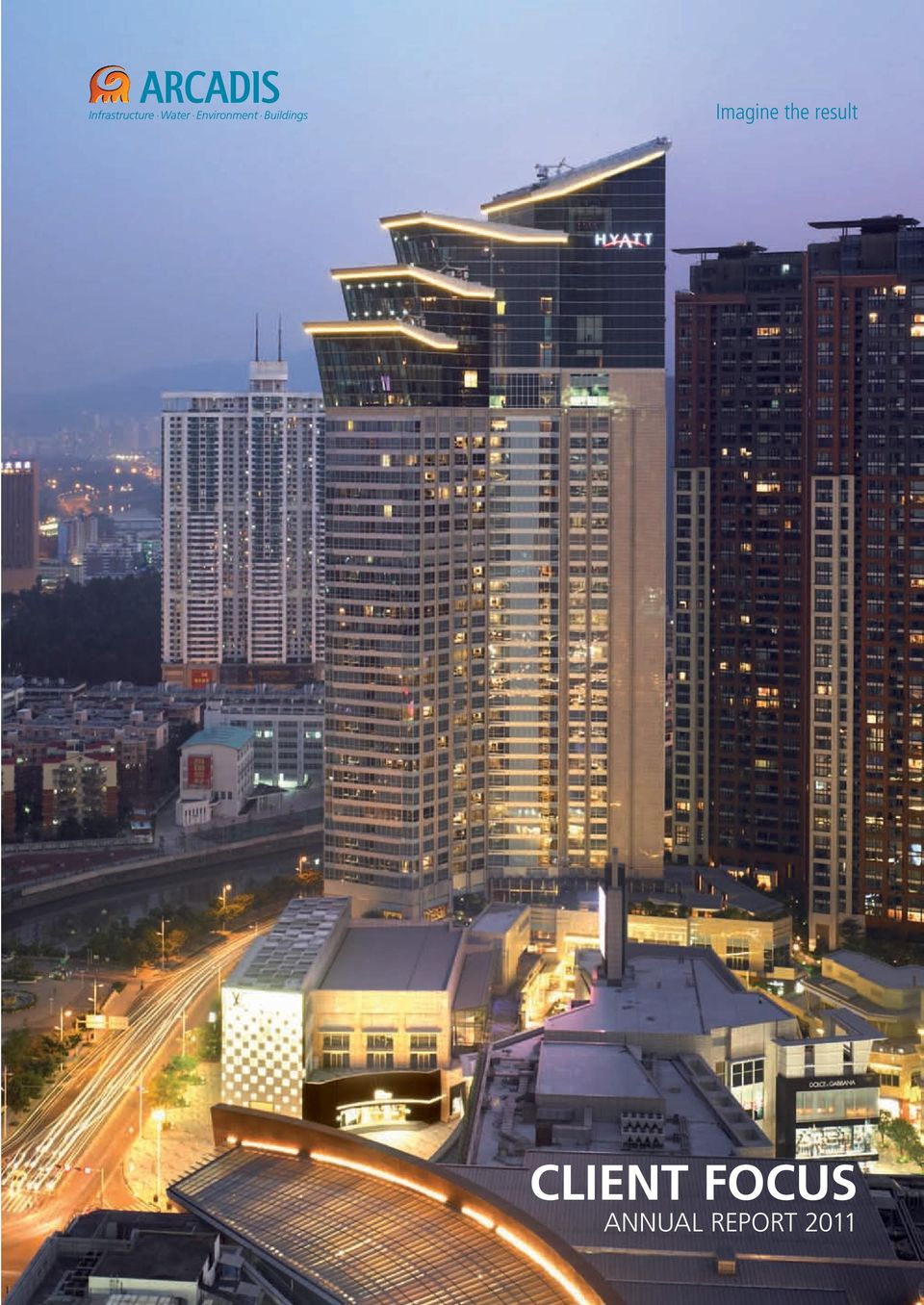
2 Imagine the result Our mission is to improve quality of life around the world by creating places of distinction and providing sustainable solutions that enhance the built and natural environments. In doing so, we produce exceptional value for our clients, employees, shareholders and society. Leadership, Balance, Growth Our strategy bears the title: Leadership, Balance, Growth. Leadership represents our goal to be recognized as a leading company in each of our markets ; Balance reflects our commitment to leaving the environments, the places and the lives we touch better than we found them; and Growth not only signals our aspiration to increase the size of our business and market share, but also the development of our people. ARCADIS differentiates itself from competitors in two main ways. The first is our unswerving focus on solving our clients challenges. The second is our commitment to making the world a better place. This first differentiator helps us in our day-to-day professional lives, and the second motivates to a higher purpose. We believe in both. The work we do helps to put the world in balance. In striving to improve quality of life we seek to strike a balance between the built and natural environments, the creative and the functional, the innovative and the proven, and between imagination and results. We achieve balance by taking a long-term view of our activities, while providing value to our clients in the short-term. This means we conduct our business on a client basis rather than on a project basis as we foster long-term relationships with select multinational, and key national and local clients who appreciate the value-added services we provide. ARCADIS NV Gustav Mahlerplein MS Amsterdam, the netherlands tel Fax [email protected] Internet Chamber of Commerce Arnhem, the netherlands trade registry no VAt: nl B.01 For other company addresses see page 129 of the Annual Report Cover image: Grand Hyatt Shenzhen, Shenzhen, China, an RtKl design ( photo Aaron pocock)
3 Table of contents 3 Table of contents 5 ARCADIS at a glance 10 The ARCADIS share 13 Introduction 15 Report by the Executive Board 15 Vision and strategy 21 Results and financing 26 Developments by business line 26 Infrastructure 28 Water 30 Environment 32 Buildings 34 Developments by region 34 The Netherlands 35 Europe excluding the Netherlands 36 United States 37 Emerging Markets 38 People and organization 40 Risk management 44 Corporate Social Responsibility 49 Outlook Report by the Supervisory Board 66 Corporate Governance 69 Financial Statements Consolidated statement of financial position 71 Consolidated statement of comprehensive income 72 Consolidated statement of changes in equity 73 Consolidated statement of cash flows 74 Segment information 76 Notes to the consolidated Financial Statements 116 Company statement of financial position 116 Company statement of income 117 Notes to the Company Financial Statements 123 Other information 124 Auditor s report 125 Other financial data 126 Ten-year summary 128 Geographical distribution/organization structure 129 Company addresses 130 Glossary 56 Remuneration Report 62 Information on members of the Supervisory and Executive Boards 64 Overview of Senior Management Continued on next page

4 4 Title

5 ARCADIS at a glance 5 ARCADIS at a glance Who we are Professional services for the human habitat ARCADIS is an international company providing consultancy, planning, architectural design, engineering and management services for infrastructure, water, environment and buildings. It develops, designs, implements, maintains and operates projects for companies and governments. With nearly 19,000 employees and 2.3 billion in revenues it has an extensive international network supported by strong local market positions. ARCADIS supports UN-HABITAT with knowledge and expertise to improve the quality of life in rapidly growing cities around the world. Core values As a global company, we are committed to three core values in everything we do: Integrity: we do business in an honest way, to the highest professional standards, being a reliable partner and treating others with respect; Entrepreneurship: we drive initiatives and develop business opportunities that create value and use our resources in the best interests of our clients; Agility: we look to anticipate and react fast to changing market conditions, are responsive to the needs of our clients and colleagues, and eager to perform. In addition to these core values, we consider Sustainability as fundamental to the way we work. It permeates our thinking and activities, and provides solutions that help preserve our planet for future generations. International network based on home market positions The ARCADIS global network is unique and based on home market positions in Europe, the United States and South America and a rapidly growing presence in the Middle East and Asia. This strong local presence allows us to maintain long-lasting relationships with clients and understand local conditions. Our international network enables us to leverage expertise across the globe and service multinational customers looking for service providers who can help them globally. One firm philosophy We operate across our network as a single firm. We foster a culture of team spirit and internal collaboration focused on creating synergies by leveraging our client relationships and wealth of expertise. Active in the entire value chain ARCADIS provides services across the entire value chain, with a focus on those with high added value. By operating on a client basis, rather than a project basis, we become involved in developments at an early stage. During the contracting phase of projects we provide construction management services. We are able to deliver complex turnkey projects by relying on our technical and management skills. ARCADIS is in the global top 10 We rank among the top 10 management and engineering consultancies in the world. In most European countries where we operate, and in Brazil and Chile, we have a top five position. In the United States, we are currently in the top 10. In the global environmental market we are positioned in the top three, and are the largest environmental services provider to the private sector globally. Top ten international design firms in the world* 1 URS USA 2 AECOM USA 3 SNC-Lavalin Canada 4 CH2M Hill USA 5 WS Atkins UK 6 Altran Technologies France 7 ARCADIS Netherlands 8 Parsons Brinckerhoff UK 9 Fugro NV Netherlands 10 Mott MacDonald UK * Source: Swedish Federation of Consulting Engineers and Architects (STD), 2011 Continued on next page

6 6 ARCADIS at a glance Our business What we do Infrastructure We focus our services on four main business lines with individual strengths and strategies. At the same time, we work across disciplines and geographies to deliver integrated solutions to complex challenges. Strategy: Leadership, Balance, Growth Our strategy for the period aims to achieve a level of organic growth that surpasses growth in the market. As a result of the economic and banking crises, and impacted by government austerity programs in Europe and the United States, the expected growth rate in these markets is not going to reach the level of 4-5% that we established when developing our strategy. Nevertheless private sector spending is increasing and emerging markets growth levels are still 5-10%, allowing good opportunities for ARCADIS. We will realize our strategic ambitions by: Further strengthening our clientfocused business model, in which a client-oriented attitude, local and international account management, and cross-selling, are core elements. Leveraging our specialist knowledge and experience to enter new markets while increasing our market share in countries where we already have a position. Expanding in emerging markets. This includes further growth in Brazil and Chile and strengthening our positions in Asia and the Middle East. Our growth goal is 15% per year, while our margin target is 10%. The goal for return on invested capital is 15%. Taking into account the possible effects of government austerity programs, the goal for organic growth in the period has been set at 5-7% per year. Our industry continues to offer good opportunities for consolidation, and acquisitions will play an important role in realizing our ambitions. With our extensive experience in creating synergies through acquisitions, a strong international network and a healthy balance sheet, we are well positioned to participate in the consolidation process. Gross Revenue 2b Net revenue 1.4b Gross revenue in million Gross revenue by region Total growth 1% Operational Margin 9.7% The Netherlands 16% 2 Europe* 18% 3 United States 52% 4 Emerging Markets 14% *excluding the Netherlands Geographical spread personnel 1) 23% 34% % 2 29% 1 The Netherlands 2,539 2 Europe* 5,477 3 United States 6,241 4 Emerging Markets 4,170 *excluding the Netherlands 1) total number of employees including temporary staff Our infrastructure services create the conditions for efficient transportation and healthy places to live and work. By working on high-quality railways, road networks (including tunnels and bridges), reliable energy supply and development of land for different purposes, ARCADIS infrastructure professionals bring stability, mobility and a better quality of life to communities around the world. Gross Revenue 558m Net revenue 420 m Gross revenue Infrastructure in million Total growth 8% Operational Margin 9.2% Infrastructure % of group revenue 28% Clients Most of our work in Infrastructure is for governments: municipalities, cities, provinces, states and ministries. We also work for utilities, project developers, contractors and other private sector firms.

7 ARCADIS at a glance 7 Water Environment Buildings As a global top 10 player in water services we focus on the entire water cycle, including the analysis and design of drinking water supply systems. We advise on advanced treatment technologies for waste water and deliver design, engineering and management services. We provide management consulting services to water operators. We are also active in the management of rivers and coastal zones, urban and rural water, and water management issues related to climate change and rising sea levels. ARCADIS is a leading role environmental services provider, and delivers projects that protect the earth s resources while meeting our clients economic objectives. From soil, groundwater and sediment remediation and environmental impact assessments, through to consultancy on corporate energy, product stewardship, health and safety and waste management issues, our services support environmental policies for companies and governments alike. At ARCADIS, we understand the importance that buildings have to the urban fabric, to our clients real estate portfolios and to the people who use them. We deliver world-class architecture, planning, consultancy and management services for a wide range of buildings types, from commercial properties to hospitals, schools, government buildings and industrial facilities. We help clients achieve their business objectives and create a balance of form, functionality and environmental stewardship. Gross revenue 319m Net revenue 251 m Total growth -15% Operational Margin 9.4% Gross revenue 764m Net revenue 467 m Total growth 4% Operational Margin 12.2% Gross revenue 376m Net revenue 305 m Total growth -1% Operational Margin 7.0% Gross revenue Water in million Gross revenue Environment in million Gross revenue Buildings in million Water % of group revenue Environment % of group revenue Buildings % of group revenue 16% 38% 18% Clients The majority of our clients in Water are public bodies and authorities such as water boards, municipalities, provinces and states, central governments, as well as private and public utilities. We also focus providing water services to industrial clients. Clients In Environment, a significant portion of our work is for the private sector, including the oil and gas, chemical and transportation industries. Many Fortune 500 companies are longstanding clients. We also work for governments; from federal clients, such as the U.S. Department of Defense, to municipal customers. Clients In Buildings we mainly work for owners, managers, operators and developers of real estate, both in the public and private sectors.

8 8 ARCADIS at a glance Highlights 2011 Net income from operations in million Net income from Operations per share in Dividend per share in Proposed Cash Dividend per share : 0.47 Net income from Operations 81.6 Growth 4% 2010: 78.4 Cash Flow from Operating Activities 80 million 2010: 92 million Continued solid performance despite challenging market conditions due to government austerity programs in Europe and the United States Net income from operations 4% higher, earnings per share to 1.23 from 1.19 in 2010 Proposed cash dividend 0.47 per share, same as in 2010 Organic revenue growth throughout the year, resulting in 3% for net revenue in full year Strong performance in US environmental market based on increased private sector spending and expansion of market share, partly offset by declines in water market due to pressure on local government budgets Excellent growth in Brazil and Chile fueled by investments in mining and energy RTKL successful in Asia and Middle East Mixed picture in Europe: growth in France and Germany; strong recovery in the UK; declines in the Netherlands, Belgium, Czech and especially Poland, due to government austerity Operational margin at 9.7%, close to target level of 10%, setting off price pressure through cost reductions Merger with EC Harris gives leadership position in program and project management and related consultancy services and strengthens position in Asia, Middle East and UK Ownership in Brazilian consulting engineering business expanded to 100% divestment of energy projects ongoing Facility management business sold due to non-core nature of activities and lack of synergy potential

9 ARCADIS at a glance 9 Selected financial data Revenue Gross revenue 2,017 2,003 1,786 1,740 1,510 Net revenue 1,443 1,375 1,218 1,162 1,004 Operating results EBITA EBITA recurring EBITA margin, operational (in %) 1) Operating income Associates _ (0.1) (0.8) Net income from operations 2) Net income Capital employed Balance sheet total 1, , , , Average invested capital Return on average invested capital (in %) Total equity Total equity as % of balance sheet total Interest coverage ratio Net debt to EBITDA ratio 3) Net cash provided by operating activities Total shares outstanding at December 31 (in thousands) 69,338 66,066 66,493 60,101 60,502 Data per share (in euros) Net income from operations Net income Dividend proposal Shareholders' equity Personnel 4) Average number of contract employees 15,589 14,590 13,519 13,180 11,304 Average number of employees total 5) 16,486 15,531 14,417 13,977 12,408 Total number of employees at December 31 5) 18,427 15,905 15,195 14,101 13,391 Carbon footprint per FTE (in metric tons of carbon dioxide equivalents) 6) Auto transport Air transport Public transport Office energy use Total In millions of euros unless otherwise noted 1) Operational margin: recurring EBITA as a percentage of net revenue, excluding impact of energy projects in Brazil, carbon credits and restructuring costs 2) Net income excluding amortization and non-operational items 3) From 2008 onwards calculated according to bank covenants 4) The headcount includes the total number of employees of proportionally consolidated companies 5) Including temporary staff 6) Comparative figures adjusted for consistency with GRP Guidelines

10 10 The ARCADIS share The ARCADIS share Stock exchange listing ARCADIS shares are listed at the NYSE Euronext stock exchange in Amsterdam under the symbol ARCAD, where it is a constituent of the Amsterdam Midkap Index (AMX). At year-end 2011, the total number of shares outstanding was 69,337,679. Options ARCADIS options, which were introduced to the market in 2009, saw a total of almost 37,000 trades during the year (2010: 42,000). Open interest in the options was strong in the April-August time frame, but tapered off in the second half of the year, similar to last year. The options strengthen ARCADIS visibility in the financial markets. Dividend For the year 2011, a cash dividend is being proposed of 0.47 per share, which is equal to last year. This represents a pay-out of 40% of net income from operations. Liquidity The average daily trading volume in ARCADIS shares on NYSE Euronext Amsterdam in 2011 came to 116,654 which was level with the 2010 volume of 116,192 shares per day. An additional 18% of the volume was traded on other trading platforms such as Chi-X, Turqoise, and BATS, compared to 10% in Peer group To benchmark its share price performance, ARCADIS has selected a group of peer companies. This group consists of international, publicly listed companies in the consulting and engineering business with activities and a size comparable to ARCADIS. This peer group includes the following companies: Aecom (New York Stock Exchange); Atkins (London Stock ARCADIS (NYSE EURONEXT) AGAINST AMX 160 Share price development On the last trading day of 2010, the ARCADIS share price closed at 17.42, while on the last trading day of 2011, it closed at 12.10, a depreciation of 30.5%. Over the whole year, the share price slightly lagged behind the Amsterdam Midkap Index (AMX), which decreased by 27%. Compared to this index the ARCADIS share performed largely flat in the first quarter followed by an underperformance vis-à-vis the index in the second quarter, largely ascribed to our exposure to public sector work, with government austerity programs fuelling investor uncertainty. Throughout July an outperformance was reached, but the overall mid- and small cap markets declined sharply going into August with investors fleeing towards the relative security of large caps in light of US budget deficit discussions and the unresolved Euro crisis. In September and the first half of October the market was again outperformed with the stock subsequently slumping on the announcement of our third quarter results and the fact that we adjusted our profit outlook to the low end of the previously communicated bandwidth. With the euro crisis raging on, small and mid-cap stocks in the remainder of the year stayed under pressure. We dipped somewhat deeper than the index, which may have been related to the poor results of one of our major Dutch peers. ARCADIS share price on NYSE Euronext Amsterdam NV Jan Feb Mar Apr May Jun Jul Aug Sep Oct Nov Dec 1st quarter 2nd quarter 3rd quarter 4th quarter High High High High Low Low Low Low ARCADIS AMX ARCADIS (NYSE EURONEXT) AGAINST PEER GROUP In High Low Year-end Dec 2004 Dec 2005 ARCADIS Peer Group Dec 2006 Dec 2007 Dec 2008 Dec 2009 Dec 2010 Dec 2011

11 The ARCADIS share 11 Exchange); Grontmij (NYSE Euronext Amsterdam); Hyder (London Stock Exchange); Jacobs Engineering (New York Stock Exchange); Pöyry (Helsinki Stock Exchange); RPS (London Stock Exchange); Tetra Tech (NASDAQ); Sweco (The Nordic Exchange, Stockholm); URS Corporation (New York Stock Exchange); WSP (London Stock Exchange). Ownership information Under the Disclosure of Major Holdings in Listed Companies Act, we can provide the following information about ownership in ARCADIS: Stichting Lovinklaan % (holding end 2011) ASR Nederland 5.01 % (holding end 2011) Delta Deelnemingen Fund 5.2 % (holding end 2011) Delta Lloyd N.V 5.3 % (holding end 2011) Investor Relations ARCADIS has an active investor relations policy aimed at keeping existing and potential shareholders well informed about its strategy and the latest operational and financial developments. It follows a quarterly reporting cycle and informs the market through press releases on other important developments, such as significant project wins. Twice a year, at the presentation of its annual and semi-annual results, ARCADIS conducts a financial press conference and analyst meeting, broadcast live over the internet. At the presentation of the first and third quarter results, a conference call is held for financial analysts, that is also accessible through a live audio link via the ARCADIS website. During 2011, ARCADIS performed 23 investor road shows, and participated in 10 investor conferences, while also hosting reverse road shows for investors at its offices. A total of 261 one-on-one meetings were held in the year. Socially Responsible Investors A growing number of Socially Responsible Investors (SRI) see ARCADIS as an investment opportunity. ARCADIS is committed to engaging with this important stakeholder audience and aims to provide information in this area. ARCADIS now regularly reports its corporate social responsibility efforts, using the Global Reporting Initiative framework. As part of its membership of the U.N. Global Compact, a voluntary initiative for entities supporting sustainable business practices in terms of human rights, labor standards, environment and anti-corruption, the company submitted its second Communication on Progress report. The company also participates in the Carbon Disclosure Project, a program aimed at transparency on carbon footprint reporting, run by an organization acting on behalf of 551 institutional investors holding US$71 trillion in assets under management. During the year ARCADIS presented at several specialized Socially Responsible Investor conferences, discussing the company s contribution to sustainability through its projects and its own carbon footprint reduction program. For more information please refer to the chapter on Corporate Social Responsibility in this report. Annual General Meeting of Shareholders The Annual General Meeting of Shareholders is scheduled for 16 May 2012 at 2:00 p.m. in Amsterdam, the Netherlands. The agenda for this meeting will be available early April 2012 from the Company upon request and will be announced on the Company s website. Financial calendar (tentative) 9 May 2012: First quarter 2012, conference call and webcast 16 May 2012: Annual General Meeting of Shareholders 18 May 2012: Ex-dividend quotation 30 May 2012: Dividend payment date 2 August 2012: Second quarter 2012, press conference, analyst meeting, webcast 1 November 2012: Third quarter 2012, conference call and webcast Historical development of the number of outstanding shares of ARCADIS At January 1 Shares issued Repurchase Reissuance At December ,914,964-1,050, ,591 60,501, ,501, , ,393 60,100, ,100,948 5,739, ,888 66,493, ,493,187-1,250, ,821 66,066, ,066,008 4,160,000 1,300, ,671 69,337,679

12 12 Introduction The Executive Board (From left to right): Steven Blake, Renier Vree (Chief Financial Officer), Harrie Noy (Chief Executive Officer until 16 May 2012), Stephanie Hottenhuis (appointee), Neil McArthur (CEO as from 16 May 2012), Friedrich Schneider

13 Introduction 13 Introduction In 2011, ARCADIS was able to continue its track record of growing revenues and profits. Weakness in government markets in Europe and the United States was more than compensated for by more work for private sector clients and strong growth in emerging markets. These good results were achieved due to our consistent focus on services higher in the value chain, successful acquisitions, strict cost controls and above all, the entrepreneurship and client focus of our people. Strategically, we made important progress. We completed the merger with EC Harris, an international consultancy firm with over 2,600 people, providing advisory and management services for buildings, industrial facilities and infrastructure. This gives us a leading global position in project management and related services, a much stronger foothold in Asia and the Middle East and a strong position in the United Kingdom, key for services to multinational clients. We also expanded our ownership in the consulting and engineering business in Brazil to 100%, which allows us to benefit even more from growth in that market. We had solid organic growth throughout By focusing on key clients and reducing costs, we were able to preserve margins, despite fierce competition and price pressure in several markets. In the United States, the integration with Malcolm Pirnie was completed, resulting in significant cost synergies. Our Infrastructure business saw strong growth, mainly driven by investments in mining and energy in Brazil and Chile where we are involved in large, multi-year projects. In Europe, spending in municipal markets was down, but we benefited from continued government investments in large projects, partly through Public Private Partnerships. The Water market saw revenue pressure from tighter budgets in the US municipal market, compounded by the nearing completion of the New Orleans project. In Europe, markets were also under pressure, but activities in the Netherlands picked up, while we were successful in expanding our services internationally to niche markets and to industrial clients. In Environment we did well, especially in the United States we saw strong growth, driven by private sector demand and our ability to gain market share. In Brazil and Chile, investments in mining and energy generated significant environmental work. Also in Europe, private sector demand increased, partly offset by a reduction in public sector work. In Buildings, the commercial property market gained some strength in the United States, while in Europe it was stable at low levels. RTKL continued its successful expansion in Asia and the Middle East. In Europe, we benefited from increased demand from corporates and industrial clients, while the public sector reduced spending. As we look ahead, we have confidence in our future. Our recent performance demonstrates the efficacy of our strategy, the resilience of our well diversified portfolio and our ability to respond to challenging conditions. EC Harris and its Built Asset Consultancy approach strengthens our competitive position and offers ample opportunities for synergies. Our balance sheet is healthy and allows us to further expand through acquisitions. Long term trends drive demand for our services and offer excellent prospects for our business. This is my last annual report as CEO of ARCADIS. After twelve years in this role, I have decided to step down at the upcoming shareholders meeting. I will pass on the helm to Neil McArthur, who with his technical background, international track record and leadership experience in consultancy, is ideally suited to lead our company in the years ahead. I look back with great pride and satisfaction at what we have achieved together. Today, ARCADIS is positioned as a premier international professional services firm, with excellent people that share a collaborative culture, focused on delivering added value for our clients. I want to thank our clients, shareholders and above all our people for the confidence I have experienced over the past twelve years. That, together with our work for a better, more sustainable world, has been a strong source of inspiration in leading this great company. On behalf of the Executive Board Harrie L.J. Noy Chief Executive Officer

14 14

15 Report by the Executive Board 15 Report by the Executive Board Vision and strategy The ARCADIS vision ARCADIS is a leading international services provider made up of consultants, planners, architects, scientists, engineers and project managers who work across business lines and geographies to provide real-life solutions for today s most complex challenges in infrastructure, water, environment and buildings. Our work is all about creating balance; between the built and natural environments, the creative and the functional, the innovative and the proven, present needs and future legacy, and between imagination and results. In doing so, we fulfill our mission of improving the quality of life in the human habitat. In today s challenging economic environment we continue to realize our ambitions through our vision and strategy which are the basis for our business decisions. In everything we do, we rely on our core values integrity, entrepreneurship and agility to guide our actions. Our focus is primarily long-term, with our short-term performance reflecting the value we create for clients and allowing us to invest in our future. We believe that more than ever, our work is vital to solving the challenges facing our clients and communities across the world in a sustainable way. The following key elements of our vision drive our long-term strategy: Focus on growth markets. Our four business lines, Infrastructure, Water, Environment and Buildings, are focused on growth markets and allow us to offer clients integrated business solutions and one-stop shopping. Our broad range of disciplines, deep level of expertise and close client contacts, enable us to capitalize on market trends and grow our business through innovation. Global network based on strong home market positions. Leveraging our expertise across the board and seamless delivery of our services to multinational clients globally, give us a key competitive advantage. Strong client relationships and deep understanding of local conditions are critical to our success. Therefore, strong home market positions are the cornerstones of our global network. Balance. We seek to create balance in everything we do. In our work for clients we aim to provide sustainable solutions that strike a balance between different needs. We also run our business in a socially responsible way, based on a balanced approach to people, planet and profit. As part of this commitment we report on our sustainability progress in a transparent way within the framework of the General Reporting Initiative (GRI). One firm concept. We operate as one firm across the globe with a brand that reflects our mission and is recognized for quality and reliability. Internal collaboration and resource sharing to meet client needs are part of our culture. By leveraging client relationships, exchanging knowledge and cross selling, we create synergies that benefit our clients. People are key to our success. Their commitment, skills and entrepreneurship make the difference in today s competitive markets. By attracting, retaining and developing talented people that deliver added value to clients, we create profitable growth and value for our shareholders. Market and client trends Government austerity offset by private sector spending Market conditions for ARCADIS are strongly influenced by public and private sector investments which are impacted by economic cycles. In Europe and the United States, governments face budget deficits, resulting in reduced public spending, especially at local levels. This is offset by increased private sector spending. In the United States, economic recovery drives increased private sector demand for our environmental services, while private sector demand is also picking up in Europe. Markets in Brazil, Chile, Asia and parts of the Middle East show strong growth, largely from private sector investments. Continued on next page

16 16 Report by the Executive Board Long term outlook favorable In 2010, we did our three-year strategy review, including market survey and client interviews. This showed that the markets in which we operate are growing at 4 10%, well above GDP growth. European and North American markets are expected to grow by 4 5%, emerging markets by 5 10%. Although markets in Europe and the United States are not expected to reach these levels in the short term, growth in emerging markets is exceeding them. The market survey confirmed that despite some short-term pressure, the long-term outlook for our business is favorable. The need for our services is strong, due to long-term growth drivers and key client trends. Growth is limited by the financial means available to fulfill those needs. Long-term growth drivers Urbanization. Population growth and migration to cities are driving urbanization, resulting in a growing number of mega cities, especially in emerging countries. This trend means large investments in residential areas, industrial sites, commercial properties and other facilities. In developed countries, people are also moving to cities, creating the basis for redevelopment of deteriorated inner city areas to ever higher standards of living and working. Mobility. All metropolitan regions suffer from congestion, which hampers economic development. This requires major investment programs to expand capacity of roads, highways and public transportation, partly by introducing intelligent traffic management systems. Renewable energy. Economic growth and expanding populations in combination with the need to reduce emissions, are causing growing demand for renewable energy projects. This trend is a growth driver for all our business lines. Climate change. Rising sea levels caused by climate change are an unprecedented challenge for delta areas, where more than 50% of the world s population lives. This creates demand for our services to help reduce greenhouse gasses; lower carbon footprints; identify new water resources; and improve water management and flood protection. Water. The scarcity of clean, safe, potable water is a critical issue in many parts of the world. Water is considered the oil of the 21st century, with a growing demand for services related to water supply, treatment and reuse. Sustainability. Preserving resources and quality of life for future generations is of paramount importance. Sustainability is therefore integrated into everything we do. With our specialized environmental capabilities, we are well positioned to evaluate the environmental impact of projects and advise on appropriate mitigation measures. Key client trends Public-private partnerships. Governments with depleted finances seek to create conditions that attract private money to (co)finance infrastructure investments. These investments immediately create jobs while strengthening the economic structure of a country or region. Globalization of industry. Multinational companies require service providers with global capabilities. Many have vendor reduction programs to increase efficiency and safeguard quality standards across their operations. Outsourcing and privatization. As companies focus on their core businesses, more non-core functions, such as environmental management, are being outsourced. A similar trend is visible in the public sector, where budget pressures have increased the focus on policy making, while execution, including design and engineering work, is being outsourced to the private sector. Supply chain integration. Alternative delivery methods to enhance supply chain integration are increasing. Design/Build (D/B) and Design, Build, Finance and Operate (DBFO) approaches are meant to promote innovation, reduce mistakes, lower costs, share risks and optimize projects over their lifecycle. In these projects, ARCADIS can be the advisor to the end customer (often the government) or consultant to or partner of the consortium which implements the project. Our focus is on delivering specialized services that create competitive solutions based on thorough knowledge of local conditions. Front end services. Client interviews show an increasing demand for front end services to help them achieve their business objectives. This includes strategic consultancy, asset management, describing and structuring investment programs and managing projects, programs and processes. Risk participation. Clients increasingly ask or require their suppliers to take on certain project risks. This may include

17 Report by the Executive Board 17 project fees being dependent on performance. ARCADIS has internal procedures to control the risks involved. These key client trends provide new opportunities for ARCADIS. By partnering with clients and other parties in the supply chain, we can become involved in large projects and programs that take many years. As a multidisciplinary company with highly specialized capabilities, strong local anchors, and a good reputation, we have a strong competitive edge. At the same time, some of these trends imply additional risks for the company. To limit those risks, we do not invest (in principle) in the equity of projects; we align our responsibility with our core competences and select projects based on our relationship with clients. For additional information on risk management please refer to page 40 of this annual report. Building on strength Strategy has been successful Our strategy of growing high added-value services and divesting low margin businesses has been successful. The company is now focused on business lines with long-term growth potential. In the period , gross revenues grew from 1 billion to 2 billion, a compounded annual growth of 15%. Net income from operations increased in that same period by almost 19% annually, while margins reached our goal of at least 10%. These results were achieved despite the economic crisis, which strongly impacted our business as of Acquisitions added substantial value Since 2005, and until the end of 2010, we divested low margin businesses with some 140 million in revenues. In that same period, through a series of acquisitions, we added over 850 million in revenues. The acquisition in 2005 of Blasland, Bouck and Lee (BBL) gave a leading position in the global environmental market. In the buildings market we acquired several project management companies and in 2007, added RTKL, one of the world s leading architectural design and planning firms. Through the merger in 2009 with US-based Malcolm Pirnie, we achieved a major position in the global water market and significantly enhanced our presence in the United States. Meanwhile, smaller acquisitions strengthened our home market positions while adding specialized capabilities. All these acquisitions have delivered synergies by leveraging client relationships, know-how and experience. Key success factors ARCADIS is now positioned as a premier international professional services firm. We are a top five player in many European markets, Brazil and Chile, and a top ten firm in the United States, with continued solid performance, despite the economic crisis. The factors which contributed to this success are: a good spread in geographies, clients and business lines; solid organic growth through client focus and internal synergy; a shift towards activities higher in the value chain; acquisitions that added value; focus on cash flow and reduction of working capital; strong management and talented people throughout the organization. These factors also remain key elements for our strategy going forward. SWOT analysis shows ARCADIS strong position Strengths Strong home market positions in Europe, the United States and South America with a well-diversified portfolio Leadership positions in business lines with growth potential Strong client base of multinational and key national clients Good acquisition track record Stable cash flow and healthy balance sheet Opportunities Strong urbanization, especially in emerging markets Alternative delivery, incl. private financing, for infrastructure Climate change, renewable energy and sustainability Outsourcing by companies and governments Acceleration of consolidation in our industry Weaknesses Limited position in Asia and Middle East Relatively high fixed costs in Europe due to lower flexibility of labor market Brand name recognition Threats Government austerity programs leading to less investments in infrastructure and water projects Economic downturn impacting private sector spending Slowing of economic growth in Asia impacting property markets Strategy : Leadership, Balance, Growth We review our strategy every three years to ensure our strategic direction is in sync with our markets and the needs of our clients. This was last done in 2010 and has resulted in the Continued on next page

18 18 Report by the Executive Board strategy entitled Leadership, Balance, Growth for the period It is a logical continuation of our successful strategy of previous years. Strategic ambitions Our overall ambition is to further build and strengthen leadership positions in each of our business lines. This ambition has been worked out for each of the business lines, as explained in the business line section of this report. However, our leadership ambition goes beyond the goals for the individual business lines. It also includes: Quality, innovation and operational excellence. We want to be recognized for the quality of our services and the innovative solutions we provide. This means being at the forefront of developments and aiming for excellence, not only in design and technical capabilities but also in operational skills. Focus on high added value services. Leadership implies being active at the high end of the value chain. This is a strong driver for higher margins. We continue to look for opportunities to outsource or divest activities with lower added value. Superior growth and profitability. We aim to be in the upper quartile of our peer group. This is reflected in our financial goals, explained below. Employer of choice. We can only realize our leadership ambition if we are able to attract and retain the best people. We offer staff an international and inspiring workplace that provides ample opportunities for personal growth. Balance as key differentiator. Balance is part of our mission and at the heart of our business. Integrating sustainability in everything we do strengthens our market position and helps us attract and retain good people. Key elements to realize our ambitions We will realize our ambitions by: Focus on key clients We continue implementing a client focused business model. This means running our business on a client basis rather than on a project basis by focusing on long-term relationships with select multinational and key national clients who appreciate the value-added services we provide. Through (international) account management and cross-selling of services together with a client focused attitude, we satisfy our clients needs and help them realize their goals. Leverage capabilities globally In each business line we have identified specialist knowledge and capabilities that can be leveraged to enter new markets or enlarge market share. We also look at acquisitions to add skills that we can leverage through our global network. Grow selected emerging markets These markets offer substantial long term growth prospects. Our focus is on expanding in Brazil and Chile, building a position in Asia and growing our business in the Middle East. In Asia, we look for opportunities related to private sector investments driven by the ongoing urbanization process. Acquisitions to drive growth Acquisitions are important to realize our goals. Priorities are driven by the strategies for each of the business lines and include adding specific capabilities or strengthening geographies, especially in emerging regions. We have a preference for larger acquisitions that fulfill several of our goals simultaneously. As ARCADIS has a good track record in acquisitions, a strong international network and a healthy balance sheet, we are well positioned to play an active role in the accelerating consolidation process in our industry. Important criteria for acquisitions are: strategic fit, cultural fit, company reputation and quality of management. Financially, we aim for acquisitions that are earnings accretive, have margins in line with ARCADIS targets (or can be brought to that level in three years) and are value-enhancing, with a return on investment of 15% or more. Policies to support our strategic ambitions Branding and positioning. We aim for a brand that differentiates ARCADIS as a premier international professional service provider, with a reputation based on the quality of our services, our ability to create balance, our client driven approach and thought leadership in each business line. Organization and people. We maintain an organization with geographically based operating companies for local delivery and global business lines to drive strategy, develop synergies, ensure seamless services globally and share resources across geographies. Our planning process, management structure and incentive programs facilitate alignment between operating companies and global business lines.

19 Report by the Executive Board 19 Knowledge management and IT. Almost all ARCADIS companies are connected to an intranet-based knowledge management system, called The Source, which employees use to access our knowledge base. Managed by our global experts, we have Communities of Practice across all business lines that cooperate on technical issues, best practices and product and market development. Financial goals Ambitious targets Within the framework of the updated strategy, we have set the following ambitious financial targets for the period : Growth: 15% per year, of which 5 7% organic. This target was set in 2010 and includes the possible impact of government austerity programs, but also assumes economic recovery in the United States and Europe to normal levels of economic growth. Margin: at least 10% (EBITA as a percentage of net revenue). Return on invested capital: 15%, based on net income from operations, excluding interest charges, as a percentage of shareholders equity plus net interest-bearing debt, calculated as an average over four quarters. The growth target excludes currency exchange rate impacts. Net income from operations is before amortization and other non-operational items like (material) book gains. Organic growth and margin targets for each business lines are specified in the section on business lines of this report. Strategic achievements 2011 Expansion of interest in Brazil In mid-2011, we expanded our interest in the consultancy and engineering business of ARCADIS Logos from 50% plus 1 share to 100%. The energy projects of ARCADIS Logos, consisting of Biogas installations and small hydropower plants, were not part of this deal. In order to bring more focus into our Brazilian operations, these assets are being sold and income from (the sale of) these assets will be distributed according to the joint shareholding. Since ARCADIS entered the Brazilian market in 1999, the business has developed successfully, going from about 200 people in 1999 to close to 2,500 by the end of 2011, and with gross services revenues of 176 million in The expansion of our shareholding will allow us to benefit even more from the huge opportunities in the Brazilian market, driven by Brazil s economic growth, modernization of infrastructure and the 2016 Olympics in Rio de Janeiro. As ARCADIS Logos was already fully consolidated, there is no impact on ARCADIS revenues and EBITA, only on net income and net income from operations. By the end of 2011, ARCADIS sold 2 shares in the energy business to our partners, which means that this business has been deconsolidated as per year end. Merger with EC Harris In early November, we completed the merger with EC Harris, an international consultancy company headquartered in London, providing full lifecycle consulting and management services for built assets in the property, public, transportation, water and industrial sectors, with 2,600 employees, annual gross revenues of 290 million, net revenues of 254 and a normalized EBITA margin of 7% on net revenue. The company has 48 offices in 28 countries including many throughout central and Eastern Europe, the Middle East (Qatar, Saudi Arabia, the UAE and Egypt) and Asia (Hong Kong, China, Singapore and Taiwan) and has seen significant recent growth in Asia and the Middle East. The activities in these regions provide some 32% of revenues with 57% coming from the UK and 11% from other European countries. This merger is a major step forward in realizing our strategic ambitions. With EC Harris we get a leading position in project management and related services while their built asset consultancy approach perfectly fits our goal of expanding our services at the high end of the value chain. With a 30-year history and 550 people in Asia and 340 people in the Middle East, EC Harris also provides a strong foothold in Asia and substantially expands our presence in the Middle East, allowing us to capitalize on the growth opportunities in these markets. Finally, we get the long desired stronger position in the UK, one of the best developed consultancy markets, with an entry to UK-headquartered multinationals, many of them with operations in the Middle East and Asia. The integration process has already started, while continuing to focus on business performance. Our first priority is to seek synergy opportunities in the market. Many have been identified, including large investment programs for which we are much better positioned as a combined company. In the course of 2012, operations will be integrated, with a focus on the UK and other European countries, which will also result in improved efficiencies and cost savings. Continued on next page

20 20 Report by the Executive Board Divestment of non-core businesses In the first half of 2011, two activities were sold, both in the Netherlands: urban design firm Witpaard (30 employees) and our 50% interest in ARCADIS AQUMEN Facility Management (AAFM, 360 employees). Both companies were no longer seen as part of our core business, also due to the limited amount of synergies they yielded. AAFM had been already deconsolidated by year end Integration of operations in the United States and Europe In the United States, the integration of Malcolm Pirnie and project management firm Rise was completed, resulting in substantial cost savings and a more focused and efficient organization. By appointing a director Europe for continental Europe, excluding the Netherlands, we are aiming to increase synergies through resource sharing and back office integration. Achievements on key performance indicators Target Gross revenue 15% 1% 12% 3% 15% 22% 23% - Organic 5-7% 2% 0% -6% 6% 16% 10% - Acquisitions 8-10% 1% 8% 8% 12% 10% 13% - Currency effect -3% 4% 1% -3% -4% 0% Operational margin 1 >10% 9.7% 10.5% 10.8% 10.5 % 10.1% 9.3% Earnings per share 2 No target 3% 1% 2% 14% 24% 50% Return on invested capital 15% 13.6% 13.9% 15.4% 18.1% 20.1% 20.3% 1 Operational margin is based on recurring EBITA as percentage of net revenue, but excludes the impact of energy projects in Brazil, carbon credits and restructuring costs 2 Based on net income from operations

21 Report by the Executive Board 21 Results and Financing Total gross revenue growth in % Excluding currency effect Gross revenue by region The Netherlands 16% 2 Europe* 18% 3 United States 52% 4 Emerging Markets 14% *excluding the Netherlands Cash flow from operating activities in million total organic Solid performance driven by private sector market In 2011, ARCADIS continued its track record of growing revenues and profits, despite pressure on government budgets in Europe and the United States. Gross revenues grew 1%, again ending above 2 billion, while net revenues increased by 5%, largely the result of a 3% organic growth. Net income from operations (before amortization and non-operational items) increased by 4% to 81.6 million. Per share, this is 1.23 against 1.19 in These solid results were achieved on the back of strong private sector demand in the US environmental market, in the infrastructure and environmental markets in Brazil and Chile and in the property markets in Asia and the Middle East. These were partly offset by decreasing results in Europe caused by lower government budgets. Dividend maintained at 0.47 per share ARCADIS proposes a cash dividend of 0.47 per share, equal to last year. Although net income from operations has gone up by 4%, the number of outstanding shares increased by 5% due to issuing shares for acquisitions in the course of the year. The proposed dividend of 0.47 per share reflects a payout of 40% of net income from operations based on 69.3 million outstanding shares ultimo This is in line with our dividend policy, which aims for a payout of 30 40% of net income from operations, to provide an attractive dividend yield for shareholders, while setting aside sufficient resources to finance growth. Revenue and profit Organic growth throughout 2011 Revenue in millions Growth in revenue Total Organic 2 Acquisitions Currency Gross 2,017 2,003 1% 2% 1% -3% Net revenue 1 1,443 1,375 5% 3% 4% -3% 1 Share of revenue produced by ARCADIS staff 2 Excluding contribution from the sale of energy projects in Brazil After ARCADIS had been hit by the 2008 economic downturn, we returned to organic growth of revenues in the second half of In 2011, we realized organic growth throughout the year, resulting in 3% for the total year. This growth came from Brazil and Chile, where we benefited from investments in mining and energy, from Asia and the Middle East, where RTKL benefited from attractive property markets and from the United States environmental market where private sector demand was strong and we gained market share. In Europe, France and Germany contributed to growth, while private sector spending supported recovery in the United Kingdom in the second half of the year. Reduced government demand, especially at the municipal level, led to a decline of activities in the US water market, and in the Netherlands, Belgium and the Czech Republic. In Poland several large road projects were put on hold resulting in a significant drop of activities. The acquisition of Rise in the United States by the end of 2010, the merger with EC Harris per November 2011 and the divestment of the facility management business AAFM (deconsolidated by Continued on next page
22 22 Report by the Executive Board the end of 2010) had on balance a positive impact on revenues. As AAFM had large amounts of subcontracting, the impact was different for gross and net revenue. The negative currency effect of 3% resulted from a weaker US dollar against the euro. As ARCADIS Logos in Brazil was already fully consolidated, the acquisition of the remaining 50% minus 1 share, had no impact on revenues and EBITA. Geographical mix shifts to emerging markets The revenue mix shifted towards emerging markets, caused by strong organic growth in Brazil, Chile and Asia and the merger with EC Harris which strengthened our footprint in Asia and the Middle East. Revenues in the Netherlands were impacted by organic declines and more strongly by the sale of AAFM. Other Europe benefited from the merger with EC Harris, partly offset by organic declines. Revenues in the United States were impacted by a negative currency effect, partly offset by the acquisition of Rise and some organic growth. Geography % of Gross revenue Netherlands 16% 20% Other Europe 18% 17% United States 52% 53% Emerging markets 14% 10% Portfolio shifts to Infrastructure and Environment In the portfolio, Infrastructure increased due to strong organic growth in Brazil and Chile, and the acquisition of EC Harris, while Environment gained as well due to strong organic growth, partly offset by a negative currency effect. Water decreased as a result of organic declines and a negative currency effect. In Buildings, the two months contribution from EC Harris was insufficient to offset a negative currency effect and organic declines. Portfolio % of Gross revenue Infrastructure 28% 26% Water 16% 19% Environment 38% 36% Buildings 18% 19% Client mix shifts to private sector Due to pressure on government budgets, both in Europe and the United States, public sector revenues declined considerably. This was compensated by an increase of revenues from private sector clients. Especially the oil & gas and mining sectors showed significant growth. Utilities were relatively stable; this category includes clients which operate as a separate organization, either publicly or privately owned, providing a public service: examples are water utilities, energy companies, healthcare institutes, railway organizations. Clients % of Gross revenue Public 29% 35% Utilities 19% 19% Private 52% 46% Personnel costs increased Personnel costs rose 5.7% to 1,039 million (2010: 983 million), as a result of acquisitions and some staff increase to meet growing demand, partly offset by negative currency effects. Excluding reorganization charges of 12.6 million (2010: 6.7 million), personnel costs rose 5.1%. Net revenue increased by 5.0%, and excluding the contribution from the sale of energy projects in Brazil by 4.2%, showing that personnel costs increased about 1% more than net revenue which negatively impacted margins. This was caused by pricing pressure, relatively higher personnel costs in EC Harris and the fact that staff adjustments at times lagged declines in market demand. Room for savings in other business costs Other business costs rose 7.2% to 245 million (2010: 229 million) and excluding the costs of 4.8 million related to the EC Harris merger, 5.1%. This is higher than the increase of net revenue of 4.2% (excluding contribution from sale of energy projects), showing that we still have room for cost savings to improve margins. Depreciation almost level; amortization lower Depreciation (excluding amortization) was only slightly higher at 27.7 million (2010: 27.3 million), and as a percentage of net revenue, decreased. This is the result of reaping the benefits from efficiencies of scale. Under IFRS, identifiable intangible assets related to acquisitions must be separated from goodwill and amortized over their economic lifetime. For ARCADIS, this importantly relates to the profit included in the backlog of acquired companies and the customer relationships of these companies. At 5.4 million amortization was somewhat lower than in 2010 ( 6.3 million). Substantial other income The divestment of our 50% interest in AAFM resulted in a gain of 7.4 million. As part of our policy to focus in Brazil on the consultancy and engineering business, it was decided to sell
23 Report by the Executive Board 23 the energy assets which were developed as investment projects (biogas installations and hydropower plants). As we sold two shares in the remaining energy business to our partners and no longer have the power to govern the operating policies of that business, it has been deconsolidated as per year end The step-up to fair value of the deconsolidated assets resulted in a gain of 5.6 million. Both these gains are included in other income, amounting to 13.2 million (2010: 0.3 million). Operating income and EBITA improved Operating income increased 7% to million (2010: million). ARCADIS uses recurring EBITA (operating income before amortization) to measure the financial performance of operations, while EBITDA (operating income before depreciation and amortization) is used in the bank covenants. These measures were determined as follows: In millions Operating income reported Amortization Depreciation EBITDA EBITA Non-recurring items -/ Recurring EBITA Two items have been classified as non-recurring: the 7.4 million gain on the sale of AAFM and the costs related to the merger with EC Harris, amounting to 4.8 million. Up to and including 2009, acquisition-related costs were capitalized as part of goodwill but as of 2010 they are expensed, according to revised IFRS standards. On a recurring basis, EBITA increased 4% to million (2010: million). The currency effect was -/-3%, while acquisitions contributed on balance 2%. The contributions from Rise and EC Harris were partly offset by the loss of income from AAFM. EBITA was impacted by the following special items: The sale of several small hydropower plants and the deconsolidation by year end 2011 of the Brazilian energy business, resulted net of operational losses in a contribution of 12.6 million, while in 2010 the energy business caused a loss of 3.2 million. The sale of carbon credits in Brazil contributed 2.8 million (2010: 1.9 million). In several countries, the organization was adjusted to reduced market demand, while in the United States the integration of Malcolm Pirnie and in the Netherlands the integration of PRC was completed. This resulted in 12.7 million of costs for reorganization and integration (2010: 6.8 million). On balance these items had a positive impact on EBITA of 2.7 million, while in 2010 this was 8.1 million negative. Taking this into account, EBITA declined organically by 3% (see graph below). Strong performance in the United States and in emerging markets was offset by reduced profitability in Europe, most notably in the Netherlands and Poland, and to a lesser extent in the United Kingdom, which showed a strong recovery in the second half of the year. Development Recurring EBITA Currency Acquisition Carbon credits Energy business Restructuring costs Other organic / /-5.9 -/ Margin close to target level The margin (recurring EBITA as % of net revenue) was at 9.8% (2010: 9.9%). Excluding the impact of energy projects in Brazil, carbon credits and restructuring costs, the underlying operational margin came out at 9.7%, still close to our target of 10%, but below the 10.5% in 2010, mainly resulting from the lower profitability in Europe. EC Harris performed in line with expectations and had only a slight negative impact on margins. The operational margin, excluding EC Harris, would have been 9.8%. Higher financing charges Financing charges amounted to 23.3 million (2010: 18.3 million) and included 3.9 million one-off costs for the refinancing of loans. The remaining increase of 1.1 million was mainly caused by investments in acquisitions and somewhat higher interest rates on refinanced debt. Continued on next page
24 24 Report by the Executive Board Tax rate lower The effective tax rate of 28.0% was lower than the 31.1% in 2010, mainly as a result of the non-taxable profit on AAFM and the deconsolidation of the energy business in Brazil. The tax rate included in net income from operations, excluding the impact of the deconsolidated Brazilian energy business and the merger with EC Harris, was 32.5% compared to 31.2% in This increase is fully caused by a tax charge of 2.7 million (2010: 1.7 million credit) related to stock options of US employees due to the low ARCADIS share price at year end Somewhat lower contribution from associated companies The contribution from associated companies was 0.3 million (2010: 0.7 million). Better results in the Netherlands were more than offset by negative results in Brazil, due to delayed start-up of energy production and a lower contribution from other ARCADIS associates. Non-controlling interest in line with 2010 The profit attributable to non-controlling interests is in line with 2010 despite the acquisition mid-year of the remaining shares of the consulting business of ARCADIS Logos in Brazil. The energy business, which was still fully consolidated in 2011 as we owned 50% plus one share, recorded significant profits resulting from the sale of small hydropower plants in the second quarter and the sale of carbon credits. This caused most of the profit attributable to non-controlling interest. Following the deconsolidation of the Brazilian energy business, the non-controlling interest is expected to be limited as of 2012, which is already reflected in the balance sheet as per 31 December Net income and net income from operations higher Net income rose to 79.5 million or 1.20 per share compared to 73.9 million or 1.12 per share in ARCADIS uses net income from operations as financial performance indicator, which is based on recurring EBITA and excludes amortization and other non-operational items (see calculation on page 23 of this report). Net income from operations was 81.6 million or 1.23 per share (2010: 78.4 million or 1.19 per share). The increase in net income from operations of 4% was in line with growth in recurring EBITA as higher financing charges were offset by a lower tax rate. Cash flow and balance sheet Cash flow at healthy level Although net income increased to 79.5 million (2010: 73.9 million), net cash from operating activities declined to 79.6 million (2010: 91.8 million). The main reasons are: The fair value adjustment of the Brazilian energy assets will only result in cash when these assets have been sold, while the gain on the sale of AAFM is classified as cash from investing activities. Financing costs were higher. Working capital at year end has increased to 15.1% (2010: 13.0%), about half of this increase due to the sale of AAFM and currency exchange differences and half to higher working capital needs in the business. In the meantime a program has been launched to aggressively reduce working capital. Free cash flow, after regular investments in ongoing business, was 44.9 million (2010: 58.2 million). Regular investments remained level Investments in (in)tangible assets (excluding acquisitions) totaled 35.3 million, in line with The sale of property and equipment resulted in a cash inflow of 0.6 million (2010: 2.1 million). Substantial investments in mergers and acquisitions The main investments were related to: The expansion of our interest in the consultancy and engineering business of ARCADIS Logos in Brazil from 50% plus 1 share to 100%, as per July In addition to a cash payment, the transaction was partly financed by issuing 1.16 million ARCADIS shares to the selling partners. These shares have a lock up period of 6 months with incentives for the active partners to hold them for at least 18 months after closing. The merger with EC Harris, completed as per November In addition to a cash payment, the merger was financed by issuing 3.0 million ARCADIS shares to the selling partners, with a lock up period of 12 months after closing. In both cases the purchase price was based on ARCADIS usual valuation approach. The strategic rationale for these investments is explained in the Vision and Strategy section of this report on page 19. Mergers and acquisitions, including the expansion of interests in smaller consolidated companies, resulted in a cash investment of 79.0 million (after deduction of acquired cash) and an additional after payment obligation of 15.8 million. Deferred payments for acquisitions from earlier years were 8.0 million, bringing the total acquisition-related cash outflow to 87.0 million. Mergers and acquisitions added goodwill of
25 Report by the Executive Board million and identifiable intangible assets of 41.7 million. In addition, 22.9 million (2010: 10.4 million) was invested in associated companies and other financial non-current assets, mostly related to Brazilian energy projects. The divestment of AAFM and Witpaard had a positive cash impact of 9.1 million, while the deconsolidation of the Brazilian energy business impacted cash negatively by 3.3 million, resulting on balance in 5.8 million cash from divestments. Predominantly collection of long-term receivables led to a cash inflow of 14.0 million (2010: 6.9 million). Number of outstanding shares increased The total number of outstanding shares at year-end 2011 increased to 69,337,679 (2010: 66,066,008), due to the issuance of 4,160,000 shares for acquisition purposes. To cover obligations related to option plans, 1,300,000 shares were repurchased, while 411,671 previously repurchased shares were used for the exercising of options. The average number of shares, used to calculate earnings per share, increased to 66.5 million (2010: 66.1 million). For more information on the number of outstanding shares and options and on share purchase plans, please refer to notes 16, 18 and 27 of the Financial Statements. Refinancing By mid-year 2011, ARCADIS completed a 10-year US Private Placement (USPP) of $110 million and in addition, refinanced most of its bank loans, taking on a $245 million term loan facility with maturities in 2013 and 2016 and a new Revolving Credit Facility of 150 million maturing in With these steps we diversified our sources of financing and extended the maturity profile of our debt, while creating financial room to realize future growth. Balance sheet remains healthy Balance sheet total rose to 1,559 million (2010: 1,425 million), mainly resulting from acquisitions and exchange rate differences. Goodwill increased to 444 million (2010: 353 million), 83 million caused by acquisitions and the remainder by currency effects. Identifiable intangible assets (excluding software) were 47 million (2010: 10 million). Goodwill is subject to impairment testing once a year. In 2011, this test determined that no goodwill was impaired, reflecting the continued value of the cash-generating units. Acquisitions pushed net working capital (work in progress plus accounts receivables minus accounts payable and billings in excess of costs) up by 46 million. Net working capital at year end as a percentage of gross revenue (measured at the fourth quarter level times four) increased to 15.1% (2010: 13.0%). Cash and cash equivalents totaled 158 million (2010: 208 million). Net debt (cash and cash equivalents minus interestbearing debt) rose to 268 million (2010: 207 million), with 12 million due to currency effects. Interest-bearing debt also includes after-payment obligations related to acquisitions, totaling 20 million (2010: 11 million). Long-term loans and borrowings went up to 371 million (2010: 318 million), while short-term loans and borrowings decreased to 44 million (2010: 90 million). At year-end 2011, 171 million in short-term credit facilities were available. As part of these facilities, banks issued guarantees (mostly project related) worth 85 million (2010: 81 million). Shareholders equity was 455 million, compared to 393 million at year-end The table below details the change: In million Effect Net income from book-year Dividend payment for book-year 2010 (31.0) Issuance of shares 61.7 Currency exchange rate differences 2.8 Actuarial (loss)/gain on post-employment benefit obligations (4.1) Effective portion of cash flow hedging (2.3) Exercising of options 3.3 Option costs 6.8 Fiscal effects related to options plans (1.4) Repurchase of shares (21.6) Purchase of non-controlling interest (31.1) Total change 62.6 Strong balance sheet ratios Balance sheet ratios remained strong at year-end 2011: net debt to equity ratio was 0.6 (2010: 0.5); net debt to EBITDA ratio was 1.5 (2010: 1.3); interest coverage ratio was 7 (2010: 7). Covenants in loan agreements with banks stipulate that the net debt to EBITDA ratio should be below 3, measured twice a year; at year end and at end of June. The calculation is based on the average of net debt at the moment of measurement and on the previous moment of measurement, compared with last 12 months (pro-forma) EBITDA. According to this definition, net debt to EBITDA at year end 2011 was 1.4 (2010: 1.4). When making acquisitions, ARCADIS goal is to stay below a net debt to EBITDA ratio of 2.
26 26 Annual Report 2010 Report by the Executive Board Developments by business line Infrastructure This business line encompasses services for transportation (traffic management, highways, roads, railways, ports, waterways, bridges, tunnels); land development (residential, industrial, recreational, urban and rural planning); energy (hydropower, windmill farms, grids); and mining (program and project management). The contribution of infrastructure to revenues in 2011 was 28% (2010: 26%). Contribution to revenues % 2010: 26% Infrastructure Growth in % Present position and updated strategy Building on strong local positions The infrastructure market is predominantly a local market, servicing national, regional and local governments, as well as railway companies, utilities, mining firms, developers and contractors. In-depth knowledge of local conditions and client needs is critical for success. ARCADIS has strong home market positions in many European countries, the United States, and Brazil and Chile. This enables us to anticipate market developments, deliver integrated, tailored solutions and leverage specialized expertise across our global footprint. SWOT analysis Excluding currency effect EBITA-margin Infrastructure in % Operational total organic Strengths Strong local positions and broad service offering Specialist in rail, large transportation corridors (including bridges and tunnels), ports, traffic management Ability to offer integrated solutions Opportunities PPP approach to fulfill strong demand for infrastructure Growing demand for renewable energy and for refurbishment of existing energy networks Capital expansion programs of mining companies Weaknesses Insufficient recognition internationally Limited presence in strong growth markets such as Asia and India Threats Government austerity programs in Europe and the United States Increasing price competition Ability to attract sufficient staff in selected markets Ambition and targets Our ambition is to be a recognized global player with strong home market positions, leading in selected segments and providing integrated solutions. Our organic growth target is 3 5% per year with margins of 8 9%. Infrastructure strategy We have identified three pillars to achieve our ambitions: Organic growth by leveraging our world class capabilities. We focus on: Large transportation corridors and PPP. We have a strong track record in large transportation projects. With public budgets under pressure, the market is shifting towards Public-Private Partnerships (PPP) and Design-Build, allowing us to capitalize on our ability to develop smart, integrated solutions, tailored to local conditions.
27 Report by the Executive Board 27 Public transportation. Investments in public transportation continue to be prioritized. As experts in rail infrastructure, offering a unique combination of civil engineering and rail systems skills, we benefit from these investments. Ports and waterways. We have strong front-end consultancy and design capabilities which allow us to be involved in the early stages of projects. Intelligent Traffic Management. Demand for intelligent traffic systems and solutions is increasing, an area where we have specialist expertise. Organic growth by building upon local presence. While markets for local infrastructure are under pressure, niche markets, such as (renewable) energy projects, still offer ample opportunities. In Brazil and Chile, we benefit from continuing infrastructure investments, with the 2016 Olympic Games in Brazil creating additional momentum in the market. Mergers and acquisitions to build global position. To fulfill our global ambitions in infrastructure, we need acquisitions, either in transportation or in mining. Acquisitions in transportation would provide entry to major projects in emerging markets, while expansion in mining would allow us to leverage relationships with private clients and benefit from the growing demand for raw materials. In addition, we will intensify our efforts in work sharing of lower added-value services, to increase competitiveness and efficiency. Developments in 2011 Revenue Growth of revenue Total Organic Acquisitions Currency Gross % 6% 2% 0% Recurr. EBITA Net % 8% 3% 0% Margin 11.2% 10.2% All amounts in millions of euros. Operational margin excludes restructuring costs and impact energy projects Brazil Operational Margin 9.2% 11.5% Strong organic growth, pressure on margins Despite reduced government spending in Europe and the United States, especially at the local level, infrastructure revenues showed strong organic growth. Declines in Europe were more than offset by strong growth in Brazil and Chile. The sale of several energy projects and the deconsolidation of the Brazilian energy business by the end of 2011, contributed on balance 12.6 million to EBITA, while in 2010 these projects caused a loss of 3.2 million. Reorganization charges to adjust capacity in Europe amounted to 3.0 million (2010: 2.0 million). Excluding these items, the operational margin declined to 9.2%, due to price pressure in Europe and the United States and severe losses in Poland. Local markets remain weak The main reason for declining infrastructure activities in Europe is reduced demand at the local level. The market for land development residential, industrial, commercial declined significantly. As a result, municipalities had less income for infrastructure projects, and this was aggravated by lower central government funding. These developments caused declining infrastructure revenues in the Netherlands, Belgium and the Czech Republic. In the United States, our land development business already strongly diminished prior to Market for large projects holds up While austerity measures also affect infrastructure spend, most central governments do their utmost to continue investments in large projects, partly by pursuing private funding. In the Netherlands, we are involved in the second Coentunnel, the A2 through Maastricht, several major highway reconstructions and the extensive program to upgrade the rail network. A key new project was the assignment for systems engineering of the North/ South metro line of Amsterdam. In France, we became involved in a new metro line for Rennes and also in the Grand Paris Metro, a new 155 km metro ring line for which we provide geotechnical services. Our work for the Tours-Bordeaux high speed railway project was extended with a substantial amount of bridge design engineering. Because of these large projects and limited exposure to local markets, revenues in France continued to grow. In Poland, however, several large road projects were stopped. This caused a strong decline in revenues and a serious loss. To redress the situation, staffing levels were adjusted. Fortunately, Polish rail projects continued at a good level. In the United States and Germany, demand for project management services resulted in revenue growth. Brazil and Chile see strong growth Growth in South America was fueled by investments in the energy and mining sectors. In Brazil we provided project management and consulting services for a major harbor and industrial development north of Rio de Janeiro, a pelletizing and an iron ore enrichment plant, four new cement plants and a nuclear power facility. More recently, we won a construction management contract for two greenfield ore processing plants in the Brazilian state of Minas Gerais. We also won a large contract from Brazilian mining company VALE, to assist with the realization of a major industrial facility in Malaysia. In Chile, we were involved in a large tunnel project providing access to the world s largest underground copper mine high in the Chilean Andes.
28 28 Report by the Executive Board Developments by business line Water This business line is focused on the entire water cycle. We support the supply of clean drinking water by water planning, hydraulic modeling, treatability studies, regulatory compliance analysis and treatment system design. For wastewater, we advise on collection, advanced treatment technologies, reuse, bio-solids and odor control, and we deliver design and engineering services. In addition, we provide management and consulting services to operators to maximize performance of systems. We also advise on water management, for rivers, coastal zones, urban and rural water, and on issues related to climate change. In 2011, this represented 16% of revenues (2010: 19%). Contribution to revenues % 2010: 19% Water Growth in % Present position and updated strategy Top 10 global water consultant The international water market is driven by long-term trends, including the increasing scarcity of clean, potable water, and the effects of climate change through sea level rise and changing precipitation patterns. Since the merger with US-based Malcolm Pirnie in 2009, we are a top 10 global water consultant and one of only a few companies covering the full water cycle. This, together with our international network of strong local positions, excellent client relationships and long term experience in this market, gives us a strong competitive edge. SWOT analysis Excluding currency effect EBITA-margin Water in % Operational total organic Strengths Full water cycle capabilities Leader in wide range of treatment technologies Strong client relationships, Malcolm Pirnie brand Dutch heritage and experience in water management Opportunities Growing global demand for potable water Regulatory water quality requirements Ageing water infrastructure requiring upgrades Weaknesses Limited position in emerging markets where demand is high Limited international project experience Threats Government austerity programs leading to delay of investments Increasing price competition in local markets Water management to combat climate change effects Ambition and targets Our ambition is to build a leading position in the global water market based on our longstanding experience and integrated approach to the water cycle in current core markets and selected new geographies. Our organic growth target is 5 7% per year with margins of 10 11%.
29 Report by the Executive Board 29 Water strategy To achieve our ambitions we plan to: Expand water treatment in the United States. The US market is an important part of our water business. We aim to expand our activities in a number of large cities and regions, where there is a strong need to upgrade existing facilities. Leverage our Dutch water management capabilities. Our work in New Orleans has shown how successful this can be. Focus is on coastal regions and rivers in the United States, Europe and Brazil. Expand into selected new regions. We are using Malcolm Pirnie s experience and reputation to expand internationally. Our initial focus is on Brazil, Chile and the Middle East. We also see opportunities in drinking water treatment in the Netherlands and Belgium. In addition, we will examine strategic options in the Asian market. Developments in 2011 Revenue Growth of revenue Total Organic Acquisitions Currency Gross % -12% 1% -3% Recurr. EBITA Net % -7% 1% -3% Margin 8.2% 7.2% All amounts in millions of euros Operational margin excludes restructuring costs Operational Margin 9.4% 7.8% Margin improved despite organic decline of activities The main reason for the organic decline of revenues is the weak municipal market in the United States. Although investments in water projects are mostly covered by payments for the usage of water, pressure on municipal budgets has led to delays of necessary investments. In addition, the nearing completion of the large New Orleans project, ongoing since 2007, also contributed to declining revenues, even stronger at gross revenue level, due to the large amounts of subcontracting involved in this project. In Europe, revenues were also impacted by public austerity measures, but to a lesser extent. In the second half of the year, Dutch activities picked up somewhat, while in Brazil, work on some major projects generated growth. Excluding reorganization and integration costs of 3.0 million (2010: 1.7 million), margins improved to 9.4%, a major achievement in view of declining revenues and price pressure. In the Netherlands and Brazil, margins recovered compared to 2010 when project losses had a negative impact. Margins also improved in the United States, which was achieved through the integration of Malcolm Pirnie and by the timely adjusting of capacity. New Orleans raises profile in water management market On 1 June 2011, the Greater New Orleans Hurricane and Storm Damage Risk Reduction System achieved the agreed level of protection. Work continued to finish subprojects and make all the waterways around New Orleans navigable again. ARCADIS played a major role in assisting the US Army Corps of Engineers on this project and as such our profile in the US water management market raised considerably. As a result we got involved in projects near San Francisco and in the Mississippi delta. New natural disasters such as the Mississippi floods and the threat to New York from hurricane Irene reignited discussions on safety provided by existing flood protection systems. This offers opportunities to support threatened communities with water management advice. Water supply key issue to communities Changing precipitation patterns and longer periods of drought are causing communities to work on securing their long term water supply needs. An example is Henrico County, Virginia, where we supported the development of the innovative Cobbs Creek Reservoir project to alleviate potential drinking water shortages to We were involved in all phases of this $280 million investment project, from site selection and obtaining permits, to design, engineering and construction support of the facilities. Increasing opportunities in emerging markets In the Middle East, demand for water services is high. In Oman, this led to two projects for the Public Authority for Electricity and Water. The first contract is aimed at supporting Veolia Water in managing the water sector by designing and implementing technologies, procedures and asset management systems. Under the second contract, we provide consultancy and management services for a new network to bring clean water directly to the taps of hundreds of thousands of residents. In Chile, we are working with mining companies to develop solutions using sea water for flotation processes, negating the use of sweet water and making mining possible in the more arid regions of Chile and Peru. Sustainability drives demand from industrial clients Through our environmental business, we have strong client relationships with many industrial corporations that increasingly apply sustainable business practices. While we have already consulted to many of these firms on issues like carbon footprint reduction, there is an increasing demand for improved performance in the use of water. In 2011, this led to securing large water contracts with several multinational companies.
30 30 Report by the Executive Board Developments by business line Environment This business line is focused on activities that protect the environment and enhance sustainability. The largest activity is the cleanup of legacy issues related to soil, groundwater and sediment pollution, and the decommissioning of industrial operations. ARCADIS also assists clients with site closures and redevelopment, incident response, transactional services, environmental impact assessments, planning and permitting, regulatory compliance, product stewardship, ecosystems restoration, climate change issues, energy efficiency and renewable energy, health & safety issues and services for noise abatement, air quality, solid waste disposal and the preservation of nature and landscape. In 2011, these activities represented 38% of revenues (2010: 36%). Contribution to revenues % 2010: 36% Environment Growth in % Present position and strategy ARCADIS is a global leader in environment The environmental market is largely driven by legacy issues related to soil, groundwater and sediment contamination. ARCADIS is a leading player in this field and the largest global provider of environmental services to the private sector. Our competitive strength is based on our worldwide presence and strong local resources that enable us to seamlessly serve multinational clients internationally; our advanced, cost-effective remediation technology; our GRiP program for guaranteed solutions; and our health & safety program and culture. SWOT analysis Strengths International footprint with home country strengths Strong multinational and key national client base Cost-effective remediation technology and GRiP Strong health & safety culture Weaknesses Position in Asia and the Middle East Some gaps in geographic footprint where we rely on strategic partners Excluding currency effect total organic EBITA-margin Environment in % Opportunities Increasing regulation and environmental awareness worldwide Partnerships with multinational clients looking for global service providers Redevelopment of contaminated industrial sites Services related to climate change and sustainability Threats Less environmental spending by private sector clients in case of an economic downturn Less environmental work due to reduced infrastructure investments Operational Ambition and targets Our ambition is to be the world s leading environmental services provider, based on a strong client focused approach, delivering high value added services to key multinational, national and local clients. Our organic growth target is 7 9% per year with margins of 12 13%.
31 Report by the Executive Board 31 Environment strategy We have identified three pillars to achieve our ambitions: Growth in current geographies. We drive growth in Europe and Brazil/Chile, leveraging relationships with multinational clients and using our advanced remediation skills, while further expanding our position in the United States. Special attention is given to mining and energy sector clients and the US Department of Defense internationally. Building select new geographies. Priorities are Canada, Middle East, Asia and Australia. These are promising markets, where we can also deliver services to multinational clients. Diversifying capabilities. While remediation continues to be a large and attractive market, we aim to diversify by increasing work in D4 (Deactivation, Decommissioning, Decontamination and Demolition); Environmental Permitting and Planning; and Strategic Environmental Consultancy. We are further strengthening our capabilities in sustainability, climate change and renewable energy. Our strong oil & gas client base is used to expand into upstream and offshore oil and gas work. Developments in 2011 Revenue Growth of revenue Total Organic Acquisitions Currency Gross % 8% 0% -4% Recurr. EBITA Net % 8% 0% -4% Margin 12.1% 12.3% All amounts in millions of euros. Operational margin excludes restructuring costs and impact carbon credits Operational Margin 12.2% 12.3% Strong performance driven by private sector demand Since mid-2010, growth of our environmental business in the United States accelerated, driven by increasing private sector demand and expansion of our market share. We also saw strong growth in Brazil and Chile, fueled by investments in mining and energy projects. In Europe, the government market remained under pressure, resulting in less environmental impact assessments and a decline in activities in the Netherlands, Belgium and Central Europe. As of the second half of 2011, private sector demand in Europe began picking up, which resulted in a strong recovery in the United Kingdom and growth in Germany and France. Carbon credits in Brazil contributed 2.8 million to EBITA (2010: 1.9 million), while reorganization costs amounted to 2.8 million (2010: 1.7 million). Excluding these items, the operational margin was 12.2%, a similar level to last year. Increasing market share in the United States Organic growth in the United States was 7 8%. Through our client focused approach and effective site closure program, we are able to increase market share. Several major clients are outsourcing large portfolios of contaminated sites. With our advanced remediation technology and program management skills, we are well positioned to win these mandates. In 2009, we won a first contract to clean up a portfolio of over 650 contaminated sites, using our GRiP approach (Guaranteed Remediation Program). In 2011, we secured a master services agreement for environmental remediation and redevelopment at 89 former General Motors sites throughout the United States. We are in discussion with several other clients about similar major portfolio contracts, partly based on our GRiP program, but these discussions take time. New GRiP contracts with the federal government were also delayed. As a result, the GRiP backlog decreased to $334 million (2010: $427 million), while other environmental backlog increased. MNC program continues success Under our Multinational Clients Program we manage 34 multinational corporations, aiming at leveraging our relationship across countries and cross selling our services, by aligning our approach to our client s business goals. In 2011, gross revenues under the program reached 300 million. Organic growth exceeded that of the environmental business line, with oil & gas and healthcare/pharmaceuticals sectors seeing the strongest growth. As our relationship with clients is developing and clients view sustainability as value driver, we are becoming more involved in strategic consultancy and are able to extend our service offering. Innovative solutions as key differentiator ARCADIS is well known for its innovative solutions for complex environmental issues. An example of this has been our innovative approach to sediment remediation in the tidal Lower Passaic River in Newark, N.J. Set in one of the most complex river systems, the project involves dredging, dewatering and off-site disposal of approximately 40,000 cubic yards of the most heavily contaminated sediment from the river, within a timeframe of just 1.5 years. Mining and energy drive growth in Brazil and Chile In Brazil and Chile, investments in mining and energy generate significant environmental work. ARCADIS helps clients limit the environmental and social impact of their activities. For a major hydropower project in Brazil, we are providing ecological assessments and assistance on saving and relocating wild animals in the areas that will be flooded by the future reservoir. In Chile, we are working for Transelec, the leading Chilean energy transmission company, on an environmental impact assessment for an 800 km high voltage transmission line in southern Chile.
32 32 Report by the Executive Board Developments by business line Buildings Activities in this business line relate to buildings in which people live, work, shop, relax or otherwise spend time. We are involved in a broad range of project work that includes inner city (re)developments, office buildings, industrial sites, data centers, hotels, resorts and other leisure facilities, shopping centers, hospitals, schools, museums, public buildings or a mixed use of these functions. Contribution to 2011 revenues was 18% (2010: 19%). Contribution to revenues % 2010: 19% Buildings Growth in % Present position and strategy Focus on services higher up the value chain The buildings market is largely driven by investments by private investors and developers (commercial real estate); institutions (health, cultural, education); end-users (all types of buildings); and governments (public buildings). In recent years, we have transitioned to services with higher added value that improve profitability. We now focus on management, consultancy and specialized engineering services, while we offer world-class architectural design and planning capabilities through RTKL. With Rise, added in 2010, we strengthened our program management capabilities. The merger with EC Harris in 2011 added a full spectrum of built asset consultancy services, allowing us to expand our leadership position in the buildings market and benefit from property investments worldwide. SWOT analysis Excluding currency effect total organic EBITA-margin Buildings in % Strengths Strong project and program management across countries Global brand in architecture/planning with RTKL EC Harris Built Asset Consultancy concept, including a wide range of high added value services for built assets Opportunities Demand for integrated services, including green buildings Corporate clients seeking global partners Growth in emerging markets in Asia and Middle East Weaknesses No home base in Asia and Middle East Sector spread in some countries limited Threats Sensitivity to economic cycles Slowdown of growth in emerging markets Austerity programs affecting public spending in institutional buildings Operational Ambition and targets Our ambition is to be the global partner of choice, leading in all our market sectors by attaining a top 5 position in buildings design and program/project management services. Our organic growth target is 5 7% per year with margins of 10 11%. Buildings strategy The recent merger with EC Harris is a major step in achieving our strategic ambitions, which will also have an impact on our strategy going forward. Up till now the focus is on:
33 Report by the Executive Board 33 Growing Healthcare and Workplace. These sectors are expected to show good growth opportunities. In Healthcare, we have a unique combination of skills, including high level design, installations expertise, equipment planning and project management. In Workplace, we use our multinational client program to develop and leverage relationships with clients who benefit from our seamless global service delivery. Expanding front-end capabilities and Program Management. This allows us to be more involved at an earlier phase of projects and win larger assignments. The merger with EC Harris has considerably expanded our front end consultancy and project/program management capabilities. Expanding into Asia, Middle East and Brazil. These geographies offer strong growth potential. EC Harris has strengthened our footprint in Asia and the Middle East. In Asia, we will grow our business organically and through further acquisitions. In other markets, the focus is on expansion from our present positions. Developments in 2011 Revenue Growth of revenue Total Organic Acquisitions Currency Gross % -2% 4% -3% Recurr. EBITA Net % -1% 15% -3% Margin 5.7% 8.2% All amounts in millions of euros. Operational margin excludes restructuring costs and impact carbon credits Operational Margin 7.0% 8.6% Organic growth improving, margins still under pressure The acquisition of Rise in the United States at the end of 2010, the merger with EC Harris per November, 2011 and the divestment of our 50% stake in the facility management business AAFM (deconsolidated by the end of 2010), had a strong impact on revenues. The strategic rationale for the EC Harris merger and the AAFM divestment is explained on page 19 of this report. The difference between gross and net revenue development mainly comes from the divestment of AAFM with a high amount of subcontracting. Organically, activities declined only slightly, which is an improvement compared to 2010 when revenues declined organically by 5 6%. This improvement resulted from mixed market developments. In Europe and the United States, commercial property markets stabilized at low levels, private sector investments picked up and government austerity programs had a negative impact. RTKL returned to organic growth, based on successful expansion in Asia and the Middle East. Mostly in Europe, measures were taken to adjust our business to market conditions. Restructuring charges amounted to 3.9 million (2010: 1.3 million). Excluding these charges, the operational margin declined to 7.0% due to price pressure and losses in the United Kingdom. EC Harris performed in line with expectations. Public and private investment cycles cause mixed picture in Europe In Europe, government austerity, limited resources for project finance and increasing corporate investments led to a mixed performance. In the Netherlands, activities declined due to reduced public sector spending, partly offset by a number of interesting private sector assignments, including the design of an ultra-high-pace expansion project for chip producer ASML. In the United Kingdom, we suffered from a weak commercial market. We worked for the Olympic Stadium project in London, which was completed ahead of schedule and within budget. Corporate investments drove strong growth in Belgium, while activities also increased in Germany and France, mostly fueled by private sector spending. We were also able to acquire several international framework contracts from major corporations. RTKL returns to growth based on success in Asia and the Middle East RTKL returned to a modest organic growth of 2% in 2011, with good margins. In the United States, the real estate market was still weak, although gradually gaining strength, while uncertainty over new healthcare legislation continued to delay new projects. This was more than offset by successful expansion into international markets. Nearly 50% of revenues and over 60% of order intake came from outside the United States, particularly China and the Middle East. While growth in Asia is mainly coming from commercial markets, in the Middle East, RTKL has carved out a strong position in healthcare. An example of this is the King Faisal Specialist Hospital project in Jeddah, Saudi Arabia, for which RTKL designed a major expansion. Program management to position for larger opportunities With the addition of Rise, we have substantially strengthened our capabilities in program management. We have launched a special program to roll this out as a global service, targeting large and complex investment programs. The merger with EC Harris is a further catalyst for this development, as it brings additional built asset consultancy services and strongholds in the Middle East and Asia, where large program management assignments come to market regularly.
34 34 Report by the Executive Board Developments by region The Netherlands Contribution to revenues % 2010: 20% Revenue Growth of revenue Total Organic Acquisitions Currency Gross % -3% -15% 0% Recurring Ebita Net % -5% -6% 0% Margin 7.6% 9.8% All amounts in millions of euros Operational margin excludes restructuring costs Operational Margin 9.4% 9.8% edt Gross revenue The Netherlands in million EBITA The Netherlands in million Operational EBITA-margin The Netherlands in % Operational Challenging market conditions Reduced public spending caused challenging market conditions, especially at the municipal level. This resulted in an organic decline of net revenues of 5%. The decline was slightly lower at the gross revenue level due to a large amount of third party work for the Floriade project, the major horticulture exhibition park near Venlo to be opened in The negative impact from acquisitions resulted from the divestment of our 50% interest in the facilities management business (AAFM, sold in June 2011, but already deconsolidated as per year-end 2010) and of a small local urban planning firm (Witpaard, sold in February 2011). Investments in large projects holding up Less private investments in residential, industrial and inner city developments in combination with reduced municipal spending were the main cause for strongly reduced urban planning, land development and local infrastructure activities and also led to increased competition and price pressure. Despite government austerity measures, investments in large projects generally continued. ARCADIS has a strong position in that market. We worked on the A2 tunneling project in Maastricht and the second Coentunnel, while also the rail infrastructure market provided a lot of work, partly resulting from the High Frequency Rail program to increase capacity of existing lines. In addition, we worked on the design of a new sustainable railway station near Driebergen- Zeist and were involved in preparing proposals for a better integration of infrastructure at the Zuidas in Amsterdam, including redevelopment of the Amsterdam South railway station. In the water market, we saw some recovery in the second half of 2011, based on our strong position in water management, while initiatives focused on niche markets in water treatment were paying off. In environment, the focus is on growth with industrial clients in the oil and gas and chemical sectors. However, this was insufficient to offset declining demand from the public sector with less work in environmental impact assessments. Less spending by the public sector and by institutions in healthcare and education led to declining revenues in the building market. Margin at good level To match lower market demand the number of staff was reduced by some 250 people. Restructuring charges amounted to 4.4 million (2010: zero). Excluding these charges, the operational margin was 9.4%. Despite price pressure from increased competition, this was only slightly below the 2010 margin, due to timely cost savings.
35 Report by the Executive Board 35 Europe excluding The Netherlands Contribution to revenues % 2010: 17% Revenue Growth of revenue Total Organic Acquisitions Currency Gross % -1% 11% -1% Recurring Ebita Net % -1% 12% -1% Margin 1.3% 3.7% All amounts in millions of euros Operational margin excludes restructuring costs Operational Margin 2.5% 5.0% Gross revenue Europe excluding The Netherlands in million EBITA Europe excluding The Netherlands in million Operational EBITA-margin Europe excluding The Netherlands in % 2.5 Operational Merger with EC Harris drives growth Revenue growth came mainly from the merger with EC Harris which substantially strengthens our position across Europe and contributed for two months to ARCADIS results. The organic revenue decline of 1% was an improvement compared to the last two years. Growth in France and Germany, slight decline in Belgium In France, we benefited from investments in large infrastructure projects. We got involved in the Grand Paris Metro, the largest infrastructure project in Europe, and extended our contract for the high speed line between Tours and Bordeaux. Also in environment and buildings revenues grew organically due to increased demand from private sector clients. In Germany, our project management business did well in both the buildings and infrastructure market. We provided project management services for the new airport near Berlin, and for the first proton therapy oncology clinic in eastern Germany. In environment we won a $20 million contract for the U.S. Army Corps of Engineers, and benefited from more private sector demand. In Belgium, we suffered from less spending at the municipal level, resulting in less activities in infrastructure and water. This was partly offset by growth in environment and especially in buildings where our activities to support industrial clients grew considerably. Recovery in the United Kingdom, difficult market in Central Europe Although UK revenues for the total year still declined organically, the second half of the year saw a recovery, driven by increasing private sector demand for environmental services, while the activities in the property market stabilized. Public sector investments are under pressure, but the market in London and the South East offers ample opportunities. Due to government budget issues several major road projects in Poland were put on hold, leading to a strong revenue decline. The rail infrastructure market held up, while the environmental market was under pressure, despite opportunities in alternative energy. In the Czech Republic, reductions in public sector spending caused revenues to decline. Margins under pressure The low margin was caused by severe losses in the UK and Poland. The reorganization in the UK in the first half of 2011 resulted in a strong recovery of profitability in the second half of the year. EC Harris performed in line with expectations. The losses in Poland were caused by overcapacity and cost overruns on a specific project. The Polish business is being reorganized, resulting in a strong capacity reduction. Restructuring charges, mostly UK related were 3.5 million (2010: 3.6 million). Excluding these charges, the operational margin declined to 2.5%. Continued on next page
36 36 Report by the Executive Board United States Contribution to revenues % 2010: 53% Revenue Growth of revenue Total Organic Acquisitions Currency Gross 1,051 1,070-2% 0% 3% -5% Recurring Ebita Net % 1% 3% -5% Margin 11.3% 11.4% All amounts in millions of euros Operational margin excludes restructuring costs Operational Margin 12.0% 11.8% Gross revenue United States in million EBITA United States in million Operational EBITA-margin United States in % Operational ,051 1, Growth in environment offset by declines in water Organic growth was modest as growth in environment was almost fully offset by declines in water, caused by austerity measures in local markets. The contribution from acquisitions came from Rise, a program and project management firm that joined ARCADIS by the end of The negative currency impact resulted from a weaker dollar versus the euro. Gaining market share in environment Strong performance in the environmental market was driven by increased private sector spending, especially in oil & gas, mining and chemicals. Our strong competitive edge based on our advanced technology allowed us to gain market share. With 8% organic growth, our environmental business clearly outpaced market growth, of 3.6% according to Environmental Business Journal. This was almost fully offset by declining revenues in the water market. Budget pressure at the local government level led to postponement of investments, while completion of the New Orleans project also negatively impacted revenues. Demand for project management and intelligent traffic management resulted in modest growth in infrastructure. In the buildings market project management suffered from reduced spending of local governments and in health care and education. The program and project management firm Rise performed in line with expectations. Integration Malcolm Pirnie completed, architecture slowly recovering The initial focus after the merger with Malcolm Pirnie (July 2009) was on revenue synergies. This paid off very well with substantial additional revenues booked in the United States, and internationally. Integration with our US operations took place in three phases. Per the end of 2010, the companies were integrated into a divisional management structure, consistent with the global business lines. By mid-2011, integration of the corporate functions was completed, resulting in significant cost savings. Per the end of 2011, integration of the front offices was finished. Although market conditions in healthcare architecture remained challenging due to uncertainty about new legislation, the commercial market is gaining some strength. Partly on the back of strong markets in Asia and the Middle East, RTKL s activities in the US showed modest growth. Strong performance continued Restructuring charges amounted to 4.7 million (2010: 3.0 million) and were related to the integration with Malcolm Pirnie and the adjustment of the organization to reduced demand, especially in the water market. Excluding these charges, the operational margin improved to 12.0%, largely due to strong results in environment and efficiency gains resulting from the integration with Malcolm Pirnie and the integration of Rise.
37 Report by the Executive Board 37 Emerging markets Contribution to revenues % 2010: 10% Gross revenue Emerging markets in million EBITA Emerging markets in million Operational EBITA-margin Emerging markets in % Operational Revenue Growth of revenue Total Organic 1 Acquisitions Currency Gross % 21% 10% 0% Recurring Ebita Net % 45% 15% 0% Margin 20.1% 15.3% All amounts in millions of euros. Operational margin excludes restructuring costs, carbon credits and energy projects 1 This is excluding the sale of energy projects which had an impact on revenues of 10.3 million Operational Margin 13.0% 16.3% Excellent organic growth With market conditions in Brazil, Chile, Asia and parts of the Middle East being strong, we were able to expand our activities in emerging markets substantially. Organic growth was at a high level, with the difference between gross and net revenue resulting from lower levels of subcontracting as Brazilian hydropower projects were finished in The contribution from acquisitions came from EC Harris which has a strong footprint in Asia and the Middle East. More focus in Brazil, growth South America driven by mining and energy In July 2011, we expanded our interest in the consultancy and engineering business in Brazil by acquiring the remaining shares in ARCADIS Logos in which we already held 50% plus 1 share. The energy producing assets, consisting of biogas installations and small hydropower plants, were not part of this deal and will be sold. The deal had no impact on revenues and EBITA as ARCADIS Logos was already fully consolidated. Both in Brazil and Chile, our infrastructure business grew strongly on the back of investments in mining and energy projects. In mining we are involved in major investment programs which take several years to get implemented. The environmental business also developed favourably. Both multinational and key national clients increased environmental spending while investments in mining and energy also generated significant environmental work. From Chile we opened an office in Peru, to support mining clients, moving into that country. Urbanization fuels growth in Asia Especially in China, urbanization is a strong driver for growth in the real estate market. RTKL was very successful in winning high level master planning and architectural design work for commercial property and mixed use developments. In the Middle East, RTKL benefits from investments in new hospitals, based on delivering an integrated service offering, including architecture, installations and equipment planning. Through the merger with EC Harris we will be able to benefit even more from growth in these regions. Profitability at good level Profitability was impacted by several non-operational items. The sale of energy projects in Brazil and the fair value adjustment of the remaining energy assets, resulted net of operational losses in a contribution of 12.6 million, while in 2010 the energy business caused a loss of 3.2 million. The sale of carbon credits in Brazil contributed 2.8 million (2010: 1.9 million). Corrected for these items, underlying EBITA increased to 23.7 million (2010: 19.0 million) with an operational margin of 13.0%. This margin was somewhat lower than in 2010 due to investments in systems and processes to facilitate continued growth.
38 38 Report by the Executive Board People and organization ARCADIS strategy is focused at building leadership positions in each of its business lines. The ability to attract and retain excellent people is key to achieve this goal. Therefore we aim to be an employer of choice, offering an international and inspiring workplace that provides ample opportunities for personal growth. We seek to attract, engage and develop excellent people with strong values throughout our global operations, to work in an environment in which business commitment and a high degree of professionalism are the standard. Growth in average number of employees 16% 2010: 8% Average number of Employees Including temporary Staff ,486 15,531 14,417 13,977 12,408 Geographical spread personnel 1) At year-end % 34% % 2 29% 1 The Netherlands 2,539 2 Europe* 5,477 3 United States 6,241 4 Emerging Markets 4,170 *excluding the Netherlands 1) total number of employees including temporary staff Geographical spread personnel 1) At year-end % 39% % 24% 1 The Netherlands 3,283 2 Europe* 3,788 3 United States 6,042 4 Emerging Markets 2,792 *excluding the Netherlands 1) total number of employees including temporary staff People are attracted to ARCADIS because of our: core values: integrity, entrepreneurship and agility; innovative, challenging projects that make a positive contribution to society; long-term relationships with clients who recognize and reward the added value that we provide; culture, which meets the expectations of high level professionals and focuses on autonomy, entrepreneurship and personal and professional development; sharing of success and rewarding it accordingly; healthy and safe work environment; international and diverse workforce at all levels of the organization. Number of employees increased strongly The total number of employees at year-end 2011 increased to 17,605 (2010: 14,963). Including temporary staff, capacity at year-end 2011 grew by 16% to 18,427 (2010: 15,905). This growth was mainly driven by the merger with EC Harris and the acquisition of Rise which added in total 2,959 people. As a result of divestments, including AAFM and Witpaard in the Netherlands and the deconsolidation of the energy business in Brazil, the number of staff was reduced by 696. Organic growth of the business resulted in an increase of 259 people (close to 2%). This was the balance of increases at RTKL, in the United States, Brazil, Chile, Germany and France and decreases in the Netherlands and other European countries. Shift to emerging markets As is shown in the diagrams alongside, the geographical distribution of employees changed considerably. At year-end 2011, 23% of our staff was located in emerging markets, compared to 17% a year ago. Voluntary staff turnover increased to 8.6% (2010: 7.3%). At 1.6%, absenteeism was at the same level as last year (1.7%). Excluding ARCADIS US and RTKL, the percentage of employees under a flexible contract was about 11% (2010: 15%). Relocation of headquarters achieves objectives The move by the end of 2010 to our new international headquarters in the Symphony office tower at the Amsterdam Zuidas, close to Schiphol Airport, has achieved its intended purpose. It enables us to hire more international staff and use our headquarters as a global hub where people can conveniently meet, both internally and with clients.
39 Report by the Executive Board 39 Global engagement survey 2011 We seek to maintain high engagement levels with our staff through a professional work environment with varied opportunities for development, the potential to make a valuable contribution, and high-quality leadership. To this end, an online global employee engagement survey was launched in May 2011, the first comprehensive survey of its kind in ARCADIS. The survey has given us a better understanding of how effectively people are being engaged. Based on that, we will develop a more standardized approach to engagement, establish clear internal engagement benchmarks and share best practices across the company. The survey has confirmed the importance of personal development plans as a tool to enhance engagement. It has also shown that it is critical to maintain high engagement levels for people with 5 to 15 years of experience. In addition, the survey helps in defining the type of behavior it requires for effective leadership in a professional services organization. Each operating company is currently analyzing and communicating its survey results and identifying suitable short-term and long-term focus areas, goals and actions. At a global level, the results are feeding into our HR plans and management development programs. In 2011, we continued our campaign to promote strong values across the global organization. This effort includes an online compliance training for all staff that is designed to promote and increase awareness of ARCADIS business principles and stimulate ARCADIS values. Winning Global Business Our global account managers program, Winning Global Business, continued to run successfully, with 20 global account managers working on their personal development. This program is an intensive training and coaching course that supports our strategy of growing business from multinational accounts, through professional and high level account management. In 2011 several new global account managers were selected and appointed. Sharing knowledge across our global network ARCADIS uses different methods to encourage collaboration and sharing of knowledge, including web events and social networking. One of the most successful is our Quest program, which since 2008, has facilitated almost 200 one-week internal transfers that are designed to exchange knowledge and experience across borders and strengthen our growing international network. In 2011, the Quest program arranged 72 new transfers, while also Super Quest was launched, a new program for longer transfers of up to 6 months. Over time, we believe Super Quest will become an important tool to help further internationalize our workforce and transfer knowledge across geographies. Talent development critical success factor To achieve our ambitions, it is critical to have the right people in key positions both for today and for the future. These positions include high-level roles in operating companies and global business lines such as general management positions, top specialists, top program and project managers and global account management roles. The ARCADIS Leadership Model is used to select, assess and develop current and future leaders. It formulates the leadership profile we are looking for and uses specific criteria to evaluate people for these positions. An important part of this effort is our Talent Challenge, which involves self-assessment and training that helps our most talented people assess their priorities and career path. About 75 people participated in this program in As a result, they are able to benchmark their capabilities and potential against the Leadership Model and are better able to fulfill their career ambitions within the organization. In October, we launched the 13th edition of our Advanced Management Program with 30 participants. This program aims to create an understanding and ownership of the ARCADIS strategy and helps people to develop the necessary skills and motivation to build global and personal leadership. The participants worked on important strategy implementation projects. Sharing the success Since 2001, the Lovinklaan Foundation, ARCADIS largest shareholder representing the employees, has facilitated an employee share purchase program. This allows employees to purchase ARCADIS shares from the Lovinklaan Foundation, at a discount, thus stimulating share ownership among employees and increasing their involvement in the company. To simplify and standardize the program globally, a new program was developed which is now being rolled out in phases. In 2011, 509,604 shares were distributed to employees under the program. By the end of 2011, almost 4,500 employees participated in the program.
40 40 Report by the Executive Board Risk management ARCADIS approach to risk management Key element of business processes Risk is intrinsic to entrepreneurship, one of ARCADIS core values. We seek a balance between maximizing business opportunities within the framework of our strategy, while identifying, assessing and minimizing the risks involved. A well-defined risk management process facilitates this in a controlled and transparent manner. Changing market conditions and client behavior, including a tendency to shift more risks to contractors and service providers, the increasing size and complexity of projects, as well as more stringent regulations and reporting requirements, have increased the importance of risk management. Enterprise Risk Management ARCADIS risk management is based on a global Enterprise Risk Management (ERM) process. This involves a structured, consistent and transparent approach to identify, control and mitigate significant risks that may affect achieving our objectives. The scope of ERM is broad, with a focus on all primary business risks, not just risks related to financial reporting. The process includes an annual review as well as a more in depth analysis every three years within the framework of our strategy update. In 2011, a Risk Management Committee has been established with representation from the Executive Board, legal, audit and operations, to support the review and implementation of the risk management process. Risk assessment Based on the ERM process, the strategic, operational, compliance and financial risks which ARCADIS faces in pursuit of its strategy, were identified. An overview of risks is presented in the section on risk management on our website at In-depth discussions on the likelihood of occurrence of these risks and their potential impact, led to a selection of the main risks. This process was reviewed by the Audit Committee and the Supervisory Board. Risk appetite in relation to strategy ARCADIS policy aims at limiting the Company s risk exposure. Risks are usually linked to the contract type under which services are provided. An overview of contract types is available on the aforementioned section of ARCADIS website. Our strategy focuses on providing high added value professional services, based on a strong client-focused approach. This allows us to perform most of our business under contract terms that limit our liabilities. Whilst ARCADIS is also involved in turnkey (contracting) projects and other similar projects based on alternative delivery approaches that usually entail higher risks, these are pursued under the premise that we have the technical and project management skills to control these risks. Under our GRiP program we provide fixed price remediation services, but with insurance coverage and specific risk management procedures to minimize risks. Our policy is not to take equity stakes in projects and only by exception and for specific reasons do we deviate from this. Although our policy is to avoid or minimize risks, it cannot be ruled out that in certain cases events occur that may seriously impact the Company and its performance. Main risks and how these are managed Below is an overview of the main strategic, operational, compliance and financial risks we face and how these are managed. While these are considered the most relevant to ARCADIS, other risks may have a similar or greater impact on the Company. Market risks (strategic) Possible impact: Our markets may decline, temporarily or structurally, and changes in market conditions may lead to increased competition. These risks can be caused by economic downturns, government austerity programs, changes in political priorities or in legislation and regulations, political instability, consolidation of clients and changes in tendering procedures. This all may result in lower revenues and margins. Mitigation: At ARCADIS, we foster entrepreneurship and close client relationships deep in the organization. Our proximity to clients enables us to anticipate changes in market conditions at an early stage. At a strategic level, Global Business Line Teams monitor market trends to adjust timely to strategic and long term developments. In addition, every three years we update our strategy to ensure the Company remains focused on long term growth markets. Acquisition risks (strategic) Possible impact: Growth through acquisitions is part of ARCADIS strategy and involves several risks. Balance sheet misrepresentations, insufficient backlog and unforeseen claims may have an adverse effect on revenues and margins. Integration risks and lack of retention of key people may negatively impact performance. Mitigation: Acquisition processes are managed centrally and include a thorough analysis of strategic fit, an assessment of management and reputation, and extensive due diligence,
41 Report by the Executive Board 41 including review of backlog and human resources policies. Contracts include representations, warranties and escrows to cover guarantees, while employment and non-compete contracts as well as stock options are used for retention purposes. Occasionally we use after payments to link purchase price to post acquisition performance. Part of the purchase price is sometimes paid for in ARCADIS shares to promote alignment of the former owners with the long term interests of ARCADIS. Together with management of the acquired company a post-acquisition plan is developed which focuses on market and operational synergies and the organizational integration process, including alignment with ARCADIS governance, financial reporting and business control framework. Larger acquisitions are evaluated after three years in terms of strategy, synergies, performance, people and organization, and lessons learned. These evaluations are discussed with the Supervisory Board. Reputational risks (strategic) Possible impact: ARCADIS is operating most of its business under the ARCADIS name, which allows building a strong global brand. However, as a consequence, any reputational damage may have an impact beyond local markets and can potentially seriously affect our reputation and business. Reputational issues are typically linked to other risks the Company faces, such as mistakes in projects, non-compliance with regulations or business principles, health & safety issues, client or supplier issues. Mitigation: ARCADIS has quality systems in place, a compliance program, a proactive health & safety policy, a client focus program and criteria for selection of partners, all aimed at minimizing the risks of business failures and reputational issues. In addition, external communication on major events or issues is centralized to manage our reputation effectively. See also mitigation of other major risks. Project risks (operational) Possible impact: ARCADIS works on thousands of projects annually. Although in most cases project risks are limited, projects may incur serious cost overruns, errors or omissions may lead to substantial claims and contractual conditions may result in considerable liabilities. Mitigation: Risk management involves project approval procedures, including a go/no go process and review of contract conditions; regular project reviews; selection, training and performance reviews of people; procedures for project management; quality management systems; procedures for claims reporting and management; and a global insurance policy. Project risks and claims are assessed quarterly, and if required, provisions are taken to cover risks. All claims with a potential impact above a certain size are monitored at corporate level and discussed quarterly with the Audit Committee. Capacity risks (operational) Possible impact: A decrease in workload may reduce staff utilization. Experience indicates that strong market downturns can cause a 15% decrease in annual revenue for the business in that market. This may seriously impact margin and profitability. Mitigation: All operating companies monitor and report order intake and billability bi-weekly. In Europe, 10% to 15% of staff is employed on flexible contracts. On a strategic level, our portfolio management aims for a good balance in geography, business lines and client categories in order to spread market, strategic and operational risks. Knowledge management and innovation risks (operational) Possible impact: Inability to leverage know-how, capabilities and client relationships or lack of innovation to develop new business may hamper growing our business in line with our strategic objectives. Mitigation: ARCADIS has made substantial investments in knowledge management. Within the global business lines, global experts are responsible for the development and distribution of knowledge through Communities of Practice. Relationships with global clients are managed through our Multinational Clients Program. Most of our innovation takes place in close relationship with clients within projects. Each business line has specific innovation programs, such as e.g. for remediation technologies in Environment. In addition, innovation is stimulated through our global Imagine competition and similar initiatives of operating companies. Compliance risks Possible impact: Failure to meet regulatory compliance may expose the Company to fines, other penalties and reputational risks. As a global company, ARCADIS is expanding into geographies with different business practices and cultures. Mitigation: ARCADIS has General Business Principles in place and a compliance program which includes stimulating awareness of employees regarding business dilemmas and monitoring and reporting on issues. Compliance officers have been appointed in all operating companies, while an integrity phone line allows employees to report issues anonymously. For additional information see the chapter on Corporate Social Responsibility, on page 44 of this Annual Report. Continued on next page
42 42 Report by the Executive Board Liquidity risks (financial) Possible impact: Financial risks include credit, liquidity, currency and interest rate risks. The risk assessment showed liquidity risks to be the most important. This also includes the availability of sufficient financial resources to finance our growth strategy. Mitigation: Risks are managed by giving high priority to working capital and cash flow, which are reported by all operating companies on a monthly basis. The corporate treasury department is responsible for liquidity (risk) management based on our treasury policy. To have entry to capital markets we focus on solid financial performance both in the short and long term, debt levels that stay well within the loan covenants, transparent reporting and proactive investor relations. We also aim for diversity in our sources of funding and the duration of our loans to reduce vulnerability. More extensive information on financial risks (including sensitivity analysis), and the way these are managed can be found in note 32 to the Financial Statements of this Annual Report. Risk management and internal control The ARCADIS Business Control (ABC) Framework Based on the outcome of the Enterprise Risk Assessment, the ARCADIS Business Control Framework (ABC) has been developed. Key characteristics of this framework are: It focuses on primary business risks; It is based on aggregated standards and policies; It is principle rather than rule based and therefore leaves room for operating companies to determine the most efficient way to meet standards and policies; It represents the minimum requirements that operating companies have to meet. The ABC Framework is made up of global governance standards (e.g. ARCADIS General Business Principles, complaints procedure, approval procedures), global policies (e.g. health and safety policy, treasury policy, human resources policy) and operating company policies and standards (e.g. go/ no go procedures, quality systems). In addition, it includes all key controls which need to be in place in order to comply with the policies and standards. On our global intranet, a central repository with documentation of the complete framework is available. The ABC Framework was already fully operational at Corporate, ARCADIS Netherlands and ARCADIS U.S. by the end of The other operating companies completed implementation in The external auditor KPMG reviewed the control framework. Based on KPMG s observations and the experiences so far, the ABC Framework was updated by the Risk Management Committee, also to align it with the strategy This update as well as implementation of the ABC Framework has been discussed with the Audit Committee. Internal audit regularly audits compliance with this risk based approach. In addition to the systematic approach outlined above, regular communication between the various levels of management is in place to enhance that (potential) risks are identified early and addressed properly. Management statements Assessment of internal control The Executive Board has reviewed the effectiveness of internal risk management and control systems, based upon the following information: Report of internal audit, including an evaluation and conclusions regarding internal control in the operating companies. This was based on reports of operating company management on its testing of entity level controls, general ICT controls and (automated and manual) process level controls. Internal audit evaluated these reports, identified areas for further improvements and discussed findings with management. Subsequently, operating company management signed a Letter of Representation for its reporting and an in control statement for the primary and supporting processes. Reports of internal audit on audits performed throughout the year. Findings and measures to address issues were discussed with local management, the Executive Board and the Audit Committee. Management letter from the external auditor with findings and remarks regarding internal control. This letter has been discussed with the Audit Committee and the Supervisory Board. The Executive Board concluded that good progress was made with further improvements of risk management and internal control in the Company and that the issues identified did not materially impact the consolidated accounts of ARCADIS NV. This conclusion as well as the review of internal risk management and control systems has been discussed with the external auditor, the Audit Committee and the Supervisory Board.
43 Report by the Executive Board 43 In control statement The Executive Board is responsible for the design and functioning of the internal risk management and control systems. Although such systems are intended to optimally control risks, they can never, however well designed or functioning, provide absolute certainty that human errors, unforeseen circumstances, material losses, fraud or infringements of laws or regulations will not occur. In addition, the efforts related to risk management and internal control systems should be balanced with the costs of their implementation and maintenance. Based on the approach as outlined above, the Executive Board believes that to the best of its knowledge, the internal risk management and control systems provide a reasonable assurance that the financial reporting does not contain any errors of material importance and that the risk management and control systems worked properly in Responsibility statement In accordance with article 5:25c of the Financial Markets Supervision Act (Wet op het financieel toezicht), the Executive Board confirms that to the best of its knowledge: the Annual Financial Statements give a true and fair view of the assets, liabilities, financial position and profit and loss of ARCADIS and its consolidated companies, the Annual Report gives a true and fair view of the position as per December 31, 2011 and the developments during the financial year of ARCADIS and its group companies included in the annual Financial Statements, and the Annual Report describes the principal risks ARCADIS is facing. The names and functions of the Executive Board members are mentioned at the end of the Report by the Executive Board, on page 62 of this Annual Report.
44 44 Report by the Executive Board Corporate Social Responsibility At ARCADIS we are committed to operating our business in a socially responsible and sustainable way. To underline this commitment we have established a global policy for Corporate Social Responsibility (CSR). This policy is anchored in ARCADIS General Business Principles which embed integrity in our business and describe our responsibilities and commitments towards stakeholders. Our employees are encouraged to share these commitments and have to sign our integrity code. Equally important is the attitude of our people as reflected in our mission: passionately contributing to a balanced and sustainable development of the human habitat, in open dialogue with all stakeholders. Our CSR policy applies to all ARCADIS employees and governs our approach to all our activities. It includes five pillars: Corporate governance (see separate chapter in this annual report on page 66) General Business Principles Environmental sustainability Health and safety Community involvement CSR is an integral part of our strategy. The implementation and monitoring of the CSR policy is the responsibility of the Executive Board and management of each operating company. ARCADIS has dedicated persons for each CSR pillar, who support global implementation. We firmly believe that practicing CSR vigorously within our own organization creates the right mindset to also integrate this thinking in the work we do for our clients and the communities we serve. Stakeholder engagement Our key stakeholder groups span society, clients, employees and shareholders. We engage with stakeholders to deepen our insight into their needs and expectations, and to serve them better. Stakeholder engagement helps us direct our strategy and actively promote initiatives that address their needs, including: Sustainable urbanization. Our partnership with UN-HABITAT to improve quality of life in rapidly growing cities generates high levels of employee involvement. Biodiversity. Our initiative to promote biodiversity in cooperation with the Dutch arm of the International Union for Conservation of Nature is unique in that the participating companies are engaged in a long term sustainability commitment. Climate Change. We subscribe to the Cancun Communiqué on Climate Change, a call from the international business community for global action on climate change. Internal surveys. In 2011, we performed two global surveys: the first aimed at gauging internal awareness of our CSR policy and global community involvement initiative (Shelter); the second focused on identifying trends and regulations that affect sustainability performance. Findings from the latter were used as input for our Annual European Executive Roundtable for multinational clients, centering on CSR topics and trends. We engage with stakeholders through various channels, including our annual shareholders meetings, customer and employee surveys and public hearings for specific projects. During 2011, this included the first online and comprehensive global employee engagement survey, to help us set internal engagement benchmarks and share best practices across the company. Also in 2011, as a result of feedback from stakeholders and various disclosures made, work begun on the preparation of a dedicated CSR report which is due to be published in Supplier policy As ARCADIS purchases goods and services from a wide range of suppliers around the world, we encourage our suppliers to work within good CSR practices. U.N. Global Compact ARCADIS is member of U.N. Global Compact (UNGC) and is committed to its objectives and principles regarding human rights, labor standards, environmental stewardship and anti-corruption. Because of the nature of our business and the countries in which we operate, we are rarely faced with issues on human rights and labor standards. Nevertheless, we feel obliged to ensure these are respected in our work and projects. ARCADIS regards its primary suppliers as partners and collaborates with them to help achieve its ambitions. In 2010,
45 Report by the Executive Board 45 we conducted a self-assessment on human rights, labor standards and anticorruption focusing on our own operations, subcontractors and customers, which confirmed overall compliance and in general a limited risk profile in these areas. More details of our contribution to the UNGC can be found at: General Business Principles Integrity is one of our core values, which needs to be firmly embedded in our daily business practices. We require all employees to sign the ARCADIS General Business Principles, summarized in the six areas below. For full details, please visit our website Integrity as a core value. Our goal is to conduct our business honestly and fairly. Our commitment to integrity determines the way we do business and how we treat our staff. The General Business Principles Directives provide specific guidelines related to gifts, hospitality and payments to third parties. Respect for local laws and cultures. We comply with national laws and respect the cultures of the countries in which we operate. We support the principles of free enterprise and fair competition and observe applicable regulations. We promote, defend and support our legitimate business interests with due regard to the law and the interests of society. Value for customers. We are a reliable partner for our clients and aim to deliver our services without jeopardizing the interests of our stakeholders. We offer services under terms that do not compromise our independent professional judgment and aim to create optimal value for clients. We focus on continuously improving our services through investment in our knowledge base and the development of employee competencies. We are transparent with clients about conflicts of interest that could emerge during the execution of our services. Responsible employment practices. Our people are the key to our success and we respect their human and labor rights so they may work in a safe, healthy, professional and supportive environment. We encourage engagement and support personal development through comprehensive policies and initiatives. Every ARCADIS employee has an equal opportunity for personal recognition, advancement, career development and compensation, regardless of background or beliefs. The same policy applies to recruitment. No form of discrimination or harassment is tolerated. We strive to ensure fundamental human and labor rights are respected throughout our operations. Dealing with dilemmas. The integrity code cannot possibly anticipate the variety of dilemmas we face in our day-to-day operations. An active integrity policy means recognizing dilemmas and taking responsibility for resolving them. We encourage employees to discuss business dilemmas with each other and with their management, making integrity an essential part of our culture. Monitoring and accountability. Bi-annually, for the last time in 2010, ARCADIS employees complete online compliance training aimed at increasing awareness of ARCADIS Business Principles and values. ARCADIS monitors compliance with the Business Principles in all operating companies on a quarterly basis. Management of operating companies certifies compliance through a Letter of Representation. Employees are not held responsible for the loss of work resulting from compliance. ARCADIS also has a whistleblower procedure including an anonymous global Integrity Phone Line which ensures employees do not suffer negative consequences from reporting violations. Breach of the Business Principles can lead to sanctions, including termination of employment. Environmental Sustainability ARCADIS recognizes the principles of sustainable development and acknowledges the challenge of meeting human needs, while protecting the environment and natural resources for future generations. Sustainability is an integral part of our business. We provide sustainable solutions for clients, while sustainable practices are integrated into our own operations supported by a global team, led by our Global Director Environment. Providing sustainable solutions Sustainability is an integral part of projects The most significant environmental impact of our work is through the projects we do for clients, and much of our work has a direct positive impact. In our Environment business line, we clean up legacies and help clients reduce their waste and emissions. In Infrastructure, we help reduce carbon emissions by designing public transport systems or developing renewable energy sources. For clients in the Water segment, we work to supply clean, safe, potable water and treat waste water. In Buildings, we design green buildings on behalf of a growing Continued on next page
46 46 Report by the Executive Board number of clients. Our aim is to integrate energy and resource efficiency into our designs and minimize the impact of our projects on the environment. Clients expect us to provide them with information about the environmental considerations of their projects and how adverse effects can be minimized in a cost-effective way. We may provide unsolicited sustainable alternatives to our clients and decline to be associated with projects if a client is unwilling to support adequate efforts to evaluate environmental issues or mitigate adverse effects. Sustainability by Design We are continuously involved in sustainable design initiatives on behalf of clients and across our operations. For example, for the San Elijo Lagoon Nature Center, in San Diego, California, we were involved in a facility made from recycled building materials, featuring solar panels, irrigated roof plants, and recycled water. The facility will serve as a local base for education, land stewardship, and environmental protection and achieved LEED Platinum certification. To replace a 60-year-old water treatment plant for the City of Raleigh, North Carolina, ARCADIS designed a new $26 million facility, constructed on the old plant s footprint, which doubles treatment capacity to 18 million gallons per day while innovative low pressure membrane treatment of backwash water achieves zero liquid discharge. Sustainable design features include 100% reuse of steel and building materials and energy conservation to reduce HVAC/electrical usage. Minimizing our own carbon footprint Global Sustainability Program In 2011, we continued to implement our Global Sustainability Program, aimed at reducing the environmental impact of our own operations through global policies in the following focus areas: Transportation, ground and air Energy and water usage in our offices Paper usage and type Waste reduction and disposal or recycling Selection of purchased materials and products Carbon Footprint Methodology In 2010, ARCADIS standardized its approach by reporting data consistent with the World Resources Institute General Reporting Protocol (GRP). In doing so, the selection of emission factors and calculations were refined, which has increased the scope of our carbon footprint. The new reporting methodology also helps track our reduction efforts more closely. We continue to sharpen our approach to further understand the full impact of our operations on direct and indirect greenhouse gas emissions and the environment as a whole. Carbon footprint results In 2011, ARCADIS included business-related air travel, public transport, business travel in personal vehicles, and building fuel consumption in its carbon footprint. ARCADIS does not directly control greenhouse gas emissions from these sources; they are considered indirect emissions as defined in the GRP. Consistent with previous years, ARCADIS also included emissions from leased vehicles under its direct control and indirect emissions from electricity consumption. Paper consumption and composition (although not linked to carbon emissions) are also tracked. The 2011 ARCADIS nominal metrics and carbon footprint are as follows: Nominal metrics per FTE by emission source 2008* 2009* 2010* 2011 Scope 1 Lease vehicles (km/fte) 6,300 6,204 6,337 5,822 Scope 2 Electricity (kwh/fte) 4,202 3,623 3,478 3,197 Scope 3 Air (km/fte) 8,024 6,422 8,744 8,606 Scope 3 Auto (km/fte) 2,928 2,372 2,703 2,398 Scope 3 Public Transport (km/fte) 1,037 1,032 1,181 1,204 Scope 3 Natural Gas (kwh/fte) 1, , Scope 3 Other Fuel (kwh/fte) Paper Consumption (kg/fte) FSC/PCW Paper (%) 52% 68% 73% 78% * adjusted to maintain consistency with GRP guidelines Emissions per FTE by emission source (MT CO2e/FTE) 2008* 2009* 2010* 2011 Scope 1 Vehicles (Business) Scope 1 Vehicles (Commuting) Scope 2 Electricity Scope 3 Air Scope 3 Auto Scope 3 Public Transport Scope 3 Natural Gas Scope 3 Fuel (Other) Total * adjusted to maintain consistency with GRP guidelines
47 Report by the Executive Board 47 Carbon footprint analysis The primary reasons for the changes are as follows: Decreases in travel in the United States and by RTKL had a bigger effect than travel increases in other countries, resulting in a net decrease of emissions. The growth of the AUS environmental division combined with the consolidation of some offices reduced the leased square footage per FTE. Similarly, a change in Malcolm Pirnie s vehicle leasing program reduced the number of leased vehicles. Both actions resulted in a net decrease in emissions. Growth in Brazil and Chile proportionally gave greater weight to the South American emission metrics. An update of Netherland s baseline and subsequent reporting years reduced overall emissions but still reflects a consistent reporting methodology. Paper consumption continues to decline with increasing reliance on electronic submittals. Recycled-content paper continues to increase as company purchases become standardized. Objectives for future years We have previously established a goal to reach over time a carbon footprint goal of 3.35 MT CO2e/FTE, which reflected a 50% reduction against our baseline calculations in While these baseline calculations have since been adjusted to reflect significant growth by acquisitions (as is consistent with GRI reporting guidelines), we maintain the 3.35 MT CO2e/FTE goal to give us an aggressive reduction target. Beyond our now routine sustainability program elements implemented over the past years, our focus in 2012 and 2013 will include: When office leases expire, leasing where practicable and available, offices that meet sustainability standards as included in LEED certification and with purchases of energy supplies from renewable resources, for offices above 50 staff. A roadmap for offices to transition to the use of more efficient energy devices and to quantify water use and waste disposal. Implementing our own sustainability objectives into key supplier contracts. Adoption of a common global sustainability accounting/ reporting tool. We are committed to make progress annually, by the continuous improvement of our program elements and by the refinement of our policies, procedures and guidelines which affect our carbon footprint. Health And Safety Part of our culture We aim to provide a healthy and safe work environment for all of our employees. To that end, we have a company-wide health and safety vision and policy, with the stated commitment of preventing injuries and striving for zero incidents in all that we do. Our global health and safety management system is based on a proactive and preventive risk and behavior-based approach and focuses on continuously improving safety, while allowing for the nuances of local culture, client expectations and regulations. Our Global Health & Safety Committee, responsible for overseeing the development and implementation of our program, includes an Executive Board member and represents 100% of the workforce at the global level. Health and safety is an integral part of the solutions we provide to our clients and a key differentiator. We believe that health and safety is foremost in the minds of our clients as it is in our company values. Clients demand robust programs that involve continuous improvement, strong leadership and employee engagement. Our risk and behavior-based program focuses on leading indicators that allow us to proactively identify and prioritize risks in the activities we perform and develop approaches for eliminating or at least, reducing the risks to our employees. Health and safety performance ARCADIS measures work-related injury and illness rates using standard definitions and measurement techniques that match those of regulatory bodies that are relevant to our operations and those of our clients. The following table provides these rates per 200,000 hours worked in Total hours worked globally Total Recordable Case Frequency (TRCF) Lost Time Case Frequency (LTCF) 27,114, (0.57)* 0.25 (0.28)* * Between brackets the figures for Work-related injury rates have improved since ARCADIS began tracking rates on a global level in 2004 and with the introduction of our global health and safety program in Since 2004, the Total Recordable Case Frequency (TRCF) has dropped 59% and the Lost Time Case Frequency (LTCF) 63%. Near miss reporting, a key process in helping to prevent Continued on next page
48 48 Report by the Executive Board incidents, has dramatically risen over 300% since 2006, which indicates better hazard recognition by our staff who feel more comfortable in reporting incidents. ARCADIS injury rates are below the average injury rates of the publicly available US benchmarks for the Architecture and Engineering Industry. Objectives for 2012 In 2012, we will continue implementation of our risk and behavior-based approach under our TRACK to 0 initiative. TRACK stands for: Think through the task Recognize the hazards Assess the risks Control the hazards Keep H&S first in all things. We want to use the TRACK process in all aspects of our work to proactively mitigate hazards to drive towards zero incidents. In 2012, we will focus on: Driving the risk-based approach down to all levels of the organization and into all applicable projects. Improving H&S planning to ensure proactive identification of risks and implementation of risk-appropriate controls for all activities. Getting the right H&S staff at the appropriate levels of the organization. Continuing to build our H&S culture of sharing and safe behavior. For more information about our health and safety policy and performance please visit our website: UN-Habitat Partnership Program The first year of ARCADIS three-year partnership with UN- HABITAT, the United Nations agency for human settlements, was completed in March The global partnership known as Shelter is aimed at supporting UN-HABITAT with their mission to improve the quality of life in rapidly growing cities around the world. Through the Shelter Program, we contribute to realizing this mission by making our staff, capabilities and experience available for selected projects, assessments, trainings and site visits that fit the UN-HABITAT goals. The program is financially supported by the Lovinklaan Foundation, ARCADIS largest shareholder, which represents our staff. Sustainable urbanization is one of the most pressing challenges facing the world today. As a leading global company committed to providing sustainable solutions that enhance the built and natural environments, while improving the quality of life, we are well positioned to assist UN-HABITAT s efforts in addressing these challenges. In March 2011, ARCADIS completed its 13th mission under the Shelter program, to Manila and Sorsogon in the Philippines, aimed at improving living conditions and preparing for the effects of climate change by integrating this into future planning. Since then, a further seven missions spanning three continents and involving 22 ARCADIS employee-volunteers have taken place. In September 2011, ARCADIS hosted the 6th Steering Committee Meeting of the World Urban Campaign (WUC) in Amsterdam. The WUC is a UN-HABITAT initiative to raise public awareness and address the social, economic and environmental challenges of urbanization. Through our partnership with UN-HABITAT, we support the Millennium Development Goals and particularly those related to environmental sustainability. More information can be found on: Reporting Standards We have followed the Global Reporting Initiative s (GRI) G3 Sustainability Reporting Guidelines while compiling the CSR performance covered in this report. The GRI framework is the most widely used standardized CSR reporting framework in the world. A detailed overview of our GRI performance is provided on our website We became member of the U.N. Global Compact in September 2009 and support its principles covering human rights, labor rights, environment and anti-corruption. Sections of this chapter on Corporate Social Responsibility cover our progress in 2011 in these areas, which is our annual Communication on Progress (COP) submitted to the U.N. Global Compact Office. Further details are provided on compact.
49 Report by the Executive Board 49 Outlook 2012 In the Infrastructure market, our involvement in many multi-year large projects, and our strong position in Brazil and Chile provide a solid basis for continuous growth. Even though government budgets in Europe and the US are under pressure, governments are making an effort to spare large projects, also by applying private financing. In addition we can benefit from investments in public transportation. In Brazil and Chile the market is especially buoyant as a result of investments in mining and energy, in Brazil further driven by the Olympic Games (2016). The situation in local markets in Europe and the US is unlikely to improve shortly as a result of which price pressure will continue. In the water market tight government budgets are causing revenue pressure, especially in the US. Here, the focus lies on process optimization and efficiency improvements of existing facilities. In addition, we are targeting expansion with industrial clients, further penetration in niche markets in Europe, and capitalizing on opportunities in South America and the Middle East. Flooding in urban deltas and climate change are driving demand for water management services. This provides many possibilities for the application of our expertise in vulnerable coastal zones and river areas. We expect that the market is bottoming out and that a recovery is likely in the course of the year. The environmental market is developing positively, with continued growth, driven by the private sector. In the US, we benefit from the trend that private sector firms outsource non-core activities. As our advanced technology allows us to bring contaminated sites to closure quicker and at lower costs, we are gaining market share, especially in complex projects and portfolios of sites. The pipeline for GRiP projects is well filled. From the US, we are expanding our activities to Canada. Mining and energy projects are driving demand for environmental services in Brazil and Chile, with opportunities also in other parts of South America. In Europe, demand from the private sector is picking up, compensating for a decline in government work. EC Harris considerably strengthens our position in the buildings market, with many opportunities for synergies and growth in the Middle East and Asia. Together with EC Harris we are better positioned for large investment programs and for asset management consultancy for companies. The commercial real estate market in Europe is stable. In the US this market is slowly recovering, but investments in healthcare are lagging. RTKL offsets stagnation in the US market through further international expansion. The public sector market is under pressure, but private companies are investing again and are increasingly interested in international framework contracts. On balance we expect our activities to be stable. Our backlog is at a good level. Although we saw a slight decline in 2011, the pipeline is well filled, including prospects for large projects. Public sector investments in Europe and the US are under pressure, but private sector spending is increasing while Brazil, Chile, Asia and parts of the Middle East offer ample opportunities. The merger with EC Harris and their Built Asset Consultancy approach strengthen our competitive position in all of the market segments in which we are active. Continued growth in infrastructure and environment, recovery in water and stability in buildings, on balance is expected to result in a continuation of organic growth. Maintaining and where possible improving our margin is an important priority. Further expansion through acquisitions, especially in emerging markets, is high on the agenda. For full year 2012 we expect a further increase of revenues and profit. This is barring unforeseen circumstances. Amsterdam, the Netherlands, 24 February 2012 Executive Board Harrie L.J. Noy, Chief Executive Officer Renier Vree, Chief Financial Officer Steven B. Blake, Member Executive Board Neil McArthur, Member Executive Board Friedrich M.T. Schneider, Member Executive Board
50 50 Report by the Executive Board
51 Report by the Supervisory Board 51 Report by the Supervisory Board Board composition Two developments after balance sheet date are changing the composition of the Supervisory Board as well as of the Executive Board. We are very sad that our Board Member, Mr. Gerrit Ybema passed away on 15 February He was a member of our Board since 2003 and was re-appointed at the General Meeting of Shareholders on 18 May 2011, for a third term of four years. In him we lose a courageous, loyal, enthusiastic and always positive thinking colleague who had a great interest in people. Until the very last moment ARCADIS was always in the forefront of his interests. We will miss his valuable contributions to our discussions. The CEO and Chairman of the Executive Board, Harrie Noy, has decided to step down from his position in the upcoming General Meeting of Shareholder on 16 May Based on the outcome of an extensive selection procedure by the Selection and Remuneration Committee, we decided on 28 January 2012, to appoint current Executive Board member Neil McArthur as his successor and to nominate Stephanie Hottenhuis for appointment as new Executive Board member at the upcoming Shareholders Meeting. Harrie Noy joined ARCADIS in 1975 and spent his entire career in our company, mostly in management positions. In 1994 he became member of the Executive Board and in 2000 CEO and Chairman of the Executive Board. Under his leadership the company grew strongly, mainly through further international expansion. Since 2000, gross revenues increased from 750 million to well over 2 billion, the number of employees from 7,500 to almost 19,000 and the market capitalization from 150 million to around 1 billion. After 12 years at the helm, Harrie Noy concluded he wanted to pursue other personal interests. We greatly appreciate the impressive successes that were realized during his long tenure and want to thank him for everything he has done for ARCADIS. The Supervisory Board feels that with Neil McArthur an excellent successor has been found. He brings a unique combination of technical background, broad strategic and operational experience, an international track record and proven leadership qualities in a top professional services company. The Supervisory Board is also very pleased that with Stephanie Hottenhuis an internal candidate with broad ARCADIS experience, is nominated. She is able to translate strategy into operational actions based on a client focused approach and has strong people skills. The Supervisory Board is confident that under the leadership of the new team, which also includes Renier Vree (CFO), Steve Blake and Friedrich Schneider, the successful development of ARCADIS will be continued Financial Statements and dividend The Executive Board has prepared this annual report, including the 2011 Financial Statements. KPMG Accountants N.V. audited the Financial Statements; their report and certification are on page 124 of this annual report. The Supervisory Board recommends that the General Meeting of Shareholders adopts the 2011 Financial Statements. On 23 February 2012, the Audit Committee discussed the 2011 Financial Statements with the Chief Executive Officer (CEO), the Chief Financial Officer (CFO) and the external auditor. The Audit Committee also had a discussion with the internal and external auditor, without management being present. On 24 February 2012, we discussed in our full Supervisory Board meeting the 2011 annual report, including the 2011 Financial Statements, with the Executive Board, in the presence of the auditor. The auditor s report and the quality of internal risk management and control systems were discussed in the Audit Committee and subsequently reviewed by us. We agree with the Executive Board s proposal to distribute a cash dividend of 0.47 per share. The General Meeting of Shareholders will be asked to discharge the members of the Executive Board for their management of the company and its affairs during 2011 and the members of the Supervisory Board for their supervision over said management. The members of the Executive Board have signed the 2011 Financial Statements in accordance with section 5:25c.2.c of the Financial Markets Supervision Act (Wet op het financieel toezicht). Together with the members of the Supervisory Board, they have also signed the 2011 Financial Statements in accordance with section 2:101.2 of the Dutch Civil Code. Supervisory Board Meetings in 2011 In 2011, we had seven regular meetings with the Executive Board, two of which were preceded by closed meetings, without Executive Board members present. In addition, we had two extra meetings by conference call. In between meetings the Chairman was in regular contact with the CEO and occasionally with other Executive Board members. Supervisory Board members were rarely absent from either full board meetings or committee meetings. The attendance percentage for the full Supervisory Board meetings, including the extra meetings, was 87%, for the Continued on next page
52 52 Report by the Supervisory Board Audit Committee meetings 90% and for the Selection and Remuneration Committee meetings 92%. When Supervisory Board members could not attend meetings this was for health reasons, or, in the case of the extra meetings that were convened on short notice, because of other previous engagements. In the meetings with the Executive Board a number of recurring items were discussed. These included financial performance, developments in operating companies, working capital, cash flow, claims and potential risks, compliance, health and safety, important project wins, investor relations and the integration process with Malcolm Pirnie. We also regularly discussed potential acquisitions. Press releases related to quarterly results were discussed prior to publication. The Chairmen of the two committees of the Board reported on their meetings, as applicable. In our March and May meetings we extensively discussed the contemplated refinancing of ARCADIS, including a private loan placement in the United States, and expressed our support for it. As mentioned in the beginning of our last year s report, on 4 March 2011, we did our review of the 2010 annual report and related documents. We agreed with the 2010 annual report, including the annual accounts, and approved the dividend proposal. We also reviewed legal and regulatory matters and claims, and the assessment of the Executive Board on internal risk management and control systems. We approved the granting of bonuses to members of the Executive Board and senior management. Based on a presentation from the director IT we discussed the integration of systems to enhance knowledge sharing. In our closed meeting, we evaluated the performance of the Executive Board and its individual members and discussed the composition of the Supervisory Board and its committees. The Selection and Remuneration Committee gave an update on the selection process for a new Executive Board member and on the revised remuneration policy for the Executive Board and we discussed the remuneration package for the new Executive Board member. At the end of March, we met in Antwerp to visit ARCADIS Belgium. We agreed with the draft agenda for the Annual General Meeting of Shareholders. Within that framework we extensively discussed and approved the proposals from the Selection and Remuneration Committee for the remuneration of Supervisory Board members and the revised remuneration policy for Executive Board members for the period , including the revised scheme for granting of shares and options to Executive Board members. Considering his valuable contribution to the Supervisory Board, we resolved to make a non-binding nomination to re-appoint Mr. Gerrit Ybema to the Supervisory Board. As recommended by the Selection and Remuneration Committee, we decided to make a binding nomination to appoint Mr. Neil McArthur to the Executive Board. Furthermore, we had a discussion on Enterprise Risk Management and we evaluated progress on the implementation of the ARCADIS Business Control Framework. We were updated on corporate governance developments and the ARCADIS compliance program. We also discussed acquisition policy, including goals and priorities, and were updated on the sale of the facility management business (AAFM). Special attention was paid to the acquisition of the remaining 50% - 1 share in ARCADIS Logos (Brazil), which we fully supported. We got an overview of the European Best Practice Program and the global director for Buildings gave an update on developments in this business line. Management of ARCADIS Belgium briefed us on markets and activities in Belgium and we visited an interesting green buildings project. In May, the first quarter results were discussed and we prepared for the General Meeting of Shareholders. We were informed of a change in the management structure by the appointment of a director Europe to improve resource sharing and efficiency in Europe. We approved the granting of performance-based shares and options to members of the Executive Board and senior management and the granting of performance-based options to key staff. The global director Infrastructure gave a presentation on developments in this business line. In June, we convened an extra meeting by conference call for the exclusive purpose of discussing the potential acquisition of EC Harris in the presence of the director for mergers & acquisitions and the CEO of ARCADIS UK. Also based on all prior discussions, we gave the green light to proceed with this major acquisition by starting due diligence. In August, we discussed in the presence of the external auditor, the second quarter results and the half-year review of the auditor. We approved an update of the Corporate Authority Chart and discussed preliminary outcomes of due diligence for the EC Harris merger with a focus on market developments in the UK. Based on their presentations, we had discussions with the Investor Relations director and the CEOs of Germany and France. In September, we had a two-day meeting in Chicago, in the US. We met with senior management of ARCADIS US, RTKL and Rise (program management company that joined ARCADIS end
53 Report by the Supervisory Board 53 of 2010), and were updated on developments in each of these businesses. We also received an update on implementation of the strategy and extensively discussed the results of due diligence for the EC Harris merger. In addition, the global director for Environment and the director Health & Safety gave presentations. We also visited the Chicago Children s Memorial Hospital, an impressive project where Rise provided program management and consultancy services. In October, we convened an extra meeting by conference call to finalize discussions on the potential merger with EC Harris. We confirmed our support and approved the merger. In November, the third quarter results were discussed. With the CEO of ARCADIS Netherlands and the global director for Water we discussed recent developments, based on their presentations. In December, we had a closed meeting in which we extensively discussed Executive Board succession in relation to the main challenges for the near future, including the integration of EC Harris. In our regular meeting, we approved the plan and budget for 2012, after discussions on economic and market developments and on risks and opportunities. We also agreed on the priorities for Also on the agenda was the evaluation of certain previous acquisitions. Based on a presentation by the corporate director for Human Resources, we reviewed progress on talent identification and succession management. Results and Strategy In our view the company continued to do well in Despite difficult market conditions particularly in Europe, caused by pressure on government budgets, an organic growth of 3% was achieved, with an underlying margin close to the target level of 10%. The divestment of the facility management business gives the company more focus, while the 100% ownership of ARCADIS Logos provides a more solid basis to benefit from the strong growth in Brazil. We are pleased with the merger with EC Harris which fits our strategy of building leadership positions higher in the value chain and strengthens our presence in both the UK, Asia and the Middle East. This merger brings more balance in our revenues and results geographically. Important priorities for 2012 are the integration of EC Harris with a focus on capturing the full synergy potential, and further expansion in emerging markets. With a net debt to EBITDA ratio at year end 2011 of 1.4 ARCADIS balance sheet is healthy, giving room for further expansion, also through acquisitions. Corporate governance ARCADIS complies with the Dutch Code on Corporate Governance. In a separate chapter of this annual report the governance structure of the company is described and the limited deviations from the principles and best practices of the Code are explained. The Supervisory Board meets the requirement of the Code in that all of its members are independent. It also complies with the best practice provision that its members do not hold more than five supervisory board positions at publicly listed Dutch companies. None of the Executive Board members holds supervisory board positions with public companies. During 2011, no transactions involving conflicts of interest occurred for Executive or Supervisory Board members, that were material to the company. On 24 February 2012, we had a closed meeting in which we evaluated our own performance, including that of individual members and the committees. As last year, we were supported by an external advisor, who interviewed all our members and the CEO, based on a questionnaire that was completed in advance. Helped by the external advisor s report, we identified several items for further improvement. We also evaluated the induction program for new Supervisory Board members. Committees of the Supervisory Board Audit Committee (M. Schönfeld, chairman; I. Grice; R. Markland; G. Ybema) In 2011, this committee met four times, with one extra meeting by conference call. All meetings were attended by the CFO, the Group Auditor and the external auditor. The CEO was present regularly. In addition, the Chairman of the committee had regular contact with the CFO to discuss progress on various matters. In a closed meeting in November 2011, the functioning, independence and financial literacy of the committee and its members were evaluated. The financial results, including working capital and cash flow developments, were discussed on a quarterly basis and the quarterly press releases were reviewed. In each meeting, updates were given on legal claims and pending litigation, certain project risks and integrity issues. In August the external auditor s half-year review and the company s 2011 outlook were discussed, and in November an update on the ARCADIS compliance program was provided. Specific actions on the Continued on next page
54 54 Report by the Supervisory Board program during the year included further improvement of issue reporting procedures, integrity training and poster campaigns. The committee regularly discussed the refinancing and the working capital reduction program. The auditor provided an update on developments in IFRS and on Corporate Social Responsibility reporting. Also on the agenda were treasury, control and tax, based on presentations by the relevant managers. In addition, we discussed the dividend proposal. During the year, in the presence of the internal auditor, results of internal audits were reviewed and regular attention was paid to the implementation of the ARCADIS Business Control Framework. In November the Internal Audit Plan 2012 was discussed and approved. The committee reviewed compliance with the policy on auditor independence. Although a substantial part of KPMG s services concerned non-audit services due to due diligence work for the merger with EC Harris, the committee felt that the independence of KPMG was not affected. In consultation with the Executive Board the performance of the external auditor was evaluated and findings were reported to the Supervisory Board. KPMG s audit plan and fee proposal for the 2011 audit were discussed and approved. In an extra meeting in October, the committee discussed the preliminary Q3 results and reviewed the press release for a trading update which was issued given the timing of the announcement of the merger with EC Harris. Selection and Remuneration Committee (R. van Tets, chairman; G. Nethercutt; A. Perez) In 2011, this committee met four times, mostly in the presence of the CEO and the corporate director of Human Resources. Topics included revisions to the remuneration policy of the Executive Board, the granting of bonuses to the Executive Board and senior management, the granting of performancebased shares and options to the Executive Board and senior management, and the granting of performance-based options to key staff. The committee determined ARCADIS ranking among the peer group as the basis for the vesting of shares and options in May Based on the 2012 plan, the performance criteria for 2012 bonuses of the Executive Board and senior management were established. identification was extensively discussed, the performance ratings of the position holders in global top 40 positions were reviewed and changes in key management positions were pre-discussed. The committee spent ample time on the process to fill in the vacancy in the Executive Board caused by the leave of Michiel Jaski per 30 September 2010, and selected Neil McArthur as the preferred candidate. The committee finalized its recommendation to the Supervisory Board regarding the remuneration of the Supervisory Board and the remuneration policy for the Executive Board. Composition Executive and Supervisory Board Executive Board In the General Meeting of Shareholders on 18 May 2011, Mr. Neil McArthur was appointed as member of the Executive Board for a period of four years. For the current composition of the Executive Board and information about its members, please refer to page 63 of this annual report. Supervisory Board For the current composition of the Supervisory Board, its committees and information about its members, please refer to page 62 of this annual report. At the end of the General Meeting of Shareholders on 16 May 2012, the first term of Mr. Maarten Schönfeld will expire. He is available for reappointment and we intend to make a nonbinding nomination for his reappointment. Compliments We want to compliment management and all ARCADIS staff on the good results. These have been achieved despite challenging circumstance in major parts of our markets. We therefore express our great appreciation for the dedication and hard work of everybody involved. Amsterdam, the Netherlands, 24 February 2012 On behalf of the Supervisory Board, Rijnhard W.F. van Tets, Chairman The committee prepared the performance evaluation of Executive Board members for discussion in the Supervisory Board. The program for management succession and talent
55 Report by the Supervisory Board 55
56 56 Remuneration report Remuneration Report This report has been prepared by the Selection and Remuneration Committee of the Supervisory Board. Early 2011, both the remuneration of the Executive Board and of the Supervisory Board were reviewed. This was in line with the policy to do this every three years. In its meeting on 18 May 2011, the General Meeting of Shareholders (GMS) adopted the revised remuneration policy for the Executive Board and the revised remuneration for the members of the Supervisory Board. Within the framework of the policy as adopted by the GMS, compensation of the Executive Board members is determined by the Supervisory Board, based on advice of the Selection and Remuneration Committee. Remuneration Executive Board The review of the remuneration policy for the Executive Board was done by the Selection and Remuneration Committee, based on a benchmark analysis performed by an external advisor. It was concluded that the labor market reference group needed to be adjusted, to reflect the changed size and positioning of ARCADIS, but that the remuneration structure could be maintained. Remuneration policy Compensation in line with median level of reference group The remuneration policy is aimed at attracting, motivating and retaining qualified management for an international company of ARCADIS size and complexity. The remuneration for Executive Board members consists of a fixed base salary, a short-term variable remuneration (cash bonus), a long-term variable remuneration (shares and options) and a pension plan and other fringe benefits. Variable remuneration is an important part of the total package and is based on performance criteria that incentivize value creation in the short and longer term. The remuneration policy aims at compensation in line with the median level of primarily the Dutch part of a selected labor market reference group. Labor market reference group The adjusted labor market reference group consists of Dutch companies, as well as a number of European industry peers, both of comparable size and complexity. It includes: CSM (NL), Nutreco (NL), Aalberts (NL), USG People (NL), Heymans (NL), Imtech (NL), Draka (NL), Fugro (NL), Boskalis (NL), Grontmij (NL), Atkins (UK), Pöyry (Fin), WSP (U.K.), RPS (U.K.) and Sweco (S). Fixed base salary The benchmark analysis showed that the fixed annual base salary of the members of the Executive Board was clearly below the median level of the Dutch part of the reference group. The Supervisory Board therefore proposed to increase the fixed annual salary to the median level as of 1 July 2011, which was approved by the GMS. Although the use of a reference group may inflate the remuneration of directors in general, the Supervisory Board considered the raise justified as ARCADIS had become much bigger and more international. Moreover, in filling vacancies in the Executive Board, it became apparent that raises were necessary in order to attract candidates with the required qualifications. This resulted in the following annual base salaries as of 1 July Base salary as of 1 July 2011 CEO 560,000 CFO 420,000 Member EB (non U.S.) 400,000 U.S. member EB $640,000 Short-term variable remuneration: bonuses Bonuses may vary from 0% to 60% of fixed base salary, with 40% being applicable when targets are achieved. The financial targets, which determine 75% of the bonus, are related to earnings per share (EPS, based on net income from operations, excluding currency impacts), and return on invested capital (ROIC, as defined by the financial goals, described on page 19). For members of the Executive Board responsible for a geographic area, the EBITA of that area can be added as a criterion. The non-financial, discretionary targets determine 25% of the bonus and are set for each Executive Board member individually. Until 2011, the non-financial targets could not be overachieved, which resulted in a maximum bonus contribution from these targets of 10% of base salary. As of 2012, this has been changed, allowing for rewarding excellent results on these targets, with a maximum bonus contribution up to 15% of base salary, without exceeding the maximum bonus percentage of 60%. Targets are preset annually by the
57 Remuneration report 57 Supervisory Board based on plan and budget for the respective year. As of 2012 the bonus percentage is determined using the following table. Criterion Weight Cash bonus as percentage of base salary as of 2012 Minimum At target Maximum EPS 45% 0% 18% 27% ROIC 30% 0% 12% 18% Discretionary criteria 25% 0% 10% 15% Total 100% 0% 40% 60% The discretionary criteria give sufficient possibilities to include sustainability or other elements of corporate social responsibility as important targets into the bonus program, particularly now the influence of these criteria will increase as of The bonuses granted in March 2012 for performance in 2011, were still determined using the following table. Criterion Weight Cash bonus as percentage of base salary for performance 2011 Minimum At target Maximum EPS 45% 0% 18% 30% ROIC 30% 0% 12% 20% Discretionary criteria 25% 0% 10% 10% Total 100% 0% 40% 60% For the Executive Board member from the United States, the level of EBITA generated by the US operations is added, with the following adjusted weights: EPS 30%; ROIC 20%; EBITA US 25%; Discretionary criteria 25%. Targets for 2011 and performance against these targets were as follows: The EPS target was based on 2011 budget. Minimum and maximum are achieved at -10% and +10% compared to target. With 2011 EPS at 1.23 the target was overachieved by 1.9%, resulting in 20.2% of base salary for this target. The ROIC target is in principle 15% but is annually reviewed based on the budget. For 2011 the target was set at 15%, with minimum being achieved at 11%, maximum at 19%. As 2011 ROIC was at 13.6%, 7.8% of base salary was achieved for this target. Non-financial targets are tuned to the specific responsibilities of individual Executive Board members. Based on performance, the bonus varied from 5.6% to 10% of base salary for these targets. The EBITA target for the Executive Board member from the United States was overachieved and the maximum percentage of base salary on that item was granted. This resulted in bonuses varying between 34% and 45% of base salary. Long-term variable remuneration: shares and options The remuneration policy includes the granting each year of performance-based shares and options. These vest and become unconditional after three years dependent on ARCADIS relative performance against a peer group of comparable, listed companies. Performance is measured as Total Shareholder Return (TSR), defined as share price increase, including reinvested dividends. This stimulates creating shareholder value on the longer term. As outcome of the remuneration review, as from 2011 the peer group has been adjusted, while the numbers of shares and options to be granted has been reset. Peer group and vesting At the end of each three-year cycle, ARCADIS performance is measured against the companies in the peer group. ARCADIS ranking determines whether and to what extent the originally granted options and shares vest and become unconditional. The tables below show the old and adjusted peer group as well as the old and adjusted vesting scheme. Peer group For ) For ) ARCADIS (NL) ARCADIS (NL) Atkins (UK) Atkins (UK) Grontmij (NL) Grontmij (NL) Poyry (Fin) Poyry (Fin) Sweco (Sw) Sweco (Sw) WYG (UK) Hyder (UK) WSP (UK) WSP (UK) Aecom (US) Aecom (US) Jacobs (US) Jacobs (US) Tetra Tech (US) Tetra Tech (US) TRC (US) URS (US) RPS (UK) 1) The years mentioned refer to the years of granting of conditional shares and options. Continued on next page
58 58 Remuneration report Vesting for ) Vesting for ) Position Vesting Position Vesting 1 150% 1 150% 2 133% 2 133% 3 117% 3 117% 4 100% 4 100% 5 83% 5 83% 6 67% 6 67% 7 50% 7 50% 8 0% 8 0% 9 0% 9 0% 10 0% 10 0% 11 0% 11 0% Expected: 2) 64% Expected: 2) 58% 1) The years mentioned refer to the years of granting of conditional shares and options. 2) Expected vesting percentage, assuming each position having equal chance. Performance measurement For the shares and options granted as of 2008, performance is based on the average TSR over the three-year period. This prevents incidents such as temporary sentiments or take-over rumors related to specific companies having a strong impact on relative performance. Number of shares and options In 2011, the numbers of conditional shares and options to be granted has been reset again to bring the value of the longterm incentive in line with the percentage of base salary that is aimed for. This is 50% for the CEO and 40% for the other Executive Board members. The value was calculated using the average ARCADIS share price in the first quarter of 2011 of and an expected vesting percentage of 58.3% (equal chance for each position in ranking after three years). The numbers of conditional shares and options to be granted annually were fixed for three years ( ) and approved by the GMS in They are as follows: Target LTI as % of base To be granted in Vesting of shares Vesting of options Shares Options Min Max Min Max CEO 50% 17,500 35, , ,500 Member EB 40% 10,000 20, , ,000 The exercise price for options granted is the closing price of the ARCADIS shares on the first trading day after the GMS on which the shares are quoted ex-dividend. Options are valid for a 10-year period. Except for paying income tax on vested shares, shares must be retained for a period of at least two years after vesting or at least until termination of employment when this is shorter. Vested shares and options In May 2011, the shares and options that were granted in May 2008 became unconditional at 100% of the originally granted numbers. This was due to ARCADIS performance in the period resulting in the fourth place among the peer group. Over the period ARCADIS ended in the first place among the peer group, showing the relative strong performance in that period. Therefore the shares and options that were granted in May 2009 will become unconditional in May 2012 at 150% of the originally granted numbers. Please refer to the table on page 106 for more information on shares and options. Policy in case of a take over In the event of a takeover of ARCADIS, the treatment of shares and options granted to the Executive Board (and other senior staff) will be determined by the Supervisory Board, upon advice by the Selection and Remuneration Committee, taking into account the share price in the period preceding the disclosure of an offer, as well as all other relevant circumstances at that moment. This means that the exercise price of outstanding options and the number of unvested conditional shares can be adjusted to correct for (part of) the increase in share price caused by the offer. Unvested shares and options will vest proportionally to the number of months of the three-year vesting period that elapsed since the grant date. At this moment Dutch legislation is in preparation that once being effective might overrule this policy. Pensions, other benefits, contracts Pensions Executive Board members (excluding Mr. Blake) participate in the ARCADIS Netherlands pension plan. This is a collective defined contribution plan with the premium based on the ambition of a pension payment that, under certain conditions, is comparable to an average pay scheme with a retirement age of 63 years. The contribution from the participants is 6% of the pension basis. Mr. Schneider, who is a German citizen, receives compensation for the limited tax deductibility of his own contribution to the pension fund. Mr. Blake, who operates from the United States, participates in the 401k plan of ARCADIS US.
59 Remuneration report 59 Other benefits Executive Board members receive a fixed allowance for expenses, as well as other customary fringe benefits, including the use of a company car. They may also participate in the Employee Stock Purchase Plan to purchase up to a maximum of 400 per month of ARCADIS shares from the Lovinklaan Foundation at a discount. Employment contracts and severance pay Mr. Noy has been appointed for an indefinite period. His contract does not contain severance pay provisions. With Mr. Schneider, reappointed to the Executive Board in 2010, with Mr. Vree, appointed in 2010, and with Mr. McArthur, appointed in 2011, a four-year term and a maximum severance pay of one year s base salary has been agreed. Due to his long tenure with the company, the maximum severance pay for Mr. Blake, who was appointed to the Executive Board as per January 1, 2010 until the General Meeting of Shareholders in 2013, was set at 18 months. Contracts of Executive Board members do not contain provisions for the event of the termination of employment resulting from a change in control. Other elements of the remuneration policy In December 2009, a revised Code on Corporate Governance became effective which contains additional best practices regarding executive remuneration. Based upon advice of the Selection and Remuneration Committee, the Supervisory Board has evaluated these additional best practices, resulting in the following conclusions: The remuneration policy as described before is aligned with the strategy and the financial goals of the company and its related risks. It includes a good balance between fixed and variable and between short and long-term remuneration and is (relatively) simple and understandable. In 2005, the maximum short-term cash bonus was adjusted downward from 200% to 150% of the target bonus, while at the same time the long-term incentive was upgraded to also include performance shares. The remuneration for Executive Board members is in reasonable proportion to that for the next level in the organization. ARCADIS Senior Management Committee members and other operating company directors, have a remuneration structure comparable to the Executive Board. A scenario analysis that was made with respect to the potential outcomes of the variable remuneration gave no cause to adjust the remuneration policy. The Supervisory Board recognizes that conditionally awarded variable remuneration components could produce unfair results due to extraordinary circumstances during the period in which the predetermined performance criteria have been or should have been achieved. In such case the Supervisory Board will use its judgment to make adjustments (downwards or upwards) to the value of these variable remuneration components, taking into account the relevant circumstances. This ultimum remedium clause has been included in the long term incentive plan. The Supervisory Board will use its best efforts taking into account the relevant circumstances to recover from the Executive Board members any variable remuneration awarded on the basis of incorrect financial or other data. This claw back clause has been included in the bonus program and in the long term incentive plan. Remuneration overview For more information on remuneration and share and option ownership of Executive Board members, please refer to Notes 44 and 45 of the Financial Statements in this Report. Remuneration Supervisory Board The GMS determines the remuneration of Supervisory Board members. As mentioned before, the remuneration was reviewed in 2011, based on benchmark analysis by an external advisor, of remuneration at companies that are part of the Amsterdam Midkap Index (AMX). In view of the outcome of this analysis and the increased responsibilities of Supervisory Board Members, the GMS approved in May, 2011, the following remuneration as per July 1, 2011: Chairman Member Yearly fixed remuneration 60,000 45,000 Yearly fixed cost compensation 3,000 2,000 Membership AAC 10,000 7,000 Membership ASRC 6,000 6,000 In addition, non-dutch members receive an attendance fee per physical meeting of 2,000 for European members and US$4,000 for members from the United States. Remuneration is not dependent on company results. Supervisory Board members are not eligible to receive shares or options as part of their remuneration package. Possible share ownership of ARCADIS shares by a Supervisory Board member is meant as a long-term investment. Continued on next page
60 60 Remuneration report For more information on remuneration and share ownership of Supervisory Board members, please refer to Notes 44 and 46 of the Financial Statements in this report. Other information The company has not granted any loans, advances or guarantees to Executive or Supervisory Board members. In 2005, ARCADIS NV provided Executive Board members an indemnification for all costs and expenses from and against any claim, action or lawsuit related to actions and/or omissions in their function as Executive Board members. As approved by the GMS in 2005, a similar indemnification was provided to Supervisory Board members. On behalf of the Selection and Remuneration Committee Rijnhard W.F. van Tets, Chairman Name Granting Vesting Lock up Date Type Number Share price 1) Value 2) Date Vesting % Number until 3) H.L.J. Noy May-05 shares 30, May % 39,999 May-10 options 75, % 99,999 n.a. May-06 shares 30, May % 30,000 May-11 options 75, % 75,000 n.a. May-07 shares 30, May % 35,010 May-12 options 75, % 87,525 n.a. May-08 shares 18, May % 18,000 May-13 options 36, % 36,000 n.a. May-09 shares 18, May % 27,000 May-14 options 36, % 54,000 n.a. May-10 shares 18, May-13 May-15 options 36, n.a. May-11 shares 17, May-14 May-16 options 35, n.a. F. Schneider May-06 shares 15, May % 15,000 May-11 options 37, % 37,500 n.a. May-07 shares 15, May % 17,505 May-12 options 37, % 43,762 n.a. May-08 shares 10, May % 10,800 May-13 options 21, % 21,600 n.a. May-09 shares 10, May % 16,200 May-14 options 21, % 32,400 n.a. May-10 shares 10, May-13 May-15 options 21, n.a. May-11 shares 10, May-14 May-16 options 20, n.a. S. Blake May-10 shares 10, May-13 May-15 options 21, n.a. May-11 shares 10, May-14 May-16 options 20, n.a. R. Vree 4) May-10 shares 21, May-13 May-15 options 43, n.a. options 5) 30, n.a. May-11 shares 10, May-14 May-16 options 20, n.a. N. McArthur 6) May-11 shares 20, May-14 May-16 options 40, n.a. options 5) 70, n.a. 1) Share price in euro. 2) Value at granting in thousands of euros. 3) Shares have a lock up period of two years after vesting, except for using shares to pay for tax obligations. For options a lock up is not applicable (n.a.). 4) When R. Vree was appointed to the Executive Board, he received twice the normal numbers granted, and an additional number of 30,000 non conditional options, to compensate for loss of options/shares at his previous employer. 5) These options are non conditional in the sense that they vest after three years, independent of TSR performance, but only when recipient is still employed at ARCADIS. 6) When N. McArthur was appointed to the Executive Board, he received twice the normal numbers granted, and an additional number of 70,000 non conditional options, to compensate for loss of rights at his previous employer.
61 Title 61 Continued on next page
62 62 Supervisory Board Information on Members of the Supervisory Supervisory Board * Rijnhard van Tets George Nethercutt Maarten Schönfeld Ruth Markland Armando R. Perez Ian Grice Rijnhard W.F. van Tets MSc. (1947) - chairman Dutch nationality, term Selection and Remuneration Committee (Chairman) Current position: Managing Partner of Laaken Asset Management Previous positions: Banque Européenne de Credit (Brussels) and Société Générale (Paris, ), Sogen Swiss and First Boston Corporation (New York, ). Member of the Executive Board of ABN AMRO Bank ( ). Advisor to the Executive Board of ABN AMRO Bank ( ). Non-executive board functions: Chairman of the Supervisory Board of Euronext N.V. Chairman of the Supervisory Board of Euronext Amsterdam N.V. Member of the Supervisory Board of NYSE Euronext Inc. Member of the Board of Petrofac Plc. Member Supervisory Board International Flavors & Fragrances I.F.F. (The Netherlands) Holding B.V. Member Supervisory Board BNP Paribas OBAM N.V. George R. Nethercutt, Jr. (1944) U.S. nationality, term Selection and Remuneration Committee Previous positions: Member of Board of Directors of Juvenile Diabetes Research Foundation International ( ). Chairman Permanent Joint Board on Defense, US/Canada. Member, Defense Advisory Board on Incident Preparedness ( ). Member of the United States House of Representatives ( ). During that time, he served on the Appropriations Committee and the Defense, Interior and Agriculture Subcommittees, as well as on the Science Committee and the Energy and Space Subcommittees. Practiced law in the private sector, focusing on corporate, estate and probate and adoption law ( ). Worked in the US Senate in Washington, D.C., concentrating on oil and gas, natural resources, mining and trading affairs ( ). Other functions: Member of the Board of Directors of Hecla Mining Company Member of the Board of Directors of The Washington Policy Center Member of the Board of Chancellors of Juvenile Diabetes Research Foundation International Chairman of the Board of Directors of The George Nethercutt Foundation Member of Board of Directors of IP Street Corporation Of Counsel Lee & Hayes LLP international law firm Maarten Schönfeld (1949) Dutch nationality, term Audit Committee (Chairman) Previous positions: Vice-Chairman of the Executive Board and CFO of Stork B.V. ( ). Several senior international management positions within Royal Dutch Shell Plc. ( ; USA, Argentina, Portugal, Switzerland, Germany and the Netherlands). Worked in Malawi, Africa for the United Nations Development Program ( ). Non-executive board functions: S&B Industrial Minerals S.A., Greece Technical University Delft University of the Arts, The Hague AFM Supervisory Committee Financial Reporting VEUO ( Dutch Association of Listed Companies) Brunel International NV Ruth Markland (1953) British nationality, term Audit Committee Previous positions: Lawyer, Nabarro Nathanson ( ); Lawyer/Partner, Freshfields ( ) in their offices in London, Singapore and Hong Kong. Non-executive board functions: Non-executive director The Sage Group PLC Non-executive director Standard Chartered PLC Chairman of board of trustees WRVS Armando R. Perez (1951) U.S. nationality, term Selection and Remuneration Committee Previous positions: Member of the Board of Directors of Malcolm Pirnie Inc. (2007-July 2009), Management Consultant with several companies ( ), Several senior management positions at ESSO, EXXON and EXXONMOBIL ( ; Puerto Rico, Caribbean, The Netherlands, Chile, South America, global). Other functions: Vice-President Board of Directors of COANIQUEM Burned Children Foundation Mem ber of the Advisory Board of the International Center of Baptist Health South Member of the Advisory Board of the School of International and Public Affairs at Florida International University Chairman of the Executive Advisory Committee of the Chapman Graduate Business School at Florida International University ( ) Member of the Board of Trustees of the Pan American Development Foundation Ian M. Grice (1953) British nationality, term Audit Committee Previous positions: Group Chief Executive Alfred McAlpine Plc ( ), Executive Board Director Alfred McAlpine Plc ( ), Director John Mowlem Construction Plc, Managing Director Mowlem Management Ltd and Managing Director Mowlem Facilities Management Ltd ( ), various technical and management positions French Kier Ltd ( ), John Mowlem Plc ( ), Tileman & Company Ltd ( ), and John Laing Plc ( ). Non-executive board functions: Non-executive director John Graham Ltd Non-executive director/chairman of the Remuneration Committee of Diploma Plc non-executive chairman of Newby Management UK Ltd. * Until 15 February 2012 Mr. Gerrit Ybema was a member of the Supervisory Board. Very sadly he passed away on that date. For more information please see the Report by the Supervisory Board on page 51 of this Annual Report.
63 Executive Board 63 and Executive Boards Executive Board Gerrit Ybema Harrie Noy Neil McArthur Steven Blake Friedrich Schneider Renier Vree Gerrit Ybema MSc. ( ) Dutch nationality, term Audit Committee Previous positions: Several functions at the local authority and at provincial level. Member of the Dutch Parliament ( ). Chairman of the Standing Committee of Finance (1994). During membership in Dutch Parliament also a member of several inquiry committees. State Secretary for Economic Affairs ( ). Non-executive board functions: Member of the Supervisory Board of Alliander N.V. Other functions: Chairman of the Monitoring Board Zorggroep Noorderbreedte Chairman of the Monitoring Board of Noordelijke Hogeschool Leeuwarden (NHL) Chairman of the Consultative Organ Frisian Language and Culture Chairman of the Dutch Foundation of Cinema Operators (NVB) Chairman of the Health Innovation Forum Foundation (ZIF) Harrie L.J. Noy, MEng. (1951)* Dutch nationality Current position: CEO and Chairman of the Executive Board since 2000 Previous positions: Has worked for ARCADIS in various management positions throughout his career, most recently as a member of the Executive Board. Non-executive board functions: Member of the Supervisory Board of NV Nederlandse Gasunie Other functions: Member of the Advisory Board of Euronext Board member of VEUO (The Dutch Association of Listed Companies) Board member of VNO-NCW Chairman of the Supervisory Board of the College of Arnhem-Nijmegen Neil C. McArthur, BSc MIME MBA (1961)** British Nationality, term Current position: Member of the Executive Board Previous positions: He started his career at Shell, where he worked as a project manager on large investment projects in Qatar and the Netherlands. After completing his MBA in 1990, he started working for Booz & Company, a leading international management consultancy. As member of the Global Executive Committee and managing director Europe, he was responsible for the activities in 15 European countries and consulted to Fortune 500 clients in the global energy, chemical and utilities markets. * To step down as Chairman of the Executive Board and CEO on 16 May 2012 ** To be appointed Chairman of the Executive Board and CEO per 16 May 2012 Steven B. Blake (1956) U.S. nationality, term Current position: Member of the Executive Board from Chairman and CEO ARCADIS US, Inc. Previous positions: Steve joined ARCADIS in 1987 and served in many management positions in ARCADIS including: President of a subsidiary (Spill and Tank Management); Director of Hydrocarbon Services Division; Director of Programs; Vice President of Strategic Operations and Company President. He was appointed CEO of ARCADIS U.S. in 1996 and then served on the ARCADIS Executive Board for 4 years ( ) responsible for North and South America. Friedrich M.T. Schneider, MA. PhD. (1962) German nationality, term Current position: Member of the Executive Board Previous positions: Before joining ARCADIS, he held various management positions at Rheinhold & Mahla AG, Bilfinger Berger AG, Bentec GmbH and Preussag AG Non-executive board functions: Member of the Supervisory Board at Ecolutions GmbH & Co KG Renier Vree, MSc. (1964) Dutch nationality, term Current position: Chief Financial Officer Previous positions: Before joining ARCADIS, he worked in several financial management positions for Philips, having started with that company in From 1994 through 2002 he worked as Financial Director/Chief Financial Officer for Philips business units in the United States and Asia, including Malaysia and Hong Kong. From 2002 through 2004 he was director of global efficiency improvement programs for Philips. In 2004 he was appointed Chief Financial Officer of Philips Lighting. Other functions: Chairman Curatorium Post-graduate Chartered Controller/EMFC Programme University of Maastricht
64 64 Executive board and Staff directors 1. Harrie L.J. Noy, MEng (1951), Dutch nationality Chairman of the Executive Board and Chief Executive Officer since 2000 Will step down on 16 May Neil C. McArthur, BSc MIME MBA (1961), British nationality Member of the Executive Board since 2011 To be appointed Chairman of the Executive Board and CEO per 16 May Renier Vree, MSc (1964), Dutch nationality Chief Financial Officer since Steven B. Blake, MSc (1956), U.S. nationality Member of the Executive Board since 2010 CEO ARCADIS U.S., Inc. since Friedrich M.T. Schneider, MA PhD (1962), German nationality Member of the Executive Board since Stephanie Hottenhuis, MA MBS (1965), Dutch nationality Director Europe since 2011 Nominated for appointment to the Executive Board per 16 May Richard Clare, BSc MRICS (1953), British nationality Corporate Senior Vice President ARCADIS NV since Tom Haak, MSc (1956), Dutch nationality Corporate Director Human Resources since Chuck Leichner (1959), U.S. nationality Global Director Corporate Development since Craig E. Eisen, MSc (1951), U.S. nationality Director of Mergers and Acquisitions since 2002 Executive Board Corporate staff Directors
65 Other members Senior Management Bill Dee, BSCE MSEE (1948), U.S. nationality Global Director Water since Mark Fenner (1958), U.S. nationality Global Director Environment since Yann Leblais (1952), French nationality Global Director Infrastructure since Matt Bennion (1971), British Nationality Global Director Buildings since Bartheke Weerstra, LLM (1973), Dutch nationality General Counsel/Company Secretary since Manoel da Silva, MSc (1953), Brazilian nationality CEO ARCADIS Logos Ltda. since Gary Coates, BSc, (1951), U.S. Nationality COO ARCADIS U.S. since Rob Mooren,MSc (1956), Dutch nationality CEO ARCADIS Nederland since Lance Josal, FAIA (1955), U.S. nationality CEO RTKL Associates Inc. since Philip Youell (1960), British Nationality CEO EC Harris Ltd. since 2003 Global Business Line Directors Company Secretary Other members Senior Management Committee
66 66 Corporate Governance Corporate Governance ARCADIS is committed to the principles of good governance: integrity, transparency, accountability and proper supervision. It has complied with the Dutch Corporate Governance Code since it was first introduced in 2003, with few deviations. Compliance with the principles and best practices of this code, including an explanation of deviations, was fully discussed in the General Meeting of Shareholders in May 2004 and accepted by the shareholders. Since that date, no material changes have been made to the corporate governance structure. In December 2008, the Dutch Corporate Governance Code Monitoring Committee (the Frijns Committee ) presented an update of the Dutch Corporate Governance Code, which became effective by decree on 10 December 2009 (the Code ). In the Annual Report 2009, an overview was given of the actions taken to comply with the Code, as updated. At the Annual Meeting of Shareholders that was held on 12 May 2010, the compliance of ARCADIS with the Code was on the agenda for discussion and shareholders concurred with the way compliance with the Code was being handled. Any future material changes in the Company s corporate governance structure and its compliance with the Code will be submitted to shareholders for their consideration. An overview of the corporate governance structure of ARCADIS and an explanation of deviations from the principles and best practices of the Code are provided below. For additional information about Corporate Governance at ARCADIS please visit our website at: governance.aspx. Organizational structure ARCADIS NV is a public limited liability company (Naamloze Vennootschap) under Dutch law. The company is managed by the Executive Board under supervision of the Supervisory Board. Since 2003, ARCADIS has been an international holding company. Members of the Executive and Supervisory Boards are appointed and dismissed by the general meeting of shareholders (the General Meeting ). As proposed by the Executive Board, and with prior approval of the Supervisory Board and the ARCADIS Priority Foundation, the General Meeting can amend the Articles of Association. Such a decision requires a majority of at least three/fourth of the votes cast in a meeting in which at least three/fourth of the issued share capital is represented. If the quorum is not met, a second meeting is required, in which the resolution can be adopted by a majority of at least three/fourth of the votes, regardless of the share capital represented in the meeting. Executive Board The Executive Board manages the Company and is responsible for the Company s goals, objectives, strategy, policy and results. The Supervisory Board determines the number of Executive Board members after consultation with the Executive Board. The General Meeting appoints the Executive Board members. For every appointment the Supervisory Board is entitled to make a nomination. The General Meeting can overrule a binding nomination by a resolution adopted by a majority of at least two/thirds of the votes, representing more than half of the issued share capital. On a non-binding nomination, the General Meeting decides by simple majority. The General Meeting can dismiss an Executive Board member. Such a decision, other than proposed by the Supervisory Board, requires at least two/thirds of the votes, representing at least half of the issued share capital. The Supervisory Board appoints one of the members of the Executive Board as Chairman and determines, in consultation with the Executive Board, the division of tasks. The present composition of the Executive Board and information about its members are provided on page 63 of this Report. Supervisory Board The Supervisory Board supervises and advises the Executive Board in the performance of its management tasks and supervises the overall development of the Company and its affiliates. In doing so, the Supervisory Board is guided by the interests of the Company and its stakeholders. The Supervisory Board consists of at least three members (currently six). Members are appointed by the General Meeting. For every appointment the Supervisory Board is entitled to make a nomination. The General Meeting can overrule a binding nomination by a resolution adopted by a majority of at least two/thirds of the votes, representing more than one/third of the issued share capital. In case of a non-binding nomination the General Meeting decides by simple majority. The General Meeting can dismiss a member of the Supervisory Board. Such a decision, other than proposed by the Supervisory Board, requires at least two/thirds of the votes, representing at least one/third of the issued share capital.
67 Corporate Governance 67 The Supervisory Board appoints one of its members as Chairman and one as Vice-Chairman. Members are appointed for a maximum period of four years. They are eligible for reappointment for two additional four-year terms, up to a maximum of 12 years in office. The Supervisory Board has established two committees from amongst its members: an Audit Committee and a combined Selection and Remuneration Committee. Their task is to assist and advise the Supervisory Board in fulfilling its responsibilities. The tasks and procedures of the committees are outlined in their charters, which can be found on our website. The present composition of the Supervisory Board and information about its members are provided on page 62 of this Report. General Meeting of Shareholders At least once a year, ARCADIS NV convenes a shareholder meeting. Meetings are convened by the Executive or Supervisory Board. Meetings can also be convened at the request of shareholders jointly representing at least ten percent of the Company s issued share capital. Shareholders that hold such minimum percentage of shares as provided in the Dutch Civil Code (currently at least one percent of the issued share capital or shares representing a value of at least 50 million) may submit, at least 60 days prior to a scheduled meeting, a proposal to place items on the agenda of the meeting. Each shareholder is entitled to attend shareholder meetings in person or be represented by written proxy and to exercise voting rights with due observance of the provisions in the Articles of Association. Each outstanding share entitles the holder to one vote. Resolutions are adopted by simple majority unless the Articles of Association or the law provide(s) otherwise. ARCADIS advocates active shareholder participation at shareholder meetings. Since 2007, the Articles of Association allow for communication and voting by electronic means. For more information about the powers of the General Meeting as well as the Company s Articles of Association, please visit www. arcadis.com/governance.aspx. Share capital The authorized share capital of ARCADIS NV consists of ordinary shares, cumulative financing preference shares, priority shares and cumulative preference (protective) shares, each with a nominal value of 0.02 At year end 2011, the total number of ordinary shares issued was 71,836,196. Currently, only ordinary shares and 600 priority shares have been issued. A further explanation on the capital structure is given in note 16 to the Financial Statements. Priority shares and cumulative preference shares have an impact on the governance of the Company. Priority shares The 600 priority shares, held by the ARCADIS Priority Foundation (Stichting Prioriteit ARCADIS NV), entitle the holder to a right of approval regarding certain important decisions. These include the issuance, acquisition or disposal of shares, amendments to the Articles of Association, dissolution of the Company as well as certain major co-operations, acquisitions and divestments. The board of the Priority Foundation is comprised of three members of the Executive Board, seven members of the Supervisory Board and ten members who are ARCADIS employees. All resolutions of the board require a majority of at least sixty percent of the votes cast, implying that employee support is needed for those far-reaching decisions. For more information, please see note 16 to the Financial Statements. Cumulative preference (protective) shares Currently, no cumulative preference shares have been issued. However, an option agreement to acquire and transfer such shares has been entered into between the ARCADIS Preferred Stock Foundation (Stichting Preferente Aandelen ARCADIS NV) and ARCADIS. The objective of this foundation is to protect the interests of ARCADIS, its enterprise(s) and all of those involved. In the event of an unfriendly takeover attempt or another hostile situation, preference shares can be used to facilitate that the Executive and Supervisory Board have time to duly consider the situation and the interests involved. For more information, please see note 16 to the Financial Statements. Regulation concerning securities ARCADIS has regulations concerning the ownership of, and transactions in ARCADIS shares and other ARCADIS securities, which apply to all employees unless stipulated otherwise. These regulations also prohibit Executive and Supervisory Board members from executing transactions in the securities of certain other listed companies, regardless of whether they have inside information or not. Financial reporting and role of auditors Before being presented to the General Meeting for adoption, the annual Financial Statements as prepared by the Executive Board must be examined by an external certified public auditor. The General Meeting has the authority to appoint the auditor. Each year the Supervisory Board nominates the auditor for (re)appointment by the General Meeting, taking into account the advice of the Audit Committee. The auditor s assignment (including his remuneration) is approved by the Supervisory Board, on the recommendation of the Audit Committee. Prior to publication, the quarterly Financial Statements and quarterly reports are discussed with the Audit Committee, in the presence of the external auditor, in preparation for consideration by the Supervisory Board. The external auditor attends the meetings of the Supervisory Board in which the annual and half-year Financial Statements are to be approved and the audit report of the external auditor is discussed. The ARCADIS Policy on Auditor Independence contains rules and procedures for the engagement of the external auditor, in order to ensure its independence. According to these procedures, the Audit Committee must approve all audit, audit- Continued on next page
68 68 Corporate Governance related and permitted non-audit services to be provided by the external auditor. The Audit Committee annually evaluates the functioning of the external auditor, in consultation with the Executive Board, and the outcome is reviewed by the Supervisory Board. Also the desirability of rotating the external auditor s partners is evaluated. ARCADIS changed partners in 2001, 2006 and ARCADIS has an internal audit function which operates under the responsibility of the Executive Board, with reporting lines to the CEO, CFO and the Audit Committee. The scope of work of the internal audit function is regulated in an Internal Audit Charter. The external auditor and the Audit Committee are involved in the preparation and approval of the annual internal audit plan. Internal Audit Reports are discussed with the Audit Committee in the presence of the external auditor. Compliance with Dutch corporate governance code ARCADIS applies the principles and best practices of the Dutch Corporate Governance Code published in December 2003 and as amended in December 2009, except for the following and for the reasons set out below: II.1.1: Executive Board members to be (re)appointed after the Code first became effective, will be appointed for a period of maximum four years. This is the case for the members (re)appointed to the Executive Board in 2009, 2010 and The maximum four-year term will not be observed for the one member of the Executive Board who was appointed in 1994 for an indefinite period. This is in line with the preambles to the Code when it was first introduced, which indicates that existing contracts may be respected. in line with his employment contract at that time and justified by his longstanding tenure with ARCADIS. III.5: ARCADIS does not have a separate remuneration committee and a separate selection and appointment committee but combines the two in the Selection and Remuneration Committee, consistent with the practice established in The current size of the Supervisory Board, the allocation of responsibilities among its members, and the fact that the current committee is functioning satisfactorily, justify this deviation. The Chairman of the Supervisory Board also chairs this committee, which we consider necessary given the selection and nomination tasks of this committee. Under the Code, the Chairman of the Supervisory Board can be chairman of the Selection and Appointment Committee but not of the Remuneration Committee. In this respect, ARCADIS deviates from best practice provision III IV.1.1: In 2003, the Articles of Association of the Company were amended to abandon the structure regime. At that time, provisions were included in the Articles of Association that prescribe that binding nominations for the appointment or dismissal of members of the Executive and Supervisory Board can only be overruled by the General Meeting by a qualified majority. This was done in view of the percentage of share ownership of the Lovinklaan Foundation. It was further stipulated that nominations to the Executive Board would normally be binding, whereas nominations to the Supervisory Board would, under normal circumstances, be non-binding. The General Meeting explicitly approved this practice in 2003 by adopting the resolution to make the related amendments to the Articles of Association. II.2.8: For Executive Board members to be (re)appointed after the Code first became effective, in principle a maximum severance payment that is consistent with the Code is or will be included in their contracts. This applies to the members (re)appointed to the Executive Board in 2010 and The contract of the Executive Board member appointed prior to the introduction of the Code does not contain (maximum) severance pay provisions. Consequently, in the event of involuntary dismissal, the severance payment will be determined by taking into account the relevant factors such as applicable laws and regulations, the grounds for dismissal, the level of remuneration and the legal position of the individual as determined, inter alia, by length of service at the Company. The Executive Board member appointed in November 2009 is, in case of a not-for-cause termination of his contract, eligible to a severance payment of 18 months fixed (base) salary, which is
69 Title 69 Financial Statements 2011 Continued on next page
70 70 Financial Statements 2011 Consolidated statement of financial position Consolidated statement of financial position as at December 31 Before allocation of profit In Eur 1,000 Assets Note Non-current assets Intangible assets 5 501, ,390 Property, plant & equipment 6 73,895 93,364 Investments in associates 8 23,974 30,493 Other investments Deferred tax assets 21 34,201 29,131 Derivatives Other non-current assets 10 18,341 24,404 Total non-current assets 651, ,061 Current assets Inventories Derivatives (Un)billed receivables , ,985 Corporate income tax receivable 8,825 4,104 Other current assets 13 46,545 44,385 Assets classified as held for sale 14 24,440 Cash and cash equivalents , ,766 Total current assets 907, ,469 Total assets 1,558,955 1,424,530 Equity and liabilities Shareholders equity Share capital 1,437 1,354 Share premium 168, ,788 Translation reserve (18,074) (20,858) Hedging reserve (6,217) (3,943) Retained earnings 230, ,529 Net income 79,507 73,930 Total equity attributable to equity holders of the Company , ,800 Non-controlling interests 17 (94) 18,395 Total equity 455, ,195 Non-current liabilities Provisions for employee benefits 19 38,566 14,934 Provisions for other liabilities and charges 20 13,175 11,711 Deferred tax liabilities 21 22,828 11,021 Loans and borrowings , ,204 Derivatives 11 5,181 7,196 Total non-current liabilities 451, ,066 Current liabilities Billing in excess of cost , ,161 Corporate tax liabilities 10,265 14,780 Current portion of loans and borrowings ,071 Current portion of provisions 19, 20 10,719 6,367 Derivatives 11 8,257 3,857 Accounts payable 154, ,760 Accrued expenses 32,120 15,871 Bank overdrafts 15 5,509 9,534 Short-term borrowings 38,123 12,663 Other current liabilities , ,030 Liabilities classified as held for sale 14 23,175 Total current liabilities 652, ,269 Total liabilities 1,103,604 1,013,335 Total equity and liabilities 1,558,955 1,424,530 The notes on page 76 to 115 are an integral part of these consolidated financial statements
71 Financial Statements 2011 Consolidated statement of comprehensive income 71 Consolidated statement of comprehensive income for the year ended December 31 In Eur 1,000 Note Gross revenue 24 2,017,365 2,002,807 Materials, services of third parties and subcontractors (574,025) (628,090) Net revenue 1,443,340 1,374,717 Personnel costs 26 (1,039,318) (983,214) Other operational costs 26 (245,148) (228,631) Depreciation and amortization 5,6 (27,651) (27,262) Amortization other intangible assets 5 (5,384) (6,276) Other income 25 13, Total operational costs (1,304,354) (1,245,059) Operating income 138, ,658 Finance income 28 7,151 8,760 Finance expenses 28 (27,524) (21,963) Fair value change of derivatives 11,28 (2,967) (5,111) Net finance expense (23,340) (18,314) Income from associates Profit before income tax 115, ,033 Income taxes 29 (32,427) (34,584) Profit for the period 83,486 77,449 Other comprehensive income, net of income tax Exchange rate differences for foreign operations 2,800 9,597 Effective portion of changes in fair value of cash flow hedges (2,274) (4,021) Actuarial (loss)/gain on post employment benefit obligations (4,100) Other comprehensive income, net of income tax (3,574) 5,576 Total comprehensive income for the period 79,912 83,025 Net income from operations Profit for the period attributable to equity holders of the Company (net income) 79,507 73,930 Amortization identifiable intangible assets, net of taxes 3,620 4,139 Effects of financial instruments 1,460 Non-recurring 1) (3,340) Lovinklaan employee share purchase plan 2) Net income from operations 81,575 78,391 Profit attributable to: Equity holders of the Company (net income) 79,507 73,930 Non-controlling interests 3,979 3,519 Profit for the period 83,486 77,449 Total comprehensive income attributable to: Equity holders of the Company 75,917 77,448 Non-controlling interests 3,995 5,577 Total comprehensive income for the period 79,912 83,025 Earnings per share (in euros) Basic earnings per share Diluted earnings per share Net income from operations per share (in euros) Basic earnings per share Diluted earnings per share ) The non-recurring result is related to the bookprofit on the divestment of ARCADIS Aqumen Facility Management and acquisition costs related to the acquisition of EC Harris. 2) The Lovinklaan employee share purchase plan is controlled by the Lovinklaan Foundation and the Company has no influence on this scheme. Accordingly, the Company does consider the related share-based payments expenses that need to be recorded under IFRS as a non-operational expense. The notes on page 76 to 115 are an integral part of these consolidated financial statements
72 72 Financial Statements 2011 Consolidated statement of changes in equity Consolidated statement of changes in equity In Eur 1,000 Share capital Share premium Attributable to equity holders of the parent company Hedging reserve Translation reserve Retained earnings Shareholders equity Noncontrolling interests Total equity Balance at January 1, , , (28,397) 271, ,704 16, ,537 Profit for the period 73,930 73,930 3,519 77,449 Exchange rate differences 7,539 7,539 2,058 9,597 Effective portion of changes in fair value of cash flow hedges 11,21 (4,021) (4,021) (4,021) Other comprehensive income (4,021) 7,539 3,518 2,058 5,576 Total comprehensive income for the period (4,021) 7,539 73,930 77,448 5,577 83,025 Transactions with owners of the Company: Dividends to shareholders 16 (29,867) (29,867) (2,279) (32,146) Share-based compensation 16,27 7,273 7,273 7,273 Taxes related to share-based compensation 21 1,034 1,034 1,034 Purchase of own shares 16 (18,671) (18,671) (18,671) Share options exercised 16 5,044 5,044 5,044 Purchase of non-controlling interests 4,17 (1,165) (1,165) (1,736) (2,901) Total transactions with owners of the Company (36,352) (36,352) (4,015) (40,367) Balance at December 31, , ,788 (3,943) (20,858) 309, ,800 18, ,195 Profit for the period 79,507 79,507 3,979 83,486 Exchange rate differences 2,784 2, ,800 Effective portion of changes in fair value of cash flow hedges 11,21 (2,274) (2,274) (2,274) Actuarial (loss)/gain on post employment benefit obligations 19 (4,100) (4,100) (4,100) Other comprehensive income (2,274) 2,784 (4,100) (3,590) 16 (3,574) Total comprehensive income for the period (2,274) 2,784 75,407 75,917 3,995 79,912 Transactions with owners of the Company: Dividends to shareholders 16 (31,010) (31,010) (2,168) (33,178) Issuance of shares ,592 61,675 61,675 Share-based compensation 16,27 6,788 6,788 6,788 Taxes related to share-based compensation 21 (1,370) (1,370) (1,370) Purchase of own shares 16 (21,599) (21,599) (21,599) Share options exercised 16 3,343 3,343 3,343 Purchase of non-controlling interests 4,17 (31,099) (31,099) (20,316) (51,415) Total transactions with owners of the Company 83 61,592 (74,947) (13,272) (22,484) (35,756) Balance at December 31, , ,380 (6,217) (18,074) 309, ,445 (94) 455,351 The notes on page 76 to 115 are an integral part of these consolidated financial statements
73 Financial Statements 2011 Consolidated statement of cash flows 73 Consolidated statement of cash flows for the year ended December 31 In Eur 1,000 Cash flows from operating activities Note Profit for the period 83,486 77,449 Adjustments for: Depreciation and amortization 5,6 33,035 33,538 Taxes on income 29 32,427 34,584 Net finance expense 28 23,340 18,314 Income from associates (267) (689) 172, ,196 Share-based compensation 16,27 6,788 7,273 Sale of activities, net of cost (13,000) Change in operational derivatives 11 (6,387) 4,650 Settlement of operational derivatives 11 6,044 (4,354) Change in inventories (251) 60 Change in receivables (48,400) (27,607) Change in provisions 2,319 (2,191) Change in billing in excess of costs 4,934 (9,169) Change in current liabilities 11,202 7,362 Dividend received Interest received 3,899 3,476 Interest paid (27,569) (22,065) Corporate tax paid (32,199) (29,337) Net cash flow from operating activities 79,627 91,794 Cash flows from investing activities Investments in (in)tangible assets 5,6 (35,267) (35,697) Proceeds from sale of (in)tangible assets 5, ,116 Investments in consolidated companies 4 (86,966) (40,187) Proceeds from sale of consolidated companies 4 5,790 Investments in associates and other investments 8,9 (101) (1,506) Proceeds from sale of associates and other investments 8, Investments in other non-current assets (22,770) (8,883) Proceeds from (sale of) other non-current assets 13,992 6,649 Net cash flow used in investing activities (124,738) (77,307) Cash flows from financing activities Proceeds from exercise of options 16 3,343 5,044 Proceeds from issue of shares 16 - Purchase of own shares 16 (21,599) (18,671) Settlement of financing derivatives 11 (4,276) (4,279) New long-term loans and borrowings ,906 25,527 Repayment of long-term loans and borrowings 22 (322,785) (10,155) New short-term borrowings 38,103 18,214 Repayment of short-term borrowings (12,049) (22,191) Dividend paid (33,178) (32,146) Net cash flow from financing activities (4,535) (38,657) Net change in cash and cash equivalents less bank overdrafts (49,646) (24,170) Exchange rate differences 4,108 9,850 Cash and cash equivalents less bank overdrafts at January , ,552 Cash and cash equivalents less bank overdrafts at December , ,232 The notes on page 76 to 115 are an integral part of these consolidated financial statements
74 74 Financial Statements 2011 Segment information Segment information The Company has four reportable segments, which are based on the reporting structure of the Company to the Executive Board. The information management uses to monitor progress and for decision making about operational matters is at operating company level and as such, the segments are based on the operational companies. Based on qualitative and quantitative measures the operating company information is aggregated, adding up operating companies which are active in a similar economic environment. This results in geographical segmenting, as disclosed below. In Eur 1,000 (unless otherwise stated) 2011 The Netherlands Europe excl. the Netherlands United States Emerging Markets Eliminations Total segments Corporate and unallocated segments Total consolidated External gross revenue , , ,017.4 Intersegment (8.7) - - Total revenue , (8.7) 2, ,017.4 Materials, third parties and sub-contracting (82.6) (74.0) (350.3) (75.6) 8.7 (573.8) (0.3) (574.1) Net revenue , ,443.3 Operating costs (227.6) (292.2) (627.1) (131.6) (1,278.5) (5.9) (1,284.4) Other income (2.8) 13.2 Depreciation (5.0) (5.5) (13.0) (3.7) (27.2) (0.5) (27.7) EBITA (6.6) Amortization identifiable intangible assets (0.1) (1.4) (3.8) (0.1) (5.4) (5.4) Operating income 27.7 (0.8) (6.6) Net finance expense (21.3) (7.9) (25.8) 2.4 (23.4) Segment profit before tax (4.2) Income from associates (1.1) Taxes (3.4) (2.2) (18.9) (7.2) (31.7) (0.7) (32.4) Profit for the period (4.6) 83.5 Non-controlling interests (4.0) (4.0) (4.0) Net income (4.6) 79.5 Recurring EBITA (4.7) Net income from operations (24.0) 81.6 Total assets , ,559.0 Investments in associates (0.7) 24.0 Other financial assets Total liabilities ,103.6 Total capital expenditures Total number of employees* 2,359 6,173 6,407 2,596 17, ,605 * Per December 31, excluding temporary staff The most important performance measure is EBITA, as management believes this is key in evaluating the results of the segments relative to other companies that operate within the same industry. Inter-segment pricing is determined on an arm s length basis. Operating companies are active in four main areas: infrastructure, water, environment and buildings. For more information on the activities performed in these four main areas, please refer to the business line sections of the Annual Report.
75 Financial Statements 2011 Segment information 75 In Eur 1,000 (unless otherwise stated) 2010 The Netherlands Europe excl. the Netherlands United States Emerging Markets Eliminations Total segments Corporate and unallocated segments Total consolidated External gross revenue , , ,002.8 Intersegment (7.7) - - Total revenue , (7.7) 2, ,002.8 Materials, third parties and sub-contracting (121.8) (63.0) (365.9) (85.1) 7.7 (628.1) (628.1) Net revenue , ,374.7 Operating costs (250.2) (238.2) (632.7) (85.8) (1,206.9) (4.9) (1,211.8) Other income Depreciation (5.6) (5.9) (12.5) (2.9) (26.9) (0.4) (27.3) EBITA (5.3) Amortization identifiable intangible assets (0.2) (0.9) (5.1) (0.1) (6.3) (6.3) Operating income (5.3) Net finance expense (16.9) (6.3) (19.7) 1.4 (18.3) Segment profit before tax (3.9) Income from associates Taxes (6.2) (2.2) (22.8) (3.4) (34.6) (34.6) Profit for the period (3.5) 77.4 Non-controlling interests (3.5) (3.5) (3.5) Net income (3.5) 73.9 Recurring EBITA (5.3) Net income from operations (3.3) 78.4 Total assets , ,424.5 Investments in associates Other financial assets Total liabilities ,013.3 Total capital expenditures Total number of employees* 2,984 3,509 6,178 2,238 14, ,963 * Per December 31, excluding temporary staff Geographical information differs from the segment information above because of the activities of: RTKL, which geographically is also represented in Europe and in Emerging Markets; APS, which through APS Gulf is also represented in Emerging Markets; and EC Harris, which has business activities in the Middle East and Asia and therefore is also represented in Emerging Markets. The geographical information is as follows: Net revenues by origin Non-current assets* The Netherlands Europe excluding the Netherlands United States Emerging Markets Total 1, , *Excluding financial instruments, investment in associates, and deferred tax assets
76 76 Financial Statements 2011 General notes to the consolidated financial statements General notes to the consolidated financial statements 1 General information ARCADIS NV is a public company organized under Dutch law. Its statutory seat is Arnhem and its principal office is located at: Gustav Mahlerplein , 1082 MS Amsterdam, the Netherlands. Phone: ARCADIS NV and its consolidated subsidiaries ( ARCADIS, the Group or the Company ), is an international company providing comprehensive knowledge-based consultancy, design, engineering and management services in the areas of infrastructure, water, environment and buildings. In accordance with articles 379 and 414, Book 2 of the Dutch Civil Code, the list of subsidiaries and associates is filed with the Chamber of Commerce in Arnhem. Consolidated interests The main consolidated companies are listed below, stating the country in which they are domiciled, if outside the Netherlands, and the percentage of ownership. ARCADIS Nederland Holding BV, (100%) Arnhem ARCADIS U.S. Inc., (100%) Denver, Colorado, United States RTKL Associates Inc., (100%) Baltimore, Maryland, United States ARCADIS Belgium Holding NV, (100%) Deurne, Belgium ARCADIS Deutschland GmbH, (100%) Darmstadt, Germany ARCADIS France S.A.S., (100%) Paris, France ARCADIS UK (Holdings) Ltd, (100%) London, United Kingdom ARCADIS Sp. z.o.o., (100%) Warsaw, Poland ARCADIS CZ a.s., (100%) Prague, Czech Republic ARCADIS Italia S.r.l., (100%) Assago (MI), Italy ARCADIS Chile S.A., (100%) Santiago, Chile ARCADIS Logos S.A., (100%) São Paulo, Brazil EC Harris (BAC) Ltd,(100%) London, United Kingdom 2 Basis of preparation Statement of compliance The consolidated financial statements have been prepared in accordance with International Financial Reporting Standards (IFRSs) as adopted by the European Union and in conformity with the Dutch Civil Code, Book 2, Title 9. As the financial data of ARCADIS NV are included in the consolidated financial statements, the statement of income of ARCADIS NV is condensed in conformity with section 402 of Book 2 of the Netherlands Civil Code. The consolidated financial statements were authorized for issue by the Executive Board and Supervisory Board on February 24, The financial statements as presented in this report are subject to adoption by the General Meeting of Shareholders, to be held on May 16, Basis of measurement The consolidated financial statements have been prepared on historical cost basis, unless stated otherwise in the significant accounting policies. Exceptions to the historical cost basis include: derivative financial instruments and share-based payment arrangements, which are measured at fair value; and employee benefits (defined benefit pension plans), which are measured by means of actuarial calculations, present value calculations and fair value calculations (related to the plan assets). Functional and presentation currency The consolidated financial statements are presented in euro, which is the Company s functional and reporting currency. All amounts shown in the financial statements are in thousands of euro unless otherwise stated. Items included in the financial information of each of ARCADIS entities are measured using the currency of the primary economic environment in which the entity operates ( the functional currency ). If the functional currency of a foreign subsidiary, joint venture or associate is not the euro, foreign currency exchange differences arising from translation are recognized as translation differences in other comprehensive income, and presented in the translation reserve in equity. Estimates and management judgements The preparation of the consolidated financial statements requires management to make judgements, estimates and assumptions that affect the application of accounting policies and the reported amounts of assets, liabilities, income and expenses as well as the information disclosed. This includes purchase price accounting related to a business combination, impairment testing, revenue recognition, (un)billed receivables, provisions, taxation and financial risk management. These key accounting estimates and judgements in preparing the consolidated financial statements are further explained in note 3 Significant accounting policies. In general, the judgements, estimates and assumptions are based on market-information, knowledge, historical experience and other factors that management believes to be reasonable under the circumstances. Actual results may differ from these estimates. Judgements, estimates and underlying assumptions are reviewed on an ongoing basis. Revisions to accounting estimates are recognized in the period in which the estimate is revised and in any future periods affected. 3 Significant accounting policies The accounting policies set out below have been applied consistently to all periods presented in these consolidated financial statements, and by all subsidiaries, except for the 2011 changes in accounting policies as described in this note, which were applied prospectively.
77 Financial Statements 2011 General notes to the consolidated financial statements 77 Changes in accounting policies The accounting policies which have been applied by the Company in preparing the consolidated financial statements have not been changed in 2011, except for those related to employee benefits regarding the defined benefit pension plans. Following the acquisition of EC Harris LLP, a material defined benefit pension plan was acquired. Since this defined benefit plan is significant in comparison with the minor defined benefit plans which were already existing in ARCADIS, the Company decided to adjust the accounting policy by recognizing the actuarial gains and losses in the statement of other comprehensive income. The new policy is explained in more detail in the separate paragraph Employee benefits (pensions) in this note. Further, several new accounting standards became effective for the reporting period These mainly relate to disclosure requirements, and are further described under IFRS accounting standards and interpretations adopted as from 2011 at the end of this note. Basis of consolidation The consolidated financial statements include the accounts of ARCADIS NV and its subsidiaries, and the Company s interests in jointly controlled entities and associates. Subsidiaries (note 1) Subsidiaries are companies over which ARCADIS NV has control. Control exists when the Company has the power, directly or indirectly, to govern the financial and operating policies of an entity so as to obtain benefits from its activities. In assessing control, potential voting rights that presently are exercisable or convertible are taken into account. The financial statements of subsidiaries are included in the consolidated financial statements from the date that control commences until the date control ceases. Jointly controlled entities (note 7) Jointly controlled entities are those entities over whose activities the Company has joint control, established by contractual agreement and requiring unanimous consent for strategic, financial and operating decisions. The consolidated financial statements include the Company s proportionate share of the entities assets, liabilities, revenue and expenses with items of a similar nature on a line-by-line basis, from the date that joint control commences until the date that joint control ceases. The calculation is based on the ARCADIS accounting principles. Associates (note 8) Associates are those entities in which ARCADIS has significant influence, but no control over the financial and operating policies. Significant influence is presumed to exist when ARCADIS holds between 20 and 50 percent of the voting power of the entity. The consolidated financial statements include the Company s share of the income and expenses of the associates, whereby calculation is based on ARCADIS accounting principles. Associates are accounted for using the equity method from the date that significant influence commences until the date that significant influence ceases. Initially investments in associates are recognized at cost, including transaction cost. Goodwill identified on the acquisition of the associate is included in the carrying amount of the investment. The consolidated financial statements include ARCADIS share of the profit or loss and other comprehensive income of the associates, after adjustments to align the accounting policies with those of ARCADIS. When the share of losses exceeds the interest in an associate, the carrying amount is reduced to zero, and recognition of further losses is discontinued unless ARCADIS has an obligation or has made payments on behalf of the investee. Loans to associates are carried at amortized cost less any impairment losses. Loss of control Upon the loss of control, the assets and liabilities, noncontrolling interests and other components of equity related to the subsidiary are derecognized. Any surplus or deficit arising on the loss of control is recognized in profit or loss. If a non-controlling interest in the subsidiary is retained, such interest is measured at fair value at the date control is lost. Subsequently it is accounted for as an equity-accounted investee or as an available-for-sale financial asset, depending on the level of influence retained. Transactions eliminated on consolidation Intra-group balances and transactions, and any unrealized gains and losses or income and expenses arising from intragroup transactions are eliminated in preparing the consolidated financial statements. Unrealized gains arising from transactions with associates and jointly controlled entities are eliminated against the investment to the extent of the Company s interest in the investee. Unrealized losses are eliminated in the same way as unrealized gains, but only to the extent that there is no evidence of impairment. Business combinations (note 4) Business combinations are accounted for using the purchase accounting method as at acquisition date, which is the date on which control is transferred to the Company. For acquisitions on or after January 1, 2010, goodwill at acquisition date is measured as the fair value of the consideration transferred plus the recognized amount of any non-controlling interest in the acquiree less the net recognized amount (fair value) of the identifiable assets acquired and liabilities assumed. When the fair value of the consideration is less than the fair value of the net assets acquired, a bargain purchase gain is recognized immediately in profit or loss.
78 78 Financial Statements 2011 General notes to the consolidated financial statements The consideration transferred does not include amounts related to the settlement of pre-existing relationships. Such amounts are recognized in profit or loss. Costs related to the acquisition, other than those associated with the issue of debt or equity securities incurred in connection with the business combination, are expensed. Contingent considerations payable are recognized at fair value at the acquisition date. If the contingent consideration is classified as equity, it is not remeasured and settlement is accounted for within equity. Otherwise, subsequent changes to the fair value of the contingent consideration are recognized in profit or loss. For acquisitions between January 1, 2004 and January 1, 2010 goodwill represents the excess of the cost of the acquisition over the fair value of the identifiable assets, liabilities and contingent liabilities acquired, whereby transaction cost incurred in connection with the business combination were capitalized as part of the cost of the acquisition. If the cost of the acquisition were lower than the fair value of the net assets acquired this difference was recognized immediately in profit or loss. Non-controlling interests (note 4, 17) Non-controlling interests acquired in a business combination The Company recognizes any non-controlling interest acquired in a business combination at the proportionate share of the recognized amounts of the identifiable net assets of the acquired entity. This accounting policy relates only to present ownership interests (such as equity instruments) that entitle their holders to a proportionate share of the net assets of an entity in the event of liquidation. Changes in ownership interests in subsidiaries without change of control Transactions with non-controlling interests are accounted for as equity transactions with owners in their capacity as owners. As a result no goodwill is recognized on such transactions. Adjustments to these non-controlling interests are based on a proportionate amount of the net assets of the subsidiary. The difference between the fair value of any consideration paid (or received) and the derecognized value of the non-controlling interest is recorded in equity. Gains or losses on disposals to non-controlling interests are also recorded in equity. Foreign currency Foreign currency transactions Transactions in foreign currencies are translated into the functional currency of entities using the foreign exchange rate at transaction date. The functional currency of the foreign entities in general is the local currency. Assets and liabilities denominated in foreign currencies are translated to the functional currency of the entity using the exchange rates at balance sheet date. Exchange rate differences are included in profit or loss. Foreign operations The statements of income of foreign operations are translated into euros using average exchange rates, approximating the foreign exchange rates at transaction date. The assets and liabilities of foreign operations, including goodwill and fair value adjustments arising on acquisition, are translated to euros at exchange rates at the reporting date. Foreign currency differences are recognized in other comprehensive income, and presented in the translation reserve in equity. For subsidiaries not wholly owned, the relevant proportionate share of the translation difference is allocated to the non-controlling interests. When a foreign operation is disposed of, in part or in full, the relevant amount in the translation reserve is transferred to profit or loss as part of the gain or loss on disposal. Impairment (note 5, 12) The carrying amounts of the assets of ARCADIS, other than work in progress and deferred tax assets, are reviewed at each reporting date to determine whether there is any indication of impairment. If such indication exists, then the asset s recoverable amount is estimated. Receivables are first individually assessed for impairment, and if they are found not to be impaired they are collectively assessed for impairment. In the collective impairment testing receivables with similar risk characteristics are grouped together, and historical trends of the Company and management judgement are used to assess an impairment. For goodwill and assets that have an indefinite useful life, the recoverable amount is estimated at each balance sheet date. The recoverable amount is the greater of the fair value less costs to sell and value in use. In assessing the value in use, estimated future cash flows are discounted to present value using a discount rate that reflects current market assessments of the time value of money and the risks specific to the asset. An impairment loss is recognized whenever the carrying amount of an asset or its cash-generating unit exceeds its recoverable amount. Impairment losses are recognized in profit or loss. Impairment losses recognized with regard to cashgenerating units are allocated first to reduce the carrying amount of any goodwill allocated to cash-generating units and then to reduce the carrying amount of the other assets in the unit on a pro-rata basis. An impairment loss of goodwill is not reversed. Regarding other assets, an impairment loss can be reversed if there has been a change in the estimates used to determine the recoverable amount. An impairment loss is reversed only to the extent that the asset s carrying amount does not exceed the carrying amount that would have been determined, net of depreciation or amortization, if no impairment loss had been recognized.
79 Financial Statements 2011 General notes to the consolidated financial statements 79 Intangible assets (note 5) Goodwill Goodwill arises on the acquisition of subsidiaries, associates and joint ventures. All acquisitions are accounted for by applying the purchase accounting method. Goodwill represents the excess of the cost of the acquisition over the Company s interest in the net fair value of the identifiable assets, liabilities and contingent liabilities of the acquiree. When the excess is negative (negative goodwill), it is recognized immediately in profit or loss. Goodwill has an indefinite useful life and is annually tested for impairment. Goodwill is measured at cost less any accumulated impairment losses. Goodwill in respect of equity accounted associates is included in the carrying amount of the investment. Goodwill is only recognized for acquisitions on or after January 1, 2003, since the Company elected as part of its transition to IFRS (per January 1, 2004) to restate only those business combinations that occurred on or after January 1, Software Software is measured at cost less accumulated amortization and impairment losses. Software has a finite life and is amortized on a straight-line basis over the estimated useful life, which is 3 to 5 years. The amortization methods and useful lives, as well as residual values, are reassessed annually. Subsequent costs are recognized in the carrying amount of software only when it increases the future economic benefits. All other expenditures are recognized in profit or loss as incurred. Other intangible assets Other intangible assets, mainly consisting of expected profits in the backlog of the acquired companies at the moment of acquisition, are measured at cost less accumulated amortization and impairment losses. Initially these other intangible assets are recognized at the fair value at the moment of acquisition. Subsequently, they are amortized over the estimated useful life, which varies from 0.5 to 5 years. Amortization is recognized in profit or loss on a straight-line basis over the estimated useful lives of intangible assets. The amortization methods and useful lives, as well as residual values, are reassessed annually. Property, plant & equipment (note 6) Property, plant & equipment are measured at cost less accumulated depreciation and impairment losses. Cost includes expenditures that are directly attributable to the acquisition of the asset. Subsequent costs are recognized in the carrying amount of property, plant & equipment if it is probable that future economic benefits will be obtained. The costs of day-to-day servicing of property, plant & equipment are expensed as incurred. Depreciation, based on the cost of an asset less its residual value, is recognized in profit or loss on a straight-line basis over the estimated useful lives. The estimated useful life of buildings ranges from 30 to 40 years, for furniture and fixtures this varies from 3 to 8 years. Land is not depreciated. Depreciation methods and useful lives, as well as residual values, are reassessed annually. When parts of an item of property, plant & equipment have different useful lives, they are accounted for as separate items (major components) of property, plant & equipment. Gains and losses on the sale of an item of property, plant & equipment are determined by comparing the proceeds from disposal with the carrying amount of property, plant & equipment and are recognized net within other income in the statement of comprehensive income. Leased assets (note 6) Leases in which the Company assumes substantially all the risks and rewards of ownership are classified as financial leases. Upon initial recognition the leased asset is measured at an amount equal to the lower of its fair value and the present value of the minimum lease payments. Leased assets are depreciated over the shorter of the lease term and their useful life unless it is reasonably certain that the Company will obtain ownership by the end of the lease term. Other leases are operating leases, and such leased assets are not recognized in the Company s statement of financial position. Financial instruments Non-derivative financial assets (note 9, 10, 12, 13, 15) Financial assets include trade and other receivables, cash and cash equivalents and loans and borrowings. Loans and receivables, and deposits are recognized on the date they are originated. All other financial assets are recognized initially on trade date. These non-derivative financial instruments are initially recognized at fair value. Subsequently, these are measured at amortized cost, using the effective interest method, less any impairment losses. Financial assets are derecognized when the contractual rights to the cash flows from the asset expire, or if the contractual rights to the cash flows are transferred in a transaction in which substantially all the risks and rewards related to the ownership of the financial asset are transferred. The Company recognizes the following classes of non-derivative financial assets: financial assets at fair value through profit or loss, financial assets available-for-sale and loans and receivables. The classification depends on the purpose for which the financial assets were acquired. Management determines the classification of the financial assets at initial recognition and assesses the designation at every reporting date. Financial assets at fair value through profit or loss (note 11) A financial asset is classified at fair value through profit or loss
80 80 Financial Statements 2011 General notes to the consolidated financial statements if it is classified as held for trading or is designated as such upon initial recognition. Financial assets are designated at fair value through profit or loss if the purchase and sale decisions are based on fair value in accordance with the Company s risk management and investment strategy. The assets are measured at fair value, and the changes in fair value are recognized in profit or loss. Attributable transaction costs are recognized in profit or loss as incurred. Currently, the only financial instruments accounted for at fair value through profit or loss are derivative financial instruments (as explained in the paragraph Derivative financial instruments, including hedge accounting ); ARCADIS does not hold financial instruments classified as held for trading. Financial assets available-for-sale Available-for-sale financial assets are non-derivative financial assets that are designated as available-for-sale or are not classified in any of the above categories of financial assets. Subsequent to initial recognition these are measured at fair value in other comprehensive income and presented in the fair value reserve in equity, unless the fair value cannot be determined reliably. In such a case, the investment is carried at cost. When an investment is derecognized, the gain or loss accumulated in equity is reclassified to profit or loss. Loans and receivables (note 10, 12, 13) Loans and receivables are financial assets with fixed or determinable payments, not quoted in an active market. These assets are recognized initially at fair value plus any directly attributable transaction costs. Subsequently these assets are measured at amortized cost using the effective interest method, less any impairment losses. Loans and receivables comprise cash and cash equivalents, and trade and other receivables. Other receivables (note 10, 13) Other receivables are measured at amortized cost less any impairment losses. Cash and cash equivalents (note 15) Cash and cash equivalents comprise cash balances and call deposits maturring within three months from the acquisition date, and used by the Company in managing its short-term commitments. For cash flow purposes bank overdrafts are included in cash and cash equivalents. Non-derivative financial liabilities (note 22) Debt securities issued and subordinated liabilities are recognized on the date they are originated. All other financial liabilities are recognized on the trade date at which the Company becomes a party to the contractual provisions of the instrument. Non-derivative financial liabilities include loans and borrowings, bank overdrafts and trade and other payables. Initially these liabilities are recognized at fair value plus directly attributable transaction costs. Subsequently these financial liabilities are measured at amortized cost using the effective interest method. Financial assets and liabilities are offset and the net amount presented in the balance sheet only when the Company has a legal right to offset the amounts and intends to settle on a net basis or to realize the asset and settle the liability simultaneously. Bank overdrafts that are repayable on demand and form an integral part of the Group s cash management are included as a component of cash and cash equivalents for the purpose of the statement of cash flows. Derivative financial instruments, including hedge accounting (note 11, 22, 28, 32) General The Company only uses derivative financial instruments for specific purposes in order to hedge the exposure to foreign exchange risks and interest rate risks arising from operational, financing and investment activities. Derivative financial instruments include forward exchange rate contracts and interest rate derivatives. In accordance with its Treasury Policy, the Company does not hold or issue derivative financial instruments for trading purposes. Currently, hedge accounting is only applied for cash flow hedges related to forecasted transactions. Measurement and recognition All derivative financial instruments are recognized initially at fair value. Attributable transaction costs are recognized in profit or loss when incurred. Subsequently, derivatives are measured at fair value derived from market prices of the instruments or valuation techniques, with the fair value changes recognized in profit or loss, unless hedge accounting is applied. The gain or loss on re-measurement to fair value of the interest rate related derivatives is recognized in profit or loss under fair value change of derivatives. The fair value changes of forward exchange contracts are recognized in operating income. The carrying values of the derivatives are recognized in the statement of financial position as derivatives, which can be classified as current or non-current assets or liabilities, depending on the maturity of the contracts. Hedge accounting For a cash flow hedge of a forecasted transaction, the transaction should be highly probable to occur and should present an exposure to variations in cash flows that could ultimately affect reported profit or loss. In specific cases hedge accounting is applied for cash flow hedges. In that case, the effective part of the fair value changes of those derivatives is deferred in other comprehensive income and presented in the hedging reserve in equity. The amount recognized in other comprehensive income is released to the related lines in profit or loss at the same time as the hedged cash flows affect profit or loss. Any ineffective portion of changes in the fair value of the derivatives is included in profit or loss immediately. At inception of the hedge, the relationship between the hedging instrument and the hedged item is documented including the risk management objectives and strategy in undertaking the hedge transaction and the hedged risk and, in case of hedge accounting, the methods that will be used to assess the effec-
81 Financial Statements 2011 General notes to the consolidated financial statements 81 tiveness of the hedge. Both at the hedge inception and at each reporting date, the Company makes an assessment whether the derivatives used are highly effective in offsetting changes in fair values or cash flows of hedged items, and whether the actual results of each hedge are within a range of percent. When a derivative ceases to be highly effective or in case of early redemption of the hedged item, hedge accounting is discontinued prospectively. When a cash flow hedge relationship is terminated, the fair value changes deferred in the hedging reserve in equity are released to profit or loss under fair value change of derivatives only when the hedged transaction is no longer expected to occur. Otherwise these will be amortized to profit or loss at the same time as the hedged item. Deferred taxes (note 21, 29) Deferred tax assets and liabilities are recognized on the statement of financial position, providing for temporary differences between the carrying amount of the assets and liabilities for financial reporting purposes and the amounts used for taxation purposes. Deferred tax is measured at the tax rates that are expected to be applied to the temporary differences when they reverse, based on enacted or substantially enacted tax rates and tax laws at reporting date. Deferred taxes are not discounted. Deferred taxes are not recognized for: the initial recognition of goodwill; the initial recognition of assets or liabilities that affects neither accounting nor taxable profit or loss; and the differences relating to investments in subsidiaries and jointly controlled entities to the extent that they will probably not reverse in the foreseeable future. Deferred tax assets and liabilities are offset if there is a legally enforceable right to offset current tax liabilities and assets, and they relate to income taxes levied by the same tax authority on the same taxable entity, or on different tax entities, but they intend to settle current tax liabilities and assets on a net basis or their tax assets and liabilities will be realized simultaneously. Deferred tax assets for unused tax losses, tax credits and deductible temporary differences are only recognized when it is probable that there will be future taxable profits against which to settle the temporary differences or not-yet-compensated taxable losses. Deferred tax assets are reviewed at each reporting date and are reduced to the extent that it is no longer probable that the related tax benefit will be realized. For share-based payments, the deferred tax is determined based on the manner in which the award is expected to be settled and in accordance with applicable tax legislation. The information used in estimating the deductions available in future periods is consistent with the information used to determine the share-based payment expense. If the estimated future tax deduction exceeds the amount of the related cumulative share-based payment expense, the excess of the associated income tax is recognized directly in equity. In determining the amount of current and deferred tax ARCADIS takes into account the impact of uncertain tax positions and whether additional taxes and interest may be due. The Company believes that its accruals for tax liabilities are adequate for all open tax years based on its assessment of many factors, including interpretations of tax law and prior experience. This assessment relies on estimates and assumptions and may involve a series of judgements about future events. New information may become available that causes ARCADIS to change its judgement regarding the adequacy of existing tax liabilities; such changes to tax liabilities will impact tax expense in the period that such a determination is made. Inventories Inventories are measured at the lower of cost and net realizable value. Cost of inventories is based on the first in first out principle, and comprises all cost of purchase, cost of conversion and other cost incurred in bringing the inventories to the present location and condition. Net realizable value is the estimated selling price in the ordinary course of business, less the estimated cost of completion and selling expenses. (Un)billed receivables (note 12) Unbilled receivables represent the gross unbilled amount expected to be collected from customers for contract work performed to date. Unbilled receivables are measured at cost plus profit recognized to date less progress billings and a provision for foreseeable losses. Cost includes all expenditures related directly to specific projects and direct attributable overhead incurred in the Company s contract activities based on normal operating capacity. Billed receivables are measured at amortized cost less any impairment losses. If payments received from customers exceed the cost incurred plus profits recognized, the difference is presented as deferred income (billings in excess of cost) in the statement of financial position. Assets classified as held for sale (note 14) Non-current assets, or disposal groups comprising assets and liabilities, that are expected to be recovered primarily through sale rather than through continuing use, are classified as held for sale. Immediately before classification as held for sale, the assets are re-measured in accordance with the Group s accounting policies. Thereafter the assets are measured at the lower of their carrying amount and fair value less costs to sell. Any impairment loss on a disposal group is first allocated to goodwill, and then to remaining assets and liabilities on pro rata basis, except that no loss is allocated to inventories, financial assets, deferred tax assets, or employee benefit assets, which continue to be measured in accordance with the Group s accounting policies. Impairment loss on initial classification as held for sale and subsequent gains and losses on remeasurement are recognized in profit or loss. Gains are not recognized in excess of any cumulative impairment loss. Intangible assets and property, plant and equipment once classified as held for sale or distribution are not amortized or depreciated. In addition, equity accounting of equity-accounted investees ceases once classified as held for sale or distribution.
82 82 Financial Statements 2011 General notes to the consolidated financial statements Equity (note 16) Equity attributable to equity holders Share capital Ordinary shares are classified as equity. Incremental costs directly attributable to the issue of ordinary shares and rights to acquire shares are recognized as a deduction of equity, net of any tax effects. Priority shares and preference shares are classified as equity since these are non-redeemable, or only redeemable at the Company s option. Dividends on these shares are recognized as distributions within equity upon approval by the Company s shareholders. Repurchase of shares When share capital is repurchased in order to prevent dilution as a result of the share option plan, the consideration paid, including directly attributable costs net of any tax effects, is deducted from equity. Repurchased shares (treasury shares) are presented as a deduction from total equity. When treasury shares are sold or reissued subsequently, any amount received is recognized as an increase in equity, and the resulting surplus or deficit on the transaction is transferred to / from retained earnings. Dividends Dividends are recognized as a liability in the period in which they are declared. Non-controlling interests (note 17) Reference is made to the part Acquisitions of non-controlling interests in this note. Provisions (note 20) Provisions are recognized when there is a present obligation (legal or constructive) as a result of a past event, a reliable estimate can be made of the amount of the obligation, and it is probable that an outflow of economic benefits will be required to settle the obligation. Provisions are measured at net present value, taking into account the timing of the cash outflows. The discount rate reflects the current market assessments of the time value of money and the risks specific to the liability. Unwinding of the discount is recognized as a finance expense. Employee benefits Pensions (note 19, 26) Change in accounting policy Up till 2010, ARCADIS accounting policy used the corridorapproach and recognized actuarial gains and losses to the extent that any cumulative unrecognized actuarial gain or loss exceeded 10% of the greater of the present value of the defined benefit obligation and the fair value of plan assets. That portion was amortized in profit or loss over the expected average remaining working lives of the employees participating in the plan. Up till the moment of acquisition of EC Harris, the majority of pension plans within ARCADIS qualified as defined contribution plans and as such the treatment of actuarial gains and losses was insignificant for the consolidated financial statements. For some smaller defined benefit pension plans the accounting impact of actuarial gains and losses was not material. However, with the acquisition of EC Harris a material defined benefit pension plan has been added to the consolidated balance sheet of ARCADIS ( 18.2 million per acquisition date and 22.6 million per December 31, 2011). As a result the Company decided to change its accounting policy related to defined benefit plans, more specifically the treatment of actuarial gains and losses. Effectively from January 1, 2011, IAS 19 Employee Benefits [paragraph 93A] is applied, with the actuarial gains and losses recognized in other comprehensive income and presented in the statement of comprehensive income. The Company decided not to apply this change in accounting policy retrospectively, since this is impracticable and, as explained above, the effect would not be material. Defined contribution plans Within most operating companies the pension plans qualify as a defined contribution plan. The Company pays fixed contributions into a separate entity and has no legal or constructive obligations to pay further amounts. Obligations for contributions to defined contribution plans are recognized as a cost in profit or loss in the period during which services are rendered by employees. Defined benefit plans In some countries and/or operating companies, pension plans exist that qualify as defined benefit plans. Cost related to defined benefit plans are recognized as personnel costs in profit or loss, except for the interest costs related to the defined benefit pension provision which are recognized as finance expense. The majority of defined benefit pension plans are funded with plan assets that have been segregated in a trust or foundation. Valuation of these plans are carried out on an annual basis by independent actuaries, using the projected unit credit method. The net obligation represents the amount of future benefits that employees have earned in return for their service in the current and prior periods, discounted to its present value, and taking into account unrecognized past service costs. The fair value of any plan assets are deducted. The discount rate is the yield at the reporting date on bonds denominated in the currency in which the benefits are expected to be paid and that have maturity dates approximating the terms of the obligations. When the calculation results in a benefit to the Company, the recognized asset is limited to the net total of any unrecognized past service costs and the present value of any future refunds from the plan or reductions in future contributions to the plan. In order to calculate the present value of economic benefits, consideration is given to any minimum funding requirements
83 Financial Statements 2011 General notes to the consolidated financial statements 83 that apply to any plan within the Company. An economic benefit is available to the Company if it is realizable during the life of the plan, or on settlement of the plan liabilities. Any adjustments to the benefit are recognized in other comprehensive income; these adjustments will not be reclassified to profit or loss in a subsequent period. Since January 1, 2011 all actuarial gains and losses arising from defined benefit plans are immediately recognized in other comprehensive income. When the benefits of a plan improve, the portion of the increased benefit relating to past service by employees is recognized in profit or loss on a straight-line basis over the average period until the benefits become vested. To the extent that the benefits vest immediately, the expense is recognized immediately in profit or loss. The Company recognizes gains and losses on the curtailment or settlement of a defined benefit plan when the curtailment or settlement occurs. The gain or loss on curtailment or settlement comprises any resulting change in the fair value of plan assets, any change in the present value of the defined benefit obligation, any related actuarial gains and losses and past service costs that had not previously been recognized. Other long-term employee benefits The Company s net obligation for long-term service benefits, other than pension plans, is the amount of future benefits that employees have earned in return for their service in the current and prior periods. The obligation is calculated using the projected unit credit method and is discounted to its present value, with return of any related assets deducted. Any actuarial gains or losses are recognized in profit or loss in the period in which they arise. Short-term employee benefits Short-term employee benefit obligations are expensed as the related service is provided. A liability is recognized for the amount expected to be paid under short-term cash bonus or profit sharing plans if a present legal or constructive obligation to pay these amounts exists as a result of past services provided by the employees, and the obligation can be estimated reliably. Share-based payment transactions (note 27) Within ARCADIS, equity-settled share-based compensation plans exist. The grant date fair value of share-based payments under the ARCADIS long-term incentive plan is recognized as an employee expense, with a corresponding increase in equity, over the period in which the employees become unconditionally entitled to the options and shares. The amount recognized as an expense is adjusted to reflect the actual number of share options for which the related service and non-market performance conditions are expected to be met, such that the amount ultimately recognized as expense is based on the actual number of awards meeting these conditions at vesting date. The fair value of the granted options is determined using the binomial option-pricing model taking into account the effect of the market and non-vesting conditions attached to the options. The cost charged will be adjusted for the actual number of share-based incentives that are forfeited. The vesting and exercise of rights to acquire shares may be conditional on the satisfaction of performance conditions or on continued employment, or both, as set by the Supervisory Board. Loans and borrowings (note 22) Interest-bearing debts are measured at amortized cost, in which the difference between the proceeds and the final repayment amount is charged to profit or loss over the duration of the debts. The portion of long-term debt that has to be repaid within one year after the balance sheet date is presented as the current portion of long-term debt under current liabilities. Reference is also made to the part Non-derivative financial liabilities of this note. Revenue (note 24) Services Revenue from services rendered is recognized in profit or loss if the outcome of the transaction can be estimated reliably. The outcome of a transaction can be estimated reliably when: both the amount of revenue and the cost incurred to date, and the costs to complete the transaction can be estimated reliably; and it is probable that the economic benefits associated with the transaction will be collected; and the stage of completion can be measured. Revenue is recognized in proportion to the percentage of completion of the transaction at reporting date. The stage of completion for revenues from services is determined as a percentage of the contract costs incurred in relation to the total estimated contract costs (input measure), and are only recognized to the extent of costs incurred that are likely to be recoverable. An expected loss on a contract is recognized immediately in profit or loss. Construction contracts Contract revenue includes the initial amount agreed in the contract plus any variations in contract work, claims and incentive payments to the extent that it is probable that they will result in revenue and can be measured reliably. As soon as the outcome of a construction contract can be estimated reliably, contract revenue and expenses are recognized in profit or loss in proportion to the percentage of completion of the contract. The percentage of completion is assessed by reference to surveys of work performed. When the outcome of a construction contract cannot be estimated reliably, contract revenue is recognized only to the extent of contract costs incurred that are likely to be recoverable. An expected loss on a contract is recognized immediately in profit or loss. The balances of cost incurred and invoices sent for projects for which no order-confirmation has been received at balance sheet date are recognized in profit or loss. Advance investments that can be identified separately, measured reliably and are attributable to design, build, finance
84 84 Financial Statements 2011 General notes to the consolidated financial statements and operate contracts are accounted for as contract costs only when it is probable that the contract will be obtained. Advance investments in the development of a contract that do not meet these criteria are expensed. It is only considered probable that a design, build, finance and operate contract will be obtained upon receipt of a contract signed by the client. Other revenues Other revenues relate to activities which are not included under construction contracts and services, for example sale of licenses, and assets specifically related to project work. These revenues are recognized once the significant risks and rewards have been transferred to the buyer, recovery of the consideration is probable and there is no continuing management involvement with these items. Carbon credits The number of carbon credits produced is formally confirmed by verification reports from external parties. Only after these verification reports have been issued, the exact number of carbon credits that can be delivered to other parties is known. Revenue from the production of carbon credits is recognized at the moment all risks and rewards have been transferred to the buyer. Generally, this is the case once the verification reports have been issued and formal delivery by crediting the buyer s account for carbon credits has taken place. Materials, services of third parties and subcontractors Under materials, services of third parties and subcontracts project-related costs of materials and services charged by third parties, including the costs of subcontractors, are recognized. Sale of investments (note 25) When the sale of a subsidiary classified as a continued operation, a jointly controlled entity or an associate leads to a gain, this gain is recognized separately as part of other income. A loss is recorded under other operational costs. In some instances, the sale of associates is considered to be part of the normal business strategy. This is specifically for associates related to energy-projects within ARCADIS Logos. If this is the case, the net capital gain is recognized as revenue. Operational costs (note 26) All employee-related cost as well as non-project-related out-of-pocket expenses, are recognized as operational cost as incurred. Net finance expense (note 28) The net finance expense comprises finance income, finance expense and the fair value change of derivatives at fair value through profit and loss. Financing income comprises interest income on funds invested and financing expense comprise interest expense on borrowings, and the unwinding of discount on provisions and contingent consideration. Finance income and finance expenses are recognized in profit or loss as it accrues, using the effective interest method. The fair value changes of derivatives comprises the fair value changes on financial assets at fair value through profit or loss, as far as these relate to financing items in the Company. These fair value changes are partially offset by the foreign currency gains and losses. Foreign currency gains and losses are reported on a net basis as either finance income or finance expense if it concerns exchange rate results on financing items. Exchange rate results on operating items are included in other business cost. Income from associates (note 8) ARCADIS share in earnings from associates is recognized in profit or loss. For investments at cost in which ARCADIS does not have significant influence, only dividends received are included in income. Income taxes (note 21, 29) Income taxes comprise both current and deferred tax. Income tax is recognized in profit or loss except to the extent that it relates to business combinations or to items recognized directly in equity or other comprehensive income. Current tax is the expected tax payable on the taxable income for the year, using enacted or substantially enacted tax rates at the reporting date, and any adjustments to tax payable related to previous years. Additional income taxes that arise from the distribution of dividends are recognized at the same time that the liability to pay the related dividend is recognized. Earnings per share (note 18) Basic earnings per share is calculated by dividing the profit or loss attributable to the equity holders of the Company by the weighted average number of shares outstanding during the period, excluding the temporarily repurchased shares used to cover option plans. Diluted earnings per share is calculated using the weighted average number of shares and options outstanding during the period as far as these have a potential dilutive effect, i.e. when the exercise price of these options is lower than the share price. Cash flow statement The statement of cash flows have been prepared using the indirect method. Cash flows in foreign currencies have been translated at average exchange rates. Exchange rate differences on cash items are shown separately in the statement of cash flows. Receipts and payments with respect to income tax are included in the cash flow from operating activities. Interest payments and receipts are included in cash flows from operating activities. The cost of acquisition of subsidiaries, associates and joint ventures, and other investments, insofar as it was paid for in cash, is included in cash flows from investing activities. Acquisitions or divestments of subsidiaries are presented net of cash balances acquired or disposed of, respectively. Cash flows from derivatives are recognized in the statement of cash flows in the same category as those of the hedged item.
85 Financial Statements 2011 General notes to the consolidated financial statements 85 Segment reporting The operating segment reporting follows the internal reporting used by the Executive Board of the Company maker to manage the business, assess the performance and to allocate the resources. The Company has a global network based on home market positions, which enables it to maintain the relationships with clients and to understand the local market conditions. The Company mainly operates in a local-to-local market. As a result, the geographic basis of the operating companies is the basis in determining the operating segments, whereby those geographical areas with economic and operating similarities are aggregated into one operating segment. The differentiation in the type of services provided by the various operating companies is limited. These services in general extend to consulting, engineering and project management services. The most relevant measure in evaluating the operating results of the segments is EBITA (earnings before interest, tax, and amortization of intangible assets). Inter-segment pricing is determined on an arm s length basis. Segment results, assets and liabilities include items directly attributable to a segment as well as those that can be allocated on a reasonable basis. Determination of fair values and management judgements Intangible assets (note 5) Measurement of intangible assets acquired in a business combination involves the use of estimates for determining the fair value at acquisition date. This mainly relates to the expected profits in the backlog of the acquired companies and the customer lists at the moment of acquisition, and the value of the tradename. The fair value is based on discounted cash flows expected to be received from these identifiable intangible assets. Impairments of property, plant & equipment and intangible assets (note 5, 6) The determination of impairments of property, plant & equipment and intangible assets involves the use of estimates. The recoverable amount is determined by discounting the estimated future cash flows to present value using a discount rate that reflects the current market assessments of the time value of money and the risks specific to the asset. The identification of impairment indicators, as well as the estimation of future cash flows, discount rates and the determination of the fair value for the assets requires management to make significant judgements. Property, plant & equipment (note 6) Measurement of property, plant & equipment involves the use of estimates for determining the fair value of property, plant & equipment acquired in a business combination. The fair value of property, plant & equipment recognized as a result of a business combination is based on market values. The market value of property is the estimated amount for which a property could be exchanged on the date of valuation between willing parties in an arm s length transaction. The market value of items of plant, equipment, fixtures and furniture is based on the market prices for similar items. Revenue recognition (note 24) For construction contracts and part of the service contracts revenue is recognized based upon percentage of completion. In determining the percentage of completion estimates of project management are used to assess the progress of the project and the estimated outcome. The estimates influence the timing of revenue recognition. (Un)billed receivables (note 12) The fair value of (un)billed receivables is estimated as the present value of future cash flows, discounted at the applicable market rate of interest at the reporting date. Derivative financial instruments (note 11) The fair value of interest rate swaps is the estimated amount that the Company would receive or pay to terminate the swap at the balance sheet date, taking into account current interest rates and the current credit worthiness of the swap counterparties, and is based on broker quotes. The fair value of forward exchange contracts is based on quoted market prices at the balance sheet date, being the present value of the quoted forward price. Those quotes are tested for reasonableness by discounting estimated future cash flows based on the term and maturity of the contract, using market interest rates. Non-derivative financial liabilities (note 22) Fair value, which is determined for disclosure purposes, is calculated based on the present value of future cash flows, discounted at the company specific market rate of interest at reporting date. Share-based payment transactions (note 27) The fair value of share-based payment transactions is measured using a binomial option-pricing model. Measurement inputs include the share price on measurement date, exercise price of the instrument, the expected volatility, weighted average expected life of the instrument and the risk-free interest rate. IFRS accounting standards and interpretations adopted as from 2011 Several new IFRS standards, interpretations and amendments became effective as from January 1, These standards did not have a material impact on ARCADIS financial statements, and have been included in the accounting policies as far as applicable. Following are the changes which are currently relevant to ARCADIS financial statements: Improvements to IFRSs 2010 IFRS 3 Business Combinations gives additional guidance on the measurement of non-controlling interests. It clarifies that the option to measure non-controlling interests either at fair
86 86 Financial Statements 2011 General notes to the consolidated financial statements value or at the proportionate share of the acquiree s net identifiable assets at the acquisition date applies only to non-controlling interests that are present ownership interests and entitle their holders to a proportionate share of the acquiree s net assets in the event of liquidation. All other components of non-controlling interests should be measured at their acquisition date fair value, unless another measurement basis is required by IFRSs; IFRS 7 Financial Instruments: Disclosures encourages qualitative disclosures in addition to the quantitative disclosures required to help users form an overall picture of the nature and extent of risks arising from financial instruments. Additionally the required level of disclosures around credit risk and collateral held are clarified, while relief is provided from disclosure of renegotiated loans; IAS 1 Presentation of Financial Statements clarifies that an entity may present the analysis of other comprehensive income by item either in the statement of changes in equity or in the notes to the financial statements. IAS 24 Related Party Disclosures The amendments simplify the definition of a related party, clarifying its intended meaning and eliminating inconsistencies from the definition. This change has not resulted in the identification of related parties that were not identified under the previous standard. The changes only have impact on disclosures, and will be applied retrospectively. IFRS accounting standards and interpretations adopted as from 2012 and onwards A number of new standards, amendments to standards and interpretations are effective for annual periods beginning on or after January 1, 2012 or later periods, and have not been applied in preparing these consolidated financial statements. The most relevant amendments and changes for ARCADIS are described below. These standards and interpretations will only be applicable after endorsement by the European Union. Management has no intention to apply these standards earlier than the official effective date, and has not yet performed a detailed analysis of the impact of the application of these new standards. However, it is expected that there will be no significant effect on the Group s consolidated financial statements. IFRS 9 Financial Instruments becomes mandatory for the Group s 2015 consolidated financial statements. This standard is part of a complete revision of the current standard IAS 39 Financial Instruments: Recognition and Measurement, and introduces certain new requirements for the classification and measurement of financial assets and liabilities, and for derecognition of financial instruments. IFRS 9 divides all financial assets that are currently in scope of IAS 39 into two classifications, those measured at amortized cost and those measured at fair value. Financial liabilities mostly remain measured at amortized cost. New requirements apply when an entity chooses to measure a liability at fair value through profit or loss ( fair value option ). In that case, the portion of the change in fair value related to changes in the entity s own credit risk is presented in other comprehensive income rather than within profit or loss (unless it creates or increases an accounting mismatch). The standard is also proposed to be expanded for impairment and provisioning, hedge-accounting and asset and liability offsetting. The new standard requires retrospective application. IFRS 11 Joint Arrangements replaces the current IAS 31, introduces revised recognition and measurement for joint arrangements and gives more guidance on how to classify joint arrangements. The standard identifies joint operations or joint ventures, depending on the rights and obligations of the parties to the arrangements, whereas the current IAS 31 distinguished jointly controlled entities, jointly controlled assets and jointly controlled operations. Under the new standard, joint ventures are accounted for using the equity method, whereas ARCADIS currently uses the option of proportional consolidation. Under IFRS 11, a jointly controlled entity may be classified as a joint operation or joint venture, depending on the rights and obligations of the parties to the joint arrangement. The new standard is effective as from January 1, 2013 and requires retrospective application. However, since the Company only has some smaller joint ventures, impact on the consolidated financial statements will not be material.
87 Financial Statements 2011 Notes to the consolidated statement of financial position 87 Notes to the consolidated statement of financial position 4 Changes in consolidated interests 2011 During 2011, the following major changes in consolidated interests took place: Per January 1, 2011, ARCADIS Deutschland acquired 100% of the shares in Gesellschaft für ökologische Bautechnik mbh (GFOEB), a Berlin-based consulting company that specializes in sustainability services for buildings. 1 Per June 3, 2011, ARCADIS sold its 50% stake in the joint venture ARCADIS Aqumen Facility Management. See the separate paragraph Divestment of joint venture. Per July 18, 2011, the Company acquired the remaining shares in the project management, consulting, engineering and environmental activities of ARCADIS Logos, in which it already held a 50%+1 share. See the separate paragraph in this note Acquisition of non-controlling interests. Per November 4, 2011, ARCADIS obtained the full ownership (100%) of EC Harris LLP, an international built asset consultancy headquartered in London, active in the property, public, transportation, water and industrial sectors. This company provides consulting and management services for the realization and operation of buildings, manufacturing and processing plants and infrastructure facilities. EC Harris is situated in 28 countries, mainly throughout UK, continental Europe, the Middle East and Asia. Per December 19, 2011, ARCADIS Logos sold 2 shares in ARCADIS Logos Energia S.A. which resulted in the loss of control of this subsidiary (50% minus 1 of the issued shares). Since December 19 ARCADIS Logos Energia S.A. became an associate of the Company (effective as per December 31, 2011). From this moment on ARCADIS ceased the consolidation of ARCADIS Logos Energia S.A., including the proportional consolidation of the jointly controlled entities within ARCADIS Logos Energia S.A.. For more information see the separate paragraph on Deconsolidation of Logos energy activities, further note 7 Interests in jointly controlled entities and note 8 Investments in associates. Business combinations The acquisition of EC Harris LLP contributed 52.8 million to 2011 annual gross revenue. The contribution to the consolidated profit for the period amounted to 1.7 million, which is excluding financing and acquisition expenses related to these acquisition and after net amortization of identifiable intangible assets of 0.9 million. If the acquisition had occurred on January 1, 2011, management estimates that the consolidated gross revenue would have been 2,264 million and the consolidated profit for the period excluding acquisition expenses related to the acquisition and after amortization of identifiable intangible assets, would have been 91.8 million. Excluding the nonrecurring profits from divestments, as disclosed in note 25 Other income, this would be 78.4 million. The total investment in this acquisition in 2011 was million, including goodwill of 81.6 million. The consideration transferred consisted of 58.6 million in cash, 42.1 million in ARCADIS shares and 14.6 million in deferred consideration. The fair value of the ordinary shares issued to finance the acquisition was based on the listed average share price of ARCADIS NV at November 4, 2011 of per share. The issued 3.0 million ARCADIS shares to the EC Harris partners have a lock up period of 12 months after closing. The deferred consideration for EC Harris amounts to 14.6 million. This retention will function as security for the indemnification for the representations and warranties provided by the selling partners. The deferred consideration plus accrued interest will be paid in tranches in the period between November 2012 and November The total costs related to acquisitions amount to 6.2 million. The goodwill recognized in the financial statements relates to the workforce of the companies acquired and the synergies expected from the business combinations. Goodwill related to the acquisition of EC Harris is expected to be tax-deductible for income tax purposes. The carrying value of goodwill changed as a result of acquisitions and adjustments on after-payments and acquisition accounting as follows: Changes in goodwill 2011 Goodwill on acquisitions in ,842 Adjustments due to after-payments and acquisition accounting (84) Total change in goodwill 82,758 The total change in goodwill was assigned to our geographic segments as follows: Goodwill per geographic segment 2011 Europe excluding the Netherlands 47,448 United States (84) Emerging Markets 35,394 Total change in goodwill 82,758 The purchase accounting for EC Harris is included on a provisional basis, due to the fact that the underlying details for the determination of the fair value of assets and liabilities at acquisition date were not completely available before the issuance of this Annual Report. For the same reason some smaller adjustments on previous purchase accountings were included in the 2011 figures, which can be derived from the table below. 1 As the purchase price of this transaction and the related goodwill amount is not material to the consolidated financial statements, no detailed separate disclosures are included in this note; the amounts are however included in the total amounts for business combinations in the tables.
88 88 Financial Statements 2011 Notes to the consolidated statement of financial position The 2011 acquisitions, deconsolidation and divestment(s) had the following effect on assets and liabilities: Pre-acquisition carrying amount Fair value adjustments EC Harris Other acquisitions Divestments Total Recognized values on acquisition Recognized values on acquisition Adjustments previous PPA Recognized values on moment of divestment Recognized values Assets Non-current assets Intangible assets 8 41,516 41, (2,589) 39,080 Property, plant & equipment 3,907 3,907 2,013 (34,082) (28,162) Other non-current assets (61) (27,085) (26,477) Deferred tax assets 16,336 (5,635) 10,701 Total non-current assets 4,581 41,516 46,097 18, (69,391) (4,858) Current assets Inventories (Un)billed receivables (gross) 54,669 54, (4,718) 50,913 Provision for (un)billed receivables (2,311) (585) (2,896) 68 (2,828) Other current assets 16,677 16,677 (22) (16,894) (239) Corporate tax asset 16 (977) (961) Cash and cash equivalents 10,819 10,819 (735) (5,103) 4,981 Total current assets 80,072 (585) 79, (27,624) 52,084 Total assets 84,653 40, ,584 18, (97,015) 47,226 Non-controlling interests (118) (118) (3,223) (16,794) (20,135) Liabilities Non-current liabilities Provisions 21,693 21,693 21,693 Deferred tax liabilities (68) 7,531 7,463 (2,558) 4,905 Loans and borrowings (34,500) (33,317) Total non-current liabilities 21,936 7,531 29, (37,058) (6,719) Current liabilities Billing in excess of cost 3,788 3, ,043 Corporate tax liabilities 1,958 1, (2,894) (820) Trade and other current liabilities 56,726 56,726 1,699 (37,049) 21,376 Total current liabilities 62,472 62,472 2,070 (39,943) 24,599 Total liabilities 84,290 7,531 91,821 (281) (93,795) (2,255) Total net asset value 33,763 18, (3,220) 49,481 Recorded goodwill 81,558 1,284 (84) 82,758 Goodwill recognized directly in equity 31,099 31,099 Book (gain) / loss (7,443) (7,443) Consideration paid / (received) 115,321 51,237 - (10,663) 155,895 Issued shares (42,133) (19,543) (61,676) After-payments unpaid (14,562) (1,220) (15,782) Cash (acquired) / disposed (10,819) 735 4,873 (5,211) Net cash outflow related to 2011 transactions 47,807 31,209 (5,790) 73,226 Afterpayments related to earlier acquisitions 7,950 7,950 Total net cash outflow / (inflow) 47,807 39,159 (5,790) 81,176 The total amount of contractual after-payments and earn outs for acquisitions is as follows: Contractual Interest Total 2011 Balance at January 1 11, ,255 30,306 Acquisitions 15,782 15,782 3,573 Interest accrual ,570 Payments/Redemptions (7,950) (169) (8,119) (26,568) Exchange rate differences ,374 Balance at December 31 19, ,727 11,255 Total 2010
89 Financial Statements 2011 Notes to the consolidated statement of financial position 89 Of the total amount of after-payments 9.4 million is included under loans and borrowings as other long term debt, while 10.3 million (due within one year) is included under other current liabilities. Acquisition of non-controlling interests Effective July 18, 2011, ARCADIS acquired the remaining shares in ARCADIS Logos, in which the Company already held 50% plus 1 share. The acquisition encompassed the project management, consultancy, engineering and environmental activities of ARCADIS Logos which are core businesses of ARCADIS. The energy producing assets of ARCADIS Logos Energia, consisting of Biogas installations and small hydropower plants, were not part of the deal. The purchase price for the remaining shares amounted to 49.2 million, and was partly financed by issuing 1.16 million ARCADIS NV shares to the Logos Holding partners. These shares will have a lock up period of 6 months with incentives for the active partners to hold them for at least 18 months after closing. The carrying amount of the net assets in the Group financial statements at date of acquisition was 6.7 million. The Company recognized a decrease in non-controlling interests of 3.2 million and a decrease in retained earnings of 3.0 million. The effect of changes in the ownership interest of the subsidiary ARCADIS Logos can be summarized as follows: 2011 Ownership interest at the beginning of the year 21,799 Effect of increase in ownership interest 3,244 Share of comprehensive income 26,720 Ownership interest at the end of the year 51,763 Divestment of joint venture Per June 3, 2011, the 50% stake in the joint venture ARCADIS Aqumen Facility Management (AAFM) was sold to Asito Diensten groep, since the activities were no longer part of ARCADIS core activities. The AAFM activities were reported as assets and liabilities held for sale in the statement of financial position per December 31, Before the held for sale classification, this joint venture was proportionally consolidated in the Company s consolidated financial statements. The consolidated book-profit on the divestment amounted to 7.4 million. Reference is also made to note 14 Assets and liabilities classified as held for sale. There were no other material divestments in Loss of control of activities Following the sale of 2 shares in ARCADIS Logos Energia S.A., the Company lost control of this subsidiary, and consolidation ceased. The Company recognized a gain of 5.6 million related to the deconsolidation of ARCADIS Logos Energia in the statement of comprehensive income (in the line Other income). This gain was calculated as the difference between the fair value at moment of derecognition and the carrying amount of that moment. The fair value, which also was used for the initial recognition of ARCADIS Logos Energia as an associate, has been determined based on the discounted future cash flows expected in ARCADIS Logos Energia resulting from the planned divestment of its associates, and as such contains elements of management judgement During 2010, the following changes in consolidated interests took place: Per January 1, 2010 ARCADIS Nederland Holding BV acquired 100% of the shares of Plan & Projectpartners, a Dutch real estate consultancy firm primarily active in the healthcare field. Per January 7, 2010 ARCADIS CZ acquired the engineering consultancy Bohemiaplan in the Czech Republic. Per September 1, 2010, RTKL acquired 100% of the shares of AHS International, a Beijing-based architecture practice that specializes in hospital, laboratory and medical facility design. On December 17, 2010, ARCADIS U.S. Inc. acquired 100% of the shares of Rise International L.L.C., a Chicago based program and project management consulting firm that serves clients across a broad range of sectors. During 2010 the Company acquired the remaining shares of APS Gulf, ARCADIS Project Consulting Sp. Z.o.o., Geofos and acquired additional shares in ARCADIS Tetraplan. Business combinations None of the acquisitions entered into in 2010 are considered to be individually significant. The acquisitions contributed 3.5 million to annual gross revenue in 2010, while the contribution to the consolidated profit for the period was nil. If these acquisitions had occurred on January 1, 2010, management estimates that the consolidated gross revenue would have been 2,035.6 million and the consolidated profit for the period would have been 78.0 million. The total investment in acquisitions in 2010 was 22.0 million, including goodwill of 10.0 million. Consideration transferred consisted of 16.0 million in cash, and 4.0 million deferred consideration. The goodwill recognized in the financial statements relates to the workforce of the companies acquired and the synergies expected from the business combinations. Goodwill related to the acquisition of AHS International is expected to be taxdeductible for income tax purposes. Goodwill changed as a result of acquisitions and adjustments on after-payments and acquisition accounting as follows: Changes in goodwill 2010 Goodwill on acquisitions in ,888 Adjustments due to after-payments and acquisition accounting 148 Total change in goodwill 10,036 The total change in goodwill was assigned to our geographic segments as follows: Goodwill per geographic segment 2010 The Netherlands 55 Europe excluding the Netherlands 2,607 United States 6,699 Emerging Markets 675 Total change in goodwill 10,036
90 90 Financial Statements 2011 Notes to the consolidated statement of financial position For some acquisitions the purchase accounting is included on a provisional basis, due to the fact that the underlying details for the determination of the fair value of assets and liabilities at acquisition date were not completely available before the issuance of these consolidated financial statements. For the same reason some smaller adjustments on previous purchase accountings were included in the 2010 figures, which can be derived from the table below. The acquisitions and divestments in 2010 had the following effect on assets and liabilities: Pre-acquisition carrying amount Acquisitions Fair value adjustments Recognized values on acquisition Adjustments previous PPA Assets Non-current assets Intangible assets 4 5,229 5, ,305 Property, plant & equipment 1,080 1,080 (132) 948 Other non-current assets (19) 188 Deferred tax assets - (6) (6) Total non-current assets 1,291 5,229 6,520 (85) 6,435 Current assets (Un)billed receivables 6,715 6,715 (7) 6,708 Other current assets Corporate tax asset (3) (3) Cash and cash equivalents 2,065 2,065 (8) 2,057 Total current assets 9,035 9,035 (18) 9,017 Total assets 10,326 5,229 15,555 (103) 15,452 Total Non-controlling interests (1,040) (1,040) (1,040) Liabilities Non-current liabilities Deferred tax liabilities Loans and borrowings (90) (90) Total non-current liabilities Current liabilities Billing in excess of cost Corporate tax liabilities Bank overdrafts Trade and other liabilities 5,830 5,830 (180) 5,650 Total current liabilities 6,283 6,283 (180) 6,103 Total liabilities 5, ,356 (25) 5,331 Total net asset value 10,199 (78) 10,121 Recorded goodwill 9, ,036 Recognized directly in equity 1,861 1,861 Consideration paid 21, ,018 After-payments unpaid (3,573) (3,573) Cash (acquired) / disposed (2,065) 8 (2,057) Net cash outflow related to 2010 transactions 16, ,388 After-payments related to earlier acquisitions 23,799 23,799 Total net cash outflow / (inflow) 40, ,187 Acquisition of non-controlling interests During 2010, the Company acquired the remaining shares of APS Gulf, ARCADIS Project Consulting Sp. Z.o.o., Geofos and acquired additional shares in ARCADIS Tetraplan. The carrying
91 Financial Statements 2011 Notes to the consolidated statement of financial position 91 amount of the net assets in the Group financial statements at date of acquisition was 2.0 million. The Company recognized a decrease in non-controlling interests of 1.0 million and a decrease in retained earnings of 1.9 million. The effect of changes in the ownership interests of the above mentioned subsidiaries can be summarized as follows: 2010 Ownership interest at the beginning of the year 1,642 Effect of increase in ownership interest 1,040 Share of comprehensive income (208) Ownership interest at the end of the year 2,474 5 Intangible assets Goodwill Other intangible assets Software Total Cost Balance at January 1, ,644 45,109 31, ,115 Acquisitions through business combinations 10,036 5, ,341 Investments 7,489 7,489 Divestments (475) (475) Disposals (593) (400) (993) Exchange rate differences 18,335 2,796 1,318 22,449 Other changes (281) (281) Balance at December 31, ,015 52,613 39, ,645 Balance at January 1, ,015 52,613 39, ,645 Acquisitions through business combinations 82,758 41, ,427 Investments 4,656 4,656 Divestments (2,589) (2,589) Disposals (2,570) (5,682) (8,252) Exchange rate differences 10,854 2, ,300 Balance at December 31, ,038 94,022 38, ,187 Amortization and depreciation Balance at January 1, ,862 23,562 58,424 Amortization charge for the year 6,276 4,779 11,055 Transfer to assets held for sale (81) (81) Disposals (610) (299) (909) Exchange rate differences 2, ,047 Other changes (281) (281) Balance at December 31, ,700 28,555 71,255 Balance at January 1, ,700 28,555 71,255 Amortization charge for the year 5,384 5,202 10,586 Disposals (2,570) (5,670) (8,240) Exchange rate differences 1, ,329 Balance at December 31, ,687 28,243 74,930 Carrying amounts At January 1, ,644 10,247 7, ,691 At December 31, ,015 9,913 10, ,390 At January 1, ,015 9,913 10, ,390 At December 31, ,038 47,335 9, ,257 The main part of the other intangible assets and software will be amortized within the coming 2 years. During 2011 and 2010, no changes were made in the useful lives, amortization methods and the residual values of the intangible assets with finite lives ( Other intangible assets and Software ). The total goodwill capitalized was assigned to our geographic segments as follows: The Netherlands 22,772 22,772 Europe excluding the Netherlands 157,058 71,735 United States 257, ,922 Emerging Markets 6,319 8,586 Total goodwill 444, ,015 The Goodwill in the United States relates to two cash-generating units, being RTKL ( 55.0 million) and ARCADIS US ( million), while the goodwill in Europe, excluding the Netherlands, mainly relates to the cash-generating units in the UK. The amortization charge is recognized in the following line items in the statement of income: Amortization other intangible assets 5,384 6,276 Depreciation and amortization 5,201 4,779 Impairment testing for cash-generating units containing goodwill For annual impairment testing, goodwill is allocated to cashgenerating units. The cash-generating unit is the lowest level within ARCADIS at which goodwill is monitored for internal management purposes. Where applicable, cash generating units are grouped together following the segment reporting as used within ARCADIS. The impairment test compares the carrying value of the cash-generating units (including goodwill) with the recoverable amounts. Goodwill is impaired if the recoverable amount of the cash-generating unit to which it is allocated is lower than the carrying value. The recoverable value is determined based on a value in use calculation and compared to recent multiples of comparable activities on the stock exchange. These calculations use cash flow projections based on actual operating results and forecasts for 2012 as approved by the Executive Board. Projections were extrapolated with stable or declining growth rates for a period of 8 years, after which a terminal value was calculated. Growth rates were capped at a long-term average growth rate, and typically do not exceed 3% (2010: 3%). The pre-tax discount rate used in discounting cash flows to their present value in order to determine the value in use is 11.4% (2010: 11%), and where applicable, a surcharge is added for specific country risks. The pre-tax discount rate has been determined by iterative computation so that value in use determined using pre-tax cash flows and a pre-tax discount rate equals value in use determined using post-tax cash flows and a post-tax discount rate. The post-tax WACC used is 8% (2010: 7%), and where applicable, a surcharge is added for specific country risks.
92 92 Financial Statements 2011 Notes to the consolidated statement of financial position The key assumptions used in the predictions are: Revenue growth: based on actual experience and market analysis; Margin development: based on historical performance, actual experience and management s long-term projections. The margins typically fall in a range between 7.5% and 12.5%; and WACC: based on the market participants view on rates of return demanded for investments equivalent to those in the Company, and based on the current leverage of the Company. For the main groups of cash-generating units the (range of) key assumptions are the following: United States Europe excl. the Netherlands Revenue growth 3% 3% Margin development 10% - 11% 7% - 10% Discount rate 8% 8% - 9.5% The impairment test for cash-generating units containing goodwill performed in 2011 showed that the recoverable amount for each cash-generating unit exceeded the carrying amount and as such the test did not result in any impairments. Sensitivity to changes in assumptions The expected future cash flows used in the impairment analysis are based on management s estimates. Events in our markets as well as the financial markets and the overall economy may have an adverse impact on the estimated future cash flows of ARCADIS business. In the impairment test performed, headroom for all cash-generating units was sufficient, and as such a reasonably possible change in any of the assumptions would not cause the carrying value to exceed the recoverable amount. However, the headroom for UK, excluding EC Harris, is more sensitive to the changes in assumptions. A 1 percentage point increase in discount rate or decrease in long-term margins would cause the value in use to fall to the level of the carrying value. 6 Property, plant & equipment Land and Furniture Total buildings and fixtures Cost Balance at January 1, , , ,150 Acquisitions through business combinations (66) 1, Investments 7,057 21,151 28,208 Disposals (988) (26,688) (27,676) Transfer to assets held for sale (2,646) (2,646) Exchange rate differences 2,585 7,529 10,114 Other changes 5,678 (5,036) 642 Balance at December 31, , , ,740 Balance at January 1, , , ,740 Acquisitions through business combinations 1,777 4,143 5,920 Investments 3,524 27,087 30,611 Divestments (34,985) (6,325) (41,310) Disposals (1,435) (17,953) (19,388) Transfer to assets held for sale Exchange rate differences 133 2,226 2,359 Other changes Balance at December 31, , , ,932 Depreciation Balance at January 1, ,986 91,376 96,362 Depreciation charge for the year 1,490 20,993 22,483 Divestments Disposals (111) (25,533) (25,644) Transfer to assets held for sale (946) (946) Exchange rate differences 422 4,057 4,479 Other changes Balance at December 31, ,893 90,483 97,376 Balance at January 1, ,893 90,483 97,376 Depreciation charge for the year 1,402 21,047 22,449 Divestments (5,794) (1,434) (7,228) Disposals (1,376) (17,395) (18,771) Transfer to assets held for sale Exchange rate differences 88 1,123 1,211 Balance at December 31, ,213 93,824 95,037 Carrying amounts At January 1, ,922 69,866 84,788 At December 31, ,281 66,083 93,364 At January 1, ,281 66,083 93,364 At December 31, ,975 71,920 73,895 During 2011, no changes were made in the useful lives, depreciation methods and the residual values of the property, plant & equipment. At December 31, 2011, the carrying amount of tangible fixed assets financed by financial lease, was 0.6 million (2010: 0.4 million). Both at December 31, 2010 and December 31, 2009, no properties were registered as security for bank loans.
93 Financial Statements 2011 Notes to the consolidated statement of financial position 93 7 Interests in jointly controlled entities The Company has several interests in jointly controlled entities, of which the most important are as per December 31, 2011 Asset Rail BV, Loxia BV and DuoFlora BV and during 2011 Biogás Energia Ambiental S.A. As result of the deconsolidation of ARCADIS Logos Energia S.A. the proportionate consolidation of the 50.0% (2010: 47.4%) interest in the jointly controlled entity Biogás Energia Ambiental S.A. ceased (effective as per December 31, 2011). The 2011 results of Biogás Energia Ambiental are still proportionally recognized in the consolidated statement of comprehensive income of 2011 and are included in the aggregate amounts gross revenue and expenses in the table below. The corresponding balance sheet amounts as per December 31, 2011 are not included in this table. Reference is also made to note 4 Changes in consolidated interests and note 8 Investments in associates. Effective December 31, 2011, ARCADIS Logos ceased control of its subsidiary ARCADIS Logos Energia S.A.. As a result ARCADIS Logos Energia is recognized at balance sheet date as an associate, using the equity method. The carrying value of ARCADIS Logos Energia includes the companies Biogás Energia Ambiental S.A. (50%), Breitener Energética S.A. (5.5%) and Retiro Baixo Energética S.A. (25.5%), which were previously recognized separately in the ARCADIS consolidated financial statements. The results over 2011 of ARCADIS Logos Energia have been recognized in the consolidated statement of comprehensive income on separate line items. As from 2012 onwards the results will be recognized as income from associates. The results included in net income for ARCADIS Logos Energia as disclosed in the table below only concerns the results of Breitener Energética S.A. and Retiro Baixo Energética S.A., which in 2010 were disclosed separately. Reference is also made to note 4 Changes in consolidated interests and note 7 Interests in jointly controlled entities. Per December 31, 2010 the 50% interest in jointly controlled entities were classified as held for sale, and as such not included in the figures reported below. Reference is made to note 14 Assets and liabilities classified as held for sale for further details. These interests were divested during The financial statements (on 100% basis) of the proportionally consolidated jointly controlled entities (in millions of euros) are: Non-current assets Current assets Total assets Non-current liabilities Current liabilities Total liabilities Gross revenue Expenses Investments in associates Balance at January 1 30,493 26,221 Equity share in income Investments 9,191 1,506 Divestments (14,163) (528) Received dividends (226) (500) Exchange rate differences (1,588) 3,105 Balance at December 31 23,974 30,493
94 94 Financial Statements 2011 Notes to the consolidated statement of financial position Summary of financial information on the main equity-accounted associates on a 100% basis, in millions: Associates % of equity Assets Liabilities Equity Gross Revenue Net income Retiro Baixo Energética S.A (1.2) 0.2 Breitener Energética S.A. 5.5* (15.5) 0.1 ARCADIS Logos Energia S.A Geodynamique et Structure CARE/RTKL Ltd Towell & ARCADIS LLC EC Harris and Turner & Townsend Project Mgt Geoinzenyring, S.r.o Bio Science Park CV (2.5) (2.5) (0.5) VOF EMC STARC Combinatie De Ploen VOF * This company was measured using the equity method, as ARCADIS had significant influence because the Company was represented on the board of directors and participated in policy making. 9 Other investments Balance at January Investments Acquisitions/divestments (2) (18) Balance at December The other investments relate to shareholdings in companies where ARCADIS has no significant influence. 10 Other non-current assets Balance at January 1 24,404 19,818 Acquisitions/divestments (15,419) 189 New receivables 14,313 8,883 Received (5,536) (6,299) Other changes and exchange rate differences 579 1,813 Balance at December 31 18,341 24,404 Other non-current assets mainly includes long term receivables related to the deferred compensation plan in the US. See note 19 Provisons for employee benefits for further details. 11 Derivatives The value of derivatives held by the Company per balance sheet date is reported in the table below: Asset Liability Total Interest rate derivatives - current - (1,070) - (1,070) - - non-current (5,138) (7,196) (5,138) (7,196) Foreign exchange derivatives - current (7,187) (3,857) (6,451) (3,487) - non-current - 86 (43) (43) 86 Total (13,438) (11,053) (12,702) (10,597) During 2011 the Company kept the $305 million of interest rate swaps to hedge interest rate risk on $470 million of long-term loans (2010: $470 million) and applied hedge accounting to these interest rate derivatives. The market value of these derivatives as at end 2011 was 5.1 million negative (2010: 7.2 million negative). Also, during 2011 the Company hedged currency exposures related to transactions in currencies other than the functional currency in the United Kingdom, Poland and United States by way of foreign exchange forward deals in order to minimise volatility in net income due to changes in exchange rates. In addition, foreign currency balance sheet positions arising due to foreign currency receivables and loan balances in the United Kingdom, Belgium & the Netherlands were hedged by way of foreign exchange forward transactions. Some subsidiaries have elected to apply hedge accounting allowing changes in the valuations of hedges to be posted to equity. Others have elected not to do so, and all related fair value changes are recognized immediately in profit or loss. Where entities wish to apply hedge accounting, Corporate Treasury has assisted these entities in terms of hedge documentation, derivatives valuations and effectiveness testing, with revaluation results being posted to equity. The changes in fair value of the derivatives are shown in the below table. Change in value of derivatives Balance at January 1 (10,597) (2,220) Deconsolidation (391) Changes in statement of income 3,183 (9,762) Changes through OCI (equity) (2,991) (7,349) Cash settlement derivatives (1,768) 8,633 Exchange rate differences (138) 101 Balance at December 31 (12,702) (10,597) The change in fair value of derivatives in profit or loss of 3.4 million is compensated by foreign exchange results of 3.8 million also flowing through profit or loss. Hence the overall profit and loss effect of foreign exchange contracts and derivatives amounts to 0.4 million negative.
95 Financial Statements 2011 Notes to the consolidated statement of financial position 95 The total (after-tax) amount included in other comprehensive income within equity on the line hedging reserve amounted to a loss of 6.2 million after tax, and related to interest rate hedges and some foreign exchange transactions classified as cash flow hedges Interest rate derivatives (7,021) (4,158) FX derivatives (6,217) (3,943) 12 (Un)billed receivables Includes items maturing within one year Unbilled receivables 286, ,586 Trade receivables 440, ,618 Provision for bad debts (36,394) (40,303) Receivables from associates 2,081 5,084 Total (un)billed receivables 691, ,985 The provision for bad debts has developed as follows: Balance at beginning January 1 40,303 45,159 Acquisitions/divestments 2,828 (9) Additions charged to income 10,183 10,042 Release of unused amounts (12,943) (3,894) Utilizations (4,634) (8,694) Other changes (4,241) Exchange rate differences 657 1,940 Balance at December 31 36,394 40,303 The exposure to credit and currency risks and impairment losses related to trade and other receivables are disclosed in note 32, Capital and financial risk management. Work in progress Costs and estimated earnings on uncompleted service contracts and construction contracts are as follows: Cost incurred on uncompleted contracts and estimated earnings 4,006,922 4,206,260 Billings to date (3,890,014) (4,106,835) Total work in progress 116,908 99,425 The majority of outstanding amounts are expected to be collected within one year Cost incurred and estimated earnings in excess of billings 286, ,586 Billings in excess of costs incurred and estimated earnings (169,227) (157,161) Balance at December ,908 99, Other current assets Other receivables 18,524 18,712 Prepaid expenses 28,021 25,673 Balance at December 31 46,545 44, Assets and liabilities classified as held for sale As per December 31, 2011 there are no non-current assets (or disposal groups) classified as held for sale in the statement of financial position. As disclosed in note 4 above, per June 3, 2011, the 50% share in the joint venture ARCADIS Aqumen Facility Management (AAFM) was effectively divested. The assets and liabilities classified as held for sale per December 31, 2010 related mainly to AAFM and can be specified as follows: 2010 Assets classified as held for sale Intangible assets 394 Property, plant & equipment 1,700 (Unbilled) receivables 16,855 Other receivables 5,491 Total assets 24,440 Liabilities classified as held for sale Provisions 500 Corporate tax liabilities 193 Accounts payable 7,360 Other current liabilities 15,122 Total liabilities 23, Cash and cash equivalents The Company s policy is to invest cash in excess of operating requirements in highly liquid investments. Cash and cash equivalents at December 31, 2011, and 2010 consisted of the following: Deposits 13,917 7,218 Bank and cash 144, ,548 Balance at December , ,766 Bank overdrafts used for cash management purposes (5,509) (9,534) Cash and cash equivalents in the cash flow statement 152, ,232 The effective interest rate earned on cash during 2011 was 0.8% (2010: 0.6%). At December 31, million of cash and cash equivalents were freely available (2010: million). Amount of advances received 24,065 26,542 Amount of retentions held by clients 6,631 3,670
96 96 Financial Statements 2011 Notes to the consolidated statement of financial position 16 Equity attributable to equity holders Authorized share capital Subscribed share capital Ordinary shares (120,000,000, nominal value 0.02) 2,400,000 1,436,723 Cumulative preferred shares (150,000,000, nominal value 0.02) 3,000,000 Cumulative financing preferred shares (30,000,000, nominal value 0.02) 600,000 Priority shares (600, nominal value 0.02) Total 6,000,012 1,436,735 The development of shares outstanding during 2011 is presented in the table below: Ordinary shares Total outstanding shares Outstanding per January 1 66,066,008 66,493,187 66,066,608 66,493,787 Shares issued 4,160,000 4,160,000 Repurchased shares (1,300,000) (1,250,000) (1,300,000) (1,250,000) Exercised shares and options 411, , , ,821 Outstanding per December 31 69,337,679 66,066,008 69,338,279 66,066,608 Total number of outstanding priority shares per January 1, 2011 and December 31, 2011 is 600 (no changes in 2011). During 2011, no preferred shares or financing preferred shares were issued or outstanding. Priority shares The priority shares have been issued since 1987 and are all held by Stichting Prioriteit ARCADIS NV, a foundation with corporate seat in Arnhem. Special rights under the Articles of Association of ARCADIS NV linked to these priority shares concern decision making related to: 1 The issuance, acquisition and disposal of shares in the Company; 2 Amendments to the Articles of Association; 3 The dissolution of the Company and the filing for bankruptcy; 4 The entry into or termination of long-term cooperative ventures of substantial significance; and 5 Investments (including entering into participations) for an amount equal to at least 25% of the shareholders equity. The board of the Stichting Prioriteit ARCADIS NV consists of 20 board members: 7 members of ARCADIS Supervisory Board, 3 members of ARCADIS Executive Board, and 10 members from the board of Stichting Bellevue (a foundation established in Arnhem, whose board members are appointed by and from the international employees of ARCADIS). At balance sheet date, the members of the board of the Stichting Prioriteit ARCADIS NV were: Rijnhard W.F. van Tets, Chairman Jürgen C. Boenecke, Deputy Chairman Harrie L.J. Noy, Secretary Gerrit Ybema George R. Nethercutt Jr. Friedrich M.T. Schneider Patrick J. Keaney Karla M. Kiffer de Moraes J.C. Maarten Schönfeld Chris B. Seymour Ruth Markland Marek Dzikiewicz Harm Albert Zanting Wendy E. Mendes Armando R. Pérez Ian M. Grice Renier Vree Patrick R. Flannelly During 2011, Mark Elbers, Michel Hoogervorst and Luc Hellemans stepped down from the board of Stichting Prioriteit ARCADIS NV, while Patrick Flannelly was appointed as member of the board of Stichting Prioriteit ARCADIS NV. Per balance sheet date there are two vacancies. Cumulative Preference (Protective) Shares Currently no cumulative preference (protective) shares have been issued. However, an option agreement to issue, acquire and transfer such shares has been entered into between Stichting Preferente Aandelen ARCADIS NV (the Preferred Stock Foundation ) and ARCADIS NV. The Preferred Stock Foundation has been granted the right to acquire protective shares up to a maximum equal to the number of outstanding shares at the date in question (call option). ARCADIS NV has been granted the right to issue up to the same number of preference shares to the Foundation (put option). The Board of the Preferred Stock Foundation consists of four persons appointed by the Board itself, after prior approval of the Executive Board of ARCADIS NV. The Chairman (or another member) of the Supervisory Board and the CEO (or another member of the Executive Board) will be invited to attend the board meetings of this foundation. This will not apply if a decision is to be made on the exercise of the option right by the Foundation or the exercise of voting rights on acquired shares. At balance sheet date the members of the Board of the Preferred Stock Foundation were: Gert Jan Kramer, Chairman Fritz Fröhlich, Deputy Chairman Liesbeth M. Kneppers-Heijnert, Secretary Fokko van Duyne The Executive Board of ARCADIS NV and the Board of Stichting Preferente Aandelen ARCADIS NV are both of the opinion that, regarding the independence of management, there is full compliance with the requirements stipulated in 5:71c of the Wet op het financieel toezicht and Section 2:118a, paragraph 3 of the Dutch Civil Code. Cumulative Financing Preferred Shares Since 2002, the Articles of Association of ARCADIS NV include the possibility to issue cumulative financing preference shares. Currently, no cumulative financing preference shares have been issued.
97 Financial Statements 2011 Notes to the consolidated statement of financial position 97 Agreements with shareholders The Articles of Association of Stichting Lovinklaan stipulate that their Articles of Association cannot be amended without prior approval of Stichting Prioriteit ARCADIS NV. In a separate agreement between Stichting Prioriteit ARCADIS NV and Stichting Lovinklaan it is stipulated that prior approval of Stichting Prioriteit ARCADIS NV is required for any resolution concerning the disposal or transfer of shares in ARCADIS NV if, as a result of such resolution the number of shares held by Stichting Lovinklaan will drop below 12,000,000. Issuance of shares The General Meeting of Shareholders decides, under the approval of the Supervisory Board and of Stichting Prioriteit ARCADIS NV, about the issuance of shares or grant of rights to acquire shares. The meeting can also delegate its authority to issue shares to the Executive Board. As long as any such delegation stands, the meeting cannot decide to issue. Purchase of shares The Executive Board can, as mandated by the General Meeting of Shareholders and with approval from the Supervisory Board and Stichting Prioriteit ARCADIS NV, purchase fully paid up shares in ARCADIS NV. The mandate is not needed in case the shares are purchased to be transferred to employees in line with existing employee share or option plans. Regarding the grant of options or other rights to acquire shares under the ARCADIS Incentive plans or in relation to acquisitions, the intention is to minimize dilution by purchasing (a portion of) the shares needed for these plans. In 2011, no shares were issued to cover obligations in relation to options (2010: nil). The following numbers of shares were purchased: Year Number of shares Price at time of purchase ,364, to ,000 $14.70 to $ ,050, to , to ,250, to ,300, to The repurchased shares are to cover for the options granted. The cash equivalent of the temporary repurchased shares has been deducted from the retained earnings. Of the shares purchased, a total number of 411,671 (2010: 822,821) has been placed back in the market through the exercise of options in The net proceeds were 3.3 million (2010: 5.0 million). At December 31, 2011, the number of repurchased shares in stock was 2,498,517 (2010: 1,610,188). Number of outstanding ordinary shares: Year January 1 Issued shares Repurchased shares Reissued shares December ,809,808 1,484,514 1,589,670 60,914, ,914,964 1,050, ,591 60,501, ,501, , ,393 60,100, ,100,948 5,739, ,888 66,493, ,493,187 1,250, ,821 66,066, ,066,008 4,160,000 1,300, ,671 69,337,679 Share premium Share premium represents the premium paid in excess of the par value of shares at the time of the issuance of new shares or exercise of share options. If ARCADIS declared a distribution to shareholders of share premium, at least 78.4 million of the share premium would not be taxable under the 1964 Dutch income tax legislation (2010: 78.4 million). Translation reserve Translation reserves (a statutory reserve) comprise all foreign exchange differences arising as of 2004 from the translation of the financial statements of foreign operations as well as from the translation of intercompany loans with a permanent nature. In 2011, 2.8 million was added to the translation reserve, including a tax benefit of 0.3 million (2010: 7.5 million and 0.8 million, respectively). Hedging reserve The hedging reserve comprises the effective portion of the cumulative net change in fair value of cash flow hedging instruments related to hedged transactions that have not yet occurred. Ultimo 2011, the reserve amounted to 6.2 million, net of 3.8 million tax (2010: 3.9 million and 3.3 million, respectively). Retained earnings The Executive Board is authorized to propose to the Annual General Meeting of Shareholders, with the approval of the Supervisory Board, which part of the profit shall be reserved. The remaining part of the profits shall be at the disposal of the General Meeting of Shareholders and is added to the equity of the Company. The holder of the priority shares is entitled to a dividend of 5% of the par value of the priority shares, prior to any dividend distribution being made. On these shares no further distributions shall be made. For the fiscal year 2011, the Executive Board with the approval of the Supervisory Board proposes to add the amount of 46.9 million to the retained earnings. The remainder of 32.6 million can be distributed as a dividend, which represents a dividend of 0.47 per outstanding ordinary share. Of the total amount of retained earnings 32.5 million is restricted in distribution. See also note 39 Shareholders equity to the Company financial statements. 17 Non-controlling interests The non-controlling interests in the opening balance mainly relates to the minority shareholdings in ARCADIS Logos S.A. During 2011, ARCADIS acquired the remaining shares in ARCADIS Logos, in which the Company already held 50% plus 1 share. The energy producing assets of ARCADIS Logos, consisting of Biogas installations and small hydropower plants, were not part of the deal. For more details see Acquisition of non-controlling interests as included in note 4 Changes in consolidated interests.
98 98 Financial Statements 2011 Notes to the consolidated statement of financial position The movements in non-controlling interests can be reconciled as follows: Balance at January 1 18,395 16,833 Share in profit for the year 3,979 3,519 Dividends to non-controlling shareholders (2,168) (2,279) Purchase of non-controlling interests (20,227) (1,736) Non-controlling interests arising on business combinations (118) Other changes 29 Exchange rate differences 16 2,058 Balance at December 31 (94) 18, Earnings per share For calculating the earnings per share, the following numbers of average shares were used: Year Priority shares Ordinary shares Diluted number of ordinary shares ,509,824 68,120, ,110,254 68,308,232 The diluted number of shares is calculated by using the monthly number of options outstanding and the monthly average share price on the Euronext Amsterdam Stock Exchange. Only options with exercise prices below the average share price are taken into account. The weighted average number of ordinary shares used for the calculation of earnings per share for the years 2011 and 2010 is calculated as follows: Average number of issued shares 68,706,855 67,676,196 Average number of repurchased shares (2,196,431) (1,565,342) Average number of outstanding shares 66,510,424 66,110,854 Of which: Priority shares Ordinary shares 66,509,824 66,110,254 For the calculation of earnings per share, no distinction is made between the different classes of shares. Total earnings of ARCADIS: Net income from operations 81,575 78,391 Net income 79,507 73,930 Earnings per share (in euros): Net income Net income from operations At December 31, 2011, the number of outstanding options is 9,914,071 (2010: 8,113,052). Of the outstanding options at December 31, ,138 options were in the money and exercisable (2010: 1,490,335 in the money and exercisable). Exercising options may lead to dilution. This dilution is calculated on a weighted average basis. To avoid dilution as much as possible, ARCADIS repurchases own shares, which are reissued at the moment options are exercised Average number of outstanding shares 66,510,424 66,110,854 Average number of diluting shares 1,610,182 2,197,378 Average number of diluted shares 68,120,606 68,308,232 Earnings per diluted share (in euros): Net income Net income from operations Provisions for employee benefits Pension obligations Deferred compensation Total Balance at January 1, ,237 11,533 15,770 Acquisitions 18,168 18,168 Additions ,435 Actuarial (gains)/losses in other comprehensive income 4,100 4,100 Amounts used (638) (638) Release of unused amounts (137) (137) Other changes (463) (463) Exchange rate differences ,032 Balance at December 31, ,780 12,487 39,267 Non-current 26,732 11,834 38,566 Current Total 26,780 12,487 39,267 Pension obligations General Within ARCADIS there are a number of defined benefit pension plans. The main plan is in EC Harris, which accounts for almost 85% of the total pension plan obligations. However, this plan is closed for future accrual as from January 31, Some smaller plans are in place in other operating companies for limited groups of (ex)employees which are not included in the detailed disclosures because these plans are not material. The benefits of the plans are based primarily on years of service and employees compensation. Obligations under the defined benefit plans are provided for by depositing funds with trustees or separate foundations, under insurance policies, or by balance sheet provisions. The valuation of the obligations under the pension plans are carried out regularly by independent qualified actuaries. Balance sheet provisions have been recognized based on IAS 19 Employee Benefits and the measurement date for all these defined benefit plans is December 31. EC Harris defined benefit pension plan The measurement of the EC Harris defined benefit pension plan is based on projections, taking into account interest on the value of the obligations, benefit payments from the plan, and assumed salary increases. Movements in defined benefit obligation, plan assets, and net pension liability The table below provides a summary of the changes in the
99 Financial Statements 2011 Notes to the consolidated statement of financial position 99 defined benefit obligations and the fair value of their plan assets for It also provides a reconciliation of the funded status of the plan to the amounts recognized in the consolidated statement of financial position. Defined benefit obligation 2011 Balance at January 1 Acquisitions 66,204 Interest costs 545 Benefits paid by the plan (137) Actuarial (gains)/losses 4,313 Exchange rate differences 2,060 Balance at December 31 72,985 - of which: funded plans 72,985 Fair value of plan assets Balance at January 1 Acquisitions 48,036 Employer s contribution 463 Benefits paid by the plan (137) Expected return on plan assets 423 Actuarial (gains)/losses 213 Exchange rate differences 1,398 Balance at December 31 50,396 Net pension asset / (liability) (22,589) The net pension liability is recognized in the consolidated statement of financial position under the provisions for employee benefits. Plan assets allocation December 31, 2011 In % Equity securities 24, Corporate bonds 6, Government bonds 7, Property 5, Fund of hedge funds 4, Tactical asset allocation fund / cash 2,269 5 Total 50, Pension costs recognized in profit or loss The total pension costs recognized for the year 2011 were as follows: 2011 Interest costs on the defined benefit obligation 545 Expected return on plan assets (423) Total defined benefit plans EC Harris 122 Total defined benefit plans other operating companies 596 Total defined contribution plans 33,933 Total pension costs 34,651 The pension expenses of defined benefit and defined contribution plans are recognized in the following line items in the consolidated statement of comprehensive income: Personnel costs 34,529 Financing charges 122 Total pension costs 34,651 Actuarial gains and losses recognized in other comprehensive income 2011 Balance at January 1 Recognized during the year 4,100 Balance December 31 4,100 Actuarial assumptions The principal actuarial assumptions at the reporting date (expressed as weighted averages) are: in % 2011 Discount rate 4.8 Expected return on plan assets 5.0 Pension revaluation in deferment 2.6 Pension increases 2.5 / 3.5 Retail price index inflation 3.3 Consumer price index inflation 2.6 The discount rate is based on yields on UK AA-rated corporate bonds, with durations comparable to the duration of the pension plan s liabilities. Based on the assumptions described in this note, these payments have an average duration of 22 years. The assumptions for the expected return on plan assets are based on the expected long-term returns for the different asset classes held by the pension plan. The expected rates of return on assets are all net of investment management expenses. For the government bonds, corporate bonds, and equities the expected returns are based on the yields of long-dated bonds, and where applicable adjusted for the possibility of risks for defaults and downgrades. The long-term expected return on cash is equal to the yield on long-dated government bonds. Demographic assumptions regarding future mortality are based on published statistics and mortality tables. The current life expectancy (in years) underlying the values of the liabilities in the defined benefit plans are as follows: 2011 Male currently aged Male reaching age of 65 in 20 years 24.7 Sensitivity analysis The calculation of the defined benefit obligation is sensitive to the mortality assumptions set out above. As the actuarial estimates of mortality continue to be refined, an increase of one year in the lives shown above is considered reasonably possible in the next financial year. The effect of this change would be an increase in the employee benefit liability by about 2-3%. The overall expected long-term rate of return on assets is 5%. The expected long-term rate of return is based on the portfolio as a whole and not on the sum of the returns on individual asset categories. The return is based exclusively on historical returns, without adjustments, but including the yearly assumed expenses of running the pension plan.
100 100 Financial Statements 2011 Notes to the consolidated statement of financial position %-change in assumptions Change in pension charges Change in pension liability Discount rate -0.1% 7 1,610 Expected return on plan assets -0.1% 52 Rate of benefit increase % Experience adjustments and historical information Actuarial gains and losses are defined in IAS 19 as experience adjustments (the effects of differences between the previous actuarial assumptions and what has actually occurred) and the effects of changes in actuarial assumptions. They include changes in the fair value of plan assets other than the expected returns. Actuarial gains and losses can be large and volatile. A five-year record shows the defined benefit obligation, the fair value of the plan assets and the resulting surplus or deficit, and the experience adjustments in each year on the assets and liabilities (II) 2011(I) Present value of defined benefit obligation 72,985 61,534 62,277 42,806 53,458 63,399 Fair value of plan assets 50,396 48,458 44,140 33,334 43,978 53,765 Surplus) deficit in the plan 22,589 13,076 18,137 9,472 9,480 9,634 Experience adjustments on: - defined benefit obligation (gain) / loss - - (14) (837) (4) 33 - plan assets (gain) / loss (213) (1,024) (6,464) 10,067 7,925 (2,180) Expected contributions and benefits The Company expects 8.7 million in contributions to be paid to the EC Harris defined benefit plan in 2012 which consist of: 5.8 million as the agreed upon special contribution (as part of the acquisition of EC Harris); 2.4 million as the agreed upon annual contribution based on the current recovery plan; and 0.5 million related to contribution to the plan administration costs. The estimated pension costs to be recognized in the consolidated statement of comprehensive income in 2012 amounts to 0.7 million (of which 3.3 million interest costs and 2.6 million credit expected return on assets). Defined contribution plans For a major part of the employees within ARCADIS defined contribution plans are in place (reference is made to note 26 Operational cost for the related costs to these plans). The obligations for these plans are recognized as a cost in the consolidated statement of comprehensive income in the period in which services are rendered by the employees. For the total costs recognized for these plans see the part below on Pension costs recognized. 1 Post April 6, 1997 pension in payment only 2 The amounts related to the financial years (I) are calculated as per balance sheet date of April 30, which is the former closing date of the financial year of EC Harris before the acquisition by ARCADIS. For the Company it s impracticable to make retrospective restatements for these amounts because of the considerable related costs. The amounts included in the column 2011(II) are calculated as per balance sheet date of December 31, 2011 and the experience adjustments for the period November 1 December 31, Deferred compensation The United States operating company has a plan for deferred compensation. The management of the company can elect not to have its salary paid out, but rather invested in a fund by the company, and is offered a choice of three different portfolio types: risk averse, neutral and risky. The risk is the responsibility of the participants. At the end of 2011, the amount recognized under deferred compensation for these deferred salaries was 11.3 million (2010: 10.4 million). This amount is covered by a receivable on the fund, which is recognized under other non-current assets. In 2011 the receivable was 11.3 million (2010: 10.4 million). Additionally 1.0 million (2010: 1.0 million) is recognized for future jubilee payments based on the current agreements in the collective labour agreements and the related staff levels. 20 Provisions for other liabilities Restructuring Litigation Other Total Balance at January 1, ,302 13,758 2,182 17,242 Additions 6,911 3,717 1,070 11,698 Acquisitions through business combinations 3,589 (64) 3,525 Amounts used (3,909) (702) (1,202) (5,813) Release of unused amounts (520) (2,970) (167) (3,657) Exchange rate differences (4) 198 Balance at December 31, ,784 17,594 1,815 23,193 Non-current ,264 1,621 13,175 Current 3,494 6, ,018 Total 3,784 17,594 1,815 23,193 Restructuring Provisions for restructuring includes costs related to certain compensation to staff and cost directly related to the existing plans to execute certain restructurings. A provision is only recognized once the decision to execute said restructuring has been taken, its costs can be reasonably and fairly estimated and its intended execution has been announced. Existing plans currently include small restructurings in certain parts of the company that are expected to be phased in on a step-by-step basis in the coming 24 months. Litigation ARCADIS has global professional liability insurance coverage and in addition, local insurance in a number of countries. In general, these insurance policies have a self-insured retention and a maximum pay-out level. Clients sometimes claim, justified or not, that they are not satisfied with the services provided by ARCADIS. Estimates by management and (external) advisors lead to an indication of the potential financial risk and whether or not that risk is covered by the insurance policies. This, in turn, determines the amount ARCADIS provides for. Other provisions In some cases, ARCADIS may extend warranties after the completion of activities. In such cases, a provision is recognized,
101 Financial Statements 2011 Notes to the consolidated statement of financial position 101 based on estimated cash out flows. Because settlement in these cases generally takes place within a short time frame and because the amounts are relatively limited, no discounting takes place. 21 Deferred tax assets and liabilities In assessing the valuation of the deferred tax assets, management considers whether it is probable that some portion or all of the deferred tax assets will be realized. The ultimate realization of the deferred tax assets is dependent upon the generation of future taxable income during the periods in which those temporary differences become deductible. Management considers the scheduled reversal of deferred tax liabilities, projected future taxable income, and tax planning strategies in making this assessment. The amount of the deferred tax assets considered realizable, however, could change in the near term if future estimates of projected taxable income during the carry-forward period are revised. Unrecognized deferred tax assets and liabilities In 2011, a deferred tax asset of 2.9 million for net operating losses was not recognized. The opinion of management is that it is not probable that these losses will be compensated by future profits in the companies where these losses were made. At December 31, 2011, the gross amounts of the net operating loss carry forwards for which no deferred tax assets have been recognized in the balance sheet, with a total of 11 million (2010: 5.2 million), can be carried forward indefinitely. The movement in unrecognized deferred tax assets and liabilities during the year is as follows: Balanceat Additions Recognition Recognized Exchange Balance at January1, 2011 net in income in equity rate differences December 31, 2011 Tax losses 1,548 1, ,901 Tax credits - - Total 1,548 1, ,901 Recognized deferred tax assets and liabilities Deferred tax assets and liabilities relate to the following balance sheet items: Assets Liabilities Net Goodwill / intangibles 14, ,286 4,902 (426) (4,598) Property Plant and Equipment 1,539 1,114 4,460 1,947 (2,921) (833) Work in progress9 55 1,099 27,525 24,790 (26,570) (23,691) Accrued expenses 24,979 26, ,522 25,437 Derivatives 3,906 3, ,903 3,027 Share-based compensation 1,750 6,574 1,750 6,574 Deferred compensation 1,943 1,489 1,943 1,489 Net operating losses 8,422 6,487 8,422 6,487 Others 2,525 4,500 1, ,218 Offsetting (26,678) (21,853) (26,678) (21,853) Balance at December 31 34,201 29,131 22,828 11,021 11,373 18,110
102 102 Financial Statements 2011 Notes to the consolidated statement of financial position Deferred tax assets and liabilities are offset only when the deferred tax assets and liabilities relate to the same taxation authority and same taxable entity, and the entity has a legally enforceable right to set off current tax assets against current tax liabilities. Approximately 38.9 million of the deferred tax liabilities at December 31, 2011, will be utilized within one year (2010: 31.6 million). The estimated utilization of deferred tax assets within one year at December 31, 2011, is 38.5 million (2010: 37.0 million). The gross operating losses that might be compensated by future profits amount to 32.3 million at December 31, 2011, and 22.2 million (including a non-controlling interest of 5.6 million) at December 31, At December 31, 2011, the gross amounts of the net operating loss carry forwards for which deferred tax assets have been recognized in the statement of financial position, with a total of 32.3 million (2010: 22.2 million) expire as follows: Later Unlimited Amount to expire The movement in deferred tax balances during the year 2011 was as follows: Balance at January 1, 2011 Recognized net in income/ profit or loss Recognized in other comprehensive income (De)- consolidations Exchange rate differences Balance at December 31, 2011 Goodwill / intangibles (4,598) (2,672) 8,607 (1,763) (426) Property, Plant, Equipment (833) (1,937) (151) (2,921) Work in progress (23,691) (2,299) (580) (26,570) Accrued expenses 25,437 (3,820) 2, ,522 Derivatives 3,027 (16) ,903 Share-based compensation 6,574 (2,686) (2,138) 1,750 Deferred compensation 1, (44) 1,943 Net operating losses 6,487 6,674 (4,576) (163) 8,422 Others 4,218 (2,432) (793) (243) 750 Tax assets /(liabilities) 18,110 (8,690) (1,357) 5,796 (2,486) 11,373 The movement in deferred tax balances during the year 2010 was as follows: Balance at January 1, 2010 Recognized net in income/ profit or loss Recognized in other comprehensive income (De)- consolidations Exchange rate differences Balance at December 31, 2010 Goodwill / intangibles (2,197) (2,177) (91) (133) (4,598) Property, Plant, Equipment 1,809 (2,756) 114 (833) Work in progress (25,877) 3,841 (16) (1,639) (23,691) Accrued expenses 23,152 1,023 (245) 1,507 25,437 Derivatives (1,516) 232 4,336 (25) 3,027 Share-based compensation 4,604 1, ,574 Deferred compensation 1, ,489 Net operating losses 4,638 1, (6) 448 6,487 Others 1,201 2,879 (6) 144 4,218 Tax assets /(liabilities) 7,169 6,282 4,602 (364) ,110
103 Financial Statements 2011 Notes to the consolidated statement of financial position Loans and borrowings Bank loans 360, ,747 (interest rates between 0.9% and 17.9%) Financial lease contracts (interest rates between 2.4% and 11.5%) Other long-term debt 10,519 5,930 (interest rates between 0% and 6.1%) Total 372, ,275 Current portion ,071 Balance at December 31 (non-current) 371, ,204 1 Excluding after-payments for acquisitions, reference is made to note 23 Other current liabilities Aggregate maturities of long-term debt are as follows: , ,038 90, ,590 30, ,952 56, ,807 After , Balance at December , ,204 The fair value of the Company s loans and borrowings has been estimated based on quoted market prices for the same or similar loans or on the current rates offered to the Company for debt with similar maturities, and is estimated at million (2010: million). The weighted average interest rate for 2011 and 2010 on interest-bearing debt (including the interest effect of swaps) was 3.8% and 3.3%, respectively. From the total amount of loans and borrowings at December 31, 2011, million has interest rates in the range of 0% to 4%. The remainder of 86.0 million has interest rates in the range of 4% to 18%. Ultimo 2010 the interest rates ranged from 0.3% to 4% for total bank loans of million and from 4% to 17% for bank loans of 28.4 million. The debt covenant for the above mentioned long-term debt facilities states that the Net Debt to EBITDA ratio is not to exceed the maximum ratio of 3, which is confirmed to the group of banks twice a year. At December 31, 2011, the Net Debt to EBITDA ratio calculated in accordance with agreements with the banks is 1.41 (2010: 1.43). The total short-term facilities amount to million, which include all uncommitted loans and guarantee facilities with financial institutions of which 88.8 million has been used as at December 31, 2011 (2010: million including multicurrency and guarantee facility). The effective interest rates for bank overdrafts are between 1.2% and 18.0% (2010: 1.03% %). ARCADIS has short term uncommitted debt facilities of 56 million with four banks and a 50 million guarantee facility with one bank (2010: 61 million and respectively 50 million). The interest rate on this short-term facility is EONIAdenominated and is used for the financing of working capital and general purposes of ARCADIS. By the end of the year 2011, the total amount of bank guarantees and letters of credit that were outstanding under the 50 million guarantee facility amounted to 35.9 million (2010: 43.2 million). Additionally there were other outstanding guarantees and letters of credit amounting to 52.8 million (2010: 37.6 million). 23 Other current liabilities Taxes and social security contributions 61,886 52,531 Payables to employees 118, ,790 After-payments for acquisitions 10,342 6,583 Other liabilities 32,064 33,126 Balance at December , ,030 Under other long-term debt, retentions and expected afterpayments not due within one year are included, amounting to 9.4 million (2010: 4.7 million). The long-term bank loans include $360 million (2010: $470 million) attracting a US LIBOR denominated interest rate, $245 million of which were refinanced during 2011 and will fall due in 2013 and In addition to the long-term bank loans, $110 million in fixed rate 5.1% US Private Placement Notes were issued during the year, with a maturity in ARCADIS also concluded a new 150 million Revolving Credit Facility during the year, of which 35.0 million was used at year-end. $305 million of floating rate bank debt has been converted by way of interest rate swaps into USD fixed rate debt, at an average rate of 2.40% and the average remaining lifetime of these swaps is 1.7 years. For disclosures on the derivatives, see note 11 Derivatives.
104 104 Financial Statements 2011 Notes to the consolidated statement of income Notes to the consolidated statement of income 24 Revenue The Company s revenues arise from the following categories: * Revenues from services 1,526,861 1,556,890 Construction contract revenue 487, ,815 Carbon credits 2,779 2,102 Total revenues 2,017,365 2,002,807 *Adjusted for reclassification purposes Construction contracts include the rendering of services which are directly related to the construction of assets, contracts for the destruction or restoration of assets, and the restoration of the environment following the demolition of assets. 25 Other income Book gain on sale of assets Result on sale of activities 13,000 Total other income 13, In 2011, other income included the book gain on the divestment of ARCADIS Aqumen Facility Management of 7.4 million and a gain of 5.6 million related to the deconsolidation of ARCADIS Logos Energia S.A., which was calculated as the difference between the fair value and the carrying amount at the moment of derecognition. In 2010 other income only related to sale of assets, none of which was individually material. 26 Operational costs Salaries and wages 794, ,827 Social charges 101, ,335 Pension and early retirement charges 34,529 34,726 Other personnel costs including temporary labor 108, ,326 Total personnel costs 1,039, ,214 Occupancy expenses 75,169 72,922 Travel expenses 52,108 44,343 Office expenses 44,010 44,120 Audit and consultancy costs 32,013 19,240 Insurance costs 9,395 10,209 Marketing and advertising expenses 4,762 8,268 Other operational costs 27,691 29,529 Total other operational costs 245, ,631 Total operational costs 1,284,466 1,211,845 The average number of contract employees in 2011 was 15,589 (2010: 14,590). This includes the average number of employees of the proportionately consolidated companies ARCADIS Aqumen Facility Management BV, Biogás Energia Ambiental S.A. and Nova Gramacho Energia S.A. (only 2010: 417, divested and deconsolidated in 2011). 27 Share-based compensation Option and share purchase plans To stimulate the realization of long-term Company objectives and goals, ARCADIS NV has option and share plans, as well as a share purchase plan. Following is an overview of the existing plans: ARCADIS NV 1994 and 1996 Incentive Plan At the time of the merger with Geraghty & Miller in 1993, ARCADIS took over and later in 1994 and 1996 expanded the existing employee option plans. These employee share option plans were dedicated to employees of the American subsidiaries and ended in 2003 and 2005, respectively, so that since then, no new options can be granted under these plans. The options granted under these plans are valid for a ten-year period and generally become vested after a three-year period. ARCADIS NV 2001 Long-Term Incentive Share Option Plan In the General Meeting of Shareholders of May 2001, the ARCADIS 2001 Long-Term Incentive Share Option Plan was introduced. Under this plan, a maximum of 7,500,000 options were expected to be granted from 2001 to 2006 to key staff members of ARCADIS NV and its subsidiaries. Options under this plan are conditional and can be exercised three years after the issue date, provided the staff member is still employed by the Company. The options are valid for a period of ten years starting on the issue date. In May 2005, this plan was replaced by the ARCADIS NV 2005 Long-Term Incentive Plan. ARCADIS NV 2005 Long-Term Incentive Plan In May 2005, the General Meeting of Shareholders agreed to a number of changes in the 2001 plan. These changes are the result of the implementation of the Dutch Corporate Governance Code, as well as the expiration of the ARCADIS 1996 Incentive Plan. Following are the primary changes that were introduced: In addition to rights to shares (option rights), other sharerelated incentives can be granted, such as Stock Appreciation Rights, Conditional shares and Incentive shares: The granting of (rights to) shares can be related to the goals or performance criteria as set by the Supervisory Board. This Committee also determines the moment at which the granted (rights to) shares can be exercised; and The number of (rights to) shares totals 7,500,000. In its December 2005 meeting, the Supervisory Board approved the ARCADIS NV 2005 Long-Term Incentive Plan. ARCADIS NV 2010 Long-Term Incentive Plan Under the ARCADIS 2005 Long-Term Incentive Plan there was no longer room for allocating options and shares. Therefore, in 2010 the Supervisory Board approved the continuation of the ARCADIS 2005 Long-Term Incentive Plan in the form of the ARCADIS 2010 Long-Term Incentive Plan (the 2010 LTIP ).
105 Financial Statements 2011 Notes to the consolidated statement of income 105 The revised Plan was (also) approved by the General Meeting of Shareholders in May The 2010 LTIP provides for the periodic allocation of (conditional) options and (conditional) share units to the members of the Executive Board and key employees. The objective of the 2010 LTIP is to strengthen the personal ties of the participants with the Company and to let them benefit from the increase of the ARCADIS share price so that their interest is in line with the interest of the shareholders of the Company. The Plan provides for a maximum of 10,000,000 shares or options to be allocated during a five year period, all of which may be granted as qualified options in accordance with Section 422 of the United States Internal Revenue Code Such qualified options may be granted only to employees of ARCADIS. The options and share units annually granted to members of the Executive Board and selected key employees are conditional and such options and share units have a vesting period of three years. Vesting is dependent on performance criteria set forth in advance. The granting of such options and share units will take place each year on or about the second day after the Annual Shareholders Meeting, whereby the exercise price will match the closing price of ARCADIS NV shares on the day of the grant. The Plan provides for the possibility to grant options to employees under different conditions such as remarkable performance, for reasons of retention or in light of acquisitions. These options can be granted under conditions to be determined by the Supervisory Board. Total Shareholder Return Options and shares granted are conditional in nature and depend on attaining a performance measure after three years. The performance measure is Total Shareholder Return (TSR), defined as share price increase plus dividend. This measure stimulates the creation of shareholder value in the longer term. Each year, a three year cycle begins, whereby achievements are measured at the end of the period against a peer group of companies of comparable size and breadth. ARCADIS position in the peer group ( : 11 companies including ARCADIS) determines whether the (conditional) options and shares granted earlier become unconditional. The following table indicates the number of options and shares that can become unconditional at the end of each three year period depending on ARCADIS relative position in comparison to the peer group. Position against peer group Percentage of conditional options and shares that vest for management Percentage of conditional options and shares that vest for key staff First Second Third Fourth Fifth Sixth Seventh Eighth Below Eighth To prevent dilution, the shares (or a portion thereof) required to meet the obligations in relation to the exercise of options or other rights to acquire shares, can be purchased by the Company with due consideration to the Company s financial position, in particular the cash available within the Company. Alternatively, shares can be issued, whereby it is intended to limit this to a maximum of 1% of the number of issued shares. Options granted in 2011 In February 2011, a total of 135,000 options with an exercise price of were granted to the employees of the acquired company Rise International, LLC. On May 20, 2011, 436,500 conditional options with an exercise price of were granted under this plan and accepted by 232 employees worldwide. At the same date, a total of 135,000 conditional options and 70,000 unconditional options were granted to the members of the Executive Board and 135,200 conditional options were granted to the members of the Senior Management Committee. All these options had an exercise price of On May 20, 2011, the conditional options that were granted in 2008 to the members of the Executive Board became unconditional. At the end of this 3 year period ARCADIS reached the fourth position in comparison to the peer group, and based on this performance measure, the number of options granted amounted to 100%. In July 2011, a total of 300,000 options with an exercise price of were granted to the employees, following the acquisition of the remaining 50% minus 1 shares in ARCADIS Logos. In November 2011, a total of 210,000 options with an exercise price of were granted to the Corporate Director of Mergers & Acquisitions. In November 2011, a total of 1,000,000 options with an exercise price of were granted to the employees of the acquired company EC Harris. During 2011, a total of 332,764 options and 86,941 shares were exercised while 287,917 options and 8,300 shares were cancelled or forfeited. In accordance with IFRS 2, the Company s share option plans qualify as so-called equity-settled plans. As a consequence, the Company has to charge the fair value of the share options to income spread over the vesting period. The corresponding amount is directly credited to equity. In 2011 an amount of 6.6 million (2010: 7.0 million) is included under other personnel cost for the share-based payments granted to employees in 2011, 2010, 2009, and 2008 under the different option plans. In calculating the cost, the fair value of each option was estimated as of the date of grant, using the binomial option-pricing model.
106 106 Financial Statements 2011 Notes to the consolidated statement of income May options 2011 Acquisition EC Harris 2011 Acquisition Logos 2011 May options 2010 Acquisition 2010 Fair value at grant date Share price Exercise price Excepted dividend yield Risk-free interest rate (%) Expected volatility (%) Expected life of option (years) Expected forfeitures (%) The number and weighted average exercise price of the share options under the combined ARCADIS Share Option Plans are as follows: Number of ARCADIS options in $ Weighted average exercise price in $ Number of ARCADIS options in e Weighted average exercise price in Balance at January 1, , ,260, Granted 926, Increase by performance measure 90, Exercised (13,300) 3.41 (648,210) 8.04 Forfeited / cancelled (553,074) Balance at December 31, , ,075, Balance at January 1, , ,075, Granted 2,421, Exercised (19,140) 3.81 (313,624) Forfeited / cancelled (287,917) Balance at December 31, , ,895, Excercisable at December 31 18,225 3,883,701 No granted options expired in The weighted average share price at the date of exercise for share options exercised in 2011 was (2010: 16.24). Total options outstanding and exercisable at December 31, 2011 were as follows: Year of issue Exercise price Outstanding January 1, 2011 Unconditional options: Granted in 2011 Exercised in 2011 Cancelled/ Forfeited in 2011 Outstanding December 31, $2.67 4,200 4, ,000 39,000 9, ,762 12, , $ ,100 9,000 9, $ ,025 5,900 9, ,469 66,534 13, , $ ,224 69,432 8, , ,874, ,425 1,753, ,854 90,996 41, , , , ,400 10,400 Conditional options: ,870,846 35,162 29,108 2,806, ,198 61, , ,800 20, , , ,700 13, , , , ,000,000 1,000, , ,000 Total 8,113,052 2,421, , ,917 9,914,071
107 Financial Statements 2011 Notes to the consolidated statement of income 107 The outstanding options per December 31, 2011 have a weighted average contractual life of 7.2 years (2010: 7.3 years). Incentive shares On an annual basis the General Meeting of Shareholders approves the conditional granting of incentive shares to the members of the Executive Board. The costs are spread over the three year vesting period, and are included in the Other personnel costs. The following parameters were used to calculate the costs: Share price at grant date Share price at grant date Share price at grant date Share price at grant date Share price at grant date Foregone dividend 8.3% Performance discount 27.04% Overview of incentive shares granted: Provisional (rights to) shares granted on Granted Unconditional In/(de)crease because of ranking in the peer group Total amount to be expensed over the vesting period, in Cancelled May 18, , % 1,763,000 1,950 May 9, , % 831,900 May 11, , ,500 May 14, , ,029,513 May 20, , ,119,500 Employee Share Purchase Plan (Lovinklaan Foundation) The Company facilitates an Employee Share Purchase Plan that allows employees to periodically purchase shares in the Company at a previously set discount. The shares and the discount are made available by Lovinklaan Foundation. This plan has been implemented in a number of countries were ARCADIS is located. The investment per employee is limited to 400 per month. Ultimo 2011, 4,444 employees participated in the plan (2010: 4,355). The cost of the Employee Share Plan in 2011 included in the Company s financial statements amounted to 0.2 million. 28 Net finance expense second half of the year (Logos, EC Harris) also had an impact on financial expense. In 2011 there were exchange rate losses on the hedge of currency exposures by way of FX forward deals. The losses mainly related to the hedge of foreign currency intercompany loans as well as the hedging of intercompany income. 29 Income taxes ARCADIS NV is for income tax purposes the parent of the fiscal unit ARCADIS NV, and is therefore liable for the liabilities of the fiscal unit as a whole. The weighted average tax rate on profit before taxes was 27.9% (2010: 30.9%). Explanation of effective tax rate Gross amount Taxes In % Gross amount Taxes In % Profit before taxes from operations 115,646 32, ,344 34, Profit before taxes from associates Profit before taxes 115,913 32, ,033 34, Nominal tax rate in the Netherlands Foreign tax rate differences Tax losses previously not recognized Settlements related to previous years (0.7) (0.1) Income from associates (0.1) (0.2) Non-taxable amounts and others (3.5) (2.5) Effective tax rate Tax recognized in profit or loss Current year 24,521 40,945 Adjustments for previous years (784) (79) Total current tax 23,737 40,866 Deferred tax 8,690 (6,282) Total Taxes on income 32,427 34,584 The tax effects of significant timing differences that give rise to year-end deferred tax assets and liabilities are offset within each taxable entity. Deferred tax assets in excess of these amounts are recognized if their realization is more likely than not Interest income 4,169 3,469 Foreign exchange differences on financial liabilities 2,982 5,291 Fair value changes of derivatives (2,967) (5,111) Financial expenses (27,524) (21,963) Total (23,340) (18,314) In financial income and expenses, exchange rate differences on foreign currency loans are also included. Financial expenses in 2011 increased compared to 2010 reflecting the refinancing of existing bank debt during the year as well as a US Private Placement issuance and certain costs pertaining to this issuance. In addition, merger and acquisition activity in the
108 108 Financial Statements 2011 Other notes to the consolidated financial statements Other notes to the consolidated financial statements 30 Commitments and contingent liabilities Summary of commitments Less than 1 year Amounts due by period 1-5 years More than 5 years Total Dec. 31, 2011 Total Dec Operating lease contracts 75, ,401 60, , ,819 Guarantees 40,299 22,014 22,979 85, ,524 Total commitments 115, ,415 83, , ,343 Operating leases Future minimum payments for the non-cancellable operating leases during the next five years and thereafter are as follows: Years ending December , ,505 52, ,259 37, ,534 28, ,803 23, ,805 19,001 Thereafter 60,475 40,471 Total 299, ,819 The Company s lease arrangements mainly relate to contracts for leased cars and buildings. Car leases typically run for a period of 3 years, while lease contracts for buildings in most instances run for a period between 5 to 10 years, with an option to renew the leases after that date. During the year ended December 31, 2011, approximately 64 million was recognized as an expense in profit or loss with regard to operating leases (2010: 60.8 million). Guarantees As a partner in a number of partnerships, ARCADIS is liable for the contractual obligations these companies enter into. The potential risk pertaining to these obligations amounted to 85.3 million (2010: 80.6 million). Guarantees related to investments in associates are nil (at December 31, 2010: 98.9 million). Contingent liabilities Litigation The Company is involved in various legal and regulatory claims and proceedings as a result of its normal course of business, either as plaintiff or defendant. Management ensures that these cases are firmly defended. In some of these proceedings, claimants allegedly claim amounts for project contract breaches that are significant to the financial statements. All legal and regulatory claims and proceedings are assessed on a regular basis. In consultation with in-house and outside legal counsels, management regularly evaluates relevant facts and circumstances of those claims and, based on the analysis of possible outcomes of litigation and settlements provisions are accrued for. Provisions are accrued for, only where management believes it is probable that a liability has been occurred, the amount is reasonably estimable, and the claim has not been insured. These provisions are reviewed periodically and adjusted if necessary to the extent that cash outflow of related proceedings is probable, including defense costs and reimbursements by our insurance policies. Since the ultimate disposition of asserted claims and proceedings cannot be predicted with certainty, final settlement can differ from this estimate and could require revisions to the estimated provision, which could have a material adverse effect on the Company s consolidated financial position, consolidated results of operations and cash flows for a particular period. 31 Related party transactions General The related parties of ARCADIS comprise subsidiaries, jointly controlled entities, associates, temporary partnerships, Stichting Lovinklaan, Stichting Bellevue, Stichting Prioriteit, Stichting Pensioenfonds ARCADIS Nederland (SPAN), Stichting Bouwcentrum Pensioenfonds (SBP) and the Executive Board and Supervisory Board. In accordance with Book 2 of the Dutch Civil Code, articles 379 and 414, the list of subsidiaries, joint ventures, and associates is filed with the Chamber of Commerce in Arnhem. All transactions with subsidiaries, associates and joint ventures are on an arm s length basis. Transactions with subsidiaries The financial transactions between the Company and its subsidiaries comprise operational project related transactions, financing transactions and other transactions in the normal course of business activities. Transactions within the ARCADIS Group are not included in these disclosures as these are eliminated in the consolidated financial statements. Transactions with associates The financial transactions between the Company and its associates comprise operational project related transactions amounting to 11.3 million (2010: 7.2 million), and financing transactions amounting to 0.1 million (2010: 0.5 million). Furthermore, the Company received dividends amounting to 0.2 million (2010: 0.5 million). At the end of 2011, the payables from the Company to its associates were 0.2 million (2010: 1.1 million), while receivables from associates were 6.3 million (2010: 2.1 million). The provision for doubtful debts related to outstanding balances is 0.1 million (2010: nil) and the related expenses to these bad or doubtful debts
109 Financial Statements 2011 Other notes to the consolidated financial statements 109 amounts to 0.1 million (2010: nil). See also note 8 Investments in associates. Transactions with joint ventures in which the entity is a venturer The financial transactions between the Company, its joint ventures and other parties related to these jointly controlled entities comprise operational project related transactions amounting to 33.7 million (2010: 28.3 million) and financing transactions amounting to 0.7 million (2010: 0.4 million). Furthermore, the Company received dividends amounting to 1.1 million (2010: 2.1 million). At the end of 2011, the outstanding payables to joint ventures were 1.4 million (2010: 4.0 million), while receivables from joint ventures were 3.8 million (2010: 3.9 million). See also note 7 Investments in jointly controlled entities. Transactions with key management personnel of the entity The members of the Executive Board and the Supervisory Board are considered key management personnel as defined in IAS 24 Related Party Disclosures. For details on their remuneration and interests held in the Company reference is made to notes 45 and 46. During 2011 (and 2010), no transactions involving conflicts of interest for Executive or Supervisory Board members which were material to the Company occurred. Transactions with post-employment benefit plans Stichting Pensioenfonds ARCADIS Nederland (SPAN, pension fund) is the independent foundation that is responsible for the administration of the pension rights under the existing pension plan for Dutch employees. This pension plan is a collective defined contribution plan with a premium based on the ambition of a pension payment that, under certain conditions, is comparable to an average pay scheme with a retirement age of 63 years. During 2011, the transactions between ARCADIS and SPAN comprise of the transfer of pension premiums and cost charges, and amounted to 20.2 million (2010: 20.5 million). At year-end 2011, the amount due to SPAN was 1.6 million (2010: 1.8 million). Stichting Bouwcentrum Pensioenfonds (SBP, pension fund) is an independent foundation responsible for the administration of the pension rights of the former PRC employees and other non ARCADIS related organizations. The pension plan is a defined contribution plan with a premium based on the ambition of a pension payment comparable to an average pay scheme with a retirement age of 65 years. During 2011, the transactions between ARCADIS and SBP comprise of the transfer of pension premiums, and amounted to 3.8 million (2010: 3.7 million). At year-end 2011, the amount due to SBP was 0.8 million (2010: 0.8 million). Because of the merger of PRC with ARCADIS Nederland BV as of January 1, 2012, the pension rights and administration of the pension rights of the former PRC employees has been transferred to SPAN. In addition, the Company contributed 0.5 million to the pension plan of EC Harris. See also note 19 Provisions for employee benefits. Transactions with other related parties Stichting Lovinklaan (Lovinklaan Foundation) is the main shareholder of ARCADIS. The board of the Foundation consists of ARCADIS employees. Ultimo 2011, the Foundation had an interest of 19.7% in ARCADIS (2010: 19.8%). The Foundation has an employee share purchase plan in place which allows ARCADIS employees to purchase ARCADIS shares from the Foundation with a discount. The Company has no involvement in executing the plan, besides facilitating payments from employees to the foundation through the salary system of the Company. In 2010 ARCADIS and UN-Habitat launched a global partnership under the name Shelter, aimed at improving quality of life in rapidly growing cities around the world. ARCADIS contributes employees, expertise and skills to this initiative. The Lovinklaan Foundation supports the initiative and committed to contribute 0.4 million on an annual basis. Actual contribution over 2011 amounted to 0.4 million. Lovinklaan Foundation supports the Quest, SuperQuest and TeamQuest programs within ARCADIS. The programs are initiatives to collect and exchange knowledge and expertise amongst ARCADIS employees and to accelerate the implementation of strategic projects of ARCADIS and as such contributes to the ARCADIS strategy of international collaboration and global business lines. The programs facilitate financial and practical support for international transfers of one week to 6 months. In 2011, in the Quest and SuperQuest program 68 and 3 employees participated, respectively, and financial support amounted to 0.4 million (2010: 44 participants, 0.1 million). The TeamQuest program will start During 2011 and 2010, no other financial transactions than mentioned above took place between the Foundation and the Company, except for the dividends on the shares. 32 Capital and financial risk management ARCADIS activities expose it to a variety of financial risks. These include: Credit Risk; Liquidity Risk; Market Risk. These risks are inherent to the way the Company operates as a multinational with locally operating subsidiaries. The Executive Board is responsible for the design and functioning of the internal risk management systems. The day-to-day risk management activities related to the financial risk management are carried out by ARCADIS Corporate Treasury, in line with
110 110 Financial Statements 2011 Other notes to the consolidated financial statements the guiding principles of the Treasury Policy, as approved by the Executive Board. ARCADIS Audit Committee oversees how management monitors compliance with the Company s risk management policies and procedures and the ARCADIS control framework, and reviews the adequacy of the risk management framework in relation to the risks faced by the Company. Credit Risk Credit risk arises from receivables from customers as well as balances and settlements with banks. The credit risk on customers is influenced mainly by the individual characteristics of each customer. ARCADIS usually invoices clients for services according to the progress of the work (percentage of completion method). If clients refuse or are unable to meet their contractual payment obligations, the Company may not have sufficient cash to satisfy our liabilities, and our growth rate and continued operations could be adversely impacted. The key objective of the Company s counterparty credit risk management is to minimize the risk of losses as a result of failure of an individual banking counterparty, that could negatively impact the Company s results. ARCADIS aims to centralise cash at banks who have also provided credit to the Company in order to try and reduce counterparty risk. The exposure to credit risk is monitored on an ongoing basis at local entity level. Normally ARCADIS only deals with counterparties that have a sufficiently high credit rating. Where possible, ARCADIS uses credit ratings provided by external agencies, thus monitoring creditworthiness in order to reduce the related credit risk. Furthermore, ARCADIS strongly focuses on clients by strengthening the relationship. Through systematic account management we aim to build long-term relationships with select multinational and key national / local clients. We already have a relationship with the majority of our multinational clients for more than 5 years. New customers are analyzed individually for creditworthiness before services are offered. Generally, the maximum exposure to credit risk is represented by the carrying value of the financial assets in the statement of financial position. Trade receivables are presented net of an allowance for impairment, which is based on individually significant exposures, and a collective loss component for groups of trade receivables in respect of losses that have been incurred but not yet identified. The risk related to individual significant exposures is measured and analyzed on a local level, mainly by means of ageing analysis. Next to ageing analysis additional circumstances, like the recent impact of the credit crisis on the financial situation of customers are being evaluated continuously. When necessary, additional impairment allowances were recognized. The collective loss component allowance is determined based on historical data of payment statistics for similar financial assets. In the statement of financial position trade receivables are presented net of an allowance for impairment of 36.4 million (2010: 40.3 million). The ageing of trade receivables and the impairment losses recognized for bad debts at reporting date were: Gross Impairment Gross Impairment Not past due 249,068 (3,546) 197,073 (3,230) Past due 0-30 days 72,711 (967) 68,991 (1,185) Past due days 56,392 (1,503) 50,123 (2,421) More than 120 days due 61,901 (30,378) 54,431 (33,467) Total 440,072 (36,394) 370,618 (40,303) With respect to the trade receivables that are neither impaired nor past due, there are no indications as of reporting date that the debtors will not meet their payment obligations. For the movement schedule for the allowance of impairment of trade receivables reference is made to note 12 (Un)billed receivables. The Company provided bank guarantees and letters of credit. The total amount of outstanding guarantees and letters of credit amounted to 85.3 million (2010: 90.9 million). The corporate guarantee issued by ARCADIS NV to Brazilian banks for a maximum amount of BRL 110 million ( 49.5 million), in support of local project financing, has been cancelled. In 2010 the amount outstanding under this guarantee was BRL 110 million ( 49.5 million). The carrying amount of financial assets represents the maximum credit exposure. At balance sheet date, the maximum exposure to credit risk was: Financial assets: (Un)billed receivables 691, ,985 Other receivables 18,524 18,712 Other non-current assets 18,341 24,404 Derivatives Loans to associates 1,620 1, , ,177 Cash and cash equivalents 158, ,766 Total 889, ,943 The credit risk of cash and cash equivalents is the risk that counter parties are not able to repay amounts owed to ARCADIS upon request of ARCADIS. The objective of ARCADIS is to minimize credit risk exposure in cash and cash equivalents by investing in liquid securities and entering into transactions involving derivative financial instruments only with counterparties that have sound credit ratings and good reputation. The related risk is monitored on an ongoing basis both at local entity and corporate level. ARCADIS keeps approximately 54% of its cash reserves at our core banks and only invests in liquid securities with counterparties that have an investment grade rating from Standard & Poor s, Moody s or Fitch. Management monitors these ratings and does not expect any such counterparty to fail to meet its obligations.
111 Financial Statements 2011 Other notes to the consolidated financial statements 111 Liquidity risk Liquidity risk is the risk that ARCADIS will not be able to meet its financial obligations as they fall due. The primary objective of liquidity management is providing for sufficient cash and cash equivalents to enable ARCADIS to meet its liabilities when due, under both normal and stressed conditions, without incurring unacceptable losses or risking damage to ARCADIS. Treasury Policy supports this principle by stating that the ARCADIS aims to have no more than 33% of total fixed debt to be refinanced in any one year. The Company maintains the following lines of credit: Utilized Term Loans amounting to $360 million (2010: $450 million) paying a USD LIBOR denominated rate. During 2011, the Company refinanced much of its bank debt and also arranged a new 150 million Revolving Credit Facility attracting a EURIBOR-denominated rate of which 35.0 million was used at year end (2010: utilization was $20 million). There are 24 million of undrawn committed facilities attracting an interest rate that is EURIBOR-denominated (2010: 38 million, nil utilization). Uncommitted multi-currency facilities of 56 million (2010: 61 million) with a consortium of banks. The interest rate on the uncommitted facilities is EONIA-denominated. At the end of both 2011 and 2010 these uncommitted facilities were unused. A $110 million US Private Placement was issued in June 2011 with a fixed coupon of 5.1%. A 50 million guarantee facility with one bank. The interest paid on this guarantee facility amounts to 0.35% of the utilized part of the facility. At end 2011, 35.9 million (2010: 43.2 million) of this facility was used. Additionally there are several other facilities dealing with both loans and guarantees, totaling 65.0 million, and as at end million was used ( million of which 86.4 million was used). Over the course of the year, considerable fluctuations occur in the working capital needed to finance operations. Also acquisitions may lead to increases in borrowed capital. ARCADIS strives to have a good liquidity position at all times, strictly controlling working capital by optimizing billing and collection and consequently maintaining a healthy interest coverage and Net Debt to EBITDA ratio. The following table describes, as of December 31, 2011, our commitments and contractual obligations for the following five years and thereafter. The long-term debt obligations are our cash debt service obligations. Operating lease obligations are the non-cancellable future minimum rental payments required under the operating leases that have initial or remaining non-cancellable lease terms in excess of one year as of December 31, Contractual obligations 2011 Total Amount Less than 1 year Payments due by period 1-3 years 3-5 years More than 5 years Operating lease obligations 299,381 75, ,792 61,609 60,475 Capital (finance) lease obligations Foreign exchange contracts: - outflow 291, ,336 1,350 - inflow (284,524) (283,674) (850) Interest rate swaps: - outflow 9,695 4,930 4, inflow (2,417) (1,079) (1,175) (163) After-payments for acquisitions 19,241 9,942 9,299 Interest 44,353 12,334 13,996 8,283 9,740 Other long term liabilities 364, , ,692 87,984 Short-term bank debt 38,123 38,123 Total 781, , , , ,199 Contractual obligations 2010 Total Amount Less than 1 year Payments due by period 1-3 years 3-5 years More than 5 years Operating lease obligations 265,819 63,718 90,491 51,764 59,846 Capital (finance) lease obligations Foreign exchange contracts: - outflow 155, ,103 1,308 - inflow (150,525) (149,111) (1,414) Interest rate swaps: - outflow 15,148 5,225 9, inflow (7,932) (868) (6,555) (509) After-payments for acquisitions 11,128 6,694 4, Interest 32,576 12,006 14,276 3,904 2,390 Other long term liabilities 381,005 67, , , Short-term bank debt 12,663 12,663 Total 715, , , ,227 62,543
112 112 Financial Statements 2011 Other notes to the consolidated financial statements Market risk Market risk includes currency risk and interest rate risk and comprises the risk that changes in market prices, such as foreign exchange rates and interest rates will affect ARCADIS income or the value of its holdings of financial instruments. The objective of market risk management is to manage and control market risk exposures within acceptable parameters, while optimizing the return on risk. Currency risk The key objective of the Company s FX transaction exposure management is aimed at the active management of FX exposures by Corporate Treasury to reduce and limit the adverse effects of exchange rate changes on the Company s profitability subject to competitive conditions and to bring the currency profile of ARCADIS in line with shareholders expectations. Trade and financing transactions in non-functional currencies (transaction risk) The subsidiaries of ARCADIS mainly operate in local markets, and as such both sales invoices and purchase invoices are mainly denominated in local currencies. In some instances however, invoices are in the functional currency of the counter party, which results in a currency exposure for the subsidiary. The exposure to currency risk on sales and costs denominated in another currency than the respective functional currencies of the subsidiaries is very limited. Only in limited cases e.g. for material transactions, the company enters into forward contracts in order to hedge transaction risks. The Company also has some exposure to currency risk for borrowings that are denominated in another currency than the functional currency. This relates to intercompany loans of 48 million for a company which has the British pound as functional currency and $91 million for a company with a euro functional currency. Interest on borrowings is denominated in currencies that match the cash flows generated by the underlying operations of the Company, primarily the Euro and US dollar. The Company has an exposure with respect to positions in the statement of financial position in foreign currencies which are different than respective functional currencies of the subsidiaries. For the main currencies the following positions per currency (translated in a notional amount in euros) were included in the statement of financial position: in Eur 1,000 December 31, 2011 EUR USD GBP CNY BRL Trade receivables 1,796 14,203 16,894 1,663 Cash and cash equivalents 4,957 3,597 2 Derivatives (1,500) 42,018 (2,875) Loans and borrowings (48,000) (49,271) (3,115) Trade payables (2,099) (7,006) (17,881) (203) Balance exposure (44,846) 3,541 (6,975) 1,460 - December 31, 2010 EUR USD GBP CNY BRL Trade receivables 10,696 14,281 2,057 3,898 Cash and cash equivalents 1,589 17,965 1,139 Derivatives (5,320) (31,696) (20,040) Loans and borrowings (48,000) 2,879 18,014 Trade payables (3,889) (450) Balance exposure (44,924) 2,979 3,196 3,898 (2,026) The following significant exchange rates applied during the year: EUR per unit Average Ultimo Average Ultimo US dollar (USD) Pound Sterling (GBP) ARCADIS uses derivatives in order to manage market risks associated with changes in both foreign exchange rates as well as interest rates. All transactions are carried out in accordance with the Company s Treasury Policy guidelines. The Company seeks to apply hedge accounting where possible to manage volatility in profit or loss. The vast majority of FX forward transactions outstanding at year end are due to mature in 2012, with the remainder falling due in Sensitivity analysis A 10 percent strengthening of the euro against the US dollar at December 31, 2011, with all other variables held constant, would have decreased profit and loss by 0.4 million, while the impact on equity would be nil. At December 31, 2010 the impact on profit and loss would have been a loss of 0.3 million, while the impact on equity would be nil. A 10% strengthening of the euro against the British Pound at December 31, 2011, with all other variables held constant, would have increased profit and loss by 0.7 million, while the impact on equity would be a loss of 5.3 million. At December 31, 2010, the impact on profit and loss would have been a loss of 0.4 million, while the impact on equity would be a gain of 5.3 million. The analysis above assumes that all other variables, in particular interest rates, remain constant. The analysis is performed on the same basis for Loans and borrowings in the UK subsidiary, which were denominated in euros, relate to intercompany financing, and the related exchange rate differences are recognized directly in equity as part of the investment in that company.
113 Financial Statements 2011 Other notes to the consolidated financial statements 113 Translation risk related to investments in foreign subsidiaries, associates and joint ventures ARCADIS has subsidiaries with a functional currency other than the euro. As a result the consolidated financial statements of ARCADIS are exposed to translation risk related to equity, intercompany loans of a permanent nature, and earnings of foreign subsidiaries and investment in associates and joint ventures. The Company does not use financial instruments to hedge this risk. Sensitivity analysis A 10% strengthening/weakening of the euro against the US dollar at December 31, 2011, with all other variables held constant would have increased/decreased net income by 3.5 million ( million), while equity would have been 6.8 million higher/lower (2010: 3.0 million). A 10 percent strengthening/weakening of the euro against the Pound Sterling at December 31, 2011, with all other variables held constant would have increased/decreased net income by 0.7 million (2010: 0.5 million), while equity would have been 18.3 million higher/lower (2010: 4.4 million). A 10% strengthening/weakening of the euro against the Brasilean real December 31, 2011, with all other variables held constant would have increased/decreased net income by 2.2 million (2010: 0.3 million), while equity would have been 5.2 million higher/lower (2010: 2.3 million). Interest rate risk ARCADIS manages interest rate risks by financing fixed assets and part of current assets with shareholders equity, provisions and long-term debt. The remainder of current assets is financed with short-term debt including revolving bank credits with variable interest rates. Based on our interest risk profile, financial instruments were used during 2011 to cover part of the interest rate risk on long-term financing. This risk is applicable to long-term debt, short-term debt and bank overdrafts in our balance sheet amounting to million at year-end 2011 (2010: million). Floating rate debt results in cash flow interest rate risk. In order to achieve a mix of fixed and floating rate exposure within the Company s policy, a number of interest rate swap contracts were entered into. No changes were made to interest rate derivatives transacted by ARCADIS in ARCADIS has $305 million of floating to fixed interest rate swaps at an average fixed rate of 2.40%. These derivatives have a remaining duration of 1.7 years as at end Treasury Policy states that the fixed portion of the Net Debt ratio should be at least 60% to protect against increases in interest rates as well as providing some certainty on expectations for interest expense in profit or loss. ARCADIS has been compliant with this policy during Sensitivity analysis At December 31, 2011 if interest rates had been 10 basis points higher/lower with all other variables held constant, pre-tax profit for the year would have been 0.0 million (2010: 0.0 million) higher/lower, as a high percentage of ARCADIS net debt has been fixed. In 2011, there would also have been a higher/lower change in equity of 0.3 million (2010: 0.6 million) reflecting a change in valuation of IRS transactions at year end used to hedge interest rate risk. The Company has outstanding interest rate swaps with a $305 million notional amount which remained outstanding throughout These derivatives limit the exposure the Company runs to changes in US floating interest rates on its floating debt portfolio. Capital risk management ARCADIS objectives when managing capital are to safeguard ARCADIS ability to continue as a going concern in order to provide returns for shareholders and benefits for other stakeholders and to maintain an optimal capital structure that optimizes its cost of capital. ARCADIS sets the amount of capital in proportion to risk. ARCADIS manages the capital structure and makes adjustments to it based on changes in economic conditions and the risk characteristics of the underlying assets. The capital structure can be altered by adjusting the amount of dividends paid to shareholders, return capital to capital providers, or issue new debt or shares. From time to time, ARCADIS purchases its own shares, which are used for transferring shares under the ARCADIS share option program. Consistent with the debt covenants agreed with the banks, ARCADIS monitors capital on the basis of the Net Debt to EBITDA ratio. This ratio is calculated as interest bearing debt minus cash and cash equivalents divided by EBITDA. EBITDA is calculated as earnings before interest, tax, depreciation and amortization. There were no changes in ARCADIS approach to capital management during the year. The Company and its subsidiaries are not subject to external capital requirements, other than debt covenants as disclosed in the notes to these financial statements. During 2011, ARCADIS strategic goal on financing, which was unchanged from 2010, was to maintain a Net Debt to EBITDA ratio not greater than 2.0 in order to secure access to finance at a reasonable cost. The Net Debt to EBITDA ratios at December 31, 2011 and at December 31, 2010 were as follows: In millions of euros December 31, 2011 December 31, 2010 Long-term debts Current portion of long-term debt Bank overdraft and short-term bank debt Total debt Less: cash and cash equivalents (158.2) (207.8) Net debt EBITDA Net Debt to EBITDA ratio according to bank agreements adjusted for income related to acquisitions and divestments in order to bring nominator and denominator both at the same level of activities 2 the calculation of the Net Debt to EBITDA ratio as presented is based on the average net debt of the second and fourth quarter
114 114 Financial Statements 2011 Other notes to the consolidated financial statements Fair value The fair values of financial assets and liabilities together with the carrying amounts recognized in the statement of financial position, are as follows: December 31, 2011 Carrying amount Out of Scope IFRS 7 Loans and receivables/ other liabilities Carrying value per IAS 39 category Fair value through Profit or Loss Fair value through equity Total Fair value Investments in associates 23,974 23,974 Other investments Other non-current assets 18,341 18,341 18,341 18,341 (Un)billed receivables: - Trade receivables 403, , , ,678 - Unbilled receivables 286, , , ,135 Derivatives Cash and cash equivalents 158, , , ,203 Total financial assets 891,258 23, , , ,284 Loans and borrowings: - Long term 371, , , ,267 - Current Derivatives 13,438 7,230 6,208 13,438 13,438 Billing in excess of cost 169, , , ,227 Accounts payable 154, , , ,276 Bank overdrafts and short-term borrowings 43,632 43,632 43,632 43,632 Total financial liabilities 752, ,230 7,230 6, , ,504 December 31, 2010 Carrying amount Out of Scope IFRS 7 Loans and receivables/ other liabilities Carrying value per IAS 39 category Fair value through Profit or Loss Fair value through equity Fair value Total Investments in associates 30,493 30,493 Other investments Other non-current assets 24,404 24,404 24,404 24,404 (Un)billed receivables: - Trade receivables 330, , , ,315 - Unbilled receivables 256, , , ,586 Derivatives Cash and cash equivalents 207, , , ,766 Total financial assets 850,213 30, , , ,720 Loans and borrowings: - Long term 318, , , ,961 - Current 68,071 68,071 68,071 68,150 Derivatives 11,053 3,857 7,196 11,053 11,053 Billing in excess of cost 157, , , ,161 Accounts payable 139, , , ,760 Bank overdrafts and short-term borrowings 22,197 22,197 22,197 22,197 Total financial liabilities 716, ,393 3,857 7, , ,282
115 Financial Statements 2011 Other notes to the consolidated financial statements 115 Fair value hierarchy The financial instruments carried at fair value are analyzed by valuation method, using the following levels: Level 1: quoted prices (unadjusted) in active markets for identical assets or liabilities Level 2: inputs other than quoted prices included within Level 1 that are observable for the asset or liability, either directly (i.e. as prices) or indirectly (i.e. derived from prices) Level 3: inputs for the assets or liability that are not based on observable market data (unobservable inputs). All financial instruments carried at fair value within the Company are categorized in level 2. The fair value of forward exchange contracts is based on quoted market prices at the balance sheet date, being the present value of the quoted forward price. Those quotes are tested for reasonableness by discounting estimated future cash flows based on the term and maturity of the contract, using market interest rates. The fair value of interest rate swaps is consistent with bank valuations. These valuations are tested for reasonableness by discounting estimated future cash flows based on the terms and maturity of each contract and using market interest rates for a similar instrument at measurement date. For loans and receivables fair value is determined for disclosure purposes based on the present value of future principal and interest cash flows, discounted at the Company specific market rate of interest at reporting date. For financial leases the market rate of interest is determined by reference to similar lease agreements. The fair value of trade and other receivables is estimated as the present value of future cash flows, discounted at the market rate of interest at reporting date. Due to the short-term character of the receivables, the fair value equals the carrying value. 33 Subsequent events There were no material events after December 31, 2011 that would have changed the judgement and analysis by management of the financial condition of the Company at December 31, 2011 or the profit for the period of the year 2011.
116 116 Financial Statements 2011 Company statement of financial position Company statement of income Company statement of financial position as at December 31 Before allocation of profit In Eur 1,000 Assets Note Non-current assets Intangible assets Property, plant & equipment 35 1,478 1,400 Investments in subsidiaries , ,850 Other investments ,682 21,949 Deferred tax assets 41 3,988 9,227 Derivatives 11 Total non-current assets 383, ,823 Current assets Derivatives Receivables , ,464 Corporate income tax receivable Cash and cash equivalents 3,874 55,227 Total current assets 270, ,765 Total assets 653, ,588 Equity and liabilities Shareholders equity Share capital 1,437 1,354 Share premium 168, ,788 Translation reserve (18,074) (20,858) Statutory reserves 32,479 52,243 Hedging reserve (6,217) (3,943) Retained earnings 197, ,286 Undistributed profits 79,507 73,930 Total Shareholders equity , ,800 Non-current liabilities Provisions 40 2,000 3,990 Deferred tax liabilities 41 1, Long-term debt 1,991 Derivatives Total non-current liabilities 5,342 4,232 Current liabilities Corporate tax liabilities 4,622 Derivatives 11 1,130 1,300 Trade and other liabilities ,050 82,634 Total current liabilities 193,180 88,556 Total equity and liabilities 653, ,588 Company statement of income for the year ended December 31 In Eur 1, Net income subsidiaries 36 62,257 49,371 Other results 43 17,250 24,559 Net income 79,507 73,930 The notes on page 117 to 122 are an integral part of these company financial statements
117 Financial Statements 2011 Notes to the Company financial statements 117 Notes to the Company statement of financial position General Unless stated otherwise, all amounts are rounded in thousands of euros. The Company financial statements have been prepared using the option of section 362 of Book 2 of the Netherlands Civil Code, meaning that the accounting principles used are the same as for the consolidated financial statements. Foreign currency amounts have been translated, assets and liabilities have been valued, and net income has been determined, in accordance with the principles of valuation and determination of income presented in note 2 Basis of preparation and 3 Significant accounting policies to the consolidated financial statements. Subsidiaries of ARCADIS NV are accounted for using the equity method. The presentation of the statement of financial position slightly deviates from the requirements of Dutch law, in order to achieve optimal transparency between the consolidated financial statements and the Company financial statements. As the financial data of ARCADIS NV are included in the consolidated financial statements, the statement of income of ARCADIS NV is condensed in conformity with section 402 of Book 2 of the Netherlands Civil Code. 34 Intangible assets Software Cost Balance at January 1, ,361 Investments 119 Disposals (49) Balance at December 31, ,431 Balance at January 1, ,431 Investments Disposals (3,810) Balance at December 31, Amortization Balance at January 1, ,901 Amortization charge for the year 182 Disposals (49) Balance at December 31, ,034 Balance at January 1, ,034 Amortization charge for the year 186 Disposals (3,810) Balance at December 31, Carrying amounts At January 1, At December 31, Property, plant & equipment Furniture and fixtures Cost Balance at January 1, ,145 Investments 838 Disposals (33) Balance at December 31, ,950 Balance at January 1, ,950 Investments 332 Disposals (136) Balance at December 31, ,146 Depreciation Balance at January 1, Depreciation charge for the year 170 Disposals (31) Balance at December 31, Balance at January 1, Depreciation charge for the year 255 Disposals (137) Balance at December 31, Carrying amounts At January 1, At December 31, ,400 At January 1, ,400 At December 31, , Investments in subsidiaries Balance at January 1 167, ,156 Share in income 62,257 49,371 Cost of share-based payments recognized in subsidiaries 5,729 5,591 Dividends received (16,900) (20,000) Purchase of non-controlling interest (31,099) Actuarial gains / (losses) (4,100) Change in hedging reserve for cash flow hedges (2,274) (5,936) Other changes 106 (89) Exchange rate differences 3,769 6,757 Balance at December , , Other investments Balance at January 1 21,949 5,213 Loans issued to subsidiaries 173,178 19,745 Redemptions (1,166) (4,114) Exchange rate differences (1,279) 1,105 Balance at December ,682 21,949 At January 1, At December 31,
118 118 Financial Statements 2011 Notes to the Company financial statements Loans issued to subsidiaries mainly relate to the financing of the acquisition of EC Harris and the 50% minus 1 share of ARCADIS Logos. The interest percentages related to these loans are based on GBP LIBOR and EURIBOR, respectively. 38 Receivables Receivables from subsidiaries 261, ,191 Taxes and social security contributions 4, Other receivables Balance at December , ,464 The receivables from subsidiaries mainly relate to short-term financing by means of current accounts. 39 Shareholders equity Share capital Share premium Hedging reserve Translation reserve Statutory reserve Retained earnings Undistributed profits Balance at January 1, , , (28,397) 38, ,627 72, ,704 Profit for the period 73,930 73,930 Exchange rate differences 7,539 7,539 Effective portion of changes in fair value of cash flow hedges (4,021) (4,021) Other comprehensive income (4,021) 7,539 3,518 Total comprehensive income for the period (4,021) 7,539 73,930 77,448 Transactions with owners of the Company: 7,273 7,273 Share-based payments 1,034 1,034 Tax related to share-based payments (29,867) (29,867) Dividends to shareholders 13,742 27,979 (42,886) (1,165) Addition to other (statutory) reserves (18,671) (18,671) Purchase of own shares 5,044 5,044 Total transactions with owners of the Company 13,742 22,659 (72,753) (36,352) Balance at December 31, , ,788 (3,943) (20,858) 52, ,286 73, ,800 Balance at January 1, , ,788 (3,943) (20,858) 52, ,286 73, ,800 Profit for the period 79,507 79,507 Exchange rate differences 2,784 2,784 Effective portion of changes in fair value of cash flow hedges (2,274) (2,274) Actuarial (loss) / gain on post employment benefit obligations (4,100) (4,100) Other comprehensive income (2,274) 2,784 (4,100) (3,590) Total comprehensive income for the period (2,274) 2,784 (4,100) 79,507 75,917 Transactions with owners of the Company: Share-based compensation 6,788 6,788 Taxes related to sharebased compensation (1,370) (1,370) Dividends to shareholders (31,010) (31,010) Addition to other (statutory) reserves (19,764) 62,684 (42,920) Issuance of shares 83 61,592 61,675 Purchase of own shares (21,599) (21,599) Options exercised 3,343 3,343 Purchase of non-controlling interest (31,099) (31,099) Total transactions with owners of the Company 83 61,592 (19,764) 18,747 (73,930) (13,272) Balance at December 31, , ,380 (6,217) (18,074) 32, ,933 79, ,445 Statutory reserves include 16.7 million for reserves relating to earnings retained by subsidiaries and 15.8 million for earnings from associates and joint ventures. Statutory reserves are non-distributable. Total
119 Financial Statements 2011 Notes to the Company financial statements 119 For information on shares purchased to cover the Company s option plans, see note 16 Equity attributable to equity holders of the consolidated financial statements. 40 Provisions Deferred Other Total compensation Balance at January ,000 3,990 Additions Releases (990) (1,000) (1,990) Balance at December 31 2,000 2,000 Non-current 2,000 2,000 Current Total 2,000 2,000 The opening balance of provisions includes a current portion of 325 thousand, which in the balance sheet is included in other liabilities. The provision for deferred compensation relates to a relatively small number of staff that is eligible for jubilee payments. 41 Deferred tax assets and liabilities Additionally there are 24 million of undrawn committed facilities attracting an interest rate that is EURIBORdenominated (2010: 38 million, nil utilization). During 2011, a new Revolving Credit Facility of 150 million was signed with a banking syndicate. At 31 December million of this facility was undrawn. Commitments and contingent liabilities The Company is for income tax purposes the parent of the fiscal unit ARCADIS NV and is therefore liable for the liabilities of the fiscal unit as a whole. Ultimo 2011 the Company had commitments for rent and lease obligations amounting to 4.6 million (2010: 8.5 million). The decrease related mainly to reduction in leaseholds on buildings. Guarantees ARCADIS NV has pledged guarantees for the short-term credit and guarantee facilities that are available for use to its operating companies. The total amount available under these facilities is 106 million of which 35.9 million was used at the balance sheet date (2010: 111 million of which 43.2 million was used). Deferred tax assets Deferred tax liabilities Total Balance at January 1, ,112 (1,669) 3,443 Additions/(deductions) 2, ,390 Changes recognized directly in equity 2,050 1,102 3,152 Balance at December 31, ,227 (242) 8,985 Balance at January 1, ,227 (242) 8,985 Additions/(deductions) (2,632) (1,016) (3,648) Other changes (222) (146) (368) Changes recognized directly in equity (2,385) 53 (2,332) Balance at December 31, ,988 (1,351) 2, Trade and other liabilities Bank overdrafts 3, Suppliers 4,014 2,071 Payable to group companies 148,163 75,159 Pension liabilities 565 1,333 Short-term bank debt 35,000 Other liabilities 418 4,004 Balance at December ,050 82,634 The short-term credit facilities total 56 million (2010: 61 million). No current receivables or other assets have been pledged.
120 120 Financial Statements 2011 Notes to the Company financial statements Notes to the Company statement of income 43 Net income Net income of subsidiaries is the share of ARCADIS NV in the results of its subsidiaries. Other results relate to the financial performance of ARCADIS NV, and mainly include intercompany financial income such as management fees and royalty and branding fees, and the fair value change of interest rate currency swaps for bank loans. 44 Remuneration of Executive Board and Supervisory Board In 2011, an amount of 3.3 million (2010: 3.1 million) was charged to the Company for remuneration of Executive Board members including pension charges. As variable remuneration, 67,500 performance shares 135,000 performance options, and 70,000 unconditional options were granted. Reference is made to the remuneration report. For information on the shares repurchased to cover for the exercise of options granted to Executive Board Members and other key management personnel please see note 16 Equity attributable to equity holders of the consolidated financial statements. In the schedule below, the different components of the remuneration for each Executive Board member are provided. For an explanation of the Remuneration Policy, see the Remuneration Report included in this Annual Report on pages 56 to 60. In Eur 1,000 Year Salary Bonus 1) Pension Performance shares Performance options Number Amount 2) Number Amount 2) Harrie L.J. Noy , , , , Renier Vree , , , , Steven B. Blake , , , , Neil C. McArthur , , Friedrich M.T. Schneider , , , , Former board members C. Michiel Jaski Ben A. van der Klift The bonus is based on the results achieved in 2011 respectively This bonus will be paid in 2012 respectively This amount is charged over a 3-year period to the Company s statement of comprehensive income 3. Member of the Executive Board since June 1, Member of the Executive Board since January 1, Member of the Executive Board since September 1, Stepped down from the Executive Board per October 1, Stepped down from the Executive Board per May 1, 2010; salary is excluding severance payment of 0.3 million 8. Includes 30,000 unconditional options 9. Includes 70,000 unconditional options During 2011, the Supervisory Board consisted of seven members. The joint fixed remuneration for 2011 totaled 0.4 million (2010: 0.3 million), specified as follows: Rijnhard W.F. van Tets Carlos Espinosa de los Monteros (till May 12, 2010) 24 Ian Grice (as per May 12, 2010) Ruth Markland George R. Nethercutt Jr Jan Peelen (till May 12, 2010) 18 Armando R. Pérez Gerrit Ybema J.C. Maarten Schönfeld 46 38
121 Financial Statements 2011 Notes to the Company financial statements Interests held by members of the Executive Board The interests held in the share capital of ARCADIS NV by members of the Executive Board were: Shares ARCADIS NV December 31, 2011 December 31, 2010 Harrie L.J. Noy 207, ,010 Renier Vree 310 Steven B. Blake 119,118 73,040 Neil C. McArthur 40,101 Friedrich M.T. Schneider 26,409 19,851 Conditional shares ARCADIS NV* Harrie L.J. Noy 53,500 54,000 Renier Vree 31,600 21,600 Steven B. Blake 30,400 27,900 Neil C. McArthur 20,000 Friedrich M.T. Schneider 31,600 32,400 * Amounts based on granting of 100% of the referenced numbers, with maximal extention to 150%. See note 27 Share-based compensation. The conditional shares granted in 2008 became unconditional in May For description of the plan, please refer to the paragraph Long-term variable remuneration on page 57 of this Annual Report. In 2011, the aggregate numbers of (conditional) share options held by the members of the Board of Management are as follows: Granted in Exercise price in e Outstanding at January 1, 2011 Granted in 2011 Exercised in 2011 Outstanding at December 31, 2011 Expiration date Harrie L.J. Noy ,999 99, ,000 75, ,525 87, ,000 36, ,000 36, ,000 36, ,000 35, Renier Vree ,200 73, ,000 20, Steven B. Blake ,000 39, ,000 45, ,000 39, ,000 39, ,341 30, ,200 19, ,200 19, , , ,600 21, ,000 20, Neil C. McArthur , , Friedrich M.T. Schneider ,500 37, ,762 43, ,600 21, ,600 21, ,600 21, ,000 20,
122 122 Financial Statements 2011 Notes to the company financial statements 46 Shares and options held by members of the Supervisory Board Members of the Supervisory Board hold no ARCADIS options or shares. 47 Employees The number of employees (FTEs) in ARCADIS NV in 2011 (December, 31) was 49 (2010: 40). For information on the options granted to employees of ARCADIS NV (excluding members of the Executive Board) as meant by Book 2 of the Dutch Civil Code article 383d paragraph 1, see note 27 Shared-based compensation to the consolidated financial statements. 48 Principal accountant fees and services The following table details the aggregate fees billed by our external accountant, KPMG Accountants N.V. including the foreign offices of KPMG, for the last two fiscal years for various services (in millions of euro): Type of services provided Audit fees Audit-related fees Tax fees Other non-audit fees Total Audit-related fees for the years ended December 31, 2011 and 2010 consist of fees for services that are traditionally performed by the independent accountants. These services include accounting consultations, internal control reviews on implementation of information systems, services regarding management s report, consultations concerning financial accounting and reporting standards, audits in connection with acquisitions or divestments and special purpose IT audits or review of setup of IT systems. 2 Tax fees for the years ended December 31, 2011 and 2010 consist of fees expensed for tax consultations. 3 Other non-audit fees for due diligence. In 2011 this mainly relates to the acquisition of EC Harris. Amsterdam, the Netherlands, February 24, 2012 Executive Board Harrie L.J. Noy Renier Vree Steven B. Blake Neil C. McArthur Friedrich M.T. Schneider Supervisory Board Rijnhard W.F. van Tets Ian Grice Ruth Markland George R. Nethercutt Jr. J.C. Maarten Schönfeld Armando R. Pérez
123 Financial Statements 2011 Other information 123 Other information Profit allocation Article 27 of the Articles of Association stipulates, among other things, that the Executive Board with the approval of the Supervisory Board shall annually propose which part of the profit shall be allocated to the reserves. The remaining part of the profit shall be at the disposal of the Annual General Meeting of Shareholders. The Executive Board with the approval of the Supervisory Board proposes to present for acceptance to the Annual General Meeting of Shareholders to reserve an amount of 46.9 million and distribute a dividend amount of 32.6 million from the profits of the fiscal year 2011, amounting to 79.5 million, which represents a dividend of 0.47 per ordinary share. Audit Committee pre-approval policies and procedures The Audit Committee of the Supervisory Board has adopted a charter that details the duties and responsibilities of the Audit Committee. These duties and responsibilities include, amongst other things, reviewing and monitoring the financial statements and internal accounting procedures, approving the scope and terms of audit services to be provided by the independent auditor and monitoring the services provided by the independent auditor. All non-audit services provided by the independent auditor must be pre-approved by the Audit Committee. The Audit Committee will consider whether the provision of such services by the auditor is compatible with the auditor s independence. Special rights to holders of priority shares The priority shares are held by Stichting Prioriteit ARCADIS NV, whose board is composed by 20 members. They each have one vote on the board of the Foundation. The Stichting Prioriteit ARCADIS NV has special statutory rights, which includes approval of the amendment of the Articles of Association of ARCADIS NV, and certain other topics, which have been described in note 16 Equity attributable to equity holders of the consolidated financial statements.
124 124 Financial Statements 2011 Auditor s report Independent auditor s report Report on the financial statements We have audited the accompanying financial statements for the year ended December 31, 2011 of ARCADIS NV, Arnhem. The financial statements include the consolidated financial statements and the company financial statements. The consolidated financial statements comprise the consolidated statement of financial position as at December 31, 2011, the consolidated statements of comprehensive income, changes in equity and cash flows for the year then ended, and notes, comprising a summary of the significant accounting policies and other explanatory information. The company financial statements comprise the company statement of financial position as at December 31, 2011, the company statement of income for the year then ended and the notes, comprising a summary of the accounting policies and other explanatory information. Management s responsibility Management is responsible for the preparation and fair presentation of the financial statements in accordance with International Financial Reporting Standards as adopted by the European Union and with Part 9 of Book 2 of the Netherlands Civil Code, and for the preparation of the Report by the Executive Board in accordance with Part 9 of Book 2 of the Netherlands Civil Code. Furthermore, management is responsible for such internal control as it determines is necessary to enable the preparation of the financial statements that are free from material misstatement, whether due to fraud or error. Auditor s responsibility Our responsibility is to express an opinion on these financial statements based on our audit. We conducted our audit in accordance with Dutch law, including the Dutch Standards on Auditing. This requires that we comply with ethical requirements and plan and perform the audit to obtain reasonable assurance about whether the financial statements are free from material misstatement. An audit involves performing procedures to obtain audit evidence about the amounts and disclosures in the financial statements. The procedures selected depend on the auditor s judgment, including the assessment of the risks of material misstatement of the financial statements, whether due to fraud or error. In making those risk assessments, the auditor considers internal control relevant to the entity s preparation and fair presentation of the financial statements in order to design audit procedures that are appropriate in the circumstances, but not for the purpose of expressing an opinion on the effectiveness of the entity s internal control. An audit also includes evaluating the appropriateness of accounting policies used and the reasonableness of accounting estimates made by management, as well as evaluating the overall presentation of the financial statements. We believe that the audit evidence we have obtained is sufficient and appropriate to provide a basis for our audit opinion. Opinion with respect to the consolidated financial statements In our opinion, the consolidated financial statements give a true and fair view of the financial position of ARCADIS N.V. as at December 31, 2011, and of its result and its cash flows for the year then ended in accordance with International Financial Reporting Standards as adopted by the European Union and with Part 9 of Book 2 of the Netherlands Civil Code. Opinion with respect to the company financial statements In our opinion, the company financial statements give a true and fair view of the financial position of ARCADIS NV as at December 31, 2011, and of its result for the year then ended in accordance with Part 9 of Book 2 of the Netherlands Civil Code. Report on other legal and regulatory requirements Pursuant to the legal requirements under Section 2:393 sub 5 at e and f of the Netherlands Civil Code, we have no deficiencies to report as a result of our examination whether the Report by the Executive Board, to the extent we can assess, has been prepared in accordance with part 9 of Book 2 of this Code, and if the information as required under Section 2:392 sub 1 at b - h has been annexed. Further, we report that the Report by the Executive Board, to the extent we can assess, is consistent with the financial statements as required by Section 2:391 sub 4 of the Netherlands Civil Code. Amstelveen, the Netherlands, February 24, 2012 KPMG ACCOUNTANTS N.V. R.P. Kreukniet RA
125 Financial Statements 2011 Other financial data 125 Other financial data Net revenue = 100% Consolidated statement of income in % Gross revenue Materials, services of third parties, and subcontractors (39.8) (45.7) Net revenue Operational costs (89.0) (88.1) Depreciation and amortization (1.9) (2.0) Amortization other intangible assets (0.4) (0.5) Other income 0.9 Operating income Net finance expense (1.6) (1..3) Income from associates Profit before tax Income taxes (2.2) (2.5) Profit for the period Attributable to: Income for the period (equity holders of the parent) Non-controlling interest Net income from operations EBITA margin recurring Quarterly financial data Quarter 1 Quarter 2 Quarter 3 Quarter 4 Quarter 1 Quarter 2 Quarter 3 Quarter 4 Gross Revenue Quarterly 464, , , , , , , ,221 Cumulative 464, ,201 1,440,992 2,017, , ,965 1,462,586 2,002,807 Quarterly (%) Cumulative (%) Net income from operations Quarterly 18,449 18,536 18,173 26,417 17,132 18,443 19,149 23,667 Cumulative 18,449 36,985 55,158 81,575 17,132 35,575 54,724 78,391 Quarterly (%) Cumulative (%) Net income from operations per share (in euros) Quarterly Cumulative
126 126 Financial Statements 2011 Ten-year summary Ten-year summary These figures are derived from the published financial statements of the years concerned. Consolidated balance sheet Intangible assets Property, plant & equipment Investments in associates and other investments Deferred tax assets Derivatives Other non-current assets Total non-current assets Inventories Derivatives (Un)billed receivables Other current assets Corporate income tax receivable Assets classified as held for sale 24.4 Cash and cash equivalents Total current assets Total assets 1, , , , Shareholders' equity Non-controlling interest (0.1) Total equity Provisions Deferred tax liabilities Loans and borrowings Derivatives Total non-current liabilities Billing in excess of cost Corporate tax payable Trade and other liabilities Liabilities classified as held for sale 23.2 Total current liabilities Total equity and liabilities 1, , , , Total equity as % of balance sheet total Interest coverage ratio Net Debt to EBITDA ratio (0.1) Acquisitions Investments Depreciation Cash flow (net income + amortization and depreciation) Net cash provided by operating activities Average number of employees (in thousands) 15,589 14,590 13,519 13,180 11,304 9,685 9,208 9,419 8,827 8,020 Total shares issued (x 1,000) 2 71,836 67,676 67,676 61,937 61,937 61,937 61,937 61,937 61,293 60,891 Maximum increase from exercising options 9,914 8,113 8,311 5,725 5,117 3,810 4,311 3,801 4,683 3,402 1 From 2008 onwards calculated according to bank covenants 2 All total shares, share amounts, per share ratio s and closing prices are retrospectively adjusted for the share split of May The 2003 and prior financial data are not adjusted to comply with the International Financial Reporting Standards (IFRS). These figures are derived from the published financial statements of the years concerned. amounts in millions of euros unless otherwise stated
127 Financial Statements 2011 Ten-year summary 127 Consolidated statement of income Gross revenue 2, , , , , , , Materials, services of third parties and subcontractors (574.1) (628.1) (568.2) (578.0) (505.8) (395.6) (297.8) (268.2) (245.2) (241.4) Net revenue 1, , , , , Personnel costs (1,039.3) (983.2) (865.5) (801.2) (693.3) (581.3) (484.5) (448.7) (428.8) (413.4) Other operational costs (245.1) (228.6) (207.7) (207.6) (185.2) (159.6) (143.2) (132.3) (114.5) (105.5) Depreciation and amortization (27.7) (27.3) (24.5) (23.3) (20.4) (17.7) (15.2) (15.7) (16.1) (15.9) Other income EBITA Amortization other intangible assets (5.4) (6.3) (7.2) (12.2) (12.2) (8.3) (6.0) (0.4) (1.2) (0.2) Operating income EBITA margin % Net financing expenses (23.4) (18.3) (3.6) (23.6) (8.6) (3.5) (1.8) (3.5) (2.8) (2.2) Income from associates (0.1) (0.8) (0.5) Profit before income tax Income taxes (32.4) (34.6) (37.0) (32.9) (28.0) (20.1) (17.3) (10.4) (11.7) (14.4) Profit for the period Attributable to: Equity holders of the Company (net income) Non-controlling interest Net income from operations Return on equity in % Return on assets in % Dividend proposal Data per share* (in euros, unless otherwise stated) Earnings per share from operations Net earnings per share Dividend proposal Shareholders equity Closing price Amsterdam Euronext *All total shares, share amounts, per share ratio s and closing prices are retrospectively adjusted for the share split of May The 2003 and prior financial data are not adjusted to comply with the International Financial Reporting Standards (IFRS). These figures are derived from the published financial statements of the years concerned. amounts in millions of euros unless otherwise stated
128 128 Financial Statements 2011 Geographical distribution l Organization structure Geographical distribution D A B C D Organization structure ARCADIS NV A The Netherlands B Europe Excluding The Netherlands C United States D Emerging Markets Personnel: 2,539 Gross Revenue 331m Global revenues of: 16% Ebita 23.6m Operational Margin: 9.4% Personnel: 5,477 Gross Revenue 360m Global revenues of: 18% Ebita 7.1m Operational Margin: 2.5% Personnel: 6,241 Gross Revenue 1,051m Global revenues of: 52% Ebita 84.6m Operational Margin: 12.0% Personnel: 4,170 Gross Revenue 275m Global revenues of: 14% Ebita 23.7m Operational Margin: 13.0% ARCADIS Nederland Belgium ARCADIS Belgium Czech Republic ARCADIS CZ ARCADIS US RTKL Brazil ARCADIS Logos Chile ARCADIS Geotécnica France ARCADIS FCI Germany ARCADIS Deutschland Italy ARCADIS SET Asia ARCADIS Asia RTKL EC Harris Middle East RTKL EC Harris Poland ARCADIS Polska Romania ARCADIS Eurométudes United Kingdom ARCADIS UK EC Harris RTKL
129 Company Addresses 129 Head office ARCADIS NV Symphony, Gustav Mahlerplein MS Amsterdam P.O. Box 7895, 1008 AB Amsterdam The Netherlands Phone: +31 (0) Fax: +31 (0) Internet: CEO Harrie Noy, MEng until May 16, 2012 Neil McArthur, starting May 16, 2012 Principal offices Belgium ARCADIS Belgium nv/sa Koningsstraat Brussels, Belgium Phone: Fax: [email protected] Brazil ARCADIS Logos S.A. Rua Líbero Badaró, Andar CEP , São Paulo, Brazil Phone Fax [email protected] Internet: CEO Manoel Antonio Avelino da Silva, MSc Chile ARCADIS Chile SA Avda. Antonio Varas 621 Providencia, Santiago, Chile Phone: Fax: [email protected] Internet: CEO Hernán Bezamat Cuadra, Civ. Eng. China ARCADIS Asia Zhongrong Plaza, Unit South Pu Dong Road, Pudong New Area Shanghai, China Phone: Fax: [email protected] Internet: Executive Director Thomas Kustusch Czech Republic ARCADIS CZ a.s. Na Strži 1702/ Praha 4, Czech Republic Phone Fax [email protected] Internet: Managing Director Václav Hořejší France ARCADIS ESG 9 Avenue Réaumur Le Plessis-Robinson Cedex, France Phone: Fax: [email protected] Internet: Managing Director Nicolas Simonin, Ing Germany ARCADIS Deutschland GmbH Europaplatz Darmstadt, P.O. Box , Darmstadt, Germany Phone: Fax: [email protected] Internet: CEO Walter Verbruggen Italy ARCADIS ITALIA Srl Via G.Galilei, Assago (MI), Italy Phone: Fax: [email protected] Internet: Managing Director Domenico Santi, Bsc The Netherlands ARCADIS Nederland BV Nieuwe Stationsstraat KS Arnhem P.O. Box 33, 6800 LE Arnhem The Netherlands Phone: Fax : [email protected] Internet: CEO Rob Mooren, MSc Poland ARCADIS Sp. z o.o. ul. Pulawska Warsaw, Poland Phone: Fax: [email protected] Internet: CEO Marcin Klammer Romania ARCADIS Eurométudes S.A. Calea Grivitei nr. 136 Corp B, etaj 2 Sector 1 Bucharest, Romania Phone: Fax: [email protected] Managing Director Alexandrina Iulia Otelea United Kingdom ARCADIS UK 10 Furnival Street London EC4A 1YH, United Kingdom Phone: Fax: Internet: CEO Mike Carroll United States ARCADIS U.S., Inc. 630 Plaza Drive, Suite 100 Highlands Ranch CO , United States Phone: Fax: [email protected] Internet: CEO Steve Blake RTKL RTKL Associates Inc. 901 South Bond Street, Baltimore Maryland 21231, United States Phone: Fax: Internet: President and CEO Lance K. Josal, FAIA EC Harris EC Harris Ltd. ECHQ 34 York Way, London N1 9AB, United Kingdom Phone: +44 (0) Fax: +44 (0) [email protected] Website: CEO Philip Youell
130 130 Glossary Glossary AAC: ARCADIS Audit Committee. Advanced Management Program: Internal training program for ARCADIS managers. Backlog: Value of signed orders in the portfolio to be filled, expressed as gross or net revenue. Billability: Number of hours worked chargeable to a client. Carbon Credits: Permits to emit CO 2 awarded to countries or groups which have reduced their greenhouse gas emissions below their agreed quota under the Kyoto protocol. Cash Flow Operating Activities: Profit for the period adjusted for non-cash items and cash flow from working capital. DBFO: Design Build Finance and Operate projects are those in which ARCADIS is responsible (alone or in cooperation with partners) for design, realization, finance and operations. Debt to EDITDA: A measure of a company s ability to pay off its incurred debt. This ratio gives the investor the approximate amount of time that would be needed to pay off all debt, excluding interest, taxes, depreciation and amortization. Defined Benefit: When the benefit on retirement from a pension fund to its participants is fixed. Defined Contribution: When the value of the contribution to the pension fund made by the company is fixed. EBITDA: Earnings Before Interest, Taxes, Depreciation and Amortization/Impairment of goodwill/identifiable assets. EBITA: Earnings Before Interest, Taxes and Amortization/ Impairment of goodwill/identifiable assets. Flexibility (flex) index: Measurement of the capability to adjust staffing levels in the short term by adjusting the number of temporary staff contracts in relation to the total. Free cash flow: Cash flow from operating activities minus investments in property plant and equipment. General Business Principles: A set of working ethics for our employees. Goodwill: The difference between the costs of an acquisition over the fair value of the identifiable net assets acquired. Gross revenue: The gross inflow of economic benefits during the period arising in the course of ordinary activities. GRiP : Guaranteed Remediation Program is an environmental service whereby ARCADIS takes responsibility for possible risks. IFRS: International Financial Reporting Standards Impairment test: An assessment on the value of an asset in use, whereby estimated future cash flows are discounted to reflect market conditions and the risks specific to the asset. Multinational clients: Private sector clients with locations in various countries. Net cash position: Cash and cash equivalents compared to bank overdraft facilities. Net debt: Interest bearing debt minus all cash and cash equivalents. Net income from operations: Net income before extraordinaries, the amortization/impairment of goodwill/ identifiable assets and share-based payments related to the Lovinklaan Foundation share purchase plan. Net revenue: Gross revenue minus materials, subcontracting and services from third parties which is the revenue produced by the activities of ARCADIS staff. Net working capital: Sum of unbilled receivables, inventories and trade receivables minus suppliers and billing in excess of costs. One-stop shopping concept: Offering a full range of activities to each client. Operating income: Earnings before interest and taxes Order intake: The amount of new projects for which contracts have been signed, expressed in gross or net revenue. Organic growth: Changes of revenue and income of the ordinary activities as a result of change in output of the company, which is excluding acquisitions, divestments and currency effects. Peer group: Group of listed companies that is comparable to ARCADIS both in size and activity. Percentage-of-completion: Method to recognize revenue and expenses in a statement of income in proportion to the percentage of completion of the contract Proxy solicitation: Means to provide shareholders the opportunity to vote without being present at the shareholders meeting. Return On Invested Capital: The sum of earnings before interest after taxes before amortization (EBIA) and income from associates divided by average group equity and net debt. SEC Securities and Exchange Commission: The United States stock market authority. Senior Management Committee: ARCADIS Senior Management consisting of the Executive Board, the Staff Directors and the CEO s of major operating companies. Total shareholder return: Stock price appreciation plus dividend yield US GAAP: United States Generally Accepted Accounting Principles are U.S. valuation principles for financial reporting. Voluntary turnover percentage: Voluntary termination of permanent own staff divided by the average number of permanent own staff during the period. Webcasting: Broadcast via the internet of press conferences or analyst meetings.
131 Publication: ARCADIS NV, April 2012 Writing and editing: CS Blue, London, United Kingdom ARCADIS Corporate Communications, Amsterdam, the Netherlands Design & project management: RTKL Inc., Baltimore, Maryland, United States Typesetting and DTP: Océ Business Services, Arnhem, The Netherlands Photography: Rob Marimissem (Executive Board photo) Aaron Pocock (cover photo) Lithography and printing: Drukkerij Tesink B.V., Zutphen, The Netherlands This Annual Report is printed on: 150 grs Revive 50:50, FSC certified This Annual Report is printed on FSC-paper by an FSC-certified printer DISCLAIMER Statements included in this report that are not historical facts (including any statements concerning investment objectives, other plans and objectives of management for future operations or economic performance, or assumptions or forecasts related thereto) are forward looking statements. These statements are only predictions and are not guarantees. Actual events or the results of our operations could differ materially from those expressed or implied in the forward looking statements. Forward looking statements are typically identified by the use of terms such as may, will, should, expect, could, intend, plan, anticipate, estimate, believe, continue, predict, potential or the negative of such terms and other comparable terminology. The forward looking statements are based upon our current expectations, plans, estimates, assumptions and beliefs that involve numerous risks and uncertainties. Assumptions relating to the foregoing involve judgments with respect to, among other things, future economic, competitive and market conditions and future business decisions, all of which are difficult or impossible to predict accurately and many of which are beyond our control. Although we believe that the expectations reflected in such forward looking statements are based on reasonable assumptions, our actual results and performance could differ materially from those set forth in the forward looking statements.
132
Annual Report 2007. Re-shaping the future
 Annual Report 2007 Re-shaping the future Photo cover: New Jiang Wan Cultural Center Nestled in the city s last wetland preserve, Shanghai s latest and most comprehensive urban development, New Jiangwan
Imagine the result. Seamlessly Global. Annual Report 2014
 Imagine the result Seamlessly Global Annual Report 2014 Seamlessly global ARCADIS is the leading global design & consultancy company operating in the built and natural environment today. Our Passion is
Financial Information
 Financial Information Solid results with in all key financial metrics of 23.6 bn, up 0.4% like-for like Adjusted EBITA margin up 0.3 pt on organic basis Net profit up +4% to 1.9 bn Record Free Cash Flow
FOR IMMEDIATE RELEASE
 FOR IMMEDIATE RELEASE O-I REPORTS FULL YEAR AND FOURTH QUARTER 2014 RESULTS O-I generates second highest free cash flow in the Company s history PERRYSBURG, Ohio (February 2, 2015) Owens-Illinois, Inc.
Howelliott.Com Is A Major Supplier Of Aeroceo
 Almere, The Netherlands March 4, 2015 ASM INTERNATIONAL N.V. REPORTS FOURTH QUARTER 2014 RESULTS ASM International N.V. (NASDAQ: ASMI and Euronext Amsterdam: ASM) reports today its fourth quarter 2014
Aalberts Industries realises strong growth in revenue (15%) and earnings per share (24%)
 date 23 February 2012 more information e-mail Jan Aalberts / John Eijgendaal [email protected] phone +31 (0)343 565 080 Press Release Aalberts Industries realises strong growth in revenue (15%) and earnings
Press Release. 2014 Q1 key figures Q1 14 Q1 13 Change
 ABB reports four divisions on track, "Step change" program in Power Systems Orders stable on a like-for-like 1 basis, early-cycle trends remain positive Operational EBITDA 2 steady, excluding Power Systems
GrandVision reports 2.8 billion Revenue and 449 million EBITDA for 2014
 GrandVision reports 2.8 billion Revenue and 449 million EBITDA for 2014 Schiphol, the Netherlands 18 March 2015. GrandVision N.V. publishes Full Year and Quarter 2014 results. 2014 Highlights Revenue grew
ASM INTERNATIONAL N.V. REPORTS THIRD QUARTER 2015 RESULTS
 Almere, The Netherlands October 28, 2015 ASM INTERNATIONAL N.V. REPORTS THIRD QUARTER 2015 RESULTS ASM International N.V. (Euronext Amsterdam: ASM) today reports its third quarter 2015 operating results
Second Quarter Results of Operations
 PRESS RELEASE Besi Posts Strong Q2 and H1-15 Results. Significant Expansion of Net Cash Position vs. 14 Duiven, the Netherlands, July 23, - BE Semiconductor Industries N.V. (the Company" or "Besi") (Euronext
Highlights of 1H FY2015 Results. November 18, 2015
 Highlights of 1H FY2015 Results November 18, 2015 Table of Contents 1. Trend of business results 3. Domestic life insurance Summary of 1H FY2015 results 3 Overview of 1H FY2015 results Himawari Life 27
GrandVision reports Revenue growth of 13.8% and EPS growth of 31.7%
 GrandVision reports Revenue of 13.8% and EPS of 31.7% Schiphol, the Netherlands 16 March 2015. GrandVision NV (EURONEXT: GVNV) publishes Full Year and Fourth Quarter 2015 results. 2015 Highlights Revenue
Significant reduction in net loss
 press release 12 May 2015 Royal Imtech publishes first quarter 2015 results Significant reduction in net loss Order intake in Q1 at a satisfactorily level of 912 million Revenue 3% down excluding Germany
TomTom reports first quarter 2012 results
 De Ruyterkade 154 1011 AC Amsterdam, The Netherlands corporate.tomtom.com [email protected] 25 April 2012 TomTom reports first quarter 2012 results Financial headlines - Group revenue of 233 million - Content
PRESS RELEASE. Ana Botín: Santander is well positioned to face the challenges. We will lead change GENERAL SHAREHOLDERS MEETING
 PRESS RELEASE GENERAL SHAREHOLDERS MEETING Ana Botín: Santander is well positioned to face the challenges. We will lead change Banco Santander has room for growth within our customer base and in our ten
IMCD reports strong results for 2014
 IMCD reports strong results for 2014 Rotterdam, The Netherlands 11 March 2015 - IMCD N.V. ( IMCD or Company ), a leading international speciality chemicals-focused distributor, today announces the 2014
Willis makes firm offer to buy Gras Savoye at year-end 2015, to expand its fully integrated multinational offering to clients
 News Release Contact: Media: Investors: Paul Platt (Willis) +44 20 3124 7659 [email protected] Céline Meslier (Gras Savoye) +33 (0)1 41 3 55 02 [email protected] Peter Poillon +1 212 915
W.W. Grainger, Inc. First Quarter 2015 Results Page 1 of 9
 W.W. Grainger, Inc. First Quarter 2015 Results Page 1 of 9 News Release GRAINGER REPORTS RESULTS FOR THE 2015 FIRST QUARTER Revises 2015 Guidance Quarterly Summary Sales of $2.4 billion, up 2 percent Operating
QBE INSURANCE GROUP Annual General Meeting 2009. All amounts in Australian dollars unless otherwise stated.
 Annual General Meeting 2009 All amounts in Australian dollars unless otherwise stated. John Cloney Chairman 2 Results of proxy voting A total of 4,874 valid proxy forms were received. The respective votes
Imtech publishes first quarter 2013 results
 PRESS RELEASE, 18 June 2013 Imtech publishes first quarter 2013 results Imtech had a difficult first quarter 2013 Revenue at 1,211 million euro, stable versus Q1 2012 Operational EBITDA of -13.6 million
AXA INVESTMENT MANAGERS
 AXA INVESTMENT MANAGERS Entering a new phase of growth Investor Day November 20, 2014 Andrea ROSSI CEO AXA Investment Managers Member of the AXA Group Executive Committee Certain statements contained herein
ABB Q3: Solid performance across the business
 ABB Q3: Solid performance across the business Revenues 1 and operational EBITDA 2 higher in all divisions, net income up 10 percent Base orders 3 return to year-on-year growth, large project awards remain
Atos to enhance its global leadership in digital services
 Atos to enhance its global leadership in digital services Atos to acquire Xerox IT outsourcing operations Atos and Xerox to enter in a worldwide strategic collaboration Atos would acquire Xerox s IT Outsourcing
Consolidated sales of 6,347 million euros, up 10% on a like-for-like basis (7% as reported)
 14.18 Order intake surged 25% to 9.1 billion euros Sales came in at 6.3 billion euros, up 10% like for like (7% as reported) Operating margin (1) up 15% to 442 million euros, or 7.0% of sales Net income
Order bookings 48,719 55,565-12 12,835 14,845 Sales 48,331 56,492-14 13,166 17,076
 28 January, 2002 SCANIA YEAR-END REPORT JANUARY - DECEMBER 2001 After the unsatisfactory 2001, our measures to adjust production to lower global demand, structural changes related to cab production and
Deutsche Global Infrastructure Fund (TOLLX)
 Global Infrastructure Fund (TOLLX) A step beyond MLPs Important risk information Any fund that concentrates in a particular segment of the market will generally be more volatile than a fund that invests
Diodes Incorporated Reports Record Fourth Quarter and Full Year 2005 Results
 FOR IMMEDIATE RELEASE Diodes Incorporated Reports Record Fourth Quarter and Full Year 2005 Results Annual revenues up 15.6% to a record $214.8 million Annual net income increases 30.4% to a record $33.3
2014 HALF YEAR RESULTS 4 September 2014
 862m H1 2014 Revenues 2014 HALF YEAR RESULTS 4 September 2014 57% of Revenues for International in H1 2014 21,657 Employees In H1 2014 Disclaimer This presentation contains forward-looking statements (as
GAP INC. REPORTS FOURTH QUARTER AND FISCAL YEAR 2014 RESULTS
 GAP INC. REPORTS FOURTH QUARTER AND FISCAL YEAR 2014 RESULTS Fourth Quarter 2014 Earnings Per Share Grew 10 Percent; Up 20 Percent Excluding Foreign Exchange Impact Fiscal Year 2014 Earnings Per Share
Vattenfall Q2 2013 results
 Vattenfall Q2 2013 results Øystein Løseth, CEO and Ingrid Bonde, CFO Conference call for analysts and investors, 23 July 2013 Q2 Highlights Impairment charges on thermal assets and goodwill amounting to
Contact: Naud van der Ven + 31 30 229 85 40 Mary Jo Dieckhaus + 1 212 986 29 00 Erik Kamerbeek + 31 30 229 85 00
 ASM International N.V. Contact: Naud van der Ven + 31 30 229 85 40 Mary Jo Dieckhaus + 1 212 986 29 00 Erik Kamerbeek + 31 30 229 85 00 ASM INTERNATIONAL REPORTS THIRD QUARTER 2008 OPERATING RESULTS BILTHOVEN,
Intel Reports Fourth-Quarter and Annual Results
 Intel Corporation 2200 Mission College Blvd. P.O. Box 58119 Santa Clara, CA 95052-8119 CONTACTS: Reuben Gallegos Amy Kircos Investor Relations Media Relations 408-765-5374 480-552-8803 [email protected]
Contact : Robert L. de Bakker, + 31 30 229 85 40 Mary Jo Dieckhaus, + 1 212 986 29 00
 ASM International N.V. Contact : Robert L. de Bakker, + 31 30 229 85 40 Mary Jo Dieckhaus, + 1 212 986 29 00 ASM INTERNATIONAL REPORTS FINAL FOURTH QUARTER 2004 AND FULL YEAR 2004 OPERATING RESULTS Full
is now $3.5+M $100K 1995 2.5 B ft 2 Commercial & Residential Property Under Management Global leader in Commercial Real Estate
 $3.5+M $100K 1995 is now $3.5+M 2.5 B ft 2 Commercial & Residential Property Under Management Global leader in Commercial Real Estate #1 Residential Property Manager in North America 24K+ emplyees worldwide
FLOW TRADERS REPORTS STRONG RESULTS IN FIRST HALF YEAR 2015 AND INTERIM DIVIDEND OF 0.50 PER SHARE.
 For immediate release FLOW TRADERS REPORTS STRONG RESULTS IN FIRST HALF YEAR 2015 AND INTERIM DIVIDEND OF 0.50 PER SHARE. AMSTERDAM, the Netherlands 19 August 2015. Flow Traders N.V. ( the Company or Flow
Ontex Q3 2015: Trading in line with Company expectations and full year outlook reiterated
 Ontex Q3 2015: Trading in line with Company expectations and full year outlook reiterated Aalst-Erembodegem, November 5, 2015 - Ontex Group NV (Euronext Brussels: ONTEX; Ontex, the Group or the Company
Intel Reports Second-Quarter Results
 Intel Corporation 2200 Mission College Blvd. Santa Clara, CA 95054-1549 CONTACTS: Mark Henninger Amy Kircos Investor Relations Media Relations 408-653-9944 480-552-8803 [email protected] [email protected]
IntercontinentalExchange Fourth Quarter & Year-End 2008. Earnings Presentation February 10, 2009
 IntercontinentalExchange Fourth Quarter & Year-End 20 Earnings Presentation February 10, 2009 Forward-Looking Statements Forward-Looking Statements This presentation may contain forward-looking statements
Waste Management Announces Second Quarter Earnings
 FOR IMMEDIATE RELEASE Waste Management Announces Second Quarter Earnings Collection and Disposal Income from Operations Grows 3.4% HOUSTON July 26, 2012 Waste Management, Inc. (NYSE: WM) today announced
ACE: Leader in the European Automotive Components Market
 ACE: Leader in the European Automotive Components Market ACE 2012-2015 Strategy 21/12/2011 Following on from our Current Report in December 2010, ACE s management herein presents its 2011 update on the
Greif Reports Fourth Quarter 2014 Results
 Contacts Analyst: Robert Lentz Media: Scott Griffin 614-876-2000 740-657-6516 Greif Reports Fourth Quarter 2014 Results Net sales for the fourth quarter 2014 were flat compared to the fourth quarter 2013
2014 Half-Year Results
 2014 Half-Year Results July 30, 2014 Amsterdam Nancy McKinstry Chief Executive Officer and Chairman Kevin Entricken Chief Financial Officer Forward-looking Statements This presentation contains forward-looking
Second Quarter 2015 Investor Conference Call
 Second Quarter 2015 Investor Conference Call August 20, 2015 December 13, 2012 DRAFT 5 Safe Harbor Basis of Presentation Unless otherwise noted or unless the context otherwise requires, all references
Q1 Fiscal Year 2016 Earnings Conference Call
 NASDAQ: CMCO Q1 Fiscal Year 2016 Earnings Conference Call July 31, 2015 Timothy T. Tevens President & Chief Executive Officer Gregory P. Rustowicz Vice President - Finance & Chief Financial Officer 2015
Commerzbank: Strategy successful net profit of over 1 billion euros and dividend
 IR release 12 February 2016 Commerzbank: Strategy successful net profit of over 1 billion euros and dividend Operating profit in 2015 more than doubled to EUR 1,909 m (2014: EUR 689 m) Operating profit
Earnings Release Q1 FY 2016 October 1 to December 31, 2015
 Munich, Germany, January 25, 2016 Earnings Release FY 2016 October 1 to December 31, 2015 Strong start into the fiscal year earnings outlook raised»we delivered a strong quarter and are well underway in
Sweco acquires Grontmij. Creating the leading European engineering consultancy
 Sweco acquires Grontmij Creating the leading European engineering consultancy 1 Sweco will make a recommended public offer to buy all shares in Grontmij. In other words: Sweco and Grontmij will combine
ACADIAN TIMBER CORP. REPORTS FOURTH QUARTER AND YEAR-END RESULTS
 News Release Investors, analysts and other interested parties can access Acadian Timber Corp. s 2015 Fourth Quarter Results conference call via webcast on Thursday, February 11, 2016 at 1:00 p.m. ET at
Midyear Presentation 2013. market strategy
 Midyear Higher order Results intake, Presentation lower profitability 2013 focused market strategy THE SAFE HARBOR STATEMENT UNDER THE US PRIVATE SECURITIES LITIGATION REFORM ACT 1995 This presentation
GAP INC. REPORTS THIRD QUARTER RESULTS
 GAP INC. REPORTS THIRD QUARTER RESULTS SAN FRANCISCO November 19, 2015 Gap Inc. (NYSE: GPS) today reported results for the third quarter of fiscal year 2015 and updated its full-year fiscal 2015 outlook.
Achieve your career potential. Discover the Acorn Emerging Leaders Programme at Schneider Electric
 Achieve your career potential Discover the Acorn Emerging Leaders Programme at Schneider Electric How can you boost your career and become a global business leader? At Schneider Electric, we know the answer
Europe: Growth of +7.8% in Recurring Operating Income France: New half of improved profitability
 2014 FIRST HALF RESULTS: CONTINUED GROWTH Organic sales growth of 4.3% Increase in Recurring Operating Income of +13.8% Strong increase in adjusted net income, Group share of +16.7% Strong profit growth
Revenues before loan loss provisions almost stable at EUR 2.3 bn despite seasonal effects
 Press release For business desks 7 November 2013 Commerzbank: operating profit of EUR 103 m in third quarter Revenues before loan loss provisions almost stable at EUR 2.3 bn despite seasonal effects Annual
For Immediate Release. Superior Plus Corp. to Acquire Canexus Corporation Enhancing and Expanding the Specialty Chemicals Platform
 NEWS TSX: SPB Toronto, October 6, 2015 For Immediate Release Superior Plus Corp. to Acquire Canexus Corporation Enhancing and Expanding the Specialty Chemicals Platform Strong alignment with Superior s
Full year and fourth quarter 2014 results 1
 Full year and fourth quarter results 1 Luxembourg, February 12, 2015 Highlights Health and Safety frequency rate 2 of 1.1x in compared to 1.3x in 2013. Shipments of 1,813 thousand tonnes in full year,
Brookfield financial Review q2 2010
 Brookfield financial Review q2 2010 Overview Operating cash flow and gains totalled $327 million in the second quarter or $0.53 per share compared to $294 million in the prior year. This brings operating
Interim report April-June 2003
 Interim report April-June 2003 Pre-tax profit for the second quarter amounted to SEK -34m, which is a SEK 30m improvement compared to last year (SEK -64m). Software revenue grew by 5% during the second
Impact of Regulations and Risk Management in Financial Markets in Europe
 SALES OPPORTUNITY ASSESSMENT PRODUCT CATI EMERGING MARKET ENTRY STRATEGY CUSTOMER INTELLIGENCE MARKET SIZING AND FORECASTING INDUSTRY BEST PRACTICE CUSTOMER NEED BEST PRACTICE ASSESSMENT COMPETITIVE INTELLIGENCE
Our results at a glance
 1Report 15 AkzoNobel I Report for the first quarter 2015 2 AkzoNobel around the world Revenue by destination (44 percent in high growth markets) A North America B Emerging Europe C Mature Europe D Asia
The first quarter was highlighted by:
 Mercantile Bank Corporation Reports Strong First Quarter 2013 Results Diluted earnings per share increased 79 percent Continued asset quality improvement and outlook remains positive GRAND RAPIDS, Mich.,
TIAA-CREF Asset Management. Global capabilities Recognized performance
 TIAA-CREF Asset Management Global capabilities Recognized performance Earning our clients trust since 1918 TIAA-CREF s greatest assets are the lasting relationships we ve developed and maintained since
Conference Call HOCHTIEF acquires 50% in aurelis Real Estate 06 September 2007
 Conference Call HOCHTIEF acquires 50% in aurelis Real Estate 06 September 2007 Dr. Peter Noé, CFO HOCHTIEF Aktiengesellschaft Dr. Joachim Wieland, Managing Director HOCHTIEF Projektentwicklung TURNING
Equifax Reports Fourth Quarter and Full Year 2008 Results; Provides First Quarter 2009 Guidance
 1550 Peachtree Street, N.W. Atlanta, Georgia 30309 NEWS RELEASE Contact: Jeff Dodge Tim Klein Investor Relations Media Relations (404) 885-8804 (404) 885-8555 [email protected] [email protected]
CEO s address to Nolato s 2011 Annual General Meeting
 CEO s address to Nolato s 2011 Annual General Meeting Dear shareholders, ladies and gentlemen. The dip in our telecommunications operations at the beginning of 2011 which I will return to later does not
NASDAQ OMX MAXIMUM ACCESS AND VISIBILITY TOWARDS GLOBAL AND LOCAL INVESTORS
 MAXIMUM ACCESS AND VISIBILITY TOWARDS GLOBAL AND LOCAL INVESTORS JOIN THE WORLD S MOST RECOGNIZED BRANDS Listed Companies 2 OUR GLOBAL LISTINGS BUSINESS 8 LISTING OPPORTUNITIES U.S. NORDICS BALTICS LISTINGS
Herzogenaurach, Germany, July 27, 2004 PUMA AG announces its consolidated nd
 P Quarter P Half-Year For immediate release MEDIA CONTACT: INVESTOR CONTACT: U.S.A.: Lisa Beachy, Tel. +1 617 488 2945 Europe: Ulf Santjer, Tel. +49 9132 81 2489 Dieter Bock, Tel. +49 9132 81 2261 Herzogenaurach,
N E W S R E L E A S E INTERIM MANAGEMENT STATEMENT
 N E W S R E L E A S E 19 November 2015 INTERIM MANAGEMENT STATEMENT CRH plc, the international building materials group, issues the following Interim Management Statement in accordance with the reporting
Sapiens results in the first quarter represent a solid start to achieving our financial targets for the full year.
 Sapiens Reports 12% Year-Over-Year Increase in Quarterly Revenue to $41 Million Non-GAAP Quarterly Operating Profit Increased by 58.5% Year-Over-Year Holon, Israel, May 6, 2015 Sapiens International Corporation,
TripAdvisor Reports Fourth Quarter and Full Year 2013 Financial Results
 TripAdvisor Reports Fourth Quarter and Full Year 2013 Financial Results NEWTON, MA, February 11, 2014 -- TripAdvisor, Inc. (NASDAQ: TRIP), the world s largest travel website*, today announced financial
GOLDMAN SACHS REPORTS EARNINGS PER COMMON SHARE OF $17.07 FOR 2014
 The Goldman Sachs Group, Inc. 200 West Street New York, New York 10282 GOLDMAN SACHS REPORTS EARNINGS PER COMMON SHARE OF $17.07 FOR 2014 FOURTH QUARTER EARNINGS PER COMMON SHARE WERE $4.38 NEW YORK, January
Brazil Economic Overview
 Brazil Economic Overview New York Alexandre Tombini Governor February 2013 1 Macroeconomic Policy and Social Development Macroeconomic fundamentals, combined with adequate prudential policies and strong
mr. M.G.F.M.V. Janssen Secretary to the Managing Board T: +31 20 557 52 30 I: www.kasbank.com
 Date: 27 August 2015 For information: mr. M.G.F.M.V. Janssen Secretary to the Managing Board T: +31 20 557 52 30 I: www.kasbank.com Growth of 20% in net result, excluding non-recurring items, to EUR 8.3
We do what we say we will do.
 We do what we say we will do. Investor Presentation March 2013 1 Forward-Looking Statements Certain statements in this document are forward-looking statements, which reflect management s current beliefs
How To Understand How Well-Run A Company Like Aerocean Does Well
 3 rd Quarter 2014 Earnings Conference Call Transcript Overview*: BDC reported 3Q14 consolidated revenues of $613.1M, income from continuing operations of $50.4M and diluted EPS from continuing operations
Aalberts Industries Net profit and earnings per share +15%
 PRESS RELEASE 1 ST HALF YEAR 2015 Aalberts Industries Net profit and earnings per share +15% Langbroek, 13 August 2015 Highlights o Revenue EUR 1,244 million, increase +18% (organic +2%). o Operating profit
Spectra Energy Reports First Quarter 2012 Results
 Media: Analysts: Wendy Olson (713) 627-4072 (713) 627-4747 (24-hour media line) John Arensdorf (713) 627-4600 Date: May 4, 2012 Spectra Energy Reports First Quarter 2012 Results Reported net income from
Third Quarter 2014 Earnings Conference Call. 13 August 2014
 Third Quarter 2014 Earnings Conference Call 13 August 2014 Safe Harbor Statement & Disclosures The earnings call and accompanying material include forward-looking comments and information concerning the
Brain J. Dunn, CEO Richfield, Minnesota U.S Latest fiscal year: 2010 Best Buy is an American retailer that sells a wide variety of electronic
 Current Shareholders in Best Buy should hold their stock until price increases, and new investors should not invest if looking for fast money, Best Buy s stock may not more until more economic growth occurs.
Yara International ASA Third Quarter results 2012
 Yara International ASA Third Quarter results 212 19 October 212 1 Summary third quarter Strong results and cash flow Yara-produced NPK deliveries up 1% Strong production increase Cautious start to European
Atos to acquire Bull to create a European global leader in Cloud, IT Security solutions, and Big Data. May 26 th, 2014
 Atos to acquire Bull to create a European global leader in Cloud, IT Security solutions, and Big Data May 26 th, 2014 Disclaimer This document contains further forward-looking statements that involve risks
*See note 4 to our Summary Financial Information table below concerning our current operational and reporting structure
 INTERIM REPORT 1(39) Nokia Corporation Interim Report for Q1 2014 FINANCIAL AND OPERATING HIGHLIGHTS First quarter 2014 highlights for continuing operations*: Nokia s non-ifrs diluted EPS in Q1 2014 of
Cash for Growth Working Capital in the Nordics
 2014 Cash for Growth Working Capital in the Nordics Contents Executive summary 3 Working capital performance across the Nordics 4 Understanding the drivers 5 A comparison with Europe 6 Performance within
GOLDMAN SACHS REPORTS FIRST QUARTER EARNINGS PER COMMON SHARE OF $5.94 AND INCREASES THE QUARTERLY DIVIDEND TO $0.65 PER COMMON SHARE
 The Goldman Sachs Group, Inc. 200 West Street New York, New York 10282 GOLDMAN SACHS REPORTS FIRST QUARTER EARNINGS PER COMMON SHARE OF $5.94 AND INCREASES THE QUARTERLY DIVIDEND TO $0.65 PER COMMON SHARE
2012 Southwest IDEAS Investor Conference
 2012 Southwest IDEAS Investor Conference November 14, 2012 This presentation contains statements which constitute forward-looking statements, within the meaning of the Private Securities Litigation Reform
Aalberts Industries increases earnings per share +10%
 Aalberts Industries increases earnings per share +10% Langbroek, 26 February 2015 Highlights o Revenue EUR 2,201 million, increase +8% (organic +3.1%) o Operating profit (EBITA) +10% to EUR 247 million;
Investor conferences Asia, United Kingdom and United States September and October 2015
 MARKET ANNOUNCEMENT Computershare Limited ABN 71 005 485 825 Yarra Falls, 452 Johnston Street Abbotsford Victoria 3067 Australia PO Box 103 Abbotsford Victoria 3067 Australia Telephone 61 3 9415 5000 Facsimile
AMERISAFE INC FORM 8-K. (Current report filing) Filed 04/29/15 for the Period Ending 04/29/15
 AMERISAFE INC FORM 8-K (Current report filing) Filed 04/29/15 for the Period Ending 04/29/15 Address 2301 HIGHWAY 190 WEST DERIDDER, LA 70634 Telephone 337-463-9052 CIK 0001018979 Symbol AMSF SIC Code
INFORMATION DEVELOPMENT CO., LTD.
 INFORMATION DEVELOPMENT CO., LTD. Financial results of Apr. 2014-Mar. 2015 June 2015 President and Representative Director Masaki Funakoshi TSE 1st section Code:4709 1 Today s Presentation 1. Performance
Formal script: Call to order, introductions, matters for vote.
 1 Formal script: Call to order, introductions, matters for vote. 2 Before I get started, you should know that the presentation you are about to hear contains forward looking statements. As you should read
NEWS RELEASE 16 July 2008. Wolseley plc Pre-Close Period Trading Statement for the eleven months ended 30 June 2008
 NEWS RELEASE 16 July 2008 Wolseley plc Pre-Close Period Trading Statement for the eleven months ended 30 June 2008 Wolseley plc, the world s largest specialist trade distributor of plumbing and heating
Deutsche Bank UK Banks Conference 07 April 2011 Chris Lucas, Group Finance Director
 Deutsche Bank UK Banks Conference 07 April 2011 Chris Lucas, Group Finance Director Slide: Name Slide Thanks very much, it s a great pleasure to be here today and I d like to thank our hosts Deutsche Bank
Global Investment Trends Survey May 2015. A study into global investment trends and saver intentions in 2015
 May 2015 A study into global investment trends and saver intentions in 2015 Global highlights Schroders at a glance Schroders at a glance At Schroders, asset management is our only business and our goals