
Advanced Metering Infrastructure (AMI) Cost / Benefit Analysis
|
|
|
- Bertram Garrett
- 10 years ago
- Views:
Transcription
1 Advanced Metering Infrastructure (AMI) Cost / Benefit Analysis June 2012

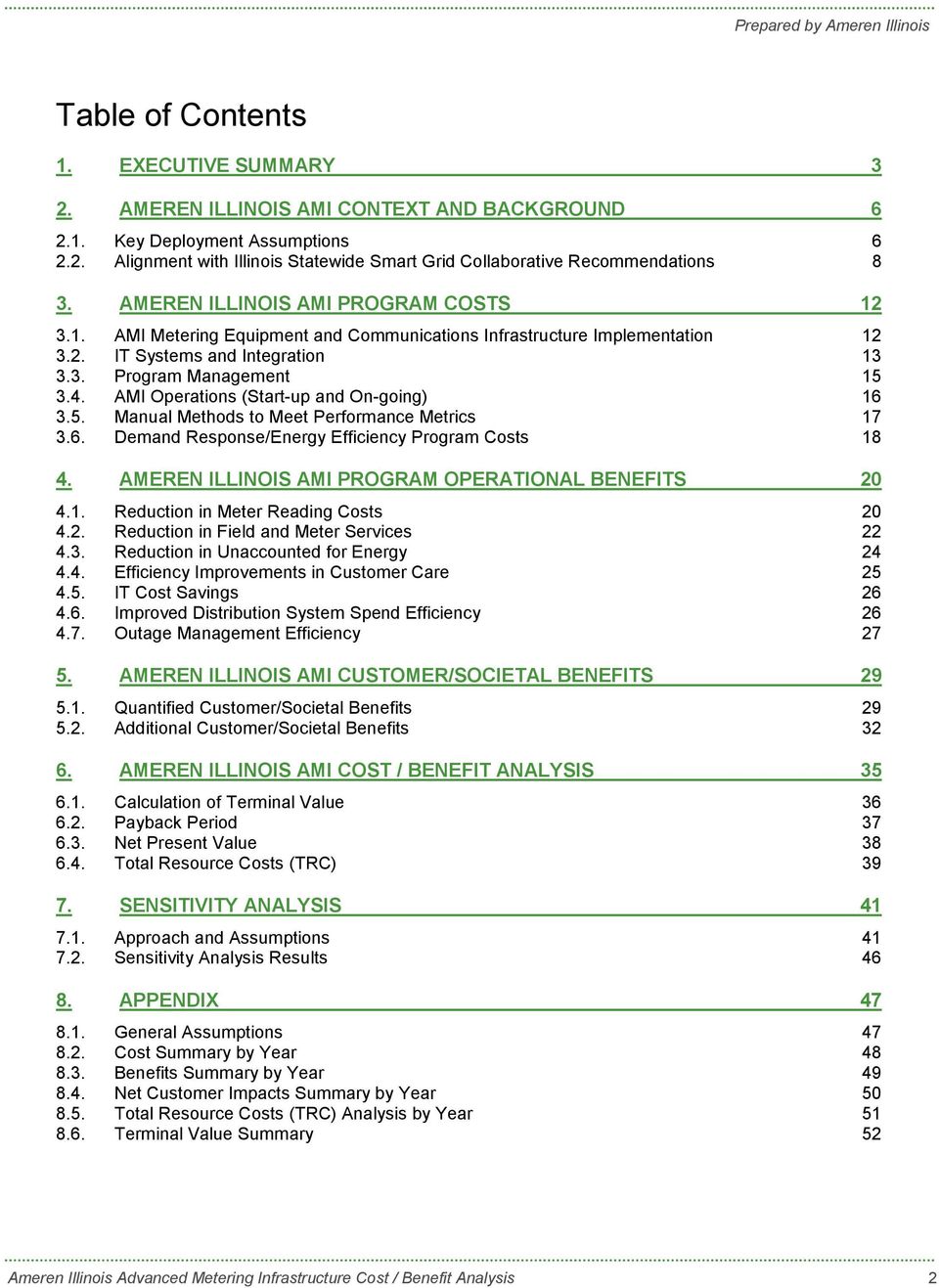
2 Table of Contents 1. EXECUTIVE SUMMARY 3 2. AMEREN ILLINOIS AMI CONTEXT AND BACKGROUND Key Deployment Assumptions Alignment with Illinois Statewide Smart Grid Collaborative Recommendations 8 3. AMEREN ILLINOIS AMI PROGRAM COSTS AMI Metering Equipment and Communications Infrastructure Implementation IT Systems and Integration Program Management AMI Operations (Start-up and On-going) Manual Methods to Meet Performance Metrics Demand Response/Energy Efficiency Program Costs AMEREN ILLINOIS AMI PROGRAM OPERATIONAL BENEFITS Reduction in Meter Reading Costs Reduction in Field and Meter Services Reduction in Unaccounted for Energy Efficiency Improvements in Customer Care IT Cost Savings Improved Distribution System Spend Efficiency Outage Management Efficiency AMEREN ILLINOIS AMI CUSTOMER/SOCIETAL BENEFITS Quantified Customer/Societal Benefits Additional Customer/Societal Benefits AMEREN ILLINOIS AMI COST / BENEFIT ANALYSIS Calculation of Terminal Value Payback Period Net Present Value Total Resource Costs (TRC) SENSITIVITY ANALYSIS Approach and Assumptions Sensitivity Analysis Results APPENDIX General Assumptions Cost Summary by Year Benefits Summary by Year Net Customer Impacts Summary by Year Total Resource Costs (TRC) Analysis by Year Terminal Value Summary 52 Ameren Illinois Advanced Metering Infrastructure Cost / Benefit Analysis 2
3 1. Executive Summary This document expands on the AMI Plan for Ameren Illinois Corporation (Ameren Illinois) to implement costbeneficial advanced metering infrastructure (AMI). These pages describe how Ameren Illinois evaluated and prioritized technologies to create value for our customers, our company, and the State of Illinois via AMI. To develop the cost/benefit analysis for the AMI deployment, Ameren Illinois used the guiding principles outlined in Section (a) of the Illinois Public Utilities Act which provides as follows: "Cost beneficial" means a determination that the benefits of a participating utility's Smart Grid AMI Deployment Plan exceed the costs of the Smart Grid AMI Deployment plan as initially filed with the Commission or as subsequently modified by the modified by the Commission. This standard is met if the present value of the total benefits of the Smart Grid AMI Deployment Plan exceeds the present value of the total costs of the Smart Grid AMI Deployment Plan. The total cost shall include all utility costs reasonably associated with the Smart Grid AMI Deployment Plan. The total benefits shall include the sum of avoided electricity costs, including avoided utility operational costs, avoided consumer power, capacity, and energy costs, and avoided societal costs associated with the production and consumption of electricity, as well as other societal benefits, including the greater integration of renewable and distributed power sources, reductions in the emissions of harmful pollutants and associated avoided health-related costs, other benefits associated with energy efficiency measures, demand-response activities, and the enabling of greater penetration of alternative fuel vehicles." As support for the AMI Plan, Ameren Illinois developed a cost/benefit analysis of implementing AMI within the Ameren Illinois service territory and submitted this filing to the Illinois Commerce Commission (ICC) on March 30, In conducting this evaluation, the project team worked closely with business managers over an 8- month period (August 2011 March 2012) to refine the scope of the AMI investment, research industry AMI initiatives, develop operational data and projections, identify and resolve key business case formation questions, and construct the AMI business case. During June 2012, after the ruling of the ICC on the initial filing, Ameren Illinois fine-tuned the cost/benefit analysis, refocusing the base case to an 8 year, 62%, electric-only AMI meter deployment plan, adding additional benefits in key areas, and refining cost estimates. Figure 1 summarizes the specific benefits of this implementation. Ameren Illinois Advanced Metering Infrastructure Cost / Benefit Analysis 3
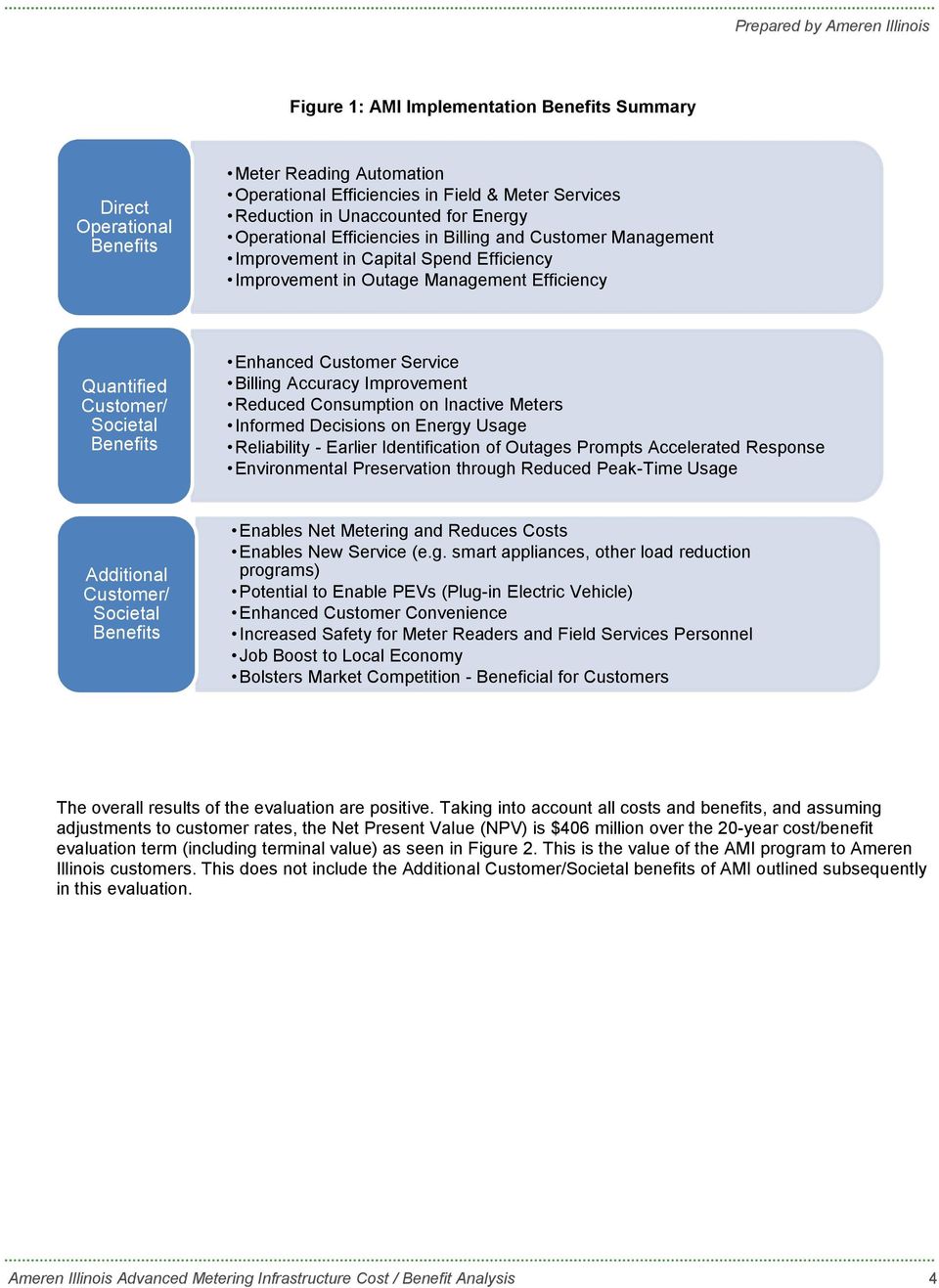
4 Figure 1: AMI Implementation Benefits Summary Direct Operational Benefits Meter Reading Automation Operational Efficiencies in Field & Meter Services Reduction in Unaccounted for Energy Operational Efficiencies in Billing and Customer Management Improvement in Capital Spend Efficiency Improvement in Outage Management Efficiency Quantified Customer/ Societal Benefits Enhanced Customer Service Billing Accuracy Improvement Reduced Consumption on Inactive Meters Informed Decisions on Energy Usage Reliability - Earlier Identification of Outages Prompts Accelerated Response Environmental Preservation through Reduced Peak-Time Usage Additional Customer/ Societal Benefits Enables Net Metering and Reduces Costs Enables New Service (e.g. smart appliances, other load reduction programs) Potential to Enable PEVs (Plug-in Electric Vehicle) Enhanced Customer Convenience Increased Safety for Meter Readers and Field Services Personnel Job Boost to Local Economy Bolsters Market Competition - Beneficial for Customers The overall results of the evaluation are positive. Taking into account all costs and benefits, and assuming adjustments to customer rates, the Net Present Value (NPV) is $406 million over the 20-year cost/benefit evaluation term (including terminal value) as seen in Figure 2. This is the value of the AMI program to Ameren Illinois customers. This does not include the Additional Customer/Societal benefits of AMI outlined subsequently in this evaluation. Ameren Illinois Advanced Metering Infrastructure Cost / Benefit Analysis 4
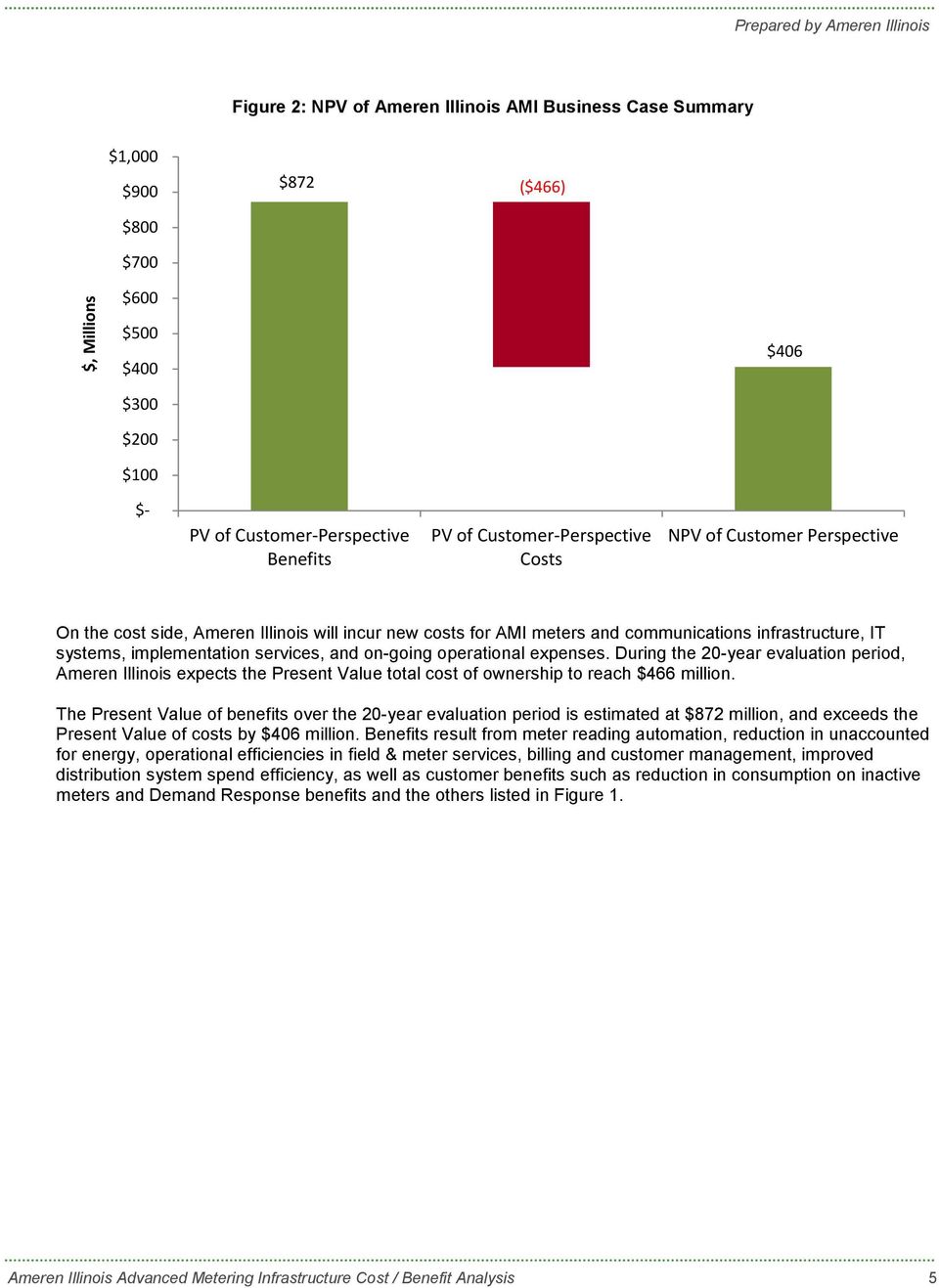
5 Figure 2: NPV of Ameren Illinois AMI Business Case Summary $1,000 $900 $800 $700 $872 ($466) $, Millions $600 $500 $400 $300 $200 $100 $406 $- PV of Customer-Perspective Benefits PV of Customer-Perspective Costs NPV of Customer Perspective On the cost side, Ameren Illinois will incur new costs for AMI meters and communications infrastructure, IT systems, implementation services, and on-going operational expenses. During the 20-year evaluation period, Ameren Illinois expects the Present Value total cost of ownership to reach $466 million. The Present Value of benefits over the 20-year evaluation period is estimated at $872 million, and exceeds the Present Value of costs by $406 million. Benefits result from meter reading automation, reduction in unaccounted for energy, operational efficiencies in field & meter services, billing and customer management, improved distribution system spend efficiency, as well as customer benefits such as reduction in consumption on inactive meters and Demand Response benefits and the others listed in Figure 1. Ameren Illinois Advanced Metering Infrastructure Cost / Benefit Analysis 5
6 2. Ameren Illinois AMI Context and Background As a utility serving the State of Illinois, Ameren Illinois is a leading energy provider that serves more than 1,200 communities. Every day, Ameren Illinois delivers energy to 1.2 million electric and 840,000 natural gas customers in central and southern Illinois. Ameren Illinois is also an early adopter of Automated Meter Reading (AMR), having introduced this technology to parts of the utility s 43,700-mile service territory in Upon completion of the automated meter deployment in 2010, Ameren Illinois had installed 678,000 electric and 476,000 gas one-way-communication-enabled AMR meters covering more than half of its gas and electric customers. Taking advantage of advancements in metering technology and leveraging two-way radio frequency (RF) networks, Ameren Illinois strives to promote green technologies and ensure high-quality service in a costeffective manner through the AMI initiative. As such, and in order to fulfill the provisions required as part of the AMI Plan, our AMI cost/benefit analysis evaluates a 20-year investment and outlines the determination that the benefits exceed all costs reasonably associated with this initiative. A number of key assumptions were formed as Ameren Illinois analyzed variables and scenarios to identify impacts to customers from implementing AMI in its service territory. Additional detailed assumptions are contained in the Appendix Key Deployment Assumptions Ownership/Operation of AMI Network Ameren Illinois plans to own and operate the AMI communications network (as opposed to paying an outside vendor to own and/or operate the network) Standalone Electric Base Case For the purposes of this business case, it is assumed that AMI is implemented for electric customers only, and all costs associated with the electric AMI rollout are included. Ameren Illinois understands that there will be costs and benefits to customers from implementing AMI within its gas service territory in conjunction with AMI electric Implementation Schedule The timing of meter deployment drives different costs and benefits for Ameren Illinois customers. As per the statutory requirement, Ameren Illinois is committed to serving 62% of its electric customers with AMI within 8 years. To meet the 62% requirement, Ameren Illinois has chosen an 8 year deployment plan that ends in Deployment will start in and include all of the non-amr operating centers which will include 46% of the 62% requirement. The remaining 16% will be in the AMR operating centers by Vendor Pricing Ameren Illinois issued Requests for Information (RFI) and Requests for Proposal (RFP) to a base of AMI and Meter Data Management (MDM) vendors. The RFP responses included detailed pricing on the AMI Network deployment and MDM implementation. Since specific vendors have not been selected at this time, this cost/benefit analysis uses an average pricing methodology from the responses to the RFP. Ameren Illinois Advanced Metering Infrastructure Cost / Benefit Analysis 6

7 Business Case Approach During the period from August 2011 through June 2012, the Ameren Illinois AMI project team has worked closely with: Ameren Illinois business executives to understand the strategic imperatives and refine the scope of the AMI investment Ameren Illinois function leaders to project operational activities and associated costs and benefits External vendors and industry experts to obtain metering, communication and IT infrastructure cost estimates, research industry AMI initiatives, identify and resolve key business case formation questions, and construct the AMI business case Cost Estimates Approach The Ameren Illinois AMI project team worked through formal RFI and RFP processes to engage with multiple external vendors to obtain cost estimates for AMI field hardware (meters and communications infrastructure), installation, software purchase, and administration costs. The team also engaged with both external IT vendors and internal IT and Corporate Planning teams to assess the costs associated with hardware procurement, software purchasing and licensing, IT development and integration, and overall support and maintenance of the IT systems and infrastructure needed during AMI deployment. Moreover, department leaders helped identify resource requirements and cost estimates for program management and associated operational activities such as customer education, customer management, and technical support. With respect to meter depreciation, Ameren Illinois has reviewed some of the largest AMI deployment plans in the United States, such as those by Duke Energy, Southern California Edison, DTE, and PG&E to base its AMI deployment on a useful life of 20 years for the AMI meter. As with any complex system, individual components may fail early or last longer than the overall useful life. The AMI meter's useful life does not depend on when the first component fails or how long the last meter-module functions. Instead, its life depends on the system as a whole operating correctly and reliably. Moreover, Southern California Edison conducted product testing that concluded that the meter useful life would be 20 years or more Benefit Estimates Approach The Ameren Illinois AMI project team relied heavily on both internal and external AMI and metering experts to identify AMI benefit areas and detail cost reductions and loss prevention associated with each benefit area commensurate with the meter deployment schedule. While direct operational and customer benefits in several areas such as meter reading, field and meter services, unaccounted for energy, billing accuracy, consumption on inactive meters, Demand Response, Energy Efficiency, and PEV were quantified, numerous additional customer and societal benefits have also been evaluated and included in the business case Cost/Benefit Analysis Approach A rigorous approach to the AMI cost / benefit analysis was conducted by using several different evaluation methodologies, including Payback Period, Net Present Value (NPV) analysis, as well as Total Resource Cost (TRC) analysis. The time horizon used for the business case was 20 years. However, a terminal value was also calculated to take into account the costs and benefits associated with the un-depreciated AMI infrastructure remaining beyond the 20 year period. The cost benefit analysis is taken from the customer perspective, with costs and benefits modeled as revenue requirement adjustments. 1 SCE Cost Benefit Analysis, Vol 3., December 21, 2006 Ameren Illinois Advanced Metering Infrastructure Cost / Benefit Analysis 7

8 As such, the discount rate that is used for the NPV analysis should also reflect a customer-perspective discount rate. This is consistent with the Illinois Statewide Smart Grid Collaborative (ISSGC) recommendation of using an appropriate discount rate. Therefore, a customer-relevant discount rate was used for this analysis as the 20-Year Treasury Bill rate (3.62% currently). This approach is consistent with the ComEd AMI pilot evaluation and the Ameren Illinois Cost/Benefit Analysis timeframe Alignment with Illinois Statewide Smart Grid Collaborative Recommendations Ameren Illinois adhered to the guidelines of the Illinois Statewide Smart Grid Collaborative (ISSGC) when developing the cost and benefit estimates. The table below summarizes how Ameren Illinois complied with these guidelines. Table 1: Alignment with ISSGC Cost-Benefit Filing Requirements Requirement (from ISSGC report) 1. Provide costbenefit analyses of the investment(s), including a Total Resource Cost test: Sub-Requirement (from ISSGC report) The analysis should include any factor (i.e., cost or benefit) that meets the following criteria: They can be expected to have a meaningful economic impact on the utility s investment decision or are relevant to the Commission s approval decisions They can be reasonably and transparently quantified and monetized They are relevant to the analysis, specifically including the costs of achieving claimed benefits. Costs and benefits should only be counted once; there can be no double-counting of benefits. All costs and benefits used in the analysis should be incremental to the investment when compared with a baseline or business as usual scenario. The baseline scenario should reflect the related costs or benefits that would be anticipated if the investment were not made. The cost-benefit analysis should recognize as a separate line item any stranded costs that would result from the smart grid investment. Ameren Illinois Business Case Alignment Requirement Met Requirement Met Requirement Met (Costs and benefits were analyzed to ensure only incremental values were used) Requirement Met Ameren Illinois Advanced Metering Infrastructure Cost / Benefit Analysis 8
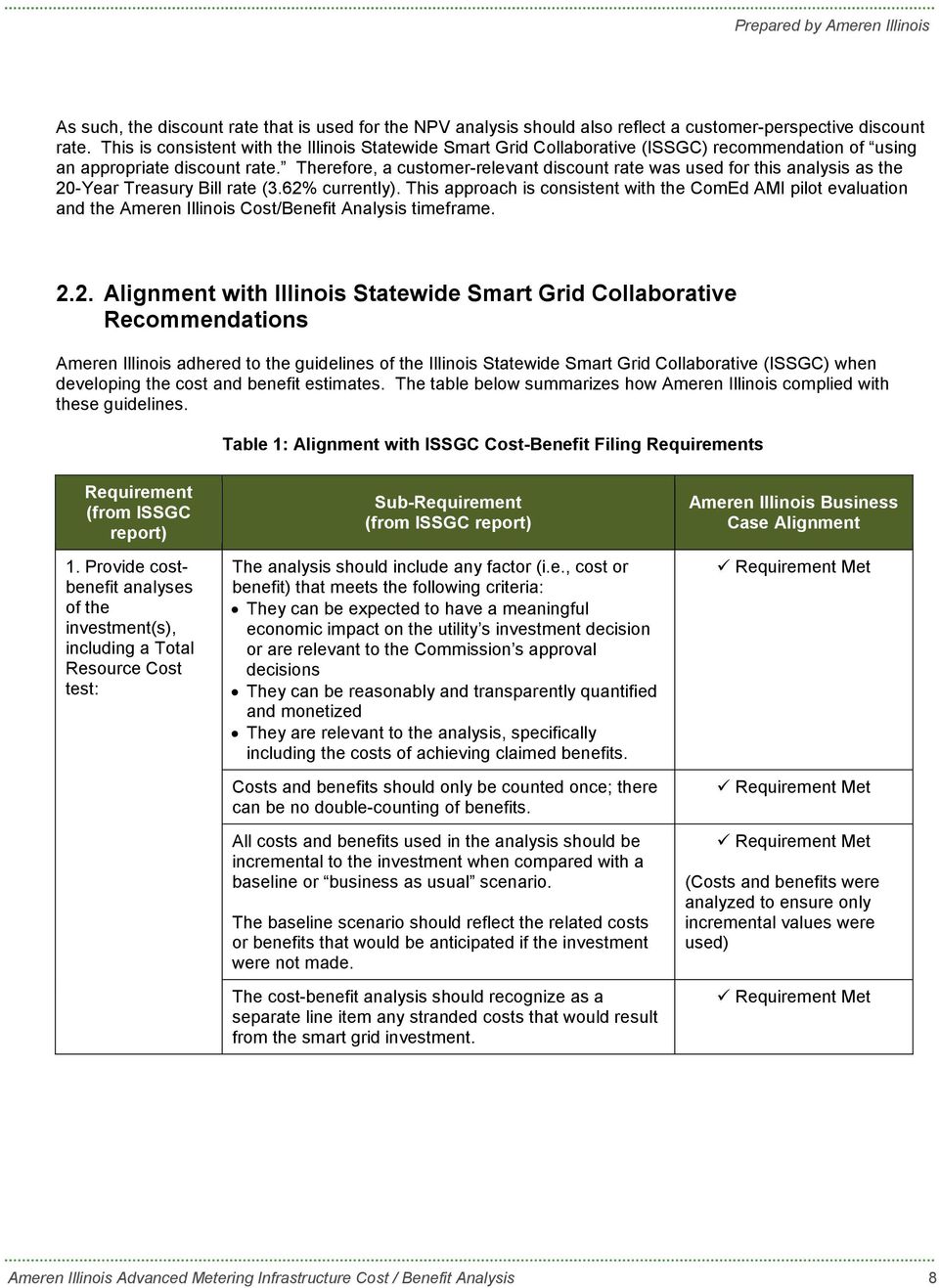
9 Requirement (from ISSGC report) 1. Provide costbenefit analyses of the investment(s), including a Total Resource Cost test: (cont d) Sub-Requirement (from ISSGC report) The utility should be required to present multiple views, or perspectives, as part of their cost-benefit analysis to be filed with the Commission. A Total Resource Cost perspective for investments should be presented by the utilities both with societal costs and benefits and without societal costs and benefits Other perspectives that should be presented include a Ratepayer Impact view (depicting how rates would be impacted) and a Customer/Participant view (depicting the impacts of customer-specific costs and benefits) As appropriate to each test, the cost-benefit analysis should separately identify: 1) Those costs and benefits that will be directly incurred or realized by ratepayers through the traditional ratemaking structure 2) Those costs that can be expected to be incurred by non-utility parties 3) Those benefits that will flow, if at all, through the wholesale price of energy or other markets 4) Those benefits associated with broader societal objectives or results that are not necessarily reflected in regulated customer rates. Cost-benefit analysis may bundle or package together investments in several applications if those applications are needed to function together or provide otherwise unachievable synergies, or if they are reliant on a common infrastructure investment. To the extent that it is feasible to separate underlying platforms from individual applications, smart grid applications contained within a package should still be subject to individual cost-benefit analysis based on their stand-alone incremental costs and benefits. Cost-benefit analysis should provide a calculation of a payback period based on the present value of the annual cash flows of the smart grid investment or package Potential non-regulated, third party, or incidental revenue from smart grid infrastructure investments should be reflected in the cost-benefit analysis. Ameren Illinois Business Case Alignment Requirement Met (Both a customer/ratepayer impact and Total Resource Cost views are included in this analysis) Requirement Met (Ameren Illinois views the AMI investment as a comprehensive capability that is considered as a whole) Requirement Met N/A (This analysis does not include non-regulated or third-party/incidental revenue) Ameren Illinois Advanced Metering Infrastructure Cost / Benefit Analysis 9

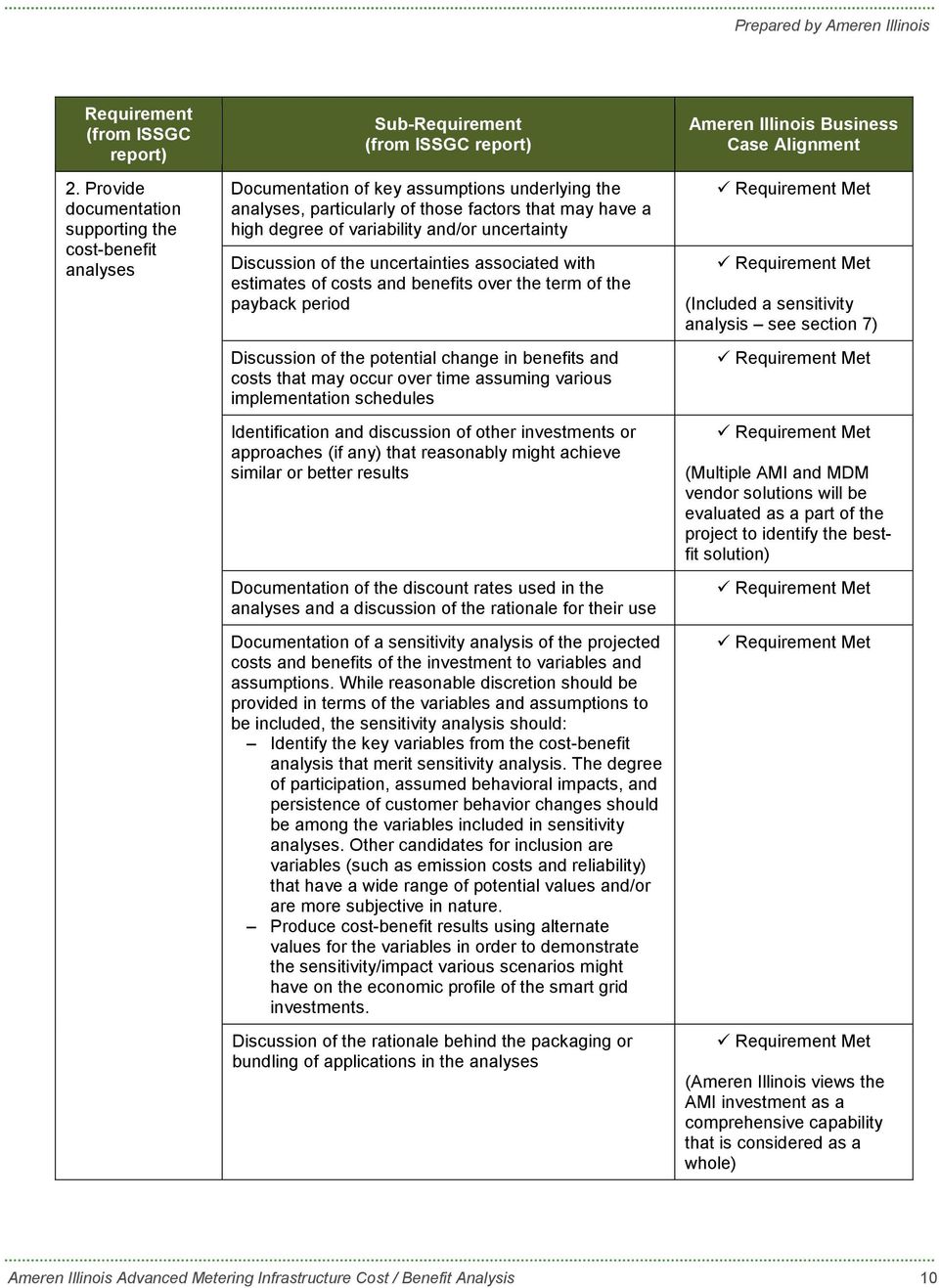
10 Requirement (from ISSGC report) 2. Provide documentation supporting the cost-benefit analyses Sub-Requirement (from ISSGC report) Documentation of key assumptions underlying the analyses, particularly of those factors that may have a high degree of variability and/or uncertainty Discussion of the uncertainties associated with estimates of costs and benefits over the term of the payback period Discussion of the potential change in benefits and costs that may occur over time assuming various implementation schedules Identification and discussion of other investments or approaches (if any) that reasonably might achieve similar or better results Documentation of the discount rates used in the analyses and a discussion of the rationale for their use Documentation of a sensitivity analysis of the projected costs and benefits of the investment to variables and assumptions. While reasonable discretion should be provided in terms of the variables and assumptions to be included, the sensitivity analysis should: Identify the key variables from the cost-benefit analysis that merit sensitivity analysis. The degree of participation, assumed behavioral impacts, and persistence of customer behavior changes should be among the variables included in sensitivity analyses. Other candidates for inclusion are variables (such as emission costs and reliability) that have a wide range of potential values and/or are more subjective in nature. Produce cost-benefit results using alternate values for the variables in order to demonstrate the sensitivity/impact various scenarios might have on the economic profile of the smart grid investments. Discussion of the rationale behind the packaging or bundling of applications in the analyses Ameren Illinois Business Case Alignment Requirement Met Requirement Met (Included a sensitivity analysis see section 7) Requirement Met Requirement Met (Multiple AMI and MDM vendor solutions will be evaluated as a part of the project to identify the bestfit solution) Requirement Met Requirement Met Requirement Met (Ameren Illinois views the AMI investment as a comprehensive capability that is considered as a whole) Ameren Illinois Advanced Metering Infrastructure Cost / Benefit Analysis 10
11 Requirement (from ISSGC report) 2. Provide documentation supporting the cost-benefit analyses (cont d) Sub-Requirement (from ISSGC report) Documentation of the investment s useful life and the basis for its determination Documentation of the length of time over which reasonable customer benefits can be reliably estimated Documentation of assumptions regarding any environmental benefits incorporated in the analysis (e.g., emissions reduced, values of emissions/allowances) Discussion of the methodology and assumptions used in deriving the estimated benefits from load shape changes. This discussion should describe the model(s) used, model inputs and outputs, model logic (at a high level), scenarios performed, and how model results are to be interpreted. Ameren Illinois Business Case Alignment Requirement Met Requirement Met Requirement Met Requirement Met (This analysis includes a high-level summary of the Demand Response benefit methodology, which is based on peak load shifting) Ameren Illinois Advanced Metering Infrastructure Cost / Benefit Analysis 11

12 3. Ameren Illinois AMI Program Costs Ameren Illinois has conducted detailed cost assessments to determine the life cycle cost of AMI ownership, as well as the capital and operations and maintenance (O&M) costs associated with AMI deployment. AMI deployment is expected to be completed within 8 years. Operations of the AMI infrastructure will commence prior to the AMI system installation and continue through the timeframe of the business case. The major cost components of the AMI deployment are summarized in the table below. Table 2: Key Cost Components (in $ millions, over 20 years) Key Cost Components Capital O&M Total AMI Meter and Communications Infrastructure and Implementation $129 $0 $129 IT Systems and Integration $111 $183 $294 Project Management $16 $0 $16 AMI Operations $16 $53 $69 Manual Methods to Meet Performance Metrics $0 $5 $5 Demand Response/Energy Efficiency Program Costs $0 $53 $53 TOTAL $272 $294 $ AMI Metering Equipment and Communications Infrastructure Implementation This cost category includes the capital costs associated with the installation, configuration and customization of the AMI metering and communications systems. This also includes O&M costs associated with accelerated depreciation of existing meters. Ameren Illinois estimates that the 20-year capital costs incurred as a result of full AMI deployment within 8 years will be approximately $129 million. Below is a summary of the main components of these costs. Table 3: AMI Metering Equipment & Communications Infrastructure Cost Breakout (in $ millions, over 20 years) AMI Metering Equipment and Communications Capital O&M Total Infrastructure Cost Drivers AMI Meters $82 $0 $82 AMI Meter Installation $27 $0 $27 AMI Communications Network Hardware & Installation $20 $0 $20 Accelerated Depreciation for Existing Meters $0 $0 $0 TOTAL $129 $0 $129 Capital costs include costs of AMI meters and communications, as well as installation and project management costs. The cost estimates were derived from the AMI vendor RFI s and RFP s that were issued in 2011 and Ameren Illinois Advanced Metering Infrastructure Cost / Benefit Analysis 12

13 AMI meter costs include the costs for the physical AMI meter for single-phase and three-phase meters having embedded two-way RF radio communicators. All self-contained meters that are 200 Amps or less will also have an internal switch for remote connect / disconnect applications. This cost is based on a 62% deployment, an annual growth rate of 0.25% on an initial meter count of 780,419 AMI meters, over 8 years. Installation of meters is a complex activity involving pre-installation preparations and field deployment. During pre-installation, facilities are prepared for AMI meter processing, field surveys are completed, and plans are developed for meter deployment. Network preparation, including right of ways and interagency permissions are obtained. During field deployment, the meters are actually installed at the customer premises (and the existing meter is taken out of service). Meter deployment is major activity. It involves setting up cross-dock facilities as logistical hubs for meter deployment. Meters are checked for performance and accuracy before deployment. The workforce is trained and deployed to cross-dock facilities. Deployment is scheduled based on route plan. Meters are installed, and clean-up is performed to complete the installation process. Tests of meter communication and data accuracy are performed as a part of commissioning. The AMI communications network hardware and installation phase involves the physical roll-out of the communications infrastructure (collection points, wide area network (WAN) hardware) in the field and within Ameren Illinois facilities (head-end communications equipment). First, the communications network is installed in each operating center area to provide immediate visibility to the meters that will be installed. Network communication implementation includes field survey, installation of communication equipment and testing of communication equipment. It is estimated that there will be a number of collection points across the Ameren Illinois service territory. The final cost driver related to the AMI Metering Equipment implementation is the accelerated depreciation for the existing non-amr meters and applicable AMR meters & infrastructure. Since the AMI meters will be rolled out to 62% of customers over the 8 year deployment period, all existing non-amr meters as well as a small portion of AMR meters will be replaced during that timeframe. Many of these meters will still have a depreciable life remaining at the point they are replaced. Therefore, the costs for accelerating the remaining depreciation for these meters are included in this analysis, which is consistent with the guidelines recommended by the Illinois Statewide Smart Grid Collaborative. The existing depreciation schedule calls for depreciation on existing meters (both AMR and non-amr) to total $85 million in and $2 million in 2033 and beyond. The accelerated depreciation schedule for the existing meters based on AMI implementation totals $87 million in While the total depreciated is the same for the existing & accelerated schedules (including years after 2032), the difference between the existing & accelerated depreciation for each year is included in the cost estimates. The accelerated depreciation of meters that will be replaced by AMI meters has a minimal overall impact IT Systems and Integration This cost category includes the implementation costs associated with the IT systems and integration hardware, software, development, security and project management, as well as the ongoing maintenance of these systems. Ameren Illinois estimates that the 20-year capital and O&M costs incurred as a result of 62% AMI deployment within 8 years will be approximately $294 million. Key components of AMI-related IT systems: AMI IT systems include head-end systems to communicate with the AMI network, capture meter data and send control commands to the meter. Ameren Illinois Advanced Metering Infrastructure Cost / Benefit Analysis 13

14 Head-end systems transfer data to a Meter Data Management System (MDMS) where meter data is validated against acceptance rules to ensure data quality. Estimations are done for missing data and edits are made to some data elements. Storage systems are needed, as meter data increases exponentially over current needs, increasing the importance of systematic data management. Data will need to be shared by several systems, and it requires an integration platform to allow sharing of the information between various enterprise systems (e.g. providing data for various applications such as billing, customer service and customer analytics). Security of the AMI network, including planning and implementation of security architecture to protect customer and operational data, is required. Table 4: IT Systems and Integration Cost Breakout (in $ millions, over 20 years) IT Systems and Integration Cost Drivers Capital O&M Total Hardware $12 $12 $24 Software $1 $57 $58 Labor $73 $73 $146 Security and planning $1 $5 $6 Project Management $18 $4 $22 Operations $5 $30 $35 Asset Management Planning Support $1 $2 $3 TOTAL $111 $183 $294 Ameren Illinois estimates capital costs for IT systems and integration to be approximately $111 million over 20 years. Outlined below are further details on the key elements of Ameren Illinois' anticipated AMI IT infrastructure: Hardware o Servers for Enterprise Service Bus (ESB) o Network Operations Hardware Software o AMI Head End o Application Servers & Database Servers o Meter Data Management System o Data Analytics Software o ESB Tools Labor o Key activities include: AMI & MDMS Design and Implementation MDMS Integration AMI Integration ESB Integration Environment Set Up, Installs, etc. Data Analytics Support Security and Planning Ameren Illinois Advanced Metering Infrastructure Cost / Benefit Analysis 14

15 o o Costs have been estimated for the planning, designing, and building of security systems and protocols to securely transmit data within the network. On-going IT system security administration will incur additional costs Project Management o Key activities include centralized training, personnel recruiting, employee communications, and miscellaneous start-up related activities o Vendor oversight of the Request for Proposals (RFP) process and contracts supervision will also bear additional costs o Other management overhead costs spanning two or more functional cost categories, such as project management and the administration of job skills training, are also included in this cost category Operations o Costs have been allocated for on-going application support, post production support / transition, upgrade, and maintenance for AMI-related IT systems Both Ameren Illinois resources and contractor resources will be employed for support and maintenance of IT systems. Furthermore, fees will need to be paid to vendors for product support and servicing. Asset Management Planning Support costs include the development of enhanced asset planning analysis tools and software to enable better forecasting and planning. Additionally, there is an on-going maintenance cost for the tools and software that will be developed Program Management A long-term strategic initiative such as AMI deployment requires a substantial amount of resources for program delivery activities. Ameren Illinois estimates that $16 million will be needed to fund program management activities. Table 5: Program Management Cost Breakout (in $ millions, over 20 years) Program Management Cost Drivers Capital O&M TOTAL Program Management $16 $0 $16 Program Management activities include Governance: Oversight, program prioritization and approval, establishing program sponsorship and accountability, Quality Management: The development and management of standard processes and practices to manage quality across the program Program Scheduling and Staffing: The management of integrated timelines and dependencies; securing and allocating resources to satisfy demand in a timely manner Issue and Risk Management: A standard methodology and tool for reporting, prioritizing, and escalating issues to ensure timely resolution; the development and management of standard risk identification and response capabilities to manage risk across the program Project Communications and Reporting Financial/Benefits Realization and Regulatory Management: The management and production of financial planning and reporting; management of benefits realization and business cases to ensure business benefits are measured and achieved; single point of contact to manage compliance with requirements of Commission Ameren Illinois Advanced Metering Infrastructure Cost / Benefit Analysis 15

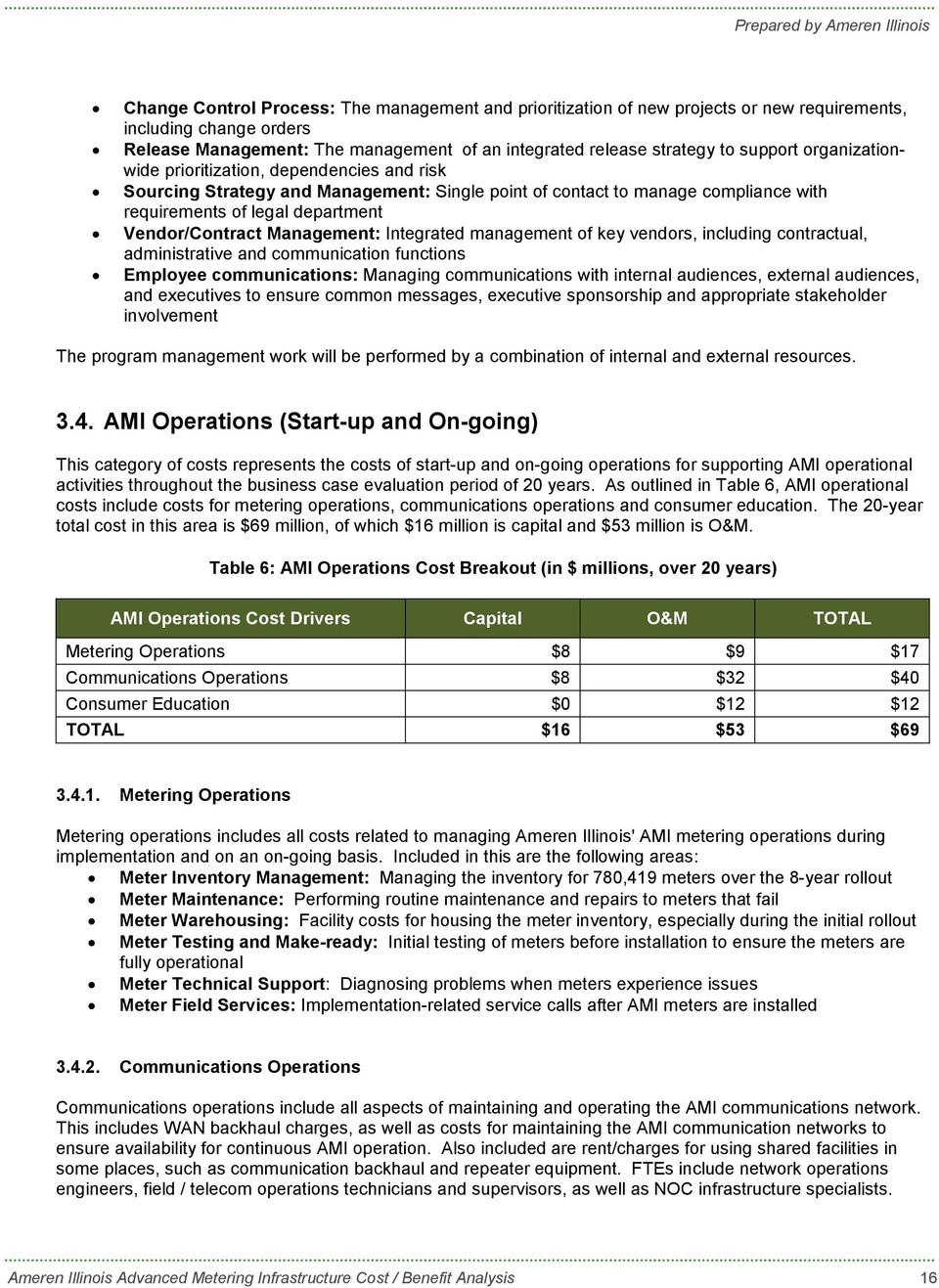
16 Change Control Process: The management and prioritization of new projects or new requirements, including change orders Release Management: The management of an integrated release strategy to support organizationwide prioritization, dependencies and risk Sourcing Strategy and Management: Single point of contact to manage compliance with requirements of legal department Vendor/Contract Management: Integrated management of key vendors, including contractual, administrative and communication functions Employee communications: Managing communications with internal audiences, external audiences, and executives to ensure common messages, executive sponsorship and appropriate stakeholder involvement The program management work will be performed by a combination of internal and external resources AMI Operations (Start-up and On-going) This category of costs represents the costs of start-up and on-going operations for supporting AMI operational activities throughout the business case evaluation period of 20 years. As outlined in Table 6, AMI operational costs include costs for metering operations, communications operations and consumer education. The 20-year total cost in this area is $69 million, of which $16 million is capital and $53 million is O&M. Table 6: AMI Operations Cost Breakout (in $ millions, over 20 years) AMI Operations Cost Drivers Capital O&M TOTAL Metering Operations $8 $9 $17 Communications Operations $8 $32 $40 Consumer Education $0 $12 $12 TOTAL $16 $53 $ Metering Operations Metering operations includes all costs related to managing Ameren Illinois' AMI metering operations during implementation and on an on-going basis. Included in this are the following areas: Meter Inventory Management: Managing the inventory for 780,419 meters over the 8-year rollout Meter Maintenance: Performing routine maintenance and repairs to meters that fail Meter Warehousing: Facility costs for housing the meter inventory, especially during the initial rollout Meter Testing and Make-ready: Initial testing of meters before installation to ensure the meters are fully operational Meter Technical Support: Diagnosing problems when meters experience issues Meter Field Services: Implementation-related service calls after AMI meters are installed Communications Operations Communications operations include all aspects of maintaining and operating the AMI communications network. This includes WAN backhaul charges, as well as costs for maintaining the AMI communication networks to ensure availability for continuous AMI operation. Also included are rent/charges for using shared facilities in some places, such as communication backhaul and repeater equipment. FTEs include network operations engineers, field / telecom operations technicians and supervisors, as well as NOC infrastructure specialists. Ameren Illinois Advanced Metering Infrastructure Cost / Benefit Analysis 16
17 Consumer Education The success of AMI program is contingent on the ability of Ameren Illinois to communicate with customers, with a specific focus on educating them on the safety and capabilities of the AMI system. The focus is to enable the customer so that customer direct benefits are maximized. This also includes both broad public education and specific customer education on the positive impacts of AMI technology, implementation success stories, how AMI creates value in energy conservation, and/or specific details on participation in Demand Response/Energy Efficiency programs. In addition, customer education efforts will include instruction on how to use customer selfservice and web portal tools. Details on the customer education program can be found in the AMI Plan document Manual Methods to Meet Performance Metrics This category of costs represents the costs of the manual methods required to supplement the AMI delivered benefits in order to meet Ameren Illinois AMI-related performance metrics as established in Illinois Public Acts and Ameren Illinois estimates that, since the deployment of AMI meters won t begin until 2014 and will end in 2019, the AMI system won t be fully operational and deployed in time to meet the performance metrics, specifically in the areas of disconnects to reduce Consumption on Inactive Meters (CIM) and estimate bills. As outlined in Table 7, the 20-year total costs in this area is $5 million O&M, of which $4 million is related to the CIM metric and $1 million is related to the estimated bill metric. Table 7: Manual Methods to Meet Performance Metrics Breakout (in $ millions, over 20 years) Manual Methods to Meet Performance Metrics Capital O&M Total Disconnects to Meet CIM Metric $0 $4 $4 Manual Meter Reads to Meet Estimated Bill Metric $0 $1 $1 Disconnects to Meet Uncollectibles $0 $0 $0 TOTAL $0 $5 $ Disconnects to Meet CIM Metric In order to reduce consumption on inactive meters, Ameren Illinois estimates that additional physical disconnects will need to occur to prevent usage on accounts that have had their service stopped. The AMI system will ultimately provide the capability to remotely physically disconnect electrical service to customers that have stopped service on their account. Until the AMI system is fully deployed and operational, additional manual disconnects will need to occur to meet the performance targets. Ameren Illinois estimates that an additional 4,800 manual disconnects on average will need to occur each year in the timeframe, resulting in approximately $4M of additional costs Manual Meter Reads to Meet Estimated Bill Metric In order to reduce estimated bills, Ameren Illinois estimates that additional meter reads will need to occur. The AMI system will ultimately provide the capability to remotely read a meter on demand to address situations where an estimated bill would normally be issued. Until the AMI system is fully deployed and operational, additional manual meter reads will need to occur to meet the performance targets Disconnects to Meet Uncollectibles Ameren Illinois Advanced Metering Infrastructure Cost / Benefit Analysis 17

18 In order to reduce the amount of uncollectible revenue that is written off each year, Ameren Illinois estimates that additional physical disconnects will need to occur to prevent additional usage on accounts that are overdue. The AMI system will provide a remote disconnect capability that will address this need once the AMI system is fully implemented. Ameren Illinois estimates that additional manual physical disconnects will only need to occur to meet the performance metrics in 2022, so the there are minimal costs included in the cost / benefit analysis Demand Response/Energy Efficiency Program Costs This category of costs represents the Demand Response and Energy Efficiency program costs to implement Demand Response and Energy Efficiency programs. Based on cost estimates developed by the Institute for Electric Efficiency for enabling Demand Response/Energy Efficiency technologies, detailed cost estimates were developed. The technologies are based on digital electronics whose costs will decline significantly over the next two decades, as typically happens when technological innovation within digital technologies achieves economies of scale. A decrease in cost over the first 10 years will be at a rate of 16% per year and then fall to a decrease of 8% per year over the last 10 years. Table 8: Demand Response/Energy Efficiency Program Costs (in $ millions, over 20 years) Demand Response/Energy Efficiency Program Capital O&M Total Costs Demand Response $0 $3 $3 Energy Efficiency $0 $2 $2 PEV Enablement $0 $13 $13 Customer Technology Interface & Support $0 $23 $23 Customer Education Dynamic Pricing and Technology $0 $12 $12 TOTAL $0 $53 $ Demand Response Customers will have the choice to opt-in to a Peak Time Rebate (PTR) program, Critical Peak pricing rate, Direct Load Control program, or Time of Use program with the AMI program. Costs associated with this program include technology such as in-home displays, programmable control thermostats, and home energy management systems. The AMI solution will enable the future utilization of home devices using the Industry Smart Energy Profile 2.0 standard when it is ratified and available Energy Efficiency As customers are more aware of their use, there is a natural learning that takes place and results in overall usage reduction. The costs associated with the Energy Efficiency program include the home energy devices such as in-home displays or home energy monitors or messages customized to one s personal devices PEV Enablement AMI combined with smart charging technologies will allow PEV owners to charge their vehicles at non-peak times when electricity rates are cheapest. The costs associated in this model are driven by the incremental cost Ameren Illinois Advanced Metering Infrastructure Cost / Benefit Analysis 18

19 of electric vehicles relative to conventional vehicles. It is assumed that the PEV premium is $9,500 in 2012 and declining at a rate of 16% in the first ten years of the forecast and 8% in the last ten years Customer Technology Interface & Support AMI when used in conjunction with Demand Response technology is an enabler to provide new options for customers who choose to opt-in to Demand Response and Energy Efficiency programs. The IT costs associated with integrating to these new systems is estimated in these costs. The integration interfaces would leverage industry standard interfaces where applicable such as NIST standards for integrating to new head-end Demand Response system (DRMS), Green Button interfaces for customer web portals, and interfaces to thirdparty vendors providing additional enabling technologies that may be leveraged by Ameren Illinois customers in the future Dynamic Pricing and Technology Education Ameren Illinois understands significant pricing program and AMI/technology integration benefits can accrue to customers. Ameren Illinois has incorporated costs to engage and inform consumers on how those benefits enabled by AMI can be achieved. An ongoing part of Ameren Illinois Consumer Education efforts, Ameren Illinois intends to communicate through multiple channels to instruct customers on using AMI enabled programs and technologies. Ameren Illinois estimates that an annual budget of $0.5 million will be spent to inform and educate customers on the availability of AMI enabled pricing programs, technologies, and their benefits. Ameren Illinois Advanced Metering Infrastructure Cost / Benefit Analysis 19

20 4. Ameren Illinois AMI Program Operational Benefits Ameren Illinois has conducted a thorough assessment of all the operational benefits that it expects to accrue through 62% AMI implementation within 8 years. Included in this analysis are direct operational benefits realized by Ameren Illinois and passed along to customer rates. These benefits are evaluated over a 20 year period and are expressed in incremental terms over the business as usual case. The following methodology was utilized to calculate steady-state benefits associated with the AMI implementation: (1) Define the value drivers of the AMI solution components (2) Identify and isolate the affected baseline costs and revenues that will be impacted (3) Research and identify relevant cost savings and/or loss prevention percentages to be applied to the affected baseline Over 20 years, Ameren Illinois expects financial benefits of approximately $582 million. The following table outlines a summary of the major quantifiable benefits expected out of the AMI implementation. Table 9: Key Benefit Drivers (in $ millions, over 20 years) Cumulative Benefit Category Benefits Reduction in Meter Reading Costs $238 Reduction in Field & Meter Services $209 Reduction in Unaccounted for Energy $41 Efficiency Improvement in Customer Care $15 IT Cost Savings $5 Improved Distribution System Spend Efficiency $42 Outage Management Efficiency $32 TOTAL $ Reduction in Meter Reading Costs Ameren Illinois has been an early adopter of automated meter reading, with its Illinois program starting in the 1990s and aggressively expanding throughout the state from 2006 through Today, approximately 680,000 electric meters are automated representing more than half of Ameren Illinois electric customers. As a result of this automated meter reading, many of the meter reading labor benefits have been previously realized. Reduction in meter reading costs from the remaining 574,000 manual electric meters represents the largest area of benefits expected from Ameren Illinois AMI implementation plan. Meter reads that are traditionally conducted through physical site visits to the customer premise can instead be done remotely through the AMI system. Benefits associated with reduction in meter reads represent the reduction in manual meter reading labor costs, associated IT costs, as well as vehicle / transportation costs. Ameren Illinois estimates that 62% deployment of AMI over 8 years will result in meter reading cost savings of $238 million over a 20 year period. Table 10: Meter Reading Cost Savings Breakdown (in $ millions, over 20 years) Reduction in Meter Reading Costs Cumulative Benefits Reduction in Manual Meter Reading Expenses $176 Ameren Illinois Advanced Metering Infrastructure Cost / Benefit Analysis 20

21 Reduction in Meter Reading Costs Cumulative Benefits Reduction in AMR Meter Reading Expenses $50 Reduction in Manual and AMR Meter IT Costs $3 Reduction in On-Cycle Meter Reading Vehicle Expense $9 TOTAL $ Reduction in Manual Meter Reading Expenses Of the 574,000 electric meters that are manually read, 45% of on-cycle reads are performed utilizing internal Ameren Illinois labor while the remaining reads are performed by contractors. Cost savings through the reduction in manual meter reads will be realized through a reduction in both in-house and contractor labor costs. Meter reader workforce reductions are planned over the course of the 8-year AMI implementation, and Ameren Illinois is planning to realize these workforce reductions through natural attrition and work re-assignment over time. Quantifiable benefits related to manual meter reading savings are expected to be $176 million over a 20 year business case time horizon. These cost savings take into account meter reads conducted by both internal meter readers as well as external contractors Reduction in AMR Meter Reading Expenses Ameren Illinois expects to begin replacing approximately 200,000 of its 680,000 AMR meters with AMI meters starting in year All costs associated with AMR meter reading in the form of fees paid to external vendors will be eliminated as AMI meters replace existing AMR meters. By eliminating these AMR costs over the AMI implementation time frame, Ameren Illinois expects to realize cost savings related to AMR meter reading of approximately $50 million over a 20 year business case time horizon Reduction in Manual Meter IT Costs O&M costs associated with the IT systems that support existing manual meter reads will be eliminated with the deployment of AMI meters. Benefits include cost savings associated with the support and upgrade of meter reading devices as well as software licensing and maintenance. The current cost to support the existing MVRS hardware and software is roughly $175,000 per year. Ameren Illinois expects to be able to save 60% of these costs after deployment. Ameren Illinois estimates reduction in manual meter IT costs to be approximately $3 million over the 20 year business case time horizon Reduction in On-Cycle Meter Reading Vehicle Expense As non-amr meters get replaced by AMI smart meters, the reduction in the need for manual meter reads will result in a reduction in associated vehicle costs for Ameren Illinois. Vehicle-related benefits include cost savings from fewer vehicles, fuel costs, vehicle insurance, and vehicle maintenance. Ameren Illinois Advanced Metering Infrastructure Cost / Benefit Analysis 21
22 The current annual cost to operate and maintain vehicles for meter reading purposes is approximately $500,000. With AMI, Ameren Illinois expects reduction in manual and special meter reads to reduce vehicle costs by approximately $9 million over the 20-year business case time horizon Reduction in Field and Meter Services AMI s smart metering and communication infrastructure enables utilities to perform several functions remotely that would otherwise require a field visit to the customer premise. As a result, significant cost savings through the reduction in the number of personnel and vehicles for field and meter services can be achieved. Benefits in this area can be seen in the reduction in manual disconnect / reconnect of meters, single light outages, need for manual re-reads, as well as customer equipment problem outages. Ameren Illinois estimates that 62% deployment of AMI over 8 years will result in meter reading cost savings of $209 million over the 20 year business case time horizon. Table 11: Field and Meter Savings Breakdown (in $ millions, over 20 years) Reduction in Field & Meter Services Cumulative Benefits Reduction in Manual Disconnect / Reconnect of Meters $116 Reduction in Manual Off-Cycle / Special Meter Reads $62 Reduction in Field Services Vehicle Expense $14 Reduction in OK on Arrival Outage Field Trips $11 Reduction in Customer Equipment Problem Outages $ - Salvage Value of Replaced Meters $1 Reduction in Nuisance Stopped Meter Orders $5 TOTAL $ Reduction in Manual Disconnect / Reconnect of Meters The remote connect / disconnect feature of AMI smart meters enables utilities to turn on and off services for new and cancelled accounts remotely without a field trip. This benefit not only applies to the ability to turn on and off services for regular move-in / move-out of customers, but also provides the ability to cancel service for non-paying customers. As a result, significant cost savings can be realized through the reduction in need for personnel and transportation costs to turn on / off services. Cost savings will also be seen through the time saved due to reduction in meter access challenges as a result of AMI. From 2009 to 2011, Ameren Illinois received about 247,000 orders for electric disconnect / re-connect per year, of which about 89,000 per year were disconnects for non-pay. The labor cost for manual disconnect / reconnect is approximately $6 million per year currently. Ameren Illinois expects cost savings of approximately $116 million from reduced labor associated with the ability to remotely turn on/off energy service over 20 years Reduction in Manual Off-Cycle / Special Meter Reads Ameren Illinois currently incurs significant costs to conduct manual off-cycle special meter reads. These reads are conducted for tenant changes, re-reads, high bill inquiries, and other instances when a reading is needed off the normal read cycle reads etc. Labor cost savings will be realized through reduction in off-cycle / special meter reads as a result of AMI. Ameren Illinois Advanced Metering Infrastructure Cost / Benefit Analysis 22
23 In 2011, Ameren Illinois conducted approximately 100,000 off-cycle reads. Quantifiable benefits related to offcycle meter reading savings are expected to be approximately $62 million over a 20 year business case time horizon Reduction in Field Services Vehicle Expense With the reduction in field service visits to customer premises due to the above factors, there will also be a reduction in associated vehicle costs for Ameren Illinois. Vehicle-related benefits include cost savings from fewer vehicles, fuel costs, vehicle insurance, and vehicle maintenance. The total benefit Ameren Illinois expects to realize through reduction in off cycle field services vehicle expense will be approximately $14 million over the 20-year business case time horizon Reduction in OK on Arrival Outage Field Trips AMI implementation is expected to result in cost savings associated with reduced outage OK on Arrival field trips to customer premises. With the ability to provide near real-time power and outage status information, AMI systems are able to test for loss of voltage at the service point and both detect outage conditions as well as obtain restoration status indication. As a result, OK on Arrival field trips will be virtually eliminated, in AMI areas, thereby leading to cost savings. Ameren Illinois currently works about 7,600 orders for outages (both storm and non-storm related) that upon investigation are found to be OK on Arrival. Ameren Illinois estimates that it will realize financial benefits related to reduction in OK on Arrival field trips of approximately $11 million over the 20-year business case time horizon Reduction in Customer Equipment Problem Outage Field Trips With AMI, Ameren Illinois will be able to determine whether the cause of an outage is the result of an electrical problem with the customer s equipment. This automated determination will help save dispatch labor and transportation costs for customer incidents that involve equipment failure. Ameren Illinois estimates that while approximately 90% of Customer Equipment Problem related field trips can be eliminated as a result of AMI, 10% of orders will still require a field trip due to problems inside the meter base. Cost savings of approximately $400,000 are expected over a period of 20 years Salvage Value of Replaced Meters A small financial benefit of replacing electro-mechanical and AMR meters as part of Ameren Illinois AMI deployment plan is the salvage value of meters that have remaining useful life. Ameren Illinois has estimated a conservative salvage value of $1 per meter, thereby leading to benefits of approximately $1 million for the utility over the 20-year business case time horizon Reduction in Nuisance Stopped Meter Orders Currently, Ameren Illinois receives approximately 34,700 orders for stuck / stopped electric meters annually. Of these, approximately 30% of the orders are found to be invalid / nuisance by the field & meter services Ameren Illinois Advanced Metering Infrastructure Cost / Benefit Analysis 23
24 personnel. With AMI, Ameren Illinois will be able to remotely detect whether the meter is stopped or malfunctioning, thereby eliminating the need for a premise visit to address an invalid stopped meter order. Over the 20-year business case time horizon, Ameren Illinois expects benefits of approximately $5 million related to reduction in nuisance stopped meter orders Reduction in Unaccounted for Energy Unaccounted for Energy (UFE) in the areas of meter tampering, energy theft, meter inaccuracy, and dead / stopped meters results in significant revenue loss for utilities. Through the use of smart meters and sophisticated MDM systems, UFE can be detected early and revenue losses related to unmetered energy can be reduced. Ameren Illinois estimates that 62% AMI implementation in 8 years will help increase revenue from reduction in UFE by $41 million over a 20 year period. Table 12: Field and Meter Savings Breakdown (in $ millions, over 20 years) Reduction in Unaccounted for Energy Cumulative Benefits Theft / Tamper Detection & Reduction $36 Faster Identification of Dead Meters $5 TOTAL $ Theft / Tamper Detection & Reduction AMI systems significantly aid in the early detection of meter tampering and energy theft. Through the use of analytics software and AMI functionality that enables frequent recording of smart meter energy consumption, the detection of anomalous patterns of energy resulting from theft and tampering can be discovered. According to Chartwell, a market research company for utility customer care, marketing and smart grid, theft is estimated at 1% of a utilities revenue. 2 Thus, the use of AMI can significantly reduce energy and revenue losses associated with energy theft. In reviewing various public utility AMI filings, Ameren Illinois observed that other utilities estimated savings in the range of 0.5% - 1% of revenue associated with each AMI meter. Ameren Illinois conservatively estimates that AMI will help the utility save 0.25% of theft / tamper-associated revenue. This will result in cutting existing residential line losses by about 2.9%. Over a 20 year period, Ameren Illinois expects financial benefits from reduction in energy theft for residential customers to be approximately $36 million Faster Identification of Dead Meters The implementation of AMI systems helps utilities more quickly identify dead and/or stopped meters that can no longer measure electricity due to meter failure. This early identification helps utilities quickly take steps towards repairing or replacing the dead meter, thereby reducing potential revenue losses. 2 Chartwell Report, 11 th Edition on AMI/AMR Ameren Illinois Advanced Metering Infrastructure Cost / Benefit Analysis 24
25 Ameren Illinois currently receives approximately 3,470 valid orders annually for dead residential meters with average residential consumption of about 1,000 kwh per month. With the use of AMI and a charge back period of 60 days, Ameren Illinois expects to realize financial benefits associated with the early identification of dead meters of approximately $5 million over a 20 year time period Efficiency Improvements in Customer Care An important benefit of AMI is the cost savings realized through efficiency improvements in customer call volume and management. Meter reading errors are expected to be virtually eliminated and the need for calculation of estimated bills due to access issues will be significantly reduced, in AMI areas. Efforts to raise awareness regarding AMI through marketing campaigns and customer education will increase customer adoption of self-service leading to an overall reduction in call volume. However, more complicated billing problems may increase due to expanded dynamic pricing. The potential to reduce float between meter read and customer billing will also drive greater benefits for Ameren Illinois. Over a 20 year period, Ameren Illinois estimates $15 million in cost savings through efficiency improvements in customer call volume and management as a result of AMI. Table 13: Efficiency in Billing Breakout (in $ millions, over 20 years) Efficiency Improvement in Billing and Customer Management Cumulative Benefits Reduction in Estimated Bills $- Reduction in Call Volume $13 Reduction in Float between Meter Read and Customer Billing $1 Reduction in Customer Accounts Back-office Costs $1 TOTAL $ Reduction in Estimated Bills The ability to remotely read meters on a frequent basis greatly reduces estimated bills that often result from meter access issues that currently prevent meter readers from obtaining reads in hard to access areas at the customer premise. Fewer customer service resources are thus expected to review exception reports, resolve billing errors and process adjustments. Ameren Illinois has already received these benefits in its existing AMR areas. While it is believed that a reduction in estimated bills from its non-amr areas will result in reduced workload for Ameren Illinois Customer Accounting Department, there is likely to be an increase in more complicated billing problems due to expanded dynamic pricing. At this point, Ameren Illinois is taking a conservative approach and assuming that AMI will have a neutral effect on its Customer Accounting Department Reduction in Customer Call Volume Comprehensive marketing campaigns and customer awareness programs will educate customers about the self-service options available to them from Ameren Illinois throughout the AMI roll-out. Ameren Illinois receives approximately 5 million calls annually related to customer inquiries. Ameren Illinois is currently planning on further developing its customer self-service capabilities, including web and IVR enhancements channels. Ameren Illinois plan to increase the self-service marketing efforts during the AMI roll- Ameren Illinois Advanced Metering Infrastructure Cost / Benefit Analysis 25
26 out, encouraging portal use and promoting self-service within AMI communications. Ameren Illinois estimates it will see approximately a 5% reduction in call volume as a result of greater self-service adoption. This will also be driven by lower bill inquiry call volume due to reductions in estimated bills. The reduction in call volume over the 20 year business case time horizon will produce $13 million in cost savings Reduction in Float between Meter Read and Customer Billing Ameren Illinois expects AMI to enable all accounts within AMI territories to be billed on the second day of the billing window. As a result of AMR implementation, Ameren Illinois is already able to receive a majority of its meter readings on the second day within the window. However, the remaining bills (about 20%) that are currently produced during the third and fourth days will now be generated during the second day as a result of AMI. This will accelerate Ameren Illinois revenue stream and improve its cash flow. Over the 20 year business case time horizon, Ameren Illinois expects benefits related to reduction in float between meter read and customer billing of approximately $1 million dollars Reduction in Customer Accounts Back-office Costs Detailed information regarding the status of each AMI meter will allow Ameren Illinois to detect stopped or faulty meters on a real-time basis. Currently, meters that have stopped or are not registering an accurate reading as a result of device failure require a manual intervention to investigate the issue. Through the implementation of AMI, Ameren Illinois expects to be able to reduce the back-office effort required to intervene on a stopped meter incident. Over the 20 year period, the reduction in customer accounts back-office costs is estimated at $1 million dollars through a reduction in effort required to address stopped meters IT Cost Savings Ameren Illinois currently uses 1.5 FTEs to support its existing Meter Data Management (MDM). Furthermore, in addition to the $36,000 it pays in annual software maintenance fees, it has also budgeted associated hardware purchase and upgrade costs. These costs will thus not be incurred for the AMI project, resulting in a benefit of $5 million over the 20 year evaluation period 4.6. Improved Distribution System Spend Efficiency Ameren Illinois also expects AMI to enable improvements in the distribution system planning efforts. AMI will provide detailed information across the distribution network that can be used to optimize investments in infrastructure improvements. Examples of data available by AMI that can be used in asset management are: Interval (time-based) consumption data at the customer level (and ability to aggregate up to transformer and circuit levels) Voltage information collected at each premise Momentary outage information The total benefit from Improved Capital Spend Efficiency over the 20-year business case timeframe is $42 million. Ameren Illinois Advanced Metering Infrastructure Cost / Benefit Analysis 26
27 Table 14: Asset Management Benefit Breakout (in $ millions, over 20 years) Improved Capital Spend Efficiency Capital O&M Cumulative Benefits Distribution System Management $12 $1 $13 Asset Management Planning $8 $6 $14 Avoided Meter Purchases $15 $0 $15 TOTAL $35 $7 $ Distribution System Management Interval consumption data can be aggregated at the transformer level to help identify under-used and overloaded transformers, as well as to properly size replacement transformers. From 2006 through 2011, the average capital investment by Ameren Illinois in the low voltage distribution system was approximately $81 million per year, while the average O&M expense for the maintenance of overhead lines, underground lines, and line transformers was $75 million per year. At 62% AMI deployment, Ameren Illinois expects 1% capital savings and 0.1% reduction in O&M expenses related to low voltage distributed system management. Over the 20-year business case time horizon, this results in total benefits of approximately $13 million, which is comprised of $12 million in capital savings and $1 million in O&M avoided cost Asset Management Planning Information received through AMI will provide more granular level system health and performance details. Using more detailed information from AMI enables Ameren Illinois to more accurately forecast load growth and evaluate system investments resulting in improved asset planning and strategies. Over the 20 year business case time horizon improved asset planning and strategies will enable resource leveling and result in a total benefit of $14 million Avoided Meter Purchases This benefit category represents the cost savings realized by not having to replace existing non-amr and AMR meters on an annual basis without AMI implementation. These include cost savings from reduced additions (meter costs), reduced replacements (meter costs), as well as reduced meter testing and installation costs (labor and material). The benefit from avoided meter purchases, however, is partially offset by the cost of ongoing replacement of AMI meters due to normal failure rates. With an expected meter replacement rate of 3% and a meter addition rate of 0.25% annually, Ameren Illinois estimates cost savings from avoided meter replacements at approximately $15 million over 20 years Outage Management Efficiency AMI will enable Ameren Illinois to obtain automated outage notification from the smart meters, receive specific location information as well as verify when power has been restored. These features will allow crews to be deployed more efficiently to outage areas further improving crew management efficiency. Additional truck rolls Ameren Illinois Advanced Metering Infrastructure Cost / Benefit Analysis 27
28 will also be eliminated by verifying, remotely, that all customers in an area have been restored before dispatching the crew to the next location. With the implementation of AMI, outage restoration spend will improve by 10% resulting in $32 million of cost savings, $17 million in Capital and $15 million in O&M, over the 20 year business case time horizon. Table 15: Outage Management Benefit Breakout (in $ millions, over 20 years) Improved Outage Management Capital O&M Cumulative Benefits Efficiency Outage Management Efficiency $17 $15 $32 Ameren Illinois Advanced Metering Infrastructure Cost / Benefit Analysis 28
29 5. Ameren Illinois AMI Customer/Societal Benefits While the above benefits are largely operational in nature and will flow to customers through Ameren Illinois and its operations and rates, other benefits from AMI will be flow directly to Ameren Illinois customers. These will be captured by customers in the form of reduced electric rates due to the avoidance of shared and pass-through costs, all things being equal Quantified Customer/Societal Benefits Quantified Customer/Societal Benefits are benefits that impact Ameren Illinois customers and are realized by those customers or by society as a whole, not by Ameren Illinois. Table 16 outlines a summary of the major quantifiable customer benefits expected out of the AMI implementation. Table 16: Quantified Customer Benefit Breakout (in $ millions, over 20 years) Quantified Customer Benefits Cumulative Benefits Reduced Consumption on Inactive Meters $17 Reduced Uncollectible / Bad Debt Expense $59 Demand Response $406 Energy Efficiency $24 PEV $151 Carbon Reduction $11 Customer Outage Reduction Benefit $28 TOTAL $ Reduced Consumption on Inactive Meters Ameren Illinois assigns electric meters to customer accounts and bills for usage on those meters to the assigned customer accounts. When a customer disconnects electric service at a premise (most often when they are vacating the premise), the customer account is disassociated with that electric meter. In the vast majority of cases, there is a corresponding connect request of electric service to the same premise (most often when a new occupant takes possession of a premise) on a date very close to the disconnect date. Ameren Illinois does not physically disconnect electric service on the premise when a disconnect occurs in its existing AMR areas, and in some instances in its existing non-amr areas. Rather, a soft disconnect usually occurs whereby a customer account is not associated with an electric meter during the gap between disconnect and connect. During the same gap, electric usage may still occur in some cases. Since there is not a customer account associated with the electric meter, no customer is billed for this usage. A key feature of the AMI meters and infrastructure is the provision of a remote disconnect feature that will physically disconnect power to a premise when a disconnect request occurs. This will provide a significant decrease in unaccounted for consumption when meters are inactive. Ameren Illinois Advanced Metering Infrastructure Cost / Benefit Analysis 29
30 Ameren Illinois estimates that approximately 12.1 GWh of electric energy is consumed on inactive meters on an annual basis. Ameren Illinois estimates it can reduce at least 56% of this CIM with 62% implementation of AMI and associated manual methods. Over the 20 year business case time horizon, cumulative benefits associated with reduced consumption on inactive meters are estimated at $17 million Uncollectible Expense/Bad Debt Ameren Illinois incurs write-off expenses of approximately $17.8 million per year for electric customer accounts that are deemed to be uncollectible. Due to the manual nature of the existing disconnect for non-pay process, timing of disconnect for non-pay orders, and the existing workload, Ameren Illinois is not able to complete all the physical disconnect for non-pay orders issued in a given year. AMI meters and infrastructure will be used to perform a remote disconnect and re-connect based on the regulatory timeframe allowed. Ameren Illinois estimates that AMI will help it recover uncollectible expenses through both 1) completing remote disconnects for all non-pay disconnect orders typically issued, and 2) revising collection processes within existing regulations to increase the number of disconnect for non-pay orders issued. Approximately $3.5 million annual reduction in uncollectible expense is estimated after 62% AMI rollout with associated manual methods. Over the 20 year business case time horizon, cumulative benefits associated with reduced uncollectible expense / bad debt are estimated at approximately $59 million Demand Response Once AMI is in place, retail rates can be aligned more closely with the real-time costs of energy. Dynamic pricing and other customer programs are designed to incentivize customers to reduce load during the most expensive hours of the day, thus decreasing the aggregate electricity demand during peak times. To quantify the potential benefits of Demand Response, Ameren Illinois expects that all Residential customers will be eligible to participate in a Peak Time Rebate program for electricity curtailed during critical peak hours. Residential customers will also have opportunities to opt-in to a Critical Peak Pricing rate with and without enabling technologies, and Direct Load Control or Time-of-Use with smart charging for electric vehicles. Commercial and Industrial customers may be on a Critical Peak Pricing Program, with or without Automated Demand Response. Additionally, certain C&I customers may qualify to participate in a Direct Load Control program. These programs may be provided by the utility or by third party service providers. The benefits of these programs are largely driven by participation rates in the programs and the change in peak load usage per customer, valued at the appropriate avoided capacity and energy costs and avoided carbon emissions. The cost/benefit analysis assumes a likely participation scenario in which 40% of the residential customers who receive AMI will be on some type of Demand Response (mentioned previously) and 3-6% participation among Commercial and Industrial customers with AMI. Over the 20 year Business Case time horizon the combined benefits from Demand Response are estimated at $406 million Energy Efficiency Ameren Illinois Advanced Metering Infrastructure Cost / Benefit Analysis 30
31 AMI-enabled Energy Efficiency programs and technologies can contribute to increased Energy Efficiency throughout the day. When customers are more aware of their usage either by using their in-home displays or via the web, they often adjust their behavior and overall energy usage is reduced. Over the 20 year Business Case time horizon the combined benefits from Energy Efficiency are estimated at $24 million Enabling PEVs AMI combined with smart charging technologies will allow PEV owners to charge their vehicles at non-peak times when electricity rates are cheapest. This will lower the PEV cost per mile driven and encourage additional consumers to switch to PEVs (compared to the flat-rate case). Society will benefit from this switch since electricity is cheaper and produces less carbon dioxide per mile driven than gasoline. Assuming that 0.7 percent of vehicles among customers with AMI in the Ameren Illinois territory are PEVs (and assuming furthermore that these PEVS would not have been purchased but for AMI and time-of-use rates that lower the cost of operating these vehicles), the total 20 year Business Case nominal benefit from PEVs is $151 million Carbon Reduction When energy emissions are lowered due to the Energy Efficiency (EE) programs described above, less carbon is emitted. Due to the smart charging of electric vehicles, there would be an increase in off-peak energy usage, emitting more carbon. However, this increase is more than offset by the reduced carbon emissions from avoided gasoline usage in conventional cars. The change in carbon emissions is monetized using the expected price of carbon in the future. Ameren Illinois assumes that the price of carbon will be zero until 2025, at which point it is $30 per metric ton in nominal terms and by 2032 it rises to $51 per metric ton. The total 20 year Business Case benefits from reduced carbon emissions are $11 million. This includes $10 million in carbon benefits associated with Energy Efficiency gains from EE programs and $1 million from net reduced carbon emissions associated with electric vehicles Customer Outage Reduction Benefit AMI facilitates restoring power quicker through the use of the last gasp feature of the meter and the system s ability to ping a meter. Benefits flow to customers in the form of the avoided economic losses they experience due to unreliability. For the purposes of this estimate, various industry reports were reviewed. While the value per customer class did vary slightly and different methods were found in how to value the reliability benefit, there was general consensus that the reliability benefit is an item to be considered when making smart grid investments. Ameren Illinois utilized the ICE (interruption cost estimation) calculator, which was funded by Lawrence Berkley National Lab and DOE in conjunction with Freeman, Sullivan and Company. The methodology 3 for calculating reliability benefits involved using Ameren Illinois SAIFI and CAIDI information, survey data from the ICE calculator, and information regarding the number of residential and small commercial customers. Large Commercial and Industrial customers were excluded from the analysis since many of these customers have backup strategies for reliability purposes. The total 20-year customer value for outage reduction is $28 million. 3 The 2011 NARUC report, Evaluating Smart Grid Reliability Benefits for Illinois, January 2011 Ameren Illinois Advanced Metering Infrastructure Cost / Benefit Analysis 31
32 5.2. Additional Customer/Societal Benefits Additional Customer/Societal Benefits are benefits realized by the broader communities that Ameren Illinois serves, but these benefits are not strictly or wholly tied to the AMI implementation Safety and Emergency Response With the implementation of AMI, utilities can more rapidly cooperate with fire departments and other agencies to respond to emergencies. For example, when the local fire department calls to shut down power to a burning home, the utility can quickly respond by remotely disconnecting power via the disconnect switch in the meter. Furthermore, AMI will also impact employee and vendor safety by eliminating or reducing physical customer premises trips for meter reading, disconnections and other reasons. Safety incidents by field/meters services and meter readers are often a large portion of the overall safety incidents for utilities Local Economy With the rollout of AMI, several jobs will be created during the 8 year field deployment, as well as new skills needed for the back office, communications and IT systems development/maintenance. This will provide a nontrivial impact to the local workforce. Macroeconomic benefits that can enhance the local economy may arise from changes in the expenditure patterns of these workers/consumers Market Competition Competition is fostered on two levels: from a market level and from a supplier component level. With AMI, greater information on energy usage will be available. It is a common belief that the expanded service choices enabled by advanced metering and communication technology are essential if consumers are to realize the full benefits of wholesale competition. 4 In addition, Ameren Illinois is specifying the use of standards in choosing the AMI vendor. At the endpoint, Smart Energy Profile is a key standard to foster interoperability among vendors wanting to offer services in the home energy management area. Using a non-proprietary standard-based HAN solution for the AMI system will prevent vendor lock-in and enable more competition for parties desiring to provide solutions Other Environmental Benefits Electricity generation creates the majority of the U.S. sulfur dioxide (SO 2 ) pollution (primarily from burning coal) and is the second-largest emitter of nitrogen oxides (NOx) after vehicles. As AMI enables utilities to obtain more information and as utilities educate their customers on energy use and choice about using energy, it is expected that more customers will subscribe to various demand management programs. With the AMI-enabled pricing programs, price signals produced via the AMI devices could motivate customers to shift their energy consumption or lower it. This action would smooth out the utility s load curve, thereby reducing the need for high-emission peaking plants in some cases. As customers reduce their peak usage, SO 2 reductions can be 4 Characterizing and Quantifying the Societal Benefits Attributable to Smart Metering Investments, EPRI report, July 2008 Ameren Illinois Advanced Metering Infrastructure Cost / Benefit Analysis 32
33 achieved thereby eliminating pollution and helping to preserve our environment. Emissions are further reduced by the reduction in vehicle miles driven due to the elimination of manual meter reading and field visits for disconnect / reconnect, stopped meter, and outage investigations PEV Only the benefits to society of AMI for the additional PEV ownership attributable to AMI were quantified. However, there are still several benefits from AMI that arise from those customers who would have purchased PEVs in the absence of AMI. By incentivizing these PEV owners to charge their vehicles during off-peak periods, AMI will reduce the amount of generation, transmission and distribution capacity needed by Ameren. Furthermore, as battery technology continues to evolve and mature, many believe that the PEVs can be utilized at certain times to provide energy back into the electric grid. AMI s net metering capabilities will be needed to measure the flow of energy in both directions. This is referred to as net metering to determine when the consumer is using power versus supplying. This can potentially be a very valuable resource in integrating more renewable generation resources into the grid Distributed Generation Today, two meters are utilized at a residential level for distributed generation to measure when energy is being consumed from the grid versus when energy is being put out on the grid. With the new AMI meters, one single meter can be utilized in these situations. Net Metering with AMI meters records when consumers are using power versus supplying it. This reduces the costs for both the utility and the customer. Furthermore, with this added net metering functionality, utilities can ubiquitously offer customers new programs for renewable integration without having to add or change equipment. For example, utilities can offer programs around rooftop solar or solar hot water heaters Variable Generation AMI allows for dynamic prices that reflect shifting supply conditions. In doing so, AMI creates an additional tool in managing this variable generation - customer demand response. For example, a smart-charging PEV can help balance the grid at night by charging when the wind gusts and putting additional electricity back on the grid when it does not New Services AMI is a foundational infrastructure that may allow for services that expand into the home for smart appliances. Whirlpool and GE are among some of the leading brands working to integrate smart appliances with AMI. Whirlpool received $19 million in U.S. Department of Energy stimulus funding to support the manufacturing and commercialization of smart appliances that would communicate with AMI over the home area network (HAN). Ameren Illinois intends to purchase AMI meters that are capable of implementing the industry-embraced standard called Smart Energy Profile that governs how third parties interact with the metered information. Furthermore, utilities can enable programs with customers to reduce load and will now have the capability of monitoring individual customer actions, such as verification that requested load reduction actually takes place Customer Convenience Ameren Illinois Advanced Metering Infrastructure Cost / Benefit Analysis 33
34 With the rollout of AMI, utilities will be able to provide better customer service, especially around customerdirected shut-off and reconnection dates. These improvements in service represent a non-monetary value to the customer, but they generally result in increased levels of customer satisfaction. Also, for those customers with indoor meters, utilities will no longer have to make arrangements to get access to the building or home to read the meters. Ameren Illinois Advanced Metering Infrastructure Cost / Benefit Analysis 34
35 6. Ameren Illinois AMI Cost / Benefit Analysis For the purposes of comparing the benefits against the costs for the AMI program, Ameren Illinois has developed a robust approach that uses several different evaluation methodologies, including: Calculation of Terminal Value Payback period NPV analysis Total Resource Cost (TRC) analysis The timeframe of the primary business case is 20 years for both benefits and costs, which aligns with the estimated useful life for the AMI-related investments. Terminal value (continuation of benefits and costs beyond 20 years) was also included to reflect the useful life of AMI infrastructure remaining after the 20-year period (due to the staggered rollout schedule). In fact, approximately 38% of the installed meters in 2032 will still have at least 5 years of useful life remaining after the 20 year investment evaluation ends. The cost/benefit analysis is taken from the customer perspective, with costs and benefits modeled as revenue requirement adjustments. In general, costs are estimated and attributed to the year in which the cost is incurred. Benefits are attributed to the year in which they will be realized, which generally trails the occurrence of the related cost by one year to three years (e.g. customer benefits will be realized the year following the installation of the AMI meters for that portion of the customers). Included in this analysis are all the benefits and costs across the categories in sections 3 and 4, summarized in Table 17: Table 17: Cash-Basis Benefit & Cost Summary ($ in millions, over 20 years, non-discounted) Key Cost / Benefit Drivers Total Benefits Utility O&M Benefits $528 Utility Capital Benefits $53 Customer/Societal Benefits $695 Total (nominal) $1,277 Costs AMI Meter & Communications Infrastructure ($129) IT Systems & Integration ($294) AMI Operations ($69) Project Management & Associated Costs ($16) Manual Methods to Meet Performance Metrics ($5) Demand Response/Energy Efficiency Program ($53) Total (nominal) ($566) Terminal Value in Year 2032 $243 Ameren Illinois Advanced Metering Infrastructure Cost / Benefit Analysis 35
36 From a customer perspective, the impacts of the benefits and costs will take the form of changes to rates and direct customer benefits. Changes to rates are driven by O&M, depreciation, tax and revenue-requirement changes. The following table summarizes the customer benefits. Table 18: Customer Impact Summary Table ($ in millions, over 20 years, non-discounted) Net Customer Impact TOTAL O&M Expenses Net Change $234 Depreciation Net Change (including stranded investment in existing meters) ($229) Taxes Net Change ($32) Return Requirements Net Change ($71) Direct Customer Benefits $938 Total (nominal) $ Calculation of Terminal Value As Ameren Illinois is planning on an 8 year rollout of AMI meters across 62% of its customers, it is estimating an overall useful life of more than 20 years for the entire AMI system. While it is common practice for AMI business cases to have a 20-year timeframe, Ameren Illinois feels it is prudent to include an estimate of the business case beyond the 20-year window. As stated previously, in 2032 (the last year of the 20-year business case timeframe) approximately 38% of the installed meters will still have a remaining useful life of at least 5 years. It is assumed that the AMI system will still be at critical mass and operating until the number of active meters with remaining depreciable life dips below 100,000. To capture the business case impacts of the remaining useful life of the AMI-related assets beyond the 20-year business case timeframe, a terminal value analysis was used. This involves using benefit and costs from the final years of the NPV analysis and projecting the future years based on that. Several key steps are involved in the Terminal Value analysis: 1. Determine when there is no longer critical mass of active meters with remaining depreciable life (at least 100,000 active meters) 2038 is the last year of critical mass in the base scenario 2. Identify the average fixed annual costs for operating and maintaining the AMI system $14 million was calculated by averaging the AMI-related O&M expense for 2028 through Identify the average variable annual net benefit per meter (total benefits - variable costs) $ was calculated by averaging the net benefit for 2028 through This value is reduced to a 50% level on a straight-line basis during the 15 years of the TV analysis. 4. Calculate the net impact by year for each year remaining on useful life of meters up to the point where there is not critical mass of the AMI system declining from approx. 822,000 meters in 2033 to approx. 179,000 meters in 2038) 5. Calculate the NPV of these net impacts using the customer-relevant discount rate of 3.62% (20-year Treasury Rate) to get the Terminal Value in Discount the 2032 Terminal Value to 2013 using the same discount rate This results in a terminal value in 2032 of $243 million. By discounting this back to 2013, the terminal value yields an additional present value $119 million: Ameren Illinois Advanced Metering Infrastructure Cost / Benefit Analysis 36
37 Table 19: Terminal value result ($ in millions) Result Total NPV of Terminal Value in 2032 $243 NPV of Terminal Value in 2013 $ Payback Period The first business case methodology used by Ameren Illinois is the payback period analysis. This involves calculating when the cumulative customer benefits equals and begins to exceed the cumulative customer cost stream. This is useful in understanding to what extent the realization of the benefits lag the incurrence of the costs. Below is a summary of the benefit & cost cash flows along with the cumulative cash flow: Table 20: Annual & Cumulative Cost / Benefit Cash Flow (in $ millions, non-discounted) Annual Net Customer Cumulative Net Year Impact Customer Impact 2013 (17) (17) 2014 (27) (44) 2015 (39) (84) 2016 (43) (127) 2017 (39) (166) 2018 (29) (195) 2019 (13) (208) (198) (173) (137) (90) (34) Terminal Value (2032) As can be seen in the table above, the payback period for the AMI business case is 13 years. In other words, the cumulative benefits will begin to exceed the cumulative costs in This payback period is reasonable, especially given the following factors: Ameren Illinois Advanced Metering Infrastructure Cost / Benefit Analysis 37
38 The bulk of the capital investment is in the first six years of the project duration The need to maintain multiple meter reading capabilities (processes & technologies) during the rollout period (manual read, AMR, and AMI during first seven years; AMR and AMI during the remaining years) The rollout of the meters is over an 8 year period, with 62% of the meters deployed by 2019 Figure 3: Payback Summary ($ millions) Annual Net Customer Impact Cumulative Net Customer Impact Net Present Value The second methodology used to evaluate the AMI business case is a Net Present Value (NPV) analysis. In this analysis, the annual costs and benefits cash flows of the AMI program are discounted by a customerrelevant discount rate. Here, the 20-year Treasury Bill rate of 3.62% is used. This results in an estimate of the economic value of the investment. In this analysis, any NPV of greater than zero signifies an investment that earns a positive financial return after accounting for the time-value of money. Below is a summary of the discounted net benefit/cost per year: Table 21: Annual Discounted Net Customer Benefit (in $ millions, discounted) Year Net Customer Benefit 2013 (17) 2014 (25) 2015 (36) 2016 (38) 2017 (32) 2018 (23) 2019 (10) Ameren Illinois Advanced Metering Infrastructure Cost / Benefit Analysis 38
39 Year Net Customer Benefit TV (Terminal Value) 119 TOTAL (NPV) 406 As seen above, the NPV for the AMI business case is $406 million Figure 4: NPV Summary ($ millions) Discounted Annual Net Customer Benefit NPV (Cumulative) $ Total Resource Costs (TRC) Ameren Illinois also used a Total Resource Costs (TRC) analysis, which is a comparison of the total costs of the project (from both the utility and customer perspective) with the total benefits of the project (again, from both the utility and customer perspective). Ameren Illinois Advanced Metering Infrastructure Cost / Benefit Analysis 39
40 Similar to the NPV analysis, both the benefits and costs are discounted to a net present value using a customerrelevant discount rate. Again, the 20-year Treasury Rate of 3.62% is used. The TRC is then calculated as ratio of the present value of benefits to the present value of costs. For the purposes of this analysis, several simplifying assumptions were used in calculating the TRC. Specifically, Ameren Illinois used the net O&M and capital impacts as inputs into this analysis. Ameren Illinois considered net impacts that are negative as costs and net impacts that are positive as benefits. For example, net O&M is negative in the period of , so those were considered as costs for the TRC analysis. The positive net O&M values in years were considered as benefits. Terminal value was included as a net benefit in the Gross Resource Benefits. The result of the TRC analysis is a TRC of 1.87, which is summarized in Table 22. Table 22: Total Resource Costs Analysis Summary ($ in millions, over 20 years) Category TOTAL Gross Resource Benefits (nominal) $1,469 PV of Gross Resource Benefits $871 Gross Resource Costs (nominal) $629 PV of Gross Resource Costs $466 Total Resource Costs (ratio of PV of Gross Resource Benefits to PV of Gross Resource Costs) 1.87 Ameren Illinois Advanced Metering Infrastructure Cost / Benefit Analysis 40
41 7. Sensitivity Analysis Ameren Illinois acknowledges that despite a meticulous and data-driven approach to conducting the cost / benefit analysis, the longer-term nature of the business case implies inherent uncertainties in the estimates of several AMI cost and benefit drivers. Ameren Illinois has thus conducted sensitivity analysis to identify the impact of changes to certain drivers on the base case Approach and Assumptions Outlined in Table 23 is a summary of all the cost and benefit drivers that were subjected to sensitivity analysis. The table also highlights the range of values that each sensitivity parameters was subjected to, the resulting NPV, and the change in NPV from the base case. Table 23: Sensitivity Analysis Variables, Assumptions, and Impact on NPV Sensitivity Variable Base Case Value Sensitivity Range / Assumptions Description / Rationale New NPV AMI Implementation Period 62% Electric Standalone Implementation over 8 years 62% Electric Standalone Implementation over 10 years Ameren Illinois cost/benefit analysis is prepared for an Electric Standalone implementation over 8 years. For the purpose of sensitivity analysis, Ameren Illinois assumed an Electric Standalone AMI implementation over 10 years. $393 million AMI Deployment Area 62% Electric Standalone Implementation over 8 years 100% Electric Standalone Implementation over 15 years Ameren Illinois cost/benefit analysis is prepared for an Electric Standalone implementation over 8 years. For the purpose of sensitivity analysis, Ameren Illinois assumed an Electric Standalone AMI implementation over 15 years. $711 million Ameren Illinois Advanced Metering Infrastructure Cost / Benefit Analysis 41
42 Sensitivity Variable Base Case Value Sensitivity Range / Assumptions Description / Rationale New NPV O&M Benefits $557 million -30% to +15% 5 Ameren Illinois projected O&M benefits are driven by a data-focused and rigorous approach to estimations around cost reductions and loss prevention in numerous areas such as meter reading, field & meter services, UFE, billing and customer management etc. However, despite the analytical approach, unforeseen circumstances may cause the projected O&M benefits to vary. In order to calculate a range for the O&M benefits, Ameren Illinois assumes a 30% decrease and a 15% increase in O&M benefits over the 20-year business case time horizon. O&M Costs $236 million -15% to +30% 5 Ameren Illinois projected O&M costs are based on a comprehensive assessment of the various drivers and associated yearly costs to operate and maintain the AMI infrastructure. However, due to the long-term nature of the AMI deployment, certain costs such as those to operate and maintain the AMI Communications Network as well as IT-related labor software maintenance costs may vary. Thus, Ameren Illinois assumes a 30% increase and a 15% decrease in O&M costs for purposes of sensitivity analysis [$287 - $466] million [$337 - $440] million 5 Based on the Association for the Advancement of Cost Engineering (AACE) Cost Estimate Classification System, using Class 3 estimate and Expected Accuracy Range of 3 (i.e. 3x multiplier of +10%/-5% for costs). Benefits use the same ranges with inverse values. Ameren Illinois Advanced Metering Infrastructure Cost / Benefit Analysis 42
43 Sensitivity Variable Base Case Value Sensitivity Range / Assumptions Description / Rationale New NPV Capital Costs $314 million -15% to +30% 5 Ameren Illinois projected capital costs for meters and communications network hardware are based on average pricing obtained in response to RFIs. Capital costs for IT systems and labor, and management labor, while highly data driven and based on estimates from internal and external experts, contain a level of uncertainty given the long-term nature and scale of AMI deployment. Ameren Illinois thus assumes a 30% increase and a 15% decrease in capital costs for the purposes of sensitivity analysis [$336 - $442] million CIM Benefits ($ per KWH Recovery) cents / KWH 5.3 cents / KWH In the base case, Ameren Illinois assumes that it will be able to bill for and thereby recover the full cents / KWH for consumption on inactive meters once AMI is implemented For purposes of sensitivity analysis, Ameren Illinois assumes that even if there is no tenant to bill for the entire lost energy consumption, it could still save energy supply cost of 5.3 cents / KWH $400 million Uncollectible Benefits $3.75 million per year after 10 years of AMI rollout -30% to +15% 5 For the base case, Ameren Illinois assumes that at 62% AMI rollout, it will be able to reduce uncollectible electric expense by approximately 20% ($3.75 million per year). Since the ability to reduce bad debt expense depends on a multitude of factors including recovery rate after disconnect and increase in recoverable amount through revised collection process, Ameren Illinois estimates a 30% decrease ($2.6 million per year at 62% rollout) and a 15% increase ($4.3 million per year at 62% rollout) in uncollectible benefits for the purposes of sensitivity analysis [$393 - $413] million Ameren Illinois Advanced Metering Infrastructure Cost / Benefit Analysis 43
44 Sensitivity Variable Base Case Value Sensitivity Range / Assumptions Description / Rationale New NPV Customer Opt- Out Add Premise Visit Costs for Non-Pay Disconnects Energy Theft Reduction 0% 0.5% - 2.5% The base case presented in this document assumes that 100% of the customers will participate in Ameren Illinois AMI plan. However, Ameren Illinois is conducting sensitivity analysis to determine the impact of 0.5% and 2.5% customer opt-out. The effect of the customer opt-out is modeled assuming the additional costs of a one-time meter change and system set-up fee, a monthly off-cycle read fee, and the loss of potential AMI related benefits. If a Customer opt-out option is determined as necessary, it is recommended for fairness to those customers who do not opt-out, the associated costs and reduction in potential AMI related benefits should be borne by those customers that are allowed to Opt-out. No premise visits needed for disconnect of non-paying customers Premise visits needed for disconnect of non-paying customers In the base case, Ameren Illinois assumes that it will realize cost savings from automating manual disconnects for non-paying customers, plus benefits from reduced uncollectibles. For purposes of this sensitivity analysis, Ameren Illinois assumes that it will still realize these benefits. However an additional cost will be incurred for a properly skilled workforce to continue to make premise visits prior to disconnecting for nonpay. 0.25% 0.1% - 0.4% The model estimates that AMI will help Ameren Illinois save 0.25% of revenue associated with each AMI meter that is currently lost due to energy theft. Ameren Illinois has observed that other utilities have seen energy theft reduction benefits in the range of 0.5% - 1% of revenue. For the purposes of the sensitivity analysis, Ameren Illinois estimates (again, conservatively) that between 0.1% and 0.4% of revenue associated with each AMI meter can be saved as a result of AMI. [$372 - $402] million $396 million [$390 - $422] million Ameren Illinois Advanced Metering Infrastructure Cost / Benefit Analysis 44
45 Sensitivity Variable Base Case Value Sensitivity Range / Assumptions Description / Rationale New NPV Customer/ Societal (DR,EE,& PEV) 40% participation rate 20% - 60% participation rates Ameren Illinois has conducted analysis around Customer/Societal benefits and assumed 40% participation rate by customers in the base case. For the purposes of the sensitivity analysis, Ameren Illinois has taken 50% to 150% of this value. [$200 - $612] million Ameren Illinois Advanced Metering Infrastructure Cost / Benefit Analysis 45
46 7.2. Sensitivity Analysis Results Figure 5 shown below graphically illustrates how Ameren Illinois AMI NPV changes with respect to changes in the cost and benefit assumptions for the major drivers of the AMI business case. It can be noted that the business case NPV remains positive despite conservative assumptions around certain cost and benefit drivers. Figure 5: Sensitivity Analysis Results Revised NPVs ($ millions) Ameren Illinois Advanced Metering Infrastructure Cost / Benefit Analysis 46
47 8. Appendix 8.1. General Assumptions The business case assumes 62% deployment of AMI electric meters over a period of 8 years The model analysis period is 20 years ending in 2032, with AMI meter deployment commencing in year 2014 Meter depreciation time (useful life) period used in the model is 20 years Meter growth rate is estimated at 0.25% annually Salvage cost per meter is assumed to be $1.00 The following escalation rates over the 20-year business case time horizon are assumed: o General: 2.5% o Labor: 3.0% o Transportation: 4.75% o Meters: 0.0% Financial Assumptions o AIC composite tax rate of 41.2% is used to calculate Net Customer Impact o Discount Rate of 3.62% (20-year Treasury Rate) is used to calculate NPV Assumes full implementation of AMI technologies to all electric customers o No customer opt-out is assumed for the cost / benefit analysis o No premise visit is required for disconnects for non-pay Ameren Illinois Advanced Metering Infrastructure Cost / Benefit Analysis 47
48 8.2. Cost Summary by Year (in $ millions) Capital Items - Summary Meters AMI Meters $ - $ 4,066,064 $ 14,935,866 $ 15,010,520 $ 15,085,454 $ 15,160,668 $ 15,236,165 $ 198,737 $ 199,234 $ 199,732 $ 200,231 $ 200,732 $ 201,234 $ 201,737 $ 202,241 $ 202,747 $ 203,253 $ 203,762 $ 204,271 $ 204,782 AMI Meter Installation - 1,233,059 4,665,274 4,829,250 4,998,959 5,174,600 5,356,379 71,963 74,308 76,728 79,228 81,808 84,473 87,225 90,066 93,000 96,030 99, , ,723 AMI Communications Network Hardware & Installation - 1,825,250 3,461,525 3,528,003 3,595,942 3,620,824 3,618,427 29,294 29,672 30,056 30,447 30,845 31,250 31,662 32,082 32,509 32,944 33,386 33,837 34,296 Information Technology (Applications and Operations) Hardw are 1,881,557 42,171 87, , , ,902 2,706, , ,802 87, ,051, ,010,283 - Softw are 859, Labor 24,154,257 22,247,223 22,834,895 3,644, Security and Planning 256, , , Project Management 7,753,566 5,324,115 5,479, Operations 1,608,872 1,500,382 1,544, , Asset Management - 1,092, Program Management Program Management 5,206,300 4,165,040 3,123, , , , , AMI Operations Metering Operations 1,027,346 1,058,166 1,089,911 1,122,608 1,156,287 1,190,975 1,226, Communications 690, ,916 1,355,064 1,357,994 1,313,256 1,352,653 1,393, Gas Module Replacements Total Capital $ 43,437,673 $ 43,863,875 $ 58,577,570 $ 30,836,721 $ 27,142,217 $ 27,530,568 $ 30,318,609 $ 504,081 $ 437,015 $ 394,503 $ 309,906 $ 313,385 $ 3,368,890 $ 320,624 $ 324,389 $ 328,256 $ 332,227 $ 336,306 $ 3,350,779 $ 344,801 O&M Items - Summary Meter Reading Costs Manual Disconnect & Read to Meet Metrics 568, , , , , , , , , , AMI Communications Netw ork - 94, , , ,332 1,199,817 1,529,594 1,728,798 1,784,050 1,841,074 1,899,929 1,960,673 2,023,367 2,088,074 2,154,859 2,223,789 2,294,932 2,368,360 2,444,147 2,522,369 Opt Out Exchange Costs Disconnect for Non-Pay Premise Visit Accelerated Depreciation for Existing Meters - 318,275 1,352,137 2,208,809 2,898,054 3,178,750 3,102,888 1,364,978 (62,099) (1,205,892) (2,118,401) (2,755,967) (2,306,681) (1,893,790) (1,517,830) (1,164,791) (867,577) (606,757) (381,573) (190,829) Information Technology (Applications and Operations) Hardw are 220, , , , , , , , , , , , , , , , , , , ,920 Softw are 5,760,936 2,006,130 2,496,365 2,615,037 2,697,788 2,905,653 3,026,450 2,541,332 2,569,066 2,597,597 2,626,948 2,657,145 2,688,211 2,720,173 2,753,058 2,786,894 2,821,709 2,857,531 2,894,392 2,948,338 Labor - 701,610 1,666,323 4,221,859 3,459,533 3,552,199 3,644,865 3,737,531 3,830,197 3,922,863 4,015,529 4,108,195 4,197,367 4,293,527 4,386,193 4,478,859 4,571,525 4,664,191 4,756,857 4,849,523 Security and Planning , , , , , , , , , , , , , , , , , ,047 Project Management 1,654,740 1,704, , Operations ,938 1,183,565 1,473,293 1,512,756 1,552,219 1,591,682 1,631,146 1,670,609 1,710,072 1,749,535 1,788,998 1,828,462 1,867,925 1,907,388 1,946,851 1,986,314 2,025,778 2,065,241 Asset Management - - 3,659 17,614 32,475 48,285 65,090 82,939 85,641 88,431 91,311 94,286 97, , , , , , , ,848 Management and Other Costs Metering Operations 206, , , , , , , , , , , , , , , , , , , ,610 Customer Education - Deployment & Initial Functionality 525,313 1,704,108 1,992,178 2,052,058 2,113,737 1,582,924 1,633,504 4,970 5,107 5,248 5,393 5,541 5,694 5,851 6,012 6,178 6,348 6,523 6,703 6,888 Demand Response , , , , , , , , ,670 91,388 51,724 28,251 15,193 8,178 4,476 5, Energy Efficiency , , , , , , , , ,670 91,388 51,724 28,251 15,193 8,178 4,476 5, Electric Vehicle Enhancement , ,842 1,207,981 1,847,644 2,079,014 1,783,097 1,586,243 1,201, , , , ,998 76,448 39,754 20,512 23,755 - Customer Technology Interface & Support ,000,000 2,000,000 2,000,000 2,000,000 2,000,000 2,000,000 2,000,000 2,000,000 2,000,000 2,000,000 2,000, , , , , , ,000 Customer Education - Dynamic Pricing & Technology , , , , , , , , , , , , , , , , , ,791 Total O&M $ 8,936,938 $ 7,841,084 $ 11,546,289 $ 17,518,838 $ 18,671,258 $ 19,867,822 $ 20,976,978 $ 18,347,704 $ 16,812,735 $ 15,858,338 $ 14,139,474 $ 13,209,258 $ 13,099,953 $ 13,889,667 $ 12,573,993 $ 13,115,492 $ 13,649,530 $ 14,175,813 $ 14,315,159 $ 15,177,730 Grand Total O&M / Capital 52,374,611 51,704,958 70,123,859 48,355,558 45,813,476 47,398,390 51,295,587 18,851,785 17,249,750 16,252,841 14,449,380 13,522,643 16,468,844 14,210,291 12,898,382 13,443,748 13,981,757 14,512,118 17,665,937 15,522,531 Ameren Illinois Advanced Metering Infrastructure Cost / Benefit Analysis 48
49 8.3. Benefits Summary by Year Prepared by Ameren Illinois (in $ millions) O&M Items - Summary Meter Reading Reduction in Manual Meter Reading Expenses $ - $ - $ 1,516,398 $ 3,589,502 $ 5,796,060 $ 7,718,730 $ 9,057,114 $ 9,352,149 $ 9,656,795 $ 9,971,365 $ 10,296,183 $ 10,631,581 $ 10,977,904 $ 11,335,510 $ 11,704,764 $ 12,086,047 $ 12,479,750 $ 12,886,277 $ 13,306,048 $ 13,739,492 Reduction in AMR Meter Reading Expenses ,947 1,929,049 3,090,705 3,175,893 3,263,428 3,353,377 3,445,804 3,540,779 3,638,372 3,738,654 3,841,701 3,947,588 4,056,393 4,168,198 4,283,084 Reduction in Manual and AMR Meter IT Costs - - 8,436 40,408 74, , , , , , , , , , , , , , , ,303 Reduction in On-Cycle Meter Reading Vehicle , , , , , , , , , , , , , , , , , ,535 Field & Meter Services Reduction in Manual Disconnect / Reconnect Meters ,815 1,372,263 2,529,966 3,761,638 5,070,868 6,461,403 6,671,883 6,889,220 7,113,636 7,345,363 7,584,638 7,831,708 8,086,826 8,350,254 8,622,263 8,903,134 9,193,153 9,492,620 Reduction in Manual Off-Cycle / Special Meter Reads ,489 1,326,748 2,142,333 2,852,988 3,195,806 3,299,909 3,407,403 3,518,400 3,633,011 3,751,357 3,873,557 3,999,738 4,130,030 4,264,566 4,403,484 4,546,927 4,695,043 4,847,984 Reduction in Nuisance Stopped Meter Orders - - 6,012 57, , , , , , , , , , , , , , , , ,388 Reduction in Field Services Vehicle Expense , , , , , , , , , , , ,485 1,025,426 1,076,819 1,130,788 1,187,461 1,246,975 1,309,472 Reduction in Customer Equipment Problem Outage Field Trips ,509 8,314 12,361 16,663 21,232 21,924 22,638 23,376 24,137 24,923 25,735 26,574 27,439 28,333 29,256 30,209 31,193 Reduction in "OK on Arrival" Outage Field Trips , , , , , , , , , , , , , , , , ,774 Salvage Value of Replaced Meters - 40, , , , , ,560 1,990 1,995 2,000 2,005 2,010 2,015 2,020 2,025 2,030 2,035 2,040 2,045 2,050 Reduction in Unacounted for Energy Theft / Tamper Detection & Reduction , , ,597 1,304,292 1,729,911 2,168,762 2,203,318 2,238,425 2,274,091 2,310,325 2,347,136 2,384,535 2,422,528 2,461,128 2,500,342 2,540,181 2,580,655 2,621,774 Faster Identification of Dead Meters - - 7,491 70, , , , , , , , , , , , , , , , ,441 Billing Fuction Reduction in Call Volume , , , , , , , , , , , , , , , ,202 1,005,736 1,038,292 Reduction in Float Betw een Meter Read & Customer Billing - - 1,253 5,934 10,764 15,746 20,885 26,183 26,600 27,024 27,454 27,892 28,336 28,788 29,246 29,712 30,186 30,667 31,155 31,652 Reduction in Call Center Back Office Management - - 3,659 17,614 32,475 48,285 65,090 82,939 85,641 88,431 91,311 94,286 97, , , , , , , ,848 Information Technology (Applications and Operations) Information Technology - 37, , , , , , , , , , , , , , , , , , ,487 Miscellaneous Distribution System Management ,855 23,586 34,898 46,815 59,363 61,000 62,681 64,409 66,184 68,008 69,882 71,809 73,788 75,822 77,911 80,059 82,266 Outage Management , , , , , , , , , , ,458 1,013,429 1,046,441 1,080,529 1,115,727 1,152,072 1,189,601 Asset Management ,946 67, , , , , , , , , , , , , , , , ,356 Total O&M Impacts $ - $ 78,136 $ 2,867,210 $ 8,201,933 $ 13,652,553 $ 19,254,261 $ 25,065,000 $ 29,140,691 $ 30,087,266 $ 30,998,764 $ 31,971,214 $ 32,975,351 $ 34,012,244 $ 35,082,997 $ 36,188,754 $ 37,330,698 $ 38,510,054 $ 39,728,089 $ 41,030,994 $ 42,282,614 Capital Items - Summary Distribution System Management , , , , , , , , , , , , , , , , ,991 Outage Management , , , , ,033 1,003,697 1,036,392 1,070,153 1,105,013 1,141,009 1,178,177 1,216,556 1,256,186 1,297,106 1,339,359 1,382,989 1,428,040 Asset Management ,369 98, , , , , , , , , , , , , , , , ,243 Avoided Meter Purchases - 84, , , , , , , , , , , , , , , , ,332 1,017,105 1,043,701 Total Capital Impacts $ - $ 84,375 $ 393,024 $ 1,161,390 $ 1,777,043 $ 2,295,652 $ 2,638,860 $ 2,878,344 $ 2,962,384 $ 3,049,052 $ 3,138,433 $ 3,230,611 $ 3,325,676 $ 3,423,717 $ 3,524,831 $ 3,629,112 $ 3,736,662 $ 3,847,584 $ 3,961,985 $ 4,079,975 Customer Benefits Consumption on Inactive Meters 365, , , , , , ,169 1,044,606 1,159,981 1,280, , , , , , , , , , ,845 Uncollectible Expense ,634 1,001,051 1,608,576 2,248,830 2,923,156 3,317,942 3,409,393 3,656,593 3,599,926 3,699,149 3,801,107 3,905,875 4,013,531 4,124,153 4,237,825 4,354,631 4,474,655 4,597,988 Demand Response , ,987 2,385,513 5,701,934 11,036,302 15,690,540 20,489,697 24,802,353 28,319,728 31,067,343 33,231,018 35,011,404 36,564,771 37,996,735 39,373,859 40,837,689 42,167,714 Energy Efficiency ,665 73, , , , ,023 1,317,516 1,616,042 1,828,815 1,940,223 2,014,902 2,061,021 2,089,771 2,108,360 2,121,140 2,135,921 2,141,248 Electric Vehicle Enhancement , ,663 1,244,966 2,583,462 4,445,113 6,248,437 8,047,096 9,606,174 10,835,029 11,764,385 12,436,569 12,940,110 13,337,049 13,668,613 13,960,307 14,288,056 14,549,000 Carbon Reduction ,990 1,115,512 1,257,885 1,393,714 1,524,932 1,653,902 1,713,977 1,768,298 Value of Reduced Outage Duration , , ,824 1,268,827 1,608,916 1,653,262 1,698,830 1,745,654 1,793,769 1,843,209 1,894,013 1,946,217 1,999,859 2,054,980 2,111,621 2,169,822 2,229,628 Total Customer Impacts $ 365,973 $ 450,213 $ 679,071 $ 2,439,471 $ 4,436,519 $ 7,841,300 $ 13,811,342 $ 22,143,667 $ 29,149,637 $ 36,490,205 $ 42,126,343 $ 47,253,527 $ 52,178,711 $ 55,418,348 $ 58,073,242 $ 60,375,630 $ 62,481,637 $ 64,490,185 $ 66,560,058 $ 68,419,721 $ 365,973 $ 612,724 $ 3,939,305 $ 11,802,793 $ 19,866,116 $ 29,391,213 $ 41,515,201 $ 54,162,702 $ 62,199,287 $ 70,538,021 $ 77,235,990 $ 83,459,489 $ 89,516,630 $ 93,925,063 $ 97,786,827 $ 101,335,440 $ 104,728,353 $ 108,065,858 $ 111,553,038 $ 114,782,310 Ameren Illinois Advanced Metering Infrastructure Cost / Benefit Analysis 49
50 8.4. Net Customer Impacts Summary by Year Prepared by Ameren Illinois (in $ millions) O&M Benefits Total AMI O&M Savings $ - $ 78,136 $ 2,867,210 $ 8,201,933 $ 13,652,553 $ 19,254,261 $ 25,065,000 $ 29,140,691 $ 30,087,266 $ 30,998,764 ########## $ 32,975,351 $ 34,012,244 $ 35,082,997 $ 36,188,754 $ 37,330,698 $ 38,510,054 $ 39,728,089 $ 41,030,994 $ 42,282,614 O&M Expenses Meters and Modules (568,284) (1,094,653) (2,350,553) (3,344,681) (4,266,775) (4,855,556) (4,978,759) (3,369,553) (2,075,729) (1,174,250) 218, , ,314 (194,284) (637,029) (1,058,998) (1,427,355) (1,761,603) (2,062,574) (2,331,540) Information Technology Applications and Operations (7,636,466) (4,829,242) (6,432,177) (8,662,836) (8,496,788) (8,911,177) (8,920,973) (8,933,217) (9,128,448) (9,315,133) (9,487,061) (9,660,024) (9,443,519) (10,009,178) (10,185,434) (10,362,855) (10,541,475) (10,721,332) (10,515,421) (11,100,918) Management and Other Costs (732,188) (1,917,190) (2,763,559) (5,511,321) (5,907,695) (6,101,089) (7,077,246) (6,044,933) (5,608,558) (5,368,955) (4,870,885) (4,344,527) (3,939,749) (3,686,205) (1,751,530) (1,693,639) (1,680,700) (1,692,878) (1,737,164) (1,745,272) Total AMI O&M Expense (8,936,938) (7,841,084) (11,546,289) (17,518,838) (18,671,258) (19,867,822) (20,976,978) (18,347,704) (16,812,735) (15,858,338) (14,139,474) (13,209,258) (13,099,953) (13,889,667) (12,573,993) (13,115,492) (13,649,530) (14,175,813) (14,315,159) (15,177,730) Depreciation / Taxes and Total Costs to Customers Net Change in Operation and Maintenance Expense (8,936,938) (7,762,948) (8,679,079) (9,316,905) (5,018,705) (613,560) 4,088,021 10,792,987 13,274,531 15,140,426 17,831,739 19,766,093 20,912,290 21,193,330 23,614,761 24,215,206 24,860,523 25,552,276 26,715,835 27,104,884 Net Change in Book Depreciation (4,130,574) (11,980,097) (19,762,818) (25,077,992) (27,178,691) (24,899,016) (19,268,370) (13,315,943) (9,221,179) (8,331,502) (7,675,608) (7,118,832) (6,964,758) (7,018,911) (6,899,256) (6,722,897) (6,270,933) (5,848,970) (5,633,802) (5,449,283) Net Change in Income Taxes (1,398,025) (2,429,835) (3,600,023) (3,538,546) (3,384,904) (3,400,129) (3,682,857) (3,017,922) (2,507,060) (2,069,032) (1,671,429) (1,298,682) (1,048,449) (697,738) (374,150) (76,775) 191, , , ,164 Net Change in Return Requirement (3,138,182) (5,454,310) (8,081,061) (7,943,062) (7,598,178) (7,632,355) (8,267,001) (6,774,405) (5,627,660) (4,644,408) (3,751,899) (2,915,184) (2,353,480) (1,566,231) (839,864) (172,339) 430, ,511 1,304,986 1,876,959 Total Cost to Customers (17,603,719) (27,627,190) (40,122,980) (45,876,505) (43,180,477) (36,545,060) (27,130,207) (12,315,282) (4,081,368) 95,485 4,732,803 8,433,395 10,545,604 11,910,450 15,501,492 17,243,196 19,211,798 21,130,743 22,968,375 24,368,725 Customer Benefits Consumption on Inactive Meters 365, , , , , , ,169 1,044,606 1,159,981 1,280, , , , , , , , , , ,845 Uncollectible Expense ,634 1,001,051 1,608,576 2,248,830 2,923,156 3,317,942 3,409,393 3,656,593 3,599,926 3,699,149 3,801,107 3,905,875 4,013,531 4,124,153 4,237,825 4,354,631 4,474,655 4,597,988 Demand Response , ,987 2,385,513 5,701,934 11,036,302 15,690,540 20,489,697 24,802,353 28,319,728 31,067,343 33,231,018 35,011,404 36,564,771 37,996,735 39,373,859 40,837,689 42,167,714 Energy Efficiency ,665 73, , , , ,023 1,317,516 1,616,042 1,828,815 1,940,223 2,014,902 2,061,021 2,089,771 2,108,360 2,121,140 2,135,921 2,141,248 Electric Vehicle Enhancement , ,663 1,244,966 2,583,462 4,445,113 6,248,437 8,047,096 9,606,174 10,835,029 11,764,385 12,436,569 12,940,110 13,337,049 13,668,613 13,960,307 14,288,056 14,549,000 Carbon Reduction ,990 1,115,512 1,257,885 1,393,714 1,524,932 1,653,902 1,713,977 1,768,298 Customer Outage Benefits , , ,824 1,268,827 1,608,916 1,653,262 1,698,830 1,745,654 1,793,769 1,843,209 1,894,013 1,946,217 1,999,859 2,054,980 2,111,621 2,169,822 2,229,628 Terminal Value ,961,816 Total Customer Benefits 365, , ,071 2,439,471 4,436,519 7,841,300 13,811,342 22,143,667 29,149,637 36,490,205 42,126,343 47,253,527 52,178,711 55,418,348 58,073,242 60,375,630 62,481,637 64,490,185 66,560, ,381,538 Net Customer Impact (Change in Customer Costs) $ (17,237,746) $ (27,176,976) $ (39,443,909) $ (43,437,035) $ (38,743,958) $ (28,703,761) $ (13,318,866) $ 9,828,385 $ 25,068,269 $ 36,585,689 ########## $ 55,686,922 $ 62,724,314 $ 67,328,799 $ 73,574,734 $ 77,618,826 $ 81,693,436 $ 85,620,927 $ 89,528,433 $ 335,750,262 Cumulative Net Customer Impact (17,237,746) (44,414,722) (83,858,631) (127,295,665) (166,039,624) (194,743,384) (208,062,250) (198,233,865) (173,165,597) (136,579,907) (89,720,761) (34,033,839) 28,690,475 96,019, ,594, ,212, ,906, ,527, ,055, ,805,892 Net Present Value of Net Customer Impact $ 405,918,613 Ameren Illinois Advanced Metering Infrastructure Cost / Benefit Analysis 50
51 8.5. Total Resource Costs (TRC) Analysis by Year Prepared by Ameren Illinois (in $ millions) Total Customer Benefits (non-discounted) 365, ,349 3,546,281 10,641,403 18,089,073 27,095,561 38,876,341 51,284,358 59,236,903 67,488,969 74,097,557 80,228,878 86,190,954 90,501,346 94,261,996 97,706, ,183, ,658, ,172, ,500,316 Total Customer Benefits (discounted) 353, ,078 3,187,443 9,230,486 15,142,527 21,889,539 30,309,605 38,586,574 43,013,032 47,293,005 50,110,002 52,360,967 54,286,900 55,010,400 55,294,612 55,312,754 55,280,058 55,180,886 55,041, ,078,392 NPV of Customer Benefits 871,453,705 Total Customer Costs (non-discounted) (17,603,719) (27,705,325) (42,990,190) (54,078,438) (56,833,031) (55,799,322) (52,195,207) (41,455,973) (34,168,635) (30,903,280) (27,238,410) (24,541,956) (23,466,640) (23,172,547) (20,687,262) (20,087,503) (19,490,015) (19,037,271) (18,643,976) (18,750,054) Total Customer Costs (discounted) (16,988,727) (25,803,349) (38,640,132) (46,908,310) (47,575,447) (45,078,286) (40,693,543) (31,191,655) (24,810,489) (21,655,524) (18,420,537) (16,017,182) (14,780,335) (14,085,217) (12,135,263) (11,371,782) (10,648,077) (10,037,374) (9,486,595) (9,207,267) NPV of Customer Costs (465,535,092) Total Resource Costs 1.87 Ameren Illinois Advanced Metering Infrastructure Cost / Benefit Analysis 51
52 8.6. Terminal Value Summary Prepared by Ameren Illinois (in $ millions) 5 Year Average Number of Meters Installed 818, , , , , , ,821 26,261 24,271 22,276 20,276 20,276 16,261 14,246 12,226 10,201 AMI System Still at Scale? Yes Yes Yes Yes Yes Yes No No No No No No No No No (designates whether there are at least 100,000 meters installed) Total AMI O&M Annual Expense (14,086,745) (14,438,913) (14,799,886) (15,169,883) (15,549,130) (15,937,859) (16,336,305) Total Net Customer Impact (Change in Customer Costs) 85,450,013 Total Net Customer Impact Without O&M Annual Expense 99,536,758 Average Per Meter Net Customer Impact Without O&M Annual Expense (assumes benefit declines 100% to 50% on straight-line basis) Calculated Net Customer Impact (Change in Customer Costs) 82,261,046 73,942,578 54,027,987 35,238,309 17,582,123 1,068, PV of Terminal Value in ,961,816 NPV of Terminal Value in ,307,094 Ameren Illinois Advanced Metering Infrastructure Cost / Benefit Analysis 52
Naperville Smart Grid Initiative
 Naperville Smart Grid Initiative Business Case Fundamentals Updated on 9/7/2010 Summary The NGSI program delivers an excellent ROI by increasing network reliability, operational efficiencies, reducing
Establishing the Scope for The Business Case Structure to Evaluate Advanced Metering
 Establishing the Scope for The Business Case Structure to Evaluate Advanced Metering What factors should be considered when determining whether to invest in an advanced metering system? How can a business
Could your utility improve efficiency and performance with third-party services?
 White Paper Outsourced Smart Grid Services: A Smart Approach for AMI and Beyond Could your utility improve efficiency and performance with third-party services? Jim Blake Director of Customer Operations
Itron White Paper. Itron Enterprise Edition. Meter Data Management. Connects AMI to the Enterprise: Bridging the Gap Between AMI and CIS
 Itron White Paper Meter Data Management Itron Enterprise Edition Meter Data Management Connects AMI to the Enterprise: Bridging the Gap Between AMI and CIS Wendy Lohkamp Director, Meter Data Management
Case study: Real Time Decision Making with Smart Data Analytics. Thomas Doggett Co-founder & Chief Marketing Officer Calico Energy
 Case study: Real Time Decision Making with Smart Data Analytics Thomas Doggett Co-founder & Chief Marketing Officer Calico Energy Real-Time Decision Making with Smart Data & Analytics About Calico Data:
APPENDIX E ARCHITECTURE COMPONENT/ACTOR DESCRIPTIONS
 APPENDIX E ARCHITECTURE COMPONENT/ACTOR DESCRIPTIONS Architecture Component/Actor Descriptions Edge Data Center AMI Back office s Collection of s The AMI Edge Data Center encompasses systems that provide
The Total Economic Impact Of SAS Customer Intelligence Solutions Intelligent Advertising For Publishers
 A Forrester Total Economic Impact Study Commissioned By SAS Project Director: Dean Davison February 2014 The Total Economic Impact Of SAS Customer Intelligence Solutions Intelligent Advertising For Publishers
Project Management for Implementing the Smart Grid By Power System Engineering, Inc. Abstract PM Methodology Using a Repeatable Project Management
 Project Management for Implementing the Smart Grid By Power System Engineering, Inc. Abstract PM Methodology Using a Repeatable Project Management Approach Project management solutions for the Smart Grid
Realizing Hidden Value: Optimizing Utility Field Service Performance by Measuring the Right Things
 Energy and Utility Insights Realizing Hidden Value: Optimizing Utility Field Service Performance by Measuring the Right Things Utilities Realizing Hidden Value About the Author Rob Milstead serves as the
AMI Overview. Craig Williamson, Energy Insights. February 26, 2008 AEIC Workshop, San Antonio, TX
 AMI Overview Craig Williamson, Energy Insights February 26, 2008 AEIC Workshop, San Antonio, TX What are utilities thinking about Smart Metering? Understanding of Smart Metering terms Plug-in vehicle Load
More MDM Choices: A Hosted MDMS
 More MDM Choices: A Hosted MDMS Jackie Lemmerhirt Director, Product Management Aclara Software February, 2008 Aclara Software (formerly Nexus Energy Software) Founded 1997, offices in MA, AZ, CA, VA over
The Smart Grid: Utility Master Energy & Sustainability Planning
 The Smart Grid: Utility Master Energy & Sustainability Planning Gene Rodrigues Director, Customer Energy Efficiency & Solar Southern California Edison CMAA Long Beach, CA May 5, 2011 About Southern California
Grid IQ. Solutions as a Service. GE Energy Digital Energy. Why Solutions as a Service? Subscription based integrated Smart Grid solutions
 GE Energy Digital Energy Grid IQ Solutions as a Service Subscription based integrated Smart Grid solutions With any Smart Grid implementation, utilities face extremely large up-front and on-going expenses
The IBM Solution Architecture for Energy and Utilities Framework
 IBM Solution Architecture for Energy and Utilities Framework Accelerating Solutions for Smarter Utilities The IBM Solution Architecture for Energy and Utilities Framework Providing a foundation for solutions
Review of Toronto Transit Commission Bus Maintenance and Shops Department, Phase Two Audit Progress on Implementation of Audit Recommendations
 AUDITOR GENERAL S REPORT ACTION REQUIRED Review of Toronto Transit Commission Bus Maintenance and Shops Department, Phase Two Audit Progress on Implementation of Audit Date: June 11, 2015 To: From: Wards:
How To Maximize Value From A Smart Grid
 33 Maximizing value from smart grids Utilities must actively reshape processes, systems and organizational models to capture the most benefits from smart grid deployment. Andre Christensen Jason Green,
WHITE PAPER Using SAP Solution Manager to Improve IT Staff Efficiency While Reducing IT Costs and Improving Availability
 WHITE PAPER Using SAP Solution Manager to Improve IT Staff Efficiency While Reducing IT Costs and Improving Availability Sponsored by: SAP Elaina Stergiades November 2009 Eric Hatcher EXECUTIVE SUMMARY
A Final Report for City of Chandler Strategic IT Plan Executive Summary
 A Final Report for City of Chandler 6 January 2004 Table of Contents 1. Executive Summary... 1 1.1 Background... 2 1.2 Chandler Business and IT Context... 3 1.3 Chandler s IT Strategic Direction... 5 1.4
Southern California Edison Implementing the Communications and Back Office Systems of a Large Scale Metering Project
 Mark Podorsky, Sr. Manager Business Design Edison SmartConnect Southern California Edison Implementing the Communications and Back Office Systems of a Large Scale Metering Project Southern California Edison
Orangeburg Implements Best in Class AMI/ MDM Solution
 Orangeburg Department of Public Utilities Prepared by: UtiliWorks Consulting, LLC. Orangeburg Implements Best in Class AMI/ MDM Solution Version 1.0: March 4, 2014 Authors: Carter Boling and Nicole Pennington,
COST EFFICIENCIES/PRODUCTIVITY
 Updated: 0-0-0 EB-0-0 Schedule Page of 0 COST EFFICIENCIES/PRODUCTIVITY.0 INTRODUCTION Hydro One has updated this exhibit to improve the information on Cost Efficiencies and Productivity initiatives and
Establishing the AMI Business Case Framework
 Establishing the AMI Business Case Framework Advanced Technology to Support Utility, Customer and Societal Needs Problem A Flawed Business Case Framework Regulatory economics do not incent business efficiency,
RISE OF CONSUMER RESISTANCE
 The Opt-Out Challenge By Jeff Evans, Executive Consultant, Black & Veatch Published in the March/April 2012 issue of Electric Light & Power Consumers have been realizing the benefits of Automatic Meter
Empowering intelligent utility networks with visibility and control
 IBM Software Energy and Utilities Thought Leadership White Paper Empowering intelligent utility networks with visibility and control IBM Intelligent Metering Network Management software solution 2 Empowering
Corporate Social Responsibility Best Practice Principles The Far EasTone Telecommunications Co., Ltd. Approved by Board of Director Meeting on
 Article 1 Article 2 Article 3 Article 4 Article 5 Corporate Social Responsibility Best Practice Principles The Far EasTone Telecommunications Co., Ltd. Approved by Board of Director Meeting on 2015/7/30
Volume 2 AMI Phase II Pre-Deployment Activities and Cost Recovery Mechanism
 Application No.: Exhibit No.: Witnesses: SCE- P. De Martini K. Wood J. Gooding P. Campbell L. Letizia (U -E) TESTIMONY SUPPORTING APPLICATION FOR APPROVAL OF ADVANCED METERING INFRASTRUCTURE PRE-DEPLOYMENT
ComEd Improves Reliability and Efficiency with a Single Network for Multiple Smart Grid Services
 : ComEd ComEd Improves Reliability and Efficiency with a Single Network for Multiple Smart Grid Services BACKGROUND Commonwealth Edison (ComEd), a unit of Chicago-based Exelon Corporation, provides electrical
Cisco Unified Communications and Collaboration technology is changing the way we go about the business of the University.
 Data Sheet Cisco Optimization s Optimize Your Solution using Cisco Expertise and Leading Practices Optimizing Your Business Architecture Today, enabling business innovation and agility is about being able
SOUTHERN CALIFORNIA GAS COMPANY ADVANCED METERING INFRASTRUCTURE CHAPTER IV
 Application No.: A.0-0-0 Exhibit No.: SCG Date: March, 00 Witness: Christopher R. Olmsted SOUTHERN CALIFORNIA GAS COMPANY ADVANCED METERING INFRASTRUCTURE CHAPTER IV INFORMATION SYSTEMS, APPLICATION DEVELOPMENT
SALES AND OPERATIONS PLANNING BLUEPRINT BUSINESS VALUE GUIDE
 Business Value Guide SALES AND OPERATIONS PLANNING BLUEPRINT BUSINESS VALUE GUIDE INTRODUCTION What if it were possible to tightly link sales, marketing, supply chain, manufacturing and finance, so that
The Total Economic Impact Of Virtual Hold s Virtual Queuing Solutions
 Prepared for Virtual Hold Technology June 2006 The Total Economic Impact Of Virtual Hold s Virtual Queuing Solutions Project Director: Dan Merriman TABLE OF CONTENTS Executive Summary...4 Purpose...4 Methodology...4
U.S. Nuclear Regulatory Commission
 U.S. Nuclear Regulatory Commission 2011 Data Center Consolidation Plan and Progress Report Version 2.0 September 30, 2011 Enclosure Contents 1 Introduction... 2 2 Agency Goals for Data Center Consolidation...
SmartMeter Program Overview. December 2008
 SmartMeter Program Overview December 2008 About Pacific Gas and Electric Company Energy Services to about 15 M People: 5.0 M Electric Customer Accounts 4.1 M Natural Gas Customer Accts 70,000 square miles
Preparing for the Meter Data Deluge An Intelligent Utility Reality Webcast
 Preparing for the Meter Data Deluge An Intelligent Utility Reality Webcast 10/15 10/29 June 2, 2011 1/28 Join the conversation on Twitter using #IUWebcasts and follow Intelligent Utility on Twitter @IntelUtil
CITY OF MINNEAPOLIS GREEN FLEET POLICY
 CITY OF MINNEAPOLIS GREEN FLEET POLICY TABLE OF CONTENTS I. Introduction Purpose & Objectives Oversight: The Green Fleet Team II. Establishing a Baseline for Inventory III. Implementation Strategies Optimize
MI Building Intelligence System (MI-BIS) Information Communication Technology (ICT) Innovations
 Title: Category: State: MI Building Intelligence System (MI-BIS) Information Communication Technology (ICT) Innovations Michigan Contact Information: Keith Paasch Director, Building Operations Michigan
Smart Grid Business Case Analysis. Rochester Public Utilities
 DRAFT REVISION Smart Grid Business Case Analysis Prepared For Rochester Public Utilities August 200 Project 55060 prepared for Rochester Public Utilities Rochester, Minnesota August 200 Project No. 55060
Do You Need ERP? The Magnum Group Technical Publications Division
 Do You Need ERP? A Cost-Benefit Analysis of ERP with Respect to Small and Medium Business Enterprises Compiled by the Database Services Division of The Magnum Group What is ERP? Today s business scenario
Cost-benefit analysis of the roll-out of smart electricity metering grid in Lithuania. Cost-benefit analysis of the smart metering roll-out scenarios
 Cost-benefit analysis of the roll-out of smart electricity metering grid in Lithuania Cost-benefit analysis of the smart metering roll-out scenarios September 2012 Table of Contents 1 Abbreviations and
APPENDIX 3 TO SCHEDULE 8.1
 APPENDIX 3 TO SCHEDULE 8.1 TO THE COMPREHENSIVE INFRASTRUCTURE AGREEMENT 1.0 Transition Services and Affected Employees The highest priority in the design of Northrop Grumman s transition plan is to transfer
WELCOME. Landis+Gyr Technical Training Catalog
 WELCOME Training is essential to ensure the customer s success in implementing the Smart Grid Solution. Our goal at Landis+Gyr is to provide a foundation of knowledge that will allow personnel to quickly
Overview of Tallahassee s Smart Grid Initiative
 Overview of Tallahassee s Smart Grid Initiative Smart Grid Technologies Seminar February 4, 2011 1 Tallahassee s Utility Systems Tallahassee provides Electric, Gas and Water service to 113,000 customers
Active Smart Grid Analytics Maximizing Your Smart Grid Investment
 Itron White Paper Itron Enterprise Edition Meter Data Management Active Smart Grid Analytics Maximizing Your Smart Grid Investment Sharelynn Moore Director, Product Marketing Itron Stephen Butler Managing
ELECTRIC VEHICLE CHARGING SOLUTIONS FOR FLEETS
 ELECTRIC VEHICLE CHARGING SOLUTIONS FOR FLEETS Plug-in electric vehicles or EVs are ideal for fleet managers for numerous reasons: they are more energy efficient; they are less costly to operate and require
Part B1: Business case developing the business case
 Overview Part A: Strategic assessment Part B1: Business case developing the business case Part B2: Business case procurement options Part B3: Business case funding and financing options Part C: Project
The ROI of Incentive Compensation Management Making the Business Case
 Incent Perform Grow The ROI of Incentive Compensation Management Making the Business Case Any organization looking to increase the accuracy, improve the efficiencies, and increase the analytic capabilities
AMI and DA Convergence: Enabling Energy Savings through Voltage Conservation
 AMI and DA Convergence: Enabling Energy Savings through Voltage Conservation September 2010 Prepared for: By Sierra Energy Group The Research & Analysis Division of Energy Central Table of Contents Executive
The Complete Solution for the Utility Mobile Workforce. Today and for the smart grid future
 The Complete Solution for the Utility Mobile Workforce Today and for the smart grid future Transforming Utility Field Operations Mobile workforce automation solutions exclusively for electric, gas and
Establishing a Cost Effective Fleet Replacement Program
 Establishing a Cost Effective Fleet Replacement Program Regardless of what purpose your company s fleet serves, there are certain fundamentals to keep in mind when designing and implementing a cost-effective
Capital Adequacy: Advanced Measurement Approaches to Operational Risk
 Prudential Standard APS 115 Capital Adequacy: Advanced Measurement Approaches to Operational Risk Objective and key requirements of this Prudential Standard This Prudential Standard sets out the requirements
SEC. 1301. STATEMENT OF POLICY ON MODERNIZATION OF ELECTRICITY GRID.
 TITLE XIII--SMART GRID SEC. 1301. STATEMENT OF POLICY ON MODERNIZATION OF ELECTRICITY GRID. It is the policy of the United States to support the modernization of the Nation's electricity transmission and
Executive Summary... ii. 1. Introduction... 1 1.1 Purpose and Scope... 1 1.2 Organization of this Report... 3
 Table of Contents Executive Summary... ii 1. Introduction... 1 1.1 Purpose and Scope... 1 1.2 Organization of this Report... 3 2. Overview of Demand Side Devices, Systems, Programs, and Expected Benefits...
OPERATIONS CAPITAL. The Operations Capital program for the test years is divided into two categories:
 Filed: September 0, 00 EB-00-0 Tab Schedule Page of OPERATIONS CAPITAL.0 INTRODUCTION Operations Capital funds enhancements and replacements to the facilities required to operate the Hydro One Transmission
Jim Sheppard, Director of Business Processes CenterPoint Energy, Texas, USA
 Jim Sheppard, Director of Business Processes CenterPoint Energy, Texas, USA About Us... Public company traded on the New York Stock Exchange (CNP) Headquartered in Houston, TX Operating 3 business segments
Comments of the Edison Electric Institute Net Benefits and Costs of Distributed Solar Energy and Innovative Solar Deployment Models, DOE-EERE
 Comments of the Edison Electric Institute Net Benefits and Costs of Distributed Solar Energy and Innovative Solar Deployment Models, DOE-EERE Category 2 - Innovative Solar Deployment Models Edward H. Comer,
Optimizing the Cloud for P&C Insurance Claims Settlement
 Optimizing the Cloud for P&C Insurance Claims Settlement A Claims Technology Procurement Handbook for Insurance Carriers Optimizing the Cloud May 2014 TABLE OF CONTENTS Executive Summary...3 The Benefits
Address IT costs and streamline operations with IBM service desk and asset management.
 Asset management and service desk solutions To support your IT objectives Address IT costs and streamline operations with IBM service desk and asset management. Highlights Help improve the value of IT
Demand Response in the Pacific Northwest
 Demand Response in the Pacific Northwest Presented by: Lee Hall, BPA Smart Grid and Demand Response Program Manager Carol Lindstrom, BPA Energy Efficiency Marketing Larry Bryant, Kootenai Electric Cooperative
2011 NASCIO Nomination Business Improvement and Paperless Architecture Initiative. Improving State Operations: Kentucky
 2011 NASCIO Nomination Business Improvement and Paperless Architecture Initiative Improving State Operations: Kentucky Kevin Moore 6/1/2011 Executive Summary: Accounts Payable was a time consuming, inefficient
Pennsylvania Summer Reliability
 A. Reliability Enhancement Programs In 2015, Pennsylvania Power Company s ( Penn Power or Company ) reliability plan incorporates projects and programs to enhance overall reliability. The plan is structured
NetVision. NetVision: Smart Energy Smart Grids and Smart Meters - Towards Smarter Energy Management. Solution Datasheet
 Version 2.0 - October 2014 NetVision Solution Datasheet NetVision: Smart Energy Smart Grids and Smart Meters - Towards Smarter Energy Management According to analyst firm Berg Insight, the installed base
Executive Summary... 2. Factors Affecting Benefits And Costs... 4. Disclosures... 5. TEI Framework And Methodology... 6. Analysis...
 TABLE OF CONTENTS Executive Summary... 2 Factors Affecting Benefits And Costs... 4 Disclosures... 5 TEI Framework And Methodology... 6 Analysis... 7 Interview Highlights... 7 Costs... 9 Benefits... 10
EC 350 Simplifies Billing Data Integration in PowerSpring Software
 White Paper EC 350 Simplifies Billing Data Integration in PowerSpring Software Executive Summary In the current energy environment, gas-metering data must be collected more frequently and in smaller increments
Redefining MDM for a Smart Grid Enabled
 Redefining MDM for a Smart Grid Enabled Enterprise Florida Power and Light Radha Swaminathan Director, AMI Information Technology, MDM and its future in a smart grid enabled enterprise A key component
Appendix A-2 Generic Job Titles for respective categories
 Appendix A-2 for respective categories A2.1 Job Category Software Engineering/Software Development Competency Level Master 1. Participate in the strategic management of software development. 2. Provide
ENERGY EFFICIENCY: A GROWING UTILITY-BUSINESS SOLUTION TO RELIABILITY, AFFORDABILITY, & SUSTAINABILITY
 ENERGY EFFICIENCY: A GROWING UTILITY-BUSINESS SOLUTION TO RELIABILITY, AFFORDABILITY, & SUSTAINABILITY IEE Issue Brief September 2013 Energy Efficiency: A Growing Utility Business Solution to Reliability,
The Three Pillars for an Efficient AMI Operation
 The Three Pillars for an Efficient AMI Operation by Antonio Tortolero Gordillo Executive summary Implementing automated metering infrastructure (AMI) is a complex undertaking involving multiple technologies.
Network Communications System. Redefining Intelligent Utility Communications
 Network Communications System Redefining Intelligent Utility Communications Technology that takes you from today to tomorrow. FlexNet Technology you can trust FlexNet is a robust, high-powered solution
& benefits. Indian context +919799394943
 Smart Metering Concern, Challenges, & benefits. Indian context Vivek Pathak Pthk +919799394943 Indian Context Utility Concern Growing Normal energy demand The demand is likely to grow at a pace more than
Oracle ERP Support Benchmark Findings
 Appendix K Oracle ERP Support Benchmark Findings City of Virginia Beach ComIT Master Technology Plan (Appendix K) 1 City of Virginia Beach Oracle ERP Support Benchmark Findings 23 September 2013 Prepared
A Virtual Power Plant to balance wind energy - A Canadian Smart Grid Project. Number of customers
 PowerShift Atlantic will demonstrate one of the world s first virtual power plants designed to allow for more effective integration and balancing of wind power onto the power grid. The project is a collaborative
Cisco on Cisco Best Practices. Storage Area Network Consolidation and ROI
 Cisco on Cisco Best Practices All contents are Copyright 1992 2008 Cisco Systems, Inc. All rights reserved. This document is Cisco Public Information. CISCO SYSTEMS SAN CONSOLIDATION COST REDUCTIONS BASELINES
GMS NETWORK ADVANCED WIRELESS SERVICE PRODUCT SPECIFICATION
 GMS NETWORK ADVANCED WIRELESS SERVICE PRODUCT SPECIFICATION 1. INTRODUCTION This document contains product information for the GMS Network Service. If you require more detailed technical information, please
City of Palo Alto (ID # 1521) Finance Committee Staff Report
 City of Palo Alto Finance Committee Staff Report Report Type: Meeting Date: 4/19/2011 Summary Title: SAP Enterprise Resource Planning Assessment Title: Post-Implementation SAP Enterprise Resource Planning
Managed Services. Business Intelligence Solutions
 Managed Services Business Intelligence Solutions Business Intelligence Solutions provides an array of strategic technology services for life science companies and healthcare providers. Our Managed Services
NIST Coordination and Acceleration of Smart Grid Standards. Tom Nelson National Institute of Standards and Technology 8 December, 2010
 NIST Coordination and Acceleration of Smart Grid Standards Tom Nelson National Institute of Standards and Technology 8 December, 2010 The Electric Grid One of the largest, most complex infrastructures
Final Draft Final Report on
 Final Draft Final Report on for the February 2012 MERCURY ASSOCIATES, INC. February 24, 2012 Mr. Tim Ryburn, Administrator Iowa Department of Administrative Services General Services, Enterprise 109 S.E.
Achieve Economic Synergies by Managing Your Human Capital In The Cloud
 Achieve Economic Synergies by Managing Your Human Capital In The Cloud By Orblogic, March 12, 2014 KEY POINTS TO CONSIDER C LOUD S OLUTIONS A RE P RACTICAL AND E ASY TO I MPLEMENT Time to market and rapid
Financial Services FINANCIAL SERVICES UTILITIES 57 FINANCIAL SERVICES AND UTILITIES 2016-2018 BUSINESS PLAN. CR_2215 Attachment 1
 CR_2215 Attachment 1 Financial Services FINANCIAL SERVICES & UTILITIES 57 FINANCIAL SERVICES AND UTILITIES 2016-2018 BUSINESS PLAN Acting Branch Manager: Stacey Padbury Table of Contents INTRODUCTION Our
I N D U S T R Y S P O T L I G H T. T h e Grow i n g Appeal of Ad va n c e d a n d P r e d i c ti ve Analytics f o r the Utility I n d u s t r y
 (% of respondents) I N D U S T R Y S P O T L I G H T T h e Grow i n g Appeal of Ad va n c e d a n d P r e d i c ti ve Analytics f o r the Utility I n d u s t r y October 2014 Sponsored by SAP Advanced
Cyber Infrastructure for the Smart Grid
 Cyber Infrastructure for the Smart Grid Dr. Anurag K. Srivastava, Dr. Carl Hauser, and Dr. Dave Bakken Smart Grid Use Cases: Part 2 SGIC Xcel Energy SG Xcel Energy A public Service company of Colorado