
se Descriptions Cour
|
|
|
- Allyson Potter
- 10 years ago
- Views:
Transcription
1
2 Course Descriptions

3 AAST ACCT ADDN AGEC AGRI AGTK ANSC ANTH APRO ART ASTR ATEC ATSC AUBR AUTO AVTN BADM BANK BIOL BOTK BUSN CE CHEM CMAP CNSL CNTK CO/M COSC COTA CRMJ CROP CSEC CSCO CULA DESL ECON EDCI EDEC EDEL EDEX EDFD EDUC ELAP ELTR EMGT EMT ENGL ENTK ENTO ENVT ES ESL EXTR FCSC FDSC FIN FIRE FREN GEOG GEOL African American Studies Accounting Addictionology Agriculture Economics Agriculture Agriculture Technology Animal Science Anthropology Activities Professionals Art Astronomy Assistive Technology Atmospheric Science Auto Body Repair Automotive Aviation Business Administration Banking Biology Business Office Technology Business Civil Engineering Chemistry Computer Applications Counseling Construction Technology Communication and Mass Media Computer Science Certified Occupational Therapy Assistant Criminal Justice Crop Science Computer Security Cisco Culinary Arts Diesel Technology Economics Curriculum and Instruction Early Childhood Education/Elementary Exceptional Children Education Foundations Education Electrical Apprenticeship Electronics Emergency Management Emergency Medical Technician English Engineering Technology Insect Biology Environmental Science Engineering Science English as a Second Language Extractive Resources Family and Consumer Science Food Science Finance Fire Technology French Geography and Recreation Geology GERM GNDR HIST HLED HLTK HMDV HOSP HUMN IMGT INET ITEC JAPN KIN LATN LEGL LIBS MATH MCHT MGT MKT MLTK MOLB MUSC NRST OCTH PEAC PEAT PEPR PHIL PHLB PHTK PHYS POLS POWR PSYC PTEP RDTK RELI RESP RETK REWM ROBO RUSS SOC SOIL SOWK SPAN SPPA STAT THEA WELD WMST ZOO German Gender History Physical and Health Education Health Technology Human Development Hospitality Humanities Information Management Internet Instructional Technology Japanese Kinesiology Latin Legal Assistance Library Science Mathematics Machine Tool Technology Management Marketing Medical Laboratory Technician Molecular Biology Music Nursing Studies Occupational Therapy Physical Education Activities Physical Education Varsity Sports Professional Physical Education Philosophy Phlebotomy Pharmacy Technology Physics Political Science Power Plant Maintenance Psychology Paramedic Technology Radiologic Technology Religion Respiratory Therapy Renewable Energy Technology Range Management Robotics Russian Sociology Soil Science Social Work Spanish Speech, Language, Pathology Statistics Theatre and Dance Welding Technology Women's Studies Zoology Apprenticeships: ELAP 1515 through ELAP 1605 Independent Electrical Apprenticeship Training I X (5CR) per course. Job related instruction for nonunion electrical apprentices. Course Abbreviations

4 Course Descriptions AAST 1000 Introduction to African American Studies (3L,3CR)[E][D]: This course provides a historical survey of the people of Black African heritage prior to their arrival in America and thereafter. ACCT 0900 Introduction to Accounting (3L,3CR): This course focuses on the methods, processes, and strategies necessary to analyze and understand the data used in accounting. The student will practice skills of identifying, classifying, reporting, and interpreting accounting information. Students will work problems dealing with preparation of financial statements, adjustment of information at end-of-period accounting cycles, and interpretation of the results thereof. ACCT 1450 CB Exam Review: (3L,3CR): The Certified Bookkeeper Exam Review is a course that will prepare students for the Certified Bookkeeper Exam that is administered by the American Institute of Professional Bookkeepers. Topics covered include adjustments, error correction, payroll, depreciation, inventory and internal controls. ACCT 1905 Practical Accounting I (3L,2LB,4CR): The fundamentals of accounting and recordkeeping as they apply to business operations including the basic use of QuickBooks software for accounting, the computation of payroll and taxes, and the preparation of financial statements are included in this course. This course is designed to help students understand the basic principles of bookkeeping and accounting. Text materials and problems on the computer should help students gain knowledge needed to keep personal records and to obtain initial employment as a bookkeeper in a small business or as a records clerk in a large business. Basic bookkeeping and accounting principles in this course also provide the foundation needed for advanced work. No credit will be given for ACCT 1905 if the student has previously earned credit in ACCT 2010 or its equivalent. ACCT 2010 Principles of Accounting I (4L,4CR)[E]: Examines the fundamental concepts and procedures used in the preparation of the basic financial statements of business entities. Covers generally accepted accounting principles, accounting terminology, the usefulness of financial statements, and the role that judgment plays in accounting. Prerequisite: a "C" or better in ACCT 0900, ACCT 1905 or MATH 0930, or an ACT Math Score of 23 or better, or an appropriate COMPASS exam score within the past year. ACCT 2020 Principles of Accounting II (4L,4CR)[E]: A continuation of ACCT Accounting for corporations and partnerships. Examines reports and information needed by the management of a business to make good decisions. The role accounting information plays in aiding the functions of planning, budgeting, and control is examined. Prerequisite: ACCT ACCT 2110 Microcomputer Accounting I (1L,2LB,2CR): Applying accounting fundamentals utilizing commonly used accounting software. Problems involve cash journals, general ledger, and related topics. Preparing and interpreting statements of a financial nature. Prerequisite: ACCT 2010, keyboarding skill, or ACCT 2120 Computer Spreadsheet Accounting (2L,2LB,3CR): This course prepares students to interact with computerized accounting systems. Major concepts of computerized accounting will be introduced including trial balance maintenance and financial statement generation. A commonly used spreadsheet program will be used throughout the course. Prerequisite: ACCT ACCT 2410 Intermediate Accounting I (4L,4CR)[E]: A study of accounting principles and procedures with emphasis on analysis, interpretation, and controls. Financial statements are studied in detail from both the theoretical and practical standpoints, with a critical examination and evaluation of areas covered. Prerequisite: ACCT (Fall semester.) ACCT 2420 Intermediate Accounting II (4L,4CR)[E]: A continuation of ACCT Prerequisite: ACCT (Spring semester.) ACCT 2430 Income Tax (3L,3CR): This course is an introduction to federal taxation of the income of individuals. Examples and problems illustrate tax laws. Computer applications may be used to illustrate specific examples. ACCT 2460 Payroll Accounting (3L,3CR): This course examines the fundamental concepts and procedures used in payroll accounting. Usually, payroll is the largest expense of most businesses and a continuing management challenge in terms of cost control. This course will explore payroll laws and recordkeeping requirements, running a payroll, payroll reporting and accounting procedures, and payroll systems and policies. Prerequisite: ACCT 2010, or permission of the ACCT 2480 Cooperative Education (1-3CR) (Max. 6): The student is afforded the opportunity to gain practical, on-the-job experience under the supervision of the accounting program coordinator and employer. A minimum of 80 hours of onthe-job training represents one semester hour. The student must maintain 12 credit hours with a 2.0 GPA during the semester. Prerequisite: full-time accounting major and permission of the program coordinator. ACCT 2490 Topics: (Subtitle) (1-4CR): Uncataloged accounting courses for persons who wish advance preparation in a specific discipline. Prerequisite: ADDN 1005 Group Process (2L,2CR): This course provides students with an opportunity for the study of groups and group process. These topics include, but are not limited to: development of groups, group work, group dynamics, group leadership, group process, groups for children, adolescents, adults and elderly, and specialty groups and theoretical perspectives of groups. ADDN 1020 Addictions Behaviors (2L,2CR): A study of addictive behaviors including drugs and the noningestive process addictions including gambling, sex, exercise, violence, work, power, money, and risk/sensation-seeking addictions. Aspects of lifestyle and habit that can be carried to addictive extremes are examined. Focus is on clarification of theories of addiction and current treatment practices. ADDN 1050 Crime and Drugs (2L,2CR): This course provides students with an opportunity to explore human behavior from an addiction and criminal justice perspective. This course will provide an in-depth analysis of evidence-based crime policy with coverage of drug use, crime victimization, and incarceration trends. ADDN 1110 Sex Offenders (2L,2CR): An overview of sex offenders and sexual offending includes gaining some understanding of the process of sexual offending, treatment, assessment, and prevention. ADDN 1410 Adolescents (1L,1CR): Provides an overview of the characteristics, issues, and dynamics related to addictive behaviors among adolescent populations. ADDN 1430 Women s Issues (1L,1CR): Provides an overview of the characteristics, issues, and dynamics related to addictive behaviors unique to female populations

5 ADDN 1440 The Family (1L,1CR): Provides an overview of the characteristics, treatments, issues, and, dynamics related to the family. ADDN 1470 Inhalant Abuse (1L,1CR): Provides an overview of the characteristics, treatments, issues, and, dynamics related to inhalant use and abuse. ADDN 1490 Topics: (Subtitle) (1-3L,1-3CR): Specialized course work, seminars, and conferences with focus on current issues in the addictions field. ADDN 1510 Eating Disorders (2L,2CR): An examination of the most prominent eating disorders and an introduction to the addiction model. ADDN 1520 Anger, Addiction and Trauma (3L,3CR): This course provides students with an opportunity to explore anger and trauma from an addiction perspective. ADDN 2010 Addictions Assessment (3L,3CR): Provides an overview of the process of assessment of addictive behaviors including alcohol and drugs, smoking, and eating disorders. Foci are on the behavioral, psychological/ cognitive-expectational, and physiological components of specific addictive behaviors. Prerequisite: seven credit hours of psychology. ADDN 2970 Addictionology Practicum (1L,10LB,6CR): Advanced addictionology students integrate previous academic learning in a scheduled and structured supervised experience in a cooperating treatment agency or facility under the supervision of a licensed professional. Students will serve a minimum of 150 hours during the semester and also attend one weekly 50 minute seminar class session. Students are required to document being addiction free for a minimum of 18 months prior to enrollment. S/U grading only. Prerequisite: permission of AGEC 1010 Agriculture Economics I (3L,3CR)[E][CS]: Will introduce the student to economics as a field of study and how it is useful to people in their daily lives. Can be used to fulfill the Human Behavior requirement for Agriculture majors only. AGEC 1020 Agriculture Economics II (3L,3CR)[E][CS]: The relation of microeconomic principles to the organization, and problems facing individuals in agriculture. Can be used to fulfill the Human Behavior requirement for agriculture majors only. Prerequisite: AGEC AGEC 1100 Introduction to Computerized Ag Records (3L,3CR): This course is an introduction to farm and ranch computerized records management. It covers basic farm/ranch accounting functions including all financial statements (flow of funds, income statement and balance sheet). The course compares cash versus accrual accounting and the benefits of each. The focus of this course is to develop and reinforce accounting and record management principles by utilizing the microcomputer and entering case farm/ ranch data. AGEC 2010 Farm-Ranch Business Records (3L,3CR)[E]: The mechanics of farm record keeping and its use as a management tool. The laboratory exercises are actual problems in farm and ranch management and record keeping. AGEC 2020 Farm-Ranch Business Management (3L,2LB,4CR)[E]: Economic principles and business methods applied to analyze firms and operations. Will utilize practical problem solving techniques for variety of management problems. AGEC 2100 Advanced Computerized Ag Records (3L,3CR): This course is designed to cover advanced agriculture computerized records management. It includes advanced agriculture functions including all financial statements (flow of funds, income statement, balance sheet, and change in financial position). Advanced analysis techniques will be used to determine the financial condition of the business. The financial statements will be utilized to evaluate the efficiency of an operation through the use of index and ratio analysis. Prerequisite: AGEC AGEC 2300 Agricultural Marketing (3L,3CR): An introduction to agricultural markets and marketing. Topics include the structure of United States agriculture, prices and marketing costs, government policy s influence on marketing, effects of supply and demand on marketing, livestock and crop marketing, and risk management. Prerequisite: sophomore standing. AGEC 2370 Farm and Ranch Appraisal (2L,2LB,3CR): The appraisal of agricultural property using the American Rural Appraisal System. Students will be acquainted with the factors which influence value of a property, both real and personal, and will be required to make an actual farm or ranch appraisal. Prerequisite: AGEC AGRI 1010 Computers in Agriculture (1L,2LB,2CR)[E]: Designed to familiarize students with computer applications and programs in agriculture. This course will be user-friendly and will provide the students the opportunity to use a personal computer in regards to agriculture. AGRI 1020 GPS and GIS in Agriculture (1L,2LB,2CR): A look at applications of GIS and GPS technology as it pertains to the agricultural industry. Students will learn basic GIS, GPS and cartographic principles and apply them to help solve problems or answer questions in the ag industry. Also will use other technologies such as GPS collars to track livestock grazing and remote sensed satellite imagery to help ascertain the health of grazing lands and estimate AUMs. Prerequisite: AGRI 1010 or AGRI 1490 Topics: (Subtitle) (1-3CR):Consists of investigations and discussions with respect to current topics in agriculture. AGRI 2000 Agriculture Chemicals I (3L,3CR): Designed to develop an understanding of agriculture chemicals, their principles and safety. Because agriculture is said to be the nation s most dangerous industry, a special emphasis will be given to chemical safety, environmental and consumer hazards, and impacts along with federal and state laws governing agriculture chemicals. (Fall semester.) AGRI 2010 Agriculture Chemicals II (3L,3CR): A course designed to develop an understanding of agriculture chemicals and their principles that are reviewed and applied to herbicides, insecticides, and fertilizers as they relate to crop and livestock production. The students become familiar with selection methods, rates, and methods of application. AGRI 2475 Independent Study in Agriculture (1-3CR) (Max. 3): A comprehensive research study. Upon completing the project the student should present a paper and oral seminar to a committee selected by the project The problem and amount of credit received must have the approval of Prerequisite: AGTK 1570 Horseshoeing (1L,2LB,2CR) (Max. 2): A complete course in horseshoeing, including the physiology of the feet and legs, unsoundness, hoof care, shoeing equipment, and the actual shoeing of live horses. Taught by a graduate of an accredited horseshoeing school. Course Descriptions

6 Course Descriptions AGTK 1580 Introduction to Outdoor Recreation: Guide Outfitting (3L,3CR) This course is designed to familiarize the student with the outdoor recreational guide industry. Emphasis will be placed on the use of horses and mules in the outdoor guiding industry. This course is meant to be a preliminary course to an actual hands-on Outfitting/Guide Curriculum. AGTK 1590 Packing and Outfitting (0.5L,3.5LB,2CR): A course dealing with the principles and techniques involved in the use of horses as a form of transportation on the ranch or in the wilderness. Covers equipment and general procedures used in packing. AGTK 1610 Farm Shop I (1L,4LB,3CR): Common skills involving both wood and metal working tools, fitting farm tools, welding, forging, and soldering. AGTK 1620 Farm Shop II (4-8LB,2-4CR) (Max. 4): Farm machinery repair is stressed, and a large project must be planned and constructed. ANSC 1010 Livestock Production I (3L,2LB,4CR)[E]: Course covers the scope of the livestock industry with particular emphasis on breeds and types and management of beef cattle, sheep and wool, swine, dairy cattle, poultry and horses. ANSC 1020 Livestock Production II (3L,3CR): Course covers fundamental principles of genetics and animal breeding, reproductive physiology, principles of nutrition, and digestion in domestic animals. Topics also include animal health and diseases, and grading and marketing methods of slaughter and feeder animals. ANSC 1030 Equine Management (3L,3CR) [E]: A basic course covering the equine industry, including classes and breeds, selection with form to function, care and management, conformation and unsoundness, health and diseases, reproduction, and feeding and nutrition. ANSC 1130 Equine Management II (3L,3CR): A basic course covering the equine industry, including the history, care and management, reproduction, care and prevention of equine diseases, equine facilities and general equine practices. ANSC 1040 Equine Nutrition (2L,2LB,3CR): A basic course including the digestive system, nutritive needs, feed composition, metabolic and digestive disorders, vitamins and mineral nutrition, feed preparation and ration formulation, and general feeding and management. ANSC 1100 Artificial Insemination (2LB,1CR): A complete course in artificial insemination, including class work in animal breeding, physiology, nutrition, and beef cattle management, as well as actual insemination work with animals. ANSC 1150 Animal Diseases (2L,2CR): A survey of the diseases common to this area in cattle, sheep, and horses. Special attention is given to sanitation, prevention, control, and eradication of disease. ANSC 1200 Livestock Fitting and Showing (1L,2LB,2CR): Designed to provide students with the necessary skills to fit and show cattle, sheep, and swine. Emphasis will be placed on the clipping of feeder calves. This course is required for all students planning to exhibit feeder calves at the Arizona National. ANSC 1210 Livestock Judging I (2L,6LB,5CR): Comparative appraisal and selection of beef cattle, sheep, hogs, and light horses. Students will be chosen from this class to represent Casper College at regional and national judging contests. ANSC 1220 Livestock Judging II (Advanced) (2LB,1CR): Advanced study in the principles of livestock selection with emphasis on judging and giving reasons. Prerequisite: ANSC 1210, or permission of ANSC 2020 Feeds and Feeding (3L,2LB,4CR)[E]: Principles of animal nutrition with emphasis upon practical feeding of livestock. Particular attention is given to feeding livestock in relation to recent discoveries in nutrition, including the functions and importance of vitamins and minerals, and the necessity for proper quantity of protein rations of livestock. Economy in feeding emphasized throughout the course. ANSC 2110 Beef Production (3L,3CR): A detailed study of the feeding, breeding, marketing, and pedigrees of all major breeds of beef cattle with emphasis on problems peculiar to the beef cattle industry in Wyoming. Prerequisite: ANSC 1010 and ANSC ANSC 2120 Sheep Production (3L,3CR): A detailed study of care and management of sheep flocks in the western states, with particular emphasis on problems peculiar to the range sheep industry in Wyoming. Prerequisite: ANSC ANSC 2130 Swine Production (3L,3CR): Swine production in the United States including production of purebred and commercial swine: breeds, breeding, feeding, marketing, and management. Emphasis is on problems encountered in the production of swine in Wyoming. Offered periodically. Prerequisite: ANSC 1010 or ANSC ANSC 2230 Livestock Judging II/I (4LB,2CR): A concentrated study of livestock selection with major emphasis on team competition and national livestock shows. Prerequisite: ANSC 1220, or permission of the ANSC 2490 Topics: (Subtitle) (1-3CR): Consists of investigations and discussions with respect to current topics in animal science. ANTH 1100 Introduction to Physical Anthropology (3L,3CR)[E][SB]: Presents basic concepts relating to the origin, evolution, biological nature, and adaptation of the human species. ANTH 1200 Introduction to Cultural Anthropology (3L,3CR) [E][CS][G]: Using an ethnological approach, (comparative study of culture), this course surveys the basic concepts of cultural anthropology including cross cultural investigations of kinship, marriage, language, religion, politics, economics, and culture change. ANTH 1300 Introduction to Archeology (3L,3CR): Provides a background in archeological theories and methods and explores the ways in which prehistoric material remains can provide an understanding of human behavior. ANTH 2000 Introduction to Linguistic Anthropology (3L,3CR)[E][L]: This course provides an introduction to anthropological approaches for understanding language use and interpretation within a social context. ANTH 2210 North American Indian (3L,3CR) [E][CS][D]: A survey of North American Indian societies from prehistory to the present. Covers selected prehistoric cultural sequences as well as a general culture-area survey of known historic tribes and a consideration of current issues facing Native American groups. ANTH 2475 Independent Studies in Anthropology (1-3CR) (Max. 6): Provides opportunity for independent reading and more in-depth study in various fields of anthropology. Prerequisite: previous anthropology coursework and APRO 1010 Activities Professionals I (3L,3CR): This course presents fundamental knowledge of therapeutic activity practice with institutionalized adults. Students will learn to function effectively as members of the health care team whose common objective is to improve quality of life for the dependent adult. Concurrent enrollment: APRO (Fall semester.)

7 APRO 1050 Activities Professionals II (3L,3CR): Acquaint students with the need for activity programming and care planning for the physical, psychosocial, spiritual, and recreational needs of the ill and fragile institutionalized adult. Prerequisite: APRO 1010 and APRO Concurrent enrollment: APRO (Spring semester.) APRO 1970 Activities Professionals: Practicum I (6LB,3CR): This practicum strengthens the learning in the classroom by providing field experience in a longterm care setting. The field experience is coordinated with the primary instructor and an on-site practicum supervisor. The primary instructor will provide the student and practicum supervisor with practicum content and assignments. The student may be supervised on the job or as a volunteer. Concurrent enrollment: APRO (Fall semester.) APRO 1971 Activities Professionals: Practicum II (6LB,3CR): A continuation of APRO This practicum strengthens the learning in the classroom by providing field experience in a long-term care setting. The field experience is coordinated with the primary instructor and an on site practicum supervisor. The primary instructor will provide the student and practicum supervisor with practicum content and assignments. The student may be supervised on the job or as a volunteer. Integrates the team approach to providing care of institutionalized adults with practical assignments and projects. Prerequisite: APRO 1010 and APRO Concurrent enrollment: APRO (Spring semester.) APRO 2010 Advanced Management I (3L,3CR): This course focuses on how to apply management science principles to the delivery of activity services in a long-term care setting. Prerequisite: APRO 1050 and APRO Concurrent enrollment: APRO (Fall semester.) APRO 2050 Advanced Management II (3L,3CR): This course focuses on developing skills in administrative practices, communication, and community resource development from the perspective of being the director of the activity program in a long-term care setting. Prerequisite: APRO 2010 and APRO Concurrent enrollment: APRO (Spring semester.) APRO 2971 Advanced Management Practicum I (6LB,3CR): This practicum strengthens the learning in the classroom by providing field experience in a long-term care setting. It is designed to enhance the student s knowledge about other departments and their responsibilities, as well as deepening the student s understanding of the administration of the activity department. The field experience is coordinated with the primary instructor and on-site practicum supervision, if necessary. The primary instructor will provide the student and practicum supervisor with practicum content and assignments. The student may be supervised on the job or as a volunteer. Prerequisite: APRO 1050 and APRO Concurrent enrollment: APRO (Fall semester.) APRO 2972 Advanced Management Practicum II (6LB,3CR): This practicum strengthens the learning in the classroom by providing field experience in a long-term care setting. It is designed to enhance the student s communication and problem solving skills with project involvement and completion. The field experience is coordinated with the primary instructor and on-site practicum supervision, if necessary. The primary instructor will provide the student and practicum supervisor with practicum content and assignments. The student may be supervised on the job or as a volunteer. Prerequisite: APRO 2010 and APRO Concurrent enrollment: APRO (Spring semester.) ART 1000 General Art: Studio (2L,4LB,3CR) [E][CA]: General Studio Art is an introductory hands-on studio art class for non-art majors designed to give students practical experience and appreciation for the arts through a variety of media. Four media will be covered in this class: drawing, ceramics, relief printing and other media. ART 1010 Introduction to Art (3L,3CR) [E][CA]: A survey of the arts produced by humans from prehistory through contemporary trends. Emphasis on the basic elements of art and contemporary movements in painting, sculpture, and architecture. For non-art majors only. ART 1015 History of Graphic Design (3L,3CR): This course discusses historic and contemporary design history with a focus on formal and aesthetic issues. ART 1006 Drawing I (2L,4LB,3CR)[CA]: Introductory drawing emphasizing a wide range of drawing materials and methods of visual study. Fundamentals are stressed. ART 1065 Perspective Drawing (2L,4LB,3CR): This course will present concepts and skills in drawing the illusion of objects in three-dimensional space using principles of geometry to develop spatial logic and imagery. Theories, principles and conventions of formal and informal systems of structural drawing will be studied. Formal systems will include such topics as one, two, and three point perspective, elliptical perspective, foreshortening, compound forms, and tonal development. Informal, analytical systems will explore isometric methods. Study can be applied to fine arts, illustration, and three-dimensional imagery. ART 1110 Foundation: Two-Dimensional (2L,4LB,3CR)[E]: Studies and sequential exercises in the basic elements of design: shape, line, value, color, and texture. Exploration of the relationships of these elements with emphasis on composition. ART 1120 Foundation: Three-Dimensional (2L,4LB,3CR)[E]: A lecture and problem solving course in the basic elements and principles of three-dimensional design with emphasis on composition. ART 1130 Foundation: Color Theory (2L,4LB,3CR)[E]: Studies and sequential exercises in color theory. Exploration of the relationships of hue, value, and chroma, studied in progressive exercises to enhance student s awareness of color and its aesthetic relationships. ART 1150 Photography I (2L,4LB,3CR) [E][CA]: A beginning course in still photography covering the operation of cameras and photographic equipment, processing of black and white films and prints, design and the history of photography. Assignments stress a variety of subjects emphasizing the fine art of photography. ART 1160 Photography II (2L,4LB,3CR): A continuation of ART 1150 covering advanced camera and darkroom techniques including the Zone System, manipulated processes such as solarization, multiple printing, photograms, and toning. Emphasis is on the fine print and art of photography. Prerequisite: ART ART 1250 Water Based Media I (2L,4LB,3CR): The basic techniques in watercolor painting, including the preparation and use of materials, and the presentation of completed work. ART 1260 Water Based Media II (2L,4LB,3CR): The basic techniques in watercolor painting, including the preparation and use of materials, and the presentation of completed work. A continuation of ART Prerequisite: ART Course Descriptions

8 Course Descriptions ART 1300 Museum Studies (3L,3CR): The course provides an understanding of basic operations of a museum or gallery such as exhibit design, education, collections management, marketing, and an overview of the history and changing role of these facilities in society. The course also involves travel to Casper museums to explore their missions, services and collections. ART 1345 Bronze Casting (2LB,1CR)[E]: The course is designed to acquaint the student with the basic principles of lost wax casting through traditional foundry techniques. Emphasis is on completion of a bronze casting. Procedures include wax working, mold investment, and burnout, foundry methods and finishing procedures. ART 1495 Photography Workshop (2L,4LB,3CR): A course allowing students to work at their proficiency levels from beginning to advanced photography with individualized instruction. A variety of topics may be studied. Prerequisite: ART (Summer semester.) ART 2016 Field Sketching (2L,4LB,3CR): This course presents the basic drawing skills needed to record accurate observations of the natural environment. These skills can benefit other visual art disciplines and/or serve as a foundation for drawing itself as a major discipline. ART 2006 Drawing II (2L,4LB,3CR): Continuation of the principles of drawing, including contemporary esthetics and the human figure. Prerequisite: ART ART 2010 Art History I (3L,3CR)[E][CA]: A study of the visual arts produced by humans from prehistoric times to the Renaissance. This course is required of all art majors. ART 2020 Art History II (3L,3CR)[E][CA]: A study from the Renaissance to Rococo. Political, social, and economic factors relative to the visual arts will be considered. This course is required of all art majors. ART 2023 Collections Management (3L,3CR): This course is a practical study of the duties of a museum collections manager, including the documentation, loaning, digitization, preservation, storage and care of collections. ART 2025 Women In Art (3L,3CR): A general introduction to depictions of women in art from the earliest known artifacts produced by humans to understand how women were viewed in ancient societies, as well as women's involvement in the visual arts from the Middle Ages to the present with emphasis on the 20th century. Questions that will be posed include: "how does gender affect art?" and "how do stereotypes of women affect viewing works of art?" Political, social, and economic factors will be examined in relation to women artists and their times to further understand artistic production. ART 2035 Art History III (3L,3CR): A study of the visual arts produced throughout the late 18th to 20th century in Europe and America. Political, social, and economic factors will be considered as they affected artistic style. ART 2050 Life Drawing I (2L,4LB,3CR): The human figure is used as primary subject. Proportion, anatomy, movement, portraiture etc. are studied. A variety of drawing materials are used. Prerequisite: ART ART 2060 Life Drawing II (2L,4LB,3CR): The human figure is used as primary subject. Proportion, anatomy, movement, portraiture etc. are studied. A variety of drawing materials is used. Prerequisite: ART 1006 and ART ART 2073 Introduction to Art Education (3L,3CR): A survey of the history of art education focusing on influential 20th century educators, as well as discussion of contemporary theories in the field such as DBAE, Critical Theory, and Visual Thinking Strategies. This class will also focus on developing curriculum for the art education classroom with discussion of the stages of aesthetic development as well as assessment within an art course. ART 2075 Illustration I (2L,4LB,3CR): This course is an introduction to the use of type, illustration, and expressive design to communicate visually. It consists of a series of sequential exercises to promote creative problem solving techniques and to master basic technical skills. Prerequisite: ART 1006, ART 1110, and ART ART 2076 Illustration II (2L,4LB,3CR): A continuation of the study of the exploration of visual communication concepts and design principles allowing students to develop more personal expressive ways of solving visual communication problems, and to expand their technical skills and use of multiple media. Prerequisite: ART ART 2090 Printmaking I: Relief (2L,4LB,3CR): A basic course in relief printmaking including black and white and color linocut, woodcut and plastic base printing techniques. Prerequisite: ART 1006 and ART (Fall semester.) ART 2095 Printmaking II: Intaglio (2L,4LB,3CR): A basic course in intaglio printmaking including etching, hard and soft ground, dry point, engraving, and aquatint techniques. Monoprints and monotypes will also be explored. Prerequisite: ART 1006 and ART (Spring semester.) ART 2105 Digital Design II (2L,4LB,3CR): Continued study of the Macintosh computer as a design tool to create and manipulate type and images and combine them. Prerequisite: ART ART 2110 Typography (2L,4LB,3CR)[E]: This course offers students a comprehensive introduction to typography through exploration and experimentation with letterforms and page layout for expressive communication. The course will cover the fundamental typographic principles, font recognition, and analysis of both historical and post-modern design theory. Emphasis will be placed on content, form and technique for effective use of typography in ads, posters, newsletters and other visual communications. Prerequisite: ART 1110 and ART ART 2112 Graphic Design I (2L,4LB,3CR) [E]: Graphic Design is a communication of ideas using type and images. This course offers students a comprehensive introduction to the field of graphic design that stresses theory and creative development in discipline-specific information; hands-on practice and an understanding of time-honored principles. Although graphic styles and the tools of the graphic design field are constantly evolving, the fundamental structures and principles of good design remain constant. Prerequisite: ART 1110, ART ART 2113 Introduction to Time Based Media (2L,4LB,3CR): This course is designed to introduce graphic design students to video and animation as a medium for art and design. The course will cover basic video editing skills and effects and how to use a video camera to create cogent and aesthetically pleasing time based works. The course will also cover DVD Authoring in DVD Studio Pro. Prerequisite: ART ART 2122 Digital Design I (2L,4LB,3CR): An introductory course in the use of the Macintosh computer as a design tool to create and manipulate images and combine them. Prerequisite: ART 1006 and ART ART 2130 Graphic Design II (2L,4LB,3CR): This course offers students further exploration of concept development and the language of symbols combined with further exploration into the aesthetic issues of type. Emphasis will be placed on content, form and technique for effective use of graphic design and typography in ads, posters, newsletters, desktop publishing and other visual communications. Prerequisite: ART 1110, ART 2122, ART 2110, ART 2112; must also have a working knowledge of Adobe CS
![ART 1345 Bronze Casting (2LB,1CR)[E]: The course is designed to acquaint the student with the basic principles of lost wax casting through traditional foundry techniques.](/docs-images/43/843624/images/page_8.jpg "Emphasis is on completion of a bronze casting. Procedures include wax working, mold investment, and burnout, foundry methods and finishing procedures.")
9 ART 2141 Professional Practice in the Arts I (1L,1CR): This seminar will focus on practical aspects of artistic practice such as preparing a professional portfolio and resume, generating an exhibition, understanding careers in art and preparing work for museum and/or gallery consideration. This course is required of all art majors. ART 2150 Color Photography I (2L,4LB,3CR): A study of the basic principles, concepts, and aesthetics used in color photography. Will cover negative and positive film processing and printing including color balance. Contemporary trends in color photography and basic color theory will also be reviewed. Prerequisite: ART 1150, ART 1160 and ART 2160 Color Photography II (2L,4LB,3CR): Continued study of various color developing and printing processes with an emphasis on experimental color photography. Contemporary trends in color photography will also be reviewed. Prerequisite: ART 2150 and permission of ART 2180 Alternative Processes (2L,4LB,3CR): A course in experimental photographic techniques and nonsilver processes including cyanotype, gum prints, van Dyke prints, Polaroid transfer, and solar etching among others. Prerequisite: ART 1150, ART 2160, and permission of (Spring semester.) ART 2210 Painting I (2L,4LB,3CR)[E]: An introductory painting course presenting a variety of methods and subjects. Prerequisite: ART ART 2220 Painting II (2L,4LB,3CR)[E]: An intermediate painting course presenting a variety of methods and subjects. Prerequisite: ART 1006 and ART ART 2230 Painting III (2L,4LB,3CR)[E]: A painting course in which emphasis is on the aesthetic concepts of contemporary movements. Students are encouraged to experiment within the framework of selected projects and to explore individual ideas and broaden experience. Prerequisite: ART 2210, ART 2220, and permission of the ART 2240 Painting IV (2L,4LB,3CR)[E]: A painting course in which emphasis is on the aesthetic concepts of contemporary movements. Students are encouraged to experiment within the framework of selected projects and to explore individual ideas and broaden experience. Prerequisite: ART 2210, 2220, 2230, and permission of the ART 2245 Digital Photo for Art Majors (2L,4LB,3CR): Investigation and application of some of the fundamentals of pictorial arrangement and expression within the realm of digital photography. Assignments are based on compositional problems. Some of the primary concerns are pictorial structure, balance, movement, contrast, theme, spatial relationships and color relationships. Additionally, the design and conceptual development of an assignment are emphasized coupled with high quality execution, originality and clarity of presentation. Prerequisite: ART ART 2310 Sculpture I (2L,4LB,3CR): A lecture and practice course applying the principles of three-dimensional form to sculptural expression. The course will focus on experience in substitution, (casting), additive and subtractive media and techniques. Prerequisite: ART ART 2320 Sculpture II (2L,4LB,3CR): A continuation of ART This course will focus on experience in fabrication, (welding), and mixed media as a means of expression. Prerequisite: ART 1120 and ART ART 2330 Sculpture III (2L,4LB,3CR): A lecture and practice course exploring in depth, the use of functional threedimensional vocabulary to achieve sculptural expression. This course will focus on building the student s skill levels, both technically and conceptually. Prerequisite: ART ART 2340 Sculpture IV (2L,4LB,3CR): A continuation of ART This course will focus on experience in combining materials and problems of the student s own choosing with guidance by the instructor to give the student a wide range of expression in various materials. Prerequisite: ART ART 2345 Metal Casting (2L,4LB,3CR): An examination of the principles of a threedimensional form with a concentrated study of the casting process in sculpture, including bronze and aluminum metals and on occasion, other casting materials. In addition, this course will acquaint the student with the basic methods of lost wax casting through traditional foundry processes including wax working, mold investment, burnout, and finishing procedures. Prerequisite: ART 1120 and ART 2310 or permission of the instructor ART 2346 Metal Casting and Fabrication (2L,4LB,3CR): This course will focus on the creation of sculpture using metal. Instruction includes solid investment casting using bronze and aluminum, chasing and patina work. This semester will also include instruction in oxyacetylene, stick, (arc) and MIG welding as well as plasma cutting. Prerequisite: ART 1120 or 2310 is recommended. ART 2350 Metals I: Jewelry (2L,4LB,3CR): An introduction to the basic techniques in fabrication and design in nonferrous metals. Emphasis will be on the traditional and contemporary means of fabrication and forming. ART 2360 Metals II: Jewelry (2L,4LB,3CR): A continuation of ART Emphasis will be on the traditional and contemporary means of casting. Prerequisite: ART ART 2370 Metals III: Jewelry (2L,4LB,3CR): A course designed around a set of specific problems for advanced jewelry and metal forming concepts. This course will focus on technical development and personal imagery. Prerequisite: ART ART 2375 Metals IV: Jewelry (2L,4LB,3CR): A continuation of ART This course will focus on problems of the student s own choosing with guidance by Prerequisite: ART ART 2408 Introduction to 3-D Modeling (2L,4LB,3CR): This course is designed to introduce graphic design students to modeling and texturing techniques in Maya. Prerequisite: ART ART 2410 Ceramics I (2L,4LB,3CR)[E]: This is an introductory class in the fundamentals of traditional and contemporary ceramic making by means of hand building and throwing on the wheel. Students study some of the rich history and traditions of ceramics as well as decorating techniques and different firing possibilities. ART 2420 Ceramics II (2L,4LB,3CR)[E]: This is a continuation of Ceramics I, expanding techniques of throwing on the wheel as well as hand building, with more complex assignments. Students start to learn about loading and firing kilns and take more responsibility for firing their projects. Prerequisite: ART 2410 or permission of ART 2430 Ceramics III (2L,4LB,3CR)[E]: This course offers advanced throwing on the wheel and hand building assignments with more independence in kiln firing. High temperature firing techniques and different styles of kilns become available for study. Prerequisite: ART 2420 or permission of ART 2440 Ceramics IV (2L,4LB,3CR)[E]: Students are challenged with advanced throwing or hand building assignments and are required to fire their own work with a technique best suited for the assignments. Prerequisite: ART 2430 or permission of Course Descriptions

10 Course Descriptions ART 2470 Art Museum Training Internship (1-3CR) (Max. 6): The internship gives the student exposure to museum work through first hand experience. Prerequisite: Student must be enrolled in the art department, permission of the instructor, and interview with Nicolaysen Art Museum staff member and The special projects courses are designed for the student who has recently completed all the offered courses in a given area and still requires or wishes continued exploration of advanced study in that area. The special projects are designed only as a continuation of previous courses, not personal endeavors of the student. ART 2480 Special Projects: Drawing (*LB,1-3CR) (Max. 6): *Laboratory to be arranged. Advanced drawing emphasizing individualized interests and projects. Prerequisite: ART 1006, 1060, 2050 and ART 2481 Special Projects: Illustration (1-3CR) (Max. 6): An advanced course in methods and techniques used in illustration with emphasis on developing individual style. Prerequisite: ART 2076 and ART 2482 Special Projects: Painting (1-3CR) (Max. 6): An advanced painting class for the student wishing to take further painting credit with a specific Prerequisite: ART 2210, ART 2220, and ART 2483 Special Projects: Printmaking (1-3CR) (Max. 6): Special problems in advanced relief, intaglio and monotypes, and other printmaking techniques with approval and directional guidance of The course involves the development of a total idea and project and the completion of a portfolio of prints. Prerequisite: ART 2091, ART 2150, and ART 2484 Special Projects: Photography (1-3CR) (Max. 6): Students will work on special problems or projects of their own choosing with approval and directional guidance of The course involves the development of a total idea and project and the completion of a portfolio of prints. Prerequisite: ART 1160, ART 2095, and permission of the ART 2485 Special Projects: Ceramics (1-3CR) (Max. 6): Assignments are of the student's choice with approval and guidance of the instructor based on credit hours. All work is done and finished at their own pace, meeting with the instructor as needed and at mid-term and finals. Prerequisite: ART 2440 or permission of ART 2487 Special Projects: Sculpture (1-3CR) (Max. 6): Special problems of the student s own choosing with directional guidance by Emphasis will be placed on the development of a total idea, whether it is one work or several. Prerequisite: ART 2320 and permission of ART 2488 Special Projects: Metals (1-3CR) (Max. 6): Special problems in jewelry of the student s own choosing with directional guidance by Emphasis on design and technical skills. Prerequisite: ART 2360 and ART 2489 Special Projects: Graphic Design (1-3CR) (Max. 6): An advanced study further exploring specific design problems with emphasis on development of ideas and flexibility of approach. Prerequisite: ART 2112 and ART 2490 Topics: (Subtitle) (1-3L,1-3CR) (Max. 12): A special seminar in various topics related to art. Prerequisite: ART 2990 Museum Training Internship (18LB,6CR): This course is designed for practical experience in a museum in areas such as collections management, education, development, or exhibition design. For museum/gallery studies majors only. Prerequisite: ART ASL 1200 Beginning Sign Language (4L,4CR): This course will provide beginning level knowledge of American Sign Language, fingerspelling, deafness, and deaf culture. Emphasis will be on developing receptive and expressive language skills within the parameters of sign language using the American Council on the Teaching of Foreign Language 5C's to include: Communication, Culture, Connections, Comparisons and Community. ASL 1220 Intermediate Sign Language (4L,4CR): This course will provide intermediate level instruction in American Sign Language, fingerspelling, deafness, and deaf culture. Emphasis will be on developing receptive and expressive language skills within the parameters of sign language. Prerequisite: successful completion (C or better) of ASL ASTR 1000 Descriptive Astronomy (3L,3CR)[E]: Designed to give a general understanding of modern astronomy. A background in historical astronomy will open the course. From there, a survey of the solar system and the objects in it will be discussed. An overview of the life and death of a star will follow. Finally, a description of the galaxy will be covered along with a study on the various theories of the origin of the universe. (Taken with ASTR 1015, equivalent to ASTR 1050 [SE].) ASTR 1015 Astronomy Laboratory (2LB,1CR)[E]: An optional supplement to ASTR 1000 and designed to familiarize the student with tools and procedures of fundamental astronomical observations. Prerequisite: MATH (Taken with ASTR 1000, equivalent to ASTR 1050 [SE].) ASTR 1050 Survey of Astronomy (3L,2LB,4CR)[E][SE]: A survey of astronomy and the universe. Topics will include astronomical concepts, terms and history, as well as a study of stellar evolution, galaxies, cosmology, and the solar system. The lab is an exercise into the concepts and methods used by astronomers in their study of the universe. Prerequisite: MATH ASTR 1100 Planets Around Stars (3L,2LB4CR): A survey of the planets and moons of our solar system; the physical laws governing their motions; the theory of their formation and evolution to the present time. Includes comparative studies of the interiors, surfaces, and atmospheres of the planets, and comparison of our solar system to recently discovered extrasolar planets. Prerequisite: a grade of C or better in MATH ASTR 1000 recommended. ATEC 1850 Disability Awareness (3L,3CR): This course consists of three primary components: an analysis of discrimination - its forms, its reasons, and its results; disability awareness reviewing the many forms of disability, the myths and realities of disability, and assistance available to cope with disabilities; and the various federal laws ensuring the rights of the disabled. ATSC 2000 Introduction to Meteorology (3L,2LB,4CR)[E]: This first course in meteorology is for students with minimal background in math and science. It provides general and practical understanding of weather phenomena, and emphasizes observational aspects of the science, meteorological view of the physical world and the impact the science has on life and society. The course will include discussion of atmospheric composition and structure, radiation, winds and horizontal forces, stability and vertical motions, general circulation, synoptic meteorology, clouds and precipitation, severe storms and atmospheric optics

11 AUBR 1540 Auto Body Welding (1L,4LB,3CR): A course in the application of basic welding techniques in replacement and repair of auto body panels. Prerequisite: WELD 1820 or concurrent enrollment. AUBR 1550 Auto Body Repair I (2L,4LB,4CR): Course covers shop and tool safety; service information and measurements; mechanical repair of power train, suspension, steering, brake, cooling, heater and air conditioning, exhaust, emission control, and fuel systems. AUBR 1560 Auto Body Repair II (2L,4LB,4CR): A continuation of AUBR 1550, covering the automotive electrical/ electronic systems, and restraint system operation and service. Prerequisite: AUBR AUBR 1710 Frame and Chassis I (1L,3LB,2.5CR): An introduction to frame repair including impact on its effect on a vehicle, measurement of body dimensions, unibody straightening, and realigning techniques. Prerequisite: AUBR 1550 and AUBR AUBR 1810 Collision Damage Repair I (2L,4LB,4CR): Introduction to the collision repair industry, vehicle construction technology, tool usage, materials, fasteners, working sheet metal, and the use of body fillers. AUBR 1820 Collision Damage Repair II (2L,4LB,4CR): A continuation of AUBR 1810, covering the service and replacement of fenders, hoods, panels, bumpers, trim, doors, glass, and passenger compartment components. Prerequisite: AUBR AUBR 1910 Auto Paint I (2L,2LB,3CR): A course in auto painting, with emphasis on material and equipment handling. AUBR 1920 Auto Paint II (2L,2LB,3CR): A continuation of AUBR 1910, stressing theoretical and practical aspects of final finishing procedures for complete car refinishing and spot repairs. Prerequisite: AUBR AUBR 1975 Independent Study - Auto Body Repair (1-3CR) (Max 6): This course provides an option for students with sufficient background to pursue special interests in the auto body lab under contract with Prerequisite: AUBR 1980 Cooperative Work Experience (1-8CR): This course is designed to provide an opportunity for students with sufficient entry level auto body skills to work off-campus, in weld related areas, while attending classes on campus parttime. Prerequisite: demonstrate proficiency of auto body skills, and permission of the AUTO 1502 Automotive Survey I (2L,8LB,6CR): For an entry level into automotive repair. For those students with little or no automotive background. Provides general theory and repair in the following automotive systems: electrical, engine performance, brakes, suspension and steering. AUTO 1503 Automotive Survey II (2L,8LB,6CR): A continuation of AUTO 1502 to provide third year high school students theory and exposure to the following automotive systems: engine repair and overhaul, heating and air conditioning, manual transmission, drive train and axles, and automatic transmission. AUTO 1510 Engine System Fundamentals (2L,6LB,5CR): This course will cover engine design and operation, engine sub-systems including ignition, fuel, cooling, oiling, intake and exhaust, and timing systems. Emphasis is placed on the proper usage of diagnostic tools and equipment, base engine diagnosis, engine performance, and tune-up procedures. AUTO 1515 Basic Automotive Technology (1L,4LB,3CR): This course will provide students with little or no automotive background a practical look at working in the automotive industry with general theory and repair in the areas of electrical systems, engine performance, brake systems, suspension systems, and steering systems. AUTO 1680 Chassis Fundamentals (2L,2LB,3CR): An introduction to chassis systems, brakes, suspension and alignment. Emphasis will be on basic service and diagnostic procedures. AUTO 1690 Manual Power Train Fundamentals (2L,4LB,4CR): This course is designed to provide automotive students with the general theory, operation and component service involved in the transmission of mechanical power. The primary emphasis of the course deals with an introduction to drive shafts, drive axles, clutches, manual transmissions/ transaxles and four-wheel/all-wheel drive components. AUTO 1740 Brake Systems (2L,4LB,4CR): An introduction to braking systems, this course will cover basic theory and service of hydraulic systems, power brake systems, parking brakes, and antilock systems. Diagnostics, service and repair procedures are emphasized. AUTO 1765 Automotive Electrical (2L,6LB,5CR): Introductory course designed to cover the theory, operation, testing and service of automotive electrical systems, battery, starting and charging systems. AUTO 2500 Advanced Engine Rebuilding (1L,6LB,4CR): Designed to provide students with the background and hands-on practice necessary to diagnose, repair and overhaul gasoline engines. Prerequisite: AUTO AUTO 2555 Suspension and Steering (2L,4LB,4CR): This course is an introduction to automotive alignment and suspension, and will cover chassis and steering system components, service procedures, alignment theory, and fourwheel alignments. AUTO 2565 Advanced Automotive Electrical (2L,6LB,5CR): A continuation of the vehicle electrical system operation and testing, covering lighting circuits, instrumentation, accessories, body computers, electronic chassis controls and passive restraint systems. Prerequisite: AUTO AUTO 2580 Automotive Electronic Theory (2L,2CR): Intended for advanced automotive students who have a desire to increase their knowledge of basic electronics. The course is intended to provide an introduction to electronics and on-board microprocessors as they are currently used on production vehicles. Prerequisite: AUTO AUTO 2610 Computerized Fuel Systems (2L,6LB,5CR): This course is intended for automotive students who have the need to increase their background on electronically controlled engine management systems. Students will begin with an overview of concepts that are applicable to understanding and diagnosing systems on all vehicles; then will move on to the study of individual systems. Prerequisite: AUTO 1510 and AUTO AUTO 2800 Problems in Automotive Technology (1-3CR) (Max. 6): Designed to provide the opportunity for advanced automotive students to pursue an independent problem in advanced areas of automotive repair. Students electing this course will develop, under supervision of an instructor, a problem, which is of specific interest to them. Prerequisite: advanced standing in the automotive program, and Course Descriptions
12 Course Descriptions AUTO 2810 Diagnosis and Tune-up Procedures (2L,4LB,4CR): Provides students with the theory, diagnosis, adjustment and repair of the systems that affect engine performance. Includes basic engine condition, distributor ignition, carburetion, and emission control systems. Emphasis is placed on accurate use of diagnostic tools, equipment, proper tuning procedures, use of specifications, and interpretation of test results. Prerequisite: AUTO 1510 and AUTO 2980 Cooperative Work Experience (Automotive) (1-6CR) (Max. 8) AUTO 2995 Automotive Workshop: (Subtitle) (1-3CR): Overview of basic automotive systems, light service work and used vehicle inspection. AVTN 1500 Introduction to Aviation (3L,3CR): A brief look into various subject areas including aviation history, pilot licenses, aviation jobs, aviation organizations, and aircraft ownership. This class is open to students who wish to learn about the subject but may not wish to fly or students who have thought about flying but want to learn more before making a decision to actually get started. AVTN 1980 Cooperative Work Experience: (1-8 CR): Students are afforded the opportunity to gain practical on-the-job experience in their specialties. Students will be supervised by the instructor and the employer. A minimum of 80 hours of onthe-job training represents one semester credit. AVTN 2510 Private Pilot Ground School (3L,3CR): Includes the study of Federal Aviation Regulations, flight dynamics, meteorology, navigation, and airport operations. Designed to fulfill the ground school requirements for the FAA Private Pilot Certificate. AVTN 2520 Private Pilot Flight School (3L,3CR): Provides approximately 50 hours of flight instruction (35 hours dual, 15 hours solo flight). Students will receive an S/U grade after completion of the final check flight. Prerequisite: concurrent enrollment in AVTN 2510 and third-class medical certificate. AVTN 2600 Instrument Pilot Ground School (3L,3CR): Includes the study of aircraft altitude control, flight maneuvers, and flight based solely on instrument reference. Also covered are hazardous weather, interpreting weather data, FAA regulations and IFR procedures. Prerequisite: private pilot certificate. AVTN 2620 Instrument Pilot Flight School (3L,3CR): Teaches the application of aircraft altitude control, flight maneuvers, and flight based solely on instrument reference. (Stage I-III) Students will do approximately 35 hours of precision altitude flying which includes "actual" and "hood" time. The course also includes advance navigation, IFR/ATC procedures and night flying. Students will receive an S/U grade after completion of the final check flight. Prerequisite: Private pilot certificate and concurrent enrollment in AVTN AVTN 2705 Commercial Pilot Ground School (3L,3CR): Includes the study of aircraft altitude control and flight maneuvers applicable to the commercial pilot certificate. Successful completion of the course will qualify the student to take the Commercial Pilot Certificate Examination. Prerequisite: AVTN 2600, or AVTN 2720 Commercial Pilot Flight I (3L,3CR): Approximately 70 hours of advanced flight instruction teaching abilities such as precision altitude flying, commercial maneuvers, radio navigation, and night flying. Students will receive an S/U grade after completion of a check flight. Prerequisite: completion of or concurrent enrollment in AVTN AVTN 2730 Commercial Pilot Flight II (3L,3CR): Approximately 70 hours of advanced flight instruction teaching abilities such as altitude instrument flying, instrument navigation, and commercial cross-country flight. Students will receive an S/U grade after completion of the final check flight. Prerequisite: AVTN BADM 1000 Introduction to Business (3L,3CR)[E]: An orientation to the field of business: types of business organizations, financing of businesses, marketing functions, and business environment. BADM 1005 Business Mathematics I (2L,2LB,3CR): Designed to review basic mathematics skills and build a proficiency in the operation of electronic calculators. These skills are applied to practical business problems in bank services, payroll, taxes, risk management, mark-up, discount, depreciation, financial analysis, simple and compound interest. Prerequisite: MATH 0920 or Algebra Domain BADM 1020 Business Communications (3L,3CR): Helps students to compose, edit, and rapidly revise business messages on microcomputers. Group interaction is emphasized with written communications, reports, and other communications resources such as speaking and listening, and use of the Internet and . BADM 1025 Entrepreneurial Finance (3L,3CR): The successful management of a company's finances is fundamental to success in today's competitive business environment. This course covers key economic concepts, management functions, financial statements and financial analysis used for a business. BADM 1030 Personal Finance (3L,3CR): The efficient management of money is a prime requirement for a happy and successful family life. This course is designed to aid the student in planning a program for such major items as inflation, budgeting, insurance, savings and investment, home buying, and income taxes. Recommended as an elective for business and nonbusiness majors. BADM 2010 Business Law I (3L,3CR)[E]: An introductory survey course providing a broad overview of business related legal topics. Students will be familiarized with the nature and sources of law, court systems, jurisdictions of state and federal courts, small claims court, common law, statutory law, constitutional law, criminal law, torts, contracts, (especially as they are affected by the Uniform Commercial Code), social responsibility and business ethics, property law, estate planning, and how to avoid probate. BADM 2025 Employment Law (3L,3CR) [E]: This is an introductory survey course providing a broad overview of employment related topics. The course will cover both state and federal employment law. BADM 2030 Business Ethics (3L,3CR)[E]: This course focuses on the importance of ethics in business considerations as well as ethical issues in the news today. This course will examine how ethics is an essential part of all business elements, from management to employee development. BADM 2040 e-commerce (3L,3CR): To prepare for the rapid changes in electronic commerce, students will be exposed to multifaceted business issues such as: the role of independent third-parties, the regulatory environment, risk management, Internet security standards, cryptography and authentication, firewalls, e-commerce payment mechanisms, intelligent agents, and Web-based marketing. Prerequisite: INET BADM 2100 Small Business Practices (2L,2CR): For the person interested in starting his or her own business. Emphasis will be on the development of a "business plan" and the finance, accounting, management, and marketing after the business has been established

13 BADM 2195 Entrepreneurship (3L,3CR): This course is designed for those students who have always wanted to start their own business, or for those that just want to explore the possibilities. BADM 2245 Real Estate Law (3L,3CR)[E]: This is an introductory survey course providing a broad overview of real estate related legal topics. More specifically, the course will cover the differences between real and personal property, define fixtures and their significance, and explore the scope of real property to the sky, air, and natural resources. There will be a section on easements, profits, and licenses. There will be discussions on the types of ownership such as joint tenancy or tenancy in common. We will discuss real estate agents, brokers, and the duties attending to those positions. BADM 2340 Business Organizations and Government Regulations (3L,3CR): A study of the principles of agency and employment law, independent contractors, wrongful termination, worker s compensation, civil rights act, administrative law, environmental law, antitrust, partnerships, limited partnerships, joint-ventures, corporations, subchapter S corporations, limited liability companies, franchises, security regulation, lender liability and consumer protection, and international law. BADM 2350 Commercial Law (3L,3CR): A study of the basic principles of the law of personal and real property and its financing, water law, landlord and tenant, bailments, Uniform Commercial Code, sales, commercial paper, secured transactions, Uniform Consumer Credit Code, creditor s remedies and suretyship, bankruptcy and reorganization, exemptions, enforcement of judgment, garnishment, and execution. BADM 2490 Topics: (Subtitle) (.33-4CR) (Max. 4): Uncataloged business courses for persons who wish advanced preparation in a specific discipline. Prerequisite: BANK 1500 Principles of Banking (3L,3CR): An introduction to the banking services. Includes history and evolution, the documents and language of banking, the deposit function, check processing and collection, bank bookkeeping, bank loans and investments, trust department services, specialized services to foreign traders and other banks, and bank regulations and examination. BANK 2930 Analyzing Financial Statements (3L,3CR): A practical introduction to financial analysis from the viewpoint of the commercial loan officer, this course gives the student the skill they need to effectively assess a borrower s ability to repay loans. Designed for commercial loan officers, credit analysts, and trainees who have a basic knowledge of accounting principles and practices and a familiarity with the commercial lending process. Prerequisite: ACCT BIOL 1000 Introduction to Biology I (3L,3LB,4CR)[SB]: A study of the cell as the unit of life, the chemistry of life, and an overview of the functioning of organs and organ systems of vertebrates. General biological principles such as genetics, homeostasis, and structure/function relationships are emphasized. This course is appropriate for biology and biologyrelated majors, especially those pursuing health-related degrees such as nursing, medical technology, occupational therapy, physical therapy, etc. It also fulfills the laboratory science requirements of such majors as education, social and behavioral sciences, humanistic studies, English, etc. Biology at the high school level is desirable but not required. BIOL 1010 General Biology I (3L,3LB,4CR) [E][SB]: Fundamental concepts including basic chemistry, cell structures and functions, tissues, energy reactions, genetics, molecular biology, population dynamics, and evolutionary theory. Designed for life science majors and preprofessional life science curricula. It is anticipated that students have had one year of high school biology. BIOL 1020 Life Science (3L,3LB,4CR)[E] [SB]: Life Science is an introductory course emphasizing principles of biology including cell structure and function, genetics, ecology, evolution and organismal biology. The applications of these principles to societal issues such as the conservation of biodiversity, overpopulation and global environmental changes, biotechnology, and human wellness and disease are also considered. This course fulfills a laboratory science requirement for non-biology majors such as those in the social and behavioral sciences, humanistic studies, etc. This course is a requirement of elementary education majors and should be taken prior to or concurrently with EDCI BIOL 2022 Animal Biology (3L,3LB,4CR): This course addresses the evolution, anatomy, physiology and ecology of animals. It is intended as a continuation of BIOL 1010, generally for students majoring in the sciences. Prerequisite: BIOL 1010 or equivalent. BIOL 2023 Plant and Fungal Biology (3L,3LB,4CR): An introduction to the principles of botany and mycology. Topics discussed include cell structure, anatomy, diversity, taxonomy, physiology, reproduction, genetics, evolution, and ecology of plants and fungi. Prerequisite: BIOL 1000, 1010, or equivalent. BIOL 2110 Yellowstone Field Science (3L,3CR): A field approach to the ecology, natural history and politics of Yellowstone National Park. Students spend a hiking-intensive week and write about the experience under the guidance of an English instructor (ENGL 2055). Concentration will be on plant and animal identification, natural history, and interactions with each other and their environment. Political issues in Yellowstone, i.e., snowmobiles, bison migration and wolf restoration will be discussed. BIOL 2120 Biomedical and Environmental Ethics (3L,3CR): This course will examine ethical issues related to medicine, biology technology and the natural environment. During the first half of the course, ethical theory is introduced, and the class will read, discuss and debate material on medical and technological issues such as defining life, abortion, euthanasia, biomedical research, genetic engineering and speciesism. The second half of the course will be devoted to issues such as animal rights, land ethics, crop engineering and the value of wilderness and biodiversity. Much class time is devoted to debate and discussion. College biology recommended. BIOL 2325 Tropical Ecology (6LB,3CR): Tropical Ecology utilizes on-site instruction to introduce students to the fundamental principles of tropical biology, the natural history of important tropical plants and animals, and their conservation. Students will be introduced to a variety of habitats, depending on the country visited. Field orientation at each site visited includes identification of plants and animals and general ecology and natural history, area management, history and cultural considerations necessary for conservation and research in the tropics. Financial assistance may be available for interested and qualified students. Prerequisite: BIOL 1000 or BIOL 1010, and permission of Students must complete an application form, available from Course Descriptions

14 Course Descriptions BIOL 2400 General Ecology (3L,3CR) E]: An introduction to the principles of ecology. Topics stressed include ecosystems, communities, populations, succession, aquatic and terrestrial habitats, natural selection, abiotic interactions, and speciation. Prerequisite: BIOL 1000, BIOL 1010 or equivalent. BIOL 2410 Field Ecology I (5LB,2CR) [E]: A field and laboratory course to introduce research methods in general ecology. Includes required field trips. Prerequisite: BIOL 1010, or BIOL 2465 Research Problems in Biology (1-3CR) (Max. 3): A comprehensive research study is required. Upon completing the project, the student should present a paper and oral seminar to a committee selected by the project The problem and amount of credit received must have the approval of Prerequisite: BIOL 2490 Topics in Biology (1L,1CR): Consists of investigations and discussions with respect to current topics in biology. Subjects for consideration will include global warming, evolution, cloning, aging, gene therapy, stem cell research, ecology, bioeconomy, political correctness, cancer, and alternative medicine. Genetics and ecology will be stressed. Students will be expected to do readings on assigned topics and discuss it in class. BOTK 1540 Business English (3L,3CR): For those who need a review of basic communication skills. Students study the fundamentals of grammar, punctuation, and spelling. These skills are applied to situations that occur in business offices. BOTK 1655 Keyboarding Speed and Accuracy (2LB,1CR): This course provides students with proven techniques for improving their precision and performance. The drills are designed to increase keying speeds while maintaining a high degree of accuracy. This class offers the students the opportunity to move their keyboarding efficiency to the next level. Extra laboratory work may be required. Students need to know the keyboard. A student may take a departmental exam to challenge this course. Students successfully completing the exam will receive a grade of "S" for 1 credit. BOTK 1660 Document Formatting (.5L,3LB,2CR): This course emphasizes development of document formatting skills using word processing software. Students will learn to properly format those documents used in the working world: letters, memos, reports, tables, and other common and/or specialized formats. Some extra laboratory work may be necessary. Minimum keyboarding skills of 30 wpm needed. BOTK 1955 Professional Development (3L,3CR): Designed to provide an awareness of the "people" skills essential for job success. Topics include developing a positive self-image, a professional selfimage, business ethics, time management, human relations and communication skills, organizational dynamics, and career management. BOTK 1980 Cooperative Work Experience I (1-3CR) (Max. 6): The student is given the opportunity to gain practical, on-the-job experience within the student s area of business specialization. Supervision will be by program coordinator and employer. A minimum of 80 hours of on-the-job training represents one semester hour. The student must maintain 12 credit hours with a 2.0 GPA during the semester. Prerequisite: student must be a full-time business information systems major and have BUSN 2000 International Business(3L,3CR) [E][G]: Students develop knowledge of the diverse cultural impact on multinational trade, marketing, finance, management, and government policies. Emphasis will be on the cultural dynamics of cultural business. CHEM 1005 Basic Chemistry I (3L,3CR)[E]: Designed primarily for students who have not had high school chemistry or feel that they need a review, this course consists of a study of matter, atomic structure and bonding, the periodic table, chemical symbols, nomenclature and chemical equations, quantitative composition of compounds, calculations from chemical equations. Provides acceptable credit for students enrolled in agriculture, forestry, home economics, nursing, and petroleum technology. Not recommended for engineering, pre-medicine, pre-dentistry, pre-pharmacy, pre-veterinary medicine or any of the physical science majors. Students needing laboratory credit should enroll concurrently in CHEM (Taken with CHEM 1006, equivalent to UW CHEM 1000.) CHEM 1006 Basic Chemistry Laboratory I (3LB,1CR)[E]: Elementary chemical laboratory practice demonstrating the applications of chemical theory. This laboratory includes experiments on density, changes of state, physical and chemical properties, percent composition of hydrates, elementary qualitative analysis, chemical reactions, and empirical formulas. Not recommended for students who plan to take CHEM 1025 or CHEM Concurrent enrollment or credit in CHEM 1005 is required. (Taken with CHEM 1005, equivalent to UW CHEM 1000.) CHEM 1025 Chemistry I (3L,*,3CR)[E]: *One problem class per week. The first semester of a general course designed to meet the requirements of pre-professional, engineering, science, and liberal arts majors. Covers fundamental principles, atoms, subatomic particles, periodicity of elements, stoichiometry, bonding, oxidation states, states of matter, and solutions. Prerequisite: MATH 0930, or an ACT math score of 23 or better or an appropriate COMPASS exam within the past year, or permission of the High school chemistry strongly recommended. (CHEM 1025 with CHEM 1028 are equivalent to UW CHEM 1020.) CHEM 1028 Chemistry Laboratory I (3LB,1CR)[E]: Introductory chemistry laboratory used to introduce the student to laboratory equipment and technique and to demonstrate some of the chemical laws discussed in CHEM (CHEM 1025 with CHEM 1028 are equivalent to UW CHEM 1020.) CHEM 1035 Chemistry II (3L,*,3CR)[E]: *One problem class per week. The second semester of a general course designed to meet the requirements of pre-professional, engineering, science, and liberal arts majors. Covers thermodynamics, kinetics and mechanism of chemical reactions, equilibrium situations, complex equilibria, electrochemistry, descriptive chemistry, and organic chemistry. Prerequisite: CHEM 1025 and MATH 1400, or (CHEM 1035 with CHEM 1038 are equivalent to UW CHEM 1030.) CHEM 1038 Chemistry Laboratory II (3LB,1CR)[E]: A continuation of CHEM 1028 used to introduce more advanced technique, qualitative analysis and simple organic chemistry. To be taken concurrently with CHEM CHEM 2230 Quantitative Analysis (2L,6LB,4CR)[E]: The study and practice of the principles and techniques of quantitative isolation and determination of some of the elements and their compounds. The applications and limitations of the theories and operations of analytical chemistry. The solutions of problems of all types are a major part of the two weekly class periods. Prerequisite: CHEM 1035 or permission of the
![Prerequisite: BIOL 1000, BIOL 1010 or equivalent. BIOL 2410 Field Ecology I (5LB,2CR) [E]: A field and laboratory course to introduce research methods in general ecology.](/docs-images/43/843624/images/page_14.jpg "Includes required field trips. Prerequisite: BIOL 1010, or BIOL 2465 Research Problems in Biology (1-3CR) (Max. 3): A comprehensive research study is required.")
15 CHEM 2300 Introductory Organic Chemistry (4L,4CR)[E]: A one-semester introduction to organic chemistry with a biological emphasis. Topics covered are bonding, structure, intermolecular attractions, common and systematic nomenclature, hydrocarbons, alcohols, phenols, mercaptans, ethers, aldehydes, ketones, carboxylic acids and their derivatives, amines, stereochemistry, carbohydrates, lipids, amino acids, proteins, nucleic acids, heterocycles, natural products, and polymers. Students needing organic laboratory credit should enroll concurrently in CHEM Prerequisite: CHEM 1005 or CHEM 2320 Organic Chemistry I (3L,*,3CR) [E]: *One problem class per week. First of a two-semester sequence in modern organic chemistry. Topics covered are bonding, structure, alkanes, alkenes, alkynes, kinetics, stereochemistry, cycloaliphatic compounds, aromaticity, and arenes. Prerequisite: CHEM 1035, or To be taken concurrently with CHEM CHEM 2325 Organic Chemistry Laboratory I (3LB,1CR): This laboratory involves instruction in fundamental organic laboratory techniques including simple synthesis and use of gas chromatography. To be taken concurrently with CHEM 2320 or CHEM 2340 Organic Chemistry II (3L,*,3CR) [E]: *One problem class per week. A continuation of CHEM Topics covered are spectroscopy (mass spectrometry, infrared, ultraviolet and nuclear magnetic resonance) haloalkanes, alcohols, ethers, aldehydes, ketones, carboxylic acids and their derivatives, phenols, carbohydrates, polymers, and natural products. Prerequisite: CHEM To be taken concurrently with CHEM CHEM 2345 Organic Chemistry Laboratory II (3LB,1CR): Involves detailed synthetic preparations and spectral and chemical analysis of the products. To be taken concurrently with CHEM CMAP 1500 Computer Keyboarding (2LB,1CR): This course will give students hands-on experience with the microcomputer keyboard for application in computer usage. Designed for students with no previous keyboarding instruction. Extra laboratory work may be required. Available for S/U or letter grade. CMAP 1505 Introduction to Computers (.5L,1LB,1CR): Introductory course for students interested in personal computer use. Students will use a microcomputer to gain some hands-on experience in popular business software. Will provide exposure to software packages which could lead to more in-depth and advanced work. CMAP 1506 Computer Keyboarding II (.5L,1LB,1CR): This course is designed for students with limited typing skills who need to improve technique, speed or accuracy. This course is intended to give students additional hands-on experience using the computer keyboard to improve speed and accuracy while learning word processing skills. Students need to know proper keyboarding techniques and keyboard layout. Extra laboratory work may be required. Prerequisite: CMAP 1500 or CMAP 1510 Computer Literacy (2L,2LB, 3CR): This course is a survey of various methods to process data, emphasizing the personal computer and its impact on traditional business applications. Topics include input-output devices and advancements in computer hardware, software, and data communications. Two hours per week devoted to computer laboratory will be used to introduce the student to the computer hardware, system software, application software, and handson labs. CMAP 1550 e-portfolio Development (.5L,1LB, 1CR): This course is designed for students to create a developmental electronic learning record that will provide reflection upon their learning and evidence of achievement in their particular field of study. Professional items will be added such as a resume, cover letter, and other pertinent examples to substantiate learning of assessment purposes or prospective employment. Technical skills include file management, media creation and upload. Information relevant to the aesthetics and functionality of e-portfolios will also be provided. CMAP 1610 Windows I (1L,2LB,2CR): This course is an introduction to the Windows operating system. The fundamentals of the Windows operating system will be explored. Students will learn to use the help, my computer, and Internet features of Windows. In addition, they will learn how to manage files and organize disks, how to customize the desktop, how to share data between programs, how to perform primary system maintenance, and they will be exposed to the multimedia/ Internet functions of Windows. Windows experience is recommended. CMAP 1615 Operating Systems (3L,3CR) This course is an introductory course on the basics of computer operating systems including file systems, configuration, interprocess communication, security, administration, interfacing, multitasking, and performance analysis. The effect of additional technologies such as multi-core processing, wireless technologies, PDA and telephone operating systems are also explored. Specific information related to Linux, Windows and UNIX operating systems will be examined at the end of the semester. Prerequisite: CMAP 1610 CMAP 1660 Voice Technology (.5L,1LB,1CR): Students will use speech recognition software to learn the software features, train the software to recognize their voices, dictate and manipulate text, build accuracy to 95+ percent, and voicetype at over 100 wpm. Your voice profile file can be exported to a zip disk. CMAP 1685 Using Computers In: (.5L,1LB,1CR): Presents the fundamentals of a personal accounting system to help track income and expenses. The course is designed to help students track every sum of money that flows into and out of accounts. The student will learn to generate graphs and reports, to total sources of income and show how it was distributed. The course includes the application of accounting principles on the microcomputer. Text materials and problems on the computer should help students gain knowledge needed to keep personal records and track investments. CMAP 1696 Inspiration (.5L,1LB,1CR): Inspiration is a powerful visual learning tool that inspires students to develop ideas and organize thinking. Its integrated diagramming and outlining environments work together to help students comprehend concepts and information. Powered by proven techniques of visual learning, Inspiration supports improved achievement for students, taps creativity, and strengthens critical thinking, comprehension, memory retention, and organizational skill development. Keyboarding ability is recommended. CMAP 1700 Word Processing I (.5L,1LB,1CR): The following techniques will be presented: creating documents, deleting and inserting text, moving, copying, printing, formatting, using multiple documents, finding and replacing text, and running a spelling check. Extra laboratory work may be required. Keyboarding ability recommended. Course Descriptions
16 Course Descriptions CMAP 1705 Word Processing II (.5L,1LB,1CR): The following techniques will be presented: additional editing and formatting skills, some DOS features, page numbering, boilerplates, special printing effects, math maneuvers, merge printing of form letters and envelopes, and producing mailing labels. Extra laboratory work may be required. Keyboarding ability. CMAP 1710 Word Processing III (.5L,1LB,1CR): The following techniques will be presented: preparing fill-in documents, conditional merge printing, automating document assembly, merging with math, creating tables of contents and indexes, adding soft fonts, working with data bases and spreadsheets, keyboarding macros and using additional advanced features. Extra laboratory work may be required. Prerequisite: CMAP CMAP 1715 Word Processing (1L,4LB,3CR): Will cover basic through advanced functions of word processing software. Training will be provided on microcomputers in the origination, processing, editing, and output of the document cycle. Various formats, applications, and exercises will be utilized to produce a variety of professional documents. Extra laboratory work may be required. A keyboarding speed of 30 wpm is needed to succeed. Completion of CMAP 1700, CMAP 1705 and CMAP 1710 (for a total of 3 credits) is equivalent to CMAP CMAP 1750 Spreadsheet Applications I (.5L,1LB,1CR): Designed to integrate information processing and spreadsheet problems and to create applications for the modern business environment. Extra laboratory work may be required. CMAP 1755 Spreadsheet Applications II (.5L,1LB,1CR): This course is designed to integrate information processing and intermediate level spreadsheet problems and to create applications for the modern business environment. Prerequisite: CMAP 1750 or permission of the flex lab CMAP 1760 Spreadsheet Applications III (.5L,1LB,1CR): This course is designed to integrate information processing and advanced level spreadsheet problems and to create applications for the modern business environment. Prerequisite: CMAP 1755 or permission of the flex lab CMAP 1765 Spreadsheet Applications (2L,2LB,3CR): This course covers the features of Microsoft Excel. Topics include creating worksheets, charts, formulas; developing functions, formatting, Web queries, What-If analysis; creating static and dynamic Web pages, data tables, financial schedules; creating, sorting, and querying a list; creating templates; working with multiple worksheets and workbooks, object linking and embedding (OLE), using macros, importing data, and working with Pivot Charts. Completion of CMAP 1750, CMAP 1755 and CMAP 1760 (for a total of 3 credits) is equivalent to CMAP CMAP 1800 Database Applications I (.5L,1LB,1CR): The following operations will be presented: designing, creating, editing, sorting, indexing, and searching database files. Database files will be used with Wizards to create queries, tables, forms, and reports. Keyboarding skill equivalent of 20 wpm is needed to succeed. CMAP 1805 Database Applications II (.5L,1LB,1CR): This course is designed to integrate information processing and intermediate level database problems and to create applications for the modern business environment. Prerequisite: CMAP 1800 or permission of the flex lab CMAP 1810 Database Applications III (.5L,1LB,1CR): This course is designed to integrate information processing and advanced level database problems and to create applications for the modern business environment. Prerequisite: CMAP 1805 or permission of the flex lab CMAP 1815 Database Applications (2L,2LB,3CR): The following operations will be presented: designing, creating, editing, sorting, indexing, and searching database files. Database files will be used with Wizards to create queries, tables, forms, and reports. Students will apply operations and learn to use multiple databases, create advanced queries and custom forms and reports, integrate documents with other programs, and use the World Wide Web and hyperlink fields. Keyboarding skills equivalent to 20 wpm are needed to succeed. Completion of CMAP 1800, CMAP 1805 and CMAP 1810 (for a total of 3 credits) is equivalent to CMAP CMAP 1850 Desktop Publishing I (.5-,1.5L, 1-3LB,1-3CR): Provides desktop publishing concepts and handson microcomputer training. Advanced techniques of integrating text and graphics to create various business documents will be emphasized. Extra laboratory work will be required. Prerequisite: CMAP 1715 or CMAP 1700,1705 and 1710 or permission of CMAP 1855 Desktop Publishing II (2L,2LB,3CR): This course provides an introduction to desktop publishing. Topics include creating and editing single-page and multi-page publications, using wizards, commercial printing considerations, editing text, colors and graphic design objects, and creating flyers, newsletters, brochures, logos, calendars, and Web pages. Also included are topics covering business forms such as letterheads, business cards, envelopes, labels with mail merge, invoices, fax covers, tables, Web forms for e-commerce, and object linking and embedding. Keyboarding skills equivalent to 20 wpm are needed to succeed. CMAP 1886 Outlook (.5L,1LB,1CR): Use your computer for an all-in-one organizer. Keep track of appointments, , faxes, addresses, to-do-lists, and reminder notes. Keyboarding skills equivalent to 20 wpm are needed to succeed. CMAP 2220 Spreadsheets for Management (2L,2LB,3CR): Development of skills in business decision-making with emphasis on problem analysis, data gathering, and recommended solutions to case-type problems. All features of spreadsheets will be explored including spreadsheet analysis, data base management, macro programming, and charts. Extra laboratory work may be required. Prerequisite: completion of COSC 1200, ACCT 2010 and minimum COMPASS score of 33 or ACT score of 21, keyboarding ability, or permission of the instructor is required. (Spring semester.) CMAP 2630 Presentation Graphics (1L,2LB,2CR): This course is designed to provide a working knowledge of presentation software. Procedures include authoring multimedia projects to include animation, sound files, object linking and embedding technology. Topics include using/creating/customizing design templates and themes, adding effects to shapes and objects, modifying visual elements, animation with motion paths, and the design/delivery of presentations. Extra laboratory work may be required. Completion of or concurrent enrollment in CMAP 1615 and CMAP 1715 or equivalent are recommended. Completion of CMAP 2635 and CMAP 2636 (for a total of 2 credits) is equivalent to CMAP CMAP 2635 Presentation Graphics I: (.5L,1LB,1CR): This course is designed to develop techniques necessary to design appropriate presentations focusing on purpose and intended audience. Students will create presentations using a template, customize themes, insert objects, create SmartArt objects, and add special effects to

17 a presentation. Extra laboratory work may be required. Completion of CMAP 2635 and CMAP 2636 (for a total of 2 credits) is equivalent to CMAP Prerequisite: Completion of or concurrent enrollment in CMAP 1615 and CMAP 1715 are recommended. CMAP 2636 Presentation Graphics II (.5L,1LB,1CR): This course is designed to incorporate the advanced features of PowerPoint. Students will integrate presentations with other programs, customize handouts, publish a presentation as a Web page, add action buttons, add hyperlinks, incorporate advanced special effects and create special types of presentations. Extra laboratory work may be required. Completion of CMAP 2635 and CMAP 2636 (for a total of 2 credits) is equivalent to CMAP Prerequisite: CMAP 2635 or CMAP 2990 Topics: (Subtitle) (.33-4CR): Consists of investigations and discussions with respect to current topics in computer applications. CNSL 2010 Ethics and Professional Issues (3L,3CR): Provides an opportunity for study of selected ethical and professional topics in counseling. CNSL 2200 Introduction to Student Leadership I (2LB,1CR): This course will acquaint students with the leadership skills and competencies necessary for successful service in the college community and beyond. While required of students elected to the ASCC Student Senate, enrollment is open to all students. Prerequisite: election to ASCC Student Senate, or permission of CNSL 2210 Introduction to Student Leadership II (2LB,1CR): A continuation of CNSL CNSL 2300 Basic Counseling Skills (3L,3CR)[E]: This course is an introduction to individual and group counseling skills. Focus is on 1) the student learning and practicing the conscious use of self in applying basic individual counseling skills and 2) the student learning and practicing theory and technique of individual and group counseling approaches to provide recognition of dynamics of interpersonal interactions, accurate prediction of dynamics, and effective participation and leadership. Prerequisite: CNSL 2010 or PSYC 2050, or concurrent enrollment in one. CNTK 1560 Construction Safety (3L,3CR): Understanding safety and planning preventative measures is crucial to the modern construction firm. You will receive in-depth information concerning specific areas of safety management. This program emphasizes the importance of managing safety and productivity with equal emphasis. CNTK 1630 Basic Cabinet Making (1L,2LB,2CR): For anyone wishing to learn basic cabinet making skills. Cabinet design, construction techniques, finishing procedures, and machine operation are included in classroom and laboratory instruction. Students construct an appropriate cabinetry unit of their choice. CNTK 1640 Furniture Refinishing (2LB,1CR): Finishing and refinishing procedures for furniture, with emphasis on treatment of fine furniture and antiques. CNTK 1670 Woodworking (3LB,1.5CR): This course is designed to provide the student with the basic knowledge of woodworking tools, materials, processes in construction, and finishes with the main emphasis on the correct usage, set-up, and safe operation of both stationary and hand-held woodworking tools. The student chooses their own project(s) and provides their own materials to construct project(s) using the shop facilities during the extent of the 10 week class. S/U grade. CNTK 1700 Introduction to Construction (2L,4LB,4CR): Basic concepts of residential and light commercial construction. This will include hands-on training in the safe operation and use of both hand and power tools, concrete testing and grading, and careers in the construction industry. CNTK 1750 Blueprint Reading (2L,2CR): Interpreting building plans and specifications. Types of drawings, scales, symbols, types of construction, electrical, mechanical, and various other details. CNTK 1850 Construction Techniques (2L,2CR): A survey course to introduce the student to the world of construction, including residential, commercial, and industrial projects with a chronological study of the development of architectural form. CNTK 1860 Woodworking Fundamentals I (2L,4LB,4CR): A course for those wanting to learn or further their woodworking skills. An emphasis will be placed on safety, problem solving, material selection, and practical approaches to woodworking. In the lab, students will receive an introduction to the safe and correct use of both hand and stationary power tools and equipment to build a project of the student s choice. CNTK 1865 Woodworking Fundamentals II (2L,4LB,4CR): This course provides an enhanced knowledge of techniques and materials used in the design and construction of wood furnishings. Emphasis on problem solving, multijoining technology and custom finishing. Prerequisite: CNTK CNTK 1870 Building Materials and Systems (3L,3CR): Building materials and structural systems as they relate to the construction industry. Methods of construction, environmental impact and code requirements. CNTK 1900 Concrete and Asphalt Technology (2L,4LB,4CR): Designed to give the student a basic knowledge of the materials, procedures and quality control methods used in the asphalt and concrete industries. CNTK 1905 Carpentry (2L,4LB,4CR): This course is designed to build upon previously learned skills in carpentry, roofing, concrete, and work site safety, through hands-on construction techniques in a lab setting. Typically, the material covered will relate to residential construction, but commercial and industrial applications will be covered. Prerequisite: CNTK CNTK 1955 Electrical Construction Wiring (3L,3CR): The theory of electricity and practical wiring. Design and installation of wiring systems as required by code for residential structures. CNTK 1975 Materials Handling and Construction Equipment (3L,3CR): The new art and science of moving and storing all types of materials and products of the construction industry including machines, equipment, and systems. CNTK 2510 Construction Estimating (3L,3CR): A study of the core functions of estimating and job preplanning. Plans and specifications are used for quantity survey. Economic factors of time, cost, production control, overhead, and profit are considered. CNTK 2520 Architectural and Construction Planning (3L,3CR): A survey of architectural construction administration including planning and scheduling as practiced in the building industry. Codes, specifications, and contractual documents as they apply to building projects. CNTK 2525 Construction Project Management (3L,3CR): An introduction to construction project management, focused on the utilization of commercial computer software packages. Prerequisite: CNTK Course Descriptions

18 Course Descriptions CNTK 2980 Cooperative Work Experience (Construction) (1-4CR) (Max. 6): Practical construction experience on the job, with required written reports on the field experience. See "Unit of Credit. Prerequisite: CNTK CNTK 2995 Construction Workshop (1CR) (Max. 5): Selected construction topics taught in a seminar setting. CSEC 1500 Network Security Fundamentals (2L,2LB,3CR) This course examines current standards for information security through examination of security technologies, methodologies and best practices. Topics include evaluations of security models, risk assessment, threat analysis, attack types, encryption technologies, organizational technology, security implementation, disaster recovery planning, and security policy formulation and implementation. Prerequisite: CSEC CSEC 1505 Networking Essentials (3L,3CR) This course provides in-depth knowledge of networking and telecommunications technologies, hardware, and software, emphasizing underlying technologies and protocols. Students will have both the knowledge and hands-on skills necessary to work with network operating systems in a network environment. This course focuses on troubleshooting and not on an exam. Design topics include wired and wireless architectures; topologies, models, standards and protocols; and operation of bridges, routers, switches, and gateways. CSEC 1510 Network Defense Principles (2L,2LB,3CR) This course introduces students to the various methodologies used for attacking a network. Students are introduced to the concepts, principles and techniques, supplemented by hands-on exercises for attacking and disabling a network. These methodologies are presented within the context of properly securing the network. Students are provided with updated security resources that describe new vulnerabilities and innovative ways to protect networks by using the skills and tools of an ethical hacker. Prerequisite: CSEC CSEC 1530 Computer Forensics (2L,2LB,3CR) The universal use of technology in every aspect of our lives has provided the need for the recovery of evidence in a digital format. In today's technology driven world most crimes and civil disputes involve the use of some form of a digital device. This course is designed to teach students how to perform computer crime investigations by identifying, collecting and maintaining digital artifacts to preserve their reliability for admission as evidence. CO/M 1000 Introduction to Mass Media (3L,3CR)[E][CS]: Explores the nature and function of the mass media in contemporary society. Begins by examining some major theoretical conceptions of the communication process, concentrating on how communication creates and sustains culture. Other topics include the effects of the media on media consumers, special characteristics of the various media, and public policy issues in regard to mass media. CO/M 1010 Public Speaking (3L,3CR)[E][O]: An introductory course in public speaking. The emphasis is on theory, speech development, and practice as the student is introduced to a variety of speaking situations from impromptu talks to platform speeches. CO/M 1030 Interpersonal Communication (3L,3CR)[E]: Focuses on face-toface relationships in interpersonal communication settings. Self-concept, perception, language, nonverbal channels, listening, and emotions are presented as factors in dyadic relationships. CO/M 1040 Introduction to Human Communication (3L,3CR)[E][CS]: An introduction to the nature and function of human symbolic communication in its various settings. The role of symbolic communication on the interpersonal level as a method of establishing and defining human relationships will be examined, as will the relationship of symbolic communication to the establishment and maintenance of larger behavioral, economic, and cultural processes and structures. CO/M 1060 Forensics I (2LB,1CR): For those students interested in competing in events sponsored by the National Community College Speech Association. CO/M 1080 Talking With: (Subtitle) (1L,1CR) (Max. 3): This course will focus on unique or specific communication situations, for which there are often special strategies or rules for effective communication. It may be repeated under different topics to a maximum of three credits. CO/M 1505 Communication for Professional Success (1-3L,1-3CR): A practical approach to improving communication in the workplace. This course presents principles and practices for business and professional employees in three areas: personal skills (Interpersonal Communication), group skills (Small Group Communication), and presentation skills (Public Speaking and Interviewing). The course may be taken for three credits as a whole, or individually for one credit each. CO/M 2060 Forensics II (2LB,1CR) (Max. 2): For those interested in competing in those events sponsored by Phi Rho Pi, the national community college speech association. Students will attend and participate in intercollegiate forensics as members of the forensics squad of Casper College. Prerequisite: permission of the Students may take this course only twice. CO/M 2090 Introduction to Persuasion (3L,3CR)[E]: Human communication as a change agent is studied along with relationships of attitudes to behavior with emphasis on behavioral research and contemporary theories. Prerequisite: CO/M 1010 or permission of CO/M 2100 Reporting and Newswriting I (2L,2LB,3CR)[E][WB]: Learning the meaning of news, beginning newswriting, development of news sources, selection and organization of information, variations in types of news, the developments and trends of journalistic forms, and social and legal responsibilities of the press. Practice in gathering and writing news. Preparation of articles for campus newspaper. Prerequisite: ENGL 1010 or permission of CO/M 2110 Nonverbal Communication (3L,3CR)[E]: Students will have practical opportunities to study the influence of nonverbal factors in communication. Prerequisite: ENGL 1010 or permission of CO/M 2120 Small Group Communication (3L,3CR)[E]: Communication behavior in small group situations is explored; networks, dynamics, leadership roles, member functions, and decision-making behavior. Prerequisite: CO/M 1010 or 1030 or permission of CO/M 2125 Family Communication (3L,3CR): Designed to explore the role that communication plays in family functioning. Prerequisite: CO/M 1030 or permission of CO/M 2135 Gender, Communication and Culture (3L,3CR): This course provides both a theoretical and real-life view, for both genders, on how our communication in work, school, social and relationship settings help shape and design our gender constructs

19 CO/M 2145 Mentoring Communication (1L,2LB,2CR): This course will focus on unique or specific communication situations associated with serving as a mentor for elementary students between the ages of 8-11 and the application of special strategies or rules for effective communication in those situations. This course is associated with the Help Yourself Academy, an after-school program designed to offer Title 1 NCSD elementary students (grades 3-6) the opportunity to focus on a math and science curriculum. Prerequisite: Permission of the CO/M 2150 Argumentation (3L,3CR)[E]: Principles of argumentation are presented with emphasis on reasoning, evidence, case construction, and effective presentation in bringing about belief and conviction. Application by participation in debates and discussions on various social and political questions. Prerequisite: CO/M 1010 or permission of CO/M 2155 Motivational Interviewing (3L,3CR): Behavioral change is a goal of many human service professionals. This course will examine the process of how change occurs and how to apply evidence based practices to assist clients with the change process thorough the use of motivational interviewing. Through a combination of lecture, skill practice, discussion and personal exploration this course will serve as a 'hands on' experience for the change process. CO/M 2170 Beginning Broadcast Writing (3L,3CR)[E]: Techniques of writing, interviewing and delivering news stories for radio and television. Practice in gathering and producing broadcast news. CO/M 2180 Introduction to Film Studies (2L,2LB,3CR): Introduction to film esthetics and critical approaches to studying and writing about film. Includes examination of photography, production, scripting, sound, composition as well as theoretical and social concerns. CO/M 2190 Basic Video Production (2L,2LB,3CR): Basic camera operation, sound, lighting, scriptwriting, planning, budgeting, and editing introduce the fundamentals of corporate and educational single-camera video production. Students will work in a variety of crew positions to create private or institutional videotapes. CO/M 2200 Broadcast Production (2L,2LB,3CR)[E]: Introduction to the fundamental technical and production concepts in radio, television, and motion pictures. Actual experience with equipment and an understanding of its operation are emphasized. Prerequisite: CO/M 2190 or CO/M 2260 Interviewing (3L,3CR)[E]: Principles and methods of imparting information through interviewing in both private and public situations will be explained. Students will study and practice techniques employed in professional situations. Prerequisite: CO/M 1030 or permission of CO/M 2340 Editing and Production (3L,3CR): Evaluation, selection and preparation of news copy for publication. Practice in copy reading, proof reading, headline writing, and page layout. Use of photography and advertising in page layout. Prerequisite: CO/M CO/M 2355 Introduction to Media Photography (3L,3CR): This course is designed for students to gain a general understanding of digital camera operation and the development of photojournalism and its role in a visually-oriented world. Students will used both film and digital cameras for their photographs and will learn how to manipulate them in Adobe Photoshop. Prerequisite: CO/M 2100, or CO/M 2370 Independent Video Production (1-2CR) (Max. 2): With approval of the instructor, the student designs and implements one or more independent or institutionally-related video projects. Prerequisite: CO/M CO/M 2380 Cinema History (3L,3CR)[E]: A study of the development of film from 1895 to the present in relation to historical forces shaping the film industry in the form of artistic movements, world history, popular taste, technology, economics, and politics. Weekly screening of historically significant films supplement readings, lectures, and discussions. Prerequisite: ENGL 1010 or permission of CO/M 2390 Independent Publications (2LB,1CR) (Max. 3): Students interested in work on the newspaper or the literary/ art magazine will work in advertising, photography, records, circulation, editorial and or writing/editing. Prerequisite: CO/M 2471 Communication Internship (1-3CR) (Max. 6): This course is designed for students wishing to gain work experience using communication skills. This is an unpaid internship. The student will complete 80 hours of work for 1 credit hour. The student will be evaluated by his/ her supervisor at work as well as several visits by This course may be repeated to a maximum of 6 credit hours. Prerequisite: Permission of CO/M 2475 Independent Study (1-3CR) (Max. 6): An opportunity for students to develop projects in their particular area of interest within the communication discipline. Prerequisite: CO/M 1040, consent of instructor, and completion of at least six hours of 2000 level CO/M credits. CO/M 2480 Cooperative Work Experience (1-3CR) (Max. 6): Laboratory work consists of paid on-the-job training independently arranged and accompanied by academic instruction. Prerequisite: Permission of CO/M 2490 Topics: (Subtitle) (1-3CR): Independent study and research reserved for students who have successfully completed six hours of 2000 level communication courses. Topics must meet with the approval of the instructor and proceed under direct supervision. CO/M 2495 Workshop: (Subtitle) (.5-3CR) (Max. 12): Offered in response to needs and interests of students and members of the community. The topics vary but focus on developing an understanding and acquiring fundamental skills in communication. A student may repeat this course under different subtitles to a maximum of 12 credit hours. COSC 1010 Introduction to Computer Science (3L,2LB,4CR)[E]: Introduction to problem solving and programming using structured program development techniques applied to a high-level programming language, currently Visual Basic. Students will participate in software experimentation in a closed laboratory setting. Additional programming exercises will be assigned for students to complete in open laboratories or on their own equipment. Prerequisite: typing skills. COSC 1030 Computer Science I (3L,2LB,4CR)[E]: Study of algorithmic problem solving using principles of structured programming and object oriented design. Algorithms are implemented in a high level object oriented language, currently C++. Programming assignment and experimentation with software in a closed laboratory supplement the discussion. Previous programming experience required. Prerequisite: COSC 1010 or equivalent. COSC 1200 Computer Information Systems (2L,2LB,3CR)[E]: An introduction to computers and information processing. Computer concepts covered include: the merger of computer and communication technologies, hardware, software, ethics, and security. Students develop basic software skills in: word processing, spreadsheets, databases, presentations, Course Descriptions
20 Course Descriptions Web designing, and integrating software. Keyboarding skills equivalent to 20 wpm is needed to succeed. COSC 2030 Computer Science II (3L,2LB,4CR)[E]: Studies the use and implementation of abstract data structures in an object oriented programming environment. Topics include lists, stacks, queues, tables, binary trees, graphs, space and time complexity, recursion, and recursive data types. Programming exercises and experimentation with software in a closed laboratory supplement the discussion. Prerequisite: COSC COSC 2150 Computer Organization (3L,3CR)[E]: Foundations class for advanced coursework in computer science. Use of assembly and highlevel languages to study the structure and operation of computers. Topics include the logical organization of computers, structured data and instruction representations in various types of languages, and extensive study of the Assembly Language of the 32 bit Intel microprocessor. Most programming is done at the Assembly Language level. Prerequisite: COSC 2030, or concurrent enrollment. COSC 2210 Business Data Processing I (2L,2LB,3CR): Study of relational database design techniques. Skills learned include relational table design, user interface design, and visual basic scripting. Microsoft Access, Microsoft SQL Server, and other relational databases will be used. Prerequisite: CMAP 1815, COSC 1010, or COSC 2220 Business Data Processing II (2L,2LB,3CR): Study of principles of database administration. Skills learned include installation and configuration of scalable databases, implementation of security modeling, and implementation of fault tolerance systems for Microsoft SQL Server databases. Prerequisite: COSC COSC 2240 Systems Analysis and Design (3L,3CR): How to analyze existing information processing systems and prepare user specifications for improved systems. The systems development life cycle, from investigation through installation and review, and an actual systems analysis. COSC 2300 Discrete Structures (3L,3CR) [E]: Applications in computer science of set theory, counting techniques, Boolean algebra, mapping, relations and functions, propositional logic and graphing. Additional topics include induction, proof methods, and propositional calculus. Prerequisite: COSC 2030 and MATH 2200 or MATH (Dual listing MATH 2300.) COSC 2402 LISP Programming with CLOS (2L,2CR): Overview of functional programming using the Common Lisp language. Includes object oriented topics using the CLOS object system. Students are expected to complete programming assignments in open computer labs or on their own computers. Prerequisite: COSC 2030, or COSC 2405 MFC Windows Programming in C++ (2L, 2CR): An intermediate level course in developing windows-based applications using the Visual C++ project development platform. Students will use the Visual Studio to create dialog-based applications for the Windows operating systems. Topics will include C++ classes and their use, standard Microsoft components, and placing controls into C++ applications. Prerequisite: COSC COSC 2406 Programming in Java (3L,2LB,4CR)[E]: Students will study algorithmic problem solving techniques using object oriented programming in Java. Topics include creation of files, applets and graphical interfaces, console applications, arrays, graphics and animation methods and Internet communication, with special emphasis on class and object creation. Prerequisite: COSC 1010 or COSC COSC 2409 Programming: Topic (2-4L,2-4CR)[E]: Describes various computer languages focusing on their differences from prerequisite languages and the uses of these new features. This course will give the student the chance to study new and unusual languages and their uses. Prerequisite: COSC 2030 or concurrent enrollment. COSC 2480 Cooperative Experience (Computer Systems and Applications) (1-3CR) (Max. 6): The student is afforded the opportunity to gain practical, on-thejob experience within the student s area of business specialization. Supervision of program coordinator and employer, if required. A minimum of 80 hours of on-thejob training represents one semester hour. The student must maintain 12 credit hours with a 2.0 GPA during the semester this course is taken. Prerequisite: Computer systems and applications or computer science major and permission of the program coordinator. COSC 2495 Computer Workshop (3LB,1CR) (Max. 3): Offers practical experience in programming and in using the computer to process various types of jobs. Intended for those students who wish to obtain additional programming experience. Prerequisite: COSC COTA 2020 Human Occupations and Life Roles (4LB,2CR): The foundation of occupational therapy is purposeful activity related to development and life roles. This course provides an in-depth exploration of occupations and life roles throughout the life cycle while exploring occupational therapy theory, analysis and synthesis of occupations as performed in the various life stages. Provides discussion of influences of disability and culture to occupational performance. Prerequisite: permission of OTA program director. COTA 2100 Psychosocial Aspects (1L,4LB,3CR): This course addresses acute and chronic psychosocial dysfunction conditions and occupational therapy s role in providing service. Various developmental concerns and mental health settings are discussed. The OTA s role in interventions is presented including theory, evaluation, treatment planning and intervention. Psychosocial issues in physical dysfunction are also explored. Taken concurrently with COTA 2210 and Prerequisite: COTA 2200, 2300, 2310, 2420, and PSYC COTA 2150 Group Dynamics (2LB,1CR): This course is designed to develop effective interpersonal communication to prepare students for professional/patient interactions in clinical practice and the engagement of therapeutic use of self. An emphasis is placed on the development of basic listening skills, providing meaningful feedback, and group membership skills. This course provides an environment, which promotes sharing of ideas, attitudes and feelings, peer feedback and support of group members. Prerequisite: admission into the OTA program, or permission of the OTA program director. COTA 2160 Leadership Skills (4LB,2CR): This course promotes effective interpersonal communication for group and professional leadership, evaluation of self and others, and therapeutic-useof-self techniques necessary for effective occupational therapy service provision. Group leadership and interactive skills are practiced along with activity analysis, adapting and grading of group activities. Taken concurrently with COTA 2100 and Prerequisite: COTA 2150, 2200, 2300, 2310,
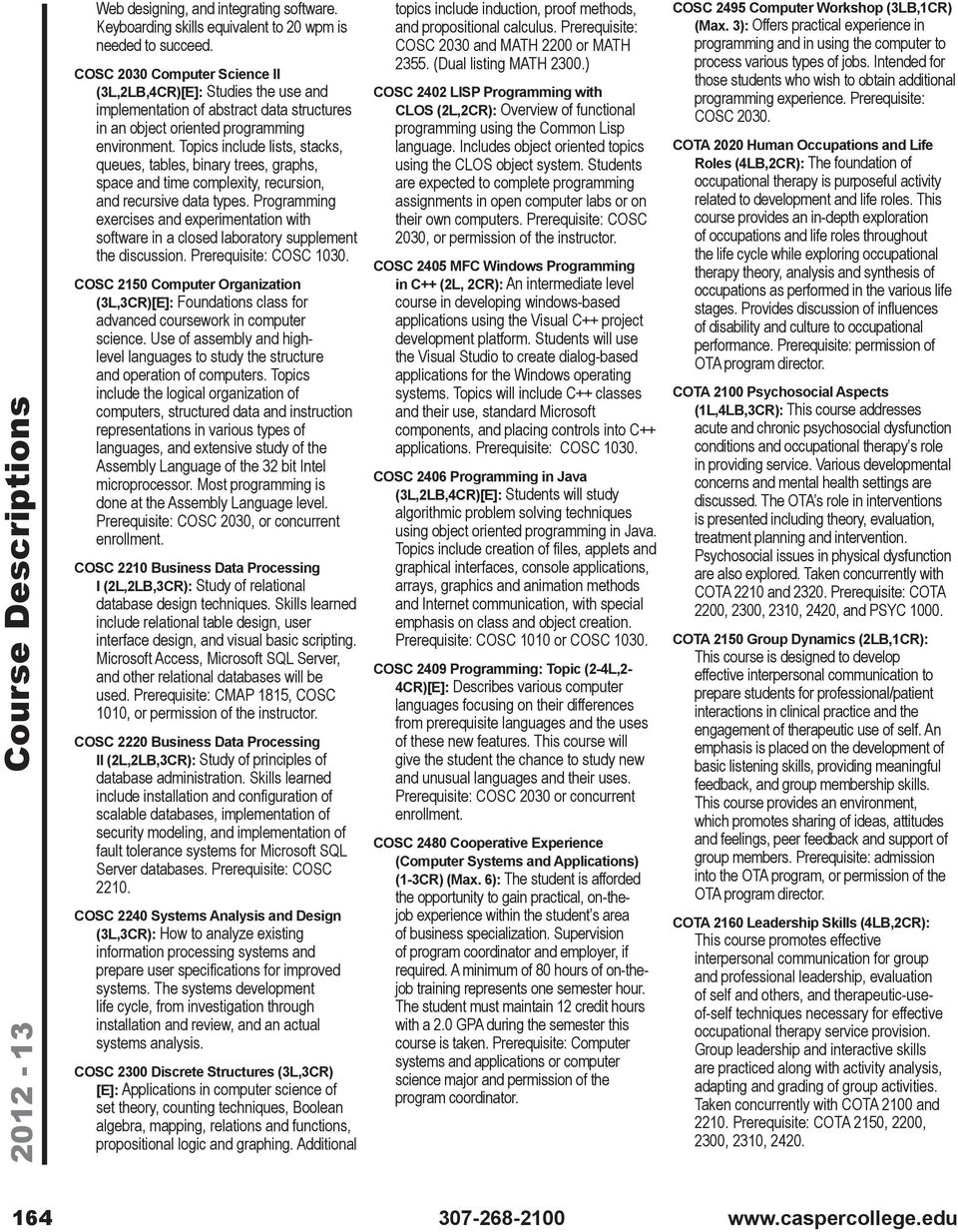
21 COTA 2200 Therapeutic Approaches and Media I (4LB,2CR): Exploration of a variety of media and therapeutic approaches for special needs populations. Activity analysis and adaptation of activities are practiced extensively. Types of activities explored include play, education, daily living skills, social participation, work and leisure. Use of the Occupational Therapy Practice Framework is introduced and applied to practice. COTA 2210 Therapeutic Approaches and Media II (4LB,2CR): Continuation of implementation of the Occupational Therapy Practice Framework. A variety of media will be explored for implementation with psychosocial and pediatric populations. Activity analysis, adapting, and grading of interventions for therapeutic application for these populations is the focus of this class. Taken concurrently with COTA 2100 and Prerequisite: COTA 2020, 2050, 2200, 2300, 2310, and COTA 2220 Therapeutic Approaches and Media III (6LB,3CR): This course continues the exploration of service implementation for the occupational therapy assistant in the physical disabilities settings. Areas studied include daily living skills, work, leisure, education, and social participation. Techniques applied in physical disabilities settings are practiced. Taken concurrently with COTA 2330 and Prerequisite: COTA 2020, 2050, 2200, 2210, 2300, 2310, 2320, 2350, and COTA 2300 Fieldwork Integration I (4LB,2CR): An introduction to the role of working with special needs populations in the community. The role and professional expectations of occupational therapy assistants are introduced. This course provides fieldwork preparation integrated with classroom discussions. Students will complete 20 hours of clinical experience. Beginning knowledge of medical terminology is studied. COTA 2310 Fieldwork Integration II (2LB,1CR): A continuation of pre-fieldwork course work and beginning preparation for Level I fieldwork. Primary focus on professional skills in community experiences and with special needs populations. Begin clinical documentation for OTA practitioner. Prerequisite: COTA COTA 2320 Fieldwork Integration III (2LB,1CR): Designed to prepare students for Level I and II fieldwork experiences. Students will complete Level I fieldwork in psychosocial and pediatric settings. Continuation of documentation concepts. Taken concurrently with COTA 2100 and COTA Prerequisite: COTA 2020, 2050, 2300, 2310, and COTA 2330 Fieldwork Integration IV (2LB,1CR): A continuation of clinical readiness skills. Includes Level I experiences in developmental disabilities, physical disabilities and geriatric settings as well as preparation for Level II experiences. Clinical reasoning skills for transition from student to practitioner are an integral part of the course. Taken concurrently with COTA 2220 and Prerequisite: COTA 2020, 2050, 2100, 2200, 2300, 2310, 2320, 2350, and COTA 2350 Clinical Theory and Practice I (1L,4LB,3CR): Course examines occupational therapy theory and practice for individuals aged birth through 21 with a focus on physical disabilities and developmental dysfunction. Explores implementation of occupational therapy in a variety of settings including theory, assessment, planning treatment plan and intervention. Taken concurrently with COTA 2210 and Prerequisite: COTA 2020, 2050, 2200, 2300, 2310, and COTA 2400 Clinical Theory and Practice II (1L,4LB,3CR): Course examines occupational theory and practice for individuals over the age of 21 with a focus on physical disabilities, neurological impairment and aging dysfunction. Explores implementation of occupational therapy including theory, assessment, treatment planning and implementation, in a variety of settings. Taken concurrently with COTA 2220 and Prerequisite: COTA 2020, 2050, 2200, 2210, 2300, 2310, 2320, 2350, and COTA 2420 Clinical Conditions (2L,2LB,3CR): Specific diagnoses commonly seen by the occupational therapists are examined and application of occupational therapy techniques and theory are discussed. Prerequisite: Admission into the OTA Program or permission of the OTA Program Director and ZOO 2040, ZOO 2041, and KIN COTA 2450 Health Care Systems (2L,2LB,3CR): Course provides exploration of the health care system and the delivery of occupational therapy services. Topics include: reimbursement, team concepts in health care, the role of the OTA within the OT department and health care environments, levels of authority and responsibility, and familiarity with alternative health care choices. Prerequisite: COTA 2020, 2050, 2100, 2150, 2160, 2200, 2210, 2300, 2310, 2320, 2350, and COTA 2500 Fieldwork A (3CR): First of two Level II fieldwork placements. Eight weeks of fieldwork in contracted facility. Includes a minimum of 40 hours a week of on-site skill practice. On-line integration of learning experiences with instructor and class members is expected. Prerequisite: must have successfully completed all academic course work and Level I fieldwork. (May be taken concurrently with COTA 2550 and/or 2600.) COTA 2550 Fieldwork B (3CR): Second of two Level II fieldwork placements. Eight weeks of fieldwork in contracted facility. Includes a minimum of 40 hours a week of on-site skill practice. On-line integration of learning experiences with instructor and class members is expected. Prerequisite: must have successfully completed all academic coursework and COTA (May be concurrently taken with COTA 2500 and/or 2600.) COTA 2600 Fieldwork Options (2-3CR): Six to eight weeks fieldwork optional for students wishing further specialized training in a particular facility. Length of training to be prearranged with school and clinical setting. On-line integration of learning experiences with instructor and class members is expected. Prerequisite: must have successfully completed all academic coursework, Level I fieldwork and COTA 2500 and (May be taken concurrently with COTA 2500 and 2550.) COTA 2975 (Max. 6) Independent Study in OT (1-3CR): This course provides occupational therapy assistant students the opportunities to complete independent research/study in areas of interest within the field of occupational therapy. Prerequisite: Permission of CRMJ 1040 (3L,3CR): Basic survival Spanish for law enforcement and fire science students. CRMJ 1700 Firearms I (2L,1LB,2CR): The first eight weeks of the course involve the moral aspects, legal provisions, safety precautions and restrictions governing the use of firearms, firing handguns, target analysis and range procedures. The second eight weeks provide instruction in basic techniques and skills of handling and properly using handguns. It will also provide for competition in target and practical police course matches. Students must furnish ammunition. Enrollment limited to majors in criminal justice except by This is considered to be a vocational skills course and it may not transfer to the University of Wyoming or other four-year institutions offering bachelor degrees in criminal justice. Course Descriptions
22 Course Descriptions CRMJ 1705 Firearms II (1L,4LB,3CR): This course will review range safety procedures and legal issues concerning the use of deadly force by law enforcement officers. In addition, the course will introduce students to more advanced defensive handgun techniques beyond what are taught in CRMJ Students will also be introduced to skills involving the handling, firing and maintenance of police shotguns, semi-automatic patrol rifles, and precision rifles. Students must furnish ammunition, ear and eye protection and pay an access fee for use of the shooting range. This is considered to be a vocational skills course and it may not transfer to the University of Wyoming or other four-year institutions offering bachelor degrees in criminal justice. Enrollment limited to majors in criminal justice or by permission of the Prerequisite: CRMJ CRMJ 2005 Introduction to Automated Fingerprint Identification Systems (.5L,1LB,1CR): Exploration of areas of contention, which occur within the criminal justice system in America today. To include such topics as bail, pleabargaining, Supreme Court decisions of a controversial nature, police discretion, and others. Prerequisite: Permission of the CRMJ 2120 Introduction to Criminal Justice (3L,3CR)[E]: The agencies and processes involved in the criminal justice system legislature, the police, the prosecutor, the public defender, the courts, and corrections. An analysis of the roles and problems of law enforcement in a democratic society with an emphasis upon intercomponent relations and checks and balances. CRMJ 2130 Criminal Investigation I (3L,3CR): Theory of criminal investigation: relations of the detective with other law enforcement divisions, modus operandi, sources of information, surveillance, personal identification, interrogation, preliminary and follow-up investigations, collection and preservation of evidence. Enrollment limited to majors in law enforcement except by permission of the CRMJ 2210 Criminal Law I (3L,3CR)[E]: Comparative study of criminal laws; origins of laws; review of Wyoming criminal laws and procedures; elements of a crime; parties to a crime; elements of specific crimes; arrest, jurisdiction of criminal courts and criminal procedures. Prerequisite: completion of, or concurrent enrollment in CRMJ (Spring semester.) CRMJ 2230 Law of Evidence (3L,3CR): Leading rules and principles of exclusion and selection, burden of proof, nature and effect of presumptions, proof of authenticity, and contents of writings; examination, competency, and privilege of witnesses. Prerequisite: CRMJ (Fall semester.) CRMJ 2250 Police Administration (3L,3CR): Principles of organization and management as applied to law enforcement agencies. Theoretical and practical aspects of management factors such as organizations, decision-making, values, human relations, and power. Prerequisite: CRMJ 2120, or permission of CRMJ 2280 Criminal Procedure (3L,3CR): This course will familiarize the student with the state of Wyoming and federal criminal process. The fourth, fifth, sixth, and fourteenth amendments to the United States Constitution will be emphasized, along with applicable Supreme Court cases. The laws of arrest, search, seizure, pretrial identification procedures and confessions will be studied. An overview of the criminal court system as it relates to individual rights protected under the Constitution and key Supreme Court holdings will be taught. CRMJ 2350 Introduction to Corrections (3L,3CR): A general overview of the correctional process describing the history and evolution of the American corrections system. This course covers all aspects of institutional and community-based corrections. Meets only in spring semester of even-numbered years. CRMJ 2380 Probation and Parole (3L,3CR): Introduces students to the concepts and practices of community alternatives to incarceration. Includes both adult and juvenile probation and parole as well as community corrections centers and halfway houses. Will investigate legal requirements and aspects of communitybased corrections. CRMJ 2430 The Community and the Police (3L,3CR): The course delves into the areas of police professionalism and the concept of community relations. Areas discussed will include use of power, prejudice, race relations, civil rights, police political relations and police media relations. Prerequisite: CRMJ 2120, or permission of CRMJ 2570 Criminalistics (2L,2LB,3CR): This course will delve into the aspects of crime scene management. From the first initial contact with the crime scene, the student will learn to gather physical evidence, document, photograph, and diagram the scene to scale. They will identify fibers, hairs, paints, tool markings, fingerprints and other impressions. We will also look into what the future holds in the area of crime scene management. CRMJ 2965 Directed Studies in Criminal Justice (1-3CR) (Max. 6): Faculty-guided research in an area of mutual interest to the student and instructor within the law enforcement or corrections major. CRMJ 2970 Criminal Justice Internship (*,1-3CR) (Max. 3): *Thirty hours of participation per credit hour. This course will place a student in a criminal justice agency for a few hours per week for one semester as an observer. It will afford the pre-service student the opportunity to observe the workings of the criminal justice system, and the in-service student an opportunity to work in a collateral criminal justice agency. Prerequisite: sophomore standing and CRMJ 2980 Cooperative Work Experience (Law Enforcement) (*,2-3CR) (Max. 3): (See "Unit of Credit.") Supervised work and project experience for the purpose of increasing student understanding of law enforcement problems and procedures. Supervision is provided by both the instructional staff of the college and the cooperating agencies. Analysis and reports of student s performance; regular group meetings. Enrollment limited to majors in law enforcement with sophomore standing except by CRMJ 2995 Workshop: (Subtitle) (2L,2CR): Exploration of areas of contention, which occur within the criminal justice system in America today. To include such topics as bail, plea-bargaining, Supreme Court decisions of a controversial nature, police discretion, and others. Prerequisite: CROP 2000 Plants, Agriculture and Civilization (3L,2LB,4CR): This course is designed to familiarize the student with agriculture in developed and developing countries, integrate ecosystem concepts in agriculture and to introduce current crises and challenges facing agriculture in the future. CROP 2200 Forage Crop Science (3L,2LB,4CR): This course provides a comprehensive introduction to the biology, propagation and management of forage and farm crop plants. Many topics (e.g., plant ecophysiology, cropping practices in agro ecosystems, plant genetic improvement) will be covered
23 CSCO 2000 Beginning Internetworking (3L, 3CR): This class focuses solely on networking fundamentals and is not specific to Cisco products or technologies. Student learning will include an understanding of the OSI networking model, networking components, premises wiring, industry standards, networking topologies and designs, and professional practices. Project learning experiences will include designing networks and the installation of network premises cabling. CSCO 2010 Advanced Internetworking I (2L,2LB, 3CR): This course is the second semester of a four semester CCNA (Cisco Certified Network Associate) certification based training program. This class focuses on router configuration and applying the networking principles outlined in CSCO 2000 to real world situations. Specific topics include router components and features, intermediate IP addressing, routing protocols, router modes and functions, access control lists and network design. CSCO 2020 Advanced Internetworking II (4L, 4CR): This course is the third and fourth semesters of a four semester CCNA (Cisco Certified Network Associate) certification based training program. This class focuses on the application of advanced routing protocols such as OSPF and EIGRP, advanced IP addressing, LAN switching and VLAN design, and the configuration of wide area network access using the point-to-point protocol (PPP), ISDN, and frame relay. Prerequisite: CSCO CULA 2050 Culinary Food Production I (1L,6LB,4CR): This course will teach students basic culinary skills which will include: basic kitchen safety and sanitation, knife skills, stocks and soups, mother sauces, small sauces and modern sauces, basic meat fabrication, basic dressings: vinaigrettes and marinades, grains and pastas, and breakfast cookery. DESL 1540 Heavy Duty Electrical Systems (2L,2LB,3CR): Introductory course to electrical systems used in heavy diesel engines. Course will cover fundamental electrical quantities, components and basic circuits. Additional content will cover heavy diesel engine electrical systems. DESL 1580 Power Train, Braking, and Steering (3L,3CR): (5 weeks) Manual clutches, drive lines, manual transmissions, and final drive units. DESL 1600 Diesel Engines (2L,2LB,3CR): Introductory course covers medium to heavy diesel engines. The course is intended to provide an overview of engine construction, fuel systems and general maintenance. DESL 1605 Basic Diesel Engine (6L,6LB,9CR): This course covers disassembly procedures, evaluating serviceability of components, preparing the engine block for overhaul; the assembly procedure for crankshafts, bearings, pistons, seals, and valve train; the servicing of cylinder heads including valve grinding and seating; bolt torquing, timing, and run-in checks. The course will also cover basic fuel systems, fuel pumps, injectors, and evaluating system failure. Course is designed to cover the principles and service procedures for the diesel engine and equipment pertinent to the diesel engine industry. DESL 1607 Basic Diesel Engine II (6L,6LB,9CR): This course is an extension of the Basic Diesel Engine course. Students will be more involved with engine components, fuel systems, and associated systems. DESL 1610 Engine Rebuilding I (4L,10LB,9CR): (10 weeks) Disassembly procedures, evaluating serviceability of components, preparing the engine block for overhaul; the assembly procedure for crankshafts, bearings, pistons, seals, and valve train; the servicing of cylinder heads including valve grinding and seating; bolt torquing, timing, and run-in checks. DESL 1620 Engine Rebuilding II (3L,12LB,9CR): (5 weeks Lec, 15 weeks Lab) Live engines and drive-in work are used for instruction. The students make up the estimates and deal with the customer directly. Students are evaluated on their ability to handle the entire operation from meeting the customer to unit performance on completion. Prerequisite: DESL DESL 1650 Diesel Fuel Systems and Tuning I (3L,4LB,5CR): (5 weeks) Basic fuel systems, fuel pumps, injectors, and evaluating system failure. Prerequisite: DESL DESL 1660 Diesel Fuel Systems and Tuning II (3L,3CR): (5 weeks) Air induction systems, injector and fuel pump operations. Troubleshooting and electronic fuel controls. DESL 1680 Natural Gas Engine Technology (6L, 9LB,10.5CR): Course is designed to cover the principles and service procedures for the natural gas engine and equipment pertinent to the natural gas industry. Course will cover fuels, ignition systems, combustion, lean combustion theory, exhaust gas analysis, lubrication systems, cooling systems, mounting and alignment, and gas compression concepts. Prerequisite: DESL 1605 or DESL DESL 1850 Basic Hydraulics (2L,2LB,3CR): Principles of hydraulic systems and components used in mobile equipment. Factors of consideration in the selection, installation, operation, and maintenance of hydraulic systems. DESL 1980 Co-op Work Experience (Diesel) (1-8CR) (Max. 8): 8 hours/week for 16 weeks - Total 128 hours. Designed to give students hands-on training in diesel equipment maintenance and repair in a production shop setting. A student working for an employer is responsible for employment verification and documentation of hours worked and jobs done. Students staying on campus will meet the training requirements of the department. ECON 1010 Principles of Macroeconomics (3L,3CR)[E][CS]: An introduction to our present mixed capitalistic economic system. Emphasis is on the role of markets, the determination of national output, inflation and unemployment, the banking system, and the economic role of government. ECON 1020 Principles of Microeconomics (3L,3CR)[E][CS]: An introduction to the economics behavior of firms and households in a market economy and the environment in which they operate. Also studies the roles of government and foreign trade, as it relates to the decisions of firms and households. ECON 2400 Environmental Economics (3L,3CR): This is a three-credit introductory course in environmental economics. This course will cover such traditional environmental topics as pollution control, externalities and public lands. Issues of sustainability of the current economic system with respect to fossil fuel use and environmental destruction will be addressed. A balance between theory and institutional background will be presented in this course. Prerequisite: ECON 1010 and ECON ECON 2490 Topics: (Subtitle) (1-3L,1-3CR): Offered in answer to specific need or public interest. EDCI 1430 Life Science in the Elementary School (2LB,1CR)[E]: Covers selection of basic life science concepts, materials and curricula appropriate for elementary school. Concurrent enrollment: BIOL 1020, or EDCI 1440 Physical Science in the Elementary School (2LB,1CR)[E]: Covers selection of basic physical science concepts, materials and curricula appropriate for elementary school. This course parallels the content of PHYS 1090 and should be taken the same semester. Course Descriptions
24 Course Descriptions EDCI 1450 Earth Science in the Elementary School (2LB,1CR)[E]: Covers selection of basic earth science concepts, materials, and curricula appropriate for elementary school. This course parallels the contents of GEOL 1070/ASTR EDCI 2050 Introduction to Outdoor Education (1L,4LB,3CR): This practicum course addresses pedagogies specific to teaching in outdoor settings. Students will teach field science in this outdoor course. Prerequisite: This is a practicum course that includes some classroom and field (outdoor) experiences. Culmination of this course will include an outdoor teaching experience in an on-site camp environment that will be 3-5 days in length. Students should be comfortable walking and teaching in an outdoor environment. This is a companion course to EDUC 2100 which should be taken concurrently with or prior to taking this course. This course is intended for secondary science education majors or other students with advisor or instructor approval. EDCI 2250 Diversity in Education (3L,3CR): This course is designed to introduce students to the conceptualization, design and implementation of a multicultural education that respects and honors diversity as well as promotes national unity. EDCI 2480 Cooperative Work Experience in Early Childhood Education (1-6CR) (Max. 6): Students are afforded the opportunity to gain practical, on-the-job experience in an early childhood group setting. Supervision is provided by both the instructional staff of the college and the work site supervisor. Enrollment is limited to majors in early childhood except by permission of the EDCI 2495 Workshop: (Subtitle) (1-2CR): Special topics in education offered in response to specific needs or public interest. EDCI 2505 Introduction to Disabilities (3L,3CR): This course is designed to familiarize paraeducators with the definition and classification of disabilities as recognized in the state of Wyoming and the Natrona County School District. The course also presents material, which will lead to an increased understanding and empathy for such students and the problems that they encounter. Finally, the course examines the best practices and teaching procedures available for educating students with disabilities. EDCI 2515 Teaching and Learning Strategies (3L,3CR): This course is designed to prepare paraeducators in the use of instructional techniques, which will enhance learning in the classroom. The emphasis is not only upon sharpening classroom skills, but also upon knowledge of the theory behind program design. The course focuses on four major designs: Direct Instruction, Precision Teaching, Teaching Research and Intensive Phonics. EDCI 2530 Classroom Guidance (3L,3CR): This class is provided as part of the ParaEducator Preparation Program. It is designed to provide an overview of the best practices in both classroom and school wide discipline models. Participants will be given the opportunity to perfect their own management procedures and become more aware of how behavior interactions are affected in the social stratus of a school setting. EDCI 2550 Educational Interactions (3L,3CR): This course will address the changing dynamics to the educational process involving paraeducators. It is designed to provide the skills and knowledge necessary for teachers and paraeducators to work effectively as a team. Topics will include role clarification, good communication, resolving conflict, and teamwork. EDEC 1020 Introduction to Early Childhood Education (3L,3CR)[E]: Introduces the student to the field of early childhood education through lecture discussion, observation, and participation. The student will be exposed to different programs in the community. Topics to be explored include components of quality programs, child development theory, curriculum development, learning environments, classroom management, parent-teacher relationships, importance of play, and teaching as a profession. EDEC 1030 Infant and Toddler Care (2L,2CR): This course provides information on growth and development of children under the age of three along with curriculum implications; defines the interactive role of the caregiver, and explores other components of infant toddler care including implementation of quality programming and adult interactions. The course along with EDEC 1035, Infant and Toddler Care Lab, meets the criteria for the Wyoming Infant Toddler Credential. EDEC 1035 Infant and Toddler Care Lab (2LB,1CR): Supervised experience in the care of infants and toddlers at an approved early childhood program. This course along with EDEC 1030, Infant and Toddler Care, meets the criteria for the Wyoming Infant Toddler Credential. Prerequisite: EDEC 1030 (or concurrent enrollment). EDEC 1100 Observation and Guidance of Young Children (2L,2CR): Effective methods of observation and guidance to meet the children s needs individually and in groups with an emphasis on promoting a positive and constructive climate in the early childhood setting. Topics include assessments, recording behaviors, planning environments, materials and equipment, scheduling, discipline and parent-teacher communication. Prerequisite: EDEC 1020, FCSC 2122, PSYC 2300, or permission of the EDEC 1105 Observation and Guidance of Young Children Lab (2LB,1CR): Supervised experience in the observation and guidance of young children at an early childhood center. (Spring semester.) Prerequisite: EDEC 1100 (or concurrent enrollment). EDEC 1200 Administration in Early Childhood Programs (3L,3CR): Designed to provide students with the opportunity to develop skills in both the business and human relations components of administering centers for young children. Includes procedures in establishing early childhood centers; administrative forms; fiscal management; selection, development, and motivation of staff; parent and community involvement; and program regulations and evaluation. (Fall semester.) Prerequisite: EDEC 1020, or EDEC 1300 Curriculum Planning and Development for Young Children (2L,2CR): Development of skills in planning, implementing and evaluating developmentally appropriate experiences to encourage intellectual, physical, social, emotional, and creative growth in young children with the focus on the concept of the whole child. Prerequisite: EDEC 1020, FCSC 2122, PSYC 2300, or permission of EDEC 1305 Curriculum Planning and Development for Young Children Lab (2LB,1CR): Supervised experience in planning, implementing and evaluating curriculum activities at an early childhood center. Prerequisite: EDEC 1300 or concurrent enrollment. EDEC 2210 Student Teaching in Early Childhood Education (2L,8LB,6CR): By actively participating in the care and education of young children in an early childhood program, students should become more proficient in administrative skills, increase their awareness of contemporary issues in early childhood, and demonstrate a high level of
25 competence as a head teacher. Students will serve in directed field experience; one eight hour day per week for a total of 120 clock hours. Students will also serve 30 hours in seminar during the semester. Enrollment is limited to majors in early childhood education except by permission of Prerequisite: EDEC 1100 and EDEC 1105, EDEC 1300 and EDEC 1305, or EDEL 1410 Theory I Seminar: Education (1L,1CR): This seminar is a hands-on application course designed to accompany and enhance MATH 1100, "Numbers and Operations for Elementary School Teachers." This is a required course for all prospective elementary teachers. Prerequisite: Concurrent enrollment in MATH EDEL 2010 Mentoring in Education (1L,2LB,2CR): This course will focus on specific teaching techniques and strategies utilized when mentoring third and fourth grade elementary students. Students in this course will also reflect upon strategies to continually improve teaching techniques. This course is associated with the Help Yourself Academy, an afterschool program designed to offer 24 Title I NCSD third- and fourth-grade students the opportunity to focus on a math and science curriculum. Prerequisite: Permission of the EDEL 2410 Theory II Seminar: Education (1L,1CR): This seminar is a hands-on application course designed to accompany and enhance MATH 2120, "Geometry and Measurement for Elementary School Teachers." This is a required course for all prospective elementary teachers. Prerequisite: Concurrent enrollment in MATH EDEX 2190 The Gifted Student (1L,1CR): A workshop designed to give teachers and parents information about the education of gifted children. Topics covered are understanding the needs of gifted children, identifying the gifted, providing guidance and counseling, developing creativity, helping the under-achieving gifted, parenting gifted children, teaching the gifted (at home and at school), and using federal, state, and community resources. S and U grade only. EDEX 2484 Introduction to Special Education (3L,3CR)[E]: This course is designed to meet the needs of education majors for a required course in Special Education. It provides a broad overview of effective intervention models of instruction and/or behavior techniques for special needs students within an inclusion setting and/or other continuum of special education options which meet the least restrictive environment. Finally, this class would be helpful for individuals in other fields who need an introduction to the field of special education. Prerequisite: EDFD EDFD 2020 Foundations of Education (3L,3CR)[E]: A foundations course designed to provide a general survey of educational thought and practice. Emphasis is given to critical thinking about numerous educational points of view. Prerequisite: ENGL 1010, or EDFD 2100 Educational Psychology (3L,3CR)[E]: Provides an overview of the field of educational psychology, its theoretical bases, classroom application to the teaching-learning process and examines research design in education. Prerequisite: PSYC EDUC 2100 Public School Practicum (2L,4LB,4CR)[E]: Students will participate in an extensive practicum experience for prospective educators in an accredited school under the supervision of a certified mentor teacher. Students will serve a total of 60 hours during the semester (generally serving 6 hours per week for approximately 10 weeks) and also attend one weekly 100-minute class session Prerequisite: EDFD 2020, ENGL 1010 or permission of ELTR 1010 Personal Computer Hardware (1L,1CR): An introduction to the basic hardware common to past and current types of IBM compatible personal computers. ELTR 1515 Basic AC/DC Electronics (2L,2LB,3CR): Groundwork in electrical fundamentals needed for an understanding of modern electronics. Prerequisite: high school mathematics or work experience. ELTR 1535 Electrical Power (2L,2LB,3CR): Fundamentals of AC electrical machines and transformers. Topics covered are electromagnetism, transformers, AC motors and motor control. Prerequisite: completion of ELTR 1515 or ELTR 1570, or permission of ELTR 1545 Utility Locator Certification (1.5L,1LB,2CR): Fundamentals of underground utility location will be covered. This will include the methods used to change the transmitter current levels, change the shape of the magnetic field, how to measure the magnetic field with the receiver, and how to produce a round magnetic field and verify depth. Successful completion of this course will result in certification as an underground utility locator. ELTR 1565 Semiconductors and Electric Circuits (1L,2LB,2CR): Fundamentals of electronics. A continuation of ELTR 1515 with emphasis on semiconductors, diodes, SCRs, triacs, diacs, transistors, fets, integrated circuits. ELTR 1570 Electric Circuits (4L,4CR): Fundamentals of DC and AC circuit analysis, electromagnetics, and singlephase transformers. Prerequisite: MATH 0900, a Compass score of 45 or ELTR 1580 Electrical Machines (3L,3LB,4.5CR): Fundamentals of electrical machines and transformers. Topics covered are DC motors and generators, AC alternators, single and three-phase AC motors, and single and three-phase transformer connections. Prerequisite: ELTR 1570, or permission of ELTR 1605 Process Control (2L,2LB,3CR): Fundamentals of process control systems using PID control. Students will control single and multivariable processes and calibrate sensors. Other topics include valve actuators and industrial data communications. Prerequisite: completion or concurrent enrollment in ELTR 1515 or ELTR 1570, or ELTR 1620 Electrical Concepts Laboratory (3LB,1.5CR): An introductory laboratory course for electronics technicians. Emphasizes analysis and troubleshooting of simple AC and DC circuits. Additional topics covered include magnetism and electromagnetism. Prerequisite: completion of or concurrent enrollment in ELTR ELTR 1630 Renewable Energy (2L,2CR): An examination of wind and solar energy systems as electrical power sources to residential or small commercial buildings. The course will offer information on how to select a system for buildings connected to the power company and for remote buildings without any electrical power. ELTR 1645 Accelerated Utility Locator Certification (1.5L,1.5CR): This course is designed for utility locators that have two years or more of utility locating experience. The course will cover the fundamentals of utility locating, practical demonstrations of concepts covered in the lectures, Wyoming state law for utility locating, and the federal law for utility locating. Successful completion of this course will result in certification as an underground utility locator. Course Descriptions
26 Course Descriptions ELTR 1700 Introduction to Solid State Electronics (2L,4LB,4CR): Fundamentals of semiconductor electronics circuits. Transistor structure, measurement of transistor parameters, transistor biasing, audio and radio frequency amplifiers, and power supplies. Experiments are designed to assist the student to become cognizant of trends in this rapidly developing technology. Prerequisite: ELTR 1570, or permission of ELTR 1730 Language for Microprocessor Control Systems I (2L,2CR): Basic languages with application to their usage in microprocessor control systems. Students will be given an opportunity to apply their knowledge through laboratory experiments using the department s MS-DOS microprocessor system. ELTR 1745 Utility Locator Recertification (.5L,.5CR): Review of the basic theory for utility locating, Wyoming state law for utility locators, and a hands-on practical test for recertification. Successful completion of this course will result in recertification as an Underground Utility Locator through Staking University. ELTR 1750 Electronic Design and Fabrication (1L,2LB,2CR): A course using industrial processes to design and fabricate electronic circuitry. Topics include soldering, computer-generated schematics, computer-designed PC boards, industrial etching processes, and sheet metal fabrication. ELTR 1760 Introduction to Digital Electronics (3L,3LB,4.5CR): Logic circuits associated with the control and operation of a digital computer. Application of the specific logic circuits through selected laboratory experiments. ELTR 1770 Microprocessor Fundamentals (3L,3LB,4.5CR): Microprocessors, their architecture, language, and capabilities. Students will have an opportunity to work with those that are most commonly used in industry and will be expected to develop individual projects in addition to the required laboratory experiments. ELTR 1980 Cooperative Work Experience (Electronics) (1-8CR) (Max. 8): On the job training with a cooperative industrial or commercial electronics maintenance, fabrication or service facility. Eighty hours of work per semester earns one hour of credit. Prerequisite: ELTR 2145 Electronic Digital Photography (1L,2LB,2CR): Basic techniques of electronic-digital photography with an overview of the hardware and software needed to acquire, store, retouch, and print digital and hybrid photographs. ELTR 2515 Licensing for Electronics (1L,1CR): This course is for electronic, electrical, industrial and educational technicians who need to be certified. The course will focus on the FCC, Certified Electronics Technician, and other national certification exams. ELTR 2580 Motor and Process Control (2L,4LB,4CR): The study of electronics in industrial applications: industrial motor control devices, digital interface circuitry for microprocessor control, industrial process control, transducer sensing devices, telemetry and data communications. Prerequisite: ELTR 1515 or ELTR 1700, or ELTR 2600 Electronic Communication (3L,3LB,4.5CR): Emphasis on radio receivers and transmitters, antennas, amplitude and frequency modulation FM stereo multiplex circuits, and FM radios. Prerequisite: completion of ELTR 1700 and MATH 0930, or ELTR 2610 Advanced Microprocessors (2L,2LB,3CR): This course will discuss the design of the HSC12NE64 Microcontroller and its peripheral devices. Advanced C programming of the HSC12NE64 Microcontroller system will also be taught. Prerequisite: ELTR 1770, or permission of ELTR 2750 Microprocessor Applications (3L,3LB,4.5CR): Application of the microprocessor to complex process control, including the use of the MS-DOS operating system, assembly language program implementation, signal conditioning, sensors and DA/AD conversion techniques. The student will be expected to develop and demonstrate individual projects in addition to the required laboratory experiments. Prerequisite: ELTR 1770, or permission of ELTR 2815 Programmable Logic Controllers (2L,4LB,4CR): Assembly, programming and trouble shooting programmable logic controllers in industrial processes. This course will include variable frequency drives, robotics and data communications. Prerequisite: completion of ELTR 1515 or ELTR 1570 or ELTR 2870 CCD Cameras and Security Systems (1L,2LB,2CR): This course will cover the construction and use of Charged Coupled Device (CCD) camera sensors, which are used in digital cameras, machine vision cameras, and surveillance cameras. Other areas covered will be lighting, image acquisition and storage, surveillance systems and security cameras. Prerequisite: ELTR 1570 or permission of. ELTR 2910 Computer Networking (1L,2LB,2CR): Introduction into the technical aspects of local area networks. The curriculum will include local area network theory and practices, software installation and maintenance, hardware installation, cable connections and system troubleshooting. ELTR 2920 Small Computer Repair Techniques (2L,3LB,3.5CR): Techniques used to install and maintain microcomputers. Emphasis will be on basic computer trouble-shooting techniques, both at the system and board level with representative small computer systems. Mass storage techniques for small systems, their strong and weak points and repair. Basic Internet connectivity via both modems and NICs will also be covered. ELTR 2925 Fiber Optics (2L,4LB,4CR): Fundamentals of light-wave communications and transmission. Includes the fundamentals of light, light sources, optical fiber characteristics, splices, connectors, couplers, receiver, and driver systems. System maintenance and splicing will be stressed. Safety procedures will be stressed throughout the course of instruction. ELTR 2935 Electronics Workshop II (1L,2LB,2CR): This course is for industrial personnel, electrical, electronic, and science instructors who need to upgrade their skills in this area. The course will focus on power electronics. Topics covered will include threephase motors, generators, transformers, and controls, electrical energy and mechanical energy. Prerequisite: ELTR ELTR 2945 Fiber Optic Workshop (1L,2LB,2CR): An introductory course in the use of fiber optic technology as it applies to industry and education. This course is designed to instruct representatives from industry and secondary education in the area of fiber optics. ELTR 2975 Independent Study in Electronics (1-3CR) (Max. 6): Electronics majors who have completed the introductory courses may be permitted to contract with the instructor for special advanced problems in electrical applications to be pursued as independent study. Prerequisite: sophomore standing and permission of the EMGT 1500 Principles of Emergency Management (2L,2CR): The basic concepts of emergency management and its integration into government and the private sector. Students will identify hazards and coordinating planning, response and recovery from disasters
27 EMGT 1530 Emergency Planning (2L,2CR): Course is designed to walk participants through development of an emergency operations plan. This will be a team approach on how to create an effective, up-to-date emergency plan that meets local, state, and federal requirements. EMGT 1590 Leadership/Influence and Decision Making/Problem Solving (2L,2CR): Students will learn to apply situational leadership and decision making in emergency management situations. EMGT 1610 Incident Command System (2L,2CR): An emergency management course as a management tool to assist in managing both large and small emergency events as well as pre-planned events. Topics will include command and general staff, unified command and multi-agency coordination. EMGT 1630 Emergency Operations Center/ Operations (1L,1CR): This course will provide participants with the knowledge and skills necessary to operate an emergency operations center during an emergency and/or disaster. EMGT 1650 Resource Management (1L,1CR): This course provides participants with the knowledge and skills to effectively identify, develop and manage a resource management system. EMGT 1670 ICS/EPC Interface (1L,1CR): This course will review the ICS and EPC model of emergency management operations, including coordination, communication and chief executive decision making. EMGT 1810 Developing Volunteer Resources (1L,1CR): Participants will recognize and enhance management of volunteer resources involvement in all phases of emergency management. EMGT 1820 Planning for Terrorism Events (2L,2CR): An emergency management course designed to assist local emergency personnel in developing a terrorism plan. By making more professionals capable of planning for and managing the response to a terrorist incident, facilities and jurisdictions will be more self-sufficient. This training will result in greater readiness for population protection and higher quality management of a response. EMGT 1830 Response to Mass Fatalities (2L,2CR): An emergency management course designed to prepare students, response personnel and other responsible professionals to handle a mass fatality incident effectively by properly caring for the dead and the living - both responders and survivors. EMGT 2570 Basic Public Information Officer (1L,1CR): This course will provide participants with the basic skills needed to perform public information duties as they relate to emergency management. EMGT 2610 Disaster Exercises (3L,3CR): The process of planning, executing and evaluating various types of exercises as it pertains to emergency plans of government entities and the private sector. EMGT 2640 Disaster Resource and Recovery Operations (3L,3CR): Participants will be introduced to basic concepts and operations of a disaster environment, especially in terms of major disaster incidents, and to broaden and enhance their understanding of state and local roles and responsibilities and their importance to overall response and recovery efforts. The course also addresses the coordination and problem-solving aspects of disaster operations. EMGT 2870 Mitigation Planning (2L,2CR): This course will provide participants with the opportunity to learn and apply skills that will enable them to carry out mitigation responsibilities in accordance with the National Mitigation Strategy and applicable regulations and standards. EMT 1500 Emergency Medical Technician (6L,9LB,9CR): An entry level education of emergency medical services to prepare the student for a career as an emergency medical technician. Prerequisite: basic emergency care (Preferred). ENGL 0465 Introduction to Writing for the Trades (1L,1CR): This course is designed to improve student s writing performance in the genres of workplace English, as a part of improving their workplace communication skills. It focuses on improved writing skills for real work situations. Prerequisite: high school level reading ability. Placement based on COMPASS test scores and primary instructor recommendations. ENGL 0500 Reading for Success (2-6 LB,1-3CR): Individualized, self-paced instruction in developing reading comprehension. Levels vary from seventh grade up through college. S, X or U grade only. Prerequisite: at least seventh grade reading ability. ENGL 0510 Fundamentals of Reading I (3L,3CR): This course will focus on reading as a process and building literacy skills. Specific comprehension development will emphasize vocabulary development, locating main ideas, identifying specific details, identifying relationships, summarizing, paraphrasing, and responding to readings. Students will learn to read for different purposes through the use of fiction and non-fiction sources. S/U or letter grade. Prerequisite: High school reading level. ENGL 0520 Fundamentals of Reading II (3L,3CR): This course will focus on reading as a process, and skills specifically emphasized include vocabulary, identifying main ideas, finding and categorizing details, and seeing relationships. It will also focus on reading for different purposes including textbooks and literary texts. S/U or letter grade. Prerequisite: Acceptable performance on Reading Placement test or satisfactory completion of ENGL ENGL 0550 Reading Efficiency (2LB,1CR): Individualized, self-paced instruction in increasing reading speed and improving comprehension. S, X or U grade only. Prerequisite: seventh grade reading ability. ENGL 0600 Basic Writing I (3L,2LB,4CR): A beginning course in the English composition course sequence. Basic Writing I seeks to strengthen the student s writing fluency through study of selected elements of basic composition. These include grammar, spelling, and punctuation as well as sentence and paragraph construction. The course introduces students to different patterns of organization and various types of paragraphs through assigned readings and multiple-draft writing assignments. Students have the option of receiving S/U or letter grades. ENGL 0610 Basic Writing II (3L,3CR): This course provides a review of writing skills requisite to success in ENGL This class is designed to assist students in strengthening their writing skills and the ability to use outside readings related to their writing. Writing will consist of thesis driven essays geared toward various patterns of development. Students are given the option of receiving S/U grades. Students receiving a "C" or better in any 1000 or 2000 level English course may not subsequently earn credit in ENGL Prerequisite: acceptable performance on an English Placement Test or satisfactory completion of ENGL ENGL 0630 Grammar and Writing Improvement (2-6 LB,1-3CR) (Max. 9): Self-paced individualized instruction in the fundamentals of grammar, usage, proofreading skills, and sentence and paragraph construction. Designed to prepare students for other writing courses or writing tasks in the workplace. Students needing an intensive review should enroll for three credits. Open entry until midterm. S, X or U grade only. Prerequisite: high school level reading ability. Course Descriptions
28 Course Descriptions ENGL 0650 Preparing and Writing the Research Paper (2LB,1CR): Individualized, self-paced course in developing library research skills, presenting research in written form, and learning the MLA and APA manuscript styles. Students will write two papers. S, X or U grade only. Prerequisite: high school level reading ability. ENGL 0710 Vocabulary Building (2-4 LB, 1-2CR) (Max. 4): Individualized, self-paced instruction in structural and contextual analysis of words. Levels extend from ninth grade through college graduate. S, X or U grade only. Prerequisite: ninth grade reading ability. ENGL 0750 Effective Listening (2LB,1CR): Individualized, self-paced instruction in effective listening techniques needed for college lectures and public speeches. Open entry until midterm. S, X, or U grade only. Prerequisite: a high school level reading ability. ENGL 0810 Spelling Improvement (2-4LB, 1-2CR) (Max. 4): Self-paced, individualized instruction and practice in phonics rules and memory techniques needed to spell the most common English words correctly. Students may also study the most common business and medical words. S, X or U grade only. Prerequisite: at least seventh grade reading ability. ENGL 0895 Study Skills (2-6 LB,1-3CR) (Max. 9): Individualized, self-paced instruction in time management, goal setting, textbook reading strategies, notetaking strategies, memory techniques, library use, and strategies for preparing for taking tests. S, X or U grade only. Prerequisite: high school level reading ability. ENGL 1010 English I: Composition (3L,3CR) [E][WA]: A study of the fundamentals of purposeful communication in English. The course focuses on reading and writing expository essays, on using effective language for exposition of ideas, and on thinking clearly. Students are to practice synthesizing information, organizing it coherently, and writing clearly. Prerequisite: COMPASS writing and reading scores of 75 or higher or ACT English score of 20 or higher or SAT verbal score of 450 or higher or successful completion (grade of C or higher) of ENGL 0610 and ENGL 0520 or equivalent compass test scores of 75 or higher for each. ENGL 1020 English II: Composition (3L,3CR) [WB]: An extension of ENGL Further refines the student s abilities to gather and synthesize material from independent reading. Students study language both to appreciate its precise control and to interpret the experience of others. A research paper is required. Prerequisite: a grade of "C" or higher in ENGL ENGL 1490 Topics: (Subtitle) (1-3L,1-3CR) (Max. 6): Offered in answer to specific need or public interest. A student may repeat this course twice under different subtitles to a maximum of six credit hours. ENGL 1500 Beginning Grant Writing: (Subtitle) (3L,3CR): A workshop designed for beginning grant writers who are typically the staff of nonprofit organizations, government organizations, educators and/ or community citizens whose job and/ or interests require them to raise funds through grants. This course covers prospect research, proposal development and budgeting for proposals submitted to private foundations. ENGL 2006 Environmental Literature (3L,3CR): Environmental literature is a survey course that will explore the major environmental texts and some of the writers of our time. Students interested in nature writing, literature and environmental politics will appreciate this course. Essay writing and group work will be required to complete this study Prerequisite: ENGL ENGL 1020 recommended. ENGL 2010 Technical Writing I (3L,3CR) [WB]: Students develop technical reports like those generally used in business and industry. Professional publications, letters, graphs, abstracts, and technical documentation are also covered. Prerequisite: ENGL ENGL 1020 recommended. ENGL 2011 Literature for Young Adults (3L,3CR): This course will be a study of the origin, development, and cultural underpinnings of the filed of Young Adult fiction, and an overview of many of the subgenres of the field. Prerequisite: ENGL ENGL 2025 J.R.R. Tolkien and C.S. Lewis: The Men, Their Careers, Their Writings (3L,3CR): This course will deal with the biographies, the professional teaching and scholarly careers, and variety of writings of two of the 20th Century s most prolific and influential writers, Tolkien and Lewis. Readings will include both authors literary criticism as well as their more popular works. Topics will include their years at Oxford; their service in World War I; their concern with other literatures, such as Classics, Icelandic sagas, and medieval romances; and their philosophies of story and myth. Prerequisite: ENGL ENGL 1020 recommended. ENGL 2045 Conferencing with Writers (3L,3CR): This course covers methodology of one-to-one and one-to-small group writing tutoring. The course introduces writing tutors to the education principles and Writing Center goals underlying common tutoring techniques. Topics addressed are theories of learning, principles of memory, learning styles, successful tutoring techniques, online tutoring, and writing across the curriculum. Writing tutors will observe and participate in tutoring sessions in the Casper College, UW/CC Writing Center. This course is required for, but not restricted to, Writing Center Staff. Non-Writing Center staff must make arrangements with the director to provide for alternative tutoring situations. Prerequisite: ENGL ENGL 1020 recommended. ENGL 2046 Conferencing with Writers II (3L,3CR): This course is a continuation of ENGL 2045 and covers theories underlying one-to-one and small group responses to writing. The course introduced writing tutors to writing center and peer tutor theories that inform uniformly accepted best practices. Topics addressed are theoretical constructs of collaboration, interpersonal dynamics, responding to students and student texts, and online tutoring. This course is required for, but not restricted to, Writing Center staff. Non-Writing Center staff must make arrangements with the director to provide for alternative tutoring situations. Prerequisite: ENGL ENGL 1020 recommended. ENGL 2050 Creative Writing: Intro to Fiction (3L,3CR)[E]: Analysis of the elements of fiction and practice of writing fiction at the introductory and intermediate level. Prerequisite: ENGL ENGL 1020 recommended. ENGL 2055 Creative Writing: Writing in the Wild (3L,3CR): Student-centered, week long field experience in Yellowstone National Park focuses on reading and writing imaginative verse and prose inspired by nature. Class days are devoted to collecting journal observations during daily hikes, engaging in a variety of writing exercises, and discussing readings and each other s writing. The course culminates in the submission of a writing portfolio. Prerequisite: ENGL ENGL 1020 recommended. ENGL 2060 Creative Writing: Introduction to Nonfiction (3L,3CR): As the enormous popularity of national bestsellers demonstrate, the creative nonfiction genre has far-reaching appeal for the millions of readers. In this course the student will analyze the elements of nonfiction and practice writing nonfiction
29 at the introductory and intermediate level, Prerequisite: ENGL ENGL 1020 recommended. ENGL 2080 Creative Writing: Introduction to Poetry (3L,3CR)[E]: Analysis of the forms of poetry, and practice of writing poetry at the introductory and intermediate level. Prerequisite: ENGL ENGL 1020 recommended. ENGL 2130 Creative Impulse (Twentieth Century Humanities) (3L,3CR)[E]: Focuses on the visual arts, literature, music, and philosophy of the twentieth century. Attention is given to the influence of history upon our culture and the changes in thinking brought about by scientific discovery. Prerequisite: ENGL ENGL 1020 recommended. ENGL 2140 World Literature I (3L,3CR): Although primarily a study of the literature of the Classical Period of Ancient Greece and Rome, some attention will be paid to the other arts, to religion, and to philosophy. Literary values and the qualities of the greatness of selected works of Western Civilization, including any ideas embodied in those works, will be the focus. Prerequisite: ENGL ENGL 1020 recommended. (Cross-listed as HUMN 2140.) ENGL 2145 War Literature (3L,3CR): War stories exist at the nexus of two fundamental human drives: the drive to create, and the drive to destroy. In an effort to better understand these human impulses, students in War Literature will examine a range of texts that deal with complex, multivalent experiences of war. Texts will include letters, poems, stories, songs, speeches, propaganda, and film. Prerequisite: ENGL ENGL 1020 recommended. ENGL 2150 World Literature II (3L,3CR): Although primarily a study of the literature of the Middle Ages and beyond, attention will be paid to the other arts, to religion, and to philosophy. Literary values and the qualities of the greatness of selected works of Western Civilization, including any ideas embodied in those works, will be our focus. We may include works, including modern works, late in the semester. Prerequisite: ENGL ENGL 1020 recommended. (Cross-listed as HUMN 2150.) ENGL 2185 Classical Mythology (3L,3CR): Focuses on Greek myth and legend. Included as background are geography, history, excerpts from literature, and theories of interpretation. Prerequisite: ENGL ENGL 1020 recommended. ENGL 2210 English Literature I (3L,3CR) [CH]: A survey of British literature from the Anglo-Saxons to the 18th century. Emphasis is on reading, discussing, and writing about important works in our literary heritage. Prerequisite: ENGL ENGL 1020 recommended. ENGL 2220 English Literature II (3L,3CR): A survey of British literature from the early 19th century to the modern period. Emphasis is on reading, discussing, and writing about important works in our literary heritage. Prerequisite: ENGL ENGL 1020 recommended. ENGL 2225 Playing with Shakespeare: Literature in Performance (4L,4CR): A fresh look at Shakespeare, aimed at engaging students' interests and increasing their appreciation and enjoyment of his works. Will include study of a variety of different performances. Will examine and respond to the interpretations of actors, directors, and literacy critics in order to arrive at a more complete understanding of Shakespeare's plays, both as literature and performance. Prerequisite: ENGL 1010, or permission of ENGL 1020 recommended. (Cross-listed as ENGL 2225.) ENGL 2230 Introduction to Shakespeare (3L,3CR): Students are introduced to the works of Shakespeare through careful reading (and re-reading) of representative major plays and/or sonnets in order to become acquainted with Shakespeare s dramatic and poetical art. Both formal lecture and discussion will cover each reading. From time to time the class will watch tapes of scenes from the plays in order to understand how the plays might be staged and actors interpret roles. In addition to reading between eight and 12 plays and a dozen or so sonnets, students will take mid-term and final objective and essay examinations, report on the interpretation by a major critic (Johnson, Coleridge, Hazlitt, Bradley, Harrison, and so on), and write one short and one extended (possibly research) essay. Prerequisite: ENGL ENGL 1020 recommended. ENGL 2235 Literature of the Supernatural (3L,3CR)[E]: A study of the development and traditions of the supernatural in American literature. Class readings will consist mostly of prose fiction, although there will be a few assigned readings of nonfiction. Prerequisite: ENGL ENGL 1020 recommended. ENGL 2270 Modern Women Writers (3L,3CR): An introductory level course, which will focus on women writers of the late 19th century and of the 20th century. Works by earlier writers demonstrate the traditional roles of women in society as well as questions about and challenges to those roles, while works written since the middle of the 20th century image women in a changing society. These works are the background to contemporary literature which presents positive and powerful images of women as recent writers revision traditional roles and envision new realities for women and for society. Prerequisite: ENGL ENGL 1020 recommended. ENGL 2310 American Literature I (3L,3CR) [CH]: A survey of major American writers and their significant contributions from the Colonial Era to the Civil War. Prerequisite: ENGL ENGL 1020 recommended. ENGL 2320 American Literature II (3L,3CR): A continuation of ENGL 2310: American writers from the Civil War to the mid 20th Century. Prerequisite: ENGL ENGL 1020 recommended. ENGL 2340 Native American Literature (3L,3CR)[E]: A broad cultural study of Native American literature with attention to folklore, oral tradition, and contemporary writers. Prerequisite: ENGL ENGL 1020 recommended. ENGL 2350 African American Literature (3L,3CR): A chronological and thematic survey of African American writers and their works, from the earliest slave narratives to contemporary writings. This course will explore one specific sector of the diversity of American literature. Prerequisite: ENGL ENGL 1020 recommended. ENGL 2440 Literary Genres: Short Story (3L,3CR)[E]: A study of several short stories with emphasis on the development of the genre as a modern art form, from its structural crystallization in the early 19th century to the experimental techniques of the latter 20th century. Prerequisite: ENGL ENGL 1020 recommended. ENGL 2475 Independent Study (*,1-3CR) (Max. 6): *Individual appointments with Books and periodicals studied independently by student in consultation with Prerequisite: ENGL ENGL 1020 recommended. ENGL 2490 Topics: (Subtitle) (2-3L,2-3CR) (Max. 6): Offered in answer to specific need or public interest. A student may repeat this course twice under different subtitles to a maximum of six credit hours. Prerequisite: ENGL ENGL 1020 recommended. Course Descriptions
30 Course Descriptions ENGL 2495 Workshop: (Subtitle) (.5-2CR) (Max. 4): Offered in response to needs and interests of students and members of the community. The topic varies but focuses on reading, writing and analyzing contemporary literature. Guest scholars and writers give lectures, readings, and workshops about different genres including poetry, fiction, and nonfiction. A student may repeat this course twice under different subtitles to a maximum of four credit hours. Prerequisite: ENGL ENGL 1020 recommended. ENGL 2500 Grant Writing II (3L,3CR): A workshop designed for students who have some experience writing grants or who have completed Beginning Grant Writing at Casper College. Prerequisite: ENGL ENGL 1020 recommended. ENTK 1010 Elements of Surveying (2L,3LB,3CR): The principles of land surveying include distance measurement, elevations and angles. This course includes fundamentals of trigonometry, the necessary review of algebraic principles, and a thorough introduction to the surveying instruments and their use. Lecture material is accompanied by field measurements providing adequate practical experience. Following the course, students should be able to assist with a survey crew or lay out a simple construction site. An introduction to the U.S. public land system and the principles of the GPS system are included. ENTK 1021 Descriptive Geometry (2L,2LB,3CR): Emphasis is on the graphic solutions to engineering and design problems. Topics will include: visibility, notation, auxiliary views, true lengths and angles, bearing, grade, intersecting lines, lines on planes, point views, normal views piercing points, intersection of planes, contour mapping, outcrop, cut and fill, revolution of lines, vectors and perspective. Prerequisite: ENTK 1510, or ENTK 1505 Introduction to GIS (2L,4LB,4CR): An introductory course in geographic information systems (GIS) and an accompanying lab session. (Crosslisted as GEOG 1100.) ENTK 1510 Drafting I (2L,4LB,4CR): An introductory course in industrial communications through technical drawing and computer-aided drafting. Topics include, sketching, lettering, plan geometry, multiview and axonometric projections dimensioning using traditional drafting instruments and computer aided drafting equipment. ENTK 1650 Mechanical Drafting and Design I (2L,4LB,4CR): A continuation of the instruction received in ENTK 2510, this is an intermediate mechanical design course focusing on assembly modeling using both top-down and bottom-up techniques. Application of design intent on part and assembly models instructs the student to predict how design changes will impact the model. The students learn to integrate weldments, fasteners, sheet metal parts and web-based design tools into assemblies. In addition, students realize the importance of file management tools in assemblies. Prerequisite: ENTK 2510, or ENTK 1710 Architectural Drafting I (2L,4LB,4CR)[E]: Designing homes with emphasis on today's residential designs and construction methods. Develop documents for construction purposes using sketching and computer-aided design techniques. Designs will follow local, state and national code specification. Prerequisite: ENTK 1510, or permission of ENTK 1720 Architectural Drafting II (2L,4LB,4CR): Develop documents for architectural presentations and graphics using sketching, various CAD techniques, and building information modeling. Prerequisite: ENTK 1510 and ENTK 1710, or ENTK 1750 Commercial Architectural Drafting (2L,4LB,4CR): Design, planning, and construction documents of existing and new commercial buildings. Topics include construction methods and materials, drawing conventions, the AIA drawing standards, the National CAD Standards, the Uniform Drawing System, and the International Building Code. Prerequisite: ENTK 1510, or permission of ENTK 2500 Computer-Aided Drafting I (AutoCad) (1L,2LB,2CR): CAD I is an introductory course in engineering computer graphics, using computer aided drafting software commonly used by industries in the region. Prerequisite: Working knowledge of Windows operating system and computer literacy. ENTK 2505 Computer-Aided Drafting II (AutoCad) (1L,2LB,2CR)[E]: CAD II is a continuation of CAD I using the AutoCad drawing software. The student will receive training in advanced 2-D drawings, isometric drawings, file maintenance and plotting practice. Prerequisite: ENTK ENTK 2510 CAD-3D Modeling (2L,4LB,4CR): An introductory course in 3-D solid modeling. The student will learn basic part and assembly modeling techniques with an emphasis on design intent. Standard 3 view part prints including section, detail and exploded views will be created. Prerequisite: ENTK 1510, or permission of ENTK 2550 Civil Drafting I (2L,4LB,4CR): This course introduces principles and techniques of civil drafting using AutoDesk s Land Development Desktop to create engineering maps. This course includes an overview of mapping, surveying, and earthwork. Prerequisite: ENTK 1510, or ENTK 2625 Mechanical Drafting and Design II (2L,4LB,4CR): This is an advanced mechanical design course focusing on design and marketing tools used with solid modeling of parts and assemblies. These tools aid the designer during the product development phase of a project. Prerequisite: ENTK ENTK 2975 Independent Study in Drafting (2-6LB,1-3CR) (Max. 3): Drafting majors who have substantial background in drafting may be permitted to contract with the instructor for special advanced problems in drafting to be pursued on an independent study basis. Prerequisite: ENTK 1750 and permission of ENTK 2976 Independent Study in Computer- Aided Drafting (2-6LB,1-3CR): Students who have substantial background in drafting may be permitted to contract with the instructor for special advanced problems in computer aided drafting to be pursued on an independent study basis. Prerequisite: ENTK 2505 and permission of ENTK 2980 Cooperative Work Experience (Drafting) (1-8CR) (Max 8): A minimum of 80 hours of on-the-job training per credit hour with college supervision. Training must be in the area of drafting or a closely related field such as surveying. Prerequisite: ENTK 2990 Special Topics (1-12CR): Offered in answer to specific need or public interest. A student may repeat this course under different subtitles to a maximum of 12 credit hours. ENTO 2005 Insect Biology (3L,3LB,4CR): This course provides students with an introduction to insects and related arthropods. Aspects of insect biology, ecology, behavior and life history will be covered, with emphasis on their effect on humans. The lab will cover insect anatomy, taxonomy and diversity, with an insect collection required of all students. Prerequisite: BIOL 1000 or equivalent
31 ENVT 1500 Applied Math for Operators (2L,2CR): Practical and realistic applications of mathematical formulas and problems related to the operations of water and wastewater treatment plants and collection and distribution systems. Prerequisite: MATH 0930, or permission of ENVT 1510 Distribution Systems (3L,3CR): Introduction to the basics of distribution system operation and maintenance and key system components. Topics covered include storage, cross connections, water quality, regulations, chlorination, piping, meter, pumps, hydrants and safety. ENVT 1520 Collection System Operation/ Maintenance (3L,3CR): Introduction to the basics of collection system operation and maintenance and key system components. Topics to be covered include inspecting and testing, cleaning methods, lift stations, safety and administration. ENVT 1530 Trenching and Shoring (1L,1CR): Introduction to the Occupational Safety and Health Administration s Construction regulation subpart P: Excavations known as the Trenching and Shoring Rule. Topics covered are causes of cave-ins, soil classifications, determining soil types and protection systems. ENVT 1540 Confined Spaces (1L,1CR): Introduction to the Occupational Safety and Health Administration s (OSHA) permit required confined space entry regulation. Class focuses on understanding the regulations and the required elements of a confined space program. ENVT 1550 Safety in Water Quality (2L,2CR): Introduction to safety issues that affect water quality system operators. The course will review general safety issues and specific Occupational Safety and Health Administration (OSHA) regulations. Topics to be covered include hazard communication, blood borne pathogens, chemical safety, respiratory protection, lockout-tag out, and general safety practices. ENVT 1560 Water Treatment Plant Operation I (3L,3CR): This course is an introduction to the basics of water treatment plant operation and key system components. Includes water sources, coagulation, flocculation, sedimentation, filtration, disinfection, Safe Drinking Water Act rules and regulations, fluoridation and iron and manganese removal. ENVT 1570 Wastewater Treatment Plant Operation I (3L,3CR): Introduction to the basics of wastewater plant operation and maintenance. Topics covered include package plants, oxidation ditches, waste stabilization ponds, trickling filters, primary and preliminary treatment and chlorination. ENVT 1600 Industrial Safety (4L,4CR): This course is an introduction to safety issues that affect personnel in the electric power industry. It will review general safety issues and specific Occupational Safety and Health (OSHA) regulations for General Industry. Topics to be covered include: Introduction to OSHA, Exit Routes, Emergency Action Plans, Fire Protection Plans and Fire Protection, Electrical, Personal Protective Equipment, Walking/ Working Surfaces and Fall Protection, Hazard Communication, Powered Industrial Trucks, Bloodborne Pathogens, Working in Extreme Weather Environments and Electric Power Generation, Transmission and Distribution. All subjects will emphasize hazard awareness. An OSHA Ten-Hour general industry card will be awarded to all students successfully completing the mandatory OSHA requirements contained in this curriculum. Each student will be required to compose a three to five page essay on personal safety. ENVT 1625 Small Water Systems (3L,3CR): This course is an introduction to the basics of small water system operation and maintenance and key system components. Topics to be covered include surface water treatment, groundwater systems, storage, monitoring, emergency response preparedness, financial considerations and managerial responsibilities. Course uses a combination of DVD based video presentations and workbook assignments completed at home prior to class as well as classroom lectures and field trips. ENVT 1650 Waste Stabilization Ponds/ Lagoons Operation and Maintenance (1L,1CR): This course will cover wastewater composition, lagoon types, facultative and aerated lagoon operational theory, dissolved oxygen and ph measurement, calculating hydraulic and organic loading, detention time, geometric mean, average flow and percent removal and NPDES permits. Course will also include a field trip to a local lagoon system. ENVT 2510 Applied Math for Water Plant Operators (2L,2CR): Practical and realistic applications of mathematical formulas and problems related to the operations of a water treatment plant and distribution system. Prerequisite: ENVT 1500, or ENVT 2515 Applied Math for Wastewater Plant Operators (2L,2CR): Practical and realistic applications of mathematical formulas and problems related to the operations of a wastewater treatment plant and collection system. Processes covered will include activated sludge, trickling filters, waste stabilization ponds, chemical dosages and laboratory calculations. Prerequisite: ENVT 1500, or permission of ENVT 2525 Water Treatment Plant Operation II (3L,3CR): Builds on the concepts presented in Water Treatment Plant Operation I and introduces advanced treatment concepts such as softening, iron manganese control, demineralization, instrumentation, laboratory procedures and drinking water regulations. ENVT 2535 Wastewater Treatment Plant Operation II (3L,3CR): Builds on the concepts presented in Wastewater Treatment Plant Operations I and introduces advanced treatment concepts such as sludge handling and digestion and nutrient removal. ENVT 2981 Cooperative Work Experience (1-8CR) (Max. 16): (Environmental Science students) Supervised work and project experience for the purpose of providing an understanding of a specific topic area related to environmental science. Supervision is provided by both the instructional staff of the college and the cooperating agencies. Enrollment limited to majors in water quality technology or environmental science. See "Unit of Credit." Prerequisite: permission of the ENVT 2990 Topics: (Subtitle) (1-12CR): For students who wish to work in greater depth in water treatment, or wastewater treatment, collection or distribution. Course content will be contracted individually with each student in order to provide greater emphasis and experience in that students' area of interest. Prerequisite: permission of ES 1000 Introduction to Engineering Orientation (1L,1CR)[E][I][L]: Orientation course to provide students with exposure to all forms of engineering. ES 1060 Introduction to Engineering Computing (2L,2LB,3CR)[E]: An introduction to engineering documentation and reports, computing tools for data presentation and graphics, equation solving, and manipulation of tabular data. Corequisite: MATH Course Descriptions
32 Course Descriptions ES 1100 Introduction to Rocketry (1L,2LB,2CR): This introductory course in rocketry will provide an overview of various rocket propulsion concepts such as solid, hybrid, liquid, nuclear and antimatter. It will focus on composite solid rocket motors and cover their design, ballistic analysis, structural analysis, and thermal analysis. The course will discuss the design, analysis and constructor of rocket bodies including structural analysis, flight stability and recovery systems. ES 1490 Topics: (Subtitle) (1-3L,1-3CR): Consists of investigations and discussions with respect to current topics in engineering. ES 2110 Statics (4L,*,4CR)[E]: *One problem class each week. Analysis of force systems in equilibrium while at rest. Includes forces as vectors acting at a point and on structures, distributed forces, and friction. Centroid and moment of inertia of areas and solids. Prerequisite: MATH ES 2120 Dynamics (4L,*,4CR)[E]: *One problem class each week. The study of particle and body motion. Includes the study of translation and rotation and the related concepts of work, energy, impulse, and momentum. Prerequisite: ES 2110 and MATH 2205, PHYS 1310, or concurrent enrollment. ES 2210 Engineering Circuit Theory (3L,*,2LB,4CR)[E]: *One problem class each week. A basic course in electrical engineering circuit analysis for all engineering majors. Emphasis is placed on basic circuit theory, circuit modeling, analytical methods, network theorems, and first order circuits. Corequisite: ES ES 2310 Thermodynamics (4L,4CR)[E]: A first course in classical thermodynamics governing processes related to heat work and equilibrium of gaseous liquid, and solid systems. Prerequisite: ES 2120, MATH ES 2330 Fluid Dynamics (4L,*,4CR)[E]: *One problem class each week. Characteristics and behavior of fluids. Applications of Bernoulli and Euler equations of equilibrium. Study of surface tension, vapor pressure, viscosity, and shear stress of fluids. Analysis of laminar and turbulent flow in pipes. Prerequisite: MATH 2210, MATH 2310, or concurrent enrollment. ES 2410 Mechanics of Materials I (4L,*,4CR) [E]: * One problem class each week. The mechanics of deformable bodies. Topics include stress and strain of structures and machine components. The course will include an introduction to the design process. Prerequisite: ES ESL 0100 English as a Second Language Level I (1-3CR): This individualized, selfpaced course for students whose native language is not English provides instruction and practice in reading, grammar, writing, listening, and speaking at a high-beginning to low-intermediate level of English proficiency. S, X, or U grade only. ESL 0200 English as a Second Language Level II (1-3CR): This individualized, selfpaced course for students whose native language is not English provides instruction and practice in reading, grammar, writing, listening, and speaking at a lowintermediate to intermediate level of English proficiency. S, X, or U grade only. ESL 0300 English as a Second Language Level III (1-3CR): This individualized, selfpaced course for students whose native language is not English provides instruction and practice in reading, grammar, writing, listening, and speaking at an intermediate to high-intermediate level of English proficiency. S, X, or U grade only. ESL 1000 Conversational English for ESL Students (1L,1CR): Conversational English for ESL is designed to accompany coursework in ESL 1010 and ESL It gives students the opportunity to interact verbally, overcome the tendency to "translate directly" and to discuss texts and current events. It includes listening as well as speaking, and will include recorded materials as well as assignments to live lectures. It is accessible to ESL students at a variety of levels who come to college from varied cultures and linguistic backgrounds. Preferred: TOEFL score of 350 or higher. Experience with oral and written English. ESL 1010 English as a Second Language I (4L,4CR): Intermediate level international students and students with limited English proficiency will earn four credits in reading, listening, grammar, and writing. Students will interact with one or two instructors, read English texts, write and edit responses, and participate in discussions of texts and/or related issues. Students are encouraged to enroll in ESL 1000, Conversational English for ESL Students. Prerequisite: permission of instructors. Preferred: TOEFL score of 350 or better; successful completion of introductory ESL courses. ESL 1020 English as a Second Language II (4L,4CR): High intermediate/low advanced level international students and students with limited English proficiency will earn four credits in reading, grammar, and writing. Students will interact with one or two instructors, read English texts, write and edit responses, and participate in discussions of texts and/or related issues. Students are encouraged to enroll in ESL Prerequisite: permission of instructors. Preferred: TOEFL score of 400 or better; successful completion of introductory ESL courses. EXTR 1500 Geology of Extractive Resources (3L,3CR): The study of the basic concepts associated with understanding the geology of the occurrence of oil, gas, oil shale, coal, coal bed methane, uranium, trona, bentonite, industrial minerals, and precious minerals in Wyoming. EXTR 2510 Introduction to Well Drilling (3L,1LB,3.5CR): An introduction to the basics of drilling in the extractive industries. Topics will include an overview of the purpose, type and mechanics of drilling. Emphasis will be placed on Wyoming industries such as oil and gas, coal bed methane, uranium, and soda ash. The type and size of various rigs will be discussed. Drilling operations including the selection of rigs, bits, well control, and logging will be introduced. The course will include the discussion of casing runs, cementing, and a brief introduction to completion operations. Prerequisite: Permission of EXTR 2520 Introduction to Well Logging (3L,3CR): An introduction to the basics of modern electric well logs. Topics will include a quick overview of how a well is drilled and a brief history of logging tools. The main focus will be on modern electric log types and their interpretation and application, including resistivity and porosity logs. Specialty logs including dipmeters and borehole televiewers will be examined. EXTR 2530 Oil and Gas Production (3L,1LB,3.5CR): An introduction to the basics of oil and gas production. Topics will include a quick overview of the history of production, oil and gas reservoirs, drilling, testing, and completing wells. The main focus will be on oil and gas properties, production methods, enhanced recovery methods, field processing, and well maintenance. Prerequisite: Permission of EXTR 2540 Petroleum Refining (3L,3CR): This course will cover the process, technology and operations that are necessary for the refinement of petroleum products. Prerequisite: EXTR EXTR 2550 Geologic Computing Methods (1.5L,3LB,3CR): This course is a beginner to intermediate level instructional course on how to use the geologic mapping software, Petra. Topics will include utilization of the various modules that
33 comprise the Petra software (i.e. the mapping module, cross section module, etc). Advanced subjects will include uses of other software such as Microsoft Office to facilitate data manipulation and integration into Petra. Basic computing skills recommended. EXTR 2560 Energy Policy and Economics (3L,3CR): Introduction to energy policy and economics. This course is designed to provide the student a basic understanding of the energy industry, current socioeconomic and political conditions in the marketplace and future supply/demand scenarios based on policy initiatives. The student will be exposed to material through a large degree of research and self-discovery. The instructor will facilitate discussion, dialogue, and critique writing and presentation skills. EXTR 2570 Introduction to Seismic Interpretation (2L,2LB,3CR): Intended to provide an introduction to the interpretation of seismic reflection data. Seismic interpretation is currently the leading method for the exploration and development of oil and gas reserves. Students will learn to understand the seismic process, identify different structural styles from seismic data, interpret seismic sections in both two and three dimensions, relate subsurface stratigraphy to well data, develop a geologic model, create a basic stratigraphic framework using seismic stratigraphy, and prepare structure and other geological/geophysical maps. A basic knowledge of geology and physics is helpful. FCSC 1141 Principles of Nutrition (3L,3CR) [E]: This course is designed to give students a general understanding of nutrition concepts. The course content emphasizes key nutrients and the human body's need for and utilization of those nutrients. Students will be informed of the importance of individualized nutrition plans, and will be exposed to some of the latest research in nutrition. Also addressed are nutritionally relevant topics such as eating disorders, nutritional supplements, dieting and food safety. Recommended for nutrition majors, physical education and early childhood education majors and other interested nonmajors. FCSC 1150 Scientific Study of Food (2L,3LB,3CR): An introductory course in the science of food, which includes selection and preparation, to meet physical, psychological, and social needs. Prerequisite: FCSC FCSC 2122 Child Development Lab (2LB,1CR): This course will serve as a bridge between theory and application through experience in the observation of child growth and development from birth-12 years of age. Prerequisite: PSYC 2300, or concurrent enrollment. FDSC 2100 Meat Evaluation (4LB,2CR)[E]: The study and evaluation of beef, sheep and swine carcasses for both quality and yield grades and the identification of wholesale and retail cuts and the quality factors associated with those cuts of beef, sheep, and swine. Prerequisite: ANSC FIN 2100 Managerial Finance (3L,3CR)[E]: Managerial finance deals with two main decisions that must be confronted by those managing the financial operations of corporations. First, there is the decision on which investment projects to undertake. Second, there is the decision on the best way to enhance projects. For the first task, the managers must forecast cash flows that might be generated by prospective projects and then select the appropriate discount rate with which to value such cash flows. The second task involves selecting the capital structure of the firm and includes for example, the choice between debt and equity. Prerequisite: ACCT 2010, STAT 2050, or permission of FIRE 1500 Introduction to Fire Science (3L,3CR): A broad overview of fire service covering historical and modern fire protection services including department organization, equipment, extinguishing agents, tactics, and detection systems. FIRE 1510 Fire Fighting Strategy and Tactics I (3L,3CR): An introductory course that covers a range of management principles and practices to help students develop effective decision-making skills at the fire scene. FIRE 1520 Fire Fighting Strategy and Tactics II (3L,3CR): An advanced course emphasizing skill development for effective decision making in fire and related emergency situations. Includes case studies and simulations. Prerequisite: FIRE 1510, or fire service experience. FIRE 1550 Causes and Investigation (3L,3CR): An in-depth study of the causes and investigation of fires of all types and descriptions from the fire science point of view. FIRE 1570 Fire-Related Codes and Ordinances (3L,3CR): The study of national, state, and local codes and ordinances and their application and enforcement. FIRE 1670 Basic Emergency Care/First Responder (3L,3CR): Training in the fundamentals of emergency care. The course follows the state of Wyoming Office of Emergency Medical Services outline for basic emergency care. Excellent for students who are planning to enter the fire service or emergency medical services. Prerequisite: fire science or criminal justice major, or FIRE 1700 Fundamentals of Fire Prevention (3L,3CR): The history and philosophy of fire prevention and administrative functions. Evaluation of prevention programs and research provide insight into the fire problem in modern societies. FIRE 1720 Introduction to Fire Suppression (3L,3CR): Designed to provide an in-depth study of modern fire suppression systems and operations. Manual and automatic units will be examined as will plans for future development using computermonitored systems. FIRE 1760 Building Construction (3L,3CR): A practical approach to assessing hazards in various types of buildings. Construction types and classes are examined with firefighter safety and occupant viability as the foremost considerations. FIRE 1810 Introduction to Wildland Fire Fighting (3L,3CR): Designed to expose the student to all of the classroom material required to be qualified as a wildland firefighter Type Two (Basic) including introductory fire behavior, methods, tactics and safety. FIRE 1818 Wildland Leadership (3L,3CR): This course is designed to provide intermediate level instruction on wildland fire fighting tactics, safety, and leadership. Prerequisite: FIRE FIRE 1820 Engine Operations (3L,3CR): Designed to expose the student to different types of water handling apparatus and their appropriate use on a wildland fire. A field day will be required for completion of course. Prerequisite: FIRE FIRE 1830 Intermediate Wildland Fire Behavior (3L,3CR): Designed to expose the students to a more in-depth look at wildland fire behavior. Incorporates the relations between fuels, weather, and topography. Also, a more in-depth look into firefighter safety is taken. Prerequisite: FIRE Course Descriptions
34 Course Descriptions FIRE 1840 Single Resource Boss/Crew (3L,3CR): This class will expose the student to the administrative requirements of a crew leader as well as basic supervision, air operations, and tactical requirements of the job. The emphasis of this course will be on handcrew and engine supervision. Prerequisite: FIRE 1810, 1820 and FIRE 1975 Independent Study (1-3CR): An opportunity for students to develop projects in their particular area of interest within the fire science discipline. Course is self-paced with individualized instruction. FIRE 1990 Topics: (Subtitle) (3CR): Consists of investigations and discussions with respect to current topics in fire science. FIRE 2515 Advanced Firefighting (3L,3CR): This course prepares the student with the required skills needed in the fire service. This course assists students in developing an understanding of the physical and practical skills required to become a career firefighter. Prerequisite: sophomore level in fire science program. FIRE 2525 Rescue Practices for the Fire Service (3L,3CR): Designed to offer the student first-hand experience in the areas of high angle rescue, water rescue, and vehicle rescue/extrication. FIRE 2528 Hazardous Materials Technician (5L,5CR): This course involves the application of NFPA 472 and OSHA's HAZWOPER Standard (29 CFR ) towards student involvement in hazardous materials emergency response. This course certifies students at the technician level. FIRE 2530 Hazardous Materials (3L,3CR): This course involves the application of NFPA 472 and OSHA's HAZWOPER Standard (29 CFR ) towards student involvement in hazardous materials emergency response. In order to pass this course each student must pass both state tests (Awareness and Operations). However, passing both state certified exams does not guarantee a passing grade in the class. Prerequisite: general understanding of emergency response. FIRE 2560 Apparatus and Procedures (3L,3CR): Designed to acquaint the student with the evolution of fire apparatus and to provide an understanding of the uses for different pieces of fire-fighting vehicles. FIRE 2570 Managing Fire Service (3L,3CR): Designed for the pre-service student as well as the fire officer in management or preparing for a managerial position. The course includes budget forecasting, facility and equipment planning, personnel activities, and fire protection productivity. FIRE 2610 Chemistry of Hazardous Materials (3L,3CR): Designed to acquaint the student with the use of various diagnostic tools for evaluating the effects of hazardous materials commonly found in use today. Case studies are used to enhance the learning environment and provide the opportunity for student interaction. FIRE 2625 Advanced Rescue Practices (3L,3CR): Advanced rescue practices is designed to offer the student first hand experience with emphasis on incident command system and formulation of action plan in the areas of high and low angle rope, water rescue, and structural fire rescue. FIRE 2700 Supervisory Management (3L,3CR): This course is designed for the pre-service student as well as fire department members in management or preparing for a managerial position. FIRE 2960 Firefighter Development (3L,3CR): To prepare the student for fire department entry-level testing through various exercises and community service projects. FIRE 2970 Fire Service Field Internship (1L,3LB,3CR): To prepare the student for fire department entry-level testing through various exercises and community service projects. FIRE 2990 Topics: (Subtitle) (3CR): Consists of investigations and discussions with respect to current topics in fire science. FREN 0900 French for Travelers (1L,1CR): A course of simple French to help the traveler make plans, obtain tickets, order meals, ask for and understand general information as needed for travel in a French-speaking country. FREN 1010 First Year French I (4L,4CR)[E]: This course is intended for students who have never studied French at the college level. Students will learn the fundamentals of the French language through listening, speaking, reading, and writing activities at the ACTFL (American Council on the Teaching of Foreign Languages) Novice Low Level. The course will also introduce students to the culture of various Frenchspeaking countries. Language laboratory times are required as needed. Students who want to take for credit the next course in the sequence must complete this course with grade of a 'C' or better. Prerequisite: None; however, the course is strongly recommended for students who have completed the equivalent of 0-5 semesters of high school French. FREN 1020 First Year French II (4L,4CR) [E]: This course is a continuation of the objectives in FREN Students will become more proficient in listening, speaking, reading, and writing French and will further their grammatical study of the French language at the ACTFL (American Council on the Teaching of Foreign Languages) Novice Mid Level. The course will continue to introduce students to the culture of various French-speaking countries. Language laboratory times are required as needed. Prerequisites: A grade of "C" or better in FREN 1010, CLEP test result, equivalent of 6-8 semesters of high school French with a cumulative "B" average or better in those classes, or instructor's permission. FREN 2030 Second Year French I (4L,4CR)[E]: This course focuses on the increased development of listening, speaking, reading, and writing skills in French. Students review and expand upon grammar points which facilitate successful communication at the ACTFL (American Council on the Teaching of Foreign Languages) Novice High Level. Language laboratory times are required as needed. Prerequisite: A grade of "C" or better in FREN 1020, CLEP test result, equivalent of 5-6 years of middle/junior high and high school French with a cumulative "B" average or better in those classes, or instructor's permission.. FREN 2040 Second Year French II (4L,4CR) [E]: This course further emphasizes the development of all four communicative aspects of the French language through composition, conversation, oral presentations, and grammar study at the ACTFL (American Council on the Teaching of Foreign Languages) Intermediate Low Level. Language laboratory times are required as needed. Prerequisite: A grade of "C" or better in FREN 2030, CLEP test result, or instructor's permission. GEOG 1000 World Regional Geography (3L,3CR)[E][CS][G]: An overview of the world s major physical regions: the physical features, climates, and natural resources of each region, and how the people living in each region have adapted to, and are affected by, their physical environment. GEOG 1010 Introduction to Physical Geography (3L,2LB,4CR)[E][SE]: An introductory course that draws on many scientific fields to examine interactions between humans and their physical environment. Geology, meteorology, climatology, pedology, biology, and hydrology supply the background material, but the key word is interaction: how and why the
35 weather affects our lives, food supply and soil formation, and where and how we can live within the limits imposed by the various environments of the earth. Because we live on the surface of the earth, the course will examine the major processes involved in shaping and landscape. GEOG 1015 Projects in GIS (2LB,1CR): Students will participate and work alongside GEOG 2100 students assisting them with their GIS/GPS projects. GEOG 1040 Snow and Ice Field Class (3L,2LB,4CR): Of all of the environmental factors which shape the physical world in which we live, the snow and the ice (cryosphere) component is probably the least understood and appreciated by the layman and the scientist alike. At the same time, our existence is tremendously impacted in both positive and negative ways by these factors. Students will be required to attend field components including two local weekend excursions and a week-long field course in a location to be determined. Some field work may be physically strenuous; however, participation in these activities will be optional. Other approved exercises may be substituted if necessary. Prerequisite: Permission of the GEOG 1050 Introduction to Environmental and Natural Resources (3L,3CR): Addresses the impact from natural and human interactions with the environment. Will discuss regional to global scales on issues such as: hazardous earth processes, human interaction with the environment, cultural and ethnic responses to the environment, minerals and energy extraction and use, land use and decisionmaking. The class will view both sides of environmental issues and approaches to environmental management. GEOG 1080 Introduction to GPS and Maps (3L,3CR): An introductory course in the use of GPS technology, maps and pre-gis applications. The class was designed to compliment GEOL 2080, General Field Geology, and for anyone interested in learning how to use a GPS hand-held unit in conjunction with all-topo digital mapping software and other map use. GEOG 1100 Introduction to GIS (2L,4LB,4CR): An introductory course in geographic information systems (GIS) and an accompanying laboratory session. The course will discuss different types of GIS and their capabilities; GIS data collection and input; GIS data types and basic mapping concepts. The laboratory session will introduce students to ArcView 8 software. (Cross-listed as ENTK 1505.) GEOG 1110 Management and Implementation of GIS (2L,4LB,4CR): This course addresses strategies for successful GIS management and implementation in an organization-wide context and is organized around three primary issues: implementation planning, data management, and GIS problem solving in the workforce. Prerequisite: GEOG GEOG 2100 Advanced GIS (2L,4LB,4CR): An advanced GIS course. The students will be split up into teams and will be given a case study from an outside client and solve the case study using GIS. At the end of the semester, the teams will present the solution to the client in a presentation. Prerequisite: GEOG 1100 and GEOG 1110, or concurrent enrollment in GEOG GEOG 2150 Map Use and Analysis (3L,3CR): Survey of the use of maps to communicate ideas and opinions about places, and the analysis and presentation of mapped data to solve spatial or geographic problems. GEOG 2480 GIS Cooperative Work Experience (1-8CR) (Max. 8): Students are afforded the opportunity to gain practical on-the-job experience in their specialties. The program coordinator and the student's employer will supervise the student. A minimum of 80 hours of on-the-job training represents one semester hour. Students must maintain 12 credit hours with at least a 2.0 GPA during the semester. Prerequisite: enrollment in GIS certificate, degree, or minor program; permission of the program director. GEOG 2490 Topics: Subtitle (1-12CR) (Max. 12): Investigations, discussions, and applications of current issues in GIS (Geographic Information Systems). Topics for consideration may include GIS applications to various fields such as business, law enforcement, public health, new software applications, as well as topics that may arise through local demand. Prerequisite: enrollment in GIS certificate, degree, or minor program; or permission of program director. GEOL 1015 Geology in the Field (1L,2LB,2CR): This course is designed to be lecture in the field about the spectacular geology of Wyoming. A great variety of Wyoming s minerals, rocks, fossils, and scenic geology will be explored during field trips. GEOL 1020 Geology of Wyoming (1L,1CR): Topics in the geology of Wyoming; lectures and field trips which illustrate a major facet of Wyoming s natural geological laboratory. Topics have included volcanoes, glaciers, Wyoming gem stones and precious metals, plate tectonics, and the oil and gas business. GEOL 1021 Geology of Wyoming Field Trip (2LB,1CR): Lecture in the field to observe first-hand the unique geological features of Wyoming. Optional field trip to be taken concurrently with GEOL GEOL 1040 Gemstones and Their Geologic Origins (1L,1CR): This course is designed to acquaint the student with gemstone identification, faceting and the geology which produces these rare specimens. GEOL 1070 Earth Science for Elementary Education Majors (3L,2LB,4CR)[E][SE]: Covers processes that resulted in the present topography and the past events and the fossil or evolutionary response to changing geography through time. Includes energy reserves, pollution, ecology, mineral resources, the earth framed as a planet, and the solar system. GEOL 1100 Physical Geology (3L,2LB,4CR) [E][SE]: A lecture and laboratory survey of the composition and geologic features of the earth and the processes which have formed them. GEOL 1200 Historical Geology (3L,2LB,4CR) [E][SE]: A lecture and laboratory survey of the physical and biological history of the earth as interpreted from the sequence of rocks and fossil remains. Field trips will be included in the spring semester. Prerequisite: GEOL 1100 recommended. GEOL 1250 Paleontology and Geology Field Work (1CR): Wyoming is one of the richest fossil regions in the world. This course offers the student an opportunity to look for and collect fossils from various field sites near Casper. These sites include fossils of early mammals as well as dinosaurs. All fossil specimens collected are the property of the Tate Geological Museum at Casper College. Exceptions for souvenir specimens can be made at the discretion of the Tate Museum staff. GEOL 2000 Geochemical Cycles and the Earth System (3L,2LB,4CR): Geology applied to the complete Earth system including Lithosphere, Hydrosphere, Atmosphere and Biosphere, emphasizing rock associations and geochemical cycles on a global scale. Prerequisite: GEOL Course Descriptions
36 Course Descriptions GEOL 2005 Introduction to Geophysics (3L,2LB,4CR): Introduction to the processes and properties of the physical earth. Topics to be covered include: gravity and magnetics, heat flow, seismo-tectonics, earthquakes, global earth structure, electro-magnetism, and seismology. Prerequisite: GEOL 2000 or GEOL 2010 Mineralogy and Petrography I (3L,4LB,5CR)[E]: An in-depth introduction to the mineralogy of rock-forming minerals and minerals of economic interest. Lectures and labs will cover the chemical, physical and optical properties of minerals. The class will systematically cover minerals and mineral associations. Great emphasis will be placed on hand sample and microscopic identification of rockforming minerals. GEOL 2020 Introduction to Petrology (3L,2LB,4CR): Introduces the study of igneous and metamorphic rocks in hand sample and thin section. Covers textural and mineralogical features of igneous and metamorphic rocks, chemistry of igneous rocks, phase diagrams controlling mineral crystallization in igneous and metamorphic rocks and tectonic environments in which various igneous and metamorphic rocks are found. Field trip required. Prerequisite: GEOL GEOL 2050 Principles of Paleontology (3L,3CR)[E]: A systematic look at the evolution of life forms on Earth from the earliest traces of organic material in Archaen rocks billions of years ago to the great diversity of life we see today. GEOL 2070 Oceanography (3L,2LB,4CR): Deals with the ocean as a major environment of the earth. Includes the physical make-up of the ocean and the ocean as a climate controller and a resource for humans. Future pollution factors will also be discussed. GEOL 2080 General Field Geology (3L,2LB,4CR)[E][SE]: General Field Geology teaches students basic concepts of geology, field mapping, and sampling technique. Emphasizes recognition, recording, and interpretation of geologic and paleontologic features in the field. Prerequisite: GEOL 1100 and at least two other geology classes. GEOL 2100 Stratigraphy and Sedimentation (3L,2LB,4CR)[E]: A basic course in stratigraphy and sedimentation which stresses depositional, environmental, and age relationships of sedimentary rock. Prerequisite: GEOL 1100, or permission of GEOL 2150 Geomorphology (3L,2LB,4CR) [E]: The formation, description and study of land forms which are a result of destructional and constructional geologic processes. The study of topographic maps and aerial photographs are an integral part of the course. Prerequisite: GEOL 1100 recommended, or permission of the GEOL 2320 Petroleum Geology (3L,3CR): The origin and properties of petroleum reservoirs with methods of exploring for structural and stratigraphic traps by subsurface and surface geologic techniques. Mode of petroleum genesis, preferential, habitat and migration, and accumulation will be discussed in depth. Prerequisite: GEOL 1100 or EXTR 1500, or GEOL 2465 Research Problems in Geology (1-3CR) (Max. 3): A comprehensive research study in geology is required, the topic must be selected in consultation with Upon completing the project, the student will present a written and an oral report to GEOL 2490 Topics: (Subtitle) (1-4CR): Offered in answer to specific need or public interest. GERM 0900 German for Travelers (1L,1CR): A course of simple German to help the traveler make plans, obtain tickets, order meals, and ask for and understand general information as needed for travel in a German-speaking country. GERM 1010 First Year German I (4L,4CR)[E]: This course is intended for students who have never studied German at the college level. Students will learn the fundamentals of the German language through listening, speaking, reading and writing activities of the ACTFL (American Council on the Teaching of Foreign Languages) Novice Low Level. This course will also introduce student to the culture of various Germanspeaking countries. Language laboratory times are required as needed. Students who want to take for credit the next course in the sequence must complete this course with grade of a 'C' or better. Prerequisite: None; however, the course is strongly recommended for students who have completed the equivalent of 0-5 semesters of high school German. GERM 1020 First Year German II (4L,4CR) [E]: This course is a continuation of the objectives in GERM Students will become more proficient in listening, speaking, reading, and writing German and will further their grammatical study of the German language at the ACTFL (American Council on the Teaching of Foreign Languages) Novice Mid Level. The course will continue to introduce students to the culture of various German-speaking countries. Language laboratory times are required as needed. Prerequisites: A grade of "C" or better in GERM 1010, CLEP test result, equivalent of 6-8 semesters of high school German with a cumulative "B" average or better in those classes, or instructor's permission. GERM 2030 Second Year German I (4L,4CR) [E]: This course focuses on increased development of listening, speaking reading, and writing skills in German. Students review and expand upon grammar points which facilitate successful communication at the ACTFL (American Council on the Teaching of Foreign Languages) Novice High Level. Language laboratory times are required as needed. Prerequisite: A grade of "C" or better in GERM 1020, CLEP test result, equivalent of 5-6 years of middle/ junior high and high school German with a cumulative "B" average or better in those classes, or instructor's permission. GERM 2040 Second Year German II (4L,4CR) [E]: This course further emphasizes the development of all four communicative aspects of the German language through composition, conversation, oral presentations, and grammar study at the ACTFL (American Council on the Teaching of Foreign Languages) Intermediate Low Level. Language laboratory times are required as needed. Prerequisite: A grade of "C" or better in GERM 2030, CLEP test result, or instructor's permission. GERM 2475 Independent Study, German (1-4CR) (Max. 4): Students who want to take for credit the next course in the sequence must complete this course with a grade of "C" or better. Prerequisite: GERM 2030, or GERM 2495 Workshop: (Subtitle) (.5-3CR) (Max. 12): Offered in response to needs and interests of students and members of the community. Various topics will focus on development of practical German speaking skills and on cultural awareness. A student may repeat this course under different subtitles for a maximum of 12 credit hours. Students who want to take for credit the next course in the sequence must complete this course with a grade of "C" or better. GNDR 1000 Introduction to Gender Studies [CH][D] (3L,3CR) This course is an introduction to the study of gender as a category for social and cultural analysis. We will study the intersections of gender, class, race/ethnicity, nationality, age and sexuality and will examine how those
37 intersections shape our experiences, our culture, and the social institutions we inhabit. This course is a survey of gender construction and will use critical theory to examine gender within the areas of social institutions, literature, history, visual art, film, biological theories, psychology, and popular culture. GNDR 2000 Gender Studies Service Learning (.5L-1L, 1-4LB,1-3CR) This course will provide students with the opportunity to apply their theoretical understanding of gender studies to practical and concrete situations in their community settings. Students will work in a variety of agencies including educational, political, and/or social service agencies; students will choose their site according to their interests and according to faculty recommendations. In addition to the on-site experience, students will meet regularly with the faculty and their classmates to share and analyze their service-learning experience and to engage in critical reflection about gender theory. This course may be repeated for a maximum of three credit hours. Prerequisite: WMST 1080, GNDR 1000, PSYC 2060 or HIST 1110 Western Civilization I (3L,3CR)[E] [CH]: A general survey of the significant political, social, economic, cultural, and intellectual concepts and institutions of the West, from the Paleolithic origins of humans through the Reformation. HIST 1120 Western Civilization II (3L,3CR) [E]: A general survey of the modern world, from the Reformation to the present. Emphasis is equally divided between national histories and the development of Europe as a whole, including the impact of the West on the entire world. HIST 1211 United States to 1865 (3L,3CR) or (4L,4CR)[E][V]: A survey of the economic, social and political development of the United States from earliest exploration through the Civil War, with some emphasis on the American Constitution and its development as well as the Wyoming Constitution. This course will satisfy the statutory requirement of the U. S. and Wyoming Constitutions for Casper College and the University of Wyoming. HIST 1221 United States from 1865 (3L,3CR)[E][V] or (4L, 4CR): A survey of the economic, social, and political development of the United States from reconstruction to the present. This course will satisfy the statutory requirement of the U.S. and Wyoming Constitution. HIST 1251 History of Wyoming (3L,3CR) [E][V]: A survey course which examines aspects of Wyoming s frontier history. This course will also satisfy the statutory requirement of the U.S. and Wyoming Constitution. HIST 2080 Holocaust (3L,3CR) [E} : This course will explore the foundations of the Third Reich beginning immediately after World War I and ending in May Among the issues that will be discussed are the economic, military and social factors that led to the rise of National Socialism, Adolf Hitler and the other members of the NSDAP hierarchy that influenced the development of political and social doctrine in Germany, the legal maneuvering that legitimized genocide, the role of the SS including concentration camp administration and mobile killing operations in the East. The process of deportation, ghettoization and liquidation of the Jews of Europe in the death camps will be a central area of emphasis. HIST 2100 Western Civilization I (4L,4CR): A general survey of the significant political, social, economic, cultural, and intellectual concepts and institutions of the West, from the Paleolithic origins of humans through the Reformation. HIST 2110 Western Civilization II (4L,4CR): A general survey of the modern world, from the Reformation to the present. Emphasis is equally divided between national histories and the development of Europe as a whole, including the impact of the West on the entire world. HIST 2220 Great Trials of Western Civilization (3L,3CR): A survey of the most dramatic trials in Western Civilization. Students will study original transcripts and eyewitness accounts, as well as re-enact the trials. HIST 2300 World War II (3L,3CR): The Second World War is, arguably, the most significant military, political and social event of the Twentieth Century. The millions of military and civilian deaths, the destruction of infrastructure and the postwar Allied military governments in Germany and Japan all affected the way that the world was shaped. In this class we will examine the Second World War including the political and social upheaval in Europe following World War One that made possible the rise of National Socialism in Germany and Bolshevism in Russia. The expansionist goals of Imperial Japan and the resulting Pacific war will also be discussed as will the Holocaust and the Nazis war against the Jews of Europe. HIST 2475 Independent Study (1-3CR): An opportunity for students to develop projects in their particular area of interest within the history discipline. HLED 1006 Personal and Community Health (3L,3CR)[E]: Designed to develop the understanding, attitudes, and practices which contribute to better individual and community health. HLED 2006 Health for Elementary Educators (1L,1CR): This course acquaints elementary education students with methods of teaching and assessing health education standards to elementary students. HLTK 0950 American Heart Association BLS for the Healthcare Provider (.13L,.2LB,.33CR): Designed to introduce the student to the cardiopulmonary resuscitation techniques needed by health care providers for adult, child and infant including use of the automatic external defibrillator (AED). HLTK 1200 Medical Terminology (3L,3CR): An introduction to medical vocabulary and terminology. The use of abbreviations, suffixes, and combining forms are stressed to give the student a working knowledge of medical terms. HLTK 1350 The HIV/AIDS Epidemic (2L,2CR): Designed to provide college students with a basic understanding of HIV infection and AIDS. The epidemiology, prevention, immune system, clinical manifestations and treatments of HIV infection and the associated diseases will be presented. Psychosocial, ethnic, cultural, and rural issues as well as ethical, legal, political, and economic concerns will be discussed. HLTK 1370 Issues in Women s Health (2L,2CR): This is an interactive class with Internet and community research activities and in-class discussion of topics relevant to today s woman. The focus will be promotion of physical and mental well being. Areas of discussion will include but are not limited to: obesity, eating disorders, environmental toxins, stress, anxiety, depression, cardiovascular health, cancer, substance abuse, domestic violence, sexual assault and becoming a wise health-care consumer. HLTK 1405 Assistive Technology Practicum (6L,3CR): This course is designed to provide hands-on experience with various areas of assistive technology. Students will participate in general assistive technology (AT) evaluation concepts, exploration of different types of assistive technology equipment and application of AT to various populations. Course Descriptions
38 Course Descriptions HLTK 1410 Conditions and Symptomology (3L,3CR): This course is designed to provide a general overview of common diagnoses and conditions addressed through therapeutic interventions. Emphasis will be on considerations of symptomology, ethical and safety considerations as well as interagency collaboration. HLTK 1420 Equine Assisted Therapy Practicum (6L,3CR): This course is designed to provide hands-on experience with various aspects of equine assisted therapy. Students will participate in activities to incorporate concepts of general equine care and handling, utilizing riding and equine management from a therapeutic perspective and addressing mental health and physical disability through equine assisted therapy. HLTK 1430 Therapeutic Applications (3L,3CR): This course is designed to introduce students to the concepts of therapeutic interactions, facilitating a positive work environment through effective communication and understanding various roles in the team process. HLTK 1500 Introduction to Health Care and Services (2L,2CR): Concepts of health care organization, finance, and delivery in the United States. Explores interrelationships among agencies, organizations, and personnel in the delivery of health care. (Fall semester.) HLTK 1520 Non-Health Care Provider Medical Terminology (1L,1CR): This course enables nonclinical health care personnel to recognize and understand hundreds of medical terms based on newly gained knowledge of how words are constructed. This course will NOT meet the requirements for any Casper College health science curriculum. HLTK 1550 Introduction to Health Careers I (1L,1CR): Students will explore allied health occupations. HLTK 1555 Introduction to Health Careers II (1L,1CR): Students will access, process, and communicate information about health occupations and medical issues using the appropriate technologies and tools. HLTK 1620 American Heart Association Heart Saver First Aid, CPR and AED (.33LB,.33CR): Provides training in adult, child and infant cardiopulmonary resuscitation (CPR), foreign body airway obstruction, and the use of an automated external defibrillator (AED). Also provides training for laypeople in first aid assessments and actions. HLTK 1975 Spanish for Health Care Workers (3L,3CR): A course designed for health care workers or students in the health care industry who have little or no background in Spanish. The course presents the student with health care terminology, basic grammar and aspects of Hispanic culture. There is an emphasis on the basic language skills of conversation and comprehension to prepare individuals to work with Spanish-speaking clients in a variety of health care settings. HLTK 2120 Physical Assessment and Laboratory Data Interpretation (3L,3CR): This course will be taught by utilizing a systems method. Each body system will be reviewed. Appropriate physical assessment techniques for that system will be introduced and reviewed. Laboratory testing for each system will be analyzed and reviewed so that students will understand their relevance in determining client status. Students will recognize that physical assessment and laboratory data evaluation are essential components of any healthcare provider's toolkit. Prerequisite: ZOO 2040, ZOO 2041, and ZOO HLTK 2200 Sectional Anatomy (2L,2LB,3CR): Comprehensive coverage of head, neck, thorax, abdomen, pelvis and extremities in sagittal, transverse and coronal planes. A background in imaging is highly recommended but not required. Prerequisite: ZOO 2040, ZOO 2041, and ZOO HLTK 2400 Complementary and Alternative Therapies (CAT) and Nursing (3L,3CR): This elective course introduces the nurse or nursing student to the everexpanding areas that are Complementary and Alternative Therapies (CAT) or Complementary and Alternative Medicine (CAM). The impact of these therapeutic modalities is explored as well as the implications for nursing practice. This course is informative only. You will not learn to be a practitioner of any of these modalities; you will only be learning about said therapies. This course will encompass many therapeutic modalities: music therapy, aroma therapy, massage therapy, acupuncture, acupressure, herbal remedies, and reflexology. Other information covered will include Reiki, therapeutic touch, and guided imagery. Additional topics will be covered as well. HLTK 2550 Understanding the Economics, Ethics, and Policies Influencing Health Care (3L,3CR): Legal, ethical, economical, and political issues related to health policy that impact the care of patients by health care providers. Rural and urban health care issues will be emphasized. Utilization of professional associations will be included. HMDV 0960 Basic Physiologic Principles (2L,2CR): An on-line tutorial course designed to provide the skills required to be successful in BIOL This course will be taken concurrently with BIOL S or U grade only. HMDV 1000 College Success (1L,1CR): Provides students with academic and personal strategies for a successful transition to the college. Topics include time management and organization, stress management, reading and memory techniques, note taking, study skills, and test taking. This course will also introduce the student to campus and community resources that are available to help students succeed. HMDV 1005 International Student Success (1L,1CR): This course offers international students some academic and personal strategies for making successful transition to Casper College and to campus life in the United States. Topics include phases of cultural transition, planning and goalsetting, test-taking skills, motivation and expectations, resources, safety, health, and stress management. HMDV 1010 College Success: Personal Strategies (1L,1CR): Provides students with vital personal skills and strategies that support academic achievement. Topics include self-esteem and motivation, problem-solving and critical thinking, career exploration, values clarification, diversity, communication and relationships, financial wellness, and health and resiliency. This course can serve to build upon skills learned in HMDV 1000, or can stand alone as a personal growth course. HMDV 1020 Generation Next (3L,3CR): Generation Next delivers life skills development through group discussions, role-playing, and skill-building exercises in six key result areas: self-confidence, communication skills, teamwork and leadership skills, interviewing and professional presentation skills, and effective attitude management. This course will help participants develop core concepts and skills critical to personal and professional success. HMDV 1025 Introduction to Online Learning (1L,1CR): This fully online course is designed to teach students how to use and navigate through the Moodle4Me course management system, learn the basics of
39 internet use, communication, file management, college resources, and library use. Students will use various tutorial materials and corresponding hands-on activities to complete requirements. HMDV 1200 Academic and Career Orientation (2L,2CR): This course consists of three primary components: self-assessment, including assessment of the student s interests, aptitudes, and values; job search skills, including learning how and where to look for employment, devising cover letters and a resume, proper completion of employment applications, interview skills, and follow-up techniques; and a series of guest speakers who lecture and answer questions concerning a variety of careers, thereby expanding the student s knowledge about occupations. S/U grade. HMDV 1485 Human Potential Seminar (2L,2CR): A seminar designed so that each student increases awareness of human potential development through the concepts of social learning theory, modeling and behavioral principles. Emphasizes the roles of motivators, reinforcers, goals, values, successes, achievements, needs and strengths in regard to productive individual behavior. S/U grade. HMDV 2490 Topics: (Subtitle) (1-3CR) (Max. 5): Provides special consideration of focused topic areas in human development. S/U grade. HMDV 2495 Workshop: (Subtitle) (1-3CR) (Max. 6): Workshops, seminars, or presentations programmed to enhance the personal and psycho-educational growth and development of participants. S/U grade. HOSP 1520 Introduction to Hotel-Motel Management Industry (3L,3CR): Overview of hotel-motel management. For persons having a career interest in the hotel-motel industry and for those wishing to develop or improve their job skills. Includes the history, structure, and social and economic background of the industry; the lodging market and the organization of hotel-motel operations and career opportunities. HOSP 1540 Hotel/Motel Front Office Operations (3L,3CR): Traces the flow of activities and functions performed in today s lodging operations with a comparison of manual, machine-assisted, and computerbased methods for each front office function. HOSP 1560 Convention Sales and Management (3L,3CR): Defines the scope and various segments of the convention market, explains what is required to meet individual needs, and explores methods and techniques which lead to better sales and service. HOSP 1570 Human Resource Hospitality Management (3L,3CR): This course presents a systematic approach to human resource management in the hospitality industry. Students will analyze contemporary issues and practices, as well as the trends that transform the way people are managed. HOSP 1580 Customer Service and Conflict Resolution (3L,3CR): This course will provide the students the opportunity to understand and demonstrate the importance of customer service and conflict management in today's competitive work environment. In addition, the student will acquire the soft skills to effectively communicate with customers using a great customer service attitude. The ability to understand and resolve conflict using various methods will be examined. HOSP 2520 Marketing of Hospitality Services (3L,3CR): This course teaches how to use proven marketing techniques to improve business, and how to discover, identify and reach the desired customer by using marketing tactics specific to hospitality services. HOSP 2535 Planning and Control for Food and Beverage Operations (3L,3CR): Students will be exposed to the most upto-date control processes used to reduce costs in food and beverage operations worldwide. The course provides an increased focus on multi-unit-management and technology applications and exposing students to cutting edge resources. HOSP 2540 Bar and Beverage Management (3L,3CR): This course provides an introduction to bar and beverage management; planning, equipping, staffing, operating, and marketing a facility; how beverages are made, purchased, controlled and mixed into different kinds of drinks. HOSP 2600 Leadership and Management in the Hospitality Industry (3L,3CR): This course explores quality and leadership issues in today s hospitality industry. Topics include power and empowerment; communication; goal setting; highperformance teams; diversity; managing organizational change; and strategic career planning. Students will learn why traditional management theories don t fit today s industry, and how a company s service strategy relates to guest perception of value. HOSP 2620 Training and Development for the Hospitality Industry (3L,3CR): Training is the key to keeping pace with the hospitality industry s changing demands for a qualified workforce. Learn how to develop, conduct, and evaluate one-on-one and group training that will reduce turnover, improve job performance, and help any organization attain its goals. Students will discover why training is an important investment for their property, how to train various levels of employees and how to implement effective instructional design techniques and processes. HOSP 2980 Cooperative Work Experience (Hospitality Management) (1-3CR) (Max. 9): Students are afforded the opportunity to gain practical on-the-job experience in their area of hospitality management. Students will be supervised by the program coordinator and the employer. A minimum of 80 hours of on-the-job training represents one credit hour. Student must maintain 12 credit hours with a 2.0 GPA during the semester. Prerequisite: full-time hospitality management major and permission of program coordinator. HUMN 2020 Introduction to American Culture (3L,3CR): This course is designed as an overview of American culture. All students will develop a framework for a better understanding of some specific aspects of American life, such as family, education, religion, politics and business. This course will be particularly beneficial for students who have a limited knowledge of the values, perspectives, institutions, and traditions which bind Americans together. HUMN 2045 Asian Art and Culture (3L,3CR): A survey of the visual arts produced in Asia and the Pacific region from the Neolithic era forward. Emphasis will be placed on understanding the cultural, political and/ or religious significance of the works in addition to the styles and methods employed in their creation. HUMN 2140 World Literature I (3L,3CR): Although primarily a study of the literature of the Classical Period of Ancient Greece and Rome, some attention will be paid to the other arts, to religion, and to philosophy. Literary values and the qualities of the greatness of selected works of Western Civilization, including any ideas embodied in those works, will be the focus. Prerequisite: ENGL (Cross-listed as ENGL 2140.) HUMN 2150 World Literature II (3L,3CR): Although primarily a study of the literature of the Middle Ages and beyond, attention will be paid to the other arts, to religion, and to philosophy. Literary values and Course Descriptions
40 Course Descriptions the qualities of the greatness of selected works of Western Civilization, including any ideas embodied in those works, will be the focus. The class may also include works, including modern works, late in the semester. Prerequisite: ENGL (Cross-listed as ENGL 2150.) HUMN 2230 Humanities in Europe: Study of the Origins of Western Culture (3L,3CR): A study of the origins of Western culture by participating in Casper College s "Humanities Program in Europe." Students will read certain European literary classics before leaving for Europe (Decameron, Autobiography of Benvenuto Cellini, Life of St. Francis of Assisi, etc.). In Europe, students will take trips to historical and cultural sites, primarily in Florence, Italy and other nearby cities (Assisi, Rome, Venice, Pisa, etc.) in order to study Western cultural origins by directly experiencing the visual arts: painting, sculpture, architecture. Lectures will be given in Europe in which an attempt will be made to integrate what students have read and experienced. HUMN 2250 Ideas in Ancient Literature, Greek, Roman, Hebrew (2-3L,2-3CR): The study of representative literary classics selected from Greek, Roman and Hebrew literature. HUMN 2251 Ideas in Medieval Literature (2-3L,2-3CR): The study of representative literary classics selected from Medieval literature. HUMN 2252 Ideas in Renaissance Literature (2-3L,2-3CR): The study of representative literary classics selected from Renaissance literature. HUMN 2253 Ideas in Modern Literature (2-3L,2-3CR): The study of representative literary classics selected from modern literature. HUMN 2320 The Quest for American Identity (3L,3CR): This interdisciplinary seminar explores the question of what it means to be an American. By learning from earlier debates over immigration and the African American experience, we will shed light on the role of race and ethnicity in the quest for American identity in the postmodern era. Prerequisite: admission into the honors program. HUMN 2425 World Health (3L,3CR): Health is defined by culture and is manifested in the daily life of a society through values, beliefs, health practices, family systems, finances, politics, education, arts and the environment. In addition, the ongoing issues of access, quality and cost of healthcare affect the health of individuals and communities. They also have an impact on the economy and the quality of life of a society. Students must enroll in the college tour attached to this course independently, to ensure travel arrangement to make this learning experience possible. HUMN 2475 Independent Reading in Humanistic Values (1-3CR) (Max. 6): The student will be required to read four books concerning humanistic values for each hour of credit under the tutelage of an instructor who agrees to work with the student. The instructor may also require some written work from the student, but this is left to the instructor s discretion. HUMN 2485 Seminar in Humanities: (Subtitle) (1-3L,1-3CR) (Max. 12): Offered in answer to specific need or public interest. Includes intensive seminars with a concentrated focus. A student may repeat this course under different subtitles to a maximum of 12 credit hours. HUMN 2490 Special Topics in Humanities: (Subtitle) (2-3L,2-3CR) (Max. 12): This course (with specific subtitles) will be offered periodically. A student may repeat this course under different subtitles to a maximum of 12 credit hours. IMGT 2400 Introduction to Information Management (3L,3CR)[E]: Concerned with managing the use of information systems to make organizations more competitive and efficient. Specific topics include organizational and technical foundation of information systems and building and managing systems. Prerequisite: COSC INET 1510 Website Analysis (2LB,1CR): This course introduces methods of assessing website design and content via the Internet from home or from Casper College computer labs. It identifies issues, goals, and resources concerning website design. In this online course, the content is devoted to presentations, reports, collaborative activities, and analytical skills to critically appraise websites. Students gain knowledge to help them evaluate current trends of website design. Internet experience is recommended. INET 1550 Introduction to the Internet (.5L,1LB,1CR): This class is designed to prepare students to use the Internet in an informed and responsible manner. Course content includes electronic communication, methods for accessing information, and Internet activities of file transfer, telnet, listserv, and World Wide Web browsers. Ethical issues and acceptable use policies will be discussed. Keyboarding ability is recommended. INET 1580 Web Page Authoring (.5L,1LB,1CR): This course is an introduction to World Wide Web (WWW) page authoring using the HyperText Markup Language. It is designed for the student with little or no experience using HTML code to create web pages. Students will learn how to create WWW pages without using costly WYSIWYG (what-you-see-iswhat-you-get) editing tools, but by utilizing simple text editors that are freely available. Students will gain a functional knowledge of the hypertext markup language (HTML), and will establish a "website" consisting of individual home page(s), or other content with consent of Students are expected to complete three web-based tutorials, a final exam and a lab assignment or "project." Students will publish their lab assignment(s) to a web-accessible location on the Internet for evaluation. Ethical issues and responsible behavior will be discussed. Students will be expected to spend an additional 16 hours in a laboratory setting. This course is a requirement for all Casper College students who wish to publish web pages on a Casper College web server. Prerequisite: students should have an Internet Service Provider (ISP), providing web space and . Basic keyboarding skills and familiarity with the Windows interface are necessary. INET 1590 Web Page Design: (2L,2LB,3CR): This course is an introduction to web page authoring. Students develop basic skills in: designing, formatting, managing collections of related web pages, finding WWW resources, and publishing to a server. Extra laboratory work may be required. Windows and Word experience are recommended. INET 1610 Dynamic Web Graphics: (2L,2LB,3CR): This course introduces students to dynamic web graphics. Upon completion of this course, participants will have the skills to design and deliver low-bandwidth dynamic websites that incorporate vector graphics with bitmaps, audio, animation, and advanced interactivity to create web experiences that attract and engage visitors. Keyboarding ability is recommended. INET 1650 Introduction to HTML and DHTML (1L,2LB,2CR): Students will learn the essential concepts of HTML, XHTM, and DHTML. They will begin by developing a basic web page and move on to developing a basic web site. Topics include: working with page design, tables, and frames; creating web page forms; working with cascading style sheets; using multimedia on the Web; XHTML and JavaScript; working with objects, special effects, windows and frames, forms and regular expressions, and event models
41 The last section explores working with dynamic content and styles. INET 1885 Adobe Photoshop for the Web (2L,2LB,3CR): This course will teach students key Photoshop concepts and techniques utilizing the industry standard digital imaging software, Adobe Photoshop CS3. Using clear, step-by-step, project based lessons, students will walk through the creation of a specific project with each class building on the student's growing knowledge of the program. The information will be geared toward GUI (Graphic User Interface) specifically based on current WC3 web standards and best practices. INET 1890 Introduction to Web Design (2L,2LB,3CR): This course will allow students to explore and discuss, among many topics, the history of web design, web constraints and advantages, web vs print, design basics, site purpose/location/ content, matrix design, accessibility, usability, style, look and feel, fixed vs liquid, liabilities, copyrights, inspiration and trends, etc. Students will also learn what is considered "good" vs "bad" in the subjective and everchanging world of web design. INET 1895 Introduction to Internet Marketing (3L,3CR): This course will teach students about the ever-changing world of marketing on the World Wide Web. The Web is the first marketing tool on earth that allows for instant networking to billions of potential customers within a personalized relationship model. As businesses the world over transform their advertising resources to take advantage of this phenomenon, web marketing is becoming an increasingly valuable and powerful tool. INET 2500 Introduction to ASP.NET (2L,2LB,3CR): Students will learn ASP.NET through technical documentation, hands-on projects, and case studies. Students will also be introduced to server-side Internet programming. Revolutionizing the way web applications are developed, ASP.NET is built on Microsoft's.NET framework utilizing Visual Studio.NET Students will not only tackle beginning web programming and how to create and maintain interactive and dynamic web applications, they will also explore the Internet as an essential business tool. Students are guided from beginning web applications, to object-oriented programming, to using advanced web form server controls. Prerequisite: INET 1650 or equivalent coursework. INET 2665 New Media Communication (2L,2LB,3CR): Students will receive an introduction into the field that includes all forms of computer-enhanced communication. They will be exposed to the possibilities of utilizing facets of this realm within business and marketing initiatives. Mediums such as television and radio stand to gain from the advantages of two-way dialogue with consumers primarily through the Internet. Examples include video games and virtual worlds as they impact marketing and public relations, multimedia CD-ROMs and DVDs, interactive websites, blogs and vblogs, podcasting, mobile devices, streaming video and streaming audio, online communities, and much more as the technology progresses. Prerequisite: INET 2670 Internet Ethics and Cyber Law (3L,3CR): This course will discuss current statutes and possible future trends in Internet ethics and cyber law. We will discuss such topics as intellectual property law vs the first amendment, copyrights, trademarks and the Web, cookies, privacy, censorship, seminal legal cases and much more. INET 2675 Web Design Business Fundamentals (3L,3CR): This course will present proven techniques for building a successful web design business. It will include strategies to win more business and boost income and will assist students in overcoming the fear of selling themselves and their business. It will also offer practical advice on organizing a business and techniques to maximize revenue from existing and new clients. Prerequisite: INET 2895 Web Design Capstone/Seminar (2L,2LB,3CR): The student will participate in an individual or group class project whereas they research, design, construct and maintain a complete interactive website for a local nonprofit agency or group that is approved by This will serve as a culminating activity implementing all appropriate modalities taught within the degree parameters. The website(s) will be handed over to the nonprofit at the end of the course free of charge for them to carry forward. Prerequisite: permission of the ITEC 2360 Teaching with Technology (2L,2LB,3CR or 3L,3CR)[E]: Introduction to effective utilization of computers and other instructional technologies for instruction; software/hardware selection; integrated, professional, and instructional applications as applied to all areas and levels of P-12 education. Prerequisite: EDFD ITEC 2525 Teaching Online with Moodle (2L, 2LB,3CR): The purpose of this course is to assist faculty in becoming more familiar with the Moodle Learning Management System (LMS). Faculty will study the skills required for constructing and delivering a course in the Moodle platform. JAPN 0900 Japanese for Travelers (1L,1CR): This course uses a multi-skill approach; listening, speaking, reading and writing of vocabulary appropriate to travelers who visit Japanese-speaking areas. Students will also become familiar with the culture of Japan. JAPN 1010 First Year Japanese I (4L,4CR): This course provides an introduction to the Japanese language through a multiskill approach and understanding of the Japanese culture/society. Students who want to take for credit the next course in the sequence must complete this course with a grade of "C" or better. JAPN 1020 First Year Japanese II (4L,4CR): This course is a continuation of JAPN Students who want to take for credit the next course in the sequence must complete this course with a grade of "C" or better. Prerequisite: JAPN JAPN 2030 Second Year Japanese I (4L,4CR)[E]: This course is a continuation of Japanese language study at a higher level. Students who want to take for credit the next course in the sequence must complete this course with a grade of "C" or better. Prerequisite: JAPN JAPN 2490 Topics in Japanese: (Subtitle) (1-4CR): Offered in answer to specific need or public interest. Students who want to take for credit the next course in the sequence must complete this course with a grade of "C" or better. KIN 1052 Introduction to Athletic Training (3L,3CR)[E]: The purpose of this course is to provide the prospective athletic trainer with the skill and knowledge necessary to implement a risk management and preventative program for athletes and others involved in physical activity. KIN 1058 Emergency Management of Athletic Injury/Illness (3L,3CR)[E]: The purpose of this course is to provide the prospective athletic trainer with the skill and knowledge necessary to provide for emergency care, triage, and management of emergencies and life-threatening situations for the physically active. KIN 2050 Functional Kinesiology (2L,2LB,3CR): Building from anatomy knowledge, this course provides a study of normal mechanics of human movement and functional limitations related to disabling conditions. Upper and lower extremity function is studied. Range of motion and Course Descriptions
42 Course Descriptions manual muscle testing of kinesthetic movement are practiced. Neuroanatomy concepts related to disabling conditions are presented. Prerequisite: ZOO 2040/2041. KIN 2057 Assessment and Evaluation of Athletic Injuries/Illness I (3L,3CR): This course provides the prospective athletic trainer with the skill and knowledge necessary to evaluate and recognize upper extremity, cervical spine, and head injuries that occur to the athlete and the physically active. Concurrent enrollment in KIN 2068 is required. Prerequisite: KIN 1052, KIN 1058, ZOO 2040, and ZOO KIN 2058 Assessment and Evaluation of Athletic Injuries/Illness II (3L,3CR): This course provides the prospective athletic trainer with the skill and knowledge necessary to evaluate and recognize lower extremity and spine injuries that occur to the athlete and physically active. Concurrent enrollment in KIN 2078 is required. Prerequisite: KIN KIN 2068 Athletic Training Clinical I (2LB,1CR): This course provides clinical and field experience for the athletic training student. Skill and knowledge learned in KIN 1052 and 1058 are applied in the clinical and field settings. Concurrent enrollment in KIN 1058 is required. Prerequisite: KIN KIN 2078 Athletic Training Clinical II (2LB,1CR): This course provides clinical and field experience for the athletic training student. Skill and knowledge learned in KIN 1052 and 1058 are applied in the clinical and field settings. Concurrent enrollment in KIN 2058 is required. Prerequisite: KIN 1052 and KIN KIN 2098 Athletic Training Clinical III (2LB,1CR): This course provides clinical and field experience for the athletic training student. Skill and knowledge learned in KIN 1052, KIN 1058 and KIN 2057 are applied in the clinical and field settings. Concurrent enrollment in KIN 2057 is required. Prerequisite: KIN 1052, KIN 1058, ZOO 2040, ZOO KIN 2135 Directed Study in Human Prosection (1L,4LB,3CR): In this course students will engage in detailed regional dissection of the human body with an emphasis on dissection techniques. It is designed to provide students who already have experience working with a human anatomical donor an additional opportunity to enhance their knowledge of human structure. The donor used for this course will serve as the prosection specimen in ZOO Prerequisite: ZOO 2140, or LATN 1010 First Year Latin I (4L,4CR): The course will cover reading and writing the Latin language; Latin grammar and vocabulary; principles of English grammar and structure; Latin mottoes and proverbs in use today; English derivatives; study of Roman life, history and mythology; and study of how the Romans have influenced architecture, English, literature, medicine, law, government, science, Romance languages, math, advertising, business, and many other subjects. Students who want to take for credit the next course in the sequence must complete this course with a grade of "C" or better. LATN 1020 First Year Latin II (4L,4CR): The course will expand on the material covered in LATN Students who want to take for credit the next course in the sequence must complete this course with a grade of "C" or better. Prerequisite: LATN LATN 2030 Second Year Latin I (4L,4CR): Students will read simple texts, short stories and dramas of Roman authors and review Latin grammar and conversation. The course will build on information learned in LATN 1010 and 1020, including: reading and writing the Latin language; Latin grammar and vocabulary; principles of English grammar and structure; Latin mottoes and proverbs in use today; English derivatives; study of Roman life, history and mythology; study of Roman influence in architecture, literature, medicine, law, government, science, Romance languages, math, advertising, business, English, and many other subjects. Students who want to take for credit the next course in the sequence must complete this course with a grade of "C" or better. Prerequisite: LATN 1020 or equivalent. LEGL 1610 Paralegalism I (3L,3CR): An introduction to the skills necessary to perform paralegal tasks such as briefing cases and interviewing clients. Will introduce students to substantive legal concepts, ethics, and to careers in the paralegal profession. LEGL 1620 Paralegalism II (3L,3CR): Transactional law for the paralegal covers contracts, corporations, probate, and real property skills necessary for the practicing paralegal. Students also participate in a job search seminar. Prerequisite: LEGL LEGL 1700 Legal Analysis (3L,3CR): Covers briefing, legal analysis, and synthesizing skills. Students will brief, analyze and synthesize cases on substantial law issues. Prerequisite: LEGL 1610 or concurrent enrollment. LEGL 1710 Legal Research and Writing I (3L,3CR): Covers the basic tools of legal research: citation, federal and state decisions, digests, statutes, law reviews, the use of Shepard s and Wesltaw. Students complete research exercises and write an interoffice memorandum. Prerequisite: LEGL 1610, or permission of LEGL 1720 Legal Research and Writing II (3L,3CR): Covers legal writing, fact investigation, interviewing fact witnesses, drafting witness statements and legal drafting. Prerequisite: LEGL LEGL 2500 Civil Procedure (3L,3CR): Uses the Federal Rules of Civil Procedure and the Wyoming Rules of Civil Procedure to teach service of process, filing, discovery, and execution of judgments. Includes the drafting of pleadings and discovery documents, digesting depositions, compiling a medical chronology and case management. Prerequisite: LEGL LEGL 2550 Litigation Support (3L,3CR): Covers substantive tort law in the framework of a trial. Students learn skills necessary to perform as litigation assistants by organizing a trial notebook, working with experts, preparing exhibits, and researching motions. Prerequisite: LEGL LEGL 2610 Family Law (3L,3CR): Covers the substantive law of domestic relations with specific emphasis on the role of the paralegal in these cases. LEGL 2970 Legal Assistant Internship (1-3CR) (Max. 6): Students are placed in a law firm, clerk s office, public defender s office, district attorney s office, or other appropriate legal environment. Students will be provided the opportunity to work as paralegals under the supervision of a lawyer and Prerequisite: LEGL 1710 and LEGL LEGL 2975 Independent Studies for the Legal Assistant (1-3CR) (Max. 6): Facultyguided research in areas of law relevant to a paralegal career. Students will be given the opportunity to research legal cases, law review articles and other materials. Students will be required to complete projects which will refine their paralegal skills. Prerequisite: LEGL LIBS 2280 Literature for Children (3L,3CR) [E][CH]: A survey course designed for reading and discussion of works of literature for children. Selection of children s books for school, home, and library is stressed. In order to establish criteria for evaluation, students are expected to become acquainted with
43 a wide sampling of children s literature including classics, both old and new. Prerequisite: ENGL MATH 0900 Pre-Algebra Arithmetic (3L,3CR): The study of operations of addition, subtraction, multiplication, and division of whole numbers, integers, fractions and decimals. Also includes the study of percents, ratios, and if time permits, introductory algebra. Prerequisite: ACT Math score below 14; or a COMPASS placement score in the Pre-Algebra domain below 45. MATH 0910 Elementary Algebra, Topic I: Intro/Solving Linear Equations (1L,1CR): The study of signed numbers, algebraic expressions and algebraic equations. Prerequisites: MATH 0900 with a C or better, a Math ACT of 19-20, or a Compass placement score of Pre-Algebra or Algebra MATH 0911 Elementary Algebra, Topic II: Graphs/Systems of Equations (1L,1CR): The study of solution methods for linear equations, graphing linear equations and system of equations. Prerequisites: MATH 0900 with a C or better, a Math ACT of 19-20, or a Compass placement score of Pre-Algebra or Algebra MATH 0912 Elementary Algebra, Topic III: Polynomials/Exponents (1L,1CR): Working with exponential and polynomial expressions. Prerequisites: MATH 0900 with a C or better, a Math ACT of 19-20, or a Compass placement score of Pre- Algebra or Algebra MATH 0913 Elementary Algebra, Topic IV: Factoring (1L,1CR): Factoring polynomial expressions and solving quadratic equations. Prerequisites: MATH 0900 with a C or better, a Math ACT of 19-20, or a Compass placement score of Pre-Algebra or Algebra MATH 0920 Elementary Algebra (4L,4CR): The study of signed numbers, algebraic expressions and algebraic equations. Includes study of solution methods for linear equations, graphing linear equations, system of equations and factoring quadratics. Prerequisite: ACT Math score of 19-20; or a COMPASS placement score in the Pre-Algebra domain of or Algebra domain of 0-39, within the past year. MATH 0924 Pre-Algebra and Beginning Algebra (5L,5CR): An accelerated course covering both Pre-Algebra and Elementary Algebra in one semester. This course will provide students with the basics of arithmetic including the study of operations of addition, subtraction, multiplication, and division of whole numbers, integers, fractions and decimals. This course also includes the study of percents, ratios, and the basics of introductory algebra including algebraic expressions and algebraic equations. Also included is the study of solution methods for linear equations, graphing linear equations, system of equations, and factoring quadratics. Prerequisite: ACT Math score of 10-13; or a COMPASS placement score in the Pre-Algebra domain of 30-44, within the past year or a C or better in MATH 0920 or MATH 0925 Math Study Skills (1L,1CR): Research-based procedures and skills to improve student s math learning and grades and reduce test anxiety. S/U grading only. MATH 0930 Intermediate Algebra (4L,4CR): The study of rational equations, radical equations, quadratic equations, exponential equations and logarithmic equations. Includes numerous applications of these equations and the study of graphing. Prerequisite: ACT Math score of 21 or better; or a COMPASS placement score in the Algebra domain of 40-65, within the past year or a C or better in MATH 0920 or MATH 0934 Elementary and Intermediate Algebra (5L,5CR): An accelerated course covering both Elementary and Intermediate Algebra in one semester. This course will provide the fundamentals of numbers, numeric and algebraic expressions and equations, fractions, exponents, radicals, linear and quadratic inequalities, systems of linear equations, and functional notation. Students enrolling in this course must have a good background in pre-algebra and must be prepared to devote sufficient time and effort to complete the standard twocourse sequence in one term. Prerequisite: ACT Math score of 19-20; or a COMPASS placement score in the Algebra domain of 28-39, within the past year. MATH 1000 Problem Solving (3L,3CR) [E][QA]: Focuses on the strategies of problem solving. Topics in the course are taken from financial mathematics, set theory, logic, probability, statistics and discrete mathematics. Prerequisite: a C or better in MATH 0920 or MATH 0924; or an ACT Math score of 21 or better; or a COMPASS placement score in the Algebra domain of 40-65, within the past year. MATH 1100 Number and Operations for Elementary School Teachers (3L,3CR) [E]: This course is for prospective elementary school teachers. Its purpose is to prepare students to be competent in teaching the major concepts of the real number system with the four arithmetic operations. The course includes a study of problem solving, patterns, the origin of numeration systems, sets, number theory, the properties of whole, integer, rational and real numbers, and algorithms for addition, subtraction, multiplication and division. Prerequisite: a C or better in MATH 0930 or MATH 0934 or an ACT Math score of 23 or better; or a COMPASS placement score in the Algebra domain of or College Algebra 0-64 within the past year. Must be taken concurrently with EDEL MATH 1105 Data, Probability and Algebra for Elementary School Teachers (3L,3CR) [E][QB]: This course is a continuation of MATH 1100 and is for prospective elementary school teachers. Its primary emphasis is asking and answering questions intelligently about our world through the use of algebra, probability, and data analysis in order to prepare students to be competent in teaching these major concepts. Explorations focus on representing, analyzing, generalizing, formalizing, and communicating patterns and the chances of future events. Prerequisite: a C or better in MATH MATH 1400 Pre-Calculus Algebra (4L,4CR) [E][QA]: Elementary functions and graphing for mathematics, science, business, and engineering majors preparing for the regular calculus sequence. Includes exponential and logarithmic functions. Prerequisite: a C or better in MATH 0930 or MATH 0934; or an ACT Math score of 23 or better; or a COMPASS placement score in the Algebra domain of or College Algebra domain of 0-64, within the past year. MATH 1405 Pre-Calculus Trigonometry (3L,3CR)[E][QA]: The study of circular functions, identities, trigonometric equations, applications of trigonometric functions, and conics. Designed for mathematics, science and engineering majors preparing for the regular calculus sequence. Prerequisite: a C or better in MATH 1400; or an ACT score of 26 or better; or a COMPASS placement score in the College Algebra domain of or Trigonometry domain of 0-60, within the past year. Deletes two hours credit from MATH Course Descriptions
44 Course Descriptions MATH 1450 Pre-Calculus Algebra and Trigonometry (5L,5CR)[E][QA]: Elementary algebraic and trigonometric functions and graphing for mathematics, science, and engineering majors preparing for the regular calculus sequence. Includes the material in both MATH 1400 and MATH 1405, as described above. Prerequisite: ACT Math score of 24-25; or a COMPASS placement score in the Algebra domain of or College Algebra domain of 32-64, within the past year. Deletes credit for MATH 1400, and two hours of MATH MATH 1510 Technical Mathematics I (4L,4CR): The fundamentals of mathematics for the technical fields. Topics taken from algebra and trigonometry that apply directly to technical fields. The course includes an extensive review of algebra. Use of the hand-held calculator will be stressed in problem solving. Prerequisite: a C or better in MATH 0930 or MATH 0934; or an ACT Math score of 23 or better; or a COMPASS placement score in the Algebra domain of or College Algebra domain of 0-64, within the past year. MATH 2120 Geometry and Measurement for Elementary School Teachers (3L,3CR) [E][QB]: This course is a continuation of MATH 1105 and is for prospective elementary school teachers. Its primary emphasis is on the development of spatial reasoning. Explorations focus on the investigations of two- and threedimensional shapes, including their properties, measurements, constructions, and transformations with the intent of preparing students to be competent in teaching these major concepts. Prerequisite: a "C" or better in MATH Concurrent enrollment in EDEL MATH 2200 Calculus I (5L,5CR)[E] [QB]: Introduction to the calculus of single variables. Covers derivatives of polynomial, trigonometric, exponential and logarithmic functions. Includes limits, applications of derivatives and related theorems. Prerequisite: a C or better in MATH 1405 or MATH 1450; or an ACT Math score of 27 or better; or a COMPASS placement score in the Trigonometry domain of , within the past year. MATH 2205 Calculus II (5L,5CR)[E]: Completion of the calculus of single variables. Cover integrals of polynomial, trigonometric, exponential and logarithmic functions. Theory includes applications of integration, methods of integration, elementary differential equations, and infinite sequences and series. Prerequisite: a "C" or better in MATH MATH 2210 Calculus III (5L,5CR)[E]: Multivariable calculus, including limits and continuity of functions of several variables, partial differentiation, multiple integration, and introduction to vector calculus. Prerequisite: a "C" or better in MATH MATH 2250 Elementary Linear Algebra (3L,3CR)[E]: The study of matrices, systems of equations, vector spaces, linear transformations, eigenvectors and applications of linear algebra. Prerequisite: a "C" or better in MATH 2355 or MATH MATH 2300 Discrete Structures (3L,3CR): Dual listing. See COSC 2300 for course description. MATH 2310 Applied Differential Equations I (3L,3CR)[E]: Solution of first order differential equations, differential operators, LaPlace transforms, systems, power series solutions, and applications. Prerequisite: a "C" or better in MATH MATH 2350 Business Calculus I (4L,4CR) [E][QB]: The study of single variable calculus emphasizing applications in business, social and behavioral, or life sciences. Prerequisite: a C or better in MATH 1400; or an ACT Math score of 26 or better; or a COMPASS placement score in the College Algebra domain of or Trigonometry domain of 0-60, within the past year. MATH 2355 Business Calculus II (4L,4CR) [E]: A study of finite mathematics emphasizing business, behavioral and social sciences. Topics include finance, matrix theory, linear programming, and game theory. Additional topics can include probability, statistics and exponential distributions. Prerequisite: MATH 2350 and STAT 2050 must be taken either prior to or concurrently with MATH MATH 2490 Topics in Mathematics (1-3CR): For students wanting to extend their knowledge in mathematics either beyond what is in a particular course or into other areas not covered in any existing course. It could also be used as an extra hour (and accompanying work) for those who desire to transfer to an institution where the corresponding course is for more credit. Course content and credit would be approved by the mathematics department. Depending on the topic(s), the course might involve lecture, laboratory and research. Prerequisite: sufficient mathematics to handle the project. MCHT 1570 Machine Trades Computations (2L,2CR): Practical application of mathematical problems and formulas directly related to the machine shop. MCHT 1610 Machine Tool Technology I (1L,2LB,2CR): An introduction to machine tools and processes. Includes theory and operation of the engine lathe, vertical and horizontal milling machines, bore development and conditioning, sawing, grinding, threading, layout, and machine maintenance. MCHT 1620 Machine Tool Technology II (1L,2LB,2CR): A continuation of MCHT 1610 with more complicated operations and in depth theory. Topics include shapers, indexing, boring, and broaching. Prerequisite: MCHT MCHT 1640 Basic Machining Practice (4L,12LB,10CR): Introduction to benchwork and machining processes. Includes work on saws, drilling machines, engine lathes, milling machines. MCHT 1650 Intermediate Machining Practice (4L,12LB,10CR): A continuation of MCHT 1640 with more complicated machining operations and theory. Prerequisite: MCHT MCHT 1680 Blueprint Reading (2L,2CR): Introduces the student to the fundamentals of blueprint reading and freehand sketching as it applies to the machine shop. MCHT 1900 Basic Machine Shop for Gunsmithing (2L,4LB,4CR): An introduction to machine tools and processes with an emphasis on gunsmithing applications. Class will include theory and operation of the lathe, milling machines, sawing, grinding, threading, layout, precision measuring devices and tool sharpening. MCHT 1980 Cooperative Work Experience (Machine Shop) (1-8CR) (Max. 8): On-the-job training with a cooperative machine shop. Weekly work reports and 80 hours of work for each hour of credit. Prerequisite: MCHT 2650 Advanced Machining Practice (2L,14LB,9CR): Advanced theory and machine operation for second-year students. Prerequisite: MCHT MCHT 2780 Computer Numerical Control (CNC) Machining Center (2L,4LB,4CR): An introductory course in 3-axis CNC machining center programming and 2-axis CNC plasma cutter programming. The course is structured so no prior experience with CNC machining center or CNC plasma programming or operation is required. The time will be divided between classroom and shop. MCHT 2790 Computer Numerical Control (CNC) Turning Center (2L,4LB,4CR): An introductory course in 2-axis CNC turning center programming. The course
45 is structured so no prior experience with CNC lathe programming or operation is required. The time will be divided between classroom and shop. MCHT 2800 Computer Assisted Manufacturing (2L,2LB,3CR): Computer applications in programming machine tools. CNC Machining Center and CNC plasma cutter software will be used to acquaint students with CAD/CAM systems. MCHT 2965 Directed Studies (1-2CR) (Max. 8): An option for students with sufficient background to pursue special problems in the machine shop under contract with the Prerequisite: MCHT 1610 and MCHT 2995 Machine Shop Workshop (1-2CR) (Max. 8): A variable interest course in the machining field. MGT 1000 Introduction to Supervision (2L,2CR): A practical course in business supervision covering communication, attitude perception and modification, group dynamics, orientation and training, discipline, grievances, and termination. Role playing is emphasized as a learning tool. Prerequisite: BADM 1000 or MGT 2100, or MGT 1200 Human Resources Management (3L,3CR): Designed to present the methods, functions, and techniques of personnel administration. Emphasis is placed in recruiting, interviewing, selecting, placement, training, and evaluation of personnel. Class discussions and projects will include topics of job design and analysis, compensation and benefit administration, human resource planning, and union/ management relations. Prerequisite: MGT 2100, or permission of MGT 2050 Leading Organizational Change (3L,3CR): This class will combine leadership concepts with models of organizational change. Change will be examined at the individual, team, and organizational or systems level. The focus is on uncovering traps that create stress, waste resources, slow change efforts, or lead to outright failure and discovering how to lead, cope and win in the face of great change. Class participants become familiar with a variety of change models as they are utilized in real organizations attempting change. The class will examine how organizational culture is an everpresent barrier to lasting change and how that impacts the decision on the part of organizations to initiate change. Prerequisite: MGT 2100 and completion of or concurrent enrollment in MGT MGT 2100 Principles of Management (3L,3CR)[E]: Analyzes objectives, policies, organizational structure, material and human resource utilization, human relations, planning, innovating, and controlling as management responsibilities. Students also study and discuss current activities in specific areas of business and industry. MGT 2110 Organizational Behavior (3L,3CR): This is an introductory course exposing students to theoretical assumptions of organizational change. Students will be introduced to such topics as organizational structure, recruitment, retention and succession planning, employee motivation, and diversity and culture within the workplace. Students will explore how diversity and culture impact individuals, organizations and society. Students will learn practical operations of recruiting, retention and development of employees by focusing on matching employees' needs and aspirations within the organization. They will study the different types of organizational structures and their influence on organizational intelligence, employee development, learning and performance. Prerequisite: MGT MGT 2150 Leadership (3L,3CR): This course will focus on the application of leadership skills in the classroom and in the context of management. There will be a thorough study of leadership theory up to the present, with a focus on how this theory has to be modified to accommodate our changing global environment in business. This course will also focus on how leadership will play a role in restructuring of our organizations, both profit and nonprofit, as business moves into the 21st century. Prerequisite: MGT 1000, MGT 2100, or MGT 2320 Food and Beverage Management (3L,3CR): Provides a basic understanding of food production and service management, reviewing sanitation, menu planning, purchasing, storage, and beverage management. MGT 2330 Food and Beverage Services (3L,3CR): Provides students with practical skills and knowledge for effective management of food and beverage services in outlets ranging from cafeteria and coffee shops to room service, banquet areas, and high check average dining room. Presents basic service principles while emphasizing the special needs of guests. MGT 2480 Cooperative Work Experience (Management) (1-3CR) (Max. 6): Students are afforded the opportunity to gain practical, on-the-job experience in their specialties. Students will be supervised by the program coordinator and the employer. A minimum of 80 hours of on the job training represents one semester hour. Students must maintain 12 credit hours with a 2.0 GPA during the semester. Prerequisite: full-time management major and permission of the program coordinator. MKT 1000 Sales (3L,3CR): A survey of the principles and methods in the selling process from determination of customer needs and wants to closing the sale. MKT 1100 Retailing (3L,3CR): The fundamentals of retail store organization and management such as the types of retail stores, site selection, store layout, pricing, display, promotion, and personnel policies. MKT 1180 Sports and Entertainment Marketing (3L,3CR): This course will help students develop a thorough understanding of the marketing concept and theories that apply to sports and entertainment events. The area this course will cover includes basic marketing, target marketing and segmentation, sponsoring, event marketing, promotions, sponsoring proposals, and implementation of sports and entertainment marketing plans. MKT 1300 Advertising (3L,3CR): National, regional, and local media, layouts, and promotional policies. MKT 2100 Principles of Marketing (3L,3CR) [E]: Management s approach to analyzing and solving problems in product planning, pricing, promotion, and distribution of goods and services. Consumer orientation and marketing s key role in profitable business operations are emphasized. MKT 2200 Consumer Behavior (3L,3CR): This course is an analysis of the psychological and sociological aspects of consumer decision-making and behavior including learning, consumer perception, influence of individual predispositions or buying processes, and group influences. Prerequisite: MKT 2100, or permission of MKT 2480 Cooperative Work Experience (Marketing) (1-3CR) (Max. 9): Students are afforded the opportunity to gain practical on-the-job experience in their specialties. Students will be supervised by the program coordinator and the employer. A minimum of 80 hours of on-the job training represents one semester hour. The student must maintain 12 credit hours with a 2.0 GPA during the semester. Prerequisite: full-time retail merchandising major and permission of the program coordinator. Course Descriptions
46 Course Descriptions MLTK 1500 Clinical Hematology and Hemostasis (2L,4LB,3CR): An introductory course in the theoretical principles and procedures of hematology and hemostasis combined with relevant application to clinical laboratory medicine. This course provides background knowledge and opportunities to develop technical competencies for laboratory testing of blood, blood products, coagulation, and anticoagulant therapy. Emphasis is on the formed elements of the blood and components of the coagulation cascade and their correlation with pathophysiology. Prerequisite: BIOL 1000 or BIOL 1010, and MOLB MLTK 1600 Clinical Immunohematology (2L,4LB,3CR): Introductory course on the theoretical principles and procedures in immunohematology and serology (immunology) and their application in the medical laboratory. Emphasis is on blood banking procedures and potential problems that may be encountered in blood bank testing relative to antibody identification, compatibility testing, transfusion reactions and maternal/ neonatal screening for hemolytic disease of the newborn. Course provides students with lectures and laboratory experience on immunohematology techniques. Prerequisite: BIOL 1000 or BIOL 1010, and MOLB MLTK 1700 Microscopy: Urinalysis and Body Fluids (1L,4LB,2CR): A variety of microscopic techniques are demonstrated and the advantages of each discussed. Theory and laboratory practice of routine and specialized procedures in analysis of urine and selected body fluids is presented. Clinical correlation between test results and disease states is emphasized. Prerequisite: BIOL 1000 or BIOL 1010, and MOLB MLTK 1800 Principles of Phlebotomy (2L,4LB,3CR): This didactic and laboratory course will introduce the student to the profession and practice of phlebotomy. Course activities and projects provide the student with knowledge and skills necessary to perform a variety of blood collection methods using proper techniques and precautions including: vacuum collection devices, syringes, capillary skin puncture, butterfly needles and blood culture specimen collection on adults, children and infants. Emphasis will be placed on infection prevention, universal precautions, proper patient identification, specimen acquisition, handling, processing, labeling, and quality assurance. Professional conduct, certification and federal regulatory issues will be covered as well. MLTK 1970 Phlebotomy Practicum (12LB,3CR): This clinical laboratory practicum will introduce the student to the profession and practice of phlebotomy. Students will observe and practice phlebotomy skills and job tasks. Emphasis is placed on the application of phlebotomy knowledge and skills necessary to perform a variety of blood collection methods using proper techniques and precautions including: vacuum collection devices, syringes, capillary skin puncture, butterfly needles and blood culture specimen collection on adults, children and infants. Infection prevention, universal precautions, proper patient identification, specimen acquisition, handling, processing, labeling, and quality assurance are essential tasks associated with the profession. Patient confidentiality must be maintained at all times and professional conduct is expected and assessed as part of the student grade. MLTK 2500 Clinical Chemistry (2L,4LB,3CR): This course provides fundamental theory and principles of clinical chemistry, advanced instrumentation, and techniques used in clinical laboratories, pharmaceutical research and design, and biotechnology. Primary focus will be on student performance of diagnostic testing and its clinical correlation to disease states, preventive medicine and healthcare. Advanced topics in quality assurance, therapeutic drug monitoring and endocrinology will be discussed. Prerequisite: CHEM 1025, CHEM 1028, MATH 1400, and MLTK MLTK 2600 Clinical Microbiology (1L,4LB,2CR): Concentrated laboratory instruction in clinical microbiology including methods for recovery, identification of pathogens, culture techniques, procedures, antibiotic testing and interpretation of clinical data. Emphasis is on clinical specimens, testing algorithms and data correlation including diagnostics, public health, and quality control. This course provides the essential overview of information and technical competencies needed for the clinical experience for medical laboratory technician majors. Prerequisite: MOLB MLTK 2700 Immunology (3L,2LB,4CR): Advanced biology course of immune systems: cellular and molecular mechanisms; host resistance to infectious agents; as well as hypersensitivities, autoimmunity, tumor and tissue rejection. Includes laboratory for molecular and immunological techniques. Prerequisite: MOLB 2220, or permission of the MLTK 2800 Clinical Pathophysiology (4L,4CR): Advanced topics in clinical chemistry, microbiology, immunohematology, serology, hematology, laboratory management, professional development and laboratory regulatory issues. Students are presented with clinical scenarios for evaluation, interpretation, development of decision-making strategies and resolution. Clinical cases involve advanced principles of clinical laboratory medicine and management. Prerequisite: MLTK 1500, MLTK 1600, MLTK 1700, MLTK 2500, MLTK 2600, and MLTK MLTK 2971 Clinical Practicum: Hematology (40 hours/2cr): This is an advanced course and clinical laboratory experience in the principles and procedures of hematology. It is an online supported, off-campus clinical laboratory experience taught by clinical faculty. Emphasis is on the application of knowledge and technical skills to clinical testing, methodology, instrumentation, quality control, correlation of laboratory data with pathophysiology, OSHA practices and medical laboratory technician professionalism are included. Prerequisite: MLTK 1500, 1600, 1700, 2500, 2600, Access to computer technology and internet services. MLTK 2972 Clinical Practicum: Chemistry (40 hours/2cr): This is an advanced course and clinical laboratory experience in the principles and procedures of chemistry. It is an online supported, off-campus clinical laboratory experience taught by clinical faculty. Emphasis is on the application of knowledge and technical skills to clinical testing, methodology, instrumentation, quality control, correlation of laboratory data with pathophysiology, OSHA practices and medical laboratory technician professionalism are included. Prerequisite: MLTK 1500, 1600, 1700, 2500, 2600, Access to computer technology and internet services. MLTK 2973 Clinical Practicum: Immunohematology (40 hours/2cr): This is an advanced course and clinical laboratory experience in the principles and procedures of Immunohematology. It is an online supported, off-campus clinical laboratory experience taught by clinical faculty. Emphasis is on the application of knowledge and technical skills to clinical testing, methodology, instrumentation, quality control, correlation of laboratory data with pathophysiology, OSHA practices and medical laboratory technician professionalism are included. Prerequisite: MLTK 1500, 1600, 1700, 2500, 2600, Access to computer technology and internet services
47 MLTK 2974 Clinical Practicum: Microbiology (40 hours/2cr): This is an advanced course and clinical laboratory experience in the principles and procedures of microbiology. It is an online supported, off-campus clinical laboratory experience taught by clinical faculty. Emphasis is on the application of knowledge and technical skills to clinical testing, methodology, instrumentation, quality control, correlation of laboratory data with pathophysiology, OSHA practices and medical laboratory technician professionalism are included. Prerequisite: MLTK 1500, 1600, 1700, 2500, 2600, Access to computer technology and internet services. MLTK 2976 Clinical Practicum: Serology (40 hours/2cr): This is an advanced course and clinical laboratory experience in the principles and procedures of serology It is an online supported, off-campus clinical laboratory experience taught by clinical faculty. Emphasis is on the application of knowledge and technical skills to clinical testing, methodology, instrumentation, quality control, correlation of laboratory data with pathophysiology, OSHA practices and medical laboratory technician professionalism are included. Prerequisite: MLTK 1500, 1600, 1700, 2500, 2600, Access to computer technology and internet services. MLTK 2977 Clinical Practicum: Urinalysis and Body Fluids (40 hours/2cr):this is an advanced course and clinical laboratory experience in the principles and procedures of urinalysis and body fluid analysis It is an online supported, off-campus clinical laboratory experience taught by clinical faculty. Emphasis is on the application of knowledge and technical skills to clinical testing, methodology, instrumentation, quality control, correlation of laboratory data with pathophysiology, OSHA practices and medical laboratory technician professionalism are included. Prerequisite: MLTK 1500, 1600, 1700, 2500, 2600, Access to computer technology and internet services. MOLB 2210 General Microbiology (3L,3LB,4CR)[E]: The characteristics of microorganisms will be studied in lecture and laboratory. Lecture will focus on microbiology physiology and classification. Laboratory exercises will emphasize techniques used to culture, isolate and diagnose various types of microorganisms. MOLB 2220 Pathogenic Microbiology (3L,4LB,4CR)[E]: A study of diseaseproducing microorganisms and the laboratory techniques used in the study of these organisms. Prerequisite: MOLB (Spring semester.) MUSC 0200 Convocation (0CR): Twicemonthly recital hour for students and guest performers. In addition to the scheduled convocations, students will be required to attend ten approved concerts. Grading will be S/U. Completion of four semesters with a grade of S is required for all music majors pursuing a music degree. Prerequisite: music majors only. MUSC 1000 Introduction to Music (3L,3CR) [E][CA]: A one-semester course in music appreciation designed for students with little or no music background. Covers many genres of music to aid students in developing listening skills. MUSC 1010 Music Fundamentals (2L,2CR): A general background course in the vocabulary and terminology of music, the structure of the melodic line through scales and solfeggio, the relationship of keys through the key circle, fundamental chord structure, rhythm, and the survey of smaller forms in music. MUSC 1020 Music Technology (2LB,1CR): Introduction in computer-based music applications and basic MIDI technology that students will use in music classes. MUSC 1025 Introduction to Music Education (2L,2CR): This course is designed to help music majors explore music education. It is a required course for admission into the teacher education program. Course materials will explore: motivation for teaching; the structure of the American public school and public school music programs; the changing nature of education; an introduction to the historical and philosophical foundations of music education. A field experience is required. Prerequisite: music majors only, or MUSC 1030 Written Theory I (3L,3CR)[E]: This course will cover the fundamentals of music including notation, pitch and rhythmic nomenclature, clefs, accidentals, intervals and scales; basic chord types; figured bass; cadences; nonharmonic tones; melodic structure including the phrase, sequence, and motive; two-part writing and four-part writing. Required for all music majors. MUSC 1035 Aural Theory I (2LB,1CR)[E]: Instruction in rhythmic dictation (simple and compound meters, duple and triple divisions), melodic dictation (diatonic melodies with stepwise motion and small skips), harmonic dictation (triads and I/IV/V harmonic function), and sightsinging (diatonic melodies). Designed to aid the student in transforming notation into sound and sound into notation. Required for all music majors. MUSC 1040 Written Theory II (3L,3CR)[E]: A continuation of MUSC Covers harmonic progression and harmonic rhythm, four-part writing (involving dominant seventh chord and other seventh chords, modulation, secondary dominants and leading-tone chords), binary and ternary form. Required for all music majors. Prerequisite: MUSC MUSC 1045 Aural Theory II (2LB,1CR)[E]: Instruction in rhythmic dictation (simple and compound meters, duple and triple subdivisions, dotted rhythm values, syncopation), melodic dictation (diatonic melodies containing larger leaps), harmonic dictation (harmonic progression involving all the diatonic triads), and sightsinging (diatonic melodies in treble, bass, and C clefs). Designed to aid the student in transforming notation into sound and sound into notation. Required for all music majors. Prerequisite: MUSC MUSC 1046 Studio: Musical Theatre Voice (1CR) (Max. 4): This course requires a one-half hour private lesson per week. This studio music course will provide instruction in both classical and musical theatre voice for musical theatre majors. A fee will be assessed. MUSC 1080 Studio: Baritone Horn I (1-2CR) (Max. 8): 30- or 60-minute weekly private instruction in the specific instrument for majors and non-majors. Majors attend scheduled studio classes and perform a final jury. A course fee is assessed. MUSC 1090 Studio: Bassoon I (1-2CR) (Max. 8): 30- or 60-minute weekly private instruction in the specific instrument for majors and non-majors. Majors attend scheduled studio classes and perform a final jury. A course fee is assessed. MUSC 1100 Studio: Cello I (1-2CR) (Max. 8): 30- or 60-minute weekly private instruction in the specific instrument for majors and non-majors. Majors attend scheduled studio classes and perform a final jury. A course fee is assessed. MUSC 1110 Studio: Clarinet I (1-2CR) (Max. 8): 30- or 60-minute weekly private instruction in the specific instrument for majors and non-majors. Majors attend scheduled studio classes and perform a final jury. A course fee is assessed. MUSC 1120 Studio: Double Bass I (1-2CR) (Max. 8): 30- or 60-minute weekly private instruction in the specific instrument for majors and non-majors. Majors attend scheduled studio classes and perform a final jury. A course fee is assessed. Course Descriptions
48 Course Descriptions MUSC 1130 Studio: Flute I (1-2CR) (Max. 8): 30- or 60-minute weekly private instruction in the specific instrument for majors and non-majors. Majors attend scheduled studio classes and perform a final jury. A course fee is assessed. MUSC 1140 Studio: French Horn I (1-2CR) (Max. 8): 30- or 60-minute weekly private instruction in the specific instrument for majors and non-majors. Majors attend scheduled studio classes and perform a final jury. A course fee is assessed. MUSC 1150 Studio: Guitar I (1-2CR) (Max. 8): 30- or 60-minute weekly private instruction in the specific instrument for majors and non-majors. Majors attend scheduled studio classes and perform a final jury. A course fee is assessed. MUSC 1160 Studio: Harp I (1-2CR) (Max. 8): 30- or 60-minute weekly private instruction in the specific instrument for majors and non-majors. Majors attend scheduled studio classes and perform a final jury. A course fee is assessed. MUSC 1170 Studio: Oboe I (1-2CR) (Max. 8): 30- or 60-minute weekly private instruction in the specific instrument for majors and non-majors. Majors attend scheduled studio classes and perform a final jury. A course fee is assessed. MUSC 1180 Studio: Organ I (1-2CR) (Max. 8): 30- or 60-minute weekly private instruction in the specific instrument for majors and non-majors. Majors attend scheduled studio classes and perform a final jury. A course fee is assessed. MUSC 1190 Studio: Percussion I (1-2CR) (Max. 8): 30- or 60-minute weekly private instruction in the specific instrument for majors and non-majors. Majors attend scheduled studio classes and perform a final jury. A course fee is assessed. MUSC 1200 Studio: Piano I (1-2CR) (Max. 8): 30- or 60-minute weekly private instruction in the specific instrument for majors and non-majors. Majors attend scheduled studio classes and perform a final jury. A course fee is assessed. MUSC 1210 Studio: Saxophone I (1-2CR) (Max. 8): 30- or 60-minute weekly private instruction in the specific instrument for majors and non-majors. Majors attend scheduled studio classes and perform a final jury. A course fee is assessed. MUSC 1220 Studio: Trombone I (1-2CR) (Max. 8): 30- or 60-minute weekly private instruction in the specific instrument for majors and non-majors. Majors attend scheduled studio classes and perform a final jury. A course fee is assessed. MUSC 1230 Studio: Trumpet I (1-2CR) (Max. 8): 30- or 60-minute weekly private instruction in the specific instrument for majors and non-majors. Majors attend scheduled studio classes and perform a final jury. A course fee is assessed. MUSC 1240 Studio: Tuba I (1-2CR) (Max. 8): 30- or 60-minute weekly private instruction in the specific instrument for majors and non-majors. Majors attend scheduled studio classes and perform a final jury. A course fee is assessed. MUSC 1250 Studio: Violin I (1-2CR) (Max. 8): 30- or 60-minute weekly private instruction in the specific instrument for majors and non-majors. Majors attend scheduled studio classes and perform a final jury. A course fee is assessed. MUSC 1260 Studio: Viola I (1-2CR) (Max. 8): 30- or 60-minute weekly private instruction in the specific instrument for majors and non-majors. Majors attend scheduled studio classes and perform a final jury. A course fee is assessed. MUSC 1270 Studio: Voice I (1-2CR) (Max. 8): 30- or 60-minute weekly private instruction in the specific instrument for majors and non-majors. Majors attend scheduled studio classes and perform a final jury. A course fee is assessed. MUSC 1292 Class Guitar I (2LB,1CR): The study of guitar utilizing traditional techniques and approaches, designed to allow the student to utilize the guitar as a lifelong learning tool. No previous experience is necessary for enrollment. This course is open to all Casper College students. MUSC 1300 Class Piano I (2LB,1CR): Group instruction for music majors concurrently enrolled in MUSC Designed to equip students with the practical aspects of keyboard fundamentals including technique, rhythm, note reading, scales, intervals, and primary chords. Non-music majors must have permission of the MUSC 1301 Class Piano II (2LB,1CR): A continuation of MUSC 1300 for the music majors concurrently enrolled in MUSC Designed to equip students with late-elementary keyboard activities including improvisation, harmonization, sight reading, primary and secondary chords, major and minor scales, solo and ensemble literature. Non-music majors must have Prerequisite: MUSC 1300, or permission of MUSC 1310 Public School Methods: Brass Methods I (2LB,1CR): Group instruction in brass instruments for the major in music education. Instruments are supplied. This course is designed to provide sufficient background, technique, materials and methods to assist the student in starting elementary and secondary brass players for their ensembles. Additionally, this course is designed to provide the student with ready-made references for their student teaching and future teaching experiences. Prerequisite: MUSC 1030, 1035, 1040, MUSC 1315 Public School Methods: Brass Methods II (2LB,1CR)[E]: Continued group instruction in brass instruments for the major in music education. Instruments are supplied. Prerequisite: MUSC 1030, 1035, 1040, 1045, MUSC 1330 Public School Methods: String Methods I (2LB,1CR)[E]: This course is designed to provide music education majors the opportunity to develop performance skills necessary for the classroom string instructions. Students will learn violin, viola, cello and bass during this course. Prerequisite: MUSC 1030, 1035, 1040, MUSC 1335 Public School Methods: String Methods II (2LB,1CR)[E]: This course is designed to provide music education majors the opportunity to further develop performance skills necessary for teaching strings in a classroom setting. Students will learn advanced techniques on violin, viola, cello and bass during this course. Students will also learn how to play and conduct a classroom strings ensemble. Various levels of repertoire will be discussed and played. Prerequisite: MUSC 1030, 1035, 1040, 1045, MUSC 1378 College Band (2LB,1CR) (Max. 4): Open to all students with experience on brass, woodwind, and percussion instruments. Ensemble prepares standard wind band repertoire for one concert performance per semester. Prerequisite: MUSC 1384 Marimba Ensemble (2LB,1CR) (Max. 4): The study and performance of literature written or arranged for ensembles comprised of mallet keyboard percussion. Prerequisite: permission of the MUSC 1388 Jazz Combo (2LB,1CR) (Max. 4): Small-group performance in various jazz styles. Emphasis on ensemble play and individual improvisation. Student arrangements encouraged. Prerequisite: MUSC 2060, concurrent enrollment in MUSC 2060, or
49 MUSC 1390 Jazz Ensemble I (2LB,1CR) (Max. 4)[E]: This laboratory group is open to all students with previous instrumental music experience. The jazz ensemble performs at assemblies, concerts, shows, and on tour. Prerequisite: permission of the MUSC 1400 Collegiate Chorale (2LB,1CR) (Max. 4)[E][CA]: A selected mixed ensemble open to all students on campus regardless of their field of study. Membership is held to approximately voices. An audition with the instructor determines the final list of singers. Credit is given for attendance at three weekly rehearsals and concert performances. Emphasis is on a wide variety of choral literature, including music of diverse cultures. Prerequisite: audition. MUSC 1406 Women s Choir (2LB,1CR) (Max. 4): A performance class open to all sopranos and altos on campus designed to cover a variety of literature both traditional and multi-cultural, specifically for female voices. The course offers the non-audition student an opportunity to participate in a choral activity with fewer performance requirements than the two auditioned choral organizations. Prerequisite: MUSC 1408 Men s Choir (2LB,1CR) (Max. 4): A performance class open to all tenors and basses on campus designed to cover a variety of literature both traditional and multi-cultural, specifically for male voices. The course offers the non-audition student an opportunity to participate in a choral activity with fewer performance requirements than the two auditioned choral organizations. Prerequisite: MUSC 1410 Vocal Ensemble (2LB,1CR) (Max. 4)[E]: A small vocal ensemble open to all students. The course provides an opportunity to study and perform a variety of diverse popular styles, and culminates in a number of performances in various venues. An audition determines the final roster of ensemble members. Prerequisite: audition with MUSC 1420 Opera Workshop (2LB,1CR) (Max. 4)[E]: A performance based class open to all singers. Students will learn basic performance techniques and will improve their dramatic abilities through the performance of an operatic scene. MUSC 1440 Chamber Orchestra (2LB,1CR) (Max. 4)[E]: A performance class open to all string players on campus. This course is designed to cover a variety of literature from primarily the Baroque era. Open to all students on campus, BOCES students and community members regardless of their field of study. Credit is given for attendance at the two weekly rehearsals and concert performances. Emphasis is placed on the study of stylistic concerns of string performance including bowings, articulations, dynamics and ensembles. Prerequisite: MUSC 1450 Percussion Ensemble (2LB,1CR) (Max. 4)[E]: Performs selected diverse chamber music for various combinations of percussion instruments and is open to all students with previous percussion experience who can qualify by audition for participation. MUSC 1451 Mallet Reading Laboratory (1LB,.5CR): Weekly reading sessions designed to give percussion majors an opportunity to develop their music reading skills in ensemble situations. S/U grade only. Prerequisite: percussion major, or MUSC 1460 Brass Ensemble (2LB,1CR) (Max. 4)[E]: This group performs selected diverse chamber music and is open to all students with previous brass experience. Prerequisite: MUSC 1462 Trombone Ensemble (2LB,1CR) (Max. 4): For trombone players only. Emphasis is placed upon performance quality of selected chamber music in both the classical and jazz styles. Prerequisite: MUSC 1470 Woodwind Ensemble (2LB,1CR) (Max. 4)[E]: Performs selected works at various student and public recitals and generally consists of woodwind quintet, quartet, trio, and duet. This group is open to all students with previous instrumental music experience. Prerequisite: permission of MUSC 1480 String Ensemble (2LB,1CR) (Max. 4)[E]: This performing group is specifically designed to explore the string chamber music repertoire. Membership is open to all students with previous string experience. Credit is given for attendance at two weekly rehearsals and concert performances. Prerequisite: permission of MUSC 2025 World Music (3L,3CR): Students learn strategies for how to listen to and compare the sound of various musical cultures. Students will also gain a deeper understanding of the local contexts of these musical expressions and how music carries meaning through complex networks of signification (e.g., ethnic identity, race, class, political, religious, economic, historical, technological, etc.). MUSC 2030 Written Theory III (3L,3CR)[E]: A continuation of MUSC Covers 18thcentury counterpoint; chromatic harmony dealing with borrowed chords, Neapolitan sixth chord, and augmented sixth chords; variation technique; sonata form and rondo forms. Required for all music majors. Prerequisite: MUSC MUSC 2035 Aural Theory III (2LB,1CR)[E]: Instruction in rhythmic dictation (triplets and syncopation), harmonic dictation (all the diatonic triads and dominant, leadingtone seventh chords), melodic dictation and sightsinging (chromatic melodies). Designed to aid the student in transforming notation into sound and sound into notation. Required for all music majors. Prerequisite: MUSC MUSC 2040 Written Theory IV (3L,3CR)[E]: A continuation of MUSC Covers extended chromatic harmony dealing with ninth, 11th, 13th chords, altered dominants, and chromatic mediants; musical practice of post-romantic period; and diverse musical styles of the 20th century. Required for all music majors. Prerequisite: MUSC MUSC 2045 Aural Theory IV (2LB,1CR)[E]: Rhythmic dictation, triples and syncopation, complex meter, harmonic dictation including secondary dominants and modulation, melodic dictation including 20th century harmonic language. Designed to teach melodic intervals and to aid the student in transforming notation into sound and sound into notation. Required for all music majors. A continuation of MUSC Prerequisite: MUSC MUSC 2050 Music History Survey I (3L,3CR) [E]: A comprehensive study of the history of music with emphasis on period method of study, beginning with the music of the ancient world. This takes the student through the Gregorian Chant and the modes of the 13th and 14th centuries, the Renaissance, church music, both vocal and instrumental, and to the closing of the period known as Baroque, at the death of J. S. Bach in MUSC 2055 Music History Survey II (3L,3CR) [E]: Beginning with the period known as the Classical following the Baroque, the course continues into the Romantic period, Beethoven, 19th-century opera, impressionism, music drama of R. Wagner, and closes with music of the 20th century. MUSC 2060 Jazz Improvisation I (2LB,1CR): Offers the jazz-oriented student an organized approach to learning the extemporaneous creation of music in the jazz idiom. This creation is expressed by music performance. Prerequisite: Course Descriptions
50 Course Descriptions MUSC 2065 Jazz Improvisation II (2LB,1CR): A continuation of Jazz Improvisation I. Students will apply skills acquired in Improvisation I to jazz standards while learning more advanced scales, chord structures and techniques. Prerequisite: MUSC MUSC 2080 Studio: Baritone Horn II (1-2CR) (Max. 8): 30- or 60-minute weekly private instruction in the specific instrument. Scheduled studio classes and final jury are required. The 30-minute lesson is open to non-majors. The 60-minute lesson is open to non-majors with the permission of the A course fee is assessed. MUSC 2090 Studio: Bassoon II (1-2CR) (Max. 8): 30- or 60-minute weekly private instruction in the specific instrument. Scheduled studio classes and final jury are required. The 30-minute lesson is open to non-majors. The 60-minute lesson is open to non-majors with the permission of the A course fee is assessed. MUSC 2100 Studio: Cello II (1-2CR) (Max. 8): 30- or 60-minute weekly private instruction in the specific instrument. Scheduled studio classes and final jury are required. The 30-minute lesson is open to non-majors. The 60-minute lesson is open to non-majors with the A course fee is assessed. MUSC 2110 Studio: Clarinet II (1-2CR) (Max. 8): 30- or 60-minute weekly private instruction in the specific instrument. Scheduled studio classes and final jury are required. The 30-minute lesson is open to non-majors. The 60-minute lesson is open to non-majors with the permission of the A course fee is assessed. MUSC 2120 Studio: Double Bass II (1-2CR) (Max. 8): 30- or 60-minute weekly private instruction in the specific instrument. Scheduled studio classes and final jury are required. The 30-minute lesson is open to non-majors. The 60-minute lesson is open to non-majors with the permission of the A course fee is assessed. MUSC 2130 Studio: Flute II (1-2CR) (Max. 8): 30- or 60-minute weekly private instruction in the specific instrument. Scheduled studio classes and final jury are required. The 30-minute lesson is open to non-majors. The 60-minute lesson is open to non-majors with the A course fee is assessed. MUSC 2140 Studio: French Horn II (1-2CR) (Max. 8): 30- or 60-minute weekly private instruction in the specific instrument. Scheduled studio classes and final jury are required. The 30-minute lesson is open to non-majors. The 60-minute lesson is open to non-majors with the permission of the A course fee is assessed. MUSC 2150 Studio: Guitar II (1-2CR) (Max. 8): 30- or 60-minute weekly private instruction in the specific instrument. Scheduled studio classes and final jury are required. The 30-minute lesson is open to non-majors. The 60-minute lesson is open to non-majors with the permission of the A course fee is assessed. MUSC 2160 Studio: Harp II (1-2CR) (Max. 8): 30- or 60-minute weekly private instruction in the specific instrument. Scheduled studio classes and final jury are required. The 30-minute lesson is open to non-majors. The 60-minute lesson is open to non-majors with the A course fee is assessed. MUSC 2170 Studio: Oboe II (1-2CR) (Max. 8): 30- or 60-minute weekly private instruction in the specific instrument. Scheduled studio classes and final jury are required. The 30-minute lesson is open to non-majors. The 60-minute lesson is open to non-majors with the A course fee is assessed. MUSC 2180 Studio: Organ II (1-2CR) (Max. 8): 30- or 60-minute weekly private instruction in the specific instrument. Scheduled studio classes and final jury are required. The 30-minute lesson is open to non-majors. The 60-minute lesson is open to non-majors with the permission of the A course fee is assessed. MUSC 2190 Studio: Percussion II (1-2CR) (Max. 8): 30- or 60-minute weekly private instruction in the specific instrument. Scheduled studio classes and final jury are required. The 30-minute lesson is open to non-majors. The 60-minute lesson is open to non-majors with the permission of the A course fee is assessed. MUSC 2200 Studio: Piano II (1-2CR) (Max. 8): 30- or 60-minute weekly private instruction in the specific instrument. Scheduled studio classes and final jury are required. The 30-minute lesson is open to non-majors. The 60-minute lesson is open to non-majors with the A course fee is assessed. MUSC 2210 Studio: Saxophone II (1-2CR) (Max. 8): 30- or 60-minute weekly private instruction in the specific instrument. Scheduled studio classes and final jury are required. The 30-minute lesson is open to non-majors. The 60-minute lesson is open to non-majors with the permission of the A course fee is assessed. MUSC 2220 Studio: Trombone II (1-2CR) (Max. 8): 30- or 60-minute weekly private instruction in the specific instrument. Scheduled studio classes and final jury are required. The 30-minute lesson is open to non-majors. The 60-minute lesson is open to non-majors with the permission of the A course fee is assessed. MUSC 2230 Studio: Trumpet II (1-2CR) (Max. 8): 30- or 60-minute weekly private instruction in the specific instrument. Scheduled studio classes and final jury are required. The 30-minute lesson is open to non-majors. The 60-minute lesson is open to non-majors with the permission of the A course fee is assessed. MUSC 2240 Studio: Tuba II (1-2CR) (Max. 8): 30- or 60-minute weekly private instruction in the specific instrument. Scheduled studio classes and final jury are required. The 30-minute lesson is open to non-majors. The 60-minute lesson is open to non-majors with the A course fee is assessed. MUSC 2250 Studio: Violin II (1-2CR) (Max. 8): 30- or 60-minute weekly private instruction in the specific instrument. Scheduled studio classes and final jury are required. The 30-minute lesson is open to non-majors. The 60-minute lesson is open to non-majors with the A course fee is assessed. MUSC 2260 Studio: Viola II (1-2CR) (Max. 8): 30- or 60-minute weekly private instruction in the specific instrument. Scheduled studio classes and final jury are required. The 30-minute lesson is open to non-majors. The 60-minute lesson is open to non-majors with the A course fee is assessed. MUSC 2270 Studio: Voice II (1-2CR) (Max. 8): 30- or 60-minute weekly private instruction in the specific instrument. Scheduled studio classes and final jury are required. The 30-minute lesson is open to non-majors. The 60-minute lesson is open to non-majors with the A course fee is assessed. MUSC 2302 Class Piano III (2LB,1CR): A continuation of MUSC 1301 for music majors currently enrolled in MUSC Designed to equip students with intermediate-level skills including improvisation, harmonization, sight reading, chord progressions, all scales and arpeggios, Baroque and Classic keyboard styles. Nonmusic majors must have Prerequisite: MUSC MUSC 2303 Class Piano IV (2LB,1CR): A continuation of MUSC 2302 for music majors concurrently enrolled in MUSC Designed to introduce the student to accompanying techniques, instrumental and vocal score reading, C clefs, late intermediate skills including transposition, improvisation, harmonization, sight reading, chord progressions, all scales
51 and arpeggios, romantic and 20th century keyboard styles. Nonmusic majors must have Prerequisite: MUSC MUSC 2320 Diction for Singers I (2L,2CR) [E]: A course to facilitate proper enunciation in English and Italian and help voice students with their repertoire of art songs and operatic arias. MUSC 2325 Diction for Singers II (2L,2CR) [E]: A course to facilitate proper enunciation in German and French and help voice students with their repertoire of art songs and operatic arias. MUSC 2395 Piano Proficiency (0CR): The piano proficiency examination is a graduation requirement of all music majors. (Pass/fail only) MUSC 2410 Sound Reinforcement I (2L,2CR): Introduction to the theory, techniques, and equipment used in sound recording and reinforcement. Topics include acoustics, microphones, recorders, editing, mixing, and effects. (Fall semester.) MUSC 2420 Sound Reinforcement II (2L,2CR): A study of the basic concepts, equipment and techniques used in the operation of an audio recording console. Topics include console function, mixing, effects, microphone placement and choice, patchbay, and console flow logic. Prerequisite: MUSC (Spring semester.) MUSC 2465 Directed Studies in Music: (Subtitle) (1-3CR) (Max. 6): Individualized investigation of selected topics under the supervision of a faculty member. Prerequisite: MUSC 2475 Independent Study Audio/ Recording (1-3CR): Students will independently produce and engineer a recording project. Prerequisite: completion of or concurrent enrollment in MUSC 2410, 2420, or MUSC 2490 Special Topics in Music: (Subtitle) (1-3CR) (Max. 6): Special seminar in music. Topics will vary in accordance with student needs. Prerequisite: NRST 1500 Nursing Assistant (2.5L,4.5LB,4CR): Concepts and skills of caring for residents of long-term care facilities to entry-level and experienced nursing assistants. Will enable graduates to become eligible for certification and to function in the field of long-term care. Prerequisite: current American Heart Association Healthcare Provider Cardiopulmonary Resuscitation (CPR) or American Red Cross CPR for the Professional Rescuer Certification (original card and copy), current PPD (TB skin test) and instructor's permission. NRST 1605 Issues in Nursing Practice (1L,1CR): This nonclinical course introduces the student to the position of nursing in the contemporary health care scene. Nursing history, settings, roles, values, and ethical/legal dimensions are examined. The philosophy and conceptual framework of the Casper College Nursing Program are explored. Prerequisite: admission to the nursing program. Concurrent enrollment: NRST 1610,1615. (Fall semester). NRST 1610 Fundamentals of Nursing (4L,9LB,7CR): Designed to acquaint the student with the concepts of person, health, environment, and nursing. The holistic nature of the person is explored in states of health and illness with special consideration of nutritional status. The role of the nurse is introduced. Interpersonal and technical skills and the nursing process are emphasized as a means of assisting persons across the lifespan to adapt to stressors in the environment. Guided learning experiences in the laboratory are correlated with classroom instruction. Prerequisite: admission to the nursing program. Concurrent enrollment in NRST 1605, NRST 1615 Nursing Process I (2L,3LB,3CR): The focus is on the role of the nurse in assisting the person across the lifespan to attain optimal health within the environment. Emphasis is placed upon use of the nursing process and basic management of persons experiencing alterations in the neurosensory, cardiovascular, respiratory, and integumentary systems. Guided learning experiences in various community facilities are correlated with classroom and laboratory instruction. Prerequisite: NRST Concurrent enrollment: NRST NRST 1625 Nursing Process II (4L,12LB,8CR): The focus is on the role of the nurse in assisting the person across the lifespan to attain optimal health within the environment. Emphasis is placed upon use of the nursing process and basic management of persons experiencing alterations in the gastrointestinal system, genitourinary system, musculoskeletal system, endocrine system, immune system, and mental health. Guided learning experiences in various community facilities are correlated with classroom and laboratory instruction. Prerequisite: NRST 1605, 1615, concurrent enrollment: ZOO 2110 (if not taken previously), NRST NRST 1630 Nursing Process and the Childbearing Family (2L,2CR): This course examines the roe of the nurse in the care of the family during the childbirth process. The concepts of person, health, environment, and nursing will be explored from both a normal and highrisk perspective during pregnancy, birth, postpartum, and the newborn periods. Application of the content in this course will be integrated into the clinical experience of NRST 2635 and/or NRST Prerequisite: NRST 1615, concurrent enrollment: ZOO 2020 (if not taken previously), NRST NRST 1970 Practical Nursing Roles and Practicum (.5L,7.5LB,3CR): The focus is on the role of the Licensed Practical Nurse (LPN). It includes an exploration of the role and scope of practice of the LPN with reemphasis on professionalism and ethical/ legal dimensions.. Emphasis will be placed on the practicum and clinical skills. At the conclusion of this course, students will be eligible to apply for licensure as an LPN. Students are encouraged to continue their ADN education with the last two semesters following this course. Prerequisite: NRST 1625, NRST 2635 Nursing Process III (4L,15LB,9CR): The focus is on the role of the nurse in assisting the person across the lifespan to attain optimal health within the environment. Emphasis is placed upon use of the nursing process and advanced management of persons experiencing alterations in fluid and electrolytes, the neurosensory, respiratory, integumentary, and cardiovascular systems. Guided learning experiences in various community facilities are correlated with classroom and laboratory instruction. Prerequisite: NRST 1625, NRST 1630, ZOO 2020, Concurrent enrollment: MOLB 2210 (if not taken previously). NRST 2645 Nursing Process IV (4L,15LB,9CR): The focus is the role of the nurse in assisting the person across the lifespan to attain optimal health within the environment. Emphasis is placed upon the use of the nursing process and advanced management of persons experiencing alterations in mental health, genitourinary, musculoskeletal, gastrointestinal, endocrine, and immune systems. Guided learning experiences in various health care facilities are correlated with classroom instruction. Prerequisite: NRST 2635, MOLB Concurrent enrollment: NRST Course Descriptions
52 Course Descriptions NRST 2960 Nursing Role Exploration (1L,1CR): This nonclinical course emphasizes the role of the A.D.N. graduate and the changes encountered in transition from student to graduate. Student will focus on transition/reality shock, employer-employee relationships, and professionalism. Prerequisite: NRST Concurrent enrollment in NRST (Spring semester.) OCTH 2000 Introduction to Occupational Therapy (2L,2CR): This course is designed to introduce students to the occupational therapy profession. As the history, scope of practice, objectives and functions of occupational therapy are addressed, students will affirm their academic decision. PEAC 1002 Football-Volleyball Fitness (2LB,1CR): The physical education program is designed to promote physical efficiency and fitness and good sportsmanship. Basic techniques for the learning of skills, rules of the game, strategy of play, and safety practices. A basic program of physical activity to provide participation in football, volleyball, and physical fitness. PEAC 1003 Basketball-Hockey-Softball (2LB,1CR): Similar to PEAC 1002 in basketball, hockey, and softball. PEAC 1020 Fitness Training (2LB,1CR): Internet course designed to instruct participants in how to set up and participate in a weight training and conditioning program. PEAC 1028 Chi Kung (2LB,1CR): Chi Kung is an ancient Chinese form of exercise focusing on proper breathing, body alignment, and slow movements. Students will be exposed to various deep breathing exercises, ergonomic stances and postures, and movements that are designed to promote proper circulation and strengthen the body. PEAC 1030 Dance Aerobics (2LB,1CR): A fitness class using a variety of exercises that stimulates heart and lung activity for a time period sufficiently long to produce beneficial changes in the body. Strength development by weight training is also included. PEAC 1031 Western and Social Dancing (2LB,1CR)[E]: A beginning course in western and social dancing stressing the basic steps of the two step, fox trot, jitterbug, east coast swing, polka, cottoneyed joe, waltz, cha-cha and salsa. PEAC 1041 Basic Self-Defense (2LB,1CR): A basic course in self-defense covering some home self-defense breakaway techniques and how to handle general distress situations. PEAC 1042 Basic Self-Defense II (2LB,1CR): Continuation of basic self defense. Combination strikes, counter techniques, throws and falls, advanced kicks, takedowns and further awareness of personal safety issues. PEAC 1044 Beginning Tae Kwon Do (2LB,1CR): A basic course in the art of Tae Kwon Do teaches the mental training and techniques of unarmed combat for self-defense. PEAC 1045 Kickboxing (2LB,1CR): This kickboxing course is a martial arts fitness class. Students learn proper kicking and punching techniques and self-defense skills. The course provides students an opportunity to increase martial arts skills, flexibility, and improved cardiovascular performance. PEAC 1048 Kickboxing II (2LB,1CR): This kickboxing course is a martial arts fitness class. Students learn proper kicking and punching techniques and self-defense skills. The course provides students an opportunity to increase martial arts skills, flexibility, and improved cardiovascular performance. Prerequisite: PEAC PEAC 1050 Beginning Tennis (2LB,1CR): Beginning co-ed activity class of tennis basic skills and techniques. PEAC 1053 Bowling (2LB,1CR): A basic activity class providing background and instruction in the lifetime sport of bowling. Instruction is given with emphasis on developing skills. PEAC 1255 Beginning Golf (2LB,1CR): A basic activity class providing background in golf. Golf instruction is given at the driving range and in the gymnasium with emphasis on beginning skill level. PEAC 1257 Beginning Racquetball (2LB,1CR): Will provide the student the opportunity to learn the basic skills, rules, and strategy of the game. PEAC 1266 Trapshooting (2LB,1CR): Designed to acquaint students with firearm safety, gun anatomy, reloading techniques, and in trapshooting techniques and rules. Students provide their own ammunition and pay for the clay birds used. PEAC 1267 Advanced Trapshooting (2LB,1CR): Designed for the more accomplished trapshooter. Singles, doubles, modified clay bird, and handicap shooting will be stressed. Gun safety and reloading techniques. Students provide their own ammunition and pay for the clay targets used. Prerequisite: PEAC 1266, or PEAC 1271 Weight Loss Conditioning (2LB,1CR): Promotes fitness and safe weight loss techniques through exercise and diet. PEAC 1273 Heavy Resistance Conditioning (2LB,1CR): Individual training in the Fitness and Wellness Center, emphasizing large muscle activity and cardiovascular development. PEAC 1274 Advanced Weight Training (2LB,1CR): A continuation of PEAC This course is designed for students who want to set up an individualized program for large muscle activity and cardiovascular development. Prerequisite: PEAC 1273, or PEAC 1275 Circuit Training (2LB,1CR): Introduces basics of circuit training and develops improvements in cardiovascular endurance, body composition, flexibility, muscular endurance, and strength. PEAC 1279 Tae Kwon Do II: Tae Kwon Do is a martial art that teaches the mental training and techniques of unarmed combat for self defense as well as health involving the skilled application of punches, kicks, blocks, and dodges with bar hands and feet to neutralize opponents. PEAC 1281 Fly Fishing (2LB,1CR): This is an introductory course in techniques and skills essential to fly-fishing. Class will be conducted in the classroom, gym and the outdoor environment. The course will include field trips to local fishing areas. All fish caught during class will be released. PEAC 1287 Rock Climbing (2LB,1CR): An introductory course in technical rock climbing conducted at an indoor climbing gym with a field trip to a local outdoor climbing area. PEAC 1294 Yoga (2LB,1CR): A basic course in yoga covering the yoga postures, some breath work, meditation and relaxation. A basic yoga class will go a long way toward retaining optimal health. PEAC 1430 Modern Dance I (3LB,1CR): This course will be an introduction to the principles and techniques of Modern Dance. Dancers will focus on technique, terminology, and the execution of the basic steps, as well as the discovery of movement in space and time. PEAC 1680 Firefighter Fitness (1L,2LB,2CR): This course is designed to give students an understanding of the importance of physical fitness, cardiovascular conditioning, muscular strength, muscular endurance and flexibility, and its relevance to the fire service
53 PEAC 2001 Physical Fitness and Wellness I (2LB,1CR)[E]: This physical education activity course is open to all students. It is designed as an open laboratory to accommodate each student s needs. Emphasis is placed in three areas of physical fitness: strength, flexibility, and cardiovascular endurance. Pin select weight machines will be used in circuit training concept to develop more effectively one's level of physical fitness. Free weights are also available. Orientation for the class is required. PEAC 2002 Physical Fitness and Wellness II (2LB,1CR): This physical education activity course is open to all students. It is designed as an open laboratory to accommodate each student s needs. Emphasis is placed in three areas of physical fitness: strength, flexibility, and cardiovascular endurance. Pin select weight machines will be used in circuit training concept to develop more effectively one's level of physical fitness. Free weights are also available. Orientation for the class is required. PEAC 2003 Physical Fitness and Wellness III (2LB,1CR): This physical education activity course is open to all students. It is designed as an open laboratory to accommodate each student s needs. Emphasis is placed in three areas of physical fitness: strength, flexibility, and cardiovascular endurance. Pin select weight machines will be used in circuit training concept to develop more effectively one's level of physical fitness. Free weights are also available. Orientation for the class is required. PEAC 2004 Physical Fitness and Wellness IV (2LB,1CR): This physical education activity course is open to all students. It is designed as an open laboratory to accommodate each student s needs. Emphasis is placed in three areas of physical fitness: strength, flexibility, and cardiovascular endurance. Pin select weight machines will be used in circuit training concept to develop more effectively one's level of physical fitness. Free weights are also available. Orientation for the class is required. PEAC 2005 Personal Fitness: Audit only course. Designed as open laboratory to accommodate each student s needs. Emphasis on strength, flexibility, and cardiovascular endurance. Universal equipment used in circuit training concept. Free weights also available. PEAC 2007 Express Fitness (2LB,1CR): This physical education activity course is designed as an open laboratory to allow each student the benefit of setting his or her own schedule. Emphasis is placed in four areas of physical fitness: muscle strength, muscle endurance, flexibility, and cardiovascular endurance. The Fitness Center contains aerobic equipment, a universal circuit, and free weights to develop more effectively one s level of physical fitness. The student is responsible for meeting the minimum exercise standards in order to receive credit. All students must complete an orientation and initial meeting prior to starting their program. PEAC 2013 Scuba Certification (2LB,1CR): Safe diving procedures, proper use of scuba equipment, and dive tables. The course is presented in three segments: lectures, pool, and open water dives. Upon satisfactory completion of the course, the student will be certified in accordance with the Professional Association of Diving Instructors (PADI) for open water dives. Prerequisite: instructor permission only. PEAC 2031 Intermediate Western and Social Dance (2LB,1CR): This course is a continuation of PEAC We build on the fundamentals learned in the beginning class and add some intermediate patterns. Some new dances such as the night club two step, cha-cha, west coast swing and others will be covered. Prerequisite: PEAC PEAC 2044 Tae Kwon Do III (2LB,1CR): An intermediate course in the art of Tae Kwon Do. Teaches the mental training and techniques of unarmed combat for selfdefense. Prerequisite: PEAC PEAC 2050 Intermediate Tennis (2LB,1CR): Continuation of the basic skills and techniques of tennis. Students will learn strategies of singles and doubles play. Beginning tennis not a requirement if the student has prior tennis experience. PEAC 2053 Intermediate Bowling (2LB,1CR): Online course for the intermediate to advanced bowler who does not need hands on instruction for practice. Material covered will include terminology, bowling history, bowling strategies, and game variations. Students will also be required to participate in bowling activities which must be signed off by a staff member at their chosen location. Any fees associated with participation will be paid by the student. Prerequisite: PEAC 1050 or instructor permission. PEAC 2054 Tae Kwon Do IV (2LB,1CR): An intermediate course in the art of Tae Kwon Do. Teaches the mental training and techniques of unarmed combat for selfdefense. Prerequisite: PEAC PEAC 2055 Intermediate Golf (2LB,1CR): Online course for the intermediate to advanced golfer who does not need hands on instruction for practice. Material covered will include terminology, golf history, and basic to advanced rules and strategies of the game. Students will also be required to participate in golf activities which must be signed off by a staff member at their chosen location. Any fees associated with participation will be paid by the student. Prerequisite: PEAC 1255 or instructor permission. PEAC 2084 Outdoor Living Skills (2LB,1CR): An introductory course conducted in a back-country setting. Fitness Center orientation, a physical conditioning program, and classroom sessions are required prior to the trip. PEAT 1010 Cheerleading (2LB,1CR): Current enrollment limited to cheerleaders. Selection is to be made at fall semester. Prerequisite: permission of PEAT 1075 Varsity Basketball I (2LB,1CR) (Max. 4)[E]: Team competition with regular practice sessions. Prerequisite: permission of PEAT 1076 Varsity Basketball II (2LB,1CR) (Max. 4)[E]: Team competition with regular practice sessions. Prerequisite: permission of PEAT 1080 Varsity Volleyball I (2LB,1CR) (Max. 2)[E]: Team competition with regular practice sessions. Prerequisite: permission of PEAT 1085 Varsity Volleyball II (2LB,1CR) (Max. 2)[E]: Team competition with regular practice sessions. Prerequisite: permission of PEAT 2025 Rodeo (2LB,1CR) (Max. 4): Designed to prepare rodeo athletes for competition in the nine different rodeo events. Emphasis is put on improving and developing the techniques needed to perform in the rodeo arena along with instruction in the interpretation of the rules regulating all rodeo events. Prerequisite: must become an active NIRA member and participate in all CRMR rodeos or have instructor s approval. PEAT 2075 Varsity Basketball III (2LB,1CR) (Max. 4)[E]: Team competition with regular practice sessions. Prerequisite: permission of PEAT 2076 Varsity Basketball IV (2LB,1CR) (Max. 4)[E]: Team competition with regular practice sessions. Prerequisite: permission of PEAT 2080 Varsity Volleyball III (2LB,1CR) (Max. 2)[E]: Team competition with regular practice sessions. Prerequisite: permission of PEAT 2085 Varsity Volleyball IV (2LB,1CR) (Max. 2)[E]: Team competition with regular practice sessions. Prerequisite: permission of Course Descriptions
54 Course Descriptions PEPR 1005 Introduction to Physical Education and Sport (2L,2CR)[E][I][L]: Provides a general concept of the meaning and interpretation of physical education, giving specific information for the professional student of physical education and the nature of the field, its professional opportunities, personal rewards and satisfactions, and requirements of a sound program of professional preparation. PEPR 1052 Care and Prevention of Athletic Injuries (3L,3CR)[E]: Theory and practical application in the field of athletic training. Emphasizes prevention and care of athletic injuries, wrapping and taping techniques. PEPR 1056 Introduction to Athletic Training (3L,3CR): Designed to introduce a career in athletic training. The purpose of this course is to provide the prospective athletic trainer with the skill and knowledge necessary to implement a risk management and preventative program for athletes and others involved in physical activity. PEPR 2012 Physical Education for Elementary School (2L,2LB,3CR)[E]: Fundamental skills and principles of movement and the progressions as they would be presented in the elementary education program. Students have practical experience in participation and teaching. Includes rhythmics and dance, gymnastics, games, and sports skills. PEPR 2030 Motor Learning (3L,3CR): Exploration and explanation of material and methods that underlie the learning and performance of motor skills. PEPR 2090 Foundations of Athletic Coaching (3L,3CR): Provides prospective coaches with current information about scientific foundations of coaching: theory, methodology, administration, management, psychology. Required for athletic coaching permit in Wyoming. PEPR 2091 Athletic Officiating I (1L,2LB,2CR)[E]: For physical education majors wishing to acquaint themselves with the skills and techniques of officiating the major sports: football, basketball, volleyball and soccer. PEPR 2100 Theory of Coaching: Volleyball (2L,2CR): Study of the skill analysis, strategy and training involved in coaching volleyball. Includes methods of coaching. PEPR 2110 Human Physiology (3L,2LB,4CR): Dual listing see ZOO 2110 for course description. PEPR 2135 Personal Trainer Education (3L,3CR): This course introduces the student to the basic exploration and explanation of materials and methods that underlie the learning and performance of motor skills. Prerequisite: BIOL 1000, FCSC 1141, ZOO 2040, 2041, and PEPR 2150 Theory of Coaching: Basketball (2L,2CR): Methods of coaching offense and defense, styles of play, strategy, training and diet, and rules of interpretation. (Fall semester.) PEPR 2460 Field Experience (Physical Education) (2-4LB,1-2CR): Thirty hours per credit of hands-on experience observing/assisting/instructing in various physical education activities: swimming, fitness, gymnastics, adaptive physical education, elementary physical education and coaching. Prerequisite: permission of PHIL 1000 Introduction to Philosophy (3L,3CR)[E][CH]: An introduction to some of the main problems confronting the philosophical thinker, including those concerning truth, knowledge, language, morality, the existence of God, the nature of reality, freedom, and the meaning of life. Possible solutions to these problems will be considered. Prerequisite: ENGL PHIL 2300 Ethics in Practice (3L,3CR)[E] [CH]: An in-depth examination of the two seminal questions in ethics: What is happiness? How do you achieve it? Study includes works of major ancient and modern ethical thinkers and deductions of certain ethical principles by which we will judge contemporary ethical issues in medicine, business, environment, etc. Prerequisite: ENGL PHIL 2420 Critical Thinking (3L,3CR)[E] [CH]: The art of critical thinking: how to analyze logical arguments, to construct logical arguments, and to expose fallacies in fallacious reasoning. Prerequisite: ENGL PHIL 2490 Topics: (Subtitle) (2-3L,2-3CR) (Max. 12): The course (with specific subtitles) will be offered periodically. Offerings include such courses as: philosophy of religion; philosophy of science; philosophy in literature; aesthetics. A student may repeat this course under different subtitles to a maximum of 12 credit hours. PHTK 1000 Calculations for Health Care (1L,1CR): A review of basic arithmetic, an introduction to the metric and apothecary systems, and computation of medication dosages. Prerequisite: Admission to the Pharmacy Technology program or Students must have an ACT score of 21 or better if out of high school less than two years, a COMPASS placement score of 40 or better in the algebra placement domain, or have a C or better in MATH PHTK 1500 Introduction to Profession of Pharmacy (1L,1CR): This course will serve to give a basic knowledge of the profession of pharmacy as it has been practiced in the past, is practiced in the present, and predicts how it may be in the future. PHTK 1600 Introduction to Pharmacy Operations I (2L,4LB,4CR): This course introduces the student to the actual working of a pharmacy. Students are introduced and allowed to train towards the performance of operational procedures in the retail pharmacy setting. May be used as CE for licensed technicians. Prerequisite: PHTK Concurrent enrollment in PHTK 1650 and PHTK 1610 Introduction to Pharmacy Operations II (2L,4LB,4CR): This course introduces the student to the actual working of a pharmacy. Students are introduced and allowed to train towards the performance of operational procedures in the institutional pharmacy setting. May be used as CE for licensed technicians. Prerequisite: PHTK Concurrent enrollment in PHTK 1630, 1720 and PHTK 1630 Calculations for Compounding (1L,1CR): Application of basic mathematics as it applies to compounding and dispensing prescriptions. Prerequisite: HLTK 1000 and PHTK Concurrent enrollment in PHTK 1610, 1720 and 2971, or May be used as CE for licensed technicians. PHTK 1650 Pharmacy Law and Ethics (2L,2CR): Provides federal and state laws for pharmacy and sets the ethical standards for pharmacy technicians. Prerequisite: PHTK Concurrent enrollment in PHTK 1600 and 1710, or Maybe used as CE for licensed technicians. PHTK 1710 Pharmacology/Pharmaceutical Products I (3L,3CR): This course provides an introductory study of therapeutic drug categories which will involve not only a consideration of commonly used drugs, but also basic principles of pharmacology and pharmaceutics. Prerequisite: admission to the Certificate or Associate of Science in pharmacy technology program or instructor permission. Successful completion of PHTK 1500 or concurrent enrollment in PHTK 1500, and concurrent enrollment in PHTK 1600 and May be used as CE for licensed technicians
55 PHTK 1720 Pharmacology/Pharmaceutical Products II (3L,3CR): The course provides an introductory study of therapeutic drug categories which will involve not only a consideration of commonly used drugs, but also basic principles of pharmacology and pharmaceutics. Prerequisite: PHTK Concurrent enrollment in PHTK 1610, 1630, and 2971, or permission of the PHTK 2971 Introduction to Pharmacy Environment: Practicum I (2L,6LB,5CR): Provides the study of the theory and the practical applications of procuring, manipulating and preparing drugs for dispensing in actual pharmacy environments or college laboratory. Prerequisite: PHTK 1500, 1600, 1650, 1710, CMAP 1615, and BOTK Concurrent enrollment in PHTK 1610, 1630, 1720, or PHTK 2972 Retail Pharmacy Tech: Practicum II (2L,10LB,7CR): Provides practical application and integration of pharmacy skills in an actual retail pharmacy environment (on-the-job training). Prerequisite: PHTK 1600, 1610, 1630, 1720, PHTK 2973 Pharmacy Tech: Practicum III (2L,12LB,8CR): Provides practical application of pharmacy skills in acute care hospitals, ambulatory care, and long-term care in skilled facilities. Prerequisite: PHTK 1600, 1610, 1630, 1720, and PHYS 1050 Concepts of Physics (3L,3LB,4CR)[E][SP]: One semester course for those students whose curricula call for an introduction to elementary physical concepts. Prerequisite: MATH PHYS 1090 Fundamentals of Physical Universe (3L,2LB,4CR)[E][SP]: One semester introduction to the physical sciences (physics and chemistry) designed only for students majoring in elementary education. (Does not qualify as a lab science for non-elementary education majors.) PHYS 1110 General Physics I (3L,3LB,4CR) [E][SP]: Designed for liberal arts, pre-medical, pre-dental, pre-law, and vocational and technical students. The subject matter is covered with less emphasis on derivations of formulas and more emphasis on the social significance of science and its applications to everyday life. Topics covered are fluids, mechanics, wave motion, and sound. Prerequisite: MATH 0930 or an ACT math score of 23 or better or an appropriate COMPASS exam within the past year. PHYS 1120 General Physics II (3L,3LB,4CR) [E][SP]: Continuation of PHYS Due to the use of concepts, definitions, and units studied in PHYS 1110, it is recommended as a prerequisite for PHYS Topics covered are heat, light, electricity, and magnetism. PHYS 1310 College Physics I (4L,2LB,4CR) [E][SP]: First semester course in physics designed for those majoring in physics, engineering, mathematics, or physical sciences. Topics covered are mechanics and heat. Prerequisite: MATH PHYS 1320 College Physics II (4L,2LB,4CR) [E][SP]: Second semester course in physics designed for those majoring in physics, engineering, mathematics, or physical sciences. Topics covered are electricity and magnetism and wave motion. Prerequisite: MATH 2205 concurrently and PHYS 1310, or PHYS 2310 Physics III: Waves and Optics (4L,2LB,5CR)[E]: Third semester course primarily for majors in physics, engineering, mathematics, and other sciences. Topics include resonance, wave equations, interference, diffraction, elementary Fourier Analysis, and optical instruments. Prerequisite: PHYS 1320 concurrently and MATH PHYS 2320 Physics IV: Modern Physics (4L,2LB,5CR): Fourth semester course primarily for majors in physics, engineering, mathematics, and other sciences. Topics include special relativity, quantum mechanics, nuclear and particle physics, wave-particle duality, Bohr Atom, and lasers. Prerequisite: PHYS 1320 concurrently and MATH POLS 1000 American and Wyoming Government (3L,3CR)[E][V]: The organization and nature of the American national government and Wyoming state government and their constitutional development. This course meets the statutory requirement for instruction in the Constitutions of the United States and Wyoming. POLS 1010 Survey of the U. S. and Wyoming Constitutions (3L,*,1CR): *A five-week module of lecture. A study of the Constitutions of the United States and Wyoming, and principles and ideals of American political institutions. This course satisfies the statutory requirement of instruction in the Constitutions of the United States and Wyoming for Casper College, but does not meet requirements for the University of Wyoming. POLS 1020 Issues in Foreign Relations I (3L,3CR): (BOCES class.) This yearlong course entails an introduction to the concepts, institutions, and issues of contemporary foreign relations from the perspective of the United States. The focal point of the course are group analyses of selected prominent issues in the post Cold War world, which will include extensive research, writing, discussions, and oral presentations of the groups findings. Prerequisite: Application and permission of POLS 1030 Issues in Foreign Relations II (3L,3CR): (BOCES class.) This course is the second semester of the yearlong seminar which entails an introduction to the concepts, institutions and issues of contemporary foreign relations from the perspective of the United States. The focal point of this course is the group research assignment. Prerequisite: Application, POLS 1020, and permission of the POLS 1200 Non-Western Political Cultures (3L,3CR)[E][CS][G]: This course gives students an appreciation of non-western political cultures and how these cultures have created different political institutions and practices. Non-Western nations of Asia, Africa, and the Middle East are used as case studies. POLS 2000 Current Issues in American Government (3L,3CR): This course examines current political topics in the United States. It focuses on key public policy problems, the policy-making process and the final policy choice. Students must keep abreast of political events on a daily basis and apply basic concepts in American government to current affairs. Prerequisite: POLS 1000, or permission of POLS 2200 The Politics of Europe and the European Union (3L,3CR)[E]: Examines formal and informal aspects of politics in Britain, other West European countries, and the European Union. POLS 2310 Introduction to International Relations (3L,3CR)[E][G]: A theoretical and practical survey of the international political system, including concepts of power and power relationships, elements of international organizations and contemporary international relations. Prerequisite: HIST 1120, or POLS 1000, or POLS 2410 Introduction to Public Administration (3L,3CR)[E]: Public administration involves the core activities of government that are performed, for the most part, by highly trained experts and Course Descriptions
56 Course Descriptions specialized organizations; its purpose is the development and implementation of public policy. This broad definition encompasses a large dynamic portion of government at all three levels of the federal system, engaging even nonprofit and private enterprise. Prerequisite: POLS POLS 2460 Introduction to Political Theory (3L,3CR)[E]: A survey of selected writings in the history of Western political theory from the classical period to the present. Prerequisite: POLS 1000, or sophomore standing, or POLS 2465 Directed Studies in Political Science (1-3L,1-3 CR): This course will center on faculty-guided research in an area of mutual interest to the student and instructor within the political science, international studies, or pre-law majors. This course has the option of including internship experience as part of the directed studies. POWR 1500 Power Plant Orientation (2L,2LB,3CR): This first semester course will be designed to address basic energy industry principles and power plant systems overview. Students will be introduced to power plant operations and explore in-depth the circulating water, raw water, condensing, condensate, feedwater and steam systems and their relationship to plant operation. These systems will be described and proper operating procedures will be explained. The philosophy and conceptual framework of the Casper College power technology program are explored. Prerequisite: Admission to Power Technology program. POWR 1565 Power Plant Water Treatment (3L,3CR): An introduction to the basic water treatment processes that may be found in a typical electric power production facility. Students will be introduced to the systems, operation and key components of water sources, coagulation, flocculation, sedimentation, filtration, disinfection, reverse osmosis, continuous deionization, ion exchange softening and demineralization. Included will be an overview of waste water management and sewage treatment. Prerequisite: admission to the electric power technology program. POWR 1600 Power Plant Supply and Control I (2L,2LB,3CR): This course is designed to address power plant fuel supply, air supply, bottom ash and flyash disposal, auxiliary cooling water and control systems. Students will be introduced to a supply systems overview. The uses of and relationships among auxiliary water, operating air, ignition oil, ash disposal and coal fuel systems will be explored as they relate to electric power production. These systems will be described and proper operating procedures will be explained. Prerequisite: successful completion of POWR 1500, or POWR 1650 Power Plant Maintenance Practice (2L,2LB,3CR): A study of mining and other industrial plant operating systems. Repair procedures for centrifugal pumps, liquid and air valves, belt alignment, and mechanical drives are covered. Prerequisite: permission of the POWR 1980 Cooperative Work Experience (1-8CR): This class is designed to give students hands-on training in electric power generator facilities. A student working for an employer is responsible for employment verification and documentation of hours worked and jobs done. Students staying on campus will meet the training requirements of the department. POWR 2600 Power Plant Supply and Control II(2L,2LB,3CR): This course will address steam generators, turbines and generators, and control topics. Students will explore the steam generator, turbine, and generator and their relationship to plant operation. These systems will be described and proper operating procedures will be explained. Prerequisite: successful completion of POWR 1500 or concurrent enrollment in POWR PSYC 1000 General Psychology (3L,3CR) [E][CS]: One semester introductory psychology course designed to familiarize the student with the major areas of psychological research. Course orientation is directed toward understanding behavior through an experimental approach. Application of course content to everyday behavior situations is emphasized. PSYC 2000 Research Psychological Methods (4L,4CR)[E][WB]: Introduces students to some of the methods of investigating psychological questions. Exposes students to various research strategies ranging from observational to experimental, using representative laboratory exercises, lectures, readings, films and demonstrations. Requires written and oral reports. Requires extra research time outside of class. Prerequisite: an introductory course in psychology, completion of ENGL 1020, STAT 2050, 2070 or other four-hour statistic course with lab. Earned letter grade of C or better is required in each prerequisite course. PSYC 2005 Forensic Psychology (3L,3CR): This is an introductory level course that surveys the application and practice of forensic psychology in both the civil and criminal justice systems. The following topics are included: police and investigative psychology, family forensic psychology, psychology of crime and delinquency, victimology and victim services, legal psychology, expert witness testimony, and correctional psychology. Prerequisite: PSYC 1000 or equivalent. PSYC 2020 Positive Psychology (3L,3CR): This course introduces one of the fastest growing subfields and an emerging shift in the field of psychology from pathology to strengths and resiliency. Positive psychology explores mental health as building on the best in life by seeking to fulfill the lives of healthy individuals. Course content includes research in the areas of happiness/well-being, optimism, creativity, resilience, meaning, and gratitude, as well as practical application of these and other strength-based psychological concepts. Prerequisite: PSYC 1000 or SOC PSYC 2030 Psychology of Health (3L,3CR): This course will provide an introduction to the field of health psychology which is concerned with understanding how biological, psychological, social and cultural factors are involved in physical health and the prevention of illness. Prerequisite: PSYC 1000 or equivalent. PSYC 2050 Introductory Counseling/Clinical Theories (3L,3CR): An introductory course featuring a review of the development of psychotherapy, a study of psychological concepts basic to the therapeutic process, and understanding of the major models and principles of psychotherapy. Prerequisite: PSYC PSYC 2060 Psychology of Gender (3L,3CR): This course provides students with an opportunity to explore human behavior from a gender perspective. The study of gender has generated controversy and historically, psychologists focused on discovering differences between women and men. The feminist movement has shifted the focus to the lived experiences of women which include the social construction of institutions, race/ethnicity, social class, sexual orientation, and other categories of difference. PSYC 2080 Biological Psychology (3L,3CR)[E]: Introduces biological bases of behavior. Includes ethnology and comparative behavior, psychobiological development, physiological and sensory mechanisms of behavior and evolution
57 and behavioral genetics. Presents basic structural and functional properties of the nervous system. Prerequisite: PSYC 1000 and BIOL 1000 or equivalent. PSYC 2200 Human Sexuality (3L,3CR): An interdisciplinary course designed to acquaint the student with the major factors affecting human sexuality. Relevant research is reviewed in biology, psychology, sociology, and anthropology, as well as religious and historical perspectives. Prerequisite: three to four hours of a 1000 level introductory psychology or biology course. (Cross-listed as SOC 2200.) PSYC 2205 Psychology of Deaf Persons (3L,3CR): This course provides an introduction to the field of deafness from a psychological perspective. The effect of deafness on sensory, perceptual, cognitive, intellectual, linguistic and social-psychological processes will be considered. Clinical topics related to the impact of deafness and hearing impairment on children and families will also be covered. Selected contemporary issues such as the communications controversy, mainstreaming and the role of technology will be discussed. Students will have an opportunity to study basic concepts in American Sign Language (ASL) in the context of deaf culture. Prerequisite: PSYC PSYC 2210 Drugs and Behavior (3L,3CR) [E]: A survey of the drugs which affect behavior, emphasizing both psychotherapeutic agents and drugs with abuse potential. Includes a brief introduction to the chemistry of the brain and pharmacological aspects of each major class of psychoactive drugs will be discussed. Prerequisite: PSYC 1000 and three to four hours of 1000 level psychology or biology courses. PSYC 2230 Sports and Exercise Psychology (3L,3CR): An introduction to the field of sport and exercise psychology that focuses on the major areas of psychological research and application regarding sports and exercise environments, processes, performance enhancement, health and well being. Prerequisite: PSYC PSYC 2260 Alcoholism (3L,3CR): Patterns of alcohol use and theories of abuse and addiction will be presented along with current knowledge on the incidence, health effects, economic costs, and trends in treatment. Theoretical concepts will be based on constitutional, psychological and socio-cultural approaches. Issues ranging from pharmacology to societal concerns with problem drinking will be covered. Prerequisite: PSYC PSYC 2300 Developmental Psychology (3L,3CR)[E]: Provides an overview of child growth and development through adolescence using a lifespan approach, the theoretical bases for the area of child study, application of solutions to developmental problems, and the physical, psychological, social and emotional aspects of child psychology, as well as current research on the topic. Prerequisite: three to four hours of 1000 level introductory psychology. PSYC 2305 Psychology of Language (3L,3CR): This course will explore the psychological processes involved in language use. Topics include the perception of speech, parsing, memory for language, slips of the tongue, conversation, acquisition of a first language, brain mechanisms associated with language, and cultural facets of language. Prerequisite: PSYC PSYC 2330 Psychology of Adjustment (3L,3CR)[E]: This course is designed to bring students to an understanding of the more common problems of personal adjustment in terms of the general principles of psychology. Prerequisite: PSYC PSYC 2340 Abnormal Psychology (3L,3LB,3CR)[E]: A general study of abnormal behaviors including types, etiology, and treatment approaches. Prerequisite: seven hours of psychology or PSYC 1000 and four credits of biology. PSYC 2345 Adult Psychology (3L, 3CR): This is an introductory course to overview the life span from adulthood to later maturity, the theoretical and research bases for adult development, successful aging and adult transitions. Research methodology on adult development will be emphasized. Prerequisite: PSYC PSYC 2350 Introduction to Death and Dying (3L,3CR): This course introduces the psychological aspects of death and dying. Topics include attitudes toward and preparation for death; the understanding of and care for terminally ill patients;funeral rituals; burial, mourning and grief practices; griefwork; suicide and euthanasia. Focuses on psycho-sociocultural, and religious views of death and ways of handling its personal and social implications. PSYC 2360 Lifespan: Adulthood and Aging (1L,1CR)[E]: An overview of the lifespan from adulthood to later maturity, the theoretical bases for adult development, and the psychological, physical, social and emotional aspects of adult transitions. Current research methodology on adulthood will be emphasized. Prerequisite: PSYC 2300, or concurrent enrollment with consent of PSYC 2380 Social Psychology (3L,3CR)[E]: Social Psychology familiarizes students with the psychology of human interaction. Topics addressed include aggression, altruism, attitudes, attraction, conformity, group dynamics, perception of self and others, prejudice, social roles and social power. Prerequisite: PSYC 1000 or equivalent. PSYC 2390 Acquired Brain Injuries (3L,3CR): An introductory course that focuses on the major areas of research and treatment application in the field of acquired brain injuries (ABI), Various types of brain injuries, etiologies of these injuries, and treatments of these injuries will be presented. Prerequisite: PSYC 1000, BIOL 1000 (or equivalent), HLTK PSYC 2395 Gero-Psychology (3L,3CR): This is a course in the psychological and gerontological study of the meaning of age, the aging process, and the aged. Paradigms of elderhood and senescence as well as the mental, physical and self aspects of aging are emphasized. Prerequisite: PSYC PSYC 2465 Special Problems in Psychology (1-3CR): Directed study and research reserved for students who have successfully completed previous course work in psychology. A comprehensive research project or in-depth literature review is required. Topics must meet with the approval of the instructor the semester prior to initiating the course. Special problem work shall proceed under direct supervision of a Casper College psychology Prerequisite: PSYC 2000 or concurrent enrollment, or PSYC 2490 Topics: (Subtitle) (2-3L,2-3CR) (Max. 6): Offered in answer to specific need or public interest. A student may repeat this course twice under different subtitles to a maximum of six credit hours. Course Descriptions
58 Course Descriptions PSYC 2970 Cognitive Retraining Practicum: (1L,3LB,2CR) : Supervised experience in working with individuals who have acquired brain injuries (ABI) in several community based settings. A minimum of 60 hours per credit is spend during this off-campus practicum at cooperating treatment agencies/facilities to provide the opportunity for trainees to gain work experience in the field and to apply knowledge acquired in previous course work. This time will be scheduled, structured, and supervised by a certified or licensed professional. S/U grading only. Prerequisites: PSYC 2390, HLTK 0950, HLTK 1620, CPR and AED. PTEP 2500 Introduction to Paramedic Technology (8L,6LB,10CR): This course covers the preparatory, airway management and ventilation, and patient assessment sections of the EMT - Paramedic National Standard Curriculum. Students will participate in classroom lecture and discussion as well as practical lab exercises designed to prepare the student to provide emergency care to those in need. Prerequisite: Students must apply for entrance, and be accepted into the paramedic technology program prior to enrollment. PTEP 2550 Introduction to Paramedic Technology Clinical (6LB,2CR): This clinical time is dedicated to initiating intravenous access, medication administration and airway management in the clinical setting. Prerequisite: Successful completion of PTEP 2500, concurrent enrollment in PTEP 2600 and PTEP 2600 Paramedic Technology Medical Emergencies (8L,6LB,10CR): This course covers the medical emergencies section of the EMT - Paramedic National Standard Curriculum. Students will participate in classroom lecture and discussion as well as practical lab exercises designed to prepare the student to provide emergency care to those who are experiencing a medical emergency along with the appropriate care and intervention(s) necessary to insure safe, effective and efficient transport to the most appropriate facility. Prerequisite: Students must successfully complete PTEP 2500 and be concurrently enrolled in PTEP PTEP 2650 Paramedic Technology Medical Emergencies Clinical (9LB,3CR): This clinical time is dedicated to medical emergencies, respiratory emergencies, cardiology and obstetrics/gynecology with the student having exposure to and participating in the management of medical emergencies in the emergency room, cath lab, cardiopulmonary lab, respiratory therapy and labor and deliver settings. Prerequisite: Successful completion of PTEP 2600, concurrent enrollment in PTEP 2700, and permission of PTEP 2675 Paramedic Technology Trauma (2L,15LB,7CR): This course covers the trauma section of the EMT-Paramedic National Standard Curriculum. Students will participate in classroom lecture and discussion as well as clinical and field experiences designed to prepare the student to provide emergency care to those who have experienced a traumatic injury along with the appropriate care and intervention(s) necessary to ensure safe, effective and efficient transport to the most appropriate facility. PTEP 2700 Paramedic Technology Advanced Cardiology and Special Considerations (8L,6LB,10CR): This course covers the trauma and special considerations section of the EMT - Paramedic National Standard Curriculum. Students will participate in classroom lecture and discussion as well as practical lab exercises designed to prepare the student to provide emergency care to those who have experienced a traumatic injury along with the appropriate care and intervention(s) necessary to insure safe, effective and efficient transport to the most appropriate facility. This course will also explore the pediatric and geriatric populations as well as those who are technology dependent and how to best provide care and transport for those people. Prerequisite: Students must successfully complete PTEP 2500, PTEP 2550, PTEP 2600 and be concurrently enrolled in PTEP 2650 and have PTEP 2750 Paramedic Technology Field and Clinical Internship (3L,32LB,13.66CR): This clinical time is to solidify and put into practice all that has been learned to this point. The student will be able to apply the skills and knowledge gained in previous classroom and clinical experience in order to provide quality and appropriate patient care and transportation to the most appropriate facility. This will be accomplished through extensive clinical and field internship time as well as classroom time preparing for state and national certifying examinations, both written and practical. Prerequisite: Successful completion of PTEP 2500, PTEP 2550, PTEP 2600, PTEP 2650, PTEP 2700 and permission of the Students must also have a current AHA BLS for HCP card, AHA ACLS card and AHA PALS card. RDTK 1500 Introduction to Radiologic Technology (4L/week,1CR): An orientation of the radiologic technology profession. Emphasis is on history, medical ethics, radiology administration, certification, and professional organizations. Prerequisite: selection into program. RDTK 1530 Patient Care and Management (2L,2CR)*: *Three week minimester session. Orienting student health professionals into patient care methodology in the clinical environment. Emphasis is placed on the illness process and specific nursing and radiologic patient care procedures. RDTK 1580 Radiographic Positioning I (1L,2LB,2CR)*: *Three week minimester session. Positioning skills of the chest and abdomen; hand and wrist; forearm, elbow and humerus are emphasized. Prerequisite: acceptance into the Radiography Program. RDTK 1610 Radiographic Imaging I (2L,3LB,3CR): Identifying and demonstrating essential operating principles of x-ray machines, and the factors and ancillary equipment that contribute to the production of optimum diagnostic quality radiographs. Prerequisite: MATH RDTK 1640 Radiographic Imaging II (2L,3LB,3CR): Skills that facilitate the production of quality radiographs. Analyzing different modes of imaging and intensification systems. Emphasis is placed on primary and secondary exposure factors, recording media, and special imaging techniques. Computed radiography and digital imaging will be covered in detail. Prerequisite: RDTK RDTK 1680 Radiographic Positioning II (1.5L,1.5LB,2CR): Positioning skills and anatomy of the lower extremity, myelography, spine radiography and arthrography. Mobile and surgical radiographic procedures will be demonstrated when applicable. Prerequisite: RDTK RDTK 1710 Clinical Education I (28LB/ week,2cr): This course involves a practical learning experience in the clinical radiographic environment. Students participate at pre-scheduled time periods and practice their radiographic skills for a total of 144 clinical eduction hours at various clinical locations. Students will be under the supervision of clinical instructors or registered radiographers during their experience. Basic skills necessary to perform entry level tasks in the clinical setting will be reviewed. Positioning skills
59 of the chest, abdomen, hand, wrist, elbow and forearm will be covered. Radiation protection principles will be reviewed. See program policies for clinical clock hours vs credit hours description. Prerequisite: currently passing RDTK RDTK 1810 Clinical Education II (13.5LB,3CR): A continuation of RDTK This course involves a practical learning experience in the clinical radiographic environment. Students participate at pre-scheduled time periods and practice their radiographic skills for a total of 195 clinical education hours at various clinical locations. Students will be under the supervision of clinical instructors or registered radiographers during their experience. Skills necessary to perform entry level tasks in the clinical setting will be reviewed. Positioning skills of the shoulder, humerus, clavicle, scapula, AC joints, and lower extremities including the pelvic girdle will be covered. See program policies for clinical clock hours vs credit hours description. Prerequisite: RDTK RDTK 1830 Pharmacology for Radiographers (1L,1CR): This course is designed to introduce the radiography student to common drugs the radiographer should be familiar with and those stocked for emergency use. The course will also include an overview of the laws governing drug administration. Venipuncture procedures and skill will be reviewed. Prerequisite: current enrollment in the radiography program. RDTK 1910 Clinical Education III (13.5LB,3CR): A continuation of RDTK This course involves a practical learning experience in the clinical radiographic environment. Students participate at pre-scheduled time periods and practice their radiographic skills for a total of 195 clinical education hours at various clinical locations. Students will be under the supervision of clinical instructors or registered radiographers during their experience. Skills necessary to perform entry level tasks in the clinical setting will be reviewed. Positioning skills of the spine and contrast studies will be covered. See program policies for clinical clock hours vs credit hours description. Prerequisite: RDTK 1610 and RDTK 1915 Introduction to Computed Tomography (2L,2CR): This course is designed to introduce the medical imaging student to basic aspects of computed tomography. An overview of history and technical advances related to CT, patient care and assessment specific to CT procedures, contrast media, radiation protection practices, as well as screening procedures and patient education. A basic introduction to the clinical setting will also be included. Prerequisite: Admission to the Computed Tomography Program. RDTK 1920 Computed Tomography Procedures I (3L,3CR): This course covers the anatomy and common pathology associated with computer tomography. The anatomical structures will be demonstrated in the axial, sagittal and coronal imaging planes. Scanning protocols, contrast administration, and contraindications for computed tomography of the head, neck, chest, musculoskeletal, abdomen, and pelvis will be presented. Content provides detailed coverage of procedures for CT imaging. Procedures include, but are not limited to, indications for the procedure, patient education, preparation, orientation and positioning, patient history and assessment, contrast media usage, scout image, selectable scan parameters, filming and archiving of the images. CT procedures will be taught for differentiation of specific structures, patient symptomology and pathology images studied will reviewed for quality, anatomy and pathology. CT procedures vary from facility to facility and normally are dependent on the preferences of the radiologists. Patient Care, contrast media, venipuncture, CT injection procedures, radiation safety and protection will be emphasized for each of the scanning procedures. Prerequisite: Admission to the Computed Tomography Program, HLTK RDTK 1925 Computed Tomography Physics and Instrumentation I (3L,3CR): Content is designed to impart an understanding of the physical principles and instrumentation involved in computed tomography. Physics topics covered include the characteristics of X-radiation, CT beam attenuation, linear attenuation coefficients, tissue characteristics and Hounsfield numbers application. Data acquisition and manipulation techniques, image reconstruction algorithms such as filtered back-projection will be explained. Radiation protection and ethical issues associated with CT will be discussed. Prerequisites: RDTK 1610, RDTK RDTK 1930 Computed Tomography Clinical I (13.5LB/week,,3CR): Clinical education involves a practical learning experience in the patient care environment. Students participate in pre-scheduled time periods and practice their CT skills in a hospital or clinic setting. Students will be under the supervision of an experienced CT technologist. Emphasis will be placed on equipment utilization, exposure techniques, patient care, evaluation of CT procedures, evaluate image quality, radiation safety practices, contrast administration, positioning protocols and image acquisition. A specified number of clinical exam competencies will be required. Prerequisite: RDTK RDTK 1940 Introduction to MRI (2L,2CR): This course introduces the basic principles of MR safety and covers the concepts of patient management during MRI procedures. Educating patients and ancillary staff on magnet safety also is presented. Patient and magnet-related emergencies represent a unique situation to an MR technologist; recommended procedures and responsibilities of the technologist will be discussed for these situations. This content also covers MR contract agents and contraindications. Prerequisite: Admission to the MRI Program. RDTK 1945 MRI Clinical Education I (13.5LB/ week,3cr): Clinical education involves a practical learning experience in the patient care environment. Students participate in pre-scheduled time periods and practice their MRI skills in a hospital or clinic setting. Students will be under the supervision of an experienced MRI technologist. Emphasis will be placed on equipment utilization, exposure techniques, patient care, evaluation of MR procedures, evaluation of image quality, MR safety practices, contrast administration, positioning protocols and image acquisition. A specified number of clinical exam competencies will be required. A total of 195 supervised clinical hours will be completed. Prerequisite: Admission to the MRI Program, RDTK RDTK 1950 MRI Procedures I (3L,3CR): This content provides the student with imaging techniques related to the head, neck, spine, chest, thorax and abdominopelvic regions. The content covers specific clinical application, coils that are available and their use, considerations in the scan sequences, specific choices in the protocols (e.g., slice thickness, phase direction and flow compensation), and positioning criteria. Anatomical structures and the plane that best demonstrates anatomy are discussed as well as signal characteristics of normal and abnormal structures. This content outlines the critical criteria relevant to acquiring high-quality images of various anatomical regions. Due to different considerations for the various regions in the body, imaging protocols vary. The student studies the variations in imaging parameters for specific body regions and the resultant effect on signal characteristics and the anatomy represented. Evaluation criteria for determining the quality of images provides MR technologists with a Course Descriptions
60 Course Descriptions better understanding of what constitutes a high-quality image. In a competencybased educational system, this content is completed prior to competency examinations. Review of appropriate patient care, contrast agents, and safety considerations while working in a magnetic field will be emphasized for each procedure. Pathologies associated with the areas discussed in this course will be reviewed. Prerequisites: Admission to MRI program, HLTK RDTK 1955 MRI Principles I: Physics of Magnetic Resonance Imaging (3L,3CR): This unit provides the student with a comprehensive overview of MR imaging principles. Topics include the history of MR, nuclear MR signal production, tissue characteristics, pulse sequencing, imaging parameters/options and image formation. This course is required to understand the basic principles of MR image acquisition. The course provides information on the fundamentals of MR image acquisition. This information is useful to enable the student to maximize MR image quality by understanding the fundamentals of MR imaging. Other areas covered include: magnetism, properties of magnetism, MR system components, MR magnets (permanent, resistive, superconducting, hybrid), radio frequency (RF) systems, gradient systems, shim systems and system shielding. Prerequisites: Admission into MRI program, RDTK RDTK 2580 Radiographic Positioning III (1.5LB,1.5LB,2CR): Positioning skills of the cranium, sella turcica; petrous pyramids; facial bones; zygomatic arches; nasal bones; mandible; temporomandibular joints; temporal bone; optic foramen; coccyx, bony thorax, digestive, urinary systems including a study of contract media and fluoroscopy. Pediatric studies will also be included. Prerequisite: RDTK RDTK 2630 Radiographic Pathology (2L,2CR): General principles of pathology as well as disease processes and radiographic manifestations of specific body systems will be covered. A portion of the course will be devoted to the study of cancer and its radiographic appearance for the various systems. Prerequisite: ZOO 2040, 2041, 2110, and RDTK (Fall semester.) RDTK 2640 Radiation Biology and Protection (2L,2CR): The effects of ionizing radiation on biological systems and essential radiation protection guidelines to minimize radiation exposure to the radiographer, the patient, and the public. Prerequisite: RDTK 1610, 2710, and ZOO 2040, and RDTK 2710 Clinical Education IV (28LB/ week,2cr): A continuation of RDTK This course involves a practical learning experience in the clinical radiographic environment. Students participate at prescheduled time periods and practice their radiographic skills for a total of 144 clinical education hours at various clinical locations. Students will be under the supervision of clinical instructors or registered radiographers during their experience. Skills necessary to perform entry level tasks in the clinical setting will be reviewed. Contrast studies, mammography, computerized tomography, myelography and arthrography will be emphasized. Students will also be scheduled in rotations through specialty imaging and therapeutic modalities. See program policies for clinical clock hours vs credit hours description. Prerequisite: RDTK RDTK 2810 Clinical Education V (22.5LB,5CR): A continuation of RDTK This course involves a practical learning experience in the clinical radiographic environment. Students participate at pre-scheduled time periods and practice their radiographic skills for a total of 330 clinical education hours at various clinical locations. Students will be under the supervision of clinical instructors or registered radiographers during their experience. Skills necessary to perform entry level tasks in the clinical setting will be reviewed. Skull, facial bones, CT, pediatric, contrast studies, trauma, surgical and mobile procedures will be reviewed. Students will also be scheduled in rotations through specialty imaging and therapeutic modalities. See program policies for clinical clock hours vs credit hours description. Prerequisite: RDTK RDTK 2910 Clinical Education VI (22.5LB,5CR): A continuation of RDTK This course involves a practical learning experience in the clinical radiographic environment. Students participate at pre-scheduled time periods and practice their radiographic skills for a total of 330 clinical education hours at various clinical locations. Students will be under the supervision of clinical instructors or registered radiographers during their experience. Skills necessary to perform entry level tasks in the clinical setting will be reviewed. Review sessions will cover all imaging procedures in preparation for graduation and the national ARRT examination. Students will also be scheduled in rotations through specialty imaging and therapeutic modalities. See program policies for clinical clock hours vs credit hours description. Prerequisite: RDTK RDTK 2915 MRI Clinical Education II (13.5LB/week, 3CR): Clinical education involves a practical learning experience in the patient care environment. Students participate in pre-scheduled time periods and practice their MRI skills in a hospital or clinic setting. Students will be under the supervision of an experienced MRI technologist. Emphasis will be placed on equipment utilization, exposure techniques, patient care, evaluation of MR procedures, evaluation image quality, MR safety practices, contrast administration, positioning protocols and image acquisition. A specified number of clinical exam competencies will be required. Prerequisite: RDTK RDTK 2920 MRI Procedures II: (3L,3CR): This content provides the student with imaging techniques related to the musculoskeletal system, upper and lower extremities and vascular systems. The course will also present detailed content covering MRI pediatric procedures and specialized MR imaging exams to include: Magnetic resonance angiography, MR arthrography, and fmri. The content covers specific application, coils that are available and their use, considerations in the scan sequences, specific choices in the protocols (e.g., slice thickness, phase direction and flow compensation), and positioning criteria. Anatomical structures and the plane that best demonstrates anatomy are discussed as well as signal characteristics of normal and abnormal structures. Content outlines the critical criteria relevant to acquiring high-quality images of various anatomical regions. Due to different considerations for the various regions in the body, imaging protocols vary. The student will study the variations in imaging parameters for specific body regions and the resultant effect on signal characteristics and the anatomy represented. Evaluation criteria for determining the quality of images provides MR technologists with a better understanding of what constitutes a high-quality image. In a competencybased educational system, this content is completed prior to competency examinations. Pathologies associated with the areas discussed in this course will be reviewed. Prerequisites: RDTK RDTK 2925 MRI Principles II: Instrumentation and Imaging (3L,3CR): This unit is designed to provide the student with a comprehensive overview of MR pulse sequences, image formation and image contrast. Pulse sequences include spin echo, inversion recovery, echo planar, parallel imaging and spectroscopy. In addition, tissue characteristics, contrast agents and post processing techniques are
61 covered. This course provides the student with knowledge of the parameters and imaging options used to create MR images. In addition, the content introduces quality assurance measures used in maintaining image quality. Prerequisite: RDTK RDTK 2930 Transition from Student to Radiographer (2L,2CR): Provides the advanced student technologist an opportunity to review previously learned radiologic material and effectively prepare for the national certification examination. Résumé preparation, interviewing skills and professional organization participation will be included. Continuing personal and professional growth will be emphasized in this course. Prerequisite: RDTK RDTK 2935 Computed Tomography Clinical II (13.5LB/week,,3CR): Clinical education involves a practical learning experience in the patient care environment. Students participate in pre-scheduled time periods and practice their CT skills in a hospital or clinic setting. Students will be under the supervision of an experienced CT technologist. In this second clinical course students will be expected to perform more advanced procedures in a solo capacity under supervision. Emphasis will be placed on CT technique, selection, patient care, anatomy, pathology, understanding image quality, radiation safety practices, contrast administration, positioning and image acquisition. Post processing techniques will also be included. A specified number of clinical exam competencies will be required. Prerequisite: RDTK RDTK 2941 Computed Tomography Physics and Instrumentation II (3L,3CR): Content is designed to impart an understanding of the physical principles and instrumentation involved in computed tomography. Physics topics covered include computed tomography systems and operations will be explored with full coverage of radiographic tube configuration, collimator design and function, detector type, characteristics and functions and the CT computer and array processor. CT image processing and display will be examined from data acquisition through post processing and archiving and patient factors related to other elements affecting image quality will be explained, as well as artifact production and reduction and image communication. Prerequisite: RDTK RDTK 2945 Computed Tomography Procedures II (3L,3CR): This course covers the anatomy and common pathology associated with computer tomography. The anatomical structures will be demonstrated in the axial, sagittal and coronal imaging planes. Scanning protocols, contrast administration, and contraindications for computer tomography of the pediatric procedures will be covered in depth to include: exam protocol, radiation protection and dose considerations, special patient care issues and contrast media and injections. Pediatric exams will cover CT of the head, neck, spine, abdomen, chest, musculoskeletal system, and CT angiography. Special applications in CT will be presented. Specialized CT procedures will include breast imaging, interventional CT studies, CT fluoroscopy, PET and CT fusion, cardiac scanning, CT angiography, CT guided biopsies, Virtual colonoscopy, brain and transplant studies. Radiation therapy simulation studies will also be discussed. Content provides detailed coverage of procedures for CT imaging. Procedures include, but are not limited to, indications for the procedure, patient education, preparation, orientation and positioning, patient history and assessment, contrast media usage, scout image, selectable scan parameters, filming and archiving of the images. CT procedures will be taught for differentiation of specific structures, patient symptomology and pathology. CT images studied will be reviewed for quality, anatomy and pathology. CT procedures vary from facility to facility and normally are dependent on the preferences of the radiologists. Prerequisite: HLTK 2200 RDTK RDTK 2990 Special Topics in Radiography: (Subtitle) (1-3L,1-3CR): Will be molded to meet the needs in the radiographic community. Topics identified by the group will be discussed in seminar format. Any group with specific concerns should consult the director of the radiologic technology program. Prerequisite: sophomore standing or graduate technologist. RELI 1000 Introduction to Religion (3L,3CR) [E][CH][G]: This course will introduce the major world religions and the role they play in shaping cultures and societies. Draws on various academic approaches to study religions emphasizing similarities and differences. RESP 1500 Introduction to Respiratory Therapy (3L,3CR): Historical, governmental, and association overview of respiratory therapy and an introduction to respiratory pathology. Prerequisite: admission into the respiratory therapy program and BLS certification. (First year summer semester.) RESP 1505 Cardiopulmonary Anatomy and Physiology (2L,2CR): This course will cover the anatomy and physiology of the cardiopulmonary systems. Prerequisite: admission into the respiratory therapy program. (First year summer semester.) RESP 1507 Respiratory Therapy I (3L,3CR): This course will cover physical assessment, oxygen administration, humidification, bronchial hygiene and airway management. This course will also include continuation of study in respiratory pathologies. Prerequisite: RESP 1500, (First year fall semester.) RESP 1515 Respiratory Lab I (4LB,1CR): This course will be the laboratory where respiratory skills are practiced, simulated and learned before using them in the clinical rotation. Subjects covered will be patient assessment, oxygen systems and administration, aerosol and humidity therapy, medication delivery and lung expansion therapy. Prerequisite: RESP 1500, (First year fall semester.) RESP 1518 Respiratory Practicum I (12LB,3CR): Students will rotate to several clinical sites in order to observe and practice under direct supervision. These rotations will include patient assessment, oxygen administration, aerosol and humidity therapy, medication delivery and lung expansion theory. Prerequisite: RESP 1500, RESP 1523 Respiratory Pharmacology (2L,2CR): This course will cover material on respiratory specific drugs and delivery methods, and an overview of drugs that are commonly used in association with respiratory disease. Prerequisite: RESP 1500, (First year fall semester.) RESP 1527 Respiratory Therapy II (3L,3CR): Course material will cover subjects of respiratory failure, and mechanical ventilation for the adult, pediatric and newborn patient. Prerequisite: RESP 1507, 1515, 1518, (First year spring semester.) RESP 1535 Respiratory Lab II (4LB,1CR): Course material will include mechanical ventilation and patient monitoring, pulmonary hygiene and chest physical therapy. Prerequisite: RESP 1507, 1515, 1518, (First year spring semester.) RESP 1538 Respiratory Practicum II (16LB,4CR): Continuation of clinical site observation and practice. Additional skills in airway management and ventilator initiation will be introduced under direct supervision. Case studies will be researched and presented to the class. See program handbook for clinical clock hours vs credit Course Descriptions
62 Course Descriptions hours description. Prerequisite: RESP 1507, 1515, 1518, (First year spring semester.) RESP 1543 Respiratory Perinatal, Neonatal and Pediatrics (2L,2CR): Course material will cover prenatal, neonatal, and pediatric respiratory care. Prerequisite: RESP 1507, 1515, 1518, (First year spring semester.) RESP 2500 Respiratory Specialty Practicum (12LB,3CR): Students will rotate to a Level III nursery and adult critical care facilities. Clinical rotation will be condensed into thirteen (13) rotations at clinical sites located in and out of state. During this clinical rotation, students will become familiar with the newborn and pediatric ICU along with increased exposure to the adult critical care setting. The students will be required to complete NRP certification before the clinical rotation starts. Prerequisite: RESP 1520, 1525, 1540, RESP 2507 Respiratory Therapy III (3L,3CR): This course will cover pulmonary functions, EKG s, chest tubes, bronchoscopy and hemodynamic monitoring as well as continuation of ventilator management. Prerequisite: RESP (Second year fall semester.) RESP 2515 Respiratory Pathology (2L,2CR): This course will cover pathophysiologic mechanisms and clinical manifestations commonly seen in critical care such as smoke inhalation and thermal injuries, chest and pleural trauma, manifestations and management of shock, myocardial infarction, congestive heart failure and neurological diseases. Case studies will be reviewed encompassing respiratory pathology. Prerequisite: RESP (Second year fall semester.) RESP 2545 Respiratory Lab III (4LB,1CR): Course material will cover additional mechanical ventilation modalities along with ABG s, EKG s, PFT s NPPV and other respiratory modalities. Prerequisite: RESP (Second year fall semester.) RESP 2548 Respiratory Practicum III (16LB,4CR): Continuation of respiratory clinical rotations with an emphasis on ICU, critical care and advanced ventilator management. The student will also participate in critical thinking classes on a weekly basis to improve their clinical decision making skills. Case studies will be researched and presented. See program handbook for clinical clock hours vs credit hours description. Prerequisite: RESP (Second year fall semester.) RESP 2557 Respiratory Therapy IV (3L,3CR): Course material will cover the transitioning from student to the respiratory care professional. Also there will be a segment on pulmonary rehabilitation, hyperbaric oxygen, intra aortic balloon pumping, as well as becoming ACLS certified. Prerequisite: RESP 2507, 2515, 2545, (Second year spring semester.) RESP 2570 Respiratory Simulations (2L,2CR): Students will take and pass the NBRC level written and simulation exams. Course work will help towards the success of passing these exams. Prerequisite: RESP 2507, 2515, 2545, (Second year spring semester.) RESP 2575 Respiratory Lab IV (4LB,1CR): Laboratory practice for passing the advanced cardiopulmonary life support (ACLS) test. Introduction of advanced, specialty respiratory modalities. Prerequisite: RESP 2507, 2515, 2545, (Second year spring semester.) RESP 2578 Respiratory Practicum IV (16LB,4CR): Continuation of clinical rotation with students becoming more independent with therapies. Emphasis will be on all aspects of ventilator management, the acute respiratory patient and preparation for the CSE portion of the RRT exam. Critical thinking class participation will also develop skills to pass the CSE. Students will research, present and critique case studies. See program handbook for clinical clock hours vs credit hours description. Prerequisite: RESP 2507, 2515, 2545, (Second year spring semester.) RETK 1500 Solar Power Systems (2L,2CR): This course will introduce students to the basic concepts of various active and passive solar energy conversion technologies as they relate to other renewable energy technologies. RETK 1505 Small Wind Turbines (2L,2CR): This course is designed to examine small wind generation. Students will learn how small wind generators function, their connection to loads and distribution systems and design and application considerations. Students will also explore small wind turbine siting including potential wind energy calculations and turbine performance. RETK 1520 Wind Power Systems (2L,2LB,3CR): This course is designed to provide students with an in-depth overview of wind power systems on the commercial size scale. The class will explore turbine components and operations, operations of wind generating facilities, maintenance practices and system interconnect requirements. RETK 1525 Blade Installation and Maintenance (2L,2LB,3CR): This course is designed to introduce students to the design considerations, installation and maintenance of wind turbine blades. The course will address blade performance as a function of blade design (aerodynamics), installation of blades for commercial size turbines and basic repair and maintenance of turbine blades. RETK 1530 Crane and Rigging Operations (1L,1CR): This course will introduce students to crane and rigging operations and will include presentations on crane operation theory and rigging procedures. RETK 1980 Cooperative Work Experience (1-8 CR) (Max 8): On the job training with a cooperative renewable energy business or facility. Eighty hours of work per semester earns one hour of credit. Prerequisite: Permission of RETK 2500 Basic Site Planning (3L,3CR): This class is designed to teach students the concepts and processes employed in evaluating and preparing sites for construction of renewable energy projects. RETK 2530 Instrumentation (2L,2LB,3CR): This course will introduce students to instrumentation systems used in the performance and condition monitoring and controlling of renewable energy technologies including wind power production, active and passive solar applications. Prerequisite: ELTR 1570 or RETK 2550 Power Distribution (2L,2LB,3CR): This course will introduce students to basic concepts in electric power distribution systems as they relate to renewable energy resources. The course will examine inter-connection equipment and process and electric power substation, transmission and distribution systems. Prerequisite: ELTR 1535 or REWM 1000 Introduction to Range Management (1L,1CR): Principles of range management as they apply to various grazing areas in Wyoming. The relationship of range management practices to livestock production, wildlife management, watershed management, recreation, and industrial uses. Some time will be given to a discussion of range management problems brought up by the group. REWM 2000 Principles of Range Management (2L,2LB,3CR)[E]: Basic principles of range management as they relate to livestock production, conservation practices and wildlife management, region vegetative types
63 and range sites, and grazing systems and multiple range uses. Several field trips included. ROBO 1610 Introduction to Robotics (4LB,2CR): Students will explore the principles of robotics by building, programming, and modifying a robot. Students will gain experience in the following areas: fabrication, electronics, computer programming, physics, and teamwork. ROBO 1615 Competition Robotics I (4LB,2CR): This class will be an intense two months of designing, fabricating, programming and testing a team robot to compete in the regional FIRST robotics competition. Students must have experience in one of the following areas: CAD drafting, welding and fabrication, electronics, computer programming, or physics. Prerequisite: ROBO 1610, or ROBO 1650 Electromechanics (2L,2LB,3CR): The course will examine mechanical devices used in motion control. The emphasis will be on gear, belt and chain drives as well as simple transmissions. Students will also learn about DC and AC motors and motor control circuits used with these mechanical systems. Prerequisite: completion of concurrent enrollment in MATH 0920, or ROBO 2580 LabView (2L,2CR): Students will learn how to use the LabView environment to simulate and control an automated process or motion control system. Prerequisite: MATH 0920 or permission of ROBO 2590 Motion Control (2L,2LB,3CR): Controlling robots to perform various tasks using wireless and autonomous control based on sensor input. The course will examine mechanical motion, a variety of sensors, and communications used in controlling robots. ROBO 2595 Robot Systems (2L,4LB,4CR): Students will learn how robot control must be integrated with other aspects of the control system. The course will use robot simulation software to design control systems for a variety of applications Prerequisite: ROBO 2590 or permission of ROBO 2600 Introduction to Design and Simulation (2L,2LB,3CR): An introductory course in the design, simulation, and implementation of robotic controlled systems and basic servo controlled systems. This class will design and simulate automated control of robotic systems and products, using 3D modeling and simulation software. Prerequisite: ROBO 2590, ENTK 2510 or permission of ROBO 2616 Robot Construction (4LB,2CR): Advanced class in robotics. Students will be working on complex projects in designing, building, and programming a robot. Students will gain advanced experience in fabrication, electronics, computer programming, physics, and teamwork. ROBO 2617 Competition Robotics II (4LB,2CR): This class will be an intense two months of leading a team effort to build a robot. Technical skills developed in previous classes will be used as a background to lead the team. Prerequisite: ROBO 1615, or permission of ROBO 2975 Independent Study (1-3CR): Robotics majors who have completed the introductory courses may be permitted to contract with the instructor for special advanced problems in robotic applications to be pursued at independent study. ROBO 2980 Cooperative Work Experience (1-8CR) (Max 8): On the job training with an industrial automation, robotics, industrial maintenance, fabrication or service facility. Eighty hours of work per semester earns one hour of credit. ROBO 2990 Special Topics in Automation and Robotics (4CR): Robotics majors who have completed the introductory courses may be permitted to contract with the instructor for special advanced problems in robotic applications to be pursued as independent study. RUSS 0900 Russian for Travelers (1L,1CR): A course of simple Russian to help the traveler make plans, obtain tickets, order meals, and ask for and understand general information as needed for travel in a Russian-speaking country. RUSS 1010 First Year Russian I (4L,4CR): This course utilizes a multi-skill approach: listening, speaking, reading, and writing and is designed for beginners or those with a weak background in Russian. Students who want to take for credit the next course in the sequence must complete this course with a grade of "C" or better. RUSS 1020 First Year Russian II (4L,4CR): This course is a continuation of RUSS 1010 and utilizes a multi-skill approach: listening, speaking, reading, and writing and is designed for beginners or those with a weak background in Russian. Students who want to take for credit the next course in the sequence must complete this course with a grade of "C" or better. Prerequisite: RUSS 1010 or equivalent. RUSS 2030 Second Year Russian I (4L,4CR): This course utilizes a multi-skill approach to learning Russian to enable students to understand, speak, read, and write the Russian language at a more advanced level, and to give students an appreciation of the Russian speaking world. Students who want to take for credit the next course in the sequence must complete this course with a grade of "C" or better. Prerequisite: RUSS 1010 and 1020, or 1-2 years of high school Russian. SOC 1000 Introduction to Sociology (3L,3CR)[E][CS]: A survey of the organization of human society and the impact of group membership and interpersonal relationships upon human behavior. SOC 1100 Social Problems (3L,3CR)[E] [CS]: An analysis of the causes, effects and possible avenues for eradicating the social problems of our society. Crime, delinquency, family disorganization, racial conflict, and poverty are some areas of investigation. Prerequisite: SOC 1000, or permission of SOC 2112 Environmental Sociology (3L,3CR): Environmental sociology is focused on the intersection of the social and physical worlds. The course explores the constant interaction between human societies and the environments they depend upon. The analysis includes an examination of economic patterns like consumption, production, and the use of environmental resources. The course also includes a discussion of the social mechanisms that shape our relationship to the environment norms, roles, values, beliefs, and ideology. SOC 2200 Sociology of Human Sexuality (3L,3CR)[E]: An interdisciplinary course designed to acquaint the student with the major factors affecting human sexuality. Relevant research is reviewed in biology, psychology, sociology, and anthropology, as well as religious and historical perspectives. Prerequisite: a 1000 level introductory social science or biology course. (Cross listed as PSYC 2200.) SOC 2325 Marriage and Family (3L,3CR): The family as a major institution. The significant aspects of courtship and marriage; contemporary marital and domestic problems; changing functions of the family and the impact of major social changes on family life are studied. Prerequisite: SOC 1000, PSYC 1000, or Course Descriptions
64 Course Descriptions SOC 2400 Criminology (3L,3CR)[E]: A general introduction to the nature of crime, statistics on crime, types of criminal behavior, and explorations of crime. Prerequisite: SOC 1000, or permission of SOIL 1000 Elementary Soils (3L,3CR): Designed to develop an understanding of fundamental properties of soil and how they relate to plant growth and development. Consideration is given to origin and classification of soils, their physical, chemical and biological properties and principles underlying good soil management. (Spring semester.) SOWK 2000 Foundations of Social Work (3L,3CR): Introduces social work and social welfare through an overview of the history, philosophy, ethics, values, methods, and fields of practice to generalist social work. Concurrent enrollment in SOWK 2005 is optional. SOWK 2005 Social Work Lab (2LB,1CR): This volunteer assignment is designed to acquaint the student with services and agencies providing a wide range of human services in the field of social work. This course is an optional Lab component taken in concern with SOWK Foundations of Social Work. SPAN 0900 Spanish for Travelers (1L,1CR): A course of simple Spanish to help the traveler order meals, make travel plans, obtain tickets, and ask for and understand general information as needed for travel in a Spanish-speaking country. SPAN 1005 Novice Spanish I (2L,2CR): This course is for the student who is weak in English grammar. While grammar is presented, the course emphasizes conversational Spanish using the natural approach. Listening, reading, writing, and speaking skills are developed. The student is introduced to Hispanic culture, the purposes and values of studying Spanish, and the Spanish language's influence on modern civilization. A student who needs four credits of Spanish for his/her degree must take one semester of SPAN 1005 followed by one semester of SPAN 1015 to receive credit equivalent to SPAN Should a student take SPAN 1005 followed by SPAN 1010, the student will receive credit for only SPAN Four credits maximum are allowed for SPAN 1005, SPAN 1010, and SPAN Students who want to take for credit the next course in the sequence must complete this course with a grade of "C" or better. Prerequisite: for those students who have never studied Spanish and have an English ACT score of less than 18, or a COMPASS Writing score of less than 75. SPAN 1010 First Year Spanish I (4L,4CR) [E]:This course is intended for students who have never studied Spanish at the college level. Students will learn the fundamentals of the Spanish language through listening, speaking, reading and writing activities of the ACTFL (American Council on the Teaching of Foreign Languages) Novice Low Level. This course will also introduce students to the culture of various Spanish-speaking countries. Language laboratory times are required as needed. Students who want to take for credit the next course in the sequence must complete this course with grade of a 'C' or better. Prerequisite: None; however, the course is strongly recommended for students who have completed the equivalent of 0-5 semesters of high school Spanish. SPAN 1015 Novice Spanish II (2L,2CR): This course is a continuation of the objectives outlined in SPAN A student who needs four credits of Spanish for his/her degree must take one semester of SPAN 1005 followed by one semester of SPAN 1015 to receive credit equivalent to SPAN Should a student take SPAN 1005 followed by SPAN 1010, the student will receive credit for only SPAN Four credits maximum are allowed for SPAN 1005, SPAN 1010, and SPAN Students who want to take for credit the next course in the sequence must complete this course with a grade of "C" or better. Prerequisite: SPAN 1005 with a grade of "C" or better. SPAN 1020 First Year Spanish II (4L,4CR) [E]: This course is a continuation of the objectives in SPAN Students will become more proficient in listening, speaking, reading, and writing Spanish and will further their grammatical study of the Spanish language at the ACTFL (American Council on the Teaching of Foreign Languages) Novice Mid Level. The course will continue to introduce students to the culture of various Spanish-speaking countries. Language laboratory times are required as needed. Prerequisites: A grade of "C" or better in SPAN 1010, CLEP test result, equivalent of 6-8 semesters of high school Spanish with a cumulative "B" average or better in those classes, or instructor's permission. SPAN 2030 Second Year Spanish I (4L,4CR) [E]: This course focuses on increased development of listening, speaking reading, and writing skills in Spanish. Students review and expand upon grammar points which facilitate successful communication at the ACTFL (American Council on the Teaching of Foreign Languages) Novice High Level. Language laboratory times are required as needed. Prerequisite: A grade of "C" or better in SPAN 1020, CLEP test result, equivalent of 5-6 years of middle/junior high and high school Spanish with a cumulative "B" average or better in those classes, or instructor's permission. SPAN 2040 Second Year Spanish II (4L,4CR) [E]: This course further emphasizes the development of all four communicative aspects of the Spanish language through composition, conversation, oral presentations, and grammar study at the ACTFL (American Council on the Teaching of Foreign Languages) Intermediate Low Level. Language laboratory times are required as needed. Prerequisite: A grade of "C" or better in SPAN 2030, CLEP test result, or instructor's permission. SPAN 2140 Introduction to Reading/ Composition and Conversation (3L,3CR) [E][CH][G]: Reading of literature with emphasis on creative written expression; included is an introduction to Hispanic culture. Students who want to take for credit the next course in the sequence must complete this course with a grade of "C" or better. Prerequisite: SPAN 2040, or Students speak in Spanish. Emphasis on Latin American literature. SPAN 2220 Intermediate Composition and Conversation (3L,3CR): Reading of literature with emphasis on creative written expression; included is an introduction to Hispanic culture. Students who want to take for credit the next course in the sequence must complete this course with a grade of "C" or better. Prerequisite: SPAN 2140, or Students speak in Spanish. Emphasis on Spanish literature. SPAN 2410 Introduction to Oaxacan Culture (3L,3CR): This course will focus on unique culture found in Oaxaca, Mexico. It will prepare students to more fully appreciate that culture while living in the midst of it as they attend a Spanish Language course at the Universidad Regional del Sureste (URSE) and take part in a service learning project in Oaxaca. This course is required of all students who wish to participate in the Student Exchange between Casper College and URSE. It must be passed with a grade of "C" or better and must be taken concurrently with SPAN Prerequisite: Successful completion of SPAN 1010 with a grade of "C" or better, must be 18 years old by 1 January of the year in which the exchange is offered
65 SPAN 2420 Travel to Mexico: Oaxaca (3L,3CR): This course will focus on unique or specific situations associated with traveling to Mexico (specifically Oaxaca). It will prepare students to successfully complete a Spanish language course at the Universidad Regional del Sureste (URSE) and a service learning project in Oaxaca. This course is required of all students who wish to participate in the Student Exchange between Casper College and URSE. It must be passed with a grade of "C" or better and must be taken concurrently with SPAN Prerequisite: Successful completion of SPAN 1010 with a grade of "C" or better; must be 18 years old by 1 January of the year in which the exchange is offered. SPAN 2475 Independent Study, Spanish (1-4CR) (Max. 4): Individual appointments with Books studied independently by student in consultation with Students who want to take for credit the next course in the sequence must complete this course with a grade of "C" or better. Prerequisite: SPAN 2040, or SPAN 2495 Workshop: Topic (.5-3CR) (Max. 12): Offered in response to needs and interests of students and members of business and the community. Various topics will focus on development of practical Spanish-speaking skills and cultural awareness. A student may repeat this course, under different topics, for credit up to a maximum of 12 credit hours. Students who want to take for credit the next course in the sequence must complete this course with a grade of "C" or better. STAT 2050 Fundamentals of Statistics (5L,5CR)[E][QB]: Primarily for the students of the life sciences, behavioral sciences, and physical sciences. Includes frequency distributions and graphics, central tendency, dispersion, useful probability models, and basic statistical inference including linear regression and correlation. Prerequisite: a "C" or better in MATH 1000 or MATH 1400, or an ACT Math score of 23 or better, or an appropriate COMPASS Exam score within the past year. STAT 2070 Introductory Statistics for Social Science (5L,5CR)[E][QB]: Primarily for the students of the social sciences. Includes frequency distributions and graphics, central tendency, dispersion, useful probability models, and basic statistical inference including linear regression and correlation, with emphasis on applications in the social sciences. Prerequisite: a "C" or better in MATH 1000 or MATH 1400, or an ACT Math score of 23 or better, or an appropriate COMPASS Exam score within the past year. STAT 2120 Fundamentals of Sampling (5L,5CR): This course develops methodology of simple random sampling, stratified sampling, and multistage sampling; provides applications related to physical, social, and biological sciences; discusses single and two-variable estimation techniques, and presents estimation based on subsamples from subpopulations. Prerequisite: a "C" or better in STAT 2050 or STAT STAT 2121 Sampling Supplement (2L,2CR): This course is a required co-enrollment class to be taken with STAT 4155 (Sampling) offered at Casper College by the University of Wyoming. When combined with STAT 4155, content is identical to STAT STAT 2150 Statistical Methods of Data Analysis (5L,5CR)[E]: A continuation of statistical inference methods begun in STAT Multi-sample and multivariate methods step-wise Regression, ANOVA, ANCOVA, MANOVA, and Non-Parametric Testing. Emphasis is on interpretation of analyses provided by the statistical computer package SPSS. Prerequisite: STAT 2050 or STAT STAT 2220 Experimental Design (5L,5CR): This course reviews design and analysis of one-factor experiments and introduces multi-factor experiments, Latin squares, nested designs and random effects. It also introduces topics such as polynomial response curves, trend analysis, split plots, and incomplete blocks as time permits. Prerequisite: a grade of "C" or better in STAT STAT 2221 Design and Analysis of Experiments Supplement (2L,2CR): This course is a required co-enrollment class to be taken with STAT 4025 (Design and Analysis of Experiments) offered at Casper College by the University of Wyoming. When combined with STAT 4025, content is identical to STAT STAT 2240 Categorical Data Analysis (5L,5CR): This course covers applied methods for analyzing associations when some or all variables are measured in discrete categories, not continuous scales. Topics include the binomial, multinomial, and Poisson probability models, parameter estimation and hypothesis-testing and proportions, measures of association and tests for contingency tables, logistic regression, and log-linear models. Prerequisite: a grade of "C" or better in STAT STAT 2241 Categorical Data Analysis Supplement (2L,2CR): This course is a required co-enrollment class to be taken with STAT 4045 (Categorical Data Analysis) offered at Casper College by the University of Wyoming. When combined with STAT 4045, content is identical to STAT STAT 2485 Statistics Laboratory (1L,2LB,2CR): This course provides a real-life introduction to the elements of client consultation. The student will learn to translate the client's needs into statistical methodology under the supervision of the faculty. Client questions will include elements of design, sampling methods, analysis procedures, and interpretation of analysis, which the student will now learn to apply. Complicated issues will be discussed and resolved in a seminar format. Prerequisite: a grade of "C" or better in STAT THEA 1000 Introduction to the Theatre (3L,3CR)[E][CA]: Designed to stimulate an interest and appreciation of the role of the theatre in the modern world including a survey of major theatrical periods from the Golden Age of Greece into the 20th century, a study of the effective evaluation of theatrical performance, and the modern business of theatre. THEA 1010 Introduction to Theatre for Theatre and Dance Majors (3L,3CR)[E]: A foundation course for theatre and dance majors as preparation for other theatre and dance courses. It is an introduction to the Casper College Theatre and Dance facilities, theatre history, the business and practitioners of theatre, theatre styles and genre. THEA 1100 Acting I (3L,3CR)[E][CA]: A foundation performance course with emphasis on exploring and developing sensory and emotional resources through creative exercises and improvisations leading to performance readiness. The course uses a step-by-step learn by doing methodology. THEA 1105 Acting Company (2LB,1CR): This course provides opportunities for theatre performance majors to explore techniques in an ensemble environment. Acting Company uses the format of collaborative work in the manner of the Actor's Studio, where company members share in exploration and criticism as they explore diverse techniques. THEA 1115 Twentieth Century Avant Garde Theatre (3L,3CR): This course will introduce students to styles and methods of performance that emerged as alternatives to mainstream theatre in the 20th century. Course Descriptions
66 Course Descriptions THEA 1125 Musical Theatre Performance Techniques I (2L,2LB,3CR): This course is designed to integrate the learned skills of singing, acting, movement, voice and dancing into a synthesized, cohesive musical theatre performance craft. THEA 1220 CAD for Theatre (2L,2LB,3CR): An introductory course in computer graphics using AutoCad software to create drafting for scenic and lighting designs. Students will be given the opportunity to learn 2-D and 3-D drawing, how to properly maintain files and how to produce hard copies. THEA 1400 Stage Dance (3LB,1CR): Will emphasize the fundamentals of dance for the stage. It will focus on technique, terminology, and the execution of the basic steps used to choreograph stage production and will work on auditioning skills. THEA 1410 Ballet I (3LB,1CR)[E][CA]: This course will emphasize the fundamentals of ballet. Will focus on technique, terminology, and the execution of the basic steps. THEA 1420 Ballet II (4LB,2CR)[E][CA]: A continuing course in the principles and techniques of classical ballet. Emphasis is placed on the continuation of broadening the dancer s movement vocabulary while refining acquired technical skills. Dancers will begin work in the study of early dance forms (Pavane, Galliard, Allemande, Canary, etc., early through late Renaissance forms only). Prerequisite: THEA 1410, or THEA 1425 Ballet Studies (3LB,1CR): This course will emphasize various areas of ballet techniques. There will be in-depth focus on specific skills found in the genre of ballet. Previous ballet experience required. THEA 1430 Modern Dance I (3LB,1CR)[E] [CA]: This course will be an introduction to the principles and techniques of modern dance. Dancers will focus on technique, terminology, and the execution of the basic steps, as well as the discovery of movement in space and time. THEA 1440 Modern Dance II (4LB,2CR)[E] [CA]: A second level course covering the principles and techniques of modern dance. This course will also begin to expose students to the principles of choreography and composition. Prerequisite: THEA 1430, or permission of THEA 1450 Beginning Tap Dance (3LB,1CR) [E]: This course will emphasize the fundamentals of tap dance. Will focus on technique, terminology, and the execution of the basic steps. THEA 1471 Technical Theatre Practicum Costuming (4LB,2CR): Required technical theatre lab work for all technical theatre majors not registered in THEA 2220 Stagecraft. Hands-on work constructing costumes used in Casper College Theatre and Dance Department productions. The student will develop an overview of how all the areas of technical construction overlap and support each other. THEA 1472 Technical Theatre Practicum Lighting (4LB,2CR): Required technical theatre lab work for all technical theatre majors not registered in THEA 2220 Stagecraft. Hands-on work in lighting preparation used in Casper College Theatre and Dance Department productions. The student will develop an overview of how all the areas of technical construction overlap and support each other. THEA 1473 Technical Theatre Practicum Properties (4LB,2CR): Required technical theatre lab work for all technical theatre majors not registered in THEA 2220 Stagecraft. Hands-on work constructing properties used in Casper College Theatre and Dance Department productions. The student will develop an overview of how all the areas of technical construction overlap and support each other. THEA 1480 Jazz I (3LB,1CR)[E]: This course will emphasize the fundamentals of jazz dance. It will focus on technique, terminology, and the execution of the basic jazz steps. THEA 1500 Dance Performance (2-4LB,1-2CR)[E] (Max. 5): Individually supervised practical training in performance and production during the rehearsal and performance of the fall and spring productions of the dance concert. Open entry. Prerequisite: permission of THEA 2010 Theatrical Backgrounds Drama I (3L,3CR)[E]: First semester of a one-year course. A study of plays from the major periods of dramatic literature. This course will cover from the Greeks through the Restoration. Prerequisite: THEA 1000 or THEA THEA 2020 Theatrical Backgrounds Drama II (3L,3CR)[E]: Second semester of a oneyear course. Covers major plays from the 18th century to the present. A continuation of THEA Prerequisite: THEA 2010, or THEA 2030 Beginning Playwriting (2L,2CR): This course helps develop the student's playwriting skills. It covers play formatting and scene writing exercises. Each exercise will be written outside of class. The student's work will then be read and discussed in the following class. THEA 2050 Theatre Practice (1-2CR) (Max. 10)[E]: Individually supervised practical training during the rehearsal and performance of faculty-directed theatre productions. Open entry. Prerequisite: THEA 2100 Acting II (3L,3CR): A course to develop the actor s voice and body for characterization and character interaction through performance of scenes. Study of character and scene analysis. Prerequisite: THEA 1100, or permission of THEA 2140 Voice for Acting (3L,3CR): Study of voice and articulation as a means of improving vocal expression in performance. THEA 2145 Introduction to Theatrical Costuming (1L,4LB,3CR)[E]: Will introduce all aspects of stage costuming: design, and the integrating of the costume with scenery, make-up, and lighting. The focus will be toward the practical construction of costumes and will include practical laboratory work on college productions. THEA 2155 Movement for Acting (3L,3CR): This course focuses on the physical training of the actor. Aspects of physical training that will be covered are: warm ups, dynamic movement, relaxation and alignment, coordination and control, and techniques such as stage combat and mime. THEA 2160 Stage Make-up (1L,4LB,3CR) [E]: The practice of techniques involved in stage make-up. Straight and character make-ups, the application and shaping of beards and mustaches, and other techniques of realistic and nonrealistic make-up
67 THEA 2200 Backgrounds of Dance (3L,3CR) [E][CA][G]: A survey of ethnic and theatrical dance forms from primal society to the 20th century. The course examines the place of the arts as a reflection of the culture. The course emphasizes dance from a global point-of-view and includes a look at social dances as well as the performance dances. Prerequisite: ENGL 1010, or THEA 2210 Dance Performance and Technique (3LB,1CR) (Max. 4)[E]: This class covers technique and performance focusing specifically on technique skills and performing at an advanced level (various styles and genres). Prerequisite: permission of the instructor and previous dance experience. THEA 2215 Intermediate Composition Skills/ Improvisation (2L,2LB,3CR): This course further develops the student s abilities to compose and choreograph their own ideas into dance works. Both group and individual improvisation is used to further choreographic techniques. Prerequisite: THEA 1440, or THEA 2220 Stagecraft (2L,4LB,4CR)[E]: Study of basic skills and procedures used to realize a design idea into a finished stage production. Work in design principles and techniques, set construction, color, and stage lighting. Laboratory required. THEA 2225 Playing with Shakespeare: Literature in Performance (4L,4CR): A fresh look at Shakespeare, aimed at engaging students' interests and increasing their appreciation and enjoyment of his works. Will include study of a variety of different performances. Will examine and respond to the interpretations of actors, directors, and literacy critics in order to arrive at a more complete understanding of Shakespeare's plays, both as literature and performance. Prerequisite: ENGL 1010, or permission of (Cross-listed as ENGL 2225.) THEA 2230 Stage Lighting (3L,3CR): An introduction to the discipline of stage lighting. Will focus on the fundamentals of stage lighting, including the history of lighting, illumination, lighting equipment, projection principles, color, elementary electricity, lighting control, and basic design. THEA 2311 Portfolio Preparation (1L,1CR): This course is for beginning costume, makeup, set or lighting designers, stage managers and/or technical directors. It is the study and practice of the techniques and skills required to assemble a professional portfolio and to prepare the student to present their work and themselves in a professional manner when interviewing for transfer schools or jobs. THEA 2350 Musical Theatre History and Analysis (4L,4CR): Understanding the history of musical theatre through the reading, listening, watching, and analyzing of specific groundbreaking musicals representative of the genre throughout the decades, and then how that information applies to each students professional craft. THEA 2370 Summer Theatre (2-6LB,1-3CR) [E] (Max. 4): Credit for participation in the Casper College Summer Theatre Program in all phases of production. Open entry. Prerequisite: (Summer term.) THEA 2410 Ballet II/I (4LB,2CR)[E]: A continuing course in the principles of classical ballet. Emphasis is placed on continuing to broaden the dancer s movement vocabulary while refining acquired technical skills. Pointe work will be started with those students who are ready along with partnering skills, more advanced Barre and Centre skills, including Tours and Beats. Prerequisite: THEA THEA 2420 Ballet II/II (4.5LB,2CR): A continuing course in the principles and techniques of classical ballet. Emphasis is placed on refining the dancer s movement vocabulary while increasing the level of difficulty of acquired technical skills. Dancers will continue in both partnering and Pointe work. Ballet conditioning will be a part of every class. Prerequisite: THEA THEA 2430 Modern Dance II/I (4LB,2CR): A third level course covering the principles and techniques of Modern Dance. This course will continue to look at Post- Modern techniques/styles and be a link from the historical Modern Dance to the Contemporary explorations and Modern Dance trends. Prerequisite: THEA 1440, or THEA 2450 Tap II (3LB,1CR): This course will review the basic tap steps and then move on to more intermediate rhythms, clarification of sounds and more complicated footwork. Prerequisite: THEA 1450, or THEA 2475 Directed Special Projects in Theatre (1-3L,2-6LB,3CR) (Max. 6): For students who wish to work in greater depth in acting, scenic design, stage lighting, costuming, research in theatre, etc. Course content will be contracted individually with each student in order to provide greater emphasis and experience in that student s area of interest. THEA 2480 Jazz II (3LB,1CR)[E]: A second level course furthering the student s knowledge of jazz dance and its origins. Dancers will focus on techniques, terminology, and the execution of jazz steps from the intermediate to the advanced level. Prerequisite: THEA 1480, or THEA 2490 Topics: (Subtitle) (1-3L,1-3CR) (Max. 6): Offered in answer to specific need or public interest, especially seminars with visiting guest artists. THEA 2790 Stage Management (2L,2CR) Learn the basic techniques used by stage managers to run and organize auditions, rehearsals, technical rehearsals and performances. WELD 1555 Welding Technology Safety (1L,1LB,1.5CR): Designed to increase awareness of accident prevention and to recognize potential hazards in the working environment. Emphasis in the theory and practice of hand tools and shop equipment including good working habits toward drilling, tapping, grinding, filing, letter stamping, metal cutting, drill sharpening, machine guarding, and layout. WELD 1650 Print Reading (2L,2CR): Designed to develop technical understanding of standard American Welding Society (AWS) symbols contained on engineering drawings and to effectively use this information to communicate welding instructions from the designer to the welder and fitter. WELD 1700 General Welding (.5L,1LB,1CR) or (1L,3LB,2.5CR): Includes the study of oxyacetylene welding, cutting and brazing (OAW, OAC), and Shielded Metal Arc Welding (SMAW) processes. Students should develop skills necessary to produce quality welds on mild steel joints utilizing both processes. Course Descriptions THEA 2310 Auditioning (2L,2LB,3CR): Practical experience in preparing and presenting audition material, and a preparation for a career in theatre, film or television. Prerequisite: THEA 1100, 2100, or permission of
68 Course Descriptions WELD 1710 Oxyacetylene Welding and Cutting (1L,1LB,1.5CR): Instruction in welding safety, oxyacetylene cutting (OAC), oxyacetylene welding (OAW) and torch brazing (TB) processes. Identification of the most common joint designs, including joining processes using bead, fillet, and groove welds. Applications used with art forms, pipe welding, and nonferrous metals are covered. WELD 1755 Shielded Metal Arc Welding (2L,10LB,7CR): Provides the student with the technical knowledge of Shielded Metal Arc Welding (SMAW) safety, power sources, and electrode classification and selection. Training is provided to develop skills necessary to produce quality welds on mild steel in all positions using mild steel electrodes, low hydrogen electrodes, and iron powder electrodes using both AC and DC current. WELD 1770 Gas Metal Arc Welding (GMAW) (1L,7LB,4.5CR): Provides the student with a technical understanding of Gas Metal Arc Welding (GMAW) equipment, troubleshooting and adjustments, metal transfer, shielding gases, and welding safety. Will include training in the gas metal arc spray and short circuit transfer, Flux Cored Arc Welding (FCAW), and Innershield. WELD 1780 Gas Tungsten Arc Welding (GTAW) (1L,7LB,4.5CR): Provides the student with the knowledge and understanding of the Gas Tungsten Arc Welding (GTAW) process, welding safety, and arc characteristics. Students should develop skills necessary to produce quality fillet and open groove welds on mild steel, stainless steel, and aluminum. WELD 1820 GMAW and GTAW Welding (1L,3LB,2.5CR): Provides basic instruction in the Gas Tungsten Arc Welding (GTAW) and Gas Metal Arc Welding (GMAW) processes. Emphasis on safety, machine set-up and trouble-shooting, and power sources. Students should develop skills necessary to produce quality welds on mild steel, aluminum, and stainless steel joints utilizing both processes. WELD 1860 Welding Fabrication (1L,7LB,4.5CR): Building a project of their choice, students display design, layout, and welding skills. Abilities are further developed using a variety of processes on construction of metal structures. Students are given the opportunity to compete in local and national competition with their projects. Prerequisite: WELD 1650, , 1770, AUBR 1820,1970. WELD 1910 Specialized Welding and Joining (2L,2LB,3CR): Emphasizes unique applications of hard-to-join metals and plastics. Utilizing modern technology, students are exposed to new dimensions in welding. Various laboratory exercises will cover plasma, submerged arc welding, resistance spot welding, metal surfacing, thermal torch spraying, thermoplastic welding. Prerequisite: WELD 1710, 1755,1770,1820, AUBR WELD 1975 Independent Study Welding (1-3CR): Provides an option for students with sufficient background to pursue special interests in the welding laboratory under contract with Prerequisite: Welding majors only. WELD 1980 Cooperative Work Experience (1-8CR) (Max. 8): Advanced students are afforded the opportunity to gain practical on-the job experience in their specialties. Students will be supervised by the instructor and the employer. A minimum of 80 hours of on-the-job training represents one semester credit. Prerequisite: WELD 2500 Structural Welding (1L,3LB,2.5CR): A continuation of ARC welding techniques utilizing Shielded Metal Arc Welding (SMAW) Gas Metal Arc Welding (GMAW) on a variety of structural applications. Emphasis will be placed on multiple positions and joint geometry common to industry. Testing and course material will be based on the American Welding Society Structural Welding Code D1.1. Prerequisite: WELD, 1710, 1760 and WELD 2510 Pipe Welding I (1L,5LB,3.5CR): An introduction to pipe fabrication. Emphasis will be on joint preparation, formulas used in pipe layout, and uphill and downhill techniques. Welding will be done on carbon steel using the Shielded Metal Arc Welding (SMAW) process with qualification testing in accordance with API and ASME codes. Prerequisite: WELD Concurrent enrollment in WELD 1755 is required. WELD 2520 Pipe Welding II (2L,6LB,5CR): Designed to combine skills developed in previous courses to prepare pipe joints on carbon steel, stainless steel, and aluminum pipe. Welding will be done using the Shielded Metal Arc Welding (SMAW), Gas Tungsten Arc Welding (GTAW), and Gas Metal Welding (GMAW) processes in the 2G, 5G and 6G positions. This course includes a welder qualification performance test in accordance with Section IX of the ASME Boiler and Pressure Vessel Code. Prerequisite: WELD WELD 2670 Welding Inspection (2L,1LB,2.5CR): For supervisors, engineers, inspectors, and fabricators who require the knowledge to evaluate the adequacies of weldments and their compliance with welding procedures, codes and specifications. Coverage of weld discontinuities and defects, including the testing methods used today. Joint geometry, weld processes, filler metal applications, and metallurgy will be emphasized to broaden the spectrum for those involved with quality control operations. Prerequisite: WELD 1755, 1770, 1780, or WELD 2680 Welding Metallurgy (2L,2LB,3CR): Instruction in different grain structures of commonly used metals and their reaction to heat treatment, welding machining, surface treatments, and mechanical stress. Various laboratory exercise on stress relief, shrinkage, fatigue, ingotism, and cooling rates will be presented. Designed for anyone interested in welding, machining, or industrial arts requiring knowledge of classification and characteristics of metals. WELD 2970 Welding Internship (1-8CR): Students will be placed in selected welding related industries for guided learning experiences providing the students with practical application of knowledge and skills learned in the classroom. Prerequisite: permission of the WELD 2995 Welding Workshop (2LB,1CR): A variable interest course in the welding field designed for vocational education instructors only. WMST 1080 Introduction to Women s Studies (3L,3CR)[E][CH][D]: A discussion of issues central to women s studies: the psychology, sociology and acculturation of women, and women s contributions to and influence on society, culture, work, and the arts
69 WMST 2040 History of Women in America (3L,3CR): Examine women s history, the activities and circumstances specific to women in America, and their contributions, influences, and significance. Prerequisite: ENGL 1010, (or concurrent enrollment) or WMST 2480 Directed Special Projects (1-3L,1-3CR) (Max. 3): Research project designed by student in consultation with instructor from the women s studies department, and with approval of the director of women s studies. Prerequisite: WMST 1080 and permission of the ZOO 2040 Human Anatomy (3L,3CR)[E] [SB]: This course is designed to give students a hands-on experience with the microscopic and macroscopic elements of human anatomy. Topics covered include human anatomical principles ranging from the cellular to the organ system level. This course is intended to provide students with a solid anatomical background, which may be used to assist in learning human physiology. (This course must be combined with ZOO 2041 and ZOO 2110 in order to fulfill an anatomy and physiology requirement. *NOTE: a maximum of 8 credit hours in an Anatomy and Physiology course sequence may be applied toward graduation.) (Cross-listed at UW as KIN 2040.) ZOO 2041 Human Anatomy Lab (3LB,1CR) [E][SB]: To be taken concurrent with ZOO 2040 Human Anatomy. (Cross-listed at UW as KIN 2041.) ZOO 2110 Human Physiology (3L,3LB,4CR): This course is a scientific inquiry into the physiology of select organ systems in the human body during homeostasis. Physical exertion, environmental effects and pathological change will also be discussed as they pertain to physiological change in organ system function. Physiologic concepts will be related to anatomical organization. (This course must be combined with ZOO 2040 and ZOO 2041 in order to fulfill an anatomy and physiology requirement. *NOTE: a maximum of 8 credit hours in an Anatomy and Physiology course sequence may be applied toward graduation.) (Cross-listed with PEPR 2110.) ZOO 2140 Cadaver Anatomy (3L,2LB,4CR): This course involves dissection of human anatomical donors for the purpose of studying human anatomy at the macroscopic level. The lecture portion of the course builds upon the principles of anatomy acquired in previous coursework. In the laboratory portion of the course, students will learn basic dissection techniques and will apply them to the dissection of a human anatomical donor. The course is regionally organized so that the primary focus is on the thorax, abdominal and cranial regions. Extremity, back and pelvic prosections will be studied. Prerequisite: successful completion of ZOO 2040/2041 and ZOO 2110, or (Spring only.) Course Descriptions
Fine Arts at Collin College
 Associate of Arts Degree in Art - 60 Credit Hours Department Chair: Carter Scaggs SCC-A249 972.881.5867 Academic Advisors: John Ciccia SCC-G148 972.881.5563 Torrey West PRC-F132 972.377.1513 The Visual
ACCOUNTING ACCOUNTING MICROCOMPUTER ACCOUNTING CLERK ADVANCED ACCOUNTING ADVANCED MICROCOMPUTER ACCOUNTING CLERK
 ACCOUNTING ACCOUNTING *ACCT 101 Fundamentals of Accounting I 4 ACCT 102 Fundamentals of Accounting II 4 ACCT 131 Computerized Accounting-IBM 3 ACCT 133 Spreadsheet Accounting I 3 ACCT 201 Intermediate
Curriculum and Requirements for Majors and Certificates
 ACCOUNTING Accountant Tax Preparer Marketer *ACCT 101 Fundamentals of Accounting I 4 ACCT 102 Fundamentals of Accounting II 4 ACCT 131 Computerized Accounting-IBM 3 ACCT 133 Computerized Spreadsheet Accounting
DEPARTMENT OF FINE ARTS
 DEPARTMENT OF FINE ARTS SCHOOL OF LIBERAL ARTS Mr. Gary Moeller, Interim Department Head Mr. Bryce Brimer Dr. Hugh Foley Dr. Michael McKeon Ms. Anh-Thuy Nguyen Dr. Kirk Weller THE MISSION AND GOALS OF
Central New Mexico Community College Associate of Arts in Human Services and New Mexico State University Bachelor of Social Work
 Central New Mexico Community College Associate of Arts in Human Services and New Mexico State University Bachelor of Social Work Transfer Agreement Fall 2015 Summer 2018 Students completing the Associate
 CERT Computer ming Java Track AA English AA Journalism AA Speech CERT Administrative Management CERT Management Specialties Leadership CERT Marketing CERT Web Developer Specialist AAS Computer ming AA
Transfer Course Equivalencies
 Note: If the Lincoln Memorial University equivalency has the number 199 or 299, this signifies that LMU does not have an equivalent course but will transfer the course as elective credit using the title
Intercultural Communication* (Also meets Cultural Diversity Requirement) Total Hours 9
 Johnson County Community College 2015-2016 1 Associate of Arts The associate of arts degree from JCCC: is designed for students who plan to transfer to another college or university to earn a bachelors
DIABLO VALLEY COLLEGE CATALOG 2015-2016
 ART ART Michael Almaguer, Dean Applied and Fine Arts Division Business and Foreign Language Building, Room 204 Possible career opportunities Career options include professions engaged in creating works
Associate of Applied Science
 Johnson County Community College 2015-2016 1 Associate of Applied Science The associate of applied science degree from JCCC is designed with an emphasis in a specific career program. requires completion
ART. Art. Art Computer Graphic Art Photography
 Art Art Computer Graphic Art Photography 93 CERTIFICATE OF ACHIEVEMENT Computer Graphic Art Certificate of Achievement The program is designed to prepare students for entry level positions in various graphic
Art-ART (ART) Courses. Colorado State University 1
 Colorado State University 1 Art-ART (ART) Courses ART 100 Introduction to the Visual Arts (GT-AH1) Credits: Exploration of the development of visual arts. Additional Information: Arts & Humanities 3B,
Corrections - 3130 Art and Design GSU Online and PDF Catalogue Art and Design Section Page: 1
 Page: 1 3130 Art and Design Programs Offered: 1. Bachelor of Arts in Art o Concentration in Studio o Concentration in Art History 2. Bachelor of Fine Arts in Art Education 3. Bachelor of Fine Arts in Studio
General Education Requirements
 General Education Requirements Philosophy of General Education All Keystone College curricula reflect institutional student learning outcomes which are grounded in the mission and shape institutional culture.
General Education Requirements
 General Education Requirements Philosophy of General Education All Keystone College curricula reflect institutional student learning outcomes which are grounded in the mission and shape institutional culture.
B.F.A. ART EDUCATION MAJOR DEGREE REQUIREMENTS 2014 10/24/13
 B.F.A. ART EDUCATION MAJOR DEGREE REQUIREMENTS 2014 10/24/1 All students initially apply and enroll at the University of Arkansas for the B.A. degree. After completion of the Foundations Core I courses,
CRIMINAL JUSTICE, FORENSIC SCIENCE, and PUBLIC ADMINISTRATION DEPARTMENT CRIMINAL JUSTICE A.S. PROGRAM EMAIL ADVISEMENT
 CRIMINAL JUSTICE, FORENSIC SCIENCE, and PUBLIC ADMINISTRATION DEPARTMENT CRIMINAL JUSTICE A.S. PROGRAM EMAIL ADVISEMENT Students interested in being advised by email may do so by completing this packet.
Minors. Child Psychology PSYC 1110 - General Psychology PSYC 2190 - Child Development I PSYC 2195 - Child Development II.
 Minors A minor consists of a minimum of 18 credits in a particular discipline and requires one 1000-level course and two 3000- and/or 4000-level courses. The remainder may be chosen from current discipline
Transfer Course Conversion to Columbia College Equivalencies
 Transfer Course Conversion to Columbia College Equivalencies Transfer Institution Name: Highland Community College Catalog Year: 2009-11 HLC -NCA Transfer Institution Address: 2998 West Pearl City Rd.
Art (ART) Contact the Art Department for further information. (760) 744-1150, ext. 2302 Office: D-14
 Architecture-Art ARCH 202 Introduction to Revit Architecture (3) Preparation of basic 3D architectural information models and (BIM). Manipulation for preparation of individual architectural working drawings,
Associates of Safety Technology to the Bachelors of Petroleum Services 2015-2016 Catalog
 Associates of Safety Technology to the Bachelors of Petroleum Services 2015-2016 Catalog Class Suggested Electives Hours Grade UNIV 101 1 English 101 3 English 102 3 Math 101 3 Math Elective See Electives
Tier 1 General Education Requirements
 Ohio University has a three tiered General Education Requirement that all baccalaureate degree students must fulfill. Tier 1 course requirements build your quantitative and English composition skills;
Associates of Petroleum Services to the Bachelors of Petroleum Services 2015-2016 Catalog
 Associates of Petroleum Services to the Bachelors of Petroleum Services 2015-2016 Catalog Class Suggested Electives Hours Grade UNIV 101 1 English 101 3 English 102 3 Math 101 3 Math Elective See Electives
Course Description Graphic Design Department
 Course Description Graphic Design Department Free drawing : 1021705 / 3 Credit Hours This course introduces the student to basic drawing skills and techniques. The emphasis is on traditional approaches
2015-2016 College Catalog
 2015-2016 College Catalog Dowagiac Campus Map 2015-2016 Catalog Southwestern Michigan College Page 1 Niles Campus Map 2015-2016 Catalog Southwestern Michigan College Page 2 Academic Calendar 2015 Fall
LIBERAL ARTS LIBERAL ARTS
 LIBERAL ARTS LIBERAL ARTS 169 The Liberal Arts AA Degree is designed for students who desire a broad knowledge of liberal arts and sciences plus additional coursework in an Area of Emphasis. This area
ACADEMIC PROGRAMS Dr. Louis Levy Acting Vice President for Academic Affairs 107 West Hall
 ACADEMIC PROGRAMS Dr. Louis Levy Acting Vice President for Academic Affairs 107 West Hall Core Curriculum of the University System of Georgia The Core Curriculum of the University System of Georgia has
2014-2015 Bakersfield College courses. Fresno Pacific University Degree Completion General Education
 2014-2015 Bakersfield College courses transferrable to Fresno Pacific University Degree Completion General Education (does not apply to Traditional Undergraduate Programs) This Transfer Agreement is only
BARSTOW COMMUNITY COLLEGE. AZUSA PACIFIC UNIVERSITY Articulation and General Studies Guidelines
 BARSTOW COMMUNITY COLLEGE to Articulation and General Studies Guidelines Any course not listed but that is designated as CSU or UC transferable in the Barstow Community College catalog will transfer to
Morningside College----Northeast Community College 2014-2015 Transfer Guide
 Morningside College----Northeast Community College 2014-2015 Transfer Guide The transfer guide is designed to help Northeast Community Colleges students who wish to transfer to Morningside College identify
Plan B. Plan B. CSU General Education-Breadth Courses 2016 2017. AREA A English Language Communication & Critical Thinking
 Plan B CSU General Education-Breadth Courses 2016 2017 AREA A English Language Communication & Critical Thinking Three courses and a minimum of 9 semester units are required. Select one course from each
University of La Verne and Mt. San Antonio College General Education Transfer Agreement Plan Track I 2015-2016
 IMPORTANT NOTICE: University of La Verne and Mt. San Antonio College 20-206 Students who matriculate into the University of La Verne and who are fully certified for the California State University General
Master of Arts and Master of Fine Arts Art: M.A., M.F.A.
 Master of Arts and Master of Fine Arts Art: M.A., M.F.A. Program Description The Division of Fine and Performing Arts offers the Master of Arts and Master of Fine Arts degrees in Studio Art. The Master
And. ENGL 101: College English I must take the Professional Purposes Pa
 HKU SPACE COMMUNITY COLLEGE WICHITA STATE UNIVERSITY ASSOCIATE DEGREE PROGRAM 83 11000: General English I No credit - Remedial 83 11200A: General English II No credit - Remedial 83 11200B: Foundations
Academic Offerings. Agriculture
 Academic Offerings This section contains descriptions of programs, majors, minors, areas of concentration, fields of specialization, and courses. Semesters following course titles indicate when each course
Computer Science Associate in Science Degree Plan 2015-2016
 Computer Science Associate in Science Degree Plan 2015-2016 Total Degree Credits 62 Note: Curricula listed on degree plan are suggested. Students should consult with their advisor concerning their unique
Pre-Occupational Therapy Associate in Science Degree Plan 2015-2016
 Pre-Occupational Therapy Associate in Science Degree Plan 2015-2016 Total Degree Credits 62 Note: Curricula listed on degree plan are suggested. Students should consult with their advisor concerning their
Bachelors of Science in Petroleum Services ONLY 2015-2016 Catalog. General Education Courses: Name: N#: Comments: Semester Plan For Advising Purposes
 Name: Bachelors of Science in Petroleum Services ONLY 2015-2016 Catalog N#: Comments: General Education Courses: Class Suggested Electives Hours Grade UNIV 101 1 English 101 3 English 102 3 Math 101 3
Accounting Associate in Arts Degree Plan 2015-2016
 Accounting Associate in Arts Degree Plan 2015-2016 Total Degree Credits 61-65 Note: Curricula listed on degree plan are suggested. Students should consult with their advisor concerning their unique transfer
Los Angeles Pierce College to AZUSA PACIFIC UNIVERSITY Articulation and General Education Guidelines
 2013-2014 Los Angeles Pierce College to Articulation and General Education Guidelines Any course not listed in this agreement but that is designated as CSU or UC transferable in the Pierce College catalog
DESIGN. College of the Arts. Career Possibilities. Undergraduate Programs. Bachelor of Arts in Design (120 Units) 342 Design 2015-2016 CSULB Catalog
 DESIGN College of the Arts Department Chair: Martin Herman Department Office: Design (DESN), Room 101 Telephone / FAX: (562) 985 5089 / (562) 985 2284 Website: http://www.csulb.edu/depts/design/ Undergraduate
Philosophy - Humanities Associate in Arts Degree Plan 2015-2016
 Philosophy - Humanities Associate in Arts Degree Plan 2015-2016 Total Degree Credits 62-64 Note: Curricula listed on degree plan are suggested. Students should consult with their advisor concerning their
University of La Verne and Mt. San Antonio College General Education Transfer Agreement Plan 2012-2013
 IMPORTANT NOTICE: University of La Verne and Mt. San Antonio College 202-20 Students who matriculate into the University of La Verne and who are fully certified for the California State University General
Psychology Program Articulation
 Memorandum of Understanding (2015-2016) Pasadena City College This document is intended both as a memorandum of understanding for college counselors and as a guide for students transferring into Woodbury
Associate of Applied Science Physical Therapist Assistant. McLENNAN COMMUNITY COLLEGE
 Associate of Applied Science Physical Therapist Assistant McLENNAN COMMUNITY COLLEGE 2015-2016 Degree Description Accredited by the Commission on Accreditation in Physical Therapy Education (CAPTE) of
Transfer Course Equivalency Guide. Tarrant County College 2015-16
 Transfer Course Equivalency Guide Tarrant County College 2015-16 Use this checklist to mark the courses taken at Tarrant County College. TCC (Coding at Tarrant County College) TCC (Coding at Tarrant County
HUMAN SERVICES DEGREE PROGRAM 2011-2012 CHECKLIST of REQUIREMENTS
 HUMAN SERVICES DEGREE PROGRAM 2011-2012 CHECKLIST of REQUIREMENTS GENERAL EDUCATION CORE (41-44 HOURS) COURSE GRADE I. Communication 9 Hours II. Mathematics 3-4 Hours III. Science 8 Hours ENGL 1010 Critical
Liberal Arts Requirements (all students): B.A. (Bachelor of Arts):
 Barton Community College Transfer Program to the University of Kansas College of Liberal Arts and Science B.A. and B.G.S. Majors included in the College of Liberal Arts & Sciences are listed below tables.
Central College Iowa Community College Transfer Credit Guide
 ACC Intro to Accounting ACCT 00T Accounting Elective ACC2 Intro to Accounting II ACCT 00T Accounting Elective ACC2 Principles of Accounting I ACCT 2 Financial Accounting I ACC22 Principles of Accounting
B.F.A. STUDIO ART MAJOR DEGREE REQUIREMENTS 7/31/2013
 B.F.A. STUDIO ART MAJOR DEGREE REQUIREMENTS 7/1/201 All students initially apply and enroll at the University of Arkansas for the B.A. degree. After completion of the Foundations Core I courses, or their
Graduate Courses in the Department of Art and Design
 M.F.A. CORE 3 courses required 6 credit hours, minimum A&D 601 MFA Orientation, 0 credit hours Required for and open only to A&D M.F.A. graduate students. An introduction to the M.F.A. graduate degree
Animation Program Articulation
 Memorandum of Understanding (2015-2016) Santa Monica College This document is intended both as a memorandum of understanding for college counselors and as a guide for students transferring into Woodbury
Columbus State Community College Course Equivalency Guide
 School ID #38971 Columbus State Course# Park U Catalog Columbus State Community College Course Equivalency Guide Park U Course # ACCT1211 UG12 AC201 Financial Accounting ACCT1212 UG12 AC202 Managerial
Political Science - Social & Behavioral Sciences Associate in Arts Degree Plan 2015-2016
 Political Science - Social & Behavioral Sciences Associate in Arts Degree Plan 2015-2016 Total Degree Credits 60 Note: Curricula listed on degree plan are suggested. Students should consult with their
Associate of Arts and Science Degree Worksheet 2011-2012 Academic Year
 Associate of Arts and Science Degree Worksheet 2011-2012 Academic Year Student Name: Placement Test Results (if applicable): MATH - ENGLISH - If you have any questions about degree requirements, please
Visual and Performing Arts
 126 Visual and Performing Arts Students interested in art and design, dance, music, photography, theatre, and other visual and performing arts have a rich selection of degree programs and one certificate
Genesee Community College (GCC) Certificate Programs And Two Year Degree Program
 Genesee Community College (GCC) Certificate Programs And Two Year Degree Program Business and Commerce Accounting Business Administration Customer Relationship Management Entrepreneurship Fashion Merchandising
9 Grade Course Catalog 2013-2014
 th 9 Grade Course Catalog 2013-2014 Welcome to the GRANITE TECHNICAL INSTITUTE The Department of Career and Technical Education in Granite School District has a well-earned reputation for providing high-quality
ART PROGRAM ART 82 2013-2014 CATALOG DIXIE STATE UNIVERSITY
 ART PROGRAM North Plaza (435) 652-7790 http://www.dixie.edu/finearts/art2.php To find faculty & staff phone numbers and email addresses, please consult the University Directory http://www.dixie.edu/directory/directory.php.
ASSOCIATE OF SCIENCE DEGREES AND CERTIFICATES
 DEGREES AND CERTIFICATES For students who intend to continue their education at a four-year degree granting institution To receive the A.S. degree, students must satisfactorily complete Program requirements.
Degrees & Awards. Contents
 Degrees & Awards This section can be used for finding: the number of degrees and certificates awarded annually since ACC began. the number of degrees and certificates awarded by program area over the past
Liberal Arts with an Emphasis in Arts and Humanities Associate in Arts Degree
 Liberal Arts with an Emphasis in Arts and Humanities Associate in Arts Degree The A.A. in Liberal Arts with an emphasis in Arts and Humanities provides students with a broad perspective on culture and
2399: Miscellaneous Education 401,993 1.4% 0.3% 2400: General Engineering 735,038 3.0% 1.2% 2401: Aerospace Engineering 122,317 3.5% 0.
 Total Degree Field % Who Are One-Percenters Share of All One-Percenters 1100: General Agriculture 164,511 2.3% 0.2% 1101: Agriculture Production and Management 109,130 1.9% 0.1% 1102: Agricultural Economics
How To Pass The Cnnu Test
 Policy for CLEP and Procedures for Course Challenges Updated by the Provost -Fall 2015 General Policy for the College-Level Examination Program (CLEP) Through College-Level Examination Program (CLEP),
Faculty Dr. Arafat Al-Naim, Dr. Rania Fawzi, Dr. Mohamed Galib, Dr. Majed Kamal Eldeen, Dr. Mohamed Sedeeq, Moh d Musa (M.A.)
 Graphic Design Department The Graphic Design Department at Zarqa University is committed to provide a high quality Design education and teaching new media skills. The Department offers a four-year bachelor
Minimum College Admission Standards (Revised 09/2014) College Academic Distribution Requirements
 English Distribution Requirements (CADR) Meeting the CADRs, if taken in high school Meeting the CADRs through college coursework College Academic Distribution Requirements (CADRs) coursework NOTE: Previous
CSU GE Breadth Approvals for University of Maryland, University College p. 1
 CSU GE Breadth s for University of Maryland, University College p. 1 AASP 201 Introduction to African pamerican gy Studiesgy y 3 D-3 Ethnic Studies Fall, 2009 ANTH 101 Anthropology 3 D-1 Anthropology Fall,
Associate Degrees Graphic Design Career Path Photography Career Path Animation Career Path Digital Media Career Path
 Associate Degrees Graphic Design Career Path Photography Career Path Animation Career Path Digital Media Career Path s Computer Animation Advanced Computer Animation Computer Graphics Illustration Photography
General Education Course List: A supplement to the Weber State University Catalog
 2010-2011 catalog year Spring 2011 General Education Course List: A supplement to the Weber State University Catalog Avoid Misadvisement Consult your academic advisor (see weber.edu/ssc for a complete
Section 6 Degrees & Awards
 ACC 2005-2006 FACT BOOK This section can be used for finding: Section 6 Degrees & Awards the number of degrees and certificates awarded annually since ACC began. the number of degrees and certificates
ASSOCIATE IN ARTS. NOTE: The general education requirements below apply to all concentrations.
 ASSOCIATE IN ARTS GENERAL STUDIES (63 hrs. min.) School of Liberal Arts, 505-428-1370 This curriculum is designed for students who need maximum academic flexibility to meet requirements for transfer or
Transfer Course Equivalency Guide. Western Oklahoma State College
 Transfer Course Equivalency Guide Western Oklahoma State College Course Equivalency Guide Western Oklahoma State College 2005-2006 Catalog The Admissions Office makes the initial determination of course
Accounting ACCT 138 Accounting ACCT 139 Accounting ACCT 238 Allied Health Education AHE 101 Anthropology ANTH 112 Anthropology ANTH 117 Anthropology
 Department Course Number Accounting ACCT 138 Accounting ACCT 139 Accounting ACCT 238 Allied Health Education AHE 101 Anthropology ANTH 112 Anthropology ANTH 117 Anthropology ANTH 201 Anthropology ANTH
Administrative Office Management (AOM) All other AOM courses will transfer as electives
 Accounting (ACCT) ACCT 1010 Principles of Accounting I ACCT 2010 Principles of Accounting I ACCT 1020 Principles of Accounting II ACCT 2020 Principles of Accounting II All other ACCT courses will transfer
Criminal Justice - Social & Behavorial Sciences Associate in Arts Degree Plan 2015-2016
 Criminal Justice - Social & Behavorial Sciences Associate in Arts Degree Plan 2015-2016 Total Degree Credits 60-61 Note: Curricula listed on degree plan are suggested. Students should consult with their
Fashion Marketing Program Articulation
 Memorandum of Understanding (2015-2016) Southwestern College This document is intended both as a memorandum of understanding for college counselors and as a guide for students transferring into Woodbury
Fletcher Technical Community College Associate of General Studies Transfer Degree Program Handbook
 Fletcher Technical Community College Associate of General Studies Transfer Degree Program Handbook A Cooperative Agreement with Nicholls State University 2015 2016 Table of Contents Introduction... 4 Application
University of Southern California and Victor Valley College Articulation History. Semester Calendar School
 University of Southern California and Victor Valley College Articulation History Semester Calendar School Effective period: Fall 2012 This articulation history has been developed by USC s articulation
F - Fall Only S - Spring Only 1Y - First Year 2Y - Second Year 3Y - Third Year 4Y - Fourth Year
 Name: University of the Incarnate Word BFA Graphic Design 120 Hour Degree Checklist UNIVERSITY CORE COURSES (46 Hours) Hrs Year Sem Institution Semester Grade ENGL 1311 Composition I 3 UIW Fall 2013 B+
Key to Comments: Human Anatomy and Physiology I 4 BIOL 2010 Human Anatomy and Physiology I GE NS 4
 How will my courses transfer from the Regents Online Degree Program to Northeast State Community College Degree Programs? The following courses from the Regents Online Degree Program (RODP) have been approved
Transfer Credit Listing
 Credit Listing Credit Listing The Credit Listing is designed to be a resource to identify potential transfer credit and associated course equivalents from completed course work at other regionally accredited
El Paso Community College
 El Paso Community College Credit Listing Credit Listing The Credit Listing is designed to be a resource to identify potential transfer credit and associated course equivalents from completed course work
Graphic Design Program Articulation
 Memorandum of Understanding (2015-2016) Southwestern College This document is intended both as a memorandum of understanding for college counselors and as a guide for students transferring into Woodbury
FILM PRODUCTION HISTORY GENERAL EDUCATION. Curriculum and Requirements for Majors and Certificates
 FILM PRODUCTION COMPLETE 12 CORE FILM 101 Motion Picture Production 3 FILM 102 Television Production 3 FILM 104 Motion Picture and Digital Cinematography 3 FILM 107 Motion Picture Editing 3 or ART 193
COURSES FOR TRANSFER ASSOCIATE OF SCIENCE DEGREE PROGRAMS
 SOCIAL WORK (0071) Social Science Division ASSOCIATE OF SCIENCE DEGREE PROGRAMS This degree program is also available as an online degree program. See the description of the online program of study at
Anthropology (ANT) ANT 1300 Cultural Anthropology SOC 2500 Cultural Anthropology All other ANT courses will transfer as SOC electives
 Accounting (ACCT) ACCT 1010 Prin of Accounting I ACCT 2010 Prin of Accounting I ACCT 1020 Prin of Accounting II ACCT 2020 Prin of Accounting II All other ACCT courses will transfer as ACCT electives Administrative
Key to Comments: Course ID Course Title Cr. Hr. Course ID Course Title Comments Cr. Hr.
 How will my courses transfer from the Regents Online Degree Program to Northeast State Community College Degree Programs? The following courses from the Regents Online Degree Program (RODP) have been approved