
CoSMIC: An MDA Tool Suite for Application Deployment and Configuration
|
|
|
- Gabriella Robinson
- 10 years ago
- Views:
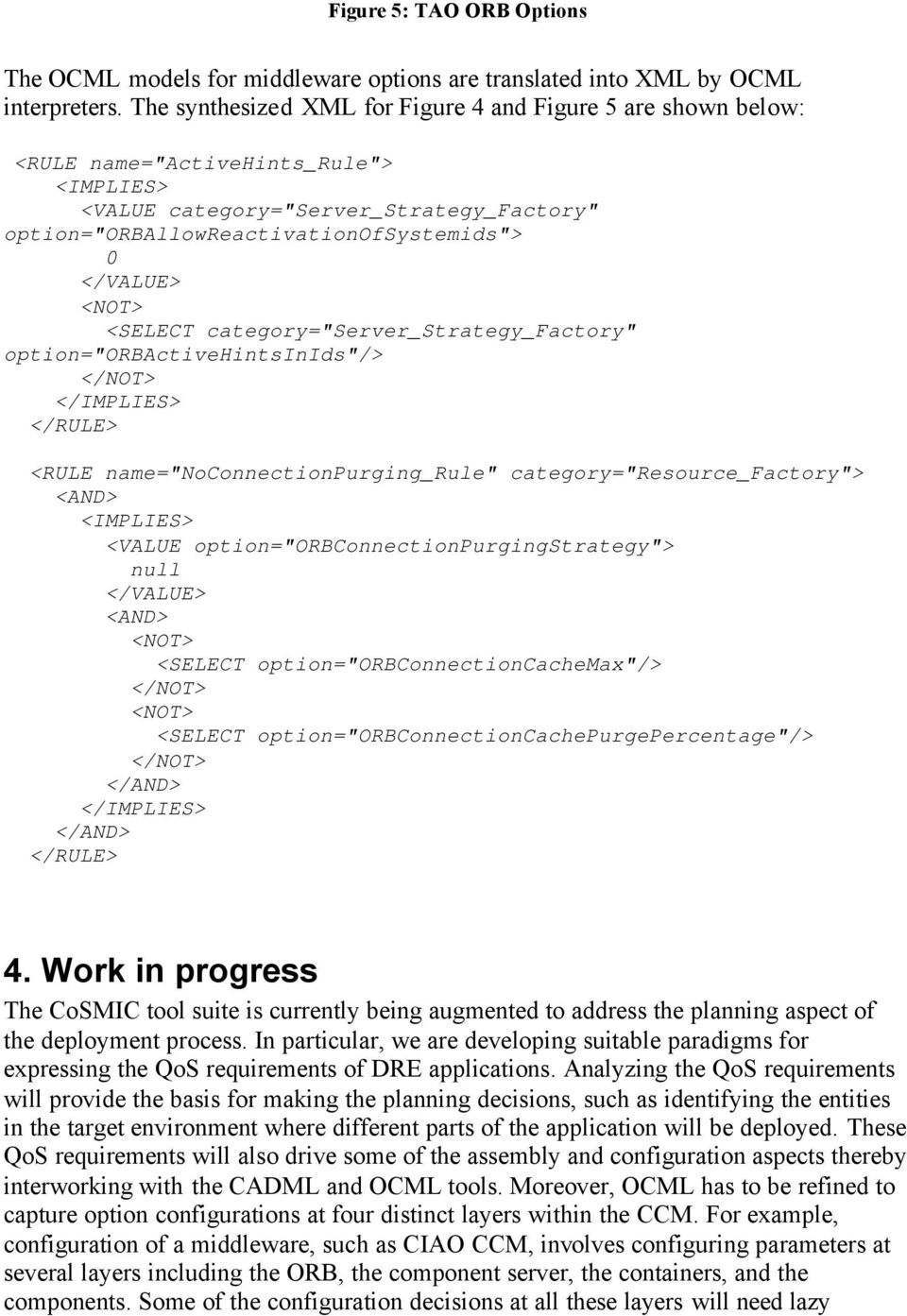
Transcription
1 CoSMIC: An MDA Tool Suite for Application Deployment and Configuration Tao Lu, Emre Turkay, Aniruddha Gokhale*, Douglas Schmidt Institute for Software Integrated Systems Vanderbilt University, Nashville TN *Contact Author: 1. Overview The Component Synthesis using Model Integrated Computing (CoSMIC) [1] is the Object Management Group (OMG) s Model Driven Architecture (MDA)[2] standardsbased tool suite targeted primarily for distributed real-time and embedded (DRE) component-based applications. The OMG s Deployment and Configuration (D&C) Specification [3], which was recently adopted, describes the mechanisms by which distributed component-based applications are configured and deployed. This paper describes how our CoSMIC MDA tool suite has been tailored to address the requirements of the D&C specification. The D&C specification outlines the following steps in the deployment process: 1. Packaging which involves bundling a suite of software binary modules and metadata representing application components, where a component can be monolithic (standalone) or an assembly of subcomponents 2. Installation which provides populating a repository with the packages required by the application 3. Configuration which includes configuring the packages with the appropriate parameters to satisfy the functional and systemic requirements of application without constraining to any physical resources 4. Planning which comprises making appropriate deployment decisions, such as identifying the entities, such as CPUs, of the target environment where the packages will be deployed 5. Preparation which involves moving the binaries to the identified entities of the target environment 6. Launching which involves triggering the installed binaries and bringing the application to a ready state The CoSMIC MDA tool suite has to date addressed the packaging and configuration aspects of the deployment process outlined above. These aspects are described in detail below.
![Overview The Component Synthesis using Model Integrated Computing (CoSMIC) [1] is the Object Management Group (OMG) s Model Driven Architecture (MDA)[2] standardsbased tool suite targeted primarily](/docs-images/45/8432478/images/page_1.jpg "for distributed real-time and embedded (DRE) component-based applications.")
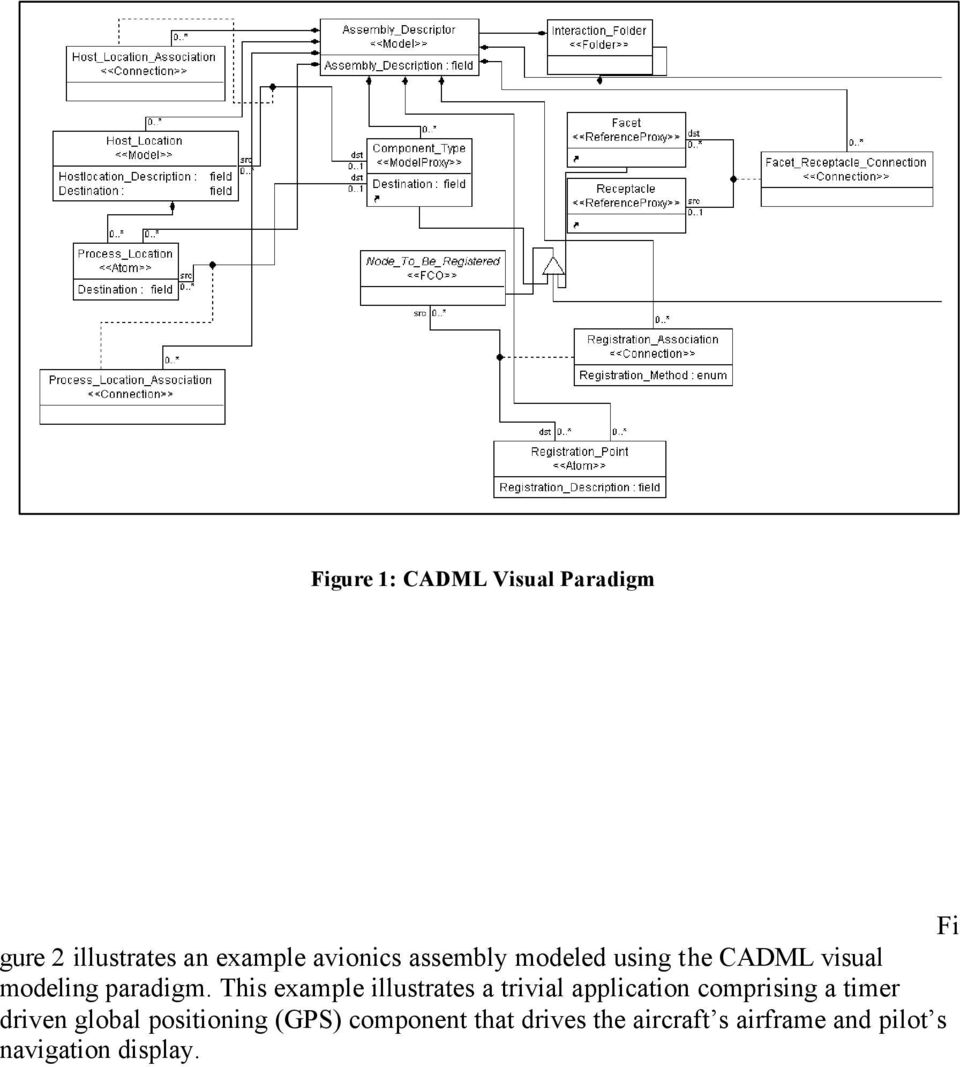
2 2. CoSMIC s Component Assembly and Deployment Modeling Language Applications based on component middleware are composed from instantiation of different component types, which are partitioned, assembled and then deployed. For applications, particularly in the DRE domain, the MDA tool must ensure that the composition strategies provide optimum resource utilization and deliver the required quality of service (QoS) guarantees to the application. The Component Assembly & Deployment Modeling Language (CADML) is developed as part of the CoSMIC MDA tool suite targeting the assembly and deployment aspect of the DRE application deployment process. The CADML, based on the meta-model illustrated in Figure 1, is a visual language tool developed using the Generic Modeling Environment (GME) framework [4]. Visual languages developed using GME benefit from the following features: GUI interface supporting all general GUI application features with very generic semantic mapping. Library importing and exporting capability. Type system defined in the meta-model, which supports inheritance and instantiation. This introduces object-oriented design (OOD) in the modeling paradigm. Formalized constraints specified in the meta-model to validate the model. Plug-in of analysis and synthesis tools that interpret the models The current release of CoSMIC s CADML tool supports the OMG CORBA[5] Component Model (CCM)[6] standard and works out of the box with the Component Integrated ACE ORB (CIAO)[7], which is a real-time CCM implementation we are developing. The CADML modeling paradigm allows CIAO-based DRE application developers to model the component assembly comprising the connections between different components of the applications. The CADML interpreter synthesizes component assembly metadata as XML descriptors that are used by the middleware deployment tools. Different descriptor files represent different application scenarios. With the support of general component repository, an application developer could build up different application scenarios by only providing the specific descriptors.

3 Figure 1: CADML Visual Paradigm Fi gure 2 illustrates an example avionics assembly modeled using the CADML visual modeling paradigm. This example illustrates a trivial application comprising a timer driven global positioning (GPS) component that drives the aircraft s airframe and pilot s navigation display.
4 Figure 2: Modeling an Avionics Application Assembly 3. CoSMIC s Options Configuration Modeling Language Most applications today increasingly are built using commercial off-the-shelf (COTS) middleware. These COTS middleware must be customized to suit the application s functional and non-functional requirements. This customization can be achieved by enabling a combination of middleware configuration options chosen carefully from among a large set of such tunable options provided by the middleware. Each option addresses different performance aspects of applications. As a result some options are mutually dependent while certain combinations of options often conflict with each other. The task of choosing the right set of compatible options thus cannot be done in an ad hoc way but instead must be done by a tool. CoSMIC s Options Configuration Modeling Language (OCML) is another visual modeling paradigm developed using the GME framework to address the configuration aspect of the deployment process. It provides a language to define the constraints and dependencies of the options that can then be used to customize the middleware for DRE applications. Error! Reference source not found. illustrates the OCML MDA development process. In its current form, OCML supports option configuration and validation for the TAO realtime CORBA ORB [8], which is used as the ORB layer for the CIAO CCM implementation.

5 Meta-meta-model OCML : used to define rules Defines Meta-model Domain specific rule set : defines the rule set for TAO Model Uses Application specific rule set Model and validator : generates and validates the configuration file Figure 3: MDA Developing Process in OCML The OCML paradigm has been developed for middleware developers who can use it to model the dependency and compatibility rules between various options. Figure 4 illustrates an example of an options compatibility and dependency rule modeled by a TAO ORB developer. This rule showcases an AND expression used to model a dependency of an option on more than one option simultaneously

6 Figure 4: OCML Configuration Rule for TAO ORB The OCML meta-model is used with two different purposes. One purpose serves the validation of pre configured options, while other allows interactive option file construction. A validator checks an application-supplied TAO ORB configuration file against the OCML modeled rules for TAO ORB. If a rule check fails, the application developer is informed. Alternately, an application developer can choose to use a graphical user interface tool that accompanies the OCML paradigm. This framework provides an interactive environment to application developers to build a set of compatible options. This interactive tool consults the rules modeled by the middleware developer thereby constraining the choice of options to a valid, compatible set. A sample TAO ORB options configuration file in XML is shown below: <?xml version='1.0'?> <!-- Converted from./performance-tests/latency/dii/svc.conf by svcconf-convert.pl --> <ACE_Svc_Conf> <!-- --> <!-- --> <static id="advanced_resource_factory" params="-orbresources global - ORBReactorMaskSignals 0 -ORBInputCDRAllocator null -ORBReactorType select_st -ORBConnectionCacheLock null"/> <static id="server_strategy_factory" params="-orbpoalock null - ORBAllowReactivationOfSystemids 0 -ORBActiveHintsInIds 1"/> <static id="client_strategy_factory" params="-orbprofilelock null - ORBClientConnectionHandler RW"/> <static id="resource_factory" params="-orbconnectionpurgingstrategy null -ORBConnectionCacheMax 1024"/> </ACE_Svc_Conf> An XML file of this kind can be built using the interactive tool or a pre configured file can validated using the rules engine provided by OCML.

7 Figure 5: TAO ORB Options The OCML models for middleware options are translated into XML by OCML interpreters. The synthesized XML for Figure 4 and Figure 5 are shown below: <RULE name="activehints_rule"> <IMPLIES> <VALUE category="server_strategy_factory" option="orballowreactivationofsystemids"> 0 </VALUE> <NOT> <SELECT category="server_strategy_factory" option="orbactivehintsinids"/> </NOT> </IMPLIES> </RULE> <RULE name="noconnectionpurging_rule" category="resource_factory"> <AND> <IMPLIES> <VALUE option="orbconnectionpurgingstrategy"> null </VALUE> <AND> <NOT> <SELECT option="orbconnectioncachemax"/> </NOT> <NOT> <SELECT option="orbconnectioncachepurgepercentage"/> </NOT> </AND> </IMPLIES> </AND> </RULE> 4. Work in progress The CoSMIC tool suite is currently being augmented to address the planning aspect of the deployment process. In particular, we are developing suitable paradigms for expressing the QoS requirements of DRE applications. Analyzing the QoS requirements will provide the basis for making the planning decisions, such as identifying the entities in the target environment where different parts of the application will be deployed. These QoS requirements will also drive some of the assembly and configuration aspects thereby interworking with the CADML and OCML tools. Moreover, OCML has to be refined to capture option configurations at four distinct layers within the CCM. For example, configuration of a middleware, such as CIAO CCM, involves configuring parameters at several layers including the ORB, the component server, the containers, and the components. Some of the configuration decisions at all these layers will need lazy
8 evaluation at planning time when the QoS requirements are analyzed in the context of the target environment. 5. References [1] Aniruddha S. Gokhale, Douglas C. Schmidt, Tao Lu, Balachandran Natarajan, Nanbor Wang: CoSMIC: An MDA Generative Tool for Distributed Real-time and Embedded Applications. Middleware Workshops 2003: [2] Object Management Group: Model Driven Architecture(MDA)Document number ormsc/ Architecture Board ORMSC1July 9, 2001 [3] Object Management Group: Deployment and Configuration of Component-based Distributed Applications, An Adopted Specification of the Object Management Group, Inc.June 2003 Draft Adopted Specification ptc/july 2002 [4] Ledeczi A., Maroti M., Bakay A., Karsai G., Garrett J., Thomason IV C., Nordstrom G., Sprinkle J., Volgyesi P.: The Generic Modeling Environment, Workshop on Intelligent Signal Processing, accepted, Budapest, Hungary, May 17, [5] Object Management Group, The Common Object Request Broker: Architecture and Specification, 2.6 edition, Dec [6] BEA Systems, et al., CORBA Component Model Joint Revised Submission, Object Management Group, OMG Document orbos/ edition, July [7] Nanbor Wang, Douglas C. Schmidt, Aniruddha Gokhale,Christopher D. Gill, Balachandran Natarajan, Craig Rodrigues, Joseph P. Loyall, and Richard E. Schantz, Total Quality of Service Provisioning in Middleware and Applications, Elsevier Journal of Microprocessors and Microsystems, vol. 26, no. 9-10, Jan [8] Douglas C. Schmidt, Aniruddha Gokhale, Balachandran Natarajan, et al, TAO: A Pattern-Oriented Object Request Broker for Distributed Real-time and Embedded Systems, IEEE Distributed Systems Online, Feb 2002.
![Middleware Workshops 2003: 300-306 [2] Object Management Group: Model Driven Architecture(MDA)Document number ormsc/2001-07-01 Architecture Board ORMSC1July 9, 2001 [3] Object Management Group:](/docs-images/45/8432478/images/page_8.jpg "Deployment and Configuration of Component-based Distributed Applications, An Adopted Specification of the Object Management Group, Inc.")
Composing and Deploying Grid Middleware Web Services using Model Driven Architecture
 Composing and Deploying Grid Middleware Web Services using Model Driven Architecture Aniruddha Gokhale 1 and Balachandran Natarajan 1 Institute for Software Integrated Systems, Vanderbilt University, PO
A Management Tool for Component-Based Real-Time Supervision and Control Systems
 A Management Tool for Component-Based Real-Time Supervision and Control Systems Sandro Santos Andrade, Raimundo José de Araújo Macêdo Distributed Systems Laboratory (LaSiD) Post-Graduation Program on Mechatronics
Model-driven Configuration and Deployment of Component Middleware Publish/Subscribe Services
 Model-driven Configuration and Deployment of Component Middleware Publish/Subscribe Services George Edwards, Gan Deng, Douglas C. Schmidt, Aniruddha Gokhale, and Bala Natarajan {edwardgt,dengg,schmidt,gokhale,bala}@dre.vanderbilt.edu
Revel8or: Model Driven Capacity Planning Tool Suite
 Revel8or: Model Driven Capacity Planning Tool Suite Liming Zhu 1,2, Yan Liu 1,2, Ngoc Bao Bui 1,2,Ian Gorton 3 1 Empirical Software Engineering Program, National ICT Australia Ltd. 2 School of Computer
Simplifying Autonomic Enterprise Java Bean Applications via Model-driven Development: a Case Study
 Simplifying Autonomic Enterprise Java Bean Applications via Model-driven Development: a Case Study Jules White, Douglas Schmidt, Aniruddha Gokhale {jules, schmidt, gokhale}@dre.vanderbilt.edu Department
Component-Oriented Engineering
 Component-Oriented Engineering... the dawn of a new era in embedded software development productivity Francis Bordeleau and Ross MacLeod Zeligsoft May 2008 Component-Oriented Engineering the dawn of a
Netowork QoS Provisioning Engine for Distributed Real-time and Embedded Systems
 www.dre.vanderbilt.edu NetQoPE: A Middleware-based Netowork QoS Provisioning Engine for Distributed Real-time and Embedded Systems Jaiganesh Balasubramanian [email protected] Work done in collaboration
OMG s First Annual Model-Integrated Computing Workshop Program Summary and Index
 OMG s First Annual Model-Integrated Computing Workshop Program Summary and Index TUESDAY October 12, 2004 TUTORIAL TRACKS 0900-1200 The Generic Modeling Environment (GME) Track 1 James Davis, Research
Huang-Ming Huang and Christopher Gill. Bala Natarajan and Aniruddha Gokhale
 Replication Strategies for Fault-Tolerant Real-Time CORBA Services Huang-Ming Huang and Christopher Gill Washington University, St. Louis, MO {hh1,cdgill}@cse.wustl.edu Bala Natarajan and Aniruddha Gokhale
What is Middleware? Software that functions as a conversion or translation layer. It is also a consolidator and integrator.
 What is Middleware? Application Application Middleware Middleware Operating System Operating System Software that functions as a conversion or translation layer. It is also a consolidator and integrator.
Continuous System Integration of Distributed Real-time and Embedded Systems
 Continuous System Integration of Distributed Real-time and Embedded Systems and Douglas Schmidt Vanderbilt University Nashville, TN, USA OMG s Workshop on Distributed Object Computing for Real-time and
Model-driven Performance Estimation, Deployment, and Resource Management for Cloud-hosted Services
 Model-driven Performance Estimation, Deployment, and Resource Management for Cloud-hosted Services Faruk Caglar, Kyoungho An, Shashank Shekhar and Aniruddha Gokhale Vanderbilt University, ISIS and EECS
Analysis of a potential use of middleware technologies for railway domain
 Analysis of a potential use of middleware technologies for railway domain C. Gransart 1, J. Billion 2, D. Van den Abeele 2 1 INRETS, Villeneuve d Ascq, France; 2 ALSTOM Transport, St Ouen, France 1. Introduction
A SYSTEMATIC APPROACH FOR COMPONENT-BASED SOFTWARE DEVELOPMENT
 A SYSTEMATIC APPROACH FOR COMPONENT-BASED SOFTWARE DEVELOPMENT Cléver Ricardo Guareis de Farias, Marten van Sinderen and Luís Ferreira Pires Centre for Telematics and Information Technology (CTIT) PO Box
Systems Integration: Co C mp m onent- t bas a e s d s o s ftw ft a w r a e r e ngin i eeri r n i g
 Systems Integration: Component-based software engineering Objectives To explain that CBSE is concerned with developing standardised components and composing these into applications To describe components
System Component Deployment in a Realtime Embedded Software Defined Radio (SDR) Architecture
 System Component Deployment in a Realtime Embedded Software Defined Radio (SDR) Architecture Dawn Szelc The MITRE Corp. Lead System Engineer Mark Adams Exigent International VP Wireless Engineering Outline
Overview. Stakes. Context. Model-Based Development of Safety-Critical Systems
 1 2 Model-Based Development of -Critical Systems Miguel A. de Miguel 5/6,, 2006 modeling Stakes 3 Context 4 To increase the industrial competitiveness in the domain of software systems To face the growing
Simplifying the Development of Autonomic Enterprise Java Bean Applications via Model Driven Development
 Simplifying the Development of Autonomic Enterprise Java Bean Applications via Model Driven Development Jules White, Douglas Schmidt, Aniruddha Gokhale {jules, schmidt, gokhale}@dre.vanderbilt.edu Department
Using UML to Construct a Model Driven Solution for Unified Access to Disparate Data
 Using UML to Construct a Model Driven Solution for Unified Access to Disparate Data Randall M. Hauch VP Development, Chief Architect Metadata Management OMG's Second Workshop on UML for Enterprise Applications:
What Is the Java TM 2 Platform, Enterprise Edition?
 Page 1 de 9 What Is the Java TM 2 Platform, Enterprise Edition? This document provides an introduction to the features and benefits of the Java 2 platform, Enterprise Edition. Overview Enterprises today
Integration of DB oriented CAD systems with Product Lifecycle Management
 Integration of DB oriented CAD systems with Product Lifecycle Management Roberto Penas, SENER Ingeniería y Sistemas S.A., Tres Cantos/Spain, [email protected] Carlos González, SENER Ingeniería y Sistemas
Software Engineering. Software Engineering. Component-Based. Based on Software Engineering, 7 th Edition by Ian Sommerville
 Software Engineering Component-Based Software Engineering Based on Software Engineering, 7 th Edition by Ian Sommerville Objectives To explain that CBSE is concerned with developing standardised components
Developing in the MDA Object Management Group Page 1
 Developing in OMG s New -Driven Architecture Jon Siegel Director, Technology Transfer Object Management Group In this paper, we re going to describe the application development process supported by OMG
AN EVALUATION OF MODEL-BASED SOFTWARE SYNTHESIS FROM SIMULINK MODELS FOR EMBEDDED VIDEO APPLICATIONS
 International Journal of Software Engineering and Knowledge Engineering World Scientific Publishing Company AN EVALUATION OF MODEL-BASED SOFTWARE SYNTHESIS FROM SIMULINK MODELS FOR EMBEDDED VIDEO APPLICATIONS
MIDDLEWARE 1. Figure 1: Middleware Layer in Context
 MIDDLEWARE 1 David E. Bakken 2 Washington State University Middleware is a class of software technologies designed to help manage the complexity and heterogeneity inherent in distributed systems. It is
Model Transformations and Code Generation
 Model Transformations and Code Generation Ecole IN2P3 Temps Réel [email protected] 2 École d été, 26.11 08h30 10h00: Cours S1 Component models CCM and FCM (connectors) CCM CORBA component model
Business-Driven Software Engineering Lecture 3 Foundations of Processes
 Business-Driven Software Engineering Lecture 3 Foundations of Processes Jochen Küster [email protected] Agenda Introduction and Background Process Modeling Foundations Activities and Process Models Summary
A Cloud Architecture for an Extensible Multi-Paradigm Modeling Environment
 A Cloud Architecture for an Extensible Multi-Paradigm Modeling Environment Jonathan Corley 1 and Eugene Syriani 2 1 University of Alabama, U.S.A. 2 Université de Montréal, Canada Abstract. We present the
Approach to Service Management
 Approach to Service Management In SOA Space Gopala Krishna Behara & Srikanth Inaganti Abstract SOA Management covers the Management and Monitoring of applications, services, processes, middleware, infrastructure,
Software Engineering/Courses Description Introduction to Software Engineering Credit Hours: 3 Prerequisite: 0306211(Computer Programming 2).
 0305203 0305280 0305301 0305302 Software Engineering/Courses Description Introduction to Software Engineering Prerequisite: 0306211(Computer Programming 2). This course introduces students to the problems
A Pattern-based Framework to Address Abstraction, Reuse, and Cross-domain Aspects in Domain Specific Visual Languages *
 A Pattern-based Framework to Address Abstraction, Reuse, and Cross-domain Aspects in Domain Specific Visual Languages * David Oglesby, Kirk Schloegel, Devesh Bhatt, Eric Engstrom Honeywell Laboratories
Over the past five decades, software researchers
 G U E S T E D I T O R S I N T R O D U C T I O N Model- Driven Engineering Douglas C. Schmidt Vanderbilt University Model-driven engineering technologies offer a promising approach to address the inability
Using Test Clouds to Enable Continuous Integration Testing of Distributed Real-time and Embedded System Applications
 Using Test Clouds to Enable Continuous Integration Testing of Distributed Real-time and Embedded System Applications Dr. James H. Hill Dept. of Computer and Information Science Indiana Univ.-Purdue Univ.
SOFTWARE DEVELOPMENT STANDARD FOR SPACECRAFT
 SOFTWARE DEVELOPMENT STANDARD FOR SPACECRAFT Mar 31, 2014 Japan Aerospace Exploration Agency This is an English translation of JERG-2-610. Whenever there is anything ambiguous in this document, the original
An MDA Approach for the Development of Web applications
 An MDA Approach for the Development of Web applications Santiago Meliá Beigbeder and Cristina Cachero Castro {santi,ccachero}@dlsi.ua.es Univesidad de Alicante, España Abstract. The continuous advances
Conceptual Level Design of Semi-structured Database System: Graph-semantic Based Approach
 Conceptual Level Design of Semi-structured Database System: Graph-semantic Based Approach Anirban Sarkar Department of Computer Applications National Institute of Technology, Durgapur West Bengal, India
WebSphere Training Outline
 WEBSPHERE TRAINING WebSphere Training Outline WebSphere Platform Overview o WebSphere Product Categories o WebSphere Development, Presentation, Integration and Deployment Tools o WebSphere Application
Common Criteria For Information Technology Security Evaluation
 Security Characterisation and Integrity Assurance for Software Components and Component-Based Systems Jun Han and Yuliang Zheng Peninsula School of Computing and Information Technology Monash University,
Multi-objective Design Space Exploration based on UML
 Multi-objective Design Space Exploration based on UML Marcio F. da S. Oliveira, Eduardo W. Brião, Francisco A. Nascimento, Instituto de Informática, Universidade Federal do Rio Grande do Sul (UFRGS), Brazil
Model-Driven Data Warehousing
 Model-Driven Data Warehousing Integrate.2003, Burlingame, CA Wednesday, January 29, 16:30-18:00 John Poole Hyperion Solutions Corporation Why Model-Driven Data Warehousing? Problem statement: Data warehousing
A Web-Based Real-Time Traffic Monitoring Scheme Using CORBA
 A Web-Based Real-Time Traffic Monitoring Scheme Using CORBA Yuming Jiang, Chen-Khong Tham, Chi-Chung Ko Department of Electrical Engineering, National University of Singapore, 10 Kent Ridge Crescent, Singapore
MIGRATING DESKTOP AND ROAMING ACCESS. Migrating Desktop and Roaming Access Whitepaper
 Migrating Desktop and Roaming Access Whitepaper Poznan Supercomputing and Networking Center Noskowskiego 12/14 61-704 Poznan, POLAND 2004, April white-paper-md-ras.doc 1/11 1 Product overview In this whitepaper
Distributed Objects and Components
 Distributed Objects and Components Introduction This essay will identify the differences between objects and components and what it means for a component to be distributed. It will also examine the Java
EMBEDDED SOFTWARE DEVELOPMENT: COMPONENTS AND CONTRACTS
 EMBEDDED SOFTWARE DEVELOPMENT: COMPONENTS AND CONTRACTS David URTING, Stefan VAN BAELEN, Tom HOLVOET and Yolande BERBERS {David.Urting, Stefan.VanBaelen, Tom.Holvoet, Yolande.Berbers}@cs.kuleuven.ac.be
Implementing reusable software components for SNOMED CT diagram and expression concept representations
 1028 e-health For Continuity of Care C. Lovis et al. (Eds.) 2014 European Federation for Medical Informatics and IOS Press. This article is published online with Open Access by IOS Press and distributed
Applying 4+1 View Architecture with UML 2. White Paper
 Applying 4+1 View Architecture with UML 2 White Paper Copyright 2007 FCGSS, all rights reserved. www.fcgss.com Introduction Unified Modeling Language (UML) has been available since 1997, and UML 2 was
Design Document. Offline Charging Server (Offline CS ) Version 1.0. - i -
 Design Document Offline Charging Server (Offline CS ) Version 1.0 - i - Document Scope Objective The information provided in this document specifies the design details of Operations of Offline Charging
Limitations of Object-Based Middleware. Components in CORBA. The CORBA Component Model. CORBA Component
 Limitations of Object-Based Middleware Object-Oriented programming is a standardised technique, but Lack of defined interfaces between objects It is hard to specify dependencies between objects Internal
Training Management System for Aircraft Engineering: indexing and retrieval of Corporate Learning Object
 Training Management System for Aircraft Engineering: indexing and retrieval of Corporate Learning Object Anne Monceaux 1, Joanna Guss 1 1 EADS-CCR, Centreda 1, 4 Avenue Didier Daurat 31700 Blagnac France
OpenCCM: The Open CORBA Components Platform
 OpenCCM: The Open CORBA Components Platform 3rd ObjectWeb Conference 20th November 2003, INRIA Rocquencourt, France Philippe Merle INRIA Futurs Lille Jacquard Project OpenCCM Project Leader www.objectweb.org
Software Factories: Assembling Applications with Patterns, Models, Frameworks, and Tools
 Software Factories: Assembling Applications with Patterns, Models, Frameworks, and Tools Jack Greenfield Keith Short WILEY Wiley Publishing, Inc. Preface Acknowledgments Foreword Parti Introduction to
Information integration platform for CIMS. Chan, FTS; Zhang, J; Lau, HCW; Ning, A
 Title Information integration platform for CIMS Author(s) Chan, FTS; Zhang, J; Lau, HCW; Ning, A Citation IEEE International Conference on Management of Innovation and Technology Proceedings, Singapore,
An Overview of Challenges of Component Based Software Engineering
 An Overview of Challenges of Component Based Software Engineering Shabeeh Ahmad Siddiqui Sr Lecturer, Al-Ahgaff University, Yemen Abstract Nowadays there is trend of using components in development of
Model Driven Interoperability through Semantic Annotations using SoaML and ODM
 Model Driven Interoperability through Semantic Annotations using SoaML and ODM JiuCheng Xu*, ZhaoYang Bai*, Arne J.Berre*, Odd Christer Brovig** *SINTEF, Pb. 124 Blindern, NO-0314 Oslo, Norway (e-mail:
Chap 1. Introduction to Software Architecture
 Chap 1. Introduction to Software Architecture 1. Introduction 2. IEEE Recommended Practice for Architecture Modeling 3. Architecture Description Language: the UML 4. The Rational Unified Process (RUP)
Common Warehouse Metamodel (CWM): Extending UML for Data Warehousing and Business Intelligence
 Common Warehouse Metamodel (CWM): Extending UML for Data Warehousing and Business Intelligence OMG First Workshop on UML in the.com Enterprise: Modeling CORBA, Components, XML/XMI and Metadata November
Middleware Lou Somers
 Middleware Lou Somers April 18, 2002 1 Contents Overview Definition, goals, requirements Four categories of middleware Transactional, message oriented, procedural, object Middleware examples XML-RPC, SOAP,
PERFORMANCE COMPARISON OF COMMON OBJECT REQUEST BROKER ARCHITECTURE(CORBA) VS JAVA MESSAGING SERVICE(JMS) BY TEAM SCALABLE
 PERFORMANCE COMPARISON OF COMMON OBJECT REQUEST BROKER ARCHITECTURE(CORBA) VS JAVA MESSAGING SERVICE(JMS) BY TEAM SCALABLE TIGRAN HAKOBYAN SUJAL PATEL VANDANA MURALI INTRODUCTION Common Object Request
A Comparison of Enterprise Reporting Tools
 A Comparison of Enterprise Reporting Tools Crystal Reports and Web Intelligence Adam Getz Practice Manager, Business Intelligence DCS Consulting - Corporate Overview About DCS Consulting: DCS Consulting
Development of Tool Extensions with MOFLON
 Development of Tool Extensions with MOFLON Ingo Weisemöller, Felix Klar, and Andy Schürr Fachgebiet Echtzeitsysteme Technische Universität Darmstadt D-64283 Darmstadt, Germany {weisemoeller klar schuerr}@es.tu-darmstadt.de
The ADOxx Metamodelling Platform Workshop "Methods as Plug-Ins for Meta-Modelling" in conjunction with "Modellierung 2010", Klagenfurt
 The ADOxx Metamodelling Platform Workshop "Methods as Plug-Ins for Meta-Modelling" in conjunction with "Modellierung 2010", Klagenfurt Dr. Harald Kühn 24.03.2010 Agenda 1 Overview 2 Deployment and Integration
Comparison of Enterprise Reporting Tools
 A Comparison of Enterprise Reporting Tools (SAP Crystal Reports and SAP BusinessObjects Web Intelligence) Adam Getz Manager, Business Intelligence & Reporting TMA Resources About TMA Resources Software
UIMA and WebContent: Complementary Frameworks for Building Semantic Web Applications
 UIMA and WebContent: Complementary Frameworks for Building Semantic Web Applications Gaël de Chalendar CEA LIST F-92265 Fontenay aux Roses [email protected] 1 Introduction The main data sources
CS 389 Software Engineering. Lecture 2 Chapter 2 Software Processes. Adapted from: Chap 1. Sommerville 9 th ed. Chap 1. Pressman 6 th ed.
 CS 389 Software Engineering Lecture 2 Chapter 2 Software Processes Adapted from: Chap 1. Sommerville 9 th ed. Chap 1. Pressman 6 th ed. Topics covered Software process models Process activities Coping