
CURRENT UPDATE ON OIL & GAS VALUATION
|
|
|
- Claribel Shaw
- 10 years ago
- Views:
Transcription
1 CURRENT UPDATE ON OIL & GAS VALUATION Presented to: The San Antonio Bar Association Natural Resources Section Meeting Petroleum Club September 11, 2014 Present By: C.P. Schumann, C.P.A., C.V.A., M.A.F.F Wurzbach, Ste. 104 San Antonio, TX (210)
2 BIOGRAPHICAL INFORMATION C.P. SALTY SCHUMANN, C.P.A., C.V.A., M.A.F.F. C. P. "Salty" Schumann is the managing director and founder of his firm, which offers both traditional accounting services and the non-traditional services of business valuation, litigation, forensic, and oil and gas consulting both on a local and a national level. He is a nationally known speaker and publisher of various articles in the areas in which the firm practices. He holds both the Certified Valuation Analyst and the Master Analyst in Financial Forensic designations from the National Association of Certified Valuators and Analysts (NACVA). He has Federal, District, Bankruptcy and Tax Court Experience. He currently serves on the NACVA Professional Standards Committee and was Chair of the NACVA Litigation Forensics Board and the Standards Committee for a number of years. He was also the past Chair of the Texas Society of Certified Public Accountants Litigation Member Services Section. He was also a member of the American Institute of Certified Public Accountants (AICPA) Litigation Support & Dispute Resolution Sub Committee, as well as the AICPA National Litigation Conference Committee and the AICPA Business Valuation Committee. He has participated in the writing of b o t h the NACVA a n d A I C P A B u s i ness Valuation Standards. He is currently a member of the Texas Society of CPA's Professional Standards Committee. His firm has landmen on staff and access to oil & gas information in 42 States in the Continental U.S. The firm offers the following oil & gas services: Mineral and Royalty interest valuation. Second opinions on the fair market value of lease offers. Litigation - Services. Economic Damages. Property Tax Protests. Estate Planning. Computation of Cost Depletion for Tax Purposes. Due Diligence, Investment and Merger & Acquisition. Petroleum Landman Forensic Document Research.

3
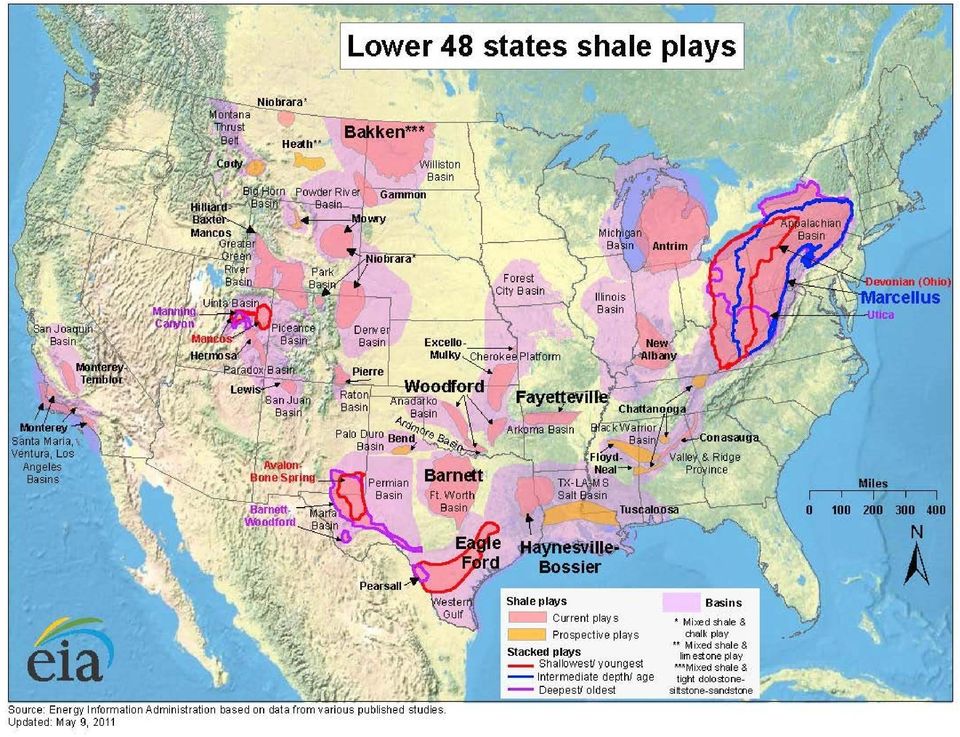
4 TABLE OF CONTENTS C. P. SCHUMANN, C.P.A., C.V.A., M.A.F.F. - BIOGRAPHICAL INFORMATION LOWER 48 STATES SHALE PLAYS...1 INDUSTRY REFRESHER...1 Introduction...1 Crude Oil and Gas Prices...1 Evaluating Land with Existing Production...3 Borrowing Based on Reserves...12 Evaluating Land With No Prior Hydrocarbon Production or Exploration...13 Conclusion...19 DETERMINATION OF FAIR MARKET VALUE OF MINERAL PROPERTIES...19 What is the Value of the Interest...19 Comparative Value Method...20 Discounted Cash Flow...20 IRS Regulations...20 Reg. Sec (d)(1); 26 U.S.C. 611 Reg. Sec (d)(2); 26 U.S.C. 611 Reg. Sec (e); 26 U.S.C. 611 Reg. Sec (e)(1); 26 U.S.C. 611 Reg. Sec (e)(2); 26 U.S.C. 611 Reg. Sec (e)(3); 26 U.S.C. 611 Reg. Sec (e)(4); 26 U.S.C. 611 Reg. Sec (f); 26 U.S.C. 611 Tax Court Cases on Valuing Mineral Interests...23 What's New From the IRS Regarding Valuation...23 Definition of Appraisal-Adequate Disclosure Regs Definition of Appraiser Adequate Disclosure Items Related to the Valuation Report (Not IRS) MSSP - Market Segment Specialization Program - Oil and Gas Industry IRS Oversight of Valuation Services...33 IRS Appraisal Review Process...33 Valuation Penalties Under Sec. 6695A...34 Valuation Penalties...35

5 THE RESERVE APPRAISAL...37 Classification of Reserve Method for Determining Fair Market Value...37 Classification of Reserves OIL & GAS COMPANY VALUATION...39 What Does the Service Say?...39 Rules of Thumb...41 Other Thoughts...41 Distinction Between Mineral & Royalty Interest Valuation with Emphasis on Subsequent Events...42 General Characteristics of a Mineral Interest...43 General Characteristics of a Royalty Interest...43 DEFINITION OF FAIR MARKET VALUE...44 Revenue Ruling SUBSEQUENT EVENTS...45 Summary...46 WHY DO WE NOT SEE THE FOLLOWING IN OIL AND GAS VALUATION REPORTS WHICH ARE COMMON TO BUSINESS VALUATIONS?...46 Discount for the Valuation of Undivided and Non-Participating Mineral Interests...46 Oil and Gas Price Projections (Annual Energy Outlook 2012 U.S. Energy Information Administration)...48 Discount Rate Buildup - Texas 2011 Property Value Study (Susan Combs - Texas Comptroller of Public Accounts)...53 Market Discount Rate...58 Capitalized and Discounted Return Methods...61 Conditions That May Make a Discounted Return Method Inappropriate...61 Discounted Cash Flow Method Example...62 An Introduction to Monte Carlo Simulation Probabilistic Method...63 Uncertainty in Cash Flow...63 Probability Weighted Discounted Cash Flow Method...65 Publicly Traded Oil and Gas Trusts...65 Income Method - Discounted Cash Flow Method/A Report Excerpt...70 Reconciliation of Value Conclusion of Value
6 VALUATION ISSUES IN LITIGATION...73 FAMILY LIMITED PARTNERSHIP EXAMPLE...75 CALCULATING THE BASIS OF GIFTED PROPERTY...77 IRS BUSINESS VALUATION GUIDELINES...78 SUMMARY...78 EXHIBITS: Manual for Discounting Oil and Gas Income Susan Combs - Texas Comptroller of Public Accounts... I IRS Business Valuation Guidelines... II
7 INDUSTRY REFRESHER Sources: Valuing The Potential Of Land For Oil & Gas Development By: David Ammons and James Sheppard Introduction Investment decisions in the oil and gas industry are made in a unique environment that is characterized by the following: The industry is very cash intensive. The expenditure of millions and sometimes billions of dollars is required for a single project, with no guarantees of success. There is frequently a long lead time between initial expenditure and resulting revenue and profitability. Decisions are often made in an environment of high levels of uncertainty and consequently risk. Common uncertainties include: do hydrocarbons exist beneath the target prospect? Will drilling lead to a blow-out? If we find oil or natural gas reserves will they be smaller than expected or decline faster than geologic conditions suggest? Will crude oil and/or natural gas prices remain strong or nose-dive? 1 Will the applicable regulatory environment change? The competition for funds for alternative projects can be substantial. Given this unique environment, it is critical for oil and gas companies to effectively, efficiently, and accurately evaluate projects before investing substantial sums. Companies employ somewhat different evaluation methods for projects located on land with existing hydrocarbon production than they do for projects located on land with no prior production or exploration. The relevant evaluation methods are discussed in detail in this paper. Crude Oil and Natural Gas Prices Before discussing the different evaluation methods, however, it is important to address crude oil and natural gas prices. These prices impact the evaluation of land with existing hydrocarbon production as well as land with no prior production or exploration. 1. Review of Past Crude Oil and Natural Gas Prices After years of relative stability, crude oil and natural gas prices began to massively fluctuate in recent years, adding uncertainty as to the appropriate price track for making long-term investment decisions. * The authors wish to thank Russell P. Meduna, President of Pennon Resources, LLC, for his assistances with the technical discussions contained in this paper. 1 Shale projects can have a life of 30 to 50 years. It is certainly a tall order for anyone to try to forecast prices that far out. 1
8 Oil prices (West Texas Intermediate spot price a major benchmark for crude oil prices) were relatively stable for ten years, from the early 1990s to the early 2000s. 2 During that time, oil prices ranged from $20 to $30 per barrel (nominal) with one sharp decline to below $15 per barrel in Since 2003, however, oil prices have climbed steadily, and topped out at over $130 per barrel in the summer of Natural gas prices (Henry Hub spot price a major benchmark for natural gas prices) had their own, more than a decade, period of price stability, from the mid-1980s through During that time, natural gas prices averaged about $2 per million British thermal units ( Mil. BTUs ), with a modest price spike in 1996/97. 6 Since 1999, natural gas prices have experienced major volatility. Prices briefly reached $8 per Mil. BTUs in late 2000/early 2001, before quickly declining to about $2 to $3 per Mil. BTUs. 7 During 2008, prices peaked at $ per Mil. BTUs before closing the year at $5.815 per Mil. BTUs. 8 For the past year and a half, prices have languished at about $2 to $3 per Mil. BTUs. 9 Of particular interest is the recent sharp divergence of oil and natural gas prices from their traditional relationships, adding further uncertainty to future price expectations for natural gas. Historically, the relationship has been steady, with a crude oil trading about 11 times the price of natural gas since 1990, when gas started trading at the New York Mercantile Exchange. 10 The oil-to-gas ratio started to climb in 2009 as a result of large discoveries of shale gas, and on March 27, 2012 reached an all-time high of 48.6 to The huge gap points to a fundamental imbalance in energy markets and illustrates what an incredible energy bargain natural gas has become in comparison to crude oil Price Forecasts A variety of sources provide crude oil and natural gas price forecasts, expectations, and guidelines for making investment decisions in the oil and gas industry. The Energy Information Association ( EIA ) publishes price forecasts in its Annual Energy Outlook. 2 U.S. ENERGY INFORMATION ADMINISTRATION, PETROLEUM & OTHER LIQUIDS, CUSHING, OK WTI SPOT PRICE FOB (DOLLARS PER BARREL), available at n=pet&s=rwtc&f=d (last visited Aug. 12, 2012). 3 See id. 4 See id. 5 See U.S. ENERGY INFORMATION ADMINISTRATION, NATURAL GAS, CUSHING, U.S. NATURAL GAS WELLHEAD PRICE (DOLLARS PER THOUSAND CUBIC FEET), available at rngwhhdd.htm (last visited Aug. 12, 2012). 6 See id. 7 See id. 8 See id. 9 See id. 10 Carolyn Cui, Once Linked, Oil and Gas Break Up: The Price Gap Between the Two Is Now Extreme, In Part Due to Meddling From Mother Nature, WALL STREET JOURNAL, Mar. 30, 2012, available at (last visited Aug. 12, 2012) See id. 2

9 Numerous public and private organizations also publish price forecasts. Some oil and gas companies and their lenders use the price of NYMEX crude oil and natural gas futures as a proxy for the market s expectation of the spot price of crude oil and natural gas, respectively. 13 A relatively recent study of decision-making in the oil and gas industry indicates that the price projection models used by the industry fall into three categories, depending on the size and nature of the company. 14 A more aggressive approach is to use the NYMEX Strip for the near-term (next 3 to 5 years), with hedging, and a constant price thereafter. 15 A middle of the road approach is to use a weighted three year average of latest prices, escalated for inflation. 16 And a more conservative approach is to use the lowest price value from the past three years of prices, escalated for inflation. 17 Importantly, energy lenders typically require that their borrowers use the lenders price projections. 3. Price Volatility Materially Impacts Investment Decisions Price volatility materially impacts oil and gas companies investment decisions. The recent precipitous decline in natural gas prices and the corresponding increase in crude oil prices illustrate this point perfectly. In late 2008/early 2009, as natural gas prices were in free fall, many domestic producers shifted out of dry gas activity and into crude oil or natural gas liquid activity. 18 Some shifted out of dry gas activity sooner than others or have benefitted from higher value liquids on acquired and/or leased and explored acreage. 19 Some producers who were unable to shift out of dry gas activity were forced to file for bankruptcy protection. With the especially prolonged soft Henry Hub price conditions existing since then, expectations are that low cost producers and lower cost operating locations will be of great interest as the industry re-organizes itself to deal with adverse circumstances. 20 Evaluating Land With Existing Production Oil and gas companies typically consider a variety of factors when evaluating land with existing hydrocarbon production, including: 1. Anticipated cash flows from hydrocarbon development, both positive in the form of revenue and negative in the form of expenditures and taxes. 13 See RON ALQUIST ET AL., FORECASTING THE PRICE OF OIL, International Finance Discussion Paper Circulated to Board of Governors of the Federal Reserve System, at p. 19 (July 2011), available at (last visited Aug. 12, 2012). 14 VELLO A. KUUSKRAA, INVESTMENT DECISION-MAKING IN THE OIL AND GAS SUPPLY SECTORS, at p. 23 (Jan. 21, 2008), available at (last visited Aug. 12, 2012) See, e.g., Michelle Michot Foss & Miranda L. Wainberg, University of Texas Center for Energy Economics, Monitoring U.S./Global Oil and Gas Upstream Attainment, Producer Challenges, at pp. 4-5 available at (last visited Aug. 12, 2012). 19 See id. 20 See id. At p.6. 3
10 2. Volume of recoverable oil and gas reserves beneath the land. 3. Categories of the reserves. 4. Fair market value of the reserves. 5. Ability to borrow money based on the reserves. 1. Anticipated Cash Flows Companies typically seek to estimate the cash flows that might be generated from hydrocarbon development, both positive in the form of revenue and negative in the form of expenditures and taxes. This economic analysis allows the relevant decision-maker(s) to, among other things: estimate the profit (or loss) and return on investment of a project; rank a project in comparison with alternative investment options; estimate the risks, both financial and technical, in undertaking the project; and forecast the effect of the project on the overall company position. A key tool to evaluate and compare oil and gas interests or future projects is the Discounted Cash Flow ( DCF ) method. The analysis takes into consideration, among other things: (1) the expected hydrocarbon production profile of the property i.e., the volume of expected production over time and the expected life of the well(s); and (2) price forecasts for crude oil and/or natural gas. 21 Because the DCF method is based on future cash flows, the DCF method is the most commonly-used test for a discount rate to any valuation because it accounts for the time for the reserves to be produced. 22 When calculating the present value of an anticipated cash flow using the DCF method, the discount rate performs two functions: (1) it accounts for the time value of money; and (2) it adjusts the value of the cash flow with a discount rate to account for risk. 23 A. DCF Method Accounts For Time Value of Money The first component of the DCF method is that future payments should be discounted to adjust for the time value of money. It is undisputed that a dollar paid today is worth more than a 21 See, e.g., Yasin Senturk, Evaluation of Petroleum Reserves and Resources, GUIDELINES FOR APPLICATION OF PETROLEUM RESOURCES MANAGEMENT SYSTEM, at pp (Nov. 2011), available at (last visited Aug. 12, 2012) [hereinafter Senturk Valuation]. 22 At At 109,
11 dollar available in the future. 24 A dollar in hand today is also worth more because of the risk that money projected to be earned in the future will not be realized. 25 One of the strengths of the DCF method is that it accounts for the time it will take for the reserves to be produced. 26 There is rarely an immediate return on any oil and gas investment and, therefore, the investor must account (or discount) for the value of money received in the future. 27 For example, if a project started in Year 0 and earned $100,000 in Year 3, then the value of the investment must be discounted to reflect the fact that $100,000 earned in the future is worth less due to interest rates and inflation than the same amount in Year B. DCF Method Accounts for Relative Risk of Project There are many methods to determine a discount rate for an investment, but in most cases, these calculations resemble art more than science. Generally, the size of the discount rate is inversely related to the size of the risk. The higher the risk, the higher the discount rate necessary to adjust for the likelihood that the projected revenue is never realized. For example, if the project or cash flow is risky, the normal procedure is to discount the forecasted (expected) value based upon a risk-adjusted discount rate. 29 The discount rate should reflect the cost of capital invested in the project. In analysis based on the DCF method, risk factors considered by appraisers include some or all of the following: (a) whether the oil and gas lease has high water production; (b) whether the lease is near the end of its economic life; (c) whether recovery is uncertain because a hydrocarbon well reservoir is under partial or active water drive; (d) whether the lease is rapidly declining; (e) whether the lease has less than six months of production history; (f) whether the lease is on-shore or off-shore; and (g) whether the lease contains any unusually high operating expenses. 30 In addition, the DCF method based appraisal will include an industry weighted average cost of capital ( WACC ) for any other property specific factors that increase the investor s risk. 31 The WACC is the market-based average of the after-tax cost of debt and equity. 32 Stated differently, WACC represents the opportunity cost that investors face for investing their funds in one particular business instead of others with similar risk. 24 RICHARD A. BREALEY, ET AL., PRINCIPLES OF CORPORATE FINANCE, 16 (8th ed. 2006) ( The first basic principle of finance is that a dollar today is worth more than a dollar tomorrow, because the dollar today can be invested to start earning interest immediately. Financial managers refer to this as the time value of money. ) Senturk Valuation, at p See M.A. MIAN, PROJECT ECONOMICS AND DECISION ANALYSIS, (2d ed. 2011) ; see also RICHARD A. BREALEY, & STEWARD C. MYERS, PRINCIPLES OF CORPORATE FINANCE 244 (6th ed. 2000). 30 See Senturk Valuation, at pp. 18, 87; see also SUSAN COMBS, MANUAL FOR DISCOUNTING OIL AND GAS INCOME, at pp (Feb. 2012), available at pdf (last visited Aug. 13, 2012) [hereinafter Texas Comptroller Manual]. 31 Texas Comptroller Manual, at p at pp
12 2. Volume of Recoverable Reserves Hydrocarbons that have been discovered and are economically recoverable, but are yet to be produced, are referred to as reserves. In evaluating property with existing production, companies typically estimate the volume of recoverable reserves. The Monte Carlo Method is a popular method for calculating a range of values for hydrocarbon volumes. 33 Distributions of porosity, water saturation, reservoir thickness, and aerial extent of the reservoir are inputted into the Monte Carlo simulator. 34 Those distributions of the input variables are estimated by obtaining a sufficient number of measurements of reservoir and fluid properties. 35 The Monte Carlo simulator then generates samples at random from the input probability distributions. 36 Monte Carlo simulation does this hundreds or thousands of times, and the result is a probability distribution of possible outcomes. 37 In this way, Monte Carlo simulation provides a much more comprehensive view of what may happen. It tells oil and gas companies not only what could happen, but how likely it is to happen. In this way, Monte Carlo Simulation allows companies to bracket uncertainty 38 by providing them with a list of possible outcomes and determine whether the risks of extraction outweigh the associated rewards. A reservoir engineer will also estimate the percentage of hydrocarbons that are likely to be recoverable. That recovery percentage will be based on, among other things, data derived from other wells drilled in the area and the reservoir engineer s own experience. The recovery percentage is multiplied against the volume of hydrocarbons in place to give the volume of recoverable reserves. 3. Categories of Reserves In general, reserves can be broken down into the following categories: (1) Proved Reserves; (2) Probable Reserves; and (3) Possible Reserves. Moreover, reserves can be classified as either Developed or Undeveloped. Risk is the main differentiating factor between the types of reserve categories and their associated values. Since the value of an asset is a function of its projected future cash flow, the lower the chance of occurrence (actual production), the less valuable the mineral interest. 33 John D. Williams, An Analysis of Monte Carlo Simulation as an Estimator of Original Oil In Place and Original Gas in Place, at p. v. (Dec. 2004), available at williams.pdf (last visited Aug. 12, 2012) at p See id. 38 See id. 6

13 A. Developed or Undeveloped Reserves Developed reserves are expected to be recovered from existing wells based upon whether the wells are producing or not. 39 Undeveloped reserves are expected to be recovered: (1) from new wells on undrilled acreage; (2) from the deepening of existing wells to a different reservoir; or (3) where a relatively large capital expenditure is required to modify an existing well or to install production or transportation facilities for primary or improved recovery projects. 40 B. Proved, Probable, or Possible Reserves Proved reserves are those reserves that geological and engineering data indicate with reasonable certainty are recoverable today, or in the near future, with current technology and under current economic conditions. 41 According to the EIA, which provides statistics for the Department of Energy, the term reasonable certainty implies that there is a 90% probability that a company will recover at least the proved reserves estimated to be recoverable. 42 Probable and possible reserves are further removed from having been tested by the drill bit, and thus, are subject to increasing margins of error. Probable and possible reserves are often referred to as P50 and P10, with probable reserves using a longer-term price assumption and more advanced technology to estimate underground stores. 43 Probable reserves are unproved, yet geological and engineering data suggests that they are more likely than not to be recoverable. For example, a probable reserve could be proved by normal step-out drilling and infill drilling where data is inadequate to classify them as proved. 44 Possible reserves are those unproved reserves that analysis of geological and engineering data suggests are less likely to be recoverable than probable reserves. 45 For example, possible reserves would lack any adequate definitive data and be referred to as exploratory. 39 See Scott M. Pinsonnault et. al., Oil and Gas Reserve Reports: A Basic Overview and Key Issues for Practitioners, 29 Am. Bankr. Inst. J. 52 (May 2010) [hereinafter Reserve Reports Overview] At 52.n James G. Ross, Petroleum Resources, Definitions, Classification, and Categorization Guidelines, GUIDELINES FOR APPLICATION OF PETROLEUM RESOURCES MANAGEMENT SYSTEM, at pp (Nov. 2011), available at (last visited Aug. 13, 2012) [hereinafter Ross Valuation]. 44 Reserve Reports Overview, at p

14 C. Key Classifications of Reserves (1) PDP or Proved Developed Producing Proved developed reserves are quantities of proved reserves that can be expected to be recovered through existing wells with existing equipment and operating methods. 46 PDP reserves are those reserves that are currently being produced, that is, hydrocarbons are currently being extracted. These are the most valuable (and certain) category of reserves because data for volume, pressure, and production is readily available and characteristics of the reserves become more apparent once a well is actually drilled, and hydrocarbons are extracted. 47 (2) PDNP or Proved Developed Non-Producing PDNP reserves means that a wellbore exists and reserves are identified, but as of yet no hydrocarbons have been produced. 48 The significance of PDNP reserves is that no additional significant capital expenditure within the wellbore is required, although expenditures may be required on the surface. 49 Most often, PDNP reserves may be waiting for a future event to occur before starting production. The most common example is when a well is shut-in waiting on construction of a pipeline or gathering system. (3) PUD or Proved Undeveloped Proved undeveloped reserves are the lowest category of proved reserves. PUD reserves are those where a new wellbore is still required to be drilled and completed (with accompanying risk), but for which there is still relative certainty surrounding the amount of hydrocarbons they contain. 50 PUD reserves are the least valuable of the proved category to an investor because this category requires the most significant capital investment and involves the greatest risk. 51 D. Methods of Reporting Reserves A reserve report is the typical starting point for any valuation of oil and gas properties. It provides an estimate of the quantity and classification of hydrocarbons that can be recovered over time. Reserve reports are utilized by exploration and production companies to determine the value of oil and gas assets in a variety of contexts, including purchase and sale activities and SEC reporting (in the case of public companies). 52 There are two common types of reserve reports: (1) the Petroleum Engineer Reserve Report; and (2) the SEC Report. 46 See Society of Petroleum Engineers, Glossary of Terms Used in Petroleum Reserves/Resources, at p. 10, available at (last visited Aug. 13, 2012) [hereinafter SPE Terms]. 47 See, e.g., Rhett G. Campbell, Valuing Oil & Gas Assets in the Courtroom, at pp. 5-6, American Institute of Business Law Seminar (Feb. 2002) (on file with the author) [hereinafter Campbell Valuation]. 48 SPE Terms, at p Campbell Valuation, at pp SPE Terms, at p Campbell Valuation, at pp Reserve Reports Overview, supra note 10. 8

15 (1) The Petroleum Engineer Reserve Report The Petroleum Engineer Reserve Report also known as the Summary of Reserves & Revenue is prepared by a petroleum engineer. It provides an estimate of quantity and nature of hydrocarbons in the ground, what percentage can be recovered and how quickly, the cost of recovery, and the present value of the net cash flow using various price estimates and discount rates. In the Petroleum Engineer Reserve Report, the engineer estimates the classification and quantity of hydrocarbons that can be recovered over time. 53 More specifically, the Petroleum Engineer Report considers depletion curves, geological and geophysical data, technical and engineering analyses of properties, and reserve-production ratios. 54 A depletion curve refers to a period of failing reserves and supply and is used to predict the cost of producing conventional and unconventional hydrocarbons in a particular region as a function of the fraction of that region s resources that have already been consumed. 55 In effect, the depletion curve estimates the long-run marginal cost of discovering, producing, and delivering hydrocarbons to the market based upon the region s resources that have already been produced. 56 Typically, the engineer applies an assumption of future prices to monetize those reserves in a cash flow table. But such reports do not, however, provide a complete valuation analysis. Typically, they are but a piece of the information used in valuation analysis. The Petroleum Engineer Reserve Report shows categories of reserves that do not appear on an SEC Reserve Report, i.e., unproved reserves. Because of that fact, the Petroleum Engineer Reserve Report often plays an important role in purchase and sale activity. Potential sellers want to be paid some value for their unproved reserves shown in the Petroleum Engineer Reserve Report. And potential buyers want to know about a seller s unproved reserves as they represent significant potential upside in any acquisition or serendipity, as it is referred to in the industry. (2) The SEC Reserve Report The Securities and Exchange Commission (SEC) requires publicly traded oil and gas companies to provide information on their oil and gas reserves. The SEC requires publicly reporting companies to utilize the cash flow method of reporting the value of proved reserves, using a discount of 10% ( PV10 ) with current prices, but without escalation of prices. 53 See Steven D. Erdahl, Financial Analysis of GHCP, SMU Geothermal Conference (June 13-15, 2011), available at (last visited Aug. 13, 2012) [hereinafter SMU Presentation] See David L. Greene et al., Running Out of And Into Oil: Analyzing Global Oil Depletion and Transition Through 2050 (2003), at p. 21, available at ORNL_TM_2003_259.pdf (last visited August 20, 2012). 56 9
16 The SEC amended its oil and gas reporting requirements in December The goal of the rule change was to provide investors with a more meaningful and comprehensive picture of a company s oil and gas reserves. 58 In October 2009, the SEC provided further guidelines with respect to certain key disclosure issues. 59 First, pursuant to the SEC s new rules, reporting companies are permitted to classify undeveloped reserves as proved, but only if a development plan has been adopted indicating that they are scheduled to be drilled within 5 years. 60 Outside auditors typically scrutinize these development plans to determine if companies have a reasonable basis for believing the development plans can be accomplished. Second, the new reliable technology rules permit companies to establish reserve estimates and classify reserves if they show that consistent field-tested technology was used in reaching their determinations. 61 Indeed, the SEC recognized the expanding definition of undeveloped oil and gas reserves because it would permit the use of techniques that have been proved effective by actual production from projects in the same reservoir or an analogous reservoir or by other evidence using reliable technology that establishes reasonable certainty. 62 This reliable technology rule is important because a company that is unable to justify the reliability of its technology upon request from the SEC risks the possibility of a write-off. A write off can lead to serious consequences, including inability to meet loan covenants, renegotiation of key loan provisions, and problems with investors. Third, the SEC revised the rules for price determinations of proved reserves. Before 2009, companies estimates were based on the market price on a single day the last trading day of the year. The SEC now requires companies to use the unweighted average of oil and gas prices on the first day of each month for 12 months. 63 The goal of the new SEC rules was to make estimates less sensitive to price fluctuations during the year and require companies to calculate an average price from the first day of each month. 64 In addition to the SEC Reserve Reports, the EIA also requires reporting from oil and gas producers. 65 There are important differences between these two federally required reports. 57 See Modernization of Oil and Gas Reporting, Securities Act Release No ; Exchange Act Release No , 74 Fed. Reg (Dec. 31, 2008), available at (last visited Aug. 13, 2012) [hereinafter SEC 2009 Adopting Release] See S.E.C. Division of Corporation Finance, Oil and Gas Rules Compliance and Disclosure Interpretations (Oct. 26, 2009), available at interp.htm (last visited Aug. 12, 2012) [hereinafter SEC Disclosure Interpretations]. 60 See SEC Adopting Release, 74 Fed Reg. at At at at (citing commentators that noted that the use of an average price would reduce the effects of short term volatility, and seasonality, while maintaining comparability of disclosures among companies ). 65 See U.S. Crude Oil, Natural Gas, and NG Liquids Proved Reserves, 2010 (August 2012), U.S. Energy Information Administration, available at (last visited Aug. 13, 2012) [hereinafter EIA August 2012 Report]. 10

17 First, the EIA collects information from both publicly traded and privately held companies. 66 On the other hand, the SEC reporting requirements are limited to companies with: (a) assets worth more than $10 million; and (b) securities being held by more than 500 owners. 67 Second, companies reporting to the EIA (both public and private) include gross operated reserves (irrespective of their ownership share) in their reports, while the companies reporting to the SEC include only their owned reserves (irrespective of operator) in their reports Fair Market Value of Oil and Gas Reserves There are three general methods for calculating the fair market value of oil and gas reserves: (1) comparable sales; (2) rule of thumb; and (3) cash flow forecasts. 69 These complementary methods are addressed in detail below. A. Comparative Sales The comparable sales approach is a valuation method that compares one property to other similar oil and gas rights or properties that have recently sold in the market place. The approach focuses on other oil and gas rights or properties that are analogous from a geological, engineering, and/or marketing perspective. 70 These characteristics are typically dependent upon time and geographic proximity and, in addition, prove reliable in mature fields where most of the property being sold is classified as PDP. But there are several problems with this method. First, properties are rarely identical and are more often different than alike. 71 For example, onshore and offshore properties have different risk profiles. 72 Similarly, property with longlived production may be worth more than property with short-lived production. Second, a potential comparable transaction may have been driven by external factors not at issue in the property being valued. 73 For example, a fire sale may create an unrealistically low price, while an auction may generate an inflated price due to an irresponsible bidder. B. Rule of Thumb In a valuation context, the term rule of thumb refers to a valuation multiple that is derived from the analysis and interpretation of a large number of market transactions in a particular industry and is often based on published, verifiable sources. In the oil and gas See Campbell Valuation, at p. 14 (citing Forrest A. Garb, Which Fair-Market-Value Should You Use? J. Petroleum Tech., at p. 8 (Jan. 1990)) [hereinafter Garb Article]). 70 See Edwin Moritz, Techniques for Valuing Acreage with Unproved Oil and Gas Potential, Society of Petroleum Engineers Annual Technical Conference (Oct. 6-9, 1996), available at (last visited Aug. 13, 2012). 71 Campbell Valuation, at p at p. 16 (citing Garb Article, at p. 10) 11

18 industry, the four most common rule of thumb methods are: (1) price paid per barrel equivalent of reserves; (2) price paid per equivalent barrel per day of producing rate; (3) profit to investment ratio; and (4) current income rate for a specific period of time. 74 Because these valuations depend on published data, they are generally easy to calculate. However, the biggest weakness of the rule of thumb method is that it fails to account for market uncertainties and, more importantly, the length of time during which revenue will flow from the investment. C. Income Forecasts Cash flow methods are commonly used to determine the fair market value of oil and gas interests. The DCF method, previously discussed, is the most important (and most widelyused) method of calculating the value of an oil and gas property. Borrowing Based on Reserves One of the most common financial instruments for oil and gas companies is a credit facility tied to a company s reserves. 75 In effect, this borrowing base loan is generally comprised of PDP reserves and fluctuates with additions to or removals from the approved fields, the value of the underlying oil and gas reserves, and production profiles. 76 Investors and lenders will usually require a high level of certainty and concentrate on the Proved (1P) volumes, or to a lesser extent, the Proved plus Probable (2P) volumes. 77 PUD reserves are typically assigned little marginal value for borrowing base determinations. 78 Lenders are unlikely to find value in PUD reserves because they require significant additional capital investment to bring the oil and gas to the surface. 79 Thus, if commodity prices increase or more proved reserves are added to the Reserve Report, then a company s borrowing base may increase as well. Likewise, borrowing bases decrease if prices fall or if crude oil and natural gas are produced, but are not replaced. Given the recent volatility and sharp increases in crude oil prices and the continuing decline in natural gas prices, there are many financial and legal issues related to borrowing base loans. As a borrower, oil and gas companies have somewhat limited ability to challenge a revision to a borrowing base determination. This is so because the loan documents typically allow the lender to reduce (or increase) the borrowing base in its discretion or in good faith. While the meaning of good faith varies among jurisdictions, the standard is relatively easy to satisfy if the parties abide by the express terms of the loan agreement. 74 At p Wim. J.A.M. Swinkels, Aggregation of Reserves, GUIDELINES FOR APPLICATION OF PETROLEUM RESOURCES MANAGEMENT SYSTEM, at p. 92 (Nov. 2011), available at PRMS_Guidelines_Nov2011.pdf (last visited Aug. 21, 2012) [hereinafter Swinkels Valuation]. 76 See, e.g., Buddy Clark, The Convergence of Capital, Oil & Gas Financial Journal (Mar. 2006) (on file with the author) [hereinafter Clark Lending Article]. 77 Swinkels Valuation, at p See Clark Lending Article, supra note 77 ( Rarely would any collateral value be given for proved undeveloped acreage. ). 79 See SPE Terms, at p. 10; see also Campbell Valuation, at pp

19 However, in at least one case, an oil and gas company was successful in proving that its lender s reduction of the company s borrowing base (from $10 million to $9.2 million) was done in bad faith. 80 The oil and gas company in question had been successful and its reserves had substantially increased. 81 Evaluating Land With No Prior Hydrocarbon Production or Exploration Oil and gas companies typically consider the following when evaluating land with no prior hydrocarbon production or exploration: (1) evaluations of whether hydrocarbons are present in subsurface geological formations; and (2) data derived from exploration drilling. 1. Evaluations of Whether Hydrocarbons Are Present in Subsurface Geological Formations A petroleum geologist will typically evaluate whether hydrocarbons are present in subsurface geological formations. The goal is to estimate the probability of discovering hydrocarbons prior to drilling. The probability of discovery is a value that is used both during the calculation of the economic value of land, and as an important factor in the assessment of the undiscovered resources in a given area during play evaluation. A. Mapping the Subsurface Geological Formations The process begins with the geologist collecting all relevant subsurface geophysical and geological data and then mapping the subsurface geological formations. In general, prospect mapping includes four major processes: (1) review of other wells drilled in the basin and attempt to map the subsurface geological formations based on whatever data is available; (2) interpretation of the seismic profiles; (3) construction of time maps of the top (and bottom) surface; and (4) conversion of the time maps to depth maps. 82 In mature areas that have been relatively well drilled, most of the large subsurface structures have been found and mapped, which leaves the geologist to map the more subtle structures. 83 Subsurface maps are made of potential reservoir rocks with scales ranging from a whole basin to a single field. 84 Every time a new well is drilled in that area, more information is obtained about the subsurface. 85 Each new well reveals the depth to the top (structure map), the 80 See, e.g., Mallon Resources Corp. v. Midland Bank, 1997 WL , at *2 (S.D.N.Y. July 17, 1997) (applying New York law) See, e.g., NORMAN J. HYNE, PH.D., NONTECHNICAL GUIDE TO PETROLEUM GEOLOGY, EXPLORATION, DRILLING AND PRODUCTION, at pp , (1st ed. 1995) [hereinafter Petroleum Guide]. 83 at p
20 thickness (isopach), and the nature (lithofacies) of the reservoir rock at that location. 86 This new data is then plotted on the subsurface maps, and the maps are recontoured and reinterpreted. 87 Common geological principles are applied to predict where hidden subsurface structures might form petroleum traps. 88 Although there are different kinds of traps, a trap is generally defined as a high area on the reservoir rock where hydrocarbons can accumulate and which is overlain by a seal that prevents further hydrocarbon migration. 89 In a frontier basin where few wells have been drilled, the geologist first looks for and maps out the large subsurface structures and then determines the size and shape of the basin. 90 The geologist next estimates, among other things, the sequence of rock layers in the basin to identify potential source and reservoir rocks. 91 B. Gathering Additional Information A lot of subsurface information from wells, no matter who has drilled them, eventually becomes public. 92 State and federal laws require that a specific suite of well logs be released to the government regulatory agency within a specific time. 93 This time limit varies, but is six months in Oklahoma and Texas. 94 This is immediately public information, which the geologist can use to map subsurface geological formations. There is also a great deal of private information trades between exploration and production companies. An important source of subsurface well information is wireline well logs. 95 Well log libraries collect copies of wireline logs for regional areas. 96 There is a well log library in almost every oil and natural gas patch in the United States and Canada. 97 Membership in a well log library costs money, and the logs can be copied and even checked out of the library. 98 Moreover, the major oil companies have for many years been digitizing well logs. 99 A company geologist can therefore call up logs on a workstation. Smaller companies are now engaging in this practice as costs have come down. In addition, as soon as a well is drilled, information such as drill stem test information, cores, completion data, and production data by zone (if the well is a producer) is readily reported and available at p at p at pp at pp
21 Large oil companies use scouts who gather information on any petroleum-related activity in their assigned region. 100 A scout may use all kinds of ethical methods to find out where competitors are exploring, leasing, and drilling. 101 Every time a well is drilled, the scout obtains as much information as possible about the well. 102 The scout fills out a form, called a scout ticket. 103 It usually includes the well name, location, operator, spud and completion dates, casing and cement data, production test data, completion information, the tops of certain zones or formations, and a chronology of the well. 104 Commercial scouting firms publish daily, weekly, and monthly o n regional drilling activity. 105 Some commercial scouting firms publish completion cards for wells drilled in the United States and Canada. 106 The information includes the well name, location, spud date, total depth drilled, depths to the tops of formations in the wells, intervals completed, completion techniques, and initial hydrocarbon production. 107 The publications contain information gleaned from, among other things, scout tickets and government regulatory agencies. 108 For a fee, the firm will provide completion cards for a regional area and update the information periodically. 109 Well cutting libraries collect well cutting for a regional area. 110 Well cuttings can be sold to the library, and well cuttings in the library can be examined for a fee. 111 Well core libraries collect cores drilled in that state. 112 Each state in the United States and each province in Canada has a geological survey that publishes reports and maps on the petroleum geology of that area. 113 C. Seismic Techniques The greatest advances in petroleum exploration in the last several decades have involved new seismic acquisition techniques and computer processing of seismic data. Seismic uses sound energy that travels down through the subsurface rocks, reflects off subsurface rock layers, and returns to the surface to be recorded. 114 The seismic record images the subsurface rock layers to find traps at p at p at p
22 These reflected energy waves are recorded over a predetermined time period (called the record length) by receivers that detect the motion of the ground in which they are placed. 116 The typical receiver used on land is a small, portable instrument known as a geophone, which detects vertical ground motion and translates it into electrical voltage. 117 The seismic waves are often created by large vehicles equipped with heavy plates (known by the industry term Vibroseis trucks) that vibrate on the ground. 118 Dynamite placed in shallow holes is also a common source of seismic waves. The seismic energy travels down through the subsurface rocks. 119 Each time the sound impulse strikes the top of a subsurface layer, part of the energy is reflected back to the surface as an echo. 120 The rest of the sound impulse travels deeper into the subsurface to bounce off deeper layers or to dissipate. 121 The returning echoes are detected on land by the geophones. 122 One to dozens of geophones form a group that are connected to record as a single unit, called a channel. 123 Seismic operations are typically carried out by a service company called a seismic contractor that owns and operates the equipment. 124 Before seismic is run on private land, a permit man obtains permission from the landowners. 125 A fee per shot hole or seismic line mile is paid and damage fees are negotiated. 126 Contoured maps of the subsurface can be made using seismic sections. 127 A map of depth in milliseconds to a seismic horizon is called a time slice. 128 It is very similar to structural maps made from well data. 129 A relatively recent development is 3-D seismic, which gives a three-dimensional seismic image of the subsurface. 130 The seismic lines are run in closely intersecting lines that form a grid pattern either on land or in the ocean. 131 The seismic data is then processed in a very high speed 116 See LARRY BRAILE, SHORT COURSE IN SEISMIC REFLECTION PROFILING THEORY, WAVE PROPAGATION IN LAYERED MEDIA, DATA ACQUISITION, PROCESSING, AND INTERPRETATION, at p. 28, available at [hereinafter Seismic Reflection]. 117 Petroleum Guide, supra note 71, at p Seismic Reflection, supra note 106, at p. 26; Petroleum Guide, supra note 71, at p Petroleum Guide, supra note 71, at p at pp at p at p at p at p
23 computer. 132 After computer processing, an accurate 3-D image of the subsurface is produced. 133 Fine details are shown better than on 2-D seismic. 134 The 3-D seismic is best viewed on a computer monitor where it can be rotated and viewed from different directions. 135 It is important to note that seismic is expensive. It can be considerably more expensive in rugged terrain on land. Seismic is less expensive and of better quality at sea. It is also important to note that, at best, seismic indicates where hydrocarbons may be present. Drilling an exploratory well is the only way to confirm the presence of hydrocarbons. D. Probability of Hydrocarbon Discovery For a subsurface accumulation of hydrocarbons to exist, there must be porous and permeable reservoir rock, hydrocarbons that have moved from a petroleum source rock to the reservoir rock, and a sealed closure or trap capable of containing the hydrocarbons. 136 When evaluating land with no prior hydrocarbon production or exploration, the geologist will estimate the probability of discovering hydrocarbons prior to exploration drilling. One common method for preparing that estimate is to use the product of four major probability factors, each of which is discussed below. 137 The probability scale ranges from 0.0 to A probability of 1.0 means 100% certainty. 139 A probability of 0.0 means 0% certainty. 140 The probability of discovery is a value that is based partly on objective knowledge and historical data, partly on extrapolations and partly on subjective judgments of local geological parameters. It is also a value that cannot directly be measured after the fact, since the result of drilling will always be either a discovery or a dry prospect. (1) Probability of Reservoir Quality The geologist estimates the probability that the prospect contains reservoir rock of sufficient porosity and permeability to be productive. 141 The geologist further estimates that the reservoir rock is of some minimal thickness and extent sufficient to contain commercial quantities of mobile hydrocarbons, to sustain a hydrocarbon flow, or to tempt a prudent onshore domestic operator to attempt a completion RICHARD STEINMETZ, THE BUSINESS OF PETROLEUM EXPLORATION, at p. 73 (2d ed. 1993) [hereinafter Petroleum Exploration]. 137 at p at p See id. at p See id. 141 at p
24 (2) Probability of Trap The geologist estimates the probability that the geological structure of the prospect is, in reality, essentially as represented on maps and cross sections. 143 Here, the critical question for the geologist to address is whether there is a mechanism in place to cause hydrocarbons to be retained in the target formation. 144 (3) Probability of Source Rock The petroleum charge system comprises an effective source rock (in terms of its quality, volume and maturity), and a migration mechanism for hydrocarbons from the source rock(s) to the sealed trap. 145 The determination of this factor requires the geologist to evaluate the source rock potential. 146 The geologist considers, among other things, source rock analysis and discoveries in the area. 147 (4) Probability of Retention of Hydrocarbons After Accumulation The geologist estimates the probability that a sealed trap exists and that the trapping configuration was already formed when hydrocarbons were migrating into the area of the prospect. If the trapping configuration came into being after hydrocarbons migrated out of the prospect, then the gate has been shut only after the horse got out. 2. Exploration Drilling Once a promising geological structure has been identified, the only way to confirm the presence of hydrocarbons and the thickness and internal pressure of a reservoir is to drill exploratory boreholes. All wells that are drilled to discover hydrocarbons are called exploration wells, commonly known by drillers as wildcats. The location of a drill site depends on the characteristics of the underlying geological formations. When exploratory drilling is successful, more wells are drilled to determine the size and the extent of the field. Wells drilled to quantify the hydrocarbon reserves found are called step out or appraisal wells. The appraisal stage aims to evaluate the size and nature of the reservoir, to determine the number of confirming or appraisal wells required, and whether any further seismic work is necessary COORDINATING COMMITTEE FOR OFFSHORE PROSPECTING ASIA, GUIDELINES FOR RISK ASSESSMENT OF PETROLEUM PROSPECTS, at p. 20 (July 2000), available at (last visited Aug. 13, 2012). 18
25 Having established the size of the oil field, the subsequent wells drilled are called development or production wells. The number of wells required to exploit the hydrocarbon reservoir varies with the size of the reservoir and its geology. A small reservoir may be developed using one or more of the appraisal wells. A larger reservoir will require the drilling of additional production wells. Large fields can require a hundred or more wells to be drilled. Conclusion The valuation of a potential (or producing) oil and gas project involves careful consideration of risk factors and investment objectives. While commodity prices remained stable from the early 1990s to the early 2000s, recent price volatility has significantly impacted oil and gas project investment. In addition to the market price of crude oil and natural gas, the key tool in the valuation of land with existing production is the DCF method. The DCF method takes into account the volume of expected production (often using Monte Carlo simulation), the well s production life, and price forecasts for crude oil and/or natural gas. The key to any valuation analysis is the reserve report, and the reserve categories (Proved; Probable; Possible) where the associated risk is the main differentiating factor between the category types and their associated values. Two types of reserve reports the Petroleum Engineers Report and the SEC Reports provide detailed analysis and estimates of a company s reserves, how quickly those reserves can be recovered, the cost of recovery, and the present value using various price assumptions and estimates. While the SEC Reserve Report is limited to proved reserves, the Petroleum Engineer Reserve Report shows unproved reserves that often represent significant potential upside in the purchase of an oil and gas property. Finally, these issues of valuation and reserve reports are often litigated in the courtroom where expert testimony is crucial to proving or defeating a claim for lost profits or determining the fair market value of an oil and gas interest. Without a reliable and thorough expert opinion on these issues, a significant trial court victory (and monetary award) could be reversed on appeal unless the litigant can provide detailed expert testimony that relies on proven facts and sufficiently explains the expert s calculations and opinions on damages. DETERMINATION OF FAIR MARKET VALUE OF MINERAL PROPERTIES What is the Value of the Interest? IRS Regulation provides guidance in determining the fair market value of interests in oil, gas, and other natural deposits. The Regulation provides that the comparative value method should be used to determine the fair market value of an oil and gas interest, if at all possible. The use of other methods, such as the "discount cash flow method" should only be used when the comparative method cannot be used. 19
26 Comparative Value Method The "comparative value method" values the interests of similar properties that have been transferred or sold recently. According to Regulation , the due weight and consideration will be given to factors such as: cost actual sales and transfer of similar properties and improvements bona fide offers market value of stock or shares royalties and rentals valuation for local or State taxation accounting records of litigation in which the property and improvements may have been inventoried or appraised in probate or similar proceedings disinterested appraisals by approved methods Often, this type of data is not available. In this case, other methods, such as the present value method, may be used. Discounted Cash Flow This method may be used when the value cannot be determined upon the basis of cost or comparative values, or any other method. Factors considered when using the method are: the future price of produced goods and the estimated total future production from the property; the average quality or grade of the mineral reserves; a present value discount and the risks associated with the property (costs of shutting down, dry holes, decrease in production, etc.). Some have used other, simpler valuation methods, such as a multiple of production over a specified time period. This is not a thorough indicator of fair market value of an interest and may not withstand IRS scrutiny. IRS Regulations Reg. Sec (d)(1); 26 U.S.C. 611 (1) If the fair market value of the mineral property and improvements at a specified date is to be determined for the purpose of ascertaining the basis, such value must be determined, subject to approval or revision by the district director, by the owner of such property and improvements in the light of the conditions and circumstances known at that date, regardless of later discoveries or developments or subsequent improvements in methods of extraction and treatment of the mineral product. The district director will give due weight and consideration to any and all factors and evidence having a bearing on the market value, such as cost, actual sales and transfers of similar properties and improvements, bona fide offers, market value of stock or shares, royalties and rentals, valuation for local or state taxation, partnership accountings, records of litigation in which the value of the property and improvements was in 20
27 question, the amount at which the property and improvements may have been inventoried or appraised in probate or similar proceedings, and disinterested appraisals by approved methods. Reg. Sec (d)(2); 26 U.S.C. 611 (2) If the fair market value must be ascertained as of a certain date, analytical appraisal methods of valuation, such as the discounted future cash flow (present value method) will not be used: i. If the value of a mineral property and improvements, if any, can be determined upon the basis of cost or comparative values and replacement value of equipment, or ii. If the fair market value can reasonably be determined by any other method. Reg. Sec (e); 26 U.S.C. 611 (e) Determination of the fair market value of mineral property by the present value method. Reg. Sec (e)(1); 26 U.S.C. 611 (1) To determine the fair market value of a mineral property and improvements by the present value method, the essential factors must be determined for each mineral deposit. The essential factors in determining the fair market value of mineral deposits are: i. The total quantity of mineral in terms of the principal or customary unit (or units) paid for in the product marketed, ii. iii. iv. The quantity of mineral expected to be recovered during each operating period, The average quality or grade of the mineral reserves, The allocation of the total expected profit to the several processes or operations necessary for the preparation of the mineral for market, v. The probable operating life of the deposit in years, vi. vii. viii. ix. The development cost, The operating cost, The total expected profit, The rate at which this profit will be obtained, and x. The rate of interest commensurate with the risk for the particular deposit. Reg. Sec (e)(2); 26 U.S.C. 611 (2) If the mineral deposit has been sufficiently developed, the valuation factors specified in subparagraph (1) of this paragraph may be determined from past operating experience. In the 21
28 application of factors derived from past experience, full allowance should be made for probable future variations in the rate of exhaustion, quality or grade of the mineral, percentage of recovery, cost of development, production, interest rate, and selling price of the product marketed during the expected operating life of the mineral deposit. Mineral deposits for which these factors cannot be determined with reasonable accuracy from past operating experience may also be valued by the present value method; but the factors must be deduced from concurrent evidence, such as the general type of the deposit, the characteristics of the district in which it occurs, the habit of the mineral deposits, the intensity of mineralization, the oil-gas ratio, the rate at which additional mineral has been disclosed by exploitation, the stage of the operating life of the deposit, and any other evidence tending to establish a reasonable estimate of the required factors. Reg. Sec (e)(3); 26 U.S.C. 611 (3) Mineral deposits of different grades, locations, and probable dates of extraction should be valued separately. The mineral content of a deposit shall be determined in accordance with paragraph (c) of this section. In estimating the average grade of the developed and prospective mineral, account should be taken of probable increases or decreases as indicated by the operating history. The rate of exhaustion of a mineral deposit should be determined with due regard to the limitations imposed by plant capacity, by the character of the deposit, by the ability to market the mineral product, by labor conditions, and by the operating program in force or reasonably to be expected for future operations. The operating life of a mineral deposit is that number of years necessary for the exhaustion of both the developed and prospective mineral content at the rate determined as above. The operating life of oil and gas wells is also influenced by the natural decline in pressure and flow, and by voluntary or enforced curtailment of production. The operating cost includes all current expense of producing, preparing, and marketing the mineral product sold (due consideration being given to taxes) exclusive of allowable capital additions, as described in Reg. Sec and , and deductions for depreciation and depletion, but including cost of repairs. This cost of repairs is not to be confused with the depreciation deduction by which the cost of improvements is returned to the taxpayer free from tax. In general, no estimates of these factors will be approved by the district director which are not supported by the operating experience of the property or which are derived from different and arbitrarily selected periods. Reg. Sec (e)(4); 26 U.S.C. 611 (4) The value of each mineral deposit is measured by the expected gross income (the number of units of mineral recoverable in marketable form multiplied by the estimated market price per unit) less the estimated operating cost, reduced to a present value as of the date for which the valuation is made at the rate of interest commensurate with the risk for the operating life, and further reduced by the value at that date of the improvements and of the capital additions, if any, necessary to realize the profits. The degree of risk is generally lowest in cases where the factors of valuation are fully supported by the operating record of the mineral enterprise before the date for which the valuation is made. On the other hand, higher risks ordinarily attach to appraisals upon any other basis. Reg. Sec (f); 26 U.S.C. 611 (f) Revaluation Of Mineral Property Not Allowed. 22
29 No revaluation of a mineral property whose value as of any specific date has been determined and approved will be made or allowed during the continuance of the ownership under which the value was so determined and approved, except in the case of misrepresentation or fraud or gross error as to any facts known on the date as of which the valuation was made. Revaluation on account of misrepresentation or fraud or such gross error will be made only with the written approval of the Commissioner. Tax Court Cases on Valuing Mineral Interests Most Tax Court Cases are fact specific and date back 40-years or so. The author maintains a library of such and are available upon request. However, none are fact specific and provide little guidance concerning how to value. What's New From The IRS Regarding Valuation Definition of Appraisal - Adequate Disclosure Regs "Appraisal" (as defined by the Internal Revenue Service in Notice ), means a written valuation report, signed and dated by a qualified appraiser in accordance with generally accepted appraisal standards and containing the following information: Includes certain information, such as a property description, Fair Market Value of an ownership interest, appraiser identification information, date of valuation and valuation methods employed; and Relates to an appraisal made not earlier than 60 days before the date of contribution of the appraised property; and Does not involve a contingent appraisal fee; and Meets the other relevant requirements of Regulations Section 1.170A-13(c)(3); and Notice , I.R.B Definition of Appraiser "Appraiser" (as defined by the Internal Revenue Service in Notice ), means a person or firm qualified to perform business "Appraisals" of partnerships and ownership interests in partnerships and has been certified with an appraisal designation from a recognized professional appraisal organization (such as the National Association of Certified Valuators and Analysts (NACVA), the Appraisal Institute, ASFMRA, NAIFA, ASA, etc.), or has met certain minimum education and experience requirements; and Regularly prepares appraisals for which the individual is paid; and Demonstrates verifiable education and experience in valuing the type of property being appraised; and 23
30 Has not been prohibited from practicing before the IRS under Section 330(c) of Title 31 of the United States Code at any time during the three-year period ending on the date of the appraisal; and Is not an excluded individual (someone who is the donor or recipient of the property). Adequate Disclosure Items Related to the Valuation Report (Not IRS) The date of the appraisal. The date of the transfer. The purpose of the appraisal. A description of the property. A description of the appraisal process employed, including the valuation method(s) utilized. A description of any hypothetical conditions considered. The information considered in determining the value, including all financial information in sufficient detail to allow the reader to replicate the appraisal analysis and valuation. The appraisal procedures followed, and the reason that support the analysis, opinions, and conclusions. The valuation method utilized, the rationale for the procedure used in determining the fair market value of the asset transferred. The specific basis for the valuation, such as specific comparable sales or transactions, sales of similar interests, asset-based approaches, merger-acquisition transactions, etc. Descriptions of any restrictions or other limiting conditions present. Certifications and representations of the Analyst. 24
31 25
32 Part 4. Examining Process Chapter 41. Oil and Gas Industry Section 1. Oil and Gas Handbook Oil and Gas Handbook Overview of Oil and Gas Handbook Acquisitions ( ) Overview of Oil and Gas Handbook 1. This handbook introduces the guidelines for the examination of income tax returns of taxpayers involved in the oil and gas industry. 2. These guidelines have been prepared to assist examiners in the examination of income tax returns of taxpayers involved in the oil and gas industry. 3. Diligent use of these guidelines will shorten the time needed to acquire the examination skills essential to this specialty. Nothing contained herein should discourage examiners from improving upon these techniques or from exercising their own initiative and ingenuity. 4. Authoritative reference material is shown in Exhibit for the reader who may want additional research material. The list will also be useful to a reader who may desire to further his/her study in oil and gas taxation. While the reference material listed is not an exhaustive list, it will provide the reader with excellent research tools. 5. See Exhibit for items to consider during preparation of Forms 4318, 4764, Bs and 886-As ( ) Contents and Distribution 1. These guidelines are a compilation of the examination techniques used by some of our most experienced revenue agents. They are presented in a manner intended to illustrate the unusual problems encountered in examining Federal income tax returns involving oil and gas transactions. 2. The oil and gas examination technique guidelines identify potential issues and problem areas that an agent will likely encounter in the examination of an oil company or individual operator. While no guideline, examination plan, or textbook could cover all possible issues or examination techniques in an industry as complex and diverse as the petroleum industry, the guidelines will be a useful tool for the examiner. However, individual initiative, planning, and research will be needed to cope with the rapid changes taking place within the petroleum industry. 26
33 3. This industry, which involves the exploitation of natural resources, is subject to a large number of substantive tax law provisions. The Internal Revenue Code (IRC) and Regulations have many sections that deal with the extractive industries. It becomes impractical, if not impossible, to clearly delineate examination techniques from the application of law. Thus, you will find examination techniques interspersed with discussions of the legal aspects of the particular transactions involved. 4. References to the tax law will be general and brief in nature and should not be relied upon for a complete understanding of the law. Rather, you should augment these guidelines with research and study. Included in Exhibit is a reference guide to aid your research and to supply leads to the major tax law areas concerning the oil and gas industry. 5. Many examination features are common to commercial enterprises and the oil and gas industry. These guidelines will stress the areas peculiar to the oil and gas industry. 6. Note that the examination techniques in this issuance are permissive and are not intended to be mandatory procedures for field personnel. 7. These guidelines do not alter existing technical or procedural instructions contained in the Internal Revenue Manual. In the event of any inconsistencies between these guidelines and the basic text of the Internal Revenue Manual, then the latter will prevail. Procedural statements in this issuance are for emphasis and clarity and are not to be taken as authority for administrative action. 8. A good knowledge of oil and gas tax law can only be acquired through study and several years of examination experience in the industry. The examination techniques and procedures presented here are not intended to serve as a textbook in oil and gas tax law. The material presented here should be studied, considered, and applied where it is appropriate to ensure an efficient and effective examination. It is unlikely that an examiner would ever apply all of the techniques mentioned here in any one examination. 9. Examiners should consider taking the Micromash course " Oil and Gas Taxation" prior to beginning an examination of an oil and gas company. 27
34 Part 4. Examining Process Chapter 48. Engineering Program Section 4. Business Valuation Guidelines Business Valuation Guidelines Introduction Development Guidelines Resolution Guidelines Reporting Guidelines ( ) Introduction 1. The purpose of this document is to provide guidelines applicable to all IRS personnel engaged in valuation practice (herein referred to as "valuators") relating to the development, resolution and reporting of issues involving business valuations and similar valuation issues. Valuators must be able to reasonably justify any departure from these guidelines. 2. This document incorporates by reference, the ethical and conduct provisions, contained in the Office of Government Ethics (OGE) Standards of Ethical Conduct, applicable to all IRS employees. 3. Valuations of assets owned and/or transferred by or between controlled taxpayers (within the meaning of Treasury Regulation section (i)(5)) may present substantive issues that are not addressed in these guidelines ( ) Development Guidelines 1. Successful completion of a valuation assignment includes planning, identifying critical factors, documenting specific information, and analyzing the relevant information. All relevant activities will be documented in the workpapers. 2. A review appraisal may be the best approach to the assignment ( ) Planning 1. Valuators will adequately plan the valuation assignment. Their managers will supervise the staff involved in the valuation process. 2. Quality planning is a continual process throughout the valuation assignment. 28
35 ( ) Identifying 1. In developing a valuation conclusion, valuators should define the assignment and determine the scope of work necessary by identifying the following: ( ) Analyzing A. Property to be valued B. Interest to be valued C. Effective valuation date D. Purpose of valuation E. Use of valuation F. Statement of value G. Standard and definition of value H. Assumptions I. Limiting conditions J. Scope limitations K. Restrictions, agreements and other factors that may influence value L. Sources of information 1. In developing a valuation conclusion, valuators should analyze the relevant information necessary to accomplish the assignment including: The nature of the business and the history of the enterprise from its inception The economic outlook in general and the condition and outlook of the specific industry in particular The book value of the stock or interest and the financial condition of the business The earning capacity of the company The dividend-paying capacity Existence or non existence of goodwill or other intangible value Sales of the stock or interest and the size of the block of stock to be valued The market price of stocks or interests of corporations or entities engaged in the same or a similar line of business having their stocks or interests actively traded in a free and open market, either on an exchange or over-the-counter Other relevant information 2. The three generally accepted valuation approaches are the asset-based approach, the market approach and the income approach. Consideration should be given to all three approaches. Professional judgment should be used to select the approach(es) ultimately used and the method(s) within such approach(es) that best indicate the value of the business interest. 29
36 3. Historical financial statements should be analyzed and, if necessary, adjusted to reflect the appropriate asset value, income, cash flows and/or benefit stream, as applicable, to be consistent with the valuation methodologies selected by the valuator. 4. The valuator should select the appropriate benefit stream, such as pre-tax or after-tax income and/or cash flows, and select appropriate discount rates, capitalization rates or multiples consistent with the benefit stream selected within the relevant valuation methodology. 5. The valuator will determine an appropriate discount and/or capitalization rate after taking into consideration all relevant factors such as: The nature of the business The risk involved The stability or irregularity of earnings Other relevant factors 6. As appropriate for the assignment, and if not considered in the process of determining and weighing the indications of value provided by other procedures, the valuator should separately consider the following factors in reaching a final conclusion of value: ( ) Workpapers A. Marketability, or lack thereof, considering the nature of the business, business ownership interest or security, the effect of relevant contractual and legal restrictions, and the condition of the markets. B. Ability of the appraised interest to control the operation, sale, or liquidation of the relevant business. C. Other levels of value considerations (consistent with the standard of value in Section (1) list item g) such as the impact of strategic or synergistic contributions to value. D. Such other factors which, in the opinion of the valuator, that are appropriate for consideration. 1. Workpapers should document the steps taken, techniques used, and provide the evidence to support the facts and conclusions in the final report. 2. Valuators will maintain a detailed case activity record (Form 9984, Examining Officer's Activity Record) which: Identifies actions taken and indicates time charged Identifies contacts including name, phone number, subject, commitments, etc. Documents delays in the examination 3. The case activity record, along with the supporting workpapers, should justify that the time spent is commensurate with work performed. 30
37 ( ) Reviewing 1. In reviewing a business valuation and reporting the results of that review, a valuator should form an opinion as to the adequacy and appropriateness of the report being reviewed and should clearly disclose the scope of work of the review process undertaken. 2. In reviewing a business valuation, a valuator should: A. Identify the taxpayer and intended use of the opinions and conclusions, and the purpose of the review assignment. B. Identify the report under review, the property interest being valued, the effective date of the valuation, and the date of the review. C. Identify the scope of the review process conducted. D. Determine the completeness of the report under review. E. Determine the apparent adequacy and relevance of the data and the propriety of any adjustments to the data. F. Determine the appropriateness of the valuation methods and techniques used and develop the reasons for any disagreement. G. Determine whether the analyses, opinions, and conclusions in the report under review are appropriate and reasonable, and develop the reasons for any disagreement. 3. In the event of a disagreement with the report s factual representations, underlying assumptions, methodology, or conclusions, a valuator should conduct additional fact-finding, research, and/or analyses necessary to arrive at an appropriate value for the property ( ) Resolution Guidelines 1. Valuators will make efforts to obtain a resolution of the case after fully considering all relevant facts ( ) Objective 1. The objective is to resolve the issue as early in the examination as possible. Credible and compelling work by the valuator will facilitate resolution of issues without litigation. 2. The valuator will work in concert with the internal customer and taxpayer to attempt to resolve all outstanding issues. 31
38 ( ) Arriving at Conclusions 1. Once the valuator has all the information to be considered in resolving the issue, the valuator will use his/her professional judgment in considering this information to arrive at a conclusion. 2. Valuators may not have all of the information they would like to have to definitively resolve an issue. Valuators, therefore, should decide when they have substantially enough information to make a proper determination. 3. Valuators will employ independent and objective judgment in reaching conclusions and will decide all matters on their merits, free from bias, advocacy, and conflicts of interest ( ) Reporting Guidelines 1. Valuators should prepare reports of their findings. 2. This section requires specific information to be included or addressed in each report ( ) Overview 1. The primary objective of a valuation report is to provide convincing and compelling support for the conclusions reached. 2. Valuation reports should contain all the information necessary to allow a clear understanding of the valuation analyses and demonstrate how the conclusions were reached ( ) Report Contents 1. The extent and content of the report prepared depends on the needs of each case. 2. Valuation reports should clearly communicate the results and identify the information relied upon in the valuation process. The valuation report should effectively communicate the methodology and reasoning, as well as identify the supporting documentation. 3. Subject to the type of report being written, valuation reports should generally contain sufficient information relating to the items in Identifying and Analyzing to ensure consistency and quality. 32
39 4. Reports written with respect to Reviewing shall contain, at a minimum, information relating to those items in Identifying and Analyzing necessary to support the revised assumptions, analyses, and/or conclusions of the valuator ( ) Statement 1. Each written valuation report should contain a signed statement that is similar in content to the following: To the best of my knowledge and belief: The statements of fact contained in this report are true and correct. The reported analyses, opinions, and conclusions are limited only by the reported assumptions and limiting conditions. I have no present or prospective interest in the property that is the subject of this report, and I have no personal interest with respect to the parties involved. I have no bias with respect to the subject of this report or to the parties involved with this assignment. My compensation is not contingent on an action or event resulting from the analyses, opinions, or conclusions in, or the use of, this report. My analyses, opinions, and conclusions were developed, and this report has been prepared in conformity with the applicable Internal Revenue Service Valuation Guidelines. IRS Oversight of Valuation Services With the enactment of Sec. 6695A, in 2006 the IRS was given new responsibilities to ensure the quality of appraisals and appraisers who provided information in support of a taxpayer s federal tax filings. The original purpose of Sec. 6695A was to stop perceived abuse in real estate easement appraisals for charitable deductions. It was later explicitly extended to include business appraisals for estate and gift tax purposes. 148 IRS Appraisal Review Process The Sec. 6695A appraisal review process was developed after open forum discussions in 2010 with representatives from appraisal organizations, including representatives of the AICPA. 149 Under the Sec. 6695A review process, all estate and gift valuations are sent to one of two central locations where estate and gift tax attorneys and IRS engineer 150 specialists perform an initial 148 Per the Tax Technical Corrections Act of 2007, P.L , 3(e), the application of appraisal penalties under Sec. 6695A(a) of the PPA was amended to include instances of substantial estate or gift tax valuation understatement[s]. 149 A description of a portion of that process is published in the Internal Revenue Manual; see tinyurlcom/k7j8gbn. 150 IRS engineer is a broad job classification that includes engineers, real property appraisers, and business appraisers. 33
40 national classification process. 151 Both tax returns with and without attached appraisals may be referred to estate and gift tax attorney groups at local IRS offices for further classification. After classification of the case at the local level, an estate and gift tax attorney may open the return for an examination. After the return and any valuation on the return have been analyzed, the IRS may impose a Sec. 6695A penalty. An appraisal examination can also be initiated by an IRS revenue agent. While the revenue agent s primary focus will be the taxpayer and a potential tax deficiency, rather than the appraiser, the revenue agent may decide to initiate a Sec. 6695A process. At this point, the process also should involve an IRS engineer. If the IRS engineer believes that the correct value of the interest being appraised differs from the appraised value and that the appraiser has not complied with his or her organization s standards, the review process may proceed and may ultimately lead to appraisal penalties under Sec. 6695A and a possible referral to the OPR, which is charged with ensuring that practitioners adhere to professional standards and follow the law. Valuation Penalties Under Sec. 6695A The penalty under Sec. 6695A addresses two essential questions: First, is the value reported on the income tax return greater than 150% of the correct value for the property. 152 (Or, in the case of an estate and gift tax return, is the value reported on the return less than 65% of the correct value?) If so, then the IRS would ask this second question: Is there a greater than 50% likelihood that the appraiser would prevail in court? 153 To gather the facts in support of this question, Internal Revenue Manual (IRM) Section directs the examiner to schedule an audit appointment with the appraiser. If the examiner is unable to reach the appraiser after two attempts, an Appraiser Appointment Letter No is sent to schedule the audit appointment. The purpose of this meeting is to gather sufficient facts to determine whether the appraiser can establish that the value in the appraisal meets the more likely than not exception as provided in Sec. 6695A(c). If not, then the penalty would apply to the appraiser. An appraisal penalty and/or a related IRS sanction could be used as a basis for excluding the appraiser s testimony and could seriously disadvantage the party who hired him or her. 151 Classification takes place as often as once every two weeks to once every two months depending on the quantity of returns filed at the Cincinnati or Ogden, Utah, service centers. 152 See, e.g., Crain, Pension Protection Act Changes Valuations for Tax Purposes, 204 Journal of Accountancy 40 (September 2007). 153 IRM
41 Valuation Penalties What Is the Transfer Pricing Penalty? Though we generally refer to a penalty arising from an I.R.C. 482 adjustment as a transfer pricing or as an I.R.C. 6662(e) penalty, its real name is the substantial and gross valuation misstatement penalty, under I.R.C. 6662(a), (e) and (h). I.R.C contains the provisions for the imposition of accuracy-related penalties. I.R.C. 6662(b)(3) and 6662(e) describe the substantial valuation misstatement penalties. I.R.C. 6662(e)(1)(B) provides that certain adjustments made under I.R.C. 482 are subject to accuracyrelated penalties. I.R.C. 6662(a) imposes a 20% addition-to-tax penalty on the portion of the underpayment of tax attributable to the accuracy-related penalties. I.R.C. 6662(h) increases the accuracy-related penalty to 40% under certain circumstances, including gross valuations misstatements, which include some adjustments made under I.R.C When Does the Penalty Apply? The penalties described in I.R.C. 6662(e) apply whenever there is an underpayment of tax attributable to a valuation misstatement, subject to certain thresholds. In any year, no penalty is imposed under these rules unless the underpayment of tax attributable to all valuation misstatements exceeds a dollar limitation of $5,000 in the case of an individual, S corporation and personal holding companies (as defined by I.R.C. 542) or $10,000 in the case of a corporation. I.R.C. 6662(e)(2). This dollar limitation must be met for each year in which the penalty will be asserted, including carryback and carryover years of any valuation misstatements. Treas. Reg (b). How Is the Penalty Applied? There are two ways for a substantial or gross valuation misstatement penalty to attach to I.R.C. 482 adjustments. 1. Transactional Penalty is described in I.R.C. 6662(e)(1)(B)(i) and Treas. Reg (b). This penalty is raised when the Service determines under I.R.C. 482 that the price for any property or services claimed on the return is 200% more or 50% less than the correct price. 2. Net-adjustment Penalty is described in I.R.C. 6662(e)(1)(B)(ii) and Treas. Reg (c). This penalty is raised when the Service determines that the net of adjustments made under I.R.C. 482 exceeds the lesser of $5 million or 10% of taxpayer gross receipts for the taxable year. What Makes The Penalties Gross? I.R.C. 6662(h) substitutes language in I.R.C. 6662(e) for both the transactional and net adjustment penalty. 35
42 In the case of the transaction penalty, the penalty rate is increased to 40% when the price for any property or services claimed on the return is 400% more of 25% less than the correct price. Step 1: Adjustments Not Subject to a Penalty The first step is to calculate the amount of the underpayment of tax attributable to adjustments not subject to a penalty, which in this case is the non-i.r.c. 482 adjustment. 1. Taxable income or <loss> per return $<10,000,000> 2. Adjustment 1: non-i.r.c. 482 adjustment $ 20,000, Adjusted taxable income, as corrected $ 10,000,000 Here, the $10,000,000 loss is absorbed against the adjustment for which there is no penalty. Step 2: Adjustments Subject to a 20 Percent Penalty The next step is to determine the amount of underpayment of tax attributable to adjustments subject to 20 percent penalties. In this case, the I.R.C. 482 adjustment is the only adjustment subject to a 20 percent penalty. Starting with the adjusted taxable income, as corrected, from Step 1, one determines the total taxable income, as corrected, with the 20 percent penalty adjustments. 4. Adjusted Taxable Income (from line 3) $10,000, Adjustment 2 - I.R.C. 482 Adjustment $15,000, Total Taxable Income, as Corrected $25,000,000 Step 3: Calculation of Underpayment Next, the underpayment of tax attributable to the 20 percent penalty adjustment is determined. The underpayment is determined by calculating the tax on the total taxable income, as corrected, determined in Step 2 and subtracting from that amount the tax determined in Step 1 for adjustments on which no penalty was asserted. 7. Income Tax on Adjusted Taxable Income (35% 0/$10,000,000) $8,750, Tax on Adjustment 1 (35% 0/$10,000,000) $3,500, Underpayment of Tax from Adjustment 2 $5,250,000 Step 4: Calculation of Penalty Next, the amount of the penalty is determined by multiplying the penalty rate times the underpayment of tax determined in Step Underpayment of Tax from Adjustment 2 $5,250, Penalty Rate 20% 12. Penalty Amount $1,050,000 36
43 Is There a Way out of the Penalty? Yes. I.R.C. 6664(c) sets forth the reasonable cause exception applicable to penalties asserted under I.R.C and I.R.C. 6664(c) generally provides that no penalty shall be imposed on any portion of underpayment of tax if the taxpayer had reasonable cause and acted in good faith with respect to that portion of the underpayment. This is known as the reasonable cause and good faith exception. Treas. Reg defines the reasonable cause and good faith exception and demonstrates the requirements necessary to qualify for this general exception. The OPR and Circular 230 Following the determination of a penalty, the IRS may refer a matter to the OPR. The OPR works with the U.S. Department of Justice (DOJ) to present an appraiser penalty case to an administrative law judge. Per IRM Section , discretionary referrals to OPR should be based on a pattern of conduct that is subject to IRC 6695A penalty. However, where there is a willful violation of IRC 6695A, a referral to OPR is mandatory. 154 While the OPR processes are still in development and not publicly disclosed, some public evidence is available. For example, a search with keywords such as appraiser penalty or business valuation penalty, etc., at the broader Department of Justice OPR website results in hundreds of hits, many referring to discussions of court cases involving appraiser penalties. 155 THE RESERVE APPRAISAL Classification of Reserve Method For Determining Fair Market Value The starting point for any valuation estimate determined by a reserve report is the petroleum engineer who must estimate the quantity and nature of hydrocarbons in the ground, how quickly they can be recovered, what percentage can be recovered, the cost of recovery, and the present value of the net cash flow using various discount rates, usually centering on 10%. In the reserve report, the petroleum engineer (usually a reservoir engineer) should estimate, based on the best data available, the classification and quantity of reserves that can be recovered over time. Typically, the reservoir engineer will apply assumed prices into the future in order to "monetize" those reserves into a cash flow table. The engineer may or may not be qualified to opine as to the likelihood and reasonableness of the pricing assumptions: often the engineer simply uses the pricing assumptions requested by the client. Classification of Reserves In estimating reserves, the reservoir engineer should give quantities of recoverable reserves within various classifications, generally proved, probable and possible. In laymen's terms, the categories of reserves are as follows: 154 The Office of Professional Responsibility (OPR) At-a-Glance. 155 justice.gov/opr. 37
44 1. Proved developed producing ("PDP") reserves are those where the well is completed and the reserves are currently being produced. This is the most valuable category because (1) pressure and production data are readily available and generally accurate, and (2) cash is being generated regularly by production. The amount is typically 90% - 100% of discounted future net income. 2. Proved developed non-producing ("PDNP") are reserves where the well-bore exists and the reserves are identified, but for some reason are not currently producing, whether shutin for lack of market or for mechanical reasons. In this category, the reserves can be produced by either turning on production or accomplishing a mechanical repair operation. The significance of this category is that no additional capital expenditure is required to complete a new formation, and thus, there is less risk than in proved behind-pipe. This amount is typically 50% to 80% of discounted future income. 3. Proved behind-pipe ("PBP") reserves are those where a reservoir different from one currently producing has been identified. However, because the operator must plug off the current zone and recomplete in a different zone (usually higher up, i.e., closer to the surface), there is greater risk that the reserves may not be recoverable. 4. Proved undeveloped ("PUD") are the lowest category of proved reserves and the least valuable because a new well is required to be drilled and completed, with accompanying risk, in order to recover the value. These reserves require the most capital investment and the greatest risk (among proved reserves) in order to exploit them. This amount is less than 50% of future cash flow. The definitions of proved reserves are established by the Society of Petroleum Engineers, the World Petroleum Congress, the American Association of Petroleum Geologists, the American Petroleum Institute, and the Society of Petroleum Evaluation Engineers. The Securities and Exchange Commission has its own set of definitions, though the only essential difference is that of holding prices constant (no increase based on estimated future conditions), but allowing escalation of prices based upon existing contracts, if any. 5. Due to the availability of oil & gas production software it is now feasible to develop decline curves when a reserve report has not been completed. It is extremely important for Attorney's and other professionals dealing with reserve reports to recognize that the report is not a determination of fair market value. Although Generally Accepted Accounting Principles, as modified by the SEC rules, require companies to report reserves based on the lower of cost or present value of proved reserves, it is essential to understand that the process is not a Conclusion of Value. There are three common methods for converting a reserve report to FMV: 1. Perhaps the most accurate, but admittedly anecdotal, approach is to interview or survey investment bankers or property brokers in the oil and gas acquisition and divestiture (A&D) market regarding discount rates in effect at the valuation date. Discount rates are dependent on reserve category, location product type (oil versus gas) and size of transaction. For example, an A&D firm might show statistics 38
45 indicating that oilweighted Permian Basin PDP properties were transacting at PV-7 near the valuation date. 2. Another approach involves using data contained in an annual survey (the SPEE survey) conducted by the Society of Petroleum Evaluation Engineers. The SPEE survey polls about 100 experienced PEs and other experts who work in the context of A&D transactions. The section of the survey most commonly cited deals with risk adjustment factors (RAFs) used for acquisitions. The RAF isn't a discount rate in the traditional sense, as used in the first method, but rather a "haircut" factor. While this methodology is simple, and the valuation conclusion is clear (and presumably defensible), it can be overused as a one-size-fits-all solution. For example, I interviewed an active property buyer in the Gulf of Mexico recently and found that use of the SPEE RAFs, without any further adjustment, would have significantly overvalued the offshore properties. 3. Another source for the discount rate is the cost of capital for publicly traded guideline companies. The reserve base of the guideline public companies should be sufficiently comparable to the subject properties, particularly the ratios of PDP and PUD reserves to total reserves. This approach requires a number of adjustments to reflect the public companies' general and administrative cost structure, growth profile and marketability, which aren't characteristics of the subject static oil and gas reserve base. OIL & GAS COMPANY VALUATIONS The Methods of Determining Fair Market Value. There are four basic methods of determining FMV of an oil and gas property: (1) comparative sales; (2) rule of thumb; (3) income forecast, and (4) replacement cost. The SPEE 2001 Survey inquired, for the first time, as to the respondents' preferred method for determining value of oil and gas properties. In the response, the Discounted Cash Flow method (which is a subset of the income forecast as described by Garb) was the overwhelming favorite, at 86%. Comparable sales was preferred by 1%, and no other got more than 5% preference. What Does the Service Say? ( ) Valuations of Oil and Gas Producing Properties 1. Frequently, it is necessary to determine the fair market value of oil and gas properties. Taxpayers may receive producing oil and gas properties as a result of taxable events such as corporate liquidations, exchanges of properties not qualifying for IRC section 1031 treatment, property received for services under IRC Section 83, or in an outright purchase or sale. In each of these events, the consideration received is measured by the fair market value of the property. 2. For income tax purposes, the basis of property in the hands of a person acquiring the property from a decedent generally is the property's fair market value at date of death or "alternate date" under IRC Section 2032, if elected. See IRC Section
46 3. Fair market value determinations must also be made in respect to charitable contributions of property under IRC Section 170(a). 4. The courts have considered the definition of fair market value many times. The Supreme Court in Montrose Cemetary Co. v. Commissioner, 309 U.S. 622 (1940); 23 AFTR 1071; 40 1 USTC 157, stated, "the fair market value is a price at which a willing seller and a willing buyer will trade, both having a reasonable knowledge of the facts..." Treas. Reg (c)(a) and (b) define fair market value as "... the price at which the property would change hands between a willing buyer and a willing seller, neither being under any compulsion to buy or sell and both having reasonable knowledge of the facts." A similar definition of fair market value is found in Treas. Reg (d)(2). 5. Treas. Reg (d) provides for the priorities of methods to be used in determining the fair market value of mineral property. Treas. Reg (d)(2) provides that an analytical appraisal (present value method) will not be used in either one of the following situations: A. If the value of a property can be determined based on cost or comparative values and replacement value of equipment B. If the fair market value can reasonably be determined by any other method. Also see Green v. United States, 460 F.2d 412 (5th Cir. 1972); 29 AFTR 2d ; 72 1 USTC 84, Treas. Reg (e)(4) provides "the value of each mineral deposit is measured by the expected gross income (the number of units of mineral recoverable in marketable form multiplied by the estimated price per unit) less the estimated operating cost, reduced to a present value as of the date for which the valuation is made at the rate of interest commensurate with the risk for the operating life, and further reduced by the value of the improvements and of capital additions, if any, necessary to realize the profits." In practice, this method requires that: A. The appraiser project income, expense, and net income on an annual basis B. Each year's net income is discounted for interest at the "going rate" to determine the present worth of the future income on an annual and total basis The total present worth of future income is then discounted further, a percentage based on market conditions, to determine the fair market value. The costs of any expected additional equipment necessary to realize the profits are included in the annual expense, and the proceeds of any expected salvaged of equipment is included in the appropriate annual income. 7. A valuation of an oil and/or gas property is an engineering issue and, if the tax consequences warrant, should be referred for engineering services. 40
47 8. The agent should obtain, if possible, the data indicated in Treas. Reg (g). Rules of Thumb The various rule of thumb methods have merit but do not consider the length of time during which revenue will flow from the investment. The four most familiar rule of thumb methods are: (1) price paid per barrel equivalent of reserves; (2) price paid per equivalent barrel per day of producing rate; (3) profit to investment ratio; and (4) current income rate for a specific period of time. These methods do not require sophisticated reserve studies and are easy to calculate. However, they do not measure the maximum negative cash position that the purchaser will experience. Also, these tests do not consider market uncertainties, nor time (and thus favor long lived properties). Other Thoughts Minerals not producing... therefore minerals have no value? 3x annualized cash flow (or 4x or 5x) Typically, used for producing properties and often used for IRS purposes. Mineral packages that are producing, diversified and have shallow decline rates (favorable reserve replacement ratios) or upside potential can sell at 10x historical cash flow, or a future of or 1.5 to 3.0 times the lease bonus. Cost approach is never applicable Non-producing minerals (this rule of thumb presumably applies to both leased and unleased minerals) valued at the going lease bonus rate x 2 to 3 of adjacent properties as of valuation date. 41
48 Distinction Between Mineral & Royalty Interest Valuation with Emphasis on Subsequent Events TIMELINE Date of death Dec-11 Jan. 30, 2012 July 30, 2012 Alternative Valuation SPUD Completion SPUD Permit Date Date Date Issued 12/15/11 02/20/12 06/04/12 09/23/11 12/13/11 08/09/12 08/09/12 11/06/11 12/02/12 06/05/12 05/25/12 12/25/11 02/29/12 04/21/12 04/11/12 11/21/11 02/18/12 06/26/12 06/04/12 10/07/11 12/04/11 10/29/11 01/14/12 12/01/11 02/28/12 10/14/11 12/31/11 Memo: 5 completed wells before death. How would you value: Estate Tax: Before Death Reserve Appraisal - All Memo: Reserve and Estate are Similar if Alternative Valuation Elected Conclusion: Reserve Appraisal Tax Appraisal 30 Million 15 Million 42
49 General Characteristics Of A Mineral Interest While there are some variations from state to state, as will be hereinafter noted, the general characteristics of ownership of minerals in place are as follows: 1. The mineral owner has the right of entering, occupying and making such use of the surface as is reasonably necessary in the exploring, drilling, mining, removing and marketing of the minerals; 2. Such a mineral interest is not free of the costs associated with exploring, drilling, mining, removing and marketing of the minerals; 3. The mineral owner has the right to execute oil, gas and mineral leases, thus conveying the right of exploring, mining, removing and marketing to third parties. 4. The mineral owner has the right to receive all bonus and delay rentals associated with executing oil, gas and mineral leases; and 5. The owner of minerals also owns the possibility of reverter of the minerals in fee upon expiration of the lease; General Characteristics Of A Royalty Interest Conversely, the distinguishing characteristics of a royalty interest that is a nonparticipating interest in production, subject to the variations as will be hereafter noted, are as follows: 1. The royalty owner has no right to explore, mine, remove or market the minerals, thus no right of ingress and egress; 2. Such an interest in production is not charged with any of the costs of exploring, mining, removing and marketing of the minerals; 3. The royalty owner has no right to grant oil, gas and mineral leases to third parties; and 4. The royalty owner has no right to receive bonus and/or delay rentals. If all deeds and/or reservations were to describe the interest conveyed/reserved consistently utilizing the above distinguishing characteristics, there would be no issue or reason to write this paper. The problem, as we will point in each of the referenced states, is that the above characteristics of ownership, can be separately conveyed or reserved thereby altering, in many instances the interests conveyed/reserved from that of a mineral to royalty and vice versa. 43
50 DEFINITION OF FAIR MARKET VALUE Revenue Ruling Revenue Ruling contains the general approach, methods and factors to be considered for the valuation of closely-held entities. It specifies the following as being factors considered in deriving a Fair Market Value: 1. The nature of the business and the history of the company from its inception. 2. The economic outlook in general and the condition and outlook of the specific industry in particular. 3. The book value of the stock and the financial condition of the entity. 4. The earning capacity of the company. 5. The dividend-paying capacity of the company. 6. Whether or not the enterprise has goodwill or other intangible value. 7. Sales of the stock and the size of the block of stock to be valued. 8. The market price of stocks of entities engaged in the same or a similar line of business having their stocks actively traded in a free and open market, either on an exchange or over the counter. The premise of value for this valuation is assumed to be on the "going concern" basis. The standard of value used was Fair Market Value, contained in Section of the Treasury Regulation as follows: as the price at which the property (business) would change hands between a willing buyer and a willing seller, neither being under any compulsion to buy or sell and both having reasonable knowledge of relevant facts. With regard to Fair Market Value, it is important to note: In most interpretations of Fair Market Value, the willing buyer and seller are hypothetical arms' length rather than any "particular" buyer or seller. In other words, a price would not be considered representative of Fair Market Value if it were influenced by special motivations not characteristic of a typical buyer or seller. Unwillingness to trade is not a factor. Neither party is under compulsion or duress. Both parties have the financial capacity to engage in a transaction. Each party approaches the transaction rationally and makes decisions based on financial and economic terms. Hypothetical transactions are assumed to be conducted in terms of cash. 44
51 Restrictions, whether legal or contractual, which might preclude a transaction are normally assumed to lapse long enough to permit the transaction to close. However, the economic impact of the restriction is considered in determining value. The market for the property is rational and consistent. SUBSEQUENT EVENTS Federal tax valuation matters are based on the fair market value standard of value. The definition of fair market value has generally been interpreted to be based only on information that was known or knowable as of the valuation date. A subsequent event is defined as an event that occurs after the valuation date. A majority of U.S. Tax Court cases dealing with subsequent events have concluded that it is inappropriate to use hindsight as direct evidence of value as of the valuation date. However, the Tax Court has also found that certain subsequent events that occur within a reasonable time after the valuation date may be appropriate to consider in the determination of fair market value. 1. Subsequent events that were reasonably foreseeable by a hypothetical buyer or seller as of the valuation date. For example, in the Trust Services decision,5 the 9th Circuit Court stated that subsequent events are not considered to fix fair market value, except to the extent that they were reasonably foreseeable at the date of valuation. 2. Subsequent events that prove the reasonableness of expectations of a hypothetical buyer or seller as of the valuation date. For example, in the O Reilly decision, the Tax Court relied on dividends actually paid after the valuation date to corroborate an expert s projected dividends. 3. The subsequent sale of the subject ownership interest. For example, in the Scanlan decision, the Tax Court stated, The best indicator of the value of unlisted stock often is arm s-length sales of that stock at or around the time of valuation despite the fact that the stock redemption occurred more than 2 years from the valuation date. In addition, in the Hillebrandt decision, the Tax Court held that a sale of property after the date of death may be considered evidence of the property s value at the date of death so long as it occurs within a reasonable time after death and intervening events have not changed the value of the property. 4. The subsequent sale of comparable ownership interests. For example, in the Thompson decision, the Tax Court stated if comparable sales occur after the death of decedent, there is no sound reason to ignore them. In addition, the Tax Court has opined that when a subsequent sale is relied on in the estimation of the fair market value, it is necessary to adjust the subsequent sale price for events between the valuation date and the subsequent sale date that affect the subsequent sale price. For example, in the Noble decision, the Tax Court stated: 45
52 When a subsequent event is used to set the fair market value of property as of an earlier date... adjustments should be made to the sale price to account for happenings between the two dates which would affect the later sale price; these happenings include (1) inflation, (2) changes in the relevant industry and the expectations for that industry, (3) changes in business component results, (4) changes in technology, macroeconomics, or tax law, and (5) the occurrence or nonoccurrence of any event which a hypothetical reasonable buyer or a hypothetical reasonable seller would conclude would affect the selling price of the property subject to valuation (e.g., the death of a key employee). Summary While in theory any subsequent event should not impact valuation, the IRS often will try to use subsequent events as corroborating evidence for its position. Therefore, it may be helpful to be prepared to reconcile the valuation to subsequent events. A majority of the federal tax cases dealing with subsequent events have concluded that it is inappropriate to use hindsight as direct evidence of value as of the valuation date. However, the Tax Court (and other federal courts) has also opined that certain subsequent events that occur within a reasonable time after the valuation date may be appropriate to considered: Reasonable foreseeable Prove reasonableness of expectations Subsequent sale of subject interest Subsequent sale of comparable ownership interest WHY DO WE NOT SEE THE FOLLOWING IN OIL & GAS VALUATION REPORTS WHICH ARE COMMON TO BUSINESS VALUATIONS? Discount for the Valuation of Undivided and Non-Participating Mineral Interests The degree to which a fractional interest should be discounted relative to an otherwise identical fee simple interest is considered. With respect to fractional discounting, the approach used by most appraisers, ten factors that affect the discount are noted, and ranges of discounts for each factor are suggested to guide appraisers in choosing an appropriate overall discount. A fractional interest in a real estate partnership is not a fee simple interest in real estate, but is perhaps rather a security interest in a closely held business enterprise. Several factors can lessen the value of a fractional interest relative to a comparable fee simple interest. When determining the fair market value of a fractional interest, most appraisers use the following three-step approach. 1. Determine the fair market value of the underlying asset. 46
53 2. Calculate the fractional interest's pro rata share. 3. Apply a fractional interest discount" to the pro rata share. Factors that affect the entity itself: 1. Relative risk of the asset(s) 2. Historical consistency of distributions 3. Condition of the asset(s) 4. Market's growth potential 5. Degree of portfolio diversification 6. Strength of the management 7. Factors that affect the fractional interest 8. Magnitude of the fractional interest 9. Liquidity of the interest 10. Ability of the interest to influence management 11. Ease of asset analysis To verify the income discounting approach, the fractional discounting method can be used. Determine the fair market value of the underlying asset The fair market value of the underlying asset may be ascertained in a number of ways. In this case a capitalization-rate approach is used to analyze a hypothetical sale of the partnership asset on the valuation date. The following areas are used to build up the discount for the interest Relative risk of the asset(s)--range: 3%-10% Historical consistency of distributions Range: 3%-9% Condition of the asset(s) Range: 2%-5% Market's growth potential--range: 2%-4% Portfolio diversification Range: 1%-2% Strength of the management Range 1%-2% Magnitude of the fractional interest--range: 2%-7% Liquidity of the interest--range: 2%-6% Ability to influence management--range: 0%-1% Ease of asset analysis --Range: 0%-1% Aggregate discount--range: 16%-47% for an entity discount For undivided oil & gas non-participating mineral interests held by an individual, we have used a range of 6%-10%. 47
54 Oil and Gas Price Projections 48
55 49
56 Oil prices In AEO2013, oil prices are represented by spot prices for Brent crude. Prices rise in the Reference case from $111 per barrel in 2011 to about $117 per barrel in 2025 and $163 per barrel in 2040 (Table 9). The price rise starts slowly, then accelerates toward the end of the projection period. In the Annual Energy Outlook 2012 (AEO2012) Reference case, where oil prices were represented by the West Texas Intermediate (WTI) spot price, prices rose more sharply in the early years and more slowly at the end of the projection period. AEO2013 also presents the annual average WTI spot price of light, low-sulfur crude oil delivered in Cushing, Oklahoma, and includes the U.S. annual average refiners acquisition cost (RAC) of imported crude oil, which is more representative of the average cost of all crude oils used by domestic refiners. In 2011, the WTI and Brent prices differed by $16 per barrel. In the AEO2013 Reference case, the gap closes to a difference of $2 per barrel in 2025, following resolution of transportation system constraints in the United States. In each of the other outlooks in the comparison, oil spot prices are based on either Brent or WTI prices, with the exception of IEA, which represents the international average of crude oil import prices. Market volatility and different assumptions about the future of the world economy are reflected in the range of oil price projections for both the near and long term; however, most projections show oil prices rising over the entire projection period. The projections for 2025 range from $78 per barrel (WTI) to $137 per barrel (Brent) in 2025 a span of $59 per barrel and from $81 per barrel (WTI) to $163 per barrel (Brent) in 2040 a span of $82 per barrel. The wide range underscores the uncertainty inherent in the projections. The range of the projections is encompassed in the range of the AEO2013 Low and High Oil Price cases, from $68 per barrel (WTI) to $173 per barrel (Brent) in 2025 and from $71 per barrel (WTI) to $213 per barrel (Brent) in Total energy consumption Four projections by other organizations INFORUM, IHSGI, ExxonMobil, and IEA include energy consumption by sector (Table 10). To allow comparison with the IHSGI projection, the AEO2013 Reference case was adjusted to remove coal-to-liquids (CTL) heat and power, natural gas-to-liquids heat and power, biofuels heat and co-products, and natural gas feedstock use. To allow comparison with the ExxonMobil projection, electricity consumption in each sector was removed from the AEO2013 Reference case. To allow comparison with the IEA projections, the AEO2013 Reference case projections for the residential and commercial sectors were combined to produce a buildings sector projection. The IEA projections have a base year of 2010, as opposed to 2011 in the other projections. The INFORUM and IEA projections extend only through ExxonMobil includes a cost for carbon dioxide (CO2) emissions in their projection, which helps to explain the lower level of consumption in their outlook. Although the IEA s central case also includes a cost for CO2 emissions, its Current Policies Scenario (which assumes that no new policies are added to those in place in mid-2012) is used for comparison in this analysis, because it corresponds better with the assumptions in the AEO2013 Reference case. ExxonMobil and IEA show lower total energy consumption across all years in comparison with the AEO2013 Reference case. Total energy consumption is higher in all years of the IHSGI projection than in the AEO2013 Reference case but starts from a lower level in
57 The INFORUM projection of total energy consumption in 2035 is 2.4 quadrillion British thermal units (Btu) higher than the AEO2013 Reference case projection, with the transportation sector 2.4 quadrillion Btu higher, the buildings sector 1 quadrillion Btu higher, and the industrial sector 1 quadrillion Btu lower. For the transportation sector, the difference could be related to vehicle efficiency, as the INFORUM projection for motor gasoline consumption (2 quadrillion Btu lower than AEO2013) is comparable with the EIA projection in AEO2012, which did not include the efficiency standard for vehicle model years 2017 through Energy consumption growth in the INFORUM projection is weaker than projected in AEO2013 through 2020 but stronger after IHSGI projects significantly higher electricity consumption for all sectors than in the AEO2013 Reference case, which helps to explain much of the difference in total energy consumption between the two projections. In the IHSGI projection, the electric power sector consumes 10.0 quadrillion Btu more energy in 2040 than in the AEO2013 Reference case. The greater use of electricity in the IHSGI projection, including 150 trillion Btu used in the transportation sector (more than double the amount in AEO2013), also results in higher electricity prices than in the AEO2013 Reference case. Table 9. Comparisons of oil price projections, 2025, 2035, and 2040 (2011 dollars per barrel) Projections WTI Brent WTI Brent WTI Brent WTI Brent AEO2013 (Reference case) AEO2012 (Reference case) Energy Ventures Analysis, Inc. (EVA) IEA (Current Policies Scenario) INFORUM IHSGI Natural gas Projections for natural gas consumption, production, imports, and prices differ significantly among the outlooks compared in Table 12. The variations result, in large part, from differences in underlying assumptions. For example, the AEO2013 Reference case assumes that current laws and regulations are unchanged through the projection period, whereas some of the other projections. 51
58 Table 12. Comparisons of natural gas projections, 2025, 2035, and 2040 (trillion cubic feet, except where noted) Aeo2013 Other projections Projection 2011 Reference Exxon INFORU IHSGI EVA ICF Case Mobil M 2025 Dry gas production Net imports Pipeline LNG Consumption Residential Commercial Industrial Electricity generators Others Henry Hub spot market price (2011 dollars per million Btu) End-use prices (2011 dollars per thousand cubic feet) Residential Commercial Industrial Electricity generators Dry gas production Net imports Pipeline LNG Consumption Residential Commercial Industrial Electricity generators Others Henry Hub spot market price (2011 dollars per million Btu) End-use prices (2011 dollars per thousand cubic feet) Residential Commercial Industrial Electricity generators = not reported. 52
59 Discount Rate Buildup - Texas 2011 Property Value Study The Texas Comptroller of Public Accounts conducts a Property Value Study (PVS) that includes oil and gas property appraisals. These appraisals are conducted according to methods and procedures outlined in the Comptroller s Manual for Discounting Oil and Gas Income, as required by Property Tax Code Section As part of the PVS, the Texas Comptroller s Property Tax Assistance Division (PTAD) calculates a range of discount rates used to discount the projected future income of oil and gas produced from individual properties. For the 2011 PVS, PTAD will use a range of to percent unless property-specific risk requires use of a discount rate outside this range. This report summarizes this year s methodology for the discount rate range determination. For more detailed information, please contact the Property Tax Assistance Division at (800) Oil and Gas Property Appraisal One of the primary economic parameters in oil and gas property appraisals is the discount rate used to convert future income streams to a present-day value. The process of discounting converts the value of cash projected to be received in the future to the current price investors would pay for the right to receive the income. This appraisal method is called a discounted cash flow analysis and it is a widely accepted appraisal method for oil and gas properties. Each year, PTAD calculates a discount rate based upon the overall mean weighted average cost of capital (WACC) of a sample of petroleum companies. To account for inherent risk associated with oil and gas production from a single property rather than a company-wide portfolio of producing properties, PTAD adds on average two percentage points to the overall mean WACC to establish the base discount rate for each oil and gas property in the annual PVS. Other property-specific risk considerations may warrant additional risk adjustments (increase or decrease) that are used to calculate an adjusted discount rate for each property. The adjusted discount rate will usually fall within the discount rate range determined each year. In accordance with International Association of Assessing Officers (IAAO) guidelines, PTAD adds the county and school district ad valorem total tax rates to the adjusted discount rate to determine a property-specific discount rate (city and special district tax rates are not included). The property-specific discount rate is then applied in the PTAD appraisal to discount the projected future income of oil and gas produced from the property. 53
60 Discount Rate There are three generally accepted methods for estimating a discount rate: analysis of oil and gas property sales, market surveys and the weighted average cost of capital. These methods are discussed in the following paragraphs. For simplicity, the sales analysis and market survey methods are presented together. The Oil and Gas Property Sales Analysis and Market Survey Methods The Western States Petroleum Association and the California Independent Petroleum Association commissioned an annual analysis of fully disclosed oil and gas property sales that occurred in California. The sales data were compiled by Richard J. Miller & Associates. The Society of Petroleum Evaluation Engineers (SPEE) conducts an annual opinion poll market survey. Responses from petroleum company executives, industry consultants and energy banks concerning property acquisitions and divestitures offer insight into the discount rates used to analyze properties in the market. The Weighted Average Cost of Capital (WACC) Method Each year PTAD calculates the WACC for several petroleum companies operating in Texas that are listed on the New York Stock Exchange or the Over-The-Counter stock market. PTAD groups these companies as integrated or non-integrated petroleum companies. The integrated companies conduct operations from the reservoir to the gasoline pump, while the non-integrated companies conduct operations from the reservoir to the pipeline. PTAD calculates a discount rate based upon the average of the companies WACC. For the 2011 PVS, PTAD compiled year-end 2010 financial data for 18 integrated and nonintegrated petroleum companies to calculate the WACC for each company. Results of the WACC calculations are presented in Table 1 and Table 2. Considering the combined results of both groups, the overall mean WACC for the 18 companies is percent with a standard deviation of 1.20 percent. Information on the methodology used to calculate a WACC can be reviewed in the Manual for Discounting Oil and Gas Income at window.state.tx.us/taxinfo/proptax/ogman. 54
61 Base Discount Rate for All Oil and Gas Properties in the Property Value Study PTAD adds two percentage points to the overall mean WACC of percent to establish the base discount rate of percent for the 2011 PVS. The two percentage points account for inherent risk associated with oil and gas production from an individual property. Other considerations may warrant additional property-specific risk or risk reduction in determining the adjusted discount rate for an individual property. Adjusted Discount Rate The base discount rate may be adjusted to reflect a wide variety of property-specific risks. PTAD considers specific risks associated with a property to determine its adjusted discount rate. Some common examples of risk routinely considered by PTAD and the associated adjustments are shown below. Limited History Limited production history is frequently cited as the major risk associated with appraising oil and gas properties. Decline curve analysis requires sufficient production history and some knowledge of the reservoir drive mechanism to enhance the confidence level for reserve forecasts. Single Completion Leases Single completion leases have a greater chance of early abandonment because they do not involve or exhibit the potential for production from additional zones in a single well bore. Multiple completion wells are not adjusted for this risk. Offshore Leases Offshore properties often involve production and economic risks greater than those associated with onshore properties. Enhanced Oil Recovery (EOR) Leases This recovery method, by definition, involves complex production methods and additional economic risks. Early-stage projects have a high degree of uncertainty for success, and pilot projects experience unusual risks associated with expansion throughout the field. 55
62 Other Adjustments Other risk adjustments may be applied to individual properties at the appraiser s discretion. Reconciling Results into the Discount Rate Range This year s discount rate range of to percent is defined at the lower end by PTAD s base discount rate. PTAD establishes the upper end of the discount rate range by reconciling sales, survey and study data as shown in Table 3. The upper end of the discount rate range is the average of the high-end values listed in the Upper Discount Rate Range column. Similarities are evident when comparing the statistical results of the data; however, differences in the data highlight contrasting views in the market. 56
63 Conclusions A range of discount rates adjusted for individual property risk is appropriate for the appraisal of the wide variety of oil and gas properties in Texas. Use of a particular adjusted discount rate should be tailored to the appraiser s perception of risk associated with a specific property. Based upon the reconciliation of data from the sales analysis, market survey, WACC and study results, PTAD concludes that a discount rate range of to percent is generally suitable for the appraisal of oil and gas properties in the 2011 Property Value Study unless property-specific risk requires use of a discount rate outside this range. PTAD adds the appropriate ad valorem tax rates to the adjusted discount rate to determine the property-specific discount rate that is applied in PTAD s appraisal to discount the projected future income of oil and gas produced from the property. References 1. Analysis and Management of Petroleum Investments Risk, Taxes and Time. John M. Campbell & Co., Campbell Petroleum Series, Norman, Oklahoma, March Western States Petroleum Association and the California independent Petroleum Association Report: Analysis of Oil and Gas Transactions and Sales. Richard J. Miller & Associates, Inc., Jan. 11, Financial Theory and Corporate Policy, 2nd Ed. Thomas E. Copeland and J. Fred Weston, University of California at Los Angeles, Addison-Wesely Publishing Company, Inc., Mineral Property Economics, Volume 1: Economics Principles and Strategies. John M. Campbell and Co., Campbell Petroleum Series, Norman, Oklahoma, July Society of Petroleum Evaluation Engineers. The Twenty-Sixth Annual Survey of Economic Parameters Used in Property Evaluation. June Standard & Poor's Bond Guide Year-End Prices. Standard & Poor s Publishing, January Stocks, Bonds, Bills and Inflation, 2011 Valuation Edition Yearbook. Morningstar Inc., Chicago, Illinois. 8. Texas Comptroller of Public Accounts, Property Tax Assistance Division. Texas Property Tax Manual for Discounting Oil and Gas Income. Tax Publication # Austin, Texas, Revised August The Wall Street Journal. The Dow Jones & Company, Jan. 3, U.S. Securities and Exchange Commission. Form 10-K Annual Reports, Year-End Dec. 31, 2010, Washington, D.C. 11. Value Line Investment Survey, 2010 Ratings and Reports. Value Line Publishing Company, New York, New York. 12. Which Fair-Market-Value Should You Use? Forrest A. Garb, Journal of Petroleum Technology, SPE Paper No , January
64 Market Discount Rate OIL & GAS ROYALTY INTEREST VALUATIONS Recently we have been active in the valuation of oil and gas royalties for estate tax purposes and have come to the conclusion that the predominant methods used are determined by Petroleum Engineers often using a reserve appraisal method (see information published by the Society of Petroleum Evaluation Engineers) instead of an income method determined from general business valuation theory. The discount rate used (often 10%) happens to be the S.E.C. safe harbor rate, not a discount rate supported by any recognized build-up WACC method or a market derived method. In addition, the analysts often apply after tax discount rates to before tax indexes resulting in a mismatch of discount rates and cash flow. Although discount rates determined from market sales are rarely used, they are commonplace in the ad valorem taxing industry. See the latest survey, which appears below: SUMMARY OF FINDINGS FROM ANNUAL SALES ANALYSIS, MARKET SURVEY and the 2007 PROPERTY VALUE STUDY Study Author Discount Rate Standard Deviation Discount Rate Range Lower Upper Data Points Richard J. Miller & Associates * to Society of Petroleum Evaluation Engineers ** to Texas Comptroller of Public Accounts / Property Tax Division *** to Average * Discount rate based on 78 PDP transactions : Analysis of Oil and Gas Transactions and Sales, January 11, 2006 ** Discount rate based on 70 survey responses: Survey of Economic Parameters Used in Property Evaluation, June 2008 *** Discount rate based on the appraisal of 9,806 properties (less ad valorem taxes): 2007 Property Value Study Source: Texas Comptroller of Public Accounts: Property Tax Division Based upon the reconciliation of data from the sales analysis market survey, the Texas Property Tax Division concludes that a before tax discount rate range of 17.25% to 22.68% is generally suitable for the appraisal of oil and gas properties, unless property specific risk requires use of a discount rate outside this range. This approximates the small company average return of 17.4%, as reported by Partnership Profiles in their oil and gas treatise. The use of the financial information is an acceptable practice for the estate tax valuation. Texas Tax Code 23.01(a) requires market value county appraisals of taxable property. Texas Tax Code 1.04(7) defines market value consistent with the definition of fair market value in Treas. Reg As such, it is appropriate to use this methodology to arrive at the fair market value for oil and gas royalties. Although oil and gas royalties are considered real estate, we are beginning to see the emergence of both public and nonpublic entities, which market undivided oil and gas royalty interests to investors. In this case, the subject interest is also a security interest, subject to a lack of market discount, which also does not appear in industry practice. The rules of thumb for purchases currently used in the industry are as follows: 36 to 48 times current income, and/or 36 to 48 times the last three years monthly income 58
65 A comparison to the undivided oil and gas royalty funds using the Market Approach to Value is another alternative, as Section 2031(b) of the Internal Revenue Code states that in valuing unlisted securities, the value of stock or securities of companies engaged in the same or a similar line of business, which are listed on an exchange, should be taken into consideration. Current information on the WACC method based for both integrated and non-integrated public oil companies follows: Company Name Total Capital (Billions) Non-Integrated Petroleum Companies Financial Information Used for WACC Method Total Equity (Billions) Total Convert l Preferred Stock (Millions) Total Long -Term Debt (Billions) Equity % of Capital Convert l Preferred Stock % of Capital Long- Term Debt % of Capital Beta Factor After Income Tax Cost of Equity, % Before Income Tax Cost of Equity, % Cost of Convert l Preferred Stock % Chesapeake $31.08B $20.04B $94M $10.95B Cost of Debt% Devon $46.42B $39.49B $0M $6.92B EOG $23.19B $22.00B $0M $1.19B Forest $5.99B $4.49B $0M $1.50B Newfield $7.97B $6.92B $0M $1.05B Noble $15.55B $13.70B $0M $1.86B Pioneer $8.50B $5.75B $0M $2.76B Range $8.83B $7.68B $0M $1.15B XTO $31.24B $24.92B $0M $6.32B Total $178.78B $145.00B $94M $33.69B Entries Average Strd Deviation Before Income Tax WACC % Company Name Total Capital (Billions) Total Equity (Billions) Integrated Petroleum Companies Financial Information Used for WACC Method Total Convert l Preferred Stock Total Long- Term Debt (Billions) Equity % of Capital Convert l Preferred Stock % of Capital Long- Term Debt % of Capital Beta Factor After Income Tax Cost of Equity, % Before Income Tax Cost of Equity, % Cost of Convert l Preferred Stock % Cost of Debt % Before Income Tax WACC % Anadarko $44.09B $30.74B $0 $13.35B Apache $39.81B $35.80B $0 $4.01B Chevron $201.17B $195.10B $0 $6.07B Conoco Phillips $159.05B $138.76B $0 $20.29B Exxon Mobil $511.42B $504.24B $0 $7.18B Hess $36.25B $32.34B $0 $3.92B Marathon $49.29B $43.21B $0 $6.08B Murphy $17.61B $16.10B $0 $1.52B Occidental $65.35B $63.57B $0 $1.78B Total $1,124,05B $1,059.86B $0 $64.20B Entries Average Strd Deviation Source: Texas Comptroller of Public Accounts 59
66 Remember, these rates apply to publicly held companies, most likely not your subject interest. The recent changes by the S.E.C., as part of the modernization of oil and gas reporting, will most likely again affect the valuation process. Keep in mind that the S.E.C. is concerned with valuation of reserves, as opposed to determining value. The 10% safe harbor discount rate, which is used to value publicly held company reserves, does not approximate market risk and is sometimes less than WACC. Although the S.E.C. has mandated that oil and gas prices are to be determined based on the prior 12-month average, we believe it is more appropriate to use current prices and perhaps probabilistic methods (Monte Carlo Simulation) to determine value for the royalty interests. Some highlights of the proposed S.E.C. rule changes include: Adopting extensive, revised, and new definitions relating to reserves and reserve categories, relying heavily on current industry standards, including the Society of Petroleum Engineers Petroleum Resource Management System (PRMS). The revisions are intended to permit the use of new technologies to determine proved reserves, if those technologies have been demonstrated empirically to lead to reliable conclusions about reserves volumes. The revisions also classify oil sands and bitumen production as oil and gas, rather than mining reserves. The revisions may also permit broader recognition of proved undeveloped reserves in certain formations. Replacing, for reserve reporting purposes, end-of-the-year oil and gas reserve pricing with an historical average of end-of-the-month pricing for the past 12 months. The revision is not proposed for oil and gas accounting measurements, which would retain end-of-period pricing for reserve quantities and values used in determining depletion and impairment measurements. Permitting optional disclosure of probable and possible reserve estimates, which are currently not permitted in S.E.C. filings, in most instances, but often widely distributed by companies in investor presentations and press releases. Requiring background information on qualifications of persons with primary responsibility for providing reserve estimates and audit reports, including in-house persons. Requiring minimum disclosures for third party reserve review and audit reports disclosed in S.E.C. filings. Requiring the filing of summary reserve reports and audit reports, if such reports are prepared by third parties containing certain required disclosures. Requiring more detailed discussion and analysis by management of exploratory and development operational results, including comment on known trends and uncertainties, and including in tabular form the results of conversion of proved undeveloped-to-producing reserves over the reporting period. Providing a framework for optional disclosure of sensitivity analyses showing the impact of changes in pricing, costs, or other variables on reserves. Requiring greater detail in tabular form of reserves by category and oil and gas activity disclosure by geographic regions and significant fields. CONCLUSION We agree that the predominant method for the valuation of oil and gas royalties is the Income Approach to Value. It is our opinion that the blind application of a 10% discount rate (S.E.C. mandated rate for public companies) will overvalue the subject interest, as current acceptable before tax discount rates imply a 17-23% range, much higher than what is prevalent in industry practice. We have the ability to work in 40 states of the continental U.S. including Alaska. Request a consultation or submit a question by clicking Copyright (c) 2013 C. P. Schumann, P.C. All rights reserved. Site Map Website Optimization by DCS 60
67 Capitalized and Discounted Return Methods The main issue in the discounted future returns method is that it requires discrete forecasts into the future, which may be unavailable, unreliable, or impractical to use. However, the consultant should be aware that the capitalized returns method is in essence a forecast as well because it assumes the benefits will grow at a stabilized rate in the future. The difference is that the presentation of the capitalized returns method appears less cumbersome. Regardless of the method used, the results should be consistent with what could reasonably be produced by some form of the discounted future returns method. Conditions That May Make a Discounted Return Method Inappropriate In theory, a discounted future returns method is one of the best methods of valuing a company. It may not be accepted by some courts, however, because of its seeming reliance on forecasted future events. The values derived by these methods are only as accurate as the forecasts of future cash flows or earnings, and these future events can sometimes not be forecasted with sufficient reliability to make them usable. Understanding that no forecast is ever able to be determined with total accuracy, these methods may be problematic in either of the following situations: a. The valuation will be used by a client (or a judicial or regulatory body) that will not accept a value based on a discounted future returns method. b. Insufficient data exists to make a timely, reliable forecast of net cash flow or earnings for a reasonable period into the future. When these limitations do not apply, a discounted future returns method can be useful in many circumstances. Even when one or both of the above situations do apply, the consultant may still want to use it as a reasonableness or sanity check. That is, using rough forecast estimates, the consultant may still find a discounted future returns method to be a useful and revealing tool. 61
68 Discounted Cash Flow Method Example INCOME METHOD Production (BBLS) X Oil Oil Price Total Oil Severance Tax (5.10%) Net Oil Revenue Productio n (MCF) X Gas Current Gas Price Total Gas Tax (7.50%) Net Gas Revenue % Value of Total Net Revenue Cash Flow Depletion Income Tax (28%) Total Add Back (15%) Net Cash Flow 17% PV Royalty Interest ,266 $ $ 16,058,014 $ 818,959 $ 15,239,055 61,733 $ 3.70 $ 228,412 $ 17,131 $ 211,281 $ 15,450,336 $ 83,640 $ 12,546 $ 19,906 $ 51,188 $ 12,546 63, $ 54, ,135 $ $ 15,415,693 $ 786,200 $ 14,629,493 46,300 $ 3.70 $ 171,309 $ 12,848 $ 158,461 $ 14,787,954 $ 80,054 $ 12,008 $ 19,053 $ 48,993 $ 12,008 61, $ 44, ,330 $ $ 14,799,066 $ 754,752 $ 14,044,313 34,725 $ 3.70 $ 128,482 $ 9,636 $ 118,846 $ 14,163,159 $ 76,672 $ 11,501 $ 18,248 $ 46,923 $ 11,501 58, $ 36, ,837 $ $ 14,207,103 $ 724,562 $ 13,482,541 26,044 $ 3.70 $ 96,361 $ 7,227 $ 89,134 $ 13,571,675 $ 73,470 $ 11,020 $ 17,486 $ 44,964 $ 11,020 55, $ 29, ,643 $ $ 13,638,819 $ 695,580 $ 12,943,239 19,533 $ 3.70 $ 72,271 $ 5,420 $ 66,851 $ 13,010,090 $ 70,430 $ 10,564 $ 16,762 $ 43,103 $ 10,564 53, $ 24, ,738 $ $ 13,093,266 $ 667,757 $ 12,425,510 14,650 $ 3.70 $ 54,203 $ 4,065 $ 50,138 $ 12,475,648 $ 67,537 $ 10,131 $ 16,074 $ 41,332 $ 10,131 51, $ 20, ,108 $ $ 12,569,536 $ 641,046 $ 11,928,489 10,987 $ 3.70 $ 40,652 $ 3,049 $ 37,604 $ 11,966,093 $ 64,778 $ 9,717 $ 15,417 $ 39,644 $ 9,717 49, $ 16, ,744 $ $ 12,066,754 $ 615,404 $ 11,451,350 8,240 $ 3.70 $ 30,489 $ 2,287 $ 28,203 $ 11,479,552 $ 62,144 $ 9,322 $ 14,790 $ 38,032 $ 9,322 47, $ 13, ,634 $ $ 11,584,084 $ 590,788 $ 10,993,296 6,180 $ 3.70 $ 22,867 $ 1,715 $ 21,152 $ 11,014,448 $ 59,626 $ 8,944 $ 14,191 $ 36,491 $ 8,944 45, $ 11, ,769 $ $ 11,120,721 $ 567,157 $ 10,553,564 4,635 $ 3.70 $ 17,150 $ 1,286 $ 15,864 $ 10,569,428 $ 57,217 $ 8,583 $ 13,618 $ 35,017 $ 8,583 43, $ 9, ,138 $ $ 10,675,892 $ 544,470 $ 10,131,421 3,476 $ 3.70 $ 12,863 $ 965 $ 11,898 $ 10,143,319 $ 54,911 $ 8,237 $ 13,069 $ 33,605 $ 8,237 41, $ 7, ,732 $ $ 10,248,856 $ 522,692 $ 9,726,164 2,607 $ 3.70 $ 9,647 $ 724 $ 8,923 $ 9,735,088 $ 52,701 $ 7,905 $ 12,543 $ 32,253 $ 7,905 40, $ 6, ,543 $ $ 9,838,902 $ 501,784 $ 9,337,118 1,955 $ 3.70 $ 7,235 $ 543 $ 6,693 $ 9,343,810 $ 50,583 $ 7,587 $ 12,039 $ 30,957 $ 7,587 38, $ 5, ,561 $ $ 9,445,346 $ 481,713 $ 8,963,633 1,467 $ 3.70 $ 5,426 $ 407 $ 5,019 $ 8,968,653 $ 48,552 $ 7,283 $ 11,555 $ 29,714 $ 7,283 36, $ 4, ,779 $ $ 9,067,532 $ 462,444 $ 8,605,088 1,100 $ 3.70 $ 4,070 $ 305 $ 3,765 $ 8,608,852 $ 46,604 $ 6,991 $ 11,092 $ 28,522 $ 6,991 35, $ 3, ,188 $ $ 8,704,831 $ 443,946 $ 8,260, $ 3.70 $ 3,052 $ 229 $ 2,823 $ 8,263,708 $ 44,735 $ 6,710 $ 10,647 $ 27,378 $ 6,710 34, $ 2, ,780 $ $ 8,356,637 $ 426,189 $ 7,930, $ 3.70 $ 2,289 $ 172 $ 2,118 $ 7,932,567 $ 42,943 $ 6,441 $ 10,220 $ 26,281 $ 6,441 32, $ 2, ,549 $ $ 8,022,372 $ 409,141 $ 7,613, $ 3.70 $ 1,717 $ 129 $ 1,588 $ 7,614,819 $ 41,223 $ 6,183 $ 9,811 $ 25,228 $ 6,183 31, $ 1, ,487 $ $ 7,701,477 $ 392,775 $ 7,308, $ 3.70 $ 1,288 $ 97 $ 1,191 $ 7,309,893 $ 39,572 $ 5,936 $ 9,418 $ 24,218 $ 5,936 30, $ 1, ,588 $ $ 7,393,418 $ 377,064 $ 7,016, $ 3.70 $ 966 $ 72 $ 893 $ 7,017,247 $ 37,988 $ 5,698 $ 9,041 $ 23,248 $ 5,698 28, $ 1, ,844 $ $ 7,097,681 $ 361,982 $ 6,735, $ 3.70 $ 724 $ 54 $ 670 $ 6,736,370 $ 36,467 $ 5,470 $ 8,679 $ 22,318 $ 5,470 27, $ 1, ,250 $ $ 6,813,774 $ 347,502 $ 6,466, $ 3.70 $ 543 $ 41 $ 503 $ 6,466,774 $ 35,008 $ 5,251 $ 8,332 $ 21,425 $ 5,251 26, $ ,800 $ $ 6,541,223 $ 333,602 $ 6,207, $ 3.70 $ 407 $ 31 $ 377 $ 6,207,998 $ 33,607 $ 5,041 $ 7,998 $ 20,567 $ 5,041 25, $ ,488 $ $ 6,279,574 $ 320,258 $ 5,959, $ 3.70 $ 306 $ 23 $ 283 $ 5,959,599 $ 32,262 $ 4,839 $ 7,678 $ 19,744 $ 4,839 24, $ 568 TOTALS $ 250,740,571 $ 12,787,769 $ 237,952,802 $ 912,732 $ 68,455 $ 844,277 $ 238,797,078 $ 298,823 Memo: For Illustration Purposes Only. 62
69 An Introduction To Monte Carlo Simulation Probabilistic Methods Reliance on averages to represent uncertain quantities distorts results and hides risks. Using "the average" ignores the inevitable variations in the possible results of a given endeavor - a plan, a budget or a forecast, for example. Rather than using averages to represent uncertain quantities, we should use models that simulate ranges (distributions) of likely results to achieve a more accurate picture. Monte Carlo analysis is a simulation model often used when there is substantial uncertainty surrounding assumptions. Monte Carlo (MC) methods are stochastic techniques--meaning they are based on the use of random numbers and probability statistics to investigate problems. You can find MC methods used in everything from economics to nuclear physics to regulating the flow of traffic. Of course the way they are applied varies widely from field to field, and there are dozens of subsets of MC. But, strictly speaking, to call something a "Monte Carlo" experiment, all you need to do is use random numbers to examine some problem. Computer-generated numbers aren't really random, since computers are deterministic. But, given a number to start with--generally called a random number seed--a number of mathematical operations can be performed on the seed so as to generate unrelated (pseudorandom) numbers. The output of random number generators is tested with rigorous statistical tests to ensure that the numbers are random in relation to one another. Monte Carlo methods were originally developed for the Manhattan Project during World War II. Credit for inventing the Monte Carlo method often goes to Stainislaw Ulam, a Polish born mathematician who worked for John von Neumann on the Manhattan Project. Ulam is primarily known for designing the hydrogen bomb with Edward Teller in He invented the Monte Carlo method in 1946 while pondering the probabilities of winning a card game of solitaire. His work is now applied to a wide range of problems nuclear reactor design, econometrics, stellar evolution, stock market forecasting etc. Uncertainty in Cash Flow Uncertainty in Cash Flow. Traditionally, the most common method of valuing an interest has been to capitalize past cash flow based on the concept that they are the best predictor for the future. Discounting projections of the most likely cash flows for a period of years and establishing a terminal amount (the Discounted Cash Flows - DCF Method) is now considered preferable, as it is totally forward looking. However, it has its limitations. In particular, it is not good at valuing many forms of intangible assets and oil and gas royalties subject to a decline rate and variable pricing. Uncertainty stems from the fact that essential variables such as the cost of equity cannot be observed, but only estimated with a quantifiable certain degree of statistical confidence, which itself can be quantified. Errors occur when analysts' error in forecasting variables such as cash flows and discount rates. Errors in estimating the two cause much greater distortions than in forecasting the first, a conclusion that many of us find incredibly unsettling. Since there is very little authoritative literature on the topic of uncertainty in valuing businesses, I recommend Jay 63
70 B. Abram's book "Quantitative Business Valuation - A Mathematical Approach for Today's Professionals" for review. Fortunately, there are several techniques such as: The First Chicago Method, Expected Cash Flows Method, Probabilities Cash Flows Method, and the Monte Carlo Simulations, which improve on the single point estimates generated by the classic DCF method. The following information regarding the three is excerpted from "Fair Value for GAAP: A Valuation Compendium" by James Catty, Dita Vadron and myself, published by The Center for Economic and Industry Research (C.E.I.R) in mid Per Appendix E of Statement of Financial Accounting Standards (SFAS) 141 "Excerpts from Concepts Statement No.7," FASB defines Risk-Adjusted Expected Cash Flows and makes the following comments regarding the Discounted Cash Flows method. "Accounting applications of present value have traditionally used a single set of estimated cash flows and a single interest rate, often described as the rate commensurate with the risk. In effect, although not always by conscious design, the traditional approach assumes that a single interest rate convention can reflect all the expectation about the future cash flows and the appropriate risk premium." The Board found the expected cash flow approach to be a more effective measurement tool rather than the traditional approach. In developing a measurement, the expected cash flow approach uses all expectation about possible cash flows instead of the single most-likely amount. For example, cash flow might be $100, $200, or $300, with probabilities of 10 percent, 60 percent, and 30 percent, respectively. The expected cash flow is $220. The expected cash flow approach thus differs from the traditional approach by focusing on direct analysis of the cash flows in question and on more explicit statements of the assumptions used in the measurement. While many accountants do not routinely use the expected cash flow approach, expected cash flows are inherent in the techniques used in some accounting measurements, such as pensions, other post-retirement benefits, and some insurance obligations. They are currently allowed, but not required, when measuring the impairment of long-lived assets and estimating the fair value of financial instruments. The use of probabilities is an essential element of the expected cash flow approach. Applying the Expected Cash Flows Method requires the valuation analyst to determine the following components of a present value measurement set out in Concepts Statement 7 based upon items 1-5 below. In FASB's view, they "together capture the economic differences between various assets and liabilities." 1. An estimate of the future cash flows, or, in more complex cases, a series of such estimated future cash flows at different times. 2. Expectations about possible variations in the amounts or timings of those cash flows. 3. The time value of money. 64
71 4. The price for bearing the uncertainties inherent in the asset. 5. Other, sometimes unidentifiable, factors, including illiquidity and market fluctuation. These five components comprise the concept of the Expected Cash Flows Method, taking into account not only their amounts and timings in the same way as in the traditional version, but also uncertainties by using most likely, best and worst cases. In applying this method, management should be requested to identify the relative probabilities of each case. In applying the above, FASB points out that it is important that the valuation analyst: Does not leave anything out. Uses consistent assumptions and does not count the same item twice. Remains unbiased. Aims for the average of a range, rather than a single, most-likely minimum or maximum amount. Is factual, and not opinionated. Probability Weighted Discounted Cash Flow Method The use of this method is generally accepted despite the fact that recent fluctuations in oil and gas prices make the forecast somewhat speculative. In addition to the unpredictable changes in oil and gas prices, oil properties are also wasting assets, which when produced to economic limit have no reversion value. Unlike dividend payments which are normally stable from year to year, royalty interest distributions are not guaranteed and will vary depending on the price of the underlying natural resource. The Income Method computes the present value of 24 years forecasted income using a discount rate of 21% and a confidence level of 90%. The June, 2001, SPEE Survey stated that out of 149 respondents, 37.2% used the probabilistic method of estimating reserves, down from 43.2% in Only 24% said they used probabilistic methods every time it was possible to do so (where data and budget were available). Publicly Traded Oil and Gas Trusts The following illustration of the Market Method represents what the securities of the Royalty Pool would trade for assuming it was a public entity, based upon comparison to publicly traded oil & gas royalty trusts as of the valuation date. The following industry research is included as of the week ending June 17, It was prepared by Kurt Wulff, C.F.A., dba McDep Associates. 65
72 U.S. Natural Gas and Oil Royalty Trusts Price ($/un) 16-Jun 2005 Units Next Twelve Months Distrib. ($/un) NTM Distrib. Yield (%/yr) Symbo l Market Value ($) Cross Timbers Royalty Trust CRT , San Juan Basin Royalty Trust SJT , Sabine Royalty Trust SBR , Dorchester Minerals, L.P. DMLP , Mesa Royalty Trust MTR , Permian Basin Royalty Trust PBT ,200 16, Hugoton Royalty Trust HGT , Total 113, Future Strip 12 Month Oil ($/bbl) Month Natural Gas ($/mmbtu) Month Oil ($/bbl) Month Natural Gas ($/mmbtu) 7.14 U.S. Natural Gas and Oil Royalty Trusts Rank by McDep Ratio: Market Cap and Debt to Present Value Symbol Price ($/sh) 16-Jun 2005 Shares (mm) Market Cap ($mm) Net Present Value ($/sh) EV/ Ebitda NTM McDep Ratio San Juan Basin Royalty Trust SJT , Sabine Royalty Trust SBR Permian Basin RT (41%) PBT Cross Timbers Royalty Trust CRT Hugoton Royalty Trust (46%) HGT Dorchester Minerals, L.P. DMLP Mesa Royalty Trust MTR Total or Median 4, U.S. Natural Gas and Oil Royalty Trusts Rank by PV/Ebitda: Present Value to Earnings Before Interest, Tax, Deprec. Symbol Total Present Value ($mm) Unit Present Value ($/mcfe) Reserves (bcf) Natural Gas/ Ebitda (%) Adjusted Reserves/ Production NTM Revenue Royalty (%) PV/ Ebitda Cross Timbers Royalty Trust CRT Sabine Royalty Trust SBR Mesa Royalty Trust MTR Dorchester Minerals, L.P. DMLP Permian Basin RT (41%) PBT San Juan Basin Royalty Trust SJT 1, Hugoton Royalty Trust (46%) HGT Total or Median 3,620 1,
73 Oil and Gas Producers Market Cap and Debt to Present Value Price ($/sh) 13- Jun 2005 Shares (mm) Market Cap ($mm) Net Present Value ($/sh) Debt/ Present Value McDep Ratio Symbol/ Rating Mega Cap BP plc BP B , , Exxon Mobil Corporation XOM B , , Shell Transport and Trading Co. plc SC B ,587 86, Royal Dutch Petroleum RD B , , Total SA TOT B , , Chevron Corporation CVX B , , Total or Median 1,072, Producer/Refiners Large Cap and Mid Cap Kinder Morgan, Inc. KMI S , Imperial Oil Limited (30%) IMO B , Marathon Oil Corporation MRO B , Petro-Canada PCZ B , Conoco Phillips COP B ,420 79, Suncor Energy SU B , Norsk Hydro ASA NHY B , PetroChina Company Ltd (10%) PTR B , Lukoil Oil Company LUKOY B , Total or Median 216, Independent Natural Gas and Oil Large Cap and Mid Cap Encana Corporation ECA B , Unocal Corporation UCL B , XTO Energy Inc. XTO B , Occidental Petroleum Corp. OX B , Burlington Resources BR B , CNOOC Limited (19%) CEO B , Devon Energy Corporation DVN B , Anadarko Petroleum Corp. APC B , Total or Median 163, Independent Natural Gas and Oil Small Cap Berry Petroleum Company BRY B , Energy Partners Ltd. EPL B Cimarex Energy Company XEC B , Encore Acquisition Company EAC B , Total or Median 6, Income Kinder Morgan Energy Partners, LP KMP S , Kinder Morgan Management, LLC KMR S , Pengrowth Energy Trust PGH , San Juan Basin Royalty Trust SJT , Enerplus Resources Fund ERF , Canadian Oil Sands Trust (US$) COSWF B , Total or Median 25,
74 Oil and Gas Producers Rank by EV/Ebitda: Enterprise Value to Earnings Before Interest, Tax, Deprec. Symbol/ Rating Price ($/sh) 13- Jun 2005 Adjstd Resrvs/ Prod NTM PV/ Ebitda NTM EV/ Ebitda NTM P/E NTM Divd o Distrib NTM (%) Mega Cap B Exxon Mobil Corporation XOM B BP plc BP B Total S.A. TOT B Shell Transport and Trading Co. plc SC B Royal Dutch Petroleum RD B Chevron Corporation CVX B Median Producer/Refiners Large Cap and Mid Cap Kinder Morgan, Inc. KMI S Imperial Oil Limited (30%) IMO B Suncor Energy SU B Marathon Oil Corporation MRO B Petro-Canada PCZ B PetroChina Company Ltd (10%) PTR B Conoco Phillips COP B Norsk Hydro ASA NHY B Lukoil Oil Company LUKOY B Median Independent Natural Gas and Oil Large Cap and Mid Cap XTO Energy Inc. XTO Encana Corporation ECA B Burlington Resources BR Occidental Petroleum Corp OXY B Anadarko Petroleum Corp APC B Unocal Corporation UCL B CNOOC Limited (19%) CEO B Devon Energy Corporation DVN B Median Independent Natural Gas and Oil Small Cap Berry Petroleum Company BRY B Encore Acquisition Company EAC B Cimarex Energy Company XEC B Energy Partners Ltd. EPL B Median Income Kinder Morgan Energy Partners, LP KMP S Kinder Morgan Management, LLC KMR S San Juan Basin Royalty Trust SJT Pengrowth Energy Trust PGH Enerplus Resources Fund ERF Canadian Oil Sands Trust (US$) COSWF B Median
75 As of the date of death, Mr. Wulff s research concluded that the median value of the 7 public Oil & Gas Royalty Trusts had a 9.6 average of EV/Editda NTM. In other words, enterprise value would be 9.6 times future cash flow. In this case, since there is minimal debt, enterprise value is also equity value. Based upon the information contained in the offering memorandum, a hypothetical investor could expect $227, of future cash flow for a 1.68% interest in year one. The value of a 1.68% interest would be $2,179, (227, x 9.6) determined by the Wulff research. However, there is an enormous difference between the public guideline companies and the subject interest in size, cost of equity access to capital, and also the physical quality of properties. We have chosen the Gueldner Method to adjust for the differences in the market multiples. Since the subject interest is smaller than the public guidelines, the multiples should be smaller than the multiples of the public companies to reflect value. This is a separate and different and additional discount from the lack of marketability. Market multiples are directly affected by the relative risk and respective required returns by investors, growth and dividend paying capacity. The computation follows: Market Method - Public Guideline Value $ 2,179,680 Less: Implied Discount 64.6% P.E. Market Multiple ( $ 1,408,073) Value as Private Company $ 771,607 Private Sales Method We have also determined a market based value derived from the annual sales analysis market survey per the State of Texas 2004 property value studies. The average multiple was x 227,050 or 1,257,857 would indicate the value based on the market studies. The studies follow: Summary of Findings from Annual Sales Analysis, Market Survey and the 2004 Property Value Discount Rate Range Study Author Discount Standard Lower Upper Data Points Rate Deviation Western States Petroleum Association/Richard J. Miller & Associates * Society of Petroleum Evaluation Engineers/Sproule Associates** Texas Comptroller of Public Accounts/Property Tax Division*** Average * Discount Rate based on 172 PDP property transactions: Fair Market Value Transactions, Cost of Capital, and Risk, January 20, 2005 ** Discount rate based on 141 survey responses: Survey of Economic Parameters Used in Property Evaluation, June 2005 *** Discount rate based on the appraisal of 7,022 properties (less ad valorem taxes): 2004 Property Value Study. 69
76 The comparable sales method compares the subject interest to other similar properties that have recently sold in the market place. There are numerous problems with this method: (1) properties are not identical and are more often different than alike. (2) A proposed "comparable" transaction may have been driven by external considerations (other than the market place) that are difficult to understand or quantify. If the "comparable" sale was at auction, it may have been unrealistically high due to an irresponsible bidder. There are so many variables in oil and gas production, not all of which are related to the reserves, that unless the comparable property is studied as completely as the one being purchased, errors can be made with this technique. However, in mature fields, where most of the property being sold is proved developed producing, a comparable sale may be a good indicator for Fair Market Value and as such the Market Method is a good indicator of value. With respect to the Market Method, we have determined that only the amount determined from the private sales method is relevant and supportable. The amount determined from the public guideline companies using only one market multiple is not as reliable as the discount will vary with comparison to each different type of market multiple selected. Based upon the nature of the subject interest, no other multiple comparisons could be made for the public guideline method. Income Method - Discounted Cash Flow Method/A Report Excerpt One of the methods chosen to render an estimate of value of the subject interest is the Income Method using the Discounted Future Cash Flow Method (D.C.F.) with the N.S.A. revenue projection as a basis for production and decline. The Discounted Cash Flow Method (D.C.F.) determines value by considering these inputs: A stream of expected economic benefits, such as the net cash flows. A discount rate which establishes the required rate of return on the investment. An expected gain from the disposition of the business at the conclusion of the ownership period, or the long-term (terminal) value. The Society of Petroleum Evaluation Engineers (S.P.E.E.) reveals in their 2006 study that 90% of the respondents use the D.C.F. Method for oil and gas valuations. The objective of the method is to determine what the expected economic benefits stream is worth in present day dollars, given the risks associated with owning the interest. Because of the method's solid financial theory foundation, it is favored by seasoned investors and business valuation professionals and is used to value oil and gas royalties. We added six months more income to the N.S.A. study to reflect value as of the date of death. Oil and gas prices were 70
77 assumed to increase 2.25% per year and were based on the posted price even though the Royalty Pool owners will not receive full posted price due to the quality of the oil produced from the existing wells. The value computed is $866,212 using a 14% discount rate and the above assumptions. Reconciliation of Value It is important to note that in the valuation of an undivided oil and gas royalty interest, no single method is an absolute. To produce a sound conclusion, the professional analyst must use as many or as few of the different methods appropriate under the given circumstances of the fact situation and for which the necessary information is available. Each method can then serve as a reasonableness check on the results of the other methods. Due to the fact that valuation is not an exact science, it is expected that the estimates of value determined by the various methods will not be in exact agreement, but instead will differ from each other to a greater or lesser extent. The valuator uses objectivity, informed judgment, and reasonableness in determining the aggregate significance of the individual methodologies considered. It is significant to note that: A single yardstick in itself is fallible and should not be considered as an adequate measure of an investment. To ensure against oversight, all the yardsticks should be reviewed, and those that seem out of line should be studied. However, it is even more important to recognize that: The revenue forecast approaches are not more reliable than the engineering assumptions used to estimate the future production and revenue for the property. None of the approaches are more reliable than the estimates of future oil and gas prices on which they are based. In applying these methodologies, we must not only focus on the quantitative results, but must closely examine the numerous subjective factors influencing the subject entity and its operating results. We have placed varying degrees of reliance on the income and market methods applied to the subject interest as presented in this report. Accordingly, the final value conclusion is derived from a "weighted" average of the results. Income-generating ability is of significance in the conclusion of value. The income method reflects the value attributable to the expected future income stream in a theoretically simple and straightforward manner. It is certainly true that the dominant factor in valuing oil and gas companies is the D.C.F. or income approach, and thus this approach should be given greater weight than the Market Method. In our opinion, the income approach appropriately captures the earnings or return on the underlying assets, and an investor would significantly consider the earnings generating capacity of the subject. As a result, this approach was given the largest total weighting, 60% of overall value. 71
78 As previously discussed, we utilized a market method using comparisons to private sales. The market approach attempts to value a company based on a comparison of actual arm's length transactions between parties in an open, public market environment. Parties to such transactions determine an appropriate price for such an investment and consider the price and expected return of alternative investments. The guideline company transaction sales method provides an analysis of the prices investors are willing to pay to purchase entire companies in the same or similar line of business. However, it is often difficult to find guideline transactions that closely match the operations and attributes of the subject entity. Additionally, the limitation of data available from such transactions diminishes the analyst's ability to make informed comparisons. Based on our consideration of the guideline transactions identified and the limitations inherent in this method, we applied the least amount of weight to this method, 40% of overall value. Conclusion of Value We have performed a valuation engagement as that term is defined in the Statement of Standards for Valuation Services (S.S.V.S.) of the American Institute of Certified Public Accountants (A.I.C.P.A.) and the Professional Standards of the National Association of Certified Valuators and Analysts (N.A.C.V.A.) of the subject interest as of June 17, This valuation was performed solely to assist with determining the value of the interest for the U. S. Tax Court. This engagement was conducted in accordance with the professional standards of both organizations, and that of the Uniform Standards of Professional Appraisal Practice of the Appraisal Foundation (U.S.P.A.P.). The estimate of value that results from this engagement is expressed as a conclusion of value. Based on our analysis, the estimate of value as of the valuation date is contained below. The conclusion is subject to the Statement of Assumptions and Limiting Conditions and the Valuation Analyst's Representations, Certifications and Qualifications contained in this report. We have no obligation to update this report for information that comes to our attention subsequent to the date of this report. Weighted Average Conclusion of Value Value Weighting Amount Market Method $1,257,857 x.40 $ 503,143 Income Method $ 866,212 x.60 $ 519,727 Total $1,022,870 Less: 8% Lack of Market Discount $ (81,830) Total $ 941,040 Rounded $ 941,000 C. P. Schumann, CPA, CVA, MAFF, President Date 72
79 VALUATION ISSUES IN LITIGATION 1. Reserve Reports in Litigation Reserve reports can form the basis for fraud or misrepresentation claims where buyers allege that the estimated reserves of oil and gas properties were significantly overstated. The qualifications of the experts are crucial to the facts. Again what is the definition of Fair Market Value and what is or was the purpose for the valuation. 2. Qualified Expert Opinion on Valuation In litigation, it is almost always necessary to have an expert witness testify as to the value of oil and gas properties. As an initial matter, the party with the burden of proof must offer a witness who is a qualified expert on the subject of oil and gas valuation and whose opinions are reliable and relevant. The following expert issues routinely arise in oil and gas litigation: (1) whether the methodology used by an expert to determine fair market value is acceptable and reliable; (21 whether a reserve report is sufficient to constitute an opinion of fair market value; (3) weighing testimony from each parties experts who offer greatly different estimate of reserves and valuation of properties; (4) whether there is evidence that an expert can correlate the discounted cash flows to market price during the relevant time period; (5) whether an expert s valuation follows a consistent methodology; and (6) whether an expert s fair market value opinion is supported by appropriate data available to buyers and sellers in the market place. 3. The Methodology Used by the Witness to Determine FMV must be Acceptable and Reliable. It is essential that the expert witness who gives an opinion as to FMV be qualified to and actually determined the price at which these properties would change hands in an open market transaction between a buyer and a seller. Such an expert witness typically should perform an analysis of the prices that buyers and sellers were paying for similar properties. An arbitrary application of discount rates and risk factors without regard to the market place is not calculated to yield an accurate FMV determination. The key is what risk factors and discount rates that buyers and sellers in the market were paying for such properties on the relevant value date. The risk factors utilized by the expert witness must be contained in the witness' report or work papers, as required by Rule 26, and in any event should be based on objective evidence rather than being entirely subjective. Daubert, Kumho, and Frymire all make clear that an expert testifying on the subject of value must have a valid methodology and an objective basis for the opinion offered. In order to allow the witness' opinion into evidence, the court must first find that his opinion is based on valid data and a proper methodology, and is a reliable indicator of fair market value. Typically, this requires that the witness use an objectively verifiable methodology for arriving at a market value conclusion. 73
80 It is not enough for an expert to pass his hand over the worksheet and declare a particular number to be "fair market value." Expert witness testimony that is entirely subjective does not satisfy Daubert and must be excluded. 4. The Expert Witness Must be Qualified by Experience and Training to Render an Opinion as to Fair Market Value of Oil and Gas Assets. It is the proponent's burden to demonstrate that the witness is an expert on "fair market value." A good reservoir engineer with a great deal of experience in "modelling," may lack experience in determining the price at which the properties would change hands in an open market transaction. In order for the opinion to be admissible, there must be some evidence that the witness can correlate his "risked discounted cash flows" to market prices during the relevant time period. The valuation question faced by the trial court is: 1. What reserves would a purchaser perceive may be found on the debtors' properties, and what oil and gas production would a purchaser expect to achieve over time? 2. What prices and other economic factors would a potential purchaser apply to that production, in order to turn it into cash flow? 3. At what price would such properties change hands between a buyer and seller, each with relevant knowledge, and neither under a compulsion to buy or sell? A reservoir engineer may be an expert on the first (classification of reserves and engineering), but not be an expert on the last two. 5. The Expert's Opinion on FMV Should be Internally Consistent. Whatever standards the proffered expert chooses to follow should be followed rigorously so as to produce an opinion that is internally consistent. This is true as to definitions of classes of reserves and use of discount rates and risk factors. An expert who fails to follow his own definitions creates an opinion that is unreliable because it is inconsistent with the methodologies stated in his own report. The opinion of an expert who fails to follow his own guidelines is inherently unreliable. 6. The FMV Opinion Must be Based Only on Data that is Available to Buyers and Sellers in the Market Place. The definition of fair market value is that of an open market transaction between a theoretical buyer, and a theoretical seller, both without a compulsion to buy or sell, and both with knowledge of the property. It is impossible for such an opinion to be based upon secret data that is not generally available to the public or the marketplace at large. Thus, an expert seeking to reach a FMV conclusion should not utilize, e.g., proprietary 3-D seismic to redraw the geologic maps if that data is not reasonably available to buyers and sellers in the market place. It may be impossible for a theoretical buyer and seller to have access to this type information in an open market transaction. An opinion based upon data not generally available to potential purchasers is flawed and thus impermissibly tainted. 74
81 7. The Expert Must Tender a Report that Satisfies the Requirements of Rule 26(a)(2)(B), FED. R. CIV.P. A. Rule 26(a)(2)(B) Requires a Written Report Containing the Basis for the Expert s Opinion. Part and parcel of the pretrial process, including the court's gatekeeper role under Daubert, (discussed in detail above), is the obligation of the proponent of expert testimony to provide an expert witness report that complies with Rule 26(a)(2)(B), FED. R. Civ. P. That rule provides, in pertinent part: B. Except as otherwise stipulated... this disclosure [of identity of experts] shall, with respect to a witness who is retained or specially employed to provide expert testimony in the case be accompanied by a written report prepared and signed by the witness. The report shall contain a complete statement of all opinions to be expressed and the basis and reasons therefor; the data or other information considered by the witness in forming the opinions; any exhibits to be used as a summary of or support for the opinions; (1) The Expert Report Must Include an Explanation of the Basis for the Opinion of Value. The basis for an expert's fair market value opinion must be contained in the written report as required by Rule 26(a)(2)(B). This is also true in bankruptcy court because Rules 26 and 37 apply through BANKR. R and 7037, and both apply in contested matters. Rule 26(a)(2)(B) requires that the expert provide a written report, signed by him, containing his opinion and the bases for it. A failure to provide the required report means the witness may not testify. FAMILY LIMITED PARTNERSHIP EXAMPLE An individual owns a mineral interest in certain property and receives a 3M lease bonus in year- 1. He forms an FLP in year-2 transferring the mineral interests and gifts % limited partnership interests to trusts for his children. The valuation determined the total gifts were $188,000 for gift tax purposes. In year two, drilling is complete and the Partnership begins to receive oil royalties. At this time, it is expected that the Partnership will receive $2,063,096 in future oil royalties as its share of 296,800 barrels of oil to be produced over a 15-year period. The following is an illustration of the mechanics of cost depletion on the lease bonus, depletion (cost or percentage) on the yearly payments and basis and gift mechanics. Cost Depletion on lease bonus assumes taxpayer has basis in the mineral interest (not land) before the lease was signed. The formula is as follows: 75
82 3 Mil 3M M X 1M = 200,000 Original Basis $ 1,000,000 Less: Cost Depletion on Bonus $ (200,000) Remaining Basis $ 800,000 for Cost Depletion Cost Depletion Year 1 Year 1 Production Remaining Reserves 110,000 bbl's or.59 x 800,000 = 472, ,800 Total Depletion Bonus $ 200,000 Production 472,000 Total 672,000 Illustration assumes no 65% limitation. 76
83 Royalty Income Cost Depletion % Depletion 2013 $414,812 $672,000 $62, $260,119 $150,000 $39, $195,204 $125,000 $29, $158,529 $53,000 $23, $135,263 $20, $125,145 $18, $115,785 $17, $107,124 $16, $99,111 $14, $91,698 $13, $84,839 $12, $78,493 $11, $72,621 $10, $67,189 $10, $62,164 $9,325 Total $2,068,096 $1,000,000 $310,212 Depletion Difference ($689,788) Difference $689,788 Tax Rate 34% x.34 Savings $234,528 Assumptions: 25% Annual Decline Tax Rate 34% No Depletion Deduction limitation in any year. CALCULATING THE BASIS OF GIFTED PROPERTY The rules as to basis in the case of a gift do not allow for a stepped-up calculation and they depend upon whether the basis is being calculated for purposes of gain or loss. For determining gain, the basis is the same as it would have been in the hands of the donor and is called a "carryover" basis. If an individual acquired the shares of stock for $500 chooses to give them to the recipient as a gift and does not hold them until his death, the recipient takes the same $500 basis as the donor. Therefore, if the recipient sells the shares when they reach $1 million in value, the tax liability would be based on the gain of $999,500. The choice between transferring an appreciating asset by gift and holding it until death can be crucial for purposes of the recipient's income tax liability on a later sale. 77
84 Where an asset transferred by gift depreciates to a value below the donor's original cost, the recipient's basis is the fair market value of the asset at the time of the gift. Thus, in the above example, if the shares that had cost the donor $500 were worth $250 at the time of the gift and had depreciated in value to $150 at the time of the recipient's subsequent sale, the recipient's basis for measuring his loss would be $250, and his loss would be $100. If, however, the stock had been worth $600 at the time of the gift but had declined to $300 by the time of the recipient's subsequent sale, the basis for loss would be the donor's basis of $500 (because that figure is lower than the $600 at the value date of the gift), and the recipient's loss would be $500 less $ See more at: IRS BUSINESS VALUATION GUIDELINES The Service has the following business valuation guidelines. See Exhibit II. They include development, resolution, reporting, and a glossary of business valuation terms which were adopted in They also include real property guidelines. Notably absent is any guidance on oil and gas valuations. It is common place for examining agents to refer valuation cases to the chief valuation engineer located in Dallas, Texas for all appellate and tax court cases. However, we cannot confirm at this time that the Service is attempting to develop policy and procedures in this area. We believe the outcome will be to have methodology similar to what is common in the business valuation discipline for companies. SUMMARY The valuation for oil and gas is in a state of flux and the methodology is moving from the old to a new school of discipline. The IRS regulations are old and should be updated. Reserve appraisals, although helpful, are not as prevalent as they have been. With the advent of new drilling techniques and software, the ability to forecast production and decline is now available. Per recent surveys, the discounted cash flow approach to value is used 90% of the time and the uncertainty in future oil prices can be mitigated with the use of a probability weighted cash flow method. As the Internal Revenue Service begins to review more oil valuations, the techniques to value will become more common as to what is present in the "business valuation for companies" discipline. 78
85 Exhibit I
86 Susan Combs Texas Comptroller of Public Accounts Manual for Discounting Oil and Gas Income
87 Texas Property Tax Table of Contents Basis of the Manual for Discounting Oil and Gas Income Introduction Discounting Discounted cash flow appraisal Discount rate components Using the three techniques Market surveys Developing a discount rate from sales Weighted average cost of capital Summary Appendix 1: Discount Cash Flow Method (Working Interest Portion Only) 10 Appendix 2: Estimation of Weighted Average cost of Capital (WACC) 11 Appendix 3: Standard Deviation 14 Appendix 4: Property Specific Risk Factors 15 Appendix 5: Formula for the Escalation or De-Escalation of Crude Oil and Natural Gas Prices 16
88 Texas Property Tax (a) The Comptroller of Public Accounts adopts a Manual for Discounting Oil and Gas Income, with text as follows (b) Basis of the Manual for Discounting Oil and Gas Income. (1) Property Tax Code, , enacted by the 73rd Legislature, 1993, requires the comptroller s office to develop and distribute to each appraisal district an appraisal manual that specifies the methods and procedures to calculate the present value of oil and gas properties using discounted future income The 82nd Legislature, 2011, amended Property Tax Code, to require the comptroller s office to specify the formula to be used in computing the limit on the price for an interest used in the second through the sixth year of an appraisal, beginning with the 2012 tax year The formula is specified in subsection (p) of this section (Appendix 5). (2) Section also directs each appraisal district to use the specified methods and procedures. (c) Introduction. (1) This manual explains the concept of discounting, the discounted cash flow (DCF) equation, DCF appraisal, and three acceptable techniques for estimating a discount rate in the DCF method The numbers used in the calculations are for illustrative purposes only (2) The three acceptable techniques for estimating discount rates are: (A) market surveys; (B) oil and gas sales analysis; and (C) weighted average cost of capital (WACC), also called band of investment (3) Together, these techniques provide a range of discount rates The appraiser must estimate the risk for each oil or gas property to assign a discount rate from the discount rate range (4) Subsections (l) (o) of this section (Appendices 1-4) provide examples to illustrate DCF appraisal, the WACC estimating mating technique, a standard deviation analysis, and a description of property specific risk factors. (d) Discounting. (1) Because investors prefer immediate cash returns over future cash returns, investors pay less for future cash flows-- they discount them. The amount investors discount the future cash flows depends on the length of time until the cash is due, the amount of risk that the cash will not be tendered when due, and the rate of return available from other comparably risky investments This discounting procedure converts future income to present value, usually using annual discount factors. The discount factor for each successive year declines to reflect the reduced value of revenue received in the future The appraiser calculates the present worth of the forecast revenue stream by multiplying the projected net income (cash flow) for each year by the calculated discount factor for that year. These discount factors are derived from the discount rate (also known as the yield rate), and the process is known as discounted cash flow (DCF) analysis. Manual for Discounting Oil and Gas Income 1
89 (2) The International Association of Assessing Officers in Property Appraisal and Assessment Administration (1990) defines discount rate as: The rate of return on investment; the rate an investor requires to discount future income to its present worth It is made up of an interest rate and an equity yield rate Theoretical factors considered in set- ting a discount rate are the safe rate earned from a completely riskless investment (this rate may reflect anticipated loss of purchasing power due to inflation) and compensation for risk, lack of liquidity, and investment management expenses The discount rate is most often estimated by band-of-investment analysis or a sales comparison analysis that estimates typical internal rates of return (3) The discount rate is a key variable in discounted cash flow analysis, making correct rate selection crucial. The market s expectations are critical when choosing a discount rate. According to the Appraisal of Real Estate by the Appraisal Institute (1992): The selection of the yield discount rate is critical to DCF analysis To select an appropriate rate an appraiser must verify and interpret the attitudes and expectations of market participants, including buyers, sellers, advisers, and brokers Although the actual yield on an investment cannot be calculated until the investment is sold, an investor may set a target yield for the investment before or during ownership Historical yield rates derived from comparable sales may be relevant, but they reflect past, not future, benefits in the mind of the investor and may not be reliable indicators of current yield. Therefore, the selection of yield rates for discounting cash flows should focus on the prospective or forecast yield rates anticipated by typical buyers and sellers of comparable investments An appraiser can verify investor assumptions directly by interviewing the parties to comparable sales transactions or indirectly by estimating the income expectancy and likely reversion for a comparable property and deriving a prospective yield rate (e) Discounted cash flow appraisal. (1) The DCF method is versatile and widely used to appraise income producing property. An appraiser using DCF first projects an anticipated net income for each year of the property s remaining economic life. Each annual cash flow is discounted to present value, and then all the present values are added to obtain the total market value of the real property interest being appraised (2) The DCF equation is expressed as follows PV = CF1 (PWF1) + CF2 (PWF2) + CFn (PWFn) where: PV =present value $; CF =the cash flow or income for the period specified $; PWF = the end of period present worth factor, equals 1/((1+i) n ); i =discount rate (the period compound interest rate); n =the period for the present worth factor being calculated (3) To estimate the present value (PV), an estimate of the income (cash flow) to be received in each period is necessary. The number of periods, n (usually years), used in the analysis is determined by the number of years that the mineral property is expected to produce a positive net income Manual for Discounting Oil and Gas Income 2
90 (4) There are many variations on the DCF formula. The formulas vary based on the time the money is received, i e, continuously, beginning of period, middle of period or end of period The period may be continuous, daily, monthly, quarterly, biannual, or annual Many oil properties are evaluated using an annual mid-period discounting variation of the DCF formula The appropriate present-worth factor for mid-year DCF analysis is: PWFMY = 1/((1 + i) (n - 5) ) where: PWFMY = mid-year present worth factor (5) Subsection (l) of this section (Appendix 1) illustrates how a discounted cash flow is calculated, using a midyear fac- tor, for a mineral property (f) Discount rate components. (1) Components. The discount rate used in discounted cash flow analysis has several components. These include: (A) inflation rate; (B) risk-free component; (C) general risk premium; and (D) property-specific risk premium. (2) The inflation rate. The annual rate of price change for a basket of consumer goods. Inflation is normally measured by the Consumer Price Index for All Urban Consumers (CPI-U), calculated by the United States Bureau of Labor Statistics. The inflation rate is the most basic component of a discount rate. An investor s rate of return must equal the rate of inflation just to break even in real dollar terms. (3) The risk-free component A return to compensate the investor for a loss of liquidity This component can also be defined as the risk-free rate minus the inflation rate. The risk-free rate is made up of the inflation rate plus a return to reimburse the investor for a loss of liquidity and is measured by the yield to maturity on federal government securities with a maturity period comparable to the investment under consideration (oil or gas reserves in this case) The market perceives these securities as risk-free for all practical purposes since they are issued by the United States government (4) General risk premium (A) A return to compensate the investor for assuming diversified company-wide risk. The weighted average cost of capital (WACC) minus the risk-free rate is the general risk premium The WACC is measured by weighting the typical oil company debt and equity costs by the typical oil company debt and equity capital structure percentages, and then adding the weighted costs If one were appraising companies, the WACC would be the discount rate, since it reflects the market s expected yields from the stock and debt of a company. Calculation of a WACC will be explained in more detail later in this manual (B) For property tax purposes, appraisers estimate the value of individual mineral reserves, not the value of oil companies Buyers of mineral reserves usually perceive these individual reserves as riskier than the stock and debt of an entire company Companies can spread their risk over many individual mineral reserves and often over several kinds of assets (some of which are unrelated to the oil or gas business). This asset diversification reduces the company s risk and, as a result, the WACC derived from company financial data is usually lower than an individual producing property s discount rate. However, the WACC is always higher than the risk- free rate. This increase in the rate is a general risk premium to reward investors for assuming the diversified company-wide risk Manual for Discounting Oil and Gas Income 3
91 (5) Property-specific risk premium. A return that compensates the investor for assuming the unique risks associated with a particular mineral producing property. The discount rate minus the WACC is the property-specific risk premium Investors demand a premium above the WACC to compensate them for this individual property risk For certain high-risk properties, this premium can be quite high See subsection (o) of this section (Appendix 4) for a list of property-specific risk factors. (6) Component summary. These discount rate components can be summarized: INFLATION RATE + RISK FREE COMPONENT + GENERAL RISK PREMIUM + PROPERTY SPECIFIC RISK PREMIUM = DISCOUNT RATE. (A) (B) There are other ways to build up a discount rate. This method s advantage is that the first three components are quantifiable from public data. The property-specific risk premium may be derived from available data in some cases, but in general, the appraiser must estimate it Refer to subsection (o) of this section (Appendix 4) for mineral-property conditions that should be considered when estimating the property-specific risk premium. (g) Using the three techniques. (1) Components contained in the three techniques (A) (B) (C) Market surveys and sales analysis result in rates that include all of the discount rate components However, in these two techniques, the rate included for the property-specific risk premium is the typical rate for the properties included in the survey or sales analysis. The appraiser must estimate the property-specific risk premium (unless the sales sample is directly comparable to the property being appraised) and adjust for atypically high or low risk This means that the appraiser must reduce the risk premium for properties with less than the typical risk and increase the risk premium for properties with more than the typical risk The third technique (WACC) produces a rate that does not contain a component for property-specific risk. Because it lacks this component, the typical WACC of potential purchasers sets a minimum value for a discount rate and the appraiser must calculate the typical WACC of potential purchasers to know this lower limit On a case-by-case basis, the appraiser should exclude oil companies from the WACC calculation if they cannot participate in the market for the property he or she is currently appraising For instance, small companies may not be able to bid on certain very valuable oil and gas properties because of insufficient capital. A typical WACC for larger oil companies would establish an appropriate minimum discount rate for appraising these properties An investor should not buy a property at a lower discount rate than his or her WACC, otherwise the investor s net worth will decrease. The appraiser must add the property-specific risk premium to the typical WACC of potential purchasers to develop a discount rate. See subsection (o) of this section (Appendix 4) for a list of property-specific risk factors. (2) Developing a range (A) Ideally, the appraiser should use these three techniques simultaneously to develop a range of discount rates The typical WACC sets the lower limit, while surveys and direct sales analysis provide a set of discount rates that the appraiser can use as a database that will help to estimate a midrange discount rate and an upper limit to the discount rate. Examples of these techniques can be found in subsections (l) (p) of this section (the appendices) Manual for Discounting Oil and Gas Income 4
92 (B) (C) Some mineral properties may appear to sell at or below the purchaser s WACC There are several reasons that a mineral property may appear to change hands at a discount rate equal to or less than the WACC When a buyer (or appraiser) reduces the cash flows to account for reserve recovery risk the discount rate will not reflect the risk, but the purchase price will To calculate a discount rate that is comparable to discount rates from other sales, the appraiser must quantify the risk adjustment and add it back to the cash flows. This discount rate will be higher than the non-risk-inclusive rate Atypical income tax deductions, or abnormally high or low overhead can also create an artificially high or low discount rate When faced with market evidence that would indicate a discount rate at less than a company s cost of capital, the appraiser should review all other appraisal parameters to determine why an abnormally low discount rate is indicated An understated income stream is the most obvious reason The appraiser may be able to adjust the cash flows and derive a market discount rate or may delete the sale from consideration. (h) Market surveys. (1) An appraiser may use market surveys as an indicator of the discount rate Many studies and surveys are published to help the appraiser estimate an appropriate discount rate or range of rates for appraising oil and gas properties The Society of Petroleum Evaluation Engineers (SPEE) Annual Survey and the Western States Petroleum Association s (WSPA) Analysis of Oil and Gas Property Transfers and Sales and Derivation of a Band of Investment are good examples (2) The SPEE survey asks producers, consultants, and bankers opinions on future prices, cost escalation and economic indices (including the discount rate) used in petroleum property evaluation (3) The WSPA study, conducted by Richard J. Miller and Associates, consists of two parts: an analysis of oil and gas property transactions and sales occurring in California from 1984 through the current year and an analysis of the weighted average cost of capital (WACC) or Band of Investment of a representative group of companies for the same years The WACC analysis is based on public data (i) Developing a discount rate from sales. (1) Basic steps To develop a discount rate from sales requires three basic steps: (A) obtain recent sales prices from a variety of oil and gas producing properties; (B) develop cash flow projections for each property; and (C) calculate the internal rate of return (IRR) for each sale. This is also known as the discounted cash flow return on investment (DCFROI). (2) Sales sources Information about sales can be obtained from a variety of sources, but the best source is the buyer or seller. Other sources that list sales of oil and gas property include the Texas Railroad Commission, Oil and Gas Journal 300, Strevig and Associates, private firms and oil and gas companies. It is important to remember that the sale of an oil or gas property must be a market transaction when developing a discount rate from sales (3) Cash flow projections. After obtaining verified sales prices, the appraiser develops cash flow projections for each property To the extent possible, the appraiser must talk with the parties to each sale to determine their expectations of the property and take those into account when making projections The validity of the derived discount rate is a direct function of the amount of information obtained from the buyer and seller about their cash flow projections. The appraiser must incorporate this information into his or her projections If the appraiser s projections differ from the buyer s and seller s expectations, the discount rate derived from the sale will be invalid Manual for Discounting Oil and Gas Income 5
93 (4) Calculating the IRR. (A) (B) The third step in developing a discount rate from sales is to calculate the internal rate of return (IRR) for each sale. The IRR is the yield (discount) rate at which the present value of a cash income stream equals the present value of the cash expenditures (the sales price in our analysis) necessary to produce that income stream This discount rate is prospective; it does not depend on the historical performance of the property, but on the market participants expectations of future performance. The discount rate at which the present value of the cash flows equals the sales price can be determined by trial and error However, there are several calculators and personal computer software packages that can solve for the discount rate (IRR). Although computational procedures may vary slightly, this measure is also referred to as the profitability-index and investor s method. The IRR recognizes that funds received now are more valuable than those received at some future time. The investment outlay can be regarded as borrowed funds and the pre-tax cash flow as the payment of principle plus compound interest on the investment (j) Weighted average cost of capital. (1) Definition. A widely used method for deriving a pre-tax base discount rate for valuation purposes is the band of in- vestment, or WACC technique. The basis for this analysis is the financial data from a broad sample of oil companies that derive a majority of their operating revenues from oil and gas production Since petroleum property valuation typically involves discounting cash flows over a long period of time, a long-term cost of capital is most appropriate for developing an oil or gas property discount rate Thus, the appraiser should incorporate a broad time series of data to approximate a long-term cost of capital (2) Required calculations. Four sets of calculations are required to determine the WACC. (A) The typical capital structure is derived and expressed as a proportion of debt and equity (B) The typical cost of outstanding debt is calculated based on bond yields (C) (D) The typical cost of equity is computed using the Capital Asset Pricing Model (CAPM) or another method such as the DCF Model Debt and equity costs are weighted according to the typical capital structure percentages and added to derive a typical cost of capital (3) Capital structure (A) Capital structure describes in percentage terms the sources of funds (capital) used to purchase the assets necessary to operate a company The capital structure of any company consists of debt and equity The debt portion consists of long-term debt (represented by outstanding bonds) and preferred stock, while the equity portion consists of outstanding common stock If the company is funded by debt and equity of equal value, the capital structure is 50% debt and 50% equity (B) To estimate a discount rate for mass-appraisal purposes, the appraiser should use the typical market capital structure for a representative group of major and independent oil companies that derive a majority of their operating revenues from oil and gas production (4) Cost of debt. The yield-to-maturity is the best approximation of the cost of debt capital This yield is observable in the marketplace and can be found by referring to Standard and Poor s Corporation Bond Guide, Moody s Bond Report, or a comparable publication. Manual for Discounting Oil and Gas Income 6
94 (5) Cost of equity (A) The CAPM is the preferred approximation of equity cost since it considers both historical market yields and current expectations, plus a market-derived equity risk factor The CAPM method measures the cost of equity by considering that an investor s required rate of return on common stock is comprised of a risk-free return plus a risk-adjustment factor related to the specific stock. This is represented by the following equation: K = Rfc + B(Rm - Rfh) where: K = cost of equity (after tax), %/year; Rfc = current risk-free rate, %/year; Rm = historic market return on equities, %/year; Rfh = historic market return on long-term government bonds, %/year; B = BETA coefficient. (B) The current risk-free rate (Rfc) is typically based on current long-term government securities, i.e., the yield-to-maturity observed on an annual basis on a default-free treasury bond, note, or bill of the relevant time period For oil and gas property appraisal, the yield on a long-term bond is an appropriate measure of the risk-free rate (C) The historical market return on equities (Rm) on common stocks and the historical arithmetic mean on long-term government bond income returns (Rfh) can be obtained from Ibbotson Associates Stock, Bonds, Bills and Inflation. The beta coefficient (B) measures market risk by regressing the stock s total return against the market s total return A more detailed description of the beta calculation can be found in the Ibbotson Associates report. The beta coefficient value can be obtained from Value Line Publishing, Incorporated s The Value Line Investment Survey, Standard and Poor s Corporation s S&P Stock Reports and similar investment services (D) The difference between the historical risk-free (Rfh) and market (Rm) rates of return is a measure of the non- systematic or non-market related risk caused by changes specific to the companies comprising the stock rate of return sample and is, in effect, an equity risk premium Note that two different risk-free rates of return are used in the CAPM. The current risk-free rate (Rfc) is used to acknowledge the expectational function of the model. The historical risk-free rate (Rfh) is used in conjunction with the historical market return for the same time period when calculating the equity risk premium (E) The cost of equity resulting from this model is a nominal (current dollar) after tax rate Conversion to a nominal, pre-tax rate requires dividing the equity cost (K) by one minus the federal statutory income tax rate for petroleum companies The income tax rate is presently 35% This is represented by the following equation: K(pre-tax) = K/(1 -.35). If the appraiser calculates a typical effective income tax rate from a representative sample of petroleum companies that could participate in the market for the property that he or she is appraising, the appraiser may substitute that typical effective income tax rate for the statutory rate Manual for Discounting Oil and Gas Income 7
95 (6) Weighting debt and equity costs (A) Once capital structure, debt, and equity costs are determined, the final step in deriving the WACC is to weight the cost of debt and equity by the proportional share each has in the overall capital structure This is repre sented by the following equations Wtd Avg Cost of Equity = (Cost of equity percentage) (Equity fraction) Wtd Avg Cost of Debt = (Cost of debt percentage) (Debt fraction) WACC = Wtd Avg Cost of Equity + Wtd Avg Cost of Debt The WACC can also be described as follows: INFLATION RATE + RISK FREE COMPONENT = RISK FREE RATE RISK FREE RATE + GENERAL RISK PREMIUM = WEIGHTED AVERAGE COST OF CAPITAL (B) The WACC estimating technique is illustrated in subsection (m) of this section (Appendix 2). (7) Final discount rate selection (A) (B) As discussed earlier, the typical WACC of potential purchasers sets the lower end of the discount rate range To help establish the upper end of the discount rate range, the appraiser can calculate a standard deviation of all the discount rates indicated by the sales in the sales sample and the survey One standard deviation above and below the mean contains 68% of all the observations in a normally distributed set of data Two standard deviations above and below the mean contains over 99% of all the observations in a normally distributed set of data The data may not be normally distributed Even so, this kind of analysis may help the appraiser to establish the upper end of the discount rate range Very high-risk properties (for example, a one-well lease with high water production near the end of its economic life) may be discounted by the market at two standard deviations above the mean Properties with lesser risk will have correspondingly lower discount rates One standard deviation above the mean may establish an upper limit for properties in a typical risk-range The mean or median of the discount rates from the sales analysis and the survey indicates the mid-range discount rate (C) For a standard deviation analysis to have meaning in selecting an upper limit to the discount rate range, the survey or sales data set must contain properties with broadly varying risk. A high-end discount rate selected by this method will not apply to very risky properties (it will be too low) unless these risky properties are represented in the sales data set used in the analysis (D) To select a discount rate for an individual property, the appraiser must assess the propertyspecific risk inherent in the property Subsection (o) of this section (Appendix 4) lists risk factors that should be taken into account Manual for Discounting Oil and Gas Income 8
96 (k) Summary. (1) This manual describes methods and procedures used to calculate the present value of oil and gas properties using discounted future income. The discounted cash flow method, DCF, is the most widely used method to appraise mineral properties (2) Within the DCF equation, there are three generally accepted techniques for estimating a discount rate: market surveys, oil and gas sales analysis and the weighted average cost of capital Ideally, the appraiser should use these three techniques simultaneously to develop a range of discount rates (3) The evaluation of oil and gas properties demonstrates the importance of viewing a discount rate in the context of the entire appraisal, including the production decline rate, price, and cost parameters The discount rate should not be considered an isolated variable, for it is only one component of a complex interaction of variables that collectively determine an estimate of value Manual for Discounting Oil and Gas Income 9
97 (l) Appendix 1: Discount Cash Flow Method (Working Interest Portion Only) (1) Net Oil Production (bbls) (2) Oil Price (3) Gross Income ($) (4) Op Exp+ SevTaxes (5) Net Income ($) (6) Discount Factor (7) Discounted Cash ($/bbls) Flow ($) Year 1 31,938 $ $ 630,776 $ 159,015 $ 471, $ 436, , , , , , , , , , , , , , , , , , , , , , , ,733 81, , , , ,115 35, ,863 * End of year seven factor=1/(1+.167) 7 Subtotal $ 1,146,636 Salvage $ 10, * 3,392 Total $ 1,150,028 Calculation Procedures: (1) Net Oil Production is Gross Oil Production times Net Revenue Interest (NRI). NRI equals 87.5%. (2) Starting Oil Price, $19 75/bbl with an escalation rate of 4%/yr (3) Gross Income equals Net Oil Production multiplied by Oil Price (4) Op Exp + Sev Taxes: Operating Expenses escalated at a rate of 4%/yr; severance tax on oil is 4 6%/yr (5) Net Income equals Gross Income less Op Exp and Sev Taxes (6) Discount Factor 7% equals: Year 1 1/((1+ 167) (1-5) ) = Year 2 1/((1+ 167) (2-5) ) = Year 3 1/((1+ 167) (3-5) ) = Year 4 1/((1+ 167) (4-5) ) = Year 5 1/((1+ 167) (5-5) ) = Year 6 1/((1+ 167) (6-5) ) = Year 7 1/((1+ 167) (7-5) ) = NOTE: The discount factor of 16 7% includes 1 7% for property taxes Some appraisers handle property taxes as a deduction from gross income (7) Discounted Cash Flow equals Net Income multiplied by the Discount Factor Other factors that should be considered in the DCF method include capital expenditures, environmental remediation costs, and the present worth of the salvage value of equipment less well plugging costs Manual for Discounting Oil and Gas Income 10
98 (m) Appendix 2: Estimation of Weighted Average cost of Capital (WACC) 1. Derive the typical capital structure of a broad sample of potential purchasers as a proportion of debt and equity. Data can be found in the 12/31/20xx issue of The Value Line Investment Survey under the headings Petroleum (Integrated) Industry and Petroleum (Producing) Industry Outstanding Common Stock (Oil Company) = 157,627,284 12/31/20xx Closing Common Stock Price = $106 75/share Common Stock Equity Total Debt = (157,627,284 shares) x ($106 75/share) = 12/31/20xx = 12/31/20xx Total Capital = Debt + Equity = $6,791,000,000 + $16,827,000,000 = $23,618,000,000 Debt = $6,791,000,000/$23,618,000,000 = 288 or 28 8% Equity = $16,827,000,000/$23,618,000,000 = 712 or 71 2% The capital structure is 28 8% debt and 71 2% equity Repeat this procedure for each company in the sample. Manual for Discounting Oil and Gas Income 11
99 2. Calculate the cost of outstanding debt Data can be found using Standard & Poor s Bond Guide (12/20xx issue) YTM = 12/31/20xx Debt Instrument Debt (MM$) YTM (%/yr) Debt x YTM Debt A $ $ 170 Debt B ,934 Debt C Debt D ,704 Debt E ,312 Debt F Debt G ,361 Debt H ,726 Debt I ,070 Debt J ,967 Debt K ,487 Debt L ,190 $ 3,607 $ 28,779 Sum of Debt = Debt (MM$) x YTM = $28,779 MM Cost of Debt = Sum of Debt (MM$) / Debt (MM$) = ($28,779 MM) / ($3,607 MM) = 7 98 %/year Repeat this procedure for each company in the sample. Manual for Discounting Oil and Gas Income 12
100 3. Calculate the cost of equity Use the Capital Asset Pricing Model (CAPM) equation: K = Rfc + B(Rm - Rfh) where: K = cost of equity (after tax), %/year Rfc = current risk-free rate, %/yr, can be found in the Federal Reserve Statistical Release (January of current year) Rfh = historic market return on long-term government bonds, %/year, can be found in Ibbotson & Associates: Stocks, Bonds, Bills and Inflation Rm = historic market return on equities, %/year, can be found in Ibbotson & Associates: Stocks, Bonds, Bills and Inflation B = beta coefficient, can be found in The Value Line Investment Survey, 4th Qtr, 20xx Given: Rfc = 5.1%/year Rfh = 5.5%/year Rm = 12.4%/year B = 80 K = Rfc + B(Rm - Rfh) = ( ) = 10 6 %/year K (pre-tax) = 10.6/(1 -.34) Cost of equity = 16 1 %/year Repeat this procedure for each company in the sample. 4. Calculate a typical weighted average cost of capital by plugging the mean (or other measure of central tendency) cost of debt, cost of equity and capital structure from the sample companies into the following formula: WACC = ((cost of debt) x (% debt)) + ((cost of equity) x (% equity)) = (7 98 x 288) + (16 1 x 712) = 13 8 %/year Manual for Discounting Oil and Gas Income 13
101 (n) Appendix 3: Standard Deviation The standard deviation is the square root of the average squared difference between the individual observations and the average value. The first step in the calculation of the standard deviation is to average the data arithmetically. The arithmetic average or mean value is denoted as z An equation to calculate the mean value, z, of a data set is as follows: z = 1/n(x1 + x2 + x3 + + xn) where: z = mean value of a data set of n values x1 = unique value in data set n = total number of values in data set The standard deviation, usually denoted by the symbol, S, would be calculated using the following equation: S = (((x1 - z) (xn - z) 2 )/(n-1)) 5 where: S = standard deviation of a data set with n values x1 = unique value in data set xn = nth value in data set n = total number in data set Example: Procedure for calculating the standard deviation of a data set that has 10 sales with various internal rates of return (IRR). Sales No. IRR (%) (x - z) (x - z) ^2 1 x x x x x x x x x x Calculate the arithmetic average, z: z = 157.0/10 = 15.7 IRR% Calculate the standard deviation, S: S = (384 1/(10-1)) 5 = 6.5 IRR% Range of 1 standard deviation = 15 7 ± 6 5 = 9 2 < 15 7 < 22 2 Range of 2 standard deviations = 15 7 ± 6 5(2) = 2 7 < 15 7 < %/year could be used as an upper limit to the discount rate range for high-risk properties Manual for Discounting Oil and Gas Income 14
102 (o) Appendix 4: Property Specific Risk Factors A B C One well lease Oil lease with high water production Lease near the end of its economic life D Gas well reservoir under partial or active water drive (recovery uncertain) E Curtailed gas well F. Rapidly declining lease G Lease with less than six (6) months production history H. Secondary Recovery Project in early stages before fill-up I Offshore oil or gas lease J. Unusually high operating expenses (ex: paraffin problems, sour gas, etc.) K. The appraiser should add to the base discount rate (WACC) for any other property specific factors that in- crease the investor s risk Manual for Discounting Oil and Gas Income 15
103 (p) Appendix 5: Formula for the Escalation or De-Escalation of Crude Oil and Natural Gas Prices The formula to determine the maximum average annual escalation or de-escalation percentage for years two through six of an appraisal is: Where ((X/100) (1/Y) -1) x 100 = Percentage X = Most recent year annual average (not seasonally adjusted) Producer Price Index (PPI) for crude petroleum (domestic production) [Commodity Code 0561, Series ID# WPU0561] or natural gas [Commodity Code 0531] obtained from the Bureau of Labor Statistics during the month of January, which may contain preliminary statistics. Y = Number of years from base year 1982 through the most recent year (most recent year minus base year) The 100 denominator in the formula is the PPI annual average for domestically produced petroleum and natural gas in base year 1982 Example Computation: Most recent year = 2010 X = for Crude Petroleum Domestic Production (Commodity Code 0561) [Series ID# WPU0561] for Natural Gas (Commodity Code 0531) Y = = 28 years 1/Y = 1/28 = Crude Petroleum (Domestic Production): ((218 6/100) ) x 100 = 2 832% Natural Gas: ((185 8/100) ) x 100 = 2 237% Manual for Discounting Oil and Gas Income 16
104 For more information or additional copies, visit our website: The Texas Comptroller of Public Accounts is an equal opportunity employer and does not discriminate on the basis of race, color, religion, sex, national origin, age, or disability in employment or in the provision of any services, programs or activities. In compliance with the Americans with Disabilities Act, this document may be requested in alternative formats by calling toll free (800) or by calling in Austin (512) Sign up to receive updates on the Comptroller topics of your choice at Texas Comptroller of Public Accounts Publication # February
105 Exhibit II 18
106 Table of Contents 1.0 Introduction Development Guidelines Planning Identifying Analyzing Workpapers Reviewing Resolution Guidelines Objective Arriving at Conclusions Reporting Guidelines Overview Report Contents Statement... Exhibits BVG-1 International Glossary of Business Valuation Terms 19
107 INTERNAL REVENUE SERVICE BUSINESS VALUATION GUIDELINES 1. INTRODUCTION The Engineering Program Handbook (IRM ) states that accomplishment of the objective of the IRS Engineering Program requires on-going risk analysis, quality factual development and communication with taxpayers in an effort to resolve issues. The purpose of this document is to provide guidelines applicable to IRS Valuation Engineers, Appraisers, Valuation Specialists and others engaged in valuation practice (hereinafter referred to as.valuators.) relating to the development, resolution and reporting of issues involving business valuations and similar valuation issues. Valuators must be able to reasonably justify any departure from these guidelines. This document incorporates by reference, the Code of Conduct, applicable to all IRS employees, and all provisions of IRM relevant to the development, resolution and reporting of such valuation issues. 2. DEVELOPMENT GUIDELINES 2.1. Planning The first step in a quality examination is the pre-examination planning process and cost/benefit or risk analysis. See Section 1.7 of IRM Valuators will adequately plan and their managers will supervise the staff involved in the valuation process Quality planning is a continual process throughout the valuation assignment Identifying In developing a valuation conclusion, Valuators must define the assignment and determine the scope of work necessary by identifying the following: Subject to be valued; Interest to be valued; Effective date of valuation; Purpose of valuation; Use of valuation; Standard of value; Premise or level of value;
108 2.3. Analyzing Assumptions; Limiting conditions; Scope limitations; Restrictions, agreements and other factors that may influence value; Sources of information In developing a valuation conclusion, Valuators must obtain and analyze the relevant information necessary to accomplish the assignment, including: The nature of the business and the history of the enterprise from its inception The economic outlook in general and the condition and outlook of the specific industry in particular The book value of the stock or interest and the financial condition of the business The earning capacity of the company The dividend-paying capacity Whether or not the enterprise has goodwill or other intangible value Sales of the stock or interest and the size of the block of stock to be valued The market price of stocks or interests of corporations or entities engaged in the same or a similar line of business having their stocks or interests actively traded in a free and open market, either on an exchange or over-the-counter Other information deemed to be relevant The three generally accepted valuation approaches are the asset-based approach, the market approach and the income approach. Consideration should be given to all three approaches. Professional judgment must be used to select the approach(es) ultimately used and the method(s) within such approach(es) that best indicate the value of the business interest.
109 Historical financial statements should be analyzed and, if necessary, adjusted to reflect the appropriate asset value, income, cash flows and/or benefit stream, as applicable, to be consistent with the valuation methodologies selected by the Valuator The Valuator should select the appropriate benefit stream, such as pre-tax or aftertax income and/or cash flows, and select appropriate discount rates, capitalization rates or multiples consistent with the benefit stream selected within the relevant valuation methodology The Valuator will decide upon the appropriate discount and/or capitalization rate after taking into consideration all relevant factors, such as: The nature of the business The risk involved The stability or irregularity of earnings Other relevant factors As appropriate for the assignment, and if not considered in the process of determining and weighing the indications of value provided by other procedures, the Valuator should separately consider the following factors in reaching a final conclusion of value: 2.4. Workpapers Marketability, or lack thereof, considering the nature of the business, business ownership interest or security, the effect of relevant contractual and legal restrictions, and the condition of the markets; Ability of the appraised interest to control the operation, sale, or liquidation of the relevant business; Other levels of value considerations (consistent with the standard of value in Section ) such as the impact of strategic or synergistic contributions to value; and Such other factors which, in the opinion of the Valuator, are appropriate for consideration Workpapers must document the steps taken, techniques used, and provide the evidence to support the facts and conclusions in the final report. The workpapers
110 must be organized and kept current throughout the examination, establishing a clear and concise audit trail Valuators will follow the mandatory workpaper auditing standards. They will ensure that workpapers are: Logically organized; Prepared to include a list or table of contents; Indexed; Bound or fastened (not loose); Labeled (i.e. Valuator, date, taxpayer and year); Neat and legible; and Stored on properly labeled and secured diskettes Valuators will maintain a detailed case activity record (Form 9984) which: Identifies actions taken and indicates time charged; Identifies contacts including name, phone number, subject, commitments, etc.; and Documents delays in the examination The case activity record, along with the supporting workpapers, should justify time spent is commensurate with work performed Reviewing In reviewing a business valuation and reporting the results of that review, a Valuator must form an opinion as to the adequacy and appropriateness of the report being reviewed and must clearly disclose the nature of the review process undertaken In reviewing a business valuation, a Valuator must: Identify the taxpayer and intended use of the Valuators opinions and conclusions, and the purpose of the review assignment;
111 Identify the report under review, the property interest being valued, the effective date of the valuation, and the date of the review; Identify the extent of the review process conducted; Form an opinion as to the completeness of the report under review within the scope of work applicable in the review assignment; Form an opinion as to the apparent adequacy and relevance of the data and the propriety of any adjustments to the data; Form an opinion as to the appropriateness of the valuation methods and techniques used and develop the reasons for any disagreement; and Form an opinion as to whether the analyses, opinions and conclusions in the report under review are appropriate and reasonable, and develop the reasons for any disagreement In the event of a disagreement with the reports factual representations, underlying assumptions, methodology or conclusions, conduct additional fact-finding, research and/or analyses necessary to make corrections or revisions to arrive at an appropriate value for the property In reviewing a business valuation, a Valuator should utilize an appropriate checklist, modifying as necessary to suit the specific assignment. 3. RESOLUTION GUIDELINES 3.1. Objective The objective is to resolve the issue as early in the examination as possible. Credible and compelling work by the Valuator will facilitate resolution of issues without litigation The Valuator will determine who has authority to resolve issues within the taxpayers organization and will discuss issues with the examiner or case manager prior to presenting findings to the taxpayer Managers of Valuators will be involved in resolving issues Arriving at Conclusions Once the Valuator has all the information to be considered in resolving the issue, the Valuator will use his/her professional judgment in considering this information to arrive at a conclusion.
112 Valuators may not have all of the information they would like to have to definitively resolve an issue. Valuators, therefore, must decide when they have substantially enough information to make a proper determination Valuators will employ independent and objective judgment in reaching conclusions and will decide all matters on their merits, free from bias, advocacy and conflicts of interest. 4. REPORTING GUIDELINES 4.1. Overview The primary objective of a valuation report is to provide convincing and compelling support for the conclusions reached Valuation reports should contain all the information necessary to ensure a clear understanding of the valuation analyses and demonstrate how the conclusions were reached Report Contents The type of report prepared depends on the needs of each case. See of IRM Valuation reports should be well written, communicate the results and identify the information relied upon in the valuation process. The report should effectively communicate important thoughts, methods and reasoning, as well as identify the supporting documentation in a simple and concise manner, so that the user of the report can replicate the process followed by the Valuator Subject to the type of report being written, valuation reports should generally contain sufficient information relating to the items in Sections 2.2 and 2.3, above, to ensure consistency and quality of valuation reports issued by IRS Valuators Reports written with respect to Section , above, shall contain, at a minimum, those items in Sections 2.2 and 2.3 necessary to support the revised assumptions, analyses, and/or conclusions of the Valuator Statement Each written valuation report must contain a signed statement that is similar in content to the following: I am the person who has primary responsibility for the opinion of value contained in this report and attest that, to the best of my knowledge and belief:
113 The reported analyses, opinions and conclusions are limited only by the reported assumptions and limiting conditions, and are my personal, impartial, unbiased professional analyses, opinions and conclusions. I have no present or prospective interest in the property that is the subject of this report, and I have no personal interest with respect to the parties involved. I have no bias with respect to the property that is the subject of this report or to the parties involved with this assignment. My compensation is not contingent on an action or event resulting from the analyses, opinions or conclusions in, or the use of, this report. My analyses, opinions and conclusions were developed, and this report has been prepared in conformity with the applicable Internal Revenue Service Valuation Guidelines. INTERNATIONAL GLOSSARY OF BUSINESS VALUATION TERMS Exhibit BVG-1 To enhance and sustain the quality of business valuations for the benefit of the profession and its clientele, the below identified societies and organizations have adopted the definitions for the terms included in this glossary. The performance of business valuation services requires a high degree of skill and imposes upon the valuation professional a duty to communicate the valuation process and conclusion, in a manner that is clear and not misleading. This duty is advanced through the use of terms whose meanings are clearly established and consistently applied throughout the profession. If, in the opinion of the business valuation professional, one or more of these terms needs to be used in a manner that materially departs from the enclosed definitions, it is recommended that the term be defined as used within that valuation engagement. This glossary has been developed to provide guidance to business valuation practitioners by further memorializing the body of knowledge that constitutes the competent and careful determination of value and, more particularly, the communication of how that value was determined. Departure from this glossary is not intended to provide a basis for civil liability and should not be presumed to create evidence that any duty has been breached. American Institute of Certified Public Accountants American Society of Appraisers Canadian Institute of Chartered Business Valuators National Association of Certified Valuation Analysts The Institute of Business Appraisers
114 Adjusted Book Value Method - a method within the asset approach whereby all assets and liabilities (including off-balance sheet, intangible, and contingent) are adjusted to their fair market values (NOTE: In Canada on a going concern basis). Adjusted Net Asset Method - see Adjusted Book Value Method. Appraisal - see Valuation. Appraisal Approach - see Valuation Approach. Appraisal Date - see Valuation Date. Appraisal Method - see Valuation Method. Appraisal Procedure - see Valuation Procedure. Arbitrage Pricing Theory - a multivariate model for estimating the cost of equity capital, which incorporates several systematic risk factors. Asset (Asset-Based) Approach - a general way of determining a value indication of a business, business ownership interest, or security using one or more methods based on the value of the assets net of liabilities. Beta - a measure of systematic risk of a stock; the tendency of a stock s price to correlate with changes in a specific index. Blockage Discount - an amount or percentage deducted from the current market price of a publicly traded stock to reflect the decrease in the per share value of a block of stock that is of a size that could not be sold in a reasonable period of time given normal trading volume. Book Value - see Net Book Value. Business - see Business Enterprise. Business Enterprise - a commercial, industrial, service, or investment entity (or a combination thereof) pursuing an economic activity. Business Risk - the degree of uncertainty of realizing expected future returns of the business resulting from factors other than financial leverage. See Financial Risk. Business Valuation - the act or process of determining the value of a business enterprise or ownership interest therein. Capital Asset Pricing Model (CAPM) - a model in which the cost of capital for any stock or portfolio of stocks equals a risk-free rate plus a risk premium that is proportionate to the systematic risk of the stock or portfolio.
115 Capitalization - a conversion of a single period of economic benefits into value. Capitalization Factor - any multiple or divisor used to convert anticipated economic benefits of a single period into value. Capitalization of Earnings Method - a method within the income approach whereby economic benefits for a representative single period are converted to value through division by a capitalization rate. Capitalization Rate - any divisor (usually expressed as a percentage) used to convert anticipated economic benefits of a single period into value. Capital Structure - the composition of the invested capital of a business enterprise, the mix of debt and equity financing. Cash Flow - cash that is generated over a period of time by an asset, group of assets, or business enterprise. It may be used in a general sense to encompass various levels of specifically defined cash flows. When the term is used, it should be supplemented by a qualifier (for example, "discretionary" or "operating") and a specific definition in the given valuation context. Common Size Statements - financial statements in which each line is expressed as a percentage of the total. On the balance sheet, each line item is shown as a percentage of total assets, and on the income statement, each item is expressed as a percentage of sales. Control - the power to direct the management and policies of a business enterprise. Control Premium - an amount or a percentage by which the pro rata value of a controlling interest exceeds the pro rata value of a non-controlling interest in a business enterprise, to reflect the power of control. Cost Approach - a general way of determining a value indication of an individual asset by quantifying the amount of money required to replace the future service capability of that asset. Cost of Capital - the expected rate of return that the market requires in order to attract funds to a particular investment. Debt-Free - we discourage the use of this term. See Invested Capital. Discount for Lack of Control - an amount or percentage deducted from the pro rata share of value of 100% of an equity interest in a business to reflect the absence of some or all of the powers of control. Discount for Lack of Marketability - an amount or percentage deducted from the value of an ownership interest to reflect the relative absence of marketability.
116 Discount for Lack of Voting Rights - an amount or percentage deducted from the per share value of a minority interest voting share to reflect the absence of voting rights. Discount Rate - a rate of return used to convert a future monetary sum into present value. Discounted Cash Flow Method - a method within the income approach whereby the present value of future expected net cash flows is calculated using a discount rate. Discounted Future Earnings Method - a method within the income approach whereby the present value of future expected economic benefits is calculated using a discount rate. Economic Benefits - inflows such as revenues, net income, net cash flows, etc. Economic Life - the period of time over which property may generate economic benefits. Effective Date - see Valuation Date. Enterprise - see Business Enterprise. Equity - the owner.s interest in property after deduction of all liabilities. Equity Net Cash Flows - those cash flows available to pay out to equity holders (in the form of dividends) after funding operations of the business enterprise, making necessary capital investments, and increasing or decreasing debt financing. Equity Risk Premium - a rate of return added to a risk-free rate to reflect the additional risk of equity instruments over risk free instruments (a component of the cost of equity capital or equity discount rate). Excess Earnings - that amount of anticipated economic benefits that exceeds an appropriate rate of return on the value of a selected asset base (often net tangible assets) used to generate those anticipated economic benefits. Excess Earnings Method - a specific way of determining a value indication of a business, business ownership interest, or security determined as the sum of a) the value of the assets derived by capitalizing excess earnings and b) the value of the selected asset base. Also frequently used to value intangible assets. See Excess Earnings. Fair Market Value - the price, expressed in terms of cash equivalents, at which property would change hands between a hypothetical willing and able buyer and a hypothetical willing and able seller, acting at arms length in an open and unrestricted market, when neither is under compulsion to buy or sell and when both have reasonable knowledge of the relevant facts. {NOTE: In Canada, the term "price" should be replaced with the term "highest price"} Fairness Opinion - an opinion as to whether or not the consideration in a transaction is fair from a financial point of view.
117 Financial Risk - the degree of uncertainty of realizing expected future returns of the business resulting from financial leverage. See Business Risk. Forced Liquidation Value - liquidation value, at which the asset or assets are sold as quickly as possible, such as at an auction. Free Cash Flow - we discourage the use of this term. See Net Cash Flow. Going Concern - an ongoing operating business enterprise. Going Concern Value - the value of a business enterprise that is expected to continue to operate into the future. The intangible elements of Going Concern Value result from factors such as having a trained work force, an operational plant, and the necessary licenses, systems, and procedures in place. Goodwill - that intangible asset arising as a result of name, reputation, customer loyalty, location, products, and similar factors not separately identified. Goodwill Value - the value attributable to goodwill. Guideline Public Company Method - a method within the market approach whereby market multiples are derived from market prices of stocks of companies that are engaged in the same or similar lines of business, and that are actively traded on a free and open market. Income (Income-Based) Approach - a general way of determining a value indication of a business, business ownership interest, security, or intangible asset using one or more methods that convert anticipated economic benefits into a present single amount. Intangible Assets - non-physical assets such as franchises, trademarks, patents, copyrights, goodwill, equities, mineral rights, securities and contracts (as distinguished from physical assets) that grant rights and privileges, and have value for the owner. Internal Rate of Return - a discount rate at which the present value of the future cash flows of the investment equals the cost of the investment. Intrinsic Value - the value that an investor considers, on the basis of an evaluation or available facts, to be the "true" or "real" value that will become the market value when other investors reach the same conclusion. When the term applies to options, it is the difference between the exercise price or strike price of an option and the market value of the underlying security. Invested Capital - the sum of equity and debt in a business enterprise. Debt is typically a) all interest bearing debt or b) long-term interest-bearing debt. When the term is used, it should be supplemented by a specific definition in the given valuation context.
118 Invested Capital Net Cash Flows - those cash flows available to pay out to equity holders (in the form of dividends) and debt investors (in the form of principal and interest) after funding operations of the business enterprise and making necessary capital investments. Investment Risk - the degree of uncertainty as to the realization of expected returns. Investment Value - the value to a particular investor based on individual investment requirements and expectations. {NOTE: in Canada, the term used is "Value to the Owner"}. Key Person Discount - an amount or percentage deducted from the value of an ownership interest to reflect the reduction in value resulting from the actual or potential loss of a key person in a business enterprise. Levered Beta - the beta reflecting a capital structure that includes debt. Limited Appraisal - the act or process of determining the value of a business, business ownership interest, security, or intangible asset with limitations in analyses, procedures, or scope. Liquidity - the ability to quickly convert property to cash or pay a liability. Liquidation Value - the net amount that would be realized if the business is terminated and the assets are sold piecemeal. Liquidation can be either "orderly" or "forced." Majority Control - the degree of control provided by a majority position. Majority Interest - an ownership interest greater than 50% of the voting interest in a business enterprise. Market (Market-Based) Approach - a general way of determining a value indication of a business, business ownership interest, security, or intangible asset by using one or more methods that compare the subject to similar businesses, business ownership interests, securities, or intangible assets that have been sold. Market Capitalization of Equity - the share price of a publicly traded stock multiplied by the number of shares outstanding. Market Capitalization of Invested Capital - the market capitalization of equity plus the market value of the debt component of invested capital. Market Multiple - the market value of a company s stock or invested capital divided by a company measure (such as economic benefits, number of customers). Marketability - the ability to quickly convert property to cash at minimal cost. Marketability Discount - see Discount for Lack of Marketability.
119 Merger and Acquisition Method - a method within the market approach whereby pricing multiples are derived from transactions of significant interests in companies engaged in the same or similar lines of business. Mid-Year Discounting - a convention used in the Discounted Future Earnings Method that reflects economic benefits being generated at midyear, approximating the effect of economic benefits being generated evenly throughout the year. Minority Discount - a discount for lack of control applicable to a minority interest. Minority Interest - an ownership interest less than 50% of the voting interest in a business enterprise. Multiple - the inverse of the capitalization rate. Net Book Value - with respect to a business enterprise, the difference between total assets (net of accumulated depreciation, depletion, and amortization) and total liabilities as they appear on the balance sheet (synonymous with Shareholder s Equity). With respect to a specific asset, the capitalized cost less accumulated amortization or depreciation as it appears on the books of account of the business enterprise. Net Cash Flows - when the term is used, it should be supplemented by a qualifier. See Equity Net Cash Flows and Invested Capital Net Cash Flows. Net Present Value - the value, as of a specified date, of future cash inflows less all cash outflows (including the cost of investment) calculated using an appropriate discount rate. Net Tangible Asset Value - the value of the business enterprise s tangible assets (excluding excess assets and non-operating assets) minus the value of its liabilities. Non-Operating Assets - assets not necessary to ongoing operations of the business enterprise. {NOTE: in Canada, the term used is "Redundant Assets"}. Normalized Earnings - economic benefits adjusted for nonrecurring, noneconomic, or other unusual items to eliminate anomalies and/or facilitate comparisons. Normalized Financial Statements - financial statements adjusted for nonoperating assets and liabilities and/or for nonrecurring, noneconomic, or other unusual items to eliminate anomalies and/or facilitate comparisons. Orderly Liquidation Value - liquidation value at which the asset or assets are sold over a reasonable period of time to maximize proceeds received. Premise of Value - an assumption regarding the most likely set of transactional circumstances that may be applicable to the subject valuation; e.g. going concern, liquidation.
120 Present Value - the value, as of a specified date, of future economic benefits and/or proceeds from sale, calculated using an appropriate discount rate. Portfolio Discount - an amount or percentage deducted from the value of a business enterprise to reflect the fact that it owns dissimilar operations or assets that do not fit well together. Price/Earnings Multiple - the price of a share of stock divided by its earnings per share. Rate of Return - an amount of income (loss) and/or change in value realized or anticipated on an investment, expressed as a percentage of that investment. Redundant Assets - see Non-Operating Assets. Report Date - the date conclusions are transmitted to the client. Replacement Cost New - the current cost of a similar new property having the nearest equivalent utility to the property being valued. Reproduction Cost New - the current cost of an identical new property. Required Rate of Return - the minimum rate of return acceptable by investors before they will commit money to an investment at a given level of risk. Residual Value - the value as of the end of the discrete projection period in a discounted future earnings model. Return on Equity - the amount, expressed as a percentage, earned on a company s common equity for a given period. Return on Investment - see Return on Invested Capital and Return on Equity. Return on Invested Capital - the amount, expressed as a percentage, earned on a company s total capital for a given period. Risk-Free Rate - the rate of return available in the market on an investment free of default risk. Risk Premium - a rate of return added to a risk-free rate to reflect risk. Rule of Thumb - a mathematical formula developed from the relationship between price and certain variables based on experience, observation, hearsay, or a combination of these; usually industry specific. Special Interest Purchasers - acquirers who believe they can enjoy post-acquisition economies of scale, synergies, or strategic advantages by combining the acquired business interest with their own.
121 Standard of Value - the identification of the type of value being used in a specific engagement; e.g. fair market value, fair value, investment value. Sustaining Capital Reinvestment - the periodic capital outlay required to maintain operations at existing levels, net of the tax shield available from such outlays. Systematic Risk - the risk that is common to all risky securities and cannot be eliminated through diversification. The measure of systematic risk in stocks is the beta coefficient. Tangible Assets - physical assets (such as cash, accounts receivable, inventory, property, plant and equipment, etc.). Terminal Value - see Residual Value. Transaction Method - see Merger and Acquisition Method. Unlevered Beta - the beta reflecting a capital structure without debt. Unsystematic Risk - the risk specific to an individual security that can be avoided through diversification. Valuation - the act or process of determining the value of a business, business ownership interest, security, or intangible asset. Valuation Approach - a general way of determining a value indication of a business, business ownership interest, security, or intangible asset using one or more valuation methods. Valuation Date - the specific point in time as of which the valuator s opinion of value applies (also referred to as "Effective Date" or "Appraisal Date"). Valuation Method - within approaches, a specific way to determine value. Valuation Procedure - the act, manner, and technique of performing the steps of an appraisal method. Valuation Ratio - a fraction in which a value or price serves as the numerator and financial, operating, or physical data serves as the denominator. Value to the Owner - see Investment Value. Voting Control - de jure control of a business enterprise. Weighted Average Cost of Capital (WACC) - the cost of capital (discount rate) determined by the weighted average, at market value, of the cost of all financing sources in the business enterprise s capital structure.
Energy Lending Industry Review Investor Conference Call. January 20, 2015
 Investor Conference Call January 20, 2015 Factors Impacting Borrowing Base Loan Amount Lower prices / price deck Higher prices / price deck Energy Lending Industry Review Borrowing Base Decrease Borrowing
Reserve Definitions Total Petroleum-initially-in-place Discovered Petroleum-initially-in- place
 Reserve Definitions Reserve Definitions Total Petroleum-initially-in-place is subdivided into Discovered and Undiscovered Petroleum initiallyin-place, reflecting whether or not the quantities are contained
Oil and Gas Company Valuations
 Business Valuation Review Volume 28 Number 1 Oil and Gas Company Valuations Alex W. Howard, CFA, ASA, and Alan B. Harp, Jr., CFA, ASA This article provides a primer on the analysis and valuation of exploration
Introduction to Oil & Gas Industry, Accounting & Financial Statement Analysis. Copyright by Wall Street Prep, Inc. All rights reserved 1
 Introduction to Oil & Gas Industry, Accounting & Financial Statement Analysis Copyright by Wall Street Prep, Inc. All rights reserved 1 A number of distinct yet interconnected sectors There are a number
Presentation To: Houston Energy Finance Group. Ryder Scott Company, L.P.
 Presentation To: Houston Energy Finance Group By Ryder Scott Company, L.P. Ron Harrell - Chairman & CEO May 19, 2004 WWW.RYDERSCOTT.COM DISCLAIMER: The information presented herein represents informed
RAGING RIVER EXPLORATION INC. ANNOUNCES 2015 YEAR END RESERVES AND UPDATED 2016 GUIDANCE
 February 3, 2016 RAGING RIVER EXPLORATION INC. ANNOUNCES 2015 YEAR END RESERVES AND UPDATED 2016 GUIDANCE CALGARY, ALBERTA (February 3, 2016) Raging River Exploration Inc. ("Raging River" or the "Company")
Natural Gas: Winter 2012-13 Abundance! and Some Confusion
 Natural Gas: Winter 2012-13 Abundance! and Some Confusion NASEO Winter Fuels Outlook Washington, D.C. October 10, 2012 Bruce B. Henning Vice President, Energy Regulatory and Market Analysis [email protected]
SPARTAN ENERGY CORP. ANNOUNCES TWO CONSOLIDATING SOUTHEAST SASKATCHEWAN LIGHT OIL ACQUISITIONS AND BANK LINE REDETERMINATION
 Suite 500, 850 2 nd Street SW Calgary, AB T2P 0R8 Canada Ph.: (403) 355-8920 Fax: (403) 355-2779 SPARTAN ENERGY CORP. ANNOUNCES TWO CONSOLIDATING SOUTHEAST SASKATCHEWAN LIGHT OIL ACQUISITIONS AND BANK
Operational, Reserves and Guidance Update
 Operational, Reserves and Guidance Update NASDAQ: MRD Jay C. Graham CEO February 2016 Andrew J. Cozby SVP and CFO Forward-Looking Statements This presentation includes "forward-looking statements" within
Guidelines for the Evaluation of Petroleum Reserves and Resources
 Guidelines for the Evaluation of Petroleum Reserves and Resources A Supplement to the SPE/WPC Petroleum Reserves Definitions and the SPE/WPC/AAPG Petroleum Resources Definitions WORLD PETROLEUM CONGRESSES
Range Resources Announces Merger With Memorial Resource Development. Conference Call Slides
 Range Resources Announces Merger With Memorial Resource Development Conference Call Slides December May 16, 2016 22, 2011 1 Highlights of Merger Core acreage positions in two of the most prolific highquality
Displacement of Coal with Natural Gas to Generate Electricity
 Displacement of Coal with Natural Gas to Generate Electricity The American Coalition for Clean Coal Electricity (ACCCE) supports a balanced energy strategy that will ensure affordable and reliable energy,
LAREDO PETROLEUM ANNOUNCES 2015 SECOND-QUARTER FINANCIAL AND OPERATING RESULTS
 15 West 6 th Street, Suite 900 Tulsa, Oklahoma 74119 (918) 513-4570 Fax: (918) 513-4571 www.laredopetro.com LAREDO PETROLEUM ANNOUNCES 2015 SECOND-QUARTER FINANCIAL AND OPERATING RESULTS RAISES ESTIMATED
What is the fair market
 3 Construction Company Valuation Primer Fred Shelton, Jr., CPA, MBA, CVA EXECUTIVE SUMMARY This article explores the methods and techniques used in construction company valuation. Using an illustrative
WORKBOOK ON OIL AND GAS ACCOUNTING Part 1. Prepared by Professor Gary Schugart University of Houston
 WORKBOOK ON OIL AND GAS ACCOUNTING Part 1 Prepared by Professor Gary Schugart University of Houston 2002 by Institute for Energy, Law & Enterprise, University of Houston Law Center. All rights reserved.
PRIVATE EQUITY INSIGHTS
 In this Energy Investment Education Whitepaper, we discuss, Why It Is Financially Better To Own A Portfolio Of Producing Oil & Gas Working Interest Instead of Producing Royalty Interest. Paul Anthony Thomas
Energy Lending Presentation To IPAA Private Capital Conference
 Energy Lending Presentation To IPAA Private Capital Conference January 21, 2013 1 Agenda I. Overview of IBERIABANK &IBERIA Capital Partners II. III. IV. Reserve - Based Lending Overview Borrowing Base
Oil & Gas Exploration & Production Bank Re-determinations: A Primer
 October 13, 2015 Oil & Gas Exploration & Production Bank Re-determinations: A Primer Oil and gas companies will come under financial duress this October, when banks re-determine the borrowing base of oil
SORP. Statement of Recommended Practice. Accounting for Oil and Gas Exploration, Development, Production and Decommissioning Activities
 SORP Statement of Recommended Practice Accounting for Oil and Gas Exploration, Development, Production and Decommissioning Activities Updated 7 th June 2001 A SORP issued by the Oil Industry Accounting
Collecting and Analyzing Big Data for O&G Exploration and Production Applications October 15, 2013 G&G Technology Seminar
 Eldad Weiss Founder and Chairman Collecting and Analyzing Big Data for O&G Exploration and Production Applications October 15, 2013 G&G Technology Seminar About Paradigm 700+ 26 700+ 29 7 15,000+ 15+ 200M+
COLORADO OIL AND GAS INDUSTRY
 COLORADO OIL AND GAS INDUSTRY Updated Economic Assessment of Colorado Oil and Gas Prices Conducted by: BUSINESS RESEARCH DIVISION Leeds School of Business University of Colorado Boulder 420 UCB Boulder,
Compustat. Data Navigator. White Paper: Oil and Gas Exploration and Production Industry-Specific Data
 Compustat Data Navigator White Paper: Oil and Gas Exploration and Production Industry-Specific Data March 2008 Data Navigator: Oil and Gas Exploration and Production Industry-Specific Data An E&P company
Gas storage industry primer
 Gas storage industry primer Gas storage industry primer General Underground natural gas storage facilities are a vital and complementary component of the North American natural gas transmission and distribution
MILLER AND LENTS, LTD.
 MILLER AND LENTS, LTD. INTRODUCTION HISTORY Miller and Lents, Ltd., a United States Corporation chartered under the laws of the State of Delaware, is an oil and gas consulting firm offering services and
CENTURY ENERGY LTD. (the "Company") FORM 51-101F1 STATEMENT OF RESERVES DATA AND OTHER OIL AND GAS INFORMATION
 CENTURY ENERGY LTD. (the "Company") FORM 51-101F1 STATEMENT OF RESERVES DATA AND OTHER OIL AND GAS INFORMATION 2 ABBREVIATIONS AND CONVERSIONS In this document, the abbreviations set forth below have the
H-3070-2 - Economic Evaluation of Oil and Gas Properties Handbook
 H-3070-2 - Economic Evaluation of Oil and Gas Properties Handbook Table of Contents Page CHAPTER I. INTRODUCTION A. Purpose I-1 B. Market Value I-1 C. The Economic Evaluation Process I-2 II. DATA COLLECTION
Gran Tierra Energy Inc. Announces 2015 Year-End Reserves and Combined Pro Forma Reserves and Resources
 Gran Tierra Energy Inc. Announces 2015 Year-End Reserves and Combined Pro Forma Reserves and Resources CALGARY, Alberta January 21, 2016 Gran Tierra Energy Inc. ( Gran Tierra or the "Company") (NYSE MKT:
SPE/WPC/AAPG/SPEE Petroleum Resources Management System (PRMS)
 SPE/WPC/AAPG/SPEE Petroleum Resources Management System (PRMS) PRMS Prepared by the SPE Oil & Gas Reserves Committee (OGRC) 1 Who is the OGRC? International representation (USA, Canada, Australia, UK,
Re: File Number S7-29-07 Concept Release on Possible revisions to the Disclosure Requirements relating to Oil and Gas Reserves
 Hugh L. Hooker Chief Compliance Officer, Corporate Secretary, Associate General Counsel Petro-Canada 37 th Floor, 150 6 th Avenue S.W. P.O. Box2844 Calgary, Alberta T2P 3E3 Telephone (403) 296-7778 Facsimile
Energy Alert. New OCC Oil and Gas Loan Review Guidelines By Buddy Clark, Jeff Nichols and Kim Mai
 March 28, 2016 New OCC Oil and Gas Loan Review Guidelines By Buddy Clark, Jeff Nichols and Kim Mai The Office of Comptroller of the Currency ( OCC ) issued a revised Handbook for examination of Oil and
April 17, 2015. The Directors Frontera Resources Corporation 3040 Post Oak Boulevard, Suite 1100 Houston, Texas 77056. Ladies and Gentlemen:
 April 17, 2015 The Directors Frontera Resources Corporation 3040 Post Oak Boulevard, Suite 1100 Houston, Texas 77056 Ladies and Gentlemen: In accordance with your request, we have estimated the undiscovered
Memorial Production Partners LP Announces Second Quarter 2015 Results, Cash Distribution Update, Updated Hedges and Updated 2015 Guidance
 August 5, 2015 Memorial Production Partners LP Announces Second Quarter 2015 Results, Cash Distribution Update, Updated Hedges and Updated 2015 Guidance HOUSTON, Aug. 5, 2015 (GLOBE NEWSWIRE) -- Memorial
SPARTAN ENERGY CORP. ANNOUNCES THIRD QUARTER FINANCIAL AND OPERATING RESULTS
 Suite 500, 850 2 nd Street SW Calgary, AB T2P 0R8 Canada Ph.: (403) 355-8920 Fax: (403) 355-2779 SPARTAN ENERGY CORP. ANNOUNCES THIRD QUARTER FINANCIAL AND OPERATING RESULTS CALGARY, ALBERTA (November
Assessment of Undiscovered Technically Recoverable Oil and Gas Resources of the Nation s Outer Continental Shelf, 2011(Includes 2014 Atlantic Update)
 Assessment of Undiscovered Technically Recoverable Oil and Gas Resources of the Nation s Outer Continental Shelf, 211(Includes 214 Update) Using a play based assessment methodology, the Bureau of Ocean
PANHANDLE OIL AND GAS INC. REPORTS SECOND QUARTER AND SIX MONTHS 2009 RESULTS. Second Quarter Production Increases 38%
 FOR IMMEDIATE RELEASE PLEASE CONTACT: Michael C. Coffman 405.948.1560 Website: www.panhandleoilandgas.com May 8, 2009 PANHANDLE OIL AND GAS INC. REPORTS SECOND QUARTER AND SIX MONTHS 2009 RESULTS Second
TOUCHSTONE ANNOUNCES 2015 THIRD QUARTER RESULTS AND ELIMINATION OF NET DEBT; UPDATES TRINIDAD ACQUISITION
 TOUCHSTONE ANNOUNCES 2015 THIRD QUARTER RESULTS AND ELIMINATION OF NET DEBT; UPDATES TRINIDAD ACQUISITION Calgary, Alberta November 13, 2015 Touchstone Exploration Inc. ( Touchstone or the Company ) (TSX:
SWIFT ENERGY ANNOUNCES FIRST QUARTER 2015 RESULTS
 17001 NORTHCHASE DR., SUITE 100, HOUSTON, TEXAS 77060 SWIFT ENERGY COMPANY COMPANY CONTACT: Doug Atkinson Manager Investor Relations (281) 874-2700, (800) 777-2412 FOR IMMEDIATE RELEASE SWIFT ENERGY ANNOUNCES
FOR IMMEDIATE RELEASE TSXV: SOG OPERATIONS UPDATE. last. $90 million, by. drilled five. the Company. up the casing. well 14 35. resource.
 NEWS RELEASE TSXV: SOG February 11, 2016 STRATEGIC OIL & GAS LTD. FOR IMMEDIATE RELEASE PROVIDES OPERATIONS UPDATE, YEAR END RESERVES AND FINANCING ARRANGEMENT Calgary, Alberta Strategic Oil & Gas Ltd.
PRESS RELEASE. November 12, 2013
 PRESS RELEASE November 12, 2013 TORC OIL & GAS LTD. ANNOUNCES THIRD QUARTER 2013 FINANCIAL & OPERATIONAL RESULTS, SUCCESSFUL TRANSITION TO SUSTAINABLE DIVIDEND PLUS GROWTH COMPANY AND INCREASE TO 2013
Oil and Gas Terms. Anticline: An arch of stratified rock layers that may form a trap for hydrocarbons.
 Oil and Gas Terms American Petroleum Institute (API): The API is the trade organization for the oil and gas industry, which establishes standards governing industry operations, safety and the manufacturing
Spectra Energy Reports Fourth Quarter and Year-End 2011 Results
 Media: Analysts: Wendy Olson (713) 627-4072 (713) 627-4747 (24-hour media line) John Arensdorf (713) 627-4600 Date: February 2, 2012 Spectra Energy Reports Fourth Quarter and Year-End 2011 Results Company
NOTE FOR MINING AND OIL & GAS COMPANIES - JU N E 2 0 0 9
 NOTE FOR MINING AND OIL & GAS COMPANIES - JU N E 2 0 0 9 A G U I D E T O A I M U K TA X B E N E F I T S 2 AIM Note for Mining, Oil and Gas Companies Contents Introduction 1 Companies to which this Note
Specialized Financing in the Oil & Gas Industry
 Specialized Financing in the Oil & Gas Industry How to proceed? What are our needs when starting a project? What are our objectives when we approach financings? Why we can rely on banking financings? 1
Appendix 25. Content of a Competent Person s Report for Petroleum Reserves and Resources
 Appendix 25 Content of a Competent Person s Report for Petroleum Reserves and Resources (See rule 18.20) The Competent Person s Report for Petroleum Reserves and Resources must include the following: 1.
Baron Energy, Inc. Corporate Overview. October 1, 2012. www.baronenergy.com
 Baron Energy, Inc. Corporate Overview October 1, 2012 www.baronenergy.com Safe Harbor Statement This presentation includes forward-looking statements. All statements, other than statements of historical
Oil and Gas Minerals: How They and Their Holding Entities Are Valued
 Oil and Gas Minerals: How They and Their Holding Entities Are Valued Alan B. Harp, Jr., CFA, ASA [email protected] Oil and natural gas valuation in an estate-planning context is becoming more important, as
ENERGY INC. Investment Project Analysis. Fisoye Delano
 1 ENERGY INC. Investment Project Analysis Fisoye Delano 2 Background of Fisoye Delano Master, Petroleum Engineering. University of Houston Master, Business Administration. (MBA) University of Lagos Bachelor,
Management s Discussion & Analysis Period Ended March 31, 2004 as compared to March 31, 2003
 SUITE 700, 505 THIRD STREET S.W., CALGARY, ALBERTA T2P 3E6 FACSIMILE (403)264-7189 TELEPHONE (403)693-1700 Management s Discussion & Analysis March 31, 2004 as compared to March 31, 2003 This Management
Petroleum Resources Management System
 World Petroleum Council Petroleum Resources Management System Sponsored by: Society of Petroleum Engineers (SPE) American Association of Petroleum Geologists (AAPG) World Petroleum Council (WPC) Society
VAALCO ENERGY ANNOUNCES FIRST QUARTER 2015 RESULTS
 VAALCO ENERGY ANNOUNCES FIRST QUARTER 2015 RESULTS HOUSTON MAY 7, 2015 VAALCO Energy, Inc. (NYSE: EGY) today reported results for the first quarter of 2015. First Quarter 2015 highlights: Successfully
Standards Pertaining to the Estimating and Auditing of Oil and Gas Reserves Information Approved by SPE Board in June 2001
 Standards Pertaining to the Estimating and Auditing of Oil and Gas Reserves Information Approved by SPE Board in June 2001 Revision as of February 19, 2007 Foreword: The principles and concepts established
EPSILON REPORTS THIRD QUARTER 2015 RESULTS
 News Release EPSILON REPORTS THIRD QUARTER 2015 RESULTS Houston, Texas October 28, 2015 Epsilon Energy Ltd. ( Epsilon or the Company ) (TSX:EPS) today reported third quarter 2015 financial and operating
How To Understand The Financial Philosophy Of A Firm
 1. is concerned with the acquisition, financing, and management of assets with some overall goal in mind. A. Financial management B. Profit maximization C. Agency theory D. Social responsibility 2. Jensen
Guidelines for Application of the Petroleum Resources Management System
 World Petroleum Council Guidelines for Application of the Petroleum Resources Management System November 2011 Sponsored by: Society of Petroleum Engineers (SPE) American Association of Petroleum Geologists
February 2, 2016. Operational Update:
 February 2, 2016 Memorial Resource Development Corp. Announces Operational Update, Year-End 2015 Reserves, 2016 Financial and Operational Guidance, Updated Horizontal Drilling Locations and Hedge Restructure
(713) 627-5353 (713) 627-4747 (24-hour media line) (713) 627-4600. Date: May 3, 2013
 Media: Analysts: Caitlin Currie (713) 627-5353 (713) 627-4747 (24-hour media line) John Arensdorf (713) 627-4600 Date: May 3, 2013 Spectra Energy Reports First Quarter 2013 Results Reported net income
INDEPENDENT REPORTS CONFIRM SIGNIFICANT POTENTIAL FOR LINC ENERGY S SHALE OIL IN THE ARCKARINGA BASIN
 ASX Announcement SAPEX DIVISION ASX Code: LNC OTCQX Code: LNCGY 23 January 2013 INDEPENDENT REPORTS CONFIRM SIGNIFICANT POTENTIAL FOR LINC ENERGY S SHALE OIL IN THE ARCKARINGA BASIN Independent prospective
investigating where the oil industry puts it money, then find programs that emulate that, i.e. follow the money.
 WHY SHOULD FINANCIAL PLANNERS CONSIDER DIRECT OIL & GAS INVESTMENT PROGRAMS FOR THEIR CLIENTS? BY Martin J. Cohen, Cfp tm And Steven King, President Petroinvest Llc Should asset allocation in direct participation
Robert and Mary Sample
 Comprehensive Financial Plan Sample Plan Robert and Mary Sample Prepared by : John Poels, ChFC, AAMS Senior Financial Advisor February 11, 2009 Table Of Contents IMPORTANT DISCLOSURE INFORMATION 1-7 Presentation
Spectra Energy Reports First Quarter 2009 Results
 Media: Analysts: Wendy Olson (713) 627-4072 (713) 627-4747 (24-hour media line) John Arensdorf (713) 627-4600 Date: May 5, 2009 Spectra Energy Reports First Quarter 2009 Results Reported net income (controlling
Trilogy completed the sale of its Dunvegan oil assets in the Kaybob area for net proceeds of $45 million.
 Calgary, Alberta November 5, 2015 News Release: Trilogy Energy Corp. Announces Financial and Operating Results for the Three and Nine Months-Ended September 30, 2015 and Provides Revised Guidance Trilogy
Financial strategy supports business plan
 Financial strategy supports business plan Ivor Ruste Executive Vice-President & Chief Financial Officer Investor Day Calgary December 7, 2011 Financial strategy supports business plan Support long-term
March 2015 MEGATRENDS IN THE OIL AND GAS INDUSTRY
 March 2015 MEGATRENDS IN THE OIL AND GAS INDUSTRY Cautionary Statement The following presentation includes forward-looking statements. These statements relate to future events, such as anticipated revenues,
AN INTRODUCTION TO REAL ESTATE INVESTMENT ANALYSIS: A TOOL KIT REFERENCE FOR PRIVATE INVESTORS
 AN INTRODUCTION TO REAL ESTATE INVESTMENT ANALYSIS: A TOOL KIT REFERENCE FOR PRIVATE INVESTORS Phil Thompson Business Lawyer, Corporate Counsel www.thompsonlaw.ca Rules of thumb and financial analysis
Upstream Developments Generate Growing Hydrocarbon Gas Liquids Supply! Alan Farquharson, SVP - Reservoir Engineering & Economics!
 Upstream Developments Generate Growing Hydrocarbon Gas Liquids Supply! Alan Farquharson, SVP - Reservoir Engineering & Economics! June 16, 2015 Forward-Looking Statements Certain statements and information
UNITED STATES SECURITIES AND EXCHANGE COMMISSION FORM 8-K/A. Vanguard Natural Resources, LLC (Exact name of registrant as specified in its charter)
 UNITED STATES SECURITIES AND EXCHANGE COMMISSION Washington, D.C. 20549 FORM 8-K/A CURRENT REPORT Pursuant to Section 13 OR 15(d) of The Securities Exchange Act of 1934 Date of Report (Date of earliest
Ipx!up!hfu!uif Dsfeju!zpv!Eftfswf
 Ipx!up!hfu!uif Dsfeju!zpv!Eftfswf Credit is the lifeblood of South Louisiana business, especially for the smaller firm. It helps the small business owner get started, obtain equipment, build inventory,
GeoResources, Inc. Reports First Quarter Financial and Operational Results
 GeoResources, Inc. Reports First Quarter Financial and Operational Results Reports First Quarter Adjusted Net Income of $11.5 Million or $0.44 Per Share and Adjusted EBITDAX of $30.4 Million Houston, Texas,
Spectra Energy Reports Second Quarter 2007 Results
 Media: Molly Boyd (713) 627-5923 (713) 627-4747 (24-hour media line) Analysts: John Arensdorf (713) 627-4600 Date: August 6, 2007 Spectra Energy Reports Second Quarter 2007 Results Second quarter reported
Adjusted Estimates of Texas Natural Gas Production
 Adjusted Estimates of Texas Natural Gas Production Background The Energy Information Administration (EIA) is adjusting its estimates of natural gas production in Texas for 2004 and 2005 to correctly account
For personal use only
 Suite 2, 12 Parliament Place West Perth WA 6005 Ph: +618 9482 0510 Fax: +618 9482 0505 Email: [email protected] www.emeraldoilandgas.com 10 January, 2012 Centralised Company Announcements Platform
KELT INCREASES PLANNED 2015 CAPITAL EXPENDITURES IN BRITISH COLUMBIA, PROVIDES OPERATIONS UPDATE AND ANNOUNCES $78.8 MILLION EQUITY FINANCINGS
 PRESS RELEASE (Stock Symbol KEL TSX) June 15, 2015 Calgary, Alberta KELT INCREASES PLANNED 2015 CAPITAL EXPENDITURES IN BRITISH COLUMBIA, PROVIDES OPERATIONS UPDATE AND ANNOUNCES $78.8 MILLION EQUITY FINANCINGS
Discussion of Discounting in Oil and Gas Property Appraisal
 Discussion of Discounting in Oil and Gas Property Appraisal Because investors prefer immediate cash returns over future cash returns, investors pay less for future cashflows; i.e., they "discount" them.
RMP Energy Provides First Half 2016 Capital Budget and Highlights New Strategic Acreage Positions
 NEWS RELEASE December 17, 2015 RMP Energy Provides First Half 2016 Capital Budget and Highlights New Strategic Acreage Positions Calgary, Alberta RMP Energy Inc. ( RMP or the Company ) (TSX: RMP) is pleased
Investments in Private Energy Partnerships
 Investments in Private Partnerships August 2010 Private energy partnership investments offer a meaningful addition to a diversified private equity or real asset portfolio. Over the past 20 years, private
Mineral rights ownership what is it and why is it so unique in the USA?
 Mineral rights ownership what is it and why is it so unique in the USA? Introduction This document is designed to explain the concept of mineral rights ownership, and how such ownership differs between
Aroway Energy: Minimal Debt, Trading At 2 Times Cash Flow, Significant Growth Potential
 Aroway Energy: Minimal Debt, Trading At 2 Times Cash Flow, Significant Growth Potential! Mar.!6,!2014!8:59!AM!ET!!!! Devon!Shire,!Canadian!Value!Investor!! Long!only,!newsletter!provider,!oil!&!gas,!smallJcap!
VALUATION ANALYSIS APPENDIX B
 APPENDIX B THIS VALUATION ANALYSIS PRESENTS INFORMATION FOR ALL REORGANIZED DEBTORS ON A CONSOLIDATED BASIS. PRIOR TO THE HEARING TO APPROVE THE DISCLOSURE STATEMENT, THE DEBTORS WILL REPLACE THIS VALUATION
An Assessment of Prices of Natural Gas Futures Contracts As A Predictor of Realized Spot Prices at the Henry Hub
 An Assessment of Prices of Natural Gas Futures Contracts As A Predictor of Realized Spot Prices at the Henry Hub This article compares realized Henry Hub spot market prices for natural gas during the three
Waterflooding. A Tried and True Technique for Secondary Oil Recovery. Houston Bar Association Oil, Gas and Mineral Law Section March 26, 2013
 Waterflooding A Tried and True Technique for Secondary Oil Recovery Houston Bar Association Oil, Gas and Mineral Law Section March 26, 2013 F. J. Deacon Marek, P.E President Dallas, Texas Brian R. Sullivan,
Spectra Energy Reports Fourth Quarter and Year-End 2007 Results
 Media: Molly Boyd (713) 627-5923 (713) 627-4747 (24-hour media line) Analysts: John Arensdorf (713) 627-4600 Date: February 6, 2008 Spectra Energy Reports Fourth Quarter and Year-End 2007 Results Fourth
NEWS RELEASE CHINOOK ENERGY INC. ANNOUNCES ITS DECEMBER 31, 2015 RESERVES AND PROVIDES OPERATIONS UPDATE
 NEWS RELEASE CHINOOK ENERGY INC. ANNOUNCES ITS DECEMBER 31, 2015 RESERVES AND PROVIDES OPERATIONS UPDATE CALGARY, ALBERTA February 8, 2016 Chinook Energy Inc. ("Chinook" or the "Company") (TSX: CKE) today
CONDENSED INTERIM FINANCIAL STATEMENTS FOR THE THREE AND NINE MONTHS ENDED SEPTEMBER 30, 2015 (UNAUDITED)
 CONDENSED INTERIM FINANCIAL STATEMENTS FOR THE THREE AND NINE MONTHS ENDED SEPTEMBER 30, 2015 (UNAUDITED) STATEMENTS OF FINANCIAL POSITION (Unaudited; in thousands of Canadian dollars) ($000s) Note September
Canadian Spirit Resources Inc.
 This management discussion and analysis ( MD&A ) of the financial conditions and results of operations should be read in conjunction with the audited financial statements for the year ended December 31,
THE UNITED REPUBLIC OF TANZANIA MODEL PSA ADDENDUM FOR NATURAL GAS
 THE UNITED REPUBLIC OF TANZANIA MODEL PSA ADDENDUM FOR NATURAL GAS Addendum to Existing PSA between GOT, TPDC and Contractor ABC For Deep sea Operations 1 MODEL PSA ADDENDUM FOR NATURAL GAS For Deep sea
Western Energy Services Corp. Condensed Consolidated Financial Statements September 30, 2015 and 2014 (Unaudited)
 Condensed Consolidated Financial Statements September 30, 2015 and 2014 (Unaudited) Condensed Consolidated Balance Sheets (Unaudited) (thousands of Canadian dollars) Note September 30, 2015 December 31,
Certificate Programs in. Program Requirements
 IHRDC Online Certificate Programs in OIL AND GAS MANAGEMENT Program Requirements IHRDC 535 Boylston Street Boston, MA 02116 Tel: 1-617-536-0202 Email: [email protected] Copyright International Human
Spectra Energy Reports Third Quarter 2007 Results
 Media: Molly Boyd (713) 627-5923 (713) 627-4747 (24-hour media line) Analysts: John Arensdorf (713) 627-4600 Date: November 6, 2007 Spectra Energy Reports Third Quarter 2007 Results Third quarter ongoing
July 2013 Tax Alert. Gifts of Mineral Rights: What do charities and donors need to know about gifts of mineral rights? What are mineral rights?
 July 2013 Tax Alert Gifts of Mineral Rights: What do charities and donors need to know about gifts of mineral rights? This tax alert will outline several different aspects of this problem: what are mineral
Mineral Rights For Sale Austin TX
 Mineral Rights For Sale Austin TX Wondering how to sell your mineral rights. You've come to the right place. The Mineral Auction, located in Austin, TX, can help you to get the best price on your interests.
Spectra Energy Reports First Quarter 2012 Results
 Media: Analysts: Wendy Olson (713) 627-4072 (713) 627-4747 (24-hour media line) John Arensdorf (713) 627-4600 Date: May 4, 2012 Spectra Energy Reports First Quarter 2012 Results Reported net income from
OIL AND GAS RESERVES AND NET PRESENT VALUE OF FUTURE NET REVENUE
 OIL AND GAS RESERVES AND NET PRESENT VALUE OF FUTURE NET REVENUE In accordance with National Instrument 51-101 Standard of Disclosure for Oil and Gas Activities, McDaniel & Associates Consultants Ltd.
Oil and Gas Exploration and Production Oil and gas exploration and production... 22a-472-1
 Department of Environmental Protection Sec. 22a-472 page 1 (4-97) TABLE OF CONTENTS Oil and Gas Exploration and Production Oil and gas exploration and production... 22a-472-1 Department of Environmental
Agriculture & Business Management Notes...
 Agriculture & Business Management Notes... Farm Machinery & Equipment -- Buy, Lease or Custom Hire Quick Notes... Selecting the best method to acquire machinery services presents a complex economic problem.
CENTURY ENERGY LTD. FORM 51-102F1 MANAGEMENT DISCUSSION AND ANALYSIS FOR THE YEAR ENDED AUGUST 31, 2014
 CENTURY ENERGY LTD. FORM 51-102F1 MANAGEMENT DISCUSSION AND ANALYSIS FOR THE YEAR ENDED AUGUST 31, 2014 The following management s discussion and analysis ( MD&A ), prepared as of December 11, 2014, should