
A Guide To. Permanency. Options. For Youth
|
|
|
- Paula Park
- 10 years ago
- Views:
Transcription


1 A Guide To Permanency Options For Youth Los Angeles County Department of Children and Family Services
2 Los Angeles County Department of Children and Family Services wishes to express our deep gratitude to Alameda County Social Services Agency and The California Permanency for Youth Project for funding and developing the original Permanency Guide and for allowing Los Angeles County the opportunity to modify its contents to meet the unique needs of our County. Los Angeles County Department of Children and Family Services 425 Shatto Place Los Angeles, CA (213) The information in this guide is accurate as of May 1, 2011

3 A CALL TO ACTION For a child, few tragedies are greater than being separated from a parent. This loss is compounded when a child also loses family, school and his/her community. Yet, this happens to many children who are removed from their homes in cases of abuse and neglect. The heartbreak is most profound when a child s life is turned upside-down by an agency that is charged with ensuring their safety and wellbeing, and then is set adrift in foster care. Unable to return home because their safety cannot be assured and no other adult is willing or able to commit to them in the present, these children face a childhood of being raised in the foster care system. Often moving from home to home, losing family, friends and sense of identity, these children emancipate into an unsure future with limited safety nets to help guide them on their journey into adulthood. For the 15,636 children in out-of-home care in Los Angeles County who wonder if this is the day they will be moved again, lose one more important person in their life, or have to start over in a new location, this is a heartbreaking crisis. Child welfare agencies are recognizing the urgent plight of these children and are redoubling their efforts to minimize the negative impact our interventions may have upon the family. Our goal is to ensure that the child welfare bureaucracy (that was intended to provide short-term assistance for a family s problems) does not become, by default, the parent of the children involved. Instead, every possibility must be explored to keep children safely in their homes or return them home as soon as possible so they do not have to grow up in the foster care system. The Department of Children and Family Services (DCFS) believes that every young person is entitled to a legally permanent home and a permanent family relationship. Achieving timely permanency for every child in out-of-home care is a top priority. It is critical, it is urgent and it is achievable. All children deserve a legal, permanent home through reunification, adoption or legal guardianship. Of these, reunification is our first and foremost priority. Planned Permanent Living Arrangement (PPLA), known previously as Long Term Foster Care, is no longer an acceptable plan for any of our children or youth. DCFS strives to provide culturally sensitive service to all populations of youth in Los Angeles County including Asian/Pacific, African American, Native American, The Deaf Community, all Hispanic Communities as well as the Lesbian, Gay, Transgender and the Bisexual community. LA County DCFS is the first public agency to receive the Seal from the Human Rights Campaign (HRC). Policies and practices have been updated to ensure that interactions are welcoming and nondiscriminatory. DCFS strives to ensure that all youth and families are treated with respect and dignity regardless of race, religion, color, national origin, gender orientation or sexual orientation.
4 TABLE OF CONTENTS f INTRODUCTION 3 f 25 THINGS A PERMANENT CONNECTION CAN MEAN 6 f YOUTH INVOLVEMENT IN PLANNING FOR PERMANENCe 7 f RECONSIDERING REUNIFICATION 8 f UNDERSTANDING PLANNED PERMANENT LIVING ARRANGEMENT 9 f CONSIDERING LEGAL 10 f CONSIDERING ADOPTION 11 f TOP 10 REASONS TO ADOPT A TEENAGER 13 f YOUTH DEVELOPMENT SERVICES 14 f FAQ (frequently asked questions) regarding Youth Development Services and financial assistance for higher education 15 f Chart 1: A COMPARISON OF FINANCIAL BENEFITS 17 f FUNDING SOURCES 25 f Chart 2: A COMPARISON OF LEGAL AND PSYCHOLOGICAL FACTORS 26 f LEGAL CITATIONS for charts 1 and 2 32
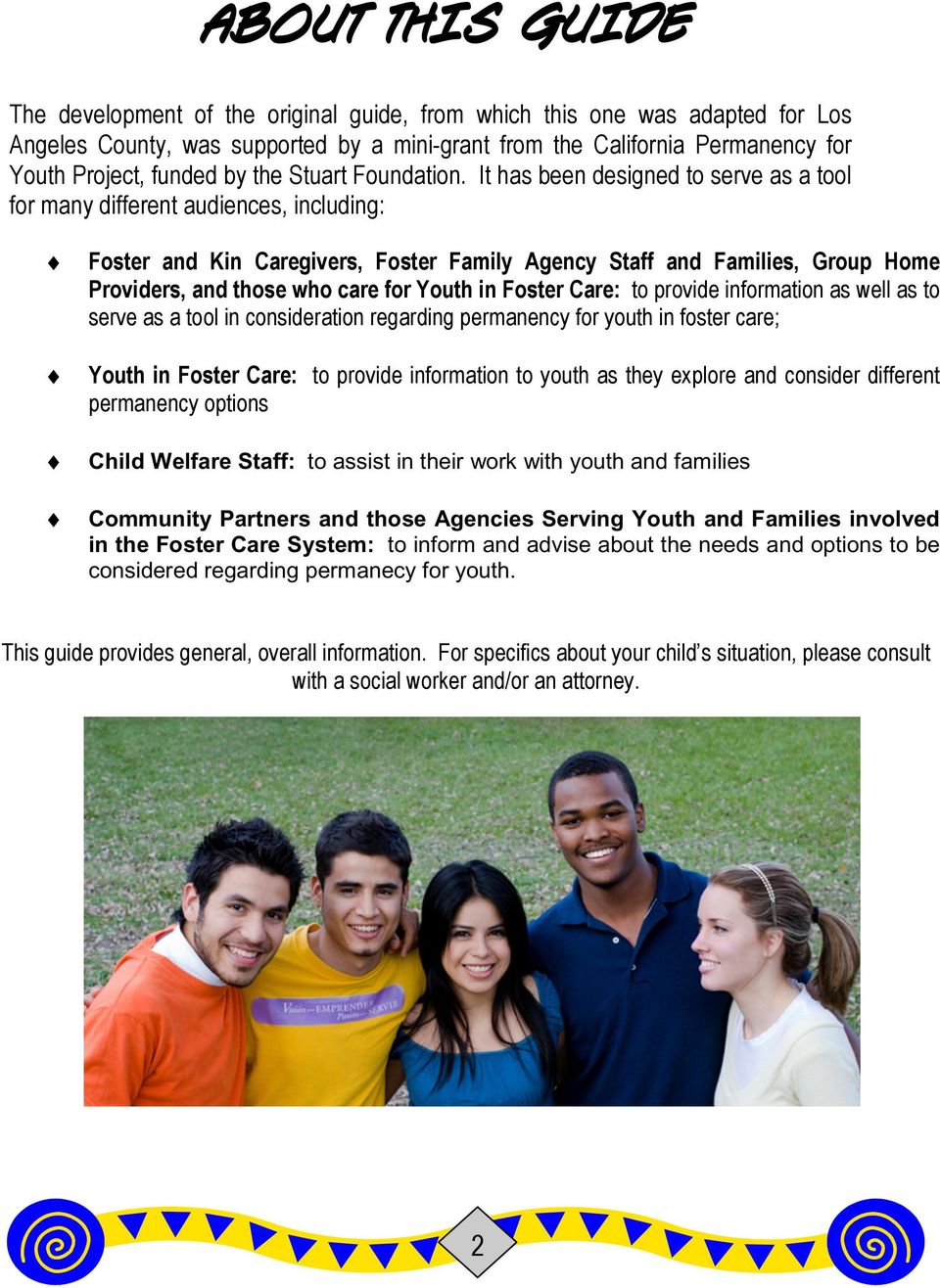
5 ABOUT THIS GUIDE The development of the original guide, from which this one was adapted for Los Angeles County, was supported by a mini-grant from the California Permanency for Youth Project, funded by the Stuart Foundation. It has been designed to serve as a tool for many different audiences, including: Foster and Kin Caregivers, Foster Family Agency Staff and Families, Group Home Providers, and those who care for Youth in Foster Care: to provide information as well as to serve as a tool in consideration regarding permanency for youth in foster care; Youth in Foster Care: to provide information to youth as they explore and consider different permanency options Child Welfare Staff: to assist in their work with youth and families Community Partners and those Agencies Serving Youth and Families involved in the Foster Care System: to inform and advise about the needs and options to be considered regarding permanecy for youth. This guide provides general, overall information. For specifics about your child s situation, please consult with a social worker and/or an attorney. 2
6 INTRODUCTION Foster care was designed to be temporary. Its purpose was to provide care for children living in unsafe and dangerous situations, while supportive services were offered to their families toward the goal of reunification. However, hundreds of thousands of children and youth find themselves growing up in foster care, without permanent families or any lifelong connections. Some children living in foster care have changed homes multiple times and many remain in the foster care system until they reach age of majority and age out of the system. In essence, many children are being raised in foster care. Many of these children have attended a variety of schools and received a spotty education. These same youth may not have a consistent group of friends or family, and have lost contact with those important to them. They lack permanence in their lives. Research tells us that every year in California, approximately 4,000 children leave foster care with no permanent family connection. These youth age out of foster care without a family to support them in their transition to adulthood. Without the social, emotional, and financial support typically offered to youth by their families, many former foster youth find themselves alone during this important period in their lives. Many youth face several serious challenges. Unable to overcome these challenges on their own, these youth have become over-represented in the populations of youth who are homeless. A disproportionate number of former foster youth become incarcerated, face early pregnancy, are poorly educated, and lack skills for employment. The fundamental role of foster care is being re-examined in order to improve outcomes for children and families involved in the child welfare system. All children are entitled to permanency, and the child welfare system is obligated to ensure this. Los Angeles County has expanded our vision and definition of permanency for our youth. We are striving to provide all children with a legally permanent plan of reunification, adoption or legal guardianship. Additionally, we have made a commitment to work toward the goal that no child leaves foster care without a lifelong connection to a caring adult. For youth that are not able to return home to their parents care, every effort must be made to identify adults to provide permanence for them so they do not grow up in foster care. If returning home is not possible, then a permanent connection must be identified to support the youth throughout their life upon aging out of the system. 3
7 It is important to recognize that for some youth, their families of origin remain their primary connection, despite their placement in foster care. Factors that may have posed safety issues for a young child may not be a serious concern as a child gets older and becomes more independent. Circumstances need to be assessed on a case-by-case basis, and a reconsideration of family reunification needs to be explored regularly for all children who are placed in out-of-home care. A permanency connection for a youth may be relational, physical, legal or all of the above. For some youth, a committed relationship with an adult may be what s most important, and may or may not include living in that person s home. A permanent connection may result in a plan of adoption or legal guardianship. However, while a legal arrangement represents a higher level of commitment, a legal commitment may not feel necessary to the same youth. Some youth have a negative view or limited understanding of adoption or guardianship and thus, these options may not have been explored or discussed. In some cases, a connection and a relationship may be identified, built and supported while the youth remains in foster care or a relative placement. A full exploration and understanding of all options is required, and families and youth need tools to begin exploration. Different situations require different solutions. It is critical that we understand the importance of creativity and flexibility when thinking about the needs of the children and youth we serve. It is essential that youth understand permanency and be supported to identify what a permanent, lifelong connection means to them in their lives. Youth need to be actively involved in planning for their futures. They need to be involved in the permanency planning process to help ensure that they do not leave foster care without a permanent, lifelong relationship. The more I moved around, the more I felt like I could just walk away from something if there was a problem. I felt there really wasn t anybody there for me, so what was the point in getting attached to anybody, because I was going to be moving pretty soon -- Anonymous foster youth 4
8 The California Permanency for Youth Task Force has defined Youth Permanency as follows: Permanency is both a process and a result that includes involvement of the youth as participants and leaders in defining for themselves what permanency means and in finding a permanent connection with at least one committed adult who provides: A safe, stable and secure parenting relationship, Love, Unconditional commitment, Lifelong support in the context of reunification, a legal adoption or guardianship where possible The opportunity to maintain contact with important persons, including brothers & sisters, A broad array of individualized permanent options exist: reunification, adoption and legal guardianship are three among many that may be appropriate. With the recognition of the urgent need for permanent, lifelong connections for all youth in foster care, the importance and need for training and education have become paramount. Traditionally, permanency was only considered an option for young children. Los Angeles County is challenging this myth. This Guide was developed to serve as a tool to assist in the consideration and exploration of permanent, lifelong committed relationships and permanent family for youth in foster care in Los Angeles County. In Los Angeles County all children deserve a legally permanent home through reunification, adoption or legal guardianship. Every child has the right to have a permanent, lifelong connection! 5

9 25 THINGS A PERMANENT FAMILY AND CONNECTION CAN MEAN 1. Lifelong relationship 2. Family 3. Friendship 4. Unconditional love 5. Ongoing support 6. Extended family-like relationships 7. Knowing that someone cares 8. Continuity 9. Someone to go home to 10. Sharing life s ups and downs 11. Someone to call on in times of crisis 12. Someone to call just because 13. Being there 14. Defining family together 15. Sharing holidays 16. Celebrating special times together 17. Someone to check-in with regularly 18. Shared history 19. Assistance around major decisions 20. Growing and changing together 21. Being accepted no matter what 22. Someone to trust 23. Having someone to stand by you 24. Knowing someone is proud of your accomplishments 25. Knowing that your are not alone 6

10 YOUTH INVOLVEMENT IN PLANNING FOR PERMANENCE Youth in foster care must be actively involved in planning for their own future and engaged in the permanency planning process. By being actively involved, youth can help ensure that they do not leave foster care without a legally permanent home or, at minimum, a permanent, lifelong connection. Through discussion and exploration with social workers and caregivers, youth can to develop an understanding of what permanency means to each of them in their own lives. Youth must be supported to define for themselves what permanency means. In Los Angeles, youth can and have been active participants, and may even lead the planning process so that they establish a permanent, lifelong connection with at least one committed adult before they exit foster care. Exploring options for permanence must include an in-depth discussion with the youth. Working towards permanence may focus on the legalization the youth s placement with their current caregivers through adoptions or legal guardianship, or, depending on the youth s unique situation, a reconsideration of family reunification may be explored. The exploration may lead to reconnecting and/or establishing relationships and ties with extended family members. Efforts may also lead to supporting and building relationships with past or present adults in the youth s community. Youth may identify important adults from their past or adults who are now part of their lives. If considerations of current or past connections are not fruitful, with the youth s consent, active recruitment efforts can be made. Recruitment for a potential connection with a family that may lead to legal permanent placement and a lifelong relationship can be child specific, based on the specific needs, desires and interests of the youth. Exploring options for permanence must begin with the needs, desires and experiences of the youth. Everybody works a different way. I didn t care for permanency until I left the system and didn t start looking for it until a couple of years ago. That s why there should be many opportunities to engage in this interaction -- Anonymous foster youth 7

11 RECONSIDERING REUNIFICATION Exploring permanency options for youth must include considering whether or not it is possible for the youth to safely return to their parents care. It is essential that each youth s situation be reviewed to determine the best plan for permanency. While some youth that remain in out-of-home care lose contact with their families, some youth maintain ongoing contact and visitation. We must recognize that for some youth, their families of origin remain active, primary connections. It is a fact that some teens run away from their foster homes and return to the homes of their parents, without Court approval. We know that some youth in out-of-home care are not open to forming strong connections with other adults because of the strong bond that they may continue to have with their parents. In some cases, problems that were factors that resulted in removal of their young children may have improved or may have resolved for some parents. Some factors that may have posed safety issues for a young child may not be a serious concern as a child gets older and more independent. A reconsideration of family reunification needs to occur regularly for all children who are placed in out-of-home care. Sometimes if a child was originally removed from their mother s care, placement with the father may not have been given full consideration. Both parents, as well as maternal and paternal relatives, need to be reconsidered and regularly assessed when appropriate. Additionally, the circumstances of some extended family members who may have originally been ruled out for potential placement may have changed. All options need to be explored and reviewed on a continuous basis. The social worker should have the conversation, but we shouldn t just put permanent connections on the social worker. Ask the youth who is important in their life. Have them make a list. -- Anonymous foster youth 8
12 UNDERSTANDING PLANNED PERMANENT LIVING ARRANGEMENT IS NOT PERMANENCE Foster care is meant to be temporary and does not provide legal permanence for a child. The Department continues to maintain custody of the child through his/her 18 th birthday or, under certain circumstances, until age 21 (see chart on page 26 for applicable ages and circumstances). The Court may retain jurisdiction up to age 21 as well. The birth parents can challenge the continuing need for custody in Court. The Department may remove the child from the caregiver s home, or the caregiver may request the child s removal. Placement can disrupt at any time. Birth parents rights are generally not terminated and birth parents maintain the right to visit and be involved in major decisions regarding the child, depending on the situation. The Department makes recommendations to Court regarding the child, and the Juvenile Court makes major decisions. Why Foster Care is Generally Discouraged as an Option for Permanency: Foster care was established to be temporary in nature. Without a clear legal commitment by the caregiver to raise a youth, some youth end up moving from placement to placement. Placement disruptions often occur at various developmental stages and at the most critical times when they need committed, caring adults to hang in there with them. For many youth, there is a stigma attached to being in foster care. For many youth, there is a negative connotation when labeled as a foster child. Some youth may not feel that they are true members of a family. Remaining in foster care presents interference in daily life both for the family and youth, such as regular social worker visits, or the need to obtain Court permission to participate in normal family and school activities, including vacation and travel plans. The Court maintains major decision-making authority rather than the youth s caregiver. There may be feelings of isolation for the youth and/or foster family. Some Questions FOR SOCIAL WORKERS AND CAREGIVERS to Consider When Contemplating a Move for a Youth with a Plan of Planned Permanent Living Arrangement to a Legally Permanent Arrangement: Has permanency been explored with the youth and have the youth s wishes and needs been considered? Could the youth do anything for you to decide that they had to leave your home? Even if a youth had to leave your home for a period of time or receive therapeutic or residential treatment, is there anything that they could do to no longer be a part of your family? Are there financial considerations that need to be explored and resolved for you to consider a higher level of permanency? Are there services that you receive for the youth from the Agency that may be available in the community? Is this a permanent or conditional commitment? If it is conditional, what would need to happen to make it permanent? It was always known that there was a difference between me and her own children. I grew up knowing that those are her kids and I m a foster kid. -- Anonymous foster youth 9

13 CONSIDERING LEGAL Relatives and non-relatives may become legal guardians. Becoming a legal guardian involves a legal commitment and a Court order that changes the youth s status from being a foster child. In most relative guardianship cases, the youth s Juvenile Court Dependency is dismissed. While this commitment does not provide as high a level of legal permanency as adoption, legal guardianship is a viable option to be considered by families and youth. About Legal Guardianship: Birth parent(s) can stay involved giving the child, in a sense, two sets of parents. This can be seen as a benefit for some families depending on their relationship with the birth parent(s). Birth parent(s) may maintain the right to have reasonable visitation. Birth parent(s) may have the right to petition the Court to regain custody if their circumstances change this may be seen as either a positive or a negative. Guardians may petition the Court to have the guardianship overturned or the guardian may go back to Court and request the child/youth be returned to the birth parent(s). Relative legal guardians in California may be eligible for financial assistance through the Kin-Gap Program and a special rate may be considered, depending on the needs of the youth. This funding is based on the basic foster care rate, found on the table on page 26. Non-relative legal guardians may be eligible for funding through foster care funding, and a special rate may be considered, depending on the needs of the youth. SOME QUESTIONS TO CONSIDER WHEN CONTEMPLATING A COMMITMENT TO A YOUTH, WITH A PLAN OF LEGAL : Has permanency been explored with the youth and have the youth s wishes and needs been considered? With legal guardianship will the youth feel that they are a second class family member? Will the youth fear being kicked out if they misbehave? Are you making a permanent commitment to raise and be a lifelong family to the youth? Do the birth parents still have rights? Have reservations regarding committing to adoption of the child been fully explored? Is this a permanent or conditional commitment? Have the various options been explored with the youth? Is there a hope that the youth will ultimately be reunified with their birth parents? Is reunification an expectation by the caregiver and if so, is the guardianship a temporary commitment? If the child reunifies, what happens to the guardianship and financial support? Although a legal guardianship relationship legally ends at age 18, is the existing relationship still a lifelong commitment to the youth? I think if I had a role model in my life, or just a man figure to give me knowledge he had as a young man, that would have really meant a lot, made me a better person. -- Anonymous foster youth 10

14 CONSIDERING ADOPTION Adoption offers children and youth the highest legal level of permanence, after reunification. The Adoptions and Safe Families Act of 1997 (ASFA) requires that adoption be explored for any child who has been removed from his or her family for 15 of the last 22 months, although the law also includes some specific exceptions to adoption as the case plan. It is critical to remember however, that adoption is not the only option for permanence, and that all permanency options should be explored. Historically, only very young children were considered for a permanent plan of adoption. As awareness has grown regarding the urgent needs facing children and youth growing up in foster care with few or no permanent connections, attitudes regarding adoption for older children and youth have changed throughout the state and the country. There are several myths about adoptive families that must be explored and dispelled. Adoptive families can be related or non-relatives; they can be single, a couple, heterosexual, gay, lesbian, bisexual or transgender. The law requires that the adopter must be at least 10 years of age older than the person s/he is planning to adopt but this can be waived by the Court under certain familial circumstances. There are also several common myths about adoption of older children, which must be challenged as well. The primary myth to confront is that adoption is not an option for older children and that these youth are unadoptable. There is no such thing as a child or youth that is unadoptable! Nobody is ever too old to need a committed, supportive and loving family! All children and youth are adoptable, regardless of age, ethnicity, sibling group size, disability, sexual orientation or special needs. Whether adoption is the best permanent plan or not depends on the desires of the older child or youth, the legal circumstances of their case, and other important factors related to their situation. It is important to understand that families and youth together can redefine what adoption and family mean to them. Some important facts to know about adoption: Kinship adoption is a viable option for family and non-related extended family members. Adoption is an option for older youth and young adults, not just a plan for babies and young children. Adoption does not have to mean losing contact with birth family. Youth 12 and older must consent to being adopted. Open adoption is an option if all parties agree. Termination of parental rights does not have to mean the severing of relationships. Tribal Customary Adoption, for ICWA eligible children, allows for adoption without terminating parental rights. Adoption by a relative does not mean changing familial relationships. For example, a grandmother who adopts her grandchild becomes the legal parent, but can choose to remain in name and in fact, the child s grandmother. Voluntary Mediation services are available to develop a Post-Adoption Contact Agreement between adoptive and birth families, for ongoing contact and visitation. The original birth certificate can be, but does not have to be, amended after adoption. Adoptive parents must designate in their Will who is to care for all their minor children in the event of their deaths. Financial support and post-adoption services are available after adoption of a Court dependant child. It s important to know that there is someone I can count on who wouldn t turn their back on me. -- Anonymous foster youth 11

15 When first considering a plan of adoption with teens, we commonly find that: Some youth may say that they do not want to be adopted. This is often accepted by caregivers or social workers, without taking the time to explore underlying concerns, doubts, or fears about what adoption means to them. This exploration needs to be supported and encouraged. NO may just be a first response. Common myths about teenagers and adoption must be examined. What adoption means can be redefined for and by each individual youth and their prospective adoptive family. Some youth may think, Why bother? I m going to turn 18 in years anyway. Many youth doubt anyone would want to adopt a teenager. Some youth may feel that agreeing to adoption may mean betraying their birth parents. Some youth may think that adoption will mean that they will lose their connection or future connection to their birth parents and/or siblings. Some youth may not have ever considered the value of what a permanent, lifelong connection can offer them. Some youth may have experienced multiple placement failures that have resulted in fear of rejection and mistrust. Some Questions to consider when contemplating a commitment to a Youth with a plan of Adoption: Has adoption been explored with the youth and have the youth s wishes and needs been considered? Is the youth open to a plan of adoption? What is my own motivation to adopt this youth? Do I understand the legal and financial aspects of adoption? Am I willing to make an unconditional, lifelong parenting commitment to an older child or youth? 12

16 1. No diapers to change. TOP TEN REASONS TO ADOPT A TEENAGER 2. They sleep through the night. 3. They will move out sooner but can still visit. 4. You don t just get a child, you get a friend. 5. They will keep you up to date on the latest fashion. 6. No more carpools They can drive you places. 7. No bottles, formula, or burp rags required. 8. They can help around the house. 9. They can learn from you. 10. They can teach you how to operate your computer! Concept: Oklahoma Youth Advisory Board
17 YOUTH DEVELOPMENT SERVICES INDEPENDENT LIVING PROGRAM (ILP) & Transitional Housing Program Many foster youth do not have the support systems they need to prepare them for adulthood, or to support them once they reach adulthood. For some youth this lack of support system is due to their length of time in the foster care system, for others it may be due to the nature of the reason they are in foster care. Many youth emancipate from foster care without necessary life skills and supports to face the challenges of living on their own. Youth Development Services (YDS) recognizes the urgent need for youth to have lifelong, permanent relationships with stable, loving adults. The program supports and promotes the building of interdependent relationships and permanent connections for the youth it serves. Youth Development Services is a Federal and State funded program. In Los Angeles County the Department of Children and Family Services strives to provide every eligible foster care youth with independent living skills training to assist in his or her transition to a successful independent lifestyle. Youth Development Services is an entirely voluntary program. General Summary of Services: Life Skills Training and Counseling, including: life skills training is offered through the Community College Foundation; which includes budgeting, cooking, managing a bank account (checking & savings), communication skills, how to apply for a job, educational resources, living independently, drug and alcohol abuse counseling, sexuality, and peer pressure counseling as well as referrals to community resources. Educational Supports, including: tutoring, educational advocacy, college advising, assistance with obtaining and reviewing transcripts, GED and SAT preparation, assistance with financial aid and scholarship applications. Job Training and Placement, including: assistance in finding job openings, filling out applications, developing interviewing skills, learning appropriate workplace behaviors, classes, including computer training and internship opportunities. Concrete Financial Support, including bus passes, Driver s Education Assistance for Emancipated Youth, emergency financial assistance, financial incentive for participation in ILP; college application fee, Chafee Funds for higher education. Housing Assistance, including referrals to existing housing programs for emancipated youth which includes DCFS Transitional Housing Program and other community based programs, short term rental assistance, and dormitory and apartment start-up assistance. Medical Support, including assistance in accessing medical services, Medi-Cal eligibility and public health nurses are available. Expanded Services, to former foster youth ages 18 21, includes assistance with housing, education, employment, childcare, medical care, transportation, uniforms, tools and driver s licenses. Eligibility Youth who were in foster care after their 16 th birthday are eligible, up to age 21. Former DCFS foster youth or probation foster youth who reside with a related legal guardian who is currently receiving Kin-Guardian Assistance Payment (Kin-GAP) regardless of their age when Kin-Gap began are eligible. Children and youth adopted from a state or federally funded placement after their 16th birthdays are eligible for YDS, up to age 21 except some specific financial assistance/housing assistance programs. Youth in Non Related Legal Guardianship in which guardianship was established between ages 8 and 15. Youth adopted prior to their 16th birthday are not eligible for YDS through DCFS.* * see FAFSAA information regarding youth who leave care after their 13 th birthday 14
18 FREQUENTLY ASKED QUESTIONS 1. Q: Are adopted or Legal Guardianship youth still eligible for YDS? A: Youth who are in foster care on their 16 th birthday, with adoption or legal guardianship occurring after that birthday, are eligible for all YDS excluding those services related to housing support and some programs related to financial support for higher education. As of 01/10/11 youth in Non Relative Legal Guardianship which was established between ages 8 and 15 are also eligible. 2. Q: Does choosing to become an adoptive parent or Legal Guardian to youth under age 16 limit opportunities for youth? A: Yes when families commit to provide stable, lifelong, permanent family for children and youth outside of the foster care system, they provide them with permanency that all children and youth need and deserve. Committed families offer invaluable guidance, support and family resources to children and youth. Many of the YDS substitute for the experiences, stability, life skills and support that the average family offers their children. AB12 provides that children who are in foster care, or placed with a relative receiving CalWorks, or placed with a Nonrelated Guardian or receiving KinGap or AAP (as long as the youth attained age 16 before the negotiated KinGap or AAP agreement became effective) may be eligible for age extension of services. See chart on page 26 for effective years and circumstances. 3. Q: If youth are adopted or under Legal Guardianship before they turn 16, where can they obtain services similar to those offered through YDS? A: As stated above, many YDS substitute for the experiences, stability and support that most families offer their children. Resources with the family s community or school may be available and include similar services, such as tutoring, computer classes, college prep. and educational advocacy. 4. Q: What are the financial benefits of YDS? A: YDS can offer concrete funds, in times of emergency, for assistance with funds for driver s education, etc. The Fostering Adoption to Further Student Achievement Act (FAFSAA) signed into Law in September 2007 provides that foster youth, who are adopted and leave foster care after their 13 th birthday and plan to go to college or vocational school, qualify for state and federal funds, based on their income only. This means that the adopted youth s parents income is not considered in determining need for college grants and loans. 5. Q: Is it ever in the best interest of youth to remain in foster care so that to obtain YDS? A: As stated above in question 2, many YDS substitute for the experience, stability, life skills, and support that most families can offer their children. The YDS Program was designed to serve youth that had no choice but to be in foster care, were going to be emancipating from the system, and were in need of skills and services to support them. Exiting foster care to be in the care of a loving, permanent family is almost always in the best interest of youth. It s really important to make sure before emancipating a youth that they have one person; if I have somebody that I know I can depend on, that loves me and cares that I wake up tomorrow and am still breathing, I can get through it. I can walk through it. -- Anonymous foster youth 15

19 6. Q: Is it ever in the best interest of youth to remain in foster care so that they can obtain financial support for college? A: For youth who are planning to attend college or vocational school, financial concerns are considered when exploring a plan of Legal Guardianship or Adoption. To some youth and families, access to financial assistance programs does not outweigh the importance and value of exiting the foster care system and achieving legal permanence. Other youth and families may be in need of the financial assistance programs that generally benefit youth emancipating from foster care at age 18 or, under certain circumstances, until age 21 (see chart on page 26 for applicable ages and circumstances). FAFSAA, signed into law in September 2007, allows foster youth who are adopted and exit the foster care system after their 13 th birthday to apply for financial aid for higher education without having their parents income considered in determining the need for grants and loans. Depending on the youth s plans, the adoptive family s income and their general access to funds for college, some youth and families may find it to be in the youth s best interest to remain in foster care through age 18 (or 21 under certain circumstances.)** 7. Specifically, how does adoption affect a youth s eligibility for state and/or federal funding for higher education? A: Adoption prior to a youth s 16 th birthday may affect a youth s eligibility for some types of state college loans and funds, since eligibility is based on the total income of the entire adoptive family. Eligibility for Federal funds without consideration of parental income begins after the adopted youth s 13 th birthday. (The age 13 eligibility criteria only applies to adoption) Depending on this total family income, the youth may or may not be eligible for some types of financial assistance that they would be eligible for if they remained in foster care status through their 18 th birthday. 8. How does Legal Guardianship affect a youth s eligibility for state and/or federal funding for higher education? A: Legal Guardianship generally does not negatively affect a youth s eligibility for financial aid, since a legal guardianship youth s eligibility for state and federal college loans and funds is generally based solely on the youth s income, and the Legal Guardian s income is not considered. However, if the youth s birth parents have claimed the youth on their federal income tax for the past 2 years, that income may be considered. If this occurs, and the birth parents have not supported the youth during that period, an appeal can be filed through the financial aid office. ** 9. Q: What are Chaffee funds and who is eligible? A: The California Chaffee Grant Program offers up to $5,000 annually in free money to current or former foster youth to use for vocational school training or college courses. The amount is dependent on the cost of the specific school program. The money is free, meaning it is not a loan and does not have to be paid back. To be eligible, one must be at least a half time student and maintain satisfactory academic progress. Receipt of the award may affect other financial aid, so this must be explored with the financial aid office. All youth that were in foster care for any amount or time between their 16 th and 18 th birthdays, and have not yet reached their 22 nd birthday may be eligible for these funds. Information and applications for the Chaffee Grant Program are available at California Student Aid Commission Web when you click on Commission Programs. 10. Q: when a family or youth identifies finances for college as the primary reason against planning for adoption, does adoption have to be totally ruled out? A: No! Families and youth should remember that adult adoption is an option after age 18. Adoption can be reconsidered after college financial funding issues are no longer a factor. ** Starting 01/01/11 youth in state only funded Non Relative Legal Guardianship, which was established between ages 8 and 15 with no court jurisdiction, are automatically converted to Federal eligibility once they reach age18. 16

20 CHART 1: A COMPARISON OF FINANCIAL BENEFITS Chart 1 considers and compares the following factors in regard to Adoption, Legal Guardianship (Relative/ Non-Relative) and Planned Permanent Living Arrangement: 1. Eligibility for Financial Support/Determination of Rate 2. Payment Amount/Basic Rate 3. Special Needs Allowance 4. Consideration for Family Circumstances 5. Clothing Allowance 6. Financial Recertification 7. Tax Dependency 8. Child s Misconduct/Destruction of Property 9. Medical Insurance 10. Social Security (SSA-Dependent or Survivor Benefits) 11. Social Security Benefits (SSI-Based on Child s Eligibility) 12. Residential Treatment 13. Financial Assistance/Death of Caregiver 14. Financial Assistance/Child s Residence/Moves out of County 15. Financial Assistance/Child s Residence/Moves out of State/Country 16. ILP (Independent Living Program) Eligibility 17. Eligibility for Chafee Grant Program 18. Eligibility for Transitional Housing Placement Program (THPP) 19. Eligibility for ILP Housing Assistance Programs 20. Eligibility for Financial Assistance for Higher Education 21. Tax credit Citations of the laws and regulations supporting the information in the chart are provided at the end of the Guide. A brief overview of Funding Sources follows the chart. 17

21 COMPARISON OF FINANCIAL BENEFITS ADOPTION, LEGAL AND PLANNED PERMANENT LIVING ARRANGEMENT FACTOR ADOPTION [Adoption Assistance Program (AAP) Funded] (supported by Enhanced Kin- GAP) LEGAL NON-/ (supported by foster care funds) PLANNED PERMANENT LIVING ARRANGEMENT (Long Term Foster Care) 1. ELIGIBILITY FOR FINANCIAL SUPPORT/ DETERMINATION OF RATE Eligibility for funding is based on factors related to the child including: special needs, age 3 or over, sibling group, adverse parental background, and/or racial or ethnic minority. 1 There is no means test for families. 2 The AAP benefit is a negotiated amount based on the needs of the child and the circumstances of the adoptive family based on AAP regulations. 3 The AAP payment may not be more than the child would have received had s/he remained in state funded foster care. Adoptive parent determines how AAP funds are spent. 4 AAP ends at 18 unless a medical or physical disability warrants extension to age 21 Kin-Gap payment rate is based on the child s age and the rate is set by state regulations but may be adjusted due to the child s special needs. 5 The child must be placed with a relative for 6 consecutive months. 24a The legal guardian has the obligation to spend Kin-GAP funds for the benefit of the child. As of 10/01/06, Kin-Gap benefits have been extended to those youth in foster care under probation and under the supervision of the juvenile delinquency system. 6 To receive Kin-GAP funding, Court jurisdiction must be terminated. Normally, KinGap ends at age 18, or 19 if still in school, is expected to graduate, still lives with guardian and signs a KG1. Age extensions for youth entering KinGap after turning 16 will begin 01/01/12 see ACL for details. getinfo/acl/2011/11_15.pdf All non-relative guardians are eligible. The payment is based on the child s age, and the rate is set by regulation. 7 There may be allowance for special needs. To receive funding, Court jurisdiction must remain open. When a child is in a county licensed foster home, or with a relative and is federally eligible, foster care funds are based on the child s age. A special care increment may be individually applied. If the child is in a relative placement and does not meet federal eligibility guidelines, the relative may apply for CALWORKS. 8 SSI may also be available. The Foster Family Agency (FFA), group home, or residential treatment rate applies when the child is in a certified FFA home, group home, or residential treatment program & these rates do not include a special care increment. 2. PAYMENT AMOUNT BASIC RATE The basic payment amount is based on the child s age and based on approved foster family home care rates set by the state (refer to Foster Family Homes Schedule of Basic Rates) but may be adjusted due to the child s special needs. 9 Through Enhanced Kin-GAP payments, basic payment amount is based on the child s age and based on approved foster family home care rates set by the state (refer to Foster Family Homes Schedule of Basic Rates but may be adjusted due to the child s special needs. 10 The basic payment amount is based on the child s age and based on approved foster family home care rates set by the state (refer to Foster Family Homes Schedule of Basic Rates). 11 The basic payment amount is based on the type of placement as described above (refer to Foster Family Homes Schedule of Basic Rates). 48 If the child in foster care is not found to be federally eligible, and is placed with a relative caregiver, then the relative may apply for CALWORKS funds to support the child as a needy or nonneedy caretaker. Caretaker may apply for SSI if appropriate.
22 COMPARISON OF FINANCIAL BENEFITS ADOPTION, LEGAL AND PLANNED PERMANENT LIVING ARRANGEMENT FACTOR ADOPTION [Adoption Assistance Program (AAP) Funded] (supported by Enhanced Kin- GAP) LEGAL NON-/ (supported by foster care funds) PLANNED PERMANENT LIVING ARRANGEMENT (Long Term Foster Care) 3. SPECIAL NEEDS ALLOWANCE 4. CONSIDERATION OF FAMILY CIRCUMSTANCES The AAP payment amount is limited to the age related, state approved foster family home care rate, and any specialized care increment for which the child would have been eligible had s/he remained in foster care. The special needs allowance is based on the individual needs of the child and what the adoptive parent does to meet those needs. 12 Should a child have a disability that qualifies him/her to receive services from Regional Center, the child may be eligible to receive the Dual Agency Care Rate with a possible supplement for exceptional needs. 13 If child receives SSI, Social Security should be notified as they will need to deduct the AAP amount from the SSI the child receives. Circumstances of the family are considered in determining the AAP amount, however no means test may be applied. 16 As of 10/01/06, relatives may be eligible for Special Care rates, if the child s foster placement had been receiving a Special Care rate in the month prior to the child being placed with the relative. 13 Also, If a child, while in foster care, received a Dual Agency rate immediately prior to his or her enrollment in the Kin-GAP Program, the Kin-GAP rate will be the amount of the dual agency rate and supplemental rate for extraordinary care and supervision 13a Kin-Gap benefits may be extended to age 21 if youth has physical or mental disability that warrants continuation of assistance. 24a Family circumstances are not considered in determining the payment amount 7 KinGap payments will not be considered as income if a relative caregiver is applying for section 8 housing. The special needs allowance is based on the individual needs of the child and not the Legal Guardian s ability to meet those needs. 14 The rate would be equal to that which the child would have received had the child remained in foster care. Also if a child, while in foster care received a Dual Agency rate with a possible supplement for extraordinary need that rate may be paid in guardianship. Family circumstances are not considered in determining the payment amount. In county licensed homes or relative placements with foster care funding, the special needs allowance is based on the individual needs of the child and not what the caregiver does to meet those special needs. 15 A special rate allowance is not available for FFA, Group Home placements, or Residential treatment placements as these programs have a different rate setting structure; consideration of the special needs of the child are built into the rates. Also if a child, while in foster care received a Dual Agency rate with a possible supplement for extraordinary need that rate may be continue. Family circumstances are not considered in determining the payment amount. 5. CLOTHING ALLOWANCE No clothing allowance is provided 17 As of 10/01/06, Kin-GAP recipients are now entitled to the $100 annual state supplemental clothing allowance. In addition, children in receipt of Kin-GAP are now eligible to receive a Back-to-School Clothing Allowance. 11 An annual state supplemental clothing allowance is provided. Also a back-toschool clothing allowance, amount varies by county of residence. Annual clothing allowance is provided for youth in county licensed foster homes or youth who are in the homes of relatives who are receiving funds through foster care. 18. Also a back-to-school clothing allowance, amount varies by county of residence.
23 COMPARISON OF FINANCIAL BENEFITS ADOPTION, LEGAL AND PLANNED PERMANENT LIVING ARRANGEMENT FACTOR ADOPTION [Adoption Assistance Program (AAP) Funded] (supported by Enhanced Kin- GAP) LEGAL NON-/ (supported by foster care funds) PLANNED PERMANENT LIVING ARRANGEMENT (Long Term Foster Care) 6. FINANCIAL RECERTIFICATION 7. TAX DEPENDENCY 8. MISCONDUCT/ DESTRUCTION OF PROPERTY 9. MEDICAL INSURANCE AAP must be recertified at least every 2 years. 19 There are no age related increases however the AAP benefit can be reviewed for change at any time the child s need s change. Documentation is necessary for a review for change in rate. The adopted child is generally a tax dependant of the adoptive parents. Families should consult with their tax consultant for direction. 20 An adoptive parent is liable to the same extent as a birth parent. An attorney should be consulted regarding specific situations. 22 Children eligible for AAP are eligible for MediCal. 23 The family may enroll the child under their private health insurance; private insurance is used first. MediCal is still provided and may offer some benefits that private insurance does not. If funding is state only, and the family lives in or moves out of state, the new state may not honor MediCal. 24a Consult the AAP hotline (800) for states that will not honor federal Medi-Cal reciprocity for families who live in or move to another state. The kin guardian will likely have no social worker contact unless the case remains open in Court. Legal Guardians must complete an annual Kin-Gap re-determination (KG2) or funding will stop. Kin-Gap youth may receive age related increases. Kin- GAP is recertified al least every two years however DCFS and the guardian may negotiate a new benefit more frequently than every two years. The child may be an allowable tax dependant of the relative guardian. Families should consult with their tax consultant for direction. 21 The Legal Guardian is liable to the same extent as a birth parent. An attorney should be consulted regarding specific situations. 22 Child is eligible for MediCal or the family may enroll the child under their private health insurance; if enrolled,,private insurance is used first. MediCal may cover what private insurance does not. 24 If Kin-Gap funding is state only, and the family moves out of state, the new state may not honor MediCal. 24a Consult the Foster Care hotline (800) for states that will not honor federal Medi- Cal reciprocity for families who live in or move to another state. The guardian must go through an annual recertification The child may be an allowable tax dependant of the legal guardian. Families should consult with their tax consultant for direction. 21 The Legal Guardian is liable to the same extent as a birth parent. An attorney should be consulted regarding specific situations. 22 Child is eligible for MediCal or the family may enroll the child under their private health insurance; if enrolled, MediCal may cover what private insurance does not. 25 DCFS recertifies child s eligibility annually The child may be an allowable tax dependant of the foster parents. Families should consult with their tax consultant for direction. 21 The foster parent is not legally liable for the behavior of the child. 23 Child is eligible for MediCal. 25
24 COMPARISON OF FINANCIAL BENEFITS ADOPTION, LEGAL AND PLANNED PERMANENT LIVING ARRANGEMENT FACTOR ADOPTION [Adoption Assistance Program (AAP) Funded] (supported by Enhanced Kin- GAP) LEGAL NON-/ (supported by foster care funds) PLANNED PERMANENT LIVING ARRANGEMENT (Long Term Foster Care) 10. SOCIAL SECURITY (SSA-DEPENDANT OR SURVIVOR BENEFITS) When an adopted parent(s) retires, becomes unable to work due to disability, or dies, the adopted child may be eligible for dependant or survivor benefits. The child may be eligible for SSI benefits due to disability. The adoptive family directly receives the funds for the care of the child. 26 Family must report AAP benefits when applying for SSI. When the birth parent(s) retires, becomes unable to work due to disability, or dies, the child may be eligible for dependant or survivor benefits. If the SSA amount exceeds the Kin-GAP rate, the Kin-GAP funds may be ended and the full SSA amount can be paid to the legal guardian. 27. If Child is on SSI and Regional Center client, the Regional Center provides case management. If receiving the Specialized Care Rate from DCFS, this amount may be higher than SSI. When the birth parent(s) retires, becomes unable to work due to disability, or dies, the child may be eligible for dependant or survivor benefits. The Legal Guardian may choose to receive social security benefits or foster care benefits. 27. If Child is on SSI and Regional Center client, the Regional Center provides case management. If receiving the Specialized Care Rate from DCFS, this amount may be higher than SSI. SSA determines who the payee is for SSA funds for dependant children, when the birth parent is disabled or dies. The funds are generally paid to DCFS (unless the agency is not paying for the placement in which case, the payee would be the caretaker)and are applied to the foster care expense for the cost of the child s placement. A trust fund account is established for any extra funds, and the DCFS is responsible to use these funds to meet the child s needs. Trust accounts cannot go beyond $2, SOCIAL SECURITY (SSA-DEPENDENT OR SURVIVOR BENEFITS, SSI- OR OTHER INCOME BASED ON THE CHILD S ELIGIBILITY) An adopted child may be eligible to Supplemental Security Income (SSI) benefits due to a disability. 29 The adoptive family directly receives these funds for the care of the child. (Note: AAP funding and SSI Benefits are both federal programs and the family may only receive the maximum rate for which the child is eligible, funds cannot overlap). An adopted child may be eligible for dependent or survivor benefits. When the child is disabled, the same factors apply as described above. While Kin-Gap programs generally apply the exemption to earned income of a dependent child or ward of the juvenile court, caregivers should consult with the SSA office for more specific information. When the child is disabled, the same factors apply as described above. I f the SSA amount exceeds the foster care rate, the foster care rate may be ended and the full SSA amount may be paid to the legal guardian. When the child is disabled, the same factors apply as described above.
25 COMPARISON OF FINANCIAL BENEFITS ADOPTION, LEGAL AND PLANNED PERMANENT LIVING ARRANGEMENT FACTOR ADOPTION [Adoption Assistance Program (AAP) Funded] (supported by Enhanced Kin- GAP) LEGAL NON-/ (supported by foster care funds) PLANNED PERMANENT LIVING ARRANGEMENT (Long Term Foster Care) 12. RESIDENTIAL TREATMENT 13. FINANCIAL ASSISTANCE/ DEATH OF CAREGIVER AAP covers the cost of the stateapproved rate for group home placement or residential treatment program for which the child is eligible, up to 18 months per episode. 30 For out of state placement, AAP only covers room and board AAP funding can only be paid to an adoptive parent. AAP funding will end upon death of adoptive parent(s). AAP can be re-initiated if the child is adopted again. 31 To access fund for group home placement or residential treatment, guardianship may need to be rescinded and/or dependency reinstated. Guardianship funding terminates in the event of the death of the guardian(s); however, Kin-GAP Guardianship benefits may continue if there is a successor Guardian. 32 To access fund for group home placement or residential treatment, guardianship may need to be rescinded and/or dependency reinstated. Guardianship funding terminates in the event of the death of the guardian(s); however, Foster Care Guardianship benefits may continue if there is a successor Guardian. 32 Funding is provided for placement in group home or residential treatment, based on child s eligibility and the state approved rate. The DCFS continues to be responsible for the financial care and placement needs of the child upon the death of the foster parent(s) or caregivers. 14. FINANCIAL ASSISTANCE/ CHILD S RESIDENCE/ MOVES OUT OF COUNTY The adoptive parent solely determines residence. AAP funding is paid to family regardless of where adoptive families choose to live in another county, another state or another country. 33 In order to receive funding, the family must keep DCFS informed of their current address. Funding may change dependent on the new county s rate if it is higher than Los Angeles. Guardians have the right to move out of county. Each county is responsible for paying the child's aid regardless of where the child actually resides, so long as the child resides in California. 34 Guardians have the right to move out of county, but must obtain Court permission and the case transferred to the new Court. 34 If guardian moves to another county and the court case is closed, but the family has an open services case with DCFS, the service case will be closed. The family has to inform DCFS of the new payment address. If the family wishes to receive funding in the new county, a new case must be opened in the new county for funding purposes. Legal residence is determined by residence of birth parents. (However, the child is eligible to attend school in the jurisdiction where s/he is placed.) Courtesy supervision is arranged when a child moves with a caregiver out of county. Court and the Agency determine where the child lives. 35
26 COMPARISON OF FINANCIAL BENEFITS ADOPTION, LEGAL AND PLANNED PERMANENT LIVING ARRANGEMENT FACTOR ADOPTION [Adoption Assistance Program (AAP) Funded] (supported by Enhanced Kin- GAP) LEGAL NON-/ (supported by foster care funds) PLANNED PERMANENT LIVING ARRANGEMENT (Long Term Foster Care) 15. FINANCIAL ASSISTANCE/ CHILD S RESIDENCE/ MOVES OUT OF STATE/ COUNTRY 16. YDSD - YOUTH DEVELOPMENT SERVICES DIVISION (FORMERLY THE EMANCIPATION DIVISION) INDEPENDENT LIVING PROGRAM ELIGIBILITY The adoptive parent solely determines residence. 58 AAP funding is paid to family regardless of where adoptive families choose to live in another county, another state or another country. 36 In order to receive funding, the family must keep DCFS informed of their current address. Funding may change dependent on the new state s rate if it is higher than Los Angeles Youth adopted after their 16 th birthday who are/were in a federal or state funded placement after their 16 th birthday are eligible to receive ILP services through age 20. ** If a youth is receiving Adoption Assistance Payment (AAP) prior to their 16th birthday the youth IS NOT ILP ELIGIBLE. This is applicable even if the adoption is finalized after their 16 th birthday. **Adopted youth are not eligible for most transitional housing programs. 38 Kin-Gap funding is available when the family moves out of state. For Federally eligible children, caregivers will need to apply for Medi-Caid in the new state. For state only funded children, the new state may not honor Medi-Caid for California known as Medi-Cal. Call the funding hotline (800) to ask about Interstate Compact On Adoption and Medical Assistance (ICAMA) 24a Former DCFS foster youth or probation foster youth who reside with a related legal guardian who is currently receiving Kin-Guardian Assistance payment (Kin GAP) regardless of their age when Kin GAP began are eligible to receive ILP Services 388 Petition: Kin-GAP youth are ILP eligible at age 16. Kin GAP relative Guardians do not need to file a 388 petition. They should proceed to contact the DCFS Youth Development Services Division, Independent Living Program (Metroplex Transition Resource Center (TRC) at Except: Youth when Kin-GAP is rescinded prior to age 16 are ineligible unless he/she are in a federal or state funded placement after their 16 th birthday. In accordance with W&IC section Court permission must be obtained to move out of state. Interstate Compact Program Rules must be followed. If the court case is closed, Guardianship and/or funding may need to be reestablished in the new state/ country and, is subject to the new state or country s laws and eligibility rules. Effective 01/01/11, Youth in Legal Guardianship after their 16 th birthday who are/were in a federal or state funded placement after their 8 th birthday are eligible to receive ILP services through age 21. (This is not Kin-GAP). State only funded youth will automatically convert to Federal at Petition: Example 1: Kin GAP Legal Guardians files 388 petition, the 388 is granted, Guardianship is rescinded, prior suitable placement order is reinstated and their current home is a certified/federal or state funded placement. The youth is ILP Eligible if age 16 to 21. Example 2: Relative Legal Guardian files a 388 petition to have jurisdiction reinstated, the 388 is granted, youth remains in the home of Legal Guardian with all existing orders in full force and effect = Not ILP Eligible as this is HOP. Legal residence is determined by residence of birth parents. Courtesy supervision is arranged when a child moves with a caregiver out of county or out of state. Interstate Compact Program rules must be followed when a child moves out of state and licensing/ certification procedures for that state must be followed, in order for payment to be made to caregiver by the Agency. 37 Youth who remain in foster care through their 16th birthday and after are eligible for ILP services through age Effective 01/01/12, a new placement option i.e. THP-Plus-Foster Care will be available for non-minor dependents. The social worker must request these services.
27 COMPARISON OF FINANCIAL BENEFITS ADOPTION, LEGAL AND PLANNED PERMANENT LIVING ARRANGEMENT FACTOR ADOPTION [Adoption Assistance Program (AAP) Funded] (supported by Enhanced Kin- GAP) LEGAL NON-/ (supported by foster care funds) PLANNED PERMANENT LIVING ARRANGEMENT (Long Term Foster Care) 16. YDSD - YOUTH DEVELOPMENT SERVICES (Continued) , a child, who is in the federallyfunded Kin-GAP Program and who is participating in a transitional independent living case plan, may retain assets up to $10,000. Note: Youth must be suitably placed in a federal or state funded placement (substitute care) after their 16 th birthday to be ILP eligible. Example 3: Legal Guardianship is rescinded and the youth returns to HOP. The youth is not ILP Eligible. 17. ELIGIBILITY FOR CHAFEE GRANT PROGRAM 18. ELIGIBILITY FOR TRANSITIONAL HOUSING (THPP) 19. ELIGIBILITY FOR YDS HOUSING ASSISTANCE PROGRAMS Youth in foster care or adopted after their 16 th birthday are eligible for Chafee Grant funding. Chafee Grant provides up to $5,000 in free money (no pay back required) while youth attend college. The amount awarded depends on the cost of attendance and unmet need. Youth must access Chafee funds prior to their 21 st birthday; eligibility continues through the youth s 23 rd birthday. ** If a youth is receiving Adoption Assistance Payment (AAP) prior to their 16th birthday check with the ILP coordinator if child may be eligible. 40 N/A Youth must be in foster care on/after their 16 th birthday. 41 N/A Youth must be foster youth at age 18 and over to be eligible. 42 Youth in foster care on/after their 16 th birthday and in Kin-GAP Legal Guardianship are eligible for Chafee Grant funding. Chafee Grant provides up to $5,000 in free money while youth attend college. The amount awarded depends on the cost of attendance and unmet need. Youth must access Chafee funds prior to their 21 st birthday; eligibility continues to the youth s 23 rd birthday. N/A Youth must be in foster care on/after their 16 th birthday. Youth in Legal Guardianship after their 18 th birthday are eligible for YDS housing programs. Slots are limited. 42 Youth in foster care on/after their 16 th birthday and in Legal Guardianship are eligible for Chafee Grant funding. Chafee Grant provides up to $5,000 in free money while youth attend college. The amount awarded depends on the cost of attendance and unmet need. Youth must access Chafee funds prior to their 21 st birthday; eligibility continues to the youth s 23 rd birthday. N/A Youth must be in foster care on/after their 16 th birthday. Youth in Legal Guardianship after their 18 th birthday are eligible for YDS housing programs. Slots are limited. 42 Youth in foster care on/after their 16 th birthday and after are eligible for Chafee Grant funding. Chafee Grant provide up to $5,000 in free money (no pay back required) while youth attend college. The amount awarded depends on the cost of attendance and unmet need. Youth must access Chafee funds prior to their 21 st birthday; eligibility continues to the youth s 23 rd birthday. Youth must be 16 through 18 years old in a foster care placement and a dependent of the court. Youth over the age of 18 but not 19 may be considered if they have not satisfied the requirements of the Welfare Institutions code, Section Kin-GAP youth need to be a Court Dependent, eligible for AFDC/FC eligible). Youth who remain in foster care through their 18 th birthday are eligible for housing programs. Slots are limited. 42
28 COMPARISON OF FINANCIAL BENEFITS ADOPTION, LEGAL AND PLANNED PERMANENT LIVING ARRANGEMENT FACTOR ADOPTION [Adoption Assistance Program (AAP) Funded] (supported by Enhanced Kin- GAP) LEGAL NON-/ (supported by foster care funds) PLANNED PERMANENT LIVING ARRANGEMENT (Long Term Foster Care) 20. ELIGIBILITY FOR FINANCIAL ASSISTANCE FOR HIGHER EDUCATION The Fostering Adoption to Further Student Achievement Act (FAFSAA) is part of the College Cost Reduction and Access Act, PL , Adopted youth may be eligible for federal and state financial aid; however, eligibility for state funds is based on the youth and adoptive family s income. Eligibility for Federal funds takes only the youth s income into consideration if the youth was adopted after age 13. Youth should consult with school s financial aid office. Visit: ngforcollege/financialaidandfafsa/fos teryouthtipsfafsa.htm for tips on completing the FAFSA. Kin GAP Legal Guardianship youth may be eligible for federal and state financial aid. The Legal Guardian s income is not considered. Eligibility is based on the youth s income, and, if the biological parents have claimed the youth as a dependent on the past two years income tax reports, their income is also considered. The youth may file an appeal with the financial aid office if proof of birth parent nonsupport can be shown. Youth should consult with school s financial aid office Legal Guardianship youth may be eligible for federal and state financial aid. The Legal Guardian s income is not considered. Eligibility is based on the youth s income, and, if the biological parents have claimed the youth as a dependent on the past two years income tax reports, their income is also considered. The youth may file an appeal with the financial aid office if proof of birth parent non-support can be shown. Youth should consult with school s financial aid office. 43 Youth who remain in foster care through their 18 th birthday are eligible for federal and state financial aid. Only the youth s income is considered. These youth may also be eligible for other funding designated specifically for foster youth. Youth should consult with school s financial aid office. 21. TAX CREDIT In 2011, the tax credit allowed is $13,360i n the year of adoption. If credit is more than tax liability limit, unused credit can be carried forward to the next 5 years. 44 Families should consult with their tax consultant for direction. A child under Kin-Gap may be an allowable tax dependent of the relative guardian. Families should consult with their tax consultant for direction. A child under Kin-Gap may be an allowable tax dependent of the relative guardian. Families should consult with their tax consultant for direction. A child under Kin-Gap may be an allowable tax dependent of the relative guardian. Families should consult with their tax consultant for direction.
29 Funding sources Adoption Assistance Program (AAP) The Adoption Assistance Program is available to both relative and non-relative families to care for children who are adopted from foster care. AAP reduces the financial barriers to the adoption of children who might otherwise remain in foster care. Eligibility is not based on family income, but rather on the eligibility of the child. The AAP rate is negotiated with each family, and is based on the child s basic and special needs, and the circumstances of the family. Information is available at Kin-GAP Kin-GAP funding is a cash aid program that supports eligible relative caregivers in California who become Legal Guardians. Kin-GAP pays eligible relative guardians at the basic AFDC-FC rate for the child s age. As of 10/01/06, Kin-GAP recipients are now entitled to the $100 annual state supplemental clothing allowance. In addition, children in receipt of Kin-GAP are now eligible to receive a Back-to-School Clothing Allowance. As of 10/01/06, relatives may be eligible for Special Care rates, if the child s foster placement had been receiving a Special Care rate in the month prior to the child being placed with the relative. In addition, if the child was receiving a Dual Agency rate while in foster care, the relative guardian may receive the Dual Agency rate. A Kin-GAP guardian may receive Kin-GAP funding if s/he moves out of California. Kin-GAP cannot be established once dependency has been dismissed. A relative must meet certain eligibility criteria to be a Kin-GAP guardian. Detailed information about the Kin-GAP Program and eligibility criteria is available from your social worker or at Basic Foster Care Rates Below is a table showing the current AFDC-FC standardized basic rates for foster family homes set by the State of California, Department of Social Services: Foster family homes Schedule of basic rates Effective 01/01/2011 AGE BASIC RATE 0-4 $ $ $ $ $627 Eligibility for Age Continuances Receipt of benefits beyond age 18 is depends on the youth meeting one of the following conditions: 1) finishing high school or GED, 2) enrollment in college or vocational school, 3) enrollment in program to promote employment, 4) employed for at least 80 hrs/month or, 5) having medical issue preventing him/her from doing any of 1-4 above Starting January 1, 2012 the maximum age for eligibility for Kin-Gap benefits will be phased in as follows: YEAR EXTENTION TRHU AGE:
30 Chart 2: A comparison of legal And psychological factors Chart 2 considers and compares the following factors in regards to Adoption, Legal Guardianship (Relative/Non-Relative) and Planned Permanent Living Arrangement: 1. Eligibility/Placement Criteria 2. Ongoing Agency Involvement 3. Relationship 4. Permanence 5. Parenting Rights and Responsibilities 6. Educational Decisions 7. Child s Residence/Moves Out of State 8. Child s Driving/License 9. Armed Services 10. Marriage of Minor Child 11. Services Available 12. Death of Caregiver 13. Special Conditions/Court Jurisdiction 14. ILP General Eligibility Citations of the laws and regulations supporting the information in the chart are provided at the end of Guide. My foster parents (are my connection). I even asked them, what s going to happen to me when I m eighteen? They re like, you can stay with us for as long as you want and we ll always be here for you. -- Anonymous foster youth 27
31 COMPARISON OF LEGAL AND PSYCHOLOGICAL FACTORS RELATED TO ADOPTION, LEGAL AND PLANNED PERMANENT LIVING ARRANGEMENT FACTOR ADOPTION [Adoption Assistance Program (AAP) Funded] (supported by Enhanced Kin- GAP) LEGAL NON-/ (supported by foster care funds) PLANNED PERMANENT LIVING ARRANGEMENT (Long Term Foster Care) 1. ELIGIBILITY /PLACEMENT CRITERIA Adoptive parents must meet all state guidelines and requirements for approval, including completion of training and assessment, resulting in an approved Adoptive Home study/ Family Assessment. Approval must be from a licensed Adoption Agency. The Adoption Agency must make a recommendation to Court for final approval of the Adoption. Relative must meet all state guidelines and requirements for foster care placement, including assessment and pass Relative Approval process. 45 DCFS must make recommendation to Court for Legal Guardian, and final approval comes from Court. A subsequently placed sibling who may or may not meet eligibility requirements, can receive Kin-Gap solely due to the prior sibling s Kin-Gap eligibility. Non- Related Family Members (NREFMs) are not eligible to receive Kin-Gap Non-related caregivers must first be licensed or certified foster families. Family must complete training, assessment and meet licensing regulations. Relatives must be approved for placement through a Relative Approval Process. DCFS must make recommendation to Court, and final approval comes from Court. Caregivers must meet licensing requirements to be approved and licensed by the state, the county or Certified Foster Family Agency. Additionally, families must complete training and undergo an assessment. Relatives must also be approved for placement through a Relative Approval Process. Juvenile Court approves all placements. A more permanent legal alternative plan for the child is continually pursued for children in planned permanent living arrangements. 2. ONGOING AGENCY INVOLVEMENT DCFS closes child s case following adoption finalization. DCFS is involved only for the provision of AAP, if eligible, or if the family requests, post adoption services may be made available (see #11 re: Services Available) Court dismisses Juvenile Court Dependency following order of Guardianship. DCFS is no longer involved other than to provide Kin-Gap payments. Agency support may be available through local Kinship Support Services Centers. Court may dismiss Juvenile Court Dependency following order of Guardianship, although Court maintains right to supervision of placement. Court supervision and case management services continue if dependency is not dismissed. When a family receives foster care funding, they are visited every 6 months by a CSW. If a case is closed by the Court and the child is a Regional Center client, Regional Center will provide Case Management Services. DCFS continues to hold custody of the child and provides case management services to the child and sometimes to the family. Caregivers must keep license or certification, or relative approval, active and are subject to regulations and involvement by DCFS in the home and with the family. A social worker visits the family monthly unless a visitation plan of less frequent visits is approved by the Court.
32 COMPARISON OF LEGAL AND PSYCHOLOGICAL FACTORS RELATED TO ADOPTION, LEGAL AND PLANNED PERMANENT LIVING ARRANGEMENT FACTOR ADOPTION [Adoption Assistance Program (AAP) Funded] (supported by Enhanced Kin- GAP) LEGAL NON-/ (supported by foster care funds) PLANNED PERMANENT LIVING ARRANGEMENT (Long Term Foster Care) 3 LEGAL RELATIONSHIP 4. LEGAL PERMANENCE Adoptive parent(s) commit to a permanent, lifelong relationship and the child becomes theirs in all respects. The legal relationship is the same as a child born to them. 46 Adoption is a lifelong, legally binding relationship and provides the highest level of legal permanence. The adoptive parent(s) become the legal parents. Birth parents rights are terminated and birth parents cannot reclaim the child. 47 Kin-Gap guardianship suspends most of the legal rights of the birth parents. The guardian(s) have parental responsibility for care, custody, control and conduct of the child. Kin-Gap guardianship provides permanence; however, it is not as legally secure as adoption. The Court can terminate the guardianship, and birth parents, (whose rights are not terminated), can petition the Court to terminate the guardianship, or the Legal Guardian may ask the Court to dismiss the guardianship. The Guardian has authority to allow birth parents to be involved in decision making. Legal guardianship generally ends at age 18 but may be extended. 19 if the youth is still in high school and will likely graduate or get a GED by their 19 th birthday. Kin-Gap may continue to age 21 if the youth has a mental or physical disability that warrants continuation regardless of the age of the child when the guardianship was ordered. As of 01/01/12 the a former dependant child or ward of the juvenile court who turned 16 prior to entering Kin-Gap can receive funding to age 19; as of 01/01/13, up to age 20 Guardianship suspends many of the legal right of the birth parents. The guardian(s) have parental responsibility for care, custody, control and conduct of the child. Guardianship provides permanence; however, it is not as legally secure as adoption. The Court may terminate the guardianship, birth parents,(whose rights are not terminated), can petition the Court to terminate the guardianship, or the Legal Guardian may ask the Court to dismiss the guardianship. The Legal Guardian has authority to allow birth parents to be involved in decisions regarding the child. Legal guardianship ends at age 18 or may be extended to 19 if the youth is still in high school and will likely graduate or get a GED by their 19 th birthday. As of 01/01/12 youth 18 and over are eligible for support up to age 19; as of 01/01/13, up to age 20 and as of 01/01/14 up to age as long as the youth signs an agreement, is eligible for AFDC-FC funding and meets the conditions of section of the Welfare and Institutions Code. Funding to age 21 is contingent on legislature. While foster parents and relative caregivers provide food, housing and nurturance to a child, the Juvenile Court has legal jurisdiction and DCFS is responsible for case management and supervision of the child in the home. Foster care is meant to be temporary; it does not provide legal permanence. Court can continue jurisdiction up to age 21. The birth parents may maintain rights and can challenge continuing need for custody in Court. DCFS can remove the child from the caregiver s home or the caregiver can request the child s removal. Birth parents rights are generally not terminated and they may request the child s return. As of 01/01/12 youth 18 and over are eligible for support up to age 19; as of 01/01/13, up to age 20 and as of 01/01/14 up to age 21 consistent with transitional Independent Living case plan and as long as the youth signs an agreement meets, is eligible for AFDC-FC funding and the conditions of section of the Welfare and Institutions Code. Funding to age 21 is contingent on legislature. DCFS will make continuing efforts to find a more permanency plan. Until 2012 foster care payments may continue to age 19 if the child is attending high school and will either graduate or get a GED by their 19 th birthday and continues to reside with the legal guardian.. 24a DCFS will
33 COMPARISON OF LEGAL AND PSYCHOLOGICAL FACTORS RELATED TO ADOPTION, LEGAL AND PLANNED PERMANENT LIVING ARRANGEMENT FACTOR ADOPTION [Adoption Assistance Program (AAP) Funded] (supported by Enhanced Kin- GAP) LEGAL NON-/ (supported by foster care funds) PLANNED PERMANENT LIVING ARRANGEMENT (Long Term Foster Care) 4. LEGAL PERMANENCE (Continued) 5. PARENTING RIGHTS & RESPONSIBILITIES Adoptive parents possess all parenting rights and responsibilities for the child. 48 and as of 01/01/14 up to age 21. Funding to age 21 is contingent on legislature. 24a Kin-Gap Legal Guardians possess sole rights to custody and control of the child s residence, health care, sports participation and employment. Granting of guardianship grants rights to protection and education. When birth parent rights are not terminated, they retain the right to visitation. The Court can make visitation orders that limit parents rights. 49 Legal Guardians possess sole rights to custody and control of the child s residence, health care, sports participation and employment. Granting of guardianship grants rights to protection and education. When birth parent rights are not terminated, they retain the right to visitation. The Court can make visitation orders that limit parents rights. 49 continue to make recommendations to the Court and report on on-going efforts to find a more permanent plan Caregivers must share parenting rights with DCFS and the Court. They must obtain Agency and/or Court permission for some medical procedures, travel with the child, etc. Agency/Court makes major decisions regarding the child. Birth parents may still be involved and may be involved in major decisions. Court decides on major medical decisions. (see #6 re: Educational Decisions) 6. EDUCATIONAL DECISIONS Adoptive parents make all decisions regarding the education of the child. They can request special services from schools, Regional Centers and any other service provider. Guardians can choose the child s school and education program. They can request special service from schools, Regional Centers and any other care provider. The birth parents may have the right to be involved in school meetings and planning for the child. The Court can limit a parent s educational rights. In rare situations, the Court may be involved in decisions. Guardians can choose the child s school and education program. They can request special service from schools, Regional Centers and any other care provider. The birth parents may have the right to be involved in school meetings and planning for the child. The Court can limit a parent s educational rights. In rare situations, the Court may be involved in decisions. Unless parental rights are terminated, the birth parent generally retains the right to make critical decisions regarding education for the child, including the right to veto any private or parochial schooling. The Court can limit a parent s educational rights. Foster parents can be appointed as surrogate parents. In rare cases the Court may be involved in specific decisions.
34 COMPARISON OF LEGAL AND PSYCHOLOGICAL FACTORS RELATED TO ADOPTION, LEGAL AND PLANNED PERMANENT LIVING ARRANGEMENT FACTOR ADOPTION [Adoption Assistance Program (AAP) Funded] (supported by Enhanced Kin- GAP) LEGAL NON-/ (supported by foster care funds) PLANNED PERMANENT LIVING ARRANGEMENT (Long Term Foster Care) 7. CHILD S RESIDENCE/ MOVES OUT OF COUNTY OR STATE Residence is solely determined by the adoptive parents. 50 Kin-Gap Guardians have the right to move to another state however medical benefits could be affected and the caregiver must research options prior to planning a move. Guardians have the right to move anywhere in state, but must notify the Court in writing. An Inter County Transfer must be completed by the Department. If the Legal Guardian plans to move out of California, they must obtain Court permission. Guardianship and or funding may need to be reestablished in the new state, subject to the new state s laws and eligibility rules. Legal residence is determined by the residence of the birth parents. (However, for educational purposes, a foster child may be considered a resident of the location where s/he is placed). The Juvenile Court and the DCFS determine where the child lives. Courtesy supervision is arranged when a child moves with a caregiver out of county or state. Interstate Compact Program rules must be followed when a child moves out of state and licensing/certification procedures for that state must be followed. 8. DRIVING/LICENSE The adoptive parents may sign for the minor s driver s license. By signing for the license, the parents assume responsibility for insurance coverage. The parent can withdraw consent at any time. 51 The Guardian may sign for the minor s driver s license. By signing for the license, the guardian assumes responsibility for insurance coverage. The guardian can withdraw consent at any time. 51 The Guardian may sign for the minor s driver s license. By signing for the license, the guardian assumes responsibility for insurance coverage. The guardian can withdraw consent at any time. 51 Youth is required to file proof of financial responsibility. The County Social worker or Probation Officer may sign and is not responsible for willful and reckless misconduct on the part of the youth ARMED FORCES 10. MARRIAGE OF MINOR CHILD The adoptive parents may consent to the enlistment of a minor. 52 The adoptive parent(s) may consent to the marriage of their minor child. 54 The guardian may consent to the enlistment of a minor. 53 The Court and either the parents or the guardians must give consent to the marriage of a minor child. 55 With court order, the guardian may consent to the enlistment of a minor. 53 The Court and either the parents or the guardians must give consent to the marriage of a minor child. 55 The Juvenile Court retains responsibility to consent to the enlistment of a minor. The parents have the responsibility to consent to marriage of the minor. If there is no parent, the Juvenile Court maintains the responsibility to consent to the marriage of a minor under its jurisdiction. 55
35 COMPARISON OF LEGAL AND PSYCHOLOGICAL FACTORS RELATED TO ADOPTION, LEGAL AND PLANNED PERMANENT LIVING ARRANGEMENT FACTOR ADOPTION [Adoption Assistance Program (AAP) Funded] (supported by Enhanced Kin- GAP) LEGAL NON-/ (supported by foster care funds) PLANNED PERMANENT LIVING ARRANGEMENT (Long Term Foster Care) 11. SERVICES AVAILABLE The adoptive family is eligible for post-adoption services which may include providing resources and referrals, brief case management, and crisis intervention. The family is eligible for services available for any family receiving TANF funding. If dependency is dismissed, the Agency no longer provides support. Support may be available through local kinship centers. When dependency is dismissed, the agency continues to provide support through resources and referrals and home visits every 6 months. If dependency is not dismissed, the child continues to be eligible for services through the Agency. Child and caregiver are eligible for services through DCFS. The Agency provides supervision, case management and crisis intervention services. 12 DEATH OF CAREGIVER 13. SPECIAL CONDITIONS/ COURT JURISDICTION 14. YOUTH DEVELOPMENT SERVICES (YDS) ELIGIBILITY FORMERLY (ILP) INDEPENDENT LIVING PROGRAM The adopted child is treated the same as a birth child. The adoptive parents can designate in their will who will raise the child in the event of their deaths. If adoptive parents agree, post adoption mediation may occur prior to the finalization of the adoption and a plan may be ordered at the adoption hearing regarding visitation/contact with birth parents and/or relatives. Youth adopted after their 16 th birthday may participate in YDS programs except for Housing Assistance Programs. (Refer to Financial Comparison Chart) Guardianship terminates in the event of death of the guardian (however, if there was a co-relative guardian, Kin-Gap can continue). Birth parents may attempt to regain custody. The Court may appoint a successor guardian or place the child in foster care. The Court may ask the guardian to agree to other special agreements concerning the child s welfare. Youth under relative legal guardianship after their 16 th birthday may participate in YDS programs. 57 Guardianship terminates in the event of death of the guardian. Birth parents may attempt to regain custody. The Court may appoint a successor guardian or re-establish dependency and place the child in foster care. The Court may ask the guardian to agree to other special agreements concerning the child s welfare. Youth under relative legal guardianship after their 16 th birthday may participate in YDS programs. 57 The DCFS retains placement authority and must locate another living arrangement for the child. Caregivers must follow DCFS and Court directions regarding visitation and supervision. They must be accountable for any funds received on behalf of the child. They must adhere to Court orders. Youth who remain in foster care may participate and benefit from all YDS services. 57
36 Legal Citations 1. Welfare and Institutions Code (WIC) WIC (d )(1) 3. WIC (d )(1) & California Administrative Code of Regulations-Adoptions Users Manual (CA ADC) 35333(e)(6)(A) 4. WIC & 22 CA ADC 35333(d)(1)(B)(2) 5. WIC All County Letter (ACL) 07-13, (March 13, 2007) 7. WIC WIC WIC ACL WIC WIC (d)(1)(c) 13. ACL a Welfare and Institutions Code Section WIC (d)(1)(c) & ACL (January 2008) 15. WIC (d)(1)(c) & ACL (January 2008) 16. WIC (d )(1) 17. WIC (f)(2) 18. WIC (f)(1) 19. CA ADA 35333(h) 20. CA ADA (a)(6)(B) & and USC 152 (a)(1), (c)(1) 22. WIC WIC 730.7(d) CA ADC 50251(a)(3) 24a ACL (January 31, 2011) CA ADC 50251(a)(3) USC 402 (d)(1) /42 USC (a)(2)(b) USC 402 (d)(1) /42 USC (a)(2)(b) 28. Social Security Pub No USC WIC 35334(a)(3) CA ADC 35326(a)(1)(h) 32. WIC 11363(c) 33. Family Code 7501(a) 34. WIC ACL CA ADA 35329(a)/WIC / Family Code Family Code MPP (3) 39. WIC (f) WIC WIC (e)(1) & (2) IRS Pub 968 Tax Benefits of Adoption & IRS Form WIC Family Code USC 402(d)(3); Family Code Family Code Family Code Family Code Vehicle Code USC 505 (a) USC 505 (a) 54. Family Code Family Code WIC 16120(1)(h) 57. Manual Letter No. CWS (.3)(.31) 33
37 This Guide has been modified by Tiffany Collins, Charles Willis and Dina Stuhl, Children s Services Administrators, Los Angeles County Department of Children and Family Services Adoption and Permanency Resources Division as part of the Permanency Partners Program (P3). Acknowledgements We wish to thank and acknowledge both the people and sources that provided us with significant assistance in the Guide s development and update. General Information, review, input, and expertise was provided by: Ken Shaw, Child Welfare Supervisor, Alameda County Social Services Agency, Department of Children and Family Services, Independent Living Skills Program Liz Kolo, Program Manager, Child Welfare Supervisor, Alameda County Social Services Agency, Department of Children and Family Services Suzanne Feathersone, Child Welfare Supervisor, Alameda County Social Services Agency, Department of Children and Family Services Sonya Fronst, Child Welfare Supervisor, Alameda County Social Services Agency, Department of Children and Family Services William Johnson, Children s Services Administrator, Los Angeles County Department of Children and Family Services, Independent Living Program Assistance, review and legal citations for the comparison charts were provided by: Alice Bussierre, Staff Attorney, Youth Law Center Jennifer Troia, Equal Justice Works Fellow, Youth Law Center Mamie Yee, Paralegal, Youth Law Center Sarah Vesecky, County Counsel, Los Angeles County Natasha Frost, Alliance for Children s Rights, Los Angeles County Source material for the comparison charts include: Denise Goodman, Ph.D., Consultant and Trainer, Comparison Chart Contra Costa County Employment & Human Services Department Comparison of the Adoption Program, LG, Kin-Gap, and Long Term Foster Care 2001 National Resource Center for Youth Development, Determining the Best Financial Route towards Permanency 2004 Some photographs found in the Guide of youth from Alameda County Independent Living Skills Program were taken by: Kristina Wells, College Coordinator, Alameda County Social Services Agency, Department of Children and Family Services, Independent Living Skills Program Quotations by foster youth in this guide were found in: Youth Perspectives on Permanency, by Reina M. Sanchez, California Youth Connection, copyright California Permanency for Youth Project, 2004 Guide Design and Layout: ARTWORKS Graphic Design CONTACT INFORMATION: For questions or comments, please contact Los Angeles County Department of Children and Family Services, attention Tiffany Collins, at [email protected] or Charles Willis at [email protected] or Dina Stuhl at [email protected] For information regarding the original guide, please contact Alameda County Social Services Agency at [email protected] 34
38 DCFS Administration Department of Children and Family Services Important Contact Numbers Contact Administration Reception (213) Child Protection Hotline... (800) Public Affairs.. (213) Ombudsman (626) DCFS Programs Adoption Assistance Program (AAP) Hotline.... (800) Adoption and Permanency Resources Division.... (888) American Indian Unit (626) Asian Pacific Unit (626) Child Care Program.... (562) Deaf Services Unit TTY/VOICE (626) D-Rate Foster Care East (for children with special behavioral needs) (213) Emergency Shelter Care (After Hours).. (626) Family Preservation Services.. (213) Foster Family Agency (FFA) Performance Management (626) Foster Care Hotline. (800) Independent Living Program (213) Interstate Compact (ICPC) (helping supervise dependent children in other states) (213) Kinship/Relative Resources North (323) Kinship/Relative Resources South (562) Post Adoption Services Hotline (800) Medical Case Management East. (626) or 1716 Medical Case Management West (213) Permanency Partners Program (P3) finding connections for older youth (562) or 5142 Resource Family Recruitment (888) Resource Utilization Management (RUM) (626) Runaway Adolescent Program (213) Special Immigrant Status Unit (helping foster children obtain legal residency) (323) Community Links Edelman Children s Court (323) Info Line 211 LA County Mental Health Hotline (P.E.T. Team) (800) LA County Health Plan (referrals for medical resources) (213) LA Gay and Lesbian Center* (323) Safe Surrender Baby Hotline (877) Victims of Crime (800) *Publications and information on supporting LGBTQ foster and adoptive families can be located at AdoptUsKids website: 35
39 Notes 36
40 Los Angeles county Department of children and family services Department wide permanency initiative Los Angeles County Department of Children and Family Services believes that every young person is entitled to a legally permanent home and a family of their own. Achieving timely permanency for every child in outof-home care is a top priority. It is urgent and it is achievable. All children deserve a legally permanent home through reunification, adoption or legal guardianship. Of these, safe reunification is our first and foremost priority. Long Term Foster Care (AKA Planned Permanent Living Arrangement) is no longer an acceptable long-term plan for any of our children or youth. Youth permanency definition As defined by the California permanency For youth task force: Permanency is both a process and a result that includes involvement of the youth as a participants and leaders in defining for themselves what permanency means, and in finding a permanent connection with at least one committed adult who provides: A safe, stable and secure parenting relationship, Love, Unconditional commitment, and Lifelong support in the context of reunification, a legal adoption or guardianship where possible; and in which the youth has the opportunity to maintain contact with important persons, including brothers & sisters. A broad array of individualized permanent options exists; reunification, adoption and legal guardianship are three among many that may be appropriate. 37
A GUIDE TO PERMANENCY OPTIONS FOR YOUTH
 HANDOUT THREE: A GUIDE TO PERMANENCY OPTIONS FOR YOUTH 2005 GUIDE DEVELOPED BY THE ALAMEDA COUNTY SOCIAL SERVICES AGENCY ADAPTED BY CALSWEC JUNE 2007 TABLE OF CONTENTS ACKNOWLEDGEMENTS... 2 ABOUT THIS
Chart 1 considers and compares the following factors, in regards to Adoption, Legal Guardianship (Relative/Non-Relative) and Long Term Foster Care:
 1 Chart 1 considers and compares the following factors, in regards to Adoption, Legal Guardianship (Relative/Non-Relative) and Long Term Foster Care: 1. Eligibility For Financial Support/Determination
Sacramento County Child Protective Services
 Sacramento County Child Protective Services The Mission of Sacramento County CPS To assess the safety of the children (abuse and/or neglect) To protect the children To strengthen and empower families To
Assembly Bill 12 Primer
 California Fostering Connections to Success Act Assembly Bill 12 Primer December 13, 2011 Developed by the Alliance for Children s Rights, the John Burton Foundation, and the Children s Law Center For
Giving A Child A Permanent Home Choices For Relatives
 Giving A Child A Permanent Home Choices For Relatives 2 A permanent family and a stable home are vital to a child s development. Making a decision about giving a child a permanent home is very important
Assembly Bill 12 Primer
 California Fostering Connections to Success Act Assembly Bill 12 Primer October 29, 2010 Developed by the AB 12 Bill Authors & Co-Sponsors For more information, contact the individuals below: California
Kinship Guardianship Assistance Payments (Kin-GAP) A Fact Sheet Prepared by the Youth Law Center
 A Fact Sheet Prepared by the Youth Law Center What are the Kinship Guardianship Assistance Payments? Kin-GAP is a California and federally-funded payment program designed to support foster children who
AB12 The California Fostering Connections to Success Act
 AB12 The California Fostering Connections to Success Act April 7, 2011 C I T Y & C O U N T Y O F S A N F R A N C I S C O Human Services Agency H U M A N S E R V I C E S A G E N C Y Assembly Bill 12: Extended
California Foster Care Legislation Resource Materials
 California Foster Care Legislation Resource Materials Section Table of Contents California Foster Care Legislation Page 2 California Foster Care Legislation Resource Materials, Packet 6 Page 2 California
GEORGIA DIVISION OF FAMILY AND CHILDREN SERVICES CHILD WELFARE POLICY MANUAL
 GEORGIA DIVISION OF FAMILY AND CHILDREN SERVICES CHILD WELFARE POLICY MANUAL Chapter: Policy Title: Policy Number: (10) Foster Care Permanency Planning 10.22 Effective Date: Previous Policy #: August 2014
Legal Safeguards for Children In New Mexico
 Legal Safeguards for Children In New Mexico Presented by Tara Ford and Grace Spulak Pegasus Legal Services for Children Safe and Stable Homes Parent Support Kinship Guardianship Act Abuse and Neglect Act
Benefits for Children in Dependency or Delinquency and Living with Non-Parents. Eligibility for Aid
 Benefits for Children in Dependency or Delinquency and Living with Non-Parents Nearly all children in out-of-home care (living with a non-parent) are eligible to receive some form of monetary funding.
A Foster Care to Adoption Guide
 A Foster Care to Adoption Guide Children Waiting to Get Adopted 1,563 12,681 2,783 1,968 334 567 480 127 1,698 230 376 881 1,817 1,163 1,088 1,946 1,163 3,272 2,888 4,237 1,918 2,789 1,473 2,045 1,372
LEICESTERSHIRE COUNTY COUNCIL PERMANENCE POLICY 2013
 LEICESTERSHIRE COUNTY COUNCIL PERMANENCE POLICY 2013 1. PURPOSE 1.1 This Permanence Policy updates Leicestershire County Council s response to the requirement of the Children Act 1989 that local authorities
THE BASICS Custody and Visitation in New York State
 THE BASICS Custody and Visitation in New York State This booklet answers common questions about custody and visitation when the parents cannot agree about who is responsible for taking care of the children.
Information on Legal Relationships and Public Benefits for Grandparents Raising Grandchildren
 Information on Legal Relationships and Public Benefits for Grandparents Raising Grandchildren FROM ATLANTA LEGAL AID SOCIETY S GRANDPARENT/RELATIVE CAREGIVER PROJECT & GEORGIA SENIOR LEGAL HOTLINE Supported
Assembly Bill 12 Primer
 CALIFORNIA FOSTERING CONNECTIONS TO SUCCESS ACT Assembly Bill 12 Primer Updated January 1, 2014 Developed by: JOHN BURTON FOUNDATION FOR CHILDREN WITHOUT HOMES For more information, contact the individuals
Teens in Foster Care and Their Babies
 Teens in Foster Care and Their Babies 2013 If you are a pregnant or parenting teenager in foster care, you may have some questions or concerns. Being a teen parent can be stressful, and the added demands
When Your Child is Removed from Your Care
 When Your Child is Removed from Your Care Guide for Parents Kentucky Cabinet for Health and Family Services Department for Community Based Services Division of Protection and Permanency chfs.ky.gov My
A GUIDE TO CHILD WELFARE SERVICES
 A GUIDE TO CHILD WELFARE SERVICES State of Hawaii Department of Human Services Social Services Division Child Welfare Services Branch Revised March 2013 NEIL ABERCROMBIE GOVERNOR PATRICIA McMANAMAN DIRECTOR
When you file a custody action, the courts will generally determine both legal custody and physical custody.
 5. Child Custody What is child custody? Child Custody is the legal right to keep, control, guard, and care for a minor child and includes the terms legal custody and physical custody. Pennsylvania law
California Child Welfare Services Outcome & Accountability County Data Report (Welfare Supervised Caseload) Sutter County January 2004
 California Child Welfare Services Outcome & Accountability County Data Report (Welfare Supervised Caseload) Sutter County January 2004 Quarterly Outcome and Accountability County Data Reports published
FACTS ABOUT FOSTER PARENTING AND ADOPTION
 FACTS ABOUT FOSTER PARENTING AND ADOPTION The Georgia Department of Human Services Division of Family and Children Services (DFCS) is responsible for assuring that children who cannot remain with their
What Is the Indian Child Welfare Act?
 (CILS) Community Legal Education Self-Help Series Bishop Escondido Eureka Sacramento What Is the Indian Child Welfare Act? What s in this guide and how can it help me? This guide explains what the Indian
So You Want To Become Emancipated?
 So You Want To Become Emancipated? 2013 Emancipation WHAT IS EMANCIPATION? Emancipation is a way you legally separate from your parents or guardian, before you turn 18 years old. Some people call this
Catherine Meister, Chairman. Susan Brewster. Frank Browning. Betty Hornbrook. Elaine Marable. Melinda O Connor. Kelly Potter.
 human services COMMITTEE Catherine Meister, Chairman Susan Brewster Frank Browning Betty Hornbrook Elaine Marable Melinda O Connor Kelly Potter Frank Travis HUMAN SERVICES COMMITTEE The Human Services
CHAPTER 13 DISPOSITION HEARING TABLE OF CONTENTS
 Chapter 13 CHAPTER 13 DISPOSITION HEARING TABLE OF CONTENTS 13.01 Recommended Hearing Length... 13-2 13.02 Disposition Follows Adjudication... 13-2 13.03 Notice of Hearing... 13-2 A. Upon Whom... 13-2
System Improvement Plan
 R o a d m a p f o r S u p e r i o r S e r v i c e Children and Family Services and the Probation Department driving to: IMPROVE SAFETY IMPROVE PERMANENCY IMPROVE WELL-BEING THE CALIFORNIA CHILD AND FAMILY
What happens when your child is removed from your home
 What happens when your child is removed from your home This brochure answers questions about why your child was removed from your home, and what you need to do to have your child returned. Contra Costa
Parent s Handbook Information About Rights and Responsibilities
 A Parent s Handbook Information About Rights and Responsibilities Your Caseworker Name Phone Caseworker s Supervisor Name Phone Erie County Office of Children and Youth Main Switchboard Phone: (814) 451-6600
Adoption in Washington State
 Adoption in Washington State A Lifelong Developmental Journey DSHS 22-1096(X) (Rev. 1/05) Adoption A Lifelong Developmental Journey Adoption is the permanent, legal transfer of all parental rights from
STUDENT LEGAL SERVICES CHILD, YOUTH & FAMILY ENHANCEMENT ACT A GUIDE TO THE LAW IN ALBERTA REGARDING OF EDMONTON COPYRIGHT AND DISCLAIMER
 COPYRIGHT AND DISCLAIMER A GUIDE TO THE LAW IN ALBERTA REGARDING CHILD, YOUTH & FAMILY ENHANCEMENT ACT version: 2010 STUDENT LEGAL SERVICES OF EDMONTON GENERAL All information is provided for general knowledge
Serving Teens Transitioning Into Adulthood. The Condensed Version
 Serving Teens Transitioning Into Adulthood The Condensed Version The Basics... CONTRACTUAL AGREEMENT FOR RESIDENTIAL SUPPORT (CARS) NC LINKS EDUCATION EMPLOYMENT HOUSING HEALTH CARE IMMIGRATION OPTIONS
How to Become a Probate Guardian of a Child in San Francisco
 How to Become a Probate Guardian of a Child in San Francisco Written by San Francisco Superior Court Probate Department The following people and organizations have made this book possible: Honorable John
Statutory Rape: What You Should Know
 Statutory Rape: What You Should Know 2013 Why Do You Need To Read This? Many teens are concerned about the laws regarding something commonly called statutory rape. This brochure will explain what statutory
Office of Child Welfare Programs
 Office of Child Welfare Programs Policy Title: Policy Number: Adoption Assistance Temporary OAR I-G.3.1 413-130-0000 thru 0130 Effective Date: 5/22/15 thru 11/17/15 Approved By: on file Date Approved:
Permanency Process to Ensure Quality and Timely Services are delivered to Children and Families
 Youthville is one of the largest, nonprofit child welfare agencies in Kansas, specializing in foster care, adoption, counseling, and psychiatric residential facility treatment (PRTF). The agency has more
Foster/Adoptive Parent INFORMATIONAL BOOKLET
 Foster/Adoptive Parent INFORMATIONAL BOOKLET TABLE OF CONTENTS Welcome 3 The Need for Foster Care and Adoption 4 Who are the Children? 6 Requirements 7 Am I ready? 10 Can relatives and friends do this?
Adoption and Permanent Guardianship Comparisons
 Adoption and Permanent Guardianship Comparisons Both adoption and permanent guardianship are strong commitments to children. The commitment entered into by adopting a child is one that lasts for a lifetime.
California Independent Living Program Transformation Breakthrough Series Collaborative
 CA ILP Transformation BSC Project Overview California Independent Living Program Transformation Breakthrough Series Collaborative Project Overview The Challenge The transition to adulthood and economic
CASEWORKER SPECIALIZED COMPETENCIES Table of Contents
 CASEWORKER SPECIALIZED COMPETENCIES Table of Contents TOPIC 201: ADOPTION AND FOSTER CARE Page 4 201-01: Ability to recruit resource families (foster, adoption, and respite) for children served by the
Please note, however, that a guardianship does not give the guardian control over the child s property or assets.
 INTRODUCTION What is a legal guardianship? A legal guardianship is a legal proceeding by which an individual other than a minor child s parent is made responsible for the care, custody, and control of
AFCARS ASSESSMENT IMPROVEMENT PLAN: Foster Care Elements State: Florida
 #8 Child Race #52 1 st Foster Caretaker s Race #54 2 nd Foster Caretaker s Race (if applicable) 2 Screen: Person Management; Basic Screen/Extraction Code Screen/Code Tab 1) Modify the program code to 1)
Treatment Foster Care Program
 Treatment Foster Care Program Prospective Foster Parent Information Packet Thank you for making the decision to learn more about becoming a foster family! The process of fostering can be an emotional and
Guide for Parents. Juvenile Court Abuse & Neglect Proceedings ILLINOIS STATE BAR ASSOCIATION
 Guide for Parents Juvenile Court Abuse & Neglect Proceedings ILLINOIS STATE BAR ASSOCIATION Child Law Section Council Copyright Illinois State Bar Association, 2008 1 2 TABLE OF CONTENTS Important Names,
Frequently Asked Questions about Adoption in Tennessee
 Frequently Asked Questions about Adoption in Tennessee BIRTH MOTHER RELATED 1. When can the mother of the baby start the adoption process? A. Legal proceedings cannot begin until at least four (4) days
Exciting New Developments in Child Welfare Law 2014!
 Exciting New Developments in Child Welfare Law 2014! In 2013, the California legislature was busy passing dozens of laws affecting the families and children we serve. We have identified the 20 most relevant,
CONNECTICUT WHAT THE LAW SAYS ABOUT SEPARATING A MOTHER FROM HER BABY
 Topics: How the State Can Remove Custody What the Law Says About Separating A Mother From Her Baby Applicable State Law Resources HOW THE STATE CAN REMOVE CUSTODY Statute: 17a-111a; 17a-111b(a); 17a-112(i)-(k)
How To Handle A Child Abuse Or Neglect Case In A Family Court
 THE BASICS Abuse and Neglect Cases in New York State 2013 Her Justice 1 This booklet explains: What child abuse and child neglect are. What happens in a Family Court case where a parent is accused of neglect
Conservatorship. A Booklet for Lanterman Regional Center Families
 Conservatorship A Booklet for Lanterman Regional Center Families Table of Contents Introduction...1 How Conservatorship Works...2 Types of Conservatorships Recognized in California...2 Mental Health Conservatorship...2
ADOPTION & FAMILY INFORMATION SERVICE. Level 1 45 Wakefield Street Adelaide 5000 South Australia. GPO Box 292 Adelaide 5001 South Australia
 Level 1 45 Wakefield Street Adelaide 5000 South Australia GPO Box 292 Adelaide 5001 South Australia Phone: +61 8 8207 0060 Fax: +61 8 8207 0066 Email: [email protected] Web: www.adoptions.sa.gov.au
What Happens Next? A PARENTS' A PARENTS GUIDE TO NEW YORK STATE CHILD PROTECTIVE SYSTEM
 What Happens Next? A PARENTS' A PARENTS GUIDE TO NEW YORK STATE CHILD PROTECTIVE SYSTEM Revised: April 2012 Adapted by Prevent Child Abuse New York, Inc. from a piece of the same name by Margo Hittleman,
Foster Care and Adoption
 146-153 Foster.qxd 2/12/09 11:50 PM Page 146 Foster Care and Adoption BACKGROUND Foster care and adoption have long served as society s way of providing alternative care to children who on either a temporary
CHAPTER 2015-130. Committee Substitute for House Bill No. 7013
 CHAPTER 2015-130 Committee Substitute for House Bill No. 7013 An act relating to adoption and foster care; amending s. 39.0016, F.S.; revising requirements for agreements between the Department of Children
A GUIDE TO UNDERSTANDING THE EMANCIPATION OF A MINOR
 A GUIDE TO UNDERSTANDING THE EMANCIPATION OF A MINOR Traditionally, any person under the age of 18 who was married or entered military service was considered emancipated. An additional category consisted
Chapter1 FOSTER CARE OVERVIEW. STATE OF WISCONSIN Foster Parent Handbook
 Chapter1 FOSTER CARE OVERVIEW STATE OF WISCONSIN Foster Parent Handbook CHAPTER 1: FOSTER CARE OVERVIEW Introduction: Chapter 1... 2 Letter from Wisconsin County Human Services Association... 3 The Purpose
SOCIAL SERVICE SPECIALIST 1 6612
 SOCIAL SERVICE SPECIALIST 1 6612 GENERAL DESCRIPTION OF CLASS The SOCIAL SERVICE SPECIALIST 1 provides counseling, consultation, therapy, and treatment planning or conducts group sessions in effective
Child Abuse, Child Neglect. What Parents Should Know If They Are Investigated
 Child Abuse, Child Neglect What Parents Should Know If They Are Investigated Written by South Carolina Appleseed Legal Justice Center with editing and assistance from the Children s Law Center and the
Common Questions About Adoptions
 Common Questions About Adoptions By George Alan Elliott, Regional Counsel for Legal Aid of NorthWest Texas {Author s Note: Chapter 161 of the Texas Family Code deals with Termination of the Parent-Child
CHILDREN AND YOUTH CASEWORKERS EDUCATION SCREEN
 CHILDREN AND YOUTH CASEWORKERS EDUCATION SCREEN When a child enters the child welfare system, and at each of his/her six month reviews, a caseworker shall use this Education Screen to assess a child s
STATE OF RHODE ISLAND DEPARTMENT OF CHILDREN, YOUTH AND FAMILIES PUBLIC NOTICE OF PROPOSED RULE-MAKING
 STATE OF RHODE ISLAND DEPARTMENT OF CHILDREN, YOUTH AND FAMILIES PUBLIC NOTICE OF PROPOSED RULE-MAKING In accordance with Rhode Island General Law (RIGL) 42-35 and 42-72-5, notice is hereby given that
Relative Placement Information for the Relatives of Abused and Neglected Children
 Relative Placement Information for the Relatives of Abused and Neglected Children The Children s Law Offi ce serves as a statewide resource center for attorneys and other professionals involved in judicial
SECTION 1600- ADOPTION ASSISTANCE PAYMENTS
 CHAPTER XIII: CHILD WELFARE FUNDING MANUAL SECTION 1600- ADOPTION ASSISTANCE PAYMENTS CHANGE NOTICE: 04-2010 OCTOBER 2010 I. INTRODUCTION In years past, many children were deemed to be un-adoptable and
How to Celebrate National Adoption Day
 Media Resources 2014 National Adoption Day Media Resources ABOUT NATIONAL ADOPTION DAY 2 HISTORY 2 NATIONAL PARTNERS 3 GOALS 4 POSITIONING STATEMENT 4 KEY MESSAGES 4 FACTS AND FIGURES 5 FOSTER CARE ADOPTION
NORTH CAROLINA JUVENILE COURT: A HANDBOOK FOR PARENTS IN ABUSE, NEGLECT AND DEPENDENCY HEARINGS
 NORTH CAROLINA JUVENILE COURT: A HANDBOOK FOR PARENTS IN ABUSE, NEGLECT AND DEPENDENCY HEARINGS Your Lawyer Name: Address: CONTACT INFORMATION FOR THESE KEY PEOPLE IN YOUR CASE: Phone: Best Time to Call:
Child Abuse, Child Neglect:
 Child Abuse, Child Neglect: What Out of Home Caregivers Should Know if They Are Investigated Written by South Carolina Appleseed Legal Justice Center With editing and assistance from the Children s Law
The Allegheny County Department of Human Services Office of Children, Youth and Families, your child and you information about rights and
 The Allegheny County Department of Human Services Office of Children, Youth and Families, your child and you information about rights and responsibilities Allegheny County Department of Human Services
STATEMENT OF UNDERSTANDING AGENCY ADOPTIONS PROGRAM
 STATE OF CALIFORNIA - HEALTH AND HUMAN SERVICES AGENCY CALIFORNIA DEPARTMENT OF SOCIAL SERVICES STATEMENT OF UNDERSTANDING AGENCY ADOPTIONS PROGRAM Relinquishing a child means permanently giving the child
Minnesota State and Local Government Roles and Responsibilities in Human Services
 Minnesota State and Local Government Roles and Responsibilities in Human Services Introduction: The Minnesota Legislature and state agencies set state policy and oversee the human services system. The
IN THE COURT OF APPEAL OF THE STATE OF CALIFORNIA SECOND APPELLATE DISTRICT DIVISION EIGHT
 Filed 10/21/15 In re Ts.M. CA2/8 NOT TO BE PUBLISHED IN THE OFFICIAL REPORTS California Rules of Court, rule 8.1115(a), prohibits courts and parties from citing or relying on opinions not certified for
Human Services Page 1 of 6
 HUMAN SERVICES Human Services Page 1 of 6 BACKGROUND The mission of Mesa County Department of Human Services is to help individuals and families achieve safety, independence and self-sufficiency through
Child and Family Services Policy Manual: Legal Procedure Temporary Legal Custody
 Legal Basis When a child protection specialist conducts an investigation and determines that the child has been abused, neglected, or abandoned, the facts of the case may warrant initially filing a petition
FAMILY COURT AND YOU
 FAMILY COURT AND YOU TABLE OF CONTENTS FAMILY COURT BRINGING A PETITION YOUR CASE LAWYERS ALTERNATE DISPUTE RESOLUTION PROCEDURES INITIAL APPEARANCE FACT-FINDING HEARlNG DISPOSITIONAL HEARlNG APPEALING
A Guide for Larimer County Parents
 Services Child Protection A Guide for Larimer County Parents This booklet was prepared by the Program Committee of the Larimer County Child Advocacy Center in consultation with the Larimer County Department
- 11-72) 120.745, 65-6: STATE RESIDENTIAL TREATMENT FACILITIES - FEE COLLECTION SYSTEM
 State of Florida - Governor Rick Scott The Office of Fiscal Accountability and Regulatory Reform (OFARR) Results of the Comprehensive Rule Review (Executive Order 11-72) as supplemented by the Enhanced
Office of Child Welfare Programs
 Policy Title: Policy Number: Screening OAR I-AB.2 413-015-0200 thru 0225 Office of Child Welfare Programs Effective Date: 5/27/14 Approved By:on file Date Approved: Reference(s): APSAC: American Professional
Having avoice. & achoice. New York State Handbook for Relatives Raising Children
 Having avoice & achoice New York State Handbook for Relatives Raising Children Handbook for Relatives Raising Children Having avoice & achoice New York State Handbook for Relatives Raising Children New
Fathers Adoption Registry
 Fathers Adoption Registry Step Parent Adoptions and the Minnesota Fathers Adoption Registry Background The Fathers' Adoption Registry was created in 1998 for men who believe they have fathered a child
Permanency Goal Descriptions
 Permanency Goal Descriptions Return to Parent The goal of return to parent also includes the non-custodial parent and the caregiver of origin. Conditions required for the finalization of this goal include
Children s Protective Services Program
 A Parent s Guide to Working with Children s Protective Services Children s Protective Services Program Michigan Department of Human Services Dear Parent: We know that every parent wants to do the best
ADOPTION SERVICES: ADOPTION ASSISTANCE, SECTION 109
 BACK CONTENTS FORWARD 109 ADOPTION ASSISTANCE Adoption Assistance offers financial as well as medical benefits to assist adoptive families in meeting the special needs of an adoptive child following the
A Resource Guide for Massachusetts Grandparents Raising their Grandchildren
 A Resource Guide for Massachusetts Grandparents Raising their Grandchildren Updated October, 2013 Collaborators COMMISSION ON THE STATUS OF GRANDPARENTS RAISING GRANDCHILDREN MASSACHUSETTS EXECUTIVE OFFICE
TITLE 89: SOCIAL SERVICES CHAPTER III: DEPARTMENT OF CHILDREN AND FAMILY SERVICES SUBCHAPTER a: SERVICE DELIVERY
 TITLE 89: SOCIAL SERVICES CHAPTER III: DEPARTMENT OF CHILDREN AND FAMILY SERVICES SUBCHAPTER a: SERVICE DELIVERY PART 309 ADOPTION SERVICES FOR CHILDREN FOR WHOM THE DEPARTMENT OF CHILDREN AND FAMILY SERVICES
Guardianship of the Person and the Pro Per Guardianship Clinic
 Guardianship of the Person and the Pro Per Guardianship Clinic 2013 WHO SHOULD READ THIS PAMPHLET? You should read this pamphlet if you are: 1. A non-parent caring for a child and you need help getting
Orange County is located between Los Angeles and San Diego
 This document was peer reviewed through the NWI. Supporting Wraparound Implementation: Chapter 5d.3 The Wraparound Orange County Model Denise Churchill, Program Manager Orange County Children and Family
THE CHILD ADVOCATES OFFICE/
 THE CHILD ADVOCATES OFFICE/ CASA OF LOS ANGELES AGENCY REPORT CASA OF LOS ANGELES CASA of Los Angeles (CASA/LA) is a special volunteer program of the Superior Court. CASA stands for Court Appointed Special
EDUCATIONAL DECISION MAKERS AND SURROGATE PARENTS IN PENNSYLVANIA:
 EDUCATIONAL DECISION MAKERS AND SURROGATE PARENTS IN PENNSYLVANIA: How to Ensure that Every Child in the Dependency and Delinquency Systems Has an Active, Involved Adult to Make Education Decisions IMPORTANT:
Information for parents considering adoption of their child
 Information for parents considering adoption of their child Published by the Victorian Government Department of Human Services Melbourne, Victoria Copyright State of Victoria 2008 This publication is copyright,
Role of Foster Parents in Family Court
 Role of Foster Parents in Family Court This information packet has been written for foster parents, those individuals licensed by the Department of Social Services (DSS) to provide temporary care for children
UNDER DEVELOPMENT CLASS TITLE: Social Work Support Technician (currently Youth Residential Worker 1)
 OCCUPATIONAL GROUP: Social Services CLASS FAMILY: Social Work CLASS FAMILY DESCRIPTION: This family of positions includes those whose purpose is to provide social services to various populations, including