
CASEWORKER SPECIALIZED COMPETENCIES Table of Contents
|
|
|
- Dwayne Montgomery
- 10 years ago
- Views:
Transcription
1 CASEWORKER SPECIALIZED COMPETENCIES Table of Contents TOPIC 201: ADOPTION AND FOSTER CARE Page : Ability to recruit resource families (foster, adoption, and respite) for children served by the agency Page : Ability to determine the suitability of applicants to serve as various types of resource families Page : Ability to coordinate and conduct training for resource families Page : Ability to select appropriate resource families for individual children Page : Ability to prepare and support resource families to care for children in their homes Page : Ability to provide services that meet the developmental, psychological, and permanency needs of children in placement Page : Ability to provide post-adoption services to families and children to promote placement stability and prevent disruption Page : Ability to sustain collaboration with and provide support to parents whose parental rights are being terminated Page : Ability to promote openness in relationships between a child s adoptive and birth families Page : Ability to provide services to foster and adoptive families in a culturally competent manner Page 12 TOPIC 202: SERVICES TO ADOLESCENTS Page : Ability to provide individualized supportive and treatment services for adolescents and their families Page : Ability to address the needs and concerns of adolescents placed in out-of-home care Page : Ability to assess readiness and prepare youth for emancipation and independent living Page : Ability to support adolescents who are pregnant or parenting their own children Page : Ability to serve unruly and delinquent adolescents Page 17 Institute for Human Services for the Ohio Child Welfare Training Program, December of 51

2 TOPIC 203: SEXUAL ABUSE Page : Ability to identify children who have been sexually abused and act to ensure their safety Page : Ability to investigate allegations of child sexual abuse Page : Ability to conduct family assessments and identify services for child victims of sexual abuse and their families Page : Ability to assess and serve children and adolescents with sexually abusive behaviors Page : Ability to coordinate out-of-home care for children who have been sexually abused or who have sexually abusive behaviors, and support their foster, kinship, or adoptive families (resource families) Page : Ability to safely reunify children who have been sexually abused or children with sexually abusive behaviors with their families Page 24 TOPIC 204: ASSESSMENT AND CRITICAL THINKING Page : Ability to elicit, analyze, and integrate relevant information to support decision making at all phases of case involvement Page 25 TOPIC 205: LEGAL ISSUES IN CHILD WELFARE Page : Ability to work with attorneys, prosecutors, court personnel, and other service providers to complete court related activities Page : Ability to prepare children and family members for court hearings Page : Ability to prepare and deliver testimony in court hearings Page : Ability to protect a family s rights and prevent litigation against the agency and its staff Page : Ability to support families and court personnel engaged in mediation activities Page 29 TOPIC 206: SCREENING, INTAKE, AND INVESTIGATION Page Ability to screen child maltreatment referrals and make recommendations regarding case opening and response priority Page Ability to assess and serve families within a differential response system Page Ability to plan, conduct, and coordinate child maltreatment investigations and gather evidence for use in court hearings Page Ability to interview alleged child victims and siblings in child maltreatment investigation Page 33 Institute for Human Services for the Ohio Child Welfare Training Program, December of 51

3 TOPIC 207: FAMILY-CENTERED AND STRENGTHS-BASED SERVICES Page Ability to use strengths-based and family-centered models of service delivery with families in their own neighborhoods and communities Page Ability to use family team meetings as a case planning and decision making strategy throughout the life of a case Page 35 TOPIC 208: PHYSICAL ABUSE Page : Ability to identify, assess, and treat physically abused children and their families Page 37 TOPIC 209: NEGLECT Page : Ability to identify, assess, and treat neglected children and their families Page 39 TOPIC 210: ACHIEVING PERMANENCE FOR CHILDREN Page : Ability to integrate permanency planning at all stages of case involvement Page : Ability to locate and engage family members and other adults to become permanency resources for children in care Page : Ability to create a permanency team for children in need of permanent homes and connections Page 43 TOPIC 211: KINSHIP CARE Page : Ability to work with kinship caregivers to promote placement stability and permanence for children in care Page 44 TOPIC 212: EMOTIONAL MALTREATMENT Page : Ability to identify, assess, and treat emotional maltreatment in children and their families Page 46 TOPIC 213: REUNIFICATION AND PREVENTING RE-ENTRY Page : Ability to reunite children in placement with their families and to provide services to prevent placement disruption and re-entry of children into out-of-home care Page 48 TOPIC 214: PROMOTING CHILDREN S EDUCATIONAL SUCCESS Page : Ability to enhance children s educational and social adjustment in school to prevent academic failure or school dropout Page 50 Institute for Human Services for the Ohio Child Welfare Training Program, December of 51

4 CASEWORKER SPECIALIZED COMPETENCIES TOPIC 201: ADOPTION AND FOSTER CARE Skill Sets: : Ability to recruit resource families (foster, adoption, and respite) for children served by the agency : Ability to determine the suitability of applicants to serve as various types of resource families : Ability to coordinate and conduct training for resource families : Ability to select appropriate resource families for individual children : Ability to prepare and support resource families to care for children in their homes : Ability to provide services that meet the developmental, psychological, and permanency needs of children in placement : Ability to provide post-adoption services to families and children to promote placement stability and prevent disruption : Ability to sustain collaboration with and provide support to parents whose parental rights are being terminated : Ability to promote openness in relationships between a child s adoptive and birth families : Ability to provide services to foster and adoptive families in a culturally competent manner Skill Set : Ability to recruit resource families (foster, adoption, and respite) for children served by the agency Knows the role and importance of ongoing strategic planning to successful recruitment and retention of resource families Understands the advantages of using a single, concurrent recruitment campaign for foster, adoptive, and respite families Understands the personal and family characteristics associated with effective foster and adoptive parenting and how this information shapes recruitment strategies Knows how to identify and engage members of a child s extended family and social network to consider becoming placement resources for the child Knows strategies to involve current resource parents in recruitment campaigns as educators and role models for prospective caregiver families Institute for Human Services for the Ohio Child Welfare Training Program, December of 51

5 Knows strategies to access and engage minority foster and adoptive families and to eliminate agency and community barriers to their involvement Knows how to partner with community centers, religious institutions, and neighborhood groups to educate members and assess their interest in foster care or adoption Knows how to conduct targeted recruitment activities in the communities and neighborhoods of the children who need families Knows how to use public relations, marketing, media, community awareness, and community development strategies to support recruitment efforts Knows how to use computerized resource listings, adoption exchanges, and interagency collaborative agreements to publicize the need for and recruit families for particular children Knows how to maintain confidentiality when publicizing information during targeted recruitment for individual children Knows how to recruit families from other states and agencies and to work within the provisions Interstate Compact (ICPC) agreements Can design and implement coordinated recruitment plans for resource families targeted specifically toward the children in care Skill Set : Ability to determine the suitability of applicants to serve as various types of resource families Knows the licensing rules, standards, and other criteria that govern the approval of resource families Knows the benefits of integrating assessment interviews with a formal preservice education and training program for applicant families Knows the topics and issues to be explored and discussed during a resource family assessment Knows the personal and family characteristics, dynamics, and motivations that can enhance or interfere with successful foster, adoptive or respite care Knows family characteristics and circumstances that warrant automatic disapproval of an applicant family Knows the benefits of incorporating group assessment and self-selection strategies into resource family assessment Understands how a family s unrealistic expectations for foster or adoptive parenting can increase the challenges and the risk of placement disruption Knows interview and engagement strategies that encourage applicant families to participate in a collaborative, focused, and honest self-assessment Knows how to use the family assessment to educate and prepare prospective applicants for foster or adoptive parenting Knows strategies to help applicants explore their motivation to become resource families and how this may affect their expectations and success Institute for Human Services for the Ohio Child Welfare Training Program, December of 51

6 Return to the Table of Contents Knows strategies to help families evaluate their capacity to parent children with medical, behavioral, emotional, or developmental disorders and other special needs Knows how to help applicant families consider the cultural needs of the children they may parent Knows how to synthesize assessment information to determine a family s suitability as caregivers and for what types of children Knows how to use educational and counseling strategies to help inappropriate applicant families withdraw their applications Knows how to organize and implement group assessment of resource families Knows how to prepare clear, concise, and thorough assessment reports to support approval, denial, and where appropriate, licensure of resource families Can help families determine the ages and types of children they are most appropriate to parent and those they should not parent Can deny or defer inappropriate applicant families and clearly articulate the reasons for this decision to the family Skill Set : Ability to coordinate and conduct training for resource families Understands the importance and purposes of preservice and inservice training for resource families Understands the principles of adult learning, transfer of learning, and skill building, and how these apply to resource family training Understands the importance of in-home coaching and mentoring to build the skills of resource families Understands the similarities and differences in the learning needs of adoptive, foster, and respite caregivers Understands the importance of providing ongoing training to help resource families enhance their skills as new challenges and issues emerge over time Knows how to work with resource families to identify their individual learning needs and develop training plans to address them Knows how to identify training resources, including self-instructional and on-line training, classroom training, and coaching to address specific learning needs of resource families Knows how to use neighborhood resource groups or mentoring programs to provide coaching and guidance by experienced caregivers to newer resource families Can coordinate programming to address the ongoing learning needs of individual resource families Skill Set : Ability to select appropriate resource families for individual children Knows the importance of gathering complete assessment information about children in agency care and their families and documenting this information in family case records Knows the types of information needed to select the best placement for a child and possible sources of this information Institute for Human Services for the Ohio Child Welfare Training Program, December of 51

7 Return to the Table of Contents Knows the provisions and requirements of the Adoption and Safe Families Act (ASFA) and the Multi-Ethnic Placement Act (MEPA) and their application to identifying and selecting adoptive families for children Knows the provisions of the Fostering Connections to Success and Increasing Adoptions Act of 2008, and how they affect services to children in care Understands the agency s role in facilitating information exchange among birth families, resource families, and service providers, and understands the ethical and legal considerations involved Understands the importance of considering and maintaining sibling relationships when selecting families for children in need of placement Understands the importance of interagency and intra-agency collaboration in increasing the range of potential families available for an individual child, and the potential barriers to collaboration Knows strategies to obtain essential historical, developmental, and other assessment information from a child s birth family, extended family, prior caregivers, and service providers Knows how to locate and approach absent or uninvolved family members to gather relevant historical information about children and their birth families Knows how to determine the best family characteristics and structure to meet a child s individual needs and to reduce the likelihood of placement instability or disruption Knows how to evaluate the suitability and capacity of extended family members and other adults in the child s social network to provide a home for a child Knows how to document and provide resource families with historical information to share with children as they mature and seek information about their backgrounds Can assess children s developmental and treatment needs and select the most appropriate, least restrictive placement to meet a child s developmental and treatment needs Can help resource families consider potential challenges in caring for individual children and realistically assess their capacities to manage them Skill Set : Ability to prepare and support resource families to care for children in their homes Knows the pre-placement activities and information exchange necessary to prepare resource families to receive children into their care Understands the common issues, concerns and fears of resource families when anticipating placement of a child into their home Understands the potential disruptive effects of placement of a child on resource family functioning, stability, and vulnerability to crisis Understands the issues and challenges associated with caring for children with physical or developmental disabilities, mental illness, emotional disturbance, severe behavior problems, chronic health problems, or who have experienced trauma Understands the potential effects of adoption on other children in the birth family Institute for Human Services for the Ohio Child Welfare Training Program, December of 51

8 Understands the potential issues for both a child and their resource family when a child s culture or ethnicity differs from that of the resource family Understands the issues and challenges for resource families related to placement of children whose birth families are refugees or immigrants Understands the potential issues and challenges faced by older, physically challenged, single, gay/lesbian, and other non-traditional resource families Understands the importance of adoption subsidies to enable families to address their children s special needs Understands the importance of maintaining children s attachments to important family members and prior caregivers, and how this may affect resource families Understands how poor agency programming, unavailability of services, and lack of emotional support for resource families can undermine placement stability Understands the dynamics and evolving stages of placement disruption Understands how grief and loss experienced by resource families when children leave their homes can affect their ability to support reunification or other permanency plans Understands the challenges in supporting families and promoting permanency when children are placed out of state or by another child placement agency Understands the caseworker s role, responsibilities, and relationship with investigators and law enforcement personnel during third-party investigations of alleged child maltreatment in resource families Knows how to support the development of positive relationships between birth and resource families to facilitate communication, enhance visitation, and sustain children s attachments Knows how to help resource families support the development of a positive ethnic or cultural identity of the children in care Knows strategies to help resource families cope with placement-induced changes and instability between the parents, with siblings, and in family dynamics Can provide resource families, at the time of placement, with complete and essential information about a child s maltreatment history, special needs, habits, daily routines, likes, dislikes, and fears Can help resource families advocate for and access educational, medical, social, and mental health services for children in their care Can help resource families manage conflicting feelings about supporting reunification while concurrently agreeing to adopt or assume legal guardianship Can intervene at the first indicators of placement stress to help stabilize resource families and prevent placement disruption Can educate families about administrative rules and agency expectations to help them meet expectations and avoid unwarranted allegations of child maltreatment Can apply regulations regarding eligibility criteria for adoption subsidy to assure adoptive families have appropriate resources and services Can negotiate with adoptive families when there are disagreements with agency personnel regarding adoption subsidies Institute for Human Services for the Ohio Child Welfare Training Program, December of 51

9 Skill Set : Ability to provide services that meet the developmental, psychological, and permanency needs of children in placement Knows the caseworker s responsibility to promote healthy development, permanence, and well-being for all children in out-of-home care Knows the importance of building collaboration and resolving conflict between the child welfare agency, birth families, resource families, and community providers to ensure well planned, timely, and integrated services for children in care Knows the benefits of honest communication with children about their histories, future plans, and personal concerns Knows the provisions and requirements of the Americans with Disabilities Act (ADA) and the Individuals with Disabilities Education Act (IDEA) related to providing special education services for children Understands the long-term effects of child maltreatment, separation, placement, and other types of trauma on children s behavior, development, and adjustment in out-ofhome care Understands the common emotional conflicts experienced by children in care and how these may be expressed physically, emotionally, and behaviorally Understands children s common misperceptions regarding their birth families, personal histories, and the reasons for placement Knows how to work with resource families and service providers to assess a child s developmental, educational and therapeutic needs and to develop a service plan to address them Know age-appropriate art, play, and communication strategies to answer children s questions about their history and future and to help them express and deal with their feelings and fears Knows strategies to promote collaboration among caregivers, birth parents, relatives/extended family, and service providers to achieve permanence for children in care Knows age-appropriate strategies for involving children in developing and implementing plans for their safety, well- being, and permanency Knows how to help adoptive and foster families advocate to ensure that children in their care receive all legally required services Can advocate with community providers to access needed services for children and monitor their progress Can help resource families assess their interest in and capacity to provide permanent homes for children in their care Can help resource parents develop age-appropriate parenting and discipline strategies to manage children s behavior problems at home and at school Institute for Human Services for the Ohio Child Welfare Training Program, December of 51

10 Can advocate with public school systems to ensure that children receive the special education services to which they are entitled Can work directly with children to help them talk about and cope with anxieties and emotional conflicts related to a placement change Skill Set : Ability to provide post-adoption services to families and children to promote placement stability and prevent disruption Knows the predictable phases and tasks to be resolved by children and their adoptive families during their adjustment to adoption Knows the events, circumstances, and types of activities that can trigger emotional distress or crisis for adopted children and their families Knows the laws, regulations, and ethics regarding confidentiality in disclosing information among birth parents, adoptive parents, and minor and adult adoptees Understands the emotional reactions, including ambivalence, often experienced by children and their adoptive families before and after adoption finalization Understands how a child s adoption-related distress may manifest in anxiety, depression, or unruly/disruptive behavior Understands the predictable stages of adoption disruption and the child, family, agency, and community-related factors that can contribute to disruption Understands how an adoptive family s lack of resources or skills to meet a child s special needs can increase the risk of adoption disruption Understands how adoption may affect adopted children and their families throughout their lives and the life stages and events when adoption issues are most likely to resurface Understands the reasons adopted children and their birth families may search for each other and the potential psychological conflicts that may occur Understands how training and coaching can prepare families for adoption and also support and sustain them post-placement and post-finalization Understands the legal processes and psychological trauma involved in terminating a finalized adoption (adoption dissolution) Knows casework and counseling strategies to help families cope with the changes and associated stresses resulting from the adoption Knows how to prepare adopted children and their families to search for members of the child s birth family and to cope with the possible outcomes Can educate adoptive families and children about post-adoption issues and normalize their experiences and feelings to help reduce their distress Can work within legal and ethical confidentiality guidelines when providing information about adopted children and birth family members who are searching for each other Institute for Human Services for the Ohio Child Welfare Training Program, December of 51

11 Can prepare adoptive families to share information about the child s birth family and placement circumstances in greater depth and detail as the child grows Can link adoptive families with formal and informal support systems, including veteran adoptive families, to provide help in dealing with emerging challenges and issues Skill Set : Ability to sustain collaboration with and provide support to parents whose parental rights are being terminated Knows the laws regulating voluntary relinquishment and involuntary termination of parental rights and the grounds and legal processes for each Knows the appropriate legal actions, preparation of case documentation, and court testimony necessary to obtain termination of parental rights (TPR) Knows the legal requirements regarding notification of birth parents and extended family members regarding impending court actions affecting parental rights Knows the requirements and filing processes of the Putative Father Registry Understands the legal requirements to inform parents of all available permanency options for their children and to help them select the strategy that best meets their and their children s needs Understands the life-long social and emotional issues for parents whose parental rights have been voluntarily or involuntarily terminated Understands the factors that affect the extent of grief experienced by birth parents, siblings, and extended family members when children are adopted Understands how parents emotional responses to pending termination of parental rights may affect their relationship with the caseworker and their willingness to be involved in permanency planning for their children Understands the importance of involving birth fathers and their families in permanency planning for their children Understands the benefits of a non-adversarial adoption in which birth parents actively participate in permanency planning for their child Understands the value to children of being given permission to be adopted by their birth families Knows how to elicit and compile detailed family and child history information from birth parents to be shared with an adoptive family for the benefit of the adopted child Knows strategies to support parents in their emotional distress and encourage them to stay involved in planning for their child s permanent home Knows how to prepare parents for court initiated or voluntary processes to terminate their parental rights Knows how to help parents consider options for post-adoption openness and select the most appropriate level of openness for their situation Knows how to meet legal notification requirements for court actions Institute for Human Services for the Ohio Child Welfare Training Program, December of 51

12 Can help birth parents assess their child s permanency needs and participate in selecting the best permanent family for the child Can help birth parents develop and deliver age-appropriate messages giving their children permission to become part of another family Can prepare case records and testimony for termination of parental rights (TPR) hearings and submit all necessary documentation Skill Set : Ability to promote openness in relationships between a child s adoptive and birth families Knows the range of options for openness in adoption, their advantages and disadvantages, and the potential effects on children and their adoptive and birth families Knows the characteristics of birth family members, adoptive family members, and adoptees that support adoption openness Understands the potential ethical and practical dilemmas involved in open adoptions Understands the nature of potential conflicts between adoptive and birth families in open adoptions and the effects on the child Understands the benefit of openness in helping adopted children sustain relationships with people to whom they are strongly attached Understands the effects of openness in helping children form their adult identities Understands the importance of and challenges in maintaining relationships between adopted children and their siblings placed with different families Understands how an adopted child s relationship with birth family members may change over time, depending on the child s age, developmental needs, and birth family circumstances Knows how to elicit information from adopted children regarding their desire for and their degree of comfort with varying levels of openness Knows how to help adoptive and birth families negotiate and resolve conflicts in their relationship and in their roles with the child Knows how to prepare adoptive families to anticipate and manage the challenges and stresses children experience from contact with birth family members Can help families assess whether adoption openness should be considered and the most appropriate level of openness for the adopted child and family Skill Set : Ability to provide services to foster and adoptive families in a culturally competent manner Knows the provisions and requirements of the Multi-Ethnic Placement Act (MEPA) and the Indian Child Welfare Act (ICWA) and how they affect foster care and adoption practice Institute for Human Services for the Ohio Child Welfare Training Program, December of 51
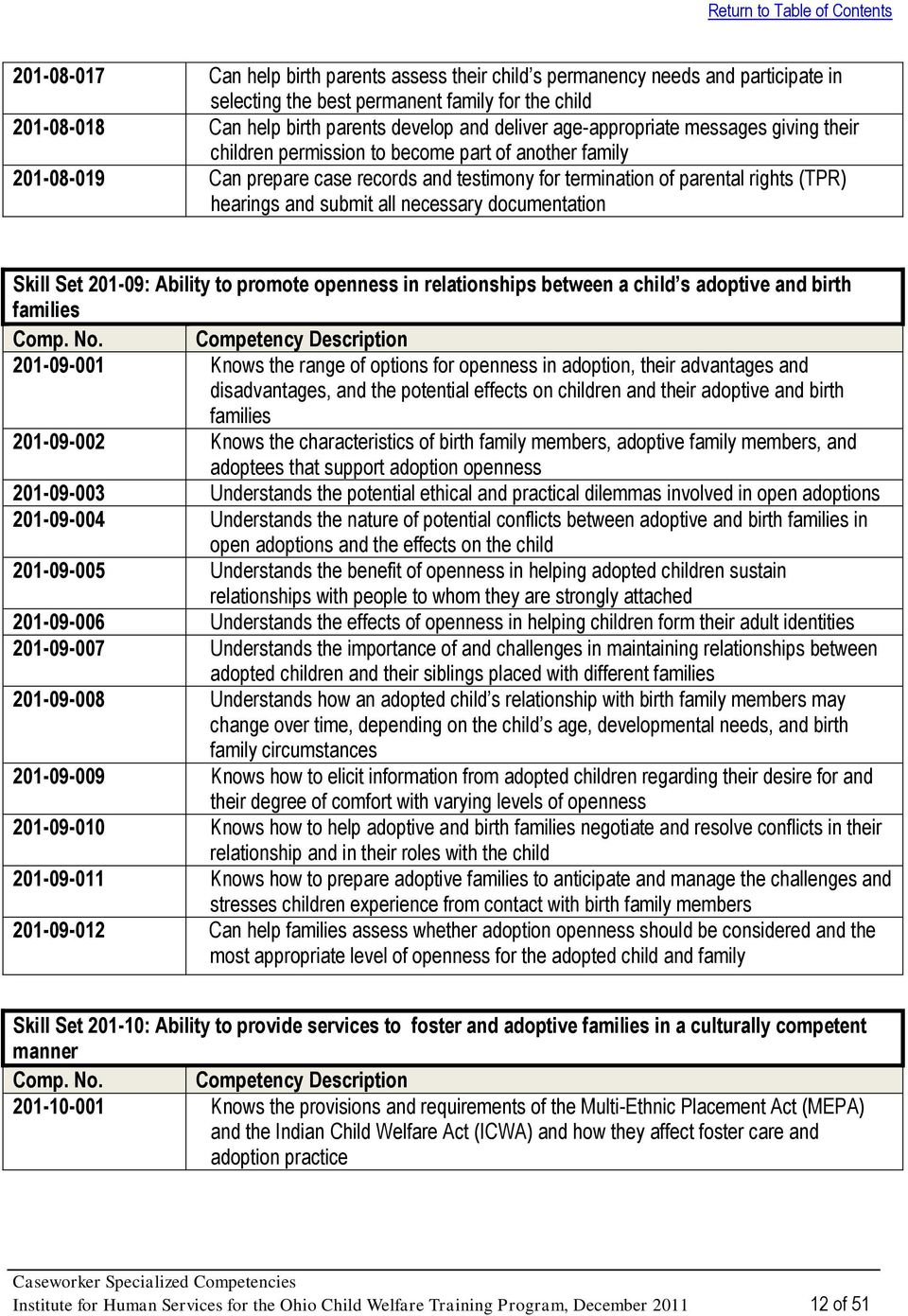
13 Understands how differences in values, communication styles, social interactions and perspectives between a worker and an applicant family may complicate the family assessment/home study Understands how values, beliefs, codes of conduct, and other cultural influences may affect separation, attachment, and a child s adjustment in placement Understands the unique issues in transcultural foster and adoptive placements Understands the importance of helping children in resource families develop or retain a positive cultural or racial identity Understands how agency policies and practices may present obstacles to recruiting and retaining families from minority groups Knows how to conduct a resource family assessment in a culturally sensitive and informed manner Knows how to help families access service providers in their own communities and consistent with their culture Knows strategies to help families access community resources to educate them about a child s cultural heritage and to help them access culturally-centered events, activities, and relationships Knows how to make placement decisions that are beneficial to the child and also in compliance with the Multi-Ethnic Placement Act (MEPA) and the Indian Child Welfare Act (ICWA) Can assist resource families in ensuring cultural continuity and positive identity formation for children in their care Can help resource families access relevant training to help them care for their children in a culturally sensitive manner Institute for Human Services for the Ohio Child Welfare Training Program, December of 51

14 TOPIC 202: SERVICES TO ADOLESCENTS Skill Sets: : Ability to provide individualized supportive and treatment services for adolescents and their families : Ability to address the needs and concerns of adolescents placed in out-of-home care : Ability to assess readiness and prepare youth for emancipation and independent living : Ability to support adolescents who are pregnant or parenting their own children : Ability to serve unruly and delinquent adolescents Skill Set : Ability to provide individualized supportive and treatment services for adolescents and their families Knows the potential negative effects of chronic neglect, physical abuse, sexual abuse, and multiple out-of-home placements on adolescent development and functioning Understands the difference between chronological age and developmental age, and the importance of using an adolescent s developmental age to guide assessment and treatment planning Understands how developmental delays resulting from child maltreatment can be misdiagnosed in adolescents as emotional or behavioral problems Understands the family, social, or developmental factors and changes that can create crisis for adolescents Understands the importance of empowering adolescents to participate in case assessment and service planning activities Knows how to use sports, stories, art, and other activities to facilitate communication and engage adolescents into a trusting casework relationship Knows strategies to overcome adolescents resistance to working with a caseworker, caregivers, or treatment provider Knows how to recognize indicators of adolescent depression, anxiety, suicide, and other emotional or behavioral disturbances Knows how to recognize indicators of crisis in adolescents and knows crisis management strategies to stabilize and support them Knows how to assess an adolescent s need for specialized residential placement or treatment-oriented out-of-home care Knows how to assess whether child maltreatment is an underlying cause of home or school truancy, sexual acting out, or unruly or delinquent behavior Knows how to identify adolescents with the potential to engage in high risk behaviors and to provide preventive services Institute for Human Services for the Ohio Child Welfare Training Program, December of 51

15 Knows how to adapt interviewing strategies, investigation activities, case planning, and casework counseling considering an adolescent s developmental level Can create a safe environment in which adolescents feel empowered to participate in assessment and planning for their current and future safety and well-being Can help parents distinguish developmentally appropriate adolescent behavior from behaviors indicating mental illness, emotional disturbance, or developmental delay Can use comprehensive individualized assessment to create long-term developmental plans that help adolescents resolve their issues and achieve their potential Skill Set : Ability to address the needs and concerns of adolescents placed in out-of-home care Knows the common issues and concerns of adolescents being removed from their families or anticipating a change in placement Knows the unique considerations related to reunifying an adolescent with family members or kin Understands the importance of engaging adolescents in making placement and permanency decisions and eliciting their ongoing feedback Understands the importance of pursuing permanency and the unique issues related to permanency planning for adolescents Understands the importance of a thorough developmental and behavioral assessment of an adolescent to help in selecting the most appropriate placement setting Understands the importance of thoroughly preparing foster or relative caregivers prior to placing an adolescent in their homes Understands the benefits and liabilities of group home or other institutional placements for adolescents, and the types of youth for whom residential care may be warranted Understands the importance of maintaining continuity in school placement, with peers, siblings, and with important adults when making placement decisions for an adolescent Knows how to identify and train treatment-oriented, community-based foster or relative homes for adolescents Knows how to empower and collaborate with adolescents to identify and assess potential placement resources among people the youth already knows Knows how to engage and encourage adolescents to discuss their concerns about placement and elicit their perspectives on the best placement setting for them Knows proactive strategies to help maintain adolescents in a placement setting and prevent crisis and placement disruption Can help caregivers develop realistic expectations and appropriate parenting strategies based on an adolescent s history of trauma, maltreatment, cultural background, and developmental level Institute for Human Services for the Ohio Child Welfare Training Program, December of 51

16 Skill Set : Ability to assess readiness and prepare youth for emancipation and independent living Knows the range and types of adaptive skills necessary for emancipation and independent living Knows the provisions of laws and administrative rules governing independent living activities for adolescents, including the Chaffee Act Knows the importance of beginning preparation for independent living during childhood and early adolescence Understands the risks of unemployment, poverty, and homelessness if adolescents are emancipated without adequate preparation and sustained support Understands common barriers to attending college or advanced job training for adolescents emancipating from out-of-home care or families with limited resources Understands the value of linking youth with adult mentors who can support and sustain them as they transition to independent living Understands the value of linking emancipating adolescents with peer support networks and organizations to provide ongoing support and counsel Knows how to assess an adolescent s developmental needs and engage adolescents in developing a long-range strategy to prepare them for independent living Knows how to coach and enable parents, foster parents, and kinship caregivers to help adolescents practice independent living skills as part of routine daily activities Knows how to help adolescents identify and apply for scholarships and financial assistance for advanced education or training Knows strategies to help emancipating adolescents sustain connections with important adults, including members of their biological and foster families Knows how to access educational, vocational, and job readiness services and opportunities for emancipating adolescents Knows how to identify appropriate persons to provide mentorship and ongoing developmental support to adolescents Knows how to set up long-term care plans for adolescents with serious developmental delays or disabilities which preclude them from emancipating to independent living Knows how to help emancipating adolescents meet their basic needs, including housing, reliable and sufficient income, health insurance, health care, transportation, and community supports Knows how to engage community businesses, civic organizations and religious communities to help adolescents prepare for independent living Can identify when an adolescents has developmental delays that may interfere with emancipation and independent living Can help youth develop and pursue independent living plans Can design, coordinate, and manage formal independent living skills training for adolescents and for their caregivers or parents Institute for Human Services for the Ohio Child Welfare Training Program, December of 51

17 Skill Set : Ability to support adolescents who are pregnant or parenting their own children Knows community-based social, medical, and legal resources for adolescents who are pregnant or parenting Understands the importance of engaging adolescent parents in developing realistic permanency plans for their children and the value of beginning these discussions prior to delivery Understands the value of mentors in helping adolescent parents take adequate care of their children and prevent neglect or abuse Knows how to evaluate the risk of imminent or future harm to children cared for by adolescent parents Knows how to help mediate and resolve disagreements between adolescents who are pregnant or parenting and their own parents and families Knows how to help adolescent parents establish paternity, obtain child support, and negotiate involvement of the non-custodial parent Knows how to help adolescent parents access educational programs that enable them to complete formal education or job training Knows how to help adolescent fathers provide support and remain involved with their children Knows strategies and resources to help adolescent parents acquire and master child care and child management skills Knows how to access adoption counseling or other permanency planning services for adolescent parents who do not wish to keep their children Knows how to use risk assessment and safety planning to ensure the safety and wellbeing of pregnant or parenting adolescents and their children Knows strategies to work with pregnant or parenting adolescents around birth control and pregnancy prevention Can help pregnant and parenting adolescents and their families access necessary financial, social, and health care resources Can help parenting adolescents access parenting classes, peer groups, and mentors to increase their parenting skills and further emotional attachments with their children Skill Set : Ability to serve unruly and delinquent adolescents Knows the legal definitions and criteria for unruly and delinquent acts Knows the role of the juvenile court and the court processes related to unruly and delinquent adolescents Knows the appropriate role of child welfare agencies in serving unruly or delinquent adolescents and their families Understands the individual, family, and environmental factors that contribute to the development of unruly or delinquent behavior in adolescents Understands the use of court diversion programs for unruly youth or first-time offenders and the importance of community collaboration in supporting and helping these youth Institute for Human Services for the Ohio Child Welfare Training Program, December of 51

18 Understands the relationship between a history of physical abuse, sexual abuse, neglect, out-of-home care, or other forms of trauma and unruly and delinquent behavior Understands the relationship between parenting practices, discipline styles, and lack of supervision, and unruly or delinquent behavior of adolescents Understands the dynamics of peer pressure, discrimination, and bullying and their effects on the behavior and wellbeing of adolescents Understands the dynamics of youth gang membership and how adolescents become involved with gangs Knows how to assess the effects of family conflict, family violence, parental mental illness or substance abuse, lack of supervision, and other family issues in influencing an adolescent s unruly or delinquent behavior Knows how to collaborate with law enforcement and juvenile court personnel to develop case plans and placement plans for unruly and delinquent adolescents Knows strategies to identify and support youth who are victims of discrimination, bullying, or whose behavior is strongly influenced by other youth Can coach parents, kin, and caregivers in parenting strategies that can better manage an adolescent s behavior Institute for Human Services for the Ohio Child Welfare Training Program, December of 51

19 TOPIC 203: SEXUAL ABUSE Skill Sets: : Ability to identify children who have been sexually abused and act to ensure their safety : Ability to investigate allegations of child sexual abuse : Ability to conduct family assessments and identify services for child victims of sexual abuse and their families : Ability to assess and serve children and adolescents with sexually abusive behaviors : Ability to coordinate out-of-home care for children who have been sexually abused or who have sexually abusive behaviors, and support their foster, kinship, or adoptive families (resource families) : Ability to safely reunify children who have been sexually abused or children with sexually abusive behaviors with their families Skill Set : Ability to identify children who have been sexually abused and act to ensure their safety Knows the legal definitions and categories of child sexual abuse Knows the range and types of adult behaviors and actions that are considered child sexual abuse Knows the typical stages of child and adolescent sexual development and behavioral expressions at each stage Knows the physical, emotional, and behavioral indicators of sexual abuse in children at different ages and stages of development Understands the types of family structure, interactions, environment, and other factors that potentially increase the risk of sexual abuse to children in a family Understands the dynamics, thought patterns, and behaviors often exhibited by adult perpetrators of sexual abuse Understands the potential patterns and dynamics of disclosure of child sexual abuse Understands the dynamics of power and secrecy in child sexual abuse and how these dynamics may affect disclosure and recantation Understands the common characteristics, dynamics, and needs of non-offending parents in situations of child sexual abuse Understands the trauma experienced by many child victims of sexual abuse and how this affects their development and well-being Knows strategies to observe and interview children and other family members to elicit and identify indicators of child sexual abuse Knows how to recognize indicators of co-occurring sexual abuse in cases of alleged physical abuse or neglect Institute for Human Services for the Ohio Child Welfare Training Program, December of 51

20 Can recognize sexualized and sexually-reactive behavior in children of different ages Can identify families and children who should be further evaluated for sexual abuse Can determine the risk to children of remaining in the home while an investigation is being completed Can use safety planning to protect children suspected of having been sexually abused Skill Set : Ability to investigate allegations of child sexual abuse Knows how forensic investigations are used in child sexual abuse to protect children and to gather evidence to support court action Knows the various forensic interviewing protocols developed to investigate child sexual abuse, their common elements and approaches, and their differences Knows topics to be covered in sexual abuse investigation interviews with alleged child victims, siblings, non-offending parents, alleged perpetrators, and witnesses Knows when to involve law enforcement, prosecutors, physicians, and other community partners in sexual abuse investigations and each partner s roles and responsibilities Knows the strengths and limitations of using various investigative interview strategies with perpetrators, non-offending parents, alleged child victims, and siblings Knows criteria with which to assess the credibility of children s disclosures of child sexual abuse Understands common dynamics of sexual abuse perpetrators and how they can affect an investigation Understands how cultural factors and values related to sexuality and sexual conduct may affect a family s responses to sexual abuse and to an investigation Understands the benefits, limitations, and standards for use of various interviewing tools, and of audio or videotaping investigation interviews Understands how a worker s personal reactions, values, and biases regarding sexual abuse can affect investigations and relationships with family members Knows how to develop a sexual abuse investigation plan that includes who to interview, where, when, investigation strategies, and sequence of activities Knows strategies to engage non-offending parents to help determine the existence and scope of child sexual abuse and to protect their child Knows how to use physical and other types of evidence to corroborate children s disclosure of sexual abuse Knows how to coordinate activities with law enforcement personnel to identify, collect, and protect physical evidence during a sexual abuse investigation Knows how to access and integrate findings from medical evaluations and psychological assessments in child sexual abuse investigations Knows age-appropriate interviewing strategies for use with alleged child victims of sexual abuse and their siblings Knows how to select and interview potential witnesses who can corroborate or further describe alleged sexual abuse Knows investigation strategies to reduce informants resistance to provide information without compromising the validity of information Institute for Human Services for the Ohio Child Welfare Training Program, December of 51
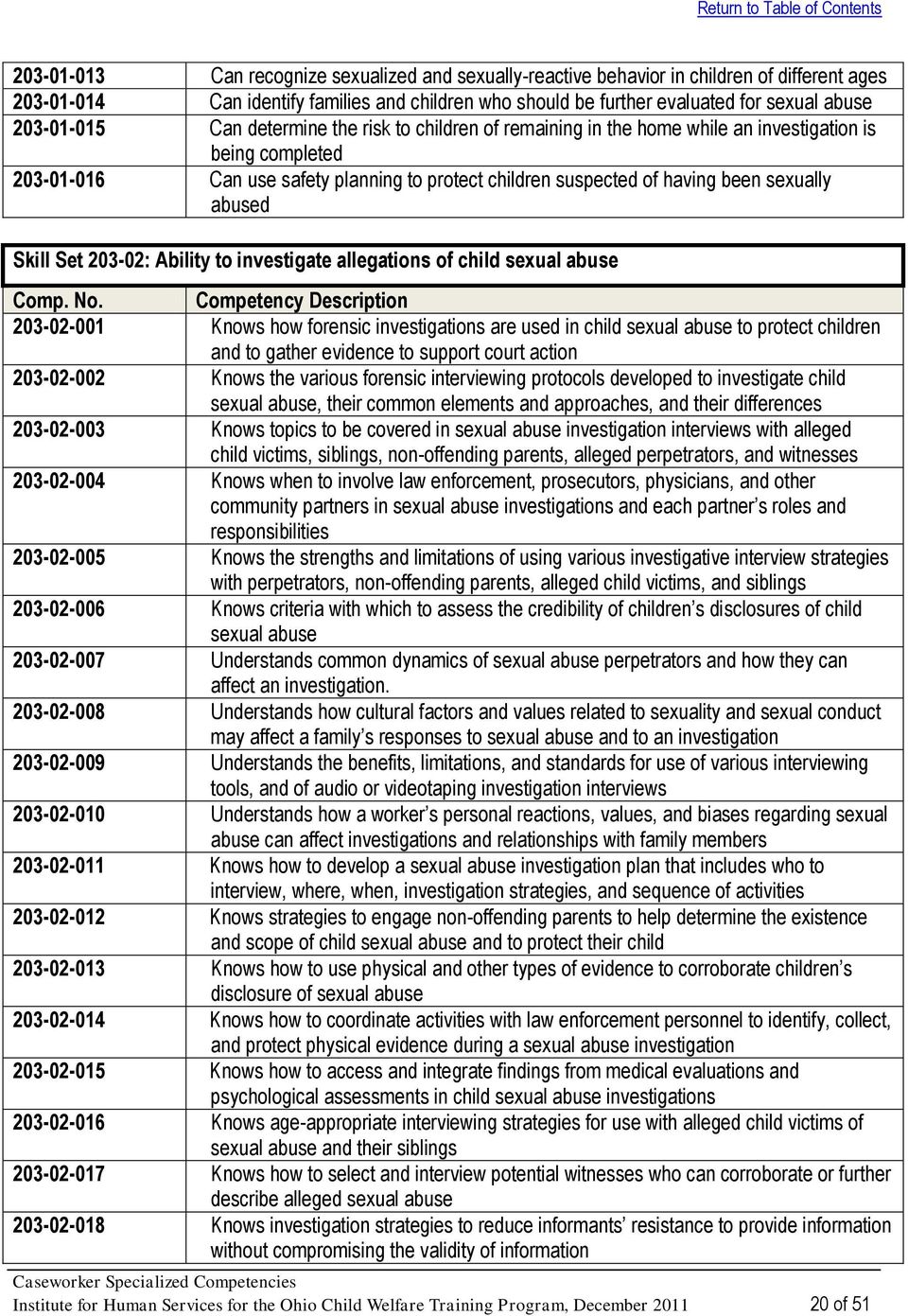
21 Knows strategies to protect child victims from family pressure to recant during sexual abuse investigations Knows how to determine whether siblings of a sexual abuse victim may also have been sexually abused Knows special investigation strategies when the alleged perpetrator of child sexual abuse is an adolescent or another child Knows how to obtain legal, therapeutic, and other services to protect and support child victims and their families during sexual abuse investigations Can work with community partners and other disciplines in a team approach to sexual abuse investigation Can conduct investigations in a manner that protects children from further sexual abuse or punishment for disclosing Skill Set : Ability to conduct family assessments and identify services for child victims of sexual abuse and their families Understands the potential short- and long-term effects of sexual abuse on children s health, development, and well-being Understands common characteristics of children that increase their vulnerability to being sexually abused and to experiencing trauma from abuse Understands the disruptive and traumatic effects of child sexual abuse disclosure and subsequent legal and agency intervention on non-offending parents and other family members Understands the common needs and concerns of a non-offending parent of a child who has been sexually abused, and the parent s role in ensuring their child s safety Understands the roles of medical, mental health, and other community professionals in assessing and treating child victims of sexual abuse and their families Knows how to help non-offending parents identify the contributors to child sexual abuse in their family and implement strategies to prevent its reoccurrence Knows the most effective, empirically supported treatment interventions to help children and their families recover from child sexual abuse and how to access these services on behalf of families Knows how to help non-offending parents evaluate their personal needs for treatment, supportive services, and other interventions Knows strategies to help non-offending parents stabilize and support their families when the perpetrator is no longer present in the home Knows strategies to identify children at increased risk of sexual abuse and to protect and maintain them in their own homes Can access, coordinate, and monitor the success of treatment and supportive services for child victims of sexual abuse, siblings, and non-offending parents Can work with community partners to increase the range of effective treatments available to child victims of sexual abuse and their families in the community Institute for Human Services for the Ohio Child Welfare Training Program, December of 51
22 Skill Set : Ability to assess and serve children and adolescents with sexually abusive behaviors Understands the dynamics of sexual offending by children and adolescents and how these dynamics differ from those of adult sexual offenders Understands the developmental, emotional, and environmental factors that contribute to sexual offending by children and adolescents Understands differences in dynamics between male and female children or adolescents with sexually abusive behaviors Understands differences in dynamics of pre-pubescent and adolescent children with sexually abusive behaviors Understands the characteristics and differences between normal sexual exploration, sexualized or sexually-reactive behavior, and sexually abusive behavior in children and adolescents Understands the importance of identifying the individual needs, developmental level, and contributing factors for each child or youth who displays sexually abusive behaviors Understands the potential long-term damage to children and adolescents with sexually abusive behaviors by intervening and treating them in a manner appropriate for adult sexual offenders Understands the differences in risk of re-offending between children and youth with sexually abusive behaviors and adult sexual offenders Understands the worker s responsibility to protect child victims from further abuse, prevent a child or youth from re-offending, and meet the development and treatment needs of children and adolescents with sexually abusive behaviors Understands treatment goals and milestones for children and adolescents with sexually abusive behaviors and the types of treatments that have the best empirical support Knows how to involve law enforcement and the court system to hold children or adolescents with sexually abusive behaviors accountable and in helping motivate them to pursue treatment Knows how to access psychological and developmental assessment of children and adolescents with sexually abusive behaviors to assist in service and treatment planning Knows strategies to involve children and adolescents with sexually abusive behaviors in developmental and treatment services appropriate for their age and individual needs Knows how to help families of children and adolescents with sexually abusive behaviors understand their child s needs and to alter parenting practices and the home environment to prevent reoccurrences Can educate professionals and the larger community about the needs of children and adolescents with sexually abusive behaviors and the best interventions to meet their needs Can develop intervention plans based on the age, gender, developmental status, and unique circumstances of children and adolescents with sexually abusive behaviors and their families Institute for Human Services for the Ohio Child Welfare Training Program, December of 51
23 Skill Set : Ability to coordinate out-of-home care for children who have been sexually abused or who have sexually abusive behaviors, and support their foster, kinship, or adoptive families (resource families) Knows the skills and qualities in resource families that promote successful care for children who have been sexually abused or children with sexually abusive behaviors Understands the importance of sharing information about a child s history of sexual abuse and/or sexual offending with potential resource families prior to placement Understands the challenges experienced by resource families caring for children who have been sexually abused or children with sexually abusive behaviors, and how placement may affect family dynamics and functioning Understands the types of behaviors children who have been sexually abused or children with sexually abusive behaviors may exhibit in out-of-home care and the potential effects on and risks to other children in the family Understands how the stress and trauma of out-of-home placement may exacerbate a child s sexualized behaviors or sexual acting out Understands how children who have been sexually abused remain at risk for further abuse, and how to help resource families protect the child Understands the social and emotional trauma inherent in third-party investigations of sexual abuse in out-of-home care, and the worker s role in providing emotional support to the resource family and child during the investigation Knows how to determine when children who have been sexually abused or who have sexually abusive behaviors need out-of-home placement to ensure their safety and well-being Knows strategies to recruit and evaluate potential resource families for children who have been sexually abused or who have sexually abusive behaviors, and prepare them to meet these children s emotional and developmental needs Knows how to locate and access counseling and consultation for resource families caring for children who have been sexually abused or children with sexually abusive behaviors Knows how to help resource families learn to set appropriate limits on a child or adolescent s sexual behavior, while concurrently providing guidance and emotional support Knows how to help resource families use developmentally appropriate sexual information and terminology when managing children displaying sexualized or sexually reactive behaviors Knows how to coach resource families to work with school personnel to manage sexual behavior in the school setting Knows how to help resource families create a safe home environment that prevents sexual acting out and reduces the vulnerability of family members to allegations of sexual abuse Can help resource families learn to constructively handle discussions in the family about sexuality and children s prior experiences with sexual abuse Can educate resource families to avoid circumstances that may serve as triggers for sexual behavior in children who have been sexually abused or children with sexually abusive behaviors Institute for Human Services for the Ohio Child Welfare Training Program, December of 51
24 Can educate resource families to constructively handle sexual exploration or sexually-reactive behaviors within the family setting Skill Set : Ability to safely reunify children who have been sexually abused or children with sexually abusive behaviors with their families Knows the risks of reuniting children with families when the parents have not successfully completed treatment Knows the treatment goals and milestones that must be met by families of children who have been sexually abused or children with sexually abusive behaviors prior to attempting reunification or closing the case Knows the critical considerations and proper sequence of activities in family reunification in child sexual abuse cases Understands the differences in reunification planning when the perpetrator is permanently out of the home, and when the perpetrator lives with the immediate or extended family or may otherwise have access to the child victim Understands the requirements of non-offending parents and other family members to create a structured, safe environment which permanently monitors and controls the perpetrator s access to and activities with the child victim Understands factors that may prevent children s disclosure of reoccurring sexual abuse following reunification Knows how to help families modify their physical environment, parenting practices, and supervision patterns to allow reunification of a child or adolescent with sexually abusive behaviors without concern about re-offending Can prepare non-offending parents and family members to recognize patterns of secrecy, grooming, or threats and identify them as indicators of potential recurrence of abusive behavior Can help families develop and sustain plans to prevent recurrences of sexual abuse post-reunification, and to use extended family members and other support networks to help them implement and monitor the plan Can evaluate whether child victims and non-offending parents are capable of seeking help, if and when sexual abuse dynamics re-emerge in the family post-reunification Institute for Human Services for the Ohio Child Welfare Training Program, December of 51
25 TOPIC 204: ASSESSMENT AND CRITICAL THINKING Skill Sets: : Ability to elicit, analyze, and integrate relevant information to support decision making at all phases of case involvement. Skill Set : Ability to elicit, analyze, and integrate relevant information to support decision making at all phases of case involvement Knows the purpose and importance of comprehensive assessment in all phases of case planning and service intervention Knows the liabilities of developing intervention plans without thorough and accurate assessment information on which to base them Knows the critical decision points at each phase of case involvement and the most relevant and essential information needed at each decision point Understands the common processes that underlie all assessments regardless of their specific type or purpose Knows the persons and data sources most likely to provide relevant information for an assessment Understands how the quality of an assessment is affected by a family s relationship with and confidence in the worker conducting the assessment Understands why assessments must elicit and confirm facts as well as elicit and clarify feelings and dynamics Understands the importance of a family s history and prior experiences to an accurate understanding of their current situation and functioning Understands the importance of historical information in identifying a family s strengths, coping capacities, and resilience Understands factors that affect family members comfort and willingness to participate in an assessment and the typical origins of resistance or hostility Understands worker behaviors and communication styles that can facilitate family involvement in assessment and those that may impede it Understands how differences in culture, values, and codes of conduct can affect the worker-family relationship, the assessment process, and the interpretation of findings Knows how to use strengths-based assessment strategies to empower family members to participate in the assessment and to confirm findings and conclusions Knows interviewing strategies such as active listening open and closed ended questions, supportive responses, clarification, scaling, and summarization, and their use in facilitating and guiding an assessment Knows how to sequence interview questions and responses to shape, expand and deepen an assessment Knows how to adjust one s own communication strategies to conform to family members cultural, personal, and interpersonal styles Institute for Human Services for the Ohio Child Welfare Training Program, December of 51
26 Knows how to observe and evaluate family members behaviors, nonverbal communication, and interpersonal interactions to determine their meaning and relevance to the assessment Knows strategies to respond to hostility or resistance to help family members become more comfortably involved in the assessment Knows how to draw on factual information about conditions such as mental illness, substance abuse, or domestic violence to recognize their presence in a family and to determine their impact on child safety Knows strategies to keep discussion focused on relevant topics to achieve the assessment s purpose and to respectfully redirect family members who digress Knows how to determine the reliability of data sources and the accuracy of the information they provide Knows how to structure an assessment to ensure the critical evaluation of findings and conclusions to ensure their accuracy Knows how to use regular reassessments to elicit information to update, reaffirm, negate, or modify prior findings and conclusions and to shape revisions in case plans and services Can determine the purpose of an assessment and the specific factors and criteria to be assessed, and can select assessment strategies to achieve desired objectives Can analyze and synthesize assessment information from a variety of sources to form coherent findings and conclusions to drive case decisions, service planning, and service delivery Institute for Human Services for the Ohio Child Welfare Training Program, December of 51
27 TOPIC 205: LEGAL ISSUES IN CHILD WELFARE Skill Sets: : Ability to work with attorneys, prosecutors, court personnel, and other service providers to complete court related activities : Ability to prepare children and family members for court hearings : Ability to prepare and deliver testimony in court hearings : Ability to protect a family s rights and prevent litigation against the agency and its staff : Ability to support families and court personnel engaged in mediation activities Skill Set : Ability to work with attorneys, prosecutors, court personnel, and other service providers to complete court related activities Knows protocols and procedures stipulated in the county s Memorandum of Understanding that guide agency collaboration with law enforcement and court personnel Understands the terminology, functions, and procedures used in probate, common pleas, domestic, and drug courts as they relate to child welfare cases Understands the functions and legal processes of the county Child Support Enforcement Agency (CSEA) in child welfare cases Understands the caseworker s role and responsibilities in working with probate, common pleas, domestic, and drug courts Understands the caseworker s role and responsibilities in legal activities related to child support enforcement Understands the types of case information that may be shared with prosecuting attorneys, defense attorneys, and Guardians ad Litem, under what circumstances, and whether a formal release of information is required Knows strategies to collaborate with legal personnel representing the agency to compile case information to support a court filing Can respond to questions and provide case-related information to prosecuting and defense attorneys, Guardians ad Litem, and victim-assistance personnel in the manner and time frame best suited for each situation Skill Set : Ability to prepare children and family members for court hearings Knows the circumstances in which children may be required to testify in court hearings Knows factors that contribute to anxiety about court hearings in children and families and may increase their reluctance to testify Institute for Human Services for the Ohio Child Welfare Training Program, December of 51
28 Understands how children s social, emotional, cognitive, and language development may affect their capacity to testify in court Knows how to collaborate with legal personnel to determine whether a child should testify in court hearings Knows developmentally appropriate strategies to reduce anxiety of children and family members about legal and courtroom procedures and to prepare them for court testimony Can collaborate with legal personnel to educate and coach children and families to attend or testify in court hearings Skill Set : Ability to prepare and deliver testimony in court hearings Understands rules governing witness credibility, expert and lay testimony, hearsay, exceptions to hearsay, supposition, admissibility of evidence, and use of case notes in court Understands the benefits, liabilities, and challenges in presenting the court with evidence gathered through use of anatomically detailed dolls, children s drawings, and similar investigation aids Understands the benefits, liabilities, and challenges of using audio and video recordings as evidence in court Knows strategies to select and prepare the most relevant and admissible information about a case when testifying in court Knows strategies to remain composed, professional, and focused during court testimony and cross examination Knows how to protect the integrity of medical evidence, photographs, recordings, e- mail, and voice mail evidence for presentation in court Can build an organized history of a case and provide a rationale for the agency s recommendations during court hearings Can prepare and provide testimony and case documentation that can withstand court scrutiny and cross examination Skill Set : Ability to protect a family s rights and prevent litigation against the agency and its staff Knows the legal rights of parents, children, non-custodial parents, incarcerated parents, grandparents, and substitute caregivers in child welfare cases Understands how deficiencies in casework processes, improper caseworker conduct, and lack of adherence to policies and standards can increase the risk of liability for the caseworker and the agency Understands how inappropriate language used in verbal communications and in written documents can increase risk of liability for the agency Institute for Human Services for the Ohio Child Welfare Training Program, December of 51
29 Knows how to present and explain case information to family members, defense attorneys, and community agencies in a manner that preserves the rights of family members and protects the agency and caseworker from liability Can recognize when casework activities, communications, and documentation increase the risk of legal action against the agency, and can remediate these problems Skill Set : Ability to support families and court personnel engaged in mediation activities Knows the philosophy, purpose, procedures, and desired outcomes of mediation in cases in court settings Knows the types of case situations most appropriate for mediation to divert cases from formal court hearings Knows the caseworker's role and responsibilities in helping prepare families for mediation proceedings Knows strategies to collaborate with court personnel conducting mediation activities Institute for Human Services for the Ohio Child Welfare Training Program, December of 51
30 TOPIC 206: SCREENING, INTAKE, AND INVESTIGATION Skill Sets: Ability to screen child maltreatment referrals and make recommendations regarding case opening and response priority Ability to assess and serve families within a differential response system Ability to plan, conduct, and coordinate child maltreatment investigations and gather evidence for use in court hearings Ability to interview alleged child victims and siblings in child maltreatment investigation. Skill Set : Ability to screen child maltreatment referrals and make recommendations regarding case opening and response priority Knows best practice standards and agency policies related to screening referrals of child maltreatment Knows the screening categories and the scope and type of information that must be elicited for referrals in each screening category Knows the types of referral concerns that warrant agency follow up, those that can be referred to other community providers, and those that can be dismissed Knows the types of referrals that generally require an emergency response Understands factors that may increase referents resistance to providing detailed personal information about the family being referred Understands the importance of ensuring referents anonymity to promote full disclosure of pertinent information Understands factors that may contribute to referents making false allegations Knows how to gather information to assess children s safety and to identify children who may be at imminent risk of serious harm Knows how to gather information about the family and its environment to identify potential dangers for a caseworker Knows interview strategies to engage referents and encourage them to disclose pertinent information about the family, the child, their history, and the alleged maltreatment Knows how to assign a priority response rating based on the information collected from the referent Knows how to identify and transfer cases that warrant a formal investigation Can communicate screening findings and preliminary conclusions to supervisors and other unit staff and complete necessary documentation Skill Set : Ability to assess and serve families within a differential response system Knows the purpose, philosophy, and defining characteristics of differential response systems Institute for Human Services for the Ohio Child Welfare Training Program, December of 51
31 Knows the roles and responsibilities of agency screeners, unit supervisors, and other agency staff in assigning accepted reports to traditional or alternative response tracks Knows the mandatory and discretionary criteria used to assign accepted reports into traditional or alternative tracks Knows OAC rules and agency procedures for cases assigned to an alternative response track and how these differ from rules and procedures regulating traditional response Understands how differential response systems support principles of strengthsbased, family-centered, collaborative child welfare practice Understands the differences between traditional investigation strategies and alternative track fact-finding assessments and the circumstances when each approach is used Understands the rationale and potential benefits of foregoing formal substantiation, labeling of perpetrators, and documenting findings in the Central Registry Understands the importance of objective fact-finding about family dynamics and conditions that increase both imminent and longer-term risk in families served in an alternative track Knows how to help families, service providers, and the community understand the similarities and differences between traditional and alternative tracks Knows strategies to engage and empower families assigned to an alternative track to collaborate in family assessment and case planning Knows how to engage parents served in an alternative track to assess factors that increase risk to their children and to develop and strengthen their protective capacities and parenting skills Knows how to help families identify culturally sensitive, neighborhood-based and community providers to address their service needs Knows how and when to offer families eligible for an alternative track the opportunity to participate in a traditional investigation Knows why and when families being served in an alternative track should be reassigned to a traditional investigation track Knows how to determine when families served in an alternative track may be closed after the assessment and when they should be referred for post-assessment services Can use formal safety and risk assessment protocols and safety planning methods (CAPMIS) to identify and protect at-risk children in families served in an alternative track Can access short term intervention and treatment services to stabilize families and prevent crisis in families served in an alternative track Can link families in alternative tracks with permanent resources and support systems to stabilize and sustain them after the agency is no longer involved Skill Set Ability to plan, conduct, and coordinate child maltreatment investigations and gather evidence for use in court hearings Knows the proper sequencing, timing, and location of investigation interviews and activities Institute for Human Services for the Ohio Child Welfare Training Program, December of 51
32 Knows the roles and responsibilities of law enforcement officers, prosecuting attorneys, hospital staff, and other members of multidisciplinary investigation teams Knows fact-finding strategies and forensic protocols that promote collection of accurate and legally defensible information about a child maltreatment allegation Knows the role and purpose of professional staff at Child Advocacy Centers and how to coordinate investigation interviews Knows procedures for coordinating investigation activities with members of multidisciplinary investigation teams Understands the differences in roles, responsibilities, and investigation methods used by social workers and law enforcement officers during joint investigations Understands the need for objectivity and avoiding interview questions, body language, and personal interactions that may influence or invalidate the information collected Understands the social, emotional, and practical concerns of non-offending parents and how these may affect their capacity to believe and support an alleged child victim during an investigation Understands the factors that may prevent offenders from acknowledging their responsibility for child maltreatment Understands the factors that may lead a child to recant a disclosure Understands the emotional, social, and financial impact of a child maltreatment investigation on the family being investigated Understands the regulations and procedures related to interviewing children at school without parental knowledge or permission Understands the potential emotional effects on the caseworker of performing child maltreatment investigations Knows how to conduct an investigation in a manner that reduces the possibility of family pressure on a child to recant a disclosure Knows how to conduct investigations that do not violate a family s 4 th and 14 th Amendment and other civil rights Knows investigation strategies that increase the likelihood that offenders will truthfully acknowledge their responsibility for child maltreatment Knows when and how to appropriately disrobe a child and take photographs of injuries Knows how to determine whether a parent s explanation of a child s injuries is plausible and consistent with physical and medical findings Knows how to use historical reports and data from medical examinations to identify patterns of previous or ongoing child maltreatment Knows how to gather and protect evidence, to document interviews and other investigation activities, and to prepare testimony for court hearings Knows strategies and procedures for conducting investigations of children in out-ofhome care, day care, or in open child welfare cases Knows strategies to protect and support victims, siblings, and non-offending parents during an investigation Institute for Human Services for the Ohio Child Welfare Training Program, December of 51
33 Knows how to access immediate supportive, crisis, or treatment services for child victims and non-offending parents Can determine when to use a formal forensic interviewing protocol during an investigation Can explain investigation findings to families and educate them about the activities that will occur as a result of the investigation Can use strengths-based, culturally responsive, family-centered interviewing strategies with non-offending parents that support and empower them throughout the investigation Skill Set Ability to interview alleged child victims and siblings in child maltreatment investigations Knows the goals of interviewing children in child maltreatment investigations Understands the nature and purpose of interview strategies included in forensic interviewing protocols for children Understands the practical, cultural, and developmental considerations when choosing locations for interviews with children Understands how children s developmental level may affect memory, suggestibility, participation in the interview, and ability to testify in court Understands how a family s cultural background and concerns regarding disclosure of maltreatment can influence a child s behavior during an investigation Understands the purpose, benefits, and liabilities of using interview aids, drawings, and anatomical dolls when interviewing children Knows how to determine when a forensic interview of an alleged child victims is necessary Knows how to help children feel safe, comfortable, and supported during investigative interviews Knows interview and question formulation strategies that help children comfortably and accurately disclose and explain what they know Knows when to involve caregivers in investigative interviews with young children and how to promote a caregiver s support of the child Knows how to determine a child s developmental level and capacities during an investigative interview and adjust interview methods accordingly Knows how to conduct interviews with children in a culturally sensitive manner Knows how to evaluate the credibility of a child s disclosure Can use fact-finding interviewing methods that elicit complete, accurate, and legally defensible information from children Can adjust interviewing strategies for use with very young children Institute for Human Services for the Ohio Child Welfare Training Program, December of 51
34 TOPIC 207: FAMILY-CENTERED AND STRENGTHS-BASED SERVICES Skill Sets: Ability to use strengths-based and family-centered models of service delivery with families in their own neighborhoods and communities Ability to use family team meetings as a case planning and decision making strategy throughout the life of a case Skill Set # Ability to use strengths-based and family-centered models of service delivery with families in their own neighborhoods and communities Knows the historical, philosophical, and legal bases of a family-centered approach to child welfare practice Knows the values, principles, and intervention methods included in strengths-based child welfare practice Knows the characteristics of intensive, home-based service models and the types of cases for which they are most appropriate Understands the value of accessing services and resources for families within their own neighborhoods and local communities Understands how strengths-based, family-centered, neighborhood-based practice can be integrated at all stages of case involvement Understands how the stresses of chronic poverty can contribute to and compound the effects of child maltreatment Understands how living in deficient and dangerous environments can undermine parents capacity to safely care for their children Understands the value of neighborhood-based placements in promoting stability and continuity for children in out-of-home care Understands the benefits of neighborhood-based, multidisciplinary service and advocacy centers for children and families Knows how to use parent aides (case aides) to provide in-home supportive and developmental services for families Knows strategies to improve family and individual problem-solving within the context of each family s culture and social network Knows strategies and techniques of motivational interviewing and ethnographic interviewing and how they can be applied in child welfare practice Knows how to help families strengthen their coping capacity by mobilizing and enlisting assistance from the resources available to them Knows how to involve families in identifying potential placements for their children within their own extended families or neighborhoods Knows how to identify, engage, and partner with naturally-occurring supports and service providers in a family s neighborhood and community Knows how to motivate a community s social service, political, religious, and educational leaders to improve the physical, economic, and social environments of families to promote child safety Institute for Human Services for the Ohio Child Welfare Training Program, December of 51
35 Can work effectively in integrated, neighborhood-based service centers that are easily accessible to the families they serve Can monitor, coordinate, and evaluate services provided by local providers to ensure their effectiveness and relevance Skill Set # Ability to use family team meetings as a case planning and decision making strategy throughout the life of a case Knows the philosophy and methods underlying family team meeting models and the types of case situations for which they are appropriate Knows the purposes, common elements, strengths, and limitations of family team meeting models Knows which family members and other participants should be involved in family team meetings to maximize a family s involvement Knows potential barriers that can prevent family members from attending and participating in family team meetings, and strategies to remove them Understands the benefits of involving family members and other team members in case planning, decision making, service delivery, and monitoring outcomes Understands the benefits of using trained, neutral facilitators to lead family team meetings and the roles and responsibilities of family caseworkers, supervisors, and facilitators in these meetings Understands the benefits and potential outcomes of using family team meetings at critical case decision points and during periods of family crisis Understands the appropriate roles of youth, foster caregivers and community service providers as members of a family team Understands the challenges and potential dangers of family team meetings in families where domestic violence exists Understands the benefits and liabilities of family members developing their own safety or case plans without caseworker assistance Knows how to determine objectives, plan an agenda, and prepare participants for a family team meeting Knows strategies to engage and encourage reluctant family members to become invested as members of a family team Knows how to determine when and how children or youth might be involved in family team meetings and their most appropriate level of involvement Knows how to fairly and accurately represent the perspectives and wishes of children who do not attend family team meetings Knows how to remain neutral and objective when facilitating family team meetings, and knows strategies to promote constructive dialogue among team members Knows how to facilitate discussion to resolve conflict and achieve consensus among family members on the team, or between family members and agency representatives Knows how to follow up with meeting participants to monitor whether assigned tasks have been completed and to provide assistance when needed Institute for Human Services for the Ohio Child Welfare Training Program, December of 51
36 Knows strategies to balance delegating decision-making authority to family team members, while retaining the authority to ensure children s safety and well-being Knows facilitation strategies to increase the effectiveness of meetings, engage members, clarify and summarize ideas and opinions, build group cohesiveness, and build consensus Knows how family team meeting methods can be applied during regularly occurring case plan reviews, Semi-Annual reviews, and CAPMIS reviews Can identify opportunities to use family team meetings at all phases of case involvement Can create and sustain an emotionally and physically safe and supportive environment for all participants during family team meetings Can apply group process and group facilitation strategies that help the family team achieve goals and objectives set for each meeting Institute for Human Services for the Ohio Child Welfare Training Program, December of 51
37 TOPIC 208: PHYSICAL ABUSE Skill Sets: : Ability to identify, assess, and treat physically abused children and their families Skill Set : Ability to identify, assess, and treat physically abused children and their families Knows the types of parental behaviors and resulting conditions in children that are considered physical abuse Knows the emotional, behavioral, and developmental indicators of physical abuse in children of different ages Understands the common personal, interpersonal, and environmental contributors to physical abuse in families Understands the characteristics and behaviors of individual children that may increase their risk of being physically abused Understands the differences in family dynamics in acute (situational) and chronic physical abuse and the differences in intervention approaches Understands the short-term and long-term consequences of physical abuse on children s health, development, and functioning Understands how cultural norms for acceptable parenting may affect the assessment of abusive parenting in different cultural contexts Understands how a parent s lack of knowledge about normal child development and unrealistic expectations for their children s behavior can contribute to abusive parenting Understands the dynamics of role reversal in situations of child abuse and its behavioral indicators in children and their parents Understands the contributions of parents mental illness, drug or alcohol abuse, domestic violence, and emotional disorders in perpetuating the physical abuse of children Knows how to assess parents explanations for a child s injuries and determine whether the injuries were accidental or inflicted Knows how to assess physically abused children for co-occurring sexual abuse, neglect, or emotional maltreatment Knows how to work collaboratively with law enforcement and child abuse teams to investigate and respond to serious cases of abuse Knows how to identify children at imminent risk of serious harm from abuse and how to implement safety planning to protect them Knows how to access the proper medical interventions for abused children and collaborate with health care professionals in planning treatment Knows nonviolent discipline and child management strategies to manage abused children s behavior without inflicting further trauma Knows how to help school personnel modify their approaches to education and behavior management to meet the needs of children who have been abused Institute for Human Services for the Ohio Child Welfare Training Program, December of 51
38 Knows the goals and strategies of empirically supported treatments to help abusive parents learn and use nonviolent parenting strategies and prevent recurrences of abuse Knows the goals and strategies of empirically supported therapies and parenting strategies that can help abused children recover from trauma Knows how to educate parents to intervene early in children s misbehavior using nonviolent parenting strategies to de-escalate situations and prevent abuse Knows age appropriate child management strategies for toilet training and can educate families to use them to prevent abusive responses to toileting accidents Can recognize the signs, symptoms, and patterns of inflicted burns in children Can recognize the signs, symptoms, and patterns of inflicted bruises in children Can recognize the signs and symptoms of fractures, internal injuries, and head injuries in children Can recognize the signs and symptoms of Munchausen by Proxy Can assess the immediate risk to children from abusive acts and can determine when emergency medical care is needed Can assess and strengthen the protective capacities of non-offending parents and other family members to assure the safety of children safety in their own homes Can use standardized risk assessment technologies to estimate the likelihood of future abuse and to determine when it is safe to reunite abused children with their families Can develop and monitor comprehensive treatment plans that remediate parental conditions that contribute to abusive parenting Can help immigrant families understand the legal prohibitions against certain parenting behaviors, and modify their parenting to ensure their children s safety while respecting their cultural preferences and traditions Institute for Human Services for the Ohio Child Welfare Training Program, December of 51
39 TOPIC 209: NEGLECT Skill Sets: : Ability to identify, assess, and treat neglected children and their families. Skill Set : Ability to identify, assess, and treat neglected children and their families Knows the types of parental behaviors and the resulting conditions in children that are considered neglect Knows the types of neglect and the criteria that define them, including physical, emotional, educational, and medical neglect, and lack of supervision Knows the emotional, behavioral, and developmental indicators of neglect in children of different ages Understands the effects of chronic neglect in producing serious consequences in children who may not be at imminent risk of serious harm Understands the lifelong effects of neglect on children s health, development, survival, and well-being Understands the effects of neglect on brain development in children under the age of three Understands the effects of neglect on parent-child attachments and its contribution to insecure or maladaptive attachment patterns in children Understands the effects of neglect as a factor in developmental delays and disabilities in children Understands the indicators and developmental effects of failure-to-thrive in infants and the common parental and interpersonal dynamics in their families Understands the long-term effects of neglect on the physical, cognitive, social, and emotional functioning of adults neglected as children Understands the relationship between parents mental health conditions, such as personality disorders, depression, anxiety, and psychosis and neglectful parenting Understands the effects of mental retardation and cognitive deficits in parents on their capacity to safely parent and nurture their children Understands the effects of poverty, environmental and family stress, lack of supports and resources, and homelessness on neglectful parenting Understands how differences in culture, values, and parenting practices affects assessments of neglect Understands the relationship between the social isolation of parents and neglect of their children Understands differences in cultural perspectives regarding what constitutes adequate supervision of young children and how this affects intervention Knows how to recognize children at imminent risk of serious harm as a result of neglect and how to implement safety plans to protect them Knows the types of services necessary to promote the healthy development of children who are developmentally delayed as a result of neglect Institute for Human Services for the Ohio Child Welfare Training Program, December of 51
40 Knows how to work with medical and legal personnel to determine when a parent s failure to provide medical care for a child qualifies as neglect Knows how to assess and mobilize the protective capacities of non-offending parents and other family members to prevent further neglect of children Knows how to access community resources to strengthen and support families socially and economically to enable them to improve their care of their children Knows strategies to link neglectful families into stable and sustainable community networks to support and enhance their parenting over a long period of time Can identify children of all ages whose developmental delays and problems are a consequence of neglect Can complete comprehensive assessments and long-term intervention plans for families to reduce the likelihood of recurrences of neglect Can procure mental health assessments of neglectful parents to identify their needs and ensure they receive appropriate mental health treatment Can work with families and medical providers in situations of medical neglect to ensure children s immediate safety and provide ongoing medical care Can provide intensive developmental services for neglected children to help overcome the effects of having been neglected Can work with families and schools to remedy school truancy and ensure that children receive an appropriate education Institute for Human Services for the Ohio Child Welfare Training Program, December of 51
41 TOPIC 210: ACHIEVING PERMANENCE FOR CHILDREN Skill Sets: : Ability to integrate permanency planning at all stages of case involvement : Ability to locate and engage family members and other adults to become permanency resources for children in care : Ability to create a permanency team for children in need of permanent homes and connections Skill Set : Ability to integrate permanency planning at all stages of case involvement Understands the urgency of permanency planning for all children in the child welfare system from the time of initial contact throughout the life of the case Understands the importance of permanence in emotional attachments and family connections to a child s development, identity, and emotional well-being Understands how children s perception of stability, continuity, and security in their relationships with adults underpins their experience of permanence and the development of trust Understands typical barriers and challenges to securing permanent relationships and placements for children Understands how stable, committed relationships with family members and other adults can be developed over time into permanent family connections or placements for children Understands the importance of biological fathers in children s lives and of involving fathers and their families as potential permanency resources for children Understands the importance of nurturing multiple permanent relationships and connections for children that can address different developmental needs Understands the value of permanent, dependable adult mentors for children emancipating from out-of-home care Understands the rationale and importance of involving children in developing and implementing their own permanency plans Knows how to implement concurrent planning when children are first placed in out-ofhome care and how to sustain this plan until permanence is achieved Knows how to select permanency strategies that are best suited for a child s age, developmental level, family situation, and individual needs Knows strategies to overcome barriers and challenges to achieving permanence for children Can assess a child s permanency needs and develop a comprehensive and integrated strategic plan to address them Can prepare, involve, and support children in activities to secure permanent relationships, connections, and family placements Institute for Human Services for the Ohio Child Welfare Training Program, December of 51
42 Skill Set : Ability to locate and engage family members and other adults to become permanency resources for children in care Knows the legal and ethical issues related to confidentiality, privacy, and appropriate disclosure and how these apply to search for and engagement of family members and other potential permanency resources for children Knows the importance of basing a search strategy on an individualized assessment of a child s permanency needs and a plan to address them Knows the range of individuals who might be encouraged to develop permanent relationships with children, including maternal and paternal relatives, previous foster caregivers, family friends, and adults in the child s existing social network Knows the type of persons to include in a permanent network of social connections to meet children s social, emotional, and other developmental needs Knows the necessary steps in developing potential permanency resources for children and the importance of implementing these steps in the proper order Understands the necessity of establishing rapport and exploring all options with permanency resources before proposing specific permanency strategies Understands the importance of allowing potential permanency resources to set the nature, pace, timing, and extent of their involvement with a child Understands the importance of establishing goals for each contact with a potential permanency resource, and of seeking their input so goals are consistent with their readiness to move ahead Understands the detrimental consequences of pushing potential permanency resources too hard or too quickly to consider permanent placement of a child in their home Knows how to use assessment tools such as ecomaps and genograms to identify potential permanency resources in a child s extended family and social networks Knows how to prepare, involve, and solicit feedback from children when seeking permanency options for them Knows strategies to involve and empower family members to identify and recommend potential permanency resources for their children Knows how to assess families and individuals who already have a relationship with a child to explore their potential as permanency resources Knows strategies to approach, engage, and educate previously absent or noninvolved family members Knows how to implement case mining strategies to identify potential permanency resources for children Knows how to use technology such as web-based search engines to locate persons identified as potential permanency resources for children Knows how to determine the capacity of potential permanency resources to ensure children s safety and promote their development and well-being Can prepare children for visits with potential permanency resources and debrief with children to assess children s feelings about them Can plan and execute a comprehensive search for permanency resources for a child and involve the child in all phases of the work Institute for Human Services for the Ohio Child Welfare Training Program, December of 51
43 Skill Set : Ability to create a permanency team for children in need of permanent homes and connections Knows the purpose, composition, responsibilities, and activities of an effective permanency team for a child Understands the role of the child welfare caseworker on a permanency team Understands the potential shifts in the caseworker s role and responsibilities on a permanency team as the team evolves through the phases of permanency planning Understands how differences in perspectives and opinion can create conflict among members of permanency teams and how this can undermine their work Knows strategies to engage individuals to be members of a child s permanency team, including CASA/GALs, teachers, therapists, members of the child s religious community, extended family members, and other persons serving or involved with the child Knows strategies used by permanency teams to promote family members involvement in making permanency decisions for their children Knows how to use facilitation, family team meetings, and mediation strategies to address and resolve conflicts between permanency team members Knows how to help permanency team members intervene to support and sustain relationships between children and permanency resources Knows how to assess the readiness of a permanency team to assume primary responsibility for supporting a child s permanency plan Knows strategies to develop a permanency team into a permanent entity to sustain a child s permanency plan over time Knows how to help teams enlist permanency resources for a child that support development of positive cultural identity and group affiliations Knows how to help members of a permanency team evaluate the effectiveness of their work on behalf of a child and revise their approach as needed Can provide support and guidance to members of a permanency team to develop and sustain permanent, committed relationships for children Institute for Human Services for the Ohio Child Welfare Training Program, December of 51
44 TOPIC 211: KINSHIP CARE Skill Sets: : Ability to work with kinship caregivers to promote placement stability and permanence for children in care Skill Set : Ability to work with kinship caregivers to promote placement stability and permanence for children in care Knows the benefits of placing children with kinship caregivers, including relatives, close family friends, or other adults who have a relationship with or commitment to them Knows the factors to be assessed when considering placement of a child in their family Knows the considerations, benefits, and limitations related to formally licensing kinship caregivers Knows the types of supports and services potentially needed by kinship caregivers to promote the safety, health, and development of children in their care Understands how kinship placement can help strengthen and preserve children s attachments, sense of family history, and personal/cultural identity Understands that children s strongest emotional attachments may not be with biological relatives, and the importance of protecting and sustaining children s attachments when making placement decisions Understands the issues, concerns, and potential ambivalence experienced by kinship caregivers when considering caring for children of immediate or extended family members or family friends Understands the dynamics and effects of loyalty conflicts that may be experienced by children in kinship care Understands the multiple potential disruptive effects of kinship care on the caregiving family Understands the benefits of kinship care as a strategy to place siblings together and to maintain their relationships Understands the potential issues and concerns of kinship caregivers who lack preexisting relationships with children coming into their families Understands the issues to be addressed when engaging absent fathers and members of their families to become more involved with or provide a home for their children Understands the potential challenges when arranging and monitoring visits between children in kinship care and their biological parents Understands the potential conflicts experienced by kinship caregivers when ensuring a child s safety requires controlling or restricting access by a biological parent Understands the benefits and challenges of various legal permanency options available to kinship caregivers Institute for Human Services for the Ohio Child Welfare Training Program, December of 51
45 Knows how to partner with kinship caregivers to assess their willingness, ability, and resources needed to provide safe, nurturing, and stable family care for children Knows how to prepare and involve kinship caregivers to reunify a child with biological parent(s) and to provide ongoing post-reunification support Knows how to link kinship caregivers to educational, medical, psychological, developmental, and other services to enable them to meet children s special needs Knows how and when to involve kinship caregivers as potential permanent families for children when developing concurrent case plans, and how to help kinship families manage the challenges of concurrent planning Knows how to identify and access financial and material resources to support kinship families Knows strategies to help kinship caregivers deal with conflicts with children s biological parents Can help kinship caregivers access the resources and supports that strengthen their capacity to parent children in their care Can educate kinship caregivers to advocate with service resources and providers to meet their own and their children s needs Can recognize when child protective services is not needed to ensure children s safety and can help facilitate transfer of legal custody to kinship caregivers Institute for Human Services for the Ohio Child Welfare Training Program, December of 51
46 TOPIC 212: EMOTIONAL MALTREATMENT Skill Sets: : Ability to identify, assess, and treat emotional maltreatment in children and their families. Skill Set : Ability to identify, assess, and treat emotional maltreatment in children and their families Knows the types of parental behaviors and resulting effects in children that are considered emotional maltreatment Knows the emotional, behavioral, and developmental indicators of emotional maltreatment in children of different ages Understands the common personal, interpersonal, familial, and environmental contributors to emotional maltreatment of children Understands the attributes and behaviors of individual children that may increase their risk of being emotionally maltreated Understands the short and long-term consequences of emotional maltreatment on children s health, development, mental health, and functioning Understands the relationship of emotional maltreatment and attachment disorders in children Understands the serious consequences of emotional maltreatment on infants and toddlers and the importance of early intervention to prevent pervasive developmental problems Understands the effects of chaotic, unstable, disorganized family environments and chronic family conflict and anger on emotional maltreatment Understands how parents mental illness, drug or alcohol abuse, domestic violence, cognitive limitations, and emotional disorders contribute to emotional maltreatment Understands the dynamics of scapegoating in families and how it affects the psychological and social development of the scapegoated child Understands the relationship between emotional maltreatment and nonorganic failure to thrive in infants Understands the considerations and challenges in obtaining legal authority to intervene in situations of emotional maltreatment when there are no other allegations or indicators of child maltreatment Knows how to screen for and recognize emotional maltreatment co-occurring with physical abuse or neglect Knows how to identify and treat children and youth who are emotionally maltreating other children in their family Knows the types of treatment interventions most appropriate to help children who have been emotionally maltreated Knows strategies to educate parents to respond consistently and empathetically to meet their children s emotional needs Can help foster and kinship caregivers understand the cognitive, social and emotional problems of children who have been emotionally maltreated and adapt their parenting strategies accordingly Institute for Human Services for the Ohio Child Welfare Training Program, December of 51
47 Can help immediate and extended family members protect children from family members who are emotionally maltreating them Can develop and monitor intervention plans to address parental conditions contributing to the emotional maltreatment of their children Can determine when children should not remain with families who emotionally maltreat them and seek alternative, nurturant permanent placements for them Institute for Human Services for the Ohio Child Welfare Training Program, December of 51
48 TOPIC 213: REUNIFICATION AND PREVENTING RE-ENTRY Skill Sets: : Ability to reunite children in placement with their families and to provide services to prevent placement disruption and re-entry of children into out-of-home care. Skill Set : Ability to reunite children in placement with their families and to provide services to prevent placement disruption and re-entry of children into out-of-home care Knows the family, child, and agency factors that can promote and sustain successful reunification of children with their families Understands the personal, interpersonal, and environmental factors that affect a family s readiness to be reunified with their child(ren) Understands the necessity of thorough preparation of children, their families, and foster or kinship caregivers for reunification and the value of engaging all parties in creating the reunification plan Understands the importance of frequent parent-child visitation and consistent, sustained caseworker involvement to successful reunification Understands the challenges to reunification posed by emotional, behavioral, or developmental problems of children Understands the challenges to reunification posed by parental mental illness, substance abuse, developmental disability, or family violence Understands the challenges to reunification posed by family poverty, homelessness, or lack of access to resources, services, and social supports Understands the common concerns and fears of children being reunited with their birth families or with relatives Understands the common concerns and fears of parents, foster caregivers, and kinship caregivers when contemplating reunification of a child and how ambivalence can affect placement success Understands the child, family, and environmental factors that contribute to crisis in reunified families and increase the risk of disruption and reentry Understands the scope and types of supportive services needed by many reunified families, and the caseworker s role in securing or providing them Knows how to help families and children understand and address their ambivalence and anxiety about reunification to increase their readiness to reunify Knows how to help foster and kinship caregivers manage their own concerns and fears and enable them to help prepare children for reunification Knows how to use parent-child visits to evaluate their readiness and preparedness to reunify and to model and teach effective parenting skills Knows how to use age appropriate interviewing, play, and casework strategies to help children express and deal with their concerns about reunification Knows how to access crisis intervention counseling and support for reunified families at risk of disruption Knows how to determine the scope, type, and length of post-reunification services needed to stabilize and sustain reunified families Institute for Human Services for the Ohio Child Welfare Training Program, December of 51
49 Knows how to keep families engaged and invested in post-reunification services, and knows when families are sufficiently stable that such services can be safely discontinued Can use ongoing safety and risk assessment to determine whether children can be safely reunified and whether they remain safe with their families Can determine when a child cannot be safely reunified and can implement concurrent plans for alternative permanent placement Can help families who choose not to reunify remain involved in selecting permanent alternative families for their children Can use family team meetings to plan and implement reunification activities and to support and monitor the placement Can help reunified families strengthen permanent supportive networks of extended family, friends, and professional helpers to stabilize and sustain them Can coach foster or kinship caregivers to provide support and assistance to reunified families Institute for Human Services for the Ohio Child Welfare Training Program, December of 51
50 TOPIC 214: PROMOTING CHILDREN S EDUCATIONAL SUCCESS Skill Sets: : Ability to enhance children s educational and social adjustment in school to prevent academic failure or school dropout. Skill Set : Ability to enhance children s educational and social adjustment in school to prevent academic failure or school dropout Knows the caseworker s role and responsibility in monitoring and supporting children in school Knows state and local laws and school policies regarding truancy, behavior offenses, suspension, expulsion, and other disciplinary actions Knows federal and state regulations and school procedures governing school-based prevention programs Knows federal and state laws and school policies regarding special education programs and Individualized Education Plans (IEPs) Understands developmental, family, school, and environmental factors that may prevent children from attending school or achieving academic success Understands the unique factors that may affect the academic performance and educational success of adolescents placed in out-of-home care Understands the specialized academic needs of children with disabilities or developmental delays Understands the importance of maintaining school stability and continuity when selecting out-of-home placements for children Understands the effects of discrimination, persecution, and bullying on children s school performance and adjustment Understands factors that can contribute to behavior problems in the school setting by children who have experienced maltreatment o other trauma Knows how to determine when children who are chronically absent, truant, or failing in school are victims of educational neglect Knows how to use home visits, casework interventions, and family group meetings to educate, empower, and motivate families to advocate for and support their children s school success Knows how to educate families and caregivers to work with school personnel to develop Individualized Educational Plans (IEPs) for children Knows how to assess the educational or job training needs of youth at risk of school drop-out Knows how to help youth understand their educational rights and opportunities and access the educational program best suited to address their individual needs Knows how to link children with tutors and other supportive educational services to enhance their academic progress Can work with school personnel to identify and remedy school-based factors contributing to a child s school failure or drop-out Institute for Human Services for the Ohio Child Welfare Training Program, December of 51
51 Can involve the court, when necessary, to protect children from being victims of educational neglect Can educate and advocate with school personnel to promote educational success for children who have been maltreated, experienced trauma, and/or have been placed out of their own families Can work with schools and advocate to protect vulnerable children from the effects of discrimination and bullying in the school setting Institute for Human Services for the Ohio Child Welfare Training Program, December of 51
Hunter College School of Social Work. Child Welfare Competency Course Matrix
 EPAS Competency: 2.1.1 Identify as a professional social worker and conduct oneself accordingly. Child welfare competency: Student will act within the professional child welfare worker role at all times,
FRAMEWORK FOR PRACTICE CASEWORKER COMPETENCE. in a specific environmental setting, and at a particular developmental stage. 2
 be safely reunited with his or her family, CPS must implement the alternative permanency plan. FRAMEWORK FOR PRACTICE This section explains how practitioners apply the philosophical tenets described above
SOCIAL SERVICE SPECIALIST 1 6612
 SOCIAL SERVICE SPECIALIST 1 6612 GENERAL DESCRIPTION OF CLASS The SOCIAL SERVICE SPECIALIST 1 provides counseling, consultation, therapy, and treatment planning or conducts group sessions in effective
How Does the Child Welfare System Work?
 National Clearinghouse on Child Abuse and Neglect Information National Adoption Information Clearinghouse Gateways to Information: Protecting Children and Strengthening Families How Does the Child Welfare
OUT-OF-HOME PLACEMENT AND PAYMENT GUIDEBOOK
 OUT-OF-HOME PLACEMENT AND PAYMENT GUIDEBOOK TABLE OF CONTENTS PART I... 1 SECTION I POLICY... 1 SECTION II REASONABLE EFFORTS... 2 SECTION III LEGAL AUTHORITY TO PLACE... 3 SECTION IV CRITERIA FOR OUT-OF-HOME
North Carolina Child and Family Services Reviews. Onsite Review. Instrument and Instructions
 rth Carolina Child and Family Services Reviews Onsite Review CASE ME: SAMPLE #: COUNTY: STATE REVIEWER: COUNTY REVIEWER: CASE DEBRIEFED: Instrument and Instructions rth Carolina Department of Health and
GEORGIA DIVISION OF FAMILY AND CHILDREN SERVICES CHILD WELFARE POLICY MANUAL
 GEORGIA DIVISION OF FAMILY AND CHILDREN SERVICES CHILD WELFARE POLICY MANUAL Chapter: Policy Title: Policy Number: (10) Foster Care Permanency Planning 10.22 Effective Date: Previous Policy #: August 2014
Minnesota State and Local Government Roles and Responsibilities in Human Services
 Minnesota State and Local Government Roles and Responsibilities in Human Services Introduction: The Minnesota Legislature and state agencies set state policy and oversee the human services system. The
Foster Care and Adoption
 146-153 Foster.qxd 2/12/09 11:50 PM Page 146 Foster Care and Adoption BACKGROUND Foster care and adoption have long served as society s way of providing alternative care to children who on either a temporary
- 11-72) 120.745, 65-6: STATE RESIDENTIAL TREATMENT FACILITIES - FEE COLLECTION SYSTEM
 State of Florida - Governor Rick Scott The Office of Fiscal Accountability and Regulatory Reform (OFARR) Results of the Comprehensive Rule Review (Executive Order 11-72) as supplemented by the Enhanced
MICHIGAN CIVIL SERVICE COMMISSION JOB SPECIFICATION SERVICES SPECIALIST
 JOB DESCRIPTION MICHIGAN CIVIL SERVICE COMMISSION JOB SPECIFICATION SERVICES SPECIALIST Employees in this job complete and oversee a variety of professional assignments to provide services to socially
Responsibilities of school counselors include, but are not limited to:
 1 Guidance/Counseling Services The Governing Board recognizes that a structured, coherent and comprehensive counseling program promotes academic achievement and serves the diverse needs of all district
Standards for the School Counselor [23.110]
![Standards for the School Counselor [23.110]](/thumbs/25/6617639.jpg "Standards for the School Counselor [23.110]") II. STANDARDS FOR THE SCHOOL SERVICE PERSONNEL CERTIFICATE Standards for the School Counselor [23.110] STANDARD 1 - Academic Development Domain The competent school counselor understands the learning process
II. STANDARDS FOR THE SCHOOL SERVICE PERSONNEL CERTIFICATE Standards for the School Counselor [23.110] STANDARD 1 - Academic Development Domain The competent school counselor understands the learning process
1412 - CPS IN-HOME SERVICES CHANGE # 10-2009 DECEMBER 2009 I. INTRODUCTION
 1412 - CPS IN-HOME SERVICES CHANGE # 10-2009 DECEMBER 2009 I. INTRODUCTION CPS In-Home Services are a legally mandated and integral part of the Children s Services continuum and is provided to families
Please complete this form and return it ASAP by fax to (519)675-7772, attn: Rebecca Warder
 Child Welfare Assessment Screening Information Form Please complete this form and return it ASAP by fax to (519)675-7772, attn: Rebecca Warder Today s Date: Case Name: Referring Agency: Worker s Name:
CHAPTER 2015-130. Committee Substitute for House Bill No. 7013
 CHAPTER 2015-130 Committee Substitute for House Bill No. 7013 An act relating to adoption and foster care; amending s. 39.0016, F.S.; revising requirements for agreements between the Department of Children
A Foster Care to Adoption Guide
 A Foster Care to Adoption Guide Children Waiting to Get Adopted 1,563 12,681 2,783 1,968 334 567 480 127 1,698 230 376 881 1,817 1,163 1,088 1,946 1,163 3,272 2,888 4,237 1,918 2,789 1,473 2,045 1,372
Chapter1 FOSTER CARE OVERVIEW. STATE OF WISCONSIN Foster Parent Handbook
 Chapter1 FOSTER CARE OVERVIEW STATE OF WISCONSIN Foster Parent Handbook CHAPTER 1: FOSTER CARE OVERVIEW Introduction: Chapter 1... 2 Letter from Wisconsin County Human Services Association... 3 The Purpose
Office of Child Welfare Programs
 Policy Title: Policy Number: Screening OAR I-AB.2 413-015-0200 thru 0225 Office of Child Welfare Programs Effective Date: 5/27/14 Approved By:on file Date Approved: Reference(s): APSAC: American Professional
CHAPTER 13 DISPOSITION HEARING TABLE OF CONTENTS
 Chapter 13 CHAPTER 13 DISPOSITION HEARING TABLE OF CONTENTS 13.01 Recommended Hearing Length... 13-2 13.02 Disposition Follows Adjudication... 13-2 13.03 Notice of Hearing... 13-2 A. Upon Whom... 13-2
The counseling program for high school students may include, at appropriate grade levels:
 BP 6164.2(a) Instruction GUIDANCE/COUNSELING SERVICES The Governing Board recognizes that a comprehensive counseling program promotes academic achievement and serves the diverse needs of all district students.
Change#10-2008 Shared Parenting October 2008
 1201 CHILD PLACEMENT SERVICES CHANGE # 10-2008 October 2008 XI. SHARED PARENTING The implementation of shared parenting meetings in child placement cases is one of the Multiple Response System Strategies.
THE CHILD ABUSE ASSESSMENT:
 THE CHILD ABUSE ASSESSMENT: A Guide for Foster Parents Iowa Foster and Adoptive Parents Association Acknowledgements This publication was developed under the guidance of an advisory committee comprised
Permanency Process to Ensure Quality and Timely Services are delivered to Children and Families
 Youthville is one of the largest, nonprofit child welfare agencies in Kansas, specializing in foster care, adoption, counseling, and psychiatric residential facility treatment (PRTF). The agency has more
Social and Emotional Wellbeing
 Social and Emotional Wellbeing A Guide for Children s Services Educators Social and emotional wellbeing may also be called mental health, which is different from mental illness. Mental health is our capacity
How To Get A Teaching License In Wisconsin
 Wisconsin Requirements for School Social Workers In order to work in Wisconsin public schools as a school social worker, it is necessary for the individual to be certified as a school social worker by
ILLINOIS DEPARTMENT OF CENTRAL MANAGEMENT SERVICES CLASS SPECIFICATION
 ILLINOIS DEPARTMENT OF CENTRAL MANAGEMENT SERVICES CLASS SPECIFICATION CLASS TITLE POSITION CODE EFFECTIVE CHILD PROTECTION ASSOCIATE SPECIALIST 07162 09-01-2007 CHILD PROTECTION SPECIALIST 07163 09-01-2007
San Bernardino County Children and Family Services (CFS)
 San Bernardino County Children and Family Services (CFS) CFS Social Worker Training Guide TRAINEE NAME: TRAINEE START DATE: CFS Training Guide (10/11) Mission Statement HS mission statement The Mission
STATE OF MISSISSIPPI DEPARTMENT OF HUMAN SERVICES DIVISION OF FAMILY AND CHILDREN S SERVICES. Section G: Adoption Policy
 STATE OF MISSISSIPPI DEPARTMENT OF HUMAN SERVICES DIVISION OF FAMILY AND CHILDREN S SERVICES : Adoption Policy I. OVERVIEW...4 II. INTRODUCTION...4 A. Purpose...4 B. Legal Base...4 C. Civil Rights...4
Office of Child Welfare Programs
 Office of Child Welfare Programs Policy Title: Policy Number: Adoption Assistance Temporary OAR I-G.3.1 413-130-0000 thru 0130 Effective Date: 5/22/15 thru 11/17/15 Approved By: on file Date Approved:
ADOPTION SERVICES GUIDEBOOK
 ADOPTION SERVICES GUIDEBOOK TABLE OF CONTENTS SECTION I POLICY... 1 SECTION II DEFINITIONS... 1 SECTION III OUTCOMES FOR CASES WITH ADOPTION AS AN OBJECTIVE... 3 SECTION IV STEPS TO PROCESSING AN ADOPTION...
The Adoption Process. Choosing an adoption agency. Submitting an application to adopt in New York State
 The Adoption Process The legal process of adopting, from application to finalization, can be a lengthy one. It may take six months or more from the time you apply before a child is placed in your home;
System Improvement Plan
 R o a d m a p f o r S u p e r i o r S e r v i c e Children and Family Services and the Probation Department driving to: IMPROVE SAFETY IMPROVE PERMANENCY IMPROVE WELL-BEING THE CALIFORNIA CHILD AND FAMILY
Parent s Handbook Information About Rights and Responsibilities
 A Parent s Handbook Information About Rights and Responsibilities Your Caseworker Name Phone Caseworker s Supervisor Name Phone Erie County Office of Children and Youth Main Switchboard Phone: (814) 451-6600
How To Adopt In The United States
 FAQs for SOCIAL WORKERS Disclaimer: The following is intended as a very general guide to assist social workers to gain a basic understanding of elements of the accreditation and approval regulations under
Saskatchewan Child Abuse Protocol 2014
 Saskatchewan Child Abuse Protocol 2014 A commitment by the Saskatchewan Government, police, professionals and organizations to collaborate in an effort to prevent and investigate child abuse and provide
Relative Placement Information for the Relatives of Abused and Neglected Children
 Relative Placement Information for the Relatives of Abused and Neglected Children The Children s Law Offi ce serves as a statewide resource center for attorneys and other professionals involved in judicial
Children in Child Welfare: Comprehensive Functional Family Assessment Practice Bulletin April 2008
 A Comprehensive Functional Assessment is a dynamic and ongoing process of gathering, analyzing, comparing, and synthesizing the information from various sources to come to an understanding of strengths
Community Residential Rehabilitation Host Home. VBH-PA Practice Standards
 Community Residential Rehabilitation Host Home VBH-PA Practice Standards Community Residential Rehabilitation (CRR) Host Homes are child treatment programs that are licensed under Chapters 5310, 3860 and
SCHOOL SOCIAL WORKER EVALUATION SAMPLE EVIDENCES
 As School Social Workers, we often do not fit into typical district forms for employment or evaluation. As a result, teacher evaluation forms are often used to evaluate school social workers. The following
Training Plan for Wisconsin 2015-2019 Child and Family Services Plan
 Training Plan for Wisconsin 2015-2019 Child and Family Services Plan Wisconsin Child and Family Services Training Plan 2015-2019 Background and experience from the last five years that built Wisconsin
Maltreatment Prevention Programs and Policies in New Jersey
 Maltreatment Prevention Programs and Policies in New Jersey In a 2011 survey on state prevention policies, child welfare agency staff were asked about eligibility requirements, funding, program descriptions,
Dear Prospective Foster or Adoptive Parent:
 Dear Prospective Foster or Adoptive Parent: Thank you very much for your inquiry. Enclosed you will find an information packet that should answer most of your questions about foster and adoptive care.
Kinship Care and Family Connections
 New Jersey Department of Children and Families & The NJ Task Force on Child Abuse & Neglect 2015 Biennial Conference: Kinship Care and Family Connections CALL FOR PRESENTATIONS GENERAL INFORMATION The
Address: 10230 New Hampshire Avenue, Suite 200, Silver Spring, MD 20903. Title of Hearing: Improving Programs Designed to Protect At-Risk Youth
 Name: Erica Moltz Organization (if applicable): Adoptions Together Address: 10230 New Hampshire Avenue, Suite 200, Silver Spring, MD 20903 Phone Number: 301 422 5101 Contact E-mail Address: [email protected]
Chapter 1 1.0 Introduction and Overview
 ADOPTION POLICY Table of Contents Chapter 1 1.0 Introduction and Overview 1.1 Mission and Vision 1.2 Philosophy 1.3 Legal/Regulatory Basis 1.31 Federal Legislation 1.32 State Statute 1.33 Federal Supreme
CACREP STANDARDS: CLINICAL MENTAL HEALTH COUNSELING Students who are preparing to work as clinical mental health counselors will demonstrate the
 CACREP STANDARDS: CLINICAL MENTAL HEALTH COUNSELING Students who are preparing to work as clinical mental health counselors will demonstrate the professional knowledge, skills, and practices necessary
CHILD PROTECTIVE SERVICES (CPS) and DEPENDENCY ACTIONS. The Role of CPS
 CHILD PROTECTIVE SERVICES (CPS) and DEPENDENCY ACTIONS If you are involved with Child Protective Services, but no court action has been filed, see the first section of this memo, The Role of CPS. Legal
Adoption in Washington State
 Adoption in Washington State A Lifelong Developmental Journey DSHS 22-1096(X) (Rev. 1/05) Adoption A Lifelong Developmental Journey Adoption is the permanent, legal transfer of all parental rights from
UNDER DEVELOPMENT CLASS TITLE: Social Work Support Technician (currently Youth Residential Worker 1)
 OCCUPATIONAL GROUP: Social Services CLASS FAMILY: Social Work CLASS FAMILY DESCRIPTION: This family of positions includes those whose purpose is to provide social services to various populations, including
TITLE 89: SOCIAL SERVICES CHAPTER III: DEPARTMENT OF CHILDREN AND FAMILY SERVICES SUBCHAPTER a: SERVICE DELIVERY
 TITLE 89: SOCIAL SERVICES CHAPTER III: DEPARTMENT OF CHILDREN AND FAMILY SERVICES SUBCHAPTER a: SERVICE DELIVERY PART 309 ADOPTION SERVICES FOR CHILDREN FOR WHOM THE DEPARTMENT OF CHILDREN AND FAMILY SERVICES
A Guide for Larimer County Parents
 Services Child Protection A Guide for Larimer County Parents This booklet was prepared by the Program Committee of the Larimer County Child Advocacy Center in consultation with the Larimer County Department
GUIDELINES FOR ATTORNEYS FOR CHILDREN IN THE FOURTH DEPARTMENT
 NEW YORK STATE SUPREME COURT APPELLATE DIVISION, FOURTH DEPARTMENT HONORABLE HENRY J. SCUDDER PRESIDING JUSTICE GUIDELINES FOR ATTORNEYS FOR CHILDREN IN THE FOURTH DEPARTMENT PREFACE The Departmental Advisory
Travis County, Texas, Child Protective Services Reintegration Pilot Project
 Travis County, Texas, Child Protective Services Reintegration Pilot Project Executive Summary Prepared for Casey Family Programs by Elissa E. Madden, LMSW Ruth G. McRoy, PhD Erin Maher, PhD Kristin Ward,
Legal Safeguards for Children In New Mexico
 Legal Safeguards for Children In New Mexico Presented by Tara Ford and Grace Spulak Pegasus Legal Services for Children Safe and Stable Homes Parent Support Kinship Guardianship Act Abuse and Neglect Act
UTAH STATE UNIVERSITY. Professional School Guidance Counselor Education Program Mapping
 UTAH STATE UNIVERSITY Professional School Guidance Counselor Education Program Mapping Course Key: PSY 6130 Evidence-Based Practice: School Intervention PSY 6240 Comprehensive School Counseling Programs
Standards for the School Social Worker [23.140]
![Standards for the School Social Worker [23.140]](/thumbs/40/21507228.jpg "Standards for the School Social Worker [23.140]") Standards for the School Social Worker [23.140] STANDARD 1 - Content The competent school social worker understands the theories and skills needed to provide individual, group, and family counseling; crisis
Standards for the School Social Worker [23.140] STANDARD 1 - Content The competent school social worker understands the theories and skills needed to provide individual, group, and family counseling; crisis
Child Abuse, Child Neglect:
 Child Abuse, Child Neglect: What Out of Home Caregivers Should Know if They Are Investigated Written by South Carolina Appleseed Legal Justice Center With editing and assistance from the Children s Law
1. The youth is between the ages of 12 and 17.
 Clinical MULTISYSTEMIC THERAPY (MST) Definition Multisystemic therapy (MST) is an intensive family and community-based treatment that addresses multiple aspects of serious antisocial behavior in adolescents.
1. PROFESSIONAL SCHOOL COUNSELOR IDENTITY:
 Utah State University Professional School Counselor Education Program Learning Objectives (Adapted from the Standards for Utah School Counselor Education Programs and the Council for Accreditation of Counseling
I. Policy and Governance Advocacy
 I. Policy and Governance Advocacy Description These efforts include advocating for legislative or policy changes in government and institutions, with a goal of convincing as many systems as possible that
DEPARTMENT OF HUMAN SERVICES. Social Services Rules REFERRAL AND ASSESSMENT 12 CCR 2509-2. 7.100 REFERRAL AND ASSESSMENT [Eff.
 DEPARTMENT OF HUMAN SERVICES REFERRAL AND ASSESSMENT 12 CCR 2509-2 [Editor s Notes follow the text of the rules at the end of this CCR Document.] 7.100 REFERRAL AND ASSESSMENT [Eff. 1/1/15] 7.101 DOCUMENTATION
The child must be younger than 18 years old and meet one of the following criteria when the adoptive placement agreement is signed:
 DFPS Adoption Assistance Description: Definition of Special Needs: The child must be younger than 18 years old and meet one of the following criteria when the adoptive placement agreement is signed: 1.
Team Leader, Ingleburn Child and Family
 Position Description Position: Program: Location: Responsible To: Key Relationships: Terms & Conditions: Caseworker Child and Family Ingleburn Team Leader, Ingleburn Child and Family Children and families
2014 CPRP Knowledge, Skills & Abilities
 2014 CPRP Knowledge, Skills & Abilities The CPRP examination is designed for practitioners who work transition-aged youth and adults within the behavioral health system. The exam consists of 150 multiple-choice
TABLE OF CONTENTS. Page. Guiding Principle 2. Safety Assessment for Families with Partner or family member assault/domestic violence 3
 TABLE OF CONTENTS Summary of Protocols for use when Partner or family member assault/domestic violence is present or suspected in Cases of Child Maltreatment Page Guiding Principle 2 Safety Assessment
Session of 2014. SENATE BILL No. 394. By Committee on Assessment and Taxation 2-13
 Session of SENATE BILL No. By Committee on Assessment and Taxation - 0 AN ACT concerning children and minors; enacting the Kansas foster parents' bill of rights act; relating to foster care; family foster
HOME-BASED INTENSIVE FAMILY PRESERVATION SERVICES
 SERVICE STANDARDS HOME-BASED INTENSIVE FAMILY PRESERVATION SERVICES I. Service Definition Approved 1-18-07 Effective 7-1-06 The goal of this service is to remove the risk of harm to the child instead of
PLEASE NOTE. For more information concerning the history of this Act, please see the Table of Public Acts.
 PLEASE NOTE This document, prepared by the Legislative Counsel Office, is an office consolidation of this Act, current to December 2, 2015. It is intended for information and reference purposes only. This
Title IV-E Child Welfare Training Program
 California State University, Fresno Student Name: Field Placement Agency: Title IV-E Child Welfare Training Program Department of Social Work Education BASW Competencies Addendum Fall & Spring 20 Field
STATE OF RHODE ISLAND DEPARTMENT OF CHILDREN, YOUTH AND FAMILIES PUBLIC NOTICE OF PROPOSED RULE-MAKING
 STATE OF RHODE ISLAND DEPARTMENT OF CHILDREN, YOUTH AND FAMILIES PUBLIC NOTICE OF PROPOSED RULE-MAKING In accordance with Rhode Island General Law (RIGL) 42-35 and 42-72-5, notice is hereby given that
The Allegheny County Department of Human Services Office of Children, Youth and Families, your child and you information about rights and
 The Allegheny County Department of Human Services Office of Children, Youth and Families, your child and you information about rights and responsibilities Allegheny County Department of Human Services
Handout: Risk. Predisposing factors in children include: Genetic Influences
 Handout: Risk The more risk factors to which a child is exposed the greater their vulnerability to mental health problems. Risk does not cause mental health problems but it is cumulative and does predispose
Sacramento County Child Protective Services
 Sacramento County Child Protective Services The Mission of Sacramento County CPS To assess the safety of the children (abuse and/or neglect) To protect the children To strengthen and empower families To
Department of Family Services
 67-14-Child Protective Services Fund/Agency: 001/67 Department of Family Services Personnel Services $3,796,814 Operating Expenses $995,882 Recovered Costs $0 Capital Equipment $0 CAPS Percentage of Agency
A Guide to Child Protective Services for Relatives
 State of Alaska Department of Health & Social Services Office of Children s Services Caring for children is one of the most important jobs of every community. Relatives play an essential role in helping
Child Abuse/Neglect Intake, Investigation and Assessment Diane Carver, Program Administrator DCF Prevention and Protection Services
 Child Abuse/Neglect Intake, Investigation and Assessment Diane Carver, Program Administrator DCF Prevention and Protection Services Strong Families Make a Strong Kansas Child Abuse Prevention and Treatment
Content Outlines and KSAs Social Work Licensing Examinations
 Content Outlines and KSAs Social Work Licensing Examinations What are KSAs? A KSA is a Knowledge, Skills, and Abilities statement. These statements describe the discrete knowledge components that may be
Chapter 6 ADOPTION SERVICES
 Chapter 6 ADOPTION SERVICES 6-1. Introduction to Title IV-E Adoption Assistance Eligibility. a. Title IV-E adoption assistance is available to any special needs child who meets the eligibility requirements
Child and Family Services Policy Manual: Legal Procedure Temporary Legal Custody
 Legal Basis When a child protection specialist conducts an investigation and determines that the child has been abused, neglected, or abandoned, the facts of the case may warrant initially filing a petition
NORTH CAROLINA JUVENILE COURT: A HANDBOOK FOR PARENTS IN ABUSE, NEGLECT AND DEPENDENCY HEARINGS
 NORTH CAROLINA JUVENILE COURT: A HANDBOOK FOR PARENTS IN ABUSE, NEGLECT AND DEPENDENCY HEARINGS Your Lawyer Name: Address: CONTACT INFORMATION FOR THESE KEY PEOPLE IN YOUR CASE: Phone: Best Time to Call:
EDUCATIONAL DECISION MAKERS AND SURROGATE PARENTS IN PENNSYLVANIA:
 EDUCATIONAL DECISION MAKERS AND SURROGATE PARENTS IN PENNSYLVANIA: How to Ensure that Every Child in the Dependency and Delinquency Systems Has an Active, Involved Adult to Make Education Decisions IMPORTANT:
SOCIAL WORKER TRAINEE
 Department for Children and Families Job Descriptions SOCIAL WKER TRAINEE Job Code: 502600 Pay Plan: Classified Pay Grade: 21 Occupational Category: Human Services Effective Date: 11/22/2009 Class Definition:
LEICESTERSHIRE COUNTY COUNCIL PERMANENCE POLICY 2013
 LEICESTERSHIRE COUNTY COUNCIL PERMANENCE POLICY 2013 1. PURPOSE 1.1 This Permanence Policy updates Leicestershire County Council s response to the requirement of the Children Act 1989 that local authorities
Regional Family Justice Center Network Concept Paper June 2007
 Regional Family Justice Center Network Concept Paper June 2007 Regional Family Justice Center Network Family violence is an extremely complex issue which manifests itself in varying dynamics within families
Service Coordination Core Training Module Component 1
 Service Coordination Core Training Module Component 1 It is important to remember that the purpose of this training program is to provide general information about case management services for eligible
Frequently Asked Questions about Adoption in Georgia
 Frequently Asked Questions about Adoption in Georgia BIRTH MOTHER RELATED 1. When can the mother of the baby start the adoption process? A. The mother of the baby can start the adoption process at any