
Physical Security of Advanced Network and Systems Infrastructure
|
|
|
- Lynette Henry
- 10 years ago
- Views:
Transcription
1 Physical Security of Advanced Network and Systems Infrastructure Joe St Sauver, Ph.D. or Internet2 Na;onwide Security Programs Manager Spring 2011 Internet2 Members Mee;ng 4:30 5:30 PM, Tuesday, April 19 th, 2011 hop://pages.uoregon.edu/joe/phys sec i2mm/ Disclaimer: all opinions expressed are those of the author

2 I. Introduc;on 2
3 Do IT Security People Care About Physical Security? If you re involved with IT system and network security, it s compara;vely common to see security people con;nually worried about online security threats, paying rela;vely liole aoen;on to the physical security of systems and networks. Why? One factor may be that we all know the whole world can aoack our systems and networks online via the Internet, while (in general) aoackers need to be locally present to exploit physical security vulnerabili;es. As a result, we con;nually see aoacks from online sources, but if we re lucky, we may never have personally experienced a physical aoack on IT systems and network resources. We may also (incorrectly) view physical security as something that s someone else s problem for example, isn t the physical security of our systems and networks something that the campus police department will take care of? (Maybe, maybe not) 3
4 Understanding The Physical Security Risk Model What Might Happen? Damage from a natural disaster, such as an earthquake or flood Accidental damage (e.g., backhoe fade on poorly marked fiber) Inten;onal vandalism (or complete destruc;on) of facili;es The^ of hardware (servers, routers, core switches, etc.) Loss of system or network integrity (poten;ally with unauthorized disclosure of PII or other sensi;ve data) 4

5 Understanding The Physical Security Risk Model Who Might Do It? Act of God Random individual (in the accidental case) Disgruntled insider (or former employee) Financially mo;vated criminals (Maybe) ideologically mo;vated actors ( terrorists ) (Or even) state sponsored professionals ( spies ) 5

6 A Couple of Headlines California Telecom Knocked Out By Low Tech Saboteur April 11 th, 2009, hsp://;nyurl.com/davv3 Shortly before 1:30 a.m. on Thursday morning, four fiber op;c cables were severed in an underground vault along Monterey Highway in San Jose, Cal. About two hours later, another four were cut in San Carlos, followed by two more in San Jose shortly therea^er. Masked thieves storm into Chicago coloca;on (again!) November 2 nd, 2007, hsp://;nyurl.com/2pn32z The recent armed robbery of a Chicago based co loca;on facility has customers hopping mad a^er learning it was at least the fourth forced intrusion in two years. [ ] In the most recent incident, "at least two masked intruders entered the suite a^er cujng into the reinforced walls with a power saw," according to a leoer C I Host officials sent customers. "During the robbery, C I Host's night manager was repeatedly tazered and struck with a blunt instrument. A^er violently aoacking the manager, the intruders stole equipment belonging to C I Host and its customers." At least 20 data servers were stolen [ ] 6

7 Fiber Runs Cross Bridges; Bridges Some;mes Fall Down: The I 35 Bridge, St Paul MN, August 1 st, 2007 Video: 7

8 Fiber Runs O`en Pass Through Tunnels; Tunnels Some;me Burn: The Howard St Tunnel Fire, Bal;more, July 18 th, 2001 Image: See also section of 8

9 Tunnels Like The Howard Street One Can Be Key Physical Security Choke Points Source: _1_fiber-pratt-st-internet-traffic 9

10 A More Recent Physical Security Incident: ECMC (Reportedly, the stolen safes were small consumer-sized units, and were wheeled out on rolling office chairs ) 10

11 This is Not Just a Domes;c Problem BT Mayfair phone exchange raided by network hardware thieves leaving customers cut off, September 12 th, 2008, hsp://;nyurl.com/46mfsmf Thieves have broken into a BT phone exchange in London's plush Mayfair and stolen an es;mated 2m worth of communica;ons equipment. The the^ led to BT business customers and home users in the area being cut off from their phone and broadband internet services. [ ] They ripped out servers, routers and network cards, which can all fetch a high price on the black market. Mysterious "Spy" Computer In [Iceland s] Parliament Works Differently Than Being Reported, Tech Expert Says, January 20 th, 2011, hsp://;nyurl.com/6ja62rq An unmarked computer found in a spare room of [Iceland s] parliament, and connected directly to parliament s internet system, was most certainly planted there [ ] Any iden;fying serial numbers had been erased from the machine, nor were any fingerprints found, and its origins have not yet been traced. The police believed that the maoer was the work of professionals. 11

12 Suboceanic Cable Outages October 4th,

13 How Does This All Relate to BTOP/US UCAN? The new BTOP US UCAN network will serve a broader and poten;ally more sensi;ve mix of customers than the classic Abilene network or the current Internet2 Network. Quo;ng from the No;ce of Funds Availability (NOFA) for BTOP Round 2, hop://;nyurl.com/yc5m7d5 at page 3797, Community anchor ins/tu/ons [ CAIs ] means schools, libraries, medical and healthcare providers, public safety en;;es, community colleges and other ins;tu;ons of higher educa;on, and other community support organiza;ons and agencies that provide outreach, access, equipment, and support services to facilitate greater use of broadband service by vulnerable popula;ons, including low income, the unemployed, and the aged. 13
14 IF Your Customers Include Health Care Facili;es or Public Safety, Security Becomes More Important For example, natural disasters o^en can cause network outages. If you re servicing local health care facili;es or public safety en;;es via that down network, local residents who are also affected by that natural disaster may no longer be able to reach emergency responders because of that network outage. Thus, the US UCAN backbone, and the aggrega;on networks connec;ng CAIs to it, may effec;vely become life/safety cri;cal systems. Similarly, health related informa;on and law enforcement informa;on running over the network may be quite sensi;ve. Presumably that informa;on would always be protected by strong end to end encryp;on, but given the reality that even access to encrypted traffic can s;ll poten;ally result in undesirable informa;on disclosure (as a result of traffic analysis, etc.), well, everyone may need to be just a liole more careful. 14

15 Other Factors The BTOP program will result in a substan;al amount of new physical facili;es (fiber, colo space, network gear, servers, etc.); all those new assets that will also need physical protec;on. The US UCAN network will be running at very high speeds, and very high speed gear tends to be very expensive. Very expensive assets deserve top notch physical protec;on. The BTOP program will service some difficult/tricky rural loca;ons. That increases the likelihood that it may be hard to at least ini;ally deploy a fully redundant network architecture Federal oversight/review is a given, and the Federal Informa;on Security Management Act (FISMA), includes a variety of physical security related controls (see PE1 PE19, Appendix F, NIST Special Publica;on Rev 3, hop://;nyurl.com/6awxb8d ). Even if US UCAN isn t technically subject to FISMA, federal agencies may s;ll bring a FISMA perspec;ve to any security review they do. 15

16 Physical Security Areas From FISMA: PE1 PE19 PE1 Physical and Environmental Protec;on Policy and Procedures PE2 Physical Access Authoriza;ons PE3 Physical Access Control PE4 Access Control For Transmission Medium PE5 Access Control for Output Devices PE6 Monitoring Physical Access PE7 Visitor Control PE8 Access Records PE9 Power Equipment and Power Cabling PE10 Emergency Shutoff PE11 Emergency Power PE12 Emergency Ligh;ng PE13 Fire Protec;on PE14 Temperature and Humidity Controls PE15 Water Damage Protec;on PE16 Delivery and Removal PE17 Alternate Work Site PE18 Loca;on of Informa;on System Components PE19 Informa;on Leakage 16

17 Why Should The Folks Here Today Care About This? A chain is only as strong as its weakest link (a cliché, but true). US UCAN will likely be built in a way that s quite similar to how the Internet2 network was built: to ensure scalability, the backbone will likely rely on regional aggregators to provide connec;vity to individual community anchor ins;tu;ons [CAIs]. Therefore, for the system *as a whole* to be secure, we need: the US UCAN backbone to be secure, AND the links between the backbone and regional aggregators to also be secure, AND the links between the regional aggregators and the CAIs to also be secure. Securing the network will thus require the par;cipa;on and coopera;on of regional aggregators. Many of those regional aggregators are present here in the audience today. So what physical security vulnerabili;es should you worry about? 17
![to individual community anchor ins;tu;ons [CAIs].](/docs-images/44/817565/images/page_17.jpg "Therefore, for the system *as a whole* to be secure, we need: the US UCAN backbone to be secure, AND the links between the backbone and regional aggregators to also be secure, AND the links between")
18 II. Physical Security Vulnerabili;es 18
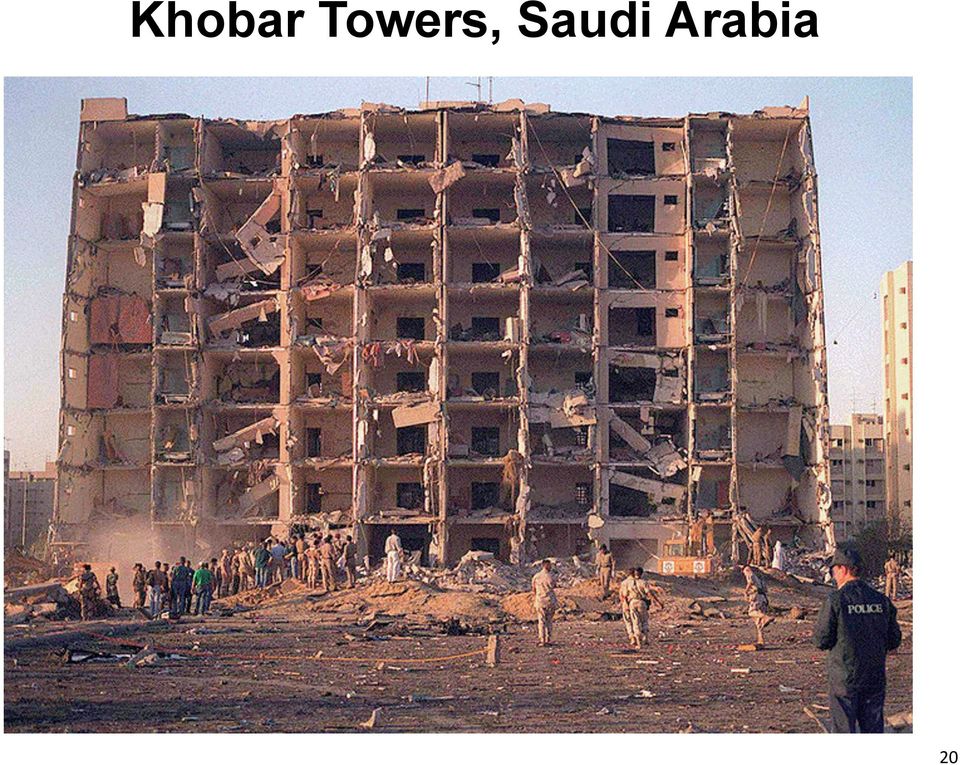
19 0) You Can t Worry About Everything In the real world, we all have to make our numbers, and that usually means priori;zing and only spending money on security measures when it is necessary and cost effec;ve for us to do so. The risks that you or I perceive may be different than the risks that someone else sees under different circumstances. For example, a military unit in the Mideast or Southern Asia might devote considerable aoen;on to protec;ng facili;es from aoack by vehicle borne improvised explosive devices (VBIEDs). VBIEDs are generally considered to be a top military threat, par;cularly a^er the aoack on the Marine Barracks in Beirut in 1983, and the Khobar Towers bombing in Saudi Arabia in
20 Khobar Towers, Saudi Arabia 20
21 But This Isn t The Mideast, Right? Here in the United States, higher educa;on might largely discount VBIEDs as a threat, choosing to accept that risk rather than making investments in an; VBIED technologies such as physical standoff zones, blast resistant glazing, vehicle inspec;on sta;ons, etc. Bomb *threats,* however, can be quite common on campus and quite disrup;ve. A growing number of campus police departments have decided to deploy local K 9 units to help clear buildings in response to campus bomb threats they may receive. These dogs and their handlers should be good friends with your campus system and networking staff, and rou;nely invited to walk/sweep campus data centers, labs, steam tunnels, etc. 21
22 University of Texas Police Department K 9 Unit 22
23 University of Wisconsin Police Department K 9 Unit 23
24 San Diego State Police Department K 9 Unit 24
25 1) Fiber Cuts Regardless of how skep;cal we may be of other physical security threats, one very real threat that I think we re all willing to acknowledge is that backhoes and other heavy equipment have an uncanny ability to find and accidentally cut buried fiber. You can help minimize the risk of uninten;onal damage to buried fiber by taking appropriate steps, including insuring that: all buried facili;es are well documented as actually constructed easily visible buried cable posts or signs are installed where appropriate or required you (or your service agent) subscribe to your state s call before you dig one call u;lity no;fica;on center, insuring that you make ;mely response to all relevant locate and mark requests any non conduc;ve/otherwise hard to locate facili;es should be buried with a tracer wire or conduc;ve marking tape (this may be a legal requirement in some states, e.g., OAR ) 25
26 OAR
27 The Downside of Transparency At the same ;me we recognize and accept the need to be transparent about where fiber is located in an effort to avoid the problem of accidental fiber cuts, poten;al bad guys might also be interested in our fiber deployments. For example: Are there cri;cal choke points, such as bridges across major rivers or tunnels through large mountain ranges, where virtually all fiber follows a common path out of necessity? Are there unmonitored access points (manholes, hand holes, fiber pedestals, etc.) where an aoacker might be able to gain access to your fiber without being detected? Obviously you need to balance the need to provide enough informa;on to avoid accidents, while simultaneously avoiding giving your enemies a blueprint for how to best aoack you. 27
28 Remember Sean Gorman s Disserta;on? 28
29 Fiber Maps Are S;ll Widely Available 29
30 Architec;ng and Building for High Availability One way you can improve the physical security of your network is by adding redundancy, excess capacity, and resiliency to it. Your network should be architected and constructed so that there are no choke points or single points of failure loss of any single link or piece of gear should NOT result in an outage! Think, We must always have redundant paths over diverse facili;es! Moreover, you must also have enough spare capacity on failover links so that if you do end up needing to actually use them, they won t be congested (or you need a plan to selec;vely shed load un;l you ve eliminated conges;on). 30
31 Obtaining High Availability Isn t Free Of course, the downside of all this is that high availability comes at a cost (as the saying goes, you can get whatever level of availability you can afford to buy ). If you re building out fiber paths, the first path between two paths normally goes via the cheapest and most direct route. A diverse path (virtually by defini;on) will need to go via some longer/less desirable/more expensive to provision path. You also need to accept that you ll be buying capacity that you normally won t be using. (If you do end up relying on use of your backup link to have enough capacity to accommodate your produc;on traffic requirement, what will you do if your primary link goes down? Each link should be able to independently carry all the traffic at your site) High availability also means that you ll need more hardware (e.g., at a minimum, more network interfaces for your routers, etc.) 31
32 All That Said, Many Internet2 Connectors Do Have Mul;ple Connec;ons To Internet2 32
33 The Incremental Port Charge to Go From 1xN to 2xN On Internet2 Is Rela;vely Small Note: 1x2.5Gbps 2x5Gbps for ($375K-$340K=) just $35K incremental! 1x10Gbps 2x10Gbps for ($525K-$480K=) just $45K incremental! 33
34 Diminishing Returns When you re thinking about how much you want to spend to insure that your network is always available, you need to remain cognizant of the law of diminishing returns. The first backup/failover circuit you add will likely provide a substan;al improvement in system availability, since if your main produc;on circuit fails, that backup circuit will save your bacon. It likely represents an excellent bit of insurance for you to buy. If you re really risk averse or your service must absolutely remain available, a second backup/failover circuit might allow you to avoid an outage in the rare circumstances where both your primary and your secondary circuits simultaneously experience an outage but, that *should* be a vanishingly rare event. But what of a third or fourth or n th backup/failover circuit? You might only need that extra circuit one ;me in ten million, and the cost of elimina;ng an event that rare may be prohibi;ve. 34
35 But An Example of How Some;mes Having Mul;ple Redundant Paths Can Pay Off Big Time: Public Safety Communica;ons On August 1 st, 2007 in St Paul 35
36 Hardware Sparing You also want to work to ensure that if an outage does occur due to a hardware failure, you can recover from it in a ;mely fashion. For example, are you con;nually monitoring your network and maintaining adequate local spares? O^en, par;cularly in smaller secondary markets, more expensive spares are not stocked locally, they re shipped in from regional depots on an as needed expedited basis. When mul;ple customers simultaneously suffer outages and all need replacement parts at the same ;me, or when same day courier service is disrupted due to a disaster, a lack of local spares could get ugly. 36
37 2) Network Confiden;ality and Fiber Taps As the network begins to carry poten;ally sensi;ve health care related traffic or classified traffic from public safety agencies, traffic confiden;ality will become more important. You may want to proac;vely and con;nually monitor your network links for any brief outages (windows which might be associated with the introduc;on of splioers or other unauthorized network elements). At the most basic, this can be done by sending/con;nually monitoring an ongoing heartbeat signal. More sophis;cated units (as used to protect federal classified networks such as SIPRNet and JWICS), are also available if appropriate (see hop:// ) You may also want to periodically characterize your deployed fiber with an OTDR (op;cal ;me domain reflectometer) to iden;fy any unexpected physical anomalies which may have developed. (Macrobends may be enough for data intercep;on) 37
38 Network Integrity Monitoring 38
39 Physical Security Of All Op;cal Networks (AON) See National Communications Systems Technical Information Bulletin 00-7, All-Optical Networks, 39
40 Live Open Ethernet Jacks/Ports It is amazing how o^en organiza;ons will tolerate live open ethernet jacks/ports to which random people can plug in systems. Some;mes this even includes unlocked wiring closets, or publicly touchable routers, switches, or other network equipment. Most universi;es do not allow free love open wireless networks, so why would you allow anyone with an ethernet cable to have open access to your wired network? Some op;ons to consider: only heat up jacks on request, or at least disable jacks in hallways and empty offices by default require authen;ca;on for most physical ethernet connec;ons the same way you do for wireless connec;ons consider locking unused jacks and installed patch cables (e.g., see but remember that Torx screwdriver bits are publicly available and recognize that jack plates can s;ll be removed or patch cables cut and reterminated for access) 40
41 41
42 $8.99 to Defeat Secure Fasteners 42
43 3) The Security of Cabinets, Rooms and Buildings When we think about the physical security of networks, there s a tempta;on to think just about the network, e.g., the fiber and the ethernet themselves. In reality, every network also has numerous other physical facili;es (cabinets, rooms, buildings, etc.) housing things such as key network equipment (optronics, routers, switches, etc.), as well as servers, cri;cal staff, documenta;on, media, etc. Those facili;es also need to be physically secure. Physical security can mean, among other things, that the facili;es aren t likely to be damaged by a deluge or other natural disaster. 43
44 A Flooded Data Center Video: 44
45 Locks Once we get beyond things like protec;ng a site from flooding, physical security o^en focuses on access control via locks. Naturally, we all know that the locks on data equipment cabinets typically aren t very strong, and more o^en than not the keys for those cabinet are just le^ on top of the cabinet so they don t get lost, cough, but because locks are used so many places related to compu;ng and networking, let s talk a liole about locks. 45
46 Surrep;;ous Opening of Tradi;onal Pin Tumbler Locks Even though tradi;onal pin tumbler locks have well known limita;ons, they s;ll form at least part of the physical security at most sites, including many computer or networking sites. If you think that tradi;onal pin tumbler locks provide anything even *remotely* approaching reasonable security, I d urge you to think again. In par;cular, you should learn about bump keys. 46
47 Video: How Lock Bumping Works Video: 47
48 If Detec;on Isn t A Problem If discovery of an intrusion isn t a problem, you should also know that many tradi;onal locks can be drilled, pried, ground, frozen or otherwise defeated by brute force in just a maoer of minutes. Thus, for any lock that maoers, you should probably consult with a professional locksmith and have a high security lock (such as those made by Medeco) installed, reinforcing the door and the door jamb (including the strike plate area) at the same ;me. Don t forget to secure any exposed outward swinging external door hinges, too! 48
49 Hinges 49
50 Padlocks Padlocks are widely used to secure network equipment. They are typically subject to all the issues associated with tradi;onal pin tumbler locks, but they have addi;onal issues of their own: warded padlocks (see image at right) are trivial to open; they should NEVER be used some padlocks are stamped with their key code; if you don t remember to remove that code, it may be possible to use those numbers to create or find a key for that lock the unshielded shackle of a padlock can o^en be cut with bolt cuoers or a torch even if you have a padlock that s secure, it may be used in conjunc;on with a weak and easily defeated hasp or chain The ul;mate? The Navy has approved the S&G 951 High Security Padlock, but at >$1,000/lock, it might be, um, a liole pricey 50
51 A S&G 951 Padlock (Different key-ways are intended for use by different audiences) 51
52 Keys Key related issues are another reason why tradi;onal locks o^en provide mediocre security. In a university environment, it is rou;ne for the same key to get issued to mul;ple people. When one of those keys get lost (or is not recovered when someone quits or is terminated), the locks that are opened by that key tend not to get rekeyed (typically, the cost of doing this would be prohibi;ve, and there are only a finite number of usable key combina;ons given physical constraints). Many sites also use master keys, allowing supervisors or custodial staff to have access to all offices on a given floor or in a par;cular building. If control over a master key is even temporarily lost (or an intruder can gain access to lock cylinders from mul;ple doors which all use the same master key), the intruder may be able to make a duplicate master and have the run of your facility. You really want to have a conversa;on with your lock & key person 52
53 Part of A Keys Control Checklist from the USDA See: 53
54 Alterna;ves to Locks and Keys Many facili;es have moved to key cards (swipe cards, prox cards, etc.) as an alterna;ve to tradi;onal locks & keys Key cards offer dis;nct advantages over tradi;onal locks and keys: key cards can be integrated into user site IDs/badges key card use can be tracked, while use of a key leaves no audit trail or record key cards can be programmed to work only during par;cular days or par;cular periods of ;me, while keys work all the ;me many key card systems can be configured to require two factors (e.g., you must use your key card AND enter a PIN code) upon termina;on, a key card can be instantly canceled with no need to manually rekey the system, etc. Some;mes, though, key cards may offer only an illusion of security. For example, some may be easily brute forced using widely available tools. 54
55 Some Prox Cards Tools Some resources men;oned in hop:// resources/white papers/foundstone/wp proxbrute.pdf Proxmark III: hop:// Proxpick: hop:// ProxClone: hop://proxclone.com/reader_cloner.html Also worth a read: The RFID Hacking Underground, Wired, May 2006 hop:// and hop://rfidiot.org/ 55
56 Proxmark3 56
57 FWIW, Many Swipe Style Cards Aren t Perfect Either 57
58 Biometrics Biometric systems use your physical characteris;cs to decide if you should or shouldn t be granted access to a facility or resource. Examples include: fingerprint or hand geometry readers iris and re;na scanners voice iden;fica;on facial recogni;on signature recogni;on Nice discussion of biometric issues in GAO O3 1137T, Challenges in Using Biometrics, hop:// d031137t.pdf Not a huge fan of biometric solu;ons. 58
59 Building Security: Piggy Backing/Tailga;ng/Social Engineering Key cards or biometrics won t help if random individuals can gain access to a secure facility by piggy backing/tailga;ng behind an authorized user, or by manipula;ng basic social courtesies. A nice example of manipula;ng basic social courtesies, men;oned to me by a colleague recently: approach the door to a controlled area carrying what s obviously a heavy box. It takes a preoy heartless person to not help that person out by holding the door for them. Floor to ceiling turns;les or mantraps (interlocking pairs of doors) can be used to help physically prevent these sort of phenomena. An aoendant at the door can also ensure that everyone coming in cards in as may be required (but I know that this is something that many higher educa;on sites have trouble enforcing). 59
60 60
61 Building Security: Stay Behinds There s also the poten;al problem of stay behind visitors if you re not con;nually escor;ng all visitors from entry to exit, or at least signing all visitors in and out, how do you know that all visitors who ve *entered* your facility have *le^* by the end of the day? An unescorted and forgooen visitor can be the camel s nose that defeats many of your physical access controls, poten;ally allowing anyone or everyone to gain access to your facili;es. For example, a stay behind visitor can open an unalarmed external door from the inside, thereby allowing entry of addi;onal people. Finding stay behinds is easier if a building has mo;on sensor alarms deployed, or if the organiza;on rou;nely uses security dogs to sweep sensi;ve buildings at closing ;me. Rou;nely lock all places where an unauthorized person might hide, out of sight, un;l the building emp;es (such as supply closets, unused offices, etc.) 61
62 Walls, Ceilings, Floors, Roofs, U;lity Tunnels, Etc. Some;mes you ll see a high security lock protec;ng a room with a hollow core door, externally accessible glass windows, sheetrock walls, a suspended ceiling, and maybe even a raised floor. In that sort of environment, an intruder can ignore the high security lock and just break the door or the window, or punch through the sheet rock walls, or climb in above the suspended ceiling or below the raised floor. (Embedded heavy gauge wire mesh can at least make that sort of through the wall or through the ceiling or floor entry more difficult) Similarly, have you secured your roof? Or could someone use an extension ladder to get to your roof, and then go through an unsecured roof hatch or skylight? What about any u;lity tunnels? Manholes are o^en one of the easiestto breach access points. Although locking manhole covers are available (e.g., see most manhole covers are simple cast iron units that provide no impediment to an intruder with a manhole cover li^er (or just a couple of bolts and some wire). 62
63 Fencing University campuses aren t like industrial or government facili;es, but if you can add a fenced perimeter around cri;cal facili;es, that fence will immediately adds significantly to your site s physical security. Government and military folks (who do worry about things like VBIEDs) like a wire cable reinforced perimeter fence that s ideally at least fi^y feet away from the facility that s protected, built from 9 gauge (or heavier) chain link, seven feet or more tall, with an outward facing razor wire top guard plus a booom rail, well anchored and backed up by things like interlocking precast concrete obstacles or large concrete planters. Dual fence designs are also popular. That may all be a bit much for university environments, but if you can deploy it, it s another layer of physical security. 63
64 Exclusion Zones, Intrusion Detec;on & Landscaping Most fences (par;cular with proper signage) will at least serve to create a public exclusion zone in which an intruder can be readily iden;fied and intercepted for ques;oning. Extensive ligh;ng plus physical intrusion detec;on systems will help managing that exclusion zone. Any landscaping should not provide hiding spots for intruders. Any trees near or overhanging a security fence should also be trimmed or removed to prevent the tree from being used as a pathway over the fence. 64
65 Example of a Fencing Failure A fence approximately six feet high surrounds some of [the Kinshasa Nuclear Research Center] CREN K. The fence is constructed of cement in some places and chain link in others. The fence is not lit at night, has no razor wire across the top, and is not monitored by video surveillance. There is also no cleared buffer zone between it and the surrounding vegeta;on. There are numerous holes in the fence, and large gaps where the fence was missing altogether. University of Kinshasa students frequently walk through the fence to cut across CREN K, and subsistence farmers grow manioc on the facility next to the nuclear waste storage building. [ ] No fence separates the nuclear waste storage building and the University of Kinshasa s women s dormitory. The two buildings sit approximately 300 meters apart, and one can walk freely from one to the other across the manioc field. hop://;nyurl.com/68sgdds 65
66 Alarms and Guards Access control features such as locks and reinforced doors and walls can t keep a determined intruder out forever virtually any facility can eventually be breached if the intruder has enough ;me and no interrup;ons. What access control features do give you is a window of ;me for guards to respond and deal with any intrusion aoempt. The sooner your guards know that someone is aoemp;ng to break in, the more ;me they ll have to mobilize and deal with the aoempted intrusion. Alarms buy you that response ;me. Again, just as was the case with locks, you should consider engaging an alarm professional to help you plan and deploy a suitable comprehensive alarm system (including things like area mo;on detectors, and perimeter integrity alarms with window ajar and door ajar sensors). You should also review response requirements with campus police and municipal law enforcement. 66
67 Surveillance Video You can t be everywhere at once, so take advantage of surveillance cameras to increase your security leverage. Cameras have come way down in price, while quality has gone up (as has ease of installa;on). It should now be possible for you to affordably add surveillance video throughout all cri;cal campus facili;es. Surveillance video may deter issues from arising in the first place: if people know they re poten;ally being monitored, that alone may deter them from engaging in illegal ac;vi;es. If illegal ac;vi;es do occur, surveillance video can provide crucial evidence documen;ng what happened during the incident: (a) When did the incident occur? (b) How did the incident occur? (c) Who did it? (d) What did they take/what did they do? Consider using a redundant out of building digital video recorder to ensure that an in building video recorder doesn t get stolen or compromised during a security incident. 67
68 4) Emergency Systems: Fire Detec;on & Suppression Electrical fires are one of the most destruc;ve events an IT organiza;on can run into, and fire suppression has become trickier since new inert gas ( Halon 1301 ) installa;ons have been banned due to ozone deple;on concerns. Automa;c water sprinkler systems ( dry pipe systems) are the most common alterna;ves, but water sprinkler systems may not be effec;ve when it comes to suppressing electrical fires occurring in machine rooms under raised floors. Non Halon gaseous fire suppression systems (for example, carbon dioxide based systems) may be an alterna;ve, but they represent serious poten;al risks for operators and other personnel who may need to be rapidly evacuated in the event of a fire. See the discussion of some Halon alterna;ves: hop://;nyurl.com/6agevle Note: RegreOably, not all fires will take place in your well fire suppressed machine room 68
69 OSU s Thanksgiving 2010 Steam Tunnel Fire Oregon State University resumes classes, though some phone and computer services s;ll disabled from fire, November 29 th, 2010, hop://;nyurl.com/5sxxx3c [emphasis added below] Some Oregon State University buildings s;ll had not regained telephone or computer data service Monday as the result of an electrical fire last week, but all classes resumed normally. The fire erupted early last Wednesday morning in wiring that runs through the university's steam tunnels, 6 to 8 foot tall tunnels that run under most buildings on campus. Electrical wiring, telephone lines and fiber op;c cables thread through the tunnels along with wrapped steam pipes that carry heat to buildings. Inves;gators are s;ll trying to determine what caused an arc flash a burst of electrically charged energy that burns at a temperature of 5,000 degrees or higher. The arc singed sec;ons of wiring extending about a 100 feet from the flash point in three direc;ons, said Vincent Martorello, director of facility services. The university gave its nearly 24,000 students early dismissal for the Thanksgiving break on Wednesday morning because the fire had disabled fire alarms in some buildings, Simmons said. The fire did not affect dormitories, but it le` five buildings Monday without computer data connec;ons and a dozen buildings without telephone service. Telephone service may not be fully restored un;l the end of the fall term, university officials said. 69
70 Source: 70
71 Emergency Power and Cooling O^en uninterrup;ble power supplies prove to be too small for the load they ve been stretched to support. In those cases, even if you immediately began shujng down systems as soon as the power flipped to the UPS, you would not be able to cleanly take down all the covered equipment before running out of juice (and naturally most people don t want to begin powering things down un;l they re SURE that they re not facing just a brief outage). Check and figure out how long you can run with your actual load. UPS systems need to be backed up by diesel generators. Have you tested yours recently? How much fuel do you have available for it? In an emergency will you be able to get more? Are you sure? While most sites worry about emergency power, many forget to think about emergency cooling. If your machine room is going to overheat, even if you have juice, you won t be able to stay online. Spend some ;me thinking about your emergency cooling plan. 71
72 An Example from 9/
73 Network Opera;onal Con;nuity in a Disaster Would your network con;nue to operate if your primary network opera;ons center was hit by a major disaster, such as an earthquake? We can tease apart two issues here: Will you have a func;onal NOC, post disaster? And will your remote network equipment con;nue to operate? These days, realis;cally speaking, you will likely want full replica;on of your NOC at an out of region loca;on if you want to be able to con;nue to operate your network a^er a major disaster. That replicated NOC will need both trained and ready to go network engineers and NOC staff, as well as replicated servers and live current copies of all NOC databases. We recognize that this is a poten;ally expensive proposi;on, but one that we think deserves serious considera;on. 73
74 Disaster Con;nuity for Remote Gear, Including Emergency Out Of Band Access A major disaster, such as an earthquake, may also directly impact remote network equipment. Don t forget to plan for the emergency power, cooling and remote access needs of your remote networking sites (including fiber equipment huts). Every installa;on with ac;ve electronics needs, at a minimum, its own emergency power and cooling, par;cularly if primary power is coming from only a single u;lity feeder, or the u;li;es for a remote site are aerial rather than buried. It may also be worth spending some ;me thinking about how you will securely handle emergency out of band access to remote gear if in band access gets interrupted due to a network outage. 74
75 5) Miscellaneous Items: Personnel Controls Personnel vejng and related controls are o^en viewed as a key part of physical security because on site personnel enjoy unique physical access to site facili;es. Historically universi;es have rarely done background checks on their employees, however, that prac;ce has been evolving over ;me, par;cularly for system and networking staff members having effec;vely unlimited access to the University s infrastructure. As staffs are beefed up to support BTOP/US UCAN ac;vi;es, don t neglect personnel background checks in your eagerness to fill some of those hard to fill posi;ons! Be sure to discuss any planned background checks with your Human Resources Department, since specific no;ce and consent requirements or other limita;ons may apply, and typically vary from state to state. 75
76 ID Badges ID badges are another rou;ne component of personnel security programs, and become necessary when an organiza;on grows beyond a size where everyone knows everyone and everyone knows what everyone should (or shouldn t) be doing. Ideally, ID badges would: iden;fy the person bearing the badge ( Sam Anderson ), and make it easy for third par;es to verify that the right person has that badge (e.g., the picture on the badge matches its user) give the person s status ( employee, visitor, etc.) and role ( senior network engineer, custodian, etc.) signal any atypical access ( machine room access allowed or must be accompanied at all ;mes ) include a magstripe or barcode that allows the creden;al to be easily verified against an authorita;ve database be difficult to forge, resistant to unauthorized modifica;ons, hard to accidentally damage, and cheap 76
77 Creden;als and A False Sense of Security While ID badges have the poten;al to improve security if properly used, sites need to be on guard against lejng ID badges lull them into a false sense of security. Just because someone has an ID badge doesn t mean that they should be immune from being challenged if they re somewhere they shouldn t be, or doing something they shouldn t be doing. Creden;als should also be challenged and verified if the person presen;ng them isn t known, or just feels wrong (trust your paranoia). For example, it has been reported that penetra;on testers have been rou;nely able to gain unauthorized access to sterile areas of airports and sensi;ve federal facili;es by displaying bogus law enforcement creden;als. Such access is par;cularly troubling when those individuals are allowed access with firearms or other weapons. 77
78 An Example of Creden;al Abuse From the GAO Our undercover agents were 100 percent successful in penetra;ng 19 federal sites and 2 commercial airports. We were able to enter 18 of the 21 sites on the first aoempt. The remaining 3 required a second visit before we were able to penetrate the sites. At no ;me during the undercover visits were our agents bogus creden;als or badges challenged by anyone. At the 21 sites that our undercover agents successfully penetrated, they could have carried in weapons, listening devices, explosives, chemical/biological agents, devices, and/or other such items/materials. At each visit, our agents carried bogus badges and iden;fica;on, declared themselves as armed law enforcement officers, and gained entry by avoiding screening. At least one agent always carried a valise. Sixteen of the sites we visited contained the offices of cabinet secretaries or agency heads. At 15 of these sites, our undercover agents were able to stand immediately outside the suites of the cabinet secretary or agency head. In the 5 instances in which our agents aoempted entry into such suites, they were successful. At 15 of the sites, our agents entered a rest room in the vicinity of these offices and could have le^ a valise containing weapons, explosives, and/or other such items/materials without being detected. Except for one agency, we made no aoempt to determine whether any of the cabinet secretaries or agency heads were present at the ;me we visited their agencies. At a federal courthouse, our agents were waved through a magnetometer but not screened. A briefcase that one of the agents carried was not checked. The agents were escorted to a gun box room, which they were permioed to enter alone. They were then instructed to lock their weapons, but no one supervised or observed the actual surrender of the agents weapons. At the two airports we visited, our agents used ;ckets that had been issued in their undercover names for commercial flights. These agents declared themselves as armed law enforcement officers, displayed their spurious badges and iden;fica;on, and were issued law enforcement boarding passes by the airline representa;ve at the ;cket counter. Our agents then presented themselves at the security checkpoints and were waved around the magnetometers. Neither the agents nor their valises were screened. Source: GAO/T OSI 00 10, Security Breaches at Federal Agencies and Airports, May 25 th, 2000, hop://ntl.bts.gov/lib/11000/11400/11410/os00010t.pdf 78
79 6) Informa;on Leakage (FISMA PE19) The final area of physical security we might consider is what FISMA PE19 calls informa;on leakage. If we weren t talking about physical security today, when you hear the term informa;on leakage, the first thoughts that would probably come to mind would probably include: sniffing unencrypted network traffic SQL injec;on aoacks (poten;ally extrac;ng PII or other confiden;al data in unan;cipated ways) malware (such as banking trojans ) eavesdropping on user financial data BGP route injec;on aoacks ( BGP shunts ) DNS poisoning etc. 79
80 Physical Surveillance Devices The physical analog to some of those network based eavesdropping aoacks would be physical surveillance devices, colloquially known as bugs. For some reason, while most people are all too willing to believe that hackers and malicious so^ware exist and could spy on your online ac;vity, they are o^en skep;cal that there are physical surveillance devices that are an equal or greater threat. Put another way, some people think that physical surveillance devices are something that only the ;n foil hat crowd tends to worry about. No one s going to bother bugging my computer or my office or my car. I m happy that those folks are feeling so secure, but that sense of security may be unwarranted. Physical surveillance devices DO exist. 80
81 Simple Example: A Hardware Keylogger 81
82 Some More Hardware Logging Gear 82
83 Eavesdropping Just as your computer may have a hardware bug aoached to it, so, too, in some circumstances your data center or offices may be end up with a physical bug (surrep;;ous microphone or camera). While popular television shows frequently show these devices being easily detected, in reality, at least when professional quality equipment is used and installed by a skilled professional, it can be difficult to detect and neutralize those bugs (the process of loca;ng and defea;ng bugs is normally referred to as technical surveillance counter measures or TSCM). If you remain skep;cal that bugs are an real physical security issue, or that they can be difficult to detect and remove, I recommend you review the presenta;on: Phone Talk, hop:// Phone_Lecture_Reston_VA 2009.htm (167 slides) 83
84 (Un)Trustworthy Hardware? Informa;on leakage and physical security problems take on a profound new meaning if you can poten;ally end up with counterfeit hardware, or hardware made with counterfeit chips. I would encourage you to become familiar with the threat I m referring to in this area a nice briefing is the FBI PowerPoint deck en;tled, FBI Criminal Inves;ga;on Cisco Routers, as embedded in graphical form in FBI Fears Chinese Hackers Have Back Door Into US Government and Military, see hop:// See also the excellent ar;cle Dangerous Fakes, hop:// b htm Buying counterfeit products is one physical security risk, but other physical security risks are associated with disposing of surplus/no longer needed hardware on the other end of the cycle 84
85 Dumpster Diving and Surplus Equipment Historically, many crackers got their start by digging interes;ng computer and networking gear out of corporate dumpsters (a fine art normally known as dumpster diving ). Today, there s much more emphasis on recycling, and that s laudable, but any storage media in surplus equipment needs to get wiped before that gear gets sold or otherwise disposed of, even if the system itself no longer boots/runs. Beware of amateur efforts at rendering hard drives unusable staff members can easily hurt themselves while aoemp;ng to destroy surplus equipment with sledge hammers or other improvised tools (one par;cularly dangerous example involved amateur use of thermite!). Surprisingly, informa;on may s;ll some;mes be able to be recovered from a destroyed drive. Consider hiring a contractor to crush or shred your drives, or (if your volume is large), perhaps get your own crusher/shredder. 85
86 86
87 Outputs: Confiden;al Documents Sensi;ve documents also need to be shredded, incinerated, or sequestered in a confiden;al document disposal container for approved disposal. Speaking of confiden;al document disposal containers, it is rou;ne for these wheelie cans to live in mailrooms or corridor areas, locked to prevent casual browsing of discarded confiden;al documents, but o^en not living chained down. Presumably the unauthorized removal of a full document disposal container full of confiden;al documents would be a disconcer;ng event, so please be careful and secure your wheelie cans of sensi;ve documents! 87
88 All The Rest It isn t possible to go over everything that we really should talk about when it comes to IT physical security in only an hour, so please don t think that this is a comprehensive treatment it s not. This talk is really just designed to wet your whistle when it comes to thinking about physical security. If you re not rou;nely talking about physical security at your site, or you don t have a formal physical security policy, you may want to think about having someone focus on this important area. Hopefully this talk will at least provide some star;ng points for that conversa;on. 88
89 Thanks for the Chance to Talk! Are there any ques;ons? 89
Availability and Disaster Recovery: Basic Principles
 Availability and Disaster Recovery: Basic Principles by Chuck Petch, WVS Senior Technical Writer At first glance availability and recovery may seem like opposites. Availability involves designing computer
Migrating to Hosted Telephony. Your ultimate guide to migrating from on premise to hosted telephony. www.ucandc.com
 Migrating to Hosted Telephony Your ultimate guide to migrating from on premise to hosted telephony Intro What is covered in this guide? A professional and reliable business telephone system is a central
Palm Beach County Sheriff s Office
 Palm Beach County Sheriff s Office Business Security Self Survey Since 1909, the deputies of Palm Beach County have provided a safe environment for hundreds of thousands of people who live, work and visit
Part 1 : STRATEGIC : But let s begin with WHY : Why are we doing this?
 Part 1 : STRATEGIC : Why DO we care?? What is YOUR cri=cal message? And WHO do you need to reach? : I ll try and give you some pointers and ideas for where to look and how to figure that out for your cons=tuents
DDC Sequencing and Redundancy
 DDC Sequencing and Redundancy Presenter Sequencing Importance of sequencing Essen%al piece to designing and delivering a successful project Defines how disparate components interact to make up a system
VoIP Security How to prevent eavesdropping on VoIP conversa8ons. Dmitry Dessiatnikov
 VoIP Security How to prevent eavesdropping on VoIP conversa8ons Dmitry Dessiatnikov DISCLAIMER All informa8on in this presenta8on is provided for informa8on purposes only and in no event shall Security
Phone Systems Buyer s Guide
 Phone Systems Buyer s Guide Contents How Cri(cal is Communica(on to Your Business? 3 Fundamental Issues 4 Phone Systems Basic Features 6 Features for Users with Advanced Needs 10 Key Ques(ons for All Buyers
5 DEADLY MISTAKES THAT BUSINESS OWNERS MAKE WITH THEIR COMPUTER NETWORKS AND HOW TO PROTECT YOUR BUSINESS
 5 DEADLY MISTAKES THAT BUSINESS OWNERS MAKE WITH THEIR COMPUTER NETWORKS AND HOW TO PROTECT YOUR BUSINESS 1 Introduction As small and mid-sized companies rely more heavily on their computer networks to
SECURITY VULNERABILITY CHECKLIST FOR ACADEMIC AND SMALL CHEMICAL LABORATORY FACILITIES
 SECURITY VULNERABILITY CHECKLIST FOR ACADEMIC AND SMALL CHEMICAL LABORATORY FACILITIES by the American Chemical Society, Committee on Chemical Safety, Safe Practices Subcommittee Introduction Terrorism
IT Checklist. for Small Business INFORMATION TECHNOLOGY & MANAGEMENT INTRODUCTION CHECKLIST
 INFORMATION TECHNOLOGY & MANAGEMENT IT Checklist INTRODUCTION A small business is unlikely to have a dedicated IT Department or Help Desk. But all the tasks that a large organization requires of its IT
NCS 330. Information Assurance Policies, Ethics and Disaster Recovery. NYC University Polices and Standards 4/15/15.
 NCS 330 Information Assurance Policies, Ethics and Disaster Recovery NYC University Polices and Standards 4/15/15 Jess Yanarella Table of Contents: Introduction: Part One: Risk Analysis Threats Vulnerabilities
ISO IEC 27002 2005 (17799 2005) INFORMATION SECURITY AUDIT TOOL
 9.1 USE SECURITY AREAS TO PROTECT FACILITIES 1 GOAL Do you use physical methods to prevent unauthorized access to your organization s information and premises? 2 GOAL Do you use physical methods to prevent
http://homedefensesecurity.com
 The Basics of Home Security Topics Covered: Home Security Basics Home Security Guides Home Security Products and Services The Value of Insurance in Home Protection Top Ten Tips for Your Home Security Essentials
Protec'ng Communica'on Networks, Devices, and their Users: Technology and Psychology
 Protec'ng Communica'on Networks, Devices, and their Users: Technology and Psychology Alexey Kirichenko, F- Secure Corpora7on ICT SHOK, Future Internet program 30.5.2012 Outline 1. Security WP (WP6) overview
Organizing and Managing Equipment Rooms
 Organizing and Managing Equipment Rooms How you organize and maintain your equipment room can be just as important as maintaining the operating systems on the boxes themselves. Although many companies
Version: Modified By: Date: Approved By: Date: 1.0 Michael Hawkins October 29, 2013 Dan Bowden November 2013
 Version: Modified By: Date: Approved By: Date: 1.0 Michael Hawkins October 29, 2013 Dan Bowden November 2013 Rule 4-004L Payment Card Industry (PCI) Physical Security (proposed) 01.1 Purpose The purpose
Disaster Recovery and Business Continuity What Every Executive Needs to Know
 Disaster Recovery and Business Continuity What Every Executive Needs to Know Bruce Campbell & Sandra Evans Contents Why you need DR and BC What constitutes a Disaster? The difference between disaster recovery
10 Hidden IT Risks That Might Threaten Your Business
 (Plus 1 Fast Way to Find Them) Your business depends on intelligence. But can you count on your technology? You may not be in the intelligence technology business, but it s probably impossible to imagine
Privacy- Preserving P2P Data Sharing with OneSwarm. Presented by. Adnan Malik
 Privacy- Preserving P2P Data Sharing with OneSwarm Presented by Adnan Malik Privacy The protec?on of informa?on from unauthorized disclosure Centraliza?on and privacy threat Websites Facebook TwiFer Peer
Computer Security Incident Handling Detec6on and Analysis
 Computer Security Incident Handling Detec6on and Analysis Jeff Roth, CISSP- ISSEP, CISA, CGEIT Senior IT Security Consultant 1 Coalfire Confiden+al Agenda 2 SECURITY INCIDENT CONTEXT TERMINOLOGY DETECTION
SITECATALYST SECURITY
 SITECATALYST SECURITY Ensuring the Security of Client Data June 6, 2008 Version 2.0 CHAPTER 1 1 Omniture Security The availability, integrity and confidentiality of client data is of paramount importance
10 Hidden IT Risks That Threaten Your Practice
 (Plus 1 Fast Way to Find Them) Your practice depends on intelligence. But can you count on your technology? You may not be in the intelligence technology business, but it s probably impossible to imagine
Security Policy JUNE 1, 2012. SalesNOW. Security Policy v.1.4 2012-06-01. v.1.4 2012-06-01 1
 JUNE 1, 2012 SalesNOW Security Policy v.1.4 2012-06-01 v.1.4 2012-06-01 1 Overview Interchange Solutions Inc. (Interchange) is the proud maker of SalesNOW. Interchange understands that your trust in us
Making the leap to the cloud: IS my data private and secure?
 Making the leap to the cloud: IS my data private and secure? tax & accounting MAKING THE LEAP TO THE CLOUD: IS MY DATA PRIVATE AND SECURE? Cloud computing: What s in it for me? The more you know about
Data Center Infrastructure & Managed Services Outline
 Data Center Infrastructure & Managed Services Outline The 360 Technology Center Solutions Data Center is located in Lombard, IL, USA. We are 20 minutes outside of downtown Chicago. The 360TCS staff consists
Commercial or Business Security Survey
 Exterior Grounds Commercial or Business Security Survey Is there a fence around the property or a clear definition of Territoriality? If there is a fence, is it tall enough and maintained in good repair?
Las Vegas Datacenter Overview. Product Overview and Data Sheet. Created on 6/18/2014 3:49:00 PM
 Las Vegas Datacenter Overview Product Overview and Data Sheet Product Data Sheet Maintaining a Software as a Service (SaaS) environment with market leading availability and security is something that Active
Supply Chain Security Audit Tool - Warehousing/Distribution
 Supply Chain Security Audit Tool - Warehousing/Distribution This audit tool was developed to assist manufacturer clients with the application of the concepts in the Rx-360 Supply Chain Security White Paper:
Member Municipality Security Awareness Training. End- User Informa/on Security Awareness Training
 End- User Informa/on Security Awareness Training 1 Why Awareness Training? NCLM sanc:oned mul:ple Security Risk Assessments for a broad spectrum of member municipali:es The assessments iden:fied areas
The 9 Ugliest Mistakes Made with Data Backup and How to Avoid Them
 The 9 Ugliest Mistakes Made with Data Backup and How to Avoid Them If your data is important to your business and you cannot afford to have your operations halted for days even weeks due to data loss or
WESTERVILLE DIVISION OF POLICE Security Survey Checklist: Business
 Business Name: Owner Name: Business Address: Officer: Survey No.: WESTERVILLE DIVISION OF POLICE Security Survey Checklist: Business "Being There When Needed" DOORS 1. Is the exterior doors solid core
Build- It- Yourself: So2ware Oscilloscope and Func:on Generator
 Build- It- Yourself: So2ware Oscilloscope and Func:on Generator David Stein ([email protected]; hfp://djstein.com) Adapted from earlier projects by Alireza Akhavian (GMU) and Jan Henrik (hfp://instructables.com)
Cyber Threats in Physical Security Understanding and Mitigating the Risk
 Cyber Threats in Physical Security Understanding and Mitigating the Risk Synopsis Over the last few years, many industrial control systems, including security solutions, have adopted digital technology.
Hacking Book 1: Attack Phases. Chapter 1: Introduction to Ethical Hacking
 Hacking Book 1: Attack Phases Chapter 1: Introduction to Ethical Hacking Objectives Understand the importance of information security in today s world Understand the elements of security Identify the phases
MARULENG LOCAL MUNICIPALITY
 MARULENG LOCAL MUNICIPALITY Data Centre Physical Access and Environmental Control Policy Draft: Data Centre Access Control and Environmental Policy Page 1 Version Control Version Date Author(s) Details
NETWORK DEVICE SECURITY AUDITING
 E-SPIN PROFESSIONAL BOOK VULNERABILITY MANAGEMENT NETWORK DEVICE SECURITY AUDITING ALL THE PRACTICAL KNOW HOW AND HOW TO RELATED TO THE SUBJECT MATTERS. NETWORK DEVICE SECURITY, CONFIGURATION AUDITING,
Major Risks and Recommended Solutions
 Major Risks and Recommended Solutions www.icdsecurity.com OVERVIEW Are you familiar with the main security risks that threaten data centers? This paper provides an overview of the most common and major
The evolution of data connectivity
 Leveraging the Benefits of IP and the Cloud in the Security Sector The CCTV and alarm industry has relied on analogue or Integrated Services Digital Network (ISDN) communications to provide data connectivity
Security Tools. Forms. Physical Security Assessment Security Plan Template Traffic Control Plan Template
 Security Tools Forms Physical Security Assessment Security Plan Template Traffic Control Plan Template 1 Physical Security Assessment (PSA) Date: I. PHYSICAL SECURITY ASSESSMENT (PSA): EXTERIOR OF THE
Physical Security: From Locks to Dox
 Physical Security: From Locks to Dox Introduction to Red Team Physical Security Penetration Testing Jess Hires Jax Locksport www.hacksonville.com Disclaimer This information is to be used for professional
Kaseya Fundamentals Workshop DAY THREE. Developed by Kaseya University. Powered by IT Scholars
 Kaseya Fundamentals Workshop DAY THREE Developed by Kaseya University Powered by IT Scholars Kaseya Version 6.5 Last updated March, 2014 Day Two Overview Day Two Lab Review Patch Management Configura;on
Policy for Protecting Customer Data
 Policy for Protecting Customer Data Store Name Store Owner/Manager Protecting our customer and employee information is very important to our store image and on-going business. We believe all of our employees
Palm Beach County Sheriff s Office
 Palm Beach County Sheriff s Office Home Security Self Survey Since 1909, the deputies of Palm Beach County have provided a safe environment for thousands of people who live, work and visit Palm Beach County.
MOVING INTO THE DATA CENTRE: BEST PRACTICES FOR SUCCESSFUL COLOCATION
 MOVING INTO THE DATA CENTRE: BEST PRACTICES FOR SUCCESSFUL COLOCATION CONTENTS Overview _ 2 FINDING THE RIGHT DATA CENTRE FOR YOUR BUSINESS _ 3 PREPARING FOR THE MOVE 6 MAKING THE MOVE _ 8 summary _ 9
Network Security. Computer Security & Forensics. Security in Compu5ng, Chapter 7. l Network Defences. l Firewalls. l Demilitarised Zones
 Network Security Security in Compu5ng, Chapter 7 Topics l Network AAacks l Reconnaissance l AAacks l Spoofing l Web Site Vulnerabili5es l Denial of Service l Network Defences l Firewalls l Demilitarised
Information Technology General Controls Review (ITGC) Audit Program Prepared by:
 Information Technology General Controls Review (ITGC) Audit Program Date Prepared: 2012 Internal Audit Work Plan Objective: IT General Controls (ITGC) address the overall operation and activities of the
Five keys to a more secure data environment
 Five keys to a more secure data environment A holistic approach to data infrastructure security Compliance professionals know better than anyone how compromised data can lead to financial and reputational
Frankfurt Data Centre Overview
 Technical Services Briefing Document Frankfurt Data Centre Overview Version 2.1 Contents Introduction... 3 TelecityGroup Data Centre in Frankfurt... 4 Data Centre Characteristics... 4 Technologies in Use
How To Ensure Security At A Site Security Site
 Facility XXXX Site Security Survey Date: 10/9-10/10/02 (A) Perimeter Security DELAY/DETER Site Boundary None of the critical facilities have protective Fence (Height and Construction) fences. Outriggers
[Insert Company Logo]
![[Insert Company Logo]](/thumbs/30/14202230.jpg "[Insert Company Logo]") [Insert Company Logo] Business Continuity and Disaster Recovery Planning (BCDRP) Manual 1 Table of Contents Critical Business Information 4 Business Continuity and Disaster Recover Planning (BCDRP) Personnel
[Insert Company Logo] Business Continuity and Disaster Recovery Planning (BCDRP) Manual 1 Table of Contents Critical Business Information 4 Business Continuity and Disaster Recover Planning (BCDRP) Personnel
Todd & Cue Ltd Your Business Continuity Partner
 Todd & Cue Ltd Your Business Continuity Partner Preparation and Planning We provide strategies, tools and resources to help you prepare for a business interruption whether it is caused by fire, water,
MEDIAROOM. Products Hosting Infrastructure Documentation. Introduction. Hosting Facility Overview
 MEDIAROOM Products Hosting Infrastructure Documentation Introduction The purpose of this document is to provide an overview of the hosting infrastructure used for our line of hosted Web products and provide
Customer Guide to the DATAONE Datacenter
 Customer Guide to the DATAONE Datacenter User guide for Private Suite or Colocation Customer Version 1.0 July 2012 CONTENTS 1 Welcome... 3 2 Getting started... 4 2.1 CONTACTING US... 4 2.2 OBTAINING SECURITY
Check Your Home Security
 Check Your Home Security The following guidelines are for you to check your own home security. To complete the exercise properly should take about 30 minutes. You may want to make notes as you go along
National Cyber Security Month 2015: Daily Security Awareness Tips
 National Cyber Security Month 2015: Daily Security Awareness Tips October 1 New Threats Are Constantly Being Developed. Protect Your Home Computer and Personal Devices by Automatically Installing OS Updates.
MONROE POLICE DEPARTMENT
 MONROE POLICE DEPARTMENT 104 Stage Road Monroe, NY 10950 Main: (845) 782-8644 - Fax: (845) 782-2227 A. Alex Melchiorre Website: www.monroepd.org Chief of Police BUSINESS BURGLARY PREVENTION TIPS Is your
Hosted Testing and Grading
 Hosted Testing and Grading Technical White Paper July 2014 www.lexmark.com Lexmark and Lexmark with diamond design are trademarks of Lexmark International, Inc., registered in the United States and/or
Home Security Inspection
 Home Security Inspection This document sets forth conclusions and recommendations following a Crime Prevention Through Environmental Design inspection performed by the Thunderbolt Police Department. The
Powering the Cloud Desktop: OS33 Data Centers
 OS33 Data Centers [email protected] (866) 796-0310 www.os33.com It is hard to overstate the importance of security and uptime, which is why we obsess over making sure that your corporate information assets
INTRUSION DETECTION SYSTEM (IDS) D souza Adam Jerry Joseph 0925910 I MCA
 INTRUSION DETECTION SYSTEM (IDS) D souza Adam Jerry Joseph 0925910 I MCA OVERVIEW Introduction Overview The IDS Puzzle Current State of IDS Threats I have a good firewall, why do I need an IDS? Expectations
All YOU need to know to secure YOUR HOME
 YOUR FREE POCKET GUIDE All YOU need to know to secure YOUR HOME brought to you by Town & Country Security Systems Ltd Congratulations on receiving this FREE Pocket Guide to help spot the weaknesses in
HIPAA Security Alert
 Shipman & Goodwin LLP HIPAA Security Alert July 2008 EXECUTIVE GUIDANCE HIPAA SECURITY COMPLIANCE How would your organization s senior management respond to CMS or OIG inquiries about health information
Privacy + Security + Integrity
 Privacy + Security + Integrity Docufree Corporation Data Security Checklist Security by Design Docufree is very proud of our security record and our staff works diligently to maintain the greatest levels
nwstor Storage Security Solution 1. Executive Summary 2. Need for Data Security 3. Solution: nwstor isav Storage Security Appliances 4.
 CONTENTS 1. Executive Summary 2. Need for Data Security 3. Solution: nwstor isav Storage Security Appliances 4. Conclusion 1. EXECUTIVE SUMMARY The advantages of networked data storage technologies such
Information Technology Security Procedures
 Information Technology Security Procedures Prepared By: Paul Athaide Date Prepared: Dec 1, 2010 Revised By: Paul Athaide Date Revised: September 20, 2012 Version 1.2 Contents 1. Policy Procedures... 3
12 Little-Known Facts and Insider Secrets Every Business Owner Should Know About Backing Up Their Data and Choosing a Remote Backup Service
 12 Little-Known Facts and Insider Secrets Every Business Owner Should Know About Backing Up Their Data and Choosing a Remote Backup Service If your data is important to your business and you cannot afford
Security Control Standard
 Department of the Interior Security Control Standard Physical and Environmental Protection April 2011 Version: 1.1 Signature Approval Page Designated Official Bernard J. Mazer, Department of the Interior,
REVIEWED ICT DATA CENTRE PHYSICAL ACCESS AND ENVIROMENTAL CONTROL POLICY
 LI_M_POPO PROVINCIAL GOVERNMENT :;:ED.JBl-C ()F SO"';-H AFR;IC. ':.,. DEPARTMENT OF CO-OPERATIVE GOVERNANCE, HUMAN SETTLEMENTS & TRADITIONAL AFFAIRS REVIEWED ICT DATA CENTRE PHYSICAL ACCESS AND ENVIROMENTAL
Factors to Consider When Developing an Evacuation Plan
 The following should be viewed only as suggestions: Factors to Consider When Developing an Evacuation Plan 1. You must identify your document with a specific title and explanation. Example: Evacuation
State of Texas. TEX-AN Next Generation. NNI Plan
 State of Texas TEX-AN Next Generation NNI Plan Table of Contents 1. INTRODUCTION... 1 1.1. Purpose... 1 2. NNI APPROACH... 2 2.1. Proposed Interconnection Capacity... 2 2.2. Collocation Equipment Requirements...
8 secrets. Your Burglar Won't Tell You
 8 secrets Your Burglar Won't Tell You In the United States alone, a home burglary occurs every 14 seconds. These kinds of statistics can be alarming, and the best thing you can do as a homeowner is educate
11 Common Disaster Planning Mistakes
 11 Common Disaster Planning Mistakes The world is full of risk. Floods, fires, hurricanes, thefts, IT system failures and blackouts are just a few of the incredibly damaging disasters that can and do strike
1. Perimeter fencing or walls should enclose the vicinity around cargo handling and loading areas, as well as storage facilities.
 2. Physical Security Cargo handling and storage facilities in domestic and foreign locations must have physical barriers and deterrents that guard against unauthorized access. Where applicable, there must
Network Security: 30 Questions Every Manager Should Ask. Author: Dr. Eric Cole Chief Security Strategist Secure Anchor Consulting
 Network Security: 30 Questions Every Manager Should Ask Author: Dr. Eric Cole Chief Security Strategist Secure Anchor Consulting Network Security: 30 Questions Every Manager/Executive Must Answer in Order
PCI (Payment Card Industry) Compliance For Healthcare Offices By Ron Barnett
 PCI (Payment Card Industry) Compliance For Healthcare Offices By Ron Barnett Dr. Svenson thought he was doing both his patients and his practice a big favor when he started setting up monthly payment arrangements