
Resources Management using Adaptive Fade Mitigation Techniques in DVB-S2/RCS Multi-Beam Systems
|
|
|
- Arnold Welch
- 10 years ago
- Views:
Transcription
1 Resources Management using Adaptive Fade Mitigation Techniques in DVB-S2/RCS Multi-Beam Systems Hartmut Brandt, Vincent Boussemart, Christian Kissling, Cristina Parraga Niebla German Aerospace Center (DLR e.v.), Institute for Communications and Navigation, Oberpfaffenhofen, Wessling, Germany Oliver Lücke, Ricard Vilalta, Émeric Dupont TriaGnoSys GmbH, Argelsrieder Feld 22, Wessling, Germany and Robert Schweikert, Thomas Wörz Audens ACT, Argelsrieder Feld 22, Wessling, Germany [Abstract] A powerful and flexible software radio resource management (RRM) simulator suited for modelling a realistic Ka-band multi-beam DVB-S2/RCS system with European coverage is described. The simulator enables design, optimisation and trade-off of RRM techniques that are suitable for the DVB-S2 and an enhanced adaptive DVB-RCS standards which allow efficiently counteracting the link quality variations and thus fully exploiting the adaptive physical layer resulting from the use of adaptive coding and modulation (ACM) while providing Quality of Service (QoS) support. ACM BBFrame CAC CDF CEMS C/I DVB-S FCT FDM FEC FLCC FMT FSS GS GSE GW HPA IP IWF MAC MF-TDMA MPE Nomenclature = Adaptive Coding and Modulation Msps = Mega symbols per second = Baseband Frame OBP = On-Board Processor or Processing = Call Admission Control PDF = Probability Density Function = Cumulative Distribution Function PEP = Policy Enforcement Point = Channel Estimator and Modcod PL = Physical Layer Selector POP3 = Post Office Protocol version 3 = Carrier-to-Interference ratio QoS = Quality of Service = Digital Video Broadcast over Satellite NCC = Network Control Centre = Frame Composition Table NPR = Noise Power Ratio = Frequency Division Multiplex RCS = Return Channel over Satellite = Forward Error Correction RLCC = Return-Link Congestion Control = Forward-Link Congestion Control RM = Resource Manager or Management = Fade Mitigation Techniques RRM = Radio Resource Management = Fixed Satellite Service SCT = Superframe Composition Table = Generic Stream SI = Service Information = Generic Stream Encapsulation SLA = Service Level Agreement = Gateway SNIR = Signal-to-Noise-and-Interference- = High-Power Amplifier Ratio = Internet Protocol TBTP = Terminal Burst Time Plan = Inter-Working Function TCT = Time-slot Composition Table = Medium Access Control TDM = Time Division Multiplex = Multi-Frequency TDMA TDMA = Time Division Multiple Access = Multi-Protocol Encapsulation VoIP = Voice over IP XML = Extensible Markup Language 1

2 I. Introduction HE second generation Digital Video Broadcasting for Satellite standard ETSI EN (DVB-S2) T 1 incorporates the application of Fade Mitigation Techniques (FMT) for the forward link by use of Adaptive Coding and Modulation (ACM). Research on adaptive techniques to optimise the Return Channel over Satellite (RCS) link capacity is not yet standardised and on-going. 2 Besides other key technologies such as use of higher frequency bands at K/Ka-band and multi-beam antenna patterns, in particular ACM has been considered as a powerful tool to increase further system capacity by better modulation and coding efficiency which is dynamically adjusted to the individual terminal requirement. Thus, ACM is included in the DVB-S2 standard as normative for the interactive application area. A capacity gain by a factor of about 2.5 is expected to be achieved with DVB-S2 compared to a conventional, non-adaptive Time Division Multiplex (TDM) system, considering a realistic Ka-band multi-beam system with European coverage. 3,4 This paper presents work performed within the ESA funded project on Resources Management using Adaptive Fade Mitigation Techniques (FMT) in DVB-RCS Multi-Beam Systems. * A powerful and flexible software radio resource management (RRM) simulator is currently being developed in the frame of this project. It will allow to design, optimise and trade-off RRM techniques that are suitable for the DVB-S2 and DVB-RCS standards, efficiently counteracting the link quality variations and thus fully exploiting the adaptive physical layer resulting from the use of ACM while providing Quality of Service (QoS) support. The IP and RRM relevant signalling traffic (e.g. Terminal Burst Time Plan (TBTP), channel estimation messages) of one or more spot beams containing hundreds to thousands of user terminals will be simulated using the software tool. Simulation of both a transparent as well as a regenerative satellite scenario is possible. The organisation of the paper is as follows. Section II presents the DVB-S2/RCS multi-beam system modelled in the simulator. Section III focuses on the RRM techniques that are investigated using the simulator. Novel RRM algorithms are developed for optimum use of the capabilities of ACM and will be verified with the simulator to efficiently provide QoS to delay or loss sensitive applications (e.g. for Voice-over-IP) despite the capacity variations caused by the changing link quality due to possibly extensive rain fading events. Of central interest is the development of scheduling algorithms providing an optimum balance between QoS and efficient use of capacity and, further, the development of efficient protocols for transmission of IP data over S2 and adaptive RCS. Section IV presents a detailed description of the simulator architecture and the implemented DVB-S2/RCS system model, where an enhanced adaptive RCS scheme is also shortly described. Finally, simulation results are presented in section V, showing the performance of the novel RRM techniques and protocols. II. System Outline In order to assess the performance of various resource management schemes that can exploit fade mitigation techniques, the two system scenarios (cf. Figure 1), described in the following, are specified: A system with a transparent/bent-pipe satellite, multi-beam coverage and a high speed forward and a low to medium data rate return link; a multi-star network configuration is assumed, i.e. each gateway supports the users in a certain number of beams, any link between users needs a double hop through the satellite (no inter-beam connectivity). Consumer and corporate users requesting multimedia content are assumed. Hence, bursty internet-like and, to a certain extent, real-time multimedia traffic can be expected. A satellite system with a small regenerative piggyback payload; the regenerative processor shall constitute a small on-board processing (OBP) piggyback to a transparent access payload (forward plus return-link processors). The OBP shall interface the transparent payload at Ka-band and shall offer mesh connectivity to a subset of the user beams (approximately 10 beams). The OBP only interfaces to user uplink and downlinks bandwidths and not to the gateway (GW) uplink and downlink bandwidths; also the network control centre (NCC) is located on ground. It is assumed that the system is used by professional users, who mainly transmit bulky real-time multimedia traffic and, additionally, bursty internet-like traffic * ESA Study 18826/05/NL/US, The consortium consists of TriaGnoSys GmbH (project leader), Audens ACT, German Aerospace Center (DLR), and Nera. 2

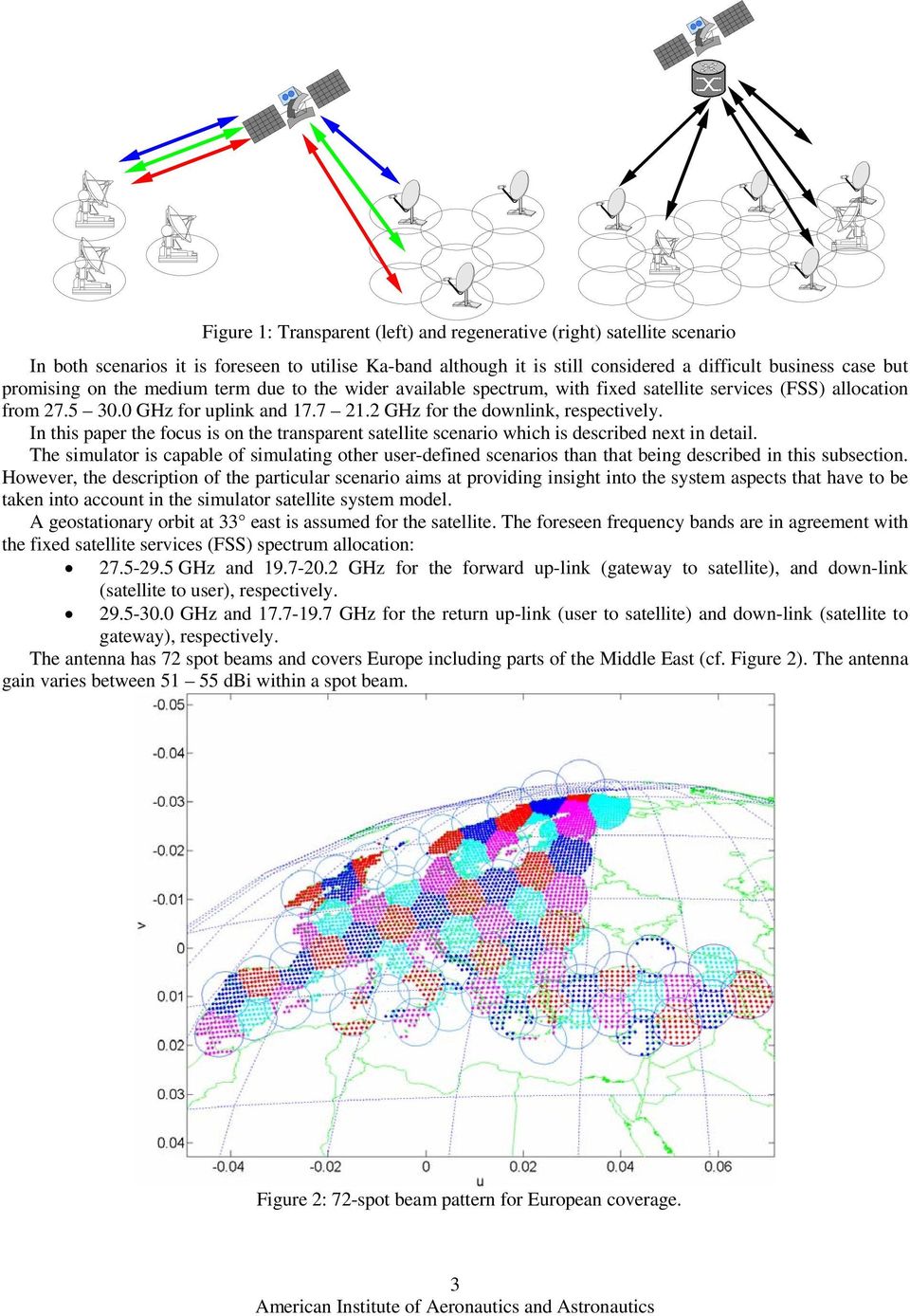
3 Figure 1: Transparent (left) and regenerative (right) satellite scenario In both scenarios it is foreseen to utilise Ka-band although it is still considered a difficult business case but promising on the medium term due to the wider available spectrum, with fixed satellite services (FSS) allocation from GHz for uplink and GHz for the downlink, respectively. In this paper the focus is on the transparent satellite scenario which is described next in detail. The simulator is capable of simulating other user-defined scenarios than that being described in this subsection. However, the description of the particular scenario aims at providing insight into the system aspects that have to be taken into account in the simulator satellite system model. A geostationary orbit at 33 east is assumed for the satellite. The foreseen frequency bands are in agreement with the fixed satellite services (FSS) spectrum allocation: GHz and GHz for the forward up-link (gateway to satellite), and down-link (satellite to user), respectively GHz and GHz for the return up-link (user to satellite) and down-link (satellite to gateway), respectively. The antenna has 72 spot beams and covers Europe including parts of the Middle East (cf. Figure 2). The antenna gain varies between dbi within a spot beam. Figure 2: 72-spot beam pattern for European coverage. 3
4 The systems employs a 4 colour frequency re-use scheme with polarisation re-use not being foreseen. A bandwidth of 125 MHz is allocated for each user beam assuming a homogeneous resource distribution (i.e. each beam has the same bandwidth and satellite power allocation). In the forward-link, using a 25% roll-off and additional 11% channel spacing, two carriers each with 45 Msps occupy the 125 MHz bandwidth. Three terminal classes with 1, 2, or 4 Msps are considered for the RCS return-link. The roll-off is increased to 35% and the channel spacing is kept at 11% with respect to the forward-link, leading to a bandwidth of 1.5, 3.0, or 6.0 MHz per carrier. The actual number of carriers varies according to the terminal type distribution. In total, one approximately achieves 83.5 Msps in a bandwidth of 125 MHz. Five gateways serve the 72 beams, each being responsible for 14 or 15 beams (again, cf. Figure 2). III. RRM Techniques Here we describe what are the techniques implemented in the simulator, how it works. Three sub-sections will address resource management of the return-link, congestion control and call admission control, and scheduling techniques for the forward-link. A. Resource Management of the Return-Link The return link in DVB-RCS is organized in superframes (SF). 2 As can be seen in the example in Figure 3, the SFs are structured in a Multi Frequency Time Division Multiple Access (MF-TDMA) scheme. Figure 3 Example for a return link superframe. Each terminal has to state a capacity request to the controlling gateway or NCC in order to receive capacity in one or several time slots. The return link Radio Resource Management module (RRM) processes all incoming requests and assigns time slots to the terminals. As mentioned above, an adaptive RCS is considered. 5 Thus, for the use of adaptive coding and modulation as fade mitigation technique, it is additionally necessary to decide which combination of Modulation and Coding (ModCod) is used in each time slot. The decision which ModCod is the optimum for a terminal is taken based on the Channel Estimator and Modcod Selector (CEMS) methods (cf. Sec. IV-B). Within this work the following two different scenarios for the assignment of ModCods to time slots are considered. In the first scenario a ModCod can be dynamically assigned to each time slot. Here the binding of the used ModCod to a time slot can be different for every time slot and can also change for every SF. For this reason this scenario is referred to as dynamic scenario. The second scenario assumes that for each time slot always a specific ModCod is used. In this case the binding of a ModCod to a time slot is static. Nevertheless it is possible here to provide a set of SFs whereas each SF can contain a different set of ModCods. The RRM module then has the possibility to select one SF from this set for the actual allocation round, which suits the actual channel states and capacity demands best. In the subsequent allocation rounds it is possible to also select a different SF from the set. In this case only the selection of a SF is dynamic but the binding of a ModCod to a time slot within each SF is static and cannot be changed on the fly. This scenario is denominated as semi-dynamic for this reason. The RRM algorithm here has to additionally consider, that a terminal must be assigned either the optimum ModCod or a more robust one, since the BER would increase drastically otherwise. The algorithms implemented in the RRM module additionally consider fairness of the assignments, provision of a high degree of QoS (e.g. minimization of delay and delay jitter), conflict resolution (in case more capacity is demanded than available) and maximization of the spectral efficiency. 7 B. Congestion Control and Call Admission Control 4

5 The task of the Congestion Control is preventing congestion and, if this is not possible, minimizing the impact of congestion situations when they occur and foster fast recovery. Mechanisms are utilized to first detect the presence of congestion and then to recover the stability of the system. The mechanisms used for the return- and for the forward-link are not identical since the traffic is asymmetric and thus the usage of the links is different. On one hand, the presence of congestion in the forward-link can be detected by analysing the state of the packet pools in the scheduler. When the number of packets dropped because of a timeout or because of an excess of capacity reaches a given amount this is an indication of congestion. The thresholds used to set the congestion indication flag are directly related to the type of the pool, each pool being attributed to a particular class (gold or silver) and to a particular Quality of Service (QoS) expedited forwarding, assured forwarding or best-effort. The congestion detection flag is set in correlation with the congestion indication when the arrival rate of a given pool is exceeding the serving rate. In that case mechanisms are started in order to resolve the congestion: the Call Admission Control (CAC) functionality is disabled meaning that all CAC Requests will automatically be rejected and dropping rates are set in the pools. The dropping can be either randomly distributed between the different pools or QoS-dependant. If the congestion is not solved after having applied these mechanisms, i.e. if the packets are still dropped in the packet pools above specific thresholds, then the last strategy consists in switching to the backup Service Level Agreement (SLA). This will set more restrictive parameters at the Policy Enforcement Point (PEP) in order to directly reduce the incoming traffic. Once there is no more congestion each mechanism is switched back to its default state. On the other hand, the presence of congestion in the return-link is detected in the gateway and in the RCS terminals. In the gateway congestion is indicated by the resource manager itself when the resources requested cannot be all allocated. In the terminal congestion is detected by analysing the state of the queues present in the scheduler (dropping rates). When congestion is indicated by the gateway the Call Admission Control (CAC) functionality is disabled and the backup SLA is switched on in the corresponding terminal. When congestion is indicated by the terminal itself dropping rates are applied to the queues present in the scheduler. In the same way once the congestion ended all mechanisms are switched off. The Call Admission Control technique is utilized together with particular types of applications (mainly real-time applications) to guaranty resources for the transmission. It consists in an exchange of messages between the entity requesting resources and the entity which is aware of them. First a request is transmitted and contains the amount of resources needed (in terms of bandwidth for instance). At the reception of this request algorithms are started in order to determine if the resources requested by the entity can be supported by the system or not. In the case of Voice over IP the traffic is bi-directional and symmetric meaning that resources have to be requested for both the return- and the forward-links. If both links can provide the support of the resources then the request is accepted, if not then it is rejected. The decision is taken by analysing separately the load of both forward- and return-links and by taking into account the ModCods which are currently assigned. The algorithms are inhibited when the CAC functionality is disabled, i.e. when congestion is detected in at least one of the two links. On the forward-link the load computations are based on the load of the pools in the scheduler and of the frame utilization in the modem. On the return-link the computations are mainly realized according to the number of free slots in the super frame. C. Scheduling techniques for the Forward-Link The packet scheduler in the forward link is responsible for sorting the packets coming from upper layers for transmission, obeying QoS criteria as well as transmission efficiency maximization for efficient capacity utilization. The scheduling technique implemented in the simulator is based on the so-called group-efficient scheduler proposed in Ref. 7, which guarantees that the ModCod information related to each packet is kept up to date. This is possible by keeping the actual ModCod information per terminal in an independent look-up table that is updated whenever a ModCod switch occurs and linking this information to the packets via pointers instead of classifying the packets according to their ModCod at the time they arrive at the system. The incoming packets are sorted according to their DiffServ QoS class and their SLA class in different packet pools, as can be observed in Figure 4; an additional pool with the highest priority holds MPEG packets which contain signalling information. A number of packets from those backlogged in the pools are selected for transmission in each scheduling round, which is internally triggered by two trigger signals. One trigger is a timer that ensures that a new scheduling round is started not later than a fixed time after the last and the other trigger comes from the S2-Modem which tells the scheduler that it is going idle in the near future. The criteria to select packets in each scheduling round are different for each packet pool. 7 In particular, the following criteria are applied in this implementation: EF pools: all backlogged packets at the beginning of the scheduling round are selected for transmission. AF pools: all backlogged packets exceeding an established queuing delay are selected for transmission. 5
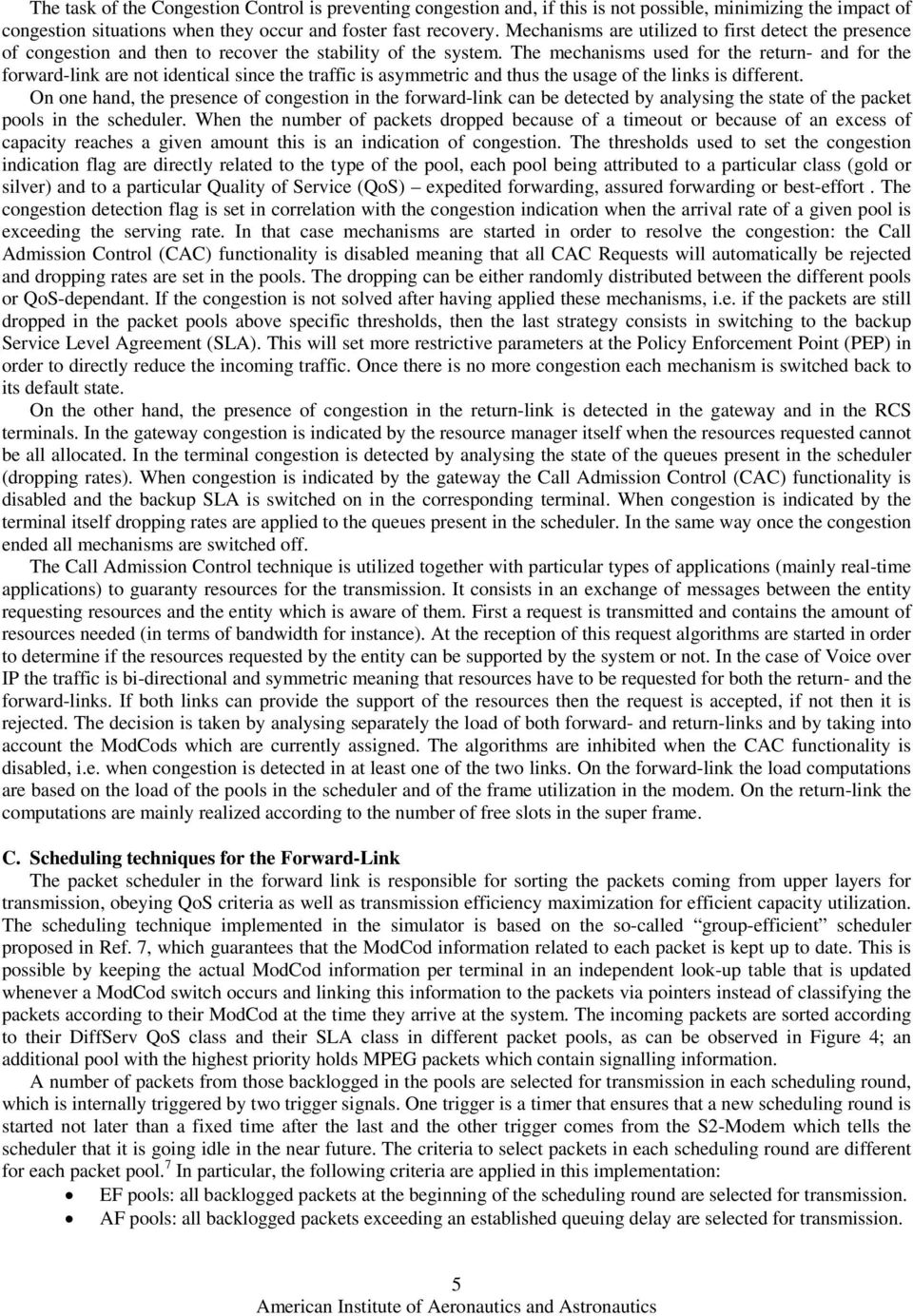
6 BE pools: from the backlogged packets in the pool, those that fit the remaining resources after selecting EF and AF packets are selected for transmission. At the beginning of a scheduling round, all selected packets are forwarded to the Layer-2 encapsulation and fragmentation module that corresponds to the actual ModCod of each packet, producing the data fields of BBFrames, the length of which depends on the ModCod. It should be noted that the ModCod of each packet is fetched from the terminal table when the packet is selected. After this a second round is run in which the pools are allowed to fill the scheduling interval with new frames according to pool priorities. After the second scheduling round the encapsulators end up with partially filled frames. Before sending these frames the ModCod adaptation mechanism can optionally be applied to maximize the capacity utilization. This algorithm scans all active ModCods starting from the one with the highest spectral efficiency. For those ModCods having a framing efficiency lower than a certain design value it is checked whether the packets within that frame can be packed into other frames of ModCods with lower spectral efficiency with sufficient free space. This way the packets are encapsulated more efficiently, reducing the resources necessary to transmit the selected packets and achieving a trade-off between spectral efficiency and framing efficiency. Figure 4: Architecture of packet scheduler in the forward link. IV. Simulator Architecture A. Overall Architecture The simulator consists of three large blocks: pre-processing, system simulation and post-processing. Preprocessing computes Signal-to-Noise-and-Interference (SNIR) time series and ModCod selection thresholds. This computation is implemented as a series of Matlab scripts. The result of the pre-processing is a number of large datafiles that are used by the system simulation. The system simulation is implemented in OMNeT++ as a discrete event simulation. 6 The OMNeT++ simulator produces a vector file which contains measurement vectors. This file is then used by another set of Matlab scripts for post-processing. The configuration of the simulator is done using XMLfiles which are usable from both Matlab and OMNeT++. A screenshot of the graphical user interface of the simulator is shown in Figure 5. 6
7 Figure 5. Screenshot of the simulator graphical user interface. The top-level structure of the system simulator is shown on the left side of Figure 6. The central module called System contains the DVB-S2/RCS gateways and the Internet. Connected to this module are a number of internet terminals, which consist mainly of traffic models and an IP-layer. On the other side the system module is connected to a number of forward link transponders and return link transponders. Figure 6: Top-level system simulator block diagram The number of return link transponders corresponds to the number of gateways in the system each of these transponders handles multiple return link carriers. Each gateway is also connected to a configurable number of forward link carriers. This allows the simulation of systems which uses multiple forward link carriers. The satellite terminals are connected to one of the forward link carriers of a given gateway (to receive the DVB-S2 forward traffic) and to the return link transponder of the same gateway (to transmit the DVB-RCS return traffic). The mapping of satellite terminals to gateways and forward carriers is fixed for a given simulation and is described in the XML configuration file. In addition to the gateways the system module contains an IP router which represents the terrestrial internet. The number of terminals, gateways, carriers and other parameters are all specified in the XML configuration file. Therefore most of the modules of the simulator are created dynamically at runtime. The only static module is the so called factory module. This module has two tasks: (1) it reads the XML configuration and creates the system module, the transponders, the internet terminals and the satellite terminals, connecting these together and holding a connection to each terminal; and (2) handling a session protocol for the simulated applications using the connections to the terminals that ensures that the configured traffic parameters are met. While instantiating modules the factory 7

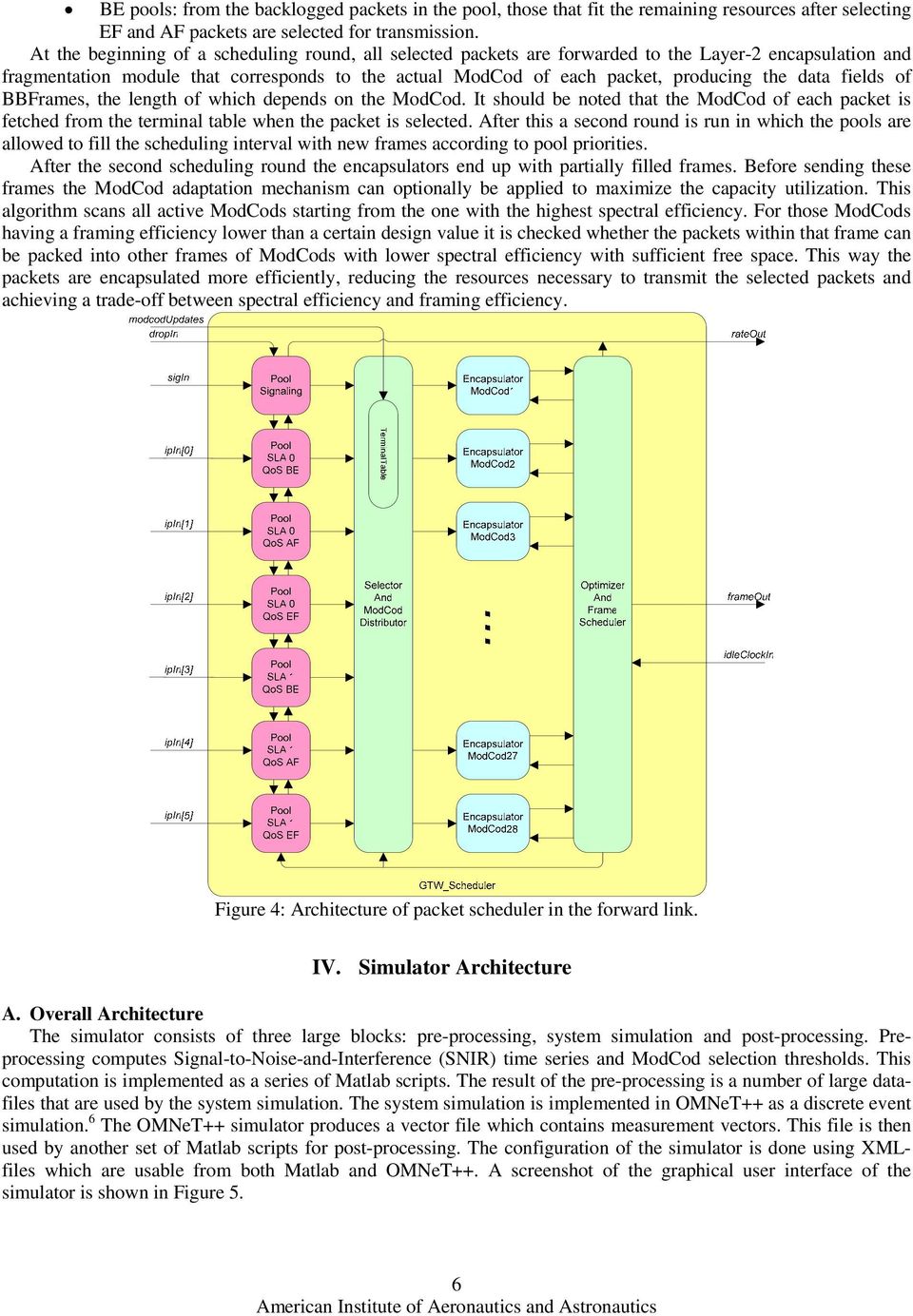
8 retrieves module parameters from the XML file and attaches these parameters to the modules. This technique allows great flexibility and will allow dynamic terminal creation in the future (for simulation of logon/logoff). B. Gateway The gateway is composed of four main blocks: the sending path (transmitter), the receive path (receiver), the resource management (RM) and the SI tables (cf. Figure 7). The sending path (at the bottom) receives the packets issued from the different applications run by the users which are located in the internet terminals behind the gateway. These IP packets enter into the interworking function and policy enforcement point module (IWF PEP) which is responsible for classifying them according to their QoS classes and for regulating the traffic (controllable rates according to the SLA of the destination terminal for each traffic class). The IP packets are then sent to the scheduler who will schedule them according to different levels of priority and the current estimated ModCod for each terminal and hand them over to the layer 2. The layer 2 will fragment and encapsulate the IP packets according to the method selected (MPE, GSE). The resulting packets are then forwarded to the input stream adapter. This module will produce BBFrames which the S2 Modem turns into physical frames. On the other hand, the receive path (at the top) is composed of a terminal decoder which will decode the physical frames, introducing the SNIR time series generated previously and forwarding the necessary information to the CEMS module, checking for slot collisions, and forwarding the defragmented packets to the layer 2 module and the signalling to SI Tables module. The layer 2 module decapsulates the packets. The layer 3 interworking function module (L3 IWF) is in charge of redirecting the CAC messages to the RM block and the traffic to the terminals. The resource management block (in the middle) is composed of several modules: an IP layer and a router to respectively decapsulate/encapsulate the CAC messages and redirect them to the correct carrier (sending path), a Call Admission Control module (CAC, for VoIP), congestion control modules for both the forward- and the returnlink (respectively FLCC and RLCC), a Return-link Resource Manager (RRM) and a Channel Estimator and ModCod Selector (CEMS). The CEMS module is responsible for estimating the current channel condition according to the channel measurements transmitted by the terminal decoder and for selecting the appropriate ModCod. The SI composition tables module (in the middle) receives the Terminal Burst Time Plan (TBTP) and the Composition Tables (CT), which include the SuperFrame composition and terminal distribution for the Return Link, from the RRM module and produces the different L2 signalling messages. Figure 7: Gateway block diagram C. Terminal The terminal is composed, as the gateway, of the following four main blocks: the sending path (transmitter), the receive path (receiver), the resource management (RM) and the SI tables (Figure 8). The sending path (at the bottom) receives the packets issued from the different applications of the users which are connected to the terminal. These IP packets enter into the IWF PEP module which is responsible for classifying them according to their QoS classes and for policing the traffic (controllable rates for each traffic class). The IP packets are then sent to the scheduler who will forward them according to their QoS classes to the MAC layer. The 8
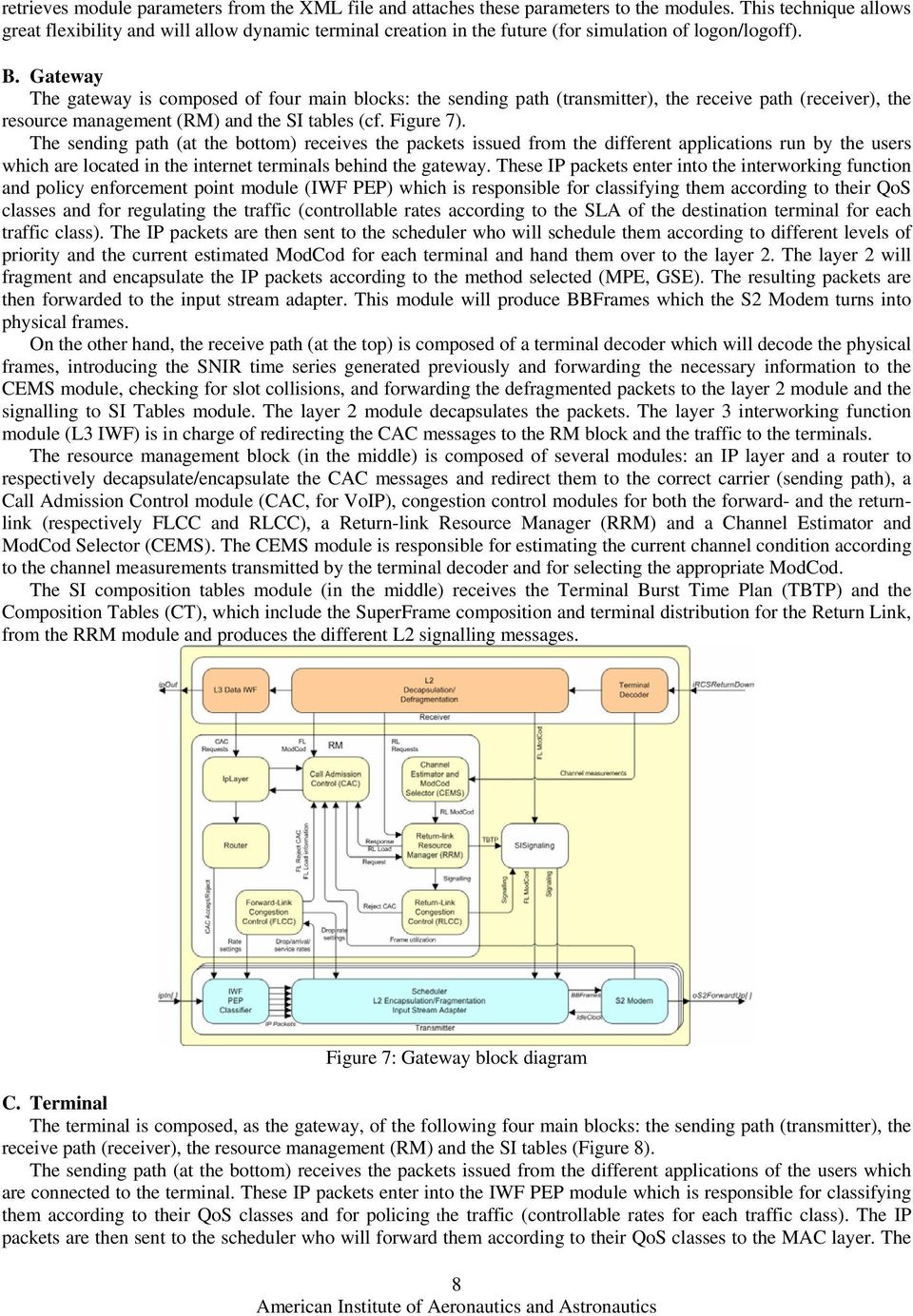
9 MAC layer will fragment and encapsulate the IP packets according to the method selected which comprise MPEG or ATM TRF bursts for the FIL scheme, and a GSE-like protocol for the FBL scheme. The resulting packets are then forwarded to the RCS Modem and turned into physical layer frames. User packets are inserted into the SF according to the allocation received from the gateway RRM via the TBTP. The receive path (at the top) is composed of a Physical Layer (PL) decoder which will include the previously computed SNIR time Series and forward the resulting BBFrames to the Descapsulator/BBFrame Decoder. At this point the BBFrames will be decoded and the packets (MPE, GSE) will be extracted. The decapsulator reproduces the IP packets and the layer 3 interworking function module (L3 IWF) is in charge of forwarding the IP packets without performing any operation to the applications. The resource management block (in the middle) is composed of several modules: a congestion control module for the return-link (RLCC), a Request Manager (RM) and a Channel Estimator and Modcod Selector (CEMS). The RM module analyses the states of the queues located in the scheduler and requests resources to the gateway RRM module. The SI resource tables module (in the middle) receives the capacity requests and the applicable FL ModCod from the RM module which are then signalled to the gateway RRM via contention based slots or signalling in already allocated TRF bursts. 2 Further, this module reads the information from the TBTP received from the gateway which is then forwarded to the Encapsulation/Fragmentation MAC where this information is used to correctly distribute the user data and signalling in the SF. Figure 8: Terminal block diagram D. Satellite The transparent case is simple because the satellite just relays the signal to the ground after frequency translation and amplification. Some optimisation in the implementation of the satellite in the simulator has been performed to reduce the number of messages to be handled by the simulator. V. Simulations A. Simulation Scenario Details The particular parameters assumed for the gateway, user terminals, and transparent satellite are shown in Table 1. System Parameter Forward Link Return Link Feeder Link User Link Feeder Link User Link Carrier frequency GHz GHz GHz GHz Access, Multiplex TDM, FDM TDM MF-TDMA,FDM MF-TDMA Total bandwidth B tot 500 MHz 500 MHz 500 MHz 500 MHz Number of antenna beams Frequency reuse f R Bandwidth per beam 2000 MHz 125 MHz 2000 MHz 125 MHz 9
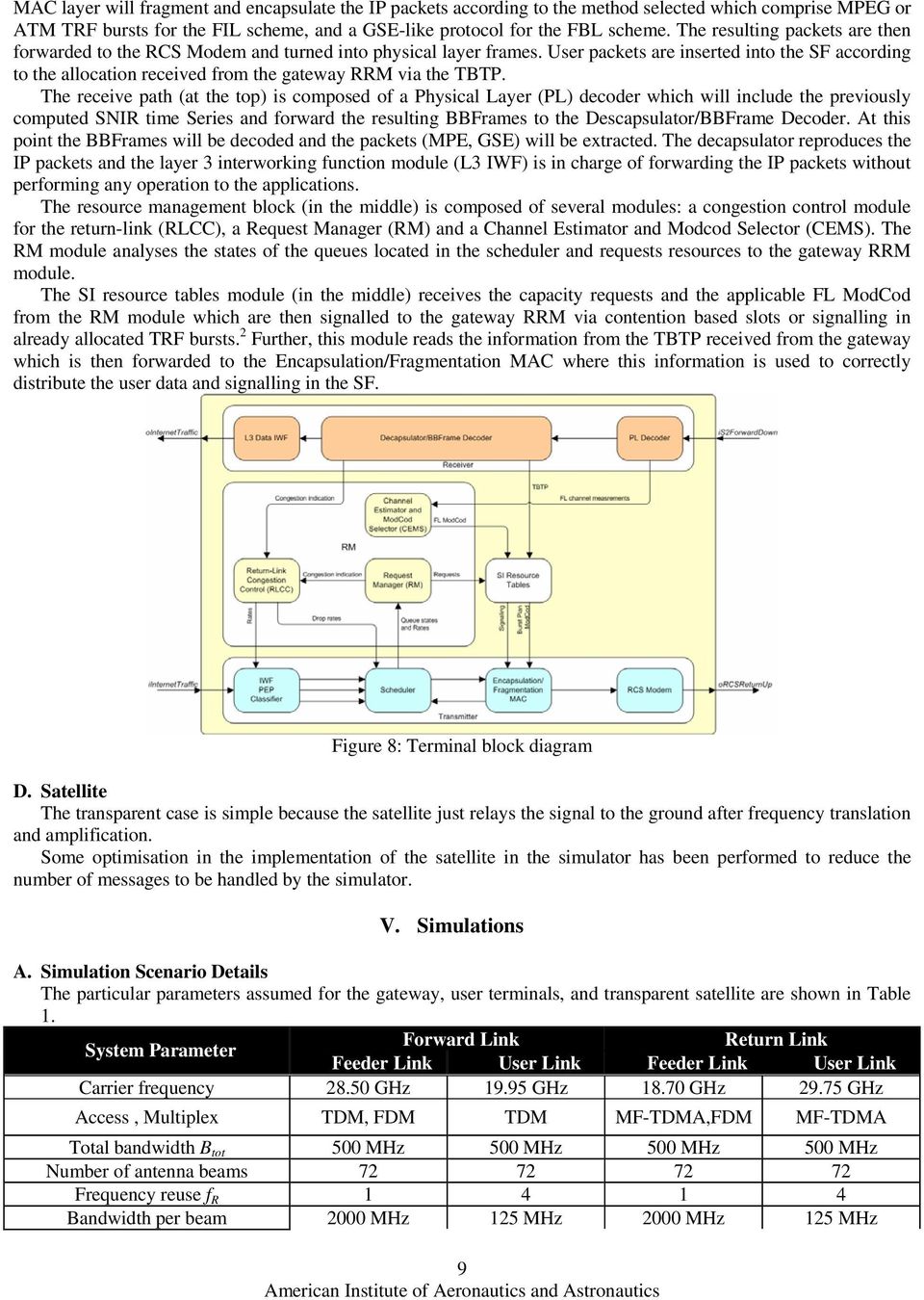
10 No. of carriers per beam (14-15)*2 2 (14-15)*(20-84) Carrier Symbol Rate 2*45 Msps 2*45 Msps 1,2,4 Msps 1,2,4 Msps (SRC filter Roll-off, carrier (0.25, 0.11) (0.25, 0.11) (0.35, 0.11) (0.35, 0.11) spacing) Number of Gateways Polarisation reuse N p Satellite Rx/Tx antenna peak gain 54 dbi 54 dbi 54 dbi 54 dbi Satellite antenna loss (efficiency) 1 db 1 db 1 db 1 db Sat. RF Tx saturated power per 15 dbw per dbw per 1 - UL/GW beam Msps Msps - Satellite HPA Output back-off - (taken into account in SNR 4 db - Req.) Satellite Output loss 2.85 db 1.75 db Satellite G/T (COC) 24.6 db/k db/k Satellite noise temperature 28.4 dbk 28.4 dbk GW Tx antenna peak gain 65.2 dbi GW RF Tx total max./nom. power 18 dbw for 8 carr (=1 cluster) GW Output back-off 6.0 db GW Output loss 2.0 db GW Pointing loss 1.1 db GW G/T (clear-sky) db/k - GW clear sky temperature dbk - UT Tx antenna peak gain 45.2, 48.1, (0.75 m diameter, 60% efficiency) dbi UT RF TX max./nom. power , 4.0, 6.0 dbw UT Output back-off 0.5 db UT Output loss 0.5 db UT Pointing loss 1.0 db UT G/T (clear-sky) , 20.1, 21.3 db/k - - UT clear-sky temperature dbk - - Rain temperature delta dbk 23.5 dbk - Table 1: Transparent scenario gateway, user terminal, and satellite parameters An important factor that needs to be considered in the simulations is interference: Co-channel interference (CCI) being caused by the re-use of the same frequency band and polarisation in several beams of the satellite system, adjacent channel interference (ACI), inter-modulation (IM) interference, and interference from other systems. Table 2 presents the carrier-to-interferences ratios (C/I) for the various interference contributions. Interference Forward Link Return Link Feeder Link User Link Feeder Link User Link CCI (co-polar) (is calculated as part of pre-calculations) (C/I) ACI % noise increase wrt. 17 db white noise (C/I) IM 27 db (NPR = 22 db (NPR = - 25 db, non-lin - 18 db, lin. HPA) HPA) 10
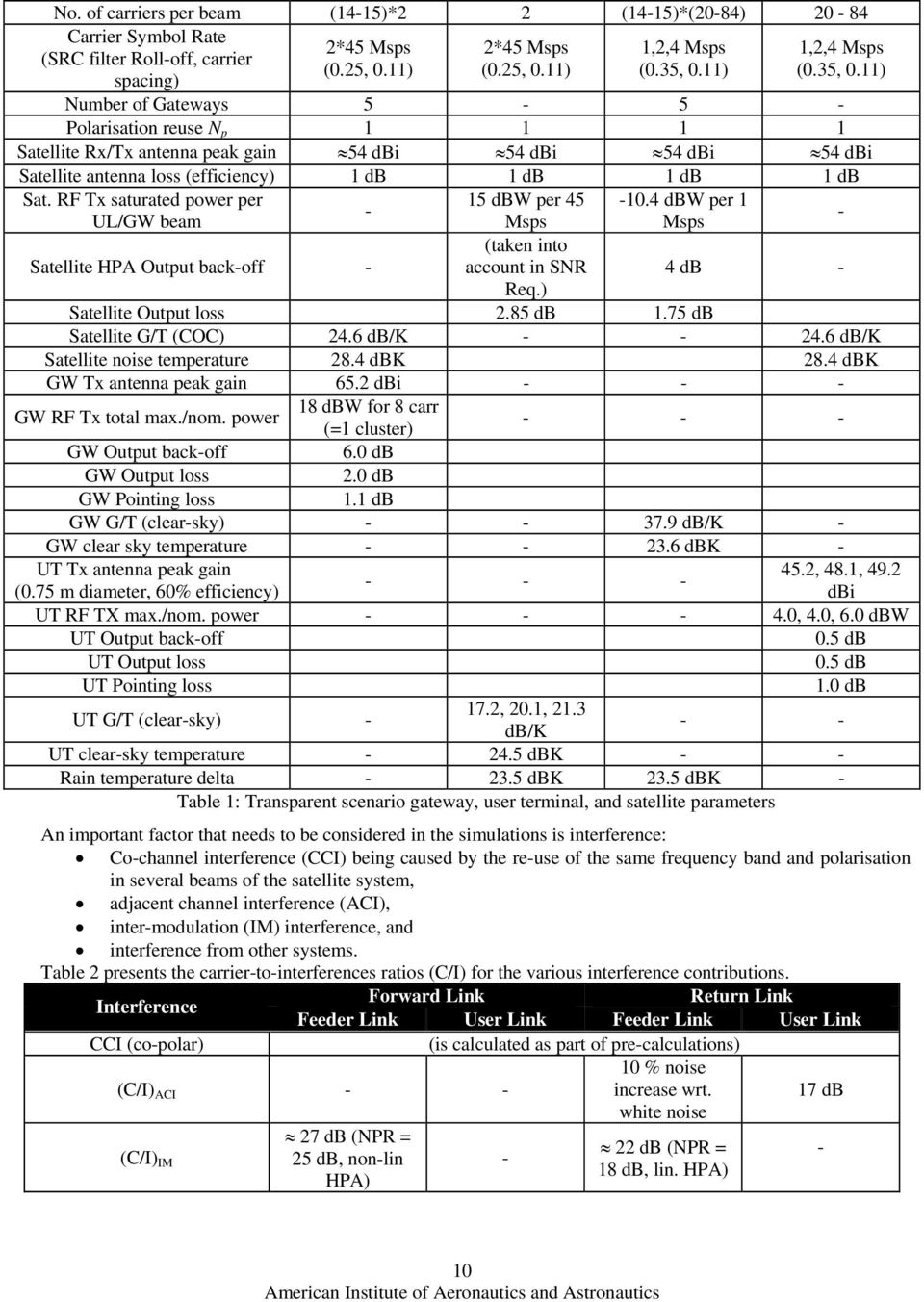
11 external noise power density, other satellite system interference -207 dbw/hz C/I = 24.7, 27.7, 28.8 db Table 2: Transparent scenario interference parameters - C/I = 27.5, 30.4, 31.6 db B. Results First results have been obtained during testing of the simulator. The simulations use a small transparent scenario composed of 4 satellite 1MSymbol/s-terminals, 8 internet terminals, one beam with two forward link carriers. The traffic generated with this setup is well below the system capacity so that there is no congestion and no rejects from call admission control. The traffic resulting from this setup is shown in Figure 9. There are five types of applications: web traffic, POP3 mail traffic, VoIP (G.723 codec), Audio/Video streaming and video conferencing. The parameters for these models are configurable via the XML configuration file. Because of the short simulation time show in Figure 9 not all applications can be seen. The peaks for QoS0 are GET responses from web sessions which generated traffic in QoS class 0 (best effort). The light blue line is a VoIP session in SLA class gold and QoS class 2 (expedited forwarding). There is no traffic in QoS class 1 (assured forwarding) during this simulation. 2.5 x 10⁵ Bitrate [bps] SLA0/QoS0 input bit rate SLA0/QoS1 input bit rate SLA0/QoS2 input bit rate SLA1/QoS0 input bit rate SLA1/QoS1 input bit rate SLA1/QoS2 input bit rate Time [s] Figure 9: Input bit rates of the forward link scheduler The resulting utilization of the S2-Modem (forward link) is shown in Figure 10. The frame utilization is the percentage of time during which non-dummy frames are sent. It does not account for the filling state of the frames. The straight line up to 180 seconds shows the percentage of physical layer frames that carry signalling traffic. It must be noted, that the signalling capacity used is not 3% because frames carrying signalling are not necessarily completely filled. Starting from 180 seconds the frames filled with useful traffic can be seen which correlates with the forward link scheduler input in Figure Physical layer utilization [%] Time [s] Figure 10: Physical layer frame utilization in the forward link modem 11

12 Figure 11 and Figure 12 show the delay jitter CDF and PDF for the VoIP application for the forward respectively the return link. The delay jitter is measured as the inter-arrival time between consecutive packets compared to the expected inter-arrival time. For the given configuration of the VoIP model with G.723 codec one 100-byte IP packet containing two codec frames of 30 bytes is sent every 60 ms. In the forward link one single peak can be seen which (in the almost idle system) is caused by the scheduling algorithm and the physical layer framing. The mean value of the jitter is 2.4 ms with a standard deviation of 0.75 ms. On the return link there are two peaks in the jitter PDF. These are caused by the different periodicity of the application and the DVB-RCS superframe. The application sends a packet every 60 ms whereas the superframe is 50 ms long. Because there is a maximum of one VoIP packet per superframe, the jitter optimization of the return link resource management algorithm does not help in this case. On the return link the mean jitter is 23 ms with a standard deviation of 3.8 ms. 1 1 Probability 0.5 Probability Delay Jitter [s] Delay Jitter [s] Probability Delay Jitter [s] Probability Delay Jitter [s] Figure 11. VoIP delay jitter in the forward link (top: CDF; bottom: PDF). Figure 12. VoIP delay jitter in the return link (top: CDF; bottom: PDF). Figure 13 shows the working of the ModCod selection algorithm for the forward link. In the upper graph the output of the channel estimator in the terminal is shown. The channel estimator periodically computes a C/N 0 value that is used by ModCod selector to select an appropriate ModCod to be used in the forward link. The selected ModCod is then signalled to the gateway. The green lines are the thresholds for switching from a lower to a higher ModCod while the red lines are the thresholds for switching from a higher ModCod to a lower one. These are different to implement a hysteresis that prevents ModCod thrashing due to scintillation effects. The result of the ModCod selection is shown in the lower part. It can be seen that at time a fade event of - 3dB starts that causes the ModCod selector to switch from ModCod 14 down to 10 in several steps. When the fade goes away the selector switches back to the higher ModCods. 12
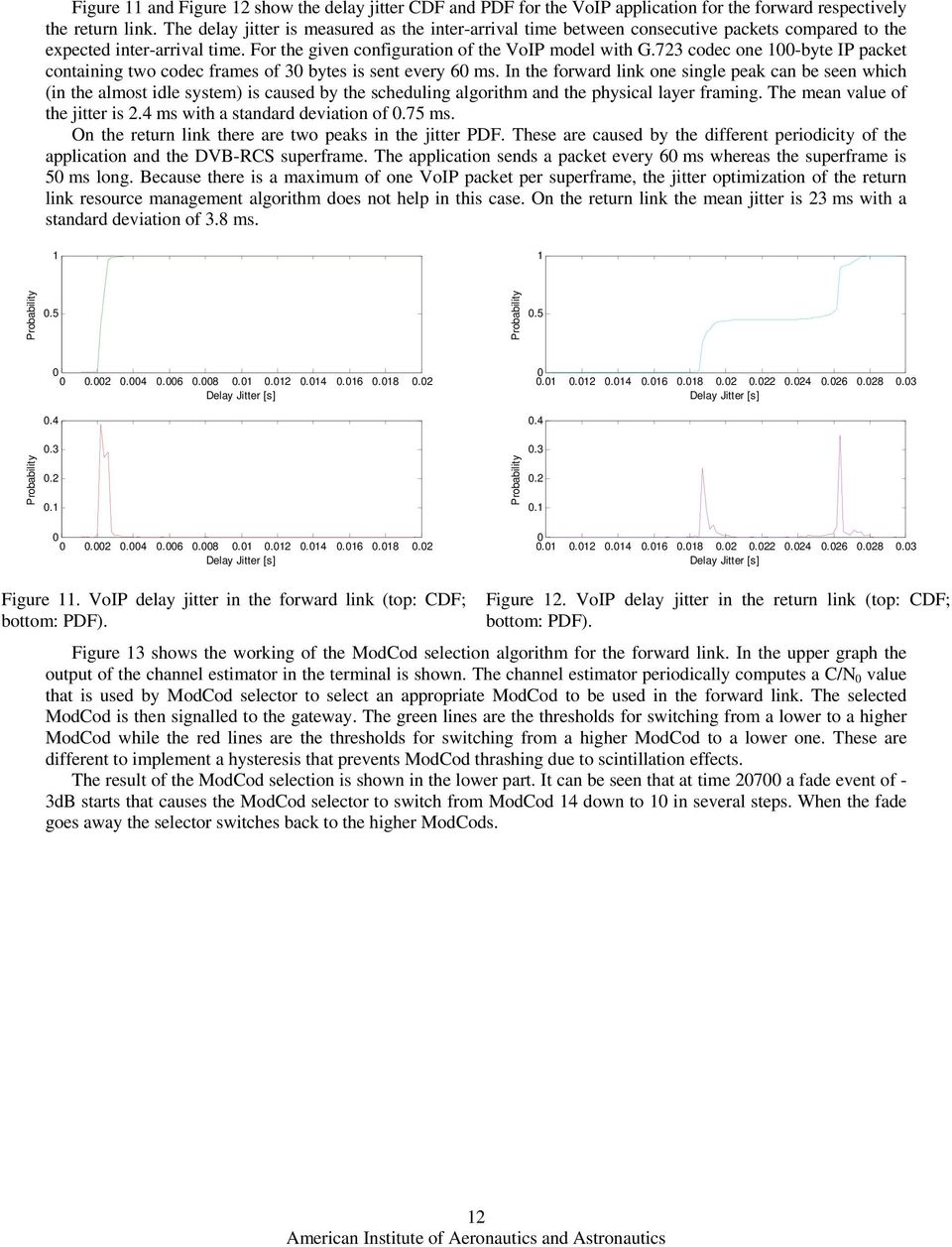
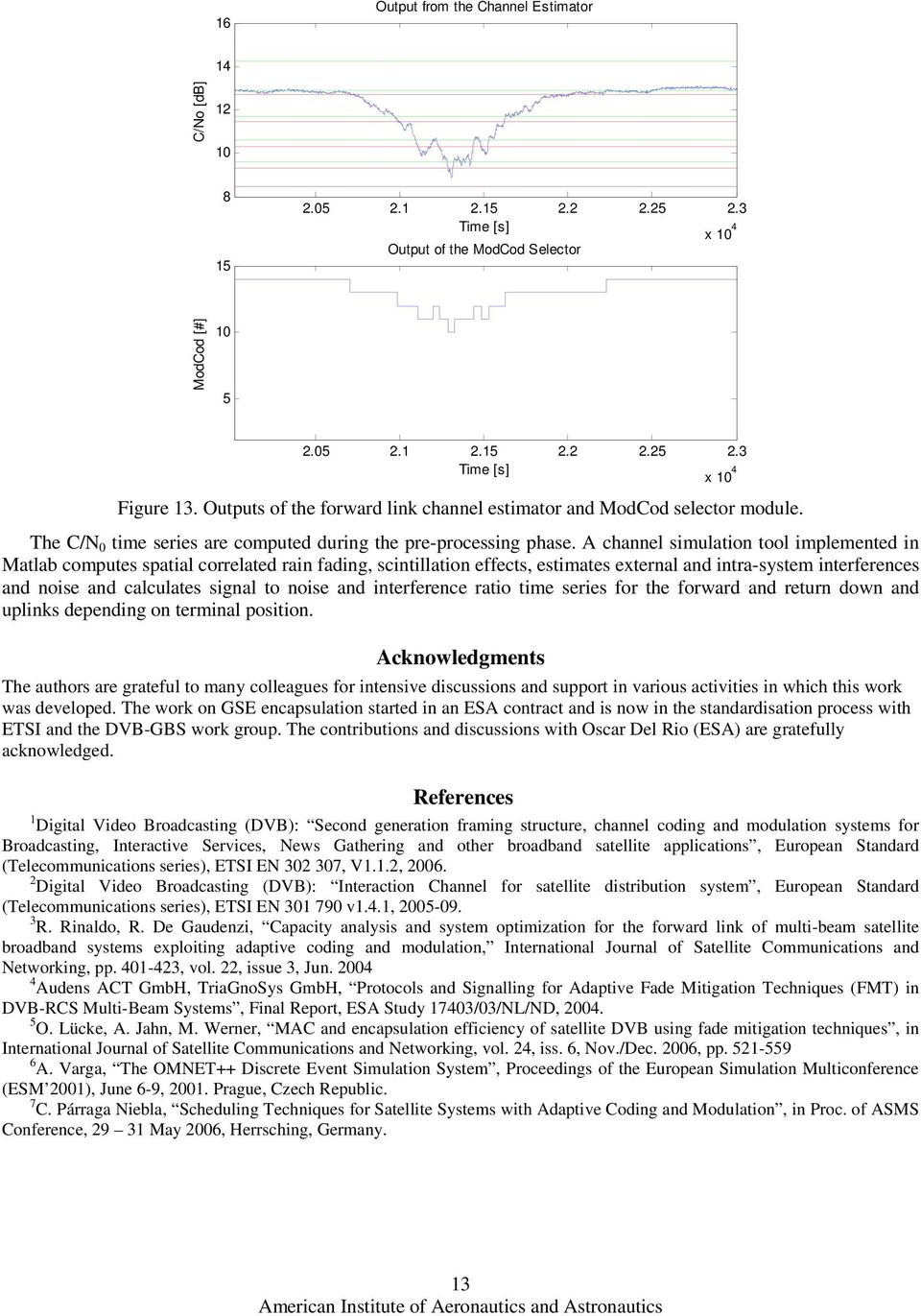
13 16 Output from the Channel Estimator 14 C/No [db] Time [s] x 10 4 Output of the ModCod Selector ModCod [#] Time [s] x 10 4 Figure 13. Outputs of the forward link channel estimator and ModCod selector module. The C/N 0 time series are computed during the pre-processing phase. A channel simulation tool implemented in Matlab computes spatial correlated rain fading, scintillation effects, estimates external and intra-system interferences and noise and calculates signal to noise and interference ratio time series for the forward and return down and uplinks depending on terminal position. Acknowledgments The authors are grateful to many colleagues for intensive discussions and support in various activities in which this work was developed. The work on GSE encapsulation started in an ESA contract and is now in the standardisation process with ETSI and the DVB-GBS work group. The contributions and discussions with Oscar Del Rio (ESA) are gratefully acknowledged. References 1 Digital Video Broadcasting (DVB): Second generation framing structure, channel coding and modulation systems for Broadcasting, Interactive Services, News Gathering and other broadband satellite applications, European Standard (Telecommunications series), ETSI EN , V1.1.2, Digital Video Broadcasting (DVB): Interaction Channel for satellite distribution system, European Standard (Telecommunications series), ETSI EN v1.4.1, R. Rinaldo, R. De Gaudenzi, Capacity analysis and system optimization for the forward link of multi-beam satellite broadband systems exploiting adaptive coding and modulation, International Journal of Satellite Communications and Networking, pp , vol. 22, issue 3, Jun Audens ACT GmbH, TriaGnoSys GmbH, Protocols and Signalling for Adaptive Fade Mitigation Techniques (FMT) in DVB-RCS Multi-Beam Systems, Final Report, ESA Study 17403/03/NL/ND, O. Lücke, A. Jahn, M. Werner, MAC and encapsulation efficiency of satellite DVB using fade mitigation techniques, in International Journal of Satellite Communications and Networking, vol. 24, iss. 6, Nov./Dec. 2006, pp A. Varga, The OMNET++ Discrete Event Simulation System, Proceedings of the European Simulation Multiconference (ESM 2001), June 6-9, Prague, Czech Republic. 7 C. Párraga Niebla, Scheduling Techniques for Satellite Systems with Adaptive Coding and Modulation, in Proc. of ASMS Conference, May 2006, Herrsching, Germany. 13
WP 3100 : Encapsulation and IP Mapping
 WP 3100 : Encapsulation and IP Mapping Rider to the ARTES 5 Adaptive Coding and Modulation (ACM) Project ESA Workshop Presentation 14.2.2007 Bjarne Risløw Thrane and Thrane Rita Rinaldo ESA, TEC-ETC Page
A TALE OF 3 SATELLITE RETURN TECHNOLOGIES
 March 2015 White Paper A TALE OF 3 SATELLITE RETURN TECHNOLOGIES Dialog : to the Test Introduction The introduction of the Dialog platform in the Satcom marketplace coincides with the introduction of other
Development of Mobile Broadband Interactive Satellite Access System based on DVB-RCS in Korea
 Development of Mobile Broadband Interactive Satellite Access System based on DVB-RCS in Korea September, 8-9, 2005 Hoon Jeong ([email protected]) ETRI, KOREA 1 Contents 1. Introduction 2. Mobile Broadband
VoIP over DVB-RCS A Radio Resource and QoS Perspective
 VoIP over DVB-RCS A Radio Resource and QoS Perspective Executive Summary One of the drivers of VoIP over DVB-RCS satellite based IP networks is the requirement for cost-effective telephony in regions with
Implementing VoIP support in a VSAT network based on SoftSwitch integration
 Implementing VoIP support in a VSAT network based on SoftSwitch integration Abstract Satellite communications based on geo-synchronous satellites are characterized by a large delay, and high cost of resources.
BENEFITS OF USING MULTIPLE PLP IN DVB-T2
 BENEFITS OF USING MULTIPLE PLP IN DVB-T2 ENENSYS Technologies, France : http://www.enensys.com DVB-T2 has already achieved incredible success for delivering digital terrestrial television. More than 28
A CONTROL FRAMEWORK FOR ADAPTIVE CAPACITY ALLOCATION IN MOBILE DVB-RCS
 A CONTROL FRAMEWORK FOR ADAPTIVE CAPACITY ALLOCATION IN MOBILE DVB-RCS JA-2330 Integration Meeting Nedo Celandroni*, Franco Davoli, Erina Ferro*, Alberto Gotta*, Raffaello Secchi* *ISTI-CNR, Area della
Analysis of IP Network for different Quality of Service
 2009 International Symposium on Computing, Communication, and Control (ISCCC 2009) Proc.of CSIT vol.1 (2011) (2011) IACSIT Press, Singapore Analysis of IP Network for different Quality of Service Ajith
TWO-WAY INTERNET OVER ipstar USING ADVANCED ERROR CORRECTION AND DYNAMIC LINKS
 AIAA-2002-1944 TWO-WAY INTERNET OVER ipstar USING ADVANCED ERROR CORRECTION AND DYNAMIC LINKS William Thesling*, Mark Vanderaar*, Mark Thompson**, Peter Hamilton**, Paiboon Panuwattanawong*** and Richard
Communication Satellite Systems Trends and Network Aspects
 Communication Satellite Systems Trends and Network Aspects Paul Anderson Communication Architectures Department The Aerospace Corporation [email protected] http://www.aero.org/ Lee Center, Caltech
SATELLITE ACCESS PROCEDURES
 SATELLITE ACCESS PROCEDURES Date: 13 May 2014 (v1.0) REVISION HISTORY DOCUMENT TITLE SES Satellite Access Procedures CURRENT REVISION 1 REVISIONS Nº DESCRIPTION Date 1 Initial release 13.05.2014 PROPRIETARY
Optimal batch scheduling in DVB-S2 satellite networks
 Optimal batch scheduling in DVB-S2 satellite networks G. T. Peeters B. Van Houdt and C. Blondia University of Antwerp Department of Mathematics and Computer Science Performance Analysis of Telecommunication
TCP in Wireless Networks
 Outline Lecture 10 TCP Performance and QoS in Wireless s TCP Performance in wireless networks TCP performance in asymmetric networks WAP Kurose-Ross: Chapter 3, 6.8 On-line: TCP over Wireless Systems Problems
4 Internet QoS Management
 4 Internet QoS Management Rolf Stadler School of Electrical Engineering KTH Royal Institute of Technology [email protected] September 2008 Overview Network Management Performance Mgt QoS Mgt Resource Control
Evolution of Satellite Communication Systems
 Mathieu DERVIN Brussels, 6th May 2015 Brussels, May 2015 Agenda I. From Sputnik to wideband satellite services: The key technological evolutions II. Increase the satellite system capacity: A global system
CS263: Wireless Communications and Sensor Networks
 CS263: Wireless Communications and Sensor Networks Matt Welsh Lecture 4: Medium Access Control October 5, 2004 2004 Matt Welsh Harvard University 1 Today's Lecture Medium Access Control Schemes: FDMA TDMA
POWER AND SPECTRUM EFFICIENT ACCESS SERVICES USING DYNAMIC LINKS
 POWER AND SPECTRUM EFFICIENT ACCESS SERVICES USING DYNAMIC LINKS Dr. Richard Gedney, Dr. William Thesling, and Mark Vanderaar Efficient Channel Coding (ECC), Inc. 600 Safeguard Plaza, Suite 100 Brooklyn
Performance Evaluation of VoIP Services using Different CODECs over a UMTS Network
 Performance Evaluation of VoIP Services using Different CODECs over a UMTS Network Jianguo Cao School of Electrical and Computer Engineering RMIT University Melbourne, VIC 3000 Australia Email: [email protected]
IEEE 802.16 Broadband Wireless Access Working Group. ATM Based MAC Layer Proposal for the 802.16 Air Interface Specification
 Project Title Date Submitted Source Re: Abstract Purpose Notice Release IEEE Patent Policy IEEE 802.16 Broadband Wireless Access Working Group ATM Based MAC Layer Proposal for the 802.16 Air Interface
DVB-S2 and DVB-RCS for VSAT and Direct Satellite TV Broadcasting
 Hands-On DVB-S2 and DVB-RCS for VSAT and Direct Satellite TV Broadcasting Course Description This course will examine DVB-S2 and DVB-RCS for Digital Video Broadcast and the rather specialised application
How To Deliver High Quality Telephony Over A Network
 Voice over Application Note Telephony Service over Satellite January 2012 Data Sells but Voice Pays In the early years of the industry, networks were deployed primarily for telephony services. As time
:-------------------------------------------------------Instructor---------------------
 Yarmouk University Hijjawi Faculty for Engineering Technology Computer Engineering Department CPE-462 Digital Data Communications Final Exam: A Date: 20/05/09 Student Name :-------------------------------------------------------Instructor---------------------
HX System Quality of Service
 HX System Quality of Service Designed and optimized for carrier-grade satellite IP broadband networking, the HX System is the ideal choice for service providers seeking to deliver a diverse range of high
STANDARDS TO ACCESS AND OPERATE SATELLITE SERVICES
 STANDARDS TO ACCESS AND OPERATE SATELLITE SERVICES INDEX I. Scope... 3 II. Bandwidth and Power Standards... 3 A. Bandwidth (BW) Allocation and Measurement... 3 1. Bandwidth of a digital carrier per customer....
AN ANALYSIS OF DELAY OF SMALL IP PACKETS IN CELLULAR DATA NETWORKS
 AN ANALYSIS OF DELAY OF SMALL IP PACKETS IN CELLULAR DATA NETWORKS Hubert GRAJA, Philip PERRY and John MURPHY Performance Engineering Laboratory, School of Electronic Engineering, Dublin City University,
QoS Parameters. Quality of Service in the Internet. Traffic Shaping: Congestion Control. Keeping the QoS
 Quality of Service in the Internet Problem today: IP is packet switched, therefore no guarantees on a transmission is given (throughput, transmission delay, ): the Internet transmits data Best Effort But:
Dynamic Reconfiguration & Efficient Resource Allocation for Indoor Broadband Wireless Networks
 Dynamic Reconfiguration & Efficient Resource Allocation for Indoor Broadband Wireless Networks Tim Farnham, Brian Foxon* Home Communications Department HP Laboratories Bristol HPL-98-123 June, 1998 broadband,
Quality of Service in the Internet. QoS Parameters. Keeping the QoS. Traffic Shaping: Leaky Bucket Algorithm
 Quality of Service in the Internet Problem today: IP is packet switched, therefore no guarantees on a transmission is given (throughput, transmission delay, ): the Internet transmits data Best Effort But:
Module 5. Broadcast Communication Networks. Version 2 CSE IIT, Kharagpur
 Module 5 Broadcast Communication Networks Lesson 9 Cellular Telephone Networks Specific Instructional Objectives At the end of this lesson, the student will be able to: Explain the operation of Cellular
Attenuation (amplitude of the wave loses strength thereby the signal power) Refraction Reflection Shadowing Scattering Diffraction
 Wireless Physical Layer Q1. Is it possible to transmit a digital signal, e.g., coded as square wave as used inside a computer, using radio transmission without any loss? Why? It is not possible to transmit
QUALITY OF SERVICE OF VOIP OVER DVB-RCS
 QUALITY OF SERVICE OF VOIP OVER DVB-RCS M. A. Vázquez Castro(*), F. J. González Serrano, A. Martínez Fernández, G. Mohedano Moya Dept. de Teoría de Señal y Comunicaciones Universidad Carlos III de Madrid,
Express Forwarding : A Distributed QoS MAC Protocol for Wireless Mesh
 Express Forwarding : A Distributed QoS MAC Protocol for Wireless Mesh, Ph.D. [email protected] Mesh 2008, Cap Esterel, France 1 Abstract Abundant hidden node collisions and correlated channel access
Revision of Lecture Eighteen
 Revision of Lecture Eighteen Previous lecture has discussed equalisation using Viterbi algorithm: Note similarity with channel decoding using maximum likelihood sequence estimation principle It also discusses
ETSI TS 102 188-1 V1.1.2 (2004-07)
 TS 102 188-1 V1.1.2 (2004-07) Technical Specification Satellite Earth Stations and Systems (SES); Regenerative Satellite Mesh - A (RSM-A) air interface; Physical layer specification; Part 1: General description
Department of Electrical and Computer Engineering Ben-Gurion University of the Negev. LAB 1 - Introduction to USRP
 Department of Electrical and Computer Engineering Ben-Gurion University of the Negev LAB 1 - Introduction to USRP - 1-1 Introduction In this lab you will use software reconfigurable RF hardware from National
RECOMMENDATION ITU-R S.524-5. (Questions ITU-R 48/4 and ITU-R 70/4)
 Rec. ITU-R S.524-5 1 RECOMMENDATION ITU-R S.524-5 MAXIMUM PERMISSIBLE LEVELS OF OFF-AXIS e.i.r.p. DENSITY FROM EARTH STATIONS IN THE FIXED-SATELLITE SERVICE TRANSMITTING IN THE 6 AND 14 GHz FREQUENCY BANDS
APPLICATION NOTE 209 QUALITY OF SERVICE: KEY CONCEPTS AND TESTING NEEDS. Quality of Service Drivers. Why Test Quality of Service?
 QUALITY OF SERVICE: KEY CONCEPTS AND TESTING NEEDS By Thierno Diallo, Product Specialist With the increasing demand for advanced voice and video services, the traditional best-effort delivery model is
Wireless Technologies for the 450 MHz band
 Wireless Technologies for the 450 MHz band By CDG 450 Connectivity Special Interest Group (450 SIG) September 2013 1. Introduction Fast uptake of Machine- to Machine (M2M) applications and an installed
QoS issues in Voice over IP
 COMP9333 Advance Computer Networks Mini Conference QoS issues in Voice over IP Student ID: 3058224 Student ID: 3043237 Student ID: 3036281 Student ID: 3025715 QoS issues in Voice over IP Abstract: This
Voice services over Adaptive Multi-user Orthogonal Sub channels An Insight
 TEC Voice services over Adaptive Multi-user Orthogonal Sub channels An Insight HP 4/15/2013 A powerful software upgrade leverages quaternary modulation and MIMO techniques to improve network efficiency
Requirements of Voice in an IP Internetwork
 Requirements of Voice in an IP Internetwork Real-Time Voice in a Best-Effort IP Internetwork This topic lists problems associated with implementation of real-time voice traffic in a best-effort IP internetwork.
Bluetooth voice and data performance in 802.11 DS WLAN environment
 1 (1) Bluetooth voice and data performance in 802.11 DS WLAN environment Abstract In this document, the impact of a 20dBm 802.11 Direct-Sequence WLAN system on a 0dBm Bluetooth link is studied. A typical
Analysis of QoS parameters of VOIP calls over Wireless Local Area Networks
 Analysis of QoS parameters of VOIP calls over Wireless Local Area Networks Ayman Wazwaz, Computer Engineering Department, Palestine Polytechnic University, Hebron, Palestine, [email protected] Duaa sweity
Voice over IP Manual
 Voice over IP Manual 2 IP Manual General Information Introduction The UNIVERGE system uses IP for various applications. This section describes the procedure for connecting the UNIVERGE system to an existing
Quality of Service Analysis of site to site for IPSec VPNs for realtime multimedia traffic.
 Quality of Service Analysis of site to site for IPSec VPNs for realtime multimedia traffic. A Network and Data Link Layer infrastructure Design to Improve QoS in Voice and video Traffic Jesús Arturo Pérez,
Vipersat Management System (VMS) & SLM-5650A Series Modem Course Description
 Vipersat Management System (VMS) & SLM-5650A Series Modem Course Description Course Overview The Vipersat Management System (VMS) & SLM-5650A Series Modem training course is beneficial to people playing
Chapter 3 ATM and Multimedia Traffic
 In the middle of the 1980, the telecommunications world started the design of a network technology that could act as a great unifier to support all digital services, including low-speed telephony and very
DVB-T BER MEASUREMENTS IN THE PRESENCE OF ADJACENT CHANNEL AND CO-CHANNEL ANALOGUE TELEVISION INTERFERENCE
 DVB-T MEASUREMENTS IN THE PRESENCE OF ADJACENT CHANNEL AND CO-CHANNEL ANALOGUE TELEVISION INTERFERENCE M. Mª Vélez ([email protected]), P. Angueira, D. de la Vega, A. Arrinda, J. L. Ordiales UNIVERSITY
Smart Queue Scheduling for QoS Spring 2001 Final Report
 ENSC 833-3: NETWORK PROTOCOLS AND PERFORMANCE CMPT 885-3: SPECIAL TOPICS: HIGH-PERFORMANCE NETWORKS Smart Queue Scheduling for QoS Spring 2001 Final Report By Haijing Fang([email protected]) & Liu Tang([email protected])
Introduction to Internet satellite connectivity Escudero-Pascual Alberto <[email protected]> Berthilson Louise <[email protected]>
 Introduction to ICT for Development 1(9) Introduction to Internet satellite connectivity Escudero-Pascual Alberto Berthilson Louise Brief Historical Introduction... 1 What
How To Understand The Gsm And Mts Mobile Network Evolution
 Mobile Network Evolution Part 1 GSM and UMTS GSM Cell layout Architecture Call setup Mobility management Security GPRS Architecture Protocols QoS EDGE UMTS Architecture Integrated Communication Systems
Whitepaper. 802.11n The Next Generation in Wireless Technology
 Whitepaper 802.11n The Next Generation in Wireless Technology Introduction Wireless technology continues to evolve and add value with its inherent characteristics. First came 802.11, then a & b, followed
Alberto Morello and Vittoria Mignone RAI, Radiotelevisione Italiana
 DVB-S2 ready for lift off Alberto Morello and Vittoria Mignone RAI, Radiotelevisione Italiana DVB-S2 is the second-generation specification for satellite broadcasting developed by the DVB (Digital Video
Optimized and Integrated Management of Communications Satellite Transponders
 Optimized and Integrated Management of Communications Satellite Transponders A. Pablo Honold 1, and Luis Navarro 2 GMV Tres Cantos (Madrid) E-28760 Spain www.gmv.com The management of communications satellite
BCS THE CHARTERED INSTITUTE FOR IT. BCS HIGHER EDUCATION QUALIFICATIONS BCS Level 5 Diploma in IT COMPUTER NETWORKS
 BCS THE CHARTERED INSTITUTE FOR IT BCS HIGHER EDUCATION QUALIFICATIONS BCS Level 5 Diploma in IT COMPUTER NETWORKS Friday 2 nd October 2015 Morning Answer any FOUR questions out of SIX. All questions carry
VOICE OVER IP AND NETWORK CONVERGENCE
 POZNAN UNIVE RSITY OF TE CHNOLOGY ACADE MIC JOURNALS No 80 Electrical Engineering 2014 Assaid O. SHAROUN* VOICE OVER IP AND NETWORK CONVERGENCE As the IP network was primarily designed to carry data, it
Automatic Carrier-in-Carrier Power Control: Increased Link Margin and Availability in Carrier-in-Carrier Links
 2114 West 7 th Street Tempe, AZ 85281 USA Voice +1.480.333.2200 E-mail [email protected] Web www.comtechefdata.com Automatic Carrier-in-Carrier Power Control: Increased Link Margin and Availability
MEDIA TECHNOLOGY & INNOVATION. General issues to be considered when planning SFNs
 EBU TECHNICAL MEDIA TECHNOLOGY & INNOVATION 13/03/09 General issues to be considered when planning SFNs 1. SFN networks In a Single Frequency Network (SFN), all transmitters in the network use the same
Network administrators must be aware that delay exists, and then design their network to bring end-to-end delay within acceptable limits.
 Delay Need for a Delay Budget The end-to-end delay in a VoIP network is known as the delay budget. Network administrators must design a network to operate within an acceptable delay budget. This topic
A Preferred Service Architecture for Payload Data Flows. Ray Gilstrap, Thom Stone, Ken Freeman
 A Preferred Service Architecture for Payload Data Flows Ray Gilstrap, Thom Stone, Ken Freeman NASA Research and Engineering Network NASA Advanced Supercomputing Division NASA Ames Research Center Outline
SYSTEMS OPERATIONS GUIDE. ESOG Module 140 OPERATIONAL MANAGEMENT, CONTROL, MONITORING AND COORDINATION. Issue 3.3 30-07-2008
 Volume I - ESOG Module 140 - Issue 3.3 OPERATIONAL MANAGEMENT, CONTROL, MONITORING AND COORDINATION 30 July 2008 EUTELSATS.A. SYSTEMS OPERATIONS GUIDE ESOG Module 140 OPERATIONAL MANAGEMENT, CONTROL, MONITORING
VoIP-Kapazität im Relay erweiterten IEEE 802.16 System
 VoIP-Kapazität im Relay erweiterten IEEE 802.16 System 21. ComNets-Workshop Mobil- und Telekommunikation Dipl.-Ing. Karsten Klagges ComNets Research Group RWTH Aachen University 16. März 2012 Karsten Klagges
Introduction VOIP in an 802.11 Network VOIP 3
 Solutions to Performance Problems in VOIP over 802.11 Wireless LAN Wei Wang, Soung C. Liew Presented By Syed Zaidi 1 Outline Introduction VOIP background Problems faced in 802.11 Low VOIP capacity in 802.11
GSM and Similar Architectures Lesson 07 GSM Radio Interface, Data bursts and Interleaving
 GSM and Similar Architectures Lesson 07 GSM Radio Interface, Data bursts and Interleaving 1 Space Division Multiple Access of the signals from the MSs A BTS with n directed antennae covers mobile stations
GSM frequency planning
 GSM frequency planning Band : 890-915 and 935-960 MHz Channel spacing: 200 khz (but signal bandwidth = 400 khz) Absolute Radio Frequency Channel Number (ARFCN) lower band: upper band: F l (n) = 890.2 +
LTE Evolution for Cellular IoT Ericsson & NSN
 LTE Evolution for Cellular IoT Ericsson & NSN LTE Evolution for Cellular IoT Overview and introduction White Paper on M2M is geared towards low cost M2M applications Utility (electricity/gas/water) metering
Traffic Engineering & Network Planning Tool for MPLS Networks
 Traffic Engineering & Network Planning Tool for MPLS Networks Dr. Associate Professor, Department of Electrical Engineering Indian Institute of Technology Bombay, Powai, Mumbai 76 Founder & Director, Vegayan
REPORT ITU-R M.2134. Requirements related to technical performance for IMT-Advanced radio interface(s)
 Rep. ITU-R M.2134 1 REPORT ITU-R M.2134 Requirements related to technical performance for IMT-Advanced radio interface(s) (2008) TABLE OF CONTENTS... Page 1 Introduction... 2 2 Scope and purpose... 2 3
Network Simulation Traffic, Paths and Impairment
 Network Simulation Traffic, Paths and Impairment Summary Network simulation software and hardware appliances can emulate networks and network hardware. Wide Area Network (WAN) emulation, by simulating
COMPATIBILITY AND SHARING ANALYSIS BETWEEN DVB T AND RADIO MICROPHONES IN BANDS IV AND V
 European Radiocommunications Committee (ERC) within the European Conference of Postal and Telecommunications Administrations (CEPT) COMPATIBILITY AND SHARING ANALYSIS BETWEEN DVB T AND RADIO MICROPHONES
Rocket Science Made Simple
 Rocket Science Made Simple Satellite Connectivity For Aviation Explained George Nicola 1 and Michele Franci 2 Inmarsat, London, EC1Y 1AX, United Kingdom Any satellite communication system is required to
EPL 657 Wireless Networks
 EPL 657 Wireless Networks Some fundamentals: Multiplexing / Multiple Access / Duplex Infrastructure vs Infrastructureless Panayiotis Kolios Recall: The big picture... Modulations: some basics 2 Multiplexing
TABLE OF CONTENTS. Dedication. Table of Contents. Preface. Overview of Wireless Networks. vii 1.1 1.2 1.3 1.4 1.5 1.6 1.7. xvii
 TABLE OF CONTENTS Dedication Table of Contents Preface v vii xvii Chapter 1 Overview of Wireless Networks 1.1 1.2 1.3 1.4 1.5 1.6 1.7 Signal Coverage Propagation Mechanisms 1.2.1 Multipath 1.2.2 Delay
SCADA. Supervisory Control and Data Acquisition. www.newtec.eu. How to monitor and control your business operation in the most cost-effective way.
 Supervisory Control and Data Acquisition The ability to remotely monitor, control and report on the results of distributed assets is key to achieving maximum operational efficiency. The abundance of measuring
Newtec. DVB-RCS enables new networking solutions for the broadcast industry. Newtec Productions N.V. Jean-Pierre De Muyt. Group of Companies P 1
 DVB-RCS enables new networking solutions for the broadcast industry Productions N.V. Jean-Pierre De Muyt P 1 Agenda Company profile Broadcasters challenges Converging technologies RCS as we know it New
LoRa FAQs. www.semtech.com 1 of 4 Semtech. Semtech Corporation LoRa FAQ
 LoRa FAQs 1.) What is LoRa Modulation? LoRa (Long Range) is a modulation technique that provides significantly longer range than competing technologies. The modulation is based on spread-spectrum techniques
Satellite Communication Systems. mgr inż. Krzysztof Włostowski Instytut Telekomunikacji PW [email protected]
 Satellite Communication Systems mgr inż. Krzysztof Włostowski Instytut Telekomunikacji PW [email protected] Satellite Communication Satellite Communication combines the missile and microwave technologies
ANALYSIS OF LONG DISTANCE 3-WAY CONFERENCE CALLING WITH VOIP
 ENSC 427: Communication Networks ANALYSIS OF LONG DISTANCE 3-WAY CONFERENCE CALLING WITH VOIP Spring 2010 Final Project Group #6: Gurpal Singh Sandhu Sasan Naderi Claret Ramos ([email protected]) ([email protected])
Application Notes. Introduction. Contents. Managing IP Centrex & Hosted PBX Services. Series. VoIP Performance Management. Overview.
 Title Series Managing IP Centrex & Hosted PBX Services Date July 2004 VoIP Performance Management Contents Introduction... 1 Quality Management & IP Centrex Service... 2 The New VoIP Performance Management
Voice over IP: RTP/RTCP The transport layer
 Advanced Networking Voice over IP: /RTCP The transport layer Renato Lo Cigno Requirements For Real-Time Transmission Need to emulate conventional telephone system Isochronous output timing same with input
A Policy-Based Admission Control Scheme for Voice over IP Networks
 Journal of Computer Science 5 (11): 817-821, 2009 ISSN 1549-3636 2009 Science Publications A Policy-Based Admission Control Scheme for Voice over IP Networks Sami Alwakeel and Agung Prasetijo Department
INTRODUCTION TO COMMUNICATION SYSTEMS AND TRANSMISSION MEDIA
 COMM.ENG INTRODUCTION TO COMMUNICATION SYSTEMS AND TRANSMISSION MEDIA 9/6/2014 LECTURES 1 Objectives To give a background on Communication system components and channels (media) A distinction between analogue
CS640: Introduction to Computer Networks. Why a New Service Model? Utility curve Elastic traffic. Aditya Akella. Lecture 20 QoS
 CS640: Introduction to Computer Networks Aditya Akella Lecture 20 QoS Why a New Service Model? Best effort clearly insufficient Some applications need more assurances from the network What is the basic
Per-Flow Queuing Allot's Approach to Bandwidth Management
 White Paper Per-Flow Queuing Allot's Approach to Bandwidth Management Allot Communications, July 2006. All Rights Reserved. Table of Contents Executive Overview... 3 Understanding TCP/IP... 4 What is Bandwidth
Packet Queueing Delay in Wireless Networks with Multiple Base Stations and Cellular Frequency Reuse
 Packet Queueing Delay in Wireless Networks with Multiple Base Stations and Cellular Frequency Reuse Abstract - Cellular frequency reuse is known to be an efficient method to allow many wireless telephone
How To Understand And Understand The Power Of A Cdma/Ds System
 CDMA Technology : Pr. Dr. W. Skupin www.htwg-konstanz.de Pr. S. Flament www.greyc.fr/user/99 On line Course on CDMA Technology CDMA Technology : Introduction to Spread Spectrum Technology CDMA / DS : Principle
Total Communication Solutions. Leading provider of customer-focused technology and communications solutions for the global marketplace
 Total Communication Solutions Leading provider of customer-focused technology and communications solutions for the global marketplace Who we are ADVANTECH is a global manufacturer of satellite and terrestrial
VoIP QoS. Version 1.0. September 4, 2006. AdvancedVoIP.com. [email protected] [email protected]. Phone: +1 213 341 1431
 VoIP QoS Version 1.0 September 4, 2006 AdvancedVoIP.com [email protected] [email protected] Phone: +1 213 341 1431 Copyright AdvancedVoIP.com, 1999-2006. All Rights Reserved. No part of this
Management of Telecommunication Networks. Prof. Dr. Aleksandar Tsenov [email protected]
 Management of Telecommunication Networks Prof. Dr. Aleksandar Tsenov [email protected] Part 1 Quality of Services I QoS Definition ISO 9000 defines quality as the degree to which a set of inherent characteristics
RESOURCE ALLOCATION FOR INTERACTIVE TRAFFIC CLASS OVER GPRS
 RESOURCE ALLOCATION FOR INTERACTIVE TRAFFIC CLASS OVER GPRS Edward Nowicki and John Murphy 1 ABSTRACT The General Packet Radio Service (GPRS) is a new bearer service for GSM that greatly simplify wireless
VOICE OVER WI-FI CAPACITY PLANNING
 VOICE OVER WI-FI CAPACITY PLANNING Version 1.0 Copyright 2003 Table of Contents Introduction...3 Wi-Fi RF Technology Options...3 Spectrum Availability and Non-Overlapping Wi-Fi Channels...4 Limited
Authors Mário Serafim Nunes IST / INESC-ID Lisbon, Portugal [email protected]
 Adaptive Quality of Service of Voice over IP Communications Nelson Costa Instituto Superior Técnico (IST) Lisbon, Portugal [email protected] Authors Mário Serafim Nunes Lisbon, Portugal [email protected]
Propsim enabled Mobile Ad-hoc Network Testing
 www.anite.com Propsim enabled Mobile Ad-hoc Network Testing Anite is now part of Keysight Technologies Lab-based, end-to-end performance testing of systems using Propsim MANET channel emulation A Mobile
Multimedia Requirements. Multimedia and Networks. Quality of Service
 Multimedia Requirements Chapter 2: Representation of Multimedia Data Chapter 3: Multimedia Systems Communication Aspects and Services Multimedia Applications and Transfer/Control Protocols Quality of Service
Definition of Traffic for Network Planning Projects
 Definition of Traffic for Network Planning Projects AWE Communications GmbH Otto-Lilienthal-Straße 36 D-71034 Böblingen [email protected] Issue Date Changes V0.1 Oct. 2012 First version of document V1.0