
Methodology EU wide Stress Test 2014
|
|
|
- Katrina Ellis
- 10 years ago
- Views:
Transcription
1 3 March 2014 Preliminary Draft Methodology EU wide Stress Test 2014 Version 1.8

2 Contents List of Boxes 4 List of Figures 4 List of Tables 4 Abbreviations 5 1. Chapter Introduction Background Objectives of this guidance Sample of banks Scope of consolidation Macro economic scenarios and market risk shocks Time horizon and reference date Definition of capital Hurdle rates Static balance sheet assumption Risk coverage Overview on stress testing methodology according to risk type Process Data needs Template structure Details on core templates Advance data collection Calculation support and validation data Transparency Details on additional templates Calculation support and validation data Quantification of different risk types Credit risk Overview High level assumptions and constraints Exposure classes and asset classes Definitions Starting values for risk parameters Risk parameter and exposure evolution Calculation of defaulted assets, impairments and associated benchmarks Impact on Credit RWA and associated benchmarks 33 2

3 3.1.9 RWA for defaulted assets and IRB excess or shortfall Market risk Overview Simplified market risk stress test approach for non VaR banks Comprehensive market risk approach for VaR banks Estimation of impact on NTI, other comprehensive income and P&L Specific requirements for positions held for trading Description of market risk scenario Additional requirements for CVA, DVA and market liquidity RWA calculation for market risk Treatment of securitisations Scope Estimation of impact on NTI, other comprehensive income and P&L Risk weighted assets calculation for securitisations Cost of funding and interest income Overview Projection of lending and funding rates Additional requirements Definitions Sovereign risk Overview Definitions Non interest income and expenses Overview Specific requirements regarding income or expense items Operational risk Annex: Overview of template content Annex: EU wide stress test sample of banks 59 3

4 List of Boxes Box 1: Default flows and granularity, an example 29 Box 2: Illustration DPC 30 Box 3: Inferring stressed point in time parameters from ECB benchmarks 31 Box 4: Impairment losses on new defaulted assets 32 Box 5: Impairment losses on old defaulted assets 32 Box 6: Formalised description simplified market risk stress approach 37 Box 7: Treatment of additional risk factors 40 Box 8: Detailed definitions regarding the evolution of portfolio and interest income 50 List of Figures Figure 1: Summary of credit risk methodology 21 Figure 2: Illustration of starting value approaches for the inference of PDpit and LGDpit 28 List of Tables Table 1: Overview of risk types and their treatment in the EU wide stress test 13 Table 2: Overview of template structure 16 Table 3: Overview of the IRB and STA exposure classes 23 Table 4: Overview of detailed asset classes 23 4

5 Abbreviations ABCP ABS ADC AfS AIRB ALM Art AQR CA(s) CCF CCP CDO CEBS CMBS COREP CRD II CRD III CRM CRR/CRD IV CSA CSV CVA DPC DTA EAD EBA ECB EEA ELBE EMEA ESRB Asset Backed Commercial Paper Asset Backed Security (ies) Advance Data Collection Available for Sale (accounting portfolio) Advanced Internal Ratings Based approach Asset Liability Management Article Asset Quality Review Competent Authority (ies) Credit Conversion Factor Central Counterparty Credit Debt Obligation Committee of European Banking Supervisors Commercial Mortgage Backed Security (ies) Common reporting framework for capital adequacy information Directive 2006/48/EC and 2006/49/EC as amended by the Directive 2009/111/EC Directive 2010/76/EU Comprehensive Risk Measure Regulation (EU) No 575/2013 and Directive 2013/36/EU Credit Support Annex Calculation Support and Validation Credit Value Adjustments Default Portfolio Characteristics to incorporate factors such as time in default. Deferred Tax Asset Exposure at Default European Banking Authority European Central Bank European Economic Area Expected Loss Best Estimate Europe, Middle East and Africa European Systemic Risk Board 5

6 EU Euribor FINREP F IRB FVA FVO HfT HtM IAA IAS ICAAP IFRS IRB IRC LGD LGDpit LGDreg NSA Para. PD PDpit PDreg PIT P&L RMBS RW RWA SFA STA SVaR TTC TR VaR w.r.t. European Union Euro Interbank Offered Rate Reporting framework for financial information Foundation Internal Ratings Based approach Fair Value Adjustment Fair Value Option (accounting portfolio) Held for Trading (accounting portfolio) Held till Maturity (accounting portfolio) Internal Assessment Approach International Accounting Standard Internal Capital Adequacy Assessment Process International Financial Reporting Standards Internal Ratings Based approach Incremental Risk Charge Loss Given Default Loss Given Default point in time Loss Given Default regulatory National Supervisory Authority Paragraph Probability of Default Probability of Default point in time Probability of Default regulatory Point in time Profit and Loss Retail Mortgage Backed Security (ies) Risk Weight(s) Risk Weighted Assets respectively risk exposure amount Supervisory Formula Approach Standardised Approach Stress Value at Risk Through the cycle Transparency Value at Risk With respect to 6
7 1. Introduction 1.1 Background 1. The EBA is required, in cooperation with the European Systemic Risk Board (ESRB), to initiate and coordinate Union wide stress tests to assess the resilience of financial institutions to adverse market developments. Building on experience of previous EU wide stress tests, the EBA is conducting a stress test on a wide sample of banks in This exercise is being undertaken in coordination with national supervisory authorities, the European Central Bank (ECB), the ESRB, and the European Commission under Article 32 of the EBA regulation. Coordination with the ECB is also of importance, since the ECB in preparation of the Single Supervisory Mechanism (SSM) is conducting a comprehensive assessment comprising of a supervisory risk assessment, asset quality review and a stress test. The main features of the ECB stress test exercise will coincide with the main features of the EU wide stress test exercise as discussed in this communication. The Authority shall, in cooperation with the ESRB, initiate and coordinate Union wide assessments of the resilience of financial institutions to adverse market developments. To that end it shall develop: (a) common methodologies for assessing the effect of economic scenarios on an institution's financial position; (b) common approaches to communication on the outcomes of those assessments of the resilience of financial institutions; (c) common methodologies for assessing the effect of particular products or distribution processes on an institution; and (d) common methodologies for asset evaluation, as necessary, for the purpose of the stress testing." 2. The objective of the EU wide stress test is to assess the resilience of financial institutions in the EU to adverse market developments and assess the potential for systemic risk to increase in situations of stress. The evaluation is based on consistency and comparability of the outcomes across banks. 3. The EU wide stress test is designed to provide supervisors, banks and other market participants with a common exercise that facilitates the creation of benchmarks to contrast and compare EUbanks under adverse market conditions. Therefore, the exercise is designed to provide competent authorities (CAs) with a consistent and comparable methodology to allow them to undertake a rigorous assessment of banks resilience under stress and which can be effectively disseminated in a transparent and comparable fashion at an EU level via the EBA. To this end, the EU wide stress test is focused on providing consistent transparency as a complement, not as a substitute, to other supervisory required stress tests including those carried out under Pillar The EU wide stress test is conducted on a bank by bank basis, at the highest level of consolidation in the European Economic Area (EEA). The assessment of the reliability and robustness of banks assumptions, data, estimates and results rests with the CAs and for the SSM 7

8 countries centrally with the ECB. Banks calculations should be rigorously reviewed and challenged by the respective CAs and for SSM countries also by the ECB before being collected by the EBA and disseminated for transparency purposes. 5. The EBA will provide CAs with statistical benchmarks for the key risk parameters and variables for assisting the quality assurance process. Although some differences are expected in the way the macro economic scenarios will be translated by banks into the relevant risk parameters, the results are expected to be substantially consistent for comparable portfolios, institutions and recent historical trends. 6. The EBA notes the specific benefits of a consistent and transparent stress test exercise. At one level it facilitates market discipline, through the production of granular data on a bank by bank level illustrating how a common starting point, based on actual data, is affected by a common shock. At the same time an EU wide exercise can serve as a common ground on which CAs can base their supervisory assessments of banks resilience to relevant shocks, in order to identify appropriate mitigating actions. 1.2 Objectives of this guidance 7. This document aims at providing banks with adequate guidance and support in performing the EU wide stress test by the illustration of the objective, scope, scenarios, common definitions and assumptions. 8. This guidance is intended as a tool for the banks participating in the exercise and it does not cover the steps of the quality assurance process, which are managed by the CAs and rest under their sole responsibility. Accordingly, the guidance does not deal with possible supervisory measures to be put in place following the outcome of the stress test. Any decisions on the supervisory reaction function will be taken and announced by the relevant CA. 9. The templates used for collecting data from the banks as well as for publicly disclosing the outcome of the exercise are an integral part of this document. CAs may require banks under their supervision to submit additional data for challenging firms results as part of their quality assurance process. 1.3 Sample of banks 10. The EU wide stress test exercise is carried out on a sample of banks covering at least 50% of the national banking sector in each EU Member State, as expressed in terms of total consolidated assets as of end of CAs and the ECB can expand the sample if they deem this necessary. The full list of banks for the EU wide stress test is reported in the Annex. 8
9 1.4 Scope of consolidation 11. The exercise is run at the highest level of consolidation. The scope of consolidation is the perimeter of the banking group as defined by the CRR/CRD IV. The exclusion of insurance activities is to be done both from the balance sheet and the revenues and costs side of the P&L. 1.5 Macro economic scenarios and market risk shocks 12. The EU wide stress test will assess the resilience of EU banks under a common baseline and adverse macro economic scenario developed in close cooperation with the CAs, European Commission, the ESRB and the ECB. The scenarios will cover the period of Macroeconomic scenarios will be agreed by participating authorities. 13. For the treatment of positions held for trading (HfT), available for sale (AfS) and designated at fair value through profit and loss (FVO) including sovereign positions in these accounting categories a set of common stressed market parameters is directly applied on the positions. 14. CAs may develop additional and specific macro economic sensitivities and market risk shocks in order to incorporate country specific features as deemed necessary. Banks are, however, required to submit to the EBA the results based on the common macro economic scenarios and market risk shocks. The EBA published results should allow understanding the impact of the common scenarios and shocks in isolation, consistently with the objective of ensuring cross bank consistency and comparability. 1.6 Time horizon and reference date 15. The exercise is carried out on the basis of the consolidated year end 2013 figures and the scenarios will be applied over a period of three years (from 2014 to 2016). 1.7 Definition of capital 16. The impact of the EU wide stress test will be assessed in terms of Common Equity Tier 1. Additional Tier 1 and Tier 2 instruments eligible as regulatory capital under the CRR provisions that convert into Common Equity Tier 1 or are written down upon a trigger event are reported as a separate item if the conversion trigger is above the bank s Common Equity Tier 1 ratio in the adverse scenario. 17. The definition of Common Equity Tier 1 that is valid during the time horizon of the stress test is used (i.e. CRR/CRD IV definition of capital with transitional arrangements as per December 2013, December 2014, December 2015 and December 2016). Capital components subject to transitional arrangements (for instance, deferred tax assets) are reported as memo items and publicly disclosed. 9

10 18. CAs may, in addition, assess the impact of the stress test on other yardsticks, including fully loaded CRR/CRD IV Common Equity Tier 1. Possible supervisory measures may be linked to one or more yardsticks at the discretion of the relevant CA. 1.8 Hurdle rates 19. For the purpose of the EU wide stress test the following hurdle rates are applied as a minimum across all participating banks: The capital hurdle rate is set at 8% Common Equity Tier 1 ratio for the baseline scenario. The capital hurdle rate is set at 5.5% Common Equity Tier 1 ratio for the adverse scenario. 20. The relevant CA may calibrate possible supervisory measures based on a ladder of intervention points arising from the stress test and may also more formally set higher hurdle rates and formally commit to take specific actions on the basis of those higher requirements. 1.9 Static balance sheet assumption 21. Given its objectives, the EU wide stress test is conducted on the assumption of a static balance sheet. The zero growth assumption applies on a solo, sub consolidated and consolidated basis for both the baseline as well as the adverse scenario. Assets and liabilities that mature within the time horizon of the exercise should be replaced with similar financial instruments in terms of type, credit quality at date of maturity and residual maturity as at the start of the exercise. No workout of defaulted assets is assumed in the exercise. 22. The static balance sheet assumption should also be assumed for assets and liabilities denominated in currencies other than domestic currency, hence the effect of currency fluctuations should not affect the enforcement of this assumption. 23. Furthermore, it is assumed in the exercise that banks maintain the same business mix and model (geographical, product strategies and operations) throughout the time horizon. With respect to the P&L, revenue and cost, assumptions made by banks should be in line with the constraints of zero growth and a stable business mix. 24. While the exercise is based on the static balance sheet assumption and the results should be presented accordingly, CAs may deem it useful to analyse banks response functions and managerial actions for mitigating the impact of the stress test as well as variables such as the evolution of credit growth under the scenarios as part of the process for identifying possible supervisory measures for addressing possible capital shortfalls emerged in the exercise. 25. Exemptions from the static balance sheet assumption can be granted due to the likely completion of mandatory restructuring plans that have been publicly announced before 31/12/2013. These 10

11 restructuring plans need to be formally agreed with the European Commission. These exemptions should be applied consistently across all components of the balance sheet Risk coverage 26. The EU wide stress test is primarily focused on the assessment of the impact of risk drivers on the solvency of banks. Both trading and banking book assets (including off balance sheet exposures) are subject to stress at the highest level of consolidation of the banking group. 27. Banks are required to stress test the following common set of risks: Credit risk Market risk Sovereign risk Securitisation Cost of funding 28. Although the focus of the exercise remains on credit and market risk, banks are also requested to assess the impact on interest income, including the increase in the cost of funding, over the stress test time horizon. In addition, capital requirements for operational risk are also taken into account in the exercise using a simplified approach. 29. CAs may include additional risks (e.g. sector specific risks, conduct risk) beyond the common set identified for the EU wide stress test. Banks are, however, required to submit to the EBA the results based on the common set of risks. The results published should allow the understanding of the impact of the common set of risks in isolation, consistently with the objective of ensuring cross bank consistency and comparability Overview on stress testing methodology according to risk type 30. The credit risk section covers all counterparties (e.g. sovereigns, institutions, financial and nonfinancial firms and households) and all positions exposed to risks stemming from the default of a counterparty (loan portfolio positions, held to maturity securities positions and where applicable positions in the available for sale and designated at fair value through profit and loss). Credit risk will be assessed through the impact of the economic scenario on default and loss parameters. 31. The market risk section covers all positions exposed to risks stemming from the changes of market prices. Market risk is to be assessed by applying a common set of stressed market parameters to positions held for trading, available for sale and positions at fair value through profit and loss including sovereign positions in these accounting categories. Credit spread risk in 11
12 accounting categories sensitive to market risk evolutions are also subject to the stressed market parameters. 32. The use of prudential filters for sovereign exposures in the AFS portfolio is currently under the discretion of the CA as provided for by the CRR/CRD IV and the EBA is assessing, in close cooperation with the SSM, whether there are the conditions for agreeing on a common approach across the EU for the application of this prudential filter in the 2014 EU wide stress test. The approach followed and its impact on the stress test results will be publicly disclosed. Exposures are covered in accordance with their current accounting treatment under the credit risk section (amortised cost approach, e.g. held to maturity securities positions) or/and market risk section (mark to market approach, e.g. held for trading, available for sale) Process 33. The process for running the common EU wide stress test involves close cooperation between the EBA, the CAs and the ECB. Common agreement on the scenarios, methodology and templates is to be followed by direct engagement with participating banks by CAs. CAs are responsible for conveying the instructions on completing the exercise to banks and receive information directly from banks. The EBA coordinates this exercise in cooperation with the ECB (in case of SSM countries) and hosts a central Q&A facility. The EBA acts as a data hub for the final dissemination of the common exercise. The EBA also provides some common EU benchmarks to CAs for the purposes of consistency checks. CAs and the ECB are responsible for the quality assurance process, as well as for communicating any additional sensitivities (on top of the common EU wide scenario) and the supervisory reaction function. 34. Asset quality reviews (AQRs) are being undertaken across the EU in 2014 and the outcomes of these AQRs may helpfully inform the starting point for the stress test. The technical details on how the results of AQRs will be linked to the stress test are currently being developed. 12
13 Table 1: Overview of risk types and their treatment in the EU wide stress test Scope 1 Methodology Credit risk Market risk Securitisation risk Sovereign risk All assets in the banking book which are exposed to credit risk including counterparty credit risk as defined by the CRR/CRD IV (i.e. including on and offbalance positions). Methodology also applied to IRC. Stressed point in time PD and point in time LGD for provisioning, potential rating migration and stressed IRB regulatory parameters for RWA calculation based on banks' internal models. All financial assets and liabilities assessed at fair value (positions in HfT, AfS and designated at fair value through profit and loss portfolios). 2 i) Simplified approach: bank specific reduction in net trading income. ii) Comprehensive approach: applying market risk parameters to respective positions translates into losses via full revaluation of exposures. Securitisation and re securitisation positions assessed at fair value (HfT, AfS, designated at fair value through profit and loss) and amortised cost positions. Increase of RWA depending on risk profile for all securitisation and re securitisation positions; impairment estimates for positions not held for trading. Application of market risk methodology for fair value positions. Sovereign exposures (direct debt exposures as well as indirect exposures to central and local governments) assessed at fair value (HfT, AfS, designated at fair value through profit and loss) and amortised cost positions. All fair value positions: application of market risk methodology to capture changes in market prices 3. Regulatory banking book positions: application of credit risk methodology for impairment estimates in order to capture counterparty credit risk. Cost of funding and interest income Interest bearing assets and liabilities. Sensitivity analysis of the P&L effect for deterioration in wholesale funding markets and a significant increase in reatail funding costs. Operational risk Operational risk as measured for regulatory purposes. Proxy of yearon year changes in operating profit of the participating institutions. Other Non financial tangible assets (real estate exposures), participations. Other income (noninterest, nontrading income) and expenses. Haircuts as for real estate funds given in market risk factors, impairment for participations estimated by banks. Simplified approach based on past years or internal estimates for other income. Fixed expenses. 1 For details on the scope of each type of risks please refer to subsection For details on the scope, in particular the treatment of fair value liabilities, please refer to section No simplified approach for sovereign positions 13

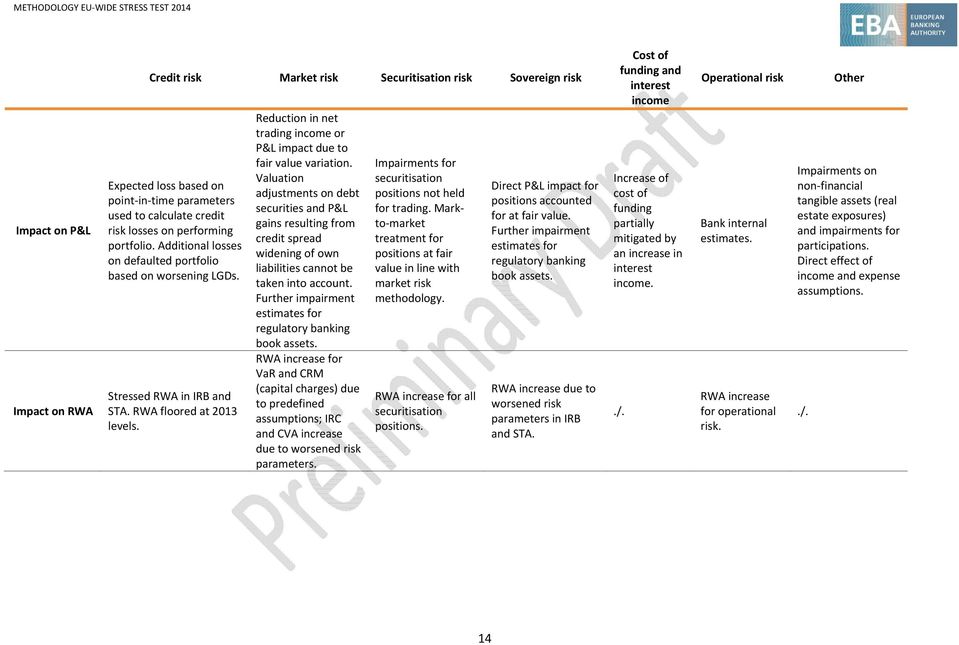
14 Impact on P&L Impact on RWA Credit risk Market risk Securitisation risk Sovereign risk Expected loss based on point in time parameters used to calculate credit risk losses on performing portfolio. Additional losses on defaulted portfolio based on worsening LGDs. Stressed RWA in IRB and STA. RWA floored at 2013 levels. Reduction in net trading income or P&L impact due to fair value variation. Valuation adjustments on debt securities and P&L gains resulting from credit spread widening of own liabilities cannot be taken into account. Further impairment estimates for regulatory banking book assets. RWA increase for VaR and CRM (capital charges) due to predefined assumptions; IRC and CVA increase due to worsened risk parameters. Impairments for securitisation positions not held for trading. Markto market treatment for positions at fair value in line with market risk methodology. RWA increase for all securitisation positions. Direct P&L impact for positions accounted for at fair value. Further impairment estimates for regulatory banking book assets. RWA increase due to worsened risk parameters in IRB and STA. Cost of funding and interest income Increase of cost of funding partially mitigated by an increase in interest income../. Operational risk Bank internal estimates. RWA increase for operational risk. Other Impairments on non financial tangible assets (real estate exposures) and impairments for participations. Direct effect of income and expense assumptions../. 14
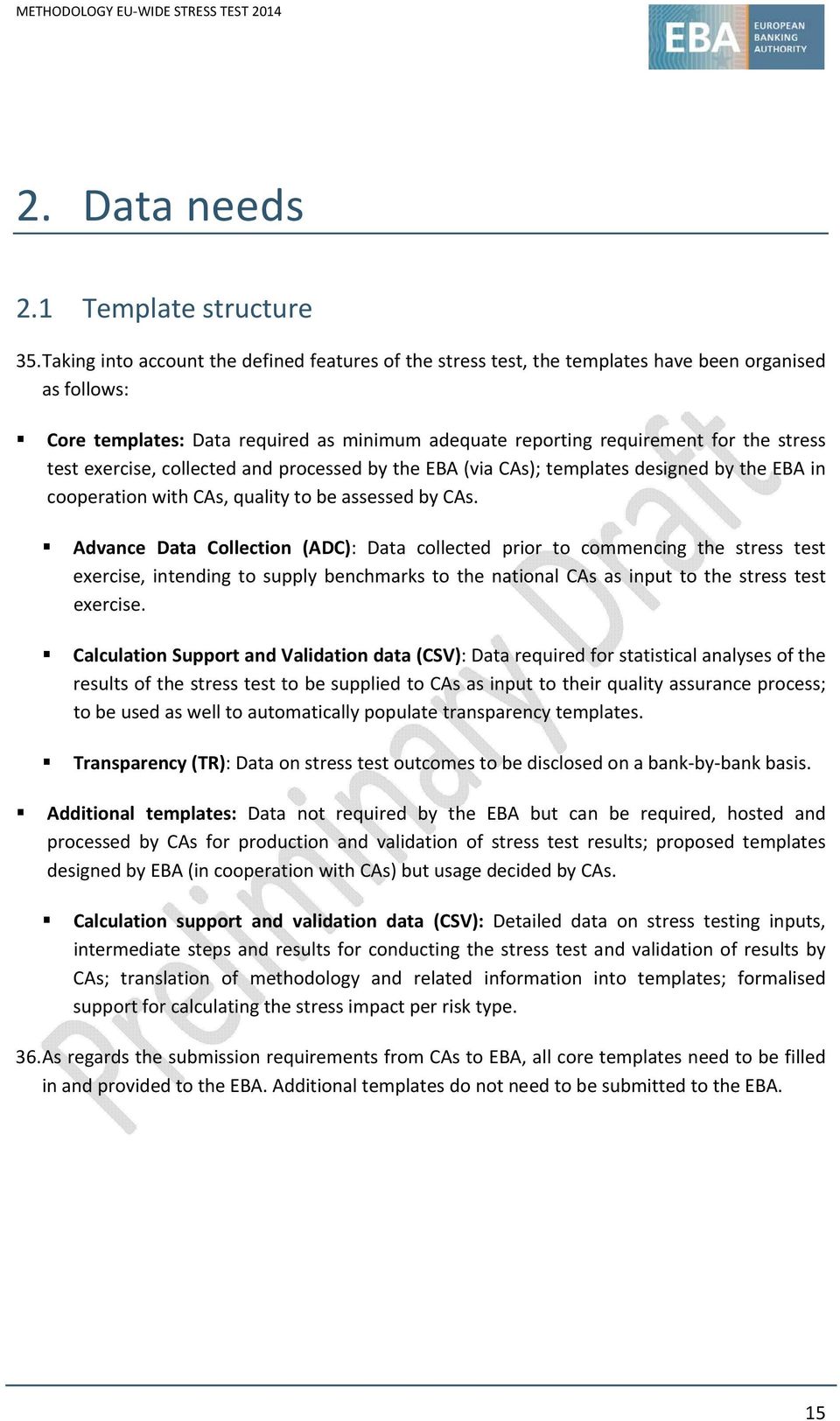
15 2. Data needs 2.1 Template structure 35. Taking into account the defined features of the stress test, the templates have been organised as follows: Core templates: Data required as minimum adequate reporting requirement for the stress test exercise, collected and processed by the EBA (via CAs); templates designed by the EBA in cooperation with CAs, quality to be assessed by CAs. Advance Data Collection (ADC): Data collected prior to commencing the stress test exercise, intending to supply benchmarks to the national CAs as input to the stress test exercise. Calculation Support and Validation data (CSV): Data required for statistical analyses of the results of the stress test to be supplied to CAs as input to their quality assurance process; to be used as well to automatically populate transparency templates. Transparency (TR): Data on stress test outcomes to be disclosed on a bank by bank basis. Additional templates: Data not required by the EBA but can be required, hosted and processed by CAs for production and validation of stress test results; proposed templates designed by EBA (in cooperation with CAs) but usage decided by CAs. Calculation support and validation data (CSV): Detailed data on stress testing inputs, intermediate steps and results for conducting the stress test and validation of results by CAs; translation of methodology and related information into templates; formalised support for calculating the stress impact per risk type. 36. As regards the submission requirements from CAs to EBA, all core templates need to be filled in and provided to the EBA. Additional templates do not need to be submitted to the EBA. 15
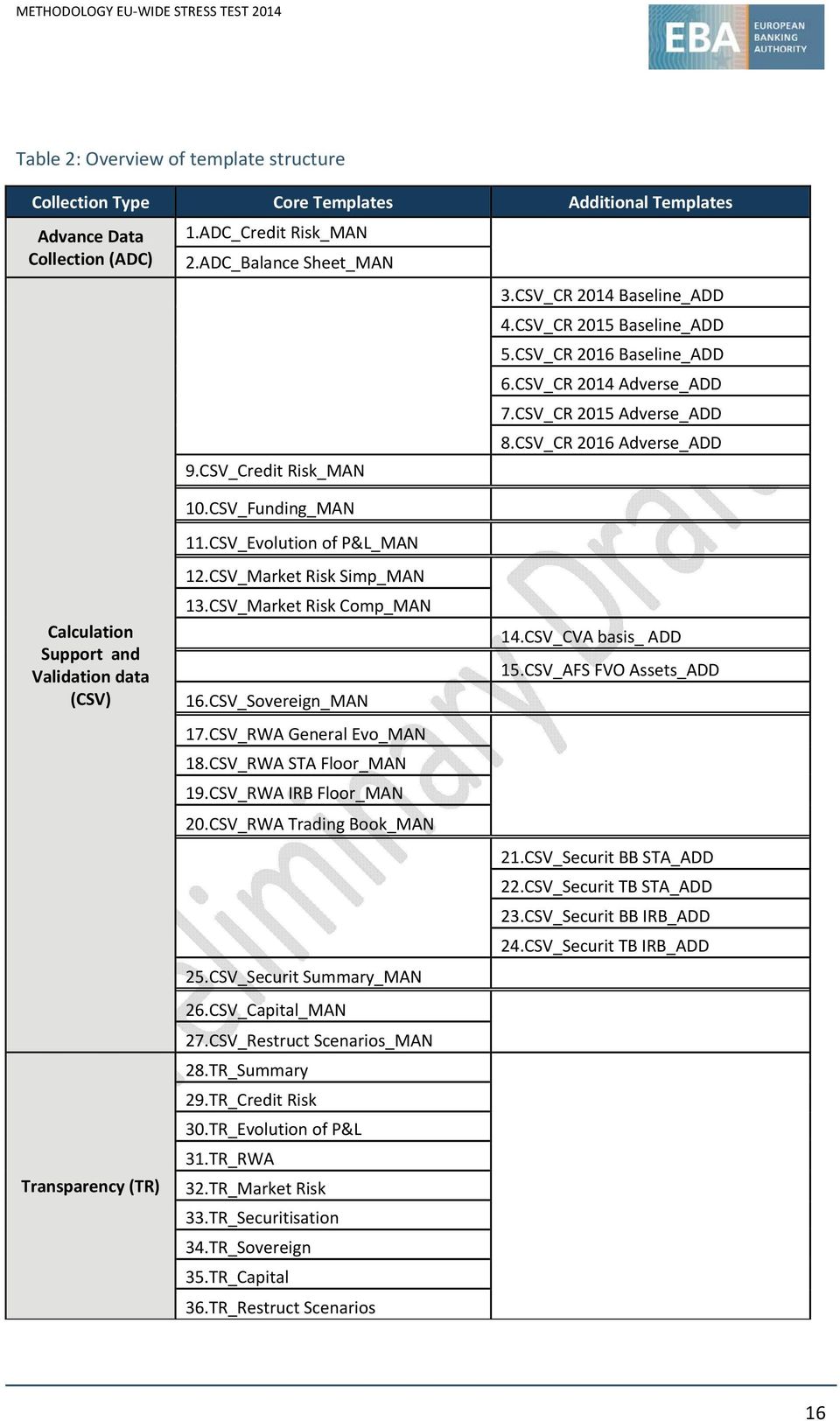
16 Table 2: Overview of template structure Collection Type Core Templates Additional Templates Advance Data Collection (ADC) 1.ADC_Credit Risk_MAN 2.ADC_Balance Sheet_MAN 9.CSV_Credit Risk_MAN 10.CSV_Funding_MAN 3.CSV_CR 2014 Baseline_ADD 4.CSV_CR 2015 Baseline_ADD 5.CSV_CR 2016 Baseline_ADD 6.CSV_CR 2014 Adverse_ADD 7.CSV_CR 2015 Adverse_ADD 8.CSV_CR 2016 Adverse_ADD Calculation Support and Validation data (CSV) Transparency (TR) 11.CSV_Evolution of P&L_MAN 12.CSV_Market Risk Simp_MAN 13.CSV_Market Risk Comp_MAN 16.CSV_Sovereign_MAN 17.CSV_RWA General Evo_MAN 18.CSV_RWA STA Floor_MAN 19.CSV_RWA IRB Floor_MAN 20.CSV_RWA Trading Book_MAN 25.CSV_Securit Summary_MAN 26.CSV_Capital_MAN 27.CSV_Restruct Scenarios_MAN 28.TR_Summary 29.TR_Credit Risk 30.TR_Evolution of P&L 31.TR_RWA 32.TR_Market Risk 33.TR_Securitisation 34.TR_Sovereign 35.TR_Capital 36.TR_Restruct Scenarios 14.CSV_CVA basis_ ADD 15.CSV_AFS FVO Assets_ADD 21.CSV_Securit BB STA_ADD 22.CSV_Securit TB STA_ADD 23.CSV_Securit BB IRB_ADD 24.CSV_Securit TB IRB_ADD 16
17 2.2 Details on core templates Advance data collection 37. During the advance data collection, credit exposure data and selected risk parameters will be collected using the template structure of the 2013 EU wide transparency exercise, including risk parameters. The information will be used to supply national CAs with data to carry out a cross sectional benchmarking of risk parameters like default rates and loss rates. Main characteristics of the templates are: Credit risk data collected as of 31/12/2013; no historical data collected to reduce the reporting burden; Portfolio breakdown: In line with COREP and the 2013 EU wide transparency exercise, e.g. including corporate, SME, Retail and Real Estate related exposures classes; no further breakdown of asset classes; Data: Exposure, RWA, value adjustments and provisions, default and loss rates, PD, LGD, LTV (all for defaulted and non defaulted assets; distinction for IRB and STA banks); Country coverage: Minimum of 95 % of total exposure (in terms of exposure value) or top 10 countries; In addition, high level balance sheet data to be collected. 38. The submission of the populated advance data collection template set to the EBA via CAs is compulsory for all banks participating in the EU wide stress test Calculation support and validation data 39. Selected data is collected from banks to automatically fill aggregate templates and to carry out a statistical analysis of the results and supply it to national CAs. The purpose is not to challenge banks results on a granular level but to implement a cross sectional outlier analysis across the full sample and to identify exceptions from the common methodology. 4 The templates will also be used for calculation support and validation by the CAs. Data required includes: Projected credit risk parameters to benchmark for instance the evolution of impairments or RWA; Funding instruments, maturities and effective interest rates; Detailed P&L projections; 4 For instance mandatory restructuring plans 17
18 Information on Net Trading Income and detailed market risk information, including e.g. notional, P&L effect and sensitivities by market risk factor and per scenario; Projections of sovereign exposure and valuation losses; Evolution of RWA across risk types, and application of RWA floors for credit risk; Exposure values, RWA, impairment and fair value changes for securitisations by accounting category; Detailed evolution of capital including restructuring measures. 40. The submission of the populated core calculation support and validation data to the EBA via CAs is compulsory for all banks participating in the EU wide stress test Transparency 41. The EBA will conduct the EU wide stress test primarily as a transparency exercise. Therefore, the focus and purpose of disclosure templates is to compile any information required for the disclosure of stress test results by the EBA on a bank by bank basis per year of the exercise. Data included in templates for publication is in line with the disclosure of the 2011 EU wide stress test and the transparency exercise in It includes actual and projected baseline and adverse values for: Credit risk: Exposure, RWA, value adjustments and provisions, default and loss rates 5 ; Compiled information on main P&L items like net interest income, net trading income, impairments for financial assets and other comprehensive income; RWA by risk type; Market risk position by main risk types; Securitisation exposure, RWA and impairments; Sovereign exposure by country, maturity and accounting treatment; Capital position, components and adequacy (including stressed solvency ratios) and capital restructuring. 42. The submission of the populated transparency data to the EBA via CAs is compulsory for all banks participating in the EU wide stress test. 5 In accordance with the advance data collection and transparency exercise in 2013 no disclosure of credit risk parameters is envisaged. 18
19 2.3 Details on additional templates Calculation support and validation data 43. The stress test calculation support and validation data is a parallel and more detailed set of templates. It is meant to translate the common methodological requirements into a formalised data set. To this end, the templates include detailed information on the risk types covered and to allow challenge by CAs on a bank by bank basis. The templates provide CAs and banks therefore with formalised support to calculate or validate: Credit risk: Starting values, detailed evolution of defaulted and non defaulted assets, impairment flow and stock of provisions, actual, projected baseline and adverse scenario; CVA: Fair value of OTC derivatives by counterparty group, actual and by scenario; AFS assets and designated at fair value through profit and loss: Position by asset class, actual and per scenario; Securitisation risk: Exposure and stress impact by regulatory and accounting treatment, actual, projected baseline and adverse scenario. 44. Credit risk templates included in calculation support and validation data allow a more granular breakdown of COREP asset classes in order to allow for instance for corporate or retail asset classes to display specific real estate related exposures (e.g. buy to let). The more detailed breakdown has been defined to allow re aggregating to COREP classes. This is seen vital for populating the transparency data which will in either case be based in common COREP classes. Consequently, the templates can also be used for collecting data on the level of COREP classes without using the more granular asset class breakdown given. 45. Templates are based on the common methodology for the EU wide stress test These templates are provided to the CAs for validating banks results, but their use is not compulsory and CAs may decide to use different templates. 19

20 3. Quantification of different risk types 3.1 Credit risk Overview 46. Banks are required to translate the macro economic scenarios provided into the corresponding credit risk impact on both the capital available and the regulatory capital requirements (RWA). The methodology for estimating future credit risk impairments and thus the P&L impact on capital is described in subsection The methodology for estimating future capital requirements, including the regulatory parameters for the necessary RWA calculations, is described in subsection These projections will be based on default and loss parameters (both point in time and regulatory) that will depend on the banks business model, asset portfolios and internal models. 47. The scope of this subsection covers all counterparties (e.g. sovereigns, institutions, financial and non financial firms and households) and all positions exposed to risks stemming from the default of a counterparty (loan portfolio positions, held to maturity securities positions and where applicable positions in the available for sale and designated at fair value though profit and loss). This includes by definition all assets in the banking book which are exposed to credit risk including counterparty credit risk and follows the CRR/CRD IV definition of credit risk (including on and off balance positions). Specific requirements for securitisation position are separately covered in section 3.3. Moreover, banks are required to distinguish between STA and IRB portfolios. 6 The methodology described in this subsection also applies to the capital charge for incremental default and migration risk (see 3.2.8). 48. In addition to the risk of default covered in this subsection, all assets subject to mark tomarket valuation (either through the P&L or directly through capital) are subject to price effects (i.e. a change in credit spreads) under the market risk methodology (see section 3.2). 49. Banks are required to assess the impact of given macro economic scenarios (baseline and adverse) on their future credit risk losses and credit quality. This requires the use of statistical methods (satellite models) that estimate the relationship between macro economic and banking variables. This will include the following main steps: (1) estimating values for default and loss rates under the predefined scenarios on the basis of internal models or, if not 6 IRB portfolios are further differentiated, where necessary, according to the foundation (F IRB) or advanced (A IRB) approach. 20
21 available, on the basis of benchmark parameters, (2) computing default flows based on the default rates, (3) computing impairment flows as the basis for provisions that effect the P&L under the scenarios, and (4) calculating the impact on capital requirements. The different steps and the use of the results are summarised in the figure below. Figure 1: Summary of credit risk methodology Starting values (see Starting values for risk parameters) Application of the macro economic scenarios (see and Risk parameter and exposure evolution) Calculation of default and impairment flows (see Calculation of defaulted assets, impairments and associated benchmarks) Impairments (see Calculation of defaulted assets, impairments and associated benchmarks) Rating migration (see Impact on Credit RWA and associated benchmarks) Further impact (see RWA for defaulted assets and IRB excess or shortfall) 50. For the estimation of impairments, banks are required to follow the detailed methodology. For the estimation of capital requirements, banks should adhere to regulatory requirements based on stressed regulatory risk parameters. 51. As the translation of the scenarios into changes in risk parameters nevertheless includes a suitable level of discretion, participating banks are encouraged to make use of historical data and multiple benchmarks provided by the EBA and ECB to ensure adequate consistency between historic observations, model output and the results under the scenarios of the exercise. The following subsections cover each part of the credit risk methodology in more detail. The naming conventions for the relevant variables (including exposures, collateral and risk parameters) are defined at the start. It is essential that all participating banks strictly adhere to these conventions. 21
22 3.1.2 High level assumptions and constraints 52. For reasons of transparency and comparability, the credit risk framework assumes that the balance sheet is held static as of end Consistent with the static balance sheet assumption, banks are not allowed to replace defaulted assets. Defaulted assets are moved into the defaulted assets stock, reducing nondefaulted assets and keeping total exposure constant. Furthermore, for the purpose of calculating exposures, it is assumed that no charge offs or write offs take place within the three year horizon of the exercise Within the credit risk framework, the initial residual maturity is kept constant for all assets. This means that assets do not mature. For example, a 10 year bond with residual maturity of 5 years at the onset of the exercise is supposed to keep the same residual maturity of 5 years throughout the exercise. Note, that the constant residual maturity applies in particular to the calculation of credit risk RWA (especially the maturity factor used in A IRB but also to some provisions in STA which allow favourable risk weights for short term exposures) Exposure classes and asset classes 55. For the purpose of this stress test, banks are required to report their exposure using the asset classes specified below which are based on the IRB exposure classes. Exposures in the STA need to be mapped into these classes. 56. As a general principle, banks are required to follow and submit the data to the EBA in the given templates and in accordance with the CRR/CRD IV. Moreover, based thereon, CAs can require participating banks to report additional breakdowns for exposures where they see significant risks. 57. The original exposure at the start for each of the defined asset classes should match the exposure reported for each corresponding COREP exposure class. 58. Where exposures are transferred to other classes through credit risk mitigation techniques (substitution approach) this transfer has to be performed in line with the following asset class definitions. 59. The following table contains an overview of the COREP IRB exposure classes (see CRR Art. 147) and mapped STA exposure classes (see CRR Art. 112) 8 : 7 This is not to be confused with the inclusion of write offs in the generation of LGD parameters which are implicitly assumed where applicable. 8 Defaulted assets, included past due items, are to be reported according to the nature of the counterparty. 22
23 Table 3: Overview of the IRB and STA exposure classes IRB exposure class Central governments or central banks Institutions Corporates of which: Specialised Lending of which: SME Retail Secured by real estate property SME Non SME Qualifying Revolving Other Retail SME Non SME Equity Securitisation Other non credit obligation assets Mapped STA exposure class Central governments or central banks + regional governments or local authorities Public sector entities + Multilateral Development Banks + International Organisations + institutions + covered bonds Corporates + secured by mortgages on immovable property (Corporate share) + items associated with particularly high risk, claims on institutions and corporates with a short term credit assessment + Collective Investments Undertakings (CIU) Corporates (Specialized Lending share) Corporates of which: SME Retail + secured by mortgages on immovable property (Retail share) Secured by mortgages on immovable property (Retail share) Secured by mortgages on immovable property (Retail SME share) Secured by mortgages on immovable property (Retail Non SME share) Retail (qualifying revolving share) Retail (non qualifying revolving share) Retail of which: SME Retail (non SME, non qualifying revolving share) Equity exposures Securitisation positions Other exposures 60. The following table contains an overview of more detailed asset classes that banks might be asked to provide in the additional data templates depending on data requirements specified by the relevant CA: Table 4: Overview of detailed asset classes IRB exposure class Central governments or central banks Institutions Corporates of which: Specialised Lending of which real estate related of which: SME of which real estate related of which: Other Corporate of which real estate related Retail Secured by real estate property SME Non SME of which: Owner Occupier of which: Buy to let 23
24 IRB exposure class of which: Other secured by real estate Qualifying Revolving Other Retail SME Non SME Equity Securitisation Other non credit obligation assets 61. Within the corporate asset class: Real estate related exposures are those relating to the sales and/or letting of residential or commercial property; Other corporate refers to exposures in the COREP class Corporate which are neither SME nor Specialised Lending. 62. Within the retail exposure class secured by real estate property: Owner Occupier refers to loans secured on residential real estate occupied by the owner; Buy to let refers to loans secured on residential real estate rented from the owner by a third party Definitions 63. Historical data and projections under the scenarios: In addition to the exposure class mapping, banks are required to apply consistent definitions for the following items: Book Value, according to IFRS (or local GAAP if applicable). Original Exposure, as defined in COREP: This exposure figure is pre conversion factors (CCF) and pre credit risk mitigation techniques and before any deduction of provisions. (STA: Column 1 Original Exposure Pre Conversion Factors in COREP template Reporting on own funds and own funds requirements, Sheet: CR SA, IRB: Column 2 Original Exposure Pre Conversion Factors in template Reporting on own funds and own funds requirements, sheet CR IRB). Collateral with substitution effects, as defined in COREP (STA: Sum of columns 5 to 8 Unfunded Credit Protection: Adjusted Values (Ga) and Other Funded Credit Protection, in the same STA template as above, IRB: Sum of Columns 4 to 6 Unfunded Credit Protection and Other Funded Credit Protection in the same IRB template as mentioned above). Exposure (Exp) is the non defaulted exposure after substitution effects and post CCF. Defaulted assets have to be removed from this figure and are reported in a separate column. Exp is the starting point for the impairment calculation. 24
25 For IRB portfolios, banks should use the definition of Column 11 ( Exposure Value ) in the CR IRB template as a starting point and remove defaulted assets. For STA portfolios, banks need to calculate a post CCF equivalent of Column 11 (net exposure after CRM substitution effects pre conversion factors) in the CR SA template. Provisions have already been deducted (Column 3 in CR SA) at this point and need to be added to exposure. Defaulted assets must not be shown in this figure but also in the respective columns. Value adjustments and provisions should be computed in accordance with the accounting framework to which the reporting entity is subject and to Art. 34 and Art. 110 of the CRR. Funded Collateral (available) including real estate collateral deviates from the COREP definition. It covers all funded collateral that is available to cover the exposure Exp (defined above). Only CRR/CRD IV eligible collateral is to be reported, no regulatory haircuts should be applied. Funded Collateral (capped) follows the definition of the available funded collateral (above) but collateral has to be capped at the exposure level. This means that at the deal level, collateral cannot be higher than the respective exposure. The definition of stock of defaulted assets (Def Stock) has to be based on the bank s regulatory default recognition procedures in place, which will generally involve payments being overdue or the customer being unlikely to pay. Stock of provisions (Prov Stock) is a stock variable and defined as allowances for individually and collectively assessed financial assets (as in FINREP, table 7, columns 8, 9). The default flow (Def Flow) measures the amount of assets that defaulted during a given year (Def Flow year to date, e.g. for the starting value assets that have newly defaulted in 2013). As Def Flow is used to calculate the default rate (which is a PD proxy), it must include all default events that occur during a year. The default flow (Def Flow) should also include assets that were reclassified to e.g. (distress) restructuring portfolios or similar constructions during the observation period. Impairment loss (Imp Flow New) is a flow variable and defined on the basis of impairment on (non )financial assets (FINREP, table 16.7, column 010; reported year to date, i.e. for the starting value provisions that have been set aside in 2013). However, there are two important adjustments to the FINREP figure: (i) the flow should be reported for newly defaulted assets only, (ii) the flow figures should also include direct write offs / charge offs of securities or other assets whose book value is reduced without creating a provision. The guiding principle for this figure is a best effort point in time impairment flow, capturing all credit risk related adjustments, regardless if those take the form of provisions or not. In line with para. 53, writeoffs can be only taken into account for historical data. 25
26 Stock of provisions (Prov Stock) and loss (Imp Flow New) need to be reported as total per defined asset class and broken down in specific and general. Regulatory risk parameters (PDreg and LGDreg) refer to those parameters used for the calculation of capital requirements as prescribed by the CRR/CRD IV and should also be applied by banks for the calculation of RWA over the stress test horizon. ELreg is the expected loss based on regulatory risk parameters following the prescriptions of the CRR/CRD IV for IRB exposures. The LTV should be reported for information purposes for selected real estate related exposure classes (see template) based on the following concept: loan amount/value of collateral. The loan amount here refers to the sum of loans granted against one property. The Herfindahl Hirschman Index (HHI) based on exposure values (the sum of squared exposures shares across all obligors where the exposure share is given as whole number, i.e. 50 being used for 50%), and the total number of borrowers. 64. Historical data: Banks are required to provide historical default rates and historical loss rates for the year 2013 in the provided template. The CA can require longer time series. Banks have to provide these data across the same dimensions (asset classes and countries) as other credit risk data. For this purpose banks are required to apply the following definitions: The historical default rate (Def Rate) is defined as the flow of newly defaulted assets (Def Flow) over total exposure at the beginning of the observation period. The default rate for 2013 would therefore be calculated as defaulted assets flow (in 2013) over performing exposure (end 2012) for each asset class/region. The historical loss rate (Loss Rate) is defined as impairment loss (Imp Flow New) over newly defaulted assets (Def Flow). 65. Projections under the scenarios: To make explicit that projected default rates and loss rates can not only be based on historical rates but also on existing point in time parameters from internal models these are defined as follows: Point in time risk parameters (PDpit and LGDpit 9 ) should be forward looking projections of default rates and loss rates and capture current trends in the business cycle. In contrast to through the cycle parameters they should not be business cycle neutral. PDpit and LGDpit should be used for all credit risk related calculations except RWA under both, the baseline and the adverse scenario. Contrary to regulatory parameters, thy are required for all portfolios, including STA and F IRB. 9 LGDpit is the exposure weighted LGDpit which takes into account funded collateral. For partially collateralized exposures it is a weighted average of the LGDpit for the uncollateralized part and the LGDpit for the collateralized part of the exposure. 26
27 3.1.5 Starting values for risk parameters 66. As a general approach to point in time parameters, banks are required to adhere to the following hierarchy: For IRB portfolios banks are required to base their estimation of point in time values on their approved internal parameter estimation models. This applies to PDpit for both F IRB and A IRB portfolios and to LGDpit only for A IRB portfolios. For IRB banks which cannot extract point in time parameter from their internal models and for portfolios where there are no approved models in place 10 banks should use non approved models to extract point in time parameters provided those models are regularly used in internal risk management and stress testing. For portfolios where no appropriate internal models are in use for estimating the PDpit or LGDpit, banks are expected to approximate PDpit via the Def Rate and LGDpit via the Loss Rate. 67. Irrespective of which approach is followed, banks are required to provide a description of the methodology employed for deriving point in time parameters for all portfolios. Banks are requested to stick to EBA terminology used in this note wherever applicable. 10 Portfolios where there no approved models are in place include F IRB portfolios w.r.t LGDpit and all STA portfolios w.r.t. both PDpit and LGDpit. 27
28 Figure 2: Illustration of starting value approaches for the inference of PDpit and LGDpit Historical Projected Approved point intime models in place Nonapproved point intime models in place PDpit (before applying the scenario) LGDpit (before applying the scenario) PDpit (applying the scenario) LGDpit (applying the scenario) No appropriate point intime models in place Def Rate (before applying the scenario) Loss Rate (before applying the scenario) PDpit (applying the scenario) LGDpit (applying the scenario) 68. In any case, the Def Rate and the Loss Rate both based on 2013 observation and potentially other recent observations will serve as important benchmark parameters to gauge internal PDpit and LGDpit parameter estimates. Moreover, banks will be subject to cross sectional comparisons prior to the kick off of the exercise and might be asked to revise estimated pointin time risk parameters. In addition, PDpit and LGDpit of IRB portfolios with internal models in use will be benchmarked against the level of PDreg and LGDreg Risk parameter and exposure evolution 69. This subsection covers the evolution of risk parameters in the baseline scenario and under stress, i.e. PDpit and LGDpit. 70. There are alternative ways to estimate the relationship between point in time parameters and the macro economic scenario. The following paragraphs describe a hierarchy of methods that banks should adhere to. As a general principle banks should use internal models rather than resort to using benchmarks. 28
29 In the case of estimating a relationship between point in time parameters and the macroeconomic variables at the rating class level and, consequently, obtaining parameters for each rating class within a portfolio, the aggregate parameters are obtained directly as the exposure weighted average of the respective buckets. The exposure distribution among buckets could incorporate rating migrations linked to the macro economic scenario and consequently would in this case require the banks to calculate point in time migration matrices. The distribution of exposures across buckets (that is used to calculate the corresponding aggregate parameters) would be the result of multiplying the distribution of exposures at the end of the previous year by the point in time migration matrix. If the estimation of the relationship between point in time parameters and the macroeconomic variables is done at a portfolio level and, consequently, a single aggregate PDpit/LGDpit for each portfolio is obtained, the calculated defaulted asset flows should be distributed to different rating classes in order to avoid that defaults only affect the worst rating classes. This is consistent with the approach of approximating impairments by using expected losses which assumes that assets default in all rating classes. Where appropriate for the stress testing exercise, banks which have only partial coverage in terms of models that allow estimating a relationship between point in time parameters and the macro economic variables are encouraged to extend the application of the forecast regarding the evolution of the point in time parameters to similar portfolios (country/sector). This approach, however, should be clearly identified in the accompanying note based on the country and sector break down. The extended use of those models is limited to calculation of credit risk losses. As stated in subsection (estimation of RWA impact), the roll out of non approved models during the stress horizon for the purpose of calculating RWA is not allowed. Banks which have no internal parameter estimation models in place for some portfolios and that are unable to estimate the evolution of point in time parameters under scenario assumptions are asked, for those portfolios, to conduct their estimation of the PDpit and LGDpit as described in the previous subsection and base it on the benchmark parameters provided by the ECB (on EL level). Benchmark risk parameters are projected over the time horizon of 2014 to 2016, consistently with both the baseline and adverse macro economic scenarios. 71. Box 1 provides an example on how to calculate the default flow for non defaulted exposure, given multiple rating classes. Box 1: Default flows and granularity, an example Default flows and granularity, an example We define: PDpit (t+1) = 10% Exp (t) =
30 Where the portfolio has two rating classes: Class 1(CL1) with a PDpit CL1 (t+1) of 7.5% and an Exp CL1 (t) of 80 and Class 2 (CL2) with a PDpit CL2 (t+1) of 20% and an Exp CL1 (t) of 20 Then the flow of defaulted assets at the end of the first year, Def Flow (t+1), will be equal to 10. Of the 10 total defaulted asset flow, 6 will be assigned to CL1 (= 80 * 7.5%) and 4 to CL2 (= 20 * 20%). As result, the average PDpit (t+2) of the entire portfolio (before the application of the risk parameter shifts due to the scenario) will be 9.72% and the exposure, Exp (t+1), will be In any case, banks must take into consideration the possible impact caused by the decrease in the fair value of credit risk mitigants (e.g. shock on real estate prices will impact real estate collateral). 73. Moreover, banks must take into account the portfolio characteristics of the forecasted exposures in default (including time since default). The general principle is that for any given defaulted asset the required provisions may increase the longer this asset is in default, even in a static macro economic environment. For example, the (conditional) life time cure rate naturally decreases with time in default and the costs associated with liquidation of collateral may also increase. To this end, banks are asked to use a scaling factor (Default Portfolio Characteristics, DPC) to reflect the distribution of exposures across default classes. The concept of a DPC is further illustrated in Box 2. Box 2: Illustration DPC Illustration of scaling factor (Default Portfolio Characteristics, DPC) The scaling factor, DPC, should reflect the portfolio characteristics of the forecasted exposures in default in terms of default classes where the LGD for the stock of defaulted assets is a weighted average of LGD parameters for distinct default classes. Consistent with the constraint that defaulted assets do not explicitly cure within the stress test horizon, the modelling approach could include a theoretically cured default class. The scaling factor should be based on historic observations of impairments and any automatic increase in impairments due to, for example, provisioning rules based on increased time in default. The evolution of the scaling factor should itself take into account the economic scenario when considering migration between default classes, again with reference to past experience. Depending on the LGD modelling approach, the use of the scaling factor may not be material (i.e. DPC = 1). This may be the case if (i) the LGD parameters consistently include all assumed migration between default categories (e.g. cure rate assumptions, provisioning rules, cost increases), and if (ii) the relative evolution of LGD parameters is the same for new and old defaulted assets. In any case, DPC shall not take a value < Irrespective of which approach banks follow to calculate stressed point in time parameters, banks are required to supplement the methodology required in para. 67 by a description of how they arrive at the point in time parameter evolution for all portfolios. 30
31 75. Box 3 describes how to infer stressed point in time parameters from ECB parameters (for banks without appropriate point in time models). Box 3: Inferring stressed point in time parameters from ECB benchmarks Inferring stressed point in time parameters from ECB EL benchmarks We define: PDpit Bank (0) and LGDpit Bank (0) as the bank s starting values Imp Rate Bank (0) as product of PDpit Bank (0) and LGDpit Bank (0) Imp Rate ECB (0) as the ECB s benchmark starting value Imp Rate ECB (1..3) as the ECB s benchmark values under each scenario Then the PDpit Bank (1..3) and LGDpit Bank (1..3) can be inferred from the increase in the ECB benchmark parameter. There is obviously no single best solution. Subject to the approval of the national supervisor banks can apply the relative increase equally distributed between the two risk parameters for example: PDpit Bank (t+1) = PDpit Bank (t) * [ Imp Rate ECB (t+1) / Imp Rate ECB (t) ] ^ 0.5 and LGDpit Bank (t+1) = LGDpit Bank (t) * [ Imp Rate ECB (t+1) / Imp Rate ECB (t) ] ^ 0.5 In any case, banks are expected to produce a conservative risk parameter evolution in line with historic observations that holds up well in a peer group analysis. 76. The ECB benchmark parameters will serve as important benchmark to gauge internal PDpit and LGDpit parameter estimates under the baseline as well as the adverse scenario. Moreover, banks will be subject to cross sectional comparisons after the submission of the results and might be asked to revise internal figures if deemed overly optimistic. 77. Consistent with the static balance sheet assumption (see paragraph 53) non defaulted credit exposure only changes due to the yearly default flows. Market value fluctuations have no impact on exposure and in particular cannot decrease exposure. The only exception to this is the calculation of stressed exposure for counterparty credit risk. Here, banks are required to stress exposure including netting sets based on the methodology described in section 3.2. Counterparty credit risk exposure cannot decrease due to fair value fluctuations. 78. Banks should estimate the default flow to adjust exposure before the risk weighted assets calculation for credit risk Calculation of defaulted assets, impairments and associated benchmarks 79. This subsection covers the calculation of the impairment losses under the baseline and the adverse scenario and its relation to the flow of defaulted assets. The section covers the estimation of: Impairment losses on newly defaulted assets (Imp Flow New); Impairment losses on old defaulted assets (Imp Flow Old). 31
32 The evolution of the PDpit and LGDpit as described in the previous subsection must be applied to the computation of the defaulted asset flow and the impairment flow on defaulted assets. Write offs and assumptions regarding recovery flows on defaulted assets are not permitted (as described in para. 53). Box 4: Impairment losses on new defaulted assets Impairment losses on new defaulted assets The flow of impairments on new defaulted assets at time t+1, is given by: Where: Imp Flow New (t+1) = MAX {0 ; ELpit (t+1) α * Prov Stock non defaulted (t)} = MAX {0 ; Exp (t) * PDpit (t+1) * LGDpit (t+1) α * Prov Stock non defaulted (t)} α indicates the share of initially non defaulted assets at t, which enter into a default status at t+1 (new defaulted assets) and Prov Stock non defaulted (t) is the stock of provisions against non defaulted assets at t. This implies that provisions for non defaulted assets can be used for new defaults given a static balance sheet. PDpit (t+1) and LGDpit (t+1) both refer to the period from t to t+1 (colloquially year t+1) and both reflect the impact of the respective scenario (baseline or adverse) on the point in time parameters according to internal models and / or ECB benchmark parameters. This estimation cannot lead to a decrease in the coverage ratio for non defaulted assets. This then leads to the following non defaulted exposure at time t+1: Exp (t+1) = Exp (t) [ Exp (t) * PDpit (t+1) ] 80. Box 5 describes the approach to derive the impairment flow on old defaulted assets. Box 5: Impairment losses on old defaulted assets Impairment losses on old defaulted assets To take into account the deterioration of asset quality, particularly under the stress scenario, additional impairments must be made on old defaulted assets. This should, however, go beyond the deterioration of the macro economic environment during stress and include default portfolio characteristics (DPC) like the time in default as described above. The impairment loss on old defaulted exposure is given by: Where: Imp Flow Old (t+1) = Prov Stock Old (t) * MAX { 0; LGDpit (t+1) / LGDpit (t) * DPC(t+1) 1 } Prov Stock Old (t) is the stock of impairments for old defaulted assets LGDpit (t+1) is the LGD estimated in t+1 for the stock of old defaulted assets 32
33 DPC(t+1) is the change in portfolio characteristic between t and t+1 To ensure consistency, impairments for old defaulted assets at the end of the stress test time horizon should at least cover the estimated (stressed) point in time EL at the end of the stress test horizon. This will be assessed by supervisors as part of the quality assurance process. 81. The impairment losses for new and old defaulted assets computed as described above (see Box 4 and Box 5 respectively) are used as a forecast for the specific provisions. 82. Impairments for assets that remain as non defaulted at the end of the horizon should be recomputed according to the accounting systems in each national jurisdiction. 83. Against this background, banks shall demonstrate to the respective CA that, in consideration of the dynamics observed and expected over the course of a given scenario, there are sufficient provisions on non defaulted assets set aside. 84. In any case, each exposure class coverage ratio, i.e. the ratio of total impairment provisions to exposure value, for non defaulted assets cannot be lower than the starting level. Additionally, banks final coverage ratios and their evolution will be assessed by employing sufficiently granular benchmark coverage ratios. 85. The flow of impairment losses will go through the P&L as (credit) risk cost Impact on Credit RWA and associated benchmarks 86. Banks are required to follow the regulatory framework for the calculation of stressed RWA, which means that regulatory risk parameters must be applied which will be different from point in time parameters. The roll out of new internal models during the stress horizon is not to be considered for calculating RWA. Both, STA and IRB portfolios should be stressed. 87. As a general principle, it is expected that, given the macro economic scenario, not only pointin time but also regulatory risk parameters worsen. This applies to all approaches and to both, exposures and credit risk mitigation techniques (the use of collateral). 88. For both, STA and IRB portfolios, the end of 2013 level of RWA serves as a floor for the RWA calculated using stressed regulatory risk parameters in the baseline and the adverse scenario. This floor must be applied (i) separately for IRB and STA portfolios and (ii) within portfolios reported in the credit risk template, at the asset class and country level. 89. The only exemption is due to the likely completion of mandatory restructuring plans 11 that have been publicly announced before 31/12/2013. Any RWA reduction due to restructuring has to be approved by the national supervisor and is subject to cross checks at the European level. Any such RWA reduction must be calculated at the most granular level for which data is 11 These restructuring plans need to be formally agreed with the EU commission (DG Comp). 33
34 reported in the credit risk template, i.e. across asset classes and countries. If all assets within one asset class (or sub class) within one reported country are to be sold, the risk weighted assets for this asset class in this respective country can be set to zero. If there are assets remaining within this granular portfolio, RWA can be reduced in line with the agreed restructuring plan in a way that the average risk weight that prevailed in this portfolio before the restructuring is at least kept constant. This applies also if assets are sold in countries that are only reported as an aggregate in the credit risk template. 90. The RWA for standardised portfolios should be calculated following regulatory requirements based on the scenarios and assuming rating migration as appropriate. Accordingly, exposures which are downgraded or which are defaulted must be risk weighted at the appropriate risk weights (e.g. in the case of unsecured defaulted exposure at 100% or 150%). 91. The RWA for all IRB portfolios over the scenario horizon must reflect the estimated yearly default flow and impairment losses as described above which means that risk parameters need to be updated and applied in accordance to the regulatory framework. Depending on the rating models and methodology in place this might imply migrations of borrowers across rating classes and increases of rating classes regulatory PDs/LGDs. Given the adverse macroeconomic scenario it is expected, that not only point in time but also regulatory risk parameters worsen. 92. The presence of adequate stress testing methodologies is a requirement for the authorisation of the use of internal rating systems for supervisory capital purposes. Banks shall therefore make use of their stress testing methodologies in place for simulating the impact caused on capital requirements for credit risk (due to evolution of regulatory PDs and LGDs) by the application of the EU wide stress test macro economic scenario (baseline and adverse). For consistency reasons (static balance sheet assumption) the exposure is considered constant over the time horizon of the exercise, as is the residual maturity. However, exposure composition w.r.t. to rating classes is expected to change due to defaulted asset flows (see also para. 54 and 77). 93. In addition to a stress of the regulatory parameters based on the predefined scenarios, the rating migration caused by computed default flows has to be taken into account when calculating the capital requirements after application of the scenarios. The estimation of RWAimpact is not only done for the performing portfolio, but also for the defaulted assets (see next subsection) RWA for defaulted assets and IRB excess or shortfall 94. For A IRB banks, the RWA on new defaulted assets exposures (during the horizon) is calculated as follows: RWA Def Flow(t) = MAX { 0;[LGDreg(t) LGDpit(t)] * 12.5 * Def Flow } It is assumed that ELBE(t) is equal to LGDpit(t). 34
35 95. For old defaulted assets (i.e. defaults prior to the starting date of the exercise), RWA shall remain constant during stress. 96. IRB excess or shortfall for defaulted and non defaulted assets shall be calculated according to the CRR/CRD IV, where provisions related to exposures shall be determined as described above. 3.2 Market risk Overview 97. For the purposes of the market risk stress test, the bank sample is divided into banks with significant trading activities and banks for which trading represents a less significant business component. Banks with at least one VaR model in place, approved by the competent supervisory authority under the CRR, will be treated as banks with significant trading activities (VaR banks hereafter). Other banks 12, not fulfilling this criterion, may opt in and, unless they elect to be treated as VaR banks, will be treated as banks with less significant business (non VaR banks hereafter). 98. In accordance with this distinction, VaR banks must follow the approach described in subsection 3.2.3, hereafter described as the comprehensive approach. Banks that use approved VaR models only for a part of their portfolio are requested to apply the comprehensive approach also for the positions not capitalised under VaR models. Non VaR banks can choose to be subject to a simplified approach presented in subsection Firms that we designate to be VaR banks or that elect to be VaR banks must run both the simplified approach and the comprehensive approach. The overall negative P&L effect resulting from the application of risk factors for VaR banks (or non VaR bank not using the simplified approach) should not be less than the prescribed reduction of trading income components for both baseline and adverse scenarios if the simplified market risk approach was applied (see para. 102) The scope of the market risk stress is defined to cover all positions exposed to risks stemming from changes of market prices (including hedge accounting portfolios), i.e. positions held for trading, available for sale and at fair value through profit and loss. Securitisation positions held at fair value are subject to the market risk factors. In addition, banks are required to estimate impairments for securitisation exposures and stressed RWA in accordance with section 3.3 of this methodology Notwithstanding the aforementioned distinction, all banks participating in the exercise are required to apply stressed market risk factors and haircuts to exposures held in available for sale or designated at fair value through profit and loss portfolios (fair value option) including sovereign positions in these accounting categories. Accordingly, sections 3.2.3, and Banks under standardised approach for all risk categories. 35
36 apply also to banks using the simplified approach, however, only with respect to assets valued at fair value other than held for trading The three year simple average of net trading income (NTI) defined in compliance with the FINREP definition ( Gains or losses on financial assets and liabilities held for trading, net ) is the starting point of the calculation for all banks in the sample (net trading income before stress). To this end and regardless of the approach, all banks have to report their net trading income of the years 2009 till 2013 (see also section 3.2.2) and the latest 2014 year to date trading P&L available at the point when the results will be collected The reference date for applying the simplified and comprehensive approach is 31/12/2013. Over the time horizon of the exercise, the notional values of all assets and liabilities under the market risk scope are expected to remain constant (static balance sheet assumption) Simplified market risk stress test approach for non VaR banks 104. Banks without a VaR model in use can choose either to conduct the scenario analysis described in subsection or to be subject to a simplified approach for the trading book. The reasoning of the simplified approach is to apply NTI volatility as a proxy of banks sensitivity with respect to adverse market risk conditions. The approach is calibrated in such a way that a higher volatility in banks NTI results in higher losses under stressed conditions Under the baseline scenario, the 1 times the standard deviation with respect to the previous three years ( ) represents the overall baseline loss 13 and is assumed to be the stress impact on the P&L for the time horizon of the stress test. For computing the yearly NTI under the baseline scenario, in the three years of the exercise horizon, the average NTI is reduced by 50 % for 2014, 30 % for 2015 and 20 % for 2016 of the overall baseline loss (see Box 6 for an illustration). The overall baseline loss can be at most as high as the overall adverse Under the adverse scenario, 2 times the standard deviation with respect to the previous five years ( ) represents the overall adverse loss and is assumed to be the overall stress impact on the P&L for the time horizon of the stress test. For computing the yearly NTI under the adverse scenario, in the three years of the exercise the average NTI is reduced by 50 % for 2014, 30 % for 2015 and 20 % for 2016 of the overall adverse loss (see Box 6 for an illustration). 13 In the simplified approach the representation of loss is based on banks NTI volatility characteristics (average and standard deviations). All calculation are in absolute terms, regardless of actual incurred losses. 36
37 Box 6: Formalised description simplified market risk stress approach The overall loss is given by: Loss baseline = 1 x SD(NTI ) (1) Loss adverse = 2 x SD(NTI ) (2) Where: Average(NTI) is the simple average NTI over ; SD(NTI) is the standard deviation of net trading over (baseline) or (adverse) Yearly NTI is then given by NTI 2014 (baseline, adverse) = Average(NTI) x Loss (baseline, adverse) (3) NTI 2015 (baseline, adverse) = Average(NTI) x Loss (baseline, adverse) (4) NTI 2016 (baseline, adverse) = Average(NTI) x Loss (baseline, adverse) (5) Where: NTI year (baseline, adverse) is the net trading income per year of exercise and scenario; Loss (baseline, adverse) is the overall loss as given by equations (1) and (2) per scenario 107. The calculation shall be conducted in absolute terms, i.e. in currency units, and not in terms of any NTI ratio By definition, under both scenarios the change in NTI cannot be larger than zero. This implies that banks cannot have a larger NTI after stress than at the starting point (3 year average NTI). Moreover, the baseline NTI change represents the minimum change for the adverse level. Banks have to report their end of year NTI accordingly Comprehensive market risk approach for VaR banks 109. For the computation of the impact from market risk shocks, the assumption will be that instantaneous shocks 14 are applied to positions held for trading, available for sale and at fair value through profit and loss (regardless of being accounted at fair value through profit or loss (fair value option) or held for trading) including hedge accounting and sovereign positions in these accounting categories as of the reference date. Consistent with the constant balance sheet assumption and the application of an instantaneous shock, portfolio management actions in response to the stress scenarios, e.g. hedging or portfolio liquidation, are not permitted Banks must translate the macro economic scenarios provided into an impact on capital via gains and losses for positions valued at fair value (including positions held for trading, available for sale and at fair value through profit and loss (regardless of designated at fair value through profit and loss (fair value option) or held for trading). All of these positions should be valued using the internal pricing and risk management models which are employed for these purposes in the ordinary course of business of the bank. This is regardless of whether the effect is via NTI, other comprehensive income or P&L. 14 Rollovers and expiries of the trading assets should be excluded from the analysis because the shock is applied instantaneously. 37
38 111. For presentation purposes, the impact of the scenario will be distributed to the three years of the exercise (2014, 2015 and 2016), where 50% of loss is allocated to 2014, 30% to 2015 and 20% to 2016, respectively. Fair value changes in held for trading positions shall affect banks NTI. Fair value changes in available for sale and designated at fair value through profit and loss (FVO) positions will be shown in accordance with their accounting treatment either in other comprehensive income (available for sale) or in the P&L (fair value option). In case of an impairment estimate for positions as result of the stress test scenarios this is to be booked in the P&L For the treatment of gains following a deterioration of own creditworthiness see para Estimation of impact on NTI, other comprehensive income and P&L 113. Banks are requested to conduct full revaluations of their positions for each of the two macro economic scenarios and each of the four historical scenarios (details concerning scenarios are given in section 3.2.6). For the baseline case the overall impact will be represented by the simple average of the impact of the baseline and four historic scenarios. In the adverse case, the impact will be determined by the simple average of the two worst projections out of the adverse and four historic scenarios. For presentation purposes, the impact of the resulting shock will be distributed as defined in paragraph Banks are requested to apply the list of market risk parameters to all assets and liabilities sensitive to market risk in order to assess the scenario impact on unadjusted market prices (Level 1), other observable inputs (Level 2), and significant unobservable inputs (Level 3) For the purpos of the stress test, the banks shall not take into account possible valuation adjustments on debt securities and gains resulting from credit spread widening of own liabilities under any circumstances. Hence, following a deterioration of own creditworthiness, the bank is not allowed to book a gain on those debt securities (or any other fair valued liability) that represent a net liability to the bank Unless differently requested in the methodology, banks will use the market risk factors for revaluating their assets in respect of IFRS rules and according to the pricing techniques and internal models in use Banks should make use, as necessary, of a higher granularity of market risk factors in their risk management. To this end, risk factors provided in the scenario should be mapped to the additional risk factors used in the internal systems if they cannot be observed for the period referenced by the scenario in question (plainly, this applies to the macro economic scenarios). Banks should provide transparent documentation to the CA on the mapping applied, for instance in the form of mapping tables (see also para. 127 and Box 7: Treatment of additional risk factors) In the computation of the overall effect on NTI, other comprehensive income or P&L the gains resulting from a change in a risk factor should be reduced by 30% while losses should be 38
39 accounted for in full, thus reflecting the general prior that risk diversification effects in portfolios become less effective in a stressed market environment which might not be fully captured in the scenario Specific requirements for positions held for trading 119. The stress test impact for positions held for trading shall be shown in the comprehensive market risk template To allow a comparison, assessment and monitoring of the magnitude of changes in market risk positions due to the stressed risk factors, banks are required to report their long and short positions and sensitivities (see template). These need to be allocated to the relevant risk factors and therefore do not necessarily sum up to all trading exposures (when two or more risk factors are relevant for an asset/liability). However, banks must display the positions in these risk factor categories such that the whole trading activity can be inferred from this representation and therefore monitored against banks individual (national) risk reporting, annual reports and valuation changes experienced in the past. The competent authorities will adopt rigorous approaches to control for the completeness of positions as well as the plausibility of valuation changes To allow an assessment of the underlying diversification assumptions, banks must present the impact of each risk factor for the trading exposure and report it in the template. More precisely, banks are required to assess the P&L sensitivity to changes in each risk factor, independent of all of the other market risk factors, and display the results in the template Gains and losses for held for trading positions will be computed by the comparison of the assets and liabilities at fair value before and after the application of all the shocks. Banks shall provide a detailed breakdown of P&L effects by risk factor in the appropriate section of the template. In addition, banks should report marginal VaR contributions per major risk factor category before the stress impact and the marginal VaR impact per major risk factor category after the impact of the worst of all six scenarios When reporting results for the held for trading positions, non linear effects as well as scenario correlation assumptions deriving from the application of the market risk parameter shocks shall be taken into account and cumulatively shown in the template, separately from the one factor P&L effects. The total losses/profits on the trading portfolio derived from the application of the shocks, for each of the two macro economic scenarios and four historical scenarios, will be the sum of linear and non linear losses/profits derived from the application of the market risk parameter shocks on all the assets allocated in the trading portfolio. 39
40 3.2.6 Description of market risk scenario 124. The stressed market risk parameters have been estimated for the baseline and adverse scenario by the ESRB/ECB. In addition, banks are provided with four historical scenarios, i.e. based on past events which took place between the late 1980s until the sovereign crisis starting in Scenarios have been defined in terms of shocks to market risk factors The exercise employs a detailed and granular set of market risk factors (see comprehensive market risk template) in order to project gains and losses on fair value positions. The market risk parameters include interest rates and volatilities for major currencies, exchange rates and volatilities for the aforementioned currency pairs, haircuts and changes in volatility for major equity commodity and debt instrument indices as well as credit valuation adjustments, changes in credit spreads for debt instruments, parameters relevant for the correlation trading portfolios and bid/ask spreads to be used for the assessment of the impact on market liquidity. In addition, the set contains risk factors capturing basis risk and the specific risks of the correlation trading portfolios As scenarios may not necessarily capture banks structural market risk, CAs can require banks to report as a separate item any material risk factors that have not been specified in the scenario. These risk factors should be included in the stress test using shocks that are derived from the macro scenario Where a material part of a banks net trading income is generated under any of the scenarios by risk factors other than those specified in the scenario, banks can be required to identify these risk factors and specify corresponding moves per risk factor for each of the stress test scenarios. Specifically, banks need to account for 95% of the total P&L generated under each scenario in terms of the risk factors specified together with the other risk factors that provide the biggest contributions to P&L (whether profit or loss). The treatment of additional risk factors and optional additional information to be required by CAs is also specified in Box 7. Box 7: Treatment of additional risk factors Treatment of additional risk factors Per historical scenario Where good quality data from the period referenced by the particular historical scenario is available, this should be used to calibrate the shift in the risk factor and the corresponding evidence provided. For example, if a bank has material exposure to the FTSE index and is stress testing for the 2001 Recession scenario, then the shift in the FTSE risk factor should reference the history of the FTSE index for the period August 2001 to September To be clear, where a bank has material exposure to a risk factor and where the history of that risk factor is readily available, this approach is expected to be applied. 40
41 Where good quality data from the period referenced by the particular historical scenario is unavailable, then one of the following approaches should be adopted: If good quality data from a historical scenario that is similar to the particular historical scenario is available, this should be used to calibrate the shift in the risk factor, and corresponding evidence should be provided, including reasons for deeming the alternative historical scenario to be similar. If good quality data is available in sufficient quantity to support a statistical relationship between the risk factor and one (or more) of the risk factors in the scenario provided, this relationship should be used to calibrate the risk factor, and the statistical evidence to support this relationship should be provided (including evidence to indicate how this relationship holds up in stressed market conditions). For example, if a bank has a material exposure to Siemens A G, it could estimate the beta for Siemens A G and calibrate the shift in Siemens A G as its beta times the shift in the EuroStoxx50 index. In the specific case where a bank uses one of the risk factors in the scenario provided as a proxy for another risk factor (so that its relative shift is identical to that of the risk factor provided), evidence to support the use of such a proxy variable is required. For example, if a bank assumes that Siemens A G beta with the EuroStoxx50 index is 1 (so that the EuroStoxx50 index is a proxy for Siemens A G) then evidence to support assigning a value of 1 to Siemens A G beta is required. Where good quality data is unavailable (for example, for a newly issued corporate bond) (so that the variable itself is unobservable and its relationship with other variables cannot be statistically determined), theoretical reasons to support the calibration of the risk factor shift should be provided. For example, there may be arbitrage reasons to support the calibration. The value of certain illiquid and / or complex trading book positions depends upon unobservable / difficult to observe parameters. Such parameters (or, indeed, valuation methods) should be adjusted to reflect the severity of the market shock associated with the scenario. For example, if the severity of the market shock might lead to circumstances that would require a re mark of the equity correlation book, correlations, illiquid parameters, associated basis factors and the valuation methodology should be adjusted accordingly. Per macro economic scenario Because each macro economic scenario is hypothetical, historical data specific to the scenario are unavailable. Where good quality data is available, then one of the following approaches should be adopted: 41
42 If good quality data from a historical scenario that is similar to the particular macro economic scenario is available, this should be used to calibrate the shift in the risk factor, and the corresponding evidence should be provided, including reasons for deeming the alternative historical scenario to be similar. If good quality data is available in sufficient quantity to support a statistical relationship between the risk factor and one (or more) of the risk factors provided in the scenario, the treatment should be the same as in the case for historical scenarios. Where good quality data is unavailable, the treatment should be the same as in the case for historical scenarios. The value of certain illiquid & complex trading book positions depends upon unobservable / difficult to observe parameters. Here the treatment should be the same as in the case for historical scenarios Additional requirements for CVA, DVA and market liquidity 128. In order to calculate expected credit value adjustments (CVA) losses in the trading book the banks shall apply haircuts provided to the mark to market values (after the application of the market risk shocks) of OTC derivatives. In case a netting agreement exists, the bank may take the net value of the derivatives under the netting agreement (netting set). If there is no netting agreement, the bank should apply the CVA haircuts to the gross mark to market value of the derivatives that have a positive replacement value The CVA stress would not apply to derivatives covered by collateral support annexes (CSAs) and to derivatives that are cleared through central counterparties (CCPs) Banks have to display the fair value of the derivative positions / netting sets before and after i) the application of collateral, ii) market risk shocks to the replacement value and iii) the CVA haircut, with a breakdown by rating. Banks are requested to display the present value of the derivative positions / netting set cleared through CCPs as well as those under CSAs For the purposes of the stress test, the banks shall not take into account possible debt valuation adjustments (DVA). Hence, following a deterioration of own creditworthiness, the bank is not allowed to book a P&L profit on those OTC derivatives (or any other fair valued liability) that present a net liability to the bank Banks are not allowed to offset the simulated CVA fair value impact by any existing reserves VaR banks shall compute the market liquidity shock due to an exogenous widening in the bid ask spread by taking into account the impact caused on the market liquidity reserve 42
43 (valuation adjustment) as set out in the educational guidance on the application of fair value measurement when markets become inactive by the IASB in October Banks holding a correlation trading portfolio in excess of 1% of total risk weighted assets are deemed to hold a significant correlation trading portfolio. These banks shall compute and report the impact of the shock on the correlation trading portfolio separately. Other banks may do so at their discretion For CVA and credit exposures in the trading book, banks are required to assume that the largest counterparty and name (for the credit exposures) would default and report the impact (both pre and post impact of stresses to market risk factors), as well as the gross and net exposure (net of CRM) to that counterparty and name. The reported loss should reflect the deterioration of the CRM protection resulting from the market risk scenarios. The loss should be added to the total losses resulting from the market risk scenario. CCPs, other market infrastructures, central governments and central banks should not be included in the set of counterparties and names to identify the largest exposure RWA calculation for market risk 136. For the purpose of this exercise, regulatory requirements for banks that can choose the simplified market risk approach (see para. 104) are assumed to remain constant at the level end of 2013 for both the baseline and adverse scenario RWA for securitisation positions are expected to change in accordance with the securitisation methodology (see section 3.3) regardless of the market risk approach applied Market risk RWA are defined as capital charges resulting from Value at Risk models (VaR) and the stress VaR (SVaR), incremental risk charge (IRC), comprehensive risk measure (CRM) and own funds requirements for credit valuation adjustments (CVA) The starting values are the respective capital charges reported as end of The market risk RWA are re calculated as described in paragraphs 141ff. for each year of the stress test horizon VaR and SVaR are assumed to remain constant at the level of capital charge end 2013 under the baseline scenario. Under the adverse scenario the VaR capital charge will be replaced by the SVaR capital charge as of end In case of partial use, the adverse VaR capital charge (2xSVaR) is added to the scaled capital requirements under standardised approaches. The scaling factor is derived from the ratio of 2xSVaR over the sum of VaR and SVaR (all as of end 2013) measurement+when+markets+become.htm 43
44 142. Banks that are subject to a credit risk capital charge for CVA are required to calculate a stressed regulatory capital CVA charge for banking book and trading book under the baseline and adverse scenario. To determine additional CVA capital needs, banks are requested to recalculate the CVA charge under stress conditions and based on their regulatory approach in use. To this end, banks should translate the macro economic scenarios into underlying risk parameters and determine respective stressed capital charges. Overall, the increase in the CVA charge for the baseline and adverse scenario should be aligned with the average increase 16 of RWA in STA and IRB portfolios in the baseline and adverse scenario, respectively Banks modelling incremental risk charge (IRC) on external ratings must estimate the stress impact of the scenarios in accordance with para. 90 of this methodology. Banks modelling IRC on the migration of internal ratings must estimate the stress impact in accordance with para. 91 of this methodology. Overall, the increase in the incremental risk charge for the baseline and adverse scenario should be aligned with the average increase 17 of RWA in STA and IRB portfolios in the baseline and adverse scenario, respectively For correlation trading portfolio, the comprehensive risk measure will be assumed constant in the baseline scenario. In the adverse scenario the following scaling is assumed to derive the stressed CRM capital charge: i. 8 % floor is not binding: 1.5 times the CRM capital charge ii. 8 % floor is binding: 2 times the floor 145. The capital charges for correlation trading positions under the standardised approach are assumed to remain constant at the level of end 2013 under baseline and adverse scenarios For banks using internal models to derive regulatory capital requirements for the trading book, the end of 2013 level of capital charges serve in general as a floor for the capital requirements The only exemption is due to the likely completion of mandatory restructuring plans that have been publicly announced before 31/12/ Any capital charge reduction due to restructuring has to be approved by the national supervisor and is subject to cross checks at the European level. 3.3 Treatment of securitisations Scope 148. All exposures subject to CRR Chapter 5 (traditional and synthetic, re securitisations, as well as liquidity lines on securitisation transactions) are included in the scope of the exercise with the exception of ABCP (incl. ABCP liquidity lines). ABCP (incl. ABCP liquidity lines) are excluded 16 In relative terms. 17 In relative terms. 18 These restructuring plans need to be formally agreed with the EU commission (DG Comp). 44
45 from the securitisation approach but subject to either the regular RWA treatment for those positions stressing the underlying parameters in accordance to the provided macro economic parameters, or market risk methodology (VaR) in accordance to their regulatory treatment A specific approach is applied in the exercise on the securitisation exposures in the banking book and trading book. In addition, securitisation exposures under fair value (regardless of the attribution to banking or trading book) are subject to a mark to market treatment under the market risk approach. Securitisation exposures held in the banking book are subject to estimated impairments under the credit risk approach in line with the relevant treatment for the underlying exposures. Estimated impairments should take into consideration the impact of credit enhancement and other structural features when applying the credit risk All exposures (traditional and synthetic, re securitisations, as well as liquidity lines on securitisation transactions) for which there are significant risk transfers (as in the meaning of the CRR/CRD IV) are included in the scope of the exercise. Securitised exposures within correlation trading portfolios are covered by the market risk methodology and must be reported within the market risk template. Originator positions where no significant risk transfer has been taken place are to be treated under the credit risk methodology and should be reported accordingly in the credit risk templates. In particular, this holds for exposure to securitisations issued or guaranteed by international organisations, multilateral development banks, governments, or government agencies, where firms are subject to the credit risk of these institutions rather than the credit risk of the underlying exposures For all exposures, banks are required to use a static balance sheet assumption. The static balance sheet assumption should be applied by keeping the outstanding balance of all securitisation exposures unchanged throughout the time horizon of the stress test Estimation of impact on NTI, other comprehensive income and P&L 152. For securitisation exposure not held for trading, banks are required to estimate the amount of impairments at the end of each period over the horizon of the stress test exercise, taking into account the features of the baseline and adverse macro economic scenarios. Banks should estimate the amount of impairments before the risk weighted assets calculation for securitisation positions. The forecasted impairments should take into consideration impairments already taken in prior periods and incremental impairments for each period must be added in the securitisation template. For each individual security, the underlying pool s credit and prepayment models must be stressed under the different scenarios to produce consistent impairment estimates For securitisation exposures subject to mark to market valuation, banks are required to estimate the mark to market loss incurred in each year of the scenarios according to the market risk methodology and report the forecasted losses in the securitisation template as impairments. Banks should estimate fair value changes before the risk weighted assets calculation for securitisation positions. 45
46 154. The forecast P&L charges will be reviewed and challenged and could be revised by competent authorities Risk weighted assets calculation for securitisations 155. The stress is applied to the securitisation positions (Standard and IRB portfolios) in the different credit quality steps as of end December 2013 by substitution of the original risk weights by pre defined increased ones. The increased risk weights reflect the effect on RWA due to the potential rating migration of the positions For this purpose, the securitisation positions have been allocated to three different classes of securitisations, low, medium and high risk assets. The differentiation is based on the credit quality of the position, the structure or asset class of the transaction and regional differentiation. The classification is based on an analysis of the historical migration volatility of different products and their origin, where a higher migration probability indicates higher risk. In particular: Risk bucket 1 (low risk): EMEA RMBS, ABS (North America and EMEA); Risk bucket 2 (medium risk): CMBS (North America and EMEA), EMEA CDO (structured credit); Risk bucket 3 (high risk): North America RMBS, North America CDO (structured credit), all other positions incl. re securitisations When external ratings are not available and the banks use internal methods (Supervisory Formula Approach and Internal Assessment Approach (SFA and IAA)), for RWA calculation purposes, the banks shall apply the stress factors for unsecuritised corporate or retail exposures to the risk components (PD, LGD) of the asset pool in the respective exposure class. In this case, as a precondition, the IRB banks will have to demonstrate to the respective CAs that the internal methods can be adjusted in a way that is consistent with the scenarios Banks might be asked to supply information on the IRB and STA exposure in risk buckets as defined above. For this purpose the securitisations should be reported in the securitisation templates by credit quality step, securitisation vs. re securitisation, RWA calculation approach, seniority and granularity based on corresponding CRR definitions (e.g. CRR para. 251, 259, 261, 262). 3.4 Cost of funding and interest income Overview 159. Projections conditional on the baseline and adverse scenario, respectively, for the prices 19 of the interest earning and interest paying portfolios 20 over the horizon of the stress test will 19 Prices means here the returns of these items. 46
47 have to be provided. Moreover, a distinction shall be made between existing positions and new positions (i.e. the positions that will replace the maturing positions) in terms of the effective interest rates earned (or paid) for each of these two components. The projected interest rates will reflect re pricing effects for new business and changes in the reference rates for the floating rate items Definition of the effective interest rate: Effective interest rate means, in this context, the rate which if multiplied by the corresponding volume of an item will be equal to the interest income contribution of this item during a specific time interval. 21 Specific assumptions with respect to the granularity of the maturity profile and the timing for issuing new contracts will have to be made. The relevant definitions and assumptions for filling the data templates will be presented below The projections of prices should be sufficient to calculate net interest income, given the static balance sheet assumption, since they would cover all interest earning and interestpaying portfolios Banks will use their own methodology to project the funding costs and the pass through of the change in the cost of funding to the lending rates. In particular, banks need to assume an asymmetrical pass through of interest rate changes on the asset and liability side. The pass through to be applied by banks shall be calibrated in accordance with conservative assumptions. Banks approach will be subject to supervisory constraints and their projections will be subject to a thorough quality assurance analysis, including a comparison against relevant benchmarks. This could lead to requests for revisions to banks projections in the context of quality assurance process. As part of the quality assurance process there may be exceptional cases of legally prescribed funding matches which would need to be taken into account in the stress test when considering the pass through assumption Projection of lending and funding rates 163. Banks will have to use their own methodology in projecting lending and funding rate paths, therefore allowing for the individual bank s perspective of funding sensitivity and pass through potential to lending rates conditional on the macroeconomic scenario. The difference in the price sensitivities of different funding sources should be factored in. It is recommended that the price projections incorporate both exogenous factors and idiosyncratic features of the bank. Specifically, at least the effects of the following factors are expected to be taken into account: 20 The size of portfolios will remain stable over the horizon due to the static balance sheet assumption, but interest earned or paid could change according to the scenario and the related banks projections. 21 The effective interest rate on loans and receivables should factor in that, under IFRS, fees and commissions linked to the loan are part of interest income. 22 Given the static balance sheet assumption, the evolution of aggregate interest income on loans and receivables should reflect the reduction in performing loans as a result of defaulted assets (no substitution assumption). 47
48 Macro economic environment (GDP, unemployment, house prices, etc.); Evolution of reference rates (e.g. swap rate curve); Market structure (market power potential to mark up over marginal cost); Credit risk and its effect on setting the interest rate; Supply constraints (capital position, liquidity position) It is expected that increased cost of funding would feature under the adverse scenario. Two elements contribute to increasing banks funding costs under the adverse scenario and decreasing the projected net interest margin throughout the stress test horizon: Increase in wholesale funding costs the cost of expiring wholesale funding increases reflecting adverse macroeconomic developments, risk aversion and liquidity strains; Increase in retail funding costs the cost of sight deposits and expiring term retail funding increases reflecting increased competition in the market for retail funds Specifically, as regards wholesale funding costs, whereby banks are to a larger degree in the position of price takers (rather than price setters), the evolution of credit spreads in accordance with the macroeconomic scenario should be taken into account. Projections of future CDS spreads 23 and PDs, linked to the macroeconomic scenario should be used as factors affecting the banks wholesale funding cost For floating rate wholesale liabilities there will be two drivers of stress for the cost of funding: i) the time path of the relevant reference rates and; ii) the premium charged due to e.g. credit and liquidity risk For the evolution of yield curves of their fixed income portfolio, banks are expected to take into account the macroeconomic developments, projections about sovereigns creditworthiness and spillover effects, e.g. from weak sovereigns to other distressed economies It is assumed that Long Term Refinancing Operations (LTRO) can be rolled over into Main Refinancing Operations (MRO) funding upon maturity; however, without an increase in the overall volume. While there is no explicit forecast of monetary policy in the stress test scenarios, banks are expected to factor the projected changes in short term market rates into the costs of central bank funding. 23 Where CDS spreads are not available or not representative due to illiquidity, Asset Swap (ASW) spreads for senior unsecured bonds maturing around the 5 years maturity could be used. The ASW spread is defined as the rate that nullifies the fair value of an interest rate swap, whereby the fixed leg consists of the payment cash flows of the benchmark bond (against which the credit spread is calculated) and the floating leg is indexed to a floating interest rate (Xibor) defined for a certain maturity, when the benchmark bond is quoted at par (or if it is not quoted at par, taking into account the difference between the quoted clean price and 100). 48
49 3.4.3 Additional requirements 169. Increased wholesale funding costs cannot result in an increase in interest income from wholesale lending compared with the beginning of the exercise Assumptions underlying the scenarios cannot lead to an increase in net interest income compared with the beginning of the exercise under the baseline and adverse scenario Under the baseline scenario, banks are required to project the interest accrued on NPLs in line with their standing accounting practice (e.g. no recognition of unpaid income i.e. only cash interest received is treated as income, or, full recognition of interest using the original interest rate on the unimpaired balance). Under the adverse scenario, income on defaulted assets should not be recognized Banks are requested to provide separately interest income and expenses accruing from the use of derivatives, broken down into derivatives where the bank is paying a fixed interest rate and/or paying a floating interest rate and/or receiving a fixed interest rate and/or receiving a floating interest rate. The rates and notional volumes of derivatives used in hedge accounting are to be presented separately of other derivatives. The effective interest rate reported should reconcile to the net interest income on derivatives in line with paragraph 160. For non EU countries, the banks will have to fill the templates as for EU countries, but, in addition, a cap based on appropriate benchmarks on the projected Net Interest Income will be imposed Definitions 173. Wholesale funds are defined as those provided by wholesale investors other than nonfinancial corporations. Wholesale funding is broken down into four main categories: i) interbank unsecured transactions; ii) interbank secured transactions (including repos traded with a central counterparty); iii) wholesale debt issued, including subordinated debt issuances and covered bonds; iv) other wholesale transactions, including operations in Commercial Paper and Certificate of Deposits. Banks are also requested to provide data on secured and unsecured lending to other financial institutions The dataset of the template captures the residual maturity distribution of interest paying liabilities and interest earning assets. Figures have to be reported with regard to the contractual repayment values. Given a static balance sheet approach, assets and liabilities that mature within the time horizon of the exercise should be replaced with similar financial instruments in terms of type, credit quality at date of maturity and residual maturity as at the start of the exercise. The interest rate for new business which replaces the maturing ones will reflect re pricing effects. 49
50 175. Callable wholesale debt liabilities that are callable by the counterparty prior to their overall maturity are expected to be exercised on the first possible call date When providing information on the remaining maturity distribution for assets and liabilities, banks have to report sight deposits in the first maturity bucket only Banks are required to report information on fixed/floating rate composition. Banks are required to report information split by existing positions and replaced positions that mature during the stress period in line with the assumption of a static balance sheet Box 8 gives detailed definitions for the maturing and replacement of positions as well as effective interest rates to be reported. Box 8: Detailed definitions regarding the evolution of portfolio and interest income Detailed definitions regarding the evolution of portfolio and interest income This section will present the basic assumptions as regards the evolution of the portfolio and the resulting interest income. The discussion below is presented for assets but it remains valid also for liabilities (if income is replaced by expenses ). The horizon of the stress testing exercise begins at t 0 and ends at t N. A yearly data frequency is requested and, therefore, each time interval [t n 1, t n ] represents one year. A specific type of assets, i, is considered (the same definitions hold for liabilities as well). During the horizon of the stress test, the size of this portfolio will remain constant as maturing assets will be replaced by new positions of the same type, although at a possibly different rate. Therefore, total positions at t n, denoted by T n, can be written as: T n E n N n, where E n is existing positions (those that existed also at t n 1, or, in other words, the positions from t n 1 that did not mature during year n) and N n the new positions (i.e. those that were replaced during the year n). 25 Because of the static balance assumption, total volumes will remain constant, therefore T n =T 0, for all n>0. In implementing the static balance sheet assumption, both the asset structure and the funding structure of the banks should not change over the time horizon of the exercise. Maturing assets and liabilities are expected to be substituted with assets and liabilities having the same residual maturity as the assets and liabilities due. For example, if a bank has an issued bond with an original maturity of five years as of 31 December 2013, but with a residual maturity of 1 year, it is assumed that the bank shall replace the bond due at the beginning of 2015 with another bond having the residual maturity of one year. Therefore, the decomposition of total positions into new and existing positions will arise naturally from the substitution of maturing items (see template). 24 For example, a bond with a contractual maturity of 3 years and a call option that can be exercised by the investor after 1 year has to be valued in the template with a residual maturity of 1 year. 25 In the case of defaulted loans, N n would of course represent newly defaulted loans. Banks are required to project the interest accrued on NPLs in line with their standing practice (e.g. no recognition of unpaid income i.e. only cash interest received is treated as income, or, full recognition of unpaid interest on the unimpaired balance.) 50
51 In addition, it should be clarified that as regards the loans and receivables portfolio, the static balance assumption applies to the portfolio as a whole i.e. when adding the performing and nonperforming part. It is expected that under stress the total volume of performing assets will be decreasing and simultaneously, non performing assets will be increasing. The effective interest rate is affected by the distribution in time (within the time interval [t n 1, t n ]) of maturing and new items. 26 The following timing assumptions are used: An item from t n 1 can have matured, at the soonest, at t n ; i.e. there is no maturity shorter than 1 1 T year. Equivalently, n n n 1 year E, where φ n is the percentage of T n 1 which matures in 1 All new positions N n, are contracted at the midpoint between t n 1 and t n. The interest income during year n consists of income earned from existing positions and income earned from the new positions. Consequently, two effective interest rates can be defined. Specifically: Income earned on existing positions; i.e. income earned by T n 1. This component of income can be written as NII ex, n Tn 1 1 n rex, n Tn 1 n rex, n / 2 where r ex,n is the effective interest rate for existing business 29 (as defined by the previous identity i.e. the rate which if multiplied by T n 1 gives the interest income earned by this portfolio of business). NII ex, n here denotes the contribution of the specific item to net interest income, therefore, if it is an asset it corresponds to income while if it is a liability item it corresponds to an expense. Income earned by new positions, which is NIInew, n Nn rnew, n / 2 i.e. r new,n is the nominal interest rate of the new business. The nominal interest rate equals r / 2 two times the effective interest rate for new business which equals new,n (this definition was chosen so that r new,n is comparable with r ex,n ) 30, due to the assumption of positions being replaced at the midpoint between t n 1 and t n. Banks will need to report volumes and interest rates separately for the floating and the fixed rate portfolios. Therefore, it is useful to rewrite the equations for total business and NII separately, for the floating and fixed segments of the portfolio: 26 For example, if the distribution of maturing/new items is skewed towards the end of the time interval, this will result in a lower effective interest rate (all other things being equal). 27 I.e. n Tn 1 ; maturity 1 year / Tn More specifically, we have: at t=0: T0 E0 ; at t=1: N1 T0, E 1 1 T 0, T1 E1 N 1 ; at t=2: N 2 T 1, E 2 1 T 1, T2 E 2 N 2 etc. 29 In the case of existing business, the effective and the nominal interest rate coincide. 30 These timing assumptions do not necessitate any specific tailoring of banks internal models to comply with the requirements of the exercise. Banks will just have to provide the amounts of existing and new business for each time period, as projected by their internal models, and subsequently they will have to calculate the corresponding effective interest rates that together with the corresponding amounts would enable the calculation of the interest income of existing and new business respectively. The only additional nuance would be that in order to calculate the income from new business it is r new,n /2 that will have to be multiplied by the amount of new business, rather than r new,n. This is just a convention, for the purpose of making the interest rates r ex,n and r new,n comparable. 51
52 T type n E type n N type n type n type type maturity 1 year T Tn 1 ; / n 1 type type E type n 1 n Tn 1 type type type N n n Tn 1 NII type type i, n Ti, n 1 r type ex, i, n N type i, n where type float, fixed r type new, i, n / 2 Banks will need to report the interest rates and floating rate. type r ex, n and type r new, n for both types of portfolio (fixed rate Therefore, the contribution to NII from itemi (obviously, if item i is an asset it will contribute to interest income and if it is a liability to interest expenses), during year n, equals NII i, n float float NII ex, i, n NII new, i, n floating portfolio float float float float float float float float Tn 1 1 n rex, n Tn 1 n rex, n / 2 N i, n rnew, i, n / 2 contributi on floating fixed fixed fixed fixed fixed fixed fixed fixed Tn 1 1 n rex, n Tn 1 n rex, n / 2 N i, n rnew, i, n / 2 fixed fixed fixed NII ex, i, n NII new, i, n fixed portfolio portfolio portfolio contributi contributi contributi on on on, and total NII is the sum of all these components. NII n NII i, i n 3.5 Sovereign risk Overview 179. Sovereign risk positions will be treated in accordance with the methodology of respective risk types, i.e. Sovereign positions in the regulatory banking book: banks are requested to estimate impairments/losses for sovereign exposures in line with sovereign downgrades, consistent 52
53 with the adverse macro economic scenario provided by ESRB/ECB. In addition, banks are requested to compute (stressed) regulatory RWA accordingly and according to the applicable prudential framework. The impact of the economic scenario on default and loss parameters for sovereign assets will be assessed through stressed default and loss parameters for corporate portfolios under specific assumptions on downwards ratings notching to be provided by the ECB/ESRB. Sovereign positions in AfS and designated at fair value through profit and loss (FVO): sovereign exposures in these categories are in addition to the credit risk treatment above subject to the market risk parameters (mark to market) and haircuts as provided by the ESRB/ECB. The application of provided market risk parameter holds for all banks in the sample independently of section The use of prudential filters for sovereign exposures held in available for sale portfolios is treated according to para. 32. Sovereign positions in HfT: sovereign exposures in this category are subject to the market risk parameters (mark to market) and haircuts as provided by the ESRB/ECB and RWA stress as described in section See also section 1.11 Overview on stress testing methodology according to risk type Definitions 181. Banks are required to report their sovereign exposure by country and residual maturity. Additional to the relevant accounting treatment, the following definitions apply (see template): Direct positions: Exposures to be reported include the positions towards sovereign counterparts. The exposures to be reported arise from immediate borrower basis (e.g. an exposure of 100 towards Country A, collateralised with bonds issued by Country B, is reported on Country A but not on Country B) and do not include exposures to other counterparts with full or partial government guarantees. Indirect positions: Exposures to be reported include the positions towards other counterparts (other than sovereign) with sovereign credit risk (i.e. CDS, financial guarantees) in all accounting portfolios (on off balance sheet). Irrespective of the denomination and/or accounting classification of the positions. The economic substance over the form must be used as criteria for the identification of the exposures to be included in this column. This item does not include exposures to counterparts (other than sovereign) with full or partial government guarantees by central, regional and local governments). Trading book: Banks should report exposures included in the "Financial assets held for trading" portfolio after offsetting the cash short positions having the same maturities. 53
54 3.6 Non interest income and expenses Overview 182. The projections of non interest income and expenses as covered in this subsection have to exclude any P&L positions covered in the approaches for credit risk, market risk, sovereign risk, securitisation or cost of funding. All items follow IFRS definitions. In particular the projection can only cover a subset of items in net fee and commission income, other operating income, administrative and other expenses and other income (see template) Banks will have to use their own methodology in projecting non interest income and expense paths, i.e. provide their own perspective on the sensitivity of the respective P&L items to the macro economic scenario. Both, a baseline and an adverse case will have to be covered. It is recommended that the projections incorporate both exogenous factors and bank specific characteristics. Banks own projections are subject to the requirements in subsections The projections of non interest income and expenses should take into account the specific developments of the originating country. Given potential differences in the business cycle of these countries, the respective income and expense streams accrued by the bank in question will be affected Projected non interest income relative to total assets cannot be larger than the 2013 value in the adverse scenario Banks that are not able to provide their own projections should apply the following approach for which historical averages need to be adjusted for one off effects: For non interest net income items apply the average of the respective ratio to total assets over the last three years under the baseline scenario and assume other absolute administrative and other operating expenses remain at their 2013 level. For non interest net income items under the adverse scenario use the average over the two years with the smallest values for the respective ratios to total assets that occurred over the last five years and assume other absolute administrative and other operating expenses remain at their 2013 level Banks projections will be subject to a thorough quality assurance analysis and will be judged against relevant benchmarks Specific requirements regarding income or expense items 188. Realised gains or losses: No realised gains or losses are expected from the sale financial assets and liabilities not measured at fair value through profit and loss. 54
55 189. Dividends: Dividends received from financial assets (participation and other equity positions, either in the trading or in the banking book) should be based on levels as at end of Exchange differences from banking book: The eventual impact in the P&L due to exchange rates (taking into consideration, where appropriate, the effect of hedging strategies) must be in line with the expected evolution of the exchange rate in the macro economic scenario Administrative and other operating expenses: Administrative and other operating expenses cannot be lower than their 2013 value Impairment on financial and non financial assets Impairments on participations shall be computed in line with the result of the (IFRS) test of impairment. Impairment on residential and commercial real estate will be computed by the application of the same haircuts as applied on real estate funds on the assets Other income disposals and discontinued operations: Disposals and discontinued operations are not expected for the period of (static balance sheet assumption) subject to exceptions for mandatory restructuring plans as specified in para Tax effect and evolution of deferred tax assets: The tax regimes will be treated like regulatory changes. That is, they are as in place at the reference date, with changes only, if agreed by law. Deferred tax credits, where applicable, may be recognised. 3.7 Operational risk 195. Banks are invited to estimate their operational risk P&L impact in accordance with the macro economic scenarios and reduce their projected income respectively Capital requirements for operational risk are taken into account in the exercise by computing a proxy of year on year changes in operating profit of the participating institutions (capital charge for operational risk in previous period +15% of year on year absolute change in operating profit), with the actual capital charge as of year end of 2013 acting as a floor should the calculations described above lead to a decreasing capital charge. 55
56 4. Annex: Overview of template content Category Template Breakdown Key information Advance data collection Transparency data Credit risk Balance Sheet Capital Credit risk Securitisation Market risk Sovereign exposure RWA Evolution of P&L Restructuring scenarios COREP exposure classes F IRB, A IRB, STA Non defaulted, defaulted Country N/A N/A COREP exposure classes F IRB, A IRB, STA Non defaulted, defaulted Country Banking book Trading book Correlation trading portfolio Debt instruments FX products Equities Commodities Other Residual maturity Country Accounting portfolios Derivatives, other Credit risk Securitisation Market risk Operational risk Transitional floors Other N/A N/A Exposure RWA Value adjustments and provisions Default rates, loss rates, PD, LGD High level on and off balance sheet items Selected memo items COREP CRR/CRD IV capital elements (full and transitioned amounts) Capital ratios EU wide hurdle rates Memo item convertible instruments Exposure RWA Value adjustments and provisions Impairment rates, coverage ratios EAD RWA Impairments Net fair value Gross value Net fair value Haircuts Values after haircuts RWA Main P&L components Memo info: funding, hedging, defined benefit pension funds CET1 Impact RWA Impact Period and scenario and : baseline and adverse : baseline and adverse Baseline, adverse 2013 Worst scenario 2013 After adverse scenario : baseline and adverse : baseline and adverse
57 Category Template Breakdown Key information Summary Credit Risk Funding N/A COREP exposure classes F IRB, A IRB, STA Non defaulted, defaulted Country Assets by COREP exposure classes Liabilities by financing source Fixed / floating rate Remaining maturity Existing / new business Country CET1 RWA 3y cumulative losses EU wide hurdle rates Memo info about convertible instruments Default Impairment Provisions Coverage Amounts Yields Effective interest rates Period and scenario 2013 and : baseline and adverse Starting values : baseline and adverse Calculation support and validation data Evolution of P&L RWA General Evolution RWA STA Floor Credit Risk N/A Credit risk (per regulatory approach) Securitisation (banking / trading book) Trading book Operational risk Transitional floors COREP exposure classes P&L components Memo items funding, hedging, defined benefit pension funds RWA RWA : baseline and adverse : baseline and adverse : baseline and adverse RWA IRB Floor Credit Risk COREP exposure classes RWA Regulatory EL Provisions : baseline and adverse RWA Trading Book RWA components RWA before and after floor : baseline and adverse Market Risk simplified Market Risk comprehensive N/A Detailed list of risk factors Net trading income Losses compared to previous years Gross exposure Fair value P&L sensitivity Estimated P&L Baseline, adverse Baseline, adverse + 4 historical scenarios 57
58 Category Template Breakdown Key information Calculation support and validation data (additional) Securitisation Summary Sovereign exposure Capital Restructuring scenarios Credit Risk (6 templates: one per projected year for each scenario) Securitisation Banking Book STA Securitisation Trading Book STA Securitisation Banking Book IRB Securitisation Trading Book IRB Market Risk CVA Accounting portfolio Regulatory approach Residual maturity Country Accounting portfolios subject to shocks Derivatives, other N/A N/A COREP exposure classes TOTAL, IRB, STA Country Risk profile (low/medium/high) Rating category Risk profile (low/medium/high) Rating category Risk profile (low/medium/high) Rating category Granular/non granular Risk profile (low/medium/high) Rating category Granular/non granular All counterparties Central Banks and CCP Under CSA Exposure RWA Impairments Fair value changes for AFS and FVO portfolios Gross value Net fair value Haircuts Values after haircuts COREP CRR/CRD IV capital elements (full and transitioned amounts) Capital ratios EU wide hurdle rates Memo info about convertible instruments CET1 Impact RWA Impact Items needed to sequentially estimate default, impairment and RWA according to the methodology Exposure Impairment and other adjustments RWA Exposure Impairment and other adjustments RWA EAD RWA Impairments EAD RWA Impairments Fair Value Period and scenario Baseline, adverse 2013 After adverse scenario : baseline and adverse Starting values : baseline and adverse : baseline and adverse : baseline and adverse Baseline, adverse Baseline, adverse Baseline, adverse + 4 historical scenarios AFS and designated at fair value assets Accounting portfolio Products Fair Value Estimated profit/losses Baseline, adverse + 4 historical scenarios 58
59 5. Annex: EU wide stress test sample of banks Country AT AT AT AT AT AT BE BE BE BE BE CY CY CY DE DE DE DE DE DE DE DE DE DE DE DE DE DE DE DE DE DE DE DE DE DE DE Bank Name BAWAG P.S.K. Bank für Arbeit und Wirtschaft und Österreichische Postsparkasse AG Erste Group Bank AG Raiffeisenlandesbank Oberösterreich AG Raiffeisenlandesbank Niederösterreich Wien AG Raiffeisen Zentralbank Österreich AG Österreichische Volksbanken AG with credit institutions affiliated according to Article 10 of the CRR AXA Bank Europe SA Belfius Banque SA Dexia NV* Investar (Holding of Argenta Bank en Verzekeringsgroep) KBC Group NV Bank of Cyprus Public Company Ltd Co operative Central Bank Ltd Hellenic Bank Public Company Ltd Aareal Bank AG Bayerische Landesbank Commerzbank AG DekaBank Deutsche Girozentrale Deutsche Apotheker und Ärztebank eg Deutsche Bank AG DZ Bank AG Deutsche Zentral Genossenschaftsbank HASPA Finanzholding HSH Nordbank AG Hypo Real Estate Holding AG IKB Deutsche Industriebank AG KfW IPEX Bank GmbH Landesbank Baden Württemberg Landesbank Berlin Holding AG Landesbank Hessen Thüringen Girozentrale Landeskreditbank Baden Württemberg Förderbank Landwirtschaftliche Rentenbank Münchener Hypothekenbank eg Norddeutsche Landesbank Girozentrale NRW.Bank Volkswagen Financial Services AG WGZ Bank AG Westdeutsche Genossenschafts Zentralbank Wüstenrot & Württembergische AG (W&W AG) (Holding of Wüstenrot Bank AG Pfandbriefbank and Wüstenrot Bausparkasse AG) 59
60 Country DK DK DK DK ES ES ES ES ES ES ES ES ES ES ES ES ES ES ES ES FI FR FR FR FR FR FR FR FR FR FR FR GR GR GR GR HU IE IE IE IT IT IT Bank Name Danske Bank Nykredit Jyske Bank Sydbank Banco Bilbao Vizcaya Argentaria, S.A. Banco de Sabadell, S.A. Banco Financiero y de Ahorros, S.A. Banco Mare Nostrum, S.A. Banco Popular Español, S.A. Banco Santander, S.A. Bankinter, S.A. Caja de Ahorros y M.P. de Zaragoza, Aragón y Rioja Caja de Ahorros y Pensiones de Barcelona Caja España de Inversiones, Salamanca y Soria, CAMP Cajas Rurales Unidas, Sociedad Cooperativa de Crédito Catalunya Banc, S.A. Kutxabank, S.A. Liberbank, S.A. MPCA Ronda, Cádiz, Almería, Málaga, Antequera y Jaén NCG Banco, S.A. OP Pohjola Group Banque PSA Finance BNP Paribas C.R.H. Caisse de Refinancement de l Habitat Groupe BPCE Groupe Crédit Agricole Groupe Crédit Mutuel La Banque Postale BPI France (Banque Publique d Investissement) RCI Banque Société de Financement Local Société Générale Alpha Bank, S.A. Eurobank Ergasias, S.A. National Bank of Greece, S.A. Piraeus Bank, S.A. OTP Bank Ltd Allied Irish Banks plc Permanent tsb plc. The Governor and Company of the Bank of Ireland Banca Carige S.P.A. Cassa di Risparmio di Genova e Imperia Banca Monte dei Paschi di Siena S.p.A. Banca Piccolo Credito Valtellinese, Società Cooperativa 60
61 Country IT IT IT IT IT IT IT IT IT IT IT IT LU LU LV MT NL NL NL NL NL NL NO PL PL PL PL PL PL PT PT PT PT SE SE SE SE SI Bank Name Banca Popolare Dell'Emilia Romagna Società Cooperativa Banca Popolare Di Milano Società Cooperativa A Responsabilità Limitata Banca Popolare di Sondrio, Società Cooperativa per Azioni Banca Popolare di Vicenza Società Cooperativa per Azioni Banco Popolare Società Cooperativa Credito Emiliano S.p.A. Iccrea Holding S.p.A Intesa Sanpaolo S.p.A. Mediobanca Banca di Credito Finanziario S.p.A. UniCredit S.p.A. Unione Di Banche Italiane Società Cooperativa Per Azioni Veneto Banca S.C.P.A. Banque et Caisse d'epargne de l'etat, Luxembourg Precision Capital S.A. (Holding of Banque Internationale à Luxembourg and KBL European Private Bankers S.A.) ABLV Bank, AS Bank of Valletta plc ABN AMRO Bank N.V. Bank Nederlandse Gemeenten N.V. Coöperatieve Centrale Raiffeisen Boerenleenbank B.A. ING Bank N.V. Nederlandse Waterschapsbank N.V. SNS Bank N.V. DNB Bank ASA POWSZECHNA KASA OSZCZEDNOSCI BANK POLSKI S.A. (PKO BANK POLSKI) BANK HANDLOWY W WARSZAWIE SA BANK BPH SA BANK OCHRONY SRODOWISKA SA GETIN NOBLE BANK SA ALIOR BANK SA Banco BPI, SA Banco Comercial Português, SA Caixa Geral de Depósitos, SA Espírito Santo Financial Group, SA Nordea Bank AB (publ) Skandinaviska Enskilda Banken AB (publ) (SEB) Svenska Handelsbanken AB (publ) Swedbank AB (publ) Nova Kreditna Banka Maribor d.d. SI Nova Ljubljanska banka d. d. SI UK UK UK SID Slovenska izvozna in razvojna banka, d.d. Barclays plc HSBC Holdings plc Lloyds Banking Group plc 61
62 Country UK Bank Name Royal Bank of Scotland Group plc *The assessment methodology for this group will duly take into account its specific situation, and in particular the fact that an extensive assessment of its financial position and risk profile has already been carried out in the framework of the plan initiated in October 2011 and approved by the European Commission on 28 December
2016 EU Wide Stress Test
 24 February 2016 2016 EU Wide Stress Test Methodological Note Contents List of figures 5 Abbreviations 7 1. Introduction 9 1.1 Background 9 1.2 Objectives of this note 9 1.3 Key aspects 9 1.3.1 Sample
For further information UBI Banca Investor Relations Tel.+ 39 0353922217 Email: [email protected] UBI Banca Press relations Tel.
 - - - For further information UBI Banca Investor Relations Tel.+ 39 0353922217 Email: [email protected] UBI Banca Press relations Tel.+ 39 0302433591 +39 3358268310 Email: [email protected]
COMMERZBANK Capital Update - EU Wide Stress Test Results.
 COMMERZBANK Capital Update - EU Wide Stress Test Results. COMMERZBANK was subject to the 2011 EU-wide stress test conducted by the European Banking Authority (EBA), in cooperation with the Bundesanstalt
2014 EU-wide Stress Test
 2014 EU-wide Stress Test Bank Name LEI Code DK - Sydbank GP5DT10VX1QRQUKVBK64 DK NUK_WL_NR_XX version 1809014 No restructuring 2014 EU-wide Stress Test 2014 EU-wide Stress Test Summary Adverse Scenario
Banco Sabadell Stress test results. 15 th July 2011
 Banco Sabadell Stress test results 15 th July 2011 1 Disclaimer Banco Sabadell cautions that this presentation may contain forward looking statements with respect to the business. financial condition.
F.A.Q. Differences between statistical and supervisory reporting
 F.A.Q. Differences between statistical and supervisory reporting 1) Which group consolidation approach should banks use for statistical, supervisory and financial reporting purposes? For statistical purposes,
CP FOR DRAFT RTS ON RWS/LGDS ARTICLES 124 AND 164 CRR EBA/CP/2015/12. 6 July 2015. Consultation Paper
 EBA/CP/2015/12 6 July 2015 Consultation Paper Draft Regulatory Technical Standards on the conditions that competent authorities shall take into account when determining higher risk-weights, in particular
Report codes for submission of reports in the XML format
 Decree No 11 of the Governor of Eesti Pank of 2 July 2014 Format for sending supervisory reports established on the basis of the Banking Regulation Report codes for submission of reports in the XML format
BASEL III PILLAR 3 CAPITAL ADEQUACY AND RISKS DISCLOSURES AS AT 30 SEPTEMBER 2015
 BASEL III PILLAR 3 CAPITAL ADEQUACY AND RISKS DISCLOSURES AS AT 30 SEPTEMBER 2015 COMMONWEALTH BANK OF AUSTRALIA ACN 123 123 124 5 NOVEMBER 2015 This page has been intentionally left blank Introduction
Basel Committee on Banking Supervision. Capital requirements for banks equity investments in funds
 Basel Committee on Banking Supervision Capital requirements for banks equity investments in funds December 2013 This publication is available on the BIS website (www.bis.org). Bank for International Settlements
Asset Quality Review and Stress Test. Comprehensive Assessment Results
 Asset Quality Review and Stress Test Comprehensive Assessment Results November 2014 Disclaimer This presentation has been prepared solely for informational purposes. Any projections or other estimates
Basel III Pillar 3 CAPITAL ADEQUACY AND RISK DISCLOSURES AS AT 30 SEPTEMBER 2014
 Basel III Pillar 3 CAPITAL ADEQUACY AND RISK DISCLOSURES AS AT 30 SEPTEMBER 2014 COMMONWEALTH BANK OF AUSTRALIA ACN 123 123 124 5 NOVEMBER 2014 1 Scope of Application The Commonwealth Bank of Australia
Basel Committee on Banking Supervision. Frequently asked questions on the revised Pillar 3 disclosure requirements
 Basel Committee on Banking Supervision Frequently asked questions on the revised Pillar 3 disclosure requirements August 2016 This publication is available on the BIS website (www.bis.org). Bank for International
Basel Committee on Banking Supervision. Basel III counterparty credit risk - Frequently asked questions
 Basel Committee on Banking Supervision Basel III counterparty credit risk - Frequently asked questions November 2011 Copies of publications are available from: Bank for International Settlements Communications
EN ANNEX II. SUPERVISORY BENCHMARKING PORTFOLIOS (The templates identify the benchmarking portfolios and are pre-filled by the EBA)
 CONSULTATION PAPER ON EBA DRAFT RTS AND ITS ON BENCHMARKING PORTFOLIOS EN SUPERVISORY BENCHMARKING PORTFOLIOS (The templates identify the benchmarking portfolios and are pre-filled by the EBA) 1. Table
Pillar 3 Disclosures. (OCBC Group As at 31 December 2014)
 1. INTRODUCTION The purpose of this document is to provide the information in accordance with Pillar 3 directives under Monetary Authority of Singapore ( MAS ) Notice 637 on Risk Based Capital Adequacy
Disclosure 17 OffV (Credit Risk Mitigation Techniques)
 Disclosure 17 OffV (Credit Risk Mitigation Techniques) The Austrian Financial Market Authority (FMA) and the Oesterreichsiche Nationalbank (OeNB) have assessed UniCredit Bank Austria AG for the use of
DRAFT September 2007. specified in the ADI s IRB approval, application of the FIRB approach to one or more of its SL sub-asset classes.
 Reporting Form ARF 113.0E FIRB Specialised Lending Instruction Guide This instruction guide is designed to assist in the completion of the FIRB Specialised Lending form. This form captures the credit risk-weighted
2011 EU-Wide Stress Test: Methodological Note - Additional guidance
 9 June, 2011 2011 EU-Wide Stress Test: Methodological Note - Additional guidance Introduction 1. The European Banking Authority is conducting an EU-wide stress test in 2011 based on the methodology published
PILLAR 3 DISCLOSURES 2009
 PILLAR 3 DISCLOSURES 2009 Company Registration Number: C 16343 Contents Page Introduction............................................................... 3 Risk Management Objectives and Policies.................................
EBA-GL-2015-02. 23 July 2015. Guidelines. on the minimum list of qualitative and quantitative recovery plan indicators
 EBA-GL-2015-02 23 July 2015 Guidelines on the minimum list of qualitative and quantitative recovery plan indicators Contents EBA Guidelines on the minimum list of qualitative and quantitative recovery
Bank Capital Adequacy under Basel III
 Bank Capital Adequacy under Basel III Objectives The overall goal of this two-day workshop is to provide participants with an understanding of how capital is regulated under Basel II and III and appreciate
Net Stable Funding Ratio
 Net Stable Funding Ratio Aims to establish a minimum acceptable amount of stable funding based on the liquidity characteristics of an institution s assets and activities over a one year horizon. The amount
Part II Prudential regulatory requirements
 List of references to the Basel frameworks The questionnaire is aimed at assessing equivalence with respect to the provisions Capital Requirements Regulations () and the Capital Requirements Directive
Basel Committee on Banking Supervision. Net Stable Funding Ratio disclosure standards
 Basel Committee on Banking Supervision Net Stable Funding Ratio disclosure standards June 2015 This publication is available on the BIS website (www.bis.org). Bank for International Settlements 2015. All
Risk & Capital Management under Basel III
 www.pwc.com Risk & Capital Management under Basel III London, 15 Draft Agenda Basel III changes to capital rules - Definition of capital - Minimum capital ratios - Leverage ratio - Buffer requirements
May 2015. Stress testing the UK banking system: guidance on the traded risk methodology for participating banks and building societies
 May 2015 Stress testing the UK banking system: guidance on the traded risk methodology for participating banks and building societies 1 Overview 3 1.1 Introduction 3 1.2 Key design features 3 2 Preliminaries
CONSULTATION PAPER ON DRAFT ITS AMENDING THE REPORTING REGULATION EBA/CP/2016/02. 04 March 2016. Consultation Paper
 EBA/CP/2016/02 04 March 2016 Consultation Paper Draft Implementing Technical Standards amending Commission Implementing Regulation (EU) 680/2014 on supervisory reporting of institutions 1 Contents 1. Responding
Main differences between the financial consolidation method and the regulatory consolidation method, considering regulatory adjustments
 Disclosure Report pursuant to the Capital Requirements Regulation as of 31 December 214 1 Scope of Application Regulatory Requirements Since 1 January 214, BCR Group has been calculating the regulatory
Standard Chartered Bank (Thai) PCL & its Financial Business Group Pillar 3 Disclosures 30 June 2015
 Standard Chartered Bank (Thai) PCL & its Financial Business Group Registered Office: 90 North Sathorn Road, Silom Bangkok, 10500, Thailand Overview During 2013, the Bank of Thailand ( BOT ) published the
Guidelines. on the data collection exercise regarding high earners EBA/GL/2014/07. 16 July 2014
 EBA/GL/2014/07 16 July 2014 Guidelines on the data collection exercise regarding high earners Contents 1. Executive summary 3 2. Background and rationale 4 3. EBA Guidelines on the data collection exercise
The Internal Capital Adequacy Assessment Process (ICAAP) and the Supervisory Review and Evaluation Process (SREP)
 Supervisory Statement SS5/13 The Internal Capital Adequacy Assessment Process (ICAAP) and the Supervisory Review and Evaluation Process (SREP) December 2013 Prudential Regulation Authority 20 Moorgate
Guidance Note Capital Requirements Directive Market Risk
 Guidance Note Capital Requirements Directive Issued : 18 December 2007 Revised: 13 March 2013 V3 Please be advised that this Guidance Note is dated and does not take into account any changes arising from
ANNEX II SUPERVISORY BENCHMARKING PORTFOLIOS
 SUPERVISORY BENCHMARKING PORTFOLIOS DEFINITION OF THE SUPERVISORY BENCHMARKING PORTFOLIOS... 2 C 101 DEFINITION OF LOW DEFAULT PORTFOLIO COUNTERPARTIES... 2 C 102 DEFINITION OF LOW DEFAULT PORTFOLIOS...
TD Bank Financial Group Q4/08 Guide to Basel II
 TD Bank Financial Group Q4/08 Guide to Basel II 1. OVERVIEW General Information on Basel can be found on the Canadian Bankers Association website at www.cba.ca. Choose Issues, Standards, Rules and Guidelines
CITIGROUP INC. BASEL II.5 MARKET RISK DISCLOSURES AS OF AND FOR THE PERIOD ENDED MARCH 31, 2013
 CITIGROUP INC. BASEL II.5 MARKET RISK DISCLOSURES AS OF AND FOR THE PERIOD ENDED MARCH 31, 2013 DATED AS OF MAY 15, 2013 Table of Contents Qualitative Disclosures Basis of Preparation and Review... 3 Risk
CONSULTATION PAPER P001-2006 March 2006. Proposals for the Implementation of Basel II in Singapore - Phase 2
 CONSULTATION PAPER P001-2006 March 2006 Proposals for the Implementation of Basel II in Singapore - Phase 2 PREFACE In June 2004, the Basel Committee on Banking Supervision ( BCBS ) issued its report on
Basel Committee on Banking Supervision
 Basel Committee on Banking Supervision Liquidity coverage ratio disclosure standards January 2014 (rev. March 2014) This publication is available on the BIS website (www.bis.org). Bank for International
ESRB response to the EBA Consultation Paper on Draft Implementing Technical Standards on supervisory reporting requirements for institutions (CP 50)
 27.2.2012 ESRB response to the EBA Consultation Paper on Draft Implementing Technical Standards on supervisory reporting requirements for institutions (CP 50) Introduction The European Systemic Risk Board
Instructions for EBA data collection exercise on the proposed regulatory changes of the Definition of Default
 QIS ON THE GL ON DEFINITION OF DEFAULT 26 October 2015 Instructions for EBA data collection exercise on the proposed regulatory changes of the Definition of Default 1 Table of contents Contents 1. Introduction
EN ANNEX VI ANNEX IX INSTRUCTIONS FOR REPORTING LARGE EXPOSURES AND CONCENTRATION RISK
 EN ANNEX VI ANNEX IX INSTRUCTIONS FOR REPORTING LARGE EXPOSURES AND CONCENTRATION RISK Table of Contents PART I: GENERAL INSTRUCTIONS... 1 1. STRUCTURE AND CONVENTIONS... 1 PART II: TEMPLATE RELATED INSTRUCTIONS...
Close Brothers Group plc
 Close Brothers Group plc Pillar 3 disclosures for the year ended 31 July 2008 Close Brothers Group plc Pillar 3 disclosures for the year ended 31 July 2008 Contents 1. Overview 2. Risk management objectives
1) What kind of risk on settlements is covered by 'Herstatt Risk' for which BCBS was formed?
 1) What kind of risk on settlements is covered by 'Herstatt Risk' for which BCBS was formed? a) Exchange rate risk b) Time difference risk c) Interest rate risk d) None 2) Which of the following is not
FR Y-14 Basel III and Dodd-Frank Schedule Instructions
 FR Y-14: Basel III and Dodd-Frank Schedule Instructions General Guidance FR Y-14 Basel III and Dodd-Frank Schedule Instructions The Basel III and Dodd-Frank quarterly and annual schedules collect historical
EBA/CP/2013/41 24.10.2013. Consultation Paper
 EBA/CP/2013/41 24.10.2013 Consultation Paper Draft Implementing Technical Standards On Disclosure for the Leverage Ratio under Article 451(2) of Regulation (EU) No 575/2013 (Capital Requirements Regulation
Regulatory Practice Letter November 2014 RPL 14-20
 Regulatory Practice Letter November 2014 RPL 14-20 BCBS Issues Final Net Stable Funding Ratio Standard Executive Summary The Basel Committee on Banking Supervision ( BCBS or Basel Committee ) issued its
Bank of Queensland Limited
 APRA 30 April 2012 The Basel II Capital Accord principles took effect in Australia on 1 January 2008. The framework for the application of Basel II in Australia is comprised of three pillars: Pillar 1:
18,343 18,308 3 Accumulated other comprehensive income (and other reserves)
 The information in this report is prepared quarterly based on the ADI financial records. The financial records are not audited for the Quarters ended 30 September, 31 December and 31 March. The report
Division 9 Specific requirements for certain portfolios of exposures
 L. S. NO. 2 TO GAZETTE NO. 43/2006 L.N. 228 of 2006 B3157 Division 9 Specific requirements for certain portfolios of exposures 197. Purchased receivables An authorized institution shall classify its purchased
Basel Committee on Banking Supervision. Consultative Document. Net Stable Funding Ratio disclosure standards. Issued for comment by 6 March 2015
 Basel Committee on Banking Supervision Consultative Document Net Stable Funding Ratio disclosure standards Issued for comment by 6 March 2015 December 2014 This publication is available on the BIS website
REPORT ON THE IMPACT ON THE VOLATILITY OF OWN FUNDS FROM DEFINED PENSION PLANS. 24 June 2014. Report
 24 June 2014 Report On the impact on the volatility of own funds of the revised IAS 19 and the deduction of defined pension assets from own funds under Article 519 of the Capital Requirements Regulation
HSBC North America Holdings Inc. 2015 Comprehensive Capital Analysis and Review and Annual Company-Run Dodd-Frank Act Stress Test Results
 2015 Comprehensive Capital Analysis and Review and Annual Company-Run Dodd-Frank Act Stress Test Results Date: March 5, 2015 TABLE OF CONTENTS PAGE 1. Overview of the Comprehensive Capital Analysis and
BVI s position on the Consultative Document of the Basel Committee on Banking Supervision: Capital requirements for banks equity investments in funds
 Frankfurt am Main, 4 October 2014 BVI s position on the Consultative Document of the Basel Committee on Banking Supervision: Capital requirements for banks equity investments in funds BVI 1 gladly takes
NEED TO KNOW. IFRS 9 Financial Instruments Impairment of Financial Assets
 NEED TO KNOW IFRS 9 Financial Instruments Impairment of Financial Assets 2 IFRS 9 FINANCIAL INSTRUMENTS IMPAIRMENT OF FINANCIAL ASSETS IFRS 9 FINANCIAL INSTRUMENTS IMPAIRMENT OF FINANCIAL ASSETS 3 TABLE
Standard Chartered Bank (Thai) PCL & its Subsidiaries Pillar 3 Disclosures 30 June 2012
 Standard Chartered Bank (Thai) PCL & its Subsidiaries Registered Office: 90 North Sathorn Road, Silom Bangkok, 10500, Thailand Overview In November 2008, the Bank of Thailand ( BOT ) published the notification
CONSULTATION PAPER P016-2006 October 2006. Proposed Regulatory Framework on Mortgage Insurance Business
 CONSULTATION PAPER P016-2006 October 2006 Proposed Regulatory Framework on Mortgage Insurance Business PREFACE 1 Mortgage insurance protects residential mortgage lenders against losses on mortgage loans
DISCLOSURE ON CAPITAL ADEQUACY & MARKET DISCIPLINE (CAMD)
 DISCLOSURE ON CAPITAL ADEQUACY & MARKET DISCIPLINE (CAMD) A) Scope of Application : (a) This guidelines applies to Delta Brac Housing Finance Corporation Ltd. (b) (c) DBH has no subsidiary companies. Not
Capital Ratio Information (Consolidated) Sumitomo Mitsui Financial Group, Inc. and Subsidiaries
 SMFG Capital Ratio Information (Consolidated) Sumitomo Mitsui Financial Group, Inc. and Subsidiaries The consolidated capital ratio is calculated using the method stipulated in Standards for Bank Holding
Basel II. Questions and Answers FINANCIAL SERVICES
 Basel II Questions and Answers FINANCIAL SERVICES Index Introduction 7 Basel II Accord 8 KPMG support regarding Basel II implementation 11 General questions on Basel II 13 1. What is the Bank for International
Basel II, Pillar 3 Disclosure for Sun Life Financial Trust Inc.
 Basel II, Pillar 3 Disclosure for Sun Life Financial Trust Inc. Introduction Basel II is an international framework on capital that applies to deposit taking institutions in many countries, including Canada.
Basel Committee on Banking Supervision. Frequently Asked Questions on Basel III s January 2013 Liquidity Coverage Ratio framework
 Basel Committee on Banking Supervision Frequently Asked Questions on Basel III s January 2013 Liquidity Coverage Ratio framework April 2014 This publication is available on the BIS website (www.bis.org).
Basel Committee on Banking Supervision. Standards. Revised Pillar 3 disclosure requirements
 Basel Committee on Banking Supervision Standards Revised Pillar 3 disclosure requirements January 2015 This publication is available on the BIS website (www.bis.org). Bank for International Settlements
The Mortgage Market Review and Non-bank mortgage lenders is enhanced Prudential Supervision on the way?
 JULY 2010 The Mortgage Market Review and Non-bank mortgage lenders is enhanced Prudential Supervision on the way? Introduction Since the publication of the FSA's latest Mortgage Market Review consultation
The Goldman Sachs Group, Inc. and Goldman Sachs Bank USA. 2015 Annual Dodd-Frank Act Stress Test Disclosure
 The Goldman Sachs Group, Inc. and Goldman Sachs Bank USA 2015 Annual Dodd-Frank Act Stress Test Disclosure March 2015 2015 Annual Dodd-Frank Act Stress Test Disclosure for The Goldman Sachs Group, Inc.
Basel Committee on Banking Supervision. Frequently asked questions on the Basel III Countercyclical Capital Buffer
 Basel Committee on Banking Supervision Frequently asked questions on the Basel III Countercyclical Capital Buffer October 2015 This publication is available on the BIS website (www.bis.org). Bank for International
Capital Adequacy: Internal Ratings-based Approach to Credit Risk
 Prudential Standard APS 113 Capital Adequacy: Internal Ratings-based Approach to Credit Risk Objective and key requirements of this Prudential Standard This Prudential Standard is directed at ensuring
Basel Committee on Banking Supervision
 Basel Committee on Banking Supervision Reducing excessive variability in banks regulatory capital ratios A report to the G20 November 2014 This publication is available on the BIS website (www.bis.org).
International Accounting Standard 32 Financial Instruments: Presentation
 EC staff consolidated version as of 21 June 2012, EN EU IAS 32 FOR INFORMATION PURPOSES ONLY International Accounting Standard 32 Financial Instruments: Presentation Objective 1 [Deleted] 2 The objective
Basel Committee on Banking Supervision. Consultative Document. Basel III: The Net Stable Funding Ratio. Issued for comment by 11 April 2014
 Basel Committee on Banking Supervision Consultative Document Basel III: The Net Stable Funding Ratio Issued for comment by 11 April 2014 January 2014 This publication is available on the BIS website (www.bis.org).
The EBA Stress Test data set
 EBA STRESS TEST DATA SET: GUIDE FOR DATA EXPLOITATION The EBA Stress Test data set Manual for using and managing data The EBA has developed a range of practical tools that aim to facilitate the use of
ICAAP Report Q2 2015
 ICAAP Report Q2 2015 Contents 1. INTRODUCTION... 3 1.1 THE THREE PILLARS FROM THE BASEL COMMITTEE... 3 1.2 BOARD OF MANAGEMENT APPROVAL OF THE ICAAP Q2 2015... 3 1.3 CAPITAL CALCULATION... 3 1.1.1 Use
COMPREHENSIVE ASSESSMENT STRESS TEST MANUAL
 COMPREHENSIVE ASSESSMENT STRESS TEST MANUAL In 2014 all ECB publications feature a motif taken from the 20 banknote. August 2014 European Central Bank, 2014 Address Kaiserstrasse 29, 60311 Frankfurt am
Guidance on the management of interest rate risk arising from nontrading
 Guidance on the management of interest rate risk arising from nontrading activities Introduction 1. These Guidelines refer to the application of the Supervisory Review Process under Pillar 2 to a structured
Basel Committee on Banking Supervision. Consultative Document. Standards. Review of the Pillar 3 disclosure requirements
 Basel Committee on Banking Supervision Consultative Document Standards Review of the Pillar 3 disclosure requirements Issued for comment by 26 September 2014 June 2014 This publication is available on
2013 Comprehensive Capital Analysis and Review (CCAR) and Dodd-Frank Stress Tests
 2013 Comprehensive Capital Analysis and Review (CCAR) and Dodd-Frank Stress Tests Comprehensive Capital Plan submitted to the Federal Reserve Bank on January 7, 2013 SECTION TABLE OF CONTENTS PAGE 1 Background
SEMINAR ON CREDIT RISK MANAGEMENT AND SME BUSINESS RENATO MAINO. Turin, June 12, 2003. Agenda
 SEMINAR ON CREDIT RISK MANAGEMENT AND SME BUSINESS RENATO MAINO Head of Risk assessment and management Turin, June 12, 2003 2 Agenda Italian market: the peculiarity of Italian SMEs in rating models estimation
IFRS 9 FINANCIAL INSTRUMENTS (2014) INTERNATIONAL FINANCIAL REPORTING BULLETIN 2014/12
 IFRS 9 FINANCIAL INSTRUMENTS (2014) INTERNATIONAL FINANCIAL REPORTING BULLETIN 2014/12 Summary On 24 July 2014, the International Accounting Standards Board (IASB) completed its project on financial instruments
Pillar 3 Disclosures. Principality Group 31 December 2008
 Pillar 3 Disclosures Principality Group 31 December 2008 Contents 1. Overview 3 1.1 Background 1.2 Basis and frequency of disclosures 1.3 Scope of application 1.4 External audit 2. Risk Management Objectives
TABLE 1: SCOPE OF APPLICATION Capital Deficiencies (Table 1, (e))
 Particulars 4. Subsidiary n TABLE 1: SCOPE OF APPLICATION Capital Deficiencies (Table 1, (e)) The aggregate amount of capital deficiencies in subsidiaries not included in the consolidation i.e. that are
Basel Committee on Banking Supervision. Frequently asked. monitoring
 Basel Committee on Banking Supervision Frequently asked questions on Basel III monitoring REVISED September 2012 Requests for copies of publications, or for additions/changes to the mailing list, should
Validation of low-default portfolios in the Basel II Framework
 Basel Committee Newsletter No. 6 (September 2005) Validation of low-default portfolios in the Basel II Framework The purpose of this Newsletter is to set forth the views of the Basel Committee Accord Implementation
THE INSURANCE BUSINESS (SOLVENCY) RULES 2015
 THE INSURANCE BUSINESS (SOLVENCY) RULES 2015 Table of Contents Part 1 Introduction... 2 Part 2 Capital Adequacy... 4 Part 3 MCR... 7 Part 4 PCR... 10 Part 5 - Internal Model... 23 Part 6 Valuation... 34
Before turning to detailed remarks on the questions for consultation, we would like to draw EBA s attention to our key issues and concerns.
 Frankfurt am Main 16 August 2013 BVI s position on the Draft Regulatory Technical Standards on the determination of the overall exposure to a client or a group of connected clients in respect of transactions
Guidelines on the implementation, validation and assessment of Advanced Measurement (AMA) and Internal Ratings Based (IRB) Approaches
 4 April 2006 Guidelines on the implementation, validation and assessment of Advanced Measurement (AMA) and Internal Ratings Based (IRB) Approaches Executive summary... 4 1. Introduction... 7 1.1. Why guidelines
Pillar 3 Disclosure 2008
 Pillar 3 Disclosure 2008 rbs.com Pillar 3 Disclosure 03 Background 05 Scope of application 06 Capital and risk management 09 Credit risk Credit risk management 10 Credit risk by IRB approach 14 Credit
List of legislative acts
 List of legislative acts BRRd : d irective 2014/59/EU of the European Parliament and of the Council of 15 May 2014 establishing a framework for the recovery and resolution of credit institutions and investment
INTERNAL CAPITAL ADEQUACY ASSESSMENT
 INTERNAL CAPITAL ADEQUACY ASSESSMENT 30 june 2011 Contents Page 1. Introduction... 3 2. Process for determining the solvency need... 4 2.1. The basis for capital management... 4 2.2. Risk identification...
MORGAN STANLEY Financial Supplement - 4Q 2015 Table of Contents
 Page # MORGAN STANLEY Financial Supplement - 4Q 2015 Table of Contents 1. Quarterly Consolidated Financial Summary 2. Quarterly Consolidated Income Statement Information 3. Quarterly Consolidated Financial
Saxo Capital Markets CY Limited
 Saxo Capital Markets CY Limited DISCLOSURES IN ACCORDANCE WITH THE REGULATION FOR THE CAPITAL REQUIREMENTS OF INVESTMENT FIRMS FOR THE YEAR ENDED 31 DECEMBER 2014 MAY 2015 CONTENTS 1. GENERAL INFORMATION